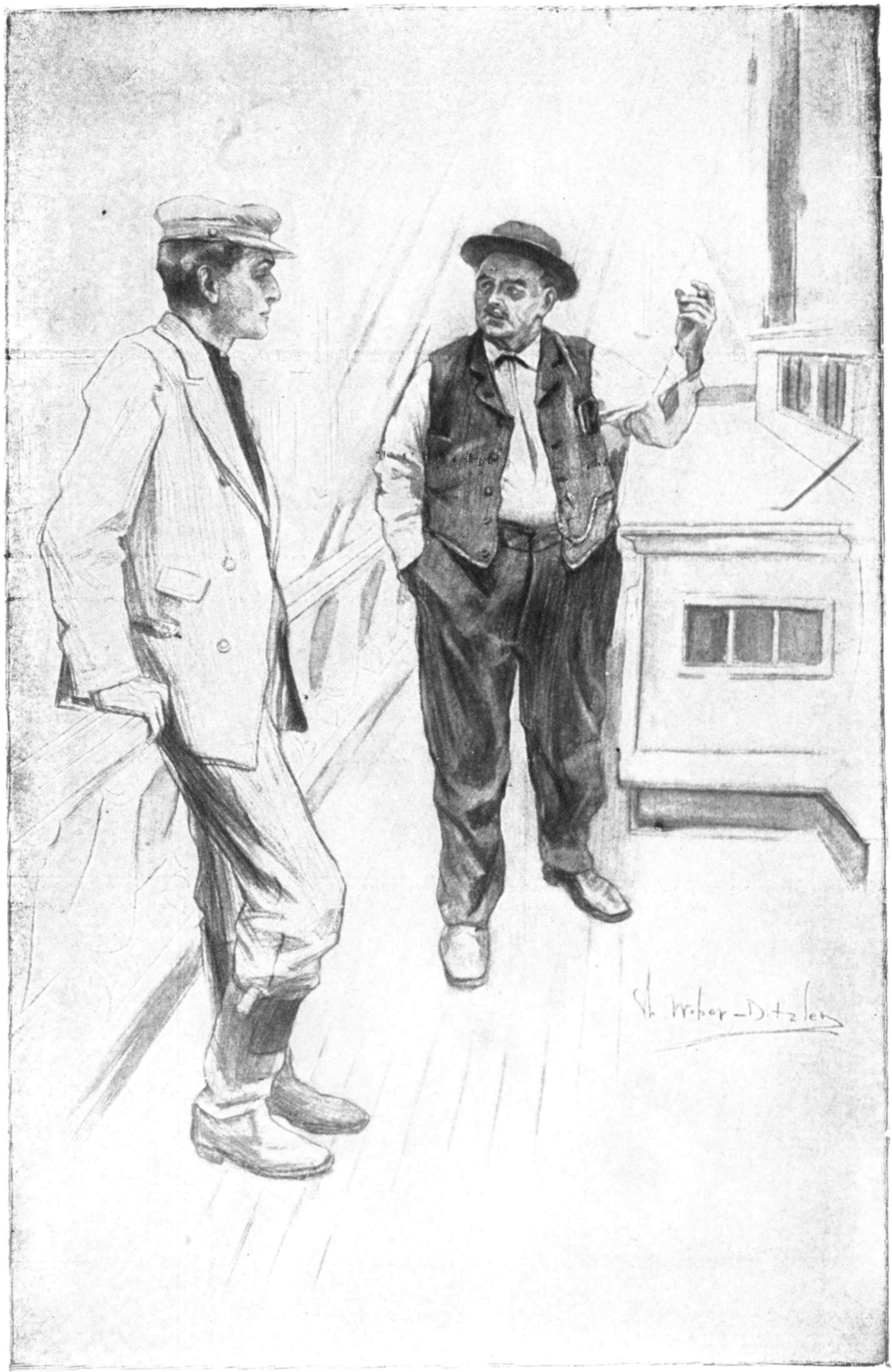
“I never dreamed that I’d come to be skipper of a coal-hod.”
Page 122. Partners of the Tide.
Title: Partners of the tide
Author: Joseph Crosby Lincoln
Illustrator: John Rae
Charlotte Weber-Ditzler
Release date: May 2, 2026 [eBook #78581]
Language: English
Original publication: New York: A. L. Burt Company, 1905
Other information and formats: www.gutenberg.org/ebooks/78581
Credits: Steve Mattern and the Online Distributed Proofreading Team at https://www.pgdp.net (This file was produced from images generously made available by The Internet Archive)
PARTNERS OF THE TIDE
“I never dreamed that I’d come to be skipper of a coal-hod.”
Page 122. Partners of the Tide.
By JOSEPH C. LINCOLN
Author of “Cap’n Eri”

WITH ILLUSTRATIONS
A. L. BURT COMPANY Publishers
NEW YORK
Copyright, 1905
BY
A. S. BARNES & CO.
Published April, 1905
| CHAPTER | PAGE | |
| I. | The Orham Stage | 1 |
| II. | The “Old Maids” | 20 |
| III. | The “Dog Girl” | 40 |
| IV. | The “Last Day” | 64 |
| V. | A Change of Plans | 86 |
| VI. | The Thomas Doane | 103 |
| VII. | A Question of Policy | 121 |
| VIII. | Home Again | 148 |
| IX. | Wrecking and Waltzing | 169 |
| X. | The Lumber Schooner | 193 |
| XI. | At Setuckit Point | 210 |
| XII. | The Anchor of the Liberty | 228 |
| XIII. | Mr. Cook Wires | 247 |
| XIV. | The “Subscription Ball” | 262 |
| XV. | The Diving Belle | 282 |
| XVI. | The Captain’s Gamble | 294 |
| XVII. | Work and Worry | 306 |
| XVIII. | Mr. Sam Hammond | 318 |
| XIX. | The Burglar | 329 |
| XX. | A Debt is Paid | 347 |
| XXI. | “Storm Along, John!” | 363 |
| XXII. | Thanksgiving | 384 |
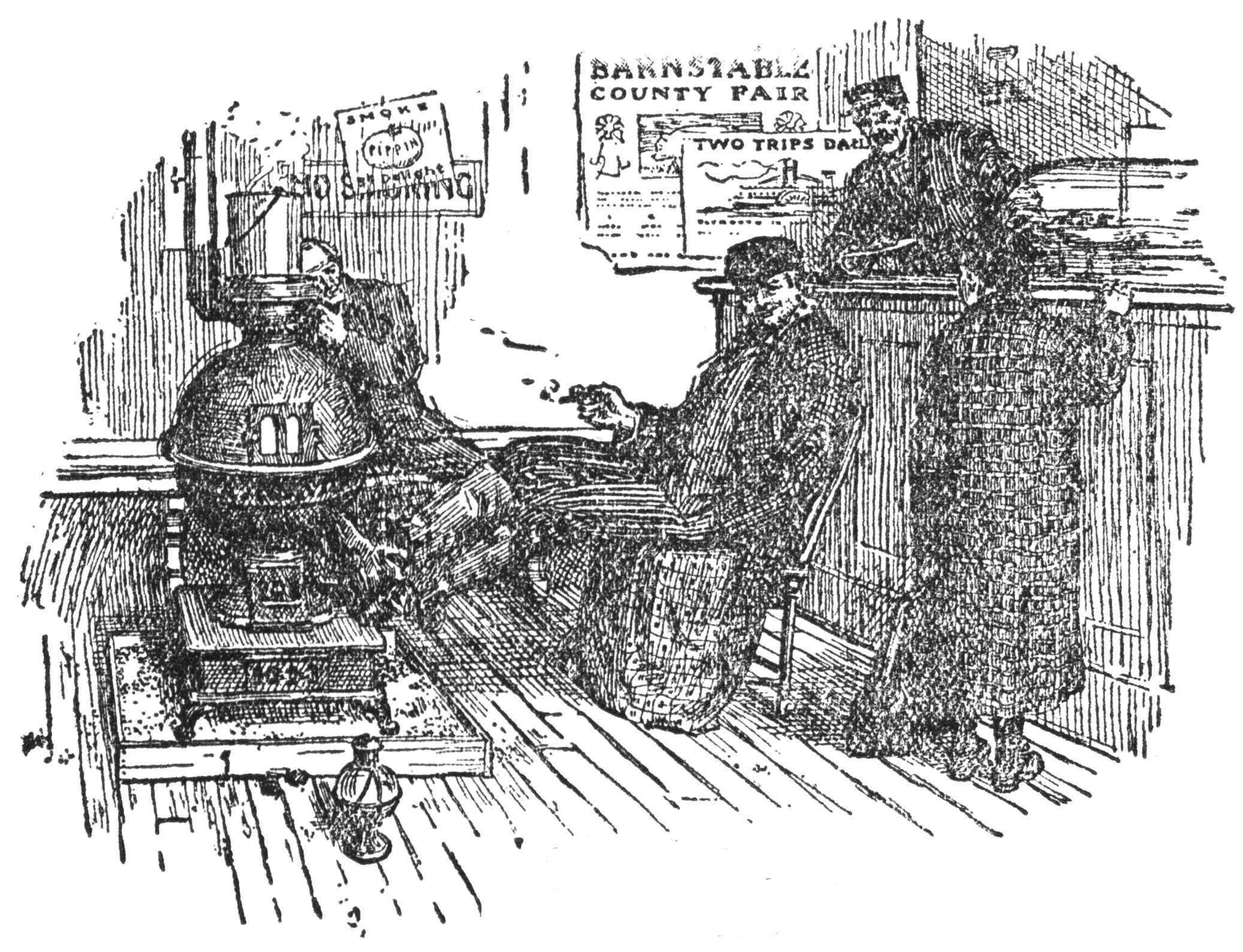
THE ORHAM STAGE.
“Was you cal’latin’ to buy one of them turnovers, bub?” casually inquired Mr. Clark, ceasing to gaze at his steaming boots, which were planted against the bulging centre of the station stove, and turning toward the boy at the lunch counter.
“Yes, sir,” said the boy. He had taken off one [Pg 2]worsted mitten and held a five-cent piece clutched tightly in his red fist.
“I want to know!” exclaimed Mr. Clark, and then, bending forward, as much as his girth would allow, to wink ’round the corner of the stove at Mr. Bodkin, who sat opposite, he added: “Ain’t your ma ever learned you to respect age?”
The boy made no reply to this question, but Mr. Bodkin slapped his thigh and remarked that that was “a good one.”
“Them turnovers,” continued Mr. Clark, “was willed to this depot by the man that used to drive the Ostable bake-cart. He’s dead now, and here you be, figgerin’ to eat up his gravestone. Dear, dear! I don’t know what this country’s comin’ to. Ike, gimme a match.”
Mr. Bodkin, after his laugh was over, produced a “card” of matches and passed them to the humorist, who used one to relight the stump of his cigar and put the remainder in his pocket. Then he returned to his subject.
“Them turnovers——” he began, but was interrupted by the station agent, who came out of the little room where the telegraph instrument was clicking, and stepped behind the lunch counter. He looked at the joker and his companion in anything but a friendly manner.
“Those turnovers,” said the station agent, “were fresh yesterday and they’re good for somethin’, which is more than I can say about some other fresh things around this depot jest now. Lon Clark, I’d like to [Pg 3]remind you that we use blackin’ on that stove, not terbacker juice. Well, boy, what’ll you have?”
The boy, thus appealed to, held up his five-cent piece and said that he should like one of the slandered “turnovers.”
“All right; which’ll it be—mince or apple?”
“If I was you,” suggested Mr. Clark, not yet completely crushed, “I’d take the mince kind. You know what you’ll git if you take apple, but baker’s mincemeat’s kind of a myst’ry. Might bite into a gold dollar, like as not; hey, Ike?”
“Give me an apple one,” said the boy, decidedly.
The station agent wrapped the pastry in a piece of newspaper and handed it to his customer. Then he came out from behind the counter and, looking at Mr. Clark and his friend, sniffed suspiciously.
“Either of you fellers got your boots afire?” he asked, after a moment. “Seems to me I smell somethin’ mean, like leather burnin’. Oh, excuse me, Lon; I didn’t notice your cigar.” And, having unloaded this bit of sarcasm, he returned to the telegraph instrument.
The boy, a youngster of about twelve years of age, with a freckled face and a pair of bright gray eyes, took his “turnover” to the settee in the corner of the waiting-room and began to eat. He had on a worn cloth cap with an attachment that could be pulled down to cover the ears, and a shabby overcoat of man’s size, very much too large for him. As he munched the greasy crust and the thin layer of “evaporated” apple, he looked around him with interest.
[Pg 4]
The station itself was like the average railway building on Cape Cod. Except for the sign “Harniss” that hung outside, it might have been the station at Wellmouth, which he had seen so often. Battered settees around the walls; lithographs of steamers, time-tables and year-old announcements of excursions and county fairs hung above them; big stove set in a box of sawdust—all these were the regulation fixtures. Regulation also were the “refreshments” on the counter at the side—“turnovers” arranged cob-house fashion under a glass cover, with a dingy “Washington” pie under another cover, and jars of striped stick candy with boxes of “jawbreakers” and similar sweetmeats between.
It was snowing hard and, in the dusk of the winter evening, the flakes rustled against the windows as if unseen old ladies in starched summer gowns were shivering in the storm and crowding to get a peep within. The air in the shut waiting-room smelt of hot stove, sawdust, wet clothing and Mr. Clark’s cigar. To this collection of perfumes was presently added the odor of kerosene as the station agent lit the big lamps in their brackets on the wall.
From outside came the sounds of creaking wheels and stamping horses, the stamping muffled by the snow which covered the ground. Also some one, in a voice more vigorous than sweet, was heard to sing a chorus of “Hi, randy, dandy—o!” Mr. Clark and his friend took their feet down from the stove and looked expectantly toward the door, the former remarking that “Barney was feelin’ gay to-night,” [Pg 5]and that he “must have a bottle of consolation along.”
The door opened and a big man, with a face of which gray whiskers and red nose were the most prominent features, came stamping and puffing into the room. He jerked off a pair of leather gloves, playfully shook the congealed moisture from them down Mr. Clark’s neck inside his collar, tossed a long whip into the corner, and, holding his spread fingers over the stove, began to sing “Whoa, Emma!” with enthusiasm.
Mr. Clark being too busy clawing the melting snow from his neck to open a conversation, Mr. Bodkin observed: “Hello, Barney! How’s the trav’lin’? Have a rough time drivin’ over?”
“Oh, middlin’ middlin’,” replied the driver of the Orham stage, unbuttoning his overcoat and reaching for his pipe; “but this earth’s a vale of tears, anyhow, so what’s the odds so long’s you’re happy. Hello, Dan!” The last a shouted greeting to the station agent in the little room, whose answer was a wave of the hand and a sidelong nod across the telegraph instrument.
“What’s doin’ over in Orham, Barney?” inquired Mr. Clark.
“Methodist folks are goin’ to start up temp’rance meetin’s; Seth Wingate’s bought a new horse; and ‘Hungry’ Bill Samuels has got another child—that’s the latest excitement jest about now. Not that ‘Hungry’ Bill’s baby was much of a surprise; you can [Pg 6]gin’rally count on a new Samuels every year. The temp’rance revival is the reel thing, though; folks signin’ the pledge as if ’twas catchin’, like the measles.”
“You ain’t developed the symptoms yit, have you?” asked Mr. Clark, with a laugh.
“No, not yit. Lucky I was vaccinated young. I ain’t takin’ no chances, though; keep plenty of preventative in the house all the time;” and, with a profound wink, Mr. Small began to hum, “Cold water, cold water; oh, that is my song!”
“Oh, say!” he shouted, suddenly interrupting his own concert, “say, Dan! there is some more news, after all. Come out here a minute; I want to tell you somethin’.”
The station agent turned his head in the speaker’s direction. “Go ahead,” he said, “I can hear you.”
“Well, I thought you’d be interested, bein’ as you used to live in Orham. Prissy and Tempy’s adopted a boy.”
The agent evidently was interested. “What?” he exclaimed.
“Prissy and Tempy’s took a boy to bring up. Oh, it’s a fact! It took me some time to b’lieve it, myself, but it’s so.”
“The old maids?”
“Yup, the old maids. I s’pose they come to reelize that they needed a man ’round the house, but as there wan’t no bids in that line, they sort of compromised on a boy.”
“You don’t mean the Allen old maids that live [Pg 7]down on the ‘lower road,’ do you?” asked Mr. Bodkin.
“Sartin. I said the old maids, didn’t I? There’s plenty of single women in Orham, but when you say ‘the old maids’ in our town, everybody knows you mean Prissy and Tempy.”
“I done a job for them once,” remarked Mr. Bodkin, reflectively. “I was over to Orham sellin’ berries. I warn’t reelly lookin’ for no work, you understand, but——”
“Yup, we understand,” said the stage driver, dryly. “It sort of reached out and nabbed you ’fore you could git away.”
“That’s it,” assented Ike, oblivious to the sarcasm. “I called at their place—it’s that big, old-fashioned house by John Baxter’s cranb’ry swamp, Lon—and Miss Prissy Allen, she bought the last of my huckleberries. Then she wanted to know if I wouldn’t mow the front yard. We had some dicker ’bout the price, but I fin’lly agreed to do it, so she showed me where the scythe was and I started in. And I swan to man,” continued Mr. Bodkin, excitedly, “if she didn’t stand on the front steps and watch me like a dog tryin’ to locate a flea, jumpin’ on me every minute or two to tell me that she thought I’d cut this part ‘’most an inch shorter’n I had that part,’ and so on. Fin’lly I got sick of her naggin’, and I says, jest to shame her, I says, ‘If I’d known you was so partic’lar,’ I says, ‘I’d a-brought my sperrit level along,’ I says. And says she, ‘There’s one that used to b’long to father out in the barn.’ Well, sir! that was too much [Pg 8]for me! ‘I don’t mow grass by no sperrit level,’ says I, ‘and I tell you, I——’”
“What about the boy, Barney?” said the station agent, coming into the waiting-room.
“Why,” said Mr. Small, “it’s this way; seems that Prissy and Tempy’s father, old Cap’n D’rius Allen—he’s been dead six years or more now—had a niece name of Sophia, that married Cap’n Ben Nickerson over to Wellmouth. Cap’n Ben and his wife had one son; I think the boy’s name’s Bradley. Anyhow, Cap’n Ben and his wife was drowned off the Portuguese coast two years ago when Ben’s bark was lost; maybe you remember? Well, the boy was left at home that voyage with Ben’s ha’f brother, Solon Nickerson, so’s the youngster could go to school. When his folks was drownded that way the boy kept on livin’ with Solon till, ’bout three weeks ago, Solon was took with pneumony and up and died. Prissy and Tempy’s the only relations there was, you see, so it was left to them to say what should be done with the boy. I cal’late there must have been some high old pow-wowin’ in the old house, but the old maids are pretty conscientious, spite of their bein’ so everlastin’ ‘old maidy,’ and they fin’lly decided ’twas their duty to take the little feller to bring up. That’s the way I heard the yarn. They kept it a secret until yesterday, but now the whole town’s talkin’ ’bout it. You see, it’s such a good joke for them two to have a boy in the house. Why, Prissy’s been used to shooin’ every stray boy off the place as if he was a hen.”
[Pg 9]
Mr. Small laughed so heartily at this that the others joined in. When the hilarity had subsided, the station agent asked:
“When’s the Nickerson boy comin’ over from Wellmouth?”
“Why, to-day, come to think of it. He was to come up on the afternoon train from Wellmouth and go to Orham with me to-night. You ain’t seen nothin’——”
The station agent interrupted him with a sidelong movement of the head.
“Huh?” queried Mr. Small. Then he, in company with Mr. Clark and Mr. Bodkin, turned toward the corner of the waiting-room.
The boy who had bought the apple “turnover,” having finished the last crumb of that viand, had turned to the window, and was looking out through a hole he had scraped in the frost on the pane. He had shaded his face with his hands to shut out the lamplight, and, though he must have heard the conversation, his manner betrayed no interest in it.
Mr. Small interrogated the station agent by raising his eyebrows. The agent whispered, “Shouldn’t wonder,” and added: “He came on the up-train this afternoon.”
“Hey, boy!” said Mr. Clark, who never let consideration for other people interfere with his own curiosity, “what’s your name?”
The boy turned from the window and, blinking a little as the light struck his eyes, faced the group by the stove. His freckled cheeks glistened as the light [Pg 10]shone upon them, but, as if he knew this, he pulled the big sleeve of the overcoat across his face and rubbed them dry.
“What’s your name, sonny?” said the stage driver, kindly.
“Nickerson,” said the boy in a low tone.
“I want to know! Your fust name ain’t Bradley, is it?”
“Yes, sir.”
“Sho! well, there now! Guess you’re goin’ to ride over with me then. I drive the Orham coach. Hum! well, I declare!” And Mr. Small pulled his beard in an embarrassed fashion.
“Come over to the stove and get warm, won’t you?” asked the station agent.
“I ain’t cold,” was the reply.
“Well, ain’t you hungry now?” said Barney, who was afraid that his roughly told story had hurt the youngster’s feelings. “Won’t you have somethin’ to eat? One of them turnovers or some Washington pie, or somethin’, hey? Got a long ride ahead of you, you know.”
“He’s got outside of one turnover already,” said Clark, with a loud laugh, “and that’s enough to last most folks for a consid’rable spell. Haw! haw!”
“Shut up, Lon,” snapped the stage driver. “What d’you say, son? Somethin’ to eat?”
“I ain’t hungry, thank you,” said the boy, and turned to the window again.
The trio by the stove fidgeted in silence for a few moments, and then Mr. Small said, uneasily: “Ain’t [Pg 11]it ’most time for that train to be in? She’s a ha’f hour late now.”
“She was twenty-five minutes late at Sandwich,” said the station agent, “and she’s prob’ly lost ten minutes or so since then. She’ll be along in a little while now.”
But in spite of this cheerful prophecy a full fifteen minutes passed before the train, which had been started from Boston with the vague idea that, some time or other, it might get to Provincetown, came coughing and panting ’round the curve and drew up at the station platform. Car roofs and sides, and tender and locomotive were plastered thick with snow, and the empty seats seen through the doors as the trainmen emerged, showed that travel for this night was very light indeed. In fact, only one passenger got out at the Harniss station, and he, stopping for a moment to hand his trunk check to the station agent, walked briskly into the waiting-room and slammed the door behind him.
“Hello!” he hailed, pulling off a buckskin glove and holding out a big hand to the stage driver. “Barney, how’s she headin’?”
Mr. Small grinned and took the proffered hand.
“Well, for the land’s sake, Ez Titcomb!” he exclaimed. “Where’d you drop from? Thought you was somewheres off the coast between New York and Portland jest ’bout now.”
“Got shore leave for a fortni’t or so,” said the newcomer, unbuttoning his overcoat with a smart jerk, and throwing it wide open. “Schooner sprung [Pg 12]a leak off Gay Head last trip and she’s hauled up at East Boston for repairs. Dirty weather, ain’t it? Hello, Lon? How are you, Ike?”
Mr. Clark and his friend grinned and responded, “How are you, Cap’n Ez?” in unison.
The arrival was a short, thickset man, with a sunburned face, sharp eyes, hair that was a reddish brown sprinkled with gray, and a close-clipped mustache of the same color. He wore a blue overcoat over a blue suit, and held a cigar firmly in one corner of his mouth. His movements were quick and sharp, and he snapped out his sentences with vigor.
“Full cargo to-night?” he asked of Mr. Small, who was buttoning his overcoat and pulling on his gloves.
“Pretty nigh an empty hold,” was the reply. “Only ’bout one and a ha’f goin’ over. You’re the one and the boy here’s the ha’f.”
The Captain looked at the boy by the window and smiled pleasantly.
“Well, son,” he observed, “you and me’ll have the whole cabin to ourselves, won’t we?”
“Yes, sir,” replied the youngster. He had pulled from behind the settee an old-fashioned carpet-bag, the cadaverous sides of which testified that the wardrobe it held was not an extensive one. Mr. Clark, who had a reputation as a humorist to sustain, noticed the bag and rose to the occasion.
“Say, bub,” he said, “you ought to feed that satchel of yours two or three of them apple turnovers; maybe ’twould fat up some.”
Ike Bodkin roared at his friend’s witticism, and the [Pg 13]boy turned red and looked out of the window once more. Captain Titcomb noticed the lad’s confusion, and remarked cheerfully:
“Lon, you remind me of that flyin’ machine old Cap’n Labe Saunders was perfectin’ for the five years afore he died. You’re fat and full of hot air, but you won’t work. Turnovers are all right; I like turnovers myself. All ready, Barney?”
“All aboard!” shouted the stage driver. “Come on, Brad. You and the Cap’n git inside, while me and Dan git the dunnage on the rack.”
The boy picked up the carpet-bag and followed Mr. Small out to the rear platform of the station, where the coach, an old-fashioned, dingy vehicle, drawn by four sleepy horses, stood waiting.
Captain Titcomb followed, his overcoat flapping in the wind.
“Here, Barney,” he observed, “have a cigar to smoke on the road. Have one, Dan? Here, Lon, here’s a couple for you and Ike. Who’s the little feller?” he added, in a whisper, to the station agent.
“Ben Nickerson’s boy from Wellmouth. He’s comin’ down to Orham to live with the old maids. They’ve adopted him.”
“The old maids? Not the old maids? Not Prissy and Tempy?”
“Yup. All right, Barney; I’m comin’.”
The station agent hurried away to help the driver with the Captain’s sea chest, and its owner, apparently overcome with astonishment, climbed mutely into the coach, where his fellow passenger had preceded him.
[Pg 14]
The old vehicle rocked and groaned as the heavy chest was strapped on the racks behind. Then it tipped again, as Mr. Small climbed clumsily to the driver’s seat.
“All ashore that’s goin’ ashore!” shouted Mr. Small. “So long, Dan. Git dap, Two-forty!”
The whip cracked, the coach reeled on its springs, and the whole equipage disappeared in the snow and blackness.
“Humph!” grunted Mr. Clark, as he peered after it. “This ain’t no five-cent cigar. Might know it come from Ez Titcomb. It’s a queer thing that other coastin’ skippers have to put up with a pipe; but that ain’t Ez’s style—no sir-ee!”
“Yup,” assented Mr. Bodkin, “and that ain’t the only queer thing. How is it he can have such good clothes, and fetch home such nice presents and one thing or ’nother, when other fellows in the same bus’ness can’t. Oh, he’s smart, all right enough! Some folks thinks he’s too smart. They say——”
“Some folks says he’ll bear watchin’,” continued Lon, puffing vigorously at the cigar. “Now, understand, I don’t say nothin’, but——”
“If you fellers are intendin’ to sleep here you’d better be makin’ up your beds,” interrupted the station agent. “I’m goin’ to shut up shop and go home.”
This was in the days before the Orham Branch Railroad was built, and passengers for the latter village were obliged to leave the train at Harniss and [Pg 15]take the ten-mile stage ride under the guidance of Mr. Small or his partner “Labe” Lothrop. The coaches were of about the same ages as their drivers, the horses were not so very many years younger, and the roads were deeply rutted, so the home-coming mariners of Orham, no matter how smooth their sea voyages might have been, were certain of a “rough passage” during the concluding portion of their journeys.
The boy, Bradley Nickerson, had never ridden in a stage coach before and, after ten or fifteen minutes of jolt and roll, he decided that he never wanted to ride in one again. He had chosen the middle seat, the back of which was a broad leather strap just high enough to slap him vigorously on the back of the head when he sat upright, and the cushions, from years of wear, sloped down to a sharp edge in front. If he crouched to avoid the strap, he was in danger of sliding off the seat altogether.
It was dark inside the coach and very stuffy, and the Captain was smoking. The snow struck the windows as if some one was throwing it in handfuls. There was some straw on the floor, intended to warm the feet of passengers who traveled on such nights as this, but Bradley’s feet did not reach the floor, and there was a vigorous draught of fresh air coming through the door cracks. In the lulls of the wind, Mr. Small’s voice was faintly heard singing “Beulah land” or swearing at the horses.
Suddenly Captain Titcomb, who had been silent so far, spoke.
[Pg 16]
“Heavy sea on to-night,” he observed. “’Pears to me Barney’d better take a reef. She’s rollin’ consider’ble.”
The boy laughed and said, “Yes, sir.”
“Goin’ all the way to Orham?” asked the Captain.
“Yes, sir.”
“Got folks over there, I presume likely. Friends, or nothin’ but jest relations?”
“Relations, I—I guess.”
“So! Well, I’ve got a good many relations over there myself. Fact is, I’ve got relations, seems to me, ’most everywheres. Father used to have so many of ’em, that when he went visitin’ he used to call it ’goin’ cousinin’.’ My name’s Titcomb; what do they call you when your back ain’t turned?”
The boy laughed again, in a puzzled way—he scarcely knew what to make of his questioner—and said that his name was Bradley Nickerson.
“Nickerson, hey? That settles it; you’re a Cape Codder. Minute I meet anybody named Nickerson I always know they’ve got the same kind of sand in their boots that I have. Is it Obed Nickerson’s folks you’re goin’ to see?”
“No, sir. I’m goin’ to live with Miss Priscilla Allen. Her and her sister; they was some of mother’s people.”
“Sho! well I swan!” muttered the Captain. “Prissy and Tempy, hey? Then Dan wan’t foolin’. And you’re goin’ to live with ’em?”
“Yes, sir. Do you know ’em?”
“Who—me? Oh, yes! I know ’em. I’m a [Pg 17]partic’lar friend of theirs. That is,” he added, cautiously, “I call on ’em once in a while jest to say ‘How are you?’ Why? You didn’t hear any of them fellers at the depot say anything ’bout me and them, did you? No! Well, all right, I jest thought——. Oh, yes! I know ’em. Nice folks as ever was, but what you might call a little mite ‘sot in their ways.’ Do you always wipe your feet when you come into the house?”
“Why—why—yes, sir; if I don’t forget it.”
“All right; it’s a good habit to git into, ’specially if you’re goin’ to walk on Prissy’s floors. Sometimes I’ve wished I could manage to put my feet in my pocket when I’ve been there. I wonder if I knew your father? What was his name?”
Bradley told his father’s name and, in response to the Captain’s tactful questioning, a good deal more besides. In fact, before long Captain Titcomb knew all about the boy, where he came from, how he happened to come, and all the rest. And Bradley, for his part, learned that his companion commanded the coasting schooner Thomas Doane; that he had been a sailor ever since he was fourteen; that he had a marvelous fund of sea yarns and knew how to spin them; and that he—Bradley—liked him.
By and by the Captain noticed that the boy’s replies to his cheerful observations were growing rather incoherent, and, suspecting the reason, he ceased to talk. A few minutes later he leaned forward and smiled to find his fellow traveler, who had slipped down upon the cushion, fast asleep. Carefully he [Pg 18]drew up the boy’s feet, made him more comfortable, and taking the worn laprobe from his own knees, threw it over the sleeper. Bradley dozed on in the darkness. An hour went by, and then he was awakened by the coach stopping. Outside some one was yelling, “Hi, there!” at the top of his lungs.
“Don’t be scared, Bradley,” said the Captain. “It’s only foolish Sol.”
He lowered the upper half of the window as he spoke and Bradley saw a light zig-zagging down a bank by the roadside. As it came nearer he saw that it was a lantern in the hands of a tall man with red whiskers, who, muffled in a striped tippet and a mangy fur cap, came stumbling through the snow to the coach.
“Hello, Sol!” hailed Mr. Small from the box. “What d’you want?”
“Hi, there!” said the man with the lantern. “Got any terbacker?”
The stage driver produced a plug, cut off a fair-sized chunk with a big knife, and handed it down to the man.
“There you be,” he observed, and added, “would you b’lieve it, Sol, I kind of s’picioned you wanted terbacker when I fust heard you.”
“Here’s a plug I brought on purpose for you, Sol,” said Captain Titcomb, handing a carefully wrapped package through the open window.
The man grinned, took the tobacco, and stood grinning and bowing as the coach went on.
“That’s foolish Sol Newcomb,” explained Captain [Pg 19]Titcomb. “His top riggin’s out of gear, but he’s a harmless critter. Lives off in the woods here, and there ain’t a trip this coach makes, day or night, that he ain’t waitin’ for it, to beg terbacker. Some folks carry a piece on purpose for him.”
The next time Bradley awoke, Captain Titcomb was standing on the ground by the open door of the coach.
“Good night, Brad,” he said. “Here’s where I’m bound for. You’ve got a five-minute ride or so more ’fore you git to the old mai—that is, to Prissy and Tempy’s. I’ll see you to-morrer. You and me’s goin’ to be chums, you know.”
The door was shut; Mr. Small struck up “Camptown Races,” and the stage bumped on again. This time the boy did not sleep, but, holding on to the strap, tried to peer through the snow-crusted window. He saw a light here and there, but little else. After a short interval the coach turned a sharp corner, rolled on for perhaps twice its length, and then stopped.
Mr. Small opened the door and Bradley, looking past him, saw the side of a large house, and a lighted doorway with two female figures, one plump and the other slender, standing in it. From behind them the lamplight streamed warm and bright and sent their shadows almost to his feet.
“Come on, bub,” said the stage driver, “here’s where you git out. Miss Prissy,” he shouted, “here’s your new boarder.”
[Pg 20]
THE “OLD MAIDS.”
Bradley, being what his late “Uncle Solon” had called a “noticin’ boy,” remembered Captain Titcomb’s hint concerning the foot wiping, and his first move, after crossing the Allen threshold, was to rub his worn brogans thoroughly on the home-made rope mat. After one glance about the big dining-room, however, he scoured them again, this time with even more pains and attention to detail.
The plump woman, whom Mr. Small had addressed as “Miss Prissy,” was counting into the [Pg 21]stage-driver’s palm a sum in small change from a portentous black wallet that fastened with a strap.
“Forty-five and ten is fifty-five and five is sixty,” she said, “and ten is seventy and five in pennies is seventy-five. There! I b’lieve that’s right, Mr. Small. Would you mind shutting the gate when you drive out? Mr. Crosby brought us a load of wood this afternoon, and I told him he needn’t shut it, because you would want to come in by and by. But I shouldn’t feel easy if I knew it was open all night. Thank you. Good night.”
“Good night,” said the driver, pocketing the money with a grunt and a jingle. Like the boy, he had been very careful not to step off the mat. “Good night, Miss Tempy. Snow’s lettin’ up a little mite; guess ’twill be clear by mornin’. Good night, Brad.”
The plump lady closed the door behind him, just in time to shut out the opening notes of the “Sweet By and By.” Then she dropped the hook into the staple, wound the leather strap carefully about the wallet, placed the latter in a compartment of a tall chest of drawers in the corner, turned the key upon it and put the key under the alabaster candlestick on the mantel. Then she turned to the boy, who, holding his carpet-bag with both hands, still stood uneasily on the mat, while the slim lady fidgeted in front of him.
“Bradley,” said the plump lady—she was dressed in some sort of black material that rustled, and wore a lace collar, jet earrings and a breastpin with a braided lock of hair in the center of it—“Bradley, [Pg 22]we’re real glad to see you. I’m Miss Priscilla; this is my sister, Miss Temperance.”
“Yes, Bradley,” coincided “Miss Tempy,” “we’re real glad to see you.” She was the younger of the two, and was gowned in what the boy learned later was her “brown poplin.” Her hair was not worn plain, like her sister’s, but had a little bunch of curls over each ear. She also wore a hair breastpin, but her earrings were gold.
Bradley shook the extended hands, Miss Prissy’s red and dimpled, and Miss Tempy’s thin and white with two old-fashioned rings on the fingers.
“Won’t you—won’t you set down?” ventured Miss Tempy, after a rather awkward pause.
“Why, yes, of course,” said Miss Prissy, “and take your things right off—do.”
Bradley placed the carpet-bag on the corner of the mat, and pulled off the shabby overcoat. The jacket and trousers beneath were also shabby, but it was at his shoes that Miss Prissy glanced and, oddly enough, their condition served to break the formality.
“My goodness me!” she ejaculated; “jest look at his poor feet, Tempy Allen! Come right over to the stove this minute and take off those shoes; they’re soppin’ wet through.”
“No, ma’am,” protested the boy. “They ain’t, honest. They only look so.”
“Don’t tell me!” commanded Miss Prissy. “Go right over to the stove this minute.”
Bradley reluctantly obeyed, stepping gingerly across the spotless oilcloth, and taking as long strides [Pg 23]as possible. It did not add to his comfort to see Miss Tempy shake the melting snow into the center of the rope mat, fold the latter carefully together, and disappear with it into the kitchen.
Miss Prissy piloted him to the chintz-covered rocker by the big “air-tight” stove. Then she proceeded to unlace the patched brogans, commenting in an undertone upon the condition of the stockings beneath.
“I’m ’fraid,” said Bradley, fearfully, “that I’ve got some snow water on your floor, ma’am.”
“Don’t say a word! Thank goodness, your feet ain’t so wet as I thought they was. Put ’em right on the rail of the stove there, while I go up to the garret and get those slippers of father’s. I’ll be right back.”
She hurried out of the room, just as her sister entered it by the other door.
“Now set right still,” said Miss Tempy, bustling about with the steaming teakettle in her hand. “I’m goin’ to make you some pepper tea. There’s nothin’ in the world like pepper tea when you’re likely to catch cold.”
“Pepper tea” was a new prescription for the boy, and he watched with interest while Miss Tempy turned some milk into a bowl, flooded it with boiling water, added a spoonful of sugar, and vigorously shook the pepper box over the mess.
“There!” she said. “Now drink that, every drop. Ain’t you hungry?”
Bradley, with tears in his eyes—the result of the [Pg 24]first swallow of pepper tea—gaspingly protested that he wasn’t hungry—not very. The sight and smell of the loaded supper table were so tempting that the denial was rather half-hearted.
“Not very! When did you have anything to eat last?”
“Mr. Bartlett—he’s the s’lectman at Wellmouth—gave me a sandwich at the depot ’fore I started, ma’am, and I bought a turnover at Harniss.”
“My sakes! Prissy”—to her sister, who came rustling in—“he hasn’t et a thing but a sandwich and a turnover since mornin’.”
“Land!” was Miss Prissy’s comment. She proceeded to engulf the youngster’s feet in a pair of enormous carpet slippers, the knobs and hollows under their faded roses showing where the toes of the late Captain Darius had found lodging. A smell of camphor pervaded the room.
“Oh, don’t those look like father!” sighed Miss Tempy. “How many times I’ve seen him in that very rocker with those slippers on, readin’ his Item, and——”
“I’m ’fraid they ain’t a very good fit,” interrupted the practical Miss Prissy. “S’pose they’ll stay on?”
“Yes, ma’am,” said Bradley, trying to be agreeable; “they’re real pretty, with flowers on ’em so.”
“Prissy and me gave those to father the second Christmas before he died,” observed Miss Tempy, reminiscently. “He used to say he got so much comfort out of ’em. Yes, Prissy, I know. Now come right over to the table, Bradley, and set down.”
[Pg 25]
“What’s in that bowl?” asked her sister, sharply. “Tempy Allen, have you been roastin’ that poor child’s stomach out with your everlastin’ pepper tea?”
Miss Tempy drew herself up indignantly. “I should think you’d be ashamed to talk so, Prissy,” she said, “after you’ve seen what pepper tea’s done for me!”
“Oh, well! ’tain’t worth makin’ a fuss about. Now Bradley, speak right out if there’s anything you want that ain’t here, won’t you? We’ve had our supper.”
Bradley said “Yes, ma’am,” obediently. Privately his firm belief was that every eatable in Orham was on that supper table. There was “marble cake”—it was misnamed so far as its texture was concerned—“two egg” cake and fruit cake from the tin box in the parlor closet. There was “beach-plum” preserve and crab-apple jelly, and barberries preserved with slices of sweet apple. For substantials, milk toast and potted spiced mackerel were in evidence. As a crowning delicacy there was a wicker-covered Canton china jar of preserved ginger.
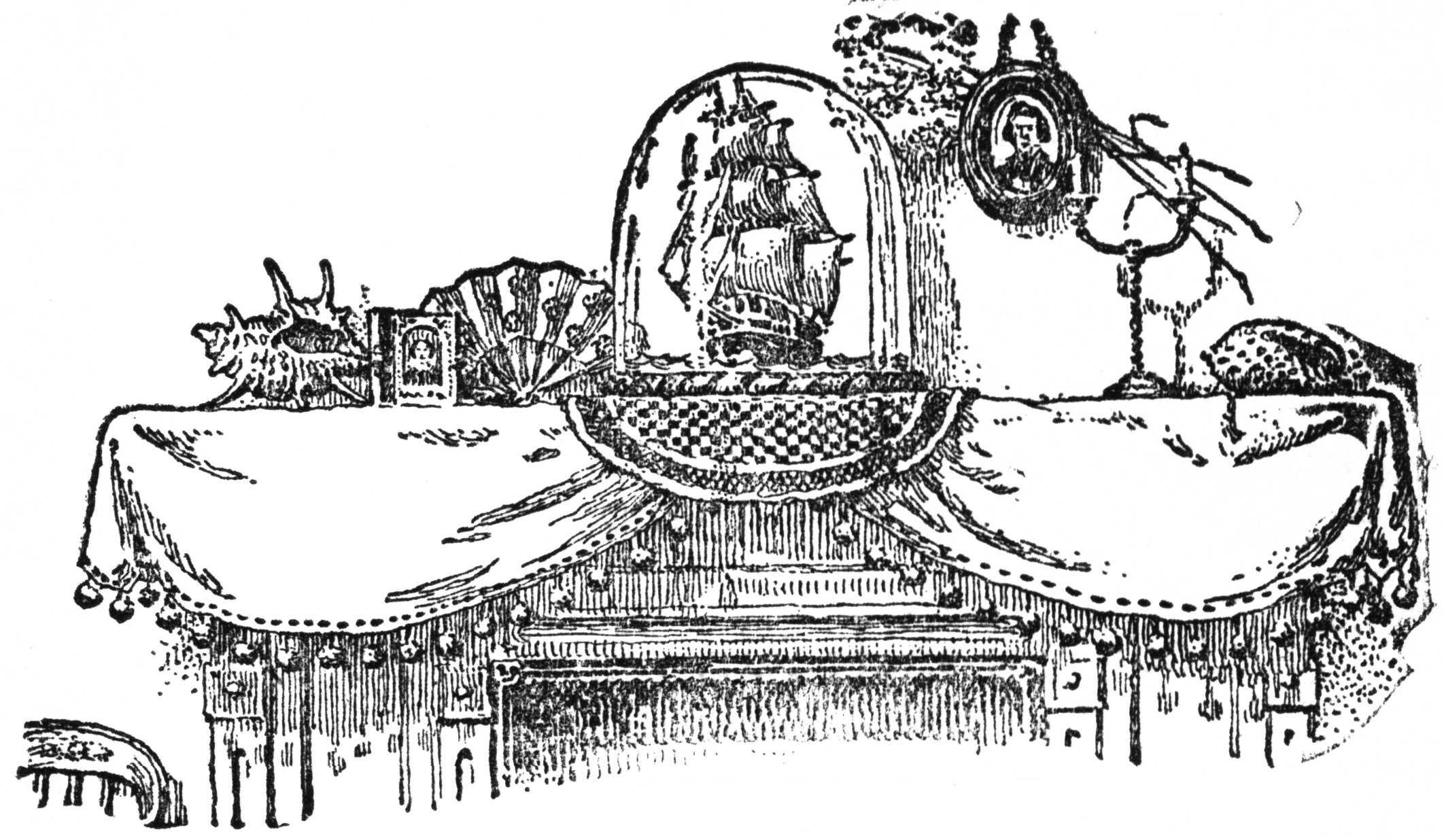
As the boy ate he looked about the room. It was a big room with a low ceiling, spotlessly whitewashed. The oilcloth on the floor was partially covered with braided rag mats with carpet centres. On the window shades were wonderful tinted pictures of castles and mountains. The table was black walnut, and there were five rush-seated chairs, each in its place against the wall, and looking as if it were glued there—the sixth of the set he occupied. Then there was [Pg 26]the chintz-covered rocker and another rocker, painted black with a worn picture of a ship at sea on the back. There was another ship over the face of the tall wooden clock in the corner. This craft was evidently the “Flying Dutchman,” for every time the clock ticked it rolled heavily behind a fence of tin waves, but didn’t advance an inch. On the walls were several works of art, including a spatter-work motto, a wreath made of sea shells under a glass, and an engraving showing a boat filled with men, women and children and rowed by a solemn individual in his shirtsleeves, moving over a placid sheet of water toward an unseen port.
“The name of that picture is ‘From Shore to Shore,’” said the observant Miss Tempy. “You see there’s the children in the bow, and the young man and his lady-love next, and the father and mother next to them, and the old folks in the stern. It’s a beautiful picture—so much deep meanin’ in it. There’s some lovely poetry under it that you must read; all about the voyage of life. Help yourself to the preserved ginger,” she added. “It came all the way from Calcutta. Father used to bring us so much of it. That ginger-jar looks so like him.”
Bradley began to think that the parental Allen must have been a queer-looking old gentleman. Miss Tempy continued:
“Of course, father didn’t bring that jar,” she said. “That was one of Cap’n Titcomb’s presents. He got it in New York.”
“Cap’n Titcomb?” repeated the boy, whose bashfulness [Pg 27]was wearing off. “He came over in the coach with me to-night.”
The effect of this announcement was remarkable. Miss Prissy looked at Miss Tempy, and the latter returned the look. Strange to say, both colored.
“Cap’n Titcomb?” faltered Miss Prissy. “Cap’n Ezra Titcomb?”
“Yes, ma’am. He talked to me ’most all the way. I liked him first rate.”
“Why—why, I do declare! I didn’t know the Cap’n was expected, did you, Tempy?”
“No, I’m sure I didn’t!” exclaimed the flustered younger sister. “Did he—did he tell you why he was comin’, Bradley?”
“No, ma’am, but I heard him tell the man that drove the coach that he had shore leave for a week, ’cause his schooner was laid up for repairs. He said he knew you, though, and that he was comin’ ’round to see me to-morrer.”
This remark caused quite as much embarrassment and agitation as that concerning the Captain’s presence in the coach. The two ladies again glanced hurriedly at each other.
“Goodness gracious!” exclaimed Miss Prissy, “and the settin’-room not swept and the windows not washed. I’ll have to get up early to-morrer mornin’. I’m so glad I fixed that ruffle on my alpaca,” she added, in an absent-minded soliloquy.
“And I must finish that tidy for the sofy,” said Miss Tempy, nervously. “I’ve only got a little more [Pg 28]to do on it, thank goodness! Prissy, I’m going to put an iron on; I want to press my other collar. Did—did the Cap’n say anything more about me—us, I mean?” she added, looking at the stove.
“No, ma’am, he didn’t,” replied the boy. “He jest asked about me, and told stories and talked.”
Miss Tempy seemed a little disappointed and made no comment. Her sister, too, was silent. Presently Bradley yawned. He tried to hide it, but Miss Prissy, coming out of her trance, saw him.
“My sakes!” she exclaimed, “what are we thinkin’ of, keepin’ you up this way? It’s after nine o’clock. Let me get the lamp. Tempy, you do up that soapstone for his feet.”
She rose and went into the kitchen, returning with a brass hand lamp, while her sister removed the ornamental top of the “air-tight” and, with a holder, took out a hot slab of soapstone, which she proceeded to wrap in several thicknesses of flannel.
When this operation was completed, Miss Prissy led the way with the lamp, and the boy, doubling up his toes to keep “father’s” slippers on his feet, scufflingly followed her through a dark hall, up a steep staircase, in the niche by the first landing of which the model of a full-rigged ship, sailing under a glass case through a sea of painted putty, caught his eye; then through another hall, cold and dark, and into a large, square sleeping room, with a high corded bedstead in the centre.
“This is your room, Bradley,” she said, placing the lamp on the glass-knobbed bureau. “It’s pretty cold, [Pg 29]but we’ve aired the bed so there won’t be any dampness and the soapstone’ll help warm up.”
She turned back the several layers of patchwork comforters, blankets and counterpane, and put the hot stone in the centre of the billowy feather bed. Then she fidgeted about in an embarrassed sort of way, and finally asked:
“I—I s’pose you brought your nightgown with you?”
“Yes, ma’am,” and Bradley produced the ragged relic from his carpet bag.
Miss Prissy took the nightgear between her finger and thumb. “My soul!” was her only comment, but its tone was all-sufficient. She disappeared, to return in a moment or two with a folded flannel garment in her hand.
“Here’s one of father’s,” she said. “It’ll be too big for you, but you can wear it for two or three nights, and me and Tempy’ll make you some new ones. Good night.”
The lamp made a little oasis of light in the dusky desert of “spare room.” There were two or three straight-backed chairs set squarely in their places on the ingrain carpet; some wax flowers under a glass on the shelf, and a vase of dried “feather grass” on a bracket in the corner. And everything, from the blue bottles—intended to contain toilet waters—in the centre of the knitted mats on the bureau, to the gilt candlesticks with the dangling glass prisms, looked as if they had been just where they [Pg 30]now were for years and years, and would resent any intrusion on their privacy.
Bradley undressed in a hurry, for the temperature of the room was like that of the Arctic region. The framed daguerreotypes on the walls—portraits of wooden-faced seafaring gentlemen in black stocks with their hair curled behind their ears, and of ladies in flowered scoop bonnets, their finger rings realistically put in with gilt paint, gazed down upon him with rigid disapproval. Even after he had lost his small self in Captain Darius’ camphor-scented legacy—the flannel nightgown—and was floundering in the depths of the feather bed, he felt that the pictured eyes were looking at him through the dark as if their owners said, indignantly, “What is a boy doing here?”
The joists creaked overhead, the mice scuffled behind the plaster, the surf boomed in the distance, and the winter wind whined about the windows as if it, too, were asking “What is a boy doing here?”
He was up early the next morning, and his dressing was a sort of jig, for it was freezing cold. From his window he could see the Orham roofs and spires, white and sparkling in the sunrise light. The long hill behind the house, sloped, a snowy stretch, to the inner inlet, which was filled with floating ice cakes. The ocean side of the outer beach was white with a dancing line of breakers, and the sea itself was a deep blue, spangled with whitecaps.
When he went downstairs it was evident that things had been going on. Miss Prissy came out of [Pg 31]the sitting-room, bearing a broom, and with her “alpaca” gown covered with an apron. Miss Tempy, her curls done up in papers, was busy with the “tidy” for the sofa. Each of the sisters was nervous and excited.
Miss Prissy said a stiff little grace at the breakfast table. Miss Tempy had a large cup of “pepper tea” for herself, and urged Bradley to partake, but the elder sister came to the rescue and gave him hot milk and water instead. After the meal was over and the dishes washed, Miss Prissy went out to feed the hens and Bradley went with her. The house, seen by day, was a big, square building, badly in need of paint. The roof was four-sided and sloped upward to a cupola in the centre. From its closely shut front door snow-covered box hedges in parallel lines defined the path to the front gate, also locked and fastened, and, like the front door, only used on occasions. There was a large tumble-down barn, with an empty pig-pen back of the house, and a hen-house and yard in the rear of the barn.
Next door, to the left—on the right was a vacant field—was a small story and a half cottage, separated from the Allen household by a board fence. One of the boards in this fence had fallen down, and as Bradley, wading in Miss Prissy’s wake, passed this opening, he saw a girl, apparently about his own age, open the back door of the house next door and look out at him. He wanted to ask who she was, but didn’t feel well enough acquainted with his guide to do so just yet.
[Pg 32]
Just as the dozen hens and lonesome-looking rooster were fed—Miss Prissy informed him that, by and by, looking after the poultry would be one of his duties—Miss Tempy’s voice was heard calling excitedly from the kitchen door.
“Prissy!” she screamed, “Prissy! come in the house quick! He’s comin’; the Cap’n’s comin’!”
“My land!” exclaimed the elder sister, wildly, and, her dignity forgotten, she almost ran to the house, followed by Bradley, who didn’t understand the cause of the excitement.
“Oh, my sakes!” ejaculated Miss Tempy, as they entered the kitchen. “What made him come so early! You’ll have to see him first, Prissy. I’ve got to fix my hair.”
Miss Prissy rushed into the sitting-room, wheeled a chair into place, set a tidy straight, laid the photograph album exactly in the center of the table instead of two inches from the edge, and patted her own hair with her hands, dodging in front of the big gilt-framed mirror as she did so. Then, as a smart knock sounded on the dining-room door, she assumed her “company” smile and marched sedately to receive the visitor.
It was Captain Titcomb who had knocked, and, after cleaning the snow from his boots on the “scraper,” he entered the house, bearing two packages wrapped in brown paper.
“Well, Prissy,” said the Captain, laying down the packages to shake hands, “how d’you do? Didn’t expect to see me in this port jest now, did you?”
[Pg 33]
“No, indeed, Cap’n Titcomb,” was the reply. “But we’re real glad to see you all the same. Come right in. Take your things off. Bradley said he rode down with you in the coach last night. Dreadful storm we had, wasn’t it? How’s your health nowadays? Walk right into the sittin’-room. You must excuse the looks of things; I’ve been sweepin’.”
There was a good deal more, but when Miss Prissy stopped for breath, the Captain, who had thrown his cap and overcoat on a chair, replied that the storm was bad, that his health was good and that the room looked “first rate,” so far as he could see. Then he held out his hand to the boy, who had seated himself on a chair close to the door, and said, cheerily:
“Mornin’, Brad. Well, how are you after your shake up last night? Wan’t seasick after I got out, was you?”
Bradley grinned bashfully and stammered that he was “all right.”
“Good! We had a rugged trip comin’ over, Prissy. The old coach rolled so I felt like goin’ on deck and shortenin’ sail. Your new boy here’s goin’ to make a good sailor—I can see that. Where’s Tempy?”
“Oh, she’s upstairs for a minute. She’ll be right down,” answered Miss Prissy, carelessly. “Tell me what brought you home so unexpected.”
“Sprung a leak and had to lay the old hooker up for repairs. That’s a specialty of my owners—repairs. They’d rather patch up for a hundred years [Pg 34]than build new vessels. I—I—Brad, fetch me them bundles out of the dinin’-room.”
Bradley obediently brought the brown-paper parcels, and the Captain handed one of them to Miss Prissy, saying: “Here’s a little somethin’ I picked up over to New York, Prissy. I thought you might like it. I ain’t got much use for such things, myself.”
The lady took the package and began to untie the string in a nervous manner, blushing a little as she did so.
“I know it’s somethin’ nice, Cap’n Ezra. You do buy the nicest things. It’s real kind of you to remember me this way. Oh! ain’t that pretty!”
The package contained a Japanese silk fan, with ivory sticks and a red tassel. Miss Prissy opened it and spread it out in her lap, exclaiming over its beauty, her face the color of the tassel.
“Oh! it ain’t nothin’,” said the Captain. “I did a favor for a friend of mine that’s skipper of a barkentine jest home from Hong Kong, and he gave it to me. He had some stuff he’d brought for his daughter, and the duty on it would have been pretty expensive, so I fixed—but never mind that. I thought maybe you’d like it to carry to church in the summer time, or somethin’. Why, hello, Tempy! How d’you do?”
The younger sister entered the room, her “poplin” rustling and every curl in place. She gushingly shook the Captain’s hand, and said she was so glad to see him.
“Oh, Tempy!” cried Miss Prissy, “jest look at this [Pg 35]lovely fan Cap’n Titcomb brought me. Did you ever see anything so pretty?”
Miss Tempy exclaimed over the fan, but somehow her enthusiasm seemed a little forced. It may be the Captain noticed this; at any rate, he picked up the second parcel and handed it to her, saying:
“Here’s a little somethin’ I brought for you, Tempy. I don’t know’s you’ll like it, but——”
Miss Tempy’s present also was a fan, precisely like the other except that the tassel was pink. Miss Prissy’s interest in her sister’s gift was intense, but when it was discovered that in no important point were the fans dissimilar and that neither was better than its mate, both of the ladies appeared to be a trifle disappointed, although they tried not to show it.
“We’re so glad you’ve come, Cap’n,” said Miss Prissy, after the fans were laid on the table. “We’ve got so many things to talk to you about, and we want to ask your advice. Bradley, don’t you think you’d like to go out into the dinin’-room a little while?”
The boy, acting upon this decided hint, went into the dining-room, and Miss Prissy shut the door after him.
“Now, Cap’n Titcomb,” she began, “I s’pose you were awfully surprised to hear we’d took a boy to bring up? Well, you ain’t any more surprised than we are to think we should do such a thing. But it seemed as if we jest had to, or else give up bein’ Christians altogether. I’ll tell you how it was.”
And she did tell him, beginning with the exact relationship between Bradley’s mother and the Allens, [Pg 36]expatiating upon the shiftlessness of the boy’s father and how he “never saved a cent,” nor even took out an insurance policy to provide for his son, in case of his own death.
“Father,” she continued, “lost all patience with Ben years before he died and we didn’t write nor anything. Fact is, we didn’t know about the boy at all, until we read in the papers about Sophia and Ben’s bein’ lost when his vessel was wrecked. Leavin’ the poor little chap in Solon Nickerson’s care was another proof of Ben’s carelessness. It’s wrong to speak ill of the dead, but Solon was the worst good-for-nothin’! It’s a mercy that the Lord took him before he’d had a chance to ruin the boy entirely. Well, Tempy and me have set up nights and talked and talked and talked, but we couldn’t see but one right thing to do, so we did it. But, mercy me!” she exclaimed, lifting her hands, “what on earth we’ll do with a boy is more’n I know. What shall we do?”
“Bring him up in the way he ought to go, I guess,” replied the Captain, calmly. “Send him to school, first thing.”
“There, Prissy!” exclaimed Miss Tempy, “that’s what I said. Send him to school, and then to high school, and then to college. Wesleyan College is a nice quiet place, and so many ministers come from there that they’ll probably teach him to be a minister. Then, by that time, Mr. Langworthy’ll be pretty old and he’ll be givin’ up the church here and Bradley can take it. I always wished we had a minister in the family.”
[Pg 37]
“Sakes alive!” snapped her sister, impatiently, “seems to me you’re countin’ your chickens a good ways ahead. Mr. Langworthy might die to-morrer for all you know, or the society might bust up or ’most anything. Besides, it’ll cost somethin’ for all that education.”
“Of course it will,” said Miss Tempy, “but there’s father’s insurance money.”
“How long do you think——” began Miss Prissy, but stopped in the middle of the sentence.
“Well,” said Captain Titcomb, diplomatically, “he’ll go to school for a while, at any rate, and he might as well begin right away. How is he off for clothes?” he added.
“Hasn’t got any that are fit for anything but the rag-bag,” replied Miss Prissy, with decision. “And that’s another thing. Who’s goin’ to buy ’em for him? I’m sure I don’t know what a boy needs to wear any more than a cat. And he’s got to have everything. I jest wish you’d have seen that—that thing he was goin’ to sleep in,” she added.
“I’ll buy his fit-out, if you want me to,” said the Captain. “Take him down to Weeks’ store right now, if you say the word.”
“Oh! I wish you would. You pay Mr. Weeks and I’ll pay you.”
“Get him nice clothes, Cap’n Ezra,” said Miss Tempy. “The men in our family have always been good dressers.”
“Get sensible ones that’ll wear,” said the practical [Pg 37]Miss Prissy. “Not any more expensive than is necessary, but good.”
They pressed the Captain to stay to dinner, or, at least, to return for that meal, but he declined, promising, however, to dine with them before he went back to his vessel.
“Come on, Brad,” he said, entering the dining-room, “you and me’s goin’ on a cruise down town. Want to go?”
Of course the boy wanted to go. He had been spending his time in the dining-room reading the poetry beneath the “Shore to Shore” picture and in spelling out the framed certificate over the mantel, which testified that “Darius Allen, Master,” was a member of the Boston Marine Society.
Bradley put on the shabby overcoat and cap for the last time, and walked down to the back gate and along the sidewalk with the Captain.
“Well, Brad,” said the latter, “how do you like your new folks?”
“First rate, sir,” said the boy.
“Pretty old-fashioned craft, but seaworthy, both of ’em. Did you remember to wipe your feet?” he added, with a twinkle in his eye.
“Yes, sir.”
They walked on without speaking for a while, then Bradley, wishing to please his companion, said:
“Those fans were awful pretty. I s’pose you brought ’em both alike so Miss Prissy nor Miss Tempy wouldn’t think you liked one more than the other, didn’t you?”
[Pg 39]
Captain Titcomb stopped short, and looked down at the lad with wonder in his face.
“Say, Brad!” he exclaimed, “how old are you?”
“Goin’ on thirteen, sir.”
“Goin’ on thirteen,” repeated the Captain, slowly. “Goin’ on thir—— Well, by crimustee! you’ve got a head on you. If you’re goin’ to turn so sharp as—— Say, son, I cal’late you and me was cut out to sail together.”
He continued to mutter to himself and to chuckle all the way to the store, greatly to Bradley’s astonishment, for, for the life of him, the boy couldn’t see that he had said anything so wonderfully brilliant.
And, meanwhile, Miss Tempy seated in the rocker by the window and holding a fan in each hand, was examining them with the greatest care.
“Prissy,” she said, at last, in a solemn tone, “they’re jest exactly alike.”
“Yes,” said her sister, with a stifled sigh, “they’re jest alike.”
[Pg 40]
THE “DOG GIRL.”
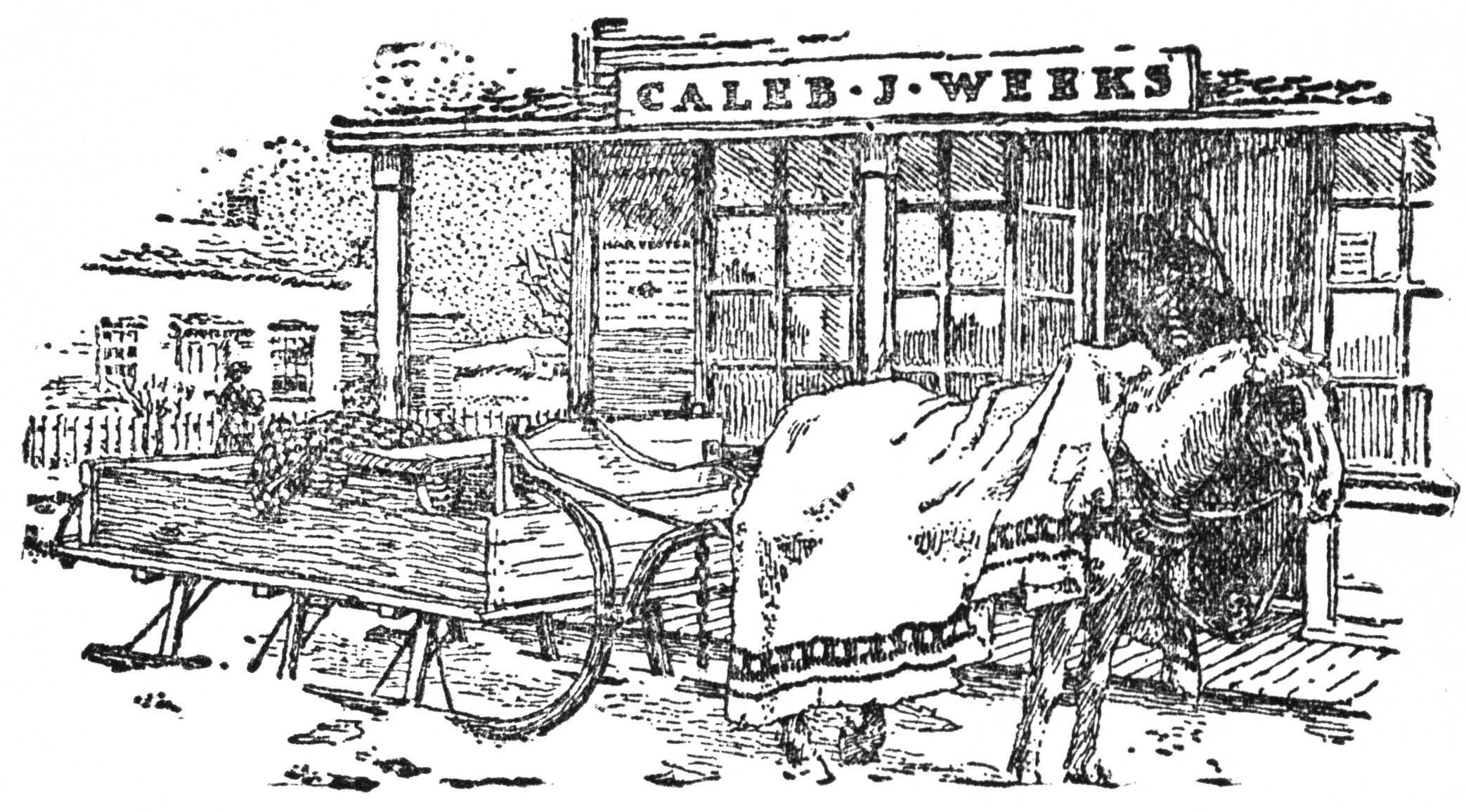
In “Weeks’ Store” was to be found an assortment of wares ranging from potatoes and razors to molasses and ladies’ dress goods. Somewhere within this extensive range was a limited supply of what Mr. Weeks’ advertisement in the Item called, “Youths’, Men’s and Children’s Clothing in Latest Styles at Moderate Prices.” The styles were “late”—about a year late—and the prices were moderate when the lengthy period of credit given to customers is taken into consideration.
Captain Titcomb, exchanging greetings with the [Pg 41]half dozen loungers by the stove, whose business there was, as Mr. Weeks himself said, “to swap bad tobacco smoke for heat,” passed to the rear of the store, followed by Bradley. There he proceeded to select an entire outfit for the boy, calculated to clothe him in successive layers, from the skin outward. When the pile of garments on the counter was complete, the captain and Mr. Weeks entered into a lengthy argument concerning price. There was a “Sunday hat” involved in the transaction, and about this piece of headgear the battle raged fiercest.
“It’s too much money, Caleb,” said the Captain, finally. “I guess I’ll try the ‘New York Store.’ Tom Emery’s always treated me fair enough, and I’ll give him a chance. Come on, Brad.”
“I’ll take off a quarter on the suit,” conceded the storekeeper, who was loth to see so much custom go to a rival.
“No,” was the reply. “That ain’t enough to amount to anything. Tell you what I’ll do, Caleb. Throw in that Sunday hat and I’ll take the lot and pay you cash for it, and run my risk of gittin’ the money.”
So the bargain was concluded on that basis. Bradley retired to the back room, and emerged clothed in his new garments and tremendously conscious of the fact. The Captain said he looked so fresh that you could “smell the paint on him.”
“Say, Caleb,” said “Squealer” Wixon, after Captain Titcomb and his protégé had left the premises, “did Ez tell you who that boy was?”
[Pg 42]
“No, he didn’t. I hinted two or three times, but he wouldn’t say.”
“Well, I’ll tell you. ’Twas the old maids’ boy—Ben Nickerson’s son. Barney said he brought him over in the coach last night.”
“You don’t mean it!” exclaimed the chopfallen Mr. Weeks. “Well, if that ain’t enough to—— Ez made me throw in a hat that was wuth a dollar ’n’ a ha’f ’cause he said he’d pay cash for everything and take his chance of gittin’ his money back. And Prissy and Tempy always pay cash for everything. Reg’lar Titcomb trick!”
The loafers about the stove roared with delight.
“Oh, I tell you,” remarked “Squealer,” “you’ve got to keep your weather eye peeled when you’re dealin’ with Cap’n Ez. He’ll have you, head and scales, if you ain’t careful.”
“That’s all right,” grumbled “Bluey” Bacheldor, “but he’ll git fetched up all standin’ some of these days. You can call him smart if you want to, but it’s pretty risky smartness, most folks think. You notice his schooner’s always makin’ ‘record trips,’ and he’s always havin’ presents give him, and all that. How many presents did you have give to you, Cap’n Jabez, when you was runnin’ a coaster?”
“Not a one,” indignantly replied the person addressed, Captain Jabez Bailey. “Not a one. What I got I had to work for.”
It may be that Captain Jabez overworked during his sea experiences. Certainly no one in Orham had [Pg 43]known him to do a stroke of work since he retired to live on his wife’s earnings as a dressmaker.
“Well,” commented Captain Eri Hedge, who was not a member of the circle, but had dropped in to buy some tobacco, “I like Cap’n Ez. He does love to git the best of a bargain, and he’s a ‘driver’ on a vessel, and perhaps he likes to shave the law pretty close sometimes. Ez is a reg’lar born gambler for takin’ chances, but I never knew him to do a mean trick.”
“What do you call that game he put up on the old maids?” asked “Squealer.” “You knew ’bout that, didn’t you, Jabez? Seems Prissy and Tempy wanted to sell that little piece of cranb’ry swamp of theirs, ’cause it didn’t pay them to take care of it and keep it in shape. Prissy told Seth Wingate about it and Seth said he didn’t want it, but that he’d give ’em so and so—a fair price, consid’rin’. Well, they was goin’ to sell it to Seth, but Ez comes home ’bout that time, hears of the deal and goes to Prissy and buys it for fifty dollars more’n Seth offered. And inside of three months along comes that Ostable Company and buys all that land for their big swamp. They say Titcomb made more’n a hundred dollars out of that deal. If you don’t think that’s a mean trick, Cap’n Eri, you ask Seth Wingate what he thinks of it.”
“I know about that,” said Captain Eri, calmly; “and I think it was jest another case of Ez’s takin’ chances, that’s all. Seth’s growlin’ is only sour grapes. Ez knew the Ostable folks was talkin’ ’bout layin’ out a big swamp over here some time or other. He jest bought the Allen piece and run his risk. You [Pg 44]notice Prissy and Tempy ain’t findin’ no fault. They think he’s the only man in town. Fact is, he is the only man, outside of the minister, that they’ll have any dealin’s with. Queer pairin’ off that is—Ez and the minister!” he chuckled.
“Oh, women’s fools, anyhow,” snorted Captain Jabez, savagely. “Ez Titcomb always could wind ’em ’round his fingers. He’s been next door to keepin’ comp’ny with more girls’n a few in this town sence he was old enough to leave school. But he don’t go fur enough to git engaged or nothin’ like that. Minute there’s any talk that he’s likely to git married to one of ’em, away goes Ez, and that’s the end of that courtin’. And yet, spite of their talk ’bout his bein’ slick, and hints that he’s tricky, they’re always heavin’ up to a feller, ‘How smart Cap’n Titcomb is,’ and ‘Why don’t you make money same as Cap’n Ezry?’ ’Nough to make an honest man sick.”
Captain Eri made his purchases and went home, but the others continued to dissect Ezra Titcomb’s character, and the general opinion seemed to be that he would “bear watchin’.”
Meanwhile the Captain, unconscious of all this, piloted Bradley to the corner of the road upon which the Allen sisters lived, and there left him with a message to the effect that he—the Captain—would call next day. Then he sought his room at the “Traveler’s Rest,” there to read the paper of the day before; while the boy, with his big bundle of old clothes and new “extras,” walked homeward alone.
[Pg 45]
The Allen house was on the “lower road,” and to reach it you turned the corner just above “Web” Saunders’ billiard room and went on past “Lem” Mullett’s stable, and the Methodist “buryin’ ground”—the sects in Orham cannot, apparently, agree even after they are dead, for each denomination has its separate cemetery—past the late Captain Saunders’ estate and on up the hill overlooking the bay. Bradley had just reached the little house next door to the Allens, when, through the side gate of its yard, there darted a small, ragged-looking dog, barking as if it went by steam. It was followed by a big dog, also barking, and this in turn was followed by another and still another. None of the animals was handsome and none looked as if it was good for much except to bark, but each seemed to feel that it was its special duty to devour the boy before the others got a chance at him. On they came, a noisy procession, growling and snapping.
Bradley put down his bundle and looked about for a stone, but the snow covered the road and there were no stones in sight. He poised himself on one foot and held the other ready for a kick. The dogs formed a circle about him and the racket was blood-curdling.
Out of the gate darted a slim girl in a red dress, brandishing a broom.
“They won’t hurt you!” she screamed, running to the rescue. “Stop it, Peter! Be quiet, Rags! Go home, Tuesday! Winfield, I’ll give it to you!”
The dogs dodged the broom and retired to a safe [Pg 46]distance, wagging their tails and doing their best to indicate that they were only making believe, anyhow. “Winfield,” the small dog that had led the attack, was the most persistent, and he snapped at the broom in high glee, evidently considering that it was waved for his particular amusement.
“They got away before I could stop ’em,” panted the girl. “Grandma’s gone to the store and I went out in the woodshed to play with ’em, and they bounced out of the door first thing. They don’t mean anything; they’re just full of it, that’s all.”
“I wasn’t scared,” said Bradley. “I didn’t believe they’d bite. I like dogs.”
“Do you?” said the girl, eagerly. “So do I. Grandma says she does, too, in moderation. The old maids don’t, though. Oh, I forgot. You’re the old maids’ boy, ain’t you? I saw you out in their yard with Miss Prissy this mornin’.”
“Yes, I saw you, too. You live in here, don’t you?”
“Um-hum. Oh, my goodness! I haven’t got any rubbers on, and grandma said if I got my feet wet to-day she didn’t know but she’d skin me. I must go right back and dry ’em before she comes. I’ve had a cold; that’s why I ain’t to school. How’ll I ever get these dogs in?”
“I’ll help you if you want me to,” volunteered Bradley.
“Will you? That’s splendid. Come on!”
Bradley carried his bundle to the back steps of the little house and then returned to assist at the dogcatching. [Pg 47]It wasn’t an easy operation, but a tin dish, scientifically rattled by his new acquaintance, tempted all but the wary “Winfield,” and a bone finally decoyed the latter inside the woodshed, and the door was slammed and bolted upon the humbugged pack.
“There!” exclaimed the girl, “that’s all right. I hope grandma won’t notice the tracks in the snow. If she’s only forgot her glasses it’s all right. Now come into the kitchen till I put my feet in the oven. What’s your name?”
“Bradley Nickerson. Most folks call me Brad.”
“That’s a good name. My last name’s Baker. I hate my first one—it’s Augusta. Ain’t that the worst? Grandma calls me ‘Gusty.’ Ugh! You can call me ‘Gus’ if you want to; it sounds more like a boy’s name. I wish I was a boy.”
“Why?”
“Oh, because a boy can do things, and doesn’t have to be ‘ladylike.’ If I was a boy nobody would think it was funny for me to like dogs, and I could have as many as I wanted.”
“I should think you had a good many now. Where did you get ’em all?”
“Oh, just found ’em. Rags came here one day himself. I call him Rags because he looks as if he was all ravellin’s. And Peter, the blacksmith gave to me. Said I could have him if I’d get him out of his sight. He sort of named himself. And Tuesday was named that because I found him on Tuesday when I was on a picnic over to East Harniss. And Winfield—he’s the newest one—came on Cap’n Burgess’ [Pg 48]fishing schooner and nobody wanted him, so they gave him to me. I named him Winfield because his face looks like our school-teacher—Winfield Scott Daniels; hateful old thing! Wouldn’t he be mad if he knew I named a dog after him! You’re goin’ to school, ain’t you?”
“I s’pose so. They haven’t said anything about it yet.”
“I hope you will. You’ll be upstairs, of course.”
“Upstairs” means, in Orham, the grammar and higher grades. “Downstairs” is the primary department. Bradley answered that he supposed he should be “upstairs.” He was just beginning to go “upstairs” in Wellmouth.
“How do you like the old maids—Miss Prissy and Tempy, I mean. Ain’t they awful strict?”
“I don’t know; I haven’t been with ’em long enough to find out. They’re mighty clean, ain’t they?”
“Oh, dreadful! And they don’t like a noise and they don’t like dogs and they don’t like me. They call me the ‘dog girl’; I heard ’em. One time I went in there for grandma, and Tuesday and Peter followed me and, first thing you know, they tracked mud all over the dinin’-room. My! but wasn’t Miss Prissy mad! But you just ought to have seen that floor,” she chuckled.
Bradley thought of the spotless oilcloth and appreciated the situation. In the course of the conversation that followed, he learned that Gus was an orphan like himself, and that she lived there alone [Pg 49]with her grandmother. Suddenly the girl snatched her steaming shoes out of the oven to run to the window.
“I thought I heard the gate shut,” she exclaimed. “Yes, it’s grandma. P’raps you’d better dodge out of the other door. She’ll ask questions and find out about my feet if you don’t. Good-by; p’raps I’ll see you at school to-morrow.”
Bradley picked up his bundle—he had brought it in with him—and slipped out of the side door, presenting himself, a moment later, in the glory of his new clothes, to the critical gaze of the “old maids.”
And it was critical. For the next twenty minutes the boy sympathized with the wooden gentleman with the beautiful painted mustache whose business it was to stand before the “general store” at Wellmouth, with a placard attached to his coat bearing the words, “This style $8.50.” He stood in the centre of the dining-room while the sisters walked in a circle about him and verbally picked him to pieces, bit by bit. Miss Prissy’s final verdict was that the garments were “real neat and sensible.” Miss Tempy was not so enthusiastic.
“They are nice and neat,” she said, “but don’t you think they might be a little more stylish? Blue’s a nice solid color for the jacket, but if he had some diff’rent pants, seems to me ’twould set it off more. You remember those plaid pants of father’s, don’t you, Prissy? Still, I s’pose the Cap’n knows best.”
“Of course he does,” replied her sister, crisply. “There isn’t a nicer-dressed man than Cap’n Titcomb [Pg 50]around—that is, except the doctor and Mr. Langworthy, and they have to wear Sunday clothes all the time. Besides, we can make over some of father’s things for him, by and by, if we want to.”
So Miss Tempy expressed herself as satisfied. As a final aristocratic touch, she brought from the trunk in the garret a large-figured silk handkerchief which, tucked carefully into the breast pocket of Bradley’s jacket, with the corner artistically draped outside, was pronounced “just the thing.”
At half-past four that afternoon the sisters convoyed the new member of their household to the boarding place of the school-teacher, Mr. Daniels, in order to arrange for the boy’s entering school next day.
This expedition was a very formal affair. Both of the ladies were arrayed in their best, with bonnets that were the height of fashion ten years before, and “dolmans” that Miss Tempy “made over” religiously each fall. Miss Prissy, the business manager, inspected every window and door to be sure they were locked, and she carried with her a large carpet-bag—much like Bradley’s—the sole contents of which were three extra handkerchiefs, the back-door key and the wallet with the leather strap. Mr. Daniels received them graciously, and condescended to say that he should expect the new pupil the following morning.
When Bradley started for school the next day his head was ringing with instructions from the “old maids” concerning his behavior and attention to his studies.
[Pg 51]
“Now be a good boy, Bradley,” said Miss Prissy.
“Yes, Bradley,” said Miss Tempy. “Remember, we expect a great deal of you. All our people have been smart scholars.”
Just as he turned into the “main road,” he heard someone calling, and turned to see his acquaintance of yesterday, the girl next door, running to catch up, her hood slipped back from her hair and a dented tin pail in her hand. Being a girl, Gus carried her noon luncheon during the winter months, instead of coming home to eat it.
“Oh!” she panted, “I’m all out of breath. I saw you go past the house and knew you was goin’ to school, so I just fairly flew after you. You’re goin’ upstairs, aren’t you? Did you see old Daniels?”
“Yes, I saw him. He’s a cross-lookin’ chap. Is he strict?”
“You bet he is! Give you checks if you whisper, and ten checks means stay in recess for a week. I’ve only got five so far. Don’t you think he looks like Winfield—my dog, I mean? I had such a time with that dog just now. He was following me and I had to drive him back. He went under the shed and hid, but goodness knows how long he’ll stay there.”
On the way to school they met another girl whom Gus introduced as Clara Hopkins, a “chum” of hers. “She’s tip-top; I sit with her. She’s got ’most as many checks as I have,” was her recommendation.
“Upstairs” at the schoolhouse was a large room with rows of double desks on each side and a wide aisle in the centre. One side of the aisle was the [Pg 52]“girls’ side,” and the other was for the boys. Mr. Daniels stiffly shook hands with the new scholar, asked him some questions concerning his progress in his studies, and showed him where he should sit. The more advanced pupils occupied the desks at the rear of the room, and the younger ones—Bradley among them—sat in front. Bradley’s seat mate was an older boy than he, rather good-looking, with curly hair. His name, so he whispered before school began, was Sam Hammond.
“We will come to order,” commanded Mr. Daniels, with dignity. “Position!”
Each scholar folded his or her arms and sat back in the seat.
“I will read,” said the teacher, “from the Scriptures.”
He did so, concluding as follows: “Amen. Second class in spelling.”
The second class in spelling took its place upon the settees at the rear of the room and proceeded to spell words as given out by Mr. Daniels, following each spelling by a definition and a sentence containing the word. One tall, gawky chap with red hair was given the word “Aspire.”
“Aspire,” he shouted. “A-s-p-i-r-e, Aspire—to aim. The man will aspire the gun at the bird.”
The school tittered, and Mr. Daniels pounded his desk with the ruler. “Ye-es,” he drawled, with withering sarcasm, “that is delightful. What a shock for the bird!”
[Pg 53]
“It said it meant ‘to aim high’ in the dictionary,” protested the red-haired one.
“The dictionary is intended to be used by human beings, not calves,” was the crushing reply. “Sit down, Bossy.”
The tall boy sat down with alacrity, while the school shouted at the official joke.
“Bossy!” whispered Bradley’s seat mate. “That’s Tim Bloomer. Ain’t he a sculpin?”
“Samuel Hammond,” observed Mr. Daniels, “two checks for whispering.”
At recess Bradley went out on the playground for a little while, but he felt rather lonesome among so many strangers, and so returned to the schoolroom. It was empty, the teacher taking his customary “constitutional” in the yard. After a few minutes Gus came bounding in.
“Why, Brad!” she exclaimed, “where’ve you been? I’ve been lookin’ for you. Why didn’t you come on out?”
“Oh, I don’t know,” replied the boy. “I don’t know any of the fellers yet.”
“Well, you’re goin’ to know ’em. Oh, my goodness! Winfield!”
The stub-tailed dog sat panting at her feet, three inches of red tongue hanging from its mouth.
“You naughty, naughty dog!” cried Gus, almost in tears. “How dare you! Go home this minute!”
“Go home, Winfield!” commanded Bradley, coming to the rescue.
Winfield had gone home by the shed route, already [Pg 54]that morning, and didn’t propose to do it again. When his mistress tried to catch him, he retreated to a safe distance and wagged his tail.
“Oh, what shall we do?” wailed Gus. “Recess is ’most over, and if Mr. Daniels finds him here, I don’t know what’ll happen!”
Bradley made a dash at the dog and the latter started on the run about the room. At length they drove him out the “boys’ door” only to have him reappear through the “girls’ door” at the other side. Finally, being penned in with both doors shut and thoroughly frightened, he dashed into the closet which was between the doors, and hid behind the woodbox.
“Now,” said Gus, exultantly, “you watch that he don’t get out, and I’ll crawl in after him. Oh, my goodness! there’s Mr. Daniels comin’ now.”
The cowhide boots of the teacher were heard on the stairs. Bradley, in desperation, shut the closet door upon the imprisoned Winfield. Mr. Daniels stepped to the rope in the entry and gave it a pull. The bell above responded with a single note, and the scholars began to pour up the stairs.
“We will come to order,” commanded the teacher. Bradley, glancing across the aisle at Gus, saw that she was as white as the whitewashed wall.
“First class in arithmetic,” said Mr. Daniels, and then, from the closet, came a long, dismal whine. The “first class in arithmetic” stopped in its tracks and looked aghast. The whole school—with two [Pg 55]exceptions—pricked up its ears. The exceptions trembled.
“Ow-wow-wow!” came from the closet. Mr. Daniels strode across the floor and opened the door.
“Whose dog is this?” he demanded, sternly.
No one answered.
“Come out of that!” commanded the teacher, savagely. He reached behind the woodbox and, seizing the cowering Winfield by the “scruff” of the neck, tossed him into the room. “Whose dog is this?” he repeated.
Most of the scholars knew whose dog it was, but none of them told.
“I asked a question!” thundered the master. “Who put that—that creature in the closet?”
Bradley looked at his fellow-conspirator. Then he held up his hand. “I did,” he said.
Mr. Daniels’ mouth opened in surprise. New pupils did not usually begin in this way.
“You did?” he gasped.
“Yes, sir. He fol—— I mean he came into the room when ’twas recess, and we—I tried to put him out and he wouldn’t go.”
“So you shut him in the closet. Brilliant youth! As this is your first day here, I suppose I must stretch a point and believe it was not done on purpose. If it had been any other of the scholars, I should have made an example of ’em. I am surprised that you should treat your little brother” (appreciative titter from the school) “in such a manner. You may put him out.”
[Pg 56]
It was easy enough to command, but not so easy to do. The dog, frightened at the crowd, backed away when Bradley approached.
“Come here, Winfield,” said the boy, his face a bright crimson. The school giggled at the name.
“Winfield?” repeated Mr. Daniels. “Why that name, if you please?”
“I—I don’t know, sir.”
“You don’t know?”
“No, sir.” And then the boy had a happy thought. “He’s named after Gen’ral Hancock, I guess.”
General Winfield Scott Hancock, in his rôle of statesman, was very much in the public eye just at this time.
Mr. Daniels hesitated. He more than suspected the dog’s real namesake, but he wasn’t sure, and, being a weak man, was afraid of making a mistake.
“Well, put the creature out!” he snarled, and then, losing his temper and aiming a kick at the dog, he commanded, “Git out, you brute!”
That kick was a mistake. Winfield wasn’t used to kicks, and this one scattered his doggish senses completely. He started on a panicky, yelping flight, hotly pursued by Bradley. Down the aisle by the “boys’ side,” across the back of the room amongst the feet of the “first class in arithmetic” and up the aisle by the “girls’ side” sped the chase. At the end of the second lap the entire school was in an uproar.
[Pg 57]
Mr. Daniels, white with rage, took a hand in the pursuit and his efforts and those of two or three more volunteers only made matters worse.
At length the dog, hemmed in on both sides, hesitated in the middle of the broad aisle. Suddenly he darted toward the closet once more. Mr. Daniels leaped to intercept him, tripped, struck the stool upon which the bucket of drinking water was placed and sprawled upon the floor in the centre of a miniature flood, while Winfield, leaping over him, darted through the entry and down the stairs, a shrieking maniac.
The dripping Mr. Daniels was physically cool, but mentally very warm indeed. “Checks” were distributed with liberality and two boys were “feruled” before twelve o’clock came. One of these sufferers was Bradley’s seat mate, Sam Hammond.
Bradley went home alone. When the “old maids” asked him innumerable questions concerning how he “got along” at school, he simply answered “All right” and gave no details. Miss Tempy was somewhat worried at his silence and confided to her sister the fear that he had been “studyin’ too hard.” “All our people have been dreadful keen students,” she said.
It was nearly one o’clock when the boy re-entered the schoolyard. As he did so a shout went up from a group near the fence.
“Here he is!” yelled one of the older boys. “Here’s your beau, Gus. He won’t let ’em plague his girl, you bet!”
[Pg 58]
“No,” shouted Sam Hammond. “’Gusty’s all right now, ain’t she? He’ll take care of her.”
“You shut up!” screamed Gus, breaking from the circle, and stamping her foot savagely. Her face was red and there were tears in her eyes.
“It followed her to school one day,” continued the tormentor.
“What’s the matter, Gus?” asked Bradley, coming up.
“Haw, haw!” laughed Sam, gleefully. “I told you so. Bradley’ll take care of her.”
“What’s the matter, Gus?” he added, mockingly.
“What is the matter?” repeated Bradley.
“None of your bus’ness!” snapped Gus, who was in no mood to be friendly with any one. “You jest wait, Sam Hammond! I’ll fix you! Got whipped in school! Ha, ha! Cry baby!” And she gave an exaggerated imitation of her enemy’s facial contortions during the “feruling” that morning.
“Come on, Gus,” interposed Clara Hopkins. “He isn’t worth talkin’ to. Come on, I’ve got somethin’ to show you.”
[Pg 59]
Gus reluctantly suffered herself to be led away amid the derisive hootings of Sam and his friends.
“Ain’t you goin’ with her?” asked Sam, provokingly. “She wants her Braddy, so’s to take care of her if Winfield comes to school again.”
Bradley’s temper was slow to rise, but it was rising now.
“Who are you talkin’ to?” he demanded.
“You. Who do you s’pose?”
“Well, you’d better shut up.”
“I had? S’pose I don’t want to?”
“Then I’ll make you—that’s what!”
“You will?”
“Yes, I will.”
“You ain’t the size. Takes a man, not a monkey.”
“I’ll show you whether I’m the size or not.”
“You will?”
“Aw, gee!” said one of the bigger boys. “I wouldn’t take that from no Wellmouth kid, if I was you, Sam.”
“Nor I, neither,” said another.
Thus encouraged, Sam bristled up to his opponent and looked down at him sneeringly. Bradley didn’t give way an inch, and the two boys rubbed jackets as they moved slowly about each other. The surrounding group looked delightedly expectant.
“Stop your shovin’!” commanded Sam, giving his enemy a push with his shoulder.
“Stop yourself,” said Bradley, pushing back.
“I’ll put a head on you so’s the old maids won’t know you.”
[Pg 60]
“I’ll make you snivel worse’n you did in school this mornin’.”
“Well, Sam!” exclaimed a spectator, in huge disgust; “’fore I’d take that!”
The Hammond boy did not really want to fight, but, thus goaded, he suddenly gave Bradley a violent push with both hands. The next instant both youngsters were clasped tightly together, gripping each other about the neck and wrestling savagely. In a moment they fell with a thump and rolled over and over, pounding, kicking and scratching. The snow flew and the crowd whooped and pushed and strained to see better.
Then there was a rush, a frightened scurry, and both combatants were pulled apart and jerked to their feet, while Mr. Daniels, holding each by the coat collar, glared down upon them.
“You may come with me,” he said, with chilling calmness.
The scene in the schoolroom that followed was brief but exciting. Bradley held out his hand and bit his lip stubbornly while the ferule descended—once—twice—twelve times.
“There!” said the teacher. “Now you may take your seat. For a new scholar you begin extremely well. Now, Samuel!”
The Hammond hand having received its share of beating, and its owner also sent to his seat, Mr. Daniels said: “Both of you will lose your afternoon recess. I shall also give each of you a note, telling of your punishment, to take home.”
[Pg 61]
At half-past four that afternoon, Bradley, with the note tightly clasped in his hand, walked dismally up the walk to the Allen back door. The thought that he had disgraced himself forever in the eyes of his protectors burned like a fire under his new cap. Also, there was a bitter feeling that Gus, the cause of all his trouble, had not been near him to console or ask pardon.
It was typical of the boy that he had not thought of destroying the note. He handed it to Miss Prissy the moment he opened the door. She read it and sat heavily down in the chintz rocker.
“My soul and body!” she wailed. “Tempy Allen, come here this minute! Here! for mercy’s sake read this!”
Miss Tempy’s agitation was even more marked than that of her sister.
“Oh, oh, oh!” she cried, waving the condemning sheet of paper like a distress signal. “How could you! how could you! I don’t b’lieve a relation of the Allens was ever whipped in school before. What shall we do, Prissy. And his first day, too!”
Bradley, with direful thoughts of self-destruction in his mind, twisted his new cap into a ball, but said nothing.
“He says you were fightin’ and there was somethin’ else,” said Miss Prissy. “Tell the whole story now, every word.”
The boy began slowly. He told of shutting the dog in the closet, but was interrupted by the older sister, who demanded to know whose dog it was.
[Pg 62]
“Whose was it?” she asked. “Why don’t you answer? Don’t you know?”
“Yes’m.”
“Then whose was it?”
Bradley shifted his feet uneasily on the mat.
“I ain’t goin’ to tell,” he muttered, sullenly.
“Ain’t goin’ to tell? Why, I nev——”
She was interrupted. The door behind Bradley flew open and Gus appeared, tearful but determined.
“Miss Prissy and Miss Tempy,” she began, “don’t you scold Bradley! Don’t you now, a bit. It was all my fault, every mite of it. Oh, dear, dear!”
And with sobs and amid the ejaculations of the astonished sisters, she told the whole story, omitting nothing and sparing herself not the least. When the recital was finished, Miss Prissy was the first to comment upon it.
“Well!” she exclaimed. “This is the most—I never did—— There, Tempy! if this ain’t a lesson in keepin’ bad comp’ny, then I don’t know. Augusty, you’d better go home, I think.”
Gus looked at Bradley appealingly, then at the sisters, and, with another burst of sobs, flung herself out of the door and slammed it behind her.
“That awful dog girl!” sputtered Miss Tempy. “I knew what she was from the time she spoiled this very floor with her dreadful critters. Bradley Nickerson, don’t you ever speak to her again. Now promise.”
But that promise the boy would not make, although [Pg 63]the argument lasted for an hour, and ended in his being sent to his room without his supper.
“It looks to me,” said Miss Prissy that night, “as if we’d got about as much on our hands as you and me could handle, Tempy.”
“It certainly does,” agreed her sister, nervously. “I think it’s our duty to ask Cap’n Titcomb’s advice right off.”
[Pg 64]
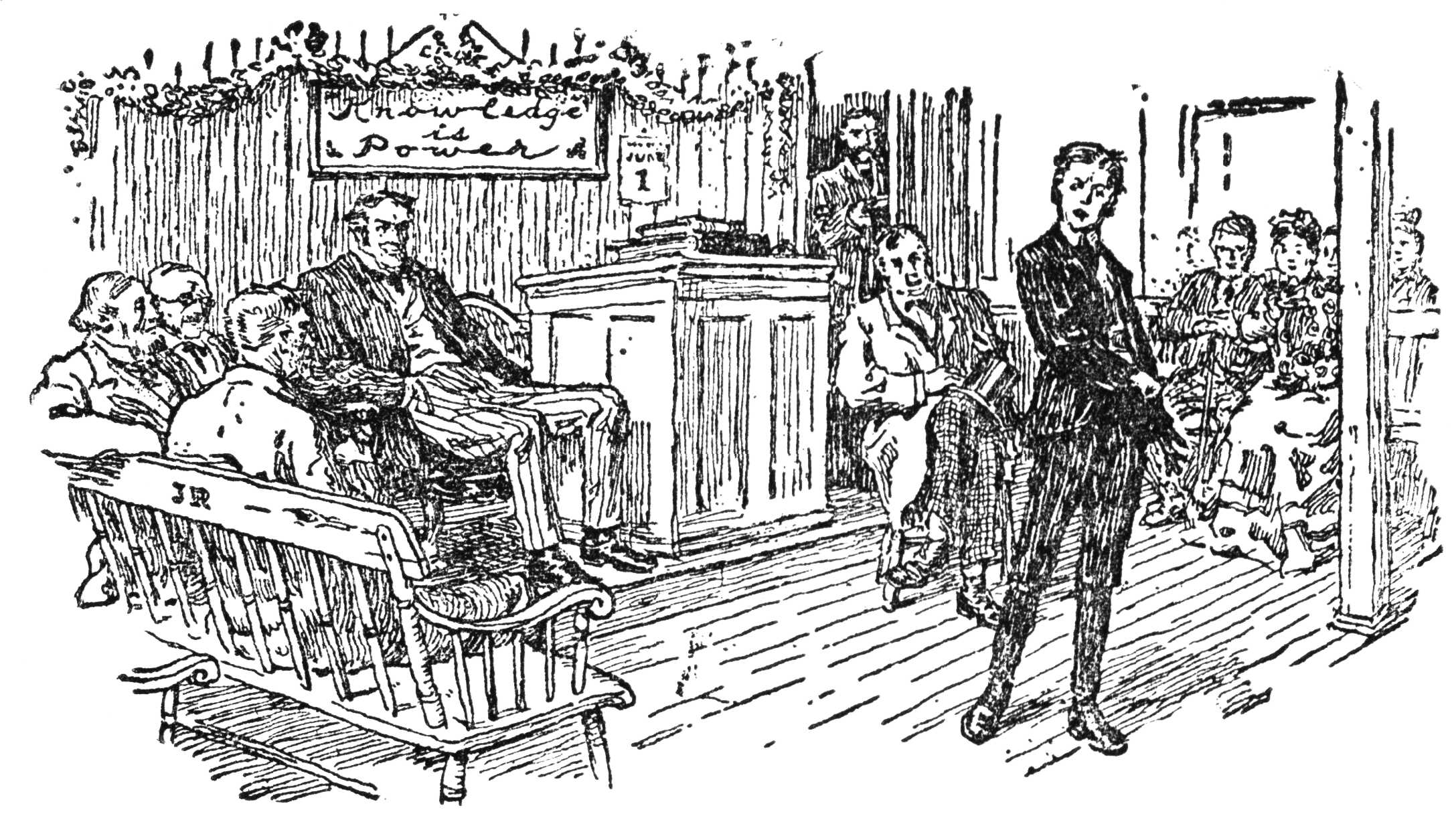
THE “LAST DAY.”
When the Captain called, which he did the next forenoon, the tale of Bradley’s eventful first day at school was told him in all its harrowing completeness. Miss Prissy—by previous agreement—acted as story-teller, and Miss Tempy was a sort of chorus, breaking in every few moments to supply a neglected detail, or comment on a particular feature.
“And we didn’t know what to do,” concluded Miss Prissy. “He wan’t goin’ to tell us whose dog it was, and——”
[Pg 65]
“I don’t b’lieve he ever would have told,” broke in Miss Tempy, “if that ‘dog girl’ herself hadn’t come bouncin’ in, and——”
“And he won’t promise not to speak to her again, neither,” continued the older sister. “We sent him to bed without any supper——”
“That is, any real supper,” interrupted the chorus. “Of course we took up some cookies and things when we found he wouldn’t come down, but——”
“And he won’t promise this mornin’, and he went to school without promisin’. What do you think we ought to do, Cap’n Titcomb?”
“Yes, Cap’n,” Miss Tempy joined in the appeal. “What do you think we ought to do?”
“Well,” replied the Captain—he had listened to the recital with a very solemn face, but there was a twinkle in his eye—“well, I don’t know. It makes me think of what the old man—dad, I mean—said to me once, when I was a little shaver ’bout Brad’s age. The old man was a great feller for horses and, when he give up goin’ to sea, he used to always have two or three horses ’round the place, and there was gin’rally a colt to be broke. You never had much dealin’s with colts, I s’pose?”
“No,” answered Miss Tempy, thoughtfully. “Long’s father lived we kept a horse—Dexter was his name—but I s’pose he wasn’t really what you’d call a colt.”
Captain Ezra—he remembered the ancient and wheezy Dexter—gravely agreed that the latter was not precisely a colt.
[Pg 66]
“Well,” he continued, “I always thought I was pretty nigh as smart as the next feller, and I was forever teasin’ the old man to let me break one of the colts. Finally he let me try it. After I’d had a lively ten minutes or so, and was roostin’ heels up in a snarl of rosb’ry bushes, with the colt grinnin’ at me, so’s to speak, over the stone wall, the old man come loafin’ up, and he says:
“‘Ez,’ he says, ‘what you doin’,—restin’? Better git up, hadn’t you, and take another try? The colt’s ready,’ he says.
“I stopped picking the rosb’ry briars out of my face, and tried to grin, and told him that I guessed I’d had enough.
“‘Oh!’ says he, ‘you mustn’t talk that way. It’s a mutual breakin’,’ he says, ‘and you and the colt are jest gittin’ used to one another’s little ways.’
“P’raps that’s the way ’tis here,” continued the Captain. “Brad and you two ladies are jest gittin’ used to each other’s little ways. Of course you must remember it is only a colt you’re handlin’. I think the boy’s all right, and I don’t object to his stickin’ by those that he thinks stuck by him. Far’s the girl’s concerned, she always struck me as a pretty trim little craft.”
“She’s noisy and a tomboy,” said Miss Prissy, decidedly.
“Yes,” said Miss Tempy; “and she likes those dreadful dogs.”
“Um—hum,” answered their visitor, with unimpeachable seriousness. “Of course that’s a terrible [Pg 67]drag, but maybe she’ll cut ’em adrift when she gits older; she’s only a colt, too,” he added.
“Well, we don’t like her,” said Miss Prissy, with decision. “And we wish you’d speak to Bradley about it. You know,” she added, looking down, “I put a lot of dependence in your judgment, Cap’n Titcomb.”
“So do I,” said Miss Tempy, quickly; “jest as much as Prissy does. I b’lieve in you absolutely, Cap’n Ezra.”
“Yes, yes, of course,” hurriedly replied the Captain. “Well, I’ll speak to the boy, by and by, and see what I can do.”
In response to the pressing invitation of the sisters, he reluctantly agreed to stay to dinner. That dinner was a marvel. Bradley saw that his supper, the night of his arrival, was a mere beggar’s crust compared to the spread that noon. In fact, it did not take him very long to notice that not even the minister’s appetite was tempted with the array of special dishes, puddings, cakes and preserves, that were always in evidence when the Captain was a guest.
After dinner, when the boy started for school again, Captain Titcomb walked with him a part of the way. The Captain had a married sister living “down at the Neck,” but he did not make his headquarters at her home, preferring to keep bachelor’s hall at his room at the Traveler’s Rest, during his infrequent shore leaves. “I always feel more independent on my own deck,” was the way he expressed [Pg 68]it. “Then I can cuss the steward, when it’s necessary, without startin’ a mutiny.”
“Brad,” he said, as they came out of the Allen gate, “what’s this I hear bout you gittin’ the rope’s-end yesterday? Never mind spinnin’ the whole yarn; I cal’late I’ve heard the most of it. You and the Hammond boy had a scrimmage, too, didn’t you?”
“Yes, sir,” said Bradley, doggedly.
“Hum! Think you’d have licked him if the skipper hadn’t took a hand?”
Bradley looked up at his questioner, saw the twinkle in his eye, and answered, with a sheepish grin: “Don’t know. Guess I’d have tried mighty hard.”
The Captain roared. “I presume likely you would,” he chuckled. “You look to me like one of the kind that sticks to a thing when you’ve started in. Well, you needn’t tell the folks at home that I said it, but I’ve had the advantage of bein’ a boy myself—which they haven’t—and I know there’s times when a feller has to fight. I’ve gin’rally found, though,” he added, “that it’s better to go a consid’rable ways in agreein’ ’fore you knock a man down. It pays better, for one thing, and don’t git into the papers, for another. I understand you’ve sort of took that little Baker craft, next door, in tow. She seems like a smart girl; do you like her?”
“Yes, sir.”
“I jedge Prissy and Tempy wouldn’t enter her for the cup. Now, Brad, mind I ain’t coaxin’ you to go back on a friend, but the old mai—that is, your ladies at home, have set out to make a man of you. They’re [Pg 69]your owners and you’re expected to sail ’cordin’ to their orders. If there’s one thing that I’ve always stuck to it’s ‘Obey orders or break owners.’ Sometimes owner’s orders don’t jibe exactly with your own ideas, but never mind—they pay the wages; see?”
“She’s a good girl,” said the boy, stoutly. “She came in and took my part when she didn’t have to, and I like her. And I won’t promise not to speak to her, neither.”
The Captain looked down at the lad’s square jaw and whistled.
“Well,” he said, “I don’t b’lieve you need to promise, but don’t whoop too loud about it. Run as close to the wind as you can, and don’t carry all sail in a two-reef breeze jest to show you ain’t afraid to. Because a man’s a good Republican, it don’t follow that it’s policy to go to a Democratic rally and tell the speaker he’s a liar. Catch my drift?”
“Yes, sir,” answered Bradley, rather doubtfully. “You mean be chums with the girl, but don’t tell Miss Prissy and Miss Tempy about it.”
“No—o.” Captain Ezra looked somewhat put out by the literal interpretation. “That ain’t jest it. Be—well, be easy, and—— Oh, thunder! Let it go at that. I guess you know what I mean. How do you think you’re goin’ to like your school?”
Bradley answered, “Pretty well, I guess, when I get more used to it;” but, although he did not say so, he was certain that it would take some time to get used to it. As a matter of fact, however, that very lively first day was the only serious trouble for him [Pg 70]during that entire term. He was quick to learn, and so found little difficulty with his studies, and advanced as rapidly as other boys of his age. As for his behavior, it was no worse than that of any other healthy youngster. At the end of the year he was “promoted”—that is, he was no longer a member of the fourth class, but instead proudly left his seat when the third was called.
Gus was “promoted” also, much to the surprise of the “old maids,” who could not believe there was any good in the “dog girl.” They gradually ceased to urge the boy not to have anything to do with her, for the very good reason that, in this matter, their urging was of no avail. They grew to understand their colt better as the months passed, and they learned just how tight a rein it was advisable to draw.
Bradley also grew to understand the sisters. He discovered that Miss Prissy was the business woman, and that she paid all the bills, bought all the household supplies, and did it without consulting Miss Tempy, whom she treated as a sort of doll with a mechanism that must not be jarred.
Miss Tempy was “delicate”—at least, she believed that she was. She always had a new patent medicine on hand, and was always sure that it was “doin’ a world” for her. She was the household art critic, passing judgment on the retrimming of bonnets, making over of dresses and the like. Under her direction the celebrated “plaid pants” of the lamented Captain Darius were made over for Bradley, and the boy “hooked Jack” for a whole day, because he [Pg 71]wouldn’t wear the things to school. Gus came to his rescue by tipping a can of red paint over his legs as they were passing the wheelwright’s shop, and the plaid outrages were thus put out of business forever. Bradley appreciated the kindly spirit that decked him in the “pants,” but he was thankful for the paint.
Miss Tempy was romantic. She read a great deal, and her favorite stories were those appearing serially in The Fireside Comforter, a pile of which, together with the back numbers of Godey’s Lady’s Book, were kept on the shelf in the sitting-room closet. In these stories Lord Eric wooed, and inevitably won, Evelyn, the beautiful factory girl, but Miss Tempy—in spite of repeated experiences—was never sure that he would win her, and so was in a state of delightful apprehension and hope during the intervals between installments. She loved to read these installments aloud, and, when they were finished, turned to Tupper and Wordsworth’s poems. She read poetry with what she called “expression,” and wind was always “wynd” with her.
Captain Titcomb was the one point in which Miss Prissy would not efface herself in favor of her younger sister. Secretly, each lady had hopes that the Captain’s calls were more than mere friendly visits; but, because the object of these hopes never allowed himself to show the slightest preference, the race was heartbreakingly even. But when Miss Tempy read of Lord Eric she always imagined that nobleman as looking and acting like the Captain.
[Pg 72]
Bradley made friends among the village boys, and did not make any virulent enemies. He had his interrupted fight “out” with Sam Hammond, and emerged a conqueror with a black eye and a swollen nose, which were the cause of his being in disgrace at home for a week. Also he joined the “Jolly Club,” a secret society that met on Saturday afternoons in “Snuppy” Black’s barn.
Just why this gruesome society was christened the “Jolly Club” is rather hard to understand. The initiation ceremony was anything but jolly to the trembling youth who, having sworn a most blood-curdling oath of secrecy, was conducted blindfold to the place of assembly. In Bradley’s case it was “Snuppy” himself who officiated as guide. After tying a handkerchief—not too clean and smelling of sweet-fern cigars—over his friend’s eyes, “Snuppy” led him over fences and through back yards for a distance that seemed miles. Then, at last, they stopped and the guide rapped “three times fast and twice slow” on something that sounded like a door.
The knocks were answered in kind by one within. Then a hollow voice asked, apparently through a speaking trumpet, “Who goes there?”
“One of the mystic brothers,” replied “Snuppy.”
“Have you the grip and countersign?”
“I have.”
“Then give ’em.” A hand was thrust out through the hole cut in the door for the convenience of the cat. “Snuppy” grasped the hand and fingered it according to formula. Then he stooped to the “cat [Pg 73]hole” and hoarsely whispered the countersign, “Death.”
“’Tis well, brother,” proclaimed the unseen. “But who is with you?”
“One who would—would——”
“Would fain——” prompted the voice.
“Would fain join our chosen band.”
“Is he prepared to face an awful doom?” This would have been more alarming if the voice had not added, in an indignant whisper, “Shut up laffin’, you fellers! D’you want to spoil everything?”
Bradley, having announced his readiness to face the “doom,” the door was opened and he was led, stumbling, into what “Snuppy” informed him solemnly was the “Hall of Torture,” but which smelt like a barn. Then the “mystic brothers”—led by the owner of the voice, who announced himself as “Grand Chief”—proceeded to put the neophyte through a course of sprouts that would have turned a grown man’s hair gray. They came to a sudden end, when the “Grand Chief” proclaimed:
“Boy, you are now standin’ on the brink of a frightful precipice. Behind you is unknown depths.”
“Ain’t neither, Hart Sears,” was the unexpected reply of the victim. “I’m standin’ on the beam over the mow. I can see down underneath this handkerchief and there’s the hay.”
“Aw, gee!” shouted the disgusted “Grand Chief.” “That’s you all over, Snuppy! Don’t know enough to tie a handkerchief tight!”
Having undergone this harrowing ordeal, Bradley [Pg 74]was entitled to wear a shining badge—made by the tinsmith’s son—that bore upon it, hammered out with a nail, the mystic capitals, “J. C.” His worst quarrel with Gus and her friend, Clara Hopkins—the quarrel that lasted two weeks without a making up—came about because the new member refused to tell what the initials “stood for.”
During the long summer vacation there were chores to do, but there was also all sorts of fun alongshore, digging clams on the flats, spearing flat-fish along the edge of the channels, or rare and much-prized trips to the fish-weirs where the nets were hauled. Captain Titcomb came home in August for an intended stay of two weeks, and he made the boy happy by taking him for an all-day sail and blue-fishing excursion off Setuckit Point.
That fishing trip had unexpected and fateful results. The Captain had called on Miss Prissy and her sister the morning of his arrival in Orham and, as was his custom, had brought each of them a present—exactly alike, of course. He had promised to dine at the Allen house the following Sunday. But it happened that Peleg Myrick wanted to make one of his infrequent visits to the mainland that week, and he seized the opportunity to hail the catboat containing Bradley and Captain Ezra, as it passed his quahaug dory, and beg for a passage up.
Mr. Peleg Myrick was a hermit. He lived alone in a little two-room shanty on the beach about half a mile from Setuckit Point. He owned a concertina that squeaked and wailed, and a Mexican dog—gift [Pg 75]of a wrecked skipper—that shivered all the time, and howled when the concertina was played. Peleg was certain that the howling was an attempt at singing, and boasted that “Skeezicks”—that was the dog’s name—had an “ear for music jest like a human.”
Among his other accomplishments Mr. Myrick numbered that of weather prophet. He boasted that he could “smell a storm further’n a cat can smell fish.” It was odd, but he really did seem able to foretell, or guess, what the weather would be along the Orham coast, and the ’longshoremen swore by his prophecies.
He was a great talker, when he had any one to talk to, and was a gossip whose news items were usually about three months old. Captain Ezra appreciated odd characters and he welcomed the chance to get a little fun out of Peleg.
“Well, Peleg,” said the Captain, as the catboat stood about on the first leg of the homeward stretch, “what’s the news down the beach? Any of the sand fleas got married lately?”
“Don’t ask me for no news, Cap’n Ez!” replied Mr. Myrick. “You’re the feller to have news. You ain’t married yit, be you?”
“No, not yet. I’m waitin’ to see which girl you pick out; then I’ll see what’s left.”
“Well, I ain’t foolin’. I thought you might be married by now. Last time I was up to the village—’long in June, ’twas—I see M’lissy Busteed, and she said ’twas common talk that you was courtin’ one of the old maids.”
[Pg 76]
Captain Titcomb scowled, and looked uneasily at his passenger.
“She did, hey?” he grunted.
“Yes. I told her I didn’t take no stock in that. ‘Cap’n Ez,’ I says, ‘has been courtin’ too many times sence I can remember,’ I says. ‘One time ’twas Mary Emma Cahoon; ’nother time ’twas Seth Wingate’s sister’s gal; then agin ’twas——’”
“All right! All right!” broke in the Captain, glancing hurriedly at Bradley. “Never mind that. How’s the quahaugin’ nowadays? Gittin’ a fair price?”
“Pretty fair,” replied Peleg. Then, with the persistency of the born gossip, not to be so easily diverted from his subject, he went on: “I told M’lissy that, but she said there wan’t scarcely a doubt that you meant bus’ness this time. Said you fetched presents every time you come home. Said the only doubt in folks’ minds was whether ’twas Prissy or Tempy you was after. Said she was sure you was after one of ’em, ’cause she as much as asked ’em one time when she was at their house, and they didn’t deny it.”
Mr. Myrick talked steadily on this and other subjects all the way to the wharf, but Captain Ezra was silent and thoughtful. He shook hands with Bradley at the gate of the Traveler’s Rest, and said good-bye in an absent-minded way.
“I s’pose you’ll be ’round to dinner, Sunday, Cap’n Ez?” said the boy.
“Hey? Sunday? Well, I don’t know. It might [Pg 77]be that I shall be called back to the schooner sooner than I expect. Can’t tell.”
Sure enough, the next day the sisters received a note from their expected guest, saying that he was obliged to leave at once for Portland, and could not, therefore, be with them on Sunday. The ladies were disappointed, but thought nothing more of the matter at the time. It was nearly six months before the Captain visited Orham again, and during this visit he did not come near the big house. He waylaid Bradley, however, asked him all about himself, how he was getting on at school, and the like, but when the boy asked if he, the Captain, wasn’t “comin’ ’round to see the folks pretty soon,” the answer was vague and unsatisfactory.
“Why, I—I don’t know’s I’ll have time,” was the reply. “I’m pretty busy, and—— Give ’em my regards, will you, Brad? I’ve got to be runnin’ on now. So long.”
It was the same during the next “shore leave,” the following November. Captain Titcomb saw Bradley several times, gave him a six-bladed jack-knife, and took him for a drive over to the big cranberry swamp owned by the Ostable Company, but he did not call on the “old maids.” So when the news came—via Miss Busteed—that Captain Titcomb had returned to his vessel, Miss Prissy sighed and put the fan and the other presents in a locked bureau drawer, and Miss Tempy began a new serial in the Comforter without once suggesting that its hero behaved “jest like Cap’n Ezra.” In fact, the Captain’s name was [Pg 78]never mentioned by the sisters, and Bradley himself learned not to speak of him while at home.
Three more years of school and vacations, with “chores” and sailing and cranberry picking, followed. Bradley was sixteen. His voice, having passed through the squeaky “changing” period, now gave evidence of becoming what Miss Tempy called a “beautiful double bass, jest like father’s.” He was large for his age and his shoulders were square. He was more particular about his clothes now, and his neckties were no longer selected by Miss Tempy. To be seen with girls was not so “sissified” in his mind as it used to be, but he still stuck to Gus and she was his “first choice” at parties, and he saw her home from prayer meeting occasionally.
As for the “dog-girl” herself, she, too, paid more attention to clothes, and her pets—though still numerous and just as disreputable in appearance—were made to behave with more decorum. Her hair was carefully braided now, her dresses came down to her boot tops, and Miss Tempy grudgingly admitted that “if ’twas anybody else, I should say she was likely to be good lookin’ when she grows up.”
The “Last Day” came, and Bradley and Gus were to graduate. In Orham there is no Graduation Day. The eventful ending of the winter term is the “Last Day,” and all the parents and relatives, together with the school committee and the clergymen, visit the school to sit stiffly on the settees and witness the ceremonies.
The “old maids” were agitated on the morning of [Pg 79]the great day. There was no forenoon session, and when Bradley—who had been at the schoolhouse to help Gus, Clara, Sam Hammond and the other older scholars festoon the room with ropes and wreaths of evergreen—came home for luncheon, he found the ladies gowned and bonneted, although there were two hours to spare before the time to start. Miss Tempy wore her silk mitts during the meal, and was so nervous that she could only drink her “pepper tea” and eat one small slice of bread and butter. Miss Prissy was nervous also, but she was much more serious than her sister.
“Oh, dear!” sputtered Miss Tempy. “What does make you so solemn, Prissy? I declare you give me the fidgets. Anybody’d think ’twas a funeral you was goin’ to.”
“’Tain’t the school business that’s worryin’ me,” was the reply. “I only wish ’twas.”
“Well, then, what is it. Now I come to think of it, you’ve been glum as an owl for two or three months. What’s troublin’ you? I do wish you’d speak out. You’re jest like father used to be; keep all your troubles to yourself and never tell me anything.”
But Miss Prissy only sighed, and her sister, too excited to think of other things just at present, turned to Bradley to ask him if he was sure he “knew his piece” and if the schoolroom “looked pretty.”
“Only think,” she said, contentedly, “how much more fortunate you are than some of the other scholars, Bradley. This is only the beginnin’ of your education, [Pg 80]as you might say. Next year you’ll be goin’ to high school, over to Harniss, and when you get through there, you’ll commence college. It’s goin’ to be Wesleyan, too. I’ve set my heart on Wesleyan, Prissy.”
Miss Prissy didn’t answer, and Bradley, too, was silent. Gus was going to high school, but Clara Hopkins—whose father had died recently—was not. Sam Hammond loudly boasted that he was going to New York to enter the office of a large wrecking company, where, as he said, he was going to learn to be a diver and have all sorts of adventures. “My cousin Ed’s a diver,” he proudly proclaimed, “and he makes lots of money and has a great time. He says there ain’t no sense in high school; you might as well begin to learn your trade now.”
Bradley, although he would not have hurt the sisters’ feelings by saying so, secretly envied Sam. A Cape Cod boy, with the seagoing blood in his veins, the big water called him with the call of a master. He loved the ocean and the ships and the salt wind. The Wesleyan idea did not appeal to him in the least. A minister, in his boyish mind, was a poor figure beside a commander of a life-saving station, like Captain Luther Davis, or, better still, a real sea captain like Captain Titcomb.
After lunch Miss Prissy unlocked the chest of drawers and took out a worn velvet case.
“Bradley,” she said, “you’ve been a good boy since you’ve lived with us, and me and Tempy have come to think as much of you as if you was our own son. [Pg 81]Here’s somethin’ that we set a great deal of store by and meant to keep always, but we’ve talked it over and we think you ought to have it and wear it.”
She opened the velvet case and showed a big, old-fashioned silver watch, the chasing on its case worn almost smooth.
“It was father’s watch,” said Miss Tempy, “and he always carried it. It looks so much like him. We want you to wear it, and when you’re at high school or college and look to see what time it is, you’ll think of us way off here at Orham, won’t you?”
Bradley was a proud boy, and the “old maids” were proud of him when, with the big watch in his pocket and the heavy chain rattling against his vest, the three started for the schoolhouse. On the way they caught up with Gus and her grandmother. It was amusing to note the condescension with which the sisters treated the old lady. As Miss Tempy often said, “The Bakers are real good meanin’ people, but the men folks have never been anythin’ but fishermen.”
It was agreed that the decorations were “lovely.” The blackboards had been ornamented by Mr. Daniels with mottoes, such as “Knowledge is Power,” done in different colored chalks and surrounded by marvelous flourishes and flying ribbons, and impossible birds with tails that poured from their backs like feathered Niagaras.
Mr. Daniels, himself, arrayed in his best, opened the exercises and called upon the Reverend Langworthy to offer prayer. As the concluding “Amen” [Pg 82]was uttered, Miss Tempy, sitting on the settee by the wall, nudged her sister and whispered, “Look, Prissy! I do declare if there ain’t Cap’n Ezra!”
Sure enough, there was the Captain on the opposite settee, neatly dressed as usual, and politely nodding to them.
“When did he come home?” whispered the nervous younger sister. “I didn’t know he was comin’. But then,” she sorrowfully added, “we don’t know anything about the Cap’n nowadays.”
Miss Prissy sedately returned the bow. “Don’t look at him so, Tempy,” she muttered. “If Cap’n Titcomb sees fit to stay away from our house, I should hope we could show him we didn’t care.”
Mr. Solomon Bangs, chairman of the school committee, addressed the school. He began with a loud “Ahem,” and proceeded somewhat after this fashion:
“Scholars, I am—er—glad to be present on this—er—auspicious occasion. It is, of course, a—ahem—pleasure to see you all in your seats in this school-room, studyin’ your lessons and learnin’ to be great and good men and women. I am sure that every boy and girl here to-day realizes the—the—worth of education and learnin’. Your parents and the committee are here because they realize it, and know what learnin’ has been to them. Your teacher tells me that you have been a credit to him. I am glad to hear it. As chairman of the committee havin’ this school under my charge, I esteem—that is to say—I feel sensible of my responsibilities. The voyage of life upon which you are about to step forth—er—embark, I [Pg 83]should have said——” and so on, for ten minutes. Mr. Daniels looked becomingly solemn, and the visitors whispered to one another that it was a “splendid speech.”
Then six boys from the youngest class gave a recitation, each setting forth in sing-song verse what he would do “When I’m a man—a man.” This was voted “too cute for anything.”
There were more “pieces” and a dialogue. Then the graduating class, the boys in their “Sunday suits,” and the girls in white muslin with blue ribbons, had its turn. Sam Hammond thundered through “Spartacus to the Gladiators.” Clara Hopkins recited an original composition on “Our Duty in Life.” It was a very serious “duty,” and was embellished with various flowers of rhetoric labeled “the sunrise of youth,” “the dawn of womanhood,” and the like. Bradley bravely tackled “The Advantages of a Republican Form of Government,” and when he finished every monarch on the globe was cowering beneath his throne, like a cat under a sofa; at least, if he was not actually cowering there, it was the opinion of the “old maids” that he would have been if he had heard that composition. Bradley’s effort was enthusiastically applauded, especially by Mr. Seth Wingate, who, being a life-long Democrat, was relieved to find that the boy had not, as he feared, constructed an argument in favor of the “Grand Old Party.”
Gus had been entrusted with the “Class Chronicles.” These were an innovation for Orham “Last Days,” the idea having been imported from Middleboro [Pg 84]by a young lady who had formerly attended school there, and who said that they always had “Class Chronicles” at schools that were “any account.” Gus’s Chronicles were witty and bright, and, if some of the jokes were old, they had been made over until, like the “old maids’” dolmans, they were almost new again. It must be understood, of course, that Chronicles and compositions and “pieces” were delivered with the accompaniment of pump-handle gestures, conscientiously copied from “Fig. 1,” “Fig. 2,” and the rest, in the front of the Sixth Reader.
After the school had done its part, another committee man spoke. Mr. Langworthy said a few words; Mr. Daniels repeated the statement that he made every year, namely, that this particular graduating class was the best and most brilliant he had ever taught, and then—the “Last Day” was over.
That evening Bradley sat reading in the dining-room. Miss Tempy, in the sitting-room, was going over, for the fortieth time since it was written, the wonderful argument in favor of a “Republican Form of Government.” As her sister entered the room, she dropped the roll of paper in her lap and said, solemnly:
“Prissy Allen, it’s my belief that when that boy first came here and I said that I wanted him to go to college and be a minister, I was inspired. I declare I do! I’ve jest been readin’ that piece of his again, and it beats any sermon I ever heard.”
Miss Prissy seated herself in a rocker and looked solemnly at her sister. For a minute she gazed without [Pg 85]speaking. Then, suddenly, as if she had made up her mind, she rose, gave the dining-room door a swing that would have shut it completely had not the corner of a mat interfered, and, coming back to her chair, said, slowly: “Tempy, I’m afraid we’ll never be able to send Bradley to college.”
The precious manuscript fell from Miss Tempy’s lap to the floor.
“Why—why, Prissy Allen!” she exclaimed. “What do you mean?”
“I mean we can’t do what we’ve hoped to do. Oh, dear! I—I don’t know what we’ll do. Tempy, we’ve hardly got any money left!”
[Pg 86]
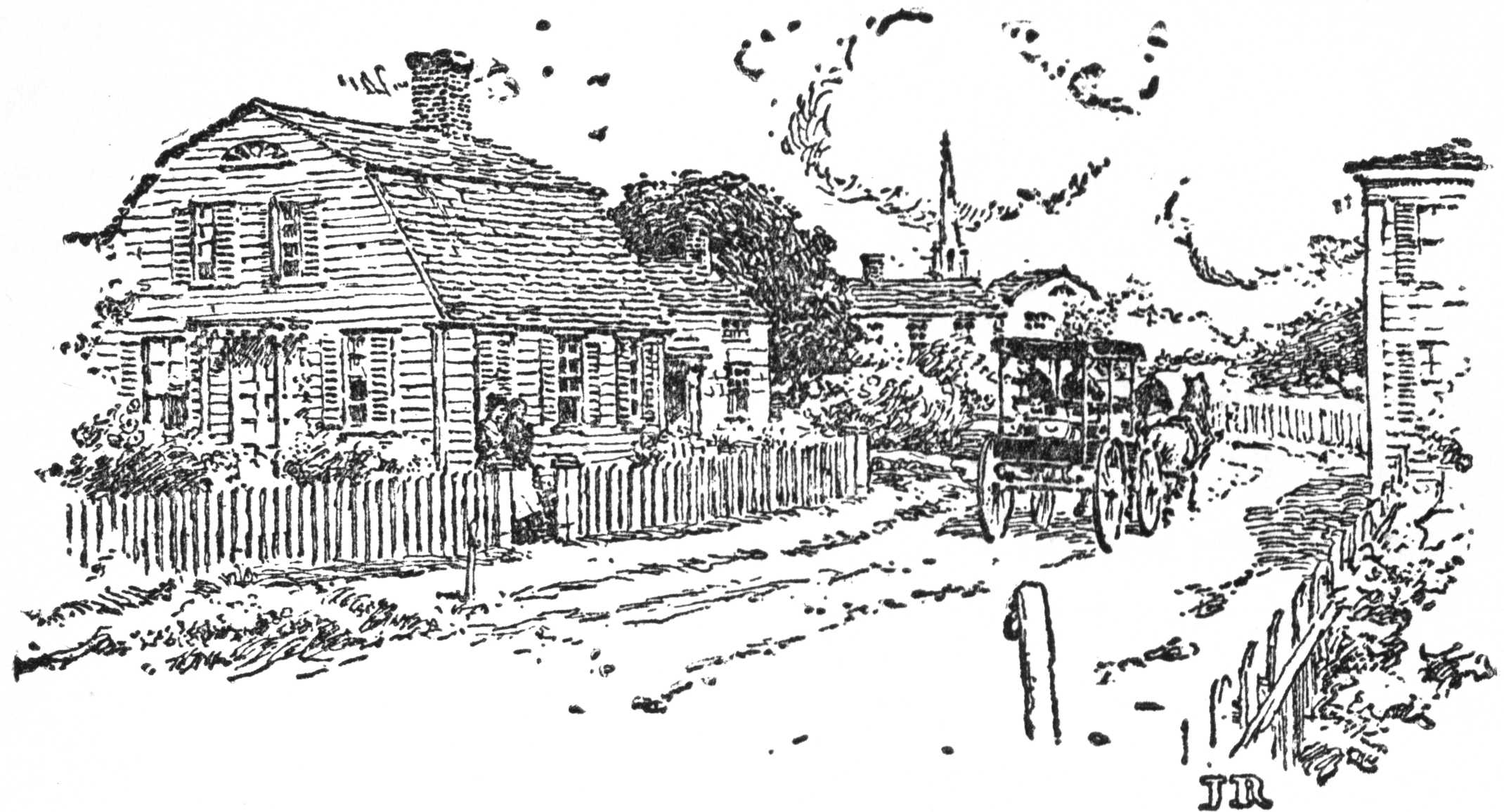
A CHANGE OF PLANS.
For a moment Miss Tempy made no reply to her sister’s speech. Instead, she sat there with her eyes fixed upon Miss Prissy’s face and her thin fingers picking nervously at her dress.
“Haven’t got any money?” she repeated, after a pause. “Haven’t got any money left? Why, then—why, then, we’ll have to take it out of the savin’s bank up to Boston. Of course, Bradley must go to college. You know he must, Prissy.”
But Miss Prissy shook her head.
“You don’t understand, Tempy,” she said. “I ought to have talked with you about it long ago. I [Pg 87]can see now that I ought to; but, oh, dear! father always said you was too delicate to bother with money matters, and I’ve been used to takin’ all the care myself, and so I’ve jest gone on and on, worryin’ and plannin’ and layin’ awake nights until I can’t go on any further. Oh, Tempy,” she cried, and the tears rolled down her cheeks, “you don’t understand. The money in the Boston bank has all gone too. We haven’t got more than five hundred dollars left in the world, and when that’s gone——!” She waved her hands despairingly.
But still Miss Tempy did not comprehend.
“Why, all of it can’t be gone!” she said. “All of the insurance money and everything! Why, it was five thousand dollars!” She mentioned the sum reverently and in an awestruck whisper.
“Yes,” said Miss Prissy, trying hard not to be impatient; “yes, ’twas five thousand dollars and father died over ten years ago, and we’ve been livin’ on it ever since.”
“But five thousand dollars, Prissy! Five thousand——”
“Oh, my soul and body! Anybody’d think ’twas a million. Jest think, now; jest think! We’ve lived on it for prety nigh eleven years; paid for our clothes and livin’ and havin’ the house painted six years ago, and——”
“But it needed paintin’.”
“Needed it! I should think it did! But it cost more’n we’d ought to spend, jest the same. Oh, it’s more my fault than anybody’s. Long’s father lived, [Pg 88]the place was kept up, and you and me was used to havin’ things as good as our neighbors, and I went on and on, never thinkin’ we was too extravagant, until, all at once, the money that we first put in the Harniss Bank was used up. And then it come home to me, as you might say, and I realized what we’d been doin’. Oh, I’ve tried and tried; scrimped here and pinched there. What do you s’pose I sold the woodlot for? And then the cran’by swamp?”
“Why, you said we didn’t need ’em, and it was too much trouble to run ’em.”
“Said! Oh, I don’t doubt I said all sorts of things to keep you from knowin’. But I sold ’em to help pay the bills. And then you was took down with the typhoid, and there was that big doctor’s bill; and then Bradley came and he had to have clothes and a little money to spend like the other boys. And now!”
Miss Prissy choked, tried to go on, and then broke down and cried heartily and without restraint.
In all the years since the death of Captain Allen Miss Tempy had never seen her common-sense, practical sister give way like this. The sight alarmed her much more than the story of the financial situation had so far done. She didn’t fully understand the latter even yet, but every one of Miss Prissy’s sobs was to her a call for help that needed an immediate answer.
“There! there! there! dear!” she said, running to the other rocker and putting her arm around her sister’s neck. “You poor thing! You mustn’t cry like that. You’ve jest worried yourself sick. You’re all [Pg 89]worn out. I shouldn’t be surprised if you’ve got a little cold, too, in that draughty schoolhouse. Let me make you a good, big cup of pepper tea right away; now do.”
Miss Prissy turned a sob into a feeble laugh.
“Oh, dear me, Tempy,” she said, laying her hand on the other’s arm, “I b’lieve you think pepper tea’ll cure anything—even an empty pocketbook. I wish ’twould pay bills; then, I don’t know but I’d drink a hogshead. But it won’t, nor cryin’ won’t either. Set down, and I’ll tell you jest how things are.”
So Miss Tempy, reluctantly giving up the “pepper tea” idea for the present, went back to her chair, and Miss Prissy continued.
“The money in the Boston savin’s bank is gone,” she said, “and a year or more ago I wrote to the broker folks that bought the bond for us when father died, and they sold it for me and got a little less than a thousand dollars for it. I put the money into the bank at Harniss, and though I’ve tried my best to be economical, there ain’t but five hundred and eighty left. That, and the place here, is all we’ve got.”
In a bewildered fashion Miss Tempy strove to grasp the situation.
“Then we’re poor,” she said. “Real poor, and I thought we was rich. Well, I shall give up that new bonnet I was goin’ to have next spring, and I s’pose I hadn’t ought to subscribe to the Comforter either. I did think so much of it!”
“I’m afraid we’ll have to give up more than the Comforter, Tempy. I’ve thought and thought, till [Pg 90]my poor head is nearly worn through. We might sell the place, here, but ’twould be like sellin’ our everlastin’ souls—if ’tain’t unreligious to say it—and, besides, property at Orham is so low now that we’d only get ha’f what it’s worth, and when that money’s spent there wouldn’t be anything left.”
“Sell the place! Father’s place! Why, Prissy Allen, how can you talk so! Where would we live?”
“Well, we might hire a little house down at South Orham or somewheres.”
“South Orham! Where all those Portuguese and things live? I’d rather die.” And it was Miss Tempy’s turn to cry.
“You needn’t cry for that, Tempy. We won’t sell yet a while. Not till there’s nothin’ left. But we can’t have the barn shingled, and as for Bradley’s goin’ to college, that, I’m afraid, is out of the question.”
“Oh, dear! dear! And the barn looks awful. Melissy Busteed was sayin’, only last week, that folks was wond’rin’ when we was goin’ to have it fixed. And poor Bradley! My heart was set on his bein’ a minister. I don’t know but I’d live in the poorhouse to make him one. They say Mr. Otis keeps a real nice poorhouse, too,” she added.
Miss Prissy smiled dolefully. “It hasn’t got to the poorhouse yet,” she said. “And I hope we can send Bradley through high school anyhow. But we’ll have to scrimp awful and we must try to earn some money. I was talkin’ to Abigail Mullett at the church fair last August, and she spoke about those aprons and one [Pg 91]thing another that I made, and said she never saw such hemmin’ and tuckin’. She said she’d give anything if she could get somebody to do such work for her in the dressmakin’ season. I’ve been thinkin’ maybe she’d put out some of her work to me if I asked her to. She does more dressmakin’ than anybody around; has customers ’way over to Ostable, and keeps three girls sometimes. And you know how the summer folks bought those knit shawls of yours, Tempy? Well, I don’t doubt you could get orders for lots more. We’ll try, and we’ll let Bradley start at high school and see how we make it go.”
So Miss Tempy brightened up, and in a few minutes she had, in her mind, sold so many shawls and Miss Prissy had done so well with her hemming and tucking that she saw them putting money in the bank instead of taking it out. In fact, she was getting rich so fast, in her dreams, that her sister didn’t have the heart to throw more cold water at this time. And even Miss Prissy herself felt unwarrantably hopeful. She had borne the family burdens so long that to share the knowledge of them with another was a great relief. They discussed ways and means for a half-hour longer, and then Miss Tempy insisted on getting that “pepper tea.”
“I honestly believe,” she said, “that if I hadn’t took pepper tea steady for the last four or five years I shouldn’t be here now. That and Blaisdell’s Emulsion has given me strength to bear most anything, even the prospects of the poorhouse. Thank goodness, I’ve got a new bottle of Emulsion, and pepper [Pg 92]tea’s cheap, so I shan’t have to give that up, even if we are poorer’n Job’s turkey.”
“All right,” sighed Miss Prissy. “If it’ll make you feel any better to parboil my insides with hot water and pepper, fetch it along. Don’t say anything to Bradley about what we’ve been sayin’. ’Twon’t do any good, and will only make the poor child feel bad.”
But Bradley was not in the dining-room. The book he had been reading was turned face downward on the table, but he was gone, and so was his hat.
“Why, I never!” exclaimed Miss Tempy. “He never went out an evenin’ before without sayin’ anythin’ to me or you. What do you s’pose is the matter?”
“You don’t think he heard what we said, do you?” anxiously asked her sister. “I thought I shut the door.”
“You did shut it, but, now you speak of it, seems to me I remember it wasn’t latched when I come out jest now. I hope he didn’t hear. He’s such a sensitive boy; jest like all the Allens.”
The “pepper tea” was prepared—a double dose this time—and the sisters sat sipping it, Miss Prissy with many coughs and grimaces, and Miss Tempy with the appreciation of a connoisseur. After a moment’s silence she said:
“Prissy, do you know what I’ve been thinkin’? I’ve been thinkin’ what a blessin’ ’twould be if we had Cap’n Titcomb to go to for advice now.”
“Humph! If I’ve thought that once, I’ve thought [Pg 93]it a million times in the last year,” was the decided answer.
It was after ten o’clock, and only Bradley’s absence had prevented the ladies from going up to bed, when the outside door of the dining-room opened, and the missing boy came in.
“Bradley Nickerson, where’ve you been?” exclaimed Miss Tempy, running to meet him. “We’ve been pretty nigh worried to death. Why don’t you shut the door? Who’s that out there? Why—why, Cap’n Titcomb!”
“What’s that?” cried Miss Prissy, hurrying in. “You don’t mean—— Well! Good evenin’, Cap’n Titcomb; won’t you step in?”
The Captain accepted the invitation. He was as much embarrassed as the “old maids,” even more so than Miss Prissy, who immediately, after a swift, sidelong glance of disapproval at her agitated sister, assumed an air of dignified calmness.
“How d’ye do, Prissy?” stammered the Captain. “Tempy, I hope you’re well. Yes; I’m feelin’ fair to middlin’. No, thanks; I ain’t goin’ to stop long; it’s pretty late for calls. Fact is, Brad here’s got somethin’ to say. Heave ahead, Brad.”
The boy, too, was embarrassed, but as the two looked at him expectantly, he fidgetted with a button on his jacket and said:
“Miss Prissy, I didn’t mean to listen, but the door wasn’t shut tight, and I couldn’t help hearing what you and Miss Tempy were saying a little while ago.”
[Pg 94]
“There!” exclaimed Miss Tempy. “I was afraid of that door. You remember I said so, Prissy.”
But Miss Prissy didn’t answer; she merely looked at Bradley.
“I heard what you said,” nervously went on the boy, “and when you told about—about what you was going to do so’s I could go to high school, I—I thought first I’d come right in and tell you you mustn’t. But then I thought you wouldn’t believe I meant it, or wouldn’t pay any attention to it if I did, so I went outside to think it over by myself. And then—then I went right up to see the Cap’n.”
“I hope,” said Miss Prissy, sternly, “that you didn’t repeat our talk to Cap’n Titcomb without tellin’ us you was goin’ to.”
“No, no; he didn’t,” hastily broke in the Captain. “He didn’t tell a word. You’ve got a pretty fair kind of boy here, if you want to know,” he added, with more than his usual enthusiasm.
“Hum!” was Miss Prissy’s only comment. “Go on, Bradley.”
“All I told him was,” said Bradley, “that I didn’t think it was right for me to go to school and college when I ought to be earning some money. I’m going on seventeen now, and lots of fellows I know are going to work. I don’t b’lieve I’d make a very good minister,” with a look of appeal at Miss Tempy, “and I’d a good deal rather go to sea. All our folks have been to sea. My father and my grandfather. Yes, and your father, too, you know.” The last as a happy inspiration.
[Pg 95]
“Don’t you think that we know best what——” began Miss Prissy, but the Captain again interrupted her.
“Let him spin his yarn, Prissy,” he said. “Nothin’ is settled yet, so don’t worry.”
“So I went to the Cap’n,” went on Bradley, “and asked him if he’d take me on board his schooner. I ain’t a sailor, but I know a lot about boats, and I don’t get seasick even when it’s mighty rough; do I, Cap’n Ezra?”
“No,” replied Captain Titcomb, gravely. “You manage to keep your cargo from shiftin’ pretty well for a green hand.”
“And he said he’d take me as a kind of cabin boy; didn’t you, Cap’n? And learn me things, and get me advanced as soon as I was fit for it. And he’ll pay me wages, too; right away. There! And I won’t cost you a cent more. Please let me go?”
“Well, I never!” exclaimed Miss Tempy. She would have continued, but her sister spoke.
“It seems to me,” said the latter, “that you would have done better by us, Bradley, if you’d asked our advice before you went to Cap’n Titcomb or anybody else. We’d planned to give you a good education, so’s you might amount to somethin’ in this world. Seagoin’ is all right—the land knows there’s been enough of it in our family—but everybody says it ain’t what it used to be, and it’s a dreadful hard life. Boy on a schooner, even with the Cap’n here, ain’t much of a place. It’ll be a good while ’fore you amount to much or make much money.”
[Pg 96]
Bradley would have replied, but Captain Titcomb held up his hand.
“Brad,” he commanded, “go into the galley and shut the door.”
The boy didn’t hesitate; he obediently turned and went into the kitchen. The Captain looked after him approvingly.
“I like a chap that obeys orders,” he observed. “Prissy, you and Tempy know me, and you know I like Brad and want to see him do well. But I want to tell you this: I’ve seen lots of boys, and I was one myself, and if a boy gits the salt water notion into his head, nothin’ll git it out but a good-sized dose of that same water and a first mate and a rope’s end. ’Twon’t git it out then, if he’s really got the disease, but it’ll prove whether it’s growin’ pains or the genuine rheumatics mighty quick. The old man—dad, I mean—was all for makin’ a doctor out of me, but when he caught me one night with my duds tied up in a newspaper ready to run away and ship on a cattle boat, he give in. ‘Sarah,’ he says to mother, ‘I’ve done my best to raise a pill-peddler, but it looks as if ’twas nothin’ but a lob-scouser after all. All right,’ he says; ‘if you’re dyin’ to eat salt-hoss and smell bilge, you can do it, but you’ll do it under somebody that I know, and not on a floatin’ barnyard. Cap’n Tim Mayo’ll take you, if I ask him to,’ he says, ‘and if he don’t work the taste for pickle out of you, then there ain’t nothin’ that can,’ he says.
“Well,” continued the Captain, with a twist of his mouth, “Cap’n Tim tried; I’ll say that for him. I’ll [Pg 97]never forgit that first v’yage. But when I come home and told the old man I was goin’ ag’in, he held up his hands. ‘That settles it,’ says he; ‘you’re goin’ to be the same kind of a fool that I am and my father was afore me. It’s the Lord’s doin’s, and I’m thankful I can shift the blame onto Him,’ he says.
“So with Brad. If he’s bound to go to sea, he’ll go, sometime or ’nother. It was my idea to take him as a sort of mixture of roustabout and cabin boy, and try him out. If it don’t cure him, why, I need jest such a feller as he is to make a mate of some of these days. If it does he’s only wasted a summer vacation and got a little cash for it. Seems to me it’s worth the try. You think it over, and send me word up at the Trav’ler’s Rest. I’ll be there for the next week or so. Well, I mustn’t stop any longer. Good night.”
“But, Cap’n,” faltered Miss Tempy, avoiding her sister’s eye, “won’t you set down jest a minute to—to rest yourself ’fore you go back home?”
“No, thank you,” was the quick reply. “It’s gittin’ so late now that if I ain’t careful I’ll have to git up afore I go to bed, like the Irishman Eri Hedge tells about. I hope you won’t think I’m pokin’ my oar into this bus’ness of Brad’s. It’s jest as I say; I like him, that’s all. Well, all right. Tell him if he’s headed up my way to-morrer he’d better drop in and have another talk. So long.”
They watched him go down the walk and up the moonlit road. Then Miss Prissy shut the door, and, after calling Bradley from the kitchen, they adjourned [Pg 98]to the sitting-room. Long after the boy had been sent to bed the sisters sat in their rockers, talking of him, of his future and what it was wisest to do. They talked of the Captain, too, but only so far as Bradley’s sailing with him was concerned. It was not until they were on their way upstairs that Miss Prissy said:
“Tempy, I’m wonderin’ if Cap’n Ezra’s comin’ here to-night means that he’ll come often, like he used to.”
“Was you wonderin’ that?” asked Tempy. “I was, too, but I didn’t s’pose you’d like it if I said anything ’bout it. You was so dreadful cool when he was here.”
But the Captain did not again visit the Allen home, although next day Bradley called on him at his room in the hotel. They talked of the proposed plan, of course, but Captain Titcomb did not urge its acceptance. On the contrary, he spoke very plainly of the disagreeable features of a sailor’s calling, and hinted that being aboard a vessel was like being in jail. “Only,” he said, “there’s always a chance for a feller to break out of jail.”
At the end of the interview he said: “Brad, I ain’t askin’ any questions ’bout what made you take this sudden fit, but I’d like to know this: Do the old maids know ’bout that Sampson fund for sailors’ children? They could git over a hundred a year out of that if they applied for it, you understand?”
“I don’t believe they’d take a cent, if it was anything like charity,” replied the boy. “Miss Prissy [Pg 99]especial; she’s awful down on folks that she says are living on charity.”
“Um, hum! I see. Well, I know a feller that’s one of the head cooks and bottle-washers of the Sampson crew. Maybe I could rig it so’s—— Well, never mind; don’t say nothin’ yet.”
Three days later it was settled; Bradley was to go to Boston the following Monday with Captain Titcomb and ship with him as the combination “boy and roustabout” for a period of three months. Really, it was settled when the Captain suggested it, but it took some time for the “old maids” to formally make up their minds to the decided change and for Miss Tempy to get rid of her desire for a clergyman in the family.
“Well, Prissy,” she said, “if we can’t have a minister, I think I’d rather have a sea cap’n than most anything else. You see, there’s always been at least one cap’n among the Allens. P’raps Bradley—he’s so smart—will git to be cap’n of a great steamer like one of the Fall River boats. P’raps he really will be cap’n of a Fall River boat. Jest think! Then you and me might go to New York again; or, if Bradley took us to New York for nothin’, p’raps by that time we could afford to go on an excursion from New York to Washington. It’s been one of my dreams to go to Washington and see the President and the Washington Monument and the Senators and all the relics in the Smithsonian Institute.”
Bradley told Gus the great news as soon as it was officially announced by Miss Prissy. Gus was disappointed [Pg 100]because her “chum” was not going to high school with her, but she rejoiced with him upon his freedom from the ministry.
“I’m glad you’re not going to be a minister,” she said. “That is, if you had to be one down here in Orham. I should hate to have you living on five hundred a year and donation parties, and your wife scared to death every time she had a new hat for fear Melissa Busteed and the rest would say she was too extravagant. You’re going to go to places and see things. I wish I was, instead of staying here to study lessons and read the Item to grandmother. ‘Cap’n Jonadab Wixon has treated his henhouse to a new coat of whitewash.’ And then grandma wants to know what I s’pose he paid for the whitewash. Ugh!”
“You’ll have good times over at Harniss,” said Bradley, reflectively. “There’s lots of fellows and girls go to high school there.”
“Yes, I s’pose so; but I’ll miss you and Clara. Write to me, won’t you? I want to hear from you, of course, and besides, it’s fun to go to the postoffice and get letters of your own.”
“Yes; I’ll write. And you’ll write to me, won’t you?”
“Yes; I’ll write and tell whose cow is dead and how many summer boarders there are in town, and which one of ‘Hungry Bill’s’ children has got the measles. Great things to write about, there are down here!” she added, disgustedly. “Well, I can write about the parties I go to, if I go [Pg 101]to any. I won’t have anybody to go with, now you’re gone.”
Bradley had an uneasy notion that there were plenty of fellows that would be glad to escort her to the “parties.” It flashed across him all at once that Gus was growing positively pretty. It had not occurred to him before; that is, not as it did just then. It was one of the signs that he was getting older.
“Well, good-bye,” he said, holding out his hand.
“Good-bye,” said Gus, taking it. Then they shook hands, said good-bye again, and separated. Bradley almost wished he had kissed her, but seemed like a “soft” thing to do in cold blood; not like “forfeits” at a party, or anything like that.
Monday morning his trunk was packed, and Barney Small called to take him and it to Harniss. The “old maids” wept over him, and Miss Prissy told him to be a good boy and write once a week at least. Miss Tempy said:
“Remember, Bradley, you’re an Allen now, and you must live up to the family. Oh, Prissy! Don’t it seem jest like it used to when father was goin’ on a voyage? Bradley’s growin’ to look so like him.”
And the sisters went into the house to cry together.
The trip to Harniss in the stage seemed much shorter than had that in the same vehicle four years before. Captain Titcomb was with him now, as then, and “Foolish Sol” came out to beg tobacco. But his opportunities were growing less, for the new Orham branch railroad was even then under construction and would be finished in another two years.
[Pg 102]
Then came the long ride in the train to Boston. Bradley had been as far as Ostable on the memorable occasion when the “Jolly Club” attended the County Fair in a body, a visit which had caused that venerable institution to sit up and take notice. But he had never been farther in that direction, and now he watched while the villages and towns they passed grew bigger and closer together, saw in Brockton the first street car he had ever seen outside of pictures, saw rows upon rows of brick buildings, where people lived all together like “fiddler crabs” in a marshbank, saw smoke and tangled spiderwebs of railroad tracks, and then shot under a great shed and into a big building where there were crowds and crowds of people. And it was Boston.
Then they rode in one of the—to Bradley—wonderful horse cars, through crooked streets lined with the brick buildings, and got out in front of a place where rows of masts fringed a long, narrow wharf. Down this they walked till they came to a three-masted schooner sitting high in the water.
“Brad,” said Captain Titcomb, clapping him on the shoulder, “that’s your boardin’-house for the next three months anyhow. She’s the Thomas Doane. What do you think of her?”
[Pg 103]
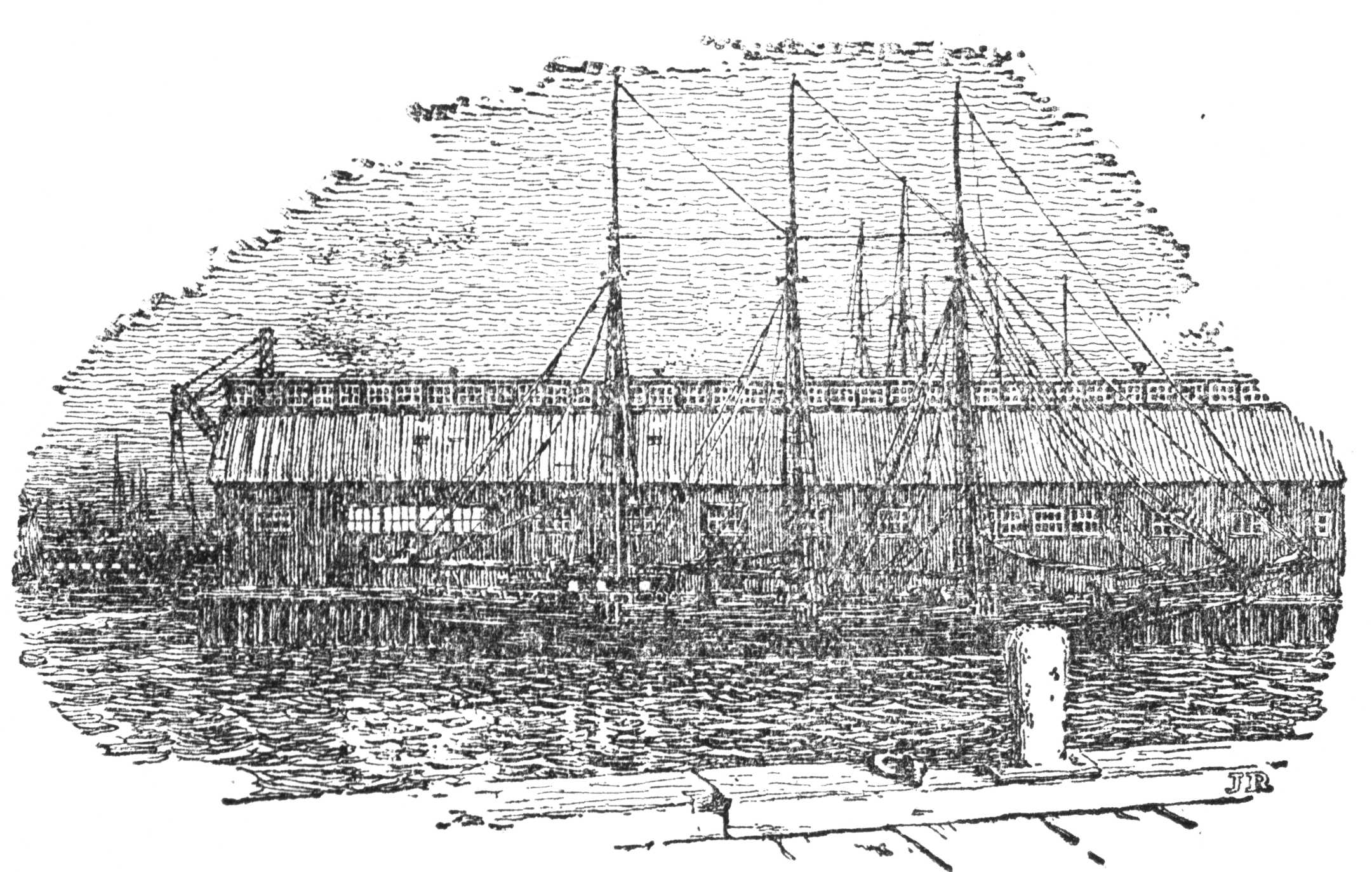
THE THOMAS DOANE.
The Thomas Doane, seen from the wharf in the faint light of the street lamp, was a mere shape of blackness, with masts like charcoal marks against the sky, and a tangle of ropes running up to meet them. The windows of the after deck-house were illuminated, however, and as Bradley and the Captain stepped from the wharf to the rail and from that to the deck a man came up the companionway from the cabin and touched his hat.
“Howdy, Cap’n,” he said. “Glad to see you back. Everything runnin’ smooth down home?”
[Pg 104]
“Yup,” answered the skipper. “Smooth as a smelt. How’s it here?”
“Shipshape,” was the reply. “The mainsail’s been patched, and I’ve put in the new runnin’ riggin’ where you said. That fore-tops’l’s been fixed, too, as well’s we could do it. She ought to have a new one, but I s’pose Williams’ll think it’s too expensive, won’t he?”
The Captain’s answer was a grunt that might have meant almost anything.
“Brad,” he said, “this is Mr. Bailey, the first mate. He’ll be your boss, next to me, after to-morrer. Mr. Bailey, this is a new hand. He hasn’t exactly shipped yet, so you needn’t break him in to-night unless your conscience troubles you too much.”
The mate held out a hand like a ham covered with red sole leather, and Bradley shook it fearfully.
“Relation of yours, Cap’n?” inquired Mr. Bailey.
“Not exactly; and still, I don’t know. He’s a Nickerson, and there’s mighty few Cape families that ain’t had a Nickerson hitched to ’em somewheres at some time. They’re all over the plate, like a b’iled dinner. Is the doctor aboard? I’m hungry and I cal’late Brad could find storage room for a little freight somewheres.”
The cook was ashore just then, but the mate said he guessed he could “scratch grub enough together for supper.” Captain Titcomb, however, declined the offer and said that he and Bradley would go up to an “eatin’ house” somewhere for this time. So, after a walk through more of the narrow, crooked streets, the pair entered a little battered restaurant with the sign “Atwood’s [Pg 105]Oyster Saloon” over the door, and took seats in one of a row of curtained alcoves that seemed to the boy more like horse stalls than anything else. Then the Captain ordered oyster stews and, when these had come and gone, squash pie and coffee.
After the last crumb of the pie had disappeared Captain Titcomb lighted a cigar, leaned back in the corner of the “stall” and, with his eyes half-closed and an odd expression about the corners of his mouth, gazed at Bradley in silence. At length he took the cigar from his lips, flipped away the ash with his little finger, and said slowly:
“Brad, there’s a whole lot of things that a green hand has to learn when he goes to sea, and there’s a whole lot more he’s got to unlearn. I’ve been wonderin’ whether ’twas best for me to give you the course, so to speak, or let you find it out for yourself. When I was a little shaver, mother caught me with a pocket full of apples that I’d hooked from old man Pepper’s orchard that was jest over our back fence. She give me an awful talkin’ to, but dad didn’t say much. ‘Let him alone, Sarah,’ he says; ‘he’ll learn by experience.’ Sure enough, in ’bout a week, in marches Pepper, holdin’ me by the collar with one hand and a big switch in t’other. ‘Sam,’ says he to dad, ‘here’s this boy of yours been stealin’ my apples. If ’twas anybody else’s child, I’d give him a lickin’ that he’d remember.’ Dad didn’t even take his hands out of his pockets. All he said was, ‘Well, Elkanah, ’twill be your fault if he steals any more.’ Then he went in the house. Pepper didn’t know what to make [Pg 106]of it for a minute. Then he sort of sized up matters. ‘Hum!’ he says; ‘I guess I won’t take the responsibility,’ and when he got through the switch wan’t nothin’ but a frazzled end, and I ain’t cared much for apples sence.
“That was what dad called ’learnin’ by experience.’ I learned my seafarin’ the same way, and I ain’t forgot the lesson. Maybe that’s why I’m goin’ to tell you a few things. Now, you and me on shore have been sort of chums, ain’t we?”
“Yes, sir,” replied Bradley, puzzled to know what his companion was driving at.
“All right. When we’re on shore we’ll be chums, same as ever. But when we’re ’board ship, I’m skipper and you’re a hand; understand?”
“Yes, sir; I guess so.”
“Don’t guess—it won’t be any conundrum. I’ll be Cap’n Titcomb, and Mr. Bailey’ll be mate, and Mr. Saunders—you haven’t seen him yet—he’ll be second mate. When one of us three says, ‘Nickerson, do thus and so,’ you do it, and do it on the jump. Don’t stop to think ’bout it, or maybe you’ll learn by experience, the way I did. Aboard any vessel that I’m on there ain’t any pets. One man’s good’s another, provided he does his work. Say ‘Aye, aye, sir,’ when you git an order, and don’t guess at things. You ain’t paid to do it yet awhile. Let the officers do the guessin’. This is pretty plain talk, but I don’t want you to make any mistakes. See?”
“Yes, sir.” Bradley’s face was very solemn.
“All right. This seems tough now, but it saves you [Pg 107]from worryin’ ’bout the future, as the feller said to the pig afore he killed him. Come on down aboard, and we’ll turn in.”
As they came out on the sidewalk the Captain looked down at the boy and smiled.
“Brace up, Brad,” he said, giving the new hand a hearty slap on the back. “You’ll do all right. Don’t worry.”
That night Bradley slept in the second mate’s room off the cabin, but it was understood that hereafter he was to bunk forward with the crew. The next morning the Captain took him up to a store on Commercial street, where a sailor’s bag was purchased, for, so the skipper said, nobody but a landlubber took a trunk to sea. It must be either a chest or a bag, and the chest would come later on. Bradley transferred such of his belongings as the Captain deemed necessary from the trunk to the bag, and the trunk itself was stored in the wharfinger’s office until its owner should call for it some time in the future.
The second mate, a thin young man, with hair and face both a flaming red, came on board in the morning, and the crew were already there. Then a tug took the Thomas Doane in tow and pulled her out of the dock and around to another wharf, where she was to receive her cargo of lumber. And from the moment when the tug’s hawser was attached Bradley began to realize what Captain Titcomb had meant by his advice of the previous night.
It was “Here, boy! stand by to take a hand with that rope,” or “You, boy—what’s your name—git a [Pg 108]bucket and swab up that mess on the deck. Lively! D’you hear?” The cook was a little Portuguese and he delighted to haze his new assistant; so when, at nine o’clock or so, Bradley tumbled into his bunk in the smoke-reeking fo’castle, he was tired enough to drop asleep even in the midst of yarns and profanity.
The lumber, in the hold and on the decks, was at last on board, and one morning the schooner, with all sail set, passed Minot’s Light, bound for New York. The afternoon of that day was a dismal experience for Bradley. The Thomas Doane was heavily loaded, and she swashed and wallowed through the good-sized waves with a motion so entirely different from that of the catboats which the boy had been used to that he was most heartily and miserably seasick.
That evening, with lee rail almost awash, they were off the bank of the Cape, and the lights at Orham showed clear on the horizon. It was really a reefing breeze, but Captain Titcomb had a reputation for record trips to sustain, and he didn’t reef until there was danger of carrying away the canvas. Bradley, for a moment idle, was leaning on the bulwarks, staring dolefully at the distant lights, when a man came close beside him and said, in a half-whisper: “Well, Brad, how’d you like to be in the old maids’ dinin’-room jest about now?”
The new hand glanced hurriedly up and saw the skipper.
“Very much, sir,” he answered, truthfully.
The Captain chuckled. “I shouldn’t wonder,” he said. “Never mind; swallow hard and hope you like [Pg 109]it. That’s ’bout all a sailor lives on, is hope. That’s why the sign of it’s an anchor, I guess.”
A voice called from the galley.
“Boy!” it wailed. “Neeckerson! Where ees that no good boy? Boy!”
“Aye, aye, sir!” shouted Bradley, and jumped to receive a kettle of greasy dish water, the sight and smell of which did not make him feel any happier just then.
But seasickness and homesickness were forgotten on the day of the wonderful sail through Long Island Sound. They passed schooners of all shapes and sizes, loaded till the decks were scarcely above water, or running light and high in ballast. Sharp-nosed schooners with lines like those of a yacht, and clumsy old tubs with dirty sails, with patches—varying from new white to a dingy gray—plastered all over them. They overtook stubby sloops, heaped with cut granite or brick, and steered by a big tiller, and were in turn overtaken or met by excursion steamers, freight steamers, or an occasional ocean-going tug with a string of coal barges towing behind. The Sound was a highway, a sea street, crowded with traffic, and through it the Thomas Doane picked her way serenely with a fair wind to help, and a white ribbon of foam trailing from either side of her bow.
She wasn’t a new vessel—even Bradley could see that she was old and weather-beaten—but she was kept as clean as scouring could make her, and paint was used liberally. A man with a paint bucket and [Pg 110]another with a swab were nearly always to be seen busy about the Thomas Doane.
Night, and they were fast to a big wharf, with lights all about them; lights piled, row after row, up to meet the stars; lights fringing the river or moving up and down and across it; lights in the arching curve of the bridge that Bradley had seen so often in pictures. Whistles sounding, bells ringing, distant shoutings, and the never-ceasing undercurrent of hum and roar that is New York, breathing steadily and regularly.
On the following morning Captain Titcomb left the schooner and, after an hour or two, returned with a sharp-eyed man who smoked continuously, although the wharf-signs shouted in six-inch letters that no smoking was allowed, and who said little but looked a great deal. Bradley learned from the cook, who had been along the water front and, having fallen in with some friends, was mellow and inclined to be confidential, that the sharp-eyed man was Mr. Williams, the junior member of the firm that owned the Thomas Doane and a half dozen other coasters.
Mr. Williams and the Captain had a long conversation in the cabin, and, after it was over, the skipper was a bit out of temper, and his orders were unusually crisp and sharp. As Bradley brought the dinner from the galley to the cabin that noon, he heard a remark that the Captain made in reply to a question of the first mate.
“Aw, nothin’ worth mentionin’,” he said. “It’s the old story. I let him know that I was mighty nigh [Pg 111]sick of runnin’ this floatin’ junk shop, and wanted the new schooner when she was ready. He soft-soddered me till I felt slippery all over; told me I could git more out of an old vessel than any man he ever had, and that he jest simply couldn’t shift me till the Thomas Doane was ready for the scrap heap. Said not to worry; the firm appreciated what I was doin’ and would make it right with me—and a whole lot more. Well, I can’t kick so fur’s wages go; but if it wan’t that Williams Brothers pay me more’n ha’f again what most coastin’ skippers git, I’d chuck it to-morrer and hunt a new berth.”
On one memorable evening the Captain, having previously whispered to Bradley to put on his “Sunday togs,” sent the boy on an errand to a cigar store near the wharf and told him to wait there “for further orders.” In a little while he, himself, came into the store, commanded Bradley to “lay alongside and say nothin’,” and the pair walked briskly across the city to the elevated railway station. Then they rode uptown, had a six-course dinner in a marvelous restaurant, where an orchestra played while you ate, and then went to the theatre to see a play called “The Great Metropolis.” It was all real to Bradley, and he thrilled, wept and laughed alternately; but the Captain was disgusted.
“I swan to man!” he ejaculated, as they went out, after the villain had becomingly shot himself, and the hero and heroine were clasped in each other’s arms, “blessed if them plays with sea scenes in ’em don’t make me sick. Did you notice that life-savin’ [Pg 112]bus’ness? Ship aground in the breakers, with her bowspit stickin’ ten foot over dry land, and the crew took off in the breeches buoy! If they’d swung out on the jib-boom and dropped, they’d have landed on the roof of the life-savin’ station. And it thunderin’ and lightnin’ and snowin’ all at the same time! That kind of weather would make the Old Farmers’ Almanac jealous.”
On the way down in the elevated he said, with a whimsical smile, “Brad, I cal’late if the old maids knew I took you to the theatre they’d think you was slidin’ a greased pole to perdition, wouldn’t they?”
Bradley smiled also as he answered: “No, sir; I guess they’d think if you did it ’twas all right.”
Captain Titcomb grinned, but he made no comment on the reply. All he said was: “Well, Orham’s Orham, and New York’s New York, and the way things looks depends consider’ble on which end of the spyglass you squint through. Anyhow, p’raps you’d better not put this cruise down in the log.”
But Bradley did put it down in the log; that is to say, he wrote a full account of this, the greatest evening of his life, in his next letter to the sisters. His habit of scrupulous honesty still clung to him, and he did not evade or cover up. If he did a thing it was done because he thought it right, and other considerations counted for little.
He had received three letters from home already. One, from Miss Prissy, gave him all sorts of advice concerning his clothes, his health, and so on. Miss Tempy, through sixteen pages closely written, built [Pg 113]one air castle after another. He was by this time, in her mind, sure to become commander of an ocean liner, and she was now busily planning a trip to Europe. As for financial matters, all was serene. She had knit nearly half a shawl already.
Gus wrote town gossip, spiced with comment. In one paragraph she said: “The whole village is talking about your sailing with Captain Ezra. Everybody thinks it is a good joke on the ‘old maids.’ Some people think it is dreadful and that you are sure to be ruined. Melissa Busteed told grandmother that the idea of trusting an innocent young man to such a ‘worldly critter’ as the Captain was a ‘cryin’ sin.’ She said somebody ought to warn Prissy and Tempy against him, and that she didn’t know but it was her duty to do it herself. I don’t think it would be very healthy for her if she did, do you?”
Occasions like the theatre trip were few and far apart. For the most part, Captain Titcomb was skipper and Bradley was the “hand.” With every voyage, sometimes to Portland, to Portsmouth, to Boston, and, of course, to New York, the boy learned new things about his chief officer and to understand him better.
He learned why it was that the Captain received so many presents and was considered such a “slick article.” His acquaintance among seafaring men and ship owners was large, and he was always ready to do “little favors.” Sometimes a captain, just in from a foreign cruise, had, hidden away, two or three pieces of silk, or jewelry, or even, in one case, a piano, [Pg 114]that were intended for gifts to the folks at home, and to the cost of which the custom house duty would be an uncomfortable addition. Then Captain Titcomb visited that ship, purely as a social function, and when he came away the jewelry or silk came with him. In the piano affair, it was bribery pure and simple, with the addition of a little bullying of an inspector who had made a few slips before that the Captain knew of. Petty smuggling like this Captain Titcomb did not consider a sin worth worrying about. There was a smack of adventure in it and the fun of “taking chances,” that Captain Eri had mentioned.
Then, as a bargainer and a driver of sharp trades with shipping merchants and others, the Captain was an expert. He liked, as he said, to “dicker,” and, besides, he was always on the lookout to further the interest of his owners. Looking out for the owners was his hobby and explained, in a measure, why Williams Brothers were willing to pay him more than they paid their other skippers.
He was a “driver” with his crews, and every particle that was in the rickety Thomas Doane he got out of her. He was easy so long as a man obeyed orders, but at the slightest hint of mutiny things happened. There was one instance of this on Bradley’s first trip out of New York to Portland.
There was a big Swede among the crew, a new hand, who had shipped in Boston. He had been as meek and as docile as a truck horse all the way over, but early on the morning when the schooner was passing through Vineyard Sound bound east, Bradley, [Pg 115]from the door of the galley, saw Saunders, the second mate, in consultation with Mr. Bailey. The pair looked troubled and kept glancing at the fo’castle hatch.
Finally the first mate walked forward and called down the hatch, “Hey, you, Swensen! Tumble up here, lively!”
The watch on deck looked interested. From the fo’castle came a growl from Swensen, and a smothered laugh from some one else.
“Lively, now! d’you hear?” shouted Mr. Bailey. “Tumble up! If I come down there you’ll have to be carried.”
After a moment of silence there was the sound of heavy boots on the ladder and the Swede appeared. His eyes were bloodshot and ugly and he staggered a little as he walked. Mr. Saunders stepped forward and stood at the side of his fellow-officer.
“Where’d you git your rum?” demanded Bailey. “Roust out that bottle and heave it overboard.”
Swensen looked sullen, but didn’t answer.
“Roust out that bottle,” repeated the first mate. “D’you hear?”
The Swede clenched his fists. His little eyes were half closed and he glanced swiftly at the two mates. The sailors on deck had stopped work to watch the proceedings, and there was a head or two at the hatch. It was no time for argument. Both mates sprang at the rebel. Swensen roared and jumped to meet them. His enormous fist caught Saunders under the chin and the second mate struck the [Pg 116]deck with a thump and lay still, completely “knocked out.”
Mr. Bailey—he was an old man whose fist-fighting days were over—turned and ran to the after companion. Just as he was about to descend, he was met by Captain Titcomb. The latter was in his stocking feet and without a coat.
“What’s the row?” he asked.
“That darned Swede is drunk and raisin’ the devil,” shouted the excited first mate. “Jest let me git my revolver. I’ll l’arn him somethin’.”
“Revolver nothin’,” said Captain Ezra. “You don’t need a revolver.”
He walked briskly forward and confronted the giant, who was, at the moment, in a mood where murder was a pleasure. “Put down your hands!” commanded the Captain.
“Look out for him,” warned Mr. Bailey. “He’s an ox. He’s jest hit Saunders; and killed him, too, for what I know.”
“Put down your hands!” repeated the skipper, calmly.
Instead of putting them down the Swede struck his two fists together and, with a howl, leaped at the little man in front of him. The Captain calmly stepped aside, stuck out his foot, and the giant, tripping over it, fell headlong. As he struggled, swearing, to his knees, he was hit just under the eye and fell again.
“Put down your hands!” repeated the Captain, in exactly the same calm, matter-of-fact tone.
[Pg 117]
“You go——” began Swensen, but the back of his head struck the deck so emphatically that he didn’t finish. After two more of these acrobatic performances he concluded not to get up, and lay still, looking rather dazed and very much surprised.
“Ready to put down your hands?” inquired Captain Ezra.
“Yas, sir,” said Swensen.
“Ready to turn to and obey orders?”
“Yas, sir.”
“All right. Where’s the rum?”
“In my chist.”
“One bottle or more?”
“Yust—yust von, sir, I tank.”
“You tank? O’Leary,” to one of the crew at the hatch, “go to this feller’s chist and bring up that bottle and heave it overboard. If there’s any more liquor aboard here anywheres, bring that, too. Don’t forgit to find all there is, or your mem’ry’ll be freshened up in a hurry. Lively now!”
Two bottles—one a third full of Jamaica rum and the other half full of gin—were brought out and thrown overboard.
“Humph!” grunted the Captain. “I jedge somebody else felt the need of a little eye-opener this mornin’. There’s consider’ble of this hulk here, but he didn’t stow away all that’s missing from them bottles.” Then his tone changed and he turned savagely to the rest of the crew.
“Is there anybody else here that doubts who’s runnin’ this schooner?” he asked. “If there is, now’s [Pg 118]his time to be argued with. No? Well, all right. I jedge, then, that you’re willin’ to do your drinkin’ on shore. Mr. Bailey, set that feller,” pointing to Swensen, “to work and keep him at work till we git to the dock. If he quits, send for me. When I can’t handle a drunk without a revolver, let me know, will you?”
As he passed the galley and saw Bradley’s pale, frightened face looking out at him, the Captain did not smile nor speak, but his left eyelid quivered for an instant. It was a most reassuring wink and argued for the serenity and self-confidence of the winker. Bradley had idolized his captain before; he would have jumped overboard for him cheerfully after that.
And so the Thomas Doane passed and repassed Cape Cod on her short voyages, and Bradley, with every trip, learned more of the sea and the seaman’s life. At the end of his three months he went home for a week’s stay, but he had already made up his mind to return to the schooner again. Captain Titcomb had said that he was pleased with him, and hinted at a steady rise in wages and promotion, later on. He was earning his living now—it cost little to live—and he sent home a few dollars to the “old maids” every now and then.
His first home-coming was a great event. The supper that first night was almost equal, in the amount of food on the table, to his dinner with the Captain at the New York restaurant. In fact, Bradley, released from salt junk and fo’castle grub, ate so [Pg 119]much that he suffered with the nightmare and groaned so dismally that the alarmed sisters pounded on his chamber door, and Miss Tempy insisted that what he needed was a dose of “Old Dr. Thomas’ Discovery”—her newest patent medicine—and a “nice hot cup of pepper tea.”
There was no music during the meal, but the “old maids” talked continuously. The hemming and the shawl industry were bringing in some money, though not yet what Miss Tempy anticipated, and they had had a windfall in the shape of a contribution from the Sampson fund.
“You see,” explained Miss Tempy, “it come so sudden that it seemed almost like Providence had heard us talkin’ that night and provided for us same as it did for Jonah in the Bible, when the robins fed him.”
“’Twan’t Jonah,” broke in Miss Prissy, “’twas Elijah, and they wan’t robins but ravens.”
“Never mind, ’twas birds and they fed somebody. I’m sure poor Jonah needed it, after the time he had, bein’ eat up by whales and things. Well, anyway, Prissy got a letter from the Sampson folks, and they said that there was a fund for mariners’ children—of course, we ain’t children any more—but then——”
“We’re all the children father had,” interrupted the older sister. “The letter said that there was money due us from the fund, and that we was entitled to so much every year, most a hundred dollars. Now I knew about the Sampson thing, but I thought ’twas charity for poor people, and Tempy and me [Pg 120]have got to livin’ on charity—not yet, I hope. But it seems, ’cordin’ to the letters I had from ’em, that the money b’longed to us, so——”
“So we get a check every once in a while,” cried Miss Tempy. “And how they knew and wrote jest at this time! It’s miraculous, that’s what it is, miraculous!”
Bradley thought of his conversation with Captain Titcomb and the affair did not seem so miraculous, but he knew the Captain would not wish him to explain, and so said nothing.
[Pg 121]
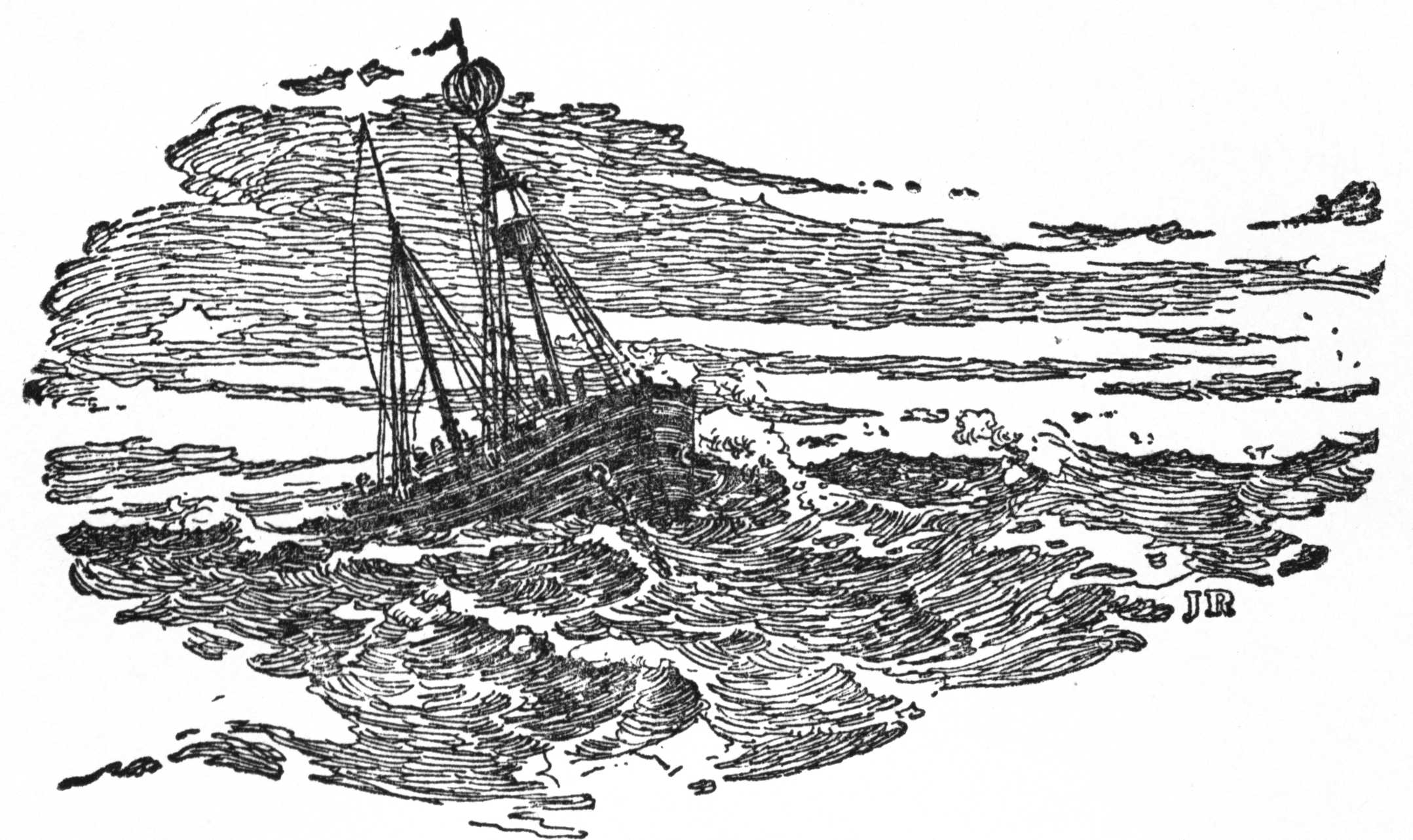
A QUESTION OF POLICY.
The Thomas Doane was at her dock in New York, and Bradley, now twenty years old and a “sure enough” second mate, was on her deck, watching the foremast hands clearing up the coal dust that begrimed everything. The schooner had carried coal for over a year now, and her latest occupation had not improved her appearance. She was old enough before, and patched and mended enough, and to turn her into a collier seemed a final humiliation. Captain Titcomb had felt it keenly, and his disgust was outspoken.
“Well, by crimustee!” he had ejaculated, when his [Pg 122]flat-footed rebellion had been smothered by another raise in salary; “I used to dream about commandin’ a Australian clipper some day or ’nother, but I never dreamed that I’d come to be skipper of a coal-hod, and a second-hand, rusted out coal-hod, at that. Blessed if it ain’t enough to make the old man—dad, I mean—turn over in his grave! Come on, Brad; let’s go to the theatre. I want to forgit it.”
His self-respect compelled him to scrub and scour more than ever, and his crews earned their wages. However, coal carrying seemed to be profitable, and Williams Brothers kept the old schooner at it, winter and summer.
And Bradley was second mate. The promotion had been gradual, from “roustabout and cabin boy” to green hand and then able seaman, and, at the beginning of his third year, to the coveted officer’s position. He had studied his profession with the care he gave to anything that particularly interested him. Captain Titcomb was giving him lessons in navigation, for, as the Captain said, “You ain’t goin’ to make the mistake I made, Brad, and stick to shallow water all your life. I learned to lay out a course and take a reck’nin’ years ago, and, though I ain’t made much use of my learnin’, I hope to see you on a steamer’s bridge one of these days; not runnin’ a floatin’ fire-shovel like this derelict;” by which collection of pet names he meant the Thomas Doane.
The Captain had another project in his mind, a sort of secret hobby that he hinted at every little while, but never told. These hints usually followed a particularly [Pg 123]disagreeable trip, or when the rickety Thomas Doane behaved even more like a cantankerous old maid than was her wont. Then, when he and Bradley were alone, the Captain would wake from a day-dream to say:
“Brad, I git more and more sick of this bein’ somebody else’s errand boy every minute. Some of these days I’m goin’ to take a whack at somethin’ diff’rent, and I have a notion what ’twill be, too. I guess likely I may ask you to come in with me. I b’lieve it’s a good notion. Tell you ’bout it some day.”
But he never did.
Bradley had grown tall and broad during his term of cruising. He had learned self-reliance, and his voice had a masterful ring. When he went back to Orham nowadays the “old maids” took special delight in having him escort them to church, and Miss Tempy’s eyes during the sermon were more often fixed upon him than upon the minister. The money that he sent the sisters amounted to something now, and he had an account in the savings bank.
Now, as he stood by the rail, with his hands in his pockets, he heard a step on the wharf behind him and turned to see Captain Titcomb jump from the stringpiece, catch the shroud and swing aboard. The Captain’s usually good-natured face had a scowl on it, and he was plainly not happy.
Bradley touched his cap. “How are things going up at the office?” he asked.
“Plumb to the devil,” was the short reply. Then, glancing up at the young man’s face and looking hurriedly [Pg 124]away again, he added, “Come aft; I want to talk to you.”
Seated in the dingy cabin, the Captain took a cigar from his pocket, bit off the end with a jerk and smoked in great puffs. Bradley waited for him to speak; the skipper’s ill-humor and obvious discontent had come upon him the afternoon of the day the Thomas Doane reached port and had grown steadily worse. Each morning Captain Titcomb had spent at the office of Williams Brothers, and when he returned to the schooner he had done little but smoke, scowl and pace the deck. The second mate was worried, but he asked no questions.
“Brad,” said the Captain, looking at the shabby carpet on the cabin floor, “we’re goin’ to have a new mate.”
Bradley was surprised. “Is Mr. Bailey going to leave?” he asked. The old first mate had been as much a part of the Thomas Doane as her mainmast.
“They’ve given him the Arrow—the new schooner. He’s goin’ to run her.”
“Why, why! Cap’n Ezra! I thought she was promised to you.”
“I thought so, too, but I missed my reck’nin’, it seems. Williams—he ain’t ha’f the man his brother was—he wants me to wait till the other one—the four-master—’s off the ways. Then I can have her—if I want her.”
“But she won’t be ready for six months, though I guess from what I hear she’ll be worth waiting for. Who’ll have the old Doane then?”
[Pg 125]
Captain Titcomb crossed his legs, but didn’t answer. Instead he asked: “Brad, how would you like to sail under Bailey? You and him got ’long first rate. I wouldn’t wonder if I could git you the second mate’s berth on the Arrow. She’s bran-new and clean; not like this hen-coop,” and he kicked a stateroom door with emphasis.
Bradley did not hesitate. “I guess if you can stand the hen-coop, I can,” he said, decisively. “I’d rather wait with you, thank you.”
“I don’t know’s you’d better. Look here,” and for the first time the Captain raised his eyes. “You know I wouldn’t try to influence you if ’twan’t for your own good. I honestly think ’twould be better for you if you sailed on the Arrow.”
“But why?”
“Oh! because. Bailey’s a good man and an A1 sailor.”
“He isn’t half the sailor you are; nor half the man, either.”
“Much obliged. I’ll stand for the sailor part, but I ain’t so sure about the rest. Brad, sometimes I wish I hadn’t stuck so close to ‘owners’ orders’ and had took a few observations on my own hook. Maybe then—— But it’s hard for an old dog to learn new tricks. I s’pose I’m a fool to worry. Money’s ’bout all there is in this world, ain’t it?”
“A good many folks seem to think it is.”
“And other folks don’t think any the less of ’em for it. Well, I’ve laid my course and I’ll stick to it till all’s blue. Brad, will you, as a favor to [Pg 126]me, chuck up your berth here and ship ’board the Arrow?”
“Cap’n Ez, if you want me to quit this packet, you’ll have to heave me overboard; that’s all.”
The skipper looked at the clear eyes and the firm jaw of the young six-footer opposite.
“That goes, does it?” he asked.
“That goes. Cap’n Ez, you’ve been the best friend I’ve ever had, except the old maids, and—maybe, one more. I don’t want you to think I’m not ambitious, because I am. I’m just as anxious to make something of myself as you can be to have me, but I’ve made up my mind, and, for the present, anyway, while you sail a vessel, I sail with you—unless you really order me to quit.”
The older man hesitated. “Well,” he said, after two or three puffs at the cigar, “I ought to order it, p’raps, but I’ll be hanged if I can. Brad Nickerson, I think as much of you as I would of a son, and your good opinion’s wuth—I don’t b’lieve you know how much it’s wuth to me. But—shake hands, will you?”
Puzzled and troubled, Bradley extended his hand, and the Captain clasped it firmly in his own. For a moment it seemed that he was about to say something more, but he did not. Giving the second mate’s hand a squeeze, he dropped it, and settled back in his chair, smoking and, apparently, thinking hard. As he thought, his lips tightened and the scowl settled more firmly between his brows. Five minutes of silence, and then the skipper threw the half-finished cigar into a corner and rose to his feet. His tone was [Pg 127]sharp, and there was no trace of the feeling so recently manifested.
“We sail to-morrer mornin’,” he said, stepping to the companion ladder. “The new first mate’ll be here to-night. His name’s Burke.”
Bradley did not move. “Just a minute, Cap’n Ez,” he faltered. “You—you—I know it’s none of my business, but—— Well, you understand, I guess. You’re in trouble—anybody can see that. Won’t you let me help you out?”
The Captain paused with his foot on the ladder. “My troubles are my own,” he answered, without looking back. “You be thankful you ain’t got any. And here!” the tone was almost savage; “you take my advice and obey orders and don’t ask questions.”
He went on deck immediately and, after a moment, Bradley followed him. The rebuff was so unexpected and so undeserved, the circumstances considered, that it hurt the young man keenly. His pride was touched, and he made up his mind that Captain Titcomb should have no further cause for complaint, so far as interference by his second officer was concerned. As for the Captain, he kept to himself and said little to anyone during the afternoon.
The new first mate came on board that evening. He was a thick-set, heavy man, who talked a great deal, swore profusely and laughed loudly at his own jokes. He seemed to know his business and, as the Captain would have said, “caught hold” at once.
They sailed the next morning, and, by the time the tug left them, Bradley fancied that he noticed a difference [Pg 128]in the state of affairs aboard the schooner. The usual rigid discipline seemed to be lacking. There was no rebellion or sign of mutiny, but merely a general shiftlessness that Mr. Burke did not seem to notice. Strange to say, Captain Titcomb did not notice it, either, or, if he did, said nothing. Bradley did not interfere; he had not forgotten the advice to “obey orders and ask no questions.”
There was a good wind and a smooth sea, and the Captain drove the Thomas Doane for all she was worth. By the afternoon of the following day they were in Vineyard Sound. Bradley’s suspicions had, by this time, come to be almost certainties. For two or three sailors to show signs of drunkenness on the first morning out of port was nothing strange, but to have those symptoms more pronounced the evening of the second day was proof that there were bottles in the fo’castle. But Captain Titcomb, usually the first to scent the presence of these abominations and to punish their owners, now, apparently, was unaware of their presence. And the first mate, too, either did not see or did not care.
Bradley was standing by the fo’castle just at dusk that evening when a sailor bumped violently into him in passing. The second mate spoke sharply to the offender, and the answer he received was impudent and surly.
“Here, you!” exclaimed Bradley, seizing the man by the shoulder and whirling him violently around. “Do you know who you’re talking to? Speak to me again like that and I’ll break you in two.”
[Pg 129]
The man—he was a new hand—mumbled a reply to the effect that he “hadn’t meant to say nothin’.”
“Well, don’t say it again. Stand up. You’re drunk. Now, where did you get your liquor?”
“Ain’t got none, sir.”
“You’re a liar. Stand up, or you’ll lie down for a good while. Anybody with a nose could smell rum if you passed a mile to wind’ard. Where did you get it?”
The sailor began a further protestation, but Bradley choked it off and shook him savagely. The first mate, hearing the scuffle, came hurrying up.
“What’s the row, Mr. Nickerson?” he asked.
“This man’s drunk, and I want to know where the rum came from.”
Mr. Burke scowled fiercely. “Look here!” he shouted, “is that so? Are you drunk?”
“No, sir.”
“You’re mighty close to it. Why——,” and here the first mate swore steadily for a full minute. “Do you know what I’d do to a man that brought rum aboard a vessel of mine? I’d use his blankety-blanked hide for a spare tops’l and feed the rest of his carcass to the dogfish. Git out of here, and remember I’m watchin’ you sharp.”
He gave the fellow a kick that sent him flying, and, turning to Bradley, said in a confidential whisper: “Ain’t it queer how a shore drunk’ll stick to a man? I’ve seen ’em come aboard so full that they stayed so for a week afterwards.”
“I think they’ve got the liquor down for’ard here.”
[Pg 130]
“I guess not. If I thought so I’d kill the whole”—half dozen descriptive adjectives—“lot. They can’t play with me, blank, blank ’em!”
But, in spite of Mr. Burke’s fierceness, Bradley wasn’t satisfied. He believed that if the first mate had let him alone he would have found the liquor. However, he thought, if neither the skipper nor Mr. Burke cared it was none of his business. But he was uneasy, nevertheless.
By nine o’clock the signs of drunkenness were so plain that even the first mate had to admit the fact. Only a very few of the men were strictly sober. One of these was the big Swede, Swensen. Oddly enough, this man had stuck to Captain Titcomb’s schooner every voyage since the skipper had knocked the fight out of him. The novelty of a good sound thrashing was, apparently, just what the giant had needed, and for the man who had “licked” him, he entertained tremendous respect and almost love.
“Cap’n Ez, he knock the tar out of me,” said Swensen. “He stand no foolin’. He’s a man. Hey?”
He liked Bradley, too, and had presented the latter with a miniature model of a three-masted schooner in a bottle, beautifully done, and such “puttering” work that it was a wonder how his big, clumsy fingers could have made it.
But though Swensen and the Portuguese cook and one or two more were sober, the rest of the crew were not. Mr. Burke confessed as much to Bradley.
“They’ve got rum with ’em, all right,” he whispered. [Pg 131]“But we’ll be to Boston to-morrer, and there ain’t no use startin’ a row till daylight. Then some of these smart Alecs’ll find out who’s who in a hurry, or my fist don’t weigh what it used to. Better not say nothin’ to the skipper,” he added. “No use to worry him.”
It was odd advice from a mate, but, as Bradley could see, to his astonishment, there was no need of telling Captain Titcomb. It was plain enough that the latter knew his crew’s condition and deliberately ignored it. Men stumbled past him and he looked the other way. Simple orders were bungled and he did not reprove. Only once that evening did his wrath blaze out in the old manner. A sailor was ordered by him to do something and, instead of the dutiful “Aye, aye, sir,” he replied with a muttered curse.
The next instant Captain Ezra’s fist was between his eyes and he fell, to be jerked to his feet again and back to the rail with the skipper’s hand twisted in his shirt collar.
“Damn you!” said the Captain, between his teeth. “I’ll—I swear I’ll——”
Mr. Burke came running and whispered eagerly in his commander’s ear. Captain Titcomb’s arm straightened and the sailor was thrown across the deck.
“Go for’ard!” roared the skipper, “and if you want to live, you keep out of my sight. I can’t help it, Burke; I’ve got some self-respect left yit.”
That was all, and Bradley wondered.
[Pg 132]
Under such circumstances accidents were bound to occur. But the one that did occur was serious. Bradley was below when it happened. He usually took the first watch, but to-night Captain Titcomb said he would take it, and Mr. Burke would stay up with him for awhile. So the second mate “turned in.” He was awakened by a racket on deck, and the sound of voices and footsteps on the companion ladder. Opening his stateroom door he saw four men descending the ladder carrying a fifth in their arms.
“What’s the matter?” asked Bradley. “Who’s hurt?”
“It’s the skipper,” replied one of the men, in a frightened voice. “He fell and hurt his head. He——”
Bradley sprang into the cabin and saw Captain Titcomb, unconscious, and with the blood running from an ugly cut on his forehead.
“For God’s sake——” he began, but was interrupted by Burke, who, with a very white face, was descending the ladder.
“Hush up!” commanded the first mate. “Don’t make a row. ’Tain’t nothin’ serious, I guess. Jest cussed foolishness. Put him on the locker there, you.”
This is what had happened: The schooner was passing out of the Sound and, as the night was black and hazy, they were using the lead frequently. The Thomas Doane had a high after-deck and to reach the waist one must descend a five-foot ladder. A sailor, not too sober, had thrown the lead and, in [Pg 133]passing aft with the line, had fouled it at the ladder. Captain Titcomb, losing his temper at the man’s clumsiness, had run toward him, tripped in the line and pitched head-first over the fellow’s shoulder to the main deck. The sailor’s body had broken the fall, somewhat, and the skull was not fractured, but it was bad enough.
They bathed and bandaged the bleeding forehead, hurriedly pulled off the Captain’s clothes and got him into his berth. He came to himself a little as they did so, but was too weak to talk and did not seem to realize what was going on. Mr. Burke was the most agitated man aboard. He swore steadily, and cursed the foremast hand who was responsible, beginning with his remote ancestors and ending with any grand-children that he might have later on.
“This is a devil of a mess!” he growled. “Just now, too. I’d have rather broke my own neck twice over. Nickerson, you’ll have to stay below here and look after him. I’ve got to be on deck.”
The cook, who had helped bring the Captain into the cabin, lingered after the first mate had gone. Bradley questioned him about the accident.
“Thoma, he done it,” said the cook. “The line, she git mess up by the——”
“He was drunk,” broke in Bradley. “He’s been drunk all the afternoon. Isn’t that so”?
The cook looked hastily at the ladder, then at the Captain. Then, nodding emphatically, he whispered: “Ya-as, sir. They most all drunk. I never seen so much drink on schooner; not on Cap’n Titcomb’s [Pg 134]schooner, anyway, and I sail with him for five year.”
Together they watched the Captain as the hours passed. He spoke now and then and seemed better, but, for the most part, he slept. Bradley changed the bandages on his forehead, and gave him stimulants when he woke. Mr. Burke came below every little while to make inquiries. He was very nervous.
“He’s all right,” he said, as he was leaving for the third time. “It knocked him silly, but his skull’s whole, near’s I can find out, and he’ll be feelin’ good in a day or two. You turn in, Mr. Nickerson. The doctor here’ll look out for the skipper.”
But Bradley would not go to bed. He was worried about the Captain, and even more worried about the schooner. He did not like Mr. Burke, and he was by no means sure—judging by what he had seen—that the mate knew how to handle a crew. About two o’clock he decided to go on deck.
It was a black night, with clouds covering the sky and a haze low down on the horizon. It was not thick enough for the fog-horns to be sounding, but the shore was invisible. There was almost a fair wind, and the schooner, heeled well over, was pushing through the quiet sea in good shape.
Bradley leaned on the rail and looked over the water toward where the shore should be. As he stood there the haze blew aside for a moment and he saw, not more than two miles away and ahead of the schooner, the twinkle of a light. Then it disappeared again. He walked aft. One of the new [Pg 135]hands was at the wheel, and there was a distinct smell of rum in that vicinity.
“Where’s the mate?” asked Bradley.
“For’ard, sir.”
“Who gave you that course?”
“Mr. Burke, sir.”
Burke was standing by the foreshrouds, looking over the side. He started when Bradley touched his arm.
“Excuse me, Mr. Burke,” said the second mate. “Where are we?”
“Turned the Rip an hour or so ago.” Burke’s tone was distinctly unpleasant. “What are you doin’ here? Thought I told you to stay with the skipper or turn in.”
“I couldn’t sleep, so I came on deck a minute. Isn’t she pretty close in? I thought I saw the Skakit Light just now.”
“Saw nothin’! Skakit Light’s away off yonder. Water enough here to float a Cunarder. What’s the matter with you? ’Fraid I ain’t on to my job? When I want your help I’ll ask you for it; I’ve sailed these waters when you was a kid.”
“Well, I didn’t mean to——”
“Then shut up! You go below and ’tend to the skipper.”
Bradley bit his lip and turned away. If Burke was right he had no business to interfere. If he wasn’t right the Thomas Doane was shaving the shoals altogether too close. He went below, found Captain Titcomb sleeping quietly and, a little later [Pg 136]came on deck again to lean on the rail amidships, and, once more, stare at the foggy darkness.
A big figure loomed close beside him. It was Swensen, and he obviously wanted to speak.
“Well, Swensen,” said Bradley, “what is it?”
The Swede leaned forward and, shading his mouth with his hand, whispered, hoarsely: “Mr. Neekerson, you know ’bout the fust mate? He all right? What?”
Bradley had been brought up to discourage familiarity with men before the mast.
“What are you talking about?” he asked, sharply.
“Nawthin’, sir. Only, he know this course? Ah see Skakit Light twice yust now, and only a mile’n ’half off. That not ’nough—not here.”
“Are you sure you saw it?”
“Yas, sir.”
Bradley turned away. He hated to risk another snub from the mate, and he fully realized the danger of interfering with a superior officer, but Captain Titcomb was not in command, and here was Swensen’s testimony to back his own that the schooner was running too close to the dangerous Cape Cod beaches. The course she was on was taking her still closer in and the fog was growing thicker.
This time Burke was standing by the man at the wheel. He swore when the second mate approached, and snarled: “Well, what’s the matter now?”
“Mr. Burke, are you sure that wasn’t the Skakit Light I saw? Swensen says he’s seen it twice, and [Pg 137]not more than a mile and a half away. If that’s so, we’re running into shoal water. Hadn’t I better try soundings?”
In a blast of profanity, Burke consigned both Bradley and Swensen to the lowest level in the brimstone future.
“Go below!” he yelled. “Go below and stay below, or I’ll find out why.” Then, as if he realized that he was showing too much temper, he added, in a milder tone: “It’s all right, Nickerson. We’re three mile off shore, and Skakit’s astern of us. Go below; ain’t the skipper enough to make me nervous without you shovin’ your oar in?”
And then from somewhere forward came a frightened yell, and the sound of some one running. Swensen came bounding up the ladder from the main deck.
“Breakers ahead!” he shouted. “Breakers ahead! Put her over! Keep her off, quick!”
Burke’s face went white and then crimson.
“Breakers be hanged!” he cried. “Keep her as she is!”
But the Swede was dancing up and down. There were confused cries forward, and other men came running.
“Starboard your helm!” bellowed Swensen. “Put her over! You can hear ’em! Listen!”
He held up both hands to enforce silence, and for a moment every soul on deck stood listening. The waves clucked along the schooner’s side, the wind sang in the rigging, the masts creaked. And then another sound grew, as it were, into Bradley’s ears. [Pg 138]A low, steady murmur, now rising, now sinking. He sprang toward the wheel.
“Put her over!” he shouted. “There are breakers. Starboard your helm! Starboard!”
“Keep her as she is!” bellowed Burke, bending forward with his fists clenched. “Don’t turn a spoke!”
“But, for heaven’s sake, Mr. Burke! Are you crazy? We’ll be ashore in ten minutes!”
The first mate’s eyes shone in the dim light. His teeth showed white between his opened lips.
“By the livin’ God A’mighty!” he gasped, chokingly, “I’ll show you who’s runnin’ this craft. Keep her as she is!”
Bradley forgot his duty as second officer, forgot that half the crew were watching him, forgot everything except that his best friend lay helpless in a berth below, while his schooner was being run into certain destruction. He leaped to the wheel and the mate leaped to meet him.
Bradley stooped as he sprang forward, and it was lucky for him that he did so. Burke’s fist whizzed past his ear, and the next moment the two mates were clinched and struggling in the little space between the deck-house and the after-rail. Bradley did not attempt to strike; his sole idea was to get to the wheel. Therefore, he merely warded off the furious blows aimed at his head and struggled silently. But the one-sided fight could not last long. Burke gradually backed his opponent to the rail, and then, without turning his head, he shouted:
[Pg 139]
“Thoma, pass me a handspike. Lively, you——”
The man Thoma—he was half drunk and naturally stupid—obediently placed the handspike in the first mate’s hand.
“Now then!” panted Burke, “by——”
And then Bradley struck—a half-arm upper cut—right under the ugly, protruding chin. Burke’s teeth clicked together; he seemed to rise from the deck and fell backward, at full length, almost under the feet of Swensen. Bradley shoved the sailor from the wheel and gave the latter a whirl. The schooner shivered, turned slowly, the booms swept across her deck, and she heeled over on the other tack, with her nose pointing well away from the beach and toward the open sea.
Burke lay still for an instant, spread-eagled on the deck; then he rose to his feet. Bradley stooped and picked up the handspike. The first mate glared at the man who had knocked him down. Also he looked respectfully at the handspike. But if he had been angry before he was crazy now.
“You mutineer!” he shouted, with an oath between every word; “just wait a minute! I’ll show you how I treat mutineers.”
He ran to the cabin companion and jumped down. Bradley, trying to appear calm before the crew, glanced at the sails and then out over the side. Suddenly, so close that their ear-drums throbbed with it, there boomed out of the dark a thuttering, shaking roar, that swelled to a shriek and died away—the voice of the great steam foghorn of the Skakit Light.
[Pg 140]
“Lawd Gawd!” muttered Swensen. “Ve vos that near!”
Burke came bounding up the companion ladder. Something bright and shiny gleamed in his hand.
“Now then!” he cried, “we’ll see what——”
But two mammoth paws clasped his wrists, the hand with the revolver was turned backward till the barrel pointed at the end of the gaff, and big Swensen’s voice said, calmly:
“Yah, I guess not. Yust vait a minute, Mr. Burke. Mr. Neekerson, vat I do vit him, hey?”
It was mutiny, of course, mutiny pure and simple, but Bradley had gone too far to back out now.
“Take him below and lock him in his stateroom,” he said. “Tell the doctor to see that he doesn’t break out. Then come back to me. Yes, you may give me the revolver.”
Swensen twisted the pistol from the first mate’s hand and then, picking him up as he would a ten-year-old boy, started for the cabin. Burke struggled furiously and swore like a wild man, but he couldn’t break away. The shouts grew fainter and then were muffled almost entirely by the closing of the stateroom door.
Bradley put the revolver in his pocket.
“Now, then, men,” he said; “I’m skipper of this schooner for the rest of this voyage. Is there anybody here that doesn’t understand it? No? All right. O’Leary, go for’ard on lookout. Peterson, heave the lead. Swensen,” as the big Swede came up the ladder, “take the wheel and keep her as she is.”
[Pg 141]
All that morning, until daybreak sent the fog rolling to the north in tumbled clouds, the lead was going, and the crew were busy on the Thomas Doane. Bradley stood close at Swensen’s elbow and edged her out, feeling his way with the lead, and listening to the calls of the foghorns. The schooner’s own foot-power horn was kept tooting, and, by and by, as they got out into the ship channel, it was answered by other horns and bells, some close aboard, some distant.
But by breakfast time it was clear and fine and, before a cracking wind, the schooner walked along as if she realized her escape and was trying to show her gratitude. Through that day Bradley stood by the wheel, only leaving to eat a mouthful and to inquire after Captain Titcomb, who was much improved and beginning to ask questions. And just at dusk the gilt dome of the Boston State House shone dimly in the dying light, and the Thomas Doane, resting from her labors, moved easily behind the tug up to her dock. She had made splendid time, but Bradley was far from happy. There was trouble coming, and he knew it.
He sent word to the cook, ordering the latter to unlock the stateroom door and release the imprisoned first mate. A minute later the cook came on deck, his eyes shining with excitement.
“Mr. Burke, he go right into the skipper’s room and shut the door,” whispered the Portuguese. “And now they talk, talk, talk. And Mr. Burke he swear all the time.”
[Pg 142]
When the first mate appeared he did not speak to any one, but jumped to the wharf and hurried away. A doctor was sent for and Captain Titcomb’s wound was dressed. The physician said the injury was not serious. There was no concussion of the brain, and the patient would be all right in a couple of days.
Bradley didn’t sleep much that night. Next morning the Captain sent for him. When the second mate entered the stateroom he found the skipper sitting on the edge of the berth with a big bandage on his head, but looking very bright and like himself.
He seemed oddly embarrassed when Bradley came in. For a moment or two he did not speak. The second mate, who had expected a scorching rebuke and was prepared to meet it, was surprised at the mildness of his first remark.
“Now then, Brad,” said Captain Titcomb, “set down. What’s this about you and the mate? Tell the whole yarn, first and last.”
So Bradley told it, just as it happened—the crew’s behavior, his suspicions, the sighting of the Light and what followed.
“Humph!” Captain Ezra nodded. “Yup, that’s about what Burke said. Now, Brad, I s’pose you knew that Mr. Burke was your superior officer, and that what he said was law for you, didn’t you?”
“Yes, sir; but——”
“Never mind the ‘buts’ now. Taking command by force is serious—mighty serious.”
“I did what I thought was right, Cap’n Ez—what [Pg 143]I b’lieved you’d think was right. The schooner would have been aground in ten minutes if I hadn’t.”
“Well, s’pose she would. There’d have been no lives lost. Plenty of boats and a smooth sea.”
“But Mr. Burke knew she was headed for the shoals. He must have known it. The owners would have——”
“What do you know about the owners and their affairs?”
“But the schooner?”
“She’s a hulk, that’s all—and insured.”
The reply was an odd one, but the tone in which it was made was odder still. Strange things had happened during the past week; Captain Titcomb’s silent ill-humor, the interview the day before leaving New York, the sudden change of mates, the skipper’s studied indifference to the demoralization among the crew, Burke’s frantic determination to keep on the course set by him even after the proximity to the shoals had been proven beyond a doubt—all these were fingers pointing in one direction. Bradley, however, had not looked in that direction. But now the last wisp of fog blew away and he saw clearly.
“Cap’n Ez!” he gasped. “Cap’n Ez! Were you going to wreck her on purpose?”
The Captain shifted in his seat, but did not look at his companion.
“Orders are orders,” he said. “Mr. Burke was your skipper—with me out of the way—and you ought to have minded him, just as I should my owners.”
[Pg 144]
“Wreck a vessel for her insurance!” groaned Bradley. “I didn’t think you’d do it, Cap’n Ez. I didn’t think you’d do it!”
The dismay, the grieved disappointment and horror in his friend’s tone, seemed to hurt Captain Titcomb sorely. He glanced at Bradley, and then looked away again.
“I’ve heard all sorts of yarns about you in Orham,” went on Bradley. “They say you’re too smart and that you’ll bear watching and all that. I’ve called those that said it liars, and I’ve stood by you through thick and thin. But now—— What do you think they’d say if they knew of this? What do you think Miss Prissy and Miss Tempy would say? Why, they b’lieve you’re the best——”
The Captain broke in testily. “Never mind all that,” he said. “As for Squealer Wixon and Jabe Bailey’s talk, I don’t care a snap. And the old maids ain’t exactly up to date in this world’s way of lookin’ at things. S’pose the old Doanewas booked for thunderation by the shoal route—what of it? Mind, I only say s’pose. Better to go that way on a smooth night, with all hands saved, than to bust up in a squall and drown us all, as was likely to happen any minute. Nobody loses but the insurance folks, and they’d lose quick enough, anyhow. Why, it’s done a hundred times a year all along this coast. ’Member when the Bay Queen piled up on the beach off Setuckit last summer? Everybody was as sartin as could be that ’twas done a-purpose, but you couldn’t prove nothin’. So with the Rhoda Horton and the Banner, and any [Pg 145]quantity more. S’pose—mind, I’m only s’posin’—that you’d got orders from your owners—orders, you understand—to do somethin’ you didn’t like? S’pose you’d always stuck to owners’ orders a good deal closer’n you had to the Bible? You talk a lot—so do other folks—but what would you have done?”
“I’d have been honest, and said ‘No.’”
“Humph! Well, I guess you would. You’re the nearest thing to an honest man that I’ve run across yit. Honesty is the best policy, they say. But was it honesty that made ha’f the millionaires? Are Williams Brothers rich because they’ve always been honest? Josh Bangs is in the poorhouse, and he’s the most honest critter in Orham, while his brother Sol is chairman of school committee, deacon in the church, has money in the bank, and would skin the eye-teeth out of a Down-East horse jockey. Why——”
“Cap’n Ez,” interrupted Bradley, “stop talkin’ that way. You don’t believe a word of it. I know you too well. The trouble with you is that everlasting ‘owners’ orders.’ I almost think that that accident last night was, as Miss Tempy would say, ‘sent’ to keep you from doing something you’d be sorry for all the rest of your days.”
The Captain looked at the speaker oddly. “Then you cal’late,” he said, “that I ought to thank God A’mighty and a tipsy fo-mast hand for savin’ what the book folks would call my honor? That’s all right; only wait till Williams Brothers send me their thanks on a clean plate, with gilt doodads ’round the edges. Williams Brothers and your particular friend, Mr. [Pg 146]Burke, ain’t been heard from yet, my son. Well, Brad, I s’pose you’ll be packin’ up to-night, anyway. An honest man, ’cordin’ to your log, ain’t needed on the Thomas Doane. I told you you ought to ship ’board the Arrow.”
“I didn’t ship on the Arrow because I’d rather be with you than anybody else on the earth. I wouldn’t sail with a rascal that would wreck a schooner, and I don’t believe—I know you’re not really a rascal. Oh, can’t you see? It isn’t myself I’m thinking about—it’s you—you!”
The Captain took his knife from his pocket and whittled a corner off the cabin table before replying. Then he said, slowly:
“Much obliged, Brad. But what do you s’pose Williams Brothers will want me to do when they give me orders for this liner’s next trip?”
“I don’t know.”
“S’pose those orders are the same as the last; what then?”
“Then say ‘No,’ like an honest man.”
Captain Ezra gave a short laugh. “Honesty, my son, is like di’monds, sometimes—it’s pretty, but it comes high. You turn in. I’m goin’ to set up a while and smoke.”
Bradley reluctantly went to bed, but when he awoke, several hours later, he heard the Captain stirring in his stateroom.
Next morning the skipper received a telegram.
“Williams Brothers, havin’ heard from friend Burke, want to have a little chat with the commander [Pg 147]of the clipper Thomas Doane,” he remarked to Bradley. “That doctor squilgeein’ my maintop with his physic stuff has made me feel A1 again. I’m goin’ to New York to-night on the Fall River Line.”
And he went, leaving Mr. Burke in command of the schooner, a state of affairs not too delightful to Bradley. But the Captain’s stay was a short one. He was back on board early the second morning, and called the second mate into the cabin.
“Well, Brad,” he said, “I got my orders.”
“Yes, sir,” anxiously. “What were they?”
“’Bout the same as the last.”
“And—and—what did you say?”
Captain Titcomb leaned over and deliberately knocked his cigar ash into the centre of a carpet flower. Then he looked up quickly and answered, with a quizzical smile:
“If you want to know, I told Williams Brothers to go to hell, and, honesty bein’ the best policy, you and me’s out of a job!”
[Pg 148]
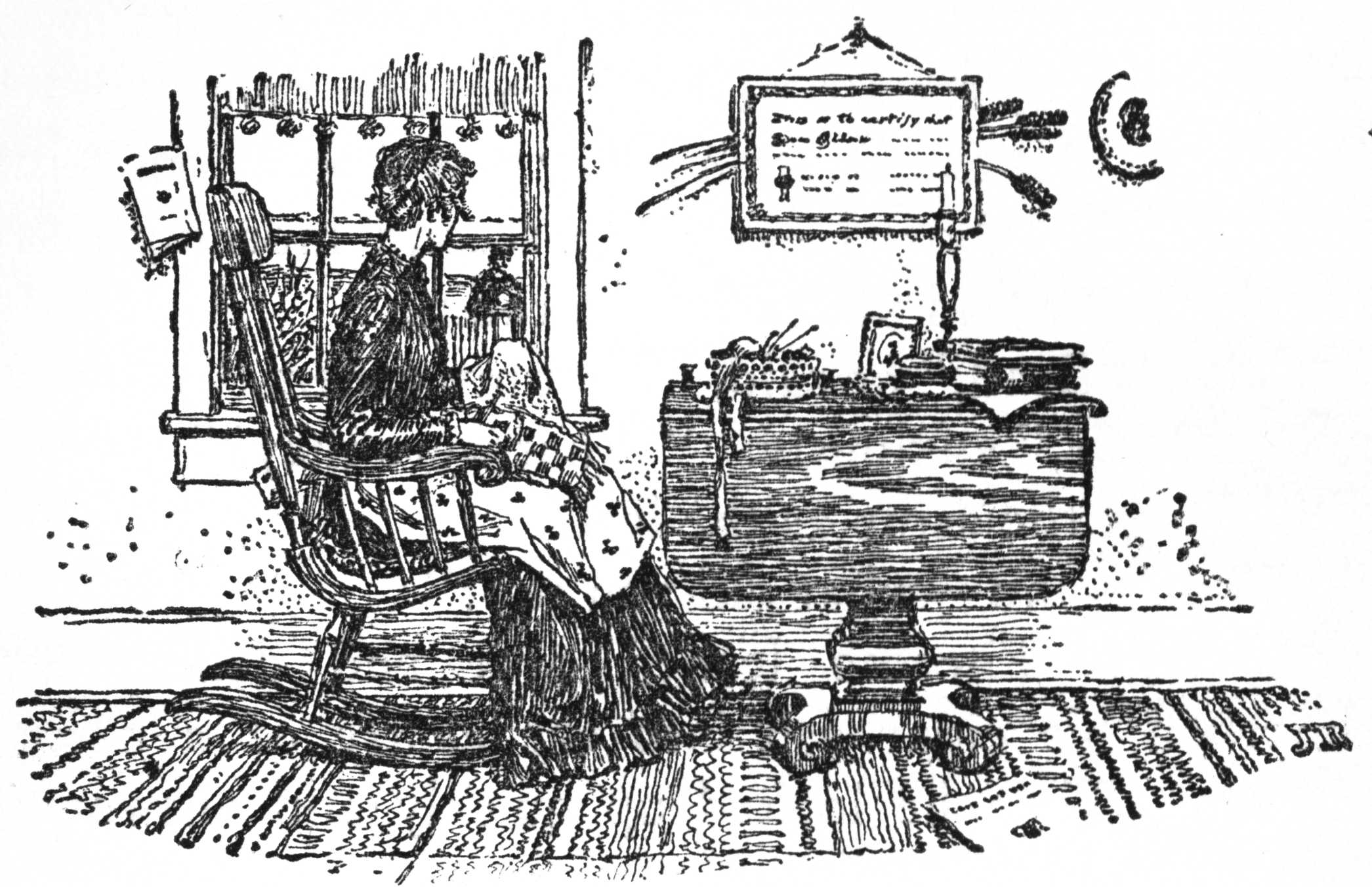
HOME AGAIN.
“Brad,” asked Captain Titcomb, creasing the morning paper into folds and tossing it on the bed, “what are you plannin’ to do, now that our late lamented owners have committed financial suicide by cuttin’ you off in the flower of your youth, so to speak?”
It was late the morning of the third day after the Captain’s return from his flying visit to New York. They had said good-bye to the Thomas Doane the previous forenoon, and were now occupying a room in the United States Hotel. Bradley had rather expected [Pg 149]to leave at once for Orham, but the Captain asked him to wait a little while. “If we go home now,” he said, “we’ll have to answer four million questions, and my head’s a little leaky yet from tryin’ to stave in the deck with it. I don’t believe I could answer more’n three million and a ha’f without strainin’ my intellect. I can sympathize with Bluey Batcheldor. Bluey works like blazes most of the time, keepin’ a chair from slippin’ its moorin’s, and ’bout once a year he has to come up to Boston on a vacation. What I need is a vacation. We’ll hang ’round here for a spell, if you don’t care. Besides, I want to think.”
He had barely alluded to the momentous happenings of the recent voyage, nor had he given any details of the circumstances leading up to them. Bradley, for his part, had asked no questions. It was sufficient for him to know that his best friend had been saved from committing what, in his eyes, was a crime.
“Well,” repeated Captain Titcomb, “what are you plannin’ to do?”
Bradley, who was sitting by the window, looking down upon the hats of the people in the narrow street, answered, slowly: “I don’t know. I’ve been waiting to find out what you intended doing.”
The Captain crossed his legs and tilted back in his chair.
“I cal’late,” he observed, “that I could walk out of this gilded palace of luxury and run afoul of another skipper’s berth inside of an hour. Not at my old wages, of course, but a pretty fair berth, all the same. [Pg 150]You see, they know me pretty well alongshore. And I wouldn’t wonder if I could hook a second mate’s place for you, at the same time. I don’t know, though,” he added, slyly, “as you’d feel safe, bein’ an honest man and ‘whiter than snow,’ as the hymn-book says, to sail along with me again. Hey?”
Bradley laughed. “I’d be willing to risk it, if you think you can stand your end,” he said.
“Well, I ain’t jest sure whether the parson is the best supercargo for a coastin’ packet, or not. He’s a sort of spare hawser in case your morals part, but the business end of the deal is a question. However, I don’t believe we’ll stop to fight that out jest now. Fact is, Brad, I’ve had a kink in my mainsheet for a consider’ble spell. I’ve been gittin sicker and sicker of jumpin’ when somebody else piped ‘All hands.’ I’ve had a notion that some day I was goin’ to cut loose, and cruise on my own hook. You know I’ve hinted at it for over a year. Now, it looks as if this was my chance, or never. Brad, how’d you like to be a wrecker?”
“A wrecker?” Bradley’s face showed his absolute astonishment.
“Oh, I don’t mean the line of wreckin’ that is makin’ your eyes stick out at this minute. Thanks to my second mate, I seem to have graduated from that, as you might say. Maybe I did right—maybe I didn’t. At present I don’t know whether to bless you or to kick you. That’s another thing to be decided on by and by. But I mean a different kind of wreckin’. Do you know Caleb Burgess, Cap’t Jerry’s cousin?”
[Pg 151]
Yes; Bradley knew him. He owned a little schooner that flitted along the Cape Cod coast, picking up floating wreckage, when it was of value, dragging for anchors, dredging for chains and iron-work lost by vessels in trouble, and doing a sort of nautical old junk business.
“Well,” went on the Captain, “Caleb’s gittin’ old, and he’d like to sell out. Most folks think he’s scratched a bare livin’ from the shoals, but I happen to know that he’s done a good deal better than that. The old man told me how much he had in the bank, and it wan’t to be sneezed at. Now, I could buy that schooner of his cheap. She isn’t much, and money would have to be spent on her, but she’d do for a start. You understand, the wreckin’ business I’d do wouldn’t be anchor-draggin’ alone. There’s money in a first-class wreckin’-plant on Cape Cod. Wrecks! Why, they pile up there three deep every winter. Now, listen a minute, while I rise to blow.”
Bradley listened, and the Captain talked. He had evidently given much thought to this proposition, and his plans were ambitious. He believed that if a capable man bought the Lizzie—that was the name of the Burgess schooner—added to her equipment, and sailed her himself, he could build up a profitable business. The salvage of cargoes of stranded schooners, and of the schooners themselves, played a large part in his plans. One or two good-sized jobs of this kind, taken on a commission basis, would bring in capital enough to warrant the purchase of a bigger [Pg 152]vessel, fitted with auxiliary power, with a diving equipment, derricks, and the like.
“Then,” said the Captain, rising and pacing up and down the room, “a man could begin to shuck his coat, and sail in. He could git some of the jobs the big city wreckin’ companies git, and there’s money in them—big money. And that would be only the beginnin’. I’m dreamin’, maybe, but why not, some day, a fleet of wreckin’ vessels, maybe a tug or two? And then for raisin’ sunk schooners—and all the rest of it.”
“But wouldn’t that take capital?”
“Sartin sure. But let me—us—prove that the profit’s there, and the capital’ll be donated, like frozen potaters at a minister’s surprise party. Oh, I’ve thought it out! Now, here!”
And again he proceeded to go over the ground, giving figures this time, showing for just how much, in his opinion, the Lizzie could be bought, and how much it would cost to fit her up for the preliminary work. He said that he believed himself capable of carrying on the business, as he had spent two years in wrecking when he was Bradley’s age, and so on.
“Now, Brad,” he concluded, “what do you think of it?”
“I believe that you could do it, Cap’n Ez.”
“No; I couldn’t do it, either—not alone. I’m too much like the dinner the passenger on the steam-boat told about—I’m good, but I need somethin’ to keep me down. I’m too much of a born gambler; take big risks for the fun of it. But you and me could do it. Oh, I’ve watched you, Brad, the way the [Pg 153]youngest boy watched the last piece of cake! You’re cool-headed, and you look to see whether there’s a rope tied to the anchor ’fore you heave it overboard. With you to plan and figure, and me to whoop her up, why—— Well, I’ve made mistakes before now, but I can’t see any reason why we shouldn’t, in two or three years, both be makin’ more money than Williams Brothers would ever have paid us. Now, this is how you can come in, if you want to.”
The Captain’s plan for Bradley’s co-operation was, briefly stated, just this. He (Captain Titcomb) would provide the money for buying the Lizzie and whatever else was immediately necessary. Bradley would contribute his savings to the pile. They were to be partners on equal shares, but Bradley was to pay, from his share of whatever profits might come from time to time, the amount necessary to make his investment the equal of the Captain’s. No new move was to be made without the consent of both partners. It was a very generous offer, and Bradley said so.
“No generosity about it,” protested Captain Ezra. “I’m lookin’ out for myself, and I need you, as the tipsy man said to the lamp-post. I tell you, honest—I sha’n’t go into this thing unless you go in with me. Maybe it’s a fool notion, anyway. Well, there,” he concluded, “now that I’ve unloaded my mind, we’ll go down to the Cape this afternoon. I’ll look ’round, and you take a week to think things over in. At the ends of the week you can say ‘Yes,’ or ‘No.’”
The conversation did not end here. Bradley was, by this time, catching some of the Captain’s enthusiasm, [Pg 154]and he had a great many questions to ask. The forenoon was over by the time they had finished, and Bradley agreed to take the week to “think it over in.”
They caught the four o’clock train for Orham. On the way down Captain Titcomb said:
“Brad, if it ain’t too much of a strain on an honest man’s conscience, p’raps ’twould be a good thing for us to say nothin’ ’bout the reel reason why we left the Thomas Doane. What do you think?”
Bradley looked up quickly.
“Cap’n, you didn’t think I would say anything about it, did you?”
“No; of course I didn’t. Beg pardon, and much obliged, Brad.”
The “old maids” were washing the supper dishes when Bradley surprised them by walking into the dining-room. When the first shock was over, the sisters were the most delighted pair in Orham. They insisted on preparing a bran-new meal for their “boy,” and no amount of protestation on his part could change their minds.
“I do declare, Bradley!” said Miss Prissy, cutting slices of bread for toast; “I honestly b’lieved you saved Tempy from havin’ a conniption fit. We hadn’t got a letter from you for over a week, and she was about ready to start for Boston and swim after you. Drownin’ was the least thing she was sure had happened.”
“Don’t you b’lieve her, Bradley,” exclaimed Miss Tempy, hurrying past with the “fruit-cake” box. “She was jest as worried as I was, and only last night [Pg 155]she said if you wasn’t under Cap’n Titcomb’s care, she didn’t know as she should sleep a wink.”
They were very curious to know why Bradley had come home so unexpectedly, and when they learned that he had left the Thomas Doane and, not only that, but that the Captain also had left, they asked one question after another. Bradley simply said that the Captain had other plans, and that he couldn’t tell what they were yet. The sisters knew from experience that there was no use coaxing when their ward had made up his mind, and so changed the subject. But Miss Tempy indulged in a good deal of silent speculation as she watched him eat.
After supper they adjourned to the sitting-room. Bradley was uneasy and several times glanced at the clock. After a while he said that, if they didn’t mind, he should like to go out for an hour or so. Of course, the sisters said, they “didn’t mind,” and he put on his hat and went.
“There now!” exclaimed Miss Tempy, as the door closed. “Where do you s’pose he’s goin’? To see the Cap’n, I presume likely.”
Miss Prissy shook her head.
“I don’t know,” she answered, dubiously. “Tempy, Bradley’s a young man now, and I expect we mustn’t look to have as much of his society as we used to. I have a sneakin’ notion that, if you wanted to find him this evenin’, ’twould be a good idea to hunt up Augusty Baker.”
“Oh, dear!” sighed her sister. “That dreadful dog girl!”
[Pg 156]
Miss Prissy’s shrewd guess wasn’t far wrong. Bradley passed out of the Allen gate only to open the one of the yard adjoining. His knock at the side door apparently started a canine insurrection, for there was a tremendous barking and growling inside, and when old Mrs. Baker answered the knock the heads of Tuesday and Winfield, the only survivors of Gus’ troop of pets, protruded from either side of her skirt. Both dogs and old lady were surprised and glad to see the visitor.
“Why, Bradley Nickerson!” exclaimed Mrs. Baker. “How do you do? Come right in, won’t you? Git out! Git out, you provokin’ critters! Seems to me the older these dogs git, the worse they are. But ’Gusty thinks as much of ’em as if they was solid gold. When Peter was run over by the cars—and ’twas a mercy, ’cause he had the mange comin’ on and was a sight to behold; ’Gusty said herself he looked like a map of the South Sea Islands—she felt as bad as if ’twas a human, every bit. No; she ain’t in, jest now. It’s prayer-meetin’ night, and she thought she’d go—to save the reputation of the fam’ly, she said. She’s jest as much of an odd stick as ever. Well, I’m sorry you won’t step in and wait. Come again, won’t you? How’s Tempy’s cold? Did Cap’n Titcomb come down with you? You don’t say! Good-night.”
The Bakers attended the Baptist Church, and thither walked Bradley, his hands in his pockets and his head full of the wrecking scheme. Already the germs scattered by the Captain had begun to take effect, [Pg 157]and the proposition looked more and more attractive. It appealed to his ambition, and there was an adventurous element in it that was especially alluring. But the whole thing was such a radical departure from all his former plans for the future that he did not intend to decide offhand; a week was not too much time. He wanted to talk the mater over with Gus, for she was a good listener and was almost like a brother so far as interest in masculine affairs was concerned. He had not seen her for nearly six months, although he had been at home three times during that period. Once she had been at New Bedford on a visit, once she was ill, and the third time both she and her grandmother had gone to Boston on a Mechanics’ Fair excursion. Her letters came regularly, however, and were bright and “newsy” always.
It was nearly nine o’clock, and the fence in front of the little church was ornamented by a row of Orham’s young men, who were waiting for the meeting to come to an end. Prayer-meetings in Orham seemed to be held especially for the benefit of feminine worshippers and a few old men. The young fellows drifted around to the church just before nine o’clock, sat on the fence, and whittled and told stories. Then, as the final hymn was sung, they formed in line at either side of the vestry door, and, when the young women came out, stepped forward to “see them home.” The old people were the only objectors to this performance; the girls didn’t object at all, and the clergyman only mildly criticised. Possibly he realized that the sense of religious duty which filled the [Pg 158]vestry settees with rows of pretty faces might be considerably weakened by the absence of that other row on the fence.
Bradley joined the fence brigade and was hailed by half a dozen acquaintances, mostly old school-fellows. He heard all the news, and a lot more that might become news if it ever happened.
“Sam Hammond was down last month,” so “Hart” Sears informed him. “Talk about dudes! Say, Snuppy, wan’t he a lulla-cooler?”
“I should smile if he wan’t,” replied “Snuppy” Black. “Gold watch—and clothes! You never saw such clothes! Sam’s working for the Metropolitan Wrecking Company, and he must be getting rich. And he has a good time in New York. ’Member those yarns about the girls, Hart?”
Sears laughed and winked knowingly. “Sam’s a great feller for girls,” he observed. “He was chasin’ ’em down here, I tell you. Gus Baker was the one he chased most, but Gus can keep him guessin’; he ain’t the only one that’s been runnin’ after her—hey, Snup?” Then the whole row laughed uproariously.
Bradley, somehow, didn’t enjoy the rest of the conversation. In the first place, he didn’t relish the idea, so suddenly brought home to him, that “fellers” were running after Gus, and particularly he didn’t care to have Sam Hammond among the runners. He had met Sam once or twice in New York; a big chap he was, handsome and well dressed, in a rather loud fashion, and with a boastful knowledge of life about town. Bradley was not a prig, but saloons and after-theatre [Pg 159]suppers had little attraction for him, even if his salary had been large enough to pay the bills. He had wondered, idly, how Sam could afford the “fun” he was always describing.
As for Gus, Bradley’s feeling for her was not in the least sentimental, but now there was a new and odd sensation of jealousy. Evidently she was considered attractive by others, and it seemed that he was not the only young man who had a share in her thoughts. She had not written him about Hammond, and he didn’t like that.
The melodeon in the vestry struck up “God be with you till me meet again,” and the loungers on the fence began to move over toward the door. He went with them, standing a little way back from the entrance. The final verse of the hymn died away in deaf Mrs. Piper’s tremulous falsetto. Then there was a hush as the benediction was pronounced, the door swung open, and, with giggles and a rustle of conversation, the worshippers began to emerge.
The young ladies were delightfully unconscious that any one was waiting for them. They were so surprised when the right man, smiling bashfully, stepped forward. “Why, hello! Are you here? Yes; I s’pose so. Good night, Emmie. Don’t forget what I told you.” And the couple—the “beau” with a tight grip on his sweetheart’s arm just above the elbow—disappeared around the corner.
Bradley looked for Gus, and at last he saw her. She was talking to Mr. Langworthy, and the light from the bracket lamp in the entry shone upon her [Pg 160]face. Again he decided, just as he had when he left her before going to sea, that she was pretty, but now he realized that hers was not a doll-like prettiness, but that there was character in her dark eyes and the expression of her mouth. It seemed to him, too, that she was well dressed, and Bradley had not been accustomed to notice the dress of his female acquaintances. Not that Gus wore anything rich or costly, but her hat wasn’t purple and yellow, like Georgiana Bailey’s, and whatever she had on seemed to be the right thing. It was not to be wondered at, so he thought, that Sam Hammond and the rest ran after her, and again he felt that odd, uneasy jealousy.
She came out and stood on the step, buttoning her glove. Two of the young fellows stepped out of the line toward her. She spoke to both of them and laughed. Then she caught sight of Bradley, who also had moved into the lamplight, and, brushing past the rival pair of volunteer escorts, she held out her hand.
“Why, Brad!” she exclaimed. “Where on earth did you come from? I’m ever so glad to see you. How do you do?”
Bradley shook hands and said, “How do you do?” There was no earthly reason why he should be embarrassed, but he was, just a little. He stammered, and then asked if he might have the pleasure of “seeing her home.”
Gus laughed—a jolly, unaffected laugh.
“Why, of course you may,” she said. “That’s what you came here for, isn’t it? I hope so, at any rate.”
Bradley laughed too, and admitted that he guessed [Pg 161]that was about it. Gus took his arm, and they moved down the path and down the rough stone steps to the sidewalk. The two young fellows who had been so unceremoniously slighted gazed after them blankly for a moment, and then turned to see if there were any more eligibles left.
“Why, I haven’t seen you for an age,” said Gus. “And you haven’t written for nearly three weeks. Why did you come home now? You didn’t expect to come home so soon, did you?”
Bradley explained why he had come home. Captain Titcomb had left the Thomas Doane, he said, and he had left with him. He didn’t tell the real reason for the leaving, but hinted at dissatisfaction with the owners. To head off further questions on this ticklish subject he asked Gus what she had been doing that winter.
“Well,” she said, “I graduated from high school, for one thing, and I’m keeping house for grandma. I guess that’s about all.”
“What’s been going on in town? Any dances?”
“Yes; a few. I went to the Washington’s Birthday Ball, but it wasn’t much fun. Most of the floor committee were old, married people, and about every other dance was ‘Hull’s Victory’ or a quadrille. Round dances, you know, are wicked—especially if you don’t know how to dance them.”
“You wrote me you went to that. Sam Hammand’s been home, hasn’t he?”
“Oh, yes; I went to the ball with him. He’s a lovely dancer, and we waltzed whenever they played [Pg 162]a waltz tune, no matter whether the rest were busy with a quadrille or not. I suppose it wasn’t very polite, but—oh, dear! a ball is supposed to be a good time, and I’d rather wash dishes than have my toes stepped on by Captain Bailey in a contra-dance. Do you ever see Sam in New York?”
“No; not very often.”
“He must be doing splendidly in his business. He seems to have lots of money, and he tells the most exciting things about diving and saving things from wrecks. He’s very handsome, too; don’t you think so?”
“I don’t know; never noticed.”
Gus laughed, apparently at nothing in particular. “I think,” she said, slyly, “that going away must be a great help to a person’s looks. Most of my friends who have been away have improved very much.”
Bradley glanced at her.
“Shall I say ‘Thank you’?” he inquired, drily.
“Why, of course!”
“All right. Much obliged. Staying at home seems to agree with some people; but I suppose you didn’t know that?”
“Shall I make you a curtsey, or be cross at the sarcasm? What makes you act so different to-night? Why don’t you tell me what you are going to do, now that you’ve given up your position?”
“I wasn’t sure that you’d be interested. You didn’t ask!”
“You didn’t use to wait to be asked. Of course I want to know. Tell me, please.”
[Pg 163]
So Bradley told her of Captain Titcomb’s idea concerning the purchase of the Lizzie, and the offer of partnership in the wrecking business. As he talked, his growing interest in the plan became more evident, and he spoke of it as something already nearly decided upon. “What do you think of it?” he asked, in conclusion.
“Why, I don’t know,” replied Gus. “If it all works out as the Cap’n hopes it will be a fine thing; but isn’t it rather risky? It means staying at home here in Orham, where people’s ideas get into a rut, it seems to me. The cities seem so big and to have such chances for a man. You know yourself, Brad, that you’ve improved a lot since you went away.”
“I haven’t got a gold watch yet, nor any fine clothes, and my dancing wouldn’t draw a crowd, I guess.”
“Don’t be silly. Sam is a good waltzer, and he has improved in his manners and in other ways. I shouldn’t want you to settle down into nothing but a ’longshoreman. I guess I’m like Miss Tempy—I hoped you’d be captain of an ocean liner some of these days.”
“Well, I don’t mean to cramp myself to ’longshoreman size, just because I stay in the village. It looks to me like a chance—a good chance—to be my own boss and make something of myself. I hoped you’d see it that way.”
“Perhaps I shall, when I get more used to it. Tell me more, please.”
They had reached the little house, and, leaning on [Pg 164]the gate under the big silver-leaf tree, Bradley again went over the details of the new plan. Gus was interested, and asked many questions, but to both of them the interview was not entirely satisfactory. The old, boy-and-girl, whole-hearted exchange of confidences seemed to be lacking. To Bradley, in particular, as he turned away after saying “Good-night,” the consciousness of a difference in his relation with his old-time “chum” was keen. She was interested in him and in his hopes and plans, but she had plans and hopes of her own now, and perhaps he was not so much the central figure as he used to be.
He said nothing to the “old maids” about where he had been, but, although he didn’t know it, this was not necessary. After he had gone to his room, Miss Tempy whispered:
“Prissy, I peeked under the window shade in the parlor for as much as five minutes, and he and she was leanin’ over that gate and talkin’ away as if there wasn’t anything else in the whole world. Do you s’pose we ought to say anything?”
“Say anything!” sighed the sister. “What should we say? Bradley’s a man now, and you and me can’t put him to bed without his supper any more.”
Next day Bradley called on the Captain. The latter had seen Caleb Burgess, and the Lizzie could be bought for a very reasonable sum. Captain Titcomb was also preparing a long table of figures showing the cost of what was needed to fit her up. They talked for over an hour, but Bradley was not yet ready to decide; he would take his full week, he said.
[Pg 165]
But by the end of the week his mind was made up; he was ready to take the chance that the Captain offered. He told Gus so, and she agreed that, perhaps, he was doing right. He told the “old maids,” and so knocked Miss Tempy’s air-castles into smithereens in one tremendous crash. Not that this was an irretrievable calamity, for she immediately began to build new ones on a different plan.
“Isn’t it splendid!” she exclaimed. “Now he’ll be home all the time, as you might say, and we won’t have to worry when it storms, ’cause we’ll know jest where he is. And when he begins to get rich, we’ll have the barn shingled, and maybe the house can be painted. I think a cream-yellow with dark green trimmin’s would be nice; that’s the way Cap’n Jonadab Wixon is goin’ to paint his house. And, oh, Prissy! perhaps, now that Bradley and he are partners in bus’ness, the Cap’n’ll come here once in a while, I hope he will; his advice is so valuable.”
The partnership articles were signed, Bradley drew his money from the savings bank, and the Lizzie changed hands. The next month was a very busy one, for they were at work on the schooner every day, refitting and rigging. One noon of the fourth week the Captain came down to the wharf with a Boston paper in his hand.
“Brad,” he said abruptly—they were alone—“I b’lieve I never told you the full inside of that last v’yage of ours. ’Twas this way: When we got into New York on the trip before the last one, Williams he sent for me, and nothin’ would do but I must go [Pg 166]to dinner with him. I thought ’twas queer, for Williams ain’t heavin’ dinners ’round the way you feed corn to chickens; but when I saw the lay-out that noon I knew somethin’ was up. Talk about your feeds! Why, Brad, there was oysters, and soup, and lobster a la poleyvoo—or somethin’ like it—and turkey, and ice cream, and the Lord knows what. I swan! I expected to see ’em bring on fricasseed bird of paradise and giraffe steak ’fore they got through. And champagne! Say, I could have swilled champagne to float the Thomas Doane and had enough left for a bath for all hands and the cook. But I kind of shortened sail on the champagne tack; I wanted my deadlights clear for what was comin’. Then, when ’twas over, and we was burnin’ dollar bills in the shape of cigars, your old messmate Williams begins to heave over the ground bait. Wasn’t I sick of bein’ skipper of an undertaker’s cart? I was capable of runnin’ the fastest craft afloat—best man they ever had, and so on. Talk about taffy! He poured it on till I thought I’d stick to the chair. Then I was to have the new four-master, only—what should they do with the Doane? He couldn’t sell her for enough to pay the agent’s commission. If she was piled up on the beach, why, the insurance would——
“Well, you see the drift. I smelt bilge before the pumps had worked five minutes. First, I said ‘No,’ flat-footed, jest like your little tin honest man. That was the first day. But that was only the beginnin’. He kept at it all the time. There was no chance of losin’ a life; ’twas what was done fifty times a year. [Pg 167]See what was comin’ to me. More money? Why, sure. And the new schooner, best in the bus’ness. He’d always swore by me. His brother that’s dead used to say Cap’n Titcomb would stick to owners’ orders, if he was told to jump overboard. They’d treated me better than any skipper they ever had, and now, the first time I was asked to really do somethin’ to help the firm, I went back on ’em.
“Never mind the rest. Fin’lly they got me to say that maybe I’d do it. And I hated myself every minute afterwards. But, you see, I’d always been used to takin’ risks, liked to take ’em, and I ain’t got your saintly disposition, my son. Well, let it go at that. This in the paper is what started me talkin’ about it to-day, and I tell you honest, it wan’t surprise enough to give me a shock of palsy.”
Bradley took the paper and saw on the page indicated the words, “Wreck on the Long Island Sand Bars. The Schooner Thomas Doane Lost. All Hands Saved.” He glanced over the article, which briefly stated that the three-masted schooner Thomas Doane, Burke master, had struck on the shoals off Long Island and would be a total loss. The crew, after trying in vain to save the vessel, had taken to the boats and reached shore in safety.
“I didn’t believe they’d dare do it!” exclaimed Bradley. “We know, and they know we know.”
“Who’ll tell?” asked the Captain, shortly. “Not me, for I was in it as bad as the rest. Not you, for they know you and me were thicker’n flies on a molasses stopper. No; ’twas ‘Good-bye, Susan Jane,’ so [Pg 168]far as the old Doane was concerned, and I’ve been expectin’ it. Well, I wasn’t at the funeral, so let’s forgit it.”
And apparently Captain Titcomb did forget it; a good many months were to pass before Bradley was again to hear his friend mention that subject.
[Pg 169]
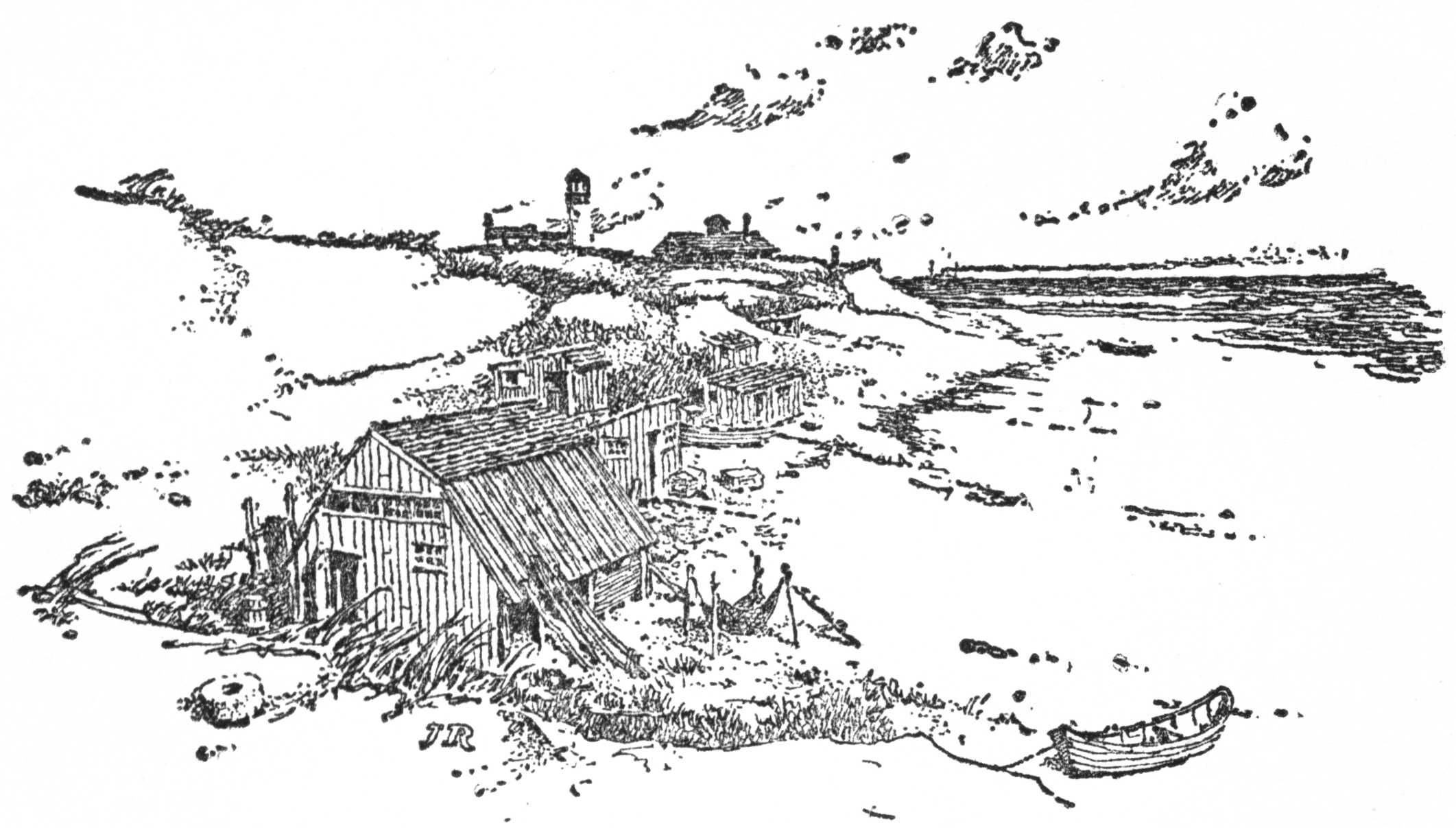
WRECKING AND WALTZING.
It was a May morning off Setuckit Point. The Point itself was in the middle distance, with the lighthouse top shining black against the sky, and the little cluster of fishing shanties showing brown amid the white sand dunes and green beach grass. The life-saving station was perched on the highest of the dunes and its cupola was almost as conspicuous as the lighthouse. The thick cloud, apparently of mosquitoes, hovering over the Point, was, in reality, the flock of mackerel gulls that are always hunting for sand eels on the flat. Low down across the horizon miles beyond was smeared the blue and yellow streak that marked the mainland of the Cape.
[Pg 170]
To the right, only a half mile away, but through the darker water that indicated the ship channel, a four-masted schooner was moving swiftly, the sunshine flashing sparks from her cabin windows and marking high lights and shadows on her swelling canvas. Ahead of her, against the sky line, was the light-ship that marked the turning point in the course; behind, not quite so far away, was the other light-ship that she had just passed. More schooners were following her, strung out in a long line, and others, bound in the opposite direction, were standing inshore or heading out to sea as they beat up in the face of the brisk wind. An occasional steamer or an ocean tug with a tow flaunted a dingy streamer of smoke here and there amid the graceful schooners.
Along the edge of the channel, and sprinkled amid the blue, were patches of light green water where the waves ran higher and broke occasionally. There were the shoals, the “Razorback,” the “Boneyard,” and the rest. If it were possible, and fashionable, to erect tombstones for lives lost at sea, these hidden sandbars would bristle with them. Not a winter month that passes but vessels are driven ashore here, and the wicked tides and winds scatter their timbers far and wide. The Setuckit life-saving crew have few restful hours from October to May.
On the edge of one of these shoals, just over in deep water, a little schooner lay at anchor, rocking and plunging incessantly. Her sails were down and only one man was aboard. Half a mile away, just [Pg 171]where the tail of the shoal made out into the channel, two dories were moving slowly in parallel courses, trailing a rope between them. The schooner was the Lizzie, the man aboard her was Barney Small, once a stage driver, but now, forced out of business by the new railroad, back again at his old trade—wrecking. Captain Ezra Titcomb was rowing one dory and Bradley Nickerson the other. They were “anchor dragging.”
When the gales begin in the fall, Setuckit Point, lying as it does at the edge of the fairway between Boston and New York, is sometimes a natural breakwater and forced anchorage for the coasting vessels. Perhaps the skipper of a large three or four-masted schooner, caught just at night by a heavy sea and a rising gale, doesn’t relish the idea of passing through the shoals and over the dangerous “rips” beyond. He determines to anchor in the lee of the Point and wait for daylight or to ride out the gale. The sandy bottom is bad holding ground for anchors. By and by the wind and the roaring tide get their grip on the schooner and the skipper sees that she is slowly but surely being forced on the shoals. Perhaps he tries to haul the anchor inboard again; perhaps time is too short to risk in the attempt, and the chain is let go entirely. At any rate, a big anchor, with fathoms of heavy chain, is left fast in the sand, and the schooner—well, if she is lucky, she makes an offing or finds better holding ground at another place.
Big anchors and chains are worth money, and it may be that the skipper writes to a wrecking company [Pg 172]telling where the anchor may be found and what he will pay for the recovery. Or, just as likely, he says nothing about it, and then “findings are keepings,” and the wrecker who dredges up the anchor makes whatever he can sell it for at Vineyard Haven or Boston. Anchor dragging fills in time between salvage jobs and it pays.
Bradley and the Captain were anchor dragging merely on speculation this time. There had been a dozen wrecks off the Point the previous winter and a number of anchors lost beside. They had already picked up two—one by the Boneyard shoal and one, a big fellow, away out on the rips.
The two dories moved slowly down the edge of the shoal, separated by a distance of perhaps a hundred yards. The line between them, weighted with a lead sinker at each end, was dragging along the bottom.
“Fisherman’s luck,” shouted Captain Ezra from his dory. “Queer we ain’t found it yit, Brad. We’re right on the range Eldredge gave me—the P’int Lighthouse and the pole on Black’s shanty, in line to the no’theast, and the Harnissport steeple and Thompson’s windmill to the no’th. I suspicion that we’re too nigh inshore. Never mind; we’ll keep on for a little ways further.”
They were dragging for an anchor lost by the coasting schooner Mary D. a month before. She had been caught by the tide and the chain had been let go with a run. One of the hands aboard—Eldredge by name—was an Orham man, and he it was who had [Pg 173]had the presence of mind to take the “ranges” mentioned by the Captain, which information he had sold to his fellow-townsmen for a five dollar bill.
Bradley and the Captain began rowing once more. They had gone but a little way when, slowly but surely, the dories began to draw nearer to each other. Bradley, looking over the side, saw that the “drag line” no longer hung straight down, but, tightly stretched by whatever was holding it on the bottom, led off diagonally astern.
“Got a bite!” he shouted.
“Yup,” replied the Captain, shortly.
They kept on rowing easily, and in a few minutes the pressure on the line had brought the dories side by side. Then Bradley passed his end of the rope to his partner, who began hauling in with care. By this operation the skipper’s dory was soon brought directly over the spot where lay the hidden object. Bradley rowed his own boat alongside.
“Now, then,” said Captain Titcomb; “let’s see if she’s got the right complexion.”
He leaned over the side, and, taking one end of the line in each hand, pulled them tight and sawed vigorously back and forth, thus drawing a section of the rope again and again under the treasure-trove below. Then he paid out one end of the line and hauled in the other until this section came to the surface; it was marked with a dull red stain—iron rust.
“And that’s all right so fur,” commented the Captain. “She’s a lady of color, anyhow. Looks to me as if that bread on the waters that I cast, in the shape [Pg 174]of a fiver, to Brother Eldredge, had brought forth fruit in due season; hey, Brad? Pass me that way line.”
The smaller end of the “way line,” a stout rope tapering from one inch to three inches in thickness, was spliced to the “drag line,” and drawn down and under the supposed anchor until the latter was looped by it. Then the “messenger,” an iron shackle or collar fastened by a bolt or pin, was clamped about the upper parts of the loop. To this “messenger” was also attached a small cord.
“Now then, Brad,” said the Captain, “we’ll put on her necktie.”
The “way line” was drawn tight and the heavy “messenger” plunged out of sight beneath the water. It slid down to the end of the “way line,” thus holding with a tenacious grip the submerged object. They tested with the “messenger,” pulling it up with the cord and letting it drop again. It struck solidly and with the tingle of metal against metal.
“’Sartinly feels promisin’, as the boy said when he crept down in the dark the night afore Christmas to paw over his stockin’. Better bring up the schooner, Brad.”
Bradley pulled down to the Lizzie. Barney and he hoisted canvas enough to give them steerage way and the little vessel ran alongside of the Captain’s dory. Then the ropes were rigged through the block in the forerigging, and Bradley and Barney fitted in the brakes of the clumsy hand-windless, while Captain Titcomb stood by the bulwark.
[Pg 175]
“H’ist away!” commanded the skipper.
The windlass creaked, the cable tightened and the blocks groaned as a heavy weight was lifted from the bottom. A minute or two more, and the Captain signalled to ease up.
“Brad,” he said, “come here a minute. This ain’t any anchor.”
Barney held the windlass brake while Bradley moved to the rail.
“Look at that,” said Captain Ezra, pointing.
Through the green water the “messenger” showed dimly, holding in its grip the upper part of a three-cornered iron frame, as unlike an anchor as anything could be.
“What on earth——” began Bradley. The Captain grinned.
“Never saw anything like that afore, hey? Well, I cal’late I have. What do you say to a bell-buoy frame?”
“Why, sure!” Bradley’s tone was a disgusted one. “No wonder we thought it was an anchor. Got adrift and smashed up by the ice somewhere. Well, we’ve had our work for nothing. Shall we cast off?”
“Not yet, son. You and Barney heave a little more elbow grease into that windlass. Might as well shake hands with the critter, now we’ve got him nigh enough to see his face.”
“But that framework isn’t worth anything.”
“’Tain’t the stockin’ that counts always; it’s what Santa Claus puts inside of it. I have a notion this feller may be a s’prise package. H’ist away!”
[Pg 176]
More of the wet rope came aboard. Captain Ezra chuckled.
“I guessed pretty nigh that time,” he muttered. “Now, Brad, come here.”
The iron frame, green with seaweed and trimmed with kelp and shells, hung half out of the water. At its base, just above the battered and crushed cone that had been the buoy, a big bronze bell glistened and dripped.
“And I can git twenty-five dollars for that bell,” crowed the Captain. “Which, in the present state of this corporation’s finances, mustn’t be considered a widow’s mite. Well, this ain’t what I was after, but it’s none the less welcome, as the cat said when it found the mouse swimmin’ in the milk pail. Swing her in, Barney! Now we’ll go back and have another try for the Mary D.’s anchor.”
The bell-buoy was not the only surprise that old ocean gave them, although it was the only one in which there was any money. Once they dragged to the surface the rusted remnant of a galley stove, and once, when the “drag line” was hauled in, at the end of an unsuccessful day’s work, wrapped about it was the torn and draggled remnant of a woman’s apron, and tangled in that a child’s toy—a little railway car. This last happened in the Sound off Nantucket.
Captain Titcomb carefully disentangled the odd find from the line.
“Humph!” he mused, balancing the battered plaything in his hand. “Somebody’s wife and baby was aboard the vessel that those came from. I don’t remember [Pg 177]a wreck of that kind nigh here of late years. But the tide carries things a long ways, and these might have been rolled along the bottom for miles, or they might have been carried here on a piece of drift. And then again, it might be one of those wrecks you never hear off: black night, gale blowin’, snow so thick you can scarcely see the jibboom, and there’s a smash and a tramp steamer backs off with her nose busted, not knowin’ what she hit. And then in a little while there’s a piece in the paper sayin’ that the schooner So and So is missin’; ain’t been heard of for two or three weeks; it’s feared she must have foundered in the big gale of January tenth. Skipper had his wife and children with him, and so forth. Brad, God moves in a curious way His wonders to perform, don’t He? Maybe it’s jest as well you and me don’t know the real story of these things. Sometimes I think there ought to be a law against sailors gittin’ married.”
They had some long talks together concerning their new venture, which, up to date, although they had made some money, had not given them the opportunity for a “big job” that they hoped for.
“Brad,” observed the Captain, as they were walking up from the wharf one evening, “are you gittin’ discouraged?”
“No, not yet. I didn’t expect anything different this first summer.”
“Well, I jest asked. You see, there’s a barrel of folks in this town who are sayin’ that I’m a fool to think that I can make money out of a trade that other [Pg 178]folks have barely kept body and soul together in. And they’re sayin’, too, that you’re a bigger fool for goin’ in with me. I s’pose you’ve heard that as much as once from some of these kind souls, haven’t you?”
Bradley laughed. “Well,” he answered, “I listened to a long sermon from that text the other night at the postoffice.”
“Humph! Henry Simmons occupied the pulpit in response to a unanimous call from himself, I s’pose?”
“How did you know?”
“Oh! I jest put two and two together, like the woman that made some stockin’s for herself out of a couple of pair that belonged to her little girl. I saw Henry headin’ over in your direction that night, and I know his advice pumps are always workin’. Henry’s what you might call a quitter. The only time he ever stuck to anything was when he set down on the fly paper. He was a sailor for three v’yages and then gave it up ’cause he hadn’t been made skipper. Then he raised hens, but got discouraged ’cause the roosters wouldn’t lay—some such reason, anyhow. He’s done a little of ’most everything sence, but he’s given ’em up one after the other; the only trade he ain’t peeked in at is the one he was cut out for—that’s roostin’ on top of the church steeple for a weather vane. Consequently he knows from experience that it’s time to give up afore you begin. He always said ’twas a crazy thing to do, this wreckin’, didn’t he?”
“Always.”
“Well, when I first made the deal for the Lizzie with Caleb, Simmons come ’round to me, havin’ heard [Pg 179]of it, and breathed into my ear, in confidence, that he’d been thinkin’ of doin’ the same thing himself; knew for sure that there was money in it.”
“You don’t mean it?”
“If I didn’t I wouldn’t say it. And Henry’s not the only one—though he’s the prize-winner in his partic’lar class. There’s lots of folks in Orham that think because a thing’s been done afore by somebody else, who didn’t know how to do it, that another man who tries it is a fool. A pullet can lay eggs, but she can’t sing for a cent, whereas a canary bird makes a pretty good shy at it. I went into the wreckin’ business with my eyes open, and I knew ’twould be hard sleddin’ first along. But I tried to make that clear to you, didn’t I?”
“Look here, Cap’n Ez, if you think I’m afraid because we haven’t struck on yet, then——”
“I ain’t afraid of you, Brad. I jest wanted to boost up my own spunk a little, I guess. Give you and me a year or so to git our nets out, so to speak, and a grain or two of luck for seas’nin’, and we’ll make this village man the yards when we come into port; see if we don’t. What do the old maids say?”
“Oh! they believe I’m going to get rich, of course.”
“Of course. Well, maybe they ain’t any further out in their reck’nin’ one way than Simmons and the rest are the other. What does that little Baker girl have to say about it?”
Bradley looked at his friend in surprise. “What?” he asked.
“Yes,” said the Captain.
[Pg 180]
“Oh! well, she didn’t quite like it at first, but the more we talk about it together the better the plan seems to her.”
“I presume likely you and she talk about it a good deal?” There wasn’t the slightest flavor of sarcasm apparent in this question, so Bradley admitted that he and Gus did have a good many talks on the subject.
And this statement wasn’t an exaggeration. It had become a regular thing for the junior partner in the anchor-dragging concern to drop in at the Baker homestead of an evening after supper was over and discuss happenings and plans with Gus. The feeling that the girl was not so wholly at one with him in his hopes and ambitions as she used to be had galled Bradley. He resented her criticisms of the new venture on the evening when he first told her of it. Five years before, he knew, she would have thought it “splendid” simply because he thought so. He had come home expecting to find her unchanged—forgetting how much he had changed, himself—and now he determined that he would compel her to believe in him and his work. So he called evening after evening, and, in a measure, succeeded in his object; that is, Gus became more and more interested and willing to listen while he explained his and the Captain’s ideas, and what they might develop into. But she no longer said yes merely because he said it. She also had, and Bradley recognized it, a subtle way of changing the subject to one of her own choosing when she wished to do so, and she could tease him or please him in spite of himself. But these new features of her character [Pg 181]were rather fascinating than otherwise, so he came to think. She was decidedly independent and had a very original way of looking at things. They agreed on some matters and agreed to disagree on others.
Dancing was one of the subjects on which they didn’t agree. Bradley considered dancing nonsensical and a waste of time. Gus, on the other hand, was very fond of it.
“I’d rather saw wood myself,” declared the former one evening. “There’d be about as much work in it, and considerably more fun. If you want to see how ridiculous people look when they dance, put your fingers in your ears so as to shut out the music, and then watch ’em.”
“Yes,” replied Gus, “but there’s no reason why you should put your fingers in your ears. Brad, for goodness’ sake, don’t be an old man before you’ve hardly begun to be a young one! That’s my one fear for you—that you’ll grow to be as sober as an old cow, and as sour as—as—well, as those apple puffs I made yesterday and forgot to put the sugar into. You want to sugar your work with a little fun.”
“I like fun. I can enjoy a good play at the theatre, though it’s mighty seldom I get the chance, and I’d rather play baseball than eat, even now.”
“Well, the only plays that come to Orham are ‘Ten Nights in a Barroom,’ or ‘Uncle Tom,’ and I’m afraid I’m too old to play baseball without causing a sensation; not that I wouldn’t like to,” she added, mischievously. “But, Brad, I do like dancing, and [Pg 182]there are dances here once in a while, such as they are, and—well, I wish you danced.”
“I suppose I could manage to navigate through a quadrille without wrecking more than half the set, but a waltz would have me out of soundings in no time.”
“Will you try to learn if I teach you?”
“Think ’twill pay for the wear and tear on your nerves—and the furniture?”
“I’ll risk the nerves, and we need some new furniture, anyway. Come; we’ll begin now. I’ll hum the tune, and you can imagine that Bennie D.’s three-piece orchestra is playing ‘Annie Rooney,’ with their own variations, and that you’re waltzing with—well, with Georgiana Bailey.”
“Great Scott! let’s imagine something pleasant to begin on. All right; here goes! Get out of the channel, Winfield.”
That first lesson was certainly fun; even Bradley admitted that, although he insisted that his perspiring condition was proof positive of the work there was in dancing. They laughed so hard and made so much noise, assisted by the energetic Winfield, that old Mrs. Baker came downstairs, wrapped in a blanket, to put her head in at the sitting-room door and ask if the house was afire. But Gus said that her partner had done well for a beginner.
The “Baker Private Dancing Academy,” as Gus called it, held frequent sessions during the next fortnight. It was Bradley’s private belief that he should never be a good waltzer, and he was perfectly certain [Pg 183]that the lack of that accomplishment wasn’t going to worry him, but he stuck to the “lessons,” because they pleased Gus, and because he had said he would.
One evening toward the end of the month Gus said to him: “Brad, if you were I, would you go to the Decoration Day Ball?”
She was, apparently, looking as she spoke at the front page of the Cape Cod Item, which lay on the table, and she did not turn her head. Bradley was puzzled.
“What did you say?” he asked.
“If you were I would you go to the ball on the evening of Decoration Day at the Town Hall? I’ve had two invitations.”
“Humph!” The answer was somewhat hesitating. “I suppose I should do what I wanted to. It would be too bad to disappoint so many when you’re so greatly in demand.”
“And I think that was rather spiteful. Are you going to the ball?”
“To tell you the truth I didn’t know there was going to be one. I’ve been so busy.”
“I supposed you didn’t know. Otherwise, of course——”
“I should have invited my dancing teacher to go with me. Gus, would you have liked it if I had invited you?”
“I should.”
“Well, I wish I had then.”
“Why don’t you now?”
[Pg 184]
“Isn’t it too late? Those other invitations, you know.”
“I haven’t answered them yet.”
“Well, then, Miss Baker, may I have the pleasure of escorting you to the grand fandango to be held in the Orham Crystal Palace, under the supervision of His Royal Swelledness, Mr. Solomon Bangs?”
“You may, sir. Oh, Brad! of course I’d rather go with you, because——”
“Because what?”
“Because I want to see how my pupil looks dancing with somebody else.”
Miss Prissy and her sister had been brought up to consider dancing as one of the baits thrown out by the Evil One to lure young people to destruction. So, when Bradley announced his intention of going to the ball, Miss Tempy was just a little troubled.
“You don’t s’pose he’s gittin’—well, fast, do you, Prissy?” she asked.
“Land, no!” was the decided answer. “If he don’t do anything wickeder than to hop ’round the Town Hall to music, I guess he’ll be safe.”
“But father never let us dance when we were girls.”
“I know it, but folks look at those things different nowadays. I wish you’d starch and iron that white necktie of his, Tempy. We want him to look as good as the next one, bein’ he’s an Allen.”
So Miss Tempy remembered that Lord Eric and all the rest of her book heroes danced, and she starched and ironed the tie till it was a spotless, crackling [Pg 185]band. And when Bradley came downstairs on the evening of Memorial Day, dressed in his new black suit, she was so proud of him that she fairly bubbled over.
“You do look handsome!” she exclaimed. “You’re more like father every day. Here, let me fix your handkerchief so’s ’twill show at the top of your pocket. There, now ain’t he splendid, Prissy?”
“Handsome is that handsome does,” was the practical answer. “Be a good boy, Brad, and don’t do anything we wouldn’t like.”
Gus was prettier than ever that night. She was dressed simply in white, but when she came out of the dressing-room at the hall and took his arm, Bradley noticed that the eyes of half a dozen young men followed her, and that they whispered to each other.
Mr. Solomon Bangs was floor-master, and he came bustling up to them.
“We’re jest goin’ to start the Grand March,” he informed them. “Take your partners and git right in line, please. Augusty, may I see your order? Thank you. I’ll take the Portland Fancy, if you’re willin’. Yes, yes, Obed! I’m comin’! Land of goodness! seems ’s if I couldn’t git a minute’s peace. I don’t know what they’d do if I wasn’t here.”
He hurried away to lead the march with Georgiana Bailey, and Bradley took his partner’s “order” and wrote his initials against two quadrilles, the “Virginia Reel” and one waltz. “Round dances” were few, for most of the dancers were middle-aged married people, who had danced reels and contra-dances when [Pg 186]they were young, and didn’t intend to learn new steps at their time of life.
“Bennie D.,” his hair pasted artistically down on his forehead with a “spit curl” over each temple, stepped to the centre of the platform, tucked a handkerchief under his chin, set his violin against it, flourished his bow, patted his feet and swung into the tune for the Grand March, with the piano and ’cello limping behind him.
Mr. Bangs, his chest well out, his floor-master’s badge very much in evidence and his importance even more so, gave his arm to Miss Bailey, got into step—after two or three false starts—and led off, while couple after couple followed him. Up and down the hall they paraded, going through one evolution after the other. Captain Jabez Bailey, who “didn’t dance none to speak of,” but was there because his wife and daughter had ordered him to be, distinguished himself by tripping at the first turn and carrying his better half down with him. It was an emphatic tumble, for Mrs. Bailey was what her husband called “pretty sort of fleshy,” and the chimneys in the chandeliers rattled when she struck the floor. Georgiana, from the head of the line, glared at her unfortunate parent, and, during the rest of the march, poor Captain Jabez plodded on in nervous agony, while his wife poured into his ear her opinion of his “makin’ such a show of ’em and mortifyin’ her ’most to death.”
Gus’ “order” was filled in a few minutes after the first number was over; there were more applicants than dances. Bradley danced a quadrille with Clara [Pg 187]Hopkins, who was pretty and jolly, and he enjoyed it thoroughly. He labored through a contra-dance with Georgiana and didn’t enjoy it as much, although that effervescent young lady purred that she had had a “perfectly lovely time,” and he was “lookin’ so well,” and why didn’t he call at the house.
Miss Bailey’s blue silk gown had an imposing, and very troublesome, train and she smelt like a perfumer’s shop.
During one of the infrequent “round dances,” Bradley wandered to the smoking-room at the head of the stairs. “Hart” Sears and “Snuppy” Black were there, together with some fellows from Harniss and Ostable. They were discussing, with great relish, the various young women present, and the conversation might have been interesting if one cared for that sort of thing. But Bradley didn’t, and he was about to return to the ball room, when, to his great surprise, Captain Titcomb came up the stairs. He had a dripping umbrella in his hand.
“Why, hello!” exclaimed Bradley. “I didn’t know you were coming.”
“Hello, yourself!” retorted the Captain. “I didn’t know you was comin’ either, so we’re square on that hitch. It’s blowin’ up a reg’lar snorter outside,” he, added. “You’d think ’twas the middle of November. Bring an umbrella? That’s good; you’ll need it. Hold on a second till I check my duds.”
When he returned from the coat window they stood in the doorway looking at the dancers.
“Sol. Bangs talked me into buyin’ a ticket,” remarked [Pg 188]the Captain, “and ’twas kind of dull at the boardin’-house, so I thought I’d run up for a spell. Who’s here? Gusty Baker looks nice, don’t she? I s’pose you was convoy to that craft, hey?”
Bradley reddened and admitted that he had acted in that capacity.
“Georgiana’s gayer’n a tin peddler’s cart, ain’t she?” continued his partner. “Cap’n Jabe’s the only moultin’ pullet in that coop.”
He broke off suddenly and was silent for a minute or more. Bradley asked him what the matter was.
“Oh, nothin’!” was the hasty reply. “Quite a crowd here to-night. Who’s the little clipper in the white with blue pennants in her fore-riggin’? The one dancin’ with Jonadab Wixon’s sister’s boy?”
“That’s Clara Hopkins. She’s grown to be a pretty girl, hasn’t she?”
“Humph! You don’t say! Jim Hopkins’ girl. I wouldn’t have known her.” And the Captain subsided once more.
A little while after that, as Bradley was dancing his “Virginia Reel” with Gus, he noticed a disturbance among the crowd of watchers at the door. He was in the middle of the line at the time, and “Snuppy” Black stood next to him.
“Hello!” exclaimed “Snuppy.” “Why, it can’t be! By thunder, it is! Sam Hammond’s come. I didn’t know he was expected.”
Hammond it was, and in all the glory of city clothes and unlimited self-confidence. When the reel [Pg 189]was over, he came across the floor to where Gus and Bradley were standing.
“How d’ye do, Gus?” he said, extending his hand; “I’m down for a few days. Got a vacation that I wasn’t looking for. Came on to-night’s train and thought I’d run up here for a little while, soon as I could get away from the home folks. Let me see your order. Hello, Brad! How are you?”
He was well-dressed, still in the rather conspicuous way, and he had an easy, masterful air about him that none of the country fellows had, though they all envied it. And he was good-looking; that couldn’t be denied.
“My order is filled,” said Gus, showing him the card.
“Never mind; somebody’ll have to give up; that’s all. Brad, will you give me this waltz of yours? It’s the next number.”
“Can’t spare it,” replied Bradley, shortly.
“Then I’ll have Hart’s schottische. I’ll make it all right with him.” And he pencilled his own initials over those of Sears. Gus didn’t seriously object.
“He’s a fine dancer,” she said, as she and Bradley rose for the waltz. “I shall enjoy that schottische, and I should have had a horrid time with Hartwell Sears. Now, Brad, let’s see how you remember your lessons.”
The last dance was the lanciers, but as “Bennie D.” arose to “call off,” he announced that there would be, by special request, an “extra”—a waltz. Bradley had seen Hammond talking with the prompter and [Pg 190]with Mr. Bangs, and he knew whose the “special request” was. Under other circumstances he wouldn’t have cared so much for that waltz, but now he wanted it very much indeed.
He walked over to where Gus, flushed and laughing, stood talking with Black, her partner in the lanciers. Just as he reached her side Sam came hurrying up and pushed in front of him without ceremony.
“Gus,” said Hammond, “I made Ben give us this waltz on purpose so that we might have it together. You haven’t been half generous to me to-night, and now I’m after my pay. Come!”
He offered his arm, and for a moment the girl seemed about to take it. Then she looked at Bradley, who, disappointed and chagrined, stood silent in the background.
“Thank you very much, Sam,” she said; “but this waltz belongs to Bradley. Come, Brad, the music is beginning.”
If any one had told Bradley previously that he would thoroughly enjoy a waltz, he would have laughed. But he enjoyed every moment of this one. He saw Sam’s scowl as Gus stepped past him, saw the smile on the faces of Black and the other bystanders, and then they whirled away. Round and round and round. “Bennie D.’s” music wasn’t the best in the world, but to Bradley just then no grand opera orchestra could have played more sweetly. His feet seemed almost as light as his partner’s, and they kept perfect time.
It was over all too soon.
[Pg 191]
“Oh!” exclaimed Gus, as the music ceased; “that was splendid! Brad, don’t ever say again that you can’t waltz.”
Captain Titcomb, with Clara Hopkins on his arm, passed them, scouring his red face with a handkerchief.
“Whew!” he panted, “I must be gittin’ fat and lazy. Didn’t use to pump me out this way to dance.”
Bradley and Gus walked home through a storm that, as the Captain had said, was much more like a November gale than the usual summer blow. The tops of the trees threshed and banged about in the heavy gusts and the rain came against the umbrella top like water from a hose. They were pretty wet when they reached the door.
“I’ve had ever so nice a time, Brad,” said Gus. “Thank you very much for taking me.”
“You’re welcome. I’ve had a good time, too. I want to thank you for giving me that last waltz. I know it meant giving up a good dancer for a poor one, and ’twas kind of you to do it.”
“Oh! you earned that by trying so hard to learn. Good night.”
There was a kettle of “pepper tea” on the back of the stove in the kitchen, and on the table Bradley found a note from Miss Tempy, saying that he must be sure and drink two whole cups of the tea and rub his chest with Blaisdell’s Emulsion before he went to bed, so as not to catch cold.
He did drink some of the tea, but we fear the Emulsion was forgotten entirely. Bradley’s brain [Pg 192]was filled with thoughts of that waltz, of Sam’s discomfiture and of his own triumph. Also there were other and new thoughts that kept him awake for some time. They were of the future, but the wrecking business had little part in them.
And outside the wind blew and the rain poured.
[Pg 193]
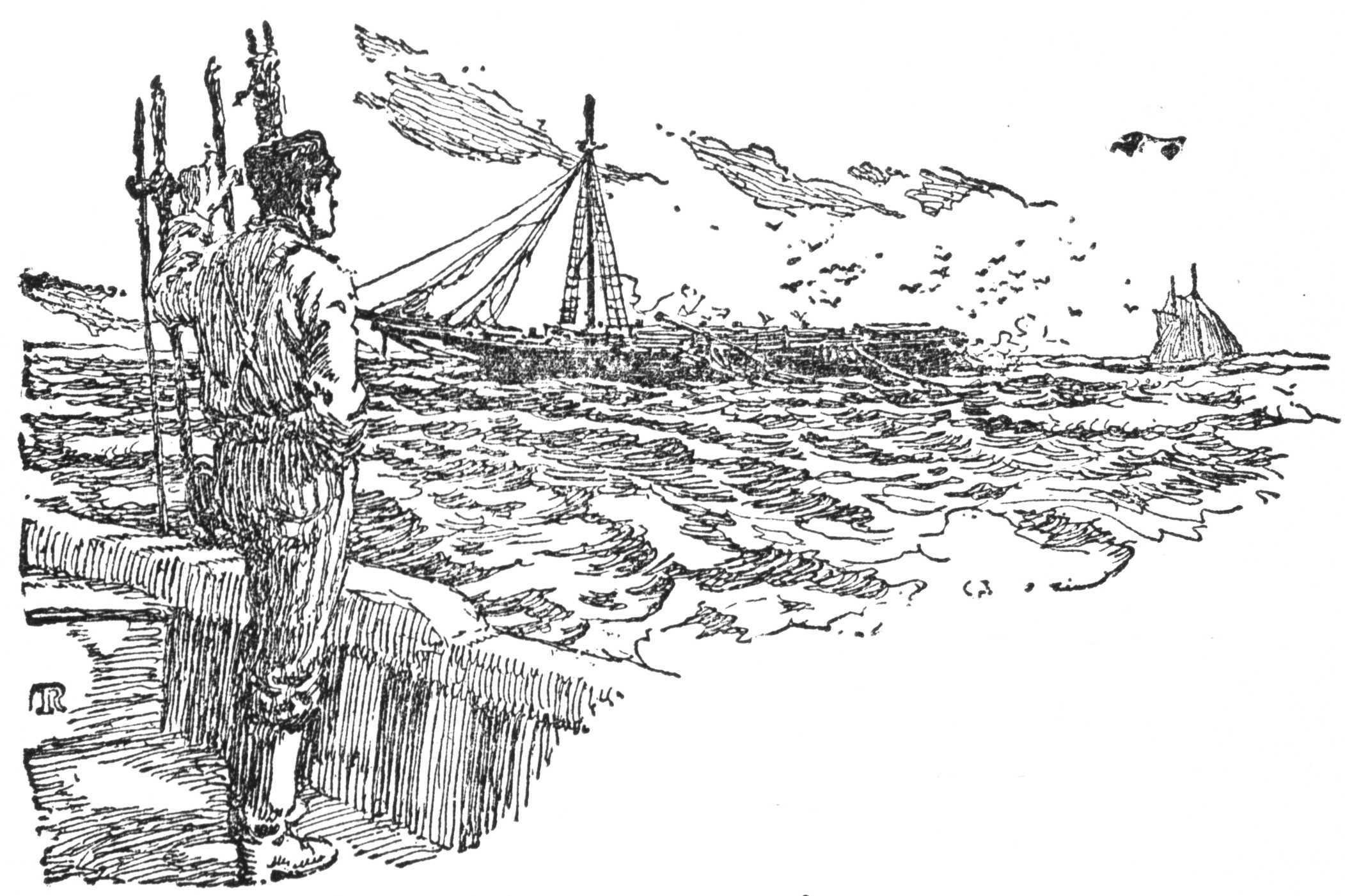
THE LUMBER SCHOONER.
Breakfast next morning was hardly begun when “Blount’s boy”—his name was Ulysses Simpson Grant Blount, but no one but his parents ever called him by it—came to the dining-room door with a note for Bradley. It was from Captain Titcomb, and read as follows:
“Dear Brad:
“There’s a three-master, loaded with lumber, piled up on the Boneyard. Come on down quick. Looks as if here was the chance the Titcomb-Nickerson Wrecking Syndicate had been praying for.”
“Yours truly,
E. D. Titcomb.”
[Pg 194]
The junior partner in the “Syndicate” let Miss Prissy’s clam fritters go by default and hurried down to the Traveler’s Rest, where he found the Captain waiting for him. A few hours later the officers and crew of the Lizzie were gazing over that vessel’s rail at the tumbling froth that covered the Boneyard shoal and at the hapless lumber schooner trembling in its midst, a dismal, lonesome sight.
She had struck almost bow on, but the strong tide had swung her stern over until she lay broadside to the shoal. She had heeled but little and her deck load of pine boards was, for the most part, still lashed in place. The main and mizzen masts were gone, but the lower part of her foremast still stood, and the great waves, striking against her stern, sent the light spray flying lengthwise almost as high as its top. The broken cordage streamed out in the wind, and a swinging block creaked and whined. On the rail by the after house they could read her name; she was the Ruth Ginn, of Bangor.
“The P’int life savin’ crew got the men about one o’clock this mornin’,” remarked Captain Titcomb. “Skipper tried to anchor to ride out the gale, then got scared and tried to make an offin’, got her into irons and the tide did the rest. Her masts went jest after they took off the men. What do you think of her? Total loss, ain’t she?”
Bradley hesitated. “Well,” he said, “I should say she was, so far as being any use as a schooner is concerned. That lumber, though, is a different matter; [Pg 195]the weather would have a good deal to do with that, I should say.”
“The weather’s goin’ to clear, if I’m any jedge,” observed his companion. “What do you say, Barney?”
“Looks like fairin’ off to me,” replied Mr. Small. “Wind’s cantin’ round to the west’ard. However, I ain’t no weather prophet. You want to ask Peleg Myrick if you’re after weather news; he seems to have a special tip from heaven on gales and calms.”
“That’s so,” mused the skipper. “Peleg does seem to have a sort of connection that way. Maybe the angels keep him interested in weather so’s they won’t have to listen to him pumpin’ the concertina all the time. That and Skeezicks’ howlin’ is enough to make a ghost grit its teeth. I cal’late he’s at the P’int by this time, and we’ll hunt him up pretty soon and git a prophecy from headquarters. But, anyhow,” he added, “I agree with you, Brad, that the schooner’s gone to pot. The lumber might be saved. I’ll go further’n that, I’ll say that we could save a good-sized chunk of it, wind and weather permittin’, if we got the chance. And I’m goin’ to work mighty hard to git the chance. Let’s run up into the cove and go ashore.”
The Lizzie sailed away from the wreck that, with one screaming seagull balancing himself on the broken foremast, looked more sad and lonely than ever, and anchored in the little harbor in the lee of the Point. Two or three catboats were moored there, [Pg 196]and among them was one that the Captain recognized.
“Hello!” he exclaimed. “There’s Obed Nickerson’s boat. I guess that settles it; some part of her’s insured, anyway.”
They walked through the soft white sand and coarse beach grass up to the life-saving station. The lookout, in the observatory on the roof, rapped on the window of his cage and waved a hand to them as they reached the plank walk leading to the door.
Inside, seated around the table of the living room, they found Captain Knowles, commander of the station; Obed Nickerson, the Orham agent of the underwriters; the skipper of the Ruth Ginn and two or three others. The skipper, a sunburned, gray-haired man, with a worried look on his lean face, was telling for Mr. Nickerson’s benefit the story of how his vessel came to be in her hopeless plight. To a landsman it would have been an interesting yarn, but the present company had heard too many similar experiences to find anything novel in it.
“So you figure her a total loss, do you, Cap’n?” asked Mr. Nickerson, making a few notes in his memorandum book.
“Well, there she is! You can see for yourself,” was the answer. “Her sticks gone, and hard and fast on the Boneyard—if she ain’t a total loss, I don’t know what you call her.”
“Insured, is she, Obed?” asked Captain Titcomb.
“Cargo is; schooner ain’t,” replied the underwriters’ agent.
[Pg 197]
Captain Ezra signalled to Bradley, and they went out on the porch.
“Brad,” whispered the Captain, “they can’t call her anything but a total loss. The underwriters’ll pay the insurance on that lumber and then dicker with somebody to save what they can of it. You and me want to be that somebody. Hello! here’s Peleg!”
The versatile Mr. Myrick had tramped over from his hermitage, and now, with Skeezicks shivering at his heels, was deep in conversation with Barney Small.
“Peleg says we’re goin’ to have clear weather for quite a spell,” remarked Barney. “Let’s see; when did you say you had the next storm scheduled, Peleg?”
“Wall,” drawled the weather prophet, looking becomingly important; “nigh’s I can figger, Cap’n Ez, she’ll fair off by afternoon and stay clear for more’n a fortni’t. We ain’t due to have another reel genuwine blow for more’n a month. I knew last night’s gale was comin’. I told Cap’n Knowles so; says I, ‘I don’t care what the Gov’ment folks says, it’s goin’ to blow,’ says I, ‘like time, and them that’s afloat wants to stand by,’ I says. Now——”
“That’s right, Peleg,” broke in the Captain. “I’ll back you against the Weather Bureau eight days in the week and twice on Sunday. How’s clams these days?”
“Clams,” replied Mr. Myrick, “is scurcer’n all git out. I don’t know why unless ’twas the turrible hard winter. I was afraid of it last fall. ’Course I knew the hard winter was comin’ and I told folks so. Oh! [Pg 198]that reminds me! What’s this I hear ’bout Sam Hammond’s spendin’ more’n four dollars for cigars last time he was home? Do you cal’late that’s so?”
They left Barney to relieve Mr. Myrick’s anxiety concerning the cigars and walked down to the beach. On the way Captain Titcomb said:
“Brad, we’ve got to git this lumber job. It’s the kind of job we can do with the Lizzie, and, figgerin’ on a commission basis, it’ll give us pretty nigh money and start enough to warrant our havin’ a new schooner built, one with power and strong enough to handle the real big things. Wait here by the dory till Obed comes out; I’m layin’ for him.”
“Cap’n Ez, do you really take any stock in Peleg’s weather talk?”
“Why, I don’t know but I do. Everybody along this shore does. He hits it right full as often as the Gov’ment folks, and, in my jedgment, consider’ble further ahead. I’ll give in that it sounds foolish to think a bow-legged sandpeep with a sprained brain like Peleg’s can know about the Lord Almighty’s gales and such, but sometimes I think that about ha’f of Peleg’s loft was to let, so’s to speak, and the weather jest sort of moved in. Now most people ain’t got more’n a tenth of the space in their noddles to give to that bus’ness, and so Brother Myrick has the advantage of ’em.”
Bradley laughed. Personally he believed little in the hermit’s value as a prophet, although he knew that the Captain’s faith was shared by almost everybody in Orham.
[Pg 199]
“You give up only half of Peleg’s brain to the weather,” he said. “What do you think fills the rest of it?”
“Clams, other folks’ bus’ness and that everlastin’ concertina,” was the quick reply. “That ha’f must be as lively as a sailor’s dance hall and as full of Bedlam as the monkey cage in the circus. Here comes Obed. Now, then!”
Mr. Nickerson, accompanied by one of the village boys, was on his way to the catboat, but the Captain interfered.
“What in the nation are you goin’ home in that clam shell for, Obed?” he asked. “Come on aboard the Lizzie with us. Brad and Barney and I will land you at the wharf afore that cat of yours is out of shoal water. Let Dan there take your boat home, and you come with us. I’ve got a cigar I want you to take out some fire insurance on.”
So, after some persuasion, the underwriters’ agent consented to make his homeward trip in the schooner. The cigars were lighted, Barney Small took the wheel and the Captain, Bradley and Mr. Nickerson made themselves comfortable in the little cabin. Then the conversation was judiciously piloted toward wrecks, and the wreck of the Ruth Ginn in particular. Obed admitted that the full insurance would undoubtedly be paid on the cargo, although, of course, the official “three man survey” must come first. Bradley asked what would be done after that.
“Oh!” answered the agent; “then I guess I’ll send word to the Boston Salvage Company and make a [Pg 200]deal with them to git out what they can of the lumber.”
“Yes,” observed Captain Titcomb, “and they’ll charge you seventy-five per cent. of the value. What’s the matter with Brad and me doin’ it?”
“You? What with—this tub?”
“Yup, this tub. If you’ve got a loose tooth a string and a door’ll snake it out as quick as the dentist will, and you don’t have to pay for silver-plated pinchers and a gilt name-plate. Come now, tell you what I’ll do: Brad and me’ll git that lumber out for sixty per cent. on what we save.”
“How you goin’ to do it? You haven’t got a towboat, nor even power in your own schooner.”
“Don’t need ’em. You couldn’t start that wreck with a towboat without yankin’ the bottom out of her. The only way to fetch her off the shoals is with anchors and cables, and you know it. We can do that as well as any Boston comp’ny that ever was. Give us a chance, Obed. You ought to encourage home talent, as Bill Samuels said to the school teacher that found fault with him ’cause he told his boy to spell cat with a K. What do you say?”
Obed had a good deal to say, and no decision was reached that forenoon. Next day the survey was made, and that evening the Captain spent at the home of Mr. Nickerson. It was after eleven o’clock when he returned to his room at the Traveller’s Rest, where Bradley was waiting.
“Well?” said Bradley, anxiously.
“Well!” exclaimed his partner, tossing his cap on [Pg 201]a chair and wiping the perspiration from his hot forehead; “well, Brad, I’ve used up jaw power enough to pretty nigh work that wreck off, but the job’s ours at fifty per cent. of the value of the lumber we save. There’s nigh on to six thousand dollars’ worth aboard and, if Peleg’s forecastin’ works haven’t got indigestion, we ought to clean up close to every stick of it. Brad, shake!”
And they shook hands. The opportunity they had been waiting for was theirs at last.
The partners talked for another hour before they separated. Three extra hands, at least—so the Captain figured—would be needed on the Lizzie. Bradley was in favor of hiring more than three, arguing that every day counted, because one severe storm would break up the stranded schooner, and, therefore, speed in accomplishing the work was the first consideration. But Captain Titcomb believed that three was sufficient.
“Peleg says no gale for a month and I’m bettin’ on that weather plant in his skull,” he argued. “And, say! I b’lieve I’ll hire Peleg himself for one. He’s a good worker, and he’ll work cheap. I’ll git Bill Taylor for another. He lives at the P’int most of the year, and he’s a wrecker in a small way himself. You’d better go over to Harniss to-morrer and see if you can’t git one of the Bearse boys. That’ll make the three. Good night, Brad. Keep a stiff upper lip. We’ve got the chance; now it’s up to us to win the cup or run her under—one or t’other.”
So the next forenoon Bradley took the train to [Pg 202]Harniss, where he found Alvin, oldest of the Bearse “boys,” a gray-headed, leather-faced youngster of fifty-five, and engaged him for the sum of three dollars a day and his keep. He was to report on board at half-past seven the following morning. Then, having accomplished his share of the hiring, the junior partner returned to Orham to inspect the Lizzie with nervous care and to listen to the remarks of a dozen or more disinterested acquaintances who, having heard of the contract, had come down to the wharf to prophesy and offer advice.
The prophecies were mostly of the Jeremiah brand. It was the general opinion that the wrecking schooner was too small for the work and that Captain Titcomb “ought to have known it.” Captain Jabez Bailey summed up professional opinion as follows:
“It ’pears to me, Brad,” he observed, “speakin’ as man to man, that you fellers have bit off more’n you can chaw. It’s what you might expect of Ez Titcomb, though. Nobody else would think of buckin’ against the Boston Salvage Company with a two-masted soup ladle like that, and with no power in her. All I can say is that, for your sake, Brad, I hope you’ll make a dollar or two, but I’m ’fraid that, as I said a minute ago, you’ve bit off more’n you can chaw. Speakin’ of chawin’, Bluey, lend me your plug, won’t you? I left mine to home.”
After this and similar applications of the cold water treatment, it was a relief to get back to the big house on the hill and to receive the enthusiastic congratulations [Pg 203]of the “old maids.” There was no doubt of success in their minds, and when Miss Busteed called to learn further particulars and to offer condolences, she got, as Miss Prissy said afterwards, “as good as she sent.”
“Of course,” concluded Melissa, after repeating, with her own embellishments, all the discouraging remarks of the townspeople concerning the lumber contract; “of course, I don’t agree with everything that’s said; not by no means, I don’t. But folks do talk about Ez Titcomb; you know they do, Prissy. Sarah Emma Gage was sayin’ this very mornin’, says she, ‘Melissy,’ says she, ‘I s’pose Prissy and Tempy know what they’re about, but I’m free to confess I’m glad it ain’t my boy that’s in partners with Ez Titcomb,’ says she.”
“Humph!” snapped Miss Tempy, “I guess she ain’t any gladder than Cap’n Titcomb is on that subject. If he couldn’t git anybody better’n Ben Gage I cal’late he’d shet up shop!”
“Yes, I know,” went on Melissa, “but Sarah Emma is a great talker. ’Nother thing she said that was foolish—perfectly foolish—and I told her so. She brought up how Cap’n Ez used to call here at your house and how he didn’t come no more. Said ’twas a shame. ’But then,’ she says, ‘’tain’t any more’n he’s done to ha’f a dozen other women that he’s kept comp’ny with.’”
Both the sisters reddened and Miss Prissy exclaimed, indignantly, “Sarah Emma Gage better mind her own affairs. She’s the wust gossip in town—pretty [Pg 204]nigh the wust, anyway.” The last as a delicate substitute for “present company excepted.”
“Oh! of course I laffed at her for sayin’ that!” went on the caller. “I says to her, ’Sarah Emma,’ says I, ’Prissy and Tempy have lived single too long and are too old to think of gittin’ married at their time of life. That would be too ridic’lous!’ I says.”
Miss Tempy’s sensitive lip trembled a little, but her sister came serenely to the rescue.
“Yes, we’re gittin’ old, Melissy,” she observed, sweetly, “that’s a fact. I can remember when I was a little tot in school and you was wearin’ long gowns and puttin’ your hair up, how I wished I was as old as you. And now folks would hardly notice any diff’rence between us, fur’s looks go. What? You must be goin’. Oh, don’t hurry! Well, let me git your things. How this bonnet of yours does wear, Melissy! You’ve had it much as six seasons, and it’s only when you git close to it that it looks the least mite frayed. Good-by. Call again, won’t you? There!” as the owner of the highly flattered bonnet flounced down to the gate, “I guess she can put that in her pipe and smoke it. Don’t feel bad, Tempy. Melissy Busteed’s like a dose of old-fashioned medicine; she always leaves a bad taste behind her.”
Bradley called on Gus that evening. He had been so busy with Captain Titcomb, planning and working for the new contract, that he had seen her but once, and then only for a moment, since the night of the ball. But now, full of hope and the triumph of having secured the chance he had longed for, he looked [Pg 205]forward to telling her the good news and receiving her congratulations.
The windows of the Baker “best parlor” were lighted up—a most unusual occurrence—and he vaguely wondered if they had “company” and who it might be.
Gus herself opened the door in response to his knock.
“Why, hello!” she said. “I wandered if you had forgotten me entirely, Mr. Contractor, now that you really are a business man and the talk of the town.”
“Then you knew?” he exclaimed in surprise.
“Why, of course I knew! I haven’t heard anything else all day. And, to make it certain, Melissa called on grandmother this afternoon, just after she had been at your house.”
Bradley smiled ruefully. “You must have heard an encouraging yarn from her,” he said. “Have you got company?”
“Oh! only a friend of ours that you know. Come right into the parlor.”
He walked across the threshold of that sacred apartment to find Sam Hammond seated in the haircloth rocker and looking very much at home. Neither of the young men appeared particularly happy at meeting the other, but, truth to tell, Hammond was the more self-possessed.
“Hello, Brad!” he said, easily. “I’ve heard nothing but you and Cap’n Ez since breakfast. I’m glad for you; it’s a nice little job, if you can carry it out.”
The contract had seemed anything but a little one [Pg 206]to Bradley, and this nonchalant way of referring to it took him down a bit. Hammond continued in the same condescending way.
“I don’t believe I should know how to handle a job like that,” he observed, “without power or towboats, or things of that sort. It would be like working with your hands tied. Our people have everything to do with, and they’d have that lumber off in no time. Did I ever tell you how we raised the Margrave for the Barclay Line folks, Gus? That was a job there was some fun in! She was a big iron steamer that ran on the ledge at the mouth of Boston harbor and went down. We got the contract right in the face of the Salvage Company in their own town.”
He went on to tell of the raising of the great steamer; how the divers, of which he was one, worked for days and weeks in the iron hull, building a second bottom of wood above the splintered keel plates; how, when this was done, they caulked the wooden bottom, pumped out the water above it, and floated the vessel into the dry dock. There were adventures with a shark that came in through the hole and “went wild” when it couldn’t find the way out; a narrow escape from death because of a twisted air-pipe, and much more, all well told.
Gus listened with her eyes shining. Bradley listened and his own little three thousand dollar contract shrunk and shrunk until, from a wonder that was to be accomplished in the face of great odds, it became a trifle hardly worth doing at all. Sam spoke of the Metropolitan Wrecking Company as “we,” and [Pg 207]Bradley forgot that the speaker was, after all, only a hired diver at five or six dollars a day.
“Oh!” exclaimed Gus, when the tale was finished, “what splendid things men do, and how fine it must be to do them!”
“Yes,” laughed Hammond. “We got eighty thousand dollars for raising the Margrave. Worth fighting for; hey, Brad? How would you and Cap’n Ez look tackling a job like that? New York’s the place; a young fellow has chances there.”
Sam did most of the talking. Gus listened and Bradley brooded. Perhaps, he thought, he had made a mistake in leaving the big city; perhaps, after all, he was destined to become nothing but the “’longshoreman” Gus had intimated might be his fate. Captain Titcomb didn’t think so, but he might be mistaken. He grew more downcast every minute.
“I tell you, honest, Brad,” said Sam, with apparent earnestness, “I don’t see how you and the Cap’n are going to make much out of this business or get to be anything more than just anchor-draggers. Speaking as a man with some experience in wrecking, your chances against the big chaps, like our crowd, look small to me. You may win out, but——” He shook his head doubtfully.
Gus, at Hammond’s request, seated herself before the squeaky old parlor organ and played while she and Sam sang. Bradley, who didn’t sing, sat on the sofa and watched them gloomily. All day he had been in that excited nervous state where criticism or encouragement affected his spirits as the weather does [Pg 208]a barometer. The doleful prophecies at the wharf—although at another time he would have laughed at them—had depressed him in spite of himself. The whole-hearted joy and confidence of the “old maids” had cheered him up again, but now he was realizing that, after all, it was Gus’s encouragement and congratulation that he wanted, and she had not congratulated him.
At length he rose to go, giving as an excuse the fact of his being tired and having to be up early next morning. Gus apologized to Sam and accompanied him to the door. She came out on the step; it was a beautiful night, clear and calm, with every star shining.
Bradley put on his hat. “Well, good night,” he said, shortly.
But Gus laid her hand on his coatsleeve.
“Oh, Brad!” she exclaimed in an eager whisper, “I’m so glad you’ve got your chance at last! It’s splendid! Every one thinks so.”
Bradley smiled rather bitterly. “Not every one, I guess,” he said. “Some people think it doesn’t amount to much, and I don’t know but they’re right.”
Gus shook her head impatiently. “Don’t talk that way, Brad!” she cried. “I said every one thinks it’s splendid, and so they do! They may not say so, but that’s because they’re envious.”
“Humph! Does that include Sam?”
“Of course it does! Couldn’t you see? He envies you and that is why he talks so big about New York. And he knows you’re going to succeed, too. Oh, [Pg 209]Brad! you ought not to speak of ‘not amounting to much,’ now, when your opportunity is here. You ought to be as proud and confident of yourself as I am proud and confident of you.”
She said it in such a burst of enthusiasm that it swept Bradley off his feet. He turned and grasped her by both hands.
“Gus!” he whispered, looking straight into her eyes, “do you believe in me as much as that?”
She did not shun his look. “Yes,” she answered, simply, “I do.”
Goodness knows what might have happened then. Perhaps Gus was afraid to wait and see. At all events, she snatched her hands from his, whispered “good night,” and ran into the house.
Bradley’s discouragement had vanished. Every foot of the walk to the “old maids’” door was arched with a separate rainbow. It had been anything but a bad evening, after all.
[Pg 210]
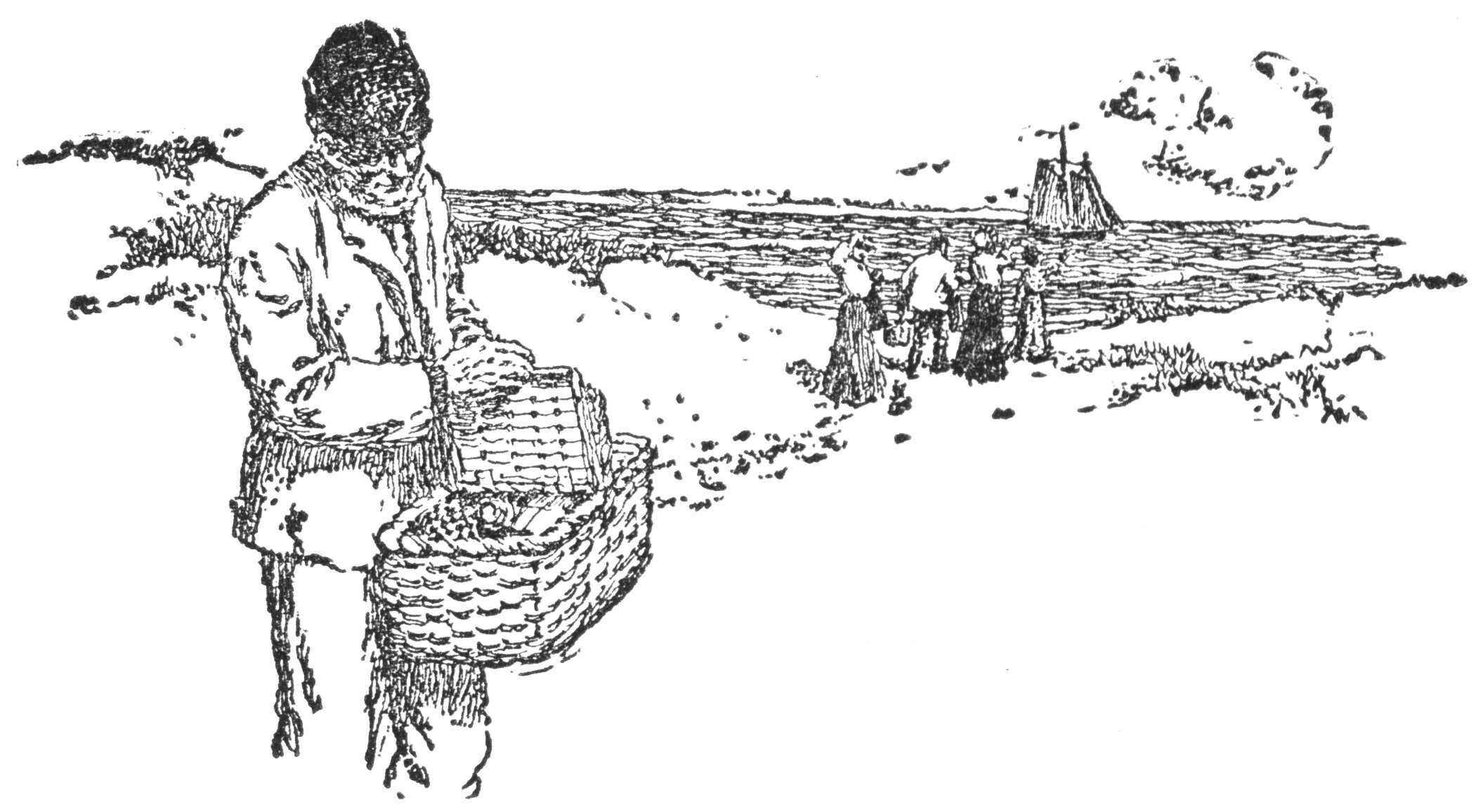
AT SETUCKIT POINT.
“And there she is!” said Captain Titcomb, standing beside Bradley in the bow of the Lizzie. “There she is, just where we left her. Here’s hopin’ she don’t quit till we want her to. Run along under her stern, Barney; tide’s goin’ out, but there’s water enough there.”
It was the morning of the second day following the securing of the wrecking contract. The Lizzie, with Bradley, the Captain, and Alvin Bearse aboard, had left the Orham wharf an hour or more before. They had stopped at the Point to pick up Peleg Myrick and Bill Taylor, the new hands, whose services the Captain had secured without much trouble. The only difficulty had been in persuading Mr. Myrick to leave Skeezicks at the shanty. This had been overcome, however, and the shivering pup, locked in the [Pg 211]room that was Peleg’s sitting-room, dining-room and kitchen, had howled a sad farewell through the crack of the door. His master had left a liberal supply of food to console his pet, and had explained the situation thoroughly to the dog before locking him up.
“He feels kind of bad now,” said Peleg, looking sorrowfully back at the weather-beaten shanty, from which faint, muffled howls floated in dismal cadences, “but I’ve told him that I felt’s though I’d ought to take the job, and he’ll git over it by and by. Jest like a human, that dog is, jest exactly.”
They tried to persuade the weather prophet to leave his concertina behind, but that was a trifle too much; Peleg brought it with him, wrapped in an old sweater.
Barney ran the little wrecking schooner under the tilted stern of the Ruth Ginn, and Bradley sprang from the shrouds to the rail of the stranded craft. Then, one by one, all but Barney, who stayed behind to look after the Lizzie, they clambered aboard the wreck. Most of the hard pine boards that formed the deck-load were in place, having been lashed well and being out of the reach of the heaviest seas, which had spent their force on the stern and after portion of the vessel.
“So fur, so good,” observed the Captain, cheerfully. “Now, Alvin, you go below and see how things look there. Peleg, try her with the pumps; let’s see if she’s leakin’ much. Brad, come here and take a squint at this windlass.”
The patent windlass was in good condition, and [Pg 212]so also, to their delight, was the donkey engine. Peleg, working manfully at the pump, reported that she had some water in her, but that it didn’t “seem to be gainin’ none.”
“That’s all right!” said the Captain. “If she ain’t a sieve, she’ll do. She’s plumb full of lumber and you can’t sink that. Barney!” he hailed, “run over into the deep water at the lee of the shoal there, and anchor. Then take the dory and come aboard; we want to git to work.”
Then Bradley got steam up in the donkey engine and the big anchor of the Ruth Ginn, attached to a heavy cable, was lowered carefully until its shank rested across the stern of the dory. To this main cable, near its middle, were spliced two others just as heavy; to each of these another anchor was made fast. The dories were rowed out almost at a right angle from the wreck into the deep water. Then the anchors were thrown overboard and a three-fingered iron hand, with its spread talons deep in the sand, held the lumber schooner fast.
“Now, Brad,” commanded the Captain, “haul that line taut.”
Bradley started his engine, the windlass turned, and the cable, that had hung loose from the bow of the wreck, lifted from the water and tightened till it groaned.
“All she’ll stand, is it?” asked the skipper. “Good! make her fast. They say tide’ll wait for no man, so I guess we’ll have to do the next best thing and wait for the tide. Now boys!” as the men [Pg 213]climbed aboard from the dories, “git to work and strip her.”
It is always the tide at Setuckit. The tide, tearing around the Point, day after day, year after year, has scoured out the narrow ship channel and piled up the shoals. The tide, catching the unwary coasting vessel or homeward-bound ship driven into its clutches by its ally the on-shore gale, coaxes the struggling victim in, little by little, until, all at once, it grips her in triumph and throws her bodily upon the soft, treacherous sand bars. And there, unless the wreckers come to the rescue, she lies until the next storm, when wind and tide tear her into fragments and leave nothing but a sunken, ragged hulk to be blown up, eventually, by the men employed by the government to keep the ocean highways clear.
But, curiously enough, the same tide that forces the vessels on the shoals is the wreckers’ greatest aid in getting them afloat again. A steam tug is rarely of much use in these waters. No pull that these stout little workers can give is sufficient to start a heavy craft with its keel deeply buried in the sand. Anchors and cables, and the tide, do the business, if it is done at all.
Bradley and the Captain knew that they could not hope to get out all the lumber in the hold of the Ruth Ginn if she was allowed to lie in her present exposed position. One more gale and she would be almost certain to break up. Their hope was to lighten her by getting rid of her deck load and to work her off the shoal into deep water and then tow her up to [Pg 214]Orham harbor, where she could be unloaded at their leisure.
She lay almost broadside to the shoal, but not quite. Her bow was well up on the sand, but her stern overhung the edge of the Boneyard, which, on that side, was, as Captain Titcomb said, “steep as the back of a barn.” The cable, tight as the steam windlass could draw it, led off from her bow to the spot where the anchors were planted under many fathoms of water. Where the tide turned, its pressure against the schooner would bring her to bear on the cable with a tremendous pull. The waves, growing larger as the water deepened, should, if their plan was a good one, loosen her keel in the sand, and every inch she gave the cable would retain. The more she loosened, the easier she would move. The slack thus made in the cable would be taken up by the windlass. She might gain but a foot a day for awhile, but, some day or other, if the weather held fair, she would have worked herself through the sand and clear of the shoal.
They stripped her, cutting away her tangled ropes and sails and taking them aboard the Lizzie. Everything movable, except of course the lumber, they transferred thus or threw overboard. It was a hard job and took them all day. Bradley was a tired man when he reached home that night, but he had to answer countless questions put to him by the interested “old maids.” He saw Gus for a moment or two and reported progress. Then he went to bed.
Next morning was clear and calm and they were [Pg 215]delighted to find that the wrecked schooner had gained a little and that the cable was slacker than they left it. They tightened it again, with the windlass, and then set to work throwing overboard the lumber on the deck. They rigged a tackle on the stump of the foremast and, with the donkey engine, swung great bundles of the planks overboard, while Alvin and Barney, standing on the floating timber, with the water swashing around the knees of their fishermen’s boots, made it into rafts to be towed up to Orham.
Here it was that the partners appreciated the lack of an engine on the Lizzie.
“I tell you one thing, Brad!” exclaimed the Captain, pausing to cut a splinter from his thumb with an enormous jackknife which had seen years of service, “if we make good on a few more jobs like this, we’ll have a new schooner built for us if we have to run in debt for it till we can’t touch bottom. This pitchin’ hay with a two-tined table-fork ain’t my style.”
That night they hired Ira Sparrow’s fishing boat, the You and I, to tow the lumber rafts. She was a stout little craft with a naphtha engine, and, although not nearly so efficient as a tug, did the work after a fashion and was far and away cheaper. By hiring her they added Ira to their force.
For eight days they labored steadily; except on Sunday, when they merely sailed down to take up the slack on the cable. The lumber on the deck had been rafted to Orham and they had begun to get out that [Pg 216]in the hold. The Ruth Ginn was moving slowly through the sand and every day showed more and more gain. The partners were in high spirits.
“She’s a-comin’, Brad! she’s a-comin’!” exulted Captain Titcomb. “Peleg says clear and fine for a fortni’t yit. We’ve got out enough now to pay expenses, but that don’t count. What we’re after is to git it all, and, if somethin’ don’t bust, we’ll do it.”
The whole town was interested in the work. Bradley was waylaid by dozens of people every night. The prophets of calamity had already begun to hedge, although, of course, they were agreed that, if success did come, it would do so because the partners were lucky and had had good weather. “Ez Titcomb and a fool for luck,” was the way Captain Jabez Bailey put it.
The old maids grew more exultant with every evening’s report.
“Ain’t it splendid, Prissy?” Miss Tempy would cry, clapping her hands and waving the dishcloth. “How much did you make to-day, Bradley?”
Gus was just as much pleased, but more philosophical.
“I knew you’d win, Brad,” she said.
The sisters were very anxious to see how the work was done.
“Oh, dear!” sighed Miss Tempy. “I’d give anything to be down at the Point and watch you work. Seems’s if I must go!”
“You wouldn’t be able to see much without a [Pg 217]glass,” was Bradley’s answer. “We’re a mile and a half off the Point.”
“Father’s glass is up garret. Oh, Brad! can’t we go?”
They were so eager and the weather was so warm and pleasant that Bradley began to think it might be possible to arrange for a picnic at the Point. He hesitated about suggesting it to the Captain, however, because he was not quite sure how the latter would like spending a day with the ladies whom he had so unceremoniously dropped from his visiting list. But his first hint was received with great cordiality.
“Sure thing!” said Captain Titcomb. “Mighty good idea, Brad. I ain’t been to a beach picnic for I don’t know when. Let’s see; who’ll we ask? The old maids, of course; and Gusty Baker, maybe—what do you think about havin’ her, Brad? Oh! all right; you needn’t look at me like that. And p’raps Eri Hedge and Perez Ryder and Cap’n Jerry might come. They’d be comp’ny for Prissy and Tempy. Eri’s a great feller to train and carry on and he’d enjoy a cruise like this. Then we ought to have some girls to be comp’ny for Gusty. She won’t want to hang ’round the beach all day and do nothin’ but squint through a spyglass at you, so don’t flatter yourself she will. Might ask Georgiana Bailey, so’s to give tone to the outfit? No? Well, I don’t care much for high society, myself. How about that Hopkins girl—Clara, seems to me her name was?”
So the excursion was decided upon for the very next day, and that evening Bradley went about issuing [Pg 218]invitations. He kept closely to the Captain’s list and Perez Ryder was the only one of those suggested who felt obliged to decline. Captain Perez was caretaker at a big summer house on the “cliff road” and, as the family was coming from the city in a day or so, there were preparations to be made.
“Peleg said good weather for to-day,” declared Captain Titcomb next morning, when laden with baskets and boxes, the excursion party gathered at the wharf. “Thinks I, ‘My son, you don’t know what you’re prophesyin’ against: if a picnic can’t raise a shower then nothin’ will.’ But here ’tis, fine as a fiddle, spite of the handicap. No use talkin’, Peleg’s got the Old Farmer’s Almanac beat a mile. Land sake, Prissy! what you got in that clothes basket?”
“’Taint a clothes basket, Cap’n Ezra. How you do talk! It’s jest a plain lunch basket, and there’s things to eat in it, if you must know.”
“Things to eat! Say, Brad, you didn’t invite this crowd for a week’s cruise, did you? There’s enough in that basket to vittle a man-o’-war. And Tempy’s got one too! What’s that other thing you’ve got, Tempy—a spyglass?”
“Yes; one that b’longed to father. We’re goin’ to watch you and Bradley at work on the wreck.”
“Crimustee! Did you hear that, Brad? You’ve got to behave yourself to-day. No drinkin’ out of the jug, and then chasin’ Peleg with a hatchet; you’ve got to keep sober.”
And, winking at Captain Eri, who was silently enjoying [Pg 219]Miss Tempy’s horrified expression, the Captain led the way aboard the Lizzie.
They had a fair wind down and the sail was a jolly one. Arriving at the Point, they landed the visitors, and picked up Bill Taylor and Mr. Myrick. Miss Tempy begged to be allowed to stay on board and go off with them to the wreck, but the Captain wouldn’t hear of it.
“Last time I took a woman out back of the P’int here,” he said, “was over ten years ago. She was a minister’s wife and her husband was with her. We was tryin’ for bluefish, and when he’d heave his line she’d screech like a foghorn and beg of him not to git drownded for her sake. Way I looked at it, she was his best excuse for wantin’ to be drownded. Well, we got out where ’twas pretty rugged, and every time the boat rolled she’d jump and hold out her arms to me like she was goin’ to grab me ’round the neck. Bein’ a bashful man, I pretty nigh had heart disease ’fore we got ashore. ’Course you wouldn’t do nothin’ like that, Tempy, but——”
“The idea!” exclaimed Miss Tempy, turning very red.
“Reminds me of a woman I took out sailin’ once,” observed Captain Eri. “She kept sayin’ she was havin’ an ‘adorable time,’ and when ’twan’t that ’twas, ‘Oh, Cap’n Hedge! are you sure it’s perfectly safe?’ or ‘Cap’n, you’re sartin you know how to handle the boat, ain’t you?’ Fin’lly she looks down the centre-board well, throws up both hands and whoops, ‘I knew it! I knew it! we’re sinkin’! There’s a hole [Pg 220]right through the bottom of the boat and it’s full of water!’”
So Miss Tempy gave up the idea of going off to the wreck and contented herself with the possession of the spyglass. Captain Eri and Captain Jerry, laden with the lunch baskets, led the way up to the big empty shanty that had sheltered thirty men in the old days when Point fishing was a paying industry, and the Lizzie, with the workers aboard, headed for the Ruth Ginn.
Ira Sparrow, in the You and I, was there already, and the “chug! chug!” of his naphtha engine was heard as he came rushing to meet them.
“Brad! Cap’n Ez!” he hailed, as soon as they were in shouting distance. “She’s shifted like time in the night! I swan, I b’lieve we can git her off this tide!”
This was such unexpected good news, for they had figured on another week at least, that the partners could scarcely believe it.
“Are you sure?” shouted Bradley, leaning over the Lizzie’s bow.
“Pretty nigh sure. Look for yourself.”
They shot up to the wreck, to find the cable, that had been left tight and rigid, hanging loose. An inexperienced eye could see that the lumber schooner had changed her position. Her bow was now almost in a line with the edge of the shoal and, even in the slack water of the last of the ebb, she was rocking appreciably in the cradle her hull had made in the sand beneath it.
[Pg 221]
“Great scissors to grind!” shouted Captain Titcomb. “She’ll do it as sure as I’m a foot high! Tumble aboard there, boys! lively!”
They clambered up the side and fell to work like sharks around a dead whale. Bradley got up steam in the donkey engine. As soon as possible they started the windlass and hauled the cable taut.
“She feels it, boy; she feels it!” cried the Captain. “Give it to her! every pound she’ll stand. Now, then,” he added, “while we’re waitin’ for the tide to turn we might’s well roust out a little more of the cargo. No use to lay back and let Providence do it all. The Lord helps them that helps themselves, as the darkey said when he found the hen-house door unlocked. Hatches off, men! dive into it there!”
They rigged the blocks and tackle and began swinging bundles of mahogany strips from the hold and over the side. The tide turned and the water on the shoal grew deeper. The Ruth Ginn rocked in her sand cradle; every little while they hove taut on the cable in order to take up every inch of slack.
It was exhilarating, exciting work, this fight with old ocean, and Bradley and the Captain gloried in the sheer joy of it. They were winning, and winning not only a goodly sum of money, but the first big prize that would demonstrate their ability to carry through larger and more important contracts. The forenoon passed.
“They expected us ashore for dinner long ago,” panted the skipper, standing by the hatch, his coat and cap off and the wind blowing his hair this way [Pg 222]and that; “but they’ll have to take it out in expectin’. I wouldn’t quit now if the Pres’dent of the United States was waitin’ for me and the turkey gittin’ cold; hey, Brad?”
“I should say not!” replied the junior partner, his eyes snapping. “What’s that? Didn’t she move then?”
“Cap’n Ez!” bellowed Ira, from the You and I. “She’s movin’! come up on your cable.”
The Captain jumped to the windlass and Bradley to his engine. The cable tightened, and slowly, inch by inch, wound back over the windlass barrel. From beneath the Ruth Ginn came a sliding, grating sound, the most welcome sound in the world to the wreckers. Bearse, picking up a heavy coil of rope from the deck, tossed it to Ira.
“That’s the stuff, Alvin!” roared the Captain, approvingly. “Make it fast in the bows. Now, Ira! put your power onto that line.”
The You and I leaped out into deep water and, with her naphtha engine coughing furiously, pulled doggedly at the new tow line. The grating under the keel of the lumber schooner grew louder; she quivered from stem to stern. The cable crept inboard faster and faster.
Then there came a shake, a roll that caused Mr. Myrick to lose his footing and tumble into the scuppers, and, with a triumphant wallow, the Ruth Ginn slid off the shoal. And from her deck, and from that of the You and I, went up a yell that scared the gulls fishing away over on the Razorback.
[Pg 223]
They drew her into the channel, well out of danger, and anchored her firmly, bow and stern.
“There!” said the Captain, triumphantly. “She’ll stay there till we can get a tug from Vineyard Haven. We’ll go ashore and telephone from the life-saving station for one this minute. No more work to-day, boys. They’re waitin’ dinner for us, and we’ve earned it.”
That the good news was already known on the beach was plain. On the roof of the big shanty someone—it was Captain Eri—was seated, waving a flag made of a coat tied to a weir pole. As the Lizzie and the You and I ran into the cove the picnic party came hurrying to meet them.
“Now then!” shouted Captain Jerry, waving his hat; “three cheers for the wreckers! Hooray!”
And Miss Tempy’s handkerchief sailed off on the breeze as she let go of it in her excitement.
The Captain ran up to the life-saving station to telephone to Sam Hardy an order to wire Vineyard Haven to send a tug at once. When he came back dinner was ready.
It was a tiptop shore dinner; baked clams, clam chowder, fried plaice-fish, and all the pies, apple puffs and cake that had filled the lunch baskets. Bradley was too excited to eat much and the old maids were a little worried in consequence.
While the ladies washed the dishes the men smoked and spun yarns. It was after three o’clock when they finished. Then they dragged Peleg Myrick into the shanty and made him play the concertina, while they [Pg 224]danced “Hull’s Victory,” “Speed the Plough,” and the ever popular “Virginia Reel.” There were not partners enough to go around, so some of the men danced together. Captain Titcomb, in his rubber boots, offered his arm with a flourish to Captain Eri and the “cuts” and “double shuffles” that the two shellbacks introduced into that reel were wonderful, although they very nearly broke up the dance.
“We won’t have supper till seven o’clock,” announced Captain Titcomb. “Come on, girls and boys! who wants to go over to the lighthouse?”
They all did, or nearly all; Gus was standing by the back window, looking at the sea, and she did not reply.
“Ain’t Brad goin’?” asked Miss Prissy anxiously, turning as she was about to leave the shanty, with Captain Jerry as her escort.
“Leave Brad alone a minute,” called Captain Titcomb, who was walking with Clara Hopkins. “He wants to git his bearin’s, I guess. You women folks have pretty nigh talked his head off. He’ll be along pretty soon.”
They went away and Bradley, for the first time, was alone with Gus. The old maids had given him no chance to do more than speak the barest word with her before, and now that he had the opportunity, he was almost afraid to begin. She must have known that he was there, but she did not turn her head.
The silence was very awkward. Bradley broke it, after what seemed a long time.
“Gus,” he said.
[Pg 225]
She turned then, and, after glancing at his face, spoke hurriedly.
“Oh!” she exclaimed; “they’ve gone and left us. Come; let’s catch them!”
But he stopped her before she reached the door.
“Gus,” he said, seizing her hand and holding it; “haven’t you got anything to say to me?”
She did not look at him. “What shall I say?” she asked. “What do you want me to say?”
“Why, I thought you’d be glad that I’ve got the schooner off. I thought you’d say—the others said——”
“I am glad, very glad. And very proud. But I knew you would succeed. Hadn’t we better go?”
But he would not let her go.
“I hoped you’d say more than that,” he said, disappointedly. “I was dreadfully blue the other night when Sam was there. I thought that, after all, perhaps I was making a fool of myself in giving up the city and trying to win out down here. It looked so small beside the great jobs Sam talked about. But when you spoke to me on the steps and told me you believed in me, it all changed, and I swore to myself that I would win, because you wanted me to. Gus, do you really care? Are you really glad?”
Then she turned to him and he saw that her eyes were wet.
“What do you want me to say?” she whispered. “That I am more glad than I’ve ever been in my life before, and so proud of you, so proud because you were brave enough to make your fight and win it in [Pg 226]the face of the whole village? And so ashamed of myself because I didn’t encourage you as I ought when you first told me? I can say all that, Brad, and truly mean it.”
“But Gus—oh! it’s no use! that isn’t enough. I haven’t got any money, and I’ve only begun in my work, and I may fail, after all; but Gus, will you wait for me? Do you care enough for me to wait and hope with me, and marry me some day when I really win? Do you?”
He held her hand in both of his and waited, breathless, for the answer. But she did not give it; instead she looked at the window and through it at the sand dunes and waving beach grass and the blue sea beyond. And Bradley, gazing at her face, saw the tears overflow her eyelids and roll down her cheeks.
He turned white, and a great dread came over him. “Gus, don’t you—can’t you care for me?” he begged.
And then she turned, and, leaning her head upon his shoulder, cried heartily and without restraint. “Why did you ask me? Why did you?” she sobbed.
“Because I had to. Gus, don’t you love me?”
“Oh, Brad! I don’t know. I think I do, but I’m not certain. I’m very, very proud of you, and I believe in you, but, oh, dear! I’m afraid of myself. I’m afraid of my temper; afraid I may change; afraid I don’t really love you as much as I ought to.”
“There isn’t anyone else, is there?”
She smiled, tearfully. “No, Brad, there isn’t anyone else.”
“Then won’t you try to say yes? Perhaps you’ll [Pg 227]learn to care for me. Won’t you say yes, and try, dear?”
“Do you want me to say it, now that you understand just how I feel?”
“Yes.”
“Do you want to take me just as I am—liking you better than anybody else in the world, but not—perhaps, not really loving you as it seems to me a girl ought to love the man who is going to marry her?”
“Yes.”
“I’m a queer girl, Brad. Grandma says I’m like her best china teacups—I must be handled carefully or there’ll be a smash. I guess that’s so. I don’t trust myself; I change my mind five times a day. Do you want me to say yes, in spite of all this?”
“I do.”
“Then I will say it; and I will try to be what you would like to have me.”
He bent his head and kissed her, and just then came a thunderous knock on the door.
“Brad,” whispered Captain Titcomb, through the crack; “are you there? I’ve come back after Tempy’s spyglass. Git it for me, will you? Maybe you’d better hurry,” he added, with a suppressed chuckle. “She’ll be here in a minute, herself.”
The spyglass was handed out in a jiffy.
[Pg 228]
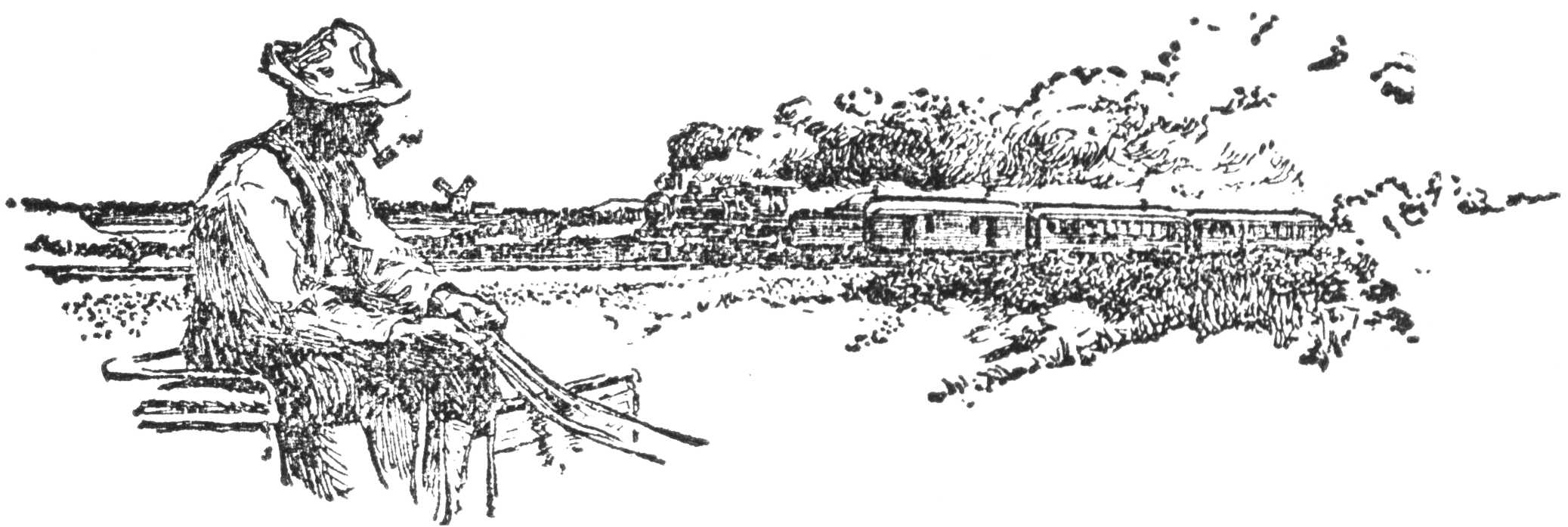
THE ANCHOR OF THE LIBERTY.
Bradley would have proclaimed his happiness through a speaking trumpet, but Gus begged that the engagement be kept secret for a while. “Please let me feel a little surer of myself first,” she pleaded, and Bradley agreed, as he would have agreed to climb Bunker Hill Monument on the outside if she had asked him to.
He “carried on so,” as Miss Tempy expressed it, during the sail home that evening, that that lady was a trifle alarmed and asked her sister, as they were getting ready for bed, if she thought there could be anything in what Captain Titcomb had said about the jug.
“Land sakes! no!” was the indignant answer. “If Bradley’d took to drinkin’ I guess we’d have found it out afore this. Do you wonder the boy feels happy? I could have stood on my head, myself, when I saw that lumber vessel come off the shoal this afternoon.”
[Pg 229]
One more question Miss Tempy asked, after the light was put out.
“Prissy,” she whispered; “Cap’n Titcomb seemed more like himself—with us, I mean—than I’ve seen him for three years. Almost like he used to be. Do you s’pose that means anything?”
“I don’t know. Go to sleep.”
The tug arrived the next forenoon and the hull of the Ruth Ginn was towed up into Orham harbor. There she was anchored, where the getting out of the rest of her cargo would be a comparatively easy task.
They worked with might and main and, at the end of a month, the job was done. The last joist was laid upon the wharf. Obed Nickerson expressed himself as surprised and highly pleased.
“You fellers have done mighty well,” he said. “I felt kind of shaky when I let you have the contract, but I shan’t feel so again. If you had a bigger vessel, with an engine in her, I b’lieve you could handle ’most anything that’s likely to run up on this coast.”
Their share of the cargo’s value amounted to twenty-nine hundred dollars, and, all expenses deducted, the profit to the partners was over two thousand.
“Not so mean for two greenhorns in a floatin’ soup ladle,” crowed the Captain. “Brad, how’s the Jeremiahs these days? Ain’t anybody said ‘I told you so,’ yit, have they?”
The underwriters’ agent was their friend now and, inside of another fortnight, he had put a job in their [Pg 230]way that brought them in four hundred dollars more. She was a coasting schooner that had grounded off the Point, and her skipper had contemplated telegraphing to the Salvage Company, but, thanks to Obed’s recommendation, the chance was given—for a much lower price, of course—to the Lizzie’s owners. The vessel laid easy, with only her bows on the sand, and the anchors and cables got her clear in three days.
Then they went anchor-dragging again, and met with considerable success. The skipper of the coaster that the partners had worked off the shoal, as just described, said to a friend of his, who commanded a four-master, “There are a couple of fellers down to Orham that are smart wreckers as ever I saw. They snaked me off the edge of the Razorback in next to no time, and didn’t charge ha’f the vessel was worth, neither.” And the captain of the four-master was by this reminded that he had lost a good anchor and thirty fathoms of chain on the Orham rips only three months before. He wrote to Captain Titcomb, giving the “ranges” as near as he could remember them, and the partners agreed to undertake the job of recovering the lost “mudhook.” They found it, after a while, but, oddly enough, their drag line picked up four other anchors, of various sizes and values, before the right one was finally hauled on board.
All this was profitable, as well as good advertising, and the Lizzie’s owners were doing well. But they were ambitious and yearned for the day when they might undertake bigger things. Captain Titcomb was [Pg 231]for ordering a new and larger wrecking schooner immediately.
“What’s the use of waitin’, Brad?” he argued. “We’ve got enough on hand to pay part of what a decent schooner’s worth. Let’s go in debt for the rest.”
But Bradley, more conservative, counselled waiting a little longer. “No use saddling ourselves with a big debt to start with,” he said. “‘Dead horse’ is the meanest animal to pay for that I know of.”
“You remind me of Uncle Elihu Bassett, that the old man—dad, I mean—used to tell about,” said the Captain. “Uncle Elihu was a great feller for bein’ economical. The only thing he spent much money for was rum, and his argument was that rum was a cuss anyhow, and the more old chaps like him bought the less there was to tempt the younger generation. Well, the said generation didn’t stand much show ’longside of him, that’s a fact.
“Dad used to say he’d never forgit Uncle Elihu settin’ in the tavern that was over at Harniss in those days, and swearin’ a blue streak because he hadn’t been able to git down from his house to town-meetin’ the week afore.
“’Consarn it!’ says Elihu; ‘I was dyin’ to git to that meetin’ to raise my voice ag’in’ appropriatin’ that money to fix the town’s highways. Wust extravagance ever I see, that is! I’d a-been there,’ says he, ‘only the mud in our road was so deep I couldn’t drive through it.’”
And, although the Captain agreed to wait a little [Pg 232]longer before ordering the new vessel, he announced that he was going to keep his eyes open, and perhaps he’d strike a bargain some day or other.
In August Miss Prissy threw the household into consternation by coming down with the grip. She had insisted on going to church in the rain because Mr. Langworthy’s nephew from Providence was going to preach that Sunday, and she came home with wet feet. A chill followed, Dr. Palmer was called in and the housekeeper and business manager, in spite of her protestations, was put to bed. And in bed she stayed for some time.
Miss Tempy, without her sister was, as the Captain would have described it, “as uneasy as a fish out of water.” She insisted on acting as nurse and house-keeper both. Bradley, prompted by the doctor, hinted at hiring a servant, but was incontinently snubbed.
“I guess not!” exclaimed Miss Tempy. “I don’t want any hired girls traipsin’ ’round this house! I’ve heard enough from other folks who do have ’em. Mrs. Thankful Brier was tellin’ me only a few Sundays ago, at meetin’, that her daughter Jane up to Melrose wrote her that she’d had three girls in less’n a fortni’t, and the last one put the dog crackers, or biscuits, or whatever they be, on the supper table ’cause she thought they was cookies. The idea! No, I don’t want any girls!”
“Then you must let some of the housework go. It’s too much for you; you’ll be sick, yourself.”
“Let the housework go! I guess not! Bradley [Pg 233]Nickerson, we Allens may be poorer than we used to be, but we’re not shif’less.”
So, as if to prove this assertion, she relentlessly scrubbed the floor of the big dining-room next day and was very pale and tired when Bradley came in to supper. And then followed the first disagreement between the young man and the sisters since that dreadful first day at school.
Bradley put his foot down and declared that a servant should be hired. Miss Tempy put hers down even harder and vowed she shouldn’t. It ended by a scene in the sickroom.
“Bradley,” said Miss Prissy, weak but unconquerable, “’fore I’d let you spend your money to hire a girl in this house, I’ll git right out of this bed and do the work myself. If it’s the last act, I will! Tempy, you let things slide till I’m better. Now mind!”
But letting things slide was not an Allen trait, as Bradley had been told. Very much troubled he went to Gus for advice.
“Brad,” said that young lady, after a few moment’s thought; “I think I know just the one for you. I believe Clara Hopkins would come if I asked her.”
“Clara Hopkins! Why, Gus! she isn’t a servant.”
“Of course she isn’t! She wouldn’t think of coming as a servant. But, you know, since her mother went away to Fall River to stay with Clara’s brother—his wife has the typhoid fever—it has been terribly lonesome for the poor girl there at home. She told me, the other day, that she couldn’t stay alone much longer; she thought she should shut up the house and [Pg 234]board somewhere. Now, I believe she would come and live with the old maids. Of course you mustn’t hint at paying her wages, but she could help about the house, and she is jolly and good tempered and a splendid nurse. I’ll ask her, if you want me to.”
“She’d be just the right one. But, Gus, it won’t work. Miss Prissy or Miss Tempy wouldn’t have her come there to help, any more than they would a hired girl.”
“They don’t need to know that she comes for that, at all. Oh, Brad! if you were only a little less straight up and down, and just a little more like—well, like Cap’n Titcomb. Don’t you see? You must make the old maids think that they’re doing Clara a favor; not that she’s doing them one. I could arrange it, I’m sure; but you’re so dreadfully transparent.”
Bradley was aware of the transparency and it was with no great hope of success that he threw out the first hint concerning Miss Hopkins. To his surprise the hint was well received. The sisters liked Clara and she had told Miss Tempy, only the week before, how lonely she was.
“Poor thing!” sighed the younger sister. “If Prissy was well, I’d have her come right up here and make us a visit. I’d be glad to have her come and spend the day with us, anyhow.”
This was unexpected good luck. Clara, duly “coached” by Gus, came to spend the day. She made herself so thoroughly at home, was so pleasant in the sickroom, and helped in so many ways without seeming to try, that the old maids were delighted.
[Pg 235]
“I declare, Clara!” said Miss Tempy; “I’ve jest enjoyed havin’ you here. You shan’t go back to that poky, shut-up house to-night. We’ve got a spare room and you can stay here jest as well as not.” When the sisters were alone, she said: “Prissy, I never enjoyed doin’ a charitable act more’n I have makin’ that poor, lonesome girl happy to-day. It pays to act like a Christian, don’t it?”
And after that, of course, it was easy. Clara stayed on from day to day. She became a part of the household, and, gradually, lifted the burden from Miss Tempy’s shoulders. It was pleasant to be able to sit by the bedside and read aloud from The Fireside Comforter, knowing the while that the housework was being done and well done. And Clara liked “pepper tea,” or said she did. Here, indeed, was a kindred spirit.
One night—Peleg had prophesied it for a week before—a heavy northeast gale broke the monotony of summer weather. It very nearly brought disaster with it. The great six-masted coal barge Liberty, recently built, with her twin sister, the Freedom, by Cook and Son, the “coal kings” of Boston, came within a hair’s breadth of running bodily upon the Boneyard shoal. She was running into the Sound, under sail, with a tug following her, and the wind and tide caught her, as they had caught many another vessel. The skipper, suddenly realizing his danger, ran to the windlass, loosened the dog and pin, and let the mammoth anchor go over with a run. Then he leaped to the compressor, to clamp the chain; but the tide was [Pg 236]too much for him. The chain flew over the “wildcat” with a howl, and, before he could stop it, anchor and one hundred and twenty fathoms of chain were stretched out on the bottom.
Lucky for the Liberty and her owners—she had cost ninety thousand dollars to build, and carried over five thousand tons of coal—the skipper of the stout, sea-going tug saw the danger, ran up astern of the helpless barge, and got a line aboard in time to check her headway and hold her nose off the shoal.
“Well, Brad,” said Captain Titcomb, when the news reached Orham; “land knows I ain’t prayin’ for other folks to lose money, but what a job she’d have made for somebody—say for us, hey? There’s from thirteen to twenty thousand in gittin’ a whale like her afloat.”
“Yes,” replied his partner, “but twenty tons of brand-new anchor and chain are worth eight hundred, at least, and half of that will go to whoever picks ’em up. We want that anchor-dragging job, sure.”
But it wasn’t so easy to get, and so they found. Their success in the wrecking venture had bred would-be rivals. Before that day was over, Seth Wingate and two or three of his friends had offered, by wire, to locate and “buoy” the lost ironwork for the sum of three hundred dollars. Then the Salvage Company was to send down a tug and bring it to the surface. It was a great disappointment to the partners.
It is one thing, however, to agree to perform and another to do. Seth had not had much experience in [Pg 237]anchor-dragging, and although his catboat and two or three dories scraped the bottom for three days, they failed to hook the object they were after. The skipper of the Liberty came to Orham and put up at the Traveller’s Rest. That night Captain Titcomb and Bradley called at his room.
“Cap’n Gould,” said Captain Ezra, “does it make any diff’rence to you who finds that anchor and chain of yours?”
“Not a continental! All I want is to have somebody find it.”
“You folks haven’t contracted with Wingate and his crowd then?”
“No, they offered to find and buoy for so much, and we let ’em try; that’s all.”
“All right. Now, you tell me, as nigh as you remember, jest where the Liberty was when you hove anchor.”
So Captain Gould told them. The Setuckit light was about so and so; the Razorback lightship off here; and the rest of it.
“Here’s where we lee-bow brother Seth, I cal’late,” whispered Captain Titcomb as they left the room. “Pesky idiots! they never asked a question; jest went bull-headed draggin’ the edge of the Boneyard. If Gould’s right that anchor’s a ha’f mile to the no’theast.”
And, sure enough, there it was. The drag line from the Lizzie’s dories caught on one of the great flukes before the following forenoon was over. The way-line was sent down, the messenger followed, and, [Pg 238]clamped securely, the prize was “buoyed” before dinner time.
“What you doin’, Seth?” hailed the Captain, in a provokingly cheerful voice, as they passed the Wingate catboat. “Seinin’ porgies? We’ve jest buoyed a big mudhook off here. Might be the Liberty’s; you can’t tell.”
The Captain was for going to Boston at once and claiming the three hundred, but Bradley had been thinking.
“Why shouldn’t we do the rest of the job?” he asked. “That anchor, as it lies, is ours. We found it; we buoyed it. Why should we give it up to the Salvage people? We didn’t make any deal with them.”
Captain Titcomb fairly whooped with delight. “Bully for you, Brad!” he crowed. “Sartin sure! why should we? We can’t even take our Bible oath that it’s Gould’s iron we’ve found.”
They planned and argued until two o’clock. Then Bradley rushed up to the house, swallowed a hasty lunch, threw a nightshirt and toothbrush into his grip and caught the three o’clock train for Boston. He did not even stop to tell Gus of his departure, and trouble came of that omission later on.
At nine o’clock next day he leaned across the mahogany rail in the office of Cook and Son and asked an important young gentleman, with a pen behind his ear, if Mr. Cook, Senior, was in.
“No,” replied the important young man, looking [Pg 239]condescendingly at his sunburned questioner; “but I am.”
Bradley ventured to hint that he was aware of his informant’s distinguished presence, but that he wished to see Mr. Cook, Senior.
“What did you want to see him for?” queried the human pen-rack. Bradley did not care to make his business known, so the young man went back to his desk. In an hour he again leaned across the rail to inform the visitor that the manager was in.
“I want to see Mr. Cook,” replied Bradley.
He waited. The forenoon passed. People came in by dozens, were admitted to inner offices and went away again. Beyond again asking what Bradley’s business might be, and receiving no satisfactory answer, the gentleman at the desk did not trouble himself further. At exactly twelve he stepped into another room, returned with his hair artistically curled on his forehead, covered it with a straw hat surrounded by a beautiful white and blue band, and went out—presumably to lunch.
Bradley was hungry, but persistency was one of his virtues, and he sat still. An hour later, a stout man with side whiskers and a protruding chin came out of one of the inner offices.
“Are you Mr. Cook?” asked Bradley.
The stout man looked him over and admitted, shortly, that he was.
“My name is Nickerson. I’m from Orham. I came to see you about that anchor and chain that the Liberty lost; I think, perhaps, I’ve found it.”
[Pg 240]
“You do, hey? Have you buoyed it?”
“Yes, sir.”
“All right. The Salvage Company will send a tug, and, if it’s our anchor, and you did find it, we’ll forward you a check for three hundred dollars. Anything more? I’m going to lunch.”
“Yes, sir. The anchor and chain, as they lie on the bottom, are ours. My partner and I are wreckers, and we think we ought to have the job of raising them.”
“You do, hey? Well, the Salvage people do my wrecking jobs, and they’ll do this one. Good-day.”
“Mr. Cook, if a tug is sent to Orham to take up your anchor, and if they touch our anchor—the one we’ve buoyed—we shall sue you for damages.”
The coal king looked at him in complete astonishment.
“Well! I like your nerve!” he exclaimed. “Didn’t you say it was my anchor you’d found?”
“I said I thought it might be yours. But we’ve found it, whatever it is, and it’s ours until you prove property. Then, when you do prove it, we’ll be ready to arrange for salvage charges.”
“How do I know you can raise anything, even a rowboat’s anchor?”
“All we ask is the chance to prove it.”
“What’ll you charge?”
“Five hundred dollars.”
“I’ll see you further. The Salvage people won’t charge more than that.”
“They couldn’t do it any better than we can.”
[Pg 241]
“Well, sir, you can have three hundred if you’ve got it buoyed, just as I said. That’s all you’ll get, and a tug will be there day after to-morrow. Take it or leave it. Now you can go to Orham, or the devil, just as you like. You can’t bluff me, young man.”
The great Mr. Cook went to lunch then, and Bradley, too, left the office. The young gentleman with the striped hat band, who had returned in time to hear the latter part of the interview, grinned pityingly.
That evening, when the train came in, the Captain was on the Orham station platform to meet his partner. He listened with interest to the story that the latter had to tell.
“Say!” he exclaimed. “You stood up in your boots like a little man, Brad. But ain’t you afraid we’re kind of bitin’ off our nose to spite our face? Cook and Son’s a big concern, and Titcomb and Nickerson ain’t quite in the king row yit, you know.”
The fact is the Captain’s old respect for owners had not entirely disappeared. He stood a trifle in awe of men whose payroll contained the names of twenty skippers.
“No, sir!” replied Bradley, with determination. “We’re right, and he’ll have to come to our terms or let his anchor stay where it is till doomsday.”
He felt rather well satisfied with himself, on the whole, and more like his own master than ever before. He continued to feel that way until, after supper, he called upon Gus, and then the cool manner in which [Pg 242]that young lady received him reduced his self-esteem considerably.
“Why, what’s the matter?” he asked, in despair, after being snubbed and answered in monosyllables for ten minutes. “Aren’t you interested in what I did?”
“Oh! I don’t know. Why should I be? You’re not particularly interested in me; that’s plain.”
“Not interested in you? Why, my dear girl! I——”
“Bradley Nickerson, why didn’t you tell me you were going to Boston? Anyone would think that was the least you could do.”
“Why—why, Gus! I didn’t have but a minute! I should have missed the train!”
“Suppose you had, there’s another in the morning.”
“Yes, but then the business would——”
“The business! I’m sick of the business! You don’t think or speak of anything but the business. Why don’t you think of me, or what I’m interested in, occasionally?”
She had heretofore listened to his plans and schemes so patiently, and had helped him with so many suggestions, that this sudden change upset him completely.
“Why, Gus!” he faltered. “I’m awfully sorry. I thought you’d understand.”
“Yes, you thought I’d understand; and so you went away without a word and left me to find out from Miss Tempy that you’d gone. How did you know that it would please me to have you go? How did [Pg 243]you know that I didn’t wish to spend the evening somewhere? You didn’t know, and you were so selfish that you didn’t care. You neglect me more and more all the time.”
It was unreasonable, of course, but there was just enough truth in it to cause Bradley’s conscience to prick him sorely. He had become more and more interested in his work, and his talk had been principally confined to that subject, but he certainly had not meant to be neglectful. He did what the man must do in such cases; he apologized, confessed that it was all his fault, and humbly begged forgiveness, with all sorts of promises for the future.
After it was all over and they had made up, Gus said:
“Brad, I am interested in your success and in your plans, but you mustn’t let them fill all your mind. I told you that day at the Point that I wasn’t sure of myself and that, as grandma says, I must be handled with care. I’m trying hard to please you, dear. Don’t forget to try your hardest to please me, even in little things.”
Later she said, casually, “I had a letter from Sam to-day. They’ve made him superintendent of a crew that are at work on a big steamer.”
Now it wasn’t pleasant to learn that his fiancée received letters from another man, especially Sam Hammond, but Bradley was wise enough to feel that this was not the time to raise objections.
“Oh! I shan’t answer it, of course,” said Gus, as if she had read his thought—as no doubt she had—“but [Pg 244]he does have such good times in New York: theatres, and concerts and everything. Orham is such a deadly dull place for everybody but the summer people. I do so want to go somewhere or do something for amusement.”
Altogether, that evening was not the most assuring or satisfying one of Bradley’s life.
And in a few days, as the senior member of the firm of Cook and Son had predicted, the tug came to raise the barge’s anchor. She belonged to the Salvage Company and her skipper had been directed by his owners to stop on the way to New York and do this little job. She found the Lizzie lying to close by the buoy.
“Is that the Liberty’s anchor you’ve got buoyed there?” shouted the captain of the towboat.
“Don’t know,” answered Captain Titcomb, cheerfully. “It’s one we picked up draggin’. Might be the Liberty’s, p’raps.”
“Well, I’ve got orders to get it up.”
“Guess not. That’s our buoy and our anchor, fur’s anybody but the fish knows. We’ll fetch it up when we’re ready. Don’t need any help.”
“Oh, look here! What’s the use of talkin’? That’s the Liberty’s iron, all right. Let me get at it; you’ll get your price for buoyin’ it.”
“You touch that buoy or those lines and you’ll git into trouble. Keep your hands off our property unless you want to pay for your fun.”
The skipper of the tug knew he had no means of [Pg 245]proving that the buoyed anchor was the one he was sent for. He fumed and argued the whole forenoon; the partners were cheerful but firm. At last the angry towboatman went up to Orham to telephone for instructions. He came back swearing mad.
“What did they say?” asked Captain Titcomb, calmly.
“Told me to take it up if I was sure ’twas the Liberty’s. How in thunder do I know whose ’tis?”
All night long the Lizzie stayed by the buoy, and the tug rocked close beside her. In the morning the skipper of the latter vessel hailed again.
“How long are you goin’ to keep this up?” he asked.
“Oh! ’twouldn’t be polite to go away and leave you, you bein’ out of town comp’ny,” was the unmoved answer. “We’re takin’ watch and watch ’board here. How do you work it?”
“Aw, go to thunder!” was the disgusted reply.
For a few hours longer the towboat and wrecking schooner lay side by side, while their crews exchanged compliments.
“Hi!” shouted Barney Small, pointing to the jet of steam from the tug’s escape pipe; “your teakittle’s leakin’. Want to borrer our sodderin’ iron?”
The mate of the little steamer made answer by requesting Barney to lend him his face “to fight a dog with.”
At noon the tug’s skipper made another trip to the telephone, this time using that at the life-saving station. He stated the situation to his owners without [Pg 246]frills. The work at New York could not longer be kept waiting, and he was told to start for that port.
“Ain’t goin’ to leave us, are you?” hailed Captain Titcomb, as the tug began to move.
“Oh! don’t you fellers git the big head too bad,” was the answer. “I’ve got somethin’ better to do than roost down here. But there’ll be other callers; don’t forgit that. You little two-for-a-cent beachcombers can’t beat the Boston Salvage Company so easy.”
“Chuck us a tintype of yourself to remember you by,” yelled Bill Taylor.
“Tell your sister not to worry about me,” shouted Alvin Bearse. “I’ll write pretty soon.”
And Peleg, prompted by Mr. Small, brought out his concertina and played “Good-bye, Sweetheart, Good-bye,” with agonizing pathos.
Captain Ezra sent a final hail after the snorting towboat.
“You tell Mr. Cook,” he shouted, “that the longer he lets that chain lay where ’tis the worse it’ll sand. In a month it’ll be covered in so you can’t git up more’n ha’f of it. Tell him to wire us when he gits ready to pay our price. And say!” he added; “don’t forgit to tell him to prepay the message.”
[Pg 247]
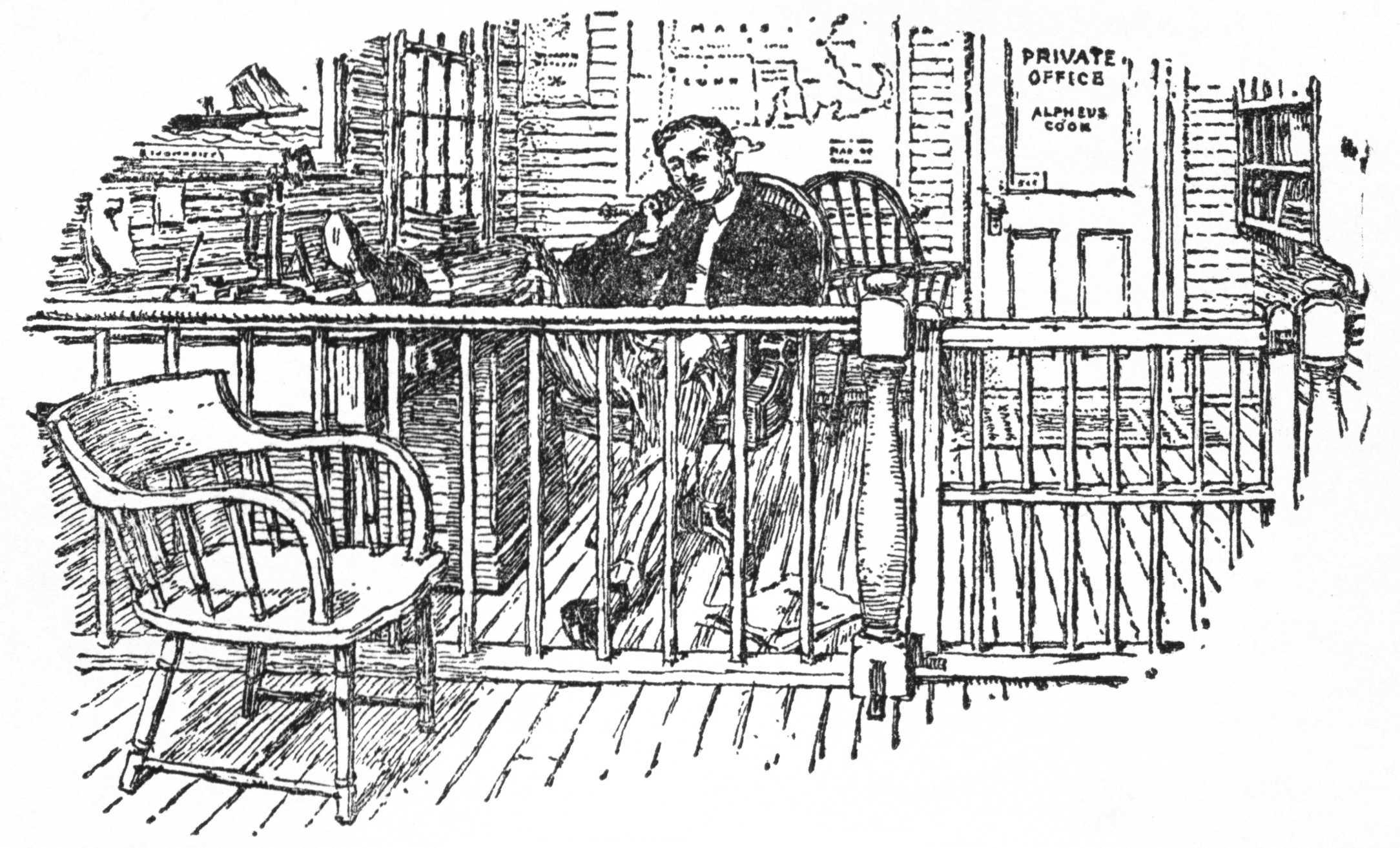
MR. COOK WIRES.
After that both sides stood pat for a time. Cook and Son, although they sent no more tugs, did not wire, as the Captain had suggested, and the anchor and chain lay untouched on the bottom, with the Lizzie’s buoy floating above, and the tide-driven sand sifting steadily over the great iron links.
The partners went dragging for other anchors. At the end of a week, Captain Titcomb hinted that it might be a good idea to telephone the Liberty’s owners and ask if they were ready to trade. But Bradley was firm.
[Pg 248]
“No,” he said; “we can stick it out as long as they can.”
The Captain grinned admiringly. “Brad,” he said; “you’ve got more nerve than I have; I swan if you ain’t! When I think of us two buckin’ up against a concern that owns twenty-two vessels, I give in it gives me the palsy in my knees. But go it, son! I’ll stand behind you till all’s blue.”
The next move in the game came from an unexpected quarter. The Captain and Bradley had just landed one evening, after a day on the shoals, when Obed Nickerson came strolling down the wharf to meet them.
“Hello!” he said. “Haven’t seen you fellers for some time. Goin’ to walk up to the village? Don’t know but I’ll go with you; I need a little exercise.”
This seemed a trifle odd, for sleek, easy-going Obed wasn’t fond of walking; as a usual thing he preferred to drive one of his fast horses. As Captain Titcomb said, later: “You didn’t need to smell bait to know somebody was goin’ fishin’.”
They walked on, talking town politics and gossip. No one mentioned business until the underwriters’ agent said, casually: “Well, how’s things goin’? Got up that barge anchor yit?”
“Not yet,” replied Bradley.
“Humph! ’twill be pretty badly sanded if you let it lay much longer, won’t it? Why don’t you fellers write to the Salvage Company? I understand the job was given to them. I don’t imagine either you or they want any lawyers mixed up in it. I [Pg 249]shouldn’t be s’prised if they’d be willin’ to meet you ha’f way in a dicker.”
Captain Titcomb kept his eyes fixed on the ground. “What makes you think so?” he asked.
“Oh! nothin’ special. But I’d write ’em if I was you.”
“Hum! You couldn’t do it for us, could you, Obed?”
“Why, I don’t know. Maybe I could. I know ’em pretty well. Now s’pose—only s’pose, of course—that I could fix this thing up; what’s the lowest terms that you’d raise that anchor and chain for?”
Then the Captain looked up and laughed, like one who has solved a riddle. “That’s Brad’s job,” he said. “Ask him, Obed.”
“Well,” said Bradley, with his hands in his pockets. “We’ll raise that anchor and what we can get of the chain for five hundred dollars. That’s our price.”
“Oh! now what’s the use? They won’t pay that, and——”
“Look here!” broke in Captain Titcomb, “I’ve had some dealin’s, afloat and ashore, with this young feller,” laying his hand on his partner’s shoulder, “and I’ve found that, when his mind’s made up, he’s a kind of combination of mule and the Rock of Ages. ’Twon’t do, Obed. You write to the Salvage Company or Cook and Son, or whoever set you on this tack, and tell ’em that Titcomb and Nickerson are little, but oh my! Tell ’em that that chain’s sandin’ [Pg 250]and settlin’ every day, but that, if we have to wait till the other end sticks out in China and makes a clothesline for the heathen in his blindness, there she stays till they come to time. No hard feelin’s to you, Obed, and sorry you had your walk for nothin’.”
The underwriters’ agent was momentarily embarrassed; then he laughed.
“All right,” he said. “You mustn’t git the idea that there’s anything in this for me. I only——”
“I know. You only done it to oblige, like the feller that fetched the rat poison to his mother-in-law when she said he made her sick of life. We understand. Good-bye.”
The partners were considerably encouraged by this interview. They argued that Cook and Son were getting nervous.
That evening Bradley and the old maids were in the sitting-room. Miss Prissy was much better and had, for the first time, donned a wrapper and come downstairs to sit in the big rocker. Miss Tempy was reading aloud to her, and Clara was in the kitchen washing the supper dishes.
“‘The Earl bent his proud head,’” read Miss Tempy, “‘and gazed into the clear blue orbs that met his own. Claire,” he murmured, in a deep, rich tone that vibrated through the heavy air of the gloomy cavern; “Claire, my beautiful! my own! poor and humble your station on earth may have been, but henceforth, if we escape from the lurid flames of yonder volcano and the cruel blades of the merciless buccaneers, you shall no longer be the peasant maid, [Pg 251]but my bride, my wife, mistress of Castle Craggyknoll; the peerless——”’”
“What’s that?” she exclaimed, breaking off suddenly.
“What’s what?” asked her sister, drowsily.
“Seems to me I heard somebody in the kitchen.”
“Clara is there, isn’t she?” queried Bradley.
“Yes, but—I thought—yes, there’s somebody else. I do b’lieve it’s a man! You don’t s’pose she’s got a beau? I’m goin’ to see.”
And, before the others could remonstrate, she put the Comforter on the table and started for the kitchen. They heard her cross the dining-room and open the door. Then came an exclamation.
“Why! why!” she cried; and then, “Well, I do declare!”
“What do you s’pose ’tis?” asked Miss Prissy, now thoroughly awake. The kitchen door had swung to, but there was a great clatter of voices behind it. Miss Tempy was exclaiming and arguing; Clara, apparently, was saying very little, and a third person, in a deep bass rumble, was explaining something or other.
“Land of goodness!” cried Miss Prissy, “I hope it ain’t the minister, and me in this old wrapper.”
The kitchen door was opened, Miss Tempy appeared beaming, and there followed her into the sitting-room no less a personage than Captain Ezra Titcomb. The Captain’s face was the least bid redder than usual, but he was otherwise as suave and unmoved as if the time of his previous call had been but yesterday instead of four years before.
[Pg 252]
“Well, Prissy!” he said, shaking hands with the invalid, “how are you to-night? ’Most ready to come on deck and take command? No, don’t git up. Evenin’, Brad.”
Poor Miss Prissy! She patted her tumbled hair into the most presentable shape possible, hurriedly pulled the red and white knitted “Afghan” over the wrapper, and managed to gasp that she was glad to see the Captain. Then she sat still and stared reproachfully at Miss Tempy.
But that lady was too excited to notice her sister’s agitation. She fluttered about the visitor like a hen with one chicken, trying to hang up his hat, dropping it, blushing violently as she collided with him in the attempt to pick it up, and generally behaving, as Miss Prissy said afterwards, like a born gump.
“Set right down, Cap’n,” she pleaded. “We’re reel glad to see you. What made you come to the kitchen door? I couldn’t think who ’twas; could you, Prissy? Oh, my sakes!”
In her nervous haste she had pushed forward the big armchair that had once been the throne of Captain Darius, but which, owing to the infirmities of age, had for some time been kept in the corner for show purposes only. It had a weak leg, and, when Captain Titcomb planted himself upon the worn black oilcloth cushion, the infirm member promptly bent inward and the Captain slid gracefully to the floor.
“Tempy!” exclaimed Miss Prissy, in a freezing tone. Bradley laughed and ran to assist the fallen [Pg 253]one. Miss Tempy, now in a perfectly helpless state, wrung her hands and stuttered.
“The idea of givin’ him father’s chair!” cried Miss Prissy. “Tempy, have you gone loony? I hope you ain’t hurt, Cap’n Ezra? We never use that chair now. It used to belong to father.”
Miss Tempy was heard to remark, feebly, that it looked “so like him.” She declared afterwards that she didn’t say it.
The Captain made light of the accident and selected another seat, carefully testing it beforehand. He at once began to talk about the weather and Miss Prissy’s illness. But the older sister interrupted him as soon as the opportunity offered.
“What made you come to the back door?” she asked.
There wasn’t an instant’s hesitancy in the Captain’s reply:
“Oh!” he said, lightly, “it’s rainin’ a little and I thought I wouldn’t muss up them floors of yours. I know them floors of old,” he added, and laughed heartily. He continued to talk about the floors and seemed to think his fear of soiling them a great joke. Miss Tempy, who was a trifle more rational by this time, laughed with him, but Miss Prissy seemed still curious.
“You used to come to the dinin’-room door, even when it snowed,” she said.
“Yes, but I had on my sea-boots this time and they’re so big I tote ha’f the road along with me. Reminds me,” he added, hastily, just in time to cut off [Pg 254]another question, “of what the old man—my dad, I mean—said about a colored cook he had aboard his ship once. Dad said that darky’s feet was the largest live things without lungs that he ever saw out of water.”
Bradley thought he had never seen his partner so willing, even anxious, to monopolize the entire conversation as he was that evening. He cracked jokes and spun yarns without stopping to rest. Clara came in, after a little, and seated herself quietly on the sofa. She, too, seemed a trifle nervous, but the sisters did not notice it. They were hypnotized by their caller’s lively tongue, and laughed like girls. Miss Prissy grew more like herself every minute.
“Don’t go, Cap’n,” she pleaded, as the visitor pulled out his watch and rose from the chair. “I declare! you’re better’n the doctor!”
“Much obliged, Prissy, but ’twas too much of a good thing that busted the cider jug. Two opposition doctors in one house would be like the two Irishmen fightin’ for the pig—’twas an ‘ilegant row’ while it lasted, but it killed the pig. No, I must be gittin’ on. I left my umbrella out in the kitchen. Clara, bring the lamp, will you, please?”
Clara rose and started for the kitchen, but Miss Tempy intercepted her.
“I’ll git your umbrella, Cap’n,” she said.
“No, no! you set still. Clara knows jest where ’tis; she put it away.”
“Well, I guess I can find it. You needn’t come, Clara. Yes, here ’tis. Good night, Cap’n Titcomb. [Pg 255]I—I hope, now you’ve found the way, you’ll call again some evenin’. Bradley’ll be glad to see you and so will Prissy and—and I. You’ve done her a world of good. Good night.”
The Captain walked briskly down to the gate. Then, as the door closed behind him, he paused, wiped his forehead with his coatsleeve, and drew a long breath.
There was jubilation in the old maids’ room that night.
Obed Nickerson must have been prompt in communicating to the Salvage Company, or Cook and Son, the news of the failure of his attempted negotiations with the partners, for on Tuesday of the following week this telegram came:
“Bradley Nickerson, Orham, Mass.
“Come my office immediately.
Alpheus Cook.”
“Humph!” grunted Captain Titcomb; “short and crisp, like the old woman’s pie-crust, ain’t it? Well, Brad, I guess you’d better go.”
Bradley agreed with him and, once more, he hurried home to pack his grip. But this time he took care to tell Gus. She rejoiced with him over the triumph they both felt sure was coming.
“You’re succeeding, Brad,” she said. “Everybody is talking about it. I’m prouder of you than ever.”
“But when will you be willing to have me tell [Pg 256]people that we’re engaged? Mayn’t I do that now, Gus?”
She paused, and his hopes rose; but then she shook her head. “It wouldn’t be fair to you,” she said. “Sometimes I feel that I almost—well, like you enough to be content to stay in Orham all my life and work for you and with you. I’m trying hard to feel that way. But at other times it seems as if I must get away to where the people talk of something beside their neighbors’ affairs; where there are great things being done and where the world moves. You think I’m inconsistent, don’t you?”
“No, it is dull down here, and most of the folks are rather narrow, I’m afraid. Gus, you know what my business means to me. Well, if it will please you, and if you’ll come with me, I’ll give it all up, even now, and go back to the city and try it there.”
She smiled tenderly. “You’re a dear, good boy,” she said; “but do you suppose I should ever be happy again if I let you do that?”
The railway journey to Boston had only one incident worth notice. At Buzzards Bay the Boston train meets that bound down the Cape. There was some delay at the station and Bradley stepped out on the platform. He was walking up and down smoking when somebody shouted, “Hello, Brad Nickerson! what are you doing here?”
Brad turned and saw Sam Hammond.
“Well!” he exclaimed, shaking hands with his old seat-mate. “Where are you bound—Orham?”
“Yup. How is the old graveyard, anyway?”
[Pg 257]
“Pretty quiet just now. Most of the summer folks have gone home. You on another vacation?”
Sam laughed. “Kind of vacation a fellow hands out to himself,” he answered. “The Wrecking Company and I had a row; they tried to put ten men’s work on me and I wouldn’t stand for it. So I told ’em to go to the devil. It put ’em in a hole, all right, but nobody’s going to walk on my neck, if I know it. I’m going home to loaf for a while—I need a rest anyway. Then I’ll go back to New York and hook on with another crowd. There’s plenty of ’em want me, but they can wait. How’s all the girls? Gus Baker pretty well?”
They talked for a few minutes longer. Sam asked how the anchor-dragging trust was getting on. Then the two trains started. Bradley leaned back in his seat in the smoker and meditated. Somehow a conversation with Sam always made him “blue.” He wished the fellow was not going to Orham.
Next morning, bright and early, he walked into the “coal king’s” office. The important young man with the pen behind his ear disdained to recognize him.
“Who’d you wish to see?” he asked, after a dignified interval.
“Mr. Cook—the older one,” answered Bradley.
“He’s busy now. Likely to be busy all the morning. What do you want to see him for? Won’t I do?”
“Don’t know, I’m sure,” replied the wrecker, gravely. “I’ll speak to Mr. Cook about it. You see, he was the one that sent for me, so——”
[Pg 258]
“He sent for you! Oh! excuse me. I wish you’d said so sooner. Sit down, please. What name, sir?”
“Nickerson—sir.”
The young man, much less important, hurried into another room, and returned at once.
“Mr. Cook’ll see you, sir,” he said, opening the gate. “Step right into his private office, Mr. Nickerson. Say,” he added, in a whisper, “maybe you’d better not mention that I wanted you to talk to me.”
The great Mr. Cook was seated behind his big carved desk. The whole outfit looked rather formidable. He stared at Bradley over his glasses.
“Sit down,” he commanded. “Got my wire, I suppose?”
“Yes, sir.”
“Humph! Yes. Well, have you fellows got tired of keeping me from recovering my property yet?”
“What property?”
“Oh, be hanged! You know what property I mean. Are you ready to let the Salvage Company take up that anchor you’ve got buoyed?”
“No, sir.”
“When will you be?”
“Never,” was the smiling answer.
“Humph!” Mr. Cook wheeled round in his chair. “I suppose you realize, young man,” he said, impressively, “that this concern of ours could send down tugs and men enough to snake that anchor and chain right out of your hands. You understand that, do you?”
“Yes, sir, I understand it.”
[Pg 259]
“Then what’s to prevent our doing it?”
“I don’t believe you want a lawsuit.”
“Lawsuit! Why, Nickerson, look here! I’ve got lawsuits on my hands now that make anything you could bring up look like thirty cents. And my lawyers could fight you through court after court till you were milked dry. What chance would you have against our money?”
“Not much, sir. But, Mr. Cook, is it worth the trouble and what it’ll cost you?”
The “coal king’s” manner changed. He leaned back in his chair and actually grinned.
“For a ’longshoreman,” he observed, “you’re not so slow. No, it isn’t worth the trouble, to say nothing of the money and those confounded nuisances, lawyers. There’s been more valuable time and breath wasted on this fool thing now than the eight or nine hundred dollars it cost comes to. Why don’t you see the Salvage Company and make a trade with them? They’re about sick of it, too.”
“I’d rather trade direct with you.”
Mr. Cook patted his desk with his pencil. Then he glanced at the clock.
“Oh, pshaw!” he exclaimed, testily. “Well, what’s your lowest price delivered on the Orham wharf? Lowest, mind! no trimmings!”
“Five hundred dollars.”
“All right, you may take it up. I’ll give you four hundred cash for the job. Go ahead, and work quick. Good-day, Nickerson; glad to have met you.”
[Pg 260]
He swung around to the desk and picked up some papers. But Bradley did not go.
“Excuse me, Mr. Cook,” he said. “Our figure was five hundred, not four.”
“Humph! Well, five’s robbery. Four’s what I’ll pay.”
“All right, sir. Sorry we can’t trade. Good morning.”
“Hold on there!” shouted the owner of the Liberty. “Do you mean you won’t raise the anchor?”
“Not for less than five hundred.”
“Split the difference; make it four-fifty?”
“No, sir.”
“Oh, well, hang it! go ahead. Five hundred, then—only don’t bother me any more.”
But Bradley still hesitated. “There is just one thing more, Mr. Cook,” he said. “That chain has sanded in every day since it has been on that bottom. We may not be able to get up the whole of it. We warned your tugboat skipper when he was down. We’ll do our best, though.”
“Oh! you’ll get it. I’d be willing to bet that you’d get up the everlasting foundations if you made up your mind to. Say, Nickerson!” Mr. Cook put his hands in his pockets and looked quizzically at Bradley; “I guess I owe you an apology. I said, when you were here before, that you couldn’t bluff me. Well, it looks as if you could. Any more at the Cape like you?”
Bradley laughed. “Shouldn’t wonder,” he said.
“Don’t want a job, do you?”
[Pg 261]
“No, sir; not at present, thank you. That is, nothing but wrecking jobs. Anything in that line you can throw in our way we should appreciate.”
“I’ll remember it. If you get sick of anchor-dragging any time, come and see me. Have a cigar to smoke as you go along. Good-day.”
The young man with the pen, now very polite, bowed Bradley out of the gate. The junior partner was happy. He felt that not only had the wisdom of his course in the matter of the Liberty’s anchor been proven, but that when Cook and Son should have future wrecking contracts to give out, Titcomb and Nickerson might be considered as bidders to be reckoned with.
[Pg 262]
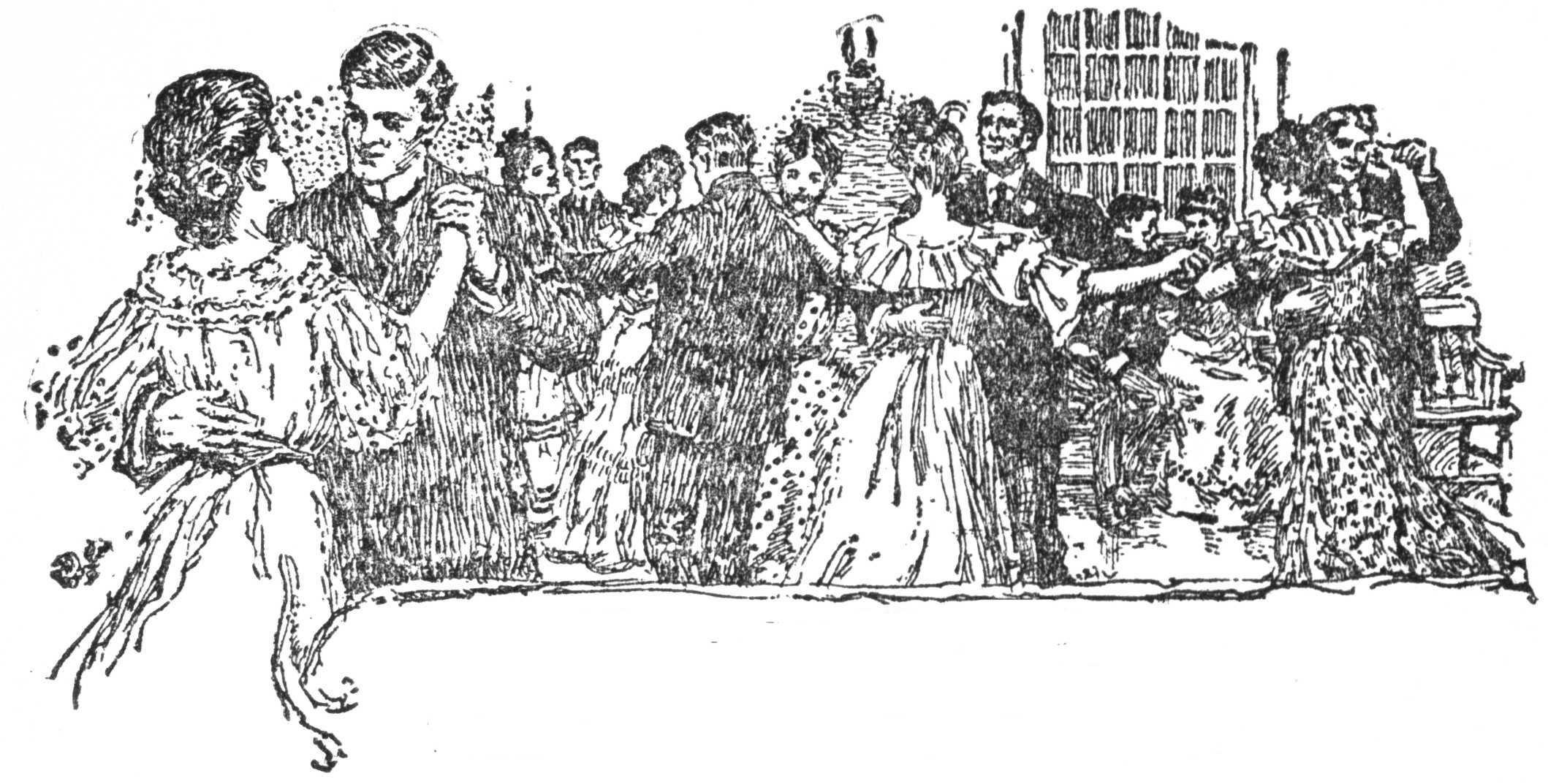
THE “SUBSCRIPTION BALL.”
“There!” exclaimed Captain Titcomb, ten days later, when the last section of the Liberty’s chain had been laid on Orham wharf; “there! that child’s born and his name’s Adoniram! Now, then, Brad, what next—more anchor-draggin’?”
Getting up that chain with a hand windlass was a tough proposition, but they had done it finally. The calm weather helped them here, for though the heavy links had sanded somewhat, they managed to work the last one loose after a struggle. Again the partners had longed for the much talked-of schooner with an engine, but this time it was Bradley who did most of the complaining. The Captain merely looked wise and winked knowingly. “Keep your head to wind’ard, son,” he remarked. “Maybe I’ll have a s’prise [Pg 263]party for you some of these days.” Bradley didn’t know what he meant and the Captain wouldn’t explain.
In reply to the question concerning what was to be done next, the junior partner, who was sitting on an overturned salt-mackerel tub aboard the Lizzie, asked a question in his turn.
“Cap’n Ez,” he said, “do you remember that schooner loaded with tar that foundered on the flats off Caleb’s Point last March? The one we located when we were dragging for Anderson’s anchor that time?”
Captain Titcomb nodded. “Yup,” he said. “She b’longed to a Boston firm, seems to me. Let’s see—what was their names?”
“Colton, Lee and Company. They are on Commercial Street. Well, I went in to see ’em when I was up to Boston.”
“You did?”
“Yes. That tar has stuck in my mind ever since you told me about it. It was in barrels, you see, and it’s harder than Pharaoh’s heart naturally, so the salt water hasn’t had time to hurt it any to speak of. Obed told me that the schooner was insured and the cargo wasn’t. So I thought I’d go in and see the owners. Well, they’d pretty nearly forgotten about the tar—I suppose it had been charged to profit and loss long ago. We talked and I told ’em that I might, perhaps, be able to save a few barrels—only a few, of course. The upshot of it all was that I bought the whole cargo, eight hundred and forty barrels, [Pg 264]just as it lies on the bottom, for twenty-five dollars cash.”
“You didn’t?”
“I did. It was twenty-five dollars more than they ever expected to get, at that. Now, Cap’n, our agreement was that no new move should be entered into without the consent of both partners. This deal was so ‘all in the air,’ as you might say, that I didn’t say anything about it until I’d seen the owners. Now, if you feel that we can’t raise enough of the stuff to pay for the trouble, I’ll let the twenty-five come out of my pocket and call it a fine for being too smart.”
“You shan’t do no such thing! We can git out enough of that tar to make that up twice over, even with the back-number rig we’ve got. But if we had a divin’ kit and a diver, I’d be willin’ to bet we could save two or three hundred barrels, maybe more.”
“That’s what I thought. So I spent nearly three hours cruising up and down Atlantic Avenue and rummaging in ship stores and such places. And, Cap’n Ezra, I know where we can buy a complete fit-out second-hand—pumps, pipes, diver’s suit and the whole business, in A1 shape, so far as I can see—for three hundred and fifty dollars. Just for a flyer I paid ten dollars and got an option on it for a week.”
“No? you didn’t? Brad Nickerson, here’s where the old man takes his hat off. You’ve got me beat, hull down. I’ll be askin’ you for a mate’s job yit. Three hundred and fifty! Dirt, dog cheap!”
“I’m glad you feel that way, Cap’n. Of course a diver’ll be expensive. The Salvage Company will [Pg 265]charge us anywhere from fifteen to twenty dollars a day for a good one. And there’s where I’m afraid the whole speculation falls down. We don’t know how that tar lies, whether the hull’s broken up, whether the barrels are sanded over or not. It might take so long to get it out that we’d lose money.”
The Captain, with both hands jammed into his pockets—his beckets, he called them—was pacing up and down.
“Lay to, son,” he observed, shortly, “and let your hair grow. You’ve landed nine-tenths of this deal already; let me handle t’other tenth. I have a sneakin’ notion that I can git that diver cheap enough to make it worth while. No, I shan’t say anything more jest now. You wait.”
But the next morning he greeted his partner with jubilation.
“I’ve got your diver, boy!” he cried. “That is, I’ve got him if you say the word. Five dollars a day, too, instead of fifteen.”
“Where in the world——”
“Right here in Orham. And he’s had plenty of experience. What’s the matter with Sam Hammond?”
“Sam Hammond! Sam—Why, Cap’n Ez, what are you talking about? Sam told me himself that he’d come home to rest. He’s going back to New York in a little while. He wouldn’t work for us!”
“Wouldn’t, hey? Brad, ’twas the feller with one leg that was too religious to dance. Sam’s out of a job. Maybe he fired the boss; maybe the boss fired him. All I know is that he told me last night he’d [Pg 266]dive for us at five dollars per. ’Course he’d only do it to help us out, but that’s all right; I don’t care if there’s a hole in the bag so long’s the cookies are inside.”
Bradley was silent. He didn’t like the idea of having Sam as a shipmate. There were other reasons as well, and these the wily Captain may have guessed, for he said:
“Now, Brad, of course it’s for you to say. We couldn’t git another good man so cheap, but never mind that. Sam is a great feller for the girls, and they seem to like him pretty well. I s’pose he’d be cuttin’ out some beau or other, and then we’d have trouble on our hands. Not that that would hurt you any, except in a way, but——”
Bradley interrupted him sharply. The hint roused his pride. “Oh! I don’t care,” he said. “Hire him, if you want to. Only, I’m surprised that he’s willing to come.”
And so that is how Mr. Samuel Hammond, late of the Metropolitan Wrecking Company of New York, came to enter the employ of Titcomb and Nickerson, to whom he had contemptuously referred as “anchor-draggers.” But if Bradley supposed for a moment that Sam would change his patronizing attitude because of the move, he was much mistaken. Mr. Hammond laughed when he boarded the Lizzie, asked facetiously if “this was the vessel or only the long boat?” and poked fun at the whole outfit generally. He gave each member of the crew to understand that he was only doing this for a while, to help [Pg 267]out Brad. He said that puttering around this way was such a change for him that it was the best fun of his vacation.
He took pains to make his position plain in the minds of the townspeople. Captain Jabez Bailey told Bradley, in a confidential whisper: “It’s mighty good of Sam to turn to and help you and Ez out of a hole. I hope you appreciate it.” Bradley said he appreciated it fully.
Even Gus was inclined to view the matter in that light. Sam saw to it that she did. He called at the Baker homestead pretty often, and when Bradley was there treated the latter in a jolly, good-fellow sort of way that couldn’t well be resented, but which had always in it that aggravating flavor of pitying patronage.
Bradley felt that he was placed in an awkward and humiliating position. He told Gus so plainly.
“Gus,” he said, “the last time we talked on this matter you spoke of ‘treating me fairly.’ Do you think it’s fair to allow Sam to call here as he does?”
A more experienced ladies’ man—Captain Titcomb, for instance—would not have selected this particular evening to bring up this particular subject. Gus was in one of her uncertain moods. She had refused to be serious before, and she was not serious now.
“Why, Bradley Nickerson!” she exclaimed, with a laugh, “I do believe you’re jealous!”
“No, I’m not jealous, exactly. But why do you let him come here?”
[Pg 268]
“You are jealous! Oh, dear me! I didn’t believe you had that sort of a disposition. Why do I let him come here? What shall I do? Lock the door and scream ‘I’ve gone out!’ the way old Cap’n Pepper did when the tax collector called?”
“Oh, be serious, please!”
“All right! Let’s be very serious. Sam calls here, I suppose, because he and I have always been friends and we’re friends now. I don’t invite him, but I can’t very well tell him to stay away. He doesn’t know that you and I are engaged—or partially engaged—and——”
“That’s just it! If you will only let me tell people of our engagement then he can’t call any more. May I, Gus?”
“Brad, don’t you trust me?”
“Of course I trust you.”
“Then why are you suspicious or what are you afraid of?”
This very direct question was embarrassing. Bradley felt certain that he had good reason to be suspicious of Hammond’s intentions, but he knew he had no actual proof that would warrant his saying so. He stammered, and could reply only that he didn’t like the fellow’s calling so often.
“I don’t see,” said Gus, “why you dislike Sam so. He never mentions your name without praising you. He thinks you are doing wonderfully well.”
Bradley knew just the tone in which that “wonderfully well” had been uttered by the ex-New Yorker. It made him angry.
[Pg 269]
“Yes,” he remarked, with sarcasm, “I suppose his lordship thinks we’re doing very fairly for Cape Cod countrymen. Well, he’s working for those same countrymen himself, now, so he ought to know.”
“I think that’s a very unkind remark, especially when Sam is helping you, as he is, just out of friendship. I tell you this, Brad: Sam isn’t always talking about himself and saying sarcastic things about other people.”
Bradley went home injured and resentful. He made up his mind that Gus shouldn’t have another chance to call him “jealous.” He could show her that there were others who didn’t care.
He plunged into business deeper than ever. The diving outfit came from Boston and worked well. They visited the sunken tar schooner and Sam made his first dive; Captain Titcomb, who understood the apparatus, worked the pump. Sam reported that the tar seemed to be in good condition, and that, for the present, they could get up a number of the barrels through the hatchway. Later they might have to blow away a part of the hull.
So every fair day they worked over the wreck. Sam, in the diver’s suit, clambered down into the submerged vessel’s hold and attached the barrels to the tackle. Then, by the aid of the windlass, they were hauled up and swung aboard the Lizzie. By the first of October they had already gotten out over two hundred barrels, and Sam said that he saw no reason why all of the eight hundred might not be secured in the course of time. The tar speculation was already [Pg 270]a very profitable one, and the credit belonged to Bradley.
There was to be what the posters called “A Grand Select Subscription Ball” at the Orham Town Hall on the evening of October tenth. The local correspondent of the Item announced that the beauty and fashion of the surrounding section were expected to be present, that the Silver String Orchestra, all the way from Bridgewater, was to furnish music, and that, altogether, the affair would no doubt be “the most élite time that our village has seen since the Masonic Temple was dedicated.”
Gus had expressed a desire to go to the ball and Bradley had subscribed; that is to say, he had paid two dollars for a ticket admitting “gent and two ladies.”
He dressed for the affair, when the evening came, with no very pleasant anticipations. The relations between Gus and himself had not improved since the disagreement over Sam’s visits. It was as much his own fault as anyone’s; instead of waiting for a favorable time and again pleading his case, he brooded over what he considered his ill-treatment and behaved almost boyishly sulky. Gus resented this behavior and showed that she resented it. It was all very foolish, of course, but also very natural. And, meanwhile, Mr. Hammond, backed by some experience with the ladies, played his own cards with discrimination.
The partners were expecting a check from New Bedford in payment of the first shipment of tar, and, [Pg 271]as it was early when Bradley finished dressing, he determined to go down to the post-office before calling for Gus. Captain Titcomb was out of town. He had not told where he was going, merely observing that he wanted a couple of days off for private business. What the private business was he did not state.
The old maids were on hand, as usual, to inspect their boy when he appeared in the sitting-room. Miss Prissy brushed his coat and handed him a clean handkerchief, while Miss Tempy sprinkled his lapel with perfumery from her own bottle. The sisters were in high spirits these days. Miss Prissy was almost well again, and Captain Titcomb was calling with encouraging regularity. Clara, whose mother seemed likely to spend the winter at Fall River, was still with them. As Miss Tempy said, they didn’t see how they had ever got along without her. On this particular evening Miss Hopkins, dressed in her best, had gone out. She had explained that she might go to the ball, “just to keep Bennie company.” “Bennie” was a twelve-year-old cousin of hers who lived downtown and was attending dancing-school.
The expected check did not arrive on that mail, and, as Bradley came down the post-office steps, some one laid a heavy hand on his shoulder. He turned with a start.
“Why, hello, Cap’n Ez!” he exclaimed, “you back again?”
The Captain nodded. He was dressed in his Sunday clothes and carried a hand-bag. His light overcoat was thrown open, his derby hat was a little on [Pg 272]one side, and the stump of a cigar was gripped between his teeth.
“What’s up?” asked the junior partner.
“Everything’s up,” was the brisk answer. “You come with me.”
“But I can’t stop now; I’m in a hurry.”
“Never mind your hurry. I want you. Stopped at the house on the way from the train, but Tempy said you’d gone to the office. Come on—come!”
He hooked his arm into that of his companion and led the way through the crowd of loungers on the sidewalk. Bradley still protested.
“But, Cap’n Ez, wait till some other time. I must——”
“Shut up! I’m so full of steam I’ll bile over in a minute. This ain’t foolin’, it’s bus’ness.”
He dragged his puzzled partner along the sidewalk and across the road to the Traveller’s Rest. Bradley hung back and asked questions, but the Captain would neither pause nor answer. He opened the door of the hotel and literally pushed his friend inside. Then he led the way upstairs and into his own room.
“Set down!” he commanded, kicking a chair up to the table and turning to lock the door behind him.
“No, Cap’n, I can’t sit down; I ought to be going this minute.”
Captain Titcomb hesitated. Then he unlocked the door and flung it open.
“All right!” he said, “go ahead. I’ve been countin’ on springin’ the news on you for the last six hours, [Pg 273]but I s’pose I can wait another ten. Don’t let me interfere with your plans.”
Any other tone than this and Bradley might have continued to resist. As it was he sat down, though with reluctance.
“Well?” he said, somewhat impatiently.
“Well!” replied the Captain, still with the aggrieved expression on his face. “Now, Brad, you know mighty well I’ve got somethin’ important to say—somethin’ mighty important, or I wouldn’t have snaked you up by the coat-collar this way. I haven’t even stopped to eat a mouthful, myself, I was so crazy to git at you. But never mind that; if you ain’t interested enough to——”
“You know I’m interested, Cap’n Ez. Only do hurry!”
The Captain locked the door again. Then he took a bundle of papers from his overcoat pocket, and, selecting a card from among them, said, impressively, “Brad, what have you and me been prayin’ for for the last three months or more?”
The junior partner shook his head. The Captain’s suppressed excitement was beginning to have its effect on him.
“I don’t know,” he replied. “Do you mean a big job?”
“I mean somethin’ that’ll give us the tools to do a good many big jobs with. I mean a new, up-to-date wreckin’ vessel.” He leaned across the table. “Brad, my son,” he said, slowly, “I’ve got that very craft.”
“You’ve got her?”
[Pg 274]
“I’ve got her, or the same as got her. Look at that!”
He tossed the card on the table and Bradley picked it up. It was the photograph of a good-sized, two-masted schooner—a wrecking schooner, and of modern build; so much was plain.
“Look at her!” cried the Captain. “Ain’t she a dream? And that tintype don’t begin to do her justice. Now, Brad, that schooner’s the Diving Belle, built in New Bedford two years ago and cost eight thousand to build. No sham about her; built for wreckin’; good seasoned timber, tackles, patent windlass, nice, light, roomy cabin, anchors, sails, all complete—and a first-class sixteen horse-power gasoline engine. And, son,” Captain Titcomb raised his fist, “you and me can buy the whole blessed outfit for five—thousand—dollars—cash!”
The fist fell on the table with a bang. Bradley gasped in delighted wonder.
“You don’t mean it!” he cried.
“You bet I mean it! And I’ve got a six-day option on her, and I had to talk to git it, too. You see,” he added, gleefully, “you ain’t cornered the option market altogether.”
“But where is she? Whose was she? How did you hear of her? Five thousand! Why, that’s a——”
“Easy! Easy! ‘One at a time, please, so I’ll know which to dodge,’ as the play actor said when he got the bouquet one side of his head and the cabbage t’other. Now, I’ll tell you all about it.”
[Pg 275]
And he kept his word. When Captain Titcomb really enthused over a subject he was a wonderful talker. Now, shaking a forefinger in his companion’s face, he talked so fast that Bradley forgot everything except to listen. The schooner had been built for one Abijah Foster, of Vineyard Haven. She had been engaged in the wrecking business for two seasons along the south Jersey coast and then her owner died. His widow was the only heir and she needed money. The vessel had been bought by a Nantucket man, but when it came to paying the price there had been a hitch that resulted in the collapse of the deal. Captain Titcomb had heard of this hitch some weeks before and that was what his previous hints had meant. He wrote to the widow’s lawyer, received a letter in reply, and hurried to the Haven.
Bradley was now as wildly jubilant as his partner. He asked innumerable questions, but the Captain had an answer ready for each one. He had with him a rough plan of the schooner’s rig, a photograph of her cabin, a drawing of her engine. These were laid on the table and they moved from one to the other, the Captain explaining, pointing and arguing. The passing of time was forgotten entirely.
“There!” cried Captain Titcomb, at length, taking a drink from the water pitcher to moisten his throat, dry from continuous talking; “there! that’s what my private bus’ness out of town was! D’you wonder I had to unload to-night or bust a biler?”
The junior partner awoke from his trance with a start. And just then, from the sitting-room below, [Pg 276]came a muffled, whirring sound, followed by a succession of faint “Hoo-hoos” nine of them altogether. The cuckoo clock, legacy of old Captain Sylvester Harding, who had willed it to the Traveller’s Rest—possibly as a partial recompense for unpaid board—was doing its duty.
Bradley turned white and then red. Nine o’clock! and the grand march at the Subscription Ball was to start “promptly at eight!” And Gus had looked forward to this evening for over a month!
It is doubtful if, even now, he could tell much about his trip from the Captain’s room to the Baker cottage. He ran most of the way. Over and over again he reproached himself for his forgetfulness. Gus had called him neglectful and selfish once before; what would she say now? He scarcely dared knock on the dining-room door.
But whatever he may have expected to hear when that door opened, what he did hear was certainly a distinct surprise. It was some moments before the knock was answered. Then the door opened a very little way and Grandmother Baker, her head enveloped in a shawl, peeped out.
“Who is it?” she asked, doubtfully. Nine o’clock is a late hour for callers in Orham.
“It’s me—Brad. Where’s Gus?”
“Oh! I declare, Bradley, you scart me, comin’ so late. Gus has gone.”
“Gone!”
“Yes. She said if you called to say that she didn’t wish to interfere with anything so important as your [Pg 277]business matters. You see, Sam Hammond stopped here about ha’f-past eight and said he’d seen you and Cap’n Ezry go into the Traveller’s Rest together. So Gus went to the ball with him.”
The Subscription Ball was nearly half over when Bradley came up the stairs of the Town Hall. He tossed his ticket in at the window and absent-mindedly checked his overcoat and hat. Then he stood in the doorway looking at the dancers. For almost an hour he had been walking up and down the sidewalk opposite the Hall, remorsefully hating himself one minute, and fiercely nursing his injured pride the next. Twice he turned to go home, and each time he turned back again.
The “waltz quadrille” was the particular dance then going on. Bradley glanced over the crowded floor. He caught sight of Sam Hammond dancing with one of the Rogers girls. Opposite them in the set, he noted vaguely, were Captain Titcomb and Clara Hopkins. Further off “Snuppy” Black and Georgiana Bailey were whirling with the “society” step—Georgiana always proclaimed that the “glide” was “dreadful old-fashioned.” Captain Jabez was turning stout Mrs. Seth Wingate; the “glide” was good enough and to spare for Captain Jabez.
At last Bradley saw Gus. She was away down at the other end of the hall and her partner was Hartwell Sears. He was glad that she was not with Sam, but he resented the look of enjoyment on her face. He did not know that she had seen him looking for [Pg 278]her, and that the expression was assumed for his benefit.
But when Hartwell, at the end of the quadrille, escorted her to the settee by the wall, Bradley, white but firm, walked straight toward her. She saw him coming and smiled coolly.
“Hello!” she said, “so you decided to come, after all!”
“Gus,” whispered Bradley, bending toward her, “I’m so sorry. Please forgive me.”
But Gus didn’t intend to forgive so soon. She had been deeply wounded by what she considered his neglect, and she meant to punish him.
“Oh!” she observed, carelessly, “I realize that I must not expect you to think of my pleasure when Cap’n Titcomb wants to interview you. Oh, yes, Sam! this is our schottische, isn’t it? I’m so glad!” The next instant she was sorry she said this, but then it was too late.
There was just a suspicion of triumph in the glance that Hammond gave him as the music began for the schottische, and Bradley watched them go with tight-shut lips. Then he tossed his head and stepping briskly down to where the younger Miss Rogers sat, entered into a lively conversation.
Miss Rogers had arrived late and her card was, in consequence, not full. Bradley promptly pencilled his initials in every vacant space. The fact that he thereby contracted for a galop, a “York,” and a schottische, none of which he had the slightest idea how to dance, didn’t trouble him at the time. As for the [Pg 279]flattered Miss Rogers, she simpered and giggled and looked up into his face until Melissa Busteed—who had been given a gallery ticket and had come in order to denounce the whole sinful affair at the next Come-Outers’ meeting—declared ’twas a mercy she didn’t kiss him right in front of the whole crowd.
They went to supper together and—there was fate in it, beyond doubt—sat directly opposite Sam and Gus. Bradley ate cold ham and ice-cream without knowing which was which, being certain only that both were flavored with gall and wormwood. He laughed as loudly as the rest when unlucky Captain Jabez spilled a plate of vanilla-and-lemon-mixed into his wife’s lap, but five minutes later he couldn’t have sworn that it had happened.
He spoke with Captain Titcomb but once. That was during an interval between dances, when the Captain, red-hot but smiling, came strolling towards him.
“Hello, Brad!” he exclaimed. “Got here, didn’t you?” Then, glancing at the young man’s face, he added: “Havin’ a good time? Hope our stoppin’ to talk didn’t make any diff’rence?”
The answer was non-committal. Just then “Bennie,” Miss Hopkins’ nephew, came up. He was arrayed in his first black suit with “long pants,” and the glory thereof sat grandly upon him. The Captain noticed it.
“My!” exclaimed the latter, “you are tony tonight, Bennie. How you do grow! You’ll be a man ’fore your mother yit. Does she know you’re out?”
He hurried away in response to the prompter’s call [Pg 280]of “Take your partners,” leaving the indignant Bennie to observe, “Humph! think’s he’s smart, don’t he! He ain’t any dancer. Don’t know one of the new steps us fellers learn at dancin’-school. Gee!” with a chuckle, “Clara was awful mad at him. He’d engaged the grand march and a lot more with her and never got here till ha’f-past nine. If he hadn’t explained how you’d got hold of him at the post-office and kept him talkin’ ‘wreckin’ for over an hour, I don’t b’lieve they’d have made up yet. ’Twouldn’t have made any difference to her, though; I was here, and I can dance better’n any two Cap’n Ez Titcombs.”
Bradley had never before felt so much like kicking his business partner. The smooth way in which the Captain cleared his own skirts, by shifting the blame to his innocent victim, was characteristically diplomatic, but mighty provoking. And he “hoped” it wouldn’t make any difference!
The Subscription Ball, extras and all, came to an end at three o’clock. By this time Bradley was once more repentant and humble. When Gus came out of the cloak-room he went to meet her, resolved to abase himself and plead again for forgiveness.
“Gus,” he stammered, “Gus—I—I—mayn’t I walk home with you? You know I——”
But, as Bradley’s anger had cooled, his fiancée’s had risen. No detail of the flirtation with the Rogers girl had escaped her.
“Thank you,” she answered, and every word was crusted with ice; “Mr. Hammond was gentleman [Pg 281]enough to escort me here and I presume he will see me home.”
Bradley accompanied Miss Rogers to the parental gate. It wasn’t a hilarious walk. The young lady said to her older sister later on:
“Julia, I honestly believe he didn’t speak one word from the time he left the hall till he said good-night. I had to talk for two, or I should have gone to sleep on the way. He may be good-looking enough, but Gus Baker can have him for all me. I’d as soon come home with a wooden Indian.”
And Bradley, in his own chamber, stared out of the window at the light in Gus’ room and vowed that he would not get down on his knees to that young lady again; let her have her New York gentleman if she wanted him. Then he thought of that other dance and how happy he had been because she had given him the waltz that Sam asked for. And he went to bed utterly miserable.
[Pg 282]
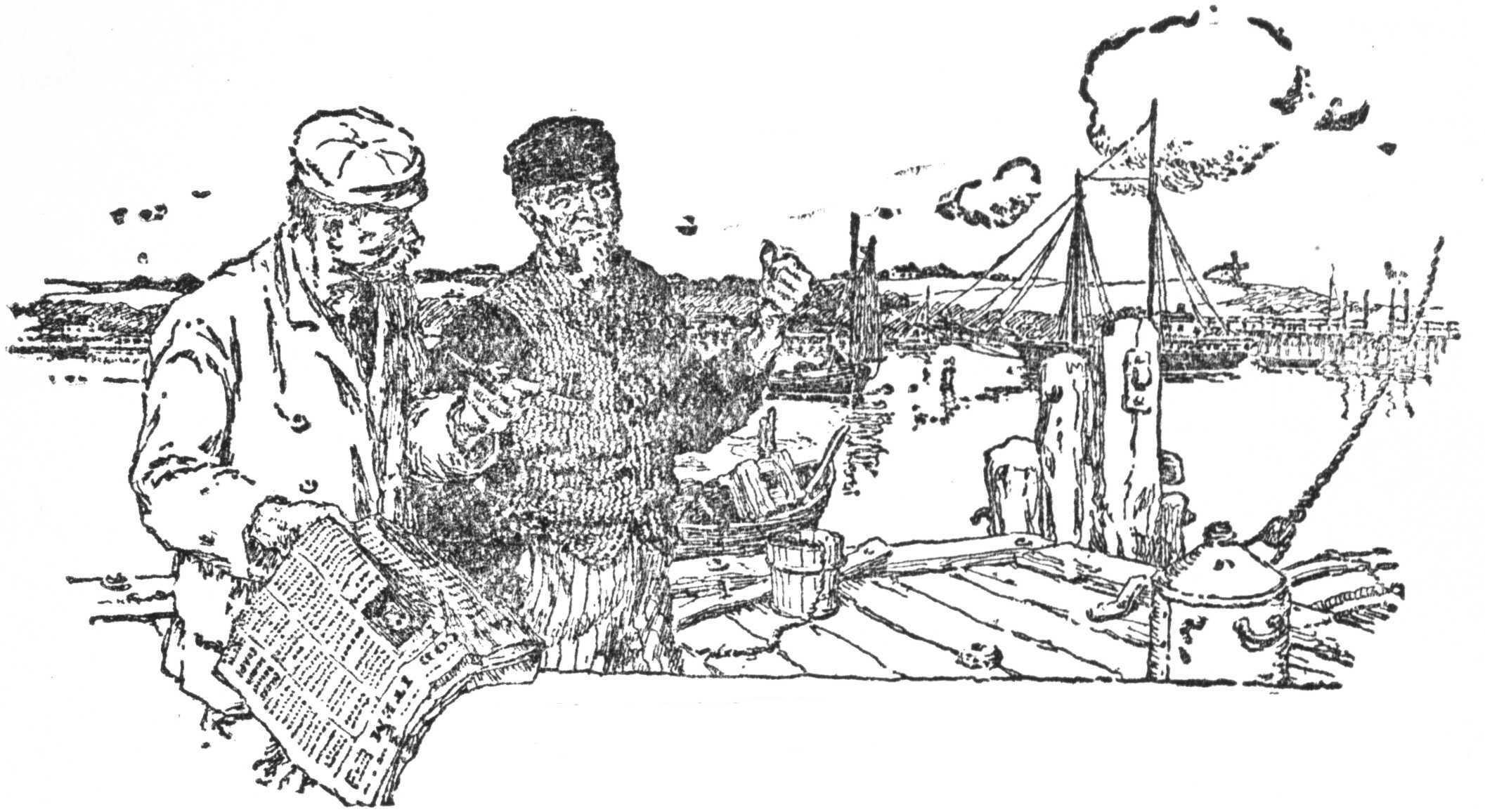
THE DIVING BELLE.
The next morning he was more miserable still, having had time to think it over. But he resolved that no one should guess his feelings from his appearance. Therefore, he was, at the breakfast-table, outwardly calm, although a little more quiet than usual.
The “old maids” were loaded with questions about the ball, and began firing them at him and at Clara as soon as the grace was said. They wanted to know who was there, what they had for supper, and especially all about the ladies’ gowns.
“Did Elviry Bailey wear that new black net of hers?” asked Miss Prissy. “She’s talked about nothin’ else, so they tell me, for the last month. How’d she look in it, Bradley? Was it becomin’?”
[Pg 283]
Now Mrs. Bailey might have been robed in purple and gold for all that Bradley knew to the contrary, but he promptly replied that the black net looked very well, he thought.
“I s’pose Georgiana had on her blue silk and wax beads, didn’t she?” Miss Tempy queried.
“Yes, I believe so.”
Clara laughed. “Why, no, she didn’t, Bradley!” she exclaimed; “Georgiana wore her green cashmere.”
“There!” burst out Miss Tempy, “if that ain’t jest like a man! We used to ask father about what the women folks over in London, or Bombay, or Surinam wore and he couldn’t tell any more’n a cat, and he’d seen ’em time and time again. Well, we’ll have to find out about the dresses from you, Clara. Tell us who danced with who, Bradley.”
“Yes,” said the older sister. “But we won’t ask who you danced with; I shouldn’t be surprised if we could guess that.”
Miss Prissy accompanied this sagacious remark with a sly chuckle. Miss Tempy joined in the chuckle and nodded wisely. Clara smiled, but she looked at Bradley with an odd expression. As for the young man, he, too, tried to smile, but it was a poor attempt.
“Was Cap’n Ezra there?” asked Miss Tempy, after a moment’s silence.
“Yes, he was there.”
“Sho! I want to know! I s’pose,” with elaborate [Pg 284]unconcern, “he danced with the married folks, mostly?”
Bradley didn’t answer. He was stirring his coffee in an absent way, and his face was very solemn. So Miss Tempy turned to Clara.
“No use talkin’ to him this mornin’,” she observed; “he’s dreamin’, I guess. Who did you dance with, Clara?”
“Oh, with Bennie and some of the others,” the young lady replied, promptly. “Bennie’s getting along splendidly at dancing-school; he waltzes very nicely now.”
Bradley had little appetite. He drank his coffee, and then, with an excuse that he was in a hurry, left the table and, putting on his cap, went out.
He was, to all appearances, in high spirits when he reached the wharf. He dreaded meeting Captain Titcomb and Hammond, but he made up his mind they shouldn’t know it. So he chatted with Barney and Peleg, laughed loudly at the flimsiest jokes, and whistled as he stood at the Lizzie’s wheel and steered her out of the harbor. But if he was afraid of being questioned by the Captain or sneered at by Sam, he need not have been. Mr. Hammond, possessing wisdom of a sort, didn’t refer to the previous evening. The Captain, too, seemed to have forgotten it. He groaned once or twice over his work at the air-pump, and, when Bradley asked him if the pump needed oiling, replied briefly:
“’Taint the pump that needs ile, it’s my j’ints. No use talkin’! I’m gettin’ too much of an antique to trip [Pg 285]what Sarah Emma Gage calls the ‘light and frantic toe’ nineteen times in one night. That last Portland Fancy with Matildy Wingate pretty nigh sent me to the scrap heap. Every time we swung partners she’d slat me clear of the deck and whirl me ’round till I swan to man if I didn’t think my feet would frazzle out like a masthead pennant in a gale of wind! She must have thought she was shakin’ carpets. I felt like tellin’ her we wan’t playin’ ‘snap the whip.’”
They worked at getting out the tar until three o’clock, when, at Captain Titcomb’s suggestion, they quit for the day and the Lizzie came back to her moorings. Then the crew went ashore and the partners shut themselves in the cabin to once more discuss the project of buying the Diving Belle. The photographs and sketches were exhibited, the Captain argued and enthused, and Bradley did his best to forget Gus and to be interested. He succeeded partially.
The junior partner agreed that the Vineyard Haven schooner was a wonderful bargain, but he disliked the idea of going in debt for a part of her, as it seemed that they must do.
“You see, Cap’n Ez,” he said, “we’ve got altogether less than four thousand dollars between us if we put up every cent we’ve made. We shall have to borrow at least another thousand, and I hate to. In a year, if things go as well as they have, we ought to be able to build a new vessel and pay for every stick of her. And yet,” he added, “it seems a shame to let this chance go by.”
[Pg 286]
The Captain glanced at his companion and drummed with his fingers on the table. When he spoke there was a hesitancy in his manner.
“We can’t let it go by,” he said, “we’d never git another like it. Now, Brad—now, Brad——;” he stopped and drummed again. Then he went on without looking up. “I don’t know’s I mentioned this afore, but all my money ain’t been put into this wreckin’ deal yit. You see, I own some shares in that big cranb’ry bog of the Ostable folks. Must be about fifteen hundred dollars’ wuth altogether. I cal’late, maybe, I ain’t spoke of this to you afore, have I?”
“Well, no! you haven’t,” answered the astonished Bradley, drily.
“No. I presume likely it—er—must have slipped my mind. Well, I’ll sell the bog shares and put up what’s needed to finish buyin’ the Divin’ Belle. You can pay off your part as we earn it. Is it a go?”
The junior partner paused before replying. This matter of the cranberry swamp money was a most surprising revelation. The Captain’s previous silence concerning it was exactly in keeping with his old character, the character of the skipper of the Thomas Doane, and a phase that had been growing less and less evident of late. However, Bradley did not feel justified in refusing to accept the offer. It didn’t seem fair to his partner.
“All right,” he said, finally; “I’ll agree, of course. If you’re willing to risk it, I ought to be.”
“Good! We’ll take a day off to-morrer and go up to the Haven and look her over.”
[Pg 287]
The rest of that afternoon Bradley spent in his room, thinking. The more he thought of his own share in the happenings at the dance, the more ashamed he was of them. He had acted like a boy; but then Gus had not behaved well, either. He mused till supper-time and only succeeded in making himself still more uncomfortable.
It was dark when he came out of the gate that evening. There was a fog that was almost a drizzling rain, and the big silver-leaf dripped and the fence rails were covered with beady drops. From the outer beach the sound of the surf came faintly, like a never-ending groan. A lonely, miserable night; one that fitted his feelings exactly.
He had intended going to the post-office after the expected check, but a little way past the gap in the Baker fence he stopped and looked back. The light in the dining-room attracted him in spite of himself. Gus, no doubt, was there; reading, perhaps; perhaps thinking of him. He wondered if she would be ready to forget and forgive if he came to her and asked pardon once more. He stood there, struggling with his pride.
And just then he heard some one walking toward him from the direction of the village. He had no wish to meet acquaintances and so drew back under the Saunders’ lilac bushes. A man, with his coat collar turned up, went by rapidly. It was too dark to see well, but Bradley was surprised to hear the footsteps go up the path to the door of that very dining-room the window of which he had been watching.
[Pg 288]
The visitor knocked. An interval; then the door opened and Gus stood there, a silhouette against the light.
“Why, good evening, Sam!” Bradley heard her say. “Is this you? Come in; I’m glad to see you.”
A minute later and Bradley was on his way to the post-office. He had been a fool long enough. This, he determined, should end it.
The partners started for Vineyard Haven in the early morning. The Captain talked most of the way, for which Bradley was thankful; he didn’t feel like talking. They found the Diving Belle lying at the wharf, and Captain Titcomb watched his companion’s face as they stood on the stringpiece looking down at her.
“Well, son,” he observed after a short silence, “what do you think of her? The tintype don’t flatter her none, does it?”
Bradley’s answer was enthusiastic enough to satisfy even Captain Titcomb. “By jiminy!” exclaimed the junior partner; “she’s a daisy! If her inside is as good as her outside, she’s the best five thousand dollars’ worth I ever saw.”
And, when the examination was concluded, he said, “Let’s hunt up that lawyer without wasting another minute. I’m only afraid that he’ll forget your option and sell her before we get there.”
They found the lawyer and signed the papers. It remained only to bring over the check and take away the schooner. And this they did a week later. Meanwhile [Pg 289]Captain Titcomb had performed another miracle. He had hunted up a man who had expressed a desire to purchase the Lizzie, and, after two days of bargaining, during which time the Captain had twice pretended to give it up and return to Orham, had sold him the old schooner for seven hundred and fifty dollars. Also he sold his shares in the cranberry bog.
There was a good-sized crowd of townspeople on the Orham wharf when the Diving Belle slid smoothly past the harbor mouth and up to her moorings. There was a splendid breeze, but they wouldn’t have used the sails for any consideration. The sight of the moving pistons in that wonderful sixteen horse-power engine, the enchanting smell of the gasoline, the muffled drumming of the propeller under the stern—these were bran-new, unadulterated joys of proprietorship that no mere item like the saving of unnecessary expense could induce them to forfeit.
The “old maids” and Clara were among the crowd on the wharf. They were shown over the new vessel and their admiration was outspoken.
“It’s beautiful!” exclaimed Miss Prissy, referring to the engine. “I declare, Bradley, I shall come aboard every night and see that you keep that brass-work shined up the way it ought to be. I’ll let you take some of my silver polish, like I use for the best teapot, and a piece of chamois. I never saw a man yet that I’d trust to clean a kitchen knife, let alone a lovely thing like that. Now don’t use sand-soap and a rag and get it all scratched up.”
“And to think,” cried Miss Tempy, “that Cap’n [Pg 290]Titcomb owns ha’f of her and our Bradley the other ha’f! Why, it’s jest like havin’ her in the fam’ly. I’m so proud I don’t know’s I shall speak to common folks after this.”
The others laughed at this outburst, but Bradley was silent. He was thinking that it was only a few weeks before that Gus had said that she was so proud of him.
The Diving Belle was a spoiled child for the next fortnight. Her owners and her crew—all but Sam Hammond, and even he was condescending enough to call her a “nice little thing of her size”—handled her as if she was made of cut glass. Peleg brought Skeezicks aboard on purpose to display her beauties to that educated pup, who seemed to appreciate them, especially the galley stove. Bill Taylor was cooking at the time, and the stove was red-hot, so Skeezicks promptly crawled beneath it, but even there he shivered.
Captain Ezra put in the most of his spare time “improving” the new purchase. Bradley told him it seemed like the Thomas Doane days to smell paint and trip over a bucket of water and a swab every little while.
“Yes,” was the Captain’s reply, “but then I was fixin’ up somebody else’s property; now I’m fussin’ with my own. It’s as diff’rent as boardin’ and keepin’ house. I remember seein’ Solon Snow fryin’ flapjacks one time when him and his brother ’Rastus was fishin’ at the P’int and ’twas Solon’s week to cook. Solon would toss the flapjacks up with the fryin’ pan to turn [Pg 291]’em over. Sometimes he caught ’em when they come down, sometimes he didn’t. Them that fell on the floor he put in ’Rastus’s plate. That’s the diff’rence between workin’ for yourself and for somebody else, Brad. What d’you think of puttin’ a gilt stripe ’round the top of the deck house?”
The gilt stripe was added to the house, as were also sundry other decorations to various parts of the schooner. But the lock on the cabin door was the particular addition upon which the Captain prided himself.
Orham was just then in the throes of a burglar scare. Two houses in the village had been broken into and the natives were talking of calling an indignation meeting for the purpose of expressing their opinion of the Selectmen. Then a steam yacht, belonging to a summer resident, which lay housed over for winter in the harbor, was boarded and ransacked.
It was on the day following this robbery that Captain Titcomb began tinkering with the cabin door. This door and the sliding hatch above it had been fastened with a padlock. The Captain’s first move was to block the hatch so that it would slide back but a little way. Then he sawed and hammered away at the door.
“There!” he cried, in triumph, after two hours of hard work. “Brad, come here! S’pose one of them mean sneak thieves tries to bust into that cabin. He can pry the staple off that padlock easy, can’t he? Yes, but the way that hatch is now ’twon’t open fur enough for him to climb down; he’s got to open that [Pg 292]door. And that door’s got on it a three dollar patent lock that can’t be opened without the key, and no ten cent, whistle-down-the-barrel key neither. The key that’ll open that has lace edgin’ on it; you hear me! And I’ve took off the knob on the inside of the lock, so it can’t be worked that way. Now when we want to go home we haul to the hatch and lock it with the padlock. Then we jest slam the door. Click! There you are! A spring lock; how’s that for high? Thunderation! I’ve left the key inside!”
Luckily the key was lying on the top step of the cabin stairs, and they were able to reach it with a fishhook on the end of a stick. But that was only the beginning of the trouble with that wonderful burglar-proof spring lock. The key was always getting lost, or being left at home in the Captain’s “other pants.” As he would trust it to no one else, the difficulties that arose were numberless. Once Alvin Bearse remained a prisoner in the cabin for half a day, having to wait until the Diving Belle reached the wharf and the key could be sent for.
Getting up the tar, with the aid of the patent windlass and the engine, was simply fun. They took out all they could bring up through the hatchway, and then began blowing out the side of the hull with dynamite. The explosive was stored in the Diving Belle’s hold, forward, behind a bulkhead with only one small manhole in it, and was carefully boxed in to prevent accident.
Bradley’s whole interest in life now centred in his work. Gus he had not spoken with since the night of [Pg 293]the dance; had, in fact, only seen her at a distance. Sam, while on board the schooner, was pleasant and, to all appearances, as friendly as Bradley would let him be, but from Captain Jabez, and from other considerate and gossip-loving souls, the junior partner learned that Hammond was now a regular caller at the Baker cottage. Tactful Captain Titcomb never mentioned Gus, and the “old maids,” though they must have been aware that their boy no longer visited the house next door, knew better than to question him.
At times Bradley was tempted to give it all up and go away. He could not forget, try as hard as he might. But consideration for his partner, and his own pride, kept him at home. She should never know how much he cared, and Sam and the rest should not have the satisfaction of crowing over his running away.
[Pg 294]
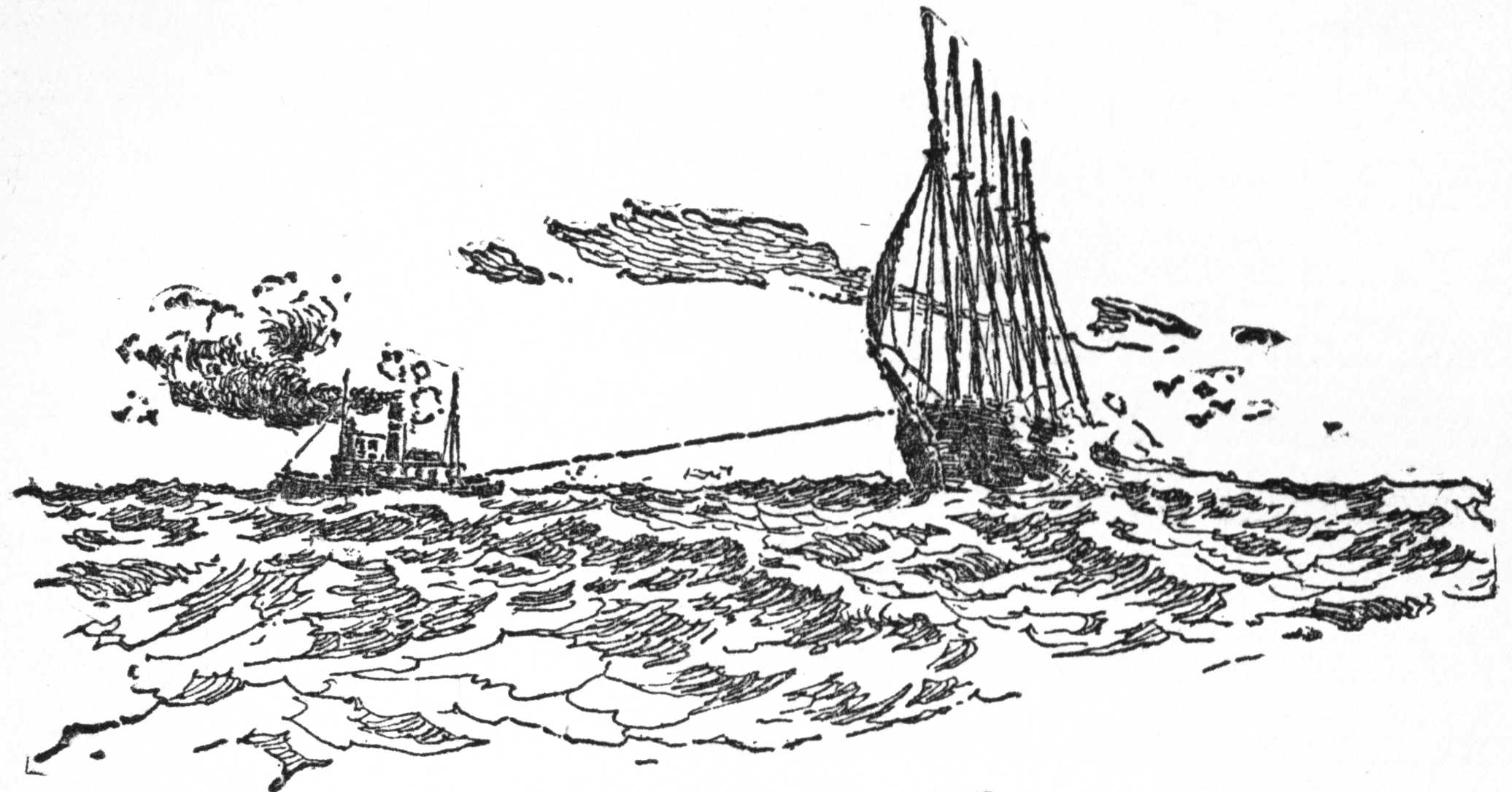
THE CAPTAIN’S GAMBLE.
October had been a month of exceptionally pleasant weather, but, in the night of November first, Bradley woke to feel the old house trembling and to hear the rain thundering on the roof overhead and rattling against the windows. The wind screamed in the chimney, and in the lulls the battered weather-vane on the barn creaked and whined. It was comfortable in bed and he lay there listening to the storm and remembering that Peleg had been hinting at the coming of dirty weather. Drowsily he wondered if there would be any wrecks along shore.
While he was dressing next morning he heard [Pg 295]voices in the road below, and opening the window saw Jim Rogers, the fish peddler, sitting in his wagon with the rain sluicing from the peak of his sou’wester and carrying on a shouted conversation with Mrs. Baker.
“What did you say ’twas, Mr. Rogers?” screamed the old lady, speaking through the closed blinds of her chamber window.
“The Freedom; big six-masted coal barge. She’s high and dry on the Razorback. Hawser parted. The tug’s tryin’ to git her off now, but Cap’n Knowles telephoned Sam Hardy that ’twan’t no use.”
“Do tell! It’s been a hard storm. One of our henhouse shutters has blown off. Oh, Mr. Rogers! fetch a quart of clams ’round to the back door and leave ’em on the steps, won’t you? I’ll pay you next time you call.”
Bradley didn’t hear the last part of this conversation. He was struggling into his clothes. Only Miss Prissy was up when he came downstairs, and she protested strongly against his going without breakfast. He compromised by hastily swallowing a slice of bread and butter, and then, putting on his oilskins, ran out of the house and down the road.
They were talking about it everywhere. Caleb Weeks, who was taking down the shutters of his store, called as Bradley splashed past:
“She’s a good job for somebody,” was Caleb’s hail. “Too big for you and Ez though, I’m ’fraid.”
“Squealer” Wixon met him a little further on. “Knowles says she’s hard and fast,” said Squealer. “The tug’s goin’ to give it up. They’re telephonin’ [Pg 296]Cook now. The Boston Salvage Company’ll git her off, or try to, I cal’late.”
Bradley’s objective point was the post-office. He wanted to see Hardy and learn the particulars. But Captain Titcomb was there before him; they met at the door. The Captain’s eyes were shining.
“Come on, Brad!” he said. “I was jest goin’ to send for you. I know all about it.”
He told the story as they walked to the wharf in the pouring rain. It was as Rogers had said; the great barge, twin sister of the Liberty, was on her way from Boston to New York under tow. The storm had come up unexpectedly and the hawser had parted. Now she was fast on the Razorback shoal.
“Crimustee!” exclaimed the Captain. “Won’t she be a job! Brad! Brad! if you and me could only have the chance!”
Alvin Bearse, who boarded nowadays at the house of a relative in Orham, was already on board the Diving Belle when the partners reached her.
“I’ve been expectin’ you,” he said. “Steam’s up.”
The trip down was a rough one, even while they were in the bay. But when they turned Setuckit Point and stood out over the rips the Diving Belle climbed one great wave after another, coasting down their greenish-gray slopes like a chip, and pouring salt water from her scuppers in a steady stream.
Even before they reached the Point they saw the six masts of the barge over the low sand dunes against the rain-streaked sky. Now, as they drew nearer to the shoal, she loomed larger and larger. Her high [Pg 297]black sides, with the rollers breaking against them, looked like those of a mammoth whale, and the little tug, puffing and rocking a short distance away, like a baby beside its mother.
“She’s hard and fast for sure,” muttered Captain Titcomb. “Five thousand tons of coal inside of her and this no’theaster drivin’ her further on every minute—I swan to man, Brad! she’s there for awhile! No tug—nor three tugs, fur’s that goes—can haul her off. ’Member what I said when the Liberty come so near landin’ where she is? It’s an anchor and cable job and we can do that as well as anybody and cheaper than the big fellers. If they’ll only let us try! By crimustee! they’ve got to!”
That evening the train brought representatives of three large wrecking companies to Orham. The younger Mr. Cook came also. The partners saw him, but he would give them no satisfaction. “You must come to Boston to-morrow if you want to bid,” he said. “But I tell you frankly, price isn’t the only thing; we must be satisfied that the job can be carried through.” It was evident that he didn’t believe they could handle it.
But Bradley and the Captain were certain they could handle it if the chance was given them. Seventy men, at least, would be needed, and to house and feed them was the problem. The Boston Salvage Company had lighters and barges for this purpose, and they had not. But there was the big shanty at the Point, the one in which the picnic had been held. Thirty men had lived and slept there before. By [Pg 298]building new bunks and slinging hammocks, twice that number, at least, could find room. The rest must occupy other shanties or come up to Orham at night. The partners schemed and figured until nearly four o’clock in the morning.
One of them must go to Boston that day. The Captain said Bradley ought to go because Cook knew him, but the junior partner didn’t agree.
“You go, Cap’n Ez,” he said, with decision. “You’re a better bargainer than I am, and it’ll take a good talker and a clever trader to land this job in the face of the competition. Go, and good luck be with you!”
So the Captain went on the first train. He promised to telegraph as soon as a decision was reached.
But no telegram came that day. All the next forenoon Bradley hung about the station waiting. The noon train arrived; no Captain, and still no word. But, after supper, as the anxious young man walked up to meet the evening train, it was evident that somebody knew something.
Obed Nickerson was standing on the corner. “Brad,” he said. Then, in a low tone, “Brad, I wouldn’t stand for it if I was you. You’re a partner as much as he is, and I wouldn’t let him drag me into such a fool deal. I like you, and, fur’s that goes, I like Ez; but he’s crazy. Say no, and put your foot down.”
“What are you talking about?” asked Bradley in astonishment.
“What? Don’t you know? Why—well, then, I [Pg 299]ain’t goin’ to tell you. Only you take my advice and say no; that’s all.”
Obed’s puzzling advice made Bradley feel even more uneasy. He determined to wait until the train arrived, and then, if the Captain didn’t come, to telegraph to the United States Hotel. But the first man off the train was Captain Titcomb.
The Captain shook his partner’s hand and said, “Hello!” He looked very tired—yes, and worried.
“Didn’t get it, hey?” asked Bradley. “Well, I hardly dared think you would.”
“Oh, I got it! Yes, I got it!”
“You did! Glory hallelujah!”
“Um—hum. Now don’t ask any more questions here. Come on down to my room.”
He was silent all the way to the Traveller’s Rest, and, for a man who had just secured the greatest contract of his business life, seemed strangely downcast. When they reached the room he locked the door and threw his overcoat and hat on the sofa.
“Now——” began Bradley, but the Captain held up his hand.
“Set down,” he said. “It’s a long yarn. Got a cigar in your clothes? Thanks.”
He lit the cigar and, twisting it into the corner of his mouth, began to talk.
“Well,” he said slowly, “I made Boston all right, and stood for Cook and Son’s under full canvas. I hailed the young squirt with the hay on his upper lip and asked him if the old man was in. ‘What do you want to see him for?’ says he. ‘Son,’ says I, ‘you trot [Pg 300]along like a good little boy and tell the old man that the feller that’s goin’ to git the Freedom off Orham shoal is out here.’ That kind of fetched him over with a slat, and he went in and told Cook. In a minute out he comes and pilots me into the skipper’s stateroom.
“I cal’late Cook was expectin’ to see another feller. ‘Are you from the Salvage Company?’ says he. ‘No,’ says I, takin’ a chair; ‘my name’s Titcomb. I’m from Orham. My partner’s a young feller name of Nickerson; he’s the one you picked out to lift the Liberty’s anchor that time.’ Well, that way of puttin’ it made him laugh and he told me to go ahead and spin my yarn, only be quick. I spun it, but I ain’t sartin that I was quick. I never talked so afore in my life, though I’ve beat it once sence. When I hove anchor fin’lly, he says, ‘Cap’n, there’s nothin’ the matter with your nerve, is there?’ I told him no, I hadn’t had to take physic for it. ‘Well,’ says he, ‘I’d like to give you the job, but you ain’t big enough. This ain’t anchor-draggin’.’
“Then I got after him again, told him about the new schooner, drew a diagram of the shoal and made it plain jest how she’d got to be got off if ’twas done at all, and that we could do it as well as anybody else in the world and a whole lot cheaper. At last he told me to come in and see him again late that afternoon.
“I was ’round on time, you bet! The hay-lip chap told me the old man had gone for the day, but that he’d left word that ’twas no use, our firm wan’t big enough for the job. Says I to hay-lip, ‘Where’s the [Pg 301]old man live?’ He didn’t know, bein’ a good liar. I asked him, in an interested sort of way, if he was dead sure where he lived himself, and went out to paw over the directory. Inside of an hour I was on an electric car bound for Brookline.
“Talk about houses! Those Cooks live in a place that makes Barry’s, down on the cliff road, look like Peleg’s shanty. I sailed up forty fathom of front steps and hove taut on the bell. A darky, with more brass buttons than the skipper of a Cunarder, come to the door. Says he, ‘Your card, please.’ Says I, ‘Never mind the card; Mr. Cook had an app’intment with me this afternoon.’ Which was true, you’ll notice. So he steered me into a room that was as full of pictures as a museum, and there I set on the edge of a velvet chair and tried to look as if I was used to it.
“Pretty soon down comes Cook, in a swaller-tail coat. He looked mad. ‘Is it you?’ he says. ‘Didn’t you git my message?’ I told him I’d got it, but that ’twouldn’t be fair to him to let that end it. I said that on purpose, ’cause I jedged, from what you’d said and what I’d seen myself, that the way to git on with him was to be independent. He grinned and then I commenced to talk. And how I did talk! The mornin’ sermon wan’t within a mile of the evenin’ service. I told him flat-footed how much the contract meant to us and all that. Pretty soon young Cook come in and he listened, too.
“Fin’lly the old man says, ‘Well, Titcomb, what’s your figger?’ I told him what you and me had agreed [Pg 302]on. He seemed surprised, I thought. Then he and his son went into the next room and talked. When they come back, he says, ‘Titcomb, you’ve got the perseverance of the devil—or that partner of yours.’ (Put you in good company, hey, Brad?) ‘Your price, I don’t mind tellin’ you,’ he goes on, ‘is lower than anyone else has given. If you were a bigger concern I guess I’d give the job to you. Anyway, you come in and see me to-morrer.’
“Well, this mornin’ I was at his office when the doors opened. And there I set until after two this afternoon. A feller from the Salvage Company come in while I was there, and so did one from the South Boston tug people. They went into Cook’s room and come out again. Fin’lly the old man sent for me. He and his son were there together. ‘Titcomb,’ says he, ‘I’m a fool and I know it, but I’m goin’ to let you try to git the Freedom clear.’”
Bradley, who had listened rather impatiently to this long yarn, struck the table with his hand. “Great!” he cried. “Cap’n Ez, you’re a wonder! Shake hands!”
But the Captain did not shake. Instead he looked at the floor. “Wait a minute, Brad,” he observed. “That wan’t all he said. He went on to tell me that in givin’ us the job he was riskin’ a bran-new vessel worth eighty thousand dollars. ‘Mind,’ he says, ‘I b’lieve you can do it if anybody can, but I won’t risk another cent. I won’t pay by the day. I’ll give you fifteen thousand when she’s off the shoal and towed to Boston; but I won’t pay a red until she is. It’s got to [Pg 303]be a contract job, payment on delivery of the goods.’”
Bradley’s face fell. “Of course that settled it,” he said. “You couldn’t accept such an idiotic offer as that.”
Captain Ezra took his cigar from his mouth. “Well, Brad,” he answered, soberly, “that’s what I did; I accepted it.”
The junior partner sprang from his chair. “Good Lord above!” he cried. “Man, you’re crazy!”
“Well now, Brad——”
“Well now, Cap’n Ez! Look here! you and I have put almost our last copper into the new schooner. We’ve got practically no ready money. We must hire from seventy to one hundred men at three dollars a day and pay them every week. We must feed ’em. We must spend money fitting up the shanty to lodge ’em in. It’ll take, maybe, a month before we get her clear—if we do clear her. We may have to spend five or six thousand before then. Where’s the money coming from?”
“I know all that. We’ll mortgage the Diving Belle and raise the cash.”
“Are you out of your head? We’ve been lucky so far and haven’t had a failure. But failures are bound to come. Suppose we work on this barge for a month and then a heavy gale strikes—as it’s likely to strike any time now; just the season for it. The Freedom couldn’t stand one real November gale on that shoal; she’d break up or pound the bottom out of her. Then we’ve lost all we’ve spent; the schooner would be [Pg 304]taken to pay the mortgage, and you and I—where would we be?”
“But, Brad, think of what it means to us if we make good.”
“Think of what it means if we don’t! The end of Titcomb and Nickerson; that’s sure.”
“But they’ll have had a run for their money. Look here, son! ’Twan’t kindness and love for you and me that made Cook and Son give us this contract. ’Twas ’cause our price was low and ’cause they know mighty well we can do it jest as well as the biggest concern on earth. It’s anchors and cables, not big tugs and lighters, that’ll work off that barge. Cook says heave the coal overboard; don’t try to save it.”
“Cap’n Ez, we got that job because nobody else would take it that way. We can do it if anybody can, but nobody else would be fool enough to gamble against the Lord Almighty’s weather. We’d be called fools from here to Provincetown.”
“Not if we win out, we wouldn’t.”
“Well, it’s ridiculous and I say no.”
The Captain drew a long breath. “All right,” he said, gloomily. “Maybe you’re right, Brad. It is a crazy gamble, I s’pose, and I was afraid you’d see it that way. Only you must make up your mind to this: if we give up this chance we must settle back and be nothin’ but anchor-draggers the rest of our lives. We’ve flunked once, and, no matter how good the reason is, no more big jobs’ll come our way. But, if we make good—whew!”
Now it was Bradley’s turn to hesitate. There was [Pg 305]some sense in what his partner said. But it was playing against odds and with the last dollar on the table. Obed Nickerson had given him a hint of what the townsfolk would think of it.
The Captain noticed the hesitation. “I’ve done nothin’ but go over the thing sence I left Cook’s office,” he said. “But, the way I’m built, I’d rather go back to the coastin’ trade than be a one-hoss wrecker. Either I’ll be the real thing or nothin’, and I’m ready to take the chance. But you’re ha’f owner—or pretty nigh ha’f—and what you say goes.”
It was that pretty nigh that influenced Bradley. He realized that all he was, in a business sense, he owed to the Captain. And the latter had more money invested in the company than he had. Then, too, the thought of Gus came to him. It was for her that he had worked and hoped and planned. Now that she didn’t care, why should he care either? He sat still, thinking, and the Captain, too, was silent.
Suddenly Bradley spoke. “Oh, hang it! what’s the odds?” he exclaimed, recklessly. “Go ahead, Cap’n! I’ll sink or swim with you!”
Captain Ezra grasped his hand. “I swore you would,” he cried. “Son, this job’s goin’ to make us!”
Bradley’s laugh was short and rather bitter.
“Yes,” he said, “make—or break.”
[Pg 306]
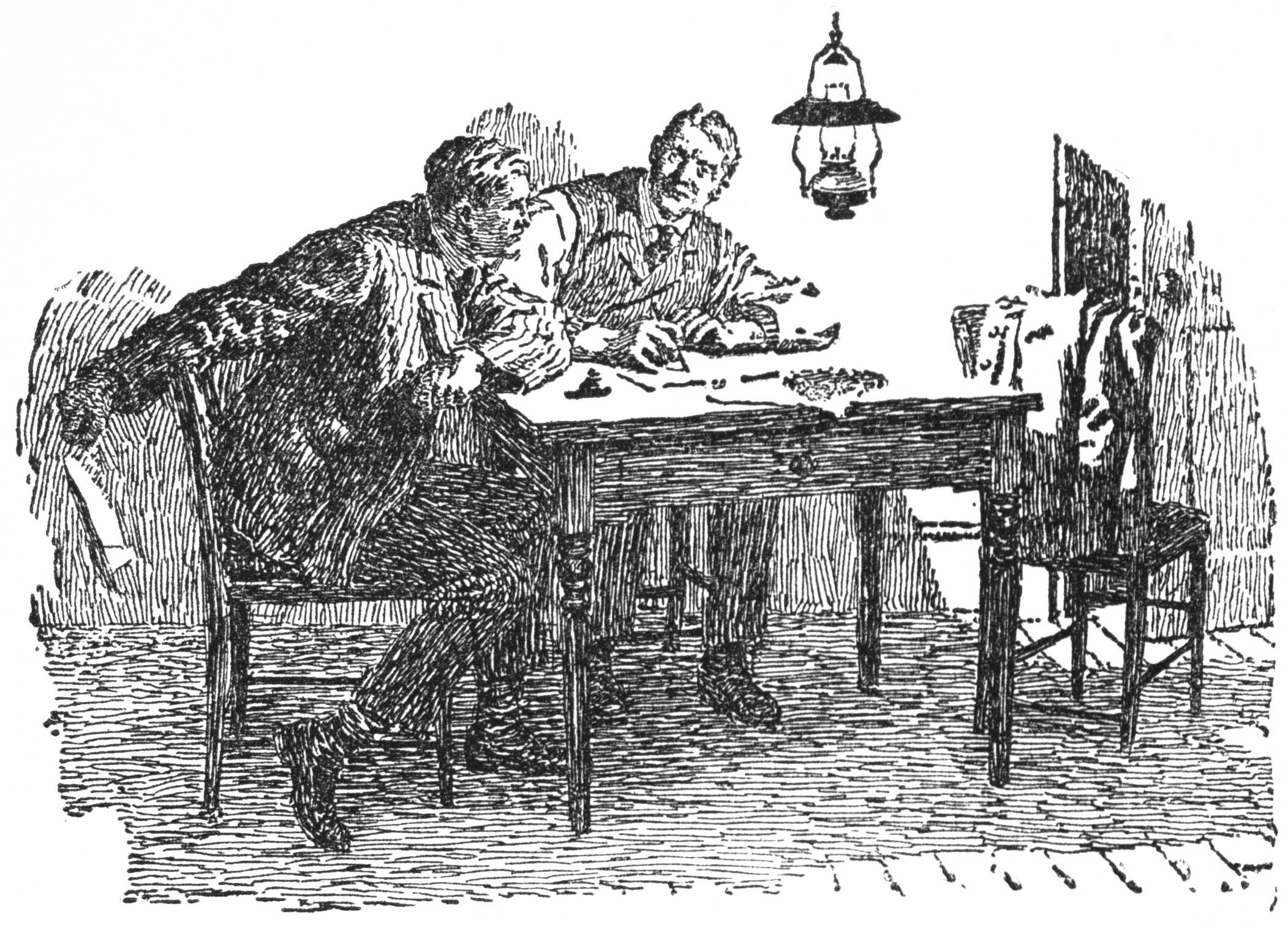
WORK AND WORRY.
It was close to daybreak when the partners separated. They had planned and figured and estimated, and each now knew what his part in the great fight was to be. As he was leaving Bradley asked the Captain how, in his opinion, Obed Nickerson had learned that they had the contract.
“’Phoned the Salvage Company,” replied Captain Ezra, decidedly. “I’ll bet on it. You see, Brad, this job’s a big one and the Salvage folks might have figgered there was sugar enough in it to drop a lump in [Pg 307]friend Obed’s teacup providin’ he stirred up their spoon. Well, good night—or good mornin’, rather. It’s double or quits with us this time, son, for sartin, but if Titcomb and Nickerson do go under it’ll be with colors flyin’.”
Within the week Setuckit Point, from a lonely, gull-haunted sand spit, inhabited only by the life saving crew and the lighthouse keeper and his family, became a small town, the population of which left each morning for the Razorback shoal and returned at night to sleep and eat in the big shanty and those surrounding it.
Captain Titcomb saw the people at the Wellmouth Bank and placed a mortgage on the Diving Belle. As the partners owned her free and clear, he was able to get her cost price, five thousand dollars.
Placards announcing that men were wanted at once, and at three dollars a day and board, were hung in the post-offices and railway stations in Orham, South Orham, West Harniss, Harniss Centre, Wellmouth and other towns. Also an advertisement appeared in the Item. The response was immediate. Work at good wages was scarce in the winter months and men came from twenty miles away to obtain it.
The Diving Belle carried them down to the Point. There, under Barney Small’s supervision, some set to work building extra bunks in the big shanty, slinging hammocks, putting up stoves—the partners bought five second-hand ranges—and making three neighboring abandoned fishing huts inhabitable. The rest worked over the stranded coal barge, getting out the [Pg 308]anchors, stripping her of all unnecessary iron work and rigging, and preparing to bring the coal from her hold and dump it overboard.
Seventy men were hired altogether, and to feed them it was necessary to buy large quantities of provisions. Captain Titcomb managed this part of the business and the bargains he made with Caleb Weeks and other storekeepers were wonderful, and, in some cases, not too profitable for the sellers. As Mr. Weeks said: “Ez Titcomb spent ha’f the forenoon with me to-day, and afore he got through talkin’ he’d tangled me up so with figgers that I don’t know whether I sold him salt at a cent a pound or corn meal at a dollar a barrel. I’ll have to put in the rest of the day cal’latin’ and addin’ up, so’s to know whether I’ve made money or lost it.”
Soon the work on the Freedom was in full swing and the great hull hummed like a bee-hive. Men were standing by the hatches and by the derricks. Men were working by the rail transferring ropes and ironwork to the Diving Belle. Down in the hold gangs of men, with faces sooty black except where the sweat streaked them with pallid channels, were shovelling the coal into the big iron buckets that the creaking derricks lifted and swung over the side. The donkey engines puffed and whistled, the chains rattled, and ton after ton of good hard coal roared from the opening buckets and splashed into the tumbling waves of the channel.
The Captain and Bradley, together for a moment, stood in the bows, where the heavy cable led, taut and [Pg 309]rigid, from the windlass, out to the submerged anchors. The Freedom had moved slightly in the last few days and the partners were encouraged.
“By crimus, Brad!” exclaimed Captain Titcomb, pointing with a grin on his grimy face, to the stout little Diving Belle just then shooting off to the Point with a load of strippings from the Freedom; “that’s the little critter that has made it possible for us to handle this job. I don’t know what we’d a-done if we hadn’t had her. See her go, will you? Flies ’round like a flea in a fryin’ pan, don’t she? You never put your money into anything better for the size than her, and don’t you let that fact slip your mem’ry.”
The new schooner had proved her worth twice over. Equipped as she was, with the engine, she performed the part of a steam launch, a tug and a ferry-boat. She had carried out and dropped the anchors in the channel; she took her owners and a few of the hands to and from Orham every night and morning; she was always ready and always useful. In fact, as the Captain said, they could scarcely have handled the job without her.
Bradley, dirty and bareheaded, looked at the little vessel.
“I shan’t feel easy until we pay off that mortgage,” he said. “And, another thing, you mustn’t forget to see Obed and close that insurance deal. It worries me to think she is not protected at all.”
“That’s so. Fact is, I’ve been so everlastin’ busy lately that I’d forgit to eat if I hadn’t got in the habit of it. But I must settle that right off. The only [Pg 310]thing that’s kept it from goin’ through afore is on account of that dynamite in the hold. The papers are ready, only Obed won’t dicker until we take that stuff off; his comp’ny won’t insure against explosives.”
A little of the dynamite that they had been using in blowing up the hulk containing the tar was still stored in the Diving Belle’s hold. Captain Titcomb had promised to see that it was taken ashore, but he always forgot it. Bradley would, himself, have attended to the matter, but the Captain seemed to take the offer as a personal reflection on his own management. It was the same with the insurance. Anything that the Captain undertook to do he hated to give up to another.
“Don’t you want me to attend to that dynamite?” asked the junior partner.
“No, no; I’ll ’tend to it myself. Told you I would, didn’t I?”
Bradley saw that it was time to change the subject. He looked across the ocean to the horizon. The air was clear and cold and the November sunlight lay upon the water with a steely metallic glitter that had no warmth in it.
“Wind to the south’ard,” he observed, “and seems likely to hold that way. If it only holds fair long enough we’ll win out yet.”
“Where’s that special weather bureau of ours?” asked the Captain. “Ain’t had a prophecy for two days or more.” He stepped to the hatchway. “Hi! Peleg!” he shouted. “Peleg Myrick, ahoy!”
[Pg 311]
A distant voice from the hold replied that Peleg was aboard the Diving Belle.
“That’s so,” said Captain Titcomb. “So he is. Well, we’ll see him later.”
When the schooner again ran alongside the barge Mr. Myrick was summoned and clambered on board. The weather prophet had coal dust in his nostrils, in his mouth, and in decorative smouches on his cheeks. As for his whiskers, the red and gray had disappeared; they were now a solid black.
“Peleg,” observed the Captain, “does Skeezicks know you when you git home nowadays?”
“Know me?” repeated the astonished owner of the dog that was just like a human. “Know me! Course he does.”
“Well, I didn’t know. You look so much like a cross between a darky and a Kickapoo Sagwa peddler in his war paint that I shouldn’t think your mother’d know you, let alone a dog.”
Mr. Myrick pondered. “Well, you see,” he replied slowly, “mother she’s been dead for a consider’ble spell, and Skeezicks——”
“Skeezicks ain’t. I see. That’s the best reason I know of. Say! how about gales? Got any marked on the calendar?”
The prophet’s dreamy gaze wandered mournfully to the sky.
“No,” he drawled; “I don’t cal’late there’ll be a storm for the next week. After that—wall, I don’t know. I’ve been havin’ a feelin’ that the weather’d [Pg 312]shift, but p’raps ’twon’t. Still, I’m kind of scart—kind of scart of the week after next.”
Captain Titcomb looked troubled. “Thunder!” he muttered. “I swan I hope that ain’t so!”
Bradley looked at him in puzzled surprise.
“Now, honest, Cap’n Ez,” he exclaimed. “You aren’t worried because that half-baked chap says—here, Peleg! come back here a minute. Say, how do you get your tips on the weather?”
Mr. Myrick hesitated and looked troubled. “Wall” he replied, “I—I—you see, I don’t gin’rally tell that ’cause folks laugh at me. But, bein’ as you’re my boss, I s’pose I ought to tell you a little. You see, I jest sort of feel it in my bones.”
“Any particular bones?”
“Why, my laig bones mostly. If a no’theaster’s comin’ my right laig sort of aches, and if it’s a sou’easter it’ll fetch me in the left one. Then there’s other——”
Bradley interrupted him by a roar of laughter. The prophet looked hurt.
“There!” he sighed. “I knew you’d laff.”
“All right, Peleg; trot along. There, Cap’n Ez, does that satisfy you?”
The Captain laughed, too, but he shook his head.
“I don’t know,” he replied. “Them leg bones of Peleg’s seem to have been pretty good barometers afore now. Well, what is to be will be, as the fellow with dyspepsy said when he tackled the mince pie. My! this won’t do for me, nor for you either, Brad.”
[Pg 313]
They separated to plunge again into their work. But Bradley’s hint about the dynamite still troubled Captain Titcomb’s conscience. When the Diving Belle came back from her next trip to the beach he hailed Peleg, and, calling him to him, said:
“Peleg, I’ve got a job for you. I want you to git out that dynamite we’ve got in the hold for’ard, and take it ashore some’eres.”
Now, that dynamite was Mr. Myrick’s particular dread. He was more afraid of it than he was of anything else on earth. The Captain knew this, and that was why he always selected Peleg to bring up a stick of the stuff when the latter was needed. “It’s the scared man that’s always careful,” said the skipper. “Peleg hangs to them sticks like a sucker to a barn door. He won’t drop ’em, unless his knee j’ints rattle loose altogether from nervousness.”
When the weather prophet heard the Captain’s order the visible parts of his countenance turned white.
“Oh, my soul and body!” he gasped. “You don’t want me to tech them pesky things, do you, Cap’n Ez? Git somebody else; do!”
“No,” replied the skipper, gravely. “I wouldn’t trust nobody else. Tumble ’em out!”
“Tumble ’em out! Don’t talk in that careless kind of way, Cap’n Ez. What’ll I do with ’em?”
“Oh! dig a hole and bury ’em; put ’em under your bunk in the shanty; feed ’em to Skeezicks; only git ’em out of the schooner sometime pretty soon.”
“Will—will Sunday do?”
“Yes, yes! whenever you have the time. Hi! Sam [Pg 314]Hammond, what are you settin’ there for? Git back to your engine.”
Mr. Hammond was still with them, although his usefulness as a diver was gone, owing to the temporary abandonment of the tar venture. But, because they anticipated returning to this work if the Freedom should be floated, he was retained at his old wages and was now running one of the hoisting engines, a labor with which he was more or less familiar, although he considered it beneath him and shirked whenever he could.
This shirking irritated Captain Titcomb.
“Consarn him!” he growled. “Let him either fish or cut bait, one or t’other. If he’s too good for the job, why, then, the job’s too good for him. If I had my way we’d come to a settlement in about ha’f a shake.”
The majority of the men hired by the partners were intensely loyal and thoroughly optimistic; they knew the circumstances under which the contract had been taken and would not consider the possibility of failure for a moment. But Hammond was the head of a little coterie of pessimists, among whom were Henry Simmons and a few others from Orham, and “Lon” Clark and “Ike” Bodkin from Harniss. These croakers sneered at Captain Ezra when his back was turned and pretended to pity Bradley. When the pay envelopes were distributed they congratulated themselves loudly and wondered if this time was the last.
Bradley was aware of all this, because Barney told him, but he would not permit his partner to call Hammond [Pg 315]to account. Sam should not have the opportunity of telling Gus that he was the victim of persecution by an unsuccessful rival; not if Bradley could help it, he shouldn’t. Captain Titcomb understood, and so Sam was not reproved and grew more and more intolerable.
All day long the Freedom’s deck was a whirl of industry. The Captain and Bradley were always in the thick of it, and were dog tired when six o’clock came. Then the cable was tightened and chocked, the watch was set and most of the crews were transferred in relays to the beach, to eat supper in the shanty and shout, sing and play cards until bedtime. The partners, with Hammond, Bearse and a few others, went up to Orham in the Diving Belle.
The “old maids” had been very solemn of late. When Bradley first told them that his firm had secured the biggest wrecking contract ever handled by Orham men they were jubilant. But then came Miss Busteed, brimming over—like a sort of living “extra”—with exaggerated reports of village opinion concerning that contract, and the sisters began to worry. Other callers, whose views were more weighty than Melissa’s, came also, and now even Miss Prissy was nervously anxious.
Bradley went to bed early nowadays. On the night following the conversation with Peleg he took his lamp from the shelf soon after supper was cleared away. Captain Titcomb called, but remained only a little while.
As the young man rose from his chair Miss Prissy, [Pg 316]who had been watching him over her glasses while pretending to mend some stockings, dropped the work in her lap, and asked, “Bradley, how are you gettin’ on down at the Point?”
“Tip top,” was the reply.
“Yes, you always say that; but are you gainin’ as fast as you ought to? You don’t think there’s any—any chance of your not bein’ able to git that vessel off, do you? Folks seem to think——”
Bradley laughed. “Has Melissa been here to-day?” he interrupted.
“No, she hasn’t, but Mr. Langworthy has. Oh, Bradley, we hear such dreadful things. Mr. Langworthy came here almost on purpose to try to git us to coax you to give it up ’fore it’s too late. He says the whole town thinks you can’t carry it through. Men that know all about wreckin’ say——”
“Who says—the Jeremiah Club?” The “Jeremiah Club” was Captain Titcomb’s name for the daily gathering about the stove in Weeks’ store.
“No, indeed! Men like Cap’n Jonadab Wixon and Mr. Wingate and lots more. They say that you’ve mortgaged your vessel and that if you fail you’ll be ruined—absolutely ruined. They lay it all to Cap’n Ezra. Of course Tempy and me stand up for you and the Cap’n and pretend we ain’t a mite anxious. But, oh Bradley, if any such awful thing should happen to you—to our boy—’twould break our hearts.”
Bradley felt a pang of self-reproach. Miss Prissy’s eyes were wet and the tears were running down Miss [Pg 317]Tempy’s cheeks. He was very grave as he answered.
“Miss Prissy,” he said, “please don’t worry. I know how people are talking, but honestly and truly I think we shall succeed. If we do, it means everything to us. If we don’t—well, whatever happens, if God lets me live, you and Miss Tempy shall never suffer. I owe everything in the world to you. I’ll promise you something else, too: If we win out now, I’ll never take another contract where the risk is as big as this. Now, good night, and to please me, don’t worry any more.”
As he was leaving the room Miss Tempy said, timidly, “Bradley, you don’t go to prayer-meetin’ any more. Prissy and me pray for you every night. I hope you won’t let your bus’ness crowd out your religion.”
Bradley shook his head, answered hurriedly that he was working hard nowadays and was tired, and went up to his room. The last time he had been to prayer-meeting Gus went with him. He had no wish to go there now, and perhaps see her in Sam’s company.
[Pg 318]
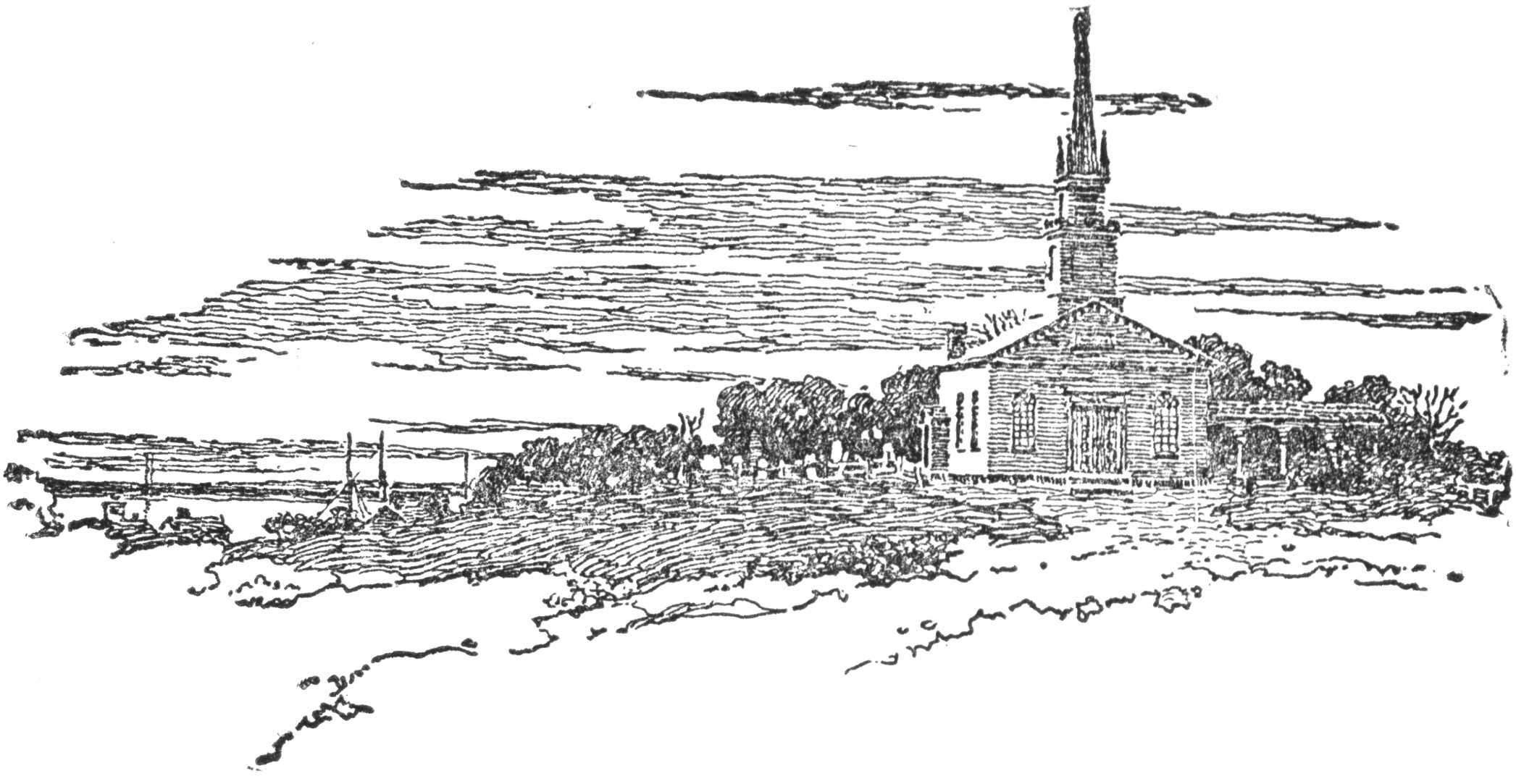
MR. SAM HAMMOND.
At that very moment Mr. Hammond, seated on the fence by the vestry door, was puffing at a cigar and talking in an unusually loud voice of New York and his experiences there. He seemed to be very happy and his boisterous laughter penetrated even to the little company of worshippers on the settees inside.
When the meeting was over he threw away the stump of his cigar and shouldered himself into the front row of waiting swains by the door. As Gus came out he stepped forward to meet her, and in doing so bumped against Mrs. Piper, who, looking the other way, had not seen him, and, being deaf, had not heard his step.
[Pg 319]
“Gracious sakes alive!” exclaimed the old lady, rubbing her shoulder. “Excuse me, Mr. Hammond, I didn’t see you.”
Sam nodded serenely. “Don’t mention it,” he shouted, winking over his shoulder at Georgiana Bailey. “You didn’t hurt me a bit.”
Georgiana giggled, and most of the young men grinned at the joke. Gus glanced hurriedly at Mrs. Piper and then at Hammond. She looked surprised and troubled.
Sam took her arm without asking permission and led her to the sidewalk. She still looked back.
“I’m afraid you hurt Mrs. Piper,” she said. “What made you so rough?”
Her escort laughed. “I guess it won’t be fatal,” he observed. “If I’d managed to fracture that voice of hers so’s she couldn’t sing, maybe the congregation would give me a vote of thanks.”
Gus didn’t reply. There was something in her companion’s manner that made her recoil instinctively. She disengaged her arm from his, but he took it again and walked on, joking and laughing.
“What a crowd of jays there is in this town,” he remarked after a while, and, with a sneer, “enough to stock a dime museum.”
He had always spoken patronizingly of the townspeople—that she had not minded so much, coming from a city man, but heretofore he had not openly made fun of them. She resented the remark, but most of all the tone in which it was uttered.
“Why do you stay here then?” she asked, coldly.
[Pg 320]
“Why? I guess you know the reason all right. Don’t you, Gus? Hey?”
He chuckled and bent down to look in her face. She shivered and drew away from him.
His hand upon her arm, the look he had just given her, his air of assumed proprietorship—above all, that new and vulgar something in his manner, as if the real soul of the man was showing for the first time, filled her with disgust.
She did not speak again until they reached the gate. Then she said, without looking at him, “Good night.”
He put his hand over hers on the latch. “Oh, say,” he exclaimed, with a laugh, “this isn’t a square deal, Gus. Aren’t you goin’ to ask me in?”
She tried to snatch her hand away, but he held it fast, and, leaning across the gate, threw his arm about her waist and drew her to him.
“There!” he cried, exultantly, “this is more like it. This is more like friends. Give us a kiss. You’re too high and mighty to be the prettiest girl on the Cape.”
She struggled from his grasp and stood panting. “Oh!” she whispered, with a shudder, as she realized the truth. “Oh, you’ve been drinking!”
He laughed foolishly and shrugged his shoulders. “Oh, what’s one glass between friends?” he said. “I stopped into Web’s a minute and he set ’em up. First drink I’ve had since I left New York. Thought you was too sensible to have blue ribbon notions. Come; be more sociable—that’s a good girl.”
She was afraid of him now, not afraid of physical violence, but as she would have feared the contact [Pg 321]with something loathsome and unclean. A sense of utter loneliness came over her. She longed for protection and help. She thought of Bradley; he would have helped her; she could have trusted him. But she had driven him out of her life, and this fellow——
“Go!” she cried. “Go!”
Sam ceased to smile. Other girls had told him to go, but never in that way or with such quivering scorn. He began to realize that this was the end of his game; he had lost the prize. But he made one more effort.
“Oh, say,” he cried. “Don’t get mad, Gus. I was only fooling. Don’t be such an old maid. Come here.”
She turned on her heel and, without replying, walked toward the house. Hammond swore between his teeth, opened the gate, took one step in her direction, and then stopped. He laughed a short, ugly laugh, and nodded.
“You mean it, do you?” he asked. “Want me to clear out, hey? Well, don’t you fool yourself that I don’t know what ails you. You can’t come the high moral game on me, my lady. You’re whining after that sneaking Sunday-school kid, Brad Nickerson, the fellow that didn’t care enough about you to lift his hand, but stood still and let me walk off with his girl, as if she was as common as dishwater. The whole town thinks you’re going to marry me. What’ll they say when I show ’em I’m done with you?” He laughed again and put his hands in his pockets.
“I’m going,” he said. “I’m going all right. You [Pg 322]go to bed and dream about Brad. Dreams come true sometimes, they say. Maybe I’ll dream about him, too.”
He pulled his hat over his eyes and walked rapidly away. Gus watched him go. Then she went into the house, threw herself into a chair beside the table and laid her head upon her arms.
Sam plunged straight on through the mud and wet grass until he reached the back door of the billiard-room. Web Saunders came hurrying to see who it was that had knocked: only the tried and true were admitted at that door.
“Hello, Sam!” he exclaimed, with a look of relief. “Why, what’s the matter?”
“Nothing,” replied Hammond gruffly. “Where’s that jug of yours, Web? I’m dying for another drink.”
After cautioning his visitor against speaking so loud, Mr. Saunders indicated the whereabouts of the jug. Sam poured out a liberal dose of the villainous cheap whiskey and drank it forthwith. Then he poured out another.
He refused to go home that night and Web put him to bed upon one of the settees in the little back room. And in that back room he stayed throughout the next day, drinking frequently, in spite of his friend’s protests, and growing more ugly with every drink.
That next day, Friday, was wet and foggy, with occasional cold showers, but there was no wind worth mentioning and the wreckers put in ten hours of the [Pg 323]hardest kind of work. The Freedom had moved perceptibly in the sweep of the latest tides and the partners were happy in consequence.
It was dark, though a few stars were showing dimly through the mist overhead, when the Diving Belle entered Orham Harbor that evening. Alvin Bearse was at the helm, and he brought the schooner alongside the wharf. A half-dozen men—the only members of the wrecking gang who returned to Orham at the end of the day’s work—climbed over the stringpiece and departed for their homes in the village. Bearse remained on board when the vessel ran out to her moorings, to help his employers make snug for the night.
A few minutes later Bradley stood by the cabin door, with a lantern in his hand. Alvin and the Captain were forward. Suddenly the junior partner was aware that some one was standing beside him.
“Well, Cap’n Ez,” he observed; “all ready to go ashore?”
There was no answer. He looked up—into the face of Sam Hammond. The diver wore no overcoat. His stiff hat, battered and muddy, was pushed back on his head. His face, under the tumbled, damp hair on the forehead, was flushed and scowling, and his half-shut eyes had an ugly glimmer. Even in the dim light of the lantern his condition was unmistakable.
Hammond’s behavior in his native village had heretofore been of the best, so far as this particular vice was concerned. Bradley was dumbfounded.
[Pg 324]
“Hello, Sam!” he exclaimed. “Where’d you come from?”
“Off the wharf,” was the gruff answer. “Where’d you think, you fool?”
It was evident that the fellow was spoiling for a fight. Bradley, however, had no wish to quarrel with a drunken man, especially this one.
“All right, all right,” he said, mechanically, “I didn’t see you come aboard, that’s all. Want to see Cap’n Ez?”
“No, I don’t want to see Cap’n Ez nor any other ’longshore thief but you. I want to go below and get my things.”
“Your things?”
“Yes, my things. My oilskins and the rest of my stuff. I wouldn’t leave ’em aboard this rotten tub another minute for a million dollars.”
“Oh, very well.” Bradley swung open the cabin door and started to lead the way with the lantern. Hammond shoved him aside.
“I’ll go alone,” he muttered.
“You can’t see without the lantern. You’ll have to go with me or wait till to-morrow morning.”
“Give me that lantern,” snarled Sam, making a grab for it.
Bradley held it out of reach.
“You’re not fit to carry it,” he said, shortly.
“You mealy-mouthed sneak!” shouted Hammond. “I’m fit to fix you.”
Bradley saw the blow coming. He dropped the lantern and ducked. Next instant Sam was upon him, [Pg 325]screaming and cursing. They tripped over the swinging door and fell to the deck. Alvin and Captain Titcomb came running from the fo’castle.
“What in the nation——?” cried the Captain. “Here, quit that, you! Let him alone, Brad!”
Hammond yelled and fought as they dragged him to his feet. Finally, overpowered, he sobbed in maudlin fury.
“There! that’ll do for you,” observed the Captain, clapping a big hand over his prisoner’s mouth. “Crazy tight, ain’t he? Hold still, or, by the everlastin’ hook-blocks, I’ll heave you overboard! Where’d he come from?”
“Must have come aboard when we stopped at the wharf,” replied Bradley. “He was dead set on taking the lantern and going below after his oilskins and stuff.”
“Sooner trust a blind cripple with a lantern. Chuck his dunnage ashore to-morrer mornin’. Now then,” turning to Hammond, “will you walk to the dory or shall we carry you? Shut up! You’ve cussed enough.”
He led the way to the side, holding Sam by the coat collar. Bradley followed.
“Oh!” exclaimed the skipper, stopping short. “Didn’t shut that cabin door, did you, Brad? I’ve left that blasted key somewheres, and if that spring lock’s snapped shut we’ll be in a mess. No? Well, all right then.”
They got into the dory and Bradley took up the oars. Bearse sat on the bow thwart, while the Captain reclined in the stern with Hammond, sprawling [Pg 326]and muttering, between his knees. They had nearly reached the beach when Sam gave a sudden spring, and, with an oath, threw himself upon his enemy. Bradley fell backward. The dory heeled until the water lipped the rail.
“You would, would you?” grunted Captain Titcomb. “There!”
Seizing the struggling diver neck and crop, he whirled him bodily over the side.
“Now, then,” panted the Captain, “if you can’t ride like a man—walk!”
Sam went into the cold water with a tremendous splash. It was not deep and he floundered to his feet, but the shock sobered him a little. He waded to the shore. Turning, he stretched out an arm with a shaking forefinger at the end of it. His rage almost choked him. He tried twice before he managed to speak clearly.
“I pay my debts,” he gasped. “I pay my debts!”
“I’ve heard diff’rent,” remarked the Captain, drily. “But never mind, Sam; it’s a good habit.”
Hammond did not heed him. “I pay my debts,” he repeated. “Do you hear that, Brad Nickerson? You doughface! I’ve got your girl away from you already, and that isn’t the end. I pay my debts, and, by God, Brad Nickerson, I’ll pay you!”
He stood for an instant pointing at the dory. Then he stepped back into the darkness. They heard his footsteps crunching the broken clam-shells of the road.
“Seems to love you like a brother, don’t he, Brad?” [Pg 327]observed the Captain, as they were on their way up town. “I jedge from the drift of his entertainin’ remarks that he’s decided to chuck up his job with Titcomb and Nickerson. Well, I cal’late he’ll resign by ‘mutual consint,’ as the Irishman did when him and his boss told each other to go to blazes at the same time. I met one of the Metropolitan men when I was up to Boston and he told me his folks fired Sam because he went on a howlin’ spree, so I guess this little shindy was bound to come sooner or later. Kept pretty straight afore sence he’s been to home, though, ain’t he?”
Bradley did not answer.
Suddenly the Captain slapped his thigh.
“Good land!” he exclaimed. “Brad, I’ve meant to tell you all day, and forgot it: The Diving Belle’s insured. I went down to Obed’s after I left your house last night and we fixed it up. Five thousand dollars, and it went on at noon to-day—leastways, I s’pose it did. He was to telephone the insurance folks this mornin’.”
“Good! I’m glad that’s settled. It has worried me to think we weren’t protected at all.”
“Well, I told you I’d do it, didn’t I? The only hitch was about that dynamite. But I fixed that. Give Obed to understand we’d took it ashore. We have—all but. I spoke to Peleg and he’ll have it off in a day or so.”
Bradley stopped short. “You don’t mean to tell me it hasn’t gone yet?” he exclaimed. “Why! if anything should happen to the schooner with that stuff [Pg 328]aboard the policy wouldn’t hold for a minute. I’ve a good mind to go back now and take it off myself.”
“Oh, don’t be an old woman!” cried the Captain, testily. “What do you think’s goin’ to happen? I’ll see to it to-morrow. Come on home!”
The junior partner did not press the subject, but he made up his mind that if he lived until the next morning that dynamite should go ashore the minute the Diving Belle reached the Point.
At the gate of the Traveller’s Rest they separated. “Coming ’round to the house by and by, Cap’n?” asked Bradley.
The Captain’s manner changed. “I don’t know,” he answered, gloomily. “I presume likely I may.”
[Pg 329]
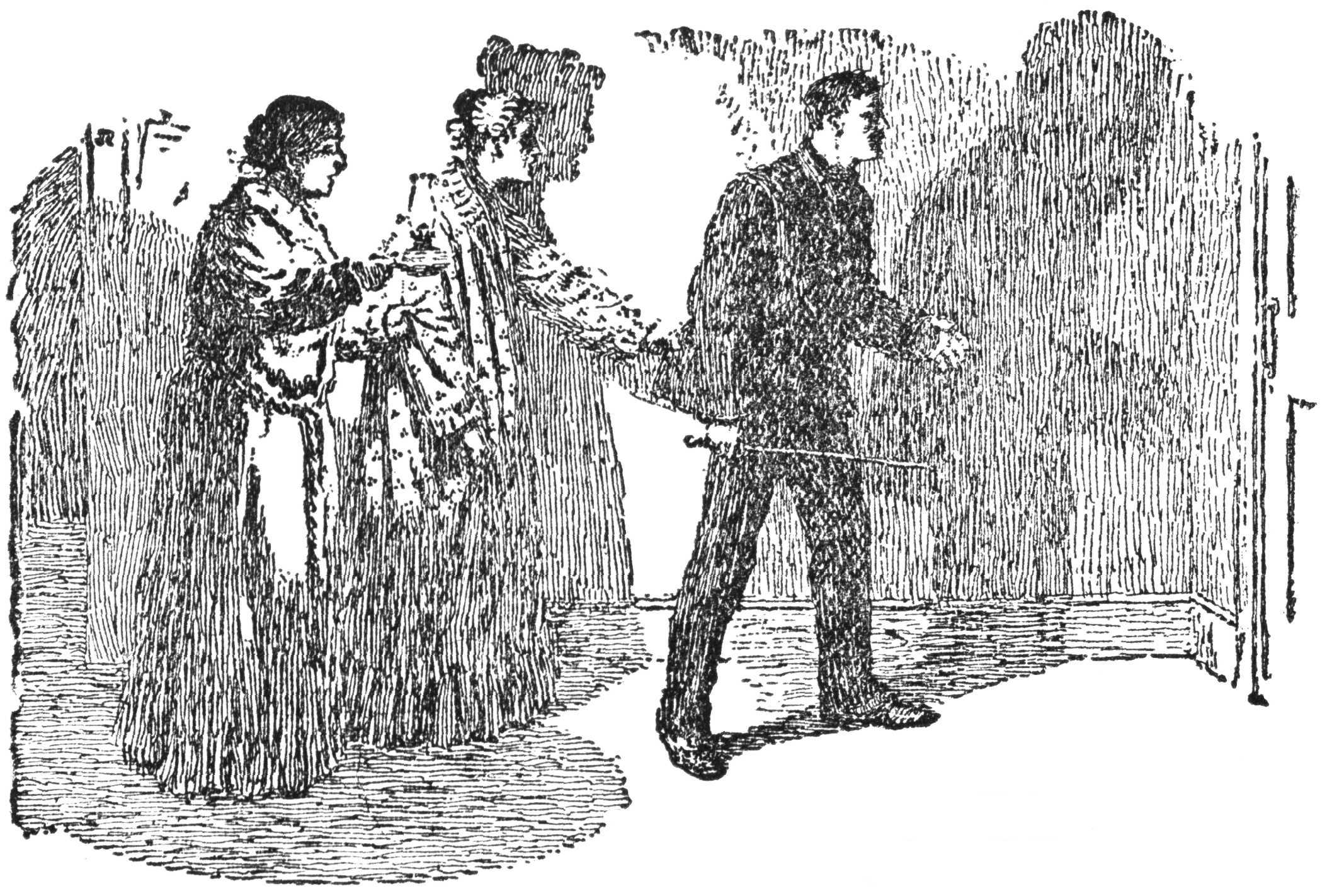
THE BURGLAR.
There was a mystery about the Captain’s visits to the big house. Up to the beginning of that week he had called on Tuesday and Friday evenings only, and had remained until after ten o’clock, joking, laughing and apparently enjoying himself. But now he came every night and seemed less talkative and more glum each time. Also his calls grew shorter and he went home as early as half-past eight. The sisters did not know what to make of it. It was pleasant and encouraging to have him come so often, but why didn’t he stay longer? [Pg 330]Miss Tempy thought he must be worrying over the big contract.
She asked Clara for her opinion, but Miss Hopkins seemed very indifferent. She used to come into the sitting-room as soon as the work was done to listen to Captain Titcomb’s stories, but of late she had gone straight to her own room. The “old maids” did not urge her to remain; they liked to have the Captain to themselves.
On the afternoon of the previous Sunday Miss Tempy had taken a sudden notion to go over to the Methodist Chapel and attend the Sabbath School concert. The Chapel was on the road to Orham Port, a mile or more from the Allen home. Miss Prissy was not strong enough to go, and, in fact, thought the walk too long for her delicate sister, but Miss Tempy, having made up her mind, went. She would have been glad of Clara’s company, but the young lady had already gone out.
Miss Tempy had just reached the corner when she was surprised to see Captain Titcomb driving toward her in a buggy. She recognized the horse and carriage as being the best owned by Lem Mullett, the livery stable keeper. Also she noticed that the Captain looked particularly well-dressed, spruced up, she told Miss Prissy afterwards.
“Cap’n!” she called. “Cap’n Ezra!”
The Captain was then almost directly opposite, but he did not seem to hear or see her. Instead he whipped up the horse and drove by faster than ever.
“Dear me!” thought Miss Tempy. “He must be [Pg 331]gittin’ absent-minded—workin’ too hard, I guess. Cap’n Ez—ra!”
It is doubtful if the Captain would have heard even then, but Jonadab Wixon was coming down the road, and he also began to shout. Hailed thus, fore and aft, the absent-minded one was obliged to heave to, and, when Captain Jonadab pointed out Miss Tempy, he turned his horse and drove back to where she was standing.
“Well, I do declare!” exclaimed the lady, smilingly conscious of a becoming new bonnet—one of the reasons for her desire to attend the concert, “I’m all out of breath callin’ after you. I don’t know what folks will think!”
The Captain didn’t appear to care very much what folks might think. He was polite as usual, but seemed to be a trifle nervous and kept glancing up and down the road. Miss Tempy, unconscious of the nervousness, went gushingly on.
“What a lovely horse!” she cried. “I declare it must be a pleasure to ride behind him. I do so like to ride with a nice, gentle horse like that. Father used to take Prissy and me drivin’ with our Dexter when he was alive—father was alive, I mean—yes, and the horse, too, of course. I hope I haven’t kept you. Was you goin’ to see Bradley?”
“No, no,” was the hasty answer. “I was jest—jest drivin’ down the road a ways.” Then, perhaps noticing that his friend was headed toward the village, he added: “I had a little errand down towards [Pg 332]the Port. You’re goin’ uptown, I see, else I’d ask you to jump in.”
“Why, how lovely,” exclaimed Miss Tempy. “I was goin’ to the Port, too; down to the Methodist folks’ concert. I only came this way ’cause I thought I’d stop at Mrs. Wingate’s and see if she wouldn’t go with me. Prissy was afraid the walk there and back would be too long for me, and, truth to tell, I was a little afraid of it myself. I didn’t expect to ride, and with you, Cap’n Ezra! It’ll be such a treat, because I shall feel perfectly safe with you drivin’.”
The Captain did not answer immediately. He was busy with the buckle that fastened the reins together. But the silence was only momentary.
“Good enough!” he cried. “I’ll have you there in a jiffy.”
He sprang out, assisted the lady into the buggy, and then turned the horse’s head into the road leading up the hill.
“Why, you’re goin’ the wrong way,” Miss Tempy exclaimed. “You’re goin’ the wrong way, Cap’n Ezra!”
“Oh!” replied the Captain, cheerfully, “that’s all right. I thought we’d go ’round by the Neck road. It’s prettier that way.”
But Miss Tempy would not consent. She told Miss Prissy afterwards, “I felt as though I’d the same as begged him for a ride as it was, and I swan if I was goin’ to let him go miles out of his way jest for me.”
“No,” she protested. “No, Cap’n, I won’t hear of [Pg 333]it. We’ll go the shortest road or I shall git right out.”
She stood up as she said it. The Captain looked at her determined face.
“Why, Tempy——” he began.
“No, I shan’t like it a bit, Cap’n Titcomb, if you don’t turn right ’round and go the way you was goin’.”
The Captain jerked at the rein with almost unnecessary vigor. The turn was made in a hurry. They wheeled back into the direct road to the Port and moved swiftly along it. Captain Titcomb did not say much, but as Miss Tempy talked continuously he had little opportunity.
“How nice the horse does go!” commented the lady. “You don’t have to cluck to him nor nothin’. Father used to find so much fault with our Dexter; said he had to shove on the reins so hard to make him navigate at all that he didn’t know’s ’twouldn’t be easier to haul the carryall himself. But then, father was so high-spirited that nothin’ less’n a race horse would do him. Who’s that waitin’ on the corner in front of Gaius Eldredge’s? Why, I do b’lieve it’s Clara!”
Captain Titcomb evidently did not see Miss Hopkins. At all events he looked the other way and chirruped to the horse. But Miss Tempy not only saw but intended to be seen.
“It is Clara,” she declared. “I must speak to her. Clara! Clara!”
The young lady, who had been intently watching [Pg 334]the approaching buggy, stepped to the edge of the sidewalk and waited until the equipage drew up. She was dressed in her new gown and jacket and certainly looked very pretty. She nodded to the Captain, whose face was redder than usual.
“How d’ye do, Clara?” said Miss Tempy, trying hard not to be patronizing. “I s’pose you’re takin’ a walk. You look reel nice. Where are you goin’?”
Miss Hopkins replied that she didn’t know just where she should go.
“Well, I hope you’ll have a pleasant afternoon wherever you go,” gushed Miss Tempy. “The Cap’n is takin’ me for a little drive. Isn’t this a beautiful horse?”
Here the Captain made his first remark since the carriage stopped. It was to the effect that he was taking Miss Tempy down to the Methodist Chapel. She had been going that way and it was a long walk.
“Oh!” said Miss Hopkins, sweetly, “is that all? I thought perhaps you were going to take her over to Harniss. It seems as if I remembered you saying you expected to go there to-day. Good-bye. I hope you’ll have a nice time.”
“Good-bye,” said Miss Tempy. “You needn’t hurry home on our account, Clara. Prissy’s well enough to help me do the dishes to-night. Clara’s a reel nice girl, isn’t she?” she added, turning to Captain Titcomb. “Do you know, I wonder that she hasn’t got a young man by this time.”
The Captain’s answer was a grunt and a crack of the whip that sent the buggy flying down the road in [Pg 335]a cloud of dust. Miss Tempy began to fear she had made a mistake in calling her companion a perfectly safe driver. Certainly she had never in her life ridden as fast as she did for the next few minutes. They reached the little chapel long before the concert began. There she bade her escort an effusive farewell and went inside, but thoughts of the wondrous tale which she would tell Miss Prissy when she reached home kept her from paying the proper attention to the recitations of the infant class, or even to Superintendent Ellis’ address, which began, “Now, little children,” and ended with the pithy sentence, “The collection will next be gathered in.”
All through supper she talked of nothing but her “lovely long ride with Cap’n Ezra.” She didn’t mean to stray from the truth, but she couldn’t help exaggerating just a little, and a stranger might have been led to believe that the drive was arranged beforehand and that it lasted a good deal longer than it really did.
On that evening Captain Titcomb made the first of the short calls which were to continue during the week. Miss Tempy welcomed him enthusiastically, and her sister did her best not to appear jealous. Clara did not come into the sitting-room at all, nor, as has been said, did she do so during the following four evenings.
Bradley did not mention the trouble aboard the Diving Belle when he reached home Friday night. He was even more silent than usual at the supper table. When the meal was over he suddenly exclaimed, [Pg 336]“By George! Clara, I must beg your pardon. There was a letter for you in our box this morning and I left it aboard the schooner. I’ll bring it home to-morrow.”
“From your mother, most likely, Clara,” observed Miss Prissy. “How did you come to forget it, Bradley? Your mem’ry’s gen’rally so good.”
Captain Titcomb came about eight. He seemed really cheerful when he first arrived, but soon relapsed into the moody silence that had characterized his visits that week.
“Clara out in the kitchen?” he asked, after a while. “I noticed the light was burnin’.”
“No,” replied Miss Tempy; “she’s up in her room. She’s left some bread to rise and I guess she’s comin’ down to see it by and by. That’s why she left the lamp, I s’pose likely.”
As the big clock in the dining-room struck nine the Captain rose, announced that he must be going, and went.
Bradley retired soon after, and the sisters followed his example. The old house grew still. Miss Prissy was dropping into a comfortable doze when she felt herself clutched violently by the back hair.
“Ow!” she exclaimed, half-awake. “Let go! What on earth——”
“S-s-sh-h!” Miss Tempy breathed it frantically into her ear. “Don’t speak!”
“I won’t if you’ll let go of my hair. What’s the matter? Nightmare? I told you there was a limit, even to pepper tea.”
[Pg 337]
“Oh, do be still! There’s robbers downstairs. I heard ’em!”
“Robbers fiddlesticks! Go to sleep!”
“Prissy Allen, I b’lieve you’d lay still if you was murdered in your bed, and——”
“Most likely I should. Where are they now—in the coal bin, same as last time?”
“No, in the dinin’-room or the kitchen. Please call Bradley or I shall die; I know I shall!”
Miss Prissy groaningly sat up and listened. “It’s Clara seein’ to her bread,” she said, after a moment.
“It ain’t. Clara’s in her room, readin’; I saw her through the crack in the door. And Bradley’s in his room; I heard him breathin’. Please git up!”
Miss Prissy got up quickly enough then. She, too, fancied she heard a faint sound in a room below. “’Tain’t burglars, whatever it is,” she whispered. “They wouldn’t come so early, and I don’t know what they’d expect to find worth stealin’ here anyhow!”
“Prissy Allen, how you talk! And our best teapot and the spoons hid right in the clock case!”
Miss Prissy said no more. She donned a wrapper and put on her slippers. Her sister was already similarly garbed. Then, Miss Prissy bearing the lamp, they tiptoed into the hall and on to the door of Bradley’s room.
“Bradley,” cautiously whispered Miss Prissy; “Bradley, will you git up, please? Tempy thinks there’s somebody downstairs.”
They heard Bradley chuckle sleepily. In a few [Pg 338]moments he came out, dressed in jacket and trousers and blinking at the lamp. Clara, who had not gone to bed, had already joined them.
The procession moved. Bradley first; then Miss Prissy with the lamp; then Miss Tempy, who, as she said afterwards, was “too scared to go ahead and dasn’t go last.” Clara brought up the rear. They peered cautiously into the dining-room. It was empty.
“There!” exclaimed Miss Prissy; “I guess ’twas nothin’ but Tempy’s imagination, as usual. She——”
The words died on her lips. There came a sound from the kitchen—they all heard it—a rattling sound and the faint squeak of a door.
Bradley sprang to the coal hod and picked up the poker. It was the only apology for a weapon in sight. He started for the kitchen, but Miss Prissy seized him by the jacket and Miss Tempy threw both arms around his neck.
“Don’t you stir, Bradley Nickerson,” whispered the older sister. “Don’t you stir a step! S’pose he had a revolver.”
“Yes, or a dagger,” gasped the trembling Miss Tempy, whose ideas of robbers were derived mainly from her novels. “If you go near that kitchen I shall drop right in my tracks. Oh, Bradley, please, for our sakes!”
Bradley tried to free himself, but it was hard work. He unclasped Miss Tempy’s arms from his neck, but she immediately seized him around the waist. It was a ridiculous situation. And suddenly he became aware [Pg 339]of a cold wind blowing from the direction of the front hall.
“Is that front door open?” he whispered.
The horrified sisters turned to stare at the black tunnel of the hall. And then footfalls were heard on the walk—coming up the steps. Clara’s voice became audible; she was speaking in agonized whispers.
“Who——” began Bradley.
Clara appeared, clinging to the arm of Captain Eri Hedge. Captain Eri looked puzzled, but he grinned when he saw the tableau in the dining-room.
He told the story the next morning to his messmates, Captain Perez and Captain Jerry, about as follows:
“You see,” he said, “I’d been up to lodge meetin’ and stayed a little longer’n usual. I was comin’ home by the short cut, and jest as I got abreast the old maids’ house the front door bust open and somethin’ comes prancin’ down the walk flutterin’ and flappin’ its arms like a hen tryin’ to fly. Thinks I, ‘Has that speritu’list camp-meetin’ I went to last summer struck in?’ You see, I couldn’t imagine anything but a ghost havin’ the spunk to use the old maids’ front door.
“But the critter swooped out of the gate and bore down on me like a hawk on a June-bug. Then I see ’twas Clara Hopkins, scart pretty nigh to death.
“‘Oh, Cap’n Eri!’ says she. ‘Oh, Cap’n Eri!’
“‘The same,’ says I. ‘What’s the row?’
“‘Burglars!’ says she, makin’ fast to my arm; ‘burglars!’
[Pg 340]
“I had to laugh. I couldn’t help it. ‘Burglars at ten o’clock!’ I says. ‘Did they come to supper?’
“‘But they’re there!’ she says. ‘Everybody heard ’em; Bradley and all.’
“I couldn’t b’lieve ’twas burglars even then, but I knew if Brad Nickerson took any stock in it somethin’ was up. And the poor girl was tremblin’ like Peleg Myrick’s pup.
“‘All right, Clara,’ says I. ‘Let’s go in and shake hands with ’em.’
“So in we went. When we struck the dinin’-room there was Brad in the middle of the floor, lookin’ pretty toler’ble foolish, with Prissy moored to his coat-tails and Tempy with a clove hitch ’round his waist. All hands looked s’prised to see me, but no more’n I was to see them. ‘What is this?’ says I. ’Livin’ statues?’
“The old maids cast loose from Brad then and begun on me.
“‘It’s burglars,’ says Prissy.
“‘In the kitchen——’ says Tempy.
“‘And Bradley was goin’ right in there——’
“‘At the risk of his life. And——’
“‘And, oh! we’re so glad you’ve come, ’cause——’
“‘Hold on a minute!’ I says, holdin’ up both hands. ‘If this is a talkin’ race, let’s start even. What’s the row, Brad?’
“Brad, he kind of grinned. ‘Well,’ says he; ‘the ladies thought they heard someone in the kitchen, but I guess——’
[Pg 341]
“‘Thought we heard ’em!’ busts out Prissy. ‘Why, you heard ’em yourself!’
“‘Yes,’ squeals Tempy. ‘And I heard ’em, and Clara heard ’em. And that’s why you took the poker.’
“And now Brad, he held up his hands, poker and all. ‘All right! all right!’ says he. ‘Now that we’re reinforced maybe we’d better go out and interview ’em. They might die of old age if we stay here much longer.’
“So he winked to me and the fleet got under way. Me and Brad led off, like a couple of tugs, and the women folks strung out behind like coal barges, holdin’ on to each other’s wrappers, and breathin’ hard.
“We opened the kitchen door and sailed in—that is, Brad and I did. The coal barges got in a lump, so’s to speak, in the doorway and stayed there. There was a lamp burnin’ side of a pan of dough on the table, but, jest as I expected, we was the only humans in sight.
“‘Looks’s if the burglars had got tired of waitin’ for us and got mad and gone home,’ says I. ‘Don’t know what they broke into the kitchen for, anyhow. I’ve heard of a feller’s stealin’ a red-hot stove, but——’
“Brad looked puzzled, sort of. ‘I sartinly heard somethin’ movin’ out here,’ says he. ‘Most likely ’twas a stray cat, and it’s hidin’ ’round somewheres.’
“But jest then comes a whistle—a squeal, I mean—from the barges. Tempy’s deadlights were poppin’ out of her head, and she was p’intin’ a shaky finger at the floor. There was big muddy footprints all over it.
[Pg 342]
“Well, I own up I was set back two or three rows. Somebody had been there, that was sartin. I’ve seen cats with double paws, but no cats made them prints. A camel with the gout might have done it, if it took pains and trod heavy.
“‘Humph!’ says I, and Brad agreed with me.
“‘Humph!’ says I again. ‘It looks——’
“I was standin’ right in front of the door of the closet where the old maids kept their pots and pans. And jest then inside that closet bust out the most outrageous racket ever you heard. ‘Biffity! bang! thump!’ And then a coughin’ and sneezin’ like forty packs of thunder crackers.
“I ain’t a narvous man, gin’rally speakin’, but I got up and moved sudden. I didn’t exactly run, but I kind of glided over to the sink. Leastways I was backed up against it when I remembered to take an observation. The women grabbed each other and screeched. Brad, he turned sort of yeller ’round the gills, but he was the coolest one in the bunch.
“The bangin’ and barkin’ and sneezin’ in the closet kept right up to time. Whoever it was, he wasn’t shirkin’ his work none to speak of.
“‘Come out of that!’ yells Brad, makin’ a dive for the door.
“Afore he could reach it that door flew open of itself. Out comes somethin’ doubled up like a jackknife. It kind of pawed the air with its flippers and dove head first for the sink. I give it all the room it needed; didn’t want to be selfish.
“Hoo-rash-oo!” remarks the thing, as if it meant [Pg 343]it, too. Then it shoved its head into the water bucket.
“The whole congregation was consider’ble shook up. Nobody felt like risin’ and addressin’ the mourners. The critter at the water bucket splashed and gurgled for a minute. Then it turned ’round. Its head and face was all streaks of red and brown and the water was drippin’ off its chin. Who was it? You’d never guess in a million years!
“I swan to man if it wan’t Ez Titcomb!
“‘Oh! it’s the Cap’n!’ squeaked Tempy, and went down in a heap.
“‘Hoo-rash-oo!’ says Cap’n Ez, sort of openin’ the conversation.
“‘Well!’ says I.
“‘For heaven’s sakes!’ says Brad.
“But Prissy stepped for’ard and took command. She didn’t looked scared any more; only kind of queer ’round the mouth and snappy ’round the eyes.
“‘Cap’n Titcomb,’ says she, ‘if you please, what were you hidin’ in that closet for? If you can stop sneezin’ long enough to answer, I should like——’
“‘Sneeze!’ hollers Ez, gittin’ ready for another explosion. ‘Sneeze!’ says he, kind of through his nose and wavin’ his hand desp’rate. ‘I guess maybe you’d sneeze if you’d upsot the spice-box right into your face’n eyes and had your moustache full of red pepper!’
“Seemed a likely sort of guess, when you come to think of it, but Prissy didn’t pay no attention.
“‘Why was you hid in that closet?’ says she.
[Pg 344]
“Well, sir! that was the fust time in my life that I ever see Ez Titcomb clean out of soundin’s. I snum! you could see he didn’t know what to say, and when Ez gits that way things must be consider’ble mussed up. He fidgetted, and stuttered, and picked at his watch chain.
“‘Prissy——’ says he, and then he stopped. ‘Prissy——’ he says again, and shut up like a clam. ‘Prissy——’
“‘Well?’ says Prissy, in a sort of vinegar-on-ice voice.
“‘Prissy——’ says Ez. He looked at her and at Tempy and at Brad. As for Brad, there was a twinkle in his eye. Honest, he looked almost as if he was havin’ consider’ble fun out of the show.
“‘Prissy——’ says Ez once more. Then he let everything go with a run, and hollers, ‘Oh, thunder! what’s the use? Clara, you know what I come here for. Why don’t you tell ’em and be done with it?’
’Course we all looked at Clara then. She blushed up pretty red, but she answered prompt.
“‘I s’pose you come here to see me,’ says she, ‘though why you should hide I don’t see.’
“‘’Cause I couldn’t see you no other way; that’s why! I’ve tried hard enough to speak with you for the last week, but you’ve cleared out every night ’fore I got the chance. I thought if I waited till you come to fix the bread, I’d be here and you’d have to see me and hear what I had to say. So I come in the back door and waited. Then I heard Prissy speak in the dinin’-room and—well, I got rattled and hid in that [Pg 345]da—that everlastin’ closet. That’s the whole fool yarn! There!’
“Prissy looked as if she was goin’ to say somethin’, but Clara cut in ahead of her. ‘Yes,’ says she; ‘but what you haven’t explained are your actions last Sunday. When a man asks the lady he’s engaged to to go out drivin’ with him, and then calmly ups and takes somebody else, why——’
“‘I wrote you how it happened,’ says Ez, pleadin’ like.
“‘I never got the letter,’ says Clara.
“‘One minute, if you please,’ breaks in Prissy, calm but chilly, like a January mornin’. ‘Let’s understand this thing. Cap’n Titcomb, are you and Clara, engaged to be married?’
“Ez swallered once or twice and looked ’round as if he was hopin’ somebody’d heave a life-line. But nobody did. Then he shoves his fists in his pockets, and says, ‘Why, yes; we—we are.’
“‘Well, I never!’ says Prissy.
“I didn’t say nothin’, neither did Brad, but I cal’late we both looked s’prised. Tempy, who’d been settin’ on the floor ever sence Ez was materialized—like one of the camp-meetin’ sperits—out of that closet, spoke up as if she was talkin’ in her sleep, and says she, ‘And it was Clara he was comin’ to see all this time!’
“‘Well!’ says Prissy. ‘Well, I must say, Cap’n Titcomb, that I think it would have been more manly if you’d come and seen Clara, instead of spendin’ your evenin’s with us, and lettin’ us think——’
[Pg 346]
“‘Come and see her!’ bellers Ez. ‘Didn’t I try and come to see her? But every time I got to the kitchen door you or Tempy’d take me in tow and head for the settin’-room. I swan to man I ain’t had a chance to breathe, you watched me so!’
“Tempy started to say somethin’, but Prissy was skipper jest then. ‘Don’t say any more, Tempy,’ she says. ‘Now that we know the Cap’n is goin’ to marry our——’ I guess she was goin’ to say servant, but didn’t hardly dast to—‘our young lady friend,’ says she, ‘we’ll treat him as her comp’ny, not ours. Come, we ain’t wanted here.’
“And, helpin’ Tempy up, she took her by the arm and sailed out, all canvas sot and colors flyin’.
“Ez, he looked consider’ble like the feller that stole the hen’s eggs and forgot and set down on ’em.
“Brad didn’t speak. He jest looked sort of mournful at the partner and shook his head slow. I ain’t a mind reader, but I’ll bet he was thinkin’, same as I was, that, for a chap who had the name of bein’ the slickest kind of a ladies’ man, Ez Titcomb sartinly had upset the calabash this time.
“And we went out and left him alone with his best girl.”
[Pg 347]
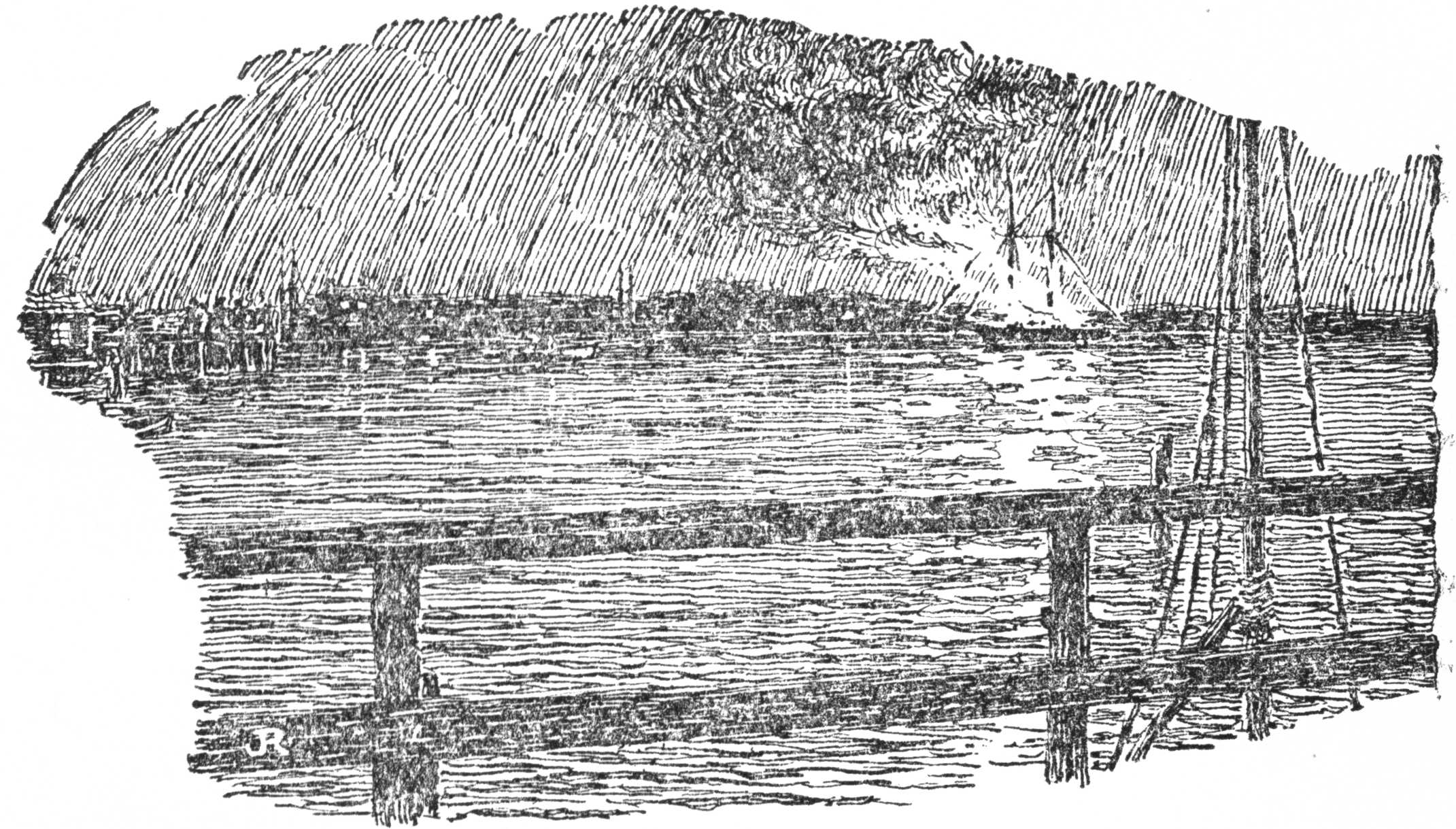
A DEBT IS PAID.
“Well, Clara,” observed Captain Titcomb, a few hours later, standing on the step by the back door and buttoning his peajacket, “I s’pose it had to come out sometime, but I did hope ’twould come more soothin’ like, as the feller said to the dentist. The thing that worried me most of all—always exceptin’ your givin’ me the mitten, as I’d begun to think you had—was how we was goin’ to break it to the old maids. And now it’s kind of broke itself, as you might say.”
Clara, standing in the doorway, with a shawl about her shoulders, smiled, but shook her head. “Yes,” [Pg 348]she said, “I should say it had. I guess the best thing I can do is to move back home right away. They’ll never forgive me for letting you fall in love with me, Ezra; never in the world.”
“Oh! I don’t know,” replied the Captain, hopefully. “That’s where Brad’ll help out. He can do more than anybody else to square you and me with Prissy and Tempy. Land of love! Is that one o’clock?”
“Yes, it is. You must be going right away. I’d no idea ’twas so late.”
“Nor I neither. Seemed so good to have you to myself for a little while, without havin’ to dodge anybody, that I’ve jest enjoyed it, even if I did have to swaller a pound of pepper aforehand.”
The quarrel—or misunderstanding, rather—had been made up. They had been saying good night ever since.
“Cleared off fine, ain’t it?” remarked Captain Ezra, looking at the sky.
The fog had entirely disappeared and it was a clear, cold November night. The heavens were spattered thick with stars, and the horizon line was dotted here and there with the sparks of lighthouses and lightships. Sleeping Orham lay still, and the surf hummed a restful lullaby.
“What was that?” asked Clara, pointing.
“What was what?”
“I thought I saw a queer light out on the water there. Yes! See! there it is again!”
The Captain put up his hand to shade his eyes from [Pg 349]the rays of the lamp in the kitchen and looked in the direction she was pointing. Out beyond the strip of water at the foot of the long hill behind the house, beyond the point that divided it from the harbor, a speck of light glowed for an instant, flickered and went out.
“That’s queer,” he muttered. “That’s off in the harbor, right by our moorin’s.”
The speck of light reappeared, grew larger, puffed for an instant into a ruddy flame that lit up the masts and hull of a schooner lying at anchor.
“Lord A’mighty!” yelled Captain Titcomb. “It’s the Diving Belle on fire!”
And from the darkness in the direction of the distant wharf came a faint shout—then another.
The Captain plunged headlong for the back fence. “Call Brad!” he shouted. “Quick!”
Clara ran screaming into the house, and her companion vaulted the fence and dashed down the hill. The dead grass beneath his feet was wet and slippery. Blackberry vines caught him about the ankles and tangled clumps of bayberry bushes tore his clothes as he scrambled through them. Once he fell head-first into a sandpit, but the sand was soft and he was not hurt. The Diving Belle was on fire! The Diving Belle was burning up! His brain repeated it over and over again. Then came the thought of what her loss would mean to Bradley and himself, and he groaned aloud.
He reached the foot of the hill and ploughed through the soft sand of the beach. The tide was low [Pg 350]and he ran across the flats, splashing to his knees in the channels. As he climbed the bank by the bridge he heard someone running before him over the loose planks.
He crossed the bridge and panted up the second hill. As he reached its top the wind from the sea struck cold on his sweating forehead, and brought to his ears the sound of shouting. There were lights in the upper windows of the houses he passed. Jonadab Wixon thrust a tousled head from the window of his bedroom and hailed, asking what was the matter.
Captain Titcomb could see the cluster of buildings at the landing plainly now, and the masts of the catboats alongside the wharf. The water of the harbor was black, except in one spot. There the Diving Belle lay in a flickering halo of red light. Little jets of flame were shooting up from her hull amidships. The smell of burning wood came on the wind.
Lem Mullett, the livery stable keeper, was just ahead, puffing and stumbling in the middle of the narrow road. He seized the Captain by the arm as the latter overtook him.
“How’d—how’d—she git—afire?” he gasped.
Captain Titcomb did not answer. His eyes were fixed on the burning schooner, and he pushed Mr. Mullett out of the way and ran on.
Just as he reached the bend by Newcomb’s fish-house, a huddle of men, some with overcoats and hats, and others bareheaded and half-dressed, rushed wildly around the corner of the building. The Captain’s [Pg 351]shoulder struck the foremost man a blow in the chest that knocked him backwards.
“Ugh! Ow!” grunted the man. Then he cried, “Hey? Is that you Cap’n Ez?”
The Captain was fighting his way through. “Let me by,” he shouted. “Git out of my way!”
Some obeyed, but others did not. There were confused cries of “Stop him! Don’t let him go!” He was seized by the arm. The crowd closed about him.
“Don’t let me go!” roared the Captain, striking right and left. “Who’ll stop me? Are you crazy? Parker, by thunder, I’ll—— Alvin Bearse, take your hands off me!”
But Alvin held tight. “Cap’n Ez,” he pleaded; “listen! listen jest a minute! You mustn’t go off to her. Ira, hold his other arm.”
Overpowered and held fast, the bewildered Captain gazed at the faces surrounding him. “For the Lord’s sake!” he cried. “You cowards! Are you goin’ to let her burn up without liftin’ a hand? What are you standin’ here for? Why ain’t you aboard your ship, Alvin Bearse? Did you set her afire yourself? Let me go, or I’ll——”
He struggled frantically. “Cap’n Ez,” pleaded Alvin. “Listen to me. The dynamite’s aboard! The dynamite!”
Captain Titcomb stopped struggling. The dynamite in the hold! He had forgotten it entirely. That was why no boats had put out to the burning vessel. That was what they were running away from.
“’Tain’t safe to stay here!” shouted someone from [Pg 352]the outskirts of the rapidly growing crowd. “We’ll be blowed to slivers when she goes off. Git back to the hill.”
“Bluey Bacheldor,” yelled the Captain, “you’re a coward and always was. But ain’t there no men in this gang? Bearse! Sparrow! Ellis! Are you goin’ to stand by and see me and Brad ruined? Who’ll come with me and pitch the stuff overboard? We’ll save her yit! Come on!”
They were wavering, some of them. Bearse was a brave man—so was Ellis. The two looked at each other.
“Come on, boys!” shouted the Captain, getting one arm free and waving it. Then, as a new thought struck him, “What’s the matter with you? Dynamite don’t blow up in a fire; it burns like cord-wood. Come on, you fools!”
They might have followed him then, but Captain Edward Taylor came up. A man of experience alongshore, and one of the town’s Selectmen, his words carried weight. “Don’t let him stir,” he commanded. “Dynamite, boxed in as he’s got it in that hold, is sure to explode, and he knows it. The least shock’ll do it, if the fire doesn’t. Come back to the hill. Ez, you’ll have to go with us.”
That settled it. Fighting, pleading, swearing, Captain Titcomb was carried by main force along the road toward the hill by the bridge. Long tongues of flame were spouting from the Diving Belle’s main hatch. Up in the village the schoolhouse bell was ringing.
[Pg 353]
“Don’t let anybody go near the wharf,” ordered Captain Taylor. “Warn ’em as fast as—— What’s that?”
There was a scuffle in the road below. Two or three shouts. The sound of running feet.
Ira Sparrow rushed up the hill. His voice trembled.
“He’s got through! We didn’t see him in time!” he panted.
“Who?” asked several voices.
“Brad Nickerson. I’m afraid he’s goin’ off to the schooner!”
Captain Titcomb gave a spring that almost cleared him. The tears came into his eyes.
“For the Lord’s sake!” he begged. “Are you goin’ to let that boy kill himself?” Then, bending forward, he shouted, “Brad! Brad! don’t go nigh her for your life! The dynamite’s aboard!”
The crowd was still. Everyone listened. There was no reply, but they heard the rattle of oars in a dory’s rowlocks.
When Bradley came out of the kitchen, after the “burglar” had made his confession, he shook hands with Captain Eri, bade the latter a laughing good night, and went up to his chamber. It was a long time before he fell asleep. He heard a steady hum of conversation from the “old maids’” room and knew the sisters were going over the astonishing events of the evening. Once Miss Tempy came to his door to ask in a whisper if he knew just how old [Pg 354]Captain Titcomb was. “Oh! about forty-eight or fifty,” he answered, smiling to himself.
He had fallen into a dose and was dreaming a confused medley in which the sisters and he were chasing Sam Hammond from one room to another, while Gus locked the doors in front of them, when Clara’s scream of “Fire!” rang through the house. He sat up in bed, not sure whether the cry was real or a part of the dream.
But the next moment he heard footsteps on the stairs. “Fire!” screamed Clara, rushing through the hall. “Oh, Brad! get up quick! The Diving Belle’s all on fire!”
He was cool, surprisingly cool, as it seemed to him when he thought of it afterwards. His first move was to run to the window, open it and lean out. At first he saw nothing but the black night, the stars and the lights on the horizon. He noticed, too, how salty sweet the wind smelt, as it blew from the flats at the foot of the hill. Then he saw the puff of flame on the schooner in the harbor.
Barefooted, bareheaded, dressed only in his trousers and shirt, but struggling into his jacket as he ran, he sprang down the stairs. The sisters caught at his arm and cried something or other, but he did not heed them. Clara called after him that Captain Titcomb had gone to the schooner. He stopped for an instant to ask her to rouse some of the neighbors and send them to the wharf. As he came out into the yard he noticed vaguely that there was a light in one of the rooms of the Baker cottage.
[Pg 355]
He took the same route that his partner had taken, but made better time. It was evident that the fire had been seen by others, for, as he crossed the bridge the schoolhouse bell began to ring. It came to him like a flash, but too late, that he might have saved half the distance by taking one of the skiffs in the inlet and rowing straight out past the point.
There was a shouting crowd on the hill above the bridge, but he could see no boats about the Diving Belle, and wondered why. Part of the crowd on the hill came running to meet him.
“Who’s that?” shouted someone—Ira Sparrow, he thought.
Bradley did not answer. “Who is it?” cried Ira again. “Stop!”
The junior partner did not stop. “Squealer” Wixon got in his way and caught at his jacket. Bradley tripped him up, jumped the rail fence by the roadside and ran across the fields. He heard “Squealer” shouting his name.
The wharf was empty. Not a man was there. He reached the stringpiece, caught at the painter of one of the dories alongside, and, pulling the boat toward him, jumped in. Luckily the oars were lying on the thwarts. He picked them up, and, with his knife, cut the painter.
And then he heard the Captain’s voice, calling to him from the hill, “Brad! Brad! don’t go nigh her for your life! The dynamite’s aboard!”
Like his partner, Bradley had forgotten the dynamite. Mechanically he put the oars in the rowlocks [Pg 356]and sat motionless. The Captain had stopped shouting. It was very still. He heard the bell ringing in the distance and the gurgle of the tide amongst the piles under the wharf. A whiff of smoke from the Diving Belle blew across his face, and he turned and looked at the schooner.
He remembered reading in the Boston Herald, a month or so before, of a wrecking vessel that had caught on fire off Long Island somewhere. She, too, had dynamite on board and her skipper and the mate had saved her by throwing the explosive overboard. But they were on deck when the fire started. He looked at his own vessel, the schooner that he and the Captain had longed for and worked for, and petted like a baby. Then he set his teeth and began rowing.
The crackle of burning timber was plain as he scrambled over the Diving Belle’s rail. The flames were pouring up from under the covering of the main hatch and the smoke was rolling thick from the cabin companion. He would have given anything for an ax, but the only one on board was by the woodbox in the galley below. He caught up the boathook that was in its rack by the bulwark and ran to the hatch.
He put the point of the hook under the heavy cover and began prying the latter loose. It gave a little, slipped back, and then pulled over the cleats. With the hook he got a firm grip upon its edge and turned it over with a clatter. The smoke belched up in a cloud, but as it cleared he fell upon his knees and peered below.
The fire was almost amidships, among some loose [Pg 357]planks and an empty tar barrel. These were burning fiercely and the beams of the deck were blazing above them. But the dynamite chest was further forward, beyond the bulkhead, which was only beginning to burn, and he could see there was just a chance of reaching it if he was quick. With the dynamite once out of the way, help from the shore might save the schooner. He drew a long breath and put his hands on the edges of the hatch.
Then he heard a faint voice calling for help.
He thought for a moment that he must be going crazy. But the voice called again. “Help!” it wailed. “Somebody help!”
Bradley jumped to his feet and ran aft. The door at the head of the cabin stairs had been left open when the partners went home the previous night, but Bradley had pulled the sliding hatch shut. Now the hatch was pushed back as far as it would go and the door was shut tight.
“Who is it?” shouted Bradley, stooping to the opening between the top of the door and the hatch. The dense smoke in his face made him cough.
“Help!” the voice came up through the smoke. “It’s me—Hammond.”
The junior partner started back. “Hammond?” he repeated. “Hammond!” And then, in a changed voice, “What are you doing aboard here?”
“I came after my things. I forgot about the spring lock. Quick! Oh, quick!”
“Came after your things! You lie! You came to set this fire!”
[Pg 358]
There was no reply for a moment. Only a gasping, choking sound in the smoke. Then the voice began again. “Let me out!” it screamed. “I’m dying! Brad Nickerson, you want to murder me! Damn you, let me out! Oh, please, Brad! for God’s sake, please!”
Bradley stood upright and looked about him. His beloved schooner or the sneaking enemy who had set her on fire, and who was responsible for all his troubles—which? To force that cabin door meant that the flames in the hold would have time to burn through the bulkhead and then—— He heaved a long sigh, and with that sigh he said good-bye to the Diving Belle. He turned and rushed to the main hatch.
The prisoner in the cabin heard him go, and screamed choking curses after him. But Bradley had gone only to get the boathook. He came back with it and began the attack upon the door. That door was built of tough wood, almost new, and the Captain’s lock was new also. The boathook only tore off splinters and chips. Finally the hook broke just where the iron joined the handle.
Sam had ceased to yell and beg his rescuer to hurry. His cries changed to coughs and strangling moans. Then he was silent altogether. Bradley, desperate, threw down the broken boathook and ran about the deck, hunting, by the light of the fire, for something heavy, something that would break that lock. He picked up the stout beam, reinforced with iron, that [Pg 359]they slung over the vessel’s forequarter when they hoisted heavy chains on board.
It was so clumsy that he could scarcely carry it, but he stepped back by the wheel to get a start, and, running forward, threw it against the door. The double oak panels cracked lengthwise. Three times he hurled the battering ram, with his own weight behind it. At the fourth attempt the door burst inward and he fell on his face.
“Sam!” he shouted. “Sam! come on!”
But Hammond did not answer. Shutting his eyes and holding his breath, Bradley descended the cabin stairs. Hammond was lying unconscious at their foot. The junior partner dragged him to the deck and away from the smoke. Then he shook and pounded him savagely. After a bit the fellow opened his eyes and gasped.
Then Bradley left him and ran to the main hatch. One glance showed him that the schooner was doomed and that the dynamite might explode at any moment. The thin bulkhead was a wall of flame and was shaking like a sheet of paper in the fierce draught. Black smoke, powdered with sparks, was vomiting from the fo’castle. The Diving Belle was on fire from stem to stern.
Hammond yelled wildly from the after rail. “The dory’s gone!” he shouted. “My dory’s gone! Where’s yours?”
Bradley had not stopped to fasten the dory when he boarded the schooner, and the boat had drifted away. Hammond, half drunk when he left the wharf, [Pg 360]had bungled the knot with which his dory was fastened, and that, too, was gone.
“We’ll have to swim,” cried Bradley. “Jump quick! She’s going to blow up!”
Sam sobbed in sheer terror. “I can’t make it,” he screamed. “I’m too weak. I’ll drown.”
“You’ve got to make it. Jump! I’ll keep close behind you.”
Hammond caught at a shroud, stepped upon the bulwark, and stood there, turning a white face first toward the shore, and then back at his companion. There was a muffled rumble from the hold. The bulkhead had fallen.
“Jump!” shouted Bradley. “Jump!”
Sam threw up his arms and leaped from the stern. Bradley cast one glance over the poor Diving Belle, ran to the rail by the foremast and dove into the water.
At that moment, before his head appeared above the surface, there came a dull roar from the schooner’s hold. She rocked like a rowboat among breakers. A flame burst from her hatches and fo’castle and streamed to the top of her foremast, every rope of which caught fire. Her entire bow was a great torch that dipped, now this way, now that.
Hammond, swimming for his life, yelled with fright. Bradley, caught in the waves made by the rocking of the Diving Belle, was, for a moment, unable to make any headway. Vaguely he wondered why he had not been killed. And then the foremast swung above his head and the heavy hoisting block in [Pg 361]the forerigging snapped from its burning tackle, shot out into the air and fell, striking him on the forehead.
He remembered almost nothing of what happened after that; nothing except fighting to keep afloat, and the intense cold of the water.
Captain Titcomb on the hill had fought and struggled, and pleaded to be allowed to go to his partner’s aid. But Captain Taylor said, “Better one than two,” and most of the others agreed with him. “Squealer” Wixon was going through the crowd, telling all who would listen that if he had not had some fellows at his house, “settin’ up” playing cards, the fire would not have been discovered. As the blaze grew brighter and Bradley could be seen running about the schooner’s deck, Alvin Bearse volunteered to go with his skipper and attempt a rescue, but they would not let him try. In whispers people were asking one another how long it would last. Every now and then they called to Bradley, telling him to come ashore.
When Hammond appeared on deck there was a great commotion. No one knew who it was. But when he stood upon the rail, with the fire behind him, a dozen shouted his name. Captain Titcomb shouted it, and swore. A moment later came the explosion.
Fifty men started for the wharf then, but the Captain was far in the lead. He leaped into a dory and pushed off. The harbor was almost as light as day. In the centre of the light the two figures in the water were splashing silhouettes.
And suddenly the Captain, rowing frantically, was [Pg 362]aware that another boat was nearer the schooner than his own. A small skiff, rowed by a bareheaded girl, had come from behind the point and was speeding, with long, sure strokes, toward the swimmers.
Hammond saw it. “Help!” he shouted, waving one arm. “Help! I’m drowning! Save me!”
The skiff was almost upon him. He reached out to grasp its side. But the rower, though she turned and looked directly into his face, did not stop. She kept straight on—past him—almost over him.
And Captain Titcomb, as he seized Sam Hammond by the coat-collar, saw Gus Baker lean from her skiff and drag to its low gunwale the helpless form of Bradley Nickerson.
Then, with a hiss, and wrapped in a great white robe of steam, the Diving Belle dove to the bottom of the harbor.
[Pg 363]
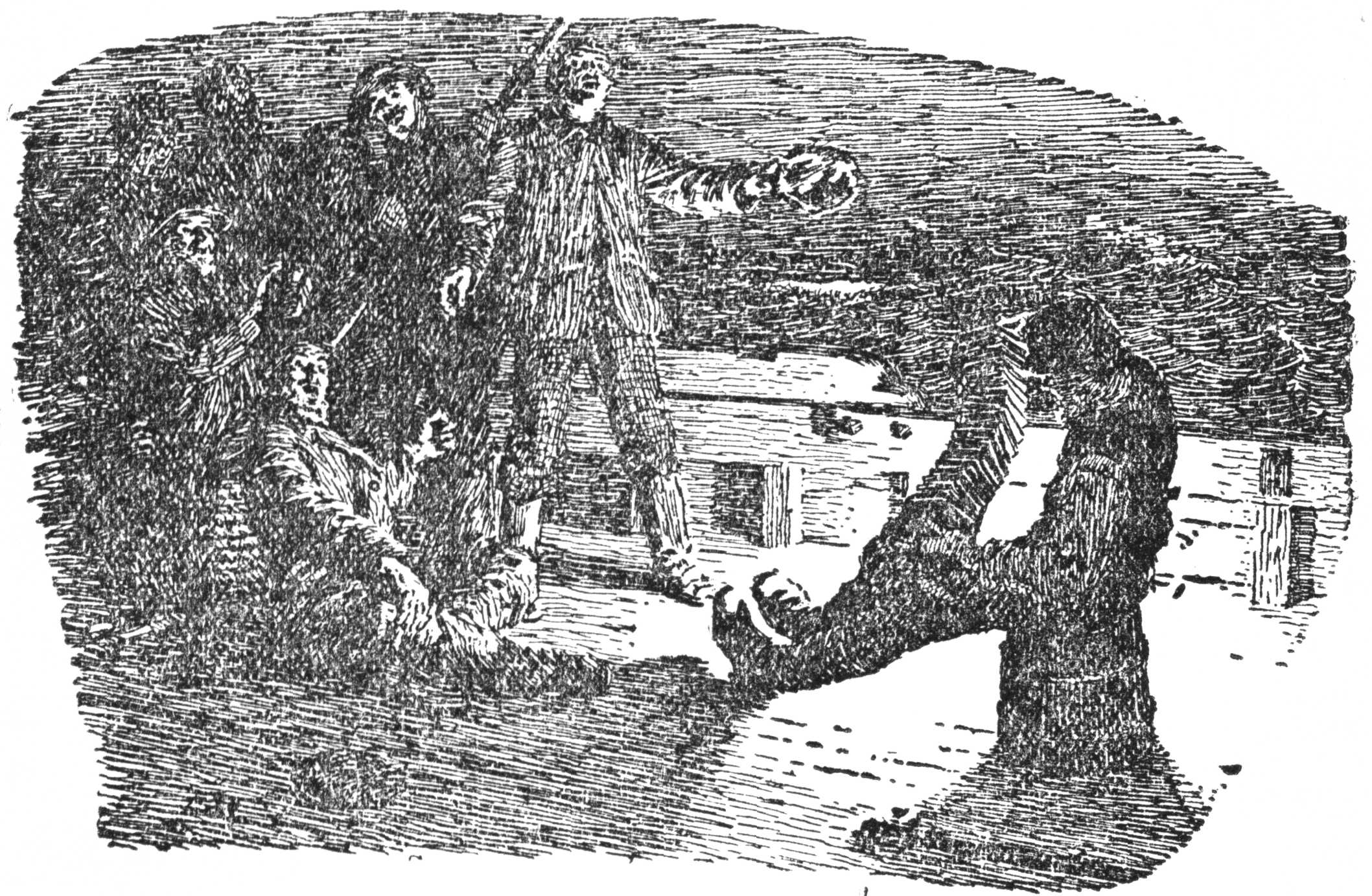
“STORM ALONG, JOHN!”
At nine o’clock that morning Bradley, with his head bandaged, sat in the rocking chair by the window of his chamber, looking out. On the table beside him were medicine vials, teaspoons and a pencilled memorandum in Doctor Palmer’s handwriting. Also there was an Emulsion bottle and a steaming pitcher of “pepper tea.” These last were Miss Tempy’s contributions. That lady herself, with a face whiter even than Bradley’s own, and with fingers that shook until holding a needle was next to an [Pg 364]impossibility, was seated in a chair by the door, pretending to sew. Every now and then she looked up, seemed about to speak, and then, seeing the expression on the young man’s face, remained silent. Occasionally she wiped her eyes with her handkerchief.
Miss Prissy was downstairs in the sitting-room listening to the steady stream of conversation and questions that flowed from the lips of Melissa Busteed. Miss Busteed had left her breakfast dishes unwashed, so that she might be the first to visit the Allen home.
Clara rapped on the bedroom door. “Bradley,” she said, “Cap’n Titcomb is downstairs. May he come up?”
Miss Tempy spoke and with decision. “No, indeed!” she exclaimed. “The Doctor said Bradley wasn’t to see anybody. I should think the Cap’n would——”
She bit her lips and sewed vigorously. Bradley turned from the window.
“Tell the Cap’n to come right up,” he said. “Yes, Miss Tempy; I must see him.”
Miss Tempy started to protest, but did not. Instead she picked up her workbasket and rose. “Now, Bradley, please——” she pleaded, with emotion, “don’t talk about the—about your bus’ness and git over-excited. It’s bad enough as it is without—— Good mornin’, Cap’n Titcomb.”
Her salutation was formal and very dignified. So also was her manner as she swept out of the room. The Captain said, “Good mornin’,” in an absent-minded way. He looked pale and anxious and there [Pg 365]were circles under his eyes. He went over and shook his partner’s hand. Then he sat down heavily in Miss Tempy’s chair.
“Well, Cap’n,” said Bradley, cheerfully, “I’ve been expecting you. I must look about as you did the morning after you butted into the Thomas Doane’s deck.”
Captain Titcomb did not smile. “I’ve seen the Doctor,” he observed. “He says you’ll be all right in a couple of days. I’m glad of that much, anyhow.”
“I’m all right now. Little shaky, that’s all.” Then, after a pause, “Well?”
His partner drew a long breath. “Well,” he said, slowly, “I’ve done it this time, ain’t I? I ought to hunt up Jabe Bailey and tell him I realize he had me sized up ’bout right. Ez Titcomb, the blasted fool!” He laughed bitterly.
“I don’t see that you’ve done it any more than I have,” was Bradley’s calm reply.
“Yes, you do, too. You kept after me with a sharp stick ’bout that dynamite, and I, like the idiot I am, let it go. I’ve seen Obed this mornin’. We don’t git the insurance.”
“Of course not. I was sure of that.”
The Captain was silent. Then he struck the arm of his chair and swore between his teeth. “I ain’t a murderin’ man, gin’rally speakin’,” he muttered, “but I’d give ten years of my life to have my hand on that cuss Hammond’s chicken neck jest about now.”
Bradley looked out of the window. “Where is he?” he asked.
[Pg 366]
“Nobody knows. I cal’late he’s skipped the town. Good thing for him! But we’ll land him yit, as soon as I can git the sheriff on his tracks.”
“Do people know he set the fire?”
“No, not for sartin. Some might suspect, I s’pose, but I ain’t said nothin’ to anybody yit. I will, though, you bet your life on that!”
“No, you won’t. I don’t want you to.”
Captain Titcomb sat up straight. “Don’t want me to?” he repeated.
“No. I ask you, as a favor to me, not to tell anybody. Let them guess whatever they please, but don’t tell them the truth.”
The senior partner was dumb with astonishment. He looked curiously at his companion. “I—I s’pose likely you know who snaked you out of the wet last night?” he asked, after a bit.
“Yes.”
Bradley knew that Gus had picked him up as he wallowed unconscious in the water. Clara had told him, and the Captain had told her when they brought the young man home. For a moment his heart had leaped with a great joy, but then he remembered that Hammond had been on the schooner, and in plain sight from the shore. Not for an instant did Bradley think that the girl knew for what purpose her lover had boarded the Diving Belle, but she had, no doubt, seen him there, as had the others, and gone to his rescue. He pitied her—when she should learn what sort of a man Hammond was, but he determined she should learn it from other lips than his.
[Pg 367]
So he was silent, and Captain Titcomb did not mention the subject again. At length the latter said: “Well, Brad, there’s no use of my askin’ you to forgive me, because it ain’t a forgivin’ kind of deal. I got you into this wreckin’ game, and you did a blame sight more’n I did to make it grow. I was the crazy fool that took the contract that’s goin’ to bust us, and I took it in spite of your tellin’ me not to. And now, all along of me, we’ve lost the schooner, insurance and all. I don’t care for myself, but I—I like you, Brad. I never took to man nor boy as I’ve took to you. And, by crimus, when I think of how I’ve ruined you, I’m ready to go down to the dock and say, ‘Here goes nothin’,’ and jump off. If it wan’t for Clara, I cal’late I would.”
“Don’t talk that way, Cap’n Ez,” began Bradley, but the Captain went on.
“There’s one thing, though,” he said. “You shan’t have none of the blame. I’ll tell every man in this town that ’twas all me. I’ll go up to Cook and Son and let them know it, too. I’ll work out the schooner debt for the bank folks, and I’ll git you the best mate’s job that I can. Of course, that don’t make up for the wrong I’ve done you, but——”
“Cap’n Ez,” interrupted Bradley, looking keenly at his partner, “why do you speak of getting me a mate’s job? Is it because you feel that, now the Diving Belle is gone, we can’t carry through the contract?”
The senior partner’s answer was prompt enough, but he looked at the floor when he made it. “Can [Pg 368]we carry it through?” he rejoined. “Maybe you don’t understand how things are with us. What little money we’ve got on hand belongs to the folks that hold the mortgage on the schooner; we can’t use it. We ain’t got any vessel now, nor any craft with power, to help us out. We can’t weather another pay-day unless somebody lends us more money, and who’d be jackass enough to do that, even if I had the brass to ask for it? No, Brad; the best thing for you is to quit and git to sea again afore I sink you so deep you’ll never come to the top.”
Bradley leaned back in his chair and smiled. “Cap’n,” he said, “I see through you like a book. You talk of quitting because you don’t want me to take any more chances. If you were alone in the deal you’d go ahead somehow.”
“No, I wouldn’t.”
“Shut up; I know you. Now, listen: I know how we stand, but I say fight it out. Come on! we’ll go down to the Point and work harder than ever, nights and Sundays and all. We’ll keep a stiff upper lip, and, by the living jingo, we’ll clear the Freedom or go to pieces with her!”
The Captain sprang to his feet. “Do you mean that you’ll stick to me in spite of what I’ve done?” he cried.
“You ought to know I will. As for blame, it’s as much mine as yours. Will you stick by me and keep up the fight?”
“Will I? Will I? Brad—Brad, you know——” [Pg 369]He turned his face away, but he stretched out his hand. Bradley seized and wrung it.
“And now,” said Bradley, “we’ll go down to the Point.”
“You’re not goin’ to the Point to-day! Son, you’ve done more’n enough for me as ’tis; don’t kill yourself.”
“Get my overcoat and hat. I’m going to the Point now.”
And he went in spite of his partner’s protests and the “old maids’” pleadings and direful prophecies concerning his health. He was kind, but so firm that they soon saw there was no use arguing. Miss Prissy, however, at a great sacrifice to her pride, called the Captain to one side and whispered:
“Cap’n Titcomb, I’m ’fraid he’s goin’ to his death. Take care of him and keep him out of danger. Don’t let him git cold. If you knew how much store Tempy and me set by him, you’d——”
She could not finish.
“I know, Prissy,” replied the Captain, earnestly. “I cal’late I feel a little that way towards the boy myself. Brad seems to have took the bit in his teeth lately, but I’ll bring him back safe or stay there myself for good.”
Ira Sparrow took them to the Point in the You and I. Bearse, Ellis and some of the other men went with them. On the way Bradley and his partner discussed the situation. The work on the barge was going on as if nothing had happened, although the news of the firm’s loss had been telephoned to the life-saving station [Pg 370]early that morning. Barney Small met them as they climbed over the Freedom’s rail. He was very sober and shook his employers’ hands with silent sympathy.
“I told the boys to turn to,” he said. “I didn’t know what your plans was, but I wan’t goin’ to quit till you said the word.”
“Much obliged, Barney,” said Bradley. “Call all hands aft. I want to talk to them.”
The men came in groups, soot-streaked and perspiring. They gathered in the waist, whispering to each other and glancing askance at Captain Titcomb and Bradley, who stood upon the raised deck by the wheel. In most of the grimy, sunburned faces there was a friendly concern. All looked embarrassed and awkward. When the whole crew was standing there, silently waiting, the Captain came forward.
“Men,” he said, “there ain’t any need for me to tell you what’s happened. The Divin’ Belle was burned last night, and she wan’t insured. Most of you know what that means to me and my partner. A good many of you are fellers I’ve known all my life. Some of you like me—some, maybe, don’t. You know that ha’f of Orham is sayin’ this mornin’ that Ez Titcomb’s got what was comin’ to him at last. All right, the blame’s mine and I’ll take my medicine without makin’ any faces over it. I don’t ask anything for myself. But I do ask you to listen to what this boy here,” laying his hand on Bradley’s shoulder, “has got to say. That’s all. Now, Brad.”
There was a stir throughout the crowd as Bradley [Pg 371]stepped forward. He was silent for an instant, looking down at them. Then he spoke.
“Fellows,” he said, “when Cap’n Titcomb and I took the contract to get this barge off the shoals we risked every dollar we had. More than that, we mortgaged our new schooner to raise money to pay you with. She was burned last night, and, as the Cap’n said, there is no insurance. The little money we have on hand belongs to the people who took the mortgage. We couldn’t pay you for another week’s work. So then, either we must give up the contract—which will ruin us and drive the firm out of the wrecking business for good—or we must come to you with another proposition. I think every man who has worked for us knows that we don’t play favorites. Every fellow knows that he’ll be treated fair so long as he does his work. But this I want to say—we’ll stick to those who stick by us. We shan’t forget our friends. And this is our proposition: To the men who will volunteer to help us get this barge afloat, we will pay four dollars a day—instead of three, as you’re getting now—when we float her and get our money. If we fail, you get nothing and so do we. If we win, you win. We can float her if the weather holds good. What I’m asking is that you share our chances. It’s up to you. What do you say?”
Bradley stopped and put his hands in his pockets. The men shuffled their feet and looked at each other. One or two of them whispered behind their hands. Then Barney Small snatched his rusty cloth cap from [Pg 372]his head, tossed it to the deck, and jumped upon it with both feet.
“Stage is ready for Orham, South Orham, West Harniss and Setuckit P’int,” he shouted. “Git aboard! Come on, you lubbers! Have me and Brad and Cap’n Ez got to work her off alone?”
Alvin Bearse struck the ex-stage driver a resounding thump in the back. “You bet you ain’t!” he cried. “I’m in!”
“Me, too!” said Ira Sparrow.
“Present and accounted for,” observed Bill Taylor. Ellis simply nodded and stepped forward. Others joined them, by twos and threes.
Then Peleg Myrick sauntered to the front. “I dunno’s I jest understand what the boss wants,” he drawled; “but if there’s anything me and Skeezicks can do, why——”
There was a great shout of laughter. Peleg was indignant. “What’s the matter with you?” he snorted. “That dog’s got a durn sight more sense than most of them what makes fun of him.”
“Right you be!” bellowed Barney. “Come on, you loafers! Are you goin’ to be beat by a Greaser pup—a bald one at that?”
That settled it. There was a cheer, and the men began pushing each other out of the way to join the volunteers. In a few minutes there were only five who had not come forward.
“What’s the matter with you, Lon?” asked Alvin Bearse, sarcastically. “Be your feet asleep?”
Mr. Clark looked uneasy, but he did not move. “I [Pg 373]ain’t used to workin’ for nuthin’,” he replied, sullenly.
“Nor me nuther,” agreed Ike Bodkin, standing by his friend.
“Nothin’ is about twice what you’re wuth,” cried Barney, indignantly. “By Judas, if you can’t work you can swim! Let’s give ’em a bath, fellers. They need it.”
He started for the frightened five. Others followed him. There were cries of “Chuck ’em overboard!” Bradley shouted, “Stop!”
“Let them alone, boys,” he commanded. “Clark, you and Ike and the rest, take one of those dories and make for the Point. Lively! Fellows,” he added, turning to the others, “Cap’n Titcomb and I are much obliged. Now, then, turn to!”
In five minutes the crowd had scattered, the engines were puffing, and the great buckets were emptying the coal from the Freedom’s hold into the sea.
“Son,” said Captain Titcomb’, laying a hand on his partner’s arm, “they did that for you, not me. If we should win out on this job, the credit’ll belong to you. And now for it! It’s neck or nothin’ this time sure!”
And after that came work, work, work. The men were organized into day and night gangs. Bradley commanded the former, Captain Titcomb the latter.
The Freedom at night was a strange spectacle. Lanterns were hung all over her deck and within her hull. They sparkled in clusters by her hatches; they swung beside the tackles in the rigging. The life [Pg 374]savers patrolling Setuckit beach heard, above the crash and boom of the surf along the shore, the roar of the falling coal and the shrill whistle of the donkey engines. Looking down through the black squares of the hatchways, one saw active figures capering above with shovels in their hands. Shouts came up. Queer, distorted shadows flickered, stretched to gigantic size, or shrunk to those of pudgy dwarfs. But the shadows were never still, never the same; they were always busy.
The partners hired the You and I to do what she could of the work the Diving Belle had been engaged in. The lack of the schooner was a great handicap, but they had no funds with which to hire a large vessel.
They made their headquarters aboard the barge now. Bradley did not go up to Orham at all. When his day’s work was over, he ate a hasty supper and tumbled into a berth in the skipper’s cabin, sometimes to sleep, but more often to lie awake and plan for the morrow. He was still pale and weak from the effects of the blow on the head, but he would not take it easy, as the Captain begged. The worry and strain of the labor were, in a sense, reliefs to him; they kept him from thinking of other things.
Each morning the “old maids” telephoned to the station to learn how he felt, and how the work was progressing. Bradley gathered from Miss Prissy’s anxious remarks that, in the village, the partners’ failure was regarded as a foregone conclusion. The news made him only more determined to succeed.
[Pg 375]
Cook and Sons wired daily, and every afternoon a report was sent to them. These reports were growing more optimistic. The barge was eating her way steadily through the shoal, and as she was lightened she moved faster. They watched the cables as a cat watches a rat hole, keeping them always tight. The Captain said, “Brad, if I didn’t know what was the matter, I should b’lieve my old Sunday-school teacher was right. He always swore I’d be hung some day, and now all I can dream about is ropes.”
The Captain’s energy was something wonderful. A nervous man by nature, he flew from one end of the Freedom to the other, commanding, helping, hurrying. With the men he was always cheerful and sure of success, but once in a while, alone with his partner, he showed his real feelings. One morning, before “turning in,” he went ashore to telephone. When he came back he called Bradley aside and said:
“Brad, Sam says the Gov’ment weather folks are foretellin’ a big storm for day after to-morrer. It’s comin’ from the south and’ll strike here about then. It’s a terror, they say. It worries me. I’m more scart of a gale of wind jest now than I am of the Old Harry himself.”
The junior partner looked troubled. “Wonder if that’s what’s distressing Peleg?” he observed. “Peleg has been after me ever since the fire. Says he’s got something to tell me.”
“He’s been pesterin’ me, too. I ain’t had no time to listen to his yarns. Let’s see him.”
They sent for the weather prophet, who appeared, [Pg 376]dirtier than ever. “Look here, Peleg,” was the Captain’s salutation. “What do we feed you for? Here’s the Gov’ment weather sharp smellin’ out a gale, and you ain’t peeped. You’ll have to put specs on your second sight, or we’ll ship a new prophet, one or t’other.”
Mr. Myrick was troubled. “Now, Cap’n Ez,” he protested, in an aggrieved tone, “ain’t I been tryin’ to git at you or Brad for four days or more? I know there was a blow comin’. She’s comin’ a-bilin’, too. And I don’t need no specs nuther.”
“Humph! Brad, this is the devil and all, ain’t it? That’ll do, Peleg.”
“But, Cap’n Ez, there’s somethin’ else I wanted to tell you. I——”
“Never mind now. Put it on ice. Git!”
Peleg “got,” but with reluctance. He kept looking back and shaking his head. Captain Ezra’s face was very solemn. His forehead wrinkled and he pulled his mustache nervously.
“By crimustee!” he muttered. “We’ve got to do somethin’ quick. I know you don’t take any stock in Peleg, but if that gale does come, we’re knocked higher’n the main truck. She’s loosenin’ up so now that a tug might help us. I can git a little one from Vineyard Haven, skipper, engineer and all, for forty dollars a day.”
“But they won’t work on spec.”
“No. I’m goin’ to Wellmouth to see the bank folks. I’ll tell ’em that if they ever hope to git back the rest of the money they lent on the Divin’ Belle, [Pg 377]they must risk enough to pay for that tug. I’m goin’ now.”
“But you’ve been up all night. Let me go. You turn in.”
“Turn in be durned! I’d sleep about as sound as an eel on a perch hook. I can turn in when I can’t do anything else. Good-bye. Put in your spare time prayin’ for me, will you?”
He went to Wellmouth, saw the people at the bank, and, as he said, “talked from his boots up.” At twelve o’clock of the following day the little tug put in an appearance. She got a grip on the Freedom’s bow and pulled with the tide.
The expected gale did not come that day. But the next afternoon the sky was overcast and the sun disappeared behind angry clouds. It was blowing fresh when Bradley, worn out, went to his berth at nine o’clock. He had fought against going at all, but Captain Titcomb said, “Put in an hour or two anyway. I’ll call you if you’re wanted.”
He called him before the second hour was up. “Come on deck, Brad,” he cried, excitedly. “That sou’easter’s on the road and it’s backin’ up the biggest tide ever I saw. ’Tain’t high water till two, but she’s pretty nigh as high as usual now.”
The junior partner hurried on deck. The wind was singing in the rigging and the waves were rushing past the barge, slapping furiously at her as they passed. The night was a dead black and the surf on the ocean side of the Point boomed like heavy artillery.
[Pg 378]
“I’ve sent ashore for the day shift,” said the Captain. “We’ve got to make our fight now. Looks as if ’twas out last chance, and a mighty slim one.”
The dories brought the tired men from the beach. They had worked hard all day, but they were ready to work still harder now. They realized that, one way or another, this was the end of the big job.
The little tug, bouncing up and down on the waves, was throwing her whole weight on the tow line. Alvin Bearse stood by the donkey engine, ready to take in every inch of the cable. The partners were in the bow. The buckets were flying from the hold.
“She gained a heap last tide,” murmured the Captain. “This extry high water and the waves ought to help her like fun. But I’m ’fraid ’twon’t be enough, and to-morrer the sou’easter’ll land with both feet.”
Waiting was the hardest thing. A half hour seemed longer than an ordinary day. The wind gained in force, little by little. The tide crept up the barge’s side. At one o’clock it was far higher than it had ever reached before, and so powerful was its rush that the huge hull quivered in its grasp. The water, seen by the lantern’s light, was the color of chocolate, streaked and marbled with lines and eddies of foam.
Half-past one. The Captain put his watch in his pocket and wiped his forehead.
“I know how it feels when you’re waitin’ to be hung,” he observed. “Thirty minutes for the firm to live, Brad; then——”
A mighty blow from a wave, a tremble, and then a roll. The lanterns in the rigging spun around in circles. [Pg 379]The men on the deck and below fell in heaps. The Freedom lifted, straightened, and began to rock in her “cradle.” The cables sagged into loops. Their silent partner, the Tide, had come to the firm’s rescue.
Bradley got upon his feet. “Haul taut!” he screamed. Before the order was given Bearse was back at his engine. The windlass shrieked.
Captain Titcomb roared through his speaking trumpet. The towboat shot forward, then back, her screw threshing the water. The little You and I bobbed beside her; she was pulling, too.
And then, a long scraping, breathless interval. A halt, a shock, and, pushing a wall of sand before her, the Freedom plunged into deep water.
There was no cheering. A subdued murmur, like a sigh, came from the crowd on her deck. Men drew sooty arms across wet foreheads and looked at each other without speaking. She was off the shoal, but far from being out of danger yet. She must be got over into the deep hole behind the Point, where she could safely ride out the coming gale. And to get her into this haven there was only the little tug to depend upon. Could the tiny craft do it in that wind and sea? If not, then the barge would almost surely drag her anchors, would strike again, and then—well, then all the work, and the triumph so nearly won, would count for nothing.
They brought her up to her anchors, out in the middle of the channel. There they waited for the tide to turn. The silence was heart-breaking. Only now and then did anyone speak. In clusters by the [Pg 380]rail they stared at the big waves and the foam-streaks gliding by. At last Captain Titcomb snapped his watchcase shut, and shouted through his trumpet. The towboat puffed into position. The anchors were lifted from the bottom. The time for the final test had come.
Then the little tug showed what she was made of. Coughing, panting like a bull-dog straining at a chain, she pulled at that hawser. And, slowly at first, but gaining headway as she moved in the dead water of the slack of the tide, the Freedom followed her through the channel around the edge of the shoal into the cove—and safety. At ten minutes to four that morning the last big anchor was sent down.
“There!” shouted Captain Titcomb. “She’ll stay where she is now if it blows hard enough to frazzle out a handspike. Boys, the job’s done. Knock off!”
They answered him with a cheer that woke the cat from his sleep beneath the stove at the lighthouse.
The tug took them to the Point. They perched all over her, heedless of the cold and the flying spray. The men were wildly excited over the unexpected good luck. They cheered the partners again and again and gave three groans for the “quitters,” meaning Mr. Clark and his friends. Peleg Myrick was bearing his concertina to safe quarters in the shanty, and they insisted that he should play it. Peleg protested that it was too wet for music on board that tug, but they threatened to heave the “push-and-pull-pianner” overboard if he didn’t play.
“Play somethin’ we can sing,” ordered Bill Taylor.
[Pg 381]
Peleg struck up a doleful dirge of the sea. It was loaded to the gunwale with wrecks and disasters.
“Belay that!” cried Barney Small. “We don’t want no Come-all-ye’s. That’s the tune that soured the milk. Give us a hoe-down.”
The musician considered. Then he burst into the air that every fisherman knows:
“Chorus!” howled Barney, waving his cap. They joined in with a whoop:
Bradley stood by the back door of the big shanty, looking out at the storm. The first sickly light of morning was streaking the dingy, tumbled sky. Inside the building the men were keeping up their celebration. No one had suggested turning in.
Captain Titcomb came around the corner. “There you are, hey!” he exclaimed, with a breath of relief. “Blamed if I didn’t begin to be afraid you’d tumbled overboard. Well, son, we did it! by crimus, we did [Pg 382]it! thanks to the good Lord for sendin’ that whoopin’ big tide. Titcomb and Nickerson ain’t ready for the undertaker yit. Now you can go up to Orham and tell Gus Baker somethin’ wuth while.”
Bradley shrugged his shoulders. Now that the strain was over, and they had won, the thoughts that he had put aside were coming back. He was realizing that the firm’s success didn’t mean much to him. After all, what did he really care?
“I guess Gus wouldn’t be greatly interested,” he said.
The Captain seized him by the shoulders and spun him around. “Look here, son!” he cried. “What fool idea have you got in your head? What’s the matter with you? Wouldn’t be interested! the girl that risked her life to haul you out of the drink!”
Bradley shook his head. “I guess you forget that Hammond was in the drink, too,” he said.
Captain Titcomb smote his partner a blow in the chest.
“You crazy loon!” he shouted. “Is that what’s ailin’ you? Do you s’pose she cares a hurrah in Tophet for that scamp? Listen to me! I was closer’n anybody to Gus when she rowed acrost the harbor that night. Sam was right under the bow of her skiff. He hailed her. She saw him—looked right at him. But she never reached out a hand. Left him to drown, like the durned rat he is, and went on after you. After you, d’you understand? Does that look——”
“Stop!” Bradley’s eyes were ablaze. “Is that true? Say that again!”
[Pg 383]
“True? Say it again? I’ll sing it, or swear it on the Bible if you want me to. Why, you ought to git down and crawl to that girl. She’s—— Hi! where you goin’?”
There was no answer. Bradley was running at full speed for the beach. A few minutes more and he was in the You and I, heading across the bay, through the rising storm and in the dull morning light, bound for Orham.
And behind him, from the shanty, floated the chorus:
[Pg 384]
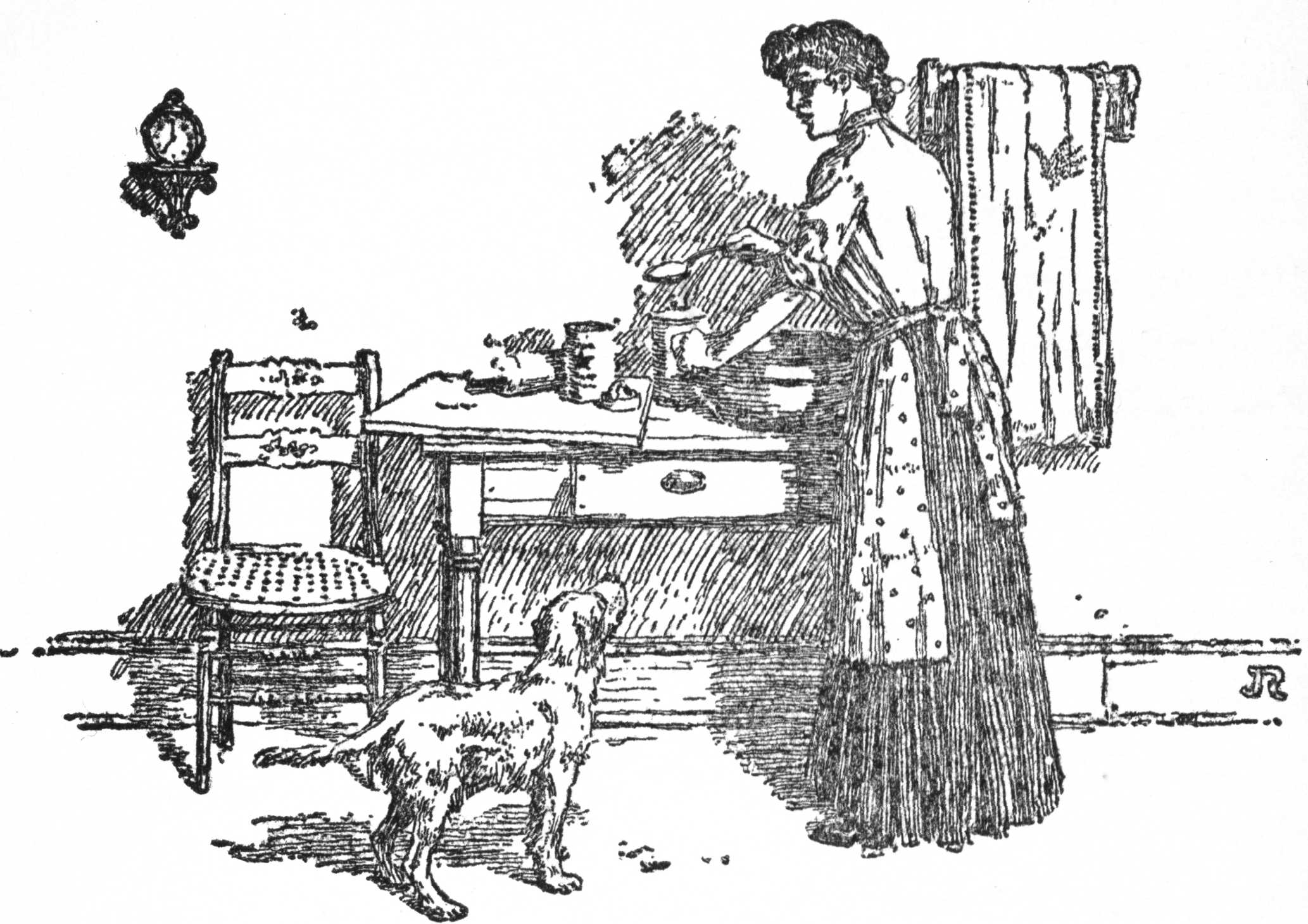
THANKSGIVING.
Gus rose early that morning. The storm had awakened her. She pulled aside the window shade and peered out at the bare branches of the silverleaf beating and whipping in the wind, at the sheets of rain scudding across the little pond in the pasture, at the whitecaps in the inlet and harbor and at the angry sea outside. Down in the village the storm signals were flying from the pole on the cupola of “Cy” Warner’s observatory. The southeast gale, foretold by the newspapers, had come.
[Pg 385]
She saw the lighthouse on Baker’s Beach, a small shadowy dot in the distance. Beyond it was the bay, and miles beyond that lay Setuckit Point. Only the landward end of the long beach was visible through the smears of wind-driven rain, but she gazed in that direction for minutes.
Grandmother Baker was still asleep when Gus came downstairs. The girl went out into the kitchen, where Winfield, gray-muzzled and rheumatic, came, stretching and yawning, to meet her. She fixed the fire in the range, filled the teakettle, and, putting on her apron, began mixing the rye muffins for breakfast. Every now and then she left her work to go to the window. The storm was growing steadily worse.
The muffins were ready and she put them in the oven. She went to the sink and pumped the tin hand basin full of water; but before her fingers touched it she heard the yard gate shut with a bang. She thought that “Blount’s boy” must be coming with the morning’s milk, and stepped to the outside door to meet him, lifting the hook from the staple.
The door opened and Bradley Nickerson came in.
He wore no overcoat or oilskins, and his clothes were wet through. The rain poured from the visor of his cap, from his sleeves and the hem of his jacket. His face was dotted with drops, like beads of perspiration. He did not wipe them away, but stood there, on Mrs. Baker’s cherished ingrain carpet, dripping and looking at the girl before him.
[Pg 386]
She did not seem to notice his condition, nor appear astonished at his coming. Her first words were strange ones.
“Oh!” she cried. “Is she lost?”
“Lost?” he repeated. “Lost?”
“Yes, yes! the barge? Has the gale wrecked her?”
Bradley seemed to be waking from a dream. “Oh, the barge!” he answered slowly. “The barge? Oh! she’s all right. We got her off.”
Gus gave a little sob of joy. Her eyes filled with tears. “I’m so glad!” she exclaimed. “I was afraid——”
He interrupted her by stepping forward and seizing her hands.
“Gus!” he begged. “Oh, Gus! do you love me?”
She did not hesitate nor seem surprised. “Yes,” she said simply, looking up at him.
For an instant he returned the look. Then the reaction came. He swayed, sank to his knees, and cried like a child, hiding his face in her apron.
And like a child she soothed him, stroking his wet hair, and crying silently in sympathy.
“Oh, my dear!” he pleaded, over and over again. “I’ve behaved like a foolish child. Can you forgive me?”
She smiled like the sun shining through the last drops of a summer shower. “It was my fault, more than yours,” she said. “I was selfish and so silly, but I didn’t know—I didn’t know.”
“But you know now? You’re sure?”
[Pg 387]
The answer was not in words alone, and was entirely satisfactory.
“Tell me about the barge,” she begged, a little later. “I’m so glad and so very proud that my boy—really my boy now—should have done such a thing. If you know how I have worked with you in spirit, and how I have prayed that you might succeed. Tell me all about it, please.”
But he would not. “Never mind that, now!” he cried. “Let’s talk of something worth while. Tell me how you rowed to the schooner the night of the fire. You brave girl!”
“Oh, Brad!” she answered, with a shudder. “It was dreadful! I could see you on the deck with the fire all around, and I heard people on the bridge talking about the dynamite. I kept thinking, over and over, that I should never get there in time. Suppose I hadn’t! Oh, suppose I hadn’t!”
“I wonder,” he said, musingly, and with such worshipping admiration in his gaze that she blushed; “I wonder if I can ever do enough to make you happy—as happy as you deserve to be. I shall try, but how can I do enough?”
“Hush, dear!” she whispered softly. “Do you think I’m not perfectly happy now?”
He asked her to come with him to the big house. “I want them to know,” he said. “They’ll guess it quick enough when they see me, but I want them to know. Come.”
[Pg 388]
Gus hesitated. She looked rather doubtful. “Remember, Brad,” she said, “Miss Prissy and her sister have never liked me.”
Bradley laughed, a boyish, merry laugh. “That’s all right,” he replied. “Come and see.”
As she moved to the hooks by the door to get her hood, he noticed her gown.
“Why!” he exclaimed, “you’re soaking wet! I didn’t think. I’m sorry.”
“Why, so I am! And, oh, dear, you’re wet to the skin! You’ll get cold. And I’ve covered you with flour!”
Bradley looked down at his sodden boots and garments. His coat was ornamented with white fingerprints. “I’m all right,” he observed, referring to the wet. “I’m used to it. But I was a brute to let you get that way. Jiminy! look at that carpet!”
The section of the carpet near the doormat looked like the flats at low tide. There were islands in the shape of muddy footmarks, and channels of dirty water between.
“Never mind the carpet,” laughed Gus. “Come; I’m ready.”
They hurried through the rain to the door of the Allen dining-room. Bradley knocked and Miss Prissy answered it.
“Why, Bradley!” she exclaimed. “Why, Bradley!”
Miss Tempy came running from the kitchen. “Who——” she began. Then, like her sister, she cried, “Why, Bradley!”
[Pg 389]
“Aren’t you going to ask us in?” queried the young man, calmly. “It’s a little bit damp out here.”
Wonderingly the sisters stepped aside and Bradley and Gus entered the dining-room. The table was set, the fire was roaring in the big air-tight stove, the ship at the top of the tall clock in the corner rocked behind its tin waves, the boat load of passengers in the “Shore to Shore” picture had advanced no further on their journey—the room looked just the same as it did when a little boy in a man’s dingy overcoat entered it on a winter’s night years before. Nothing was changed, nothing looked older—except the sisters and the boy.
“Has anything happened?” asked Miss Tempy, anxiously. Miss Prissy did not speak; she was looking at Gus.
“Miss Prissy and Miss Tempy,” Bradley began, “I’ve got good news for you. The Freedom came off the shoal last night; she’s anchored behind the Point, safe and sound.”
Miss Tempy cried out and clasped her hands. Her sister’s face lit up, and she opened her lips; but she did not speak; she only looked at Gus.
“But that isn’t the best news,” Bradley went on. “Gus has promised to marry me.”
Again Miss Tempy cried out, but in a different tone. And still Miss Prissy was silent. Her sister came forward and tremblingly took her arm.
“Aren’t you glad?” asked Bradley.
Miss Prissy’s lip quivered. “Yes,” she faltered, “I know we ought to be glad. She’s a good girl, I’m [Pg 390]sure, and she saved you from drowning. But it’s hard——”
She stopped and turned away. Miss Tempy put an arm about her waist.
It was Gus herself who did precisely the right thing. She went straight up to Miss Prissy and took her hands.
“Try to like me,” she pleaded. “Please try, because—because I like Brad very much, too.”
And then Miss Prissy threw her arms about the girl’s neck and kissed her. “Bless you, dearie,” she said. “I do like you and I am glad Bradley has chose so well. It’s only because we’ve had him to ourselves so long that—— Ah, well! Tempy, we mustn’t be selfish old women.”
Gus kissed them both, and all three cried a little. And with those tears the last scrap of resentment against the “dog girl” was washed away.
From across the yard came the sound of a window being raised. Mrs. Baker was heard calling. “Gusty!” she screamed. “Gus-tee!”
Gus ran to the door. “What is it, Grandma?” she asked.
“Is that where you be? The muffins are burned black as a coal, and the kitchen’s full of smoke. Cat’s foot! I never saw such a girl!”
Gus ran home laughing. Bradley turned to find Miss Tempy staring at him. “My sakes alive!” she cried wildly, rushing to the kitchen. “Prissy, the boy’s wet soppin’, soakin’ through! Fetch me the milk, and that pepper shaker, quick!”
[Pg 391]
Bradley swallowed the last drop of the “pepper tea”—he was in a mood where nothing short of a gallon would have daunted him—and hastened upstairs to put on dry clothes. When he came down he went through the motions of eating breakfast, and answered, as best he could, the hundred and one questions regarding the floating of the Freedom that the “old maids” and Clara asked. He had been up practically all night, but was too excited to think of sleep, and, remembering how unceremoniously he had deserted Captain Titcomb, decided to go down to the post-office and telephone to the Point.
The storm was in full blast by this time. The wind screamed through the tree tops and the thick ropes of rain shot downward with savage force. As he entered the post-office the postmaster called to him through the little window in the centre of the frame of mail boxes.
“Hi, Brad!” he hailed. “Is that you? I jest sent a boy uptown after you. Cap’n Ez has been keepin’ the telephone hot for the last ha’f hour. He wants to talk to you the worst way.”
Bradley was alarmed. Had anything happened to the Freedom? He entered the telephone closet, stood his drenched umbrella in a corner, and gave the four rings which made up the Setuckit Point call.
The wire buzzed and hummed like an overturned bee hive. The receiver at his ear wailed and screeched like a banshee. At length a faint “Hello!” answered his call.
“Hello!” he shouted. “That you, Cap’n Knowles? [Pg 392]Yes, this is Brad Nickerson. I want to talk with Cap’n Ez. Can you get him for me?”
The life-saver laughed. There was more buzzing and humming. Then Captain Titcomb’s voice rose above the music of the storm.
“Hello, partner!” it called. “That you? You don’t say! Well, this is Titcomb. No, the Freedom’s all serene; she’ll ride it out as slick as a duck in a bucket. But there’s a feller here wants to talk with you. Prick up your ears now!”
Bradley heard his partner laugh. Then another voice began—a drawling, high-pitched voice.
“Is that you, Bradley?” it droned. “This is me talkin’. Do you hear?”
“Me? Who’s me?”
“Me, Peleg—Peleg Myrick. Cap’n Ez wants to know what I’d better do with the dynamite I’ve got buried under my shanty? I’m scart to death of it.”
“The dynamite? What dynamite?”
“The dynamite I took off the Divin’ Belle the day afore she was burnt. Cap’n Ez ordered me to take it all out, so I done it the next forenoon. What’ll I do with it? I’ve been tryin’ to tell you’n’ the Cap’n about it, but you never give me no chance. Skeezicks is the divil to dig, and if he scratches that stuff up, why——”
“Stop!” Bradley shouted it. “Wait a minute! Peleg, what are you talkin’ about? Do you mean there was no dynamite aboard the Diving Belle when she burned?”
“Ya-as. I took it all out that mornin’. What’ll——”
[Pg 393]
Again Bradley shouted, “Stop!” He wanted to think. If there was no dynamite aboard the schooner, why—why then the insurance could be collected. If—— His heart sank again.
“I’m afraid that won’t do, Peleg,” he called. “She certainly blew up. I heard her, and felt the shock under water. Everybody on the hill heard the explosion and saw it, too. No, Peleg. Much obliged, but I guess you must have left some of it.”
The wire whirred and sang. Then the drawling voice went on. It said:
“Cap’n Ez wants to know if the explosion wan’t pretty small for a dynamite one—now that you come to think of it. He says, what about the gasoline tanks?”
The gasoline tanks! The gasoline for the engine! It had been stowed in the bow of the schooner.
The receiver fell from Bradley’s hand. He stared at the calendar on the wall of the telephone booth.
Thanksgiving came late that year, but it was a beautiful day when it did come. Clear and frosty, with the tingle of early winter in the breeze, and a thin skim of ice along the edges of the brooks and the ponds in the pasture. Not a vestige of haze on the horizon. The sea a deep rich blue, with the white sails scattered lightly over it like fallen rose petals. A salty tang of the ocean in the air, the savor of wide, clean distances and rolling billows. A day to set one’s shoulders back and make him grateful to the God [Pg 394]who gives life and health. An ideal Thanksgiving Day.
Bradley, with an expression of serene contentment on his face, was leaning on the fence by the Allen barn, gazing out across the inlet and the harbor. Captain Titcomb leaned beside him, smoking a cigar. He also looked like a thoroughly happy man.
And the Captain had reason to be happy. The Freedom had been towed up to Boston and Cook and Son had forwarded a check for the amount of the contract, accompanying it with an enthusiastic letter of approval and congratulation. Obed Nickerson, after a thorough cross-questioning of Peleg Myrick and the partners—whose statements were substantiated by Barney Small, Bearse and the rest—had written to Boston recommending the payment of the insurance on the Diving Belle. The newspapers had given much space to the clearing of the Freedom under such adverse circumstances, and, from this advertising, had followed the receipt of many communications from skippers and ship-owners who had anchor-dragging or other wrecking work to be done.
Also—and this was no small help to the Captain’s happiness—he had made his peace with the “old maids.” The burning of the schooner, Bradley’s injury, and the fight for the firm’s life that followed, had diverted the minds of the sisters from the shock caused by the disclosure of Captain Ezra’s love affair. They had had time to think it over, and, while they agreed that the Captain was making a woeful mistake in marrying a “young, thoughtless girl,” still, [Pg 395]as Miss Prissy said, “He’s old enough to know his own mind, and ’tain’t for us to try to change it, no matter how much we may pity him.”
Forgiving Clara was a much harder matter. Miss Tempy especially was inclined to blame the girl for “settin’ a trap for the Cap’n—he bein’ such an honest, unsuspectin’ man—and leadin’ him on.” But they forgave her finally, thanks to the influence of Bradley and Gus. And so Captain Titcomb had been invited to the Thanksgiving dinner, and the “old maids” and Grandmother Baker and Gus and Clara were now at work in the kitchen preparing the feast.
“Cap’n,” observed Bradley, “I’m afraid our getting the Freedom clear has put the Jeremiah Club out of business. They won’t have anything to talk about.”
The Captain took his cigar from his lips and blew a cloud of smoke. “Oh, I’ve fixed that all right!” he replied. “They’re puttin’ in their time findin’ fault with Clara for marryin’ a man twice as old as she is. Brad,” he added, “have you made up your mind yit about that Cook offer?”
The letter from Cook and Son had contained something beside the check and the congratulations. The firm was the largest owner in a copper mining property on the shores of Lake Superior. This property was to be developed in the near future. A harbor was to be dredged and built, a fleet of tugs and barges was to be employed. Mr. Cook had offered to put Captain Titcomb and Bradley in command of this fleet, and the salaries entailed were by no means small.
[Pg 396]
Bradley took from his pocket the envelope containing the offer. He turned it slowly about in his hands.
“Cap’n Ez,” he said, “I’ve made up my mind, subject, of course, to your approval. The offer is a good one, the wages are as high as our earnings in the wrecking business are likely to be for some years. And they’re sure.”
His partner looked disappointed, but he nodded and said, “Yes, that’s so.”
“But,” went on Bradley, “in spite of that I don’t like the idea of quitting. So—if you agree with me—I say let’s stick it out down here.”
The Captain thumped the fence-rail. “Good enough!” he exclaimed. “That’s what I say. We’re our own bosses, the outlook’s better’n we had a reason to expect at the end of our fust season, and I b’lieve we can build up a good trade. We’ve made a fair profit on the Freedom, spite of the heavy expense, and we can have a new vessel built and still have cash enough on hand to put some good-sized jobs through. I’m with you! We’ll stick it out.
“To tell the truth,” he continued, “I don’t much take to the idea of gittin’ back under ‘owners’ orders’ ag’in. That is to say, I don’t wake up nights and cry for it. The monkey does the dancin’, but it’s the organ man on t’other end of the string that gits the money. For a feller built on my lines it’s too fascinatin’ to be safe, and—— What on airth?”
He pointed to the road. Along the sidewalk came shambling a tall, red-whiskered figure, with the remains of what had once been a fur cap on its head, [Pg 397]and a dirty worsted tippet knotted about its neck. Bradley looked, and all at once he was back in a rocking, stuffy stagecoach, with the cold night air blowing about his feet and the snow pelting against the windows. He could even smell the musty straw on the coach floor.
“Do you see it, too?” asked Captain Titcomb, anxiously. “’Cause if you don’t, I’m goin’ to turn Speritu’list right off. Sol! Hey, Sol!”
The figure stopped and looked up and down the road. Upon a repetition of the Captain’s hail it turned its eyes in the right direction.
“Hi, there!” it bellowed.
“Foolish Sol Newcomb!” exclaimed the Captain. “Blessed if it ain’t! Thought he must be dead by this time. Come on, Brad!”
They went down to the gate and the figure came to meet them.
“For the land sakes, Sol!” said Captain Titcomb, “where’d you light from?”
Mr. Newcomb looked sadly at the sky. “I’ve been livin’ over to East Wellmouth,” he answered in a drawl that made Peleg’s seem like rapid transit. “But I moved back ag’in to where I used to be. ’Twas too lively over there. Too much goin’ on.”
Captain Titcomb nodded appreciatively. “Yes,” he agreed. “I sh’d think ’twould be. Must be many as thirty-two folks over to East Wellmouth—not countin’ dogs.”
“Ya-as,” replied Sol, without enthusiasm. Then he added, “I’m c’lectin’ my road taxes.”
[Pg 398]
“You are, hey? Road taxes?”
“Ya-as. Bill Hinckley he says to me, he says, ‘Sol, you walk so much I should think you’d c’lect road taxes.’ So I’m a-doin’ of it.”
“Good idea! About what’s the rate?”
“Oh, I dunno! ’Bout ten cents, maybe.”
The Captain contributed a quarter, so did Bradley. The tax collector looked at the coins doubtfully.
“I ain’t got no change,” he said.
“Oh, well, that’s all right. I’m behind, anyway. Ain’t paid my road taxes for—let me see—pretty nigh fifty years. And Brad, he’s payin’ in advance.”
Sol pocketed the money, and turned to go. He had taken but a few steps, however, when he stopped. “Hi, there!” he yelled after them. “Got any terbacker?”
“Blessed if that ain’t like renewin’ your youth,” observed the Captain, as they re-entered the yard. “Takes me back to the night I first saw you, Brad. Hum! well, I swan!”
They were both silent for a moment. Then Captain Titcomb said:
“Brad, if I hadn’t tried to dive through the Thomas Doane’s plankin’, and you hadn’t had that little argument with friend Burke, where do you cal’late you and me’d be now?”
The junior partner smiled. “On board some coaster or other, I suppose,” he answered.
“Yes, I guess likely we would. I’d be runnin’ that big four-master for Williams Brothers, and you’d be fust mate prob’ly. Sorry?”
[Pg 399]
“Not a bit.”
“Me neither. If I’d stuck to the old line, I’d had a conscience by this time that I’d have been scared to sleep in the same bunk with. That is, if I’d lasted so long without bein’ jailed. I’ve been doin’ consider’ble thinkin’ for the last few months, even if I ain’t said much. Brad, remember that debate you and me had as to whether honesty was the best policy or not?”
“Yes, I remember it.”
“Well, I’ve changed my mind some sence then. Seein’ you plow right ahead, not knucklin’ to anybody, but doin’ what was right ’cause you thought ’twas right, and havin’ the respect of all hands the way you have, has kind of set me to overhaulin’ my own kit. I ain’t ready yit to say that honesty’s the best policy, fur’s gittin’ rich goes, but I will say this: It’s mighty nice to be able to pass a lookin’ glass without feelin’ like holdin’ on to your watch and hollerin’ for the constable. And I’ll say more’n that: Brad, for what you did that night aboard the Thomas Doane, and for the sermon next day that led up to my tellin’ Williams Brothers to set sail to where it’s everlastin’ summer—thanks.”
Bradley looked at his friend. Both men were smiling, but their eyes were serious enough.
“You’re welcome,” said the junior partner, simply.
A bell jingled loudly at the kitchen door.
“Din-ner!” called Miss Prissy, shrilly.
They walked around the corner of the barn. There they were in the doorway, the “old maids” and Gus. All three with smiles on their faces—the dearest faces [Pg 400]in the world, so Bradley thought. And over their shoulders beamed Grandmother Baker and Clara.
“Hurry up!” cried Miss Prissy, waving the bell. “Turkey’s on the table and gittin’ cold.”
“What have you been talkin’ about all this time?” asked Miss Tempy.
The Captain answered. “Oh!” he said, “bein’ as it’s Thanksgiving Brad and me have been holdin’ a special service—kind of a grace afore meat. Now, Tempy, live up to your name and go easy on the pepper tea. It biteth like a sarpent—that’s no joke—and stingeth——”
“Hum!” interrupted Miss Tempy serenely; “some folks take their pepper in tea, and others seem to like to git it by the wholesale out of the box in the closet.”
At this most unexpected retort everybody laughed, and Captain loudest of all.
“Hold on there! hold on!” he protested; “I’ll holler, ‘’Nough!’ Tempy, don’t hit a feller when he’s down.”
“If you don’t march right into that dinin’-room,” observed Miss Prissy, “you won’t git any dinner—pepper tea or anything else.”
They went in, laughing.
THE END.
Transcriber’s Notes
Perceived typographical errors have been silently corrected.
Inconsistencies in hyphenation and compound words have been maintained as printed.