Title: 50 years at ringside
Author: Nat Fleischer
Author of introduction, etc.: Dan Daniel
Release date: May 2, 2026 [eBook #78585]
Language: English
Original publication: New York: Fleet Publishing, 1958
Other information and formats: www.gutenberg.org/ebooks/78585
Credits: Tim Lindell and the Online Distributed Proofreading Team at https://www.pgdp.net (This book was produced from images made available by the HathiTrust Digital Library.)
50
YEARS AT
RINGSIDE
NAT FLEISCHER
FLEET
PUBLISHING
CORPORATION,
NEW YORK
COPYRIGHT 1958 BY NAT FLEISCHER
ALL RIGHTS RESERVED
PROTECTED UNDER INTERNATIONAL COPYRIGHT CONVENTION
AND THE PAN AMERICAN COPYRIGHT CONVENTION
LIBRARY OF CONGRESS CATALOG CARD NUMBER: 58-8780
PRINTED IN THE UNITED STATES OF AMERICA
If the readers of this autobiography of one of the standout sports reporters of the half century, and a pre-eminent authority on boxing in particular, get half the thrills I enjoyed while going over the advance proofs, it will take its place with the most successful efforts of its kind.
Here we have the eye witness accounts of the Pepys of the ring scene these last fifty years.
This is a story which nobody has produced in the past, and certainly is not going to duplicate in the future.
It is the life story of a man who lived through increasingly exciting eras of the nation’s history, and the nation’s sports annals. The conditions which obtained through those eventful decades will not come again. The man who banged his typewriter through these crowding years will not come again upon a similar sequence in the sports kaleidoscope.
Here are behind-the-scenes pictures, the inside stories of so many developments which have waited, until now, for my lifetime friend Nat Fleischer to reveal them.
Here are pathos, comedy, and intrigue; the seamy, sombre stories, and the funny ones as well. Ring heroes of the past come to life in these pages to reveal themselves in the full panoply of their championship stature, or in the meaner habiliments of the character on the fringe.
It is a fine book, and I thank Nat for having written it.
Dan Daniel
To Trudie
| FOREWORD | ||
| BOOK ONE | ||
| 1. | THE DRAMA OF SPORT | 3 |
| 2. | MY BOYHOOD YEARS | 7 |
| 3. | MY WORK AS A REPORTER | 13 |
| 4. | AN INTERVIEW WITH ROOSEVELT | 19 |
| 5. | I FIGHT TO BE A SOLDIER | 25 |
| 6. | OLD NEW YORK | 29 |
| 7. | THE UNDERWORLD IN BOXING | 45 |
| BOOK TWO | ||
| 8. | AN AMAZING AMATEUR | 55 |
| 9. | THE MICHIGAN ASSASSIN | 63 |
| 10. | JACK JOHNSON | 75 |
| 11. | A BLACK OMEN | 82 |
| 12. | BOXING’S HARLEQUIN | 90 |
| BOOK THREE | ||
| 13. | A STORY OF INTRIGUE | 99 |
| 14. | DESTINY’S PARTNERSHIP | 108 |
| 15. | A SCOUT FOR TEX RICKARD | 125 |
| 16. | UNCLE MIKE JACOBS | 138 |
| BOOK FOUR | ||
| 17. | DONNYBROOKS | 163 |
| 18. | FIGHTING COURAGE | 171 |
| 19. | RINGSIDE THRILLS | 176 |
| 20. | LAUGHS AND ODDITIES | 188 |
| 21. | CHAMPS AND CHUMPS | 199 |
| BOOK FIVE | ||
| 22. | ADVENTURES ABROAD | 211 |
| 23. | A DREAM COMES TRUE | 225 |
| 24. | THE FITZSIMMONS CLAN | 235 |
| BOOK SIX | ||
| 25. | BIRTH OF THE RING | 245 |
| 26. | MEET THE PRESS | 252 |
| 27. | A SUMMING UP | 273 |
[1]
[2]
[3]
I am a sports romanticist. For me, the annals of the ring are unparalleled in their appeal. The saga of what has been called the “Sour Science” achieves peaks of interest and excitement that are found in no other recreation or entertainment.
That boxing has this unmatched position is not to be wondered at. A contact sport in its simplest form, it is an individual battle which tests the courage, skill and stamina of two men.
Each era has its own heroes. Boxing styles keep changing. The demands of the public change as the years roll along. New faces gain popular acclaim and heighten popular controversy, and the interest in the sport gains new momentum as these colorful characters make the headlines.
[4]
Since controversy is the life blood of the sport, it is easy to see why stories about boxing and the non-combatants closely associated with its promotion, management, matchmaking, and supervision, offer a special appeal to the reader.
There is romance in boxing. There is a spectacular glamor to the fight parade as it rolls along through the years: the explosive violence that was Jack Dempsey winning the heavyweight championship by a knockout over the behemoth, Jess Willard; Dempsey punched out of the ring and coming back to stop Luis Firpo in the wildest four minutes ever seen in boxing’s violent history; Joe Louis getting his quick, lethal revenge on Max Schmeling; Ezzard Charles achieving a once-in-a-lifetime peak to go fifteen close rounds with slugging Rocky Marciano—these moments brighten the pages of boxing history.
Not all the thrills are to be found in the padded ring. The side show often furnishes the laughs, pathos, color, and the drama that make boxing what it is; but the anecdotes that have the greatest appeal are those of the champions.
The intimate side of the ring’s title holders, the behind the scenes tales of the wizards of the roped square, the hair-raising experiences, both in and out of the ring—these are the human interest stories that make boxing a world sport.
Five decades of sports writing furnish the backbone of this book, material I’ve gathered from my diary of more than half a century of reporting and collecting.
During my many years of association with sports, I’ve studied the likes and dislikes of champions; their eccentricities and fighting qualities, as they compare with those great fighters of another era. It is part, I suppose, of the capacity for hero worship that is more or less inherent in us all.
I’ve found champions in boxing a different breed from the average person who engages in sports as a recreation. When I asked a newly crowned champion how he felt when he finally [5]reached the heights, “No different,” was usually the answer I would get. Anticipation always exceeds realization.
I recall an interview with Freddy Welsh after he had won the world lightweight crown; “Somehow, now that I’ve won the championship, it doesn’t look so big,” he told me.
I was present at a dinner at which Gene Tunney, retired undefeated heavyweight king, and I were the guest speakers, and when I asked Gene the same question, he answered:
“In human endeavor, the most important thing is not so much the realization of the goal; the effort of the chase is worth more to the hunter than the actual capture. I cherish the crown. But my greatest thrills came not in winning it but in my climb to the top. Now that the goal has been reached, it is just another incident in my boxing career.”
There is no rosy road to success. But once it has been obtained, the hero worship begins. In boxing there are those whose names typify crashing power; others whose cleverness and defensive skill place them in the category of great ringmen. Still others are remembered for their intriguing personalities, their humor, wisecracks, and color.
In these pages you will find the human side of these vivid personalities; first hand information on fights and fighters that is authoritative; the elements in boxing that made ring history; the never-to-be-forgotten incidents that make boxing the fascinating sport it is.
My work as a journalist has brought me in contact with sportsmen the world over. I have interviewed presidents and kings, promoters, managers, and fistic celebrities from the four corners of the globe. I have received La Medaile d’honneur d’or de education physique et des sports from France; the Constantine Ordine Militare de San Georgie di Antioche and the Commandatore della Stella al Merito Sportivo from Italy; and the Order of the White Elephant from King Bhumibol [6]Adulyadej of Thailand for my work on behalf of international boxing.
I have been on intimate terms with every heavyweight champion since James J. Corbett. When Corbett died, I wrote thirty articles on his career for the King Features Syndicate. To my headquarters, facing the main entrance of Madison Square Garden, have often come Jack Dempsey, Gene Tunney, Jack Sharkey, Joe Louis, Jimmy Braddock, and many other great names of the past and present. Their photographs look down on me from the walls of my office and jog up my memory as the fleeting scenes of the days that have gone into the record books press for my attention.
Although there aren’t as many great fighters around today as in the past, they are the best we can now muster and we must be content with them. As a class, the boxers today are more wholesome, more eager for the good things of life than those of the old days who often spent their substance and their genius with the prodigal hand of the waster.
I have seen almost every heavyweight championship bout in the past half century, and most of those in other divisions—bouts that reach across a stretch of many exciting years—years of prosperity, war, depression, and change in boxing technique. They are years that saw the legalization of boxing throughout the world, the promotional extravaganzas of the great Tex Rickard and the million dollar gates, the reign of two of the greatest heavyweights of all time, Jack Dempsey and Joe Louis, and the rise and fall of Mike Jacob’s empire.
I entered the field of journalism as a sports writer during the transition period of boxing—the repeal of the Horton Law abolishing the sport, the beginning of the club membership era, and the subsequent adoption of legalized boxing throughout the world. It is satisfying to be a part of the new era, but a nostalgic treat to be able to look back on the old.
[7]
I became interested in boxing the day I learned how to make a fist.
I began to show interest in journalism when I contributed to the monthly magazine at Public School No. 15 in Lower Manhattan. Later I became its editor.
As a youngster, I loved athletics of all kinds. I played baseball, basketball, rode a bike with sufficient skill to do tricks on it, boxed and wrestled. And right here I want to pay tribute to the Boys’ Club, the Brace Memorial School, and Christodora House, which all through the years have done so much for the youngsters of the East Side of New York where I was born, November 3, 1887.
At the Brace Memorial School and the Boys’ Club, I learned to appreciate the value of organized, supervised athletics. It [8]was one thing to exercise in the streets and yet another to become involved in the closely regulated activities of a club.
The Public Schools Athletic League provided another fine influence on boys like myself. For years, school sport in New York was run on a haphazard, catch-as-catch-can basis. Then came the P.S.A.L., in which General George W. Wingate and Dr. Luther Halsey Gulick were the moving spirits, and school sports became organized, supervised, regulated.
The P.S.A.L.’s first big track meet was held in Madison Square Garden, and there I competed in my first important race and won the 220-yard dash. It was there, too, that I first heard the roar of the crowd. I have been listening to it ever since.
My parents came to America in 1868. They brought a large family into the world. Among nine who survived, five of us have passed our seventieth birthday. Grandfather died at the age of 102 and grandmother, 101, and dad was close to 80 when he passed away. So you see the Fleischer family comes from hardy stock.
Brother Mark and I were the family athletes. I was thirteen when I entered Townsend Harris Hall, the preparatory school for City College. There, and at college, I continued my interest in sports and won many prizes.
My experiences during adolescence paved the way for my future career. In 1899, for example, I saw my first professional fight, a contest in which Terry McGovern was pitted against Pedlar Palmer, British champion. I’ve lived that fight over and over again. For me, that was the thrill of thrills: to be twelve years old and present at one of the most talked-about bouts in American pugilism!
My home was but a few doors away from the Brace Memorial School for newsboys, an organization opposite St. Bridget’s Church on the corner of Avenue A and Eighth [9]Street. I did chores after school hours for Superintendent Walter Grosvenor and Grove Dale, athletic director. The walls of Dale’s room were decorated with photographs of famous athletes, and McGovern was among his favorites.
I had completed dusting when Dale, pointing to McGovern, remarked: “There’s a great little fighter. I’m going to see him box for the championship tomorrow. Mr. Grosvenor was to accompany me, but he can’t make it. If you can get permission from your ma, I’ll take you along.”
I was delighted at the invitation, but needless to say, I didn’t ask my mother, knowing her answer would be “no.” Instead I rushed out of the building, waited a while, then returned to tell Dale that permission had been granted.
The impression that fight left with me patterned my future. Henceforth, I became a collector of the fight pictures distributed by various cigarette companies, and to this day, I have more than 5,000 in my attic. They cover almost every fighter of note among the greats of the past.
A fortnight later, I joined a boxing class organized by Dale, and in a short time I was the captain and star of his outfit, as well as president of the Oregon Athletic Club, which he sponsored. We not only boxed, but had an excellent baseball and basketball team. I was catcher and first baseman of the ball club and participated in the club’s other activities.
As a boxer, I scaled only 122 pounds, but was fairly clever and could hit well. Leach Cross, later one of the toughest lightweights in the professional field, was my age. He was one of the neighborhood’s best scrappers, a lad who would put up his fists at the least provocation, and on many occasions we crossed each other’s path and settled matters without the aid of gloves.
I remember a baseball game in which Leach and I were on opposite sides and he resented the manner in which I tagged him out at the plate, preventing his team from tieing the score. He rushed at me and in a jiffy we were rolling all over [10]the grass. Mr. Dale separated us and suggested that we settle our differences with the gloves. We agreed and what a shellacking I took! In later years when I became a reporter, I took keen delight in watching Leach do to others what he had done to me.
As captain of the Oregon Athletic Club, I accepted a request of Mrs. Oliver Harriman and Mrs. Jay Gould, sponsors of the Boys’ Club, to have our team meet the Boys’ Club members as part of the inaugural program arranged for the opening night of their new gymnasium. The second bout on the program was between Joe Gordon and me. Gordon scaled ten pounds more than I did, and I refused to go on until I was told that the rounds would be cut to two minutes each, and we would box only two rounds.
I walked into the ring with chest out, proud as a peacock as I received the plaudits of the gathering. However, the show ended within a few minutes. We sparred, and in seconds, the lights went out for me. I was knocked cold. I recall, as I regained consciousness, seeing Mrs. Harriman rubbing my forehead and Mrs. Gould patting my hand, yet I didn’t know what was wrong. I couldn’t understand what the fuss was about, until I learned from Leach Cross that my opponent, Gordon, was a ringer, a “pro” fighting under an assumed name. The incident almost caused a ban on boxing at the club.
Though I was only five feet two inches tall, I was a good sprinter and broad jumper at City College. In a meet with Rutgers, I cleared 19 feet 8 inches for a winning leap, and in a triangular meet with Pratt Institute and New York University, I did two inches better.
In 1904 I had become a City College correspondent for the Morning and Sunday World and the New York Press and two years later I was accepted by the Press as a cub reporter on part time service, doing general reporting and copyreading under the supervision of both the sports and city editors.
[11]
When I graduated from college in 1908 with a Bachelor of Science degree, I was assigned to work under James R. Price in the sports department. He was one of the best teachers I could have wished for. He primed me for the sports editor’s post which I later held on several New York dailies for a quarter of a century. I also had the fine guidance of three experts: Ernie Lanigan in baseball, George B. Underwood in track and field and general sports, and Charles F. Mathison in boxing. A year later we were joined by another baseball expert, Frederick G. Lieb.
Although I liked my work, I had a strong hankering for commercial chemistry and matriculated in a postgraduate course at New York University. My hours on The Press were long. I seldom reached home before one in the morning, yet for three months I spent my mornings at the University, bending over Bunsen burners, retorts and vials. One morning, exhausted, after a long tour at the paper, I mixed several chemicals that caused an explosion that blew me out of N.Y.U. I was asked to pack up and quit. So ended my budding career as a chemist.
I still was undecided about continuing as a reporter, and since I had passed an examination to teach in the New York schools, I accepted an assignment as an instructor in a sixth grade class of girls in Public School No. 7 on the lower East Side of Manhattan. I worked there until school closed at three, then reported to The Press, where I seldom left before eleven in the evening. It was a gruelling grind I had mapped out for myself, and two months before summer vacation I handed in my resignation to Dr. Kottman, the school principal.
I also held a license to teach during the summer in the playgrounds, and for two summers I was a supervisor of athletics in the Red Hook section of Brooklyn, a tough neighborhood where my boxing knowledge came in handy. During that time I organized the first Fourth of July schoolboy track and field meet under the supervision of the Public Schools Athletic [12]League. This later became an annual event for many years under the direction of the Park Playgrounds’ Board.
I have passed through three depressions and have a vivid recollection of each. Though I was only six years old when the nation’s businessmen went into mourning during the crash in President Grover Cleveland’s administration, I recall how my brothers and I sold newspapers to make both ends meet. However, despite hard times, six of us graduated from college.
[13]
April 14, 1912.
That’s a date I shall always remember.
It was the day on which I received my baptism of fire as a big time reporter. It was the day of the sinking of the Titanic, then the world’s largest ship. The mishap to that gigantic craft which was hit by an iceberg and went down in mid-ocean with many world celebrities aboard was largely responsible for my promotion to the executive post of sports editor.
Ever hear of the “dog-watch?” If you have any friends in the newspaper field, they’ll tell you that it is a term used to designate the desk men who remain on the job after the early edition goes to press. They must handle any startling news that might arise, news of sufficient importance to necessitate revamping the front page and setting new material for the late [14]editions, or in cases of extreme emergency, to get out a special extra. To the “dog-watch” I owe much.
On that April night I took over the sports desk of the New York Press, filling in for Jim Price, the editor. I was there alone. My desk was full of proofs and I was busily engaged in reading them when Alexander Stoddard, who filled in as night editor, interrupted me.
Mr. Stoddard that evening was in charge of the news department and he, like me, was sitting in on the “dog-watch” when the biggest news item of the year broke through the Associated Press. The news was carried in envelopes to the city editor every twenty minutes by an Associated Press messenger. It was the last delivered envelope that stirred things around the “Press” building to a pitch of excitement that I’ve never since seen duplicated in my newspaper career.
The message carried in that delivery read: “Flash—Titanic Strikes Iceberg in North Atlantic—Report All Safe!”
That flash brought about action in our newspaper office that set an all time record. Alex Stoddard, James Scott, chief of the composing room, and I immediately got everything in motion for what was probably the quickest edition ever put out in New York.
Our first edition was closed. The paper was about to go to press. The New York World, the New York Herald, and the New York Tribune all had a half hour earlier edition than The Press so when that flash came through, these papers were already on the street while The Press alone still had a chance to make the news in its first edition. We had the jump on everybody, and Alex Stoddard made the best of it with the speed and cooperation that only experienced newspaper hands can give. The morgue was next to the sports department. Stoddard ordered me to locate a copy of the passenger list of the maiden voyage of the gigantic and magnificent Titanic, a [15]list that had been furnished by the Associated Press before sailing time. He called the composing room to acquaint Scott with the big news and Scott, at Stoddard’s command, had page one ripped apart as the paper was about to be put “to sleep.”
The superintendent of the press room was told to clear the presses for a quick extra, and all hands were alerted.
The Circulation Manager was apprised of the news and he in turn called in all available men in the delivery room, had his wagons lined up for the emergency, collected newsboys from Park Row, then the journalistic center of the city, and the stage was set, so far as the mechanical departments were concerned, for the biggest scoop of the era.
While this was going on, another Associated Press envelope was delivered which read:
“Cape Race, Newfoundland—Sunday night April 14—at 10:25 tonight the White Star Titanic called ‘C.Q.D.’ to the Marconi Wireless Station here and reported having struck an iceberg. Immediate assistance was requested. So far no report on condition of passengers.”
With that as a lead and the names of the passengers, I helped to get out a front page story of one of the greatest disasters of our time.
I didn’t think human hands could work so rapidly! Within half an hour our papers were in circulation along lower Broadway and around the Brooklyn Bridge. Newsboys ran pell-mell along the thoroughfares shouting their wares. The Press delivery wagons were speeding up Broadway to Herald Square and Times Square, the two busiest sections of the city for early morning life, and there our extra was out a good twenty minutes before any other paper could publish the news of the disaster in a make-over edition.
For days after that feat, the New York Press was the talk of the newspaper world. Of course, we were fortunate in going [16]to press a little later than the other papers, but the big thing in our scoop was the fact that the “dog-watch” was on the alert.
When the Titanic sailed on her maiden voyage, the largest ship afloat at the time, she carried a notable list of passengers. Among the 1,517 passengers who went down were Nathan Strauss and his wife; Captain Archibald Butt, aide to President Theodore Roosevelt; John Jacob Astor; William Stead of the Review of Reviews, a London magazine editor who wrote the sensational book, If Christ Came to Chicago, and Charles Frohman, America’s greatest theatrical producer.
When the Carpathia, which had rescued most of the 690 survivors, arrived in New York, the commotion about the dock was much like that occasioned on the arrival of a hospital ship during the First World War. Thousands flocked to the Carpathia pier, but only newspapermen and officials were permitted inside the police lines, I among them.
Lady Duff Gordon of London, was among those saved. As she was good copy, most of the reporters were assigned to interview her in her suite at the Murray Hill Hotel.
The room was crowded with newspapermen when she recounted her story of thrilling rescues, episodes of heroism among passengers and crew; pathetic scenes in a sea strewn with dead, maimed, and shrieking men, women, and children.
I have had many memorable moments in my newspaper career but the assignment from John Hennessey, the Managing Editor, to work with the veteran members of our staff on the sinking of the Titanic gave me my greatest reportorial thrill.
I had a guarantee of only $10 per week as my take home pay when I started my journalist career, but following the Titanic disaster, my minimum was raised to $45 per week plus whatever I could make at space rates above that sum. In those [17]days many of us were paid in that manner. During my first two years as a cub reporter, I often sat around for ten hours with little to do other than a few rewrite stories and frequently finished a week with $15 or less in my pay envelope.
The raise I received elated me. It was the biggest money I had earned as a reporter. It wasn’t long, however, before I became Sunday editor of the Automobile section and Scholastic sports editor in addition to writing feature articles and covering general sports events.
When The Press was merged with the Morning Sun and Jim Price resigned as sports editor, Frank A. Munsey, the new owner, appointed Joe Millard to take charge, with me as his assistant. Millard had been covering racing and was a heavy drinker, and he didn’t last long. I took his place within a few months after the merger. I served under Mr. Munsey on every paper which he purchased in New York. I was his sports editor on the Sun Press, The Morning Herald, The Morning Sun, The Mail-Telegram and The Evening Telegram.
As Sports Editor I gathered around me a staff of experts that made The Telegram outstanding for its sports coverage. In addition to Underwood, Mathison, and Lieb, I had Dan Daniel, Francis Albertanti, Peter Bernaugh, Hughey Mulhare, Harry King, Nan O’Reilly, Howard Valentine, Al Copeland, and James K. McGuinness—experts every one of them, each capable of reporting any branch of sports.
For thirteen years I was Frank A. Munsey’s top man in the sports department. Every time he junked a newspaper by amalgamating it with another, he placed me in charge. The break came in 1929 when the Scripps-Howard interests bought the New York Telegram. I had been in Europe on a two-month feature assignment on the reconstruction era in Central Europe following the war and knew nothing of the loss of my position, until I was informed by ship news reporters at Sandy [18]Hook upon my arrival home. Roy Howard ousted me to make way for Joe Williams, a Cleveland sports writer from the Scripps-Howard organization.
I pondered for several weeks over my future and finally decided that I would devote all my time to The Ring Magazine which I had organized in 1922. I also continued as American correspondent for several British and French newspapers, posts I still retain.
[19]
“Like father, like son,” is an adage as old as the hills, but it is very often true. I was in San Juan, Puerto Rico, in 1932 to referee a fight and paid a visit to the Governor, Theodore Roosevelt, son of the great “Teddy.” Years ago, when I was a reporter, I made the acquaintance of the grand old warrior of the Roosevelt family, and meeting his son in San Juan, I was deeply impressed by the resemblance of the offspring to the sire.
Teddy Jr. was a chip off the old block. The smile, the handshake, and the energy put into his work as Governor were not the only reminders of his illustrious dad. His love for sports was another. Teddy Jr., like his father, was an expert at squash tennis and racquets and a boxing enthusiast.
A few days after young Governor Roosevelt was inaugurated [20]at San Juan, I watched him box Frank O’Ben, the Island’s leading instructor, at the latter’s well-equipped gymnasium.
His father, President Theodore Roosevelt was a remarkable man: politician, ranchman, soldier, hunter, and all-around athlete. The Roosevelt boys were brought up on an athletic diet and each was taught the art of self-defense at school. Boxing was always one of Teddy’s favorite hobbies.
I recall the day in 1908 that the American Olympic team returned triumphantly from London, where little Johnny Hayes, our marathon runner, gained international fame in his race with Dorando Pietri, the Italian who collapsed at the finish. I met the homecoming team at Sandy Hook and accompanied the victorious brigade back to New York City.
The hero, of course, was Hayes. When the ship reached quarantine, we received word that President Roosevelt had invited the entire Olympic contingent to spend the following day at his Oyster Bay Estate where he would officially welcome each of the members.
Out to Oyster Bay the little army traveled, and when we reached President Roosevelt’s estate, we were met by the Roosevelt family, government officials, and a large delegation of home town folk. It was heart warming.
I learned much about Theodore Roosevelt, the athlete that day. Beaming with delight, he shook the hand of every member of the returning team. Then he told us how he had become so interested in athletics. In his youth he was referred to as a chicken-livered kid because his delicate health did not permit him to play in vigorous games with other lads. He didn’t like being kept in the background, however, and had no scruples about letting his parents know it.
“I made my health what it is today,” he said. “When I found that physically I was not the equal of other boys, I was determined to make myself fit.”
Here he was, receiving America’s foremost athletes, the [21]young men upon whom the youth of the land looked with envy and admiration, and he immediately realized the opportunity to bring home a point to hundreds of thousands of American children.
“When a boy,” he continued, “I was sent to Moosehead Lake to rid myself of asthma. I was brought up by a maiden aunt who decided that the change of air would help my ailment and also help to build me up. While en route, I became acquainted with three lads who took a keen delight in teasing me. They called me ‘Sissy’ and other names I didn’t like, and my pride was hurt. I made up my mind that I would learn how to defend myself against such attacks, and that’s how I came to take up boxing.
“On my return home, I told father what had happened. He laughed it off but consented to have Tom Long, a former fighter, teach me the manly art. When I was in the third year at school, I became the lightweight champion. Then I took up wrestling, another sport I liked, and by the time I matriculated in college, I was pretty good at both.”
He told of the day he stopped by the Harvard gymnasium for some recreation and exercise, and one of the members of the Harvard boxing team invited him to spar. Roosevelt admitted he was quick to oblige. They donned the gloves, stepped to the center of the ring, and as Roosevelt put forth his right hand for the customary boxing handshake, he received a powerful blow to the jaw. The punch staggered him, and according to the President, he was flabbergasted at the unsportsmanlike display.
“The students were quick to note the discourteous act,” he said, “and cries of ‘shame’ and ‘foul’ filled the air. Much to the discomfiture of my opponent, I held my hand out until he complied with the courtesy of the ring, and then I proceeded to hand him a business-like shellacking.
“I taught that fellow something,” continued the President. [22]“I taught him that boxing was a sport for sportsmen in which the rules of fair play must be observed, and he and I were the greatest of pals throughout the remainder of our college days.”
Roosevelt, when Police Commissioner of New York, followed boxing with a keen interest. When the police attempted raids in the old club membership days, he urged them to be lenient. Often he had them stand at the ringside to guard the contestants until the fight was over before he would permit them to interfere and make the arrest.
Back in 1916, when I was sports editor of the New York Press, I went out to Oyster Bay to get an interview with the retired United States President. At the time, the boxing game was being threatened by certain disgruntled politicians and blue law agitators, and things looked black for the sport. The flame against boxing had become so widespread that it seemed as if nothing could extinguish it, and I thought that a talk with Roosevelt would be timely.
I remembered my interview with him years before, and I recalled how ardent a fight enthusiast he was. So I figured that a story from him on the good points about boxing would help our cause. Here is his statement as I published it:
“When I became a member of the New York State Legislature, there was considerable commotion up at Albany by a faction that was opposed to boxing. I took up the issue with them. Like my father, who believed that a fair, stand-up fight would do a boy a lot of good, I arose to defend boxing. I surprised, even shocked, many mothers when I said that ‘the boy that won’t fight is not worth his salt. He is either a coward or constitutionally weak. I have taught my boys to take their own part and fight their way whenever they must. Cowardice is not in their make-up. I do not know for which I should punish my boys quicker—for cruelty or flinching. Both are abominable.’
“I have never been able to sympathize with the outcry [23]against boxing. The only objection I have to prize fighting, is when there is talk of fake or crookedness, and such talk is common. Where there is smoke, there is fire and I figure that such gossip is never entirely unfounded.
“Outside of that, I regard boxing, professional and amateur, as a vigorous, healthful sport that develops courage, keenness of mind, quickness of eye, and a spirit of combativeness that fits every boy who engages in it for the daily tasks that confront him.
“It is not half so brutalizing or demoralizing as many forms of big business, and certain legal work that is often carried on to help such business.
“I have often thought that if we had more boys’ clubs where the manly art was taught, we would have fewer youthful criminals, the street corner type of hoodlum, and would breed a better class of young American citizens—the future voters. Boxing develops elements of character that are difficult to obtain in other sports—fairness, the spirit of give-and-take, courage, and alertness.
“It is only the bully who always wants to give and to avoid the taking. If boxing were taught in every public and secondary school and in college, this nation would soon find itself rid of the bullies and would develop in our youth a spirit of manhood, a spirit that teaches fairness to our fellow men. We would be rid of street corner rowdies and cowards, and make our boys a better, sturdier, healthier lot.”
In Washington, President Roosevelt frequently boxed with Professor Mike Donovan of the New York Gymnasium and Steve O’Donnell, another former fighter. When, after a long lapse, Harvard, of which Roosevelt was an alumnus, decided to restore boxing as an inter-collegiate sport, Roosevelt was instrumental in obtaining for his friend O’Donnell the post of boxing instructor. After the appointment, O’Donnell received a letter from Roosevelt which he permitted me to publish in the Morning Sun. Here is the letter which is now in my museum:
[24]
“Dear Steve:
You know of my interest in boxing since I often put on the gloves with Mike Donovan, Jack Cooper, and you. I had to abandon the sport after an eye injury, sustained in a sparring match with a young Captain of Artillery who cross-countered me on the eye, and blinded me. Fortunately it was the left eye but had it been the right, I never would have been able to go shooting—my hobby.
When I was in the legislature and was working very hard with little chance to get outdoors, all the exercises I had were in boxing and wrestling. I was extremely fond of both and still am.
Naturally through my enjoyment of boxing I grew to know a good many fighters and to most of those, I grew genuinely attached. I have as a result never been able to sympathize with the outcry against the sport. I have always regarded it and still do, as a fine, healthy, manly form of entertainment and have never thought of it as brutalizing. Of course matches can be conducted under conditions that will make them brutalizing, but this is just as true of football and other highly strenuous contact sports.
Bob Fitzsimmons was a good friend of mine. I admired him as a pugilist. For a long time I enjoyed his friendship and that of John L. Sullivan. There never was a better prize fighter than the “Boston Strong Boy.” When he was in his prime, no finer fighter ever stepped into a ring.
When I went to Africa to hunt wild game, Sullivan presented me with a gold mounted rabbit’s foot. I carried it through my African hunting trip and it certainly brought me plenty of luck. I believe that boxing should form a major part of the athletic recreation of our Army and Navy and should be included in the physical education program of every college.
I congratulate Harvard on its acceptance of boxing as an inter-collegiate sport and you on your appointment as Harvard’s boxing coach.”
Theodore Roosevelt
[25]
Back in 1914, when the Mexicans were raiding the Texas Border and it looked as if Uncle Sam would have to take a firm hand in subduing Pancho Villa and his gang of marauders, Major General Leonard Wood, commanding the Second Army Corps at Governors’ Island in New York Harbor, at the suggestion of several New York newspapermen, decided to drill members of the Fourth Estate in soldiering. The reporters who had organized a Newspapermen’s Military Corps, with the object of mastering the Manual of Arms, received permission from the State Armory Board to use the drill floor of the Seventy-First Regiment Armory, where twice a week they assembled for instruction.
On Monday evenings, from five to six o’clock, they were taught how to drill by regular army officers, while on Thursdays [26]they attended lectures on maneuvers and the use of arms. I was among the organizers, our aim being to get the jump on others in the event war was declared, so that we could be mustered into service as junior officers. For a time it was a novelty for the people in the vicinity of the armory to see the scribblers, tall and small, lean and fat, shouldering muskets and drilling through the busy business thoroughfare of midtown New York.
Then came General Pershing’s campaign against Villa, and that, with the outbreak of war in Europe, intensified the uneasiness of our country. There followed an order for the New York regiments to leave for the Mexican border and many of the members of the Newspapermen’s Military Corps accompanied the boys, better fitted to serve in the campaign, than they ordinarily would have been.
Those who didn’t go continued their drills in New York with Major General Leonard Wood in charge, and Major Brown and Captain Hall, both of Governors’ Island, as our instructors. And when the United States joined the Allies in 1917, it was the Newspapermen’s Military Corps that became the nucleus of the famous Plattsburg Citizens’ Training Camp. Among the first graduates were the writers who for two years had been drilling under General Wood and his aides while working as reporters or desk men on New York papers.
I was the smallest member of the original group, only 5 feet, 3 inches at the time, and when I filed my application for Plattsburg, though I had had considerable military training and was a good drill master, I was turned down because of my height. I protested vigorously and even went so far as to place my complaint before General Wood and Captain Hall, but was informed that nothing could be done for me.
Then came the draft. Time for enlistment was short. I was thirty-one years old. I was eager to serve because I was not a raw novice, and I realized that men of experience were now [27]needed. I tried to enlist in the Regular Army but I was turned down here too. I then offered my services to the Marine Corps, but the same old remarks greeted me—“Sorry, you’re under-sized.” The Navy likewise turned me down. I decided that there must be something radically wrong when a government will turn thumbs down on men it could use in an emergency but whom the officials deemed too short.
Even the draft boards were instructed not to accept anyone who was not at least 5 feet 4 inches tall, and it was then that I got busy. I went to see my Congressman and my United States Senator. I told each of my military training and my experiences with the officials in our military service.
I suggested that the Army, Navy, and Marine Corps could make good use of almost anyone, regardless of size, and that those who were unfit physically to shoulder a gun could be utilized in general camp work, thus relieving other servicemen for the tougher task of fighting. My suggestion was seconded by my boss, Keats Speed, Editor of The Sun. I was called before a military board in Washington to state my case and within a week, I received a notice directing the military authorities to lessen the minimum height for enlistments to 5 feet, 3 inches.
Within two months, when further enlistments were halted and the draft went into effect full force, the order called for a minimum of 5 feet 2 inches, and still later, in order to give the service the fullest man power possible, every physically fit man, regardless of his size, was ordered accepted for service.
Thus I felt I played an important part in bringing down barriers that were keeping from the Army men who were eager and willing to serve. I have in my collection the editorial in The Sun based on my argument in Washington.
I served through the war as an instructor at the School for Sergeants at Camp Greenleaf, Chattanooga, Tennessee, and [28]when I was mustered out of service I reported back for duty as sports editor of the Morning Sun.
At home “a big surprise” awaited me. Wherever I’ve traveled, I’ve browsed about in search of boxing books, photographs of famous fighters, old watches—particularly those that belonged to famous fighters or sportsmen—stamps, and cigarette pictures of baseball players and boxers. My boxing library contains more than 1500 books, many of them rare volumes on fistiana and wrestling, some dating back 300 years. When I left for camp in 1918, I filled my room with my collection. I also packed away many old trophies: gloves worn by John L. Sullivan, spiked shoes worn by Sullivan and Corbett in their battle at New Orleans, John L’s diamond studded cane, the colors of Jack McAuliffe, Jack Dempsey and George Dixon, among many other relics I treasured.
When I returned home, honorably discharged by the Army, my sister, with whom I lived following the death of my mother, smilingly greeted me.
“I’m happy you’re home again,” she said. “I have a big surprise for you. Look in your room.”
I did, and what a shock I received! It was almost empty. She had gotten rid of all my publications and many of the relics, including a valuable set of Pierce Egan’s Boxiana in the original boards.
“I knew you’d like a clean room. I called in a junkman and let him have what Mother so often called ‘your junk!’”
That “junk” meant a fortune to me, but there was nothing I could do but try to redeem some of the property. Fortunately the books had been sold to a second hand dealer and I salvaged them, but at an exceedingly high price.
[29]
Unlike us poor mortals, cities die and are reborn. Who of you whose locks are graying around the temples, visiting the place of your birth, would recognize it as the city of your boyhood days? Only here and there have the world’s largest cities retained their ancient sameness.
I knew New York when it was far different from the town it is today, and in it I passed the happiest days of my life. We old-timers realize this more poignantly as we grow older and look back.
Thinking of the high cost of living today, I recall Dolan’s restaurant, the most noted among the many coffee and cake places spread in that busy downtown section of New York. Dolan’s was in the old Potter Building on Park Row, the gathering place for the humble and the big shots in the field [30]of journalism. Ham and beans was the most delicious dish. The most called-for item on the menu, it could be obtained for only ten cents with an additional five cents for a cup of java. One could have his choice of ham or corned beef, and with it went bread and butter on the side.
And the sinker! For ten cents one could have his coffee and biscuits soaked in warm butter. We called this the sinker dish, much like the coffee and doughnuts we get today. Within minutes after a paper was put to press—usually about eleven o’clock at night—a rush was made for Dolan’s. Office boys, compositors, printers’ devils, editors, and reporters—they all made a bee-line for the beanery. The place was known as a newspaperman’s institution. Scarcely an editor in Park Row’s newspaper environ wasn’t a habitué of this famous eating place.
And then there was Perry’s “drug store” where one could get drinks at all times of the day or night. That was situated in the old World Building and was an exceedingly popular drinking emporium. The literary geniuses of Park Row were its patrons.
This old New York has long passed. Its heart is still beating, the same streets remain, many of its old buildings are still standing, scores of persons whose acquaintance I made when I was a cub reporter, continue to enjoy its pleasures—but it is not the same city in which I grew up.
The Old Madison Square Garden, the very heart of New York, is gone, and figuratively speaking, that was New York to us. You could ask a New Yorker how to get to the Museum of Natural History, the Aquarium, City Hall, the Metropolitan Opera House, and other noted buildings, and he would hesitate, but he could direct you to Madison Square Garden on 26th Street and Madison Avenue without difficulty. After telling you the easiest way to reach it, he’d probably wind up by asking you, “What’s going on there tonight?”
The Old Garden is gone, but in its place is a new one, the [31]building I call home during business hours, and like the one which Stanford White designed, it is the rendezvous of both fans and athletes from all over the world.
Whatever was of New York, or for New York, was staged in the old Garden just as now it is staged in the “House that Tex Built” on Eighth Avenue between 49th and 50th Streets. I could write the story of our times with the Garden as my only backdrop, for so much of New York’s business, political, social, and sporting history was made between its walls. There the world’s greatest statesmen have addressed huge audiences and the rafters reverberated with the soaring, ringing phrases of orator and demagogue. The world’s greatest song birds were heard in the arena.
During the First World War, it was the stamping ground of thousands of patriotic Americans who flocked there to listen to war talks and to aid in charity for the war wounded. Many noted French, Belgian, and British war heroes gathered under its roof from the hectic period of 1917 to the signing of the armistice.
The Garden was one of the triumphs of its architect, Stanford White. Originally built to house the horse show, it soon became a show place for every conceivable kind of event, but particularly sports. The Arion Ball and the French Ball were fixtures there—annual festive affairs of a Bohemia that is no longer seen in New York.
But the shows were the big thing in the old Garden: horse, cat, chicken, automobile, motor boat, airship and sporting goods shows; wild west rodeos; boxing and wrestling matches; walking, running and cycling races (especially the six-day bike races); and biggest of all annually—the circus. Every winter saw expositions that drew thousands to the Garden. Its history was truly the history of New York over half a century.
Madison Square Garden and its neighborhood will always have a special place in American literature, for in its environs, [32]in a park across the street, O. Henry sat and listened as the “Voice of the City” gave up its tales to him.
With the old Garden gone, the memories that live the longest and most vividly are those of its great sporting events—affairs I frequently reported.
It was there that William A. Brady, who managed Jim Corbett and Jim Jeffries, and later became one of the world’s leading theatrical producers, staged many thrilling events. Smiling Bill Kennedy, the rotund Pat Powers, debonair and handsome Harry Pollock, dapper and energetic Jimmy Johnston, astute Billy Gibson, and colorful Tex Rickard and his partner, John Ringling—each had a hand in making the Garden the show place of New York.
The great John L. Sullivan leads the array of fistic talent that paraded before the public in the old Madison Square Garden arena. Other celebrated ringmen of the past who made history within its walls included James J. Corbett, Charley Mitchell, Mike Donovan, Tom Sharkey, Peter Maher, Kid McCoy, Bob Fitzsimmons, Joe Gans, George Dixon, Sam Langford, Billy Plimmer, Kid McPartland, Battling Nelson, Joe Jeannette, Willie Lewis, Freddie Welsh, Willie Ritchie, Leach Cross, Jack Dempsey, Benny Leonard, Johnny Dundee, Midget Smith, Bill Brennan, Frank Moran, Bombardier Billy Wells, Al Palzer, Jim Coffey, Joe Lynch, Pete Herman, Johnny Buff, Gene Tunney, Battling Siki, Paul Berlenbach, Richie Mitchell, Young Jack Sharkey, Harry Greb and Tiger Flowers. Since the old bare-knuckle days, there was scarcely a ring idol who didn’t at some time in his career take part in a Garden fight. The same was true of the wrestlers. The only ones I failed to see were those who fought before my time.
And amid a whirr of whirling wheels, there were little Bobby Michaels, the Welsh Rarebit; Major Taylor, Harry Elks, Cannonball Eddie Bald, Plugger Bill Martin, Al Shock, Tom Butler, Fred Titus, Teddy Hale and a host of others of the go-it-alone years, when the cyclists rode six days and nights, [33]made their marks in the bike-riding world. I spent many hours watching them circle the Garden track. Later these stars gave way to Walter Rutt, Bobby Walthour, Joe Fogler, Jackie Clarke, Menus and Johnny Bedell, Floyd McFarland, Eddie Root, Al Goulett, Al Grenda, and Brocco—among others.
As the Garden was the temple of cycling when New York was wrapped in the throes of the cycle craze, so it was earlier when the six day go-as-you-please pedestrian races were all the rage. Those who starred in that field were Dan O’Leary, Jim Alberts, Gus Guerrero, Pete Hegelman, Littlewood, Roswell, and Weston. Such races would be wasted on half empty arenas today, but they played to full houses when I reported them.
In the field of marathoners, as an old-timer, I recall the running of Tom Longboat, Alf Shrubb, Johnny Hayes, Paul Akoose, Fred Meadows, St. Yves, Gusta Ljungstrom, Sammy Mellor, and Dorando Pietri.
Remember Dorando, the man who lost the marathon to Hayes in London in the summer of 1908, when he collapsed at the finish line? Well Dorando made a pot of gold by that fall. He came to America and later, after piling up a little fortune, established himself as a baker and confectioner in Italy. I recall the wild scenes in the Italian quarters of New York when Tex Rickard paraded him as a publicity stunt.
The Garden was the scene of many other foot races besides marathons, and I was on the scene for most of them.
Will we of the old school ever forget the memorable match race between Lon Myers and the great Englishman, W. G. George? Who of us who reported the race, will ever forget the great ‘600’ between John B. Taylor, the famous Negro athlete of the University of Pennsylvania (and forerunner of the corps of Negro athletes who now dominate middle distance running in this country), and Harry Hillman, later coach of Dartmouth College.
The stirring finishes of Mel Sheppard, Abel Kiviat, George [34]Bonhag, Harvey Cohn, John Paul Jones, Ted Meredith, Arthur Duffy, John Drew, John Daly, Paul Pilgrim, Howard Valentine and John Joyce still set an oldtimer’s heart to pulsing faster.
And the discus throwing of Martin Sheridan and Bob Edgren; the hammer throwing of Pat McDonald, Bill Coe, Ralph Rose, Bob Edgren, and Matt McGrath—And so many, yes, hundreds of other limber-legged, winged-footed, mighty sons of track and field who made the old Garden famous!
For forty-four years the old Garden catered to all classes and all types, millionaire and stevedore, banker and clerk. But time in its march has covered many leagues. New York outgrew the old Garden and then a bigger, more modern, up-to-date structure took its place as a monument to Tex Rickard, who, in the last days of the old building, made the lovely statue of Lady Diana atop the Stanford White Tower proud of her surroundings.
Before Tex Rickard took the helm, the old Garden was a haven for the crooks. Pickpockets flourished there, and the safety of the patrons at a bicycle race or a fight was entirely a matter of luck. Rickard changed all that by ousting the objectionable characters and making the Garden what it is today—an arena where men, women, and children may go without fear of being molested.
I recall a six-day bicycle race in 1909. It was bitter cold and the rowdies, gangsters, and hoodlums of New York flocked to the arena to keep warm. They could then obtain a gallery seat for fifty cents and remain from the time the show opened until it closed—if they could last that long.
Complaints were pouring into Police Headquarters as pickpockets plied their trade with impunity. Several overcoats were stolen, and certain patrons of the arena were waylaid and robbed in the basement. I was assigned to Police Headquarters for the evening and learned that Martin Sheridan, [35]the best all-round athlete the police force ever had, would conduct a raiding party on the nimble-fingered gentry at the Garden starting at eleven o’clock. Sheridan was at the head of a Broadway pickpocket squad at the time, and he was to take with him six of the best detectives on the force.
At seven that evening, Sheridan asked me out to dinner. We dined with two of his squad and my colleague, George B. Underwood, of the New York Press, and at ten o’clock we started for the Garden. Into Harry Stevens’ bar we went, that being the rendezvous for the police who were to do the raiding, and while waiting for the late comers, Sheridan invited us all to a drink.
It was pay day at Police Headquarters and pay day on our paper, and when all hands were served, I asked for the bill. Martin would have none of that. He not only insisted on footing it but ordered another round of beer and then came the pay-off.
It was time to get going. The raid would soon be in order, and Officer Sheridan was anxious to get his men stationed. He asked for the account, placed his hand in his pocket to pay it, and then he let loose!
“Holly Gee, they picked my pocket! They took my pay envelope!”
Officer Sheridan was the only one who didn’t enjoy the joke. He pleaded with me not to make mention of the theft in my story, and then he got busy. He made up for his lost bank roll by making every gangster in that arena pay a share of the loss. A battered, bleeding, frightful looking lot of pickpockets, hold-up guys, and confidence men were taken down in the basement, and to the tune of a rubber hose or black jack, they were given unmerciful beatings. There were no more coats stolen or pockets picked at the bike races that week.
It was on the occasion of the last go-as-you-please fun in the Garden, a year later, that less than a hundred persons braved [36]the howling wind to see the opening race. The big arena looked like a deserted barn. Almost all those present came on Annie Oakleys, as we called free passes in those days. The half frozen newspapermen covering the race were seated at a long table near the entrance and were busy grinding out their copy and trying to dispel the gloom that hung over the place. Suddenly Tim Hurst, who managed the Garden, was observed beckoning wildly from the other end of the hall.
“Come here,” roared Tim, “Quick! Quick! Come here!”
Thinking a murder had been committed, we scrambled from our chairs and rushed down to where Tim was standing.
“Look! Look!” he excitedly said, pointing to the box office. “See that sucker and his gal buying a ticket!”
We all laughed, but that sucker gave us a good story a few minutes later. Sitting in a box above the track, he placed his heavy, fur-lined coat on a chair behind him, while his girl placed her squirrel coat over the rail. The pair looked like aristocratic kids out on a slumming tour. Within ten minutes after entering their box, the man’s coat was stolen right under his nose. He demanded action from Tim Hurst, a fighter of the old school—but Tim paid no attention.
“Who told you to come here?” shouted Tim in his well-known way. “Why didn’t you stay where you belong? You got just what was coming to you for going out slumming.”
The “sucker” hauled off and caught Tim with a beautiful right on the whiskers and down went the Garden promoter right into the lap of Big Jim Mitchell, the hammer thrower, who was then writing for the Morning Sun. The offended patron happened to be Arthur Pelkey, the man who two years later caused the accidental death of Luther McCarty in a “white hope” match in Calgary, Canada. He had never met Tim Hurst and Tim had never laid eyes on Arthur, but after the blow was struck, some of the scribes recognized the fighter and a handshake ended further arguments. Pelkey recovered [37]his coat a few hours later when the culprit who stole it was found sleeping on it in the basement.
Johnny Broderick, successor to Sheridan as head detective in the old Garden, told me many times that before Tex Rickard’s regime, probably half of the rogues gallery could be located between dusk and dawn at a six-day race. Overcoat stealing was so common as to pass without comment. During those races, members of the homicide squad were assigned to patrol the Garden in pairs, and many fugitives from justice were picked up.
Of course, as I fondly recollect the early Garden days, not all my interesting sports experiences as a reporter in the big city took place there. For example, I was very much involved in the development of distance swimming in the New York area.
Sitting around in the office of the New York Press one night, after the first edition had gone to press, the conversation turned to the diving exploits of the shapely Australian, Annette Kellerman, who at the time was hitting the headlines with her wonderful performances.
From diving we passed on to swimming, and then to distance swimming. We spoke of the great Capt. Matthew Webb, the Englishman who was the first to swim the Channel. Webb had tried to swim from the Battery in New York to Sandy Hook, a distance comparable to the Channel crossing, and had failed. I decided that night that I was going to find an American who could make that Sandy Hook swim.
The first candidate for the job was Louis Durborrow, a Philadelphia bank clerk who had earned himself a formidable distance swimming reputation in the Delaware River. Louis quickly accepted the suggestion that he attempt the New York Harbor crossing.
I organized the effort, and at dawn on a warm, sunny, Sunday [38]morning, Louis jumped off the dock at the Battery and headed for the Hook with Dan Daniel and myself following in a hired fishing boat.
The treacherous currents proved to be too much for Durborrow, however, and he was forced to quit. Some weeks later, he failed again. Then he tried to swim from the Hook to the Battery, but this, too, ended in failure for the bank clerk. On each occasion, Daniel and I were the only reporters who accompanied the swimmer.
After Durborrow, I shifted to other swimmers. In addition to promoting Sandy Hook attempts, I organized swims from East 23rd Street to Coney Island, as well as Hudson River marathon feats. It was fun to get up at dawn and go out in a small boat for the day. But it was no fun to return to the newspaper office after dark, with the desk heaving with the waves and the typewriter doing all sorts of tricks.
Here’s the odd feature of the Hook effort. The New York Tribune picked up my idea and promoted an open swim. I believe twenty-six started and as many as three made the distance. Fighting against the tide, without any rivals, Durborrow and others had failed. But with many swimmers involved in a race against each other, the feat was accomplished.
Many of my biggest assignments were covered with Dan Daniel, whose friendship I have always cherished. He was working for the Herald at that time, but in later years, when I was sports editor of the New York Telegram, I persuaded him to quit and join my staff. He is now baseball editor of that paper.
Late in September, 1913, I called him on the ’phone.
“Dan, Rose Pitinoff of Boston and a woman companion are going to make an attempt tomorrow morning to swim from the Bellevue Hospital pier at 26th Street and East River [39]through the Narrows to Coney Island. I’m going to accompany them in a motorboat. See if you can get the assignment from your paper and come along,” I said.
Miss Pitinoff had already made two fruitless attempts to swim from the Battery to Coney Island, but now she hoped to make it over another route. Dan and I had accompanied her on her previous swims and I soon received a message from him that we would be together again on this one.
The next morning at dawn all hands appeared, but to our surprise, there was no place where Rose and her friend could undress and prepare themselves for the trip. We tried to gain access to the Nurses Home of the hospital, but without success. Then we went to that section used as a morgue, and there, without asking permission, the girls quickly put on bathing suits. However, on all such long distance swims—this one was 26 miles—the body had to be well protected with a heavy coat of vaseline to keep out the cold.
It was a cold night and Dan and I were none too comfortable as we stored hot coffee and sandwiches on the motorboat and waited for the girls to start on their journey. Soon word came to us that the swimmers required help. They had tried to enlist two nurses to rub the petroleum over their bodies but were turned down. Since we had to leave with the tide going out, I decided on the next step. I went into the building, removed my coat, rolled my shirt sleeves and began plastering Miss Pitinoff’s body with the jelly while Dan did the same for her friend.
To this day I don’t know how the police got word of this, but before our job had been completed, two cops appeared out of nowhere and threatened to arrest all for “indecent exposure” and “unlawful trespassing.”
We had a tough time explaining our mission and proving to the police that the girls were out to engage in an athletic feat, and that Dan and I were assigned to report the stunt. [40]However, we finally managed to convince them, and a few minutes after five in the morning, the swim got underway. Although the attempt was unsuccessful, Miss Pitinoff came within a half mile of reaching her goal, a considerable improvement over her previous showings on the shorter Battery route.
In my young days as a reporter, I often walked home after hours from the New York Press building on Spruce and Nassau Streets to Harlem, a distance of five miles. My pal, Daniel, always accompanied me on these jaunts, weather permitting. We’d meet almost nightly after the first edition went to press and walk from the Press down to the Battery and then up Broadway to 110th Street.
It was during these after-hours walks that we frequently encountered situations that made the front pages of our papers. Fires, burglaries, raids on gambling joints, and even murders, figured in our stories. I vividly recall several that almost cost my life.
It was on one of those late evening excursions that we heard the shrill blasts of police whistles—not an unusual occurrence—as we reached Lenox Avenue and 114th Street. We had been walking for about two hours, and it was close to three of a warm August night in 1911.
“Let’s go, Dan,” I shouted, scenting a good story, and down the street I ran towards the sound of action. A little more cautious than I, Dan hesitated while I entered a building into which the cops had raced. It was pitch dark except for a flashlight carried by Officer Jerry O’Connor, a friendly patrolman who covered the beat. He and Officer Egon Erickson, high jump champion of the Mott Haven Athletic Club, were chasing an armed hold-up thug. The police went after their man with drawn guns and with me at their heels.
I ran up the stairs as fast as I could. As I reached the upper [41]story of the building, I heard the door of the roof slam, indicating that the police were trying to locate their man there. I was about to follow when I was nearly hurled over the balustrade by the thief himself, who had avoided the cops by hiding behind the door.
“There he is,” I yelled, grasping the rail to regain my equilibrium as the gunman started down the stairs. Seconds later, I found myself in the grasp of Officer O’Connor, who had his gun pointed toward me.
“Not me, O’Connor,” I shouted. “I’m Nat, the reporter. He’s running to the street,” I added, pointing downward.
The officer flashed his light on me and down we went with Erickson following.
The culprit, accused of armed robbery, was caught and handcuffed. Then both cops admonished me in no uncertain terms for the chances I had taken in following them into the unlit building.
“You could have been killed,” said Erickson. “Don’t ever do that again. Let us tackle these gangsters.”
There was Dan, standing on the corner of Lenox Avenue and 114th Street, laughing and waiting for me to have some coffee with him.
“One of these days, you’re going to get it,” he said. “When are you going to quit chasing burglars and following cops up dark alleys?”
About a fortnight later, we were on another of our long walks, but this time we changed our course and headed up Broadway into Sixth Avenue and Twenty-seventh Street, close by the Hotel Normandie. Many Greeks lived in that vicinity, and on the corner was a social club, more correctly referred to by the police as a gambling joint.
A shrill cry from a woman put us on the alert. She ran from the building followed by a man brandishing a knife. [42]He tripped as he ran across the street but quickly recovered and raced back into the saloon from which he had emerged.
I followed him and saw a murder committed. Unable to catch the woman, he put the knife into the heart of the man with whom she had been drinking.
I quickly stepped out of the confusion that followed, but was sufficiently close to hear him say, “She’ll never have him. He’s through.”
The murderer was arrested almost immediately, and the police insisted on my accompanying them to the precinct house on Twenty-eighth Street as a witness. When the trial was held, I was subpoenaed by the District Attorney and for four days I reported. But the District Attorney decided not to call me to the stand.
Things were going bad for Walter Zyhariat, the murderer, when I decided to talk up. I approached the District Attorney and demanded to be placed on the stand.
“We don’t need your testimony,” he said. “It will hurt instead of help our case.”
Someone reported that conversation to the lawyer for the defense, who, when the trial was resumed for his summation, requested that the court permit him to reopen the case on the grounds that he had some new evidence.
“Permission granted,” said Judge Foster. “Swear in the witness.”
I was called to the stand. I was first asked if I had been subpoenaed by the prosecution.
“Yes,” I said.
“Do you know of any reason why you were not called to the stand?” was the next question.
I repeated what the District Attorney had said to me, and the lawyer for the defense then took up the questioning. I told what I had seen after which the lawyer asked:
“When he ran out of the saloon and went after his wife, [43]was there anything you observed that would help the court determine his condition?”
“He was dishevelled,” I replied. “His eyes were popping out of his head. To me he looked like one who had suddenly gone mad, and so I reported in my story.”
“I object,” shouted the District Attorney. “He is unqualified to determine the condition of this person. I request that his remarks be stricken from the record.”
I looked at Judge Foster. He seemed impressed with what I had said.
“As a newspaper reporter, the witness is a man of keen observation. His testimony should be heard,” he said.
When the case was given to the jury, Judge Foster harped for some length on my testimony and a verdict of manslaughter, carrying a twenty years’ sentence, instead of “murder in the first degree,” saved the defendant from the electric chair.
In those days I could both sprint and run distances without tiring too easily, and this athletic ability came in handy on nights when I had to report track meets and get my copy in early. In the days of which I write, telegraph service wasn’t used with any frequency. As I worked on a morning newspaper, my story had to be in the office before eleven o’clock. Press time was midnight.
One night, both Dan and I were covering the Military Athletic League track and field championships at the Seventh Regiment Armory. After George Bonhag, of the New York A.C., had romped home a winner in the two-mile, Daniel and I decided it was time to head for our respective papers.
The Third Avenue Elevated station was only two blocks to the east of the Armory and five to the south, and as there wasn’t a taxi in sight, we decided to run to the station in an effort to make our deadlines. I led the way, and undoubtedly [44]must have been feeling fine for we ran and ran at a lively clip until Dan suddenly halted and breathlessly shouted after me:
“What’s wrong, Nat? Where’s the durned El?”
We got our bearings and discovered that instead of traveling east and then south, we were racing down Park Avenue and had reached Seventy-ninth Street, far off our course, and more than a mile from the armory. We set off again, this time in the right direction, and just made the second editions of the Press and Herald, respectively. But on our way to the newspaper offices, we wondered why we hadn’t competed in the two-mile run that evening. We might have beaten Bonhag.
[45]
Prohibition failed to keep the average citizen from having a drink when he wanted one, and no attempt by the authorities proved successful in keeping the average New York fan away from boxing entertainment. But the demise of the Horton Law in 1900 deprived the game of its legal standing so far as shows catering to the general public were concerned.
Even as the speakeasy provided a welcome substitute for the vanished saloon through the hectic period that preceded Repeal, so a haven of refuge was furnished the patrons of padded fist slugfests by the adoption of what was known as the club membership plan.
The fight game was a racket then and truly could be referred to as the sport of rogues. Although there were some [46]honest promoters in New York when I covered the sports beat in those days, boxing as a whole was ruled by ruffians, gangsters, and politicians. The many fixed fights that soured the public on the sport were engineered by politicians with headquarters in Tammany Hall, which then, as in the days of John Morrissey and Bill Poole, had tremendous influence over the game. They told the police what to do and how to do it. They made the odds, brought about the fixes, and collected their bets.
Hoodlums used to keep pugilists in line. We still have plenty of that today but the damage is done differently. Whereas in the “good old days” it was an up-and-above board game with the unsavory element, today it is all done through undercover agencies.
Politicians and police turned their eyes to avoid “seeing” what was going on years ago, but in this era, city, state, and Federal investigations keep hounding the criminal element in an effort to keep boxing clean.
When the Eighteenth Amendment was repealed, that didn’t end the tie between the mobsters and the fight racket. To this day racketeers continue to infest the sport. Frankie Carbo furnishes an example of the continuing influence of underworld figures in boxing.
They not only muscled in on boxers in the old days, but on the prosperous clubs as well. It was a case of take it or leave it with them. There was no middle channel. They often stole fighters outright, and it was worth one’s life to defy them. Practically every big city’s fight clubs had bootlegger’s dough financing the operation. The Dutch Schultz and Owney Madden gangs held sway in New York, the Boo Boo Hoff mobsters in Pennsylvania and the Al Capone gunmen in Illinois.
I knew them all. As a reporter it was my business to associate with all classes, and I often found myself in the [47]company of these criminals. I dined and wined with them. I often traveled to fights with them.
I recall the bout down in Miami between young Stribling and Jack Sharkey, following the death of Tex Rickard. The late Steve Hannigan, one of our nation’s leading purveyors of publicity, and I handled the fight for the Madison Square Garden Corporation.
About a week before the affair, Damon Runyon told me that Al Capone, then living in a “palace” on Hibiscus Island, had extended an invitation through Runyon for the New York sports writers to visit his home and enjoy a buffet dinner. I was asked to furnish the names of all who would accept and to make arrangements with one of Capone’s henchmen.
We had more than 450 newspapermen down for that fight and of the group, I selected 62 to join in what promised to be an adventurous evening. And so it turned out.
When our cars reached the entrance to Capone’s gate, Al’s bodyguards directed us to drive to a designated field, where each car was searched. The occupants were given the once over, too. Some of us were even frisked. There was exceedingly careful screening of each guest; after all, Capone had a price on his head.
Then we were all escorted by bodyguards to the main room of the spacious home and each was introduced to the famous gangster. Though these were prohibition times, bottles of champagne popped. The finest bottled beer was piled on the tables, all from Capone’s private stock, safely hidden on the premises and guarded by “specials.”
Capone asked some of the writers, among them Sid Mercer, Murray Lewin, Westbrook Pegler, Paul Gallico, Francis Albertanti, Runyon and myself, to inspect his special cache of liquor in an underground room. We left the women in our party engaged in conversation in the living room, though some donned bathing suits for a swim in the outdoor pool, [48]which, like other parts of the Capone estate, was closely guarded from behind the shrubbery. No one was permitted to go out of bounds—that is, near the shrubbery where guards, well armed, patrolled the area, so fearful was Capone of an attack by his enemies.
When we returned to the dining room for refreshments, one of the women who had gulped down too much of Capone’s vintage champagne, collapsed, and in falling from the couch, dislodged one of the cushions. Immediately there was a dive for the couch by two of Capone’s henchmen, not to help the woman, whose name I won’t mention, but to cover two sawed-off shot guns and several loaded weapons which had been hidden under the huge cushion.
We were seeing things! Capone’s brother, who found the situation embarrassing, explained that the weapons were there merely for safe keeping. They were souvenirs, he said. Of what? Probably the Moran massacre in Chicago.
The unfortunate girl was carried to the upper floor powder room, where she was placed in the care of one of the maids.
During the commotion, someone had stolen a diamond ring from Mrs. Capone’s boudoir and the story of that theft, through a slip of the tongue by Capone, became the newspapermen’s property shortly before we left.
Westbrook Pegler, then writing for the Chicago Tribune syndicate, had gotten wind of the loss and rushed off to file a story. Joe Williams, of the Scripps Howard Syndicate, and Paul Gallico, writing for the New York Daily News, did the same.
Capone was furious. He pointed the finger of guilt at us, intimating that someone in our party had entered his wife’s bedroom and stolen the ring. When he learned that several newspapermen had left to write the story about the theft, his tone grew threatening.
[49]
In his story the next day, Pegler described the party and remarked, “While Capone was entertaining the scribes, one of his henchmen was busy robbing his master’s home.”
Capone then came forth with an emphatic denial that a theft of any kind had taken place. He tried to cover it up with a statement that the ring had been found in the powder room where it had been all the time, but a day before the fight, he confided to Runyon and me that it had not been recovered. Al told us that he was certain one of the guests had taken it.
It was a party I shall never forget. There were gunmen to the right and gunmen to the left, most of them veterans of the many Chicago massacres which Capone had engineered during prohibition days.
It was during the Frawley Law period that I exposed gangsterism in boxing, and it almost cost me my job on the New York Press. The famous Rosenthal murder case had broken. Police Lieutenant Charles Becker and the four gunmen—Dago Frank, Whitey Lewis, Gyp the Blood, and Lefty Louis—were all awaiting trial for the crime.
The murderers were East Side gangsters allied with the big gambling interests. They needed considerable money to obtain proper legal talent. They had to have ready cash, and the usual extortion methods practiced by criminals were put into use. East Side boxers and fight promoters were assigned to canvass the district for a collection. Small merchants within a designated area were each to be asked for a contribution of one hundred dollars and the more thrifty ones were to be taxed a flat one hundred and fifty. Secrecy was necessary.
I was assigned to cover a fight at the Roman Athletic Club where Frankie Madden, a popular lightweight, was one of the principals in the main event. The house was packed. Many of New York’s most notorious gamblers and criminals were among those present, including Spanish John. As I [50]entered the club, I was accosted by Kid Twist, a well known East Side gangster, who asked me for a contribution. It was then that I got an inkling of what was going on.
The story of the “hold-up” appealed to me far more than the fight that night, and I decided to dig in for material. I was fortunate in meeting Izzy Einstein, who, during the prohibition era, was the team mate of Moe Smith, Uncle Sam’s star snooper and raider of illicit liquor joints. From him I learned that at a special meeting attended by friends of the Rosenthal gunmen, it was decided to obtain a fund of fifty thousand dollars for legal fees through “donations,” voluntary or otherwise.
Three days later I went to the Dry Dock Club where I gathered sufficient evidence to enable me to publish my story. It created a sensation. The headline read: “Gangsters In Extortion Plot. East Side Criminals Force Merchants to Contribute For Defense of Rosenthal Gunmen.”
In the story I used the name of a prominent sports figure, and the day following its publication he brought suit for libel against the paper. I was called into the office of the managing editor, John Hennessey, who asked if I had sufficient facts to back up my story. He told me that unless I could stop the suit, I would lose my job.
The person I named as the leader didn’t have too enviable a record and it was my job to get the goods on him. So I went out gunning. I had learned that a few of the merchants who already had paid into the fund had received a card to prevent them from being molested. If I could obtain such a card, that evidence would be all I needed, and that’s what I went after.
I had been told of a hoodlum who had done the collecting, and who, upon reading the story, had left the city for a safer place. He’d selected Kingston, New York, as his hideaway. I went after him, and with the aid of a bribe, I got my evidence.
[51]
With that card in my possession, I returned to New York and handed the ticket over to Mr. Hennessey. Now well fortified, he called in our legal department, and within a few days, the suit was dropped, and my job was saved. The ticket bore the signature of the person who had filed the libel suit.
Thus I exposed a link between crime and boxing. One of the clubs, used as headquarters for the collection of the fund, went out of business a few weeks after my story broke, and the high-powered legal talent that the gangsters had hoped to hire with the extortion fund, had to be dismissed. But there was enough money collected to enable the mob to hire Judge Otto Wahle to act as chief counsel for the quartet. Yet even with this excellent jurist in their corner, the murderers of Rosenthal were convicted and executed in Sing Sing.
The case was by far the most prominent of that era in which gamblers and thugs were so deeply involved in New York’s boxing affairs; but in perspective, it was just another story in the long history of crime, politics, and the fight game.
[52]
[53]
[54]
[55]
When United States Senator W. Warren Barbour of New Jersey died at his Washington home a few years ago at the age of fifty-five, an outstanding figure in the Senate and the political life of his State passed away. He was a unique personality among Congressmen because here was a man who, had he belonged in a humble social station, might possibly have fought for, and won, the blue ribbon of the professional prize ring—the heavyweight crown.
The Horatio Alger fiction tradition always had its hero starting from the ranks of the Submerged Tenth, overcoming all obstacles, winning golden spurs in commerce by dint of courage, pious living, and determination. Never, of course, by the boxing route.
When Alger was writing his all-American-brave-youth-yarns, [56]prize fighting was an illegal game, and its principals were entirely beyond the pale of politeness. Later we had the Frank Merriwell stories, also with an “up-from-the-depths” motif, but permitting heroes to win fame and dollars as stars of baseball, football, and other athletic pastimes. That meant that the literary bars were being let down a trifle; and in the due course of time, magazine editors began featuring the exploits of two-fisted lads successfully wooing Dame Fortune with the aid of padded gloves.
Today it’s a far different sport atmosphere from the time when W. Warren Barbour, one of the cleverest, hardest-hitting amateurs that ever answered the sound of a gong, was being importuned by fight promoters to turn professional and meet the great Negro boxer, Jack Johnson, for the world heavyweight championship. Barbour might have done so had he not been born the son of Colonel William Barbour, wealthy New York thread merchant.
In 1910 I saw Barbour win the amateur heavyweight crown in Boston. Boxing, while it had attained semi-legal status, was still not a career likely to be followed by the son of a multimillionaire of high social standing. Had Warren been poor in this world’s goods, he would have been a sure-fire pickup for some astute manager hoping to steer him to the professional championship goal. And that was exactly what the young athlete would have liked. It was also what several of America’s leading promoters were eager to see, because of Barbour’s popularity and knowledge of ring science.
However, the Alger-Merriwell build-up didn’t apply in his case. There was no social climbing needed, no struggle necessary to score success in a quest for the almighty dollar; he was already sitting on top of the world.
Yet he told me in an interview at a Princeton football game that, if he had been left to himself, nothing would have pleased him more than to have entered the professional ring. [57]I heard Warren Barbour repeat that during a fistic gabfest with Phocian Howard, publisher of racing sheets, while en route to the Dempsey-Willard battle at Toledo on July 4, 1919. Tex Rickard had selected the ex-amateur heavyweight champ to act as official timekeeper for that historic event.
That was the only time he associated himself with the professional game. Parental opposition was the real cause for his refusal to listen to the siren songs of the fight promoters who wanted to capitalize on his scientific skill and punching power. Perhaps it was just as well, for Jack Johnson was then in his prime, and no matter how good an amateur may be, it is always a considerable risk to pit him against an experienced pro, even one of second rate standing. And Johnson was not only a first-rater, but stood head-and-shoulders over all his pugilistic contemporaries.
Only twice in boxing history was an amateur champ given a shot at a title in his first professional engagement. That was in 1892 when Jack Skelly, of Brooklyn, head of the amateur featherweight class, took on George Dixon, acknowledged the world’s king of professional feathers; and when Peter Rademacher, U.S. Olympic champion, in his first pro bout, tackled Floyd Patterson in a battle for the heavyweight crown. In each case the amateur was knocked out.
The handicap was far too much for Skelly, good clever kid though he was, and Dixon kayoed him in the eighth round. Rademacher was stopped in the sixth.
However, it will always remain a pleasing possibility that Warren Barbour might have fared better than Jack Skelly or Peter in an invasion of the pro ring, for he possessed every asset of an excellent professional. When he won the amateur heavyweight title in Boston on April 12, 1910, by a clean knockout, Barbour was a trim athlete, over six feet and one-half inches tall; he scaled 204 pounds in fighting togs and could jab, block, counter, and duck blows far better than [58]most of our top professionals today. He was far superior to Rademacher as an all-round pugilist.
Such men as referee Charley White and Jim Corbett, former world heavyweight champion, believed him good enough to fight Johnson, and were not alone among experts in thinking so. In my book, he was the greatest amateur boxer I had ever seen, even better than Floyd Patterson or Billy Rodenbach of New York, whose rating was extremely high in A.A.U. boxing circles.
While Barbour was training in Jack Cooper’s New York gymnasium, he asked to have some big men about his own heft brought along to spar with him. Cooper complied by sending for his friend Jim Corbett. I was sitting with Cooper watching some workouts, when Barbour made the request. Corbett was admiring Warren’s style when our talk was interrupted by Cooper. Jim stripped for a turn with the gloves and was happy to get such a sparmate. But having heard that the aspiring youngster was somewhat of a walloper, Corbett was cautious at the start. Then he let himself out, and after a couple of rounds Corbett said frankly that Barbour was a wonderful heavyweight prospect both as a puncher and a scientist.
“Your future as a professional is bright if you’ll go for it,” Corbett told Barbour. Then turning to me, Jim added, “I’d like to manage him.”
Young Barbour’s reputation spread far beyond the walls of Cooper’s gym, where he continued to take daily workouts with pros and amateurs. A few weeks after the Corbett session, another former world’s heavyweight champion, Jim Jeffries, who was at the time training in the gym, tried him out there. Cooper, who often sparred with President Theodore Roosevelt in Washington, knew Barbour’s father well. He broached the subject of professionalism to him several times, but Warren’s dad wouldn’t think of such a move. He [59]was purely an amateur at heart, a big financial supporter of amateur athletics.
Jeffries, just back from a European trip, was soon to meet Johnson at Reno in the fateful battle which resulted so disastrously for the white man’s comeback stunt. Jeffries put in a week at Cooper’s place in New York City, loosening up a bit before starting a theatrical tour prior to going into regular training for Johnson.
The Californian sparred several times with Barbour and was so impressed by the latter’s skill that Jeffries asked him to join his training camp on the Pacific Coast. The youth did not accept the invitation, but Jeff’s candid endorsement of Warren’s prowess naturally boomed his pugilistic stock higher than ever, and resulted in Charley White, “Old Eagle Eye,” dropping into the gym to look him over.
Nationally famous as a referee and second, White was recognized universally as a keen, unerring judge of fistic material. When Charley first watched Barbour spar, he found it difficult to believe that the young fellow was not boxing for a living. His finished style, footwork, and ability to take a hard punch and deliver one, struck the veteran as being professional.
It was on Cooper’s advice that Barbour decided to enter the amateur tournament in Boston. Jack got Charley White to handle the big chap as chief second. The newspapers there already had printed several stories about the New York lad. My friend “Doc” Almy of The Boston Post dubbed him the “Millionaire Kid” and the moniker stuck. I represented my newspaper and spent four days with Barbour in the Hub.
Mechanics Building was packed to capacity on the opening night of the tournament, with some seven thousand ardent fans anxious to see the much publicized New Yorker in action. On that occasion Barbour and Emory Payne drew byes. Kendall Salisbury of Massachusetts whipped the Canadian [60]champion, and Joe Burke, of the same state, stopped Mullins of New York.
On the second night, Burke and Payne came together. This was a fast slugging match which terminated in the second frame, when Burke, a bull-rushing Celt, hung a terrific right on his opponent’s jaw. Then Barbour ducked under the ropes to face New England’s champ, Kendall Salisbury.
Somehow a sobriquet such as “Millionaire Kid” doesn’t make for popularity with a fight mob. Barbour hadn’t desired any ring alias of the kind, and wasn’t feeling any too grateful to Almy, who had conferred it on him. The crowd expected Salisbury to score an easy victory, and indulged in many rough jests and catcalls touching on the Manhattan boy’s possible ancestry and financial status. However, Warren kept his temper and only grinned. He wasn’t the type that’s easily flustered, anyway.
“Keep this chap at long range and box him, don’t slug,” White told him.
Barbour did just what he was told. His long left was perpetually in Salisbury’s face, which was badly cut up before the second round was over. Barbour jabbed his opponent to a near-standstill without sustaining any damage himself and was awarded the decision.
But the big test for Barbour was yet to come. After fifteen minutes rest, he stepped into the ring with Burke, the wild Irishman of established kayo fame in the A.A.U.
“Box this bird just like you did Salisbury till I tell you to cut loose,” said White. “When he tears in, sidestep and make him miss.”
Again Barbour followed instructions to the letter. He stepped nimbly to the left as Burke rushed, swinging a futile right. His left counters kept Burke’s head bobbing back incessantly, and try as he might, the Celt could not get to close quarters with his elusive antagonist.
[61]
But in the second round, Barbour failed to evade a buzzing right that nailed him flush on the chin and dropped him. In falling he caught Burke around the waist and pulled him down with him. Burke was up first, and Warren’s father and brother, watching from front row seats, must have felt more than a trifle anxious.
Their misgivings were short-lived. Barbour, in response to a signal from White, had merely rested on one knee for a few seconds until his head cleared. It is at a time like this that a boxer shows if he has the real fighting instinct—the ability to keep cool under fire. That is every bit as essential to ring success as the ability to give and take it. There was nothing lacking in Barbour’s fighting make-up.
When he regained his feet, Burke tore in madly. He was met by a jab that set him back to the ropes. Then the bell rang, just as a stinging left hook to the jaw made the Irishman’s knees buckle. Back in the corner White gave Barbour this advice in exultant tones:
“You’ve got him loaded on your little red wagon now, boy. Go in an’ take him with both mitts!”
The gong sent Barbour leaping forward like a springing leopard. Burke, always game, met him half-way, and they went into a furious mixup. Right and left the gloves whizzed, but the Celt was continually being beaten to the punch. Barbour’s left crashed on his chin and down went Burke.
Up he staggered and ran into a short right that dropped him again. He arose weak and groggy. Barbour stabbed him off with a straight left, measured his man, and tagged a terrific right uppercut flush on the chin. Burke keeled over and fell face downward on the canvas. He was through for the night, nor did he regain consciousness for nearly ten minutes.
The “Millionaire Kid” made good. The jeers that marked his first entry into the ring had changed to a storm of frantic applause which shook the building.
[62]
The echoes of those wild cheers had not died away before Colonel William Barbour leaped through the ropes to congratulate his son. Later that night the proud father threw a party for the visiting New Yorkers at the Hotel Touraine, where there was much feasting and merriment, with Charley White, sage old fox of the squared circle, as master of ceremonies.
The “Old Fox” tried hard enough to get Pa Barbour to let his son turn pro, but no amount of persuasion could turn the trick.
[63]
One of the greatest fighters of my time was the middleweight Stanley Ketchel.
Talk to the veterans who followed the career of this fighting man during the height of his glory and they’ll tell you that Stanley Ketchel was the finest in his division. Unfortunately, I didn’t see him when he fought his memorable battles with Billy Papke and Joe Thomas, but I did cover most of his thrilling Eastern contests, and from what I saw in the two years in which he made the East his headquarters, I rate Ketchel the greatest middleweight of all time.
Stanley was an unusual individual, wild and untamed one second, lovable the next; treacherous at times, and most amiable on other occasions. His frank, open eyes were soft, yet the moment he climbed through the ropes in pursuit of his prey, [64]those eyes became the eyes of a killer. He always breathed through his nostrils and fought with his mouth tightly shut, a slight grin of contempt on his lips.
Ketchel scorned the word retreat. Yet once his mission was over, and he either flattened his opponent or won the verdict, he was just one of the mob—a man full of fun and mischief. The memory of this spectacular ring gladiator has never faded. Those who saw him flash across the pugilistic firmament spoke of him with unwavering loyalty and admiration. The greatest praise that can be lavished upon a promising middleweight contender today by a sports critic is to rate him as another Stanley Ketchel.
Few among the thousands of fistic heroes I’ve seen were more colorful than Ketchel. A demon of the roped square, he made his opponents think that all the furies in Hades had been turned loose on them. He got his punches away from all angles. If he missed an opponent with one hand, he would nail him with the other. He was as game as a bulldog and as tough as a bronco.
His most prominent traits, I would say, were his generosity outside the ring and his utter relentlessness inside of it, his egotism and eternal confidence and faith in himself, his fearlessness and superb courage. Outside the ring he was the soul of generosity. He was a mark for the panhandlers, much like Jack Dempsey in that respect. However, he was also a jokester whose greatest joy was playing pranks on unsuspecting camp visitors who came to idolize him.
When he was in New York, he would do his training in Woodlawn, not far from the entrance to the Woodlawn Cemetery. The adjoining territory at that time was wild, with tall grass, huge trees, and few houses within a radius of several miles. It was one of the undeveloped portions of the city, an ideal location for training.
It was there that Ketchel took delight in luring sparring [65]mates and other camp hangers-on for his well known snipe hunts. Usually, he would first make certain that he had the confidence of those he intended to lure into the woods by joking, story-telling, and card playing. Then, when he spotted his man, invariably the most talkative of the lot, he would nod and wink to the boys and politely ask them to accompany him to the training table where arrangements for the hunt were made.
“How would you like to join me in a snipe hunt, tomorrow?” the champ would ask. “Snipe are game birds, exciting to catch.”
What a silly query! The honor of supping with the great Michigan Assassin was glory in itself, but to stalk the woods in Ketchel’s company at night for the elusive snipe, that was an experience to be cherished.
The next day, dinner over, the great hunt was on. We of the fourth estate would gather at the Inn to see the fun. A lone miner’s lantern was the only means of finding the trail through the woods. The victim was provided with a potato sack. Into this sack Ketchel and the scouts proposed to drive the wary snipes.
A snipe potpie was to be the culmination of the hunt, and the victim was told that he must not permit the snipe to pass him on the trail once Ketchel and his aides started off for the birds. “A snipe,” said Stanley, “would never change his course after starting down the trail.”
The snipe trail was found after a long skin-scratching jaunt through the briars, with a number of newspapermen trailing the leaders to add more realism to the affair.
“Now you remain here and keep the mouth of the bag open right in the middle of the path,” said Ketchel to the poor victim. “The snipe will see the hole and run right into it. You just can’t miss them. From the chirping that is now going on in the brush, there should be several dozen of them on the loose [66]tonight. Mind you now, stay on guard, keep the bag wide open and keep your eyes open. Be on the alert!”
Ketchel would then pick up the lantern and accompanied by the scribes, hit the trail back to camp, leaving the snipe-snarer holding the bag.
We’d return to Woodlawn Inn by a roundabout way and there Ketchel would start a card game lasting until midnight. Then, in a sympathetic tone, he’d remark that it was about time that the poor dupe in the woods was relieved of his burden. But instead of going back to him, his training staff would laugh it off and retire for the night, letting the chap in the wilds find his own way out of his predicament.
The sniper would come to the inn during the wee small hours of the morning and find it closed for the night. Those gloomy darkened windows seemed to laugh down at him to tell him that he had been kidded. Usually Ketchel and his companions would never hear from the hunter again; that was one sure way of eliminating the pest from the camp. Occasionally, however, there would be some persistent fellow who would come back the next day and seek out the great middleweight.
In the latter case, the victim would lament his ill-fortune, only to get a bawling out from Stanley for apparently “disobeying” his orders; Ketchel would tell him that because of his negligence in not doing what he was told, the hunters lost all the snipe. And that evening, immediately following dinner, out on the trail again would go the fighter and his pals to give the pest another little “ride.”
I first came to know Ketchel when he was introduced to me by Hype Igoe, then his manager as well as a famed cartoonist and boxing scribe for the New York World. I cherished the friendship that developed from that introduction and requested [67]assignments to cover Ketchel’s fights in New York, Philadelphia, and Boston, including one of the most thrilling contests I’ve ever seen.
In my years of covering the fight beat I’ve witnessed many exciting bouts, but not many offered such a variety of bitter, tornadic milling, rapid footwork and cleverness, as the fight between Ketchel and the celebrated light-heavyweight, Philadelphia Jack O’Brien.
This classic battle was fought in an era when referees didn’t interfere as they do today, and when officials were more hard-hearted because they didn’t have to depend on boxing commissions for an assignment. It took place in the ring at Fiss, Doerr, and Carroll’s Horse Mart on East Twenty-fourth Street, near Lexington Avenue, in New York City. I went to report the fight, expecting O’Brien to be defeated rather easily, since he had fourteen years of ring activity behind him and had reached the age of thirty-one. Gloriously handsome and courageous, his opponent was a virile, young, bone-crushing puncher whose hitting power and relentlessly savage attack had earned him the nom-de-guerre of “Michigan Assassin.” Nevertheless, I came away singing the praises of O’Brien, for his display of bulldog courage, consummate ringcraft, iron nerve, and Arctic coolness in time of crisis made him the hero of the evening.
The fight was so thrilling, it sputtered and sparked with moments so tense that I could feel my heart beating in my throat from start to finish. O’Brien, with his old fighting head and heart, withstood the wolflike rushes of a slashing, ripping, tearing young opponent. Cunningly hiding his hurts, he bluffed Ketchel time and again into doing things he should have avoided.
During the first seven rounds, O’Brien stood off most of Ketchel’s machine gun volleys by clever boxing. Many of the [68]blows landed, but most of the damage was done by O’Brien. Ketchel believed he could whip anybody, regardless of weight, but he had never faced such astounding adroitness as was displayed by O’Brien that night. Philadelphia Jack chopped his opponent’s face up with powerful jabs for seven rounds until it was a blanket of blood.
In the middle of the seventh round, Ketchel slowly dropped his powerful arms at his sides and, to our astonishment, took a deep breath as if preparing for a new life. Then came the unexpected. He went after his man and drove him from corner to corner. O’Brien, who was obviously slowing down, called upon all his skill, and yet he could not prevent Ketchel from reaching his body with cruel drives to the chest and heart. Just before the bell sounded, a right opened a deep gash over O’Brien’s eye. He took his punishment like a stoic, but every time he struck home an effective blow, Stanley would snort and snarl like a wounded animal and redouble his efforts.
Throughout the eighth round, Jack tried every strategy of the ring game to postpone what seemed the inevitable end. At times he clinched and stalled, only to pull himself together and fight back viciously. But nothing could stop Ketchel. He kept coming on, bloody as a slaughterhouse killer.
As the ninth round opened up, he drove a terrific belt to the pit of O’Brien’s stomach. Gasping for breath, Jack collapsed against the ropes. Few expected him to get to his feet, but he did. He immediately went into a clinch to save himself from a knockout. We all expected the worst, and we were not disappointed.
Like a shark on the blood scent, Ketchel went after his opponent as the final round started. O’Brien, spent, exhausted, his body wracked with the pain of the last two sessions, gamely tried to put his usual spring in his steps as he faced the final assault. But the Michigan Assassin would give him no rest. [69]Swinging left and right to the jaw, he dropped Jack for a short count. It was obvious from the look of pain on his face that O’Brien was being hurt dreadfully every time Ketchel landed a punch. Each blow seemed to rattle every bone in his body.
It was apparent that Ketchel had been told he would have to score a knockout to win and he went after it. Every time he lashed out, O’Brien’s blood was spattered around the ringside. Again he put Jack down with a powerful stomach punch, and again the aging battler struggled to his feet before the referee could count him out.
There were only twelve seconds to go and unless Ketchel could score with a kayo wallop, he’d lose the newspaper decision so far as the majority of the writers were concerned.
He leaped forward. The seconds were waning. We all figured it was too late now for Stanley to make it. The bell would surely save Philadelphia Jack, despite those knock-downs.
Eight seconds were left and then—the roof was blown off the arena as Ketchel drove both hands to the body and quickly followed with a swing to the jaw. The blow was so powerful it lifted Jack off-balance and sent him toppling back and down. His head bumped into the resin box in his own corner, which his handlers had forgotten to remove during the excitement of the previous round. As Jack’s head went into the resin box, the impact was sufficient to send him into unconsciousness. He was as inert as a stone. The bell clanged when referee Tim Hurst had reached the count of four and a brave battler was dragged to his chair.
Did he win? Did he lose by a knockout?
Confusion? Loads of it. The clock showed that O’Brien had been saved, since only four seconds had been counted when the fight ended. But the writers and spectators didn’t depend on that timepiece to settle such an all-important matter when thousands of dollars had been wagered on a kayo. As decisions [70]were against the law in those days, additional interest was added to the arguments, pro and con, regarding the final status of the fight.
The arguments continued well into the night and the sports desks of the various papers were flooded with calls. When the consensus in the morning and evening newspapers showed that the reporters present had declared O’Brien the winner by a shade, there was hell to pay from those who figured they had been unjustly deprived of their winnings. They simply couldn’t understand how the decision could be given to a man who had finished a fight stretched out on the canvas with his head resting in a pan.
Never have I seen the duplicate of that classic ring battle—a no-decision affair in which it seemed that everybody wanted a verdict rendered.
A few months before Ketchel was shot to death, I journeyed to Boston with Tad Dorgan, Wilson Mizner, Hype Igoe, Judge Kelly and George B. Underwood to see him fight Porky Flynn. The bout took place on May 17, 1910. Flynn wasn’t much of an opponent, although he outweighed the champion, but Stanley was offered a sizeable purse and accepted the match.
Flynn didn’t last any longer than expected, going down before Ketchel’s terrible fists in the third round. But before the men had entered the ring, Stanley had become involved in a discussion with a wealthy Boston sport who was backing Flynn. The Bostonian sneered at Ketchel’s ego after hearing the champion boast of what he intended to do to the local entry. Stanley got mad.
“Now look here, you pretend to be a sport, don’t you?” he snapped. “Well, I’ll just bet you a thousand dollars, even money, or any odds you want, that I’ll knock Flynn out inside [71]of four rounds. There’s a chance for you to back your opinion.”
It looked like easy money to the sport and he accepted the bet. After Ketchel had knocked Flynn out in the third round, he went over to the loser’s corner, grabbed up the bucket of water and dashed the entire contents over the prostrate fighter. Then, turning to Porky’s backer sitting at the ringside, Ketchel shouted derisively:
“There’s your man! Fork over that thousand.”
Ten days later Ketchel defeated the Gas House pride, Willie Lewis, at the National Sporting Club in New York City. Both men conformed to championship weight requirements, Stanley tipping the beam at 156 and Lewis at 154. Despite his defeat at the hands of Papke, Lewis had an opinion—almost an obsession—that he could whip Ketchel. He freely predicted that one of his wallops to the jaw would transfer the middleweight title, though the bout was scheduled as a no-decision affair.
The sporting public didn’t share Willie’s confidence in himself. The night of the fight there was a huge gathering in the Club, but the crowd came more to see Stanley in action than with the thought that they would see the championship change hands.
Ketchel appeared drawn and tired as he entered the ring, while Lewis seemed to be in the pink of condition. The bout was scheduled for ten rounds and Tom O’Rourke was the referee.
The first round was very tame, each man trying to feel the other out. Willie was plainly scared of Ketchel’s smashing right and the crowd yelled for action.
In the second, after Lewis had put three punches to the head, the champion decided it was time to open up. The men [72]mixed it for a few seconds and then suddenly Stanley’s famous sleep prescription—that terrible right swing—was applied to Willie’s jaw at the point where it would do most good. Lewis went down as if he had been shot and was unable to move a muscle for more than two minutes. When he finally revived sufficiently to be helped from the ring, he cried like a baby.
After the fight, Ketchel went to his dressing room and hurriedly slipped his trousers and sweater on over his fighting togs. Then, along with Toby, the hunchback who always accompanied him, “Pete the Goat,” his chief handler, and several newspapermen, he jumped into his big red auto and whirled down to Luchow’s Restaurant on East Fourteenth Street, a popular eating place of the period. There he bought a keg of imported beer and several cases of champagne, and then the whole party, including Igoe, Underwood and myself, started for the champion’s training quarters at Woodlawn.
We drove up through Central Park and continued on up Seventh Avenue. There was a fire in the neighborhood that night and the fire lines were extended across the thoroughfare. That didn’t stop Ketchel. He slammed through the lines. A motorcycle policeman speedily went into action, but Ketchel’s car had covered seven blocks before the bluecoat caught up with us. A rough session followed.
When Stanley tried to get the car in motion again, the cop threatened him. We were expecting a free-for-all when Underwood and I flashed our police cards and explained to the officer that Ketchel had just stopped Willie Lewis and was eager to get back to his training quarters at Woodlawn.
“I know Ketchel,” the cop said rather gruffly. “What are you trying to put over on me?”
It required considerable proof before the officer would be convinced, but when he was, instead of arresting us for violating the fire laws, he paved the way for Ketchel’s party for [73]about a mile, and then, with a hearty handshake, bid Stanley good night.
Arriving at the Inn some time after midnight, the champion aroused the occupants and set up the drinks and a fine supper. He even sent “Pete the Goat” and Toby clear up to Yonkers to drag the bartender out of bed and down to the Inn to help the celebration by playing the violin. Unfortunately, the bartender could play only two tunes—“The Wearing O’ The Green” and “Where The River Shannon Flows”—and these he repeated over and over again.
Ketchel was superstitious and believed in signs. If someone threw a hat on his bed or opened an umbrella in the camp quarters, he’d throw a fit. He invariably made it a point to shake hands with all his seconds before the bell sounded to start a fight, and “Pete the Goat” was always the last one whose hand he’d grasp. Old timers will remember little Toby. Stanley wouldn’t go into the ring unless Toby was in the building and somewhere near his corner.
Although a man of whims, Ketchel made friends easily. He was bashful to an extraordinary degree—almost, at times, to the point of timidity. In conversation with newly arrived writers or visitors to his camp, he would speak in monosyllables, but once he became thoroughly acquainted, he was one of the gang. The transformation was almost electric.
He never wasted time on press agents, nor did he make any reservations as to the color, weight or reputation of his opponents. He was ever ready to meet all comers, yet his lazy, easy-going way of pulling away from a punch, and the fact that his handsome features were unmarred to the end of his days, was proof that his opponents didn’t hit him as often as they appeared to.
Stories have been written about Ketchel’s lack of nerve. I wish that the fellow who started that canard could have been [74]in his camp on the day or night before a fight, for this ordinarily good-natured and frolicsome man would become as sour and crabbed as a wounded grizzly bear. All of us took great pains to keep out of his way, for he would have a fit of temper at the least provocation.
All stone and ice and concentration when he entered the ring, Ketchel was as cross as a sick old woman in the few hours leading up to fight time. Nevertheless, I always enjoyed his company. He was a great fighter—the greatest middleweight I have ever seen in ring action—and his untimely death by gunfire at the hands of Walter Dipley at the age of twenty-four was a heavy loss to boxing.
[75]
The year was 1910.
Jack Johnson had defeated James J. Jeffries to retain the world heavyweight championship. The cry for a “white hope” to dethrone the Negro king was now greater than ever.
Jack Johnson remained for a short time in Reno, where I saw him stop Jeffries, and then went on to Chicago, where he was the center of a wild reception. I was told to stay with Johnson until his arrival in New York, where the police feared a race riot would make things very uncomfortable for all concerned.
I shall never forget the sight that greeted us in New York: Thousands of Negroes crowded the streets, parading, shouting, shooting off fireworks, and carrying on in hilarious fashion. They were celebrating a Roman holiday. It seemed to [76]the police that the Negroes were hell bent for trouble and they took every precaution to prevent it. There were some fist fights, but the anticipated disorder on a large scale was missing in contrast to the street riots which Johnson’s triumph over Jeffries caused in other cities.
When I arrived in Buffalo on the Jack Johnson Special, a throng surrounded the car where Johnson was standing on the platform. A backfire from an automobile brought speedy action by the police who had mistaken the backfire for gunfire. We all made a dive into the club car, and when we learned what had actually taken place, Johnson, with his broad grin, returned to the platform to greet the cheering gathering. It was so unlike what we had expected!
From Birmingham down to the Grand Central Station, it was one grand ovation after another at each station stop. When we reached New York, the crowd was so dense the police had difficulty clearing a path for the homecoming party to get to the cars.
The reception that Johnson received at the station was nothing compared to the gigantic ovation that awaited him in Herald Square when he reached Baron Wilkes’ Hotel, a rendezvous for the colored sports folk of the big city. Thousands blocked the square. It was with the greatest effort that the conquering hero of the Negro race was finally able to make an entrance into his hotel headquarters where his wife, Ruth Cameron, was living.
Many white folk crowded the banquet room and no one was molested. It was a good natured gathering for the most part.
Johnson and I were good friends. He had promised me an exclusive interview, and he asked me to accompany him to his suite. There, when asked to comment on the stories that his victory had stimulated race riots throughout the country, he remarked:
[77]
“Nat, why should they bring in the black race against the white race in athletics? I licked Tommy Burns fairly. I did the same in my fight with Jeffries. My battle with Jeffries was not a contest between a black man and a white man, but between two boxers who were out to establish their right to the heavyweight championship of the world, a right I claimed and Jeffries disputed. I beat him and now the matter is settled.”
The interview was suddenly interrupted by Mrs. Johnson’s emergence from the bathroom. She had been preparing for the evening’s celebration and, having no idea that Jack was entertaining a guest in the living room, was completely nude.
Thinking that her husband, who was rumored to be having difficulties with his white wife, had purposely brought a white man into the room to embarrass her, she let loose with a violent tirade. Jack tried to explain, but was cut short when his wife, her eyes blazing menacingly, raised a chair. Discretion being the better part of valor, this seemed to both of us the propitious moment to leave.
The chair caught Jack in the center of the back as we raced down the stairs with her curses flooding after us. I never did finish that interview, though I was fortunate to have gathered sufficient data during our long trip home from Chicago to write the story.
Johnson was one of the brainiest fighters I have ever known. He knew boxing and was always able to give reasons for his opinions. I remember sitting with him in his Reno hotel after the Jeffries fight and asking him the reason for Jeff’s downfall.
“Well, it’s like this, Nat,” he said, standing up and throwing himself into fighting pose to demonstrate. “I think it was the blow that closed Jeff’s left eye that started him on his downfall.
“You see, I led and drew him out like this. He thought I [78]would come back with my right hand, but I crossed over and shot a strong uppercut to his chin with my left—like this. I think that’s good ring strategy, although I say it myself, and it certainly won the fight for me and lost it for Jeff.”
When Jack was fighting his way to the top, he had to struggle against a field that contained some of the greatest names in the history of the heavyweight division. The period between 1905 and 1910 produced four great colored fighters: Jack Johnson, Sam Langford, Joe Jeannette and Sam McVey. There really wasn’t a white man who could be classed with this dusky quartet, and that was the real reason why Jim Jeffries retired.
The toughest opponents Jack faced in his rise to the championship were men of his own color. Among those whom he had to conquer were Hank Griffin, Denver Ed Martin, McVey, Langford, and Jeannette—each as tough as ebony, clever, and crushing punchers.
Some of the most thrilling contests I witnessed during the past half century were between Negroes. There was a lot of jealousy among the Negro heavyweights, for each believed himself to be the best in the world.
Johnson defeated Sam McVey three times, each contest being over the twenty-round route. He clashed with Joe Jeannette six times, boxing four no-decision bouts, losing once on a foul, and beating Joe over fifteen rounds.
Johnson and Sam Langford met but once in the ring, and that famous mill, like the Tunney-Dempsey fight in Chicago, and the Firpo-Dempsey clash, has come up for discussion time and again.
They fought at Chelsea, Massachusetts, and Jack was declared the winner after fifteen rounds. Langford’s supporters claimed that Sam almost had Jack out, but Jack’s adherents said that Langford took the worst beating of his career.
Joe Woodman, Sambo’s manager, stated after the fight that [79]Langford floored Johnson with a right uppercut, but if you wanted to get Jack’s goat, you had only to repeat that statement in his presence.
Jack Johnson often came to see me, and I sometimes pulled his leg about the Langford fight until he was ready to tear the roof down. Once after I had kidded him, he turned on me almost in tears.
“Listen, Nat, please don’t say that,” he pleaded. “Say anything you want about me. Call me a quitter. Call me the worst fighter you’ve ever seen, but please don’t say that Langford dropped me or even gave me a tough fight.”
Dad Phillips, my father-in-law, an octogenarian whose knowledge of boxing I’d pit against that of any man, was in my office and he listened attentively to Johnson’s plea. When Jack had finished, Dad, who had seen the fight, agreed with Johnson. His version of the battle as he related it to me made Johnson quite happy. Here’s what Dad said:
“Jack Johnson decisively defeated Sam Langford. He was complete master of the situation. Jack so far outclassed Langford that for a time, until he purposely eased up on his onslaughts, the fight was one-sided.
“Langford was dropped twice for counts of nine, and he would have been out the first time if referee Martin Flaherty had not slowed up the count. At the end of the fight Sam had to be taken to a hospital.
“As for Langford dropping Johnson, that’s absurd. Why, he couldn’t land on Jack.”
A few days later I cornered Joe Woodman, who handled Sam in that fight.
“Look here, Joe,” I said, “whatever you did years ago when Langford was in need of publicity is okay with me. But now that Sam is out of the picture, I’d appreciate the low-down on that knock-down which you said that Sam scored over Jack.”
“It’s true, all right, Nat,” was all Joe would say.
[80]
Several weeks passed and Woodman again came into my office to introduce to me a new heavyweight, who shuffled uneasily as he listened to the following conversation.
“Nat,” said Joe Woodman, “I’d very much appreciate it if you would run a story and picture of this lad. He’s a good boy, but needs some publicity.”
“Gladly,” I replied, “but on one condition, Joe—that you tell me here and now the true story of that alleged knock-down in the Johnson-Langford fight. I’ve been flooded with letters about it, and Dad Phillips, who saw the fight, tells me you’re all wrong about it. Now you’ve got to tell me the truth if you want any help from me.”
Joe chuckled.
“You’ve got me, Nat,” he replied, “Langford never dropped Johnson. But I was anxious to fix up another fight between the two and knowing Jack’s pride, I invented the story of that knock-down to goad him into the ring against Sam again.”
“Although it never happened, all the newspapermen believed it. They just never took the trouble to investigate. That knock-down was just a publicity gimmick.”
So, here was the truth at last! Shrewd Joe Woodman not only disposed of Langford’s alleged knock-down, but ended the canard that had upset Jack Johnson whenever the topic was discussed.
Had I followed the advice of Johnson when I was making my choice in the first fight between Max Schmeling and Joe Louis, I would have picked the winner. Johnson, during the trips he made with me to Louis’s camp, repeatedly called my attention and that of other scribes to the fighting flaws that could easily cause the downfall of the rising young heavyweight sensation when he faced such a sharp, powerful hitter as Schmeling. On several occasions he stripped for action in [81]my office, and before friendly newspapermen, he went through maneuvers to prove his contention.
Johnson pointed out that Joe had his body slightly twisted when he faced an opponent so that if he missed his left, he was wide open for a counter punch. “He’s always off balance,” said Jack. “I’ve seen him hit frequently this way by sucker blows. A clever boxer who hits like the German can knock Louis down and might even knock him out. To avoid this, Louis has got to change his stance.”
I published a story in The Ring giving Johnson’s views, and so did Hype Igoe in the New York Journal. And to add spice to my daily radio program on boxing, I took Johnson to station WNEW the following evening and there he repeated his opinion about Louis’s faults and gave his opinion of the way a clever, hard-hitting right-hand sharpshooter could stop the Brown Bomber.
What happened in the Louis-Schmeling first fight is ring history. Jack Johnson was vindicated. His preview of that contest was so accurate as to be almost uncanny, for every mistake Louis made was called in advance by Johnson on my sports program and in my office before newspapermen.
[82]
Jack Johnson was in trouble with the United States Government. He had been indicted for violation of the Mann Act and had fled to Europe to avoid incarceration.
The search was on for a “white hope” to relieve Johnson of his heavyweight crown. From every part of the world big, husky, burly men were brought to America in the hope that they would meet the requirements and bring back the championship to the Caucasian race. Some of these had a knowledge of boxing, while others, drawn mostly from farms, lumber camps, and crowded cities, were at least willing to give it a try.
The best of a select gathering was Luther McCarty, but he died tragically while boxing Arthur Pelkey in Calgary, Canada. The one outstanding remaining heavyweight was Big [83]Jess Willard, who was known as the Pottowatomie Giant. Brawny and powerful, this six-foot five-inch cowboy had defeated Gunboat Smith and Boer Rodel, had knocked out Bull Young, who had died shortly after from his punishment, and had fought no-decision bouts with Pelkey, Carl Morris and McCarty.
Jack Curley, a famous promoter and manager, backed by Harry Frazee, a theatrical producer, conceived the idea to pit Willard against Johnson. He was confident that Big Jess could wrest the title from the Negro and after considerable difficulties with the laws of Mexico, our country and Cuba, he finally succeeded in overcoming all obstacles, and the contest was booked for the Marianao Race Track near Havana, Cuba.
I was about to take my annual vacation. From 1909 through 1914, I had visited the Pearl of the Antilles nine times. I loved to visit the Island, had many friends there, and invariably paid my expenses by writing baseball and boxing articles for El Mundo. Naturally, I was delighted to learn that the heavyweight championship would be decided there. I had no trouble convincing Jim Price, sports editor of my paper, that the assignment to cover the battle belonged to me.
I left New York a fortnight before Willard and his trainer, Tex O’Rourke arrived, and set myself up at the Palace Hotel which Johnson made his Havana headquarters. Jack and I had been friends for many years. He was an arrogant man, but I liked him despite the many bad marks he had against him. However, I felt that the easy life he had led, his carousing in France and Argentina, had softened him and that Willard, if in condition, should emerge a winner.
“You’ll have to work like a beaver to get into physical condition, Jack, Willard is no slouch,” I told him.
He laughed this off. He hadn’t done any training for a long time, and he figured he didn’t have to do much for Willard.
[84]
What happened later proved the fallacy of his contention. He lost the title, but there is more to the story of that defeat than Johnson s overconfidence or lack of training. There was the Black Omen.
They called Johnson the Black Colossus. He stood astride the boxing world and sliced the opposition to ribbons. With the exception of Jack Dempsey, he gave me more thrills than any fighter I saw in half a century at the ringside. In fact, I rank the burly Negro as the best heavyweight of all time. Just look at the procession of top heavyweights he whipped—Jack O’Brien, Tony Ross, Al Kaufman, Jim Flynn, Frank Moran, and James Jeffries, among others.
But when the leading “white hope,” Willard, was booked as his opponent, I felt confident that here was the man who would upset the applecart. Not that he was a great fighter by any means; but because wine and women had taken their toll and had left the Galveston Giant at the mercy of the first Caucasian heavyweight who could condition himself to last more than fifteen rounds. No matter how poorly primed Jack was to face top opposition at the time, he still was good enough to make a “monkey” out of any of the “white hopes” for at least fifteen frames. His mastery of ring science, his ability to block, counter, and feint, are still unexcelled.
The initial odds were four to one on Johnson. But when the Cubans watched him at his training camp, the odds took a tumble.
So when Tex O’Rourke, Willard and his retinue reached Cuba, I decided to spend most of my time with Jess. He was the big story. The public in America was more interested in him. They wanted to know how he shaped up for the big test, what his mental attitude was, his general demeanor, and the progress he was making. It was my job to see that our readers received the information, and it was while out with Jess and O’Rourke that I got a scoop that hit the headlines.
Willard was a mountain of a man, 6 feet 5 inches tall and [85]260 pounds in weight. Yet he had two failings—his right fist lacked snap, and his legs, though well proportioned for his massive body, tired too quickly.
For weeks his trainer had made the challenger run miles every day over the roughest going he could find. By the time Willard reached Havana his legs had been greatly strengthened and his wind was perfect. He was bronzed as an Indian and supremely confident. In terms of endurance, he was a match for any man alive.
Yet two days before the fight, I saw a dramatic, sickening change in him. He became morose and restless. O’Rourke put down Jess’s ugly mood to prefight nerves—a condition that frequently is found in pugilists when the time for their combat approaches.
Then fate stepped in in the form of a black duck, and the brave, gale-tossed bird won the world title for Jess!
On the morning of the fight, Willard, O’Rourke, and I were strolling along the Malecon, the Havana thoroughfare bordering on the ocean. We stopped by the sea wall and Jess looked gloomily across the waves.
O’Rourke’s face was lined with despair. I knew what was bothering the trainer. Only a few hours to the battle for the world crown, and here was the challenger behaving like a sulky child!
Suddenly a spot appeared in the distant sky. It proved to be a black duck, flying from the direction of the Florida coast, many miles away. It had lost its way and was seeking a place to rest.
Bravely it flew against a half gale with huge seas pounding below. Twice, with wearily flapping wings, it sank to the waves. Each time it made a frantic effort to rise again.
Spent and almost exhausted, the bird cleared the breakwater, grazed the huge sea wall, flew about 50 feet upward, then like a stone, fell almost at Jess’s feet.
Gently the giant picked up the gallant, feathered fighter. [86]Tenderly, like a mother nursing her ailing child, he held the duck to his breast. But in a few seconds the bird’s heart stopped beating. It had made its landfall, and had perished in the attempt.
Jess stood there, silent and motionless, stroking the sea-drenched feathers, as though his caresses would restore the bird to life.
He looked at O’Rourke and said softly, “See how black and glossy his feathers are, Tex? Too bad he had to hand in his check just as he reached the end of the trail. What a game bird!”
Sunk in moody thought, Willard went on stroking the dead bird. As we watched in amazement, we saw him change. His eyes brightened, his broad back straightened. He turned to O’Rourke, slapped him on the back and grinned.
And with the old brightness back, he cried, “I’ll knock Johnson cuckoo. Tonight I’ll be the world heavyweight champion. This bird has shown me something.”
He wrapped up the duck in a newspaper to take it back to his hotel.
“Sure you’re going to win, Jess,” agreed the trainer. “That’s what I’ve been telling you all along. What made you think otherwise?”
“Sure I’m going to win,” Willard repeated.
“Could there be a better omen for me than this poor bird? That duck flew a long way—right from Florida. He flopped at my feet. And this is how I now see it. The fight’s going to be a long one and a hard one for Johnson. But at the end the champion is going to drop at my feet just like this black duck did.”
And so, with head held high, with springy confident steps, and carrying the bird under his arm, Jess walked back to the hotel, where he had the gallant battler buried in the garden.
The sun came down with blistering, blinding heat as Johnson [87]and Willard stepped into the Havana Racetrack Arena that day.
Jess had his instructions. O’Rourke’s plan of campaign had been drawn up weeks before. He knew that Johnson was banking on an early knockout, so he told Willard to play safe for the first eight rounds and let the Negro carry the fight to him. After that it was up to Jess to try to wear Johnson down.
Tex figured that by the fifteenth round Johnson would have shot his bolt. Then Jess could open up and carry the battle to the tiring champion.
The gong went. Johnson slid lithely from his seat and attacked with the ferocity of a hungry tiger. Bobbing and weaving before the huge Willard, the whites of Jack’s eyes showed as he looked for an opening.
Twice he threw shuddering left hooks, but Jess was fighting according to instructions and caught the blows on his arms, slowly backing away all the time.
Jack feinted with a left and crossed with a right, and the punch smashed home on his rival’s jaw. Jess quivered for a moment, then backed up. He stabbed long lefts, but Johnson brushed these aside and continued his attack. The bell rang, and Jess had weathered the opening round.
From the second round onward, Johnson cut loose with cold, savage fury that punished Jess despite his strategy. Willard’s defense was good, but he didn’t do too much on the attack until well past half the fight. He was following O’Rourke’s instructions to let Johnson wear himself out.
Several times it appeared that Johnson would score a knockout as the giant Negro kept tossing his punches accurately and to vital points. Near the end of the seventh round, a shattering blow to the jaw sent Jess to his corner in a noticeably unsteady condition.
He quickly recovered, but Johnson, still sensing an early kill, went after his man with added fury in the eighth round. [88]Savagely mauled, Jess fought on, though his face was gory and his body red. Yet his heart, like that of the black duck that had flown from the Florida coast upheld him. Like that black duck, he aimed toward his goal.
Johnson tried hard for the knockout through the next few rounds, but without success. After the sixteenth, the pattern of the fight began to change. Jack started to slow down, while Jess kept climbing—again, like the duck reaching for heights after striking the heavy sea waves.
From the eighteenth round on, I felt certain that Johnson knew his title had gone. It was then that Willard went on the offensive.
In the twentieth round, O’Rourke told Jess to go in for the kill.
“You’ve got him licked,” the trainer urged. “He’s tiring. Keep at him. Don’t give him any rest.”
The tables were now completely turned. Willard bore down on the champion, battering him with both hands. But Johnson’s defense was superb. Even when he was at the end of his tether, and Jess couldn’t miss, he continued to make a fight of it.
In the twenty-sixth round, Johnson dropped his guard momentarily, and Jess shot a right-hander under the heart. Johnson winced. His mouth opened, his arms twitched upwards convulsively, and he started sinking to the canvas when a left to the jaw hurried him on his losing fall.
There was no need for the second blow. The right-hander to the heart had done the job. Jess was the new heavyweight champion of the world—the first white man to hold the title for nearly seven years.
And it was at that moment, as Johnson took the count, that one of the greatest controversies in the fight game began.
Months afterwards, Johnson said that he had faked the fight because he had been promised that if he lost the title to [89]Willard the charge against him of transporting a woman across the state lines for immoral purposes would be dropped. The photo of him lying on the canvas with his arms over his face seemed to support this explanation, and many persons jumped to the conclusion that he was shielding his eyes from the sun! But the truth is that Johnson made the statement to alibi himself.
I have six photographs of that knockout and in each Johnson’s eyes are exposed to the full glare of the sun.
When a fight is “arranged,” the man who is taking the dive doesn’t fight for twenty-six rounds and break his rival’s ribs and jaw in the bargain, as Johnson had done to Willard!
I saw O’Rourke back in the dressing room. The trainer was all smiles. “Nat,” he said, “that black duck turned the trick. It won the title for Jess.”
[90]
Before he paid us the doubtful compliment of becoming our guest in the middle 1920’s, Louis Phal—to give Battling Siki his real name—made France too hot to hold him.
They put the singular Senegalese in a set-up against Georges Carpentier in a Paris ring, and he ruined all the schemes of the wise guys by knocking the Orchid Kid cold, after treating the horrified spectators to an exhibition of jungle frenzy.
Then, with the light-heavyweight crown on his fuzzy head, he became the pugilistic King Kong of the Paris boulevards, fighting and brawling on the sidewalks of that city until the gendarmes warned him that if he didn’t mend his ways he’d be lynched.
He had been brought from his native Senegal as a servant [91]by a Caucasian woman of high degree, who probably thought him amusing, for he was a quaint black fellow with an extreme sense of humor.
The trouble was that neither the gendarmes nor the citizens of Paris, especially women, could appreciate his jokes. And there was a sigh of relief when Mike McTigue took the light-heavyweight title from him after a fight in Dublin on St. Patrick’s Day.
The decision was a questionable one, but nobody bothered about that; Mike put up a marvellous defensive fight against the black barbarian, who, at one point in the proceedings, turned away from McTigue and threatened to jump out of the ring and murder Georges Carpentier, who was sitting at the ringside taunting the Senegalese.
Siki entered the United States quietly. Most fight fans didn’t know much about him, except that he could hit hard and take a lot of punishment. He was a fighter of the dock variety, and when he rolled his eyes he looked terrifying.
He was as black as coal and had a thick ruffle of kinky black hair on his head. The American “sports” forgot all about his European reputation and gave him a good hand. They enjoyed his style and his antics, and he in turn enjoyed the attention he received in the States.
I had heard many strange stories about the Singular Senegalese, as he was nicknamed. I learned that he drank like a fish and was an ugly customer when in his cups. I was told, before he reached America, that he wore evening dress all through the day and paraded the streets with a monkey on his shoulder. When he arrived in New York, I decided to meet him personally and find out all I could for myself.
All the rumors were confirmed to my satisfaction the afternoon I came upon this extraordinary man directing traffic with his cane in the middle of 42nd Street and Broadway.
He was dressed in formal evening clothes, with a flowing [92]French cape lined with purple satin. He wore bright red gloves and gray suede shoes.
A laughing crowd surrounded him. Soon the police officer, none other than big Pat McDonald, the Olympic hammer thrower, came along to inquire the cause of the traffic hold-up and the reason for the gathering. As he approached the fantastic Negro, Siki took off his high silk topper, bowed in ceremonial French style, and extended his big hand in greeting.
Pat McDonald had a sense of humor. He lifted his cap, bowed in return, and took Siki’s outstretched hand. At that moment a monkey leaped from under the Senegalese’s cape to the head of the officer.
There was a shriek from the crowd as McDonald almost collapsed. But he quickly recovered himself and caught Siki by the collar, bustling him away. After that, I no longer doubted the stories of his pranks.
Siki was matched to fight Paul Berlenbach. I went to the weigh-in and decided that Paul would win—if he could keep his nerve. Paul was a great fighter and was not likely to be intimidated by this imitation King Kong.
Just after the weigh-in, I ran into Siki outside his apartment. He was giving the monkey an airing and was in a playful mood. He sauntered up and down the avenue, followed by a large crowd, strutting like a peacock.
Suddenly he turned and said something to the monkey in French. It leaped instantly on the back of a woman in the crowd. With a shriek, the woman fainted. Siki stood grinning like an ape, but the crowd began to murmur angrily. A man out of the gathering ran towards him. The Senegalese backed away, but just at that moment a policeman came along. When he saw the cause of the trouble he whipped out his blackjack.
“What are you doing with that scarecrow around here?” he [93]demanded of Siki. “You come along with me. You’re taking too many liberties.”
The officer asked the woman, who had now recovered, if she would press a charge of disorderly conduct against the Negro. Before she could decide, Siki shouted excitedly, “Eet is not my fault, gendarme, eef my monkee, he likes charming ladees!”
Everybody laughed, including the policeman, and the incident was closed without further trouble.
But that night I sat at the ringside and saw the primitive Siki take a terrible beating from Paul Berlenbach. For nine rounds he was a punching-bag for the skillful, hard-hitting German-American.
Heavens, how Siki took it! From the first round he rolled his eyes and snorted as if trying to terrify “Punching Paul”; but before the seventh session the Senegalese had taken so much punishment that his eyes rolled in agony. It was really a horrible exhibition of boxing, for Siki had only the crudest idea of defense, and was helpless against the crushing avalanche of blows which Berlenbach rained upon him.
In the eighth round Paul worked the Negro against the ropes just in front of me, and bombarded him with paralyzing rights and lefts to the head. As blow after blow smashed home, rocking Siki on his heels, I began to wonder what had happened to the human fury that had battered Carpentier into insensibility. Now the roles were reversed.
I have seldom seen more tigerish energy than Paul packed into his work that night. Perhaps Siki was only half-human. At any rate, he took it until the middle of the tenth round, when Berlenbach, punching with lightning speed, shot home a bone-crushing right to the jaw.
Siki fell forward on his face, as if a bullet had struck him, and was counted out. That was his last fight in the ring. Siki [94]nearly succeeded in driving his manager, the genial Papa Levy, insane, with his antics. There’s an extraordinary story connected with the Senegalese’s fight with Battling Norfolk, in Memphis, Tennessee, a bout which I witnessed.
Siki and Levy arrived in the southern city four days before the contest. There was nobody to meet them at the station, and no announcement of their arrival was made in the newspapers.
“Why my name no in zee papers?” asked Siki after scanning the local sheets.
Levy explained that in Memphis there was no publicity for colored performers, owing to the Southern prejudice against Negroes.
Siki became unruly. He was like a wild man. At that time, the song, “Yes, We Have No Bananas,” was all the rage, and it gave Siki an idea.
He bought an enormous bunch of bananas, walked through the streets singing the song, and tossing the fruit to the passersby. He could sing quite well and attracted considerable attention. Within a few minutes a crowd was following him. Two mounted policemen approached him. One yanked Siki by the collar and hauled him to the police station. Siki made the front pages, which he apparently set out to do—and filled the fight arena the next day.
Back in New York he was soon up to his old tricks, squirting water from a handgun at people on the streets, throwing handfuls of money to crowds, and scattering bags of peanuts among the masses on Broadway.
The police warned him, but he answered, “Nobody hurt Siki. All lika Siki. Siki him have good heart. Siki help everybody.”
One night he was picked up almost at the point of death in one of the toughest districts in New York. He had been stabbed. He was taken to the French Hospital, and a young [95]reporter called the next morning to get a story. Siki leaped out of bed and, clad only in his pajamas, slung the reporter over his shoulder and ran out into the street.
Hailing a taxi, he dropped the reporter into the gutter and drove home.
Soon he was up to his usual tricks again, but his enemies were closing in. One night he walked into a night club drunk, and began to smash it up. The next morning he was found in the street with an ice-pick driven into his chest. The police arrested his assailant, but Siki refused to press the charge.
His time was short now; the curtain was about to ring down. On a winter’s night, when gales of icy wind whipped the narrow canyons of Hell’s Kitchen, two men lurked in the shadows. It was just past midnight, and the street was deserted by all who valued their lives.
Siki entered the street muffled in a heavy overcoat. He was unsteady on his feet and sang snatches of songs. Suddenly two automatics barked, and the Senegalese pitched forward—dead. They found him the next morning where he had fallen, and within an hour he made the front pages of the newspapers for the last time.
[96]
[97]
[98]
[99]
Hundreds of thousands of persons annually visit Madison Square Garden, America’s famous sports center, without ever giving a thought to the story behind the building. It is a story of intrigue in which those who conceived the idea and started the negotiations for the gigantic structure were pushed into the background by the world’s greatest promoter, Tex Rickard.
Once Rickard had all the necessary data placed in his lap, he maneuvered those whose brain child it was right out of the picture and proceeded on his own. Today the new Madison Square Garden is known in every nook and corner of the world where sports are followed as the “House that Tex Built,” but if proper credit were given to those who planned it and negotiated for its erection.... Well, here’s the story.
[100]
It was the year 1923. America had developed one of the great skaters in the history of the country. His name was Bobby McLean.
Bobby had come from the Mid-West, where he had cleaned up in racing competition. At the invitation of the Swedish government, he went abroad to take part in international races at Stockholm, and later in other parts of Europe. He gained fame and fortune abroad. His name had headlined the sports pages both in Europe and America.
I was in Stockholm at the time and became acquainted with his manager, Dinty Scanlon, an energetic promoter who, in later years, induced Sonja Henie to come to America, and who for several years was her manager. Scanlon saw the possibilities of exploiting ice skating in America and broached the subject to me. He was the pioneer of the ice skating revues in America and to him goes the credit for inaugurating the ice extravaganzas that have since become part of our country’s winter sports schedule.
I was then sports editor of the New York Telegram, and Scanlon, knowing how close I was to Rickard, showed me plans for the building of a huge ice rink in New York and asked whether I thought he could obtain Rickard’s aid. I was for the project and thought Tex would be interested. There was only one ice rink in New York at the time, the St. Nicholas Rink, and that had outlived its usefulness.
Scanlon, discussing his plans, declared that if funds were available to build the rink, we could make the arena the ice sports center of America by getting contracts from Eastern colleges to use it for their hockey matches, as well as importing the Scandinavian, Swiss, and other famous European ice revues. With that in mind, I decided to lay Scanlon’s plans before Rickard and look for a location.
We were aware that Tex Rickard’s long lease on the old Garden would soon expire and that the New York Life Insurance [101]Company would not grant a further lease of more than one year. Stories had appeared in the Wall Street Journal to the effect that the insurance company was anxious to demolish the old structure and build a home to house its own people. Scanlon and I figured the time was ripe for quick action.
The Manhattan Railway Company, operating the street cars of New York along the main highways, was in bankruptcy proceedings, with Judge Julius Mayer in charge. Through Judge Mayer, I learned that any of the car barns, situated at Thirty-third Street and Fourth Avenue, Eighty-sixth Street and Madison Avenue, and Fiftieth Street and Eighth Avenue, could be purchased, provided we could obtain the bondholders’ consent.
With that information, I proceeded. I requested Scanlon to obtain two extra blueprints for his proposed structure. A few days later, he came to my office with the plans and the architect’s picture of what the proposed sports arena would look like.
The blueprint of the proposed structure was then published in the New York Telegram with a story on the front page written by me. I pointed out that Rickard’s lease on the old Garden would soon expire and the building would be torn down within a few years; and to make certain that a substitute building to house sports in New York would be given the people, several sportsmen proposed to build a gigantic structure conveniently located near the theatrical district, the feature of which would be a skating rink and motion picture theatre.
The story created a bombshell in New York. Rickard was besieged for confirmation; but all he could confirm was that his lease would be renewed for only one year. He knew nothing about any sportsmen becoming interested in the erection of a structure to take the place of the famous old landmark. [102]The story in the Telegram, he said, was news to him, but he was interested.
That was my ace. I was not only eager to get public reaction but also Rickard’s. I did not have long to wait. Rickard sent for Scanlon and me. Before meeting him, however, we made certain that we could obtain other backing in case Tex should turn a deaf ear to us.
New York City at the time had a man of wealth in the building business. His name was George Backer. He had just completed a large commercial building on Fifth Avenue near Thirtieth Street, then the largest in the city. Scanlon, McLean, and I got in touch with him.
It didn’t take us long to convince Mr. Backer that we had something worth while. He was quick to see the possibilities and promised us that if we could get Tex Rickard to organize a company to put up $2,250,000, he would back the venture with an equal amount. He told us to tell Rickard of his interest in the matter.
Before we left Backer, he told us to see Judge Mayer again and find out at what price the barn opposite the Morning Telegraph on Eighth Avenue, between Forty-ninth and Fiftieth Streets, could be purchased. He, like Scanlon and myself, favored that location because of its proximity to Broadway and the theatrical district, which, even then, was moving northward.
Backer gave us permission to work with his architects on the preliminary plans. They estimated that it would require about $4,500,000 to erect the building and buy the land, and that was the amount we set out to get, half from Backer and the remainder from the Rickard syndicate.
We were certain that with Mr. Backer behind it, the plan couldn’t fall through. With great faith in our eventual success, I arranged an appointment for Scanlon and myself to discuss the matter with Tex. The following day we went to his [103]office in the Madison Square Garden tower, where the three of us, with Frank Coultry, Tex’s treasurer and Ike Dorgan, his publicity ace, went into conference.
We unloaded our plan to the group telling Tex that Backer would show good faith by putting up $500,000 to underwrite the undertaking and the remainder when Rickard’s share was posted. We also placed before Rickard the blue prints for the installation of an ice floor in the arena, the new invention of a Philadelphian who had already tried out such a plant successfully in the Philadelphia Arena. We convinced Rickard that with this new system, he could use the rink floor for ice hockey one night and within ten hours, have the floor ready for a fight, basketball, horse shows or for any other purpose.
He was keenly interested. He asked us to leave our plans with him and return in three days, which we did. With Rickard at our next meeting was Colonel John Hammond, a West Pointer, who later became vice-president of the Garden in charge of hockey promotion. Col. Hammond was an ardent ice fan, having been captain of the Cadets’ hockey team and he seemed impressed with the idea. Rickard was even more interested. We had brought the Philadelphia inventor with us and our backer’s legal adviser to give further details.
Going more deeply into the plans, we showed Rickard where he could use the new building for all kinds of sports events and exhibitions, in addition to having a meeting place, bigger and better than the old Garden. Our plans called for a motion picture theatre on the street level, with an arcade leading to the arena. We had a tentative agreement from the Keith’s Theatre to lease that portion if the building was erected. The present Garden has only a few changes from the plan Scanlon and I offered.
Rickard asked where we contemplated building if he decided to go in with us. We told him of our conference with Judge Mayer and his suggestion to call a bondholders’ meeting [104]to get their consent. Judge Mayer also wanted us to show our good faith with a deposit of $25,000, and we had a certified check for that amount ready. We suggested that the best place would be the site of the car barns at Fiftieth Street and Eighth Avenue. Rickard assured us he would report to our syndicate in a few days, as he wanted more time to think it over and to discuss it with his financial backers. When we next met, however, we learned that he was not in favor of the project.
“It’s too costly, Nat,” he said. “I spoke to John Ringling and others who might become interested, and they say it’s a foolish move. It would be a total loss. The location is no good, and the plan for an ice rink is out of the question. We couldn’t operate both fights and hockey; and, besides, we haven’t the teams here.”
In an effort to induce Rickard to change his mind, Scanlon told Tex that Judge Mayer could probably get the barn site for $2,200,000, and I added that I was confident we could obtain it for less with cold cash.
Rickard indicated it was too risky and Col. Hammond backed him on that. We couldn’t budge Tex, and thus our bubble burst. We thought he was the only sportsman to whom such a proposition could appeal, and when he refused to accept our offer, both on a percentage basis and on a stock partnership, Scanlon and I gave up.
Behold our astonishment when three months later we learned through a news item delivered to the papers by Ike Dorgan, Rickard’s publicist, that Tex, with Colonel Hammond, had organized a Wall Street Company for the purchase of the Fiftieth Street car barns, and that a huge arena, a new Madison Square Garden, would be built there, featuring an ice plant for hockey and ice reviews! When I heard that Colonel Hammond was associated with Rickard and would be in charge of the hockey and ice department, in addition to being [105]the representative of the Wall Street group that would back the project, I was furious.
Scanlon and I went to Rickard and accused him to his face of double-crossing us. Scanlon told Tex that we were the originators of the new Garden arena plans and that he had stolen our idea, based on the blue prints submitted to him. We demanded that we be taken into the project and threatened to bring suit if we were not, but Rickard laughed us off.
Well, within a year, the new Garden was built. Mike Jacobs, who later succeeded Rickard as the country’s foremost promoter and to whom Dinty and I had also broached the subject, was thoroughly conversant with the details and asked us not to bring suit as we had contemplated. Mike had become one of Rickard’s financial advisers. He found that Tex required more money than his backers were willing to put up, and it was through his efforts that additional funds were obtained to assure the completion of the structure.
Despite Mike’s pressures, Scanlon was still bitter about Rickard’s maneuver, and had not George Backer died shortly after Tex’s announcement, Tex would have had a half million dollar suit on his hands. The only change made in the plans Tex finally used was the elimination of the motion picture theatre and the erection of stores, instead.
Thus the new Garden came into being through the foresight of a great lover of ice sports, Dinty Scanlon, whose eagerness to find a place in New York where his champion Bobby McLean could exhibit his skill, was responsible for the design as he and I worked it out.
Although the idea and the original plans were ours, credit for the final erection of the Garden belongs to Mike Jacobs. It was he who persuaded Judge Mayer to get the bondholders to sell the car barns at Fiftieth Street for $2,500,000 and it was he who urged Rickard not to accept the Eighty-sixth Street or Thirty-fourth Street sites, which Judge Mayer was more anxious [106]to dispose of and which Tex was willing to take in order to avoid the Scanlon suit.
I recall being present at a meeting when Rickard told Mike that the Wall Street combine to which he had appealed was favorably impressed with the Thirty-fourth Street and Madison Avenue site because of its nearness to the old Garden.
“That’s where those fellers are wrong,” said Mike, “I agree with Nat and Scanlon that the Eighth Avenue car barns would be the best location. The trend for amusements is to the midtown section. It will soon be the heart of the theatrical district. Everything is moving up towards Fiftieth Street.”
Thus did this man of foresight visualize New York’s future. The job of negotiating for the land was turned over to Jacobs. According to fable, the Garden was financed by a group of 600 millionaires, each of whom contributed the sum of $1,000. The fact is that $5,600,000 was required for the building and the car barns, and Jacobs manipulated the deal whereby Rickard obtained the funds. After giving Rickard his first $25,000 to turn over to Judge Mayer to show good faith in the proposed purchase, Mike negotiated a bank loan for Tex for an additional $100,000 to start the ball rolling. It was not until then that a six-man syndicate headed by banker Richard F. Hoyt, came in, with the rest of the money.
As for the 600 millionaires, they each put up $1,000 at a later date to become life members of the Garden Club. In return for their money, they also were given stock.
Mike Jacobs, as Rickard’s agent, was handsomely rewarded for his loan and his very important part in the negotiations. He told me his prize totalled $117,000. It was only after the property had been bought that it became known that Rickard had been working on a “shoestring” and that had it not been for Jacobs, he would never have been able to put over the deal.
As for Scanlon, the man who originated the idea and who [107]with me, had the first plans for the new Garden drawn up, I don’t know whether he ever got any money from Rickard, but I received from Tex the sum of $2,500 and some stock, in settlement for my claim against him—small amount, to be sure, but being friendly with Tex, I decided not to press the issue.
That’s the story of how the present Garden came to be, a story of intrigue that made Tex Rickard and Mike Jacobs millionaires.
[108]
As surely as there is a tide in the affairs of men, there are men marked out by fate to be carried by that tide to fame and fortune. All the forces of destiny seem to conspire to give them the breaks. Such a man was Tex Rickard.
George L. “Tex” Rickard, boxing’s man of destiny, died on January 6, 1929, at the age of fifty-eight. I knew him intimately for a quarter of a century. I wrote the story of his life and acted in a confidential capacity for him on many occasions. I have no hesitation in saying that he was one man in a hundred million marked out by fate.
President of Madison Square Garden, acknowledged king of the boxing world, Tex Rickard lived long enough to put the fight game on the big financial map and to make himself and many other people millionaires.
The Grim Reaper claimed him just as he was about to retire [109]and, for the first time in his career, enjoy himself by taking things easy.
I said good-by to him the day before he left New York for Miami, where he died following an operation for appendicitis.
For a man of his years he looked youthful. The dark eyes were as keen as ever and the expressive lips just as ready to curl into a smile or to be compressed into a hard, fighting line.
With his hat tilted on the back of his head, he looked at me and said in his usual quick manner and with his Texan cowboy drawl:
“Nat, one big promotion, and I’m through.”
I smiled. “I’ve heard all that before, Tex.”
“This is straight. I’ve taken boxing from a thousand bucks to two million. One more big promotion, then I quit.”
“You couldn’t quit if you tried, Tex,” I replied.
To see Rickard towards the end of his life, king of the gilded age of boxing, one might have thought that he had been just lucky. Well, Tex had plenty of luck, and he needed it. But one must look into his personality and his career to understand the secret of his success.
He was the last of the picturesque men of vision and daring: Western cowboy, gold-hunter, gambler, promoter: a man whose personality had as much color as a rainbow.
“Nat, never lose your guts,” Tex once said to me after I had suffered a heavy financial loss. “If you do, you’re finished. Better shoot yourself and get out of it.”
That stern creed was the rock on which Tex Rickard built his fame and fortune. But fate looked after him. For example, he left Goldfield, Nevada, in 1910 to sell copper properties to a big prospector.
“I’m not interested in your copper,” the prospector said, according to Rickard, “but if you’ll promote a fight between Jack Johnson and Jim Jeffries out here at Reno, I’ll back you.”
Every sports promoter in America was bidding for that [110]fight but nobody had enough faith in the match to offer Jeffries what he wanted to come out of retirement. Tex staggered the fight world by offering $101,000, and he got the fight.
I recall a scene in Naegeli’s Hotel in Hoboken, New Jersey, when Rickard appeared with several of his backers to clinch the fight. Tex walked into the hotel, waited for all hands to be seated, then opened the eyes of both Johnson and Jeffries by placing $20,000 in gold on the table. That gold settled the argument and got him the fight, for while other bidders for the bout were talking big, Rickard showed his good faith with money.
Previous to the meeting in Hoboken, all the bidders and the principals had congregated in the Albany Hotel in New York City to discuss plans for the match. Almost every sports writer in New York, and many from cities as far west as California, were among those present. When the principals arrived to talk business, Police Commissioner Baker announced that he would be forced to arrest everyone if a contract for the fight were signed on the premises, for such a procedure would be against the law. That’s why the scene was shifted to Naegeli’s Hotel in New Jersey.
Rickard made ring history with the match, for not only did he referee, but he drew gate receipts amounting to $270,755, high figures for the period.
The result of the Reno fight convinced Tex that there was more money in the fight game than in mining, and thereafter most of his time was devoted to pugilism. When he decided to devote all his time to boxing promotion, the gilded era got under way.
When Rickard came to New York, boxing was at a low ebb. He had successfully promoted shows in the West and when he took over the Garden, he saw no reason why his success should not continue.
[111]
I recall a dinner party he tossed for New York journalists at the Biltmore Hotel. Free loaders crashed the gate in large numbers, but that didn’t disturb Rickard. He sat back as the boys made speeches in which some questioned his ability to make money on weekly boxing shows at the Garden, while paying rent amounting to $52,000 a year. At that time, as I have mentioned previously, the Garden was only occasionally rented out for events other than boxing.
Tex said nothing. He leaned back and smiled as he puffed his Perfecto. He saw things in the future that the scribes were blind to. At that time boxers were wearing bathhouse suits and ordinary street shoes in the ring. Barbers, ham actors, bum politicians and stick-up guys occupied front row seats that should have been used by the press. Holders of ringside seats were pushed about, laughed out of their rightful chairs by rowdies and gangsters. The aisles were filled with loafers and gate crashers, blocking the view of people who had paid good money to see the fights.
That’s how boxing was run in New York before Tex took over—not only in the Garden, but in all the other clubs. But he had seen boxing staged on a different level by Jim Coffroth in California and he decided to do the same thing on the East coast. Law and order prevailed at Coffroth’s promotions and people were seated properly. Coffroth had a fine organization and he ran his affairs in a decent manner, without delays and without mob ruling.
Rickard remembered all those things when he came to New York and he lived to see the Garden take over where Coffroth had left off. He lived to see ushers in bright uniforms give each patron the seat the check called for. He saw women by the thousands at his shows.
At Reno, at the time of the Jeffries-Johnson fight, I recall how Tex fooled the scribes with his “telephone booths.” A few days before the fight, the newspapermen went out to look the grounds over at Tex’s invitation. Over the entrance [112]to the arena and right back of the last raised seat, about twenty-five feet from the ground, they noticed a row of covered boxes that looked like telephone booths. Tad Dorgan, grabbing Tex by the arm, pointed to the boxes and asked what they were for. Tex, a cigar in his mouth, and with his usual poker face, replied:
“I put those in for the convenience of the newspapermen who want to phone after the fight.”
No one thought of investigating. We accepted Tex’s explanation and the next day’s reports from the camp mentioned the item. But on the day of the fight we noticed that the booths were covered with curtains and upon checking further, found that Mrs. Rickard, Mrs. Jeffries, and other women, were seated in those “telephone booths,” all hidden from public view. That was the first effort Tex made to have women enjoy boxing without being molested.
Following the Reno battle, Rickard hit the trail southward. He went to Argentina, where he bought a ranch and raised cattle for export. Just about the time he decided to get back to the States, a young Colorado hobo-miner was making his way East after a few successful fights with unknowns like himself. His name was William Harrison Dempsey, and he was destined to become the perfect partner of the vast Rickard promotion enterprise.
Hanging on the wall in my office today is a wrinkled right-hand boxing glove. On the back of it, stretching almost from the curled finger-tip to the wrist, is a dry, dark-brown stain. This glove is a souvenir of the three most furious rounds of fighting I have ever seen, and the stain was made by the blood of one of the bravest men who ever stepped into a roped square.
Jack Dempsey wore those gloves to win the heavyweight championship of the world. He was, in my opinion, the most [113]colorful fighter of the twentieth century. The blood stains came from Jess Willard on that unforgettable afternoon at Toledo, Ohio, July 4, 1919, under a blazing sun that caused the thermometer to register 101 in the shade.
Fate must have smiled when Tex first clapped eyes on this young genius of the ring, with his dark, indrawn brows and curly black hair, for it was Rickard’s opinion that the gigantic Willard couldn’t be licked.
Even when Dempsey knocked out the huge Fred Fulton in eighteen seconds, Tex couldn’t see that destiny had presented him with a fighter who, perhaps alone of all pugilists, could carry his daring and ambitious schemes to success.
The Dempsey-Willard bout decided matters, although it was not a startling affair financially. I was in Toledo some days before the fight sizing up the chances of the men. Willard I knew to be a good, though not a brilliant champion. He was so contemptuous of his smaller opponent that he hadn’t troubled to get himself into proper condition.
I went around to see him one morning at ten o’clock and found that he was still in bed. I mentioned the matter to Tex.
“I know, Nat,” he replied. “He’s taking Dempsey too lightly. Thinks he’s got a cinch. I wish someone could make him see this fight more seriously.”
Dempsey, the product of barefisted brawls in mining camps and hobo jungles throughout the West, had a string of knockouts to his credit, but he had never stacked up against so huge an opponent as Big Jess. Still, Rickard’s opinion of Willard was shared by all in the challenger’s camp. Jack had worked hard to get himself into condition. I shall never forget the wonderful physical appearance he presented, with his flashing dark eyes and skin tanned to the color of a hazel nut. He looked fit to fight the world the day he entered the Toledo ring for that title bout.
All signs pointed one way, and the black stars of defeat [114]began to cluster over the head of Willard, even before he climbed into the ring. But he didn’t seem to notice them. Ironically, his chief concern was that he might land himself in serious trouble by fatally injuring his youthful opponent.
The night before the fight, I favored Dempsey, figuring that if the battle went any distance, condition must tell. And that is how it was with me when I took my seat by the ringside under a scorching sun which made me sick with heat.
There were nearly twenty thousand people in the arena and the possibility of seeing the world heavyweight title change hands was too much for their nerves. They kept up a steady roar for an hour before the battle, and when the men entered the ring, a cyclone of shouts and yelling was unleashed.
The first thing that struck me was Dempsey’s apparent nervousness. His perfectly trained body, I thought, was capable of standing the severest test, but what about his nerves?
Here was an unknown factor.
He sat in his corner, elbows on his knees and head down, scowling at the canvas. He was unshaven, and his growth of dark facial hair added to his tough appearance.
Friends at the ringside shouted good luck to him, but he took no notice of them. He even seemed to resent the presence of his manager, Jack Kearns, who was talking to him earnestly.
Contrasted with this dark, berry-brown man, Jess Willard looked like a high, blond animal. His face was tanned, but the skin of his body was as white as a woman’s. He looked arrogantly confident as he waved to friends, a superior smile on his lips.
Ollie Pecord, the referee, called the men to the middle of the ring for instructions. Willard moved towards him with a long, sure stride. Dempsey, on the other hand, broke into a [115]nervous run. I watched the scowl on his face deepen as Pecord was talking. Jack’s eyes never left the ground.
Willard stood easily, listening, and occasionally throwing a contemptuous glance towards his young challenger. He towered over Dempsey, yet I could see that he was soft in comparison with the muscular, steel-hard man from Manassa.
Back in their corners, the men got ready for the bell. Dempsey’s nervousness seemed to increase with every passing second. He fidgeted and shuffled his feet, as if unable to restrain the movement of his limbs. Little did I dream that he was about to give the greatest exhibition of fighting fury ever seen in an American ring.
The entire arena and ring were flooded with white-hot light. The heat was terrific and most of the spectators had stripped to their shirts. I was grumbling to the man next to me about the scorching I was getting, when the gong sounded for the opening round. I didn’t notice the heat after that.
Dempsey leaped from his corner like a tiger, facing the champion almost in his own corner. He feinted with his right and shot a left to Willard’s ribs. It connected with the noise of a wooden hammer, bringing a roar from the crowd.
“By heavens, he can hit!” roared Bill McGeehan, famous New York scribe sitting near me.
Seven times in that first round Willard was dropped to the canvas by the smashing blows of his challenger. Dempsey presented a figure of murderous fighting energy as he stood over his fallen opponent after every knock-down. He was quivering and snorting like a wild animal and his scowl was terrifying. Never had I seen human nature stripped so bare of civilized pretense.
When Jess went down for the seventh time, Ollie Pecord started counting. The gong sounded ending the round when he reached seven, but Pecord had not heard it through the [116]din and he lifted the arm of Dempsey in token of victory by a knockout in the first session.
Pandemonium reigned. Dempsey leaped from the ring and was on his way to the dressing room when the error was noted, and he was called back.
Willard seemed unaware of what was going on. He had been dragged to his corner where he sat with broken jaw, his eyes glassy and bloodshot, and the claret flowing from nose and mouth. Yet, to the astonishment of all, the Kansas Giant got to his feet to face additional punishment in the second round.
I have never seen a fighter so badly battered. There were groans from the gathering. This was not a boxing match, but a slaughter, and when the challenger began to pick out Willard’s terribly damaged eyes for further attack, boos greeted him. Once Willard fought back, but it was a futile attempt to stem the tide.
The spectacle of Willard, his face battered beyond recognition, standing defenseless before this human tiger, didn’t accord with ideas of true sport. Yet the fight went on!
The final act of this savage, brutal affair, was yet to be fought. I watched Willard stagger to his corner. He was all in. He lacked the strength to stand up and had to be assisted to the stool. The spectators pleaded for the closure but Ollie Pecord, a referee of the old school, would have none of that. He would not stop a fight so long as the champion was able to come to scratch.
I despair to give an impression of Willard when he came up for the third round—his last. He was almost blind and despite the ministrations of his handlers, who worked furiously to aid him, his face was one mash from forehead to chin. He hadn’t a chance in the world and as I looked at him with a feeling of pity, I blamed his seconds for not tossing in the sponge.
Blind fighting instinct alone dictated Willard’s move forward [117]as Dempsey leaped toward him when the third round got under way. This time Jess shot up his right to protect himself, and it caught Dempsey under the chin and jarred him. It sent his head back with a jerk—the only effective punch the champion had landed in the fight.
There was a roar for the underdog. Everybody jumped up. The excitement made me catch my breath.
But Dempsey recovered quickly, spurred to a fighting fury by the uppercut that almost downed him. The black scowl had been replaced by a terrible tigerish smile. He started pounding away at Jess’s body and jaw and when the round ended, both the challenger and the champion were exhausted.
No words can depict Willard’s pitiful plight. He was half-dragged, half carried to his corner, where he was planted on his stool in a state of collapse. Ike O’Neil, his chief second, tried to revive him, but his beaten body could not respond. Realizing his condition, Jess told referee Pecord he could not continue.
Thus one of the greatest heavyweight championship bouts I have ever seen came to an end, and the bloodstained right-hand glove that hangs on the wall of my office recalls every thrilling detail of it. This was Jack Dempsey’s high spot. I think it was also Jess Willard’s. To him goes an honor hardly less than that of his conqueror, despite the battering he took.
Were Dempsey’s gloves loaded?
That question has been discussed time and again in magazine and newspaper articles by persons incapable of giving a proper answer except through hearsay or from comments made by persons supposedly “in the know.” I watched the crumbling of the Pottowatomie Giant and after the terrific shellacking that Willard took, I heard many remarks that no human could deal out so much punishment with padded mitts unless there was something hidden in his gloves. Even to this [118]day, one reads about “loaded gloves,” and how plaster of Paris on Dempsey’s bandages cut Jess’ face to ribbons.
I was at the fight. I watched Dempsey in training. I saw Jimmy Deforest, his trainer, tape Jack’s hands. I watched every move of the men in Jack’s quarters. I think I can clear the atmosphere once and for all time with an accurate version of what happened.
Jack Dempsey had no loaded gloves, nor did he use plaster of Paris over his bandages. I make this assertion despite the recent statement by Jack Kearns, Dempsey’s manager in that contest, that he had sprinkled plaster of Paris powder over the bandages on Jack’s hands and then poured on alcohol to form a plaster cast. I watched the proceedings and the only person who had anything to do with the taping job was Deforest, who, after he had taped the hands, poured some water over the bandages to keep Jack’s hands cool. Of course, any solution poured over bandages will harden them, but that’s all that took place.
Deforest became riled when the loaded gloves stories began to appear. I recall a press conference he had with several reporters, including myself, at which he angrily remarked:
“I regard the stories that I put plaster of Paris on Jack’s bandages as plain libel. I’m tired of hearing people talk about such nonsense. It’s pure trash. These rumors affect my reputation for honesty and fair dealing. I did apply some water over the bandages when Jack complained about the extreme heat, and that was all. I did not apply any foreign substance to them. I used a hard adhesive tape. This certainly was not irregular. It was not against the rules. It was the same kind of tape I always used when I bandaged Kid McCoy’s hands.”
Deforest’s statement should settle all further arguments. It was not until the recent fall-out between Kearns and Dempsey over the proposed movie of Jack’s life (in which Kearns plays no part) that the latter gave this new version of the bandaging [119]of Dempsey’s hands. Kearns has always denied the plaster of Paris yarn over the years, only to change the story in the past few months.
It was during the training camp period for the Toledo fight that Rickard first expressed to me his thinking for bouts to come. He had invited the Connecticut sportsman, Joe Mulvihill, the Mad Hatter of Danbury, to accompany us on a visit to Dempsey’s camp, and on the way, Mulvihill had remarked, “One of these days, Tex, we’ll have a million dollar gate.”
Tex laughed and kidded him, but after Mulvihill had gone back to the hotel with several newspapermen, Rickard turned to me and said, “That ain’t a dream, Nat.”
I could see that he was visualizing things, though he didn’t do much talking. He was keeping his plans to himself, but he did say to me: “What we need is one big international heavyweight championship and you’ll see the biggest crowd that ever attended a boxing match in this country.”
It wasn’t long after Dempsey won the title that I went overseas as Rickard’s agent to seek the man that Tex wanted so badly for that million dollar gate. He soon signed French war hero Georges Carpentier, for a fight with Dempsey, and from the moment that the contract was made it looked as if Rickard’s dream would come true.
I was Tex’s confidant in several of his boxing deals and I spent many hours with him about this time. Shortly after the Carpentier-Dempsey bout was made, orders started to pour into Tex’s office. Mike Jacobs, later Rickard’s successor as monarch of the fight game, was in control of the ticket sales, and he turned most of the tickets over to the agencies.
The demand for ducats was so big that Tex could take nothing but cash or certified checks. Without putting down a cent of his own money, he constructed the huge arena in Jersey City known as Boyle’s Thirty Acres and still had enough [120]to pay Dempsey and Carpentier their guarantees a week before they entered the ring.
But it was a tremendous gamble, for if anything had happened to the fighters, Tex would have had to beat it out of the United States. He had little money of his own at the time and it would have been impossible for him to make a 100 per cent refund if the fight had been called off.
Tex worried over this huge outlay when he started the promotion and bemoaned the fact that he had planned the arena with 60,000 seats. However, once the money started coming in, he knew he was clear as long as nothing happened to the fighters. I recall meeting with him and Mike Jacobs on an interview for a Sunday yarn. Asked for a rundown on the seating arrangements and the ticket sale, Tex hesitated, then replied:
“I have 60,000 seats. I was worrying how we could get that many folks to come to the show, but Mike and I are now trying to see how many more seats we can put into the arena. We’re being flooded with requests. But I don’t want to say nothin’ about that in the paper, Nat. I’ll give you a good story, but it’s for the speculators who are grabbin’ all the ringside seats.”
With that he told me how he put one over on them. He released a story to the effect that because of the run on his ticket offices, he had received permission from the Jersey City authorities to extend the arena stands and to add 30,000 seats to its capacity. The ringside seats, he informed the press, had been sold out during the first ten days, and to take care of the many requests that were piling up at his headquarters, other ringside sections were being built.
The specs fell for that story and another wild rush was made for the ringside seats, the choicest of which Rickard had already allotted Uncle Mike because of the financial aid Jacobs had given to launch the promotion.
When, at the last moment, the speculators found themselves [121]stuck with many unsold ducats, Tex and Mike laughed.
“Let them worry, it’s their headache now,” was Rickard’s comment.
Rickard’s good angel smiled again and the take amounted to $1,789,238, the first million dollar gate in the history of pugilism!
I met with Tex in his office after the Carpentier-Dempsey fight and got the story of his promotion plans for the future. He was dreaming of more big bouts and kept talking about another million dollar gate.
“Colorful fighters are what I need,” he said. “There’s one coming up from Argentina and my people tell me he’s a big, husky fella from the Pampas who kin fight.”
He was referring, of course, to Luis Angel Firpo. When he reached New York and was brought to the Madison Square Garden tower where Rickard had his quarters, I could see by the gleam in Tex’s eyes that he was exceedingly pleased with the appearance of this man who would come to be known as the Wild Bull of the Pampas and was planning another coup.
During the years that Jack Dempsey laboriously climbed the pugilistic ladder, and even after his feet were firmly set on the top rung, many questioned his claim to greatness. It was generally conceded that he was a dynamic hitter, a fact that could not be disputed in view of his quick victories over so many opponents, but fistic critics doubted his ability to withstand punishment. It remained for Luis Angel Firpo to sweep away all such doubts.
Firpo had only a vague idea of the finer points of pugilism, but because of his Herculean strength, iron nerves, and almost limitless courage, he was able to retire from the ring after three years with a million dollars to show for his effort.
The Dempsey-Firpo fight was one of the biggest sensations of the modern ring. It was an unqualified success from every [122]point of view. Tex took over a million dollars from the public and finally established himself as the greatest promoter boxing had ever seen. It was never generally known, however, that this memorable bout was within an ace of being called off only hours before ring time. I am one of the few people who can tell the whole story of just how close Rickard came to financial ruin that September day in 1923.
Dr. William A. Walker, chief of the medical staff of the New York Medical Commission, was at the weigh-in to examine the rivals. William Muldoon, Chairman of the Commission, objected to the presence of newspapermen in the room, but after considerable persuasion, he permitted Jimmy Dawson of the New York Times, Dan Lyons of the New York Globe, and myself to remain. Dr. Walker, while placing the stethoscope over Firpo’s chest, accidentally bumped into the challenger’s left arm. Instinctively, Luis threw the arm upwards. Not a sound came from his lips.
Thinking this a queer reaction, the doctor ran his fingers over every part of the arm, squeezing it here and there as he tested for a fracture. Firpo was smiling as Doc Walker’s probing fingers reached his elbow, but under the smile there were lines of pain.
Boxing Commissioner Muldoon, one of the greatest physical culture experts I have ever known, was watching the examination closely. “There’s something wrong with that arm,” he remarked. He called Rickard over.
“What’s the trouble?” inquired Tex.
Walker tapped Firpo’s elbow. “This.”
Rickard turned pale. He had staked a fortune on the fight. He stood there, clenching his jaws so that the muscles stood out. Despair was in his eyes. His face grew even grimmer as he heard Doc Walker say to Muldoon: “Firpo seems to have a dislocated fracture of the left arm.”
Firpo, who spoke no English, apparently grasped what was going on, for he burst into a torrent of Spanish. The interpreter [123]explained that the Wild Bull had kept his injury secret because he didn’t think it serious and didn’t want the fight called off. The doctor then asked the interpreter to explain to Luis that to fight in his condition was dangerous and against the law. The challenger laughed and said he was all right. Muldoon thought otherwise. He was seething with rage.
“Why weren’t we told about this?” he demanded. “What the devil do you mean by keeping us in the dark about this?”
Firpo waved his arms violently. He didn’t want to be called a quitter, he said. And then he screeched in Spanish, “I can beat Dempsey. It is nothing.”
Then, as though to prove it, this man of iron courage raised his left arm and brought his fist down upon the table. The doctor was horrified, for he knew, more than the rest of us, how terrible the agony of that gesture must have been. But Firpo, with gritted teeth and a wild look in his eyes, smiled.
Rickard and Muldoon looked on in amazement. Neither could understand the Wild Bull’s confidence in himself. Then Tex’s hard shell of calm left him. The poker face fell off like a mask, showing his features distorted with rage. Tapping his walking stick on the floor—always a sign that he had lost his temper—he swore at Firpo in Spanish, threatening him with God knows what.
Muldoon, who had remained calm while sizing up the situation, laid a restraining hand on Rickard, saying “Tex, you’ve had a bad break, and I feel like taking the hide out of this fellow myself. We can’t get a substitute and if the fight isn’t staged, there’ll be a riot and you’ll lose a fortune. But I’ll see what we can do. From my examination, I think it’s a simple dislocation without a break. I’m sure I can handle it.”
Walker had another probe at the left arm and agreed with the Commissioner. Muldoon asked Firpo to put out his left arm and when he did, suddenly jerked it forward, snapping the bone back into position.
That, to me, was the moment when Luis proved his absolute [124]gameness. Despite the suffering, he didn’t utter a sound, but the beads of perspiration on his forehead showed the torture he was going through.
Firpo, with the arm tightly bandaged, remained in the doctor’s care for the next three hours. The swelling was reduced, but when it came time for Luis to go into the ring, I knew that he was in agony with every movement of his arm. Only his fighting heart carried him through. Nine out of ten men would have quit, but Firpo hurled himself into battle against Dempsey, the most ferocious scrapper of the age.
Dempsey floored this magnificent fighting man seven times in the first round and twice more in the second before he was declared the victor. But believe it or not, the fist of that dislocated arm landed the punch which sent Jack tumbling through the ropes on to the typewriters of the working press.
Firpo’s gameness paid off. The gate was nearly $1,200,000, the fans were satisfied, and Tex Rickard had been saved from ruin. Dr. Walker told me after the bout that this was the greatest example of courage he had ever come across in all his many years of association with fighters.
[125]
After Dempsey had disposed of Firpo, Rickard suddenly woke up to the panicking fact that there wasn’t a colorful, international fighter anywhere who could be tossed in against Dempsey to keep the million dollar pot boiling. He had gotten accustomed to big crowds and big gates. Now that Dempsey had ploughed through Carpentier and Firpo, and these international bouts had drawn seven figure gates, Tex was through with small fry. With American soil unable to turn up big enough drawing cards, he decided to have Europe scouted.
One day Rickard phoned to the New York Telegram and asked if I could meet him that afternoon in the Garden. I did. My diary shows that it was on October 14, 1923.
“Goin’ to Europe this winter?” he asked.
[126]
“Yes,” I replied, “very soon in fact. I have my passage booked for next week. The paper wants me to do some articles on Germany. They’re making amazing strides in athletics, particularly in amateur boxing.”
“How’d you like to scout for me?” Tex asked. “Look over the field, and if you see anyone you think I might be interested in, cable me.”
I agreed. Scouting wouldn’t interfere with my newspaper assignment.
My duties as outlined by Tex were to locate heavyweights of promise, particularly good European prospects who in due course could be pitted against our stars in top contests. He wanted men who could stand up in his million dollar program. Annually I spent from six to eight weeks abroad during my vacation and since only part of this period was paid for by the newspaper, I was on my own so far as the scouting was concerned. It didn’t interfere with my newspaper work.
On October 22, our wedding anniversary, my wife Trudie and I sailed for Germany. I didn’t believe I could find any good boxing material on my first trip for Rickard, but I decided to study the field thoroughly and make contacts. I saw plenty of ring activity throughout Germany, but nothing that impressed me—not a professional worth discussing with Rickard.
Fred Walker, Managing Editor of the New York Telegram asked me to write a series for our special Sunday Section on “Reconstruction in the Fatherland,” and in that series I wrote:
“Of one thing I am convinced—Germany is rapidly developing a nation of athletes, with boxing holding the attention of youth more so than any other sport. Germany is a nation to watch. Boxing is gaining a firm hold in the Fatherland.”
The following year, after I had returned from a two-week trip to Central America, wife and I again left for Central Europe for another series of articles. Our trip called for a tour of Germany, France and Italy. This time I was confident [127]I could locate at least one prospect and I promised Rickard I would have someone for him, but again I failed.
I did, however, make the acquaintance of the best international referee in Europe, Arthur Buelow, and of Prof. Joseph Pilates, a physical culture instructor now the owner of a studio a stone’s throw away from Madison Square Garden. Both were behind the movement to develop boxing talent in Germany and were doing a fine job. Buelow, prior to the war, had taught the sport and had officiated in many international bouts as third man in the ring, and Pilates was an instructor of boxing and physical training in the Berlin Police Department and on the Isle of Wight where he had been a military prisoner during World War I. They steered me on the right path.
Pugilism, they said, was sweeping the country like a jitterbug craze, and I found it to be so. Wherever I went, boys were engaged in club competition. Every village had an amateur club where boxing was on the daily program. From among the victors in the various district organizations, came the national champions, and with conditions as they were at the time, being a title holder meant a lot to the champion. Here boxing was being practiced on the largest scale I have ever seen.
The leading promoter was Walter Rothenberg who operated in Berlin and in Hamburg. He staged the championship matches and occasionally, as an added attraction, had one or two professional bouts on the program in which several of the contestants were boxers who had been in America prior to the war, among them Jack Stanley, Jack Taylor and Paul Sampson, boxers I had seen in action in New York City and in Hoboken, New Jersey.
The energy of the boys, their drive and enthusiasm, made a great impression on me. I was confident that out of this vast army of amateurs there would spring at least one heavyweight who would make ring history. Wherever the American flag [128]flies, there the seeds of our national pastimes—baseball and boxing—are sown and so I found it in Germany in the years following World War I.
Buelow and Pilates had written to me about a young, handsome boy, a powerful hitter and scientific boxer, who, after cleaning up in the amateur field, had now reached top rating among the professionals. They suggested that it would be worth while on my next visit to Germany, to see this boy in action. His name was Max Schmeling. Now on my third journey to Germany, I had decided to make the acquaintance of Max.
One night in mid-August, 1926, accompanied by Buelow, Pilates and several newspapermen, I left Berlin for the town of Bernau, about thirty miles away, to see the finals of an amateur tournament and a couple of pro fights. Tracking over hills and a rocky valley, we reached a country roadhouse. There I was told we would soon see some good boxing matches.
The place was jammed. To get to the meeting house we had to pass through subterranean passageways that had been in use during the war as shelters. Inside the building, situated in the far end of a spacious hall, was a ring about 10 feet long and 8 feet wide. It was set on a platform about 3 feet off the floor. It had no mat covering nor any ring posts. The ropes—three strands—were attached to pulleys fastened to the walls.
The spectators, more than a thousand, kept themselves in good humor guzzling beer from German mugs and eating sausages and sauerkraut. Men, women and children crowded the place. Some women dandled nursing babies, others played with dachshunds. It was the strangest gathering I had ever seen at a fight.
Shouts and applause greeted every knock-down of which there were many. The people had the kind of naive enthusiasm you see in the old engravings and paintings, such as Hogarth’s Southwark Fair. The huge hall where all this took [129]place was used both as a dining room and a meeting place for the townsfolk, but on this occasion it was turned into a boxing arena. My presence was expected due to advance announcements and after an introduction by the Mayor, and a few words of greeting by me, I was escorted to my seat.
In the midst of the sprawling country scene, a voice bellowed in my ear: “Herr Nat. Herr Nat. There’s the boy you want to see. That’s Schmeling. If you haven’t heard about him yet, you will pretty soon.”
The man who introduced us was Walter Rothenberg, the promoter.
Schmeling was a smiling, handsome youngster, six feet of gangling brawn, a perfect specimen of physical fitness despite the poor living conditions in Germany at the time. He was not present to box that night. He had come to see his friend Otto Herse, later the champion’s sparmate and German lightweight champion, engage in a three round contest. All the amateurs received an equivalent in U.S. currency of two dollars for expenses with an additional two for each winner. This was given them in lieu of prizes since the lads were hungry; food was scarce and those in control informed me that the money was distributed to give the boys an opportunity to purchase food. That’s really what brought out so many competitors. It was like handing out a meal ticket to each.
Buelow, standing at my side as I spoke to Schmeling, said that in the decade following the war, he had not come across a finer boxer nor harder hitter. He raved about Max’s boxing talent.
“Schmeling,” he said, “has everything a boxer needs to reach the top.” He had taught Max the rudiments of boxing, watched him clean up the amateur field and had then taken over his management when he turned professional in 1924.
I asked Buelow how long Max had been fighting.
“Two years as an amateur and two as a professional,” he [130]replied. When Max became a pro, his advancement was rapid. In 1926 he fought two draws for the light heavyweight title with the champion, Max Diekmann, won it the following year and a few months later carried off the German heavyweight crown.
“He’s growing fast, Nat,” said Buelow. “I think he will be a heavyweight in another year. If you can bring him to America, you will be delivering to Mr. Rickard the next world heavyweight champion, and I will let you share in his management.”
At this stage, Schmeling scaled 171 pounds. I liked Buelow, who spoke English and I promised to do what I could, but informed him that I had never managed a boxer and had no intentions of accepting such a post now.
I realized that Buelow was one of the best judges of boxers in Europe and my curiosity was aroused after he had spoken in such glowing terms of Max. I was eager to see Schmeling in action against a top pugilist before trying to sell him to Rickard.
Eleven days after my arrival in Germany, August 24, I had my chance. It was the second drawn battle between Schmeling and Diekmann for the light heavyweight crown. I saw a powerful hitter and expert boxer perform. Though he failed to win the title, the evidence of his fine boxing assets were on view that night. I liked his general work.
I sent a message to Rickard that I thought I had found the man for whom he was hunting. I realized as did Buelow that Schmeling would soon outgrow the light heavy ranks and be ready to tackle men in the higher division. I cabled Rickard: “Have discovered an excellent fighter. Suggest cable round trip tickets for him and manager. Willing to come to America if guaranteed three fights minimum purse $10,000.”
Tex answered: “Can guarantee only one fight with option. Will pay full expenses. You advance trip tickets.”
[131]
That didn’t appeal to me nor to Buelow. I wasn’t the promoter and didn’t cherish the idea of advancing fares. Rickard’s gambling spirit, I thought, apparently had deserted him. I cabled back: “You’re making mistake. Schmeling is the goods. Can’t miss. Looks like coming heavyweight champion.”
But Rickard was adamant. He turned down the terms with this cable: “Too much involved financially for the risk. Have him pay own fare. I’ll refund after signing contract.”
But Max and Buelow had no money. Both were keenly disappointed. I engaged passage for New York and asked the fighter and manager not to make any arrangements for a trip abroad until they again heard from me. They agreed. In the meantime, in order to keep Schmeling busy, Buelow pitted him against the top fighters of Germany and several from France. After winning the light heavyweight crown from Hein Domgoergen in Leipzig, he won a ten-rounder from Gypsy Daniels of England but met with a severe setback when he was knocked out by Daniels in the opening round of a return bout. Rickard seemed to have lost all interest in the German following that disastrous affair.
But I did not. I still had faith in Schmeling and so told Tex. I pleaded Max’s cause but without success. In the meantime Ishmael Pace, successful Buenos Aires promoter, cabled Buelow to bring Max to South America. Buelow, true to his promise, held off pending final word from me regarding the negotiations with Rickard.
A few weeks passed, when to my surprise, I received a message asking that I meet Max and Arthur at a Hoboken pier. They had scraped enough together to make the trip across the Atlantic without Rickard’s help, so confident were both that the fighter could make good.
But there was still another hurdle to jump. In his fight with Diener, Max had hurt his hand. He was very much in need of financial aid and was undecided whether to endanger [132]his future by accepting one fight or to wait until the break had mended. I urged the latter course and sent him to Dr. Fralick, a bone specialist. Then I took him to the Garden to introduce him to Rickard and his matchmaker. Tex studied the handsome boy carefully. He took a liking to the German lad and agreed to sign him for a fight with Joe Monte, a ten round match.
But now we faced more difficulties. Max had heard reports abroad of poor decisions in America and sought protection. He insisted that he would fight only if I agreed to become his co-manager with Buelow. Of course I refused. He and Buelow came to my office the following day and pleaded with me.
“If you don’t accept,” said Buelow, “Max will go home. He doesn’t want to box here if you don’t help me handle his affairs. He is afraid that the breaks will be against him if he hasn’t an American to see that he is fairly treated.”
I tried to convince Max and Arthur that decisions in America were as fair as anywhere in the world and that he needn’t fear a “raw deal,” but I couldn’t convince Schmeling. Then I hit upon a bright idea.
I called in John (Ike) Dorgan, my partner in The Ring magazine which I started several years before.
“Ike,” I said, “I want you to meet the next world heavyweight champion, Max Schmeling, and his manager, Arthur Buelow. They want me to take a managerial interest in Max, but you know I don’t go in for that. How about you taking over as his American representative. There’s 10 percent in it for you and no cost to yourself.”
Dorgan was an excellent publicist. Previously I had turned over to him Charley White of Chicago when White was one of the nation’s leading lightweights. White had dropped his manager and had asked me to take over. Well, Dorgan had reaped a fortune with White and I figured he could make as much or more by representing Schmeling. But to my amazement, [133]Ike laughed my suggestion off, turning away thousands of dollars as later developments proved.
“Why don’t you go away, Nat,” he said. “Haven’t you given me enough headaches with one German?”
He was referring to Ted Sandwina, son of the strongest woman on earth, who, with her husband, had come to America for a tour with the Barnum and Bailey circus. Sandwina was a pretty good heavyweight but because of several injuries, he flopped as an attraction in New York. I had met the family in Europe and had suggested that they bring Ted to America for a campaign and I had him sign with Dorgan.
When Ike refused to take over, Schmeling was prepared to go back home. I tried once more. I approached Jess McMahon, matchmaker for Rickard, and asked Jess’ advice.
“Turn him loose if he feels that way about our officials,” said McMahon.
But I didn’t. For friendship’s sake, I decided on a ruse. I would agree to sign a contract but would not take a penny of Schmeling’s earnings nor share any of his manager’s portion of Max’s purses.
The following day I called Buelow and Max to my office and there, with brother Harold acting as attorney, an agreement was signed giving me a ten percent interest in all of Schmeling’s earnings for a period of six years. Buelow and Schmeling were elated. I took them to Rickard where a contract for the Monte fight was signed. In that contest, Monte was knocked out in the fifth round and the press raved over the excellent performance of his conqueror. His climb to fame had gotten under way.
Time passed and the wheel of circumstance spun around. Schmeling became a golden boy. He made good with a vengeance. He reaped a fortune.
Then Joe Jacobs, aided by Pete Reilly and Billy McCarney, [134]his partners, a trio of international boxing managers, weaned Max away from Buelow with fabulous tales of what they could do for him.
Schmeling gave Jacobs a ten percent interest in him. But that was insufficient for what Jacobs was eager to get—a firm grip on Max’s future. He and his pals were seeking permanent property and so they approached me. Jacobs offered me $5000 for my share of the contract I held. I refused to consider it.
Jess McMahon came across with an offer of $10,000. Then Jimmy Johnston, who also was seeking to manage Schmeling, walked into my office one day and planted a certified check for $10,000 on my desk. “This is yours if you’ll give me the ten percent interest you have in Schmeling,” he said.
Each realized the value of a contract with the man who was destined to win the world heavyweight championship. I turned all offers down. My sole interest was to protect my friends Buelow and Schmeling. On all sides there were intrigues. Buelow was the target. They wanted to freeze him out. He held 33⅓ percent. I told him not to yield. Legally he was fully protected with his contract on file with the Boxing Commission and no matter what Schmeling would now do to break away and go with Jacobs, I was confident Buelow could collect his share.
The situation became tense. Threats were made against Buelow. But he had my whole-hearted support. Buelow now sued Max for breach of contract. I knew how hard he had worked to bring Max to the front and sympathized with him. After Schmeling defeated Paulino Uzcudun of Spain in fifteen rounds and gained a fortune for his fight with Jack Sharkey which he won on a foul in the Yankee Stadium, June 12, 1930, Schmeling agreed to settle matters with Buelow out of court. The suit was dropped with Arthur receiving $39,000.
In his American campaign Schmeling appeared in bouts with gross receipts amounting to almost four million dollars, [135]yet Rickard saw him only once, in the bout with Monte on November 23, 1928. Two years later Tex died, and one of the greatest ring attractions was left for others to exploit.
As for me, I had a contract I never made use of. Had I exercised my rights, I would have collected close to $220,000 as my share of Max’s U.S. earnings. I never participated in the management of a fighter, though I did collect for services rendered at times as a scout for Rickard and his successor, Mike Jacobs, after I had left the New York Telegram in 1929. Schmeling’s contract rests in my Garden Museum.
It pleases me to realize what a part I played in the development of international boxing and good will in sports.
Before lining up Schmeling for Rickard, I had been instrumental in bringing another foreigner to America who proved a tremendous attraction—Paulino Uzcudun. He had color, could sock, and was a fighter of tremendous strength. He was a man of considerable courage. Here is the story of Paulino—of how I discovered him in Europe and engineered the deal that brought him to America under Jack Curley’s guidance.
It was on December 1, 1925, in Rothenberg’s Kaiserdam Autohallen in Berlin, that my wife and I watched Paulino, the husky Basque, knock out Hans Breitenstraetter of Germany, champion of his country. I cabled to Rickard:
“Saw picturesque, hard-hitting Basque, Paulino, stop German champion. Looks fine prospect. Colorful. Managed by Descamps and Carpentier.”
The next morning I received Tex’s answer by cable: “See Descamps. Offer two round trip tickets terms and fights to be agreed upon.”
Then I witnessed one of the canniest pieces of press agentry in the business. Descamps was a manager of the old school. He knew Tex was on a spot. Descamps had a close friend in Jack Curley, American sports impresario who had promoted [136]many world events, including the Jack Johnson-Jess Willard fight at Havana; and Descamps cabled Curley for advice. They were aware that Rickard would stake everything for a good heavyweight at this time and decided to hold out in order to obtain the best terms possible. In short, they were going to play their hand to the limit.
After receiving his reply from Curley, Descamps fixed his Latin eyes on me, and with the nonchalance of a Machiavelli he said:
“Tell Monsieur Rickard zat Paulino, he ess not ready for America. In a year perhaps. Who knows?”
Then Descamps turned on a publicity campaign that would have shocked old man Barnum. All over the big cities of Europe he plugged a mammoth build-up, telling of my offer on behalf of Rickard. However, in the case of Paulino this was not necessary since he was a colorful boxer with a huge box office appeal. Descamps advertised Paulino as a cross between a Roman gladiator and King Kong. In France, for example, he plastered the barns and billboards and men’s comfort stations with huge four-color posters showing the Basque, axe in hand, toppling over a tree. The legend read:
“Paulino Uzcudun, The Basque Woodchopper, Europe’s Greatest Heavyweight.” Then followed the modest subscript: “He can fell an ox with one blow.”
I have one of the posters in my Garden Museum collection.
There was nothing for me to do but to keep cool and wait for the publicity marathon to run itself out. But all the time I was in close touch with Rickard, keeping him informed of the progress I was making and of the activity of the man whose services he was not so eager to obtain.
I followed Paulino to Barcelona and watched him knock out Constant Barrick in six rounds. I went with Descamps and Carpentier to Paris, where Paulino dropped Horace Jones with three punches—then on to Germany, where he and Franz [137]Diener, the heavyweight champion of the Fatherland, fought a vicious draw.
By now I was convinced that if Tex could get Descamps to change his mind, America would see a hard punching heavyweight who would fit in well with the plans of the Garden promoter. I kept after Descamps and, having received a cable from Rickard granting me permission to add to his previous offer, I felt confident I would land my catch.
But before I could close the deal, Descamps received word from Curley to come to America by way of the Azores and Havana; he would book one or two easy opponents for him in Cuba to add to the publicity. Thus, I engineered a deal with Descamps who left Madrid with his party on December 15, 1926. On New Year’s Day Paulino opened his campaign on the American side of the Big Pond with a knockout in one round of Martin O’Grady in Havana. Two weeks later he scored another one-round knockout, this time over Antonio Fiero.
Then the party sailed for Tampa where I met them and there Homer Smith was disposed of in the seventh round. With these preliminaries over, Descamps, Jack Curley, Paulino, and I left for New York to confer with Tex Rickard.
Paulino was the first of the stream of Europeans to bring new life to American pugilism; and I was responsible for starting the ball rolling. The arrival of Paulino and later others from Europe and Cuba enabled Rickard to reap a bumper crop in his Garden promotions.
Paulino held the spotlight for ten years. He started off in the United States by defeating Knute Hanson of Denmark and Tom Heeney of New Zealand on points and stopping Harry Wills in four rounds. He ended his days in Valencia, Spain, where he had been appointed Chief of Police by Franco, for whom he had been a chauffeur during the Spanish Civil War.
[138]
When Tex Rickard passed away, his chief aide, Mike Jacobs, took over the reins as top boxing promoter. I knew Uncle Mike as few of the sports writers did. I am familiar with the many facets of his personality and witnessed many of his joys, sorrows, defeats, and triumphs. His defeats were few and far between. His joys were many. His success was phenomenal. His victories were numerous and impressive; I played a big part in them, both before and after he took over the Madison Square Garden promotion.
I saw him transform boxing into a gigantic industry, even greater than that which Rickard built in the Golden Era. During our thirty-five years of close association, I watched this product of the sidewalks of New York City become a captain [139]of sports promotion. His success story is Horatio Alger stuff.
Those who deal with the legends of boxing promotion like to hark back to the days of Rickard. It invariably has been Tex of the Wild West, Tex of the Klondike and the Pampas. He built an empire, it’s true, but had it not been for the aid given him by Jacobs, I doubt that he would have gained the international prestige that made his name a byword in fistic circles.
A hard-headed business man, a cool and calm calculator who always had a sound reason for every move, Jacobs improved on Tex’s methods, though with less flamboyance. However, like Rickard, Jacobs lived in an aura of fistic glamour and romance.
I first met Mike when he had his little ticket office in the Hotel Normandie on Sixth Avenue and Twenty-eighth Street in New York City and I was a cub reporter covering the Red Light District for news and the Longacre A.C. fights. The latter, owned by colorful Billy Newman, was on Twenty-ninth Street and the corner of Sixth Avenue, the scene of many thrilling contests.
Jacobs achieved domination of boxing, which was Rickard’s dream but beyond his mental capabilities. Both Tex and Mike on many occasions conferred with me concerning important matches, and I had a big hand in starting negotiations for both of them in international bouts or championship contests. Often, long before his staff would arrive in his Garden offices to begin the day’s work, Mike completed his plans for major matches in The Ring headquarters, where we met almost daily at seven-thirty in the morning.
Pursuing the Rickard-Jacobs comparison, as I had an opportunity to study the pair at close range, I found that Uncle Mike never made the glaring mistakes which stand out in Tex’s biography. When Jacobs vacated his throne because of illness, boxing lost a master manipulator. A big figure in the boxing [140]game had passed out of the picture! Another big organization, such as Rickard had left behind, died. Another rich chapter in boxing history had been written.
Rickard had his Jack Dempsey; Jacobs had his Joe Louis. When the Manassa Mauler knocked out Jess Willard in three rounds at Toledo, Tex had the champion whose crowd appeal created the first of the million dollar gates and made it possible for the promoter to finance and build Madison Square Garden.
When Louis knocked out James J. Braddock in eight rounds at Chicago, Mike had the champion whose popularity brought back the million dollar gates, and made it possible for Jacobs to move into Madison Square Garden.
The similarity between Rickard’s relationship with Dempsey and Jacobs’ with Louis is striking. Jacobs was a successful promoter for the Hearst Milk Fund shows before he met Joe Louis. I had seen Louis in several of his amateur bouts in the West. I watched him in the National AAU championships in Boston and recognized a future world title holder. Then I saw him three times in professional fights in the Mid-West, and came back to New York raving about the young Negro whose clouting ability was a reminder of the early days of Dempsey. Several of my editorials about Louis attracted the attention of Damon Runyon.
I was working for Jacobs on a radio program and, following a broadcast, Runyon, one of Mike’s partners in the New York Hippodrome, cornered me and asked: “Just how good a fighter is Louis?”
Apparently my reply convinced him, because the following day he, Bill Farnsworth, and Ed Frayne—the Hearst stockholders in Mike’s Twentieth Century Sporting Club—got together with Jacobs and arranged a newspaper party for a trip to Detroit to see Louis in action against Natie Brown. But before embarking on the journey, Jacobs arranged a conference [141]with Louis’ handlers, John Roxborough and Julian Black, at which, as things turned out, Mike signed Louis to an exclusive contract to fight under his control.
Louis was a budding heavyweight then. The night the deal was set, following his victory over Brown in ten rounds on March 28, 1935, a partnership was formed that was to endure to the mutual benefit of both, until Louis chose to dissolve it by announcing his retirement at Miami Beach on March 1, 1949.
On that night in Detroit when he took over, Jacobs made Louis and his managers two promises: his fights would always be on the level and he would make him the world heavyweight champion.
Mike kept both promises. He kept them although there was considerable prejudice rampant at the time, and despite the fact that Jack Johnson, the only other Negro to hold the world title, had been an unpopular champion. Jacobs never asked Louis to do anything other than get in the ring and fight his best. And as the world knows, that best was more than good enough.
Starting from his little ticket office, Jacobs later opened small quarters on West 49th Street in New York City opposite the Forrest Hotel, and eventually moved into spacious offices in Madison Square Garden after he became a millionaire.
The Carnival of Champions, held on September 23, 1937, at the Yankee Stadium lost money but Jacobs demonstrated that he controlled the fistic market by turning out a galaxy of stars to perform for him that night. The Garden directors were convinced and on October 27th of that year Jacobs moved into Madison Square Garden with Henry Armstrong topping his initial card.
Armstrong came out punching to knock out Petey Sarron in six rounds and win the featherweight crown, the first of his [142]three titles. Here’s the story of how Armstrong got his chance and the part I played in arranging the fight.
Petey Sarron was in Johannesburg, South Africa, with Freddie Miller. On July 31, 1937, he had lost in ten rounds to Miller, from whom he previously had won the world championship. Then another bout was arranged for September 4 of that year—this time a twelve-round title bout—and Sarron retained the crown.
Petey and his manager, Jimmy Erwin of Texas, were anxious to get back to the States. They had been gone a long time and were homesick. Furthermore, they couldn’t get any lucrative bouts and cabled me asking if I could obtain a title contest with Armstrong, who at the time had become a national fistic hero because of his whirlwind style of fighting. After an exchange of cables, I was given the power of attorney to sign for Sarron, provided he could get a guarantee of $15,000 for a title defense.
I approached Mike and his Board of Directors. They were keenly interested and regarded this as an opportunity to start the ball rolling in the first Garden venture of the Twentieth Century Sporting Club with a championship mill. We arranged a conference the next day with Armstrong’s manager, Eddie Mead. Eddie and I were friends of long standing, and he was willing to have Armstrong fight for the crown, but he wanted more than the twelve-and-a-half per cent that Jacobs and his board of strategy (headed by his matchmaker, Al Weill) had offered.
After almost a week of haggling, I finally induced Jacobs to raise the ante and Mead accepted a fourteen-and-a-half per cent guarantee, with the announcement:
“I’m doing this only for Nat. He’s worked hard to put the match over and I’m convinced, as he is, that Sarron is ready to be taken. So I’ve accepted.”
[143]
Sarron, informed of the arrangements, accepted the deal I put across and started back to the States to defend his title.
Following the fight, Sarron and his manager visited my office and offered me ten per cent of Petey’s guarantee for having arranged the bout, but I turned it down. As on other occasions when I had an opportunity to cash in on deals I had engineered, I told them that I was not an agent in the true sense of the word. What I did for fighters was done in the interest of the sport.
But Petey, like Henry Armstrong on another occasion, wouldn’t take no for an answer, and the next day he returned with a beautiful gold belt containing thirteen panels. It was given to him by the Johannesburg Express after he whipped Miller. He asked me to accept it. I took the trophy, and since then have placed in each panel the name of every featherweight king from Sarron to Saddler. The belt now rests in The Ring Museum.
As for Armstrong, shortly after he stopped Sarron to win the featherweight crown, he beat Barney Ross for the welterweight championship and outscored Lou Ambers to acquire the lightweight title. Thus, I was able to figure importantly in presenting him with the opportunity to become a triple champion, the only man in the history of boxing to hold three world titles simultaneously.
Before moving into the Garden, Jacobs took over the New York Hippodrome for fights, and I joined his publicity staff. One day, Damon Runyon approached me and asked me to a special conference with Farnsworth and Uncle Mike. It was an executive directors’ meeting and Uncle Mike spoke up:
“You know, Nat, we’ve been losing a lot of money in our boxing promotion here. We’ll have to let some of our help out.”
[144]
Before he could say any more, I realized what was coming and told him that so far as I was concerned, he could forget the $75 per week I was getting to act as radio contact man. He and Runyon were very pleased and thanked me profusely. Then a thought came to me.
“I’ve got a proposition, Mike,” I said. “How would you like to have a sponsor for your fights? I think I can arrange it.”
Runyon and Mike didn’t believe it could be done.
“Nobody will pay to have our fights put on the radio,” said Jacobs.
“I disagree with you,” I replied. Whereupon Jacobs, after a short conference with his colleagues, made me a proposition.
“We have arranged eighteen fights for the Hippodrome but might run twenty-six. If you can get a sponsor to buy the radio rights for $5,000 you can have ten per cent, and we’ll keep you on our staff and continue to pay your weekly salary of $75 so long as the broadcasts continue.”
“That’s too cheap,” I replied. “I’m sure I can get you twice as much.”
“If you can,” Jacobs quickly answered, “we’ll continue your salary and give you twelve-and-a-half per cent of the gross.”
I accepted and we shook hands on the deal. I left the office, and the next morning returned with a report that I had sold the broadcast rights to Adam Hats at $1,200 per fight for the first eighteen shows, and at $750 for each fight over that number, with the stipulation that my buddy, Sam Taub, be assigned the broadcasting job. Thus I had arranged for the first paid sponsorship of boxing bouts in the world. My report was greeted enthusiastically by Jacobs and the press.
Mike called in his partners and that afternoon Sol Strauss, his lawyer, drew up the contract which was brought to Elias Lustig of Adam Hats, and the deal was completed. Uncle Mike asked if I wanted a contract to bind his deal with me, but I told him I would take his word—no contract was required. [145]However, as in other business deals between us, Mike reneged soon after the broadcasts got under way.
He was that way. He never went back on his word when it came to transactions he had made with fighters and managers, but in private affairs I found that he was far from the honorable gentleman the press so often made him out to be. For several weeks he paid me my salary but not a penny of my commission on the radio deal. And when I pressed the issue, he let out a roar such as only he could make when angered.
“You’re through,” he shouted. “The fights are drawing nothing here with radio. We don’t need you any more for publicity. We are scarcely pulling in enough to meet expenses.”
“O.K., Mike,” I replied. “But what about my Adam Hats commissions? You can’t back away from that.”
But he did. He had no scruples and was out to save what he owed me in an honorable business deal.
“There’s nothing due you on the Adam Hats contract,” he snapped. “I could have gotten that without your help.”
I was flabbergasted. Runyon was present and I asked him if he thought the deal I was getting was fair.
“Certainly not,” he answered. “You are entitled to every penny due on that contract.”
Damon fought my case but without success. So did the other two partners—Bill Farnsworth, sports editor of the New York Journal, and Ed Frayne, sports editor of the New York American—but Mike had his way and I left in a huff.
Mike and I were not on speaking terms for many months, but I wouldn’t sue because I had been his friend for three decades. On one occasion he encountered me in Childs Restaurant near the Hippodrome and sat down at my table.
“Nat, you and I have been friends for many years,” he said. “Why not continue?”
He held out his hand to bind our reconciliation, then took [146]ten one hundred dollar bills and placed them before me on the table.
“Take these and let’s call it quits. There’s no reason for us being enemies,” he remarked.
“I don’t want your money, Mike. You went back on our agreement.” I shoved the bills toward him. “You probably need that money more than I do,” I said quietly as I left the table.
I took our break as one of those things that happen now and then between friends and decided to forget it and start anew. Although there was plenty of good in the make-up of this world-famous promoter, there was much that could be held against him. He wasn’t what I would call a man of honor. On the other hand, in all my business dealings with Rickard, I never once knew him to renege on a promise, though he did cross me on the Garden building proposition.
Despite his shortcomings, I liked Jacobs, I got a thrill out of his promotions and enjoyed his company on the many trips I took with him, strange as that may seem in light of our unhappy business relationship. Between what he owed me on the Adam Hats contract, and what was due me on the agreement we made on the Farr-Louis match, I figured Uncle Mike reneged on close to $30,000.
The story of how Tommy Farr got a chance at the heavyweight championship is the perfect example of the science of manipulation expertly applied. Mike’s shrewd chessboard play enabled him to outguess and outsmart his rivals by such a wide margin that, in the parlance of the sports world, it was “no contest.” What he did was well within the law, although his maneuvering did bring about court action. The results, however, were in Jacobs’ favor.
Farr was sitting pretty. He was the undisputed heavyweight king of the British Empire with victories over Walter Neusel, [147]Max Baer, Bob Olin and Tommy Loughran. He had gained an international reputation and had reached the stage where the big money ordinarily starts flowing in. But this was not the case.
Tommy, a Welshman with a keen commercial sense, was becoming restless. He thought that his manager, Ted Broadribb, was not getting him his proper share of worldly goods and the British papers were harping on a possible break between the pair. Sports editorials commented on the fact that Broadribb was suing Tommy before the British Boxing Board of Control to compel him to live up to their agreement.
Broadribb and I were on friendly terms. He wrote to me about his troubles, asking if there was something I could do.
I wrote an editorial praising Farr as the best British heavyweight in a quarter of a century, and I told how Broadribb had brought him along in easy stages to the high position he now occupied in fistic circles.
The article pleased Farr immensely and he wrote me that his differences with Broadribb were not too great to iron out. He also asked if I would use whatever influence I had to get him a title bout in America.
His letter launched me on a plan that gave me great satisfaction after it had been consummated, for it developed into the greatest event in British pugilism since Charley Mitchell fought John L. Sullivan.
Let’s trace the episode from the start. Max Schmeling had been shunted to the sidelines to make room for Joe Louis to fight Jimmy Braddock for the world heavyweight title. Schmeling, realizing his position, decided not to remain in America for the outcome of the Chicago battle, but to return to Germany and seek the support of European countries in his claim for championship recognition.
He decided to do a little manipulating himself, and I [148]couldn’t blame him. I supported his contention that he, not Louis, was entitled to get the first shot at Braddock’s crown, but Mike Jacobs was a great obstacle in his path. Mike had both Louis and Braddock under contract through a shady deal by which Braddock and his manager, Joe Gould, were to be handsomely rewarded for breaking their contract with Madison Square Garden to fight for Jacobs.
Schmeling was informed through the press that Jacobs was dickering for a fight between Louis and Farr in the event that Louis gained the title, something Jacobs regarded as a foregone conclusion.
Uncle Mike approached General Critchley and Syd Hulls, who were operating Wembley Stadium in London, and a deal was in the making whereby with Jacobs they would promote an international match for the world championship. Jacobs told me that he would take a party of seven New York reporters to cover the fight as his guests, and that I would be in charge. But he failed to consider the man whom he had thrust into the background when he arranged the Louis-Braddock fight.
Schmeling, confident that he could whip both Louis and Farr, got the jump on Jacobs by making a tentative agreement with Broadribb for a Farr-Schmeling bout. Ted said he would give his consent provided the bout was staged in London, and when Max agreed, Broadribb got in touch with General Critchley and Hulls and offered them the contest. Since the British promoters could do nothing without Farr, they decided to ignore Jacobs and deal with Broadribb and Schmeling instead.
I learned of the new deal and commented on it in my broadcast from Chicago over the NBC network, and the report caused considerable unrest in Jacobs’ camp. Mike found himself stymied. He tried to get Schmeling to return to America to fight Louis. He offered Max a title bout but Schmeling ignored the offer.
[149]
Max figured that with Farr on his side, he could dictate the terms to Jacobs for a fight with Louis. He regarded himself as the world’s outstanding heavyweight, since through the German government he had obtained the support of the British Board of Control and the French Boxing Federation.
Jacobs was furious but not yet defeated. In desperation he called the New York Commission on the telephone and requested that a cable be sent to Schmeling asking if he was prepared to accept an offer from Mike to fight Joe Louis in New York for the world title. Schmeling ignored this cable as he had the one from Jacobs.
His plans for a championship fight up in the air, Mike called upon me, knowing that I had made many trips to England and was well known there and on the continent.
“How close are you to Tommy Farr and his manager?” Jacobs asked me the day after Louis beat Braddock.
We were in the Morrison Hotel in Chicago, headquarters of the New York sport writers. It was eleven o’clock at night when Jacobs was informed of Schmeling’s deal with Critchley and Hulls, Jacobs’ supposed partners in the British venture, and he was naturally upset.
“I’m very friendly with both,” I told Mike, “especially with Broadribb. What’s wrong?”
“Schmeling hasn’t answered my cable, and I’ve got to act quickly. He’s trying to prevent the Louis-Farr fight which I have planned. Schmeling is determined to fight Farr and get European countries to recognize the bout as a world championship fight. See if you can reach Broadribb on the telephone and get a low-down on the situation. If you can get Farr to fight Louis for me, I’ll give you ten per cent of my profits,” Jacobs said.
I had received such promises from him before, and they really meant little to me. I was willing to help in order to get the bout in America and not because of Mike’s business [150]proposition. I waited until one o’clock in the morning, and then put in a trans-Atlantic telephone call to Broadribb in London.
At four in the morning, while Trevor Wignall, British writer, was sitting in my room with me awaiting the call, so that he could obtain a beat for his paper, the phone rang. It was Broadribb calling.
“Hello, Ted,” I said. “Sorry to disturb you. I’m calling to get the low-down on the Farr-Schmeling fight. Have you signed? Mike Jacobs wants to give your man the chance that no British champion has had since Charley Mitchell’s days—an opportunity to fight here for the real world title. Will you accept?”
“Sorry, old man, but I can’t do it. What would they think of me if I should suddenly say that I don’t want the Schmeling fight after I’ve told them to go ahead and get the German for Tommy?”
“Ted,” I replied, “you knew right along that we were coming to London in a few weeks for a Farr-Louis match. Weren’t you told that?”
“I read it here in Wignall’s column, but didn’t know definitely. Had I been sure, you know that nothing would have stood in the way. It would have been different. That’s the one fight we want and we would grab it.”
“Well, Ted,” I answered, “it isn’t too late. You haven’t signed, and Schmeling is simply doing this in order to bolster his stock overseas. If he licks Farr he figures he’ll strengthen his claim to the title he thinks is his. Can’t you see that?”
“I can’t say any more,” concluded Broadribb. “Let the matter rest until tomorrow. Your proposition looks good to me but I must confer with Hulls and Tommy.”
With that he rang off and the first step in the negotiations that made English boxing history had been completed. We had set the stage for a heavyweight championship bout in [151]which a British champion would come to American soil to fight for the title for the first time in thirty years.
I told Jacobs of our conversation. He had been down in the dumps, but was somewhat cheered by the progress I had made.
“I won’t let Schmeling cross me after what I was trying to arrange for him. He’ll either agree to fight Louis for the championship under my control in August or Farr will get the chance no matter what the cost. Call him again tomorrow.”
I did, and at midnight the second day I again put in a call for Broadribb, this time with Jacobs sitting at my side. To what he had already told me, Broadribb now added:
“I have been advised that the German Boxing Commission, the French Federation, and the British Boxing Board of Control have helped Schmeling by recognizing him, not Louis, as the champion, so that our fight will be for the title. How do I know that a Farr-Louis fight will be recognized as a world championship bout under such conditions?”
“Ridiculous,” I answered. “Ted, you’re too smart to be fooled that way. Louis is the champion, and if you defeat Louis you’ll have realized your ambitions. If you have already signed, then I won’t dicker with you any longer. I don’t want to be a party to a broken agreement. Though my sympathy is with Schmeling, who got a raw deal, we can’t get away from facts—Louis is the world titleholder.”
“I have no contract,” replied Broadribb. “Hull has an option on our services but unless he can get Schmeling and he meets the terms upon which the tentative arrangements have been made, there’ll be no fight with Schmeling.”
“What are the terms?” I asked Ted.
“He has offered Farr $30,000, and will advertise the bout for the championship and the fight must take place in London.”
[152]
“How would you like to get double that sum, Ted?” I asked.
“Do you mean that, Nat?” he inquired in surprise.
“Yes, Ted,” I said. “Mike Jacobs is sitting here with me, and Mike told me to offer you double any sum you’ve been offered, if you have not signed yet. If you have, he says to call everything off.”
Broadribb could scarcely speak. His voice quivered as he asked me to let the matter ride for another day.
“I’d like to say yes, Nat,” he told me, “but I’m honor-bound to protect Hulls and General Critchley, and unless they fail to do what they have promised, I’m afraid I’ll have to say no until after Farr beats Schmeling which I tell you he’ll surely do.”
“That’ll be too late, Ted,” I answered.
With that, we said good-night, and I waited for two more days before I again heard from Broadribb. This time he called me.
“Nat,” he said, “Hulls has violated our agreement. He was sworn to secrecy on the amount he was to pay Farr for Schmeling, but instead he has given out the story telling what Farr is to get, and that has riled Tommy. I don’t blame him. He’s raising havoc here, saying he’s worth every penny as much as the German, and not, as Hulls announced, half as much. I’ve told Hulls it’s all off. I’m ready to take on Louis for Mike if you say I should.”
Jacobs was again at my side, and I told him the news.
“Clinch the match!” he said. “You’ll share in my promotion.”
And I closed the fight for Mike. I informed Broadribb that we would give Farr $60,000 guarantee, four round trip tickets, and 25 per cent of the movie and radio rights. That news flabbergasted the British manager, who remarked:
“You mean that, Nat? That’s wonderful. Regard it as a [153]deal. The bout is on. I’ll let you handle all matters for me. Tell Mr. Jacobs that he should cable the money for the tickets as soon as I notify him.”
Thus the bout for Farr was arranged. After Broadribb had given his consent, Jacobs wanted me to go to London with Sol Strauss, his lawyer, to sign for the fight, and also to aid Ted and Farr in getting out of the country, as court action was threatened by Syd Hulls and General Critchley. I told Mike I couldn’t make it. Sol Strauss went alone and brought back Farr, and because of that he took all of the credit for making the match. Neither he nor Jacobs would have gotten to first base with Farr, had it not been for me. Farr and Broadribb confirmed that when they arrived for the bout.
Farr, the day after Broadribb had agreed to accept on Tommy’s behalf, called me on the telephone and thanked me. He was overjoyed at the prospect of coming to America, and before we rang off, he said:
“Nat, I’ll lick Louis. I’ll be the next champion. You did me a good turn and I shall not forget it. I’m eagerly awaiting your coming with Mr. Strauss to sign the contract. There’s no chance of a slip-up, is there, Nat?”
I told him that I was not going to England and assured him there wasn’t a chance of a slip-up. Tommy added:
“The opposition here has a story from Germany which is plastered all over the papers, saying that I’m a fool for agreeing to go to America to fight Louis, because only New York, of all the States, has recognized the Negro as champion. The story says that all the commissions except New York have decided that Schmeling is the real titleholder because he had complied with his terms of the agreement for the Braddock fight and Braddock had run out on him.
“If that’s the case,” continued Tommy, “then I don’t want to fight Joe. It’s the champion that I want and whoever he is, Louis or Schmeling, he’s the chap I’m going to fight. Make [154]certain that Louis holds the title before you have Strauss come over to sign me for the fight.”
“Rest easy, Tommy,” I replied. “That story is a phoney. I give you my assurance that every State in the country, New York included, accepts Louis and not Schmeling as the champion. They have placed Max as the leading contender but give the title to Joe. If you think I’m spoofing you, I’ll have a story cabled over by the National Boxing Association within two hours. Cable me when you see it in the papers. If it doesn’t come, then we’ll forget the fight here and you can close the Schmeling deal.”
I immediately called up the Rhode Island headquarters of Ed Foster, executive secretary of the National Boxing Association, and asked him to contact, at my expense, the various executive heads in each state in the N.B.A. as to whom they considered champion. Foster notified the Associated Press, United Press, and all of the other news services within an hour and a half that an executive telegram vote showed that every one of the thirty-one states in the N.B.A. supported Louis. This was cabled to Europe, by the various news agencies, and in about three hours from the time I had talked to Farr, I was on the telephone again, this time with Broadribb, who informed me that all the papers were carrying the correction.
That’s how the Farr-Louis match was clinched. Can you blame me for feeling proud of the fact that it was through my efforts that a British fighter had an opportunity that no Englishman had had since the Corbett-Mitchell fight in 1894?
The Schmeling forces accused me after that of having double-crossed Herr Max, with whom I was “supposedly” very friendly. That was not true. I had always been friendly toward Schmeling and still am, as a matter of fact, having recently visited him in Hamburg. No American writer had done as [155]much as I had editorially to bolster his case before the public and to get him the chance at the title I believed he had earned. When I upset his plans by inducing Farr to come to America, I did so because Max had received ample opportunity to accept a fight with Louis for the championship, but had made no effort to accept. He apparently wanted to get universal recognition without fighting the man who had won the crown by stopping Braddock. He out-smarted himself by ignoring the cables offering him the match, and when he did decide to accept, it was too late, and only if he could receive the champion’s end of the purse, which he knew full well would be unacceptable to Louis and Jacobs.
I know that at one time Jacobs offered Schmeling thirty per cent of the gate, Louis to get the other thirty, but Max scoffed at the terms. Therefore, I can safely say that in this transaction there was nothing that violated the spirit of fair play, no conniving or underhanded dealing. Farr got the match only because Schmeling wouldn’t take it.
Conceded by only a handful of followers to have the semblance of a chance against the Brown Bomber, Farr on August 30, 1937 in the Yankee Stadium surprised all by harassing the champion with a continuous bombardment, something no one other than Schmeling had been able to do throughout Louis’ professional career.
Tommy fought the battle of all true-hearted, courageous Welshmen, but lost the verdict because of Louis’ superior boxing ability. It was the kind of fight that American sportsmen had been accustomed to see when such stalwarts as Jem Driscoll, Freddy Welsh, Jimmy Wilde, and Owen Moran appeared in this country.
As for Jacobs’ agreement with me, he forgot all about his promise after he had Farr signed. Not only did I not share in the profits, but I didn’t even collect what I had spent on trans-Atlantic [156]telephone calls and cables, and on wires to and from the N.B.A. executives.
In many respects Mike Jacobs had a Jekyl and Hyde personality. He was cruel, inhuman at times to his help, particularly when things didn’t turn out the way he had hoped and planned; yet on other occasions, especially when he entertained at home, he couldn’t do enough to make his guests comfortable. I found him a complex character, to say the least. Though he lacked a formal education, he would come up with a knowledge of affairs that many a college professor might envy. A man of ideas, he knew publicity, fights, the stage, and people.
If you decided Mike was too ardent in his pursuit of money, you learned of his many contributions to charity. If you made up your mind that he was just a tough Broadwayite, a graduate of the streets of New York, you discovered after a short stay at his magnificent Rumson Estate—one of the show places of New Jersey—that he loved the country, was proud of his farming, was wild about flowers, and had furnished his home with the very best that money could buy.
Jacobs’ delight in horticultural pursuits and the furnishing of his home provided a striking index to his character. His sumptuous estate was located at Fair Haven, in the exclusive section of the Rumson colony of New Jersey. My brother Jack, who at the time was president of the National Auctioneers Association, had purchased the Shadow Lawn estate of Mr. Parsons, vice-president of the Woolworth Company.
The contents of this luxurious home were put on public auction, and Mike and I visited the estate to make some purchases. To my surprise, he outbid the professionals in buying the cream of its contents, including a forty-foot-long Persian rug worth $30,000, some huge Grecian statues, and several oil [157]paintings. Mike asked me to bid with him against the professionals, and when the bidding was concluded, he had obtained the beautiful rug for $7,800.
“Know what I’m going to do with this?” he asked me. “I’m going to have enough cut off this rug to fit my living room, then I’m going to sell the rest. I’ll get back all I spent here.”
This he did, to the horror of the aesthetes. And when the new deal was completed, Mike had all he needed of the rug in his living room cost-free, while selling the remainder of it for $12,500.
The bathrooms of the Shadow Lawn estate had gold fixtures. Mike bought those to place in his home.
“What was good enough for that house is worth putting in mine,” he told me. “Nobody in Rumson will have anything on Uncle Mike.”
But he never made use of the fixtures. He disposed of them also at a huge profit without moving them. As a result of his shrewd bargaining, Jacobs fitted his home with the best that was in the Parson’s mansion without any cost to himself.
Almost everything Uncle Mike put his hands to seemed to turn to gold. Only a few of the ventures into which he entered failed to return a handsome profit.
When Farr came to America, Mike asked Tommy, Ted Broadribb, several British writers and myself to visit him at Fair Haven. Proudly he took us on a tour, showing us the rare gladioli with which he had won top prizes at the State Fair; beautiful peonies and thousands of the rarest type of American Beauty roses. Just as Mike began to explain how he grew these flowers and why he was so fond of farming, a bulldog belonging to a neighbor, to whom he rented a house, tore out across the garden of roses in pursuit of a cat.
The owner stopped to apologize to Mike.
“You keep that hound leashed or find yourself a new place [158]to live. Those roses are far more important to me than your rent,” Jacobs shouted.
We were on our way to Chicago—Jacobs, Hype Igoe, Murray Lewin, Jimmy Dawson, Jack Miley and myself. Mike held court in his pullman drawing room. There were midnight sandwiches, drinks, card playing, and general conversation until about three o’clock in the morning, when the party broke up and we went to our separate compartments.
At six, there was a knock at my door. It was Mike.
“I’m surprised you’re sleeping so late,” he said. “We’ll pull into Chicago in about three hours. Come on, let’s have some coffee.”
I protested that I had only just gotten to bed.
“You left my room at three didn’t you? Well, it’s six now,” he roared.
I dressed and went to the diner with Mike. The chef was not ready for us, but Jacobs had no difficulty convincing him that it was in his interests to get that coffee up in a hurry, and he did.
Getting up early and going after his coffee was a regular habit with Jacobs. Two nights before the Louis-Braddock fight in Chicago he was jittery and couldn’t sleep. I remained with him until about four in the morning, when I finally broke away and got to my room. Scarcely had I undressed when the telephone rang.
“You’re not in bed yet, are you, Nat?” asked Mike. “Come down and we’ll have some breakfast.” I protested that I was sleepy and had three broadcasts that day and needed some rest.
“What’s the matter with you guys?” he shouted. “You sleep your years away.”
I yawned my way down into the coffee shop where Mike [159]was sitting waiting for me, and we had our breakfast but no sleep.
Yes, a complex character was this many-sided guy off the Coney Island beats. And no matter what my grievances were against him, I always had a fond spot in my heart for him. It’s not likely that we’ll have his like again in the promotion field for many years.
[160]
[161]
[162]
[163]
The drama of American sport is superlative. Each branch has a thrilling story of its own, but for pulse-stirring interest, boxing is matchless. It is a game of contest and contact, of skill and stamina, of perseverance and grit—a battle between men. It has its romance, glamour, spectacular endings, and feats of unusual courage that make it an ever brilliant picture. They can all be listed under one title, “Fights I Cannot Forget,” and of these I shall select a few.
One of my favorite fighters, most of whose bouts I reported, was Leach Cross. Few fighters in my experience have had a more brilliant career or fought as many tough battles. He was one of the standard bearers of boxing in New York in both the club membership and Frawley Law days. Leach, more [164]than any other exponent of fisticuffs, popularized the sport among the Jews in his city and created sectional rivalry that often resulted in neighborhood fights. Through Leachie, thousands of New Yorkers who might never have followed boxing, became ardent fans who were largely responsible for the success of club membership shows before the sport was legalized in New York. His success blazed the trail for Benny Leonard, Ruby Goldstein and Sid Terris, among others. Cross and I were neighborhood buddies. I admired him for his fighting qualities.
Of all of Leach’s fights, I pick that with Joe Bedell on March 16, 1911 at the old Clermont Avenue Rink in Brooklyn, as his best. I saw Cross in most of his fights, but never in one so fast and furious as the Bedell affair. Leach had Bedell down twice, but after the second knock-down he pulled a boner. Thinking he had his opponent ready for the kill, he tore in wide open and Bedell met his rush with a blow that came up from the floor and landed Cross on the canvas with a thud. The bell saved him.
After being carried to his corner, restoratives put Leach in condition to resume when the next round got under way. His fighting instinct alone enabled him to carry on through the eighth round, but in the ninth he went down again.
Hopelessly beaten as he came out for the final session, Cross feigned grogginess—his favorite stunt—and, though weak, he maneuvered his tormentor into position for the shot that brought victory. It was a powerful smash to the jaw. Bedell went down, face forward, and was counted out.
Another contest in which Cross participated thrilled me. It was St. Patrick’s Day, 1908, when Leach was scheduled to meet Frankie Madden at the Old Dry Dock Athletic Club at Tenth Street and Avenue D, one of the toughest sectors on the lower East Side of New York City. A huge stable and a very large lumber yard were located across the street.
[165]
Madden was a product of the same district as his manager, Bowery gangster Jack Sirocco.
That night, the house was packed with Irish and Italians, who overflowed into the aisles and jammed the exits. Hundreds were turned away—most of them Jewish supporters of Leach, who couldn’t buy an admission ticket that night or if they had one, couldn’t get into the club. Madden’s friends saw to that. I pushed my way into the club with the aid of Detective Martin Sheridan and my Police Reporter’s card.
Madden came into the ring with a huge shamrock sewed on his tights. The crowd went wild with cheers for their favorite son. Cross was booed heartily when he was introduced by Charley Harvey. It was obvious that—except for his seconds and a few of us who had arrived early—Leach had no friends present that night.
The fight got under way and for five rounds it was one of the most vicious, brutal battles I’d ever seen. In the fifth, Leach, coming out of a clinch, pressed the issue. He forced Madden towards the ropes and suddenly let go a right that came up almost from the floor. It struck Madden on the jaw and hurled him on top of the upper rope, where he was counted out.
Now here’s the climax. Someone had telephoned the police that there was a riot at the club between the Jews and the Irish. Three patrol wagons loaded with bluecoats drew up to the club. But instead of finding a riot, Inspector Russell arrived to see Leach raised on the shoulders of two husky Sons of Erin. They were surrounded by a wild shouting group of Irish and Italian fans paying their respects to Cross for the manner in which he had gained his victory.
It was a scene I’ll never forget! There was nothing for the cops to do except to order the club cleared.
Incidentally, it was the first time that any Jewish newspaper had published the fight results. The morning after the fight, [166]the Jewish Forward carried Leach Cross’s picture on the front page.
Another fight I vividly recall was that between Cross and Young Sammy Smith of Philadelphia, whose true name was Isaac Rozetsky. It took place on February 3, 1911, at the Manhattan Casino. This was a low, rambling dance hall a stone’s throw from the Polo Grounds in New York—the same dusty arena where Benny Leonard later won the world lightweight title from Freddy Welsh. Young Sammy was a brother of the Sammy who had fought such top men as Terry McGovern, Young Corbett, and Joe Gans and had campaigned mostly in the Quaker City.
Cross had never seen Young Sammy in action until they had climbed into the ring, and you can imagine Leach’s surprise when he noticed that his opponent wore glasses. I never knew another boxer to appear in the ring with such heavy lenses. They were a quarter of an inch thick. Smith had a habit of placing his head close to that of his opponent when he was called to the center for instructions, squinting through his glasses as though trying to study his man. He did this to Cross as Referee Dan Tone reviewed the rules. Leach laughed out loud as he pointed to Sammy and his cheaters, and, turning to brother Sam, his manager, he remarked as he went back to his corner:
“Can you imagine giving me a blind opponent! If he can’t see me with those headlights on, how does he hope to see me when he takes ’em off?”
The gong sounded. Off came Sammy’s glasses and a rushing tearing-in, two-fisted fighter tossed punches from all sides effectively. Cross in later years met better men than Smith, but I doubt that he took more punishment than Young Sammy meted out that night. When the final gong ended the fray, Leach told brother Sam:
[167]
“I hate to think what he might have done if he had perfect eyesight!”
The reason for Cross’s popularity was that he always gave the fans a run for their money. Though he never won a title, he was of championship caliber throughout his career. Most people flocked to the New York clubs hoping to see him knocked out, but they would invariably go home disappointed. Until Benny Leonard came along, Cross was New York’s most sensational battler. He was the cause of many Donnybrooks in New York clubs.
It was something of a coincidence that Leach Cross began to slip the very night that Benny Leonard started his climb to fistic fame. That was on December 17, 1915, when Leach and Benny fought on the same card—Leonard against Joe Mandot and Cross against Ad Wolgast. Because of a law stipulating that the windup fight had to start no later than ten o’clock, Leach’s fight with Wolgast went on first. Wolgast was pretty well shot at the time and Cross stopped him in the second round. Ad’s legs were leaden, and it was obvious that he had passed his peak.
Immediately after the fight Leach raced to his dressing room, and within ten minutes he came to the press box and sat with me to watch the Leonard-Mandot bout. Benny stopped Mandot that night in the seventh round and Leach raved about the boxing and hitting qualities of his successor. He watched him with more admiration than envy, but I could read his feelings in his expression, knowing as he did then that a young East Sider had come along to crowd him out of the picture.
Cross was a great club fighter, and in his heyday that meant a lot. One who could sell tickets to his friends could be sure of considerable work, and there wasn’t a better salesman than Leach himself. He was the forerunner of a wave of Ghetto [168]gladiators whose followers were legion, and who packed the Sharkey Club, Brown’s Gymnasium, the Fairmont A.C., the Manhattan Casino, Empire A.C., the Dry Dock and Roman Athletic Clubs, Atlantic Gardens, and the Longacre Club. Each fighter had a distinct local following, and often the rivalry between East Siders and West Siders gave the minions of the law severe headaches. The fans often engaged in fist fights after the club battle.
Many of the bouts I reported in New York had such endings. Another that I cannot forget, was that between Benny Leonard and Frankie Conifrey, who were billed for a ten-rounder at the Star A.C. in Harlem in 1916. At the time, Benny had not yet won the title, but he was a promising boy who had gained considerable publicity. He was the pride of the Ghetto and Conifrey was the pride of the Harlem Irish. The rivalry between the Jews and Irish was terrific in New York fight circles, and there was no let-up in neighborhood brawls. Frankie was a hard hitter and a clever boxer, but he met his master in Leonard.
In the sixth round, Benny had Conifrey reeling, and Frankie’s brother leaped into the ring to halt the fight. Then the fun began. Conifrey’s enraged followers, who had big bets on the outcome, tossed chairs, bottles, and newspapers over the rail towards the ring. Some of these papers, in which beer bottles were wrapped, came hurtling towards the press box, and we newspapermen ducked for safety wherever we could find protection.
The Conifrey mob then surged down to the ringside looking for Leonard rooters, and the riot was on in full force. Spectators scrambled for safety, but no matter which way they turned, there were Conifrey’s followers holding the fort.
It wasn’t until the cops came racing into the arena that the fighting ceased. Bloody noses and split lips were the fashion of [169]the evening, and many a broken head had to be stitched at the Harlem Hospital following that melee.
Johnny Kewpie Ertle of St. Paul, claimant of the world bantam crown, and Mike Gibbons were spectators, and as they ducked out of the arena, I heard Ertle remark:
“Hell, Mike, if this is the way things are done in New York, let’s get back to St. Paul. I don’t want to fight here.”
It was at the Howard Athletic Club in New York City in 1912 that I saw a reminder of the old bare-knuckle days. It was the greatest all-out Donnybrook ever staged outside Ireland. The three McGoverns—the famous Terry, and his brothers Hughie and Phil—engaged the three Leons—Casper, Jack, and Benny—in a family affair.
In this sensational bout, Phil McGovern was fighting Benny Leon. Terry and Hugh McGovern were handling Phil in his corner, while Casper and Jack were looking after Benny.
It was a marvelous scrap, and eventually Benny knocked Phil flat with a right cross. Terry McGovern, tricky as ever, reached for the arm of the timekeeper to prevent him from counting Phil out. Casper Leon took in the situation in a flash and rushed toward Terry.
The audience stood on its feet yelling as these two ex-monarchs of the ring tore into each other. Before anybody knew what was happening, Hughie McGovern had dashed over to Terry’s aid and encountered Jack Leon en route.
In an instant the crowd forgot all about the fight between Phil and Benny. The timekeeper made no attempt to count; it was hopeless. The spectators were in for an unexpected scrap of a kind that hadn’t been seen for years.
To deafening cheers, the battling brothers went at it like infuriated terriers. The fighting blood of the Jews and the Irish was at the boiling point—and it was streaming down the [170]faces of the contestants. Some of the spectators, unable to contain themselves, dashed into the fray, and then a full-dress riot began.
It raged for the best part of half an hour and was quelled when Captain Reynolds and his police reserves rushed to the scene. These reserves knew their job. They were accustomed to being called out to subdue the riotous McGoverns, who spent the greater part of their time beating up the New York bluecoats!
[171]
I’ve traveled the world—by road, rail, sea, and air—in pursuit of stories of boxers and boxing. The five continents have been my hunting ground. I don’t know how many thousands of miles I have traveled nor how many thousands of fights I have seen, but I do know that I wouldn’t exchange the memories of that wonderful half-century in the fight game for all the gold and diamonds in the world.
The great names flash through my mind like a dazzling star-studded parade: Jack Johnson, Tunney, Dempsey, Corbett, Willard, Attell, Driscoll, Leonard, Langford—down through the years to Louis, Marciano, and Floyd Patterson.
I’ve known them all—in triumph and adversity, in poverty and luxury, in victory and defeat. Champions have wept on my shoulder and confessed their troubles to me. World-famous [172]promoters have sought my advice. Managers of great, and not so great, fighters have burdened me with their worries. That’s all been in the game, the greatest game in the world—the fight game.
For fifty years it has been the love of my life. I have criticized it, praised it, and lashed out at its shortcomings, but I have always been faithful to it. It is humanity personified, for it brings out all the qualities and failings which are in the make-up of man. The greatest of these qualities is courage.
I have seen and wondered at all sorts of courage: raw and refined, blind and calculating, true and false. When I think of it, my mind is filled with the memories of great fights, with the full-throated roars of vast crowds. The incredible case of Luis Firpo, mentioned in an earlier chapter, is the best example of my belief that a fighter can lack almost everything and yet get somewhere in the boxing game if he isn’t a coward.
But there are different kinds of courage. My mind goes back to my early days as a sports reporter, to the amazing Joe Grim. He had neither boxing skill nor punching power, yet he set himself up as a target for the most terrific heavyweight hitters of his time. And he was never knocked out.
I remember when he was pitted against the mighty Bob Fitzsimmons, one of the most murderous punchers of all time. Before the gong sounded for the fight to start, Grim walked to the ropes and shouted to the crowd in a loud voice, “I’m Joe Grim. I fear no man on earth.”
And he proved it. Throughout the six-round bout, Grim stood his ground in the middle of the ring, taking all the punishment Fitz could give him.
Seldom in my ringside career have I seen a man take such a battering and stay on his feet. Fitz unleashed every punch he knew. He grew tired of using Grim as a punching bag; of seeing that swaying figure still standing up under the hurricane of blows.
At the end of the fight—the referee gave “No Decision”—Grim [173]was still defiant. He staggered to the ropes and mumbled, “I’m Joe Grim. I fear no man on earth!”
And the crowd rose to its feet and roared its approval of the man who refused to bend the knee to the mighty Fitzsimmons.
But was it real courage that enabled Grim to take such punishment? Sometimes I think not. I think perhaps madness or conceit might better describe the driving force behind such a display.
Of similar stuff was the courage of world middleweight champion Mickey Walker, the Toy Bulldog. The memory of the way he stood up to heavyweight Max Schmeling will stay with me as long as I live.
They met in the Long Island Bowl, September 26, 1932. Mickey, six inches shorter than the German, was giving away nearly twenty-five pounds in weight. He boasted that he would take on any fighter at any weight, and he faced up bravely but in vain to the giant Max, then one of the hardest hitters in the world.
The Schmeling onslaught began with the first round. Punch after punch connected with Walker’s face and body until he was almost battered to a pulp. Yet he stood up gamely enough, taking terrible punishment and risking permanent injury.
The sight of that reeling Mickey being smashed to senselessness was too much for his manager, Jack Kearns. The towel was thrown into the ring in the eighth round and Mickey was almost carried to his dressing room.
Here again was a case of unreasoning courage, of gameness carried to the point of stupidity.
There’s the other side of the picture. Some of the cleverest fighters of the last half-century confessed to me that rather than take further punishment in a losing battle, they preferred taking the count. And who shall blame them when they have seen the products of this misplaced courage—the punch-drunk derelicts who hang around the gymnasiums, their eyes [174]as vacant as their minds? But the fact remains that courage, whether blind or logical, is a must in the make-up of the successful boxer. Sometimes courage ebbs and has to be revived.
I can never forget the raw courage of Babe Risko in his fight with Jock McAvoy, December 20, 1935, in Madison Square Garden. This courage forced him to take terrible punishment, although he knew he hadn’t a chance to turn the tide. Six times the American had gone down from the trip-hammer blows of the British middleweight before Babe was counted out with still half a minute to go of the opening round. All I can say is that the boxer with a fighting heart can never be persuaded that he has had enough.
But let’s take an example of refined courage—the kind displayed by Gene Tunney when he met Jack Dempsey in their first bout in the Sesquicentennial Stadium of Philadelphia. The pale-faced ex-marine showed remarkable coolness as he walked into the lair of the tiger-man to face blows that had battered the strongest into insensibility.
Blind courage would have induced him to swap blows with the enraged, scowling Dempsey after the famous “fourteen” count in their second contest in Chicago, but he chose the way of refined courage, which changes blind instinct to thought and calculation—and so he saved the day.
In Max Schmeling’s fight with Young Stribling, July 3, 1931, in Cleveland, and his first with Joe Louis, June 19, 1936, I saw examples of the calculating courage of a great fighter. In both, as indeed in all of Schmeling’s important battles, he plodded along until the opportune moment arrived. Then calculating courage transformed him into a fighting fury, when he had to take as well as give punishment.
Packey McFarland, a boxer of consummate skill, was hurt on several occasions but never to the extent that he was forced to display courage to stick it out. He would never let anyone beat him up.
On the day after his fight with Matt Wells on April 26, [175]1912, in New York City, I went to his dressing room. Both men had put up a wonderful show, but Packey had received far more punishment than he normally took, and I was surprised. I asked McFarland how he felt.
“Nat,” he said, “I’m a clever boxer. I feel I can hold my own against anybody my weight, or ten pounds above my weight, but when the day comes that my cleverness will no longer protect me, I’ll quit. I don’t believe in what you writers term courage.”
“But Packey,” I countered, “you mean to tell me that if you were badly hurt you’d toss in the sponge?”
“That’s exactly what I would do.”
“They would call you a coward,” I retorted. “If you showed a yellow streak, you’d be through.”
Anger blazed in Packey’s eyes, but he controlled himself and spoke in his ordinary quiet and cultivated tones.
“Yellow, eh?” he replied. “I know as well as you that no man in the boxing game has a right to be there if he has a faint heart. It takes a fellow with a lot of nerve to stand up and absorb punishment, but it requires even more courage for a man to know when he has had enough and to call a halt.
“That’s not a yellow streak in a fighter. I say that’s ordinary common sense. When the going is good, keep firing. That’s my motto. But when you find the odds are against you, then quit.”
This was the philosophy of one of America’s greatest boxers in a period which surpassed all other eras in lightweights and welterweights. Nobody ever doubted Packey’s courage, but that is how he had worked things out for himself.
It was the logic of brain against the unreasoning instincts of brawn. I admired Packey for the stand he took, and in later years, when he became sponsor of the Catholic Youth Movement in the United States, he carried the same philosophy into his classes.
[176]
The walls of my office are covered with photographs of my heroes—sturdy Jim Jeffries, lanky Bob Fitzsimmons, debonair Jim Corbett, happy-go-lucky Jack Johnson, ponderous Jess Willard, the tiger of the roped square, Jack Dempsey, cultured Gene Tunney, fiery Jack Sharkey, smiling Max Schmeling, poker-faced Joe Louis and hard-hitting Rocky Marciano—a great array of heavyweight champions. I find pleasure in discussing their careers. The thrills I got watching these ringmen perform, come back to me as I sit at my desk and study the faces on my walls. I have seen seconds lead men into the morning glory of fame and fortune, and plunge others into the midnight of a defeat from which they never came back. Those pictures tell a story.
Among the thrilling contests listed in my diary, three in [177]which the great Benny Leonard was a contestant, stand out. Out of Chicago came a left-hook artist, Charley White, whose high, intellectual brow hid a slow-thinking brain. He was within four seconds of winning the lightweight championship from Leonard on a hot afternoon, July 5, 1920, at Benton Harbor, Michigan, but couldn’t make it. For four rounds Leonard had out-punched and out-generalled Charley, the Chicago left-hook phenom, skillfully posing him for the knockout. Then Benny got careless.
In the fifth, the left hook landed on Benny’s jaw with lightning rapidity and the champion went flying through the ropes. The spectators howled like Indians. White had shaken off the fog that usually enveloped his brain, and from all appearances the title was within his grasp. But Leonard got back into the ring at the count of six, and so flabbergasted was his opponent that his brain seemed to go numb. It ceased to function and Charley became just another fighter.
Leonard was quick to sense the situation and through the eighth round, he jabbed, hooked and uppercut White at will. In the ninth, Charley was downed on hands and knees but took only a short count. Once more he went down and then Benny knocked him over the ropes. Back into the ring he found Leonard waiting, poised for the “kill.” Though he again put Charley down, it took a fifth knock-down to end the thriller.
Split seconds stood between the hard-hitting Chicago challenger and the crown, but as in the case of Leonard when he fought Tendler, brains triumphed over brawn. Had not Charley White “frozen” in that fifth round, he would have been returned the champion. At least that was the consensus among the newspapermen who watched Leonard pull through the round.
Leonard was an extraordinary fighter—an artist when it came to providing thrills. Let’s take a look at his fight with [178]Richie Mitchell, the Milwaukee lightweight on January 14, 1921, in Madison Square Garden for the benefit of Ann Morgan’s Devastated France Fund. Richie already had been stopped by Leonard in seven rounds, but he was a good pugilist and the return bout brought out a vast throng of society fans, among them Governor Al Smith who was viewing his first ring battle. There must have been a lot of ruined dresses that night, for before the proceedings were over, frenzy broke out.
When the bell rang to start the fight, Benny, very cool and rather contemptuous of Mitchell, walked straight out to meet him with a left to the face and followed with a right aimed at the jaw. It missed the button and struck the Milwaukee boy on the cheekbone, but it dropped him flat.
The referee started the count to a scene of excitement seldom surpassed in my experience. The society fans went wild. Mitchell’s seconds bawled at him to remain down and take his time.
Richie may have heard them, for he didn’t get up until “nine.” He was groggy. His legs wobbled. He sought to embrace Leonard, but a short left-hook to the chin, sent Richie down again.
And down he stayed until “nine.” When he got up, he reeled about in front of me. I saw that he had a nasty cut under his left eye.
I saw Leonard leap forward again, bent on making a quick finish. He shot a left to the jaw, followed by a right. The Milwaukee boy rocked like a tree in a storm, then went down for the third time to a volley of rights and lefts.
I got one of those reactions I often had when I saw a brave man taking too much punishment. The big thrill suddenly faded into revulsion. For with me there is no thrill without sport, and there can be no sport when one man is hopelessly beaten.
[179]
Did I say beaten? The revulsion came too quickly. Richie Mitchell got up again at “eight” and ran into another terrific bombardment of solid smashes, hooks, and jabs; but still he wouldn’t go out. He actually fought back, getting home a few lefts to Benny’s face. He showed heroic courage, and courage will work miracles in the ring.
Leonard, brushing aside the lefts, waded in. Then suddenly he stood still. I saw his whole body stiffen and sprang to my feet. Something was happening—had happened!
Richie, almost out, had put all his strength into a left to Benny’s stomach. The glove buried itself, forcing the champion’s head forward.
Like an arrow came Richie’s right, flush on Leonard’s jaw.
There was a sudden hush. The atmosphere was tense with utter astonishment. Benny Leonard, the idol of New York, out on the canvas! It was unbelievable! Then pandemonium broke out.
The count piled up as Benny struggled to get to his feet. I heard his handlers yelling:
“Get up, Benny, get up!”
I heard Billy Gibson, Leonard’s manager, shout:
“Shake your head, Benny! Shake your head, Benny!”
I saw Leonard get up and nod to Gibson, as if to say he was all right. And then we saw a superb exhibition of ringcraft. Benny feigned an attack, and as he closed towards Mitchell, he grabbed his opponent instead of striking and held on.
Richie got in a light left, for he, too, was in bad shape. Benny fiddled about and kidded Richie into doing nothing until the bell rang. He had out-smarted his opponent at the critical time and robbed him of a title victory when it was there for the taking.
This was one of the greatest rounds that I had ever seen in the ring, but it was only the beginning. The next session was a mill royal. Benny soon got up to his tricks again but Richie [180]had him groggy with a terrific right to the jaw, and immediately afterwards Mitchell was almost out from a bombardment to the head.
This sort of fighting went on for three more rounds.
In the sixth, Benny put over a right with such force that Mitchell fell on his back. He was on his feet at “nine,” and went on the defensive, with chin tucked into his shoulder and taking most of Leonard’s blows on his arms. But he was a pitiful figure to behold. His lips were smashed and bleeding and his eyes almost closed. Yet they fought on.
Richie went down again for “six” from body blows and with inhuman courage, he again got up only to be floored for another long count. There was Mitchell staggering about in a neutral corner, and there was Leonard firing away in an effort to stretch his rival flat. He finally succeeded. After another down Referee Haucap pushed Benny aside as the eight count was completed, and called a halt to one of the greatest ring battles seen in the old Garden under the regime of Tex Rickard.
I had the good fortune to see many such hair-raising contests. Let’s take that between Ad Wolgast, lightweight king, and K. O. Brown, on February 8, 1911. After that scintillating bout, the Michigan Wildcat was sitting in his dressing room when I entered, after having fought my way from the ringside in the Philadelphia arena where they fought a sensational ten-rounder. Had a decision been permitted—this was a no decision contest—by my scoring Brown would have won the crown, for the sturdy little New York Dutchman had given Wolgast a fine shellacking. For six rounds he had Ad at his mercy while the throng cheered. He had Wolgast on the brink of a knockout, but failed to take advantage of the situation and lost his golden opportunity.
I was eager to learn why Wolgast, who had fought great battles with Battling Nelson and was one of the toughest of [181]all lightweights, had permitted Brown to gain such a big advantage over him.
Ad sat in a chair as I entered, his head in his hands. His manager was staring gloomily at the floor, his hands in his pockets and a cigar in his mouth. Mingled with the smell of the cigar was the odor of liniment.
“Hello, Ad!” I said.
Wolgast looked up. He was a short, square fellow, under five feet four in height, but with the shoulders of a middleweight. His fair hair, now lank and dark with water from the spongings, indicated his German ancestry.
“Hello, Nat!” he responded mechanically.
“What was wrong with you, Ad?” I asked.
The manager looked at him as if he, too, would like an answer.
“That fellow Brown,” replied Wolgast, “he’s a southpaw. I can’t do anything against them.”
“You’re not telling me that, Ad,” I said. “I figured that being a southpaw, Brown would be easy going for you.”
Ad looked up. “Well, he wasn’t easy. You saw how it was. I tell you that southpaw stance is a puzzler. I thought it would be easy, and I did do some of my training with a southpaw sparring partner to make sure. But he got me puzzled all right. I couldn’t get going, Nat.”
“How do you figure it out, Ad?” I asked.
“You never know from what angle those southpaws are going to hit. That got me all tangled up. Then this Dutchman can punch so that he leaves a dent wherever he lands. I’d rather fight two left-stance men in one ring than one southpaw, and I’m well out of this mess. You can figure the rest out for yourself, Nat.”
Ad was piqued. He had taken a bad lacing. One of his eyes was nearly closed, and his lips looked as if they had been having an argument with a mincing machine. Judging from the manager’s sober expression, it wasn’t going to be a happy [182]evening, so I wished Ad good luck and left Philadelphia for home.
On my way back to New York, I got into an argument with some of the boys about southpaws. Most of them said the obvious thing—the southpaws should be easy meat for men who fought with the left arm and foot extended. But Ad Wolgast’s experience made that opinion extremely doubtful.
“There has never been a southpaw champion yet,” said one of the boys.
“You’re wrong there, pal,” I interposed. “Bendigo was a southpaw. He won the heavyweight championship of England by whipping Jem Burke just over a hundred years ago.”
“Orthodox fighters have learned a bit since then, Nat.”
“Well, all I can say is that Ad Wolgast isn’t one of them,” I replied. “And I’d like to see some of the other champs up against southpaws before I make up my mind.”
Dissatisfied with his showing against Brown, Wolgast arranged another engagement with the blond, hard-hitting Dutchman within a month, March 3.
“Dumb” Dan Morgan, K. O. Brown’s manager, had pressed for this second contest after his man’s impressive exhibition in Philadelphia. Wolgast had demanded a guarantee of ten thousand dollars—an enormous sum in those days, and certainly enough to put an end to negotiations. But “Dumb” Dan was so certain that K. O. Brown could put Wolgast to sleep within ten rounds that he went into the match on a very short purse which enabled Tom O’Rourke to meet Ad’s demands for the big guarantee.
The seating capacity of O’Rourke’s New York club was only twelve hundred, but as soon as the match was signed, there was an enormous demand for tickets. Tom put up his prices and charged five, ten, and fifteen dollars for the seats, but even then there was a riot, and police reserves had to be called out to deal with fans who fought to get in. The jam was [183]so great that the police had to rope off the entire block, clear it, and then control the stream of fans right into the hall.
I have seen many wild gatherings at the scene of a big fight, but few to surpass this one. Although we knew we were in for a thrill, we didn’t quite figure on the sort of thrill we got. It was a savage bout from start to finish. Both men absorbed tremendous punishment.
I had seldom seen such punching from lightweights. The two men fought toe-to-toe and wouldn’t concede a foot. On several occasions the lightweight crown tottered on Ad Wolgast’s head, as the ferocious Dutchman, with his baffling southpaw stance, crashed home his dynamic right on the champion’s cheeks, just missing the button.
Then apparently it began to dawn on K. O. Brown that the championship was in his grasp, and that he would have to pay proper respect to Ad’s swings if he was to get away with it. Here the Dutchman made a mistake—and it cost him the world title.
In the eighth round, Brown landed a punch on Wolgast’s chin that had the champion groggy. Ad went back on his heels, his eyes rolling. For a moment he staggered forward with open mouth, and the Dutchman just missed connecting with his deadly right. I saw him about to leap in, and then check himself.
The crowd was yelling for him to finish Wolgast, but he stood fiddling about, feinting. Meanwhile, the groggy champion was slowly recovering his senses. What could have happened to Brown?
He told me afterwards that at that instant he suddenly remembered how Cross shammed grogginess and then whipped over his terrific right and that memory decided K. O. Brown to take no chances.
“Go in and finish him!” yelled “Dumb” Dan Morgan to Brown. “Finish him now!”
[184]
I saw the Dutchman turn and shake his head to his manager.
“Just one more, K. O.” pleaded Dan.
Wolgast was helpless. He was reeling about the ring like a drunken man, out on his feet. But Brown refused to believe it. And there was a world championship at stake! My heart was in my mouth. But what of poor “Dumb” Dan, who had steered the Dutchman to this supreme moment, and now, in the very harbor of victory, Brown wouldn’t anchor!
Only one punch was needed to settle it, but the Dutchman continued to fiddle his chances away. His southpaw stance had presented him with the great opportunity, but he couldn’t take it.
For the next two rounds, Ad Wolgast, still groggy, managed to keep Brown out by a strictly defensive fight. Even when he had partially recovered his senses, he had no effective answer to his opponent’s style, and finished the fight—a no-decision affair—a loser on points, in my opinion. However, under the rules that governed boxing at that time, only a knockout could rob him of his world title, and the Dutchman had failed to deliver it.
There was an extraordinary scene in Brown’s corner after the fight.
Dan Morgan was frantic.
“Just one blow,” he howled. “Any kind of a punch and you would have become the lightweight champion of the world!”
The Dutchman looked sheepish.
“Say something, you sap,” bawled Morgan. “You had the title in your hands and you let it slip away. Why didn’t you go after him?”
“Aw, Mister Morgan, I didn’t know it,” said Brown. “I taut he vos kiddin’ me.”
K. O. Brown’s failure deferred the winning of a world title by a southpaw for three years when I saw George Chip, middleweight champion of the world knocked out in a huge fistic [185]upset by Al McCoy in the Broadway Club of Brooklyn, April 6, 1914. Three years later, November 14, 1917, I saw McCoy dethroned in Brooklyn in another thriller by a tough Irish middleweight, Mike O’Dowd. That bout went into the sixth round when a terrific left split McCoy’s lips and a right to the jaw put Al away. McCoy was an ordinary fighter, but he takes his place in the Hall of Fame as the first southpaw to win a world crown in a gloves contest.
Every nation has had its quota of thrill providers in boxing—with the Irish and the Jews, in my opinion, leading the field during the years covered in my reminiscences.
Sitting in my offices was Jack McAuliffe, the first recognized American lightweight champion who retired undefeated. He had paid me a visit about three months prior to his death and asked for help on an article he was writing on Irish fighters.
“Tell me, Jack, what is it the Irish have that carries such appeal for the boxing enthusiasts?” I asked.
Jack wrinkled his brow and with one word gave me the answer: “Gameness.”
I thought he hit it on the head. One can’t discuss thrilling fights of the past half-century without bringing in the names of dozens of famous Irish battlers who fought to packed houses in New York in the club membership days and later under the Walker Law. Who can forget the performances of Harlem Tommy Murphy, Willie Lewis, Jack Britton, Mike McTigue, Mickey Walker, Mike O’Dowd, Jimmy McLarnin, Tommy Loughran, Philadelphia Jack O’Brien, Dave Shade and Jimmy Slattery? Some were powerful hitters, others scientific boxers, and many combined both hitting power and science to give us masterful exhibitions.
The many contests between Britton and Ted Kid Lewis, the bouts between McLarnin and Barney Ross, the hair-raising bout between Billy Petrolle and McLarnin, November 21, 1930, in Madison Square Garden, the battle with Stanley [186]Ketchel in which Philadelphia Jack O’Brien’s head rested in the rosin pan as the final gong sounded on March 26, 1909, in the Fiss, Doerr and Carroll Horse Mart ring—they were bouts one cannot forget. And then there were the great battles in which Mickey Walker was a contestant. His draw bout with Jack Sharkey, July 22, 1931, his knockout at the hands of Max Schmeling in the Long Island Bowl, September 26, 1932, and his battles with Shade, McTigue and Harry Greb, all in 1925, were performances that brought out the fighting spirit of the Irish to its fullest extent.
McLarnin’s three contests with Barney Ross, May 28 and September 17, 1934, and May 28, 1935, the second of which was the only one the Irish lad won, are unforgettable affairs. When Jimmy fought Petrolle, November 21, 1930, he displayed fighting courage that many thought was beyond reason. I recall the smashed, bloody figure of Jimmy, reeling under the terrific impact of Petrolle’s merciless wallops; yet as he stood in the ring, bathed in his own gore, hardly strong enough to keep his hands up in defense, he wouldn’t give in. Referee Haley, one of the best bantams in the pre-commission days, moved over to Jimmy and begged him to quit.
“No, no, please don’t stop it. Don’t ask me to quit,” he pleaded. Weak, but still defiant, he staggered through to the finish of the tenth round. In their two subsequent contests, May 27 and August 30, 1931, McLarnin avenged the defeat, winning both.
In the same ring in Madison Square Garden, January 6, 1928, I saw another splendid Irish pugilist, Tommy Loughran of Philadelphia, go down in the opening round from a bone-crushing right on the jaw delivered by Leo Lomski of Oklahoma. Nobody expected Tommy to get to his feet before the count could be completed. Yet he did! As the referee reached “nine,” Loughran arose, reeled, and was all but out on his feet. One of Lomski’s seconds yelled, “He’s out, Leo! Go get him! Get him now!”
[187]
Lomski rushed forth, and there followed two minutes of the rawest melodrama. Tommy took a terrible shellacking but remained upright. He not only finished the fight, but won on points. It was a memorable battle. A salute to these great Irishmen for enriching the story of the ring!
Not all the thrills I received as a reporter came from boxing. Wrestling had its share. It was truly a sport then, not the burlesque which it has become in recent years. Those were the days of George Hackenschmidt, Frank Gotch, the Zbyszko brothers, Stanislaus and Wladek, Ernest Roeber, Gus Schoenlein, Ed Strangler Lewis, Jim Londos, Jim Browning, Joe Rogers, Dr. Roller, and many others. I knew them all and covered the career of each in my book From Milo To Londos. My association with Jack Curley, the Tex Rickard of the mat sport under whose guidance the masters performed around the country, brought me into close contact with these world leaders.
I often dined with Curley, George Bothner, and William Muldoon, a champion of the old school, and it was through my meetings with them that I gained my knowledge of wrestling. Frequently I would sit at the ringside of the old Madison Square Garden for two or more hours watching the skillful maneuvering of the contestants. I recall vividly the longest match I ever witnessed—that between Strangler Lewis and Stanislaus, the elder Zbyszko. It got under way at ten o’clock and it was well past one the following morning when we left the arena.
Unlike the burlesque of current matches, their technique was masterly. I reported those wrestling affairs as I handled boxing—in detail—for the public was fascinated at the time. Watching Fred Beall apply his double-nelson; Jenkins his crotch and half-nelson; Lewis his famous headlock; Zbyszko his lightning rushes; and Joe Stecher his scissors hold, gave me as much of a thrill as I got out of viewing an exciting bout between top pugilists.
[188]
Often, though the contestants in a bout were of mediocre caliber or the fight lacked thrills, some amusing incident developed that enlivened the affair. There were many such over the years that I jotted down in my diary.
It was in the spring of 1916. Billy Gibson, who managed three world champions, was operating at the old Manhattan Opera House in New York City, on West 34th Street. He matched Charley Weinert, Newark heavyweight, not yet nineteen, with rugged veteran Andre Anderson in a ten round bout. Despite his youth, Weinert already had established himself with the nation’s front-line heavyweights. The Jersey youngster’s speed and flashy boxing had carried him to victories over the likes of Battling Levinsky, Jim Coffey, Tom McCarty, Porky Flynn, George (Boer) Rodel, Gunboat Smith, and Jim Savage—all top men.
[189]
Anderson was a holdover from the turbulent “White Hope Era” and was a tough campaigner who had faced the best of the heavies. The ring was pitched on the stage of the opera house. In the second round, Weinert jolted Anderson with a left hook and followed through with a vicious blow to the jaw. Andre reeled, tumbled backward through the ropes, rolled off the stage, and fell into the orchestra pit where an assortment of musical instruments had been stacked. He landed seat first in the wide, inviting mouth of the big bass horn, to the keen delight of the spectators. That incident saved the show.
Tightly wedged into the horn, Andre strove in vain to extricate himself while Billy Joh reached across the ropes and tolled off the fatal ten.
It was some twenty-five years ago that Hollywood’s Victor McLaglen arrived in New York to make a personal appearance at the premiere of one of his movies. That same day, February 3, 1933, Boston heavyweight Ernie Schaaf was billed to box Primo Carnera, the Italian Behemoth, at Madison Square Garden. Vic, who had been a boxer and wrestler himself prior to gaining fame in the movies, was an ardent fight fan. As soon as his personal appearance was concluded, he rushed over to the Garden to watch the main event.
I was sitting directly in front of him at ringside when McLaglen suddenly rushed from his seat upon seeing Phil Schlossberg, one of Schaaf’s seconds, accompanying his fighter down the aisle to the ring. Vic greeted Phil with a mighty slap on the back and broadly grinned as both recalled their six-round match at Vancouver in 1908.
Curious as to the details of their bout, I questioned him after he had returned to his seat.
“I’ll always remember that fight with Phil,” he replied, “because it almost resulted in my death. For two rounds we were fighting on even terms. In the third, Phil split my lip with a punch and the blood began to flow freely down my throat. [190]When I returned to my corner, my second, a nervous fellow, asked me to toss my head back, and as I did, he poured a ‘healing lotion’ down my throat. I collapsed immediately, and as I was unable to catch my breath, I had to be carried to my dressing room. What I’d had was ammonia—a good dose of it.
“You can take it from me, Nat,” concluded Victor, “I never again took a mouthwash without smelling it to make sure it wasn’t ammonia!”
On December 15, 1947, I saw a comical performance by Mexican welterweight Nava Esparza, in a bout with Brooklyn’s Rocco Rossano at the St. Nicholas Arena in New York City.
Twenty-six seconds after the fight began, Esparza was counted out in the quickest knockout in the history of the St. Nick Club. After the ten count had been tolled, Nava was helped out of the ring. He climbed down clear-eyed, apparently in complete control of himself. As he got to the bottom step he reached down and picked up his own water bucket.
Quickly reversing his movements, he climbed back into the ring with the bucket. What for? To await the next fighter. Later in the dressing room he snapped back into focus, and was surprised to find out that while dazed, he had attempted to become a second.
A yarn that got a big laugh from servicemen to whom I told these stories during my visits to training camps and hospitals during the last war, concerned Sam Langford’s fight with Jim Smith, an inexperienced but towering 6′ 2″ Negro.
It was in the Autumn of 1911, and I was assigned to cover the fight at the Atlantic Gardens on the Bowery in New York City, a famous old club that operated during the Frawley Law club membership days. Lew Raymond, a colorful figure, was matchmaker and promoter. Langford, a frequent performer at [191]the club, was popular with the patrons who packed the arena every time he fought. Smith came into the ring physically unfit, and Sam decided he would end the affair in a hurry.
I was in the dressing room with Sam and his manager, Joe Woodman, when Smith and his handlers passed Langford’s dressing room on the way to the ring.
“Yuh gonna let me off easy, Sam, ain’t yuh?” Smith asked.
“Yuh gonna stay so long as ah think it’s good fer yuh,” replied Sambo.
The bout got under way. Smith started dancing around the ring to avoid Sam’s hits. Now and then Sam did contact his opponent’s body, but he couldn’t get over a clean shot.
Came the fifth round.
“Fer why yuh keeps running like dat?” inquired the angry Langford, as he stopped in mid-ring and looked at his opponent with disgust. “Is yuh so frightened you’se afraid to fight? Come on in an’ do some fightin’!”
But all he got was a laugh from Smith.
Suddenly, as Smith wheeled about to get out of the corner, Sambo leaped forward, let go one that came up from the floor and struck Smith with such force on that part of his anatomy where the monkey has his tail, that Big Jim was raised off the floor and landed with a thud on the canvas. He lay flat as Referee Billy Joh counted him out.
When Smith finally got to his feet, he looked angrily at Sam and said:
“Why yuh ’it me dere?”
“Cause yuh got eyes in yoh head but dere’s none you got behind yuh.”
Here’s another on Sambo that took well with servicemen.
In 1913, Sam was booked to fight John Lester Johnson, a burly Negro who could hit and who had fought a ten round no-decision bout with Jack Dempsey when the Manassa Mauler made his début in New York. Raymond had booked [192]the pair for the Atlantic Gardens, and the place was jammed on the evening of the affair. Johnson was a “new one” on Sam’s list, but he knew enough about Sambo not to gamble on his punch. So when the bout began, like many other Langford opponents, he started to race around the ring.
Several circuits had been made when Sam suddenly halted, stood a foot or so away from the ropes, and watched his man scamper about like a scared jack-rabbit. He was convinced that his opponent wouldn’t remain long enough in one place to make a fight of it, so he did some quick thinking. He estimated the speed at which Johnson was moving, then let a winding right go at his fleeing rival. The punch caught John Lester “on the fly” and halted his flight with dramatic suddenness. The fist landed on the base of the spine, and Johnson went crashing to the floor. His head was clear, but the clout had paralyzed his legs, and he was counted out and had to be carried to his dressing room.
It was at the Howard Athletic Club in 1908, that I first met Stonewall Allen, the Negro “Fighting Parson.” He was one of the strangest characters in the New York sporting world. A good boxer, he always prayed publicly before he left his corner for the first round. On this particular night he met a tough sailor boy, Mike McGarry, the “Fighting Tar.”
Half-way through the first round the sailor caught Stonewall with a smash on the mouth and knocked out three of his teeth. As the “Parson” stopped to pick them up, a wild swing caught him on the jaw and flattened him out for the full count.
When he recovered his senses, Allen, as was his custom, knelt and prayed. The boys in the gallery began to razz him. One of the sports writers at the ringside asked him in a loud voice what he was praying for after being knocked out.
He rose to his feet and, rolling his eyes heavenward, answered:
[193]
“I’se thanking de Lawd for gibing me a soft spot to land on.”
Al Singer was a terrific puncher. He was so confident of his ability to punch holes in anything on two legs that he entered into a match with Jimmy McLarnin, September 11, 1930, then the hardest hitter, pound for pound, of any boxer in the game. It was an overweight affair, and Al ought to have known better.
For two rounds he outboxed McLarnin. In the third session, Jimmy induced Al to swap punches. It was a terrific spectacle to see these two human battering rams going at it without any attempt at defense. The crowd was whipped to fury as the bone-crushing smashes struck home. But it was too good to last. McLarnin unleashed a straight right to the point of Singer’s jaw, and down he went.
Jimmy was so certain that Al was out for keeps that he did a few handsprings, his usual procedure after a victory. But Singer began to rise at “nine,” and as Referee Johnny McAvoy was bringing down his arm for the “ten,” Al leaped to his feet.
McLarnin was just finishing a handspring at the time, and Singer, seeing his chance, rushed in. He missed a crashing punch by the fraction of an inch, and McLarnin replied with a smashing left hook to the jaw which finished Singer’s interest for the evening.
A few months later, Al Singer fought Tony Canzoneri in Madison Square Garden, November 13, 1930. Tony nearly set up a record by battering Al into submission in one minute and six seconds. The knockout came with dynamic suddenness and swept the fans off their feet. A left hook caught Al off his balance and drove him back on his heels. Another punch of the same sort finished him.
I was staring fascinated at the drama when Ed Hughes, a [194]sportswriter and cartoonist, sitting next to me said, “What the hell happened? I was writing that the boys had come into the ring!”
I also recall the strange ending to the New York début of Babe Herman, flashy young Californian, whom Jack Kearns managed during the early 1920’s.
Herman’s opponent was Irish Johnny Curtin, colorful Jersey City slugger, and the scrap was held at Charley Doesserick’s Pioneer Club.
For five rounds it was Herman’s brilliant boxing and sharp-shooting against Curtin’s rugged two-handed aggressiveness.
The Babe nailed Irish Johnny on the chin with a vicious right just as the bell clanged the end of the fifth. Beyond jolting him as it landed, the punch seemed to have no serious effect on Curtin. Gingerly, Irish Johnny turned to walk to his corner. He had taken about two steps when, suddenly, the full force of that wallop caught up with him, and he pitched forward on his face.
Despite the frenzied manipulations of his handlers during the minute’s rest, Irish Johnny was still out and unable to answer the gong for the sixth.
The bizarre results of “delayed-action” punches also gave a strange twist to the ending of a battle I saw in New Orleans in 1921 between Happy Littleton, hard-hitting local middleweight, and Jack Bloomfield, clever Englishman.
Littleton clipped Bloomfield on the chin in the ninth. Jack staggered for a moment, then turned away from Littleton, groped his way to a corner, and started to stumble along the ropes.
While the bewildered Littleton looked on, Bloomfield, in the manner of a Leon Errol or Jimmy Barton, reeled around three sides of the ring and was headed for a complete lap [195]when his legs finally caved in, and he collapsed to the canvas to be counted out.
Can a man, standing on his feet, be unconscious and be counted out by the referee? It has been done, and I’ve seen it. I saw a lightweight championship change hands, May 28, 1917, in such a bout. Benny Leonard had cornered champion Freddy Welsh. Welsh was unsteady on his feet and desperately trying to hold himself up. He slipped one arm over the highest rope, and braced himself just as Leonard landed a hard punch to the jaw. Welsh started to fall toward the floor to get a moment’s rest. Benny, always a very shrewd fighter, started a quick flurry of punches which knocked Welsh across the top rope.
Kid McPartland, a very good referee, made Leonard step back. The champion was out, hanging on the ropes, his feet on the canvas. McPartland counted the final ten over him, and as convincing proof that poor Welsh was absolutely unconscious, he slid off the ropes at the end of the count and fell in a limp heap on the canvas.
Not long after his victory over Welsh, Leonard beat Phil Bloom in a fight that had a peculiar ending. Benny hit Phil on the chin, and Phil retired from the fight with a broken ankle. He had sat on it when he went down.
I recall a discussion which once arose between a group of sports writers and experts concerning queer happenings in the ring.
One mentioned the case of Willie Lewis and Sailor Burke. I saw that fight at the Fairmont Club, on August 13, 1909. It was a ten-rounder, and both men were tough and clever.
Willie Lewis was a really great welterweight. He met and beat the top-liners of a period which included such battlers as Billy Papke, Harry Lewis, Dixie Kid, Mike Gibbons, and [196]Curley Watson. But Sailor Burke had a big punch and was as hard as granite. In the first round he dropped Willie with a hard right to the chin for a count of six.
Willie returned the compliment in the second session by putting the Sailor down for nine. It was a peach of a blow—a left hook that lifted Burke clean off his feet.
Then came the fantastic third round. Both men were mixing in the middle of the ring, with Lewis having a shade the better of the milling. They stood toe-to-toe, hammering away at each other with lefts and rights to the body and jaw, when suddenly Burke started a right hook.
Willie tried to beat him to the punch with a similar blow. Both wallops landed good and true—both men staggered—and then, to the roar of the crowd, both slumped to the canvas.
Referee Billy Joh was amazed. For a moment he didn’t know what to do. Shouts came from all over the house. In both corners the handlers were wild with excitement, yelling their heads off. Then Billy jumped between the fighters, and with head down, started to count.
It was an extraordinary situation. Burke, who had landed on his face, was trying to turn on his side, but Lewis, in falling, had toppled in such a position that part of his body was resting on the Sailor’s knees, and this prevented him from getting to his feet.
The count went on; “three ... four ...” Then Lewis started to wriggle, partly releasing Burke “... five ...” Willie was scrambling to his feet. “... six ...”
The gong went for the end of the round and saved the situation. Eventually Lewis put Burke out for keeps in the sixth round, but the thrill of that third session had drained the spectators of interest.
As soon as the fight was over, I went to the dressing room and had a talk with Billy Joh. I was anxious to know what would have happened, if neither man had been able to get up and the gong had not sounded.
[197]
“I was puzzled for a moment, Nat,” said Billy, “but I soon remembered we are fighting no-decision bouts. For the sake of records, I should have continued the count and the man who got to his feet first would have been the winner.”
Two of the strangest knock-downs I have ever seen took place at the same Fairmont Club, one between Boyo Driscoll and Biz Mackey and the other between Soldier Kearns and “One Round” Davis, both in 1911.
In the fight between Kearns and Davis, the latter was handing a whale of a beating to Kearns and apparently had victory well in hand. But Kearns stepped in and like lightning shot up a magnificent uppercut which turned Davis over in a back somersault.
A cry rose from the crowd as Davis finished the somersault on the back of his neck, his head bent under him and his toes resting on the floor.
“Good heavens!” said a voice near me. “That must have broken his neck!”
The referee began to count, and Davis still maintained his dangerous and grotesque position.
“Pick him up!” the crowd roared. “His neck’s broken!”
And it looked as if a tragedy had happened. I saw Kearns step forward to help his fallen opponent, but his handlers shouted for him to keep still. Davis didn’t move, and the count went pitilessly on.
As soon as he had ticked off “ten,” the referee rushed in and raised Davis from the canvas. He was still out and his head swung helplessly on his shoulders. His handlers ran into the ring to cries of “Get a doctor!” They carried him to his corner, where a few minutes later he was revived.
Half-an-hour later, I was talking to him. He was still slightly dazed, but so far as I could see, really none the worse for his experience. How he escaped severe injury to his neck was a mystery to me.
[198]
Billy Joh refereed the Boyo Driscoll-Biz Mackey fight and was forced to count over both men at the same time. This extraordinary affair began when the boys were close to the ropes, hammering away at each other’s body.
Billy Joh stepped in and separated them. As he did so, the fighters went for each other with everything they had. Both landed with a right to the jaw simultaneously. Driscoll went spinning toward one side of the ring and Mackey toward the other. They were stretched out flat while spectators howled with delight. Mackey was up at “Seven,” swaying like a drunken man. At “nine” Driscoll stumbled to his feet. Each staggered about the ring unable to do any fighting. It was extraordinarily comic. Laughter rocked the house as the men groped blindly to find each other. When eventually their gloves met, they fell into a clinch and remained that way without doing anything to each other until the gong sounded.
Many things that look queer to spectators are no joke to the fighters, but I must confess that I have often sat at ringside and enjoyed some of the antics. Some years ago two husky lightweights, Hugh Ross of Kentucky and Tom Kelly of New York were pitted against each other in a ten-round bout. When the final gong sounded, Ross was all in, on the verge of collapsing. As he fell into his chair, grasping the ropes, he turned to his second:
“What round was I knocked out in?” he inquired.
Seconds later the announcer was hailing Ross the winner, but the groggy fighter didn’t realize it. In the dressing room he couldn’t be convinced that he hadn’t been kayoed. He thought his handlers were spoofing.
[199]
Every profession has its quotas of goofs and bulge-heads. Boxing leads them all in quality and quantity of whims, fancies, peculiarities, and idiosyncrasies. The history of the champs and chumps of fistiana is a saga of trickery, superstition, and practical jokes that would fill a good-sized public library.
Since the gaslight days when fighters wore skin tights and fought bare-knuckled for a hundred rounds, performers of the roped square—an amazing collection of grotesque personalities—have used tricks that would confound a Hindu fakir, and followed fetishes that would stymie a practitioner of Voodoo.
Of the fighters I have known intimately, Leonard, Johnson, and Young Corbett ruled the roost when it came to making [200]disconcerting remarks that enabled them to regain their equilibrium while they were palming off the hot stuff on their opponent. Philadelphia’s Lew Tendler wasn’t quite certain that he had knocked champion Benny Leonard bow-legged in the eighth round of their fight at Boyle’s Thirty Acres in Jersey City, July 27, 1922, and forgot to put across the finishing touches when Benny, smiling, said to him:
“You hit pretty hard, Lew. Why don’t you hurt me?”
Tendler, uncertain how to take the remark, permitted Leonard to hold on and to talk until it was too late to put over a haymaker. Leonard was as happy as a lark when he pranced to his corner with the knowledge that he had hoodwinked Tendler into missing an opportunity for a knockout.
Leonard had another favorite ruse that he’d use whenever he faced a tough opponent, as in the meeting with Richie Mitchell in the old Garden. Benny, while taking the referee’s instructions, turned to his rival and remarked:
“Now, boy, let’s make it a real fight. Those fans want to see action. But if I knock you down, don’t get up too soon. Take nine, you may need it.”
Of course, he usually spoke so that the ringside scribes could hear what he had said, and that added to the discomfiture of his opponent. Benny’s remarks paid good dividends.
Harlem Tommy Murphy would cut loose with a line of gab every time he dropped an opponent. A talkative fellow, Harlem Tommy would upbraid his man for not doing well, and then, after he had dropped him for the count, he would remark:
“Sorry, old top. Give my regards to the folks when you get home.”
Former world bantamweight champion Johnny Coulon, came to pay me a visit when I was in Chicago recently. We discussed some of his fights, especially the one in which he [201]beat Frankie Burns in New Orleans in a twenty-round bout, February 28, 1912. Coulon asked me if I recalled how he kidded Burns out of a possible knockout in the fourteenth round, when Frankie had caught the champion with a corking right to the chin.
Coulon was tossed back on his heels. It looked as if he would tumble to the canvas, but he caught himself in time, grasped the left arm of his opponent, backed Burns against the ropes and then, while trying to clear his head, said:
“Why, Frankie, you’re a sap. You have a good punch but you don’t know how to toss it. Watch me!” Instead of taking advantage of the position he held by virtue of that stunning wallop, Burns tore himself away from Johnny’s grip and covered up while maneuvering himself out of range of Coulon’s right. While he retreated, the champion fully regained his faculties and, following Burns, actually caught him with a powerful right to the chin that almost dropped the challenger.
Burns never knew that he had been duped. But it wasn’t the first time Coulon had come up with this stunt when stunned.
Fighters are probably the most superstitious of all athletes. In many years of experience with their ways, I have come across some extraordinary cases of ring superstition. Few boxers I have met are free from it.
One of them was Gene Tunney. He dismissed luck as a factor in the fight game, although he had plenty of it—for example the “long count” he was given in his contest with Jack Dempsey at Chicago. But Gene affected to despise everything that savored of superstition.
“It’s up to me,” he would say coolly.
Incidents that would have driven most fighters into a state of superstitious fear had no effect on Gene, and his almost inhuman calm sometimes had a bad influence on his opponents. [202]He never batted an eyelash. He was cool, collected, a study in perfect composure. No fighter in recent years, with the exception of Loughran, approached Tunney’s ring demeanor.
Dempsey, on the other hand, was like Jeffries in that he was so nervous that he twitched and tossed, moved his feet to and fro in the resin, worked his hands over the upper strand of the ring, and could scarcely await the call to battle. He was pulling at the leash every moment he waited for the bell.
Dempsey had his full share of superstition. He always went into the ring with a dirty old maroon sweater thrown across his shoulders. Once I asked him about it.
“That sweater, Nat,” he said, “has been with me ever since I began fighting. I bought it in St. Louis out of my first ring earnings, and I have never been beaten while wearing it. Once I left it off and lost the decision.”
Jack handed the tattered garment to me for inspection. It was certainly an odd fetish for one of the best-dressed boxers of modern times.
“You may laugh at me, Nat,” he went on, “but that old sweater brought me luck against Fred Fulton, Carl Morris, Bill Brennan, and Georges Carpentier, and I’m sticking to it—to the last thread.”
I didn’t laugh, because I have often thought that fighters in the heat of battle get a clearer insight into the nature of things than most of us.
Just before Dempsey left his dressing room for his memorable fight with Luis Firpo, “Doc” Kearns decided that Dempsey was so invincible that he no longer needed his lucky garment.
I was at the ringside and saw Jack climb into his corner. He was wearing a brand-new white sweater with which he’d entered the ring.
“Here, Doc, take this,” he said. “I don’t want to see it again. For my next bout give me that old sweater you wouldn’t let [203]me wear tonight. That Firpo fellow nearly put me out because I didn’t wear that sweater.”
Many Catholic fighters cross themselves before the first gong. Johnny Summers, star British boxer, among others, always took a rosary into the ring.
When Harry Wills, the ebony-skinned New York heavyweight, fought Jack Sharkey, both fighters were asked to say a few words to the radio audience before the bout started. Sharkey obliged by shouting into the microphone:
“I’ll whip Wills tonight. I’ll knock the bozo out!”
“Harry, will you say something?” asked the announcer.
“Sorry,” replied Wills, “I’m superstitious. I never say anything before a fight. It brings me bad luck.”
But when the fight was over and Wills had been declared the loser on a foul, he rushed to the mike and cut loose with a barrage against referee Patsy Haley, who had disqualified him.
Bob Fitzsimmons was very superstitious.
“Nat,” he said, “I’ve often heard people ridicule others who told them of a dream that affected their careers. I believe in dreams as I do in the Gospel, and my reason for this strong feeling is that almost every dream I have had has come true.
“More than ten years ago, the night before my fight with Jim Jeffries on Coney Island, I dreamed I was fighting a tough battle, and that I was knocked out. When I got up in the morning I told my wife about the dream.
“‘Rose,’ I said, ‘I’m afraid it’s all over. I’m going to lose my championship.’
“‘Don’t be silly, Bob,’ she said. ‘What makes you say such things?’
“I told her of the dream I had had the previous night.
“‘I shall lose all right, Rose. I’ve never known a dream of mine not to come true.’
[204]
“You know what happened, Nat. I lost the championship to Big Jeff in the eleventh round.”
And then Fitz went on to tell of several other dreams that had come true.
Like his old opponent, Jim Corbett, he also believed that horseshoes brought good luck, and he told me that when he began his training for the fight with Corbett at Carson City, he himself—for he was a blacksmith—made a large horseshoe and placed it on the floor of his dressing room.
“I made two horseshoes every week I was in training, Nat,” he said, “and gave them away to newspapermen and my handlers. When I had made the thirteenth horseshoe I decided to keep that for myself. One morning I was out on the road. My wife was following me on horseback. Suddenly I got a hunch. I stopped running and said to her:
“Rose, I’m going to stop Corbett in the thirteenth round. The horseshoe has told me so.”
As a matter of historical record, Fitzsimmons knocked out Jim Corbett with his famous solar plexus punch in the fourteenth round—only one round beyond that which he had predicted.
A few years ago, I flew to San Francisco to attend the Ezzard Charles-Joey Maxim fight. I met Tom Sharkey, and together with Rocky Marciano and some sports writers, we went to San Quentin Prison to entertain the inmates. Old Tom was in a reminiscent mood. He told us that while he was preparing for his fight with Gus Ruhlin, Bob Fitzsimmons had sent him two peacocks.
“When those birds arrived I nearly passed out, for I remember an old woman once telling me in Ireland that the owner of a peacock never had any good luck,” said the fighter who gave Jim Jeffries his toughest battles. “I wanted to send those birds back to Fitz, but I loved him like a brother and [205]didn’t want to offend him. All through my training, I wept thinking of the unlucky peacocks, and when I lost to Gus in the eleventh round, I blamed it on those Jonah birds.”
Negro fighters are usually very superstitious. Tom O’Rourke, manager of the original Joe Walcott, once told me that Joe refused to train unless Tom presented him with a rabbit’s foot.
“No rabbit’s foot, no luck,” Joe would say.
I once asked Sam Langford if he believed in the jinx.
“Yes, sah,” replied Sambo, “my jinx is colored fighters, sure.”
The goal of his ambition was to annex the world title, but Jack Johnson stood in his way, and Langford blamed his failure to become the champion on members of his own race.
The Boston Tar Baby preferred to fight white men once a week to Negroes once a month. His record shows that he was whipped by Dave Holly, Young Peter Jackson, Joe Jeannette, Harry Wills, and Jack Johnson—all colored boxers.
“White men are my meat,” he told me, “colored men are my hoodoo!”
Joe Humphreys, who at one time helped me to collect data for a life story of Terry McGovern, in one of our many conversations told me, “Nat, there was probably never a fighter who believed more in lucky omens than Terry. I’ll never forget the day he fought Aurelia Herrera in San Francisco. He climbed into the ring all smiles, greeted his friends at ringside and then sat down to await the instructions of the referee.
“Suddenly, one of the spectators signalled to Sam Harris, Terry’s manager, and pointed to McGovern’s left shoe. It was unlaced.
“This was one of Terry’s deepest superstitions. During the [206]preliminary work, between the time that McGovern entered the ring and went to the middle for instructions, the trainers had purposely neglected to tie the lace.
“When the referee motioned the fighters to the middle of the ring, Terry took off the unlaced shoe, spat in it for good luck, put it on again, and told one of his handlers to lace it.”
A mass of superstitious fears, the Brooklyn Terror also believed in the “lucky kiss.” He was convinced that unless he received a good luck kiss from his wife before a fight, he would be sure to lose.
Tiger Flowers, the Georgia Deacon, boxed in New York City quite frequently during 1925 and 1926. The Deacon, who won the world middleweight championship from Harry Greb, not only would kneel and pray, but would carry a Bible into the ring and offer to the Almighty a few words from this precious book. Unfortunately, an eye infection resulted in gangrene, and Flowers died soon after becoming champion.
During the vaudeville tour of Jim Jeffries and Tom Sharkey, I listened to Jeffries tell his audience that he regarded a twisted lace as a sign of ill-fortune. Whenever he noticed that a lace was twisted, he made his handlers remove the glove and relace it. He also said that he insisted on having a certain seat at the training table in camp, and would never permit a change to be made after the arrangements had been completed. A change, he said, meant bad luck.
On my visit to Burbank to attend Jeffries’ seventy-fifth birthday, he told me a story about a dirty penny which he found on the road in Asbury Park while training for his fight with Fitzsimmons. Jeff and Tommy Ryan were taking a run, and when they halted Jeff kicked aside a penny that was in his path. The coin was covered with mud, and Jeff was loath to touch it, fearing bad luck.
[207]
He asked Tommy to pick it up. But Ryan was also superstitious and refused. Jeff then remarked:
“Tommy, I’ll pick it up. If it’s heads up, I’ll surely beat Fitz. If it’s tails, I’m a sure goner.”
Heads it was, and Jeff told me that he was as happy as a lark that day.
And he, of course, won the battle.
And so it goes. Superstition is part of human nature. The world’s most famous fighters have used rabbits’ feet, praying beads, lucky charms, the lucky handshake, the wife’s or sweetheart’s handkerchief, and many other talismans to bring them luck in the ring.
[208]
[209]
[210]
[211]
I was struck with the wanderlust at an early age. I liked traveling and made up my mind in my youth that I would see the world, and I carried out my plan successfully as I grew older. From the time I was fourteen to the present day, the aggregate mileage I’ve covered would go many times around the globe. Collecting material for sports stories, visiting places of interest to better acquaint myself with world boxing conditions, hunting for world boxing talent, and on occasions officiating as referee in international bouts, both amateur and professional, enabled me to meet the leading sportsmen and sports writers of our country, Canada, South America, Europe, Asia, Australia, and New Zealand.
Prior to World War Two, I frequently acted as third man in the ring in contests in Spain, Germany, Venezuela, Panama, [212]Cuba, Canada, and Puerto Rico. Including matches in the United States, I officiated in more than 1,000 boxing bouts, and probably refereed in more foreign countries than any other American.
Most of my trips were taken by air, though in the days when I was Sports Editor of New York dailies, I made many sea voyages, particularly to Central and South America. In 1948 I flew close to 60,000 miles to attend world boxing conferences, to see international contests and to study boxing conditions. That year I made three flights to Europe, four to various parts of Canada, three to Central America and one to South America, in addition to many in our own country.
On one of the European trips I flew to London, Dublin, Glasgow, Paris, Rome, Barcelona, Madrid, Brussels, Copenhagen, Stockholm, and Lisbon to look over youthful boxing talent. Such long journeys were the rule rather than the exception. Twice in 1951 and again during April, May, and part of June of 1952, I journeyed almost as far on behalf of boxing. In 1954 I flew around the world twice.
I was in Panama the year that the Canal was finished and opened for navigation and the following year, 1912, I made another trip to spend a vacation with the Duke family, owners of the Panama Railroad, the bank, and practically every other worthwhile financial enterprise in that old Spanish city, including the lottery. Two of the Duke boys were football players at Fordham University, and that’s how I became acquainted with them. I was still with the Press at that time, and had taken a three months’ leave of absence in order to gather material for special series which I had decided to write on “Sports in the Caribbean.”
I received a letter of introduction to Major General Goethals, builder of the Canal, from his West Point classmate, Irvin Wardman, Editor-in-Chief and part owner of our paper. Upon my arrival in Panama, I stopped at the Washington [213]Hotel, where General Goethals was quartered. Presenting my letter, I was ushered into the presence of an elderly and stately looking Army man, kind but firm in tone. We spoke of Mr. Wardman and of New York, and then he asked me if I would care to go on a tour of inspection of the Gatun Lock and up the Chagres River.
I was delighted. The next morning we boarded a government motorboat, the General Christie. In addition to General Goethals, our party consisted of his Superintendent of Construction, several Army engineers and myself. It wasn’t long after we started that we heard a thunderous roar. To our right we saw a mountain of dirt drop into the Culebra Cut. A Japanese ship, the Maru Tamuiri, was caught in the rush and became wedged in between tons of earth and rocks.
I had my camera with me and with a newspaperman’s instinct, I clicked and clicked and got a splendid set of photos of the great slide. It was a break that comes once in a lifetime for a newspaperman.
There was no trip on the Chagres River that day. We returned to headquarters from where General Goethals sent his report to Washington, and I mailed a story to my Sunday magazine section and with it went the plates with the pictures of the slide.
My photos and story reached the office of the New York Press too late and to hold off another week wouldn’t do. John Hennessey, our Managing Editor, chanced to meet Carl Van Anda, the Editor of The New York Times, at the Press Club and offered the material to him. He was elated at the opportunity to obtain a first hand photo illustrated story from an eyewitness and two months later, when I returned from Panama to resume my work in New York, Mr. Hennessey explained why he had let the Times use the photos. After congratulating me, he told me that Mr. Van Anda wanted to see me.
[214]
I got in touch with him immediately and received a warm greeting. He thanked me, and as I was about to leave, he remarked:
“By the way, that must have been an expensive trip. What did it cost you?”
Imagine my surprise a few days later when I found a letter from him on my desk containing a check with this message: “This is in payment for the splendid pictures you sent from Panama.” That check paid for a good portion of my long trip.
I’ve often told that story in discussing newspaper work with young boys whom I broke into the sports writing field. I should like to add that every office boy who worked for me is now an executive, or was one, on a New York newspaper.
There was Robert Maher, one of my first copy boys, who became night sports editor of the Evening Sun; Eddie Galiani, my New York Telegram office and copy boy, who later became assistant racing editor of that paper; Donald Pratt, another from the Morning Sun, whom I took under my wing as a sports writer, is the Editor-in-Chief of the Fairchild Newspapers, the largest chain of commercial journals in the country. There were many others of whom I am proud to say got their start and guidance in sports writing from me.
In 1911, the year previous to the Culebra Cut Slide, I spent two months in Panama City and on one occasion, with one of the wealthy Duke boys to guide the party, we went many miles up the Chagres River which enters into the Canal. There on the banks of a settlement, I photographed Indians standing on the beach and others in shell-like canoes. I was amazed by their physical appearance! They had light hair, pinkish eyes and white-spotted bodies.
About fifteen years later, New York newspapers carried big headlines of a tribe of Albinos discovered along the Chagres River in Panama and several were brought to New York to be [215]exhibited at the Grand Central Palace. I was confident that I had seen such creatures many years before in my travels, but was joshed considerably until I decided to hunt through some of my old pictures and located a photograph of three such Indians posing for me. Perhaps those I had snapped were not from the same tribe as those discovered by the New York Historical Society’s representatives, but their features were identical. They were Albinos who lived about 50 miles up the Chagres River. Thus I lay claim to a “discovery,” though I wasn’t aware of it until I read the story of the “find” by the Historical Society.
It was in 1911 that I put on the first professional fight ever held in Panama. I also staged one for a benefit conducted by the Panama Herald in which I was the referee, and the boxers, with the exception of one giant Negro, were all from American Army camps.
I saw my first cock-fight in Panama that year, and enjoyed the sport very much—primarily because I had a good run of beginner’s luck and cleaned up on the fights. I left the arena, a dilapidated shack, more than $200 the richer and carried away with me a set of old time Spanish spurs which I bought as a souvenir and still have on exhibition in my Ring office.
I also had the chance there to spin the wheel for the first Panama lottery, the winner of which was an undernourished, little old woman upon whom Dame Fortune smiled that day to the extent of $20,000. A part ticket I held, won third prize, and I collected $60.
Among the many exciting experiences I had during my tours in various parts of the world as a referee or judge of important international boxing matches, two stand out—my encounter with gunmen in Caracas, Venezuela, and in San Juan, Puerto Rico. In April, 1939, I was on a Central American [216]tour and while in Puerto Rico, I was asked to officiate in the world bantamweight championship match between Sixto Escobar and Kayo Morgan. The bout was staged under conditions such as I never again encountered.
At the time there was considerable dissension among the natives regarding American rule. The Nationalist Party on several occasions tried to assassinate the leading legislators and had gone so far as to incite insurrections in Ponce where a number of persons, including the chief of police, were killed. Four of the leaders were sentenced to the Atlanta Penitentiary for long terms by the U.S. Government. Governor Winship, an ardent boxing fan, had returned on the day of the fight from Washington, where he held a conference with President Roosevelt on the Island’s unrest.
Four boxes were reserved for him and his party at the Stadium and unusual protection was arranged by Police Chief Orbeta because of reports that an attempt would be made on the Governor’s life. The bout was delayed for almost an hour due to the late arrival of the guests of honor, and then, amid wild cheers from an overflow gathering, the contest got under way.
Seven rounds had been completed when a terrific downpour drenched us. The tropical storm caused a stampede among the thousands of spectators who sought shelter. Like all such torrential rains, the storm lasted only a short time but was sufficient to give those seeking the lives of the Governor and members of his cabinet a chance to carry out their work.
Within minutes after the cloudburst, the arena and an area within a mile or more surrounding the stadium, were in total darkness. The electric wires had been cut and during the blackout, while spectators were being drenched, shots were fired. There was a flash from the top of one of the walls surrounding the arena. The Secret Service guards immediately crowded around Governor Winship and his party and a [217]speedy exit was made under heavy guard with torchlights guiding the way. Many persons took refuge under the ring and hundreds crowded around it. The fighters, managers Harry Baxter and Lou Brix, and I, couldn’t get out of the ring.
For almost three quarters of an hour we remained in total darkness wondering what was in store for us. While the commotion continued, mobsters broke down the gates of the stadium, and a mad rush was made towards the ring. The bleachers were bulging from the sides, and the grandstand and ringside seats were full to the limit when the fight had started. When the rain stopped and the bout was resumed, fist fights added to the confusion, as those who had paid ten dollars for their seats battled with the hoodlums who had rushed the gates.
But the fight went on, and after eight more rounds, Escobar was awarded the decision, thus holding on to his crown. Fortunately, Governor Winship was unharmed. Those who tried to assassinate him had been keenly disappointed, for if ever a stage was perfectly set for such an attempt on the life of a notable, this was it.
In their escape, the guerillas left many blood stained handkerchiefs on top of the wall enclosing the arena. On the inside of the stone wall, blood indicated that more than one person had been on the job. The cuts were sustained from jagged glass that had been fitted into the cement on top of the fence by city officials as a protection against gate crashers. It was indeed fortunate that no one was killed.
The day after the fight I wrote a story for El Mundo, the leading paper in Puerto Rico, in which I covered the attempted assassination thoroughly, including the findings of Harry Baxter, manager of Kayo Morgan, and myself. The story created a sensation. The government denied that any attempt had been made on the life of Governor Winship, and [218]a rival paper, which was supporting the rebels against the United States, battered my brains out editorially. However, Chief of Police Orbeta acknowledged the facts with a declaration to the press:
“The culprits who cut the electric wires in an attempt to kill our Governor, will be caught and punished!”
Puerto Rico, like Cuba, was a second home for me for many years. Scarcely a winter passed that I didn’t spend a month or more in those Islands where I am as well known as in my native city. I refereed fights in Havana and San Juan and often wrote boxing yarns for papers in those cities.
In July, 1939, I was asked by the Venezuelan Commission to arrange the fight between world featherweight champion, Joey Archibald, and Simon Chavez, the Central American titleholder. The bout was to be held in the bull ring at Caracas and I was to referee.
Jess Losada, one of Cuba’s leading radio commentators on sports and a sports columnist, managed Chavez; and Al Weill, who in later years was the matchmaker for the Twentieth Century Sporting Club and the International Boxing Club, and handled several champions, including Rocky Marciano, managed the featherweight king. Losada and Weill couldn’t get together on terms for the Venezuelan fight, hence my aid was sought. I was told to offer Weill $10,000 and two round trip tickets, plus the privilege of 40 per cent of the gate. I was also to inform him that the Boxing Commission would request me to act as guest referee. On those terms Weill accepted.
I flew to Caracas a week before the fight. I stopped at the Hotel Majestic, where Archibald and Weill’s representative, Sammy Richman, were also staying.
The publicity was excellent and interest in the fight was keen. The day before the bout, which took place on a Sunday afternoon, the bull ring was sold out. The stage was set for [219]the biggest gathering that had ever seen a glove fight in Caracas and a record gate was assured.
That night, I was sitting in my room listening to a Spanish music program on the radio. I had donned my pajamas because of the extreme heat. A call came in from the desk clerk informing me that two men were eager to see me. Although it was late, I told him to send them up to my room.
They introduced themselves as Miguel and Arturo Mendez, brothers who had lived in Brooklyn prior to making Venezuela their home. They told me they were bookmakers. The Spanish are heavy bettors on sports events and thousands of bolivas, they said, had been wagered with them on the fight. They themselves were betting heavily on Chavez to win.
“We know you well, Nat,” said Miguel, the taller and huskier of the pair, “and we come to see if everything is all right.”
“In what respect?” I inquired.
“Simply that we don’t want to lose our money. Archibald is a big favorite and we want to see that our man doesn’t lose. The Americans here have bet a lot on him.”
“You want me to protect your money by giving the decision to Chavez? Is that it?” I angrily asked.
“You guessed it right,” replied Miguel. “Are you with us? It will be well worth your gamble.”
With that Miguel nodded to his brother, who took out a wad of bills from his coat pocket and placed it on my bed.
I brushed the money to the floor and ordered the men out of the room.
“Not so quick,” snapped Arturo. “You’re making a big mistake. Think it over,” he said, as he gathered up the money, and then taking a gun from his pocket, twirled it close to me as a sign of what might happen if I didn’t cooperate.
“We’ll go now but we’ll call you at ten tomorrow. We want our answer then,” Miguel said as they left.
I reached for the telephone, got the chairman of the boxing [220]commission at the Caracas Country Club, and told him what had happened.
“I’m not going to referee,” I informed him. “I’m coming up to see you, and I’ll return the $600 that was advanced to me for my flying fare.”
There were two other members of the boxing board with him when I arrived.
“You are the drawing card as much as your champion,” he said after hearing my story. “You cannot turn us down. I will see that you have full protection. A policeman will be with you all day tomorrow and you’ll have plenty of protection at the arena.”
We then drove up to the promoter’s house and from there back to the Hotel Majestic, where I repeated my story to Sammy Richman and Losada. I was finally persuaded to change my mind and accept the assignment.
The next day at the arena, I was placed in a small room during the preliminaries and was closely guarded by two armed soldiers. At a given signal, I was ushered to the ringside and entered the ring as Chavez and Archibald came down the aisles.
Gendarmes and soldiers encircled the ring at four-foot intervals throughout the fight for my protection should the decision go contrary to the wishes of the two former Brooklyn thugs, who had apparently learned about sure-thing gambling during their stay in New York.
For four rounds Archibald battered Chavez all over the ring. I had visions of what would happen after the fight and sweated it out, but there was nothing I could do about it, since I was determined to give an honest decision, come what might.
Early in the fifth round, Chavez caught Archibald with a right to the jaw that staggered the American. He gave Archibald a sound beating throughout the round and that was the turning point of the fight.
[221]
The high altitude had affected Joey to such an extent that he had shot his bolt in those first four sessions, and thereafter he was at the mercy of his opponent In the last two rounds, Archibald could scarcely raise his arms and when the final gong sounded, I quickly lifted the hand of Simon Chavez, the winner.
The scene that followed was something to remember. Chairs were broken by partisan enthusiasts in the wild rush for the ringside. Hats were tossed into the air. Wild shouts, as only the Spanish can screech and shout, rent the air.
And there I was, resting against the ring post, my uniform wet from perspiration, but happy in the knowledge that I had defied the gangsters who tried to have me fix that fight and that my presence had helped bring in a gate of $36,700, a record.
Nine months later, the same promoter paid Jack Dempsey $5,000 and two round trip tickets for himself and Ned Brown, his publicity man, to come to Caracas to referee the fight between Chavez and Sixto Escobar, of Puerto Rico. It was expected that the presence of the great Manassa Mauler would add greatly to the figures grossed by Archibald and Chavez, with me as referee, but the fight was a complete flop. The gate reached only $18,432, and the promoter went in hock for plenty.
They couldn’t understand what had happened, but the answer was simple. Dempsey reached Caracas a day before the fight, thus preventing the promoter from publicizing his presence, whereas I was on the job a week in advance, went on the air to help the show, appeared daily at the training camps, and even wrote stories which were translated into Spanish.
The incident that caused me the most personal embarrassment occurred during my visit to Havana during the winter of 1958. I had received an invitation from the Cuban government through General Fernandez y Miranda, head of the Cuban Sports Commission, to attend the dedication of the [222]new Havana stadium, the most beautiful and completely equipped arena I have ever seen. I had visited General Miranda, President Batista and Ernesto Azua, chairman of the Cuban Boxing Commission, a few weeks before to arrange the program for the sports carnival scheduled for that week.
Unfortunately, my presence was commented upon in a six-page article entitled “Unhappy Cuba’s Cockeyed Week” in the March 6 issue of LIFE magazine. Among the many photos was one of General Miranda and me which bore the caption “Slot king is Batista relative, Fernandez y Miranda, here talking with boxing historian Nat Fleischer.” Needless to say, this caused me considerable embarrassment as the article was an exposé of mobster activities in the Cuban capital. There was nothing in the story to indicate that I had any connection with gambling in Havana, but the intimation was there.
I was besieged by calls for days following the article’s appearance. Friends and acquaintances joshed me continually about my association with racketeers, and to each I had to explain that my appearance in Havana was on behalf of sports and in no way connected with gambling. Through my work as a journalist I have met many of the mobsters mentioned in the Life story, as most of them were New York’s top shots of the Prohibition era. They are now firmly entrenched in the Nacional, Riviera and Capri hotels running their investments into gigantic fortunes.
As for General Miranda, I know him only as a member of President Batista’s cabinet in charge of physical education and sports. He has frequently visited Madison Square Garden and The Ring office and is a most charming man. I wasn’t aware that he was “king of the slot machines,” in Havana, but I do know that he is one of the six finest shots in Central America, where he holds many records, not only for shooting but for track and field and amateur boxing and wrestling.
[223]
It should be noted that through General Miranda’s efforts there is far less juvenile delinquency in Havana than there is in New York. A little more of the Cuban athletic spirit and enthusiasm for boxing, baseball, basketball and swimming would undoubtedly be welcome in America’s largest city.
The sports carnival itself was marred by a tragic opening day accident in the Gran Premio, a 315 mile automobile race. Fidel Castro’s rebels had kidnaped Fangio, Argentina’s great road champion, in the hopes that his absence would prevent this major event from taking place, but the race got underway after an hour-and-a-half postponement.
The objective of the rebels seemed to be attained a few minutes later, however, when the car of Armando Garcia Cifuentas skidded on an oily stretch and crashed into the crowd, leaving a toll of seven persons dead and thirty-seven injured. The race ended in confusion.
That morning I was in the Nacional Hotel with Truman Gibson, Secretary of the International Boxing Club, which sponsored the boxing show held two days later, when the telephone rang and a voice asked:
“Is that Nat Fleischer, The Ring editor?”
“Yes. Who is this please?”
Instead of answering the voice continued:
“You know what happened to Fangio?”
“Yes,” I replied. “What about it?”
“Well you also a big shot—you in boxing. You are helping Batista. Look out.”
And with that statement, down went the receiver with a bang.
I laughed and Truman asked me what was so funny. I repeated the conversation and added that someone is playing a prank.
“Prank, hell,” he quickly answered. “Watch your step. That [224]guy means business. You’ve had a big part in arranging the details for the show here. I think you’ll find it safer in the Casino than in this lobby.”
I paid little attention to the threat, assuming, then, that it all was a joke. Now I’m not so sure.
Nothing did happen. I attended the opening of the sports arena, where, instead of the full house expected, less than 10,000 were present. Many were secret service men, police from the security bureau, and men of the armed forces, since the government, like the folks who might have attended had the rebel scare not kept them away, had been warned that the building would be bombed. As each spectator entered the arena, he was searched for arms—not a very pleasant way to start an evening’s outing!
As for the main event, which had World Champion Joey Brown pitted against Orlando Echevarria, champion of Cuba and Central America, it lasted less than a round. The Cuban was counted out in two minutes and five seconds. The rest of the program, which featured two Latin-American championships, was exceptionally fine and thrilling.
[225]
As a youngster, I thought that traveling in the Orient was reserved for books and dreams—or Marco Polo. Yet as a grown man I found myself in the land of my dreams. I may say now that my childhood fancies did not measure up to the dazzling reality: the violent contrasts of fabulous wealth and unbelievable squalor; the customs so strange to me; the glorious color of temples and palaces; the beautifully exotic land itself.
Early in 1954, I received a cable from Brigadier General Pichai Kullavanijya inviting me to visit Bangkok as the guest of the Thailand government for a world bantamweight championship fight that had been arranged for May 2 between Jimmy Carruthers of Australia, the titleholder, and Chamrern [226]Songkitrat, Orient champion, a young Thai sublieutenant of police. I accepted, and when I left for the scene of action, it was my first flying trip around the world. I have since taken several.
The trip was an eventful one but it was Thailand, more than any other country I visited, that impressed me. Its beautiful temples; its barefooted priests with their yellow loose robes, an umbrella in one hand and a bag of food in the other; naked children roaming the roads; people of many races crowding the colorful market places; three-wheeled vehicles jamming the streets with their fares—they left an impression I shall never forget. Hong Kong with its mixed races, its crowded thoroughfares, its beautiful fragrant flower market, and its poverty; Tokyo with its pretty kimono-dressed women; Manila with its reminder of the atrocities that befell its inhabitants during the Japanese invasion; ancient Asia Minor cities with their historic biblical shrines; the ruins of Athens; Istanbul with its Byzantine architecture; beautiful Rome and Paris; busy London, colorful Stockholm, Copenhagen, Antwerp, and Amsterdam—they all hold the tourists’ interest, but not like Siam. I enjoyed my visit to each, but Bangkok left the greatest impression.
Let me tell you about the stage setting for the two championship bouts I saw there. In a scene unparalleled in ring history, a scene that was reminiscent of the historic Dempsey-Tunney world heavyweight championship bout in Philadelphia, a gathering of 59,760 persons paid 5,000,700 ticals, $227,304.90 in American money, to see Carruthers retain his throne by a hairline margin and, following his victory, announce his retirement. Unlike championship bouts in other countries, this one was limited to twelve rounds. I arranged it so.
Those who witnessed the Dempsey-Tunney contest in Philadelphia can imagine what we encountered in Bangkok by [227]picturing a tropical storm that started three days before the fight, drenched the spectators who braved it, made a lake out of the ring, and flooded the muddy streets over which thousands trekked to the National Stadium.
Bulbs from the overhead lighting system crashed to the canvas from time to time, forcing temporary halts to the fight while a broom brigade I had organized swept the glass and water from the ring. It was the first championship fight staged in that country, and the sports-loving folk of that little kingdom went all out to see it. As the guest of the Thailand government I was appointed overseer of the affair, and in view of the unbelievable conditions under which the contest was staged, I granted permission for the boxers to enter the ring in their bare feet to lessen the danger by making the footing more firm.
I had never seen anything like it before. Dignitaries from Thailand and other nations, most of them dressed in their native garb; nobility from many lands; fight fans who came to the scene by foot, bicycle, tricycle, horse back, auto, train, and wagon—a reminder of the picturesque scenes portrayed in stories of bare-knuckle fights in England—all headed for the Stadium, the national sports arena. Traffic was so congested that it took me more than an hour to cover less than a mile from the Government Resident Palace, where I lived for a month, to the arena.
The mass of humanity, trudging through the streets unmindful of the adverse conditions or the ruin of their colorful garments, was a picture to behold: the varicolored holiday dress of the Siamese, Hindus, Japanese, Chinese, and other Asiatics in contrast to the conventional Western dress of the Australians and Americans, many of whom were from our government agencies.
Between weighing-in time and the fight, thousands visited the Emerald Buddha Temple where the scene was most impressive. [228]Hundreds gathered within its walls. We knelt in prayer with shoes parked outside—the native custom. When I emerged, the rain was coming down so heavily that I pleaded with Carruthers to have the fight postponed, but he wouldn’t think of it.
“Let’s get it over with,” he said. “I’ll take my chances.”
Since I had the final decision, I held a confab with the principals and the government officials, and it was decided that a postponement would be dangerous: because of the housing shortage it would be impossible to care for the many visitors. The bout went on. We called it “the Battle of the Typhoon.”
I sat through the fight with my clothes soaked. In spite of an army raincoat I had borrowed, the water flowed down my body, yet I enjoyed the affair more than any I had ever witnessed. When the fight was over, before we were able to get to the military car that had been assigned to me, we walked almost knee-deep through a sea of mud for half a mile, and when we got to the Resident Palace, my suit had shrunk to such an extent that my valet found it necessary to slit the trousers to remove them. I couldn’t use my shoes and coat again.
When the contest was over, Referee Bill Henneberry of Australia, the only official, quietly raised the hand of Carruthers, “the winner and still champion.”
It was a very close affair, and many in the vast arena booed the verdict. Never having attended a fight in the Orient before, I was expecting a riot momentarily. But fast thinking on the part of the defeated young boxer turned what might have been a disaster into a wild ovation.
Chamrern quickly took the microphone from the announcer, held up his hand for silence, and standing in mid-ring he said in his native tongue:
“My dear friends, I am proud to have been able to bring fame to my country by being the first Thai boxer to contend for the world bantamweight championship, and I am personally [229]satisfied that the decision was fair and beyond doubt. If I am not sorry, my friends and countrymen, why are you?”
The sportsmanlike remark was greeted with thunderous applause, and eventually restored decorum. At a banquet the following day, tendered in honor of High Police Commissioner Delaney of New South Wales and myself, General Phao Sriyanonda, Director General of the National Police and later Thailand’s Prime Minister, presented Songkitrat with an advanced rank in the Police Department, and to me he gave a handsome silver cocktail set with other gifts of silver for my daughter.
A few months after Carruthers had announced his retirement, the Thailand government again requested that I act on its behalf in arranging a bout to obtain Carruthers’ successor. Since Songkitrat had already gone twelve rounds with Carruthers, and Robert Cohen of France was recognized throughout the world as the leading challenger, I brought the pair together with the consent of the European Boxing Federation, the New York Commission, and the National Boxing Association. The story of how that bout was arranged is well worth telling.
With the crown vacant, the Thailand government contacted me while I was in London and requested that I offer Cohen 10,000 pounds sterling ($28,000), tax free, with all expenses for himself and his managers, if he would agree to meet Songkitrat for the title. Before starting negotiations, as a member of the Advisory Board of the World Boxing Championship Committee, I contacted its members and obtained their consent. Then I did the same with the European Boxing Federation, the New York Commission, and the National Boxing Association, and when I got the green light from all, I flew to Paris to see Cohen’s manager. He asked me to discuss the matter with his partner, Robert Diamond, in London.
With the guarantee agreement set, I drew up a contract [230]which called for the contest to be staged on September 19, 1954, in Bangkok, with Teddy Waltham, secretary of the British Boxing Board of Control, as neutral referee at a fee of one thousand dollars. A Thai official and myself were to act as judges. With this set, and accompanied by Diamond, I went to the Thailand Embassy in London, and there the Ambassador affixed his signature on behalf of his government, Diamond signed for Cohen, and I signed for the World Boxing Championship Committee, of which I am an honorary member.
Thus for the first time in the history of boxing, an Ambassador signed a contract for a boxing match. I was proud of my achievement and prouder still of the manner in which the affair was handled.
Boxing received its greatest recognition in recent years when Their Majesties King Bhumibol Adulyadej and Queen Sirkt, the Thai cabinet, ambassadors and ministers from foreign countries, with high-ranking officers from the Allied Forces stationed in the Far East, all sat in a specially constructed grandstand to watch the fight—despite another torrential rain that kept up until about half an hour before the bout went on.
A gathering of 69,819 that paid $200,952.24 saw the Thai champion go down to defeat.
As on my first visit, I was quartered in the spacious Resident Palace, a lone occupant except for a valet, two maids, and a cook to look after my comfort. I was given a military car and chauffeur and an English-speaking Police Lieutenant aide, throughout my stay. Outside my residence, two sentries were on duty day and night.
On the day of the fight, despite another heavy tropical rain storm, as before, all roads leading to the battleground were jammed throughout the day. People headed for the stadium on foot and in vehicles of various sorts, and to take care of the [231]heavy traffic, two thousand police and members of the armed forces were brought in from the provinces to help the Bangkok force. People from the bordering countries of Cambodia and Laos crowded streets already full of Chinese, Hindus, Filipinos, and Siamese.
Outside the stadium, hawkers were carrying huge rolls of cellophane and plastic sheets, which they cut and sold in large strips to take the place of rain coats. These street merchants reaped a harvest. Their merchandise went like hot cakes at 15 bahts (50 cents) a strip. With these over their heads and shoulders, the fans entered the arena and sat in varicolored chairs—blue, white, brown, red, orange, and yellow—arranged in rows.
The day following the bout, General Phao gave a dinner in my honor at which the French Ambassador and many government notables were present. At this affair His Majesty awarded me the Fourth Class of the Most Exalted Order of the White Elephant, the highest honor that may be conferred on a foreigner. The white elephant is a sacred animal in the land of Buddha, and Buddhism is Thailand’s national religion. It is sacrilegious to kill a white elephant—the symbol of purity.
In addition, I received a silver and gold combination humidor and pipe rack, built around the head of a tiger that had been shot by General Phao, and a stuffed tropical bird whose gay plumage and song I had admired in the palace garden the previous day. He also presented me with a necklace and bracelets of beautiful Siamese silver for my daughter, Joan.
I shall always recall the wonderful greeting I received on this second visit to Bangkok. As our Pan-American plane approached the field, we could see hundreds of children waving American and Thai banners, and as the plane landed, a roar [232]went up. It was as much a surprise to me as it was to the others to hear Captain Max Webber announce:
“Will all passengers kindly remain seated while a guest of the Thai government gets off the plane first.”
That guest, I soon learned, was me. As I stepped out of the plane, General Pichai and General Mora, headed a large delegation of government officials who had come to escort me. Applause and shouts of “Our Uncle Nat is here,” made me feel very much at home.
I was swamped with garlands, each made up of fragrant flowers with red, white, and blue ribbon holding them together. So heavy was the load across my neck that I requested to be permitted to hold some. There was a military escort of motorcycles and jeeps, followed by fifty cars and buses, each flying the American and Thailand flags, and banners blazing the words “Welcome Our Uncle Nat Back to Thailand.”
It was an amazing tribute to boxing since I was representing the sport.
At dinner that evening General Pichai asked if I would like to see Siamese boxing. What a question! What baseball is to the Americans, cricket and soccer to the British, and Sumo to the Japanese, hand-and-feet fighting is to the Thai folk. It brings out the throngs and has its idols of whom Songkitrat is one. Whether they win, lose, or draw, these heroes are decorated with wreaths, receive beautiful gifts of silver, and are showered with attention wherever they go.
It’s a sport in which the rules and regulations that govern international boxing are tossed aside. The code which governs it prohibits gouging, hair-pulling, and striking an opponent when he is down—otherwise everything goes. The contestants use their feet, knees, and elbows as offensive and defensive weapons, and once the action gets under way, fur flies. The bouts are usually thrillers, with not a moment of inactivity.
The foreign visitor watching a Siamese boxing match is not [233]so much attracted by the hand-and-feet fighting as the opening ceremony that often lasts from five to ten minutes. It is called “Ram.”
It is a peculiar combination of praying, limbering-up exercises, an acknowledgement to the fans for their presence, and a salute to the opponent, instead of the usual handshake to which we are accustomed. The fighters first bow until their heads touch the ground. This is when the prayer to Buddha is made. Then each fighter twists his head toward his manager’s corner with another prayer, this time for the man who has trained the fighter. Next comes a salaam to the crowd. Then with head still bowed in reverence and with hand upraised towards heaven, the fighters recite a prayer for victory. The final stage of the ceremony is that in which the fighters prance around the ring like toe dancers and shadowbox as they have been taught by their masters. They move their hands in mystic waves, kicking their legs high, then each goes to the other’s corner and bows to his opponent.
A band of six musicians plays during this ceremonial prelude, and continues to play throughout the fight. The weird music is reminiscent of medieval days; and the entire “Ram” rites, I was informed, may be compared to the ceremonies attending the opening of athletic tournaments in the fifteenth and sixteenth centuries.
With the conclusion of the ceremonies, the fighters are called to the ring center where the action gets under way. Each has a white band on his arm. It is known as the Holy Band or mongkol in Thai language, and is supposed to give strength and courage to the contestants. Beneath this band is a small charm, a tiny Buddha statue, or a pebble from the holy soil of a Buddha Temple.
The referee calls for time, and as soon as the fight gets under way, six musicians begin their quaint music with two high-pitched guitars, two oriental drums, and two flutes. This [234]accompaniment is nerve-wracking to an American. Those accustomed to it would regard a match dull without it. The tempo speeds up as the bout progresses and the action in the ring remains rhythmic as the boxers keep pace with the musicians.
The Siamese boys make our boxers look like novices as far as their courage and ability to take punishment are concerned. They take a shellacking, giving and receiving blows, and European rules would call for quick disqualification.
[235]
The 1956 Olympic Games were over. My long stay in Melbourne, where I had gone to report the international boxing competition, was completed. Should I journey back to the States by way of the Far East, stopping off in cities familiar to me through previous visits?
That was a decision I had to make quickly because of the heavy transportation problem, and it didn’t take me long to do so.
I remembered a letter I had received from Timaru, New Zealand, from Betsy McKenna of the Club Hotel, whose mother was the patroness of the New Zealand Sports Association and whose father for many years was a prominent sportsman in the South Island. Shortly before his death, his daughter had invited me to visit Timaru if I went to the Olympic [236]Games. This decided me: I would take a trip to New Zealand where famous American boxers had performed in the days of Eddie McGoorty, Jimmy Clabby, George Chip, Jeff Smith, and Billy Papke. I would visit Auckland, Wellington, Christchurch, and Timaru.
So on to Auckland I flew, a six-hour flight from Sydney; and from that point in the North Island as my headquarters, I headed down south, my final destination being Timaru, the home of many of the Fitzsimmons family.
Everywhere I went, friendly hands greeted me. Radio recording was a must in each of the cities where I stopped. I was on the air, on radio and television, a total of twenty-nine times, including six special recordings for the Government-controlled national radio—so great was the interest there in international boxing.
Timaru was my objective because of the many entertaining hours I had spent with Bob Fitzsimmons during his stage career. I was out to gather material about the Fitzsimmons family, and I obtained what I was after.
Two of the greatest boxing figures made their start in the Southern Hemisphere. Fitzsimmons in Timaru and Les Darcy in Maitland, New South Wales. These fistic stars were idolized in their homelands. Mention the name of Darcy or Freckled Bob in any pub, and you’ve started a discussion that may last for hours.
In my journeys through Australia and New Zealand, I met many sports enthusiasts who knew Les and Bob. Some at three score and ten have vivid recollections of the early days of these men whose names occupy a niche in the Fistic Hall of Fame.
When I visited Maitland to unveil the Darcy Memorial and spoke to a gathering of about 5,000 who had come from all parts of the Commonwealth to honor the memory of their idol, I thought I had met all of the pugilistic celebrities of the past and present who had any part in keeping boxing alive in [237]that part of the world. But my subsequent trip to Timaru uncovered still more.
Timaru is a small dot on the southwestern coast of the mainland in the South Island of New Zealand. It is seldom in the itinerary of the tourists, and receives little attention even from New Zealanders.
Yet this little city of only 23,000 inhabitants, in the sheep farm district 100 miles from Christchurch and about 200 miles from Auckland, can stand on its own as an historic athletic center. It has a unique claim to fame in the sports field, having produced five of the world’s greatest athletic performers.
Remember Jack Lovelock, the famous 1500-meter king to whom Hitler presented an oak tree—part of the Olympic ceremonies at that time? Jack brought it home to Timaru, presented it to the high school, and today it stands 75 feet high in the school yard, as a memorial to this famed middle distance runner who died in America.
Then there was the race horse, Phar Lap, known as the “Red Terror”; it thrilled the turf world with its great performances before dying soon after being shipped to America.
And Dick Arnst, the world-renowned sculler, had few equals. He was born in Timaru and lived there all his life.
The little city that had less than 3,000 inhabitants when the Fitzsimmons clan first settled there, also boasted of a great billiard player, Clark McConachy. A master of the cue, he was one of the greatest in the game.
But Timaru bases its greatest claim to athletic fame on the first man to win three world championships—Bob Fitzsimmons, holder of the middleweight, heavyweight, and light heavyweight crowns. The city claims Bob as its very own, although the British have always been free to take credit for his accomplishments on the grounds that he was born in England.
The Timaru folk keep Ruby Robert’s name alive with [238]stories about his escapades and thrilling anecdotes about the strength of his dad, the ability of his brother Jarrett as a mighty smithy, and the fighting spirit of the entire family. The citizens—average country people such as one meets in any farm land—are proud of the part their city has played in international sports.
They take you to the street where Bob first learned the blacksmith trade, point to a little camera shop now occupying what once was Fitzsimmons’ place of business; the alley adjoining where the horses were kept until ready to be shod; the little passageway, a short street now occupied by stores, where Bob made his start at fist tossing; the anvil on which he worked, now owned by Joe Stewart, blacksmith to the Timaru Harbor Board, and an old building where the sign that was displayed outside the original Fitzsimmons’ horse shoeing establishment hangs with the legend, “J. Fitzsimmons, Veterinary Shoeing Forge.”
Visiting the Fitzsimmons’ clan was a delight. So much has been written about Bob and his birthplace—Elston, Cornwall, England—and so little about his adopted city, where he worked as a blacksmith during his boyhood years, and learned the rudiments of the trade in which his fists were to gain for him an international reputation, that if my visit to Timaru did nothing more than to put it back on the fistic map, I will be delighted.
Bob’s picture hangs in almost every hotel lounge in Timaru. And you can’t get to first base if you try to convince them that Ruby Robert was a Cornishman and not a New Zealander. Mention of my itinerary to Kiwis invariably brought forth the statement: “That’s where Fitzsimmons lived. We’re proud of him.”
Ruby Robert’s first job, his relatives recalled, was in Reid’s and Grey’s Foundry in Stafford Street North, a short distance [239]from where the Dominion Hotel now stands. Boxing had far greater appeal for him than any other sport, and he took to it like a duck to water. One of the old settlers I interviewed remarked:
“There’s many a time when Bob, left alone in the shop, would go down the alley to have a little go with the gloves. He didn’t have much difficulty getting some one to spar with him while another kept a lookout at the blacksmith shop.”
“Did the family ever speak of Jem Mace who is credited with having taught Bob the finer points of boxing?” I inquired of blind Jack Fitzsimmons. (A steel splinter had penetrated his right eye while he was working as a smithy.) He’d talk for hours about boxing and the prowess of his uncle if he could get a listener.
“Yes,” he replied. “His sister Catherine had a vivid recollection of Bob’s early days and often told us of the celebrities with whom Bob associated. Mace, she told us, was Bob’s teacher and a mighty good one. He had a night school where he taught boxing and Bob attended it after working hours.”
Continuing after a short pause, Jack said, “She told us that Uncle Bob began boxing at the age of fifteen, and our father said that Bob had engaged in three bare-knuckle bouts with heavyweights when he scaled only 142 pounds. Father, you know, was Bob’s brother and he, like Bob, was strong and vigorous. He had thin legs—a family trait, I believe; from the waist down, they were similarly built.
“I recall Dad saying that it wasn’t long after Mace took charge of Uncle Bob’s training that he was fighting all comers of any weight class in South Canterbury. Bob’s fame spread, and stories of his prowess drifted to Australia; at the age of twenty, he left Timaru for Sydney, where he fought in matches arranged by the great Larry Foley.”
I was amazed at the boxing knowledge of Jack Fitzsimmons. Blindness hadn’t affected his memory. He recalled dates and [240]places which normally require research in The Ring Record Book for accuracy. I was shocked upon my return to America to learn that Jack died shortly after I had left for home.
Discussing Ruby Robert’s sense of humor, Jack Fitzsimmons remarked:
“Aunt Catherine told us that he grew up with plenty of it in his make-up. And from what we learned from our father and read in The Ring and elsewhere, his antics in his training camps and in his social gatherings portrayed the picture well. He was full of pranks and never was disturbed when they were played on him, Dad said. It was his easy-going temperament that enabled him to make friends wherever he went.”
Jack added, “You know when Uncle Bob was fighting in Australia there was little difference between amateurism and professionalism. When Mace arranged the affair in which Uncle Bob gained his first prestige as a boxer, ten other boxers competed in the tournament and the rounds weren’t limited as they are today when amateurs compete. A bout finished only when one was knocked out, yet the Mace tournament was advertised as an affair for amateurs.”
Wes Jack took out some mellowed newspaper clippings telling of Ruby Robert’s visit to Timaru, following his retirement from boxing. In one, Fitzsimmons tells of the time he won the New Zealand title.
“I didn’t have things easy,” he told his interviewer. “As a young man who weighed at the time less than 125 pounds, I had to face tough opposition with opponents far heavier. But I reached the top, although in so doing I had to fight men of all sizes and weights.”
Discussing the blacksmith shop, a story related by Bob’s brother, Jarrett, two of whose sons became heavyweight champions of New Zealand, held my attention. Jarrett, who died in Timaru at an old age, telling his sons about the power in the arms and shoulders of his brother, said:
[241]
“I’ve often been asked how brother attained his strength. I think it came from fighting and subduing crazy horses brought into our blacksmith shop. If there was anything Bob liked, it was to be assigned to shoeing a brute. He would remark:
“‘It strengthens my arms and legs when I’m kicked across the shop and it helps develop the sand in a man.’”
In The Ring museum in Madison Square Garden there is a letter from Fitzsimmons addressed to me. I had seen him in Chicago in 1914, at which time I interviewed him, and when I mailed the article to him, he added to his statement:
“The cave-men of the ring are extinct. Champions such as we had when I was in my prime are gone, never again to return. The champions of the future will be as children compared to the rough and ready battlers of twenty or more years ago. Fighting, like all other sports, is reaching out along lines of improvement. The men of today realize that boxing is more important than is slugging.
“They are beginning to see the advantages of knowing how to block and feint and those who still can retain their punch are the ones who will reach the top. You’ll find as the years pass that fighting will become more and more scientific and championships will change hands on points and not on knockouts.”
Those were the words of one of the greatest champions of all time. He foresaw many years ago the change that already has taken place.
[242]
[243]
[244]
[245]
With the February issue of 1957, The Ring, my boxing publication, completed thirty-five years of service in the interest of the sport; years of war, prosperity, gloom, and world turmoil. They were years that included “The Golden Era” of boxing and a paralyzing depression; and throughout the three decades, The Ring, which started with a circulation of 2,500, carried on without interruption. From a small magazine confined to the environs of New York it grew into a world publication, published in America and in England with a total circulation of over 200,000.
The Ring made its wavering début on February 10, 1922, to combat attacks against boxing. I operated out of a cubbyhole in the old Madison Square Garden, in a little room donated by Tex Rickard. It was a one-man job. I was editor, business [246]manager, circulation manager, and general handy man, though the stock was owned by four of us. About half a year after the first issue was published, Eddie Borden, well known in boxing circles, joined me as an assistant.
Between 1917 and 1920, when the Walker Law went into effect following the demise of the Frawley Law, boxing in America was in a sad state. But the Walker Law brought about a change, a promise of order in what had become a corrupt racket.
Rickard had come East soon after the Walker Law was passed, and decided to promote fights and other sports events in the old Garden and at the Polo Grounds. He was so successful that he aroused the envy of crooked politicians who found it more profitable to operate without state supervision. They tried to put him out of business and to kill legalized boxing. Those politicians formed an unholy alliance with reformers against the new boxing bill. With the help of Rickard, I enlisted the services of friends, most of them nationally known newspapermen, to fight for the life of legalized boxing.
Rickard asked me what could be done to halt Governor Smith from killing the sport. I suggested that we flood the Albany Senate and Assembly with pamphlets outlining our reasons for opposing the bill which would have halted boxing. He agreed. I received the support of every sports writer in New York to help the cause.
Articles were written for the pamphlet by New York’s leading sports editors and columnists: Bill McGeehan, Damon Runyon, Walter Trumbull, George Daley, Wurra Wurra McLaughlin, Ned Brown, George Sands, Bat Masterson, Bill McBeth, Harry Cross, Charles F. Mathison, Francis Albertanti, Grantland Rice, George B. Underwood and myself. Copies were sent to every member of the New York State Legislature.
With Senators Frawley and Walker fighting our battle in [247]the Senate, and Assemblyman Marty McCue, a former pugilist, doing the chores for us in the Assembly, we fought a winning campaign. Governor Smith listened to the plea and then made his historic decision, saving boxing for New York State. He said that though he didn’t like boxing and had never attended a show, he was highly impressed by the editorial comment of the sports writers and those who had gone to Albany to attend the hearing. He vetoed the measure of the reformers and boxing was saved.
Following that narrow escape, I decided that a publication devoted wholly to the sport would be worth starting. I asked for Rickard’s help, but he balked at spending any more money. I argued that if a pamphlet such as we presented to the State Legislature and the Governor of New York could do so much good for boxing, a magazine devoted to the sport, an organ to give boxing an articulate mouthpiece, would be a venture worth tackling. Rickard was not impressed. I was to be only too grateful for this later on.
But I wasn’t licked. I. C. Brenner, of Golfers’ Magazine, had heard of my plans, and he came to my rescue. He knew the magazine field and offered to help launch a publication if someone would back it financially. I became the backer.
I went to Frank A. Munsey, my employer, who had ditched the New York Press and had purchased the New York Telegram to which I was shifted, and I asked permission to bring out the publication. He gave me the green light after I promised that the work would not interfere with my duties as sports editor, and that I would keep the contents clean and do nothing to hurt The Telegram.
With Brenner, I took as partners (without any financial aid from them) Frank Coultry, treasurer of Madison Square Garden, and Ike Dorgan, brother of the famous cartoonist, Tad. Ike was Rickard’s publicity chief. I gave each of them equal shares at 25 per cent.
[248]
Three months later, Coultry and Brenner retired from the enterprise. They didn’t think the magazine would be a success and sold their stock to Ike Dorgan and me. But within a year, the magazine had jumped from 2,700 to 13,000 and from 24 pages to 38.
Thereafter there was a steady rise. From America’s leading newspapers and magazines foremost writers were added to the staff. The appearance of the book was improved.
In 1929, I bought out Dorgan’s stock and became the sole owner. I had constant faith in the magazine and despite the depression, I decided to take over the ownership and put everything I had into it. However, trouble came when I lost my bankroll in the financial crash, and for two years I accepted Bernarr MacFadden as my partner. In 1931 that arrangement was abandoned, and since then I have carried on as publisher and editor. With the help of an excellent staff, I have built the publication to its present circulation of over 200,000 in the U.S. and in England and aided by the good management of Nathaniel R. Loubet, my son-in-law, we have modernized the format to meet current needs.
Rivals have come and rivals have gone, but The Ring continues, steadily improving, with a record of never having missed an issue since its inception. We suffered losses during the war years, but never faltered. The friends we made by shipping The Ring gratis to all areas where our men were fighting, more than offset those losses, for we gained good will we couldn’t have purchased with money.
While many magazines were forced to discontinue during World War II, The Ring continued to serve its readers, those in hospitals and in training camps, a service unequalled in the history of American publications. Lectures with motion pictures of famous fights were given through The Ring in camps and hospitals, and no expense was spared to see that the men received what they cherished most in reading matter—boxing [249]news. In addition, we organized The Ring’s Servicemen’s Athletic Fund, which purchased athletic paraphernalia for camps in all parts of the world.
One of the greatest achievements of The Ring is the publication of its annual record book (an international guide to boxing), and its annual rating of boxers, a listing that is used by promoters and commissions in pairing fighters.
Many years ago the late Walter Camp initiated the custom of designating the outstanding football players of the year as the All-American or best-players of the season. A flood of imitators adopted this idea and today All-American football team selections are almost as numerous as the players.
When Camp died, I thought of having some sort of honor roll of boxing similar to his gridiron ratings. Looking around for a boxing figure of equal prominence to make the selections, I chose Tex Rickard.
The fabulous Tex was in his heyday then, and following the announcement that he was to make a selection of the world’s ranking boxers, his ratings were awaited with tremendous interest.
The forerunner of the detailed and highly classified Ring rankings of today appeared in the February 1925 issue for the first time and caused world-wide comment. Such ring immortals as Jack Dempsey, Benny Leonard, Mickey Walker, Harry Greb, Gene Tunney and Pancho Villa were in action at the time, and, of course, their names led all the rest in their respective divisions.
Dempsey was naturally rated top heavyweight, with his perennial shadow, Harry Wills, in the number two spot. Tunney was a light heavyweight in those days and was ranked first in the 175-pound division. Young Willie Stribling and Kid Norfolk were second and third, respectively.
The great Harry Greb headed the middleweights, and the man who was to succeed him, Tiger Flowers, was in the [250]runner-up spot. Mighty Mickey Walker was welterweight kingpin, followed by Dave Shade, who was to trail the Toy Bulldog throughout his career. The peerless Benny Leonard was still showing his heels to a new generation of lightweights, his old rivals having fallen by the wayside. Sid Terris and Sammy Mandell, a couple of up-and-coming youngsters, had edged the oldsters out of the second and third positions.
Kid Sullivan topped the junior lightweight division, a favorite of the time, and Louis Kid Kaplan led the feathers. Cannonball Eddie Martin was ranked best of the bantams, and Pancho Villa headed the popular flyweight division as world champion.
Rickard continued to make his choices in the pages of The Ring for some years, but Tex, while a genuine connoisseur of heavyweight material, was not always as painstaking in his examinations of the smaller fellows. It was difficult to convince him that the selections in the lighter divisions were just as important. The big lads were always closest to Tex’s heart. That was where the money was. They were the raw material for the promotional extravaganzas that had placed Rickard at the top of the heap in his field.
After Rickard’s death in 1929, I had Jack Dempsey make the selections. However, Jack suffered from the same shortcomings as his predecessor. He knew all the answers so far as heavies were concerned, but was inclined to overlook the lighter classes. He lasted only one year.
By this time The Ring rankings had attained such a position that I realized that their compilation required the knowledge of one whose boxing interest and knowledge included all the divisions. The Matchmaker of Madison Square Garden seemed an obvious choice because he had to be fully informed concerning boxers in all classes all over the world. Tom McArdle, then occupying that position in the Garden, fell heir to the job, which he capably performed for the next few years.
[251]
As the interest in ratings grew, however, I decided on a staff compilation, and in 1933 I inaugurated the present system of rating boxers on the basis of a census of Ring correspondents throughout the world. Their decisions are looked upon as the official ranking in every division by the European Boxing Union and the various boxing commissions.
The wide range of opinion to which the ratings are exposed has put the name of many an obscure but talented lad before the public. A typical example of this was Billy Conn, whose first real recognition by Mike Jacobs came as a result of the high ranking he received in The Ring. Conn’s was just one of many similar cases.
The year-end rankings also serve the important function of starting off the new year in a flurry of comment and enthusiasm. Boxing has thus received a much-needed stimulus and I’m proud to think that I inaugurated the system.
[252]
Let me tell you about some of the outstanding sports writers in American journalism. I am not going to attempt to list all the great reporters, past and present, who have kept the achievements of our athletic heroes in the headlines, because it would take far more space than can be devoted to it here.
Of all the colorful writers from all parts of the world with whom I worked, my first choice is Tad Dorgan, whose boxing cartoons were unexcelled and whose coinage of words formed the pattern for later-day sports writers. Tad held an amazing place in American journalism. He was not only a great writer about fighters and an expert in the game, but he was one of the most graphic cartoonists we have had on the west side of [253]the Atlantic. He was the John Leech of the modern school—now, alas, modern no longer. In England the closest to him is Tom Webster, whom I also esteem among my friends.
When Tad Dorgan died, a stout heart ceased to beat; he was a man who had given pleasure and a laugh daily to hundreds of thousands of people throughout the world. In the quarter of a century that I knew Tad, I can recall at least fifty “nicknames” that he had originated to describe fighters with certain peculiarities; and the names by which he called them are to this day their identification in the fistic world. He was the most accomplished coiner of the sports page phrase. He and Damon Runyon and Bill McGeehan contributed more to the slang expressions that swept the country from time to time than any other writers.
Battling Nelson, Tad dubbed “The Bat” and the “Durable Dane.” Billy Petrolle in later years he called the “Fargo Express” because of his speed, and the “Fargo Express” he remained throughout his fighting days. Jem Driscoll, to Tad, was the “Will O’ The Wisp.” ...
Tad’s comic strips, his humorous, human interest cartoons and wisecracks continue to retain the appeal they had years ago. Tad had a flavor and the tang that no man in the boxing game has ever been able to duplicate.
As a boxing commentator Tad rated with the best: Bill Naughton, Bill McGeehan, Ed Smith, Charley Van Loan, Hugh Fullerton, George Siler, Macon McCormack, Bat Masterson, Charley Mathison, Sam Austin, George Touhey, and others whose articles made them famous authorities on boxing in America.
Tad was an intimate of every sportsman of note from the early nineties to the day of his death. He was a good friend of James J. Corbett, John L. Sullivan, Jim Jeffries, and Jack Johnson—the four aces in his list of fistic celebrities. Jim [254]Corbett once said that Tad, who was born in the same district as Gentleman Jim, when only a lad showed all the symptoms of becoming “the funniest man in the world.”
When Tad became famous as a cartoonist and a writer, he often referred to Jim’s remark. Among Tad’s favorite sports writers were Hype Igoe, Bill McGeehan, and Rube Goldberg, each a noted man in his profession.
“The gamest man I ever knew,” is what Gene Tunney called Tad, and Tunney knew something of many kinds of courage. Tad was responsible for the discovery of many young writers who later became stars in the sports world. It was he who encouraged the famous Charles E. Van Loan, whose books on sports are well known in England and in the United States. Van Loan became one of the greatest baseball writers in America while working on the San Francisco Bulletin and later, when Van Loan accepted a post in Denver, he discovered another youth—now known to the sports and movie world as Damon Runyon.
Though Tad did not originate all the famous slang expressions credited to him, he at least was responsible for popularizing them. Remember when “23 skidoo” was the rage? That was one of Tad’s expressions.
It was he who named Jack Johnson “Lil Arthur” at the time that the giant Negro was in training for his fight with Jim Jeffries at Reno. Tad was the only fistic expert in Reno who picked Johnson to win by a knockout.
Joe Gans was dubbed “The Old Master” and Harry Wills, he called “Ol Har.” Pete Stone, one of the favorites in Stanley Ketchel’s camp when Hype Igoe was Ketchel’s manager, Tad nicknamed “Pete the Goat.” He called Jack Dempsey, “The Manassa Mauler” and “The Killer” and these “titles” have been identified with Dempsey ever since.
The stories about Tad are so numerous that it would take a volume to tell them. His escapades in “Jack’s,” a famous [255]New York restaurant of pre-prohibition days, are frequently told in sports circles. The story of how two song writers picked up his expression, “Yes, we have no bananas” and made a million out of it, is an old one.
If making millions laugh every day qualifies a man to call himself an artist—and I know of no higher art—then Tad was an artist. I enjoyed his company and was proud to have been numbered among his friends. Not only did he bring laughter into the world with his “Silk Hat Harry,” “Judge Rummy,” “Indoor Sports” and other famous drawings, but created words that Webster never dreamed of.
Tad was the “Emperor of Prince Regent,” and “High Commissioner” of the sports gatherings in New York. He loved that bawdy life and he understood it as few others did. His greatness lay in his understanding of humanity. Shams never fooled him. He looked behind them, and saw human emotions—petty, silly, or noble. He loved Broadway and the sports world with a passionate intensity which he transmitted to others in the journalistic profession.
Several years before heart trouble made it impossible for him to attend fights, I saw him in Tex Rickard’s office and we discussed old times.
“I don’t go to as many fights as I used to,” he said. “It’s the same old thing—fight after fight; fouls, holding, referees interfering with the boys and poor decisions. I’m fed up on it, Nat. The boys rush in headlong and then slap their way through the bouts, round after round. They either have their eyes shut or their hands open.
“Remember the old Barnum saying, ‘There’s a sucker born every minute?’ The population is bigger now so that the sucker crop is much greater than in his day, but they’re still falling.”
We discussed Johnson, Jeffries, Tom Sharkey, Ketchel and a few others among the old time greats and compared them [256]with the fighters of this era. Tad challenged me to name eight topnotchers who came to the front since 1916. I started but he cut me short.
“What’s the use?” he asked. “Even if you name fifteen, you won’t find four equal to those I’ve named. I like to talk about the stars of other days because they were the real masters. Their names will go on forever, just as those of the great actors, musicians, painters and writers—Dickens, Cruikshank, Leech, Shakespeare, Balzac, Dore, Kipling, O. Henry and Jack London. Birds like that will continue to be chatted about. They were the cream in their specialty as were Corbett, John L., Jeffries, Fitz, Ryan, Sharkey, Johnson, Choynski, Walcott, Gans, Dixon and Attell in theirs.”
We had attended a show a few nights before in the Garden at which about 16,000 persons had crowded the arena, but the main event was marred by repeated holding and waltzing and Tad, turning to me, remarked:
“Just because 16,000 fight fans saw that bout and only about 800 saw some of the ring classics of the past, some of the stirring contests we used to attend, doesn’t prove that the boxer of today is better than the fellows of twenty years ago. Where do they get off to compare these birds to men like George Kid Lavigne, Bat Nelson, Gans, Jack McAuliffe, Frank Erne, and many others of their brand I can name? A magazine writer today gets ten times what Dickens got fifty years ago, but that doesn’t mean anything so far as comparative ability goes. Half of the fans of today think that they’re seeing great fights, when as a matter of fact, they’re just being entertained by dubs.”
Tad knew his fights and fighters. He had the facts. The day before the Berlenbach-Delaney fight, I sat with Tad and we discussed the coming battle.
“Is a great left better than a great right hand?” he asked.
I thought for a moment and then replied that I thought the [257]best fighters in recent years were those who possessed good, powerful lefts.
“Let’s see,” Tad answered. “Take a pencil and jot down these names.”
Both Tad and I got our pencils out and we started to name good fighters who could hit hard, and we found that the man with powerful lefts rated higher than those who had a good right. Tad remarked that Billy Delaney, the old-time trainer who handled three champions—Corbett, Jeffries, and Johnson—said that he wouldn’t handle a man who didn’t possess a good left. “The left,” according to Delaney, “is the best fighting hand because it is the natural hand for hitting purposes.”
Tad recalled Jack Johnson’s telling him that a fighter is never off balance or out of position after leading with the left, whereas he is all wet after the right is shot.
Among the fighters with great rights whom Tad named were John L. Sullivan, Peter Maher, Bert Keyes, Gunboat Smith, Joe Choynski, Aurelia Herrera, Georges Carpentier, Australian Billy Murphy, Willie Fitzgerald, Young Corbett, and Jack Delaney. Those with powerful hitting lefts were Stanley Ketchel, Bob Fitzsimmons, George Dixon, Dal Hawkins, Frankie Neil, Fred Fulton, Jim Corbett, Nonpareil Jack Dempsey, Paul Berlenbach, and Kid McCoy.
Tad’s favorite fighter was Gans, with Jack Johnson rating a close second. He thought that Dempsey was a great scrapper, but he told me on several occasions that Dempsey never saw the day when he could whip “Lil’ Artha.” He saw Dempsey at Toledo and watched Jack beat Billy Miske in Benton Harbor. That was the last fight he viewed from ringside. Thereafter, he listened to them on the radio.
He often remarked that the radio was a God-sent gift to him, and it undoubtedly prolonged his life. Always a great hand for forming likes and dislikes for figures in the sports world, he got to taking impressions from the radio and on [258]many occasions his follow-up story and drawings on a great fight event which he didn’t see but to which he listened were amazingly accurate.
In covering a fight or other important sports event, Tad’s ability to cut loose with a flow of descriptive writing that spread the picture before the eye and the mind of the reader surpassed that of any other writer of his time. He was uncanny in the accuracy of his description.
I recall the first time the word “hard boiled egg,” was used in a sports story. The expression was coined by Tad following a heated discussion over the division of a fight purse, in which Harry Pollock and Dan McKettrick played leading parts. When an agreement could not be reached, Tad came forth with a cartoon depicting the wrangling and a caption beneath the cartoon of Pollock read:
“How a hard boiled egg looks when fighting for the dough.”
That expression became extremely popular in a short time and soon was used as a gag on the stage and in stories of crime to indicate a tough character. Still later he dropped part of the expression and simplified it to just plain “egg,” and thereafter that word took its place in English slang, meaning ordinary, useless, unfit.
There never lived a more ardent fight-fan than Jack London; as a matter of fact, Jack, though he never boxed in public, was a nifty hand with the gloves. The first time I met him was in Jack Cooper’s New York Gymnasium, the place where Mike Donovan, Theodore Roosevelt, and many other noted New Yorkers gathered. London was exercising with the mitts, and he surprised me with his skill. I asked him where he learned to spar.
“I was a pupil of the greatest teacher in the world,” he responded. “Old Professor Hard Experience drilled me. When I was a kid I traveled with a tough gang, and had to learn how [259]to scrap, or get my block knocked off every day,” he said. “Then in my hobo days, riding on freights in box car pullmans, I was up against a still tougher game. A young fellow needs to know how to handle himself if he elects to carry on in the tramp life.
“But I picked up a lot of glove knowledge sparring with Battling Nelson when Bat was lightweight champion, with Jimmy Britt, Young Corbett, and other cracks. I always liked the game.”
London wrote some of the finest fight fiction ever published. He had the gift of making a reader actually see and feel what he described within the ring. Jack had some newspaper experience on San Francisco papers, but the reporter phase didn’t last long, as his talent for fiction soon transferred him to a more lucrative field.
Even after he became famous as a novelist, the newspapers and syndicates often paid him big money to act as ring correspondent for championship matches. It was while covering the Battling Nelson-Jimmy Britt match for the world’s lightweight championship in 1905 that London coined the phrase “abysmal brute,” applying it to Nelson’s seeming insensibility to punishment. The iron-jawed Dane took everything Britt could give him in the punching line, until he wore Jimmy down and kayoed him in the eighteenth round.
London greatly admired the clever Britt and wanted him to win, but it wasn’t in the cards for Jimmy to come out top-dog. Jack also was anxious to see Jeffries whip Johnson. He was engaged by a newspaper syndicate to cover the Jeffries-Johnson battle at Reno, Nevada, in 1910, and he was hurt as much as Jeffries when Johnson knocked the big Californian out. London was Jeff’s most ardent rooter.
Like Tad, Bill McGeehan, famous Sports Editor of the New York Herald Tribune, was a coiner of phrases. While Tad [260]made friends through his cartoons, McGeehan gained an army of readers through his unique style of sports journalism. His sarcasm, often biting to the marrow, held the attention of his readers to the very end. He was a master of satire, and founded a school of sports writers in this vein which now numbers among its clan some of the best scribes in America—men like Westbrook Pegler of the Chicago Tribune Service and Joe Williams of The World-Telegram. They, like McGeehan, are members of the school of sports debunking.
However, McGeehan’s coinage of sports epithets led the field, his phrases far outnumbering those of Tad. The fight game was McGeehan’s richest source, although his dubbing of Notre Dame football players as the “Fighting Irish” is probably the most memorable nickname he ever created. Among his most popular descriptions of boxing were “The Manly Art Of Modified Murder,” and “The Cauliflower Industry.” The “Scrambled Egg Brigade” he applied to fighters in general. In the area of particularization, one of his best-remembered tags is the one he hung on Primo Carnera: “The Tall Tower Of Gorgonzola.” “The Battle Of What Of It” he applied to any fight that he judged to be worthless.
“The Ex-Millionaires Hole,” was the name he gave to the Madison Square Garden Bowl, after the Depression depleted the fortunes of many of the directors of the Garden. “The Boy Bandit,” was his epithet for Jimmy Johnston, while “The Exploiter of Pachyderm,” was Jack Curley’s designation.
When boxing was attacked in the New York State Legislature in 1921, and it looked like the sport would receive its death blow from the Governor, McGeehan, Damon Runyon, Bill McBeth, George B. Underwood, Charles F. Mathison and I, went up to Albany to plead for the continuation of boxing. We were fortified with facts to prove the sport was conducted on as high a plane as any other.
[261]
McGeehan, known in our circle as “the Sheriff,” made the hit of the meeting when he spoke up:
“Prize fighting, Governor, is not a sport. It is a gigantic business. As a business, I dare say it is conducted as honestly as American politics or the average business, and I venture to say, a little more honestly than the stockmarket. Every profession has its crooks, its gamblers, its undesirables, even the profession of politics. Then why condemn boxing and whitewash all other business?
“Prize fights today are merely entertainments staged for the box office. The sporting element went out when the business became legal and respectable. If this legislature should kill boxing, it would do a gross injustice to hundreds of boys who are engaged in it as a profession; to managers who handle them; and to the promoters who hire them for the public’s entertainment. Such action will result in only one thing—boxing will go back to the bootlegging days.”
So impressed was the Governor with that statement that you could read his thoughts as he absorbed every word McGeehan uttered.
McGeehan was dubbed by his fellow writers as “the man with the fighting pen.” He waged war on crookedness in every branch of athletics, as do my good friends Dan Parker and Jimmy Cannon today.
Probably the best informed sports writers of my time, among those with whom I was well acquainted and with whom I worked, were Charles F. Mathison, my boxing critic on the Press, Sun, and Telegram, and the man who formulated the rules of boxing which became known as the Walker Law; Ed Smith of Chicago, and Arthur Lumley, who handled the Illustrated News and was several times manager of John L. Sullivan. He also wrote for my Ring magazine.
Mathison, who at one time was the editor of the Detroit Free Press and also of the New York Globe and the Morning [262]Telegraph, had a vast acquaintance in the boxing world. He, like McGeehan, was a tough man for the crooked element in boxing. Neither showed any mercy. It was their vitriolic writings that did much to save the sport at a time when it was in danger of annihilation.
McGeehan was a very heavy drinker, and he frequently ran into trouble when he was assigned to cover a fight story of national importance. I recall his arrival the day before the Sharkey-Stribling fight in Miami Beach.
As I remarked in a previous chapter, Steve Hannigan, Sid Mercer, and I handled the publicity and hotel accommodations. I reserved rooms for the most prominent reporters from New York and other big cities, including the British visitors, in the George Washington Hotel, where my wife and I occupied a suite.
McGeehan reached Miami Beach with Don Skene, his protégé, and Graham McNamee, then America’s outstanding sports announcer, working for the National Broadcasting Company. Graham was to do the broadcasting. All three had imbibed too much, and I quickly realized that I had a job on my hands. McGeehan walked into press headquarters supported by Skene and Graham, and in a gruff, commanding tone he demanded to know where his room was. When I told him that he had a reservation in the Fisher Estate where Bill Carey was living, he shoved me aside and walked down the corridor. My wife Trudie had emerged from her room and as the door was open, Bill stopped in front of the room, walked in, opened the window and started to toss out our trunk and handbags. I rushed in as he was about to throw out my suit and remonstrated with him. But it did no good. He dispossessed us and took over. Within a short time, he and Don Skene were fast asleep, and my wife and I had to find new quarters.
On the day of the fight, McGeehan was nowhere to be [263]found and Skene was so far gone that he couldn’t see the typewriter keys. After the contest, messages kept pouring into our headquarters asking for the New York Tribune stories. To cover the absence of the reporters, Sid Mercer tackled McGeehan’s yarn, while I wrote one for Skene. We tried as closely as we could to imitate their style, a mighty tough task. After Mercer had filed McGeehan’s story, the editor sent the following message:
“What happened to McGeehan’s report? What we received was not written by him.”
Batting for a fellow writer was nothing new in the sports field in those days. My friend Warren Brown, in his excellent book, Win, Lose or Draw, confirmed that. He has a good yarn in that book on McGeehan.
“At Benton Harbor, Bill had particularly rough going the night before the Dempsey-Miske fight and on the day of the contest, he was almost as bad. He made his way by forced march to the press headquarters to finish his story. When he got there, the only typewriter available was one of those old-fashioned Olivers on which the type faces rose from left to right on slender ovals.
“As McGeehan thrust his fingers on the keyboard, coils of these type faces rose from both sides and met in the center in an appalling knot. Bill shuddered as he surveyed the scene, rose unsteadily, and made his way out of the place. He was next heard from when he arrived in the press box in the Cleveland Baseball Park two days later. His clothes and personal belongings were forwarded to him. His story on the fight reached his paper on time. It wasn’t pure McGeehan, but it got by!”
In Miami, where we had more than 450 newspapermen from all parts of the world on hand for the first fight promoted by the Garden without Tex Rickard’s help, many such yarns [264]were telegraphed without aid from the reporter whose name was signed without ever seeing the copy. Sid Mercer and I often worked fourteen or more hours daily to write specials for visiting writers who for six weeks were having the time of their lives while we two were slaving to meet their deadlines. Even some of the British newspapermen soon caught on to the American style of covering a fight camp, and I had to send special cables out for them as well.
In most cases newspapermen assigned to camps in the years preceding the Jim Norris regime, were from an entirely different school than the present day boxing writers. The majority were more thorough in their work and possessed a keener knowledge of boxing than the writers of this era. They knew the game from A to Z, were more familiar with the techniques, knew the background of the characters who were the hangers-on in the camps and didn’t depend on the stereotyped reports of the publicity bureau for an angle.
Today most of the boxing reporters are copyists who take what is handed out to them on a silver platter and merely elaborate. Few investigate. The majority take for granted what is given to them by the press bureau. Few go in for digging feature material as we did daily.
How different the old school was! The most prolific of all fight publicists was the late Francis Albertanti, who for many years was my star boxing reporter on the Telegram. He prepared more fighters for the opening bell than any one I knew, and his camp reports, when he was in charge of the ballyhoo, were tops. I know of no writer who could beat him in obtaining human interest material. He often had the other reporters tearing their hair because of the number of “scoops” he scored for our paper. Many a bonus Francis received from our Managing Editor, Fred Walker.
On one occasion when Francis was out of work, Mike Jacobs asked him to take charge of Billy Conn’s camp when Billy was [265]preparing for his second fight with Joe Louis. Mike offered him $1,200 for three weeks work plus all expenses. Francis turned it down. “You need the money more than I do,” he replied in a huff. “I’ll take the job for $5,000—nothing less.”
Then he added: “You’re a millionaire; I’m an ordinary working man. I can get along on ham and beans. You need steaks daily.”
So Mike and Francis parted, and for the first time in years, they were not on talking terms. But Francis was a frequent visitor in Conn’s camp, and one day after Billy’s workout, a mediocre one, Joe Williams, who took my place as Sports Editor of the Telegram asked Francis for his opinion.
“Billy looks great,” said Francis with a straight face. “He’s full of energy. He is fast, sharp, hits well, punches with accuracy. He’s clever and game. He’s determined to win.”
Then after a short pause, Albertanti wound up his commentary with a knockout punch at Uncle Mike’s ballyhoo: “But I pick Louis to take the kid out any time Joe wants to. He’s a cinch in my book to keep the title.”
Ed Smith was another scribe who played a dominant part in American sports for half a century. The by-line of Ed Smith, so well known to readers of The Ring for which he wrote for many years, was known throughout the world of sports. For twenty-six years he wrote for the Chicago Chronicle, the Chicago American and the Los Angeles Examiner. Back in the “good old days” it was sacrilegious to stage a fight or a wrestling match of national importance without Smith acting as referee.
Recognized as one of the best referees, there was never a complaint about his honesty or his ability. He was third man in the ring when Luther McCarty fell dead in his bout with Arthur Pelkey in Calgary. He also officiated at the memorable international wrestling championship match between Hackenschmidt [266]and Gotch at Dexter Pavilion in Chicago in 1911. He took part in thousands of other famous contests, a complete list of which would fill a record book.
Lumley, Mathison, Bat Masterson, and Smith were among the last of the old school of sports writers, which also included Joe Vila of The Evening Sun of New York, one of the most fearless boxing writers in America. Like Lumley, Smith and Mathison revelled in the past. They saw the romance that ended with the commercialization of boxing, and they kept the old days alive with thrilling and absorbingly interesting tales.
Arthur Lumley was editor of the Police Gazette fifty years ago. He came into the spotlight at a time when the writers wore long beards, curling moustaches, high boots, and other disguises when they went to cover a fight. I visited Lumley just before his death a few years ago. He had broken his leg in a fall, and this injury, combined with another ailment, had left him an invalid. His failing sight could hardly discern my presence.
“Come closer, Nat,” he said to me. “I won’t treat you like they used to treat reporters fifty years ago, when I went the rounds to do my work. You know, prize fight promoters and fighters didn’t want newspapermen about, then. It was too dangerous. Everything had to be kept quiet so that there couldn’t be a give-away to the cops.”
He then told me the story of his attempt to cover the fight between Paddy Ryan and Joe Goss in 1880, at Collier’s Station, West Virginia.
“I decided that I would report that fight and I went along with the few who knew where it would be staged. When I got to the scene, those in charge drove away every member of the press except me. I seemed to be a privileged character.
“They let me stay because I stood in well with several bank robbers who were associated with the promotion. We had an [267]awful time getting to the scene of action and still worse a time convincing the principals that it was all right for me to remain and report the fight for my paper. We took a boat and started across Lake Michigan for Canada, but when we got to the Canadian shore we found a company of British soldiers and six cannon facing us, so we decided it was best not to attempt to land.
“We turned back, but before we reached the Michigan shore, the Governor had been tipped off that we were on our way and he had a posse after us, so we couldn’t land there, either. We ran into the same trouble in Indiana and later in Ohio, but we finally made it into West Virginia.
“It was a tough fight to stage and tougher to handle because of constant danger of being discovered by the law. The fight lasted eighty-seven rounds, with Ryan the winner. It was the first big event I covered after becoming sports editor of the Police Gazette in 1879.”
Speaking of the old Police Gazette, which the author of this book bought in 1932 when the Fox family, because of heavy losses, decided to give it up after controlling it for half a century, Lumley remarked:
“We covered all the prize fights in The Gazette, and we also went in for sensations. We gave the readers all sorts of dots and dashes—little spicy items of divorces, separations, escapades, and crime. You know, the kind of personal bits they couldn’t get elsewhere. That made an instantaneous hit and our circulation doubled. Then we decided to give them any news that wouldn’t be printed in the daily papers and featured stories of hold-ups, stabbings, murders, debauchery, wild west fights, Indian uprisings, floods, and the like, and what a hit we made!
“The Gazette, under my management with Richard K. Fox, the owner, became internationally known and the craze for the sheet in England was as great as it was in America. We [268]decided to go after more circulation and at my suggestion, we opened a page for the barbers and the bartenders, and by running the pictures of favorites, the paper sold like hot cakes. Everybody wanted a copy. We were the oldest illustrated paper in America and The Gazette, as we ran it, was the forerunner of our modern tabloids.”
A splendid reporter and editor, Lumley was also a manager. In addition to Sullivan, he handled Nonpareil Jack Dempsey and Jack McAuliffe. Unlike the manager of today, he never got a cent out of such management. It was the honor the managers went after in those days, and, as Lumley said to me:
“I didn’t make a sou out of them. It wasn’t the custom in those days to take money from a fighter. However, I made up a medallion of the three Jacks—McAuliffe, Sullivan, and Dempsey—and I sold these all over the country and made plenty. In my opinion, they were three of the greatest fighters, barring no one, America has ever seen.”
England, like America, had many excellent boxing writers of the old school, the most prominent being Hugh Bradley, Harry Cleveland, Trevor Wignall, Ben Bennison, Fred Dartnell, James Butler, Norman Hurst, and a wonderful sports cartoonist, Tom Webster.
They represent the gallant old guard who wrote many thrilling and interesting tales. Their stories, many of which are in my possession, I can read over and over again and never tire. We covered many international affairs together.
No sporting writer in his day was more popular in the Middle West than Harry Weldon, who for many years was the active and genial Sports Editor of the Cincinnati Enquirer. He was an all-round sporting man whose forte was boxing and baseball. He had a wide reputation for honesty, and his opinion settled bets throughout the nation.
[269]
George Touhey of Boston was another writer of note, and one who contributed a mass of data on the history of American boxing, in addition to being a prominent promoter and manager. Then there was Joe McGinn, grand old man of the Associated Press and first president of the Old Sports Writers Association of New York.
I recall going to a private fight with McGinn and Jim Bagley, who was a master of slang before George Ade ever was heard of. In the latter years of his life, Joe was a teetotaler, but at the time I speak of, he would, upon occasion, indulge in the cup that cheers.
It was a cold, wet, rainy night. We had to walk more than a mile through mud and wet fields before we found the roadhouse where the bouts were held. The cold rain and the mud offered a fitting excuse for a nip or two along the way—an excuse for several, in fact—and Joe became more than a little drunk. He knew it and feared the reception he would get from the boss.
“Never mind, Joe,” hiccoughed Jim, “I’ll square you with the boss. I’ll write a heartbreaking story about this trip through the rain and mud and how all of us braved pneumonia and had to liquor up to save our lives.”
Bagley wrote the story, giving a moving account of the privations endured by the correspondents. He told, as only Bagley could tell, of the march through the mud and rain and how the writers wandered for miles in the darkness in a vain search for the roadhouse where the fight took place.
“All of a sudden,” wrote Bagley, “out of the rain and the wet and the mud and the stark, black darkness of the night, loomed a building. It was all lit up like Joe McGinn.”
That is the way Jim Bagley squared Joe McGinn, if squaring with reverse English can be considered help.
The great boxing matches in the huge stadiums of the present [270]day are marked by perfect order and decorum. They are wonderful things, but once in a while some of us can’t help longing for the days when the boxing game was sowing its wild oats. We sigh for the lost romance and adventure. Say what you want, you fellows, those were the days! Those were the good old days!
A new school of boxing writer has developed in recent years, one that mixed the new with the old and thus continued to give some sense of the romance of the old prize ring days. There were writers who, like myself, had passed through the transition period and could appreciate the glamor and the thrills of those old times.
Leaders of this school were Damon Runyon, Hype Igoe, “Doc” Almy, veteran of the Boston Post, Westbrook Pegler of the Chicago Tribune Syndicate; Paul Gallico of the Daily News, Sid Mercer of the New York Journal, and Harry Smith, the dean of the California critics, who died the day of the Ezzard Charles-Joey Maxim fight in San Francisco in January 1952, at the age of seventy-six. He had been at every big fight since 1890, and was one of my dearest friends.
These men stood out not merely as sports specialists but as all-round reporters. In many cases, outstanding sports writers during my early years as a journalist were recruited to cover major news events on the “outside,” such as lurid murder trials, kidnapings, Presidential campaigns, and the like.
Other notable journalists with whom I frequently worked on assignments include Jersey Jones, now of The Ring staff, who covered boxing for the New York Globe; Dan Parker, Sports Editor of the New York Daily Mirror; James P. Dawson of The Times; Frank Graham and Bill Corum of the New York Journal American; Red Smith and Jesse Abramson of the New York Herald Tribune; Daniel M. Daniel, Joe Williams, and Lester Bromberg of the New York World-Telegram; Barney Nagler of the Morning Telegraph; Jim Jennings [271]of the New York Daily Mirror; Arthur Daley and Joe Nichols of the New York Times; Bob Considine, star columnist of the Hearst organizations; Ted Smits, Jack Hand, and Murray Rose of the Associated Press; Jack Cuddy and Oscar Fraley of the United Press; Harry Grayson of the NEA service, and Al Buck and Jimmy Cannon of the New York Post. Also Harry Markson of the Bronx Home News and Murray Goodman of the New York American, both now members of the International Boxing Club staff; Hugh Bradley and Murray Robinson of the Journal-American, Murray Lewin of the Daily Mirror and Gene Ward and Jimmy Powers of the New York Daily News. They all contributed to journalistic history as sports writers.
Others were Warren Brown, Johnny Carmichael, Gene Kessler, Charley Dunkley, and Arch Ward in Chicago; Ed Wray, Bill McGoogan, Roy Stockton, and Sid Keener in St. Louis; Harry Salsinger, Bob Murphy, Lyall Smith, and Leo McDonell in Detroit; and Bill Cunningham, Dave Egan, and Harry Hirschfield in Boston.
Friendly hands stretched across the continent through the years: Jack Laing of Buffalo; Bill Lee of the Hartford Courant; Whitey Lewis of the Cleveland Press; Ed Bang of the Cleveland News; Max Kase of the New York Journal-American; George Barton, veteran writer of the Minneapolis Tribune; Elmer Ferguson of the Montreal Herald; Harry Keck of the Pittsburgh Sun-Telegraph; Bill Keefe of the New Orleans Item; and Roger Pippin of the Baltimore Sun.
Also, Al Abrams of the Pittsburgh Post-Gazette; Royal Brougham of the Seattle Post-Intelligencer; Jack Kofoed of the Miami Herald, whom I started on the big-time circuit in New York; Dink Carroll of the Montreal Gazette; George Davis of the San Francisco Express; Jack Fried of the Philadelphia Bulletin; and Sec Taylor of the Des Moines Register.
Others who shared countless ringside thrills with me were [272]Hy Goldberg and Ed Friel of the Newark News; Tony Merenghi of the Newark Star Ledger; L. H. Gregory of the Portland Oregonian; Curley Grieve of the San Francisco Examiner; Ray Grody of the Milwaukee Sentinel; Eddie Muller of the San Francisco Examiner; Shirley Povich of the Washington Post; Willie Ratner of the Newark Evening News; Wilfred Smith of the Chicago Tribune; Frank Mastro of the Chicago Tribune; and Pat Robinson of the International News Service.
There are many, many others. In England, where I am as much at home as in my own country, I frequently reported international boxing matches and other events with Frank Butler, Tom Phillips, George Whiting, Peter Wilson, Maurice Smith, Harold Mayes, Lanson Wood, John Macadam, Ralph Hadley, Desmond Hackett, Reg Gutteridge, Joe Bromely, L. N. Bailey, Gerald Walter and Bill Mann.
The Fourth Estate’s sports writers constitute a grand crew, doing a tremendous job in a vital department of American and British journalism. They are the men whose dynamic prose has brought pleasure to sports fans the world over.
[273]
On June 6, 1958, I completed my thirtieth round trip to Europe. During my five-weeks’ tour of the continent I appeared on a number of radio and television programs, and, as has been the case on other such occasions, I was asked to compare ranked fighters of this era with the stars of the past. Queries pertaining to the respective punching powers of Jack Dempsey, Joe Louis and Rocky Marciano; the cleverness of Ray Robinson; the cause of boxing’s decline; television’s effect on pugilism; the International Boxing Club’s difficulties with the government, and the investigations into boxing in various parts of the United States, seemed to be of particular interest to my interviewers.
Watching the passing sports parade during my many years as a journalist, I have been most impressed by the changes [274]that have taken place in boxing, changes which I enumerated in my overseas talks. There have been changes in style, and the brutality that predominated in pre-commission days has been eliminated. Boxing has spread throughout the world and there is no doubt that it enjoys a greater following today than ever before in its history.
However, in most major sports the champions of today are as good, and in sports such as track and field, far superior, to those who ruled the roost when I covered sports as a cub reporter. This is definitely not so in boxing. All one need do is to watch some of the televised bouts that are dished out as main events to realize that fighting talent has gone into an amazing decline. It is difficult to grow ecstatic over what one observes nowadays as compared with the really first class matches of the past.
There is at present a general lack of knowledge of the finer points of the game which can be attributed to the training and management of young fighters by incompetents. Prior to World War II the difficulty in ranking fighters lay in selecting ten from an outstanding field of possibly fifteen or more prominent performers. Today’s headache comes from trying to find a sufficient number of worthies in any division after the first three or four have been listed.
The factors that make a great fighter, or even a good one, are the ability to deliver a crushing blow, the ability to stand up against punishment, and the ability to avoid punishment through ring cleverness. Cleverness can be developed through gymnasium workouts, but it requires far more than that to acquire the toughness and fighting spirit of the old timers, who, in most cases, were men who had followed a difficult manual trade before taking up pugilism as a livelihood.
The trades that developed our greatest fighters were those which had to do with swinging a hammer, mining, or hauling heavy loads. Take a glance over the list of all-time greats in [275]The Ring Record Book. There’s Bob Fitzsimmons, one of the few men who could bring down an opponent with a single shot. He developed his tremendous power and stamina by pounding out horse shoes on an anvil.
Jack Dempsey, the Nonpareil, a top middleweight, was a cooper by trade, as was the famed Jack McAuliffe, who retired as undefeated lightweight king. Both developed their punching muscles by pounding the hoops on barrels, which in their day were made by hand.
Jim Jeffries, the man whom Tex Rickard called the toughest of all the heavyweights, was a boilermaker by trade. The electric hammer had not been invented when he started working and the rivets were driven in by hand.
Jack Johnson, whom I consider the best all-around man among the heavyweights, past and present, gained his strength and endurance as a stevedore lifting heavy bales of cotton on a Galveston wharf. Harry Wills, almost as sound physically today as he was in his prime, is another who developed on the docks of the South.
Jack Dempsey, the Manassa Mauler, whose powerfully built shoulders and iron fists brought him into the million-dollar class of fighting men, started out in the Colorado mines. Even the great John L. Sullivan, a heavy drinker and a tough one to handle in training, did a lot of laborious work before he became a professional prize fighter. And though Jim Corbett never wielded a hammer, he spent hour upon hour, even as a bank clerk, in outdoor exercise.
One cannot gain ring fame by the easy pink tea route or the playboy road. Many fighters learn this lesson at the price of a heavy shellacking, which more than likely kills their ambition altogether. But the fact that so many of the fine performers of yesterday were blacksmiths, lumbermen, stevedores, teamsters and piano movers is testimony to the fact that it’s the boys who have to battle their way to the top who make the grade.
[276]
The fighters themselves can’t be blamed for everything. Much of the responsibility for present day mediocrity lies in poor coaching. Men like Billy Delaney, Parson Davies, Doc Robb, Tom O’Rourke and Young Otto, among dozens of others of the old school, knew the game thoroughly. Many of today’s trainers know less about boxing than the lads they are trying to instruct. Doc Robb taught Benny Leonard to box when Benny was a kid, and even when Leonard was champion he looked to Robb to advise him on the finer points.
Years ago, pugilism was an art and good instructors were in abundance. They were the “professors” who taught their charges proper stance before any other aspect of boxing was discussed. Watching today’s lads in gymnasiums both here and abroad, or in ring battles, one can see how little most present day boxers have been taught. For every top coach or trainer today there are a dozen or more poor ones who have no business in the ring looking after a fighter. Among the few who rate high in my book as teachers today are Whitey Bimstein, Jimmy August, Angelo Dundee, Bill Gore, Freddie Brown, Dan and Nick Florio, Izzy Kline, George Chemaris, Johnny Sullo, Chickie Ferrera, Charley Goldman and Doc Moore.
The art of boxing was at its height long before padded gloves took the place of bare fists. The oldest of sports, it began before the Christian era dawned. Boxing matches were fought with the cruel metal-studded cestus, one of which, discovered in the old ruins of Pompeii by me in 1922, now rests in The Ring Museum in Madison Square Garden.
The cestus was abandoned as civilization advanced. Bare fist fighting became a leading sport in Great Britain during the eighteenth century, and from there it spread to America. It was only slightly less dangerous than the old Roman way of boxing and those who practiced it just had to learn how to protect themselves. Since necessity is the mother of invention, [277]the bare knuckle warriors discovered much that continued to be useful after gloves were introduced. Unfortunately, much of this has been forgotten with the passage of years as fighters became less cautious of their weapons and correct hitting began to give way to wild swinging.
In the bare knuckle days, a straight left was the foundation of ring strategy. It was not a tap to be ignored, such as one frequently sees today, but a punishing blow that often produced a knock-down. Feinting, which was best exemplified among gloved fighters by Jack Johnson, is for the most part a lost art today, as is punching with the full weight of the body behind the blow.
This is not to say that all the really good fighters were of prehistoric vintage, for there have been some notable examples of distinction in recent times. There is no doubt that Joe Louis and Ray Robinson would have stood out in any era, and Rocky Marciano was as strong and courageous as any man who ever stepped into the roped square. But the deterioration of fighters in general is strikingly obvious when I consider the overwhelming preponderance of old-timers in my ranking of top ringmen from the first Marquis of Queensberry heavyweight championship bout between Sullivan and Corbett in 1892 to the present.
Leading my list of fighters whose best performances were given in the last sixty-six years is my favorite heavyweight, Jack Johnson. I rate James J. Jeffries second, and close on his heels are Bob Fitzsimmons, Jack Dempsey, James J. Corbett, Joe Louis, Sam Langford and Gene Tunney, in that order.
Tunney was not a colorful battler, but he was a cool, mechanical operator who mastered the technical ends of the game and definitely has been a much underrated fighter. He proved in his two bouts with Dempsey that he was far superior to the rest of the heavyweight fighters during the years that Jack held sway.
[278]
Dempsey came at a time when boxing was badly in need of a man of his stamp. Jess Willard had lifted the crown from Johnson, thus ending the era of the “white hopes,” but somehow boxing fans could not get it into their heads that Willard had won the world’s title squarely. His was an empty triumph that thrilled nobody.
Along came the Mauler from Manassa. Along came Tex Rickard. This wonderful combination of fighter and promoter revived the sport and resuscitated its finances, and the old guard suddenly discovered that the “good old days” had come again. Boxing was lifted into the million-dollar class. And Dempsey did it. He did it with his dynamic right, his bobbing and weaving style, his popularity with the public, and his ability to produce electric shocks. Those qualities make him the fourth greatest fighter of the modern era in my book.
As for the recently retired, undefeated heavyweight champion, Rocky Marciano, he was a great hitter, but I’d rate Max Schmeling, of Germany, above him in the number nine spot.
In the light-heavyweight class, I give the wily Kid McCoy, the corkscrew artist, top rating, with clever Philadelphia Jack O’Brien next in line, and Jack Dillon, the “Hoosier Bearcat,” in third place.
Stanley Ketchel, the “Michigan Assassin,” Tommy Ryan, and Harry Greb, “The Pittsburgh Whirlwind,” occupy the top positions, respectively, among the middleweights, with Mickey Walker, the “Toy Bulldog,” and “Sugar” Ray Robinson following in that order.
The great Joe Walcott, the “Barbados Demon,” who fought in four classes with considerable success, is my choice as the leading welterweight, while the mighty Joe Gans and Benny Leonard lead the lightweights. Each was a ring marvel. There was very little difference between the pair in cleverness and general ability.
[279]
Terry McGovern, clever Jem Driscoll, and Abe Attell, are the leading figures in the featherweight class, which includes such wonderful boxers who made ring history in this division as Johnny Dundee, Johnny Kilbane, Kid Chocolate, Willie Pep, and Young Griffo.
The bantam division produced such memorable names as George Dixon (“Little Chocolate”) Pete Herman, and Kid Williams.
Looking over the list of heavyweight champions from Sullivan to Patterson, we find that the majority of the leaders were fighting men who could hit. Who hit the hardest? That’s a matter of opinion.
Tommy Burns, Jack Johnson, and Jess Willard were harder hitters than Corbett or Tunney, but of the trio, only Johnson possessed the cleverness and speed that distinguished these two master boxers.
Johnson was a marvelous boxer with all-around ability, and I am not the only boxing writer to rate him as the kingpin of the heavyweights. However, as a powerful hitter he lacked the punishing effectiveness of Jeffries, Fitzsimmons, Tom Sharkey, Dempsey, Louis, and Marciano.
Willard had a heavy wallop, as his fight with Bull Young, whom he killed in the ring at Vernon, California, in 1915, certainly proved. But that tragic misfortune made Big Jess extremely cautious in all of his subsequent battles. In his fight with Dempsey, after being floored seven times in the opening round, and battered about the ring until he was virtually helpless, he jarred Jack with a right to the jaw in the third round that almost floored him.
Coming down to Tunney, we find in him the cleverest of all heavyweights from the time of Corbett. He was a master boxer, an excellent jabber, and extremely fast. In him, Dempsey faced his cleverest opponent, a boxer who, despite the much-discussed “long count,” whipped him decisively both in [280]Philadelphia and in Chicago. But Tunney’s inability to stop Dempsey when he had him at his mercy in Philadelphia was fair proof of his deficiencies as a puncher. He crashed his fists so frequently against Jack’s face that one of Dempsey’s eyes was partially closed in each contest, but Gene couldn’t finish his man. The big wallop which men like Sullivan, Jeff, Fitz and Dempsey were able to deliver in their heyday, was the missing ingredient in Tunney’s make-up.
As for Joe Louis, there is no need to go into details about his hitting. He was on a par with Dempsey in that respect, but wasn’t as fast and couldn’t take it on the chin as could Jack. Joe was an exceedingly slow starter, yet one of the greatest in the division for setting up an opponent for the “kill.” His record as a heavyweight is one of the best.
His successor as a hitter was Rocky Marciano. We cannot compare Rocky with Louis or Dempsey, except as a puncher. One thing we do know—the public loves a hard hitter, and in Rocky, the “Brockton Blockbuster,” it had such a champion.
One fighter who should have become an all-time great but didn’t, was Max Baer. The Californian had the size, the strength, the ruggedness, the stamina, and as deadly a punch as the heavyweight class has known, but Max was too much of a psychological problem. His clout did carry him to the top of the heavyweight heap, but he didn’t remain there long. He was too irresponsible and undependable.
Here is a detailed breakdown of my evaluation of the fighting abilities of the heavyweights under discussion here:
| Best Boxer | James J. Corbett |
| Fastest | James J. Corbett |
| Best All-Around | Jack Johnson |
| Best Uppercut | Jack Johnson |
| Best Defensive | Jack Johnson |
| Best Counter Puncher | Jack Johnson |
| Most Crafty | Jack Johnson[281] |
| Best at Feinting | Jack Johnson |
| Best Left Hand Hitter | James J. Jeffries |
| Best Knockout Puncher | Bob Fitzsimmons |
| Best Hooker | Bob Fitzsimmons |
| Most Damaging Body Puncher | Bob Fitzsimmons |
| Best Heart Puncher | Jack Dempsey |
| Best at Infighting | Jack Dempsey |
| The Roughest | Jack Dempsey |
| Best combination, right to heart and left to chin | Jack Dempsey |
| Best Two-Hand Hitter | Jack Dempsey |
| Smartest Boxer | Gene Tunney |
| Best Jabber | Gene Tunney |
| Best Conditioned | Gene Tunney |
| Best Straight Right | Joe Louis |
| Best Finisher | Joe Louis |
As for my all-time rankings in each division, they are as follows:
Heavyweights
Middleweights
Light Heavyweights
Welterweights
[282]
Lightweights
Bantamweights
Featherweights
Flyweights
It will take a long time, probably years after I’m gone, before we will thrill again to the likes of these men. I do not live in the past, but I do believe that the romance of the prize ring rests almost entirely in the years gone by.
[283]
There is no end to what one can recall when one attempts, as I have, to jot down the names of fistic heroes whose acquaintances I have made and whose friendships I cherished. The vivid anecdotes associated with their names, and the names of others close to boxing in my lifetime, the thrilling contests I’ve seen, the people I’ve met in my world travels, my experiences in far-off countries, have all left their special impression on me which I have tried to pass on to you.
Down the years I have meandered, telling a bit about this and a bit about that, and with all, having as fine a time as I hope you have had in following my journalistic career.
As for the future, I don’t agree with those who predict nothing but gloom for boxing while they lament the lost glories of Rickard and Dempsey, Jacobs and Louis. Studio television will dominate promotional efforts during the coming years and eliminate the fear of financial failure. There is no end to the fabulous returns the future holds for world championship matches with television wired for theater and home pay viewing exclusively. The receipts of the golden era of boxing will seem insignificant measured against what can be grossed with this new medium.
I see America’s boxing monopoly broken now that the sport has taken a firm hold in far-off countries hitherto unseen on the fistic map. South America, Central America, Europe and Asia will crown world champions.
Whatever the caliber of present and future talent as compared with olden times, the pulse-stirring excitement will still be there. The humor, pathos and glamour of the ring will never cease.
Were I to live my life over again, there is nothing I would cherish more than to be a part of the boxing scene and play the role that has been mine during the past half century.
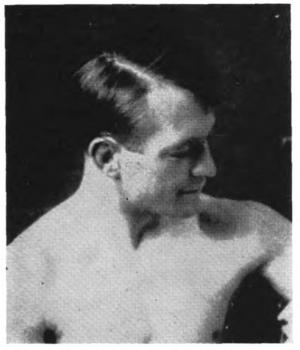
Stanley Ketchel, the famed “Michigan Assassin,” was the most exciting fighter I have ever seen. I rate him the greatest middleweight of all time and often wonder what other ring glories might have been his, had he not been shot and killed by Walter Dipley at the age of 24.
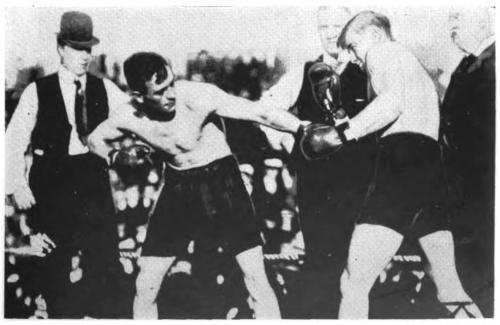
Here Ketchel (left) poses with Billy Papke prior to their second 1908 title fight in San Francisco. Stanley regained the championship with an eleventh round knockout.
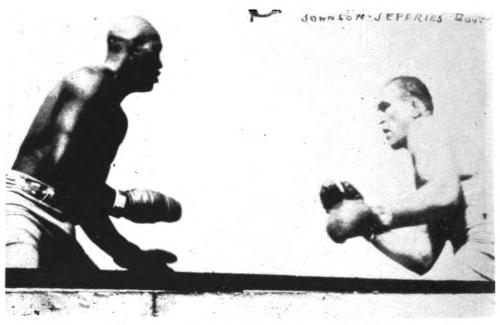
Though not a popular champion, Jack Johnson ranks as the best all-around fighter of modern times in my book. The demand for his dethronement brought aging Jim Jeffries out of retirement. Tex Rickard promoted the bout in Reno, July 4, 1910 and refereed it. Sentiment rode with the balding Jeffries (shown above sparring for an opening in an early round), but age soon told as the cat-like Johnson battered him into submission. The end came in the fifteenth round (below) as Sam Berger threw in the sponge and referee Rickard pushed Jack off the fallen ex-champ.
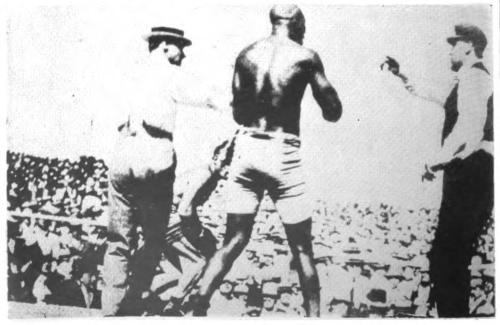
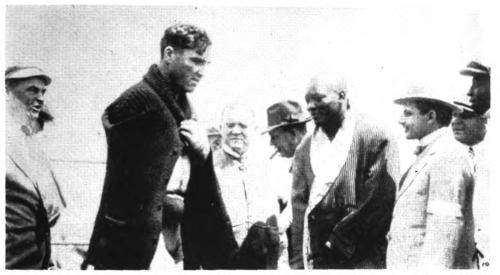
Johnson’s unpopular reign as champion continued until high living and Jess Willard caught up with him in Havana, June 10, 1914 (above). Willard’s great size and strength proved decisive as the bout wore on and Jack was finally counted out in the twenty-sixth round. He claimed afterwards to have taken a dive. In the picture below it appears that Johnson is shading his eyes from the sun. However, such a gesture is not uncommon for a beaten fighter (see photo of Billy Conn on another page), and since I was present at the Havana fight, I cannot agree with Johnson’s version.
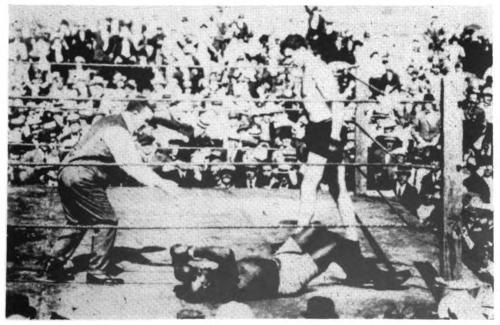
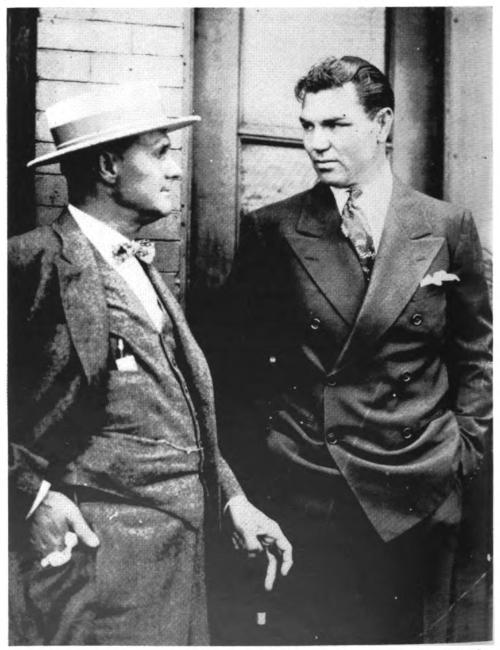
Tex Rickard’s rise to greatness coincided with the appearance of hobo camp brawler Jack Dempsey on the heavyweight scene. Paired together by destiny, the rough, pug-nosed battler from Manassa, Colorado, and the imaginative promoter personified Boxing’s Golden Age.
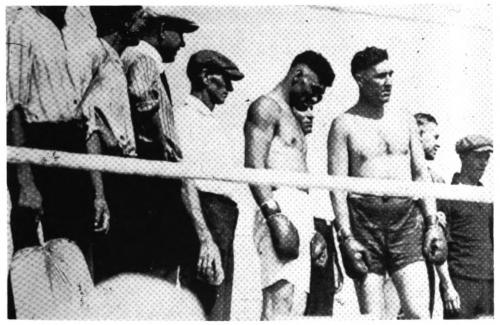
Dempsey had been nothing more than a rugged in-and-out slugger until he fell into the hands of Jack Kearns (white cap, above), who groomed him for the title meeting with Willard at Toledo, July 4, 1919. Jack gained fistic immortality with an explosive three-round knockout victory. The beating that Jess suffered was so severe as to seem impossible to administer with only padded gloves. The false rumors that Jack’s gloves were “loaded” with plaster of Paris persist until this day. Jimmy Deforest (standing next to Dempsey), who bandaged Jack’s hands, denied the story. Below we see Willard down for the seventh time in the opening round.
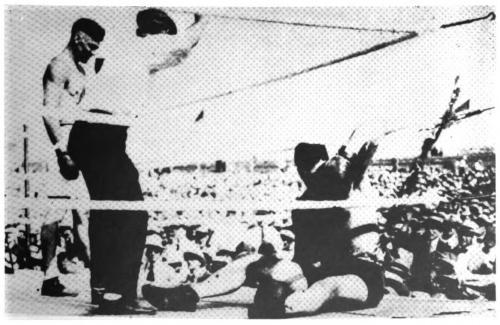
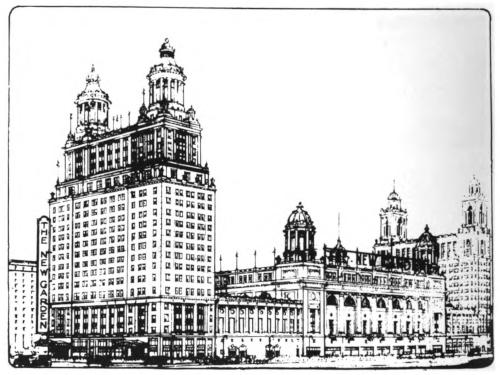
Above is the architect’s sketch for a new Madison Square Garden which Dinty Scanlon had drawn up and which appeared with my exclusive story in the New York Telegram, May 22, 1923. We submitted it to Tex Rickard the following day. Tex feigned disinterest, calling our proposal impractical. However, he used our idea to get financial backing for the building of his own Garden, as is indicated by his architect’s drawing (below) which was not submitted to the press until more than a year later.
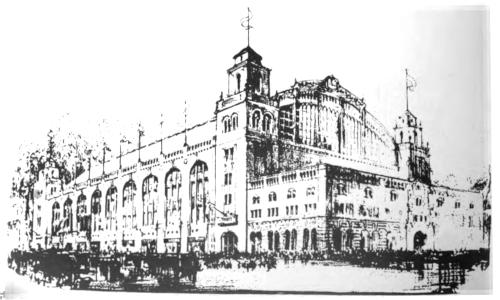
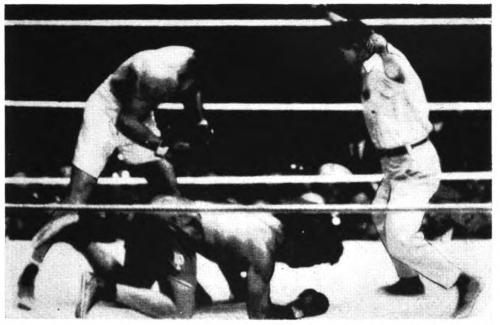
For breath-taking excitement, the Dempsey-Luis Firpo title fight at the Polo Grounds, September 14, 1923, was the wildest I have ever witnessed. In the picture above, Jack, who was down twice himself—once completely out of the ring—stands over the fallen challenger. Though as courageous as any man I’ve ever seen, the mammoth Firpo was finally knocked senseless and the fight ended with his tenth knock-down at 1:12 of the second round. Luis was floored seven times in the first round and twice in the second before the knockout punch was delivered.
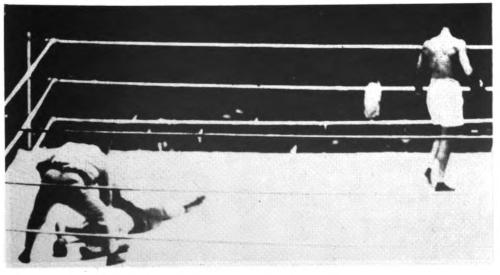
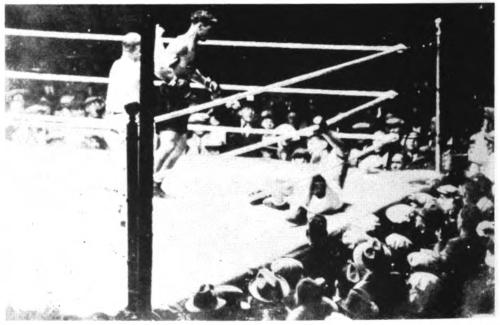
Dempsey’s dominance of the heavyweight division was brought to an end by handsome ex-Marine Gene Tunney, who took the title with a ten round decision in Philadelphia, September 23, 1926. Jack’s defeat stunned the entire sporting world. Rematched before 104,000 in Chicago’s Soldier’s Field, September 22, 1927, Dempsey flashed his old time fury in flooring Gene in the seventh round (above). The long count resulting from his delay in going to a neutral corner (below) remains a subject for debate until this day, for Gene regained his feet, and his senses, and went on to victory.
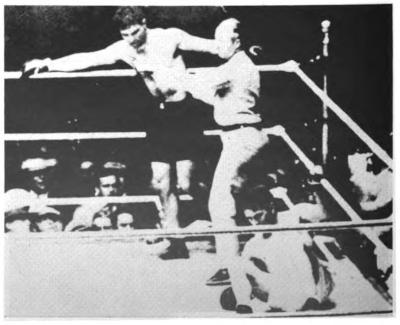
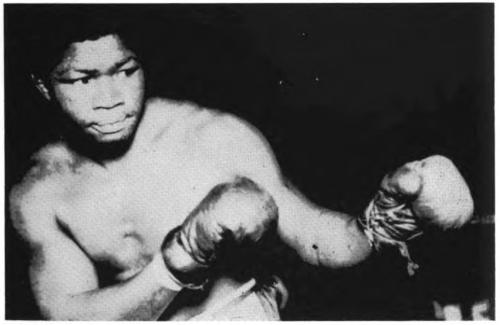
One of the more colorful fighters of the 1920s was the unschooled primitive, Battling Siki, who somehow managed to swarm over Georges Carpentier to win the light heavyweight championship of the world, September 24, 1922.
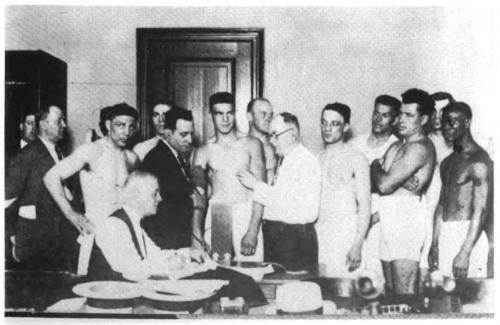
Here is one of the greatest arrays of fistic talent ever assembled for an evening of boxing. Shown at the weigh-in for the Milk Fund Show at Yankee Stadium, June 26, 1924, are (l. to r.) Harry Greb, Tommy Loughran, Young Stribling, Sandy Seifer, Ted Moore, Gene Tunney, Ermino Spalla, Dan Lieber and Panama Joe Gans.
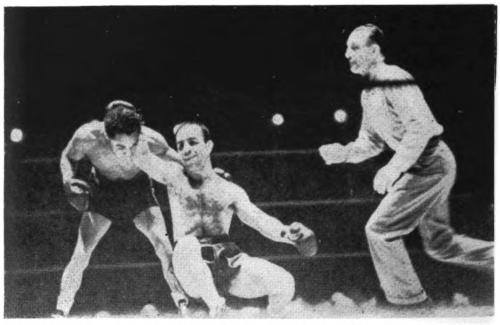
Rickard’s death in 1929 closed as exciting an era as the fight game has ever known. Though marred by depression, the decade that followed was almost as eventful, with shrewd Mike Jacobs the heir to Tex’s promotional mantle. I negotiated Mike’s first title fight between Henry Armstrong and Petey Sarron (above) at Madison Square Garden, October 29, 1937. Jacobs’ meal ticket was Detroit “Brown Bomber” Joe Louis (below), who ruled the heavyweights from 1937 to his retirement in 1949.
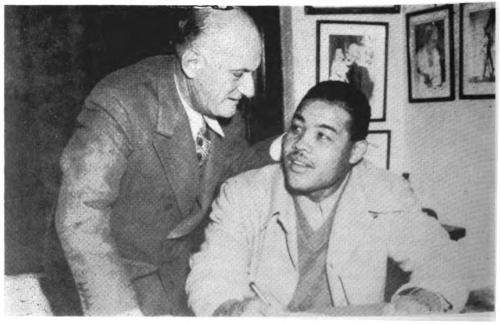
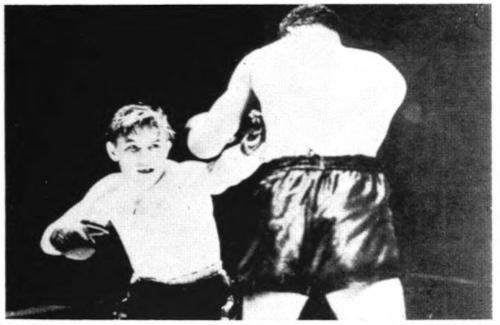
Joe’s first title defense saw him gain a fifteen-round decision over the Welshman Tommy Farr in the Yankee Stadium in New York City, August 30, 1937. Farr earned the respect of the American sporting crowd, but he never would have gotten the match had it not been for my trans-Atlantic telephone negotiations in Jacobs’ behalf.
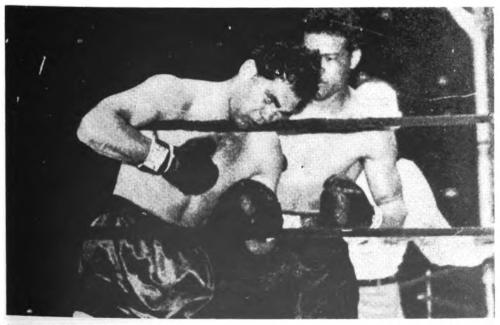
A devastating puncher with either hand, Louis was one of the greatest finishers the ring has ever seen. His destruction of Max Schmeling in 2:04 of the first round of their meeting, June 22, 1938, at Yankee Stadium is often compared with the carnage wrought by Dempsey at Toledo.
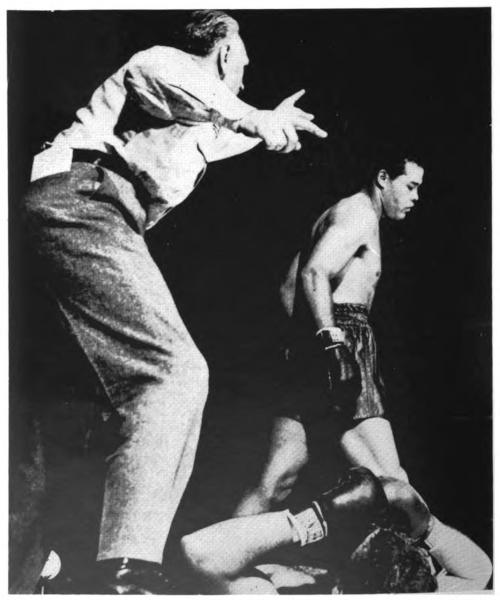
Jacobs had to wait five years to rematch Louis with Irish Billy Conn after their sensational 1941 meeting. This $100 a ringside seat offering saw a heavier and not so daring Conn fall beneath Louis’ fists in the eighth round at Yankee Stadium, June 19, 1946. Conn is shading his eyes as did Jack Johnson in his bout with Willard.
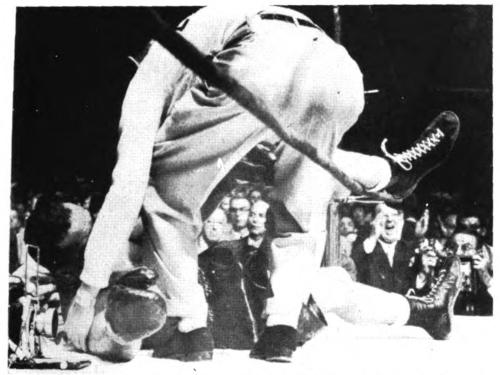
Joe retired in 1949, but financial difficulties forced him to return to the ring wars in 1950. He lost a fifteen round decision to then champion Ezzard Charles, but managed to campaign successfully among the other challengers until hard punching Rocky Marciano belted him into permanent retirement with an eighth round kayo at Madison Square Garden, October 26, 1951.
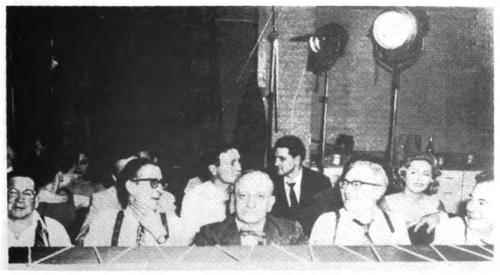
This shot of me in a familiar ringside setting was made for a fight sequence in Rocky Graziano’s 1957 film biography, “Somebody Up There Likes Me.” Also shown with me are some of my longstanding pals among the fight scribes: (l. to r.) the late Jim Jennings of the Mirror, the late Caswell Adams of the Journal-American and Joe Nichols of the Times.
My work has taken me around the world several times through the years. The picture above shows part of the crowd of 69,962 that sat in the huge Bangkok stadium to watch the Chamrern Songkitrat-Robert Cohen bantamweight championship match on September 19, 1954, despite a terrific downpour that lasted until the main event was about to get under way. Cohen, shown (left) in an early exchange below, won the title by decision. I am proud to have been associated in the negotiations for the battle and to have acted as judge.
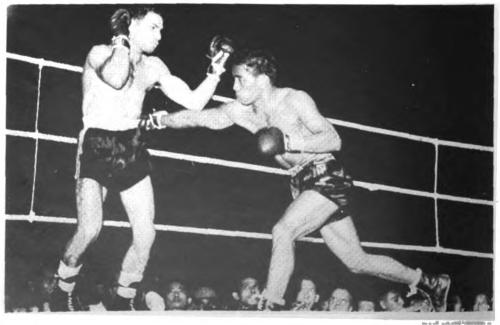
Here bantam king Cohen and myself greet New York State Athletic Commissioner Julius Helfand upon his arrival in Paris for a meeting of the World Boxing Championship Committee in 1955.
This picture of my 1958 visit with Cuban Sports Commissioner, General Fernandez y Miranda, caused me considerable embarrassment when it appeared as part of a Life Magazine feature article on gambling and gangsterism in Cuba. A long time sports friend, Miranda is also a Batista relative and in Life was alleged to have interests in slot machines.
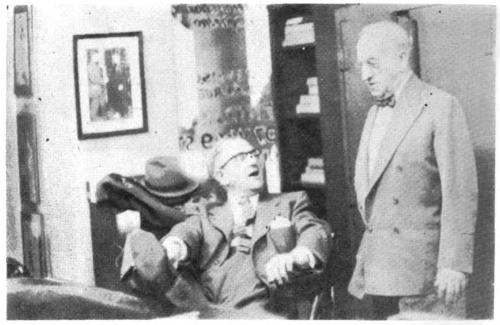
Here I am chatting with my life-long friend, Dan Daniel, at The Ring offices. Dan and I have shared many an exciting moment through my more than fifty years of sports writing.
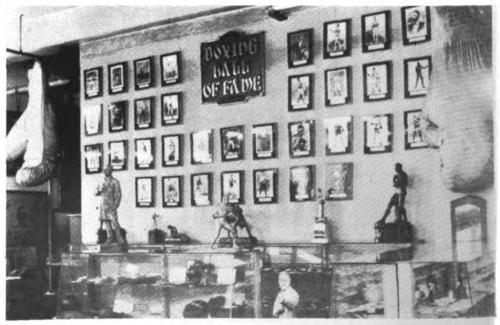
This is part of the Boxing Hall of Fame, which I organized in 1954 to commemorate the many truly great fighters of days gone by. Those of modern times are selected by the votes of a panel of more than 100 of the leading sports writers of the world. To be elected, a fighter must receive at least 75 percent of the total votes cast. The old timers are chosen by a panel of twenty veterans who have covered the sports field for forty or more years.
[284]
History
Biography
Instruction
[285]