
Title: Proceedings of the third National Conservation Congress at Kansas City, Missouri, September 25, 26 and 27, 1911
Creator: United States. National Conservation Congress
Release date: May 6, 2026 [eBook #78622]
Language: English
Original publication: Indianapolis: National Conservation Congress, 1911
Other information and formats: www.gutenberg.org/ebooks/78622
Credits: Bryan Ness, Charlene Taylor and the Online Distributed Proofreading Team at https://www.pgdp.net
Proceedings
of the
Third
National Conservation Congress
at
Kansas City, Missouri
September 25, 26 and 27, 1911
“Let us conserve the foundations of our prosperity”
(Declaration of the Governors, 1908)
Kansas City, Missouri
National Conservation Congress
1912
[i]
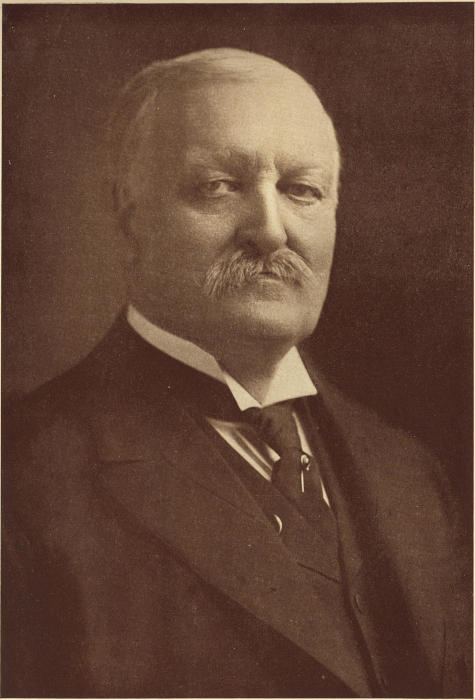
Hon. J. B. White, President
[ii]
President
Henry Wallace, Des Moines
Executive Secretary
Thomas R. Shipp, Washington, D. C.
Treasurer
D. Austin Latchaw, Kansas City, Mo.
Recording Secretary
James C. Gipe, Clarks, La.
Executive Committee
Vice-Presidents
Alabama, Hon. Albert P. Bush, Mobile; Alaska, Hon. James Wickersham, Fairbanks; Arizona, B. A. Fowler, Phenix; Arkansas, A. H. Purdue, Fayetteville; California, E. H. Cox, San Francisco; Colorado, Murdo Mackenzie, Trinidad; Columbia (District of), W J McGee, Washington; Connecticut, Rollin S. Woodruff, Hartford; Delaware, Hon. George Gray, Wilmington; Florida, Cromwell Gibbons, Jacksonville; Georgia, Hon. Jno. C. Hart, Union Point; Hawaii, Mrs. Margaret R. Knudsen, Kauai; Idaho, James A. McLean, University of Idaho; Illinois, Julius Rosenwald, Chicago; Indiana, F. J. Breeze, Lafayette; Iowa, Carl Leopold, Burlington; Kansas, W. R. Stubbs, Topeka; Kentucky, James K. Patterson, Lexington; Louisiana, Newton C. Blanchard, Shreveport; Maine, Bert M. Fernald, Augusta; Maryland, William Bullock Clark, Baltimore; Massachusetts, Frank W. Rane, Boston; Michigan, J. L. Snyder, Lansing; Minnesota, Ambrose Tighe, Saint Paul; Mississippi, A. W. Shands, Sardis; Missouri, Hermann Von Schrenk, Saint Louis; Montana, E. L. Norris, Helena; Nebraska, Dr. F. A. Long, Madison; Nevada, Senator Francis G. Newlands, Reno; New Hampshire, George B. Leighton, Monadnock; New Jersey, Charles Lathrop Pack, Lakewood; New Mexico, W. A. Fleming Jones, Las Cruces; New York, R. A. Pearson, Albany; North Carolina, T. Gilbert Pearson, Greensboro; North Dakota, U. G. Larimore, Larimore; Ohio, James R. Garfield, Cleveland; Oklahoma, Benj. Martin, Jr., Muskogee; Oregon, J. N. Teal, Portland; Pennsylvania, William S. Harvey, Philadelphia; Philippine Islands, Maj. George P. Ahern, Manila; Porto Rico, Hon. Walter K. Landis, San Juan; Rhode Island, Henry A. Barker, Providence; South Carolina, E. J. Watson, Columbia; South Dakota, Ellwood C. Perisho, Vermillion; Tennessee, Herman Suter, Nashville; Texas, W. Goodrich Jones, Temple; Utah, Harden Bennion, Salt Lake City; Vermont, Fletcher D. Proctor, Proctor; Virginia, A. R. Turnbull, Norfolk; Washington, M. E. Hay, Olympia; West Virginia, A. B. Fleming, Fairmont; Wisconsin, Charles R. Van Hise, Madison; Wyoming, Bryant B. Brooks, Cheyenne; National Conservation Association, Gifford Pinchot, Washington.
Standing Committees
Forests—H. S. Graves, U. S. Forester, Washington, D. C., Chairman; E. M. Griffith, Madison, Wis.; E. T. Allen, Portland, Ore.; J. Lewis Thompson, Houston.
Lands—Governor W. R. Stubbs, Topeka; Chairman; Dwight B. Heard, Phenix; J. L. Snyder, Lansing; Murdo Mackenzie, Trinidad; Charles S. Barrett, Union City, Ga.
Waters—W J McGee, Washington, D. C., Chairman; E. A. Smith, Spokane; Henry A. Barker, Providence; J. N. Teal, Portland, Ore.; Herbert Knox Smith, Washington, D. C.
Minerals—Charles R. Van Hise, Madison, Chairman; Joseph A. Holmes, Washington, D. C.; D. W. Brunton, Denver; John Mitchell, New York; I. C. White, Morgantown, W. Va.
Vital Resources—Dr. William H. Welch, Baltimore, Chairman; Professor Irving Fisher, New Haven; Dr. H. W. Wiley, Washington, D. C.; Dr. J. H. Kellogg, Battle Creek, Mich.; Walter H. Page, New York.
[iii]
President
John B. White, Kansas City, Mo.
Executive Secretary
Thomas R. Shipp, Washington, D. C.
Treasurer
D. Austin Latchaw, Kansas City, Mo.
Recording Secretary
James C. Gipe, Clarks, La.
Executive Committee.
Vice-Presidents.
Local Board of Managers for Kansas City Congress Representing Commercial Club—J. C. Lester, President; E. M. Clendening, Secretary; F. P. Neal, Chairman; F. A. Faxon, F. L. Hall, W. B. Hill, F. J. Moss, J. C. Swift, R. A. Long.
[iv]
Forests—H. S. Graves, Washington, D. C., Chairman; E. T. Allen, Portland, Ore.; Major E. G. Griggs, Tacoma, Wash.; William Irvine, Chippewa Falls, Wis.; George K. Smith, St. Louis.
Minerals—Dr. Joseph A. Holmes, Washington, D. C., Chairman; Dr. Charles R. Van Hise, Madison, Wis.; Dr. I. C. White, Morgantown, W. Va.; C. W. Brunton, Denver, Col.; John Mitchell, New York City.
Lands and Agriculture—Prof. L. H. Bailey, Cornell University, Chairman; Prof. George E. Condra, Nebraska; Prof. J. L. Snyder, Lansing, Mich.; F. D. Coburn, Kansas; Charles S. Barrett, Union City, Ga.
Education—Dr. C. E. Bessey, Lincoln, Neb., Chairman; Dr. David Starr Jordan, Leland Stanford University, Oakland, Cal.; Dr. Edward E. Alderman, University Of Virginia, Charlotteville; Dr. E. C. Craighead, Tulane University, New Orleans, La.; Prof. Fairchild, Topeka, Kas.
Vital Resources—Dr. William H. Welch, Johns Hopkins University, Baltimore, Md., Chairman; Prof. Irving Fisher, Yale University, New Haven, Conn.; Dr. J. N. Hurty, Indianapolis, Ind.; Hon. A. B. Farquhar, York, Pa.; Dr. Oscar Dowling, Shreveport, La.
Homes—Mrs. Matthew T. Scott, Washington, Chairman; Mrs. Harriet Wallace Ashby, Des Moines, Ia.; Mrs. J. E. Rhodes, St. Paul, Minn.; Mrs. Sarah S. Platt-Decker, Denver, Col.; Mrs. Amos F. Draper, Washington, D. C.
Child Life—Hon. Benjamin B. Lindsay, Denver, Col., Chairman; Dr. Samuel M. Lindsay, New York City; Judge Henry L. McCune, Kansas City, Mo.; Mrs. Carl Vrooman, Bloomington, Ill.; Dr. Anna Louise Strong, Seattle, Wash.
Food—Dr. Harvey W. Wiley, Washington, D. C., Chairman; F. G. Urner, New York; Prof. F. Spencer Baldwin, Boston, Mass.; J. F. Nickerson, Chicago, Ill.; Lucius P. Brown, Nashville, Tenn.; E. H. Jenkins, New Haven, Conn.; M. A. Scovelle, Lexington, Ky.; Prof. Geo. A. Loveland, Lincoln, Neb.
Civics—Ralph Easley, New York, Chairman; Judge Albert Hall Whitfield, Jackson, Miss.; B. A. Fowler, Phoenix, Ariz.; Hon. H. M. Beardsley, Kansas City, Mo.; Hon. Francis J. Heney, San Francisco, Cal.
General (Including Domestic Animals and Wild Life)—Dr. W. T. Hornaday, New York, Chairman; Dr. J. O. Howard, Washington, D. C.; Mrs. Minnie Maddern Fiske, New York City; Dr. John Muir, Martinez, Cal.; D. Austin Latchaw, Kansas City, Mo.; Prof. Geo. A. Loveland, Lincoln, Neb.
Waters—Hon. J. N. Teal, Portland, Ore., Chairman; Hon. Joseph E. Ransdell, Lake Providence, La.; Walter S. Dickey, Kansas City, Mo.; Hon. Herbert Knox Smith, Washington, D. C.; W. K. Kavanaugh, St. Louis, Mo.; Dr. W J McGee, Washington, D. C.; Prof. Geo. F. Swain, Harvard University.
National Parks (to include Mammoth Cave, Ky., and Adjacent Lands)—Dr. W J McGee, Washington, D. C.; Dr. Henry F. Drinker, South Bethlehem, Pa.; Hon. William P. Borland, Kansas City, Mo.; Hon. Gifford Pinchot, Washington, D. C.; Col. W. H. Crump, Bowling Green, Ky.
[v]
| CONSTITUTION | IX |
| RESOLUTIONS | XIII |
| OPENING SESSION | 1 |
| Invocation by Bishop Lillis | 1 |
| Welcome by Mayor Brown | 1 |
| Address of Welcome by President Lester for Commercial Club | 4 |
| Address by Governor Hadley | 5 |
| Address by President Wallace | 11 |
| Address by Honorable J. B. White | 19 |
| Appointment of Credentials Committee | 21 |
| Announcements by President Wallace | 21 |
| Announcement by Secretary Shipp | 21 |
| Announcement by Recording Secretary Gipe | 22 |
| Request by Delegate Baumgartner | 22 |
| SECOND SESSION | 22 |
| Invocation by the Rev. Dr. Kerr | 22 |
| Governor Hadley Made Chairman | 23 |
| Remarks by Governor Hadley | 23 |
| Call of States | 24 |
| Address by Mr. J. C. Baumgartner of California | 24 |
| Address by Professor Worsham of Georgia | 24 |
| Address by Mrs. Holland C. Day | 28 |
| Address by Col. Isham Randolph of Illinois | 28 |
| Address by Mr. Harry Everest Barnard of Indiana | 28 |
| Message from Mexican Ambassador | 28 |
| Address by Mr. Thomas H. MacBride of Iowa | 29 |
| Remarks by Mr. A. W. Stubbs of Kansas City, Kansas | 29 |
| Address of Dean Waters of Kansas | 29 |
| Address by Col. Crump of Bowling Green, Ky. | 29 |
| Address by Mr. Fred J. Grace of Louisiana | 30 |
| Introduction of ex-President B. N. Baker | 30 |
| Motion by Mr. Breeze of Indiana | 30 |
| Remarks by Chairman Hadley | 30 |
| Address by Judge Lindsay of Colorado | 31 |
| Address by Mr. D. M. Neill of Minnesota | 43 |
| Address by Honorable George Coupland of Nebraska | 43 |
| Announcement by Professor Condra | 43 |
| Address by Honorable E. A. Stevens, Commissioner of Public Roads | 44 |
| Address by Professor Rane of Massachusetts | 44 |
| THIRD SESSION | 45 |
| Announcements by Acting Chairman Condra | 45 |
| Remarks by Mr. Emil Gunther | 46 |
| Address by State Commissioner John D. Moore | 46 |
| Address by Dr. Twitchell of South Carolina | 47 |
| Address by Mr. Gross, President of National Soil Fertility League | 47 |
| Address by Chairman Condra | 49 |
| Address by ex-President Baker | 50 |
| Address by President Taft | 54 |
| [vi]FOURTH SESSION | 62 |
| Invocation by Bishop Hendrix | 62 |
| Roll Call of States Resumed | 62 |
| Announcement by Chairman Fowler of Resolutions Committee | 63 |
| Announcement by Sergeant-at-Arms | 64 |
| Address of Mr. Logan of the Missouri Waterways Commission | 64 |
| Remarks of Mr. C. P. Dyar of Ohio | 68 |
| Address by Mr. Milton Brown of Oklahoma | 68 |
| Address by Mr. A. B. Farquhar | 68 |
| Address by Dr. Drinker of Lehigh University | 68 |
| Remarks by President Wallace | 71 |
| Address by Mr. B. G. Holden of Iowa | 71 |
| Address by Mr. R. A. Long | 76 |
| Address by Honorable W. A. Beard of California | 78 |
| Chair Assumed by Honorable J. B. White | 87 |
| Announcement by Chairman Fowler of Resolutions Committee | 87 |
| Address by Mr. Herbert Quick | 88 |
| Reading of Telegram | 109 |
| Appointment of Committee on Nominations | 110 |
| FIFTH SESSION | 111 |
| Invocation by the Rev. Dr. Combs | 111 |
| Announcement by Recording Secretary Gipe | 111 |
| Introduction of Governor Vessey as Chairman | 111 |
| Address by Governor Vessey | 111 |
| Reading of Letter from Colonel Roosevelt | 112 |
| Reports from National Organizations | 113 |
| Report by Mr. Mullin | 113 |
| Report by Major Griggs | 113 |
| Report by Mr. Rushton | 113 |
| Report by Honorable E. T. Allen | 114 |
| Report by Mr. Schwedtman, of St. Louis | 116 |
| Report by Mr. Coffin, of New York | 116 |
| Report by Dr. Field, of the Audubon Society | 116 |
| Report by Mr. E. R. Taylor | 116 |
| Address by Mrs. Vrooman | 117 |
| Vote of Thanks by Delegate Baumgartner | 119 |
| Remarks by Mr. McBrien | 120 |
| Address by Professor Greenwood | 120 |
| Address by Dean Mumford, of Missouri | 121 |
| Address by Mrs. Ashby, of Des Moines | 121 |
| Address by Mrs. Scott, President General, Daughters American Revolution | 125 |
| Address by Miss Frances Brown | 128 |
| Report of Executive Committee by Chairman White | 129 |
| Amendments to the Constitution | 129 |
| Adoption of Amendments | 130 |
| Address by Miss Weller, of the Iowa Federation of Women’s Clubs | 130 |
| Address by Mr. Guthrie, of St. Paul | 131 |
| SIXTH SESSION | 131 |
| Address by Mrs. Moore, President General, Confederation Women Clubs | 132 |
| Address by Dr. Wilson, of Presbyterian Church | 139 |
| Address by Dr. Wiley | 139 |
| SEVENTH SESSION | 147 |
| Induction of Dr. Northrop as Chairman | 147 |
| Invocation by The Rev. Dr. Neel | 148 |
| Address by Mr. Bailey | 148 |
| Remarks by Delegate Stubbs | 151 |
| [vii]Discussion by President Wallace | 151 |
| Call of States Resumed | 152 |
| Report by Mr. Filson | 152 |
| Address by Professor Spillman, of the Department of Agriculture | 152 |
| Address by Mrs. Weeks, of the National Congress of Mothers | 156 |
| Address by Congressman F. S. Jackson | 157 |
| Address by Honorable Curtis Hill, of Missouri | 163 |
| Report of Committee on Credentials | 167 |
| Address by Honorable J. B. White | 167 |
| Report of Committee on Nominations | 174 |
| Address by President White | 175 |
| Address by Professor Hopkins, of University of Illinois | 176 |
| Remarks by Secretary Coburn, of Kansas | 183 |
| Address by Dr. McGee, of the Department of Agriculture | 183 |
| EIGHTH SESSION | 193 |
| Invocation by the Rev. Dr. Monroe | 193 |
| Entrance of Mr. Bryan | 193 |
| Address by Professor Ten Eyck | 193 |
| Resolution Complimenting Gifford Pinchot | 193 |
| Address by Honorable Walter L. Fisher, Secretary of the Interior | 194 |
| Remarks by Mr. Bryan | 203 |
| Letter from Colonel Roosevelt | 204 |
| Address by Mr. Grout, of Illinois | 205 |
| Report of Committee on Resolutions | 211 |
| Personnel of Committee on Resolutions | 211 |
| Remarks by Delegate Shoffer | 212 |
| Resolution by Delegate Stubbs | 212 |
| CLOSING SESSION | 214 |
| Address by Professor Hoynes, of Notre Dame University | 214 |
| Address by Senator Owen, of Oklahoma | 218 |
| Address by Mr. Bryan | 220 |
| SUPPLEMENTARY PROCEEDINGS | 231 |
| Address by Dean Mumford, of the University of Missouri | 231 |
| Address by ex-Governor Hoard, of Wisconsin | 234 |
| Address by Henry I. Willey, of New York | 237 |
| Address by Mr. Griggs, of Washington | 245 |
| Address by Professor Ten Eyck | 247 |
| Address by the Rev. Dr. Wilson | 257 |
| Address by F. A. Filson | 259 |
| Address by Mr. Schwedtman | 261 |
| Report of President Stillman | 262 |
| Report of Dr. Field | 263 |
| Address by Mr. Rushton | 264 |
| Report of the Camp Fire Club | 265 |
| Report by Committee of National Board of Fire Underwriters | 267 |
| Report of National Association of Audubon Societies | 272 |
| Letter from Mr. van Ornum | 273 |
| Address by Mr. Baumgartner | 274 |
| Report for Idaho by Mrs. Day | 275 |
| Report for Illinois by Colonel Randolph | 275 |
| Report for Indiana by Mr. Barnard | 277 |
| Report for Iowa by Mr. MacBride | 277 |
| Report for Kansas by Dean Waters | 278 |
| Report for Louisiana by Mr. Grace | 278 |
| Report for Massachusetts by Professor Rane | 281 |
| Report for Minnesota by Mr. Neill | 284 |
| [viii]Report for Nebraska by Mr. Coupland | 285 |
| Report for New York by Mr. Moore | 286 |
| Report for Oklahoma by Mr. Brown | 287 |
| Report for Oregon by Mr. Teal | 288 |
| Report for Pennsylvania and Philadelphia by Mr. Gunther | 290 |
| Report of Conservation Movement by Mr. Farquhar | 291 |
| Report for South Carolina by Dr. Twitchell | 299 |
| National Organizations Represented at the Congress | 301 |
| List of Registered Delegates | 303 |
| Index | 315 |
[ix]
This organization shall be known as the National Conservation Congress.
The object of the National Conservation Congress shall be: (1) to provide a forum for discussion of the resources of the United States as the foundation for the prosperity of the people, (2) to furnish definite information concerning the resources and their utilization, and (3) to afford an agency through which the people of the country may frame policies and principles affecting the wise and practical development, conservation and utilization of the resources to be put into effect by their representatives in state and federal governments.
Section 1. Regular annual meetings shall be held at such time and place as may be determined by the executive committee.
Section 2. Special meetings of the Congress, or its officers, committees or boards, may be held subject to the call of the president of the Congress or the chairman of the executive committee.
Section 1. The officers of the Congress shall consist of a president, to be elected by the Congress; a vice-president from each state, to be chosen by the respective state delegations; and from the National Conservation Association; an executive secretary, a recording secretary, and a treasurer.
Section 2. The duties of these officers may at any time be prescribed by formal action of the Congress or executive committee. In the absence of such action their duties shall be those implied by their designations and established by custom. In addition, it shall be the duty of the vice-presidents to receive from the state conservations commissions, and other organizations concerned in conservation, suggestions and recommendations and report them to the executive committee of the Congress.
[x]
Section 3. The officers shall serve for one year, or until their successors are elected and qualify.
Section 1. An executive committee of seven, in addition to which the president of the National Conservation Association and all ex-presidents of the Congress shall be members, ex officio, shall be appointed by the president during each regular annual session to act for the ensuing year; its membership shall be drawn from different states, and not more than one of the appointed members shall be from any one state. The executive committee shall act for the Congress and shall be empowered to initiate action and meet emergencies. It shall report to each regular annual session.
Section 2. A board of managers shall be created in each city in which the next ensuing session of the Congress is to be held, preferably by leading organizations of citizens. The board of managers shall have power to raise and expend funds, to incur obligations of its own responsibility, to appoint subordinate boards and committees, all with the approval of the executive committee of the Congress. It shall report to the executive committee at least two days before the opening of the ensuing session, and at such other times as the Congress or the executive committee may direct.
Section 3. An advisory board, consisting of one person from each national organization having a conservation committee, shall be created to serve during that Congress and during the interval before the next succeeding Congress. The board shall report to and coöperate with the executive committee.
Section 4. A committee on credentials shall be appointed, consisting of five (5) members, by the president of the Congress not later than on the second day of each session of the Congress. It shall determine all questions raised by delegates as to representation, and shall report to the Congress from time to time as required by the president of the Congress.
Section 5. A committee on resolutions shall be created for each annual meeting of the Congress. A chairman shall be appointed by the president. One member of the committee shall be selected by each state represented in the Congress. The committee shall report to the Congress not later than the morning of the last day of each annual meeting.
Section 6. Permanent committees, consisting of five members each, on each of the following five divisions of conservation: forests, waters, lands, minerals and vital resources, shall be appointed by the president of the Congress. The committee on vital resources is to consist of six subordinate committees as follows: food, homes, child life, education, civics (including wild life, domesticated animals, and cultivated plants). These committees shall, during the intervals between the annual meetings of the Congress, inquire into these respective subjects and prepare [xi]reports to be submitted on the request of the executive committee, and render such other assistance to the Congress as the executive committee may direct.
Section 7. By direction of the Congress, standing and special committees may be appointed by the president.
Section 8. The president shall be a member, ex officio, of every committee of the Congress.
Section 1. The program for the session of each annual meeting of the Congress, including a list of speakers, shall be arranged by the executive committee. The entire program, including allotments of time to speakers and hours for daily sessions and all other arrangements concerning the program, shall be made by the executive committee.
Section 2. Unless otherwise ordered, the rules adopted for the guidance of the preceding Congress shall continue in force.
Section 1. The personnel of the National Conservation Congress shall be as follows:
Officers of the National Conservation Congress.
Fifteen delegates appointed by the governor of each state and territory.
Five delegates appointed by the mayor of each city with a population of 25,000 or more.
Two delegates appointed by the mayor of each city with a population of less than 25,000.
Two delegates appointed by each board of county commissioners.
Five delegates appointed by each national organization concerned in the work of conservation.
Five delegates appointed by each state or interstate organization concerned in the work of conservation.
Three delegates appointed by each chamber of commerce, board of trade, commercial club, or other local organization concerned in the work of conservation.
Two delegates appointed by each state, or other university, or college, and by each agricultural college, or experiment station.
The President of the United States.
The Vice-President of the United States.
The Speaker of the House of Representatives.
The Cabinet.
[xii]
The United States Senate and House of Representatives.
The Supreme Court of the United States.
The representatives of foreign countries.
The governors of the states and territories.
The lieutenant-governors of the states and territories.
The speakers of state houses of representatives.
The state officers.
The mayors of cities.
The county commissioners.
The presidents of state and other universities and colleges.
The officers and members of the National Conservation Association.
The officers and members of the National Conservation Commission.
The officers and members of the state conservation commissions and associations.
Section 1. The several delegates from each state in attendance at any Congress shall assemble at the earliest practicable time and organize by choosing a chairman and a secretary. These delegates, when approved by the committee on credentials, shall constitute the delegation from that state.
Section 1. Each member of the Congress shall be entitled to one vote on all actions taken viva voce.
Section 2. A division or call of states may be demanded on any action, by a state delegation. On division, each delegate shall be entitled to one vote; provided (1) that no state shall have more than twenty votes; and provided (2) that when a state is represented by less than ten delegates, said delegates may cast ten votes for each state.
Section 3. The term “state” as used herein is to be construed to mean either state, territory, or insular possession.
This Constitution may be amended by a two-thirds vote of the Congress during any regular session, provided notice of the proposed amendment has been given from the Chair not less than one day or more than two days preceding; or by unanimous vote without such notice.
[xiii]
The third National Conservation Congress, made up of delegates from all sections and nearly every state and territory of the United States, met at the call of a great moral issue, now in session assembled in the city of Kansas City and State of Missouri, does hereby adopt and solemnly declare the following platform of opinion and conclusion concerning the inherent rights of the people of the United States:
Heartily accepting the spirit and intent of the Constitution and adhering to the principles laid down by Washington and Lincoln, we declare our conviction that we live under a government of the people, by the people, and for the people; and we repudiate any and all special or local interests or platforms or policies in conflict with the inherent rights and sovereign will of our people.
Recognizing the natural resources of the country as the prime bases of property and opportunity, we hold the rights of the people in these resources to be natural and inherent, and justly inalienable and indefeasible; and we insist that the resources should and shall be developed, used, and conserved in ways consistent both with current welfare and with the perpetuity of our people.
We commend the efficient work of the federal forest service, and particularly urge upon Congress the need for more liberal financial provision for protection of the national forests from fire, and the desirability of making the army available without delay whenever needed to supplement such protection.
We also appreciate the forestry progress being made by many states, believing it not only the function, but the duty of the state to safeguard its forest resources by liberal appropriation for fire prevention; by acquisition and conservative management of state owned forest lands; by encouraging the practice of private forestry on timber lands and wood lots in every way, especially through reform in forest taxation; and by providing for the educational work necessary to secure all these ends.
We commend the increasing effort at better forest management and protection by timber owners themselves, and urge upon all such the study and emulation of the several coöperative systems for this purpose.
We urge the coöperation of public and private educational authorities in instilling the principles of forest economics in the minds of the young of today, who will be the doers of tomorrow.
We are in sympathy with the policy of establishing public parks to be used for the benefit of the people forever, including localities of [xiv]scenic, scientific or historic interest, by states and by the National Government, and we cite as an example the Mammoth Cave of Kentucky, one of the wonders of the world; we recommend this policy to obviate the danger of such national heirlooms being held permanently in private ownership and subordinated to private interest rather than the public good.
Recognizing the 900,000,000 acres of well-watered arable land in this country as the chief source of food and clothing for our people, we hold that these lands should be guarded as a natural heritage to be kept in sacred trust for our children and our children’s children; that they should be safe-guarded from loss through natural agencies and negligent or thriftless use; that they should be protected from monopoly and private or corporate rapacity; that they should be so cultivated and improved that they may pass to each coming generation with increased fertility and productivity; and that they should forever be used as sites for homes in which the strength and spirit of the Nation may be conserved for the general welfare of mankind.
Approving the withdrawal of public lands pending classification, and the separation of surface rights from mineral, forests, and water rights, including water-power sites, we recommend legislation for the classification and leasing for grazing purposes all unreserved lands suitable chiefly for this purpose, subject to the rights of homesteaders and settlers, or the acquisition thereof under the land laws of the United States; and we hold that arid and non-irrigable public grazing lands should be administered by the Government in the interest of small stockmen and homeseekers until they have passed into the possession of actual settlers.
We favor the repeal of the commutation clause of the Homestead Law, and the disallowance of homestead entries on land chiefly valuable for its timber at time of filing.
We hold that mineral deposits underlying public lands should be transferred to private ownership only by long-time leases with revaluation at stated periods, such leases to be in amounts and subject to such regulations as to prevent monopoly and needless waste; and that in case of doubt as to the availability of such mineral deposits, or while they are waiting exploitation, surface rights to the land should be transferred by lease only under such conditions as to promote development and protect public interest.
Since all successful conservation effort must follow ascertained fact, we agree (1) that there should be in each commonwealth an active conservation commission or equivalent organization; and (2) that such commission should use, and strive ever to coördinate, all agencies, state or national, which have for their object the discovery of exact data and the ascertainment of scientific information in reference to all natural resources and conditions in each of the several states and in the country at large.
We hold that phosphate deposits underlying the public lands should [xv]be safe-guarded for the American people by appropriate legislation, and that export of phosphates and other natural and manufactured fertilizing material should be limited and regulated by law.
Realizing that the productivity of our soil depends on water supply; that one of the chief losses to the farm is destructive soil erosion; that the freshets and floods due to storm and thaw waters are destructive of property and even of life; and knowing through experience in this and other countries that the waste and destruction due to unregulated run-off are largely susceptible to control by appropriate agricultural methods, we hold that the aim of every farmer should be to make his farm take care of the water naturally reaching it; we also hold that allowing ordinary storm waters to carry silt and sand from farms into neighboring streams and rivers works a public injury which may be prevented by appropriate legislation.
Realizing that the strength of the Nation will ever lie in the multiplication of homes on the land up to its full capacity, we approve the successful efforts of the Federal Government to provide for such homes through irrigation of the more arid portions of the country; we endorse and commend the Reclamation Service, and urge its continuance with such increased means as may be found needful; and we urge the immediate extension of the same policy to the drainage of swamp and overflow lands, to be carried forward so far as appropriate through coöperation between state and federal agencies.
We recommend the early opening of the coal fields and other resources of Alaska belonging to the people of the United States, for industrial and commercial purposes, on a system of leasing, national ownership to be retained pending such development of that portion of our territory as to permit the creation of states within its area; and as a means of promoting industry and commerce in Alaska we approve the construction of necessary highways, railways, and terminal facilities by the National Government.
Realizing that the prosperity of the country and its suitability for homes must always depend largely on transportation facilities, we recommend extension of the good roads movement until every community is provided with safe and easy ways to schools, churches and markets; and in developing the necessary road systems, we favor coöperation between townships, counties, states, and the federal government in such manner as to secure the greatest benefits to the entire country at the minimum cost.
Realizing that the current cost of railway transportation is apparently exorbitant, amounting to about $2,750,000,000 annually, equivalent to a tax of $150 per family (or one-third the cost of living) or an impost of over $5 on each acre of improved land in the United States, we urge on the Federal Government appraisal of railway property and such investigation and supervision of railway business as will insure [xvi]protection of the public interests; and to this end we recommend enlargement of the powers of the Interstate Commerce Commission.
As a means of reducing the cost of living and promoting the general welfare, we favor the establishment of a parcels post.
Realizing that products of the soil on which our people depend for food and clothing are sometimes diverted from the most direct lines leading from producer to consumer for speculative purposes, and that they are made the basis for gambling transactions, we hold that all dealing in futures and gambling operations involving foodstuffs and materials for clothing are a public injury, and recommend investigation of the matter by authority of the Federal Congress; and in case our judgment is sustained by such investigation, we demand the enactment of law by the Federal Congress prohibiting the sale of these necessaries of life by men or interests who do not own them at the time of such sale, under penalties including imprisonment at least for any second offense.
Since noxious insects and plants, including weeds, are a source of public injury, we urge appropriate state and federal legislation tending to their extermination; and we commend the development of that public spirit finding expression from time to time in communities and states in crusades against insect and plant pests in the public interest.
Recognizing in coöperative enterprises an effective means of conserving human energy and increasing the efficiency of our soils in feeding our people cheaply, and thereby affording means for the development of equal opportunity for all, we approve and commend such coöperative organization among our producers and consumers as will tend to promote economy and prevent waste in handling the necessaries of life.
Realizing that the interests of our citizens, our states, and our Nation are identical, and impressed by the success which has attended coöperation between state institutions and the Federal Government, we favor continuation and extension of such coöperation as a highly efficient means of promoting the general welfare.
Impressed by immeasurable benefits derived by our people from the work of the United States Department of Agriculture in promoting the use and conservation of our soil and its products, we endorse and commend that department; we strongly urge on Congress increased appropriation for its necessary work; and we recommend the enactment of such state and federal legislation as will enable the state colleges of agriculture and experiment stations to maintain in every agricultural county a capable field demonstrator to aid farmers in practical application of newly acquired agricultural knowledge.
Since all successful conservation effort must follow ascertained fact, we agree (1) that there should be in each commonwealth an active conservation commission or equivalent organization; and (2) that such commission should use and strive ever to coördinate all agencies, state [xvii]or national, which have for their object the discovery of exact data and the ascertainment of scientific information in reference to all natural resources and conditions in each of the several states and in the country at large.
Recognizing the waters of the country as a great national resource, we approve and endorse the opinion that all the waters belong to all the people, and hold that they should be administered in the interests of all the people.
Realizing that all parts of each drainage basin are related and interdependent, we hold that each stream should be regarded and treated as a unit from its source to its mouth; and since the waters are essentially mobile and transitory and are generally interstate, we hold that in all cases of divided or doubtful jurisdiction the waters should be administered by coöperation between state and federal agencies.
Recognizing the interdependence of the various uses of the waters of the country, we hold that the primary uses are for domestic supply and for agriculture through irrigation or otherwise, and that the uses for navigation and for power, in which water is not consumed, are secondary; and we commend the modern view that each use of the waters should be made with reference to all other uses for the public welfare in accordance with the principle of the greatest good to the greatest number for the longest time.
Viewing adequate and economical transportation facilities as among the means of conservation, and realizing that the growth of the country has exceeded the development of transportation facilities, we approve the prompt adoption of a comprehensive plan for developing navigation throughout the rivers and lakes of the United States, proceeding in the order of their magnitude and commercial importance.
Recognizing the vast economic benefits to the people of water power derived largely from interstate and source streams no less than from navigable rivers, we favor public control of water power development; we deny the right of state or federal governments to continue alienating or conveying water by granting franchises for the use thereof in perpetuity; and we demand that the use of water rights be permitted only for limited periods, with just compensation in the interests of the people.
We demand the maintenance of a federal commission empowered to deal with all uses of the waters and to coördinate these uses for the public welfare in coöperation with similar commissions or other agencies maintained by the states.
We recognize the great service that has been, and can be, rendered in the conservation of our mineral resources, by developing and mining in large units with adequate capital, and approve the encouragement of such development under proper regulation.
We heartily approve of the work of the United States Government in improving sanitary conditions and in lowering the death rates of [xviii]Cuba, the Philippine Islands, and the Canal Zone. We are especially pleased that in 1911 the National Government, through its wise provisions for the maneuver division of the United States Army operating in western Texas, demonstrated that the achievements in health and life security found possible in Cuba, the Philippine Islands, and the Canal Zone, are possible with Americans on American soil. We therefore call on our municipal, state, and national governments, to accomplish these same results for the people of the United States.
Our National Government in the Canal Zone of Panama has demonstrated that Caucasians, properly directed, can work in the tropics without loss of efficiency, and we express our opinion that this is one of the monumental discoveries of the age.
The Hook Worm Commission is demonstrating another possibility in increasing efficiency; and we endorse the efforts of this commission, and all other efforts, governmental and extra-governmental, for increasing human efficiency through promotion of physical welfare, and call on our governments—municipal, state, and national—to increase their activities along these lines.
We favor a child welfare bureau under, and as a part of, each municipal and state government.
Inasmuch as nearly all the states and most of the cities have health departments as coördinate branches of administrative work, we endorse the plan of bringing together as a department of health the various human health activities of the United States Government as a coördinate branch of its administrative work, divorced from the impediment of being a part of other administrative work of entirely different character and conducted for entirely different purposes; this in order that the efficiency of the service may be increased to a point in some degree commensurate with its importance.
We protest against the present neglect of health, life security, and work for physical efficiency by the municipal, state and national governments, and we ask that they be given that study and care that have proven so broad an economy in the case of live stock and farm crops.
We are of opinion that municipal, state, and national governments should pass proper laws, and provide proper means of enforcement of such laws that there may be prevented, (1) blindness, (2) birth accidents, (3) infant mortality, (4) labor by immature children, (5) communicable diseases of children, (6) occupational diseases, (7) occupational accidents, and especially mine and transportation accidents, (8) communicable diseases of adults, (9) bad ventilation, and (10) physical inefficiency.
We deplore the practice of disposing of sewage and manufacturing waste by dumping it into the streams, lakes, and coastal waters of the Nation, thereby polluting the chief sources of water for drinking and domestic purposes, destroying fish and crustacean life, rendering the [xix]waters obnoxious to sight and smell, and losing beyond hope of recovery vast quantities of elements essential to plant life.
We earnestly advocate the employment by communities and manufacturing concerns of such methods of sewage disposal as will render their waste products innocuous to health and utilize them in the restoration of soil fertility, and to this end we urge the enactment by states of stream-pollution laws, and by the Federal Government of such legislation as will prevent the pollution of interstate and coastal waters.
Deeply concerned at the rapid disappearance of wild life from the continent of North America and the large economic loss that the continued destruction of that life is bound to entail, we call upon the people of America to adopt more stringent measures to stop the excessive killing of birds, quadrupeds and fish, and to enact more drastic and far-reaching laws for the protection of the remnant from the extermination that threatens it.
We realize that the tremendous importance of our fishery resources is underestimated, and that this great asset is threatened with serious diminution. We urge upon Congress and the states to provide more liberally for fish propagation and preservation, in the interest of the conservation of this food source so important at present and vital for the future.
The problem of the preservation of migratory birds, fishes and quadrupeds is interstate; therefore, we emphatically endorse the resolution of the second National Conservation Congress to the effect that the National Government supplement the laws of the states with comprehensive national laws for the protection of migratory animals.
The losses of life and property from fire in the United States are enormous and abnormal, amounting to 1,500 human lives annually, and with the cost of prevention to nearly $400,000,000 of property, or ten times that of any other civilized country of the world. Such losses may be largely prevented by economical treatment, and we recommend to the Congress of the United States a national investigation of this subject under government supervision, the collection, classification and analysis of data concerning the causes of such fire losses, and the relation of fire insurance rates thereto, to the end that a permanent department of government be established to collect and furnish to the United States and the people thereof reliable information in relation to life and property losses and practical means for their prevention.
The children of the United States are recognized as the most precious resource of this Nation, and the Federal Bureau of Education as the best agency for collecting, publishing and distributing educational information throughout the country. We therefore urge that national appropriations for studying problems involving the welfare of the Nation’s school children be made comparable in amount with those annually made for studying problems involving the welfare and conservation of the Nation’s material resources.
[xx]
In a system of free schools all the children should be trained for good citizenship and for the useful industries; owing to the rapidly changing and increasingly complex social and economic condition in all sections of the Union, our public schools should make ample provision for instructing the youth of the land in the more important occupations in which our people are engaged, and the parents and teachers should counsel together to determine if possible for what vocation each child is best adapted. We recommend that the schools should be so organized and conducted that the great purposes for which this Congress exists may be realized through the work and lives of men and women who have been trained in health, home-making, citizenship, and industry.
We urge upon all who are concerned with the actual work of conservation, whether in the state or Nation, that they secure quickly as possible through unprejudiced scientific investigation exact knowledge concerning our various resources and the conditions which affect their development, and we urge that all constructive conservation policies be based upon such exact information.
As this notable Congress draws to a close we, the delegates, desire to express our hearty appreciation of the many courtesies and the warm hospitality extended to us by the citizens of the city and state in which we are assembled. We desire, especially, to proffer warm thanks to His Excellency Herbert S. Hadley, Governor of Missouri, and to Honorable Darius A. Brown, Mayor of Kansas City, for their words of welcome, borne out later by actions.
We desire also to express a special acknowledgment of the courtesy, energy and ability and good will of the Commercial Club of Kansas City, as manifested particularly by its accomplished president, Mr. J. C. Lester, and its highly capable secretary, Mr. E. M. Clendening. We appreciate our obligation, too, to the local board of managers, and to Chairman Neal, for their efficient service.
We also acknowledge a debt to the clergy of Kansas City for their coöperation in several sessions and for the spirit emanating from them which has done so much to temper and ennoble the deliberations of the Congress.
We, the delegates, desire also to express appreciation of the devotion, eminent fairness, tireless energy, and endless good humor of retiring President Wallace; we acknowledge no less indebtedness to the highly efficient chairman of the executive committee, Mr. John B. White, now president of the Congress.
We also note our debt to the efficient executive secretary of the Congress, Mr. Thomas R. Shipp, without whose untiring efforts the Congress would have fallen short in the accomplishment of duty; and we appreciate, too, the efficiency of Recording Secretary Gipe.
We desire to signalize our appreciation of the notably efficient service of our worthy sergeant-at-arms, Colonel John I. Martin, who has [xxi]not only maintained perfect order under trying circumstances, but has smoothed the practical working of the Congress by his courtesy and good humor.
Finally, we acknowledge a special obligation to the press of Kansas City for the notably full and fair reports of our proceedings from day to day, and in equal degree for the preliminary publicity which contributed so much to the success of this Congress.
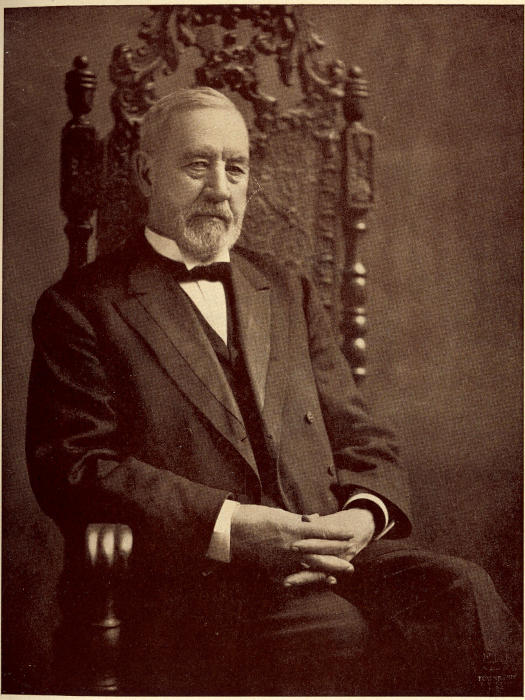
Dr. Henry Wallace, President 1910-11
[1]
The Congress convened in Convention Hall, Kansas City, Missouri, on the morning of September 25, 1911, President Henry W. Wallace in the chair.
President Wallace—The convention will come to order and will be opened with an invocation by the Rt. Rev. Thomas F. Lillis, Bishop of the Roman Catholic Diocese of Kansas City.
In the name of the Father, and of the Son, and of the Holy Ghost, Amen. Our Father, Who art in Heaven, hallowed be Thy name; Thy Kingdom come, Thy will be done on earth as it is in Heaven; give us this day our daily bread, and forgive us our trespasses as we forgive those who trespass against us. Lead us not into temptation, but deliver us from evil. Amen.
President Wallace—An address of welcome will now be delivered on behalf of Kansas City by its Mayor, the Honorable Darius A. Brown. (Applause)
Mayor Brown—Mr. President, Ladies and Gentlemen: In the very brief time in which I have to speak to you, if there is one fact of which I want to convince you it is that I am absolutely not responsible for the condition of the weather this morning. Convention Hall, the walls of it, have probably enclosed many important conventions and congresses, but I do not believe in the entire history of the institution, or of Kansas City, that there has ever gathered here a congress or convention whose deliberations and conclusions are of such vital importance to the great mass of people as that which will soon convene here this morning. We have had all sorts of conventions for the purpose of discussing ways and means of pursuing their public avocations, and how to best carry on the business in which they are engaged, but this is a Congress which is not gathered for the purpose of determining how it is best to make money or to carry on business, but for the purpose of solving some of the great problems which are necessary to be solved in order that we should go forward in the way in which this Nation should go forward.
Beginning with a strong desire to prevent waste of some of the lands and natural resources of this country, the principle of conservation has [2]been so extended and its scope so widened that today it is only limited by the bonds of human activity, and this principle of conservation is certainly of vital importance to the great cities of this country, and it has lately come to be given a practical application in the saving and preventing from waste of the valuable rights which the people of great cities have in their streets and public thoroughfares. For a long time past when private individuals sought certain valuable rights in the streets and thoroughfares of our great cities it has been the custom to give them for the asking, but now has come a time when the minds of the people are turned to the principles which demand that none of these things should be wasted or granted away unless there is a fair and just return to the people for the rights which are granted. There is another application of this principle of conservation in the life of our great cities. Conditions have arisen and exist today, and have existed, the cause of which has not yet been definitely determined, whereby the lives and the health and the morals of the people are being wasted; and so the thinking patriotic people of every city in this country are directing their minds, not so much to anything that is the result of these conditions as to get directly at the cause and prevent the results which are flowing from the causes which have existed. And the officers of this Congress have become so saturated and so imbued with this principle of conservation that the secretary, in sending out his notices to those who have been selected to deliver these addresses of welcome this morning, inserted therein a clause wherein he said there will be five addresses for the morning session, and therefore all of them will necessarily have to be brief; and the secretary was right. And it is absolutely right that it should be so, for many reasons, particularly two: Because there will assemble here this morning and during the days of these sessions some of the most distinguished, able and learned men of the United States, men who have shown their right to speak authoritatively on these great subjects; men who have devoted their time, energy, their lifetime, to the study of the proper solution of the great problems of American life; men who are coming here with a message to deliver to the people of this Congress and to the people of this great country; and therefore it is not right and proper that their time and the time of the people who have come here to listen should be wasted by an address of welcome.
And it has been suggested that on account of the fact that possibly some of those who are to deliver these addresses of welcome have caused considerable delay, that they ought to be abolished altogether. There is another reason why no time should be wasted in hearing addresses of welcome. I do not know why this custom has grown up in this country that when any considerable body of citizens of one part of the country gathers in another part that it is necessary for some high dignitary or executive of the city to deliver an address of welcome. Perhaps it came from the older countries of the world, where the provinces and the municipalities and states were clutching at each other’s throats, and they built [3]great walls around the city, and when one man wanted to visit another community it was necessary for him to go to the gate and rap on it and have some high dignitary bid him enter. In this great country of ours we have been drawn so closely together by the influence of the newspapers, the magazines, the railroads, telephone and telegraph that today we are one great common people, actuated by the same great motives and inspired by the same high ideals, and so a citizen of one portion of this country today is just as welcome in another portion of the country as the rising sun in the morning. (Applause) And so I say it is not necessary for any representative of the city to say to this gathering that they are welcome in Kansas City, or to say that the arms of the people of Kansas City are extended in a hearty welcome, because we believe that the result of the deliberations which you will hold here and the conclusions which you will reach will not only be of lasting and vital benefit to the people of this city, but to the people all over this country. And it is an encouraging sign of the times that in every branch of human endeavor the people are gathering periodically, yearly or monthly, or biennially, for the purpose of discussing the questions which affect them in their peculiar avocations. It has been said a great many times that perhaps democracy is a failure, that the people all have shown themselves incapable of governing themselves. But the most prolific cause of that opinion has been that in the past the public servants have been selected and the public questions have been solved by a small body of men, sometimes too many of which are actuated only by a desire for their personal aggrandizement.
And the great rank and file of the citizenship, the individual citizen, has not seen fit to devote any of his time to a study of any of those problems, but has left the whole government of the people to be done by this small coterie of men. The people are awakening to their responsibility as citizens of this country: they are beginning to ally themselves with some such organization as this, which has for its purpose the study and solution of these problems, and day by day, more and more, by enactment of Congress, amendments of constitution, state legislative action, amendments of city charters, more and more of these great questions are being submitted directly to the people for solution, and so I say, when the time comes through this awakening which we have seen, when the individual citizen will come to a full appreciation of his responsibility, and these problems are submitted to them, they will all be solved right and properly. And I want to say in conclusion that I hope, and I express the hope of every good citizen of Kansas City, that this Congress will achieve great things, will do more than has ever been done before to solve these great problems that are clamoring for solution. I thank you. (Applause)
President Wallace—On behalf of the Commercial Club of this city an address of welcome will be delivered by Mr. John C. Lester, its honored president.
[4]
Mr. Lester spoke as follows:
Mr. President and Members of the National Conservation Congress: I bear to you the greetings of the Commercial Club and the other industrial and civic organizations of Kansas City. We find nothing in our annals which is a greater source of pride than our part in bringing this Congress to Kansas City. We are proud to welcome an assembly of men and women who are devoted to the idea of the salvation of the physical resources of the nation, which means the physical salvation of our part of the race. The moral benefit to ourselves of trying to do something for others, is taught in an age-old lesson. What better way of illustrating that principle, and securing that good than by teaching that the spendthrift energies of this generation must be curbed in order that more be left for the vital sustenance of the next. What more inspiring sight than this great audience, drawn from the four quarters of the Nation with minds intent on that one principle? We easily recognize the great impulses and movements for the good of the race. They stand out in history like mile-stones. Among them the cause of your meeting, the cause of conservation is a pillar of fire. You are rightfully appalled by waste and are fighting it as sin. You are fully conscious from the story of life on this earth, of what a proper use of his resources means to man. You are fully conscious of the folly of destroying today what will be needed to save life tomorrow.
Your theme is Conservation. You tremble at conditions and seek a remedy. To you the glory of the harvest, the wealth of the mine, the roar of the falling water, the shadows of the forests, the flow of the streams, means more than the happiness of today: you would also have them the joy of tomorrow. If the world heeds your advice the day of the last man will be put off for countless ages.
The products of the soil and the forest, in seeking a market, seek the sea and its highways as naturally as do the waters of the streams. In obedience to this law, this community is now engaged in an effort to solve one of the great practical problems of conservation—that is, the conservation of power in transportation. We are devoted to the idea of the practical use of the Missouri River as a freight carrier. You have taught us that saving coal means saving life. You have also taught us that the same power required to move 8 tons on steel rails will move 34 tons on water; hence who dares say that our ambition to reach the sea by water with our products is an idle dream, or that the immutable laws of Nature are not on our side? Our critics are fighting the eternal verities! They might as well fulminate against the law of gravitation! The Missouri River is and will be navigated. In this effort we claim kinship with all the sons and daughters of Conservation.
As that eminent Frenchman and conservator of peace, Baron Destournelles, recently our guest, in writing a short time ago about this city and its relation to the Missouri River, pointed out, the river and the railroads have their separate burdens to bear, one class of freight will [5]always seek the quicker transit of the rails, another class will always seek the vastly cheaper transportation afforded by a water channel.
But I must not anticipate a possible subject of your deliberations. Pardon me, if I feel impelled when addressing conservationists to prove a strong local bond of sympathy!
As apostles of conversation-conservation, you, at your third annual meeting, have made a splendid beginning. You have supported precept by example in that you have selected a place for your Congress, just 125 miles east of the geographical center of the United States. You have thus conserved both the time and money of your members in meeting at Kansas City!—a most excellent centre from which easily radiate all influences for good, either moral or commercial!
It is my part, however, on behalf of all our civic organizations, to supplement and, if possible, strengthen your official welcome. You are thrice welcomed; first, because we are proud to honor as great a nucleus of brains and character as ever assembled under Convention Hall; second, because we know your purpose and your work and believe in them; and, third, because we expect to learn from you how to conserve the health of our children, how to conserve the purity of the streams from which we must drink, how to conserve the fertility of our soil from the exhausting wastes of ignorance, how to conserve the happiness of the country home, and turn the tide back from the cities—all save this one perhaps—and in all things to live in and enjoy this world so that the generations that come after will bless us and the great doctrines of conservation.
We are honored by your presence.
May we all follow the banner bearing your motto, “The greatest good for the greatest number for the longest time.”
President Wallace—An address of welcome will now be delivered by the Honorable Herbert S. Hadley, Governor of Missouri, on behalf of that great state. Governor Hadley. (Applause)
Governor Hadley—Mr. Chairman, Ladies and Gentlemen: His Honor, the Mayor, and the President of the Commercial Club have made welcoming on my part a work of supererogation. I know, of course, that you are welcome, and you know are welcome, or you would not be here. The President of the Commercial Club has referred to you and to himself as apostles of conversation as well as apostles of Conservation. And so it is upon that suggestion, I suppose, that in making speeches of welcome, we are making speeches in discussion of the subject that has brought them here. I take it, however, the explanation of my presence on the program this morning, is not for the purpose of welcoming you here to the State of Missouri, because you were welcomed here when you decided to come. I am here among these apostles of conservation and apostles of conversation simply for the purpose of giving a little variety to the program. It seemed well to [6]those who were managing this Congress that on an occasion when the people gathered together from all the states in the Union to consider the important question of a proper conservation of the soil, that it would be well to have at least one farmer among those who were gathered together for the purposes of that discussion. (Applause) And so they came down to Jefferson City to ask me to turn aside from my executive and agricultural pursuits long enough to come up here and lend a little variety to the program this morning, because to those who come from other states it may be necessary to impart that although I have been regarded and referred to upon various occasions as something of a political curiosity, I am far more than that in that I am the first farmer Governor of the State of Missouri in over a half a century, and I think the first Governor in the entire history of the state who became a farmer after he became Governor. (Laughter and applause). So consequently I represent in and of myself both the principles of conversation and the principles of Conservation. Consequently, what I have to say to you this morning will be along the line of congratulation that you have come to a state that has such a splendid example, not only of the necessity, but of the practical results of the application of that great national policy that you are gathered here to consider. As has been suggested by the remarks of the Mayor, and the President of the Commercial Club, this question of conservation is a question which has so many sides, and has so many practical and important applications that you have, Mr. Chairman, to come to a great state like the State of Missouri, with its diversified interests and resources, in order to see just exactly how great a question you are dealing with. (Laughter) So I congratulate you upon the wisdom that you have displayed in selecting your place of meeting. I say this advisedly, because Missouri, which is the oldest of those states lying wholly west of the Mississippi to have been admitted to the Union, is one of the youngest or most undeveloped states between the Mississippi and the Pacific.
Even before the territory where we meet today had become a part of the American Republic, the hardy pioneers, hunters, trappers and traders who had carried English civilization across the Alleghanies and into the valley of the Mississippi had pushed westward even to the banks of the Missouri. Following the acquisition of the Territory of Louisiana and our organization as a territory and admission as a state, Missouri stood for forty years as an outpost of civilization, reaching out to the unknown and the undiscovered West. And from her borders stretched those two great highways of commerce, the Oregon Trail, and the Santa Fe Trail, along which, in turn, were to march the soldiers, hunters, trappers and traders who were to bind the Trans-Mississippi country to the United States by ties stronger than those of treaties and of laws. The Missourian became the pioneer of the West. And in practically every state that lies in that vast empire between the Mississippi and the Pacific the sons of Missouri have felled the forests, dug [7]the mines, cultivated the soil, written the constitutions and laws, held the offices and directed the commercial and industrial activities.
MISSOURI’S UNDEVELOPED RESOURCES.
So bounteously, in fact, has Missouri contributed of her citizenship to the development of other states and territories that she has left undeveloped many of her own natural resources and uncultivated almost one-half of her soil. Of the 44 millions of acres which constitute the State of Missouri, little more than one-half has ever been touched by a plowshare; and of her 20 millions of acres of uncultivated soil, there are 17,500,000 acres of woodland awaiting the stroke of the woodman’s axe. Of lead and zinc, we produce more than any state in the Union, yes, more than all of the states of the Union combined, or any nation in the world. And yet the geologists tell us that greater stores of mineral wealth lie beneath the surface of our soil than have even been discovered by the drill of the miner or the pick of the prospector. We have within and along our borders 6,000 miles of navigable rivers, a larger number of miles of navigable waterways than any inland state in the Union. By the cultivation of one-half of our 44 millions of acres we produce over 100 million dollars worth of corn each year, nearly 1 million dollars in value of this product for every county in the state. Missouri lies in the very center of the American corn belt, and there are no corn lands superior to those found in this state. One farmer in Missouri grows more corn each year on his farm than is grown in the nine States of Utah, Oregon, Washington, Arizona, Idaho, Montana, Rhode Island, Wyoming and Nevada combined. Three counties in Missouri grow more corn than nineteen other states, in which is included all of New England. These three counties grow more corn than do the states of New York, Maryland or West Virginia. Three times as much corn is produced in Missouri each year as is produced in all of South America, three-fifths as much as in all of Europe and nearly one-half as much as is produced in the whole world outside of the United States. The average yield of corn in Missouri per acre is forty bushels, a higher average yield than in any state in the Union, and yet by the proper application of the principle of conservation in the use and cultivation of the soil, this production could doubtless be increased 25 per cent. And by the proper use of the uncultivated corn lands of the state, our production could be made greater than any state in the United States, and probably greater than the entire corn production of Europe.
The same thing is true as to our other important crops. Our average wheat crop sells for 30 millions of dollars, which is also the average value of our crop of hay which is sold upon the markets, not including the immense acreage of blue grass, clover and timothy pastures.
THE OZARK REGION.
The character of our soil, as well as of our climate, is peculiarly [8]favorable for the growing of grass. Grass is not only the greatest of all agricultural products, but its production under most favorable conditions is an indication of the most desirable place of habitation for man. One of the early travelers who investigated the conditions in the Trans-Mississippi country, who was also much of a philosopher, made the statement that the best place for human habitation is in that country farthest south where grass grows well. And the country farthest south where grass grows well is to be found in the Ozark region of Missouri. When the first Spanish explorers crossed the Mississippi, they found the largest herds of buffalo, elk, deer and antelope feeding upon the splendid pastures of blue stem and of blue grass in what is now the southern half of Missouri. Prior to the coming of the white man, this region was a vast upland prairie, noted for its splendid growth of grass and favorable hunting ground. And so long as the Indians remained, the growth of trees, except along the rivers and the streams, was prevented by the burning of the grass each year. But with the coming of the white man and the driving out of the Indian, the growth of the timber extended back from the rivers and the streams, and what was once the greatest pasture in the country is now covered by a growth of timber.
Through the proper application of the principles of conservation, this timber can be cleared in such a manner as to restore the growth of blue grass and of blue stem to make this region the most favorable for dairying and the raising of live stock that the country affords, and at the same time preserve enough of the trees to give the natural commercial advantages to be derived therefrom.
Of our 20 millions of acres of uncultivated soil, three and one-half million consist of swamp and overflowed lands to be found in the valleys of our great rivers. If this land were reclaimed by the application of the principles of conservation, so as to produce a certain annual harvest, it would produce enough of agricultural wealth each year to feed all of the people of Missouri, and leave the balance of our 23 millions of acres for the production of surplus products.
In support of this statement, let me refer you to facts of history, for Egypt, during the palmiest days of her civilization, never had under cultivation to exceed six millions of acres in the Valley of the Nile. And yet these six millions of acres supported a population of 10 millions of people. Holland reclaimed from the sea two and one-half millions of acres of land which supported a population of 8 millions of people. And yet the swamp and flooded lands of Missouri are as rich as the reclaimed lands of Holland or the Valley of the Nile.
THE NEED OF SWAMP LAND RECLAMATION.
The reason why these lands do not now produce a certain annual harvest is largely due to the fact that the National Government does not keep within their banks the waters of its navigable rivers. During [9]the course of the last ten years, the National Government has spent 125 millions of dollars to put water on to three and one-half millions of arid lands in the West. I am confident that there is no one present here today who objects to the policy that has been followed by our National Government for the reclamation of the arid lands of the West by the conservation of our waters for the purpose of irrigation. Though mistakes may have been made in isolated cases, the general policy meets with national approval. But I feel that the time will come; in fact, I believe it has come, when the national government should be willing to spend at least a small portion of the money that it uses to put water on the arid lands of the West to keep the water of its navigable rivers off of the rich lowlands of the Missouri and the Mississippi rivers. It takes an expense of from $25 to $40 an acre to put water on to the arid lands of the West, and yet it is the estimate of engineers that by an expense of not to exceed $5.00 an acre the water of the navigable rivers can be kept off of the lowlands adjacent thereto.
This question is of importance not only to the people of Missouri, but to the people of the entire country. There are in the Mississippi and Missouri river valleys over 20 millions of acres of the richest lands in the world, which are now impaired for the purpose of cultivation by reason of swamps and overflows. If this land were reclaimed and made to yield a certain annual harvest, it would almost double the agricultural production of the Mississippi Valley. And the reason why it is not so productive is, as I have said, because the national government does not keep the waters of its navigable rivers within their banks. By doing so the reclamation of this swamp and flooded land would not only be made possible, but by such a policy our navigable rivers would be improved and made more dependable as a means of inland transportation. And it little profits us to increase the production of our fertile fields unless that production can be carried from the farms to the market in such a way and for such a charge as will adequately compensate for the labor thereby expended.
And if the principles of conservation were given a practical and effective application in improving our rivers by the keeping of their waters within their banks, by using in a proper and a scientific way our uncultivated soil, the railroads would be unequal to the task of carrying such an immensely increased agricultural production from the farm to the market. Then the question of water transportation would become a necessity and, in my judgment, a satisfactory progress in the improvement of our inland waterways for the purposes of transportation will not be made until our agricultural production is increased to such an extent that existing railroads are unequal to its transportation.
THE PROBLEM OF ADEQUATE PRODUCTION.
I have outlined to you, in a most general way, some of the important phases of the question of conservation which find a practical [10]application to the conditions existing today in the State of Missouri. Experts tell us that over 40 per cent of our farm lands are being cultivated in a way which tends to decrease, rather than to increase, their productivity. Such a policy must inevitably result in the impoverishment of the Nation; because when you destroy the productivity of the soil, then do you strike at the very foundation of national prosperity and happiness. Agriculture, the oldest of occupations, is clearly the most important. The value of that which is produced from the soil exceeds the value of all other products of human labor. Up to the present time in this country, we have been peculiarly fortunate in that our production has exceeded consumption and the supply has always been greater than the demand. The result has been that the American people alone, of all the people of the world, have eaten the same kind of food. And no stronger influence could exist as against the creation of classes and castes in our population than for all of the people to eat the same kind of food.
But with the consumption increasing more rapidly than production, and the consequent increase in the cost of the necessities of life, there shall come a time when many will not be able to secure the same kind of food that is enjoyed by others. Then will there come a disturbing and dangerous influence which will threaten our society and our institutions. Statistics tell us of a constantly decreasing surplus of production. Our balance of trade is rapidly becoming confined to the exports of cotton. And if the present tendency continues, in a few years we will consume all of the products of our grain and of our live stock and have none to sell in other lands. And when this condition is followed by a time that it will be necessary to import the necessities of life, then will exist conditions which will be the cause of concern, as well as a reflection upon the American people for their capacity to use in a proper manner the great natural resources with which nature has endowed them.
I feel, however, that the American people have demonstrated most impressively their capacity for self-government by the effective manner in which they have taken up this important question of conservation. Ten years ago, the term was hardly known outside of the laboratory of the scientist and the class-room of the agricultural college. Today it is almost a household term. Under the inspiring leadership of that great American, Theodore Roosevelt, the American people have taken up the consideration and the practical application of this important national policy. And this splendid Congress today, assembled in this progressive and developing city, is an evidence of the fact that the interest in this question is by no means subsiding.
I welcome you to Missouri and voice the sentiment of her people when I say we hope that your deliberations and discussions will contribute to the practical and effective application of that great public policy that you are gathered here to consider.
[11]
President Wallace—This is a right good looking audience. We want it to go down in history, and if you will just be quiet, we will have a flashlight picture taken before I respond to this eloquent address to which you have just listened.
[After the flash light picture was taken the Congress proceeded.]
President Wallace—I assure you that it is a great privilege as well as pleasure to respond in behalf of this Congress to the cordial address of welcome of the Governor of the great State of Missouri, the Mayor of Kansas City and the President of the Commercial Club. The people of the West generally know Kansas City only as they see it from the stations, and have no proper conception of the magnificence of its buildings, the beauty of its streets and surroundings, and still less of the remarkable enterprise of its citizens. I confess that all this was a great surprise to me on a recent visit here.
The real greatness of your city lies in the agricultural resources. With the great State of Kansas on the west, with the great State of Missouri on the east, with Oklahoma and Arkansas with their undeveloped resources on the south, its future greatness must be largely measured by the development of agriculture in these great states, in the great corn state lying farther north and in the great cotton states farther south. Kansas City can lay its hand on more possible agricultural wealth than any other city on the map of the United States. Hence it was early recognized by the officers of this Congress as the best possible place to inaugurate a campaign for better farming, better business and better living on the farm.
The actual prosperity of any city is largely measured by the foresight, the breadth of vision and energy of its commercial club. A modern city may have vast resources; it may have a form of government almost ideal; and that government may be acceptable to the people and free from any breath of scandal; but if it does not have an organization of its ablest and best business men, who can make a careful study of these resources, who work together—and that, too, often at great personal and pecuniary sacrifice—for the good of the city as a whole, these resources are likely to remain undeveloped. The citizens of your city and the whole state may well be proud of your Commercial Club. Its members are the eyes through which the citizen sees the possible, and the hands through which the possible becomes the actual. They are the ears that recognize the unspoken needs and aspirations of the busy masses, and the voice that gives them authoritative expression. Without an active Commercial Club, such as you have, in which the masses of the city have perfect confidence, you could not realize your possibilities.
I am no less glad to respond to the cordial greeting of the Governor of Missouri, a state of magnificent resources of soil, in mineral wealth of several kinds, and in climate. As “no man liveth to himself,” no state liveth to itself; but Missouri could better afford to be fenced [12]off by itself than any other state in the Union. It could feed itself, clothe itself and enjoy itself, and all from its own resources in field, forest and mine, “without the aid or consent of any other nation on the face of the earth.” Its Governor and its citizens may well be proud of its advance in educational lines and in the development of its many and varied resources. Kansas City, Missouri, is therefore a fitting place for the conservationists of the United States to meet and discuss the greatest of all present problems; how to conserve the greatest of the resources of the Nation, the fertility of the soil and the life of the people who live in the open country. I am sure I voice the sentiment of this Congress as a whole when I return its most heartfelt thanks and full appreciation of the hearty welcome given by the Mayor of Kansas City, the President of its Commercial Club, and the Governor of the State of Missouri.
THE DRIFT OF POPULATION.
It will be my object in this address not to discuss any phase of the conservation movement exhaustively, but to outline briefly two drifts of population: the drift from the farm to the city and the drift from the city toward the land, and the work of this Congress as related thereto.
Even before the daily press had begun the crusade “back to the land,” the movement toward the land had already set in. When Oklahoma was opened to settlement the land seekers stood, serried ranks of horsemen, waiting for the signal gun; and that great state of undulating prairie, heretofore only a great pasture, was converted in a few weeks into a state of farm homes. Congress did not dare to repeat the experiment; but when other Indian reservations were opened, provided for the distribution of land by lot, giving the prize to the lucky man rather than to the one with the swiftest horse and most accurate knowledge of the country. Every opening since reveals the fact that only one in a few can gain the coveted prize, so great is the land hunger of the American people.
This land hunger is not peculiar to any class of people nor to any state. The merchant, the banker, the railroad official of New York and Boston, each longs for a farm, possibly only as a summer home, but is willing to pay for it in investment, in improvements and cost of management, more than it is worth in dollars or ever will be. He, too, is bitten by land hunger. Many small business men of our cities, who cannot hope to secure a farm and live on it, invest greedily in acreage in the suburbs. The workman in the factory aims to secure two or three acres on which he can build himself a home, have a garden or cow pasture or place for poultry, or at least a playground for his children.
The growth of large cities has ceased to be in the business or even in the old residence sections, and is entirely in the suburbs. The same holds true abroad. According to the census for 1909, London in the ten [13]years previous increased about three-quarters of a million. Yet the population of the old town, “Old Londontown,” decreased very heavily; the administrative district just outside that did not quite hold its own; and the entire growth and twenty thousand more was made in the outer circle or the suburbs. If men cannot have country life in the country, they are constantly aiming at “rus in urbe,” in other words, to get as much as possible of the country in the city.
As interurbans stretch out from the cities, farm after farm on their lines is divided up into acreage; and thus while the steam railroads tend to concentrate population, as they have from the beginning, the trolley lines tend to lure the people back toward the country. Even our foreign population, the men who dig our coal, mine our ores and swelter in our furnaces, aim to have a few acres which they can call their own, where they may live cheaply and die in peace and quiet, when the great interests have used up their best days and cast them off.
In fact, latent in the heart of nearly every man, be he man of business, clerk or other employe, or laboring with his hands, there is a yearning desire to have a piece of land to call his own. Perhaps they do not consciously reason it out. It may be a revival of the instinct of the primitive man, or it may be an instinctive fear of industrial wrath to come and a feeling that, should it come, should our whole industrial system be shaken to its very foundation, the family that has a few acres of its own can at least live in comparative comfort and safety.
THE MOVEMENT TO THE CITY.
Alongside of this movement, back toward, if not always to the farm, the counter-movement from the farm to the town, which has been going on for fifty years, continues with increasing and accelerated force. Farmers all over the older West move in great numbers or retire to the country towns; and notwithstanding all this constant influx of population, these towns, as the late census reveals, have barely held their own and often have lost population, the natural increase of the towns themselves pouring into the larger towns and cities, in which the majority live with less comfort than the farmers who remain on their farms. Vast numbers of boys and girls fall a prey to the alluring vices of the city; and many of them eventually take their places with “the down and out.” Comparatively few succeed and become well-to-do. The children of these few become wealthy; their grandchildren usually spend gaily the fortunes they never earned; and naturally the family dies out, at least, so far as force and power are concerned, in another generation or at most two or three. The city uses up men and families as it uses up horses. And this is true not only in this, but in the older countries as well. All Ireland, for example, except Dublin and Belfast, has lost population in the last ten years, as has also nearly all of Wales and Scotland.
I regard it as important that you should understand as clearly as possible the conditions that have caused this world-wide movement from [14]the farm to the city, as only in this way shall we be able to foresee and describe the conditions that will cause and are even now causing a return flow or movement back toward the land.
This movement townward began with the use of improved machinery, or the application of science to the operations of manufacturing and distributing the things necessary for the supply of our ever-increasing human wants. It has increased in proportion to the success of the inventions and discoveries. The power loom put all other looms out of business. The spinning jenny sent the spinning wheel to the attic. The small industries—the wagon shops, the blacksmith shops, the grist mills and carding mills found in and around the county seats and smaller towns fifty years ago—“folded their tents like the Arab and silently stole away,” when it was found that a large plant and improved machinery, coupled with transportation facilities, could supply human wants at less cost.
THE DEVELOPMENT OF THE CORPORATION.
What followed? Large capital was required for the larger plants. The individual gave place to the firm; the firm eventually became a corporation, and finally a trust. At last the workman could no longer own his own tools, and became an employe. Large numbers of employes were soon necessary, and for self-protection they formed the union. The organization of labor followed logically the organization of capital and gave us one of the greatest and most difficult of modern problems, that of labor unions.
In the factory we no longer aim to supply local demands, but state, interstate, national and even international. For this there must be transportation, and therefore we have now a railroad problem closely intertwined with the labor problem, intimately connected with the whole process of manufacturing and distribution. The products of these great factories must be used by consumers living at long distances. Hence we have the problem of distribution, or the problem of the middleman, and all the direct results of the application of science to industry. Since the world began the like has never been seen before. We have gone into this troubled sea without chart or compass. Problems are evolved, for the solution of which we have neither precedent nor guide.
While all this was going on, an empire of virgin soil, the counterpart of which exists in such mass nowhere else in the world, was opened for immediate settlement, and that settlement was powerfully stimulated by the homestead law and immense railroad grants. As a result the Old World and the New were literally sluched with food for man and beast at the bare cost of mining the soil fertility, the storage of unnumbered centuries. Had this Mississippi Valley been covered with forests like Pennsylvania and Ohio, and opened slowly as the world needed food, our history would have been written differently, and the problems to be met would have been of an entirely different character.
With corn at from 20 to 25 cents, wheat 50 cents, oats 15 cents, the [15]manufacturer could afford to pay higher wages than the farmer and give shorter hours. The city could furnish plank walks, then cement, paved streets, light, amusement, society—the joy of living. Is it any wonder that the farm boy and girls fled to the cities, away from the old-time isolation of the farm, from bad roads, from lack of society, when offered better pay and shorter hours? Better pay; shorter hours; larger life; amusements for all, whatever their tastes might be; what boy or girl could resist all this?
THE EVOLUTION OF MACHINERY.
The farm itself finally began to use improved machinery. The farmer hung his scythe in a tree and bought a mower; hung up his cradle and bought a binder. He used more horses, better tools, and grew more crops with less than half the labor. All this was natural, logical, inevitable. The older farming sections do not have so dense a population as of old, simply because they do not need it as they did when farming under old conditions. They could not use it with profit when they had to compete with town wages and town hours.
What then followed? Inevitably, soil impoverishment. The nineteenth century farmer was, speaking generally, no farmer at all, but a miner, a soil robber. There was a good farmer here and there, a good settlement here and there; but, speaking generally, there was no farming, nothing but mining. The nineteenth century farmer sold the stored fertility of ages at the bare cost of mining it. With his gang-plow and his four to eight-section harrow, he could do more soil robbing in five years than his grandfather could do in his whole lifetime. The evidence of it: The now general use of commercial fertilizers from the Atlantic to the Pacific, which means that the farmer of today is paying good round sums for the fertility his father literally gave away; and the disappearance of crops which grow during a short season, and therefore must have fertile land. Our flax crop, for instance, is now disappearing up into Canada, spring wheat closely following, and our oats crop preparing to follow.
We are now nearing a point where we will need practically all our grains to provide for the wants of our own population. Our export of corn is merely a dribble; in our last census year 100 million bushels less than the average ten years before. Our exports of meats and dairy products have shrunk in ten years over 50 per cent. We sent abroad last year only about one-third the number of cattle we sent ten years ago. There is not the slightest indication that this decline will be checked. If checked at all, it will be but temporarily, due to an industrial crisis. Were it not for over 500 million dollars’ worth of cotton that we send abroad each year, the country would be drained of its precious metals to settle our foreign obligations, and we would be on the verge of national bankruptcy.
[16]
THE PRODUCTION PER ACRE.
Is it not amazing that, mainly since our Declaration of Independence, 135 years ago, we have been able to so waste our fertility that we produce less wheat per acre than any people of the Eastern Hemisphere, except Russia and India? Lands in England that have been farmed for more than a thousand years produce more than twice as much wheat per acre on the average as we do in the naturally better lands of the Mississippi Valley. That demonstrates the difference between farming and merely mining the soil fertility.
This condition has been greatly hastened by our statesmen. The gift of an empire of land to railroads to enable them to furnish speedy and cheap transportation for a vast continent, together with the enactment of the homestead law, so excessively stimulated agricultural production that the farmer was often, and in fact generally until about twelve years ago, forced to sell his products at and often under the cost of production. This gave the world cheaper food than it will ever see again, and made possible the wonderful growth of great cities the world over.
The anxiety of the farmer to find a home market instead of having his prices fixed in a foreign market under competition led to the continuance of the system of high tariffs long after the reason for it had ceased to exist, thus wonderfully stimulating the growth of the cities of our own land, cities which with all our boasted ability we have never been able to govern decently. When this undue stimulus is removed, as it will and must be sooner or later, our manufacturers will have to take the same medicine which sickened the farmers in the 70’s, 80’s and early 90’s.
Inasmuch as there are no more Mississippi valleys to be opened, we are now nearing the turning of the lane. We must from henceforth learn how to farm. We cannot greatly increase our acreage; will, in fact, be compelled by the return of normal climatic conditions over our western territory to reduce it. The only thing left to do is to grow more grain per acre, better stock in greater numbers per quarter section. Only in this way can we reduce the cost of living.
HOW TO PRODUCE FOOD CHEAPLY.
Our great problem, as I said to this Congress a year ago, is how to produce food for our own people at prices which they can afford to pay. But how? Partly by putting more brains into our farming. There is a great deal of agricultural labor wasted simply because many farmers do not have even an elementary knowledge of the forces with which they have to work. It is hard to convince them that the fertility of the soil is not inexhaustible. Farmers of this class have been soil robbers too long, and they continue to grow the same crop year after year, trusting to luck. It is hard to get the farmers of this class [17]to understand the philosophy of crop rotation, of the natural movement of water in the soil, or of the ideal seed-bed, or the fitness of certain soils for certain crops; in short, of the requirements of plant or animal life, or to persuade them to active coöperation with each other, or to get them in actual touch and sympathy with the new agriculture. This is an educational process, and therefore slow, even when there is a disposition to acquire the knowledge. Many farmers have more faith in moon signs than in agricultural colleges and experimental stations; more faith in ordinary politicians than in college professors and scientists; more faith in yellow journals than in the best agricultural papers.
For this reason we now grow on an average two-thirds of a pound of corn to the hill; whereas the good farmer often grows on no better land originally two pounds per hill of three stalks, and three pounds are possible. We grow fourteen bushels of wheat per acre (this year but twelve and a half), while on land no better naturally, and often not so good, England grows thirty-two and Germany twenty-eight bushels. We are now passing through a stage through which English farmers passed when they grew but twelve and a half bushels of wheat per acre. The new agriculture has lifted the English and the Danish farmer out of the rut. It will lift us when we begin to use our brains. Before this Congress adjourns we will have some illuminating discourses on this branch of the subject, addresses by men of national reputation, who have devoted their lives to some particular phase of the problem of conserving and restoring soil fertility. I would not, even if I could, anticipate what they will say and say so well.
The farmer complains that he cannot employ labor necessary to grow full crops on his land, and therefore that he cannot now engage in intensive farming. There is just ground for his complaint. The factory, the store, the railroad, the trolley line outbid him for the labor, even that which is farm born and farm bred. He cannot use the cheap labor of Southern Europe, nor the hobo or tramp, nor the ne’er-do-well of the city, because the farm with its improved machinery and its live stock requires skilled labor, and a kind of skill that can be acquired only on the farm. He can use Russian and the Japanese in the beet fields. He can use the emigrant from Southern Europe in the vegetable garden, in digging ditches or making roads; but he cannot use this labor in modern farming operations. He dare not employ an unskilled man in milking, nor in feeding his cattle, nor entrust to his care the management of either improved machinery or team.
BOYS AND GIRLS AND THE FARM.
Therefore the very root and kernel of our modern farm problem is how to retain on the farm all the boys and girls born there, who are fit to be farmers or farmers’ wives. This can be done only by making farm life worth living. Making money or owning a farm is not all of farm life. We have but one life to live on this earth, and we should [18]get out of it all that is possible. In many sections in the country, with bad roads, poor schools, poor churches and no social life, farm life is not worth living. That proof of this is seen in the fact that farm boys and girls flee from it, and the farmer himself, as soon as he thinks he is able to live in town.
The farmer himself is to blame for much of this. He has played on the roads under pretense of working them. He has hired the school teacher at the lowest wage and starved the preacher. He has accepted the town ideal of life, regarding himself as “only a farmer.” His school has not been a rural school at all, but a poor kind of city school moved out into the country; and its teacher gaining at his expense the years of experience, while teaching farm children in terms of the town instead of the farm and in the spirit of the farm, that will enable her to get a position in the city. His preacher has been hoping he would get a call to a city church. If the farmer has got on in the world, his wife, if she is very foolish indeed, is inclined to boast that her society is not in the country, but the town. He allows the politician in the city to fix up a slate and tell him how he must vote.
All that is needed to convert the farmers of the West into peasants is to continue this policy for another generation. Fortunately this policy will not continue. All over the country there is the beginning of a great social and industrial awakening. The farmer is beginning to “magnify his office,” to cut loose from partisan bias, to do his own thinking and act for himself. He is paying better salaries to his school teachers, and insisting that the teaching have some relation to the life of the farm. He is buying his own automobiles, and paying cash for them. He is beginning to realize that farm life is essentially different from the life of the town. The man who steps high because accustomed to walking over clods and has the far away look of one who studies the clouds, is a different type of man altogether from the man who glides along the pavement and to whom the weather is a matter of little or no immediate concern. The man who glances over the headlines of his daily paper while he sips his coffee is a different character from the man who reads and studies the editorial of his weekly paper. This farmer’s wife is now organizing her own clubs and giving her town sisters lessons in club work. The movement to organize life clubs is spreading. The boys and girls are organizing for games. The country church is beginning to realize its mission, and in several states country preachers are taking short courses in agricultural colleges in order that they may teach morals and religion to farmers in terms of their daily life.
The conservation of the life of the farmer, using the word in its broadest sense, is essential to the conservation of the fertility of the soil; and for that reason the executive committee of this Congress has invited some of the leaders, men whose hearts are in this work, to discuss before you its various phases. You have a real treat before you.
In conclusion, permit me to say that the ultimate prosperity of the [19]city, its ability to govern itself wisely and well, depend on the development of rural manhood. More than that, the very permanence of our republic will depend on the development of the manhood of the farm. Rome ceased to be a republic shortly after the farmers moved to town and left their lands to be tilled by mere hirelings and slaves.
We keep the best wine to the last always, and the last address of this morning will be a response by Hon. J. B. White, of Kansas City, chairman of the executive committee of the National Conservation Congress. Mr. White. (Applause)
Mr. White—Mr. Chairman, Ladies and Gentlemen of this Congress: It is not necessary that I should reply to the address of welcome, the ground has been so fully covered by the President of this Association. I feel like endorsing from my heart everything he has said, but as a matter of form, because it is expected that the chairman of the executive committee will have something to say, I want to join as a private citizen of Kansas City in welcoming the farmers and the conservationists of the entire country here today, and as the chairman of the executive committee I want to thank the good people of Kansas City for the admirable and perfect preparation that they have made. I want to thank the board of local managers. I want to thank the Secretary of the Commercial Club, Secretary Clendening, personally, and the organization of which he is the main worker. I want to thank him for the great work which they have done in making this Conservation Congress possible. The Commercial Club of Kansas City has been well spoken of as the eye and the ear of the people of Kansas City, and it is truly so.
Now, this Conservation Congress was called here because it was thought there ought to be special attention given to conservation of farms—to the conservation of soil. And it was thought that Kansas City was in the center of the greatest agricultural district in the world. I suppose, going two hundred miles in either direction from Kansas City, another piece of ground naturally so fertile is not to be found in the world. It takes in a part of Iowa, and it takes in the State of Kansas, a large part of it, and nowhere is there a better. If it were formed into one state it would be the greatest state agriculturally in the world. I am a farmer and a lumberman, and there was a time not long ago when conservation was thought to apply only to forestry, and that the lumberman was the great and ruthless destroyer of the forest. It was a matter of sentiment that went all over the country, and they thought conservation ought to begin by saving the trees. Now, we have passed beyond that. The lumbermen of the State of Missouri paid thousands of dollars to help endow a chair of Forestry in Yale College. I see before me one gentleman here who paid $4,000 toward that cause, and my company has paid a great deal of money towards a chair of Forestry, and we have done everything that we could. We invited the students [20]of forestry of Yale College into our forests. One season I had forty for two or three months, and thirty-five for another season in my forests. We built them cabins and furnished them men and horses, and everything we could do to help them study forest conditions was done. We began it in Missouri over twenty years ago, and later, as lumbermen, we have taken the greatest interest in practical forestry and the conservation of the forest, but we found it true that conservation of the soil must come first, because it is of the greater importance. There are substitutes for wood for the purpose of shelter, but there are no substitutes for food, and he that make two blades of grass grow where one grew before is doing his utmost for this and future generations. I notice that my friend, Mr. Wallace, touched on politics. Now, I am not certain whether it was politics, because the line drawn is so fine. It is so hard to draw a line between conservation economics and real good politics. I remember I got my foot into it one time; I used to belong to the Grange—thirty-five years ago. In order to organize a grange you have to have at least fifteen members, and four of them must be women, because it was supposed that in any like proportion, four women to eleven men, gives the women the majority, and wherever four women, or of that proportion, get into a convention they are always in the majority. I got up, under the good of the order, addressed the master of the Grange, and began to tell how I thought benefit might accrue to the members of the Grange. I stated some of the benefits that we were then enjoying; that we had 6 cents a pound protection on lumber, and 6 cents a pound protection on cheese, $4.00 a ton on hay, and $1.50 protection on straw, and 15 cents a pound protection on butter. And then I had a complaint, because just then they had taken the tariff off of lumber, and I said, “I own a saw mill and I don’t think it is fair to let in lumber free.” (They did it at that time, back in 1878.) One sister got up and replied, “We can stand 6 cents a pound on butter, and 6 cents a pound on cheese, and $4.00 a ton on hay, and 15 cents a bushel on potatoes, but, Good Lord, we ought to have something free, and I think it ought to be lumber.” And they ruled I was talking politics and I could not go any farther. That was the situation. It summed up a good deal like this, that we want protection on everything we produce, and we want everything to come in free that we have to buy, and I think that is good economics. That would not be politics.
Brother Wallace sees a great deal of good in everything, and he can draw his lesson and illustration to prove conclusively any point he entertains. I found that out. Why, I did not know that Samson was a saint until I attended a church here in Kansas City four weeks ago yesterday, and I listened to one of the best sermons I ever heard. It was shown conclusively that Samson was a saint, and that it was so recorded in the Scriptures. There were good reasons for his being a saint; the chief of these reasons was that he was the best material they [21]had at that time to make saints of. My friend, Uncle Henry Wallace, delivered that sermon, and it is the only sermon that I ever heard where politics and religion were not touched upon at all. And I am sure that he will preside at this Congress with that same justice; that there will be no complaint that there has been any offensive politics entertained upon the floor. I want to thank you again that you are here. And I want to say before I sit down, that a session of the executive committee, of which I am chairman, will meet at room 1111 Long Building tomorrow morning at 9 o’clock. We will get here at 10 o’clock, having an hour to confer and pass some important resolutions and make some suggestions as to matters that will be presented to this Congress. (Applause)
President Wallace—Please be seated just a moment. I wish to announce the appointment of the following committee on credentials: Prof. George E. Condra, of Nebraska; Dr. H. E. Barnard, of Indiana; Mr. Ralph H. Faxon, of Kansas; Mr. E. T. Allen, of Oregon, and Mr. W. E. Barnes, of Missouri.
Col. John I. Martin, of St. Louis, representing the City of St. Louis, Lakes-to-the-Gulf-Deepwaterway Association, and the National Rivers and Harbors Congress, has been selected as the sergeant-at-arms for this Conservation Congress. He has accepted the office and is now in charge of its affairs, and you will do just what he says, and do it with great pleasure, and with great profit to yourselves.
The secretary has some announcements to make. Before he makes them let me say that the meeting this afternoon will be at 2 o’clock, which is sixty minutes past one and sixty minutes before three. This afternoon’s meeting will be a conference of governors of states and their representatives, and the presiding officer will be Honorable Herbert S. Hadley, and tonight we shall hear the President of the United States. (Applause)
Secretary Shipp—All delegates or committees that have any announcements to make are requested to send them in writing to the secretary, so that they can be read from the platform, and posted at the information bureau.
The delegates from each state are requested to meet immediately upon the adjournment of the morning session, and organize by selecting from each state delegation a chairman and secretary, and a member of the committee on resolutions, and a vice-president to represent the state at the next Conservation Congress. The names of those selected should be handed in writing to the secretary at registration headquarters at the south entrance of the hall, or on the platform.
All state conservation commissions, and other state conservation organizations that have reports to make to the Congress, are requested to be ready to report this afternoon. The reports will be made as the roll of the states is called. In view of the number of reports to be presented, it is suggested that no report be more than ten minutes in length.
[22]
The delegates from all national organizations represented at the Congress are requested to assemble at some time during the day and organize by the selection of a chairman and a secretary, and choose a representative for membership on the proposed advisatory board of the Congress. If only one representative of a national organization is present, that representative should send in his name to the secretary.
Reports from national organizations are to be the first order of business Tuesday forenoon. In order that proper provision may be made for these reports all national organizations that have reports are requested to notify the secretary, either at registration headquarters, or on the platform, giving the name and address of the representative who is to make the report.
All delegates or committees that have announcements to make are requested to send them in writing to the secretary so that they may be made from the platform, and posted on the bulletin board at the information bureau.
President Wallace—I forgot to mention one of the greatest features of this afternoon will be an address by the Honorable Ben B. Lindsay, of Denver, Colorado, on the “Country Child versus the City Child.”
Recording Secretary Gipe—The chapters of the Daughters of the American Revolution of Kansas City will give a reception in honor of Mrs. Matthew T. Scott, president general and the vice-president, from four to six this afternoon at the Coates House. All visiting and resident Daughters of the American Revolution are invited.
The club women of Kansas City have established a rest room within the convention building, to which all women delegates and visitors are cordially invited.
Delegate J. T. Baumgartner (of California)—In addition to the announcements that have been made, I wish to ask the California delegates to meet at the Standard immediately upon adjournment.
President Wallace—The Congress is now adjourned to meet at this place at 2 o’clock this afternoon.
At 2 o’clock in the afternoon President Wallace called the Congress to order.
President Wallace—The Congress will come to order, and the Divine blessing will be invoked by Rev. Dr. R. M. Kerr, pastor First United Presbyterian church of Kansas City.
[23]
Our Father and our God, we pause at the opening of this meeting this afternoon to ask Thy blessing upon the National Conservation Congress in this and its other sessions, in all of its undertakings. We are asking of Thee the wisdom that is beyond the mind of man, and we come only to Thee. We are dealing with affairs of national interest and import, and we dare not come to any one but Thee, because we believe that in Thy power this land has been made, and in Thy Providence it has been discovered. And that our forefathers in Thy fear have established a nation which has often realized Thy signal blessing. We would recognize Thee as the God, and the giver of every good and perfect gift. Thou hast locked up in the mountains, hidden away in the soil of this country those elements that have made possible our material welfare and prosperity. We ask Thee this afternoon that Thou wilt grant unto the officers of this Congress, unto these its delegates and all of the people in this land interested in these problems the wisdom that will rightly enable us to appreciate Thy gifts, and rightly conserve them, to use them for the greatest good of the greatest number concerned. And we ask for Thy blessing to be upon our President, and his cabinet; upon the legislative bodies, state and national, upon all the courts of this land, that as the people of this country through these officers are striving to enact and execute just laws, they may do so in Thy fear, and that the righteousness of a Christian civilization may become more and more a reality. We would pray today that Thy material blessings to us have chief value in relation to human life and human deeds, and human development, and may the conservation movement that is on foot in this country always be broad enough and high enough to include the conservation of human life, the integrity of manhood, the virtue of womanhood, and the beauty and the innocence and the true worth of child life. We believe that these blessings will mean the highest good to our beloved country, and mean the advancement of Thy kingdom here in this earth, and we ask these favors through Jesus Christ, our Lord. Amen.
President Wallace—I take great pleasure, Ladies and Gentlemen, in announcing Governor Hadley of Missouri as the presiding officer this afternoon. Governor Hadley. (Applause)
Governor Hadley—Mr. Chairman and Members Of the Congress: I was selected to preside this afternoon in the expectation that this afternoon would be distinguished by a conference of governors. I say distinguished advisedly, because nowadays when governors confer there is distinction to be passed around on all present, and some for others. However, there were a number of governors here yesterday who were unexpectedly called out of the city, but who will return during the sessions of the Congress. There are some who will be present who have not yet arrived, and consequently it has been decided by the officers in charge of this Congress that upon this afternoon prior to [24]the address of Judge Lindsay, there will be a call of the states, upon which call the representatives of the various states who are here, other than the governors, will speak for a few moments in reference to the general question of conservation in their respective states, and the conference of the governors will be held later. After this call of the states you will have the pleasure, I understand, of listening to the address by Judge Lindsay. In calling for the representatives of the several states, those who are here representing the governor, or those who may have been selected by the delegates from any one of the states to speak in reference to the situation in their state relating to the general policy of conservation will arise, and either speak from the floor, or come forward to the platform. The representatives of the press, whose requests are always entitled to consideration, if not to be followed, request that the representatives come forward so that their names and their remarks can both be heard and preserved. I will now ask the secretary to proceed with the call of the roll.
Recording Secretary Gipe—Alabama. Is there a representative from Alabama present? (No response) Arizona. (No response) Arkansas. (No response) California.
Chairman Hadley—Mr. J. C. Baumgartner of the State of California will speak for that state.
[Mr. Baumgartner’s speech will be found in the supplementary proceedings at back of book.]
Chairman Hadley—I am certain we are all glad to know that though California may be a little short upon water, it is not short on good society, the possibility of good development. The secretary will proceed with the call of the states. The secretary calls my attention to the fact that the number of the states makes it necessary to somewhat limit the statements from each, and they will be limited to five minutes. The chairman, however, has a slow watch, so govern yourselves accordingly.
Recording Secretary Gipe—The next state on the roll is Colorado.
Chairman Hadley—Is the State of Colorado represented here?
Recording Secretary Gipe—Connecticut. (No response) Delaware. (No response) District of Columbia. (No response) Florida.
Chairman Hadley—Is the representative of the State of Florida in the hall? Go ahead.
Recording Secretary Gipe—Georgia.
Professor E. L. Worsham, of Georgia—I am not the speaking representative from Georgia, but I will make a brief report as to what conservation is doing in that section of the United States, or what we [25]are doing along conservation lines. I regret very much indeed to see so many vacant seats in the audience from the states to the far south. This is a very busy time with the people in the south, as most of you know, and there are a great many conservationists who would like very much indeed to be present at this meeting, and I think it is safe to say that the fact that they are not here does not mean that the South is not interested in conservation, and that they are not doing something along those lines. Mr. Chairman, and gentlemen, it is true, however, that the people of the southern states are not quite as active in the conservation movement as the people of the North and West, and why, I cannot see, because there is no doubt but that in the beginning God smiled more sweetly on this section than on any other section of the American continent. He did more for those people than all the rest. He endowed us with resources more wonderful than those of any of the other sections of the United States. Those good people have gone on from time to time not realizing what these resources meant, until they are gradually passing out of their hands. I cannot speak for other states, but for Georgia, Mr. President, I want to say that we have enough water to supply California, and a good many other Western states. That is the least of all of our troubles. As to water power, we have water power enough running waste to run every spindle in the southern states. It is simply awaiting the hand of the developer, and we want to see it properly developed, and not gobbled up as it has been done in many of the western states. This is one of the big problems that the State of Georgia has on its hands today. It is a natural section for manufacturing interests of all kinds, and you can get the cheapest power on earth on account of this wonderful water power that is stored up in its mountains.
We have coal enough to run Georgia and California a thousand years. We have rich stores of iron that run higher in per cent of iron than those of the Birmingham district, and very few people know its value. I understand the State of Georgia supplies three-fourths of the asbestos output of the United States. Our marble speaks for itself in monuments like that beautiful capital of Minnesota. Our granite speaks for itself in buildings like the federal building in San Antonio, Texas, and other buildings which I could point out. Our rich stores of bauxite many of you know about, but, there are numerous other things of this kind, Mr. Chairman, which I could mention, but I don’t care to dwell on them at this time. The main thing that we are here to discuss is the conservation of soil fertility, the conservation of agricultural resources. We of the South are an agricultural section. You take away from us our agriculture, and while we are rich in minerals and various other things, in a measure we would be helpless. It is the only spot on earth, you might say, that has a monopoly on the greatest crop on earth, and that is the cotton crop. This I consider by far the most interesting, the most valuable phase of conservation. [26]The people of the South, while their soil is extremely fertile, or was in the beginning, have allowed the rain to wash it down in the valleys, and it has washed into the sea. They had thousands and thousands of acres of land that would produce anywhere from 25 to 100 bushels of corn per acre, and from one to four bales of cotton per acre, if it was simply cared for in a proper way. I have visited the spot which holds the record for the greatest cotton yield on earth, which produced four bales per acre. In the beginning it was the poorest, reddest soil you ever saw in your life. It was taken over by a man who knew his business, and in the course of three or four years he had it up to a point where it produced almost anything. And there is another thing, Mr. Chairman, we have a section there that will produce almost anything under the sun in the way of crops. There is only one other state in the union that can compare with Georgia in that respect, and that is California, and, as the gentleman has just stated, they have not water. Our sections, from blue grass to oranges, will produce all of the various things in between.
Mr. Chairman, we of the South have got the biggest problem on earth to solve, as I see the problem. The problem of conservation of soil fertility, the conservation of agricultural resources in general, are undoubtedly among the important questions confronting this Congress, but we have the biggest part of that problem. Why? It is because of the much discussed negro problem of the South. There are a thousand and one solutions of this offered, but the question remains unsolved, and will pass on to future generations. As long as we have the negro we are deprived of having other classes of labor, which you have here in the North. (Applause) Because of his presence, we, of the South, are dependent on the negro, and he knows it. We have got to get along in the very best way we can, but we need a better class of labor. I don’t know what we are going to do. That is the reason that this is such a grave matter to the people of the South. Mr. Chairman, I see I am taking up too much time here, but I do want to get back to Georgia, and the part she is playing in conservation. (Cries of Go on. Go on.)
Since the Congress met one year ago, at St. Paul, the South has had a conservation congress, and I think I can say that it was a success. There are a number of speakers on this program that were there and noted the interest that was manifest in this meeting. Following that meeting the Georgia Conservation Association was organized, and it is taking up a number of these problems which we are so anxious to solve. The president is a distinguished man in Georgia, Judge John C. Hart. He is a man who went before the Supreme Court of the United States and presented on behalf of the State of Georgia one of the most famous cases in its history. The State of Georgia filed an injunction against an immense copper plant in the northern part of the state, which was responsible for a great deal of destruction of property, [27]of vegetation in general. This company had, at an expense of millions of dollars, put in this plant, and I understand it is the largest of its kind in the world. At that time copper was the plant’s main output and the state filed an injunction requiring these people to consume the fumes that were destroying vegetation. The case was carried to the Supreme court, and the injunction sustained, and at a cost of five millions of dollars the Ducktown copper plant put in a consumer from which they produced sulphuric acid, and, today, it is one of the largest sulphuric acid plants in the world. There is one of the solutions to the problem which your able president presented this morning in the fact that you have, throughout the West, as well as the South, to fertilize. Georgia, as a result of that injunction, saved two million dollars last year in its fertilizer bill. The representative of the State of Georgia Conservation Association framed a bill creating a state conservation board, not a commission, but a board that was to be created by special act, taking up all lines of conservation. This bill was unanimously passed by the senate, and unanimously recommended by the committee of the house, and will come up for passage at the next session of the legislature.
We passed a bill protecting bird life, and wild life generally in the state, a very strict law, which we have needed for many years. The state, as a result of the conservation work, has enacted a drainage bill, which, I think, will result in great good to the people in the southeastern part, in the drainage of swamp lands, which will make perhaps the greatest agricultural land on earth.
Mr. Chairman, I cannot go into details on any of these problems. Other states in the union, every state in the union has agencies working for conservation. In the first plant, the United States Department of Agriculture is working wonderful results in the different states, along lines of agriculture. The state colleges of agriculture are doing great work; the experiment stations are doing great work; the various state departments of agriculture are doing great work, but there is a certain class of work which these agencies cannot do. There is a great work for the independent organizations, such as the State Conservation Association in the different states, and I would urge each state that has not organized to get busy at once, and begin to take up these problems. (Applause)
Chairman Hadley—Instead of a statement of the resources and developments in the various states, I would suggest that this call of the roll is particularly designed to accomplish a statement of what is being done by public or official organizations in dealing with the question of conservation in the several states. I think it is a very satisfactory indication of the modern trend of conservation that this work is now being done by the people of the several states instead of the national government. It is an indication that the people do not intend [28]that their state governments shall sink to a lower level of efficiency. They intend to exercise every power which they possess under the federal constitution.
Recording Secretary Gipe—Idaho.
Chairman Hadley—I have the pleasure to introduce to you Mrs. Holland C. Day, who will speak for and represent Idaho.
[Mrs. Day’s paper will be found in Supplementary Proceedings.]
Chairman Hadley—I am very glad indeed in listening to the interesting speech of Mrs. Day to note what a serious attraction a state might have for a woman by reason of having woman suffrage and caused her to transfer her allegiance to the Governor of Idaho. I would suggest, however, that she should not, in her enthusiasm for the horticultural possibilities of the State of Idaho, forget that she still belongs to a state that is distinguished as the state of the “Big Red Apple.”
Mrs. Day—I will also say that the female suffrage movement is going right straight along in Missouri. (Applause)
Chairman Hadley—I do not want to start a discussion right now. This, being a conservation congress, is a peace conference. I will now call on Col. Isham Randolph, who will speak for the State of Illinois.
[Col. Randolph’s speech will be found in Supplementary Proceedings.]
Chairman Hadley—I am certain that every person interested in the general question of Conservation, and particularly the state ownership of its water power, is interested in Colonel Randolph’s statement as to what they are doing in the State of Illinois. And I know that all of you, and all other friends of Conservation, will be glad to have Colonel Randolph convey to Governor Deneen the best wishes of the Congress. I would suggest that on account of the fact that there are a number of speakers, and Judge Lindsay, whom you are all anxious to hear, that the speakers will please confine their statements to the official activities of their various states in dealing with this question of Conservation.
Recording Secretary Gipe—Indiana.
Chairman Hadley—Mr. Harry Everitt Barnard, chemist Indiana state board of health and state food commissioner, will speak for Indiana. I now have the pleasure of introducing to you Mr. Barnard.
[Mr. Barnard’s speech will be found in Supplementary Proceedings.]
Recording Secretary Gipe—I have a telegram from the Mexican Ambassador:
[29]
“Washington, D. C.—Accept sincere thanks for kind invitation. Regret exceedingly that official duties here prevent me from accepting hospitality; would thank you greatly for minutes of meeting. Gilberto Crespo, Mexican Ambassador.”
The next state is Iowa.
Chairman Hadley—I would suggest that the representatives of the several states yet to be called come up on the platform.
I have the pleasure of introducing to you Mr. Thomas H. MacBride, who will speak for the state of Iowa. Mr. MacBride. (Applause)
[Mr. MacBride’s paper is to be found in Supplementary Proceedings.]
Chairman Hadley—I am certain that the representatives of all of the states present appreciate Mr. MacBride’s not speaking of the resources of the state he represents; although he did plead guilty to having a legislature up there, which practically all the representatives of the other states have to plead guilty to.
Recording Secretary Gipe—Kansas.
A. W. Stubbs (Kansas City, Kansas)—Missouri has elected from our state, a native of our state as its mayor, and has also elected a native of our state as its governor, and Kansas has therefore as its representative, to speak for it, a most distinguished educator, formerly of Missouri, now president of the state agricultural college. Kansas has elected today Professor Waters as representative of that delegation, as president. And we would like to hear from him.
Chairman Hadley—During the sessions of this convention you will have the pleasure of listening at length to a paper by Dr. Waters, but at this time, on the call of the roll of the states, Kansas has selected him to speak for her, and I am advised that during his short residence of a little over one year in that state he has learned to speak the Kansas language. (Applause)
[Dean Water’s paper will be found in Supplementary Proceedings.]
Chairman Hadley—I am glad to see that Dean Waters with a few slight and one noticeable amendments is able to effectively use the speech he used to use about the State of Missouri when he lived here, and spoke to the State of Kansas.
Recording Secretary Gipe—Kentucky.
Chairman Hadley—I have the pleasure to introduce to you Col. M. H. Crump, of Bowling Green, Kentucky.
Col. Crump—Mr. Chairman. I am simply here this evening to say that the president of the University of Kentucky is not here. He [30]will be here tonight, and I will state that he will tell you tomorrow what we are attempting to do in Kentucky. We started the conservation movement there some thirty years ago with Professor Shaler of Harvard, when he was state geologist. He wrote the first paper I know of in attempting to take care of forestry. It is found in his report of 1873, about the time I came to the state. We are, through the university, through the state colleges, and through the geological survey, making some efforts along that line, and we are doing all the state can do in that way. But there is a subject there that we think is too large for the state to undertake. I picked up a circular when I came in here, which says that an effort is being made to take care of and preserve the forests, and the soil at the head of the Green river. This paper states that some 32,000 acres of timber land, 2,000 of which is virgin forest, the last of a great forest which once covered the Green river, and in the center of which is Mammoth Cave, we ask that the Nation come forward and help to take care of that, because it is too large for Kentucky, and heretofore nothing has been too large for Kentucky to do. (Applause) That is all I have to say. (Applause)
Recording Secretary Gipe—Louisiana.
Chairman Hadley—Mr. Fred J. Grace will speak for Louisiana.
[Mr. Grace’s paper is to be found in Supplementary Proceedings.]
Chairman Hadley—I know that all true conservationists will be glad to know that Louisiana is looking after the conservation of her shrimps and oysters, and we will all be glad to hear whether Maryland is interested in her terrapin and canvas backs.
Secretary Gipe—The next state is Maryland.
Chairman Hadley—I have the pleasure of introducing Hon. Bernard N. Baker, president of the first Conservation Congress. (Applause)
Mr. Baker—Fellow delegates. I will only detain you a few minutes. I know you are all waiting to hear Judge Lindsay. The governor limited us to what we were doing to preserve the oyster. Maryland is doing her duty in that respect, and if you will do your part, we shall all enjoy them in using the oyster when it is opened. I know you want to hear Judge Lindsay, and I am going to only speak a word. I thank you for this, and we will wait for Judge Lindsay.
Fred J. Breeze of Indiana—I move that the report on the call of the states be laid over until tomorrow.
The motion was duly seconded.
Chairman Hadley—I think the Chair will declare that motion carried, and on tomorrow morning where there is an order on the program for the response of chairmen of organizations concerned in conservation there will be statements of the representatives of the several [31]states. It is important in the consideration of this question that we should not lose sight of the fact that conservation is a means and not an end, and the real end is the formation and promotion of the happiness and welfare and prosperity of the people. Consequently the most important question of conservation is the question of the conservation of human health and life. There are various phases of this question before the American people today that are of commanding importance; the immense toll that modern industry makes upon its workers amounts to ten every sixty seconds; the number of deaths from unhealthful occupations has presented a record as tragic as any that was ever written in times of war. There is another phase of this question, of conservation of human life, in the manner in which society deals with its deficient and dependents. Any system devised for the prosecution of crime and the protection of society against its enemies that deals only with the question of punishment and revenge is a mistaken system, and does not accomplish anything of permanent results in its benefits to society. They talk of the system in the conduct of penitentiaries and jails and eleemosynary institutes, but unless they send those they heal out into the world better men, women or children, physically, intellectually or morally than when they received them, that system is a mistaken and misguided one. One of the most distinguished representatives of a modern system in the enforcement of our criminal law for the conservation of human life and character is a man who I now have the pleasure of introducing to you, Judge Ben Lindsay, of the State of Colorado, and of the City of Denver, (Applause) who will speak on the subject of the “Country Child vs. the City Child.” Hon. Ben B. Lindsay.
Judge Lindsay—Governor Hadley and delegates, ladies and gentlemen: I am sure it is a great honor to have the privilege of appearing here at this National Conservation Congress to consider some phases of the problem of the child. I do not know whether at past congresses the subject of the child has had a part in the program, but I do know that upon this occasion I feel a great deal as I think a particular boy friend of mine must have felt once in a little episode that happened in my own court nearly ten years ago. We found that when we made an appeal to the loyalty, even of the street boy, the state might find a helper and defender instead of an enemy. I recall when a certain policeman could not capture a certain little rascal of the streets. He went by the nickname of “Moochy.” He came in one day to say to me that another little imp of Satan, as he was supposed to be, by the name of “Mickey,” knew where “Moochy” was, and if he could enlist the services of “Mickey” in the capture of “Moochy” he thought he might save this little citizen. It was with some difficulty that I had to explain to “Mickey” that we were trying to save “Moochy,” in order to get him to tell me where “Moochy” was. When he found we had come to save, to help, and not to hurt, that loyalty for his chum turned to [32]loyalty to the state, and he said, “Judge, I know where the kid is, and I will get him.” In about fifteen minutes down in the wing of a cheap theater in our town there was a howl and a growl that somewhat disconcerted the audience. And when they investigated they found it was “Micky” pinching “Moochey,” as he called it. With some difficulty my little gamin friend succeeded in getting the delinquent to the court house, coming in to say to me with more or less disgust, “that the kid didn’t seem to want to be saved nohow.” A newspaper reporter happened to come along to write a story based upon this episode, to be called “The Pinching of Moochey by Mickey.” It was not complete, in his estimation, without a picture of the two, and he lined them up outside to take their pictures, when “Mickey” balked. He would not stand to have his picture taken. And I was somewhat puzzled, for I rather feared the outcome of this situation when “Mickey” came in followed by the newspaper reporter, to explain. He said, “Do you tinks I want to get my pictur took wid de little giek,” as he pointed to “Moochy” outside? “No,” he said, “I don’t; I got out of his class two years ago.” Then he said, as he pointed to the newspaper man, “If that guy wants to take my picture let him take it alongside of you, put both in together, and I don’t kick.”
CHILDREN, THE BIGGEST CROP.
When the Conservation Congress wanted to put the child in its work I am certain I am not going to kick, but I am here to avail myself, as best I can of this honor and this privilege. For after all this conference has needed no apologies for including in its proceedings the problem of the child, for there is not any problem that does not, in a measure, have some bearing, some relation to the home and the child in the home. These children are our best and our biggest crop. Without a proper conservation of their welfare there will never be anything else worth conserving.
There should be a bond of sympathy between the problem of the child and the conservation of our natural resources because of the rather interesting fact that the systematic work being developed for both has had most of its growth and development during the past decade, and when the history of the first ten years of the twentieth century shall be finally written the two great revivals recorded will be those concerning conservation and the child. It becomes more apparent each year that the children are the most important factors in whatever the future may hold in store for us.
Another significant fact is that the growth of popular interest in the problems of the children has been almost identical with the amazing growth of urban population for the past two decades.
Prof. E. Lee Worsham, Chairman of the Executive Committee
CONGESTION PROBLEMS.
The cry of “Back to the soil”; the stimulus given by the conservation movement and the various activities that have grown out of it [33]to promote the pleasures, advantages and opportunities of farm life together with all the modern inventions, telephones, electric light, rural mail delivery, the trolley, good roads and the automobile, I am sorry to say have not served to check the onward march to the cities. The proportion of our people living in rural districts declined from 63.9 per cent in 1890 to 53.7 per cent in 1910, and our experts in social economy assure us that in all probability much more than half of our population will be residents of urban communities before 1920. In many of the older states beyond the eastern center of population more than 90 per cent of all the people live in cities and towns with a population of more than 2,500. During the past decade alone, according to the census of 1910, the increase in the urban population of the entire country has been at the rate of 34.9 per cent as against only 11.1 per cent of the rural population. In six states this increase of urban population as against rural population has been over 100 per cent, and while not one state has failed to show a large increase of urban population, the increase of rural population has been negligible in many states and has actually shown a considerable decrease in seven states. Unless some new and unexpected change shall come it is reasonable to assume that the next generation will find more than half the children of this country in urban communities. There is a temptation to follow that diversity afforded by a subject like that assigned me, which may lead us more into the pleasantries that are supposed to be a part of the life of all country boys. The field, the farm, the orchard, the meadows, the babbling brooks; those recollections recalled in the rhymes of a Riley from the jam and the pies over to old Aunt Mary’s, to the joys of the old swimming hole or of these fall days when the frost is on the pumpkin and the fodder’s in the shock. The pity of it is that most of these legends of the country boy are too much legend and too little reality. If it were not so we can scarcely account for the growing disposition of country boys to flock to the city. I regret to say that I believe that the call to the city that is reaching the country boys of the Nation will prove to be more effective than any call to the country or “back to the soil” movement that has so far been inaugurated. One of the chief complaints we hear on every hand among the farmers of this country is the difficulty of the problem of farm labor and the indisposition of the boys and young men in any such numbers as there should be to become interested in the farm. I remember listening to the almost pathetic story of one farmer of the Northwest, who told me that every one of his five sons had gone to the city, and he had been unable to induce one of them to remain. He said they either complained of the hardships and the lack of opportunity, or pined for the excitement, pleasure and possibilities of the city. The very advantages that we had hoped would make farm life more attractive to the youth of the Nation is also proving to be one of the factors that would seem to emphasize its monotony. The daily newspapers, the magazines, [34]the trolley cars and automobiles and good roads are bringing the youth in such complete touch with the city that instead of promoting that satisfaction and contentment with the country as we had expected these city advantages would do, it often has just the reverse effect. I am not prepared to say that these modern conveniences upon which we depended so much in the “back to the soil” movement will not in the end increase rather than decrease the numbers of country boys. I recently visited a city of about three thousand population in one of the most rural of states. What did I find? It has its moving picture shows along its Great White Way, limited to two or three blocks, with a roller skating rink, dance hall, and other forms of excitement and amusement—almost a perfect miniature of the larger city. The fact that the youth of the farming community, through trolley cars and automobiles, had convenient access to the city, where before it would have been more difficult, I was assured only whetted the desire in the country boy for the city life. It would seem then that we are booked for disappointment in the hope that the extension of city conveniences to the farm is going to increase the rural population and therefore the number of country children.
COUNTRY AND CITY BOYS.
But except as it shall present difficulties in the growth and evolution of modern civilization, I am not sure whether this condition, if it be the condition, need be viewed with any great alarm. There is a gregarious and sheep-like tendency in mankind to flock together. The phenomenon presented by urban and rural growth must be a natural one or it would not be so. It is simply presenting in the course of its natural growth an occasional difficulty in the body politic as we have an occasional disease in the growing body of the individual. It becomes our duty then, in the one case just as much as in the other, to remedy the difficulty, to direct the growth along natural and wholesome lines, and this calls for work and coöperation among those factors that have to do with the life of the city or country boy—home, school, neighborhood, church and state.
It follows then that our difficulties, as they must develop from time to time, will be with the city rather than the country boy. This is not because the country boy is inherently any different from the city boy—don’t forget that—any better or any worse, nor in my judgment because he is capable of greater possibilities. It is rather because of the environment and condition under which a great number of our boys must in the future development of this country necessarily be reared. I once attended a powwow of some Indian chiefs in North Dakota. There was present old John Grass, the successor of Sitting Bull, and Red Tomahawk, the slayer of the same old chief. I asked these Indian chiefs about Indian children in their primitive days, in the days of the real country and the wilderness. Did they lie? Did they steal? These [35]chiefs assured me that such things were practically unknown among Indian boys in the days of their own childhood which was before the white man came. “But,” said one of the chiefs, “when white man come Indian boy he steal, lie just like white boy.”
I asked one of these Indian chiefs why it was that in their primitive state stealing was unknown among Indian boys—and surely they were the original country boys. The old chief grunted and a smile actually lit up that otherwise stolid Indian face as he replied: “It is very simple, there wasn’t anything to steal. The child’s wants were few and he had what he wanted.” Neither was there any poverty, any crime. This virtue of the original country boy in America was acclaimed without a taint of pharisaism. For it was admitted that the honest little savage was no better than his dishonest little progeny. It was rather a problem of condition, of occasion, of environment, than one of inherent viciousness. The wants of the little savage were few and generously supplied by nature. There was no temptation, no occasion to steal.
This fact no more favors savagery than it disproves the advantages of civilization. It is the law of nature that men should multiply and populate the earth, and the instinct among the greater numbers to flock together in cities is precisely the same as it was in the days of savagery when smaller numbers flocked together in smaller groups more widely distributed. We must meet the change by doing two things:
HOW TO MEET THE CHANGES.
First. Perfect our system of education. We need to improve our methods of moral training. We must more and more develop heart and conscience that our children may be equipped for moral as well as industrial efficiency. Boys need strength, but most of all the strength that comes from within; self-control, self-restraint; a yielding of more obedience to authority and respect for law and the rights of others.
Second. The application of a system of real justice among men which means an industrial, social and economic world in which every man shall really have an opportunity to develop the best that is in him, and be assured that he shall reap the joys, rewards and profits to be derived from his own honest toil.
This means that the boy to keep pace with our modern civilization must be better supplied with certain opportunities that are now largely denied him.
New conditions necessarily create new problems. It is the law of growth and development. Since these new conditions are to be found principally in the cities, and since most of the boys who need our attention and interest are in the cities, it follows that the problem of the child is largely the problem of the city. But as the country [36]becomes more closely in touch with the city and many of its difficulties reach into the life of the country boy, we will also in time find the difficulties of the one are the difficulties of the other.
Whatever the city does for the child is done for the community as a whole, for the child cannot profit without equal profit directly or indirectly inuring to the entire community. It is difficult to put any limit on the duty of the community to the child. It is coextensive with that of the parent, if there be no parent, or if the parent be helpless, or the child suffers from the parent’s neglect. This duty of the community, once recognized and accepted, is bound to be extended until indeed the community shall become one great family possessing some of the attributes, duties and responsibilities for the child that in original country life were limited to the particular family or family group of the child. The first general and accepted duty of the community towards the child was its education. Then came the demand for playgrounds, natatoriums, baths, trade schools, recreation centers, medical inspection, visiting nurses, dental clinics, and finally the school free restaurant. That is as sure to come within the next ten years as the playground and the recreation center has come in the past ten years. In a word, there is absolutely nothing that the child needs which the parent for any fair reason cannot furnish, which it is not the duty of the community to supply. This is so because it is simply the struggle of the state for itself. The child is the state; when the child is neglected the state is neglected; when the child suffers the state suffers; when the child is lost the state is lost. To say that the child is the chief asset of the state is undoubtedly true, but it is short of the real truth. The child is the state. It is, therefore, futile to oppose the movement going on in this country for the conservation of childhood on the ground that it is paternal. If there is anything in the scriptural injunction that “A little child shall lead them,” it is surely making itself felt at this period of our civilization. If we would conserve the real interests of the children of the Nation, we have simply got to be paternal. The state has got to be the over-parent. It cannot escape if it would; it would not escape if it could.
PALLIATIVES AND CURES.
The last decade of agitation in behalf of the boys of the city was for what is becoming more and more to be regarded as the palliatives. We first asked for playgrounds only in certain bad neighborhoods, on the theory that the children in that neighborhood were bad. We know now that the children were no different from other children, and if they need playgrounds, then all children need playgrounds, whether they be country children or city children. The play instinct needs to be wisely directed as much in one child as in another—in the country as truly as in the city.
[37]
We first asked for child labor law forbidding children to work in certain industries, and we are realizing more and more that it is not a good thing for the Nation to draw on the manhood of tomorrow by sacrificing the childhood of today. (Applause) The recent report of the National Bureau of Labor on juvenile delinquency and its relation to employment makes perfectly clear the extra hazards and dangers to which children are subjected from being too early forced into economic competition with men. It demonstrates the necessity for not only more stringent child labor laws, but the better enforcement of those we have. It explodes the idea that the working boy and girl under 16 years of age is freer from dangers of delinquency than the non-working child. It would seem indeed that the playing child in the street is much less likely to go wrong there than while engaged in those occupations in which they are mostly employed.
From what is undoubtedly a very thorough investigation and study of 4,839 cases of delinquents (of whom 561 were girls and 4,278 were boys), we have carefully worked out for us interesting tables showing 2,416 working as against 1,862 non-working delinquent boys, and 251 working as against 210 non-working delinquent girls, or a total number of 2,767 working delinquent children as against 2,072 non-working delinquent children. Added to these interesting figures is the further fact that the ratio of working delinquents is very much larger than the non-working in all these cities, varying in different cities from three to ten times as great as the non-working, with the disproportion even more striking among the girls, making it perfectly clear, as one chapter of the report concludes, “that putting children to work prematurely is not an effective method of training them for good citizenship.”
THE VALUE OF THE REPORT.
Another interesting fact brought out by the report is that the repeaters or recidivists (those apprehended for the second to the tenth offense as carefully tabulated in the report) are to be found mostly among the working children with the proportions much larger among the younger working children between 9 and 14 years of age. Up to this point the scale in this respect constantly ascends, beginning to descend as the working age approaches maturity.
The report is unusually fair in making every possible concession to a variety of details and difficulties that might discredit its conclusions; but even with all such concessions there isn’t any room to dispute its final demonstration that working children not only contribute more in actual numbers but in an alarmingly larger proportion than do the non-workers to the criminal classes, and among repeaters or recidivists the same condition is even more marked. No such interesting or reliable set of tables has ever yet been added to the literature on this subject. It forces upon us the idea that the virtues necessary to good citizenship are not so much inherited as they are to be acquired. It follows that [38]we are doing hideous injustice to our children in unnecessarily subjecting them to temptations which their untrained, immature souls are not yet able to withstand. These temptations naturally enough are greatest among the six groups of working boys who furnish the most delinquents. They are well known to juvenile court officers. These six groups represent the six classes of occupations yielding the greatest number of delinquents out of the total number investigated. Proportionately they are, delivery and errand boys 491, or 20.3 per cent; news-boys and bootblacks 449, or 18.6 per cent; office boys 46, or 1.9 per cent; street vendors 66, or 2.7 per cent; telegraph messengers 73, or 3 per cent; employed in amusement resorts 51, or 2.1 per cent; or a total of 2,416, more than one-half of the total number of 4,278 cases of delinquent boys investigated. The greatest proportion of offenses among the boys are of course larceny. This one offense constitutes more than half of all the offenses reported. Putting these immature souls to work simply violates the supplication of the Christian’s prayer “lead us not into temptation, but deliver us from evil.” The temptation of dishonesty constantly besets the working child, much more than the non-working child. The results shown are rather to be expected. The next in order of popular offenses are incorrigibility and disorderly conduct, terms so indefinite as to frequently include larceny. Truancy appears only in the cases of 185, and begging in the cases of only seven. Every juvenile officer will appreciate the more than probable accuracy of these tables, for, with one or two exceptions of minor importance, they are confirmed by their common experience, for which heretofore reliable tables are rather scarce.
A FALLACY EXPLODED.
The tabulations concerning the parental condition of the delinquents show equally creditable work. They are interesting as exploding another popular fallacy (which indeed was long since exploded by Miss Jane Addams and other champions of child labor laws) that most of the working children were sons and daughters of widows. Only 419 boys or 17.3 per cent of the entire number investigated were sons of widows, and only 185, or 8.7 per cent, were orphans; while 1,318, or more than one-half of the entire number, had both parents living. And again, curiously enough, the tables show that proportionately the great majority of these delinquent boys, employed or unemployed, came from average good homes. Seventy-six and two-tenths per cent of the delinquent working boys are recorded as coming from “fair or good homes,” and 71.6 per cent of the working and non-working boys (that is, of the total number of delinquents) enjoy the same favorable conditions in so far as their homes are concerned. The results seem to prove what has often been emphasized by juvenile officers, that a good home is not as complete a guarantee of a good boy or girl as it would [39]seem we ought to be entitled to expect. The influences of the home—while of course the most important influence and the one that counts most—is by no means the only influence under which a child is placed, especially in that kind of city life that has come to this country only in the past fifty years and which in every particular is to become more terrific in the next fifty years, unless there be some unexpected changes. It is furnishing in many respects a new kind of environment under which most of our children are expected to be reared. It means we have got to make war against the street, the conditions, the environment, the causes, if we are to perform our full measure of duty to our children.
Forty-four and seven-tenths per cent of the delinquent boys are children of native born parents as against fifty-five and three-tenths per cent of foreign born parents. Considering the far greater ratio of native born parents, this clearly indicates that there is less control over their children by foreign than by native parents.
But I do not wish to be misunderstood. I firmly believe in work even in childhood. By this, I mean the right kind of work. It is not so much a question of work as the amount of work, the kind of work and the conditions under which that work is performed. This need not lessen our belief in happiness in childhood. I want to say very candidly, that there are a great number of children in this country from fourteen years of age upward about whom I feel more alarmed at their failure to do or to know how to do any kind of useful work than of any possibility of their being overworked.
THE DANGER OF IDLENESS.
In our zeal for the protection of our boys subjected to extreme or unnatural conditions, we must not lose sight of the dangers and difficulties of idleness. There are thousands of boys in the cities of this country who, if not employed at some useful thing, are generally on the streets or in the alleys in the downtown public pool rooms and bowling alleys, engaged not always in wholesome play, but too often in idling, cigarette smoking and dirty story telling, with absolutely no thought of work or the serious side of life. They are too constantly occupied with thoughts of “having a good time,” and some rather perverted notions of what a good time is. Too many of our boys especially reach the age of moral and legal responsibility without the slightest conception of work. They are too often more concerned as to how much they earn than how well they do their work. In dealing with a certain class of youth in the juvenile court, I say without hesitation that the most hopeless fellow in the world is the boy who will not work—the boy who has not learned how to work, or the value and importance of work. There is always hope for the boy who works, especially the boy who likes to work. I believe in the “strenuous life,” and I think its importance should be taught our boys and girls at an early age. There [40]are too many young people in this country looking for “the life of ignoble ease.” I can say all of this to persons sincerely interested in the protection of the children from degradation or unnatural labor, and yet not be understood as depreciating the importance of wise child labor laws and their rigid enforcement for the protection of the children of the Union. But we must be careful, in doing this, never to underestimate the importance of work—the right kind of work, a certain amount of work—in the life of every child, and especially that teaching which inculcates good impressions in the life of every child as to the necessity and importance of labor. On the other hand, my experience is that most boys will work if given any kind of an encouraging opportunity. The lack of a chance is often responsible for idleness. At least 90 per cent of our boys and girls are forced out of the grammar school to fight the battles of life. They must have a chance to earn a living under such reasonably favorable conditions as not to destroy all chance of happiness or else they must become idlers and loafers. My own experience is that our common school education too often fails to equip them for earning more than the most scanty wages. An opportunity between the sixth and eighth grades in our city schools for children of the toiling masses to learn some kind of useful trade or valuable work with the hands—to learn to do what their fathers do—is a reform in our educational system which the champions of child labor must, in my opinion, espouse if they would round out a systematic and consistent plan of battle in this fight for the salvation of the children.
PLACES FOR THE BOYS.
I want to see the time come in this country when a boy of fourteen years of age up may be a valuable help to the plumber, the carpenter or the printer at a decent wage, instead of going to the messenger service and the street. I do not believe that juvenile labor should trespass upon the legitimate occupations of men and women, but we must equip these children for some kind of industrial efficiency and usefulness, or enlarge our reformatories and prisons for their care and maintenance. One of the saddest things in my experience as judge of the juvenile court has been the little fellows who have requested me to send them to the reform school in order that they might learn a trade. The principal of a school once said to me: “Judge, why don’t you send that boy to the reform school so that he can learn a trade?” On behalf of the boy, I replied: “In God’s name, why don’t you people on the Board of Education give him an opportunity to learn a trade at home?”
I ask you, is it fair, just or decent that in most of the cities of this country an American boy has no opportunity to learn a trade, to capacitate himself for joyous, useful work with his hands, unless he commits a crime? And yet, I am compelled to say to you, that such is the condition in a very large section of this country.
[41]
But there are wonderful changes just ahead of us in our educational system. These changes are bound to come if we are to make progress, and we are making progress.
If the Nation is to do its real duty to its boys—whether they be city boys or country boys, its children, city children or country children—it should pass the bill that has for the last six years been repeatedly offered in Congress providing for the establishment of a children’s bureau in the Department of Commerce and Labor.
CHILDREN VERSUS ANIMALS.
It is a kind of protection that is sadly needed in this country, and especially from the government we need a systematic scheme of national investigation of all matters pertaining to the welfare of children and child life. It would in no manner interfere with the activities and agencies provided by the states but, on the contrary, through the help and assistance that would come from the national government, do much to strengthen all such agencies. Such a bureau would be of equal if not superior importance to those now existing in several of the departments. For instance, the Department of Agriculture, where we have a bureau of animal industry, plant industry, of soils, of chemistry, and the like. The Government spends annually millions of dollars investigating the diseases of animals, the inspection of cattle, hogs, sheep, etc., and the results obtained by the able experts are published and circulated generously to the farmers and stock raisers of the country. The work of these bureaus has more than justified the expenditure of money by the Government. If we have a somewhat analogous bureau dealing with the welfare of the child life of the Nation, it would be doing no more for them than we are now doing for cattle and hogs. We have no right to neglect the child crop of this country. It is scarcely necessary to repeat that it is our most valuable crop, for there are born every year in this country over two million children. What the state is, what the Nation is ten, twenty, or thirty years from now depends not so much on our business, our ranches, our great industries, as upon the kind of men we have directing the great industries, the business, the farms, the ranches of this country, and what these men are then depends upon how well we care for our children now. If there are diseases among the cattle of the Nation, or decrease in some of the staple cereal crops of the Nation, the Government immediately becomes interested and its investigators and experts are busy everywhere to ascertain the causes, to furnish the remedies, to coöperate with the people for the protection of the material wealth of the Nation. Now, the child crop of the Nation is not to be measured in dollars and cents for as important as such a standard may be it is insufficient to furnish a scale for measuring the value of soul stuff. Yet if there is a large increase in infant mortality, of the dependency or delinquency of the childhood of the Nation, there is no bureau under the Federal Government that [42]is even required to become interested in the matter. And, indeed, there are very few states that provide sufficient and adequate agencies to carry on the work that must be done if we are true to our children. It is freely admitted that of the 300,000 little children—out of the 2,000,000 born annually—that die annually, one-half of the deaths are preventable by the knowledge and application of preventive measures. If through the dissemination of proper information about children, such as is disseminated concerning cattle, an appreciable per cent of these children could be saved as they certainly would be saved, such a bureau would more than justify its establishment.
SOME PRACTICAL EXPERIMENTS.
I remember recently, when the Children’s bill in England was being considered, receiving a letter, I think, from one of the under secretaries, to get certain facts, and it was simply impossible to provide the information that was needed and expected that this Government could furnish; and I, as a judge of one of the courts of this country dealing with children, felt very much embarrassed that we could not say that our Government was able to furnish such information.
We have found, in our efforts to help these 100,000 children annually that are dependent or delinquent, that nothing is so important as facts. In my humble judgment—I may be wrong, and that is just why we want a bureau of this kind, in order that I may know and you may know whether I am right or wrong—in my judgment there are 100,000 children, dependent and delinquent, coming to the courts of this country every year, and that means 1,600,000 children coming to the courts of this Nation in every generation of childhood. Is this great government of ours, with sufficient facts already gathered in this imperfect way to demonstrate the necessity, going to neglect this opportunity of spreading useful information concerning the children of this country?
I recall a certain city in which I asked the chief of police how many children had been in jail that year. He said 100. When we investigated the records, we found there were 650 boys alone brought to the jail in that city of less than 200,000 people. In another city I asked the jailer how many boys had been in jail, he said five or six hundred. When we investigated the records, we found there were 4,000 arrests in that city among the boys alone under twenty years of age and over 2,000 brought to the jail were under seventeen years of age.
But finally any work for children of the city or country must bring us face to face with many of the social, economic, industrial and political conditions that concern us as a people. There is no real problem of the child that is not also the problem of the parent. We cannot do our duty toward the children of this Nation without attacking the conditions that deform the lives of the children. This must [43]take us so far afield that I do not dare attempt to follow now lest it take me so far beyond the immediate scope of this paper as to find for it no satisfactory ending.
The fight for the childhood of today is the fight for the parenthood of tomorrow, the manhood of tomorrow; it is after all the supreme battle for the country, the city, the state, for justice for all men and women, and that means a day of better things, a happier country, a more perfect civilization; the dawn of a tomorrow, a new day, a new time in which the scriptural promise shall be more than fulfilled, for the little child shall lead, shall teach, shall save the world.
Chairman Hadley—The audience will remain seated a moment. There are a few more of the states that will be called, and as it is necessary for me to attend to some official duties, President Wallace will now take charge of the meeting.
President Wallace—The Congress is not yet adjourned, and we have some good things in store. Please come to order as soon as possible. I wish to announce Hon. B. A. Fowler, president of the National Irrigation Congress, of Phoenix, Arizona, as chairman of the committee on resolutions. Now, we want every state that has not appointed a committeeman on resolutions to do so at once, and report to the clerk, and Mr. Fowler will announce when and where that committee will meet.
Another thing. Any of you that have resolutions will please turn them in to that committee at the time and place of meeting. The committee will consider the resolutions and present them and their final report on next Wednesday. It is to be regretted that many of the governors could not be here this afternoon, but some of them have sent representatives.
President Wallace—I have the pleasure of introducing to you Mr. D. M. Neill, representing the governor of Minnesota.
[Mr. Neill’s paper will be found in Supplementary Proceedings.]
President Wallace—The Honorable George Coupland of Nebraska is here as its representative, and has been asked to speak next. Mr. Coupland.
[Mr. Coupland’s paper is to be found in Supplementary Proceedings.]
President Wallace—When this meeting adjourns, which will be at 5 o’clock sharp, it will adjourn to meet at 8 this evening, and will be presided over by Hon. B. A. Fowler, the president of the National Irrigation Congress. Mr. Condra has an announcement to make.
Professor Condra—I wish to announce a meeting of the credential committee as soon as I leave the stage about ten minutes to 5. Another announcement: There are about a hundred state conservation commissioners present, and they will meet in the white room at the Baltimore Hotel tomorrow morning at 9 o’clock for a conference.
[44]
President Wallace—This Congress intended to get Hon. Woodrow Wilson of New Jersey to address us. He was unable to come, but has sent a representative, Mr. Edward A. Stevens, Commissioner of Public Roads, and he will be heard as soon as the secretary makes some announcements, which will close the program for this afternoon.
After announcements by Secretary Gipe, President Wallace continued: We will now hear from the representative of Hon. Woodrow Wilson, Mr. Stevens. (Applause)
Mr. Stevens—Mr. Chairman, Ladies and Gentlemen: I did not come prepared to represent the Governor of New Jersey, or to make a speech. That had been entrusted, I believe, to somebody better fitted than myself. I find in the West the State of New Jersey is considered and known for its mitigation of corporations which do not meet the approval of the United States Supreme Court. But it is not that industry I wish to interest you in, or in fact any New Jersey industry. All I can do today is to give a slight enumeration of the work being done in one of the smallest and most densely populated states of the Union. We have commissions or officers in charge of the following branches of conservation work: Forestry; the oyster industry; the conservation of flowing water; the geological survey of the state (which is one of the most complete and most accurate yet carried out by any state of the Union); of agriculture; of public roads; of inland waterways; the regulation of public utilities; the watching over health by the State Board of Health, and also special institutions for the care of tuberculosis, of epileptic and feeble-minded children. We have a fish and game commission, because with us the ocean furnishes a vast source of wealth in its fisheries. We have besides that a commission for the regulation of factory labor, and especially for the regulation of child labor, for children in New Jersey cannot enter into work without passing an examination and without special permits. I am sorry that I cannot do much more than merely enumerate the branches of activity which the state is undertaking. I am only familiar with one of them, that is public road building. If I can be of any service in that technical line to this Congress I hope I will be considered at its disposal. (Applause)
President Wallace—Prof. F. W. Rane, State Forester, will speak for the State of Massachusetts.
[Prof. Rane’s paper is to be found in Supplementary Proceedings.]
President Wallace—The Congress now stands adjourned until 8 o’clock, when the conference of the states will be resumed. We will meet tomorrow morning at 9:30 promptly.
[45]
In the absence of President Wallace, who was attending the dinner given to the President of the United States, Prof. Condra acted as chairman of the meeting.
Professor Condra—Ladies and Gentlemen, your attention: We will continue the program this evening from 8 o’clock until the arrival of the President and his party. We will have reports from a number of the states. The states which are represented should send their representatives to the platform. If I understand it, we are now to hear from Michigan, Montana, New York and a number of other states, and in addition to that we will have a short talk which will please you I am sure. The first thing on the program is a flashlight picture.
After the flashlight picture was taken, the Congress continued as follows:
Professor Condra—Are there any announcements to be made by the members of the different committees? Has the chairman of the committee on resolutions an announcement to make?
I wish to announce that there are a good many scientific men present who are representing various bodies and they are going to hold a number of important meetings. One of these will be held in the Coates House, room 244, at 8:30 tomorrow morning. The question is, “What should be the relation of Conservation to Science, to the Discovery of Truth?” We must not divorce the two departments. They are identical when we understand the two. All chemists, geologists, agriculturists, and others who are ready to assist in this work and wish to meet with the scientists are invited to do so tomorrow morning. I understand Dr. Shinnick of Iowa is to preside at that meeting. He represents the American Association for the Advancement of Science.
Another announcement: We have gathered here about one hundred state conservation commissioners. The conservation commissions of the various states are not political bodies, neither are they partisan, but they are men and women who are studying the truth underlying conservation. The conservation commissioners, together with the various scientists, namely, geologists, agriculturists, chemists and others, will hold meetings tomorrow. I ask you to take notice. And representing these various scientific bodies, the meeting of the conservation commissioners and the friends of that kind of work; those who want to get at the details of state conserving, including what we should investigate and give to the people as the basis of conservation activity, how we shall do soil survey, geological survey, what kind of maps must be prepared, what is the truth of dry farming, what is true drainage, how shall we make up the various inventories, what kind of forest study should be made in the state—in other words, in what manner are we to coöperate in the various states, and in what manner are we to coöperate with the Federal Government [46]in getting at the conservation facts? We ask all of you interested in these subjects to join us in the white room at the Baltimore Hotel tomorrow. We will have talks by such men as Prof. Holden, Dr. Hawarth, W. J. Spillman, of the Department of Agriculture, and I might name a number of others, men practically engaged in this line of work. I would like to know whether there is anyone to speak for Michigan?
At the meeting of last year there was not full opportunity to hear from the men representing the states. We want these men to come forward and tell us what they are doing. Michigan has not responded. Is Montana represented? Is New York? New Mexico? We ask that you will come here to the platform. Will the representative of Pennsylvania please come to the platform? I ask those of you who are scattered here and there in this great building to be as quiet as you can, because there may be some who are not used to speaking before so many persons and it is rather difficult to speak from this position. Mr. Emil Gunther, representing Pennsylvania, and Philadelphia in particular.
Mr. Gunther—The chairman has just announced I may have five minutes. Realizing the importance of time, I wrote out my remarks so that I could not speak more than five minutes if I wanted to.
[Mr. Gunther’s paper will be found in Supplementary Proceedings.]
Chairman Condra—It is quite possible that the people throughout this Middle Western country and all of the western part of the United States may fail to realize the different phases of activity that are maintained in the great empire state of New York. That state has recently established a conservation commission, with three scientists as members, paying those men $10,000 a year for the difficult task of organizing the various lines of conservation activity in the state. I have the pleasure of introducing one of the state commissioners of New York, Mr. John D. Moore.
[Mr. Moore’s address is in Supplementary Proceedings.]
Chairman Condra—Is the representative of South Carolina, Dr. M. W. Twitchell, present?
A Delegate from Kansas—We have tried to hear two speakers from the East, but in Kansas City, half way across the continent, we have been unable to hear them. If you have any more Eastern speakers, California, perhaps, in the rear end of the hall, would like to hear something they say.
Chairman Condra—I would call attention to the fact that people are coming in. I know that those who are here are as quiet as you can be, and I ask that those in the rear on this first floor will call the attention of the ushers to this fact so they may request people to enter more [47]quietly. We realize that this is a very large building, and you ought not to require every man to speak to all of you. They haven’t all got lungs strong enough to make everyone hear, but we hope Dr. Twitchell has.
[Dr. Twitchell’s address is in Supplementary Proceedings.]
Chairman Condra—We will postpone the reports from the states until tomorrow. The first speaker represents the National Soil Fertility League, who will speak for ten minutes. After that we will have a talk by Bernard Baker, our old conservation friend, the man who was the president of the Congress at St. Paul during its last Congress. If President Taft should enter during either one of these speeches, I ask that the band may start up “America.” I think it would be appropriate to sing “America” when the President of this great country enters such a great hall filled with such an audience. (Applause) I understand that the gentleman who is to speak is able to talk to the uttermost parts of the gallery. I now introduce Howard H. Gross, president of the National Soil Fertility League. Mr. Gross, of Chicago.
Mr. Gross—Mr. Chairman, Ladies and Gentlemen: I want to thank you kindly for the applause, for it may be the only occasion when it would be proper. (Applause) I want to say as president of the National Soil Fertility League that it is an organization formed to do a specific definite work, and to work with this great Congress, and all who are striving for a better agriculture. I have been doing considerable institute work, and I made this observation: that the farmer was very quick to see and demonstrate how some of these half-baked theories that he was asked to subscribe to did not appeal to him, or, in other words, that we are all from Missouri, and it was necessary to be shown. (Applause) We know that we are not getting out of our farms what we ought to get. We know that Europe is getting two or three times as much per acre as we are. So, in the organization of the National Soil Fertility League I felt that two or three things were necessary: First, we must have an organization that would command the respect of the people, and when I give you the names of the gentlemen who make up the advisory committee I believe you will agree with me that they have been wisely chosen, and we are under obligations to them, all of us, for joining in a great work of this kind. On the advisory committee are Mr. James J. Hill of St. Paul, whom I regard as one of the greatest men who it has ever been my privilege to meet; the next is our most distinguished, our first citizen, William Howard Taft (applause); Franklin MacVeigh; Missouri’s great son, Champ Clark (applause)—gentlemen, this is not a political convention. Dr. James, of the University of Illinois; William Jennings Bryan (applause)—now, gentlemen, it would not do for me to read the other names if you are going to break over like this. It is against the rules. Mr. F. D. Coburn, Secretary of Agriculture of the State of Kansas (applause); Benjamin Franklin Yoakum; William George, banker and farmer; Samuel Gompers, president of the Federation [48]of Labor (applause); Alvin H. Saunders of the Breeders’ Gazette; J. M. Studebaker, of wagon fame; Samuel Allerton; Henry Wallace, you all know (applause), and W. D. Howard is no less distinguished. The speaker is the only cheap skate in the crowd. (Applause)
Now, gentlemen, the National Soil Fertility League was formed for a definite purpose. It will have a paid organization. We will be Johnny-on-the-spot every minute during the year, doing business. What we propose to do is this: to supplement the great work that is being done by the agricultural colleges, and insist that the state and the nation shall recognize these great institutions with adequate contributions, so that they may do extension work and reach every community in the land from Maine to California. (Applause) We mean to have Congress appropriate a million dollars to start with, and increase it to eight or nine or ten millions if necessary, and every man who has anything to say in Washington is committed to this proposition from top to bottom, and we are going to get the money. Then we propose to have bills introduced at the next meeting of the Legislature in forty-four states, and get the people back of those bills, to the end that the money will be forthcoming to enable the college of agriculture to take up this great work and carry it forward. The plan will be to take a soil chemist, a skilled agriculturist, and put one in every county in the state. That man is responsible to the state university of where the county is situated. He will help the farmer solve the problems of a larger field, coöperating with him, studying the local conditions, to the end that we may establish a permanent agricultural college, and get the largest returns possible and maintain soil fertility. In Europe where they have been farming for a thousand or fifteen hundred years they are raising two or three times what we get, and our land originally was better than theirs. Now there are several problems that are collateral to this. Let me know, Mr. Chairman, when my time is up—and one is farm labor, how to keep the boy on the farm. The new agriculture showing the boy that we can use his brain as well as his brawn, that farming is profitable, far more than he thinks, that he can make dollars out of dimes by proper manipulation, and so he will see that the largest field of opportunity for a man of brawn and brain is in treating with the soil. Show him also that it is a high and noble and splendid business avocation. Also we must have better schools in the country. (Applause)
There is no reason why the boy and the girl on the farm should not have as good educational advantages as those in the city schools. The greatest product that we have on our farm is not cattle, hogs and alfalfa, wheat and oats, but the boy and the girl in the farm home. (Applause) Upon them depends the future of this great country. So let us realize the personal equation and take care of the boys and the girls; give them the education that they want and let them get it at home instead of going to town. Home life is a great deal more pleasant. You must have good roads, consolidated schools, fill your homes with the best there is in the [49]land, and there is no place on God’s green earth where society and civilization can reach a higher plane and a better one than upon the great plain of Illinois and Michigan, Missouri, Kansas, and all these great states. But let the young men realize that they can learn something from the green leaves of the field, as well as from the yellow leaves of the library. When we get to doing business, and we are doing it now, we want you all to help us get the legislation that is necessary, so that we can provide abundant and cheap food supply for the country, and have plenty to ship abroad, without impairing one single dollar of the farmer’s income, but make it twice what it is today. (Applause)
Chairman Condra—I wonder if you really believe what this gentleman has said? (Sure we do. Yes.)
In the course of my work I have run on a few individuals who have an idea that it is not necessary for the state to be concerned with the materials of conservation, or with the conditions that obtain in those states. I hope that the time will come when the people on the farm, in the factory, all the citizens in the state will realize that an American state that does not have a full survey of its climate, its topography, its structure, its drainage, its resources, is behind the times. I want you people to pledge me, though not orally, that you will go home, return to your places, and stand by the men like Professor Holden, like Dr. Hawarth, like Dr. DeWolf, and those men who are farmer boys who have gone to the land to study the real value that they may give of their knowledge of farm management. Do you believe that? (Sure. Yes, sir. You bet.) Well, suppose as delegates we might bring in a resolution which says that conservation in these states must be based on that basis, on the material, on the conditions, would you vote it down? Would you believe that these men are sincere? Would you think those men are put in a glass case, that they represent a museum curiosity, or would you think that those men that are huskies, those men of brawn, would you think that those men are your friends, that they mean what they say and they know what they are talking about? They are the ones who have seen this thing from the practical side, and they must work with you. Let me sound this note: I make the plea that you may, in the conservation of the various states, stand for conservation based on fact, not on conservation based on dogma without foundation. Will you stand for that? (Applause) I wish to assure all now I am not now making an argument for the man who does the geological survey, the agricultural survey, the nursery survey, the industrial survey; I am making an argument to the people for the people who ought to have the truth of the situation, the benefit of those surveys. We have seen too many concerns floated without basis. We have seen altogether too much promotion without basis. The time is when our agriculture will flourish according to the conditions that obtain. We will not misrepresent for the purpose of drawing a population from one section of our great country to an unfavorable place in another section. We are going to take the land [50]as it is. We will take the climate as it is. We will take the resources through and through as they are. And the state will place its stamp of approval, based on the fruits, and the people can go here and there according to the light that is found. And we condemn any concern in the state that goes into another state and misrepresents things to the people, taking them to a place for which they are not fitted, and to land which they do not understand. I do not want to discourage you, and here let me clear up a thought. We stand as conservationists for reclamation. We intend to make more of these dry lands, those sandy lands, those wet lands, and the various other kinds, and we want to get more out of these trees, out of that coal, out of that gold, out of that iron.
Let us stand on the basis of truth. Let us stand against misrepresentation. May I sound another warning? There never was a state that misrepresented industrial facts and attracted factories to those unfavorable places, or attracted people to an unfavorable locality, which they did not understand, there never was a state that permitted that but suffered for the same sooner or later. We must take truth as it is. We must abide by the facts. We must, as people of the state, loyal to our state and our country, put our forces against all kinds of misrepresentation, because they end up badly. (Applause) Now you don’t understand that, all of you. The farmer gets occasionally into some one of these concerns that ends badly. Then he objects to all kinds of business, and he objects to the railroads, and he objects to the men in the factory, and he thinks all business is illegitimate. We have reached a time in the conservation of our states when we will base our industry on investigation and reliable report, made by one who will not pad the facts.
I ask Mr. Baker to tell us a little about the Panama Canal.
Mr. Baker—Mr. Chairman, Ladies and Gentlemen: The subject is not one as Prof. Condra said, that covers the subject of conservation to most people, but to me it means a great deal. It means that your government, your people are spending today some four hundred millions of dollars for the purpose of conserving the interests of transportation between the east and the west coast of the United States of all this great country, the enormous commerce that has been absolutely and almost entirely in the control of the railroads for so many years. So serious has this control been that for nineteen years the transcontinental railway pool paid to the owners of the Panama Railroad Company $1,080,000 a year for nineteen years to induce them not to do business. Think what that means. Not only that, but for many years they paid the United States of Colombia, which formerly and originally was under the Republic of Panama before it seceded, $10,000 a year to prevent the extension of that line, to deepwater, so as they could utilize that route to develop the commerce of the United States. Your Government, you people, are paying for that. I am going to tell you a little, while we are waiting [51]for the President. I have just had the honor of being with him at dinner. He was unfortunately detained, but I expect him every moment, and it is not necessary for me to say that when he appears I shall retire.
They started out with that wonderful enterprise—the Panama Canal—by meeting the opposition of all the railroad interests that were determined that it should not be completed. Many, many times able articles, which many of you have read in the magazines, were written and paid for by the most eminent engineers to prove how totally impracticable the building of the Panama Canal was. It was a dream. A long dream, they used to say. It began in the early days of Spain when Columbus came to the Panama Canal. He was the first one to visit it. There was located on the west side of the canal what is known as the Treasure House of Spain. When our Government took hold of it, and employed the engineers to make a thorough survey, the question came up of building an open waterway free right down to sea level. When it was suggested that they build lock canals—and as many of you farmers to whom I am speaking may not understand that, I take a few minutes to explain exactly how they work. You come in on the level of the Caribbean sea, and the ship is elevated about thirty feet by sliding into a lock, the water pouring from the upper lock, sixty feet above, into this lower lock, thirty feet, and on this the ship rises. That occurs three times, until they bring the ship up to a level of eighty feet above the Caribbean sea. There is very little rise or fall in the tide of the Caribbean sea, only about eighteen inches, maximum and minimum. Then it enters into what is going to be—and now when I was there in November, had about twenty-eight to forty feet of water in it—a most beautiful fresh water lake some twenty-nine miles wide and some thirty long, bordered with the most beautiful mountain ranges. The ship will sail through that lake and will come into what you have all heard about, the wonderful Culebra cut, a cut straight through the mountains. One of the greatest difficulties, one that you have heard so much of, is the slides, the land constantly sliding down into that cut, was due to the character of the soil, it being a volcanic ash.
Now, the most wonderful thing has happened, due to modern invention, which has brought to work what is known as the cement gun, a gun that will fire cement into those banks and make them practically solid and prevent sliding. So they can go on and dig the canal without further interruption. There is no question whatever that the waterway will be opened to the people of the United States by the shortest possible route, saving 7,000 miles of water distance between the Atlantic and Pacific oceans, all the way around the Straits of Magellan, by June, 1913. (Applause) Not only have they made the cement gun, but they have made the cement boat. I am an old steamship man of many years’ experience. I can remember some years ago when they talked about iron boxes floating as being impossible. Then they came to a steel box floating. Now, ladies and gentlemen, they are floating a stone box there, [52]and putting on this stone box the gun which will fire the cement. It is made of cement. The steamer will proceed through that large cut, which is covered with the most wonderful vegetation that ever was written about, right in the tropics, within eight degrees of the equator. The ladies here—all ought to go to Panama and see the wonderful flowers, blooms—things that we see here in our greenhouses—there growing as trees—magnificent, wonderful—and the parrots playing through the woods. If you go a little way off you can also see the monkeys playing in the woods. All those things will be open to travel, and there will be the big fine passenger steamers going through there.
When you get over to the other side of the canal you meet first what is called the Piedro Miguel Locks. Peter McGill was an Irishman, but they called him, in Spanish, Piedro Miguel. A number of things down there are named after him. A short distance below you come to two more locks, lowering you to the level of the Pacific Ocean, which has a rise and fall of nearly eighteen feet. That is known as the Miraflores Lock, or many flowers. Now you have reached the Pacific Ocean. I want to go back just a moment, however, and tell you why it was necessary to make this lock canal. An old steamship man’s ideal way is simply to sail through without any destination whatever, but there is a river down there, you know, the Chagres river. Up to the time I was last down there they never had yet found the source of the river. The vegetation was so rank it was almost impossible to get through. That river has been known to rise sixty feet in forty-eight hours, and yet I have seen it when you could almost walk across the river bed. Imagine that kind of a flood being taken care of in an open waterway constituting a ship canal. I would not like to be on the ship that undertook to go through a canal that might possibly meet that condition of floods in Panama. I want to tell you another thing that to me is the most wonderful work I have ever seen, and that is the way everything is managed and controlled by one man, Col. Gilfos. He is a wonder. You can go among the engineers, the laboring men, constituting all the nationalities of that part of the country, a great many of them Jamaicans and West Indians, Spaniards, and everywhere you will hear, “We are working for Col. Gilfos.” No mistakes of any importance have been made. They all live there in the most perfect socialism, if I may call it in the true idea of socialism, the brotherhood of man, having everything in common.
When a lady wishes to give a dinner, she asks by telephone—Government telephone—for a carriage to be sent. It is a mule wagon generally, by the way. But now they are getting some automobiles. It takes her down to the commissary headquarters. She picks out what she wants to entertain her friends with, and she uses no money. It all comes up promptly just at the hour, and many times at prices which it would be impossible today to duplicate in some of our Western and Eastern cities. When the baby is sick she sends for the Government doctor. Everything is done in that way by the United States Government. Why, [53]they even run the most wonderful hotel in the most wonderful way, the Hotel Tivoli. It is a beautiful place, a marvelous place, and a remarkable arrangement they have there. If you stay one week it is a fixed price per week. If you stay two weeks it is at proportionate reduction, and three weeks again a reduction, so as to encourage people to come there and stay in the hotel. They are now adding to the Tivoli a very large $500,000 addition, just to accommodate travelers, and everything is run by the Government. You never hear a word of complaint, never any differences. There seem to be no social bickerings or differences among the people. One goes everywhere and finds absolute social enjoyment. I never in my life have seen such a marvelous community. There is where we ought to raise our children. Little figures running about with very little on them, there is so much bright sunshine and beautiful weather they do not need clothes, and they seem to be perfectly healthy. When you think of it, an old saying used to be that when they built the railroad across there every tie cost a human life. Disease was terrible. For five years there has never been a case of fever—yellow fever—and it is the statistical record that it is one of the healthiest places today in the United States.
Of course it is not in the United States, but compared with any place in the United States. There was, by the way, one death, I understand, in Panama that was due to the curiosity of one of our dear women. She came down as a nurse, a trained nurse from New York, and did not believe that the mosquito could possibly convey fever. In the physical laboratory of the hospital at Ancon were a number of them in a glass case for experimental purposes. Talking to some of the other nurses when the doctors were not about, she put her finger in and allowed one of the mosquitoes to bite her. She was bitten all right. In five days she died of fever, proving beyond any question that the mosquito was the one thing that made all this unhealthfulness in the past. But not satisfied with that, the Government has drained in the most effectual way all the entire canal zone of some fifty miles long and ten miles wide. At the head of every small stream where there is any possibility of drainage or stagnant water producing mosquitoes, they place a small barrel of oil, with a drip. That drip is regulated just in proportion to the flow of water. Now today it is one of the most pleasant places in fair weather I ever saw. There are few or no flies on account of this strict sanitation, which includes also the removal of garbage. Everything of that kind is done by the Government in the most sanitary and most effective way. All the houses belong to the Government—they have single men’s apartments, and married men’s apartments, and houses for the different officers. There is provided a special can for the removal of all the garbage and refuse from the houses. If anyone leaves that open they are fined very promptly. No one does. An inspection officer is going about. So today I know of no more pleasant place in the world to spend a month or so than at the Hotel Tivoli, Panama.
[54]
Another curious thing may possibly interest you. The first time I went over to Ancon, which is on the west, the Pacific side—and I might explain about Ancon—there are three towns. There is the town of Panama, which stands on the Bay of Panama; a little distance off and connected with it, you can hardly tell where, is the American town of Ancon, and then across over a big hill is Balboa, the part in which the United States is making all its improvements—getting ready to take care of the transportation question. Now when I got down there, and I arrived rather early in the evening, I had a beautiful room assigned me. All the rooms have balconies. I went out and sat on the porch and looked at the Pacific Ocean. What, to my surprise, did I see? I didn’t know what had happened, but I saw the moon rising out of the Pacific Ocean. Now take that in if you can. It was in the east—the Pacific Ocean was to the southeast of Panama, and the moon was rising out of the Pacific Ocean, as the sun did the next morning. I was completely turned around. The Isthmus of Panama almost describes the letter “S.” We do not realize that unless we take an atlas and put it before us. If you ever see a drawing or illustration of the great work going on down there you will see how they always place Panama on the right-hand side of the map as you look at it. It seems all wrong. It ought not to be there. It did to me when I first saw it. I think I have talked about Panama long enough, and you must be tired, and I am quite sure the President will be here in the next few minutes. He is trying to get here as rapidly as possible. What he will tell you about conservation will be so much more than I can do. I thank you very much. (Applause)
Chairman Condra—I have a note from the director of the band saying that they can sing a certain song to be dedicated to the President. Dr. Hiner, have you the soloist there? Can you favor us with the song? It is to be sung next Saturday at Sedalia, I believe, and it has been dedicated to the President by his permission.
After the singing of the song, the President entered, accompanied by his official party and members of the Commercial Club and others, the audience rising and singing “America,” after which long and loud cheering took place for several minutes.
President Wallace—Ladies and Gentlemen, Members of the Conservation Congress: It is my high privilege and duty to introduce to you tonight, Hon. William H. Taft, President of the United States. (Loud applause and cheers)
[55]
President Taft—Your distinguished President, Dr. Wallace, a month or two ago wrote me and asked me to come before this Congress and advocate and talk about the conservation of the soil. If that subject does not address itself to you as a proper one in this Congress, you must blame your president. If what I say is not orthodox, you must blame him, because he called on me. But I am going to read you the best view that I can make from the consideration of the best authorities that I can find on that subject. And if you will bear with me, I will promise not to keep you long, for the reason that my knowledge on the subject will not consume a great deal of time.
At last year’s convention of this Congress I had the honor and pleasure of delivering an address on the subject of conservation of our national resources, and therein attempted to state what the terms “conservation of our natural resources” meant, what were the statutes affecting and enforcing such conservation, classified the different public lands to which it would apply, and suggested what I thought was the proper method of disposing of each class of lands. Nothing has been done on this subject by Congress since that time, but it is hoped that the present Congress at its regular session will take up the question of the conservation of government land containing coal and phosphates or of furnishing water power, adopt some laws that will permit the use and development of these lands in Alaska and in continental United States, and evolve a system by which the Government shall retain proper ultimate control of the lands, and at the same time offer to private investment sufficient returns to induce the outlay of capital needed to make the lands useful to the public. The discussion did not invoke the consideration of any question which directly concerned the production of food.
Tonight, however, I wish to consider in a summary way another aspect of conservation far more important than that of preserving for the public interests public lands, that is, the conservation of the soil with a view to the continued production of food in this country sufficient to feed our growing population.
We have in continental United States about 1,900,000,000 acres. Of this the Agricultural Department, through its correspondents, estimate that 950,000,000 acres of this are capable of cultivation. Of this, 873,729,000 acres are now in farms. The remainder, about 1,000,000,000 acres, is land which is untillable. It is reasonably certain that substantially all the virgin soil of a character to produce crops has been taken up. It is doubtful how much of the part not included in farms can be brought into a condition where tillage will be profitable.
The total acreage of farms in the last ten years, although the pressure for increased acreage by reason of high farm prices was great, was only about four per cent, or about 32,000,000. There are upwards of [56]25,000,000 acres that will be brought in under our irrigation system, and perhaps more, and the amount of lands which can be drained and made useful for agriculture will amount to about 70,000,000 acres.
The total improved farm lands in the United States amount to 477,448,000 acres, which is an increase in the last ten years of 62,949,000, or fifteen and two-tenths per cent. The product per acre actually cultivated increased in the last ten years one per cent a year, or ten per cent. The total product increased in ten years nearly twenty per cent.
The population in this same time increased twenty-one per cent. If the population continues to increase at its present rate, we shall have in fifty years double the number of people we now have. It is necessary then that not only our acreage but our product per acre must increase proportionately so that our people may be fed. We must realize that the best land and easiest land to cultivate has been taken up and cultivated and that the additions to improved lands and to total acreage in the future must be of land much more expensive to prepare for tillage. The increase per acre of the product, too, must be steady each year, and each year an increase is more difficult. Still, even in the face of these facts, there is no occasion for discouragement. We are going to remain as a self-supporting country and raise food enough within our borders to feed our people. When we think that in Germany and Great Britain crops are raised from land which has been in cultivation for one thousand years, and that these lands are made to produce over two and three times per acre what the comparatively fresh lands in this country produce in the best states, it becomes very apparent that we shall be able to meet the exigency by better systems of farming and more intense and careful and industrious cultivation. The theory seems to have been in times past that soils became exhausted by constant cultivation, but the result in Europe, by which acres under constant use for producing crops for ten centuries are made now to produce crops three times those of this country, shows that there is nothing in this theory, and that successful farming can be continued on land long in use and great crops raised and garnered from it if only it be treated scientifically and in accordance with its necessity. There is nothing peculiar about soils in Europe that give the great yield per acre there and prevent its possibility in the United States. On the contrary, there is every reason to believe that the application of the same methods would produce just as large crops here as abroad.
One of the great reasons for discouragement felt by many who have written on this subject is found in the movement of the population from farm to city. This has reached such a point that the urban population is now forty-six per cent of the total, while the rural population is but fifty-three per cent, counting as urban all who live in cities exceeding [57]2,500 inhabitants. This movement has been persistent, and has made it very difficult for the farmers to secure adequate agricultural labor, with an increase in the price of labor which naturally follows such a condition. Still we ought to realize that enormous advances in the machinery used on the farm have reduced the necessity for a great number of farm hands on each farm.
Mr. Holmes, of the Department of Agriculture, in the Yearbook of that Department of 1899, points out that between the years 1855 and 1894, the time of human labor required to produce one bushel of corn on an average declined from four hours and thirty-four minutes to forty-one minutes, and the cost of the human labor to produce this bushel declined from thirty-five and three-fourths cents to ten and one-half cents. Between 1830 and 1896 the time of human labor required for the production of a bushel of wheat was reduced from three hours to ten minutes, while the price of the labor required for this purpose declined from seventeen and three-fourths cents to three and one-half cents. Between 1860 and 1894 the time of human labor required for the production of a ton of hay was reduced from thirty-five and one-half hours to eleven hours and thirty-four minutes, and the cost of labor per ton was reduced from $3.06 to $1.29.
In 1899, the calculation made with respect to the reduction in the cost of labor for the production of seven crops of that year over the old-time manner of production in the fifties and sixties, shows it to have been $681,000,000 for one year. But while it is possible to say that there may be in the future improvements in machinery which will reduce the number of necessary hands on the farm, it is quite certain that in this regard the prospect of economy in labor for the future is not to be compared with that which has been effected in the last thirty years. Hence we must regard the question of available population and available labor in that population for the cultivation of the fields as an important consideration. My impression from an examination of the figures is that the change in this last decade from farm to city has not been as great in its percentage as it was in previous decades, and if this be true, it indicates that there is in the present situation an element that will help to cure the difficulty. Farm prices are increasing so rapidly and the profits of farming are becoming apparently much more certain and substantial. While the acreage of the improved land only increased 65,000,000, or fifteen per cent, and the total acreage only four per cent, the value of the farms in money increased from $20,000,000,000 to $40,000,000,000 in ten years—an enormous advance. This, of course, was due somewhat to the investment of additional money in the improvement of land, and somewhat to the increase in the supply of gold which had the effect of advancing all prices, but the chief cause for the advance is in the increase in the price of farm products at the farm. So great [58]is this increase that the value of the average farm has now gone from $3,562 to $6,440, while the average value per acre has increased from $19.81 to $39.09. In addition to this, comfort of farm life has been so greatly added to in the last ten years by the rural free delivery, the suburban electric railway, the telephone and the automobile, that there is likely in the next ten years to be a halt in this change toward the city, and more people in proportion are likely to engage in gainful occupation on the farm than has heretofore been the case. Such an effect would be the natural result of the actual economic operation of the increase in the value of the farm product, and the increase in the certainty of farming profits. It is the business of the country, insofar as it can direct the matter, to furnish the means by which this economic force shall exert itself along the lines of easiest and best increase of production. Of course the Government by furnishing assistance in irrigation increases the amount of tillable land, and the states, if they undertake the drainage of swamp lands, will do the same thing. The cost of such improvements will be considerable, and will affect the farming profit, but the result generally in such cases is to yield such great crops per acre that the farmer can well afford to pay interest on the increased investment. Increased acreage from any other source is likely to be, however, in more stubborn land, calling for greater effort in tillage and producing less per acre. We may reasonably infer from the high prices of the decade immediately passed that everything was done by those who owned land to enlarge the acreage where that was easy, or practical, and that what is yet to be brought in as tillable land presents greater difficulties and greater expense. The way in which the states can help to meet future increased demand is by investigation and research into the science of agriculture, and by giving to the farming community a knowledge which shall enable them better to develop the soil, and by educating those who are coming into the profession of farming. It is now almost a learned profession.
The first great step that has to be taken in reformed agriculture is the conservation of the soil. Under our present system the loss to the farms in this country by the erosion of the soil is hardly to be calculated. Engineers have shown how much is carried down the great rivers of the country and is deposited as silt each year at their mouths. The number of cubic yards staggers the imagination. The question is how this can be prevented as it must be because the soil which is carried off by this erosion is generally the richest and the best soil of the farms which are thus denuded.
Of the rain or snow which falls on the land, a part evaporates into the air; a second part flows down the slopes to the streams and is called the run-off. The third part soaks into the soil and subsoil, and thence [59]into underlying rocks, perhaps to reappear in springs or seepage into streams. This is called ground water. The fourth part is absorbed by organisms, chiefly by trees, grasses and crop plants, either directly through the tissues or indirectly through the roots penetrating the moistened soil. Erosion is due to the run-off, and its quantity is dependent on the slope of the farm and also the nature of the soil and its products. Any reasonable slope, and any full cover of forest or grass with an abundant mulch, or a close crop on a deeply broken soil, or a friable furrow-slice kept loose by suitable cultivation, will absorb rain and curtail the run-off, or even reduce it to slow seepage through the surface soil which is the ideal condition. Now the ground water is the most essential constituent of the soil, because solution, circulation and organic assimilation are dependent on water. All the organisms and tissues are made up of this solvent of water, and it constitutes a large percentage of the bodies and food of men and animals. The question of the amount or ratio of ground water in the soil is a vital one. If it is excessive it makes a sodden mass, sticky when wet, but baked when dry, so that there is no possible absorption further into it, and it sends on the water that falls on it to erode easy slopes.
The erosion begins on the farm and should be remedied there. Deep cultivation tends to absorb the product of each rainfall and to reduce the run-off. Deep cultivation brings up fresh earth salts to the shorter rootlets, but carries down the humus and mulch to thicken the soil and feed the deepest roots. In flat lying fields and tenacious soils, tile drainage is the best method of relieving the farm from the danger of too great run-off. Deep drainage permits both soil and subsoil to crumble and disintegrate and through mechanical and chemical changes to become friable and capable of taking on and holding the right amount of moisture for plant growth, while the water which runs out through the drain is clear without carrying the soil with it, and therefore without erosion. Of course different farms require different treatments. Certain farms require what is called contour cultivation, by which each furrow is to be run in such a way as to level and to hold the water. On hilly lands, strips of grass land are grown, called balks or breaks, separating zones of plow land, and they should curve with the slopes, and the soil being carried by the water will be caught by them and constitute them a kind of terrace without effort. The use of forests, of course, in foothills and deeply broken country is essential and should be combined with grazing. They will prevent the formation of torrents by making the mulch and soil deep and spongy. Of course over all mountain divides, the retention of forests greatly helps to prevent the carrying off of the good soil to the valleys below. The proper selection of crops has much to do with the stopping of erosion.
I gather these facts from the reports of the Secretary of Agriculture as to the best method of preventing erosion. They are simple and easily understood, but they need to be impressed upon the farmers by [60]education and by reiteration. Then the productivity of the soils might very well be increased by more careful use of commercial fertilizers. In 1907 $100,000,000 was expended in fertilizers, but the Agricultural Department is of opinion that one-third of this was wasted for lack of knowledge as to how to use it.
Careful crop rotation is essential because it has been found that the remains of one crop has a poisonous effect upon the next crop if it is of the same plant, but such remains do not interfere with the normal production of a different plant. Then a kind of crop should be selected to follow which will renew that element in the soil which the first crop exhausted.
Then there is the organization of the farm on plain business principles by which the buildings and the machinery are so arranged as to make the movement of crops and food and animals as easy and economical as possible. A study as to the character of the soil and the crops best adapted to the soil; the crops to be used in rotation for the purpose of strengthening the soil—all these are questions that address themselves to a scientific and professional agriculturist, and which all farmers are bound to know if the product per acre is to be properly increased. We have every reason to hope, from the forces now making toward the education and information of the farmer, as to the latest results in scientific agriculture, that the country will have the advantage of improvement in our farming along the proper lines. Further agricultural development is to be found in the breeding of proper plants for the making of the best crops, while the growth of live stock is made much more profitable both to the owner and to the public by improving the breed and the infusion of the blood of the best stock.
The improvement in agricultural education goes on apace. All the states are engaged in spending money to educate the coming farmer, and this system is being extended so that now we have the consolidated rural school, the farmers’ high school, and the agricultural college, and one who intends to become a farmer is introduced to his profession soon after he learns to read and write, and he continues his study of it until he graduates from his college and applies for a place upon the farm.
The land-grant colleges established by the Federal Government have vindicated the policy in making the grant. Now the department employs eleven thousand persons, many of whom are engaged in conducting experiment stations and spreading information all over the country. The coöperation between the state agricultural school system and the Federal Government’s publicity bureau and experimental work is as close and fine as we could ask. It is difficult to justify the expenditure of money for agricultural purposes in the Agricultural Department with a view to its publication for use of the farmers, or to make grants to schools for farmers on any constitutional theory that will not justify the Government [61]in spending money for any kind of education the country over; but the welfare of the people is so dependent on improved agricultural conditions that it seems wise to use the welfare clause of the Constitution to authorize the expenditure of money for the improvement in agricultural education, and leave to the states and to private enterprise general and other vocational education. The attitude of the Government in all this matter must be merely advisory. It owns no land of sufficient importance to justify its maintenance of so large a department or of its sending into all states agents to carry the news of recent discoveries in the science of agriculture. The $50,000,000 which has been spent in the department, however, has come back many fold to the people of the United States, and all parties unite in the necessity for maintaining those appropriations and increasing them as the demand shall increase.
It is now proposed to organize a force of 3,000 men, one to every county in the United States, who shall conduct experiments within the county for the edification and education of the present farmers and of the young embryo farmers who are being educated. It is proposed that these men shall be paid partly by the county, partly by the state, and partly by the Federal Government, and it is hoped that the actual demonstration on farms in the county—not at agricultural stations or schools somewhere in the state, but in the county itself—will bring home to the farmers what it is possible to do with the very soil that they themselves are cultivating. I understand this to be the object of an association organized for the improvement of agriculture in the country, and I do not think we could have a more practical method than this. It is ordinarily not wise to unite administration between the county and state and federal governments, but this subject is one so all-compelling, it is one in which all people are so much interested, that coöperation seems easy and the expenditure of money to good purpose so free from difficulty that we may properly welcome the plan and try it. On the whole, therefore, I think our agricultural future is hopeful. I do not share the pessimistic views of many gentlemen whose statistics differ somewhat from mine, and who look forward to a strong probability of failure of self-support in food within the lives of persons now living. It is true that we shall have to continue the improvement in agriculture so as to make our addition to the product per acre one per cent of the crop each year, or ten per cent each decade; but considering what is done in Europe, this is not either impossible or improbable. The addition to the acreage in drainage and in irrigable lands will go on—must go on. The profit to the state or to the enterprise which irrigates or drains these lands will become sufficient to make it not only probable but necessary to carry through the project, and we may look forward to the middle of this [62]century when 200,000,000 of people will swear fealty to the starry flag as a time when America will still continue to feed her millions and feed them well out of her own soil.
At the conclusion of the President’s address, President Wallace declared the Congress adjourned until tomorrow morning, 9:30 o’clock.
President Wallace—The Congress will come to order and be opened with prayer by the Rt. Rev. Dr. E. R. Hendrix, of Kansas City, Bishop of the Methodist Episcopal Church (South).
Let us pray. Oh, God, our Heavenly Father, we bless Thee that Thou hast been made known unto us as a God that works, and that Thy Son coming into the world, declared, “My Father worketh even until now, and I work.” We know that the gods of the heathen do not work. They idle, they quarrel, they dishonor the very name of a god, and a decent man is better than any of the false gods. But our God is revealed to us as one ever employed, active mind, best and highest motives, noblest, most wide-reaching plans, and honors man greatly by making him a fellow worker. Grant unto us the wisdom to work together with God. Give breadth of view, give clearness of perception of what needs to be done. Give responsibility to the best motives, and give plans that are as wide-reaching as the great plans of God. Upon this Congress, upon all its methods and its plans, grant Thy richest blessing, our Father. We ask in the name of Christ our Savior. Amen.
Recording Secretary Gipe—A great number of states have not yet reported their members to the committee on resolutions. I ask for the names of the various states now, and let the chairman of the delegation kindly rise, and give me the name, as I call the state in order that the chairman of that committee may immediately assemble these gentlemen to get to work at once. Alabama; Arizona; Arkansas; Delaware; Florida——this is for the committee on resolutions. There is a delegate here from Florida. Georgia; Idaho; Indiana——
H. E. Barnard of Lafayette—I have not the report from Kansas.
Delegate Potter—Kansas is here in force, but her officers are out on committees. As they come in we will see that you have the names.
Recording Secretary Gipe—Do you know who was elected as a member of the resolution committee from Kansas?
Delegate Potter—I was—Thos. W. Potter from Peabody.
[63]
Recording Secretary Gipe—Kentucky is here. Louisiana; Maine; Maryland; Massachusetts.
A Delegate—William P. Wharton, of Massachusetts.
Recording Secretary Gipe—Michigan—Is Michigan here? This is the committee on resolutions; we want your member from Michigan, please.
A Delegate—He has not turned up yet.
Recording Secretary Gipe—Will you not kindly see that the Michigan delegation meets at once and names its member for the committee on resolutions? The next is Minnesota.
A. W. Guthridge, Minnesota.
Recording Secretary Gipe—Missouri; Montana; Nevada; New Hampshire; New Jersey—New Jersey is represented. New Mexico; New York; North Carolina—they are represented. North Dakota; Oregon.
F. J. Kinney, Oregon.
Pennsylvania—Dr. Henry S. Drinker, president of the University of Pennsylvania, and delegate from Pennsylvania.
Recording Secretary Gipe—Rhode Island; South Carolina; South Dakota; Tennessee; Texas—J. B. Smith, of Texas. Utah; Vermont; Virginia; Washington—Everitt Gregg. West Virginia; Wisconsin; Wyoming.
President Wallace—Mr. Fowler, the chairman of the committee on resolutions, would like to make an announcement.
Mr. Fowler—Mr. President and Delegates: I hope you all realize what the work of the committee on resolutions may be. Many states have been called here this morning and no names have been given and no one has responded. This is a conservation congress. There are representatives here from these states, from every state I trust in the Union, and there is not a state in the Union that is not interested in the question of conservation. I hope then that the delegates from every state will see to it that a good man is upon this committee on resolutions. The committee is not near full. Many states are not represented, and you must remember, my friends, that the work of the committee on resolutions is the crystallization of the work of this Congress, and the resolutions speak for the Congress, and speak for all the states of this great Union; hence, we must have some one represent every state. I have had some experience with resolution committees in other congresses, and many of you have had the same, and you know that it is a working committee. It is the committee that is compelled to sacrifice about everything else after the work of the committee begins. Consequently, we [64]want working men upon this committee on resolutions, men who are willing to give their time and make a few sacrifices of their own pleasures and own enjoyment during the rest of the sessions of the Congress until the work of the committee is done and the resolutions presented to the Congress. (Applause)
Recording Secretary Gipe—Is Prof. Condra of Nebraska here? If so, he will kindly come to the platform.
Sergeant-at-arms—Ladies and Gentlemen: President Wallace desires me to make this announcement: “Cincinnati, Ohio, September 26, 1911. President Conservation Congress, Kansas City, Missouri. Will arrive on Alton, 7:45 tomorrow morning.—W. J. Bryan.” (Applause)
President Wallace—I would like to make one suggestion. We are going to be very short of time. We are now coming to the call of states. We want every state to be heard from, but we want you to confine yourselves to five minutes, and to tell us, not what your resources are, not what you are going to do (applause), but tell us what you actually are doing in the way of conservation. If you have a conservation association, as you ought to have in every state, tell us about it, or anything that bears upon it. Boil it down to five minutes. We will ring the bell on you if you don’t stop at the end of five minutes.
Recording Secretary Gipe—I understand that some of the states reported last night while you were at the dinner given to the President, and I hope, that since I do not have the names of those states, that the gentlemen will advise me when I call the roll. We do not want any duplicates. The next state is Maine. The next is Mississippi. Is Dr. Lowe in the room to respond for Mississippi? Missouri?
President Wallace—I now introduce to you Mr. George B. Logan, secretary of the Missouri Waterways Commission, who will speak for Missouri. We will hear from him for five minutes.
Mr. Logan—The Missouri Waterways Commission was created by an act of the General Assembly in 1909. This act provided for a commission of five members, who were to investigate “the various problems associated with the navigable waterways of the state and the reclamation of land subject to overflow; the construction of levees; the benefits to be derived from proposed navigable waterways, and the reclamation of lands subject to overflow or inundation.” The result of these investigations, together with all obtainable statistics, was to be reported to the succeeding General Assembly. The commission was allowed $5,000 as expenses. None of the members were to be compensated for their services.
At the time the Missouri Waterways Commission presented its statement to the Second Annual Conservation Congress, the report which was last January submitted to our legislature had been prepared. The commission [65]was very successful in obtaining information of a detailed nature pertaining to conservation of the state’s resources, and from this information extremely valuable statistics have been compiled and were included in the report transmitted to the General Assembly.
Because of the small amount of funds, the commission was forced to do almost all of its investigating by correspondence, inasmuch as original research was not possible, and they were gratified to find a widespread interest in the state which caused its correspondents to answer promptly and fully. The investigations were conducted under four heads into which the subject of water conservation in this state seems to be naturally divided. The uses of the water being in the order of importance: First, water supply in which the water is consumed in maintaining life; second, agriculture in which the water is consumed in the growing of the crops yielding food and other necessaries of life; third, power in which the water is employed in aid of, or as a substitute for, human labor, and is not consumed; and fourth, navigation in which the water is used for commerce and is not consumed.
Hon. Herbert S. Hadley, Governor of Missouri
Strauss Studio, St. Louis. Mo.
WATER SUPPLY.
Under the first head the commission delved deeply into the sources of the state’s water supply, consisting of rainfall and watershed drainage. From this point of beginning, the commission went into the question of water supply of the various municipalities, considering the character of the water used, the state in which it was used, and the available quantity.
In the conservation of human life, which is the ultimate end of all conservation, the commission felt that nothing was more important than the securing of a permanent and proper water supply for the inhabitants of the state. Sixty-five communities in the state have been investigated, and from the findings presented to the General Assembly the commission hopes that much needed and beneficial legislation will result. As was to be expected, the investigations of these communities showed conclusively that the community water supply is nearly everywhere closely involved with community sewage disposal. The legislature will be asked to pass such laws as will encourage or compel municipalities to dispose of their sewage as not to endanger the lives of their own inhabitants, or of those who by geographical location are forced to have the same source of water supply.
AGRICULTURE.
While the quantity of rainfall remains approximately the same from year to year, the effects on the soil, and the subsequent benefits resulting to the soil from the rainfall, change materially. By improper methods of agriculture, hillsides and slopes have been denuded of trees and pasturage with the result that the soil on the hillsides is no longer [66]absorptive, and the rain falling thereon is lost to it. This is especially true in this climate where a very large percentage of the annual rainfall comes in hard or excessive rains, taxing the absorptive capacity of any soil to its fullest extent. By proper education and agitation it is hoped that this natural fact will be borne in mind by the agriculturists of the state who have it in their power to be leaders in this work of conservation.
The converse of the problem of too little water is found in Southeast Missouri, where a very great area is burdened with an excess of water. The solution of this problem has been drainage which is being accomplished by drainage districts organized either in the county or circuit courts. Already 1,271,470 acres have been thoroughly drained and will be valuable agricultural land as soon as the heavy timber is cleared off. The average cost of drainage has been approximately $5.00 per acre, which is paid in small annual installments. The increase of the value of the land thus drained has been many hundred per cent, while the benefit to the health conditions has been great. Drainage is being fostered and encouraged by the state authorities, and as fast as the necessity for working laws is shown, these laws are forthcoming from the General Assembly. There is need for further drainage, but the energy and enterprise of the people in the communities where it is needed will probably suffice for the solving of this problem in the future as it has in the past.
NAVIGATION.
Missouri is blessed with magnificent opportunities for vast conservation of transportation cost, by reason of the presence on and within her borders, of the two greatest rivers of this country. Accepting the figures of unofficial investigators, the commission has estimated that the demand for water traffic indicates that the through freight movements between St. Louis and Kansas City alone would amount to four hundred and sixty-eight thousand tons annually, while that through the Mississippi in and out of St. Louis would reach a million or more tons. The surplus products of the soil and mines of this state aggregate fully ten million tons. If even forty per cent of these products could be moved by water at the large water cost of one-quarter that of rail transportation, the aggregate saving to the producers would amount to $11,250,000.00. This saving, or the adding to the wealth of the state, is too important to be disregarded.
The commission feels that the sentiment among this state’s law-makers is already strongly in favor of coöperating with the National Government in any systematic effort to permanently improve our waterways.
WATER POWER.
From the investigations conducted under this head the commission [67]believes that herein lies one of the greatest and least understood of the state’s natural resources. Only ninety-nine water power sites are in use, and one hundred and twenty-three formerly in use have been abandoned. The abandonment is due chiefly to two causes: First, economic conditions in agriculture have so changed that there is no longer need of a manufacturing or consuming point at the place of production. It is more profitable to ship the products of the soil and buy whatever flour, meal and sugar is necessary than to have these small quantities ground at local mills. Hence, grist mills and sugar cane mills have disappeared. The second cause for abandonment of water power sites is the failure of the streams, due, as mentioned above, to the changed soil conditions. However, the advance in electro-mechanical appliances has created new uses and put a new value on water power sites. The point of application of the power may now be many miles from its point of generation. Sites abandoned years ago have “come back” and have greatly enhanced in value. Properly exploited, the value of resources in this state is incalculable. One of the chiefest aims of the commission in its present work is to sufficiently impress upon the people and upon the General Assembly the great value of this natural resource. While more expensive to produce, undoubtedly the greatest latent power in the state is in the Missouri River. The commission has planned to investigate in detail some site on the river which has the most natural advantages and using this as an illustration to demonstrate what can be done in this state.
At the recent session of our Legislature the report of the commission covering these topics, giving in detail the information meagerly outlined above, was presented to the General Assembly and copies of this report were widely distributed throughout the state. The $5,000 appropriation for four years has increased to $17,000 for two years. The resignation of members and political differences arising outside of the commission have temporarily impaired and hindered the work of the commission.
However, since the presenting of its last report the commission has put in the time of its executives in bringing up to date and supplementing the statistics gathered the preceding year. Practically nothing is now lacking in the figures concerning community water supply, water works and sewage disposal. Pending the beginning of actual engineering investigation of a water power site, the commission has studied the water power laws of all the states of the Union to the end that accurate information may be presented to the General Assembly when legislation in this state on these subjects is asked for. The delays and petty hindrances touched upon are undoubtedly temporary, and with the very recent completion of the personnel of the commission we have great hopes and expectations for the work which may be done in the cause of conservation during the coming year.
[68]
During the reading of a list of telegrams, Mr. W. A. Beard of Sacramento, California, assumed the Chair as temporary chairman.
Temporary Chairman Beard—The secretary will continue the call of the roll of states.
Recording Secretary Gipe—Montana; Nevada; New Hampshire; New Mexico; New York; North Carolina; North Dakota; Ohio.
President Wallace—I now introduce to you Mr. C. P. Dyar of Marietta, Ohio, who will speak for Ohio.
Mr. Dyar—I have no speech to make. Ohio simply sends greetings to this Congress, and wishes it Godspeed and a large measure of success in the work before it. Ohio has always been a great conservation state throughout its entire history; it has had presidential, gubernatorial and senatorial timber, and other minor political timber, sufficient for the entire consumption of the United States. Ohio felicitates her sister states on the scope and energy of this movement and she voices the hope that has been expressed in this meeting, that the lesson of the parable of the talents shall not be forgotten, that conservation shall not be interpreted to mean simply to save, but development through wise use, which creates wealth, not only for the present, but future generations.
Recording Secretary Gipe—Oklahoma.
President Wallace—I have the pleasure of introducing Mr. Milton Brown, who will speak for Oklahoma.
[Mr. Brown’s paper will be found in Supplementary Proceedings.]
Chairman Beard—We are getting down to business this morning, and I think we are getting the meat out of the cocoanut. These addresses have been directly to the point. I now have the pleasure of introducing a representative of the State of Pennsylvania, Mr. A. B. Farquhar.
Mr. Farquhar—Pennsylvania is a state of such gigantic resources it would take all the rest of our session to begin to describe them, a good portion of it, and tell what we are trying to do to conserve them. It is only within the last month or two we created a state branch of the National Conservation Association, and they wanted me to be its president, I suppose because I have been interested in conservation for about twenty years past, and was a director in the National Association.
[Mr. Farquhar’s paper is in the Supplementary Proceedings.]
Chairman Beard—We will now listen to Dr. Henry S. Drinker, president of Lehigh University.
Dr. Drinker—It would seem that this third National Conservation Congress in ordering its deliberations cannot do so more wisely than in [69]giving heed to the closing words of President Taft’s luminous address at St. Paul last year, when he said:
“I am bound to say that the time has come for a halt in general rhapsodies over conservation, making the word mean every known good in the world; for after the public attention has been aroused, such appeals are of doubtful utility and do not direct the public to the specific course that the people should take, or have their legislators take, in order to promote the cause of conservation. The rousing of emotions on a subject like this, which has only dim outlines in the minds of the people affected, after a while ceases to be useful, and the whole movement will, if promoted on these lines, die for want of practical direction and of demonstration to the people that practical reforms are intended.... I beg of you, therefore, in your deliberations and in your informal discussions, when men come forward to suggest evils that the promotion of conservation is to remedy that you invite them to point out the specific evils and the specific remedies; that you invite them to come down to details in order that their discussions may flow into channels that shall be useful rather than into periods that shall be eloquent and entertaining without shedding real light on the subject. The people should be shown exactly what is needed in order that they make their representatives in Congress and the State Legislatures do their intelligent bidding.”
It would seem well for us here to take account of stock of what has been done, of the agencies that have been utilized and of those that have been neglected, as well as to exchange views as to what we think that others, or the interests we individually represent, should do.
I have the honor of representing Pennsylvania as a state, and the Lehigh University as an educational organization deeply interested in the promotion of the cause of forestry and of conservation in general. We have an efficient and active forestry association. Pennsylvania, as we all know, has been, and is, famed for her deposits of iron and coal, and for her pre-eminence in the iron and steel industries. The resources in these directions are so great that it would be wearying to attempt even to inflict on you a summary of them in these short talks, but what the state has learned in conservation of mineral resources is of direct and pregnant interest. Forty years ago the movement for stopping the waste in coal was begun at the organization at Wilkes-Barre, Pennsylvania, in 1871, of the American Institute of Mining Engineers, an institution whose membership now runs into the thousands and whose influence for good is world-wide. As a young engineer I had the privilege of attending that meeting. Among the things done a committee was appointed to study the question of waste in the mining, preparation and transportation of coal. This committee was followed by, and, in fact, incited the appointment by the Pennsylvania Legislature of a coal waste commission, which made a valuable and exhaustive report, and we thus see that in one phase of conservation, and a very important one, that of mining, our engineers have been doing their duty, and that forty years [70]ago work in conservation was being done to which the public is only just awakening. Our government officials are doing most intelligent and good work in pointing out the way.
Perhaps one of the best summaries of this great conservation question now before our people, and in which the engineering profession is so interested, and in regard to which our mining profession has so great a duty to perform, was given by Dr. C. W. Hayes, Chief Geologist of the United States Geological Survey, in an address some time ago at the University of Chicago, when he defined conservation as “Utilization with a maximum efficiency and a minimum waste,” and said:
The reform that is needed throughout the country as a whole must gain its motive power not from sporadic instances where true business methods prevail, or from the well-intentioned enthusiasm of the few, but from the well-informed intelligence of the many. The campaign for conservation must be one of education.
There appears to be an unfortunate confusion in the minds of certain advocates of conservation. They have apparently confused conservation of natural resources with destruction of the trusts, and the mixture has resulted in pure demagoguery.... Anyone who has studied conditions attending the development of mineral deposits must have been impressed by the fact that those deposits held by large companies are being developed and utilized with a view to prevention of waste, in accordance with the principles of conservation, to a much greater extent than are the deposits held by small companies or by individuals.
I was much struck, as I think we all were yesterday, by the statement of our President followed by that of the chairman of the executive committee, that at this Congress we were to discuss conservation without any infusion of politics, and I take it that we use the word “politics” in its broadest sense, and are to see how we can best use capital and labor, and intelligently directed industry, all to the common end of the promotion of conservation; and that we can and will recognize what I have quoted above from the Chief Geologist of the United States Geological Survey in regard to the proper recognition and utilization of capital in conservation as highly important.
In the report of the National Conservation Commission, made through President Roosevelt to Congress in January, 1909, Mr. J. A. Holmes (now director of the United States Bureau of Mines), in reporting on our mineral resources, said:
In considering the conservation of resources, it should be held in mind that:
(1) The present generation has the power and the right to use efficiently so much of these resources as it needs.
(2) The Nation’s needs will not be curtailed; these needs will increase with the extent and diversity of its industries, and more rapidly than its population.
(3) The men of this generation will not mine, extract, or use, these resources in such manner as to entail continuous financial loss to themselves in order that something be left for the future. There will be no mineral industry without profits.
In his message to Congress, 1910, President Taft, speaking of the anti-trust law, said:
It was not to interfere with a great volume of capital which, concentrated under one organization, reduced the cost of production, and made its profit thereby, and took no advantage of its size by methods akin to duress to stifle competition with it. I wish to make this distinction as emphatic as possible, because I conceive that nothing could happen more destructive to the prosperity of this country than the loss of that great economy in production which has been and will be effected in all manufacturing lines by the employment of large capital under one management. I [71]do not mean to say that there is not a limit beyond which the economy of management by the enlargement of plant ceases; and where this happens and combination continues beyond this point the very fact shows intent to monopolize and not to economize.
Let us consider these questions as business men, weighing the good as well as the evil that the different powers can afford that bear on conservation, and utilizing and encouraging all that will promote the great ends which the conservation movement was started to serve.
President Wallace—It was expected that the National Grange would be represented on this platform. Neither the president nor the gentleman whom he recommended could come. I have therefore taken the privilege of appointing Mr. B. G. Holden of Iowa, who will give us an address this morning, not on the Grange itself, but on the Grange and other movements that tend to the uplift that we stand for. We will now hear Mr. Holden, who is the evangel of the corn gospel in all these inner states. We will hear him for half an hour.
Mr. Holden—Mr. Chairman, Ladies and Gentlemen, Members of this Congress: You came here to listen to the great people of this country, and you are anxious to hear them, so I will take just as little time as possible, for I have already been warned by the president that I must be brief. I have laid my paper upon the table, and I am going to forget all I can and say the rest to you. I am going to be something like the Irishman who was painting a fence. He was working as hard as he could putting on the paint. A neighbor Irishman came along down the street and said, “Pat, what are you hurrying so for?” Pat kept right on putting on the paint. And he said, “Begorra, I am trying to get my job done before my paint runs out.” I am trying to get through before my paint runs out this morning.
SOCIAL LIFE ON THE FARM.
To conserve humanity—to make humanity worth more to itself; to direct human forces so that each person wastes the least possible energy, and accomplishes the greatest good for himself and for others—this is the most vital problem before our country today.
No nation can long remain great whose rural people are oppressed, or for any reason have degenerated.
It was Goldsmith who said:
It is not that country life on the farm is bad in the United States, for it is not, but it can be greatly improved, and in my opinion it is the greatest question before the Nation today. I am sure that when history is finally written it will place foremost among the many good things that President Roosevelt did, the inaugurating of the Country Life Movement. Three things are necessary: First, and most essential, is an [72]awakened and serious interest on the part of the rural people themselves; second, there must be encouragement by both the nation and the states in the way of better laws and financial aid; third, there must be leadership—men and women who are willing to devote their lives to this great work.
Just how is this work of bettering country life to be worked out? In my opinion it must be done largely by the following agencies now in existence:
First. The church, and allied organizations, such as Y. M. C. A., Boy Scouts, etc. Second. The schools, libraries and county superintendents. Third. The Grange, farmers’ clubs, and other organizations of the kind which have for their main object the betterment of farm life educationally and socially.
THE GRANGE AND THE FARMERS’ CLUB.
The president has asked me to put particular emphasis on the Grange and farmers’ clubs as factors in the improvement of the social life of the farm. It is my opinion that one of the most important steps in this great forward movement, especially in the corn belt, is the organization of granges and farmers’ clubs in every community. There is need of a tremendous awakening to the importance of organization as a means of agricultural advancement. The effect of these organizations on the community is most remarkable. Men and women in such communities grow up with strong attachments not only for the business of farming and home-making, but for the people of the community in which they live. They remain on the farm instead of moving into town or out of the state. But these organizations do more than this. They furnish exactly the social and educational advantages so much needed by the rural communities. They enable young men and women to discover themselves and their powers of usefulness to humanity.
Michigan has nearly nine hundred such organizations, most of them granges, with a membership of 70,000. In each of the forty agricultural counties there is an average of twenty-five live, active organizations. New York granges have a total membership of 90,000. Quebec has nearly six hundred clubs with more than 55,000 members. In strong contrast to this, the corn belt, peculiarly and above all else agricultural, has but a few dozen such organizations scattered throughout the entire area.
President Roosevelt, in his address at the Michigan Agricultural College, said:
Farmers must learn the vital need of coöperation with one another. It is only through such combination that American farmers can develop to the full their economic and social power. Combination of this kind has in Denmark, for instance, resulted in bringing the people back to the land, and has enabled the Danish peasant to compete, in extraordinary fashion, not only at home but in foreign countries, with all rivals.
Few people in the West realize what a tremendous influence the grange and agricultural clubs of the eastern and middle states have exercised [73]on national legislation directly affecting the agricultural and social conditions of farmers. As an illustration, attention is called to the following laws which either had their origin in the granges and clubs or were enacted largely through their initiative: The Department of Agriculture; the position of Secretary of Agriculture in the cabinet was created; the state experiment stations established; free rural mail delivery provided for; the Grout Pure Food Bill, the Sherman anti-trust regulations, the Interstate Commerce Act, the Denatured Alcohol Bill and the Postal Savings Bank Bills all now enacted into laws.
These organizations through their lecturers, legislative and promotional committees are exerting a tremendous influence in moulding public opinion and crystallizing it into definite form for new laws.
These associations are now urging the election of United States senators by popular vote, national aid for establishing agricultural high schools and the introduction of agricultural and domestic science into the rural schools; the establishment of the parcels post, postal telegraph and telephone service; and national and state aid for highway improvement.
While these influences have been great beyond calculation, yet by far the greatest effect has been in the betterment of the social and intellectual conditions in the home and in the community.
Mr. G. A. Gigault, the Minister of Agriculture, Province of Quebec, in a letter to the writer makes the following statement:
The Province has today 591 farmers’ clubs. Among the members of these associations are to be found the persons the most devoted to and interested in the development of our agricultural resources. Most of the agricultural improvements of such locality are due to the initiative of the officers and members of the clubs. In every new locality where farmers’ clubs have been organized, a butter or cheese factory has been erected and other improvements have been made. This organization causes progressive ideas to pervade everywhere, as well as contributing towards the betterment of agricultural methods.
The movement will undoubtedly assume widely different forms in different communities, ranging from local institutes, men’s clubs, women’s study clubs and reading circles on the one hand, to agricultural clubs and granges on the other. It is to be hoped that this latter form of organization (granges and clubs) will predominate, for it is only when the entire home is represented that we find the highest standards and the greatest progress in the community.
THE PLAN OF RURAL CLUBS.
The plan of operation with which I am most familiar is as follows: The membership is made up of twelve to fifteen families. The meetings are generally held every two weeks in the homes of the various members of the organization or in halls built for this purpose. During the winter months the meetings are held during the day, the program beginning about 10 A. M. At 12:30 tables of planks or boards are prepared on which the lunch is spread. Every family brings a basket of provisions. The family in whose home the meeting is held is not allowed under any circumstances to prepare a dinner, excepting to possibly [74]furnish some coffee, popcorn, etc., as this would be a serious burden. When the picnic lunch is over, some of the little tots are boosted up on a box or chair, or on the table, to speak a piece or sing a song; thus every member of the family has a part in the meeting.
These organizations are nerve centers of progress. They develop, they educate, they push their members out of the old into the new and better ways. They set their members, young and old alike, to studying their business. This means interest in the daily work, a love for the farm life and the home life. This means a useful and happy life. It means intelligence. It means freedom from drudgery, for drudgery is “labor without thought.”
This meeting together, talking together, working together, and acting together for mutual protection and improvement brings us nearer to the great law of “loving our neighbors as ourselves.” To know that others are depending upon us, have faith in us, love us, and hope for us, is a tower of strength, of courage and of happiness.
It is not my purpose to criticise our school system. However, our rural schools can and must be improved and redirected. They do not meet rural needs. They do not interest the boy and girl in the things of the farm and home. Frequently the teachers are town girls without farm experience or sympathy. The farm children must either go without high school training or get it in the town or city. Our present system educates away from the business of agriculture instead of towards it.
THE PRACTICAL SIDE OF THINGS.
The following axioms will aid us in a clearer understanding of the failures of the present system and the remedies:
1. Education is that which trains or fits for the duties of life. To illustrate, let me ask what are to be the duties of our girls? Ninety-nine per cent of them must make homes, cook, sew, scrub and nurse. How much are our rural schools doing to equip our girls for this greatest of all duties, home-making?
2. The whole boy should be trained, not simply his head.
3. We should teach in terms of the child’s life and surroundings—things that concern him and his home. He will then be interested and will like his work, will put the best he has into his work. But instead of teaching in terms of the boy’s lifework, our schools teach in terms of brick pavement, bank notes, yards of cloth, foreign exchange, partial payments, etc., etc.
4. Boys and girls should be taught to think in terms of action, of accomplishment. There is a more or less well founded prejudice that our high school and college graduates are impractical and theoretical. They have not been dealing with the real problems of life. At any rate, few of these graduates return to the farm. The agricultural colleges [75]are helping some through their short course schools, farmers’ institutes, literature sent out, etc., but it is a mere drop in the bucket. What we really need is a system of schools suited to rural conditions. We must pay better prices for teachers. This will be done gladly when the school sends back each night to the home boys and girls better fitted for their work and interested in it. Teachers must be especially trained for the rural schools. They must live in the community and be a part of it, helping Saturdays and Sundays to guide, direct and stimulate. Not only this, but the farm boys and girls must get their high school work under agriculture and not city conditions and surroundings. In other words, we must have rural high schools within the reach of every boy and girl on the farm. These schools should become the social and educational center of the rural community.
It is true that the rural church has exercised great influence upon the people of the country socially and morally, helping to create and maintain good standards of life, but it has not kept pace with progress in other lines. It does not measure up to its great opportunity. There must be put into it not only more vitality and life, but there must be a new and broader attitude towards life. The rural church must be as broad as the rural community in which it exists, interesting itself in every question which concerns the life of the people.
THE MINISTER’S DUTY.
The minister, like the teacher, must teach in terms of the life work of the people. The minister should be interested in agriculture, not only interested in agriculture, but should really know something about it as well as other questions which concern the community. The minister of the future will be required to take a course in agriculture along with his theological work. He must, like the teacher, be specially trained for his rural work. The field and opportunity of the rural minister is as broad as humanity itself. The minister should help the teacher in her work. He should help organize granges and farmers’ clubs and be an active member. He should help with their short courses and farmers’ institutes. He should help with the county Y. M. C. A. work and the Boy Scouts’ work.
Think of the service a minister can render a rural community, by organizing and directing the amusements and sports of the neighborhood. If he could not direct them in person he could help the boys select a capable, wholesome leader. He could develop or work out in time a plan by which, during a part of the year at least, the boys would be given one-half day every two weeks for baseball and other sports.
As it now is the country boys have no intelligent leadership. While the pastor is preaching a sermon to a small audience in the church the boys have joined the little clique and are taking their first lessons in card playing, smoking, etc.
The pastor must be a leader or he will accomplish but little. One [76]of the things he should do is to clean up around the church, mow the weeds, repair the fence, set out shade trees and put some pictures on the walls of the church. The pastor should live in the community and become a part of it in every way.
What we need is a rural society that belongs distinctly to the country. Its schools, its churches, its clubs and its amusements must be so directed and organized as to meet the real needs of the people who live in the country.
Many illustrations can be given of the splendid work now being done in various localities and sections of the United States. I wish I might tell you of the work which some of our ministers and their country churches are doing. Men like Rev. M. B. McNutt of Plainfield, Ill., Rev. Clair S. Adams of Bement, Ill., Rev. C. S. Lyles of Logan, Iowa, and many others.
It is remarkable what some of our county superintendents like Miss Jessie Field of Page County, Iowa, have done and are doing through the schools for better agriculture, better homes and better citizenship. There are the rural high schools such as the one at Albert Lea, Minn. How I wish I could tell you of the county Y. M. C. A. work which Mr. Fred Hansen of Iowa is doing with the boys; how he has organized them into clubs and is directing not only their religious work, but also their amusements and sports, and even has them studying corn, stock and other agricultural subjects.
The Country Life Commission has done a great work, but the movement has only begun. We must have more state “Country Life Commissions.” There must be national and state aid so that the commissions can bring to the people the knowledge of what has been accomplished in the various localities throughout the country.
President Wallace—Be patient a moment, and please come to order. We have two splendid speeches to be delivered this morning and I am very sorry to announce that Mr. Barrett of the Farmers’ Union, who intended to be here, cannot be here on account of sickness in his family. We will hear a gentleman for five minutes who is about to leave for Europe and must speak now or not at all.
Recording Secretary Gipe—I would like to announce that Mr. R. A. Long will speak as the representative of the wholesale lumber dealers and yellow pine manufacturers.
Mr. Long—I understand that Mr. Wallace said that I expected to leave for Europe. I am not going to Europe and have no thought of going to Europe. Permit me to suggest this: it is rather an imposition upon you and embarrassing to me to be called on so short a notice to speak in the midst of men who have carefully prepared papers, and yet I want to suggest to you some thoughts that occurred to me, that were put into my mind by the last speaker. We are having many important [77]problems before us at this time. The problems before this Congress are certainly most important and have to do with the people of today and of the future. We are to have in this city within a few weeks another convention not pertaining to the conservation of the soil or water, or the forest, but to a conservation that has to do with men, and I am wondering whether or not this audience is going to place more stress upon the problems that are involved in this Congress, or the problems that are involved in the one to be held a few weeks hence. That problem has to do with men and religion, and in my judgment no problem on the face of the earth will have more to do with the conservation of all the problems of life, this man and religion forward movement, and I trust that the men and women—(applause) I only have five minutes, don’t disturb me—and I trust that the men and women involved in these problems will see to it that these teams which commence the first of October and continue throughout the winter until May of next year are supported with their means and with their presence. The gentleman who just took his seat stated that he would like to preach a sermon on what the preacher ought to do with reference to the child life. I would like to have each of you assembled here this morning ask yourself the question, and answer it if you please, what are you doing in your own home. What are you doing, what is the example that you are setting your children? Sunday morning I imagine the large majority of you, instead of going to the Sunday School and setting an example to your children in order that they may follow out the life this gentlemen speaks of that you ought to live, are remaining at home and reading your newspapers. Bear in mind, my dear friends, fathers and mothers, the school teacher or preacher cannot do that which you ought to do for yourselves. And I want to speak this word on behalf the preachers of our land: when they stand up in the pulpit, when they beseech us to do the things we ought to do, and then we fail to rally to their support, ought we to censure them? Ought we rather not engage with him arm in arm in this great conflict, that has to do with the elevation of mankind, rather than stand aloof and say we want to preach to the preachers? I want you to ask yourselves that question, whether or not you stand arm in arm with your preachers, and carry on that conflict that has to do with the uplift of mankind all over the world. How much time have I got? I cannot take the time to talk about the other problems which I had in mind, connected with the timber interests of this country. But I want to say this to you, that the forests of this country ought to be taken care of better than they are. The reason why the forests are not being conserved better than they are is because of the extremely low price of lumber compelling us who manufacture lumber to leave twenty per cent of the trees in the woods because we cannot get price enough out of it to pay for the labor to produce it, and the transportation, to say nothing about the logs. And so long as we have intense legislation, leading almost to persecution [78]against the interests, even getting together and talking over the problems pertaining to their industry, so long will the price of lumber be so low as to prevent us from bringing in at least twenty per cent of these trees, thereby prolonging our forests to an almost indefinite period.
President Wallace—We will now have an address by the Hon. W. A. Beard of Sacramento, California. I have asked him to prepare an address on the subject of “Coöperation,” one of the most important subjects that can secure our attention. He will speak a half hour and no more.
Mr. Beard—Coöperation, as your chairman has said, is a very hard term. It is so hard that I have found it difficult to determine the particular phase of the subject which should be presented for your consideration. I believe I was expected to talk on coöperation among farmers, but upon careful consideration I was impressed with the fact that coöperation among farmers is fundamentally the same thing as among persons engaged in any other pursuit.
It has seemed to me that what should come out of this Congress is not an exhortation, addressed either to farmers or to any other class of citizens, but a careful and complete statement of the facts—a review of the progress made in coöperative development and a discussion of the principles underlying successful coöperation. I shall speak, therefore, of this movement.
I refer, of course, to coöperation in business. By this term, I mean the growth of coöperative societies in which individuals are associated for mutual benefits and mutual profit. The ideal society is one in which the benefits and profits are distributed equitably among the members in proportion to their respective interests.
Coöperation is little understood by the great majority of our citizens; the full measure of its possibilities is comprehended by comparatively few. Because there have been many and conspicuous failures, and because abuses have marked the administration of some so-called coöperative societies, the average citizen is disposed to regard coöperation as an impractical dream, and in consequence, the really excellent progress is being made in the face of distrust that should be removed.
A knowledge of the facts will dispel this impression. Coöperation is a demonstrated success. The movement is a world movement. Coöperative societies are doing business successfully in every civilized country on earth. In this country they are doing business in almost every state. Everywhere the coöperative society, properly conducted, contributes to the material welfare of its members; in most places it is an important factor in social and moral advancement.
The modern coöperative movement commenced less than a century ago and began to assume importance about 1840. The earliest beginnings of coöperative business enterprises as we know them were the establishment [79]of a little store at Rochdale, England, in 1844, and the founding of a coöperative credit society in Germany in 1849. The pioneer in agricultural coöperation was the rural credit society of Germany, the first of which was organized in 1862.
I mention these dates because they were the starting points from which has grown, in the comparatively brief period of sixty-five years, a vast web of coöperative enterprises encircling the earth.
SMALL BEGINNINGS LEAD TO LARGE SUCCESSES.
Each of the movements began in the smallest way. The German credit societies, both rural and urban, were founded for the purpose of providing credit to men who had no security to offer beyond their collective honesty, industry and business ability. The purpose was to help the very poor, and the success attained is attested by the comparative prosperity of German artisans and farmers, and by the present vast extent of the coöperative banking system. The Rochdale society was organized by ten poor weavers with a cash capital of twenty-eight pounds sterling, and from it has grown the great system of coöperative distribution of Great Britain.
THE COÖPERATIVE BANKS OF EUROPE.
The coöperative credit society, or bank, is the most common form of coöperation on the continent of Europe. Following the success of the system in Germany, it has been introduced, in varying forms and with varying degrees of success, in nearly all of the countries of continental Europe, rural banks usually preponderating in numbers and in importance. There are coöperative rural banks in Italy, France, Russia, Switzerland, Belgium, Holland, Austria and the Balkan states, also in Ireland, India and Japan. They have been introduced into Canada, and one such bank has recently been established in the United States.
Mr. Henry W. Wolff, in “People’s Banks,” says, “The year 1849 saw opened two vastly different roads to wealth—the California gold fields and the principles of coöperative banking.”
The advantages of the coöperative bank lie in the fact that it is operated in the interest of the borrowers and its sole purpose is to provide cheap credit. The members are the managers, the borrowers and the recipients of the profits.
It is estimated by competent authority that there are forty thousand of these banks in existence, with a total of more than three million members and assets worth more than a billion dollars.
In Germany more than one-half of the independent agriculturists are members of these banks.
Altogether there are 24,000 coöperative agricultural societies in Germany, of which about eighty per cent are federated in one great organization, and all of which are closely associated with the rural coöperative banks to which they owe their origin.
[80]
THE ROCHDALE SOCIETY OF ENGLAND.
The society formed at Rochdale, England, was wholly different from the credit organizations of Germany, which it preceded. Its purpose was not to provide credit, but to furnish the necessaries of life at low cost. Unlike the German societies, which were started by philanthropists for the benefit of the poor, the Rochdale society was started by the poor themselves. The mite of capital employed at the outset was secured by saving of two pence weekly from a starvation wage. Even this small saving meant sacrifice to the Rochdale pioneers, but it paid, for out of it has grown a great system that provides the British workman of today with all he requires at wholesale and manufacturer’s prices.
LARGEST BUSINESS IN THE WORLD.
The Coöperative Wholesale Societies Limited, of London, England, is said to be the largest business concern in the world. In 1908 it did a business of 570 million dollars. It is the central federation of the coöperative retail associations, one of which is in almost every village and town in England. It is a producer, manufacturer and shipper, as well as merchant. It owns plantations in various parts of the world; it sails its own ships; its chain of purchasing depots encircles the globe; it manufactures almost every article of household use and supplies the wants of more than eight million people. It is purely coöperative, all of its profits being distributed among the consumers in proportion to their purchases.
We of America pride ourselves on the giant enterprises on this side of the Atlantic. Even while we condemn the systems which have made them possible, we marvel at the genius of the captains of industry and finance who have built them. Yet here is a concern, said to do a business four times greater than the Steel Trust, which is without a captain of industry, a great financier or a merchant prince. It is a product of a system, one of the best features of which is that it does not concentrate great wealth in the hands of a few.
WHERE COÖPERATION IS A NATIONAL TRAIT.
Agricultural coöperation finds its most complete development in Denmark. Almost every Danish farmer is a member of one or more coöperative societies. Coöperation is almost a national trait. So general is the use of coöperative methods in Denmark that some one has said when a Dane wishes to buy or sell anything his first impulse is to form a society to do it.
Yet coöperation is of comparatively recent growth in Denmark. There have been coöperative stores since 1866, but it was not until 1881 that the first coöperative dairy was established, while bacon curing and egg societies date from 1887 and 1895, respectively.
[81]
There are more than a thousand coöperative dairies in Denmark; there are five hundred egg societies, and numerous other coöperative producing and selling price associations. Eighty-three per cent of the cows milked in 1909 were in coöperative dairies; 66 per cent of the bacon was cured in coöperative factories.
The coöperative societies are thoroughly organized into federations, and the whole business of production and sale is systematized. The federations exercise the closest supervision over production. High standards of excellence are required and long lists of rules are rigidly enforced. A bad egg is occasion for a fine in a Danish egg society—and there are no bad eggs in Denmark.
In the twenty-five years from 1881 to 1906, Danish exports increased from $11,840,000 to $77,800,000. Behind these figures is a story of a nation’s progress from poverty to prosperity, a progress in which coöperation has been the principal and dominating factor.
THE COÖPERATIVE PRINCIPLE AMPLY DEMONSTRATED.
To tell, even in merest outline, of the successful coöperative movements of Europe would require more time than is at my disposal. I have cited these because they are the most conspicuous and far-reaching, and because they afford three wholly separate and distinct and entirely different demonstrations of the correctness of the coöperative principle. Coöperation in Europe has been in most cases the resort of dire necessity. It does not follow, however, that coöperation can be successful only under circumstances of poverty and want. If it will raise men from poverty to a competence, it will add to the prosperity of the already prosperous.
RISE OF COÖPERATION IN AMERICA.
The coöperative movement in this country began to assume importance about 1850. Prior to this time there had been many associations for the advancement of various interests, but these were, as a rule, educational in purpose. Real progress in business coöperation began after the close of the Civil War, and may best be described as a series of great movements in which the farmers were usually the principal actors. These culminated in the Grange movement of the early seventies in which millions of farmers, united in a great national society, undertook to revolutionize the existing economic system by taking over to themselves the functions of middleman, merchant, baker and manufacturer, and to form a great agricultural trust that would dictate the price of farm products and combat growing railroad and other monopolies.
THE GREATEST REVOLT IN HISTORY.
This was probably the greatest revolt of farmers in the history of the world. It is simply astounding to read of the enterprises, colossal [82]in the aggregate, that were launched. Millions were invested in banks, stores, warehouses, implement and other factories, railroads and selling agencies, nearly all of which collapsed within a few years leaving only experience and deficits behind. Of those that survived, the greater part soon adopted the methods, aims and purposes of ordinary corporations. Here and there, however, a coöperative enterprise continued to live, and some of these are doing business to this day.
Following the Grange movement came a number of state, interstate, and national organizations, which grew steadily more political in their aims until they culminated in the Farmers’ Alliance and People’s Party. The adoption of the main planks of these by then older political organizations marked the close of an epoch in agricultural agitation and opened the way for a more strictly economic development of the coöperative idea.
THE FIRST GUN IN A GREAT FIGHT.
While the great movements of the twenty-year period between 1870 and 1890 did not accomplish all that was expected of them, they did accomplish much. They were the pioneers in organized opposition to the growth of monopoly in this country. The organization of the Grange was the firing of the first big gun in the fight against special privilege, a fight which will go on until equal privilege prevails.
The Grange has never ceased to be an active factor in agricultural affairs. It has been a principal agent in the development of agricultural education and in the improvement of agricultural practice, a strong local force in country life, and a constant factor in the later growth of coöperative endeavor.
PROGRESS OF PAST TWENTY YEARS.
Since the period of great organizations, the coöperative movement has attracted less attention, but has accomplished more in the world of business. The results are manifested principally in three classes of coöperative enterprise, stores, marketing associations, building and loan associations. Other forms of these societies that are making progress include industrial plants, supply societies and insurance associations. The coöperative credit society that has attained such proportions in Europe is practically unknown here, but there seems to be an excellent field for it, especially in the South.
In all branches of coöperative activity in this country there is a lamentable lack of coördination. The stores are as a rule isolated from each other or associated in small groups, and they lose the advantage gained by the British societies from the concentration of their wholesale business. The marketing associations are for the most part separate, although there has been some movement toward federation in certain lines.
[83]
MOVING ALONG RIGHT LINES.
While federation would, in most cases, work to mutual advantage if well managed, the fact that such federations are rare does not argue against the associations or the movement of which they are a part. On the contrary, it is to the advantage of the coöperative movement that it is developing for the most part in small units, each of which must learn to stand on its own bottom. Federation, with its great advantages, will come when coöperation in this country is ripe for it.
According to a recent bulletin of the International Institute of Agriculture, this country leads all others in coöperative marketing. Coöperative dairies exist in every state where dairying is an important industry; there are six hundred in Minnesota, three hundred in Wisconsin. There are about sixteen hundred warehouses in the grain belt. There are marketing associations in almost every important fruit district. There are insurance societies in many states, coöperative associations for handling cotton and tobacco. Coöperative irrigation has proven so successful in the West that Uncle Sam is building irrigation systems to be operated coöperatively and private capital is doing likewise, some of the largest private projects selling the water system with the land with coöperative ownership and operation by the farmers as the ultimate aim.
The largest and most comprehensive farmers’ society is the Farmers Educational and Coöperative Union, a national organization which follows more nearly than any other now in active existence the early idea of development by propaganda. It has branches in twenty-five states and a total membership of about 3,000,000 persons. It is especially strong in the South, where it operates 2,000 cotton warehouses and 6,000 cotton gins. In other sections it owns and operates large numbers of grain warehouses, also fruit handling and marketing agencies, coal mines, fertilizer factories and numerous other enterprises.
THE CALIFORNIA FRUIT GROWERS’ EXCHANGE.
We have in California what is probably the largest and most successful coöperative association of producers engaged in marketing a single line of production. This is the California Fruit Growers’ Exchange. It maintains what is said to be the most efficient selling organization in the world, having agents in all of the principal cities and many of the smaller points of the United States, also at important centers in Europe. It handles now about 75 per cent of the orange and lemon crop of California and returns to its members, after deducting all expenses, more than $20,000,000 a year. It has been in business several years and is a demonstrated success in every particular. It has standardized the fruit pack of the state, reducing packing and marketing costs and increased selling values to the growers, and freed the citrus fruit growers from the exactions of the fruit marketing companies.
The exchange is purely coöperative. It is organized under the [84]corporation laws of California with a capital stock of $10,000, but no dividends are paid on this stock and no assessments levied. Money for operating expenses is secured by levying an assessment on the growers at the beginning of the season in proportion to the estimated crop of each. When the crop is sold the proceeds, less the expenses actually incurred and paid, are paid to the growers.
The organization consists of a central exchange, which is the marketing concern, sixteen district exchanges and 104 local associations. The locals elect the directors of the district exchanges, which in turn elect the directors of the central body. The fruit is gathered and packed by the local associations, which are independent units and usually own their packing houses. It is shipped through the district exchange. The routing and sale is in the hands of the central exchange.
It is worthy of especial note that the California Fruit Growers’ Exchange has succeeded by the merit of its business methods. It does not now and it never has had a monopoly of the California crop. It began with less than a third of the crop, and for some years handled less than half of it. It now ships about 75 per cent of the oranges and lemons grown in the state.
It should also be stated in this connection that there are a large number of men in the business of growing fruit in California, who have had extensive business experience before becoming tillers of the soil. They were not afraid to unite, not afraid to adopt modern business methods, not afraid to pay large salaries for the skill necessary to succeed. I understand that the manager’s salary is upward of $10,000 a year.
Viewed in the large, the coöperative movement in America is making rapid strides. It is handicapped by lack of knowledge of coöperative methods, and by lack of adequate laws governing the organization and conduct of societies.
The most crying need is a more widespread knowledge among coöperators themselves of the true principles of coöperation. There are hundreds of so-called societies in which coöperation is by the many for the benefit of the few. In some instances they are actually controlled by the concerns which buy their products; in many more an excessive profit is secured by a small coterie, usually in the form of dividends on stock.
Stock dividends are the rock on which many promising coöperative efforts come to grief. It has been customary in many states to organize under the corporation laws, the members taking stock. Where no restrictions are placed upon the number of shares which one person may hold, or upon the dividends that may be paid, the tendency is for the stock to concentrate in a few hands, when dividends on stock are likely to be more sought than profits for members. I know of instances where so-called coöperative enterprises have paid as high as thirty per cent per annum in dividends to a small ring of stockholders.
[85]
A CALL FOR CONSTRUCTIVE STATESMANSHIP.
Where special statutes are enacted providing for the formation of coöperative societies, there is often a lack of wise restrictions in the interests of the average member. The laws are sometimes excellent in what they permit coöperators to do but inadequate in what they require them to do. The enactment of laws adequately fostering coöperative enterprises and safeguarding the interests of the coöperators calls for the best constructive statesmanship of the Nation.
Among the provisions that should be inserted in every state law authorizing the formation of coöperative associations are the following:
That no person shall hold more than a stated number of shares of a stated aggregate value.
That dividends on stock shall be limited to a fair interest return.
That all profits, in excess of interest on capital and such reserve as is deemed necessary, shall be distributed equitably among members in accordance with business done or work performed.
That an annual report be made to the Secretary of State showing the nominal and paid-up capital, the assets and liabilities, the dividends paid on stock, the profits and how they are distributed.
That the word “coöperative” shall be made a part of the name of any concern licensed to do business under the provisions of this act.
That all concerns doing business in the state at time of this enactment which use the word “coöperative” in their titles shall be required to reorganize under this act or change their name.
A great stride forward will have been made when in every state of the Union there are laws requiring the equitable distribution of the profits of coöperative endeavor, control of societies by members, publicity of all important acts, and confining the use of the word “Coöperative” to concerns that meet these requirements.
Good laws alone will not solve the problem. Some associations are eminently successful under the ordinary corporation laws, some will fail under any legal system that can be devised. The successful conduct of a coöperative society requires intelligence, business capacity and honesty. I know of no plan of coöperation that is “fool proof” nor do I know of any legal safeguards that will render it safe from those whose methods are of the dark lantern and the jimmy.
WHAT A COÖPERATIVE SOCIETY IS NOT.
The coöperative society in its best sense is not a revolt against oppression or unjust exactions. It is a business system. Its purpose is the promotion of the three big “Es”: economy, efficiency and elimination of waste.
Coöperation is not a cure-all; it will not solve every problem; it will not solve any problem unless it is handled properly and wisely.
Successful coöperation does not mean monopoly. Few attempts by coöperators to monopolize their product have been successful; I know of none that have been successful for an extended period.
Coöperation is not communism. It does not mean collective ownership of property, but collective activity by individual owners of property.
[86]
A coöperative society resembles a corporation in that the capital and services of a number of persons are united for the purpose of carrying on a business. It differs from the corporation in two very important particulars as follows: First, the recruit in a coöperative enterprise is the man and not the dollar; second, the purpose of the coöperative society is not to build a profitable business, but to add to the profit of the individual businesses of its members.
CAUSES OF FAILURE.
Failures in coöperative enterprises have usually been due to too much confidence and too little actual knowledge of the business undertaken. Men engaged in production have undertaken the business of distribution on a large scale without any previous knowledge of distributive methods. In many cases coöperators have expected too much and have been dissatisfied with moderate returns; in others there have been no returns because the business was neither well conceived nor well conducted. In many instances success at the outset has led to unwarranted expansion that spelled disaster. Personal likes and dislikes and petty jealousies have led to disruption; a good manager has been discharged to make room for a favorite of a dominant faction, or a poor manager has been retained because the membership did not know he was a failure. There is a strong tendency among coöperators to resent high salaries, and low grade managers are often the result. Members are frequently disloyal and weaken the society by doing a portion or all of their business with its rivals. Members of marketing associations frequently coöperate as some men pray—only in times of impending disaster.
A coöperative enterprise, to be successful, must be one for which there is a place and an opportunity. Sound business judgment must characterize its management. There must be a responsible head and a definite policy. The manager must be capable and experienced and the one test of his work must be the results he is able to show. There must be a system of accounting that will show these results in detail. Dependence for success must be upon the merits of the methods employed, never upon the mere right of coöperators to do their own business in their own way. Most important of all, the membership must be intelligent and willing, on occasion, to suffer temporary loss for the greater gain to be secured by loyalty to the concern. It must be borne in mind that a coöperative enterprise in entering a competitive field has got to compete, and its strength lies in the loyalty of its membership.
SHOULD BE TAUGHT IN THE SCHOOLS.
The American people need to be educated regarding the principle and practice of coöperation. It should be taught in the schools, especially [87]in the agricultural schools, as it is now in some of the agricultural schools of Europe. There should be state and national conventions for the discussion of coöperative principles and methods. There should be organizations of coöperators for the consideration of mutual problems and mutual interests. Every great library contains the history of all of the coöperative movements down to the present time, and the experience of the world is available to those who will use it.
What Americans most need is the coöperative point of view. We are accustomed to extravagance and speculation, but the time is at hand when we must practice the virtues of economy. We have been a nation of individualists, each sufficient unto himself; we must learn to unite with our fellows and consider their welfare as a part of our own.
Do we need coöperation? Consider the wide margin between the price on the farm and at the kitchen door! Consider the difference in cost between the boot at the factory and on your foot! Consider the enormous wastes and duplications of our system of distribution! Consider the fortunes that have been amassed by the concentration of profits that would have been widely diffused under coöperation!
We complain of the concentration of capital in the hands of a few; here is a system of business that will keep the profits of the people’s business in the people’s pockets where they belong.
We are concerned about the resources of Alaska lest they pass into the control of trusts and syndicates and serve to enrich a few at the expense of the many, as well we may be; but here is a wealth more vast, a tangible, visible, present wealth, many times greater than that of all the mines and forests of the Territory of Alaska, that is slipping through our fingers day by day and accumulating in the coffers of those who already have too much. The American citizen everywhere is paying a tribute from which there is but one avenue of escape—the adoption of coöperative methods of doing business.
During the reading of Mr. Beard’s paper Mr. J. B. White assumed the Chair.
Chairman White—Mr. B. A. Fowler, chairman of the resolution committee, desires to make an announcement.
Mr. Fowler—Members of the resolutions committee having been selected, the first meeting of the committee will now be held, and I invite the members selected for that committee to meet in the room back of the platform. This meeting will be for the organization of the committee, and I suggest to the chairman that if nothing has been said on that particular point, this a working committee, and you get results. Those of you who have resolutions to present should present them at the earliest possible moment. I will leave to you the lateness of the hour when they may be presented, but it would seem as if they all ought to come in to the committee some time today. I also suggest that anybody who desires to present a resolution should [88]not send it up to the committee unsigned, and in the crudest sort of way; but that you prepare your resolution as you would like to have it presented, sign your name and send it to the committee.
President Wallace—If I were the chairman of the committee I would not consider any resolution offered after this evening. It is unfair to the committee to throw resolutions at them at the last moment. Now, we must have a report of this committee the first thing after dinner tomorrow. Therefore, get your resolutions in.
We want the members of the committee on resolutions to go up to this room at once.
Gentlemen, we will now hear an address from Mr. Herbert Quick, of Madison, Wisconsin, editor of the Farm and Fireside of Springfield, Mass., on the subject, “The Farmer and the Railroads.”
Mr. Herbert Quick—Ladies and Gentlemen of the Congress: It is rather a difficult task which has been assigned to me, that of following such men as have spoken in the last two or three addresses, and that, too, at a time of day when the imperative calls of bodily sustenance begin to make themselves manifest. I cannot undertake to emulate in the matter of interest, in the matter of inspiration, any of these gentlemen who have just preceded me and addressed you. It is utterly impossible to be very interesting with reference to the subject of the railroads and the farmer unless you trench on the subject of politics, and they are barred here; therefore, ladies and gentlemen, I beg leave to be dull in my talk to you today, very dull indeed. I am, however, hopeful of giving you something to think about with reference to the very important matters of the relation between the railroad and the farmer.
The relations between the farmers and the railroads are not always amicable, but they are always close. When capital was first solicited for the building of our railways the capital that responded was in large measure that of the farmers. Enterprise came from the cities, but before it could successfully appeal to the bond market, it was obliged to show something in the way of local aid. The history of railway exploitation in the Mississippi Valley, and in the whole country at the period of most rapid development in railway building has not yet, so far as I am aware, been adequately written. When it is written, it will show an astonishing array of facts relating to the extent to which the farmers of the land really built the railways—by stock subscriptions, by votes of aid, by donations of right-of-way, and by outright gifts of cash. And a depressing phase of the story will be the tales of bonds issued and upheld by the courts, although no railway was ever built, and of the almost automatic manner in which the farmer’s interests were closed out by receiverships. During the time when investments in railway buildings were uncertain, donations of public lands, gifts of rights-of-way, and votes of bond issues in the way of local [89]aid gave them standing in the money markets. So to a great extent, the farmers built the railways—and were then neatly beaten out of their interests.
That, however, is not the story of the farmers of today and the railways of today. It belongs to the past. Our task relates to the future. In that future, the relations between the railways and the farmers must continue to be close, whether they are amicable or not. The two parties belong to each other. One cannot exist without the other. When the farmers succeed in wresting a good crop from the earth, stocks go up in Wall street. A hot wind in Montana affects Great Northern and Northern Pacific on ’Change; and when the railway fails to furnish cars for the carrying of the crop, that failure affects the notes of the farmer at the bank. For better or for worse, the farmers and the railways are irrevocably wedded. A little careful and dispassionate consideration of their marital relations may assist in the maintenance of that peace which is necessary to happiness—and as a mere outline of the broader principles governing such consideration, this address has been prepared.
The great railway men of the United States have always felt the burden of a duty towards the farmers, even when denying any legal claim back of it. Fifteen years or so ago an enthusiastic believer in the semi-arid West worked out a plan for moisture-conserving farming—one of the greatest steps in conservation ever taken in this country. The management of the Northern Pacific helped him educate the farmers in the principles of his science. The managements of the Chicago, Milwaukee and St. Paul, the Soo Line and the B. & M. in Nebraska also gave him assistance. They foresaw the development which would come to Montana, Nebraska, the Dakotas and all the semi-arid country if “dry farming”, as it has come to be called, could be made to succeed. They saw a duty to the stockholders—saw it clearly; and I believe there was not lacking to their vision a glimpse of the duty they owed to the Nation through ministration to the prosperity of its farmers.
HOW THE RAILROADS LEARNED.
The management of the Great Northern, though since enthusiastic, could at that early time see nothing in the Campbell method of farming to enlist its sympathy or its dollars, nor could the Northwestern line, though both of these systems ran through hundreds of miles since reduced to the settled state through dry farming. But at that very time Mr. Hill was showing his interest in agriculture through the introduction of improved breeds of livestock along the lines of his system. And the Northwestern officials withheld their aid from Campbell, because it was believed on their part that it was better to leave the semi-arid regions in the condition of unbroken prairie from which they might receive trainloads of cattle, than to encourage its opening to an agriculture [90]which was likely to be unsuccessful. Perhaps that was the controlling opinion in Great Northern circles, too. In any case, the railways were exerting an almost monarchical power over farming in their spheres of influence. Nothing, it seems to me, more clearly shows the power of the railways over farms and farming, than these instances of both action and inaction at the critical stage of development. We do not see it so plainly in regions long settled and in agricultural equilibrium, but the power is always there and always exerted for all that.
Beginning, so far as I am informed, with Mr. Hill’s livestock activities, and the aid of Mr. J. W. Kendrick to the great dry farming movement, railway aid to agriculture has grown to a fashion. The Pennsylvania maintains its demonstration farms on Long Island; the New York Central strives to bring back to their old-time headship in farming the Empire State’s half-abandoned farms. Scarcely a railway system can be mentioned which has not run its educational trains for the purpose of bringing agricultural science into touch with the farmers along its line. “Dairy specials,” “corn specials,” “bacon specials,” “fruit specials,” and dozens of other special trains have moved leisurely from station to station with agricultural lecturers aboard and cars fitted up as laboratories and auditoriums for the farmers. These are sure to be increasingly frequent as the demand grows on the part of farmers for accurate and authoritative teaching, and as the railway officials come to understand that the most profitable thing to sow along the line is knowledge, and that nothing gives such profitable crops as science. The great Burlington system now hires one of the noted agricultural experts of the world to work with the farmers, and another eminent agricultural college professor has gone into the service of that system which, while it may not reign, rules over the industrial destinies of “The Rock Island States of America.” The railroads everywhere, are doing excellent work in educating the farmers. This work is wise, and is sure to bring the results the railroads desire. The introduction of good agricultural methods, like the implanting of truth in any form, is one of those germinal acts that go on of their own accord when once the initial impulse is given. Dry farming will be practiced centuries hence better than now, and the Northern Pacific will carry its tonnage.
THE DOMINANCE OF TONNAGE.
But all these fine things have been done and are still being done with a eye single to tonnage. The railway officials who are doing them would strenuously deny any other motive than that of filling trains with agricultural produce. “What justification,” says the old-fashioned stockholder at the annual meeting, “can be given for using money of the railway for such new-fangled flub-dub as this special train filled with college professors and farmers?” “It’s a cold business proposition,” says the general manager. “If we can get the farmers to grow [91]steers that will weigh a ton as against the present ones that weigh a thousand pounds, our livestock tonnage is doubled, and at the expense of a few special trains and an agricultural department, we obtain on the present lines all the results of a greater mileage. Better agriculture means more freight. That’s the justification, and the only one. It’s a plain business proposition!”
We may trust the enlightened selfishness of good business to push this sort of activity to the limit of its profit; and it is a fine thing to think that the railways cannot benefit themselves by spreading the light of agricultural science without benefiting the farmers and the whole nation. Favors of this sort bless him that receives quite as much as him that gives. But does the duty of the railway end with tonnage? Can we ask the railways to do anything for the farms and the farmers beyond the things which mediately or immediately will fill trains of cars with profitable freight? In the great task of conservation do the railways owe any duty to the farms beyond what they are now performing? This phase of the subject has yet to be worked out.
SOME HISTORIC PHRASES.
A few striking phrases have thrown on the screen of history the views of the generation of railway men who denied, and some of them still deny, anything in the way of duty of the sort hinted at. Some of these may be apocryphal utterances, but they tell the truth for all that. It is recorded that a Louisville & Nashville official, on being asked whether or not the people on his lines had any alternative other than to pay what the railway exacted, answered, “Yes! They can walk!” The historic Vanderbilt aphorism is “The public be damned!” It has been related of Jay Gould that his cynical rule for the making of rates on agricultural produce was that the farmers should always be allowed to retain enough for seed. Such opinions as these were the prevailing ones until recently. They were based on the view that the railways were purely private things. Under their sway railway men claimed the right to decide what cities should flourish and what decline, where towns should be built and where not, what shippers should be prosperous and what fail. They claimed these rights and they exercised them. To men of that school the things I shall say will seem like nonsense. They do not see that the control of the highways of a nation carries with it the rulership of the people; or if they do see it, they refuse to recognize the right of the people to say how that rulership shall be exercised, how long it shall continue, and when it shall end. And this is the lesson of the present and the immediate future for the railroads of America. A railway official is of right a public official, and he is nothing else. His duties to his stockholders are important and call upon him for scrupulous fidelity, but they are subject to his duties to the public. For on the highways depend the welfare of the whole people; the stockholders are a part only of the people; and the [92]whole is greater than any part. In the last analysis, the stockholders and bondholders of the railways must come to a realization of the fact that they have placed their interests in the keeping of the people of the Nation, and that their profits must depend on the sense of justice of that people. Fortunately, there is no reason to expect from the people the slightest failure to respect the real rights of capital. But that modifications of railway policy are likely to be insisted upon, is not only likely, but inevitable. These modifications will be along the line of revisions of rates, the adoption of the principle that the railway must be used as a tool in the development of the Nation along rational and just lines, and not arbitrary ones, and in the conservation of the national resources—among which one of the most important, if not the most important, is the fertility of the soil.
RATES AND LIVING COST.
First, as to rates. There has been a good deal written of late for the purpose of securing for the railways an acquittal of every charge that has been or ever can be brought against them of having anything to do with the increased cost of living. Inasmuch as the cost of transportation is a part of the cost of every article consumed, freight rates may, and doubtless do, conceal much that makes for high prices. A Johns Hopkins professor says: “The claim of the railroads that the rates on foodstuffs are not high enough to enter as a factor in fixing the selling price is fully substantiated by the dealers in such products.” And again the same authority says: “The average weight of a carload of food products is 30,000 pounds. If the freight on such a carload be $300 the rate per pound would be only one cent, and there is scarcely a commodity upon which a freight rate of one cent per pound makes any difference in the selling price.”
When one considers the staples on which a cent a pound constitutes from six to twenty per cent of the selling price, these extremely sweeping statements must be admitted to need a lot of verification. Those who feel most keenly the pinch of high prices live mostly on things which sell at from four to twenty cents a pound—of which price an average of a cent a pound freight is a considerable increase. But the efforts mentioned have not been confined to arguments of the sort above quoted. We are called upon to believe not only that no appreciable freight charge is added to the burdens of the consumer, but that nothing worth mentioning is deducted as freight from the prices to the producer. We thus have the great incomes of the railroads very neatly palmed and effectually concealed somewhere between the professor of economics and the Secretary of Agriculture. For Secretary Wilson asserts that:
With approximate accuracy it has been determined that when the farmer receives 50 per cent of the consumer’s price, the freight charge on butter is about 0.5 of 1 per cent of the consumer’s price; eggs, 0.6 of 1 per cent; apples, 6.8 per [93]cent; beans, 2.4 per cent; potatoes, 7.4 per cent; grains of all sorts, 3.8 per cent; hay, 7.4 per cent; cattle and hogs, 1.2 per cent; live poultry, 2.2 per cent; wool, 0.3 of 1 per cent.
These things are very convincing. And they are, no doubt, reliable as to averages. The trouble with them is that they are averages, and that they have the merits and defects of averages. One of the defects is that they do not tell the real truth. I have in mind a farmer living at New Rockford, North Dakota. He grows wheat as his staple crop, and about the only crop upon which it is at all safe to depend. His task is to help feed the world. As this is written, his wheat is worth in New York, if for export, a dollar a bushel, if for milling in this country two cents more. In addition to the cost of handling, the New Rockford farmer must submit to a deduction of twenty-four cents per bushel in price for freight to New York if for export, and of twenty-six cents if for domestic use. Something like 35 to 40 per cent of his returns is deducted for freight. It may satisfy the city consumer of bread to be told that this freight does not add “materially” to the cost of his living, but the New Rockford farmer is stubborn, and merely because his freight charge is a third or more of his returns, he is not mollified by Secretary Wilson’s statement that all grains “on the average” get to market with a deduction for transportation of three and eight-tenths per cent. In Johns Hopkins and at Washington, the freight charge may not amount to much. It is far otherwise at New Rockford.
A North Dakota station and a low grade staple are selected for the purpose of putting a finger on the point where the railways and the farmers clash crucially. They clash thus in the heart of the continent where distances to market are long, where there has been no rate structure fixed under competition, and where the farm produces in the main cheap and heavy staples. Whether grain, hay, root crops, or live stock, the case is the same—prices at the railway station are reduced to the point of vanishing profits by freight charges; and the cost of living on the farm is proportionately increased by the same agency.
HOW TO DEVELOP THE REMOTE PARTS.
The greatest transportation fact faced by the American people is the problem of developing the remote parts of the continent under conditions which are new to the experience of the human race. In the past mankind has been content to develop its great civilization near waterways. The sites of Egypt, Greece, Rome, Phoenicia and Carthage were determined by ease of transportation. Whether or not it is possible for the interior of the North American continent to be fully developed industrially by land carriage only is a question which is as yet an open one. It is safe to say that such development cannot take place without the adoption by the railways of some new transportation principles, applied for the express purpose of national welfare. And if [94]the only alternative—the building of a national system of waterways—be resorted to, the aid of the railways must still be demanded if success is to be attained.
Rates as a deduction from the income of the farmer are even on the face of the averages quoted, considerable; but in the interior and on things produced at a close margin of profit, they are decisive of the matter of agricultural prosperity. On butter they are so inconsiderable as a proportion that the output of Dakota creameries has not infrequently gone on the market under conditions which enabled the Western butter-maker to pay his entire freight bill with the difference in his favor in the matter of quality. On eggs the burden of freight is similarly light. But on potatoes the freight is, according to the figures of the Secretary of Agriculture, 7.4 per cent of the consumer’s price, or about fifteen per cent of the farmers’ returns, as a national average. It is quite clear that the Montana or Nebraska potato grower must often find the freight, over the great distances to market, decisive of the question of profit or no profit. An acre of onions takes the labor of two or three persons a good part of the season. The cultivation is largely done with hand tools manipulated while the worker kneels and bends his body to the ground. His produce should be about a carload. If on this he pays the railways $300 freight it is a not inconsiderable contribution on the part of one gardener and one acre of land to the transportation system of the Nation.
Just what is included in these professorial and secretarial calculations is not quite clear. The word “freight” may or may not include such items as the charges for refrigeration and of refrigerator car companies, fast freight lines and the like, and until we know as to these items, we are unable to decide on the worth of the statistics. But one item of expense which through the policy of the railway companies the farmers are obliged to pay is clearly not included—I refer to the charges of the express companies.
The railways of the United States have enormously retarded the agricultural development of the country, and added to the expense of living, by permitting the lodgment in our transportation system of that industrial parasite, the express company. Just what are the financial inter-relations which have contributed to the willingness of the railways to allow parcels carriage to pass from their hands, while sufficiently obvious in a general way, cannot now be detailed. The glaring fact is that the express companies, save for certain services which they have, in violation of the criminal law, usurped from the postal system, perform absolutely no functions which do not properly belong to the railways, and no functions which the railways of other lands do not assume. Every dollar of the huge profits which the express companies make is a burden upon industry which is unnecessary and unjust. But instead of seeking to remedy or lessen this burden, the railways pursue the policy of making it greater. They practically abandon the field of [95]parcels carriage to the express companies. They allow their agents everywhere to work for the express companies on commission, so that their wages are increased as express business increases, while their interest in the growth of railway business is reduced to a minimum by the receipt from the railway of only a small fixed salary. Thus the railways not only turn over to the express companies the parcels business, but saddle on that business, and on the shippers by express, a good deal of the burden of their own payroll.
THE TOLLS ASSESSED ON AGRICULTURE.
The effect of this policy on agriculture is not to be measured by the amount of express tolls paid on shipments made. That is a great burden, but it is inconsiderable as compared with its injury to the farmers and to the Nation by reason of the immense volume of potential traffic that does not move at all. Under the paternal governments of the Australasian colonies of Great Britain, agriculture is fostered by low railway rates and a carefully studied policy of encouragement to the small shipper. Packages of poultry, eggs, meats and other farm products are collected on the remote railway lines, brought to concentration points, refrigerated, shipped to the world’s markets, sold and remitted for to the great benefit of the remote farmers, who otherwise would have no way of marketing their little shipments. But here the trucker and poultryman and the fruit-grower are in most localities relegated by the railways to a third party—the express company—who seems to have no office but the exaction of tolls which the railway itself could not charge, but which it divides with the railway. This is unjust and is rapidly becoming intolerable. The farmer must be placed in such position that he can work up trade in the city and ship in small packages direct to the consumer at just rates. The head of one of our great railway systems has delivered several powerful addresses recently, in which he has asserted that the farmers, and not the railways, are to blame for the spread of from 30 to 75 per cent between the price received by the producer of food products and that paid by the consumer. He advises farmers to “cut out the middleman.” Good counsel, but let him follow his own advice. Let him, and let all railways cut out the express middlemen, the private car middlemen, the fast freight line middlemen, and the ordinary farmer will be placed in better position for taking his advice. These agencies have no place in a rational system of transportation. They are parasites, which suck blood and confer no benefit. Transportation by rail should be a simple transaction between the railway and the shipper, and with no third party whatsoever. Whatever there may be in the way of parcels transportation which does not properly belong to the railways should be assumed by the government in the form of a general parcels post.
With the way cleared to simple relations between shipper and railroad, the matter of rate-making in the interests of national development [96]may be taken up, and the railroads enlisted in such policies as may be dictated by patriotism. In these the farmers are entitled to so much of special consideration as is commanded by the importance of agriculture as the basic industry of the world—no more, no less. In many schedules the railroads have favored agricultural development. These instances are those in which farming interests have been controlling in the matter of dividends. Perhaps we should expect nothing more of the purely individualistic philosophy of the past, but of the future we must demand much more.
RATES AND DEVELOPMENT.
Instances of the influence of railway policies on agriculture may be found in almost every country of the world. The beet sugar industry of Austria has been built up through the adjustment of railway rates. Huebner says of the German policy in this regard:
With the deliberate purpose of regulating industry and commerce through the powerful medium of freight rates, 63 per cent of the traffic is given rates generally about half as high as classified rates and seemingly unusually low as compared with rates enforced in neighboring countries. These rates are given to build up particular industries, to promote specified districts, to protect German railways against foreign competition, to overcome emergencies, to build up German sea-ports, to promote German export trade, and discourage the entry of specified imports.
We have been told over and over again that the acquisition of the railroads of Germany by the government has been dictated by consideration of military strategy; but the world is just awakening to the fact that it is rather industrial strategy which has impelled the Germans to government ownership. The time is coming when the German railways will be freed from the fixed charges of both bonds and stocks, and German agricultural products will go to market, with her manufactures, at rates based on actual cost of service. The fostering uses of properly adjusted rates as applied to remote agricultural districts in Australia and New Zealand have been known to the world for years. Protection to home industries through tariffs has failed to benefit our farmers in any direct way, and the policy of attempting longer to maintain such tariffs seems to be in process of abandonment; but Van Wagenen has pointed out that agriculture may be stimulated and fostered through railway rates, and given all the benefits which clearly accrue to protected industries through tariffs. It might be no more than fair to the farmers if some of the taxes exacted from them through tariffs in the interests of manufacturers, were returned to them in such freight rates as would develop their agriculture along the intensive lines made possible by nearness to market; but it might be unfair to ask privately-owned railways to do it.
The whole structure of rates as they now exist is devised to favor the long line to and from market, and made up with reference to the demands of certain trade centers, and certain powerful financial interests, [97]some of which are closely allied to the ownership of the control of railways. A striking instance of this is to be found in the history of the rates on the border line between the Gulf trade basin, and the territory of the railways running to Chicago and the Atlantic ports. From Kansas and Oklahoma points the distance to tidewater on the Gulf is only from a quarter to a half the distance to the Atlantic. The farmers of that region, and of a great part of Nebraska, Colorado, and much other territory, are entitled to an outlet by way of the Gulf. It is nearer. It is over cheaper track. It is on easier grades. It should be in every way more economical. But when the battle between the old lines and the new began with the building of the roads to the Gulf, it was fought out, not along lines of what was best for the Nation, not along lines of what was best for the farmers whose stake in the controversy was the right to a fair price for their grain, but with sole reference to the interests of the railways themselves, and of the grain trade with which the railways have always maintained so intimate a friendship. Such agreements were made that grain would be as likely to go from Kansas City to the Atlantic as to the Gulf. In other words, the building of the Gulf lines was robbed of its benefits to the farmer. Rates were so adjusted, and still are, as to make the Gulf lines as bad for the farmer as the Atlantic lines, instead of making the old lines as good as the new should be. This is equivalent, as an economic futility, to the plan of handicapping the binder so as to restrict its work to the amount done by the same force in the old days of hand binding. Financially it may be wise—for the elevator trade, and the railway community of interest—but it is an economic crime as much as the breaking of the power looms by the old weavers. The present railway situation is full of such anomalies. One could spend days in their discussion. They are familiar to the shippers of the nation. They are apologized for by the wise men who write great tomes on transportation. But they must sometime be so corrected that trade will go on the railroad which can perform the transportation task most economically, without regard to the historic channels of traffic and the private interests concerned in the use thereof.
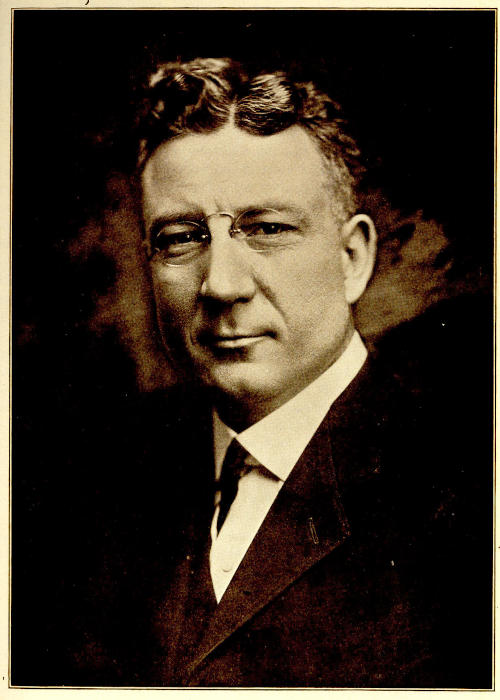
Darius A. Brown, Mayor of Kansas City
“TAPERING RATES.”
I have spoken of the difficulties which confront the people of the deep interior of the continent in working out their complete industrial development. By complete industrial development, I mean that full growth in industry which has come to such seaboard locations as Great Britain, the Netherlands, our Eastern seaboard, our lake regions and the like. One can scarcely conceive such complete development in Iowa, Nebraska, the Dakotas, or Oklahoma. And yet it is merely a question of transportation. The problem of the future relates to the question of the ability of land carriage of any kind to furnish it. If it cannot be accomplished by land carriage, the Nation will have recourse to waterways. [98]New Rockford and her sister hamlets will reach the sea, either by the way of the railroads, or by the Missouri river. If the railways are to give New Rockford—and in her I typify all the interior—what it must have if it is to develope completely, they must find some way to compensate the place by means of rates for its remoteness from the sea.
This may be done by what is called “tapering rates”—that is, by rates which increase not with the distance, but on some basis which gives the remote point a less tariff per ton a mile than the nearby point. The railroads have made such rates always when the demands of profit called for them; and their policy has resulted in great benefit to the interior; but the diverse ownership of the different lines and restrictive laws, as well as the lack of a national policy in rate-making, conspire to prevent the full application of the principle. Congressman D. J. Lewis of Maryland has laid down the principle that rates along a line should increase with the square root of the distance, instead of with the distance. Thus, if the proper rate per hundredweight for twenty-five miles is ten cents, for 625 miles the rate should be not $2.50, which would be the increase directly with the distance, but twenty-five cents, the increase over ten cents according to the square root of the distance. The value of this formula may lie principally in the emphasis of the economic justice, as well as the necessity, of tapering rates for long hauls. As it is, rates taper from New York to Chicago, not according to the square root formula, but in a manner not very much at odds with it; but then they are increased by the fresh start from Chicago as a basing point. Under a national policy in rate-making, these rates would continue to taper to the point at which it would be more economical to ship in some other direction—to the Pacific, or to the Gulf.
The influence of tapering rates on the industrial development of a people may be seen strikingly manifested in Texas, which has long had a rate system peculiar to itself. This system is said to be the fruit of the statesmanship of Judge Reagan, and was devised expressly in the interests of a population deemed to be permanently agricultural. It is exactly the opposite of the general policy which has built up a few great cities at the expense of the rest of the country, and the best or worst example of which is perhaps the case of Chicago. Chicago is fed by livestock shipments which sweep past the very doors of packing houses quite as well equipped to slaughter the stock as any in the Windy City, and the livestock rates are only a sample of the system of tariffs that keep in Chicago’s hands the headship in commerce to which in the natural development of things she would not be entitled. Railroad rates keep the great centers great by decreeing that the primary products shall be sold there, and that the supplies of goods ready for consumption shall be bought there. This is done by depriving other trade centers of the natural advantages over Chicago, of their nearness to the farms, while leaving them handicapped by their remoteness from [99]water transportation. And wherever a great city is found in the United States, the same sort of rate structure is found. The economic result is that long hauls are favored for the railroads, with greater profits to them perhaps; but the farmers are deprived of the benefits of the home markets which nearby large cities afford. The state of Iowa is Chicago’s back field; and Iowa’s population is shrinking. This fact alone is enough to condemn the rate system which permits it. And Iowa’s case is glaring merely because she is an almost purely agricultural state. The farm populations of the other states on Chicago’s back fields are shrinking, also. And while I do not think it fair to attribute all this to rate mal-adjustments, I feel sure that if the Texas system of rates had been in effect in the Chicago-St. Louis basin, the phenomenon of decreasing population would have been long postponed, and might never have appeared.
THE TEXAS SYSTEM OF RATES.
The Texas system, as perfected by the Texas State Railway Commission, is based on the theory that many medium sized towns and cities are to be preferred, for the agricultural welfare of the state, to one or two overgrown municipalities with rates made to stimulate their growths at the expense of the rest. This has been accomplished by the establishment of a maximum freight charge, above which there can be no increase, no matter what the distance—with the exception of certain remote points in the cases of which additions are made, not according to the entire length of haul, but according to their distance beyond the limits of the zone which is established about every shipping point. Thus merchandise taking the class rates pays a tariff from any shipping point according to distance, up to 245 miles, beyond which the rate for 245 miles is paid no matter what the distance. The maximum rate on cotton is reached at 160 miles from any station; on flour, grain and hay at 140 miles; on coal, 790 miles; on fruits, vegetables and melons, 180 miles, and thus for all shipments. The result is that the remote truck farmer is as close, so far as rates are concerned, to the city 500 miles away, as to the one 180 miles off—and the principle is applied to all producers, with variations as to distance. This gives him a wide choice in markets and rates, which equalizes conditions so far as rates can do so, between the interior and the coast. And it fosters the small and new city by enabling it to compete in jobbing and manufacturing with the large and old one. Thus, while such places as Galveston, Houston, Dallas, Fort Worth and Waco are among the most prosperous towns of their size in the country, they are constantly meeting the competition of that numerous class of smaller Texan cities the unsuspected presence of which in the interior is such a constant surprise to the traveler from the North. Business is decentralized to an extent nowhere else seen in the United States in an agricultural community. And decentralization, while opposed to the immediate interests of the railways, [100]is clearly profitable to the farmers, better for the people in general, and in all probability will prove in the end better for the railways themselves. For after all, railroad prosperity must depend on national prosperity.
It may be said that the Texas system has been tried out on a small and a state scale only. On a state scale, truly, but not on a small scale by any means. From El Paso to Texarkana the distance is almost exactly that from New York to Chicago, and from Brownsville to Texline is as far as from Kansas City to Winnipeg. Moreover, Texas has most of the problems which confront the Nation itself in working out a national system of rate-making—a coast well settled and old in development with all the wealth and power that the conditions imply—a hinterland ranging in conditions from fine farming land like that of Iowa, through semi-arid to desert. The Texas rate system may not be the last word in rate-making, and probably is not; but it seems to work well, and is certainly worth study. As will be seen at a glance, it is a modification of the systems of tapering rates suggested above—in which rates taper to a point where a maximum is reached, and then cease to increase at all. It is also a modification of the zone system in effect on certain foreign railways, under which within certain territorial limits railway rates are flat, like postage. The economic basis for such rates lies in considerations of national welfare, coupled with the well-known transportation principle that the terminal charge which makes up so large a portion of most shipments, is the same for a long haul as a short one.
THE DECLINE OF NEW ENGLAND AGRICULTURE.
For purposes relating to the fostering of such interests as seemed necessary to the welfare of New England and New England’s tonnage, the railroads have themselves put in effect with reference to that section a system of rates which in some ways resembles the zone system of Europe, or the maximum distance tariff of Texas. Cut off by the tariff on imports from her natural hinterland, Canada, the decline of New England’s agriculture under the competition of the prairie lands would have brought to her a permanent industrial decline, had she not turned her attention to manufacturing. And even as to that, she was placed at a disadvantage as soon as the development of the Middle States and Middle West brought that great region to the manufacturing stage. For New England’s manufactures had to go to market through New York, and most of her raw materials had to be imported from the West and the South. The railways used their powers of rulership in the interests of this whole group of states, as they are constantly doing in the case of cities—they decreed prosperity to New England’s manufacturers through a rate system. They made of New England a flat-rate zone for raw materials, with the same rate to all points, and practically the [101]same as the rate to New York. This applies to all raw materials coming from west of a line drawn from Buffalo to Pittsburg through Wheeling. For out-going shipments, they gave all New England points a flat uniform rate to all points west of a line drawn from Cleveland to the Ohio river. That the wage earners of New England might be favored in cost of living—a feature reflected in low wages—the food products from the West are given a rate practically the same as that to New York—and thus the ruin of the old New England agriculture, already probable, was made certain. Had it not been for these imperial measures, New England’s headship in manufacturing would have been lost, first to the Middle States, and then, perhaps, to the Middle West. The expedient differs from the Texas system in the fact that it is applied partially and in the interests of manufactures, with New York as a center, while the Texas system is applied for the purpose of decentralizing business by making every shipping point the center of its own flat-rate zone.
But the most striking illustration of the power of the railroads to foster or to blight industry, lies perhaps after all in the field of agriculture. And it so happens that it is also the instance of the application on the broadest scale of the zone principle in which all rates are the same to all points within certain territorial limits. I refer to the rate structure which has been built up for the transportation of the citrus and other fruits and vegetables of the Pacific coast and the Pacific Northwest to the markets of the eastern half of the continent. While the principle is applied with more or less completeness to shipments of deciduous fruits and truck, it is best studied in its relation to citrus fruits. Oranges and lemons go to all points east of Denver at a flat rate. From Cheyenne, Wyoming, to Eastport, Maine, the rate on citrus fruit is the same. The effect has been most beneficial to the agriculture of the Western quarter of the United States, to the people at large, and to the railways. Whether or not the rates are just, the principle upon which they are made is conducive to the development of agriculture and is, perhaps, essential to such development, when the industry is hampered by land carriage over great distances. And nothing need be said in addition to citing these instances of the determinative effects of our railway rates on the course of prosperity, in spite of the averages which seem to show the economic unimportance of rates.
SOIL DEPLETION.
Thus far, I have discussed the influence of railroad policies upon the farmer as a man engaged in one of the many industries which make up the sum of industrial activities. But there are certain respects in which the farmer represents the everlasting welfare of the race, and certain demands which he may legitimately make on the transportation agencies of the land which are based on every man’s heritage in the soil, and interest in its continued fertility. The depletion of the soil [102]by cropping is largely accomplished through transportation, and its restoration to fertility must be accomplished, where such restoration is necessary, in large measure, through the same agencies.
The soil is a reservoir of plant food. Most of the dozen or so elements used by plants in building themselves up from the soil are found in it in such great abundance that we need take little care for their conservation. Only three—or possibly four—are so scarce as to call for anxiety. These three are nitrogen, potash and phosphorus.
Potash is ordinarily found in soils in such quantities as to render its application unnecessary and yet there exist localities in almost every state where a marked poverty exists in this element. Peaty soils are always deficient in potash, and as the swamps of the Nation are drained the potash problem will grow in importance. Commercial potash is mostly imported from Germany, where the government’s conservation measures have already brought its export into the field of somewhat vexing diplomacy. The German supply would seem adequate for the world’s demands for many centuries. The deposit underlies more than a million acres, and in the Strassfurt district, where it was discovered some fifty years ago, the total thickness of the potassium-bearing strata amounts to the astonishing depth of 5,000 feet. It is estimated that this wonderful supply at the present rate of mining will last 190,000 years. It should be remembered, however, that reclamation activities are likely more and more to be directed to swamps as the arid regions are brought under irrigation, and that the drain on the German potash deposits is likely to increase in a geometrical ratio. Our Government does well, therefore, to push diligently the search for potash deposits at home, which it is doing with some prospects of success. In any case, we are not dependent on the German deposits as an ultimate fact; for the waters of the sea are the source from which these great deposits originally came, and there seems no reason to doubt the ultimate feasibility of obtaining potash for all future time from that inexhaustible source, if the geological deposits fail or are denied us. But the matter of getting potash to the land, from whatever source it comes, is a railroad problem in most cases.
IMPORTING FERTILIZERS.
Since the guano deposits of the Pacific islands, and the nitrate deposits of Chili were opened to the agriculture of the world, the carriage of nitrogen to the soil has been a great transportation feature. For nitrogen is often the limiting element in the soil. It exists in the earth in small quantities only, and though all cultivated plants are bathed in a limitless sea of it in the atmosphere, they have not the power of using any except that which is fixed in the soil. They starve for nitrogen, while blown about by winds filled with it. Not all plants, however, are so helpless in the matter of taking nitrogen from the air. The plants [103]grown as crops are utterly unable to help themselves to the plentiful atmospheric supply, but certain minute plants called bacteria have the power denied to those of higher organization, and it is certain that almost all of the fixed nitrogen in the earth’s crust, in the guano beds, in the nitrate deposits of Chili and elsewhere, has been taken from the air by these bacteria, aided perhaps by certain fungi which grow about the roots of plants like the oak, and by the negligible fixation of nitrogen by lightning. These bacteria are coöperators with certain plants of the bean family—clovers, alfalfa, vetches, sweet clover, beans, peas, velvet beans, cowpeas and the like. The microscopic plants grow on the roots of these legumes—and to some extent free, or associated with non-leguminous plants—on the basis of mutual aid. The bacteria reach out into the soil and fix nitrogen for the legumes, and the legumes furnish a host on which the bacteria live, just as we furnish a host for the bacteria of disease. And when a crop of any legume is plowed down into the soil, it is found to have added to the land nitrates to the value, sometimes, of more than twenty-five dollars per acre. Thus by setting in motion the forces of nature, the farmer may draw nitrogen from the very heavens above his farm, without money and without price. This is perhaps the most vital agricultural discovery of the ages.
But how, you may say, is the nitrogen supply a matter of concern to the railroads, if nitrates may be drawn from the air? Unfortunately, there is work for them to do in assisting the farmer to adapt conditions in his soil to the needs of these bacteria. For some reasons, the bacteria of the clovers and their leguminous cousins will not do well in a soil that is acid; and soils tend to become acid through cultivation. Acidity is the bane of the older farms of the United States. When acid phosphates are applied for the purpose of furnishing phosphorus to the crops, the very process of fertilization tends to produce acidity. Most of the prairie soils were originally alkaline, and finely adapted to the growth of the favoring bacteria of the legumes, but plants that thrive on acid soils—especially the sorrel—are appearing in the prairie states of the Mississippi Valley, and wherever they appear, clovers cease to thrive.
THE VALUE OF LIME.
Nature’s remedy for acidity in the soil is lime. The basis of the great alfalfa industry in the West and Southwest is the high percentage of lime in the arid soils, which have retained this precious element through that very dryness which, until irrigation redeemed it, made some of it a desert. Now lime is needed over a great part of the United States east of the Mississippi. Even where the soil is of limestone origin, it may have become acid by the dissolving of the lime out of the surface soil. In Wisconsin a great area of otherwise good land has been found to be acid, though a stratum of limestone lies only a few feet below the grass roots. The abandoned farms of New England need [104]lime. The old farms of New York and Pennsylvania, and all the South, need lime. Wherever the legumes fail to arrive, lime is a prime need. Carbonate of lime is the basis of legume culture, and successful agriculture everywhere—in China, in Japan, in India, in the highly cultivated nations of Europe—is based on leguminous crops. The supply of nitrogen to these states of ours in which agriculture has languished must be restored through lime in the soil and rotations in which legumes shall have large part. And the supply of lime is essentially a transportation question.
Lime is one of the most plentiful of the elements necessary to agriculture. Its application to the land has in some periods achieved such bad repute that there is a maxim among farmers that lime makes the children rich but the grandchildren poor. The evils referred to, however, arise, I believe, from the application of caustic lime, and are not necessary to the use of lime. It has now been determined, I believe it is safe to say, that raw ground limestone is the best form of lime in which it can be given to the soil. It may be applied in any amount without injury. If raw ground limestone could be spread an inch deep over the farms east of the Mississippi (and in many localities west of it) it would bring about a condition which would soon swamp the railroads with tonnage; and while there are some favored soils to which it would do no good, it would nowhere do any harm. It would put the East on a parity with the alfalfa lands of the West in the matter of the production of legumes, and would bring hope to the discouraged farmers who strive against the obscure evils of increasing soil acidity.
Limestone occurs along the lines of every railway. It is almost as common and cheap as gravel. It can be ground cheaply, and cheaply shipped. It should be furnished to the farms at gravel prices. Burned lime is sold at almost prohibitive prices, and thousands of farmers who know their needs are deterred from satisfying them because of poverty. This is a problem which enlightened statesmanship should solve in the interests of the Nation, and one to the solution of which a railroad system operated in the interests of the national welfare would surely address itself.
PHOSPHORUS.
Phosphorus is the element which is perhaps most commonly lacking when a soil is infertile. A good soil should contain not less than 2,000 pounds of it in the top foot of ground. Many so-called exhausted soils are reduced to less than a sixth of this amount. A crop of corn of a hundred bushels to the acre takes from the soil of each acre twenty-three pounds of phosphorus; a fifty-bushel wheat crop takes sixteen pounds, a two-bale cotton crop takes thirty pounds, and other crops in like manner subtract from the phosphorus supply. Only about one per cent of the supply is available to the crop of any one year—that is, in their hunt [105]for phosphorus the rootlets are unable to find more than one atom in a hundred. Thus we see that a good soil provided with 2,000 pounds of phosphorus to the acre within reach of the roots cannot produce a 100-bushel crop of corn. Such a crop must have twenty-three pounds of phosphorus, and the roots can find only twenty—and the next year the supply will be reduced to 1,980 pounds, and the roots will be able to find but nineteen and eight-tenths per cent of phosphorus for the dwindling crop. The 2,000 pounds of phosphorus would be quite adequate to the needs of the fifty-bushel wheat crop, but it would fall short by one-third of meeting the demands of the two-bale cotton crop. As so of all crops. They draw on the supply of a limiting element, and as successive croppings reduce this supply, the crop falls off until we have the four-bushel wheat crop, the ten-bushel corn crop, the third-of-a-bale cotton crop, which marks the ruin of the farmer—and the railway.
There is no way to supply phosphorus to the soil save by carrying it upon the land and applying it. It is not found, like nitrogen in the air. It may be brought back in manure and the bones of slaughtered animals, and the process of depletion retarded, but this game is inevitably a losing one like those gambling games in which there is always a percentage in favor of the house. The fertility flushed into the waters of the earth through sewers, the waste of manure, the leaching of soil by rains—all these are the percentages in favor of the house, and against the players. The players are we—the human race—and the house is the massed forces of nature. There seems to be no way to play this game of life without losing. If the earth ever becomes unable to sustain human life, there is good reason to believe that our doom will reach us through failure of the supply of phosphorus in the soil.
There is no phosphorus in the air, and in the waters the supply is negligible. It is an element, and until we discover the secret of the transmutation of elements we cannot make it. As it disappears from the soil there is no source of replenishment of the supply, except in the phosphate rocks of the earth. And while the failure of the soil to give its increase, and the depopulation of the earth through the exhaustion of this element of plant food may seem remote and speculative, the necessity of transporting the phosphate rocks from the quarries to the farms is an actual and present one. And it is a matter which lies within the relations between the railroads and the farmers.
PHOSPHATE RESOURCES.
Fortunately for the permanent agriculture of the United States, the largest known deposits of phosphorus in nature are within her boundaries. Guano, which is merely the manure accumulated on rainless islands where seabirds congregate, is of very limited importance in the long run, though for so long the source from which most of the world’s commercial phosphates were derived. The phosphate rocks of the world are, so far as known, preponderantly in the United States. All the [106]phosphate rock now mined, I believe, comes from the three states of South Carolina, Florida and Tennessee—whence the rock is now shipped at a rate which will exhaust them about the year 1930. On three Pacific islands are known deposits of high grade rock of about the same amount as that still remaining unmined in these three states—about 60,000,000 tons in each case. These rocks contain from sixty to eighty per cent of calcium phosphate. As they fall off in output, and the need for phosphorus becomes more bitter, the farmers must use rock of lower and lower grade, and the task of transporting it will become proportionately greater.
Indeed, the task of transportation will begin to increase long before it becomes necessary to resort to the low grade rock. For far from the depleted lands, in Utah, Idaho and Wyoming, are the greatest high grade phosphate beds in the world—something like half a billion tons of rock practically in sight (according to Van Hise), and averaging over seventy per cent tricalcium phosphate. The existence of these great deposits, and of the low grade beds known to exist elsewhere, together with the probability that other beds will be discovered, justifies the highest optimism as to the future of agriculture—if transportation facilities can be afforded which will place the phosphates on the ground on terms tolerable to the farmers and profitable to them. This is a railway problem. As a mere matter of tonnage it is potentially greater than any other transportation item, save the one of supplying the fields with lime.
At present this sole supply of available phosphate rock is being carried off to Europe as fast as the mills can grind and the railways carry it to the ships. Nothing is being done to conserve the supply, so far as I am aware, in emulation of Germany’s statesmanship in conserving her potash beds. It would be unfair to blame the railways which only act as common carriers in these shipments. But it might not be too much to expect of the patriotism of the men who have these great interests in hand to ask them to reverse the policy which they have adopted as to many other commodities, and to make higher rates for export on phosphate rock than for home consumption. The real remedy for the drain of phosphorus lies, of course, with the Government. We are forbidden by the Constitution to stop shipments abroad by means of an export duty, but we have the right to stop exports entirely, or to limit them. Our ethical right to refuse to divide the phosphate treasures with the needy agriculture of the world may be open to question; but we might surely demand that the foreign deposits be worked first for the foreign demand. The shipment of our phosphates abroad, with the certainty confronting us that at some future time we shall have to re-import the same commodity, involves an economic waste to which the world should not be subjected. And the railroads ought, in their own interests, to adopt every policy legally open to them to keep the phosphate rock for the use of the farms within their own transportation territory.
[107]
RATES AND FERTILIZERS.
It has just been suggested that the railways might discriminate in their rates on fertilizers, in favor of the home market, and against the foreign. Most railway men are probably unaware of the extent to which they are contributing to the exhaustion of our soils by their discrimination against the American milling of American grains and in favor of the export of the whole grains instead of the milled product. For generations we have had a tariff on wheat, ostensibly for the protection of the American farmer; and all the time the railways have made rates for export wheat lower than for domestic milling. Flour is largely denied the benefits of water transportation on the lakes, in part because it must go to market over the docks which are to a greater and greater degree controlled by the railways, while the great elevator companies with their terminal houses standing at the water’s edge, and many of them provided with their own lines of boats, send wheat and other grains to tide water so cheaply as to make the shipment of flour a thing practically under the control of themselves and of the railways with which they have been traditionally closely affiliated in business interest. The result has been that, while there are mills enough in America to grind all our grain, most of our exports go unground.
This will be intolerable to public opinion when once enlightened upon the subject. The export of flour, of course, constitutes a drain of fertility; but the phosphorus content of the grain is largely concentrated in the bran and shorts. In the bran of every bushel of wheat exported goes phosphorus in its most readily available form of the value, at the ordinary rates paid by farmers for phosphates, of from twenty-five to thirty cents. A system of transportation based on considerations of national welfare would sedulously seek to retain that fertility for our depleted farms. Where grain is milled there grows up a large local use for bran, shorts and middlings—the by-products of milling. These are used in the feeding of dairy cattle and other live stock, furnishing what is needed in animal nutrition to balance the corn ration. Farms to which they are carried for feeding increase in fertility. The fertility of the prairie states has been sapped by fifty years of grain shipments. This era should be succeeded by the golden age of American milling. The wheat fields of Canada stand ready to send us fertility to replace that which we have shipped to Europe; and our transportation system should be used to the end that it should be retained here. The Hudson Bay basin would thus, during its period of soil exploitation, return to the Mississippi Valley what we have sent to the hungry soils of the old world.
RAILROADS AND POPULATION.
The existence of overgrown cities is to a large extent attributable to the policies of the railroads with reference to them. The Texas system has, I believe, shown the power of transportation influences to [108]decentralize population, just as the history of Chicago, Kansas City, the Twin Cities, New York and almost every large city proves their power in the direction of centralization. As a farming factor, the large city is a drain on fertility. These great towns are flushing out through their sewers the goodness of the Nation’s farms. In the carriage of lime, phosphates, potash, cottonseed meal, bone meal, and of all the fertilizers of commerce, the railways as national tools of right living should be used to restore to the lands the fertility of which they have inevitably, in some instances, mistakenly in others, deprived them. But in considering the so-called commercial fertilizers, the coarser manures should not be forgotten. The enormous waste of manure about the great cities should be stopped. A German farmer of my acquaintance told me the other day that he had never sold a load of hay or straw from his farm in all his life. “Often,” said he, “I have had more than I needed, but I have held it over, even when the price was high and I needed money. It seemed to me as if that hay and straw didn’t belong to me, but to the farm.” Under the renting customs of many British and other European localities the tenant agrees that whenever he hauls hay or straw to market he will haul back to the farm an equal quantity of manure.
This custom is based on the highest wisdom. The German farmer was right—that hay and straw do not belong to the farmer, but to the farm. And whenever hay or straw, or any of the vegetable substances which are made into manure, are taken to the city, they should be considered as lent, not sold. Getting them out to the farms—not the identical farms, of course, but the farms—is a railway problem. And it should rest on the conscience of the people and of the railways, as did the similar problem on the conscience of my German friend.
I am aware that the railways of the country are not entirely oblivious to the wisdom of the policies here urged upon them. In some places they are making commendable efforts to get the manure of the cities out to the farms. In other instances, they are making what they probably regard as very low rates on fertilizers and lime. Just recently a railway in Virginia has made a rate of from one-half to three-fourths of a cent per ton mile on lime. But I do not find that they have anywhere made any such heroic efforts to cut down the cost of carriage of fertilizers and manures for the farms, as they have in the case of coal from the mines to the docks on Lake Erie, or grain from the elevators at the foot of the lake to New York, or ore from lake ports to Pittsburgh, or packing house products from Missouri river points to Chicago. In my opinion, true national welfare demands that the fertility of our farms be sustained at all costs, and that no freight is entitled to rates as low as ground phosphate rock, ground limestone, and manures.
[109]
THE GREATEST RAILWAY FOLLY.
The demands made here upon the railways may be regarded in some quarters as unwarranted. I am quite aware of their scope and character as innovations. They go deeper than the relations between the railroads and the farmers, and rise to the point of an outline for a national rate policy for our railways. In what I have said I have regarded the railways as public utilities in the strictest sense of the word. I have scarcely more than alluded to the rights of investors in railway properties, and I mention them now for the sole purpose of stating that in my opinion no demands will ever be made in the interests of the public welfare, or should be made, inimical to the rights of investors to a proper return on their investment made for the purpose of serving the transportation needs of the Nation. None of the things which I suggest are at variance with these principles. The railways may properly adopt the policy of hauling, or may properly be forced to haul certain public necessities at or for less than cost, so long as on the whole job of transportation they are allowed to earn legitimate profits. I do not believe that in the long run the profits on the fertilizer traffic should be made directly out of their haulage. I do believe that the time will come when no transportation folly will rank as greater in the eyes of our railway managers than that of allowing rolling stock to remain idle, while there is a chance to get loads of ground lime, ground phosphate rock or manure at almost any rate. I am not unaware of the various private interests which would demand and secure monopoly prices if the railways should transport these things at low rates or even gratis, if that were possible; but this is not the time for the discussion of these things. They must be dealt with by the statesmanship of the future. Institutions must be gradually moulded to the end that the agriculture of the Nation may be enabled to flourish; for on its agriculture and the status of its agricultural population rests in the last analysis the welfare of the Nation and its railroads. It may be urged that the present railway system of the land will not permit of the exercise of the beneficent functions outlined here. If that be so, it is no affair of mine. My task is to follow truth as I see it, wherever it may lead. If the railway system under which we happen to be doing business be at variance with the final demands of national welfare, there is ground for optimism in the historic fact that nothing changes more readily than railway systems. They have been almost revolutionized in the past decade—and these considerations of national welfare of which I am here privileged to speak will take many decades in coming to a final decision.
Mr. Quick closed by reading the following telegram from O. C. Barber of Akron, Ohio:
Regret exceedingly my inability to attend Conservation Congress. I note from several different programs there will be distinguished speakers on the question from all over the states. I hope as a result of the meeting something more than speeches will be accomplished in conservation of the equities of all American citizens. [110]Things vital for their comfort have been transferred to corporate power by unjust legislation, without adequate legal restraint on corporate power compelling fair play and justice to all interested. A special interest should be elicited to compel a rate of freight on all fertilizers for land from which we all derive our sustenance. Not more than four-tenths of a cent per ton mile should be permitted for long hauls, nor five-tenths of a cent per ton mile for short hauls. Any well managed railroad could haul fertilizer for that price at a profit—referring to all kinds of fertilizer, lime, phosphate, rock, etc. If you would take such action as would accomplish this one thing, you would do more for the good of mankind than all the conservation efforts have accomplished to date. Wishing you great success, I am sincerely,
O. C. Barber.
President Wallace—I have appointed the following committee on nominations: C. E. Condra, E. G. Griggs, A. B. Farquhar and H. C. Wallace, and B. N. Baker, Chairman.
Get together and be ready to report nominations promptly tomorrow. Remember, we will have a very busy Congress. I want you to be here at 2 o’clock promptly, because we will commence at 2 o’clock if there is anybody here, and some of you will be. This afternoon, I am very sorry to say, we will not have the privilege of hearing Brother W. H. Page. I have a letter stating that sickness prevents his attendance. Instead of that we will take up the report from conservation committees, and as far as possible from the states. Let me urge you to cut your speeches down to five minutes, or I will shut every man off after five minutes, no matter who he is. Don’t tell us about your resources. We know about them. Tell us what you are doing. Make it specific and to the point, and then this Congress will hear you patiently, but they won’t hear you after that, and I won’t either. We must come down to business. This afternoon we are to have Professor Mumford on the subject of live stock and soil fertility, a matter of immense importance. The ladies will come in after that, and I hope you will all bring your wives and sisters and cousins and aunts. We will have an address on the “Farmer’s Wife,” who you have heard is the most important person on the farm and the one who bears the greatest burden—by Mrs. Ashby of Iowa, followed by Mrs. J. N. Lewis of Kansas. Tonight we are to have a great treat. Mrs. Moore of the General Federation of Women’s Clubs; then the “Church and the Open Country,” by Dr. Warren H. Wilson, New York City, superintendent of home missions of the Presbyterian Church, and then finally, to round up, an address by Dr. Harvey W. Wiley, Washington, D. C., Chief of the Bureau of Chemistry, United States Department of Agriculture, of whom you have all probably heard. That will be the closing address this evening. Be here promptly at 2 o’clock. The Congress will now stand adjourned until 2 o’clock.
[111]
Recording Secretary Gipe—Will the Congress please come to order. The Rev. Dr. George Hamilton Combs will pronounce the invocation.
Almighty God, our Heavenly Father, we thank Thee for this world in which we live; for its beauty, for its adaptation to our needs, for the skies that arch it over, for the grass beneath our feet, for the seasons with their lessons, for all the wonderful stories of life. Thou hast made it for man and Thou art in it now. Help us to realize that this world is instinct with Thy life, and may we see and hear God, not only in the skies and in the singing of the stars, but in the humbler things beneath us, and in that stiller music of all growing things. May we seek this priceless heritage, may we preserve this good world unimpaired, handing it down enriched and beautified, to our children, those who shall come after. We thank Thee for this Congress and for the great purposes and ideals for which it stands, and upon the men and women gathered here we pray Thy blessing, upon their homes while they are absent, that their children, their wives, their all, may be defended from harm. Upon them, in their deliberations here, grant that in wisdom they may plan and in strength they may execute, and that they may have a vision, not only of the day, but of the years that shall come after. We thank Thee for this good work, and oh, do Thou help us that we forget not that while in the pursuit of this material good we do err; that after all and that above all the riches of our people are not in the mines, in its fertile fields, in its forests, but in its men and in its women, and so send us the greater harvest, not merely of corn and wheat, but of charity, of goodness, of the great and patient fidelities of life, and help us all to live that we shall have advanced at least a little the coming of the day when righteousness shall cover the earth even as the waters cover the sea. And so upon this earth of ours may God’s sovereign will be done even as it is in Heaven. Amen.
Recording Secretary Gipe—I am asked by Mr. Baker, the chairman of the committee on nominations, to announce that a meeting of that committee will be held at 3 o’clock this afternoon at room 775 of the Baltimore Hotel. I now have the honor to present Governor R. S. Vessey of South Dakota, who will address the Congress and remain in the Chair after he has finished that address. Governor Vessey of South Dakota. (Applause)
Governor Vessey—Mr. Chairman, Ladies and Gentlemen of the Conservation Congress: I have no set speech to make this afternoon, and I think, if I remember aright, the president said we would be permitted to talk five minutes on what we have done in our state in regard to conservation. So I just want to enumerate a few things that we have done up in our new state, practically only of age, twenty-one years old, in the past half a dozen years. We have reclaimed, by drainage, several hundred thousand acres, and we are reclaiming by irrigation something like a quarter of a million of acres, and nearly one-half of that is a Federal enterprise. We are in all parts of the western part of the state planting newer and similar individual irrigation plants that will develop a large part of the state. We have in the past been endeavoring to conserve the fertility of our soils. We are endeavoring to conserve manhood and womanhood by making them more efficient in the great agricultural work, by sending out into their community and out in their neighborhoods teachers along the line of agricultural and domestic science, and other matters pertaining to make the home more efficient and more [112]modern. We believe that the time is coming, and that very soon, when every rural district will have a social and educational center for the upbuilding of that community. And when that is done, I look to see the day when the people will not, as soon as they have accumulated some wealth, move into the city for the purpose of giving their children an education, largely so they may enter vocations in life other than the farm life. We believe also that the heart should be educated the same as the mind. A committee of educators in our state has reported, not only along this line, favorably, but they have compiled a text-book and are introducing it into our schools, and we expect that our teachers will be trained along the lines of giving to our students ethical as well as material education. So that we can, at the same time we are improving the mind, build a character that will mean more to us in the future than the accumulation of dollars and cents. We have, I think, a progressive state, and we want to create conditions so that people from the further East and the more congested centers of population will find a haven of rest and a place where they can come and not only better their financial condition but better their social condition as well. I appreciate very much indeed having this opportunity of saying these few words in the interest of the conservation of our resources. I think that we have been looking so long upon the land that has been turned over to us by the United States Government, as something that is only for use for our own material well-being. We are beginning to learn that we are only here for a short time, and that if we are going to be honest with those that are coming after us, that it is our duty not to rob that soil, but to turn that soil over to our children, and from them to their children’s children, in just as good a state of fertility as it comes to us in its virgin state. And when we do not do this, we are robbing our posterity of something future generations are entitled to, that they are just as much entitled to as they are to our good name. And this, I believe, is a wonderful revelation. And it seems to be taking all over the country, to know that in farming a section of land that I have an obligation to those who may farm it a hundred years from now, and that it should be my intention, that it is my duty, and I am under obligations to keep that in just as good state of fertility when I leave it as it is when I take the responsibility of taking the products that are needed to sustain life from that land. It is a pleasure to meet the people of this Congress, the Third Conservation Congress. Now we will listen to the further program by the secretary.
President Wallace—I have great pleasure in reading to this Congress a letter from a man you have heard about, commonly known as “Teddy.” (Applause. Hurrah for Teddy.) I wrote him a month ago and asked him to address this Congress. He declined to do so, but I would not accept his declination. Then I had a letter from him, a personal letter, which I did not care to read to this Congress without his permission. Unfortunately, I do not have it here, but expect to get it [113]this afternoon or tomorrow from my office in Des Moines. So I will simply read you the letter giving permission to read another letter which I do not have, but you shall have if I get it in time. Here is the letter:
My Dear Mr. Wallace: I greatly wish I could attend the Congress. You are very welcome to read as much of my letter as you desire, or as much of this letter as you desire. I most emphatically believe that there is no movement in our country at the present time of such importance as the developing of a higher country life. This was the object of the Country Life Commission which I established. What we need most is good citizenship; that is, a good family life, a high quality of individual manhood and womanhood; and above all things, we need these in the country districts, for in the long run every nation’s welfare must primarily depend upon the welfare of those who till the soil. The man is greater than his work. The farm can only be made what it should be by paying chief attention to the securing of the right man and woman on the farm. To develop soil fertility, we must develop rural manhood and rural womanhood. We must have a social life on the farm far better worth living than such life has been in the immediate past. Pray accept my heartiest sympathy and good will. Very sincerely yours,
Theodore Roosevelt.
(Applause)
Recording Secretary Gipe—We are now going to have brief reports from some of the national organizations. Mr. W. E. Mullin of New York will report for the National Board of Fire Underwriters.
Mr. Mullin—Mr. Chairman, Ladies and Gentlemen: The National Board of Fire Underwriters has been interested for many years in every element of conservation. They believe in the conservation of the soil, the conservation of the waterways, the conservation of the mines, the conservation of childhood and the conservation of our homes. We believe in everything that savors of practical conservation, but they are specially concerned in the conservation of our utilized forces.
[Mr. Mullin’s paper in full will be found in Supplementary Proceedings.]
President Wallace—I must ask a favor. I will not ask the Congress to listen to more than three-minute speeches on these reports, and I wish all the speakers to understand that when that bell rings it is time for them to quit. They must learn to boil down. (Applause) As I said before, we do not care about the resources of your states. We can read that in books. We want to know what you have done in the way of conservation. You can say all you ought to say in three minutes. Moody used to say that a man had no business to pray more than three minutes, that he could ask the Lord all he really wanted in three minutes, and then it was time to quit. (Applause)
I take pleasure now in introducing Major E. G. Griggs, president of the National Lumbermen’s Manufacturers’ Association, who will give the report for that association.
[Mr. Griggs’ paper is in Supplementary Proceedings.]
Chairman Vessey—We will now hear from Mr. W. J. Rushton, of the American Association of Refrigeration. I have pleasure in introducing him to you.
[114]
[Mr. Rushton’s paper will be found in Supplementary Proceedings.]
Chairman Vessey—We will now hear a report from Hon. E. T. Allen, Forester for Western Forestry and Conservation Association, entitled, “Private Conservation on the Pacific Coast.”
Mr. Allen—The Western Forestry and Conservation Association, for which I report, is a league or alliance of a dozen coöperative forest fire associations maintained by timber owners in the Pacific forest states: Montana, Idaho, Washington, Oregon and California.
These five states contain over half the standing timber in the United States. Already furnishing a fifth of the Nation’s lumber, they constitute its great remaining storehouse of future supply. In other words, they contain the mature timber which must bear the burden of bridging national shortage until an adequate new crop is ripe. Because of climatic conditions and rapid growing species, they also contain the deforested land which, by reason of adaptability, most demands encouragement to produce this new crop, to which you must turn in the future for timber as you do to this region for iron and to the South for cotton. This is why you are directly and vitally interested in what every agency is doing to protect and foster these forests of the West.
Believe as you may concerning division of responsibility between state and nation, or policies of controlling the development of natural resources; but never forget that the forest ranger is actually on the job, saving the forests for the rest of us to talk about. If he had not been there for the last ten years, the national forests would be mostly old burns not worth arguing about. We want more, not fewer, of him, and we want Congress to spend more money to hire him and build trails for him to use.
The states, too, are waking up, but progress in this direction seems slow when we consider that of the tremendously important forest resources in the West the majority is in private hands, and that it is the attitude of the commonwealth that governs the ability of the private owner to manage it to best advantage for all concerned.
All these conditions I have hinted at—failure by Congress to give the forest service adequate funds, slow awakening of state responsibility, and realization that the Pacific Coast is both the last and the most promising field of forest industry—have inspired the most vigorous and efficient private movement for forest conservation ever known—the allied coöperative associations of timber owners in the Pacific Northwest. They fully realize that the control of such a stupendous community resource entails grave responsibilities; that their ownership is largely a public trust and that they must account for their stewardship. They also know that no new fields remain and that this is by no means inexhaustible; that to avoid heavy loss they must guard the forests they have, [115]and to perpetuate their business they must have new ones coming on. Self-interest, more potent than philanthropy, demands abandonment of the wasteful methods prevalent in the past history of their industry.
With this new point of view, the Northwestern lumberman, far from being an element requiring regulation by the public in the interest of forest preservation, has become the leader in reform. It has been chiefly through his aggressive campaigning that state laws have been improved, bearing as rigidly on the careless member of his own brotherhood as upon anyone else. He gives his financial support to educational work directed at both lumbermen and public. He hires professional foresters to help him try such better management as conditions will permit. But particularly, through coöperative associations, he has taken the lead in fire prevention. And admitting his motive to be largely selfish, the benefit to the consumer is none the less. To the man who needs lumber, to keep it from burning up is conservation that counts.
After so much preamble you may wonder what we have actually to report; what we can offer in the way of results. Here are some of them: Last year was one of the worst for forest fires in American history. Loss of life and property was terrific. But the private protective systems allied with the Western Forestry and Conservation Association carried safely through the season fully 16,000,000 acres of forest, containing at least the stupendous amount of 300 billion feet of timber. They kept the loss of private timber in Idaho, Washington and Oregon, the three states hardest hit, down to one-fourth of one per cent. How did they do this? By raising and spending $700,000 for patrol and fire fighting, and actually extinguishing 5,580 fires.
It was a telegram from the president of the Western Forestry and Conservation Association, with the standing of our work behind it, that caused the ordering out of the United States Army to assist the undermanned forest service on the national forests.
This year’s records are not compiled, but will be quite as interesting. Through their alliance the associations turned to account every lesson each learned in 1910, and spread increased patrols equipped with new advantages of perfected organization, telephone and trail systems, supply storage, and automobile and motorcycles where these could be used. Organization permitted close and systematic coöperation with state and federal forces. Every association ranger served as a police officer and one Washington association alone got over thirty convictions. Offending lumbermen were made the first examples. Hundreds of fires were extinguished but not one was allowed to become serious in 1911.
Our association serves as the one and only common meeting ground for all agencies for forest protection, including state and federal as well as private fire officials, and employs a trained forester to collect and disseminate for all information that will assist in solving problems of reforestation, legislation, education and like matters demanding expert [116]knowledge or central facilities. It thus had the chief responsibility for forest legislation in several Western states last winter and did more than had been done in all preceding Legislatures.
It has published the first comprehensive book on reforestation and forest management in the West ever issued, now used as a text-book by the Forest Service and forestry schools.
It furnishes all newspapers in the Northwest with regular bulletins throughout the fire season, not only giving reliable news but keeping the necessity and method of precautionary measures before the public.
It issues hundreds of thousands of fire circulars and stickers, with a highly perfected system for putting them where they will count. This year, with the aid of state authorities, it put an illustrated folder with simple questions and answers on forest protection in the hands of every school child in the Pacific Northwest, an enterprise requiring the printing and complicated distribution of thousands of pounds of material.
It furnishes state officials and others with practically all the mottoes and catchy material used for posters and other publicity matter in the West. It has even placed this kind of thing in the time folders of every railroad traversing our forest regions.
I cannot take your time to recite the many other activities of our coöperative movement, but these will indicate its scope and method. The Northwestern timber owner is doing his part to protect your resources that he holds in trust. If Congress, state and public will do as much, you have little to fear.
Chairman Vessey—I now take pleasure in introducing Mr. Ferdinand G. Schwedtman of St. Louis, chairman of the delegation of manufacturers of the U. S. A. I have the honor to present him to you.
[Mr. Schwedtman’s paper is to be found in Supplementary Proceedings.]
Chairman Vessey—The next speaker is William Edward Coffin of New York, vice-president of the Camp Fire Club of America.
[Mr. Coffin’s paper is in Supplementary Proceedings.]
Chairman Vessey—I wish to introduce Dr. George W. Field, representing the National Audubon Society.
[Dr. Field’s paper will be found in Supplementary Proceedings.]
Chairman Vessey—Is Mr. McBrien, representing the National Educational Association, here?
Is Mr. Edward R. Taylor, representative of the Electrochemical Society, here?
Mr. Taylor—It is my pleasure to represent the American Electrochemical Society. There are ten thousand chemists in the United States. They are largely concerned in the working out of economic problems [117]and the best utilization of all substances capable of adding to our material prosperity. Many of these chemists are members of the American Chemical Society, the American Electrochemical Society, the American Institute of Chemical Engineers, and the Society of Chemical Industry, all of which societies are deeply interested in the best conservation of our natural resources and are in full sympathy with the objects of this Congress.
Chairman Vessey—We will next hear the president of the Iowa Federation of Women’s Clubs. Is Mrs. M. H. Weller present? Those who have papers that will take five or ten minutes to read can just speak on a short synopsis of their papers, and have the papers filed. They will be able to say more, so that the people will understand it better than if they only read part of the paper.
Mrs. Weller was not present.
Chairman Vessey—Is Mrs. Carl Vrooman, representing the D. A. R., here?
I am very much pleased to present her to you. (Applause)
Mrs. Vrooman—Mr. President, Ladies and Gentlemen: I feel weighted with a heavy weight of responsibility, as I am here to represent 77,000 Daughters of the American Revolution in general, but the chairman of the conservation committee of this organization in particular—a woman who has, I venture to say, done more for the cause of conservation than any other woman of our day—I was about to say than almost any man—since she is the very proud mother of Mr. Gifford Pinchot.
This society of women, “federated and organized”—to quote Mr. Pinchot, “spells only another name for the highest form of conservation, that of vital force and intellectual energy.” These 77,000 women do indeed represent a perfect Niagara of splendid ability and force—enough, if intelligently harnessed and directed, to furnish the motive power to keep revolving all the wheels of progress in this country.
But to revert from what we might do and ought to do in general, to what we have done and intend to do in particular, for conservation, a remark made by the Right Honorable John Burns of England, concerning the American people, might apply perhaps with equal force to our two-year-old conservation committee: “The American people,” said Mr. Burns, “is a very young colt in a very large field.”
The very able first chairman of this committee, Mrs. Amos Draper, inaugurated and carried on during the first year a most energetic campaign, a report of which you had submitted at the last Conservation Congress in St. Paul. The next year, however, illness compelled her resignation, when Mrs. Orton, of Cleveland, O., whose work in behalf of children is well known, took the chairmanship for the ensuing six [118]months, during which time the committee concentrated its chief energies in efforts to help secure legislation for the protection and conservation of that greatest asset the Nation has—its children.
Now that we are standing well on our feet, a committee with Mrs. Pinchot at our head, with over one hundred women on the National Committee, representing each state, and a state chairman for every state, with every chapter represented on the state conservation committee, we hope we have the country well honeycombed with women who will take an active and intelligent interest in conservation. And aided and abetted by the National Conservation Association, which has promised to furnish us with all the ammunition we need, we intend to carry on an aggressive warfare, or, to speak less militantly, an active campaign of education. For we feel, in the words of our President General, that women today—even without any articulate voice in the councils of state—without the vote that so many are striving for, and think is essential—women today, when thoroughly aroused and awake to their present unquestioned opportunities and responsibilities, as well as to their problematical rights, can wield an incalculable influence, and become most potent and resistless factors for good in helping create a healthy public sentiment—in stimulating to higher activity that organ of the body politic (so often prone to paralysis) known as the civic conscience.
But since education, like charity, should begin at home, we intend, first of all, to educate ourselves. And, for this purpose, a number of our members have come from different parts of the country to attend this Congress and learn all we can about this problem of conservation.
We are glad to know that an officer of this association has written such a capital book on conservation, and we shall make it a point to advertise Mr. Price’s book, “The Land We Live In,” among the women of the country.
We hope soon to have a department on current conservation news in our D. A. R. Magazine, giving every month items of conservation interest, which can be supplied later to the local papers.
We expect also to have something to say about the importance of teaching conservation in the public schools—not necessarily as a part of the curriculum, for children are fairly swamped these days with a surfeit of extra studies—but we do feel that conservation as opposed to wastefulness everywhere (especially in the form of domestic economy) should be emphasized and inculcated as are other virtues—such as truth, patriotism, obedience.
Conservation in the kitchen is one of the most important problems in American life, and I believe I am safe in saying that that modern knight errant, Dr. Wiley, and his board of conservation of human health by means of pure food, has the enthusiastic and whole-hearted support of every one of our 77,000 daughters to a unit.
I should like to say in passing that another man we are behind—heart and soul in his fearless fight with the beast in our modern jungle—is [119]that man who has made it his business and his mission to reclaim not waste lands, but waste lives—that great-hearted champion of the children, and of the people—Judge Ben Lindsey, first citizen of Denver and one of the first citizens of the United States.
I am aware that this is far from being an orthodox report, as it is more prospective than retrospective, and deals rather with what we intend to do than what we have already done, but we are drinking in so much inspiration here, and getting so many new ideas, that next year you may expect from us a bona fide report, fairly bristling with businesslike facts and statistics.
May I say just one more word? In addition to this definite program of tangible things we want to carry out, we pledge you something else, which, although it cannot be weighed and measured and appraised at its face value, after all may be as worth while as the sum total of what we actually achieve in a concrete way, and that is our unswerving loyalty to the spirit of what this association stands for—to put it rather pompously—our moral backing and support in this business you have undertaken to help conserve the best interests of our country—a business in which we have no intention of being altogether “silent partners,” although we are women!
We may not, it is true, formulate any new policies for you, or launch any issues, or make any very original contributions to your program, but there is one thing women can bring into a movement of this kind, and that is—to use a very much overworked word—“atmosphere.” Even if women don’t dig down into the earth—even if we daughters don’t actually dig down into the earth, like you horny-handed sons of toil—women may yet bring with them, when they put their hearts, as well as their hands, into a thing, an atmosphere that, like the air and sunshine, is absolutely indispensable to a good crop, to a bountiful harvest, an atmosphere that makes ideas sprout and grow, and ideals expand and develop and take deeper root in the subsoil of the masculine mind!
So, then, we bring today to this Congress our heartfelt sympathy with its ideals—a sympathy that is born of a certain intuitive perception we have—not by any means of all the intricate problems involved in this question of conservation—but a perception of the principles which are at stake, and we promise you our whole-hearted allegiance to those principles, as well as our contagious enthusiasm, in this splendid crusade, to conserve not only the vast natural resources of this country, on which depends our national prosperity, but those ideals of public as well as of private morality, which we realize we must sacrifice for, and defend and conserve and make to prevail, if, in the words of the Athenians, which might well be the motto of the Apostles of American Conservation, “we would transmit our fatherland not only not less but better and greater than it was transmitted to us.”
Delegate Baumgartner of California—I want to extend a vote of [120]thanks on behalf of the entire audience by your leave, to the Lord High Chancellor of the Bell for not having rung it on the last speaker. All in favor of the motion say aye. Carried unanimously.
Mr. T. L. McBrien—A while ago my name was called to speak for the committee representing the National Educational Association. I would like to say that the committee of five representing the National Educational Association met and unanimously selected Professor J. M. Greenwood to speak for our association. We want to call attention to the fact that he is the senior in educational work, having been thirty-eight years at the head of the Kansas City schools, and there is no other who has such a record.
Chairman Vessey—We have a request from the National Educational Association that it be represented by Mr. Greenwood. Shall we hear from Prof. Greenwood now, or go on with the program?
(Cries of “Hear him now.”)
Chairman Vessey—Prof. Greenwood.
Professor Greenwood—I would suggest you go on with the regular order of business.
(Cries of “Greenwood! Greenwood!”)
Professor Greenwood—Ladies and Gentlemen: The National Educational Association of the United States is the largest educational association in the world. The last session held in San Francisco enrolled 18,000 teachers from all parts of our country, and at the Boston session in 1905 there were 35,000 teachers in attendance. This organization represents in the broadest way the interests of the children of our country, and for more than fifty years it has been endeavoring to solve the great problems confronting our people. It represents the people of the South, of the North, of the East and of the West, and it has been one of the most important factors in bringing our people closely together when they were divided, not only by armies facing each other when homes were destroyed, but sadness was at every fireside. This was the organization that immediately after the Civil war brought our men and women who are working for the interests of our entire Nation together. This organization is represented here by a representative from the State of Arkansas, and by one from the State of Nebraska, and by one from the great State of Iowa, and by another one from the State of Kansas, and by another from the State of Missouri, and we have got to be shown. Mr. President, we will draft and submit a resolution to your committee at the proper time. There are just three things, it seems to me, that a public speaker who comes upon the platform ought to know—what to say, how to say it, and when to quit. (Applause)
Chairman Vessey—We will now present on the regular program [121]Dr. Frederick B. Mumford, dean of the University of Missouri, at Columbia.
Dr. Mumford—Ladies and Gentlemen: The limits of the time allowed for this subject are such that I shall have no time for the general subject of conservation. I hope, therefore, you will bear with me through this paper. I will confine myself somewhat closely to it, because in so doing I will say what I want to say in the shortest possible time.
[Dr. Mumford’s paper will be found in Supplementary Proceedings.]
Chairman Vessey—Next on the program is Mrs. Harriet Wallace Ashby of Des Moines, on the subject, “The Farmer’s Wife.” I have the pleasure of presenting to you Mrs. Ashby. (Applause)
Mrs. Ashby—The conservation movement, of which this National Conservation Congress is the exponent, has for its object the transmission of our natural resources, unimpaired, to posterity.
Any movement for the promotion of the farmer’s interest must, if it is to be a success, receive the support not only of the farmer, but also of the farmer’s wife. The first problem of the farmer is how to increase farm products through better farming; the first problem of the farmer’s wife is how to improve the condition of the farm home. The mistakes of the husband in his sphere during one season may be corrected in the next; the mistakes made by the wife in rearing her children are never entirely corrected.
Believing as I do, that the great problems of farm life as they pertain to us wives and mothers can only be solved through coöperation and organized effort, I wish to advocate the union of farmers’ wives in country women’s clubs with the object of breaking up the monotonous routine of farm life and for the discussion of anything and everything pertaining to the betterment of farm home.
The salvation of most families depends on the mother; she is the one who does so much to make for the happiness, health and long life of her family. The health of any mother is liable to fail under her responsibilities; the farm mother is especially subject to physical breakdown, for she not only bears the responsibility of rearing her family, but she also shares the anxieties of her husband if, as should always be the case, the farmer’s wife is his business partner and assistant farm manager.
The farmer’s wife is a most important factor in the conservation of the soil, for she will in a large measure determine the efficiency of the farmer. Then, too, the attitude of the wife towards the farm, and her success in making a happy farm home largely determine whether or not the country boy remains on the farm.
The average country boy is devoted to his mother. How that mother would like to clear the obstacles from his track, and to give him the best [122]the world affords. If the mother feels that the farm offers no future for her boy, the chances are the farm will lose the boy. The training which the boy reared in the city must secure before he can be an efficient farm worker, and for which he must spend time, money and enthusiasm, is the very training which the country boy absorbs from his infancy, and which makes him the most valuable tiller of the soil.
The farmer’s wife has for so many years taken no thought for herself that her now misguided conscience reproaches her if she leaves home when there is work to be done, to attend a club meeting, or if she spends ever so small a sum of money to save herself. A neighborhood club with its exchange of experiences with labor saving tools will teach the folly of expending strength and energy when by spending a little money to secure convenience and ease in work, the farm mother may be conserved to her family, and continue to be a help in the busy world. All farm women have, in a large degree, the same experiences, and therefore they can and should help each other. They should meet to discuss problems of mutual interest; they should organize country clubs with the object of securing the best conditions in their home life; of broadening the outlook of the home; of encouraging a social spirit and of elevating the character of farm life.
THE FARMER’S DAY’S WORK.
One of the most vital problems with which the farmer’s wife has to do is how to shorten the farmer’s workday. The practice of working from sun up to nightfall and afterwards doing the chores is driving the boys from the farm. If all the farmers in a neighborhood would quit work in time for a 6 o’clock supper, a long stride would be taken towards making the farm home an ideal home. Most business men’s work closes with the day, but how about the farmer and his family? When townspeople are at leisure our husbands and sons are milking the cows, bedding the horses, and doing the rest of the chores. They wear overalls so many hours of the week that they are not entirely at ease in other clothes. They are too tired to keep up their interest in the outside world, frequently falling to sleep over the newspaper. Indeed, to bed is about the only place this exhausted man of the early evening is fit to go, for a tired man is not a social creature.
Washing dishes after a late supper with a nodding husband in the next room and your nearest neighbor from a quarter to a mile away does not foster love for the farm. It need not be wondered at that we are insisting that the farm day must be shortened and some time be given to the development of the mental and spiritual, as well as the physical side of the family.
You may remember how the little waif, Glory Maguire, as she looked through the windows at rich children’s parties use to lament: “Oh, the good times going on in the world, and me not in them!” We farmers’ [123]wives want some of the good times that are going on in the world for our children; we want a social center; a club room where neighborhood gatherings can be held. We want a neighborhood library, a live church and an up-to-date school. If our children are to be more than little animals, they must go to church and Sabbath school; they must have a well ventilated, well lighted school room and an experienced teacher.
Men and women of mature judgment are placed at the head of town schools, where suitable courses of instruction and the most approved methods are pursued. The graded school teacher refers any case of insubordination, any report of vulgarity, any question of discipline, to her superintendent, yet these same teachers have been required to take months of training and practicing on country pupils before they were permitted to teach in town under a superintendent.
The country schools should have trained teachers; teachers of sound judgment in understanding the nature of the child and tact in dealing with him. A live, progressive teacher in every country neighborhood is often the little leaven which “leaveneth the whole lump.” We need fewer classes in the country schools; the long study periods are productive of inattention and mischief. If a child is permitted to spend this study time in idling and reading inferior fiction, he loses the power of concentration on his lessons and his taste for solid reading.
We need a well selected library planned for systematic reading; we need recitation benches and desks which will not produce spinal troubles. We need attractive school rooms, better furniture, good pictures and instructive maps. Part of the returns of the farm invested in the school is one of the farmer’s best investments, for all the improvements in the condition of farm life must come through education. Many helpful innovations on the farm have come about through a discussion of what the child learned at school.
We also need better playground facilities. Thousands of country children don’t know how to play. When they are at school there is nothing to play with; when they are at home there are chores, unending chores, to be done.
There is work right here for country women’s clubs to do in supplying the school grounds with tennis, croquet, and any other equally Wholesome and good sports which children can enjoy. Hence we must plan to meet and discuss our mutual problems. We need the stimulating influence which an exchange of ideas and the enthusiastic coöperation of club membership bring. We can accomplish much by the concerted effort which can only follow a reasonable getting together on the part of the farmers’ wives. Working the handle of a dry pump won’t bring results that a little priming brings. Women won’t attend a club unless they get results; they must have something to help them through the week—reading courses, and a study program, as well as the social half hour. We should study dietetics and learn how to balance the day’s [124]food; to provide such articles as will feed as well as fill the family stomach. Man must eat to live, but he need not eat nearly so much if we give him the right kinds of food. The more we study our business, the more attractive it becomes; when we cease studying it, we lose interest in our work. So country women are organizing clubs for discussion and study. When a club is conducted in an orderly manner, and every member made to feel personally responsible for its success, when its membership is small enough to seem like a big family, yet large enough to gain and hold interest of the members, it will work a revolution in a country neighborhood. Wherever a country women’s club has been organized, the women report that it gives them new energy for their home work. Out of a small club at Adair, Iowa, have grown so many smaller clubs that a joint picnic of the members and friends brought out a crowd of nearly 1,000 persons. These ladies have issued a cook book, with the proceeds from which they are enlarging their sphere of usefulness.
Another club, the Daughters of Ceres, at Bedford, Iowa, issues a calendar for the year’s work, which compares favorably with the work of any club. Country women’s clubs are usually short of money, and difficulty is sometimes experienced in securing books for study. Would it not be well for every state to supply a reading course for farmers’ wives after the example of the Cornell Reading Course? If the Government would send out a bulletin containing the essential rules of order for country clubs it would be a great help in conducting meetings. A meeting must be regarded seriously and conducted with dignity to get the best results. A little time and money expended in helping the women is well spent. When Secretary Shaw lived in Iowa he owned a number of farms. It was his practice to give to his tenants’ wives pure bred cocks and turkey toms. A neighbor remonstrated with him, saying: “You are making our tenants’ wives discontented. We cannot afford to give away pure bred poultry.” Secretary Shaw replied: “When I help the women with their poultry, I always get my rent.”
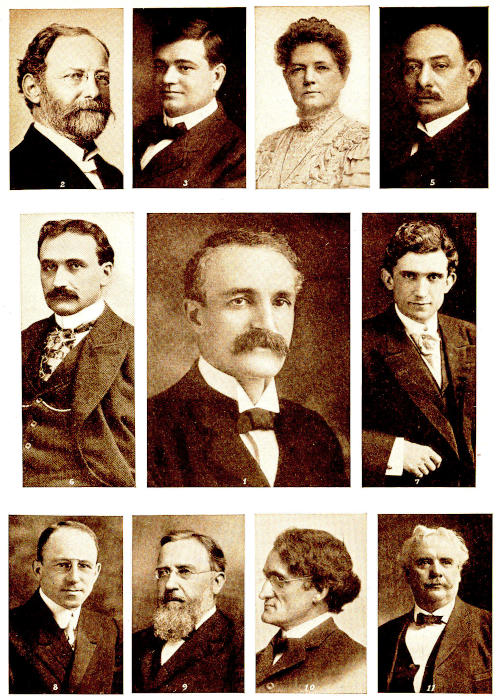
1. Gifford Pinchot, Executive Committee, 1911-12. 2. George C. Pardee, Executive Committee, 1910-11-12. 3. Henry D. Hardtner, Vice-President, 1909-1912. 4. Mrs. Philip N. Moore, Executive Committee, 1909-12. 5. Walter H. Page, Executive Committee, 1910-12. 6. D. Austin Latchaw, Treasurer. 7. Thomas R. Shipp, Executive Secretary. 8. James C. Gipe, Recording Secretary. 9. A. B. Farquhar, Vital Resources, 1911-12. 10. L. H. Bailey, Chairman Lands Committee, 1911-12. 11. W J McGee, Chairman National Parks Committee, 1911-12.
FARM ORGANIZATION.
The organization of the farmers has long been the end desired by those who are seeking to promote the country’s welfare. By reason of all his previous years of training when he has been acting on his own judgment, and working alone, the farmer is not accustomed to organized effort, and does not fully recognize its value; hence the influence of his wife in this matter is of special help. The farmer knows if he leaves home for any length of time that weeds spring up, fences fall down, cattle get off their feed and cows fail in their milk. Hence he stays at home year in and year out getting deeper and deeper in the rut unless educational and social privileges are brought to him. This the women can and will do. Through the united efforts of the women [125]the farmer is going to think less of his taxes and more of his schools; he is going to be one of an army of country men united to secure conservation of the soil through longer leases, conservation of the child through better educational facilities; conservation of the wife through the relaxation of meeting with those of her own sex, and shall I not add: conservation of the few hard-earned dollars in the purse by parcels post? The farmer’s wife, in order to conserve to the fullest extent the best interests of the farm, must be filled with the conviction that farming is the most honorable of any pursuit for a man and is a career worthy of his best endeavors and not merely a makeshift until something better offers. Such a woman will impress upon her children the thought that no calling or profession is so worthy of their best efforts; she will see to it that the books and papers that come into the family are those that treat farming and the farmer with respect. No one thing probably has had a more invidious influence in creating a desire among farm boys to leave the farm than the funny papers and cartoons which make the farmer the butt of their jokes, portraying him as the victim of the gold brick agent and picturing him with the vacant look and gaping mouth of an imbecile.
Cato, the Censor, lived at a time when Rome was at its height as a military power. He had held nearly all of the great offices under the Roman republic, yet in his old age he left this record, that: “No occupation was so worthy of the dignity of a man as that of farming,” holding that: “Farming makes the bravest men, and thoughts.” The farmer’s wife should use her influence to see that this kind of literature is kept before her children in the farm home, in the curriculum of the school, and in the school library.
In the time at my disposal I have been able to only hint at a few of the very many and diverse problems, as well as opportunities which belong to our women of the farm. I have tried to view them as a wife and mother of the soil, where, indeed, my life is cast, and my energies have been engrossed. I have endeavored to advance no fine spun theories, but to suggest a solution which can be and is being worked out today in many localities. That these and similar organizations are bound to come in abundance and that they will work untold good to the cause of conservation I fully believe. Once the farm wives of our country are adequately organized there is no divining the power for good that they may wield. There is an old saying: “Unless a man’s mother ordains him for the ministry, he won’t make a good preacher.” When a boy’s mother ordains him for the farm there will be no lack of good farmers. (Applause)
Chairman Vessey—I now have the pleasure of introducing to you Mrs. Matthew T. Scott, President General of the Daughters of the American Revolution, who will talk to you in regard to the “Farmer’s Wife.” (Applause)
[126]
Mrs. Scott—I have crossed the continent to be present today because of my interest in the farm and the farmer’s wife—the class to which I am proud to belong.
We have considered here every interest of conservation in creation—vegetable, animal and mineral, and now come to conservation of the farmer’s wife, the greatest issue before this Congress.
In the consideration of that problem which so far has baffled the masculine intelligence, i. e., that of keeping the younger generation on the farm, the key to the situation unquestionably is held by the farmer’s wife.
The call of the country rings out from garden, from forest and stream, from acres of golden grain, and tonics pure from Nature’s own laboratory. Back of all of this is the farmer’s wife, who by making the farm home attractive and interesting is the magnet which draws the boy and girl back to the farm, from the allurements and disappointments of city life. The farmer’s wife is no longer the isolated being of years ago—but with her free rural delivery, and the country’s network of trolleys for her convenience—good roads, and with the use of modern machinery, a large degree of leisure to give to her social life, music and books, are now at her command. If she succeeds in making life on the farm attractive, if she is able to add the distinctively feminine touch of home charm to the freedom and zest of country life, who can doubt that this great problem of retaining the farmer boys on the farm will be solved?
It is the farmer’s wife also, and she chiefly, who can enforce the only education that is worth while—that is real and true, that education which builds character, which educates not the intellect alone, but at the same time the conscience and the will; an education that means justice and truth and purity in this selfish work-a-day world. Moreover, few farmers succeed whose wives do not do their part to see to it that both ends meet. It is the wife of the farmer who sees where the waste and loss are eating into the profits of the farm. It is the housewife as a rule who has ideas of thrift in farm management and who, if she has the chance, will contribute more than is often realized to make the farm a business success.
Upon the farmer’s wife largely rests this great responsibility, and in this great work, with the help of the noble army of quiet, intelligent, capable farmers’ wives, we hope to develop the most splendid crop known on this fertile continent—the boys and girls, the youth of the land. Largely is this work the prerogative of the farmer’s wife amid the stress and strain which absorb the energies of modern masculine business life.
Another duty which devolves upon the farmer’s wife is to exert her influence and teaching to train her boys so that they will see to it when they are voters that in these days of political chicanery and corruption [127]that only honest men and true are sent to Legislatures, to Congress, and the United States Government, to make the laws that are to govern this, the greatest Nation on the face of the earth.
Sociologists and agricultural professors can aid the farmer’s wife in her work, but, after all, it is upon her shoulders that the responsibility of success or failure in this great task must ultimately rest.
Today the great difficulty is that the farmer’s wife is trying heroically to fulfill the double functions—that of assistant economic producer and of housewife, mother and the organizer and inspirer of the happier and higher activities and diversions of country life.
To free the wife from the burden of money making and educate her in the more difficult and equally important task of home-making and the development of the finer and more humane and more enjoyable aspects of country life, these are the problems we must help her solve and she will do the rest.
An old Frenchman once said that farming was the only profession in which a man works in a relationship of direct partnership with God. The ministry might object to the words “only profession,” but the fact is certainly patent that in more than any ordinary occupation of life, do we coöperate day and night with the sun, and the wind and the rain, and all the other forces of Nature and of Nature’s God, and I believe that for women today there is no profession more alluring, healthful, or lucrative than that of scientific agriculture. If I had my life to live over I would enter as a student one of our great agricultural universities. I would familiarize myself with the work of experiment stations, learn to test soils, know the elements best suited to and most needed by the different stratas of earth. I would master the secrets of fertilization, which have for a thousand years made sections of the old world productive without exhaustion. I would inform myself as to the value and methods of rotation of crops, the value of dairy and cattle raising on the farm. I would also inform myself of the comparative cost of nitrogen drawn from the air in the form of leguminous crops, which imprison the nitrogen in the soil, and the cost of commercial nitrogen, and their comparative values.
I would learn the need of phosphate or potassium as applied to different soils and the comparative value of tested fertilizers. We have already an aristocracy of herds—cattle, horses and swine, but I would undertake the breeding of an aristocracy of seed corn and oats and alfalfa.
Oh! they are great the possibilities of woman on the farm—if she would only take advantage of them. (Applause)
Chairman Wallace—We will now proceed with the call of the states, and these organizations who wish to report.
Delegate C. J. Dillon of Manhattan, Kan.—Can’t we give five minutes more to discussion by the ladies? We have a lady here I wish to [128]propose, who has been working in this same line for years, and I would like to have you hear from her.
Chairman Vessey—Send her up to the platform, please.
Mr. Dillon—I am glad to introduce to you Miss Frances Brown of Kansas, who has been in active work along the lines of organization of farmers’ wives. (Applause)
A Delegate—Have her come down on the front platform.
President Wallace—She has a pretty good voice, and I think if you will be quiet you can hear her.
Miss Brown—The first speaker on this subject this afternoon outlined so ably and so well the needs of the farmer’s wife that it will be my pleasure in just a very few minutes to tell you how we at the Agricultural College in Kansas have tried to meet these needs of the farmers’ wives. We have looked over the field as well as we could, and we saw that in the very first instance the first thing for us to do was to correct, as far as possible, the errors of those who had gone before us. And so while it is only morning yet in Kansas, and the department as organized is only two years old, we went out into the organization that had already existed in Kansas and began to do work on these subjects that pertained to the commonest things of life, the very household, taking up for our very first work a sort of reformatory movement on the subject of bread and bread making. Then we spread that same movement before the Farmers’ Institutes, and by visiting every one of the institutes and meetings that we could, we saw that the cause of dissatisfaction on the farm lay largely in the fact that there are not the conveniences in the farm home that we find in the town, and that was the cause of the exodus from the farm to the town. So we have begun a campaign for the country homes, and our women in the institutes are so anxious that they ask us to help them effect an organization which we call an Auxiliary to the Farmers’ Institutes. Of these during the last year we have twenty organizations, with a membership of 500, whose women have been studying the cost of putting in plants for heating and lighting and bringing water into the homes, and taking care of the waste from the home. Now we are getting letters every day from farm homes where they are actually making use of some one of these various systems.
The next step was to take care of the younger members of the farm home, and so we had to get something ready that could be used in the public schools, as well as in the home itself. We have what you may be more or less familiar with under the title of the Girls’ Home Economic Clubs, by which we reach the girls through the printed page. These printed papers are gotten up so that girls from ten to fifteen years of age can master them perfectly. They are on the subjects that [129]we need every day, first, cooking, because you know that while man can live without poetry, music and art, he cannot live without cooks, so we are going to begin raising each one to be a cook for the future. We have these courses in cooking out all over the state, not only being used by the individual girls in the farm home, but being taken up by the public schools where the towns or the communities are too poor to afford a department in domestic science and art. During the past year 2,300 girls took lessons either in cooking or sewing or both from this department at the college, and already, as the new schools are opening, letters are pouring in every day asking for more of that work in the various sections of the state. Moreover, during the last year, due to these efforts, seventy-five high schools put domestic science or art or both into their systems where it had not existed before. Wishing to utilize or bring together the organization that already existed instead of forming new organizations, we have been getting together a course of domestic lessons, or demonstrations, if you please to call them so, that can be used by the women’s clubs that are already organized in the state. That course is almost completed; and when we have that finished, we hope to see every single organization of the women in the state adopting part or all of it, not because they need it so much, because women that have time for clubs, have more or less leisure through their added efficiency. But it will mean that they are still thoughtful along these lines, and that their efforts are going to be with us in spreading this gospel of good housekeeping throughout the state.
Now, we have a big work yet before us. We are not going to stop. We are going to work at every single channel that we have opened, and we are going to open as many new ones as can be helped, until every roof in Kansas covers a harmonious home where we will find every single thing that will tend to the highest efficiency and the needs of every member of the family in that home. I thank you. (Applause)
Chairman Wallace—I know I voice the feeling of this audience when I say we have already highly enjoyed these addresses from the ladies this afternoon. The executive committee of this association has some business that you must transact, and the report will now be read by Mr. J. B. White, the chairman of the executive committee.
Mr. White—The executive committee met this morning and adopted the following resolutions:
In view of the very effective help which the national organizations have given the Conservation Congress and the conservation movement in general, the members of the executive committee of the Third National Conservation Congress feel that the national organizations should have more adequate representation. Therefore, at a meeting of the executive committee of the Congress today, it was decided unanimously to recommend that the constitution be amended so as to provide for an advisory board to be made up of representatives of the national organizations which have appointed conservation committees.
To this end the executive committee respectfully begs leave to submit the following amendment to Article 5, Section 3, of the Constitution of the Conservation Congress, by adding the following:
[130]
“An advisory board, consisting of one person from each national organization having a conservation committee, shall be created to act for that Congress and during the interval before the next succeeding Congress. The board shall report to and coöperate with the executive committee.”
The executive committee is also of opinion that the scope of the work of the permanent committees of the Congress should be extended so as to cover a larger field. The present sub-committees are those on forests, waters, land, mineral and vital resources.
The committee, therefore, recommends that the constitution of the Conservation Congress be amended as follows:
Article 5, Section 5. The committee on vital resources shall consist of members, each selected with the view to becoming chairman of the sub-committee and that six sub-committees be created subordinate to the committee on vital resources as follows: Food, homes, child life, education, civics, general (including wild life, domesticated animals and cultivated plants). The chairman of each committee, with the approval of the chairman of the executive committee, shall be authorized to appoint as members of these sub-committees, such members as in their judgment will best accomplish the object sought.
Delegate Bruce Dodson of Kansas City—I move that the report of the executive committee be received.
Delegate Wm. H. Dye of Indianapolis—I second the motion.
Chairman Vessey—All in favor of them will say aye. Contrary minded. The amendments are adopted.
Mr. White—Mr. President, we invite all those who are here and are delegates of the different national associations that have conservation committees to come on the platform, that they may choose their representatives, if possible, and confer with the executive committee immediately after adjournment.
President Wallace—What now is the pleasure of the Congress? We have filled up the program of today. I take pleasure in introducing Miss Mame E. Weller of Nathan, Iowa, of the conservation committee of the Iowa Federation of Women’s Clubs.
Miss Weller—I bring greetings from the Federated Club women of Iowa, who today stand ready to help in all lines of conservation.
We have been and are working for the conservation of child life, health and happiness. We have done much toward procuring sanitation in schools, and especially pure drinking water. We are trying to have our bird laws enforced and shall petition our Legislature at its next session to prohibit spring shooting of ducks and all shore birds, who are our sanitary commissioners of lake, shore and stream borders.
We have caused many hundreds of trees to be planted in Iowa, and the coming year we are to work for state control of the banks of our streams and shores of our lakes.
We have done much to prevent the wanton mutilation of trees and destruction of our wayside trees by telephone companies. Yet much [131]remains to be done. We have in Iowa a statute that exempts from taxation almost entirely all woodlands, native or planted, when kept and used for timber purposes only.
President Wallace—We expected until today to have a paper or address by Dr. Knapp of Washington, D. C., but I am very sorry to say that he cannot come, but the Department of Agriculture has a gentleman that can take his place, and I would suggest that Dr. W. J. Spillman come forward and tell us about the wonderful demonstration work that is going on in the South.
Is Dr. Spillman in the audience? If not, we would be glad to hear from Mr. F. A. Guthrie, a member of the Congress representing the city of St. Paul, Minn. Five minutes, and then I promise you we will adjourn.
Mr. Guthrie—As indicated in the announcement, my work is on a line somewhat different from almost anything that has been presented. In connection with charitable and correctional institutions, we have found that it is necessary to go to the country. This presentation this afternoon relates to charitable and correctional work. The dreariness of the country home is very important and has to do with most of that which we have to treat. The national conferences on this matter have come to the conclusion that it is necessary for leaders in the country to engage some person specially qualified to advance social interests, to organize country meetings of various kinds, or organize musical entertainments, organize social entertainments, and organize educational work. We present that to the national conference as something to which we will have to come in order to bring about agreeable healthy country life, a life which gives joy in living, as was presented by the President at the opening. I thank you.
President Wallace—We are ready to entertain a motion to adjourn. Ladies and Gentlemen, remember that the meeting is at 8 o’clock sharp. We are to have a great program tonight. Mrs. Moore, Dr. Wilson, and Dr. Wiley.
The Congress stands adjourned until 8 o’clock this evening.
President Wallace—The house will come to order. The secretary has a telegram to be read:
Returning from two weeks on the firing line of conservation with Secretary Fisher. I send through you the accredited representative of the American Civic Association hearty good wishes for the great movement now being considered and promoted by those who believe in a continuing and improving America.
J. Horace McFarland,
President American Civic Association.
[132]
President Wallace—We are to be privileged this evening to have an address on the Community Club, by Mrs. Phillip Moore, St. Louis, president of the General Confederation of Women’s Clubs. (Applause)
Mrs. Moore—Members of the Conservation Congress: I have already said to the officers of the association that we very much prefer “Community Center” to “Community Club.” It will cover the ground much better, as you will see, from my viewpoint:
It may be a question in the minds of many present why this particular subject has been assigned to a representative of the General Federation of Women’s Clubs. I am glad to present the very best of reasons: because we have studied it for years, and have worked on the findings of such study.
At the Second Conservation Congress in St. Paul our honored ex-president gave in some detail the history of the Country Life Commission in which he had become much interested. Economic and social questions engaged his attention; he had given thought to the economic strengthening and social elevation of the Irish farmer, in connection with the policies of conservation and country life in our own country.
The results of the Country Life Commission were of the widest import, but were never made public, inasmuch as Congress did not appropriate money to print the findings.
It was about this time that our interest was specially centered on the life of the women of rural communities; one of the Eastern publications supplemented the existing inquiries from the Government by sending out letters to approximately 700,000 readers. There were answers from nearly every state in the Union which would have required a large office force to read and tabulate. The majority of these letters was given to our general federation board members, representing through their own and advisory states all the community interest which we wish to bring to you today.
The result was extraordinary—answers from a thousand women, with facts, feelings, hopes, ambitions, possibilities and probabilities. The bulk of correspondence came from women, whose letters showed that they are not having for one reason or another what Mr. Roosevelt called a “square deal.”
The letters were distributed among the board members, were carefully read, and they frequently gave an opening for further correspondence—with most interesting, personal results. The letters were not illiterate; many of the women have been school teachers and nearly all have had a good education; many were eloquent in deeper modes of expression than rhetoric.
The volume of data which these letters presented is of high value industrially, from a sociological point of view, and with reference to sanitary conditions; the study of public schools and country churches would gain largely from this material.
[133]
Our board members represented, and naturally for that reason understood, the New England and Eastern states, the sandy shores, the Pennsylvania settlements, the sunny South, the mountain regions, the near West, the river states, the Northern plains, the prairie stretches, the Rockies and the Pacific shores.
Only a fraction of the answers returned could we utilize to assort and digest; we believe it is beyond the power of any but a commission to recommend, and such commission might well give its entire time to the work.
We have, however, as I said in our reports, made further inquiries, have come into closer personal relation, have assisted wherever possible, and have certainly recognized the needs of many outlying, lonely homes.
You will allow me to give from the experiences of these letters through our members some few generalizations:
Iowa and Nebraska happened to be grouped together. The eastern and southeastern part of Nebraska are geographically one with Iowa in soil, surface and products, and the two states are allied as to their inhabitants. Except in isolated colonies, the farmers of Iowa and Nebraska came from the Eastern and Central states. The foreign born settlers come almost exclusively from Ireland, the north European countries and Bohemia. The northwest portion of Nebraska, embracing the “big Sixth” congressional district with the far western part, is grouped geographically with eastern Colorado and Wyoming, and the problems of the farmer there differ materially from those of the farmer in the fertile and populous eastern division of this section.
THE DRAWBACK TO RURAL LIFE.
Everywhere the isolated and primitive character has been the greatest drawback to rural life. To those who have depended always upon companionship and society for their interests and enjoyment, this loneliness is intolerable. Physical conditions are changing this, the telephone, the rural mail delivery, the automobiles and the interurban are bringing the comforts and companionship of the town to the farm. There are farmers’ families who planned ten years ago to move to the town as soon as a competence had been accumulated, but who now, with more than the hoped for income, are content to remain on the farm, the active management having been turned over to a tenant or a son, and to enjoy the comforts of the country.
In the older settled portions of these states the farms are being divided. The high price of land is driving the farmer to more intensive cultivation and this will continue to eliminate the more disagreeable features of rural life.
Wisconsin, Minnesota, North Dakota and South Dakota were grouped and the interesting items were as varied as they might be in more widely separated regions.
There is no “hard luck” tale to tell of poverty and squalor in this [134]region, although the conditions differ widely from very poor to very good. Everyone is already familiar with the stories of the poor wives who have not been away from the farm for five or ten years. There are too many such in the Northern plains; these pitiful tales are all too true, but they are not the whole truth. To get at that it is necessary to know not only the worst, but the best conditions. The best are especially worthy of mention because they indicate possibilities, and are an example and inspiration to those not already arrived at prosperity.
While there are still to be found one-room sod houses sheltering whole families, there are others with all the modern conveniences of steam heat, good plumbing, electricity for light and power, telephones, and the rural postal delivery bringing each day from the outside world papers, books and magazines. And these are the fruit of industry and frugality; and between these two extremes are many homes of moderate means where conveniences and luxuries are not yet possible, but where there is wholesome, normal living.
The great factor in improving rural conditions is education in scientific farming, and in these states there are excellent educational advantages offered to the young men and women who wish to make this a business. Each state has its agricultural college, which is usually a department of the state university, a school where agriculture and its kindred subjects rank with the technical or professional courses; the tendency is to dignify the business of farming, to make it attractive from both the pleasurable and the practical standpoint. There are traveling libraries equipped not only with books for entertainment, but books in various languages for instruction on subjects of rural interest, and these libraries go to the very remotest corners of the state.
The women who have answered the questions in the rural conditions inquiry are agreed that the farm presents great possibilities for happiness, if they could only have a little more help with the farm work, and more frequent chances for change and recreation. They rarely complain that their work is too hard, but only of its dreary monotony.
Fraternal societies afford the greatest opportunities for social intercourse for our country people. Clubs—as we know them—are infrequent. The varied nationalities represented in new states present no common ground on which people of widely differing habits of mind and modes of speech can meet, and this condition and the lack of help enhance the difficulties of social gatherings.
It is very evident that each section of this great country must present its own problems. In the part of the country included in “The Rockies” we find four types of rural life—the small town, the farm, the ranch, and the mining camp. Answers came from all of these. While the last is not, strictly speaking, a rural community, it must be so considered in any effort to brighten the lives of the women who are removed from the advantages of city life.
[135]
THE BUILDERS OF THE WEST.
These people, who are in large measure the builders of the West, have come from the more thickly settled states, to try their fortunes under greatly changed conditions; and one of the great hardships that face them is the fact that their means will not permit their first experiments at farming—either dry farming or irrigated farming—ranching, or mining to be a failure. And in the very nature of things, a failure is too often made the first year. If the family finances permit the partial loss of the first year’s work, and if the family adopts the methods proved to be successful, the after years are brighter and not shadowed by poverty. Poverty in the West is a removable cause.
Loneliness is a second problem which is being rapidly met in these states by the organization of women’s clubs and the foundation of local libraries in the towns, and traveling libraries for those outside. Colorado has done especially good work with her traveling library boxes.
For the most part the people are hopeful and happy. They came into this mountain region expecting difficulties and they have no complaints to make that their problems are not all solved. They had the grit to come into a new and unsettled country, and they desire to stay. Every letter from the “farm women” of Colorado, Montana and Wyoming was a happy letter. Such rural problems are hopeful.
The North Pacific shores offer a diversity of agricultural and commercial interests, and the farmer here differs somewhat from the Eastern farmer in that he is more of a specialist. He is either a wheat, cattle, fruit or dairy farmer. He specializes on one thing, and does his work with the most improved machinery, or under the latest and most modern methods; he seldom attempts to derive revenue from the hundred and one little things that, in many districts, are made by the farmer’s wife and hauled to the corner store to exchange for groceries. In other words, his farming is more of a business than the old idea of making it a semi-domestic arrangement. This relieves the wife of much of the drudgery of the farm and puts her on the same business footing in the home, as the professional man’s wife.
With rare exceptions, the farmers have rural mail delivery, farmers’ telephones, and very often electricity for light and other purposes. The roads, as a rule, are good, and the automobile is fast displacing the farm horse.
The schools of higher education are filled with the children from the rural districts, and many farmers move into town in the winter, that their children may have better educational advantages.
In the smaller towns many farmers’ wives join the women’s clubs. While this is commendable, it is not necessary to the life or happiness of the women, for in these states the grange is a great educational factor. It is perhaps the only secret organization in existence where men and women meet on an exact equality. In it some of the best legislation originates, and the probe sinks deep into every proposed measure that [136]affects the farmer; here the conservation of every resource is discussed, and, knowing that they must enter into these deliberations, the farmers’ wives read and keep abreast of the times. The grange meetings are all-day sessions, with a goodly proportion of the day given over to social pleasures; the young people enjoy all sorts of healthful sports, while their elders discuss the prospect of parcel post delivery, the threatened increase of postage on magazines, or the postal savings bank and many other things that bring comfort or enlightenment to the rural home.
The suggestions that came in the letters from New England will be very helpful whenever needed, and have already come into some recent government policies.
The advantages and disadvantages of farm life, in the many letters from the Pennsylvania settlements, would give thought to the most logical mind. They have been culled, however, from a more than usually large number of replies, and due somewhat to the fact that 180 sessions of farmers’ institutes were held for women in one year throughout Pennsylvania.
I think I need not enter further into the details of all parts of the country, or even give recommendations, which a special committee might better bring to a future meeting; but there are certainly two policies which are closely allied—conservation and rural life. When public opinion is thoroughly aroused, it is but a question of time for the will to find a way. There must be a voluntary effort, and such volition must be aroused by education.
One of the most vital items to those who are specially interested in the educational progress of a country is the awakened public opinion in the Middle West shown by the development of the agricultural courses in all of our great universities and colleges.
Even public schools in some parts of this region are giving practical instruction to old and young. Meetings are being held upon the farms; lectures, experiments and demonstrations are being introduced.
The church has quickly realized that there must be a combination of emotion and sanity; the practical and ideal have come into closer relationship; clubs of young men and of women, sometimes of the two together, are taking up all subjects pertaining to the farm life; and wherever these subjects are alive, and the social element is not forgotten, we find distance makes no barrier. At once means of communication are increased. The telephone is in every home; the trolley line goes by the farm—even the automobile becomes a necessity, and good roads are at once established. Distance is therefore annihilated, and the lonely life is a matter of the past.
How short a time it is since insanity was a large concomitant of the farm life for women! Recently, at a session of the Charity Conference in Boston, there seemed to be very little reference to the need for prevention of insanity among isolated farm women. I found it to be largely a sorrow of the past; but I do not agree entirely with such [137]statements, when I recall the letters, from the immense prairie farms. Woods Hutchinson, in speaking of the change that had come into the homes of all women—the removal of much of the old-time work from the home to the factory—says that it is a convincing proof of the stability of woman’s mental powers that generations of that semi-solitary confinement at hard labor known as “home life” have not made her a candidate for the insane asylum. “Man would have gone raving crazy long ago.”
IDEAL CLUBS.
A community club, as we would call a club, must be composed of men and women, for they must, under ordinary circumstances, go together to their meetings. The Farmers’ Institute is more in the line of this particular thought, but the community center or grange covers the ground fully. The institute comes but once or twice a year, while the club might be regularly intermittent.
This must mean a central meeting point with the very best and appropriate reading matter pertaining to equipment of both home and farm; the solution of the help question (shall we ever reach this millennium?), certainly demonstrates in cooking and pure food, discussions as to education of children, and the way to obtain better lighting and heating, and good roads should be a part of these meetings.
Where shall this center be—the school or the church?
The women’s clubs of the nearby towns have attempted in an entirely friendly spirit to maintain rest rooms for farmers’ wives when on shopping bent, with a possible creche for the babies and a caretaker and amusements for young children. This is excellent, but will never take the place of the community center.
A change in the attitude of public opinion towards the old question of town and country means some practical outcome to all this discussion. The interdependence of the two is real, each having its influence on the other, the main consideration being human rather than material. The town representative can talk out his grievances, political and economic; the farmer has a full stock of grievances, but rarely gives formal expression to them; and the farmer’s wife acknowledges that her social life is barren. The two need to bring their problems to each other; and a community spirit will surely lead to forms of organization for mutual economic and social advantage. There must be in the rural community such social life as shall withstand the attractions of the city, if we wish the farms to remain in the control of their owners, instead of in the hands of renters.
What can be done to give the farmer’s wife a little leisure in which to enjoy the advantages that might be hers?
The answer to this is the answer to the question which confronts every one who is striving to improve social conditions anywhere. It is the great problem of work and the “out of works,” which city and [138]country are trying alike to solve, working from opposite horns of the dilemma. With thousands of hands begging for employment at one end, with thousands of jobs begging to be done at the other, it is not creditable to our initiative that we have not discovered some way to equalize the supply and demand of labor. We are already educating our country youth to stay on the farm; what we need further is a campaign of education to destroy the lure of the city, to teach men and women that there is plenty of work under wholesome conditions awaiting anyone who will take it, that those who cannot go the pace of the city can find pleasant, profitable living where there is time enough, and work enough for every one, if they will but go back to the soil.
The conclusions drawn from the investigations into rural conditions, which I have been able to make, have changed my opinion very materially. Life is not so sordid and hard, poverty is not so pinching as I had thought. That it is narrow and unnecessarily colorless is evident, and that much can be done to brighten it is certain, but just what form of help to offer is a grave question.
There is always needed a plan and the machinery to carry it through. I am not sure of name or method, but a central force there must be, whether of men or women—possibly it might be well to appeal to the woman, who makes the home life, to whom it is of so much importance.
From all our letters we note that the women love the country life, both for themselves and their children. They would doubtless be ready to take up any coöperative plan that might be suggested. Certain I am that no committee should be appointed to consider ways and means that did not have in its membership some thoughtful, progressive farm women. Towards this common end should be included also representatives from all the agencies making the community life educational and religious.
It is not difficult to draft a scheme, but it is essential that the elements most needed to carry it out should feel themselves vitally interested.
Horace Plunkett suggests “an institution which shall be scientific, philosophic, research-making.” His arguments are so entirely to the point that I quote some few sentences:
Every social worker knows how the knowledge of what others are doing will help him. It is strange how little the problems of the rural population have entered into the study of sociologists. At leading universities I have sought in vain for light.... The fact is the subject must be treated as a new one, and it is urgently necessary, if the work of the Country Life Movement is to be based on a solid foundation of fact, to make good the lack of information, which has resulted from the general lack of interest.... An institute is wanted to survey the field, to collect, classify and coördinate information and to supplement and carry forward the work of research and inquiry. The rural social worker requires as far as possible to carry exact statistical methods into his work, so that he may not have to depend on general statements, but may have at his command evidence, the validity of which can be trusted, while its significance can be measured.
In agreeing with his desire for absolute data, let us not forget the [139]human side, the personal evidence, which can never be obtained through an institute.
May we hope that the Conservation Congress, which has ever shown a human interest in the conservation of vital force, will be the leader in bringing to its own the vital center of the country!
President Wallace—You will all agree with me, Ladies and Gentlemen, that we have had one choice treat tonight. There are two more coming. The Presbyterian Church of the United States has taken a very great deal of interest in the country church. Do you know that if the Presbyterians do not revive their country church there won’t be a Presbyterian church in the next generation, for this reason, that the town, while it can get all the lawyers it wants, can grow them, and all the doctors, can’t grow preachers enough to supply their own pulpits. (Applause) Now, we are to have before us here tonight Dr. Warren H. Wilson of New York City, the superintendent of the Board of Home Missions of the Presbyterian Church, and he will give us a new phase of conservation.
[Dr. Wilson’s paper will be found in Supplementary Proceedings.]
President Wallace—Here endeth the second lesson. (Applause) We have been told about society. We have heard about the practical everyday religion of feeding men. And now we are going to be told by Dr. Wiley how to keep healthy, so that we may enjoy our religion and feed more men. (Applause)
Dr. Wiley—Mr. President and Delegates of the third National Conservation Congress, Ladies and Gentlemen: My sermon is going to be short. I think a great many of these country churches were vacated by two and a quarter hour sermons. (Applause) I want to insist, however, that in this sermon I am going to preach I want to follow the steps of my illustrious predecessor. I have been preaching sermons for a number of years, and I think it is about time I was ordained. I believe in all the principles of conservation that you have taught this week and many previous weeks. I was an early and insistent and persistent conserver. I believe I have the honor of having delivered the first public address that ever took the term “conservation” as a text. In 1894 I delivered an address on the conservation of the fertility of the soil, and so, as well as my dear friends, the Presbyterians, I am a little bit conservative, too. (Applause) I am sorry that that condition has obtained which he described here, the empty country churches. But let me tell you they are no more empty than the country houses of this country. Everybody has been going to the town. They have taken the greater part of country boys who would have made good farmers and made pretty poor preachers out of them. On the whole the country boy thinks it is easier to preach once a week than it is to plow corn every day and feed the stock on Sunday. And naturally he chooses the line of least resistance to make a living. That is the reason that the country is becoming deserted, [140]and just as long as it is easier to make a living in the city than it is in the country, the country is going to be empty, and all you preachers can’t fill it up, and the object of these meetings is to make it easier to make a living in the country than in the city, and then you will see the tide flow the other way, and not before. (Applause) One reason people ought to live in the country is because they can be healthier there. I would rather be a healthy boy in the country than a sick boy in town. If I have equal health, I think I would rather stay in town, for a boy has more fun in town. If you take fun away from the boy you deboyize the boy. Another thing, there is too much demanizing, and dehorning, in the country life. I know about this Pennsylvania Dutch people, why they are so prosperous, because their home life is in their life in the country. It follows the Pennsylvania Dutchman to the grave. It is a pleasure to go to a funeral in that community. (Applause) It has got to be a burden, every time I am invited to a funeral, I don’t want to go. When I was a boy I loved to go to a funeral. (Applause) They have a good custom up there among the Pennsylvania Dutch, too. They all go to the funeral, and nobody begins to cover up the grave until some neighbor goes up, takes off his hat and says a good word for the departed. Then they can fill up the grave. When old Jacob Shaffer died he was the meanest man in the community. He was buried on a cold, rainy day in November, when it was half rain and half sleet. They stood for ten or fifteen minutes, or half an hour, and nobody said a word. They had to stay there, and could not leave until the grave was filled up. Finally one neighbor, in despair, went up and took off his hat and said, “Well, I can say this about Jake: he wasn’t always so mean as he was sometimes.” (Applause) Now, I want to say this about the preacher. He is not always so inhuman as he is sometimes. When I heard this sermon tonight I almost concluded that a minister of the gospel was a real human being. (Applause) I want to tell you that he was not that to me when I was a boy. I did not look upon him as the friend that he ought to have been to me. And that is the reason one boy did not go to the country church oftener.
CONSERVATION AND UTILIZATION.
I believe in the conservation of the natural resources. I believe in the conservation of the coal and the forests. But conservation does not mean hoarding. It means utilization. I do not want to go through life with cold feet to save the Alaska coal and warm up somebody that is going to live a million years from now. (Applause) I want to get some of the benefit out of the coal while I am living, and out of the forest and out of the stream. My idea of conservation is to use the natural assets of this country for the benefit of the people, and not for some syndicate of rich men alone. (Applause) And I hope we won’t spend all this generation quarreling about who is going to have the coal, but that we will find some way to get it out and use it before [141]it gets out of date. Because I want to tell you that we will not need coal much longer. The scientific men will find plenty of ways of finding heat and motive power when the coal is all gone. And if we do not use it now, it is going to become simply a specimen in the near future. (Applause) I want to say that we want to use the lumber, and use it wisely. There is no economy in allowing a tree to stand in the forest until it rots. We want to cut the old trees down just like Nature comes around and cuts down the old people and gets them out of the way. That is the way that science will provide lumber and at the same time continue to reduce the forests. Only the mineral resources are limited. There is just so much coal, just so much gold, and when they are used up, so far as I know, there is no more making, and they will be then gone. But do not have any fear. When the iron is all gone and the silver is all gone and the gold is all gone, there will be plenty of metals at the disposal of man, because we have found now how to convert clay into metal. I went into an automobile shop the other morning where they were making the frames out of pure aluminum. We have got enough clay in this country to last several years. (Applause) It will take the place of the steel and the iron and the gold and the silver and the copper. Have no fear of exhausting these supplies of humanity, but exhaust them for the benefit of the public. (Applause) If we could use one millionth part of the force of the wind we could turn every wheel of industry in the world, warm every house, cook every meal in this whole universe. And the wind and hot air shops are very abundant still. (Applause) There are no signs of it giving out in the near future, either. If the wind is going to blow and turn the wheels of commerce and industry, there are 24,000 wind mills with a dynamo attached to them and storage battery guaranteeing to the farmer all the light he wants in the barn, cooking stove, and turning the sewing machine and grindstone and engine every day of the year. Do not have any fear, ladies and gentlemen, that the natural powers of this world are going to be exhausted. They are here and here to stay, and here to be supplied by the advance of science in such a way that no matter how populous the world becomes in the future nobody is going to suffer for warmth or clothing or power in this world of ours, and we want to get so many people in this country that there won’t be any complaint of vacant country churches. And there is no doubt that this country can supply the food and clothing for untold millions of people yet unborn. We can have every foot of our country as densely populated as Belgium and still have plenty for everybody, because advancing science will supply it. The capacity of a man’s mouth is limited and constant, but the skill of his hands is unlimited. He has two hands, but only one mouth, and the advancing skill of his hand is going to fill the mouth.
President Wallace—Turn around that way and face the audience, please. (Applause)
[142]
HEALTH, THE GREATEST ASSET.
Dr. Wiley—I would just as leave say it all over again if you didn’t hear it. (Laughter) Now, there is one public asset of wealth that is rarely mentioned in these conservation congresses, and that is the public health. Let me tell you, ladies and gentlemen (applause), it is worth in money more than all the gold and all the forests and all the water power combined. If a man boasts of the wealth of Kansas City he speaks of the railroads and the packing houses and the great centers of distribution and the wholesale commercial houses and the value of real estate. He never says a word about how much a people are worth in health. I asked the children in the Central High School today how much each one thought he was worth in money. They did not know. I told them that in a year or two every one of them would be capable of earning $50 a month. I think there are lots of parents in this town that would not take $12,000 for a single child they have. And every single child is worth in money, if it is developed into a man or woman, $12,000. And if you take all of the people of the country and value them at $12,000 apiece, all the rest of the wealth of this country sinks into insignificance. And I am satisfied that that is the value of every man who is able to earn a dollar.
Now, some people think women are worth nothing because they don’t get paid much for their work. Housewives do not get a monthly salary usually from their husbands. She ought to, but she does not. Practically all of them ought to get a salary every month. (Applause) But that does not make any difference in the earning capacity of the housewife. She is worth more than $50—every one. So I would say that there are 40,000,000 of people in this country who are capable of earning $50 a month and do earn it. That, in my mind, will give you a good idea of the wealth of this country in health. But that wealth consists of health. If you impair the machine, the human machine, you impair the earning power of that machine, and thus you diminish its value. If you let the child die you rob the father of a great asset. And we are letting our children die every year. You may go into any graveyard in this country and count the little graves of children under five years of age, and three out of every five of them ought not to be there. The little body that is crumbling beneath that tombstone ought to be in the high school of the city or in the active walks of life. We let these children die and never think of the responsibility that rests upon us. How can we get to be healthy? Well, in the first place heredity. We have got to begin away back. That don’t do us much good, but if we pay attention to it it will do future generations some good. It was Oliver Wendell Holmes I believe who said, “You have to begin to make a man when he was a marsupial possibility.” We have got to go way back now to shape the careers of men and women unborn. Heredity, a sound body is one of the rights of every human being who is born. [143](Applause) I am glad to know that many of the states are already taking steps to insure that, and to forbid marriages with people who are physically incapable of producing healthy children. Marriage we regard as a sentiment, and we do not like to have anybody interfere with our sentiments. But I tell you marriage is an affair of the state. If the state has a right to demand a fee for a marriage license, and to prescribe how it shall be performed, and make laws by which it may be broken, it has the right to forbid the marriage as well as to regulate it. (Applause)
CONSERVATION OF FUTURE GENERATIONS.
I say then that our first work for public health is to look after the unborn generations and to see that they have healthy parents. That does not help us now, but we must look to it right now. I asked a member of the school board today if they had medical inspection of the school children here. He said a partial one. I said: “Do you have a dental inspection? Do you have a registered dentist come around through the school and see what kind of teeth the children have?” That is just as important as whether they come with clean clothes or not. I have no use for a boy or girl who loses his teeth in childhood. We must begin the conservation with the children of this country, of the public health. The time is coming when there will not be a school in our broad land without competent medical supervision. We demand now that our children be vaccinated. We also should demand that they bring to school no contagious disease to spread among their fellows. And there are lots of contagious diseases that we do not think of as contagious, such as tuberculosis for instance. And so by beginning with the unborn generation we may add to the length of human existence. Heredity then, sound bodies in which sound minds are and may be developed, is one of the primal basic qualifications for the conservation of human life.
Then the next thing is, after we get healthy beings into the world, to see that they are properly nourished, and unless the child and the man and the woman have the proper food they cannot be expected to maintain their health. Unless you feed an engine, or boiler, good coal you cannot expect it to develop the maximum of power. Unless you feed a man well, nourish him well, you cannot expect him to be an effective machine, and to do his proper duty as a member of the community. The thing to do to secure the maximum efficiency of the machine—feed it well. What are we doing about that? We are making a beginning in that line. And the first thing we are doing is with the young child. We are saving the lives of the infants. I may say there has been more progress made along that line than in any other, and that is the place to begin. Here a few years ago if 125 children did not die out of every thousand that were born we thought something was wrong; we rather expected it. And in some communities a great many more than that died.
[144]
In many communities the death rate has been reduced to seventy per thousand. There is no reason why over this whole country the death rate of the children, of the infants and the child under five, may not be reduced so as to make the death rate per thousand not very much greater than that of the adult, namely, thirteen or fourteen per thousand in a healthy community. And I do not know any reason why the children of this country should die at the rate of more than thirteen or fourteen per thousand when they are properly cared for at birth, and have proper fathers and mothers to give them healthy bodies. This will be a great addition to the wealth of the country, to save the children. And we can save the grown person by a wholesome diet. I am not one of those who believe in a starvation diet, cutting down food. There are a great many preachers of that doctrine in this country. That is a false doctrine. Nature provides that we shall have enough, and intended we shall have enough and then a little more. When the engineer fills up the tender with coal, he does not take just enough to get him into the station. No. He puts in a ton or two in excess. So Nature provides that when we eat to get strength to perform the mechanical functions of life, we shall have just a little more than is necessary, the factor of safety which enables us to go over the emergency safely.
THE RIGHT TO NUTRITIOUS FOOD.
And, therefore, it is the right of every citizen of this country to have nutritious food and to have plenty of it. Again, when the animal does feel sick, it has the right to scientific attendance with good food; in other words, the sick man has a right to be attended by a competent physician, and to have remedies administered prepared by a competent pharmacist and of pronounced purity. That is another thing we are securing for the people of this country—pure drugs to help them get well when they are sick. (Applause) And we are trying to keep men from practicing medicine who have no qualifications to do so except a facile pen to write an advertisement. The day is coming when a man cannot practice medicine in Kansas City by the newspaper as he can today. I looked at your newspapers. They are full of prescriptions, written by physicians who could not begin to pass the examination of your state board of health. They are quacks and fakirs, and the advertisements are worded cunningly to separate your money from your income. And the law permits it, while the regular physician cannot come to Kansas City and practice medicine without taking out a license from the state board of health, and yet you allow a fakir in any other county to come to town and practice medicine ad libitum. We are going to stop that for you and save your money and save your lives (applause) by securing competent medical supervision of the sick of the community.
Then we are going to protect you from contagious diseases. We are building up now a cordon around this country against invasion, not [145]from an armed enemy, but from one that has slain a thousand times more than the armed enemy would slay—the germ of contagious disease. While Europe has been suffering from Asiatic cholera for a year, we have succeeded absolutely in wiping it out of this country, except one or two sporadic cases, and we no longer fear yellow fever. We know it because we know how to handle the mosquito that spreads it, and we segregate it in the spots where it breaks out. We are beginning to control that most dread of all diseases, tuberculosis. And the day is coming when we will have full control of it. There are people in this house who will live to see tuberculosis as rare as smallpox is today, in my opinion. (Applause) Why? Because science has found out how that disease is conveyed, and having found out the cause, we can proceed to the remedy, and the day is coming when there will be camps of detention for tuberculosis patients, just as there are today for leprosy. It looks hard. It looks inhuman. But what we must care for is humanity, and not the single life. You remember what Tennyson says: “Are God and Nature then at strife, that Nature sends such evil dreams? So careful of the type she signs, so careless of the single life?”
THE INDIVIDUAL AND THE COMMUNITY.
The individual must give way to the community, and if he is afflicted with tuberculosis he must be segregated, so that the disease may be conquered and kept within bounds. And so typhoid fever will be conquered—all the diseases which are due to infection and contagion. And great progress is making along this line today, so much so that we are encouraged in the belief that other diseases yet unconquered may meet the enemy and master, like for instance pneumonia and diseases of that sort. And the result will be that by the advance of scientific medicine and by the wise control of the state, men will be spared the destruction of their usefulness and value in middle life. Why, how much does it mean to die before your time? All the years of preparation, all the money spent in your education, all that you have done to prepare yourself for the duties of life, cut off in an instant by an enemy more treacherous by far than any foreign invader could be, more to be feared than any armed foe could possibly be feared. We have no need to build sixteen-inch guns to protect our trade on the Panama Canal. What we have protected are the men who builded them. The greatest triumph of the Panama Canal is not that it is a wonderful cut, is not that it is protected by sixteen-inch guns, but that the men who build it are as healthy as you people who have stayed here in Kansas City. That is the great triumph of the Panama Canal. (Applause)
Then we want to preach sanitation in the outplaces where the church ought to be built in the country. That is one reason that the country is not attractive, because there are no sanitary conveniences there. The farmers are living today in a state of barbarism almost in that respect. What we need to do is to populate the country in order [146]to make the country attractive, and it can be done at little expense. There are preachers today who are preaching sanitation about the country school house, and to the country farmer, how to make himself comfortable at home. The roller towels have been abolished in Kansas. The Pullman Company has taken out its public drinking cups in the State of Illinois, and failed to give any other, so you can go all through Illinois without any danger of drinking the Pullman ice water. (Applause) The day will come some time when the Pullman Company will ventilate its cars. (Applause) On the train coming out from Washington there were at least five hundred free passengers called flies that came all the way and enjoyed the trip (laughter) and never lost a moment from sleep. (Laughter) Think of it at this modern day, to start a palace car from Washington that cost $20,000 full of flies! But we are preaching sanitation in out of the way places like the country home and the Pullman car, and the people are learning. And you will be able to travel after a while without danger of contracting a disease in the car where you sleep, or in the hotel where you eat. This gospel of sanitation goes with the gospel of the country church, because cleanliness is next to godliness, and sometimes it seems to me it comes first and godliness second, because a dirty man has a great deal of trouble in feeling godly. (Applause) So the gospel of sanitation is coming to our help. Another thing will help, and that is the gospel of segregation. What are we to do to prevent the influx into the city? I will tell you one thing that the city could do. Every city wants to have more people in it. They do not care what kind they are. They want more than their neighboring city. It is the ambition of the town to pad the census. Many of them are in jail for doing it today. If I lived in Kansas City I wouldn’t care whether we had more people than Omaha or not, but I would love to have, if I were in Kansas City, cleaner streets and purer water and more segregated houses (applause) than Omaha or any other city. And you ought to have them here with all your beautiful streets. You have the principle here of keeping the houses apart. There is plenty of ground in this country to build houses and have a little spot of green by them where they can have flowers in the garden and potatoes. That is what we ought to do to prevent the influx into the city.
THE CITY NOT FOR MANUFACTURING.
I would recommend as a sanitary measure that every city forbid any manufacturing of any kind within its limits. The city is not for manufacturing. The city is for exchange only, and if you would banish the factory you would do much for the sanitation of the city and for the factory workers. You would get closer to the raw material which the factory uses. You would save in transportation, and every workman could have his little cottage with his little piece of land that would help populate the country and help the church that was built near the [147]factory, too. I say we can put the people into the country by legislation if in no other way in that respect, and the moment the factory starts the farmer is coming to raise garden truck. You will have growing around the factory a prosperous agricultural community with its church and it will be a great deal better than having a little church with a lonely graveyard. The most awful thing in the country is the graveyard, especially at night, when the boy has to go home past it. That is the way. We will segregate the population and thus conserve the public health.
Last of all, we can crown the work of the gospel of sanitation by enacting into a law provision for a national board of health with real power and with real authority, whose director shall have a seat in the President’s cabinet and advise him in regard to the most precious of all the assets of our country, public health (applause), and he can guide and help the authorities of the state and cities, and furnish them the material with which to work, and that is coming after a while. We are going to conquer and bring together all the government authorities which have to do with the public health in the one grand organization which will conserve the health of this country and have a voice of power in the councils of the Nation. And then when we do this we will have instilled into the people the idea that there are things that are more important than dollars. Every movement of this kind is stopped by the dollars, the fear that somebody is going to lose some money, while at the same time it could be easily shown that every single movement of this kind is for the increase of our national wealth, and the day will come when the doctrine of graft and greed will have to give way to the doctrine of the sanitation of the people. (Applause) We have today our Fourth of July when we celebrate. In some parts of the country the colored citizens meet and celebrate the emancipation. So I want to live to see the day when the people of this country will meet together in one grand convocation to celebrate the emancipation from the reign of greed and graft and for the establishment of the principles of sanitation which keep them well and happy and patriotic American citizens. (Applause)
President Wallace—This Congress will now stand adjourned until tomorrow morning at 9 o’clock.
Dr. Cyrus Northrop, President Emeritus Minnesota University, presided.
Chairman Northrop—The Congress will be led in prayer by the Rev. Dr. S. M. Neel, pastor of the Central Presbyterian Church of Kansas City.
[148]
Our Father, Who art in heaven, we recognize Thy hand in every good. We are dependent upon the bounties of Thy providence, and we invoke Thy blessing upon these Thy servants, as they have met together to consider the best interests that manifest Thy love and Thy goodness to the children of men. Thou hast taught us if any man lack wisdom, let him ask of God, Who giveth liberally unto all men and upbraideth not. We pray Thee that Thou wilt give us wisdom to guide us in this Congress, that we advise those ways and means that shall be productive of the interests of our fellow men in their various avocations, especially to those who are called to labor and till the soil, and may Thy blessing rest upon them and Thy providence be about us, sending the rain and the sunshine in season, and that men may look up to Thee with thankful, grateful hearts, and serve Thee honestly and sincerely, and finally meet Thee in richest reward in the world to come, and the glory shall be Thine forever, Amen.
Chairman Northrop—My instructions were to start the Congress at 9 o’clock, but it did not seem possible to do that. So I have compromised by starting it half way between 9 and 9:30. The regular order of business probably cannot be pursued at this moment. Is Mr. George W. Bailey of Missouri in the room?
If Mr. Bailey will come to the platform he may have the ear of the Congress for five minutes. Mr. Bailey, Deputy State Game and Fish Commissioner of Missouri.
Mr. Bailey—I was highly pleased with the remarks of the gentleman Monday evening from New York on the conservation of wild life in that state, and again yesterday we enjoyed another treat from a gentleman representing the Audubon Society of the Empire State.
The protection of song and insectivorous birds in this rich agricultural land of the Middle West deserves more than a passing notice from this great Congress.
That the destruction of song and insectivorous birds means the increase of pests, so destructive to fruit and grain crops, is acknowledged by the best informed farmers of the day. And what a great pleasure it was to hear reports like those from the gentlemen representing the State of New York.
Here in Missouri we have had some trouble in getting the attention of farmers to this important subject, but they are beginning to realize that the insect-destroying bird is one of the best assets to the farmer.
The present Game Department of Missouri has never cost the tax payers of the state one penny, but the revenue for the protection of game is obtained from hunters’ licenses, paid into the State Treasurer’s office.
In North Central Missouri I have organized districts in several counties for the protection of prairie chicken and quail, and in these localities the farmers refuse to permit the destruction of these birds out of season, and we have now more than fifteen hundred prairie chickens absolutely protected, and the farmers will remember that in many neighborhoods of the state during the past season the grasshoppers were very destructive to late corn, and, as a proof of the usefulness of the wild birds, [149]there was no complaint of the grasshoppers from the farmers in the localities where the prairie chicken, quail and other insectivorous and song birds are so well protected.
Through the efforts of our efficient Game and Fish Commissioner, Hon. Jesse A. Tolerton, the Chinese pheasant has been introduced in many counties of Missouri, and has proven a very great destroyer of insects, and especially so to the hated potato bug.
Some time ago I read an article in the Dallas News saying that the boll weevil had cost the State of Texas $20,000,000 in the last few years, and the editor called attention to the fact that the boll weevil never appeared until after the target gun in the hands of the vicious and ignorant had so wantonly destroyed wild bird life in that state.
Ladies and gentlemen, this is a startling statement, but true, and what an object lesson for the great subject of bird conservation.
Chairman Northrop—In the absence of the gentlemen who were upon the regular program, will you indulge me for a moment or two while I say something? In the papers in the South there has been for some time special notice of the fact that a few years ago a small cotton crop yielded to the cotton planter $240,000,000 more than the larger cotton crop which succeeded, and the lesson sought to be taught is that the products shall be kept down as low as is necessary to secure the highest prices, and to that end if a large amount of cotton has been raised a considerable portion shall be kept out of the market until the prices rise to fifteen cents a pound, and then brought forward as fast as the market will take it. There is some disposition among the wheat farmers to keep back their wheat until the market is high enough to enable them to get the best prices. There is nothing wrong in the farmer doing that, and securing the best price he can, because the cotton and the wheat are not ultimately lost. At some time or other they come into human use. But there is another department in which the same process does not meet with the same results. I refer to that most important and, as it seems to me, growing important department, fruits of all kinds in the United States. We talk about the high price of living, and the price is high. Anything which will relieve the demand upon the most common necessaries of life will tend to lower the cost of living. Anything that we can introduce and make a common article of food for a large portion of the people to take the place of beefsteak is a blessing to the country, and we are receiving into this country hundreds of thousands of immigrants at the present time, many of them—perhaps most of them—coming from countries where the practice is to live largely on fruits—the Italians and others. Now, you are conserving the resources of the country, and how are we conserving our resources in the matter of fruits? Why, there are millions of dollars’ worth of fruits that are permitted to perish every year in order that the price of fruit may be kept up to a certain grade all over the country, and the consequence is that this million dollars worth of fruit that might [150]feed the people, or might take the place of some other more important food in some way, is all lost to the country. What is the use of conserving the fertility of the soil if we are going to have our soil so fertile that we can raise $50,000,000 worth of fruit and let $40,000,000 perish, in order that for the ten millions we might get the price of the forty millions? Some way ought to be provided by which the fruit that is raised in this country shall be made available for food. I do not ask that anything will be done that will interfere with the prosperity of the fruit raiser. But that he shall raise a large amount of fruit and then have it made impossible to put upon the market more than a quarter of his product, and have that fruit maintain in price the same standard that the whole of it would, is a wrong, it seems to me, to the people of this country, and a detriment to its welfare. What we want is to feed people comfortably and at the lowest rate that is consistent with existing conditions.
There is nothing that would contribute more to the health of our people in a large way than increasing to a very considerable extent the use of fruit. So many persons use things that are not really advantageous to health. Fruit would be invaluable, and we are raising millions of bushels of apples and kindred things that never come to the use of man, but are permitted to perish. The same is true of peaches in many cases, and with cherries in some states. It is remarkably true of apples. Those states on the Pacific Coast, Washington and Oregon, and the region round about there, are raising apples that are astonishing in quantity and quality, and they are preparing to produce a great many more. It will be of the greatest value to the people of this country if we can get them. Twenty years ago it was doubtful whether Minnesota could ever raise apples. We have apples by the thousands of bushels this year all around Minnesota.
Notwithstanding, green apples in the market when I left home were $1.50 a bushel. That is not necessary. It ought to be so that the laborer, the man who works with his hands, can have fruit. God has given us a country that will yield almost everything. It will yield fruit in tremendous quantities, and the people will eat it if they can get it. What is the trouble? Why should three-fourths of the crop rot on the ground, while only one-fourth gets to market and brings the price that the whole should command? You see my point. It is not to interfere with the man who raises apples. I want him to get his full reward. But it is that this magnificent product with which God has favored us shall be utilized for the needs of this country, for their good, and for the removal of the stress in the demand for various other products, which are now at a price that is not within the reach of many people. We are met for the interests of people in general, for the good of mankind. No man liveth to himself; no man dieth to himself. If there is not grass enough and food enough to keep alive the cattle of the country, and a man has a thousand tons of hay, do you think he has the right to [151]burn up 999 tons, and then ask for the remaining ton the price of the thousand? Has a man a right to destroy what is necessary for the lives of his fellow men, when it is needed for those lives (cries of “no!”) simply in order that by having only a part he may get the reward of the whole? I say no. We have to look for something besides ourselves.
It is not merely a matter of how much money goes into my pocket and how little comes out. It is a matter of whether I am doing my part in this world to make the world what it ought to be, and my fellow man just as comfortable and happy as I can. (Applause) (Good!) I have got to do it whether I am a farmer or anybody else. We have to so use what we have that it may benefit others as well as ourselves. I am not proposing any plan. I do not know what plan should be proposed. But, ladies and gentlemen, what I want is to see the products of the earth utilized for the support of men and women and children. And I want some way to be provided by which the magnificent products of our orchards may be carried all over the country, and the people may eat and enjoy them and live, and the returns to the producer of that fruit be all that they could ask. Can you help to secure this result in some way in the coming years? It is not secured as it ought to be at the present time. (Applause)
I resign the chair to President Wallace.
President Wallace—I am very much obliged to Mr. Northrop for taking charge of the meeting in my absence. I have been down to meet Mr. Bryan. (Applause) I have persuaded him to put off his speech until 8 o’clock this evening. (Applause) Mr. Bryan will talk on a subject entirely in harmony with the spirit and purpose of this convention.
Delegate A. W. Stubbs—I have talked with a number of delegates from the country and understand that many of them have made arrangements to leave the city before 8 o’clock this evening, and I know it would be exceedingly gratifying to them to have Mr. Bryan here for a few moments some time. Do you suppose that could be arranged?
President Wallace—Yes, sir; he will be here and you can get to see him.
Delegate Stubbs—We want to hear him.
President Wallace—You may have a chance to hear him. We have a strong program; we keep the best to the last (applause), but we want you to assist us in putting through this program so that every man who comes here and says something can be heard. We will appreciate it, and push it through and just as fast as we can. Now, let me ask whether Mr. Curtis Hill is present? He is to address us on good roads. He is the State Highway Engineer of Missouri. What other matters have we to come before the Congress? The next speaker is [152]Mr. White. He is not here, but he will be here in a little while. We will take up the call of the states. We do not care about resources or coal mines, but we want to know what you have done in your state for conservation, and what you intend to do, dead earnest, honor bright, what you intend to do.
Recording Secretary Gipe—Oregon (no response); Texas; Utah; Vermont; Virginia; West Virginia; Wisconsin; Wyoming. We have a request, Mr. President, from the chairman of the Arkansas delegation to be heard. They were not here when their names were called.
President Wallace—I take pleasure in introducing to you Mr. F. M. Filson, president Missouri State Association of Assistant Postmasters, who will talk to you for five minutes.
[Mr. Filson’s paper is in Supplementary Proceedings.]
President Wallace—Gentlemen: One reason for bringing this meeting to Kansas City was that we might get the voice from the South. Mr. Knapp, who has charge of the demonstration work in the South, was to be here, but cannot come because of illness, and his place will be taken by Professor W. J. Spillman of the Department of Agriculture, who will talk to you about fifteen or twenty minutes. Professor Spillman is engaged in the same work.
Prof. Spillman—I regret very much that Dr. Knapp could not be here himself.
He is in charge of the farmers’ coöperative demonstration work in the South. It has been suggested that I take his place upon the program. I cannot tell you of his work. The Secretary of Agriculture has asked me to develop similar line of work in the Northern states, and we are now laying plans for its development. I want to discuss a few of the problems that strike me very forcibly in my study of agriculture in this country.
Several years ago I spent two weeks in visiting the more successful farmers in the New England states. I visited ten farmers in that two weeks, and made a careful study of their methods. I want to say that while we usually speak of the worked-out, bleak hills of New England, that I found as good farming there on a few farms as I have found anywhere in the United States. And one thing which struck me very forcibly, indeed, was that the oldest boy or young man I saw on any of those ten farms was fifteen years old, and the youngest man I saw was forty years old. A short time after that I had the pleasure of addressing the Vermont State Dairymen’s Association. There were a thousand farmers there, and in that assembly there were six who were under forty years of age. I asked those people where their young men and older boys were. They said they had gone to the city. Why have they gone to the city? Because they think they can better their [153]condition there. Is that true? “Well, we suppose it is. Most of them are doing better in the city than they did on the farm.” I said, “They are wise boys then, to go where they can do better.” I would advise anybody to do that. The statistics of agriculture in the New England states show that between 1880 and 1900, a twenty-year period, there was a decrease of 30.1 per cent in the area of improved farm land, in New England, a decrease of one-third practically. During the period of 1890 to 1900, there was a decrease of 10 per cent in the rural population in New England as a whole. Since that time there has been a decrease in the rural population of practically all of the states north of the cotton belt and east of the great plains.
SOME STARTLING CONDITIONS.
During the last ten years there was a heavy decrease in the rural population of the state of Missouri, which I claim as my birthplace. Why is that? There are several reasons. One is that farmers are using more farm machinery today than they used to use, and they do not need as many men to man the farms as they formerly needed. Another reason is, many of the farms are not as well managed now as they were before because of the scarcity of labor, and they are not so profitable. But on the whole farms are more profitable now than they were ten years ago. There has been a ten per cent increase in the yield of farm crops in the United States in the last ten years. These conditions have brought about a movement which we have heard a great deal of in the papers recently, the back to the farm movement. Now, I am a farmer myself. I own a beautiful little farm down in the southwest corner of this state. I expect to be there next week picking my seed corn, and I am in full sympathy with every effort to develop agriculture and to improve the lot of the farmer, but I am not in sympathy with the efforts to make a wholesale migration of city people to the farm. I do not believe that is the solution of the question. In the first place we have on the farms of this country already children growing up who are getting the proper training to be farmers, aside from the schools they go to. Unfortunately our country schools teach them everything except farming. And as far as the farm experience is concerned those are the people who ought to be our farmers of the future. The city man has too much to learn. It takes too long to get adjusted when he goes to the land. We have recently made a careful study of several hundred city men who have gone out to settle on ten and twenty-acre farm tracts. And I want to say unreservedly that these men have made failures as farmers, and practically every one of them has his farm for sale at less than he paid for it. There are a few exceptions to that, but they are mighty few. I believe the solution of the problem of populating our farms is to keep a proper proportion of our farm boys and girls on the farm. (Applause)
I wouldn’t keep all of them on the farm. Why? Because they are not needed there. If they were all kept on the farm, in a short while [154]there would be overproduction in agricultural products in this country. I want to see enough of them, and some of the very best of them, kept to man the farms in this country, and at the same time I want to see a small proportion, the proper proportion of those young men do what they have always done, go to the city and take the lead in every line of human activity. (Applause) I one time made the assertion before a body of scientists that there was something in the life of the farm that had a higher pedagogical value, higher educational value than the best city schools had to give. (Applause) I was called down hard for that statement, by a city scientist. Then I went to work to find out whether I was correct. I looked up the history of the Presidents of the United States, and I found that 92 per cent of them were born and raised on the farm; there are only 36 per cent of our population live on the farm—a little more than their share of presidents. Then I wrote letters to the governors of every state in this Union asking them if they were brought up on the farm; 91.4 per cent of them wrote back and said that they were farmer boys. Why is it that farmer boys become governors? It is because of something in their early training. We know it cannot be the country school, because that is a thing to speak of with a blush, generally speaking. What is it then? I asked those men. I said, “If the country life is advantageous to the growing boy, tell me why you think it is.” President Lucien Tuttle, of the Boston & Maine Railway, New England, gave me this answer—(which seemed to be the answer that most of them gave)—“When I was a boy on the farm by the time I was 12 years of age I was buying and selling cattle and feeding stock and taking care of them. I learned a sense of responsibility, and I never forgot it.”
I believe that the opportunity of putting responsibility on the farm boy is the most important feature of his education. I am confident that is correct. (Applause) We want a proper proportion of the farm boys and farm girls to remain on the farm and become farmers that are a credit to the Nation.
THE INCREASE IN LAND VALUES.
Let me tell you another reason why I want that rather than see city people go to the land. Land is going to become high-priced in this country in the very near future. The value of the land in the United States in the last ten years increased from twenty billion dollars to forty billion dollars. What made that? Was it increase in income from the land? No. Was it increase in the intrinsic value of that land for farming purposes? No. It was increase in the demand and decrease in the supply of free land. That is what did it. We only have to go across the Atlantic ocean to find farm land selling at from two to six hundred dollars an acre. Why? Because it is comparatively limited. There is no free land for sale. As long as a man could homestead 160 acres of [155]good land in Missouri, Iowa, Illinois, no farm land in America could be worth more than $100 per acre. But that day has past. We are now to have high-priced land. I want to see the boys who inherit that land live on it and run it. (Applause) I would much rather see that than to see the boy who owns that farm, or will own it, go to the city and become a street car driver and rent his farm to some fellow who will become a tenant. I want to see the American farms, so far as possible, peopled by those who own the land, who can hold up their heads and look any man in the face and say, “I am a landed proprietor, a free born citizen in a free land,” a thing which the tenant farmer can’t always do.
A Delegate—How to keep the boys on the farm is what we want to know.
Prof. Spillman—That is what I was coming to in just a minute. Let me tell you what I have to say on that subject. There are lots of men in this audience that have left the farm. Why did you leave it? Because you thought you could do better, didn’t you?
A Delegate—Exactly.
Prof. Spillman—That is it. Now, let us face the thing as it is. You left the farm because you thought you could do better elsewhere. Now, there is only one way to keep a sensible young man on the farm. You can keep a blockhead there perhaps some other way, but a sensible young man can be kept there in only one way, and that is to make it advantageous for him to stay there. You insult his intelligence when you ask him to stay at a disadvantage. (Applause) How are we going to make it advantageous for that boy to stay there? Well, I think I know how that can be done. We have tremendous agencies in this country at work learning how farming ought to be done. We have agricultural colleges, teaching young men, but one thing I want to impress upon you is that in order for the agricultural college to reach and affect every farmer in America, it would be necessary to graduate every year in agriculture alone 4,000 men in every college in the country. You know that they cannot reach that, and the function of the agricultural college is to prepare leaders and teachers and as many farmers as possible, but not all farmers.
The agricultural college of Kansas cannot graduate 4,000 men a year in agriculture. Kansas is a pretty liberal state in the matter of education, but I do not think she would want to go into her pocket deep enough to provide educational facilities at Manhattan for that many men. I would like to see her do it, but I do not think she can. Now, we must reach the farmer in other ways. These institutions have learned a tremendous amount. They have discovered the principles in fertilization of the soil; they have worked out thoroughly the principles of feeding live stock, so that today it is practically reduced to an exact science. [156]They have worked out methods of selecting seed corn. How many farmers in Missouri plant carefully prepared seed corn? You ought to do it. I have just two minutes to tell you the gist of the scheme.
The President of the United States the other night told you that he was willing to approve the appropriation of a million dollars to begin a work of carrying to the farmer what the scientists already know. Let me add to that, that some of the most important work these men are to do will be to carry to those farmers what that farmer knows. I know farmers at whose feet I would be willing to sit for weeks, and I have done so, and I have learned more from the men whose farms I have studied than I ever learned from anybody else. But those men had worked out the methods of putting into practice what the agricultural scientist knows. We propose to put in every county in the United States a man to carry on an investigation of the work of the successful farmers and find out how they do it. A man who will investigate local agricultural problems and become an agricultural adviser of the farmers in these counties. (Applause) We are going to take the best men we can get. Most of them will be men who cannot afford to take the positions, men who are already making more than $1,500 or $2,000 a year on their own farms. Most of them will be young men, and the others, who, if they were a little older, would be doing the same thing. Now, my time is up, and I just want to add in ten seconds that we propose to join the state and the county and all divide the expense of establishing this system all over the United States for you.
President Wallace—I will now introduce to you, and it gives me great pleasure, Mrs. E. R. Weeks of the National Congress of Mothers and Parent Teachers’ Association, who will speak to you for five minutes only. (Applause)
Mrs. Weeks—I told you to make it three minutes.
The National Congress of Mothers reports here, not because it has a committee on conservation, but because it is an association organized for conservation, the conservation of the home and the child.
When we gave the call for our first convention in 1897 a whirlwind of protest swept over the land, that mothers should be called from their homes and children to attend a convention, and the press, from one end of the land to the other, ridiculed us as a lot of old maids and childless married women.
Today the press is our best friend, and we have taught the world that a mother can not live for her home and children in the best way unless she takes into her thought and work all other homes and children. The wives and daughters of the land have learned through us that a woman’s duty lies along the avenues by which she may bring into the home the best from the outside world. We conserve the home and child by our work in promoting the creation of juvenile courts, both in this country and abroad, and by sending to this convention as delegates [157]our chairman of that committee, Judge Benjamin Lindsey. We organize parents’ and teachers’ meetings in city and rural schools, and to make these meetings possible we have a committee on good roads for country children’s welfare.
As a conservation congress for child welfare, we offer you, gentlemen, our experience and our organization in any efforts which you may put forth for the betterment of childhood whether in city or country. (Applause)
President Wallace—I take pleasure in introducing to you Congressman Fred S. Jackson, former Attorney General of Kansas.
Mr. Jackson—As soils may be exhausted, it is even possible to exhaust the conservation of soils—by discussion. We have listened to several papers, each of which has been not only intensely interesting but exhaustive on the subject of restoring and conserving exhausted soils. I may be pardoned, therefore, in asking your attention to another great national subject of conservation; that of conserving our lives and millions of property from loss by fire. This subject has been already partially discussed, before this Congress, through and by means of a report of the National Board of Fire Underwriters, a national organization of fire insurance companies.
This report, though good in the main, is one-sided. It calls attention to the public duty of citizens in general in preventing fire losses. We desire by means of a national investigation under national supervision to remind insurance companies of certain of their own public duties, relative to the causes of fire losses.
All agree that these losses are enormous and when compared with that of any other country are excessive and abnormal. In the last decade the amount of property insured has doubled and in spite of a campaign for fire prevention by the insurance companies, fire losses have also doubled.
This disappointing result has led many of the best informed insurance experts of the country to conclude that the real “bug under the chip” in our fast increasing excessive and abnormal fire losses is the insurance rate, for which our insurance companies are responsible.
I hold no brief in this matter against the insurance companies. I became interested in the subject merely as a state officer in an attempt to enforce state laws and to secure state supervision of rates in the interest of the public. Such laws are now in force in at least four states of the Union, and are sustained by our courts on the theory of the state’s right to protect the life and property of the citizens against loss from fire.
POWELL EVANS’ VIEWS.
The importance of this subject has not been better or more strongly stated than by Mr. Powell Evans, of Philadelphia, one of the leading [158]business men of the country, who spoke before this Congress in its first session, in May, 1908. In a recent magazine article, Mr. Evans says:
Fire waste in the United States and Canada is about ten times that of western Europe. It averages broadly $250,000,000 yearly with $150,000,000 added expense for protective measures imperatively demanded by this great, continuous, and increasing loss.
The 1910 fire waste would pay the total interest-bearing debt of the country in four years; or would build the Panama Canal in less than two years. In other terms, it exceeds the combined cost of the United States Army and Navy and the interest on the National debt; or nearly equals the combined annual failure and pension payments in the United States; or exceeds the combined United States gold and silver production and Post Office Department receipts—these all annual figures.
It represents about 40 per cent of either the total unused United States government receipts or total expenditures, or the net earnings of American railways; it represents about 80 per cent of either the United States Internal Revenue receipts or the United States Customs or the interest paid on the railways in the country. It exceeds the combined annual value of wheat, hay, oats, and rye crops, and is twice that of the cotton crop. It costs about $30,000 for each hour in the Year, or $500 for each minute. It costs, moreover, more than 1,500 lives and 5,000 serious injuries annually.
If all buildings burned last year in the United States were placed together on both sides of a street, they would make an avenue of desolation reaching from Chicago to New York, and although one seriously injured person were rescued every thousand feet, at every three-quarters of a mile a man, woman, or child would nevertheless be found burned to death.
This fire loss averages three dollars per capita in America each year as against thirty cents in Europe. It is absolute loss, and not ever transferrence of value. It positively does no good to anyone. About two-thirds of this waste in life and property in this country could easily be avoided by means similar to those employed in western Europe, where the loss is about one-tenth of ours.
INSURANCE COMPANIES IN CONTROL.
Let me now tax your attention with a consideration a little more in detail of the part played by the insurance system and the rate in the fire waste of the country.
By common consent the control of fire has been left almost entirely to the care of the fire insurance company. The average man considers that the company pays the loss and suffers loss in the payment. In his opinion the company is impelled by fear of loss to exact a high state of efficiency from all engaged in stopping loss, and that it is also in position to know what ought to be done at any time to prevent loss or strengthen the forces that fight fire. From the point of view of the average man, to pay the insurance premium is to discharge his whole duty as a citizen. All else is a detail of the business of fire insurance and none of his business.
The prevalence of this conception of the interest of the fire insurance company explains the apathy of the public and prominence of the company in all questions of public safety against fire. Nevertheless, it is a misconception, and until the public bestirs itself in its own behalf, fire waste will never be subdued. While the company pays the loss, payment is made out of a fund taken from the public in advance. This premium fund covers not only the loss but about as much more in addition for the use and profit of the company. Up to the limit of price that the public will stand for, the higher the losses, the more the premiums [159]and profits to be collected by the company. Thus the doubling of the loss, in the face of a ten-year campaign for reduction led by underwriters, is not the reflection on the leadership that it seems. If losses doubled, so also did premiums and profits.
The actual control of the situation lies with the insurance rate. However, the companies may protest and exhort, little will be doing unless their admonitions find concrete embodiment in the rate. It was the rate that doubled premiums during the last ten years, and it was the rate which maintained the conditions of risk implicated in doubling the losses. It is axiomatic that premiums cannot be doubled unless losses double, and that losses will not double unless there is hazard to produce them. A true rate could have been promulgated ten years ago, which would have sent much hazard to the discard as no longer profitable and much of the subsequent loss would not have transpired. But premiums would have suffered a like shrinkage.
Mr. Evans’ address before the first Conservation Congress, to which I have already referred, became the basis of an official utterance by the National Board of Underwriters, and the public therefore must regard him as a creditable witness.
INSURANCE RATES.
Here is what he says of the part of the insurance companies and insurance rates in this great national calamity:
The world’s insurance bill is the measure of its fire waste. In the United States insurance costs, on the average, about 1 per cent of the policy value or one dollar per one hundred, with three dollars per capita fire waste; whereas, in western Europe insurance costs on the average one-tenth of one per cent of the policy value or ten cents per hundred, with thirty cents per capita fire waste.
The sound rule follows that, as fire waste is reduced, the cost of insurance automatically falls in proportion, and from this cause only. Insurance is not a commodity in the usual term; it is a tax which distributes the fire waste of the country over its population. It is fundamentally a nation-wide average. About one-half of all insurance premiums collected are returned to the insured for fire losses, and the remaining one-half goes for expense and profits in the insurance business. Unduly numerous or large fires, or conflagrations, swell the total waste bill, and automatically rates rise everywhere within the national boundaries, until the half of all collections is great enough to pay these losses. Every inhabitant of the country contributes an average share of these insurance bills; higher rents, clothing, and food bills; and through them higher credit rates and interest on loans. No one can escape. In the aggregate, it can safely be said that every workman pays this three dollars yearly for every member of his family, through either one or all of these channels.
The insurance interests have limited influence; no power other than imposing a high rate; and are in a measure, because of their own commercial interest, indifferent to present fire waste. It would appear to the layman at first glance that less fire waste would be welcome to the insurance business, yet the insurance influence is far from making a united effort to reduce it. So long as an insurance company does not have to pay out more than fifty per cent of its premiums for fire loss the unit profit is good. Therefore one-half of a high rate nets a greater final profit than the same proportion of a low one. Hence the automatic yard-stick rate schedule which companies apply to any property, which totals up the final rate in each case—having regard to the building, contents, and location (exposure hazard). This might result in a premium as low as ten cents on new mills, and stores (not contents); or as high as ten dollars per one hundred dollars on Southern wood-working mills. Many insurance managers actually prefer the higher rate and risk as making higher possible earnings for the company and permitting a higher absolute [160]payment to the broker, thus enabling the manager to produce a larger net annual profit, and to interest and hold a better line of brokers through whom to distribute his contracts of insurance.
The broker, who gets from ten per cent to thirty per cent of the premium, objects even less to the higher rate—although, as we have seen, it inevitably means higher risk and more chance of fire, and in fact more fire waste; so the destruction continues.
There’s a siamese twinship between premiums and losses that forbids a knockout. Packing houses afford an apt illustration of the control of the situation wielded by the insurance rate. Public attention was attracted last winter by a large loss in the Chicago stockyards which was accompanied by the death of many firemen. This loss involves a paradox which few observed. Why should appliances which would have prevented this loss and catastrophe be absent in the congested Chicago yards, and yet present in similar outlying plants owned by the same men? No spot on earth needs precaution against fire more than the Chicago stockyards, and in none is there a more profitable opening for investment in the means of safety.
SAFETY NOT SOUGHT FOR ITS OWN SAKE.
The answer lies in the fact that safety is not sought for its own sake by the average business man. From the small dealer to the board of trustees of a great university, no more is appropriated for safety against fire than will pan out profit from the insurance rate. The rate makes safety pay in the outlying packing house and makes hazard pay in Chicago, and the packers are governed accordingly. Inquiry would probably develop that competitive conditions made a reasonable rate possible in the locations where the plants have been made safe, whereas, in the Chicago yards, competition does not operate and the rate is made by a board having only commissions at stake.
How is this rate, so loaded with import to life and property, made? This question assumed prominence when regulation of rates was undertaken by certain states. Inquiries conducted by these states show that rate-making is neither what it purports to be nor what the public imagines. What it purports to be is indicated by the title given to schedules promulgated by associated insurance companies for the formation of rates throughout the West, namely, an “Analytical System for the Measurement of Relative Fire Hazard.” It is claimed to be a system of measurement. Something scientific, accurate and just is indicated by this title. The public accepts the schedule at the valuation fixed by the title, and believes that back of its provisions is a great fund of digested information bearing upon every angle of the problem. It suggests information collected by the companies with infinite patience and given freely, so that the making of rates might be done with exact justice to all, charging to none the burden that rightfully should be borne by another. What rate-making really is may be inferred from the inquiry of Missouri as to the reasonableness of the important schedule filed under the rating law of [161]that state for the formation of rates for fireproof buildings and contents. Some knowledge of premiums and losses in this class of property is clearly essential for the making of reasonable rates.
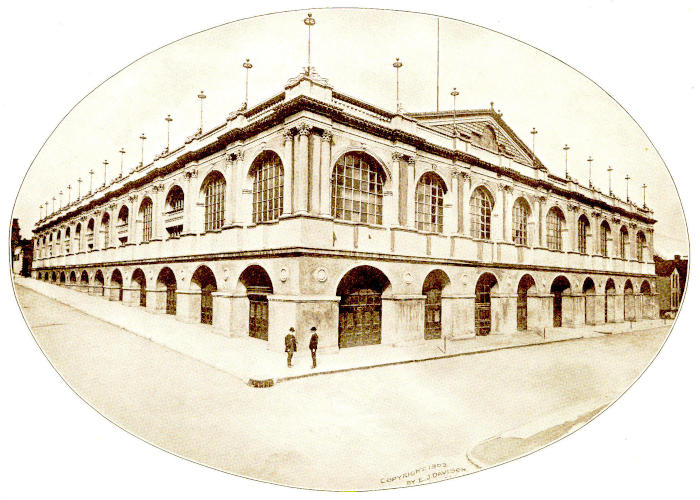
Convention Hall, Kansas City, where the Third National Conservation Congress was held
WHAT WAS ASKED OF COMPANIES.
The companies were first asked by the Insurance Department of Missouri to furnish their experience in fireproof buildings and contents. Companies like the Aetna, Hartford, Home and Royal replied that they had never kept a tabulation of this nature and were unable to furnish any information which would show what premiums and losses might be expected from such property. It was explained by these companies that it was their custom, in keeping track of bakeries, for example, to class together those of ordinary construction, improved construction and fireproof construction.
No useful information could be gleaned from such a source, and the experts who prepared the schedule were called to the witness stand and requested to justify their handiwork. It appeared on examination, however, that the provisions of this schedule were prepared without one iota of information showing what premiums and losses had been experienced in this class of property. It was not known whether the rates formerly used had proved unduly profitable or unprofitable, nor was it known with certainty whether the new rates would increase or diminish the premium charge as a whole.
All classes of property receive this arbitrary treatment. In none are statistics kept to show whether the schedule is producing too much or too little revenue in comparison with the losses. It is admitted that many classes pay too much, while others are being carried at a loss, but no schedule is made to rectify this abuse, although the schedule purports to be a system of measurement.
The companies do not keep faith with the public. We are promised that greater care to avoid fire will reduce the loss and lead to lower rates. But the rating system is conducted so that the public will neither know its just due nor receive it, except by resort to other forms of insurance. When some organized industry undertakes self-insurance, ratemakers soon find that conditions have improved and that reductions are in order.
It is evident, however, that the end of this system of false measurement is near. Four states are regulating rates under laws which call for rates in reasonable relation to losses, and the sustaining of the constitutionality of such regulation by the lower courts makes similar legislation certain in practically all states. There is urgent need, therefore, for accurate knowledge on all matters which affect the rate of burning in the several classes of property. This knowledge does not exist. It must be acquired by study of data yet to be gathered. The data in the hands of the companies is worthless. It has been gathered by plain business [162]men engaged in the insurance business, and, whatever the purpose of the compilation, it certainly has had no reference to the formation of reasonable rates.
NEED FOR FEDERAL INVESTIGATION.
Faulty treatment, and not incurability, is indicated by the persistence of the high level of destruction by fire in this country. The treatment is vague and characterized by irresponsibility. Diagnosis is wholly lacking; the location of the trouble is not known, and the remedies are applied haphazard in ignorance of the possible effect. No person connected with the treatment has a definite result to produce, or is even asked to prove that any result has been produced. The premiums and losses are reported in bulk to each state. The summation of these reports into one huge total constitutes all that is done by the insurance company or the insurance rater or the public to discover the workings of this great waste.
Such blind methods can accomplish nothing. Risks must be enumerated. Those in need of treatment must be singled out and something economically appropriate be prescribed for each. To find out where and how effort can be put forth to economic advantage—to define what can be done wisely by the class and individual to reach the low economic level of loss—to keep watch of results and register the efficiencies of fire alarms, fire patrols, fire departments and fire resistants—these are details which must be wrought out before fire waste can be attacked with definite aim and for the perfecting of which the Federal investigation and bureau is proposed.
The states appeal to the Federal Government to standardize the schedule for the formation of rates so that it shall become a true measure of the conditions to which it is applied. Leaving this measurement to the dictates of the “best underwriting judgment” has proved a costly error to the people. The underwriter escapes the common lot; the cost of his “error,” with a substantial addition for his profit, is borne by the people.
When the fog that envelops this waste shall become dispersed by the Federal analysis, the way to its speedy removal will become clearly visible to the individual states.
I lay no claim to originality in the presentation of this subject. I have given you facts and for the most part the comparisons and expressions of the experts who compiled these facts. They are original only in the sense that the testimony of witnesses recited in a brief or argument in a trial are original.
I have asked the assistance of the Congress of the United States to secure an investigation of this important subject to the end that power may be added to the arms of the states to restore natural conditions as to fire losses in our modern business world.
[163]
President Wallace—You will now hear the great highway engineer of Missouri, Hon. Curtis Hill, on the subject of how good roads help the farmer.
Mr. Hill—Mr. Chairman, Ladies and Gentlemen: There is no question but that we have been making as much progress in road work during the last few years as we have and as we are in other lines of work, and still in many places we are not making the progress that we road-making enthusiasts, and I might say road cranks, would like to see made. Still I do not believe that we can now apply to our highways over the large part of the Mississippi and Missouri valleys that little poem which, or a few verses of which, Robert Burns is said to have written upon his arrival at a little town in Scotland, illustrating that the highways of Scotland at one time were not much better than they are today of Missouri, I might say. Speaking of those highways, he left two verses, which run something like this:
Now, how good roads help the farmer must always include others, and it can be best discussed in a short discussion, in a general way under two heads. First, transportation systems, and the importance of our social conditions. Referring to Robert Burns in Scotland, you will see that the road question has been hammered upon for years and years. Man has been considering it as a means, and as one means of transportation. Now, in fact man has been forever trying to overcome gravitation, from the first load that a man carried on his back, or put upon the back of a pack animal, he has been endeavoring to lighten his burdens by overcoming the laws of gravitation. And so it has been through all history. The galley, the sail boat, the steamship, automobile, and air-ship. The good roads is one line in the endeavor to overcome the laws of gravitation and to make easier one method of transportation. Transportation charges have entered more into the cost of living than any other one item. Food, clothing, building material, all the staple necessities of life have had to pay the freight. The freight is deducted from or added to the price of the article which forms the basis of the price which the producer receives or the consumer pays. The man who produces the commodity, or he who settles the bill, pays the freight. Neither the producer nor the consumer has gained by a high cost of transportation. The question of good roads is therefore at the present time one of the most vital with which we have to deal. There is no one internal improvement so absolutely necessary and essential to a state’s progress and prosperity as the betterment of the highways. (Applause) Good [164]highways are necessary to a state’s progress and prosperity, as well as that of a community, because they involve the transportation problem. With transportation is involved the problem of life, the cost and pleasures of living, exchange of commodities, valuation of property and the social and moral and educational conditions. The problem of life is a study closely linked with the problem of transportation.
Our very existence as a social and commercial body as a state is dependent upon transportation to such an extent that without easy, quick and economic means of transportation we must rank as a second, third or fourth class state. The greatest assets of the most substantial nations are transportation and agriculture, neither one of which can be fully developed without the other. The transportation of the bulk of agricultural shipments begins at the farm when the raw material is hauled over the country roads. This country road is the farmer’s own road, which leads to the collecting points of transportation by rail and water, and over which he reaches his market. It is used one hundred times to every other time for all other means of transportation. The good road permits the farmer to watch his markets and not the road. Many a farmer markets his grain at harvest time because it is a season of good roads, at a less price than he would by storing the grain until the markets are better and less glutted, and when he would have more leisure time for hauling it to the market. The good road permits him to haul double the load that he would over a poor one, and he is thus enabled to move his crop in one-half the time. This, figuratively speaking, picks up the producer and sets him down one-half the distance closer to his market. You all know that distance in this age is measured in time and not in miles. The country road is the people’s own road, their own means of transportation, and it is the only transportation system that is owned, operated and controlled by the people themselves.
It is at the same time the most neglected system of transportation in the United States, and the most expensive over which to transport our produce, owing largely to this neglect. Many a pound of freight originating upon a farm, or destined to a farm, moves over a common country road at a cost three times as high as it would be if the road were first class. Often the haul between the farm and the railroad costs more than the remainder of the journey, and the railroad or any other means of rail transportation cannot be expected to reach every man’s farm, and it becomes necessary to provide means for transporting the commodities to the railroad. The wagon road then becomes a system of transportation, just as a line of boats or a railroad is a system of transportation. Water and rail are the means for long distance transportation; highways for local exchange. The highway serves the purpose for local transportation, and is a connecting link for local traffic with the railroads. The condition of this connecting link or highway may make transportation reasonable or costly. Too frequently, as I said before, the haul over the highway is the most expensive part of [165]farm transportation. It requires a tractive force of 125 pounds per ton upon an ordinary country earth road, and only sixty pounds upon a rock road. The cost of transportation by water and rail seldom exceeds one cent per ton mile. That upon a good road is from seven to ten cents per ton mile. Upon our ordinary country highway, half kept roads, it is from twenty cents up to anything, depending upon the condition of the road. The railroad will haul a bushel of your grain thirty miles as cheaply as the farmer can bring it one mile. If the farmer is situated a few miles out of town on poor roads, the railroads will haul the produce and the commodities to cities like Kansas City rather, and the return merchandise from that city as cheaply as the farmer can haul it to and from the railroad and to the farm. Now this high cost of transportation can be decreased by increasing the size of the load. This can be done by improving the road surface. The high cost of transportation is not altogether due to the railroad. Good wagon roads are just as important a factor in the reduction of this high cost of transportation as are low rates by water or rail.
By social conditions, in my opening remarks, I meant the pleasures of community life, the exchange of visits and social courtesies, neighborhood gatherings, social association, fellowship, and the home, the school and the church. The roads should be built for some of the pleasures and comforts of life as well as for their pecuniary interest. It has been said that the pecuniary benefits of good roads sink into insignificance when compared with their social, moral and educational advantages. Man after all is only a social being, and is influenced by his surroundings. The maintenance of a seat of learning, or of a good church in and by a neighborhood has its influence upon the people of that community. The maintenance of anything tending towards better living has a good influence. The maintenance of a good road or improved road has a good influence by permitting easier intercourse between the people of country communities, between rural and urban population, and unifies social and commercial interests. The rural mail delivery is one of the greatest means of education today. Good roads facilitate rural mail delivery, and therefore tend to improve educational conditions. The improvement of our roads would also facilitate the central high school idea for country districts, for while our roads are not an impassable barrier in all of the districts, in some they are, and in many they are obstacles. If our country churches are to be supplied with good pastors and our country schools with able teachers, better libraries and other facilities, it must be by the support of greater wealth therefor, by the consolidation of the districts being possible only where good roads exist, where people can be easily and safely transported. The schools and the churches in many sections of our best land have a decayed, run-down, neglected appearance. Churches which are practically abandoned certain seasons of the year because of the condition of the roads, country schools not accessible in seasons of bad roads, little children plodding through [166]mud and water and compelled to sit all day in the school room with wet feet and damp clothing—this may not apparently affect the children today, but for all the parents know it may be instrumental in undermining otherwise strong constitutions and laying up many aches and pains for future life. As someone has appropriately asked, “Why should a Christian people have heathen roads and a civilized people barbarous ones?” One thought which possibly you have heard brought out time and time again at these congresses for several years is that the trend of population has been from the farms to the cities and the towns. A large part of the best blood and sinew of the country has been trying to get away from the farm. If this continues, it is going to sap the farm industry of its best blood and its best energy. There is something wrong today with our country conditions, when so many of our best farmers leave the farms and seek homes elsewhere in order to give their families better social and educational advantages and when so many of the brightest youths from the country become discouraged with country life and endeavor to escape from the farm. A fair percentage of the men and women, boys and girls must be kept on the farm. This can be done by making farm life worth living. Good roads will help to do it. Will the best, most progressive farm ever be developed without these young men and women, boys and girls to grow into intelligent farmers? Will the increased yield per acre by means of better farming become fully effectual without bettering the means for marketing that yield? Can you incite better farming and maintain a higher order of intelligence and social conditions in country life without easy means of communication? Can country life be supplied with the necessary association and good fellowship, without good roads?
In conclusion, Mr. Chairman, let me state that I do not contend that good roads is the whole solution for happiness and prosperity of country life, but I do contend that a very necessary and important part of it is the relation which our public roads bear to our social and moral and our educational life. The home and the school are the nucleus around which our social life exists, and this is especially true of country life.
Neglect your public road conditions and you will not only neglect your transportation facilities, but you will neglect your social and your educational environments.
The articles that we eat and wear must come from the farm, and the growth and the development of agriculture and the life connected therewith, no matter how we may view this question of the development of the farm, the betterment of life and the development of the country community life, its transportation, exchange of commodities, the basis upon which it rests will be found a question of good roads. No proposition for the betterment of country conditions, no proposition for the [167]good country life is an assured success until good roads are assured. It all rests upon the question of transportation, and communication, and the basis of transportation is the public wagon road. (Applause)
Professor Condra—I beg leave to submit the report of the committee on credentials.
The Chair announces the appointment of the following committee on credentials:
President Wallace—If you want to get the proceedings of the Congress, which will be worth their weight in gold, give your name and a dollar to the secretary.
Professor Condra—I move that the report be received and the committee discharged.
President Wallace—We will now hear the Hon. J. B. White, of Kansas City, who will tell us what he knows about lumber in Europe.
Mr. White—In Europe the experience of more than a hundred years in forest management has resulted in a more or less scientific and practical policy, although it cannot be said that a well defined, universal policy has yet obtained. This is largely due to conditions of ownership, with consequent variance in ideas as applying to various local conditions, as well as the difference in necessities and financial ability of individual owners to carry out in successful practice the best approved methods. Hence there is a growing tendency towards greater governmental control, whereunder the most economic working system, suited to different conditions of soil, climate and kind of forestry, would be intelligently considered and properly installed.
In the German Empire 47 per cent of the entire forest area is privately owned, and 32 per cent by the state, 19 per cent by institutions, communities and associations, and 21 per cent by the crown. Thirty-three per cent is hardwood and 67 per cent conifers. They are now cutting about their annual growth, taking an average of hardwood and conifers.
Austria-Hungary exports more lumber than any other nation in the world. It covers 46,500,000 acres, or a little over 30 per cent of the total land area. In Austria the forests are composed principally of conifers, spruce, pine and fir, only 15 per cent of the acreage being of hardwood. Sixty-one per cent is in the hands of private owners, and one-half of this, or 30 per cent of the entire forest, in the hands of small owners. The state owns less than 11 per cent of the forests; the balance belongs to churches and communities. The average yearly growth of [168]all the Austrian forests is said to be about forty-two cubic feet per acre, or an annual growth of about 1,100,000,000 cubic feet. They are now cutting annually 250,000,000 cubic feet more than this, or 20 per cent faster than it is growing. This excess of cut, over the growth, will in large measure regulate itself, as the increasing demand makes the industry more profitable and encourages the planting of greater forest area.
In Hungary about 75 per cent of the total forest area is oak, beech, maple and other hardwood species, and only 25 per cent of conifers. The annual yield of conifers is about fifty-eight cubic feet per acre, and that of oak about forty-one cubic feet per acre. Thus the conifers yield the largest percentage of commercial lumber and are most valuable as a crop because of more rapid growth, and because of their larger demand for building purposes. Sixty per cent of the total acreage in Hungary is private forests, about 18 per cent is state forest, and 22 per cent communal and church forests. The annual cut in Hungary is estimated to be less than the annual growth.
England has not until very recently deemed forestry profitable, preferring to buy her supply. Of her 3,000,000 acres of woodlands, mostly devoted to parks and the chase, the state only owns 2 per cent. France has 24,000,000 acres of forest, or 18 per cent of its land area, of which only 12 per cent of its wooded area belongs to the state.
Switzerland has about 25 per cent of her total area under forest. The Zurich forest, known as the Sihlwald, containing 2,760 acres, is 85 per cent hardwood, and is worked on a rotation period of 100 to 110 years. The forest director claims an annual growth for the Zurich forest of sixty-five cubic feet per acre, while the general average of all the forests is only fifty cubic feet per acre. This means the entire growth—wood, poles, limbs and all. Only 40 per cent of the total cut is saw timber for building purposes. The net income from this forest for the past twenty-five years has been from $4.00 to $7.00 per acre, not including interest charges. It was $4.40 in 1890 and $7.69 in 1907. This forest has its own mills and saves all profits.
In Switzerland one pays taxes when the crop is harvested. In Germany and Austria the method of taxation varies in different states, but laws are always favorable to encourage private forestry. In some cases one pays no taxes for twenty years. Then one begins to thin out the poles for use of telegraph and telephone companies, etc., and get a revenue, and leaving a stand in destructive forestry which, when sixty years old, will yield in many cases 20,000 feet of lumber, board measure, per acre. In fact, the average is 4,190 cubic feet per acre of timber and fuel, which, according to values prevailing in England and Germany, amounts to about $200.00 per acre.
CUTTING METHODS IN EUROPE.
It was pointed out to us that mixed growth or conservative forestry [169]is expensive. The most economical and profitable plan is the destructive method. That is, a forest is planted and grown like any other crop, and whenever interest, carrying charges and total cost meet the market value at age and time of greatest profit, then trees are cut and they are all about of a size. The entire acreage is cut clean and the cost of logging is cheap. Trees are again planted and another crop grown. Under the old plan of conservation of mixed growth and mixed sizes, or the shelter-wood system, not as much can be grown per acre, and the cost of logging out the large trees is vastly more expensive, and damage is done to other timber in falling them, while in the destructive method all is taken and a large crop harvested. It is nice to view these stands of timber in strips, side by side, ranging in years from baby trees to stands of ten, twenty, thirty, forty, fifty and up to sixty and eighty years of age, when they are ready to be harvested.
In growing forests in Europe, lands that are better adapted for agriculture are not used. The degree of utility is considered. And in determining the value of a forest property, one has to figure compound interest, as the crop may not be harvested and the capital returned for sixty or eighty years. Because of absolute protection from forest fires, capital is regarded as safe, and investors in forests are satisfied with a low rate. As an investment, forests require less labor than other crops, if one practices the most economical method of what is called destructive forestry. In times of temporary high prices, one can take advantage of the situation and harvest more than the annual growth, and can then wait and let the trees grow when prices are low, and this is the usual practice. The rate of interest generally charged to the forests, and compounded, is sometimes determined by rate yielded by government securities, which is usually about 2½ per cent.
THE ROTATION METHOD.
It has been ascertained by careful observations that Scotch pine (which grows rapidly, like our short leaf yellow pine) yields, on medium soil in every sixty-year rotation in best quality of location, 5,255 cubic feet per acre, of which an average of 565 cubic feet have been removed in thinning as the forest has been growing, figuring the thinning out being done on an average of about every ten years, leaving at the end of sixty years an average of 4,690 cubic feet per acre. If allowed to remain, this has increased in ten years to 5,250 cubic feet per acre, besides 536 cubic feet that have been profitably taken out in thinning in the last ten years, leaving at seventy years 5,250 cubic feet. Now in the next ten years there will profitably be taken an average of 493 cubic feet in thinning as against the 536 cubic feet taken out the ten years before, leaving at the end of eighty years standing on each acre an average amount of 5,720 cubic feet per acre.
These interesting results follow: With average values of lumber products as in the year 1910, an eighty-year rotation period with Scotch [170]pine would pay 2½ per cent compound interest on soil value of $97.00 per acre. With a ninety-year rotation period it would pay this interest rate on land worth only $94.00 per acre. On a seventy-year rotation period it would pay such interest rate on land worth $94.60 per acre, and on sixty-year rotation it would pay such rate of interest on land worth $85.00 per acre. This shows that the maximum profits at this low rate of interest come from cutting the forests at eighty years’ growth. The greater the variation from this eighty-year period the less favorable the financial results. The maximum age for hardwood trees for best profit is said to be rotation periods of about 100 years with a low rate of interest suited to the safety of the investment. These statistics were prepared by Sir William Schlich, professor of forestry at the University of Oxford, and published by him this year, and are undoubtedly reliable.
But it is safer to figure at a compound interest rate of 4 per cent. A high rate of interest demands a low value of soil, and vice versa. And as Sir William points out, the value is, however, not in inverse proportion to the rate of interest, as the value of the soil rises more rapidly than the interest falls. Under a low rate of interest, the expectation value of soil culminates later than under a high rate of interest. So that under a 2½ per cent interest rate, the timber could stand about eighty years; under a 3 per cent rate, about seventy years, and under a 4 per cent rate it should be cut every sixty years. Or, to further illustrate, if a party is satisfied with 2½ per cent compound interest on his investment in European forestry, he could pay $97.00 per acre for his land, and must cut it at eighty years of age.
If he desires 3 per cent interest he must not pay over $55.50 per acre, and must cut his timber when seventy years of age. And if he demands 4 per cent interest rate he cannot pay quite $15.00 per acre for his soil, and must cut his trees when sixty years old.
PERIODS OF PINE TREE GROWTH.
Now this is the best than can be done in Europe (which, according to statistics, is 37 per cent above the average yield), with the best results as to soil and favorable location, with low-priced labor, with most favorable consideration by the government as to taxation, and with the most approved economical methods, where the limbs and twigs are sold for fuel, and forest products are fully 50 per cent higher than they are in the United States. So it is fairly well established that from sixty to eighty years is the most profitable rotation period for growing Scotch pine forests in Europe. The higher the rate of interest demanded, the shorter the rotation.
With advancing age the value of the stumpage increases so that the value of the soil for forestry becomes nearly positive. But in time a maximum is reached, and it falls again. This maximum, with 2½ per cent money, is eighty years growth, and with 4 per cent money only sixty years growth. The value of the soil under a very brief rotation would be negative, so that the yield might not even cover the cost of [171]harvesting. And under a very long rotation, the value of the soil would again become negative, because it could not stand the compound interest and other expenses for an excessively long term of years.
It follows that the expenses during the early part of the rotation affects the expectation value disastrously, for compound interest is running against this expense for a long term of years, lessened only by sale of the thinnings in about ten-year periods. Of course a sudden and heavy increase in the value of stumpage, at any given period after trees are large enough to cut, may create a second maximum, differing from the normal average because of an unexpectedly great demand, causing an abnormally and temporarily high price. But the cost one has to pay for the soil is really the true value, chiefly determined by its value for ordinary purposes of agriculture; and as trees will thrive on land not so well suited for farm crops, such lands are nearly always selected for forestry. But if the soil can be more profitably used for agriculture in the examples just mentioned, then the increased value will enter into the account to change the length period of rotation of forest crop. And where the acreage is not stocked to its full capacity (on account of poor soil, or for any other reason), the rotation, for which the highest probable value of the growing stock is obtained, can, as Sir William states, only be determined by experimental calculations based on these special cases.
THE YIELD OF FORESTS.
But this method of calculation is absolutely logical, and shows under the most normal conditions what we can expect, and it has been proved by experience. The abnormal conditions that may occasionally present themselves are governed by these same financial methods of reasoning, differing only in degree of application, by reason of change of basic conditions in each special case. A normal yield is what the forest can permanently be depended upon to produce. It is a permanent interest investment of greater or lesser rate, where the principal will never be returned, while the land is kept in forest crops. These figures are based upon the best yields in the clear cutting of destructive forest system, which, as has been stated, is 37 per cent above the average. But the principle of calculation applies equally as well in the shelter-wood system of different age trees; but the average volume per tree in each age class in the latter system has to be taken into consideration. On the whole, it has been admitted by the best foresters that the system of clear cutting, then pulling the stumps, fallowing or planting other crops for a couple of years, and replanting again, gives the best financial results.
So much for European forestry. Now how will this system apply to us, under our conditions of taxation, high-priced labor, and low-priced forest products, and considering the fact that there is little or no demand for the thinnings until large enough for telegraph poles, and no market for the tops and necessary waste in manufacturing? We are lacking in [172]statistics, because we have not sufficient experience along the lines of growing new forests, at either private or public expense. But we are soon to be interested in what it will cost to reforest and grow commercial timber in the United States. And surely our present supply of old growth timber from 150 to 300 years old is worth more than the cost of growing timber sixty to eighty years old. The United States owns in national forests 192,931,197 acres. The state forest reserves of 3,253,185 acres, the national parks of 4,562,265 acres, and the Indian forests of approximately 10,000,000 acres, make the total of public forests over 210,000,000 acres. Chief Forester Graves estimates the area of private forests as over three times that of the public forests, and containing five times the timber that is on the public lands.
The countries whose wood exports exceed their imports are: Austria-Hungary, Canada, Sweden, Russia, Finland, the United States of America, Norway, Bosnia-Herzgovina, Roumania, and Japan. The countries whose wood imports exceed their exports are: The United Kingdom, Germany, France, Belgium, Spain, Italy, Holland, Denmark, Switzerland, Australian colonies, China, Greece, West Indies, Bulgaria, Servia, and British possessions in Africa.
CONDITIONS TO BE CONSIDERED.
The climate and other conditions in some countries render them not so well adapted to growing trees as for growing other crops; and they find it more profitable to exchange their products for the wood products of other countries that either have a present surplus, or whose climate, soil and land values enable them to grow trees at lower cost. This is true with the different states in our own country. Illinois and Iowa, for instance, will never grow what timber they require. They can more profitably grow corn, and exchange for lumber products with those states which have low-priced and mountainous land with plenty of moisture, so that trees will grow twice as fast as in those prairie states where land is very expensive and climate not so well adapted. Trees will be grown here, as in Europe, where they can be grown cheapest, and they will be harvested at an age which will bring the greatest net profit. The market price of the product will be finally and surely governed by the cost of growth and manufacture, insurance, and risk, and the price of money used in the business.
If the Government of the United States itself can get money at 2½ per cent, as it can, while private owners have to pay 5 per cent or 6 per cent, then it follows that the states and the Government can, for this very important reason alone, grow commercial trees cheaper than private individuals, and can remove the maximum rotation period to a more mature age, giving better lumber from older trees at the same cost at which private owners would have to furnish poorer lumber, because coming from younger trees. But the people pay the cost, whatever it may be, [173]whether the Government or private interests grow the trees. The consumer is interested that they be grown as cheaply as possible. It is likely true here, as in Europe, that forestry will be a more general success with private owners, if they are in some important methods placed under the practical rules of government forestry. It will be found here, as over there, that private forests will not prove so generally productive, or, as a rule, so economically administered, as the government or state forests under the management of expert foresters. And parenthetically, is it not equally true that many farms and farmers would be better off if directed by government or state experts?
In Europe they have no forest losses from fire for the reason that fires are prevented from starting. The railroad locomotive has been the cause of most forest fires in the West, and I observe that these Western roads are now equipping hundreds of their locomotives with spark arresters, so as to prevent the starting of these fires in the future. United States Chief Forester Graves very truly says: “Private owners do not practice forestry for one or more of three reasons: First, the risk of fire; second, burdensome taxation; third, low price of products.” Forester E. T. Allen has pointedly said: “Forest protection is the cheapest form of prosperity insurance a timbered state can buy.” It is not the present generation so much as it is the future generations that will be affected disastrously by our neglect. The principles of agriculture, horticulture, forestry, and the science of conservation of soil and trees, and of life itself, should be taught in our public schools.
THE EXAMPLE OF DENMARK.
In Denmark, a country which fifty years ago was one of the poorest in Europe, they have erected a statue to Captain Dalgas, who reforested Denmark and changed a desert heath into a rich farming country. So now Denmark is said to be, according to its size, one of the most prosperous nations in the world. It was the patriotism and inspiration of Captain Dalgas that enthused the citizens. He lectured to the people, and talked to the children in the schools, and made converts everywhere. He gave all he had, and begged and pleaded against doubt and opposition of the most discouraging character, until success crowned his efforts. He will be loved and his memory cherished by all the people of Denmark through all future years as one who saved the nation. In many vital respects, for energy and self-sacrifice, his work reminds us of our Gifford Pinchot.
We are, as a nation, too young to understand the dangers before us; for we are just emerging from a condition of burning log heaps to make farms, from a condition of too much timber for a small population to a condition of too little timber for a large population. Yet we have enough if we will now conserve and reforest. Our ancestors did the best they could under conditions and the light that they had—what now [174]seems waste, had then no market and was unavoidable. As a nation we are proud of our past and we should also be more proud of what we expect to become. As was said not long ago by one of our greatest statesmen, “Conservation of our resources does not mean that we shall become great in the present at the expense of the future, but that we shall show ourselves truly great by striving to make the Nation’s future as great as the present.” (Applause)
President Wallace—The committee on nominations is ready to make its report.
Mr. Baker—Pursuant to an announcement made from the stage at the opening of the afternoon session of the Congress this day, the members of the nominating committee met in room 775, Baltimore Hotel, at 3:00 p. m., and unanimously nominated the following officers for election for the ensuing year:
The report is signed by the following nominating committee: Mr. B. N. Baker, Baltimore, Md.; Major E. G. Griggs, Tacoma, Wash.; Mr. A. B. Farquhar, York, Pa.; Mr. H. C. Wallace, Des Moines, Ia.; Mr. Henry S. Graves, Washington, D. C.; Mr. G. E. Condra, Lincoln, Nebr.
President Wallace—You have heard the nominations. Is there a motion made to accept and approve the report of the committee?
Delegate Baker—I move that the report be accepted.
Motion was duly seconded and, on being put to vote, was carried.
President Wallace—I want to thank members of the Congress for their kindness to me. And I am going to make a confession now. I have been running a bluff on you, for I never in my life presided over any convention or association of more than thirty persons, and it is only by the marvelous patience that this Congress has shown and its endurance that I have been enabled to carry it through. I thank you, and I want to say that I do not believe the mantle could have fallen on a better man than Mr. J. B. White. (Applause)
President White—I hope the election has been fair, if there has been an election. Has there?
Mr. Wallace—Yes, sir, there has been an election and you are president.
President White—Has the committee reported?
Mr. Wallace—It has, and reported in favor of you, Mr. Shipp, Mr. Latchaw and Mr. Gipe.
[175]
President White—This is a great honor, and I appreciate it very much, more than I can tell. I have been in politics before tonight, but not in this way. I will have to tell a short story. It will take less time to tell it than it did for the events to transpire. I have got to tell it straight because I see Governor Stone of Pennsylvania watching me. I was a candidate one time when I thought it was necessary for someone to represent some good principles. I published a newspaper. I owned a farm and a small saw mill, and I was nominated because I was a granger and because I had the reputation of being a laborer. I got the nomination of the Democratic party of my state, and the nomination of the National Greenback and Labor party of my county. Then the Prohibitionists met. They were not quite sure about me as a Prohibitionist, but they said that they would support me, and they would not put any ticket in the field against me. So that I had the endorsement of the Prohibitionists, the Greenbackers, the Labor party, and the Democratic party, but I did not have the Republican party because there was another man running in that party, and I had to have one opponent. The fight waxed warm. I drove all over the county, to every school house; I met the people, kissed all the babies in the county, and I was elected by a very large majority. It was not quite unanimous, but it was very large. This appears to be unanimous. And the next day after the election a gentleman came down from the township, I think, of Limestone, up above Warren on the Allegheny river. He came to see me, and said “I see you are elected.” “Yes,” I said, “I understand I am. It is very gratifying as it has been a very hard campaign.” “I came down to see Davis, the treasurer of this campaign fund,” he said. “Davis is in Warren,” I told him. “Well, I stopped off at Warren on the way down to see him and Davis was not to home. I spent $30.00 in this campaign and Davis said to come right down after election and get my money. I thought maybe you could pay it. You are elected, and I come down to see you.” “Let us see, what did you spend that money for? How did you spend it?” I asked. “Well,” he said, “I told Davis I could carry Limestone Township. The way I done it was that I went and bought a ten-gallon keg of whisky, and I got down by the ferry. The lumberman and tie markers from up in that township had to go across the ferry. On the other side I put the keg of whisky in the ferry house. Every man that came along I says, ‘Come on, boys,’ and they came in to get their ferry tickets. And I says, ‘Here, have a drink,’ and I gave them a drink, and I gave them your ticket. I says, ‘Here is a ticket for White; go right over on the other side and vote, and then when you come back come in and get another drink.’ They went right, every one of them, and voted, and they were so anxious to come back and get another drink that they never stopped to talk with anybody. And that is the way we carried Limestone Township solid for you.”
I said, “Well, that is very gratifying, but you know, of course, I am [176]somewhat of a candidate on the Prohibition ticket. I think you had better see Davis about this.” “Well, yes,” he says, “that is all right, I know; I knew you was a candidate also on the Democratic ticket, and I thought you might pay this out of Democratic money.” (Applause) So I think probably Davis fixed it without my knowledge. I will ask the retiring president to introduce to this audience Prof. Hopkins.
Mr. Wallace—Permit me to say that Prof. Hopkins has done a wonderful work in the State of Illinois, and I have asked him to present the results of that work, or to tell us about worn-out soils. If your soils out in Kansas are not worn out, they will be unless you mend your ways. Now you want to listen to Professor Cyril G. Hopkins of the University of Illinois. (Applause)
Professor Hopkins—As agriculture is the basis of all industry, so the fertility of the soil is the basic support of every form of agriculture. Without productive land there could be no American agriculture and no American prosperity. The most important material problem of the United States is to restore, to increase, and to permanently maintain the fertility and productive power of our farm lands. In comparison with this problem others fade almost to insignificance; and we do well to pause in the rush and hurry of our business life, to measure the agricultural record of the past and to consider the possibilities of the future.
I come before this National Congress of patriotic, progressive and influential men and women, not to present theories or opinions, but facts and data, which deserve and should command your immediate serious consideration and your subsequent persistent and effective action.
Intelligent optimism is right and admirable, but blind bigotry paraded as optimism is dangerous and condemnable. “Truth, crushed to earth, shall rise again; the eternal years of God are hers”; and this Congress has before it the duty and the right to uncover the facts, to face the truth, and to plan intelligently for the solution of this mighty problem.
That vast areas of land once cultivated with profit in the original thirteen states now lie agriculturally abandoned is common knowledge; and that the farm lands of the great corn belt and wheat belt of the North Central states are even now undergoing the most rapid soil depletion ever witnessed is known to all who possess the facts.
WHAT CROP STATISTICS SHOW.
The crop statistics of the United States now cover two twenty-year periods, and half a decade on the next. A comparison of these two periods shows the average acre yield in the United States to have increased only one bushel for wheat and one-half bushel for rye; while corn decreased one and one-half bushels and potatoes decreased seven bushels per acre. These crops constitute the basis of our human foods, even our supply of meat being largely dependent upon the corn crop. Thus, in spite of the vast areas of new land put under cultivation during [177]the last twenty years, and in spite of the improvements in dredge ditching and tile drainage, in seed, and in implements and methods of cultivation, the average acre yield shows little or no increase. In striking contrast the census returns show an increase in the population of contiguous continental United States from thirty-eight million to ninety-two million people during the last forty years; and in spite of the fact that to feed our rapidly increasing population we have extended our area of cultivated crops beyond the humid and far into the semi-arid regions, and in spite of reducing our corn exports from 213 million to thirty-eight million bushels and our wheat exports from thirty-four to twelve million bushels during the last decade, nevertheless the most common topic discussed in recent years is the high cost of plain living in these United States.
These are American facts; and, while there need be no sensation, there is need for sense in their consideration. A few people can live on blind optimism or hot air, but something more substantial will be required to feed the progeny of ninety-two millions, and added millions of immigrants. It is said that the high civilization of the ancient Mediterranean countries went down into the Dark Ages with laughter—Dark Ages which covered the face of the earth for a thousand years and which still exist for most of our own Aryan race in Russia and in India, where more people are hungry day by day, and year by year, than the total population of the United States.
The problem which now confronts America is nothing less than the maintenance of prosperity for ourselves and of civilization for our children; for civilization depends upon education, and only a prosperous nation can afford the general education of its people. Poverty is at once helpless, and soon ignorant and indolent. An impoverished people cannot have adequate schools or schooling.
No greater problem ever confronted any nation than now confronts the United States, but the solution is plain: In a word, we must increase production and limit reproduction, especially the reproduction of the unfit. To solve half of the problem is not sufficient; and, in passing, I must emphasize the fact that, with the most practical scientific systems of farming applied to all the farm lands of the United States, there is still somewhere a limit to the highest possible production of food and clothing materials in this country; but there is no limit to the reproduction and increase of population except the starvation limit, already reached in Russia, India and China; unless the public sentiment of this Nation, in these times of education and general intelligence, will support the inauguration and enforcement of legal laws based upon the established natural laws of heredity.
Just and adequate legislation should be enacted by the Nation for the better control of immigration, and by the states for preventing the reproduction of every form of degeneracy, whether revealed by insanity, criminality, idiocy, deformity, or beggary. Half of all the state revenue [178]is already required in many cases for the support of the non-productive degenerate classes, upon whose reproduction there is still no check in most states.
CROP YIELDS CAN BE DOUBLED.
That we can double the crop yields of the United States is not a prediction, but a fact. To say that millions of acres of abandoned farm lands in the older states can be restored and increased in productivity far above the present average for the $200.00 corn belt lands is merely to speak the truth. To accomplish these objects requires, first of all, that agricultural ignorance shall be replaced with agricultural intelligence in the minds of the people of influence in this nation.
Why should not every influential man and woman in America have a definite and quantitative knowledge of the basic principles that to increase and permanently maintain the productive power of our normal soils, in practical systems of farming, requires the addition to the soil and permanent maintenance of adequate supplies of only three important constituents, limestone, phosphorus, and nitrogenous organic matter?
The limestone is contained in measureless deposits in almost every state. All it requires is that it be quarried and pulverized and transported at a reasonable cost.
The phosphorus is contained in New York, Pennsylvania, Virginia, the Carolinas, Florida, Tennessee, Kentucky, Arkansas, Utah, Idaho, Wyoming and Montana, in the greatest deposits known to the world. All that is required to utilize these great stores of phosphorus for soil improvement in good systems of general farming is to mine and finely pulverize the natural rock and transport it to the farmer’s railroad station at reasonable cost.
With abundant supplies of limestone and phosphorus thus provided, the nitrogenous organic matter can then be produced upon the farm by the growing of clover and other legume crops which have power to secure nitrogen from the inexhaustible supply in the air; and by plowing under this organic matter, either directly or in animal manures, the remaining essential mineral plant foods, such as potassium, can then be liberated and made available from the practically inexhaustible supply in the soil.
The man who is willing to study this subject will find that these facts are as true as the fact that the earth is round.
Normal land contains thirty thousand pounds of potassium in the plowed soil of an acre, and the air above contains seventy million pounds of nitrogen; and yet the most common commercial fertilizer sold to the general farmers in the older states contains both nitrogen and potassium, with a small amount of phosphorus. The average farmer who buys fertilizer at all merely accepts the teaching that reaches him, and as a rule this teaching comes through the fertilizer agents, who are now selling to the farmers of Indiana 900 different brands of fertilizers, and to the farmers of Georgia more than 2,000 different brands.
[179]
The result is that the ton of fertilizer for which the farmer pays $25.00 contains less than a hundred pounds of phosphorus, whereas he ought to receive and apply to his land a thousand pounds of phosphorus for the same money.
Phosphorus is the one element we shall always need to buy—phosphorus, the master key to permanent agriculture, permanent industry, and permanent prosperity in America; phosphorus, in which we are exporting, practically giving away, as a nation, a value which amounts to as much every year as the total value of all the timber on all the Federal lands.
In 1848, Sir John Lawes and Sir Henry Gilbert began at Rothamsted, England, an investigation to ascertain the effect of applying phosphorus to normal soil where a good crop rotation and a practical system of farming were followed. The Norfolk rotation, already well known at that time as one of the best rotation systems, was turnips, barley, clover and wheat. In these practical field experiments the turnips were fed on the land and the animal fertilizer thus produced returned to the soil, which was well supplied with limestone.
THE USE OF PHOSPHORUS.
During the next thirty-six years $29.52 worth of phosphorus was applied to one part of the field; and in comparison with another part of the field cropped and managed, the same, except that no phosphorus was applied, the $29.52 worth of phosphorus produced $98.02 increase in the value of turnips, $37.45 in barley, $48.93 in clover (and other legumes), and $45.99 increase in the value of the wheat. The total value of the crops grown on land not receiving phosphorus during the thirty-six years was $432.43 per acre, while on the phosphated land the crop values amounted to $662.82, an increase of $230.39 from an investment of $29.52 in phosphorus. These statements summarize the results of thirty-six years of careful investigation in practical farming on normal soil; but not one American in a hundred knows, utilizes, or imparts this information. Meanwhile the ten-year average yield of wheat in the United States is fourteen bushels per acre, while Germany’s average is twenty-eight bushels and England’s thirty-two bushels per acre; meanwhile the United States continues to export annually, for the paltry sum of five million dollars, a million tons of our best phosphate rock, carrying away an amount of phosphorus which, if applied to our own depleted and depleting soils, would be worth not five million, but a thousand million dollars, for the production of food for us for the oncoming generations of Americans.
As an average of twenty-four years of carefully conducted field investigations with a four-year rotation of corn, oats, wheat and clover on normal soil at the Pennsylvania State College, the addition of $5.04 worth of phosphorus increased the value of the four crops from $32.55 to $44.72; and a comparison of the two twelve-year periods reveals the [180]fact that the average crop value per acre per annum decreased on unfertilized land under this rotation from $11.05 to $8.18, a decrease of 26 per cent in the productive power of the land. Meanwhile the average farmer, and even the average business man who owns a farm, allows the land to be depleted and decreased in acre yield because of the erroneous and widespread opinion that crop rotation will maintain the fertility of the soil; whereas the truth, as revealed by every long continued and trustworthy investigation, shows that the rotation of crops will no more maintain the fertility of the soil than the rotation of the checkbook among the members of the family would maintain the bank account.
The rotation of crops should, of course, be practiced, for it helps to avoid injurious insects and fungous diseases, and stimulates the soil to produce larger crops for a time, with the result, however, that the depletion of the essential plant food elements is even more rapid than if wheat were grown every year on the land.
In 1897 the Ohio Agricultural Experiment Station began a field investigation on normal soil with a three-year rotation of corn, wheat and clover—and as an average of the next thirteen years, the application of eight tons per acre of farm manure increased the value of the three crops from $26.21 to $42.79, and the further addition of $1.20 worth of fine-ground raw rock phosphate increased the crop values from $42.79 to $53.28.
WRONG FERTILIZERS.
Meanwhile the farmers and landowners of Ohio continue, in the main, to use high-priced so-called “complete” fertilizers in the same systems of land ruin that led to the agricultural abandonment of much farm land in the older states.
As an average of nineteen years, the Louisiana Agricultural Experiment Station applied $14.45 worth of plant food, chiefly in organic manures and acid phosphate, which produced an average increase of $62.25 in the value of the crops in a three-year rotation of cotton, corn and cowpeas, oats and cowpeas, grown on the typical much exhausted upland soil of the South.
The average yield of cotton exceeded a bale to the acre for the nineteen years. Meanwhile the average yield for the Southern states is one-third of a bale per acre.
I have given you some of the cream of the world’s work in soil fertility investigations on normal soils, which need for their improvement phosphorus and organic manures, and sometimes limestone. Abnormal, or markedly different soils, require markedly different treatment.
Thus four plots of normal corn belt prairie soil in McLean County, Ill., produced, in round numbers, only twenty-two, twenty-six, twenty-two, and twenty-seven bushels of wheat per acre in 1911, although some of them had received nitrogen and potassium; while four other similar [181]adjoining or intervening plots, which differed from these only by having been treated with $2.50 worth of phosphorus, in 200 pounds of steamed bone meal per acre per annum, during the past ten years, produced fifty-eight, sixty, fifty-four, and sixty bushels, respectively, of wheat per acre.
But on the peaty swamp soil of Kankakee County, with the same amount of phosphorus applied to several plots, the acre-yields of corn in 1903 were seven, four, five, and four bushels, respectively, on four separate plots, while on four other plots, which differed from these only by the addition of potassium, the yields were seventy-two, seventy-one, seventy-three, and sixty-seven bushels of corn per acre the same season.
Again, on the sand land in Tazewell County, Ill., four plots, including some treated with phosphorus and potassium, both singly and combined, produced eighteen, ten, eight, and eighteen bushels of corn per acre in 1906, while four other plots whose treatment differed from these only by the addition of nitrogen, produced the same season sixty-three, seventy-one, seventy-five, and sixty-six bushels per acre.
It is truly gratifying to acknowledge that the State of Illinois is now devoting $100,000 per annum to soil and crop investigations and the dissemination of the information secured, even though this is less than one per cent of the revenue of the state, all of which come directly or indirectly from the soil. It is also gratifying to acknowledge that, according to the crop statistics reported by the Federal Government and confirmed by the independent crop statistics of the Illinois State Board of Agriculture, the last ten-year average yield of corn for the State of Illinois is six bushels higher than during the twenty-five years before the agricultural experiment station began to exert an influence upon our agricultural practice, and also that a similar comparison shows three bushels increase per acre in the Illinois wheat crop—increases whose aggregate value for the state now exceeds twenty million dollars a year; and yet I must confess to you that as an average the farm lands of Illinois are yielding only half a crop; that by soil enrichment alone the average crop yields of Illinois could be doubled even with the same seed as we now plant, with the same amount and methods of cultivation and with our normal climatic conditions.
On one of our old experiment fields on the University of Illinois farm the latest three-year average yield of corn grown every year upon the same land is twenty-seven bushels, while in a crop rotation of corn, oats and clover the average corn yield for the same three years has been forty-nine bushels, and where proper soil enrichment is practiced in the same rotation the average yield of corn has been eighty-seven bushels per acre—all grown from the same seed, on the same kind of land, plowed and cultivated the same, warmed by the same sunshine and watered by the same rains.
All these are examples not of theory, but of fact—examples of fact which should be known and emphasized by all influential men and [182]organizations. We talk of conservation, but 90 per cent of all the talk during the last five years about the conservation of natural resources has been directed toward 10 per cent of the resources. On the other hand, to improve and to save the soils of America will require more than talk. Thought and action are required, and the time for thought and action is already upon us. Not conservation of soil fertility; but amelioration of good soils, restoration of worn-out soils, and then permanent preservation of all soils.
WHAT REAL RECLAMATION MEANS.
Our reclamation of land must be more than the continued exploitation of so-called dry farming and irrigation on virgin soils and the drainage of virgin swamp lands; we must reclaim, in the truest sense of the word, the millions of acres of depleted and agriculturally abandoned lands lying at the door of our greatest markets and already favored with an abundant supply of unused water in the normal rainfall of our older states.
If 145 million dollars of federal funds can be wisely and profitably expended (and I believe they can) in providing irrigation for three million acres in the arid regions of the Far West, and if 300 million dollars can be expended annually to support our army and navy, as we are doing even in time of peace, then what should we do in comparison for the restoration or improvement of the 900 million acres of farm lands in this country? I would affirm and emphasize the fact that 145 million dollars, if wisely and economically used, would make a soil survey of every farm in the United States and furnish every farmer with definite and much needed information concerning the composition or invoice of fertility of every type of soil on his farm and proof of practical profitable methods for its improvement, and still leave an endowment whose income would support a permanent experiment field or demonstration farm in every county in every state.
Private enterprise has already put twelve million acres under irrigation in the United States, and the Federal Government has added one million and has projects concerning two million more. This is doubtless all good work and ought to go on, but the fact still remains that as a nation we are penny-wise and pound-foolish, with millions of acres of agriculturally abandoned lands in states surrounding the national capital.
The rapid investigation of the soils of every state should be inaugurated, and this should be accompanied by the wide dissemination of information by demonstration farms showing by actual field trial the most practical methods of soil improvement and preservation. This is local work and is best done by the state institutions directly responsible to their home people, while the Federal Government must direct and control the reclamation work on the federal lands. Because the revenue of the Federal Government is ten times the total or combined revenue of all the [183]states, the federal appropriations to the state agricultural institutions should be largely increased for the specific purpose of increasing and extending the knowledge of practical methods for restoring and improving the fertility of the soil, and these increased appropriations might well be made in direct proportion to the acreage of farm lands in the respective states.
All public schools should offer practical scientific instruction in the principles of soil fertility, and every man and woman of mental power should acquire information and exert influence toward saving the soil, which is second in importance only to saving the soul. But the fact is that not one American in a hundred knows what the soils contain or what the crops require. They know of the rivers of Asia and of all the kings of England, and perhaps of the wars of Caesar and the orations of Cicero; but they do not know what is required to produce a grain of wheat or a kernel of corn. And yet there is as much of culture and more of use and value and of satisfaction in a study of clover roots and plant-food compounds than in Greek roots and Latin compounds; and I insist that the study of soil fertility is so simple and easy and so interesting that any man or woman of ordinary education can become master of the essential principles by studying the subject an hour a day for a single month.
President White—Mr. Wallace will introduce Mr. F. D. Coburn, secretary of the Kansas Board of Agriculture, who will preside this afternoon.
Mr. Wallace—You people in Kansas have all heard of Coburn (applause), the man who adorns, advises, and advertises the State of Kansas and the state of the West. Mr. Coburn will preside with you this afternoon. (Applause)
Mr. Coburn—President Wallace, I thank you for your kindly introduction. Ladies and gentlemen of the Congress, and delegates: Your temporary chairman will base his claims to your charitable consideration this afternoon on the fact that he has no speech to make, and further will go on the assumption that the program which is provided him and for you will be carried out. I thank you. (Applause)
President White—Ladies and gentlemen: The Missouri delegation is requested to meet immediately after adjournment. We will now listen to Dr. W J McGee, the well-known authority on soils, of the U. S. Department of Agriculture. (Applause)
Dr. McGee—The relation of man to the earth on which he lives forms a worthy theme for those who think and base action on thought. As it is now, so it has been in every age; every early people had a creation epic: the noblest of all recounts that out of the dust of the earth God made man in His own image. The ancients gave chief thought to beginnings seen vaguely at the best; moderns to current processes which may be seen [184]clearly and verified by repeated observation. In this way natural science arose; and under the guidance of Darwin naturalists learned that living organisms are controlled and perpetuated chiefly by the two factors of heredity and environment. Into this scheme of nature man entered, and through mental power gradually assumed control over lower nature; for man differs from other organisms in that he adjusts himself to his surroundings largely by reconstructing them. While still retaining heredity as a vital factor like lower living things, man is essentially an environment-shaping organism, and lives by doing. The factors of his existence are heredity and exercise, and it is his role in nature to reconstruct the face of the earth, to modify all other living things for the welfare of his kind, and finally, by growing knowledge, to progressively improve his own kind and ennoble humanity.
The conservation movement marks a step in human advancement; for it is a conscious and purposeful entering into control over nature, through the natural resources, for the direct benefit of mankind. In truth it means a revolution (arising, like all other beneficent revolutions, in clear thinking) against an old order of things, preparatory to the framing of principles on which a new order may arise; and in essence it reaches those fundamental relations between man and earth which have stirred deep thought and inspired high motives during all the generations of men. Conservation is no passing caprice, no fantastic whim of a day; the idea expressed by the term runs back to the mainsprings of human existence and of righteousness, and it is in no way surprising that it has already spread from sea to sea and found lodgment in millions of minds—albeit still as seed rather than in the full bloom and rich fruitage destined to follow as question grows into conviction and conviction into action.
THE PRESTIGE OF THE TREE.
As a vital factor in our national life, conservation began with forests used and destroyed several times faster than they grew. Now a tree is a noble object, a sacred thing; “the groves were God’s first temples”; the apple is the theme of earliest legend, and the vine and fig tree are emblems of domestic peace; the oak is the symbol of strength and the pine of perpetuity; the memories and affections of the happily born cluster about the old homestead trees under which their happiest hours were spent. And so the material argument for conserving forests was supported by deep-lying sentiment—and what obstacle can long resist the united assaults of profit and sentiment? Then as growing knowledge showed that the woods conserve the waters the force favorable to forests was further increased. At the critical time the prophet of the forest arose in Gifford Pinchot, and the gospel of conserving nature’s good for the Nation’s strength took form.
Even before the public conscience was awakened to the woodland [185]waste the farm lands available for homesteads were nearly gone out of public possession, and a plan to eke out the supply by irrigating arid districts was framed by John Wesley Powell, soldier and scientist, whose grasp of the relations between man and earth was stronger than any other of his generation. His plan was extended and carried out by Frederick Haynes Newell, engineer and builder, one of the live leaders of the conservation movement. Thus Powell planted and Newell watered, and the wilderness blossomed; and the aspiration for an independent home-owning citizenry which shaped the Nation in its infancy, and then fell into neglect, was revived. The Reclamation Service virtually extended the habitable and productive area of the country; but its best gift was a re-awakened desire for homes on the land, a re-kindling of that home sense which is the mate of patriotism and handmaid of conservation.
Through genius fostered by stress of pioneering, this became a country of invention; and through plentitude of coal and wood and iron, manufacturing grew as never before, until the riches of one after another of the forests and coal fields and ore beds were exhausted. Meantime the contact of free citizens with nature—the common touch of man and earth—made this a country of science, and scientific surveys measured the mineral resources used and remaining for use. More than any other, Joseph Austin Holmes came up as the apostle of better things in economical exploitation and in the saving of human life in mine and factory, and the last of these stirred deeper sympathy and evoked wider appreciation than could the merely material considerations untouched by humane sentiment.
THE ROOSEVELT POLICY.
Though moved directly by desire for better use of the rivers, it was on these three pillars—forests, lands, minerals—that the original structure of conservation was founded by Theodore Roosevelt, humanitarian and statesman, no less than president. Yet—“lest we forget”—it cannot be too strongly emphasized that while the argument for conservation was and is statable in terms of board feet and acres and tons and dollars, the strength of the movement lies in the human feeling behind the material units: in love of trees, in love of home, in love of country, in love of family and fellow men. In truth, the material argument merely justifies and gives formal warrant for the sentimental outgrowth born of increasing intelligence coupled with increasing interdependence between man and earth—for even like Anteus of old, modern men gain new life by contact with earth.
Largely after the conservation movement was under way came the realization that the water of the country is the primary resource, since on it depends that productivity without which the lands would be uninhabitable, the forests non-existent, and the minerals merely so much inert and worthless matter. Now, the material basis for appreciation of water [186]has been largely worked out; the quantity has been computed more carefully than before; the amount required for the maintenance of life has been reckoned, and it has been shown that the capacity of the country for population is only half what it would be if the land were more freely watered. It has been emphasized that there is no assimilation, or germination, or tissue growth, or reproduction in the absence of water—indeed it has been shown that these vital processes are apparently but manifestations of properties inhering in water; but, except here and there in arid regions and now and then in its esthetic aspects, water has not yet fully found that place in sentiment which it deserves as the final measure of life on the land, the direct medium between man and earth.
As the movement proceeded it was realized, even before the National Conservation Commission reported, that all the natural resources (as commonly defined) are balanced against that human life in which alone they find use and value; for without men to enjoy them the earth and the fullness thereof were as dead cosmic matter. So human efficiency was recognized as a sort of equation expressing the relations between man and earth, measured by the powers of accomplishment, the prospects of perpetuity, and the general welfare of mankind; and the survey was extended, first by Irving Fisher to the public health, considered with special reference to industrial capacity and viability, and later (through another agency headed by Liberty Hyde Bailey) to that rural living which may and should contribute so largely to national strength and spirit. Thereby the material field and much of the moral purport of conservation were rounded out, and the lesson of science that man is master over lower nature became practical and entered into the daily thought of millions.
THE SCOPE OF CONSERVATION.
Such, in broad outline, has been the course of conservation to date, that earlier course predetermining the present and future trend of the movement. Yet forecast or even current view would be futile without the fullest understanding that, despite the impressive material facts with which conservationists point argument and convince contemporaries, the conservation movement is primarily and fundamentally moral, and is material only in secondary and empirical aspects; the material resources form property, but the moral forces make men who create property at will. It is the quality of human knowledge to advance, not uniformly but per saltum. In the individual a great idea (perhaps the offspring of subconscious cerebration) springs full-armed—like the daughter of Jove—under momentary inspiration, and is gradually adjusted to the general fabric of thought. In the people, a great idea (conceived in some individual) sweeps from one to another swiftly, according to its fitness as a new faith, or doctrine, or cult, or means of life, until enough are inspired to reconstruct the old ideas and customs.
[187]
Somehow, men need these inspirations; they are essential to advancement, are indeed the very means of mental growth; and the whole course of human progress is marked by great inspirations. In the unwritten past of our ancestry (though in the observed life of other races) the recognition of paternity came as a luminous idea, and the mother-right of savagery was shifted to the paternal kinship of barbarism, while the deific powers were transformed from fearsome to gracious. Within the time of written record, consanguineal tribes gathered into civic groups, yet civilization became effective only under monotheistic faith and the great inspiration going out from Palestine with the injunction, “Do unto others as ye would that others should do unto you.” Later, Luther and Loyola fired mankind religiously, and Cromwell politically, through inspirations influencing all Christendom. And then came, through resistance to attempted tyranny over a strong people and unparalleled weighing of human rights, the quickened conviction that all men are equally entitled to life, liberty, and the pursuit of happiness which inspired enlightenment and gave a new form of government already spread afar over the lands of the earth. With each inspiration, the moral impulse quickly rose above material structures and yielded better institutions on the higher plane.
Now the conservation idea has spread and is still spreading as an inspiration for which the national mind was ripe; it crystallizes intuitive feeling as to eternal fitness—the feeling that the riches of the land belong not to the few but in due share to all, both living and yet unborn. So in its essence, conservation is a cult based on deep-lying moral sense; and, just as in the earlier stages of human progress, all material structures must be adjusted, albeit gradually, to the moral foundation. Happily, the new cult is peculiarly adapted to our country, not only by our plentitude of resources and our constructive genius but by historical association. Ever the highest human aspirations have been for liberty, equality, fraternity. Our Revolution was fought for liberty, and our Constitution was framed for equality; and the end of conservation is fraternity—a stricter honesty, richer patriotism, broader charity, and warmer philanthropy ripening in the brotherhood of man.
MAN AND THE FOREST.
Since 1776 and 1787, knowledge of the relations between man and earth has multiplied. Then forests were but haunts for game and obstacles to settlement—the waters unreckoned, coal unknown, and iron little used. Then but two elements of national strength were conceived: (1) land as both means and symbol of homes, and (2) the home-making people; and on this balance between lower nature and the higher nature residing in mankind the Nation was founded. In 1908 the several natural resources, waters, forests, lands, minerals, were in large use and were balanced against human efficiency, measured chiefly by public health and viability; yet in the last three years, under the inspiration of conservation, [188]the spirit of citizenship has spread more than in the preceding century, until today it is widely recognized that the earth and all its riches are for all mankind, and the natural resources as a whole may now be balanced against human welfare in the individual, the family, the community, and the state, including commonwealth and Nation.
In this broad view, conservation deals not merely with the sources of welfare found in lower nature, but in still larger degree with the higher powers involved in the relations among men—in human rights and institutions and laws, social, industrial, civil and political. For it is not enough for the free citizens of this new era to conserve the mere materials for national power and perpetuity; the Nation itself, with all that strength of national character which has given us the lead among the nations, must be conserved for ourselves, our children, and our children’s children! This is the chief duty of the day.
While individual and family and community and state are interdependent, human efficiency begins in the individual. Only in the individual mind, howsoever warmed by association, are ideas conceived; only by individual aptitude, howsoever instructed, are tasks accomplished; only by individual conscience, howsoever quickened, is conduct guided. Individual standards of righteousness are higher than those of crowds of communities or states. In war it is the man behind the gun, and in peace the man with hand on tool or throttle that achieves victory. No state can be powerful unless its constituent individuals are efficient. Now, individual efficiency involves suitable food and clothing and dwelling, with health and sanitary surroundings assuring normal expectation of life. And in even higher degree it involves those inspirations of humanity; especially love of kind and love of country, in which incentive buds and ambition blossoms. These things are among the rights of the individual on which the strength of the state must ever rest—the rights to life, liberty, and the pursuit of happiness, of late expressed in the single term, “Opportunity.”
THE RIGHT AND NEED OF WORK.
The clearest right and most needful opportunity is for work, that exercise wherein men rise above lower nature, especially productive labor in which visible results incite the mind and invigorate the hand. Despite current clap-trap, there is no “inalienable right not to work”; none have the right to idleness, and the country owes no man a living unearned, for it is no less true now than of old that “they who work not, neither shall they eat”; and neither community nor state can conserve its strength without opening wide the door of opportunity to its constituent individuals.
Within any generation, efficiency is attained by individual work—that exercise which combines with heredity to shape human progress. Yet it is only through the run of generations that heredity acts and that individuals, like communities and states, are perpetuated. Indeed, the [189]essential human unit is neither the individual nor the social assemblage, but the procreative family. So the ultimate strength of any nation, and the progress of mankind in controlling lower nature, hinge on maintenance of the family triad with its vital angles of mother and child.
Herein moderns may learn something from the ancients and lower races. When mankind commenced conquest over lower nature, mother-right prevailed; the mothers were priestesses and law-givers for their clans, and they and their daughters were esteemed as the bearers of the line of life. Under the patriarchial condition, the child-bearers were seen to measure tribal strength, and were set apart and supported, and often multiplied, through warfare and polygyny, though sometimes degraded into slaves and chattels. Under the militant motives of early civilization, when the strength of cities and principalities was measured by the fighting men, as shown by Fustel de Coulanges in “The Ancient City,” and Sir Henry Maine in “Ancient Law,” wives and mothers were debarred from councils and virtually disfranchised. Although “When Knighthood Was in Flower” and romance in its heyday, the prolific sex was often both cause and guerdon of strife; and it is only under enlightenment, with its broad view of general welfare, that the pendulum is swinging toward that equitable division of rights and duties and responsibilities between the sexes and ages of mankind inhering in the family.
In the light of accumulated experience, it is to the interest of community and state to vouchsafe mother and child exceptional rights; the prospective mother has a right to family protection and to freedom of choice in mating, and the bearing mother to both material sustenance and the spiritual support of affection during her fruitful period. The child has a right to be conceived in the inspiration of love (the most potent force in humanity) and born to a welcome—and then to both material sustenance and moral sympathy during infancy and early adolescence. These rights may burden individuals and communities, yet the burden is essential to the richness of heredity and the fullness of humanity. Now the rights of the generation arise in the family. Conservation came up with the new concept of continuity, added to that of present power. It was first felt that each future generation is entitled equally with the present one to a due share of the natural resources. Yet already the moral light has shown that each generation in its turn is no less entitled to the benefits of happy birth and good breeding, to normally increasing numerical strength, and to the fittest laws and institutions within reach of the parents, for each child and each generation naturally inherit not merely parental traits but their share in the community and state. Already conservation and eugenics and righteous decrial of race-suicide are awakening a new sense of generational responsibility; and it grows clearer every day that our present power and prestige were of little worth unless assured of perpetuity by due regard for generations coming up and yet to come.
[190]
THE GREGARIOUS INSTINCT.
Under gregarious instinct and desire for strength in union, mankind is grouped in multifarious communities overlapping and combining in such wise as measurably to control the action of each individual and family, and shape the character and career of the state. It is the essence of the community that each surrenders some share of individuality for the common good; and the benefits usually vary with the nearness of the constituents in person and in interest. While endlessly protean, communities may be classed by purpose as (1) for public benefit, (2) for class benefit, and (3) for private benefit—of which the first and some of the second merge in the state. Now, the community may be likened to a miller’s bolt, in that it grades individuals according to characteristics, and in the overlapping communities of the country each individual falls more or less fairly into fit place according to the judgment of contemporaries. Yet the customary flexibility of the community allows the less designing and more generous constituents to lose position and permits the designing and selfish to gain undue power—and partly for this reason the communities for private and class benefit tend to multiply, while communities for public benefit tend to become subverted to the ends of shrewd and self-seeking leaders.
Despite primary dependence on individuals and families, the power and continuity of the state are measured largely by the strength and sagacity of its communities, especially those designed for public benefit. Yet grave dangers lurk in that multiplication and subversion of communities tending to subordinate public good to private greed. Two current tendencies may be signalized as especially ominous: (1) through an insidious legal fiction certain communities for private benefit (e. g., corporations for profit) have come to be viewed as possessing the property rights of individuals, whereby their constituents (partners, stockholders, et al) enjoy dual privileges as actual persons and in the pseudo-personalities of their corporations. So that privileged classes are arising among us, despite a republican constitution under which all are equal. (2) Through a development not sanctioned by the constitution, and most solemnly denounced by that steady balance-wheel of the constitutional convention, afterward First President, the form of community known as “political party” grew up, and, though first designed for public benefit, became subverted through self-seeking leadership into the machine organization, diverting attention of citizens from the public welfare and promoting graft and bribery and worse evils, especially in cities—where the party “machine” is commonly a cover for corruption. These two unrepublican forces have not unnaturally drawn together, and often combine, interests in private behalf and against the public welfare; and in them lies the chief menace to the Republic. Clearly, maintenance of the integrity and power of the state demands due regulation of these and other community forces. Largely through the conservation movement, the public conscience and the spirit of citizenship have been awakened as never before. Citizens [191]are entering on exercise of their rights as a sacred duty, and through such community devices as municipal commissions, direct primaries and the gradual adoption of initiative and referendum and recall, they are rapidly restoring government of the people, by the people, for the people—the only form of government assuring perpetuity to a great and progressive country.
THE GROWTH OF ORGANIZATION.
In a republic such as this, the state (including commonwealth and nation) merely sums the constituent individuals and families and communities, and—theoretically—organizes the popular will. Now, the hardest lesson of the long course of human progress is that of individual responsibility for the general welfare, a responsibility first realized by the founders of the Republic and fully realized today by few of our citizens. But those are of the salt of the earth. Fortunately, our forebears saw the way to develop a responsible citizenry united in popular government, the chief requisite being the independent family home on land producing the prime necessaries of life; and such was the real foundation of the Republic. Later, manufacturing and transportation grew until a majority of our electors became industrial dependents and only a minority were primary producers. Still later, partly through the influence of a great governmental department under the leadership of a great farmer for fifteen years, agriculture has again become respectable, and the tiller of the soil is once more the exemplar of that citizenship on which the power and prestige of the Republic must ever depend. Thus far the movement “back to the farm” is hardly shown in population figures, though clearly indicated by farm values. During the decade 1900-1910, the farm area increased only 4.2 per cent and the acreage of improved farms only 15.2 per cent, while the acre value of farm lands increased 108.7 per cent and the aggregate value no less than 117.4 per cent. This increase is connected with the high cost of living, especially in cities, though the advance in prices has thus far benefited transportation and trade rather than the primary producers. In 1900 we paid our railways $1,650,000,000 and in 1910 about $2,750,000,000, 70 per cent of which was freightage—an advance of 67 per cent. Considered as a tax on improved land (justifiably, in that the cost of transportation limits production), this was $4.00 per acre in 1900 and $5.76 in 1910, an increase of 44 per cent, or as a per capita tax it was $21.74 in 1900 and $30.00 in 1910, an increase of 38 per cent—all of which ratios of increase are far higher than that of farm prices for farm products. Howsoever the factors of our recent growth are arranged, it is clear that primary production, fallen behind during recent decades, must be brought up—which can best be done by fertilizing the acres with brains, and so controlling natural forces and materials as to increase production both per acre and per worker.
[192]
THE FARMER’S RESOURCES.
It cannot be too strongly emphasized that if there be anything in the lessons of past human progress or in modern science, this is feasible. During the generations, natural productivity has been multiplied, and today the sun-power with which the farmer plays is over 1,700 horsepower per acre for each crop, so that the farmer has larger command over natural forces than any other industrian. Nor can it be too strongly emphasized, in the light of all human experience, that the needful apotheosis of agriculture will at once revive individual and family life, relieve the burden of living, and restore that independent citizenship without which the free government in which we so justly glory may hardly be conserved for the benefit of coming generations. Herein lies a sacred duty; it is the duty of the whole people forming the Republic, but especially of the farmer folk who furnish its strength.
This vast interior, of which the like is not to be found on earth, is the bread basket and meat hamper of the country. The career of the Nation is destined to be shaped largely by the teeming crops of its acres in foodstuffs and clothing wares, and yet more largely by that richer crop produced through union of man and earth, the strong manhood and gracious womanhood and prepotent childhood of the highest type of humanity the world has seen. Yet this consummation will not come without foresight and effort. The resources must be developed conservatively; lower nature must be further subjugated; sun-power must be better directed and water supply better used. The spirit of free citizenship must be fostered and the franchise exercised fully; tendencies of communities against public welfare must be counteracted; transportation must be cheapened by regulation and by proper use of the finest natural system of waterways on earth. Statesmen in sympathy with the people—and in a republic he is not a statesman who lacks that sympathy—must be developed in lieu of pseudo-statesmen serving special privilege. Laws must be enacted and executed in behalf of all the people, and special and class legislation must be checked. Public utilities must be controlled in the public interest and their conduct kept open to the public; corporations must be given opportunity second only to individuals, but must not be permitted to invade individuality, nor must partisan issues be allowed to delude the unwary. These are among the requisites for the continued welfare of this interior and for the perpetuity of this Nation. The duty and the responsibility devolve directly on the people; and it is the aim of conservation to fan and keep aflame the moral light behind the material movement.
President White—Ladies and gentlemen, we are now ready to adjourn the morning session. We want you to be back here with all of your friends and everybody that you can get to come, at two o’clock [193]sharp. The afternoon session is going to be a very interesting one. Everybody should be present. The Secretary of the Interior, Hon. Walter L. Fisher, will speak at 2:30. We stand adjourned.
President White—Ladies and gentlemen, delegates to the Third National Conservation Congress, we will now come to order. Mr. Coburn will preside this afternoon, and will now take the Chair. (Applause)
Chairman Coburn—Ladies and gentlemen, the meeting will be opened with prayer by the Rev. Dr. Munro, of Kansas City.
Our Gracious God and our Father, we thank Thee for the inexhaustible resources which Thou hast placed at our command. We thank Thee therefore for the infinite possibilities that are at our disposal. We pray, therefore, that we may use them wisely, doing those things that will serve and in themselves will glorify Thee. Not only do we seek Thy glory but we seek the betterment of mankind and the advancement of humanity and the elevation of our much loved land. Direct us therefore in all that we shall undertake to say or do this afternoon. We thank Thee that in order to make the best of what we have and what we are and what we possess, even our very circumstances, Thou hast sent Thine own dear Son to give His life for us that we might thus be able to reach the holiest heights. Bless those who speak to us, and direct us in all our deliberations, we ask in Christ’s name and for His sake. Amen.
[Here Mr. Bryan entered the room and was received with loud cheers.]
Chairman Coburn—The first number on this program as presented to the Chair is entitled “Practical Methods of Soil Cultivation,” to be treated by Professor A. M. Ten Eyck, the very capable head of the Kansas Experimental station at Hays. I have pleasure in presenting him. (Applause)
[Prof. Ten Eyck’s address will be found in Supplementary Proceedings.]
Prof. Condra—I have in mind a resolution that I think this Congress, representing more than 1,200 conservation delegates, would like to adopt. There is a man in the far Northwest who has done much, in the way of labor and leadership, for the cause of conservation. Let us send greetings to the Hon. Gifford Pinchot. (Applause)
President White—I second the motion.
Chairman Coburn—You have heard the motion, which has been duly seconded. All of you in favor of its adoption please manifest it by saying aye. The motion is unanimously carried.
Chairman Coburn—Conservation and the National Domain. We [194]are fortunate that this important subject is to be discussed here this afternoon by the Honorable, the Secretary of the Interior, Mr. Walter L. Fisher, whom I now have the pleasure of presenting. (Applause)
Mr. Fisher—Mr. Chairman, Ladies and Gentlemen, Delegates of the National Conservation Congress: I am a conservationist who realizes that many of the problems of conservation have not yet been rightly solved, but who has no apologies to make. I am here by a very strenuous effort and the cancellation of a number of important engagements, in order to express my continued adherence to the general principles upon which this movement is founded, and to offer my assistance, officially and unofficially, in carrying those principles into execution. (Applause)
As I said a little while ago at another meeting, my statisticians who are traveling with me tell me I have covered something in the neighborhood of 16,000 miles in an effort to get a little better acquainted with a portion of the Department of the Interior. I presume that many of you would rather hear from me today about that country in the Far North, to which allusion has already been made, and upon which national attention has been so rightly concentrated. I refer to Alaska. However, it is my opinion that in that, as in all other matters, wisest conclusions will be reached when all the facts are known. I have spent a considerable amount of time in traveling through that portion of Alaska in which the most acute problems have arisen. I have been peculiarly fortunate in being able to cover much more territory than I had believed possible. And I think I have reached some general conclusions which, while they may be wrong, nevertheless are the conclusions which I expect to present to the President and to the Nation in proper time and form.
I would be perfectly willing to present them to this audience whose interests in the question I recognize, were it not for the fact that I am waiting for two reports upon the coal situation which I have not yet been able to receive. One of these reports is from the geological survey and one from the director of the bureau of mines, who is just now returning from the largest and probably the most important coal field in that country. I have gone over these matters somewhat in detail with the President of the United States, and am gratified to be able to say to you and to the public that there are no differences of opinion between him and me upon those questions—that he is ready, as am I, to suggest a solution which will at least recognize our obligation for constructive recommendations upon this important matter.
For I believe that the thing which is most important for conservationists to understand is that they cannot shirk their full share of the responsibility for constructive legislation. Criticism is justly levelled at a policy of inaction, and that criticism should be disarmed at once by the conscientious and sincere effort of men who are identified with this movement, to find a way out. (Applause) I believe that conservation in its last analysis means nothing but wise development, in the [195]public interest. (Applause) And I believe that the first public interest is wise development, but that the emphasis should be put on the character of the development as much as upon development itself.
MISUNDERSTOOD AND MISREPRESENTED.
The difficulty with the conservation movement so far has been that it has been both misunderstood and misrepresented. There are those who profess allegiance to the principles for which you stand, and yet are quick to find objection to every concrete suggestion for carrying those principles into effect. There are those who find that the present situation presents many difficulties, but who content themselves with insisting merely upon sitting on the lid. I think the proper place for the conservation movement is with neither of those parties, but with the men who genuinely recognize that when we have worked out those principles under which development can go forward without danger of monopoly and for the public good, the conservation movement should get behind those policies and push them with all the strength that the public sentiment which has already been manifested to be behind this movement can exert. (Applause)
The topic which has been assigned to me, as was first suggested, is “Conservation and the Public Domain.” It is a large subject, and as I have had no opportunity whatever to do more than to make a few casual notes on the train, you will have to pardon the informality and the inadequacy of the address which I shall present.
I will probably make some mistakes in what I say; probably in the wording of some things I shall not be quite as accurate as I would like; but I reserve that right now, which I reserve at all times, to change my mind tomorrow morning if I see things differently then. (Applause)
In the first place, the conservation movement is a thoroughly non-partisan movement, and it should be distinctly so understood. Perhaps the best evidence of that that occurs to me upon the moment is that when the Conservation League of America was formed, at the instigation of Theodore Roosevelt, then President of the United States, he became honorary president, and Mr. Bryan and Mr. Taft became honorary vice-presidents. (Applause) While the position of president fell to me, John Mitchell and Gustave Schwab, perhaps representing the two extremes of industrial interest, were vice-presidents of the organization. In this way I think we presented in the organization of that particular association a thing which I wish to bring home, so far as I can, to the American people, namely, that there is no partisan politics of any kind in this movement, neither industrial politics, nor any other kind of politics, but that it is the interest of the people, and the whole people, and of no one but the whole people, that is at stake.
The national domain naturally divides itself into the great subdivisions of lands, minerals, forests and water. If you will pardon me for a moment I will undertake to present, very candidly, some views of [196]my own upon each of these topics. Of course, the first to which I have referred, that of land, embraces the entire subject, because, broadly speaking, the land is supposed to include the mineral within it, the water which flows over it, and the forests which grow on it. Nevertheless, there are many problems included within the public domain which distinctly relate to land as land, and contradistinguished from the other main subdivisions or topics that I have mentioned.
NOT A NEW POLICY.
Now, there is a great hue and cry, in certain sections, that in some way the Nation has departed from its ancient policies, with reference to land. It is my personal conviction that no change has been made that has not been necessitated by changed or different conditions. For instance, when we started out in this country, the forest area as a whole was not particularly valuable for lumber, but on the contrary it was an obstacle to agricultural development. The forest had to be cleared before the land itself could be put under cultivation, and that related particularly to the most valuable land. It was covered with forests. As we got into the central West that particular problem began to disappear. We had less difficulty in removing forests. We found more prairie and upland ready for the plow, and the result was that the question of forestry, the question of the removal of the timber became of diminishing importance. When we got into the extreme West we found a great subdivision in the character of our federal domain. While we found forested areas in the mountains, and in the more broken country, we found that the great territory lying west of the Mississippi river was in the main free from trees. But we have only recently learned that the land which never had the tree upon it, which has upon it today nothing but the sage brush, is after all the most valuable agricultural land which the Nation has possessed. We have found that the great problem of today in the West is how to get water upon the desert so that it may blossom like the garden and may become the most fertile and most productive portion of our national domain. As a result, the relative importance of the forest from the agricultural point of view has diminished, and the problem in the West today, as I have seen it during weeks of travel through irrigation projects, Indian offices, land offices, is how to get the water on the land, and the settler to follow the water. And I think if our friends who are particularly concerned about excessive forest reservations would devote their attention, first to getting settlers on those lands, which are worth ten times what their forest area is worth for agricultural purposes, the development of the West will go forward more rapidly than in any other way. (Applause) There are, however, many special problems connected with the land question that it is necessary to solve, and I shall pass rapidly to some of them.
Let us take the question of coal. There is a large area of coal reserved [197]in the Western country from present entry. This coal land, under the statute which now prevails, is rapidly becoming available. There is considerable disappointment or disapproval of the policy of withdrawal of coal lands in certain portions of the West. Usually, as I have found by personal contact with the people of those areas, and by discussion at public meetings, the disapproval is on the part of the people who wish to exploit coal by getting it and holding it without present development, in expectation of reaping the unearned increment from the future growth of the country. Recently a letter was written to me, and given wide publicity by a member of Congress, to which I intend shortly to pay some attention, and I think perhaps at this time it would be just as well to discuss one or two of the features that are embodied in this correspondence. Congressman Mondell, of Wyoming, has written a letter in which he complains that the present policy of classifying public coal lands has resulted in increasing the price of coal to the consumer from fifty cents to a dollar a ton; that it has created a monopoly in the hands of the government, and that the prices are prohibitive.
SOME RESOURCE FIGURES.
I think that at this time, perhaps, it would be well to give some figures upon these various points, and I shall take this opportunity to do so. There are estimated to be, west of the 100th meridian, 620 billion tons of anthracite and bituminous coal; 650 billion tons of sub-bituminous, and 720 billion tons of lignite. The valuation which the Department of the Interior, through its geological survey, has placed upon these lands, is based upon the theory that the purchaser, instead of paying a flat rate per acre, pays by the ton for the coal which he buys at values graded according to the character of the coal. For instance, the price of land underlaid by anthracite and high grade bituminous coals is computed at the maximum of three cents a ton, whereas sub-bituminous coal of only moderate fuel value is rated at one-half cent per ton. An exception to the tonnage basis is made in cases of lignite in the lowest grades of sub-bituminous coals. These are valued at the prices fixed by law as the minimum prices at which coal land can be valued. No lignites whatever have been given values of hundreds of dollars an acre, as has been claimed, nor any value better than the minimum, $20, fixed by the statute if within fifteen miles of a railroad and $10 if at a greater distance. The tonnage value for coal sold in the ground, according to the best information obtainable, should be in general from one-fifth to one-half of the royalty value of the same coal if paid for as mined. The classification prices used by the Geological Survey are, in fact, lower—in some cases very much lower. It is plainly impossible that the result of the classification policy has been to increase the cost of coal to the consumer as much as fifty cents on a dollar a ton, as claimed, since the maximum government price is only three cents a ton.
The State of Colorado charges a royalty itself of ten cents a ton [198]for coal mined from the state lands regardless of the quality of the coal. The State of Wyoming fixes royalties for all grades of coal mined from state lands at from three cents to six cents per ton, depending upon the quality produced. Private leases in Wyoming require as high as ten cents, and for small local mines, much higher rates. Fifteen cents, for instance, is the royalty in the Mills City and Roundup districts of Montana, and in the Trinidad and Boulder countries in Colorado it runs from eight to twenty-seven and one-half cents. The government price on federal lands is in no case more than three cents a ton, and the great majority of the Western fields are being classified at from half a cent to two cents a ton. Now, that system of valuation results in prices of which only a comparatively small part are $150 or more. Great areas are valued at the minimum fixed by statute, and other great areas at comparatively low figures. Values running into the large amounts will be found only in the anthracite and the other high grade bituminous fields.
In many of the cases the prices fixed are less than the actual market price of private land of the same character in the same field. For example, coal lands in the Rock Springs field of Wyoming are reported to have been sold from $100 to $430 per acre. The government prices in this field will run from $20 to $465, the high price being for land with greater tonnage than that which would be covered by the $430 price paid by private interests. In the Colorado Springs district of Colorado these private land sales are reported from $100 to $500, while the classified price in that district ranges from $20 to $50. Now, it is true that in some of the cases prices by the acre are greater than the prices fixed for corresponding acreage elsewhere, even in the Eastern field, but the reason will be found to be in all those cases that the extent of the coal, the thickness of the vein and the number of the veins is greater. Land in certain fields of Pennsylvania is selling at $2,000 an acre, on the other hand, whereas the highest price fixed by the government on any of its lands is $600 an acre.
THE CLASSIFICATION POLICY.
It has been said that these prices are prohibitive. I have had a table prepared showing what the results have been in the four fiscal years that have passed since the adoption of the classification policy as compared with the preceding four years, and as a result I find that the sales of public coal land have increased 12½ per cent in acreage and 36 per cent in value, as compared with the four preceding fiscal years.
I am giving these figures, and discussing this somewhat dry question at this time because of the fact that public attention is being attracted to these questions, and that a certain amount of either misunderstanding or misrepresentation is going vigorously on. The truth of the matter is that the government has offered incentive to development along this line greater than prevails in the private field. Why has it not been more [199]vigorous? May I put the question to you, whether it may not be that we are making the mistake which Australia and New Zealand have already recognized and corrected? And that we should put our coal lands where the conservation movement, where the National Conservation Association and the other conservation organizations have advocated placing it, under a rational leasing system? If I am right (applause) the present objections largely disappear.
I was very much interested at the reception which was given to the presentation of some of these facts to the audiences that I addressed in Seattle and in other places, and to find that the suggestions made to them met with hearty concurrence so far as I could judge, when they clearly understood the facts, when they once clearly understood what had been the history in other fields where coal was put under a leasing system. For instance, I find the suggestion made that Canada was proceeding much more wisely and much more profitably and successfully in its coal development policy than the United States. But when I read the statutory law of the Yukon territory, and ascertained that every foot of coal land that is disposed of in that territory now is under a leasing system, I found that the argument went home. So it is with all of these other questions. There are great problems to solve, and it should be up to us to help solve them, although not entirely to us. The gentlemen on the other side, who are complaining of delay, have their share; but the responsibility, gentlemen, is upon us all, and we should all frankly recognize it.
What is the ordinary history of coal lands in this country? What has been the history in the East and the central West? That the coal lands have been originally entered or acquired in one form or another by private owners, and that the original private owner seldom developed the mines. He sold or he leased to someone else. If he sold, the chances are that the purchaser himself leased the land; until you will find that a great part of the coal lands of the United States that are now under development, are being operated under leaseholds of one kind or another. So in the far West. Take the railroad mines. I had the pleasure of riding with the officials of some of these railroads in the West, who have control of the coal lands of the companies. And when I asked them what their policy was for the development of these lands, without exception thus far—there may be exceptions, although I haven’t heard of them—without exception this far, they stated they were developing their coal lands under the leasing system, and regarded it as the only proper way. If that is so we should at least pause long enough to consider whether that policy is not the right one for the Nation, and adopt it if right, and discard it if it is wrong.
After this coal is leased what do we find? We find that unrestricted development, that development which is thrown open to the laws of commercial competition, does not always work wisely. Our coal fields now generally throughout the country, are largely overexploited, with the result [200]that during a considerable portion of the time the coal mines are empty, the miners are idle and depression reigns, and we find what always happens—demoralization and frequently disorder; for it takes, gentlemen, steady work to make steady men. And you have got to get that principle in your coal fields if you are going to be successful with them. (Applause)
THE HISTORY OF THE FORESTS.
Take the history of the forests to which I must hastily turn. When I talk with the lumber interests of the country—and inquire about the real facts as to the condition of the lumber trade—I find that large holdings throughout this country are being held in private hands and undeveloped, uncut, although they admit that much of it is ripe and ready for the ax and the saw. Why? Because of conditions in the market. I find them complaining of the fact that large areas have been thrown open to people without capital who have thought that there was a way to quick and easy wealth, who have made their obligations to the banks, and who have to meet the interest charges, and the minute that the price of lumber goes down the only way they can meet it is by throwing upon the market more lumber, with the result of consequent demoralization of the trade. And all the while the large interests protect themselves by buying at the lower prices and holding out of development as much of their areas as they can. Now, that, it seems to me, is fundamentally unwise. We should wish to dispose of our national resources in such a way that development will be absolutely assured and that holding them for future profit will be absolutely prevented (Applause), because in the last analysis, all of this burden comes back upon the consumer’s shoulders. We never escape it. If we sell the coal land to the individual, and he sells to another at an added price, and he to another, and then finally it is leased to the fourth, who actually operates, we can depend upon it that the consumer is paying the carrying charge upon each of the profits that the first three have successively obtained. If we adopt the policy, as in Australia, that the mine holder cannot hold his lease unless he develops, that he must pay a fixed rental of a certain amount in any event, we will create an automatic check which will work largely to remedy the evil of which both the public and the honest dealer complain. (Applause)
Now, I want to turn for a moment to the irrigation question, because no one can have traveled over this Western territory as I have done and made personal investigation of the work of the Reclamation Service, and of the work being carried on by private interests in the same direction, without being tremendously impressed with the immense public benefit derived from activities of this sort. And yet that service presents certain concrete difficulties. For instance, our reclamation law provides that we must divide our payments into ten annual installments, and that the [201]settler does not obtain title to his land until he has paid all of the installments. It requires continuous residence as well as continuous cultivation.
CHANGES OF LAW NEEDED.
Some examination of the question has convinced me, as I now see the facts, that a modification should be made in both of those directions. I believe that the law should be so changed that the settler upon the irrigated lands who has cultivated his land for a certain period of time, who has lived upon it a sufficient period of time, to be fixed by law, to make sure that he is a bona fide settler, should be enabled to get title to his land and be enabled to borrow money upon it and develop it as any other individual should (Applause), subject at all times to the lien of the government for the unpaid installments. (Applause) I find that that suggestion meets one of the principal, if not the principal objection which has arisen in the West on the part of men who are enthusiastic adherents of the policy of irrigation through the government agencies and who still find that the law has not been completely adapted to their particular conditions. For instance, suppose the law required that a settler should continuously cultivate his land during the first two years, and that he should live upon it the last three years of a five-year period, and should then be enabled on proof of cultivation, continuous and progressive cultivation, and of residence for the time I have mentioned, that he could then acquire title subject to the lien of the unpaid five installments, I believe that it would be to the great advantages of the public and to the settler, to bring about that reform. What will be the result? In many instances the farmer, the settler, would transfer the burden of the debt from the government to the bank. He would go to the bank, make better terms than it would be possible for him to make with the government under the law with regard to the unpaid five installments, and the result would be that the banks would be carrying the burden of the indebtedness, as they should as a part of their legitimate function in the community; while the government would have released to it those installments for use in some other place where the settlers are crying for the advent of the Reclamation Service. These are some of the great questions that come up and which in very definite form impress me as being the most important that we can consider. I believe that we should undertake a solution of problems of exactly that character. I think when we do this that the objection which has been raised in many quarters to conservation as being theoretical will instantly disappear.
WATER POWER.
There is only one other topic on which I wish to speak, and that is the question of water power. I have very little to say about that. At the last meeting of this Congress in St. Paul, I presented in a somewhat brief and compact form my views upon that question. I believe [202]that no solution of the water power question will be worked out in the United States until state and nation are working together at the problem. (Applause) Not only is there no necessary or natural conflict between state interest and federal interest, but those two interests must be coördinated before we reach a right solution. We find a quite general attempt on the part of those who have interests that may not be free from suspicion to arouse a feeling of state pride, of state interest, as against the federal government. I think that those interests can be properly worked out and reconciled. I believe that the natural and legitimate interest of the state, the locality, is in the regulation of the service, and of the rates at which the power is sold. I believe that the interest of the federal government is in the development of the streams as units, and that no other instrumentality can so effectively work out that portion of the problem. Then why not adjust the two? Why not adopt, as the cardinal principle in our water power development, that the federal government shall make the grant subject to the reservation that the grantee will at all times acquiesce in whatever reasonable regulations of service and rates may be made by the state or by any delegated agency of the state. There should be compensation and there should be periodical readjustment of the compensation paid to the federal government, so that every ten years, or whatever the period may be, there will be enforced upon the public authorities, state and national, an inquiry into the condition of the water power grants, and their development. If with this we will adopt the fundamental principle that every dollar of the compensation paid to the federal government, except that necessary for administration, should go back into the development of the stream, and the water shed of the stream, from which the revenue was derived, so far as needed for that purpose, we, in my judgment, will have reconciled and coördinated those two agencies so that they will work together like the best team that any of you men drive on any of your farms. (Applause) And the protection of the public interest, in my opinion, will to some extent be automatic. For what will happen? If the federal government at the end of the first ten-year period wishes to readjust the compensation, it will make an inquiry, and if it finds that that particular grantee is furnishing proper service at proper rates to the community, that the state or its delegated agencies have properly exercised their functions of regulation, there will be neither opportunity nor incentive to increase the compensation. But if, upon the other hand, the state has been derelict in its duty, if it has not protected the public interest, the Nation will be able, by the increase of the compensation, to prevent undue profits and, indeed, to make it to the financial interest of the grantee to see that that situation does not happen again. And always the legitimate interests of the grantee must be adequately protected.
Now, these are some of the concrete questions which come up in the Department of the Interior with regard to the federal domain. They all relate to the general principle for which we stand. They all come [203]back to that fundamental proposition, that the purpose of conservation is to secure wise development in the interest of the public as a whole. (Applause)
Chairman Coburn—The powers that be, and over which I have no control, have seen fit to readjust this program, whereby Mr. Bryan, who was to have addressed us this evening, will speak this afternoon and again to this Congress tonight at eight o’clock. He is with us on the platform this afternoon, and I have asked him to stand up and say a word to you, in order that you might give him the glad hand. I take pleasure in introducing the Honorable William Jennings Bryan. (Applause)
Mr. Bryan—Mr. Chairman, Ladies and Gentlemen. I did not come to this Congress to speak as an expert. I came merely to testify to my interest in a great and growing subject. When they told me that the time of my speaking was postponed from this afternoon until this evening, I consented on condition that they would appoint others to assist me in entertaining the audience. I was afraid that I might not be able long to satisfy the audience assembled. So they have arranged with two others, with whom I shall divide the time and I know that that may be an inducement to you to come. (Applause)
I feel that it is necessary for me to fortify my invitation with theirs. Now, if this were a subject upon which I had been speaking, I might make it a condition that no one else would be permitted to speak (Applause), for there are a number of subjects upon which I can speak at sufficient length to occupy an evening. But this is not one. I mention it at this time in order to emphasize the fact that as I have insisted that two others shall help me tonight you will understand why I do not attempt to divide my short speech into an afternoon and evening speech. I am afraid that I will have little enough to say if I put it all into one speech, and yet I confess to you that I do not know now how long I shall talk tonight.
I feel the spirit of the meeting taking possession of me (Applause); and by night I may ask my associates to limit their time. (Applause) I find that every time I hear a speech on this subject the subject seems larger. I am gratified that I could hear the speech made this afternoon by the Secretary of the Interior. Whatever others may say on this subject, his speech must of necessity be of paramount interest, because most of us can only advise without any great assurance that the advice will be accepted, but the Secretary of the Interior acts, and we are all interested in knowing the lines upon which he will act. I have been interested in the brief outline that he has given us this afternoon—the conclusions which will doubtless be set forth at more length in his official report. Tonight I want to speak on a little broader line. He has covered conservation as it commenced, conservation as it relates to his department; conservation of land, of the forest, of the water and of water power. [204]These are the things that are in his domain; but I confess that as I have studied the subject it reaches out until it touches all parts of our lives, and that is why I am so uncertain as to how long I will talk tonight. I know the limit of my speaking, the maximum, but I would not attempt to fix a minimum. (Applause) I spoke once, twenty years ago, and more, at a little meeting not far from Lincoln. On the train as I was going out to this place I met a citizen of Lincoln who said that he did not think a man could be interesting on any subject for more than one hour. Well, I was in the habit of talking more than an hour, and it worried me a little to think that anybody believed that I could not be interesting as long as I talked. (Applause) I combated the proposition, but he seemed so fixed in his opinion that I soon gave up the discussion. When I arose to speak in the afternoon he was present, and his presence embarrassed me, and at the end of an hour he arose and left the meeting. (Applause)
I don’t know how many of you entertain his views, and I may hesitate to run beyond the hour. I heard of a man who spoke in Yale, and just before rising to speak he asked the chairman of the meeting how much time he would be permitted to occupy. He was assured that he could speak as long as he pleased, but the chairman said that a very careful examination of the records revealed the fact that no one who had ever spoken at Yale had said anything after the first twenty minutes. (Applause) I do not know how many of you have received your training at Yale. I have a general outline in my mind; I want to sum up some things; I want to speak of the phases of conservation that are most prominently presented, and then I desire to show how this subject is connected with every large thing, with these larger things that underlie civilization itself, and I am afraid to commence on that speech this afternoon, for fear I may become so interested that I will give it to you now and have nothing to say tonight. (Applause)
Mr. Wallace—A letter from Col. Roosevelt, Mr. Chairman, and Gentlemen of the Congress. We have had a great meeting, but we have not had everybody here that we wanted to get. We wanted Gifford Pinchot, but he had to go to Alaska. We wanted Mr. Page, but he was obliged to go into the hands of a doctor instead of starting here. We wanted James Garfield, and he was expected to come until the last moment, and then had to stop. We wanted Roosevelt; I wrote him and he declined. I wrote him that I would not accept his declination, and then he wrote me a letter telling why. Then I wrote him for permission to read that letter here, as that would be the next best thing to himself, and here is the letter.
Dear Mr. Wallace:
If only you could be in my office and see the numerous letters I receive requesting me to speak for matters which I regard as of very great consequence to the welfare of our people, you would realize, as naturally it is now impossible for you to realize, that I simply cannot possibly accept the invitation to speak at the Conservation Congress. I believe with all my heart in conservation; I believe in the [205]movement against child labor; I believe in the movement against the white slave traffic; I believe in every rational movement to promote the cause of temperance; I believe in the cause of industrial and agricultural education; I believe in the movement for playgrounds in every great city; I believe in the movement for the betterment of rural life conditions; I believe in the movement to secure workmen’s compensation acts; I believe in the movement for bettering tenement house conditions; I believe most emphatically in something being done carefully to investigate the increased cost of living, and to see just how much of the increase paid by the consumer goes to the producer, and how much is absorbed by the middleman, properly or improperly; I believe in a very great number of similar movements, all of them of very real importance. Within the last month, I have had requests to speak for each one of the movements I have mentioned, and for very many others; and each body of men who made the requests sincerely felt that their movement stood on a very different plane from any other, and that while they entirely agreed with me that I ought not to speak generally, and that especially I ought not to speak for the other movements, yet they were perfectly sincere in their belief that for their movement I must and should speak. Now, my dear Mr. Wallace, I cannot speak for one unless I speak for the other movements. After I came back from abroad, I felt that I ought to try to show my appreciation of what the American people had done for me in the only way that was possible—by trying to visit each section, and if possible each state, and speaking therein for some one of these causes in which I believe. In different sections and different states, I have spoken for all of them, and for innumerable others. In particular, I have spoken again and again for the cause of conservation, and as a matter of fact have spoken for it far more frequently than for any other of the great social and industrial movements for righteousness in which I so thoroughly believe. I have found by actual experience that every speech I make simply means that I am asked to make a hundred others, and that (and this is notably the case as regards conservation) instead of the fact that I have spoken with all my heart for any movement and said all I have to say for it, being accepted as a reason why I should not speak for it again, it is apparently accepted as a reason why I should keep on speaking, and keep on repeating these speeches I have already made. This, however, is not only true of conservation. In Berkeley, last year, across the bay from San Francisco, I delivered an address on the three hundredth anniversary of the authorized version of the Scriptures, and not only did this result in my being asked to repeat the address in New York, Detroit and Memphis and a number of other Eastern cities, but I was actually and in good faith urged to come back, only one month later, and repeat the address in San Francisco itself!
If I had gone on speaking as my good friends wished me to speak, I not only should have had to abandon all thought of doing anything else, and have become practically an itinerant giver of free lectures, but what would be much more serious, I should have lost all weight and power to do good to any cause and this purely by yielding to the demand of good men who wish me to speak for good causes. If I stop at all I have to stop entirely—at least for the time being. Now I hate to have to answer you in this way. If you will come on here to New York and give me the chance to have the talk with you that I would so like to have, I will show you a mass of correspondence which I am sure will make you realize that I cannot answer in any other way than I am now answering. I am very sorry.
Very sincerely yours,
Theodore Roosevelt.
Chairman Coburn—The next number on this program is by Mr. A. P. Grout, of Illinois, representing the National Soil Fertility League, who will talk to you on “The Rape of the Soil.” I may say in passing that Mr. Grout is one of the biggest farmers in Illinois, and this is he. (Applause)
Mr. Grout—Mr. President, Ladies and Gentlemen: I am to speak for a few minutes upon a subject or condition that has been developed in the soil management of this country. I speak to you as a farmer, one who has not only had experience as a farmer, but who must plead guilty to the charge of having been, in the no distant past, no better than the rest, for a due regard for truth compels me to admit that I have been something of a soil robber myself. In the course of time my connection and [206]familiarity with the work of the Illinois College of Agriculture, the Illinois Farmers’ Institute, and the constant reading of Wallace’s Farmer and other good agricultural papers, awakened and brought me to a realization of some of the facts or truths regarding soil fertility.
One of my first attempts at reform was with a tenant to whom I had rented a farm, for cash rent, for fifteen years, with full license to manage and farm as he pleased. On the occasion of the renewal of the lease after my awakening, I suggested that I have a part in directing how the land should be farmed, with a view of making a start toward a better conservation of the soil. One of the first things I mentioned was that the straw be put back upon the land and not burned as had been the practice. I was very emphatically informed by the tenant that he would not scatter straw on the land for any man, and so far as I know he kept his word. He is no longer my tenant, for having once been converted to the reform soil conservation movement I had no idea of turning back. From my own experience in farming and from a longer experience in renting lands and in watching the methods of many farmers and the results they obtained, I have formed some very positive opinions in regard to the subject of soil treatment.
The maintenance and increase of the fertility of the soil is paramount to all other industrial problems, and upon our ability to solve this problem and the extent to which corrections can be made in the present ruinous and destructive methods of soil management, depend the future prosperity and welfare of the Nation.
No country in the world has been so favored in those natural conditions and resources which are necessary for the maintenance of an independent and prosperous people. This wonderful heritage has been bequeathed to us, not to dissipate and destroy, but to use and enjoy and transmit unimpaired to our successors.
We are tenants in possession of this vast estate, but the obligation to maintain to the end of our tenancy in as good condition as when entered upon has been given little or no consideration, but has been recklessly disregarded.
We view with alarm the advent of the time when what remains of the forests, the coal, the iron and other valuable minerals and utilities shall become exhausted or come into the possession of purely selfish interests.
THE FUTURE AND ITS NEEDS.
We are solicitous not only regarding our own present wants, but are beginning to think of the future and of the results that will accrue to coming generations.
It is not surprising, therefore, that the conservation of our natural resources has aroused a deep and widespread interest, but the great and most important and far-reaching of all our resources, namely, the fertility [207]of the soil, is the last to receive recognition. While the situation regarding this most important resource, the very foundation upon which is based our national prosperity, is most alarming and fraught with great danger and disastrous results, it is not a new development, but is as old as the hills. It is the culmination of the customs and practices handed down to us from the earliest settlement of the country.
The attempt of a few men to monopolize and profit by the undeveloped resources of the country is an unimportant and trifling matter compared with the wanton depredations of thousands and tens of thousands of soil robbers in every part of the broad domain who are madly striving to mine and forever remove from the soil those natural deposits without which our once rich and fertile lands must become a barren waste.
We are now reaping the legitimate harvest of blindly and persistently following the traditional methods handed down from father to son. Traditions and practices based upon no scientific knowledge, but founded upon the belief that all of agriculture, all of the necessary knowledge and wisdom for its successful practice, is vouchsafed only to him who drives the team and follows the plow.
The fertility of the soil, the most important and valuable asset of this or any other country, is being dissipated, squandered, stolen and carried away to an extent that calls for serious and thoughtful consideration.
It is not an easy matter to discover or to frame an excuse for the dissipation of the thing that is now, and ever has been, the foundation of all our prosperity and upon which we are absolutely dependent for food and clothing as well as the comforts and luxuries of life. Perhaps the most charitable view of the situation is to attribute it to ignorance, to a lack of scientific agricultural knowledge, or to the fact that those who have classed themselves as farmers have been attempting to do business with little or no fundamental knowledge of the business in which they are engaged, and may be denominated only as “near farmers.”
Surely it never was contemplated in the great plan of the universe that the provisions for the support and maintenance of millions of inhabitants should be gradually diminished until starvation and destitution are the ultimate end.
THE WASTE OF RAW MATERIAL.
Science has come to the rescue and demonstrates that the enormous waste and destruction of raw material, of the elements which go to make up what we denominate soil fertility and which should continue unimpaired for the benefit of future generations, is not only unnecessary but fundamentally and perniciously wrong. Who are the conspirators in this wholesale robbery, which sooner or later must result in national calamity? Contrary to every business principle and to every known law of compensation, and almost without exception, every land owner, whether [208]he be a farmer, a banker, a professional or business man, all have been imbued with the idea that the soil is an inexhaustible asset from which they can continue to draw indefinitely and without replenishment.
The banker is accustomed to look upon the ownership of land as a safe investment, and if he can rent it and make a fair per cent on his original investment he is content and takes no thought of any encroachment that may be made by the tenant farmer upon his principle, upon that which constitutes the real value of his land.
The same is true of most business and professional men who own farms. They do not appreciate or understand that every crop requires that certain essential elements must be in the soil for its growth and development, and that the removal of each crop takes away a certain amount of those elements, and the future productive capacity of their farms are thereby lessened. As a rule these men do not profess to have very much knowledge either of the art or science of agriculture, but they are guided in the management of their farms by the methods and customs of those who claim to be farmers and make farming their business.
They are led to do this on the presumption that the farmers know and understand the business of farming just as thoroughly and completely as the business man knows his specialty. They have overlooked the fact of the old prevailing idea that education, preparation, and even very much ability, is not only unnecessary, but a positive detriment to the business of farming.
The renting of land has, by long usage and practice, been construed as a license to rob and pillage without fear or hindrance.
The problem at this time is to combat the customs of long standing and introduce sane and scientific methods of farm management and soil treatment. The real offenders in this great wholesale scheme of soil robbery and dissipation are the farmers themselves. The men who are supposed to possess a thorough knowledge and understanding of the business of farming and who, above everything else, should most scrupulously guard, preserve and protect the thing that denominates and is the unquestioned and absolute measure of their success. When we judge of their qualifications as farmers by showing they have made in permitting the farms intrusted to them to deteriorate in productive power, the true situation reveals itself. There is no use in sugar-coating the situation. These men are not farmers, but soil robbers. I speak as a farmer or I would not dare to make such a statement. We have mined and shipped away the valuable constituents of the soil until its productive capacity has been, in a comparatively few years, reduced far below that of many European countries that have been farmed for a thousand years.
THE BUSINESS OF FARMING.
What further proof is wanted that there is urgent need of reformation in farm management? We cannot disguise the fact that many men have adopted the vocation of farming, and have thereby undertaken the [209]conduct of a business which requires not only intelligence of the first rank, but more fundamental, scientific knowledge, better judgment and greater ability than any other industrial calling in the world, with few or none of the necessary qualifications for the business. To be more explicit, in the great majority of cases, the man has not made good in his calling.
The business now demands a higher order of qualifications and more knowledge than is possessed by the majority of our farmers. I do not mean by this that the farmers of this country are incapable of better things or that they have not the ability, when properly directed, to do intelligent and scientific farming, but quite the contrary.
The farmers of this country need and must have more education and scientific knowledge along the line of their special business. They must learn what the farmers of the older countries learned through force of circumstances many years ago.
We have heard from this platform during this Congress that average yield of crops in some European countries is more than double the yield in this country, although their lands were originally not so rich and fertile as ours and they have been cultivated and cropped for a thousand years.
There is one fact in connection with this statement that must not be overlooked. Mark it well. Those countries that are now excelling us in crop yields and are being referred to as proof of the assertion that all soils are inexhaustible and contain the necessary plant food for all time to come, have imported from this country millions and millions of tons of phosphate and applied to their lands to take the place of the phosphorus removed by the growing of crops and to supply in sufficient quantities the food necessary for plant growth, the plant food that has enabled them to double and even treble our yields.
This importation and use of plant food has not been confined to the phosphate imported from this country, but they have procured and used whatever elements of plant food their experience has taught them was necessary for maximum plant growth. They have fed and not starved their growing crops. They have replenished what they have removed from the soil and made it richer instead of poorer.
The importation by these countries of millions of tons of those elements which enrich their soil should cause us “to sit up and take notice” and then explain why they have been permitted to invade our shores and carry away such enormous quantities of phosphate when every pound is needed in this country and is just as valuable to us as to them. The intelligent use of this element, which has been allowed to get away from us, would have doubled the yield of our crops and proved the greatest investment on record. How shall these facts and the requisite knowledge be brought home to the farmer?
[210]
SOIL ROBBERS.
The great majority of the men who own and farm their own land fail to “play even” in the matter of soil fertility and must therefore be classed as soil robbers.
The retired farmer who has moved to town and rents his farm, as a rule, is a soil robber of a still higher degree. The renter who meets the exactions of the landlord and can make a living for his family has got to be an expert and accomplished soil robber. If our soil is to be conserved and not wasted as at present, there must be a universal or nation-wide campaign of education that will enlighten and bring home to the people, including the land owner as well as the tenant, the real facts of the situation.
The work of our colleges of agriculture, experiment stations, farmers’ institutes and various agricultural organizations are doing a great work, but this work as yet is only effective in a small degree when we take the whole country and all of the farmers into consideration.
The plan proposed by the National Soil Fertility League and others, and to which reference was made by President Taft in his address from this platform, of placing a man with scientific agricultural knowledge in every agricultural county in the United States, to advise, direct and carry on experiments in every community with the aid and coöperation of the farmers themselves, and where they can see and know every step and every process and then note the results, is a most admirable one and one that will hasten and finally solve the problems of soil conservation.
As an illustration of what may be accomplished by actually doing things in a community where all other educational methods have proven ineffectual, I desire, briefly, to call attention to my experience in growing alfalfa in Illinois.
It was undertaken twenty years ago, and at first without marked success. Later, when inoculation was found to be necessary and dirt was brought from Kansas to sow upon Illinois land, the climax of folly in the eyes of neighboring farmers was reached. The idea of sending to Kansas for anything to put on Illinois soil was ridiculous in the extreme, and the sanity of the perpetrator of such an act was called in question.
Nevertheless, the study of alfalfa growing and its adaptation to Illinois conditions went on until this season I have harvested better than five tons per acre, in three cuttings, from a twenty-five-acre field, in less than one year from seeding. And the end is not yet, for it is still growing, and fear has been expressed that I may have to hay all winter.
I want to serve notice upon Mr. Coburn, chairman of the meeting, that Kansas must look well to her laurels as an alfalfa state, for Illinois is going to grow alfalfa and lots of it.
When I was preparing this ground for alfalfa and was applying manure, lime, phosphorus and inoculated soil, and when I was plowing [211]and following with a subsoil plow and making a perfect seed-bed, my neighbors were not interested except to regard it as more folly and foolishness on my part, but when they saw the result and realized that the crop taken from one acre of that land was worth at least $100.00, and that it represented ten per cent interest on $1,000.00 as the value of the land per acre, they were compelled to take notice, and now they are, figuratively speaking, falling over themselves, to learn how it was done. There is no mistake about the effect of the demonstration. The farmers of that community saw the preparations; they saw the alfalfa growing; after it was cut; in the winrow; in the shock, and on the way to the barn. The lesson could not have been brought to them as effectively in any other way.
I want to reiterate my approval of the plan proposed, of placing a qualified instructor in every county devoted to agriculture, to do things on the farms that the farmers can see and show them how to procure the results they read and hear about.
I know that the plan is feasible and that it will bring results, for I have tried it.
We have reached the point in the extension of agricultural knowledge where less talk and more demonstration work is demanded.
If this Congress does nothing more than to get behind this movement and assist in making it the success it deserves, it will have accomplished more for the maintenance and increase of the fertility of the soil than any other agency, and helped to solve the greatest of all industrial problems.
Chairman Coburn—The report of the committee on resolutions, Mr. Fowler, chairman of the committee.
Mr. Fowler read the resolutions (which will be found in full at the beginning of this volume) to the Congress, framed and unanimously adopted by the following committee: Arkansas, E. N. Plank, Decatur; California, L. R. Glavis, San Francisco; Colorado, Dr. Hubert Work, Pueblo; Connecticut, Prof. J. W. Towney, Hartford; District of Columbia, W J McGee; Illinois, A. P. Grout, Winchester; Indiana, H. E. Barnard, Indianapolis; Iowa, J. R. Doran, Beaver; Kansas, Thomas Potter, Peabody; Louisiana, Oscar Dowling, Shreveport; Massachusetts, W. P. Wharton, Groton; Michigan, Henry N. Loud, Au Sable; Minnesota, A. W. Gutridge; Mississippi, H. L. Witfield, Columbus; Missouri, Dr. W. H. Black, Marshall; Montana, C. Q. O’Neil, Kalispell; Nebraska, Geo. Coupland, Elgin; New York, Albert B. Sheldon, Sherman; Ohio, Edmund Secrist, Wooster; Oklahoma, Thos. P. Smith, Muskogee; Oregon, M. J. Kinney, Portland; Pennsylvania, Dr. Harry S. Drinker, South Bethlehem; South Dakota, R. Newbanks, Pierre; Texas, W. H. Gray, Houston; Washington, Everitt Griggs, Tacoma; Wisconsin, Herbert Quick, Madison.
[212]
Chairman Coburn—You have heard the report of the committee on resolutions.
Delegate Potter—I desire to move its adoption by this Congress of the able report that we have just heard read by the chairman of the committee on resolutions.
The motion was duly seconded.
Chairman Coburn—It has been regularly moved and seconded that the report of the committee as read be adopted. Are you ready for the question?
Delegate John C. Shoffer, of Chicago—As one looks over this hall and compares the number of suggestions made by the committee on resolutions, it would seem that there are more resolutions offered than there are delegates here. I think it is an unfortunate thing, sir, that this platform or these resolutions should go out as expressing the sentiment of this Congress. There are too many absentees to vote on this question at this time. If we are going to put this forward as an expression of this great Congress, the delegates should be here to vote on it, and not be bound by the vote of the few who are here this afternoon. It is not fair that this should go out as an expression of this Congress when there are only a handful of delegates left to vote on it.
Delegate Condra—We have a committee, one from each state. It is perfectly regular, and there is a pretty big handful here to vote on it.
Chairman Coburn—Are you ready for the question?
(Cries of question, question.)
All in favor of the motion to adopt the resolution as read, signify the same by saying aye. Contrary no. The motion is carried and the resolutions as read adopted.
[Resolutions will be found in front part of this volume.]
Delegate A. W. Stubbs, of Kansas City, Kan.—I realize what the gentleman has said, that the resolutions are very long, and I am greatly embarrassed by the enormity of the subject taken in hand by this National Congress. There has been one disappointment to me, and I have embodied that in a resolution which I believe will be appreciated by every delegate present, as well as by the officers who have had to sit and listen to some of the addresses, well intended, on this floor, but not germane to the subject at hand, and I have prepared this brief resolution to submit now, not as a part of the platform, but more as an expression from the delegates to this Congress.
Resolved, that we recommend to the executive committee of this Congress that in the preparation of future programs care be exercised to prevent the time of delegates being taken up by papers and speeches [213]not germane to the purposes of the Congress, and that provision be made for brief discussion of papers presented by the delegates from the several states.
I move the adoption of this resolution.
The motion was duly seconded.
Chairman Coburn—You have heard the motion. It has been moved and seconded that the resolution as read by the gentleman be adopted. Are you ready for the question?
Mr. Condra—Will you please read the last section of that resolution?
Chairman Coburn—Will the gentleman read the last, about the several states?
Mr. Stubbs—And that provision be made for brief discussion of papers presented by the delegates from the several states. Many interesting papers have been read here, and many delegates have come hundreds of miles who would have been glad to say just a word perhaps, not any extended discussion, but express themselves from the body of the Congress, and expressions from a body like this would be found invaluable to the entire audience.
Mr. Condra—I asked the question because I misunderstood. I thought that he meant representation on the program from the various states, which would absolutely kill this Congress.
Mr. Stubbs—Oh, no.
Mr. Condra—I hope that the matter he refers to may be taken up and by departments, thus giving opportunity for further discussion.
Delegate Potter—I don’t want any misunderstanding of the intent of this resolution. The author of it, as I understand it, does not mean to embody this in the general resolutions, but only as a suggestion of the desire of this Congress through our committee to make arrangements for the future.
Delegate Stubbs—That is correct.
Chairman Coburn—Those in favor of the adoption of the resolution as read say aye. Contrary no. Motion carried.
Chairman Coburn—Our program for the afternoon is now concluded and a motion to adjourn until 8 o’clock this evening is in order.
Upon motion to adjourn, duly seconded, being put, was unanimously carried, and Congress adjourned until 8 o’clock p. m.
[214]
President White—Ladies and Gentlemen of the third National Conservation Congress will now come to order. I will introduce as the first speaker Prof. William Hoynes, Professor of Law at Notre Dame University.
Professor Hoynes—Mr. Chairman, Ladies and Gentlemen: In the limited time at my disposal, aware as I am that Senator Owen and Mr. Bryan are to follow, I recognize the need of brevity, and though I shall contend that the conservation movement is but the fulfillment of a natural impulse or instinctive privilege as old as the human race, yet I shall do so in as few words as practicable. In short, what I have to say may be viewed in a threefold aspect, as conservation in respect to soil fertility, conservation in respect to waste and extravagance in the affairs of daily life and the utility of education as a means of furthering the efficacy of conservation and common sense in these matters.
As viewed by many the principle of conservation is of recent origin. But this is a mistake. It is as old as mankind. In reality it amounts simply to the natural protest of reason and experience against waste and extravagance. It originated simultaneously with the consciousness of the need of food, raiment and shelter for the protection and preservation of life.
As men struggled in the primitive ages to procure food for sustenance, the pelts of animals to cover their bodies and the shelter of caves or rudely constructed huts to protect them from the rigors of the elements and the incursions of prowling beasts and venomous reptiles, they at the same time realized the indispensableness of these things and the necessity and wisdom of conserving them.
As in the case of our own Indians, the struggle they made to obtain the necessaries of life taught them to be saving of what they procured in that line and to be vigilant in providing for the future. They took no more fish from the waters of lake or river than seemed necessary for actual use, they did not destroy wantonly the wild creatures of the forest, and the denizens of the air were free from trap and arrow beyond the range of hunger and necessity. Thus they conserved carefully the sources of their food supply, and the pathetic story of a Hiawatha had rarely to be told.
It was only on the coming of the white man, who did not specially rely upon such means of livelihood, that the wild creatures of the air, forest, prairie, plain, lake and river were heedlessly slaughtered, or wantonly destroyed in sport, or driven to hiding places in swamp or mountain.
It may thus be seen that when things are deemed essential to the maintenance of life the lesson of care in using and conservation in protecting and preserving them is brought home to the comprehension and [215]firmly fixed in mind and habit. But when, on the other hand, things appear to be measurably superfluous or easy of acquisition, the sense of their value becomes abated and the spur of conservation blunted.
And so with the land, which to civilized man is the source of life’s sustenance and the basis of progress and prosperity. Heretofore in abundance and easily procured at moderate cost or for the mere taking of it under the homestead law, but little attention was bestowed upon the preservation of its fertility. When there came manifest and pressing occasion for keeping it up by the restoration of its exhausted elements the owners sold it for whatever it would bring and migrated to the easily procurable new lands of the great West. But now this movement has met with a decided check, for there is hardly any more arable free or cheap land to be had. The most desirable government land has been taken by settlers under the homestead law, and that which has been reclaimed under the irrigation system is held at comparatively startling prices. Thus exists a condition which is measurably responsible for the overflow of nearly a million of our people into the British possessions on the North, actuated by the lure of virgin soil and cheap lands. And even this door is now less ajar through the taking by first corners of the choicest holdings and the failure of our reciprocity negotiations.
The comparatively impoverished lands sold by those who sought new homes in the West were usually purchased by persons who knew little about farming, or took them as an experiment or for speculative purposes, and placed tenants on them—tenants whose chief aim was, not to restore the fertility of the soil, but to make it yield all the profit possible with the least possible outlay of money and labor.
But a halt has been called in this state of things, and mainly so, as it seems to us, through the instrumentality of the many agricultural boards, alliances and societies, not to mention the Grange and Department of Agriculture, that appear to have united or coöperated in the organization of this great conservation movement. There is a marked tendency, as observers must admit, to look backward to the neglected lands and abandoned farms. These are being sought again by the returning pioneers of the West or their descendants, and so probably to a greater extent relatively in the South than in the East. This counter-movement is unmistakable and has led to a notable and increasing advance in the prices of these lands during the past decade. The cause lies not alone in the acquisition by settlers of all the desirable free and cheap lands of the West, but also in the expected restoration of soil fertility in the South and East.
To this end the deliberations of the present Conservation Congress have in large measure justly and wisely tended. Much has been said, and well said, touching the study and utilization of scientific means to restore soil fertility in the case of impoverished lands throughout the [216]country. It is a subject of paramount importance. It points to the possibility of increasing at least twofold the productiveness of our present acreage.
It will not be considered as digressing if I refer in this connection to the Agricultural Department at Washington and the state agricultural colleges, boards and societies as having conferred incalculable benefit through work in this line on the people and the country. Well would it be, too, if the suggestion of President Taft, made in the course of his address in this hall last Monday evening, could be realized and the Agricultural Department represented among the people by an intelligent and practical farmer in each county of the several states. It would bring directly to the notice of farming communities the most approved means of cultivating the soil and lead to wholesome emulation in restoring its fertility and insuring abundant crops.
I am strongly optimistic in regard to the natural resources of the country and would not venture to set bounds to the possibilities of our soil and climate. We know historically that for thousands of years untold millions of people have lived on the same land in China, Japan, Egypt and Europe. They have treated it as a living thing, feeding it with the elements requisite for its productiveness. So judiciously and systematically has this been done that in some quarters it yields twice as much to the acre as the average of our own land. I venture to predict, however, that the present movement toward soil enrichment will not fall short of attaining to a like standard of productiveness.
While the restoration of soil fertility has fittingly been the dominant theme of these proceedings, I am pleased to observe that they have taken a much wider range. Thus are vastly broadened the activities and usefulness of this body, and correspondingly is strengthened its claim upon the confidence, approval and coöperation of the public.
So much has been said in relation to the conservation of health, morality, religion, municipal government, deep waterways and the public welfare that it would be superfluous, even if time permitted, to touch again upon these subjects.
I may be pardoned, however, for referring somewhat specifically to education in the light of its saving and helpful influence. It inquires into, searchingly examines and intelligently determines what to do in the practical phases of conservation. It penetrates proposed plans and theories and warns against mistakes, waste and extravagance.
With the diversification and expansion of labor in the industrial domain its products became marvelously varied in form and utility. With the machinery which labor invented and introduced one man could accomplish tenfold as much in a given time as could previously be done by hand. The things produced by labor were thus enormously multiplied and cheapened, and this very fact, as in the case of land superabundance, led to deplorable waste and senseless extravagance.
Ignorance may appropriately be called the mother of these evils. [217]Education is the antithesis of ignorance and may be depended upon to curb them. Ignorance is imitative rather than original, and the wastefulness attendant upon it grows with the expansion of luxury. The wage or income of unfortunates upon whom it has set its mark usually passes through their hands as freely as water through a conduit, often going for the purchase of things unnecessary and tawdry, if not actually harmful.
But they are not alone in this regard. It happens that no matter what may be the income of some men it goes promptly forth again on its merry round, and they are as poor at the end of the month or year as they were at its beginning. The cause ordinarily lies in absurd vanity or inexcusable wastefulness and argues lack of self-control and common sense.
Edison is credited with having recently stated as the result of his observations abroad that a French family could live comfortably on what an American family throws away. Other travelers have spoken to like effect, but with remarks applicable to Europe generally. It must be admitted, however, that the French rank first in this respect or in the practical application of domestic science and economy. They have evidently learned to apply the principle of conservation in the management of kitchen, dining room, household and purchases in the market. Were we to use like foresight, discrimination and economy the cost of living might be reduced from one-third to one-half. Would not this be an easily achievable and reasonably satisfactory solution of the harassing problem of high prices?
The knowledge that creditably adorns the mind and makes for independence should show the wisdom of such economy and not be humiliated by betrayal into imitation of the reckless extravagance characterizing the vulgar rich in pomp, dress and prandial excesses. Intelligently and sagaciously inculcated along these lines, such knowledge would revolt at the conditions indicated. To this end education of wider scope and a more practical turn is needed. It should be of a nature capable of grappling successfully with such problems and conditions.
Education, genuine and practical, is the most precious of possessions, surpassing in value to honorable and useful manhood all the vulgar hoards of selfish and pleasure-seeking wealth. True education teaches independence and self-respect and scorns temptation to compete with showy vulgarism in dress, dining and deportment. It is the key that unlocks the arcana of knowledge and surpasses all the dross of mine or mountain in bringing man into soulful communion with God. It makes clearer and more acceptable the duties we owe to country and to one another. It teaches courage in adversity and fortitude in affliction. It is a light that penetrates the gloom of doubt and makes plain the path of honor and usefulness. It illuminates in all directions [218]the activities of this great movement and I congratulate you upon having recognized the fact and so generously acclaimed it in the proceedings of this Congress. (Applause)
President White—I now take pleasure in introducing to the audience United States Senator Robert L. Owen of Oklahoma. (Applause)
Senator Owen—Ladies and gentlemen, and delegates of the Conservation Congress, when called on to pay my respects to this great meeting for the purpose of bringing about a public sentiment which should sustain the conservation movement, I felt in duty bound to respond, and for that reason I delayed my departure from this city to spend a few moments to present my respects, my sympathies, and my support to this movement. (Applause) I believe in the conservation of our national resources, and I believe that no government should go beyond the sentiment of the people, of the Republic, in the direction of conservation, or of any other important progressive policy. (Applause) This audience, therefore, and this Congress, have a duty to perform, and that duty is to sustain public opinion upon these important matters, and give it a concrete form, that will make its impress upon the legislative and administrative branches of this government. I believe in the conservation of our forests; in the conservation of our land; the reclamation of arid lands; the reclamation of swamp lands; making accessible the lands that we have, by good roads and by the improvement of waterways. I believe in the conservation of our water powers, that they shall not pass into private hands for speculative purposes, but I believe above and beyond all in every form of conservation that may be well discussed. I believe in the conservation, above all other things, of human life and human efficiency. (Applause) It was for that reason that I took occasion to draft a bill, providing for a department of health with a secretary in the cabinet at the head of it. (Applause) And I was actuated to do that by the pitiful history which we had recorded in the last great war, the war with Spain. I remember so well that over 900 of our chosen young men, those who had offered their lives upon the altar of patriotism, those who were willing to fight the battles of the Republic, instead of being able to die in the service of their country upon the battle field, facing a hostile foe, were laid in their graves by a malignant disease, at Chickamauga. We lost nearly a thousand of our best men at Chickamauga. And why? Because of the gross, unspeakable ignorance of those who were charged with the preservation of the lives of those young men. (Applause) It is a noted fact that the flies came from the cesspools where the offal and waste of the camp was thrown, came from those cesspools, with the slime on their feet, with typhoid germs on their feet to poison the chosen youth of our land by thousands. That is not only a national tragedy, it is a national humiliation, and it is a disgrace to this Nation. Therefore I desire, together with thousands of other men, to put an [219]end to that sort of thing by a department of health. I remember Herman Biggs’ map of lower New York where in a single house twenty-three cases of tuberculosis were recorded, and in the house next to it eighteen cases. So that those houses where the poor workmen go, without notice, were in fact nothing but charnal houses where they went to their death. We ought not, in a civilized nation, to permit that to continue. And I glory in the man who has been trying to preserve the health of this Nation. I glory in our magnificent Dr. Wiley. (Applause) And I feel a sense of personal happiness that the millions of microbes that move and have their being in impure food and drinks, did not get Wiley’s goat. (Applause)
I am reminded in this connection of one of the stories of the champion of health, Mr. Lutz, of Indiana. It is called the story of the “Little Mother and the Fat Hog.” There was a little mother in Indiana. She was only twenty-three years old. She had three children. She began to notice that she was feeling ill, that the children, in whom she had had great happiness, were commencing to worry her, and become a care. She knew that she must be sick, and she went to the doctor. He looked at her and said, “You are all run down.” He gave a prescription in Latin. It was a little ginger, and a little alcohol, and a little water and some other things. She paid a dollar for it at the drug store, and she took it, but did not get well. She checked her strength out in a little while, and then one day she felt a sharp pain in her breast, a coughing spell came on and putting her handkerchief to her mouth, it became covered with blood. She had a hemorrhage. She sat down and wrote a letter to the secretary of health of Indiana: “My dear sir:—I am a little mother of Indiana. I have three children, I would like to raise to be good citizens of Indiana. I have just had a hemorrhage. Can you tell me what to do or where to go, so that I may get well? I do not want to die now.” He wrote her back an official letter right away in typewriting, and said something like this: “My dear madam, the state of Indiana does not make any provision for a case like you have described, but in case you die the state of Indiana will take care of your three children until some good people can be found who will take them from the asylum. Yours respectfully, Secretary.” (Applause)
A fat hog squealed in the back yard of a man, and the hired man looked at him and he said, “He has got the cholera.” The man said, “Telegraph to Uncle Jimmy Wilson right away.” And he did. And a man came with a little black satchel marked D. V. S., with a bunch of serum in one hand and a syringe in the other, and he shot a load into the hog and the hog got well. MORAL: Be a hog and worth saving. (Applause)
Now, last year as a United States Senator from Oklahoma, I had the opportunity and I sent out 25,000 bulletins on how to take care of the hog. And I didn’t have a single bulletin on how to take care of [220]babies. I believe that the babies and the youth of this land ought to be given the preference, if necessary, over the swine family. (Applause) In New Zealand they have a death rate of 9.5 per thousand. In this Republic, where we have the fancy that we know more than other people do, and where it is largely a matter of fancy and not one of reality, we have a death rate of 16.5 to the thousand. In other words we lose by death from preventable causes seven persons to the thousand that we might save. That makes a vast army of 630,000 human beings who march to their graves every year from preventable causes. And we have on an average nearly three millions of people who are sick on an average throughout the United States from preventable causes. A careful calculation on a money basis, putting each individual as worth $1,700 apiece, and I do not think that is a high estimate for an American—it would make a loss of four thousand million to this Republic every year. And I think that is worth conserving. (Applause) Therefore in the few moments which I have at my disposal I call the attention of this great audience to its duty as American citizens, and I call the attention of this great Conservation Congress to its duty to this Republic to put on record a declaration in favor of a department of health. I thank you for your attention. (Applause)
President White—Ladies and gentlemen, I now take pleasure in presenting to you an American citizen who in all this broad land requires no introduction. (Applause)
Mr. Bryan—Mr. Chairman, ladies and gentlemen, I am sure that whatever you may think of my speech you will agree with me that I was justified in asking you to listen to these other speakers. (Applause) I believe in the Conservation Congress. The good that it does is difficult to calculate. How many of the thousands who are assembled tonight have given to the subject of conservation the thought or study that it deserves. The arguments that are presented at such a meeting as this help make up the public opinion that controls our governments, state and national. A large number of subjects are brought before a Congress for its attention. The speeches made present the subject from different points of view, and each one turns upon the subject the light of his intelligence, and the warmth of his heart. When we go from such a meeting, we go enlightened, and with our views enlarged. We go prepared to communicate to others something of the information that we have received, and to impart to them something of the zeal that we feel. A number of subjects have been presented here, and I am sure that this meeting will be worth all that it has cost those who have brought it about or participated in it.
Take the thought, for instance, that has been presented by Senator Owen. I am so glad that I insisted upon his speaking, for his ability and public spirit are only equaled by his modesty, and if I had not insisted, I am afraid you would have lost the benefit of the speech that [221]he has delivered. (Applause) And yet what one of us will forget the splendid illustration that he has given us in the story told of the difference we make between the human being with a priceless soul and the animal that can be converted into dollars and cents on demand. (Applause) We need to have this matter brought to our attention, and I venture the assertion that there is not one present in this audience that will not go from this meeting tonight with the conviction that our Nation could afford to subtract a little from its appropriations intended to prepare us to kill people, and spend the money in the preservation of human life. (Applause) Is it not strange how much more interest we can feel in the battleship and in the new gun than we feel in the preservation of the life and health of those about us? We need a speech like this to wake our consciences to our own neglect, and to give us a better idea of proportion when we look at things about us.
You heard last night a speech upon public health from one who has done so much to arouse the Nation to the unspeakable iniquity of the adulteration of food. Who will estimate the benefit of such a speech as that delivered to an audience with such intelligence as this audience represents?
AGRICULTURAL EXPERTS.
The President presented, as I understand it, a thought that has been emphasized today. The idea that there should be in every agricultural county of the Nation a representative of the Government, an expert on agriculture, to assist the people of that community to a better and more intelligent production of the crops to which the soil and climate are adapted. An idea like that needs only to be presented in order to be accepted and approved. The fact is that what we need is instruction. In Leeds, England, a year ago, I was speaking at a dinner in the mayor’s office. I was emphasizing the fact that our difficulties and controversies are largely due to misunderstandings and that misunderstandings are largely due to a lack of acquaintance with each other, and there flashed into my mind that quotation from Holy Writ, the last prayer of our Savior: “Father, forgive them, for they know not what they do.” And I was impressed, as I had never been before, with the fact that ignorance is a large cause of sin. It is ignorance that we have to combat; when the people are once enlightened and understand a subject, you can trust their patriotism, their good intent, and their sense of justice. (Applause) These meetings help by instructing, and we go from them not only with larger information, but with a stronger determination to do our part in the correction of evils that need a remedy. As I sat tonight and listened to those who spoke before me, a thought came into my mind, and I venture to impart it to you. It is a proverb of Solomon’s; I do not know of a better motto for the conservation movement. It was suggested by the gentleman from Indiana that necessity compels us to conserve the Nation’s resources when we become aware [222]that they are being impoverished, and I thought of this proverb of Solomon’s: “The wise man foreseeth the evil, and hideth himself, but the foolish pass on and are punished.” What is conservation except looking ahead, the making of provision against coming dangers that may be prevented? Wisdom manifests itself in foresight. If we had had more foresight we would not have need of as much energy as is required today to protect that which is being wasted. I suggest, therefore, as a proper motto for the conservationists this wise saying of Solomon, “The wise man foreseeth the evil, and hideth himself, but the foolish pass on and are punished.” (Applause)
Let me gather up some of the scattered threads of the discussion to which the delegates have listened. I am not an expert in any part of this conservation work. I confess that I am one who has been blind, during a part of my life, to the needs that are now so clearly recognized. I have had work that has engrossed my attention; I have been busy, but not with matters of conservation such as have been discussed. Possibly I represent some in the audience who have not had their attention turned to these subjects. I am grateful to those who have brought me into contact with this information, and I shall endeavor to make up for lost time by larger effort along these lines. (Applause)
The subject has grown upon me as I have examined it, and have listened to those who have spoken upon different branches of it. The first thing that claimed my attention was the preservation of the forest. I found that we were exhausting our timber supply. I found that it was a matter merely of calculation, a simple matter of mathematics; that we could take the number of acres of timber land remaining, subtract the yearly cut, and calculate how long it would be before it was practically destroyed, and then, when on the other side, we examined the amount of land planted in trees and compare that with the yearly destruction, it was easy to see we were approaching a time when our timber supply would be exhausted. I became interested at once, as you must be interested, in legislation that has for its object not only the protection of that timber which remains, but the replanting of such ground as can be reforested. I am interested, as you are, in protecting this country from exhaustion of its timber supply.
THE NATION’S WATER SUPPLY.
Then, my attention was next called to another reason why our timber should not be destroyed, and I am a little ashamed to admit to you, that it is not very many years ago since I first began to think of the protection of our water sheds. I wonder how many in this audience have felt, until tonight, as indifferent as I felt until a few years ago. I wonder how many tonight realize how serious a question it is? Two years ago last June I crossed the crest of the Rockies, [223]and as I went over the ridge, I saw patches of timber, and then areas of naked land. I found that wherever there was timber there was snow; and when I came near to these patches of timber, I found little streams running down to make the brooks and rivers. But wherever the timber was gone there was no snow; it was perfectly dry, and then I realized, as I had not before, how God in His infinite wisdom had established these great reservoirs that never need repair, while man in his folly has been destroying them, and then endeavoring to replace them by building great dams, and forming great lakes that will in time fill up and have to be abandoned. What supreme folly it is to allow the water sheds to be denuded and these natural reservoirs destroyed, only to spend money after a while to replace them with inferior substitutes. What does it mean to have a Nation’s water supply imperiled? Have you ever been in a city that was threatened with a water famine? Have you ever been where they discovered the necessity of a larger water supply? What would it mean to the people living upon the slopes of the Rockies if these water sheds were destroyed, and the rain of the winter ran off, and left us with no reservoirs to supply our surface streams and the veins from which we draw through wells? When people tell me that the water shed question can safely be left to the states in which these water sheds are, I tell them that while I am glad to give every reasonable presumption to the state, I insist that the people of this Nation have, on the fundamental doctrine of self-preservation, the right, when necessary, to protect their water supply in the mountains, and I may add, I have no fear that this will cause a conflict between state and nation. (Applause)
My observation is that you very seldom have a conflict between states and nation unless some private interest is attempting to ignore the rights of both state and nation. Back of this controversy which we sometimes hear suggested between the state and the Nation, you will find the interest of the predatory corporation that is as much an enemy to the people of the state as it is the enemy of the people of the Nation; whenever we reach the point where the people recognize that they are greater than any corporation which they create, the settlement of state and national questions will become an easy matter, for patriots can then agree. (Applause)
After one has acquainted himself with the necessity of preserving the forests on the water sheds, he naturally comes to the control of the water that comes tumbling down the mountain side. It is a little more than two years since my attention was called to this subject; the facts were given me by one who is in a position to know, and since that time I have had a fixed opinion that has been freely expressed in regard to the control of these mountain torrents, the commercialization of these mountain streams.
THE LANDLORD SYSTEM.
One who has not visited the Old World cannot understand the landlord [224]system there. If you ask me what I regard as the greatest burden of the people of Europe I reply “Landlordism.” (Applause) In some of those countries the people are so situated that those who till the soil transmit from generation to generation the right to pay rent, with no possibility of ownership; while a few families transmit from child to child the right to collect rent, with no disposition to till the soil. I regard that as the greatest burden of Europe, and one of the blessings that we enjoy in this country is freedom from such landlordism as they have in the Old World. I know of nothing that nearer approaches the system of landlordism in Europe than the proposed giving away of these mountain streams in perpetuity to great syndicates that through the years and generations to come could exact their toll from a toiling people. Therefore, when we consider the use of these mountain streams, the first thing we must decide is that there shall be no perpetual grant to a water power. Who can tell what that right will be worth a hundred years from now? Look back twenty-five years. Who could have estimated then the value of a water power today? Within the last quarter of a century we have had a development of electricity that makes it possible to carry, for hundreds of miles, power generated by falling water. If you visit Canada you will find in the Province of Ontario great towers carrying to the various cities the power generated at Niagara Falls. We are now in the very beginning of the use of electricity. No human being can measure the value of one of these water falls. What criminal folly, then, for this generation to barter away the sacred rights of posterity to syndicates and corporations. (Applause) So, it seems to me, that one of the important questions to be decided in the conservation of our natural resources is that the principle of monopoly shall not be permitted in this country under any guise or in any form. (Applause)
Let us insist that wherever and whenever a franchise is granted it shall be granted for a term of years, and that that term shall not be so long, but that we can reasonably estimate today the value of it at the end of the term. No other principle is tenable in the discussion of this subject.
But one cannot visit the mountains; one cannot consider these streams that we are trying to protect without thinking of the reclamation of the arid lands. And here I think we have a subject too that is only beginning to be understood. Go along a road and see on one side a desert and on the other side a garden, and understand that the only difference is that one is not watered and the other is, and then irrigation becomes a subject of thrilling interest. Investigate and find how large a per cent of the people of the world live upon lands cultivated by irrigation. Learn how ancient and honorable an industry it is. Visit the communities, where, by the use of the water under systems of irrigation, a man can make a living for his family on twenty, thirty or forty acres, [225]or even less. See how the people are brought together; how every advantage of the city is brought to the farm, and then you will understand why the country has at last yielded to the demand that has come from the West, that some money should be spent in the reclamation of these lands.
We have next the impounding of water, the building of storage reservoirs. It is in its infancy. It ought to be continued until not one drop of waste water is allowed to run down and flood the valleys in the spring. All of this water should be conserved. It ought to be spread out on the lands which need it, and then we can invite people from the crowded cities to avail themselves of the light and liberty and larger life of the country. (Applause)
SOIL WASTE.
But one subject leads on to another. You begin to reclaim arid lands, and then you ask yourself, Why should we attempt to bring land under cultivation at large expense while we waste the land that we have? And that brings us to the very interesting subject that is presented at all of these congresses, the conservation of the fertility of the soil. A farmer this afternoon spoke of some people as robbers, who robbed the soil of its fertility; I suppose I am one of the guilty ones, although I have done most of my robbing of the soil through agents rather than directly myself. (Applause) And yet, I had my apprenticeship upon the farm, and when I was farming it never occurred to me that I was wasting the soil. I was one who could claim pardon under the plea, “Forgive them for they know not what they do.” (Applause) And yet, we cannot be guiltless hereafter now that we understand of what we have been guilty.
Here is a subject that must interest every man who owns an acre of ground. What right has one to impoverish the soil? As was suggested today, we are not owners, we are merely tenants. The life of the individual is short. He lives, he works, he passes away. What right has the tenant of today to impoverish the estate upon which generations to come must live? Is it not worth while to have these experts tell us? Is it not worth while to have this fact impressed upon our minds and our consciences? And when we come to the conservation of the soil on the farms, we then understand the importance of the agricultural college. I rejoice that the agricultural college has shown such wonderful growth and development during the last twenty-five years. The interest which has been manifested in these schools is wonderful, and what does it mean? Not merely that our farms are to be better tended; not merely that our crops will be increased in quality and in value; that is not all. To my mind two important influences will grow out of this agricultural school in addition to the material advantages. I expect to see more inventions; I expect to see a quickened interest in improved machinery; that these men who go out from college to till the soil will [226]add more and more of brain to the muscle when they till the soil; that the character of the work is to be dignified and elevated just as in the factories we have found the character of the work constantly lifted up as larger and larger intelligence is brought into play in our industries. I expect to see this on the farm. But more than that, I expect to see the farmer a larger political factor in his government with the rising intelligence of the farmer boy. (Applause)
The farmer has suffered; if you ask me why it is that we have the young men drifting into the city, why we have seen so many farms abandoned, or regarded as less desirable, I say that one of the reasons is that our consideration has been given to the things of the city, and not to the things of the country. Our laws have been made for the factory and not for the farm. (Applause) The men who represent industry in the city have been more numerously represented in the halls of legislation than the men who represent industry upon the farm, and one of the results of this higher education of our farmer boys will be, in my opinion, an increasing influence of the agricultural classes in all matters of legislation. I mention these as some of the subjects that are brought to our attention as we consider the various phases of this work of conservation. I am a believer in doing everything that can be done to make the farm an attractive place. It is the nursery of our great men and great women. It is the place where we train men in industry, in self-reliance, and in character. The man who comes nearest to nature has a tremendous advantage in the years of his youth. He deals with the works of the Almighty, while the boy in the town deals with the work of man. Is it strange that from the country and from the country life come the strength, the purity, the character that help to make our city strong, without which our cities would not be what they are today? (Applause)
TO MAKE FARMS ATTRACTIVE.
The man who lives upon the farm sees the miracle wrought about him constantly. The man in the city puts his eyes upon a man-made machine; the man upon the farm comes daily in contact with those irresistible forces that lie back of all the products of the farm and the orchard. It is a splendid training; we cannot allow it to be destroyed. Tributes for the farm have come from the poets of every land:
Take from any nation its bold peasantry, and you have impoverished it to an extent that figures cease to be valuable.
What will make our farms more attractive? It seems to me that just now there are a number of things that conspire to add to the attractiveness of the farm. Invention has already added largely to the comforts [227]and the conveniences of the farmer. I live nearly four miles from the city. The telephone enables me to send and receive telegrams; it enables me to call the physician in a moment. I know of no one thing that hung more heavily on the mother than the fact when sickness came, or accident, it took so long to secure a physician. Today, with the telephone, we cut half in two, at least, the time between the accident and the relief. We find improvements that can be carried to the farm. Water in the house, light as good in the country as in the city. The light that I use in the country is as good as I ever had in the city, and it can now be furnished in small quantities, so that even the smallest house may be supplied. We find the rural free delivery grown until now in almost every section of our land the country is supplied as well as in the city. The good roads movement is a growing movement, and will grow because the farmers (applause) will not long be content to have a “mud embargo” upon their liberty, so large a part of the year. It is not a matter of economy merely. I believe the good roads movement is a social need as well as an economic requirement. With the good road you can have the union school, the community library; you can have a place for the farmers and their wives to meet other farmers and their wives; where you can have entertainment brought to them; where more light can be put into the life, and larger opportunity for social communion be had. Electric lines are bringing the country and city nearer together. All these things are possible. All these things are coming, and with their coming I hope to see the tide turn and the farm population increase rather than decrease in proportion to the urban population.
But, my friends, I have saved for the last the suggestion that I regard as most important. I have mentioned some of these things that have contributed to the desertion of the farm, some of the things which I hope will accelerate the return to the farm. I am interested in everything that has been said by those of whose speeches I have only heard, and by others to whose speeches I have listened. I believe in all of these things, but I believe there is one thing that we cannot neglect. I am not sure but it is the most important factor in this whole discussion, the great need of the human race, less in this country than in any other, but a need here as well, is a proper conception of the dignity of labor. (Loud applause) The struggle of mankind has been to avoid work. It has been to put the drudgery of life on somebody else, and Tolstoi has well said that, as soon as we can make somebody else do the unpleasant work we do not want to do, we then look down upon them and regard them as of a different class. Lack of sympathy is the chief cause of human injustice and human misery. I repeat that what the world needs, and we as well as the rest of the world, though not so much, for we have made more progress here than anywhere else in the world, is a proper conception of the dignity of labor. (Applause) Our education is at fault if it separates the idea of intellectual progress from the idea of moral advancement. Sometimes our children are taught that they should get an [228]education in order that they may escape from work that seems unpleasant. Education will not be a blessing to the world, but instead a curse, if it lifts man above the willingness to toil. (Applause)
THE NECESSITY OF TOIL.
The most important thought that can be put into the mind of any child is that his education is to enlarge his capacity for work, not to relieve him from the necessity of toiling. (Applause) We find in the cities young men earning small wages in a store where they can wear good clothes, keep their hands clean and do a work that is considered more respectable, when they might earn larger wages if they were willing to bear a larger share of the manual labor of the world. (Applause) Not only do they escape from manual labor, but they miss the physical development that that toil brings. We find young men upon the farms taught that, if they manifest a little brightness, if they are a little more ambitious than those about them, they should look to the law, to medicine, to journalism, to the ministry or to politics—that they must get away from the farm. I hope our conservation congresses will not overlook the fact that we shall make little progress towards making farm homes more inviting until we teach men that the farm with all its toil and drudgery gives them a position where they can be independent, and give their children an environment that contributes to stature and character. (Applause) I believe that we shall only be doing our duty to ourselves, to our fellow man, to our country and to posterity when we emphasize the fact that it is the idler, and not the man who toils, who is a disgrace to society.
Here is a place where all of us can work; here is a public opinion which we can all join in cultivating. The mother who has a daughter approaching womanhood’s estate can help when she teaches that daughter that she ought to be more willing to link her fortunes with the fortunes of a poor young man, with high aspirations, education, ambition, good health and character, than to seek an alliance with an idle degenerate who spends the money somebody else has earned. (Applause) The father can do his duty, and can help, when he teaches the son that he is more proud of him when he sees him at work, trying to become a useful factor in society, than when he is simply waiting for some money to be left him that he may squander it, and be the worse for having had it. (Applause) Every member of society everywhere can serve in this great war upon the largest enemy we have to meet. The teacher in the college has his work to do; the preacher in the pulpit—oh, what an opportunity he has to present to his congregation, Sunday after Sunday, the idea that Christ Himself made a living reality, that greatness is to be measured by the service rendered, and that happiness, as well as greatness, depends on the contribution one makes to the world. (Applause) Here is a work that is large enough for us all. Here is something that invites us, an opportunity as large as we can crave.
[229]
MAN AND SOCIETY.
I present, therefore, as the most important thing that the conservation movement can consider, the raising up of an ideal of life that will give a man a proper conception of his relation to society. Where better than on the farm can a man learn God’s law? What is the Divine law of reward? God wrote it upon the face of the earth; He proclaimed it from the clouds; He burns it into us through the rays of the sun, namely, that God has given us the material and that in proportion as man shows industry and intelligence in converting natural resources into usable wealth he can rightfully draw from the common store of the world. That is God’s law of rewards. If a man lack intelligence, God punishes him by failure. If he lack industry, God whips him into poverty by laws that are inexorable. That is the Divine plan, but we have allowed the speculative craze to take its place, and man, instead of earning his bread in the sweat of his brow, rushes into the city to get some short cut to riches, and society has given respectability to the man who goes on the Board of Trade at 10 o’clock and by betting on what the farmers raise makes more than he can make raising it, while it looks down upon the people who feed us and clothe us. (Applause)
But, my friends, I have already talked longer than I intended to when I came. (Cries of Go on! Go on!)
I am here because I am interested. I am here because I am a debtor to society. Who in all this land has been placed under greater obligations than I? Who is more bound in duty to contribute as best he can to any improvement that is possible? This is one of the great avenues of effort; one of the great reform movements. It enlarges as you consider it. I am here to testify to my interest; I am here to listen to those who speak that I may gather from their matured thought ideas that I can put into use. My part is an humble part; it is not to discuss any question at length; it is not to speak as an expert upon any branch of conservation; it is rather to come and emphasize, so far as I can, the work that others have done—to show you how large it is, to increase your interest in it, to quicken your zeal, and to have you go from here determined, as I go determined, to contribute more largely than in the past, not only to this, but to every movement that has for its object the elevation of the human race and the advancement of the civilization of the world.
I thank you. (Continued applause)
On motion of Professor Condra, duly seconded, the Congress adjourned subject to the call of the executive committee.
[230]
[231]
By F. B. Mumford,
Of the University of Missouri
The agricultural industry has been and will continue to be the greatest and most fundamental industry in the economic life of the American nation. Not only does agriculture supply the means of livelihood to a larger number of people than any other calling, but because of its intimate relation to many other arts, it occupies a most important place among American industries. From reliable statistics, the materials of manufacture drawn from agriculture constitute 42 per cent of all the materials used in the manufacturing industries. Any conditions tending to decrease these necessary materials of manufacture will react unfavorably on this industry and result in hardship to great number of laborers engaged in this occupation.
The dominant place of agriculture in the commercial and economic life of the Nation is indicated by the enormous aggregate wealth invested in agricultural enterprises. In 1910, there was invested in lands, buildings and equipment used in agricultural pursuits $36,703,418,000. The value of agricultural products for the one year of 1910, according to the Secretary of Agriculture, was $8,926,000,000. A sum so large that the human mind is unable to grasp its real significance.
All this enormous wealth comes directly from the soil. Any factors which tend to diminish the productiveness of this fundamental resource are of national concern.
The fertility of the soil is not inexhaustible, it is not self-perpetuating. Soil fertility can be mined out of the soil as coal can be mined out of the earth. When the fertility of soils has decreased beyond a certain point, then the cost of cultivation becomes too great, and farming becomes unprofitable and we may have abandoned farms. This fact has been repeatedly demonstrated in the history of ancient and modern agriculture.
But it is also true that soil fertility can be so utilized that the continuous production of crops on the same land can be indefinitely and successfully accomplished. It is also a fact that the conditions of fertility are of such a nature that the natural productiveness of the average soil can be greatly improved and the total production of food crops largely increased. Improved systems of farming based on perfectly definite scientific principles are now being practiced, which are not only more profitable, but likewise maintain successfully the productiveness of the soil.
A permanent agriculture can only be established through a rational system of soil conservation. The most important factor in all agriculture is the productiveness of the acre of land. No system of farming can endure which is not profitable. Any scheme of conservation which aims to benefit succeeding generations but fails to provide for the necessities of the people now living on earth will surely fail.
Systems of farming which are recommended should then fulfill two conditions; they must maintain or improve the fertility of the land, and they must be profitable. The failures in agriculture in the past have resulted from the failure to recognize one or the other or a combination of these two causes. Either the productiveness of the soil has been exhausted by unintelligent system or the agriculture has been unprofitable. In fact, the exhaustion of soil is rather to be regarded as an economic term which means that the operations of agriculture are no longer carried on at a profit rather than that the elements of fertility have been entirely removed from a one-time fertile soil.
In considering live stock farming, then, it is only necessary to determine first whether it is and has been successful in maintaining soil fertility.
What is needed to maintain and improve the fertility of the soils? The investigations on this matter are clear. There are four things needed under existing conditions to supply directly or indirectly to agricultural lands: vegetable matter or humus, phosphorus, nitrogen and potash. Does live stock farming, as a system, provide these materials in sufficient quantity to conserve the fertility [232]of the soil? Without going too much into detail, it is correct for us to say that in any well planned system of stock farming, the humus supply can easily be sustained; the nitrogen can be rapidly increased and the phosphorus and potash supplied either through the application of fertilizers directly or by the purchase of foods to be first fed to animals and the manure later applied to the land.
In attempting to determine whether or not live stock farming is to be considered as a system calculated to conserve soil fertility, one cannot be greatly impressed with the unanimity of opinion in favor of animal husbandry as a means of soil improvement. When soils have become exhausted and unprofitable from continuous grain growing, the almost universal advice is to change the system of farming to stock husbandry and feed out all crops on the land. Nor is this advice to be regarded as emanating from theorists whose conclusions have been drawn alone from the test tube of the chemist, but more often such advice comes from men who are trained in farm management, and have themselves demonstrated that a rational system of animal husbandry will not only maintain but improve the fertility of the average farm located in the corn belt. Live stock farming carried on for the purpose of soil improvement is not an untried experiment. Not only individual farms but whole communities have been brought up from a condition of exhaustion and unprofitableness to a condition of productiveness by animal husbandry.
Exclusive grain farming as practiced from New England westward to the Dakotas has left behind a trail of depleted soils and where carried on for too long a time ruined farms and abandoned homes have marked the way.
These same soils are today being reclaimed and profitably tilled as the result of changing from grain farming to dairy and stock farming. This change has taken place in Ohio, Michigan, Wisconsin, and is now occurring in Minnesota. The result of profitable system of live stock farming on even the poorest of soils is to be seen in Holland. On thin, sandy lands reclaimed from the sea, dairy farming has increased the value of the farming lands until now they are valued at $500 to $1,000 per acre. Holland today supports a population twelve times as dense as Illinois, and yet has an annual surplus of cheese and butter for export amounting to more than four dollars per acre.
Fifty years ago Denmark was a wheat producing country. Its soils were gradually being depleted of fertility and agricultural ruin was imminent. The system of farming was at that time radically changed to a system of live stock production, with the result that after forty years of dairy farming the agriculture of Denmark is regarded as a model of farm management, both from the standpoint of the conservation of soil fertility and profits per acre.
Farmyard manure is now and always has been the greatest resource for maintaining soil fertility on the typical Middle West farms. Dr. C. G. Hopkins says that “Farm manure always has been, and without doubt always will be, the principal material used in maintaining the fertility of the soil.”
Director Thorne of Ohio has pointed out that the increased fertility of English farms as measured in increasing wheat yields has, in his opinion, been due to the fact that the cattle, sheep, hogs and horses have increased rapidly per cultivated acre since 1865. In that year Great Britain was maintaining the equivalent of one cattle beast for each acre cultivated, while in 1900 the live stock population had increased until there was maintained on British farms the equivalent of one cattle beast for each cultivated acre.
When Great Britain maintained one cattle beast for each two acres of land cultivated in grain, the average wheat yield was twenty-eight bushels per acre. When she had increased her live stock population to the equivalent of one cattle beast to one acre of land cultivated in grain, the yield of wheat had risen to thirty-two bushels per acre.
The limits of this paper will not permit me to quote the opinions of all the leading agricultural and soil experts who have publicly expressed themselves on the important relations of animal husbandry to soil fertility. But such national authorities as Henry Wallace, President Waters, Dean Davenport, Dean Curtis, Governor Hoard and a host of others have publicly placed themselves on record as favoring live stock husbandry for conserving soil fertility on the American farm.
The production of farmyard manure in this country now represents a value greater than the total value of the corn crop. The estimated annual value of farm manure produced in America is two and one-third billion dollars. All authorities agree that more than one-third of this material is absolutely wasted by the farmers. Here is a source of fertility ten times as great as all the commercial fertilizers annually sold in the whole United States. If this manure now wasted could be intelligently applied to the corn lands of America, there would be added $800,000,000 annually to the agricultural wealth of this country.
[233]
In planning systems of live stock farming for permanent agriculture, it is necessary to apply the amount of phosphorus removed in the annual products sold, either as commercial fertilizer or by the purchase of supplementary foods. This amount will be comparatively small, and if added by the purchase of supplementary foods may be supplied at little or no additional cost, as the profits from feeding will pay for the phosphorus used.
No scheme of soil conservation can be successful unless it is profitable. If live stock farming conserves fertility, but is unprofitable, then it need not be further considered. But live stock farming is profitable, and is more profitable than any other system of permanent agriculture which has been devised.
The latest census figures show conclusively that the net income per acre is greater from stock and dairy farms than from hay and grain farms.
The average annual net income from stock and dairy farms in the United States for the ten-year period ending with the year 1899 was $11.42, while the income from hay and grain farms was only $7.72 per acre.
Not only was the average income in the United States as a whole greater from stock farms, but in some of the more strictly grain growing states the same increased profit from stock farms is shown. In Illinois the income from grain farms was $10.60 per acre; from stock farms, $12.55. In Missouri, the income from grain farms was $7.69, and from stock farms, $9.55. In Iowa the income from grain farms was $8.88, and the income from stock farms, $13.17 per acre. In other words the profits from stock farming in Illinois were 18 per cent, in Missouri 24 per cent, and in Iowa 48 per cent greater than from grain farms.
In any ten-year period of the agricultural history of this country, the net income per acre from live stock farms has been greater than from grain crops.
I think all fair minded students of farm management problems in the Middle West will agree that the most prosperous and best managed farms throughout the corn belt today are the farms where live stock is a large, if not the chief, factor of production.
The argument that live stock farming can be profitable only on cheap land is fallacious. The highest priced farming lands in the world are utilized for stock and dairy farms.
In all systems of exclusive grain farming which have been planned for the maintenance of soil fertility, it is recommended that considerable quantities of clover be plowed under and that all of the straw and stover likewise be added directly to the soil for keeping up the humus supply. While this practice unquestionably will accomplish the results intended it is true that from an economic point of view such materials are too valuable for the nutrition of animals to be thus employed. When we remember that at a very conservative estimate, the stover or stalks, leaves and stems of the corn plant contain not less than 25 per cent of the total feeding value of the entire plant, and that under systems of exclusive grain farming, all this material is so utilized that only its humus value is secured, we must conclude that if there is another method whereby this valuable feedstuff may be first converted into animal products, such a method is certainly to be recommended in a convention assembled to discuss the broad problem of conservation.
Plowing under green clover likewise is to be regarded as a practice of doubtful economic value. At the Missouri Experiment Station, for a series of two years, the average income from such clover pastured off with hogs amounted to $34.11 per acre. This was estimating the pork product at only six cents per pound. As a matter of fact during the years in which this investigation was conducted, the pork was actually worth seven cents per pound, and the actual income from the clover alone amounted to $40.00 per acre.
I submit that when an acre of clover can be so utilized through animals as to return to the farmer the equivalent of $40.00 in cash, that it is doubtful economy to use this material solely for its humus value by plowing under.
In accomplishing the above result, it was necessary to feed an average of 3,000 pounds of grain per acre with the clover. This grain at prevailing market prices was charged to the hogs at sixty cents per bushel, the market price, and the $40.00 per acre is therefore net income. The large amount of grain fed to the hogs on the clover undoubtedly returned to the soil as much phosphorus as was removed in the body of the animals, and the ultimate result of this experiment was therefore not only to secure a greater profit from the land by this method of utilization, but also to provide generously for the plant food losses incurred by the storing up of such materials in the bodies of the hogs.
On the average Middle West farm, there are now and will continue to be great quantities of stover, hay, straw, grass and other materials which are too valuable to be used solely for manurial purposes and are yet too bulky to be profitably [234]placed on the market. All such materials can be profitably marketed through animals, and by so doing at least 50 per cent of the humus value of the materials can be retained and a considerable profit secured from feeding to animals.
The development of animal husbandry in modern farm practice is fundamentally important. Exclusive grain farming has never yet been satisfactory or permanently successful. History and present practice have clearly demonstrated the important relation of soil fertility to the keeping of animals. The productiveness of the acre of land is the most important factor in profitable agriculture. If it is true that the productiveness of the acre of land is maintained and often increased by the large use of domestic animals, this is a sufficient reason for large attention to live stock farming.
Animal husbandry is more profitable than grain farming. In any ten-year period of American agriculture, skillful live stock farming has been more profitable than exclusive grain farming. It is no argument to say that the average stock farmer would have secured larger temporary gains by selling his grain instead of feeding to animals. Statistics have shown a larger net income per acre from live stock farms throughout the United States than grain farms.
The highest type of farming is found in those localities where skillful stock farming is the rule. In Denmark, Holland, Great Britain, France, Canada and the United States, it is undoubtedly true that greater intelligence, skill and efficiency are required for the successful management of a live stock farm than a grain farm.
The yield of wheat in England has increased in direct proportion to the increase of the number of animals per cultivated acre.
The Middle West farmer will always produce large areas of grass, of corn stover, cheap hay and other products having little cash value. The profitable utilization of these materials involves the feeding and keeping of animals. The permanent prosperity of the Middle West farmers, and the conservation of our soil resources both require increased attention to successful methods of stock husbandry.
By Ex-Governor W. D. Hoard,
Of Wisconsin
In the limited remarks I shall have to make on this subject, I wish to preface by saying that it seems to me that one of the crying needs of conservation today is to conserve conservation. There is an immense waste of talk and time and crude unconstructive thought on this subject. Too many men are crying, “Lo! salvation lies in this direction, or that.” Too many are talking with an ulterior purpose of personal gain in notoriety or politics. Forests, mines and water powers claim the principal part of the thought and attention, when they are not the paramount subjects of conservation we consider. It is too easy to generalize or denounce or set up impractical standards of action by men who have not a constructive, practical thought to offer whereby the desired things we might wish for may be obtained. But here stands a great necessity, a glaring mistake, the result of gross ignorance on the part of the farmers of the American nation for many generations. They have wasted their heritage; they are continually wasting it.
Eighty-three millions of people are depending today for food on the wisdom, the skill, the conserving good sense of seven millions of farmers. By another decade a hundred million will face the same dependence. The cry goes up from this vast army of consumers against the high cost of living. The contingencies of the seasons, serious as they are oftentimes, are enough for producer and consumer to face. But we are confronted with the most serious danger of all in the wasting of fertility, the steady decline in the productive power of our arable lands. Here stands the question: An increasing demand and necessity for food and a steady decline in our lands of the power to produce food. How long shall that reproach to our intelligence continue?
Before that great and overwhelming necessity all other questions of conservation pale into insignificance. Study the situation as it exists today: From the Atlantic to the Rocky Mountains the American farmer has blazed a pathway of destruction to fertility and forests. His is the hand that hath wrought this great destruction until today vast stretches of territory are hardly able to produce enough in an ordinary season to pay the cost of production.
[235]
The Commissioner of Agriculture of the State of New York asserts that that state alone has lost a hundred and sixty-eight millions of dollars in thirty years in the decline of farm values. In my native county of Madison in that state I can buy farms today for $20 to $30 an acre that once sold for $100 an acre. The same is true of the famous old Western Reserve in Ohio, of many sections in Indiana and proportionately so in the southern portion of Illinois. Who hath wrought this fearful destruction of the original productive power of the state and Nation? The farmer. Why? Because of his ignorance of the principles of fertility and of the methods that belong to intelligent agriculture.
Until very recently the forces of education, all under the control of the states, have done nothing to educate the farmer to a better understanding of his duty to himself, his calling as a farmer, and the millions who must depend upon him for food. The people have gone mad, so to speak, in the pursuit and worship of so-called higher education, and neglected the basic subsidiary schools where the main body of farmers must be trained, if trained at all, into an understanding of what they are about. You know, as every man knows, that the country district school is the only school where 90 per cent of all of the farmers of the land have received or will receive for many years to come the schooling they will get. The teachers of the state and the political forces of the state are solely responsible for the character of the country school. There has been but little vital pushing force among the teachers for the uplift of the country schools. The politicians have given it the go-by because as yet there are no votes in it as an issue. The farmers do not believe in it as a vital energizing principle in their midst for their own enlightenment and that of their children concerning the things that make for the betterment of agriculture.
Do you for a moment suppose that all of this appalling waste of fertility that exists and consequent destruction of farm values would have taken place if the country district school had been organized to teach the farm children the elements of fertility as science and common sense knew them to exist? We must then charge upon the past and present system of education the responsibility for this ignorance that has wasted the productive power of the Nation. And the processes of ignorance and indifference are going on today with but little, if any, check. Our schools of agriculture reach but a thousandth part of the farm children with their corrective knowledge. The agricultural press is doing what it can, but not more than 50 per cent of the farmers are readers and students of this vital question.
We flatter ourselves that we of the Middle West are to be saved from this tide of destruction because God has given us a soil of such marvelous fertility. But our farmers are just as great spendthrifts of this God-given heritage as were the Eastern farmers. The trouble lies in our lack of knowledge, real helpful knowledge. Think of the millions of acres of corn stalks in the great corn producing states of Illinois, Missouri, Kansas, Nebraska and Iowa that will stand next winter unharvested, and in mute reproach of the lack of a little conserving intelligence sufficient to store them in silos where the contents might be fed to cattle and sheep and so produce an abundance of meat cheaply for the people. An average acre of that corn in an average season, if placed in a silo, will yield ten tons of the finest meat and milk producing fodder known on earth. Thirty pounds a day with ten pounds of alfalfa hay is sufficient to fatten a fifteen-month-old steer to the pink of condition in a year. Each acre, then, and an acre of alfalfa, would suffice to feed two steers for the year. What a tremendous feeding power at low cost is here disclosed, and yet it is annually wasted and not a country district school or school teacher is telling the farmer and his children any better. Think of the thousands upon thousands of poor cows that are kept by the farmers of the dairy states because they do not know better. Think of the wasted labor to raise the feed to support those cows, the wasted time and effort to milk and care for them, when, by exhaustive research it can be shown that not half of those cows are producing enough to pay for their keeping. You ask: Don’t the farmers know better than to keep such cows? Can you believe they would continue to breed and keep such cows if they did know better? Everywhere is seen the appalling waste of our farming—in fertility, in poor live stock, in lack of breeding knowledge, in lack of sanitary understanding, in a lack of intelligent methods of farm management. The discontent of the farmer is great. Let us be thankful for that, for we are told that “discontent is the vice of noble minds.” But, likewise, everywhere is he misled by contending politicians to believe that his salvation lies in politics, in the tariff up, or the tariff down, in fighting the corporations and the trusts, in order that certain leaders may have place and power. And all the time this mighty demon of waste is getting in his work. When will the farmer see that [236]he must educate himself and his children back in the country district school to know good from evil, to understand the conservation of the soil and the great economic laws that underlie his very existence?
He cannot escape the demand of the millions who wait upon his hand for bread and meat. He is responsible to his own good citizenship not to waste the productive energies of the state. He owes it to himself and the hoped for profit of the labor of his hands that he make of this question of the conservation of the farm the foremost question of the age, as it truly is.
Dairy farming, if rightly understood and conducted, has the power to “knit up this raveled sleeve,” to re-endow all of these wasted farms with their original fertility and productiveness. For, understand, the true dairy farmer must be a wise manipulator of the soil, of plant life as well as animal life. No man in the domain of agriculture is confronted with a greater necessity of “knowing good from evil,” at every turn and in more ways, than is the dairy farmer. Ignorance is at work here to destroy fertility and profit as well as in all other branches of agriculture. But there are certain natural advantages that govern here more than in other lines of farming.
(1) The dairyman must so handle his farm as to support sufficient animal life to give him a living profit for his time and labor.
(2) That animal life is a constant contributor to the fertility of the soil through the abundant manure that is made.
(3) As a rule the dairy farmer is a buyer as well as grower of feed, particularly of nitrogenous feeds. This gives added fertilizing value to the manure.
(4) He builds silos and so consumes the coarser roughage of the farm, enabling him thereby to carry a much larger stock of cattle, hogs and sheep than he otherwise could.
(5) He is obliged to build barns and sheds, whereby the forage of the farm shall be stored with the least possible loss of its nutritive powers, and consequently this saves waste very greatly.
(6) He is compelled to become a large producer of legumes, like clover, alfalfa, vetch, etc., whereby by natural means, nitrogen is more largely restored to the soil.
All these are the natural and inevitable things that belong to his vocation if he is a man big enough to comprehend them. But there are some things he must do of an extra character if he handles his farm so as to constantly increase its fertility. He must be a liberal feeder of the land as well as his animals. He must comprehend that nothing can be grown on the farm without an expenditure of nitrogen, phosphorus and potash. The nitrogen, to a large extent, the legumes will evolve and deposit in the soil. But the phosphorus and the potash must be purchased. He must know something about these important elements, and he must accept it as one of his fixed expenses of the farm that these elements, as well as lime, must be yearly supplies.
Certain forms of dairying, like milk shipping, cheese making and condensing, are wasteful of fertility, unless the farmer guards against such loss, by artificially supplying the lime, and phosphate potash. It is largely through this taking of the whole milk from the farm without adequate making up of the loss, that so many farms in the eastern states became depleted of their fertility. Whenever butter dairying was carried on, and consequently the skim milk was used to grow calves and pigs, the live stock complement of the farm was kept up and the manure supply greatly enhanced. Such sections like Delaware county, New York, have suffered much less in the depletion of the soil in the past fifty years, than did Herkimer, St. Lawrence, Madison, Oneida and other of the cheese making counties of that state. The same a depleting process has been going on in New England, New Jersey, Pennsylvania, Ohio, and farther west. The wonderful growth of villages and cities calls for an enormous consumption of dairy products. This means taking the whole milk from the farm in a large degree and thereby greatly reduces the growing of live stock. We well remember sixty years ago how that central New York produced great crops of clover and a large supply of cattle, hogs and sheep. The tops of the hills were kept covered with the splendid forests that characterized that state. The springs and small streams were by that means maintained and we fished for trout in brooks that have not known a trout for the past thirty years, and which are dry most of the year. All this has been changed and sadly so for the worse. Had the farmers kept the tops of the hills covered with trees it would have conserved the water supply and helped maintain the side hill pastures.
Fifty years ago Horace Greeley, through his Tribune, warned the farmers of New York against the destructive effect of stripping the forests from the hill tops. Dairying in all its branches of butter production, milk shipping, cheese making and condensing, must, of course, be kept up for the necessities of the great army of consumers who demand it.
[237]
But the demand is just as imperative that the dairy farmer know what he is about and conduct his farm with an eye single to the preservation of its fertility. He must know more of the scientific side of his calling. He must be more willing to use some of his revenue in the purchase of fertilizers to produce against the natural waste that is constantly going on. He must adopt the principle that it is to his ultimate greater profit as well as the well-being of the state that he farm towards an increase rather than a decrease of the fertility of his land.
These are some of the paramount problems of the day and hour that confront the dairy farmer. The trouble is that here as well as elsewhere in this broad field of agriculture, ignorance has held sway. “We all, like sheep, have gone astray.” The wise live teachers of agriculture are becoming more obsessed every day with the thought that if the future millions of this country are fed, the American farmer must wake up, and that right soon, to the fearful mistakes he has been making through his ignorance and indifference in destroying the productive capacity of his land.
Every man, woman and child in the Nation is vitally interested in the promotion of conserving intelligence among the farmers of this country.
By Henry Ide Willey.
This is the slogan of our clan; too long has the farm been deemed the dumping ground for those whom poverty or mediocre ability has kept out of the professions, arts and sciences.
“Anyone can farm” was the ancient idea. Not so the modern maxim. It is “back to the farm,” with education, intellect and experience that more than double the production of our soil and elevate the farmer to the same high plane occupied by others of equal ability and intellect in other callings.
Back to the farm is the maxim of our chief executive as he tours our country in the interest of progress.
It is not the aim of this article to enter into a scientific dissertation upon the chemical properties of all fertilizers, or to cover the entire ground with reference to the art of fertilization, it would prove too scopey a work to attempt any such a thing within the time and space that could be prudently allotted upon an occasion like this.
All that I shall attempt to do will be to touch upon some salient features of the art, and deal briefly with the most important details to be kept in view by the progressive farmer, who seeks to get the maximum results from a minimum area and amount of labor. Also I want to warn you of the danger of being victimized by unscrupulous dealers in fertilizers, and suggest some basic precautions to be observed, and finally to convince you that there is no dearth of fertilizing material in the United States that should be available at a reasonable price, to all who may require it. A just and beneficent Deity seems to have wisely provided abundantly all of the factors required to enable us to equalize the productions of our country, only demanding that we perform a certain amount of prefatory labor and wisely use the brains He has endowed us with.
Generally speaking we are required to do a dollar’s worth of work to obtain a dollar’s reward in all vocations. One dollar’s value in any of the precious metals requires a dollar’s worth of work or outlay; the same is true with a dollar’s worth of wheat, oats, beans, or anything else.
Where rains are not abundant and opportune, there are adjacent mountains with their precipitating possibilities and lakes, or reservoir sites in which to store water to irrigate about all of the lands capable of being profitably watered. Just so within our area are vast deposits of calcium, phosphates and other fertilizing factors, only requiring a certain amount of labor, to enable us to place them where they will do the most good.
Florida probably produces the greatest volume and best quality of calcium phosphates. Tennessee next. Then the Carolinas, Utah and Idaho, the former only needing railways to provide transportation facilities to provide abundant and cheap supply throughout the west.
In 1889, Albert Richter, Esq., discovered these last named deposits which are gigantic reserves for the future.
[238]
When tillage begins, other arts follow. Daniel Webster says: “The farmers therefore are the founders of human civilization.”
Farming is as much a business as any other vocation, and primarily, the farmer should be a good business man to be successful. In the main he follows his calling for the money he can make thereby, like other prudent men, seeking the largest possible return from his outlay.
It is not enough to raise a crop, a profit must be realized upon the labor and capital invested.
He must understand his business, must observe needed economics, yet must be ever ready to spend a dollar when he can see a fair interest to be derivable therefrom.
Farming is not only a business, but equally an art—the art of producing animal and plant life needful and useful to mankind.
A true knowledge of agriculture and kindred occupations necessitates a complete grasp of the principles upon which the art is based. In this enlightened age such knowledge is indispensable. When our country was new and only the most fertile soil was tilled, “anyone could be a farmer.” To sow and reap were all that was required, so lavish was Dame Nature in giving of the fertility stored up for centuries. But this soon sapped the vitality of the soil, its tillage ceased to be profitable, and in many instances abandonment of the farms ere long would follow.
This unfortunate result is greatly to be lamented, because, by intelligent precautions the calamity could have been averted. The farming of the future must be carried on by intelligent, educated men of liberal training.
Geology, botany, zoology, chemistry and physics have already done much toward the conservation of the fertility of the soil, but not generally, as should be the case.
Importance of water, as a source of plant food and a conveyor thereof, is one of the most important factors developed by chemical analysis. The enormous proportion of water entering into the composition of the plant and its incalculable value as a conveyor of plant food to the roots. Nearly 900 of 1,000 parts of the matured corn plant are water, exclusive of exhalations, which are considerable, or 1,000 pounds of corn during its growing period use about thirty tons of water. As this amount of corn can be raised on one-thirtieth of an acre, 900 tons, or an eighth inch depth layer, would be required for an acre, and about the same amount being lost by percolation and drainage gains as 1,800 tons of water per acre, thus proving the need for the conservation of the moisture of the soil. In fact 300 to 500 times more water in pounds is required, than dry matter.
First, as it composes 80 per cent of the mature crop, it is the most essential plant food. It also furnishes the hydrogen and oxygen found in dry matter equal to 10 per cent more, making 90 per cent in all derived directly from water.
Water also dissolves the plant food, facilitating its distribution. It stiffens, or prevents the wilting of plants to replace losses by evaporation, probably controls the temperature of the plants, and water is indispensable for the movement of food within the plant, constituting this the most vital single factor in determining the fertility of land, hence the great importance of irrigation where moisture is not abundant.
Within the time and space allotted, it would be impossible to deal with every factor relating to question of fertilization such as carbon, nitrogen, etc. I will therefore proceed to treat of the most potent and effective fertilizing compound. Phosphoric acid, tricalcite phosphate of lime or calcium phosphate. This is present in normal soil, in much smaller quantities than potash, and experience demonstrates, is more likely to become exhausted. In fact in some regions no other fertilizer is used.
The phosphates may be subdivided into two general classes, natural and the manufactured phosphates: The natural phosphates have two general sources—the bones of dead animals, and certain phosphates containing minerals which will be designated. Raw bone meal is made by the grinding of raw bones to a powder, and the finer it is, the more valuable the product. This contains about 22 per cent of phosphoric acid and 4 per cent of nitrogen. Raw bones contain a small quantity of fat also, and as this promotes rapid decay of the bone, the phosphoric acid and nitrogen are quite slowly disseminated to the crop.
Most of the bone meal of commerce is made from bones previously steamed to remove the fat, and a portion of the nitrogen compounds. Bone so treated contains about 28 per cent to 30 per cent of phosphoric acid and 1½ per cent of nitrogen. As these can be ground finer and decay more rapidly, they are more valuable and effective than the raw bones.
Tankage is an important source of phosphoric acid in so-called animal politogess. When the product contains a very large proportion of bone, it is sometimes designated as bone tankage, and may contain 7 to 18 per cent of phosphoric acid.
[239]
Bone black or animal charcoal is made by heating bone in air-tight vessels, until the volatile matter is drawn off, and is used in the refineries to purify sugar.
After it has become spent or used by refineries, it is sold for fertilizing purposes. Bone black contains from 32 to 36 per cent of phosphoric acid. In a number of places rock deposits are found that contain varying percentages of phosphate of lime. These phosphates are usually named after the place where they are obtained, as “Carolina,” “Florida,” “Tennessee” phosphates.
These rocks contain from 18 to 32 per cent of phosphoric acid, and differ from the bone products in that they contain no organic matter, and are purely mineral substances. Ground to a fine powder, they are sometimes sold under the name of “floats,” but the rock phosphates are used only to a limited extent in the crude condition.
The phosphoric acid in all the natural phosphates described is combined with lime, in a form that is extremely insoluble in water. In order to render the phosphate soluble it is sometimes treated with sulphuric acid which unites with part of the lime, leaving a phosphate which contains only a third as much lime as the natural phosphate and is soluble in water.
The lime and sulphuric acid make a compound which is the same as found in gypsum or landplaster. This combination of soluble phosphate and gypsum made by treating the natural phosphates with acid is called by various names of superphosphate—soluble phosphate, acid phosphate, acidulated rock, etc. For its manufacture the rock phosphates are generally employed, both because they are cheaper, and because the organic matter in the bones interferes with the use of sufficient acid to make all of the phosphate soluble. A good sample of phosphate contains about 16 per cent of phosphoric acid in a form that is soluble in water.
Sometimes when insufficient acid has been used a part of the soluble phosphate will change into a form intermediate in solubility, between the natural phosphate and the acid phosphate, and this is said to have undergone “reversion.” The new compound being called “reverted phosphates.” The latter product is supposed to be more available to the plant than the insoluble or natural phosphate, hence, the soluble and reverted phosphoric acid taken together are known as the “available phosphoric acid.”
Sometimes, bone meal is treated with a limited amount of sulphuric acid and the product is called “acidulated bone.” This contains a much smaller proportion of its phosphoric acid in soluble form, than does the rock superphosphate. When soluble phosphates are added to the soil, they combine soon with the mineral matter and are converted, first into the reverted phosphate, and finally into the insoluble form, such as is found naturally in the soil. In this way the phosphoric acid is fixed and there is no danger of its being lost by leaching.
The soluble phosphate present in acidulated goods is generally considered the most favorable form of phosphoric acid for use as a fertilizer.
At first sight it seems useless to go to the expense of making the phosphate soluble when it is again rendered insoluble by the soil, before the plant can make use of it. The true object in making it soluble is to aid in its distribution to the soil and thence to the plant.
When an insoluble phosphate is applied it remains where it falls, except for the slight distribution it receives by cultivating. In the case of the soluble phosphate, on the other hand, the phosphate dissolves in the soil water, and is widely distributed before it becomes fixed by the soil. In the former, also, the roots must go to the phosphate, while in the latter, the phosphate is carried to the roots.
It will therefore be observed that after the soluble phosphate is distributed throughout the soil, the individual particles must be very much smaller than is the case with the insoluble phosphate. The importance of fineness of division can not be too strongly emphasized.
Too much stress cannot be laid upon the need of intelligent use of fertilizers. A little expense and effort in carefully analyzing the soil to be treated, proving its component parts and proportions, then leaving what should be added to result in the largest production of the crops desired. No guessing nor conjecture should be indulged in, it can only lead to disaster, whereas a little scientific investigation and analysis will render success certain.
Analysis alone will not suffice. Actual testing of the various classes of soil, dividing same into small blocks and using different proportions of fertilizers on some, none on others, will insure the best results.
Farmers are furnished with a great variety of so-called fertilizers of greater or less merit, and a vast variety of mixtures almost too numerous to classify, many of which I regret to state are not at all what they are represented to be, and often are worth less than one-third the price charged therefor. No one should under any circumstances be induced to purchase anything claimed to be a fertilizer, without first having had an analysis made of the same by some chemist of unimpeachable [240]integrity. A failure or refusal to observe this precaution will be certain to defeat the purpose in view and result in loss, instead of the gain desired. There can be no good excuse given for the unfair adulteration of fertilizers, because the supply of basic material is abundant, cheap, and can be reasonably transported, leaving a good profit for all dealers, when an absolutely pure article. As the product is now sold it ranges from 1 to 3 per cent ammonia, 6 to 12 per cent phosphoric acid, 4 to 10 per cent potash.
The unit basis of purchase is a fair one to both vendor and vendee. A unit means 1 per cent on the basis of a ton, or twenty pounds.
For example, a unit of available phosphoric acid would be twenty pounds, and if the quotation was $1.00 a unit, the phosphoric acid would cost five cents a pound. The system is applied to the sale of nitrate of soda, the potash salt, blood, meat, tankage, superphosphate, etc., and in nitrogenous goods the price is usually stated as so much a unit of ammonia.
The number of units in the material is determined by chemical analysis. This system could be applied as well to mixed as unmixed goods. But home mixing would prove by far the wisest policy, as none of the frauds common to commercial fertilizers could then be perpetrated.
It is little less than idiocy to buy any mixed fertilizer for any specific tract of land, because you may be paying for an excess of many elements, when the addition of some one single acid, such as sulphuric, for instance, would double its production. Lime, marl, muck, wood or coal ashes only would at times produce better results than the most perfect and elaborate mixed fertilizer.
Apropos of this subject, permit me to call attention to a little work of great value to every farmer. None should be without it. Viz., A treatise on “American Manures, and Farmers’ and Planters’ Guide,” by Wm. H. Buckner, Analytical Consulting Chemist, and J. B. Chynoweth, Eng., published in Philadelphia.
The great lawyer, Theodore Cuylor, and others, give this work unqualified approval, and any farmer, after its perusal, is amply advised as to the many frauds perpetrated in the name of fertilization, and can guard against being victimized thereby.
To attempt to deal with the fertilization question without giving ample scope to the question of water supply, would be a waste of effort, as water is the most important of all elements to be considered.
Not all land is to be benefited by irrigation, but vastly more is improved than is generally supposed. There are few sections where the natural supply is precipitated at the right time, and in proper proportion, and wherever this is the case irrigation can be profitably resorted to always, providing the supply can be economically obtained and distributed.
For example, take the rich Willamette valley in Oregon, where the rainfall is excessive during the entire spring, but little or none falls during the summer months, and it has been proven that larger or more frequent crops can be raised there with irrigation, even in this “Web-foot state.”
Perfect production is only attainable when control of all the elements is possible, and this can be accomplished only in a hot house or conservatory. But the nearest approach thereto in the open, is in an almost rainless country, where the sunshine is constant by day, the soil fertile, and irrigation possible.
Where these conditions prevail, as in Sinaloa, Mexico, as many as three crops a year can be produced upon the same area, and it is safe to state that there are few regions where the irrigation of the land will not prove beneficial. In most instances the providing of irrigation carries with it the necessity for a drainage system as well. It is not the placing of water on the land which causes the benefit, but the passage of the water through the soil, carrying the fertility or plant food to the roots, hence flow must be kept up, and often this can only be insured by providing a drainage system.
Our country is so new, and our soil was so fertile originally, that abundant crops were produced thereon for many years, but this constant cropping of the same product, year after year, has exhausted vast areas and their life must be renewed.
Fertilizers are abundant and accessible in the United States and can be laid down on any farm near to lines to transportation, and if of genuine character and properly applied, crops can be doubled or better each season.
Professor Hopkins of the Illinois university more than doubled the production of wheat on a certain tract of land under this supervision. The natural yield was about twenty-four bushels; fertilized, fifty-six bushels per acre.
Although the phosphate deposits now known to exist are of vast area, it was not until 1889 that the Florida deposits were accepted as valuable and extensive.
Pebble deposits of Florida are supposed to underlie an area of about 2,000 square miles, and are on lands about 160 feet above sea level.
[241]
Over-burden:
Matrix 212°.
| Organic matter | 2.40 |
| Phosphoric acid | 15.29 |
| Carbonic acid | 6.70 |
| Lime | 20.00 |
| Iron and aluminum | 13.06 |
| Fluoride and magnesia | .60 |
| Insoluble silica and sand | 41.95 |
| 100.00 | |
| Equivalent to tribasic phosphate of lime | 32.33 |
| Equivalent to carbonate of lime | 15.20 |
Land pebbles average from 65 to 70 per cent tribasic phosphate of lime.
River pebbles are of the same origin, but slightly less value, 60 per cent to 63 per cent phosphate of lime. The whole Peninsula of Florida is underlaid with white limestone of the Vicsburg age (Lower Eocene), according to Professor Lyall, upper middle Eocene, according to American geologists, which is the oldest rock in Florida. Florida was submerged until the end of the Eocene period, after which its elevation occurred. Then came the Miocene submergence followed by a second elevation, next the Champlain period and submergence, when it was covered with a mantle of sand and clay, before it arose to its present elevation.
The phosphate pebbles were formed before this last submergence, and hence washed into the depressions of limestone and over same.
Analysis Gravel Rock.
Many Samples.
| Phosphoric acid | 36.08 |
| Carbonate of lime | 2.17 |
| Oxide of iron and aluminum | 1.94 |
| Silica | 4.50 |
| Moisture | 2.50 |
European Analysis of some organic matter—water.
| Voelker | Gilbert | Marat | |
|---|---|---|---|
| Phosphoric acid | 36.56 | 36.33 | 36.84 |
| Lime | 52.08 | ||
| Oxide of iron | 1.36 | ||
| Aluminum | 1.39 | ||
| Magnesia carb. phos | 7.17 | ||
| Insoluble | 0.85 | ||
| 100. | |||
| Tribasic phosphate of lime | 79.81 | 79.31 | 80.43 |
Early in this century the marl beds of New Jersey were worked and used for fertilization. This led to the discovery of similar deposits in South Carolina. One Lardue Venaxen, who made the first geological survey in 1826, discovered same, but no work was done until 1842, when Edward Ruffin of Virginia confirmed the reports of previous explorers.
First carbonate of lime only was evolved; 20 per cent up to 90 per cent, but later from 2 per cent to 9 per cent of phosphate of lime was found by Dr. C. W. Sheppard and J. Lawrence Smith, Esq.
During the war, nodules and strata of rock phosphate were found by Dr. N. A. Pratt near Ashley River.
It was not until April 14, 1868, that any systematic production of phosphate was accomplished in South Carolina, when the first cargo was shipped from Charleston and the arrival of same created a veritable epidemic of phosphate fever in New York, Boston, Philadelphia and other cities.
[242]
Analysis.
Mean of many hundreds of samples.
| [1]Phosphoric acid | from 25.0 per cent to 28.00 per cent |
| [2]Carbon acid | from 2.50 per cent to 5.00 per cent |
| Sulphuric acid | from 0.50 per cent to 2.00 per cent |
| Lime | from 35.00 per cent to 42. per cent |
| Magnesia | traces |
| Aluminum | traces |
| Sesqui oxide of iron | 1.00 to 4.00 per cent |
| Fluoride | 1.00 to 2.00 per cent |
| Sand and silica | 4.00 to 12.00 per cent |
| Organic matter and water. |
[1] Equivalent to 55 to 61 per cent tribasic phosphate of lime.
[2] Equivalent to 5 to 11 per cent carbonate of lime.
In 8 per cent there was shipped from
| Florida | 250,000 tons |
| North Carolina | 150,000 tons |
| South Carolina | 200,000 tons |
| Alabama | 125,000 tons |
| Virginia | 150,000 tons |
| Mississippi | 50,000 tons |
| Louisiana | 25,000 tons |
| Tennessee | 25,000 tons |
| 975,000 tons |
In Ontario there exists one area of from seventy-five to one hundred square miles, and another from fifteen to twenty-five miles wide, and 100 miles long of commercial phosphate.
It is found in many other places, but not proven.
Here it occurs in flint and has been worked by farmers in a desultory way, costing much and yielding little profit to the operators.
On the Lievre River, two and one-half miles from Highfall and twenty miles from Bushman, there was the famous Watt mine, where, from a cone-shaped mountain, a vast amount of pure apatite was mined, once called “Emerald.” Quite a number of deposits have been worked in Canada, but not any with great profit.
Analysis.
| Phosphoric acid | 40.868 |
| Fluoride | 3.731 |
| Chloride | 0.428 |
| Carbonic acid | 0.105 |
| Lime | 48.475 |
| Calcium | 4.168 |
| Magnesia | 0.158 |
| Alumina | 0.835 |
| Sesqui oxide | 0.005 |
| Insoluble | 1.150 |
| 100.823 | |
| Tribasic = 89.219 | |
About the year 1880 a stratum of calcium phosphate was discovered near Mount Fairview, Tennessee. At first it was not believed to be of great extent, or good quality, but ere long both were abundantly proven, and a large quantity of high grade phosphates was mined.
But owing to the rush of producers in every direction, without any system or unity of action, the crazy competitors soon glutted the market, forcing the price down below cost of production.
Of recent years, a few big operators have gathered in most of the choice areas, and by introducing up-to-date methods, etc., have gradually brought the production down to a normal basis, and the price up to a profitable figure.
The volume of deposit in this region is very great, extending from about ten miles south of Mount Pleasant to the line of the Tennessee Central Railway and beyond, and a width of over fifty miles.
In and about Mount Pleasant the deposit lies under a very thin over-burden, often only the surface soil of ten feet thickness or width, a layer of from two to eight feet of white sandstone beneath this, the substratum of limestone being near the [243]surface, and of vast thickness. Also somewhat uneven or undulating, making depressions of twenty-five feet at times, which are in turn filled with the phosphate deposit.
As the topography becomes uneven the plains cease and foothills occur, the character of the over-burden changes and that of the phosphate likewise.
As an elevation of 600 feet above sea level is reached, and exceeded, the over-burden becomes of greater thickness, and chert or flint and some limestone and conglomerate overlie the phosphate.
In and about Mount Pleasant the deposit is mixed with sand and is soft and easily excavated from the surface, whereas in the higher altitude, the same becomes hard as stone and has to be excavated by tunneling under the chert, as drift mining is done.
The protection of this latter deposit from atmospheric action and percolating waters, both, or with the compression, renders the phosphate of higher class. Although the stratum is not so thick as out in the valley, it ranges from two to six feet. Two is a fair mean. Quite an extensive area of this deposit has been bought or leased by a Cincinnati company, which plans to develop same upon an intelligent modern plan and gradually upon a large scale.
At Mount Pleasant, Mr. John Ruhm, Jr., a college-bred man of rare intellect and great capacity, has devoted many years to a study and operation of his phosphate deposits, in the most scientific manner possible. He has kept in close touch with the most advanced men of the age, such as Prof. Hopkins of the State University of Illinois, who has given more time to the study and practice of fertilization than any man in the United States. Prof. Hopkins finds it necessary to reduce the phosphates to a 100-mesh fineness to enable him to obtain the best results, and Mr. Ruhm has for years been experimenting with the grinding machinery to discover the best and cheapest for this purpose. Only this year, in July, did he discover that the “Hardinge” tube-mill is, in all respects, the best machine tested. He got 90 per cent duty from over 200 tons a day at 100-mesh, and some of this over 200-mesh fineness; 100-mesh is possible, grinding the same either wet or dry.
I had the good fortune to witness these July tests and can confirm Mr. Ruhm’s claims for his process, which he does not selfishly try to keep, but generously gives to all who ask information.
The Tennessee phosphates of commerce are not quite as high grade, and do not command as high a price as others, but this is entirely due to the careless preparation of same for market. So soon as Mr. Ruhm’s plan is followed, the grade will be raised, and price follow to topmost.
Analysis.
| Phosphoric acid | 36.33 |
| Lime | 52.08 |
| Oxide of iron | 1.36 |
| Aluminum | 1.39 |
| Magnesia and carbonic acid | 7.17 |
| Insoluble | 0.85 |
| 99.19 |
The above represents a mean of about thirty analyses of samples taken from over a 10,000 acre area, principally from exposed outcrop, hence a test of protected product would give larger percentages.
As the United States Geological Survey has not been extended over the area embracing a large part of these phosphate lands, one can only conjecture concerning their scope although it is safe to assume it to be very great.
I believe this crude treatment of this question will suffice to suggest two important facts:
First. That we have available in this country an abundant supply of phosphates to enable us to replenish the fertility of our soils at a reasonable cost.
Second. That this feature should be carefully studied by every farmer in the country, and the maximum result obtained from every acre tilled and every day’s labor performed.
In addition to the deposits of phosphate in Idaho, Utah and Wyoming, which only need equal transportation facilities to introduce their product, we must have others, as yet undiscovered, because few laymen, and not all engineers, recognize the deposit when found, and it is not always discoverable without excavation where it does exist.
“A little farm well tilled” can be made to produce more abundantly, more [244]profitably, than one larger and less effectively handled, hence no matter how rich and fertile nature may have made your farm, it is hardly possible that it may not be improved and reward you abundantly for it.
During the summer of 1911, I had the good fortune to be employed to examine an area of phosphate deposit some fifty miles above Mount Pleasant in Tennessee, and, in order to better understand the subject, first visited Mount Pleasant and vicinity to note conditions, progress, etc., hence my data relative to this section is fresh and new.
I know I am justified in asserting that there is a vast field for the exploitation of this valuable deposit in this region, with ample assurance of the development of a vast area that can be profitably worked.
One thing is certain, nowhere can the deposit be more fully determined, and nowhere be more economically worked, hence this region should become the most productive of any ere long.
Over an extensive area there is spread out a layer or blanket of this phosphate rock, lying under a huge mass of chert or flint rock and resting on a bed of shale or slate, which in turn rests upon a vast bed of limestone several hundred feet deep.
The phosphate seam is from six inches to four feet in thickness and lies about 600 feet above sea level and about 150 feet above the valleys that cut through it, so that tunnels can readily be run in under the seam at any desired place, and the phosphate be stoped out ad libitum.
Only a very small portion of the country has been surveyed by the United States Geological Survey, hence but little is known of its contents and characteristics.
But my investigations prove that a very large area contains this deposit, extending for many miles east and west and north and south from Boma on the Tennessee Central as a center.
It is therefore quite certain that there is no dearth of this commodity, and there is not likely to be for many years to come, as other deposits are likely to be discovered as the known ones are exhausted.
Now! the moral of the foregoing: We have available at reasonable cost the elements to reënrich our soil. Hence, our farmers should first cultivate their minds, that they may be able to discover in what elements their soil is defective, or what is wanting, to enable them to get best results. A very liberal education should be obtained, if possible, for in no walk of life is a greater scope of knowledge required and profitable to a farmer. Then, the farmers should unite all over the country to endeavor to elevate and ennoble labor and the laborers, which can be done only by example, by acts and deeds, not by preaching.
Every honor, reward and benefit of every character should be open to and be given the farmer and artisan laborer, and, in the degree that each deserves credit for work well done, the reward should follow.
Why not offer prizes for workers? Why not fill all of our executive and administrative government bodies with the best farmers, business men, carpenters, etc., instead of lawyers? Just think of it. Everyone knows lawyers are proverbially poor business men. Yet our Nation, states, counties and cities all are governed principally by men who privately are considered as inferior business men.
By compelling the lawyers by some labor, some successful work, to first prove their business ability and capacity, and making labor—work—the honest, real basis for the elevation of men and women to places of trust and profit, and by this course only can labor be exalted and every child in the land be led to look with pride and pleasure upon the laborers, who are the true bone and sinew of the world.
Preaching that “labor is ennobling,” then bestowing honor and benefits upon those who never have cheerfully done a day’s hard work will not exalt the laborer.
Let us get back to the farm and honor the farmer, that our days may be long in the land that the Lord has given us, and let the laborer be truly ennobled.
If farmers “were the founders of civilization,” as Mr. Webster states, then are they also the main pillars supporting the same, and should be looked up to, be honored and rewarded as such. And far above any lawyer, merchant or millionaire, we can trust our workingmen and women. Let us try it at once, one and all of us.
[245]
By E. G. Griggs,
President of the National Lumbermen’s Manufacturing Association
It was my pleasure to attend the Second Annual Conservation Congress a year ago in St. Paul. That I am here today representing a lumber producing delegation would intimate that my interest in these proceedings is at least perennial. I deplored the introduction of politics and regretted the delay in publication of the excellent reports submitted with leave to print at the Congress. Just recently I have read the many excellent technical reports, the discussion of which I deemed of more importance to the upbuilding of the conservation movement than the political outbursts that rankle in our breasts and tend to array class against class. Conservation is education, and we all have something to learn. The experience of the older and great states of this Union should profit the younger and perhaps greater.
As a lumberman, conservation to me is not a theory. It is the proper utilization of a great heritage and the elimination of waste in the process of manufacturing and logging. What theory is more vital commercially to the lumberman than that? The establishment of values will determine to what extent conservation will be practiced and reforestation followed. When men devoted to the general welfare of these United States are giving liberally of their time and money and energy to protect the vast resources of this country from wasteful extravagance, I feel it is little enough to expect those who are actively engaged in commercial enterprises to second their efforts.
The importance of sane laws and wise legislation must be apparent to all of us. Unless the business interests of the country heed the call and guide the effort, an outraged public will some day awaken to its lost opportunities.
As an official of the National Lumber Manufacturers’ Association, I feel that we, as lumbermen, are vitally interested in the proceedings of this Congress. I come to you from a state that stands in the front rank as a lumber producer—a citizenship interested from its lowliest to its highest in the proper utilization of its wonderful forest growth. It is true that there is a divergence of opinion among some of our Washington state officials as to state and federal control—but to me, the important issue seems a national one. The value of our timber resources is determined altogether by the demand existing outside our own states. If conservation depends on values, then I say the price you in the Middle West must pay for lumber has a great deal to do with reforestation and utilization of our raw product. It is therefore entirely a national issue, and the question of supply and demand, that inexorable commercial law, concerns us all.
I am a strong believer in the knowledge of conditions and in the benefits of coöperation. The final outcome of the reciprocity pact, conceived, as it was, in secret, emphasizes the fact that our Canadian brethren intend to adopt a conservative policy of their own. As a lumberman, I have never agreed with our honored President in the belief that the trade was a good one for us. To a man not concerned in politics, it seemed that our Canadian traders out-traded the Yankee. Why the argument for a permanent tariff commission, non-partisan and thoroughly competent, should apply on wool, cotton, steel and not on lumber, hardly appeals to me. Now that we know where we stand, is it not high time the tariff issues be studied as in foreign countries, particularly Germany, by a body of experts permanently engaged, that Congress hear and discuss officially its report and that facts be placed before the people? I am democratic enough to still believe in the great American people.
No industry not unduly protected need fear the light or a business upheaval. Today a presidential year causes stagnation in business, either assumed or real. Our country never will settle the tariff issue right until business integrity governs. The revelation in accumulated wealth and control of millions can only be justified if our country prospers. Neither should the people be taxed to accumulate swollen fortunes. The prices at which the same commodities are sold to the people of different nations ought to determine the tariff issue. America is for Americans; let us develop our latent resources, not squander our heritage with prodigality. Golden opportunities or luxurious surroundings do not warrant idleness, but rather a higher sense of individual and national responsibilities. To get the best out of that which we have should concern us all.
Our taxation problems, the methods which have prevailed so long, do not encourage timber holding. Lumbermen have one crop and yearly taxes, while the farmer has yearly taxes and annual crops. A timber investment of $5,000, say at $1.50 per thousand, with taxes and interest compounded, in twenty years will [246]equal $7.50 per thousand, allowing no profit at all, nor considering the fire risk. In President Taft’s address a year ago, he says that “States must legislate to protect their individual holdings from waste and private greed.” Had the Reciprocity Agreement become a law, the Nation would have been responsible for an increased competition and uncalled for development of timber resources in no way beneficial to the United States, except those speculators who have invested in British Columbia timber. The development of Canadian timber holdings will not save our trees as long as growing trees are taxed, capital invested and timber is sold on time contracts. The more competition, the more will be left in the woods, as only in the higher grades will there be profit. Lumber is constantly rising in value because of its increasing inaccessibility and the distance it has to travel to market.
Why deprive our great lumber producing states of the great purchasing power resulting from the manufacture of this resource? Over three-quarters of the cost at the mill of one thousand feet of lumber represents pay roll, and to the Western states this means outside capital. Of the money received for 1,000 feet of 2×4’s delivered on a fifty-cent rate of freight today, the railroad takes $13.00 freight money, leaving $7.00 to pay for logging, manufacturing, selling and stumpage. What your retailers charge I do not know. As manufacturers, we have no trust controlled product and do not control the price to the consumer. Suffice it to say that there is little or no margin in the price of common lumber today to the manufacturer. A comparison of the selling prices at home and abroad, with due regard for grades furnished, should determine the existence of a lumber trust, and the same reasoning applies conversely to steel and other industries. Harassed as the industry has been by government proceedings and investigation of alleged trust and monopoly, we feel that a great injustice is being done that should be righted. If the marketing through retailers is not legal, I predict a commercial upheaval is due in all lines of industry.
Reforestation will come when it is profitable—when the land is more suitable to grow trees on than to sow annual crops or build cities. The methods followed in the East will not apply to the South and West. The character of the timber must be studied to determine how it can be profitably handled. Its proximity to market, and the rail and water haul are to be considered. This was emphasized in the Congress last year and is more apparent today, as the completion of the Panama Canal approaches. It was stated that adequate and economical transportation facilities are viewed among the means of conservation, and realizing that the growth of the country has exceeded its transportation facilities, I trust a comprehensive resolution will be adopted by this Congress regarding the Panama Canal tolls. With our coastwise shipping laws and regulations governing shipments from one American port to another, the benefits of this canal will be seriously menaced unless Congress acts intelligently in the matter, and with due regard to the development of our country. If we are to have tariff revision or free trade, let us at least be consistent and give to our own manufacturers access to ships on a competitive basis.
In my judgment, it will not do to merely resolute and spread high sounding, well-meaning platitudes on the records; we should organize to actively acquaint our citizenship throughout the states with the prevailing conditions and the benefits to be derived through experience of others and knowledge of conditions. Educate the people, and a great public sentiment will demand improved conditions. The efforts of conservationists are often misjudged because considered impractical. I say eliminate the visionary and theoretical, get down to the practical and immediate remedies. We will have a movement so widespread and effective that the Nation will rejoice and problems undreamed of now will be solved by an enlightened, unprejudiced public.
We should encourage men and money in the development of our resources, but by wise supervision control their operations. This government is bigger than any of its component parts, and not only have railroads and corporations felt its guiding hand to their betterment, but the court of final resort must always and forever be the people of this, our native land.
Let us strive for the highest type of citizenship which demands the best that is in us, and we will play our part in the ascendency of the star of the greatest of empires—the American Republic.
[247]
By A. M. Ten Eyck,
Professor of Farm Management Kansas State Agricultural College and Superintendent
Fort Hays Branch Experiment Station.
How to increase the acre yield of staple crops is the important problem which the American farmer must solve in order that the world may not go hungry, and also that his own prosperity may continue. The average crop yields in this country are too low. It is possible to double our acre-yields of staple crops by adopting better farming methods.
There are three principal factors which have to do with increasing crop yields: (1) increasing the productive power of the land by fertilizing the soil; (2) planting seed of high-bred and better producing varieties; (3) practicing proper and more thorough cultivation of the soil.
The work in testing varieties and breeding crops at the Kansas Experiment Station has shown that it is possible to increase the average yield of the standard crops in this state twenty-five per cent by the single factor of introducing and planting pure seed of well-bred and high producing varieties. To illustrate,[3] one of the improved varieties of winter wheat grown on the Kansas Agricultural College farm actually produced twelve and one-half bushels more grain per acre each year, or a net profit of nearly $7.00 per acre per annum, as an average for three years, above that produced by common scrub wheat of the same type. Farmers all over the state who have planted this improved wheat have reported similar results, the increase in yield from the well-bred wheat being often much larger than the differences secured at the station. It is hard to believe that one variety of wheat, improved by breeding and selection, will outyield another strain of the same variety, which has not been improved, as much as fifty per cent; but a large number of reports from reliable Kansas farmers indicate that this has occurred, when the two strains of wheat were grown in the same field side by side.
[3] See Kansas Experiment Station Bulletin 144.
Corn is more susceptible to soil and climatic changes than wheat, so that the well-bred seed does not always give the best results from the first year’s planting; but breeding will tell in the corn crop, as shown by experiments at the Kansas Station,[4] in which the high-yielding row, seed has produced from ten to twenty per cent larger yields per acre, and twenty-five to thirty-five per cent more good seed ears than the average corn from which the improved strain was originated.
[4] See Bulletin 147.
The possibilities along this line of increasing the yield of corn by the planting of better seed are shown by the reports which have been received from Kansas farmers, reporting sixty and eighty-bushel yields where the average for the county was twenty or thirty bushels.
The soil of our western states is abundantly fertile; but mismanagement and continuous cropping with corn and wheat have reduced its productive power. It is possible by the proper use of barnyard manure to double the yield of corn and increase the yield of wheat thirty-three per cent, as shown by the results of the experiments at the Station. A single experiment in manuring wheat land previous to planting to alfalfa increased the wheat yield thirty-three per cent, and doubled the crops of alfalfa for the first two years after seeding, making a total increase in the returns per acre of nearly $45.00 for the three years, or $15.00 net increase per annum.[5]
[5] See Kansas Experiment Bulletin 155.
It is possible by a proper rotation of crops, including alfalfa, clover and grasses, to double the productive capacity of thousands of acres of our western corn and wheat lands. This is shown by the experiments at the Kansas Station and by the reports of farmers. In 1906, a careful investigation of the corn yields of Jewell County, Kansas, made by Hon. J. W. Berry, formerly a member of the board of regents of the Kansas State Agricultural College, showed that the average yield from land previously in alfalfa was over eighty bushels per acre, while similar land on the same farm and adjoining farms, which had not been in alfalfa, yielded less than sixty bushels per acre on the average, and the average yield of corn in Jewell County for that year was less than thirty bushels per acre.
It has been shown by the experiments carried on for the last six years at the Station that it is possible to increase the yield of corn ten per cent simply by practicing better methods of preparing the seed-bed. When corn has been planted with the lister, winter or early spring plowing or listing of the ground [248]previous to the planting has given an increase in crop as an average for six years, amounting to six bushels of corn per acre each year, as compared with ground which received no cultivation previous to planting.
Different methods of cultivation of corn, deep or shallow, etc., have not affected the yield so much as different methods of preparing the seed-bed, except where the cultivation of the corn was neglected. The lack of sufficient cultivation means greatly reduced yields or crop failure.
It is possible to increase the wheat yield of Kansas fifty per cent by practicing better methods of seed-bed preparation. As an average for two years’ trials, 1908 and 1909, at the Station the yield of wheat due to preparation of seed-bed alone varied from 21.6 to 37.4 bushels per acre, an increase of seventy-three per cent in yield due to the better preparation of the seed-bed.[6]
[6] See Kansas Experiment Station Circular, 2.
In 1911, one of the driest years which Kansas has ever experienced, this experiment was repeated with remarkable results. The most poorly prepared seed-bed (ground disked, not plowed) yielded a little over four bushels of wheat per acre, while the largest yield was thirty-eight bushels per acre from early deep plowing, which received frequent cultivation after plowing until seeding time. Ordinary loose ground, plowed late, yielded fourteen bushels per acre, while ground cultivated early with the lister plow and leveled with the disk harrow gave thirty-five bushels per acre. The better methods of seed-bed preparation employed in these experiments are such as may be successfully practiced throughout the Western winter wheat belt.
Of the three factors concerned with increasing the acre-yields, the last named, “Practicing Proper and More Thorough Cultivation of the Soil,” is the simplest and most readily applied. Probably more low yields and crop failures are due to insufficient or improper cultivation than to any other single factor over which the farmer has control in the production of any particular crop. With a soil of average fertility, the preparation of the seed-bed by the proper tillage and cultivation methods very largely determines the yield of the crop.
There are four important objects to be accomplished by cultivating the soil: 1. To secure a proper physical condition of the soil favorable to sprouting seed and promoting plant growth. 2. To kill weeds. 3. To conserve soil moisture. 4. To develop or prepare plant food.
The texture of the soil is nearly always more important than mere richness. Many “worn” lands have simply been robbed of their organic matter, often still containing an abundant supply of the mineral elements of plant food. Others have been injured in texture and hence in productiveness by careless or faulty management.
The maintenance and improvement of soil texture are more dependent upon plowing than upon any other operation of tillage. A finely divided, mellow soil is more productive than a hard lumpy one of the same chemical composition, because it affords greater feeding ground and more favorable environment for the plant roots; absorbs and retains more moisture, has better aeration, and less variable extremes of temperature. Also, because it promotes nitrification and the development of available plant food by giving favorable conditions for the development of soil bacteria, and for the decomposition and solution of the soil minerals. In all these ways and others, “mellowness” renders plant food more available and affords a more congenial, comfortable place in which the plants may grow.
Plowing, especially in the spring, tends to ventilate, warm and dry the seed-bed, and if properly done, lessens evaporation from the deeper soil by the development of a soil mulch above it.
Deep plowing brings up new stores of inert plant food, enlarges the moisture reservoir, deepens the seed-bed, gives more root room and more material for the soil bacteria to work over into available plant food. Deep plowing or subsoiling also serves to break up the plant food, to break up the “furrow-sole” or “hard-pan,” thus loosening up compact, impervious, clayey subsoils.
Plowing is an efficient means of destroying weeds and many kinds of injurious insects which prey on farm crops. Hard, clayey or “gumbo” soils are mellowed by late fall or winter plowing, and further, proper and timely plowing is the most efficient and practical means of preparing a suitable seed-bed for nearly all farm crops. Too many farmers who have allowed their land to become deficient in fertility seek to restore its productivity by application of expensive commercial fertilizers, without first putting it in good tilth. This is a great mistake. The way to treat such land is to “plow” it well, and work up a physical condition suitable for the best growth of crops. After all this is done, the application of concentrated commercial fertilizers may give profitable returns.
In order to secure the ideal condition for seed germination and plant growth, [249]a seed-bed for planting small seeds should not be too deep and loose; rather the soil should be mellow, but well pulverized only about as deep as the seed is planted. Below the depth at which the seed is planted it should be firm and well settled, making a good connection with the subsoil, so that the water stored therein may be drawn up into the surface.
The firm soil below the seed, well connected with the subsoil, supplies the moisture to the seed, while the mellow soil above it allows sufficient circulation of air to supply oxygen and favors warming by gathering the heat of the sunshine during the day and acting as a blanket to conserve the soil heat, maintaining a more uniform temperature during the night.
The mellow soil above the seed conserves the moisture, acting as a mulch to keep the water from reaching the surface, where it would be rapidly lost by evaporation. The same condition favors the upward growth of the young shoots into the air and sunshine.
The loose, deep seed-bed is almost wholly dependent upon rains for sufficient moisture to germinate the seed and start the young plant. If the crop starts, it is very apt to be injured by short periods of dry weather, because of the rapid drying out of the loose surface soil. In such a seed-bed the crop is more apt to “burn out” in the summer, or “freeze out” in winter, than a crop grown in the “ideal” seed-bed described above.
It should not be inferred from this description of the “ideal” seed-bed that the soil should not be plowed deeply; rather, deep plowing should be encouraged, but timely, so that the soil may settle and fill with moisture, and such cultivation should be given after plowing, so as to secure a favorable physical condition of the seed-bed.
So far as cultivation is concerned there are three principal steps in the conservation of soil moisture:
1. The soil must be loosened to a considerable depth in order to prepare a reservoir to receive the rain and carry the water downward. This may be accomplished by deep plowing, by listing, or by disking unplowed lands.
2. The water which is carried down into the subsoil must be brought back again into the surface where the seed is germinating and the young roots are growing, and to accomplish this a good connection must be made between the furrow-slice and the subsoil, and this is the purpose in the use of the subsurface packer immediately after plowing.
3. Finally, in order that the water which is drawn up again towards the surface may not reach the air and be wasted by evaporation, the upper two or three inches of the soil must be kept mellow in the form of a soil mulch, and this is accomplished in the growing of crops, by frequent cultivation, which is not so practicable with wheat, and other small grains, as with corn and other intertilled crops.
The most important step in soil moisture conservation is to get the water into the soil. When this has been accomplished, the keeping it there and returning it gradually to the growing crop is a relatively simple matter. Many farmers have yet failed to learn this most important fact of dry farming, that the storing of the moisture is the first and great principle of soil moisture conservation. The firming and pulverizing to prepare the seed-bed, and the surface cultivation to maintain the mulch, are each without avail unless there has been stored in the deeper soil a sufficient amount of moisture to support the growing crop in time of drouth.
Now the moisture should be stored at all times during the season, but especially during the interval between harvest and planting. This requires early plowing so that the soil may be in condition to catch the rain and absorb it.
In order that there may be room to receive and store a heavy rain, deep plowing is desirable. If plowing can not be done early, the cultivation of the unplowed land with a disk harrow will keep the soil in good condition longer and favors the absorption of rain.
A good rule, but it cannot always be followed, is to plow when the soil is in such condition that it will drop from the mold-board in a mellow, friable condition.
Loosening the soil by deep plowing favors the absorption of moisture, but if rains do not come in time such land will suffer from drought more quickly than though it had been plowed shallow.
The loose soil dries out and capillarity is broken, preventing the furrow-slice from receiving moisture from the subsoil rapidly enough to sustain the growing crop. The depth and frequency of plowing should vary according to the nature of the soil. A light or sandy soil requires less depth of plowing and less frequent plowing than a heavy, or compact clayey or “gumbo” soil.
As a general proposition, plowing should be shallow when it precedes planting only a short time.
[250]
Plow deep in the fall, and plow deep for summer fallow.
A long interval between plowing and seeding allows the soil to settle sufficiently, while freezing and thawing mellow the raw, hard subsoil which has been brought to the surface.
The relative depths of plowing may be stated as follows:
| Shallow plowing | 3 to 4 inches. |
| Medium plowing | 5 to 6 inches. |
| Deep plowing | 7 to 8 inches. |
Plowing deeper than eight inches with the common plow is not usually practicable, but the soil may be stirred twelve to eighteen inches deep with a tillage plow or subsoil plow, and in heavy soil with hard, compact subsoil, such deep stirring may occasionally be desirable.
When land is allowed to lie for a considerable period after plowing before the crop is planted, the settling of the soil, together with the surface cultivation to preserve the mulch and the cementing due to rain, usually causes it to repack and firm up to a sufficient extent to make a good seed-bed.
The use of the packer is most essential on late spring plowing, when the purpose is to plant at once. It is not so necessary to use the subsurface packer on fall plowing which is not intended to be planted until the following spring, but for sowing fall wheat, if the plowing precedes the sowing by a very short interval, the subsurface packer may be used very advantageously.
The principle involved in the use of the subsurface packer is correct, and the lighter the soil and the greater its tendency to remain loose and mellow the more necessary becomes the use of the subsurface packer or similar implement, in order to prepare a proper seed-bed.
In plowing under trash or manure, subsurface packing, by pulverizing the bottom of the furrow-slice, sifts the soil through the coarse trash and causes a better union with the subsoil below, so that the capillary water may be drawn up into the surface, whereas, if a heavy coat of stubble or manure plowed under in this way is left without packing or pulverizing, the furrow-slice is apt to dry out and the crop that is growing on the land may be injured by a short interval of dry weather.
By setting the disks rather straight and weighting the harrow, a disc-harrow may be used as a substitute for the subsurface packer, resulting in a pulverizing and firming effect at the bottom of the furrow-slice. Very often, however, early plowing, with the proper use of the common harrow, may largely accomplish the results required in preparing a proper seed-bed. It is usually advisable to weight or ride the common straight-tooth harrow in order to cause it to stir and pulverize the soil deeper and prevent the “slicking” effect which is apt to result from light harrowing.
The cultivation necessary, after early plowing, to destroy weeds, in the experience of the writer, has usually been sufficient to settle and pulverize the seed-bed. For the early cultivation after a good rain and after the weeds have started, there is no implement superior to the disk harrow. The double disk which gives two cultivations and leaves the ground level, being preferred. For late cultivation the common harrow or the Acme harrow should be used with the purpose of not loosening the ground too deeply just previous to planting or seeding.
It is very essential that sufficient and proper cultivation be given to destroy weeds. This is more important than to maintain a soil mulch, since weeds exhaust both the soil moisture and the available plant food. If a proper mulch is maintained, however, the weeds will be kept in subjection. In the ideal system of culture the purpose is to keep a mellow soil mulch on the surface of the land all of the time, not only during the growing of the crop, but also in the interval between harvest and seeding time. Thus, after the corn is planted the land is cultivated with the weeder or harrow in order to break the surface crust and prevent the loss of moisture, and following out the same principle the harrowing or work with the weeder is continued after the grain or corn is up, and during the growing period frequent cultivation is required for intertilled crops.
Again, after the crop is harvested, the cultivation is continued; the land is plowed at once or listed, or the surface of the soil is loosened with the disk harrow, and thus the land is kept continually in a condition to not only prevent the loss of water already stored in the soil, but also this same condition and mellow surface favors the absorption of rain and largely prevents the loss of water by surface drainage.
The smooth, finely-pulverized surface left by continuous light harrowing really defeats the purpose of the cultivation, since soil in such condition will shed heavy rains, causing a waste of water which should have been stored, and the surface often becomes too fine and compact, preventing the proper aeration, and [251]producing an unfavorable seed-bed condition. Thus during the interval between crops, it is often advisable to use the Acme harrow or the disk, or spring-tooth harrow, in order to keep the surface of the soil open and mellow.
A new method for preparing the seed-bed is now coming into general practice in Western Kansas. In preparing land for wheat, the plan is to list the ground with the ordinary corn lister as soon after harvest as possible. The lister furrows are run about three to three and a half feet apart, very much the same as when the lister is used for planting corn. Later, when the weeds have started, the soil is worked back into the lister furrows by means of a harrow or disk cultivator.
Several cultivations are usually required by the harrow, and disk harrow, in order to level the field and bring it into good seed-bed condition. Once over with the disk cultivator is usually considered sufficient, the further work necessary to prepare the seed-bed being given with the common harrow or other cultivating implement.
In a dry climate this method of preparing the seed-bed has several advantages, as follows:
The cultivation of the land soon after harvest tends to conserve the moisture already stored in the soil. The furrowed land is in good condition to catch and store the rain and the later cultivation clears the land of weeds and volunteer wheat and leaves a mellow soil mulch to conserve the moisture which has been stored in the subsoil. The early and continued cultivation of the soil favors the action of the bacteria and the development of available plant food.
By practicing this method the farmer may cultivate a larger area early in the season when the soil is in good condition, when if it had been necessary to plow the whole area, some of the land might become too dry to plow well. Likewise the later plowing leaves the soil too loose and not in good seed-bed condition. In preparing land for corn, the listing may be done late in the fall or during the winter, or early spring. The usual plan being to split the ridges with the lister later in the spring when the corn is planted. It is advisable to harrow the listed field once or twice before planting to destroy weeds, or prevent soil drifting and to preserve a mellow soil mulch to conserve the water which has been stored in the subsoil. In preparing land for corn, the early listing has proved equal to early plowing and superior to early disking, as shown by the experiments at the Kansas Station.
In the drier portions of the great plains area and throughout the mountain states, where dry farming is practiced, the annual rainfall is not sufficient to produce a crop every year, and it becomes necessary to practice a system of summer fallowing every third or fourth season, or in alternate years in localities of least rainfall, in order to store moisture and develop plant food and thus insure the production of a profitable crop each year.
Deep plowing either in the fall or spring, and frequent surface cultivation as described above is the method of summer fallowing which has given the best results at the Montana, Western Nebraska, and Western Kansas Experiment Stations.
The weeder is better adapted for harrowing wheat and other small grains than the common harrow, but the harrow may be used when the ground is firm. I question whether it is necessary or advisable as a rule to harrow wheat if due precautions have been taken in preparing the seed-bed.
Under certain conditions, where heavy rains firm and puddle the soil, it may be advisable to harrow, but very young grain may be injured by harrowing, and after the wheat covers the ground, harrowing is unnecessary. The harrowing of wheat at regular intervals at the Kansas, Nebraska and Montana Experiment Stations has not resulted favorably. Without question, the proper preparation of seed-bed is a much more important factor in the growing of small grains, than the cultivation after seeding.
While it is a disputed point among authorities whether it pays to harrow wheat and other sowed crops, there is no difference of opinion regarding the necessity or value of frequent cultivation of corn and of all other crops usually planted in rows. Regarding the depth and frequency of cultivation desirable, I favor rather deep cultivation in our drier, hotter climate, and after every hard rain, if possible, or at least sufficient to keep the weeds in check.
It is not necessary or practicable to attempt to cultivate after every rain and there is no virtue in the admonition “Keep the Cultivator going in a dry time.” If the soil has been well stirred and the mulch is of sufficient depth, to cultivate again would be loss of time and might do actual harm by drying out the deeper portions of the soil mulch and also causing a too fine and dusty condition of the surface soil, unfavorable to the absorption of moisture when the rain comes.
[252]
It is not necessary to have extra machinery in order to successfully practice the system of culture outlined above. The only implements required or recommended which are not in general use on every well equipped farm, are the subsurface packer and the weeder.
The principles stated above have been known and practiced more or less for a long time and are mostly included in the “Campbell” system of culture. H. W. Campbell was among the early apostles of dry farming in the West, and has perhaps done more to call the attention of western farmers to the necessity and advantages of thorough cultivation of the soil than any other investigator.
Scientific farming pays, everywhere. I believe in the practicability of thorough tillage and good cultivation on every farm, and the increase in crops by such farming will more than pay for the extra labor. But the great problem in Western agriculture today is not how to get larger crops out of the soil for a few years, but rather how to produce paying crops every year and at the same time maintain the fertility and productiveness of the land.
Simple tillage will not maintain soil fertility. It becomes necessary finally to replace the plant food, exhausted by the continuous growing of crops, with the application of manure, or chemical fertilizers, and by green manuring and the rotation of crops, in which the legume crops, such as alfalfa and clover are introduced in order to restore again the nitrogen and organic matter, the supply of which has only become more rapidly reduced because of intensive cultivation.
There is little question regarding the value and even the necessity of the summer fallow in the drier areas of the West. The tests at a number of Western stations and the general experience of farmers prove this; yet there are serious objections to the continued practice of bare summer fallowing.
First, there is the tendency for the soil to waste by drifting in strong winds and by washing away in heavy rains.
Second, summer fallowing with frequent cultivation hastens nitrification and decay, thus more rapidly exhausting the organic matter in the soil.
It is possible for the soil to become more rapidly exhausted in fertility by alternate bare summer fallowing and cropping than by continuous cropping. At least the bare summer fallow does not add any fertility to the soil. In order to maintain the productivity of our Western lands, it will become necessary to add fertility to the soil preferably during the year of fallowing.
I am beginning the practice of a method of green manuring and partial summer fallowing, which I believe to be superior to bare summer fallowing and which will largely overcome the objections to summer fallowing.
The plan is to plant some fall crop or early spring crop and plow it under late in May or early in June, practicing a summer fallow with surface cultivation for the rest of the season, until seeding time.
Certain crops adapted to the West are being tested for this purpose with some degree of success. The more promising are sweet clover and sand vetch for fall seeding and field peas for early spring seeding. These crops are hardy, rapid growers, and somewhat drouth resistant and may be used also in part for pasture, thus giving some return other than their fertilizing value. Some experiments have already been made at the Hays Station in Western Kansas and the yields of wheat secured from the green-manuring summer fallow compare favorably with the yields from the bare summer fallow. And in my judgment, this method of fallowing will soon be generally adopted and will solve the problem for a long time at least, of increasing the organic matter and maintaining the productiveness of our western lands.
This method of green manuring and rotation of crops will largely prevent soil drifting, the control of which is a very serious problem in western agriculture. Our experience at the Station at Hays has demonstrated also that large areas in wheat may be protected and largely prevented from being injured by the drifting of soil within the field itself. The spreading of straw or coarse manure and packing the straw into the soil with the subsurface packer was the most effective means employed for protecting the fields from injury by winds last spring (1911). The subsurface packing alone helped to prevent the starting of the drifting soil within the field, but was not very effective in preventing the soil from adjacent fields from sweeping over the wheat field, but the straw covered area actually stopped the drifting soil, causing it to lodge, and thus protected the field beyond the straw barrier.
It is quite as necessary, however, to prevent the drifting of adjacent fields, as to protect the wheat field itself. This may be done by early listing or disking of the fall plowed fields and corn or kaffir stubble fields which are almost sure to drift in a violent wind, when the soil is very dry at the surface. Disking or other surface cultivation will prevent drifting of soil for a time, until the looser portion dries out, then the soil can only be held by deeper cultivation as by listing [253]or plowing. For putting the surface in the best condition to resist wind force a long time, I prefer to break the ground with a lister, forming deeper furrows and higher ridges than may be prepared with the disk or cultivator.
During the season of 1911, which has been extremely dry and hot, the wheat on summer fallow at the Station at Hays made a larger growth and a much better showing in the early part of the season than other wheat, but before the crop matured the conditions of drouth and heat became so severe that the wheat was greatly injured, and the summer fallow produced a little larger yield but a poorer quality of grain than was secured from other land not summer fallowed.
The yields compare approximately as follows: Summer fallowed, five bushels per acre. Not summer fallowed, two bushels per acre. In other localities in Western Kansas where the rain was greater and the condition less severe, the summer fallow made a better showing.
It was also true last season, at the Western Kansas Station, that the extra cultivation in preparing the seed-bed was without beneficial effect, in producing a larger yield of wheat. However, in ordinary seasons the reverse has usually been true; summer fallow has given much larger yields than continuous cropping, and early plowing and extra cultivation have usually given a marked increase in yield in the comparative tests which have been carried on at the Experiment Stations, both at Manhattan in Eastern Kansas and also at Hays in the western third of the state. At the Manhattan Station the careful preparation of the seed-bed was very effective in increasing the yield of wheat in 1911, even doubling and trebling the crop. The results of much of this work are summarized in the succeeding pages.
Three general methods of tillage for preparing the land for winter wheat are practiced in this state, namely: plowing, listing and disking. There may be variations of these three methods; as early plowing, shallow plowing, deep plowing, single listing, double listing, disking without plowing, disking before plowing, little cultivation after plowing, frequent cultivation after plowing, etc., and local conditions may determine which method is the best. That certain methods are superior to others may be readily shown by comparative trials which have been carried on at the Kansas Station during the past two years. These experiments include the several general methods of tillage named above with variations as described in Table I, which gives the yield of wheat per acre and other data determined by those experiments. This work was done at the State Experiment Station at Manhattan, located in the middle eastern part of the state.
TABLE I.—METHODS OF PREPARING SEED-BED FOR WHEAT.[7]
| Methods of Preparation. | Yield per Acre, Bushels. | Data for 1919-11 Crop Only. | |||||
|---|---|---|---|---|---|---|---|
| 1907-1908. | 1908-1909. | 1910-1911. | Average for Three Years. | Cost per Acre for Preparation. | Value of Crop at $0.80 per bu. | Value of Crop Less Cost of Preparation. | |
| Plowed Aug. 15, 7 inches deep | 34.74 | 40.12 | 27.74 | 34.20 | $3.90 | $22.19 | $18.29 |
| Plowed July 15, 7 inches deep | 28.84 | 35.02 | 38.36 | 34.07 | 4.95 | 30.69 | 25.74 |
| Plowed Aug. 15, 7 inches deep; not worked until Sept. 15 | 30.53 | 38.12 | 23.62 | 30.76 | 3.55 | 18.89 | 15.34 |
| Listed July 15, 7 inches deep; ridges split Aug. 15 | 28.67 | 31.33 | 34.35 | 29.78 | 3.75 | 27.48 | 23.73 |
| Listed July 15, 7 inches deep; ridges harrowed | 20.02 | 32.17 | 35.07 | 29.09 | 3.70 | 28.05 | 24.35 |
| Plowed July 15, 3 inches deep | — | — | 33.45 | — | 4.45 | 26.77 | 22.32 |
| Disked July 15, plowed Aug. 15, 7 inches deep | — | — | 32.68 | — | 4.70 | 26.14 | 21.44 |
| Disked July 15, plowed Sept. 15, 7 inches deep | 20.11 | 30.56 | 23.57 | 24.75 | 4.35 | 18.85 | 14.50 |
| Plowed Sept. 15, 3 inches deep | 21.19 | 30.76 | 14.46 | 22.14 | 3.05 | 11.57 | 8.52 |
| Plowed Sept. 15, 7 inches deep | 19.59 | 27.98 | 15.79 | 21.12 | 3.55 | 12.63 | 9.08 |
| Disked at intervals until seeding; not plowed | 14.95 | 28.24 | 4.29[8] | 15.83 | 1.95 | 3.42 | 1.47 |
[7] See Kansas Experiment Station Circular No. 2 and Bulletin No. 176.
[8] Disked only once just previous to sowing wheat.
[254]
Much of it was done by myself or under my direction during eight years of service as agronomist at that station.
Observe that the largest yields have been secured, as an average for the three years from July and August plowing seven inches deep. The July listing has ranked next to early plowing, but yielding on the average nearly five bushels less wheat per acre than early plowing, or a decrease in yield of 14 per cent. The decrease in yield from listing was less in the dry year of 1910-11.
All of the higher yielding plots were cultivated at intervals after plowing or listing with the harrow, disk or Acme. Thus the weeds were destroyed, the soil was well pulverized and well settled and put into excellent seed-bed condition by the first of October, when the wheat was planted.
One or two cultivations after August plowing, at an extra cost of thirty-five cents to fifty cents per acre, has given an average increase in the yield of wheat of three and a half bushels per acre. Land disked before plowing, July 15, and plowed August 15, 1910, gave an increase in yield of five bushels per acre in 1911.
Deep plowing in July, 1910, gave nearly five bushels more wheat per acre in 1911 than shallow plowing. As an average for the several seasons, the September shallow plowing has given a little larger yield than the deeper plowing.
The beneficial effect of early plowing and of frequent cultivation after plowing in preparing the seed-bed for fall wheat was most marked in the dry season of 1910-11, when plowing a month later each time decreased the yield at the rate of ten and one-half to twelve bushels per acre.
The preparation with the lister has proved to be a little less effective than early plowing, but has given better results than early disking followed by plowing a month later. Filling the furrows by harrowing, versus splitting the lister ridges and leveling with the harrow have given about equal results. The second listing is not necessary and makes the preparation somewhat more expensive. Preparing the seed-bed by listing and harrowing is cheaper than early plowing and frequent cultivation. The largest yield and largest net income, however, has been secured from early plowing followed by sufficient cultivation to kill weeds and maintain a mellow soil mulch.
Preparing the seed-bed by disking has given the lowest yields and least income. The disked land has produced on the average each year eighteen bushels less wheat per acre than early plowing. That is, the well prepared seed-bed has given 114 per cent the greater yield, or more than double the yield of the poorly prepared seed-bed, and at very little greater cost of preparation.
The next lowest yield was produced by late plowing, a week or two before the wheat was planted. The average decrease in yield from September plowing compared with July plowing was over twelve bushels per acre per annum, or early plowing increased the yield fifty-four per cent. In the drier seasons of 1910-11 the difference was greater, the early plowing producing more than double the yield received from the late plowing.
“Disking in” wheat in the dry season resulted in an almost complete crop failure, giving a small yield of only four bushels per acre; compared with thirty-eight bushels per acre produced by deep early plowing. This is certainly a marked example of the value of “proper” cultivation in preparing the seed-bed for wheat.
The seed-bed for corn should be deeper and more mellow than the seed-bed for wheat, and the early cultivation of the corn land previous to planting may cause a marked increase in yield, as shown by experiments which have been recently completed at the Kansas Station. These experiments relate to different methods of tillage which may be practiced during the winter or early spring in preparing the seed-bed for corn, and include deep and shallow plowing, double disking, and listing, namely, plowing land into ridges with a double mold-board plow or lister.
In these experiments corn has usually been planted in listed furrows, except that the surface and lister methods of planting have been compared each year on the plowed plots. Table II gives the yield of shelled corn per acre secured by the continued practice of the methods described, for a period of six years. The average yield for three years (1906-08) and for six years (1903-08) is also given.
[255]
TABLE II.—PREPARATION OF SEED-BED FOR CORN.
| Early Treatment. | Method of Planting. | Yield Per Acre in Bushels. | Average 3 Years 1906-1908 | Average 6 Years 1903-1908 | |||||
|---|---|---|---|---|---|---|---|---|---|
| 1903 | 1904 | 1905 | 1906 | 1907 | 1908 | ||||
| Disked twice | Listed | 68.61 | 55.12 | 34.74 | 70.29 | 41.30 | 73.60 | 61.73 | 57.28 |
| Disked twice, harrowed | Listed | 65.18 | 50.27 | 41.48 | 75.34 | 44.38 | 78.80 | 66.17 | 59.24 |
| Listed | Listed in old furrows | — | — | 44.00 | 80.10 | 49.81 | 70.40 | 66.77 | — |
| Listed | Listed breaking ridges | 74.28 | 52.37 | 40.40 | 82.29 | 45.31 | 74.00 | 67.20 | 61.44 |
| Untreated | Listed | 64.14 | 58.35 | 38.17 | 68.61 | 40.87 | 72.40 | 60.63 | 57.09 |
| Plowed shallow | Listed | 64.26 | 54.96 | 40.82 | 84.23 | 55.48 | 76.90 | 72.20 | 62.28 |
| Average of listed | 66.69 | 54.21 | 39.94 | 76.81 | 46.19 | 74.35 | 65.78 | 59.47 | |
| Plowed shallow | Surface planted | — | — | 42.40 | 71.90 | 46.87 | 68.40 | 62.39 | — |
| Plowed deep | 73.74 | 70.95 | 41.66 | 81.89 | 51.28 | 75.40 | 69.46 | 65.79 | |
| Av. of surface planted | 73.74 | 70.95 | 42.03 | 76.80 | 49.08 | 71.90 | 65.93 | 65.79 | |
While the relative yields vary somewhat from year to year, it is very clear that the early plowing and early listing have given increased yields of corn, ranging from six to twelve bushels per acre for the three years, and four to five bushels per acre as an average for six years.
As an average for three years the double disking and harrowing early in the spring has given an increased yield of five and one-half bushels of corn per acre. It will be observed that in the above comparison all of the corn was planted in listed furrows.
Comparing the two methods of planting it appears that the highest yield for three years was produced by listing in the early shallow plowed land: The average yield for six years, however, was 3.3 bushels per acre in favor of the surface method of planting.
The results may be explained by the fact that the seasons of 1904 and 1905 were very wet, hence there was less necessity of conserving soil moisture, and the early cultivation gave little benefit, while the lister method of planting was placed at a disadvantage. The method of planting corn in listed furrows is adapted to dry climate and warm soil. Corn planted in the bottom of a furrow four to six inches deep develops a deeper root system than surface planted corn; hence listed corn is not readily injured by drouth. The effect on the root system is shown by the study of corn roots made at the Station.[9]
[9] See Bulletins 127 and 147.
It is quite evident that the best method of preparing the seed-bed for corn and the best method of planting corn will vary for different climatic and soil conditions. Yet it is very important that the farmer test these methods and determine which is the better for his particular conditions, since the method of seed-bed preparation and the method of planting may be very important factors in securing large yields.
In the cultivation experiments carried on at the Station during the past six years the practice has been to “lay the corn by” with a final cultivation about the first of July. In these experiments the plan has been to cultivate duplicate plots by four different methods, as follows: shallow; deep; deep early and shallow late; shallow early and deep late. The shallow cultivation has been performed with the knife or gopher type of cultivator, while for the deep cultivation, the six-shovel cultivator has been used.
The plan has been not to cultivate excessively deep but only medium deep, three to four inches. The depth of the surface cultivation has averaged one and one-half to two inches. The corn has usually been cultivated four times each season, and the practice has been to cultivate by the same method twice in succession those plots in which the method of cultivation was changed during the season, that is, certain plots were cultivated shallow at the first two cultivations and deep at the last two cultivations, and vice versa. The yield of shelled corn each year and the average yield for seven years, by the different methods of cultivation, are given in Table III.
[256]
TABLE III.—CULTIVATION EXPERIMENTS WITH CORN, 1903-1909.
| Method of Cultivating. | Yield of Corn Per Acre, Bushels. | Average 3 years, 1907-1909 | Average 7 years, 1903-1909 | ||||||
|---|---|---|---|---|---|---|---|---|---|
| 1903 | 1904 | 1905 | 1906 | 1907 | 1908 | 1909 | |||
| Shallow, 1 to 2 inches | 51.65 | 57.51 | 45.64 | 56.19 | 41.21 | 75.72 | 35.1 | 50.69 | 51.86 |
| Shallow, early; deep, late | 52.96 | 57.25 | 49.68 | 51.67 | 42.17 | 87.12 | 34.7 | 54.66 | 53.56 |
| Deep, 3 to 4 inches | 50.87 | 53.98 | 50.86 | 50.55 | 38.73 | 78.81 | 33.7 | 56.41 | 51.07 |
| Deep, early; shallow, late | 53.66 | 49.62 | 49.39 | 50.09 | 43.11 | 76.93 | 31.3 | 50.45 | 50.30 |
| Wrong time | — | — | — | — | — | 79.7 | 44.1 | 61.9 | |
| Right time | — | — | — | — | — | 82.9 | 51.2 | 67.0 | |
The average yield for the seven years favors the shallow-early-deep-late cultivation by a little over three bushels per acre per year, when compared with the deep-early-shallow-late cultivation, which gave the lowest average yield.
The variation in yield by the different methods of cultivation from year to year and the nearly uniform average yields for the long period of seven years, indicate that the method of cultivation practiced, whether shallow or deep, may not make much difference in the yield of the crop, provided the cultivation is done well and at the right time.
The factors heretofore described, which have to do with seed germination and plant growth, are largely controlled by cultivation. There are, perhaps, no exact rules or methods for cultivating corn, but a farmer observing the crop and soil conditions, and understanding the principles of soil cultivation, may vary the manner and practice of cultivation somewhat to suit the conditions and accomplish the objects desired.
It is very important to cultivate corn at the “right” time. An experiment which has been carried on for two years in cultivating corn at the “right” time and the “wrong” time, has resulted as follows:
Average yield for “wrong” time cultivation, 61.9 bushels per acre. Average yield for “right” time cultivation, sixty-seven bushels per acre, or six and one-tenth bushels per acre in favor of cultivating the corn at the “right” time. The “right” time means soon after the rain, when the weeds have started and the soil is just dry enough to cultivate well; the wrong time is a week or ten days later, when the weeds have become larger and the soil is hard and dry and turns over in clods and lumps. It costs more to cultivate corn at the “wrong” time than at the “right” time, because of the slower and more difficult work and greater draft of the cultivator due to unfavorable soil conditions—and yet the “right” time cultivation increased the yield 10 per cent.
It is important also to use the best implements, but doing the work well and at the right time is even more important than the type of cultivator used. No one type of cultivator can be recommended as superior to others, but different kinds of cultivators are useful for different work and for different conditions. The corn grower should have more than one kind of corn cultivator. I prefer at least two types, one for shallow and one for deep cultivation. The knife and shovel cultivators serve their purpose well, but the disk cultivator may be used in place of shovels, and is especially recommended for use during the early cultivation of listed corn.
It is possible, as shown by the work at the Station, for the wheat farmer who will practice the best culture methods, to increase his yield of winter wheat 50 to 100 per cent by careful and proper preparation of the seed-bed, with practically no greater cost for cultivation (See Table I.).
The skillful corn grower may readily increase his corn yields five bushels per acre by a little extra cultivation of the corn land early in the spring before planting. He may add another five bushels to the crop by practicing the correct method of planting, which experience has proved to be the most suitable to his soil and climate. And finally, by the simple factor of sufficient cultivation of corn at the right time and in the right way he may still further increase the yield at the rate of ten bushels per acre.
Thus it is possible for the farmer who is not now doing these things to add 40 per cent to the average corn yield of his farm by practicing improved culture methods. The yield of other crops may be likewise increased, but the farmer should bear in mind this fact: that the increase in yield by better culture may be secured only by maintaining the fertility of the land and planting well-bred seed adapted to the soil and climate.
[257]
By Warren H. Wilson,
Superintendent of the Department of Church and Country Life of the Board of
Home Missions of the Presbyterian Church of the United States.
It is my purpose to answer the question, “What is the use of the church in the open country?” We have some people who call themselves “spiritual,” who do not believe there is any permanent use of a church. Their religion consists of an insurance against fire; and as soon as they get a policy from an evangelist, they have no more use of a church, certainly not of a strong church. I want to speak to you of the church as an efficient institution, the builder of rural civilization.
We have other folk who are without land and without ownership of productive tools; they are under economic pressure; they are our American poor. They think they cannot afford anything that is not a necessity. I am here to argue that the church in the open country is a necessity, especially to the poor.
We have also some theorists, who believe that all rural institutions should be assembled in towns and villages, and that ultimately the farmers should reside there, going out every morning to their fields. I hope the time will never come when American farmers will so live. And I wish to speak to you of the church in the open country as the conserver of the soil, of the social life, the family and the school in the country.
The first reason for the existence of the church in the open country is the fact that “the soil is holy.” Already we are faced with a depleted soil in some of our richest agricultural states. But when the soil produces less, the poor will have to pay more for food and for wearing apparel. We have been warned that the time will come when the workingman cannot any longer wear wool or eat white bread. I have observed in the last two years that the clothes which I buy from a tailor who has supplied me for seventeen years do not any longer attract the moths. The moth turns up his nose at cotton, and cries for wool. The business of the farmer and of the sheep raiser is a religious business, because it is in the interest of the whole people. Whatever makes for the prosperity of the farmer will enrich and dignify all the people. The church is an institution essential to good farming, and it should be maintained where the farmer lives, out in the open fields.
Religion is a valuation of life. It values some things high, and some low, but it is, in the opinion of a recent scholar of repute, a system of values. Its highest word is “holy.” The land in which the Hebrews were settled was called “the Holy Land,” and nowadays the teachers of modern farming are declaring to the young, “The land is holy.” At a recent summer school for country ministers a professor lectured upon “the Holy Land,” meaning Palestine; and a great agriculturist came also to lecture upon the soil of the state in which the school was held, announcing his theme as “The Holy Earth.” We are entering a new era in religion, in which the values of life will be estimated by their services to the poor. In this consecration of the soil to the interest of the whole people the church of the open country will have a great place.
I know a minister in Maryland, where the soil has been exhausted by generations of peach-culture, and the farmers are turning to other crops in order to make a living. There the minister has found that his business is to preach scientific agriculture, and his most impressive service has been to raise a great crop of potatoes, with a dust mulch, the greatest ever raised at that time in that region. He became the leader of those farmers in the actual struggle for a livelihood. He helped them set their business on a firm footing. He preached as he worked, and his people responded accordingly.
The second reason for the maintaining of the church in the open country is the fact that it is the best school by which to teach the farmers to give of their prosperity to the community and to the common good. Farming is an austere occupation. The best farmers are always economically austere, which is defined by an economist as “the condition in which men produce much and consume little.” The very definition shows that of all occupations farming must be the most austere. But the practice of this austerity makes the farmer close and often mean. He stints himself and he stints everybody else. He refuses to support good roads, and he declines to pay for better schools because he is not a spender but a producer.
[258]
The church, of all institutions, makes the closest and most intimate appeal to the farmer. It is his school of giving. It has an agent living in the community, needing to be supported. The salary of the minister, and the supplying of his needs, are a constant education in the building of community utilities. The schools will be better maintained, the roads will be sooner reconstructed, even at greater cost, and the poor will be better cared for, where the church exists in the open country; to fertilize, with its appeals, the sour soil of the farmers’ austerity, with the needed ingredients for benevolence.
The third reason for the church in the open country is the fact that the church is a family builder. The rural household, which for three generations was the spring of American idealism, has been dissolved, in the past twenty years, by speculation. The exploitation of farm lands has made so many families nomads, and has retired so many farmers to the towns, that there is need of a new era of home building in the country.
The best fitted of all institutions for this service is the church. Her work, as she well knows, is with the young. Her membership is always made up largely of women, and with them lies the future of the American home in the country. The moving force in the exodus from the farm is too often the woman. The church will do more to make life worth while for her on the farm than all other institutions.
The fourth use of the church in the open country is as a center of the concern for the farmer’s income. The church in the country which does not sanctify the livelihood of the farmer will not survive. “The most successful farmers in America,” says an economist, “are the Mormons, the Scotch Presbyterians and the Pennsylvania Dutch.” All these are religious farmers, and their churches are their coöperative associations for farming. They all idealize country life. They are organized for agriculture. But, mark this, in all these country churches—and their churches are out in the open—the church has concern for the prosperity of its farmers as farmers. The income is the man’s job, and when the church would get the men it will care for the income. The Lord Almighty cares more for the feeding of the whole people than for any other thing. First of all God is the Father of men, and He cares most for their satisfaction in material things than for their having books, or for their having any of the higher refinements. If the people have not abundance of food and warm clothing, all moral and religious values will suffer. Therefore the farmer is the Lord’s hired man; and the church’s first business in the open country is “to produce the spirit in which the knowledge will be used, which will enable the farmer to succeed.”
The transition in economic affairs, through which we are passing, is working its effects upon the country churches. For the church is the best of all thermometers of the social economy. Many churches in the country are being closed. In the South alone, according to the Southern Baptist organ, sixteen hundred Baptist and Methodist country churches are closed every Sunday of the year. In the state of Illinois, our sociological surveys have shown that about seventeen hundred country churches have been closed and abandoned. It is the elimination of the unfit. It is the realignment of the religious people for greater efficiency, at new centers. There is no sign that country people are less religious than they were. But there is every indication that the churches are being sifted on the principle of efficiency.
The churches are suffering at the farmers’ hands another process, which I would like to describe as dehorning. It is like the removal of the horns from the heads of dairy cows; and it has the same purpose. Doctrinal subjects which divide are being tabooed, and the churches are no longer to hook and horn one another, but to live together in peace and produce the most of the milk of human kindness, with the greatest economy in the fodder of doctrine.
This transition is showing also in the inventing of a new type of church. It is appearing all over the land at the same time. I find it in all denominations, and it bears the marks of the same spirit everywhere. My friend, McNutt, at Plainfield, Illinois, has become the most eminent exponent of this new ideal of the pastorate, but he is far from being the only man who is so succeeding. He has a unique power of telling of his work; but many others, who cannot tell of it, can do as well. His church has the heart of the community; and there all the people, especially the young, gather for musical culture, for recreation, as well as for worship.
The modern church for the open country will be a community center. It will bring all the people together, by serving the needs which are common to all. For the community has taken the place once held by the farm household, as the circle of the life of country people. Tradition once ruled farming, but its place has been taken by science. The farmer can no longer teach his son to farm the [259]land, therefore the household cannot dominate the country, as once it did. The new ideals of country life are community ideals. And the churches which are succeeding in the country are community churches.
The community center church cares for the young, for the growing boys and girls of the community, and for the farm hands. It is a center for the recreative life of the people. Music has its home in that church. Plays are presented under its auspices. The holidays of the year are celebrated at its instigation. Every needful enterprise that the country community requires for its development is fostered by the community church. I have known side paths to be made on country roads, in this manner, the whole countryside coming together for a “frolic” for the purpose of laying out these walks. I have known a country bank to be started in this way. There is no limit to the good that can be done in the country, in making country life worth while, by a church which has the community spirit.
My friends, worship is the symbol of the community. The church spire out in the fields is the center around which the whole locality revolves. The common assembly, on Sunday, does more, all over the open spaces of this great land, to organize people in neighborhoods, and to cultivate a country life ideal, and to make country life worth while, than all other institutions combined.
For there is nothing in the high price of farm land to keep the boy and girl on the farm. The only way for the conservation of the highest value of country life is to secure pastors who will live in the country, and churches through which they may build men into communities of farmers, contented, devoted to the work of a Divine Providence, and crowning the productive labor of the week with worship on the Lord’s Day, in the place where the community meets most fitly, in the church of the open country.
By F. A. Filson,
President of the Missouri Association of Assistant Postmasters.
Of the three great forward movements which have marked the history of the postal service during the past dozen years the inauguration and extension of the postal savings system is, we believe, destined to be the greatest and most far-reaching in its effects on the general welfare of the great mass of our people. Rural delivery, the first of the three great forward movements, it is true, has been not only a phenomenal success but has been of untold value to all classes of our people and is sure to grow in popularity and efficiency as the years go by. And the parcels post, the third great movement which we believe is sure to be inaugurated will in a measure revolutionize many branches of business, but in the end be of untold blessing and value to the masses; and whatever in our country is of great and lasting benefit to the masses is sure to be accomplished notwithstanding the opposition of wealthy corporations and selfish personal interests.
The postal savings system, like all other great forward movements, in its infancy met with violent opposition from many classes of our citizens, who for selfish reasons or lack of information violently opposed the enactment of the necessary legislation for its installation. Many of the same arguments which have been worn threadbare in the discussion of rural free delivery, parcels post and other progressive measures, were again brought into use and vociferously enunciated through the press and from the public platform and on the floors of Congress; but after mature deliberation and thorough discussion the right prevailed, as it generally does, and the necessary bill was enacted by Congress and a committee appointed who immediately got busy and laid plans for the inauguration of the system and adopted rules and regulations for the conduct of the business. Be it said to the everlasting honor and credit of this committee and its co-workers that the system evolved is, in the judgment of your humble servant, one of the very best, most comprehensive and practical of any system of its kind in use throughout the world. [260]In fact, it is the product of the experience of all other nations plus the practical common sense American ideas of our illustrious chief and his co-workers on the committees. While our system is yet in its infancy, the phenomenal record it is making and the ease and celerity with which the machinery of the same is moving quietly along proves conclusively that while it may not be perfect it is founded upon correct principles and with a few alterations will become famous throughout the world as the American system of postal savings. It is with considerable pride that its advocates and promoters can point to the fact that every one of the predictions which they made before its inauguration and during the long campaign for the enactment of the necessary legislation has already been fully and conclusively demonstrated and proven beyond the possibility of a reasonable doubt. In fact, many of the bankers and those who so violently opposed the inauguration of the system have become fully convinced of the fact that it will be no detriment to the banking business of the country, but, on the other hand, will be of inestimable value in bringing from its hiding place the idle currency of the country and placing it in the banks and putting it into circulation. Not only has it demonstrated that it does and will do this, but it has, in the localities where depositories have been opened, originated and is continuing a sentiment favorable to creating and maintaining savings funds among many classes of people who have never before given the matter as much as a serious thought. The experience of our postal savings depository at Cameron is, I presume, about the same as that in other localities, namely, that over sixty per cent of our 300 or more depositors are men, women and children who never before had a bank account of any kind.
From our standpoint we believe that the fact that the system thus induces such thrift and frugality will be of untold blessing to the present as well as coming generations, and that as a result our nation will become richer and greater in the coming years and its people more prosperous, contented and happy. While the system inaugurated by the committee in charge is complete and comprehensive, yet in the very beginning of our experience at Cameron we saw the need of a little further extension of the same, and after giving the matter much thought and serious consideration we laid plans and have inaugurated in all the schools of our city penny savings banks, to be operated in each room of the schools, under the direction and charge of the superintendent and teachers. This system of penny savings banks in the schools works in connection, and is really a part of, our postal savings depository at the post office; and while it is an idea of my own, yet I have submitted it to the postmaster general and the postal savings system committee, and hope in the near future to see it adopted and extended to all the schools throughout the country. It is very simple and easily instituted and operated, and we believe will be heartily and enthusiastically received by the teachers of a majority of the schools throughout the country.
A brief explanation of the system, as we have it in Cameron, I believe would be of interest to all postal officials that have to do with the postal savings system, and I therefore take pleasure in presenting at this time a brief outline of the same, and would be pleased at any time to explain the workings more in detail or answer any questions that may be propounded.
The extension of the postal savings system to our schools and the establishment of the penny savings banks therein is based upon the facts that many of our children do not receive as much as ten cents at one time for their labor or for their spending money, and that they, like many of their elders, find it very difficult and at times almost impossible to keep money in their pockets for any given length of time. In fact, in many cases it immediately begins to “burn their pocket,” and must be spent at once. Hence their pennies and nickels are spent before they accumulate the necessary ten cents with which to purchase a saving card at the Post Office. Then again, the tendency of our time for years has been for the youth of the land to spend all they have or get, be it much or little, with great rapidity and absolutely without any idea of its value. In the inauguration of penny savings banks in our schools we endeavored to impress two valuable admonitions on the minds of every pupil: First, that every boy and girl should, as soon as he enters school, make it a point to earn a small amount of money each week; and, second, that they should make it an invariable rule to save at least one-half of all the money earned and given them and place it in a savings fund. In giving these two admonitions we made the assertion that if those in the primary department would follow these rules and deposit their money in the postal savings banks and invest it in government bonds, compounding their interest by withdrawing and depositing same, that at the age of twenty-five years the larger majority of them would have amassed sufficient capital to enter into any retail business in our city.
In introducing this extension I first laid the matter fully before our superintendent and received his unqualified endorsement of the same, and then arranged for a meeting with all the teachers of our schools and to them presented the postal [261]savings system and our extension system for the schools, and after a full explanation they, with the superintendent, voted unanimously to place the same in our schools. Immediately after the opening of the schools I visited each one separately and presented the matter to the pupils and opened a penny savings bank, which was placed in charge of the teacher. I closed this feature of the work on Friday, September 15, and the results to date have been eminently satisfactory and very gratifying. I have arranged with the teachers to have them submit a weekly report during the two remaining weeks of this month showing, first the total number of depositors, second the total amount deposited, and third the average age of depositors. After the close of this month these reports will be made monthly instead of weekly.
F. C. Schwedtman,
Chairman of the Delegation of the National Association of Manufacturers
of U. S. A.
Permit me to extend to you, in the name of the great organization which I have the honor to represent, the good will, coöperation and support of thousands of progressive manufacturers from almost every state and city of the Union in every sane endeavor to preserve the natural resources of our nation.
I have listened with keen interest to yesterday’s and today’s arguments for the conservation of coal and timber, soil and water. It seemed to me particularly significant to have a lumberman in the person of the honorable chairman of your executive committee urge the preservation of our forests, and it was equally fitting to hear our great farmer Governor of Missouri make a plea for the soil. Of course, both of these gentlemen spoke upon subjects nearest to their hearts. Unfortunately I am not a farmer, but their action gives me courage to devote a few minutes to a few phases of the conservation problem nearest my heart.
Allow me, an employer of industrial labor, to plead for higher efficiency in the industries and especially for better opportunities for the millions of toilers, in the shops as well as upon the farm. The greatest nation of the future will be the nation that best understands how to economize and preserve human energy and happiness at home, and how to build up trade abroad.
President Taft told us last night how, by mixing science and proper education, our crops per acre can be doubled and trebled. In the same way can the output of our mines and factories be increased tenfold in value by industrial education. Instead of selling steel billets to the nations of the world, we want to sell them sewing machines, dynamos and watch springs; and instead of exporting raw cotton we want to export high grade cotton goods. This requires government support for industrial education, and I urge you, in return for our aid to secure agricultural schools and experimental stations, you give us yours to secure scientific industrial training. The National Association of Manufacturers is persistently and systematically working to that end. And there is another phase of preservation even more important. Among the measures pointed out in your handbook to which the association will give its vigorous support, both legislative and administrative, I find this: “Means wisely designed to diminish sickness, prevent accidents, and increase the welfare and comfort of American life, believing that human efficiency, health and happiness are natural resources quite as important as forests, water, land and minerals.” Now, I do know something of this feature of the preservation movement, and after the vigorous campaigning which the National Association of Manufacturers has carried on in the last two years for “human preservation” under my supervision, I feel that it is not only of equal importance to soil preservation, but more so.
Authorities tell us that in comparison of the vital and physical assets of a nation, as measured by earning power, the former are from three to five times as valuable as the latter. These authorities assert that there is as great room for improvement of our vital resources as in our lands, waters, minerals and forests, and that this improvement is possible in respect to both the length of life and to freedom from disease and accidental injury during life.
[262]
Prof. Irving Fisher estimates (in Bulletin Number 30 of the committee of one hundred on national health) that $250,000,000,000 is a minimum estimate of the vital assets of the United States in 1907 and that of the estimated annual loss of three billions of dollars due to sickness, accident and death, one-half, or one and one-half billion dollars, is preventable.
According to Dr. Tolman, the total number of work casualties suffered by our army of wage-workers is sufficient to carry on perpetually two such wars at the same time as the Russo-Japanese and our Civil war. According to the same authority, our railroads, during the year of 1906, killed and wounded more persons than were killed and wounded in the six bloodiest battles of the Civil War.
In all these directions our losses are from five to ten times greater proportionately than those of the most progressive European nations, and what are we doing about it?
The National Association of Manufacturers has carefully compiled facts and figures and has everlastingly spread the gospel of preventing these losses and compensating equitably the sufferers from unpreventable losses.
Do not think for one moment that this is a subject that does not concern the farmer. I can prove by facts and figures that the percentage of injuries among farmers is greater than in the industries, and easier prevented. If you want to convince yourself go to the nearest insurance office. You will find the accident insurance rates for the farmer higher than for the carpenter or machinist.
Some European countries have evolved compensation schemes by which $78 of every $100 paid for accident insurance is paid to the injured wage worker. Under our liability laws, only about $30 out of every $100 reaches the injured worker. What would you think of your neighbor if he were trying to run a machine with 30 per cent efficiency in competition with yours of 78 per cent efficiency? He would not last very long.
We ask your help in establishing sound, safe and efficient schemes in all the states of the Union. The first part of the problem will have to be solved by legislation, the second by coöperation, and it can be done only by a combination of all the progressive elements of society. It must be done as quickly as possible, bearing in mind all the time that he who starts out well prepared for a race is in better shape to win than he who hurries on without due preparation. We must have facts and figures before us and we must select the best men in the various states to act as investigation commissioners.
So-called reformers do not always appreciate this. A short time ago I addressed the governor and the legislature of one of our Middle Western states. The governor, a man of many fine qualities, asked me during the progress of my arguments why I had gathered such a mass of facts and figures from European sources. I asked him in return how he would settle it without statistics, and he replied, “We need no facts and figures, all we need is the right kind of a gizzard.” Of course there is no sense in arguing with such a man. He misunderstands the issue. Americans do not need, and do not want charity; they want justice.
We in the United States will eventually have the best system for preserving the best resources of our country, the health and well-being of our people, the self-respect and earning capacity of our wage-workers, the lives and limbs of our toilers, but it will take the combined energy and wisdom of all of us to bring this about.
By Wm. O. Stillman,
President.
The American Humane Association, during the past year, has been actively engaged in promoting the development of humanitarian work in the United States, and has also been useful in promoting a similar work in many foreign lands. During October, 1910, there was held under the auspices of this association, in the city of Washington, D. C., and under the Honorary Presidency of William H. Taft, the President of our country, the first American International Humane Conference. There were present representatives from thirty foreign countries. The addresses, papers and topics which were heard were of great value. There was also held, in connection with the International Conference, the first international exhibit of objects [263]of humane interest. This was shown in the New United States National Museum building, where the conference was also held. The exhibition, which lasted a week, proved phenomenal in extent and interest.
As a direct and acknowledged result of the Washington conference, there is to be held, during June, 1912, in London, England, a similar international congress, which it is believed will greatly assist the spread of work which we represent.
The result of international meetings of this description is to promote the spread of humanitarian doctrines everywhere. Representatives were present at Washington from Japan, China, India, Persia, Turkey, Russia, Australia, and almost every section of the globe. We believe that the choicest asset which any nation possesses is its childhood. Our anti-cruelty societies are seeking all over the world to protect childhood from influences which are prejudicial to health or morals. This means a better standard and average in childhood, and the elimination of great masses of the youth which, under present conditions, inevitably become recruits of the armies of vagrancy and crime.
The other great field of humane endeavor is to promote the conservation and protection of animal life. The livestock of a country constitutes one of the most valuable assets, in an intrinsic sense, which a country like ours can possess. As pointed out in our report last year, efforts which may readily be made would result in the saving of hundreds of thousands of horses and cattle for longer and more useful service.
The American Humane Association intends to ask Congress for relief of transportation conditions which are responsible for great injury and loss of livestock, by requesting that a minimum speed bill be enacted. This proposition has been heartily endorsed by the Department of Agriculture in Washington and by humanitarians generally. Various other reforms are contemplated and will be pushed to a conclusion in the near future.
We feel that our work is a thoroughly practical one, and that in its largest sense it stands for better citizenship and the promotion of the moral interests of the commonwealth as well as its commercial ones. We trust that the Third National Conservation Congress will approve of the work in which we are engaged, which represents a membership of much over one hundred thousand persons and an expenditure of more than a million and a half dollars annually.
By Dr. George W. Field,
Representing the National Audubon Society.
I want to call your attention to one phase which has hardly been touched upon—importance of the conservation of our bird life. When you realize that the insect places a tax upon every one of us twice as great as we are called upon to pay to our towns, cities and states, a tax of at least five per cent on every agriculturist and consumer of food in this nation, we realize the work of the National Audubon Society, which is organized for the purpose of protecting the wild insectivorous birds. The resources of this association last year were about $35,000. Over against that was this damage to our agricultural interests of over one million dollars. So you can see therefore that we have been able to do but very little relatively. When we compare the condition in this country with that of Germany, where they have one hundred times as many birds to the square mile as we have in this country, we realize the importance of the work which this association is carrying on. We ask your support, every one, in every way, to assist the activities of this National Audubon Society. (Applause)
I also represent the National Shell Fish Association. Now, the purpose of this association is to issue, so to speak, a sanitary insurance to every person who consumes oysters, clams, lobsters and that type of sea food. In other words, we want to make it possible that when you in Kansas, Missouri, and in the interior of the country, eat from your table, or in your hotels, oysters brought from the seacoast of both sides of this nation, to be certain that there is no chance of infection, of typhoid fever, or other disease. To do that we are asking every state in the Nation to realize the enormous waste of material in the form of sewage and manufacturing [264]waste which is pouring into our streams and into our coastal waters. To take one concrete illustration, the city of Boston, in Massachusetts, spent five or six millions of dollars for the purpose of putting the sewage into the ocean. It did that, but when it did it destroyed annually the potential capacity of that water to develop shell fish food. In other words, it was precisely the same as if so many thousands of acres in your farming country were utterly destroyed forever for all farming purposes. It was reduced merely to a desert, whereas, if that material had been placed on the land, where it belonged, there would have been enormous benefits arising to the farm, and it would have been possible to cultivate that land under water for raising food. Now, we are demonstrating, acre for acre, that the land under water can raise more food—nitrogenous food, the most expensive type of food for man—at a less expense in time, in capital, and in labor, than the very best acres in your boasted river bottoms, a type of food material which can be raised nowhere else than on the coasts of our country, on both the Atlantic and Pacific and the Gulf.
By W. J. Rushton,
President American Association of Refrigeration.
I desire to thank the Congress in the name of the members of the American Association of Refrigeration for the invitation to be represented here by official delegates.
We consider it especially fitting that our association should participate in the deliberations of this Congress, because it stands for the conservation of the perishable foods of the people in the broadest sense.
In order that those who are not already familiar with the objects of our Association and with the methods it employs in carrying these into effect, and to illustrate how well our work meshes with the purposes of this National Congress, I will call your attention to several statements taken from the statutes by which our organization is governed. Among our objects are:
“To institute investigations, experiments and tests for the purpose of demonstrating, correct solutions of scientific, technical and industrial problems pertaining to the art of refrigeration.
“To inspire confidence in the public mind, and appreciation of the beneficial effects of refrigeration upon perishable food products, both in transit and when stored for the purpose of conservation, by collecting and disseminating authentic information on the subject.
“To encourage the expansion of American trade, commerce and transportation of perishable agricultural products, and to assist the commercial and industrial interests affected by mechanical refrigeration, both at home and abroad.
“To further its purposes and extend its influence by publications, meetings, conferences and courses of lectures, and by encouraging the introduction in educational institutions of regular courses in refrigeration.
“To coöperate with the International Association of Refrigeration in the organization of international commissions for the discussion of questions of international import, and in the determination of correct basic data pertaining to the art of refrigeration.”
The conservation of the natural resources of the country is now recognized by all thinking persons as a vital factor in our national life, both as an obligation to posterity and because of its immediate influence on the material welfare and the health of the people.
The influence of this Congress, as it is felt more generally over the country, must result in strongly stimulating thrift and economy as well as respect for law among the people. The exercise of these qualities is essential to the conservation of the waters, the forests, the lands and the minerals, as well as all of the vital resources of the country.
Our people—in fact, the people of all the civilized countries of the world—are now confronted with serious problems due to the high prices of the necessaries of life, principally their food supplies.
[265]
It is believed that these conditions largely grow out of neglect to properly conserve and market perishable foods and to lack of adequate means for promptly collecting and transporting them in sound condition from regions capable of ample production to the thickly populated centers; also to insufficient means for preserving such supplies from seasons of overproduction to periods of scarcity.
It is certainly a very necessary and laudable mission, to concentrate the intelligence and energy of a body of men such as compose this Congress for the conservation of the forests, lands, waters, minerals and vital resources of the country. Our association is very much interested in all of this, because lumber, minerals and water are very necessary to the refrigerating industry, while the conservation of the soil is of paramount importance as the source of the fuel of the great human engine through the operation of which all of the other resources are harnessed to the world’s work.
We are, therefore, here particularly to emphasize the necessity of conserving the perishable foods of the people by refrigeration, that much misunderstood and often misrepresented natural mode of preservation.
However productive the soil may be made, and however ample the supply of highly nutritious food may be, unless such food is made available for use when and where it is needed, and where it must be supplied at prices the people can afford to pay, the conservation of the soil will have failed of extending the fullest measure of its possible benefits to the people.
Our organization has made an especial study of the subject of the production, the transportation and the conservation of perishable foods, and of the laws and proposed laws applying to the subject. The hearings before the Senate committees on manufactures of the Sixty-first and Sixty-second Congresses, the reports of which are published by the National Government, abound in evidences of the activity of our committees and individual members.
Therefore, if it is in order and otherwise agreeable, I would like to propose that, in furtherance of the purposes of this Congress, and in order that its opportunities for doing good may be realized in the fullest measure, a standing committee on food be added to the present standing committees. Such committee to be composed of persons best qualified to render the most efficient service in the study of the questions involved in the production, collection, transportation, preservation and marketing of perishable foods, and to report to the Fourth Congress. Such report to be made the basis of measures to conserve the perishable foods of the people, to improve their quality, increase their production, and to promote such relations between the producer and consumer as will bring about lower and more nearly uniform prices throughout each year.
William Edward Coffin,
Vice-President Camp Fire Club of America, Chairman Committee on Game Protective
Legislation and Preserves.
The Camp Fire Club of America was founded as an organization of big game hunters, with the protection of wild life and forests as its great objects. Dan Beard once characterized the club as a “Society of Criminals for the Suppression of Crime.” Big game hunters have always been active in game protection, indeed in all conservation measures, and that because their touch with the woods keeps the problem alive.
To the sportsmen of America are due nearly all the existing game protective laws.
Among the Camp Fire Club’s members are Dr. W. T. Hornaday, whom all honor as the Washington of wild life protection; Ernest Thompson Seton and Dan Beard, who by their work with the boys are doing more for the future of conservation than any men living with but two exceptions: Irving Bacheller, A. W. Dimock, Dillon Wallace, Gifford Pinchot—God bless him—and many others, who with pen, time and money are laboring ceaselessly for the great cause of conservation which is so near your hearts and mine.
The club may fairly claim for less than two years’ work: Yeoman service [266]in the defeat of the bill permitting the sale of wild bird plumage in New York; the defeat of a bill authorizing spring shooting of ducks on Long Island; in securing the $20,000 appropriation for the starving elk in Wyoming; in enlarging the Waterton lake, park and game preserve now being formed in Southwestern Alberta.
To the Camp Fire Club belongs the sole credit, outside of Congress, for defeating the proposed twenty-year renewal of the Fur Seal Killing lease on the Pribilof Islands. Much of the credit for that public opinion which forced the treaty stopping pelagic sealing. When the fur herd is, through complete protection, restored to something like its old numbers, the country will have the Camp Fire Club to thank for fairly snatching that herd from the jaws of complete annihilation.
To Dr. Hornaday, our great leader, is due the famous Bayne-Blauvelt bill—the greatest single piece of game protective legislation ever enacted by any state or country. Think of it; that bill absolutely prohibits the sale of all wild game in the State of New York. The lion’s share of the campaign work incident to its passage was done by members of the Camp Fire Club. How well it was done you will realize when I state that the bill passed with only one dissenting vote in the whole legislature; and how it was done when I say that upwards of 30,000 letters were written asking senators and assemblymen to support the bill. The passage of that bill was the turning point of the war between the army of destruction and the army of preservation in New York state.
I must not leave this subject without a tribute to Governor Dix of New York, without whose hearty coöperation and steadfast support we would have been helpless.
In spite of great pressure by selfish interests he stood like a rock and has fully redeemed the ante-election pledges of himself and of his party. Let his name be written in the Conservation Temple of Fame.
So much for the past. For the future: 1st. We propose to keep everything we have gained. 2d. We have arranged for Gifford Pinchot and Overton Price to visit the Adirondack Mountains, study the situation and make a report which will make possible sound, seasonable legislation for “Scientific Fire Protection,” “Scientific Reforestation,” “Scientific Care of Existing Forests.” Legislation which combines sane utilization with sound conservation.
I wish you all could have seen the cheerfulness with which Pinchot and Price responded to the request of the club that they undertake this work.
The club is, at the request of the New York State Conservation Commissioners, to coöperate in a complete codification of the state game laws.
This we hope will result in a series of stringent but reasonable laws; simple, plain, readily enforced. Laws which the National Conservation Congress will be proud of and can safely recommend as a model for other states.
This is largely work in one state only, but it is wise to clear your own door yard before preaching sanitation to your neighbors, and with the beam removed from our own eye, we can the better see how to remove the mote from our brother’s.
Outside of New York we propose: 1st. To push Bayne-Blauvelt bills in the North Atlantic states for stopping the sale of game. Thus striking at the root of game slaughter is far more effective than attempting to police the army of market hunters or any other method of trimming the branches. 2d. We shall agitate ceaselessly for the complete protection of the fur seal. 3d. We shall do what we can to put life into the Migratory Bird Bill, which has been in congressional cold storage for so many years, and to promote a migratory fish bill. 4th. We propose to urge upon states—even upon counties—the formation of bird, game and fish refuges, one of the most effective methods of game protection. 5th. We shall hold ourselves in readiness to further any and every sound proposition for the conservation of this country’s natural resources, whether animal, vegetable or mineral.
And now having finished my report, permit me a few words of indictment and a few words of appeal.
The National Conservation Congress and Association heretofore have practically ignored wild life. Infinite and detailed attention has been given to lands, minerals, water and forests, and the Camp Fire Club is with you in all these, but are your halls so narrow, your boundaries so confined, that you have no room for the great cause of wild life protection?
Do you realize that in New York state alone there are nearly 150,000 active gunners; in Pennsylvania over 100,000, and that even a two shot gun does not satisfy them?
The laws in all states are so liberal to the killers and so hard on the game that wild life is swiftly vanishing.
The commercial interests of gun-making, game selling and feather working [267]are terribly destructive influences. No wild species can stand exploitation for commercial purposes. In every case it spells extermination. Look backward at the millions of bison, fur seal, passenger pigeon, pinnated grouse and Florida egrets. Where are they all? Exterminated to fill the cash boxes of greedy men.
How much longer is Christian civilization, how much longer are you going to stand for such things? In birds alone six species are absolutely extinct, thirteen more nearly so. Our states are spending millions to fight insect pests whose increase is due chiefly to the decrease of bird life. How can it be stopped? By your efforts, those of the Camp Fire Club and other organizations. There must be a pull, a long pull and a pull all together. The majority of the American people are conscientious, humane, just and merciful toward all creatures; once arouse that majority and it will right any wrong.
The protection of wild life requires a campaign of education and publicity; given these, legislation will follow as light follows the sun. Congressmen and legislators will do the right thing if they are asked to do it often enough and hard enough by the people they represent. We do not appeal to this Congress as sportsmen or in the interest of sportsmen; but for the millions of men, women and children who love the outdoor life and who do not shoot at all.
We therefore ask for two things: 1st. A broad definite recognition in your platform organization and proceedings of this great branch of the conservation movement. We ask a standing committee on wild life protection. 2d. Your coöperation, collectively and individually. Bone of our bone, flesh of our flesh, blood brothers, the Camp Fire Club, true of heart, clear of hand, eager in support of all you stand for, calls to you.
Come over into Macedonia and help us.
By a Committee of the National Board of Fire Underwriters.
In each of the previous national assemblages of this character the National Board of Fire Underwriters has been represented and has earnestly endeavored to portray the enormity of the preventable fire waste of our country and its retarding effect on our national growth and prosperity.
With each annual meeting of our organization, statistical information has been prepared and furnished to the public and press, setting forth the tremendous money value in property which was being annually destroyed by fire throughout our country. As an aid toward convincing our people that a vast amount of real wealth was being wiped out of existence annually by preventable fires, our committee on statistics and origin of fires, by the aid of the Federal Government, secured figures of the fire loss in European cities and countries, which were compared with the fire loss of the cities of the United States and the United States as a whole and reduced to a comparison of the loss per capita. These figures were published by the National Board of Fire Underwriters in 1906. The comparison was so startling as to attract very wide attention and gave activity to the fire conservation movement.
The Geological Survey, through its technologic branch, investigated the fire loss and the cost of fire protection in the United States in 1907, and published Bulletin 418, known as “The Fire Tax and Waste of Structural Materials in the United States”—a pamphlet most impressive in the facts presented and irrefutable in its arguments. We quote a section:
“The investigation disclosed the fact that the total cost of fires in the United States in 1907 amounted to almost one-half the cost of new buildings constructed in the country for the year. The total cost of the fires, excluding that of forest fires and marine losses, but including excess cost of fire protection due to bad construction, and excess premiums over insurance paid, amounted to over $456,485,000, a tax on the people exceeding the total value of the gold, silver, copper, and petroleum produced in the United States in that year. The cost of building construction in forty-nine leading cities of the United States reporting a total population of less than 18,000,000 amounted, in 1907, to $661,076,286, and the cost [268]of building construction for the entire country in the same year is conservatively estimated at $1,000,000,000. Thus it will be seen that nearly one-half the value of all the new buildings constructed within one year is destroyed by fire. The total fire cost in this country is five times as much per capita as in any country of Europe. This fire cost was greater than the value of the real property and improvements in any one of the following states: Maine, West Virginia, North Carolina, North Dakota, South Dakota, Alabama, Louisiana, Montana.
“The actual fire losses due to the destruction of buildings and their contents amounted to $215,084,709, a per capita loss for the United States of $2.51. The per capita losses in the cities of the six leading European countries amounted to but 33 cents, or about one-eighth of the per capita loss sustained in the United States. In addition to this waste of wealth and natural resources, 1,449 persons were killed and 5,654 were injured in fires.
“The total loss on buildings in the United States was $109,156,894 and on contents $105,927,815. There were fires in 36,140 brick, iron, and stone buildings, with a loss of $31,092,687 on the buildings and $37,332,580 on the contents, and in 129,117 frame buildings, with a loss of $78,064,207 on the buildings and $68,595,235 on the contents. In cities and villages with a population of 1,000 or more there were 6,324 fires that extended beyond the building of origin, with a total exposure loss of $13,913,694. The loss on fires that were confined to the building of origin in the cities and villages amounted to $93,179,589.”
The records of this board herewith subjoined show to what extent our fire loss has increased almost yearly since 1875.
| Year. | Aggregate Property Loss. |
|---|---|
| 1875 | $78,102,285 |
| 1876 | 54,630,600 |
| 1877 | 68,265,800 |
| 1878 | 64,315,900 |
| 1879 | 77,703,700 |
| 1880 | 74,643,400 |
| 1881 | 81,280,900 |
| 1882 | 84,505,024 |
| 1883 | 100,149,228 |
| 1884 | 110,008,611 |
| 1885 | 102,818,796 |
| 1886 | 104,924,750 |
| 1887 | 120,283,055 |
| 1888 | 110,885,665 |
| 1889 | 123,046,833 |
| 1890 | 108,993,792 |
| 1891 | 143,764,967 |
| 1892 | 151,516,058 |
| 1893 | 167,544,370 |
| 1894 | 140,006,484 |
| 1895 | 142,110,233 |
| 1896 | 118,737,420 |
| 1897 | 116,354,575 |
| 1898 | 130,593,905 |
| 1899 | 153,597,830 |
| 1900 | 160,929,805 |
| 1901 | 165,817,810 |
| 1902 | 161,078,040 |
| 1903 | 145,302,155 |
| 1904 | 229,198,050 |
| 1905 | 165,221,650 |
| 1906 | 518,611,800 |
| 1907 | 215,084,709 |
| 1908 | 217,885,850 |
| 1909 | 188,705,150 |
| 1910 | 214,003,300 |
The fire insurance interests have carried on an aggressive campaign for the reduction of our discreditable fire losses and have been foremost in suggesting practical and reasonable remedial measures.
At the First Conservation Congress a paper on “The Fire Waste in the United States” was presented by this board and upwards of 12,000 copies were distributed to state and municipal authorities and to the press. We quote the causes then set forth as operating to make the large fire waste in the United States.
“First: The difference in the point of view and the responsibility of the inhabitants of Europe and those of the United States.
“Second: The difference in the construction of buildings.
“Third: The difference in the regulations governing hazards and hazardous materials and conditions, and in the enforcement of such regulations.”
And suggested as essential means toward its reduction:
“First: That the public should be brought to understand that property destroyed by fire is gone forever and is not replaced by the distribution of insurance which is a tax collected for the purpose.
“Second: That the states severally adopt and enforce a building code which shall require a high type of safe construction, essentially following the code of the National Board of Fire Underwriters.
“Third: That municipalities adopt ordinances governing the use and keeping of explosives, especially inflammable commodities and other special hazards, such as electric wiring, the storing of refuse, waste, packing material, etc., in buildings, yards or areaways, and see to the enforcement of such ordinances.
“Fourth. That the states severally establish and support the office of fire marshal and confer on the fire marshal by law the right to examine under oath and enter premises and to make arrests, making it the duty of such officer to examine into the cause and origin of all fires and when crime has been committed requiring the facts to be submitted to the grand jury or proper indicting body.
“Fifth: That in all cities there be a paid, well-disciplined, non-political fire department adequately equipped with modern apparatus.
[269]
“Sixth: That an adequate water system with proper distribution and pressure be installed and maintained. In the larger cities a separate high pressure water system for fire extinguishment is an absolute necessity, to diminish the extreme imminence of general conflagrations.”
At the Second Conservation Congress a paper on the “Conservation of Utilized Resources from Destruction by Fire” was presented by us and about 13,000 copies were widely distributed. We quote a section:
“If the office of State Fire Marshal were created by every commonwealth, and that official and his deputies given power to enforce good fire prevention laws, investigate, and, if necessary, prosecute cases of arson or criminal carelessness in the starting or spreading of fires, ascertain the cause of every fire, and by the distribution of literature educate the citizen to the need of care and forethought in the protection of his property, a distinct conserving of the utilized resources in that state would follow.
“If our municipalities will enact and enforce improved and safe methods of building construction and cause the removal or reconstruction of existing structures which constitute, because of their construction, a menace to adjoining properties, our cities will be freer from the imminent conflagration which now threatens them. Eliminate defective chimney flues, unprotected external and internal openings, excessive areas, weak walls, and combustible roofs; prohibit the storage of rubbish and demand the safe use and handling of dangerous inflammable liquids and oils; regulate the use of explosives; and the destruction of our values, created from the natural resources but enriched many fold by human toil, industry and skill, will be materially diminished.
“If the citizens of a community, as members of their local civic bodies and boards of trade, will create in such organizations a Committee on Fire Prevention, whose duty it shall be to study the subject and awaken among their associates a realization of individual and communal responsibility, and if our boards of education will emulate the action of the State of Ohio in prescribing primal education of the school children as to the chemistry of fire, the causes of fires in our homes and how to guard against them, and how to extinguish incipient fires or hold them in check while awaiting the response of the fire department, a preparation will be made in that community which will check the constantly increasing fire waste.”
This organization has not been alone in its efforts in this direction, neither has there been an entire absence of activity on the part of state and municipal authorities.
The National Fire Protection Association, of which the National Board of Fire Underwriters is an active member, has through some of its members, but principally through its secretary, delivered forty-two addresses on the fire waste in thirty-one different cities. At the annual meeting of the association held in New York in May last, it adopted the following resolutions, urging upon the public the vital importance of better construction and protection, and of a greater care in the maintenance of property:
“The National Fire Protection Association, with all the force at its command and with the absolutely united and unanimous support of its entire membership, wishes to place before the public in the strongest possible terms that the situation in connection with the fire waste is becoming so acute that there is necessity for action.
“Action by all cities and towns in adopting proper building codes, which will call for improved conditions and the use of fire resisting construction in congested districts.
“Action by the state and municipal authorities covering the regulation of the transportation and storage of inflammable oils and explosives.
“Action by those in authority to the end that all buildings where people congregate, such as schools, theaters, factories, and hotels, shall be so constructed and equipped that the lives of the people within them may be safe-guarded.
“Action by the proper authorities requiring the introduction of automatic fire extinguishing apparatus in all commercial establishments and city blocks.
“Action by the proper authorities prohibiting the manufacture and sale and use of the snap match and requiring the universal adoption and use of the safety match.
“Action by the public in bringing about a safe and intelligent celebration of Independence Day, and, above all,
“Action by every citizen of the land in using his individual effort in the cause of educating the public in regard to the dangers from fire, not only in so far as it applies to the personal and immediate consideration, but also from the broader standpoint, namely: that of the welfare of our land.”
[270]
At the same meeting the Association was honored in being addressed on “The Fire Waste” by the Hon. Walter L. Fisher, Secretary of the Interior, from whose remarks we quote:
“Indeed, I do not doubt that the average intelligent citizen of the United States is aware of the fact that fires in America are comparatively frequent. He undoubtedly appreciates in a general way that a large percentage of our fires are from preventable causes, and that the sacrifice of life and property through loss by fire is, much of it, needless. What he does not fully realize is his own duty, and the duty of city, state and nation in the premises. He understands as yet but vaguely the significance of that change of public sentiment which has made of the movement for the conservation of our natural resources. He glimpses but dimly how great an obstacle to human progress and to human happiness is needless waste, whether it be in the use we make of the products and the forces of nature, or the productions and the energies of men. If the justification of private property is that it tends to promote the common good through increased energy and increased efficiency, which is the antithesis of waste, then the broadest application of the principles of conservation should extend to our created as well as our natural resources, for in the last analysis the loss by fire of a city building owned by an individual will be just as important to the people of the United States as the loss by fire of timber in the public domain. Both the building and the timber are assets of the Nation. If they are destroyed these assets are wiped out. No system of taxation will serve to bring them back, whether this tax be collected by the constituted authorities under the law, or collected by private interests as premiums on policies of insurance. In either event, the taxation is paid by the owners of property and it is ultimately borne by the community as a whole. Reforestation costs money which must be levied through taxation in some form. Rebuilding a dwelling house, or a business block, or the business district of a city, costs money, a large proportion of which under insurance methods is assessed against property which has not burned. It is the people who pay, whether they own land or buildings or other things of value. It follows thus that the question of fire waste is of direct pecuniary interest to every citizen. Beyond the individual pecuniary interests, there is also the obligation of each citizen to his fellows to so protect his property and conduct his affairs as not to endanger the lives and property of his neighbors.
“It is the duty of organized society to protect its members in life and property. But organized society, it is clearly shown, has been remiss in its duty. The obligations of municipal, state and national government have not been met.
“It takes the force of public opinion to accomplish any reform, and your association should receive hearty aid and encouragement, for through it much of the educational work which is a prerequisite to any successful agitation may be accomplished. There is a real and vital necessity for teaching each citizen of the United States the significance of the national fire waste. The truth in regard to our national ash heap should be brought home to each person having a family to protect and property to preserve.
“It seems ridiculous that a people so apt and so eager to seek out and destroy the mysterious and hidden enemies of mankind should be so slow and sluggish in fighting a foe so plainly in sight and so readily vanquished. We have led the world in seeking out the causes of pestilence and removing them. We are in the very vanguard of the battle against tuberculosis, typhoid and yellow fever, and still we stand apart and let the older nations lead the fight against an enemy much more easily conquered.
“To arouse the people against the fire foe is our task. If there were any dispute as to the facts, if anyone opposed a movement to check the fire loss, the American people might more readily become partisans of this movement which you are leading. But there is no difference of opinion regarding the essentials. The average American citizen would admit that our fire waste is in the nature of a national disgrace. The task is to make him do something to remedy conditions. You must popularize your movement and create a general demand for adequate laws and thorough enforcement. To relieve the people of the unnecessary burden which they are now carrying, you must teach them the importance and the significance of that burden. You must show them the necessity for a defence against this common enemy. Organized methods must be adopted for bringing the significance of the fire waste before every person who will read the written word or listen to the spoken one. Let the people once realize the exact facts of their own negligence, and they will be swift to provide the remedy.”
The Western Union, an organization of insurance companies operating in the Middle and Central West, has carried on, by public speeches of some of its members [271]and through its committee on publicity, a most commendable campaign to impress the public with the significance of our fire waste. Numerous circulars have been distributed and printed in whole or in part in the newspapers.
Many commercial bodies and boards of trade of our cities have taken up the subject of the fire waste, appointed local committees on fire prevention and advocated and secured improvements tending to afford better fire protection, and lessen the great financial drain which the fire loss was causing in their communities.
The National Association of Credit Men, which has perhaps devoted more time to the study of insurance and the fire waste of the country than any other commercial body, has been very active in acquainting business men with the importance of the subject and in encouraging the adoption by municipality and state of such remedial measures as will tend to diminish the steadily and rapidly increasing fire losses.
The states of Ohio, Montana, Nebraska and Iowa are instructing their school children as to the importance of observing greater care in the handling and use of the ordinary fire hazards. The Fire Insurance Commissioners in annual convention in August last adopted the following resolutions:
“The appalling annual loss of life and property in the United States by fires, due to criminal carelessness, ignorance or dishonesty, commands the serious attention of the American people. From present indications over $300,000,000 in property values will be utterly wiped out during the current year—a sum so vast that it must have a serious economic effect on the prosperity of the country. The causes for this enormous drain on the savings of the Nation are well known and to a large extent preventable.
“The destruction of property by fire is ten times as great per capita in the United States as it is in Germany, France, England, and other countries abroad; and in addition to this needless waste of property there are also thousands of men, women and children burned to death or crippled in the various local fires and conflagrations that constantly occur. The chief factor responsible for this situation is general carelessness and the utter lack of personal responsibility for the removal of causes productive of fires.
“We recommend a campaign of education through the governors, insurance commissioners and fire marshals of the various states, for the purpose of bringing directly to the attention of the people the causes responsible for the national ash heap, and the adoption of legislation which will safeguard the lives and property of the people by holding every individual responsible for carelessness resulting in fires.
“We commend the suggestion unanimously adopted by the Association of Fire Marshals of North America, urging that the governors of the various states set aside one day each year to be known as ‘fire prevention day.’ By proclamation the governor can call the attention of the citizens to the enormous preventable fire waste of the country, and urge the taking of such precautions, individual, municipal and state, as will tend to reduce it. Appropriate exercises can be held in the public schools, instruction on the common fire hazards can be given the children, and the day can be made the occasion of the ‘clean-up’ day, which is doing so much to remove hazardous conditions.
“Resolved. That the individual members of the convention will use their influence to secure such action by the governors of their respective states, as an important, practical and educational assistance in the work of fire prevention.”
The governors of a number of our commonwealths have already acted favorably on part of the foregoing suggestions and by proclamation have set aside a day to be known as “fire prevention day,” when the citizens will be called upon to clean up their several premises and provide better fire protection, as a part of a nation-wide study of fire waste, and the individual responsibility of property owners and householders.
The State Fire Marshals in annual session adopted somewhat similar resolutions. The awakening of our people on this subject affords encouragement, but as yet it is only partial, incomplete, and not in keeping with the national importance of the subject.
A number of our states enacted fire marshal laws during their last legislative sessions, some of which were commendable in their provisions, but many of them embodied the false theory that such laws are more beneficial to the fire insurance companies than to the public, and impose on the former an additional tax for its support and enforcement. In contrast to this policy, the Legislature of New York State, recognizing that the state was collecting through its insurance department vastly more than the expenses of the department, enacted what may be taken as a model fire marshal law, the provisions of which are to be carried out and enforced by the state at its own expense.
Probably two-thirds of our fire loss is from preventable causes. Based on [272]this estimate, nearly two hundred million dollars of property values are unnecessarily destroyed annually, reducing the wealth of the Nation in like measure, since insurance does not restore but merely indemnifies out of remaining wealth. It has truly been said that this preventable fire waste is a national disgrace, and we have the humiliation of knowing that the United States is by far the leader in this discreditable condition.
Publicity has been mentioned recently as a cure, or partial cure, for other evils. Likewise publicity will have an advantageous effect in preventing fires. A special lesson to be preached and reiterated is that those who cause, or have, avoidable fires, injure their neighbors, their municipalities, their states and their country. They have created a part of the two hundred million yearly “national scandal.” They have destroyed wealth and increased taxes. They have been bad citizens.
If the distinguished persons who are in attendance here will interest themselves in their respective communities and states and advocate the cause of conservation of the fire waste and the elimination of preventable fires, they will help, and give an impetus to, the movement for lessened fire losses and the saving of lives from fire. While the members of the National Board of Fire Underwriters have an advantage of contact and outlook as to the fire situation, they have no more and no different interest in the subject than have other citizens. Good citizenship demands that all, individually and collectively, should do their full part in inculcating principles and bringing about practices which will stop the ravages of the tremendous fire waste that is scandalous because obviously preventable.
By William P. Wharton.
To cultivate in the public mind a more lively appreciation of the value of preserving the wild bird and animal life of America, is the object of the National Association of Audubon Societies for the protection of wild birds and animals. Backed by thirty-eight state Audubon societies, the National Association is directing its endeavors along certain definite lines of activity.
Coöperating with state forest, fish and game commissions and with local clubs, organized for game protection, the association is an important factor in aiding to secure legislation looking to the protection at all times of the valuable non-game birds, and the preservation from undue killing of the various game birds and game animals with which the country is blessed. In forty states the Audubon law for the protection of non-game birds has been enacted, and in many other states Audubon bills for the establishment of state game warden forces, the shortening of seasons for killing game, the creation of game protective funds by requiring hunter’s licenses, limits on the number of game birds which may be killed in a day and other restrictive measures have been enacted.
The association has always been active in advocating the passage of various federal laws looking to the conservation of our native wild life. Through its officers, agents and members large numbers of violators of the game laws are annually reported to the state authorities and in many instances prosecutions are begun and pushed by its representatives.
Its continuous fight against the millinery traffic in the feathers of native birds is a well-known subject in contemporaneous history. To safeguard American water birds, the association has purchased, leased and in other ways secured control of numbers of islands, lakes and swamps where birds of this class are accustomed to congregate in great numbers for the purposes of laying their eggs [273]and rearing their young. Today virtually all of the important breeding colonies of birds on the Atlantic and Gulf coasts of the United States, as well as many of those along the Pacific coast, are guarded in the summer by wardens employed by the association. Through its efforts, the United States Government has been interested in establishing fifty-three bird sanctuaries by making islands and lakes frequented by breeding birds in summer federal reservations. The association coöperates with the Government in paying for the services of wardens who guard these birds from the inroads of hunters who may desire to kill them for food or to secure their plumage for the feather markets.
The association conducts a wide educational campaign by means of lecturers and the annual distribution of hundreds of thousands of pages of literature and pictures of native birds. It is pushing the organization of bird study classes in the schools, and as an example during the past year, over ten thousand Southern school children received systematic instructions in bird study.
The association in its various fields of endeavor coöperates with the officials of the United States Department of Education, with the United States Commissioner of Education and numerous scientific societies. Its growth during the past few years has been almost phenomenal and the results achieved in rehabilitating the bird life of many sections of the country is a source of great encouragement.
From J. L. Van Ornum, Representing the Society for the Promotion of Engineering Education and the Society for Testing Materials.
Had there been time for me to extend the greetings of the Society for the Promotion of Engineering Education to the Third Conservation Congress, I should have stated that:
At our annual convention of fifteen years ago a paper was presented on the subject of “The Conservation of Government Energy Through Education and Research,” in which the statement is made with reference to our natural resources, “the Government must be possessed of large resources and a settled policy. Resources are not so easily commanded now as formerly. All sources must be guarded and everything realized must be successfully husbanded.”
In the work of the engineering colleges, which distinctively consists in educating young men in those fundamental principles which particularly concern the direction of the great resources of materials and power in nature to the use and convenience of mankind, the student is trained to regard wastefulness as serious a fault as he does otherwise defective design.
With this idea of the essential economy of their plans and works thus impressed, engineers have been filling their place in the development of the material resources of the Republic for more than half a century, until there exists a body of trained men to whom conservation is an ingrained trait.
Having this common ground of interest, it would seem that each organization may be of service to the other; that which I represent gaining an enlarged interest in those social, economic and moral questions which so vitally affect human welfare, and you, perhaps, utilizing the trained experience available to most fully disclose the true conditions upon which conclusions must depend, so that the principles advocated may always be based upon ascertained facts.
As I listened to the reading of the resolutions on the last afternoon, it seemed to me that if the situation referred to in my last paragraph had been utilized, the statement with regard to the purity of rivers would have been materially modified. I think that civil (sanitary) engineers are rapidly realizing that there is a practicable limit set by conditions of civilization to the absolute purity of rivers, in some cases, which has been theoretically deemed desirable. However, I wish to say in general, that it seems to me the resolutions passed by the Congress are excellent.
[274]
By J. C. Baumgartner of California.
I regret exceedingly that a gentleman from our state with whom many of you are well acquainted, a former governor, George C. Pardee, who is the chairman of our State Conservation commission, is not here. I feel wholly incompetent to represent California upon this occasion, but have been asked to say just a few words.
When the governor of California asked me a few days ago to take a place upon the state Conservation commission I was very proud and glad to do so. I happened to be a newspaper man by profession, and quite a number of papers throughout the state had little items about my appointment, and the heading in many instances read something like this: “Baumgartner gets a fat plum,” “An editor recognized,” and so on down the line. I made a little reply to that in this way: I said that I was very glad indeed to be recognized as a man who was willing and perhaps in some little measure competent to have a part in the great work of conservation, without money and without price, as you all know, and as was expressed from this platform this morning, this work is a work in which no individual has any selfish interest. It is a public-spirited work. And it is certainly one of the biggest and best things that is going on in this country today. Nothing has been done in California by the state government by way of recognition of this work until within the past few months. So that we who are here from that state are here to learn, and not to attempt to instruct. If we can learn our A B Cs here, we shall feel that our time and money have been well spent in coming here.
About five or six months ago—I haven’t a recollection of the exact date—the Conservation commission of California was appointed and began its work. I have had the pleasure and the privilege of attending only one meeting which was held a week ago last Friday, and at that meeting I was prevailed upon to come to this Congress, because other members, more competent to represent the state, could not leave home. Accompanying me are other gentlemen from that state. The secretary of our state commission, and representatives of other phases of conservation are here. We have a great deal of rich agricultural land in California, and we are a little shy of water in some places. We have ideal conditions in many respects for manufacturing, but we are also a little shy on coal. So that we turn our attention naturally to water and power first. We have entered into coöperative agreements with federal employes, representatives of the various federal bureau departments, who are working in our state, especially the geological survey people, and the representatives of the department of agriculture, and we have men of our own in the field gathering data on those important phases of conservation in California—water resources and power resources. The work has only just begun, but we feel that we were fortunate in securing this coöperation of the National Government. It is barely possible that this may be a suggestion to some other state. We entered into agreements with these people to gather the data that we need in order to give us the information necessary for intelligent recommendation to the legislature as to the necessary legislation in our state. This work has just begun, and we feel that we have saved a great deal of time in not having to organize a complete force of our own, and also a great deal of money has been saved in eliminating overhead charges. These gentlemen are gathering for us complete data as to the amount and character of lands that can be irrigated, and complete data as to the water that is available for irrigating those lands. We also in our last legislature, in addition to providing for this commission, provided for a board of control of water power, and under that law the state has absolute control and regulation of water power. In California there is sufficient water power to turn every wheel that is now turned in the United States. It is estimated by federal government experts that we have in California in use and operation 250,000 horsepower, and that we might easily develop five million. It is also estimated that this five million horsepower on the basis of the price of coal in California is a billion dollars a year. So you can see how important that phase of the work is to us. We are accompanied here by the secretary of our commission, Mr. Louis R. Glavis, and during the course of the convention if there is anything that any one wishes to ask about our work or plans, Mr. Glavis can no doubt answer the questions intelligently. Very likely I could not if the questions were put to me.
We wish to say in this same connection that we would indeed be glad to have the representatives and the conservation commissions in other states and all conservation bodies and organizations, send us any information they have that [275]may be of benefit to us, and we shall be glad, indeed, to reciprocate that courtesy. I do not think there is anything else that I can say, ladies and gentlemen. We merely wanted you to know that we were awake, or just beginning to get awake in California on this important subject, and that we shall give it our best efforts, and invite your hearty coöperation. I thank you. (Applause)
By Mrs. Holland C. Day.
While I am not a native of Idaho, I must say that I claim allegiance to the state of Missouri, and Governor Hadley is my governor. (Applause) But, as I spent many months in Idaho, I was appointed by the newspapers to speak a word for Idaho in case there was no one else here to represent her. Therefore that is my excuse for appearing before you.
Through the Carey act Idaho has had more opportunity to be settled than through the general homestead act, as there is not so much time required to stay on the land before beginning to cultivate. Of course, you all know that is a sage brush country, and there is lots of grubbing to be done there. A few years ago I helped to plant an orchard of 167 acres. Eight thousand fruit trees were planted there. It is called Pasadena valley. From my little hut we counted sixteen settlements of school teachers and their wives, and young people settling in that valley, making a new start in life. That valley blossoms, I was going to say, like a rose, but I mean like an apple tree. For two years now these apple trees have been growing and putting out fine new shoots and they have been obliged to cut these twigs away in order to have the best kind of apples two years from now. Dr. Morrison’s orchard is situated in Pasadena valley: he has 167 acres there. He is a man well known in the State of Washington, and he took up this land for the sake of inducing others to come. Now, as far as the irrigation problem is concerned, you all know about it. I am confined to five minutes, but I want to say that the sooner the people of the United States, especially of the East, will not think so much about the productiveness of the soil as they will of the locality, and they think more of the locality I would say, than the productiveness, then the whole western country will be a Mecca for some of the hide-bound people of the East. (Applause)
Now, I am a New Yorker myself originally. I was a New York girl up to thirty years ago, and now I am a Missourian, and once a Missourian always a Missourian. And when I went out West they did not have to show me, either. (Applause) But I see the people of the East do not understand the conservation theory as well as they might. I have talked with many, and you take up the New York papers, and you will find that they are very provincial. There is nothing outside of New York. You have to come West and get the western papers to find out what is going on all over the world, and conservation is the touch-word nowadays. I want to say that Idaho is heart and soul in this movement. I represent a paper that goes all over Idaho and is looking forward to some report from this Congress with a great deal of interest, and I shall be pleased to report it as well and effectively as only a woman can. I thank you very much, and if you want to plant any orchards and have them grow and make money, and send your apples to Europe and all over the world, come to Idaho, to King’s Hill or Glenn’s Ferry. I thank you. (Applause)
By Colonel Isham Randolph.
Col. Randolph—I bring you God speed and the good will of our Governor who cannot be here himself. He is lying upon a bed of pain with a broken leg, [276]but that is the only thing that is lame about him. He is as determined in spirit, and as earnest in his efforts for the good of his own people and for the good of the whole Nation as though he was sound in every bone in his body.
Illinois, the sister state to Missouri, is not a novice in the conservation movement. She began it a long time ago. She has had her conservation work going on for many years, and she has learned that in union there is strength. In Illinois we have had for a number of years, the Internal Improvement commission, which joined hands with the State Geological Survey, with the United States Government Survey, with the water survey, with the fish commission, and hand in hand they have worked for the development of the state and the conservation of our resources. Something has been said about the failure of the land in the East. It was my good fortune to be a delegate to the first Conservation Congress in the White House. The president of our Illinois University, in the course of his remarks said, that so much was said about the misfortunes, of the impoverishment of the land of New England, of the lands of New York, of the lands of Virginia and other eastern states, but, he said, “My friends, I do not so regard it. The impoverishment of these lands has sent the sons of those states to build up the West. They have carried with them their energy, their brains, their character, and they are making the great West what it is today.” I repeated that to a distinguished educator in agricultural lines who is now in this audience, and what do you think his remark was? He said, “Did he also go on to say that wherever the English-speaking people had set foot they had robbed the soil, and given it nothing back?” Now, our universities are teaching our English-speaking people, and our people of all languages, how to give back to the soil that which has been taken from it. Our University of Illinois, with its experiment stations, its work on behalf of agriculture, has so educated its people that each year the results of that education is to give back to the state more than all the money that Illinois has ever put into this great institution. It has been said of a great eastern college that it is a kindergarten for hell. Not so of our great institutions. That is a kindergarten from which we are educating men to upbuild our state, to make it agriculturally and in every other way, what that great state should be. We have in Illinois a number of things to be conserved. We have our coal resources. These problems have been taken up by the Geological Survey, and are being handled in a way which still result in great good for the state. We have no arid lands in Illinois, but we have flooded lands, overflowed lands. We have hundreds of thousands of acres which we are now starting in to reclaim. It is the business of a commission which was appointed by the State of Illinois to study its streams, to look out for the interests of the state, to recover from all unlawful owners, unlawful seizure of lands which rightfully belonged to the state. It is the business of that commission to conserve the water power of the state. There is a great asset for which our Governor is making an excellent fight. The question is, shall Illinois own the water power of the Illinois river, and conserve it for all use, or shall private capital own that, and all the people use it by paying for it? It has been said that we have been defeated in this thing. Why, gentlemen, as a great leader—I believe he was a commander of a vessel—when called upon to surrender said, “We have just begun to fight.” We are going to conserve that water power for the people of the state and we are going to give the state and the Nation a water way. This is a congress to consider the conservation of the land, the soil development of the land, but, gentlemen, you must bear in mind that this country is growing by leaps and bounds, and that the railroads of our country cannot keep pace with the transportation demands. We must look to the future. It is said that our water ways are of no use today. Ah, but they will be of use. The time is coming when these water ways, when every water way that can float a boat will be required to take the produce of our farms to market. The time is not long past when our railroads were so glutted with produce that the farmers were losing their hard earnings because they could not put their grain into market. This occurred at a time when the population of the states which may be considered tributary to the Mississippi river were only 31.4 per square mile. The same census gave Great Britain a population of 312.5 to the square mile, and these states are so rich in soil that they will support a population equal to that of any other area on the face of the earth, and that population is coming—you cannot begin to get ready for it too soon. In 1913 at the present rate of progress the Panama Canal will be opened to the nations of the earth for business. Will the Mississippi valley be able and ready to float its produce down to avail that great opening, or must it go on forever shipping its produce by rail to some Pacific or Atlantic port, to be there loaded into the vessels, and go through this canal in vessels that ought to be loaded at your own doors, in your own city? I make this appeal for the water ways, and I make it brief, because my time is up, and I thank you for your attention. (Applause.)
[277]
By Harry Everest Barnard.
I represent the Indiana branch of the National conservation association. The state which is the center of population, the center of industrial activity, the center of literary activity. We believe that Indiana is the state most progressive in the way of constructive, conservative legislation of any of the states of our great country. During the last few years our legislature has been doing active constructive work. We have this last year placed upon our statute books the first cold storage bill passed in the United States which is really constructive legislation. We believe, in Indiana, that conservation means utilization, economic utilization, and that the manufacturers who know how to make a better brick out of Indiana clay; the health officer who shows us how to conserve and improve the health of our school children, or teaches us how to build a better school house; the man who can produce a new product out of Indiana oil, is a true conservationist. The state boards of health of Indiana have been devoting most of their time in the last few years to a study of stream pollution. We have been studying the pollution of the southern end of Lake Michigan, by the industrial activities at the northern end of our state. We have shown the citizens in that northern part of Indiana how they are pouring their sewage into Lake Michigan through one pipe and drawing water from Lake Michigan through another. At the present time we are studying the pollution of the Ohio river by the sewage of the cities of Indiana, and we have now demonstrated by a survey which is still in operation, but which has covered over 300 miles of the Ohio river, that wonderful stream of water is nothing but a stream of sewage its entire length, wholly unfit for drinking purposes.
Indiana is regulating the propagation of the unfit, by effective legislation. Indiana is taking a stand in the front of all health organization work. It has this last year introduced compulsory medical inspection of school children. Within the last two years Indiana, although not at the present time a forest state, has become aroused to the necessity of work along the lines of intelligent forest conservation, not only because we need the lumber, and the timber and wood, but because we need to preserve the life of our streams. Indiana has found that within the last twenty years the ground water level throughout the state has been lowered some twenty feet, and is now realizing that without proper forest conservation it cannot expect to find sufficient water for its needs in the not distant future. (Applause.)
By Thomas H. MacBride.
I shall say nothing about the resources of Iowa. This is an intelligent audience (applause) and I take it there is not a man or woman in any state in the United States who does not know all about the fact that Iowa is the most magnificent garden on the face of the earth. I shall, therefore, say nothing about Iowa. I do say, however, that my notion of this whole conservation movement is simply the devotion to an idea. And that idea is the right use of this world. Our problem, therefore, is the right use of the state of Iowa. Now, then, we have magnificent soil; we have streams that run riot in spring and winter and are so dry in summer that all the large catfish have to move away. We have lakes, the most beautiful perhaps of all the lakes, the small lakes, on the northern plains. We have some forests, and Nature put the forests in the right place; she put it to protect the streams. Four years ago the legislature of Iowa made provision for a commission which should report upon the proper conservation of our soils, our lakes, our streams and our woods. That commission did make a report. That report is available for the members of this Congress; it can be had. That report was presented to our last legislature, our latest legislature was called to the momentous task of choosing a senator for the senate of the United States, and in devotion to that tremendous problem the report of the commission was entirely overlooked. [278]That report was a good one; I say so because I was a member of that commission, and I therefore make this apology for the legislature of my state, in view of the fact that I think the legislature overlooked the most magnificent piece of work. But in all seriousness, Iowa is at work. The people of Iowa are alive to these problems. We have there many agencies that are at work. Our whole subject is before our state colleges of agriculture, than which it is admitted there are none better. There are many men in all parts of the state who are devoted to this idea, and one of them has been so prominent that he stands above us all today as the president of this Congress (applause). It is therefore less necessary that I should say anything about Iowa. Mr. President, do you believe that hundreds of men and women would leave their homes at their own cost, and at the cost and sacrifice of their own business, for anything less than an idea? And, Mr. President, the time has come when that idea shall win. It must win, if we are going to use this world rightly, because no problem is solved until it is solved rightly. Then, when that time comes, you will see in Iowa, and in all these border states, not only the freest people on the face of the earth, but the happiest. (Applause.)
By Dean H. J. Waters,
Of the State Agricultural College.
I understand that this is a report of progress in the great movement of conservation. I regret that Kansas, unlike Iowa, has no beautiful lakes. They have all long since gone dry, as has Kansas in other particulars, and where these lakes once were are now growing crops, great and bountiful crops of alfalfa, and in the places where Kansas went dry in other particulars there is now growing a great crop of temperate and stalwart men and women. (Applause.) It was said by your distinguished chairman this morning that Kansas was the experiment station of this Nation, and she pleads guilty to the charge, and is proud of it. They have the courage to try any experiment in government, in business, in farming that promises to be successful, and that promises real progress.
You ask what Kansas is doing to conserve its resources? She is conserving her resources of men and women by having less intemperance than any other state in the union; by having less illiteracy than any other state in the union; by having empty jails and almshouses, and having full school houses with seven months of school in every district in Kansas each year; with a teacher the minimum salary of which is $50 a month. (Applause.) And, with a larger proportion of our sons and daughters in colleges, in proportion to our population, than any other state in the Union. (Applause.) But, speaking more specifically concerning the questions immediately before this Congress, what is Kansas doing towards the conservation of her so-called material resources? Our last legislature made provision for a state commission of conservation, and I regret exceedingly that the chairman of that committee happened to be absent at this particular moment, so that I might have been spared the embarrassment of speaking for the state on this occasion. That commission is actively at work, and is considering the matter of soil fertility, of the education of the people in the country and in the city, and considering all matters that would naturally be considered in connection with this subject.
And then, what has the agricultural college been doing along this line, and these agricultural colleges have been the pioneers in this field of conservation? Last year the Kansas state agricultural college spoke to 150,000 people in Kansas concerning the question of conservation, and at every farmers’ institute held in that state for the last six years the question of soil fertility has been discussed, and has been the topic of discussion at meetings, and the details of soil fertility has come to be a household word.
There are today in the state of Kansas 340 farmers’ institutes or farmers’ clubs, that meet once every month, with a membership of 14,000 heads of families, the membership representing sixty or seventy thousand persons. They discuss once a month the details of prosperous, progressive and successful farming, including soil fertility. In the great corn belt, on an average fully 25 per cent [279]of our great corn crop—and the greatest crop we produce—is wasted for the want of a silo in which to preserve it. In Kansas four years ago there were 62 silos. The agricultural college has made a special campaign through its extension department along this line, and today there are 2,000 silos in Kansas, and all of them full. That is the only thing I know of in Kansas that is full. Within the last six years the area of alfalfa has been doubled; and this is in the line of conservation, for here is a crop that enriches the father but does not impoverish the son, and that is but a part of what Kansas is doing. I say these things not boastfully, for Kansas is not doing a quarter of what she ought to do in these lines, and not a quarter of what she will do in the very near future through the stimulus of great Congresses like this. (Applause.)
By Fred L. Grace.
Just a few words about conservation from our state, Louisiana. Our very emblems are symbolic of conservation. Our state emblem is a pelican, the only bird of flight that will pull the flesh from its own breast to feed it to its young. Our state flower is the magnolia, whose stately trees by the same name grow all over our state, and whose wood is very valuable for furniture.
At the last session of the general assembly of Louisiana, under the progressive administration of Governor J. Y. Sanders, there were enacted and made into laws twenty-nine measures relating to conservation of our natural resources and the preservation of the gifts so bountifully provided us by an all-wise Providence.
Louisiana leads in the production of lumber, as well as sulphur, and salt, much mineral oil and gas. In fact, Louisiana leads in having the greatest store of natural resources.
She has in pine lands, as near as I have been able to figure, about 4,269,928 acres.
In hardwoods, such as oak, gum, willow, persimmon, hickory, magnolia, beech, elm, sycamore and poplar, 3,338,486 acres.
In cypress approximately 900,000 acres.
We have, in Louisiana, two mills which alone cut daily nearly one and three-quarter million feet of lumber. Of these the mill of the great Southern lumber company of Bogalusa, La., and Fullerton, La., is the largest in the world.
This company is putting in an alcohol plant so that utilization can be made of waste products and they be manufactured into alcohol. The number of employees at this plant and their logging operation are about 1,600 to 1,800. Their motto is, “Utilization as well as Conservation.” They now make charcoal of the limbs, and paper and alcohol of the refuse wood and sawdust. In a short time they will begin to work the stumps, and in connection with this I will add that there is more turpentine in a stump than in any part of the tree. Utilization of the stumps will clear the lands for farming purposes and these soon will bloom with growing crops.
Louisiana has many bayous and creeks and all of these are lined with mills and lumber companies which are steadily cutting on the vast supply at hand. Our forests are teeming with woods of all kinds and Louisiana has more kinds of woods than any state in the Union.
The long leaf pine of Louisiana obtains preëminence over those of other states for its superior qualities of strength and elasticity, combined with comparatively light weight and ease of working, making it adaptable to many classes of work.
Our cypress, which grows principally in the southern part of the state and also to some extent in the lower and swampy portions of the middle and northern portions, is of extremely slow growth, but is the most lasting of all our woods, and under water is practically indestructible. We ship more cross-ties of oak and cypress than any other state, a great many of these being creosoted and exported to foreign countries where they are in great demand.
Another tree that is springing into prominence is the pecan. East Baton Rouge has a pecan orchard of 700 acres and the Parish of Iberville has a number of varieties of several hundred acres each. In some of the parishes bordering on Bayou Teche, inhabitants are going into the culture of this tree on a large scale. [280]The profits in this business are large, each tree producing, when having attained a growth, one or more barrels of the pecans of which the average price is from 15 to 25 cents per pound.
We are now drafting laws for the protection of timber from devastation by fire and from indiscriminate logging.
Over in the southwestern part of Louisiana is located the plant of the Union Sulphur Company, engaged in the mining of sulphur by a novel process.
The product is mined by being melted by superheated steam pumped down through the deposits and it is then pumped up in a molten state and allowed to cool and solidify in vats where it is broken up and shipped to market.
This mine is one of the largest in the world, if not the largest, and its output is close to one thousand tons per day. This, I think, shoves Sicily hard for first place in the production of this mineral.
Borings made by the company to ascertain the amount of sulphur in that vicinity show fully 40,000,000 tons underlying their holdings.
The discovery of the famous Beaumont oil field in 1901 was the signal for oil exploration, both in Texas and Louisiana.
Since that time Louisiana has proven to have within her borders oil deposits second only to the famous Pennsylvania fields. And the deposits of the Caddo field are generally conceded to be the greatest single field in the world.
The depths at which oil is found varies from 500 to 2,200 feet in the different fields.
The Welsh and Jennings fields have produced oil at from 1,000 to 2,000 feet. And while these fields in their beginning produced gushers, they are now all pumpers and are producing in the neighborhood of 10,000 barrels per day.
Along with oil in the Caddo field have also been found large supplies of natural gas and this is now being utilized in many ways and will continue to be, as the supply is seemingly inexhaustible.
A great waste of these valuable mineral deposits was made before pipe lines were built and receptacles constructed. Now the matter is being taken in hand and soon, under the conservation measures adopted at the last general assembly, control of the situation will be complete. There is still some work along this line to accomplish, and at the next session of the General Assembly these will be written in our statutes.
The conservation of game and fish, as well as the other natural resources, is most momentous to the people of our state. Louisiana has adopted good and sound measures for the protection of her game and fish and has created a commission with a system of wardens and provides that hunters shall contribute to the support of the commission for protection by the payment of a nominal license for the privilege of hunting.
Of course, changes will have to be made, but the ground work has been done.
Louisiana has in her many streams and water courses, as well as in her bays and lakes, a vast supply of fish and shrimp. The shrimp and salt water fisheries furnish employment to a great number of persons. These are dependent on the supply of this valuable resource and are directly interested in the protection of it.
The oyster industry during the past year has enjoyed a healthy and expansive growth, and while the general business depression has affected the canner, still a great many acres of water bottoms were leased for oyster culture and other improvements were made.
There are now under lease and cultivation over 14,391.24 acres of water bottoms at $1.00 per acre per annum, and yielding on an average of two hundred barrels of oysters per acre.
There are more than 2,700 boats engaged in the oyster industry and 2,400,000 bags were caught last season with a market value of something over $2,000,000.
The shores of Louisiana are largely indented with lakes, bayous and bays, where the tides ebb and flow daily, mixing the salt water of the Gulf of Mexico with the fresh waters of the Mississippi river and the bayous and small rivers leading therefrom. The area of this water surface, susceptible to oyster culture, is calculated to be 4,720,502 acres.
There are now under cultivation slightly over 15,000 acres, producing about 200 barrels of oysters per acre each year, and something like 62,740 acres, estimated, of natural reefs where oysters grow wild and unaided.
Deducting the leased bottoms and the natural oyster reefs from the total area mentioned would leave about 4,660,000 acres of barren bottoms at present unproductive, but which, with the expenditure of labor and a small amount of money, could be made to yield enormous revenues and be a great source of food supply.
The oyster industry of Louisiana offers to the people of this country one of the greatest fields of exploitation and development.
Salt has been known to exist in Louisiana for many years, and has been mined [281]commercially in one deposit, that of the Avery salt works, since 1852. This deposit is one of pure salt rock and at the present time nearly a thousand tons a day are being produced. This is only one of the several similar mines in Louisiana and I have no doubt that there are many very valuable deposits of salt yet undiscovered and undeveloped.
By Prof. Frank William Rane,
State Forester.
Complying with the request of the officials of this association in reporting herewith for the state of Massachusetts, I wish to say at the outset that I feel certainly incompetent to undertake the task and to point out the numerous activities that the good old Bay State is fostering. Being a Massachusetts citizen by adoption only, I feel privileged to express myself more frankly as otherwise my report might seem prejudiced.
We have in Massachusetts, in the first place, a conservation of the old-time ancestry which is not only renowned for its brilliant deeds in the Nation’s early history, but is still firm and abiding even after these many years. What state has a fairer reputation in its dissemination of its natural resources and still lives to enter more heartily into the conservation and restoration of those remaining.
The historic setting and general environment of Massachusetts in the early days of the Nation are natural resources that constitute an ever-bubbling fountain. Yearly the pilgrimage to the old Bay State of thousands upon thousands from throughout the Nation to visit Boston, Concord, Lexington, Arlington, Cambridge, Salem, Plymouth and a score of other cities and towns goes to show what the conservation of high ideals and true patriotism mean.
The state has always been liberal, progressive and a natural leader in all that stands for education, advancement and enlightenment.
Many wonder at the splendid showing that Massachusetts always makes and seem confounded at her successful progress. The explanation is that as a state we do not confine our interests to state bounds, but our people are equally interested in promoting and developing copper and other mines or sheep ranches and other industries in the South or West, as much as they are at home. Succeeding elsewhere means also better opportunities for home development. In this way mutual associations and enterprises of a stalwart and permanent nature are established.
The old biblical saying that it is more blessed to give than receive is literally true of the old Bay State. While she has been generous in the Nation’s life, yet there are few states that for their size have greater natural advantages and hold out better prospects for success in the future.
Contrary to the minds of many, Massachusetts has advantages that are hard to surpass. I wonder how many have read the article entitled “Golden New England,” by Sylvester Baxter, which appeared in the Outlook in 1910. If not, you may be interested in doing so. The author therein portrays various rural industries and very entertainingly points out their success. One of our enterprising business houses, N. W. Harris & Co., bankers, Boston, very kindly has sent out excerpts to those desiring the same.
Massachusetts is a state with many manufacturing centers and, therefore, a great consumer of all kinds of resources, particularly in the raw material. This material is put through our factories and goes out as the manufactured article.
Our high standard of education in literature, science and art has evolved men of usefulness. In the modern or applied sciences we point with pride to our technical, agricultural and trade schools which are already accomplishing results toward conservation, restoration and economic utilization of natural resources.
Massachusetts people began to see the handwriting on the wall many years ago and even before this Congress was born they were agitating and accomplishing actual results. Our cities and towns are already well forearmed with generous water supplies. The great metropolitan water system of Boston and its suburbs, already a reality, is one of the greatest engineering feats yet accomplished in its line. Our metropolitan and municipal park systems are a credit to our people. The state highway system of Massachusetts needs no introduction to an intelligent audience like this, as its reputation has attracted road engineers from all over the world and [282]many states have come to the Massachusetts highway commission and induced our men away. Dr. Field of the fish and game commission is here at the convention; hence, he will inform you of this field of our activity. Simply let me say that our marine natural resources are far greater than most people realize. Massachusetts has a large and important coastal boundary and were I able to tell you of the great possible future we have in mind even for the old historic Cape Cod Country, I know it would interest you. While the great fishing industries of Old Gloucester, Nantucket and New Bedford are not as thriving as in earlier times, nevertheless with the guidance of modern science to water farming, we have great promise of the restoration of these industries that will go far toward feeding the Nation in the future.
Speaking of fishing and game, forestry, natural history and Appalachian clubs, I am frank to say that I believe there are no people on earth who are more in love with Nature herself, heart and soul, than our Massachusetts people. We have organizations galore and they are not only organized but bubbling full of real activity and accomplishing things. Were you the state forester of Massachusetts, I can guarantee that you could spend your whole time simply lecturing on conservation or forestry, as the demands are so great and the work so popular.
In the development of a new nation it invariably follows that conditions are constantly changing, and as intercourse with other nations through trade and business relations progresses, the evils and blessings are shared. While we are greatly indebted to the various countries of the world for many an introduction, nevertheless now and then we unfortunately get an insect or fungus development that proves extremely disastrous.
It would not be fair to Massachusetts in reporting on her conservation policies did I not mention the great fight that the state has waged for years against the gypsy and brown-tail moths. These two insects are indigenous to Europe and while they have their natural enemies and are under subjection there, upon reaching this country they find an open field and with no enemies become a veritable pest.
Both species are destroyers of trees. The brown-tail moth devours the leaves of the deciduous, or hardwood trees only, while the gypsy is no respector of vegetation and will defoliate evergreens as well, if food is scarce, although it, too, prefers the deciduous. The brown-tail moths besides being tree destroyers, give off hairs from the larvae and moth, which, when brought in contact with the skin of human beings produce a rash that is extremely irritating. Of the two insects the gypsy moth is generally considered the worse. The fact that when the white pine, or our evergreens, are once stripped they die outright; and that the pine in particular is one of our most valuable species, both from the economic and aesthetic standpoint, make their protection from the gypsy moth important.
I will not take time to give you the life histories of these insects, for should anyone be interested this information can be had by applying to the State Forester, Boston, Mass. We have illustrated matter in natural colors showing these insects.
Practically all of our trees in the residential sections of the cities and towns, in the eastern part of the state, are sprayed annually. Our main travelled roadsides are sprayed each year. Individuals, municipalities and the state all coöperate in this work. The annual appropriation of the state is $315,000 a year. The total expenditure from all sources, within the state, up to the present time in this work is estimated at $6,000,000. Besides this the United States Government has spent in Massachusetts probably $700,000. We have had as high as 2,700 men at work at one time in the busiest season of the year. The renewed North Shore, our fashionable summer resort, spends practically $100,000 a year to protect the trees in this section alone.
The state forester’s spraying apparatus is composed of an aggregation of 300 spraying outfits. We use in a single season over 400 tons of arsenate of lead, the state’s contract alone being for 250 tons a year.
During the past two years the state forester’s department has made great improvements in power spraying equipment, the cost of spraying woodlands having been reduced from $30.00, or more, per acre, down to as low as $6.00 in some instances. Instead of its being necessary to climb trees as heretofore, the modern power sprayer enables us to spray directly over the tops of tall trees from the ground. The whole spraying problem has been revolutionized. It is certainly to be hoped that these insects may not secure a foothold elsewhere. Surely Massachusetts is doing her part, and I cannot urge too strongly the necessity of other states and the Nation realizing the importance of this work. We have introduced parasites from all over the world, and they are showing great promise. The work with disease also seems very effective, and I feel optimistic. It is clear that the practice of modern forestry methods, and the employment of highly developed mechanical devices, are doing much, and we trust ere long the parasites and diseases will bring about the desired balance.
[283]
Massachusetts is enthusiastically interested in forestry and the state forester this past season was given an appropriation of $10,000 for forest fire work. We have appointed a state forest fire warden, who is organizing and perfecting a workable system. He is also establishing lookout stations, and patrol systems in different sections of the state.
Our forest management, reforestation and general forestry, educational and demonstration work are all well established and progressing. We have 3,000,000 trees in the state nursery for use another season. The state is planting 1,000 acres each year, and our lumbermen and people generally are showing interest, and doing more each season. Our appropriation, including that for forest fires this past year, was $40,000.
In Massachusetts the work of restoration is even of more importance than conservation when applied to forestry. The annual cut of our forest products at present amounts to only five per cent of that used each year throughout the commonwealth for manufacturing, building and other purposes. Surely we can and ought to supply a larger amount of our own home grown woods. Although the state has been well cut over, even now our wood harvests play an important factor in the industries of many of our rural sections. While we believe thoroughly in conservation where it will apply, still the more potent force begins farther back. We need to teach the A B C of restoration in forestry. When our work of reforestation shall have begun to demonstrate its value, it will be an object lesson, which will mean much toward perfecting a better state forest policy.
Practical forest restoration, therefore, is what Massachusetts needs most. If we will reconvert our hilly, rocky, mountainous, moist sandy and waste non-agricultural lands generally into productive forests the future financial success from rural sections of the commonwealth is assured. This is no idle dream; it can be accomplished. Massachusetts is a natural forest country and all that is needed is simply to assist nature, stop forest fires and formulate constructive policies. Then we can grow as fine forests as can be found anywhere. Germany and many of the countries of the old world have already demonstrated what can be done. Are we to be less thrifty and far-sighted? Americans do things, when they are once aroused, and it is believed that reforestation and the adopting of modern forestry management must be given its due consideration in this state from now on.
I have been delighted to follow the interest that has been aroused and the great tendency for all our people to not only welcome and appreciate the new idea of “conservation,” but to even credit the term or phrase, as covering every phase of new endeavor.
It is not my purpose to lessen the glory one whit or bedim a single gem in the crown of the national phrase, “Conservation of Natural Resources,” nor could I were it to be tried, for the heralded motto has already stamped itself firmly upon the Nation.
As time goes on, however, it will be found that our popular phrase will not carry with it the whole panacea for overcoming our wasteful and depleting conditions, and that new and equally applicable terms, though perhaps never so popular, will come to express more aptly our real needs.
To my mind the phrase, “Restoration of Natural Resources,” vies with that of “Conservation of Natural Resources,” and expresses a force to be aroused in the Nation for good that in many ways surpasses the present popular one.
We have our forest reserves and minerals, what are left, and now to conserve them economically is a worthy undertaking, but in the older sections of the Nation to conserve what we have in depleted and worn-out lands and forests is to pick the bones of the withered and shrunken carcass.
Let conservation apply where it may, but the force that is needed in Massachusetts and all of New England, yea the South, extending even well into the middle of the Nation, following the great depleting agricultural cereal and cotton crops on the one hand, and the lumberman’s axe and forest fires on the other, is greater than this term can begin to express.
The term, “Restoration of Natural Resources,” I claim, meets our present needs far better and breathes greater hope and definite accomplishments for our children’s children in the future.
[284]
By D. M. Neill.
To undertake to tell you of the resources of the state of Minnesota would be to recapitulate nearly the resources of all the states of the union. But I don’t understand that is what we are here for. When the governor of Minnesota asked me to come down here, I asked him what I was to say to the people who might be here at this time. He said, “You have been on the state conservation commission for two years, and you ought to know what to say,” and in addition to that he said, “Go down and tell them what we are trying to do in Minnesota.” That is what I will try to tell you about. In the first place, the men who settled Minnesota looked far into the future. The state had an immense amount of what was called swamp lands donated by the government for educational purposes. These men of the early days, looking to the future, passed a law whereby these lands could not be disposed of except at a minimum price of what then seemed to be a ridiculous sum entirely beyond what these lands would probably then be worth. But these lands are found to be among the most valuable assets of the state of Minnesota, and have sold at double, triple, ten times, and some of them for more than a thousand times the minimum price. So that today the state of Minnesota is next to the state of Texas, has the largest school fund in the United States—something over $25,000,000—and with the resources on hand belonging to the fund, it probably, in the course of time, will amount to over $250,000,000. That looks like conservation of our school resources.
In our farm work, our agricultural college has been doing of late years a splendid work throughout the state. In connection with the commercial clubs it has established a considerable number of experimental farms in different localities, to give somewhat of a practical education to the farmers already tilling the soil. The leaders in this movement have felt that the ordinary processes of sending the children to school, giving them an agricultural education, trying to get them back to the farm again—to spread that education was too slow. It seemed necessary to do something with the parents that they may see the necessity for the children having an agricultural education, and for that reason the state agricultural college has been conducting this set of experiments through the experimental farm. The results are already beginning to show.
The state of Minnesota has succeeded in the last few years in raising the number of bushels of wheat alone 3½ bushels to the acre. That is some of the practical conservation of the soil. Minnesota used to have the reputation of having the worst roads in the United States, and I think she fully lived up to her reputation. That condition is very rapidly being changed. The state wide campaign for good roads is being constantly conducted by the good roads commission. The last legislature, in fact the legislature of four years ago, took the matter in hand and levied a small tax for the betterment of the state roads. These roads were required to be built under the supervision of state engineers. If the roads were so built the state contributed one-third of their cost up to a certain maximum amount which to any one county did not exceed $2,000. That was the starting of the state movement. The last legislature provided for a tax that will raise something like $2,000,000 to be divided among the eighty counties of the state to aid in the work of good roads. A project is now on foot to build a state highway from the southern boundary to the northern boundary, and one across the state from the city of Duluth to the city of East Grand Forks. These to be great state highways, and all other highways radiating out from them. These experimental roads are built on scientific lines furnished by the state, and are conditioned according to the quality of the soil through which the road runs. The effort is first to get a system of good dirt roads. The state is not yet developed sufficiently to warrant us going in to macadamized roads at this time, except in the large cities.
In the matter of our mineral wealth the state long ago provided that the people at large shall receive the benefit of it. No state land is now sold except where the mineral rights are retained and the mines already opened and in operation pay very large taxes toward the maintenance of the state government, thus contributing to the welfare of the whole people. These are some of the things that the state of Minnesota is trying to do and is doing. I do not feel that I can take the time to go into detail of many other things that we are just starting, the prevention of disease—already one or two tuberculosis institutions have been started in the pine woods of Minnesota—and a general campaign against the great white plague is constantly in progress. My time is up. I thank you. (Applause)
[285]
By George Coupland.
I have been very strongly reminded today in these remarks that I have heard made that the state that I represent is purely an agricultural state. That is about all the industries that we have. I thought perhaps of one manufacturing interest that we were trying to develop, that of furnishing presidential timber, but we had to give that up, and the factory is in the hands of the repairers today. (Applause.) I think that perhaps there is no more important factor in the development of a sentiment that means what it says, than such a gathering as this. I notice in the paper that I just picked up it is, “Back to the Land”—yes, I am glad that that is the story—for it is out of the land that this country has to maintain its position as a nation.
The state that I represent, I am glad to say, recognizes the importance of perhaps its only industry, and how much its future was tied up in its development. It has had in motion for quite a number of years agencies that are looking forward to the betterment of life upon the land and the development of the natural resources, the only natural resources perhaps that we have. And I am glad to say that this movement had its inception in the hearts and minds of the men who lived upon the land in Nebraska. I am also glad to say that the men who lived in the cities, the business men, have responded in splendid manner to this idea. My mind runs back to that fine pioneer of my state, J. Sterling Morton, and the idea that he had in mind, and I want, Mr. President, to impress the thought that you so beautifully expressed today, that it is not the giving of more expert ability to exploit the soil, but it is the building up within the heart of the man and the boy and the woman and the girl who live upon the land a love for the place where they live; to love the tree that father planted; to love the home that father built, to love the farm that father homesteaded. That is what we want to cultivate. If along with these other agencies that we have in motion, we will see to it that this is emphasized in our educational system, then we will have a better conception of what real country life means. I like to think of my ancestral home, the generations that were born and died on the land. I was born on the land and I hope to die on the land. My children were born there, and I hope that they will have the same sentiment, and be willing and glad to die upon the land. Our state has in motion today—I will hurriedly tell you—I do not want to take any more of your time than necessary—I will tell you the agencies that we have at work. We have a farmers’ congress; we have a conservation congress; we have a rural life commission that was authorized by our last legislature, which I consider one of the most potent agencies for the betterment of rural conditions in the state of Nebraska; an affiliated agricultural society which takes in all the agricultural organizations. Every year our state university is their host, and nearly every year we have two thousand representative farmers of Nebraska gathered in our capital city to discuss questions pertaining to agriculture. Then we also have a conservation soil survey which is doing splendid work.
There is one feature to which I want to draw your attention, that I think is very important, and that is the question of sanitation upon the farm, sanitation in the small town. And this has been taken up by our conservation congress. We have different divisions of this congress, and we have splendid men at the head of these divisions, who during the year take pains with the particular work that has been assigned them, and then each year we meet and hear their reports. We have a lot of splendid things that are going forward in our state, and I am sure what we have heard today is inspirational, and that we will go home vowed to do better things. I do not want to boast, but I just thought as I listened to what every man who has spoken for his state had to say, I must tell you this story.
I live on a little farm in eastern Nebraska, which is typical of a large area of our state. If I had to go to the commercial fertilizer man and buy the fertilizing matter, the lime, the phosphorus, the potash, and nitrogen that are wrapped up in the first four feet of the soil that I till it would cost me $7,000 per acre. If I had to buy the same kind of fertilizing matter that is wrapped up in the first ten feet of the soil that I till, and which my alfalfa fields, when they are planted, supplied, it would cost me $28,000 per acre. I feel that we own pretty good land in Nebraska, and for that reason we are anxious to take good care of it. (Applause.)
[286]
By John D. Moore,
Member State Conservation Commission.
On my arrival in Kansas City this morning a man at the hotel asked me where I came from, and I said I came from New York. And he said, “What have you fellows got in New York you want to get conserved?” And I said, “We have the greatest conservation problem in New York of all the states in the Union.” In the first place, we have nine million people, over one-tenth of the population of the United States. It is one of our jobs to provide these nine million people with pure water to drink. I told him about the great reservoir on which the city of New York alone has spent upwards of two millions of dollars in order to bring into New York drinking water at the rate of five hundred millions of gallons per day. I told him furthermore that in the state of New York there were 32,000,000 acres of land, and of that more than one-third wild forest land. I told him, too, that in the public parks of New York we had a conservation problem of our own which did not begin three years ago, or five or ten years ago, but began forty years ago when Governor Seymour appointed a commission in 1872 to investigate the matter of public parks and public forests.
Since that time the state of New York has accumulated more than 1,600,000 acres of the greatest parks in this Union, and of that 1,300,000 acres are in the Adirondacks, and in these parks any citizen of New York, or any other state can come and hunt and camp as freely as he will. Furthermore, of the timber land of that park, which is of priceless value, and a value which has been protected by a constitutional amendment adopted in 1894, and not yesterday, or the day before, but sixteen or seventeen years ago. This law says that these lands shall neither be leased or sold or exchanged nor taken by any person, or by any corporation, and the timber thereon shall not be removed, or cut or destroyed. That has placed a perpetual safeguard, the like of which exists in no other state in the union. (Applause.)
In the reforestation we have six state nurseries. In these nurseries there are at the present time 15,000,000 trees. A man this morning said he did not believe it. I told him they were there and he could go and count them. (Laughter.)
Last year we sold to the railroad companies, and to the lumber companies of the state of New York approximately two million seedlings, and obtained for the state of New York something upward of ten thousand dollars. The state law says we must sell those seedlings at cost. We are able to furnish to the lumbermen and the railroad interests of New York seedling trees at the rate of less than one-half cent apiece. Furthermore, the state has reforested, as an example to her citizens, more than 6,000 acres of its own land. Those trees are there, and constitute an object lesson to every visitor to the Adirondacks. This afternoon I heard some of our friends say what their state was doing for good roads. The state of New York has expended within the last five years upwards of $100,000,000 for its state roads. (Applause) Of that we have built 10,000 miles of road—not dirt road, or earth road, but the finest kind of macadam roads, running from sixteen to twenty-four feet in width. We are gridironing New York with a system of highways the like of which is not found under the Stars and Stripes. More than that, we are not devoting our attention entirely to the development of our land locomotion. We are equally strong with water ways.
The Birch canal of the State of New York will be completed within three or four years. The state has appropriated money, sold bonds, and got the money in the treasury for $101,000,000 of Birch canal improvements in order that you Western gentlemen can bring your wheat on boats to the seaboard at the lowest possible cost of transportation. (Applause) Furthermore, we have a system of fish and game laws which is extremely rigorous and has had a marvelous tendency to improve the condition of the wild life of the state. I hold in the State of New York, ladies and gentlemen, that we must not look after only our water power and our forests; we must look after the wild things that live in the water and forest—the fish and the game. (Applause) The deer have been so thoroughly protected by our laws that they have increased so that last year in the Adirondacks there were killed 16,000 deer. Trappers tell our woodsmen today that never in the history of the Adirondacks have so many deer been seen.
This may appear to you strange. It is strange, except when we consider that in primitive times before the settlers came with firearms wolves were abundant in the Adirondacks and preyed upon the deer. Now there is not, within the confines of the State of New York, a single wolf—not one. The present legislature has passed a game law which has been in effect since the first of September, and [287]we take a fair view of the protection of wild life. We are not confined to the protection of game in New York State. We have extended it to every state in the Union. The game law says in effect this: That you cannot bring into the State of New York and sell in the State of New York a bird or animal which has been killed under the American flag. In other words, we have closed to the pot hunter and the market hunter, to the slaughterer of game, the richest and the most plentiful market which they have enjoyed in the past. We have turned it to good account. The law states that they may bring in from foreign countries outside of the United States the unplucked carcasses of birds and venison. Incidentally we expect to import this year 100 tons of venison, and we have already imported 200,000 birds, and upon the leg of each the state has fastened a tag, and exacted for the tag one nickel. So out of the 2,000,000 birds which the dealers tell us they will import this year the State of New York is going to exact the magnificent sum of $100,000 and maybe more. This game law should be a lesson to every state in the Union. It is not fair for a state to protect its own game and fish and let the state be a market for the game of its neighbors.
The State of New York, gentlemen, is more prolific and a more bountiful spender in water power and more bountifully supplied with this power than almost any other state of the Union. I won’t dispute the figures of our friend from California who says there are 5,000,000 horsepower running loose there, but I do know that whereas his state has developed 250,000 horsepower, the State of New York, outside of the St. Lawrence river and Niagara Falls, which are really international waters, and do not come under consideration, my commission has upwards of 650,000 horsepower and we know from actual survey which costs hundreds of thousands of dollars and has been in progress some eight years, that a million horsepower is still going to waste, but that million is to be harnessed and put to use, so that the State of New York can get some of the profits which have heretofore gone into private coffers.
By Milton Brown.
As yet Oklahoma is not conserved in presidents like Ohio. We have conserved a lot of fads and vagaries and isms down there, but nevertheless notwithstanding all that, Oklahoma for the past two years has got down to a practical standpoint in this matter of the conservation of our material resources and a few of the items I want to mention in my five minutes are these. First, good roads. We are now constructing a road, beginning at the north line of Oklahoma and running almost through to the south, across the whole state, to be entirely of macadam. Of course, the Automobile Association started the matter in one sense, but yet all the farmers’ institutes joined in, and the two are now working together. Not only have we state aid in that matter, but we have aid in the counties. That is one item of the good roads that will make some of these older states ashamed of themselves when they come down to Oklahoma and see it. (Applause)
Another proposition is that we have gone into the development of our water supply down there for our own consumption, not only for the farmers but for the cities, and that, too, without any Federal aid. Some of the older states have been aided by donations from the Federal Government, and although millions of dollars have been taken from Oklahoma by the sales of lands to the settlers of that state, not one penny has been returned to Oklahoma in the way of any particular aid in the matter of the conservation of these resources. Yet at the last session of our legislature we appropriated $45,000 for the purpose of sinking deep wells in the extreme northwestern part of Oklahoma to get down to the underflow water, so that we can irrigate the lands out there in the extreme Northwest. They are going ahead and now have several of those wells in operation.
Another proposition is that these underground waters in the northwestern part of the state are just like the underground water in Nebraska, in Kansas and Colorado; they flow along with the country, with the fall of the country from the mountain ranges. We enacted a law at the last legislature to encourage any person, any firm, any corporation that will come in and put down wells, drains, dams or [288]anything of that kind, and encourage them by exempting them from taxation for a period of five years. That is having its effect already. Some parties are there now engaged in the North Canadian and in the lower Canadian making surveys and putting in plants to raise this underground water by a process of gravity underflow and bring it out on the surface to spread it over our broad acres.
Also we have a pure water supply for the city, keeping the sewage separate and apart. We have laws upon that subject and they are being enforced.
We finally had to go into the Federal Court to have one proposition settled down there, so that our swamp lands could be drained under the law passed by our state legislature. We had a state drainage law by which they undertook to drain some of the lands southeast of Guthrie and Oklahoma City. That entrenched upon the railroads, and they set up the howl that the act was unconstitutional, that we could not change the bed of the river, that we could not change the flow of the water so as to bring our ditches in and drain the swamp lands. But Judge Cotterill of the United States Court held that law constitutional, and that big drainage ditch has been constructed and the swamp lands there have been reclaimed within the last year.
You remember the Arkansas river; if you have ridden along on the Santa Fe railroad out in Kansas you have seen it at times when you could walk across it dry shod and would not get your feet wet, for the bed was as dry as a bone. And yet from Arkansas City south there is more water. Congress passed an act, and today they are working on a survey, making the preliminaries up as far as Muskogee, and they propose to go on up to Arkansas City, so as to make the bed of that river broader and run boats. They have run boats up as far as Arkansas City in times past, and they have run to Muskogee in more recent years. Now, they are going ahead on that proposition to make the Arkansas navigable as far as Arkansas City.
By Joseph N. Teal,
Chairman Oregon State Conservation Committee.
On behalf of the Oregon State Conservation Commission and in response to your request, I herewith submit brief report of its work and activities.
The first conservation commission in Oregon was appointed by Honorable George E. Chamberlain, Governor of the state, on May 23, 1908. It was a semi-official organization and consisted of fifteen members. All funds were secured through voluntary subscription.
As the most pressing subject demanding legislation then was the use and conservation of water resources, a water code was prepared and submitted to the legislature for its consideration and action. The bill was adopted substantially as prepared. The act is elastic and practicable. It provides: (1) A simple, inexpensive method of determining and fixing rights initiated under earlier statutes; (2) a precise and definite procedure for initiating and perfecting new rights, beneficial use always being the basis thereof; (3) an elastic administrative board, to insure the enforcement of water right decrees and its own decisions.
The cost of administration is borne by those benefited. Water power franchises are limited to forty years with a preference right of renewal.
While it was not expected the fees provided for would produce excess revenue, the operation of the law has been very satisfactory and more than self-sustaining under the intelligent and careful administration of the State Engineer, John H. Lewis. The beneficial results following its enactment are conceded and are set forth in the official reports of the State Engineer. Since its enactment some minor changes have been made respecting practice and procedure, but none as to principle.
We are now engaged in a careful study of its workings in order to recommend such further changes as experience may show wise or necessary. That changes will be necessary is not to be doubted, but I feel I am safe in saying we have the foundation and framework of a water code based on right principles.
The legislature of 1909 also passed an act creating a state conservation commission of seven members, to be appointed by the Governor, carrying an appropriation [289]of $1,000. Upon the enactment of this measure the original commission discontinued its work and Hon. F. W. Benson, then Governor, appointed another commission, the membership of which was selected from the original commission.
During the year 1909 the commission offered money prizes to students in the various educational institutions of the state covering the following topics: The Forests in Oregon; Irrigation Institutions in Oregon; Soils; Dry Land Farming in Oregon; Roads in Oregon; Fish in Oregon.
The prizes were awarded and paid according to announcement. The money for this purpose, as well as for other uses by the commission, was secured through voluntary contributions, no public money being used for this purpose.
In 1909 Mr. C. B. Watson, one of the members of the commission, called the attention of the commission to the beauty and grandeur of the Josephine County caves and asked that steps be taken to preserve and keep them in their original beauty as a national monument. The commission took up the matter with Mr. Gifford Pinchot, then Forester of the United States, and on July 12, 1909, the caves were, by proclamation of President Taft, duly set apart as a national monument by an act approved June 8, 1906, under the name “Oregon Caves.” These caves are under the immediate care of the Forest Service, being in a national forest. They are of great beauty and will be preserved as a public monument forever.
During the year 1910 the work of educating the public to the necessity of action in the protection of our forests from fire and other destructive agencies was carried on. In coöperation with other organizations a law was framed to submit to the legislature for action. The legislature of 1911 adopted this measure, and it was passed with but few amendments, and in connection with the bill an appropriation of $60,000 was made.
We submitted to the same legislature a bill for coöperation between the state and federal agencies engaged in gathering physical data of the state’s resources and in disseminating the information so gathered. This bill carried with it an appropriation of $20,000 in addition to the $5,000 provided by the Act of 1905, conditioned upon the Federal Government appropriating an equal amount. The legislature passed this measure with substantial unanimity.
The commission has prepared and circulated annual reports for the years 1908, 1909 and 1910; also a special report during the years 1908 and 1910 on the rivers and harbors in Oregon, setting forth their needs and requirements for improvement and justification therefor. In conjunction with the Forest Service and other associations, the commission also aided in the preparation of a pamphlet for general distribution on the use of Oregon woods.
The only appropriation the commission has received from the state was the one made in 1909 of $1,000.
To insure prosperity to the agriculturist, the tiller of the soil, the producer, should be our constant aim. His well-being is the measure of the well-being of the country. The commission has therefore undertaken to aid and further better agricultural methods throughout the farming sections of the state, particularly in the semi-arid regions of eastern Oregon. It is its desire to encourage improved methods, wise selection of products, diversity of crops and increased animal productions. It is operating in close and sympathetic affiliation with the State Agricultural College, the railroads and others taking an active interest in this work. It is proposed to offer prizes, employ an expert farmer to live in the particular section in question during the coming harvest year, to encourage the holding of district fairs, and in every way possible awaken an active interest in better farming methods. It seems to us that a more fruitful field for the principles of conservation cannot be found. It is practical and shows that conservation is a real vital force with a definite object and aim.
It is hoped something can be accomplished toward encouraging the development of this industry in the state. One of the members of the commission is especially qualified for this task, and he has it in hand.
While Oregon is a great agricultural state, it also has large mineral resources. The state, however, has not given the encouragement to this industry that it deserves.
The laws for the protection of game birds and other fowl and food fish are constantly being improved. A very excellent game commission has been appointed with a game warden of national reputation who has the keenest sympathy with animal and bird life, who does not believe in extermination, and who will, we believe, enforce the law.
It has been suggested that the national resources in the various states, and heretofore undisposed of, be turned over to the respective states by the National Government. Personally, I do not think this would be the wise course to pursue. Those of us—and there are many—who were born and raised in the West understand how little regard has been paid in the past to the public interest in the disposition [290]of public resources by both state and Nation. We know that it is not necessary for the rapid development of the West that every valuable right and resource now belonging to the public should irrevocably pass from the public to be monopolized by the few. It is my conviction that in every state on the Pacific Coast the great mass of the people is in favor of the conservation of the public resources in the interest of the people as a whole. I do not believe the methods of the past appeal to them. Their face is toward the rising sun. The conservation in which they believe is that which secures the greatest, widest and wisest use. They believe in equal opportunities now, and, what is of more importance, opportunity for their children hereafter. They are not alarmed at national conservation where necessary or proper. They realize that many of the public resources are the property of the Nation and not that of the state. That there must be a wise and sympathetic coördination of purpose and effort. The Nation has its duties and functions; the state has its duties and functions; and the individual has his. They must all unite in a common cause, under a common banner, for the common good. No matter by what name conservation may be called, conservation has come to stay. No more will the great resources of this country, either public or private, be treated or allowed to be treated as they have been in the past. An enlightened public opinion and a growing one will in itself prevent it. A much higher standard in viewing this matter now prevails than formerly. Money and material prosperity are not everything. Patriotism and good citizenship are much more important. We look at things now from a different point of view than we did formerly. Those who are primarily responsible for this great movement builded more wisely than they knew and their work will endure forever. No one need feel in the least discouraged—the old ways are gone forever. All that is needed from now on is a wise, prudent, conservative policy, meeting the problems as they arise and allowing for the greatest possible use, without unnecessary waste, of every resource. The principles are understood. It is in their wise application that wholesome results will be secured.
By Emil Gunther.
As a concrete example of what conservation has done, I desire to cite the County of Lancaster, which, according to its area, occupies the distinction of being the leading county in agricultural wealth in this country. I am also informed that the children in the public schools are taught the importance of each planting at least two trees each year.
The campaigns inaugurated throughout the states for the conservation of the national resources of our country have secured the attention of the whole Nation. To some it may seem that the East has looked supinely upon the movement which has received the most practical endorsement of the western half of our continent. The City of Philadelphia, however, which I have the honor to represent, may justly claim to have been a pioneer in questions of conservation, nor is there any state more alive to the importance of this matter than the Commonwealth of Pennsylvania.
Philadelphia’s place in the history of this movement may not be known to all, but it is interesting to note that as early as 1868 there was organized in our city a national board of trade largely under the initiative of our local board of trade of the Executive Council, of which I have the honor to be a member. That this board has taken an early interest in such matters permit me to quote from an address lately delivered by Mr. George H. Maxwell at the annual meeting of the National Board of Trade.
“I should like to say for Philadelphia that its local board of trade was among the first to recognize by official utterance its deep interest in the question of national irrigation. It expressed in its petitions and memorials the view that the national control of this important subject was of the deepest interest to the whole Nation, independent of locality. It has likewise strongly urged upon the National Government the improvement of all navigable rivers and harbors, believing that such improvements must inure greatly to the prosperity of our whole country and to place our manufacturers and producers in a position successfully to compete with foreign trade.”
[291]
It is hardly necessary for me to call to your attention the place which Philadelphia holds in the manufacturing world due to its position upon the banks of the Delaware and Schuylkill rivers. Nor have these waterways alone been put to commercial use; they have also afforded to the inhabitants of Philadelphia opportunities of real recreative value.
Philadelphia has recognized that true conservation is to put to proper and immediate use those resources which are peculiarly its own. From the days of the proprietors large areas have been set aside and improved for the enjoyment of the people; under the Fairmount Park Commission has been developed the largest—and it would seem to many of us the most beautiful—park of its kind in the world. Thirty-five hundred acres abounding in streams and woodlands, with formal gardens and wild ravines, are always open to the use of our citizens. There have been organized, not only under municipal control but also through the instrumentality of private citizens, many associations to conserve those resources which are our heritage.
Therefore, it is with pleasure that on behalf of the city of Philadelphia I bring to this Congress a word of greeting and assure you that our interest in all that pertains to conservation is both practical and sincere.
By A. B. Farquhar,
President of the State Branch of the N. C. A. of Pennsylvania.
Our movement is nowhere a thing of yesterday and least of all in Pennsylvania, where work of the highest value for conservation in certain particular directions has for a number of years been conducted. Only within three months, however, has the cause of conservation in general progressed so far as to have an organization especially devoted to it, and it was on the 23d of last June that the Pennsylvania state branch of the National Conservation Association was formed in Harrisburg. It is of and for that branch that I speak.
The aims and purposes of the branch which I shall first set before you are in ten sections, designated by Bishop Darlington, one of the conferees, as “The Ten Commandments of Conservation.”
“1. A Purified Water Supply. Since the physical, mental and moral health of our people is the most important of all national resources, and since stream pollution by sewage and by factory wastes is a menace to the health as well as to the comfort of all citizens, the state should continue and extend its systematic investigation of the extent, sources and effects of stream pollution to the extreme headwaters of every stream in the commonwealth, where danger is often the greatest because least suspected, in order to discover the facts and to propose adequate remedial measures. Any further legislation required should be promptly enacted into law, under conditions which would continue, strengthen and fully enforce the present admirable work of the Department of Health, under Dr. Dixon and his assistants.
“2. Forest Fire Protection. The state authorities should have power in dry and dangerous seasons to establish, in such localities as need protection, efficient patrols for the prevention of forest fires. The expense of such fire-patrol service should be assessed upon the forest lands protected thereby. Lumbermen should be required, under adequate inspection, to burn or otherwise dispose of all inflammable debris, at times and under conditions to be prescribed by the State Forestry Reservation Commission. The use of fire in or near woodlands in dry and dangerous seasons should be prohibited, except under stringent regulation and upon written permit from a responsible officer of the forest service or fire patrol; and the governor should have power to designate, upon suggestion to that effect from the Commissioner of Forestry, periods of peculiar danger within which the carrying of firearms, the carrying and use of matches, and the setting of fires for any purpose in public or private woodlands, should be forbidden by law.
[292]
“3. Just Taxation of Forest Lands. To encourage reforestation and the growth of timber on land chiefly valuable for that purpose, timber land which the owners are willing to treat upon modern reproductive forest methods should be classified separately from other real property, with the levy of a nominal annual tax until the trees are cut at the proper stage, under regulation or with knowledge of the State Forestry Commissioner, when a higher rate of tax should be imposed either per acre or per thousand feet.
“4. Watercourses as a Public Resource. The waters of the state are one of its most important assets. They should be systematically mapped and considered, and eventually developed and utilized for the equal benefit of all citizens. In such development every stream should be considered as a unit, from its source to its mouth. Domestic and municipal water-supply should be recognized as the highest use, and consideration of the value of the stream as a potential source of attracting revenue by reason of its scenic beauty and for its educational worth should rank as equal in importance with its potential value in respect to navigation and the production of power; and preference rights should be recognized and granted in order of the above uses in all cases where projects for two or more of these uses conflict. There should be every endeavor to combine these various uses in so far as such combination may be found practicable. For these ends the coöperation of the Federal Government may require to be sought. Existing private rights in waters and riparian lands should not be enlarged, except upon conditions adequate to insure full public control.
“5. Supervision of Use of Water by Corporations. Private projects for water-power development seeking state aid in the form of a corporate franchise carrying the right to condemn property, to use land or water rights belonging to the public, to obstruct navigable rivers, or otherwise, should be subjected to careful consideration and to strict regulation, in order to secure prompt, complete and orderly development; efficient service at fair prices and on equal terms to all consumers in like conditions; full public information as to costs and profits; honest capitalization on the basis of cost; and fair rentals for public property used within the franchises granted. No water-power franchises or privileges should be granted for a longer period than from thirty to fifty years, with a provision for a readjustment of the compensation or terms at least each ten years, and any assignment of the right or privilege should require the approval of the proper state authorities to be legal.
“6. Wild Life in the Forest and Stream. A prompt recognition of the remaining wild life in the forest and in the stream as a valuable natural resource is desirable, through uniform game laws for its effective protection, and the present game laws of Pennsylvania should be revised and extended as required to properly protect such wild life for its beneficient value to the state.
“7. Economy of Mineral Resources. Mining is the most important industry of Pennsylvania. It is now accompanied by a culpable waste of human life and of minerals, especially coal. There should be promptly applied preventive measures reducing materially the loss of life through mine accidents, and requiring careful economy in the exploitation of our remaining mineral wealth. The state should take the position that, in respect to these unreplaceable natural resources, the temporary owner of the land has no right so to treat his property as to work injury to all.
“8. Agricultural Resources. Since cultivated land is the foundation of the Nation’s prosperity, the proper use and continued improvement of the soil should everywhere receive especial care; and in order that agricultural and horticultural products may reach the best markets with the least loss of time and at the least expense, we most heartily favor the present policy of Pennsylvania in the development of improved highways, and urge their rapid and efficient extension, with due economy and under capable and expert engineering supervision.
“9. The Value of Natural Scenery. We hold that the beauty of the land is one of the main sources of that love of country which is at the very basis of patriotism, and that natural scenery is an economic asset of great value yet unconsidered and undeveloped. With the rapid disappearance of the great primeval forest which once covered two-thirds of the area of the state; with the mutilation of wide areas in the careless abstraction of mineral wealth; with the pollution and restriction of streams for private benefit, and the laying waste of areas of arable lands through preventable floods, this great and potentially valuable resource is being constantly and ruthlessly destroyed. We insist that it should be considered as of great economic importance, and we point, in support of this attitude, to the scenic travel income of many millions [293]of dollars contributed each year to Europe by Americans, who leave at home, unnoted and in process of destruction, many natural scenic advantages of at least equal merit.
“We further assert that it is not only in the interest of the state to foster and encourage the provision of adequate breathing places and playgrounds for the relief of our congested population, but that it is equally important that the state shall open and adequately maintain in suitable forest reserves public camping-grounds, available especially to those of our population who cannot otherwise obtain access to the restorative and uplifting influences of an intimate association with Nature. We insist that it is the part of wisdom for the state to intelligently promote public parks in all their forms—municipal, county and state—in order that every citizen may have easy opportunity to receive the material and definite benefits attendant upon their proper use.
“10. Education in Conservation. In order that the rising generation may know of the actual basis of the prosperity of the state which makes life here possible, and of its rapid and serious depletion through senseless and unconsidered waste, we urge that an accurate statement of the remaining natural resources of the state be prepared in such form as to make it available for public school instruction. We favor all proper methods of inculcating in the youth of the state that care for its prosperity which alone can prevent the state from becoming a barren waste, resembling like areas in foreign lands in which selfishness, neglect and ignorance have accomplished their destructive work.”
It is not claimed that our “ten commandments” cover the whole of the moral law, on our subject, although the endeavor was to include in them the points that most urgently needed attention in the campaign for conservation in Pennsylvania. The principles as stated in the development of a “commandment” are often of a wider generality than as set forth in the heading; in the opening sentence, for example, to which attention will be called further on, and in the third paragraph also, where the principle of encouraging the care of forests appears in the text, while the heading alludes only to forest taxation. Care for the forests is itself but a special application of the still broader principle of saving where we are now wasting, of which this national association is the great exponent.
The civilized man, as President Roosevelt reminded us, looks beyond present needs and provides for those to come. He seeks to leave his children, who will be in a few years all that is left to represent him, as good a patrimony as he received from his forefathers. He would provide for the greatest good to the greatest number for the longest time. He therefore necessarily interests himself in the conservation of natural resources. For conservation does not mean, as has been too hastily inferred, locking up something valuable so that it will be of no service to anybody; it means using and safeguarding the resources of ourselves and posterity in the way that will best serve both. It means use without waste.
That there has been waste, and shameful waste, of natural resources no rational man will deny. It is an abuse of many centuries standing, as witness Persia, The Euphrates valley, Syria, and much of Asia Minor, and the once fertile valleys of China, where the sites of a teeming population are now deserts. When the forests disappear, the water no longer remains in the soil; there is alternation of dry stream-bed, and flood-torrent carrying away the soil itself. Vegetation, requiring a steady water supply, can no longer exist; and man cannot outlive vegetation. This may be the history of the destroyed woodlands of Pennsylvania. The disappearance of trout streams has been but a symptom; the real evil is the sacrifice of our woodland, of which all belonging to our state were until a generation ago sold without discrimination at twenty-seven cents an acre. The same land, denuded of timber, the state is now buying back, though at a much higher price, and endeavoring to reforest it. A million acres have already been so purchased, and it is hoped that the replanting will proceed rapidly and uninterruptedly so that our children’s heritage may yet be saved for them.
The preservation of our woodlands, it has already been admitted, is only one way of stopping waste. There is the waste of war, of recovery from war as counted in our annual pension roll, and of preparation for war for which we are now paying, in these years of profound peace, more than three hundred millions annually. The most terrible of all wastes, doubtless, is that of disease, especially when we include with it the Nation’s drink bill, of which the first cost of the liquor, huge though that is the country over, is the smaller part; the greater, all a dead waste, being the impairment of physical, mental and moral vigor and of productive capacity to which that baleful appetite leads, and the cost of the crimes of which it is the constant cause. We should no less include the costs in money and in deterioration of body, mind and soul, that are incurred by disregard or defiance of sex-hygiene. To these two points, particularly the last, the [294]tenth of our Pennsylvania Conservation Commandments, on “Education in Conservation,” particularly applies. On nothing, not even “the remaining natural resources” of our commonwealth, is it more vitally necessary that education should lay stress than the conditions of bodily and moral health. Conservation of human life is the most important element in the conservation problem, for without man everything else would be valueless.
The public health is most evidently a public concern, and its furtherance has now become, by general consent, a recognized part of the duties of government. For a generation and more, a board of health has been one of the most important branches of our city government; county health boards are now found to be requisite for similar reasons; the services of state boards, bureaus or departments of health, are coming more and more in demand; and there is by this time an imperative call for a national bureau or department with similar functions and wider authority. That is a call that cannot long be resisted. The several agencies now under federal control, among which its care for health has heretofore been scattered—those pertaining to the army, the navy, the revenue marine service, and the “pure food” office of the Agricultural Department—have severally done some very good work, despite their limited separate responsibility; and their work could not but be more effective for good if brought all under one direction, and granted appropriations correspondingly ample. There would be the same increase in efficiency through combination, that has so often been noted in consolidations of railways, combinations of industries, forming a federal army out of promiscuous state militias, and welding a bunch of geological “surveys” into a well-disciplined, compact bureau. It is a reform demanded by the interests of sound government, and by the people’s needs: and it must come.
Testimony to the good work that can be done in a few years by the Health Department of our state, I am enabled to give by the favor of a highly capable member of that department in Harrisburg, Chief Medical Inspector Royer, as follows:
In the creation of the Department of Health of this commonwealth and in the very liberal provision of funds for its organization and maintenance, Pennsylvania took her first great step forward in the conservation of human life.
The bill which when enacted created the Department of Health of Pennsylvania was drawn by Dr. Charles B. Penrose of the University of Pennsylvania, and carried with it an appropriation of $400,000 for its organization and maintenance and $50,000 for emergency work. The governor was slow to make his selection of the commissioner, Dr. Dixon, who was appointed in June, 1904, during an epidemic of smallpox. The emergency work was carried on with the organization which was completed January 1, 1906, when the work assumed its great systematic battle against disease. This police department had to be handled with exceeding care, as the people in our representative form of government had not been used to the observation of health laws.
So rapidly did the work grow that the 1907 legislature appropriated $1,000,000 for general health work and $1,000,000 for the purpose of organizing a campaign against tuberculosis, $600,000 of which was specifically set aside for state sanatoria and $400,000 for dispensaries and additional work.
The commissioner was permitted to take over the small tuberculosis camp already organized by the Forestry Department, and he almost immediately enlarged it by the addition of tents to accommodate more than one hundred additional patients and at once planned a great sanatorium to be built on the site near Mont Alto.
The legislature of 1909 repeated the appropriation of $1,000,000 for general health work, including sanitary engineering, and gave the unprecedented sum of $2,000,000 for extending the tuberculosis campaign, both by increased facilities offered through the dispensaries already organized and by further extension of state sanatoria.
The legislature of 1911 still further increased the appropriations for the department so that a total of $3,701,360 was provided for furthering public health work, including $2,653,248 for fighting tuberculosis.
In the first organization of the Department of Health a broad and liberal educational campaign was started, on a comprehensive plan through seven important executive divisions and two auxiliary divisions, whose chiefs reported directly to the central authority, the Commissioner of Health. In a very short time the vital statistics of this commonwealth were so thoroughly gathered that the census office included the state in the “registration area.”
The division of medical inspection, in a comprehensive way, covered all the quarantinable diseases in the second-class townships of the commonwealth, the reports being gathered from the health officers in the 720 sanitary districts under the general supervision of sixty-six county medical inspectors. By these officers quarantining and disinfecting is performed.
[295]
The division of sanitary engineering, through seven subdivisions, undertook the important work of protecting the stream from pollution and the supervision of the plans for water works and sewerage works.
The sanatorium division took charge of operating the hospitals.
A dispensary division with 115 dispensaries, one in each large center of population, rendered great assistance to the indigent poor afflicted with tuberculosis, and supervised the work done by a corps of 110 nurses.
The division of distribution of biological products had the disposition of diphtheria antitoxin from 650 distributing stations and of tetanus antitoxin from sixty-seven.
The auxiliary division of accounting, auditing and purchasing looked out for important business and office details.
A division of supplies arranged for prompt distribution of everything needed for record work and field work and through each of these important divisions forwarded daily, weekly and monthly reports to the commissioner’s office, a record of its work and accomplishment. All of which was transmitted to the public by means of monthly bulletins, weekly newspaper talks, and oral addresses. Educational leaflets showing the methods of prevention of all of the different diseases were distributed in large numbers throughout the commonwealth, and a scheme of education was organized, giving to the public through some 900 newspapers all of the facts gleaned by careful study.
A traveling tuberculosis and sanitary exhibit is sent to all the large centers of population throughout the state, papers are prepared and read before scientific societies, charitable organizations, boards of trade, civic clubs, teachers’ institutes and the various bodies interested in saving human life. Lantern slides are furnished ministers and educators to promote the public health interest, and not only does the state do this important educational work, but through its dispensaries a very important sociological work is carried on, which not only protects those in their homes against tuberculosis and secures much needed charitable aid, but assists in protecting against every disease due to unsanitary conditions.
The department is preparing to comply with the new school code and make medical inspection of all school children in districts of the fourth class. This one agency must have a far-reaching influence in conserving health.
Quoting from a recent published report of the department, a few of the things that have been accomplished may thus be referred to:
From June 1, 1907, to August 1, 1911, 5,819 patients have been admitted to the State Sanatorium for Tuberculosis at Mont Alto. Many of these patients have been discharged with the disease arrested; hundreds have been benefited and have gone back to their homes disciples of fresh air and right methods of living; many more whose cases were too far advanced to hope for much aid have been made comfortable and happy and provided with a good home where they would not be a source of danger to others.
From July 22, 1907, when the first dispensary was opened, to June 30, 1911, 41,792 poor tuberculosis sufferers received skilled medical aid and the attention of trained nurses which the department’s 115 dispensaries provide.
The death rate from tuberculosis in Pennsylvania had fallen from 134 to 119.6 per one hundred thousand of population in five years, this meaning a saving of one thousand lives annually.
From October, 1905, when the state began its free distribution of diphtheria antitoxin among the poor, to the end of December, 1910, 27,318 cases of diphtheria, mostly little children, were treated for cure, with diphtheria antitoxin. We know by statistics that without antitoxin forty-two out of every 100 of these children, or 11,476 in all, would probably have died; but with the aid of antitoxin furnished by the department, only 2,324 died, and the death rate among these little sufferers was reduced to eight and five-tenths per cent. Diphtheria antitoxin was given for immunizing purposes to 20,294 cases. The computed saving of child life resulting from the free distribution of antitoxin since 1905 is 9,152.
Throughout Pennsylvania the streams are slowly becoming freed of pollution: not so slowly either, when records show that up to August 1, 1911, 34,481 private sources of stream pollution have been abated upon notice from the department, not to speak of the thousands more that have been stopped through the moral influence of this work. Eighty-nine modern sewage disposal plants either have been built or are in process of construction as approved by the department. Two hundred and eighty-four municipalities and private sewerage corporations are building comprehensive sewerage systems in accordance with plans for such work, details of which must be approved by the department. Already eighty-six modern filtration plants have been approved and begun accordingly.
[296]
And what of typhoid fever in view of all this work for pure water? In 1906, 56.5 out of every 100,000 people died from this disease; in 1907, 50.3; in 1908, 34.4; in 1909, 23.4, and in 1910, 25.7. That is, there are now living 2,448 inhabitants of Pennsylvania who, had the death rate of 1906 prevailed in 1910, would have died from typhoid fever.
In 1906 the death rate from all causes, per 1000 population, was 16.5; in 1908, it had dropped to 15.7; and in 1910 to 15.6. At first glance this saving of life may not seem a remarkable diminution, but with Pennsylvania’s 7,655,000 population, is a great gain. This appears when one figures precisely what this slight numerical drop means in the actual saving of lives. Had the rate of 1906 prevailed in 1908, some 6,000 more people would have died than actually succumbed. Had this same rate applied in 1910 instead of the decreased rate recorded by the Department of Health, just 6,889 men, women and children now living and presumably in average health and spirits would have died. In other words, these matter-or-fact statistics, when interpreted in their real relation to the welfare and happiness of the state, mean the saving to the state of 20,000 lives in three years.
And the fight is only fairly well begun.
In the semi-official summary I have just read, the subject of “a purified water supply” was treated in a single paragraph, as a subordinate part of the general work of the State Health Department for the conservation of human life. If an apology is due for what appears a straying from my main topic, the declaration of purposes of the Pennsylvania state branch, I am ready to make the apology; but I cannot believe any excuse is needed for giving to conservation of life and health an importance far ahead of all other conservation.
The curse of forest fires still hangs over us, and prohibits the planting of vast areas which should be growing timber. It is comforting that these fires are less destructive than formerly, but it is nevertheless a disgrace to our civilization, or lack of civilization, that they must occur at all. Education of our people and condign punishment of those whose carelessness or malice causes them will eventually make these annual holocausts a thing of the past. To this end liberal appropriations should be made by the state, rewards or prizes being offered to those who prove most efficient in checking fires.
Nothing is more vital to forestry than the total suppression of these fires. No attempt need be made to replant vast treeless areas, or no expense incurred in protecting the young growth upon them until the fires are prevented. In the year 1908 the cash value of timber destroyed by forest fires in New York was estimated at $780,164. For the same period in Pennsylvania the estimate was $688,980. The loss of humus and general forest litter was even more serious than the loss of timber because of wasted fertility and increase of surface wash during heavy rains. Each successive fire leaves the ground more exposed and less productive, the end of which is a desert condition. It is safe to say that at this hour our state has thousands of square miles which are unproductive because of forest fires. A radical change of policy in this matter is needed. Attention should be given to prevention rather than to suppression of the forest fires, and sufficient force and funds provided to accomplish this end, which is essential to the continued prosperity of the state.
Taxation of forest lands under our present system leads the state to impoverish itself, by premature destruction of its timber resources, and the industries depending upon them, and by increasing the areas of stripped lands, which, because of their unprotected condition, become year by year less and less fit for agriculture when an increasing population requires their occupation for home and farm sites. The law wisely requires that our engineers, physicians and lawyers shall have received proper training before entering upon duties intimately associated with the welfare and safety of others. It is to be regretted that prospective legislators and commissioners cannot be required to show some fitness for the work expected from them, before coming before the people as candidates.
It is notorious that the taxes imposed lead to the destruction of growing trees which are each year earning their right to stand by the benefit they confer upon the public. The only exclusive privilege which the owner enjoys from them is that of paying taxes for a seldom-accorded protection against fire, and depredation.
Timber should be taxed only when cut and then at a rate per thousand feet proportionate to the income received from it, but sufficient to make good, in a measure, the loss of tax during the growing period. This conclusion seems to have been reached by every disinterested person who has fairly considered the problem in all of its aspects. Bills leading to such a system of taxation have been defeated in the last three sessions of our legislature, but that is not the last of [297]them, for the ultimate adoption of a proper system of forest taxation is beyond question. Pennsylvania has done and is doing too much in behalf of forest-growing, to hesitate at an expedient so necessary and so simple.
The state has practically a million of acres, distributed over twenty-six counties, in its forest reserve system. There are two admirable schools of forestry, one of which is intended solely to prepare men for the forest service of the state.
Three extensive nurseries produce seedling forest trees for planting on the state’s land and for distribution to our citizens at nominal cost, on assurance that they will be properly planted and cared for. In 1909 there were set out in permanent position 750,318 young trees, mostly on abandoned farms which had come, by purchase, into the possession of the commonwealth. We are rapidly increasing the output of these nurseries and expect at an early date to plant at least ten to twenty million trees annually. We are fortunate in having no laws which prevent scientific forestry. A tree, or a forest, may be cut when it is in the interest of the state to do so.
Water courses as a source of power are considered apart from water supply for domestic purposes, the latter being, in Pennsylvania, mainly controlled by the Department of Health.
Many water powers were purchased or seized, by those who anticipated their value, under our earlier lax laws, before their importance was generally recognized. They have thus passed too far out of state control to be available under existing laws as a source of public revenue. But in constituting the Water Power Commission it was provided that future letters patent “will not be issued to any water, or water-power company, nor will any such company be allowed to merge and consolidate, or to purchase the property and franchise of any other such company until the application for the charter, or the agreement of merger and consolidation, or the purchase and sale has been first submitted to and received the approval of a majority of the commission. Nor will any person, corporation or municipality be allowed to construct, erect or build any dam or other obstruction in any river or stream without the approval of the commission.” No franchise whatever in the interest of any individual or corporation, should be granted without adequate compensation to the state, nor should any obstruction be allowed place in any navigable stream unless locks of liberal size are provided for passing it. In the near future every important river in the state will probably be converted into a lake system capable of dead water navigation up to head waters, as an accompaniment of the dams erected for power purposes.
Better protection of wild life in forest and stream can readily be provided by taxing, as is the usage in most of the states, those who enjoy the privilege of hunting and fishing. A license fee of one dollar a year from each sportsman would pay for a much more efficient system of forest and stream protection than we have ever had. This would exempt those who have no interest in the sport and place the slight burden where it belongs, upon those who hunt and fish.
Conservation means use without waste, and is sound doctrine whether our mineral resources are to last for fifty, or for five thousand years. That there has been waste, not all unavoidable, is attested by the constant endeavor of our best mining engineers to discover more economical methods.
It is gratifying to be assured that their investigations have borne fruit, and that the loss of good coal in anthracite mining has within recent years been reduced so that “at present the recovery will average about sixty per cent and loss about forty per cent.” Not long ago these proportions were exactly reversed.
The numbers annually killed and crippled by serious injuries among the coal miners of this state are still appalling. The annual report of the department of Mines in Pennsylvania for 1909 says:
“In producing the output for the year 567 persons were killed in the anthracite region and 1034 were injured. In the bituminous region 506 were killed and 1126 were injured.”
From the same report we learn that these casualties, though exceeding the dead and wounded in many famous battles, are yet slightly less per million tons mined than were suffered the same year in the deep collieries of England; but the difference is hardly enough to bring us much comfort.
In mining, as in every other industry, we may look to education as a most hopeful factor in reducing the number of accidents. Christian sympathy is another factor; to that we owe it that children under fourteen years of age are by law excluded as laborers from our mines. We must love our brother even when begrimed with coal dust.
The ease with which land could at first be obtained in Pennsylvania led to neglect of conservative principles in agriculture. It was cheaper, for a time, to abandon a worn-out farm than to restore it to a productive condition. The result [298]is seen in thousands of acres of barren, neglected hillsides. The average production per acre in Pennsylvania was, twenty years ago, so much below the possibilities as to be discreditable to the commonwealth.
This negligence is fast giving way to more modern methods, and the yield of our acres is on a rapid ascent. The struggle for existence has no doubt contributed somewhat to this, though education through the agency of improved schools, of the Grange, farmers’ clubs and institutes, and more easy access to markets have been more potent. The former isolation of the farmer was against him. His land hunger kept him from seeing that there was more money in fifty acres of well-tilled land than in one hundred acres of starved soil. Experience is bringing wisdom to him, and to the rest of us. We must have better roads, more improved machinery, more social intercourse and more fertilization of the soil, to keep the lad on the farm and to bring our yield per acre up to that of England and Belgium.
The Water Gap of the Delaware River, the Horse Shoe Curve in the Alleghanies, the Blue Ridge near the Mason and Dixon line, the environs of Mauch Chunk, are admired every year by thousands, a very large proportion of whom live outside the limits of our state. Pennsylvania values these scenic attractions as sources of revenue to railroads and resort keepers. It is a pity, but it is true, that our people have not yet awakened to the educational and uplifting influences of the beauties of our river and mountain scenery. We lack the inborn love for the landscape that characterizes the dweller on the heaths of Scotland, or under the shadow of the Alps, and in so far we fail to attach their just value to some of the noblest and most precious possessions of our state. These possessions should be zealously protected before they are hopelessly ruined, or given over to less important uses.
The gospel of fresh air, for the physical salvation of the people is sweeping the land. “It is cheaper, wiser, and more humane to prevent disease than to cure it.” Within recent years, largely by the efforts of the secretary of our state conservation branch, it has become possible for a municipality to own and care for parks, which may become not only beauty-spots, but outing-grounds, and lumber-producers as well. It is hard to limit the possibilities of such a law, for good, and it is in the direction of public desires.
Education in conservation means education in citizenship. Every child not only should know, but is entitled to know, what our national resources are and how they may be preserved. He is a partner in ownership of this stock in trade, out of which his living is to come. He should have full access to the inventory, and should know how long it will last, where it may be distributed to best advantage, and where the next supply is to come from. This is even more important to him and to the country than all involved in allegiance to any particular political party. It would be well for every family to have a copy of “The Land We Live In,” a new book by Overton W. Price, vice-president of the National Conservation Association, published by Small, Maynard & Co., of Boston. It was written especially for boys, but contains a vast fund of valuable information compiled in an attractive form which would interest everyone. The natural laws upon which our continued productive capacity depends should be taught in every school and to every pupil; for violation of those laws brings punishment which is as certain as it is bitter.
This commentary on the Pennsylvania statement of purposes, or “ten commandments,” has called for some condensation, for the amount that might be said, and well said, on each of these points could be indefinitely extended. It is largely the work of Dr. Rothrock, one of my colleagues, a veteran in the conservation cause. I think it may be an encouragement to this Congress to have a clear and full statement of the work in furtherance of its aims, now done or undertaken in our state; and, without making or suggesting a comparison with the achievements of any other state, I may add that Pennsylvania is not ashamed of the beginning it has made.
[299]
By Dr. M. W. Twitchell.
I shall carry out the advice given to the speaker of experience who has told us to say our best things first and then stop. I have only a few things to say. I represent a state quite a little distance from the state of Missouri. I came as the representative of the Governor of South Carolina, as a member of the conservation commission, and just want to say one or two of the things which South Carolina is doing to help on the cause of conservation. First, in regard to the conservation of human life, and the prevention of disease. There is one thing just being done down there which is new in this respect; that we have a pure food commission which is doing something, in that it is inspecting the food products which are coming into the State of South Carolina, particularly the corn products. We are confiscating diseased corn, taking possession of it, and insisting upon that the corn products which are brought into South Carolina shall be pure and healthful.
Another thing which we are doing is in regard to the drainage of our swamp lands. Today we heard of the importance of this movement with regard to the swamp lands of the Mississippi valley. We have swamp lands, as you know, along the Atlantic coast, thousands of acres of them, and we want them made available for cultivation. They will then be amongst the richest lands of our country, and we are actually going at it. We find that we cannot afford to wait for national aid of a direct type, so we are organizing drainage districts under a state law, which permits organization of districts, coöperating with the government, and actually draining certain portions of the swamp lands. So far we have had three drainage districts organized, and over two thousand acres of land in one district, and about three thousand acres in another have already been drained by this new method under a swamp land drainage law. We are going ahead along that line, and in the future you will hear of many thousands of acres of this swamp land that will be made garden spots, truck lands, similar to those that we already have in the vicinity of Charleston. Just a word in regard to the conservation of the soil. We have no law, there is no special state move in this respect, but the State of South Carolina produced last year 1,200,000 tons of commercial fertilizer, and the largest part of that immense product was used within the state of South Carolina itself. Now, that is conserving the soil. That is doing the thing that many of the people of the West will have to come to in view of the lost fertility by rotation of crops upon the same land year after year.
[300]
Just a final word in regard to the work in the improvement of rural life conditions. The State of South Carolina is a leader in that we have appointed a state inspector of rural schools. He is an educational engineer and travels all over the state. He visits rural school after rural school. He studies the conditions there, and he makes reports to the state board of education, and conditions are improved, and the state has made appropriations for the aid of these rural schools as the educational engineer reports along these lines. We are interested in the conservation movement. We think it is a grand movement for the benefit not only of the present day, but of the generations to come. I thank you. (Applause)
[301]
[303]
| Alabama. | |
|---|---|
| LeFevre, E. R. | Gadsden |
| Miller, J. M. | Cordova |
| Rushton, W. J. | Birmingham |
| Arizona. | |
| Foote, Geo. A. | Safford |
| Fowler, B. A. | Phoenix |
| Arkansas. | |
| Brusee, Geo. | Decatur |
| Cook, Geo. B. | Little Rock |
| Dotson, J. Alfred | Rogers |
| Higinbotham, Mrs. H. G. | Pine Bluff |
| Lewis, F. W. | Mena |
| Morris, Mrs. C. D. | Rogers |
| Plank, E. N. | Decatur |
| Spaulding, H. G. | Fort Smith |
| Stroud, J. W. | Rogers |
| Toland, H. L. | Ashdown |
| California. | |
| Baumgartner, J. P. | Santa Ana |
| Beard, W. M. | Sacramento |
| Glavis, Louis R. | San Francisco |
| Simons, D. P. | Los Gatos |
| Turner, J. A. | Santa Ana |
| Canada. | |
| Armstrong, L. O. | Montreal |
| Colorado. | |
| Bruce, Geo. W. | Delta |
| Callbreath, J. F. | Denver |
| Dunning, W. S. | Colorado Springs |
| Eddy, H. H. | Denver |
| Gregg. J. S. F. | Golden |
| Hickman, R. S. | Delta |
| Meservey, Albert B. | Colorado Springs |
| Lindsey, Ben B. | Denver |
| Wilder, Chas. T. | Colorado Springs |
| Work, Dr. Hubert | Pueblo |
| Connecticut. | |
| Towney, Jas. W. | Hartford |
| District of Columbia. | |
| Chilcott, E. C. | Washington |
| Cameron, Frank L. | Washington |
| Cobb, M. A. | Washington |
| Frankenfield, H. C. | Washington |
| Graves, H. L. | Washington |
| McGee, W J | Washington |
| Marbut, Curtis F. | Washington |
| Shipp, Thomas R. | Washington |
| Spillman, W. J. | Washington |
| Wiley, H. W. | Washington |
| Florida. | |
| Campbell, T. J. | West Palm Beach |
| Cromer, J. M. | West Palm Beach |
| Georgia. | |
| Worsham, E. Lee | Atlanta |
| Worsham, Mrs. E. Lee | Atlanta |
| Idaho. | |
| Shepperd, John W. | Caldwell |
| Witson, Wm. | Driggs |
| Woods, M. H. | Arco |
| Yancey, Cyrus | Blackfoot |
| Illinois. | |
| Abbott, A. N. | Morrison |
| Aull, J. L. | Belleville |
| Bartow, Edw. | Urbana |
| Bell, Henry Y. | Chicago |
| Bligh, L. L. | Chicago |
| Block, Mrs. Fred’k | West Chicago |
| Bradish, A. C. | Ottawa |
| Braiden, Mrs. Clara V. | Rochelle |
| Brooks, Morgan | Urbana |
| Burgett, Scott | Newman |
| Burgett, Thomas P. | Newman |
| Burroughs, E. W. | Edwardsville |
| Campbell, Murdock | Chicago |
| Charles, A. W. | Carrni |
| Christine, W. T. | Chicago |
| Clapp, F. H. | Mazon |
| DeWolf, Frank W. | Urbana |
| Duncan, J. R. | Tuscola |
| [304]Dunn, Ballard | Chicago |
| Eisenhart, Henry | Waterloo |
| Elliott, J. T. | Armington |
| Evans, W. A. | Chicago |
| Franklin, G. W. | Nenault |
| Giffhorn, Henry | Columbia |
| Gossett, M. B. | Newman |
| Gross, Howard H. | Chicago |
| Grout, A. P. | Winchester |
| Hays, Dudley Grant | Chicago |
| Hill, A. H. | Ottawa |
| Hooker, Arthur | Chicago |
| Hopkins, Cyril G. | Urbana |
| Jewell, H. L. | Monmouth |
| Johnson, B. A. | Chicago |
| Jones, Loyd Z. | Galva |
| Marlin, D. M. | Norris City |
| Mueller, Sr., Peter | Valmeyer |
| Myers, O. V. | Newman |
| Myers, M. R. | Chicago |
| Nickerson, J. F. | Chicago |
| Noyes, La Verne | Chicago |
| Noyes, Mrs. La Verne | Chicago |
| Osborn, F. W. | Quincy |
| Pur Khizer, Edw. G. | Chicago |
| Randolph, Isham | Chicago |
| Rutherford, Cyrus | Newman |
| Sconce, H. J. | Sidell |
| Shoffer, John C. | Chicago |
| Stufflebeam, O. F. | Rossville |
| Syster, Mrs. J. C. | Oregon |
| Tatgl, Gustavus | Chicago |
| Taylor, Thomas A. | Catlin |
| Thompson, Mrs. C. H. | Chicago |
| Vrooman, Mrs. Carl | Bloomington |
| Vrooman, Carl S. | Bloomington |
| Wallbaum, F. C. | Ashland |
| Walker, J. A. | Chicago |
| Wolcott, H. K. | Batavia |
| Woodbury, A. G. | Danville |
| Young, W. M. | Newman |
| Indiana. | |
| Barnard, H. E. | Indianapolis |
| Barrett, Edward | Indianapolis |
| Blatchley, W. S. | Indianapolis |
| Breeze, Fred J. | Lafayette |
| Breeze, Geo. D. | Delphi |
| Dinwiddie, Oscar | Lowell |
| Ford, Charles | New Harmony |
| Hamilton, John C. | Indianapolis |
| Hoynes, Prof. William | Notre Dame |
| Knapp, Mrs. Edwin A. | Winona Lake |
| Neizer, Maurice C. | Ft. Wayne |
| Reisenberg, Henry | Indianapolis |
| Whitehead, J. W. | New Harmony |
| Woods, Sam B. | Crown Point |
| Iowa. | |
| Allred, W. P. | Corydon |
| Ashby, Mrs. Harriett W. | Des Moines |
| Ball, F. D. | Creston |
| Bishop, E. C. | Ames |
| Bliss, J. A. | Diagonal |
| Bogie, S. R. | Waverly |
| Brown, Nelson C. | Ames |
| Chandler, W. R. | Blacktan |
| Cleveland, O. S. | Webster City |
| Corrie, S. M. | Ida Grove |
| Curtiss, Chas. F. | Ames |
| Davis, F. M. | Corning |
| Donald, G. B. Mac | Ames |
| Doran, Justin R. | Beaver |
| Doty, James J. | Shenandoah |
| Dunn, E. G. | Mason City |
| Durrell, Geo. O. | Pilot Mound |
| Elk, M. M. | Galva |
| Elder, Orville | Washington |
| Fry, Joseph | Weyer |
| Hathaway, B. | Kingsley |
| Haynes, E. C. | Centerville |
| Hazard, T. R. | Des Moines |
| Holden, P. G. | Ames |
| Holman, R. A. | Rockwell |
| Hunt, C. W. | Logan |
| Hunter, Edward H. | Des Moines |
| Hutchins, C. B. | Algona |
| Hutchinson, S. T. | Lake City |
| Ives, A. P. | Irvington |
| Kamrar, J. S. | Webster City |
| Kelmartin, A. P. | Malvern |
| Kaufman, Chas. C. | Wilton Junction |
| Keating, C. R. | Mt. Ayr |
| Kirkham, G. A. | Diagonal |
| Kissack, John | Farmer City |
| Knight, O. N. | Salem |
| Latta, W. W. | Logan |
| Leas, J. E. | Galva |
| Leffler, Geo. V. | Stockport |
| Lockwood, B. A. | Des Moines |
| Macbride, Thomas H. | Iowa City |
| McCulloch, Fred | Belle Plains |
| McWhorter, Ellis | Burt Kossuth |
| Menton, J. A. | Boone |
| Miller, A. C. | Des Moines |
| Miller, C. W. | Waverly |
| Miller, O. W. | Waverly |
| Milner, E. P. | Red Oak |
| Nichols, Warren | Minerva |
| Nichols, Mrs. Warren | Minerva |
| Noble, Mrs. Lucy Seward | Waterloo |
| Parrott, H. | Waverly |
| [305]Parrott, Mrs. Jane | Waverly |
| Packels, Theo. | Waverly |
| Plummer, A. L. | Altoona |
| Rubel, H. F. | Waverly |
| Russell, J. W. | Adel |
| Ranels, S. C. | Des Moines |
| Schenk, Myron | Algona |
| Shimek, B. | Iowa City |
| Smith, Ed. H. | Cedar Rapids |
| Soper, E. B. | Emmetsburg |
| Soper, E. H. | Emmetsburg |
| Spencer, A. P. | Oskaloosa |
| Stanton, E. W. | Ames |
| Steen, F. D. | West Liberty |
| Sykes, A. | Des Moines |
| Sykes, Mrs. A. | Des Moines |
| Tabur, Frank | Waverly |
| Tomlinson, H. E. | New Market |
| Turner, Asa | Ferrar |
| Vail, Dr. A. M. | Rock Rapids |
| Van Slyke, Mrs. C. B. | Des Moines |
| Wagner, Henry | Ankeny |
| Wallace, H. C. | Des Moines |
| Welch, E. S. | Shenandoah |
| Weller, Miss Mame E. | Nashua |
| Wells, Joseph | Des Moines |
| Whealan, Geo. B. | Galva |
| Wisdom, Frank | Bedford |
| Kansas. | |
| Adam, Henry | Wakefield |
| Allen, R. N. | Chanute |
| Alexander, B. J. | Hiawatha |
| Andrews, Robert | Powhattan |
| Anderson, Thos. J. | Gas City |
| Atkinson, Mrs. W. D. | Parsons |
| Austin, W. A. | Sylvia |
| Avery, H. W. | Wakefield |
| Ayres, E. S. | Edgerton |
| Ayres, Hy. | Howard |
| Babcock, W. M. | Philipsburg |
| Bailey, E. H. S. | Lawrence |
| Baird, E. J | Wellsville |
| Baker, John M. | Gas |
| Barber, John F. | Centralia |
| Barker, G. H. | Girard |
| Barteider, F. W. | Lawrence |
| Batdorf, D. W. | Wellsville |
| Bean, Frank K. | McPherson |
| Beardsley, J. W. | Overland Park |
| Beauchamp, William | Olathe |
| Beck, W. T. | Holton |
| Beckley, Maj. Thomas H. | Wellington |
| Bell, W. M. | Garden City |
| Bennetzen, H. C. | Kansas City |
| Benton O. M. S. | Oberlin |
| Beery, C. F. | Paola |
| Black, Francis M. | Kincaid |
| Blackman, F. W. | Lawrence |
| Blair, Edw. | Spring Hill |
| Blevins, J. C. | Oskaloosa |
| Boggs, H. C. | Beattie |
| Bowersock, J. D. | Lawrence |
| Bollinger, C. A. | Iola |
| Bone, Roy L. | Topeka |
| Boone, W. M. | Highland |
| Bauer, W. F. | Highland |
| Bosworth, G. G. | Wellsville |
| Bowman, Wm. | Sibley |
| Boyd, C. H. | Blue Mound |
| Boickel, W. H., Jr. | Kansas City |
| Brown, Frances L., Miss | Manhattan |
| Brown, Loyd. | Oswego |
| Bruce, H. E. | Marquette |
| Budd, P. W. | Basehoe |
| Bulmer, Joseph | Michigan Valley |
| Boyce, D. M. | Galena |
| Cain, Victor A. | Leavenworth |
| Call, G. E. | Manhattan |
| Carey, C. W. | Wichita |
| Carlbert, C. F. | Lindsborg |
| Carroll, Edw. | Leavenworth |
| Carter, W. O. | Garden City |
| Carter, E. L. | Oskaloosa |
| Cassin, J. H. | Girard |
| Chapin, Archibald, Mrs. | Kansas City |
| Clarke, W. D. | Paola |
| Clark, Edw. C. | Oswego |
| Cole, J. A. | Topeka |
| Coleman, D. S. | Oneida |
| Collier, John | Overbrooke |
| Collins, Geo. W. | Belleville |
| Collins, John | Scammon |
| Collins, H. D. | Eminence |
| Connet, Frank B. | Kansas City |
| Condon, S. D. | Paloa |
| Cooper, R. L. | Salina |
| Corbet, J. D. | Topeka |
| Cox, E. H. | Tonganoxie |
| Cunningham, A. N. | Humboldt |
| Currier, Harold | Garnett |
| Currey, A. A., Mrs. | Joplin |
| Carpenter, J. W. | Bolivar |
| Coughlin, R. E. | Paloa |
| Crawford, L. M. | Winfield |
| Davis, C. D. | Winchester |
| Davis, J. A. | McPherson |
| Davidson, C. L. | Wichita |
| Detrick, E. A. | Caldwell |
| Dickson, W. T. | Carbondale |
| Ditzen, Paul H. | Kansas City |
| Dix, E. E. | Ft. Scott |
| [306]Donahoe, J. F. | Paola |
| Dorst, O. H. | Gardner |
| Dunham, Ed. | Paola |
| Duncan, K. S. | Salina |
| Dyche, L. L. | Lawrence |
| Eby, A. F. | Howard |
| Edwards, John A. | Eureka |
| Edwards, L. S. | Oswego |
| Edwards, Matt. | McLouth |
| Ellis, F. S. | Kansas City |
| Eldridge, Chas. E. | Topeka |
| Engle, J. H. | Abilene |
| Evans, U. J. | Iola |
| Faxon, R. H. | Garden City |
| Fair, D. J. | Sterling |
| Fairchild, E. T. | Topeka |
| Fosse, A. | Wakefield |
| Faulkner, W. K. | Leavenworth |
| Ferguson, R. M. | Bonner Springs |
| Finley, G. E. | Cottonwood Falls |
| Ford, W. B. | Oskaloosa |
| Francis, A. J. | Lucas |
| Francisco, Hiram | Oswego |
| Friend, Wm. | Sedgwick |
| Frizell, E. E. | Lawrence |
| Flory, F. C. | Howard |
| Frienmuth, Otto | Tonganoxie |
| Finney, L. H. | Wellington |
| French, Ed. W. | Hudson |
| Funk, F. J. | Marion |
| Furst, T. I. | Peabody |
| Garlinghouse, O. L., Dr. | Iola |
| Garrison, Chas. W. | Garnett |
| Garrison, J. W. | Garnett |
| Gaylord, Frank M. | Axtell |
| Gearhart, W. L. | Manhattan |
| Gibbons, J. B. | Pratt |
| Gibbs, J. M. | Oskaloosa |
| Gilliland, W. H. | Denison |
| Gilman, J. M. | Leavenworth |
| Gilmore, T. S. | Oneida |
| Gragg, Frank. | Denison |
| Greenman, Sara Judd, Mrs. | Kansas City |
| Greer, E. P. | Winfield |
| Greason, W. D. | Paola |
| Griffin, Samuel | Medicine Lodge |
| Griffiths, F. J. | Peabody |
| Griesa, T. C. | Lawrence |
| Groves, Chas. A. | Edwardsville |
| Grand, Fred P. | Girard |
| Guernsey, George, Mrs. | Independence |
| Gurnea, J. C. | Belleville |
| Guyer, U. S. | Kansas City |
| Haines, L. J. | Galena |
| Hageman, F. | Salina |
| Halloway, H. M. | Larned |
| Harmon, G. E. | Valley Falls |
| Harrison, Wm. | Whiting |
| Hartley, F. M. | Baldwin |
| Hastings, J. F. | Edgerton |
| Hamilton, M. C. | Oswego |
| Harrell, W. W. | Osawatomie |
| Haskin, M. H. | Frankfort |
| Hatfield, F. P. | Olathe |
| Hatfield, Thomas | Valley Falls |
| Haworth, Erasmus | Leavenworth |
| Hays, D. W. | Osawatomie |
| Hazlett, Robert S. | El Dorado |
| Helmers, W. I., Sr. | Leavenworth |
| Hemphill, Chas. W. | Reno |
| Higgie, F. B. | Girard |
| Henshaw, W. H. | Sylvia |
| Hoad, W. C. | Lawrence |
| Hodgson, R. W. | Kingman |
| Hodgson, H. J. | Eureka |
| Hoffman, C. A., Mrs. | Enterprise |
| Holloway, M. L. | Topeka |
| Holman, E. J. | Leavenworth |
| Holman, L. Carl | Leavenworth |
| Holmes, G. L. | Golden City |
| Holsinger, Geo. W. | Rosedale |
| Holsinger, G. L. | Rosedale |
| Holton, Edwin L. | Manhattan |
| Hopkins, J. C. | Tonganoxie |
| Hopkins, J. C., Mrs. | Tonganoxie |
| Hopper, C. A. | Pratt |
| Hoskinson, J. W. | Liberal |
| Honsh, F. T. | Oskaloosa |
| Houston, J. D. | Wichita |
| Hougland, D. P. | Olathe |
| Hovey, W. A., Mrs. | Kansas City |
| Hull, Wm. | Overbrooke |
| Humphrey, C. P. | Denison |
| Hurst, Frank J. | Garnett |
| Hunter, Senator Geo. H. | Wellington |
| Insley, F. B. | Oskaloosa |
| Irwin, J. C. | Richmond |
| Isely, Charles C. | Cimarron |
| Ives, Charles | Baldwin |
| Jackson, Cong. Fred S. | Eureka |
| Jardine, W. M. | Manhattan |
| Jenkins, Emos | Kansas City |
| Jewett, O. P. | Dighton |
| Judy, D. D. | Garnett |
| Karnes, L. F. | Overbrooke |
| Kaufman, W. S. | Iola |
| Kelsey, Scott | Topeka |
| Kennedy, E. | Edgerton |
| Keohane, T. J. | Baldwin |
| Kennett, Homer | Concordia |
| Kiebler, Thomas | Mankato |
| Kincaid, C. C. | Cherryvale |
| [307]King, E. D. | Burlington |
| Klein, Paul | Iola |
| Knapp, Fred W. | Beloit |
| Koelzer, J. P. | Seneca |
| Koff, Wm. | Carbondale |
| Kohler, J. P. | La Harpe |
| Kraus, E. M. | St. Paul |
| Kufahl, H. F. | Wheaton |
| Kyle, J. C. | Manko |
| Ladtler, W. A. | Atchison |
| Lanver, D. M. | Paola |
| Lease, R. W. | Redfield |
| Le Van, E. P. | Topeka |
| Lidikay, N. W. | Wellsville |
| Livermore, H. C. | Olathe |
| Longnecker, D. H. | Paola |
| Loomis, Elmer | Girard |
| Lowry, Dr. A. D. | Valley Falls |
| Luman, E. M. | Lansing |
| McAuliffe, M. | Salina |
| McCain, F. O. | Wellsville |
| McCarty, C. C. | Iola |
| McCarthy, F. M. | Edgerton |
| McClellan, M. A. | Wichita |
| McComb, S. W. | Stafford |
| McDonald, S. P. | Peabody |
| McKaig, A. E. | Olathe |
| McKee, Mrs. Milo D. | Newton |
| McLachlin, A. F. | Paola |
| McLean, B. F. | Wichita |
| McLeod, H. K. | Ellis |
| McKurdey, G. W. | Lone Elm |
| Macgregor, C. F. | Kansas City |
| Mains, James | Oskaloosa |
| Mantey, A. H. | Mound City |
| Marberg, J. W. | Oswego |
| Marvin, F. O. | Lawrence |
| Maxwell, H. | McPherson |
| Meade, J. M. | Topeka |
| Miller, A. L. | Belleville |
| Miller, C. W. | Hays |
| Miller, J. H. | Cherryvale |
| Mills, J. H. | Manhattan |
| Mingenbach, C. F. | McPherson |
| Moffet, A. H. | Larned |
| Moore, H. S. | Kansas City |
| Moore, Mrs. Ida Wilson | Abilene |
| Moore, C. B. | Michigan Valley |
| Moses, E. R. | Great Bend |
| Morgan, P. W. | Kansas City |
| Mosse, Arthur | Leavenworth |
| Munzenmayer, W. F. | Junction City |
| Myter, E. W. | Iola |
| Needham, H. V. | Tonganoxie |
| Nichols, Mrs. C. C. | Leavenworth |
| Nicholsen, F. C. | Iola |
| Nichoken, John C. | Newton |
| Nee, H. L. | Hill City |
| Northrup, L. L. | Iola |
| Norton, H. T. | Olathe |
| Odell, T. B. | Berryton |
| Oliger, A. L. | Emporia |
| O’Neal, Chas. | Berryton |
| Osborn, Dr. W. F. | Baldwin |
| Osburn, F. M. | Erie |
| Ostlind, John, Jr. | McPherson |
| Parker, Dr. I. B. | Hill City |
| Parker, J. W. | Olathe |
| Paxton, Sam | Oswego |
| Paulen, J. W. | Fredonia |
| Pearson, M. E. | Kansas City |
| Peet, John C. | Tecumseh |
| Peiker, F. O. | Paola |
| Pendleton, E. P. | Ottawa |
| Perkins, J. W. | Edgerton |
| Pierce, F. D. | Topeka |
| Philip, Alex | Hays |
| Platts, G. O. | Winfield |
| Pomeroy, Frank | Holton |
| Potter, Thos. M. | Peabody |
| Powell, John S. | Wichita |
| Powers, John | Marion |
| Pringle, Robert | Tribune |
| Quincy, Fred H. | Salina |
| Reardon, A. P. | McLouth |
| Reed, Geo. W. | Axtell |
| Rees, Cong. R. R. | Minneapolis |
| Reiber, B. F. | Lone Elm |
| Replogle, O. E. | Meriden |
| Rhoades, W. J. | Olathe |
| Rich, Cecil | Syracuse |
| Ricksecker, T. L. | Rosedale |
| Rigney, W. L. | Paola |
| Ritter, Chris S. | Iola |
| Robinson, George W. | Wichita |
| Robinson, J. W. | Olathe |
| Robertson, J. R. | Finney Co. |
| Rogler, Albert | Bazaar |
| Romine, D. S. | Oswego |
| Rose, Wm. | Kansas City |
| Roseberg, Victor | McPherson |
| Rule, Elbert S. | Sharon |
| Ruthrauff, J. B. | Hiawatha |
| Saunders, P. S. | Oswego |
| Sanford, L. V. | Oneida |
| Sarsensen, Anders | McPherson |
| Schaeffer, Oscar W. | Girard |
| Schlot, Henry | Natoma |
| Scott, Adam, Jr. | Westmoreland |
| Scott, Chas. H. | Manhattan |
| Scott, Miss Minnie A. | Westmoreland |
| Sears, John G. | Calista |
| [308]Seyster, O. B. | Concordia |
| Shaad, Geo. C. | Lawrence |
| Shallcross, Wm. J. | Highland |
| Sharpe, Homer | Eureka |
| Sharpe, James | Council Grove |
| Shearer, A. | Columbus |
| Simons, A. M. | Girard |
| Skalle, John | Blue Rapids |
| Smith, E. D. | Meade |
| Smith, W. S. | Ashland |
| Smithmeyer, F. H. | Lawrence |
| Soice, John | Kinsley |
| Siochla, F. J. | Wilson |
| Steiner, D. R. | Olathe |
| Stephens, Mrs. H. T. | Kansas City |
| Steven, J. L. | Stockton |
| Stewart, James | Kansas City |
| Stich, A. C. | Independence |
| Stover, H. J. | Salina |
| Strickler, J. N. | Cherryvale |
| Stubbs, A. W. | Kansas City |
| Swobode, A. | Leavenworth |
| Talbott, I. F. | McPherson |
| Tanner, C. A. | Wichita |
| Taylor, Edwin | Edwardsville |
| Ten Eyck, A. M. | Hays |
| Thompson, C. W. | Marion |
| Thrall, E. W. | Eureka |
| Tod, Wm. J. | Maple Hill |
| True, J. F. | Topeka |
| Troxell, M. F. | Atchison |
| Turner, R. W. | Mankato |
| Van Hoozer, W. H. | Mulberry |
| Van Tuyl, Mrs. Effie H. | Leavenworth |
| Vincent, M. G. | Girard |
| Voigts, E. E. | Merriam |
| Vrooman, L. L. | Topeka |
| Waggenseller, A. L. | Junction City |
| Wakefield, J. E. | Humboldt |
| Walker, D. R. | Oswego |
| Walker, H. B. | Manhattan |
| Walker, O. E. | Topeka |
| Wallace, H. H. | Topeka |
| Wallace, Mrs. Lena Hartzell | Kansas City |
| Warner, Frank | Bonner Springs |
| Watkins, J. B. | Lawrence |
| Watson, C. M. | Merriam |
| Watson, J. M. | Frankfort |
| Watson, W. W. | Salina |
| Waters, H. J. | Manhattan |
| Watson, Miss Grace | Merriam |
| Wear, Jos. | Barnard |
| Weaver, John H. | Baldwin |
| Webster, Ed. H. | Manhattan |
| Wedd, A. E. | Lenexa |
| Weekes, E. E. | Parsons |
| Welch, W. M. | Independence |
| Wells, Abijah | Seneca |
| Wells, Carl D. | Sabetha |
| Whiting, O. F. | North Topeka |
| Wiggam, John H. | Emporia |
| Wilcox, Mrs. F. A. | Abilene |
| Wilfong, J. E. | Concordia |
| Williams, J. C. | Kansas City |
| Williams, M. B. | McAlister |
| Williams, J. S. | Kansas City |
| Windbigler, J. L. | Oswego |
| Winkler, William | Seneca |
| Witwer, W. D. | Ft. Scott |
| Wood, Frank | Iola |
| Woodford, A. L. | Burlington |
| Wright, J. D. | Kansas City |
| Wright, L. J. | Hoxie |
| Wulfekubler, Louis H. | Leavenworth |
| Zumwalt, Imri | Bonner Springs |
| Kentucky. | |
| Barnes, Mrs. C. P. | Louisville |
| Crump, Malcolm H. | Bowling Green |
| Grider, W. U. | Bowling Green |
| Louisiana. | |
| Dowling, Dr. Oscar | Shreveport |
| Gipe, James C. | Clarks |
| Grace, Fred J. | Baton Rouge |
| Gerrans, A. T. | Houma |
| Hamilton, Alexander | Clarks |
| Maine. | |
| Harriman, D. S. | West Lebanon |
| Maryland. | |
| Baker, Bernard N. | Baltimore |
| Barnard, H. E. | Indianapolis |
| Massachusetts. | |
| Field, Geo. W. | Boston |
| Moon, F. N. | Amherst |
| Rane, F. W. | Boston |
| Wharton, Wm. P. | Groton |
| Michigan. | |
| Lord, Henry Nelson | Au Sable |
| Haskel, Fred | Detroit |
| Sharp, Mrs. John C. | Jackson |
| Williams, Gardner S. | Ann Arbor |
| Yoke, A. J. | Adrain |
| Minnesota. | |
| Bennett, J. W. | St. Paul |
| Eliason, G. | Montevideo |
| Erney, Mrs. C. F. | Minneapolis |
| [309]Neill, D. M. | Red Wing |
| Northrop, Cyrus | Minneapolis |
| Rhodes, J. E. | St. Paul |
| Steenerson, Elias | Crookston |
| Wallace, Dan A. | St. Paul |
| Mississippi. | |
| Lowe, E. N. | Jackson |
| Travis, S. E. | Hattiesburg |
| Whitfield, H. L. | Columbus |
| Missouri. | |
| Adams, J. W. | Holden |
| Adams, T. Lee | Kansas City |
| Addison, Mrs. G. W. | Kansas City |
| Adems, A. O. | Smithville |
| Alexander, Rees | Independence |
| Allen, Ford A. | Kansas City |
| Anderson, J. N. | St. Louis |
| Anderson, J. N. | Kansas City |
| Andrews, Mrs. L. B. | Kansas City |
| Ashworth, G. J. | Neosho |
| Axtell, F. M. | Amsterdam |
| Bailey, Geo. W. | Brookfield |
| Bailey, Mrs. Geo. W. | Brookfield |
| Baird, W. T. | Kirksville |
| Baird, Mrs. Leslie | Kansas City |
| Baird, Henry L. | Louisiana |
| Bannister, F. J. | Kansas City |
| Baldridge, Lenny | Milan |
| Barber, H. A. | Windsor |
| Barham, G. L. | Braymer |
| Barnes, Clarence A. | Mexico |
| Barnett, Mrs. Fred P. | Kansas City |
| Barns, H. N. | Joplin |
| Barns, W. E. | St. Louis |
| Barton, Dante | Kansas City |
| Bates, R. L. | Excelsior Springs |
| Bell, M. C. | Holden |
| Bender, Louis | Kansas City |
| Bovard, John H. | Kansas City |
| Bertrand, P. A. | Jefferson City |
| Black, Wm. H. | Kansas City |
| Black, Wm. H. | Marshall |
| Blanchard, Mrs. Ben | Kansas City |
| Blevins, John N. | Linden |
| Boisseau, O. F. | Holden |
| Bolen, James A. | Kansas City |
| Borland, Cong. Wm. P. | Kansas City |
| Bowin, S. B. | Lee’s Summit |
| Brockway, James H. | Kansas City |
| Briggs, Russell T. | Joplin |
| Brigham, Mrs. E. T. | Kansas City |
| Broadhurst, J. J. | Gashland |
| Brodnax, T. J. | Kansas City |
| Brown, F. F. | Kansas City |
| Bryant, W. L. | Independence |
| Buchanan, Mrs. Andrew | Kansas City |
| Buffum, F. W. | Louisiana |
| Burnet, P. B. | Kansas City |
| Burnham, C. N. | Cameron |
| Burns, Clinton S. | Kansas City |
| Burton, Mrs. Chester L. | Kansas City |
| Bushnell, L. S. | Kansas City |
| Cooke, Chas. M. | Kansas City |
| Carlisle, Chas. D. | Kansas City |
| Carter, C. J. | Kansas City |
| Chandler, Mrs. Asa | Randolph |
| Chatten, Wm. K. | Adrain |
| Chipman, L. L. | Kansas City |
| Church, Mrs. Willard Q. | Kansas City |
| Claggett, Mrs. William S. | Kansas City |
| Cleveland, H. H. | Cameron |
| Cobb, B. F. | Kansas City |
| Cochran, James | Kansas City |
| Coe, Willard L. | Kansas City |
| Coffman, Mrs. Chas. | Kansas City |
| Cole, James D. | Kansas City |
| Colpitts, Walter W. | Kansas City |
| Connor, P. | Kansas City |
| Conover, John A. | Kansas City |
| Cook, Miss Ellen | Kansas City |
| Cook, F. L. | Kansas City |
| Cook, H. G. | Butler |
| Corbett, Wm. | Turner |
| Cornell, Dr. H. L. | Hannibal |
| Cox, D. K. | Weston |
| Crabbs, Mrs. Franklin D. | Kansas City |
| Crews, Mrs. Swepson | Kansas City |
| Craig, A. B. | Tarkio |
| Croft, Miss Jennie H. | Kansas City |
| Crause, H. S. | Kansas City |
| Culver, Paul M. | Edgerton |
| Curry, Dr. E. R. | Kansas City |
| Dallmeyer, R. | Jefferson City |
| Davidson, Dr. S. C. | Grant City |
| Davis, Bert C. | Kansas City |
| Davis, Dr. Geo. W. | Kansas City |
| Dean, H. A. | Parkville |
| Deaver, M. Clyde | Harrisonville |
| Dille, A. B. | Kansas City |
| Dodson, Bruce | Kansas City |
| Douglass, A. W. | St. Louis |
| Doty, D. E. | Anderson |
| Droll, G. A. | Kansas City |
| Duncan, H. C. | Osborn |
| Dungan, F. C. | Oregon |
| Durrill, Milton | Sedalia |
| Dutcher, C. H. | Warrensburg |
| Dutton, H. D. | Kansas City |
| Eckel, Rev. Edward H. | St. Joseph |
| Edwards, Mrs. John A. | Kansas City |
| [310]Ellis, Mrs. E. C. | Kansas City |
| Ellison, Mrs. Garrett | Kansas City |
| Ettlinger, Mrs. Victor P. | Kansas City |
| Evans, S. L. | Cameron |
| Evans, Wm. P. | Jefferson City |
| Everard, I. N. | Marshall |
| Faeth, Mrs. Maud | Kansas City |
| Fair, Eugene | Kirksville |
| Faxon, H. D. | Kansas City |
| Ferguson, W. M. | Kansas City |
| Fetter, F. J. | Kansas City |
| Filson, F. M. | Cameron |
| Findlay, M. C. | Parkville |
| Fisher, Miss Jennie M. | Kansas City |
| Flaugh, C. L. | Kansas City |
| Fleming, I. M. | Kansas City |
| Fleming, W. C. | Fillmore |
| Florance, F. C. | Independence |
| Flournoy, W. T. | Marionville |
| Forbis, J. B., Jr. | Kansas City |
| Fordyce, Mrs. W. Grant | Kansas City |
| Forseman, J. H. | Kansas City |
| Forsee, Geo. H. | Kansas City |
| Fox, S. Waters | Kansas City |
| Frank, Harry A. | St. Louis |
| Fratt, F. W. | Kansas City |
| Freeman, Elmer E. | Kansas City |
| Frerichs, Dr. F. W. | St. Louis |
| Fuller, James | Kansas City |
| Fulton, Mrs. J. M. | Kansas City |
| Gantz, A. T. | Cameron |
| Garden, John S. | Kansas City |
| Garetson, James S. | St. Louis |
| Gash, Theo. K. | Palmyra |
| Gatchell, Miss Rosamond | Kansas City |
| Gees, R. W. | Kansas City |
| Gentry, Miss Elizabeth B. | Kansas City |
| Gentry, H. H. | Sedalia |
| George, Harry L. | St. Joseph |
| George, Mrs. Todd M. | Lee’s Summit |
| Gilday, Miss Anna C. | Kansas City |
| Gill, Mrs. Turner A. | Kansas City |
| Gillespie, John | Holden |
| Gilman, F. L. | Kansas City |
| Glass, W. C. | Kansas City |
| Gorsuch, Harry A. | Kansas City |
| Goodman, Chas. W. | Kansas City |
| Goodman, L. A. | Kansas City |
| Goodman, Miss Marie L. | Kansas City |
| Goodwin, Dr. E. J. | St. Louis |
| Goodrich, N. S. | Cameron |
| Grant, E. H. | Kansas City |
| Green, J. P. | Liberty |
| Green, Mrs. J. J. | Kansas City |
| Greene, Miss Mabel E. | Clarendon |
| Greenwood, Prof. James M. | Kansas City |
| Gutridge, A. W. | Kansas City |
| Griffith, Elmer C. | Liberty |
| Griffith, Thos. J. | Kansas City |
| Hadley, Pirse | Easton |
| Hale, James | Lexington |
| Hall, Dr. C. Lester | Kansas City |
| Hall, Mrs. Geo. T. | Kansas City |
| Hamilton, Mrs. G. Harley | Kansas City |
| Hanna, John V. | Kansas City |
| Hanley, Mrs. P. M. | Kansas City |
| Hardenburg, C. M. | Kansas City |
| Hare, S. Herbert | Kansas City |
| Harrington, John Lyle | Kansas City |
| Harris, E. T. | Cameron |
| Harper, John S. | Butler |
| Hayman, F. C. | Houston |
| Heath, Edwin Ruthven | Kansas City |
| Heldorfer, George | Kansas City |
| Hemingway, Mrs. A. F. | Kansas City |
| Henderson, Mrs. Wm. B. | Kansas City |
| Herring, L. H. | Brunswick |
| Henermann, Mrs. H. W. | Kansas City |
| Higgins, H. A. | Milan |
| Hill, Curtis | Columbia |
| Hill, W. A. | Grand View |
| Hill, Wm. B. | Kansas City |
| Hine, Willis | Savannah |
| Hisey, Joseph C. | Kansas City |
| Hockins, W. J. | Warrensburg |
| Hoefer, Chas. | Higginsville |
| Holmes, R. L. | Easton |
| Holzham, W. L. | Kansas City |
| Hoover, S. A. | Warrensburg |
| Hull, James | Platte City |
| Hunt, E. S. | Liberty |
| Huselton, Howard E. | Kansas City |
| Isham, W. V. | Kansas City |
| Ismert, T. F. | Kansas City |
| Jacobs, Floyd E. | Kansas City |
| Jacques, W. R. | Kansas City |
| James, H. G. | Independence |
| James, H. L. | Carrollton |
| James, W. K. | St. Joseph |
| Jensen, A. | Independence |
| Jones, Llewellyn | Independence |
| Jones, R. Harry | Kansas City |
| Kapp, W. C. | Warrensburg |
| Kaufman, F. L. | Kansas City |
| Keiser, Edward H. | St. Louis |
| Keith, Mrs. Richard | Kansas City |
| Kelley, J. R. | Kansas City |
| Kemper, C. L. | Cameron |
| Kendall, Mrs. Elmer E. | Kansas City |
| Kent, James M. | Kansas City |
| Kerr, John A. | Independence |
| Kerns, Willis N. | Easton |
| [311]Kirshner, Chas. H. | Kansas City |
| Kidder, R. E. | Kansas City |
| Kiersted, Wynkoop | Kansas City |
| Kinzer, R. J. | Kansas City |
| Kirn, Gottfried | Kansas City |
| Kirk, John R. | Kirksville |
| Kirkland, E. E. | Liberty |
| Knoop, Chas. E. | Cameron |
| Knox, C. W. | Smithton |
| Kryshtofovich, Theo. | St. Louis |
| Kyle, Harry G. | Kansas City |
| Kyle, Mrs. H. G. | Kansas City |
| Land, Frank S. | Kansas City |
| Latchaw, D. Austin | Kansas City |
| Latz, Mrs. Samuel | Kansas City |
| Laughlin, J. A. | Marshall |
| Laurence, John A. | Bolivar |
| Lawrence, J. H. | Parkville |
| Lennon, L. A. | Kansas City |
| Lewis, John S. | Excelsior Springs |
| Lester, Mrs. John C. | Kansas City |
| Liepsner, F. W. | Kansas City |
| Logan, Geo. B. | St. Louis |
| Logan, Dr. James E. | Kansas City |
| Long, Newton | Sheridan |
| Long, R. A. | Kansas City |
| Lonsdale, C. W. | Kansas City |
| Lott, Frank E. | Kansas City |
| Loumiller, Daniel | Parkville |
| Lowe, J. M. | Kansas City |
| Luebemann, Geo. E. W. | St. Louis |
| Lugbey, John R. | Kansas City |
| Macfarlane, Mrs. G. B. | Columbia |
| MacKesson, Mrs. J. E. | Lebanon |
| MacKay, Malcolm | Kansas City |
| McBlair, Geo. | St. Louis |
| McCleary, C. G. | Kansas City |
| McClure, Mrs. H. H. | Kansas City |
| McClure, M. S. | Kansas City |
| McCormick, Mrs. S. K. | Kansas City |
| McCoun, C. T. | Kansas City |
| McCoy, Mrs. James R. | Kansas City |
| McCune, H. L. | Kansas City |
| McDonell, Mrs. N. I. | Kansas City |
| McKee, R. L. | Perrin |
| McLain, J. K. | Excelsior Springs |
| McKullen, Geo. M. | Odessa |
| McMullen, O. E. | Kansas City |
| McWilliams, E. | Plattsburg |
| Maennes, L. T. | St. Louis |
| Maitland, Alexander | Richmond |
| Marshall, J. A. | Kansas City |
| Martin, J. I. | St. Louis |
| Martin, Joseph | Lee’s Summit |
| Marty, A. P. | Kansas City |
| Matthews, C. E. | Webb City |
| Mayes, Fred | St. Louis |
| Mayer, Morris | St. Louis |
| Melcher, Geo. | Jefferson City |
| Merine, Mrs. J. C. | Kansas City |
| Merriwether, Hunter M. | Kansas City |
| Merriwether, Mrs. H. M. | Kansas City |
| Middlebrook, Robert B. | Kansas City |
| Middleton, Tom | Lathrop |
| Miller, H. D. | Liberty |
| Miller, Mrs. Hugh | Kansas City |
| Miller, J. Z., Jr. | Kansas City |
| Miller, Jo Zach III | Kansas City |
| Miller, R. E. | Springfield |
| Miller, William | Dexter |
| Mohr, Lewis S. | Kansas City |
| Montgomery, J. T. | Sedalia |
| Moore, Miss Annette | Kansas City |
| Moore, Rev. Chas. W. | Kansas City |
| Moore, Mrs. Philip N. | St. Louis |
| Morgan, Mrs. Jacques | Kansas City |
| Morton, John F. | Richmond |
| Mosely, Geo. B. | Kansas City |
| Mosely, Robert K. | Kansas City |
| Mosher, Mrs. Geo. Clark | Kansas City |
| Mosher, Dr. Geo. | Kansas City |
| Moss, Mrs. Alice W. | Kansas City |
| Mratz, Joe | St. Louis |
| Mumford, F. B. | Columbia |
| Munson, Fred S. | Osceola |
| Murray, Samuel | Kansas City |
| Muhlfeld, John E. | Kansas City |
| Nalley, Miss Anna | Louisiana |
| Nelson, C. B. | Kansas City |
| Nickels, Mrs. W. B. | Kansas City |
| Nichols, A. P. | Kansas City |
| Noel, Mrs. George H. | Lee’s Summit |
| Norris, Mrs. E. A. | Joplin |
| O’Fallon, Samuel F. | Oregon |
| Ohaus, Mrs. Henry | Kansas City |
| Ohaus, Mrs. Rose M. | Kansas City |
| Olmstead, Rev. Edwin B. | Kansas City |
| Otto, Geo. Henry | Washington |
| Ousley, Mrs. J. W. | Kansas City |
| Overhoker, Dr. M. P. | Nevada |
| Ozias, E. J. | Centerview |
| Parry, Mrs. Thos. Wood | Kansas City |
| Parker, Mrs. J. W. | Kansas City |
| Parker, Miss Louise | Kansas City |
| Paule, Herman | St. Louis |
| Peet, Mrs. P. F. | Kansas City |
| Peltzer, Theo. C. | Kansas City |
| Peppard, J. G. | Kansas City |
| Perry, J. W. | Kansas City |
| Peters, James W. S. | Kansas City |
| Phillips, E. D. | Kansas City |
| Phillips, Mrs. E. T. | Kansas City |
| [312]Phipps, W. H. | Independence |
| Pierce, Mrs. D. M. | Kansas City |
| Pierson, Mrs. Kate E. | Kansas City |
| Poland, J. W. | Cameron |
| Pollack, Wm. | Mexico |
| Pollord, John B. | Kansas City |
| Porter, Pierre R. | Kansas City |
| Porterfield, E. E. | Kansas City |
| Prewitt, J. Allen | Independence |
| Proctor, C. O. | Strasburg |
| Purdon, C. D. | St. Louis |
| Ram, W. F. | Tarkio |
| Ratliff, Louis | Moberly |
| Rand, R. W. | Lathrop |
| Raupp, W. A. | Pierce City |
| Rawlings, R. C. | Kansas City |
| Reineke, Miss E. Blanche | Kansas City |
| Reinnie, J. G. | Stotesbury |
| Richardson, E. E. | Kansas City |
| Richmond, Prof. H. M. | Liberty |
| Ridge, Mrs. I. M. | Kansas City |
| Risley, C. A. | Cameron |
| Risley, D. C. H. | Cameron |
| Robb, Judge James W. | Liberty |
| Robinson, J. M. | Kansas City |
| Robinson, Mrs. Mary F. | Joplin |
| Robinson, T. M. | Noel |
| Rock, Wm. L. | Kansas City |
| Roeder, Geo. F. | Kirkwood |
| Roever, Wm. H. | St. Louis |
| Rolfes, Henry G. | St. Louis |
| Root, W. C. | Kansas City |
| Rose, Mrs. C. E. | Kansas City |
| Ross, Mrs. John A. | Kansas City |
| Rudder, J. F. | St. Louis |
| Russell, J. B. | Cameron |
| Russell, Joe J. | Charleston |
| Sachs, Chas. | Kansas City |
| Sanders, S. F. | Grant City |
| Sankey, S. R. | Holden |
| Schauffler, E. W. | Kansas City |
| Schrenck, Herman von | St. Louis |
| Schwedtman, Ferd C. | St. Louis |
| Seeley, Mrs. H. J. S. | Kansas City |
| Seibel, Louis L. | Kansas City |
| Semans, Miss Gertrude | Kansas City |
| Selber, Mitchell L. | Kansas City |
| Shannon, E. W. | Kansas City |
| Sharp, Judge C. | Weston |
| Sharp, W. E. | Liberty |
| Shelby, O. J. | Joplin |
| Shelton, Mrs. Theo | St. Louis |
| Simpson, C. L. | Kansas City |
| Slater, J. Harvey | Richmond |
| Smart, Fletcher | Harrisonville |
| Smith, Frederick M. | Independence |
| Smith, John T. | Kansas City |
| Smith, M. R. | Kansas City |
| Smith, W. B. | Kansas City |
| Sneed, W. S. | Sedalia |
| Stauber, R. O. | St. Joseph |
| Steele, Wm. | Holden |
| Sterling, Robt. E. | Kansas City |
| Stewart, R. M. | Kansas City |
| Storey, J. E. | Kansas City |
| Storms, Roy L. | Laredo |
| Stowe, Mrs. J. | Kansas City |
| Sullivan, Michael L. | Pleasant Hill |
| Sumner, Chas. A. | Kansas City |
| Sweeney, E. R. | Kansas City |
| Sweet, Mrs. C. B. | Kansas City |
| Sweetman, M. M. | Kansas City |
| Taylor, Rev. Carl R. | Kansas City |
| Taylor, Isaac | Kansas City |
| Teasdale, F. X. | Louisiana |
| Temple, Chris | Higginsville |
| Tharp, Mrs. F. D. | Kansas City |
| Thayer, Mrs. W. B. | Kansas City |
| Tibbe, A. A. | Kansas City |
| Tippin, Geo. T. | Nichols |
| Todd, Mrs. Gertrude T. | Kansas City |
| Todhunter, Mrs. Ryland | Lexington |
| Tucker, R. S. | Excelsior Springs |
| Turner, F. H. | Kansas City |
| Turpin, Rees | Kansas City |
| Twichell, Jerome | Kansas City |
| Van Brunt, John | Kansas City |
| Van Brunt, Mrs. John | Kansas City |
| Van Ornum, J. L. | St. Louis |
| Wagoner, J. T. | Odessa |
| Wagner, J. W. | Kansas City |
| Walker, Mrs. John R. | Kansas City |
| Walker, T. J. | Harrisonville |
| Wall, E. E. | Calhoun |
| Walmsley, Harry R. | Kansas City |
| Walton, Mrs. W. E. | Butler |
| Walton, Wm. E. | Butler |
| Waller, Joe B. | Smithville |
| Warren, Walter | Sedalia |
| Wayland, Mrs. J. T. | Kansas City |
| Weeks, D. M. F. | Kansas City |
| Weeks, Edwin R. | Kansas City |
| Weeks, Mrs. Edwin R. | Kansas City |
| Welch, Mrs. Milton | Kansas City |
| Welch, W. B. | Marshall |
| Welsh, Mrs. J. B. | Kansas City |
| Werkmeister, Geo. | Webster Grove |
| Weyer, Sophia F. | Kansas City |
| Wheeler, W. W. | Clinton |
| White, D. F. | Tarkio |
| White, J. B. | Kansas City |
| Wilcox, Edw. D. | Burlington Jct. |
| [313]Wiles, John H. | Kansas City |
| Williams, Lee | Dexter |
| Williams, James | Cameron |
| Williams, W. T. | Gashland |
| Willison, Miss Nan | Kansas City |
| Wilson, J. W. | Kansas City |
| Wilson, Mrs. Richard E. | Kansas City |
| Wingfield, J. C. | Windsor |
| Withers, Mrs. R. S. | Liberty |
| Wolf, Arthur L. | Parkville |
| Wood, N. P. | Independence |
| Woods, John B. | Smithville |
| Woodson, Mrs. Blake L. | Kansas City |
| Woodson, S. C. | Kansas City |
| Woodson, A. P. | Kansas City |
| Woodson, S. H. | Independence |
| Wornall, Mrs. Roma | Kansas City |
| Wright, Mrs. H. P. | Kansas City |
| Write, James C. | Smithville |
| Ziegenheim, Henry | Cameron |
| Montana. | |
| Lake, James | Kalispell |
| O’Neil, C. I. | Kalispell |
| Nebraska. | |
| Burnett, E. A. | Lincoln |
| Condra, G. E. | Lincoln |
| Coupland, George | Elgin |
| Covell, H. G. | Plainview |
| Dalby, J. G. | Superior |
| Garrett, E. O. | Fremont |
| Gault, Mrs. A. K. | Omaha |
| Grinstead, R. E. | Salem |
| Grosvenor, H. | Aurora |
| Herron, L. S. | Lincoln |
| Hill, E. C., Sr. | Dawson |
| Kay, David | Loup |
| Keefe, Mrs. Harry L. | Walthill |
| Lyford, V. G. | Falls City |
| McBrien, J. S. | Lincoln |
| McCoun, L. B. | Omaha |
| Mayhew, J. M. | Lincoln |
| Miller, Fred A. | Aurora |
| Mudge, W. E. | Dillen |
| Munn, H. M. | Falls City |
| Nichols, M. V. | Beatrice |
| Nichols, Mrs. M. V. | Beatrice |
| Oleson, Miss M. Crowell | Ord |
| Paine, Clarence S. | Lincoln |
| Price, Thos. P. | Dillen |
| Schoenauer, A. B. | Plainview |
| Stark, U. L. | Aurora |
| Stephens, E. F. | Crete |
| Tanner, T. | Superior |
| Tyler, A. A. | Bellevue |
| Weeks, Chas. R. | Peru |
| New Jersey. | |
| Libbey, Mrs. Wm. | Princeton |
| Stevens, E. A. | Hoboken |
| New York. | |
| Coffin, Wm. Edward | New York |
| Mallalieu, W. E. | New York |
| Moore, John D. | New York City |
| Sevena, Joseph H. | Kruka Park |
| Sheldon, A. B. | Sherman |
| Taylor, Edw. R. | Pen Yan |
| Van Vleck, A. A. | Jameston |
| Wadsworth, J. W. | Mt. Morris |
| Wilson, Warren A. | New York City |
| Willey, Henry Ide | New York City |
| Ohio. | |
| Adams, A. E. | Youngstown |
| Allen, C. H. | Paulding |
| Courtright, John | Ashville |
| Dyar, C. P. | Marietta |
| Fordyce, Geo. L. | Youngstown |
| Goddard, T. H. | Wooster |
| Lawrence, Mrs. Elmer G. | Cincinnati |
| Porter, W. C. | Xenia |
| Rogers, H. C. | Mechanicsburg |
| Secrest, Edmund | Wooster |
| Talbot, Rev. Winthrop | Cleveland |
| Underwood, R. A. | Marietta |
| Oklahoma. | |
| Ban, Archibald | Claremore |
| Beaty, W. E. | McAlester |
| Beard, J. T. | Wagoner |
| Brown, Milton | Guthrie |
| Burke, J. J. | Norman |
| Casaver, J. C. | Wagoner |
| Davenport, Dr. R. G. | Oklahoma City |
| Elliott, James | McAlister |
| Fink, D. N. | Muskogee |
| Harrice, T. C. | Wagoner |
| Harrice, Mrs. T. C. | Wagoner |
| Harris, James A. | Wagoner |
| Hudson, Kenneth | Ardmore |
| Larsh, D. L. | Norman |
| Mullen, J. S. | Ardmore |
| Price, H. D. | Keota |
| Price, J. F. | Keota |
| Ramsay, Asa E. | Muskogee |
| Robbins, Clay | Chouteau |
| Roberts, O. T. | Welch |
| Robertson, Alice M. | Muskogee |
| Robinson, J. W. | Keota |
| Rush, Frank | Cache |
| Shinn, T. J. | Wagoner |
| Smith, Thomas | Muskogee |
| [314]Thompson, Joe | Sapulpa |
| Trumbo, A. C. | Muskogee |
| Watts, Jess W. | Wagoner |
| Watts, Mrs. Jess W. | Wagoner |
| Wicks, John C. | Guthrie |
| Oregon. | |
| Allen, E. T. | Portland |
| Kinney, M. J. | Portland |
| Pennsylvania. | |
| Baker, Hugh Potter | State College |
| Cook, A. W. | Cooksburg |
| Drinker, Henry Sturgis | Lehigh |
| Farquhar, A. W. | York |
| Guenther, Emil | Philadelphia |
| McCreight, M. I. | Du Bois |
| Oursler, Howard B. | Pittsburg |
| Sterling, E. A. | Philadelphia |
| Stone, Chas. W. | Warren |
| South Carolina. | |
| Twitchell, M. W. | Columbia |
| South Dakota. | |
| Culbertson, R. G. | Mitchell |
| Heglin, Fred | Centerville |
| Johnson, C. A. | Fairfax |
| Newbanks, N. | Pierre |
| Wentzy, Harry | Rapid City |
| Tennessee. | |
| Fisher, J. W. | Newport |
| Moore, Herbert | Memphis |
| Winslow, Mrs. H. M. | Harriman |
| Texas. | |
| Gray, W. H. | Houston |
| Jones, W. Goodrich | Temple |
| Landergin, P. H. | Vega |
| Shackelford, Dr. S. S. | Austin |
| Smith, J. A. | El Paso |
| Spiller, E. B. | Ft. Worth |
| Turner, Arry | Amarillo |
| Utah. | |
| Belliston, Wilford | Nephi |
| Bennion, S. O. | Salt Lake |
| Broadbent, Sylvester | Heber |
| Hemphill, Geo. E. | Salt Lake |
| Jones, T. Vernon | Payson City |
| Mackay, Walter S. | Salt Lake |
| McAlister, W. L. | Salt Lake |
| Shumway, R. F. | Tropic |
| Vermont. | |
| Bailey, Geo. C. | Montpelier |
| Goss, Frank K. | Montpelier |
| Washington. | |
| Llewelling, A. L. | Spokane |
| Griggs, Everett G. | Tacoma |
| Wisconsin. | |
| Caples, Mrs. Byron M. | Waukesha |
| Douglass, C. S. | Fontana |
| Vilter, Theo. O. | Milwaukee |
[315]
R. A. LONG, |
C. B. SWEET, |
F. J. BANNISTER, |
M. B. NELSON, |
The Long-Bell Lumber Co.
General Offices: 8th and 9th Floors R. A. Long Building
Kansas City, Mo.
Manufacturers of
LONG AND SHORT LEAF
Yellow
Pine
Lumber
Annual Capacity, 550,000,000 Feet
Eleven Modern Saw Mills
Located at
Equipped with 23 Bands, 8 Gangs, 2 Circulars.
Planing Mill Capacity to take care of entire product of sawmills
100,000,000 feet mixed Yard Stock in Pile.
Railroad Material. We can surface timbers 4 sides up to 20″×30″, making a specialty of Stringers, Caps, Ties, Guard Rails, Siding, Lining and Roofing.
Export Material. We are large producers of 1×4″ and 6″ Prime Floorings, 1×4″ Heart Rift Ship Decking and Crown and Prime schedules for the European market.
Coast Products. We solicit inquiries for all grades of the best Red Cedar Shingles and Siding, Fir Timbers and Yard Stock, also Spruce Lumber. Shingles in transit for prompt delivery at all times. We Ship the Product of Our Own Mills Only.
Yellow Pine Box Shook Factory, Bonami, La. and Pine Bluff, Ark.
W. M. BEEBE, Mgr. Y. P. Sales Dept. L. R. FIFER, Mgr. P. S. Sales Dept.
Missouri and
Louisiana Pine
from LOUISIANA MILLS, at
| Louisiana Long Leaf Lumber Co., Fisher, La., | } | Ships over Kansas City Southern & Tex. Pacific |
| Louisiana Long Leaf Lumber Co., Victoria, La., | } | |
| Louisiana Central Lumber Co., Clarks, La., | } | Ships over St. Louis, Iron Mountain & South’n |
| Louisiana Central Lumber Co., Standard, La., | } |
and MISSOURI MILLS
| Missouri Lumber & Mining Co., West Eminence, Mo., | } | Ships over Frisco Lines |
| Ozark Land & Lumber Co., Winona, Mo. | } |
NINE MILLS
250,000,000 FEET ANNUAL CAPACITY
OUR FISHER, LOUISIANA, MILL HAS
Excellent Facilities For Shipping Their
End Matched |
Oak flooring |
Bored and |
Diamond ◆ Brand |
||
It is carefully and accurately worked. Thoroughly
kiln-dried. Bundled and tied with a patent wire
BALING TIE THAT CANNOT SLIP OFF.
The product of a High Class Modern Oak Flooring Mill.
We Will Ship Our Oak Flooring in Straight Cars or Mixed With Our Yellow Pine.
Address all communications to
Missouri Lumber & Land Exchange Co.
1107 to 1112 Long Building, Kansas City, Mo.
Southern Yellow Pine—successfully fulfills more building requirements than any other wood
For Residences of All Classes,
City and Country Houses, Bungalows.
The peer of any wood used for interior trim or flooring. Handsome in appearance, easily finished at minimum cost; painted or enameled.
The most economical wood in price as well as in service.
Durable Weatherboarding, House, Garage or Barn
Wears Well, Costs Less, Holds Paint to Entire Satisfaction
Cost and Adaptability to the intended use govern the amount and kind of lumber, therefore as a framing or dimension lumber, or for use in store or factory construction, no other wood excels it in strength, availability or cost. Essential in every modern home.
Its appearance stands comparison with selected oak, and other hard woods, and gives as good service.
Farm Use. For posts, fencing, sheds, barns, silos, tanks, shingles, floors, planking.
A good, sound timber—free from defects—hard, dense, flexible, straight in the grain. There is every good reason for its use in buildings of every class.
Write and tell us your needs. We will tell you what to ask for and where to get it.
Yellow Pine Manufacturers’ Association
707 Wright Bldg. St. Louis, Mo.
Central Coal & Coke Co.
LUMBER
Department
LONG LEAF
from our mills at
Neame and
Carson, La.
SHORT LEAF
from our mills at
Ratcliff, Tex.
Boleyn, La.
ANNUAL CAPACITY
200,000,000 FEET
GENERAL SALES OFFICE:
Keith & Perry Building,
KANSAS CITY, MISSOURI
Eastern Sales Office: |
Southwestern Sales Office: |
| EDWARD HINES, President L. L. BARTH, Vice-President |
C. F. WIEHE, Secretary M. W. TEUFEL, Ass’t to President |
T. F. TOOMEY, Ass’t to Vice-President EDWARD H. THOMAS, Ass’t Treasurer |
EDWARD HINES LUMBER COMPANY,
LINCOLN STREET, SOUTH OF BLUE
ISLAND AVENUE, CHICAGO.
HEADQUARTERS FOR EVERY THING IN LUMBER
LARGEST LUMBER YARDS IN THE WORLD
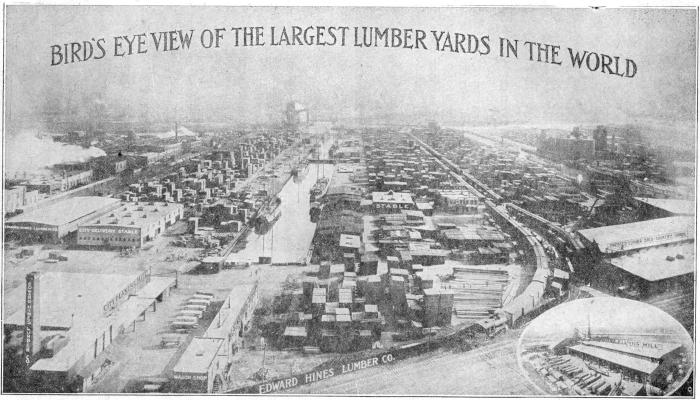
Bird’s-eye view taken from tower 200 feet high, showing our three large yards, covering over 45 acres and a water frontage of over one mile. The piling shown just opposite locomotive (over 1000 in number) are 60 feet long and appear like a bundle of matches, giving you a comparative idea of the enormous size of our plant.
Timbers in stock up to 20×20-100 ft. Shingles and Lath in mixed cars from Chicago or full cars direct from our Northern mills. Inch and two inch Hard Maple for Warehouse Driveways, Coal Yards, Lumber Yards, Grain Elevators, etc., also for Crating and Packing purposes.
Western Union and Postal Wires direct to our office.
PROMPT SERVICE ASSURED.
TELEPHONE “CANAL” 349.
HE WHO USES CYPRESS BUILDS BUT ONCE


You know the ancient fame of
CYPRESS
but do you know its uses today,
and their significance to you?
CYPRESS is the wood of Scriptural history, and of romance; CYPRESS was the mystic wood of mythology—and it was the reliance of the sturdy builders of early America; CYPRESS always has been a magnet for those who have wrought sentiment and beauty into useful things—and CYPRESS is today the staple wood of the hard-headed calculating buyer who seeks the most lasting values for his lumber-money.
This concerns YOU—if you like to avoid repair bills on anything made of wood.
It was of CYPRESS, according to Pliny, that the famous statue of Jupiter was carved; it existed more than six centuries without a sign of decay.
The historic Gates of Constantinople were of CYPRESS; they were on duty for eleven centuries without a furlough.
The CYPRESS doors of ancient St. Peter’s, in Rome, were in a state of perfect preservation when removed by Eugenius IV; they had been swinging on the faithful for twelve centuries.
The only Egyptian mummies that survive intact and unblemished are those whose executors filed them in CYPRESS receptacles.
To bring the record nearer home—there was Thomas Lyon, who in 1640 built him a house in Greenwich, Connecticut. He put CYPRESS shingles on its roof and sides. With no exterior repairs of consequence, this house is today occupied as a residence.
THIS WAS AMERICAN CYPRESS—the kind we own and cut and are selling you.
CYPRESS is in truth “the wood eternal.” He who uses Cypress builds but once.
If you are putting up a palace or a pasture-fence, and want to build it “for keeps”—USE CYPRESS.
There is a liberal education (and a wonderful INVESTMENT value for you) in the CYPRESS advertising—and in the detailed information and reliable counsel to be had promptly, WITHOUT COST, if you will WRITE US YOUR OWN NEEDS (big or little), and ASK YOUR OWN QUESTIONS of the “All-round Helps Department” of the
Southern Cypress Manufacturers’ Association
1219 HIBERNIA BANK BUILDING, NEW ORLEANS, LA.

Probably your lumber man sells CYPRESS; if not, WRITE US, and we will tell you the dealer handiest to you

AMERICA’S FINEST HARDWOOD
Three years ago the architect or builder would have had a hard time to find any building of importance in the United States in which the owner had been courageous enough to use RED GUM trim.
Today there are thousands of apartment houses, banks, hotels, office buildings and fine residences from New York to Frisco in which RED GUM has been deliberately chosen for the trim because of its great beauty and entire practicability.
RED GUM is no longer a competing wood for luxurious interiors.
RED GUM is now FIRST CHOICE with people of selective taste.

Where White Enamel trim is required, SAP GUM is the ideal material. Not only does it take and hold white enamel better than any other wood, but it is possible to get good SAP GUM cheaper than any other wood hitherto used for white enamel woodwork.
SAP GUM presents remarkable qualities where moderate priced trim of good appearance is desired. Another field in which SAP GUM has reached supremacy is in the manufacture of porch columns.
SAP GUM takes stains and wood dyes beautifully, and all the popular finishes are easily reproduced in SAP GUM.
Write any firm below for Samples of Red Gum and Sap Gum both rough and finished, and for market prices of selected Gum Lumber.
| Himmelberger-Harrison Lumber Company, | Cape Girardeau, Missouri |
| Charles F. Luehrmann Hardwood Lumber Co., | St. Louis, Missouri |
| Carrier Lumber & Mfg. Company | Sardis, Mississippi |
| Three States Lumber Company | Memphis, Tennessee |
| Lamb-Fish Lumber Company | Charleston, Mississippi |
| Baker Lumber Co. | Turrell, Arkansas |
| Anderson-Tully Co. | Memphis, Tennessee |
Press of
F. P. BURNAP STA. & PTG. CO.
Kansas City, Mo.