
Title: Life-tangles
or, The journal of Rhoda Frith
Author: Agnes Giberne
Release date: May 6, 2026 [eBook #78624]
Language: English
Original publication: London: John F. Shaw and Co., 1896
Other information and formats: www.gutenberg.org/ebooks/78624
Transcriber's note: Unusual and inconsistent spelling is as printed.
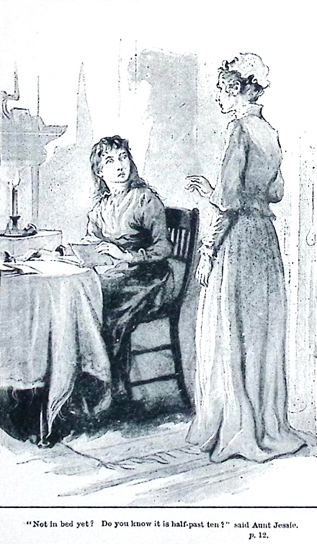
"Not in bed yet? Do you know it is
half-past ten?" said Aunt Jessie.
OR,
THE JOURNAL OF RHODA FRITH.
BY
AGNES GIBERNE
AUTHOR OF
"IDA'S SECRET," "FLOSS SILVERTHORN," "LIFE IN A NUTSHELL,"
ETC.

LONDON:
JOHN F. SHAW AND CO.
48, PATERNOSTER ROW, E.C.

CONTENTS.

THE RETURN FROM INDIA
RHODA'S DIFFICULTIES
UPS AND DOWNS
I AND MYSELF
BANISHMENT DECREED
AT WAYATFORD
DERWENTWATER
PEOPLE'S RIGHTS
SUPPOSITIONS
THE CHOICE GIVEN AND TAKEN
A DAY OF DELIGHTS
A NEW PHASE OF LIFE
UNDER THE YOKE
EXCEEDINGLY HORRID
AFTER SIX WHOLE YEARS
ABOUT THE PAST
WISE WORDS AND UNWISE DEEDS
OUT OF THE QUESTION!
AND YET!—
INEXPLICABLE
TANGLED STILL
WAS IT HAPPINESS?
HOW THINGS WERE AND MIGHT HAVE BEEN

LIFE-TANGLES:
OR,
THE JOURNAL OF RHODA FRITH.

THE RETURN FROM INDIA.
December 12th.
THE day after to-morrow will be a great day in my life, for my mother is coming home with the dear little twins, and they are expected to arrive early in the afternoon. What joy!
It is nearly seven years since my father and mother went out last to India; and the twins were only one year old when I saw them. How changed they will be.
Seven long years! But my mother's face is as clear as daylight in my mind, so young and pretty, with its soft colour and gentle smile. I do not remember my father's face quite so clearly; he was a good deal more away from us children. But I could paint every line of hers from memory if I were able to take likenesses. I should know her, oh! anywhere in the world. I can recollect telling her one day that she looked younger than Clarissa, who was only twenty-one then. Mother said, "Hush! Hush!" And Clarissa tilted her head in the offended manner she often has, but I don't think I cared.
Then the last day before they left us, how pale Mother was, and how she and Connie clung together! We little thought then that she would never see Connie again—I mean, of course, in this life.
If it were not for the thought of Connie, and of my father being still away, I think I should be too happy to-night. No more of aunt Jessie; no more schooling; no more spending of holidays where I am not wanted. It is too delightful!
To be sure, Clarissa and Juliet will be living with us, and that is a great disappointment to me. I have always fancied that they would stay with aunt Jessie when my mother should come home alone, but they do not seem to have an idea of any such thing. Somehow they always do and always did make me naughty when, but for them, I know I should be perfectly good. They have such a way of upsetting me. It isn't my fault, I am sure.
But I shall have my mother now, and that will make up for everything. Aunt Jessie has been their aunt, not mine. Mother will be mine—not theirs—my very own! That will make all the difference in the world. I shall have the first right to her love, and the first right to take care of her. I mean to be such a help to her in every possible way, and to do exactly what Connie would have done. Connie was always her comfort, I know, even though she was so young, because she was so unselfish, everyone says. Well, and I mean to be unselfish, like Connie, and so to be my mother's greatest comfort. I have to take Connie's place, and Mother will be lonely away from my father, and will need comfort. Clarissa and Juliet are always saying how useless I am, but they shall see the difference now. When I have a mother to do things for, I shall never mind how hard I work. It is so stupid being ordered about by them. I never feel inclined to do anything then.
Before Christmas we are to move to the new little house in the country—Woodbine Cottage. Aunt Jessie and Clarissa and Juliet have settled everything. It seems to me that they ought to have waited till my mother should arrive, to see what she would like; but such an idea never enters their heads. I cannot make out that she has sent any directions; and if I ask, I get no answer, or else I am told that it is not my business. If it is not my business, I don't see whose it is, for I am my mother's eldest daughter, and I do think I have a right to know things, now I am seventeen years old, and have done with school.
It puzzles me why they should have fixed upon that place to live in. We know nobody there, and I can see no particular reason for going. It is just a whim of Clarissa's, I suppose; and yet she is not fond, in a general way, of living in the country.
December 13th. Thursday Morning.
While I was writing in my journal yesterday evening, aunt Jessie rapped at my door and walked in without waiting for an answer. She was vexed to find me still dressed, and said,—
"Not in bed yet? Do you know it is half-past ten?"
I said I had not hurried because I was not sleepy. And I shut-up my journal and slipped it into a drawer, lest she should see what I had written.
"That is no excuse," aunt Jessie replied. "I sent you to bed early, because I knew that to-morrow would be a fatiguing day; and you are wrong to disobey me—this last evening especially."
I think I could have kept my temper if Clarissa had not come gliding in after aunt Jessie.
"You had much better take Rhoda's pen and ink away," she said. "There is no dependence to be placed on her. I do not know what her mother will say to such ways."
That made me fire up before I knew what I was about.
"It will be Mother's business, not yours!" I said.
Clarissa's lip curled as it always does when she is put out. People say she is very handsome, but I never can see it; I cannot think her good-looking. Then aunt Jessie told me that I was extremely naughty—she always says "naughty" still, just as if I were only six years old. I am afraid I pouted, and she said I was to be in bed in ten minutes. So I was, but I had no time to say my prayers. I didn't feel like saying them, even if I had had time.
Aunt Jessie came back exactly at the ten minutes' end, and she put out my light and left me without saying, "Good night."
Then I knew that I could not go comfortably to sleep without at least trying to say my prayers; and I crept out of bed and had a good cry on my knees, for everybody seemed unkind. That sort of thing always makes me miserable, though people think I don't care; and I do not see how one can say one's prayers properly when one feels so. I know I could not. I did try, but I was only able to think about Clarissa; so at last I got up and crept back into bed.
After breakfast this morning aunt Jessie gave me a regular lecture about my faults. She began with a present of a gold pencil-case, and that was uncomfortable. I have wanted one for a long time, and this is a beauty. But I wish people would choose some other time than before a lecture for giving one presents. If we had been alone when she lectured, I should not have minded so much—at least I think not! But aunt Jessie never thinks of waiting till we are alone.
Clarissa was arranged in one of her attitudes, doing crewel work; and Juliet was mending the dress that I tore yesterday. I cobbled up the hole in a hurry, but Juliet spied it out, and she has undone my cobble and has darned it most beautifully. Of course I ought to be grateful, but I do not think I am. It is so difficult to feel grateful to people when one does not love them; and I certainly do not love Juliet. Not what I call really loving, I mean.
While aunt Jessie talked, I was wondering whether Mother would admire those two as much as other people do. I was too young, when she went out, to know anything about her tastes. They are often called "the handsome Miss Friths" by strangers. Clarissa is tall with a good figure, and Juliet is shorter and rather plump, with pretty features and a very quick manner. I am not at all pretty, and I know it very well. Connie was lovely, but my face is not like hers. I am said to be like nobody in the family. Well, my mother will not love me less for my want of prettiness, and other people do not matter.
I was thinking this, yet I heard aunt Jessie. She said that if I did not take care, I should be a great trouble to my mother. She told me that I was forgetful, untidy, impatient, ill-tempered, wilful,—such a string of hard words. She complained especially of my want of gentleness, and of "my unpleasant manner to the girls." Aunt Jessie always calls them "the girls" still, and counts me a mere child in comparison, though I do not feel like a child any longer. I did not know that my manner was unpleasant, except perhaps when they vex me, and then how can one help it? Aunt Jessie said it was un-Christian, and she wished I would pray for a better spirit. Very likely some of what she said was true, because, of course, I am not perfect, and I do not pretend to be, but then I am sure other people are anything but perfect also. And there are different ways of being told that one is in the wrong; and her way never does me good, it only makes me feel cross. Besides, as for meekness—and she talked ever so much about meekness—I suppose I am not particularly meek, but most certainly Clarissa and Juliet are not! Why doesn't she lecture them?
I bore it all pretty well, I do think, till she began to say that my mother would be disappointed in me. Then I could not help bursting into tears, and I ran away up to my own room, where I have been ever since.
Why must people say such things?
December 15th.
We went to the station yesterday afternoon to meet my mother and the twins. On the way, I was picturing to myself the meeting—how I would be the first to catch sight of Mother's face, and how she would hold me in her arms, and would have no eyes for anybody else, and how the twins would cling to me—their only sister. I almost forgot that aunt Jessie and the girls would be there, only perhaps I was glad down below to know that they would see for once the difference between them and me. I mean the difference as to my mother. The girls may talk of being her adopted children, and I am sure she has been the best of mothers to them ever since they were quite tiny, as much as she possibly could. Having to be away in India, has kept her from them, just as it has kept her from me. But still, all the time she is "not" their mother, but only their aunt; and they are "not" her children, but only her nieces; and nothing can make her the same to them that she is to me. And for once I thought they would feel it.
Then when the train steamed in, and we were on the tip-toe of expectation, Mother was not there at all! They had not come by that train. I don't know when in my whole life I have been so dreadfully disappointed. It made everything seem unreal. I almost felt as if the coming home from India were all a mistake, and as if I should never see my mother again. The others took it much more philosophically, even though they have talked as if they cared any amount about having her back. Juliet laughed at me for looking glum, and aunt Jessie said how wrong it was to be sulky. I wonder why people think one sulky when one is only unhappy!
Clarissa was sure my mother had only missed her train. Indian ladies never were punctual, she said, with a disagreeable little laugh. And I felt like saying almost anything, for I knew it was not Mother's fault, whatever the reason might be.
When we got indoors, a telegram was awaiting us. Mother had found at the very last moment that she would be hindered in Bristol by business, and she could not say what hour she might arrive. I wanted to look-out the trains from Bristol, and to meet each one, but aunt Jessie objected. She and the girls were tired, she said, and she could not let me hang about in the station alone. The telegram said, "Do not meet us;" and that quite satisfied aunt Jessie, but it was not enough for me.
The next few hours were the longest and dreariest I have ever passed. I could not read or work or settle down to anything. But at last they came, just when nobody happened to be on the look-out, my mother and the twins, all alone. The ayah who was to have travelled with them had made a sudden engagement to go back to India, and Mother had let her off, leaving her behind in London.
The meeting was not in the very least like what I had pictured.
Mother was tired out with the journey, and with having to manage for herself and the children all day. She has grown thin and pale, almost sallow, and has lost all her pretty young looks. I could hardly believe, at the first moment, that it was really herself; she is so changed. She walked in slowly and languidly, and seemed as if she had not strength or spirit to be glad about anything. When I rushed into her arms, she just gave me a quiet kiss, and said nothing. Then she put me aside, and kissed Clarissa and Juliet in exactly the same manner. I did not see one grain of difference. And yet I am her own, and they are not. And those two took possession of her, making her sit down, while Clarissa untied her bonnet strings, and Juliet loosened her cloak. Mother smiled at them in a worn-out way, and let them do as they liked.
I wanted to kiss Addie and Emmie, but they clung to Mother, and would not so much as look at me. When I took hold of Emmie, she shrieked, and Addie struck at me with her little fist. Mother said, "Don't, Addie!" Yet the moment I came near, she did it again.
They are such an odd little pair, exactly alike, with tiny white faces, and big black eyes, and fluffy fair hair. Not nearly so pretty as I expected, for they are said to be like Connie.
It seemed as if I had no chance of reaching my mother, while those two clutched her in front, and the elder girls sat one on each side. Aunt Jessie kept talking about the voyage, and asking questions about my father. Mother answered in a patient tired out voice, almost as if she did not know what she was saying.
Presently Juliet coaxed the children off to look at the kitten. They would go to her, though I might not touch them.
Then Mother spoke my name, and I came close. She took my hand, and gazed at me, as if she were trying to understand something. I felt so hurt about the little ones, and so flat and chilled altogether that I could not look pleased or bright. It was impossible. Nobody could have done so in my place. Mother said, "How altered!" I knew she was dreadfully disappointed, and a lump in my throat half-choked me.
"Rhoda has changed a good deal the last half-year." Aunt Jessie seemed to think she had to apologise for the fact. "But she does not grow fast. She will never be tall."
Mother said, "Perhaps not," keeping her eyes on me still.
"I am almost as tall as Juliet," I said, and I know my voice sounded curt.
"Within two inches," Juliet remarked; but the difference is less than one inch.
"She will be tall enough," Mother replied; and that was my first scrap of comfort. If "she" is satisfied, I don't care about other people.
When the twins' bedtime came, she insisted on taking them upstairs herself. I wanted to help, and the moment I came near, they began to shriek. Juliet ordered me off, and took my place, and they were good directly. I cannot understand it. I did feel so sore and miserable at not being able to do anything. And it has been just the same since.
December 19th.
We go to our new little country home the day after to-morrow.
Everything is ready for us, settled by Clarissa and Juliet. Mother just submits. She doesn't seem to have any will of her own. I have hardly heard her ask a single question about the house or the place, or why we are to be there at all.
Though she has lost her old colour and prettiness, there is still something about her unlike other people, and I am proud of her. But I am afraid she is not proud of me. Clarissa and Juliet are always trying to show me off in the worst lights before her.
As for my being the eldest daughter of the house, nobody could guess it. Mother behaves exactly as if I were only her third daughter. She puts Clarissa and Juliet first in every single thing. Of course it is all right that she should be kind to her nieces, especially as they are orphans, and have no real home of their own. But then they are not poor, and I have my rights as well as they; and I must say I did not expect things to be like this. I did think that with my mother I should find a difference, however other people might treat me. I do long to know that I have the "first" place in her heart. If once I could be sure of that, nothing else would matter so much.
Johnnie has come, and I can see how dearly she loves him. He is her only boy, and he always is so good-humoured and pleasant. Nobody counts him handsome or clever, but he does his lessons fairly, and he is good at games, and he is a thorough gentleman,—much more so than most boys of fourteen,—and everybody likes him. Of course, I do too; only somehow he and I don't quite fit in together, as Connie and I did. He has such a provoking admiration for Clarissa. It is absurd.
Yesterday evening Mother came to my room late, for the first time. She has been too tired on other nights. I thought she wanted to speak about Connie, and I wanted it too; but a shy fit seized me, and I talked so fast about all sorts of stupid things that she had not a chance.
After she was gone, I did wish I had not been so foolish. I know she has already spoken of Connie to others, for I heard Clarissa say so.

RHODA'S DIFFICULTIES.
December 20th.
WE start early to-morrow. I have only time for a few words to-night.
My mother and I were out alone together this afternoon, for once. As we were passing through the shrubbery, I suddenly found myself saying:
"You haven't spoken one word to me about Connie since you came!"
She turned her face away.
"I have not been able," she said. "Another time—"
"If only you could!"
I saw her throat working. She said after a little pause,—
"You remind me of her incessantly."
It was a great surprise to me.
"Why, Mother! I am not like Connie."
"Sometimes. More than you used to be."
"But Connie was so pretty."
Mother looked at me in a curious steady way.
"It is not a question of prettiness," she said, "nor of features at all. The look comes and goes. And you are pretty enough for my eyes. A mother sees differently, you know, from other people. Perhaps others would not see the likeness, but I do."
I am very glad. If "she" thinks so, it matters very little what anybody else thinks.
I mean to devote my life to her, and not to care for any single thing except her comfort and happiness. Then, perhaps, in time, she will love me as I want to be loved, and as I love her, not merely as she loves Clarissa and Juliet, or because of my likeness to Connie.
January 2nd, Wednesday.
After a busy Christmas, we are pretty well settled in our new home. On the whole, I do not dislike the little place; and the house is comfortable, only small. The garden will be nice in summer. I have a room opening into my mother's, and the elder girls, as usual, sleep together.
We have no friends yet in the place, but there are a few neighbours whom we expect in time to know. Nobody that I shall care for, most likely. Clarissa will monopolise everybody, and give me no chance. But if I can have Mother sometimes to myself, I care very little about other friends.
We have had a very dull Christmas—more dull than I could have thought possible, so soon after their coming home—but at Christmas it does seem natural to have a little excitement of some sort. And we have had none whatever. I do not seem to have anything particular to write about.
February 3rd.
I have been thinking lately how terribly difficult a thing it is to keep straight, and how hopeless to manage to please everybody, and what a puzzle life is altogether.
Only a few weeks ago, I was looking forward in a perfect rapture of delight to my mother's coming home.
I thought everything was sure to go right, when once I had her. I thought worries and misunderstandings would be at an end. And it has not been so at all. There are just as many worries and rubs here as there used to be at school, or at aunt Jessie's in my holidays. I am quite as often fretted and vexed. And I can find no way of keeping out of troubles—little stupid needless bothers, which are almost the worst of all to bear.
If Connie had but lived! I do feel so lonely without her. She always understood me, and I never was put out with her, or, at least, scarcely ever. I hardly knew I had a temper till Connie was gone. She seemed to come between me and aunt Jessie, between me and the girls. She seemed to smooth down everything, and to make life go right. And everybody loved Connie.
Perhaps I did not get vexed then, because Connie never did anything to vex me. But other people are so unreasonable. I don't see how I can be expected not to mind. Clarissa is always saying, "There you are again!" And Juliet says, "Sulking as usual!" And an hour ago, my mother herself found fault with me. I had not meant to be cross, and indeed this morning I went downstairs with a particular resolution to let nothing whatever vex me, no matter what might happen. But resolutions don't seem to be of much use. Clarissa does set one down so, and Juliet meddles, and both of them sneer. If only they would let me alone!
I said so to my mother, and she said that was a childish wish, for nobody could be "let alone" in life. She told me that I must expect little contradictions, and that I was old enough to be able to take them patiently.
I am afraid she thought me hard, for I did not know what to say, and so I made no answer. I could not possibly say that I thought Clarissa and Juliet were not to blame, because I do think they are very much to blame. If they were different, I should never feel cross. They do worry me so fearfully! Perhaps I ought to have said that I was sorry; for I suppose I did not speak exactly as I ought to Juliet—but still—Well, if it had been anybody else, I would have said so, but I couldn't! And I came up here for a little peace. I don't mean to go down yet.
Mother always seems to be sure that I am the one who is most to blame. And yet why should I be? She never blames Clarissa or Juliet, at least I never hear her do so. And yet I am her own child, and they are only her nieces, but really it almost seems as if she forgot that.
She does not know how dearly I love her, or how utterly miserable it makes me to think that she is the very least displeased with me.
I do wish, too, that she would sometimes make a stand for her own way. One might almost think that the house belonged to Clarissa and Juliet. To be sure, they are very fond of her, or they seem so—after a fashion.
But Clarissa calls her "the dear little mother," in a petting patronising way which I detest. She is not their mother, to begin with; and though she is very slight, she is taller than Juliet, and almost as tall as Clarissa. I can't bear Clarissa to speak in that horrid patronising way. And Juliet is for ever trying to get things into her own hands, managing this and deciding that without so much as a reference to her. She pretends that it is all to save her trouble, but I know better! She gives my mother no choice; and things are constantly arranged as Mother would not have chosen, and as she does not really like, only she is too gentle to complain. I do wish she would now and then make a stand. And I don't see why I am never to have a voice in any single thing!
February 9th, Saturday.
A pouring wet day, and no going out; and I am thoroughly out of sorts. Everything has gone wrong the whole morning.
I have been in such a stupid unhappy state lately. Life seems so tame and dull and disappointing. Before we came here, and still more before my mother came home, I meant to be so busy and useful to everybody, and I thought I should be perfectly happy. But I can't! It is not the very least use trying! I feel inclined just to give up, and not try any more. If Clarissa and Juliet were not here, that would make all the difference; but while they are in the house, nothing ever can or will go straight. I hate to do things just because they tell me that I ought. It only makes me want to do exactly the opposite directly. And really I don't see any need for me to do things.
I did mean to be my mother's companion everywhere, and to save her trouble with the housekeeping, and to do everything for the twins. But when she does want to go anywhere, Clarissa is almost always her companion, and then I don't care to go too. And Juliet has taken up the housekeeping. And as for the twins, they are so dreadfully spoilt that I can do nothing for them. If I say a word, they begin to shriek, and then my mother is worried. They are always good with Juliet, and I wonder Mother isn't hurt at their devotion to her. But, at all events, it is of no use for me to interfere. Sometimes, when they are good, I play with them, but it is sure to end in a fit of naughtiness; and all the blame is laid upon me.
I cannot imagine how it is that so many people go through life in such a steady jog-trot fashion, taking each day as it comes, and never seeming to mind what happens. Perhaps they think and worry more than one would suppose; for, after all, nobody would guess what I go through in that way. I don't talk about it, and I am supposed to be quite wrapped up in my own interests. I like reading story-books; and sometimes I get into a merry mood, and talk and laugh. And people think me just an empty-headed school-girl—at least I am sure some do.
But I am not. I do think—oh, a great deal! And sometimes I do so wonder how it will all look to me by-and-by, when life is over. And then I make up my mind that I will be quite different, and nothing shall put me out. I go downstairs, feeling so good, and ready to do or bear anything. And then Clarissa puts on one of her airs, or Juliet says some sharp thing, or somebody tells me to do what I shouldn't in the very least mind doing if only I were asked nicely, and not told as if I ought,—and in a moment I am upset, and I speak out, and I am treated like a naughty child for the rest of the day. I really do not see that I am to blame when things happen so. It seems as if one could not possibly keep right with some people.
After breakfast, I was trying to forget everything and everybody in an interesting book, when suddenly Juliet began reminding me that I had not practised for three days past. I knew I had not, but I had not felt inclined—one does not in some moods—and she might have seen that I was not in the mood for it. Some people are so stupid! I told her I did not want to play just then; and of course I said it sharply. Anybody would, who felt as I had been feeling all the week past. Juliet began to argue, and I said I wished she would not meddle; and then Mother told me to go at once to the piano. It was so provoking of Juliet! When Mother spoke, I went, of course, but it was of no use. I really could not take pains, or help striking false notes. Presently Clarissa said, "Torture!" with a groan. And my mother said, "You are not doing your best, Rhoda. Go upstairs instead, and mend your stockings. When you feel happier, you may come down again."
And here I have been ever since. I don't mean to go down till it is time for our walk.
I wish nobody ever was tiresome. O Journal, you don't get cross with me.
February 11th, Monday.
To-day has been just as bad as yesterday. Mother looks so sad that I hate myself for giving way to temper; and I think I detest certain other people still more, for making it impossible for me to keep good-humoured. I have tried praying that things might be different, and it doesn't seem to have done the smallest good.
February 12th, Tuesday.
Yesterday evening, Mother sent me away from the dinner-table for answering Juliet. Juliet spoke to me about stooping at meal-times. I know it is a bad habit, and makes one look awkward and lazy; and I mean to get over it in time. But I didn't think Juliet had any business to find fault with me before the children; and they are generally allowed to play about in the room all dinner-time. So I told her it was no concern of hers. Juliet answered me sharply; and I answered her again; and then Mother told me I had better go to my own room. So I went off with a bounce, and slammed the door, because I thought they deserved it—Juliet, I mean, not Mother. I didn't think at the moment that I was punishing her as well.
About half-an-hour later, she came to me. I had not been doing anything except sit at the window to watch three or four children playing in the back field. I felt so dull and moody still that I did not even look round when my mother opened the door. She shut it, and the next thing I knew was her hand on my shoulder.
"Are you quite well, Rhoda?" It was not at all what I had expected her to say.
"Quite."
"Nothing wrong in that line? Then what has been the matter lately?"
I do not know what I wanted to say, but I know that the only word which would come to my lips was, "Connie." I smothered it back; but when Mother put the question again, I could not help myself. The name seemed to force its way out; and then her arm came round me, and in a moment, I was crying as I have not cried once since the night when Connie was taken from us.
Mother did not say a word. She only held me fast, and just touched my face now and then with her lips; and presently, when I was better, I found her struggling not to give way too. For a long while neither of us could speak, and we only clung together. But it seemed such a help to know that she was going through it all too. I don't think I can ever again have quite that lonely feeling, as if nobody in the world knew anything of what I felt.
Then I wondered whether, perhaps, Juliet might be coming after us, so I went and bolted the door; and the very next moment, there was a rattle of the handle outside, and Juliet's voice called my name.
"You can't come in just now," I said.
And she spoke indignantly,—"Rhoda, how can you go on in this foolish way? You will make your mother ill."
But I only repeated, "You can't come in just now;" and when she had argued a little, she went away.
Mother was herself again by that time. She made me sit down beside her, and said, "Perhaps we shall both feel better for this by-and-by. But now you must bear a few words from me, which you will not exactly like. Words of something like blame, I mean."
"I can bear anything from you," I replied. "It is Juliet's worrying that I can't stand."
"Sometimes we 'have' to stand things that we should not choose, if the choice were given to us. And it will not do to make sorrow an excuse for ill tempers." Then she told me plainly how disappointed she had been in me lately. She said she had expected things to be so different on her return.
"Yes, I know. That is just how I feel," I said. "Everything goes wrong; and I am sure it is not my fault. It is all the fault of Carissa and Juliet."
"Not altogether, not nearly altogether, Rhoda. Think for yourself, and you will see it." Then she reminded me of her wish that I should practise regularly before breakfast; and she asked how often I had taken the trouble to do so. I could not say that I had done it. "The girls are hardly to blame for your remissness in that line, at all events." She went on to explain that my father had spent a great deal on my education, and that the least I could do was to take care that the money spent should not have been thrown away.
Of course, all that was reasonable enough, and I am not so stupid as not to see it. I do not think in fact that I am a stupid girl, though I make no pretensions to cleverness.
"Everything that you have learnt at school will soon become useless if you do not keep up what you know. And you hardly attempt to do so. There is little enough to occupy your time, yet you never seem to have leisure for what ought to be done. If an interesting story-book comes in your way, all else goes down before it. Is that right? You are not a little child any longer; and duty ought to stand before amusement."
I did not find it easy to bear all this, even from my mother. Once or twice I tried to interrupt her, but she went on to the end.
"If only Juliet would not meddle so!"
"Juliet means it kindly. You must remember that she is five years older than you. If you cannot remember your own duties, you ought to be grateful to her for bringing them to mind. To refuse to do right, merely because one is told of it, is really too childish."
"I don't always forget. But reminding does no good. I mean, reminding in Juliet's way. And even when I remember, it is so hard always to leave off doing what one likes, for the sake of doing something that one detests."
"For the sake of doing what is right!"
"One can't be always in the mood for work."
"No, one cannot. And those times when one is least in the mood are often the times when it is most one's duty to do the work."
"Only people do have lazy moods now and then," I could not help saying, though I did not really mean to be perverse.
"People do undoubtedly."
"And one can't help it."
"One cannot help having the mood, I grant you. One can certainly help yielding to it. There is hardly any more miserable slavery than the slavery of those who are victims to every passing mood and humour. It is in just such little fights that the real battle of life is carried on. If you do not discipline yourself in little duties, you will never be fit to undertake great duties."
"But still—"
"Still, you think people may please themselves. A governess may teach when she is in the mood, and let teaching alone when she is not in the mood. The captain of a ship may attend to the navigation of his vessel so long as he feels inclined; and when he gets a lazy fit, he may retire to his cabin, and leave the ship to take care of itself. Is that the sort of thing you mean?"
I could not help laughing.
"But such stupid little things as half-an-hour's practice, or a page of French translation—"
"Or such stupid little things as putting aside a delightful story, for the sake of a French translation; or getting up early, for the sake of the morning practice; or overcoming small tricks, for the sake of being more agreeable to other people—"
"Mother, if only you would always tell me, and no one else!"
"But I cannot promise that, Rhoda. What right have I to seal other people's mouths? Juliet is very good to take the trouble to look after you. She is a great help to me."
"I don't think she is good at all!" I burst out. "She interferes and meddles, and makes herself perfectly unbearable."
Mother looked really displeased, and her hand came over my mouth.
"Hush, Rhoda! I will not have you speak in that manner. Juliet is to all intents and purposes your elder sister, and I expect her to be treated as such. You have given way far too much to these feelings. Instead of helping me to keep a peaceful atmosphere in the house, you are doing your best to stir up strife."
Then my mother went on to say that she had always hoped I was one with Connie in desiring above all things to serve God, to do the will of Christ. She is very shy in speaking on such subjects; and I could see her hands trembling. But I thought it rather hard that she should seem to doubt whether I cared at all about such things, when I am sure I mean to do right as much as any one does. Of course it is difficult for me, as it is for everybody, but I am sure I do try. And if it wasn't for Clarissa and Juliet, I should be quite good-tempered. It is only they who put me out so horribly; and anybody else would be put out in my place.
I did tell Mother that I would see if I could do better; but she did not seem satisfied, and I could not say more. Only I have written all this down, as a sort of punishment to myself, and because I mean to try. I intend if possible to make myself not care what the elder girls say or do.

UPS AND DOWNS.
February 19th, Tuesday.
UP early this morning, and had a whole hour's practice before breakfast. Mother looked so pleased; and Clarissa and Juliet have really been quite kind. If people would always behave like that, it would be so much easier to get long smoothly.
After breakfast, I had a busy hour, taking care of the children, and playing games with them; and they were as good as one could wish. Certainly it is much nicer to be busy and useful than to be doing nothing in particular; and I have made up my mind to turn over a new leaf.
February 20th.
Desperately hard to get up this morning; and I only managed to secure twenty minutes for music. Juliet remarked, "Too good to last! I thought so yesterday!" And though I was not meant to hear, I did hear, and I knew what she meant. But after all, I made up the full amount later: so nobody was the worse.
February 21st, Thursday.
I don't see the good of bothering myself. After all my resolutions, I only contrived to get down just in time for breakfast. And directly afterwards, instead of offering to look after the little ones, as I have done the last day or two, I sat down for one moment with a book from the library, just to see how it went on. And it was so interesting that I simply could not put it down again. Addie came to me for a game, and I told her to go away; and as usual, she must needs begin to cry. Those children wail about every single thing that they cannot have.
Whereupon, of course, everybody seemed to think I had done something perfectly shocking; and Juliet petted the twins, and Addie scowled at me, and Mother was worried, which is the worst of all. Then my music-master came, and was vexed that I had not practised more. It is rather wonderful that a music-master is to be had at all in such an out-of-the-way place as this, but he comes once a week to give lessons to several families in the neighbourhood, and the girls have seized on him for me. I am not in the least grateful, for I simply detest music.
February 27th, Wednesday.
I have not managed to be up in good time for some days past, and I am vexed with myself every morning. Yet when the next morning comes, somehow I do just the same. It is provoking, because one does not like to feel that one is easily beaten. But at the moment when I am first called, when I ought to spring straight out of bed so as to have time enough, I only feel that it is perfectly impossible! Nothing on earth seems of the very smallest consequence then, except getting half-an-hour more of sleep. Do other people ever feel so, I wonder? And if they do, how in the world do they get over it?
At all events, one thing is better; there has not been nearly so much disagreement between me and the girls. Once or twice, when Juliet has been sharp and unjust, I have borne it quite quietly and have not said in return what she really did deserve. So I think I "must" be growing a little more patient and gentle. I am sure I have prayed often enough lately that I might be made so; and it is nice to feel that one's prayers are answered. Some people talk as if they were always having answers to prayers, at least people in books and memoirs do, but I am afraid that is not my way. Perhaps I don't pray often enough; and perhaps I don't always mean what I say in my prayers. It is so difficult to know sometimes what one wants exactly. I am sure I want to be good, and not to worry my mother; and yet I do not want to be always knuckling down to the girls, because I really can't see what right they have to manage everything in our house. However, I am glad to have got on more smoothly, and I don't mean to be cross any more.
March 2nd, Saturday.
I am more than half inclined to tear out that last entry. This has been such a miserable afternoon. Juliet has been so provoking! I don't know who could bear with her.
She put me out so fearfully that I hardly knew what I said. But I know I told her that she was for ever meddling with me, and that I did not want to be meddled with. I said I wished she lived anywhere except with us.
Juliet turned quite white—I cannot think why!—and said in a voice not like her own: "There is no need that I should. I have another home. If we are not wanted here, we are wanted by aunt Jessie."
Mother came in, and was told what I had been saying; and she seemed so distressed. More distressed, I should think, than there was any real reason for. She insisted on my begging Juliet's pardon; and at last, just to please her, I did say that if I had been rude, I was sorry. The word stuck in my throat, for I don't think I really was sorry.
Mother said—"Much more than 'rude!'"
And Juliet begged that the subject might be dropped. "Some things are best not discussed," she said. And I saw her afterwards caressing my mother, as if she had to comfort her for my naughtiness.
If I had been sorry before, that would have cured my sorrow fast enough.
If only everything were different! It is so frightfully hard now to do right. If only Clarissa and Juliet were pleasant and kind, we might be so much happier. And if only they did not live with us at all, and I had my mother and the children to myself, then I know I should be good. There would be nothing to make me naughty. I can't think why they should live with us, for they have quite enough money of their own to get on upon; and besides, aunt Jessie would be glad enough to have them both. That was true, and I know it was; and why they do not go to her when she wants them, and when I am sure we don't, is a mystery to me. Oh, if only they would! I know they do not do me any good by staying here. To-day I feel perfectly hard and cold, as if I did not care in the least about anything good. I feel as if religion had no sort of hold upon me.
March 4th, Monday.
Mother and I have had a long private talk to-day about the girls, and she has told me things that I did not so much as guess before—things I had no idea of.
Nobody has ever said a word to me about the heavy money-losses that my father has had in the last few years. He is not at all well off now. That is quite a piece of news to me, because I have always supposed that he had plenty. Another piece of news is that Clarissa and Juliet are very well off indeed. I knew that they had enough to make them independent, but I always supposed that they lived partly on "us,"—instead of which, things are just the other way.
Now that they are both of age, they are entirely free to choose what home they would wish to live in, and aunt Jessie would be delighted to have them. I was right there, at any rate. At one time, it was quite thought that they would make a home with her, and they gave up the idea, partly because they are so fond of my mother, too fond to put even aunt Jessie in the same place—I say "even," because they do care for her very much, though I do not,—and partly because of my father's losses.
Mother says it is most good and self-denying of them to stay on with us. It is a great help to her and my father; and the expense of keeping up a home in England, as well as in India, is so heavy that if the girls had decided to remain permanently with aunt Jessie, she does not think she could possibly have come home for another year or two, even though her health so much needed it. She says that the girls are most generous in taking upon themselves the main proportion of expenses; far more, in fact, than she would have had the least right to expect.
"This house," she said, "is literally more theirs than it is mine. And when you complain of their 'interfering,' Rhoda, they are really doing what they have every right to do."
"But, Mother, it is almost like living partly on charity!"
"I am much too fond of them both to think of matters in that light," my mother answered, though she flushed.
"I don't like it," I said indignantly; "I don't like it at all. I would much rather—oh, much rather—be with you and the little ones in some tiny house by ourselves. I should not mind how small a house it was, or how plainly we lived, if only it was really our own."
"Impossible. But for their help, I should not be in England at all now. So you ought to be grateful to them."
Of course I could not help seeing how my words must have sounded yesterday; and I asked if I should tell Juliet that I had not understood how things were. She said "No," for the girls would not like any talk about their affairs. She had thought it needful to tell me so much, but I must on no account mention to any one that she had done so.
"I don't see why not. It is nothing very particular to be ashamed of."
"People have their own ways of thinking and doing. I have almost given up trying to make everybody see everything as I do myself. If it is their wish to do kindnesses in secret, they have a right to please themselves in their own fashion."
"Mother, you are always talking about their rights, and never about mine!"
"My dear, there is not the smallest fear that you will not take abundant care of your own rights," she replied. And I do not think she has ever said a harder thing to me. Yet, let me be honest with myself. Is it not true?
One thing is plain; I must not be vexed any more with either Clarissa or Juliet, whatever they may choose to do or say. For my mother's sake, partly, and partly for my own. It puts me too much in their power as things are now. And suppose I were to annoy them so far that they should refuse to live any longer with us! Not that I should mind that in itself—only I do not see how we could get on then. Mother might even have to go back to India before she is fit for it. And then, suppose she were taken ill! Why, I could never forgive myself.
Not a very grand reason for keeping my temper.
March 13th, Wednesday.
We have gone on far more quietly for some days now. I do not know whether Juliet has heard anything of that talk of ours, but certainly she has not been so worrying.
A new idea has cropped up. I am to take the twins every day for an hour of lessons. I said to my mother that I wished I could do anything to help in the house, and she said this would be a real help. She has given them about half-an-hour herself, when able, but she is often too poorly. Juliet has been wanting to undertake it, but my mother has held back, because she felt that the girls were already doing too much for us; and certainly I do not think we need go out of our way to be further indebted to them.
Why did I never think sooner of offering to teach? Mother says she did think of it, but she fancied that I might not like the trouble. What nonsense! As if I minded trouble! It just shows how little one is understood by even those people who love one best. Mother says that of course she will expect me to be very regular, and not to put aside the lessons for any other thing that I may want to do. I was almost indignant with her for even thinking it needful to warn me. As if I could ever dream of such a thing! Does everybody believe that I really have no sense of what is right?
I am quite delighted at the thought of having this work. It will be such an interest; and I shall love to see the pets getting on as fast as I mean them to do. I intend to make the lesson hour so pleasant that they will always be sorry to leave off.
March 15th, Friday.
I never thought I should be such a good hand at teaching. Both yesterday and to-day the children have been perfect little gems over their lessons—not a cross word or a tear. They cuddle close up to me, one on each side, and do exactly what I tell them, and are as quick and clever as possible. They seem to enjoy my way of teaching so much, that the only difficulty is to persuade them to leave off. To-day we were nearly an hour and a-half. Of course, when I spoke of this, Juliet must needs say—"That is a mistake." As if I didn't know what I was about!
March 22nd, Friday.
Work goes pretty smoothly. Sometimes I have a lazy fit, and do not manage my early practice: but nothing has once interfered with the twins' hour. So I hope by this time that my mother sees I am to be trusted.
March 28th, Thursday.
Teaching is not such easy or pleasant work as I expected. For a few days the twins were charmed, and everything went as well as one could wish; and I thought they would both be able to read nicely in a very few weeks. But now all the novelty has worn off, and Addie will not sit still for five minutes, and Emmie cries at the least word. And whatever I manage to get into their heads one day seems to have evaporated by the next morning. In fact, I cannot see that they get on at all. And one thing is quite sure—if any single thing happens to go wrong, "I" am the one to be blamed for it.
April 5th, Friday.
I am getting most desperately tired of being so hard at work day after day. What with the twins' hour, and my own practising, and reading French and German, and mending my clothes, and being sent here and there, I really seem to have no time at all to myself; hardly an hour that I can properly call my own. Addie and Emmie have to learn to read, of course, but anybody could teach them their A B C; and I believe my mother has given it to me, not in the least because she really wants the help, but because she thinks the employment will do me good. That takes away every scrap of interest in it.
For what I want is to be of real use to her, not merely to be busy for my own sake. And I begin to find that I have no particular gift for teaching. One has to go over and over and over the same things in such a wearisome way, till one is perfectly sick of them; and after all, not a scrap of good is done.
April 9th, Tuesday.
I could not get up in time for practising again—Juliet says "would not," but really it did seem impossible. And after all, though such a fuss is made, what does it matter? I am seventeen years old, and many girls leave off music altogether at seventeen, when they detest it as I do. Why should I be made to keep on at my practising as if I were a little child still, not able to judge for myself? If it were not for Juliet, I do not believe my mother would care in the very least. Nothing will ever come of all this strumming. I have no gift for music, none whatever. And I do not care to do just a little of a thing—just enough to be respectable, and not so well as perhaps half-a-hundred other girls. I would much rather leave things alone altogether.
If I only had one great marked talent, then I would make the very best of it. I would work night and day to get on. I would not mind any amount of fatigue. But as things are, it does not seem worth while. No good comes of all the trouble.
Of course I know well enough that, as such a talent has not been given to me, I ought not to wish for it. All the same I "do" wish, and I don't see how one is to help wishing. I am not lazy by nature; only it takes all the spring out of one's practising and reading to know that, work as one may, one will never be able to shine in anything. Not really to shine. I suppose I can do most things fairly well,—quite decently—but that is not enough for me. I want to excel, or else to leave things alone. And that is just what other people never seem to have sense enough to understand.
Juliet has been setting my mother on to talk to me about the twins' lessons: and to complain that I have been irregular lately, and impatient with the children. I don't know what she means by "irregular,"—at least, if I know, I don't think it is fair. They almost always have their full time; and what difference "can" it make if one begins a few minutes later?
Mother reminded me of a resolution that I made one day lately, not to read tales until after lunch. If I had kept to that, I should not have been tempted, she said, to put off calling the little ones at the right time. I wish I had not told her of my resolution; it is so disagreeable to be reminded afterwards, when one has changed one's mind. One cannot always be bound by such fidgety rules. I said so, and my mother answered,—"No use to make rules, unless one is to be bound by them."
"Then why should one make any?"
"Because, Rhoda, you must be either mistress of yourself, or slave of yourself. And if you do not master yourself, that Self is sure to master you."
"But such an absurd little thing, as what time in the day one will read a particular book!"
"Not absurd at all, if the reading or non-reading of that book means a part of self-conquest. Wherever your weakness of will lies, there you have to resist. And most of life's fighting is done in side-skirmishes, not in great battles. We have a few great battles in the course of years—most of us—but there are a good many tiny rehearsals beforehand. The soldier who is beaten in his skirmishing has no chance at all when the heavier fighting comes on."
"Mother, one would think you were in the army."
Mother said no more, and I think from her face that she was rather hopeless. She might have known that I felt more than I would show.
I liked what she said, and I do not mean to forget it. But for Juliet, I believe I should keep all my good resolutions quite easily. She gets past all bearing.
As for impatience, I do not know who would not be impatient in my place. The twins are so awfully spoilt and fractious that the merest word makes them set up a duet of shrieks, and that brings the whole household about my ears. I told my mother how frightfully cross they were, and how difficult to manage, and she replied that they were delicate children and easily upset, but that I, being so much older, ought to be able to make allowances for them.
But why does nobody ever think of making allowances for me?
Perhaps my mother does behind my back, when she is talking to the girls. It is her way to excuse everybody.


I AND MYSELF.
May 1st, Wednesday.
UNCLE Basil Ramsay is coming for a fortnight's visit, and I have not seen him for years and years; indeed, I can hardly remember him at all. He lives so far off, and goes about so little,—I suppose on account of his wife's health. I believe she never leaves home. He is my mother's only brother, so I ought to like him, but somehow I do not manage to like people "to order," merely because it is expected of me. Mother seems rather nervous about having him. I do not know why. Perhaps he is fussy, and, if so, I certainly shall not take to him.
May 5th, Sunday.
This morning I woke up quite early, almost before it began to be light, and for a long while I lay thinking. I cannot tell what set me off. In the night, everything seems so different from the day, when people are bustling about and talking. It came over me how very short life is, and how little all the small bothers and worries really matter, compared with what is to come by-and-by. I thought of Connie, and tried to picture her where she is. She must care now not in the very least whether she had or had not the things she wanted in this world, but only whether she did what was right. And I made up my mind that I would turn over a perfectly new leaf, that I would never again be vexed with Juliet or anybody, because it was not worth while, but would always keep in mind how fast the years are going, and how soon I shall be old.
I saw a sort of picture of myself passing through life in a perfectly calm gentle way, never flurried or worried, never saying a sharp word to any single person, and so full of the thought of Heaven and the future that nothing here could possibly disturb me or make me cross. I thought how sorry Juliet would be then for having treated me so unkindly as she certainly has done; and I thought how fond everybody would get of me, and how the twins would lean to run to me for whatever they wanted, and how my mother would lean upon me, and how sweet I should be to them all!
Such a life looked beautiful, as I lay there in the dark:—so beautiful to be able to forget self altogether, and to live for others, and not to be upset by trifles, but to think of this world as a mere stepping-stone to Heaven.
Uncle Basil arrived late yesterday evening, too late for me to see much of him; only I fancied I should like him, and I wanted him to like me. And I felt sure he "would" like such a gentle calm niece as I meant to be from that time, never flurried or vexed, but always perfectly kind and composed and collected. It seemed quite simple and easy.
Then I dropped asleep, and somehow when I woke up again, things did not look exactly the same. I could not help caring for one thing very much indeed, and that was having to get up in time for breakfast. Of course I had not to practise, as it was Sunday, but it was every inch as hard to be ready for breakfast as on other days for music. I suppose one always wants just a degree more than one is allowed in the way of comfort. Anyhow, I was late for prayers, and I knew my mother was sorry, because she had told me that uncle Basil is very particular about punctuality. I saw him put up his eyebrows, and Juliet said,—
"Rhoda all over! If half-an-hour's grace is allowed, she must needs take a full hour."
It was not the words, it was the manner. Mother says Juliet does not mean anything by her manner, but she drives me frantic. As for not minding—I do mind, and I must mind, and I don't believe any single human being could go through what I go through and not mind. It did not help me in the very least to think about life being short, or about what lies beyond. Life does not seem to me to be short; it seems very long and fearfully difficult, and every minute has to be lived through, and sometimes one does not know how to live through them.
I did think it too unkind of Juliet to try and set uncle Basil against me, when she knows how my mother wishes him and me to like one another. Why Mother should care so much, I cannot tell, but it is easy to see that she does. It was too bad of Juliet; and I coloured up scarlet, and flew out at her for meddling. Perhaps I said rather more than I ought, though Juliet richly deserved every word. Clarissa muttered a—"Really!" And uncle Basil's eyebrows went up again, and my mother said in her most pained voice, "Rhoda, you had better leave the room."
Of course I went, for I always do what "she" tells me, and my breakfast was sent after me. I should have liked to leave it all, quite untouched, but somehow, being unhappy does not take away my appetite. I wish it did.
So that was a nice beginning of Sunday, and of my uncle's visit! And I had meant everything to be so different.
Is it any use trying—any use making resolutions—if one must always fail? I feel hopeless and out of heart.
Uncle Basil will not like me now of course. That is settled. I am not sure how far I like him. He is good-looking, but not like my mother. He has rather a slow way of talking and doing things. When he smiles, he has a pleasant look, but he does not smile often. Mother seems very fond of him. But I should think he is very particular, perhaps fussy; and I do not care for fussy people.
May 8th, Wednesday.
Yesterday, uncle Basil gave me a present of a five-pound note. So I suppose he does at least feel kindly towards me. It means the more from him, because he is not, I believe, particularly well off. I am planning all sorts of things to do with the money. Some present for my mother certainly, and for Johnnie. It might be rather nice if I were to get something for the girls, but I do not feel at all inclined to do that. Not at all.
Same Evening.
Uncle Basil has been—I do not know what to call it. He asked me to go out for a long walk with him, and of course I went. And when he had me all alone, away from everybody, he gave me such a talking. I cannot think what made him do so,—unless Juliet has put the idea into his head.
He told me I was making everybody miserable with my temper; and he said that, if I were not careful, I should end by making my mother ill. I tried to defend myself; and then he spoke of the "great kindness," as he called it, of Clarissa and Juliet, and told me that I was most ungrateful. That was bad enough, but it was not all. He went on to ask me questions which I did not choose to answer, because I felt vexed, and besides I could not. There are things which one can't say to everybody. And he said to me in plain words that I did not love God, or care to serve Him. He warned me not to go on fluttering away my whole life like a butterfly, only trying to please myself. As if he knew! I am not a mere butterfly; and I do care for a great deal more than mere self-pleasing. I don't see what business it is of uncle Basil's either; and I wish he had not begun by giving me a present, and then I could have said anything I liked to him,—at least, not anything, but a great deal more than I did say.
All I did was to answer as little as possible. And on the way home, I hardly replied to a single thing that he said. So of course, he counted me dreadfully hardened. But I felt so miserable, it was the utmost I could do to keep from crying. And when I got home, I had a good breakdown in my own room. Mother found me in the middle of it; and she would not leave me till I told her the reason. I am afraid I called uncle Basil "horrid," and "meddlesome;" for she said, "Hush!" two or three times. As usual, she would not blame him, and only said,—"He meant it kindly, Rhoda."
"Mother, you think everybody means everything kindly."
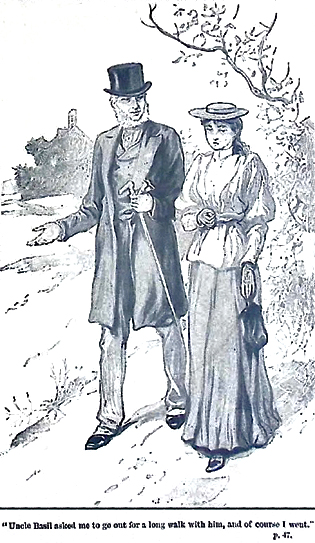
Uncle Basil asked me to go out for a long walk
with him, and of course I went.
"I am sure of it in this case. And what if you are intended to learn something from what he said?"
"It wasn't his business to say anything to me."
"I do not see that," Mother answered slowly. "It is everybody's business to help other people."
"But if I don't want his help—"
"Then I want it for you, Rhoda."
"I shall never learn anything from uncle Basil—never. He had no right to lecture me. And I don't see why he should be so sure that I am altogether and utterly bad."
"Not—surely—altogether!"
"Well, he seemed to think I did not care in the very least for doing what is right."
Mother was silent.
"And I do care."
But she was silent still.
"Mother, I care a great deal. You know I do."
And all she answered was, very low,—"I wish with all my heart that I did know it, Rhoda!" Then she got up, and went away; and I saw that she was in tears.
May 9th, Thursday.
I cannot get over what my mother said to me. What uncle Basil thinks matters very little, but that "she" should have such an opinion,—hardly anything could have touched me so closely!
All I can do is to resolve from this time to be different. She shall see that I do really care, and that I do wish to do what is right.
May 17th, Friday.
The fortnight of my uncle's visit has gone all right till to-day, hardly a rub since the very beginning. Juliet has been tiresome, and I have borne it patiently; and uncle has seemed rather to take to me. And now all the good has been undone, and everything is wrong.
At breakfast, he said he hoped I would pay him a long visit soon. I did not know what to answer; for it did not sound delightful. Mother thanked him, and said that perhaps some day we could arrange it; and I mumbled some sort of response, awkwardly enough. There the matter might have rested, but Clarissa chose to drawl out a—"When do you want her?"
"Any time. The sooner the better. Next month," uncle Basil said at once.
And Clarissa, to my amazement, answered,—"That would do very nicely, would it not?" She was looking at my mother, not at me. "We shall be glad of the second spare-room about then."
"To be sure. I did not think of that," Juliet added, in her brisk way.
And, still more to my amazement, Mother said quietly,—"We will think about it."
"Mother!" I cried indignantly.
If only I had let matters alone! I might have known better than to speak just then.
"What now?" Juliet asked.
"I am not going. I don't want to go. I shall stay at home. The idea of turning me away because you want my room!"
"We had better drop the subject," Mother said gravely.
And I saw uncle Basil looking me all over, as if he were trying to make me out. But I was in no mood to take my mother's hint.
"You don't see,—you don't understand," I cried passionately. "Clarissa and Juliet have made up their minds to get rid of me, that they may have friends of their own in my room. I don't choose my room to be used when I am away. It is too horrid of them. And I don't mean to go."
"Highty-tighty, what is all this about?" asked uncle Basil, in his most deliberate tone. "Because I want my niece for a visit? Is that the trouble?"
"Mother does not want to get rid of me. It is only the girls," I burst out again, almost beside myself.
I know now how I must have looked, though at the time I only saw Clarissa's sneer, and heard Juliet's laugh. Mother says that Clarissa did not sneer, and that Juliet's little laugh is part of herself, but at the time it seemed to me so.
"But suppose my wife and I are dull at home, and wish for the pleasure of our niece's company?"
"You don't. It is not that, I understand. It is only that the girls want to get me out of their way. And I don't intend to be managed. I do not mean to go."
I saw Mother look at Juliet as if she were apologising for me; and Juliet smiled and shook her head.
"Well, we need not settle the matter now. As your mother says, we'll wait. Time enough before next month."
I don't know what more I might have said, but my uncle went out of the room with Mother. And only the two girls stayed behind.
"You have made a nice exhibition of yourself now, certainly," Clarissa observed in her coldest tone. "A grateful way of receiving an invitation!"
"I don't care. It is your fault, the way you both treat me—"
Clarissa shrugged her shoulders. Juliet came a step nearer.
"Hardly worth arguing with you in your present state of mind," she said. "But perhaps, when you recall what is past, you may find that, after all, nothing so desperately cruel was said."
"I know what was said. You want to send me away from Mother that you may have the use of my room."
"And if it were so, would that be very surprising? Have you never wished to get rid of Clarissa and me?"
I had nothing to say. "That" was true enough.
"The kind of feeling is generally mutual." Juliet stood still, looking at me. "Things might have been very different," she said gravely. "But it seems to be a hopeless case. For your comfort, Rhoda, I may as well tell you that your persistent efforts to get rid of us are likely to succeed. We have borne a good deal, but we have pretty well arrived at the outer edge of our patience. I do not fancy we shall trouble you much longer. Except for your mother's sake, we should not be here now. No need to say more. Come, Clarissa."
My passion was gone. I remembered that conversation with my mother, and all she had told me. Had I at last done what then I had feared? Would the girls stop helping us? And in that case, would our little home be broken up, and would my mother be driven back to India before the right time?
It was like a shower of ice falling. I did not know what to think or to do, and it is the same now. Mother has hardly been near me all day; and I cannot get to see her alone. Is she very much displeased?
The whole scene comes back to me, and I begin to see how little real cause I had for my anger. It was so rude to uncle Basil, too. For after all he meant kindly. I will never never behave so again.

BANISHMENT DECREED.
May 19th, Sunday.
YESTERDAY was a wretchedly uncomfortable day. Everybody seemed to hold aloof.
Uncle Basil went away early; and his last words to me were,—
"I shall look-out for you next month."
I tried to mutter some sort of thanks; and if only we had been alone, I think I would have begged his pardon. But they were all round, so it did not seem possible. Ought I to ask the girls' pardon? Oh, I can't. I couldn't.
I had not one word alone with Mother till the last thing yesterday evening. She looked dreadfully tired; and Juliet, kissing her, whispered,—
"Don't stay up long, you poor dear!"
Then Mother sat with her eyes on me, and I did not know what to say. I could see that she expected me to say something. The silence went on for a whole long minute, and she never stirred.
"Mother, I did not mean—" at last I began, for I could not stand it any longer.
"Did not mean what?" It was not Mother's usual way of speaking.
"I didn't mean—to bother you."
"No; you only meant to gratify your own feelings of dislike and spite."
I exclaimed at the word "spite."
"Of childish spite," she repeated. "I would not have believed it of you. Knowing what you do know,—after all the kindness of those dear girls to me,—all that they have done for us,—to say such things to them. And before my brother!"
"I did not mean any harm."
"Hardly worth while to discuss your intentions," she replied wearily. "I find it a waste of time. One thing I must explain, that you were entirely mistaken in your conjecture. It was not 'they' who spoke to your uncle, suggesting a visit from you some day, but I."
"You, Mother!"
"Yes. 'I' put the idea into his head, not as an immediate thing, but as a future possibility. Partly for your own sake because I think it good for you to have variety. Partly for my sake, because I am getting worn-out with all the jarring, and I should like a month of quiet."
I do not think anything that has ever been said to me in all my life has pierced me like those words of Mother's. That she should want to get rid of me!
She must have seen in my face what I felt. I saw her lips quiver.
"That was how it came about," she went on firmly. "Your uncle was doing what he knew I wished. Not what the girls wished. I do not say they would be sorry. Is it likely that they should? And as for using your room—'they' pay the rent of this house, Rhoda. Not I; and certainly not you." Then, after a little break, she went on, "At the same time, I had not positively made up my mind to send you away so soon. I did intend to give you one more chance. If you had let the matter drop when I wished you to do so, nothing would have been settled. You have complicated the whole affair by your manner of speaking."
"Mother, I am sorry to have troubled 'you,'" I burst out. "I am really."
"That is not enough. The wrong has been to the girls mainly; and only to me through them."
"I can't beg Juliet's pardon! I could not do it," I said passionately. "You couldn't in my place."
"I hope that in your place I should be unable to do anything else. Apart from any higher principle, when one has insulted and wrongly accused another, mere ladylike feeling alone would force one to apologise."
Then she waited a minute, and I said nothing. I did not feel that it would be possible.
"If you are not really sorry, and do not intend to do differently, an apology would mean very little. There is nothing for it, I am afraid, but a different arrangement. Good night, Rhoda. I am too tired to stay up any longer."
I would have given anything to ask what she meant by a "different arrangement," but somehow I had not courage. She went away, and I have been writing in my journal ever since, because I feel too unhappy to go to bed.
Ought I to pray to be able to beg Juliet's pardon?
But I do not "want" to be able to do so. I do not "want" to knuckle under to the girls. Why should I? I did once tell one of them that I was sorry for something; and I could see how they crowed over me, though I dare say nobody else saw it. I cannot, cannot, do that again. If only it were anything else, anybody else, I would do it for Mother's sake. I cannot bear to distress her. But still, isn't she a little unreasonable, always to expect me to give in to everybody?
Do other girls get into these difficulties? And how do they get out of them? Am I so much worse than other girls? Or is it that very few have such trials in their own homes as I have? I think it must be that. If only my mother, would make up her mind to live in a tiny house, alone with the twins and me, I should be so happy. Is it likely that she ever will? She said once that it was impossible, as things are now; but is it really? People sometimes say that kind of thing, without actually meaning it. If she would but try the plan. There would be no one then to come between her and me.
May 25th, Saturday.
I know now what my mother meant last Sunday. It has all come out. And, oh, how I wish, I wish, I could live the last few weeks over again!
Ever since last Saturday, things have been uncomfortable, everybody seeming to be vexed with me, and that makes it so hard to be pleasant and good. I thought it would pass off in time, and we should get smooth and right again. I knew my mother wanted me to ask the girls' pardon, and I could not. It did seem perfectly impossible. The words would not come. Can one force oneself to do every single thing that one is told one ought to do, no matter how much against the grain it may be? I know I could not.
All the week, Mother has been very poorly; and I could see that the girls blamed me for it. I suppose she was waiting to see what I would do. If I had known, would that have made the doing any easier, I wonder?
To-day, she and I were alone together, and I saw her turning whiter and whiter. I asked if she felt ill, and if I should call somebody. She said,—
"No; I have to speak to you, Rhoda."
Then I felt sure something was coming; though I could never have guessed what.
When she did speak out, it came like a thunderclap. In one fortnight I am to go to uncle Basil and aunt Marian, and I am to stay with them for three months. Three long dreary months. How in the world shall I get through the time? It seems too dreadful. And it is quite settled. I never saw my mother so decided, as if nothing in the world could move her. She looked very very sad, but she held to her point. It had to be, she said. Things could not go on any longer as they had gone on. A fresh arrangement was absolutely necessary; and at present, no other plan was feasible.
At first, I was half beside myself. I said it was cruel of the girls, and I would not go,—I would not be driven from my home. I was as angry and miserable as any one could be, and I spoke out just what I felt, and Mother did not interrupt me. She sat listening patiently, and allowed me to go on as long as I liked, but there was no giving way in her look. And when I came to a stop, she said softly,—
"All that makes no difference at all."
"Mother, you will not force me away," I cried. "You will never drive me from home!—Me, your own child,—for the sake of those two girls. You could not."
"Nay, Rhoda, it is you who force me."
"If they don't want me, why cannot they go, and leave us in peace? Anything else rather than this."
"I have no choice," my mother answered. "And it is not they who do not want you, but you who do not want them."
"Mother!" I cried.
"Or, at least that has been so, and would be so still, but for yourself. Clarissa and Juliet have all along felt and spoken most kindly of you. Their one wish has been to smooth everything down for me, so far as was in their power. They do say now, at last, that a change of some kind has become necessary, and can one wonder? I have been sorely ashamed of my own child lately."
I did not know what to say.
"They have done all they could, and it has been in vain. Your uncle, seeing the difficulty, most kindly offered before he left to give you a home for a few months. He said he could answer for a welcome from your aunt, before speaking to her. I told him we would think it over; and the girls said that if you should seem really to regret what had passed, they were most willing that you should have another trial. Not that they or I suppose you would not enjoy a visit to your uncle and aunt. Only to go away because you cannot live happily, or let others live happily, at home, seems very sad. But you know how things have been this week. Now I have written to my brother, and it is settled."
I hardly know what I said. More angry words came, but Mother was not moved by them. She said she had entirely made up her mind.
"Even if the girls wished it, I would not change now," she added.
"Not likely that they will wish anything of the kind."
"You are mistaken, Rhoda; nothing is more likely. But I see that it is for your good to be away from home for a time. You have fallen into an unhappy state of mind, and complete change may make a difference. If not—"
She stopped, and I looked at her, but no more came. After a break, she only added,—
"No talking has any effect, and I seem to have no influence over you. If your father were at home—but, as it is, I can only try this plan."
"And they are to be here with you, while I—"
"No other plan is possible."
Then she told me that Clarissa and Juliet had offered to continue paying the rent of this house during the rest of the year, as it has been taken for a year, while they themselves would not live with us in it, but would go to aunt Jessie. That would prevent all rubs, they had told her, and aunt Jessie was willing.
"A plan perfectly out of the question," my mother observed.
And I could not but agree with her in my heart. No; even I am not able to wish that. I only long to be independent of them. And I wish, yes, I do wish, that I were different in some of my ways.
June 6th, Thursday.
Almost at the end of the fortnight; and the day after to-morrow, my banishment begins.
I am not reconciled to it, not in the least. I only do not go on resisting, because I see it to be of no use. Mother is resolute. I know Juliet has asked her to give me one more trial, or at least to shorten the three months into one. Mother told me this, and I ought perhaps to feel more grateful than I do. But I am to go, just the same, for three months, not less. Mother's voice never falters, only she looks so white and worn. Have I made her look so? And I meant to be such a comfort to her, when first she came home. Everything has been a failure, and I am no sort of good to anybody.
The girls have been kind to me, since my going away was settled. Juliet has worked hard at my clothes; and Clarissa has bought me a new writing-case. It sticks in my throat when I try to thank them, but for my mother's sake, I do want at least to have no more fusses before I leave. And when I come back, she "shall" see a difference.
What I really mind so terribly is not that the girls will be here while I am away, nor is it so much the actual going away, if only it were not for quite so long, but it is that I am banished by my mother's wish, and that she will feel relieved when I am gone. I think that has woke me up. I did not know myself before. Now I seem to see myself more as others have seen me; and I feel so desperately ashamed. Not angry now, only ashamed. Only longing to do anything in the world to make up to my mother for all the worry I have given her.
June 7th, Friday.
I have asked them to forgive me—at last. It seemed as if I must. And I do feel so much happier. Mother and I had a cry together, after tea; and the girls came in and found us at it. They were both so good.
"You poor dears!" Juliet said, and then she tried her best to comfort us both.
And I got out the words; I don't know how. I could say I had done wrongly, and was sorry; and they were so nice.
But Mother still makes no change. She says the three months away are good for me in every way; and she says that now I shall be able to go happily. Well, yes; perhaps I shall.


AT WAYATFORD.
June 10th, Monday.
HERE I have been ever since Saturday evening, and I might have been here for weeks, judging from my own feelings. It seems "ages" since I said good-bye to them all, and yet I am not unhappy, as I expected, only everything is strange. I mean, it is strange to think of spending three months in this house. It would not be strange if I were here for just a week or two.
Wayatford is a country town, more of a town than I fancied as to size, but so sleepy, oh, so sleepy! The people look drowsy, and the houses and shops as if nothing could ever wake them. Nothing goes on, I am told, and nothing happens, except the little everyday round of meals and house-doings and Parish-work.
"Why should anything happen?" uncle Basil asks. But I don't agree with him. I like things to happen; and I like a stir. If one is utterly buried in a tiny village, as we are at home for a year, why one makes up one's mind to it, and one doesn't look for anything else. But if one lives in a town as large as Wayatford, one does look for something a little different. "I" should not care to be in Wayatford year after year, with nothing to look back upon and nothing to look forward to. Unless of course I were obliged. I suppose one can do or bear anything, if one is absolutely obliged.
Uncle Basil's house is in the main street all among the principal shops, only it stands well back in its own garden, among masses of evergreens. It is the oddest little low house, with queer little low rooms, any and no sort of shape; and each room has at least three doors. One can perform the tour of all the ground-floor rooms, without once passing through the passage or once turning back. The garden is old-fashioned; and there are two middle-aged old-fashioned prim maid-servants, and an old-fashioned talkative gardener. I cannot imagine for my part why my uncle and aunt live here at all, except that the house happens to belong to them. But if I were they, I would let it, and go somewhere else,—somewhere a little more lively. I don't see that uncle Basil has anything whatever to do except to read books, and to take walks, and to look after aunt Marian. But he seems to count himself a desperately busy person, none the less.
He is not exactly the same uncle Basil who paid us a visit; I mean, he does not seem the same to me. I do not quite know how or why; I only feel that he is different. Not better or worse, but just unlike. Are people always so when one sees them first in somebody else's house, and then in their own? I like him more in some ways, and less in others. In fact, I can't quite make up my mind about him; and I am sure he cannot make up his mind about me.
And why should he? I do not understand myself; and I am perpetually puzzled at things I do and say, not knowing at all why I have done or said them. And if I cannot fully understand myself after all these years, is it likely that uncle Basil should have managed to get to the bottom of my character in just two or three weeks?
As for aunt Marian, I have an idea that she knows a great deal more about everybody than most people do; all the more, because she is not one of those people who are always making believe to read everybody, and to know what others are thinking about. If she began in that sort of way, one would know directly how little it meant.
I have never seen her before. It is fifteen years—not more—since uncle married her; and almost directly afterwards, she had a frightful accident which injured her spine, and laid her aside for several years. Though rather better now, she can never get over it. She never leaves home, and uncle seldom leaves her.
She is very small and thin, and her figure is quite crooked. Most of her time is spent lying on a particular kind of couch, near the window of the drawing-room, where she writes letters, and keeps accounts, and gives household orders, and sees people, and does no end of work with her poor little bony hands. She has a rather pretty small wedge-shaped face, pink and white like a girl's, with a big forehead, and eyes that look at you straight and steadily, in a curious quiet way, as if she meant to find out every single thing, before making up her mind whether to like or dislike you. Not that I think she ever dislikes anybody really—I mean as I do,—but only pities them.
When I first came, I thought she would never get to the end of her prelim. exam. Not that she stared in a horrid unblinking way, as some people do, but only that I "felt" her to be reading me. Somehow I did not very much mind. Only she seemed rather a cold sort of person, and I began to wonder how we should manage to get on together for three whole mouths.
But presently there came a little smile into her eyes, which changed the whole face. I don't mind saying to you, old journal, though I wouldn't say it to anyone else, that it was a look which made me think of somebody who should once in her life have taken a tiny peep inside the gates of heaven, and brought away a glimmer of the light for all her life after! And she said,—
"We shall contrive to rub on together somehow, shall we not?"
It was exactly as if she had known what I was thinking of. And I was so much taken by surprise that I all but said so outright. I only just stopped myself in time.
"I intend to make you useful," she went on. "This may be a Sleepy Hollow kind of place,—yes, I see you think that; but even in the sleepiest of Sleepy Hollows people have to be clothed and fed, and occasionally to be nursed."
"I shouldn't think you could do much nursing, aunt Marian."
"If not, I may pull some of the strings which set others to work. And if I cannot lift a sick person out of bed, I may make him a vest or a nightingale to wear in bed."
"I should like to be useful—if I can!" I said, with a rather melancholy glance back upon the last few weeks.
"Your mother told me that she was sure you would wish it."
I wondered if my mother had said any more. But of course, if she had not, it would make no difference. Uncle Basil will have said more. He seems to have quite given up any idea of setting me to rights. Perhaps he has handed over to aunt Marian the responsibility of me. He has not once attempted any lecturing since I arrived.
June 11th, Tuesday.
I find no end of things to write about already.
A walk with my uncle is the first thing after breakfast; and then aunt Marian keeps me busy for a full hour over letters and accounts. She makes me work in good earnest, and yet somehow I like it. "New broom!" Juliet would say. Is that it?
To-day, after lunch, in came the Rector, Mr. Farrars, and his eldest daughter. I had heard him in Church on Sunday, and I knew his face again directly, a kind face but rather anxious and absent, as if he had a lot to think about. But it was not so much he as the girl that interested me. This was my first glimpse of her, because on Sunday she was not in the pew with the Rectory children. In the morning, she had to take the place of some absent teacher with the school-children, and in the evening she was not there at all.
When she came in with her father, I could hardly attend to anybody else. She is about my height or a shade taller, and slight, with a pale face, not in the least pretty. I cannot think what there is about her, so unlike the common run of girls; but certainly there is something. It is not good looks, though I found myself going back again and again to her face. I don't think it is exactly what people call "sweetness" either. There is a kind of composure, almost like middle-age, and a want of lightness, a want of spring, as if she had lived through so much already as to have grown old before her time.
Perhaps she has; for ever since Millicent was seventeen, and that is four years ago, she has been head of the household, and has had to manage everything. Yes, really to manage everything, and to think of everything; because her father is very busy in the Parish, and is rather a forgetful man, and he leaves all the home arrangements to her, exactly as he used to leave them to his wife.
Only think! Ever since she was seventeen, just my age, to have had the whole household upon her shoulders, and her father to see to, and all those children to arrange for, and Parish doings besides, and nobody to be any help. Four years of it; and before that for a whole year and more, her mother was slowly dying; and Millicent did the chief part of the nursing. So I don't see how she "can" be young still. I do not wonder that at twenty-one, she has the look of thirty or forty,—in her expression, I mean.
It is such a patient face, with its soft pale skin, and such quiet gentle brown eyes, that I think I fell in love with it and her straight off. And if she is not pretty, she is far better than pretty. I would rather, oh, much rather, be like Millicent than like Clarissa and Juliet, even though they are counted so handsome by almost everybody; and I suppose nobody would count Millicent in the least good-looking. She is "good," not good-looking, and is not that the best?
"Millicent is a much occupied person," aunt Marian said; "but I want you two girls to be together sometimes."
"I should like it, too," Millicent added.
There the matter stood still. Nothing was arranged, as I had hoped. Perhaps aunt Marian waited to see first what I should wish. After the two were gone, she told me some of what I have written down about Millicent's past, and then went on,—"The child has had a severe life, so far. She is the pivot upon which everything turns at the Rectory. Mr. Farrars depends upon her utterly."
"She must be very clever."
"That depends on what you mean by 'clever.' She has the gift of resolute concentration of purpose to each duty in succession, and it goes a long way."
"And she must be very strong."
"Strong in will, and strong in self-forgetfulness. Not strong at all in body."
"I like her face very much. She is a girl I could make a friend of."
Aunt Marian looked so much amused, that I could not help saying, "You mustn't think I can make friends quickly with anybody and everybody. I don't make friends like other girls; only I think I could make a friend of Millicent Farrars."
"Why not make friends like other girls?"
"Why,—I don't! It isn't my way. People have different ways. I can't take to most people."
"The 'taking' must of course be mutual."
It was said so very quietly, that just at the moment, I really did not see all that she meant. Since then, I have been thinking a great deal. Did she mean that people do not take to me? Am I such a disagreeable girl? Would my mother say so? But of course Mother loves me; and she would love me whatever I might be like, in spite of everything. Other people would not. Do I really make few friends, because others do not take particularly to "me?" I always thought it was just the other way, because I was slow in liking other people.
Some day I will ask aunt Marian, but not yet. She does not really know me yet, and perhaps when she does, she will have a rather better opinion. I mean to make her like me if I can, in spite of all that I suppose the girls have said to uncle Basil about my ways. And I mean to make Millicent like me too.
June 14th, Friday.
Yesterday uncle Basil and I called at the Rectory, to find nobody at home. And to-day a message came, asking me to go in to tea at five o'clock. So at five I went.
There are eight brothers and sisters younger than Millicent; no, I mean seven brothers and one sister. The three biggest boys are away at school, but the four at home make quite noise enough for anything and anybody. All the four are exactly alike, except in size; I could not see a shadow of difference. As for learning their names, one might of course do that, but to pin the right names to the right boys seems hopeless. The little girl is only eight years old, so she is no help to Millicent. A governess comes every day for four hours to teach the little girl and the two youngest boys; and the two elder go to school, and Millicent overlooks their preparation.
Besides that, there is the housekeeping,—no easy matter, because they are not at all well off,—and there are the accounts, and the mending, and the Parish, and Mr. Farrars. And worst of all, there must be the feeling of responsibility, the knowing that "she" has to do everything, and think of everything, and to keep everything going, with no one to help or remind her.
I never could have believed in any one girl getting through such an amount. And yet Millicent makes no fuss.
"It isn't always quite easy," she said, when I exclaimed at it all, "but if one is methodical, one can manage pretty well."
It slipped out, just by the merest accident, that she is always up and dressed by seven o'clock every morning, and that she hardly ever gets into bed before twelve o'clock. No wonder she looks pale. But when I said so, she answered, "The things have to be done, you see!" and then let the question drop, as if there were nothing more to be said.
She is really good, I am sure of that, not with show goodness, but true genuine goodness. I know it, not so much from what she says, as from what she does not say. And I know already that I shall like to have Millicent for my very particular friend. I shall like to tell her everything, and to do whatever she advises. She is not full of fun and laughter like some girls, and perhaps some people might even count her a little dull, but I do not, and I never shall. Even though she seems so quiet and gentle, and inclined to be silent, and almost as if she hardly cared for a joke, still that makes no difference. Or rather, I like her all the better for it. Any commonplace sort of girl can joke and laugh, and say silly things, but very few girls could ever do what Millicent does.

DERWENTWATER.
June 15th, Saturday.
THERE was no time to finish yesterday my account of tea at the Vicarage, or to tell about the name of "Ernest Derwentwater" coming up. That interested me.
I had not heard the name before, but I noticed it directly, because of Millicent's face. One of the children said something about him, and I saw her in a moment flush up, such a soft little flush, it made her almost pretty for the moment; and I saw the anxious way in which she tried to turn to something else.
But that provoking small scarecrow, the second youngest boy, would persist in saying, "Ernest Derwentwater! Ernest Derwentwater! Yes, Ernest Derwentwater! Wasn't it Ernest Derwentwater? I'm sure it was Ernest Derwentwater! Sissie, it was Ernest Derwentwater!" Till I could have shaken the little wretch, for Millicent looked quite distressed. It seemed as if the boy were bent on teasing her.
And then the Rector heard, and he turned round with his forehead all puckered, and asked,—
"Has Derwentwater been here, my dear?"
"No, father."
"You are sure?" Mr. Farrars spoke in a curious grave manner, not as if he were displeased, but more as if he were puzzled.
"No, father," she said again. And then, after thinking for a moment,—"But I did hear that he talked of running down for a few days."
"When?"
"I don't know. I don't think anything was settled."
"Oh,—but I meant, when did you hear, it, my dear?"
"I don't know exactly," and there was a little shake in her voice. "Mr. Collins told me, and I forget exactly which day I saw Mr. Collins last."
"And you did not think of mentioning it to me?"
I knew from her face that she "had" thought of it. She had not forgotten.
"I think he will stay at the Park. But nothing was settled."
"What were you saying just now about Derwentwater? I did not quite hear."
"Only Phil's nonsense,—something about a little picture. Nothing of the least consequence."
"It was Ernest Derwentwater, his very own self. And I 'know' it was,—I know it quite well. He gave it to Sissie," persisted Phil. "And I know he did, 'cause I saw him. And he didn't mean nobody to see. I know he didn't."
"Well, well, well," Mr. Farrars murmured, in a resigned sort of tone, as if something or other were very melancholy, but could not possibly be helped. And then he sighed, and Millicent went across in her quiet way,—she always moves so quietly, without the least noise or bustle,—and stood looking down upon him. And after a minute, she stooped and gave him a kiss on his forehead, as if she were trying to smooth away the wrinkles. That brought a smile, though the worried look did not go quite away. Mr. Farrars has a nice smile, and Millicent seems very fond of him.
Nothing more was said just then, and Millicent managed to get rid of Phil and his notions, by sending him off for a game of play. Later on, Mr. Farrars went away too, and I was looking through some photographs with her, when we came across a cabinet likeness of a young man. I do not know what made me stop to look at it so very particularly, unless it was that I saw a sort of tiny movement of Millicent's hand, as if she wanted to slip that photo away, out of sight.
Then I think in a moment I suspected who it was. Perhaps it would have been kinder to let her do as she liked, but how could I, when I was brimful of curiosity? So I kept my hand on the card, and didn't seem to see what she wished: and I examined the face well,—such a handsome face, with a good expression.
I said, "Who is this?"
And in a moment, there was another little tinge of colour.
"That! Oh, only Mr. Derwentwater."
"I suppose he is a particular friend of yours?"
"A particular friend to all of us,—especially to the boys." I wondered whether Mr. Derwentwater would have agreed to that "especially." But she went on,—"We have known him more or less all our lives. His father was my father's greatest College friend."
"He doesn't live here?"
"No,—in London. He has a very good appointment in a Bank. He has rooms in London."
"And he often comes here."
"Not very often. Sometimes. Mr. Collins is his uncle. But of course, he goes oftenest to see his father and mother."
"It is a very nice face."
"He is thought rather good-looking." She spoke carelessly.
"You think him so,—now don't you, Millicent?" I asked, laughing, and wanting to make her laugh.
But she never seemed to dream of laughing. She only looked at me straight, with those quiet eyes of hers, and said, "Perhaps I do. I don't think it matters. One doesn't think about people being handsome, when one knows them very well."
"Doesn't one? I do. If a face is handsome at all, the more one knows it, the more handsome it seems to grow."
"One of the most beautiful faces I ever saw is your aunt Marian's face." Of course, I saw that she wanted to get me off to some other subject, and of course, I tried to prevent it. But Millicent is not easy to manage. She has such a quiet sort of determination. Do what I might, I could not bring her back to Mr. Derwentwater.
But she could not prevent me from thinking, from wondering what it all means, and whether it means anything. Is Millicent in love with Mr. Derwentwater?—And is he in love with Millicent? And are there any difficulties in the way? I should like Millicent to marry, and to have a happy home of her own. At least, I should like it by-and-by, when we have seen a good deal of one another, and have become thorough friends. I do not want her just now to have her head so full of him that she cannot give a single thought to me. But by-and-by.
Only I do not quite see how they are to get on without her at the Rectory. That may be the difficulty.
Mr. Farrars is so very kind and good, and uncle calls him "a most able preacher," and they say he is perfectly worshipped by the poor. But he does seem a little helpless about household arrangements and the management of all those boys.
Still, if that is all, why should there not be an engagement, and Mr. Derwentwater might wait. Amy is eight years old now, and she will be growing older in time. It would only be a few years,—seven or eight years, perhaps. In eight years, Amy will be sixteen. If I were in love with a girl like Millicent, I would wait for her gladly any number of years. It would not matter how many, if only I might get her in the end. But, I suppose men are more impatient than women.
And perhaps he does not really care for her. Of course, I do not know yet about that. How interesting it will be, when he comes down, to see whether anything of that kind is really going on! Like a scrap of real life in a story,—or like a bit of story in real life,—I do not know which to call it. I have never come across anything of the sort before. And though I think I am too sensible a girl to have my head full of nonsensical ideas as to love affairs, still one cannot help being interested if one's own friend is perhaps going to have a love affair.
Of course I must say nothing to anybody. I must only use my eyes, and that at all events I am free to do. Millicent is very reserved, I fancy, but she does not know me well yet. When she does, perhaps she will speak out, and tell me how things really are.
She did not look very happy when his name was mentioned. A kind of worried expression came, and that puzzles me.
Is there something about him not quite nice,—not quite as it should be? Does Mr. Farrars not quite like him? He has such a frank open face in the photograph,—not the sort of face which, I should think, could possibly mean anything really wrong. Perhaps she was only a little shy, and did not want me to suspect anything, only it did not look like shyness. Well, she will soon know me better, and will not mind what I see or know about her.
I have been wondering whether I might not offer to help her with some of the mending of the boys' things. She has such a lot of it to do; and then perhaps she might get to bed a little before twelve o'clock.
I don't mean, just to help her only once, but to promise it regularly—once or twice a week while I am here, so that she would be able to depend on me. She could not possibly mind, and I should feel myself then of real use.
What an amount I have written to-day!
June 17th, Monday.
Perhaps it was rather stupid of me to speak so soon, but I have spoken and been refused.
I had to go to the Rectory after breakfast with a message from aunt Marian, and the temptation was too strong. Millicent was darning a sock at the moment when I went in. And when I had given my message, I said,—
"Oh, I have been thinking I should 'so' like to help you with your mending, Millicent. Will you not let me? I want to come in regularly while I am at Wayatford—twice a week, perhaps, and sit and work with you. Do let me."
Yesterday, I asked her to call me "Rhoda," and she said I might call her "Millicent." Though from her manner, I fancied she thought it rather soon.
She looked up in a sort of surprised way at me, and said,—
"Help me! O no, thank you."
"But I mean it. I really do mean it. I should like nothing better. I do want to be useful to somebody."
"Thanks, you are very kind," she said coldly, and not as if she were in the very least grateful. "But please do not speak of such a thing again."
"But why? Don't you know me well enough yet? Do let me, Millicent."
She got up, with a little flush on her face, and put away in a drawer the sock she had been darning, and only said,—
"Would you like to come into the garden with me?"
"You know I have not come here to hinder you. If I must not be a help, I will go away at once."
"I could not think of it," was the only answer she made. And then she turned the subject altogether in her determined way, and not another word could I get in about my wish.
I was so disappointed and hurt, that when I got back, I told aunt Marian all about what had passed.
She listened with a queer little laugh in her eyes.
"So you are very fond of needlework!"
"Not fond of needlework in itself; no, not at all. But if it is to help somebody that I am fond of—"
"And you care enough already for Millicent!"
"Oh, I like her very much, very much indeed. And she works so hard, I should like to be able to help her."
"The wish is right enough. But suppose you started helping her, and then grew tired of it."
"I don't think I should."
"If you are fond enough of Millicent! That is the question, of course. However, I think you were in rather too much of a hurry. How much does Millicent know of you?"
"As much as I know of her."
"Perhaps not. I have told you a good deal about Millicent that is admirable."
And of course she has not told Millicent anything about me that is admirable. I saw what aunt Marian meant.
She would not seem to know whether I understood, and only said,—
"Perhaps we may bring it about yet; only you must have patience."
"Is Millicent very proud?"
"I imagine not. Why? Because she does not plunge into the first offer of help from a stranger?"
"Aunt Marian! A stranger!"
"Well, what else? How often have you two met?"
"But for me just to sit and work with her?"
"Quite simple, of course. Still, we must have patience. Perhaps Millicent was not anxious to expose to your criticism the state of the family stockings. Perhaps she thought her father would object. Perhaps she fancied it would be no kindness to you."
"But it would be kindness. I should like nothing better."
"If so, when Millicent knows you better, she may not be unwilling," was all aunt Marian would say.
June 20th, Thursday.
Millicent and I had a ramble in the field to-day. She doubted about sparing the time, but I gave her no peace, and at last she went.
She was even graver and paler than usual, I thought, yet I could find no particular reason. It almost seemed as if she had none.
I had made up my mind that I really would for once get Millicent to talk about herself, a thorough long talk. I meant to find out ever so many things that I have never yet been able to find out. Though I like Millicent so much, it is wonderful how little I know about her, and I don't see why, and I don't like it. If we are friends, she ought to treat me with confidence. I tell her all sorts of things quite openly, and why should she not do the same to me?
Some people love nothing so dearly as to talk about themselves, and they are always and for ever twisting round the conversation to the one thing they care for—either themselves and their aches and pains, or themselves and their feelings, or themselves and their worries—but Millicent is altogether the other way. If one can edge her into speaking for one minute about anything connected with herself, she is off again in a trice to some other subject.
Of course one likes and admires that in her, and the people who do love to discuss themselves are awfully wearisome. "I" should not like to do that sort of thing. I should hate to be always thinking and talking about myself. But still, the very fact that Millicent is not one of those people makes me want to know more of herself and her inner life. It does not seem natural that a girl should be so shut-up, and have nothing whatever to say about her own troubles. For Millicent has troubles enough of her own; one can see that in her face. Only it is difficult to make out exactly what the troubles are.
And to-day all my trying was in vain. I did my best, and I could not succeed. She got me off somehow upon "my" home troubles; at least, I am sure she did. Because I had not the very least intention when we began talking to say a single word about myself, and yet somehow I found myself doing it. I don't remember her asking any questions, and I don't think Millicent does ask questions, but she has a way of setting one off. I have not a notion how she does it. Before I knew what I was about, I was telling her all about Clarissa and Juliet, though I had quite made up my mind never to let slip about them to anybody in Wayatford.
Talking seemed to bring up the old feelings, and I suppose I got a little excited, and let out what I really felt. For, after all, though they were kinder just at the last, they were "not" kind before, and it is their doing really that I am banished from home and from my mother all these months. But for them, I should be with her now.
Millicent never tried to stop me. She waited and listened, while I went on as long as I liked. I am afraid I forgot all about making Millicent tell me "her" troubles, and I only told her "mine." And at the end, when I came to a stop, she said in her very quietest voice,—
"I would not have things so in the future, if I were you."
"Why, what can I do? How could you help it? How could anybody help it? If people will be so provoking—"
"Almost everybody has something provoking to put up with. How could one learn to be patient without?"
"I don't pretend to be so very particularly patient. But I am sure Juliet is not either."
"Only you have not to do with that."
I thought I had a great deal to do with it, and I said so.
"I mean—you have no responsibility there. You have not to answer for her, but only for yourself."
"Well, I know one thing," I said—and I am afraid I spoke rather snappishly, for it seemed to me that Millicent was taking Juliet's part, and if she were my friend, I thought she ought to take "my" part,—"I know one thing, and that is that when I am away from those two, I can be perfectly good and patient. I always have said that I was sure I could, and now I find I can. It is they who put me out, and make everything go wrong. It is not 'me.' I have been quite good and patient ever since I came to Wayatford."
"Patient about what?"
I did not understand, and I told her so.
"I mean, what have you to bear at Mrs. Ramsay's, that is so particularly trying?"
"Why, nothing. That is the very thing. They don't worry and plague me here. It all goes smoothly."
"But where is the particular virtue of keeping straight, when there is nothing to make you go crooked?" she asked in a dry sort of tone.
It was a new idea to me, and I stared at her.
"Don't you see, Rhoda? How can one be patient, unless something in one's life might make one impatient? One may be in a good temper, merely because everything is exactly as one wishes, but that is not patience. Patience means bearing—enduring—when it is not easy to bear or endure. If there is nothing to be borne, how can there be any patience? One may be comfortable, but being comfortable is not being patient. Don't you understand?"
"I don't know. I have not thought much about it."
"Have you not?" And she seemed surprised. "I had to think it all out for myself so long ago. One is not put into the world just to enjoy oneself, and to get along smoothly. Life means so much more than that."
"Everybody doesn't have to live with a Clarissa and a Juliet."
"Not all their lives, perhaps. You have not lived with them always, and I don't suppose you will have to live with them always. But if they go, some other trouble will come—perhaps a worse one!"
"Nothing could be worse!" I declared.
She spoke very low, so low that I could hardly hear,—"Don't say that, while your mother is still left to you!"
I had no answer to make. If my mother were taken, as Connie was taken—it came over me with a kind of stab. What would anything else matter by comparison?
"You see," Millicent went on, "people who are truly patient have always had a good deal to make them so, one way and another. Either bad health, or want of money, or very hard work, or tiresome people to live with. It doesn't much matter what, so long as there is something that rouses one's impatience, because then the opportunity for patience comes in. Of course one might have all those troubles, and yet never learn patience. But I don't see how one could possibly learn patience 'without' some such troubles."
"Millicent, you ought to be a female lecturer. I didn't know you could talk half so well."
"I have to explain things to the children, and so I am in practice," she said, not in the least abashed.
"But you don't mean that one 'must' have bothers and worries, all one's whole life through?"
She waited a minute before speaking.
"I think it depends—It is part of the preparation. Each of us has to learn certain lessons, and the teaching goes on and on until we do learn. Some people learn patience very quickly; and others are very slow, and need long teaching, perhaps all their lives through. One gets a breathing-space now and then, like what you are having now, but it does not last, of course. Either you will be at home again and have little rubs there, or you will stay long enough to find little rubs here. Everything can't be kept perfectly smooth for very long together."
She spoke so like an old person, as if she had learnt it all from experience; not like a mere girl, repeating what others might have told her.
"Well, I only know that things in 'my' home are much harder to bear than in most people's homes."
And she asked, "What if it is your own fault, Rhoda?"
I was so angry that I did not say a word. It took me by surprise. I had not gone to Millicent for her to find fault with me. If one has a friend, one expects one's friend to be sympathising. That was why I had talked to Millicent. It seems so hard that I should be banished from my home, just because of Clarissa and Juliet, and I thought she would feel for me. And instead of that, to tell me it was all my own fault—or, at least, to ask a question, which meant that it was. For a little while, I was so vexed that I almost thought I should never like Millicent again. And I was quite glad she had not agreed to let me work for her. There was no need for me to see her often.
Millicent did not say a word for a good while, and then she spoke on some different subject.
She must have seen that I was angry, but I do not fancy she minded very much. At all events, she did not say a word about being sorry.
She is an odd girl. I don't feel as if I altogether knew her yet.
We did not say any more about my home troubles, but I mean to have it out with her another day. I mean to know what she really thinks. Even if she is unjust, I will make her say plainly what she has in her mind. It will show me what my uncle and aunt have said to her, and what the girls said to uncle about me.
Of course I know that I was in the wrong at home, and I do not deny that some part of the fusses and difficulties were in some measure my own fault. I'm not trying to make myself out to be immaculate. I have my faults, like other people. But I do think Juliet was much more to blame; and I "don't" see that it is Millicent's business to set me to rights, and to settle how much I was to blame.
I suppose a person cannot be too truthful, but certainly I do think people can be too downright. Millicent is so very downright—not in a rough rude positive way, because she is always gentle, but she does not seem to mind what she says.


PEOPLE'S RIGHTS.
June 22nd, Saturday.
YESTERDAY I could not get hold of Millicent, but to-day I made her come out for a walk. She said she could spare half-an-hour. And as soon as we were outside the town, I asked her point-blank what she had meant.
"Had we not better drop the subject?" she enquired. "If I say anything at all, I must say what I really think, and you will be annoyed."
"No, I will not. I want to know what you have in your mind, and what has been said to you about me."
She repeated, "Said to me" in such a puzzled voice, that I saw I had been mistaken.
"I thought my uncle or aunt might have told you—"
"About your home affairs? Not a word. Why should they? Was it likely? I only know what you have told me yourself."
"Oh, well; then I don't mind. And I want to know how you think I am to blame. What have I done that is wrong?"
I half thought she would try to shirk giving an answer, but she did not.
"Perhaps there has been a want of right feeling."
"What sort of right feeling?" I really did try not to speak curtly.
"The Miss Friths are older than you. And you tell me yourself that they have a right to settle things as they choose—in your home, I mean. You have not the right. If you always remembered this, would it not make a great difference?"
"But that is just what is so horrid."
"Does the horridness matter, if one 'ought?'"
After a minute, she added, "Is it not a matter, really, of 'rendering to all their due'? Perhaps you have not been careful enough to render to the Miss Friths their due—their rights in the house."
"Everybody is always thinking about their rights."
"Do you think so? But, Rhoda, yesterday you never said one word about their rights. It was all about your own rights. I could not help fancying that if only you thought a little more about their rights, they would probably think a great deal more about yours."
I felt angry again. Millicent may have said what was true, but it is one thing to see for oneself where one is in the wrong, and quite another to be told of it, especially by a mere girl. But I had invited her to speak out, so what could I say?
We walked on solemnly for some minutes, without a word, going through a small copse. Millicent waited to pick a flower now and then. And as we came near the further side, she suddenly stopped short. I was in front, and I had just turned back to examine something, so I saw the change in her face. I could not help seeing. She is almost always pale, but in a moment, she grew quite white, as white as a sheet.
"Why, Millicent,—" I said. And then I knew from her manner that she did not mean to be questioned. Not merely that she did not want to be, but that she "would not" be. I knew it would be quite useless to ask anything.
"Do you want any blue-bells, Rhoda?" she asked, and she stooped to pick two or three, and held them out. She seemed to have forgotten that she had offended me.
I took them, and said, "Thank you," and we moved on again, a good deal more slowly than before.
Millicent looked like one in a dream.
When we came to the border of the copse, where it was bounded by a low hedge and a shallow ditch, I noticed a young man walking briskly along in the field, just beyond the ditch. His back was nearly toward us, but he had passed close by the moment before, and if we had walked a very little faster, we should have met him. Did Millicent want to miss him? That thought sprang up first.
"Who is it?" I asked. "A friend of yours?"
And as she did not answer instantly, I said—"It looks rather like that photo,—your friend, Mr. Derwentwater!"
I think I did see a sort of likeness, but what made me think of Mr. Derwentwater was not that; it was the look in Millicent's face.
"Yes," she said, in an undertone.
"I" had not spoken in an undertone; on purpose, I am afraid; and I laughed now, and said:—"How funny of you! One would think you didn't care to see him."
The young man must have heard my voice or my laugh, for he glanced round, and then he came striding back over the rough clods, and leaped hedge and ditch together, in one bound.
"Why, Millicent!"
She put out her hand quietly, with a—"How do you do?" Not as if she were especially delighted to see him.
"I'm at the Park,—got there late last night. You knew I meant to come, didn't you? All quite well at the Rectory? I am coming round to see you by-and-by."
"Not to-day, I think."
"Why not?"
"I'm too busy."
He made an impatient movement. "Always too busy where I am concerned."
Millicent looked a little reproachful. "I have work to do for my father."
"And you cannot put that off?"
"No."
"Short and sweet!" muttered Mr. Derwentwater.
He had not so much as seen me yet, he was so full of Millicent.
And she had forgotten to introduce us,—unless she did not mean to do so. I kept quite still, rather to one side of them both. At first sight, he did not seem to me so handsome as I had thought him in the photograph: but it is a nice frank taking face; and he is tall and well-made,—I should think thoroughly manly.
"Well—no use coming, if you will not see me. I am engaged all to-morrow. Come, Millicent,—think better of it. For old friendship's sake."
A sorrowful look crept into her face, and she shook her head.
"If you cannot—or will not—there is nothing more to be said."
"I don't think I can." The words were so low I could hardly catch them.
"When 'may' I come, pray?"
"Any time that you like, of course."
"Take my chance, you mean,—to find everybody free except yourself."
"The boys will want their old playfellow," she answered, trying to smile.
"Good-bye!" he said abruptly. And in a moment he was gone, over hedge and ditch, and disappearing in the distance with great strides.
Millicent stood perfectly still, gazing on the ground, as if she had forgotten where she was and all about me. I waited for some seconds, and then patience failed.
"So that is Mr. Derwentwater!"
She gave a start, and began to walk along the muddy grass-path, just within the hedge. I could see the muscles round her mouth working.
"So that is Mr. Derwentwater!" I said again, for I wanted to make her speak. There was just room for me to keep by her side.
"Yes!"
"He is nice-looking."
"Yes."
"Why wouldn't you let the poor man call to-day, when he wanted it so much?"
"I—" and a pause—"could not."
"He looked so dreadfully disappointed. Almost angry with you."
"Yes."
"Millicent, do you like making people angry?"
"No."
"You did not particularly want to vex him?"
"I don't know."
Something in her voice, quiet as it was, and something in the way she stumbled against a tree-root, made me look more closely; and I saw her eyes to be full. Then she did care, really. It was not that she did not care.
"Millicent, look at me," I entreated, but she kept her head fixedly turned away. "Millicent, don't be so shut-up, dear! Why don't you tell me about it? I cannot help seeing. How can I? If you like him, and he likes you, why must you treat him so cruelly? And I see that he does like you."
"It is not cruelty." She turned and faced me with a desperate effort; I am sure it was a desperate effort, for her lips were white, though the tears were gone in a moment, and she looked straight in my face, with her most determined air. "Rhoda, you ought to understand better, without so much explaining. Ernest is very—a very nice fellow—but it is not—not that!"
"Are you sure?"
"I know what I am talking about, of course. He cares for all of us. And he thinks he has a right to come in and out,—like a brother—as often as he chooses. I have to be careful. It is not as if—as if my mother were here. You must not make things harder for me, by—"
"By what?"
"By noticing and talking,—when I do not wish. You ought to understand better. Of course I have home duties to attend to. I cannot put them aside. If he is vexed, I cannot help it."
"But if you do not mind, and if it is all right, what makes you look like this?"
"Like what?" She spoke quite sharply, and took me by surprise. "How do I look?"
"Only as if you were not happy."
"I am quite happy. You talk nonsense, Rhoda. If you are always fancying things, it will be disagreeable, and I shall not like to be with you." Then her manner changed, and she looked at me gently, with a kind of apology. "I ought not to be cross; you don't mean to be unkind, I know. It is only that you don't understand."
"But I do understand," I said. I was more vexed with that, than with her speaking for once sharply.
"No, you don't, and I do not see how you can. You are years and years younger than me," and she laughed. "But all the same, I ought not to be so cross. I'm tired to-day,—rather,—and that makes things seem more than they are really."
"Were you tired when we started?"
"Yes." But a little faint flush came, and she did not lift her eyes.
"If only I could help you in some way!"
"You can't. There is no help wanted,—none at all. People have to be tired sometimes. It is just a part of one's life."
And after that, she would say no more about Mr. Derwentwater.
June 23rd, Sunday.
I have come across a short sentence to-day, in a small book which lies on the side-table in my room. I cannot get the sentence out of my head. It makes me think of what Millicent said about my home troubles yesterday, and the time before. This is it:—
"Self-love leads us to do certain things because we choose them for
ourselves, although we would not do them at another's bidding, or from
mere obedience. If things are our own originating we like them, but not
when they come through other people. Self is for ever seeking self,
self-will and self-love; but if we were perfect in the love of God, we
should prefer to obey, because in obedience there is more of God and
less of self."
Is that why I so hate to be told things, or to be reminded of my duties by the girls,—just because I think so much of myself? What a horrid mean reason! Yet I am afraid it is true. Has not my mother said as much to me more than once? It isn't so much that I mind doing the things themselves, but I do detest to be obliged to do them because Juliet or somebody says I ought.
Of course, if I really and truly wanted above all things to do what is right, it would make no difference at all whether I was told or was not told of it by anybody else. I should only be grateful to anybody who would remind me.
That is—if I were humble. I know I am not. I never made any pretence to be humble.
And I am sure Juliet is not. Juliet humble!! I could laugh at the idea.
But then, as Millicent says, I have not to answer for Juliet. I only have to answer for myself. And "I" am not humble. And "I" do not care most and first and best of all for doing the things that are right. And I am afraid I do care most and first and best for doing what pleases myself.
That at least I have learnt by being away from home, and having time to think, and seeing what Millicent is. Yes,—I do believe it is seeing what Millicent is, more than anything else, that has shown me a little of what I am in myself.
I don't mean that I think Clarissa and Juliet were right, or that they could not have been kinder; but still I "do" see that I have been in the wrong.
If I could but get rid of this SELF in my life! I begin to see the need. I begin to see that the mischief lies there. And I begin to see what a horrid mean thing it is to be always thinking about Self,—always putting Self first,—always ready to take offence about Self. Yes, it is just that. Whatever I do, I cannot forget myself. The Self clings about me like a leech.
Properly, I suppose, it is not Self, but the love of Self, which has to be got rid of.
June 29th, Saturday.
I do not often write so much at one time in my journal as in those two long entries, a week and more ago. And on reading them through, I am not pleased with myself. It seems to me that I was too meddling, and did not think enough of Millicent's feelings. I should not like anybody to say this to me, but I can say it to myself. I can see my own faults, I hope, when I have done wrongly.
Millicent really had some reason to be vexed with me; but except for that one moment, when she spoke rather sharply, I do not think she was. At least, she has been just the same as usual since.
I have not once met Mr. Derwentwater at the Rectory. And from something that slipped from Mr. Farrars yesterday, I almost think he has not been there at all. Mr. Farrars spoke in what seemed to me a rather puzzled tone. Millicent is so very very quiet and shut-up and reserved, that I am positively quite provoked. Why should she not treat me as a friend, and speak out? I am sure, if she were in my place and I were in hers, I would just tell her everything about it. And she "might" do the same to me now.
July 1st, Monday.
Mr. Derwentwater is coming to dinner this evening.
I am glad, because I want to see for myself whether he cares for Millicent,—I mean whether he cares in "that" sort of way. I feel more and more sure that Millicent cares for him. Perhaps she feels that she could not well be spared from her home, as things are now, and so will not let herself think about marrying. Of course, it is not as if there were a second daughter old enough to manage. But still, it does seem such a pity! I wonder if it is that. If it were, would not Mr. Farrars see, and would he not keep her from sacrificing herself?
When uncle Basil came in, and said he had asked Mr. Derwentwater to dinner, aunt Marian at once said,—"Then we will have Millicent and Mr. Farrars too."
But Millicent has declined the invitation. Mr. Farrars is engaged, and for herself, she simply says she "cannot be spared."
Aunt Marian made a queer little shake of her head over the note, as if she understood more than lay on the surface.
And I found myself saying,—
"Do you like Mr. Derwentwater?"
"Very much. Most people do."
"And he is a great friend of the Farrars'?"
"No doubt. Also he is a great friend of mine."
"Of yours!"
"You think me too old, of course," she said in her quick way: for that was exactly what I did think. "Too old, and too crooked, and too helpless. You need not say 'O no,' for in a sense, it may be true. Yet friendship is not a matter of age-equality, or of what one calls 'suitability.' Ernest Derwentwater does not seem to find me too old. And cannot you imagine what a freshness his young face brings into my life?"
I said,—"Yes." And I wondered whether I might not bring some freshness into it too. Somehow, I have not thought of that before, in coming here. Does aunt Marian like to have me for her own sake, or is it only all for my sake,—because she wants to do me good? I do not much like being done good to. Does anybody? If I thought I were a comfort to her, things would seem different.
"And if I cannot bring freshness into his life?—But why should I?" she went on musingly. "He does not need it. If I cannot bring him that, I may bring him something better. Yes, he and I are friends. He has a good many friends, and he would not hesitate to rank this helpless little me among them."
"Why do some people make so many more friends than others do?" I wanted to know whether she thought that I was not liked generally.
"Some are more lovable than others," she said at once. "And some have wider sympathies; and some have more power to enter into others' interests. In the truest friendships, there is much more of giving out than of taking in. Some do not seem to have room in their hearts for more than a few friends, and then they must be content with the few. But the larger the heart, the more love it has to pour out, and the wider may be the range of friendships."
"I shouldn't like to tell my secrets to a great many people."
"Your secrets!" And how she did laugh. "You child! I am forgetting that you are hardly out of the schoolroom. Telling one's secrets is a very minute part of friendship. If you had said, 'listening to others' troubles,'—but I suppose the telling comes first. I 'have' seen it last through life, with a stunted nature."
"But if one friend tells her troubles, the other must listen." I thought I "had" aunt Marian there.
"That is a mere incident," she said, and she laughed again. "It is not the essence of friendship."
In the end, I had had no answer to either question that I wanted to ask. There is no getting aunt Marian to the point, any more than Millicent, if she does not choose.

SUPPOSITIONS.
July 2nd, Tuesday.
MR. DERWENTWATER spent a long evening with us, and I like him immensely.
It is beautiful to see him with aunt Marian. His manner to her is so gentle, even reverent, and at the same time protecting. He looks so strong and big and full of life, while she is such a little frail crooked thing. But somehow, I do not think he feels that the giving is all on his side, and the receiving all on hers. He watches her face, and listens with the greatest attention when she speaks, not with a put on attentive manner like one going through a tiresome duty, and not even only as any real gentleman would always listen to a sickly elderly woman, but as if he quite loved the sound of her voice, and delighted in what she had to say.
Aunt Marian can be delightful,—I see that. She is clever and quaint, and unlike the common run of people. Before her accident, she must have been wonderfully pretty and taking. I see more and more how clever and bright she still is, but one would hardly expect a young man to see it.
I begin to feel very doubtful and puzzled about his feeling for Millicent. His manner to aunt Marian is so affectionate, so much "more" than his manner to Millicent; and if he were in love with Millicent, how could that be? When I spoke of Millicent to him, and said how fond I was of her already, and how nice she seemed, his face did not light up in the least. He fiddled with a paper-knife on the table, and just muttered a "Yes," and then began upon something quite different.
And yet a little later, when aunt Marian was talking in a low voice, and I had been attending to uncle Basil, I caught the word "Millicent," and I saw Mr. Derwentwater bending forward to listen with such a curious earnest look, as if his whole heart were in what she had to say.
So I cannot at all make up my mind as to how things really are between them.
July 4th, Thursday.
Mr. Derwentwater came in this afternoon again. He said it was a call upon aunt Marian. But all the same, when he found that she was too poorly to see anybody, he sat down to have a talk with me. And he stayed on and on, for ever so long.
We got upon all sorts of subjects together: books, and places, and scenery, and travelling, and ways of spending one's life. He has plenty to say, and he seems to be able to draw out other people. At least, he certainly drew "me" out. I do not think I ever talked so well in my life. One cannot help knowing if one has talked well. When Clarissa and Juliet are sitting by, ready to criticise everything, it is such a damper; I never can be at my best. To-day I felt quite free, and I said whatever came into my head.
Part of it was nonsense, I suppose, but is there any harm in a little nonsense? Sometimes Mr. Derwentwater laughed; and sometimes he agreed with me, and sometimes he did not. But it was all in such a pleasant way.
At first, I talked about Millicent a little; and he let me do so, and neither helped nor hindered. Afterwards, she seemed to slip out of my mind altogether.
July 6th, Saturday.
I went to the Rectory to-day, and saw Millicent. And I asked her whether Mr. Derwentwater had been to call, since that time when she and I met him. Of course I did not mean to meddle, and the question was natural enough surely. But Millicent looked up at me, in a kind of astonished way, as if I had been quite impertinent, and made no answer at all.
"He has been to us three times this week," I said.
"Has he?"
"Yes, three times." I do get provoked with her persistent way of hiding from me whatever she feels. And it came over me that I would "make" her show what she felt.
She gazed at me still in that grave slow way of hers, which gives me a kind of abashed feeling, almost as if I were a naughty child. I cannot think why I am so fond of Millicent, when she is perpetually vexing me, but somehow I am.
"He always does," she said. "Mrs. Ramsay is such an old friend of his!"
"Oh, aunt Marian—yes,—of course aunt Marian is an old friend,—and so are you. But 'I' am not."
And then the sound of that "I" came back to me, and I knew how silly it must have sounded.
Millicent laughed quietly. "No,—very new indeed!"
If it had been anybody else, I could have declared that she did not mind an atom. But I am beginning to understand her face, and I noticed a tiny white streak on one cheek. That ought to have warned me to say no more; only it was provoking to see how little she cared to treat me like a real friend. Besides, I did not like to be laughed at by her.
"Of course I don't mean anything particular. I am not so absurd. Only, when he came to call on aunt Marian, she was upstairs, and he stayed for a talk with me. That was all. We had quite a long talk, and I like him very much. And I think you treat him very badly."
"I think you are much too fond of interfering, Rhoda," Millicent spoke in a cold tone. "Once before, I asked you not to chatter in this way; and it seems to have been of no use."
"But, Millicent,—where is the harm?"
"It does not matter whether there is any harm, or no. It ought to be enough for you that I dislike such talk extremely."
And then I came away as fast as I could, and sat down straight to my journal. If Millicent goes on like that, I do not think I shall make a friend of her. How disappointing people are! I did think that for once I had found a friend worth having.
July 9th, Tuesday.
I suppose that I was rather hasty! I was vexed, and anybody would have been vexed in my place,—because really it was all interest in Millicent, and she ought to have understood. But she is slow in making friends, I suppose; and perhaps she did not quite understand. When I saw her yesterday, she was exactly the same as usual in manner. And though I had meant to be different, I did not keep it up.
But I feel perfectly sure now that Millicent does really care for Mr. Derwentwater and that she is sacrificing herself for her brothers and her father!
Ought she to be allowed? Can nobody do anything?
July 12th, Friday.
Five whole weeks since I came here! One week more, and I shall have had half of my three months of banishment.
The weeks have gone faster than I expected; and they do not seem long to look back upon. Besides, the last half of a time always slips away much faster than the first half. So it will not really be long now before I get home again.
Home to my mother! That will be the joy of it. I shall be sorry to leave some people and things here, but it will be going home to her.
And I mean to be quite different from what I was before I came away—different altogether. I mean to be utterly unlike my old self. I can see that I was in the wrong, and I mean to change. I am not one of those weak creatures who never manage to carry out a resolution—at least, I am sure I hope not.
Juliet was wrong, and she ought to change too. But, as Millicent says, I have not to do with that. I have not to answer for her, but only for myself. And I do mean to be a comfort to my mother, not to worry and distress her any more. I intend to be like Millicent and to take everything quite calmly and quietly, and to spend all my time for other people. And then perhaps people will love me. I should like to be loved by everybody.
Even if Juliet tells me in her provoking way that I "ought" to do this and that, I intend not to be angry, but just to do it, and not to let myself mind. It isn't really worth while to be so easily vexed, and I begin to see that plainly. So I do think I have learned some wisdom while staying here.
For another thing, I am learning to be more punctual. To be sure, breakfast is a good deal later than at home, and I am not expected to practise before breakfast. I did think at first that I would try to keep it on, because it had been my mother's wish. But I found that the noise at that early hour would try aunt Marian's head very much, so of course I gave it up.
Even though breakfast is not early, I was late one day, just after I first came. And a most polite message was brought up from uncle Basil, to say that I was "not to hurry, because they would all wait." I should think I did hurry then, and no mistake! And when I got down, the whole household was waiting—uncle Basil at the table with the big Bible open, and aunt Marian on her couch, and the servants in a solemn row, all waiting till I should come, before they would begin Prayers. It was rather too awful, and I have managed since then never once to be late. So, at all events, I see now that I "can" be punctual.
Other things have gone pretty smoothly too. I can almost always do what aunt Marian wishes without any struggle. She is so helpless, and so gentle in her ways. I am getting very fond of her; and I would give a good deal to know whether she is really fond of me. But I do not know. She is so kind, always kind; and I cannot tell whether it is only kindness and nothing else.
The one person here who does really provoke me is Millicent; and yet she is the one I care for most of all, in a sort of way. I do not know why I care for her so much, but I do. If a few days pass without my seeing her, I get restless; and yet when I am with her, she provokes me. She is always still so shut-up, and so unlike most girls. And I do not know in the least whether she cares for me either—really caring, I mean—or whether she is only kind, because she wishes to please aunt Marian. I would rather have people kind to me for my own sake, and because they love me, not out of politeness, or from a feeling of duty, or because they want to please somebody else.
Of course aunt Marian is a near relation, and near relations often have to do things from a sense of duty. But Millicent is no relation; and if she cannot be fond of me for my own sake, I would a great deal rather she should leave me alone altogether.
July 16th, Tuesday.
I had a talk yesterday with aunt Marian about Millicent. It came up naturally; and this time aunt Marian let me say what I wanted to say. She just listened till I had done. I told her how much I had been wondering whether Mr. Derwentwater was in love with Millicent, and whether Millicent was in love with Mr. Derwentwater, and whether there was some difficulty in the way.
"Well?" she said when I stopped.
"Couldn't anything be done, aunt Marian?"
"Done—by whom and to whom?"
"I mean, to put things right for Millicent."
"Are you so sure that things are wrong? My dear, you and I are not Millicent's Providence."
"But if it is only that and nothing else—if it is only that she can't well be spared—couldn't Mr. Derwentwater wait? Or couldn't Mr. Farrars get a good governess, and let Millicent marry?"
"Nothing is easier than for one person to settle another person's duties in life. And the less one knows of another, the easier it becomes."
"I'm sure I don't want to meddle. Only it does seem rather hard upon Millicent."
"You are taking her wishes too much for granted. What do you really know about the matter?"
"I can't help seeing things. And if he cares for her—"
"If he does, and if she does! Two very weighty 'ifs!' And if neither cares for the other?"
"But you see it all, as much as I do," I said, rather positively.
Aunt Marian went on with her work, not answering at once.
"If Millicent were not imperatively needed at home," she said at length, "one might then consider the question."
"But surely," I cried, "oh, surely, Mr. Farrars would not want to spoil her life!"
"Millicent's life will not be spoilt. She will do what she feels to be her duty; and she would not be happy doing anything else."
"Only, Mr. Farrars might make it all easy for her. And if he did?"
"Mr. Farrars cannot change the existing order of things. He might be willing to give Millicent up: and Millicent might refuse to be given up . . . I am merely going upon the general supposition that some day something of the kind that you are suggesting 'may,' sooner or later, turn up . . . Mr. Farrars has not only to think of himself and his own comfort; or only of Millicent's happiness. He has to think of the training of all those children."
"Only if Mr. Derwentwater—"
She would not let me finish the sentence. "We are not speaking about Mr. Derwentwater or about Mr. Anything in particular. Some day, somebody may of course wish to marry Millicent; and it may be somebody whom she could be willing to marry. But the first question with Millicent will be—what is her duty? She will never put aside plain duties, for the sake of her own wishes."
"But suppose it were a question of making somebody else dreadfully unhappy? Suppose it were a question of somebody breaking his heart?"
"Nineteenth century hearts do not break so easily, my dear! People are too busy, and have too many interests, to break their hearts over one unattainable wish."
"Only it might make a person awfully miserable."
"For a time, perhaps. Then he would take to shooting or golfing, and be comforted."
"Aunt Marian, don't you believe in 'any one' having a heart?"
She looked at me in a curious gentle way.
"Yes," she said; "but having a heart doesn't always mean having an easily breakable heart. Millicent has a heart, and a very loving one, but she will never put her heart's longings before her plain duty."
I dare say it is true; true, I mean, that Millicent will always consider duty before love. One can quite fancy it of her. And of course it is all right that she should—only—I don't exactly know what I mean! Only, although of course Millicent "has" a heart, I shouldn't precisely have described it as "a very loving one." Does Millicent love anyone very much indeed? I wonder if she does.
I wonder whether, if I were in Millicent's place, I should do what aunt Marian says, put duty altogether first, quite before love and before one's greatest wishes? Anybody ought to do so, I suppose, but it must be fearfully hard. I mean if one really and truly cared very much, very very much, for somebody else—to have to give him up of one's own free will, just because one was needed somewhere else. I don't believe I could do it! And I don't believe Millicent could, either, "if" she really and truly cared so much for Mr. Derwentwater as I have been thinking that she cared.
I begin to think it must be that. I begin to think that she cannot possibly care for him in that sort of way, but that she only likes him as an old friend, just as a sort of family friend.
Yes, I believe it must be so! I am rather glad to think it, though I do not know why I should be.
At all events, he goes back to London in two days and I am sure he has not seen much of Millicent lately.
July 20th, Saturday.
Such news! Oh, such news!
Clarissa is engaged to be married.
I have a little note from Clarissa herself, and a longer letter from my mother.
It is a Mr. Griffith, and he has an estate in the north. He has been staying lately at Alverton. He has never seen Clarissa before, until about five weeks ago; and he thinks her the very handsomest woman in all the world, so Mother says. Well, I don't, but I am glad he does. And Clarissa says she is as perfectly happy as it is possible for a woman to be, and I am to write and congratulate her. I can do that, at all events.
The wedding is to take place quite soon, in about six or seven weeks. Shall I go back just in time for the wedding? Or will my mother have me a little sooner, with "this" coming on?
I have never felt certain whether I was to be away only twelve weeks or three calendar months. That would mean not getting home, I suppose, till Clarissa was gone.
Juliet is going too. She will not live with Clarissa and Mr. Griffith, but she and aunt Jessie mean to make a home together in the north, somewhere not far from Clarissa's new home.
Mother does not say whether Juliet is going, because of the way I have behaved, but I almost think it must be that. I cannot help being afraid I have brought this on my mother. Otherwise, why should not Juliet live with us still? Unless, indeed, she wishes to be nearer to Clarissa. When I told aunt Marian about it all, I said, "Why should not Juliet live with Clarissa and Mr. Griffith?"
But aunt Marian said, "O no, that would never do. It would not be fair upon Mr. Griffith. Newly-married couples are best left to themselves—at all events, for the first few years of their married life."
And I dare say that is true.
I feel quite dazed with it all. The change is so sudden.
My first dread was that Mother would say she must go back at once to India. But she does not. Instead of that, she talks of a little house somewhere, and of hoping to find me a great help and comfort. And she "shall!" I will be her right hand.
Is not this the very thing I have so longed for—just to be in a tiny home alone with my mother and the twins? It does sound like great happiness.
I could not honestly declare that I shall be very sorry to say good-bye to the girls. But still I do wish things had been happier between us. If only Mother would let me go back sooner, so that I might make a difference before they leave us.
July 23rd, Tuesday.
Another letter from my mother, answering mine. I asked whether she meant me to keep to the time fixed for going home, and this is what she says:—
"About your return. You know that you left home on the eighth of June.
I have always had in my mind that day three months for your coming
back, or, rather, September the seventh, because the eighth will be on
a Sunday."
Then she had looked all this out, and had thought it all over. It seems as if she wanted me. She goes on:
"But the wedding day is now pretty well settled for Wednesday,
September 4th; and I think we must have you back on the Monday before.
Then you will see something of Clarissa; and Juliet does not leave us
till two or three days later."
Is my mother afraid that I should make fusses, if she allowed me to go home any sooner?
But that is not all. In the end of her letter she says:—
"I hope we have found a sub-tenant for this house during the remaining
months that it is on our hands. When the girls are gone, it will be too
expensive for us. They would not leave the whole expense to me if it
could not be let. But since it can be, we are all glad. I have thoughts
of a little house in Bath, as house-rent is not high there; and I
want you to be able to attend occasional classes, and to keep up your
education. I am not very happy about your dear father's health just
now, but you shall hear more when I hear again. He is trying to arrange
to come home."
Then of course Mother will not have to go out. That is a great relief. Now I feel perfectly happy, and I want nothing else. A home in Bath—beautiful Bath—and friends, and walks, and my mother always at hand, free to have me with her, and the twins, and nobody to fuss or interfere or make me feel cross. How delightful! And how silly it seems that I should have minded so desperately having the girls to live with us, when it was for such a short time. Only of course, I could not tell that the time would be short. If I had known, that would have made all the difference. And it might have gone on for years and years, if Mr. Griffith had not happened to turn up.
And perhaps my father will be with us too. That seems very wonderful. Mother did not think he could come home for ever so long. Of course it will be delightful if he does.
I hardly remember him at all. At least, it is not real remembering. There is a sort of picture of him in my mind. But I think it is partly made up of the photographs of him, and partly of things that Mother has told me. I do not really remember what he looks like.
July 30th, Tuesday.
I cannot quite understand the way in which Mother writes about my father's health. She does not say much, but she seems so sad, and the word "anxious" comes over and over again. The doctors have ordered him home, all in a hurry, though I cannot make out what for. He has not had fever, at least not lately, or any other particular kind of illness. He may arrive a week or two after the wedding, just when we are settling into our new home.
For the house at Alverton is really let. And now aunt Jessie, who has gone to Bath for a few weeks, is hard at work there, hunting for a tiny house which might do for us. Mother says it is so kind of her to take the trouble. Well, yes, I suppose it is, but aunt Jessie always enjoys managing other people's businesses.


THE CHOICE GIVEN AND TAKEN.
August 19th, Monday.
THIS day fortnight I go home. I am making, oh, such a lot of good resolutions! I mean to be such a good, useful daughter to my mother!
August 20th, Tuesday.
To-day I told aunt Marian a little of what I mean to be and do, and how I intend to help Mother in every possible way. My head seemed so full of the thought that I could not keep it to myself any longer. And when we were sitting together, it all came out.
She said, "Yes; things ought to be different."
"Mother told you about it all, I suppose?"
"Your mother said there had been troubles. And your uncle saw a little of what was going on. And you have told me a great deal more yourself."
"I! Aunt Marian?"
"Not intentionally. Never mind. You are going back now with at least happier intentions."
"It will be so much easier."
"Will it?"
"Why, of course, aunt Marian! I don't mean that I wasn't in the wrong; for I know I was, sometimes. But they were very tiresome, and very hard to get on with. And now I shall not have them."
"'They,' and 'them'?"
"I mean Clarissa and Juliet. I suppose I was tiresome to them sometimes. But—"
"From your own accounts, I should say you were a good deal more than merely 'tiresome,' Rhoda, my dear!"
She was looking at me with such a kind smile that I could not well be angry.
"But what have I told you?"
"A great many things, one way and another. Two people cannot live together for ten weeks and not learn a little about each other's ways."
"I thought I had not said much about 'them!'" I said. And tears somehow came into my eyes, because I really had meant not to talk.
"Not much! No, not a great deal. It is not the amount said, but the spirit shown. Sometimes a tone and a look are sufficient. Sometimes the absence of a tone or a look."
"Only you don't really know all about it," I could not resist saying.
"Nobody in this world ever knows 'all about' any single thing or person. No, I do not know all about it, by any means. I only know something."
"Aunt Marian, what 'do' you know?"
"Do you really wish to be told?" she inquired slowly. "I think I can gather that there has been a good deal of egoism in the past, egoism of a common girlish kind, self-seeking in little ways. The chief aim of your life seems to have been self-pleasing. I think you would have liked to alter the whole order of things. You would have preferred to be the eldest, to have had all the money, and all the rights of management. And since you could not have that, you have fought against the order of things, bruising yourself and injuring others."
"Only they were so cross."
"You mean that they did not yield to you in every particular. Why should they?"
And then there was a break. I could have cried heartily, if I would have let myself do it.
"I know I was wrong," I said at length, trying not to show what I felt. "And I did mean to do differently, I meant it before I heard about Clarissa getting married. But of course I can't help thinking how much easier things will be now."
"Because your mother is so gentle and yielding. But that will not put you in the right, if you still take your own way."
"O no, I don't mean that. I only mean that it will be easier to keep my temper."
"I would not be too sure as to the easiness, if I were you. One worry is apt to come when another goes. It is a way things have."
"Only I don't see why I need expect it. And nothing else could be so bad as this has been."
"The present worry generally seems the worst one could have. My dear, you need not be dolefully looking out for troubles, of course. Still, I should like to see you in a 'braced' condition, not bent on finding things 'easier.' It matters very little whether the fight is hard or easy. Whether you conquer, or whether you are beaten, is the question which does matter."
But whatever aunt Marian may say, I know things "will" be easier. I am perfectly sure they will. I shall not have Clarissa and Juliet to plague and pester me at every turn.
August 21st, Wednesday.
Mr. Derwentwater came in to-day, quite suddenly. Nobody had expected him. He has been a little out of sorts, he says, and he has a fortnight's holiday; and he is going to spend it down here, at the Park.
The last fortnight of my stay. That will be pleasant. I like him very much. Anybody might like him. When he came in, I was alone in the drawing-room and his face lighted up, as if he counted me an old friend.
"Then you are here still," he said. "I was not sure."
His manner said he was glad. And I am glad that I have not just missed him.
August 24th, Saturday.
Mr. Derwentwater comes in every day, for some reason or other. Always to see aunt Marian; and if aunt Marian is down, he talks to her chiefly; and if she is not, he stays for a little talk with me.
I have not seen Millicent since he came, and we have not talked about her much.
To-day, however, something was said, which made me ask him, "Do you think Millicent pretty?"
"Millicent? Pretty!" he said, and he gave a short laugh. "What makes you ask?"
"I don't know. I always like her face so much, but I do not think it is exactly pretty,—is it?"
Mr. Derwentwater laughed again, and said nothing.
Aunt Marian spoke for him. "Nobody could help liking Millicent's face. Not because of beauty, but because of its truth and goodness."
"Only, mightn't a face be pretty as well as good?"
"Decidedly," aunt Marian replied.
And then I saw Mr. Derwentwater looking at me. I don't know what made him do it, or what he was really thinking. But something or other in his look made me, when I went upstairs, go straight to my glass.
Did he mean that "I" was pretty? And "am" I pretty? I have been used to think of myself as plain. I was always told in the nursery that I was so ugly compared with Connie; and aunt Jessie and the girls have seemed to count me the same. Am I really and truly so very plain?
It was just that something for one moment in Mr. Derwentwater's look which made me wonder about this. And I am not sure, but it does seem to me that my face has improved a good deal of late; that if I used to be ugly, I am not ugly any longer. Of course, I would not say this to anybody except my own old private journal. Nobody is ever supposed to think oneself pretty; and I should be considered awfully vain, if I were to speak out all that I am thinking, in plain words.
But now that I have begun to think about it, I cannot help seeing that I have a nice little straight nose, and not at all a bad mouth, and lots of hair. And when I first came to the glass, I had such a bright colour in my cheeks. I could not help feeling that if I saw that colour in somebody else's face, I should certainly admire it.
It is nice to think that after all, perhaps, I am not so disagreeable looking as some people have tried to make out.
August 26th, Monday.
Millicent was so white in Church yesterday. I wonder why.
Afterwards, I walked with her as far as the gate of the Rectory garden, and I told her I thought she was doing ever so much more than she ought.
And she said as she always does, indifferently, "Things have to be done."
"But it is of no use to make yourself ill."
"I am not ill, thanks."
"And nothing is wrong?"
Nothing was wrong at all, she said; and she did not ask me to go through the garden with her. I thought she was rather glad to get rid of me.
It does not seem that much good is to be got out of that friendship. I know Millicent just about as well now as I knew her after a fortnight's acquaintance.
August 27th, Tuesday.
Oh, delightful! Mr. and Mrs. Collins have got up a big excursion for Thursday; and uncle Basil and I are going, and Millicent and Mr. Farrars, and one or two of the boys. And of course, Mr. Derwentwater will be there. I wonder whether Millicent will treat him kindly. She will not be able to get off going, as she so often does, because Mr. Farrars will be sure to want her.
The excursion is to be to a ruin, ten miles off,—"the Castle," it is called. Nobody knows anything about the history of the castle, but it seems to be rather old, and they say it is very prettily placed, on a hill, with lovely views around. Provisions are to be taken, and we shall all have a sort of heavy afternoon-tea on the grass. And then those who like it will walk to a waterfall two miles off, and those who don't can sit in the ruin, and enjoy a lazy time.
If only it will be fine. We are having lovely weather now, but how long will that last?
Six more days, and then home. I begin to feel how very sorry I shall be to say good-bye to everybody here.
One week more, and Clarissa will be "Miss Frith" no longer. They say she is having beautiful presents. I am working a most difficult chair-back for her; and it takes an enormous amount of patience. Aunt Marian has shown me how to do it; and I bought the materials with the last remains of my five pounds. And of course I must go on and get the thing done, though I begin to detest it heartily.
August 28th, Wednesday.
Weather still perfect, and very hot. The only fear is of a storm coming. Aunt Marian is so exhausted with the heat that she can hardly speak. And when Mr. Derwentwater came in to-day, she left him and me to do all the talking.
"I wonder how many people are going to-morrow," I said.
"Somewhere about twenty," he told me. "But some come in their own carriages. My uncle only undertakes the transporting of ourselves and yourselves and the Rectory party."
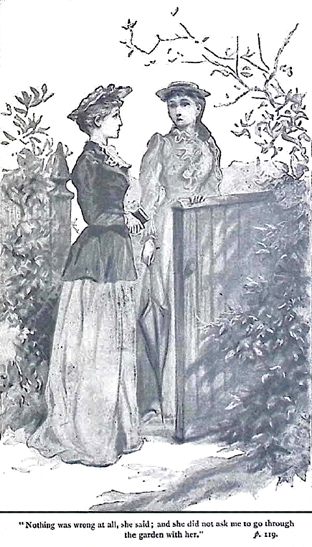
Nothing was wrong at all, she said; and she did not ask
me to go through the garden with her.
Then he asked suddenly, "Which way would you like to go?"
I did not know exactly what he meant, and I said so.
"There is a landau for my uncle and aunt, and Mr. Ramsay, and one lady beside. And I shall drive the dog-cart."
"Who goes in the dog-cart?" I asked, for that sounded tempting.
"May Collins and Jack Farrars will be in the back seat. Mr. Farrars has the offer of a seat in Lady Wills' carriage. And the old pony-trap will take half a dozen children,—Rectory boys and others. It is all pretty well arranged, except those two seats. One in the landau, and one in the dog-cart. Which would you like best?"
"Oh, the dog-cart! Of course the dog-cart. I have never in my life driven in a real high dog-cart." Then I thought of Millicent.
"You can choose whichever you prefer."
"But would not somebody else—I mean, where will Millicent be?"
"She will take whichever seat of the two you leave for her."
Mr. Derwentwater's face puzzled me. I could not make it out.
"Choose whichever you like best," he repeated.
I did not look at aunt Marian. It seemed too hard to think of giving up what I should like so desperately. If it had been settled for me,—but to go into the dull big carriage of my own free will, among the dull elderly people, when I might have the front seat in that lovely dog-cart—And of course I like to be with Mr. Derwentwater. Why should I not? He is so nice-looking, and so polite, and so clever, and so full of fun! Everybody likes him, and why should not I like him too? It seems to me that the only one person who does not understand and appreciate him is Millicent.
"Well?" he said, as I sat and thought.
"Of course I cannot help liking the dog-cart much the best. Only, if Millicent would rather—"
"I have failed to get any expression of opinion from Millicent," he said; and an odd hard look came into his mouth for a moment. "It rests entirely with you. Choose for yourself, please, whichever you would prefer."
"I should 'prefer' the dog-cart."
"Then the matter is settled." And almost directly, he went away.
When he was gone, I could not resist a glance towards aunt Marian. She was looking at me.
"Ought I to have chosen the other?"
"My dear, you are perfectly right to do what your conscience dictates," she replied, in the faint voice she has had all day.
"I don't suppose it was conscience—exactly," I said, not very willingly, but it did not seem honest to let that pass. "Only I do want very much to go in the dog-cart."
"If you think it quite right,—why not go?"
"I can't see why it should not be right, aunt Marian."
"Then—go."
It was horribly unsatisfactory. All the time I knew quite well that she was condemning me. And I could not think that fair.
"Millicent might have chosen, if she had liked. And she did not. Why am I to choose for her? I don't see why she should be forced to go in the dog-cart, against her will. And if she does not care,—and if I do care very much—"
"My dear, do as you think right!" was all aunt Marian would say.
I could have had a good cry, it was so uncomfortable.
August 28th; same evening; later.
Ought I to refuse? Ought I to give up the dog-cart? Ought I to make Millicent have the pleasure?
Well, but how do I know that it would be any pleasure to Millicent? She had the choice given her, and she would not take it. I did not try to get this for myself. Now that it has come, I really cannot see why I must throw it aside. I shall like, oh, how I shall like it!
The dog-cart itself will be so delightful; and the horse that always goes at such a pace, and Mr. Derwentwater's driving. He drives splendidly, I know, because uncle Basil says so. The whole thing will be perfect. I could not really give it all up for nothing. Millicent either does not care for Mr. Derwentwater, or else she has made up her mind that she cannot be spared from home, and must not let herself think of him, or be with him. And if she has made up her mind, nothing in the world that "I" could say would alter it.
It isn't a question of conscience at all. What made aunt Marian say such a stupid thing, I wonder? I don't see why it need be any matter of conscience either way. I am not bound to choose for Millicent; and certainly I am not bound to try and bring her and Mr. Derwentwater together. If I did, I should only be snubbed for meddling. So I mean to let things take their course.
Most likely Millicent would not say a kind word to Mr. Derwentwater. I believe she is too proud,—and so he just came off to me instead.
And why should he not? And why should not I take what he has offered me? What can be the harm?
It is not as if I were sure that Millicent really cared for him. I used to think she did; and that must have been a fancy. Certainly she shows no particular signs of caring now.
I do wonder if it is fearfully conceited of me to imagine that Mr. Derwentwater thinks I have a—perhaps not exactly a pretty face, but rather nice-looking? I only think so because of the way in which I catch him looking at me now and then. And he seems to like to talk.
Would he have laughed at the idea of Millicent being pretty, if he were really in love with her?
Same evening; still later.
I did not mean to listen, but how could I help it? I was just going into the drawing-room, and was behind the screen, when I overheard uncle Basil's voice saying,—
"So Derwentwater is going to take the child with him in the dog-cart to-morrow?"
"Yes; I am sorry for it," aunt Marian replied.
"Sorry!" And uncle laughed. "Why?"
"I have always reckoned on his liking for Millicent."
"You don't think he would ever be such a goose, my dear, as to prefer that pussy-cat face of hers to Millicent's!"
I was drawing back noiselessly, as fast as I could, not wishing to be discovered, or to hear any more. But when uncle spoke of me in such a way, it gave me a shock of surprise; and I came to a stop in the doorway, still hidden by the screen.
"Many a man prefers a pussy-cat face to one with character in it," aunt Marian said.
As if there were no character in mine! It really was too bad.
"It is a pretty type of pussy-cat," she added. But that was not much of a compliment.
"Derwentwater is a man of sense, my dear. Don't you be afraid. It will be all right. He thought he would give the child a treat, no doubt—just as she is going away."
I heard a little sigh from aunt Marian, and I knew she did not agree with uncle. But I would not stay another moment. I slipped off, dreadfully ashamed of having listened to so much, and dreadfully insulted, too, at being said to have a pussy-cat face. After all these months, I shouldn't have expected it from aunt Marian. And yet—and yet—somehow I was quite as much pleased as vexed, to know that aunt Marian could think there was the very tiniest danger of Mr. Derwentwater liking me or admiring me more than Millicent. Uncle did not think as she did, but I know how much more aunt Marian sees and understands than he does. She is very seldom mistaken. There must be something to make her afraid.
At all events, this has quite settled me. I shall let things go. Whether I have a pussy-cat face or not—if Mr. Derwentwater likes it, and likes to have me with him to-morrow, ever so tiny a little bit, I don't mean to snub him or to refuse. And I mean to enjoy myself as much as possible, and to be as pleasant as I can. I'll let things go. I don't see why uncle and aunt should talk about me in that way—as if I were worth just nothing at all, compared with Millicent. Millicent is very good and useful, of course, but she is "not" pretty, and she is "not" amusing, and I don't wonder at all if Mr. Derwentwater finds her a little dull. I have found her so sometimes, even though I am really fond of her—in a way.
I cannot help wishing now that I were going to stay here a few days longer.


A DAY OF DELIGHTS.
August 30th, Friday.
I HAVE a good deal to write down; and I want to write it at once, while things are fresh in my mind.
It has been a wonderful day to me—such a day as does not come often in one's life. This evening I feel half-dazed, and it is no use to think of sleeping, so I may just as well journalize.
Uncle was called for first by Lady Wills; and then up came Mr. Derwentwater in the dog-cart with nobody beside him, and May Collins and Jack Farrars in the back seat. A sort of little twinge came over me, whether Millicent "ought" not to be there. But I had quite made up my mind; and even if I had not, it would have been too late to change, because the landau had already started. So in another moment, I was up, and he was tucking in the rug round me; and then we were off, bowling along at such a rate, and the air was delicious, and the sun was bright, and I felt as if I had never enjoyed anything so much in all my life.
The first part of the way, Mr. Derwentwater was rather silent, and he seemed to have to attend a good deal to his horse. Then he began to brighten up, and to make little jokes; and May and Jack kept turning round to laugh. When we saw the landau ahead, I wondered whether perhaps Mr. Derwentwater would be sorry that he had not Millicent with him. But instead of seeming sorry, he grew merrier than before, and laughed quite loud, and leant over to tuck in the rug round me afresh, though it was all right;—and that was just at the moment when we were passing the landau. He took off his cap and bowed, but in a way as if he were almost too much occupied and interested in what we were saying to be able to attend to anything else. I could not help noticing all this; and I could not help feeling rather proud, because I knew quite well that I was looking and talking my best, and I liked them all to see it.
Millicent was not looking "her" best, and she was not talking at all. She just moved her head a little, in a sort of indifferent "How do you do?" to us both. Perhaps, after all, she liked being in the landau, I thought, quite as well as she would have liked being in the dog-cart. Millicent is so odd and old in her ways, not like other girls of twenty-one. From her face at that moment, I really could believe—or almost believe—that she wanted nothing different. To be sure, she looked rather pale and dull, but that is her way.
For a little distance, we kept in front of the landau, not going nearly so fast as before. And presently we dropped behind it again; I did not know why, and I was rather sorry. I said to Mr. Derwentwater,—"Wouldn't it be nice to get ahead?"—But I don't think he can have heard me, because he made no answer. He had been rather absent and silent while we were in front. But after we dropped behind, he brightened up again, and seemed full of fun. He and I talked any amount. And I could see Millicent watching us quietly, from her seat in the landau, with her back to the horses, not an atom as if she cared.
We all reached the castle at very much the same time. The horses and carriages went off to the village, to be put up; and Mr. Derwentwater drove the dog-cart there, and most of the other gentlemen disappeared too, in the same direction. When they were all gone, May Collins and I rambled about the ruin, which is not much of a place after all, only it is pretty.
And presently I came across Millicent, unpacking the baskets of provisions. She always seems to do that sort of thing, as a matter of course, though really there was no need; for it was the Collins' picnic, not the Farrars'.
May Collins had just left me.
And I said to Millicent,—"Why don't you leave all that, and come for a stroll?"
She looked up at me very slowly, in such a curious way,—I didn't understand, and I don't understand, what she meant. It was not anger,—not exactly,—but more as if I had done her a wrong, and she were trying hard to forgive me. That was the sort of feeling that came;—but what nonsense! Of course there is no "wrong" in the question,—how can there be? She would not take the choice, when it was offered her; and why should not I?
"Come, I wouldn't bother with those stupid baskets. Somebody else can unpack them."
"If everybody said so, they might have to wait long enough. You will not think them stupid when tea-time has arrived."
"But it is Mrs. Collins' picnic, not yours. Come, and take a look at the moat."
No, she would not. She had seen it a hundred times, she said: and of course that was true, while it was all new to me. I think I would have stayed to help her, if she had not had that manner,—as if I had done her some injury. It made me feel uncomfortable, and I was glad to get away. Now I am sorry that I did not stay. It might have been kinder.
The picnic tea itself was rather dull; for I was put down between two of the Rectory boys; and I did not care for them or they for me. They are such uninteresting boys,—at least, I think them so, though uncle Basil does call them "nice intelligent fellows,"—I mean, the elder ones, who are at home now for the holidays. I am sure the eldest, Jack, is about one of the plainest boys I have ever seen. He is very fond of Millicent, and that is his one good point.
Mr. Derwentwater did almost nothing except wait on all the old ladies; and Millicent hardly said one single word from beginning to end of the meal. It lasted long enough. To be sure, her two neighbours were talking to their other two neighbours. But if I had been in Millicent's place, I would have found some way to remind them that I was there. I would not have sat like a dummy the whole time. However, nobody seemed to expect her to be any livelier; so perhaps that is her way at a picnic.
When everybody had had enough, a discussion was started us to who should walk to the waterfall and who should not. Millicent was standing rather apart from us all; and I saw Mr. Derwentwater go and speak to her in a low tone. I could not hear what he said, but I saw that she shook her head; and then he spoke again, and she shook her head more decidedly. And he turned off quite sharply, as if he were rather disgusted, and came close to where I was standing.
At the moment, I fancied that she must have told him she would not go to the waterfall. But it could not have been that, because when we all came together to start, Millicent was of our number. So they must have spoken about something else.
At first, Millicent and I walked together, and she had very little to say. Things were not particularly cheerful. Then Mr. Collins joined us, and that was an improvement. And when he dropped off, I found Mr. Derwentwater in his place. He talked a great deal to me, and hardly at all to Millicent; and of course I could not help noticing this—who would not?
In a little while, Millicent actually slipped away, leaving Mr. Derwentwater and me together. If she had really cared, she could not possibly have done such a thing. I had a glimpse of her walking with her brother Jack. After that, she vanished entirely, getting behind and Mr. Derwentwater was so interesting and amusing that I am afraid I forgot all about Millicent till we reached the waterfall, and then I heard somebody say,—
"Millicent Farrars has gone back to the castle. She seems to be tired."
Mr. Derwentwater gave a kind of little start, as if the words took him by surprise, though I don't know why they should. Anybody may be tired now and then. But I suppose he had fancied all the time that she was following behind us, as I had fancied. He went off into a dream, and said very little to anybody, till we got nearly back to the castle. And then he joined me again, and began to talk and laugh as merrily as ever. And Millicent was sitting on the bank, outside the ruin, and of course she saw us. But she didn't seem to mind, any more than he did.
I forgot to say that the waterfall was nothing much in itself, a tiny trickle of water, with pretty rocks and trees around. I did not think it worth much; only the going and the coming were worth a great deal to me.
When the time came near for starting on our way home, I began to wonder whether Mr. Derwentwater would propose that Millicent and I should change places, and I did dread the thought. I wanted—oh, so much—to drive back in the same way, up on the front seat of the dog-cart, beside Mr. Derwentwater, instead of in that stupid big open carriage, with no one worth talking to. It seemed "such" a difference. And Mr. Derwentwater said nothing at all. So I began to wonder whether, perhaps, I ought to propose it; and I didn't really see that I needed to do that. Why should I? It was the very last chance I should have of anything half so delightful. So I said nothing at all, but just left things to settle themselves.
Then, only a few minutes before the start was to be made, Jack Farrars came to me. He is a big awkward fellow, about sixteen or seventeen years old, without a scrap of good looks, just like all the Farrars boys. And he said,—
"I say, do you know if Millie is to go home in the dog-cart?"
"I have not heard anything about it."
"Don't tell Millicent that I am asking,—" and he dropped his voice—"but I do wish she could. Driving backwards always makes her awfully seedy, you know; and she wasn't good for much at starting, to begin with. I thought perhaps—if you knew—"
"'I' haven't got to arrange things," I said; and I felt cross.
"Only perhaps you might offer—" Jack suggested, as if he were asking me to give up nothing at all.
"Millicent had the chance first, and she wouldn't take it."
"The chance! What chance?"
"Why, to go in the dog-cart. I know she had, and she would not choose."
"Millie always thinks of other people before herself; she's so awfully unselfish," said Jack; though I am pretty sure that was not the real reason. "But if you could just manage it for her, you know—"
"I'm quite sure Millicent wouldn't like me to interfere. She hates to be interfered with."
Jack opened his eyes rather wide. "I don't see what interference has to do with it," he said in a puzzled voice. "I'm only asking you to do her a kindness."
"She mightn't think it a kindness."
"Oh, but she would! I can tell you that," Jack answered readily enough. "She would like it of all things. Of course she would."
"Well, I'll see what I can do. I'll say something." It seemed the only way to get rid of Jack. "I'll ask Mr. Derwentwater."
And then I walked off, and I was angry with myself for having promised, because I did not see why I must do such a thing only just to please Jack, when I was so looking forward to the drive. But I had promised, and so of course I had to speak. I put it off till the very last moment. And then, when Mr. Derwentwater came to call me to take my seat, I said,—
"Wouldn't Millicent like to go in the dog-cart for a change?"
A little flash passed over his face. I wondered if it meant that he was pleased with me for proposing such a thing.
"Has Millicent said that she would like it?"
"O no. Not Millicent. She hasn't said anything at all. It was not Millicent,—only Jack. It was Jack's notion; and so I said I would ask you."
"If Millicent wished it herself—" And then he broke off, and walked to the dog-cart, as if everything were settled.
Millicent was getting into the other carriage at that very moment; and I did not see that I could do any more,—or at all events, I did not feel inclined. Jack stood close to the dog-cart, and I saw his face fall, when I came up with Mr. Derwentwater. He was looking earnestly at me, but I did not look at him, though of course I could not help seeing. I suppose I might have said rather more; perhaps I might even have insisted. But why should I? If Millicent did not care, and if Mr. Derwentwater liked to have me with him—
Did he really like it? I keep asking myself that question, and I cannot find any certain answer. Am I very silly to think that perhaps he did? He was so very kind and nice and pleasant all the way home. It was a delightful drive. I have never enjoyed anything like it in all my life before. Shall I ever have anything like it again?
We did not go fast most of the way, but kept behind the landau, not far off; and he and I had any amount of fun. Only, I rather wished he would not keep just there, because I could see Millicent's face, and she looked so white. Every time I caught a glimpse of her, I thought of what Jack had said, and wondered whether I ought to try again to bring about a change. But it would have made such a fuss; and how could I be sure that Millicent would like it? And the drive was so perfectly delightful,—the simple fact is, I could not do anything of the sort. It was out of the question. So I would not think; and I tried all I could not to see Millicent's face; and I talked and laughed as much as possible, so as to forget about her. Mr. Derwentwater seemed very much amused with some of the things I said.
Jack was sitting with his back to us, talking to May Collins; and of course he could not see Millicent as I could. He did not say anything more to me about her. I wonder what he thought! But I don't see that it matters. And at all events, I kept my promise, and spoke to Mr. Derwentwater. I was not bound to do any more than that.
When we reached the garden-gate and Mr. Derwentwater was helping me down, he said,—"I must look in to say good-bye to you, before you go." And he gave me such a kind squeeze of the hand.
I saw Millicent looking at us both from in front,—straight at us, not as if she cared in the very least. But Jack turned half round, and stared at Mr. Derwentwater and me, as if we were wild beasts.
Well,—what does it matter?
I wonder if he will come in to-morrow.
August 31st, Evening.
Mr. Derwentwater has not been all day. Will he come at all?
He meant to come, I know, because he said so.
It does seem strange to me that I should be thinking of him all the time, when I am going home,—and even longing not to have to go just yet. I was so miserable at having to leave home; and now I would give anything to stay here a little longer.
Mr. Derwentwater will be at the Park for three or four more days. If only something would put off my journey for those three or four days! But I am afraid there is no chance, not the very least in the world. Unless I were to tumble down and sprain my ankle, or something of that sort,—but such things never happen when one would really like them to happen. And everything is settled, and of course I must not even seem to want to put off going.
September 1st, Evening.
Mr. Derwentwater looked in this afternoon for five minutes, just when he might have known that I should be away at the Sunday-school. I told him I had a class there, and he seemed quite interested. Aunt Marian supposes that he did not recollect, but it seems odd. She says he "left a polite message," asking her to say good-bye to me, and hoping that some day I should find my way again to Wayatford.
It did not sound much, said in aunt Marian's quiet voice, with no particular expression. And I was so dreadfully disappointed to have missed him that all in a moment my face flushed up, and before I knew what was coming, my eyes were quite full of tears,—so full that it was all I could do to hold them back from falling.
Aunt Marian gave me one look, and then looked away, and that showed me that she saw. But I don't think I cared. I didn't seem to care much about anything, except that I had missed seeing him.
"If only I had not been to the school to-day!" I heard the choke in my own voice, so she must have heard it too.
"My dear, what reason had you for not going?"
"No reason at all,—only—if I had stayed at home, I should have seen Mr. Derwentwater."
"Would not that have been neglecting a plain duty for the sake of a very unimportant little pleasure?"
It did not look unimportant to me; but how could I expect her to understand?
"I should have liked to say good-bye—of course—"
And then I slipped away, and up in my room I had a good cry. I knew I should make my eyes red, and everybody would notice it. But nothing seemed to matter, except that I was going away, and that I had missed my last chance of seeing Mr. Derwentwater once more, and that it might be years and years before I should ever see him again. I felt perfectly miserable.
Perhaps by the time we do meet again, he will have forgotten all about me. But I shall never forget him—Never! Never! Never! And to-morrow I go home. I do mean to be good and patient, when little worries come, and to be a comfort to my mother, but somehow since Thursday, the "spring" seems to have gone out of the thought of home-life. I cannot think why it should.
One happy day ought not to make everything else seem dull and stupid, but that is just what Thursday has done. I feel as if I would give anything in the world to have those lovely drives over again, the going and the coming home. And I am quite perfectly sure that if I had the choice of going, or of letting Millicent go, I should do exactly the same over again. I could not and I would not give up,—no, not for anything.
I wonder if this is wrong.
Well, I cannot help it. I cannot feel differently.
Only one thing I must be careful about. I must not let my mother see that I feel dull about getting home, and seeing her again. She would be so pained. So I must seem to be delighted, whatever I feel. Perhaps, when I am among them all, I shall feel just as I ought.
I cannot help being thankful that the girls will not be there, to spy out everything that I feel, and to imagine all sorts of things that are not true. If once they guessed, I should have no more peace in life.
Aunt Marian must have seen that I had been crying, because my eyes always show it for such a long while after, and bathing only makes them worse. People in stories can weep for an hour, and then just wash their eyes and come downstairs, and nobody ever guesses that anything has gone wrong. But when I cry for ten minutes, I am an object for the next three hours.
If only I could know exactly what Mr. Derwentwater said to her, and what she said to him, this afternoon! Did she tell him about any of my home troubles, and why I had come here? She might do so, if she wants him to care for Millicent so very much as I know she does care. She might think it her duty to tell him,—for his own sake, of course, she would say. If only I knew! And did she say to him that I have a "pussy-cat face?" And would he agree with her? I don't believe he would. I am quite sure he does not feel about me as she does.
And yet aunt Marian is very kind, and she seems sorry to be saying good-bye. If I had not overheard that one little bit of talk, I could think she was really fond of me. But if she were, she could not possibly have spoken in such a way.
September 2nd, Late at night.
I am at home again, and I have had the lovingest welcome from my mother. She seems so very glad to have me once more. I could hate myself for not being every inch as glad as she is. But all the while, I seem to be living through and through last Thursday, remembering all that was said and done, and trying to find out exactly what each thing meant, and wondering what passed between him and aunt Marian, and puzzling over why he did not come to say good-bye at a time when he would have been likely to find me indoors.
Nothing drove these thoughts away, not even seeing Clarissa's beautiful presents, and her wedding dress. I tried to admire everything, and to seem pleased,—and all the time it felt so awfully flat and dull, I hardly knew how to bear myself.
This morning before I left, aunt Marian said, "I hope you are going to act like a brave girl, Rhoda, and to be your mother's great comfort."
Her words about my face darted up in a moment, and still more the feeling that I did not know what she might have said to set Mr. Derwentwater against me. And I could not answer as I saw she wished.
"There won't be any need to be brave now. Things will be different,—and easier."
"There will be differences. I am not so sure about the ease."
"'I' am sure," I said. "Things can't be the same, with Clarissa and Juliet away. There will not be anything to vex me."
I suppose she saw that I was not in the mood to be talked to, and so she said no more. And I was glad: because, after what I had overheard her say, I did not choose aunt Marian to lecture me about my home duties. I don't see the need. I know well enough what they are, and what I ought to do. It is not a question of "knowing," at all. The difficulty is, when one knows, to do what one ought to do; and nothing she can say will make any difference. What will make a difference is Clarissa and Juliet being away.
I said good-bye to Millicent yesterday,—rather a cold good-bye, though I am sure I do not know why it should be so. I have not done Millicent any harm. We spoke of writing, but did not settle who should send the first letter. I don't believe I shall feel inclined to write to her in a very great hurry. If I thought she would tell me about Mr. Derwentwater, that would make all the difference, but of course she will not. And I don't care for anything else.
Is Millicent jealous of me, I wonder,—jealous, because Mr. Derwentwater liked to be with me, and perhaps even seemed rather to admire my face?

A NEW PHASE OF LIFE.
September 7th, Saturday.
ON Wednesday was the wedding, and it went off all right. Clarissa really did look rather handsome, and I do not dislike her husband. He seemed to me a little dull,—at least, in comparison with "some" men; but that is only to be expected. He looks good-natured; and I am sure Clarissa would never get on happily with any man who was not good-natured. They went off straight to Paris. And aunt Jessie and Juliet have been desperately busy, packing up all Clarissa's presents and possessions.
Yesterday the two went to Bath together. A small furnished house has been taken,—very small, they say,—and we are to move into it next week. Juliet will help us to settle in before she goes north with aunt Jessie. Nothing will induce her to stay any longer with us, either here or in Bath. "Better not" is the most she will say. And if I ask her, "Why not?" she makes no answer. I know perfectly well what she means; and it is fearfully hard not to be angry. For of course all the while she means "me."
Mother is very tired and worn-out, and terribly anxious about my father. Nobody knows exactly when he will arrive, but I suppose it might be almost any time. His letters have been so strange lately—so confused and unlike his usual way of writing, Mother says. She does not know what to make of it, but she is afraid that the doctors do not think well of him. He has never even told her the name of the ship in which he has taken his passage. In one letter he began to tell, and left a gap for the name, as if he could not remember it at the moment, and the gap had not been filled up. Anybody might very easily forget to put in a word, but my father has always been so business-like and methodical, that my mother is worried to see anything of the kind. We fancy a telegram will come suddenly, and tell us that the ship is in, and that we may expect him in a few hours. The worst of it is that he does not know our Bath address, and he will telegraph to Alresford. If we knew his ship, we could send or telegraph to meet him on its arrival. All this worries Mother very much.
I do not think she even notices that I feel downhearted and dull. She is so wrapped up in her anxiety about him.
September 14th, Saturday.
We are in the new house,—such a horrid poky little place. It is in the ugliest of back streets; and the dining-room is a mere cell, and looks upon a hideous blank wall; and the drawing-room is only a tiny scrap bigger. And the bedrooms are simply awful. The only decent one among them is that which my father and mother must have. The twins are in a minute hole at the top of the house; and mine is smaller still and opens into theirs. They are to be my charge now, for we have only one servant, a maid-of-all-work. Of course she will have very little spare time for the children; and I find "I" am expected to wash them, and dress them, and look after them, as well as to do no end of things besides in the house.
A good many children of their age,—nearly eight—would do lots for themselves, but they are so babyish and helpless still, and so fearfully spoilt. Juliet has spoilt them, and I shall reap the benefit.
Juliet has gone away from Bath to-day, with aunt Jessie; and last night she gave me a long lecture on my duties. She really has worked hard, and has been very kind the last few days, so I had to endure it. She said I ought to understand clearly how much would be depending on me. And then she explained what things the servant would be able to undertake, and what would be left for my share. Not only washing and dressing the children, and walking out with them, and giving them their lessons, and mending their clothes as well as my own, but helping to make all the beds, every morning, and dusting the drawing-room, and a whole heap of fidgets besides.
She did her best to give me a fright about my mother. She said Mother was so delicate that if I were to let her do much, she would soon breakdown altogether; and that if I did not undertake these things, my mother would have to do them, because now there would be nobody else. Juliet need not have said in the tone she did, "Now there will be nobody else!" as if she meant, "You have driven me away, and so you may take the consequences!" Perhaps she did not really mean that, but it certainly sounded like it.
Of course I intend to do my best, and I do not intend to let my mother do more than she ought, but all the same, Juliet need not try to frighten me for nothing, or to make me unhappy. If she only knew it, I am quite unhappy enough already.
And, after all, though I mean to do my duty, there are limits to what one can be expected to get through. I cannot possibly undertake the whole work of this house. I think we ought to keep a second servant; and I believe we should, if Juliet had not put it into Mother's head that we might do without. I don't see why it should not be afforded. Other people afford it, and why should not we? Of course we are not rich, but I don't believe that we are so poor as that would amount to. My father must surely have laid by some money in all these years. I know he has had losses, and he has not done well in coffee—and being in that sort of thing is so different from being in the Civil Service, but still I do feel that things might be managed better.
When I used to think how delightful it would be to live with my mother and the twins alone, I must say I did not expect this kind of life. I begin to realise now what it means, and I do not like the prospect at all. The thought of nobody else at hand to do things, if I forget, rather frightens me. I do not love work of that sort—teaching, and mending, and looking after spoilt children, and dusting, and making beds. Who would? I am afraid I detest it all. And though I have not always felt inclined for practising, yet I do not like the idea of having no time for it at all. I should not like to sink into a mere useful drudge.
But the worst of the whole is the feeling of how much will depend upon me: the feeling that if I am a little lazy or disinclined, and leave something or other undone, there will be only my mother to do it. That is horrid. Tiresome as Juliet is in some ways, still she was always "there," and she never minded what she did. And now there will be nobody.
I begin almost to wish already that Juliet would come back and live with us again. But I would not for the world have anybody guess what I feel.
The one thought that keeps me up is that aunt Marian means me to pay her another visit some day. I know she does, because Mother quoted a few words from aunt Marian's letter to her a few days ago. I hope Juliet will not go and get herself married too; for I do not see how I could ever get away, as things are now, if Juliet wasn't able to come and take my place sometimes. I fancy she will not mind doing that now and then.
Mother did not show me the letter, as I thought perhaps she would. I saw her looking thoughtful over it. Somehow, I felt perfectly sure that aunt Marian had told her about Mr. Derwentwater, and it made my face burn for hours after.
September 18th, Wednesday.
It does not take long to settle into a furnished house; and we have fallen already into a certain routine. I have to work awfully hard: there is no choice. If I leave a single thing undone, which is supposed to fall to my share, Mother says not a word, but just goes and does it herself. And that makes me miserable, because she really is not fit to do anything, except to take care of herself.
It is no use to remonstrate, and ask why Mary can't for once do an extra thing without any fuss. Mother always says, "She has not time, my dear." She would have time if she were quicker, and had the least bit of method in her work. But she is the slowest of slow mortals, with no memory, or plan; and she seems to spend her whole time in a muddle.
I never knew before what it would be to have no one to see to things, as Juliet always did, or what a difference it would make.
If only I did not feel so fearfully dull and flat and stupid, as I do! I try to get over it, but trying does not seem to do an atom of good.
Sometimes I find my mother watching me, as if she were trying to read what is in my mind. And then again I wonder what aunt Marian may have said to her.
It seems an age since I left Wayatford. It might be ever so many months, instead of only a few days. The days are so long and slow.
Mother has spoken several times about Millicent. She saw her years ago, last time she was in England; and she liked Millicent then very much. "Nothing would please me more than that you and Millicent should be friends," she said, yesterday evening. "Your first letters were very full of her, Rhoda."
"Oh, yes, I think we are friends. I suppose we are."
"You like her, do you not?"
"Oh, yes, I like her—very much,—only, of course—"
Mother waited, but I did not finish.
"From all I hear, she must be a really good unselfish girl."
"Oh, she is good enough," I said; and I heard a sort of fractious sound in my own voice. "She is almost too perfect. That is her fault. She never does anything wrong. And I don't believe she cares a scrap what happens, or what doesn't happen. And she is so queer and silent and shut-up,—so unlike other girls."
"That might be very high praise," Mother remarked, smiling a little. "Only you do not mean it for praise."
"Oh, she is nice enough. Aunt Marian thinks there is nobody in the world like Millicent. And perhaps there is not,—though I should not like everybody to be exactly like her, I must say." And I felt desperately inclined to burst out crying,—it was all I could do to hold myself in.
My mother said nothing more, but I thought she saw.
September 19th, Thursday.
We have been wondering how soon news would come of my father. And to-day all at once, he appeared with no warning at all, and no telegram beforehand. It did startle us.
Mother and I were doing a little work together, some of the twins' mending; and the twins were having a game in the next room. It rained hard, so I could not take them out for a walk. And all at once, when we had sat for some minutes without speaking, my mother said,—
"I think the change to Wayatford has done you good in some ways. You seem older, on the whole."
I had just been thinking about Wayatford, dear Wayatford;—so it was curious that she should speak just then of the place. But, to be sure, I always am thinking about Wayatford.
"I feel years and years older."
"What makes you feel so?"
"Oh, I don't know." I felt my colour getting up, because I suppose that was not strictly true; and yet what else could one say?—"People must grow older in time."
"And you are fond of your aunt Marian?"
"Yes,—I am fond of her,—only she does say such odd things sometimes, Mother." And then I came out with what I have been meaning to ask ever since I got home:—
"Mother, have I really a 'pussy-cat face'?"
She laughed at first, and then wanted to know what made me fancy any such thing.
"I heard aunt Marian say so. She did not know I heard her; and she did not mean me to hear."
"What a pity you listened!"
"But I was just coming in at the door behind the screen. Aunt Marian did not see me; and of course I could not tell that she was talking secrets. I suppose she thought the door was shut. Have I a 'pussy-cat face'?"
Mother looked at me, smiling faintly, as if she were studying what I was like.
"It is a pretty little face," she said—"very much improved lately, I think. Bounded small-featured faces are sometimes to be described in that way, when perhaps they have not very much character or expression. But—"
"Have I no expression or character?" I cried indignantly.
"My dear, I did not say that. You would not allow me to finish. I was going to say that a mother is hardly a fair judge. Your face is very dear to me; and it could not be otherwise, even if—"
"Even if it were ugly!"
"I did not mean that. A child's face can hardly be ugly to her mother. But as to character and expression, you are not developed yet. I think, perhaps—"
"Yes!" I said impatiently.
"People's faces strike others so differently, I should not myself have described yours as exactly in the pussy-cat style,—but—"
She made another pause.
"But—what? Did you ever hear anybody else say the same thing of me? Clarissa or Juliet?"
She was silent, and I knew she would have said "No," if she could.
"Juliet, of course!"
"Not in any unkind sense, my dear. People must be free to form and express their own opinions. I think Juliet did once use the word, but it was not so much as to your features. It was as to expression."
"And you think that makes it any better!"
Mother looked at me in surprise. "Expression may alter," she said gently.
"And you agreed with Juliet!"
"There was no need to agree or disagree. I saw what she had in her mind. Sometimes you have a self-satisfied look—rather—when you are bent on proving yourself at all hazards to be in the right. And I suppose—" with a little laugh—"that no face is ever more entirely self-satisfied than a pussy-cat's face. But that is a thing which may be got over."
"I don't see how."
Mother actually said, in her softest tone, "My dear child, leave off 'thinking' yourself always in the right."
"But I don't. Of course I am in the wrong sometimes."
"Then leave off behaving as if you did think so. When you are in the wrong, or when you have made a blunder, allow the fact frankly. It is so much more graceful, than always to stand out for whatever you have happened to assert, merely because you have asserted it."
I had that horrid feeling again of being so desperately inclined for a thorough good cry. For I am quite sure "somebody" never thought me conceited and self-satisfied.
Mother certainly can say rather hard things sometimes, even though she is so really gentle and loving. I suppose she does it for my good, but I wish—I wish—oh, I hardly know what I wish. I only feel very very very—as if—as if—
How stupid of me to write like this! And I have ever so much more to tell.
Mother had just said that, and I was going to answer her as soon as I could manage my voice, when a cab drove up to the door, and she gave such a start. She turned as white as paper.
"Rhoda,—see!" she gasped. "I do believe it is he!"
And the odd thing is that for one moment I did not understand. I could not think what she meant. When she said "he," she, of course, had my father in her mind. But the idea which flashed into my mind was not of my father, but of Mr. Derwentwater.
It is perfectly extraordinary how fast one can think. For, in that single moment, I had time to remember that my mother was not supposed to know anything particular about him, and to wonder whether most likely, after all, she "did" know, and to wonder how much she knew. I felt myself turn as red as she had turned white, and I sat and stared at her, not able to make up my mind what I ought to say.
"Quick! Come! It is your father."
And then I understood. And oh, it was such a dead blank.
But I jumped up, and ran out after her. And I found her in the arms of a tall grey-haired man with a thin drawn stern face, at least, not exactly stern, but so unhappy. Not in the very smallest degree like the father I have always pictured to myself.
Are things ever like what one has pictured them beforehand?
The twins raced out together, on hearing the stir; and then they turned shy, and would not kiss him. He had given me one hasty kiss, just saying carelessly, "Is this Rhoda?" And then he dragged himself into the drawing-room, leaning on Mother's shoulder, and dropped into the biggest easy-chair.
Mother told me to take away the twins, and to pay the cabman. And when I came back again—though I felt very much inclined to stay out of the room altogether—she was seated by him, with her hand in his; and I heard her say softly, "Poor dear! So altered. How ill you must have been!"
"Who is that?" he asked sharply, in a loud voice, when I walked in. It sounded as if he were quite angry.
"Only Rhoda, dear. I want you to have a good look at Rhoda, and see if she has grown like what you have been expecting. Rather different from the small child you saw last, is she not?"
Mother tried to smile, but her voice shook, and I could see that she was trembling all over.
My father only gave a kind of uneasy groan, and dropped his head on his hands.
"He is so tired," Mother said, turning to me, "so very tired with his long journey. He never thought of telegraphing, and he went all the way to Alresford; and then he had to come on all the way here. You see, he had quite forgotten that he did not give us the name of his steamer."
"My dear, it is rubbish! I 'did!'" came in a growl.
"If you did, how very stupid I must have been," my mother began, but I burst out indignantly,—
"Mother! Of course we never had the name."
"You thought you had sent it, did you not, dear?" she went on, turning again to him. "And you felt so sure. But I have been feeling quite at a loss what to do. We sent directions to Alresford that if a telegram arrived, it was to be at once forwarded here. Only, you were so busy, you forgot to telegraph, did you not?"
It was almost as if she were talking to a child. She went on so for some minutes, and my father seemed to be listening.
"You have got into a very uncomfortable sort of hole here," he said suddenly.
"Oh, I think we shall do very well," Mother answered. "And Bath is a pretty place. I am sure you will like it, dear."
He leant his head on his hand, and said nothing. And I felt quite provoked: it was so unkind to Mother, and she looked so upset.
"We shall do all we possibly can to make everything nice and comfortable for you," she said, her voice quavering. "And in a little while, when you are better—"
"I shall never be any better!"
Mother's face was all in a quiver, as well as her voice, yet she kept on smiling.
"In a little while, I think you will. When you have had plenty of rest, and have seen a good doctor. I am sure the change will do you good."
"Where are you going?" he asked sharply, as she stood up.
"Only just—for a minute or two—something that I must see to," she said. And I was certain from her face that she "had" to go, because she could not keep up a moment longer. "Just for a minute, and Rhoda will talk to you till I come back."
She beckoned me to her seat. "Not for long," she whispered.
And I felt so scared, I could not help whispering back, "'Please,' not long."
Mother vanished, and I sat by his side, feeling desperately uncomfortable, without a notion what to talk about.
"Where is your mother gone?"
"She is coming back directly, in a minute, father." And then in despair, "Do you think the twins are much altered?"
"The twins? Where are they?"—as if it were quite a new idea.
"Mother thought you would be tired, and so I took them away. And they are rather shy, too. They will soon remember you again, I dare say."
"Remember!" And he looked at me in an odd fixed way, as if he were trying hard to understand. I wished my mother would come back.
"I don't think they quite forget," I said, trying not to let my voice shake too, though he did not seem to notice anything of the kind in either of us. "It isn't very long since you saw them?"
"Well; no," he said slowly. "I suppose not." And then he got up.
"Won't you wait till Mother comes back?"
"Where is your mother? I am going after her."
I thought he would find her crying, and I said, "Oh, do wait please. I fancy she is busy."
But he went straight off into the passage, without paying the least attention to what I said, and stood looking about him.
And Mother came running downstairs quite lightly, with tears actually on her cheeks, and yet with a smile.
"Do you want me, dear? I thought I heard you moving."
"Yes; I wanted you," he said. "I wanted you."
Mother put her hand on his arm, and led him back into the room. He sat down with a satisfied air, and rested his head against her. And the next thing we knew was that he had dropped sound asleep.
Then I came away up here, for I did not see that I could do much good downstairs. The twins promised me to be good and quiet with their dolls in the dining-room. And I am writing in my journal, because I do not know how to settle down to anything else.
Was my father like this when he was at home last? I have no very clear recollections, but I have always fancied him as kind and merry and full of fun. It seems extraordinary. Has he had any great trouble lately? But how could he, without my mother knowing about it?
Perhaps he is only tired, and vexed to have gone all the way to Alresford for nothing. At any rate, I hope—


UNDER THE YOKE.
Same Evening, later.
OH, I wish Juliet were here! If only Juliet were here! How "shall" we manage?
I was called off from my writing by Addie. The child seemed scared, and she said I must go to Mother. And I ran downstairs, and found Mother looking like a ghost, begging and imploring my father not to go out for a walk in the dark and wet. It was just dark, and pouring with rain still, and very cold. He seemed as if he could not keep quiet or settle down to anything. He was not unkind to Mother, only persistent.
But when I tried to help her, and said: "O no, father; of course you must not go out. You must stay and tell us all about your voyage."—He "did" speak to me in such a tone! I have never been spoken to in such a way before.
I felt myself turn perfectly scarlet. And Mother put her hand on his arm, and said,—"O don't, dear!"
And then he ordered me off again,—exactly as he might have ordered a dog out of his way.
Of course I could not stand that. I gave Mother a look, and just walked straight out of the room into the next. My being there was no good. And after a minute, I heard the front door bang, and Mother came into the room where I was, and sat down, and burst into such an agony of crying,—as if her heart were almost broken. I never saw anything like it before!
And I did not know what to do, or what to say. I was angry at the way he had treated me; and I could not tell how to comfort her. If Juliet had been here, she would have known what to do; for somehow Juliet is never at a loss. I have never wanted Juliet so much in all my life before!
"Mother, what does it mean?" I asked at length. "Is he always like this? What makes him so angry?"
"Oh, no, no!" she gasped. "Oh, never! My poor dear! Never like this before!"
"But what does it mean? If he is going to say such things to me—"
Mother tried hard to smother her tears.
"Rhoda—listen—" she said in a very low voice, as if she could hardly get out the words, "listen! He cannot help it. It is not his fault. He does not know. It is illness. And we have to bear patiently, very very patiently! He isn't the least aware. Like this!—Oh, never—always the kindest and sweetest temper. But he is ill—he cannot help it!"
"Will he always be so?" I felt awfully dismayed.
"I hope not; I trust not." And she sobbed again. "Poor dear! So changed; so unlike himself."
"But what are we to do? How are we to manage?"
Mother sat up with such a brave smile.
"We shall manage," she said. "Things will be better in a day or two, when he is more at home, and when he has got over the fatigue of his journey. It seems so to have upset him, to get to Alverton, and to find none of us there. I must give up all my time to him now, until he is stronger. The great matter is to keep him quiet and soothed, to avoid whatever might excite him, or irritate him. So the doctors said out there."
"I really don't see that anything I said ought to have irritated him."
"Not if he were in good health!"
"But people are not always like that, Mother, when they are out of health."
Mother looked anxiously at me. "No," she said. "It depends on the kind of ill-health. It is not a question of ordinary ill-health. I do not think you quite understand yet."
"I don't think I do!" I said, shortly enough.
Mother got up and shut the door, as if she were afraid of being overheard. Then she began to explain. She said she had been fearing something of this kind; only things seem to be even worse than she had feared. She would not say anything to me earlier, because she so hoped that he might arrive a great deal better for the voyage. He has been very unlike himself for a long while; and she has noticed a difference in his letters, as well as hearing from friends about him. He has been for months so restless and nervous and irritable.
That would be nothing, Mother said, in a fidgety bad-tempered person, because it would be only natural. But in any one so sweet-tempered and placid as my father has always been, it is not natural; and everybody who knows him well has felt uneasy.
The doctors believe that he must have had something of a sunstroke, when he was travelling alone, just after my mother left him to come home. He was ill, and he only saw a very second-rate "up-country" doctor, and he had nobody to take care of him. And he has never been really well since, though for a long while Mother had not the least idea of how things were.
Mother says sunstroke often does leave mischief behind, especially in a case like this, when proper care has not been taken, and hard work has been begun again too soon. Whether it really is just the effect of a neglected sunstroke, or whether it is a breakdown from long overwork, nobody is quite sure. Only he is ordered to have perfect rest, and no worries, and no over-fatigue, and nothing to excite or irritate him. Mother repeated this two or three times, as if she thought I might be the one to excite him. But I am sure I do not know why I should. Of course, now I know that it is a matter of illness, that makes all the difference; and I intend to bear with his ways patiently.
Still, whatever is the cause, it does seem rather dreadful. I thought there would be a little peace at last; and this looks like anything but peace.
If Juliet were with us, I should not have such a horrid feeling of nobody to turn to, when things go wrong. I mean if mother wants help.
My father did not come home for a good two hours. Then he was much less excited, and soaked through, and awfully tired. And Mother has been in such a state of anxiety, looking out for him. If this sort of thing goes on, she will soon breakdown herself; and then what "shall" I do?
September 23rd, Monday.
In a kind of way, my father has settled down and is more quiet than he was on the first evening. But he is still fearfully restless and excitable. The least thing makes him angry; and he never can be happy for one single minute when he is indoors, unless Mother is by his side. He does not care to have me; it is always Mother that he wants. He goes out for long long walks alone, and will not have anybody with him;—at least, I suppose he would have Mother, if she could walk any distance, which she cannot. But since he cannot have her, he goes alone.
Mother does as she said she meant to do; she just devotes herself to him. How she stands it, I cannot imagine, for she has not a moment's respite, except when he is out walking, and hardly even then; for if he is out of sight she seems to live in terror, lest something should happen to him before he gets back.
I have enough to do in looking after the twins, and the house; for my father is desperately particular, and he spies out in a moment if a single thing is forgotten, and is down upon me, ten times as sharply as ever the girls were. And if I say one word in self-defence, he is so angry that the whole household hears of it.
As for helping my mother with him, even if I had time, which I have not, I could not do it. He positively frightens me; and besides, I do not think he takes to me at all. It seems an odd thing to say of one's father, but he positively sometimes seems to have a dislike to me. It is not "my" fault. I have really done my best to take things patiently. He never shows the least sign of affection, and is so awfully vexed with every single thing that I do or don't do. Often I do not know how to bear it: and if it were not for Mother, I could not bear it much longer. But if I do anything to make him angry, Mother is the one to suffer: and I live in fear of her breaking down under all she has to do. And so I try, as hard as I can, not to vex him.
Sometimes he will play with the twins for a short time and look almost happy, but it never lasts. The restlessness is sure to come on again, in a few minutes; and only Mother can manage him then,—not always even she!
Yesterday I asked her if Juliet knew how things were. She said, "No, not entirely. Your father does not like his health to be discussed."
"If she knew, perhaps she would come!" I could not resist saying.
"To pay us a visit! Not so soon."
"To live with us, Mother."
Mother looked surprised at the idea. "O, no, never again! That is an understood thing. The girls always said that if once they left me after my return, and began a home with aunt Jessie, it would be a permanent arrangement. Juliet could not possibly throw her over now, merely for our convenience. All that is at an end."
"But Juliet is so fond of you. And if she knew that you wanted her—really—"
"She would not come. It is out of the question."
"Not even for a few weeks?"
"Some day, perhaps. Not now, certainly. And even if I would ask it, and if she were willing, your father would not consent."
"I thought he was so fond of Clarissa and Juliet."
"Very fond of them as nieces. If he had come home, and had found Juliet in the house, he would have looked upon her as one of us; and I dare say she could have done a good deal with him. But now he looks upon her as an outsider, and he shrinks from outsiders. Do you not see it for yourself?"
"I don't see why he should."
"There may be no particular reason why, but he does. I suppose he is conscious of not being fully himself—" Mother caught herself up in a kind of frightened way; "I mean—conscious of not being in his usual condition. He cannot control his moods, and he feels ill, and he does not like to be watched. If I wished ever so much to send now for Juliet, he would not let me."
"Don't you wish it?"
"For my own sake, yes. It would be the greatest possible comfort. But for other reasons, no."
"For what reasons?"
"After all that has passed, I could not." And she blushed faintly. "Could 'you,' Rhoda?"
"I don't know. I don't see how we are to manage."
"We must manage, and you must be very brave and patient, and help me."
There was not one word of blame to me, though all the time it is my fault that she has not Juliet with her now. It is all my fault, and she has to bear the punishment as well as I. That seems so unfair. I wanted to tell her how sorry I was, and how I would give anything to undo the past. But somehow I could not say the words. I seemed to be tongue-tied.
How long can things go on like this?
All through these worries I keep thinking about those happy peaceful weeks at Wayatford. Such a contrast! And oh, how I long to hear something from somebody about them all, about especially—oh, I suppose I ought not to write what I was going to say!
That happy happy wonderful Thursday! Shall I ever spend such a day again in all my life?
Shall I ever see him, or hear of him again? And does he ever think of me, ever so much as remember that I exist? Oh, I think—I do think—
Well, I must not go on like this. What is the use?
September 25th, Wednesday.
I have written a long letter to Millicent. I did not know how to wait any longer, feeling so cut off from them all. Will she write in answer? I have begged her to do so, and to tell me everything about "everybody!" But will she?
Now that I am away from Millicent, I know how really and truly fond of her I have grown. It seems so silly that I should ever have doubted it: or that I should have been so often vexed with her about such utterly foolish things. As if she were obliged to talk to me in just exactly the way that I wanted, and to tell me what she thought and felt! It was too absurd of me. I wish I could live those few weeks over again. Dear Millicent! If only "I" could go instead of my letter!
October 8th, Tuesday.
A letter at last from Millicent! I do think she might have written sooner. I have been looking out for it, oh, so anxiously! And now it has come, it tells me nothing; that is to say, nothing that I particularly want to know. She goes on chit-chatting through four pages all about themselves, and uncle and aunt, and the Parish,—in fact, every single thing that I do not care to know, and not one word about what I long to hear. But I might have expected this beforehand.
October 16th, Wednesday.
It seems as if I had been years and years in Bath, and it feels as if we had been living this sort of life for months and months.
I get utterly out of heart with it often. It is such endless work and worry, and yet nothing is ever right. Whatever I do, my father is never by any chance pleased. Mother says that is a part of his illness; yet he does not seem precisely "ill," only so fidgety and restless. Besides he is not the same with Mother. He may and does speak sharply sometimes, even to her; but he is so affectionate, and never quite happy unless she is by his side, while to me he is not affectionate. It seems as if the very sight of my face worried him.
If it were not for my mother,—but she is getting so thin and pale; yet she never gives in, never complains. She just slaves for him. And he never sees if she is not well. He is perfectly absorbed in himself; at least, he seems to be so.
I suppose he is just a little better in health lately in some ways, not so easily tired as when he first came home. But Mother does not think him better, and certainly he is quite as irritable. Things are all but unbearable on some days.
Yesterday I told Mother so, when he had flown out at me about nothing at all. And she said,—
"But, dear Rhoda, things have to be borne."
"I'm pretty well at the end of my patience," I said. "It is perfectly miserable."
Mother sighed. "Yet you have your wish. The girls are not here."
"But if I had known 'this' was coming—"
"Yes; you would have acted differently. Only we never do know. You and I do not know now. The only thing is to do just that which God gives us to do,—not that which we ourselves would like best. And then there will not be self-reproaches, whatever may come."
Then my mother has seen that I do reproach myself.
"Of course one ought always to do one's duty," I said. "Everybody is always telling one that. I do not see that it makes things any easier. It is just the duty part which is so hard."
"Yes, if there is not love!" A curious soft look came into her eyes,—such tired eyes lately.
"I suppose I love him, of course, because he is my father. Only it is not as if I had always really known him."
"I did not mean love to him. I was thinking about that word duty? One has to remember one's duty, and to do it. But I think when the love to our dear Lord takes its right place, one does not dwell so much upon mere dry duty, as duty. It 'is' duty; but it looks so different—so much more beautiful and attractive—when it is just the doing whatever He wishes us to do. That cannot be so very hard when one really loves Him."
I did not know what to say, for I am quite sure I have not the sort of love she meant—not the sort of love which makes hard things easy. I want to do right, and I am sorry when I have done wrong, but it is in a different sort of way from that. I wish I cared more, and felt more, as Mother does. But I cannot make myself do it. How can I?
It seems to me now as if the only thing I really care for is to hear something more from Wayatford. Not about Millicent, or about my uncle and aunt, but about—
Shall I ever hear anything again?
And of course I care also about saving my mother trouble. I am so terribly afraid of her breaking down, afraid for her sake, and also for the sake of everybody. What should we do?
Life seems awfully hard to live just now. Aunt Marian was right enough. Things are not easier than they were. They are infinitely harder. When I look back to those months, and to getting so vexed with the girls, it does look to me now as if I had made a very great fuss about nothing. If I had guessed what was coming, I would—oh, I would have borne or done anything, to have kept Juliet with us. If she were here, she would be able to manage my father, and to have everything different.
I can do nothing with him. He will often hardly let me say a word. Mother says my manner is irritating, because I am always ready to argue. But how can I help it? One must defend oneself sometimes! He is so fearfully unjust to me,—often I do not know how to endure it.


EXCEEDINGLY HORRID.
October 24th, Thursday.
TO-DAY, for once, my mother and I have had a quiet talk,—and if I could have guessed what Mother would say, I would have gone anywhere to have escaped it.
But it is all aunt Marian's fault. I shall never never forgive aunt Marian.
An old Indian friend of my father's turned up, and took him off for a long ramble over the hills. And I made Mother lie down on the sofa, to get a little rest. The twins were playing in the tiny back garden, so we could be quiet. I did not mean to talk at all, but she seemed so disinclined to sleep that it was of no use for her to try. A few things were said, nothing particular, and then we were silent again.
And all at once Mother asked—"How did you like this Mr. Derwentwater, of whom I hear so much?"
My face flushed up scarlet, and I would have given anything to run away. But Mother was lying between me and the door, and I should have had to push past her.
"Oh,—I liked him." I tried hard to speak indifferently.
"I do not think you have mentioned his name to me; except, perhaps, in a passing way."
"I dare say not."
"Your aunt speaks of him. In her last letter."
"What does she say?" I asked, rather fiercely.
"She says he was a good deal in and out, while you were at Wayatford, the last fortnight particularly. And she supposes you will have told me all about it—and him."
I did not know what to reply.
"And she mentions that it was he who drove you to and from the ruin, in that excursion, just before you came home . . . Of course you would have told me, only your letter after the picnic was so hurried." Mother spoke as if she were apologising for me.
"Yes. Oh, I didn't seem to have any time." I wished my face would not burn so furiously. "And I was coming home so soon—it didn't seem worth while to write a long letter. And then—when I got home—it was such a bustle—"
"Yes!" Mother spoke quietly, and did not seem to mind, though all the time I had a feeling that she understood perfectly well. "And you found him pleasant?"
"Yes—very—" and I went on working as fast as I possibly could.
"Is he not intimate with the Farrars family? Your aunt used to think that he and Millicent—"
Then my mother knew more than I had supposed.
"I don't think 'that' will ever come to pass," I said hastily.
"Why not?"
"I don't know. I don't believe it will." I was getting redder and redder. "He didn't even think her pretty." After a little break, I could not resist murmuring half to myself,—"'He' did not think I had a pussy-cat face."
"How do you know?"
"I know! One can tell that sort of thing pretty well!"
She drew me on with more questions, letting her hand lie on mine, so that I could not go on working, and I had to attend.
After all, I found it rather a relief to speak out, and to tell her how nice and kind he was, and how lunch I had enjoyed those drives on Thursday, and what fun we had had. And I told her about Millicent watching us, and not seeming in the least to care, and about Mr. Derwentwater meaning to see me again to say good-bye. "Only, it was so tiresome,—he happened to call just when I was out. I should so have liked to see him just once more. He was so nice! Everybody likes him."
"Yes,—he is popular."
"Aunt Marian thinks any amount of him. And aunt Marian is as particular as you are."
"She likes to have young people about her; and she always makes them fond of her. Yes,—and I believe she is fond of him. Whether she has a very high opinion of his character—"
"Oh, I know she has! I am perfectly sure she has."
Mother's next words took me utterly by surprise. "And I suppose, dear,—I suppose it never so much as came into your head that he might be playing you off against Millicent, for a purpose,—that he might be trying to rouse her jealousy by paying attentions to you!"
"Mother!!"
But she repeated,—"I suppose you have never thought of such a thing as a possibility."
"No, I haven't, and I don't!" I declared stormily. "It is not possible, and nothing shall ever make me think it possible. I don't believe it, and I never will believe it. Aunt Marian has been telling you a lot of untruths. I wonder you can listen to her!"
Then I flung my work down, and rushed upstairs to my own room, and locked the door, and cried for a whole hour. Nobody came near me, and I left the rest of the world to take care of itself.
After that, I had to go down; and I did not care in the least how red my eyes were. I thought Mother would see and be sorry. But she was too busy with my father to have any time for me; and the whole evening she has not been free for a single moment. I fancied that perhaps she would come to my room the last thing; but she could not be spared. My father was in one of his most depressed states, tired out, I suppose, with walking too far. She only gave me a kiss, and said nothing. I do not even know how much she has noticed, or how much she knows or guesses.
Now it is past twelve o'clock, and I do not feel as if sleep were a thing possible. I have been writing all this, to pass the time, and to see how it looked.
I don't know what to think or what to believe. The very idea is too dreadful. I cannot and I will not believe such a thing to be true. Nothing shall ever make me believe it.
And yet—what if it were true?
But it is not. I don't believe it. He is not like that.
Mother is not to blame. I am not going to be vexed with her. She only spoke because she was anxious about my happiness. It is all aunt Marian's fault; and I do not mean ever to forgive aunt Marian,—ever to like her again.
Mother spoke of aunt Marian's "last letter." Has she heard again lately? I know she had one letter, soon after I came home. Was that the one, I wonder?
Things seem very horrid, altogether!
October 25th, Friday.
I did not mean ever to speak again about Mr. Derwentwater to my mother, or to anybody. But nearly all night I was awake, thinking of what she had said; and all the morning I felt so wretched, I did not know how to bear myself. I am afraid I made other people wretched too, though of course I did not mean to do so.
By the end of the afternoon, I could stand it no longer. My father went out to the post; and I was alone with my mother for a few minutes; so I burst out:—
"What made you say that yesterday, Mother?"
"I had reasons."
"What reasons?"
"Perhaps my best plan will be to let you see this letter," and she put one into my hand. It was in aunt Marian's writing. "Read it quietly up in your own room, not down here. I have been debating with myself, ever since it came, whether to show it to you or not."
"Aunt Marian's meddling, I suppose!"
Mother was just going to move away, and she stopped and looked at me.
"No, not meddling! If you take things in that spirit, Rhoda, I shall regret having allowed you to see it. I thought I might treat you as a reasonable woman. You must remember that your aunt was responsible for you while you were there, and also answerable to me. Her reason for writing as she does is simply kind thought for your happiness. She has hesitated long, as you will see, but it did not seem to her right to say nothing under the circumstances. Whatever you may feel, I shall always feel that she was right to speak. Of course I am showing this to you in confidence. Aunt Marian does not forbid my doing so, but you must reckon it all to be confidential."
Then she moved away, and I rushed upstairs—here; and I bolted the door before I would look at the letter.
It is not the one which came directly after I returned home. The date is only four days old.
In the beginning of it there is a good deal about me that is very kind, and even affectionate, hoping that I will go again some day for another visit, and saying how much I am missed, and so on. All that I skimmed, and then I came to the really important part; and I am going to copy it out word for word, so as never to forget. For I mean never in all my life to trust anybody again—never again!
"Rhoda will, of course, have told you about that Thursday excursion
just before her return home, and about Ernest Derwentwater driving
her in the dog-cart to and from the old ruin. She seemed a good deal
excited and flattered—poor little woman!—and I have blamed myself since
for want of caution in letting her be quite so much thrown with him.
"You see, I have always looked upon him as pretty well apportioned
already, knowing as I do what he feels for Millicent. And Rhoda seems
such a child still, one hardly thought of possible danger. The last
day or two made me fear that she might be just a trifle touched by his
pleasant ways. I am afraid the naughty fellow had a reason for making
himself especially agreeable to her on that particular Thursday; and
much as I like Ernest, I blame him exceedingly. There is no sort of
excuse for him. To play off one girl for the sake of arousing feeling
in another is unjustifiable.
"I do not accuse him of this without reason—that would be unjustifiable
on my part. When he came to say good-bye, two or three days later, he
spoke most despondingly about Millicent's coldness. And I said, 'But
you have been comforting yourself with somebody else meantime.'
"He gave a start, and then laughed.
"'Rhoda is pretty, is she not?' I said.
"'Well, yes—perhaps—if she had not such an inordinately good opinion
of herself,' he answered.
"'What made you drive her to the ruin instead of Millicent?' I asked.
"He said, 'Millicent would not show whether she cared a straw which
way she went, or who was her companion.'
"'And so you thought you would stir up a spice of jealousy on her part.
You might know Millicent better than to try such a plan. Have you
gained any thing by it?'
"He shook his head.
"'No better than you deserve,' I said. 'You had no business to behave
in such a way. Just imagine if you had done execution in another
direction!'
"'What! That infant!'—and he went off into a peal of laughter.
"I really thought it best to say no more for Rhoda's sake, but to
treat the matter as a joke. Otherwise, I would have told him much more
plainly what I thought of his conduct.
"Only, poor little woman, it may not be altogether a joke to her; for
I am afraid she 'might' have once or twice thought him a little in
earnest. You see, she looks younger than she is! After long cogitation
and much hesitating, I have determined to tell you all this quite
frankly, neither omitting nor softening, and to leave the matter
entirely in your hands. If Rhoda seems happy and heart-whole, the less
said the better. She will soon forget any tiny fancy she may have felt
for that foolish boy. But if you should see her to be dwelling on the
recollection of him, and of his smooth speeches, then you will know
what is best to be done. Girls are so different. One has to be treated
in one way, and another in another way. Make any use or no use of what
I have told you—precisely as you think best."
I hardly know what I really felt on first reading this. It was like a kind of white-heat of fury. I was angry with Mr. Derwentwater, angry with Millicent, angry with aunt Marian—almost angry with my mother for showing me the letter—and yet I would not on any account "not" have seen it. I could not have wished to go on in a sort of fool's paradise. It was the horribly mortified feeling that was the worst of all.
For about an hour, I did not know how to bear that. To think that he was all the time just playing with me, just using me for his own convenience, just looking upon me as a silly child—a vain silly stuck-up child! And to dare to say that I had an "inordinately good opinion" of myself!
At first, I stormed about my room like a crazy thing; and I fumed and knocked things over. And then I cried; and then I fumed again. And then I began to think what to do. I wondered what my mother had said in answer to aunt Marian, and as I wondered, she came to the door, and I let her in.
"Would you not like a turn in the garden, Rhoda?" I knew from her face how she had been all the while thinking about me, and longing to come.
"Mother, there's nobody like you in all the world!" I cried, and I clung to her. "And I never mean to love anybody except you! And I never will trust anybody else again—never! Never!"
"Well, there is no hurry, darling. What an untidy room!"
"Oh, I'll put it straight. Mother, what did you say to aunt Marian? You didn't let her think—"
"I did not say much. There was no need. I thanked her for writing openly; and I said that I thought Mr. Derwentwater had behaved very wrongly, but I was glad to be able to say that you had shown no particular interest in him since you came home."
"Oh, that was—splendid!"
"And now—" Mother stopped.
"I think he is perfectly disgusting, and I am never going to like him again. To tell aunt Marian that I am conceited, and have too good an opinion of myself! I am much obliged to him!"
Mother's face broke into a smile of relief.
"That matters very little. People must be free to form their own opinions about others. And if 'that' is all you care for—"
I almost exclaimed, "But it isn't!" And I stopped myself just in time.
"Only, it was so horrid of him to go and make that sort of fuss with me, and to pretend that he liked me so much, when all the time, he just wanted Millicent!"
"Yes, it was horrid of him—but never mind. The thing is over now."
I let her say so, and did not contradict her. She did not ask for the letter, and I kept it, because I wanted to copy out part. I am so afraid I may forget, and may even begin to fancy again that perhaps he really did mean something. And if I just read the words once more when such a feeling comes, they will settle the matter.
But the thing is not "over" yet, as Mother thought. Will it ever be over? I am very angry, very very angry, with Mr. Derwentwater—so angry that I should dearly love to do something to punish him, if only I could. Is that a wrong feeling? And yet—now and then, in the very middle of my anger, his face comes back to me, with that kind pleasant smile, and it seems, oh, it does seem, as if I would give up "anything," just to be in Millicent's place—just to know that he really cared for me, and wanted me to be with him—to be his. But it is nonsense writing all this. I suppose I ought not to let myself even think about him now. I ought to forget his very existence.
Can one do that? Can one make oneself forget?
October 28th, Monday.
Life looks so awfully flat, so horribly dull! It seems as if nothing were worth doing—nothing worth thinking about. There is nothing to expect—nothing to look forward to! Will it always go on like this? Will nothing ever be bright again?
Sometimes I feel desperately angry still with him, and those are the easiest times to get through. Sometimes I could sit down and cry for hours; and then I have not any spirit to be angry.
Mother is so good and sweet! I know she sees everything, but she does not bother me with questions, or even with seeming to see. I am afraid I have been awfully cross to her and the twins, the last two or three days. It is desperately difficult not to be cross, when everything looks so hopeless. But of course that is no real reason, and no excuse at all. And Mother has enough to bear without that. My father gets worse and worse. I cannot think what we are coming to.
Shall I ever feel again as I used to feel? But, anyhow, nobody must see. Nobody must guess,—except, of course, my mother. I do not think anything would blind her eyes. Nobody else must know!
November 1st, Friday.
I have come to a resolution! I will stop journalising. When I come to my room, and get out my journal, and begin to write, then things always seem worse, and life looks darker. I am going to be so busy as to leave no time for thinking; and I am not going to open my journal once for at least six months. After that—perhaps—but I shall see! As matters are now, I am sure this will be the wisest. Perhaps in six months, I shall have got a little over this horrible dreary sense of emptiness. Perhaps life will have begun to look a little brighter again. People say that one does in time get over that sort of trouble. I do not know. I cannot "feel" like getting over it!
If only he had not spoken in such a way of me—I do not think I should mind anything else so much, but somehow I cannot get over that. And all the time I cannot help, in a sort of way, liking him still.
And now I am going to stop.
(For six years no further entries.)


AFTER SIX WHOLE YEARS.
No. 7, HIGH STREET, WAYATFORD
November 1st, 18—
EXACTLY six years to-day since last I wrote in this little old journal of mine. I had forgotten the thing utterly. It had gone out of my mind—pushed out, I suppose, as lesser interests are so often pushed out by greater ones. Odd that I should have come across it now, unexpectedly, just when we have settled into this new home, where everything seems still so strange, and yet so familiar.
During the last six years, I have never once been to Wayatford, never once paid the second visit which was talked of, and which then I so longed for.
Six years are a long while,—very long between the ages of eighteen and twenty-four. I seem to myself to be a century older than I was then. Six years between forty and fifty may not be very much, but between fifteen and twenty-five they are almost a short lifetime.
One changes so utterly in one's ideas, in one's wishes, in one's tastes, in one's estimate of other people, in one's manner of judging and of looking upon things. What I admired six years ago, I often do not admire at all now; and what I despised six years ago, I can often now admire immensely—or, at all events, I can see its worth as I could not then.
I have been reading my old journal, having stumbled upon it accidentally. There was a great pile of books to be looked through: lesson-books, copy-books, exercise-books. All this ought to have been done before we left Bath, but the move at the last was hurried, and some of the piles of books were thrown into a big box, not examined. Mother said she thought we ought to get rid of the more useless ones, so as not to be needlessly encumbered; and I chose the first wet day to overhaul them at leisure.
And there, tied in a huge packet, with exercise-books on each side of it, was my poor old journal!
After that, I could not make any further advance with the examining of other books. It was impossible. Mother had gone across to aunt Marian for the afternoon, and Juliet was writing letters downstairs, and the twins were at school. So I had the top room to myself; and I just sat down and read the whole thing through, from beginning to end.
How glad I was that "I" had found it, and not somebody else; not Juliet, for instance, and above all, not mischievous Addie! And what a crazy thing of me to do, to leave it lying about among piles of books, for anybody to read that might feel inclined!
Well, I have it safe now; and I shall either burn it, or put it in a very secure corner indeed. Perhaps I will keep it, for reading the old entries has started me off afresh. I almost think I will begin journalising again.
Only, I hope not quite in the old style. What a conceited egoistical creature I was in those days! No wonder friends found me almost unbearable. No wonder people in general did not take to me. No wonder I drove the girls half crazy. No wonder Mr. Derwentwater said I had an inordinately good opinion of myself. The only wonder is that my mother did not find me unendurable too. But do mothers—ever? Mother-love can bear what no other love can bear.
How little I dreamt, when I wrote those last words, of all that lay before us, the terrible pressure of the next two years especially. My small trouble seemed so great to me then, though now I can see how much more there was in it of wounded self-conceit than of any deeper feeling. I little dreamt how soon it was to be dwarfed, and even crushed out of existence.
The one thing I wanted then was an easy comfortable life, a life in which I could please myself, and have my own way unhindered. And that was the very last thing which I was to be allowed to have.
I think I can see the reason now—partly, at least. Looking back on what I was then, and seeing what my faults were, I do feel that just the kind of life which I wanted would have been the very worst thing in all the world that could have come to me. It would have fed the selfishness, and fostered the egoism, and made me more and more unendurable.
There are many many things that I have not learnt yet, many things that I do not grasp at all clearly. I can feel that there is an enormous difference between my mother and me, and I wish I were more like her. Perhaps in time, I may grow so. But I have at least learnt one thing; and that is, that our life here is a training for the future, and that everything has an object and a meaning, even when one cannot possibly make out what the particular object and meaning are. And I think I have learnt too—or, at least, I have begun to learn—how little I really know, and how unutterably silly it is to be for ever giving one's opinion on every conceivable question, as if one's opinion were of the very smallest importance. I "used" to feel as if I knew something about everything.
One of the sharpest and best lessons that ever came to me was seeing that letter of aunt Marian's about Mr. Derwentwater. I do not defend him; he was wrong, and he had no business to "play off" one girl against another. I do not respect him for doing it; and I never could respect any man who should be capable of such a thing. But all the same it was about the most wholesome thing that ever happened to me, and I am grateful to him, even while I dislike what he did. But for that, I might have gone on for years and years, never realising in the least what other people thought of me, or what a stuck-up conceited little affair I was. It gave my pride at the time a very sharp sting, and made me utterly miserable. But in the end, it did me, I am sure, a great deal more good than harm.
How we lived through those two years following is a mystery to me. My father grew steadily worse, as the months went on. He consulted more than one first-rate doctor, ill as we could afford it; and the verdict was always a kind of reserved opinion: general failure of health, brain affected by long overstrain, and probably by a neglected sunstroke; nothing much to be done for him, beyond perfect rest and quiet, and absence of all worry and excitement. He was not to exert himself; he was not to be contradicted; he was to be kept as placid and happy as possible.
No easy order to carry out, for me especially, an impulsive girl with very limited powers of self-control, long addicted to self-pleasing. Yet I "had" to learn. Self-defence, contradiction, argument, impatience, those things which were most of all characteristic of me, brought so heavy a penalty on my gentle Mother that I "had" to control myself for her sake. I had to bear injustice, to crush back the bitter words, to clench my hands and endure in silence. And I found that I could. One can bear much for the sake of those whom one loves with a real heart-love. It is when love is faint that bearing becomes so hard.
I am not blaming my poor father. It was not "himself" all those months that was so irritable and unjust. He was not really himself. The state of intense brain-irritation made self-control to some extent an impossible matter, so the doctors said. He suffered sadly, not so much from actual pain as from a perfect misery of depression and restlessness and nervous excitement, and even of delusions.
Juliet did not know how things were. My father utterly refused to have her, or anybody except ourselves in the house, even for a week. And Mother never wavered in her resolution not to make a convenient use of Juliet, after all that had passed. Since we had not made her happy among us in happier days,—since "I" had not, my mother ought to have said,—we could not appeal to her in need.
I do not think Mother ever quite realised how sharp a rebuke to me those words carried. If she had, she would not have repeated them. It always seemed as if, in her gentle humble way, she somehow identified herself with me in the past failure.
Once or twice Juliet proposed to pay us a visit, but my father was terribly upset and excited by the bare idea. And Mother always had to say that he was so "nervous," he could at present stand no visitors in the house. Juliet was puzzled, and I think rather hurt; and for a whole year, she scarcely wrote at all, or Clarissa either.
And we went down lower, lower, into the shadows.
How my mother bore the strain, I do not know. She seemed to have an unnatural strength given to her, at least for a time.
We were short enough as to money. The girls knew that it must be so; and towards the end of the first year, they wrote offering to pay entirely for the twins' schooling. Mother did not refuse. She was most thankful, for this made us able to put them both into a boarding school. The house was hardly fit for children, in my father's state of irritation and depression; and Emmie was falling into a weakly nervous condition, which made us anxious.
Getting them out of the house was better for them, and was worse for us. Johnnie, of course, was away too—only at home in the holidays; and there were no gleams of brightness to help us on.
I suppose hardly anything could have so changed my very self as that second year did: the long long slow months creeping on, with nothing to lighten them, and my father getting always worse, and the perpetual fear of the strain being too much for my mother, and the kind of helpless feeling of having no one to turn to, no one to call in! It seemed to crush out every bit of childishness that remained in me, and to kill all the nonsense, and to make life so awfully real and earnest!
Then at last, the thing I had dreaded most came upon other troubles. My mother suddenly broke down, and became very very ill.
At first, I did not even think of Juliet. We had grown so into the way of going on alone, and of being unable to have friends in and out, because of my father's state, that it seemed as if I just had to go on still in the same way. A week passed somehow, I hardly know how. I had to nurse my mother with the help of our one good-natured and very stupid girl; and I had to look after my father and try to keep him from being utterly miserable. It was just a little comfort to find him turning to me when he could not turn to her. But he was ordered not to go into her room, and I found it impossible to keep him out, and the excitement made her worse. Then she was in danger; and in despair, I thought all at once of Juliet, and wrote off a hurried letter, telling her how things were.
She came off by the very first train, arriving sooner than I could have thought possible. And oh, the comfort I never shall forget seeing her walk in, with her kind capable face, and her "Why, Rhoda, how is it that I was never told?" I just threw myself into her arms, with one great sob, and she held me, and kissed me, and whispered,—
"You poor child. But things will be better now. Why did you not telegraph for me sooner?"
The difference after she came! No words could describe it. The whole household seemed changed, and everything began to go rightly. She sent at once for a trained nurse for my mother; and she undertook my father chiefly herself, and managed him splendidly. He had always stood out against having any one in the house: yet he took to Juliet the very first moment, and never even showed a sign of vexation at seeing her, though I had expected a terrible storm, because I had written without his leave. Juliet had such a quiet cheerful "strong" way of never seeming to contradict, and yet of somehow making him do exactly what was best for him.
Mother was ill for a long time. She had fought so hard against the breakdown that when at last it came, it went on for months. And Juliet would not leave us. She said her duty was plain, and aunt Jessie must do without her for a while. Juliet did not mind what she did, or how much she spent for my mother. Every kind of comfort was provided, and the best advice was procured, and the nurse was kept on month after month, I do not know what it did not cost; yet Juliet never allowed us to feel burdened. I cannot tell how she managed; only it was all done cheerfully and naturally, and she was delighted to be with Mother again. I felt then more than ever how selfish I had been to drive her away from the home she loved best: and I knew at last that she "had" loved it best, and that my mother was far more to her and Clarissa than ever aunt Jessie could be. No wonder. But why did I not understand sooner?
When she came to us in our trouble, she put aside all the past, and never showed any signs of thinking about it. There was nothing in her manner to remind me of the way in which I had behaved to her. I told her one day how sorry I was. And she answered brightly:
"Oh, well, that is all right now, and we know one another at last; don't we?"
As the months went on, my father grew still worse, but in a different way. The irritation and restlessness were not so bad; and a kind of powerlessness crept over him, almost as if he had had a slight stroke, though I believe it was not that really, but only the brain disease going on. He grew more and more shaky, and he could not walk much, and then he took to sleeping a great deal, and he was less and less able to enter into anything like conversation. He could not collect his thoughts, or remember things, or follow out any fixed idea.
By that time, we knew that there was no hope of any improvement, and that he would go steadily down until the end. Only it was a great comfort that he became more placid, not so terribly excited. He quite lost his dislike to me—if dislike is not too strong a word—and would let me sit with him as much as I wished; and gradually he became quiet and affectionate, almost like a child in his ways. And from that he passed slowly into a state when he did not know any of us, and could not say the simplest thing clearly, and had to be taken care of as if he had been a baby.
When he began to grow helpless, Juliet insisted on engaging a capable man-servant to look after him. She said it would kill my mother to attempt again what she had done, and this was true enough. Juliet gave us no choice, so we had to submit. When Mother was really a great deal better, Juliet went back to aunt Jessie for a time, but she soon returned to us, and stayed long. And the house was always like a different place when she passed through the front door.
Those foolish days, when I thought Juliet was against me, and when I wanted to get rid of her at almost any cost! Oh, what a little goose I was!
Well, I am making a long story of the six years. But indeed they have seemed long, though no part of them has been such a terrible drag as the first two years.
My father became slowly worse until about a year ago, when he passed quietly away. None of us could wish to keep him. For months before the end, he had ceased to know any one, and we all felt what a joy to him the release must be,—Mother most of all, because she loved him most.
The Bath house was on our hands still for nearly another year; and my mother was too worn and shattered to be able at first to think of any change. All she wanted was to keep quiet. She and I passed months together, seeing almost nobody, except when Juliet came to stay with us.
Then Clarissa paid us a week's visit and she tried to rouse us up. She declared that the life was bad for us both, and that we ought to go elsewhere, and start afresh. She frightened me by saying how thin my mother was, and how, if I didn't look-out, she would slip away out of our hands altogether.
"Your mother is three-quarters an angel already, Rhoda," she said; "but we don't want her to become one entirely just yet!"
I do not believe that we "do" become angels when we die. Angels are surely quite different from human beings. But people often say that sort of thing; and I have given up arguing with Clarissa. What is the use?
About that time, aunt Marian wrote, much to the same purpose. She asked if we had ever thought of such a thing as living in Wayatford. A pretty little house in High Street, almost exactly across the road, was vacant, and the rent was low; and there was a good day-school near, which would do for the twins.
Clarissa and Juliet both took up the idea; and I did not at all dislike it. I thought it would be nice to be near aunt Marian, and perhaps to see Millicent again, though I had heard nothing of her for a long time, and somehow our correspondence died a natural death years ago.
So the plan came about, and everything was settled. Then the oddest thing happened. Aunt Jessie gave out that she was going to be married.
Fancy—at her age!
It was to be to a nice old widower, whom she had known many years. And Juliet was so curious about it. She laughed at first; and then she actually began to cry, and said she had no home.
Mother said, "My dear!—" and stopped.
And Juliet crept into Mother's arms, and whispered,—
"Will you have me? Can we live together again? Could Rhoda put up with me?"
"O Juliet! If you can put up with me!" I cried.
And that too was arranged in less than half-an-hour. Juliet was staying with us when the news first came of aunt Jessie's engagement.
We did not give up this little house, because it is so pretty and quaint, and it stands in such a nice garden, and the rooms are of a very good size. But Juliet has insisted on no end of improvements, and has even built an extra wing of two rooms.
Then at last, we came, and here we have been now for nearly a fortnight.
I have put all this into one entry, though I have not written it all in one day, because it is a sort of history of the last six years.

ABOUT THE PAST.
November 7th, Saturday.
MR. FARRARS is still the rector of Wayatford, and Millicent is still at home, still unmarried. He looks about the same as when I saw him last, only a good deal more grey and a little more inclined to stoop. But she looks—oh, so much older! Some girls at twenty-seven are quite young and girlish, but Millicent was hardly girlish even at twenty; and now she is so calm and grave and middle-aged, she might be taken for almost any age.
There is a look in her face as if she had gone through a great deal, in one way or another. I wonder if she has. I wonder if she has gone through one half or one quarter so much as I have. I wonder if there is a look of that sort in "my" face, and if not, I wonder why not.
Mr. Derwentwater's name has not once been mentioned by a single person since I came here; and somehow I have not cared to ask about him. I am always such a hand at blushing just when I ought not, and a stupid little self-conscious feeling might make me blush, if I asked; and then people might imagine that I had not quite forgotten the old stupid fancy. I would not have anybody think that for anything.
Perhaps he is married by this time. It is very likely. If he found that he really had no hope of getting Millicent, it is not in the least likely that he would wait. I remember thinking that he might so easily put off for a few years, and wait till she should be free, till Amy should be old enough to manage the household. But men are not so fond of waiting; and now I begin to see what an amount of patience would be needed for such waiting,—now that these six long years have gone by. I seem to have lived through half a lifetime; and Millicent is losing all her girlishness, and is getting to look thin and plain and middle-aged; yet still Amy is only fourteen years old, a mere child, in short frocks, frisky and heedless.
So I dare say I was a little hard upon him, thinking he might so very easily wait without minding it. Of course it would depend on the kind of love that he had for Millicent. I mean there is a kind of love which can wait, and which would choose to wait, any number of years, rather than lose her. But very few men love like that. Somehow I do not think Mr. Derwentwater is one of the few.
Did he ever speak to Millicent, I wonder? Did he ask her to have him, and did she refuse? Or did he know that it was hopeless from her manner, and never say a word?
Well, I suppose some day something about him will slip out, only not from Millicent. Nothing ever slips from Millicent; and she seems to me quite as reserved now as in her girlish days. Not that I have seen much of her yet. We are both a little shy, the one with the other, not exactly knowing whether to behave like friends or not. I do not think we have even said each other's names yet,—I mean in speaking one to the other.
Aunt Marian is precisely the same that she was, not changed in the least, not worse in health, and not looking a day older. She is so delighted to have us all here, especially my mother. It is like a new life to her, she says; and I am sure it is doing Mother no end of good.
We have the twins at home again now; and they go to a day-school. At seven years old, they were very much alike. But now at thirteen, they are becoming complete opposites. Addie is the dark one, her hair has changed so quickly, while Emmie's is still quite fair.
Addie is thin and sprightly, and full of fun and mischief; while Emmie is shy and gentle, and rather plump, and much the prettiest. They and Amy Farrars have struck up a friendship at once.
But Millicent and I are only on the footing of pleasant acquaintances. We meet sometimes, and we are polite and agreeable, not in the least confidential.
Why, indeed, should we be?
Wayatford does not feel dull to me now, or particularly slumbrous. Nothing, I suppose, could be especially dull after the life we have lived in Bath, where we really made no friends, because of my father's state. If we had had old friends, we should not have given them up, but to make new ones was a different matter.
Several very nice people have called this week already, and to have uncle Basil and aunt Marian almost opposite our front gate is a perpetual interest.
November 28th, Thursday.
Millicent and I are drawing slowly together, finding it pleasant to exchange ideas. I think we begin to like one another more genuinely than ever in old days.
I am often now struck with her quiet force of character, and her calm sensible way of looking upon things, and still more with her powers of mind. It is extraordinary how much she has managed to read in her busy life. But, after all, reading or not reading is very much a matter of will.
Millicent says that from the age of fifteen she has always resolved not to let herself glide into the vacant state of many girls, who never from one year's end to another, look into any book except a novel. Reading has been her rest and delight; and even in her most crowded times, she has very very seldom allowed a whole day to pass without at least one quarter of an hour of it. All this of course mounts up in the course of years.
Now and then, when she is talking of a favourite book, and her face brightens, and a little colour comes, the worn look of middle-age vanishes. And then I catch myself wondering whether, if Mr. Derwentwater were to see her at such a moment, he would not be just as much in love as ever.
Has he forgotten her by this time? And where is he now? Since I came to Wayatford, not a human being has mentioned his name.
His uncle, Mr. Collins, of the Park, died two years ago, and the property passed to a distant relative—not a person whom people here can like. So, in any case, I suppose Mr. Derwentwater's visits to the Park would cease.
Still, if he really wished to come to Wayatford, he might of course manage it. There would surely be nothing to hinder him.
December 4th, Wednesday.
I have heard something at last, and from Millicent herself!
Yesterday afternoon we were together. I had gone in to have tea with her, and she was alone. We sat over the fire, without a lamp, enjoying blind man's holiday. At such times, one can talk more freely than in full light. The fire was low, and one's face could not be seen; and something made me speak about my visit to Wayatford more than six years ago. I told Millicent that I often thought now what a horridly disagreeable girl she must have found me.
Millicent paused, and answered slowly: "No, not horridly disagreeable. That is too strong. Sometimes, in certain moods, you could be taking. Only, you were so very sure of yourself—"
"So conceited!"
"I suppose it was a form of girlish conceit."
"And—so desperately wrapped up in myself."
"Yes, rather. It was a case of self dominant—the whole world for self, and self for nobody else."
"But I didn't know it, Millicent."
"No, of course not. Girls do not know it; or if they do, they don't see the unloveliness of it."
Then, without any particular intention, I found myself saying quite naturally, "I always have thought it was such a 'thing' to do, that day of the excursion, to choose the best seat in the dog-cart, and to leave the other for you."
"Why should it have been the best seat?" she asked. "And why should you not take it?"
"Why, of course it was the best! Any one would have said so. And you had every right to it, and I had none. I was a mere interloper."
"But suppose I did not wish to go in the dog-cart?"
I looked at her dubiously.
"The choice had been offered, and I would not take it. You were perfectly free to act as you pleased."
"Perfectly free to be as selfish as I liked."
Millicent sat gazing into the fire, and presently she stirred it, so that a bright flame sprang up. I could not understand her face.
"I wonder—may I ask one thing? Don't answer if you would rather not. It has always been such a puzzle to me, thinking about that day. Did you really mind, or did you not?"
"Did I really mind—what?"
"Not driving in the dog-cart with Mr. Derwentwater, and all the rest?"
There was another and a longer break.
"I don't know why I should not tell you," Millicent said at length. "It is not as if you were a child now. And perhaps—yes, I did mind. I minded that, and all of it, very much indeed. It was part of the whole struggle, part of the pain. One has to live through such times, but they are not easy. And I was so young, and I had no one to help me."
"I was no help."
"No," and she looked at me sadly. "Just at first, I think I had a fancy that you might be, but that was soon at an end. If you had been then like what you are now, Rhoda—!"
"Instead of being just utterly wrapped up in myself, as I was!"
"Well, that is all over," she responded.
"But, Millicent, you had aunt Marian."
"I could not speak out to her. She knew him too well."
"And there was no way—why could he not wait?"
"I would never have consented."
"And I made things worse for you!"
"For the moment, perhaps." Tears were on Millicent's eyelashes. "If it had been earlier or later! But the fight just then was so hard, harder than any one knew. I was waking up when you came to what he really meant, and to what I really wished, and to what I had to do. I knew I could not be spared from home for years and years. And though I told myself that the thing was impossible, still it was hard to see him taken by you; and I thought you were trying to win him from me. Even though I knew I had to give him up, I did not quite know how to stand that. And yet for his sake, I ought to have been glad, if he could have cared for anybody else."
I was startled at the flutter which those quiet words of Millicent sent through me. Then it had not been all fancy on my part! She too had thought that he was really "taken." And I—I have felt so sure that I had utterly left off caring; and yet those words made me thrill all over. How absurd! As if it mattered now!
"But he never did care a straw for any one but you."
She laughed faintly.
"I think that was for years the ruling affection, but Ernest is of a susceptible nature. He is always easily caught by a pretty face. Perhaps I ought to say 'was.'"
"Where is he now?"
"Abroad. When he found that things were hopeless, he said he could stand England no longer. They were very good to him at the Bank,—old friends of his family; and they found him a post on the Continent for three years. I suppose the three years may be extended indefinitely."
"When did he go?"
"Nearly four years ago. I have heard nothing of him for a long while."
"Then he did speak out to you! Am I wrong to ask?"
"No; I don't mind telling you now. He spoke out, and even offered to wait indefinitely. Of course I would not consent. I left him perfectly free; and in a year, he was engaged."
"Millicent!" I could have shrieked the word.
"Why not? He had no hope of me. And, as I say, he was susceptible."
"And he was married!"
"No. She died of fever, three weeks before the wedding day. Poor fellow!"
"He hasn't managed to find somebody else since?"
"I don't know. I have heard nothing of him lately."
"And, Millicent, you don't care!" I said wonderingly. "You don't really care!"
She turned her face towards me, and spoke slowly. "There are different ways of caring. My line of life has always been so clear. But there are some losses which can never cease to be losses, and some troubles which can never be as if they had not existed. Don't you understand? I think it has killed my girlhood early. Still, I have work and happiness left. And if the other thing were not God's will for me, it is not my will for myself. I am perfectly content. Now I don't think we need say any more about it."
"Suppose he came again!"
"Suppose the stars fell!" she answered, smiling. "He is a young man still; and I am middle-aged, more like thirty-seven than twenty-seven!"
"Oh, no!" slipped from me involuntarily; yet I have said the same thing to myself.
Millicent would let me go no farther. She began to talk of other things, and his name was dropped. I know I shall not be allowed to bring it up again at present, and I must do what she wishes. But I do wonder—has he quite forgotten Millicent?


WISE WORDS AND UNWISE DEEDS.
February 10th, Monday.
A BITTERLY cold winter, and Emmie is so delicate as to be a perpetual anxiety, while Addie is the very picture of health. But for Emmie, we should have just now almost no cares. Of course, there is much to look back upon that is sad, but our little home is very happy, and we are making pleasant friends. My mother has not looked so well for years. The single anxiety is Emmie; and she is just the one about whom we can be most anxious of all. She is so lovable and sweet, and such an unselfish little darling. Every one clings to Emmie.
Must there be always something; always a shadow in one direction or another; always a weight of some kind; never perfect freedom? I asked this question of Millicent,—perhaps impatiently, for I had been feeling impatient.
"Perfect 'here'? No. Things are not meant to be perfect here."
"One would like a little rest sometimes."
"But this is not our rest," she answered softly. "Rest by-and-by, not here, not now. This is the fighting-time, the preparation-time."
That is how she feels, and Mother, and aunt Marian. But though I have learnt much in the last few years, somehow I cannot yet feel myself to be a mere bird of passage. Perhaps I love this life too well. It is so much to me that I am always wanting it to be more, always craving for perfection. I know well enough that perfection cannot be found in this world, that it would not be good for me, because then I should no longer look up and forward and beyond. And yet I crave for it.
The teaching comes slowly, step by step. By-and-by, I shall learn more. Perhaps I shall learn to feel as Mother feels. One cannot force oneself into a different frame of mind; one can only be willing to be taught.
And I suppose the teaching often has to come through sorrow. I suppose that is the "must be." There are things that one could not possibly learn in any other way; only through trouble and strain and loss.
For our characters have to be formed, that I know. And it has to be through pressure, just as a potter presses the clay into shape with his hands. If there were no pressure, there would be no beautiful shapes. I suppose we are all being shaped, slowly, by means of a touch here, a weight there, sometimes a sudden sharp blow. All through our lifetime on earth, we are being gradually shaped and made fit for the life of by-and-by.
Yes, I see it now. And I see, too, the need for self-discipline, the need to gain power over self, the need sometimes to say "No" to self even when it is not necessary, so that one may have strength to say "No" effectually when it "is" necessary. And I see how, if we will not do this, if we will not steadily fight to gain the mastery over ourselves, we have to be taken in hand and dealt with sharply, for the curing of those faults which we might have cured ourselves by self-discipline.
I see all this in myself. I have seen the faults, through being yielded to, grow too tough for me to conquer. And then I have felt the sharp discipline; and I have understood the need, and yet often I have not been willing. Sometimes now I am not willing.
It is one thing to understand that one is in need of disagreeable medicine, and quite another thing to be willing to take it, still more to accept it joyfully.
As years go on, I suppose that too becomes easier.
February 16th, Sunday.
Another thought has come to me about life's troubles and tangles.
Things often seem so upside-down, so confused, so exactly as one would not choose them to be. And then the temptation arises to wonder why they are so, why God does not interfere and arrange differently, and make all straight and smooth for us. If He loved us, surely He might, surely He "would," when it must be so easy to Him.
And yet all the while, it may be just because He so loves us that He does not put things straight. It may be just because their being crooked is needful, perhaps as a test, perhaps to draw out something in our characters which could not be drawn out in any other way,—absolutely "could not!"
I often think of a little talk I had once, years and years ago, with Millicent. She told me that one could not possibly be patient unless there were something which might make one impatient. She said that if all one's life were smooth, and everything were just as one liked, one might be comfortable and contented and good-tempered, but not patient. For patience meant endurance, and endurance meant something which had to be endured.
I did not fully see it then, but I see it now. Patience is an active virtue, not a passive one. It means bearing up against a strain; it means very often hard fighting below.
And I suppose the same thing is true in other directions also. One cannot be truly good-tempered, unless there is something to be overcome which would naturally make one ill-tempered; one cannot be truly brave, unless there is something to be overcome which might naturally render one cowardly; one cannot be truly self-denying, unless there is something to be given up which would please self; one cannot in any way be truly victor, except through some kind of battling.
Something in Mr. Farrars' sermon to-day has set me thinking in this way. He spoke of our Lord's life upon earth; and of how the trials and temptations and sorrows which beset Him were, if one may so say, partly for the perfecting of His human Character. He was made perfect through suffering. These things drew out or developed into active life those perfections which were "in" Him, but which could not have been manifested in any other way.
And Mr. Farrars said that in any of us there might be the "germs" of patience, of self-conquest, of self-sacrifice, implanted there by God; but that it was only through action, through having to fight against the opposite tendency, that the germs could be developed into active life, and could be seen by all around.
It is a wonderful thought to me that every trial, and every opposition, and every temptation, which may come, is really meant for a help heavenward. That every pull in the wrong direction is actually an opportunity for a step in the right direction.
If only I could keep it always before my eyes! I think I do see now what Mr. Farrars meant, but one's impressions fade so fast. To-day I feel that it might be the worst thing in the world for me to have my life made smooth and placid and easy; to-morrow, as likely as not, the impulse will come again to fret and be discontented because life "cannot" be easy and smooth.
March 16th, Sunday.
I have been reading through the last entry, and thinking seriously about it. On Sundays, if possible, I always try to get a quiet hour, or at least half-an-hour, to read and think all alone.
What I wrote that day was true enough.
This life only the threshold of the great Life beyond. Yes, indeed. It is only the schoolroom preparation-time, the testing-time, the training-time. And it does not truly matter in the very least whether or no we have what we want, but only whether we are doing exactly what we are meant to do, whether we are carrying out God's will and letting Him work His will in us unhindered.
That is the main point,—whether we do not "hinder" Him in what He would do in us, and with us, and through us.
Some people care so very much about whether they are "comfortable." One often hears it said as an excuse, "Oh, I don't like to be uncomfortable!" But isn't that childish? What does it signify whether we are comfortable or uncomfortable, so long as we are doing rightly, and not merely pleasing ourselves?
That is how one ought to feel, and I think it is how I do feel about the question as a whole, in the abstract. But when the abstract comes down to the particular, when it isn't a matter of the general question, but of doing or not doing one particular thing, then I am apt to fail, just like other people.
For pleasing God must mean self-denial, self-forgetfulness, self-effacement! And these things are hardest of all.
The word "self-effacement" seems so perfectly to describe my mother and Millicent. Mother has always been ready to "efface" herself to any amount for the sake of others, for the sake of her husband and children especially. And in quite another way, Millicent lives a life of practical self-effacement. Both are beautiful.
This afternoon, I have taken a resolution to make that my rule of life: to live for the happiness of others; to be careless whether I am comfortable or not, so that only I am doing God's will; to strive after a spirit of self-effacement, so far as the pleasing of self goes; to take happiness, when it comes, straight from the Hand of God, willing any moment to let it go; to take sorrow, when it comes, in the same way, straight from His hand, willing to keep it so long as He wills.
The very thought of such a life is like having a little glimpse into the Beyond.
I do not at present see any "great" way in which I shall be able to sacrifice myself for others. But I must try to find little ways. And perhaps they will be a rehearsal for something greater by-and-by.
March 18th, Tuesday.
It isn't easy! I thought it would be so much easier. How one's resolutions do fail! But I mean to fight on.
March 19th, Wednesday.
Clarissa wants me soon to spend a month with her in Town. She is not very well; and Mr. Griffith—somehow I never can call him "John," though he is my cousin—has to go abroad. Clarissa does not like to leave the children, besides feeling unequal to travelling. So she asks me to be her companion, and I am delighted. I am to go just before Easter.
April 21st, Monday.
I have been here now for nearly a fortnight.
Clarissa is perfectly charming as a hostess. I never knew before how nice she could be. All these years, I have only stayed with her twice for three or four days, and it is two years since the last time. She and I fit in together so much better now.
She is so handsome that I am quite proud of her; and she thinks of everything, and just lays herself out to give people pleasure.
She is not very strong, and gets easily tired, but she has found friends to take me about. The last few days have been quite a rush of sight-seeing. I do not half like leaving her so much, as I am here to be her companion. She gives me no choice, however.
April 22nd, Tuesday.
Such an unexpected thing has happened to-day!
I was alone in the drawing-room after lunch. Clarissa had gone to lie down, and the children were off for their walk, and I had been out the whole morning so I meant to have part of the afternoon indoors. And all at once, when I was comfortably tucked into a corner of the sofa, with book and work, the door opened, and Richards announced—
"Mr. Derwentwater!"
I don't think I blushed. I don't think I felt anything very particular at the first moment, beyond a sort of bewildered surprise. I stood up, and Mr. Derwentwater came in, bowing.
And Richards said, glancing towards me,—
"I will tell Mrs. Griffith, sir. She is upstairs, I believe."
"Mrs. Griffith has gone to lie down," I said, stupidly enough; for Clarissa hates nothing so much as any manner of fuss about her health.
I was noting how much he is altered—grown older and thinner, browner and graver. Also, he had no beard in those days, and now he has one. If I had not heard the name, I should hardly at the first glance have recognised him. And I suppose I am still more altered. People often tell me how much I have changed.
"Pray do not disturb Mrs. Griffith on any account. I will leave my card, and call again," Mr. Derwentwater said earnestly.
But Richards knew better than to listen to any such proposal.
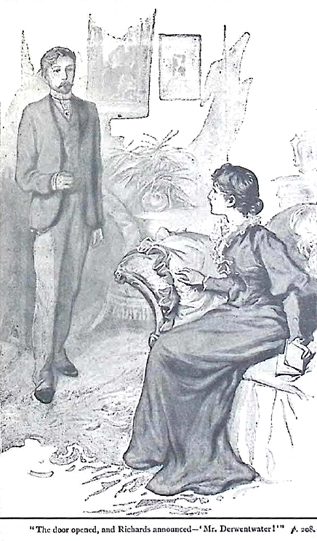
The door opened, and
Richards announced—"Mr. Derwentwater!"
We were left alone together, and he gave me a very puzzled look, as if vaguely aware that he ought to be able to claim acquaintance. I did not exactly help him. I sat down, asked him to do the same, and remarked in a careless way, "It is a long while since we met last. What a cold wind there is to-day."
"Very cold. Yes—I beg your pardon—I was sure I must have seen you here before."
"Here! No, I think not."
"Then—elsewhere."
"A long while ago, when I was a child. You would not remember me, of course. And I should not have known you but for the sound of your name."
"Then we must have met at—"
He made a pause, quite in the dark still, hoping that I would supply a name.
Instead of which I only said,—
"Yes."
This was too much for his gravity, and his face broke into a smile—just the old pleasant smile which captivated my childish heart all those years ago.
"And you have been abroad for some time, have you not—some years?" I asked.
"Several years; only running home for a few weeks now and then."
"India or China?"—though I knew it was neither.
"Nothing more interesting than the Continent."
"How tame! One would at least like to get into a fresh quarter of the world."
Then Clarissa appeared. She greeted him kindly as an acquaintance, and would have introduced him to me but for my remark that he and I had met before. This stopped her; rather to his disappointment, I fancy.
Clarissa, it is plain, had no recollection of a certain small episode in my life. Perhaps she never even heard a whisper of it.
I took up my work, and listened while he and she talked. And it came out that Mr. Griffith has some kind of connection with the Bank to which Mr. Derwentwater belongs. I have not known that until now.
Evidently Clarissa has seen him from time to time when he has come home, but not often or much. They chatted about surface matters; and Mr. Derwentwater was sorry to find that he could not see Mr. Griffith; and Clarissa asked if he would come to dinner on Friday.
Presently she turned to me, making some remark and saying my name. Almost in the same breath, she turned again to him, with an allusion to "my cousin, Miss Frith," having been sight-seeing all the week. I fancy she had detected his perplexity, and was more willing to help him out of it than I had been.
A little flash of intelligence came to his face, and then I knew that he was examining me in a series of glances.
Clarissa went off presently to look for a letter of her husband's which contained information needed by Mr. Derwentwater. As the door closed behind her, he said, as if involuntarily,—
"Yes, I remember now. It was at Wayatford." I looked up inquiringly. "Had I not the pleasure of meeting you many years ago at Wayatford?"
"When I was a child, there 'was' a Mr. Derwentwater there."
"And there undoubtedly 'was' a Miss Rhoda Frith, unless my memory is very much at fault."
Neither of us could help laughing. I have long since lost sight of the anger which I once felt towards him. The self which was so deeply injured then seems quite a different person from this present self; and I have not over much sympathy with her. To be sure, "his" action was not particularly beautiful, but he was young; and certainly I deserved it all.
"My home now is in Wayatford."
"It is—really!" His face lighted up again.
"We have gone there to be near my aunt, Mrs. Ramsay."
"Ah! She was a great friend of mine in those days. I am afraid our correspondence has languished of late. And she is as usual? It would be a pleasure to see her again."
"Why not?"
"Why not go to Wayatford? My ties with the place are broken. The Park is in the hands of strangers."
"Old ties ought not to break, if they are worth anything."
"No; I believe you are right. Sometimes the force of circumstances proves too strong to be resisted."
A rather sad look came to his face, a look I had never seen there in old days.
Should I speak of Millicent? No, I thought, not unless he brought her name forward. He could do so if he wished. But a history, begun and ended, lay between the past and the present. I knew well that I, in Millicent's place, would hardly have been able to forgive any one who should mistakenly have forced my name upon him. If anybody mentioned her, it ought to be none other than himself.
"Are you staying here—in this house, I mean—for any length of time?" he asked.
The question was abrupt, curiously so for him, I thought. He was not abrupt in past days.
"I came for a month, and I have been here a fortnight. I don't know how much longer my visit will really last."
"Then I shall see you again. And you will tell me, perhaps, all about old friends."
Did he mean Millicent? He said the words hurriedly, for the door opened, and it seemed as if he did not wish Clarissa to overhear. When she came in, he stood up, and nothing would induce him to sit down again. Clarissa read aloud the sentence in her husband's letter which contained the information wanted; and then he disappeared.
I fancy the unexpected encounter had given him a little shake, rousing old memories. True, there has been the other girl between, and the sorrow of losing her; and for a while, he must have quite forgotten Millicent. But it is just possible that he may be inclined now to turn again to the thoughts of her. Why not? It would surely be happier for him.
Well, he will be here to dinner on Friday; and I shall see something of him. Clarissa means him to take me in, for she has said so. He will have plenty of time to ask about old friends, Millicent included, if he wishes.
April 23rd, Wednesday.
Clarissa is asking other friends to dinner on Friday, just three more, so as to make a nice sociable half-dozen.
This morning we went into a shop; and she ordered for me a new evening dress, at her own expense, a kind of very soft white crêpe, to be made prettily, with black ribbons. It is to be sent home in time for Friday evening.
Clarissa says I shall look my best in that dress; and she has made me alter the way of doing my hair. She says I am so improved altogether.
And of course that is pleasant to hear. One likes to be able to look nice. I asked her whether she had ever thought mine "a pussy-cat face."
"Very decidedly so, in old days. It does not strike me now in that light," she answered.
At all events, I should like to look my best on Friday.
Not that it matters—really! I have to think of Millicent, not of myself.
April 25th, Friday Afternoon.
The dress has come home, and it is perfectly lovely. I have never had anything so beautiful in all my life. It is only white and black, and not too fussy for a quiet little dinner party, but it is so gracefully made, and so perfect in fit.
Of course I put it on directly, to make sure that all was right. Clarissa walked round me and smiled, and said, "Yes; that will do. That will do very well indeed, very well indeed."
"It 'is' pretty," I said.
"And you are pretty in it; yes, really pretty. I am not flattering you, my dear. Some people look well in anything, and you are not one of those people. But certainly you repay one for a little trouble in the dressing-line."
I was delighted to hear her say so. Yet why should I care? Does it really matter?—I mean in this instance particularly.

OUT OF THE QUESTION!
April 26th, Saturday.
YESTERDAY evening was one of the very happiest that I have ever spent in all my life.
Clarissa asked her husband's cousins, Mr. and Mrs. James Jervis, and also an old General Monk. That made the six. Mr. Jervis had of course to take her in, and General Monk was paired with Mrs. Jervis, and Mr. Derwentwater fell naturally to my share.
I don't think it was "naturally." I believe that Clarissa arranged things so on purpose. But anyhow it was very nice.
She seems so pleased that I should have met an old acquaintance in her house; and she says he is a very nice man and a thorough gentleman, with good connections and good prospects. I am half afraid she may have some sort of notion in her head of his perhaps taking a fancy to "me;" and that of course is utterly out of the question.
Quite! Completely! Absolutely! Out of the question! For, though I cannot exactly say this to Clarissa, it seems to me that he almost belongs to Millicent. I do not really mean that he belongs to her, but only that, so far as I am concerned, she has a sort of first right. He may or may not wish still to marry Millicent. I only know that up to now things may not be entirely hopeless; and I know that she cares for him. And for me to step in between—here, out of her sight, and out of her reach—if such a thing were possible, which it is not; and if I wanted it, which I do not,—for me to step in between, and to make things perfectly hopeless for her!—oh, it would be too horridly base, too awfully mean and contemptible.
What do I know of him? I—why, I have just seen him a few times, years ago, when I was almost a child. And Millicent has known him almost all her life.
One could not do such a thing. It would be impossible.
No difficulty in saying all this; matters being as they are. He and I are the merest chance acquaintances. He does not care a single atom for me, with any real caring, I mean. And I have entirely got over my childish feeling. He likes to see me, because I am connected with those old days and with Millicent. And I like to see him because—oh, because he belongs to my childish days too, and because he is so pleasant; and one always likes to meet pleasant people. Nothing more than that, however. Nothing more "could" be.
I mean, in one sense it could not. Perhaps, if I chose to take the trouble, I might in time make him like me a little better than as a mere acquaintance. I cannot be sure. It is only a "perhaps." But I have an odd sort of feeling, when with him, that if I chose, I could make him care for me. Very likely it is only a fancy; perhaps even like my silly fancy in those old days, when all the while he was laughing at me, and calling me an absurd conceited child.
And yet it was not quite only that either. For Millicent thought he was a little touched; and Millicent ought to have known if any one did. And aunt Marian thought the same; and aunt Marian is not often mistaken.
Anyhow I do not mean to take the trouble. Why should I? What would be the use? If I didn't succeed, I should feel so small; and if I did succeed, it would be so unfair to Millicent. Besides, I don't want to succeed. It would be wrong. All these years she has been brave, and patient, and good. I feel almost as if I were here for the express purpose of guarding her interests.
What if I could manage to turn his thoughts again in her direction, supposing that he has forgotten her?
Why not? Of course I must be careful how I do it; but why not? I have made a little beginning already; and I mean to follow it up.
Before they came yesterday evening, I was pretty well resolved not to mention Millicent at all, unless Mr. Derwentwater should bring forward her name. Somehow I did not keep to my resolution. Was it wise or unwise? Circumstances do sometimes alter cases,—I mean circumstances change, and then cases are altered. Besides, I broke through my resolution without meaning to do so.
Mr. Derwentwater arrived early, before any of the others. And I saw a look of surprise in his face when I came forward, almost as if for a moment, he hardly knew again who it was. I could not help being pleased, because it "did" mean something like admiration. How silly to be pleased; when after all it was my clothes, not myself. And while he was talking to Clarissa, his eyes came wondering again and again in my direction; and then I was pleased again, though I knew exactly how much it was all worth. I had on a very pretty dress, which suited me; and he has a weakness for pretty things. That was the beginning and the ending of his admiration; yet still I was glad.
Next to arrive was the General; and then Mr. and Mrs. Jervis appeared; and dinner was announced, and we all went in.
General Monk is rather deaf, and he expected all the attention that Mrs. Jervis had to give. If she turned to speak to anybody else across the table, he could not hear what she said, and he kept repeating, "Eh? What? I beg your pardon. Who was it? What was that?" Till she grew tired of answering. So she kept her attention fixed upon him, and we fell into three duets of talk.
And then, when all attempt at a general conversation was given up, Mr. Derwentwater observed: "I hardly wonder at myself for not recognising you the other day." And I knew in a moment that he had old times in his mind.
"Why?" I asked. And as he did not answer, I went on, "Oh, of course girls alter so much, coming out of childhood."
"Some more; some less. In excuse for my own stupidity, may I say that yours is a case of 'more'?"
I felt desperately inclined to say, "Is mine a pussy-cat face still?" But that would not have done at all.
"Now tell me, please, about all the old friends."
And I gave him a whole string of particulars. First as to my uncle and aunt, and then as to lots of other individuals, all of whom I knew he had known. He didn't care a rap for a single one of them, except aunt Marian; and I knew this, too. But he listened politely, and tried to put on an appearance of interest.
"Anybody else?" I said.
He helped himself to a passing entrée, and suggested, "You have not mentioned Mr. Farrars yet."
"Don't you keep up a correspondence with him?"
"I am afraid I have been remiss. It is a long while since a letter passed between us."
I told him all I could think of about Mr. Farrars. And then beginning with the youngest boy, I took them in turn upward, describing each more or less particularly, and telling what each was doing, and what were Mr. Farrars' plans for each. I only left out Amy and stopped short at Jack.
"Thanks for the masculine side of the question," he said with a twinkle. "And—"
"Amy is growing up. She is a child still, but she will soon be a woman. Not good-looking—oh, no, she never will be. None of them are; and none of them ever were, except Millicent."
Her name slipped out unintentionally; and then the business was done. And in a moment, I seemed to see myself, a girl with a pussy-cat self-satisfied face, asking him whether he thought Millicent pretty. And I seemed to hear again his little laugh at the idea.
But he did not laugh now. He gazed steadily at the table-cloth. When I said no more, he repeated slowly,—"Except Millicent,—yes."
"I don't mean that she ever was exactly handsome. It was more an interesting face." And I was angry with myself for saying "was," not "is." The word seemed to strike him. He looked up at me with startled eyes, and said, "But she—"
His face wore a singular expression; a kind of frightened paleness had come into it.
"One may often find a face interesting that is not really handsome. And I am sure Millicent's is that."
The look vanished at once; and then it flashed across me what he had imagined to be meant by my "was."
"Millicent and I have begun to see a good deal of one another,—like old days."
"Oh, indeed!" was the only answer.
"And I believe I am coming again to the same opinion that I came to then. I am beginning to think there is nobody else in the world exactly like Millicent."
He said either "Oh, indeed!" or, "No, indeed!" under his moustache. I really could not make out which it was.
I felt provoked with him. And yet what else could he say? He had given her up, and had all but been married since. Why should he be supposed to feel any special interest in her, or she in him? In fact, it would be a great impertinence on his part, if he "did" expect her to feel for him what she used to feel. But, I who know how things really are, I do want to see signs in him of not having forgotten her.
No more passed between us about Millicent. Her name did not come up again; and I could not force it on him. We had a long talk on all sorts of subjects. And when the gentlemen came into the drawing-room later, he found his way to me again, and carried on the talk.
He certainly can make himself very pleasant. I am not so much astonished now as sometimes I have been at the kind of fascination which he had for me all those years ago. Not that he fascinates me "now!" I am older, and I have seen more of life. But still he is certainly agreeable; and I enjoyed my evening immensely.
What a pity poor Millicent could not be here. I wonder how he and she would suit one another now.
Well, I shall do what I can for her when I see him again. Now that her name has been spoken between us, it will be easy to bring it in again. I shall tell him about the sort of home-life hers has been. He ought to be able to appreciate that.
It was a perfectly delicious evening, and I could hardly get to sleep at night, thinking it all over. I cannot at all feel sure whether his old love for Millicent is hopelessly dead, or whether it still just lives and might some day wake up anew. I do not believe he could answer this question himself. Certainly, he wanted very much to hear about her; and when for one moment he almost thought I meant that she was dead, he was terrified,—as one would be at the thought of any one dying whom one loved very much.
That surely means that he cares for her still. People do not feel so about the death of a mere acquaintance or even of an everyday friend.
April 29th, Tuesday.
Monday is Clarissa's "At Home" day; and a little before tea-time in came Mr. Derwentwater. I did not know that she had told him of the day, but it seems she did, and asked him to come if he felt inclined.
I suppose he did feel inclined; at all events, he appeared, and stayed more than an hour, and was as friendly as possible. Somehow, I did not manage to bring up Millicent's name.
I thought he had only a very few days in London, but that must be a mistake. Clarissa has asked him to lunch on Thursday, and to go with us to Kew afterwards; and he has made no difficulty.
May 2nd, Friday.
Yesterday morning Clarissa was not well, but she would not hear of giving up the expedition to Kew. She sent for a little Miss Splice, a former governess of hers and Juliet's who lives near, a kind little trotting elderly person with very few words at command, and always ready to extinguish herself for Clarissa's sake. And she went with Mr. Derwentwater and me to Kew.
I ought to have been sorry that Clarissa could not have the pleasure, but somehow I was not sorry at all. If Clarissa had been there, Mr. Derwentwater must have attended to her a good deal. Miss Splice did not seem to wish for any attention. She had nothing to say, and she evidently liked much best to be left to herself, free to enjoy the river and the views. We were always leaving her behind, or losing sight of her; and she never seemed to mind, but always turned up again placidly at the right time.
It was such a beautiful day! I had no idea before what a perfectly delightful place Kew is.
Not that I learned very much about all the different kinds of foreign plants. There did not seem to be time; we found so much to talk about.
Somehow, one can talk to certain people as one cannot possibly talk to others. And Mr. Derwentwater is one of those people. He is so attentive, and polite, and kind, and he shows such an interest in everything that one says. In those old days he was nice, but now he is very much nicer.
And I talked to him about Millicent—ever so long. I was determined that I would. We found a seat under a tree; and Miss Splice nodded comfortably off to sleep; and I thought that was a good opportunity. I brought in Millicent's name somehow,—I do not know how,—and I began talking about her almost recklessly. I was determined that I "would." I told him how very very good and devoted she was; and how she had lived for her father and sister and brothers; and how much they would all owe to her always; and how hard she had worked; and how brave and cheerful she had always been; and how everybody in the place looked up to her; and how she had read and studied even in her busy life and had kept herself up to the mark; and a great deal more than this. I just poured it all out, not waiting for him to speak; and I felt my face grow warm with excitement.
I was not looking up at him, but away among the trees, seeing a picture of Millicent and her self-denying life. And all at once it came across me that he had not said a single word for ever so long. I had been talking so hard that I had not even noticed his silence.
And I stopped short, and turned towards him suddenly, to see if he were listening. And he was looking at me—
I don't know what he meant,—in the very least! I only know that nobody has ever looked at me in exactly the same way before. He took his eyes away quietly, as soon as they met mine; and I could not say another word. My heart started off beating at such a pace that I was hardly able to breathe.
It must have been that he agreed with me, and liked to think of that brave self-forgetting life of hers. Yes, it must have been that, of course. He looked so earnest and intent, so interested. But why did he not say what he felt? Why did he not tell me how much he liked to hear about her?
There was a long pause, a kind of dead pause everywhere and in everything. It felt as if the whole world had come to a stand-still. Even the very birds seemed to stop singing, and the leaves to stop rustling. I never knew anything like it before. I could hear my own heart beating, like a big drum; and I was afraid he would hear it too. Then the leaves began to rustle again, and a chaffinch overhead started his short little song. And then I laughed and tried not to seem to know how my cheeks were burning; and I said,—
"I am afraid you will think it a case of girlish raptures."
"Not at all," he answered gravely. "It does you credit, as much as Millicent." Then another pause. "But you know I am pretty well acquainted with her character. She always had a very strong sense of duty."
And that was all he had to say.
I ought to have been vexed, angry with him for Millicent's sake. But I could not be. I was not angry at all. I could not make myself so. I could only remember that look of his which I had met so unexpectedly; and the very thought of it made me flutter all over. For it was a look which somehow seemed to belong to "me," not to Millicent.
What nonsense! I am not going to let myself be taken in a second time. I am not going to allow myself to fall into any absurd notions.
He belongs to Millicent, or if he does not, he ought. I am only the merest acquaintance, and I have no right to come between. No right whatever. Nothing more than the merest acquaintance,—while Millicent—but of course he cares for her. He could not help it, knowing her as he does. If he is left to himself, he will turn to her soon, quite naturally.
And I have to leave him alone; not to do anything which might perhaps for a little while turn his thoughts away from her.
I believe he fancies, as a good many men do, that one woman cannot possibly praise another. And so he was astonished to hear me praise Millicent heartily.
That was what it all meant. Well, he shall be astonished again. I will certainly bring up her name as often as I have a chance.
But oh, it "was" a lovely day, a perfect day all through. Like June for warmth, and like—I don't know what—for pleasantness.
I could not help thinking of that long-past excursion, and the delights of it. But I hope I am not so silly now as I was then, fancying all sorts of things to be meant that are not really meant.
This time I cannot be taken unawares. I have my eyes wide open, and I know what I am about. I know what I have to do, too, which is more. I have to think of Millicent, not of myself. I have to care for her interests, not for my own.
And if I keep clearly in mind all the time exactly what I have to do, I do not see how I can be taken by surprise.

AND YET!—
May 5th, Monday.
CLARISSA was pouring out tea this afternoon, when a front door bell rang, and she said,—
"Mr. Derwentwater, I suppose."
I was angry with myself, for I knew my colour went up, and I knew she saw it.
Instead of Mr. Derwentwater, it proved to be only a note; nothing in particular.
"So I was wrong for once," she observed, smiling. "A natural mistake. He has not been to-day."
"Clarissa! As if he came every day!"
"Not quite every day," she answered tranquilly. "Only about five times in seven days."
"There has always been something—"
"My dear, if a man wishes to do a thing, does he ever fail to find 'something' by way of a reason?"
"Of course he thinks yours a pleasant house to come to."
"Of course he does—when somebody is here. He never did before."
This would not do at all. I was getting much too red to be comfortable, but I put down my work, and faced Clarissa.
"It is quite a blunder of yours," I said; "altogether a blunder. It is not in the very least as you think. Please don't say such things."
She laughed quietly, with a sound full of meaning in her laugh.
"Please don't. You really are mistaken! I know what I am saying. I know a great deal more about him than you do. And I know why he likes to come."
"So do I, my dear! An old fancy revived, isn't it?"
The words took me by surprise. I had no idea that she knew so much.
"Sisters hear everything of course." She read my face in a moment. "And we are like sisters. Don't be vexed. It is only natural. Of course I know; and of course I understand."
"But you don't! You don't know or understand in the very least. It is not 'me.' It never was 'me.' It is somebody else. You don't know anything about that; and I do. I can't tell you particulars. But I assure you it is only because I know somebody else, and because he likes to come and talk over old days."
"If so, more shame for him!" Then another laugh. "My dear child, you have an extraordinary and romantic belief in masculine constancy. That is clear."
Did I really, down in my heart, believe what I said?
"I can't tell you more. I can't explain. But if you knew—"
"I know all about that old affair. Millicent Farrars you mean, of course. He was a good deal in love with her, off and on, I believe, years ago; on, when they were together; and off, when he happened to come across a prettier face elsewhere. A thing he might easily do, since at her best, she never was pretty. You need not flame up so fiercely. I am not blaming him particularly. He is a man; and in those days, he was a very young man. He isn't young now—to the same extent. And he is exceedingly agreeable. But as for Millicent Farrars, you had better give up that notion once and for all."
"What notion?"
"That Mr. Derwentwater is in love with her. It is an error. He was once, perhaps—or at all events, he thought himself so, which comes to much the same thing for the time. Since then he has been engaged, and he would have been married, but for the girl's death."
"People sometimes go back to an early love."
"Very occasionally, perhaps. Mr. Derwentwater will not go back to his early love for Millicent Farrars."
She spoke in a meaning voice, and it seemed to bring back that look of his on Thursday, which at the time I did not understand, and which I do not now understand. And my heart began thumping again, and a sound like singing wine into my ears. But I would not be beaten. I said resolutely,—
"I believe he 'will!'"
Clarissa looked me all over.
"The child is actually trembling." And she came and sat down by my side. "You dear little goose! As if you or I could control Mr. Derwentwater's likings."
"Of course nobody can. But I do hate to have silly ideas put into my head. And if you knew Millicent as I do—how good and brave she has been, and how she refused him, just for the sake of her father and brothers—"
"And how much she cares for Mr. Derwentwater still, do you mean, Rhoda?" I would not answer. "Well, take care! If 'I' were Millicent, I should not like to have my name thrust forward where it might be unwelcome, or even where it might be received with indifference. Nor should I like to have the suggestion made that perhaps I cared for him still, when he had left off caring for me. One woman ought to be the guardian of another woman's secret in such a case. You should be careful. To my mind, it is very clear whom Mr. Derwentwater is disposed to like at this present moment! . . . Any number of girls may refuse him if they choose,—supposing that he asks them. But fifty refusals would not drive him to seek Millicent, if he cares for her no longer."
"He could not be so fickle—"
"Fickle! The man asked her to marry him, and she declined. She was free from that hour, and so was he. My dear, you can't change nature. There 'are' men, no doubt, who would have waited for her through any number of years, and who would have taken her in the end, no matter how much she might have gone off. Don't be angry; she 'is' gone off, and there is no denying it. And Mr. Derwentwater would be the first to perceive the fact. And he is not one of those men who can wait interminably. It is not his nature."
"A nice look-out for his wife, if he ever gets one,—unless he finds somebody who never can become 'passée.'"
"That is a different matter altogether. When once she is his wife, she becomes useful and necessary, and he learns to value her for something more than a pretty complexion or a dainty nose. Romance passes then into prosaic everyday life."
"You are enough to keep one from ever marrying!" I exclaimed.
Whereat she kissed me, and replied, "Don't be a little goose, my dear. And don't distress yourself because I have talked nonsense."
Did she mean it or any of it as nonsense? I made my escape, and had a cry upstairs—what about I could not have told, and I am sure I cannot tell now.
May 7th, Wednesday.
My visit has lengthened out so much that Mother wants me at home again. Juliet goes to aunt Jessie next week, and then I shall be really needed. But Clarissa will not hear of my leaving before the 15th.
Ought I to insist? I cannot see ahead; but it seems to me that I am in a strong current which is carrying me on. Ought I to get out of it and refuse to be carried any farther? Can I resist if I stay here? Is Clarissa right, and is there no need to resist?
I begin to know now at least "what I wish." But there is the thought of Millicent. Ought I to let myself be drawn on?
And what if it all means really nothing? How can I be sure? I seem to be sure of nothing. It is all bewilderment.
He came yesterday to dinner, and again to-day to tea. Either Clarissa asks him, or he makes some excuse. And—I cannot help enjoying the intercourse. I cannot "help" believing in him.
It seems as if he liked me to talk about Millicent; yet is it for her sake? That is the question which I cannot answer. It may be, or it may not be. How can I tell?
If only I were at home—not here—with Millicent at hand. I should not then feel as if I were wronging her so fearfully. It would all be open, and in her sight. Nobody would be deceived or taken in. Now it is all going on, away from her, out of her sight; and she not knowing, not dreaming.
If only I had never made her tell me that she cared for him! Things would be so different then.
Why should I not decide to go home this week—at once? My mother would be delighted, and Clarissa could not prevent me. She could not prevent it, if my mind were made up.
There is no reason why I should not—except that I cannot. My mind is not made up, and I cannot make it up. I seem to have no power to "will" it.
If I went, that would put things right. If he cared truly for me, he could come after me. There would be nothing to hinder him. But does he care?—That is the question. I cannot tell; I do not know. My going might make all the difference. I mean, if he is not quite sure, it might help him to forget, and be the ending of all. That is what I ought to wish, for Millicent's sake, but, oh, I do not wish it! I cannot wish it. I dread any such ending. I only do not wish to have seemed to do anything underhand towards poor Millicent.
Somehow I cannot resolve to take the one step which might put things straight! It might not; yet I wish I could resolve to take it: and I am not able.
I do not let myself think—hope—expect; but all the while I know I am doing it. I cannot hide any longer from myself what he is to me. If he is in the room, I see everything he does; I seem to feel even what he is thinking. When he is away, all looks blank. Is my whole life to be blank for the want of him?
For Millicent's sake!
Oh, if only I did not know!!
Lately I was wishing so much to live a life of self-sacrifice. It seemed then all easy and beautiful. But now I see the difficulty. It would be like rending myself in half to give him up! Give him up! How can I tell whether he really wants me? I only know that if I had the choice, I could not do as Millicent once did. I could not. I could not.
Am I then utterly weak and selfish?
May 10th, Saturday Evening.
Still here, and still drifting on! Every hour fighting feebly, but feeling myself powerless. Yesterday I actually wrote a note, telling my mother I would come home to-day. I addressed and stamped it, and left it in my room. Then Mr. Derwentwater came in; and when he was gone, I threw my letter on the fire, stamp and all. I "could not" send it off.
Clarissa is so pleased and satisfied. And I am neither. At times there is a great joy in my heart; and at other times when I think of Millicent, I am wretched.
It is not that I think Mr. Derwentwater is not free, perfectly free. How could he be anything else? It is only a feeling, which I cannot put aside, cannot get over, that I am wronging Millicent. Knowing all I do know, it seems to me as if this state of things ought to have been an impossibility. And it has not been. I am angry with myself, while yet I cannot for a moment wish anything to be different. If only I could have let Millicent know but how can I? It is only feeling, not certainty. I have nothing yet really to build upon. Only I think—I do think—I believe he likes me. Is "like" the word? But what will Millicent say, when she hears,—if it ever comes to anything, and she does hear?
At present, they know nothing at home. Even my mother does not guess. I have said nothing, and I know Clarissa has not. She is much too anxious not to "spoil" what she calls "the march of events."
I think I know why I am unhappy. It is because, looking back, I feel that I have not been perfectly true to Millicent. Not perfectly true, I mean, to her cause. I have not done my very best, as I said to myself that I would do, to win him back to her. I have tried hard to make myself winning and pleasant; and the more I saw he liked me, the more I have tried. And when I have talked about her, it has only been as a sort of salve to conscience, done in such a way as to make him think of me, not of her.
Yes, I see it all now. I would not let myself see it before. And I despise and hate myself for it; yet still I go on. There seems to be no way of drawing back.
It may be too late. If the mischief is done, I cannot expect to undo it. Drawing back then would only make him unhappy, and would not make Millicent happy.
But if not, if it is not too late, if he is still wavering—and how can I tell that he is not?—ought I not to act? Ought I not to go home at once, and so give Millicent a chance? That at least would leave him time to think. He might find then that this is only a little passing fancy, and that his real love all the time is for Millicent.
O no, no, how can I wish it? How can I bear to think of such a thing?
But if it is right; if I ought—for Millicent's sake?
Well, I almost think I will do that. Yes, I will go home on Monday instead of Thursday. I will write, and tell my mother to expect me; and then I will tell Clarissa that it is all settled, and that she need not say one word, because it has to be.
May 12th, Monday Evening.
I have not gone home. I did post the letter; and then I told Clarissa, feeling very wretched, and she laughed at the idea, and I gave in quite tamely, without a struggle. And a second letter was posted, telling my mother that I would keep to the original plan.
So my resolution has failed, and I know that I have been beaten in the light. For though it may not be exactly wrong to stay, yet I do think that it would have been better and braver to go home.
It is a terrible thing that one should have this power of choosing for oneself; that one should be perfectly free to go or not to go, when so much of other people's happiness may hang on what one decides, and yet that one's will should be paralysed.
Is it really paralysed? If I prayed to be able to act—but I do not "want" to go home. I do not "want" to be able to decide just in the face of my own wishes. I only want not to have an uneasy conscience about Millicent.
He has not been in to-day, and that makes me glad that I am not going yet,—for it might have meant not seeing him again.
May 14th, Wednesday.
I am not to go home! The matter is taken out of my hands. Addie has sickened with scarlatina; and I am told to stay here.
If I had gone earlier, as I thought of doing, I should be there, on the spot, able to help my mother. Now she is alone, for Juliet had left just before Addie fell ill. And Mother will not hear of any one going now, because of the infection. What if Emmie takes it too? She is so delicate.
Mr. Derwentwater is coming in this evening, to say good-bye, because he expects me to be off to-morrow; and he said yesterday that he should be off himself on Friday. I do not know where he is going. Will he keep to the plan?
Clarissa is glad that I am not off so soon. But I have no gladness. I am anxious about mother and the twins, and I cannot think happily of Millicent, and I feel like a soldier who has turned his back on the enemy. Is it not something like that? How differently I should feel, if I were at home, if I had followed that voice in my heart, which told me I "ought" to decide and to go. If only I had done so!


INEXPLICABLE.
May 15th, Thursday.
SUCH a strange thing has happened! Mr. Derwentwater never came in at all yesterday evening. There was rain, certainly, but he does not mind rain.
When he first spoke of calling, Clarissa asked him to dinner. He said he had promised to dine with an old aunt of his, but he would be free by half-past eight, and he would walk on here. Clarissa remarked, "Then we are sure to see you!" And he replied, "Quite sure!"
And after all, he never appeared, though he expected me to be leaving to-day. He could not have heard of my change of plans. Nobody knew it who might have told him. Something may have happened to keep him away. But no message has arrived, no note, no explanation.
One never can tell beforehand how people will behave. I felt so certain of him. It did not so much as come into my mind that he could fail. My last evening—or, at least, he believed it to be my last. And Clarissa had no more doubt than I had. She said after dinner, "When somebody turns up, I shall find an excuse for absenting myself." I told her not to talk nonsense, and she said, "Is it nonsense? My dear, I know what I am saying. People do not care for witnesses to good-bye scenes."
And he never came. Clarissa began to look surprised: and then she remarked on his being late, and wondered if the old aunt were keeping him. And I said nothing: but a kind of cold dread crept over me. And half-hour after half-hour went by, and still there were no signs of him, and at last it was hopelessly late.
"Something has prevented him, evidently." Clarissa tried to speak lightly, but I could see that she was worried. "We shall have an excuse by the morning post."
I, too, hoped for that. But none came. Not a word has reached either of us through the whole day.
It is very, very strange. Does he really care so little? And have I cared too much? It comes over me with a sharp terror. Have I allowed myself to feel too much? Have I fancied that he meant more than he does mean?
I thought myself so safe. I felt so certain that I could never repeat that mistake. I thought I had learnt so severe a lesson in the past. Has it all been thrown away, and have I made the same blunder over again? Only this time it would be much worse.
A post-card has come to say that Addie is better, and going on nicely. It is not at all a bad attack. So I am not anxious about her: and I cannot get out of my head the strange thought that after all—after all that has passed, after all that has been said—he should have stayed away just because of a little rain, or for no reason whatever, from what he believed to be a farewell call.
May 16th, Friday.
Mr. Derwentwater has not been; not even to ask whether I have really gone, or if any one has heard from me since. One would have expected—but what is the use of expecting anything? It only means disappointment.
And to-day he will be off himself—at least, I suppose so. He talked of going. I shall not see him again—till when! I shall not even hear from him. If he has not cared to write or to send a message these first days, why should he do so later? I am feeling more and more how utterly I may have been mistaken in fancying that he cared particularly about me. Has it really been all along, as I used to declare without truly meaning it, that he only liked to be with me because I was Millicent's friend? If it were so—my heart seems to go down like a lump of lead at the very idea! For if he does not care, I do—oh, so terribly! My whole life's happiness seems to be just wrapped up in him. I hate and despise myself that it should be so—if he has not given me reason—and yet I cannot help it. I can think only of him; nothing but him all day long and nearly all night long; only of him! And if he is not thinking of me—. But I do not intend to let myself be sure yet.
Clarissa says nothing much. At first, she remarked on his non-appearance, and I tried to pass off her words, as if it were of no consequence. But I know she saw and understood. And now she does not allude to him, which is not her way, because she is as a rule outspoken. She is only particularly kind to me, and I wish she would not be. It makes me more afraid, because I think she sees, and is afraid. I wish she would behave exactly the same as usual; I wish everything would go on as if nothing had happened.
May 17th, Saturday.
Only three days since first I heard of Addie's illness; since I was so happy! I can hardly believe it. It feels like an age—almost like a lifetime. The hours will not pass, do what I may. I cannot tell how to get through them, or what to do with myself. Not that it was unmixed happiness, even then. But I did think that he cared for me, and now my hope is broken down; it is all gone. Now I believe him to be indifferent; and everything else is tiny by comparison. All my worries about Millicent—what would they matter, if only I could be sure of him?
And yet I know they "do" matter! I know nothing matters more in the long run than whether one is doing rightly or no.
May 18th, Sunday.
If I had but gone home when it looked to me like the right thing to be done! Was it that guidance was sent, and that I would not listen or obey? For days I had such a strong clear sense in my mind that I ought to decide on returning to Wayatford. If only I had gone when I could! Then at least I should not be here now, waiting in vain, hearing nothing of him.
I wonder if that sort of very clear "ought" in one's mind should be always invariably followed. It might be a mistaken idea; or, on the other hand, it might mean direct guidance. How can one tell which it may be? But something within me says that it can never be rightly resisted. Better, surely, to obey even a mistaken conscience than to go against it. I see that plainly enough now. And the worst of the matter is that I saw it before, if only I would have acknowledged the fact to myself. Besides, why should my conscience have been mistaken?
It seemed to me at the time as if I could not yield—could not resolve to do what I believed was the right thing to be done. But I might have resolved, if I had prayed to be able; and if I was not willing, I might have prayed to be made willing.
I keep wandering round and round in the same lines, going over and over the same thoughts.
May 19th, Monday.
Addie is much better, and is getting on nicely. There is, of course, still the fear that somebody else may take it, and quarantine has to be kept up, but that is all.
Same day, evening.
Another strange thing happened this afternoon. I had been to a shop just round the corner to get something for Clarissa. She is perpetually trying now to send me on little errands, and of course I know why, and it does no good. An omnibus went by, overtaking me, and I happened to look up. And there on the top, seated with his back towards me, was Mr. Derwentwater.
I am not mistaken. It was himself. I could not make a mistake, even though I did not see his face. There was no possibility of a mistake. He did not see me—at least, not while I was looking. He might have seen me from behind, and then have turned away on purpose. That thought has come to worry me since.
So he has not left Town, after all. He has been here all the while. I wonder if Clarissa knows this. Somehow I cannot help fancying that she does. I thought I would ask her; but when I got indoors, I had no power to do so. I dared not trust myself. I have to keep up—I must try to seem indifferent. But oh, it is hard! Nobody knows how hard.
May 20th, Tuesday.
Another strange thing! I have had a letter this morning from my mother; and she actually speaks of Millicent being up in Town last week!
Clarissa insisted on the letter being burnt, as soon as I had read it through. She is so afraid of infection for the children. I had just to run my eyes hurriedly once to the end, and then to put it on the fire. And I was so vexed afterwards not to be able to read it more carefully a second time.
The idea of Millicent being in London takes me utterly by surprise. There is no reason why she should not be; only Millicent does not go about paying many visits like other people. And of course there is no reason why I should have heard of her coming any sooner than this, because Millicent and I do not keep up a close correspondence. Indeed, we have not written to each other for some weeks. But the news came upon me strangely. I felt bewildered, and I did not quite take in all that Mother said about it. Clarissa was talking as I read, wanting to know how Addie was, and telling me to make haste. And then she hurried and fussed, and would give me no peace till the sheet was burnt.
And as I watched it shrivelling up, the thought darted into my mind—what if Millicent and Mr. Derwentwater met last week? What if that was the reason for his never coming to say good-bye? And I would have given anything—anything—to go through the letter a second time, just to make sure that I had not missed over some little word which might have told me more.
I stood by the fireplace in a dream, trying to remember exactly what my mother had said. Millicent had been to stay—where? Some name was mentioned, but it would not come back to me, and it will not now. The Farrars have relatives in London, I believe, though I know very little about them. But Mr. Derwentwater may know. And what could have brought her up to Town so suddenly? And is she still here? I "think" Mother spoke only in the past tense—of a visit last week, not this week—but I do not feel sure.
And suppose he has seen her! And suppose the old feelings have been wakened up again! The very idea turned me sick as I stood looking into the fire. There was a time when I could have been glad to think this; but not now. Oh, not now.
"What is the matter with you?" Clarissa asked.
I went back to my seat at the table, trying to look as usual. "I am all right," I said. "Only I think you might let me read Mother's letters in quiet."
"So I would, if it were not for the children." To herself, I heard the faintest possible murmur, "That would not turn you so white." But I paid no attention.
May 21st, Wednesday.
Another letter, this time from aunt Marian. No allusion in it to Millicent's London visit, only she speaks of seeing her yesterday morning; so at all events Millicent is at home again now. But she has been in Town. That seems certain.
Aunt Marian sends a message from my mother. I am to stay here longer, if I particularly wish it; otherwise, I am to go back, and to sleep at aunt Marian's for a few days until our house is counted safe. It can be whichever I prefer, and whichever may be the most convenient to Clarissa.
Has Clarissa said anything in writing home which may have suggested this?
What shall I do? For some reasons I long to get away, and yet there is the uncertainty. Suppose that he was prevented that evening by something he really could not help; and suppose that he has not the least idea of my being still here. It may be so—even now. He may not have caught sight of me, when he passed on the top of the omnibus. He may be intending to call one day very soon, and to ask about me. Or—he "may" mean to run down to Wayatford. In that case, it would be better if I were there. And yet he is so likely to call here first, and I might be just gone.
If he has seen Millicent, and if the past is coming up again, my going or staying can make no sort of difference. But still—still—I do not know—nobody knows. It is all a mystery. And how to go home, not knowing—that is the difficulty. It almost seems to me that I cannot do it, cannot bear it. While I am still here, I feel that perhaps all is not quite hopelessly at an end. Once back in Wayatford, I shall feel the whole thing to be over.
I fancied Clarissa would settle the matter by insisting that I must stay. But when I showed her the letter, she did not; and that has made me more hopeless than anything else. For she is generally so confident; and she has been all through so ready to encourage my remaining.
It looks almost as if she knew more than I know. And yet I cannot, dare not, ask. I cannot trust myself. I am often on the verge of a breakdown—hardly able to hold myself in.
"What would you like, Rhoda?" she asked.
"I don't think it matters much either way," though I felt that it did matter.
"I am glad to keep you; no need to tell you so. But for yourself—the question is, what may be best?"
I found myself saying, almost without intention,—"Perhaps I had better go."
"Yes, I think so really," she answered, to my surprise. "My dear child, don't be hurt. I mean for your sake,—not for mine. The longer you stay, the better, so far as I am concerned. But for some reasons,—it might be the more dignified plan."
My face blazed; and then all the colour went, and everything seemed hazy.
"Why—Rhoda!"
"Yes, I dare say,—I don't know,—yes, I'll go," was all I could utter.
Clarissa spoke out suddenly, dropping all pretence at reserve, and taking it for granted that we both had the same thought in our minds.
"And don't make up your mind too soon. It is best not. He may seem to us to be behaving disgracefully,—and I am very much afraid that he is 'not' what I have thought him. But all the same, we don't absolutely know."
One little sentence in her speech seemed to take precedence of all the rest. I struggled to get out a "Why?"
She repeated the word questioningly.
"Why—afraid?" I had no voice to say more.
"He 'might' have been prevented from calling that evening; one cannot be sure yet." But I knew that she had something more in her mind.
"Do you think he has left Town?" I asked.
"He meant to do so."
"He has not, and you know it!" I spoke passionately. "Why have you not told me?"
"Why should I? That of itself proves nothing. My dear, you can only wait and have patience. It may be a mere passing tangle. Only, perhaps, on the whole, it is better for you to wait at Wayatford than here. Do you not think so?"
I could only murmur a "Yes." My voice was all but past control.
"Suppose you take a turn in the Square garden. The air will do you good, and by-and-by we can discuss plans."
I was glad to rush away and come up here. And I had a hard fight to keep down the tempest of tears that wanted to have way. But I did manage to conquer; and I even wrote a line to Mother, saying I would come home at once. And then I took out my journal and wrote all this. It seems a relief to write things down. And now I am going out into the garden, with a book, to try to forget.

TANGLED STILL.
May 22nd, Thursday.
THINGS are all so changed. Everything is quite, quite different. And I do not feel like the same Rhoda.
It is another earth, another sky, another London! The very sunshine is altered. And all because "I" am so different.
One little hour did it all.
I left my letter to Mother lying on my table,—it was just a scrawl, saying I would go to aunt Marian's to-morrow—and I went downstairs. Perhaps the writing in my journal had been a relief—an outlet to my feelings, instead of tears,—and yet I am sure that I did not feel the worse for it. Clarissa was standing in the hall as I passed. She said, "Not gone out yet?" And then she looked in my face, and murmured, "You poor little thing!"
That finished me off. There are times when one can just keep going, and when the least tiny touch of sympathy turns the scale the wrong way.
I did not say a word in answer, simply because I could not. All the struggle upstairs went for nothing.
I hurried out into the front garden, and slipped away into my favourite corner, a seat amidst clumps of bushes, hidden from everybody. I knew I was pretty certain to find it deserted at that time of the day.
The garden itself was nearly empty, and nobody came near me. I could hardly have been more alone, deep in the country.
I did open my book and try to read, but it was useless. And I tried not to think, but that was no use either, because nothing could stop me from "feeling." If only Clarissa had not said anything!—But that one touch of pity had settled the matter. Tears would not be held back any longer. They came streaming in a kind of slow torrent. I have never cried so before. It was like being held in the grasp of something outside myself; and I had no power to overcome. I could only just hold down the fierce sobs which kept fighting their way up, and I know I did not make a sound; but the tears had their own way. It seemed as if nothing would ever stop them,—as if I must go on crying, crying, until I died.
I do not know in the least how long this had lasted. But suddenly I heard a movement, and though I could see nothing plainly, I had a glimpse of a tall dark figure. And it came and sat down beside me; and a voice that I knew in a moment said,—
"Is something very much the matter?"
I had just been telling myself that perhaps I might never hear that voice again; and hearing it all at once made me worse instead of better. I ought to have stopped crying, and have sat up, and have answered him quietly as if nothing were wrong. I suppose there are people who could have done so; but for me at the moment it was impossible. I could only turn my face away, and the tears came streaming in a faster rush than before, and I was shaking with the sobs that all my strength could hardly hold under.
"Rhoda, what is it?" he asked, in a tone of real distress. I could hear that, though I might have heard nothing else. And he had never called me "Rhoda" before.
But to save my life I could not have spoken a word. I could only manage to strangle down those dreadful sobs.
He was quite silent for some minutes,—I do not know how long. Somehow I got back a little self-control, slowly, as he waited. If he had spoken too soon, he would have set me off again, but he did not, and presently I sat up, and began to feel ashamed.
"Your cousin said something that made me fear all was not quite right. But I did not guess it to be anything so serious as this."
"It—it isn't—" I strove to say. "I'm only—"
My voice broke down again. I knew he was looking at me earnestly.
"But people do not cry for nothing," he said in his gentlest tone. "I mean, they do not cry as you were crying when I first saw you. Something must have happened."
I shook my head.
"No bad news from home?"
I shook my head a second time.
"And nothing wrong in the house here?"
A third time the same reply. I cannot think how I could be so utterly idiotic. It was as good as telling him outright what "was" the matter. If I had had my wits about me, I should have made up some sort of excuse or reason. But between the pain, and the relief, and the bewilderment, and the uncertainty, I had pretty well parted company with my wits.
"Nothing but a fit of depression! Is that all?" Then he asked, "Did you think me very unkind and forgetful not to call and say good-bye, when I had said that I would?"
I had not expected this question. It took me by surprise. I ought to have answered lightly, ought to have told him that of course it was faithless, but quite to be expected, or something of the sort. But the words brought back in a rush the pain with which I had been struggling; and in a moment the passionate crying, only half checked, had me again in its grip. I hid my face anew.
And the next thing I can remember was his arm round me, and his voice calling me "Rhoda!" and his "poor little darling!" And he said,—oh, I cannot repeat his words. I hardly know what he did say, only he blamed himself for having put me to pain. And I know that the whole world was changed for me in a moment, though I could not help sobbing on for very happiness.
Nobody came near us, and we were quite hidden,—at least, I am sure we were, though Clarissa tries to tease me by declaring that the top windows of the Square overlook every corner of the garden. We were alone for one happy happy half-hour. And then he pulled my veil over my face, and led me indoors; and Clarissa found us in the library; and he told her I that had promised to be his.
The only blot on my great happiness to-night is the recollection of Millicent. I am trying not to think of her. Why should I? What is the use of bothering myself? If he loves me, I could not possibly make him love her. All that is over and buried long ago.
Only I do wish that I had never never made her confess to me that she cared for him. If I had not done that, things would now be quite different.
No use thinking about what is past. He loves me, and I love him; and I am perfectly perfectly happy. Life looks so changed—so wonderfully bright!
My letter to my mother did not go off. Another had to be written instead. I shall make no plans till her answer arrives. Anyhow, Clarissa says that of course I must not go back immediately.
May 23rd, Friday.
A very loving letter from Mother to-day; just what I should have expected her to write, only she seems a good deal taken by surprise. So I suppose Clarissa has not said much in writing home, as I sometimes fancied she might do.
Mother is pleased—at least, I think so. I am not sure. She writes in such a tender anxious way, as if she could not make up her mind—as if she were puzzled. She seems distressed to be shut off from me at such a time. And so am I—only, when I think of going back, there is always the recollection of Millicent.
Was Millicent really in London that week? I mean the week before last? It seems such an immense time ago. Was she truly there, and did she or did she not see Ernest? He tells me to call him Ernest. I have tried just a little to find out, without seeming to do so; but nobody takes the trouble to answer my questions. And I cannot speak of her—of Millicent—to Ernest himself.
I do not yet understand how it was that he did not come in to say good-bye to me that evening, when he thought I was going away the next day. He says he was prevented; and he does not explain what it was that prevented him. I said once that I supposed he was not able to get away in time from the old aunt with whom he was dining, and he made no particular answer. He did not seem interested enough to go on with the subject, and something in his manner kept me from saying any more.
I suppose it was some business affair which he does not care to talk about. Even this happy week I see a look now and then on his face as if something were not quite right—as if something were pressing on his mind. And of course it has to do with business, or he would tell me all about it. A great many men are reserved about business affairs, I believe. I should not have thought Ernest was one of them; but perhaps he is.
If it was business that kept him away, he could not help himself. I do not see why he should not have written to explain; but I suppose he felt sure that I was gone, and so he put off coming, and most likely his idea was to run down soon to Wayatford. But he says very little about what he had meant to do.
It seems as if one never could have anything quite perfect in this life; and I do feel just a little scrap fretted. I cannot understand how things have been, and I do not like the feeling of not understanding. There is a touch of mystery about it all which teases me. If only he explained frankly why he could not come, and said that he did not write because he meant to go down to Wayatford instead, it would all be clear, and I should be satisfied. But he says nothing of the kind. The only time he has brought the matter forward at all was in the garden, when he asked if I had thought him unkind. Since then, if I bring it up, he just makes some little jest, or turns it off. And that looks as if there were something behind which he does not wish me to know.
Am I fanciful? Ought to be able to trust him. But I do like to have things clear as daylight.
I should have expected him to say how sorry he was not to have been able to call that evening. And he does not. He has said nothing of the sort. The most he did say was to ask if "I" had thought him unkind. He did not say that "he" had minded it.
I am vexed with myself for having shown him so plainly what I felt. I cannot think how I could. It makes my face burn like fire when the recollection comes up. If only I had pretended that I was crying about Addie, or about leaving Clarissa to go home! Anything rather than have let him so easily guess the truth! It was so undignified! I would not have believed it of myself beforehand. I do wish I had more control over my moods. Of course I do not want to have said anything untrue; but there are times when a girl must somehow manage to hide something of what she feels, if she has any self-respect.
All these thoughts are worrying me very much. Not when I am with him, but when I am alone. When we are together, I can hardly think of anything except my happiness. When he is gone, I go over all that has been said, and all that has not been said, and make myself miserable.
But still, he loves me. Nothing else matters, in comparison with that. He loves me, and I belong to him; and nothing can separate us now—nothing but death. Not even Millicent! I am so sorry for Millicent. But how could I help it, if he liked me best? And surely he was free to choose!
May 24th, Saturday.
I have been trying to find out from Clarissa exactly what passed between her and Ernest, when he first arrived that day, before he came to me in the garden. She tried to turn it off with a laugh, but that made me want to know the more.
"Did he explain to you why he had not been to say good-bye? And was he surprised to hear that I was here still? And was he glad?"
Clarissa put up her eyebrows. "My dear, you hear everything now from the fountain-head. What is the use of coming to me?"
I was ashamed to confess that I did not know more. "One likes to have different versions sometimes."
"Not from me, thanks! I never interfere with the versions of people who are engaged."
"But you can tell me what you said to him. It was something that made him expect to find me—"
There I came to a pause. I would not for anything have Clarissa know how he really did find me.
"Well, yes," she answered carelessly. "I told him you had gone out, looking rather miserable. He asked if anything were wrong. I said, 'Nothing much! You had better go and ask her yourself.' And he went."
Was that all that had passed? Clarissa's account sounded innocent, told as she told it. But everything depends upon tone and manner, and she had such an expressive face.
I suppose I looked worried still, for she added, "If I were you, I would not wear myself to a thread-paper about nothing. Men have their own fashion of doing things, and you cannot make them run in your own particular grooves. Take him as he is, and be content, my dear!"
Good advice, no doubt. But what if one cannot? I had a long cry in bed last night, thinking how little I really knew and understood.
And yet he is so good, so kind to me. How foolish I am!
May 26th, Monday.
No letter from Mother for days. Addie was practically well when I heard last, and disinfection of the house was going on. Why does not Mother write?
May 27th, Tuesday.
Ernest has just been in—the first time for three days. He was out of Town all Sunday, and when he appeared to-day, he seemed rather hurried, and he said he only had half-an-hour. I dare say it was reasonable enough, but I thought he might have managed differently. I suppose it always seems easier to other people. And I couldn't at once get up my spirits. I had been bothering myself terribly with the thought that perhaps, after all, he had not really quite made up his mind to ask me to marry him, until he found me crying in the garden.
It would be too dreadful to think such a thing seriously, for that would mean that he had been drawn on to speak out of pity! If I really thought it, I do not know what I should do. But even while the notion haunts me, I know quite well that it is all nonsense. And yet, somehow, I cannot entirely get rid of it.
Generally when Ernest is with me such thoughts vanish, and I am perfectly happy. But to-day for once I did not feel so. He had not been for three days, and I suppose the worries had had time to get into fuller swing; and his visit was so short, that I had not dine to get out of the swing. That must have been the reason. I did try to be bright and merry, but I could not feel so. And I saw him glancing at me now and then, as if he were puzzled.
Then some stupid little remark of his made the tears spring to my eyes. There was no real reason, only the tears were all ready, and the least thing was enough to start them. I hoped he would not see, but he did; and he said, "Did I pain you? Really I had no intention." And then he added, with a laugh, "You must not cultivate tear-bags quite so near to your eyes, little woman."
Before I knew what was in my mind, I had flashed out an indignant, "Do you suppose tears are always close to my eyes, because you once happened to find me crying for nothing, like a baby?"
"Was it for nothing?" I suppose the question came involuntarily, but it made me angry—more angry than he has ever seen me, and he looked rather astonished. "Why, Rhoda, what is the matter? What is all this about?"
"If you can laugh at me for crying that day—" I said, almost choked.
"I do not know what can have put such an idea into your head. Nothing was farther from my thoughts. We were not speaking of that day, or of any particular day, were we?"
And I was so vexed with my own stupidity, that I could have burst out sobbing, there and then.
"Come, that is not like my sensible Rhoda," he said, and he stood up. "Hardly worth while, is it, to make much of so little? I am obliged to be off now, but I shall look in again to-morrow, and you will be all right then."
He actually kissed me and was gone, before I could resolve what to say. And I have been dreadfully vexed with myself since. It was so silly. I suppose he hates women to cry, like most men, even though he did actually ask me to marry him while I was crying. But to-day he must have thought me out of temper. I must be careful, and not worry him again.
Heigho! I wish I could forget all the little doubts and fidgets, and just be happy. Why can I not?
May 28th, Wednesday Evening.
I am at home, suddenly. A telegram came the first thing this morning, before breakfast, telling me of my mother's illness and danger. I was to go home at once, it said,—at once. And of course I came off by the very first train. Nothing else mattered—nothing, compared with the terrible dread that I might be too late. Clarissa spoke of Ernest, and I said, "Oh, tell him anything you like. I can't think of him just now." Clarissa told me I was unnatural; but what did I care.
All through the weary journey I saw nothing but Mother's dear face!
She was not worse when I arrived—only as ill as she could well be. They said the first sound of my voice roused her more than anything else had done; but she might not speak. She might only smile, and let her hand lie in mine.
It is not the fever; it is exhaustion and a chill—congestion of the lungs and complete prostration.
I never shall forget the first going into her room. For some seconds I saw nothing but the dear changed face, and then—then I looked up, and I met Millicent's eyes.
Ever since she was first taken ill, Millicent has been with her, has done everything for her. Until Juliet arrived yesterday, Millicent would not leave her, night or day. So much illness is about just now, that good nurses are hard to find, and Mother seems so to like Millicent's nursing that the doctor does not want a change just yet, till matters are better. Oh, how I do hope and pray that matters soon "will" be better. It frightens me to think how ready Mother is to go. And yet it is "not" always those who are most ready that are first called away, so far as we are able to judge.
Millicent was standing by the bed when first my eyes met hers, pale and quiet and grave, exactly her usual self. But there was a kind of reproach in her eyes, or else I fancied it. Was that only my fancy? It brought back to me the look in her face all those years and years ago, on the day when we went to the ruin, when I thought her eyes reproached me, and when I tried to think there was no reason.
Was there no reason? And is there no reason now?
Did she mean to reproach me, or was it quite unconscious? Does she know anything yet about Ernest and me? Yes, of course; she must have heard of our engagement. Would she reproach me for that? Has she seen him lately?
Strange that these questions should come again to torment me to-night, when my mother is lying between life and death, and when I know down in my heart that nothing, no, nothing, can come nearer to my heart than her great danger. But perhaps I can hardly trust myself to think of her danger, and so these other thoughts come whirling around me. I suppose it was that look on Millicent's face which started them.
I know my eyes dropped before hers, as if I were guilty; and there was a rush of blood to my face, and then I turned cold and queer. Millicent led me from the room, holding my wrist in a firm grasp, and she said, "You must keep up before 'her,' Rhoda. The least agitation might be fatal."
"And you have nursed her!"
"There was no one else at hand. I loved to do it."
Then I was told to lie down, and get some sleep. I did the first; I could not do the second. I think now that I understand the meaning of "coals of fire."
They will let me be in my mother's room if only I promise to be brave.
June 5th, Thursday.
Each day has been one long battle between life and death. But improvement has begun. The doctor speaks of more than hope.
I thought I knew before how I loved her,—but this has brought home to me more than ever before what she really is. If she were taken, the world would indeed be emptiness! I have wondered, watching beside her, how other things can have seemed so important to me.
And yet, now that she is better, now that day by day anxiety is lessening, I find the importance of other things once more coming to the fore; and the very worries, which I almost fancied could never touch me again, are regaining their old power.
Juliet has taken the day-nursing, mainly, and Millicent the night nursing. Millicent is very good at night-work, and does not knock up easily, they say. I would so thankfully have taken Millicent's place, but they all told me I had not enough experience. And what could I say? I know little of nursing,—and the very best has been needed to bring my mother through.
I shall always now feel that my mother has been given back to me,—first of all, in answer to prayer;—and certainly through the doctor's skill and attention, but also and largely through Millicent's devoted nursing. What a thing for me to know, side by side with what I have been doing to her.
For I feel now that I "have" done it. I have drawn Ernest's heart away from her, when he was still free, and might still have thought again of his early love. I have made that impossible, and have made him care for me instead. And I have done it deliberately,—with my eyes open, even when I thought they were shut,—even while I was telling myself that I would on no account stoop to any such thing.
If I could but undo the past! But how can I? How could I? I am promised to Ernest now, and he is promised to me. Even if I could bear to think of giving him up, for Millicent's sake, I have no right to do so; for his happiness is involved as well as mine, and I have no right to make him miserable. My giving him up would not make him turn to Millicent. It would only break my heart and his; and Millicent would be none the better.
Perhaps I am fancying about her. Perhaps she does not really care. She is so quiet and calm. At all events, I feel that I can do nothing now; it is too late. Awhile ago, I could have taken action—not now!
Mother often looks at me tenderly, lovingly, anxiously, as if she wanted to say something, and hardly knew how. Is she afraid to speak out what is in her mind? Is it anything that would distress me? I have an instinct that she is thinking about Ernest.
But much talking is still forbidden; and exciting subjects are tabooed; and also I am never alone with her for one single instant. Is this managed purposely, I wonder? Years ago I should have rebelled and fought, if I had been treated so; but now I cannot trust myself to do wisely, so is it any wonder if others cannot trust me either.
Now that I am away from Ernest, I realize more than ever all that he is to me. How could I be so foolish those last few days, fancying so many things and even showing temper to him? And how kind he was!

WAS IT HAPPINESS?
June 11th, Wednesday.
THE tide has at last thoroughly turned, and Mother is better—still very weak, but improving steadily.
I write to Ernest constantly, and he to me; at least, he writes almost every day, which is as often as I do. His letters are all just exactly what they should be. Yet sometimes I seem to miss something in them—I cannot tell what. I read them over and over, looking for the something which I miss, and trying to discover what it is. And I look and try in vain.
Of Millicent I see very little. She is still all night with Mother, and still has to rest in the day. When we are together, it always happens that some one else is also present. Strangely enough, since I came home, I have never once been alone with Mother, never once alone with Millicent. And scarcely a word has as yet been spoken about my engagement. At first I thought nothing of this. Whilst Mother was so ill, nobody could think or talk of anything else—I least of all, perhaps. But now that she is so much better, out of danger, and only needing great care, I seem to want a little interest and sympathy in what concerns me so very closely.
Is this selfishness? I hope not. Isn't it natural? And does nobody care that I am going to be so happy? Yes, in spite of any small doubts or misgivings, so very very happy!
Mother cares. I see it in her dear face every time she looks at me. By-and-by she will say something.
Millicent has not once asked after Ernest. She has not congratulated me. She has not alluded in any way to the engagement. Is this intentional silence on her part? Is she simply preoccupied and not interested? But that would not be like Millicent. I hardly know what to think.
June 20th, Friday.
To-day, for the first time, I have been alone with Mother. Millicent seems to be over done. She turned faint yesterday evening and had to go to bed, and she is not up yet. Juliet was with Mother all night, lying down, but not sleeping much. This afternoon Juliet went to her room to rest, and I was left in charge alone.
"Mind," Juliet said, "nothing to excite or worry the Mother, dear!" She spoke kindly, but very decidedly.
I felt terribly afraid of doing or saying the wrong thing. I knew how I should be blamed if anything went wrong—worse still, how I should blame myself.
It did not seem that there was much to do. Mother had been allowed to sit up for a short time in the morning; and she was drowsy and tired. I sat watching the dear face, feeling so unutterably thankful to know that she was given back to us again. And presently her hand stole into mine, her eyes opening slowly.
"Rhoda,—and nobody else here!"
I bent over to kiss her.
"I have been wanting to speak to you," she said, "about—"
"Yes, Mother."
"If things are all right, and for your happiness, I am glad—if all is as it should be."
"Why not, Mother dear?"
"Somehow, I did not quite expect—" and her eyes looked wistfully into mine. "I have not seen you alone—not once yet. They said I must keep quiet—not talk of things; and I have tried. But now perhaps I have waited long enough."
"Mother, you are glad for me?" I whispered. "You know Ernest a little; I mean, you know about him. And you will like him very very much. I know you will."
"He is nice, I believe, in many ways. I have heard so. But—," and a pause, "it troubles me to think—"
I asked what it was that troubled her. She said, after another break, "Millicent!"
"Did you think he cared for her?" My heart was beating fast; but I had to keep calm for her sake.
"Yes," was her instant answer. "He used to care."
"So long ago!" was all I could say. Am I never to have any peace because of Millicent?
Mother looked earnestly at me; and there was a slight negative movement of her head.
"So very long ago!" I repeated. "And he loves me now."
"You are sure!"
"Mother! How can I doubt it?"
"You are sure that it is all right?"
"Why, it can't be anything else! How can it be? He has asked me to marry him. He has told me himself that he loves me. What more can one want? Why should he ever have said a single word to me, if he cared for Millicent?"
I spoke fast and warmly, forgetting in my excitement the need to be quiet. She did not yet look satisfied, and I went on with increasing energy:—"It isn't as if I had not seen a great deal of him, a great deal! All these weeks he has been in and out. He knows me, and I know him. He has not seen Millicent for years and years." But as I spoke the words a cold doubt swept across me, and my mother said,—
"Yes. He saw her in London the other day."
Every pulse in me gave a throb. "Where?"
"She was staying there for three or four days, just before I was taken ill. She came and told me about it."
"Did she think he cared for her still?" My whole face was burning.
Mother did not at once answer. She lay thinking, with a troubled look in her eyes.
"I cannot fully remember what passed. I have had so many fancies since—in my illness. But the impression comes back to me of her face that evening, so young and bright, like the Millicent of childish days, unlike what she has been for years. And she said—"
"Yes." I hardly knew how to wait. "Tell me all. I have a right to know."
"Not if it were merely a matter of Millicent's own feelings."
"Tell me!" I urged.
"It may be a fancy of mine. I cannot be sure. I have had so much confusion. Looking back, I cannot always distinguish between dreams and realities. But I thought—certainly I thought she told me something. If I could only recall exactly what it was! She said that she had seen him more than once, and that he was not changed. Yes, she said he was not changed. I remember her smile when she said those words. And she told me he was the same towards her that he had always been—always in the past she meant. The same towards her, Rhoda dear! And then the next thing was to hear of your engagement."
"Mother, you must be mistaken," I said, as quietly as I could. "It could not have been as you think. If she had said that, you would have told me when you wrote." But even as I spoke, the doubting tone of her first letter came back to me, and my heart sank.
"Hardly in writing, darling—should I? I hoped to see you very soon, you know. And I was feeling ill even then, though nobody knew. But it made me very unhappy."
"Only, if it is all a mistake! You are not sure of what Millicent did really say."
"Not quite. The impression is strong, but I cannot be sure whether she actually said the words to me, or whether I saw them in her face. I do not think it can be altogether a mistake."
I knew I ought to stop this talk. It was bad for my mother. But how could I wait?
"It does not seem to me kind even to suppose that Millicent cares for him still, now he is engaged to me."
"It is not so much that, Rhoda—not so much whether she cares for him, but whether he cares for her—whether, as she said, he is still unchanged towards her."
"She could not have said it. It is not true. That must have been a dream of yours," I urged, out of a sore and doubting heart. "How could he have told her that he cared for her, just before he came and proposed to me? The thing isn't possible. It is out of the question."
I was trying to persuade myself, at least as much as to persuade my mother. She sighed and closed her eyes. "I think I am tired," she said faintly. "Never mind; things will come right in time—by-and-by."
Would they? I dared not say another word, she looked so worn-out. But a tumult raged within, which is not yet quieted. Was the thing so impossible? Is it so impossible? Do I really and truly know Ernest? There is one little mystery. What if the clue lies here?
Mother seemed to drop asleep, and I sat motionless. But presently, she opened her eyes, and gazed full at me.
"It was—'not' a dream," she said distinctly.
Before I could resolve what to answer, she was sleeping again, and I could not disturb her. As it is, she is the worse for our talk, more feverish than for a long while, and Juliet seems anxious. Yet how could I have managed differently, except by refusing to go into the subject at all? And that did seem to me impossible. Ought it to have been?
The pain of this uncertainty, this not knowing what it all means, and whom I may trust. When will things become clear?
June 22nd, Sunday.
Millicent went home yesterday. She has done too much, and the doctor orders rest. Amy has managed well at the Vicarage while Millicent has been with us. Things are very different now from what they were a few years ago.
I begged Juliet to let me take Millicent's place in the nursing; and she has given way, on condition that I will strictly avoid all subjects that could excite or distress my mother.
"Not a word about Mr. Derwentwater at present!" she said. It is almost the first time that she has alluded to him beyond a rather formal remark when I first came home.
I have promised to be very careful, and Mother shows no inclination to bring the matter up again. Either she has said all that she wishes to say, or else it was a passing fancy, which has since faded.
June 23rd, Monday.
To-day it came to me as something of a shock, that Millicent actually knows nothing of our engagement. Addie told me. She says nobody has heard of it, except just ourselves and aunt Marian. None of the Farrars family.
Then my notion that Millicent looked at me reproachfully, when first I came home, was pure imagination. She did not know. She does not know.
It seems strange that the fact should not have leaked out before this. But we have all been so busy nursing, and so busy thinking about Mother's state, as to have seen few outside people. There has been no time for talk, and no inclination. I have wondered sometimes in a passing way that nobody has said anything more to me about Ernest, but I have had no wish to bring the matter forward myself. My dread has been of the time when I should have to speak to Millicent. And now I know the reason,—I mean the reason why so little has been said. Even uncle Basil has not heard that I am engaged. If he had, he would not have been so long without speaking.
"Mother told me, because she and I were alone when the news came," Addie observed. "And I could not think what made her cry. She told me, and she said I must not let it out to anybody, because she did not know yet whether it could ever come to anything. I did not even say one word to Emmie, till mother said I might—I mean when we came together again. And I know that when Mother told aunt Marian it was only on condition that uncle should not hear, because he never can keep things long to himself. Will it ever come to anything, Rhoda? What made Mother say that? And was she really sorry? What made her cry?"
I hardly know what I said in answer. I silenced Addie as soon as I could. "Of course it will—of course!" I remember saying to myself.
June 25th, Wednesday.
To-day I had to go to the Vicarage. A question had to be asked of Millicent, something about my mother's state at night, which could not well be explained in writing, and there was nobody except me to do it. Juliet could not be spared. So I had no choice in the matter.
I was shown into the dining-room, where Millicent sat in an easy-chair, working. She looked thin and rather worn; but her smile was the same as usual—not a particularly bright smile, only quiet and kind and contented. There is never anything brilliant about Millicent, but she is always the same. One never needs to feel doubtful what her next mood may be.
I asked the question which had to be put, and Millicent explained exactly what Juliet wanted to know. Then we both were still for two or three seconds. I did not like to get up and go away immediately, and a vague idea was taking shape in my mind. Should I tell her there and then how things were, and see for myself how she would take the news? I had been dreading all along having to speak to her about Ernest, because of my own uneasy feelings, yet now it seemed to me that nothing could well be worse than the state of uncertainty in which I had been so long. To speak out to Millicent might clear away mysteries. I was half resolved to try the plan.
"It is vexatious that I cannot go on with the nursing," Millicent observed, breaking the silence.
"You have done so much already. It has knocked you up."
"Juliet warned me that I was keeping on too long with the night-work; and if I had been sensible, I should have changed about with her for a time. But I liked it; and she could not persuade me. So I am just paying for my own imprudence. That is all, and I shall be all right in a few days."
"They tell me you were in Town lately."
"For part of the inside of a week."
"And you enjoyed it?"
"Very much."
"I suppose you saw a great many old friends?" I was feeling my way, not sure yet of my own intentions.
"A few; not a great many." Then a pause, and I felt her eyes studying me. "I saw something of one very old friend—Ernest Derwentwater."
I tried to meet her look, but my gaze went down before hers. In a moment, the past came before me with a flash: how I had meant to use my time in London for Millicent, how I had purposed to recall her to Ernest's mind, and how I had failed.
Yet, if I had not failed, Ernest's love would not now be mine. That thought came next, and with it a wonder,—could I truly feel regret for what had ended so happily?
If it is happily! Who can tell?
Besides, one may not judge by consequences. Whatever the results may be, I was wrong, I did wrongly. Why, beforehand in my journal I condemned in plain words the very line of action which I have since followed. Nothing can undo or excuse that.
Millicent spoke the words quite quietly, quite naturally, with no change of colour. But my whole face became crimson, and she saw it. She could not help doing so.
"He told me he had been seeing something of you at your cousin's house," she observed, and she said it as if it were the most simple thing in the world—as if it meant just nothing at all.
"Something of me!" The words burst out in scorn. At the moment, I could not have told whether it were scorn of Ernest or scorn of myself.
"That was what he said." She spoke in a curiously deliberate thoughtful way, as if weighing some question in her own mind, and only half attending to me. Her eyes had a far-away look in them.
"And you saw 'something' of him too, I suppose?"
"In those two or three days, yes."
"And you found him—" I meant to end with "the same as ever," but the words refused to be spoken. Strange to say, Millicent's answer was as if she had heard them.
"I found him very much the same as he always was, much more so than I should have expected, after so many years of absence—the old smile and manner, hardly altered. As I told your mother the evening after I came back, he was just his old self towards me." I noticed, or thought I noticed, the least possible break or falter in her voice, but almost immediately she went on in the same placid tone as before:—"He was quite one of us, you know, in the old days; and I could feel at once that he is one of us still, like an elder brother. It was pleasant to find no alteration."
A sense of dizzy bewilderment crept over me. Was this all? Had I been verily making a mountain of so utter a molehill? Then came a buck-wave of passionate distrust—distrust of myself, of Ernest, of Millicent. Was she trying to hoodwink me?
"And I suppose—" the words broke from me almost without intention on my part—"I suppose he never took the trouble to tell you that he was just on the verge of asking me to marry him!"
Millicent did not speak at once. I saw still no change of colour, no sign of distress. She wore only a very serious and a very thoughtful expression. She seemed to be trying to read my face, perhaps also to be making up her mind to some course of action. That at least was my after-idea. At the moment, I was not composed enough to have any clear impressions.
"No, he did not tell me so."
"He 'might' have done so! He asked me the very next time we met—the next time he came to the house. But perhaps he wasn't sure; perhaps he had not made up his mind. If he only said to you that he had seen 'something' of me!"
She was silent again; thinking earnestly, it seemed to me. I did not know how to stand her quiet manner, in its contrast with my own inner tumult.
"At all events, whatever he meant or did not mean, he did speak, and he and I are engaged."
There was one quick glance up. "Are you, really?"
"Why not? Is it so impossible? Why should nobody ever care for me?" I demanded, speaking vehemently.
"I did not mean that, dear. Oh, no. Only, I did not quite expect—I did not fancy it was already settled." She said the words softly and clearly, with a smile; not a forced smile, but a free affectionate lighting up of her whole face. "And you have been all this time at home and have never once thought of telling me! Was that kind? If it is for his happiness—and for yours—don't you 'know' how glad I shall be? More than glad. Happy and thankful. Could you not be sure, Rhoda?"
I do not know what it was in her look that stirred me. I had never seen her wear so sweet a look before,—a kind of almost heavenly sweetness. When I look back now, I see it as the look of a victor in the fight. But at the moment, I could not grasp or measure its meaning; I only felt vaguely the contrast between her and myself. Perhaps it was partly reaction from what I had gone through; but all at once my heart was beating to suffocation, and tears were blinding my eyes, and I had no power to say a word. I saw dimly her kind concerned face; and then I started up to hurry away.
But she would not let me go; and the touch of her hands, and the sound of her soft "Poor Rhoda!" broke me down completely. I cried, oh, how I cried, with her arms round me, and her face against mine. And I could not have told her half the reasons why, if indeed I knew them myself. It was such a jumble of bewilderment and pain, of remorse for the past and of fear for the future.
As she held me, and as I sobbed, one gleam came of what had to be done; and I heard my own voice gasping out, "Forgive me."
"What, for, my dear?"
I could not attempt to explain. I could only repeat, "Forgive me."
"If there is anything at all to forgive, I do forgive—entirely. So now you will feel happy, will you not?"
The goodness and sweetness that she showed! I never could have imagined anything like it.
"And now you will feel better altogether," she went on. "A good cry clears the air sometimes. You have been under a great strain of anxiety lately; and that tells upon one. Don't you think you will be wanted perhaps at home by this time? It will not do for me to keep you too long. But another day you must come again, and tell me all about it. All about Ernest and yourself, I mean—" and she smiled, and spoke without the least falter. "I shall feel such an interest in the story. You must tell me the whole, from beginning to end."
I wanted to say more then, but she would not let me. "Not to-day," she said decisively. "Another day, dear. I have things to attend to now, and you have your home duties. But I want to hear it all soon. I shall feel such an interest in everything to do with you both."
Did she ever really care for him? And was she afraid to let me stay, for fear I should say something that I might be sorry for afterwards.


HOW THINGS WERE AND MIGHT HAVE BEEN.
June 27th, Friday.
THIS morning I went to the Vicarage, hoping for another talk with Millicent. There are things which I do so want to understand. I cannot sleep at night, going over and over different perplexities. And it seemed to me that perhaps another little chat might clear matters up, even if I did not actually ask questions. Millicent is so calm and strong; and I am so easily tempest-tossed. I wish I were more like her. But when I reached the Vicarage, I found—to my dismay—that she was away from home. A friend had written in trouble, begging her to go; and Millicent had started at once. The girl could not tell me her address, or how long she would be away. Perhaps only three or four days, perhaps a week. Mr. Farrars had said that a change would do her good, and he hoped she would not hurry back.
I came home, wondering how to get through another week.
June 29th, Sunday.
This afternoon I have been reading some earlier entries in my journal,—particularly those in last February and March. I seem to have lived through a lifetime since. Some of the words which I wrote read now like a satire upon my life.
The resolution that I made to live for others, to think only of the happiness of others, to sacrifice my own wishes whenever opportunity occurred,—how grievously I have failed in the carrying out of all this. Everything has gone down at once, gone down hopelessly, before the very first temptation to self-pleasing; and I have sacrificed Millicent for myself, not myself for Millicent.
True, I do not know what her thoughts and wishes are; I cannot tell whether under any circumstances she might have been still willing to marry him—Ernest—but at least I did then believe that I knew her to be willing. And in the face of that belief, in the very teeth of my own deliberate resolution to act only in her interests and on her behalf, I set myself to win his love. And I succeeded.
If I did truly succeed! That doubt is the worst pain.
He writes so kindly, so affectionately. But if he could act so as to make her think him still unchanged towards herself,—if he really did act so, as Mother believes,—what kind of a love for me can his be?
The feeling of uncertainty makes it difficult to write to him naturally, and as he would expect. Does he see the difference, and is he pained? I am not able to control my style.
As for Millicent, the wrong that I have done to her I see no means of repairing. There was a time when I could have held back, when I could have effaced myself for her sake. And I knew it, and I knew I ought to do it, and I did not. Now it is too late. Now there is nothing that I can do. I must not even seem to think that she cares. Perhaps she does not; but perhaps she does. She has so much self-command; her composure tells nothing either way. Other people might not be able to behave so, but Millicent is perfectly able. I try to imagine that she does not care; but in my heart I know well that there is no proof of her indifference, none whatever. And yet I can do nothing. If I have won his love, I have no right to cast him off for Millicent's sake. It would do her no good; it would only make sorrow for him?
If! But have I? Would he really care? Would it mean sorrow for him?
I am not strong, like Millicent. If I found it to be all a mistake, if I found that Ernest did not truly love me, I think I should be crushed; I do not know how I could ever bear it.
June 30th, Monday.
Millicent writes word that she will come home to-morrow, and she asks me to go and see her in the afternoon. I will go; but shall I venture, when it comes to the point, to ask her in plain words what I want to know? If she cannot help me, it almost seems as if nobody could.
July 2nd, Wednesday.
Yesterday afternoon I went to the Vicarage, in a tremor of doubt and unhappiness, ready to imagine all sorts of things. But somehow, as soon as I found myself sitting beside Millicent, with her cool fingers on mine, a quietness crept over me, and the fears seemed to drop away.
"Now tell me all about it, from the very beginning. Give me the whole story, Rhoda. When did it begin, and how did it come on?"
I could not do fully what she wished. I could not tell the tale of what I had meant to do for "her," and of how I had failed. But the rest I told at length,—how constantly Ernest had been in and out all those weeks, and how many delightful talks we had had, and how much everybody had liked him.
"Including Rhoda!" she put in softly.
Then I told her about the evening when he was to have come to say good-bye, and how he never came, and how wretched I was, and how he had not written to explain or apologise.
"But what was the reason?" she asked.
I could only hang my head, and say that I did not know. Ernest had never told me. "It must have been just when he went to see you," I murmured. "And I thought—perhaps—"
She smiled. "No, you thought wrongly. He must have been out of Town that day. So like Ernest never to take the trouble to explain. Men don't realize what such a small matter may mean to a woman. He might have lost a good deal by it, foolish fellow!"
The very tone in which she spoke helped to clear away some of my fogs. I was able to smile too; and she said, "Now go on."
Then I described shamefacedly how he had found me crying in the garden; and how he had asked me there and then to marry him; and how I had since been terribly afraid that perhaps he only asked me out of pity because he thought me unhappy, and not because he really had meant to do so.
"I could not stand that, could you?" I asked. "Think how horrid it would be! I can't forgive myself for having let him see so easily what I felt. And if he had not meant to ask me—"
"Rhoda, I think you have a gift in the self-worrying line. And 'not' much confidence in Ernest."
"But such a thing might be. And if it were, could you stand it?" I felt what an absurd question I was putting. Millicent most certainly would never, under any conceivable circumstances, have allowed herself to be found weeping in a garden, over any human being's non-appearance, still less would she have allowed it to be known why she cried. I had not seen this till the moment when I again asked Millicent, "Could you stand it?" And the contrast between her and me suddenly becoming clear, made my face burn as if it were on fire.
"Perhaps not!" she said, with just the least lifting of eyebrows. "Well, dear, what do you propose to do? Of course you cannot go on without doing something."
I was very much at a loss. The idea of actually doing anything had not occurred to me—I mean as to Ernest. It is one thing, I suppose, to talk over one's fancies with a friend, and quite another thing to act upon them.
"You had better have it out with Ernest himself."
"Millicent!"
"And ask him frankly whether he really does want you, or no. Why not?"
"Millicent!"
"My dear Rhoda, I mean what I say. I am not jesting. If you truly and soberly have doubts of him and of his love, you had far better speak out plainly at once. Anything rather than go on in doubt until you are his wife. If there is any reality at all in these fancies of yours, you must delve to the bottom of them without delay. If there is not, then put them utterly aside, and never give them another thought."
"It isn't so easy."
"It has to be done, one way or the other," she said resolutely.
"But when he comes,—when I am with him,—I don't feel afraid of anything then."
Millicent kissed me, and actually laughed.
"In that case, they can hardly be worth much. The sooner he comes, and the sooner you can stamp them out of existence, the better." After a pause she added. "I am afraid you are preparing unhappiness for yourself and for him, too, by these imaginations. You do not really, in your heart of hearts, believe that he asked you to become his wife, without wishing or intending it?"
Expressed in those terms, the thing did sound improbable. I was able to agree with her. And yet—
"Ernest is impulsive," she observed thoughtfully, "and very warm-hearted. But I can hardly think he would ever be so far out of his senses as to do what you have been supposing. Whether he had entirely made up his mind to speak so soon, is another question. Not a very important one. Half the proposals of marriage that are made come about, I fancy, more or less suddenly at the last. Some little event brings a man to the point, and he speaks out what has been long simmering in his mind. It is not impossible that your distress that day may have brought Ernest to the point, and that otherwise he might have gone on a little longer without saying anything. But what if it were so? You must try to take healthier views of things."
"If only I had not let him see!"
"I agree with you in the abstract. Still, when a thing is over and done, it is waste of time to keep on fretting about it. You cannot undo what has been once done. All you can do is to make yourself and Ernest unhappy."
"Not Ernest!"
"Ernest as much as yourself. When once you are married, both must be happy or both unhappy. You don't mind my speaking plainly, do you? I do so want you both to be happy!" She had again that singularly sweet look. "And much must depend upon yourself. If you get into a habit of giving the rein to such fancies as these, you cannot hide from him that you are troubled. Either he will find out what is wrong, or he will see that something is wrong, and will not know what it is; and both ways, he must be unhappy. Dear Rhoda, if you only had an idea how that sort of jarring deadens love, especially with some characters."
"You don't mean especially with Ernest?"
"Yes, I think I do. I know him so well. And he is very easily made happy or the reverse."
"You shall teach me," I began. And then, without warning, the exclamation broke from me, "Would he have been happier with you, if you had married him?"
"Rather a difficult question to answer," she said drily, not in the least discomposed. "You see, I did not marry him; and one cannot very well settle the upshot of an event which never took place. I dare say I should have succeeded, at the cost of some distress to myself—succeeded in making him happy, I mean!"
"Millicent!"
"Don't misunderstand me. If there had been no hindrances in the way, I should certainly have accepted him in those far-back days; and no doubt we should have shaken down together. But—"
"But you would not have had him 'now!'" The words seemed to slip out, in spite of myself, and I was vexed at having asked the question; yet I listened eagerly for her answer.
"One cannot always say what one might do, until the opportunity is given," she said, with deliberation. "Ernest is a very dear fellow: and I have always been fond of him. But I am quite sure that it is far best for me 'not' to marry. I am too middle-aged and used-up; and perhaps I am too much accustomed to managing as I like. Besides, very few men would be able to make me happy. And I doubt if Ernest now is one of those few."
"Why?" I asked in surprise.
"He has not developed enough. I am so much older than I was a few years ago, and he is hardly older at all."
"Oh!"
"Older with respect to you, but not with respect to me."
I did not feel that I understood what she meant exactly.
"Besides," she went on, "I think I should do better with a rather stronger husband,—supposing that I ever had one at all. I think I should prefer one who always knew his own mind."
Was she laughing at me? I could not make out. There was a curious sparkle in her eyes. I broke into an indignant defence of Ernest. The idea of any one calling him weak!
"I don't think I called him weak. Only perhaps he has not quite backbone enough for me. It would not prevent his being strong enough for you."
As if that were any improvement! But she looked so sweet, one could not be angry. There was nothing for it but to smile and give in.
Then I knew I should be wanted at home, and I said good-bye, Millicent pressing me to call again soon. And I walked back, feeling altogether better; braced up and comforted. And when I came in doors, the first sight that met my eyes was Ernest's face.
I do not know what became of all the doubts and worries. The moment his arms were round me, they seemed to melt away, and I just clung to him, and felt that I had all I wanted. Will those feelings ever come again? I am so happy this evening; and Mother is satisfied; and it really does not look as if I had done the wrong to Millicent that I feared. So I mean now to make the best of things, and to have no more gloomy fancies.
And I shall drop journalising. It encourages morbid fancies, if one is in the mood for them. Some people might do it safely enough, I dare say; but I hardly think I can. I shall lock the volume away, in the bottom of a box, far out of sight. And I will not even look at it again for at least two or three years.
(No further entry for fifteen years.)
July 3rd, 18—.
My poor old journal! I have come across it unexpectedly, as I did once before, long ago. And as then, so now, I have not been able to resist reading it through. Now I am going to add a few last words.
Those were curious days. The little tangles of girlhood seemed at the time so terrible and hopeless. Looking back upon them from middle life, I know how easy the way out often was. If only one had been willing! If only the main desire had been, not to have one's own way, but at any and every cost to do simply the thing which was right!
"Poor little Rhoda! Poor silly little Rhoda!" I have been saying these words to myself over and over again as I read. There was so much needless fretting, such a waste of fervour and energy over trifles, such a pitiful amount of preoccupation with self.
The folly of the child! I can look back upon her now as upon another person. To take her choice, as she did, in the face of those inward spirit-warnings, which surely are meant to lead us in the right way, was the height of folly. I wonder at her as I read. Yet it is so common, so human. When those gentle warnings come, we are so often just bent upon having our own way. And then, sometimes, we are allowed to take it; we are not even permitted to turn back from the path which we have chosen; and in the path of our choice we have to endure the consequences.
I have had to bear consequences in the path of my choice. How should it be otherwise? I do not wish to say much of this, even in my private journal. But the everyday discipline of life, these past years, has been harder, far harder, to endure, because I have known all through that it "was" of my own choosing, of my own bringing.
Some of the perplexities which so fretted my girlish mind in those days have been explained since. I know—and I can now know it calmly—that Ernest had not entirely made up his mind to ask me to be his wife, when he found me so bitterly crying in the garden. Had he not found me thus, he would not then have spoken. Perhaps he might never have spoken. When he had failed on a certain momentous evening to appear, it was because he could not arrive at any decision. He wanted to wait, to consider. He had unexpectedly seen Millicent, and, although he was no longer in love with her, she had always a curious power over him. If I had not just then been in the way, he would almost certainly have turned to her again. And if she had been one whit less pure and high in principle than she was, less entirely self-forgetting, I do not think she would have found it difficult to detach his affection from me, and to win him to herself.
These things and others also came to my knowledge within a year of our marriage; and the passionate pain and distress that I went through can hardly be put into words.
He was fond of me, honestly fond of me. Still, it might have been better if he had waited, if he had not spoken so hastily. And oh, how much better if I had gone home before Addie fell ill.
A calmer, quieter wife, less eager, less impulsive, less engrossed with herself, less disposed to imagine and to magnify, would have made him happier. I know and see it now. We learnt gradually to put up with one another's faults; and the last three or four years were all that they should have been. But the first few years—the first three or four especially—I never can forget what we both went through. Neither of us had learnt to forbear, and each of us expected in all things to be given way to; and there was utter incompatibility of tastes, of habits, of inclinations. But for Millicent's angelic sweetness, but for her power over both of us, but for the unfailing wisdom with which she used that power, our married life would have been one long stretch of misery. She saved us from that; and a great change took place at last, but it "was" at last.
Two years ago he was taken from me, and I have the comfort of remembering a placid time preceding that, a time free in the main from jarrings and misunderstandings. Had it not been for this, I do not know how I should endure to look back at all.
My home is once more in Wayatford. When I was left a widow, I came back here with my little girl, to live with my dear Mother, and to brighten, so far as might be, her later years. Addie and Emmie are both married.
Millicent still keeps her father's house, still follows her monotonous round of Parish duties. Hers has been such an uneventful life,—"awfully dull," as somebody the other day described it. But I can only say that there is no one in the world with whom I would sooner exchange than Millicent. Not because of her surroundings, not because of her circumstances, but because of what she is in herself, because of her perfect content.
For she is always happy. Hers has been a far happier life than mine thus far. For this I blame myself, my own ill-governed temper, and my own want of self-control. If by any possibility my past experience can save dear little Millie from falling into the same tangles, she shall indeed escape them. At least, I can tell her the story of my girlhood: first the little rehearsal of temptation and failure in earlier days; and then the stronger repetition of the same, the temptation intensified, the failure repeated on a more marked scale. Does the experience of one ever serve entirely for another? If it might but be so in this case!

FINIS.
LONDON:
JOHN F. SHAW AND CO., 48, PATERNOSTER ROW, E.C.