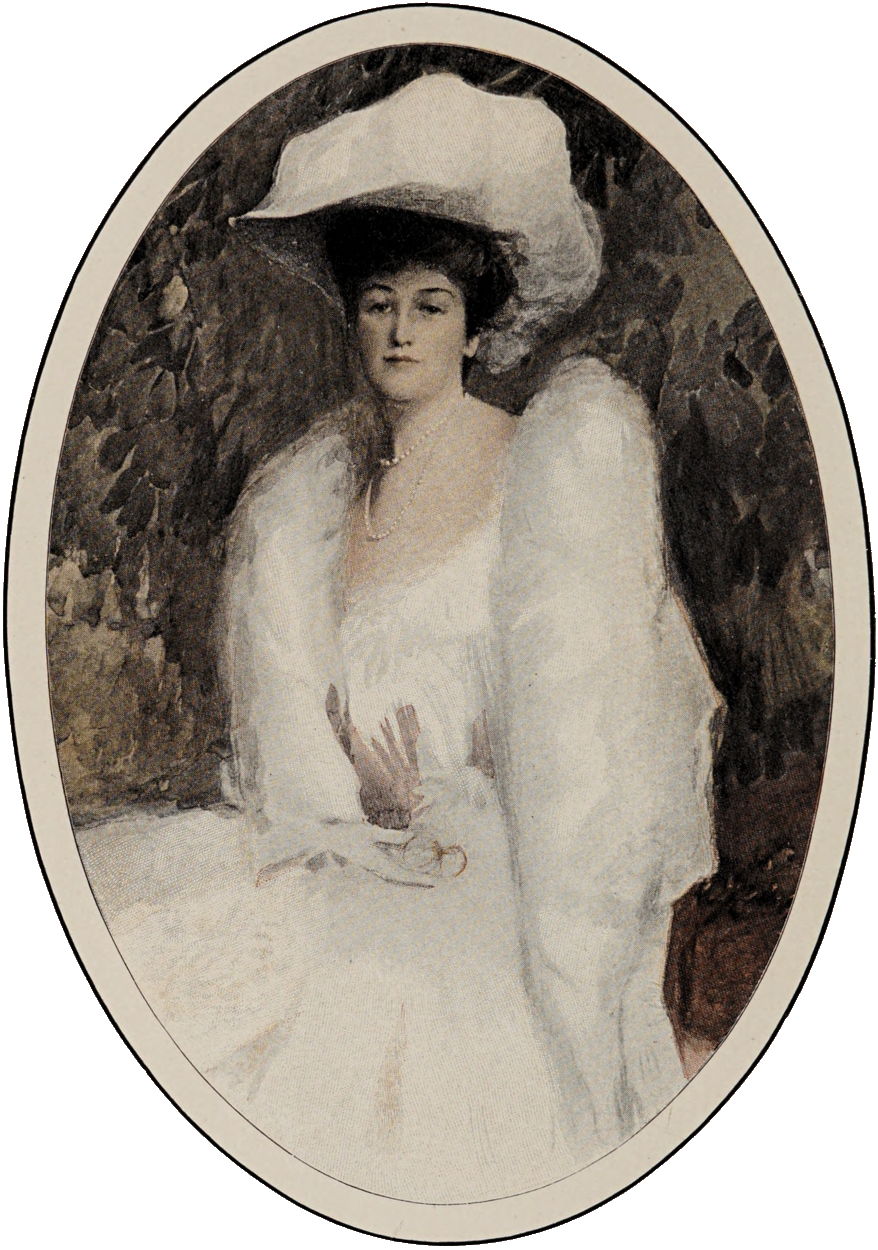
THE OPAL
From a painting by J. H. Gardner-Soper.
Title: The opal
a novel
Author: Anonymous
Illustrator: James Hamlin Gardner Soper
Release date: May 9, 2026 [eBook #78640]
Language: English
Original publication: New York: Houghton Mifflin and Company, 1905
Other information and formats: www.gutenberg.org/ebooks/78640
Credits: Charlene Taylor, Paul Fatula and the Online Distributed Proofreading Team at https://www.pgdp.net (This file was produced from images generously made available by The Internet Archive/American Libraries.)
THE OPAL
THE OPAL
From a painting by J. H. Gardner-Soper.
A NOVEL

BOSTON AND NEW YORK
HOUGHTON MIFFLIN AND
COMPANY THE RIVERSIDE
PRESS CAMBRIDGE 1905
COPYRIGHT 1905 BY HOUGHTON, MIFFLIN & COMPANY
ALL RIGHTS RESERVED. PUBLISHED FEBRUARY 1905
| I | DRAMATIS PERSONAE | 1 |
| II | MERELY PLAYERS | 9 |
| III | A THOUSAND WOMEN IN ONE | 40 |
| IV | ONE WOMAN IN A THOUSAND | 63 |
| V | A DIRECTOR OF DESTINIES | 84 |
| VI | A PUPPET IN TRAGEDY | 103 |
| VII | THE FULFILLING OF THE LAW | 150 |
[Pg 1]
THE OPAL
Mary Elton was a girl whom her friends called unusual, and her friends’ friends, peculiar. She was young enough to be judged leniently by her elders on the ground of her immaturity, and old enough to be looked up to by her juniors as a clever woman whose character was past the formative period. An undisguised interest in her own character frequently laid her open to the charge of egotism, but she had never been accused of conceit. A sort of fundamental frankness, combined with a remarkably clear vision, was the basis of her nature. Seeing things without disguise made it possible to speak of things [Pg 2]without reserve, and neither timidity nor politeness ever tempted her to call black white, or even gray, and a spade was given no less definite a name when she found it necessary to refer to that symbol of the unmentionable.
Men discovered in Mary Elton certain masculine characteristics of mind and heart, an almost grim sense of humor and a readiness to see the man’s point of view, which, paradoxically enough, made her the more feminine, there being no quality regarded as so essentially womanly as intelligent sympathy for the superior male, and understanding of his complexities.
But, as Mary acknowledged with equal openness to herself and to her friends, no man had ever been in love with her. Many had given her their warmest friendship, and had confided their affairs of the heart to her as to one of their own sex, but no one had ever faintly intimated that marriage [Pg 3]could concern her in any more personal way than as a subject of abstract discussion.
Among her clear-sighted and warm-hearted friendships there was none more sincere than that which bound her with mutual chains of comprehending sympathy to Philip Morley. There had always been good comradeship between them, their temperaments being sufficiently unlike to enable them to act and react upon each other to their common advantage and stimulus. He confided his small love affairs to Mary, and she gave them either the sympathy he craved or the scolding he deserved, as circumstances seemed to demand.
To outward view he was tall, with a suggestion of latent power about him, which was in singular contrast with the superficial laziness of his manner. Mary used to tell him that it was a mere toss-up of chances whether he became a leader of men or a follower of women. Certainly hints of both [Pg 4]tendencies lurked in his handsome features, the strength lying in his firm mouth and decided chin, the sentiment and love of pleasure looking out from his blue eyes.
One morning, after a lapse of time longer than Philip usually allowed to pass without having seen Mary, he found a bulky envelope on his office desk, addressed in so boldly and blatantly masculine a hand that it instantly proclaimed the writer to be a woman. He glanced at the pile of letters it surmounted, with the constitutional indifference that extended even to his morning mail; then a slow smile brightened his features into an expression of half-amused pleasure.
“Mary’s screeds generally deserve to be read first,” he said to himself. “She always insists that the length of her letters is in inverse ratio to their importance, by which token this must be a trifle of exceptional airiness.”
[Pg 5]
With a slit of his finger he liberated two closely written sheets of letter-paper and read as follows:—
My Dear Philip,—I am sending cards to the rabble (and notes to the elect) to bid them come here “very informally”—whatever that may mean—next Wednesday afternoon, November twenty-seventh, to meet Miss Edith Dudley. I am perfectly aware that every one hates teas, and I know that nothing less than a personal appeal eight pages long would bring you to one, but I do want you to come and see this holiday novelty that I am exhibiting for the first time in Boston. “Who under the sun is Miss Dudley?” I hear you inquire, “and why did I never hear of her before?” Because, I reply sententiously, like all Bostonians, your knowledge of men and women is limited to State Street and the Back Bay; and [Pg 6]this lovely creature, who is a sort of step-cousin-in-law of mine, happens to be known only in Europe and the southern and western portions of this continent. Listen, my children, and you shall hear why she is what she is. Don’t fancy that you are beginning a Balzac novel if I go into her ancestry sufficiently to tell you that her mother was French, her father Kentuckian, her education as cosmopolitan as her inheritances, and her beauty as bewilderingly elusive as that of the opal or the rainbow. Her mother died several years ago, and by some strange inconsistency of temperament her hot Southern father must needs marry the cold Northern cousin of my uncle. (Doesn’t that sound Ollendorfian?) The alliance instantly froze him to death; so this lovely wonderful daughter was left to the mercy and justice of her stepmother. They went abroad together and stayed two years, and [Pg 7]now Edith has come to pay me a long visit on the feeble strength of my relationship to the second Mrs. Dudley. She will be in Boston most of the winter, first with me, and then with the Warners. You are the only person to whom I have given a word of preparation as to what to expect; but you may pass on the information to those whom it may concern. As usual, my note has grown into a foreign letter, the gist of which may be summed up in the refrain, Come early and avoid the rush! November 27th. One day only!! Beauty and the Beast!!!
Always faithfully your friend,
Mary Elton (the Beast).
“How exactly like Mary!” the young man exclaimed out loud. “Her voice gets into her letters in the most extraordinary way, and makes her pen talk instead of writing. Of course I shall have to go and [Pg 8]meet this siren who has bewitched the most clear-sighted of her sex;” and he jotted down in his note-book the date of one of the few “teas” he was not glad to forget.
[Pg 9]
Philip Morley ascended the steps of Mr. Elton’s house on the afternoon of the “very informal” reception, at the psychological moment between the hours of four and six, when the first reluctant black-coated figures began to give character to the steadily flowing stream of gayly dressed women. Having succeeded in fighting his way to the door of the drawing-room, the young man paused a moment to nerve himself for the plunge into a noise and heat that seemed almost tangible. The sharp, shrill voices of women buzzed in his ears like the trills of persecuting insects, and high mirthless laughs cut his nerves like little steel blades.
[Pg 10]
“This is not civilization, it is barbarism!” Philip exclaimed to another timid male explorer into the wilderness of women. “Talk about giving the franchise to any class of human beings who take pleasure in assemblies of this sort! It’s preposterous! Women may be very charming individually, but collectively—O Lord!”
He looked helplessly into the room to try and locate his hostess, who would be sure to straighten him out into his customary ease of body and mind with a grasp of her friendly hand.
“Why are the men so thick in that corner?” he continued querulously. “Oh, I see.”
The crowd had thinned a little at the entrance to the room, and between eager faces and nodding heads, Philip Morley caught sight of a girl standing beside Mary Elton. Her beauty, her extraordinary [Pg 11]quality, defied description or comparison. To say that she was tall, graceful, dignified,—radiant in coloring and expression,—would have been to describe half a dozen other good-looking women in the room. She positively seemed to radiate light, and to give a dazzling impression of eternal youth and of the beauty that is in living, moving things; not the cold perfection of a statue, or any work of art, but the vitality of the work of nature,—the sparkle of running water, the changing wonder of a landscape played upon by sun and cloud and breeze. Her very dress seemed part of her, and to a man’s ignorant eyes gave a bewildering impression of misty gray, toning into a delicate pink that in turn melted into the color of pale heliotropes, as it caught different rays of light. Her own soft yet vivid coloring was opalescent like her dress, for her hair was of the warm brown that grows golden in the light, her [Pg 12]eyes were so clear that they seemed to reflect blue, green, and gray shadows, and the delicate color in her cheek came and went as she talked. Nor was her wonderful beauty that of line and color only, for intelligence, sympathy, and humor shone from her speaking face. Assuredly Mary Elton’s guest was possessed of the kind of beauty one reads of in old-fashioned romantic novels, but with an added touch of indefinable modernity and subtle mystery. In contrast, Mary Elton looked plainer than usual,—which was saying much. She was so far from good-looking that no one but herself ever commented on it. Plainness of feature was simply one of her attributes, like height in a tower or strength in a fortress, and invited no comment.
She caught sight of Philip standing by the door, and made a humorous face at him, signifying her own aversion to the hubbub around. Then she beckoned to [Pg 13]him, pointed encouragingly at Edith Dudley, as to a goal that was worth much pushing and elbowing to attain. When he was within arm’s length, she held out her hand.
“Quick, what do you think of her? Isn’t she lovely? Isn’t she wonderful? Shouldn’t you think I was the last person in the world to get hold of such a drawing card? Aren’t we splendid foils for each other? Oughtn’t she to pay me to travel about with her? Why don’t you say what you think of her? You’re always so slow, Philip!”
“On the contrary, it’s you who are fast,” he replied laughing. “I am by no means slow to admire Miss Dudley. She is certainly stunning, but I am not sure that I want to meet any one so lovely. She can’t fail to be a disappointment with such a face as a handicap to her brain.”
[Pg 14]
“You just wait. She’s wonderful,” Mary exclaimed triumphantly. “Stop, look, and listen, as the railroad warnings say. Don’t meet her for a little while, but just stand on the outskirts, and watch her tact and grace and cleverness. Oh, she’s wonderful!” Mary repeated. Here Mary’s uncle came up to give to Philip the official greetings of a semi-host.
Mr. Elton was a fair type of the average business man. His mental horizon seemed bounded by the wool in which he dealt, but he was kindly in disposition, and truly attached to the niece who had lived with him since she was left an orphan at twelve years of age. There was no intimacy between them,—perhaps the difference in their temperaments had helped to encourage the girl’s introspection, and forced her to find her best companionship in herself,—but there was genuine affection, even although Mr. Elton might be said to [Pg 15]have cared for his niece with all his conscience, rather than with all his heart.
“Our young friend seems to be meeting with a fair measure of success,” he stated, with the precision that characterized all his trite utterances. “It is not often that one finds so good an intelligence combined with so beautiful a face. I was really surprised at the knowledge she showed of the way in which a big business,—like that of wool, for instance,—is conducted. She seems to be well informed on many subjects, without being superficial; a rare quality nowadays.”
Mary rescued Philip from the wearisome task of feigning an interest in her uncle’s dry and woolly comments, by sending Mr. Elton off to do the polite to a lady whose deaf smile was the index to her infirmity. “There, Uncle Charles, do go and scream at poor Miss Green. She won’t hear a word you say, but she is touchingly [Pg 16]grateful if one merely recites the alphabet to her. Why will deaf people come to afternoon teas, and why does every one who isn’t deaf assume that every one else is? I never heard such a cackling. The parlor is turned into a barn-yard. Oh, how do you do, Miss Milton?”
Mary turned suddenly to greet a new arrival, who bore the hall-mark of a charitable spinster, from the neat little white path that divided an expanse of smoothly plastered hair, to the broad soles of her sensible shoes. She was the scion of a family which had many branches and was less conspicuous for its manners than its customs.
She proved her birthright by staring across her hostess at Miss Dudley for a moment before answering Mary’s greeting, and then saying abruptly, “What an extraordinary-looking young woman to be a friend of yours! Who is she? Has she relations in Boston?”
[Pg 17]
“Nothing nearer than myself. But she’s all right, Miss Milton. I shouldn’t have asked you to meet her if she hadn’t been,” Mary suavely declared, with an intentional humor that missed fire. “You’ll find she isn’t as frivolous as you think. She has an extraordinary insight, and will probably divine by intuition that you are more interested in the poor than the prosperous, and she will unquestionably give you the latest wrinkle in philanthropy. You just see. Come,” Mary continued, dragging her elderly victim after her by one end of her dateless mantilla. “Edith, I want you to meet Miss Eliza Milton. This, Miss Milton, is my friend—and cousin by courtesy—Miss Dudley. Be acquainted, as they say in the country.”
Philip saw the girl turn from the young men surrounding her, and speak to the unfashionable aristocrat in a low rich tone that fell soothingly on the ear among the [Pg 18]sharp staccato waves of sound that filled the room. The sympathy and kindly human interest that beamed from the girl’s face could not be the result of training alone. Even her double-distilled inheritance of Southern courtesy and French grace could not explain a responsiveness that had no touch of the professional veneer that glazes eyes and lips into a perfunctory assumption of interest. Miss Milton had not been talking to the girl two minutes before the conversation had veered from the general to the particular, and Edith Dudley was giving the charitable spinster a little account of an experience she had had among the poor in a New York college settlement.
“I am very much interested in sociology,” Philip was astounded to hear the young girl glibly declare, “and I’ve been fortunate enough to have seen a little of the practical workings of various [Pg 19]schemes for the regeneration of mankind.”
Miss Milton drew herself up with pride at representing the One Perfectly Organized Body of Workers on Earth.
“It is easy to dispose of a large subject with superficial catch-words,” she proclaimed.
“Yes, isn’t it?” Miss Dudley agreed sympathetically. “Some personal experience, some knowledge from the inside, is necessary. I have had a little,—less than I should like,—but I should be so grateful to you, Miss Milton, if you would put me in the way of taking some small part in the special form of philanthropy in which you are interested. Of course I have already read and heard a good deal about the Associated Charities here in Boston.”
“Naturally,” Miss Milton interposed.
“I am immensely impressed by its aims [Pg 20]and accomplishments,” Miss Dudley continued. “I wonder if I couldn’t do a little visiting for you while I am in Boston.”
“We are always glad of intelligent assistance,” the Philanthropist guardedly admitted.
“I don’t know about the intelligence,” the girl said smilingly, “but I speak Italian fairly well. I believe you always need some additional visitors in the Italian quarter, don’t you? I should be so glad if you would let me practice my Italian on some transplanted organ-grinders and fruit-venders.”
Miss Milton acquiesced, with a slightly distrustful manner, in a suggestion that seemed to her as surprising as if a butterfly had suddenly offered to lead the strenuous life of a bee. Her frankly expressed astonishment was broken in upon by the introduction of a clerical young man, whose studiedly sympathetic smile seemed [Pg 21]to preach the duty of cheerfulness to a quite professional extent, and whose air of worldly ease was the logical sequence to his ministerial waistcoat.
“Ah, this does make me feel at home!” Miss Dudley exclaimed, with a cordial grasp of the ineffective white hand extended to meet hers. “I never expected to see anything so anomalous as a clergyman of the Church of England in Mary Elton’s drawing-room. I haven’t dared to breathe my sympathy for anything so conservative as—as you, in this hot-bed, no, cold-bed of radicalism.”
“There are a few of us left, Miss Dudley, a few of us left,” he replied, with the easy reiteration of the obvious in which his calling had perfected him. He grasped an imaginary surplice with two delicate fingers. “May I hope that you will persuade Miss Elton to bring you to St. Matthew’s next Sunday, and see for yourself [Pg 22]that Unitarians and Christian Scientists do not yet control all Boston,—not quite all of this fair city?” he eloquently preached.
“Of course I’ll come, but my cousin won’t come with me. I feel sure that she secretly goes to some hall where Emerson is the Deity worshiped, although she pretends not to go anywhere. She is much too unconventional to attend any church that preaches legitimate doctrine, but I’ll come alone.”
The little clergyman beamed unctuously, and expressed the belief that he should draw fresh inspiration from the sight of Miss Dudley in his congregation.
“I really long to confess myself a miserable sinner,” the girl went on, with the blending of seriousness and lightness that is the ambition and admiration of young society clergymen. “These sincere, self-respecting Bostonians refuse to ‘cringe to [Pg 23]the Almighty,’ as Mary calls it. They think on the whole they’re a pretty virtuous set of people, but for my own part I never feel so good as when I say I’m bad, so I’m coming to confess with the other sinners in your congregation next Sunday.”
The young divine was reluctantly hurried by, his impressionable heart stirred by a remembered vision of a serious and spiritual face that had contradicted the lightness of the spoken words. By this time, one of the former satellites that had revolved about the new planet drifted again into the orbit of her smile. His coldly critical and clever face was stamped with the lines of fastidious modernity.
“What an anachronism is presented by the sight of a parson at Miss Elton’s reception!” he commented, smiling somewhat sneeringly at the cordial shoulders of the clergyman that were writhing, with ostentatious sympathy, over an old [Pg 24]lady’s confessions of rheumatism. “I am sure you agree with me, Miss Dudley, that the Church in America to-day is merely a picturesque ruin,—the only ruin in this terribly new land,—that we value merely for its traditions and associations. There is no longer such a thing as living faith. Occasionally we think we have found it again, but when we turn the electric light of modern science on its poor groping shape, we discover only the ghost of something that once lived ages ago.”
Miss Dudley smiled with sad understanding. “You are right, of course. But I believe in ghosts, and that’s all right, isn’t it, as long as I don’t mistake them for their living counterparts? I know that faith is dead,—I mean the real vital faith that made martyrs of people,—but I like to play it’s alive. I really care for the forms of religion,—for its picturesqueness, its traditions; and therefore I prefer the [Pg 25]Catholic Church to the Protestant. I like to recall my early associations with what my mother taught me, by going to church and getting into rather a slushy state of virtuous emotion, but as for a real reasoning belief”—
She gave a little shrug,—the national gesture of her mother’s race,—and suddenly her eyes were veiled by a mist of sadness. “Don’t let’s be serious at an afternoon tea!” she exclaimed. “I should like to talk to you about all kinds of things sometime, Mr. Marston. I’m sure we should agree about a great many of them. You are cynical outside, and I am cynical inside. I have to drug myself with all these ‘frivolous little anodynes that deaden suffering,’ in order not to lose my grip on life.” She signified the pleasure-seekers around her with a wave of the large bouquet of sweet peas that seemed part of her.
Philip Morley, still an eye and ear witness [Pg 26]to Miss Dudley’s variations, gave a curious little grunt of mystification, not untinged with contempt, but he drew a little nearer to the enigma, to hear what further contradictions she would reveal.
A young Harvard student lounged up to Miss Dudley’s side, with overacted ease, and continued a conversation that had evidently been interrupted. “Then you will really dance the cotillon with me next Thursday night? You won’t forget?” he asked, impaling her eyes with a gaze of boyish admiration.
“Forget?” she laughed, clasping her hands with mock intensity. “I am not likely to forget what I enjoy more than anything in the world, dancing with a good partner,—for I know you dance well; I saw you last night.”
“What flowers do you care for? What color are you going to wear?” he asked [Pg 27]with the blasé manner of an experienced society man.
“Oh, I care for all flowers; I shall wear all colors,” she cried lightly; but then added, “you will please me best, Mr. Warren, by not sending me any flowers at all. It is one of my very few principles, not to let college men send me flowers. There are so many things they must want to get that will last so much longer. Please don’t send me any; I really mean it. Come and take me to walk some afternoon instead. Show me Bunker Hill Monument, and teach me some local history.”
Her frank kindliness, just tinged with coquetry, was what the boy most wanted. “If you won’t let me give you flowers, you might give me one,” he said, stretching out his hand toward the variegated sweet peas that lay in the bend of her arm. She gave him a blossom, with a pretty little foreign gesture. “There. Now we won’t [Pg 28]either of us forget our engagement for next Thursday,” she said in her softly Southern speech, and then turned with a radiant smile to bid good-by to a gray-haired lady, whose hand she held in both hers. “It has been worth my coming to Boston to hear what you have told me of my mother,” she said gently, her eyes softening with impulsive tears. “Each person who knew her contributes something to my own memory of her. It is like a mosaic,—my thought of her,—all made up of little stones of memory pieced together by different hands. Wasn’t she beautiful, Mrs. Warner? Wasn’t she like a creature of another species beside the rest of the world?”
“She was, indeed, my dear, and you are like her,” the lady replied gently.
“It is so good of you to have asked me to stay with you, before seeing me,” the girl went on, “and still kinder now that [Pg 29]you have seen me. I shall love to come when Mary is tired of me.”
“That means I must wait a long time,” Mrs. Warner said, as she pressed her hand for farewell.
“Will you please take these flowers?” the girl cried impulsively. “Sweet peas were Mamma’s favorite flowers. They will thank you better than I can,” and with the grace of perfect unconsciousness, she put the big bunch of fragrant blossoms into the old lady’s hands.
Philip Morley turned to Mary Elton, who was vigorously denouncing afternoon teas to an amused clump of her guests. “Will you introduce me to Miss Dudley?” he asked rather formally. “You know I haven’t met her yet.”
“You’re no better than an eavesdropper!” she declared. Then, “You are sure you want to meet her?” she asked earnestly, looking at him with the boyish [Pg 30]straightforwardness that some men found disconcerting.
“Naturally. What am I here for except to meet Miss Dudley from four to six?” he expostulated. “From the droppings that have fallen off the eaves into my ears I gather that Miss Dudley is all things not only to all men, but to all women, boys, and clergymen as well. I don’t wonder she enslaves every one, with her combination of extraordinary beauty and flattering sympathy with the point of view of the person she happens to be talking to.”
“But it isn’t that she’s nothing,” Mary insisted, “she’s everything. She’s not a chameleon that sits on a piece of blue paper and turns to indigo,—she’s an opal: she’s blue and red and green and yellow, and good and bad and sweet and sarcastic and religious and skeptical and frivolous and serious! Come on and be introduced.”
[Pg 31]
He followed her obediently, but Mary had no time to mention his name, for Miss Dudley met his look with one of recognition. As Philip Morley came under the direct personal fire of her compelling personality, he felt the overwhelming rush of admiring excitement that one feels in seeing and hearing the swift flight of a sky-rocket in one’s immediate vicinity. The comparison flashed upon him in a moment. She was like a wonderful firework. He was constrained to admire, with quickened pulses, the upward rush, the downward flight, the shower of many-colored stars. Would he later see the stick fall to the earth?
“You are going to be Mr. Morley,—isn’t he, Mary?” the girl said, holding out a frankly cordial hand. “You see I have made Mary give me biographical sketches of all her particular friends, and her descriptions of you have been so vivid [Pg 32]that you might just as well have your name scrawled over your face.”
“I must plead guilty of being myself,” Philip assented. “It would be quite impossible to escape detection when Mary’s vigorous language has been employed on one’s behalf. You, also, Miss Dudley, have been duly catalogued. Perhaps you do not know that you have been called an opal.”
“Opals crumble away to nothing; they are short-lived and rather sensational,” the girl answered. “Mary, there, is like a pearl,—staunch and unchangeable.”
“I’m a black pearl, then,” Mary replied grimly. “They are fortunately very rare, and so ugly that they are considered beautiful by some. I myself would as soon have a boot-button set in a ring as a black pearl. If a thing is ugly inherently, its cost cannot make it valuable to me.” A note of bitterness was stinging her voice, but she cast it out with her customary [Pg 33]tone of light banter. “At least I am grateful for not being called a moss-agate, Edith. Isn’t it just like me to have that for my so-called ‘birthday stone’? Good-by,—there’s Miss Grantley. I’d forgotten I’d asked her. She’s anti-all-existing conditions. Anti-vivisectionist, anti-vaccinationist, anti-imperialist, anti-everything. But of course you’ll cater to all her aspirations towards reform, Edith. Miss Dudley is a born caterer,” Mary threw back at Philip, as she left them, to resume her irksome duties as hostess.
“I suppose ‘caterer,’ in Mary’s sense, and ‘opal’ mean much the same, don’t they?” asked Philip. “It is most refreshing to find anything so acquiescent as either name implies.”
“I don’t think I can be like an opal, for it is my favorite stone, and my own character is the kind I most detest,” Miss Dudley said simply. “Mary Elton is the [Pg 34]type of person for whom I have the most genuine admiration. She is splendid. Her strength and clear-sightedness and absolute sincerity and certainty of conviction are wonderful. If I were a man,—the kind of man I’d like to be, not the kind I should be,—I should strain every nerve to win that woman, and if I failed, why, I’d at least be thankful I hadn’t succeeded in winning any one less unusual.”
Miss Dudley spoke with such simple sincerity that Philip Morley’s heart warmed to her. “Mary is indeed refreshing, and astonishingly satisfactory as a friend,” he heartily agreed. “One misses neither men nor women when one is with her. I confess I am too selfish to wish that you were a man, for if Mary married I should feel that I had lost my best friend.”
For an instant Edith Dudley looked into the young man’s eyes with a glance [Pg 35]of eager scrutiny, but all she saw there was half-indifferent amusement.
“Perhaps I exaggerate Mary’s remarkable qualities,” she said quietly. “She is cast for so much better and bigger a part on the world’s stage than I, and acts it so much better, that I suppose I think of her with something of the same feeling with which a performer in private theatricals regards Bernhardt or Duse.”
“I should have fancied you were a better actress than Mary,” Philip commented.
“Oh, I am not speaking of consciously adopting a rôle and playing it consistently,” Miss Dudley explained. “I was merely speaking—tritely enough—of acting in the sense of living. ‘All the world’s a stage,’ you know, ‘and all the men and women merely players.’” She spoke with the slightest touch of scorn for his literalness. “At all events,” she went on, “I thank whatever gods there [Pg 36]be that I am still capable of feeling enthusiasm for people. You are, perhaps, lazily thanking the same indefinite deities for never being carried off your feet.”
“Oh, but I am, if a strong enough person comes along,” he declared.
“Is it irrelevant to own myself the weakest of my sex?” the girl asked with a challenging smile.
“Not unless it is impertinent in me to hope I may have the opportunity of proving you otherwise. I have been listening to you talking to these people. You are not weak; you are daring, as only a person well armed can be.”
For a second she looked at him beseechingly. “I hope that you will sometime understand Mary, and will never understand me,” she said with strange seriousness.
“I already do one, and I intend to do the other,” he insisted, with his pleasant [Pg 37]personal smile. “I am hoping to see you often while you are in Boston, Miss Dudley. I am almost like one of the family in this house, you know.”
The girl was prevented from answering by the introduction of another young collegian by her recent sophomoric conquest.
“Where do you come from, Miss Dudley?” was his correct opening, in the tone of a player of twenty questions.
“Oh, I am like George Macdonald’s baby,” she smiled, shaking off her serious mood with a dismissing nod to Philip; “I come ‘out of the Everywhere into the Here!’”
Philip turned away, his brows knitting with mystification. He was curiously interested by the dazzling inconsistencies and overwhelming beauty of the strange girl who had spoken to him of Mary Elton with an inexplicable emotion. He must [Pg 38]see her again, and often. She was a riddle worth pondering over.
He stopped in his flight to the door to say good-by to his hostess. There was in her eyes a strange look, almost of physical suffering, that he had noticed more than once lately, and her expressive ugliness seemed more than usually pathetic under its veil of humor.
“Well, what do you think of her?” she said, with strangely vibrating intensity.
Her small eyes seemed to swim in unshed tears for a moment, and she bit her under lip viciously in self-scorn as she waited for his answer. He looked over her head, and for a moment did not reply.
Since speaking to the beautiful Miss Dudley, since her eyes had looked into his,—not boldly, not flirtatiously, but with a special intimacy and understanding,—Philip had felt almost as though he were [Pg 39]under a hypnotic influence. Even to Mary he could not reply seriously, as to what he thought of her friend, for, if he spoke truthfully, his sentiments would sound exaggerated; so he spoke with exaggeration, and trusted that his words had the ring of truth.
“My dear Mary,” he said, laughing as he shook her hand, “she is a thousand women in one; but you are what is far more satisfactory, one woman in a thousand.”
[Pg 40]
Philip Morley’s imagination was not in the habit of being appealed to by individuals, so often as his mind and heart. But that he had plenty of imagination, waiting for the human touch, was proved by its response to all that was beautiful in literature, music, and the other arts. Perhaps the fault lay in an absence of the kindred quality in most of the people of his intimate acquaintance, for his particular circle was Bostonian in the narrowest limitations, as well as the broadest boundaries, of that indefinable term, and imagination was not the salient quality possessed by the inhabitants of his world.
During his first glimpse of Edith Dudley, [Pg 41]she had warmed his imagination, and after his second and third interviews she had fairly set it on fire. Her beauty changed but never decreased, and her sympathetic nature, with its wonderful responsiveness to each mood of her companion, was rendered the more fascinating to Philip by an inexplicable drawing back of her real self into its shell, when he probed for a deeper knowledge.
He had formed the habit of dropping in for a frequent cup of tea at the Eltons’, and though Mary at first made a congenial third in the conversations with her two friends, she gradually made excuses either for coming home late or going upstairs to rest.
Repose had not, until recently, figured on Mary Elton’s daily programme, but she had looked ill all through the autumn, and though she resented any inquiries, and snubbed all attempts to discover her malady, [Pg 42]it was evident that physically she was not herself. She begged Philip to take her place in showing her guest the sights of Boston, and thus it happened that he became the envy of all his friends, by his constant attendance at the side of the beautiful girl who not only trod with him the conventional paths of the Back Bay, but explored the remoter ways of more unfashionable quarters.
There were soon plenty of other men who talked with her and walked with her, who danced with her and flirted with her. She began to identify herself with the life of the people around her, and to interest herself in whatever most absorbed her new friends.
She took an active part in various church clubs and organizations, under the guidance of her clerical conquest; she delighted her collegiate admirers by going with them to theatres and variety shows,—displaying [Pg 43]all the unsophisticated enthusiasm of a child,—and she converted Miss Milton to a belief in the sincerity of butterflies by keeping a weekly appointment with five poor families in the North End. But in spite of these side-tracks for her interests and energies, it soon became evident to all that Philip Morley had appropriated the largest share of her time and thoughts for himself.
Between the girl and Philip, Mary Elton was a frequent and absorbing subject of conversation, and whenever she was mentioned, Philip received the same impression of repressed feeling in his companion’s voice and manner.
“I have never felt about any one as I feel about her,” Edith said to him one day. “You can’t understand what I mean. She knows me thoroughly, and when one’s character is very weak, and yet one is loved by a person of strength,—of one’s [Pg 44]own sex,—it somehow gives one hope to keep up the fight.”
This interesting stage of unformulated sentiments between Edith Dudley and Philip Morley was broken in upon by the unexpected arrival in Boston of an old friend of Edith’s from Baltimore,—a man whose manners soon made it evident to shrewd observers that he was a rejected lover, as well as an accepted friend. His appearance suggested the villain in a modern melodrama, and one almost expected to hear gallery hisses arise from protesting Philistines when he appeared. He was dark, handsome, scrupulously polite, suspiciously unvillainous.
But from the moment Grant Lorimer appeared on the scene, Edith Dudley seemed to lose her poise and happy ease of manner. It was as if he exerted an influence which she could not resist, yet to which she did not wish to yield herself. [Pg 45]Mary at once christened him Dr. Fell, for obvious reasons, and he seemed to justify the title if not the name, for he had seen her only once for a few moments, when he said to Edith, “Your friend Miss Elton is a very sick woman. I don’t mean nervous prostration and that sort of thing, but something really vital. I’ve been in hospitals. I know the signs.” Edith gave a cry of real pain.
“Oh, don’t say so! You don’t know what it would mean to me,” was her first selfish word. “It would be like taking a crutch away from a feeble old woman, to snatch Mary out of my life. You know what I am, Grant; you and she alone in the world understand my weakness.”
“Yes, and we both love you,” he stated firmly.
“Please don’t say so,” she shuddered.
A few days after this the two girls were in Mary’s room one morning, engaged in [Pg 46]various jobs of leisurely domesticity, such as mending stockings, polishing finger nails, and running ribbons into sundry lace-trimmed garments. The conditions seemed to invite confidence, and Mary accepted the invitation by saying suddenly, “Edith, forgive my impertinence, put it down to my being physically upset, if you wish—but which do you mean to marry, Grant Lorimer or Philip Morley?”
The girl flushed. “And must I marry one?” she asked.
“I think you will have to. You see I know you.”
“Then why do you care for me?” Edith asked impulsively. “Why do you, who are all strength and conviction, care for a blank like me?”
“I don’t know,” Mary confessed. “I suppose it’s because you’re so extraordinarily pretty; and then you’re clever, [Pg 47]too, and most good-looking women are fools.”
“I’m not a fool,” Edith acknowledged, “but then I’m not anything.”
“I know it, and it’s really refreshing in these over-strenuous days to find some one with no character at all. Excuse my frankness,—I love you just the same, Edith; that’s the funny part of it,—but it has only lately begun to dawn on me that you really might be said not to exist at all, unless there is some one with you to bring out some response, and then you are vivid as a rainbow. You are like that hero in Henry James’s story,—do you remember? They suddenly found that he simply melted into thin air, unless there was some other intelligence in the room to play upon his.”
Edith’s eyes grew blank and expressionless. “Yes, I am like that,” she said in a dull monotone. “I have been brought up [Pg 48]from the cradle to produce an effect. My mother and my father bent all their efforts to make me into what they wished me to become. All my natural passions were curbed, all my impulses checked. I was not created by God, like other people,—I was manufactured by my parents. I am like one of those toys labeled ‘made in Germany.’”
“But it takes a long time to find you out,” Mary protested. “You’re a wonderfully good imitation of a human being. You don’t seem a bit mechanical.”
“Oh, I have been well educated,” Edith acknowledged, dispassionately. “When I am with people, I do not merely reflect their ideas, I can furnish others in the same line, only not in opposition. I have some intelligence, but I have no character, no beliefs, no convictions.”
“It is very strange,” Mary mused. “Are you happy?”
[Pg 49]
“Happy? No, I don’t think so, nor unhappy. I like to be with you. You have so much character and force that it is almost infectious. But I like any one I am with. If a strong will is brought to bear on mine, it can control me utterly. I am not bad by nature, any more than I am good. I am simply what the other person wants me to be. It is my misfortune, Mary; not my fault, but my curse—the curse of my inheritance, my bringing up. I am not deliberately a turncoat, a caterer, as you called me once to Mr. Morley. I am simply a cipher, waiting for a definite figure to stand in front of me, and give me meaning.” The girl was pathetic in her unavailing self-knowledge.
“You would interest the psychologists,” Mary said. “You are a living example of the power of suggestion.”
“Yes,” Edith continued earnestly, “I seem to have no Ego. There are hundreds [Pg 50]of different individualities shut up inside me, waiting to pop out as they are wanted, yet none of them is me,—there is no real me. If I am suddenly asked, by a person I have never seen, what I think on a certain subject, I can’t answer till I feel what the other person’s point of view is, and then I express it as well as I can.”
“You’re like a prism, waiting for the sun of outside personality to shine on you and scatter your colors. Well, I go back to my first question,” Mary insisted; “which of them do you intend to marry?”
“How can you ask? I suppose whichever has the stronger will,—unless some outside influence or event is stronger than either,” the girl confessed hopelessly. “Mary, I tried—I mean I tried to try—not to let Philip Morley fall in love with me. But I couldn’t make the effort. I hoped that you would. You and he should [Pg 51]have belonged to each other,—but you threw us together. I was utterly powerless and weak,—he is attracted by a pretty face and by a character that he can mould and influence. Mary, why did you not keep him for yourself? It would have been better for all.”
Mary rose to her feet and stamped. “Me? What are you thinking of, Edith Dudley? Any man—even the most sensible man—would rather marry a pretty fool than an ugly and embittered jade like me. Not that you are a fool, you poor dear lovely nonentity, you! You are as clever and intelligent as you are fascinating; and I truly believe that you—a non-existent being almost—will bring more happiness to a self-reliant man like Philip than any of the strong-minded women he might marry. The whole question comes down to one of love. He loves you; he does not love—us.”
[Pg 52]
“Oh, why doesn’t he feel what you are, Mary!” her friend exclaimed. But this was not a subject on which Mary cared to expand, although she always rose to the bait of her own character as a subject for discussion.
“I am likable, but not at all lovable,” she explained, with her relentless self-analysis. “There is no charm or illusion about me. Besides, look at my face!”
Edith Dudley did look at her friend’s small green eyes, indefinite hair and complexion, and too definite nose and mouth; but, with her never-failing desire to say the kindly thing, replied, “Some day some one will care tremendously for you. All men don’t fall in love with wax dolls. Besides, you are”—
“Now, my dear Edith, don’t tell me that I am interesting-looking, or have a sweet face! That is always the final insult of beauty to ugliness. I know perfectly [Pg 53]well that I am extremely plain. I am not in the least self-deceived.”
“But there are so many more attractive qualities than mere flesh and blood good looks,” the beauty tritely suggested.
“Are there? Well, I would give every virtue I possess in exchange for that mere physical beauty you carry so lightly,” Mary exclaimed, with a bitter little laugh. “People who are good-looking and charming ought to find it easy to be amiable and sweet. They are born in harmony with the world. Every one is predisposed in their favor from the start, while we ugly people can hope to call forth no more flattering sentiment than a half-contemptuous pity.”
“What extreme statements you do make, Mary!” interposed Edith Dudley. “I don’t know any one who has more friends than you. What do they care whether you have a Grecian nose or not?”
[Pg 54]
“They don’t care,—that’s the pity of it,—and they think I don’t care either. By some strange system of reasoning they imagine that because my hair is straight and thin I must find it easy to tell the truth; and they fondly believe that because my mouth is large, I must enjoy visiting in the slums. People associate certain physical attributes with certain mental qualities; but all I can say is, that in my own case my character and my features are in constant warfare.”
Edith, having no comforting rejoinder ready, merely looked distressed, and Mary continued:—
“Of course I know that Charity, with a very big C, is the generally accepted refuge of the plain,—and I am expected to enjoy philanthropy more than frivolity, and to prefer committee meetings to dancing parties,—but the truth is, my soul or spirit or whatever you choose to call [Pg 55]the thing that makes me me, and not somebody else, is not ugly at all. It enjoys the pleasant and prosperous side of life; it would like to have admiration and love affairs and all the agreeable things that you attractive people are born to as your natural inheritance. But fortunately I have a saving leaven of common sense and humor, which prevent my reaching out my skinny arms to grasp at blessings that are not meant for me. Sooner or later, I suppose, I must accept my inevitable destiny of philanthropist, but incidentally I shall turn into an embittered, caustic old maid, unless an early death cuts me down in my prime. Then, my dear, you would find that I had given promise of being ‘a noble woman.’ Premature death is the only artistic end for souls and faces that are uncongenially yoked together.”
Mary had worked herself into the state [Pg 56]of rebellion that always followed any reference to her personal appearance.
“Do let’s change the subject,” she said, abruptly. “Let’s talk about you again. One thing I don’t understand is why you haven’t succumbed before this, and married some of the men who must have been crazy to get you. If you are a mere pipe for fortune’s finger to touch what stop she pleases, why haven’t you yielded to the persuasions of some of your suitors?”
“Because,” Edith explained with simple straightforwardness, “there has always been a stronger will brought to bear on me, before I could yield. My father was very ambitious for me, and he was a man of intense feelings. He always took me away before things reached a climax, and then some other man would come along, and he would feel more strongly than the last; and so it went, my father’s will controlling me more completely than that [Pg 57]of any lover. Besides,” she explained ingenuously, “Grant Lorimer is the only one that knows I have no character. The others all thought me very strong; but they were mostly foreigners, and abroad, you know, the parents have so much more control over a girl. Mary,” she cried suddenly, “I am really afraid of Grant! Sooner or later he vows I must be his, and if that is to be, it’s better sooner than later, for later I may be married to some one else.”
“Have you no will at all?” exclaimed Mary, passionately and with a touch of scorn.
“Absolutely none,” Edith acknowledged sadly; “only the will to acquiesce in the strongest influence that touches me. My one safety from Grant Lorimer is to have Philip Morley show more strength of will, and make me marry him, yet I know I shouldn’t make him happy long. I can’t [Pg 58]love any one, Mary. I feel everything a little, but nothing much. I can’t even cry, though I can shed tears. I would give all my good looks, that you admire so unduly, to be capable of feeling as strongly about anything as you do about—your nose, for instance.”
“Well, there seems to be no satisfying us, does there?” Mary commented with a short, cynical laugh. “My only hope is that I shan’t live to see the people I care most for—myself among them, of course—made unhappy. I can’t help feeling that if you married Philip Morley, the strength of his love would create a soul and heart in you, and if you once had the spirit of life and feeling breathed into you, you would be the most perfect wife a man could dream of possessing.”
Mary closed her eyes a moment, and a spasm of pain passed over her face. “Heaven keep me from ever witnessing [Pg 59]that happiness!” she groaned, too indistinctly for Edith to hear the words. Suddenly her tone changed abruptly, and she straightened herself up. “Edith, I may as well tell you that I’ve got something pretty serious the matter with me. I’ve suspected it for some time, but I only found out yesterday.”
Edith gave a sharp “Oh!” of sympathy. “Tell me, dear,” she said softly.
“No, that’s just what I don’t mean to do,—at any rate not yet. I do hate this modern fashion of having one’s insides the subject of general conversation. It positively makes me blush, when I stop to think how much I know about the organs of people with whom I am scarcely on bowing terms. I did hope I could escape this fad of being operated on; it’s worse than bridge whist.”
That Mary was not in a mood for sympathy was very evident, and her friend’s [Pg 60]genius for tact led her to do the right thing in replying, “You may trust me, Mary, to say nothing about your illness to any one till you wish me to, and you’ll please me immensely by letting me do anything I can to make the next few weeks easier.” This unemotional little speech was followed by a matter-of-fact kiss deposited on Mary’s sallow cheek, after which Edith obeyed her friend’s unspoken wish, and left her alone.
During the week that followed this conversation, Grant Lorimer’s attentions to Edith redoubled in violence. It was unfortunate that Philip Morley should have selected this period of emotional storm and stress to declare his love and humbly ask for its reward. Edith Dudley’s will was temporarily dominated and controlled by that of her Southern lover, and to Philip’s pleadings she could only dumbly shake her head, and whisper painfully, “I can’t, I can’t.”
[Pg 61]
What she would have liked to say was, “Wait a week till Grant Lorimer goes away, as he has to do for a time, and then try again;” but instead of that her refusal had the sound of finality to Philip’s inexperienced ears.
The combination of Philip’s strong and genuine love, and Mary’s strong and genuine hate of Grant Lorimer, availed to keep the girl from actually yielding to the persuasions of the man who knew her weakness; but though the combined pressure of wills was sufficient to prevent her accepting one lover, it was not sufficient to keep her from refusing the other. Thus an equal balance was temporarily maintained.
At this crisis in her love affairs Edith was invited to go with a party to the White Mountains for a week, and though she regretted leaving Mary in her poor state of health, the will of the invalid was so much stronger than hers, that she found herself [Pg 62]constrained to accept. Mary had grasped the situation pretty correctly, and she rightly guessed that the best thing for all was her guest’s absence for a time. Fortunately Grant Lorimer’s mother was ill enough to demand his presence in Baltimore, and home he was obliged to go, with his campaign of conquest unaccomplished.
Left to herself, Mary breathed a sigh of stoicism rather than resignation, gave up her fight with appearances, and acknowledged herself to be really ill.
[Pg 63]
Mary Elton lay on the couch in her room, thinking of the last words the doctor had said. He had been perfectly honest with her, partly because she was morally strong and desired absolute frankness, partly because there was no one else to whom he could speak, except her self-absorbed uncle, and Mary had taken charge of her own case from the first, and sworn the doctor to secrecy.
The next day she was to be taken to the hospital, and there an operation was to be performed, which would be a matter of life or death,—probably of death. It was her only chance of life, but it was one chance out of a hundred. This she had made the [Pg 64]doctor tell her, and this was the thought she faced alone, lying in the winter twilight, her mood well suited to the season and the hour that most suggest death.
Mary had prepared herself for the news that the chances were against her,—had expected and had almost hoped for it. Without being morbid in temperament, she had a deep strain of melancholy in her nature, and though she possessed rather a spasmodic fund of animal spirits and a keen power of enjoyment, she was no lover of life, in the deepest sense. She feared what she herself might become, and dread of her future too frequently poisoned her enjoyment of the present.
She lay silent in the dusk for an hour, thinking, thinking, screwing her courage to the sticking-place in a decision she had just formed. She rang the bell, which was close to the head of her couch, and, when the maid came, Mary asked to have [Pg 65]the curtains drawn and the gas lighted. “And, Jennie,” she added, as the girl was about to leave the room, “if Mr. Morley comes to inquire after me to-night, I wish to see him. You may ask him to come up here.”
“Up to your room, Miss?” queried the girl, in dignified surprise.
“Yes,” responded Miss Elton, shortly, “and when my uncle comes in I should like to speak to him.”
That afternoon the uncle and niece had a long talk together; and after the interview was over, Mr. Elton’s voice was husky with unaccustomed emotion. Not all the wool in the market could soften the blow that his brother’s only child, and his own companion of so many years, might leave him forever.
Mary had said as little as she could about the probable failure of the operation, but a few plans had to be made, and [Pg 66]her uncle had been astonished at the coolness and self-control with which she had spoken of her own death. He thought she seemed much older than twenty-five.
As Mr. Elton went out of the room, she called after him, “By the way, if Philip Morley comes to ask after me to-night, I am going to see him; so don’t be surprised if you find him making himself at home to the extent of coming upstairs.”
“Very well, my dear; I know you and Philip are great friends. It is quite natural that you should want to say good-by to him. I suppose you may be away from us a fortnight or more.”
“Probably more, the doctor thinks,” Mary replied, laughing; “but I want to see Philip in any case.”
That evening Mary looked more animated and stronger than she had for days. A faint color had brightened her sallow cheeks, and excitement burned in her [Pg 67]eyes. When a knock came at her door, and Philip Morley tiptoed in, he uttered an exclamation of pleasure at seeing her look so well. He drew a chair up beside her sofa, and extended his long legs with a sigh of comfort.
“We’ll be having you about again in a week,” he said, with his sympathetic smile. “I’ve missed our friendly disputes awfully. Since you’ve been ill, I can’t get any one else to fight with me, and it kills all ambition when one isn’t opposed; so you must hurry and get well.”
Mary pulled with nervous fingers at the fringe of the shawl that covered her.
“Philip, it seems absurd, but I’m not going to get well. You’ll have to find some one else to fight with you.”
The young man started, and looked at her quickly. “What do you mean, Mary?” he cried. “Don’t joke about such things.”
[Pg 68]
“I’m not joking. I am going to the hospital to-morrow, where the surgeons will do what they can to save my life; but they say there is very little chance of my recovery. I know that I shan’t live, and that is why I wanted to see you to-night. Don’t, don’t look like that,—as if you cared,—or I shall cry; and I don’t want to be a baby.”
She looked at him piteously, but would not let him speak.
“There is something I want to tell you, Philip. No, I don’t want to tell it to you, but I want you to know it before I die. Doesn’t it seem ridiculous for me to talk of dying! But I’m not going to try to harrow your feelings like that horrid little May Queen, though I confess the dramatic side of the situation does appeal to my imagination, and I am secretly longing for a band to strike up some dirge outside.”
“Ah, you’re just trying to frighten [Pg 69]me,” said Philip. “If you really thought you were going to die, you wouldn’t joke about it like this.”
“Wouldn’t I? Well, I always said you didn’t know me. Never mind. It certainly would be just like me to live, as an anticlimax, after getting off my last speeches—but for once, I really think I shall do the right thing.”
“It wouldn’t be the right thing, Mary; don’t talk so. I hate to hear you.”
“Yes, it is the right thing, Philip, I’m perfectly sure of it. Now don’t keep interrupting me. I want to talk, as usual, and you are just here as audience. Now listen. I am perfectly serious when I say that the best thing I can do is to die. If I lived, I should become more and more hard and snappish and unreconciled to my lot every year. Handsome people say it is easy for ugly ones to be good because they have no temptations, but I know that it is a thousand [Pg 70]times harder to keep your temper sweet, and your spirit unruffled, with eyes and nose and mouth like mine, than—like yours, for instance. There is the first compliment I’ve ever paid you.”
Philip made a futile attempt to interrupt her flow of words, but she frowned him into silence and continued, “The trouble is, I am not good enough to be ugly. If I lived, I should have to turn into a woman with a mission,—a temperance lecturer or an anti-vivisectionist or something; and though I should look the part, I couldn’t act it. But if I die comparatively young, my bad qualities won’t have time to mature (or rather to decay), and perhaps half a dozen people will be able to squeeze out a few perfunctory tears at my funeral.”
Through the veil of her levity, Philip could detect grim Truth looking him in the face, and his eyes fell before hers.
[Pg 71]
“You’re only joking, of course,” he maintained insincerely.
“No, no. I am altogether serious now, Philip. I can’t joke about it any more. Promise to feel badly about me for a little while,” Mary cried, with sudden wistfulness.
“It wouldn’t be for a little while only, Mary,” the young man said, laying his hand on hers. “It would make a difference to me all through my life. But, Mary, this won’t happen. You’re morbid and unnatural to-night. You have the making of one of the finest women in the world. You know I’ve always said so, and you must live to acknowledge that I was right. Besides, I can’t possibly get on without you.”
“Oh yes, you can; yes, you can!” she moaned, dropping the mock-heroic tone she had assumed at first. “Listen, Philip, I am going to tell you something which proves me to be unfeminine, unwomanly, [Pg 72]and altogether shameless, but when I’m dead perhaps you’ll be glad to remember. Now don’t look at me, Philip, or I can’t say what I want to. Let me look at your nice straight profile, and then perhaps I can talk.”
She laughed in her old way, and made him turn his face toward the fire.
“Now don’t move, don’t speak,” she said, “till I have finished, and then I can tell whether you think me altogether contemptible. Philip,” she continued, with a queer catch in her voice, “I have loved you for two years! There, I’ve said it, I’ve said it,” she exclaimed, wildly. “No, don’t try to speak, don’t look at me. Now you know whether I am going to die or not. Do you think wild horses would drag such a confession from me if I didn’t know I was speaking from the edge of the grave?”
Philip had instinctively turned to look [Pg 73]at her with bewilderment in his eyes, but if he felt doubts of her seriousness or of her sanity, they were driven away by the sight of her earnest and intense face. He gave a short, sudden groan, and dropped his forehead into his hand.
“You mustn’t feel too badly about this,” she went on with calmness. “I know that you are as much in love with Edith Dudley as you can be with any one. It is because I know of your love for her, that I am able to talk to you like this. She may have refused you once; I suspect that she has, but that’s only because that wretched Dr. Fell came along and hypnotized her. If you love her enough, she will care for you in time, and you will be happy, but—oh, Philip, she will not love you as I have loved you; she will not make you happier than I could have made you, if I had been beautiful and graceful and gentle and sweet as she is!”
[Pg 74]
There was a ring of something that had never been heard in Mary’s voice before, as she gave herself up to the bitterness of longing and regret that filled her heart.
“People talk of the power of affection to work changes in character,” she continued more quietly, “and that is another reason why I have chosen to tell you of my love. Philip, I don’t know whether I love you because I believe in you, or believe in you because I love you. My love and my belief are all tangled up together, so that I can’t tell which is cause and which is effect. You could be anything you want to be,—but I am so afraid you won’t want! Oh, I do wish that my love could be some little incentive to make you do and be all that you might if you only would! It seems as if it ought to be of some value,—a love like mine. There ought to be some result from such a strong emotion. It would be so ridiculously [Pg 75]easy for me to die, or live, or anything, if only your happiness, and success in the highest sense, could result from it! Of course it isn’t easy for me to say all this, though I seem to have got wound up to it somehow. I suppose I am fearfully lacking in a proper modesty of sex,—but this is my death-bed (figuratively speaking), and after all we are just two human souls, aren’t we?”
“You are the sincerest, truest woman in the world!” cried Philip, turning towards her and seizing both her hands. “What does the purely conventional modesty you feel you have offended against matter, in comparison with a courage like yours?”
“Oh, dear! If only my friends could have heard me making an unprovoked declaration of love!” cried Mary, laughing, with a sudden instinct of incongruous amusement. “They all think I’m a perfect [Pg 76]old cynic, with no germ of romance or sentiment about me. Well, that’s what I should have grown to be, if I had lived. You see I already speak of myself in the past tense. Be thankful, Philip, that I have escaped the fate of becoming an unloved, unloving old woman, with bitterness and regret in her heart. You have shown me what life must be to people who have love. It’s the only permanent possession. But if I had to choose between the two, I would rather feel love than inspire it,—and this isn’t sour grapes either. Of course the perfect thing has to be reciprocal. And now about you, Philip. I am sure that Edith will come to care about you some day; but when you’re happy and prosperous, don’t forget that you must be something more, that you are worth something better, that you owe it to yourself, and to Edith,—and to me. And now there is just one more thing that [Pg 77]I want to say. If I should live,—I can’t and I shan’t, but if I should,—you must let the memory of all that I have said be absolutely blotted out. I shall have killed our friendship to-night. However, all this is nothing, because I know that I shan’t live, and on the whole I’m not sorry. Please tell me honestly whether you despise me for my weakness, or whether”—
“Despise you, Mary!” cried Philip. “I can’t possibly tell you what your brave, true words have meant to me.” His voice was choked with mingled emotion and embarrassment. “What you have said has meant more to me than anything else ever can. I feel somehow full of humility, and yet full of pride. What have I been or done, to win the love of a woman like you? Where have my senses been, not to give you some better return than my best friendship for a love like yours!”
“Ah, my dear Philip,” said Mary, half [Pg 78]laughing and half crying, “you couldn’t have loved me, no matter how hard you tried. No man could. You see I am so dreadfully ugly. I should hate myself if I were a man,—in fact, I do as it is.”
“You’re perfectly absurd about your looks, Mary. Why do you persist in exaggerating the importance of beauty? You have been a constant delight and refreshment to every one you know. As for me, I don’t believe I amount to much anyway; but if I ever turn out anything at all, it will be because of what you have been brave and honest enough to tell me to-night.”
“Oh, no, it won’t,” said Mary, smiling and shaking her head. “If you do turn out to be anything more than a successful business man (which I sometimes doubt), it will be because of the love of a much sweeter and better woman than I. You see this humility on my part is really my [Pg 79]most alarming symptom, and must mean approaching death.”
She was her old self again for the moment, half mocking and half sad.
“Mary,” said Philip suddenly, “I don’t believe I shall ever like any one half so much as I do you. Love is different; it is outside our control, I suppose, but liking is somehow founded on fact,—it’s more deliberate.”
“Are you trying to make out that friendship is more flattering than love?” Mary interrupted. “Perhaps you’re right. I dare say it’s more natural that you should like me than that I should love you,—however, go on.”
“It isn’t altogether easy to go on, in the midst of your interruptions,” said Philip, laughing nervously, “and everything I say sounds artificial, when I only mean to be straightforward. What I want you to understand is that whether you [Pg 80]die or whether you live, or whatever happens to either of us, our friendship is something permanent. Even if we have to meet as strangers after to-night, the real You and the real I will be friends just the same. I wish I could make you realize all that it means to me to be told what you have told me to-night. It will give me new courage and new self-respect, and I thank you with all my heart.”
In answer to the look in his face, Mary’s eyes filled with sudden tears.
“Now don’t let’s be theatrical, Philip,” Mary laughed in order not to cry. “I’m afraid I’ve made things horrid for you. It’s my fault. I ought to have been contented with playing the rôle I am suited for. The trouble is I have been cast for low comedy, and I insist on playing high tragedy. With my make-up I ought to be content with playing the fool, yet here I am striving to blend pathos and tragedy [Pg 81]behind the mask of Harlequin. Now Edith Dudley can play any part well. Her life is a series of wonderful impersonations, and her face adapts itself to the part she plays. Don’t make the mistake, Philip, of thinking you can walk through your part of innocuous-young-man-about-town without exerting yourself to act. I am enough of a fatalist to believe that we can’t alter the text of the drama of life; but I do believe that the seriousness of our impersonation is as important in result as the words we are set down to speak, and our acting is within our own control, even if our actions are not.”
“If life is a play it’s a mighty badly written one, and I’ve made an awful botch of my part. I don’t know the text, Mary, and I need your promptings.” Philip looked at her with the look she used to call his “dumb animal expression.”
“Life is just a tragi-comedy, that’s all. [Pg 82]When we’re not shrieking with pain, we’re shrieking with laughter. Now go, dear,” she said brokenly. “I don’t think I can stand it another minute. This has not been easy for either of us. I won’t try to say anything else except good-by. Don’t ever forget that I am thankful to have known and to have loved you.”
“Oh, Mary, Mary!” he cried, impotently. Then, realizing the futility of language to express all that he felt, he quietly stooped and kissed her. “Good-by,” he said very softly. Then he went out and closed the door. She held her breath till the sound of his footsteps had died away; then she burst into hysterical sobs.
A week later Edith Dudley was admitted to a room in the hospital, where a white form lay in a white bed. She went softly up to the figure, and kissed its pale face.
[Pg 83]
“Dear Mary! So the operation was a success,” she whispered.
“No!” replied the figure, opening its eyes with sudden energy. “It was a failure. I am going to get well.”
[Pg 84]
When Mary Elton was able to be out and about once more, she seemed to have undergone what she herself termed “a change of heart, from bad to worse.”
“A peep inside Death’s door would soften and chasten most people,” she told her bewildered uncle, “but on me it has had just the opposite effect. I suppose it’s because I made all my plans for a death-bed repentance, and now that the Devil is well, the devil a nun is she. I always did hate to have my calculations upset, and this recovery is too much of a surprise for an old maid to adjust herself to all of a sudden.”
But if the physical shock of a serious [Pg 85]operation was hard to recover from, the mental torment caused by the recollection of her confession to Philip Morley was a thousand times more difficult to endure. She knew that the thought of it would poison her whole life. It had been hard enough before to bear the anguish of a kind of love known only to deep and undemonstrative natures, a love doomed to remain unrequited, but now added to biting sorrow was the sting of shame and humiliation that Philip should have heard from her own lips of her love for him.
“I might have known I shouldn’t die,” Mary berated herself fiercely. “The Fates have too much sense of humor to lose the joke of my recovery. Well, Destiny has beaten me again; but my will is not defeated, and though I can’t die, I shall at least go abroad. When bad Americans can’t die, they go to Paris. Uncle Charles shall [Pg 86]take me if the eloquence of one risen from the bed can move him to action.”
On Edith Dudley’s return from the mountains she had gone directly to Mrs. Warner’s, feeling that her visit to the Eltons had better be shortened, in view of Mary’s unexpected illness. She came to see Mary every few days, and their friendship continued the same, although Mary detected a subtle change in Edith, the clue to which lay in the circumstance that Philip’s name had not once been mentioned between them.
Mary’s clear vision and quick mind had jumped to a conclusion which made even the most tactful interference seem an impertinence, and yet she felt that she held, in a way, the reins of her two friends’ destinies. She herself had seen Philip only in the most casual way, but she was not so utterly self-absorbed as to be blind to the difficulties and painfulness of his situation, [Pg 87]which she interpreted thus: knowing, as he did, that she (Mary) was in love with him, he had determined not to persist in his courtship of her friend, who had already refused him. He was not so stupid as to greet Mary’s recovery with a proposal of marriage, but she knew him well enough to suspect the line of conduct he meant to pursue. Having accepted Edith’s refusal as final, he would, after she had left the house, resume his friendly visits to Mary, then slowly,—very slowly,—he would show her that not her declaration of love, but her own fine qualities, had magically touched his heart, transforming friendship into a more vital emotion.
And, after all, Mary asked herself, might not the result bring happiness to both? Once married to him, Mary would make him love her, for he would know by the revelations of daily life the depth and strength of her affection. She knew that [Pg 88]no one else could make the man of him that she would make. All the latent sweetness of her nature, all the buried wealths of tenderness and unselfishness would blossom under his hand. Each would be the best for each, and yet—he did not love her.
Mary’s qualities, good and bad, were vigorous. Capable of two extremes of conduct, she recognized the situation as demanding a great act of heroism, or an equally large act of selfishness. In the wakeful hours of many nights, her conflicting emotions met and fought bloody battles, till the final victory was won. Her irrevocable decision was made. She dispatched two notes, one to Edith Dudley, asking her to come and see her at four o’clock the next afternoon, the other to Philip Morley, summoning him half an hour later.
Mary never indulged in the tentative tactics known as beating about the bush. [Pg 89]Edith and she had hardly exchanged greetings when Mary made a bold attack. “Edith Dudley, now that your old Dr. Fell is out of the way, should you accept Philip Morley, if he proposed again?”
Poor Edith looked vainly about for escape from the revolver of truth with which her friend was holding her up. The sight of her gave Mary a curiously complex emotion, in which scorn, admiration, pity, and wonder were blended. How was it possible that this beautiful, clever creature, who was neither good nor bad, and who was to all outside influences as the weathercock to the breeze, could yet subdue criticism to a blind acceptance of her with all her weakness and weaknesses, and her irresistible charm?
“If Philip Morley should ask me now, I should accept him,” she said, her luminous eyes shining like mirrors of truth. “But it will be better for him if he does not ask [Pg 90]me again.” Then, with a passionate gesture unusual to her, “Mary, Mary, don’t desert me! Don’t go back on me ever,—whatever happens!” she cried earnestly. “Let me feel that you are always here, firm and sure, a rock for me to cling to,—poor helpless seaweed that I am,—when the waves get too strong for me. No one else has ever made me feel as you do—that perhaps I have a soul and a will somewhere. I am generally conscious only of being nothing; a Laodicean, from whom the power to feel hot and cold and love and hate have been squeezed out by early training. I should like to be the wife for Philip. Perhaps, if he is strong enough, he can make something out of me; or if he is weak enough, he may never find me out. But I think he is neither. He is simply human. He loves me a great deal. I feel it even when I am away from him, and I don’t with every one,” she naïvely added.
[Pg 91]
“I am quite aware of his affection,” Mary acquiesced grimly. “Let’s talk of something else,—me, for instance. One reason why I wanted you to come and see me this afternoon, is to tell you that I have at last succeeded in persuading Uncle Charles to take a holiday. He and I are going abroad next month, to be gone a year. Isn’t that splendid? You know how I’ve always wanted to see Paris and London, and this means Italy and Egypt added. Don’t you congratulate me?”
“Oh, Mary, I do, I do!” cried Edith, instantly radiant with sympathy. “And I congratulate Europe! Won’t you say nice, funny, original things about everything, and make the antiquities feel that they’ve never been appreciated before? And, oh Mary, how you’ll hate the traveling Americans,—and the traveling English, and worst of all the traveling Germans!”
Her voice rose in a crescendo of amused [Pg 92]horror. Philip was forgotten, she herself was forgotten,—she was living only in Mary’s prospective travels.
They talked for some time, till presently the door-bell rang, and Mary jumped up saying, “I don’t want to see any one,—I’ll just tell the maid,” and with that she slipped out of the room.
At the head of the stairs she met Philip Morley. He had not been in the house since the night before she went to the hospital, and for a moment the recollection of their talk that evening gripped them both by the throat. Then the girl recovered herself, and she smiled courageously. “Go in there. Tell her she’s got to marry you,—don’t ask her whether she will or not,” she said rather incoherently, then turned and dashed upstairs, and Philip heard her chamber door slam after her.
Feeling as if he were a puppet to which Mary held the string, he obediently went [Pg 93]into the room she had just quitted. Edith Dudley stood by the mantelpiece, lightly touching a bunch of pink and white roses in an iridescent vase—suggestive of herself as was everything delicately lovely and changing. To Philip her beauty was so overwhelming that even his love seemed a sacrilege, yet the rush of warm emotion which filled him at the sight of her—even if unreciprocated—was something for which a man would give all other bliss. She was dressed in gray, except for a touch of blended colors in her hat and at her throat,—her “trade-mark,” she called this opal touch in which her nature seemed to express itself. She was waiting for the intruder to be dismissed, and for Mary’s return, and a sunny smile warmed her face as the door opened and Philip entered. She was not disconcerted, but she instantly realized that she was the victim of a plot. “How do you do, Mr. Morley! This is just [Pg 94]where we first met, isn’t it? Did Mary send for you, too, to tell you her great news? Where is she?”
“She went upstairs,” Philip said stupidly, still dazed by the part he was expected by Mary to play in the scene she had arranged.
Miss Dudley sat down and motioned to a sofa with her muff. “We are evidently expected to entertain each other,” she went on lightly, “and I’m going to punish Mary for her rudeness in deserting us, by telling you her secret. She’s going abroad with her uncle for a year.”
Philip’s handsome face was working with emotion like that of a girl. “It’s no use,” he burst out, hypnotized by her mere presence, and paying no attention to her words, “I didn’t mean to ask you again; I know it’s useless, you wonderful, beautiful creature,—you could marry any one in the whole world; but I’ve got to go [Pg 95]away somewhere—anywhere—unless you can care a little for me. I’m too unspeakably wretched! You don’t know what it is,—this feeling I have about you. I didn’t know there were such feelings in the world, myself.” He saw her eyes looking towards him, softened with affection, and he jumped to his feet. He rushed to her, and grasped her hand. “Edith, you’ve got to marry me!” he cried, the gentleman for once lost in the man. “You’ve got to. I shan’t take no, again. I am mad with love for you, or I shouldn’t ask you this, here in this house. You don’t know what I’ve been through. I didn’t mean to do this again. I tried not to. It’s Mary’s fault. Edith, I love you with all there is in me of good or bad, and my love demands a return!” His gaze pierced her.
Her face cleared into an expression of exquisite happiness. Oh, the peace of being told to do something so easy! She showed [Pg 96]no instinct of the flirt, who likes to torture her prey. With childlike confidence she gave him both her hands, and her eyes spoke as eloquently as her lips. “Philip, I will love you. I will be to you as good a wife as I can be, if you are sure, sure you want me. There were reasons why I could not say yes, the last time you asked me. Now I can say it, indeed I must say it.”
Philip was too dazed with surprise and joy to do anything but foolishly kiss her hands. In a moment he burst out, “It’s no use. I can’t believe it. Tell me again. Are we really to be always together, you and I, after a little while?”
“Oh, I hope not always,” the girl expostulated. “Married people who never get away from each other grow frightfully uninteresting. Listen, Philip,” and she laid a shy finger against his mouth. “This is all Mary’s doing. If we are unhappy it will [Pg 97]be her fault. If we are happy it is her we must thank. She made this match.”
“God bless her!” cried Philip fervently, but with a spasm of pain crossing his bliss.
Then a sudden seriousness clouded Edith’s sunshine also. “Philip, I want to tell you something. You won’t believe me, but I shall tell you just the same. I am nothing, do you understand? The reason people like me—when they do—is because most people like themselves, and I am rather a flattering mirror, that is all.”
“Then I must be an arch-egotist,” Philip interrupted her.
“You are. Your affection for me proves the extent of your self-love.” She spoke with surprising gravity. “You see, Philip, I was brought up to seem, not to be, and my education was extraordinarily successful. I lost my life in childhood.”
The young man threw back his boyish head and laughed. “Yes, you look as if [Pg 98]you were not alive!” he cried. “You, whose every nerve and fibre are instinct with life. You are the epitome of sensation. You respond to every slightest emotion, to every touch of feeling. I would believe anything else you tell me, but not that you are unfeeling and dull of sensation. You are anything but a Belle Dame Sans Merci.”
“Not sans merci alone,” she said sadly, “but sans everything, like Shakespeare’s old man. I have warned you, you see. I have strength enough for that, because I know in my heart that it will make no difference to you, as you won’t believe me; but I haven’t the strength to refuse you, Philip. I will marry you as soon as you want.”
Her personal charm surrounded him like a vapor, and obscured all else. Like two happy children they sat side by side, making plans for the future. All that she [Pg 99]stipulated was, that she should be married from her stepmother’s house in Kentucky, and that she should have time to get a few clothes.
“Please always have the rainbow motif in all your dresses,” Philip said, pointing to the opal hues at her neck. “It matches your temperament. I remember when I first saw you here in that wonderful, changing, pinky-grayish-heliotrope, crapy thing. You seemed to me like a woman that Hawthorne would have rejoiced in describing, with your dress the symbol of your nature. Then there is one more thing, dear, I want to ask. Will you let me give you an opal for an engagement ring? It is what I should like best, if you are not superstitious. It is my favorite stone, and I think you said it was yours. You are my opal, you know, and I should like you to have one, beautiful as yourself, with a heart of fire.”
[Pg 100]
She laughed gayly. “Philip, you are waxing poetic! Of course I’m not superstitious. We defy augury. I will have nothing but an opal. It is alive, though it is not as permanent as I should like the symbol of our love to be. Philip,” she said, a trembling wistfulness in her voice, “you know opals crumble and fall to pieces, and there is no mending them,—they just disappear, and their beauty is gone. Are you sure you want your opal for better or worse?”
“I am quite sure,” he said decisively. “And your opal shall be set in diamonds, to keep it from crumbling and guard its beauty.”
“And so shall yours, Philip, for when I am married to you your opal will be truly set in strong and precious stones, to defend it from its own weakness.” Her little Frenchily sentimental speech did not sound artificial, as with the naturalness [Pg 101]of a trustful child she lifted her face to his.
Upstairs a very different drama was in progress. Mary Elton was pacing her room, with hands clenched and brows knit. Now that her self-appointed rôle of fairy godmother was played, she not only wondered how she had found strength to go through with it, but scolded herself for having been sensational. “After all, it was none of my business,” she told herself. “I wish I hadn’t interfered. If I had let things alone, Philip might have come back to me of his own free will, and Edith would have married some one else who would have made her just as happy.”
At the end of half an hour she opened her door and listened. She heard the murmur of low voices, and once Philip’s laugh rang out,—confident, happy, proud.
With a sob between clenched teeth, [Pg 102]Mary closed her door again, and seated herself in front of her mirror. She watched the cynical, scornful face before her contort itself into lines of bitterness and grief. Relentlessly she stared at the slowly puffing eyelids, the quavering mouth. Never had she looked less attractive, less romantic.
“A picture of unrequited love,—realistic school,” she announced mockingly, for her own amusement. And as a watery smile intruded upon the grimness of the tragic mask at which she gazed, Mary found herself wondering, irrelevantly, whether Edith Dudley looked pretty when she cried.
[Pg 103]
When Mary’s year of foreign travel was over she found herself so completely unprepared for the flatness of life at home, that she shipped her uncle off for Boston, and decided to remain abroad another year. She had made many delightful acquaintances during her travels, and had found it easy to map out twelve more months of traveling, visiting, “stopping over,” and “settling down.”
When she considered the loneliness and helplessness of her uncle’s returning to an unkept house, she felt the sense of guilt that accompanies an act of unaccustomed selfishness, but a poor relation had been invoked from the shades of the “unexhausted [Pg 104]West,” and Cousin Rebecca had gladly consented to supply creature comforts to Mr. Elton till Mary’s return. “I know I’m selfish,” Mary acquiesced to her accusing conscience, “but I can’t go home and see Philip and Edith yet” (they had been married a month after she left Boston),—“I’m too battered and bruised. My scars must heal, and my wounds grow callous before I can see their happiness. If I had died Uncle Charles would have got on somehow, and this will only be a year of desertion, and perhaps it will be the only vacation in my life.” So she quieted her qualms, and persisted, as usual, in the line of conduct she had laid out for herself.
The second year passed as delightfully as the first, and Mary finally turned her back on the land that had fulfilled her desires and satisfied her senses, with a devout feeling of thankfulness that Europe still [Pg 105]existed as a memory and a hope, even though it was rapidly fading from her natural vision. On the steamer that was bearing her too rapidly towards her undesired home, she found various acquaintances, among others an old school friend, Helen White, who was returning from a six weeks’ tour in France. She was familiar with Mary’s immediate circle in Boston, and able to give her much news and gossip that had failed to be recorded in letters from home. Naturally one of Mary’s first inquiries was in regard to the Morleys. How are they getting on together, and in society, and with the world? Mary had had frequent letters from Edith, full of her own peculiar aroma, containing amusing and shrewd observations on the people that formed the background to her new life, speaking often of Philip and his interests with affectionate understanding, but always ending with an appeal to “come [Pg 106]home soon to the person who needed her most.” At the mention of Edith Morley’s name, Helen White’s rather inanimate face woke up. “She is a wonderful success in Boston!” she exclaimed. “There is not a more popular woman in society. Every one wants her all the time. She seems to be equally sought after by the smart and the stupid sets, and by all the unlabeled people in between. I declare Philip Morley is a lucky man!”
“I suppose he’s as much pleased with Edith as the rest of the world is,” suggested Mary, as a “leader.”
“How could he be otherwise? She is always perfectly lovely with him, and evidently doesn’t cross his wishes in the least particular. She is a model wife, and I must say—nice as Philip is—I think she deserves some one a little more—more—well, interesting and unusual and stimulating.” Mary grunted: “H’m. Well, if [Pg 107]Edith is satisfied, I suppose we must be. What effect has marriage had upon Philip?”
“Between ourselves, I don’t think he has developed and broadened as much as you would expect,” said Miss White, with her confidential manner. “He is a little disappointing. He never seems to arrive anywhere, and at thirty-eight one expects a man to be something more than promising.”
Mary’s heart gave a protesting throb that was a physical pain. She had dreaded to hear exactly what her unsuspecting friend had told her without knowing it,—that Philip had found Edith out, and that his nature, in order to expand to its potential capacities, demanded outside stimulus,—opposition even, and that it had met nothing but enervating echo and reflection.
When Mary was alone her eyes filled [Pg 108]with tears of self-reproach and suffering. “It was all my fault,” she accused herself, in her exaggerated consciousness of disaster. “I was fool enough to think that the hardest thing to do must be the right thing. The punishment for stupidity is harder to bear than the punishment for sin,—and it ought to be. The wages of folly is remorse, and that’s a good deal worse than death,” she added, with her usual impersonal relentlessness.
During the thoughtful hours of the next few monotonous days, while Mary’s impatient eyes questioned the horizon line—that symbol of symmetry—for something visible beyond, she tried to persuade herself that she had been over-subtle in her interpretation of Helen White’s indifference towards Philip, and enthusiasm for Edith. Certainly no hint of an unhappy marriage had been put into the words, although it had been taken out of them. [Pg 109]But she must possess her soul in patience; she should know enough soon.
She knew two days after her arrival, when she and her uncle went to dine at the Morleys’. Edith was dazzlingly unchanged. Her embrace of Mary was the spontaneous hug of a child, who abandons itself to the present emotion. “You dear old thing!” she exclaimed. “You’ve got a French dress and an English accent, but I know you’re the same old sixpence underneath.”
“Yes, I’m the same old nickel,—put me into American money, please,—for I never was a better Yankee than under this foreign veneer. The accent and the dress both come off, you know,—I only wear them on formal occasions. Hello, Philip!” she broke off suddenly, as he ran downstairs with unwonted speed to greet her. “Well, here we are again,” she rattled on. “Let’s be rude and all stare at [Pg 110]each other, and then be polite and say we all look younger and more beautiful than we did two years ago.” Her unflinching gaze met Philip’s,—met it, passed it by, and penetrated to his inner self that lay hidden behind the lazily drooping eyes and the sensitive disillusioned mouth. He looked older, and, if wisdom implies a shattering of youthful ideals, wiser as well. His appearance was by no means unhappy, but his contentment showed too much of resignation, and Mary would have been more pleased to detect a gleam of divine discontent, kindling ambition into action. The pleasant and affectionate smile with which he turned toward his wife had in it the hint of almost pitying tenderness with which a grown person regards a child.
“Well, Edith, what can we say about Mary that she won’t consider fulsome flattery?” he asked. “You are much cleverer than I. Put my feelings into words.”
[Pg 111]
The girl turned her face—not towards the object of this discussion, but to her husband, as though to read his thoughts; then she slipped her hand through Mary’s arm and said, “You look just the way the real Mary Elton was always meant to look,—not sad but serious, not scoffing at life, but amused by it. You look like an embodiment of strength and sympathy, such as it rests weary eyes to look upon. And besides, Europe—or something—has put a funny little look of sweetness into your face that didn’t use to”—She was interrupted by Mary’s suddenly winding her feather boa around her mouth. “Keep still!” she commanded, with her old-time vigor. “I won’t be insulted. Sweet, indeed! Edith, you look thoroughly sour and bitter. You are a peculiarly ugly and disagreeable looking woman. Philip looks meek and henpecked, and as for poor old Uncle Charles,”—pulling her [Pg 112]beaming uncle under the electric light,—“he has grown ten years younger since losing his business manager, and being allowed to shift for himself. Come and show me the house,” she went on, leading the way to the parlor with Edith trotting at her heels like a happy dog. “I haven’t seen your wedding presents yet. Oh, there’s the lamp I gave you, and a very decent looking one it is, too. Lamps can be so perfectly terrible when they really make an effort to be ornamental that I try to be guided by their purely utilitarian functions in selecting them. Oh, and there’s the portrait! How I have wanted to see it! I assure you its praises have echoed through Europe?” She paused in front of a picture that would have attracted the attention of any human creature, no matter how ignorant, no matter how wise. It did not need the signature of the greatest living portrait painter to [Pg 113]proclaim it as one of the modern masterpieces of the world.
It was Edith’s self—or selves, to be strictly accurate. She was standing with suddenly arrested movement, as though she had started to step out of the frame, a living woman, and then had quickly decided to remain a painted mystery. Firelight played on the rainbow-tinted satins which draped the exquisite figure, and a gleam from a hidden light brightened the gold-streaked hair. The background was a softly blended tapestry, and the general color scheme justified the name of “The Opal” left on it from a recent exhibition. But the woman’s face! In that lay the miracle of the painter’s genius, for never surely was such a marvelous blending of qualities,—such a symphony of harmonies in which discords had their place.
Mary sucked in her breath with the “Oh!” of complete satisfaction. “He [Pg 114]will be an old master a few hundred years hence,” she said, “and Edith will be the Mona Lisa of future generations. You have lived sufficiently,” she went on, addressing the portrait’s original, half-banteringly; “you may as well go upstairs and die this minute. Your destiny is completed. To have inspired such a work as that means genius in the subject as well as in the painter.”
“It has been too funny to hear different people’s comments on it,” Edith said. “When it was first exhibited I put on three veils so as not to be recognized; and then I had the greatest fun listening to the criticisms of friends and strangers. I heard one lady say, ‘There is a person capable of any crime!’ Another said, ‘She should have been painted as a Madonna. I have never seen such goodness in any human countenance.’ A man whom I did not know said, ‘There is the [Pg 115]only face I have ever seen which expresses Browning’s line, “There’s a woman like a dew-drop, she’s so purer than the purest.”’ And a horrid man whom I do know, said,—excuse my repeating such a remark,—‘What an extraordinary likeness of Mrs. Morley! She looks like a nun turned demi-mondaine!’”
“What do you think of it, Philip,” asked Mary, while Mr. Elton was dryly commenting, “I consider it the portrait of a most intelligent woman.”
Philip looked from the portrait to Mary, with his quiet smile. “When you ask me that, it is like asking what I think of Edith,” he explained. “It has all her moods and all her phases. It shows what she may be, no less than what she has been. It is endlessly suggestive and fascinating.”
“I was almost afraid to be painted by such a mind-reader,” Edith confessed, [Pg 116]“but I needn’t have been alarmed. If one has no mind it can’t be read; and it seems to me he has painted nothing. Every one reads something different into it, but the variations are in them, not in me. That is where the painter’s skill comes in. As I look at it myself, it is a mirror’s likeness of a dead face; yet every one else speaks of its marvelous vitality.”
“It is well named,” Mary said softly. “Such changing living beauty belongs only to the opal.”
“And to Edith Morley,” put in Mr. Elton, with a courtly bow.
Dinner was announced, and Edith insisted that the survey of her possessions must be postponed or the soup would grow cold. During the first part of the meal Mary did most of the talking. “What is the use of being a Ulysses,” she protested, “if one can’t recite one’s Odyssey to bored Penelopes? I can see you all gaping internally, [Pg 117]but you’ve got to listen to me for a while, and then I’ll give you a chance.” She regaled them with anecdotes of American human nature as revealed on foreign soil, and seemed her old merry self; but while her tongue wagged fast and gayly, her brain was working in opposition to her words. “There’s an immense change in him below the surface,” she said to herself, and the sense of it caused a sudden contraction of the brow which her laughing listeners did not comprehend. “Now you talk,” she said abruptly. “What’s become of the Reverend Sylvester Rogers? How did Milly Lambert’s marriage turn out? Where is Marion Meridith? And what happened to Jack Hudson?”
“Let’s see,” pondered Edith. “Mr. Rogers had a call to Kansas City—also incidentally to marry an heiress. Milly Lambert succeeded in getting a divorce [Pg 118]from her wretched husband, though she knew exactly what he was when she married him; Marion Meridith is just the same nice girl that she always was,—too good for any of the men who want to marry her; and Jack Hudson,—well, they say he and his wife want to be separated, but they can’t seem to convince the lawyers that there’s any occasion for it.”
“What do you think of divorce?” questioned Mr. Elton of Edith. It was the kind of direct inquiry she never liked, for no suggestion of the questioner’s opinion was evident, and his face had about as much expression as a brick house in a block. Edith glanced tentatively at her husband and Mary, but they offered her no assistance, so she said lightly, “What do I think of divorce? Why, I never think of it. I don’t have to, you see.”
Mary brought her fist down on the table with one of her unregenerate gestures. [Pg 119]“It is one of the greatest crimes of the day,” she exclaimed, “the attitude of Public Opinion on Divorce! I believe some of the churches are trying to do what they can to frown upon it, but till some fixed law is made which applies in every State in the Union, people will get divorced almost as fast as they get married. The trouble is, each couple fancies its own case unique, and women particularly seem to be incapable of giving up their own selfish happiness for the good of humanity or the community.”
“I don’t suppose you’d ever marry a divorced man, Mary,” Edith suggested, and the others all laughed at her characteristically feminine way of turning an abstract argument into a personal question.
“I don’t suppose I should,” Mary replied bluntly. “Nor do I suppose I’d marry a man who was not divorced,—nor do I [Pg 120]think I shall ever be the cause of divorce in others. The opinion of an old maid like me is utterly worthless, of course, and I suppose ‘sour grapes’ would be the motive attributed to me by any one who knew my views. It is the pretty and foolish young married women who ought to be converted. I’m ashamed of Milly Lambert.”
The intolerant Mary was speaking, but Edith brought back the new incarnation by introducing the subject of Sydney Eaton’s interest in politics. This gave Mary the chance to find out whether Philip still continued to identify himself with the Municipal Improvement Society and the Civic Club, and the various other reforming bodies in which he had formerly been an active member. Her evident interest in the subject loosened Philip’s tongue, and he began to talk as well as to listen. This was just what Mary [Pg 121]had wanted,—to find out whether the new Philip had what was best in the old, and skillfully she cast her line, the hook hidden in good conversational bait.
Mr. Elton unconsciously assisted, by judicious flourishes of the landing net, in the form of questions demanding answers, and statements requiring contradiction. Mary’s smile was that of the successful fisherman when Philip laid down his knife and fork and began to talk. His subject interested him, and Mary’s questions and arguments stimulated him. He threw back his head, and indifference and acquiescence shook off him like drops of water. His eyes lighted with the old fire of enthusiasm, and his voice vibrated with earnestness. A flush of almost triumphant success was reflected in Mary’s face. Edith may have lulled Philip’s spirit to sleep, but she had not killed it. As for Edith herself, she regarded her husband’s transformation [Pg 122]with undisguised pleasure. “Now I see what you’ve been wanting these last two years, Philip!” she exclaimed, smiling joyously from him to her friend. “It’s just been Mary! It’s good to see you like your old self. Perhaps if I could only learn to quarrel and argue with you it would goad you into going into politics, as your friends want you to. What you need is a little opposition.”
“He’ll get enough of that if he goes into politics with his present ideas of reform,” Mr. Elton chuckled. But Philip did not seem to heed the comments that were flying round his head. He looked at Mary and talked on, his mind quickened by her interested questions, his intelligence freed by finding its fellow. Edith leaned back in her chair and gave the satisfied sigh of a surfeited child. There was not the smallest tinge of jealousy or of envy in the delight she took in the pleasure of Philip and [Pg 123]Mary in being together again. Her nature was light but not petty, and small thoughts were as alien to her as big ones.
When dinner was over, Edith took possession of her friend and carried her off to the other room, calling back, “Now please smoke very long cigars, and pretend you have a great deal to say to each other. Mary and I are going to have a heart to heart talk, and we don’t wish to be disturbed by mere men.”
As Edith stood in the firelight, Mary felt the rush of irresistible admiration that her presence always excited. In all the galleries of Europe, Mary’s eyes had rested on no more beautiful picture than this wonderful woman, dressed in soft shades of varying yellows that seemed to match their golden gleams with her sunshiny hair. Her engagement ring—Philip’s opal—flashed its sympathetic response to every hue of her gown and every variation [Pg 124]of light, while a necklace of the same stones—his wedding gift—flashed fire, like a setting of colored lights encircling her exquisite head.
“Now let’s talk, just the way we used to,” she said, settling herself in a corner of the big sofa, “which means that I will lay bare a few hearts and brains and things, and you will dissect them.”
“Well, produce your material,” Mary commanded; “the surgeon’s knife is ready.”
“I’ve got a splendid name for you!” Edith broke in. “It just came to me this minute. You’re the Critic on the Heart! You do so love to analyze emotions and criticise impulses.”
Mary rewarded her friend’s bestowal of the title by flinging a sofa cushion at her, which Edith instantly tucked away behind her shoulders, saying, “My back thanks you,” and leaned forward, looking like a [Pg 125]lovely daffodil in a calyx of green pillows.
“You have no heart for me to criticise,” Mary said rather scornfully, “and my own is a fossil. I am not a geologist, so I don’t understand it. Produce another.”
“Philip’s!” Edith replied so promptly that Mary started.
“Thanks. I’d rather not,” she said shortly. “I know nothing of it, and a man’s wife would surely not wish to discuss him in any private or personal way, even with his best friend—and hers.”
“Now, Mary, you know it’s perfectly ridiculous to talk that way to me,” Edith expostulated. “My marriage is your doing. You can’t dismiss it that way with a grandiloquent generality. You’ve got to take the consequences of your own acts.”
“And what are the consequences?” Mary forced herself to ask in a light tone [Pg 126]which she felt would not fit the relentlessly frank attitude of the young wife.
“Unhappiness on his side, indifference on mine,” was the laconic answer, that drew from Mary a sharp cry of “Don’t, Edith! Don’t say such a thing—in such a way. What are you made of!”
“Sugar and spice and all that’s nice,” the girl sang gayly. “You always knew that was all I was made of, but you thought the power of my husband’s love would convert sugar and spice into heart and soul. I regret to say the strength of Philip’s love was not sufficient to perform that miracle,” she added, with an unusual touch of bitterness. But she instantly laughed it away. “I knew you’d see that Philip had found me out,” she said. “But he’s wonderfully good to me, he never shows that he is disappointed,—but—you know I have intuition, Mary, if I haven’t anything else,—and I knew that he had ceased loving [Pg 127]me before we had been married a year. Of course that means that I am adrift again,” and she sighed resignedly.
Rage surged in Mary’s breast, rage against herself and Edith, and a rush of suffocating pity for Philip. But her anger, as usual, had to stand aside for admiration and amazement at Edith’s next words.
“It was so fine in Philip,” the girl said slowly, her rich voice vibrating with feeling, “it was so much nobler of him to cease loving me when he found I was—nothing. Most men would have kept on caring for me. I was always good to him, always sympathetic and affectionate; I did everything he wanted me to, and, as you see,” she added naïvely, “I have not lost my looks nor grown stupid. How many men would feel a lack in such a wife? I have been the envy of débutantes and matrons, the admired and adored of men, yet Philip has proved his fineness [Pg 128]by ceasing to love me. His nature is high enough to demand its equal.”
“You are making him out as much of a prig as Tennyson’s King Arthur,” Mary expostulated, but Edith’s childlike laugh interrupted her. “Oh, no! Philip has far too much humor and sense to wave his hands over me, saying, ‘Lo, I forgive thee, even as eternal God forgives.’ Under such provocation I should feel tempted to elope with the nearest Launcelot. No, the good part of Philip is that no one but you and I knows that he is a bitterly disappointed man. I know it because I myself am his disappointment, and you know it because”—
“Oh, I don’t know it!” Mary hastily interposed. “I’m sure he seems quite happy. You have too much intuition. You exaggerate. You may not be just what Philip thought you, but who is what any one thinks them? Besides, if he craves [Pg 129]something different, you are surely adaptable enough to give what he wants.”
“No, Mary,” Edith said sadly, “I cannot give leadership, advice, stimulus, incentive. I can give only responsive qualities, as you know. And there is danger ahead, Mary, danger for me as well as for him.” Restlessly she rose from her cushioned corner and walked up and down. “Do you still care for me, Mary?” she demanded earnestly. “I mean enough to make a fight for me? Can you exert a strong enough influence to overthrow a determined will pulling against yours?”
Mary did not trust herself to meet the appealing and appalling clearness of the eyes waiting to disarm her. She was disgusted with the girl’s egotism, angry with the weakness that had disillusioned Philip. She cared too much for the man to feel pity for the woman. “I am afraid I am beginning to lose patience with a clear-sightedness [Pg 130]as unavailing as yours,” she said, rather coldly. “If you and Philip are unhappy, I am more so, for I have an added sense of responsibility for your disappointment. I confess I do not feel like entering a tug of war for the prize of your soul. Where everything seems to the onlooker to be peaceful and serene, such strenuousness strikes me as being inappropriate.”
Edith drew back a little, as if her friend’s sarcasm had hit her lightly in the face.
“I have been dreadfully selfish,” she acquiesced with Mary’s thought. “I am going to try never to talk to you about myself again. I think you will make it easy for me to keep that resolution.”
Instantly Mary’s impulsive heart smote her. “Edith, forgive me!” she cried. “I spoke thoughtlessly.”
Edith was by her side at once, radiant [Pg 131]and fascinating. “Forgive you? My dear old Mary, that word must never pass between us. I’ll try to be more what you would wish,—but I want to say one thing.” Her fingers twined together nervously. “I think—if I had had—a child—everything might have been different.”
“I have so hoped that you would,” Mary murmured, with the half-abashed embarrassment shown by the unmarried when referring to the subject that is outside of their personal experience or prospects.
“I feel that I shall never have children,” Edith said quietly, “and I am sorry for Philip as well as myself. He must turn to his work and I to”—
“Mr. Grant Lorimer,” said the maid’s voice at the door. Mary started as if the little white-capped servant had fired a pistol at her. But Edith was halfway across the room, shaking hands with Mary’s old enemy and crying out, “You have spoiled [Pg 132]everything, Grant! Miss Elton and I were having the first talk we’ve had for two years, and I hadn’t got round to telling her that you are in Boston again. See how surprised she looks!”
Mary tried to assume a cordiality she did not feel. “How do you do, Mr. Lorimer? Yes, I am surprised to find any one drifting back to Boston who does not belong here.”
If there were a dash of venom in her words he did not swallow it. He made a profound bow as he seated himself beside her. “I feel that I do in a measure belong here,” he said quietly. “Mrs. Morley always gives me a sense of being at home, and perhaps an old friend like myself brings with him a little different feeling of old times than comes with new acquaintances, no matter how congenial.” Their foils crossed in their opening greetings, as never failed to happen when these combatants [Pg 133]met. Edith rushed in to separate them. “I’m going to treat you like the old friend you are, Grant,” she struck in, “and send you into the dining-room to have a cigar and some coffee with Philip and Mr. Elton. Then Mary and I can finish our feminine confidences and you will have all the charm of novelty when you return with the others fifteen minutes later. I know Philip wants to talk to you about stocks, and I hate the sound of the word. Run along like a good boy.” Her voice had the affectionate cadence of a mother giving wheedling advice to her child. Mary’s suspicious brain wondered what was Edith’s motive in thus summarily dismissing her friend. Was it merely that the electric sparks of discord were disagreeable to one who loved harmony? was it because Edith wished to speak to him alone, and could do it better when her husband was in the room to absorb Mary’s attention? or was it [Pg 134]because she did not wish Mary to find out from her Southern admirer how constant had been their companionship of late? In another minute Mary was blaming herself for attributing false motives, for as Grant Lorimer left the room in obsequious obedience to his queen’s command Edith threw her arms around Mary, exclaiming, “I couldn’t have any one come between us this first night. I want to be with you alone. Talk to me, dear. Tell me all about you, what you’ve thought and felt and experienced these two years. I’m sick of myself. I want to get close, close in touch with you to-night. You always help me so much;” and Edith cuddled up to her austere and angular friend like a tired child. Mary never forgave herself for her next words. She gave a little hard laugh and said, “I’ll talk to you as much as you please about what I have seen, heard, and done, but I have happily outgrown the days [Pg 135]of immodest exposure of heart and mind and spirit. If you are catering to what you think I want to talk about, you are making a mistake. I don’t wish to talk about either myself or yourself. Let’s compromise on Italy.”
A queer, quiet smile crept into the corners of Edith’s lips, and she gave a little shrug, her frivolous submission to Fate. “Kismet. So be it,” she said lightly, drawing her hand out of Mary’s arm but still smiling with perfect amiability. “Italy is the subject of all others to be discussed by friends who have been separated two years. I hope you enjoyed Giorgione’s ‘Concert’ as much as I did, and felt like slapping the insipid faces of Carlo Dolce’s Madonnas!”
When the men came in a little later, the girls were discussing the relative merits of Perugino and Lippo Lippi with the passionate interest frequently reserved for [Pg 136]post-prandial confidences concerning the advantages of rival schools of underwear.
Mr. Elton and Grant Lorimer took instant possession of their hostess, who was laughingly accused by Lorimer of “showing off” about Italian art.
“What a wonderful memory Edith has!” Mary exclaimed to Philip, as he drew a chair up to the corner of her sofa. “It doesn’t seem fair for one person to have so much. All the fairies were present at her christening.”
“Yes, she is wonderfully endowed,” Philip acquiesced. “A good memory knows what to forget as well as what to remember,” he added, and suddenly Mary’s mind flew back to their last interview alone together, when she had poured out the story of her love for him. She flushed scarlet at the thought, and an intolerable sense of embarrassment and shame flooded her. They talked of impersonal things, [Pg 137]and no outsider would have been conscious of effort or strain; but while Mary was talking she was telling herself that their intercourse could never be natural or agreeable. Their past yawned between them,—a past too vital to be bridged with the commonplace,—while they chatted of friends, and things that had happened to people in whom they were both interested. Mary found herself watching Philip’s face with all her old affection and belief, but with an added ache of sorrow, not for herself but for him. “If he had only been happy I could have borne my own unhappiness,” she groaned inwardly, “but he is a disappointed man. He was once something, he could have been anything, and now he will be nothing.” Involuntarily she turned towards the cause of his failure. Edith, with her customary skill, was mixing oil and water in the persons of her two guests. Mary [Pg 138]remarked on it to Philip, and then, adding abruptly, “A little vinegar has a wonderfully ameliorating effect on two alien liquids; I am going to supply it,” impulsively, almost to the point of rudeness, she quitted her seat and joined the group at the other side of the room. Edith instantly beckoned to Philip to come and sit by her side.
“This is a great deal cosier,” she said comfortably. “There are too few of us to divide into groups. Mary is a wise woman to encourage us to hang together, isn’t she, Philip?” She smiled up at her husband’s rather baffled face with her winning air of confidence, but his answering smile touched his mouth alone, leaving his eyes unresponding. Mary instantly began firing questions at Lorimer, which he, bewildered, answered with the brevity of surprise.
“Are you to be long in Boston?”
[Pg 139]
“Why, really I don’t know. My plans are quite uncertain.”
“Have you been here much during the last two years?”
“No. At least only recently. My business demands occasional visits to other cities.”
“Where did you spend last summer?”
“At Northeast Harbor.”
“Oh, how pleasant for you to be near the Morleys!”
“Yes, indeed, delightful.” And so it went.
Finally Mary rose to her feet, weighted down by a confused sense of failure, misunderstanding, and disappointment. “Come, Uncle Charles, you must take me home,” she said. “I’m not as young as you, and half past ten is the middle of my night. I haven’t my land legs or my land brain yet, and I feel a little watery at both extremities,” she explained to Edith.
[Pg 140]
“You must look in to-morrow or the next day and see that all goes well in my absence,” Philip said, as he unfolded Mary’s wrap. “I have to run on to New York for a few days on business, and Edith will think it a good exchange if you will take my place.”
“Oh, why don’t you take her with you!” Mary cried impulsively. He turned towards his wife, saying, “Well, Edith, what do you say,—will you come with me?”
“Why, of course, if you want me,” she replied instantly.
“We’ll talk about it in the morning,” he said. “Good-night, Mary. It is like old times to have you back again. We’ve missed you tremendously. Good-night, Mr. Elton. I congratulate you on your return to slavery.”
Grant Lorimer stood beside the handsome couple, bowing with scrupulous politeness. [Pg 141]He looked mysteriously dark and enigmatic in the half light. Mary turned as she went down the steps, fascinated by the picture that Edith made, as she stood between the two men, gleaming like a tongue of flame in her shimmering yellows. Somehow at that moment her radiant beauty stamped itself on Mary’s consciousness more forcibly than ever before. “Good-night, Mary,” called Edith for the last time. “Philip isn’t going to take me to New York. I know him! Don’t desert me. Remember I shall be all alone. I shall depend on you. Don’t forget me.” Her voice vibrated with a tone of earnestness out of keeping with her words, but her pretty inconsequent little laugh trilled out. Mary saw Philip still standing by the open door, as Grant Lorimer turned towards Edith with one of his compelling glances and followed her into the parlor. Then a sudden gust of wind slammed the [Pg 142]door, and the vision went out like the picture on a magic lantern slide.
Mary spent the next few hours between the nightmares of waking and sleeping. As usual, she alternately blamed and justified herself for her repellent attitude towards Edith’s confidences and confessions. “If I am a critic on the heart, there is no heart for which I feel greater scorn than my own,” she told herself bitterly. “I don’t know that it’s any better to have a bad heart than none at all. I am blaming Edith for what she can’t help; she was made by her parents and I by myself.” She tossed restlessly on her pillows, jerking impatiently at the blankets. “It’s only the sight of Philip and the thought of him that make me so unjustly angry with poor Edith. If she had married a man whom I could regard simply as her husband, my sympathies would be hers along with my affection and my grudging admiration; [Pg 143]but she has taken the will power out of Philip Morley,—she is making him into a mere drifting will-less creature like herself, and I can’t forgive her when I care so much for him. Oh, how absurd,—how wrong it is for me to love him as I do!” Warm tears fell on her pillow, and she turned it over angrily. She tried to look at facts without blinking, and she saw the shadow of something unavoidable darkening the radiance of Edith. “It’s that wretched cad of a Dr. Fell,” she told herself. “He has too much influence over her. I must exert mine in opposition.” Then she drifted into unrestful sleep, clenching her fist at the powers of darkness, vowing that she should save Edith yet, and murmuring “I was ever a fighter,” as her imaginings changed to dreams.
The next day Mary was busied with her unpacking till late afternoon, when she [Pg 144]took a breathing space and went to see Edith. The maid told her she had gone out ten minutes before, and that Mr. Morley had gone to New York that morning. Mary left a message of regret which she genuinely felt, and then made a long détour to get home, that she might fill her lungs with fresh air before again attacking the problem of sorting and distributing her spoils of travel.
When she got back she was disappointed to hear that Edith had been to see her, and had waited half an hour in vain for her return. “I wish I had thought to leave word for her to come to dinner to-night. It must be lonely for her with Philip away,” Mary reproved herself, and several times in the course of the evening she exclaimed irrelevantly to her uncle, “I wish Edith were here!” The next morning Mary made amends to her own conscience by going early to the Morleys [Pg 145]to try and persuade Edith to come back with her to spend the day. The maid recognized the visitor of the afternoon before and asked her to step in. “Mrs. Morley left a letter for you,” she explained. “Mr. Morley sent for her to join him in New York last night, and Mr. Lorimer saw her off on the midnight train. He told me about it while she was packing up her things.”
Mary’s legs shook under her and she felt herself grow pale and cold. What did it mean? Was Philip ill? Was Grant Lorimer?—Tremblingly she opened the envelope. Between the closely written pages another note fell out addressed simply “To Philip.” Mary’s mind stopped thinking, her heart seemed to cease beating. Automatically she turned the enclosed envelope face down on her knee, and said to the maid in a voice which was not her own, “Very well. You needn’t [Pg 146]wait. I will read Mrs. Morley’s letter here.” It ran as follows:—
Dear Mary,—I am writing this while Grant Lorimer is waiting for me to go away with him. This is not a letter of justification but of explanation. I can’t help it, Mary, believe me, I can’t help what I am doing. It had to be. It isn’t that I love him. Don’t think I am just vulgarly bad. It is simply that he loves me more than Philip, more than you, I am afraid, and that he has strength to make me do what he wants. Don’t fancy that I do not think of Philip,—of the disgrace—the humiliation—the bitter grief and shame I am bringing him. But I cannot act otherwise. Perhaps if you came in at this moment and defied the man downstairs and carried me off with you, the battle would be won, for you know your influence over me is hardly less hypnotic [Pg 147]than his. Don’t ever blame yourself, dear old Mary, for not having understood a little better what I was going through. It is part of the tragedy that you could not believe in such—weakness—as mine. Help Philip to understand that I have never been anything but a puppet,—an irresponsible toy with tangled strings pulled by many hands. I must write a few words to Philip, and you must try to make him understand that there are some events in life that are inevitable. I am not carried away by passion,—I am not unhappy with Philip. I shall not be happy with the other man. I am simply doing what I must do. Believe that, if you can, and be good to Philip always, Mary, for my sake,—it is my last request. I know that you will love me in spite of all I have done and been, just as I shall always love you because you are your own fine free self. And sometime, perhaps, I shall come [Pg 148]back, and then I know you will take me in.
Edith.
Mechanically Mary folded up the letter. Her strained eyes looked like those of a person in a trance. There was no look of comprehension in her face. She laid Philip’s note on the table, propping it up frivolously against a little match safe in the form of a red imp. Then she walked to the window and looked out at the passers-by. “How badly that woman’s skirt hangs!” she inwardly commented with the only part of her mind that was not dead. After a few moments she shivered and glanced at Edith’s letter, which her frozen fingers grasped. “I must go before the maid returns,” she muttered vaguely, feeling as if a body she had murdered lay by her side and would be discovered. She turned towards the door. “Philip must not be told like that!” she [Pg 149]exclaimed angrily as she caught sight of the letter she had arranged for him, and she crumpled it into her pocket, with trembling hands. Edith’s portrait smiled at her with bewitching candor. “There’s a woman like a dew-drop, she’s so purer than the purest,” Mary murmured. Then a muffled cry of acute comprehension broke from her tightened throat. “Edith, forgive me!” she cried wildly. “Oh, my God, how shall I tell Philip!” She bent her abashed head, that she might not meet the generous smile of her sinning friend, and when she crept home, hugging her terrible secret to her heart, she looked like a guilty soul fleeing from justice.
[Pg 150]
Three years had passed since Boston society was shaken to its depths by hearing of the elopement of one of its adored and admired favorites. Most people were left frankly baffled by the shock, and could offer neither excuse nor explanation. Mrs. Philip Morley was universally loved, and her husband was universally liked and respected, yet this inexplicable thing had happened,—and society slowly got on its feet again, dazed by the blow it had received, rubbed its bewildered eyes, and continued to love the wife and like the husband. Of course there were the inevitable few who “always suspected something queer about the girl.” Miss Milton [Pg 151]expressed surprise only that Mrs. Morley had not disgraced herself and her poor husband sooner. “I have often noticed,” she proclaimed solemnly, “that girls who have not been brought up in Boston are very apt to do something queer sooner or later. That young woman had too good manners. She was unlike Boston people. I always knew she’d drag the Morley name in the mud.” The only people who did not discuss and wonder and exclaim were the two most interested,—Philip Morley and Mary Elton. After the long interview in which he was told the truth, Edith’s name was never mentioned between them. Philip had understood his wife, and did not need Mary’s assurances that Edith had not an evil trait in her nature. “Don’t I know that?” he had said, his tense face drawn with suffering. “The poor child was not like a human being, for all her lovable human qualities. She was like some wonderful [Pg 152]and mysterious force of nature,—electricity, or the rushing torrent,—waiting for the hand of man to control and make the best use of it. Perhaps it was my fault that I did not know how to handle such a strange and subtle element.”
“It was her parents’ fault that they made her what she was!” Mary cried, with an angry sob accentuating her scorn. “I am sure that she started life a human child like the rest of us, only with more goodness and sweetness and beauty than is the lot of most,—and what did that Southern father and Catholic mother do to her, but divest her of her individuality, tear out her soul and make her over again, a mechanical doll to obey the strongest will! She is not responsible for her acts. I can only thank Fortune, that having been deprived of the possibility of doing and thinking for herself, the power of suffering keenly and feeling deeply was taken from her also.”
[Pg 153]
“Oh, what will be her end!” Philip had groaned, covering his eyes from the mental picture they had conjured out of his imagination.
“I suppose—for her sake—you will divorce her,” Mary said, with evident disgust. “That hound will think he is showing Southern chivalry by marrying her. From my point of view it doesn’t matter one iota whether she is divorced or not,—whether she is his wife or his mistress. It is all the same. She doesn’t want to be either.”
Philip pushed back his chair abruptly. “If you ever hear anything from Edith, or about her, please let me know, Mary. My life is broken in two, but that is not so bad as the feeling that I unconsciously broke hers. I did not understand—I loved her so tremendously at first,—and then, slowly, it came to me that there was nothing to love—nothing to hate.” His voice [Pg 154]dropped. “It—it was terrible! Poor, radiant, beautiful Edith! My poor ill-omened opal! What a life,—Heavens, what a life!—and perhaps my fault.”
Mary stood beside him, calm and white. “No, Philip, mine. I brought you together. I encouraged your marriage; and, worse than all, I refused to give help and sympathy when it would have saved her life. I have been wicked and stupid, and I deserve to suffer as I shall suffer. Oh, I shall, never fear.” Her mouth quavered, but she bit her lips into subjection again. “I had more power over Edith than any other living creature; and I was selfish and blind and did not use it for her good. I shall be remorseful all my life; but some day she will come back,—it will be to me that she will come,—and then you’ll see whether I’ll help her!” There was courage in her voice, but hopelessness in her eyes.
[Pg 155]
Philip had gone his way, and taken up his ruined life and tried to piece it together again. He faced the world, in silence but in strength, and the dignity of his life and the strenuousness of his work silenced alike whispers of gossip and whines of pity. He saw few people outside of his business, his politics, his family, and his one perfectly understanding friend. From her he received the old incentive to being and doing which he had thought was lost to him forever, and their friendship was too true and close to be heedful of the censures of Mrs. Grundy,—whose home is in Boston, though she sometimes goes away to pay visits.
Mary, meanwhile, was taking a sardonic satisfaction in what she called “fulfilling her destiny.” She became absorbed in charities and immersed in good works; clubs, classes, and committees took most of her time; and in becoming the chief [Pg 156]manager of a vacation house for over-worked shop-girls, Mary declared she had attained her apotheosis.
She had heard once of Edith from a Boston friend who proved her right to be popularly considered a Bohemian by living in Charles Street, whence all but she had fled. This dauntless soul had gone to Italy soon after Edith’s disappearance, and had one day found herself in a small shop in Florence trying to make the man understand that she wished to buy a pair of smoked glasses, when who should come in but Edith Morley. “For a moment,” she wrote, “I stopped thinking, and in that moment I rushed up to the dear creature and kissed her, just from pure nervousness! She didn’t seem a bit surprised, nor a bit disconcerted. She was the perfect lady she always was,—and, if anything, prettier than ever. She asked with absolute naturalness about every one [Pg 157]in Boston,—you particularly,—and might have been traveling with Cook for a chaperone, if it hadn’t been for one thing. She didn’t ask me to call on her, and when she walked out of the shop with her goddess step, that worm of a Lorimer crawled out of a crack in the pavement and joined her.”
A condensed version of this meeting was sent by Mary to Philip; but, true to the vows in their first interview, Edith’s name was not spoken between them.
So the first three years of Edith’s absence passed. One afternoon in January, Mary was sitting alone by the library fire. When her face was in repose it showed lines of grief and hopelessness sad to see in a woman of thirty. The mask of cheerfulness and courage with which she faced and deceived the unthinking portion of her world, was laid aside when she looked boldly into the past and future, as she was [Pg 158]doing now. A blazing fire images sad pictures, even though its snaps and crackles are cheerful, and its warmth and light comforting. Mary’s meditations were interrupted by the entrance of Philip Morley, cold and brisk from a quick walk.
“You’re just the excuse I wanted for a cup of tea,” she said, as she rang the bell. “I am feeling frightfully guilty over my failure to be at a committee meeting this afternoon, and I really hadn’t the face to reward myself with refreshments; but the case is different now. You look half frozen, and politeness demands that I share your tea.” He settled himself the other side of the fire, and waited silently till the tea was made and the servant had gone. Then he said abruptly,—
“Why do you go in for so many charities, Mary? Do they really interest you, or do you drug yourself with activities merely to kill thought? You used to [Pg 159]laugh so at the strenuousness of charity workers, yet here you are one yourself.”
“Well, I laugh at myself,” Mary exclaimed bitterly. “Between ourselves, most of my good works bore me to death; but unfortunately I have a pretty good head for organizing,—so having failed in everything else, I naturally wish to do something I can succeed in.”
“In what have you failed, Mary?”
“In the greatest vocation there is in life,—in friendship.” Her face—with its disguise still thrown aside—retained its look of hopeless tragedy, and her straight brows almost met.
“You must not say that!” Philip cried. “It is morbid and untrue. If it had not been for you I should have sunk to earth under my burdens, but I scorned to be a coward where a woman could show me such an example of courage.”
“Don’t, Philip,—don’t, don’t!” Mary [Pg 160]cried weakly. “I don’t deserve it. You make me feel dreadfully.”
But Philip had risen, and stood in front of her, decided and relentless.
“Mary, five years ago you made me listen to you without interruption. Now you must do the same for me. The time has come when I have got to speak.”
She looked up at him, dreading and beseeching, but his expression of determination conquered hers of appeal.
“Mary, five years ago you told me something that has affected my whole life and my whole character more than you can know, more than I myself realized at first. I would to Heaven you could tell me the same thing now, since I was blind fool enough then not to be able to say to you what I cannot help saying now.”
She put out her hands in dumb protest, but he paid no heed.
“Mary, I love you with all my heart and [Pg 161]all my strength, and you must and shall learn to say over again to me now what you were brave enough to tell me once before. I have loved you, consciously and completely, for nearly three years, but I could not speak before. I know now that I have loved you always, but without realizing it. You are my second self,—no, my first self, my better self. Whatever I have done, whatever I may become, is yours, yours utterly. I have no thoughts that are not due to you, no wishes, no ambitions that are not yours. When I was almost crushed to earth, and seemed to have lost the power not only to do, but to feel, it was your strength, the power of your principle that gave me a new start. Oh, Mary! The joy of finding a rudder when I was adrift! The satisfaction of being steered by conviction, instead of blown by every wind! It is to you I owe everything.”
[Pg 162]
Mary looked up at him with trembling lips, the light of happiness transfiguring her face into the semblance of real beauty.
“Are you speaking the truth?” she whispered. “You are not saying this because of—of what I told you five years ago?”
The childlike appeal in her face made him kneel by her side and put a protecting arm around the self-reliant back that had never yet bent under its burdens.
“Mary, my dearest,” he whispered gently, “my whole life shall prove that we were made for one another from the beginning. Perhaps we shall realize it all the more for the suffering we have shared in the past. We shall begin our lives over again side by side, happy and rich in accomplishment, if you can give me back a little of the love I give to you.”
Mary closed her eyes for a second, as if to nerve herself for her reply. Then she [Pg 163]rose, and clasped her hands behind her. “Philip, I should like to make you realize, if it won’t make you unhappy in the future, how my love for you has simply saved my life. It has been my absorbing passion, my dream, yet my one reality. I haven’t dared to think you cared for me—in the same way I have cared for you. It is incredible. I’m so ugly, you know,” and she laughed as she had done five years before. Then she looked at him with the motherly protection he loved. “You dear boy,” she went on, “you dear blessed old Philip! You’ve given me enough happiness now to last me the rest of my life. It’s like an inexhaustible deposit in a bank,—the sense of your love. I shall keep drawing cheques on it,—and then perhaps some morning I’ll hear that I’ve overdrawn my account, and that I’m bankrupt.”
“There’ll always be plenty more, dear,” [Pg 164]Philip said tenderly. “My heart is wholly yours, and I never realized before what a large heart I had!”
“Oh, but I knew!” Mary exclaimed, laughing happily. Then she grew suddenly serious. “Philip, I’ve got to hurt you—I’ve got to seem Quixotic and unreasonable, but after a while you’ll understand and forgive, and perhaps even thank me.” She looked at him squarely but gently. “I have loved you since I knew what it meant to love any one, and I shall keep on loving you till my teeth drop out and my hair turns gray. I do believe, now for the first time—that you care for me, and the thought makes me inexpressibly happy, but I can never, never marry you.”
Long experience had taught Philip not to exclaim at Mary’s vehement statements, so he said quietly, “I thought you were above conventional scruples. Besides, a legal divorce makes re-marriage with the—the [Pg 165]one who has not broken any vows, entirely lawful and proper.”
“Oh, I am not afraid of doing anything unlawful!” Mary cried, “and certainly I should be doing quite the conventional and usual thing in marrying a divorcé who is above reproach morally. I am not posing as a model for others. I am not laying down laws for society. I merely say that you are asking me to do something from which my whole moral nature shrinks as an act of selfishness and disloyalty, although the impulsive natural me longs to jump into your arms and remain there always, without fear or reproach.”
“Then follow your impulse, Mary,” he begged passionately. “Your heart is leading you right this time, your conscience has become morbid and diseased. There is not a living soul who could blame you for taking and giving the happiness we have both so nearly missed. Prove yourself [Pg 166]a woman, dearest, not a thinking machine. Love is a matter of feeling, not of cold analysis. Forget that you are a Bostonian, and for once follow your inclinations, which are true and right.” He held out his arms, but Mary only shook her head dumbly, and her dry lips formed the words “I can’t.”
“Ah, you don’t really know what love is!” Philip cried cruelly, striding over to the fireplace and turning his back on Mary’s quivering look of appeal.
“Oh, yes I do. Love is the fulfilling of the law, Philip,” she almost whispered. “St. Paul was not a Bostonian, he was a man of the world and he knew what he was talking about. Oh, don’t you suppose I realize that any definition of love sounds sententious and unfeeling!” she interrupted herself stormily. “But by law I don’t mean anything legal. I merely mean that the only love worth giving is the fulfilling [Pg 167]of one’s own law of life, and if I married you I should be false to myself and treacherous to Edith. Try to understand me, Philip. Don’t make things harder than they must be.”
She sank wearily into a chair, and obedient to her mood, he took his old place on the other side of the fire.
“If things were different, Philip, I would rather be your wife than anything else in the world,” she continued. “So far as we two are concerned, I should be glad to live with you on any terms, legal or illegal,—but you see the pity of it is there never are only two persons concerned. If I married you, I should be doing just what I blame others for doing,—regarding my case as exceptional and making excuses for what should not be excused. If I married you, I should not blame any of the working girls I try to help and influence, for doing what would be the equivalent [Pg 168]of such an act in their own class. My deed would give the lie to my words. It seems to me that mistakes should be as punishable as sins, and we ought to be just as unable to escape from their consequences. You committed the great error of marrying Edith Dudley. I made the greater one of encouraging you, and we must both pay the price of that error.”
“We have paid it,” he broke in vehemently. “We have paid it with bitterness and sorrow. It is unjust for the consequences of a mistake to be everlasting.”
“Philip, the consequences of a mistake would be everlasting if I married you. I could not look at Edith’s picture, I could not even in imagination meet her loving smile and think, ‘She will come home some day and turn to me for help, and I shall be in her home, married to her husband, and shall have to close her own door in her face.’ When friends should turn to me [Pg 169]with raised eyebrows and with the unspoken comment, ‘I thought you did not believe in divorced people marrying again,’ I could not be untruthful enough to say, ‘but my case is different. This is a moral marriage.’ Dear Philip, it is harder than you know to say all this—caring for you as I do. I feel like a drunkard delivering a temperance lecture. I long so to be completely yours, yet I know so well we should neither of us be happy in so selfish a union.”
“Mary, you are wrong,—your ideas are twisted; trust your heart, and your judgment will follow.”
“No. You are wrong, dear,” and she shook her head sadly. “You cannot escape from your marriage with Edith. It is part of your life, and by ignoring it you cannot forget it. I am bound by every tie of loyalty and remorse to remain true to her. I must be ready when she comes back.”
[Pg 170]
“But who knows that she will ever come back?” Philip burst out. “Her husband is with her. You are sacrificing your life to a fanatical delusion. And even if you can stand this dreadful dead life you are leading, what will become of me?”
Mary smiled and stretched out her hand to him. “You used to admire my clear-sightedness and to think I could see into the future as well as interpret the present. Let me be Cassandra for a minute.” She tightened her grasp on his, and met his gaze with a courageous smile.
“I see you at first rebellious, then submissive, and finally triumphing with me in the sense that we care enough for each other to sacrifice our selfish selves to the highest truth in each other. You will care enough for me to be strong and vigorous in action. The conviction that you are doing what is right will be a living help and support, and you will make me prouder [Pg 171]than ever of loving you,—proudest of all in being loved by you.” Her voice lowered. “I see our poor Edith drifting,—drifting,—tired of life,—her husband tiring of her, till some day she becomes conscious of my thoughts and wishes pulling and tugging her towards me; and then she will come back to me, and I shall try to make up to her for her ruined life, and I shall then at last feel worthy to be loved by you. As for me myself”—Mary suddenly dropped her head in her hands and burst into the uncontrolled sobs of a child. “Here I am talking like a dried-up old prig, when my heart is just bursting, and I can’t silence the voice inside that cries out for the right to love and be loved! Oh, my dearest,—it has been so many, many years!”
Philip’s arms were around her, and she clung to him with the desperation of one who feels the waves closing over her. [Pg 172]“This is the last time,—the only time,” she whispered. “To-morrow we shall play our parts as usual. We shall face the footlights, and we shall forget that we have been behind the scenes. And perhaps, after we are dead, we may be able to wash off the paint and powder,” she added, trying to smile underneath her tears.
“Is this really your final answer?” Philip asked, his eyes and saddened lips giving eloquence to his few words.
“It must be, dear. You will come to see that it is the only end. It could have been different, but it is too late. ‘It once might have been, once only.’”
Philip’s arms dropped to his side with a gesture of finality, as he said quietly, “I believe in you so absolutely that I may come to believe that you are right in this as in all else. If that time ever arrives, I will come back and take what strength and comfort I can from your friendship, and [Pg 173]you may trust me never again to open the chapter you are now closing. If I do not return, it will be because I am too weak to trust myself,” and he turned away.
“You must learn to have the courage of my convictions,” Mary said, with a trembling smile, “for I am a coward, though confident,—and you are brave, though unconvinced.” She held out her hand. “Au revoir. You will return, my friend. I hope it too much not to believe it.” He left the room, not trusting himself to speak again. She kept her control till she heard the front door close. Then she clenched her teeth with angry grief. “If I am doomed to act a part all my life, it shall be a melodramatic part for once!”
She took from her desk a photograph of Edith, and gazed passionately at the passionless face. The girl’s thoughtful eyes were shaded by a large white hat; a soft feather boa fell back from her bare neck, [Pg 174]on which lay Philip’s opal necklace. Suddenly Mary tore the picture across and flung it into the blaze. “You have ruined my life!” she ranted wildly, and flung herself on the sofa prepared to weep her heart out. But the doorbell rang, inopportunely enough, and by the time the maid came upstairs her mistress was idly poking at a piece of charred paper in the fireplace.
“It’s a lady from the Associated Charities wants to know if she can speak to you a minute about Mrs. O’Connell,” the maid said tentatively.
Mary gave her hair a quick smoothing with her hand and shook herself into shape like a dog. Then she faced the footlights once more. “Show her up,” she said, rather wearily.
The Riverside Press
Electrotyped and printed by H. O. Houghton & Co.
Cambridge, Mass., U. S. A.

The following pages are devoted to notices of some recent successful fiction published by Houghton, Mifflin & Company.
The
AFFAIR AT THE INN
By KATE DOUGLAS WIGGIN
MARY FINDLATER
JANE FINDLATER
ALLAN McAULEY
“An international comedy unfolded with a charm that is undeniable and irresistible. Each author’s account sparkles with conversations and forms a unique narrative.
“Mrs. Wiggin’s portrayal of the alternate words of the fun-loving but sympathetic American girl is a strong bit of character writing which is deeply human.
“It is a story unique in its construction, amusing in its situations, of easy and natural progression and sustaining one’s interest from page to page.”
Boston Herald.
Illustrated in tint by Martin Justice
12mo, $1.25
| HOUGHTON, MIFFLIN & COMPANY |
|
BOSTON AND NEW YORK |
REBECCA
of SUNNYBROOK FARM
By KATE DOUGLAS WIGGIN
“Of all the children of Mrs. Wiggin’s brain, the most laughable and the most lovable is Rebecca.”
Life, N. Y.
“Rebecca creeps right into one’s affections and stays there.”
Philadelphia Item.
“A character that is irresistible in her quaint, humorous originality.”
Cleveland Leader.
“Rebecca is as refreshing as a draught of spring water.”
Los Angeles Times.
“Rebecca has come to stay with one for all time, and delight one perpetually, like Marjorie Fleming.”
Literary World, Boston.
With decorative cover
12mo, $1.25
| HOUGHTON, MIFFLIN & COMPANY |
|
BOSTON AND NEW YORK |
THE REAPER
By EDITH RICKERT
“So impressive are Miss Rickert’s accounts of the Shetland character, so vivid her pictures of their alternating happy and sordid lives, so faithful her study of the racial and personal influences that move them, that we may accept The Reaper as one of the notable books of the season. It is something more than fiction—it gives a realistic, poetic, imaginative view of a wonderful and curious people.”
Boston Transcript.
“A powerful story, fresh, vivid, and of unusual character and tone.”
Chicago Record-Herald.
Crown 8vo, $1.50
| HOUGHTON, MIFFLIN & COMPANY |
|
BOSTON AND NEW YORK |
BIDDY’S EPISODES
By Mrs. A. D. T. WHITNEY
“It is full of life, full of fun, full of glisten, and distinctly up to date. The character of the story is well expressed by the title; it is a record of the sayings and doings of a very unconventional but very original young woman as given by Joanna Gainsworth, who is not only an old maid, but an old maid who glories in it. Then there is the most interesting episode which can enter into a young woman’s life, her courtship and marriage. The book is as bright as a dollar fresh from the mint.”
Boston Transcript.
“The story is sweet-spirited, bright, wholesome, interesting.”
Chicago Record-Herald.
12mo, $1.50.
| HOUGHTON, MIFFLIN & COMPANY |
|
BOSTON AND NEW YORK |
The
PRIVATE TUTOR
By GAMALIEL BRADFORD, Jr.
The love story of an Italian countess and a wealthy young American “cub.” An amusing comedy.
“It is a readable, pleasant story, sprinkled with criticism of art and bright conversation, and bound to hold the interest of the reader.”
Chicago Eve. Post.
“It narrates directly, and with just enough philosophical reflection to show the author’s personal touch and feeling, the experiences of a party of Americans visiting and living in Rome.”
Boston Transcript.
“A book which has the distinction of intellectuality.”
St. Louis Globe-Democrat.
Crown 8vo, $1.50
| HOUGHTON, MIFFLIN & COMPANY |
|
BOSTON AND NEW YORK |
DAPHNE
An Autumn Pastoral
By MARGARET SHERWOOD
“In Daphne we have a most delightfully refreshing story. In addition to a charming love-story of a young Italian for an American girl, Miss Sherwood has given us some rare descriptions of Italian peasant scenes, and some graphic pictures of Italian woods, mountains, and sunsets.”
Review of Reviews.
“The story of their love is simply and sweetly told, and with so exquisite a feeling and so masterly a touch that the story takes place in one’s mind beside the little classics that he loves.”
Indianapolis Sentinel.
Attractively bound
12mo, $1.00
| HOUGHTON, MIFFLIN & COMPANY |
|
BOSTON AND NEW YORK |
JOHN PERCYFIELD
By C. HANFORD HENDERSON
“John Percyfield is twisted of a double thread—delightful, wise, sunshiny talks on the lines laid down by the Autocrat, and an autobiographical love story. It is full of wisdom and of beauty, of delicate delineation, and of inspiring sentiment.”
New York Times.
“Its merits will rank it among the few sterling books of the day.”
Boston Transcript.
“A book of rare charm and unusual character ... fresh and sweet in tone and admirably written throughout.”
The Outlook, New York.
Crown 8vo, gilt top, $1.50.
| HOUGHTON, MIFFLIN & COMPANY |
|
BOSTON AND NEW YORK |
A
COUNTRY INTERLUDE
By HILDEGARDE HAWTHORNE
“The love story of a girl who learns through a summer in the country that life offers more than mere material comforts; as represented by a lover who can give social position and luxury of surroundings.... Miss Hawthorne manages her material with skill, and writes with charm and conviction of the beauties of nature.”
The Outlook, New York.
“A Country Interlude is equal to any of the many stories put forth by her famous grandfather’s prentice hand.”
Boston Transcript.
“A charming little volume filled to the brim with happiness.”
Chicago Evening Post.
With decorative cover. 12mo, $1.25.
| HOUGHTON, MIFFLIN & COMPANY |
|
BOSTON AND NEW YORK |
HEROES of the STORM
By WILLIAM D. O’CONNOR
Wonderfully graphic accounts of the most famous rescues from shipwreck by the crews of the U. S. Life-Saving Service. O’Connor was a master in writing of the sea and its perils.
“That his style was strong and smooth is shown by these descriptions of wrecks which undoubtedly are correct in every detail. The unflagging zeal and striking heroism of the life savers clearly is demonstrated, and a new emphasis is given to the perils of life on the ocean wave.”
Boston Transcript.
With introduction by Superintendent S. I. Kimball 12mo, $1.50
| HOUGHTON, MIFFLIN & COMPANY |
|
BOSTON AND NEW YORK |
Contractions written as two words have been joined into one.
Inconsistent hyphenation has been retained.