The Project Gutenberg eBook of Some Nigerian fertility cults
This eBook is for the use of anyone anywhere in the United States and
most other parts of the world at no cost and with almost no restrictions
whatsoever. You may copy it, give it away or re-use it under the terms
of the Project Gutenberg License included with this eBook or online
at www.gutenberg.org. If you are not located in the United States,
you will have to check the laws of the country where you are located
before using this eBook.
Title: Some Nigerian fertility cults
Author: Percy Amaury Talbot
Release date: May 14, 2026 [eBook #78684]
Language: English
Original publication: Oxford: Oxford University Press, 1927
Credits: deaurider and the Online Distributed Proofreading Team at https://www.pgdp.net (This file was produced from images generously made available by The Internet Archive)
*** START OF THE PROJECT GUTENBERG EBOOK SOME NIGERIAN FERTILITY CULTS ***
ii
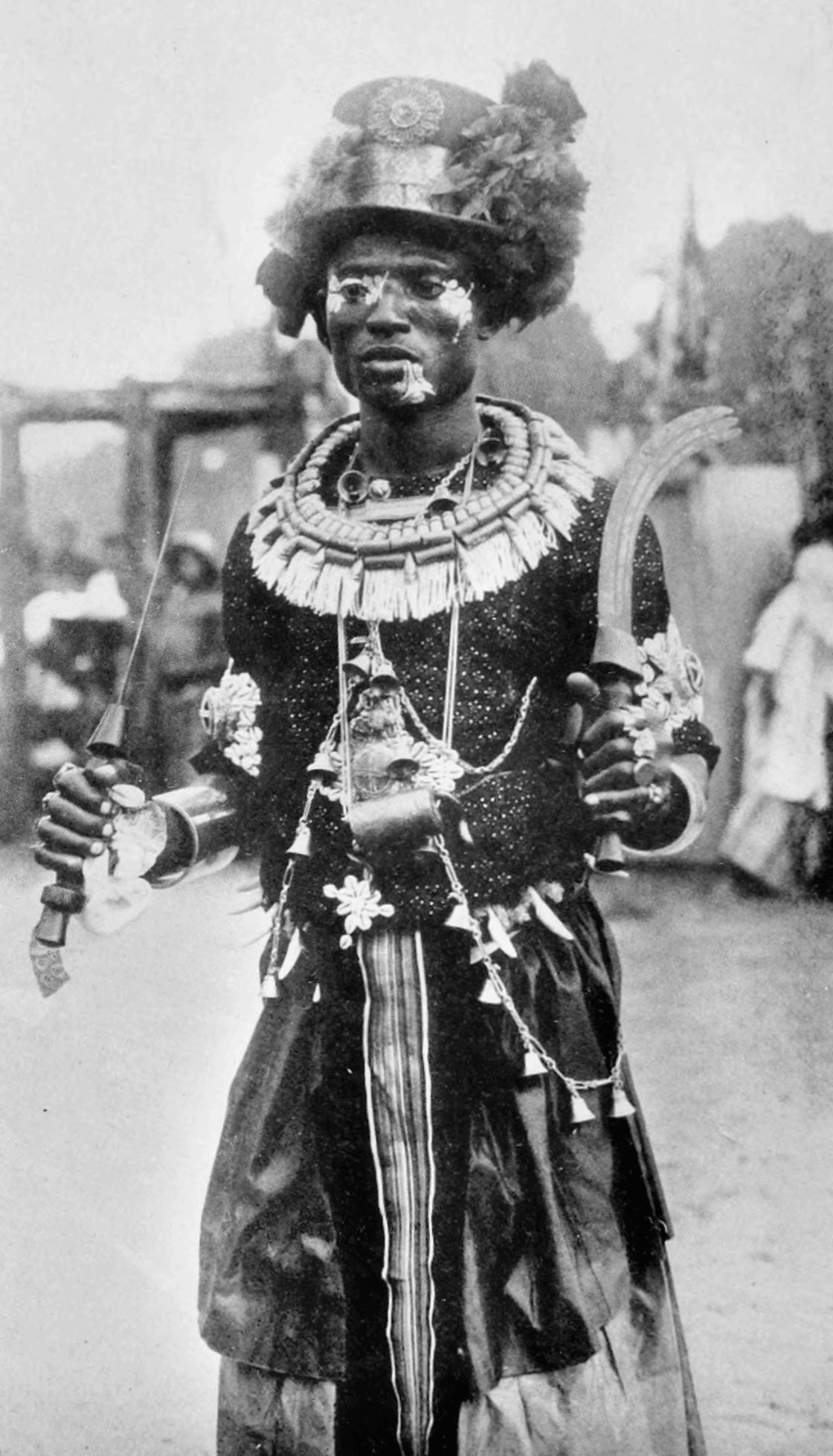
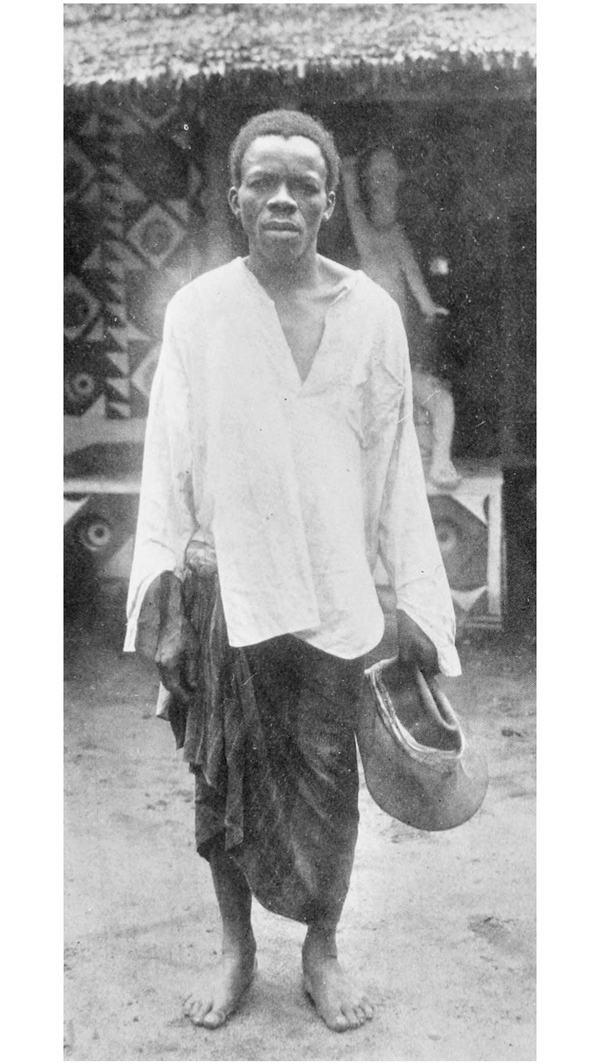
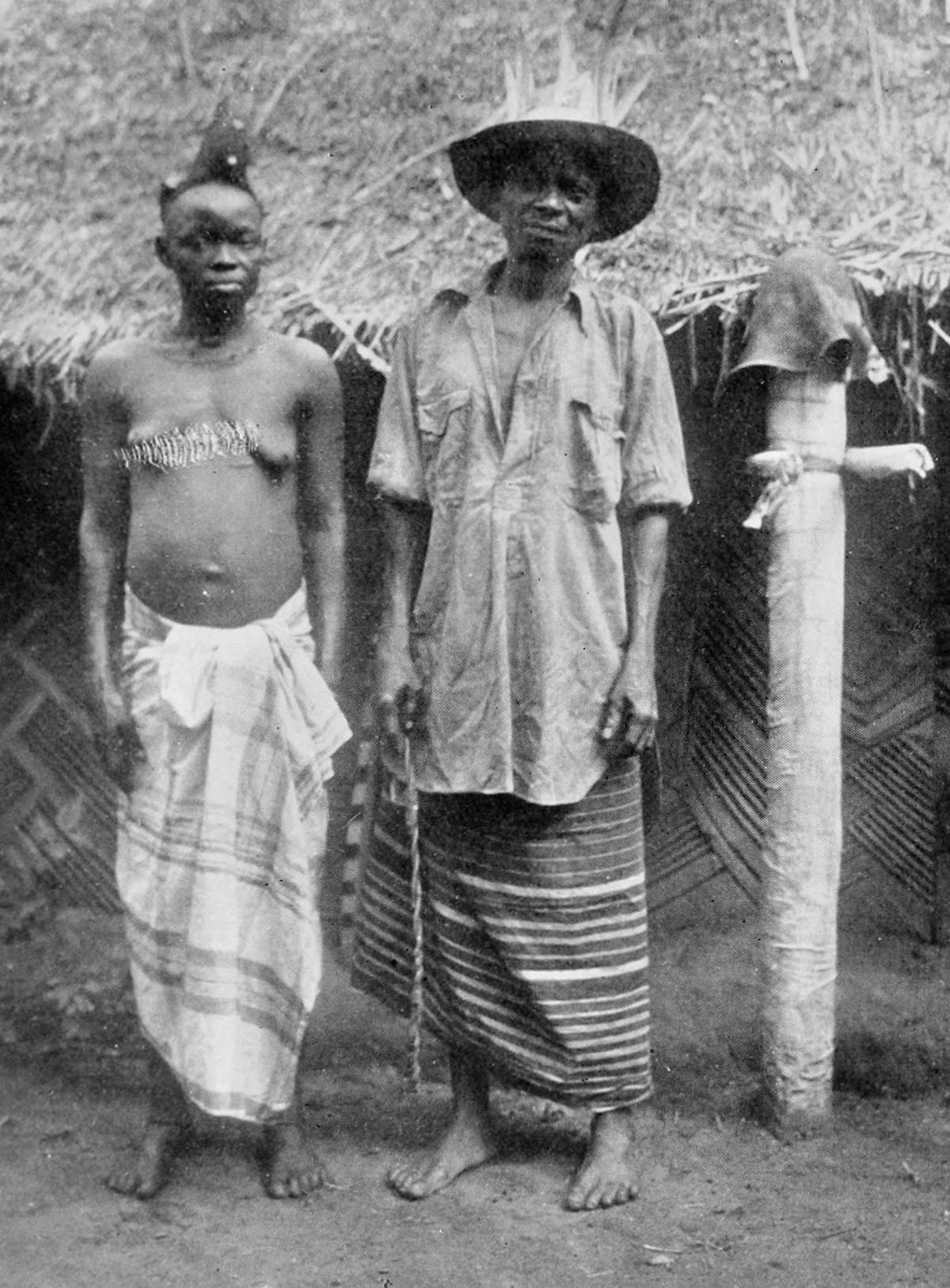
Omone, son of Chief Benebo of Buguma,
in the costume of the Peri play
iii
SOME NIGERIAN
FERTILITY CULTS
BY
P. AMAURY TALBOT
RESIDENT, NIGERIA
OXFORD UNIVERSITY PRESS
LONDON: HUMPHREY MILFORD
1927
iv
PRINTED IN GREAT BRITAIN BY ROBERT MACLEHOSE AND CO. LTD.
THE UNIVERSITY PRESS, GLASGOW.
v
PREFACE
The facts collected here are almost exclusively such
as came to my notice in the course of the ordinary
administrative work in Degama Division, to which I was
posted in June, 1914.
The region is mainly inhabited by sections of the two
great tribes of Ibo and Ijaw. A full description of
these will be given later, but it appeared best to
issue without further delay this little monograph,
dealing with a certain aspect of their religion, the
publication of which has already been long postponed
owing in the first place to the war and then to
pressure of other work.
As regards the remaining tribes, the subject will
be found discussed in other books, especially the
Ethnological Sketch, comprising the second
and third volumes of The Peoples of Southern
Nigeria, published by the Clarendon Press. The
descriptive parts in the following pages were written
by my first wife.
The outbreak of war seemed a favourable opportunity
for discontented natives to throw off the restraints
imposed by Government and return to old customs, and
disturbances occurred in various parts of Nigeria. One
of these took place in Aba District to the north-east
of Degama. We have since learned that the native name
for this region is Aba-Ala, i.e. Aba of the
Earth Goddess Ale or Ala. Here two messengers employed
by the Native Courts were seized and dragged before
the great drum, described as from 18 to 20 feet in
length, which stood in one of the Juju houses. Later,
reliable testimony declared this to have been one of
the principal shrines of the Earth Mother herself.
According to the account given us, the unfortunate
victims were forced to kneel at the end of the long,
trough-like base, from the centre of which the rounded
portion of the drum was carved, and their heads struck
off so that they fell forward into the cavity. The
drum was then splashed with blood and the heads, still
bearing the uniform caps, were placed thereon amid
the skulls of former victims as a defiance to British
rule, which, the insurgents hoped, was no longer
powerful enough to protect its servants.
Shortly afterwards, a policeman passing through the
region with a prisoner, whom he was bringing down 2to
Degama, was also seized and done to death. Vengeance,
swift and sure, followed these crimes. By order of
the Resident, the blood-stained drum was burnt to
ashes and justice meted out to the guilty persons. The
destruction of this fetish was an act of necessity,
since no other measures would have produced the same
effect upon its worshippers; yet the step was taken
with great regret, for the drum was of an interesting
type and most elaborately carved.
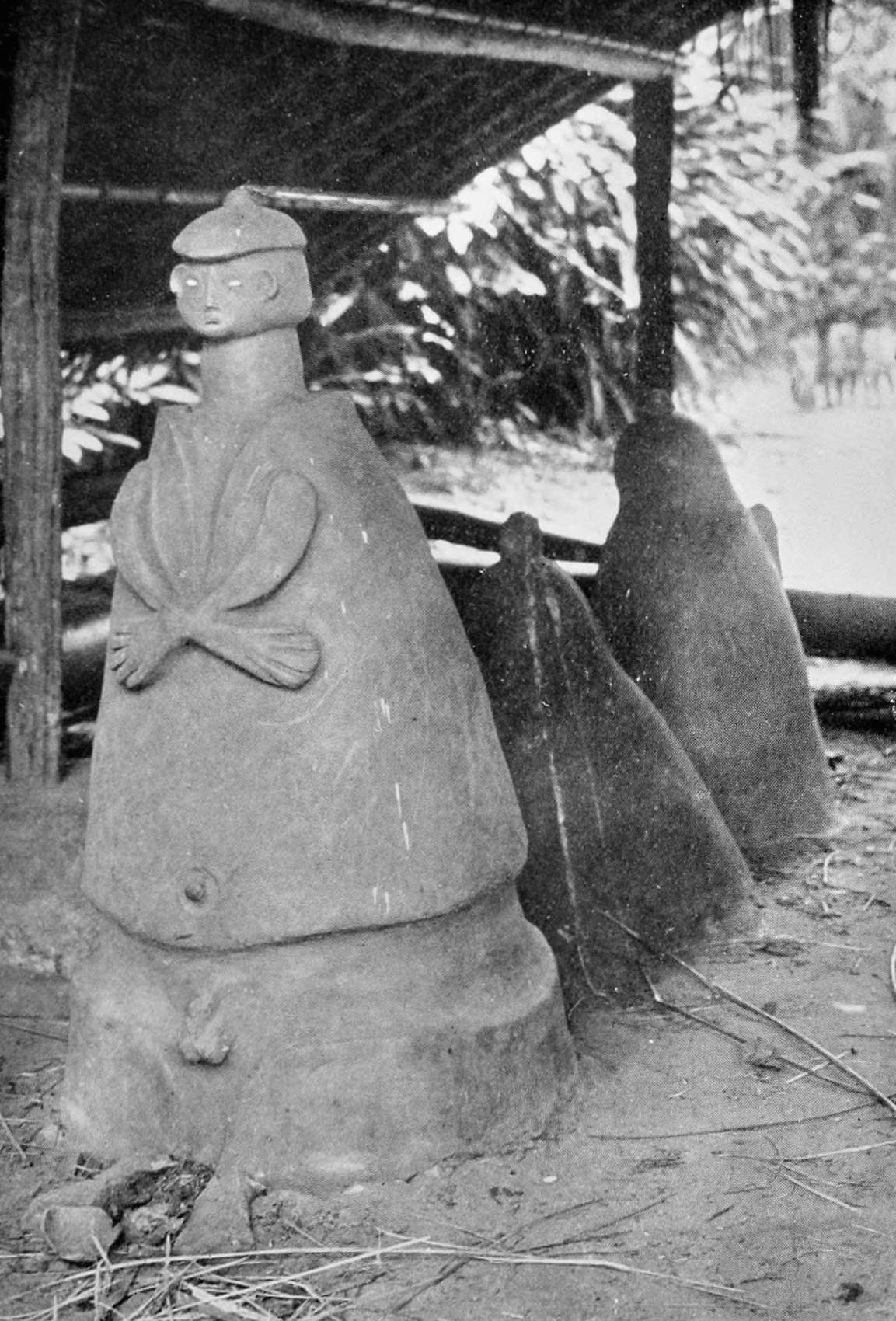
Some weeks later our road led us through the town of
Ihie, where we came upon a similar drum, of a kind
then new to us. Cleft from an even larger trunk than
the Ibibio big drum at Jamestown, to which it showed
some points of resemblance, the giant bole extended
at both ends in a Noah’s Ark-like base, on which
were seated, at either extremity, a male and female
figure—the latter holding a babe in her extended
arms. (See fig. 1.)
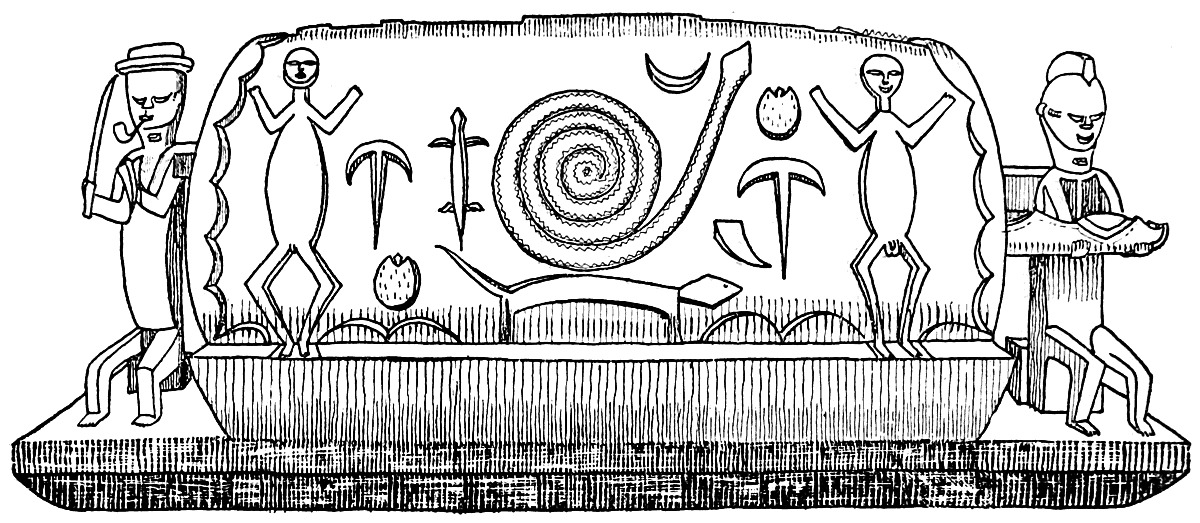
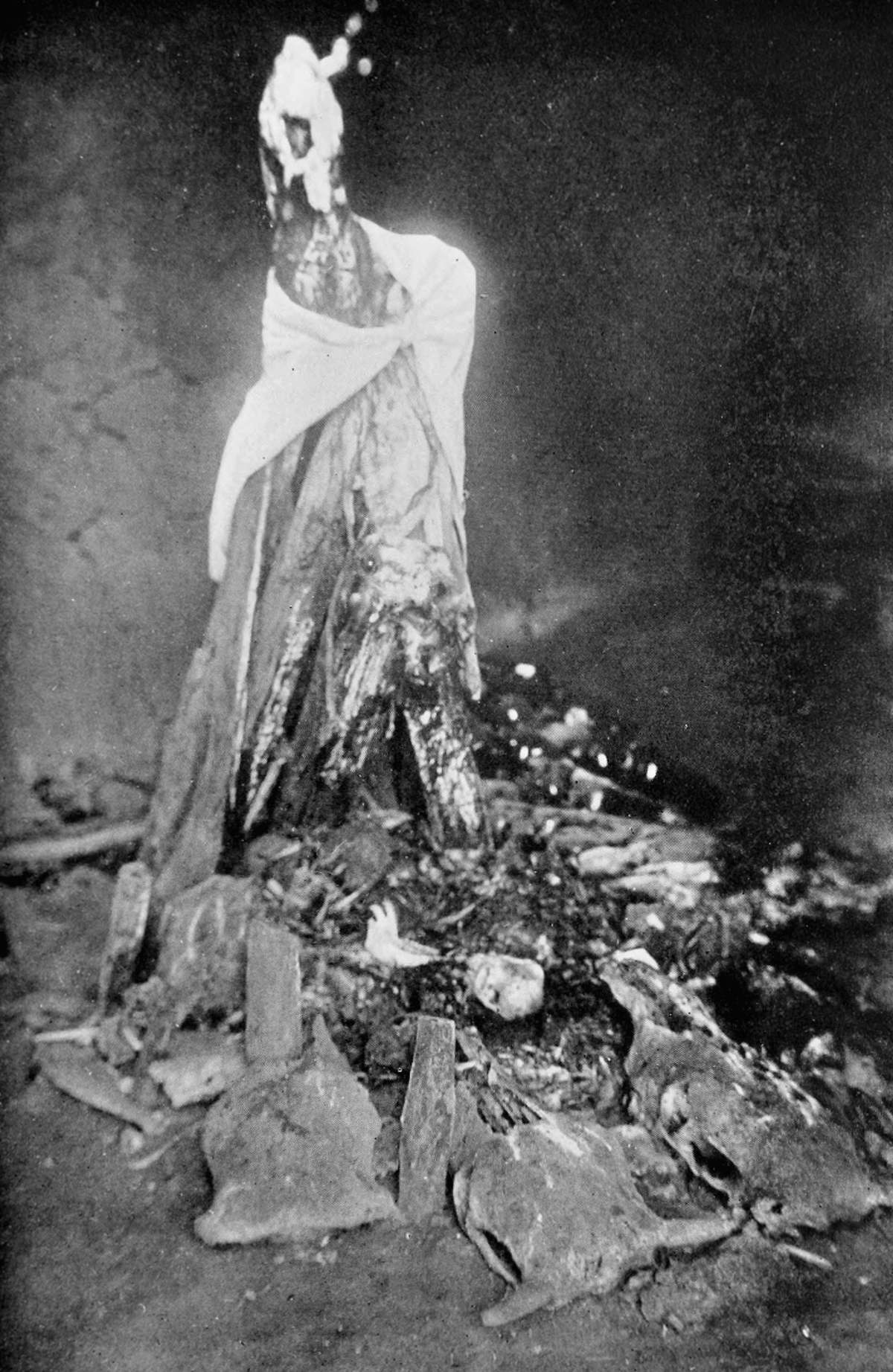
Fig. 1. Ikuru drum at Ihie
We were informed that the name of the drum, and of the
cult, was Ikoro (or Ikuru). One of the chief towns
devoted to its worship was Ohambele nearby. ‘This
town,’ in the words of Mr. B. M. Pepple,
has a big Ikoro drum which is highly respected. Before
Government came, they gave it human sacrifices, but
now only goats and fowls. They beat this drum during
war time. Any human head cut off in war is brought
and placed on the drum with blood. No man can see the
big Ikoro drum unless he has cut off a human head and
presented it to this. It does not matter whether the
head was got by war or not. The Ikoro play falls twice
a year. The first is called Mkpukpu-Chi (thanksgiving)
and falls at harvest time. The second is carried out
in the farming season, and is called 4Omehie Ogugu
(remembrance of the Juju Ogugu). Any man in the town
has the right to dance the Ikoro. The big Ikoro is
beaten in the house, while the dancers keep outside.
Those men, who had cut off a human head, would come to
the front of the big Ikoro house and play their motion
by raising the sword and telling of the brave deeds
they have done; then they would begin to dance again.
The Ikoro drum was never carried to another town.
Before the time of Government small towns did not make
an Ikoro drum. If any small town ventured to do so,
the big towns fought them and seized the drum.
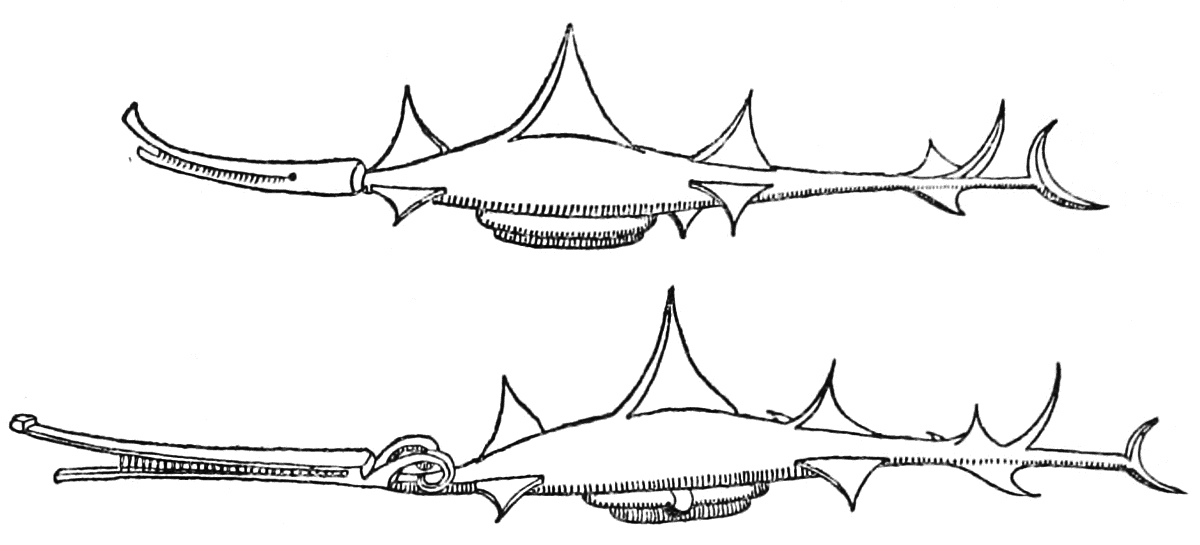
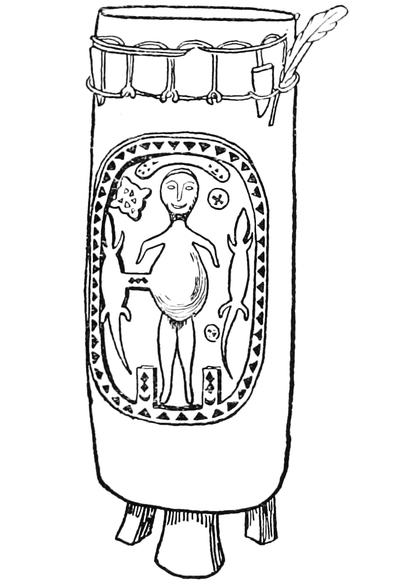
Detailed examination of the drum at Ihie showed that
the ornamentation carved in relief was of exceptional
interest. In the middle, between the figures of a
man and woman rudely enough represented and probably
depicting the carver and his wife, who were usually
sacrificed on the completion of the work, was the
carefully chiselled shape of a great serpent folded
round on round. On either side of this, various
symbols were to be seen, several of which were easily
enough recognised as the crescent moon, the sacred
crocodile, a Juju horn, and, what seemed to our eager
imagination, a fresh example of the double-headed
axe, but which was explained by the natives as a
musical instrument called, in Ibo, Igilla. The reason
why, on closer investigation, our interpretation
rather than theirs seemed to be the right one, will
be stated later. For the moment our attention was
caught by an object quite new to us, the meaning of
which we could not even conjecture. On asking its
significance we were told simultaneously and with like
positiveness from two different sides, one that it was
5a representation of the familiar tortoise, while the
other volunteered the unexpected statement that it
pictured the labia majora, with the clitoris showing
between.
Those who voiced the opinion first given asked
contemptuously whether it was not a matter of common
knowledge that tortoise played an important part in
the greater number of Jujus. On this, the second
party subsided for the moment as if abashed by their
opponents, but later one came in private to point out
that tortoise is depicted with the crossed lines which
indicate the cracks in her shell, whereas in this
case the small vertical dashes are the conventional
representation of hair. He further explained that
the opposition party was right to a certain extent,
in that tortoise herself symbolises the feminine
generative organs, just as the serpent is well known
to typify the phallus.
Till then, the presence of the impaled tortoise before
most Jujus, even remotely concerned with the granting
of fertility, had been more or less of a puzzle; for,
although the snake is recognised by anthropologists
as the phallic emblem, no widespread feminine symbol
of like significance appears to have been known here
hitherto.
The supremacy of tortoise in most tales of African
origin has often proved puzzling to folklorists.
The subject is mentioned in The Times Literary
Supplement of 10th December, 1914:
There is one very curious point which these and other
stories of the kind have in common—that though
these professional jokers, so to call them, have the
better of all 6the animals with whom they ordinarily
enter into a contest of wits, there is one ... who
always has the better of them all, even of the jokers
themselves—the tortoise. He appears under that name
in the translation of the bushman’s tales; he is, of
course, Uncle Remus’s Brer Tarrypin and he has no less
credit in South American stories. Why is the tortoise
credited with such wisdom? One wonders.... Is it just
this—that the bright little up-looking head and eyes,
when put forth, suggested the idea of intelligence? It
is something of a serpentine head and we have read a
piece of folklore which tells us that the serpent was
the most subtle of all the beasts of the field.
Surely the meaning of the tortoise symbol, stumbled
upon thus unexpectedly, goes far to explain the
difficulty. To the native mind the ‘serpentine head,’
appearing between the walls of shell, as naturally
pictures the clitoris as does the serpent its male
counterpart. By a train of thought not difficult to
follow, this particular part of the body has grown
to symbolise femininity in general. For Africans,
therefore, tortoise stands for the feminine qualities
of persuasion—sometimes, perhaps, not untinged
by guile—as opposed to the more forceful male
attributes. It may be remembered that, in Pliny’s day,
a powder made of a whole tortoise shell was thought to
be an aphrodisiac.
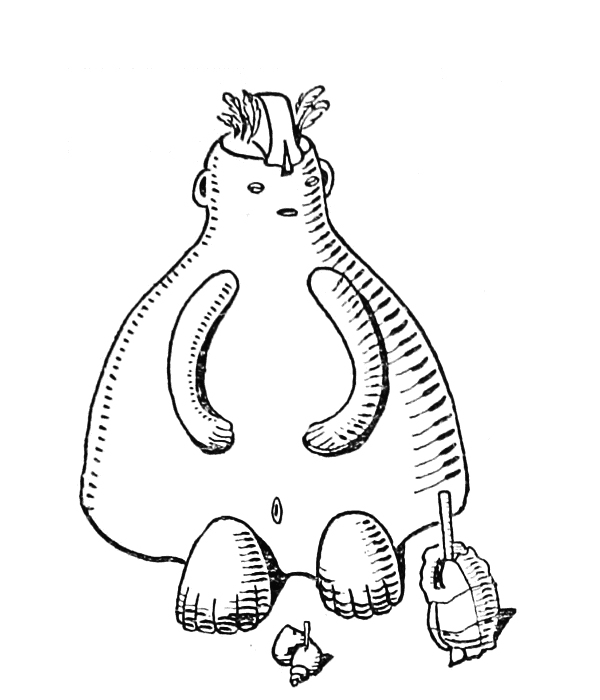
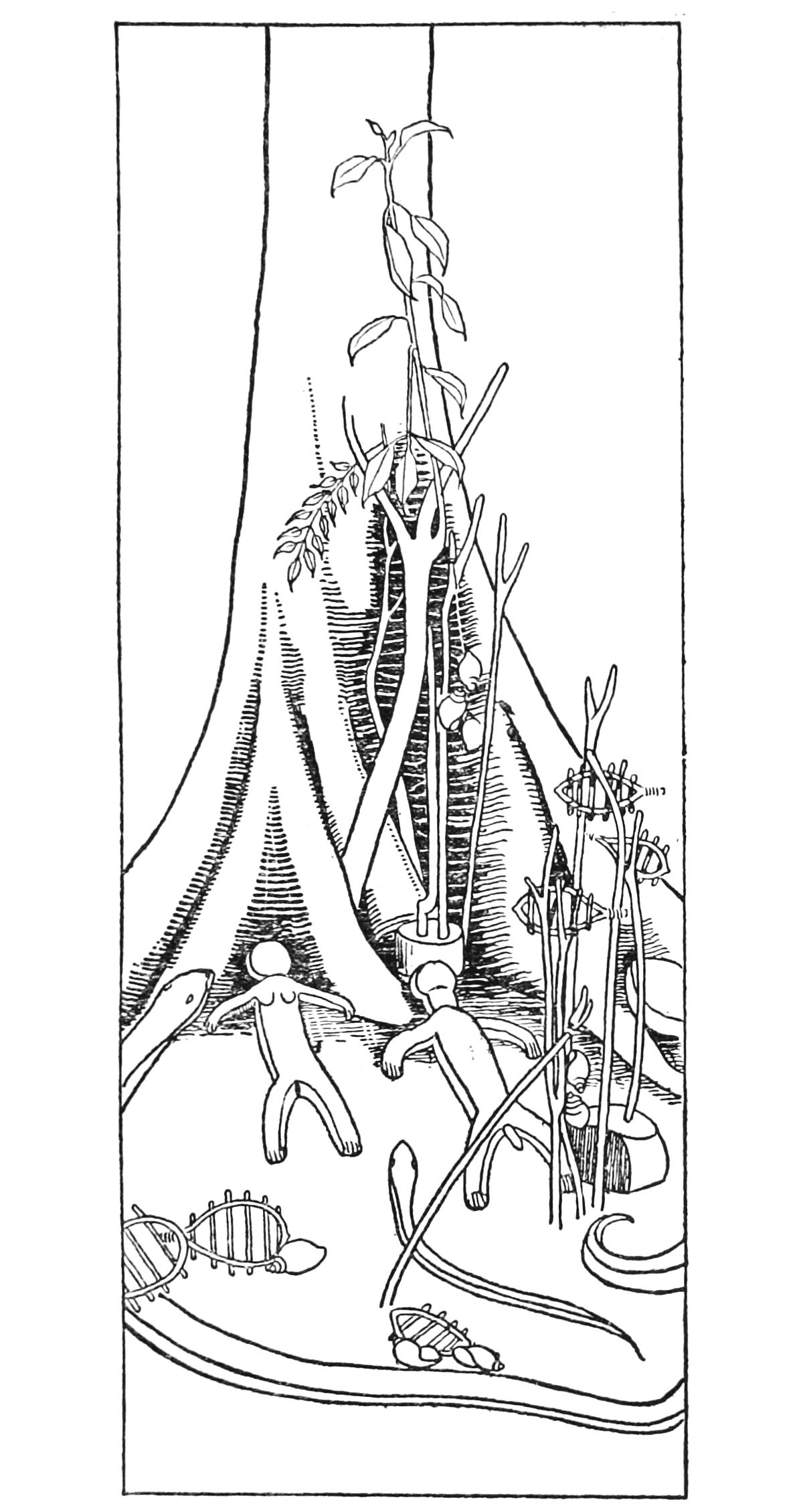
A few days later, in an Mbari house close to Okpala
market-place, the two emblems, snake and tortoise,
were found modelled side by side in the very centre
of the first row of symbolic figures. Further on at
Obogwe, where the Mbari house is built in two separate
sections—the first, dedicated to the Thunder 7God
Amade Onhia, usually contracted into Amad-ongha, and
the second to his spouse, the Earth Goddess Ale or
Ala—the phallic serpent was found in a position of
great prominence in the shrine of the male deity,
while tortoise was seen, modelled alone, in that of
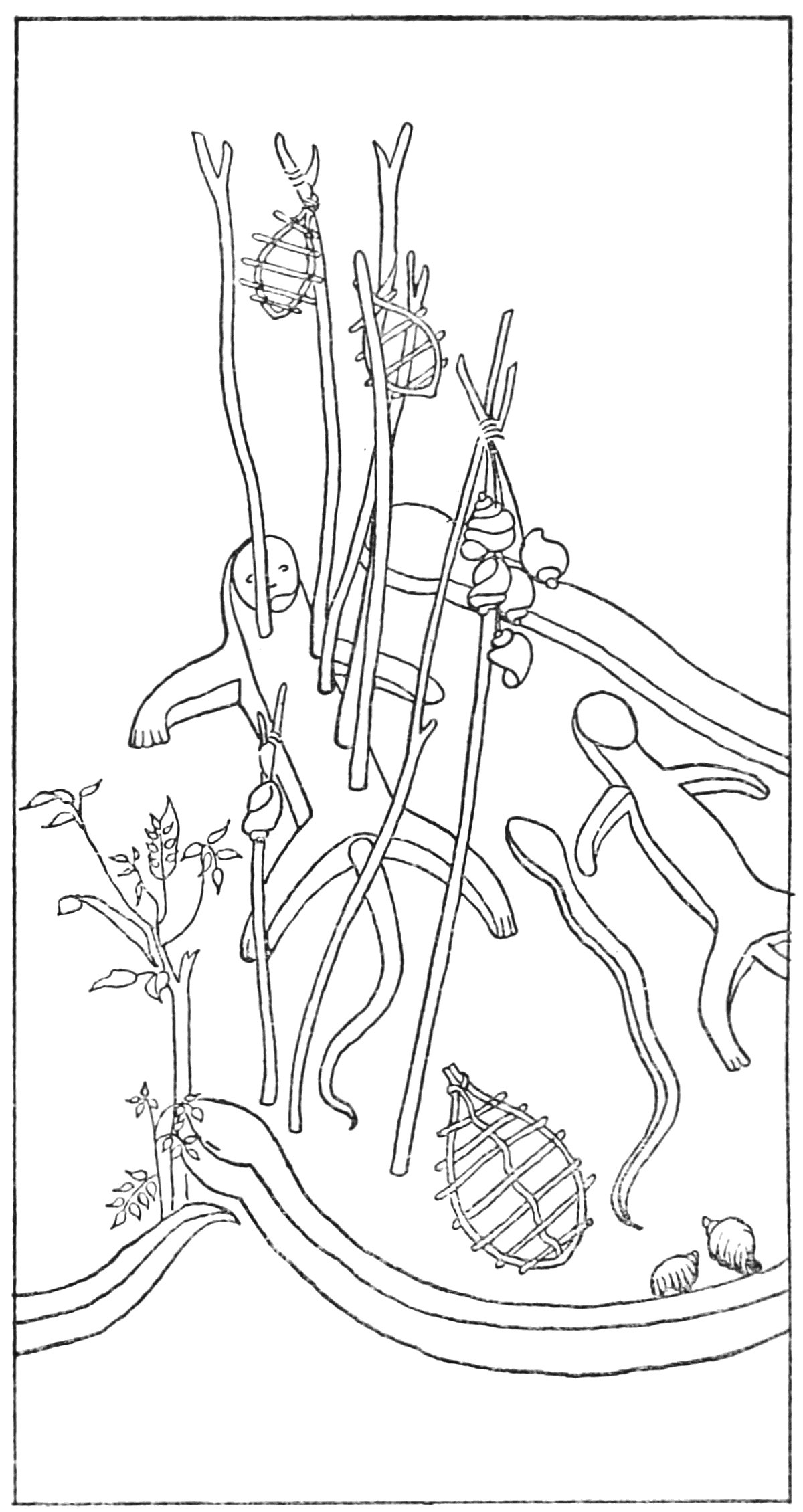
the goddess. Another example in which the two symbols
were found, this time again in juxtaposition, was upon
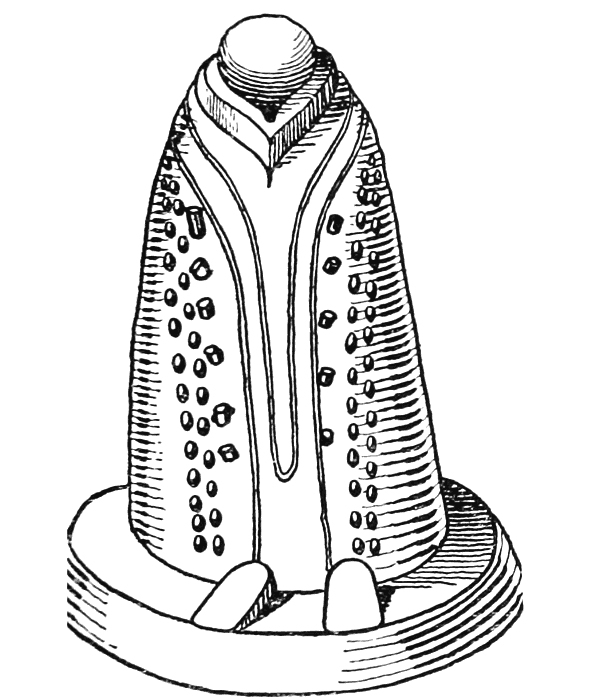
the main post of the shrine of the Juju Ogboloma at
Tema near Degama—one of the principal Kalabari Jujus.
Here, as so often, the two are combined with the
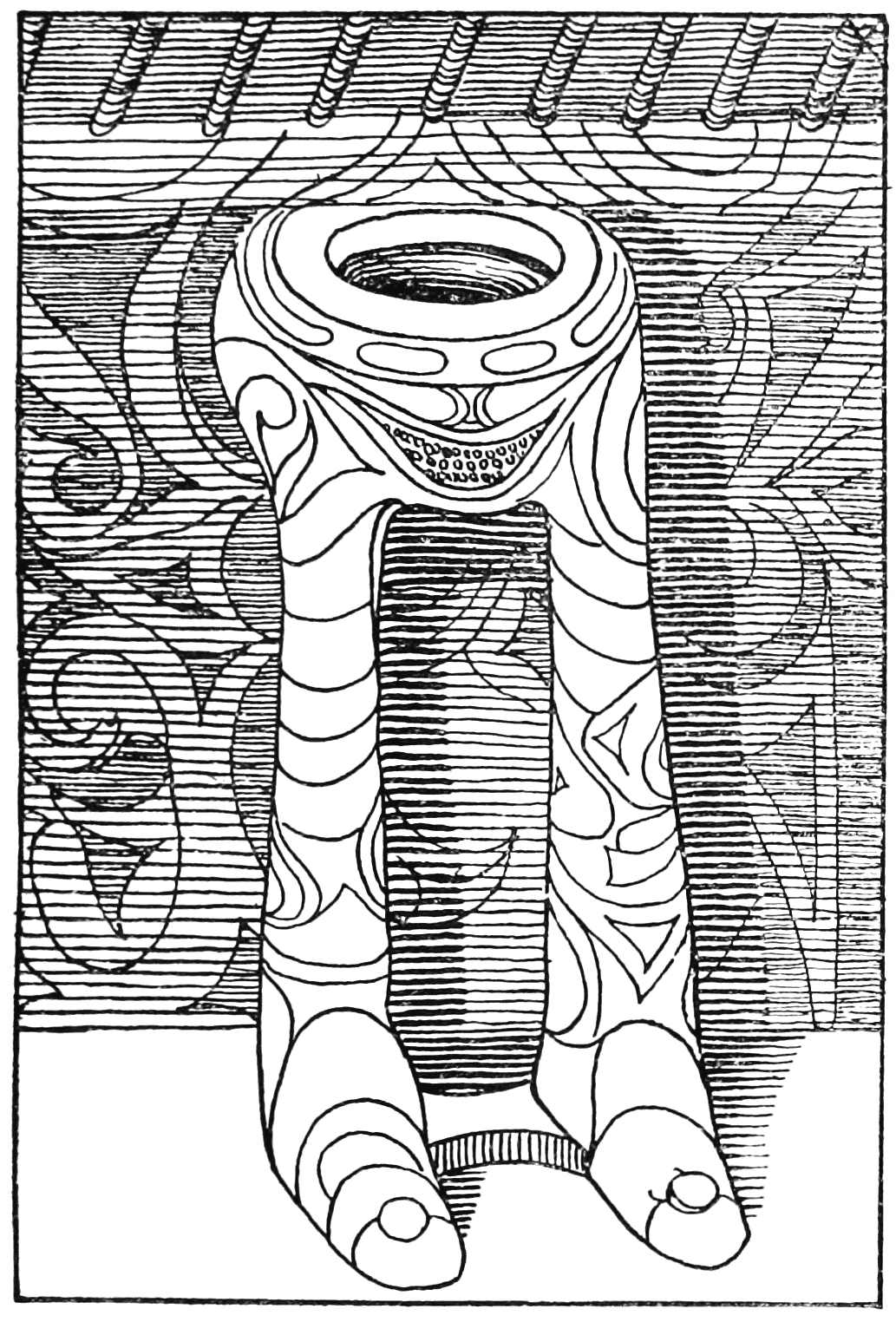
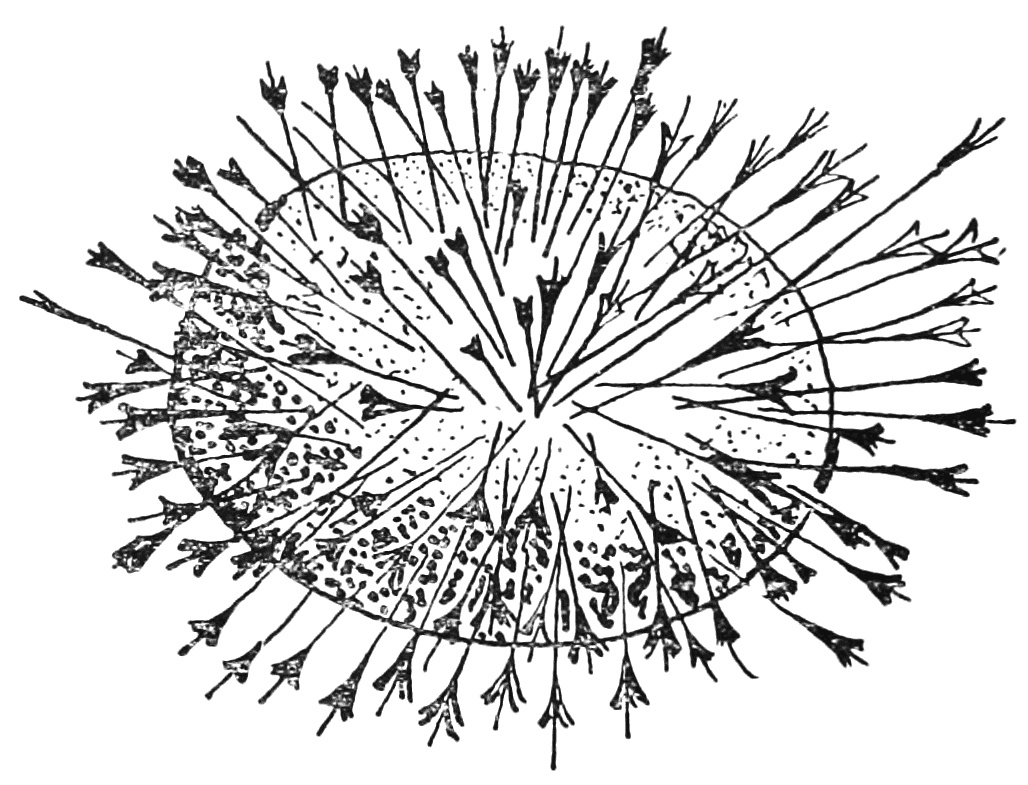
figure of the sacred crocodile.[1]
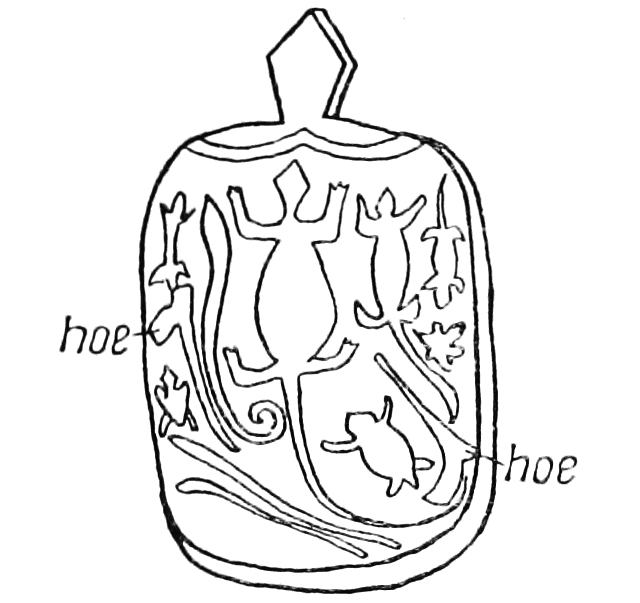
Fig. 2. Phallic serpent (Eke)
and tortoise (Naba), Okpala.
Fig. 3. Chief juju at Tema.
With the new suggestion in mind, the detailed drawing
of the sacred drum was examined, with the result
that the emblems carved thereon seemed to take
upon themselves a deeper significance. As already
mentioned, at either end of the trough-like base, sits
a male or female figure carved from the solid wood and
distinct from the drum. To the left, the male, bearing
8the symbols of manly strength, the sword in the one
hand and the horn, typifying plenty and masculine
virility, in the other. To the right the Mother—her
head adorned with the high coiffure which, among
Ibo, designates pride in offspring—a babe in her
outstretched arms. In the centre of the drum itself,
in the place of honour, carved in bold relief, is
shown the phallic serpent. To the left of its pointed
head rises the crescent moon—the world-wide symbol of
growth—especially connected with childbirth, since
expectant mothers count their time by its waxing and
waning.
On either side, in the one case above and on the other
below, are seen, twice repeated, the disputed signs,
in both cases in conjunction with the old Cretan
symbol of the union of the sexes—the double-headed
axe. That the native explanation of the last-named
figure was given in good faith, there is no reason to
doubt. It is only another case of the way in which
a symbol has survived long after the loss of its
meaning. Indeed, a certain similarity exists; but, to
those acquainted with native ways, I venture to think
that the sharpness of angle marked in the joining of
haft to head, instead of the easy curves called for
by a representation of the musical instrument, is
clear enough indication that the carver was following
faithfully, though blindly, in the footsteps of
long dead craftsmen whose work once bore another
significance. A considerable number of examples of the
old Minoan double-headed axe cult were found in other
parts of West and Central Africa.
9
Besides those already discussed, only three other
symbols are shown on the front of the great drum:
viz. (1) the sacred crocodile—the terrible emblem
of West Coast cults such as the Human Alligator
Society and the great Ekoi women’s secret cult of the
Nature Goddess Nimm. Possibly the crocodile sometimes
symbolises another plane of being or the future life;
it is a common belief here that many souls live in
crocodile form both during the life, and after the
death, of the human body. There may also be some
connection with the Egyptian worship of this creature.
(2) The horn placed beneath the double-headed axe, as
the so-called tortoise symbol is above—considered
so powerful an emblem of virility that even its
representation in bronze is supposed to excite desire,
and, held in the hand of a pregnant woman, to assist
delivery; and (3) the figure of a dog—regarded among
Ibo and Kalabari as the means of first bringing fire
to earth—possibly typifying the brute creation in
general, or at least that part of it which is friendly
to man.
Among some tribes, especially the Ekkett Ibibio, the
tortoise shell is looked upon as the symbol of the
Earth Deity, the goddess of fertility. The snake is
the chief phallic symbol, not only on account of its
shape but also because many species live underground
and are therefore taken to represent the dead, to
whose influence the fruitfulness of the crops is in
many places considered mainly due.
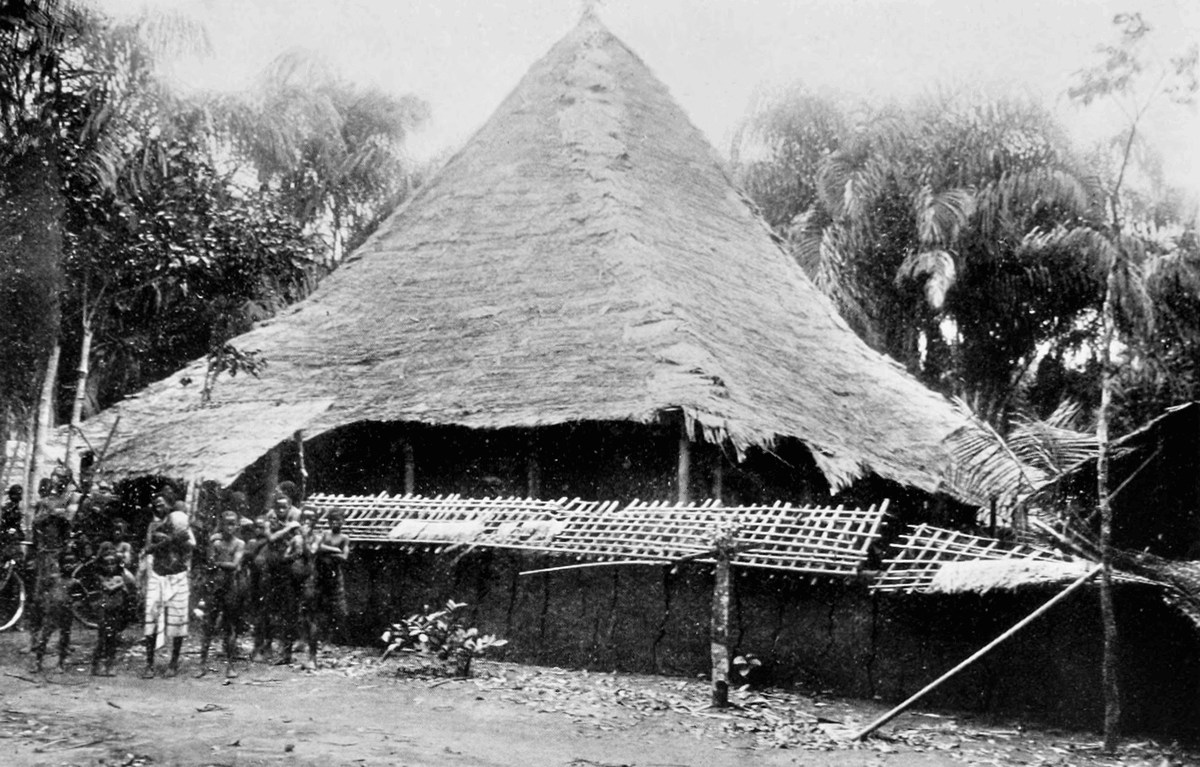
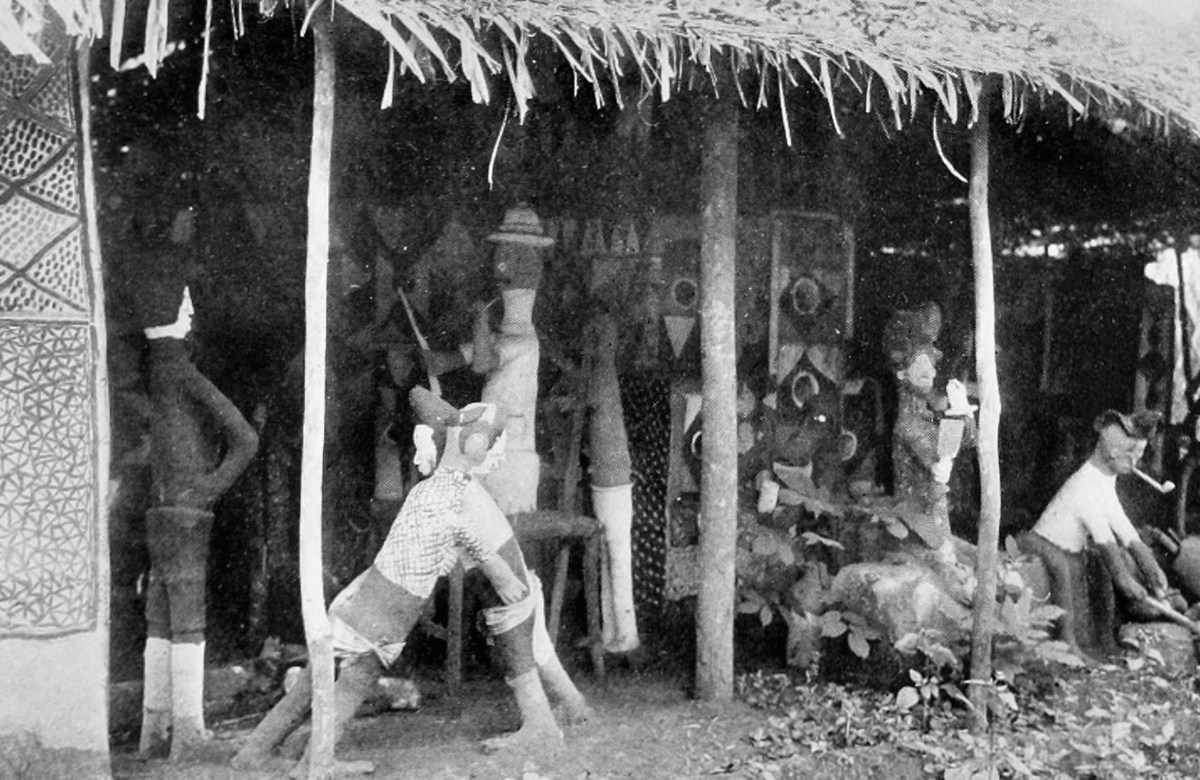
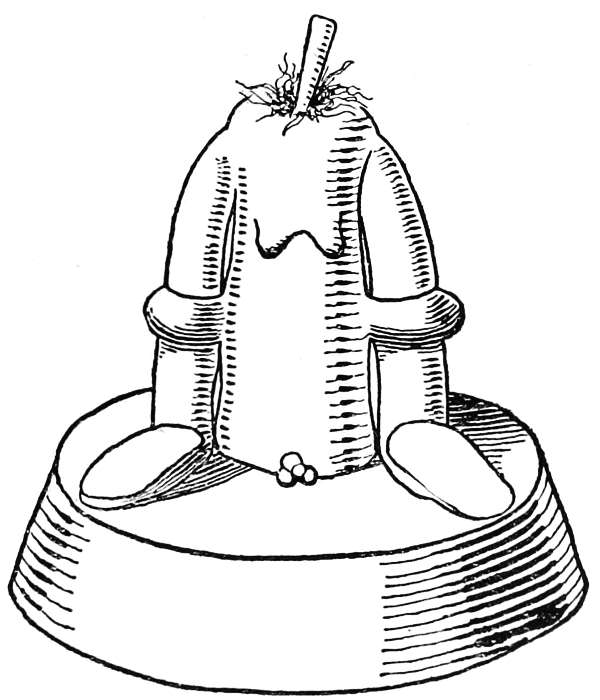
Fig. 4. Outside the Mbari
house, Omo Dim
10
II
MBARI HOUSES
From Aba, we passed through Omo Dim, in Owerri
District, to visit the Mbari house there.
According to Ababua, priest of Amade Onhia at Ibo near
Okomoko, the meaning of the word Mbari is ‘fine’ or
‘decorated.’
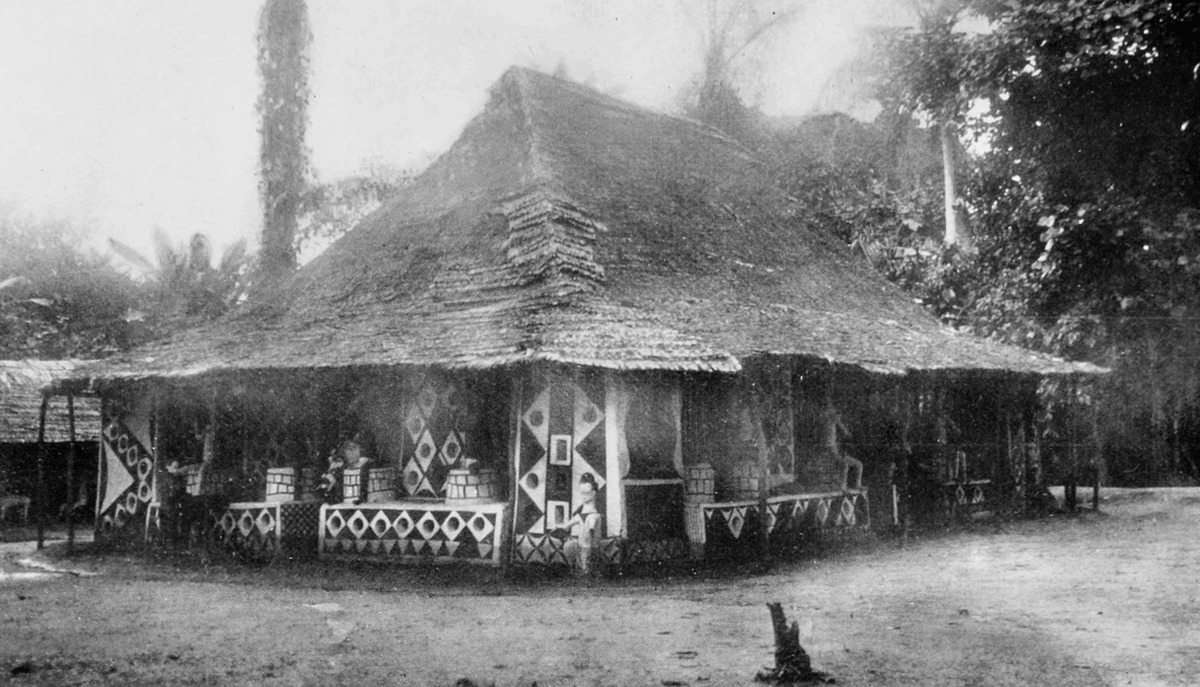
The central part of the strange structure at Omo Dim
proved to be a rectangular building with steeply
pointed roof and overhanging eaves, the latter so wide
as to make a broad verandah. The walls, forming the
central chamber, were painted with elaborate frescoes,
mostly in red and white upon yellow, or red and yellow
upon white. On either side of the main entrance to the
inner, sacred apartment were here, and in most Mbari
houses subsequently visited, figures so strikingly
like those of Omogwa and Otamelli, the two strangely
elongated guardians of the Thunderer’s shrine at Ibodo
(fig. 19), as to make it probable that all had a
common origin and were set there for the same purpose,
namely to warn trespassers from approaching the shrine.
To others the people had only answered vaguely in
reply to questions as to the purpose of the building:
‘We make it for nothing, only to please ourselves.’
The identity of the white figure at the top of the
ladder 11was explained, as a portrait of the District
Commissioner!
We were more fortunate, mostly on account of the
energy displayed by the interpreter, Chief G. A.
Yellow, a man of unusual intelligence, to whom the
reason of our enquiries had been explained and who
was far-sighted enough to wish to aid them by every
means in his power. By his persuasion an old chief
was induced to come forward and give somewhat more
information. According to his account the name of the
structure was Njokku Mbari, and it was erected in
honour of a great ancestor, long dead, named Njokku
and his wife Mbafor. The white figure at the top of
the ladder on the right of the building represented
Njokku himself and, as the chief artlessly pointed
out, the birds upon the rungs of the ladder showed
that this was the road by which the spirit of the
dead man had climbed to his place in the sky, whence
he now ruled as a great chief. The fact that he was
painted white signified that he was no longer an earth
child but had passed to the ghost realm, from whence
he watched over his descendants who brought offerings
at certain times of the year in order that he might
be gently disposed towards them and grant plentiful
harvests. As mentioned elsewhere, there is little
doubt that the word Njokku is the same as that in use
on the Nile, where Jok is the Dinka appellation for
ancestral spirits and the Lango name for God.
On the testimony of a considerable number of Ibo we
learned that no Mbari house is built save at the
12orders of, and in honour of, one of the great deities
worshipped throughout the Etche country and Owerri
District, namely Ala, Amade Onhia, Otaminni (the
genius of the Otaminni River) called, by the priest
of his principal shrine at the Etche town of Opioro,
‘The Lover of Ale,’ and Oloba, a spirit living in the
Owerri bush. So far as we could hear, the cult of the
latter is quite local.
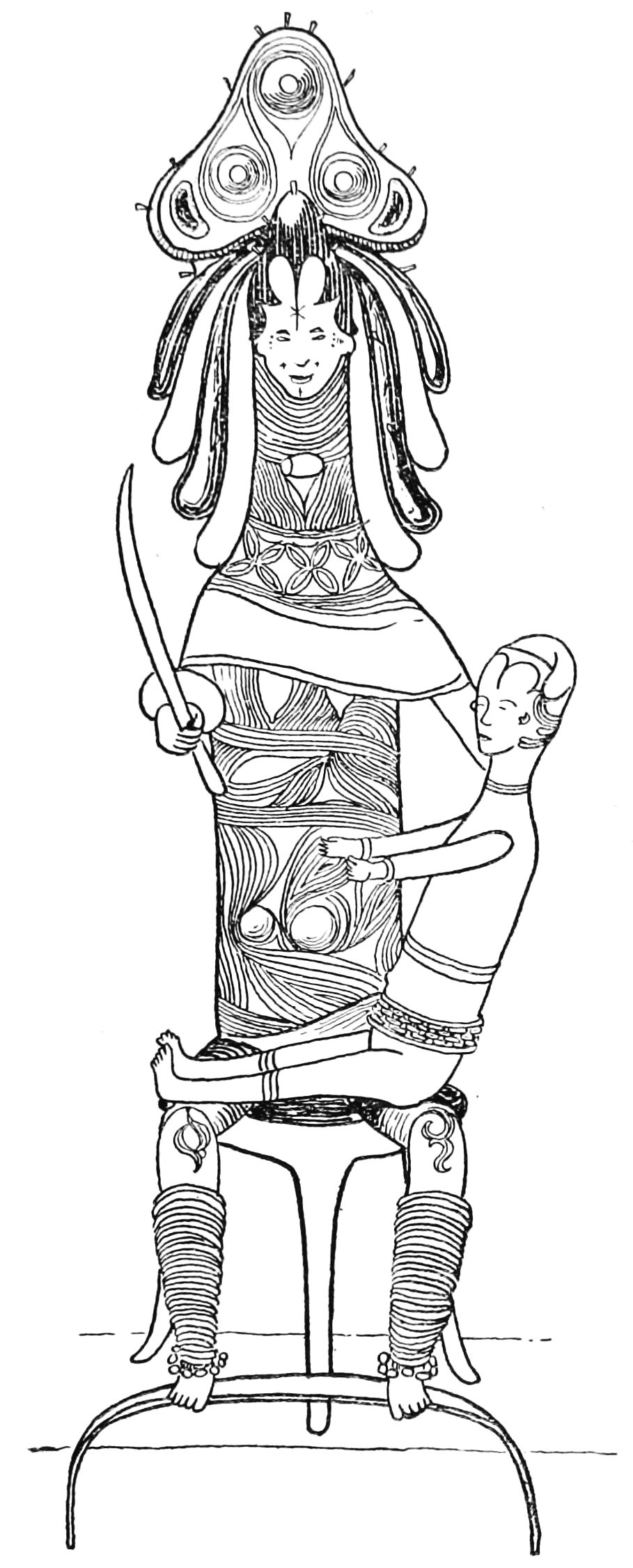
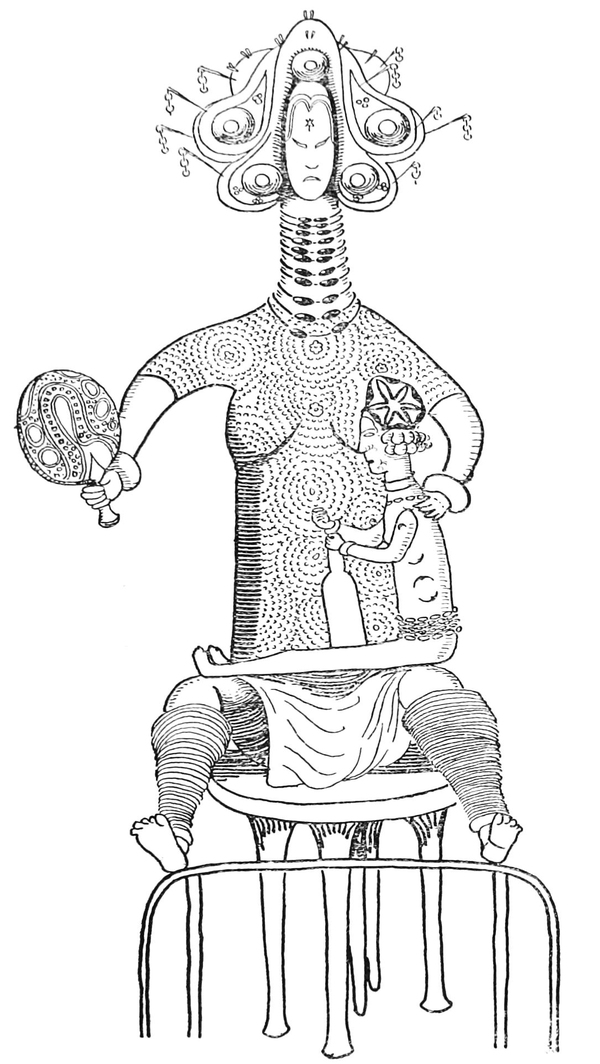
Fig. 5. Clay figure of Ale in
an Ibo Mbari house
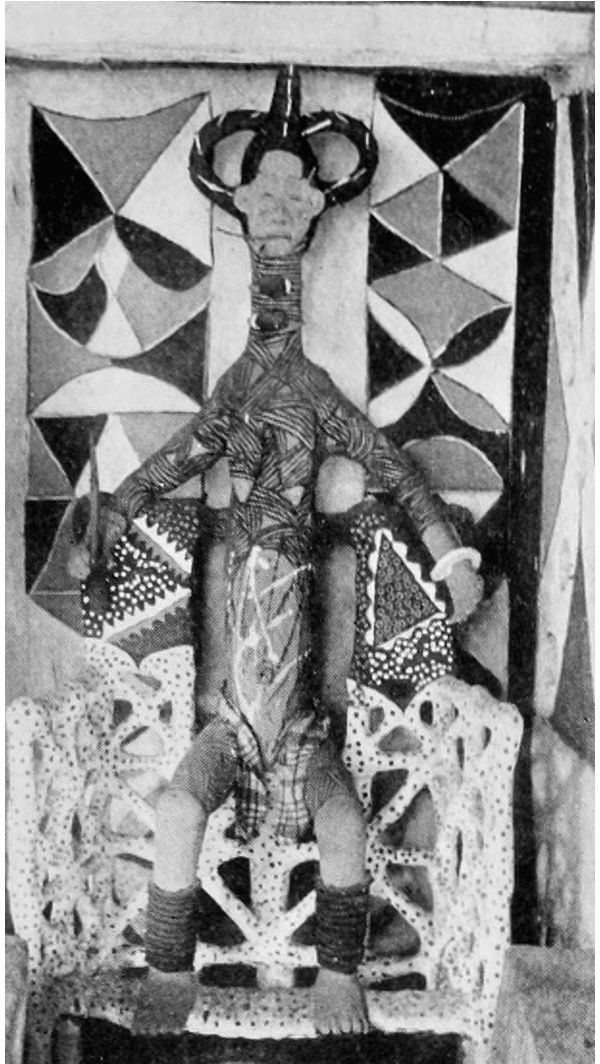
The more than life-sized figure, facing the principal
entrance to the enclosure, was explained by the same
chief as that of the ancestress Mbafor, with her
small girl-piccan on her knee. It was, he said, the
head priest of Ale, the Earth Goddess, whose shrine
is close to the Mbari house, who ordered the erection
of the building, chose out those who were to raise
it and himself directed every detail of decoration.
There seemed, however, reason to believe that the
figures of the so-called ancestors Mbafor and Njokku
really represented Ale and Amade Onhia, regarded, in
many parts, as consorts and jointly responsible for
the crops. The resemblance between the figures of the
deities, as here shown, and those admittedly meant
to depict the Earth Goddess and Thunder God in other
Mbari houses, is so striking as surely to be more than
a mere matter of coincidence.
It is indicative of the position of Ale that only
the head chief of a town can aspire to become her
priest. This is the case with all dominant Jujus;
for instance, Otaminni at Opioro and Amade Onhia at
Ozozo, the parent shrine of the Thunder God’s worship,
from which all other centres of the cult derive their
power. 14The following was the account given by the
Omo Dim chief as to the erection of the Mbari house:
‘At the time of the new yam harvest the building
is begun and, throughout the first part of the dry
season, men and women, chosen for the purpose by the
priest of Ale, work hard at beautifying and adorning
it.’ Only those specially designated for this purpose
may take part. Should anyone not called thereto by
the priest attempt to share in the work, death would
fall upon such unauthorised intruders as surely as
that which overtook him who, of old, stretched forth a
presumptuous hand to the Ark.
Before the making of new farms the house must be
finished and ready for the celebration of its strange
rites. Later, when the germs of the new season’s
crop—corn-grains, sections of yam-tubers and seeds
of pumpkins, great and small—have been confided to
the dark bosom of Mother Earth, men and maids of the
region gather together bringing gifts, ‘rack upon rack
of dried fish, goats, sheep and fowls without stint,
palm-wine in plenty and all else needed for a great
feast.’ Of the maids, who have undergone initiatory
ceremonies, a certain number are chosen by the Ezale
(head priest of Ale) to act as priestesses for the
rites about to be held in and around the Mbari shrine.
As to the nature of the ceremonies, the natives were
naturally reluctant to speak; but Mr. Whitehouse,
a former District Commissioner, in a short account
published in the Journal of the African
Society,[2] declares 15them to have been of
licentious character. Subsequent enquiries confirmed
this, and the nature of the rites is borne out by the
groups of clay figures set both round the central
shrine and beneath the roof depending from the inner
side of the wall, which encircles the whole erection
cloister-wise. These images represent, with remarkable
fidelity, the life-cycle of bird, beast and human
being, from the act of procreation—depicted with
astounding naïveté—to the lying down, when life is
done, for a last long rest in the arms of the Earth
Mother.
It is noticeable that, though beasts of prey play a
great part in the series, as is only natural under
the conditions here prevalent—such, for instance, as
leopard or hippopotamus devouring human beings—these
fierce beasts are shown either as destroyers or as
falling beneath the weapons of the hunters, never in
the propagation of their kind. Harmless or useful
creatures, on the other hand, such as fowls, both
wild and domesticated, dogs, sheep,[3] etc., together
with human beings, are depicted first in the act of
procreation, secondly that of giving birth, thirdly
suckling their young and later in every conceivable
scene of life. Men are modelled as engaged in hunting,
fishing, canoeing—as police, court messengers, clerks
or musicians. Women are shown grinding cam-wood,
arranging elaborate coiffures, undergoing operations
of extreme delicacy from native doctors—every act 16of
life indeed from cradle to grave, and even beyond,
here finds itself reproduced.
The following account of the raising of an Mbari
shrine was given by Amuneke of Umo Yekki quarter,
Owerri:
There are many such houses in our part, and they are
starting to make a new one, in honour of Ala, this
month (October 1915) in my own quarter. First of all,
when she, Amad’ongha or Otaminni, wish for a new
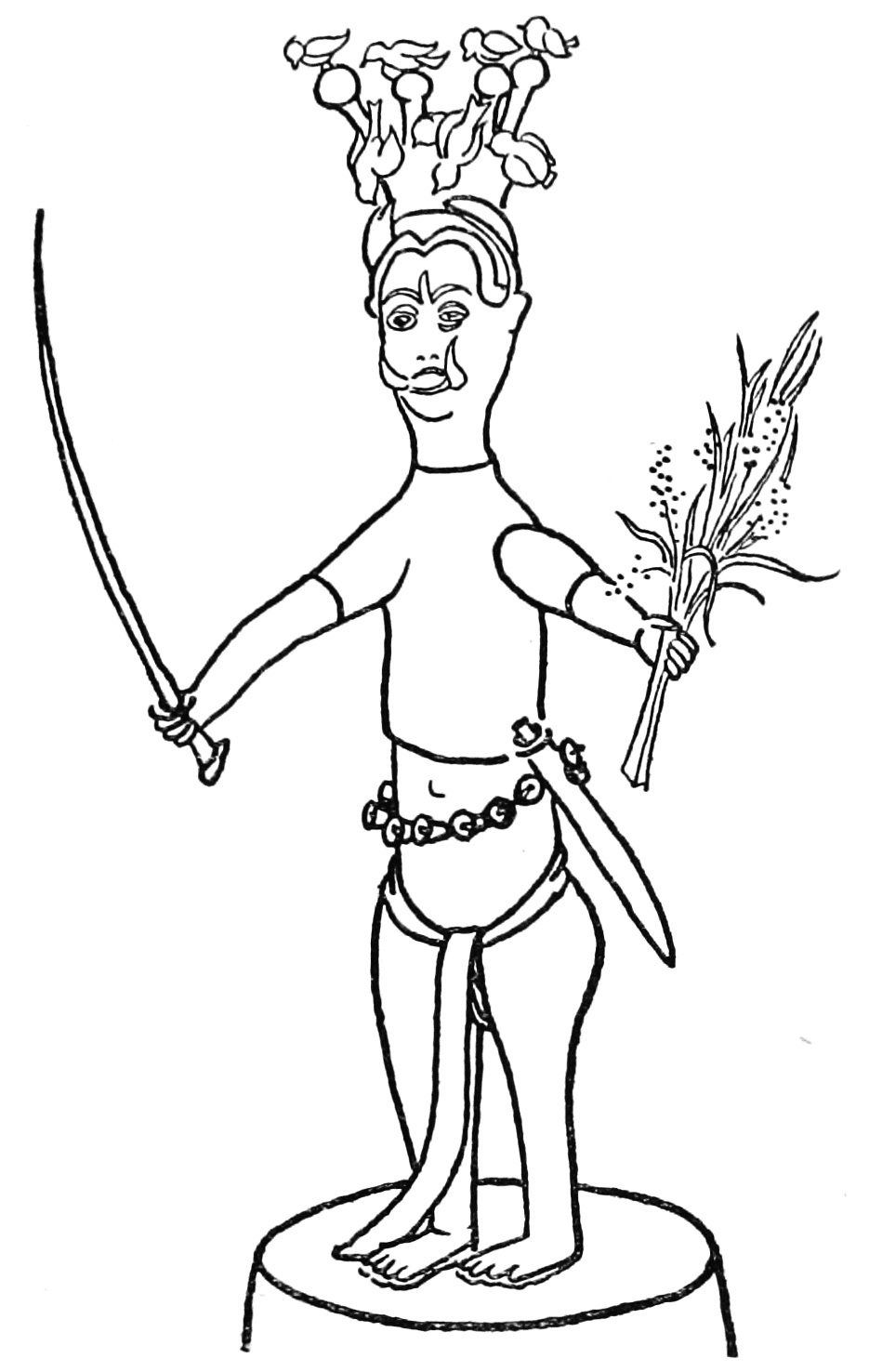
house, they send a messenger called Abara.[4] This is
a sort of devil, very dreadful to see! In his hand he
carries a sword, because he is not only the messenger
but also the executioner of Ala. The image at Omo Dim
is made with birds perched upon the four horns on his
head to show that he is of the Sky People and is often
sent by Amad’ongha. The grasses in his hand show that
he is also a servant of Ala.
He goes straight to the compound of the head chief
(who is always priest of one of the four great cults
already mentioned). Ordinary people are not able to
see him; only Juju people can do this, but all hear
the place shake as he enters. So soon as the chief
knows, from this shaking, that the messenger has come,
he sends to a native doctor who goes into the little
shrine, where he talks to the spirits, and starts to
beat drum. This is a sign to Abara that he is ready to
hear the message. When the devil appears, the Juju man
sees him clearly, listens to the commands he brings
and reports them to the people, saying: ‘The Juju
asks for an Mbari house to be begun on such and such
a day.’ Then the head chief chooses out those who are
to do the work, four men and three women from each
compound. These go out secretly at night time so that
no man may see them. If a strong Juju orders an Mbari
house to be built and the people 17do not obey at once,
then at least twenty men from that quarter will die.
Fig. 6. Abara, the Messenger
of Ale and Amad’ongha or Otaminni
Before beginning to build, they make a high fence
round the place so as to hide up the work they are
going to do. Then they start to make a long house,
called Eki-Wari,[5] in which to sleep. Across the
middle of this a line is drawn.18 Men sleep on the one
side and women on the other. It would be regarded as a
very bad thing should a woman permit a man to approach
her at this time.
From the moment of starting the work till it is quite
finished, even if it lasts for a year, no one may go
home again, save the one man chosen from each compound
to fetch food every day. That is why four men are
always chosen to every three women; because one is
needed to go backwards and forwards on ‘chop palaver.’
During all the time that the workers live inside the
fence, they are forbidden to eat coconut, palm-nuts
or cassava. Only cooked yams and soup may be eaten.
Also, they may never sleep at night time, only by day.
This rule is made because no one must see them when
they go out to get the clay from which the figures are
formed. This must be taken from the centre of a white
ant hill, softened with water and carefully kneaded.
No other clay is permitted to be used. So soon as
darkness falls, they must begin to work and keep on
till just after sunrise.
When the building is finished, on a day appointed
by the Juju, all people, whose sons or daughters
have been working, make ready for a great feast.
After nightfall, they go to the Mbari house bearing
a new-made pot. This must be one never before used,
filled to the brim with clear water. Also they carry
a cock for every son and a hen for each daughter.
All their kinsfolk follow them up to the fence which
hides the workers. Only the fathers and mothers may
go inside, while the rest of the people wait without.
Each couple steps, one after the other, in order of
rank, together with the priest, before the big Juju
set in front of the main doors. There the Juju priest
kills a fowl and mixes its blood with water in the
new bowl. Then, with a small wooden spoon, he throws
some upon the head of son or daughter and pours the
rest upon the great image to whom manillas are also
offered. 19At this point the father says:
‘Ubu
anyi
abiala.
Bia
ikpe
ogu.
‘Now
we
are coming.
Come
judge
matter.
Anyi
agi
oku
awsaw
ade
pa.
We (i.e. between us)
you
words
again
are
no(t).
Anyi
emena
nhie
icheri.
We
have done
things
thought your.
Ubu
anyi
abiala
bia
ekpaw
nwa
anyi.
Now
we
are coming
come
to take
son
our.
Oku
awsaw
adr
pa.’
Words
again
are
no(t) (i.e. all is finished).’
After this the mother says (for a son):
‘Ubu-laka
nhie
oma
ka
ega
enyi
anyi
na
nwam
‘Now
things
good
you
are going
to give
us
and
son my
makana
ihie
oma
onu
oma
onu
nagi.
Nam
na
because (he has done)
things
good
work
good
work
for you.
I
and
dim
na
ji
unwenne
na
omu
umonu
na
ewu
husband (my)
and
yam
I have
and
children
I born
and
goats
mwenne
nhie
oma
ka
anyi
ega
anhu
afor
anhua.’
I have
things
good
make (for)
us
go
see
year
this coming.’
For a daughter the mother says:
‘Aborolam
nwam
obi
oma.
‘I am taking my
child (with)
mind
good.
Mejiea
na
mejieadia
Give gifts to her
and
gifts to her
husband (for)
onu-ma
ka.
Aronona
ge
anyi.
Mfu
ga
ezi
ubu-laka
work good
your.
Have worked for
you
we.
If (I)
go
out
now
afu
na
nam
nhie
ojo.’
finished
for
me
things
bad.’
So soon as the last word ‘ojo’ has been spoken, the
priest seizes son or daughter and pushes him, or her,
towards the parents who at once catch hold on either
hand. All three walk backwards towards the
gate. As the first foot strikes the threshold, they
face round and the relatives waiting outside catch up
the worker without an instant’s delay and bear him
back to his home. No foot of any such may be set to
ground, lest Ala should be vexed.
When they reach the house all join in a great feast,
with fish of every kind, plenty beef and tombo too
much! That 20night the people tear down the fences,
which were put up to hide the work, and burn them in a
very great fire.
Those years, in which a new house is built, the yams
grow bigger in our farms, goats and sheep have more
piccans, while nearly always the girls chosen by the
Juju for her work bear babes fine past those of other
mothers. Usually they conceive soon after the work is
finished—often within one or two moons of the play.
About every five or six years a new Mbari house is
raised to Ala. She has more than any other god. Next
in number come those built for Amade Onhia and still
less for Otaminni and Oloba. I have never heard of any
such house being made for the ancestors, as was said
to be the case at Omo Dim. This may be true for that
part; only I know nothing of it.
It is in the little inner room that the god lives. In
each of these a tall stone, shaped like an Ibudu, is
set. After making its face smooth and clean all about,
they cover it with a piece of white cloth. It is into
this stone that the spirit enters.
Suppose one man charges another with doing bad things.
Then they bring the accused for night time and lock
him up alone in the small inner room. Next morning, if
he be innocent, he walks forth unharmed; suppose he
be guilty, then Juju kills him and his dead body is
carried out at dawn. Perhaps Juju beat him to death,
perhaps kill him other way; but always he die. No help
for such man.
When a big pointed stone is found in our bush, an
Mbari house is always built for it. In places where
such things are, the knives, with which the old people
made them, may be dug up out of the earth. I myself
found one such knife at Baro. It was of very strong
stone, hard past iron and curved over in a sharp point.
At Olakwaw near Owerri one very big stone was found.
They carved it into an Ala figure and built a house
for it. This they put in the place of honour,
facing the big door. Also at Ne-Ewu and Ihuara in
Owerri District there are stone 21figures of Ala,
Amad’ongha, Okpara Ala (the first born son of the
Earth Goddess) and Eke, the great snake. This is the
kind of big snake which lives for bush and always has
a shining stone in its head, such as white people call
diamond. It is because of these serpents that Eke day
is said to take its name.
Fig. 7. Girl ’Mgbe, Otaminni
house, Opioro
Fig. 8. Humorous figures
Images of Ale and Amad’ongha may be carved out of
stone or moulded in clay, but must never be cut from
wood like the Agu Isi (i.e. wooden images
consulted by native doctors): for so the Juju orders.
Ala has other sons beside Okpara Ala.[6] Among
Etche Ibos and those of Owerri the younger sons are
worshipped every month, four days after the coming of
the new moon. They are represented under the shape of
small cut stones such as were taken from the bad Onye
Dibia (medicine man) at Awka. These stones are always
kept in one of the round box stools, rubbed with
cam-wood. The medicine man sits upon the box, then
rises and shows the stones to the people who throw
themselves upon the ground before these, praying for
piccans, kids, lambs and yams. These sons are never
represented in any other shape. No figures of them are
to be found in Mbari houses.
Sometimes we call these buildings Mbari, sometimes
’Mgbe. This last word means a small boy or girl
orphan. There are two kinds of ’Mgbe—those who have
relatives to look after them and those who have none.
We call the latter Osu ’Mgbe, i.e. the worst
’Mgbe. He is so very poor he can only get food by
searching round the bush for palm-nuts. For this
reason his image is nearly always made with palm-nuts
in hand.
In olden days such a boy was always bought by one or
other of the quarters and presented as a slave to the
Juju. Afterwards he might never enter the compound
which bought him, but could go to beg food from
others. Sometimes, when he has grown big enough, he
makes himself a 22little house in one of the corners of
the Mbari. Then people bring yams to him. Sometimes
too the Juju asks for chop for him. If the Juju loves
him very much, it will also ask one of the chiefs to
give him a slave wife; but such a boy may never marry
any free-born girl of the town. The same rule holds
for girl orphans bought with money and given to the
Juju. They may take slave husbands, but never marry a
free-born man.
Another figure to be seen in every Mbari house is that
of the ape Ogbango. This is the kind into which the
souls of bad Ibo go after death.
In the Western Etche country these temples are
generally called ’Mgbe houses. Umoyo, the principal
place hereabouts, is a queer little town—or rather
two towns—through which runs a single long street,
fenced in on either side by a palisade of posts and
palm-leaves. The houses lie well back, often out
of sight from the main road, in gardens which bear
luxuriant crops. At the end of the street stretches a
line of cacti to keep out evil influences.
Fig. 9. Shrine of Otaminni,
Opioro
The head chief Wobilo was friendly to Government,
and we had hoped to gain from him a considerable
amount of information regarding the origin and rites
of this singular cult. By an unfortunate accident,
however, some of the principal men of the town had
lately been drowned in the Juju water formed by the
sacred Otaminni River just below its junction with
the Ogochi. No sooner were the sad tidings made known
to relatives and friends than the whole town turned
against the head chief, saying that the deaths lay at
his door, because he had induced them to undertake
the journey which resulted in their untimely end.
23In consequence, Wobilo found himself outcast in his
own town and, when on our next visit we asked a few
questions concerning the figures in the local ’Mgbe
house, the chief refused to run the risk of increasing
his unpopularity by giving away information, and we
were everywhere met by the answer: ‘I do not know. We
did it for no reason. Perhaps our ancestors may have
had knowledge of these things; but, as for us, we have
long since forgotten, and only copy the customs taught
by our fathers because we believe that by so doing we
shall draw prosperity upon our town.’
The only information we could get ran as follows:
Mbari or ’Mgbe is our Chineke, also our Juju. People
from Orata built the house. At certain seasons girls
dress themselves and come before the shrine, there to
dance, eat and drink.
Amad’ongha is a great Juju, but our people do not
worship him much. His proper country is over the other
side of the Otaminni River.
When an Mbari house was to be erected in Etche
country, a medicine man was consulted as to time and
place of building. Thereupon he brought out a human
skull—in the old days that of a slaughtered victim,
but since the coming of white rule one sought amid
the ‘bad bush’ near his town. Round this were set
out the Agu images—always, be it remembered those
typifying fatherhood and motherhood, together with
representatives of the animal kingdom, including ‘dog’
who brought fire to earth. A cock was killed and its
blood sprinkled over the skull and the little images.
Then the magician gave utterance to the 24supposed wish
of the Earth Mother or Sky Father with regard to the
building to be erected in their honour, by means of
which, it was thought, prosperity of farm, byre and
marriage bed might be secured to the town.
At Opioro stands an Mbari house built in honour of
the spirit of the Otaminni River—the only one known
to us throughout the Division. The image of Otaminni
is set in the centre of the front side, with his ‘big
relation’ Ala to his right and his three wives Ogori,
Ocham and Wujere in a row on his left.
On the opposite side of the house, in the seat of
honour, sits the Earth Mother again; while, near her,
groups of women are engaged in pursuits set apart by
custom as purely feminine. For instance, a midwife
ushers a babe into the world; cam-wood is ground, etc.
All the characters, with which one had grown familiar
in other houses of this type, were here reproduced
with one exception, that of ape. An enquiry into the
cause of his absence brought the surprised reply:
‘Ogbango is here, sir! He stand for middle place at
other side of house.’
A visit to the spot indicated revealed no sign of
what we were seeking—only an unseemly group such
as is to be found in nearly all such buildings, the
woman bending forward at right angles from the waist,
her head resting upon the square base of one of the
roof pillars, while the male figure behind her was
unmistakably engaged in the Geschlechts Akt. The
present head priest of Otaminni, Amade Onyeche, was
at the moment anxious to be appointed to the post
of warrant chief in the place of his late brother.
This 25made him not only willing but eager to impart
information. His disclosures were, indeed, on certain
points rather embarrassingly full. He stated, and his
account was afterwards borne out by those of other
Ibo, that the male figure was not that of a man but of
the very Ogbango whom we had thought absent. In proof
of this statement the priest pointed out that, in its
right hand, on the left shoulder and beneath the left
arm, the ape held a round ball, representing those
hard fruits which, according to widespread native
testimony, it is his habit to fling at passers-by,
thereby stunning, or even killing, them. This we had
already heard from many parts of the country. At
Obogwe it was added that so heavy were the fruits
and so great the strength of this ape that it was
thought he might even succeed in stunning an elephant
therewith! Amade Onyeche continued:
It is customary among our people to take up the
position of this couple for such a purpose, when there
is no bed near at hand. It is forbidden to lie upon
the ground, lest Ale should be defiled thereby. There
are many of these great apes in our bush who, if they
meet a woman alone, force her to bear a child to them.
The same belief, according to Amuneke of Umo Yekki, is
held in the neighbourhood of Owerri. It is probably
connected with the idea that the souls of bad men pass
into ape form at death. It appears that the evil human
spirit, confined in the animal body, is thought to
take this means of providing a new form in which to
re-incarnate.
Fig. 10. The Chief of Opioro,
head priest of Otaminni
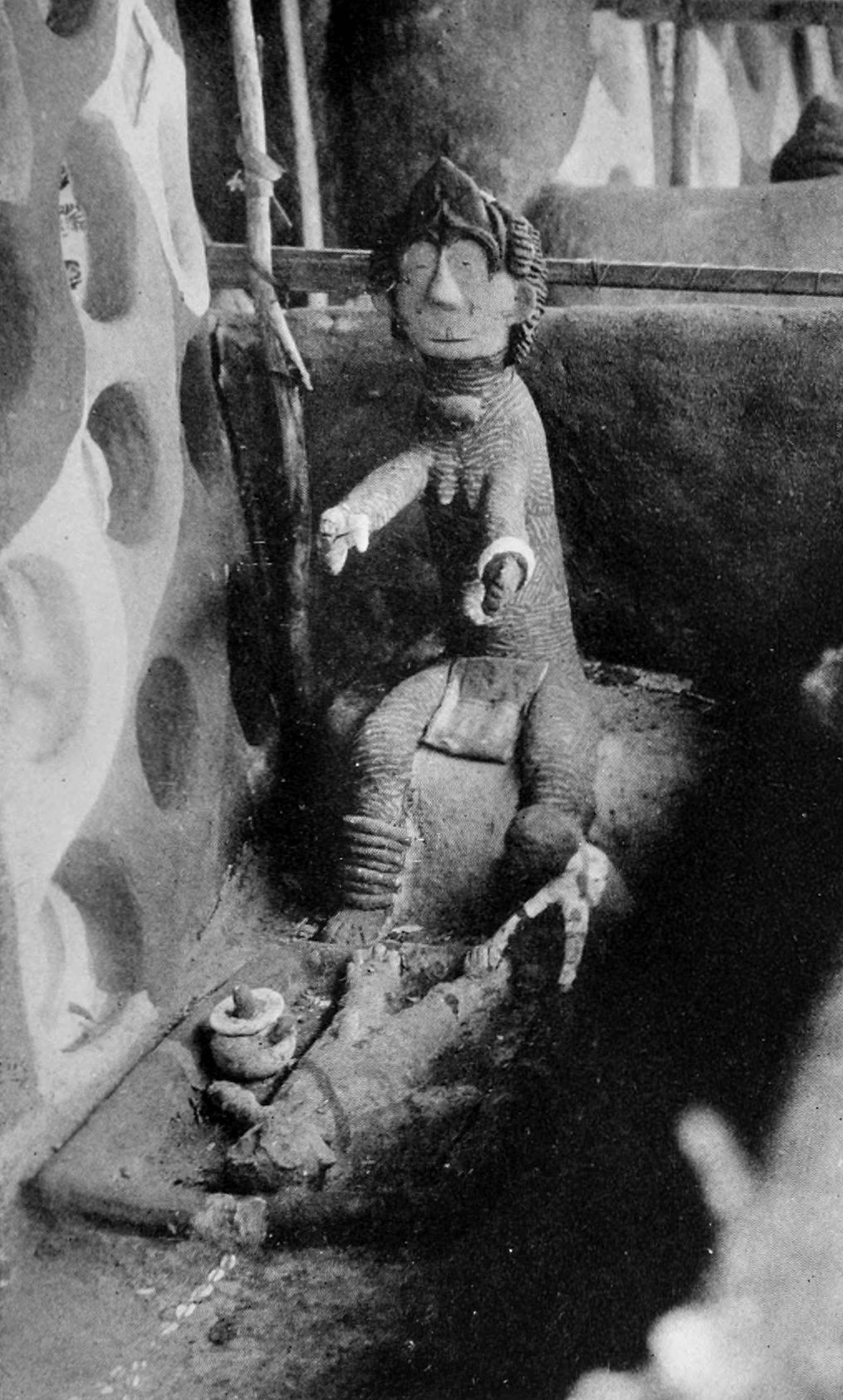
Fig. 11. Figure of Mbafor in
the Njokku Mbari at Omo Dim
26
III
MBARI HOUSES (continued)
In Mbari houses built in honour of Amade Onhia it
is made perfectly clear, as is natural, that the
Thunderer himself holds first place, while his consort
is of secondary importance. In the shrine at Omo
Dim, as previously mentioned, the place of honour,
facing the entrance, was occupied by the figure of
the so-called deified ancestress Mbafor—a bowl for
offerings sunk into the ground at her feet and her
daughter upon her knee. The face and form of the
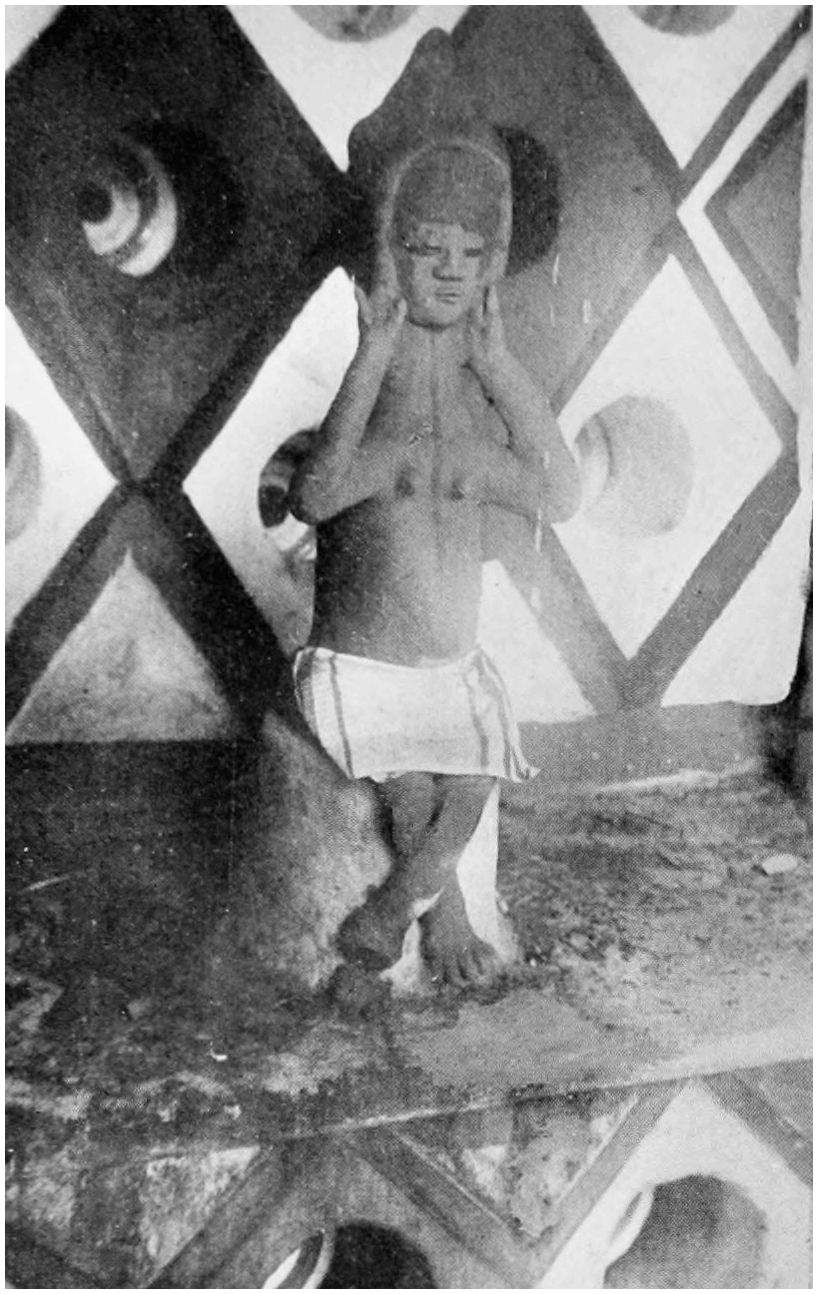
mother are bright yellow, the colour of the clay from
which she is modelled as are those of Ala in all
shrines yet visited; while the whole body of the child
is dead white, like that of the Thunderer himself, the
deified ancestor Njokku seated above his sky ladder,
or indeed ghosts and ‘sky people’ in general.
On the white of her body five coal-black crescent
moons had been painted; one just above the shoulder,
one on the top of the arm and three down the flank.
All, save that on the arm, showed a protuberance in
the centre, exactly in the place where the nose would
come when children draw the face of the man in the
moon. The point would not have been worth mentioning
but for the fact that in each Mbari house visited
a peculiar decoration was noticeable, only to be
described as a screen of lattice-work, formed of
28interlacing human figures. This was explained as
representing the slaves sacrificed and flung into the
grave—or laid there still living, but with broken
arms and thigh bones—to form carpet and bier for the
body of the dead chief. It may well have borne some
such interpretation, but this would hardly explain
the fact that, in each case which we came across, one
row of figures, usually the centre one, bore faces
the shape of a crescent moon, mostly dead white and
outlined by a deep black rim. At Omo Dim, Okpala and
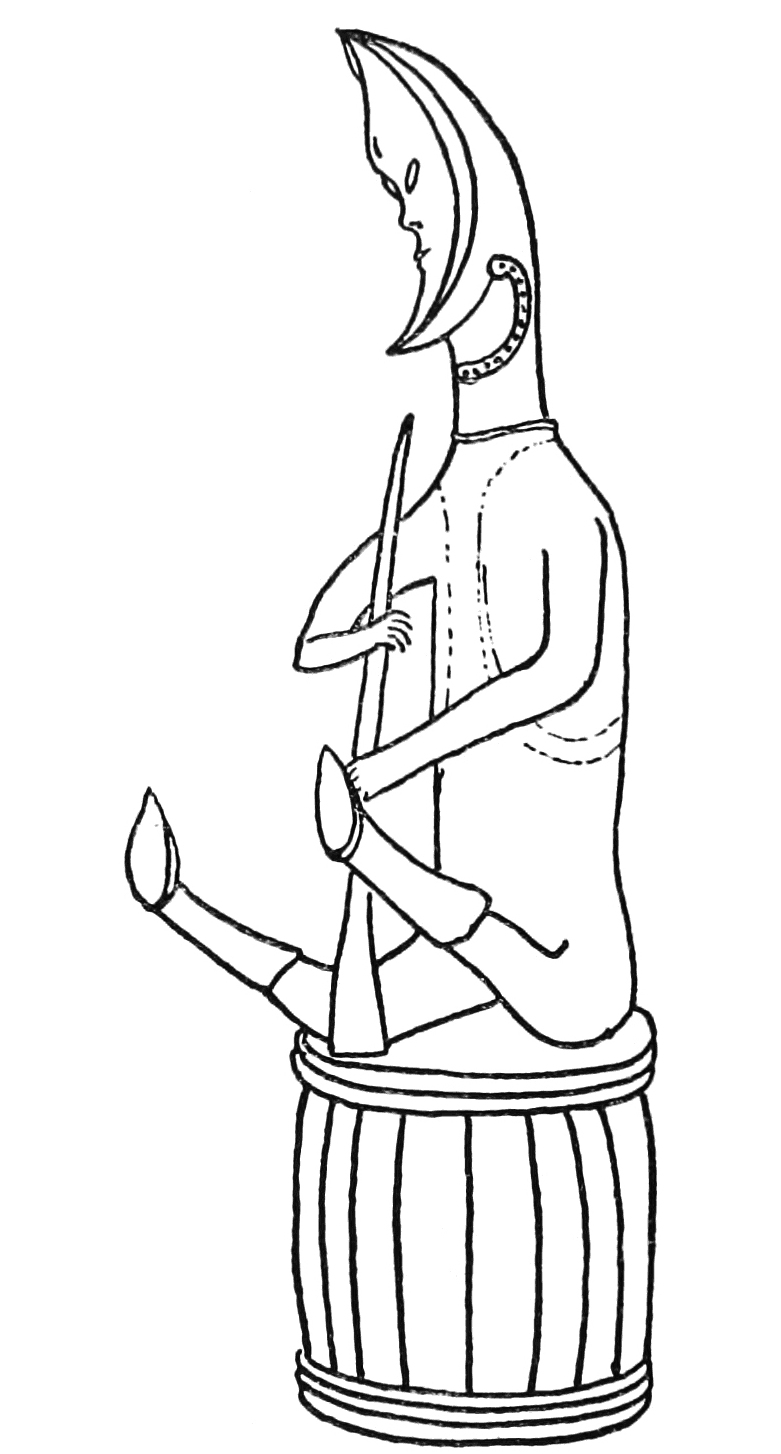
Obogwe too there is a figure—which is duplicated
with more or less fidelity in several other shrines
and which for obvious enough reasons was named, by my
companions, ‘little moon-face’—of the same type as
those in the human trellis work.
Fig. 12. “Little Moon-face,”
Omo Dim
Now the crescent moon is a sign of growth the world
over. Ekoi women come together, beneath her faint
beams, to carry out the rites which, according to
their belief, will ensure fruitfulness. Ibibio and Ibo
also hold that her rays are endued with fecundative
powers, 29while pregnant women count the time to their
delivery by her waxing and waning.
Some few weeks later, in passing through the town of
Ebubu in the extreme east of Degama District inhabited
by that strange and hitherto unstudied tribe, the
Mbolli, we came across a shrine of a type such as
we had never before seen. It is carved from a solid
block of wood some four feet high, set in a carefully
smoothed clay base, swathed round the bottom by folds
of white cloth and surmounted by an inverted crescent.
The name of this Juju is Obo Esa, i.e. in
Mbolli dialect four hundred yams. The reason given
for this name is that only full chiefs have the right
to erect such a fetish, to which they must sacrifice
each harvest time baskets containing the given number
of yams. It was explained that Obo Esa is a male
Juju—a statement borne out by the appearance of the
symbolic pillar—and to him, at the cutting of new
farms and digging of fresh yams, living sacrifices
must be brought and slain so that their blood is shed
upon the clay base, whence it trickles down over the
seven little moon-shaped depressions to the thirsty
earth beneath. These small half moons may well typify
the period during which the yams are confided to the
bosom of Mother Ale—called Nkike by the Mbolli—while
the great crescent, surmounting the pillar, probably
represents that of the month of September during which
the harvest festival is usually held.
Considering the close connection between the waxing
moon and the powers of fertility, it is not without
significance that personified representations of
the crescent 30are to be found in each Mbari house,
especially when it is remembered that the shrine of
the Earth Goddess is always close by and that only
after consultation with her priest is the building
begun and carried through.
Again, although we were expressly told, as already
related, that the chief figure at Omo Dim did not
represent either of the principal deities, but only
a deified ancestress, yet a man present volunteered
the information—it is true, in a highly superior
manner—that some old and very ignorant people held
them to be those of Amad’ongha and Ale. So stupid,
however, were such that they even believed the white
child, on the knee of the Earth Mother, to be the
moon! As if any but the most foolish could look upon
the moon as a daughter of Earth!
In the Obogwe Mbari house—the only one which we have
yet found built in two separate edifices—the first
building was dedicated to Amad’ongha and the second to
Ale, locally called Ala. Our informant, Omere Madu,
was the son of the late head chief who therefore,
ipso facto, was priest of Ale. He told us that
this goddess was the dominant power in the town, and
that she ordered her priest to have the two houses
built in that place and form—one for herself and one
for her spouse Amad’ongha. In both buildings he sits
in the seat of honour, but in the first alone, while
in the second she is seen on his left, in the same
position as that of the figure at Obodo to which her
name was first given, but which was later called Omu
Ngwaw, the fruitful mother (see p. 40).
31
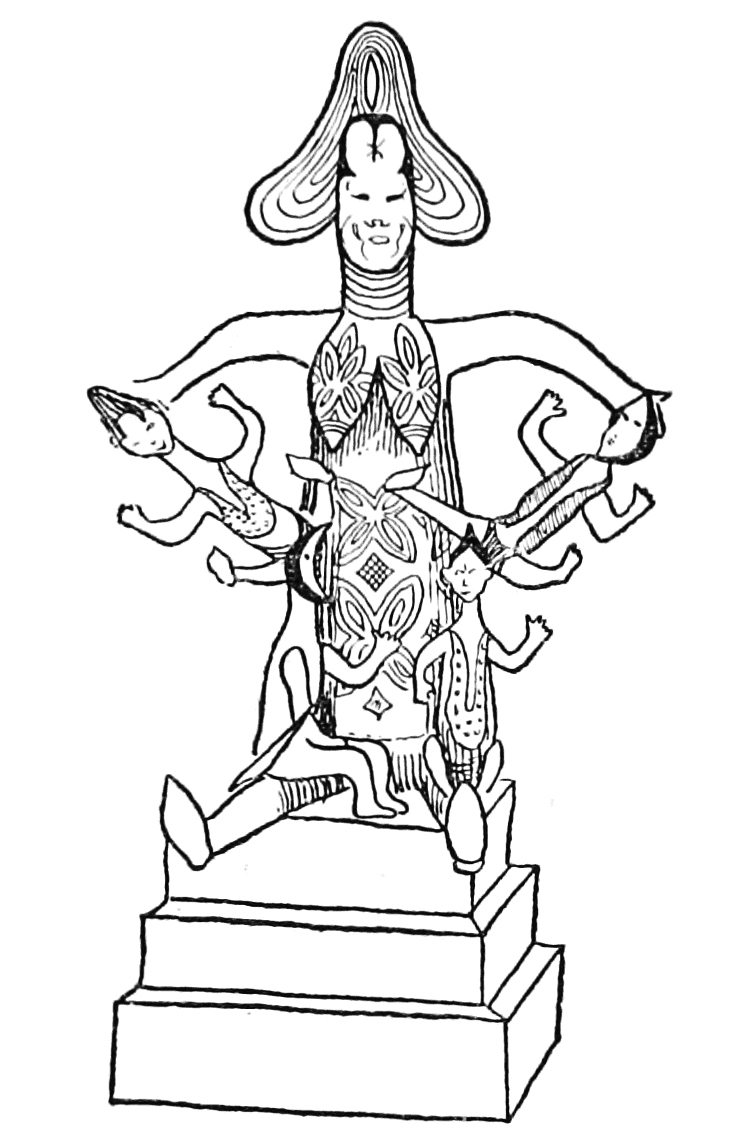
Fig. 13. Group in Obogwe Mbari
house
In the temple dedicated to the Thunderer, on the left
of the central figure is seen one, the name of which
was said to be Eku Nechi—i.e. ‘the big woman
who cooks,’ or more fully ‘who gathers the children
of others around her and cooks for them.’ The figure
is seated, supporting a boy and a girl against her
sides; while another pair sits, one upon each of her
outstretched legs. The most singular thing about
this group is that each of the male children bears a
crescent moon for face, while from the necks of the
two girls is painted a cloth thickly covered with
white dots. On the wall of the Ale shrine, a fresco
may be seen on which a moon-faced boy is depicted
climbing up the right hand side of a rainbow, painted
in black, yellow and red stripes. In such a position
he is supposed to be an envoy from the Earth Goddess,
climbing the sky with a message from Amade Onhia,
or, when descending, bringing word from the latter
to the children of men. Beneath, on a black ground,
a crescent moon and stars are shown—the stars
represented by white dots exactly like those painted
round the necks of the girl piccans of Eku Nechi. It
is not 32impossible therefore that here again, in ‘the
big woman who feeds the children of others,’ we have
another forgotten picturing of Ale, the Earth Mother,
with her starry progeny.
A singular fact about all the Mbari shrines hitherto
visited is that, in each, figures may be seen,
obviously modelled with the express intention of
depicting licence in its most blatant form. Primitive
peoples the world over, however frank in picturing or
mentioning facts treated with the greatest reticence
by civilised races, are usually ignorant of real
vulgarity or indecency, since the very simplicity
of manner and treatment robs their statements of
offence. The Ibo of this region, especially, have a
code with regard to sexual matters which, however lax
according to our ideas, is yet strangely strict in
some directions. According to them four of the most
evil things are:
(1) For man and woman to lie together on the earth,
since this is thought to defile Ale. Among Kalabari
indeed the idea is carried so far that no woman is
allowed, under any circumstances, to seat herself upon
the ground. In the absence of stool or convenient
tree-trunk she must stand. As already mentioned,
according to chief Amade Onyeche, the position
adopted by Etche Ibo, when no bed, mat or cloth is
available, is for the woman to stand bending forward
at right angles from the waist, while her lover stands
immediately behind.
(2) Connection is absolutely forbidden during the
hours of daylight, or even at night time when a light
33is burning in the room; also at any time in the bush
or in a farm, where there is no house.
(3) It is the height of impropriety for a man to have
relations with a woman who is not clothed in the
prescribed custom.
(4) For a husband to attempt to view the genital
organs of his wife is regarded as so serious an
offence as to be considered valid ground for divorce.
In a case brought before me in the Degama Native
Court, the claim ran: ‘To demand freedom of marriage
on account of peeping.’
In every Mbari house yet visited, however, figures
were seen modelled with the obvious purpose of
expressing a breach of one or other of these rules.
In most of the buildings groups were found in which
the feminine figure was shown partially lying on
the ground—in a position impossible to any human
anatomy and therefore, it would seem, so posed as
intentionally to express direct rebellion against the
generally accepted rules of decency.
An official of high rank, who was the first Government
representative to visit this region, described to me
a shrine which he saw about twelve years ago, near
Ingaw in Owerri District, where certain points were
even more naïvely depicted than by those erected in
the present day. Among the more noticeable groups were
men in the act of copulating with a sheep and antelope
respectively. As regards the latter animal, it is not
without interest to recall that, according to several
accounts from well-informed sources, ancient Yoruba
custom ordained that, after the kill of his first
34antelope, a young hunter must have connection with
the still warm form. Possibly some such rule obtained,
or maybe even yet exists, in these regions.
The group of men and sheep seems to point to the
existence of a like custom among Ibo as one learns,
on good authority, prevails among the neighbouring
Ijaw, with whom the chief feature of male initiatory
rites consists in each boy proving his manhood, before
a circle of elders, upon a specially selected sheep.
Should he be unsuccessful, he must wait until the
following year and is prevented from marriage until
after having passed the test. From certain information
it would appear that one of the principal centres,
where this rite is carried out, may be found on a
southern creek in the neighbourhood of Kula.[7] It was
naïvely added that the sheep ‘never go ’gree to this
and always vex too much’ when the rite was carried
out. Later, a similar custom was reported from among
the Ekkpahians of Ahoada District.
It is true that every Ibo or Kalabari who mentioned
the subject was eager to state that Ekkpahians perform
this rite ‘merely out of badness; for no proper reason
at all.’ Yet, though it is unfortunately not permitted
me to give a single name as authority, it would
appear, after very careful weighing of evidence, that
the practice has been exacted from time immemorial
as a test of manhood. Both Ibo and Kalabari also
35asserted that unnatural vice is extensively practised
among this people, though rare with other races of
the Division; but it is only just to state that the
practice appears to be carried on not for the purpose
of sensual indulgence, but, in some cases at least,
from the idea, held among certain Australian tribes,
that such customs increase the race by magical means.
That the practice is not held in as great detestation
throughout Ekkpahian and neighbouring territory as
among other tribes is proved by the more or less
casual manner in which the matter was mentioned as
well as from one or two Court cases. It will be
enough to quote that heard at Omokku on January 20th,
1913, in which Atoma of Erema charged Okereke of Idu
with indecent assault. In the course of her evidence
plaintiff stated on oath:
About three months ago accused came to my father’s
house to have connection with him. At that time I went
to bed....
Question by Court. When he came to your house,
where did he stay with your father to have connection?
Answer. Outside the house.
Question by Accused. What date did I come to
your house?
Answer. Orie day.
Question by Court (to father). Was
accused your friend?
Answer. No.
Question by Court. Did accused ever come to
your house and have connection with you at night?
Answer. Yes. He always come to my house and
prosecutor saw him.
36
Among Ekkpahians and the Abuan, as well as with the
Western Ikwerri, elaborate, two-storied buildings may
be seen, upon which the wealth and utmost resources
of the town have been lavished, even to stained- and
patterned-glass for all the windows. My attention was
drawn to these buildings by a man high in the medical
service of the Protectorate, with the information that
they were erected for the practice of unnatural vices.
This was later confirmed from native sources with the
addition that they were the homes of the Obukere Club
and that the customs were of religious significance.
The fact that such habits exist is, unfortunately, too
well known to be worth mentioning, were it not for a
few words dropped by one of the chiefs and intended in
extenuation of the practice. ‘It is true,’ he said,
‘that the custom is a very bad one; yet aged men
tell us that it was taught in olden days as a very
great magic whereby our flocks and herds might be
multiplied and made strong. Even, it is said, the
crops in the farms are increased thereby.’
The idea was confirmed by another chief who however
insisted that it was only a tradition from the olden
time—held by dead men, very far away—and he did not
think that any such belief was prevalent nowadays. He
also added, cautiously, that this form of vice was far
less indulged in at present than was formerly the case.
The information fitted in with that already gleaned
concerning the supposed efficacy of phallic shrines
set up amid the fields in order to secure plentiful
crops.
37
As a result, further information was sought concerning
the cult of Obukere, one of the most interesting of
whose lodges was discovered at Obelle Oduaha. An
avenue, half a mile in length, every trunk of which
bore a sinister-looking smear of cam-wood dye, led
to the house. At the entrance to this grove it opens
out into a cleared space, from the centre of which
springs a clump of trees smeared with deep bands of
red and hung round with white cloth. Behind these
rises a giant ant hill, while round their roots a
mound of earth about five feet high was piled. Amid
the rich mould and fallen leaves stood votive pots and
bowls, among which bundles of young tombo palms just
bursting from the parent kernels, were to be seen,
mostly enclosed in wrappings of broad green leaves
bound round with tie-tie. This clump of trees is
regarded as the abode of Obukere himself. Here members
of his cult assemble to carry out the rites. Before
his dwelling-place the worshippers cover their faces
and, thus veiled or masked, go in procession through
the sacred grove—the tree trunks of which, down to
the smallest sapling, have been fresh smeared with the
symbolic blood-red cam-wood. In these regions Obukere
is regarded as the great giver of fertility to all in
air, water or upon earth—fish, animals, plants or men.
Fig. 14. Obukere Club
head-dresses
Fig. 15. Sacred drum used to
call together the Obukere Club, Oduaha
All lodges of this club as yet visited show a peculiar
development in the highly conventionalised animal
head-dresses which are worn for plays. In the Otu
Obukele (house of Obukele or Obukere) a big shed made
of solid wooden posts, at the Abuan town of 38Okobaw,
some head-dresses of unusual type were found; among
them representations of antelopes, porcupines and the
‘increase of the Sky people,’ typifying the sky world
above that of men.
Round the lodge at Obelle Oduaha were seven phallic
shrines six of which were of the usual pillar type,
while the seventh showed a featureless head, arms and
legs indicated in the roughest manner, and only the
distinctly feminine organs modelled with any care. The
position of these shrines in close proximity to the
house of Obukere worshipped with the avowed purpose of
increasing fertility in man, animals and crops, can
hardly be regarded as without significance. Within the
house were two objects of interest—a xylophone in the
shape of a canoe manned by eight figures, stated by
the chief to have been specially designed to express
‘joy’ and raise feelings of pleasure in those who
behold them; and an object which strongly resembled
the Ajokko-Ji or king yam shown to us at Oppe,
separated by the sacred crocodile 39swamp from Alessa,
and which will be more fully described later on page
99.
The drum used at Oduaha to call together the members
of the Obukere Club was said to have been brought
from Abua and to have been made for the Sekapu Club,
connected with the spirits of fish, crocodiles and—in
this part of the world—land beasts. It may be only
a whim of the carver that the figure of the woman,
depicted with rounded body as a sign of pregnancy,
should be joined to that of the sacred crocodile.
Drums of similar type were later found among Abaw Ibo.
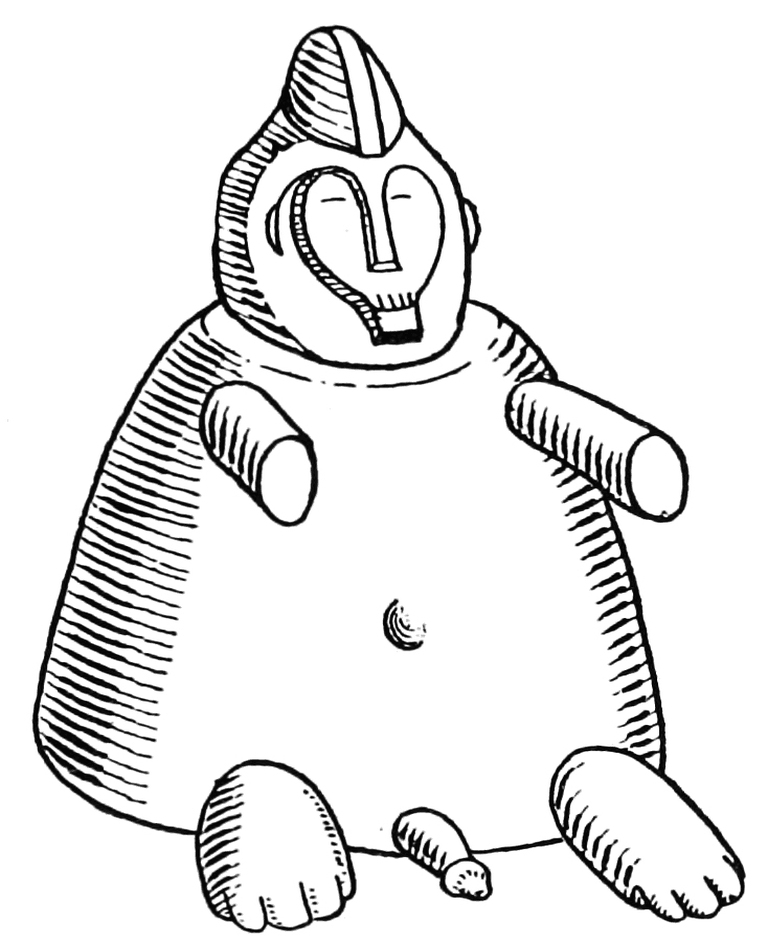
Fig. 16. Figure in Mbari
House, Umoyo
Fig. 18. Clay figure of Amade
Onhia in an Ibo Mbari house
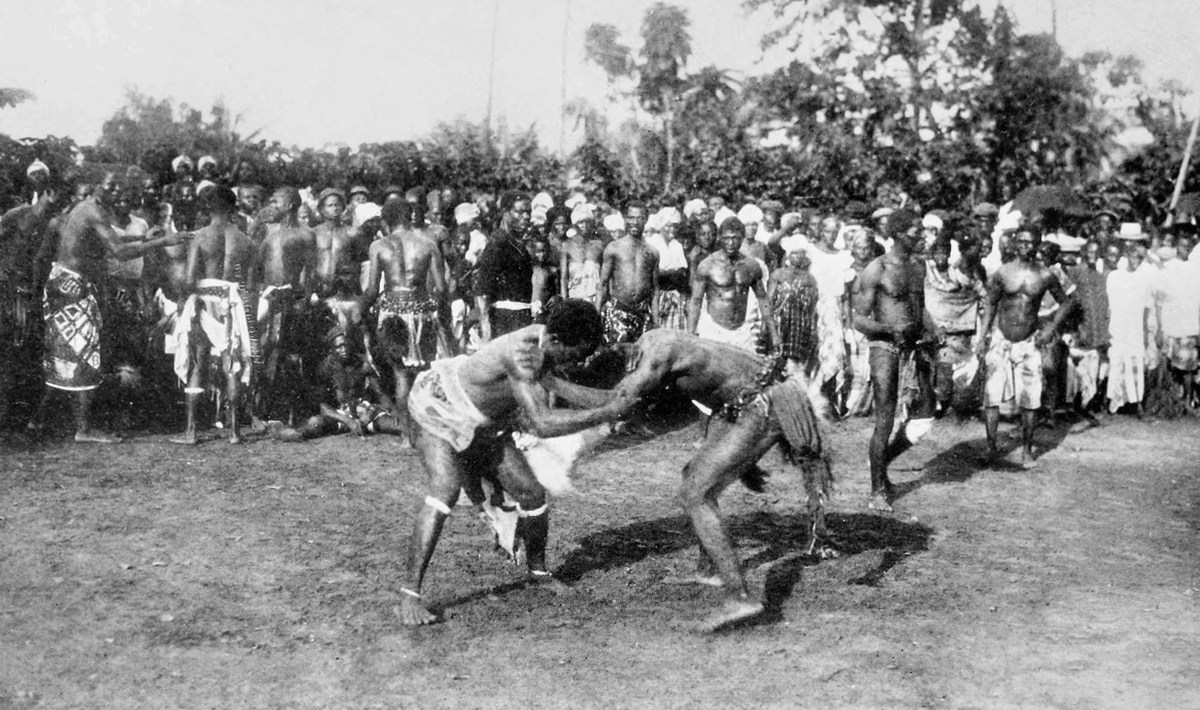
Fig. 17. Wrestling scene
(’Mba) in shrine of Amade Onhia and Ale. Shrine
drummers on the right
40
IV
MBARI HOUSES (continued)
In nearly all towns of importance in the Etche
country, elaborate Mbari shrines are to be found,
built in honour of the Thunder God. In most, just
within the principal entrance, may be seen the seated
figure of the deity, white from head to foot, and
bearing in the right hand a sword, spear or bayonet,
and in the left an imitation of one of the old stone
axe-heads, thought by natives to be thunder bolts,
or one of the long iron sceptre-rattles, or possibly
another sword or dagger. By his side sits his consort,
to whom various names are given, most of them
apparently synonyms for the Earth Goddess Ale, Ala,
Ana or Aja. At Ibodo we were told by one informant
that the figure represented Ala—Bride of the Bladed
Thunder. The more general Ibo idea as to her identity
was confided by the head priest, Achongwa by name, to
chief G. A. Yellow: ‘That,’ said he, ‘is Omu Ngwaw,
wife of Amad’ongha.’
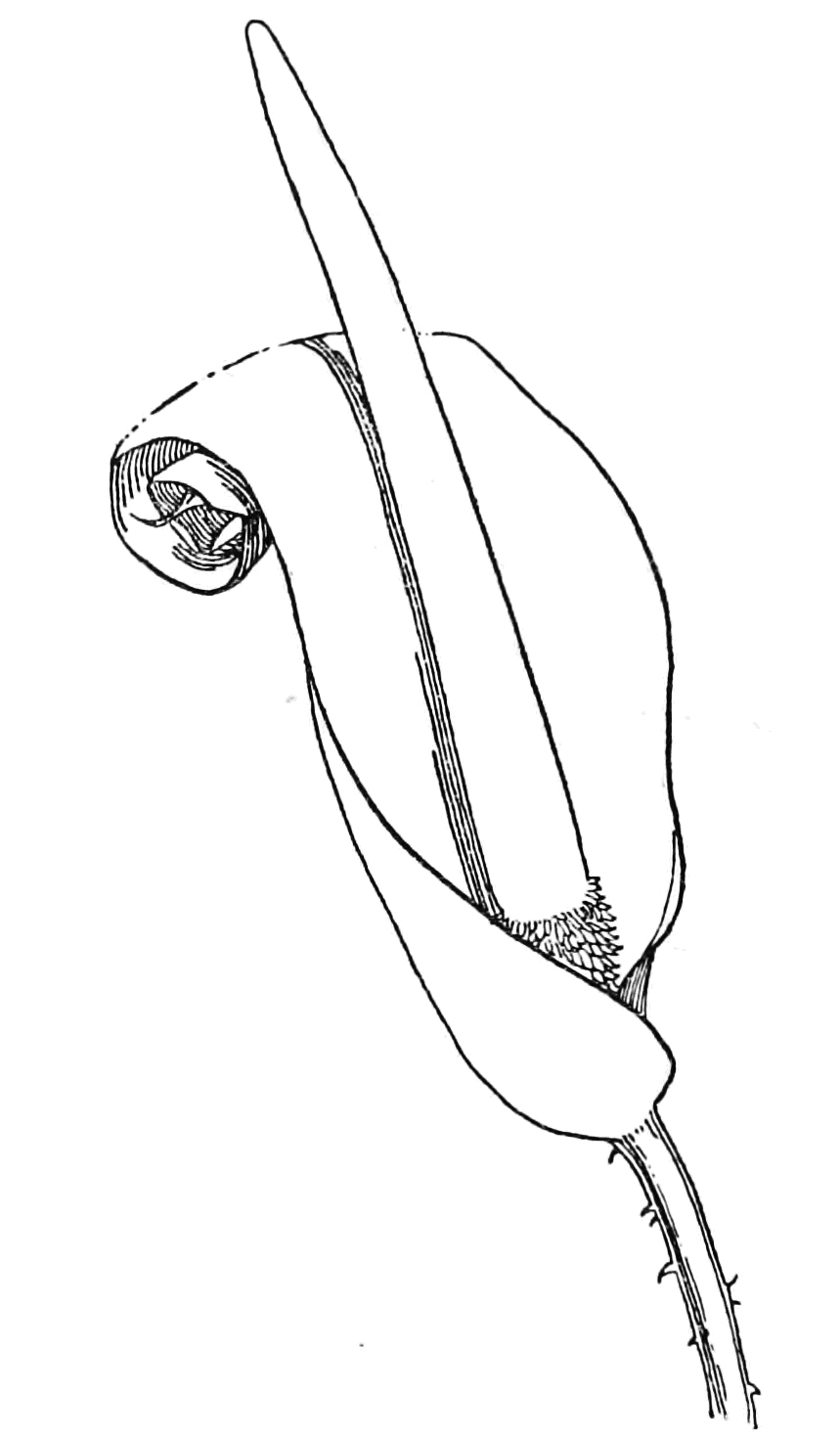
Omu Ngwaw is literally ‘the children (or young leaves)
of the tombo palm tree,’ raphia vinifera.
Now, when a woman has given birth to a first or
second babe, the days which she spends in seclusion
are often called by the same name, while the word
for fruitfulness itself, or giving birth, is Omumu.
The connection thought to exist in primitive minds
is the probable reason why young palm-leaves are in
such evidence 41before the shrines of all beneficent
Jujus; the half-unfolded frond stands as type and
symbol of fruitful motherhood.
On floor and walls, serpents twine and twist;
hippopotami hold men half devoured in their mouths,
leopards stand over new-slain goats, elephants wave
long trunks or fall to the guns of hunters, apes climb
or swing, and fabulous creatures disport themselves
on every hand. A clerk counts his money on a little
table. Two wrestlers may be seen locked in one
another’s arms[8] and a native doctor anoints the womb
of a woman patient with a feather dipped in oil. In
short, so far as in them lies, the whole life-history
of the people is here reproduced with infinite
pains and care. As in the Owerri Mbari houses, the
head-dresses of the women are most elaborately
rendered, while the modelling of a ram’s head and
of one small monkey which sat devouring a corn-cob
were extraordinary samples of artistic skill. Again,
a peculiar feature of several of these were figures
obviously modelled with the intention of expressing
the feeling of joy. It is probably only a coincidence
that so many of the figures of Ale show much enlarged
navels—the ὀμφάλος of the Earth Goddess.
In all these shrines the mural decoration is not
painted, but applied to the walls like a gigantic
piece of Cloisonné—clay, tinted with various dyes,
being filled in between strips of raphia palm which
serve to 42outline the design exactly as does the
brass edging the enamelled leaves and flowers of the
above-mentioned ware.
One of the most interesting of the temples visited lay
some two and a half miles off the main road near Ibodo
and was approached first by a narrow bush-path and
later by a broad way over-arched by great trees, the
branches of which interlaced overhead to form a clear
translucent twilight even at noonday. As we passed
beneath the fern-fringed, orchid-decked boles, the
sky was overcast and the sun already low in the west,
while the voice of the Thunder God might be heard in
the distance—a low, threatening note in the twilight.
When the village of Omako was reached and we
approached the shrine, the sun was just setting.
Blue smoke rose from amid the strange figures, over
which flames flickered and danced from a little fire
tended by an old, old woman, who among such uncanny
surroundings was quietly cooking her evening meal.
She was the ‘slave of the Juju’ who had sought his
protection as a refuge from oppression untold moons
ago. Her whole life is spent amid the weird figures
which she guards and serves, lighting fires during the
rains that the soft clay may not be melted nor the
roof and wood-work rotted by damp and mould—though,
strangely enough, it is strictly forbidden to make the
slightest attempt at repairing when cracks appear in
figure or wall, however much care was expended on the
building of the shrine.
So near to one another are the figures that the little
sleeping mat of the attendant could hardly find space
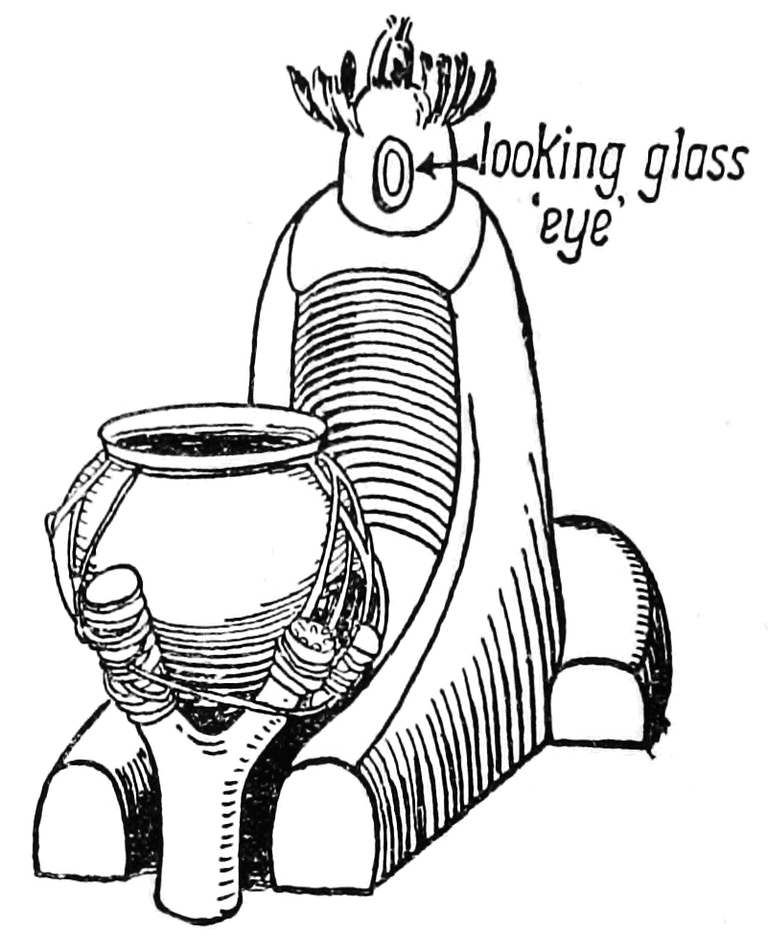
43to be stretched out in between. Their eyes were
set with fragments of looking-glass, which twinkled
and gleamed in the most life-like way, as the flames
rose and fell. How many years the gentle old slave,
with her soft voice and deprecatory gestures, had
served the Juju, none could tell. She herself seemed
to have lost all memory of any other life; but the dim
eyes brightened at the gift of tobacco leaves and the
gentle voice followed us, still calling Ndeawo—the
common word both for ‘thanks’ and for ‘greeting’—as
we went away.
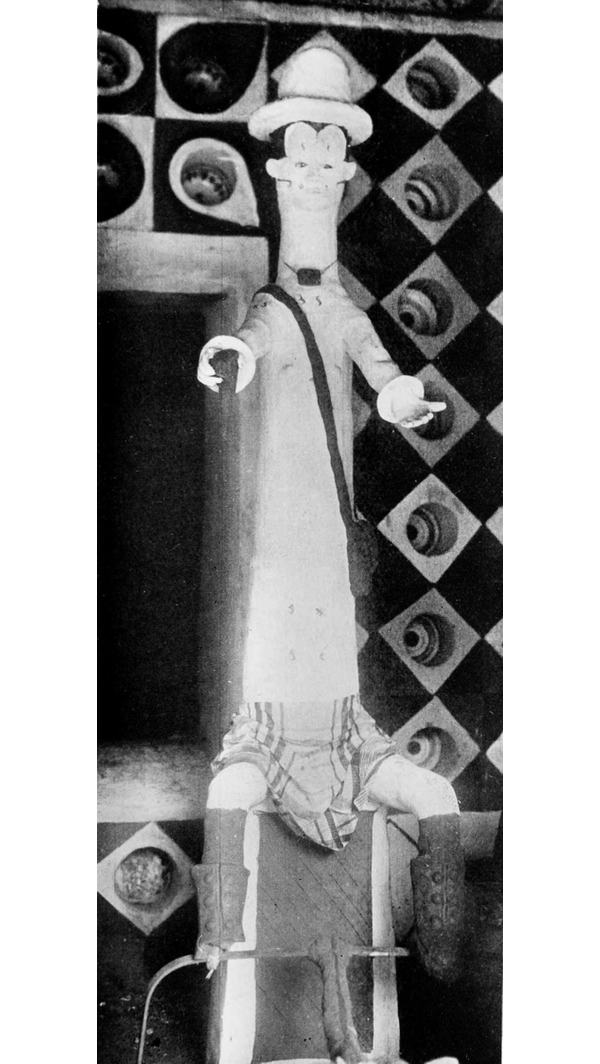
In every case which we have seen as yet, the Thunder
God wears a sharply pointed black beard. In many
instances little rattles hang from his neck or are
attached to a spear or staff held in his hand, while a
cluster of bells is slung from a rope usually passing
over the right shoulder and resting on the left hip.
In one place his feet were set upon a curved bar of
iron which had once been gaily painted and was said
to represent the rainbow. It is with the rattles that
he produces the roll of his thunder, while the bells
strike together to form the clash and bang of each
separate peal. The type of figure was identical with
that of the so-called deified ancestor Njokko, seated
at the top of his sky ladder upon each rung of which
‘air people,’ i.e. birds, were perched.
It is perhaps not without significance that, upon
either hand of his throne, two slender pillars the
shape of an elongated torch and each bearing a bird,
are set.[9] These are small and vaguely modelled, but
it is 44possible that they once represented the eagles
of Zeus—which, among Ibibio, are still sacred to
Obumo, the Thunderer.[10]
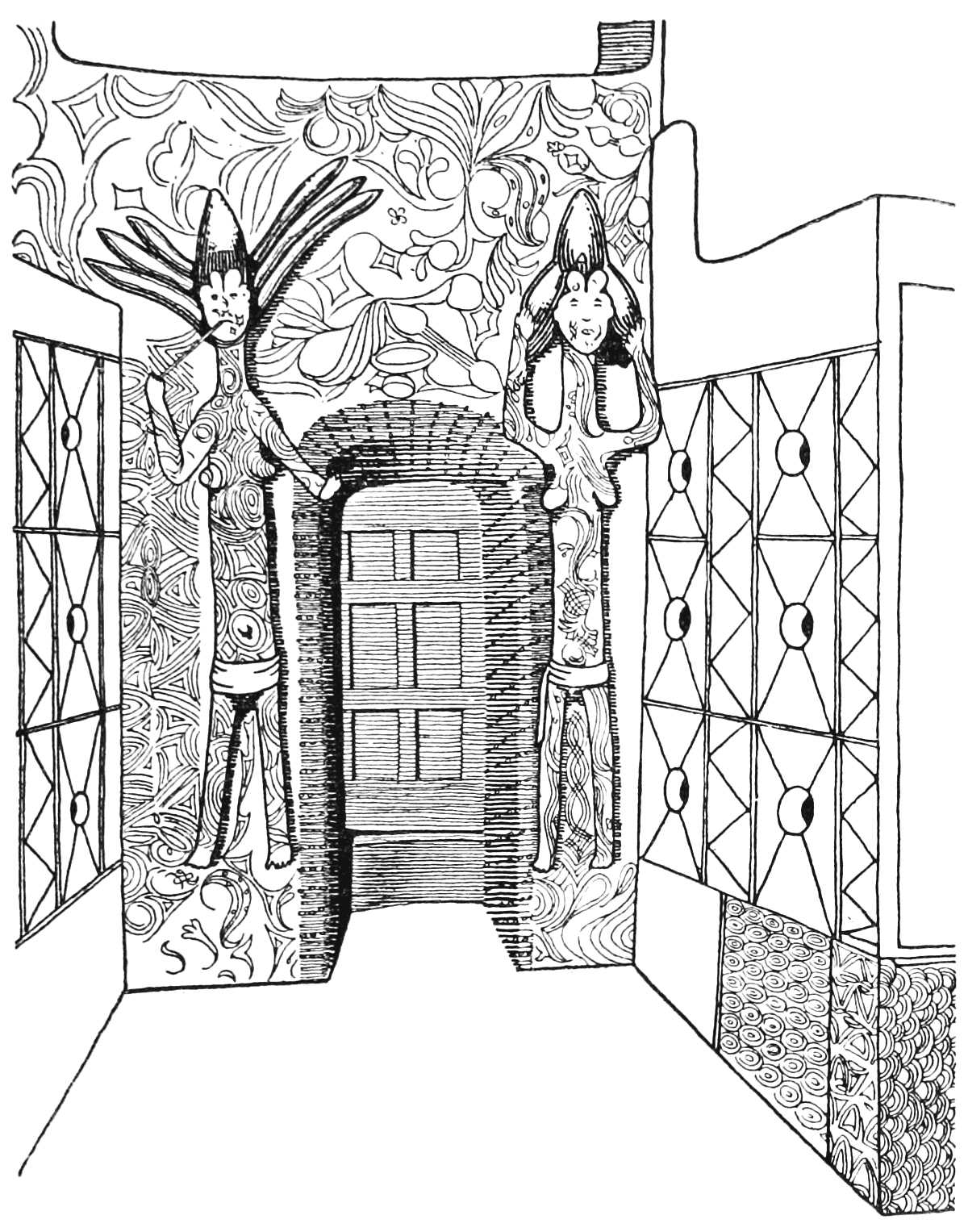
At Ibodo, on either side of the door of the central
shrine—the ‘holy of holies’ which only the priest
can enter unscathed—we first noticed the two
strangely-shaped figures which are also to be seen
guarding the inner sanctuary of the Owerri Mbari
houses. They were thus explained to us:
‘These are the servants of Amad’ongha. Their names
are Omogwa and Otamelli. The first’—with spread
tresses—‘is calling up the tempest by striking on
her mouth.’ (This action was later described, at
another shrine, as ‘cleaning her teeth with a bush
stick!’) ‘The second is about to loosen her hair which
floats around her in the storm-wind darkening all
the earth’—a possible picturing of the rain-bearing
clouds.
Omogwa’s left hand is stretched out to warn intruders
from entering the chamber which she and her sister
Alose are set to guard, lest thereby the wrath of
Amade Onhia should be drawn down upon the trespasser.
In former days, when men had offended against the law
of the Juju, they were brought by the priests and shut
up within the shrine. Then, in the night time, came
some fearful thing to torture them to death, perhaps
by beating, perhaps in other ways. At any rate the
body of the offender was always borne forth at dawn
and shown to the trembling people as a sign of the
fate which would overtake any who dared disobey the
law of the Thunder God or the commands of his priests.
45
Fig. 19. The Guardians of the
Shrine, Omogwa and Otamelli
46
As already mentioned on page 20, this custom also
prevailed among the people of Owerri. Near the two
Alose, on each side of the inner entrance, are small
holes in which offerings of kola are placed when
people come to ‘bless the shrine’ or ask for special
favours.
In the neighbourhood of Ibodo and indeed all over the
Etche country, according to the testimony of chief
Achongwa, it is customary before cutting palm-nuts to
offer sacrifice to some specially tall trees, one of
which will be found in every compound. These are named
Amad’ongha’s palms, because the people say that those,
which reach very high, are nearer to the deity. Men
who neglect this rite find that their palm-nuts do not
produce much oil. Later, we found that the custom was
also practised by Aro and a row of the trees—here
known as the palms of Kamalo, the name given by this
people to Amad’ongha—was shown us in the compound
of chief Ogunda at Azu-Miri near Nkarahia. In an Aro
compound at Ozoaba each tree had a tall palm-leaf tied
against its base, the top leaflets cut off straight
and surmounted by a scarlet parrot’s feather, an egg,
etc.
At Ibodo, from the Thunderer’s shrine to the corner
of the rest-house, stretches a sacred grove beneath
the shade of which native pots and other offerings
may be found. Here, during the dry season, a number
of small mats of plaited palm were seen, each bearing
an offering of goat’s flesh. It is perhaps worth
mentioning that, among Ibibio, curtains of plaited
palm-leaf are hung before holy pools and groves or
round the trunks of sacred trees. The 47plaited part is
said to represent the rainbow, while the long fringe
from the lower edge typifies the rain itself.
In the grove at Ibodo beneath one of the trees,
peeled, short-branched wands—the symbol of
lightning—were still standing, and we were told that
formerly many such had been set up in other spots.
When these rods decay, the power of the Thunder God
is said to pass from them into the nearest tree. Once
drawn within the many-forked branches, the ‘mana’ of
Amad’ongha fades not with the fading of its first
frail tenement, but is drawn into the vegetation
around, growing and spreading with each new season’s
boughs.
At the far end of the sacred grove stands a tree such
as we had never seen elsewhere, of which the crowded
panicles of single petaled flowers, deepest crimson
in colour, swayed to and fro in the breeze amid dark
quivering leaves, or fell earthward in showers, like
drops of new drawn blood.
One night, at the beginning of the tornado season,
we were sleeping in the neighbouring rest-house,
when a storm arose with the appalling suddenness
usual at this time of year. The wind tore at the
frail palm-leaf roofs, while rain lashed in through
open window- and door-frames, flash after flash was
followed, with scarce an interval, by crash and roar
so deafening that for a long time all other sounds
were drowned in the awful tumult. As the storm began
to pass away, another sound made itself heard in
the lengthening intervals. Each lightning gleam was
followed by a burst of trumpeting, as though the
followers of the storm god had come together undaunted
by the force of the 48tempest to hold a play in honour
of their great deity. It is impossible to give any
idea of the impressiveness of this act of worship.
From out the impenetrable darkness, between long
lines of rain, like a sword from its scabbard leapt
the dazzling flash. The branches of the sacred grove
moaned and swayed, bitumen dark against this more than
daylight brilliance; while, from beneath their shade
or from the neighbourhood of the shrine, each burst
of flame was answered by a blare of savage trumpets,
the sound of which merged into the roll of the sequent
thunder.
So long as the storm lasted the strange music
continued, broken now and again by the cries of the
terrified cattle, which rose in chorus from countless
byres and were hardly distinguishable at times from
the rude horns blown by their owners.
Save for the fact that the outer colonnade, which
gives accommodation to further groups of figures in
Owerri Mbari houses, is absent, wholly or in part,
from many of the Etche shrines, the buildings are
practically identical in type. Many groups are to
be found, save for the smallest of details, exactly
reproduced in each, and it is owned that freedom of
intercourse between the sexes is allowed in the cults
of both Ale and Amade Onhia at certain seasons, with
the idea that this will have the effect of increasing
fruitfulness not only among the human inhabitants of
the town but also in farm and byre.
The connection between the two cults was indicated
by a practice which still obtains at Omo Chuku, a
quarter of the town of Ibo near Okomoko inhabited 49by
Etche Ibo. The principal chief of the place, Ababua
by name, is also head priest of the Thunder God and,
by the local law of the cult, is only permitted to
eat in a hut which stands by itself in the middle of
his compound. In this, all the dried yams and seed
corn are stored and there too is his Ajokko-Ji or king
yam, here represented by a basket filled with yams and
skulls.
Each wife cooks in turn, and the one who has prepared
the meal serves it and is permitted to partake. Should
the priest so will, son or daughter may be invited to
join in the repast; but none may do so without special
permission. The chief himself sits upon an elaborately
carved stool, but the others place themselves humbly
upon the ground or on small logs. The doorway is
curtained by a fringe of young palm-leaves which are
never allowed to wither.
The son of chief Ababua, who accompanied us for some
distance, stated that his father might never eat of
the new season’s yams for at least two months after
this was permitted to ordinary men. As chief priest of
Amad’ongha, Ababua was also obliged by ancient law to
perform certain ceremonies to his personal god as well
as to the special protectors among his ancestors—the
shrines of which are placed just within the threshold
of his Obiri (reception room)—before allowing any
portion of the new season’s yams or corn to pass
his lips. It was explained that, by taking his food
amid the seed set apart for planting, the priest was
thought to endow these with special fertility by the
power of the Thunderer whom he served.
50
Not far from the little dining hut, a small, highly
decorated mud house was to be seen, consisting of a
dark inner chamber opening from an outer porch-like
one. The chief explained that this was the local Mbari
house and that they built it each year—making the mud
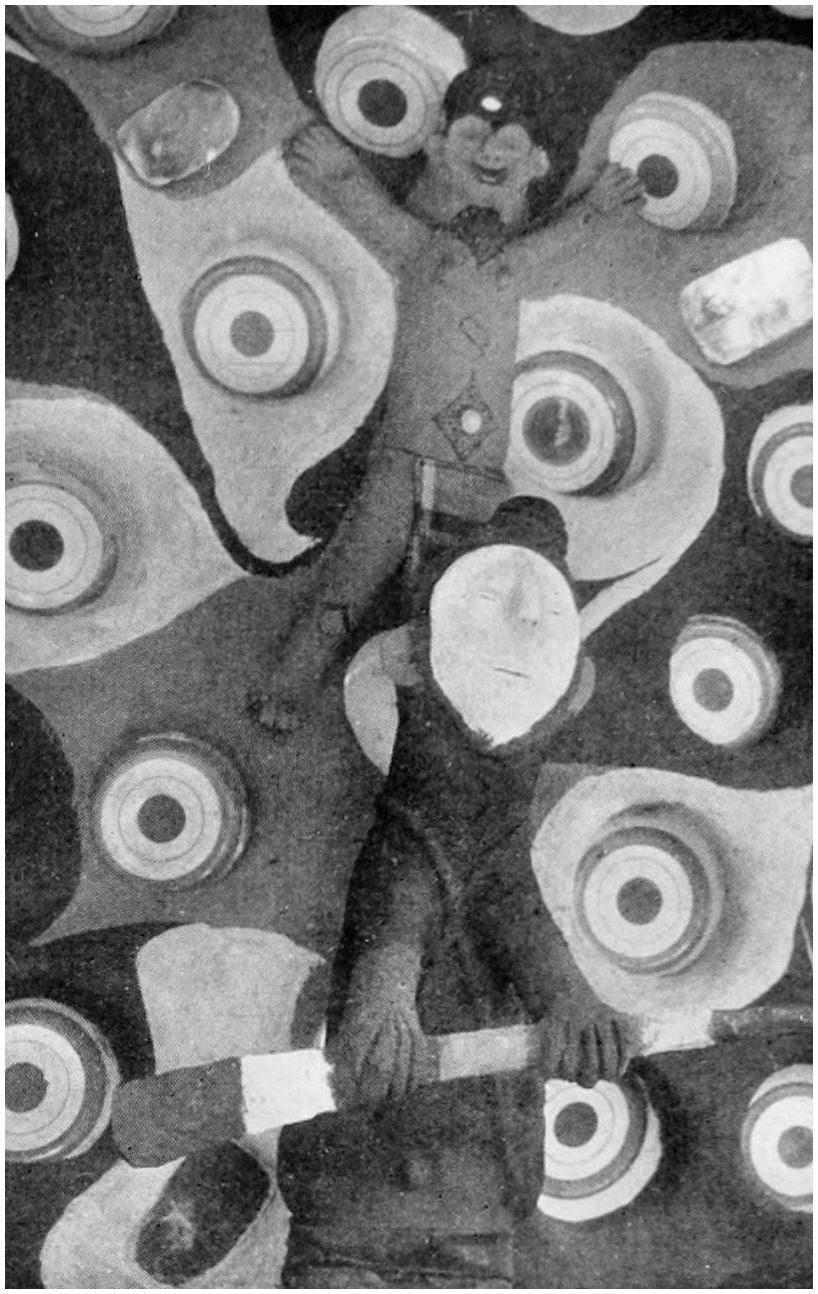
walls gay with shells and brightly coloured plates
because their fathers had bidden them do this in order
to draw down prosperity upon their people. He added,
somewhat hastily, that no special rites were carried
out and that the structure got its name only because
the word means ‘fine’ or ‘decorated’—probably from
its decorations or, perhaps, from the gay robes, beads
and brass ornaments worn by the women when gathered
together there.
All round the compound the much-branched, peeled
wands sacred to Amad’ongha are to be seen. Beneath
one of these, two pottery drums were placed, one half
embedded in the ground and one above. By the principal
shrine before the main entrance a curious adjunct was
noticed. From a sapling, cut so as to form a fork,
hangs a large oval calabash. Between the prongs a
farm hoe is held, while beneath it two tortoises are
impaled. The explanation of this given by the chief
was that one night his god ordered them to be placed
beside the shrine. The combination of objects, taken
in conjunction with the fact that this priest of the
Thunderer may only eat amid the seed corn and yams,
suggests that this is another of the many Jujus for
augmenting the fertility of the farm. It is not
without significance that, beside that of 51Amade
Onhia, the only other shrine of importance in Omo
Chuku is dedicated to Ale.
At Okehin, the Thunderer, instead of occupying a whole
building, is only given the front verandah of a house.
At one end was to be seen the figure of a mother with
a new-born babe in her arms; at the other, a group
representing a corpse laid in the grave with a pot
of offerings beside it and a pet monkey watching at
the foot by the seated figure of a woman. The pot of
offerings usually contains a small plate, knife, pipe,
tobacco, snuff and bottle of gin, rum or palm-wine.
Between these two groups representing birth and death
stands the figure of a medicine man, a magic horn in
his right hand and a Juju knife in his left.
In niches cunningly contrived in the rear wall, or
upon the low clay ridge which separates the verandah
from the road, carefully modelled birds sit upon
nests of interwoven twigs, containing eggs, tinted or
speckled in close imitation of nature. Small monkeys
climb the pillars, dogs mount guard, while the phallic
serpent twines and twists between all.
Fig. 20. Burial scene in Amade
Onhia shrine, Okehin
52
V
SKY GOD AND EARTH GODDESS
Among Etche Ibo, especially those to the west of
the Otaminni River, Amade Onhia has practically
usurped the place of Chi, the Creatrix, and reigns
as supreme deity. For months after our arrival, we
were invariably told by natives of all parts of the
Division that the Thunderer was distinct from his
brother Igwe, Lord of the Bright Sky. Later on, while
collecting information concerning rain-making by
magical means, it transpired from the words of the
invocation used that the two originally symbolised
different aspects of the same personality—Zeus of the
thunder, lightning and storm cloud, Lord of the dark
sky as well as the bright. Now, though most people
regard them as separate deities, the old idea has not
yet died out, especially among rain-makers.
Formerly, it is said, Igwe was more generally
worshipped than at present. This was explained as due
to the fact that the God of the Bright Sky only gives
advice by his oracles and does not ensure wealth,
health or special good fortune to his votaries; while
these additional gifts may be obtained through prayer
to Amade Onhia.
In January 1915 good fortune led us to Ozozo, where
stands the greatest of all shrines of the Thunder
God—a temple not made with hands—the sanctity 53of
which is so great that pilgrims come thither from
hundreds of miles. Until now its existence had been
carefully guarded from the knowledge of Europeans,
and the chief priest had so far avoided coming into
contact with any white man of the few who had visited
the neighbourhood.
Early next morning we set out to seek the place of
pilgrimage. The way led through a part of the bush set
aside for the reception of the corpses of the unburied
dead. At intervals the road was strewn with cowries,
while ghost-offerings such as pots, broken that their
astral forms might be set free for the use of the
shades, and lengths of cloth, faded by sun and rain,
were to be seen in the bush on either hand. Here and
there, too, a long, narrow crate formed of palm stems
was passed, half covered by the dense undergrowth. In
these the bodies of the unblest dead had been borne
to their last resting-place, thence to be flung forth
for vultures, ants and other carrion-feeding creatures
to work their will upon—leaving but a handful of
bleached bones for the luxuriant vegetation to cover
with its charitable mantle.
Through these ill-omened shades we hurried, only
stopping to pluck a new flower, the white cups
of which together with masses of their strangely
flattened calices had been found strewing the pathways
of the beautiful Oban District, but hitherto it had
been impossible to secure any leaves owing to the
height of the trails, which had eluded discovery amid
the network of giant branches to which they clung.
Here, in the glade of the unburied dead, the path was
54festooned from side to side with spray upon spray,
rich in flower, fruit and leaf.
Fig. 21. The Aroid which grows
round about the great Amad’ongha shrine at Ozozo
Thence we crossed the market-place and, by a network
of many mazy paths made apparently for no other
purpose than to mislead chance-comers, reached an open
space shaded by giant cotton trees and heavy-scented
Monodoras. In the low bush round about sprang great
aroids, said to be connected with the worship of the
Thunder God’s children. It is possible that the idea
is due to the phallic-like appearance of the central
spike, the long, thin, basal flowers of which give
it somewhat the look of the Schlange im Schilf—the
Pangwe description of the phallus.
At the further end of the space lay the compound of
the head priest, its open sheds full of cult objects
but deserted; for the priest and all his family had
fled at our approach.
55
Towards the near end of the cleared space two paths
branched off, one on either side of a great clump of
trees, the gnarled roots of which stretched right
across as though barring the way. These two paths join
later by a second group of no great size, which has
sprung up round the riven base of a forest giant, the
remains of whose trunk, lightning-scarred, may still
be seen stretching far out into the bush beyond. Some
few yards away a palm-leaf screen is placed across,
shutting off the cleared space from the priest’s
compound. In the midst of the screen a little erection
like the door-frame to a miniature house may be seen
thickly plastered with the blood and feathers of
sacrificed fowls. For about seven feet before this the
ground is broken as though continually disturbed, and
here and there in the soft sand depressions may be
found as though round-bottomed water-jars had been set
therein. This was explained as follows:
When pilgrims come hither bringing the appointed
gifts, the priest first makes sacrifice and afterwards
calls aloud the special favour which the worshipper
has come to ask. Should Amad’ongha be favourably
inclined, so soon as the prayer is finished, the
roll of his thunder begins to sound, no matter how
clear the sky. Then, with a great crash, a ball
of stone about seven inches across falls from the
blue overhead. This is the sign of the god himself,
come down from his home in the clouds to bless the
earth-folk.
In vain we looked upwards, expecting to see branches
which might serve to hide these mysterious missiles.
Nothing was to be seen above but slender twigs tossing
a delicate tracery of scarce open leaves against
the blue. 56On the far side of the fence, however,
stretched part of the high priest’s compound; so, if
the means by which the seeming miracle was worked
baffled discovery, the probable agency, at least, was
not far to seek.
Later we learned that the name of the priest was
Chioma Madume, and after some difficulty we succeeded
in overcoming his dread of meeting a white man—a
matter which had hitherto been considered as tabu.
He was even persuaded to come with his two assistant
priests to visit us. He proved to be a strange and
somewhat pathetic figure, borne on a rude litter,
thin, pale and with only one foot; the other,
according to his own account, had ‘rotted away and
dropped off.’ The skin of his two attendants was of
that peculiarly vivid red occasionally met with in
these regions. This appears to bear out Sir Harry
Johnston’s theory of an original red stock, but is
explained by Ibo as showing that man or woman so
marked out is a child of Amade Onhia. Both among the
last-named people and the Kalahari the law of the
Thunder God ordains that all such shall be devoted to
his service and become ‘slaves of the Juju’ unless
ransomed by their family for a heavy sum. A sister of
chief G. A. Yellow was thus chosen on account of the
redness of her skin but was afterwards ransomed.
Chioma Madume gave the following account:
I myself have been priest of Amade Onhia for seven
years.[11] Before me my father, Madume, held the
office for 57about the same time and before him my
grandfather, Odu Kerin, ruled—I cannot tell for how
long.
Our god is a very great god and is the only one
throughout this region who gives a visible sign of his
presence. When he wishes us to sacrifice or perform
ceremonies for him, we ask a sign whereby we may know
that this is really his will. In answer he sets a
rainbow in the sky. When he descends into the shrine
before the screen of plaited palm, the rainbow comes
down also and hangs just above the place, thereby
showing his presence. Many thunder stones fall there
and the holes in the ground before the shrine are
caused by something which falls from the sky, denting
the earth; but it is invisible. No man has looked upon
its shape.
(This assertion is in direct contradiction to the
statements of pilgrims, who declared, as above
related, that the holes were caused by stone balls,
roughly speaking, seven inches in diameter, which fell
down from above. It was, however, explained by one of
the chiefs present that it was probably unlawful for
the priest to describe the mysterious missiles—the
outward, visible sign of the Thunder God’s power.)
Chioma continued:
Amade Onhia, like Ale and the Aro Chuku Juju, is
against all those who act contrary to native custom.
The Thunder God sends down his bolt to strike such
sinners; so, when a man is killed by lightning, people
always know that he has done some bad thing. Witches
and wizards specially dread his power and never dare
to go out during a storm.
It was explained, in all seriousness, that the reason
Amade Onhia so often sends his lightning to strike
tall trees or hill tops is because he is jealous of
all things which seek to raise themselves near to
his kingdom. Only the birds may venture safely into
the sky realm. 58The children of earth should keep
close to the breast of their mother. The idea seems
contradictory to that held among some Etche Ibo and
Aro as to the efficacy of sacrifices made to the
so-called ‘palms of the Thunder God’ mentioned on p.
46.
With Amafa Ibo this jealousy is thought to be
developed along curious lines. Among this people it
is forbidden for a woman to climb to any height, up a
tree-trunk or even over the top of a wall or fence.
So strictly is the tabu enforced that ‘civil war’
actually broke out among this people because the
late chief Oosi, father of the present head chief of
Amafa, built himself a ‘story-house,’ i.e. a
two-floor building raised above the ground upon a
foundation of piles—and allowed his women to go up
and down the stairs. That this superstition obtains
also among Isokpo Ibo is shown by a complaint brought
before me by two men of Nkarahia as to the treatment
accorded them by the chiefs of their town who were
enraged because they had ventured to build themselves
a ‘story-house,’ to the top rooms of which they
allowed their women to climb. The chiefs declared that
this endangered the safety of the town; for, should
Amade Onhia hurl his bolt at the offending structure,
peradventure he might punish the whole people for this
disregard of his laws by two of their number.[12]
Fig. 22. The shape, surrounded
by skulls and draped with blood-stained linen, which
represents the earth goddess Ale in the shrine at
Ewawfe
At sacred places, such as the shrine at Ozozo,
the grove at Young Town or the sacred bush at
Ngeri-Baw-Ama, no leaf may be picked nor branch broken.
59
To every one of the great Jujus slaves can run
throughout the Ibo country and become its servants,
after which no man has power to take them back without
paying a great sum of money to the priest. In some
cases even this is forbidden. In many parts of the
interior such slaves can go into the market-place and
take anything they want without payment; for no one
dares touch them. After living for a long time with
the Juju, they might sometimes go free; but could only
go back to their native town at their own risk, for
there their masters could recapture them. Amad’ongha
and Ale have special power and their shrines are often
placed near to one another, because this is pleasing
to both, since they work together.
Perhaps the central part of Degama District may be
looked upon as that where the worship of Ale holds
chief sway. One of the strangest of her shrines
lies at Ewawfe, in friendly nearness to church and
school. Between them, more to the rear is a great,
open shed, with elaborately fringed, corrugated iron
roof. Beneath this are several clay pillars of the
Ibudu type, before one of which some beautifully
wrought torque-like bronze manillas lie amid a heap
of smaller ones. A few yards off stands a small mud
hut containing a figure of Ale indescribably gruesome
with its strangely-shaped skull, its folds upon folds
of blood-stained linen and the streams of blood poured
and splashed over the supporting logs and the skulls
and clumps of feathers thickly strewn around.
At this town it is customary to store all seed yams,
etc., in the huts built for carrying out the rites
of the ancestors—to whose care the germs of the new
season’s crops are thus entrusted.
60
Indeed, amongst many peoples here, the dead are
thought to be more powerful even than Ale for the
granting of fertility, especially as regards the
crops, which is not surprising since they are supposed
to live under the ground between incarnations on
earth. In most parts, however, the fertility of the
marriage bed, of the byre and of the crops is deemed
to be chiefly due to the great Mother Goddess of the
Earth. The duty is usually delegated to some of her
subordinate tribes of Jujus and it is the members of
one of these who are responsible for placing in the
womb of the mother the spirit of the being about to be
born on the earth plane. There is no ignorance here
as to the necessary part played by the human father
and mother, but their action would be fruitless and
conception impossible without the help of the gods or
jujus.
At the neighbouring village of Ogbokoro the chiefs
were anxiously waiting to speak of a serious trouble
which had befallen them. One of the schoolboys had
broken the fence round the principal Ale shrine and
stolen therefrom a quantity of manillas out of the
mass of such which were to be seen, half smothered in
feathers and congealed blood, upon the mud altar. On
being assured that such desecration would be severely
punished, the head chief answered:
This is a good word for us. We feel this thing very
much. Ale is our mother and our god; all that we have
comes from her, and without her gifts we must indeed
be lost.
As already mentioned, it is indicative of the
reverence in which the Earth Goddess is held, that
only the head chief of a town can aspire to be her
priest. It is not 61without significance that the
same rule holds with regard to the principal shrines
of Amade Onhia. Only after pilgrimage to Ozozo may
subsidiary lodges be erected, while the shrine of Ale
is usually found nearby.
Where Amad’ongha is paramount, he appears to arrogate
to himself the functions of Igwe, the Ibo sky god
proper (cf. p. 52), thus following in the footsteps of
his Grecian prototype, ‘Zeus, God of the bright sky,’
who is also ‘Zeus, God of the dark sky’; and it is in
this capacity, as Lord of the drenching rain-storm,
that he fertilises his consort the Earth Goddess.[13]
Of these mystic spousals of Earth and Sky perhaps the
most beautiful picturing of all is to be found among
the Ekoi of the South Cameroons and of Oban, Southern
Nigeria.[14]
A curious link between the worship of Ale and the
bearing of babes came to light one morning just as
we were leaving Isokpo waterside, a market town
of some importance on the banks of the upper New
Calabar River. A long, shadeless march, by roads as
yet practically unknown to white men, lay before us.
We had risen at earliest dawn in order to place the
first miles behind before the sun should add to the
burdens of the carriers, when, just as we were setting
forth after seeing the last load safely started, a
complainant arrived with a letter appealingly held out
in both hands. It was entitled ‘To his Majesty the
District 62Commissioner. Re Wansumu v.
Egeom. 17th February, 1915,’ and ran as follows:
Sir,
I have the honour, most respectfully, to lodge this my
humble complaint before your kind worship....
I am living in the defendant’s town because it is my
mother’s city. Deceased is my brother.... His death
took place in that month during which it is forbidden
to die. By our native custom, should any one disobey
this law, heavy expenses used to be paid before that
person might be buried. Defendant knew that the place
I am residing in is a mother city, yet he allowed
me to perform all the ceremonies on behalf of the
deceased Wawesi without assistance....
Leaving this for your discretion
I have the honour to be, Sir, Your obedient servant, Wansumu (his X mark).
On reading this document, it struck an ignorant white
man as somewhat strange that there should be any month
‘in which it is forbidden to die.’ On this point the
complainant stated:
The man died in the seventh month of the year. Now
according to our native law and custom no unmarried
man may be buried during the seventh moon of the year.
Should any die at that time, none may take notice of
his passing and no relative may show sign that a death
has taken place; for the seventh moon is the month
of our mother Ale and by her law it is forbidden for
anyone to die during this holy time. Most of all does
she forbid the death of the unfruitful, whether man or
woman. The bodies of such must be thrown away with all
secrecy and may not be buried. The only exception to
this rule is in the case of a man belonging 63to a very
rich family. Then, in consideration of the property
left, some of the relatives may undertake the expense
necessary for carrying out his funeral rites. Should a
man die during the holy month of Ale many purificatory
ceremonies must be gone through. This law extends over
the whole of our country lying round Isokpo part.
When questioned on the subject, chief G. Yellow owned
that a similar ‘rule’ exists among Kalabari, but is
only enforced during the day on which an Owu play is
given. He added that the prohibition as to burial
applied also to those who die of certain diseases.
‘When such people die,’ he said,
a certain mark is visible upon the body. The flesh
of such an one looks decomposed, whereon people say
‘Ale has forsaken him!’ Such bodies must be carried
far from the town and, if buried at all, it must be
a long way from the haunts of men. When a woman dies
in childbirth, her death is concealed for the same
reason, since to pass away before bearing a babe is
displeasing to Ale. In such a case, a corpse must be
carried forth at night secretly through the back door
of the house. Young maids and pregnant women may never
see the body of one so accursed. By native law all
the property of the dead must be destroyed by fire,
lest the ban of sterility should pass to any who might
afterwards make use of such things.
Among Okrikans, during the seven days on which the
feast of the Earth Goddess, called by this tribe
Elechu, is held, a similar rule obtains. Should a man
die, he may not be buried but must be flung away into
the ‘bad bush’ set apart for such outcasts. Only if
the family be rich enough to support the cost of the
purificatory ceremonies necessary before the goddess
64can be appeased, may the dead be laid to rest in the
breast of the Earth Mother—thence, like sown seed, to
spring forth to new life. The spirits of the accursed
corpses flung into the place of ‘bad bush’ on the
other hand become Akalagoli or Ekwensu and on such the
gate of reincarnation is closed for ever. They haunt
waste places and lonely creeks, seeking to harm those
who still dwell in the sunshine. Specially at noon or
midnight is their evil power most to be dreaded.
Should pot or bowl be let fall, or wooden implement
broken, during the feast of Elechu, the sherds must be
piled in a heap upon which is flung the body of any
animal which should die during the festival. So large
had these mounds grown in many cases that they formed
a serious menace to the health of the town and proved
no inconsiderable difficulty in the way of an official
with leanings towards sanitation. It is to a mixture
of good fortune on the one hand and reasonableness on
the part of the Okrikans that the trouble is now, for
practical purposes, a matter of past history.
Among Ibibio the burial of women dying in childbirth
is also forbidden. These were borne forth, through a
hole purposely broken in the house wall, to be flung
away in the bush, lest their barrenness might have ill
effect upon the fruitfulness of the Earth Mother.
65
VI
IBUDU
To those who pass through the country with open eyes
it is obvious that the phallic cult is very strong
among Ibo. Where the Ibibio had contented themselves
with a plain mud pillar, set as emblem amid the
farm, Ibo take special pains in modelling not only
a personification of the symbol, but in showing
unmistakably that the circumcised phallus is intended
to be represented.
Among Ibo, as with the ancient Egyptians also, the
feminine, as well as the male, genital organs are
worshipped. Both are rudely depicted under the title
Ibudu—a name which embraces the chief protective
Jujus[15] erected in town or compound, the primary
purpose of which appears to be the granting of
piccans, though most also act as protector in general
to the family or village of which they are the fetish,
and bestow fertility on farm and byre. The feminine
part of the Juju is usually in bell shape, instead of
the pot or calabash form found among Ekoi and Ibibio.
It generally shows the high coiffure only permitted to
Ibo women after the birth of a babe. The nose is often
joined to the base of the hair ridge and the 66impaled
tortoise, already explained as a feminine symbol, is
as a rule seen in the foreground.
Perhaps the most convincing testimony to the efficacy
attributed to the feminine genital organ is a
carefully carved representation of the labia, which
was explained as having been one of the most sacred
objects in a great Andoni Juju house, whence it was
taken by a man who had no idea of its significance.
In course of time it came to my notice and was
subsequently added to our collection.
An example of the simplest form of phallic pillar may
be found in a compound next door to that of Ababua,
head chief of Omo Chuku. Save for two roughly modelled
feet at the base, no attempt was made to add limbs to
the column, down either side of which a row of rough
wooden pegs had been driven. It was explained that
each man of the compound inserted one of these on
taking a wife, so that the Juju might have a constant
reminder of the need to send ‘plenty of piccans’ to
their hearth.
67
Fig. 23. Obelli Oduaha Ibudu
juju for granting many piccans
Fig. 24. Ibudu in compound
next to Chief Ababua’s, Omo Chuku
Fig. 25. Headless Ibudu in Omo
Alipo compound, Omo Chuku
In another quarter of the same town, in front of Omo
Alipo compound, an Ibudu may be seen of which the
pillar represents a body from the loins upward—the
hands, so roughly modelled as more nearly to resemble
feet, resting upon the circular base as though in the
act of lifting the upper part through from the earth
beneath. The figure is headless; only the end of the
central pole and the twigs and tie-tie forming the
core, round which such images are modelled, protrude
from the broken rim. It is perhaps worth remarking
that this pillar, like some to be mentioned later,
68combines both male and female attributes, somewhat
in the style of the Indian Linga.
Perhaps the most highly conventionalised of all such
images is one to be found in a shrine built in a
prominent position on the main road, just outside
the Omo-Ofo quarter of Ndelle. This represents the
male part of the Juju. At the other end of the shed a
smaller figure is to be seen, bell-shaped and showing
feminine symbols. This is typical of most of those
intended to represent the feminine creative power,
though one of a type more nearly approaching the male
form of Ibudu was found, later on, in Chief Wokogg’s
compound at Omo Akani, Owerri District.
Just beyond the shed containing the two phallic
pillars, a couple of shrines may be seen, one on
either side of the main road. That on the right is
built in honour of the Juju Onru-Ji (farm yam). This
was explained as ‘one very big woman spirit, all same
Ala.’ In the ground were many knives and pieces of
iron, said to have been placed there by order of the
priest who declared that the Juju needed them.
Fig. 26. Ibudu at Ogaminni,
near Ndelle
A little further, on the opposite side of the road
beneath an arbour-like cutting made in the thick bush,
was a piece of white baft stretched between two posts.
This is set up in honour of Onru Ka’n Ala, stated to
be the husband of Onru-Ji. The chief of the quarter
explained:
Both of these Jujus are strong too much. Therefore we
never swear a man on their name, because, should he
even hesitate to tell the truth when brought before
them, the spirit of one or other would strike him dead
at once, giving 69no time for repentance! It is a
very strong rule for our part that both Jujus must be
dressed by the people of Omo-Ofo before they may eat
new yams.
At Aloa, a town in the centre of the Division, a
shrine is to be seen containing a fetish, the like of
which is not, to the best of my belief, to be found
elsewhere in these parts. It is in the corner of a
room set apart 70as sacred to Chineke, the Creatrix,
in the compound of Chief Wegu, and consists of an
oblong block, terminating in a carefully modelled
representation of the male genital organs, raised upon
three steps. To this the owner makes sacrifice every
month, usually at the time of the new moon, in order
that ‘plenty piccans’ may be born to those of his
house.
A somewhat similar fetish was found among the Ale Nsaw
Ibo in the shrine of Chief Idu of Oborotta raised upon
a clay step in the angle of the wall at the right
hand corner. This consisted of two small round pots
fixed neck-downward into the clay, while between them
protruded a piece of wood, roughly phallic in form, on
the upper surface of which two miniature Offor sticks
were bound lengthwise and side by side. The object of
this fetish was to bring prosperity in general and, in
particular, many children to the compound.
71
A Juju, intended to represent a woman’s body from
the waist downward, was found among the same people.
This was called Ite Uru, i.e. pot of gain,
and was supported at the rear by the wall and in
front upon two roughly modelled legs. It formed the
principal cult object in the shrine of Chief Okuroji
of Obokoffia and was set up by the grandfather of
the present head of the house, but had been freshly
decorated (fig. 27).
Fig. 29. Ibudu Nwa
Another Juju for bringing ‘plenty piccans’ to the
house and for making them grow up fine, strong and
tall—also for giving long life to its owner—was hung
up to the roof over the main door of the head chief’s
house at Ndelle (fig. 28). The arrows were planted
so thickly that one could not see of what the oval
groundwork was made.
At Ale-Barada, a charming town to the west of the
Upper New Calabar River, never before visited by a
72white man, and which, as its name denotes, is under
the special protection of the Earth Goddess, a Juju is
to be found, called Ibudu Nwa, i.e. Ibudu for
children. This occupies the centre of a rectangular
shrine and is set beneath a canopy of tie-tie,
attached to the roof, from which depend inverted pots,
the shape of a shallow bell, each with a twist of
gay-coloured cloth swinging, clapper-wise, from its
centre. Beneath these hang fringes of palm-leaf, so
long, in places, as almost to sweep the market-basket
placed upon the neck of the strange, headless figure
beneath (fig. 29).
On marriage, before going to the bridegroom’s house,
each maiden of the town is brought by her friends to
this shrine and, bending before the image, dips her
hand into an earthen pot filled with ‘medicine’ which
is placed there in readiness. Then she rubs her hands
over the Juju, after which she laves them in a small
bowl filled with pure water. Again she passes her left
fingers over the image and afterwards over her own
body; ‘for’ as the head chief explained, ‘Ibudu Nwa is
a very strong Juju in our town and will surely grant
fruitfulness to all those who carry out these rites.
So we were taught by our forefathers and this we
believe even to-day. Should any man doubt, he has but
to look round and see the many piccans which are born
to our town.’
Fig. 30. Ibudu Nwa at
Ale-Barada
Between the upraised arms, resting upon the place
where the head should be, is a market-basket, full of
dried roots, seed yams, etc. Outside the shrine, each
protected by a small shed, were two unusually large
phallic pillars, to which bridegrooms bring offerings.
73Across all, from post to post, rising like Venetian
masts, were long chains made from linked rings of
creeper, from which hung, at intervals, inverted bowls
with gay-coloured strips of cloth waving to and fro in
the breeze, like those decorating the canopy of Ibudu
Nwa. To the left stood a great tree, its trunk hung
round with white cloth, the reputed home of a powerful
and beneficent nature spirit. Before the principal
shrine sprang little saplings of the bush which Ale
first brought when she came swimming 74through the wide
waste of waters to form the first abiding place for
her children—men, beasts, trees and flowers.
Altogether Ale-Barada is a charming spot and the
manners of the sons of the soil were unusually gentle
and friendly. They willingly answered every question,
in striking contrast to the inhabitants of the next
town, Oduaha, where a Juju of somewhat different type
is to be found. This was sullenly explained to us as
without name and only used for protection—‘not to
give piccans.’ The canoe upon its head was likewise
stated to have been put there ‘only to look fine. Not
for any purpose.’
At Omo Hume, a quarter of Omo Dioga, another Ibudu
was found, which was said to be intended as a
representation of the Earth Goddess, here called Aja.
In a little clearing to the right of the main road
stood a shrine of unusual size, sheltering two phallic
pillars. The smaller of these, placed in front and a
little to the left, was obviously female and smeared
with blood from the breast downward. The rear figure
bore no name save ‘Husband of Aja,’ or at least none
other was confided to us. So tall was this that it
filled the whole space from floor to roof, looming,
colossal and with a certain impressiveness, from
out the shadows at the back of the shrine. Between
the two, on either side, lay a piece of plaited
palm-cloth, black and white, such as widows wear in
some parts; while two deep fringes of palm-leaf were
hung before the entrance, screening the strange, rude
deities within from the glances of passers-by.
75
It was explained that the cloths were those of barren
women, and had been laid at the feet of Aja and
her spouse in the hope that, when resumed by their
owners, the ban of sterility, imposed through the hate
of some rival, might be broken by the power of the
fertility-bestowing Earth Gods.
Fig. 31. Ibudu at Digiriga
Fig. 32. Ibudu placed before
the entrance to Omu Dara quarter of Akpani
At Bush Digiriga again, a small town to the east of
the Sombreiro River inhabited by Abuan people and
never before visited by Europeans—a Juju ‘for the
obtaining of piccans’ is to be found, which in many
ways resembles the Ibo Ibudu. About this particular
fetish, however, there are certain points which
we never met elsewhere. In addition to the high
coiffure—a recognised symbol of femininity—the head
is provided with a square beard in shape like those
false ones worn during certain dynasties by Egyptian
rulers, especially queens reigning in their own right.
It is perhaps worth noting that, while the arms of
the figure are mere stumps, without any attempt to
reproduce hands, and the feet are so rude as to be
almost shapeless, the phallus is modelled with the
76utmost care, showing that in the minds of its makers
this detail was of very special significance.
Outside the entrance to the Omo Dara quarter of
Akpani, an Ibudu of unique type may be seen, one
looking-glass eye twinkling in the middle of its head
beneath a ring of feathers set crown-wise in the clay.
Before it, to a four-branched post, a medicine-pot was
bound.
In the midst of the quarter, beneath a little
palm-leaf hut, stands a group of Ibudu. The largest
of the pillars represents the female, the smaller
the male, attributes. They are modelled seated back
to back—a prostrate leopard lying to the left and a
crater-like mound, containing a pot for Juju medicine,
to the right. Chief Woke Abara, head of the quarter,
gave the following explanation:
‘Formerly it was very hard for us to get children.
Nearly all our women were barren, so we raised the
two Ibudu, one male and the other female. Since then
we got plenty piccans in our town.’ He added that the
‘leopard spirit’ helps the Juju to prevent the deaths
of children. The small cone in the foreground and the
77headless animal lying in front of this were the work
of the few children then existing.
Fig. 33. Ibudu at Akpani
With regard to the figure of a leopard, it is perhaps
worth remarking that the ancient kings of Benin were
wedded, in mystic spousals, with a leopard bride.
Also, among those Ibo dwelling in the group of towns
round Igrita, the spirits of the righteous dead often
take up their abode in leopard form while awaiting
a new term of earth life, but those who enter into
crocodile, ape, or bush cat, are regarded as for ever
accursed.
Amid a branch of Kalahari settled at Oguta in Owerri
District, a type of Ibudu is to be found, not, so far
as our knowledge goes, to be met with in other parts.
Each of these emblems consists of two sphinx-like
figures, one male and the other female, facing
different 78ways but joined together by a ridge of
clay, which forms, as it were, the back of the sphinx.
At the Ibo town on the far side of the beautiful
Oguta lake, we came across another phallic pillar
combining the figures of the dual personality, male
and female, of the Ibudu Ezum Mezum. As in the case of
the Ale shrine, described on page 74, the consort was
nameless, bearing no designation save that of husband
of Ezum Mezum. The figure representing him held the
place of honour at the base of the column which
symbolises the joint attributes of the Juju; while,
at a height almost double that of the husband, towers
the face of the wife. On either side of the pillar,
out-topping the male figure from the neck upwards,
climb two great crocodiles; while placed here and
there, at irregular intervals, human heads stand out
in high relief.
Chief Onomonu, the owner of the shrine, told us:
The Ibudu Ezum Mezum is mostly worshipped at Amaii
in Abaw District and priests came thence to build
this shrine for us. It was made at a time when a
great sickness was raging in our town, in the hope
of staying this scourge, granting protection and
prosperity in general and especially to help our
people in the bearing of piccans.
At its installation, about twelve years ago, the
Abaw doctors held a great ‘smelling out,’ and, in
consequence, decreed that the epidemic was caused
by the witchcraft of the six richest women
of the town, who must therefore be put to death and
their property be made over to the medicine men!
When informed of their doom, the victims refused to
acquiesce and were therefore 79beaten to death in
the market-place. The number of heads, modelled at
irregular intervals over the pillar, corresponds
to that of the victims thus slaughtered at the
inauguration ceremonies—four at the back and two
in front, between the sacred crocodiles. All are
liberally smeared with blood poured upon the heads and
trickling downward. This is the only example known to
us at the time in which an Ibudu is so represented as
to show the dual creative forces, male and female,
combined so as to form a single pillar. Many Ibudu
were later seen among the Abaw Ibo of Kwale District,
where this particular type of symbol would seem to
have reached its greatest development.
The phallic figures, above-mentioned, are, however,
by no means the only examples met with in West Africa
of the mingling, in one object, of male and female
symbols. For instance, the emblem of the greatest of
all Ekoi Jujus, Eja, unmistakably combines the two.
Here, the phallus, represented with the uttermost
pains and fidelity, is the sign of the harvest god
himself, while the bowl-like object to which it is
attached represents the womb of his wife Ekumoke. The
united symbol stands upon a base formed of wide-open
human jaws.[16]
Among the Ekoi, both in the South Cameroons and
Southern Nigeria, as indeed throughout the greater
part of the West Coast generally, a pot or calabash
is regarded as a feminine symbol, and it is of
considerable significance that traces of male semen
have been found 80in no inconsiderable number of the
pots set before Ibudu images and in other Juju shrines
throughout the Ibo country. This fact is vouched for
by a medical officer.
In the ritual chant sung by Ekoi at the festival of
Eja, which is also the feast of the first fruits, the
names of the combined deities are always invoked:
Man Eja! I am staying with you.
O, I am staying with you!
Ekumoke! I am staying with you.
O, I am staying with you!
Of these two deities it was expressly stated: ‘Eja is
male and the most strong. Ekumoke is less strong than
Eja; nevertheless without her help he can do nothing.’
During the annual rites a woman was formerly
sacrificed and the genital organs cut out and laid in
the sacred pot, which contains the ‘medicine’ of the
cult. Since the coming of Government it has naturally
become increasingly difficult to obtain this necessary
ingredient, and it was a matter of grave anxiety on
the part of the priest lest the power of the Juju
should decrease in consequence.
Amidst some of the eastern Ibo sub-tribes and the
northern Semi-Bantu, the ancestors are represented
by small clay pillars or mounds, clay balls or round
or pointed stones, before which sacrifices are made
and prayers offered for the granting of fertility,
especially at the two great festivals of the year, the
planting of farms and the harvest.
81
In those parts of the country where rock is available,
i.e. among the northern Yoruba and Semi-Bantu,
many stone monoliths may be found, some of which are
unmistakably phallic, while others are used not only
for this worship but also as ancestral memorials.
In fact, the two cults are inexplicably mixed, as
is natural when it is remembered that amongst these
peoples fruitfulness is, to a large extent, attributed
to the forefathers. Some of these memorials date back
many hundreds of years; a fuller description will be
found in Chapter XVII, vol. ii, of The Peoples of
Southern Nigeria.
In the club-houses of the great Ekkpe secret society
the sacrifices are made before a phallic monolith,
which represents the former members of the club as
also the tutelary deity, while in, or near, its base
are generally placed rounded pebbles, the symbol of
the Earth Goddess. A similar monolith is worshipped
amongst many of the Bantu and Bafumbum-Bansaw as a
representation of the supreme deity.
Fig. 34. Eku at Umo Abale
quarter of Omo Dioga
82
VII
EKU
All over the western part of the District a strange
rite still obtains which is obviously only another
manifestation of the phallic cult. As there are
local differences it will be necessary to describe
separately the peculiarities of each centre.
By the roadside near Umo Abale, a quarter of Omo
Dioga, half hidden amid grass and creepers, we
came across a crowd of figures formed of sun-baked
clay, cone-shaped and painted black. Further on, in
front of almost each compound, smaller groups were
to be seen, usually arranged at the base of some
Juju tree, or round a sapling of the sacred Ogrisi
(Dolichandrone sp.). In several cases circular
moulds of baked clay, much like an old-fashioned
spittoon in shape, lay nearby. It was explained
that upon these the girls of each compound, after
undergoing the initiatory ceremonies preparatory to
marriage, set the food cooked as an offering to the
Eku, as the phallic figures are called. This word is
also used to designate the cones of baked clay used to
support cooking-pots. Should any girl, after arriving
at the age of puberty and being inducted into the
feminine mysteries, neglect to set up such an image
each year, about the time of making new farms, until
she becomes a member of her husband’s house, no babes
would bless their 83union. In one or two cases a
slight amount of decoration, formed by lines drawn
with the fingers in the soft clay, has been added;
while here and there an attempt was made to surmount
the cone by what was explained as a representation of
the high head-dress only allowed to Ibo women after
the birth of a babe. Mostly, however, the images
showed nothing more or less than a simple attempt at
depicting the phallus.
About a month later, at the house of Chief Ugwa in
the Oturu quarter of Akpani, Eku of a still simpler
type were found, together with clay pot-rests of much
the same shape as those already described; while just
outside, in the bush by the roadside, we came upon
some thirty or more phallic figures, the tallest and
frankest yet seen. Some stood on circular, some on
rectangular, bases; but on each the membrum virile was
modelled with especial care.
It was explained that every year, when making the
more elaborate pillars, each betrothed girl fashions
several of the plainer type, a foot to a foot and a
half in height. These are said to be used as ‘strong
Juju on which to swear people.’[17] Three of these are
borne by each maid to her bridegroom’s compound, there
to be presented to the chief woman of the family, by
whom they are set together to support the pot in which
food is cooked for the future husband. When ready,
this is poured into a native bowl and placed upon the
clay ring. After marriage, the bride comes to the new
home and herself cooks her husband’s 84meals upon the
same three pillars prepared by her own hands.
It is not without significance that the trinity of
cone-shaped pillars, with cup-like depressions, raised
before the Kalahari Nduen Fobara (ancestral shrines),
into which libations to the forefathers are poured
every eighth day, are of almost identical type. At
Oru-Sangama, an ancient town on a creek leading into
the San Bartholomeo River, we came across two of these
small cones modelled within a circle, also of clay,
beneath the palm-leaf roof of a tiny hut. So like were
these to the Eku emblems that we took for granted that
the little shrine was but another dwelling-place of
one of the manifold representations of Ibudu Omumu,
i.e. the Ibudu of fertility. Long sojourn in
Africa should, however, teach caution even to the most
careless enquirer, and we therefore, as always, took
the precaution to keep our ideas to ourselves and
asked the significance of the symbol. As a result we
were told that they represented the Nduen Fobara of a
neighbouring house. Our informant added:
Some men make three, some two, small pillars for the
pouring out of libations to the spirits of their dead.
Some again make only one such emblem for the reception
of drink offerings. Here no carved images are shown as
is usual in rich Kalahari towns; the cones themselves
represent the ancestors, except in the case of men of
distinction.
Considering the peculiar powers thought by many tribes
to attach to the phalli of the dead, especially those
of warriors or others who excelled in strength or
power, as also the Egyptian legend of the birth of
85Horus—that seed of life, snatched by the widowed
Isis from Death himself—it is perhaps not too far
fetched an idea to imagine that the likeness of symbol
was intended to signify a connection between the
physical body of the new-born and the astral shape
or ethereal mould, supplied in most cases according
to general belief from the ghost realm, where the
ancestral shades await reincarnation—by preference in
the bodies of those about to be born to the family to
which they themselves formerly belonged.
Fig. 35. Pillars, carved
tusks, and bronze torques. Kalabari Shrine of
Awome-Ka-So
Sir James Frazer, in his wonderful Golden
Bough, tells of sacrificial victims whose phalli
were beaten with twigs—not out of cruelty, but with
the idea of increasing the powers of virility. Among
the Ekkett Ibibio sacred boughs are drawn over the
pudenda of warriors while parts are even cut off and
buried secretly by the marriage bed, in the byre
or on the farm. In this connection it is perhaps
worth mentioning that one of the most dreaded of
West African tortures, employed upon captives of
distinction, was the continued flagellation of the
phalli.
Chief Igo, of Omo Nelu, gave the following information:
We start to make the Eki—as they are locally
called—at the time of cutting the undergrowth for the
new farms. Then, when we have carried out the images
and set them up by the roadside, we begin clearing
away the top branches. The ornamented pot-rests are
used for cooking chop for the Eki.
Chief Chuku’s quarter cooks for two weeks (i.e.
sixteen days). Amadi’s and my quarter cook for
thirty days. It is the young girls who make these
things—both the cooking ones and the others. For
twenty-five days we hold the first 86festival, that of
the low round Eki, which we call Eki Mother. Every
evening at about five o’clock time the girls cook. On
the twenty-fifth day each girl starts making one of
the high Eki, Ada Eki (eldest daughter of Eki), which
is worshipped for five days before carrying it out.
When my father was alive, the ceremony always started
in his compound; for he was the head chief. After
he had made festival for eight days, all the other
compounds joined in and continued till thirty days
were finished. Then all men took notice and said: ‘It
is now time to start the new farms.’
Fig. 36. Patterns of the low
Eki
With us also the young girls go and get ant hill earth
before they make the Eki, but they do not use it for
these, only keep it in their houses for three months
and afterwards take it with them to the market-place,
where they dance and play round it and then finally
throw it away.
Egu ’Nde ’Nwayin is a woman’s festival held at the
time of digging new yams. It was my father, the priest
of Ale, who set the time for this ceremony also. At
this time the women dress very finely, wearing many
beads round their ankles.
87
On another occasion, just after leaving Ndelle en
route for Rumoji, we found, by the side of a bush-path
beneath the spreading branches of a Berlinia, a hut,
the long, low, palm-leaf roof of which was covered
with the fragrant white-petalled flowers showered
down from above. Under this shelter was a platform of
clay some twenty feet in length, carefully smoothed
and with gaily coloured plates set at intervals along
its edge. Upon this a double row of strangely-shaped
finely-decorated figures were to be seen, formed of
sun-dried clay, much in the style of the Eku already
mentioned, but far more elaborately modelled and
painted. On the bright yellow clay, ridges and lines
of shining black, vivid blue and white were to be
seen, while each was surmounted with an attempt to
represent the elaborate styles of coiffure affected by
girls of marriageable age.
Each had been brought thither by a maiden of the
neighbourhood after undergoing initiatory rites in
company with her ‘age class.’ The ceremonies are
conducted in places set apart, under the leadership
of elderly women of the town. The time chosen is
after the planting of new farms when the seeds first
germinate. At this season all little maids who have
reached, or are approaching, the age of puberty—for
the ‘age class’ includes those born within three years
of one another—come together to be instructed, by
matrons chosen for the purpose, in all that it is
thought necessary for them to know as a preparation
for marriage. Later, the neophytes return to their
parents’ house and there model the figures shown 88in
the photograph. When all are ready they go, together
with their instructress and a band of relatives, each
bearing one of the Eku upon her head in procession
to the spot chosen by priest or instructress. Here a
platform of clay, decorated with insets of plates,
pieces of looking-glass, etc., has already been
prepared. The celebrants in turn place thereon the
queerly shaped image which is supposed to be necessary
in order to draw down upon the girl, who offers it,
the blessing of fertility.
Beside those newly initiated, older maidens, to whom
the mysteries have formerly been revealed but who are
as yet unwedded, also take part in the rite, bearing
a fresh Eku in the procession, year after year until
the whole, or at any rate the main part, of the dowry
has been paid, and they leave their parents’ house for
that of a husband. The elder girls offer images often
over a yard in height, while the new initiates bring
smaller ones, proportionate to their size.
At a little distance from the places set apart for the
principal images, fish racks may occasionally be seen
by the roadside and on, or between them, the smallest
figures of all are to be found. These are said to
represent ‘the slaves of the Eku.’ Each girl, after
modelling her own symbol, makes at least one such
little attendant, so that her image may be well served.
Fig. 37. Group of Eku, near
’Ndelle
Near Ndelle waterside a somewhat different arrangement
obtains. In front of the long line of Eku, a separate
group may usually be found set round a sapling of the
sacred Ogrisi tree. The central figure is dedicated to
the principal girl of the town, while 89the smaller
ones grouped round her represent her attendants. Near
the centre, springing out of the clay base, was a
small sprig of the bush which Ale brought with her
when she first formed the earth.
At the same time of year, when the seed corn and yams
lie awaiting rebirth in the womb of the Earth Mother,
the unmarried girls of Elele carry out a ritual
similar in many respects but with certain points of
difference. Here the images are modelled from clay
supplied not by the parents, as is usual in other
parts, but by the bridegroom. These must be rubbed
and smoothed for seven days and each is surmounted
by a head, the coiffure of which is carefully copied
from that of the girl herself. Every evening, food
offerings are carried to the place where the Eki are
set up, while the girls dance and sing before them.
The bridegroom must provide from sixty to a hundred
Awarawu manillas during this time, which are accepted
by the parents as part of the dowry.
Often these strange images are modelled with breasts
in addition to the male emblem. Is it an unwarrantable
assumption to think that this may possibly be intended
as a primitive attempt at picturing the ideal
marriage, in which male and female attributes play
equal parts? This peculiarity is not confined to the
Eku but is even more marked in many Ibudu, as for
instance the one already mentioned at the Umo Alipo
compound, Omo Chuku (see p. 66).
Some time after all the Eki have been set up in the
farms, compounds and bush round Elele, preparations
90are made for the carrying out of a further ceremony,
called Nwan Aja, i.e. Child of the Earth,
which is said to be closely related to the festival
already described. For this, the unmarried girls
of Elele go out to the bush and search round until
each has found one of the great mounds thrown up by
termites. ‘With the help of relatives she digs down
into this until she comes to the heart of the cave,
named in our speech Wekwe Eruru.’ The floor of this
looks like a mountain range in miniature. Breathless
with excitement, the little maid counts the number of
peaks; for just as many as there are of these, so many
babes she will bear. With infinite pains, that not
one may be broken off, she cuts round, then lifts the
flat, roughly circular mass to her head and carries
it home. This is a time of great anxiety; for, should
any part break away during the process, the number of
fallen points denotes—alas!—the still-born babes
which fate will send her.
Fig. 38. The Wekwe Eruru
In some places all the girls of the quarter join
together to seek out an ant hill and dig up the part
in which 91dwells the queen ant. ‘One of their number
is appointed to carry this thing, which is then borne
back to the town and set down on the road near some
of the principal compounds. All stand watching to see
in what direction the ants will go; for the way they
take points out the compound in which the girls are
to live until the time of the new yam harvest. There
they must stay in seclusion, grinding cam-wood and
preparing for the approaching festival. Thither their
future husbands come bringing palm-wine, yams and
fish, together with six Awarawu manillas as dash for
the owner of the compound.’
From many indications we had long suspected that
the magic powers of the ant hill proceeded, in part
at least, from its phallic resemblance. This was
borne out by the number of Ibudu shrines, avowedly
raised for the increase of children, before which
these curious structures, known in these parts as
‘Bush-men,’ were found. In several, one of these
lesser ant hills had been set up amid the special
‘servants of the Juju’ modelled on either hand of the
principal image. Such an one is to be seen in the
shrine of Ezum Mezum, erected within the compound of
the Aro chief Ogunda of Azu-Miri near Nkarahia. On
each side of the pillar stand her ‘servants.’ The
nearest, a conventionalised phallic pillar surmounted
by a head and with a little doorway in its tower-like
base, through which one of the small elongated chalk
cones—offered by every woman of the compound after
conception—is seen, half in and half out, so as to
appear in the act of entering. Next to this, but
further from the image, 92is a natural ant hill, daubed
with paint, against which leaned several of the lesser
symbols.
These chalk cones or images, though more roughly
moulded, bear considerable resemblance to those
carefully modelled in clay and suspended over their
father’s shrine by each ‘true daughter’ of an Ibibio
chief in the Mkpokk region to show that they were the
legitimate offspring of the dead man, not of slaves,
or of ‘widows’ born to the house, of whom he was only
titular parent.
Fig. 39. The ‘Servants of Ezum
Mezum’
At the end of their period of seclusion in Nwan Aja’s
compound, the girls of Elele put on new cloths and gay
ornaments, then sally forth to market (Eke Oma). This
is a sign that the play is ended for the time.
Every other year a special play is given. According to
Mr. D. Braid:
‘This cannot be carried out more often, on account of
the great expense incurred therein by the bridegroom.
The name of this play is Ajiji’—in 93some places Adidi
or Adadi—‘and it is one of the best of all plays for
girls and ladies. It looks grand whenever they start
same. They dress with brass ornaments, corals, etc.,
on their feet, all which expenses are run by the
husbands, with the exception of the anklets for one
foot which the parents are expected to provide. The
brass ornaments are prepared by the blacksmiths, from
nine Awarawu manillas for growing up ladies and four
to five for younger girls. All go in procession round
the town until they come to a place in the Omuneta
quarter called Ebu, where there is a great tree in
which dwells a certain powerful Juju. Here fowls are
sacrificed and cut in such a manner that blood falls
upon the feet of each girl. After this has been done,
they sing all kinds of songs, dancing with great
gladness for some hours.’
Both on the way there and back those girls who are
about to marry rich men are carried in decorated
chairs, with a canopy fastened above them. Bearers
are hired for this service by the future husbands.
During the Ajiji ceremony many ghosts flock into the
town. In olden days, these would strike the girls as
they were borne by; because spirits are jealous of any
mortal whose feet are not set upon the ground. A bride
thus struck always sickens and usually dies within
the year. That is the reason why, nowadays, each girl
holds a picture before her, so that the ghosts may
strike at this and let her go by unharmed.
On reaching home a feast is given by the parents
and next morning all the girls take chop to the
husbands’ place. This food is distributed to all in
his compound, together with rewards of money. The
bridegroom is expected to do the 94same in return and
all the expenses incurred by him at this time are
counted as dowry. The play generally lasts for seven
Ekes, i.e. about two months.
In October 1916, just outside Elele, on the Nkarahia
road, a group of specially interesting symbolic
images was found. It consisted in roughly modelled
male and female figures, arranged in pairs and lying
outstretched at the base of a great cotton tree
(Akpu). The bays, formed by its buttress-like roots,
were separated from one another by giant snakes
moulded in clay, which, arranged in irregular loops,
usually with the tail of one against the tail of the
other, served to fence off the sacred enclosure from
the wayside. Within the various bays thus formed
smaller serpents twined and twisted, often placed
between the male and female figures. In one case the
phallic serpent was shown in the act of entering the
body of a woman.
Dotted over the slope, forked sticks were seen driven
into the ground or raised on little clay mounds.
From these depended strings of great snail shells
(Acatina marginata) or empty fish racks, in
shape much like the head of a Badminton racquet.
This group, the name of which was given as Akpu Ogbe
Ajiji, had been modelled by maidens of marriageable
age belonging to Chief Woyike’s compound as an
additional means of increasing fertility.
Fig. 40. Clay figures at base
of cotton tree near Elele
Fig. 41. Figures at base of
cotton tree near Elele See p. 94
Just beyond Elele Aliminni, on the Ndelle road, a
great tree may be found to the Genius of which the
unmarried girls of the neighbourhood go and pray
during the Ajiji—locally called Adidi—ceremony.
Three circular clay steps are built, one above the
97
other, round the base of the tree and reaching
about four feet up its trunk, forming a rough altar
upon which piles of Acatina marginata shells
and empty fish racks (Paka Eji) were laid. A few yards
further, in front of the compound of Chief Ofonda, a
large terminal bud of the banana flower-spike, pierced
with four slivers of wood was set up on a tall palm
stalk. This bud is called Eni Awsoku, i.e.
navel of plantain or banana. It is natural enough that
these two trees should bear special significance in
the fertility rites. The combination of phallic-shaped
fruit and terminal bud with its oval form offers an
obvious symbol of the male and female reproductive
organs.
Fig. 42. The Eni Awsoku
After building the Adidi altar and setting up Eni
Awsoku, the celebrants go in procession round the
town, their faces rubbed with chalk of a pale café au
lait shade and their hair covered with bright yellow
paste. From a distance this colouring gives them a
curiously European look. At the back, hanging round
the waist, they wear a kind of apron of large glass
beads, arranged in alternate squares, usually green
and brown in colour, the whole fringed with little
brass balls.
98
After a girl has been given in marriage and has gone
to live with her husband, she may never again take
part in the Ajiji play. At the end of the series of
Eku ceremonies, which last, roughly speaking, from the
ending of farm planting to harvest time, the whole
town of Elele goes to Chief Eleche’s compound for the
feast of new yams which is held in honour of the great
Juju Aya-Eke. On this occasion every man, woman and
child bears a gift to the priest. Even little babes,
too small to stand alone, are borne before him. The
mothers press a gift into the tiny hands and then hold
them out towards the chief that not even the smallest
should fail to make offering.
The name Ajiji, given by Ibo to the greatest play
in the series, would seem to be derived from Aja
(sacrifice), which is also in some parts the name of
the Earth Goddess herself, and Ji (yam).
99
VIII
THE YAM CULT
At the cutting of new farms most Ibo chiefs make
sacrifice to Ale and again before harvest. Beside
offerings to her, some should also be made to the
Ajokko-Ji[18] or Njokkoji—the king (or Juju) yam, the
biggest one of all the crop in which the yam spirit is
thought to take up its abode. This is always set aside
from one season to another, and when bird or beast
is slain in sacrifice to the Genius of the farm, the
blood is thrown upon the Ajokko-Ji.
Should a man find that he has more yams one year than
in the seasons before, he brings the richest sacrifice
in his power and offers it in thanks to the Farm
Spirit for giving increase and doing good to him.
The word Ajokko means Juju, but it is also used with
the signification of ‘great’ and ‘mighty.’ This king
yam, as it is sometimes called, is kept throughout
the whole year until next harvest comes round.
Either fowls’ or goats’ blood should be poured out
in libation upon it. Formerly a spirit dwelt within,
which protected all the yam racks in the farm. Now,
owing to the dying out of such beliefs, people are not
afraid to steal from these. In olden days they never
dared to do such a thing for dread of the yam Juju.
While visiting Oppe, a farm settlement just outside
Alessa, we were shown a ‘strong Juju’ connected 100with
the worship of Nkike, the Mbolli Earth Goddess. This
was formed from a collection of skulls, yams and other
roots, bound round with tie-tie into the form of a
gigantic yam and then attached to a stout stake, the
end of which was sharply pointed for driving into the
ground. This symbol was said to take, for the Mbolli,
the place of the giant Ajokko-Ji to which Ibo offer
sacrifice.
Fig. 43. Ife Ja Okko or Ife
Ajokko at Ogu
A more elaborate substitute was found at Ogu on the
Niger—a town occupied by a sub-tribe of Ibo, allied
to those of Onitsha. There, in the house of one of the
secondary chiefs, a row of small pots was seen, set
in the clay floor, along one side of the verandah.
These were explained as the Ife Ajokko—called Ife
Ja Okko by some—which for this tribe take the place
of the Ajokko-Ji. There were nine pots of different
shape; the number was explained by saying that, as
each chief succeeded to the headship of the house, a
new Ife 101Ajokko was made. Eight, therefore, were those
belonging to the ancestors.
Among Mbolli the phallic pillars are of a peculiar
type mostly carved from wooden blocks instead of being
built in clay. Of these, the one in the Juju house at
Obudu may be taken as typical. Such bear the name Obo
Esa—the four hundred yams—and are specially raised
as a means of increasing the crops.
When a fresh farm is cut, a special ceremony is
carried out to induce the yam spirit to transfer
its abode from the old farm to the new. The basket
in which the great yam is contained, or post to
which it is bound, is usually kept near a sapling
of the tree which over the greater part of the West
Coast is regarded as most sacred of all. This is a
variety of Dolichandrone—strangely named considering
the functions ascribed to it by natives—called by
Kalahari Odumdum and by Ibo Ogrisi.
Among Ekoi, Efik and Ibibio, this beautiful tree with
its glossy imparipinnate leaves and great clusters of
pinkish-mauve flowers, is known as ‘The Mother of the
Town,’ and a sapling of it is planted in nearly every
compound. The finest specimen ever seen by us was
found in one of the town playgrounds at Ikotobo in the
Eket District.
Within the hollow trunk stood native pots filled with
offerings, for to it come wives, young and old, to
pray that ‘plenty piccans’ may be sent to bless their
hearths. Hither, too, come ancient women to beg a like
boon for their children and grandchildren. Should
lightning shiver the ancient 102trunk or tornado strike
it down, loud would be the wailing of those who had
grown up beneath its shadow.[19]
It is unusual that trees of this species grow to such
a size; yet very few compounds in the Ibo country
are without a sturdy sapling, for not only its
fertility-bestowing but also its purificatory powers
are held in the utmost reverence. Should a Kalabari
woman meet with vexation which causes her to shed
tears while cooking her husband’s food, it is thought
that this will have ill results upon him unless,
before serving it, she plucks some of the sacred
leaves, draws them over her body and then strikes them
upon the ground round about, that the evil effect of
her tears may be negatived and her husband not suffer
therefrom.
Not only is the Ajokko-Ji usually kept beneath the
shelter of these sacred boughs, unless confided to
the care of the ghosts in some ancestral shrine,
but the Ogrisi itself becomes a symbol of the yam
spirit. It was principally in this capacity, as
emblem of the chief crop of the year, that at the
death of each chief important enough to own an Obiri
(reception room)—i.e. every head of a family
of standing—a slave was killed as a sacrifice to the
sacred tree.
Such unfortunate members of the community were well
fed for several days, during which everything was
done to cause them to be of good cheer and in perfect
condition. Then they were robed in gay apparel and led
forth to the sacred tree, where their throats were cut
in such a manner that the blood flowed to the ground,
fertilising the earth about its 103roots. No portion of
such victims was ever eaten; their bodies were buried
near by that thus Mother Ale might be enriched and
induced to grant plentiful crops to those who brought
her the offering.
The following information concerning the great Elele
yam cult, Aya-Eke, was gleaned from Mr. D. Braid, for
several years Native Court clerk of this town:
The compound where the Juju is kept is called
Omo-Kpurukpu and there, from election until death—at
most seven years later, even should the full term of
office be completed—the priest dwells, carefully
guarded by all his people and never crossing the
threshold unless called forth by some grave emergency.
The reason for this restriction is that up to a few
years ago any man who succeeded in killing the holder
of this office would reign in his stead.
The whole prosperity of the town, especially the
fruitfulness of farm, byre and marriage bed, was
linked with his life. Should he fall sick, it entailed
famine and grave disaster upon the inhabitants, and
there is reason to believe that, in such a case,
facilities were offered to a successor. Under no
circumstances did the term of office last for more
than seven full years. This prohibition still holds;
but since the coming of Government it is said that
another of the same family, who must always be a
strong man, may be chosen to take up the position
in his stead. No sooner is a successor appointed,
however, than the former priest is reported to ‘die
for himself.’ It was frankly owned that, before
Government came—i.e. some dozen years
104ago—things were arranged differently in that, at any
time during his seven years’ term, the priest might be
put to death by one strong and resourceful enough to
overcome him.
In answer to the question as to whether, in view of
the fate known to follow after so short a period, it
was not difficult to find men willing to succeed to
the office on such terms, Mr. Braid answered in a
somewhat surprised tone: ‘Oh, no! Many wish for the
post, because so much wealth is brought them at the
annual festival that they become very rich—past all
others in the town.’
Our informant also stated that, during his own term of
office, Chief Eleche has only once been known to pass
beyond the compound walls. The occasion was as follows:
A fellow townsman accused him of making a Juju to kill
the complainant. The case came into court and, all
unconscious of the excitement which such a proceeding
must cause, the chief was bidden to attend and answer
the charge. He arrived, accompanied by nearly all the
townsfolk, who not only filled the courtyard, which
is a very large enclosed space, but thronged the
market-place outside. They came, in a state of great
anxiety, to watch over the sacred priest and guard
him, so far as in them lay, from any misfortune the
effects of which, it was believed, would at once react
on all the countryside.
Doubtless Mr. Braid would have been less ready
to impart information of this nature, had it not
been that he was about to leave the place, in all
probability never 105to return, and had therefore
nothing to fear from the townspeople. So soon as other
official work allowed, I returned to Elele to adjust
some difficulties which had meantime arisen, and also
with the hope of gleaning further knowledge concerning
Aya-Eke and its priest.
First I looked up the case in the course of which
Eleche was summoned to appear. This was recorded under
No. 353 and was heard on 7th December, 1914. It runs,
in substance, as follows:
Yenanu, the plaintiff, stated on oath:
About two years ago I fell sick and the native doctors
told me that people of my compound were trying to kill
me. I therefore called a family meeting, in which
the big men decided that Juju should be sworn for
me. Eleche performed the ceremony, calling upon the
Juju to slay anyone guilty of trying to bring about
my death before new corn time. If this happened,
they agreed to pay me four hundred manillas, four
demi-johns of tombo, a basket of yams and a bottle
of gin. Should no one die, it would prove that the
accusation was untrue and I myself must pay the like
amount in compensation for bringing a false charge.
The time fixed upon had not expired when one of the
men died, but I did not ask for payment.
Nine months after swearing Juju, the accused called
me at Oka’s compound and informed me that it was now
young corn time; yet no one had died, therefore I must
pay the amount agreed upon. This I refused to do since
one of them had been slain by the Juju. Then they
conspired together and gave orders that I should be
killed; also they put Juju in my well to prevent me
and my people from getting water. Certain Jujus were
also hung on the road to my farm by Eleche and Okuku.
On this I went to Chief 106Chioma and related the whole
matter. He advised me not to eat any yams from the
farm near which the Juju was placed. After this they
ordered me to clean a portion of the road, but seeing
that they were seeking to kill me I refused and went
to work with Chief Chioma’s people. After the road
was finished, I was called before a meeting at Woda’s
house, where they ordered me to break down my compound
and take all my properties to Chioma’s quarter.
Oluene, witness for plaintiff, stated on oath:
I was present at the family meeting when the accused
consulted together and made a rule that anyone who
saw Yenanu should kill him; nor did any of our people
allow him to take fire, etc., from their houses.
The case was dismissed, but the complainant died soon
after. Next Eke day, Eleche, wearing his Juju hat
trimmed with seven eagle’s feathers and the tail of
a parrot, sallied forth, followed by all his people,
to hold a progress throughout the town, while his
attendants triumphantly proclaimed that Aya-Eke had
slain the man who dared to summon her priest before
mortal tribune.
On arrival at Elele our next step was to seek further
information from the head men of the town, when these
came to salute us. At first, the result was distinctly
disappointing. No one had ever heard of the Juju or
its priest! In fact, on the authority of all the
principal inhabitants, no institution even remotely
resembling Aya-Eke existed in the neighbourhood. Only
after the case above quoted was shown to them did a
light dawn upon the chiefs. Ah yes, they said, in very
ancient days they believed there was some such 107Juju
in their town, but the memory of it had long since
died away. As for Eleche, now they came to think of
it, the priesthood had been in his family and possibly
even he might hold that the office had descended
to him. Since Government came to their country
however—this with the most ingratiating smile—people
had no use for such old superstitions, which had
therefore fallen into utter neglect and forgetfulness.
It was eagerly stated that there were other customs
in their town much more worthy of the notice of the
District Commissioner—for instance, Odo’s Juju,
the head priest of which was immediately found and
brought forward. It would indeed be a pity, they added
deferentially, should our time be wasted in enquiries
into matters of so little account as those with which
Eleche was concerned.
It was quite obvious that one and all were anxious to
prevent further investigations and the result of the
interview was naturally to send us hot-foot to the
Omo-Kpurukpu quarter of the town, which is separated
from the main section by some half mile of road.
Here, in a house formed of elaborately carved wooden
panels—to the best of my belief the only dwelling
of its kind throughout the whole Division—lived the
priest-king Eleche. Before the house stood a rude
figure, formed of a stout post bound round with cloth,
crowned with a cap and with two sticks extending
arm-wise at right angles from near the top. This
represented the late priest Eyinda, a brother of the
present holder of the dignity, said to have died about
two years ago.
108
Eleche himself wore a similar hat of office, its crown
bound with a strip of white cloth, into which the
seven emblematic eagle’s feathers and the parrot’s
tail were fastened. He explained that he could not yet
wear the full Juju dress of white baft, because he was
not entitled to don this until after the third year of
his priesthood, which period would not be ended before
next harvest. His predecessors in the office, so far
as his personal recollection went, had been named
Eyinda, Omeneyin, Wana and Azunda. He himself had been
a small boy when Azunda died. ‘These,’ said he, ‘were
great men of our house. Now of them all I alone am
left to carry out the rites of the Juju, which is so
powerful that death falls upon every man who offends
against its laws.’
The rule of this Juju is very good, much like the
law of the white men. By it, it is decreed, that no
fighting or quarrelling, no seizure of property—above
all, no shedding of blood—may take place upon Eke
day.[20] No priest of Aya-Eke may eat of the new
season’s yams. All the harvest must be garnered and
the festival held. Then, though others may eat, I may
not until all the new farms have been cut and planted.
Only when the last of the seed yams has been laid in
the ground do the people bring me those which yet
remain over in the yam racks. These I eat, calling
the first of them ‘my new season’s yam’ though, in
reality, it was garnered at the last harvest about
seven moons before.
Our visit chanced to be paid at the beginning of
April, and Eleche told us that nine days earlier he
had eaten his first yam of the year.
109
‘All the people of Elele bring offerings to me,’ he
said. ‘When the yams finish they bring plantains and
I begin to chop those. Also they bring me much tombo.
It is a very strong law of the Juju that no yams,
save such as are old enough to plant, may be eaten by
a priest of Aya-Eke. None has ever broken this rule;
for, should it be disobeyed, the seed yams would die
in the ground, bearing no increase. All the great men
of our family have kept the law faithfully. Now no
more big men are left in our house; but I, though but
a small boy in comparison with those powerful ones,
also hold to this rule.’
Hereupon one of our party asked if he himself had
power to appoint a successor, or in what way one was
chosen. No sooner was the word ‘successor’ uttered
than Eleche raised his arms over his head twice as
though to ward off threatened danger, while his head
wife, who kept close to him throughout, shrugged her
shoulders violently over and over again, repeating in
an agitated voice: ‘Mba! Mba! Che! Che!’ (Let it not
be! Let it not be!) Meanwhile the crowd of retainers
took up the cry, low but angry, like the rumble of
distant thunder, waving hands outward as if to drive
off the ill-effects of such ominous speech. Eleche
answered excitedly, the words tumbling over one
another in his agitation:
‘No successor is needed; for I shall never die! It
is forbidden even to mention such a word! In the
beginning of things, when I came out of the world, it
was arranged that I should not be as other men but
should live very long—looking after my people and
bringing them prosperity. The fate of common men is
not for me!’ Thereupon, like a Greek chorus, came the
response of the crowd: ‘Oda! Oda! (Forbid it! Forbid
it!)’
110
The head wife, who had seated herself so soon as her
husband did so, although all the others remained
standing at a respectful distance, was a youngish
woman evidently holding a position of more than usual
importance. Later, we learned that it was customary
for this head wife to die ‘about the same time as her
husband’; but all attempts to extract more definite
information were met with professions of ignorance.
Fig. 44. Chief Eleche with his
head wife, standing by memorial pillar of the late
Head Priest of Aya-Eke
The most important ceremonies of the cult are held
at the time of the new yam harvest, when a great
sacrifice is made and, as already mentioned, every
man, woman and child of Elele brings a gift to the
house of the priest. Before leaving, we asked whether
no other rites were observed in honour of Aya-Eke
and were told that early in May, i.e. at the
beginning of the rainy season, all the inhabitants
gathered to witness a wrestling match held in the
open space before Eleche’s house. This is continued
on every big Eke day, i.e. each eighth day,
for about three months until the new yam festival,
during which the feast of the ancestral spirits is
also celebrated. Later, all go to Chief Woyike’s
compound in the Omopo quarter and there wrestle in
honour of the new corn Juju, Mbara (Lord of the Town),
of which he is priest. After his festival is over, all
wrestling finishes for the year.
No sooner had we learned this than we set out for the
new shrine. Here, at the opposite extremity of the
town, lies the compound known as Obakere, inhabited by
Woyike, priest of the rival Juju. The chief received
us with simple friendliness and seemed 111willing for
a visit to his shrine. Nor, after the first shyness
had worn off, did he show any reluctance to speak of
the Juju, concerning which a few carefully-careless
questions brought out the following information:
When the wrestling at Eleche’s is finished, all men
come here to witness mine; after which the whole town
must cease from such contests, which may not be held
again till the next season comes round. We think that
this ceremony will help the crops to grow strong,
overcoming evil influences and bearing much increase.
The reason why the wrestling is held first at Eleche’s
place and then mine, is that his Juju Aya-Eke is wife
to my Juju ’Mbara. The first is feminine and looks
after the yams; mine is male, the spirit of corn. When
the first green shoot pushes through the soil, I make
ready and, on the coming of the young cobs, my Juju
proclaims a four months’ peace. During this time no
one may fight with another nor seize any person or
property. Should a man offend against this rule six
manillas and a goat must be paid to revoke the Juju
for him, otherwise he would die.
When the time comes round, I go forth and announce
that if anyone does anything to annoy the Juju I
will not allow him to take part in my ceremony. To
me no gifts are brought like those borne every year
to Eleche; but when the season comes round I make a
great feast for the people, giving them much food and
palm-wine in abundance.
The priest was old and somewhat worn-looking. Round
his shrunken ankles were bound little bones, pierced
through at either end and fastened by black cord in
three rows. These, he said, were a powerful medicine
to keep off rheumatics and other ills which beset the
aged, but had nothing to do with his Juju.
112
‘How indeed could such a thing be possible,’ he
queried,
since ’Mbara is a male Juju and the bones are those
of Tortoise, who, as is well known, is proper only to
feminine cults? By the place where I usually sit a
tortoise was impaled years ago for protection; then,
when it was decayed enough, I took the little bones
out from the shell and, after they had been cleaned,
strung them into these anklets, as you see. There
are three Ale shrines in our town, by each of which
Tortoise is impaled. Also before the shrine of Aya-Eke
a shell may naturally be seen.
Towards the middle of May we found ourselves back
again in Elele and enquiries brought out the fact that
the first wrestling of Aya-Eke was to be held about
noon on the morrow. The hour seemed a strange one to
choose for such a purpose, under a tropical sun; but
before mid-day drums began to beat in the distance,
summoning the people with the unmistakable rhythm only
used for such occasions. So soon therefore as court
was over, we set out to follow the call.
It was 15th May and a day of blazing sunshine; yet
crowds had already collected and sat, the elect in a
circle many deep round the compound, while the rest
almost blocked the road along its front. Three sets
of drums were playing; first Eleche’s household band,
secondly one supplied by a neighbouring quarter, and
thirdly, just before the shrine, that which bore the
proud name of ‘The Juju’s Own.’ This consisted of six
drums, three tall and upright, three long and oval.
Opposite the door of the principal shrine a little
group of offerings was to be seen, backed by the
113branched sticks of the Thunder God. Questioned as to
this, Eleche said:
Amade Onhia is kin to my Juju. In many towns the
biggest Jujus have the habit of sending to request him
to come and stay by them. Aya-Eke did this and ordered
that his shrine should be placed opposite to her own,
saying that when ceremonies were made in her honour
they should be performed for him also. On being asked
as to when the wrestling would begin, Eleche answered,
with true African placidity, that this depended upon
the arrival of the combatants, who would probably
not appear until the sun sank lower in the heavens.
He explained that he had told us the play began at
mid-day, because by ancient custom the summoning drums
must start at that time.
Now, according to widespread West Coast belief, noon
and midnight are the special times at which ghosts
walk abroad. Among Ibo and Kalahari little children
are warned never to throw sticks or stones when the
sun is high overhead, lest they should inadvertently
injure one of these wandering spirits and thus draw
down its wrath upon themselves. With Mbolli and Etche
Ibo—as usually in the Ikwerri country—seed yams
and corn are stored in the shrine of the ancestors,
i.e. beneath the guardianship of these
beneficent friends, much as was the seed-grain of
ancient Rome within the sacred Mundus. Chief Eleche
also told us that the Egu Nda Madu, the festival of
the forefathers, is always held at the same time as
that of the new yams and, were these rites neglected,
the ghosts would cease to exert a protective influence
upon the next season’s crops. It is probable,
therefore, that the reason the drums must start to
play 114at noonday is to call the attention of the
ancestral shades to the fact that the ritual wrestling
is about to begin.
First, one or two youths stepped out, at long
intervals, from the ranks of patient spectators, to
dance round in wide circles, always from left to
right—in the contrary direction to the hands of a
clock. Later, as the shadows lengthened, more and more
joined in the pastime, till from twenty to thirty were
dancing almost continuously. Nearly all raised eyes
and hands to heaven at a point, roughly speaking,
halfway round the circle. Most of the performers wore
necklets of knotted palm, while a considerable number
bore in addition a single vivid bloom of the scarlet
Akpane Besin—the old Ekoi wrestlers’ challenge—stuck
in their black locks.
In the midst of the circle danced a strange figure,
wearing a tail of skin behind and a long strip of
blue native cloth falling before. Round his waist was
a girdle of brass bells; a band of cowries, three
deep, was fastened beneath the knee, while a cloth of
leaf-green silk was tightly bound round the loins. In
his right hand he bore a horn, black and twisted like
that of a bushbuck, the open end filled with a tassel
of long fur. This, when stationary, he sometimes drove
point downwards into the earth or, while circling
round with the other dancers, bore it raised over
his head. Chief Yellow explained that such was the
traditional wrestlers’ costume.
During the dances several ‘masters of ceremonies,’
bearing bunches of palm-leaves, went up and down,
keeping a clear space—driving back the circle of
115spectators by striking these on legs and feet.
Suddenly the performers scattered, leaving two of
their number alone in the centre. These bent and
touched the ground with their fingers, then almost
immediately gripped and after a struggle, which
caused the wildest excitement among the spectators,
the taller and slighter of the two flung the other to
earth and seated himself firmly astride the prostrate
form—to be lifted upon the shoulders of a friend and
thus borne round amid the plaudits of the multitude.
Fig. 45. Wrestling to make the
yams grow. Chief Eleche’s place, Elele
So it went on, couple after couple struggling till one
was overthrown. Occasionally, if they were deemed ill
matched or thought to be growing angry, friends rushed
in, as is usual in such contests, to separate the
combatants. What struck us as unusual was the short
time allowed to each pair. Should one not succeed in
throwing the other after the first few minutes the
spectators flung themselves between and bore them
apart by force. This was explained to be ‘lest they
should become exhausted,’ and was possibly done with
the idea that such a result might, by sympathetic
magic, have an ill effect upon the crops.
These wrestling rites are carried out amongst nearly
all the Ibo in the Division, though held in greatest
importance among the Ikwerri. The same ceremony is
customary with the Mbolli, whose head chief told us:
‘When the season comes round for the festival of
Mbiencha,[21] we make sacrifice to her of fowls and
goats. After the sacrifice has been made, we start
wrestling. We do this for children, farms and health.’
116
One evening, during our stay at Elele, we heard the
sound of a far-off tom-tom, beaten with a queer
insistent call. The method of playing was new to
us, so without a word to any one we set out to
investigate. There was no need to ask the way, since
it was easy enough to follow the beat of the drum.
This led through the market-place along the Omo Dioga
road; then, after a sharp turn to the right, we found
ourselves in an open space, upon one side of which
trees tossed dark branches against a sky of scuttling
cloud.
The moon, nearing her third quarter, was climbing up
the heavens, shedding a cloud of misty silver radiance
upon the scene beneath. By a fortunate chance our
shoes fell soundlessly upon the soft sand; so we stole
in unnoticed, shadows amid a multitude of shadows
which flitted to and fro ‘now in glimmer and now in
gloom’—in swaying, everchanging lines of a dance
impossible to describe.
My companions were wearing white, as was nearly every
woman and most of the men present. The latter mostly
wore long flowing Hausa robes, bought or imitated
from the fashion set by Chief Ododo, the enterprising
Hausa who, following in the steps of a mighty
elephant-hunter of his race, settled here and made
himself chief of the town.
At once, on realising what was going forward, we
slipped into a pool of shadow, cast, it seemed,
expressly for our convenience in a spot where we
could see everything but ourselves passed for a while
unnoticed.
Men and women danced in separate lines, approaching
and retreating. To our surprise we saw that 117many
of the latter wore not only white robes but white
coiffures as well; for their crisp, dark wool was
covered with a dressing of native chalk or pale-tinted
clay, while the faces were often streaked with white
lines, giving them an appearance indescribably
ghost-like. To and fro, backward and forward,
co-mingling at one moment and the next in clearly
defined lines, moved the dancers to the monotonous
tom-toming of their strange orchestra, which somehow
managed to suggest things beyond the power of
words—the fall of the first rains upon the parched
earth; the enfolding of soft mists, from whose gentle
embrace springs a stirring and quickening, changing
her barrenness into fruition; the swelling of grain
and root crops in the dark ground; the first feeble
upward striving of young shoots, later to spring into
radiant verdure in the free air above; the passion
of pride, of life and strength and love—all that
is poignantly felt but can seldom be expressed save
perhaps by the monotonous beat of the tom-tom, the
strange soughing of elephant horns and thrumming of
savage lyres on such a night as this.
Only one air evolved by a northern musician gives
any idea of the effect of these weird African
melodies—that is the Braut March in Lohengrin,
which, written on so few notes, yet beats with a
strange persistence on certain fibres of the human
instrument. In this, too, the theme is much the
same—the bringing of the Earth Bride to the arms
of her mystic bridegroom. Each thema, monotonous in
itself, changed imperceptibly into another equally
monotonous but built on 118different notes and shadowing
forth a very infinitude of meaning.
In and out among the dancers crept strange shapes,
elaborately coiffured and with whitened faces, much
in the style of some Ibo masks, at the time of
unknown origin, which wandered into our collection
several years ago. These have since been explained
as typifying the moon, much after the manner of the
so-called Isis masks of the Pangwe Moon Goddess So; or
again as representing those strange wanderers from the
ghost realm, the spirits of beneficent ancestors who
watch over the harvests of their descendants.
Hardly daring to breathe, we watched the strange
phantasmagoric figures pass to and fro in the
intricate mazes of the dance—the lines merging and
separating in oozy triangles, squares and circles such
as those woven by Ka for the perdition of the Banda
Log.
Suddenly a change came over the scene. The tom-toms
sounded a series of sharp insistent strokes. The moon,
emerging from friendly clouds, shed a brilliant light
upon the place where we had hitherto remained hidden
in shadow, and the crowd, grown aware of our presence,
began to scatter. We withdrew with all possible speed
since nothing further was to be learnt by delay.
After our departure the mystic dance began once more
and continued, as could be heard from the far-away
drumming, almost till the first rays of dawn.
On 26th July chance led us to pass by Chief Eleche’s
compound while a ceremony connected with the Aya-Eke
cult was in progress. Under the Obiri shed, a 119band
of various drums, together with a particularly
sweet-toned xylophone formed of cork-wood slabs laid
upon fresh-cut plantain stems, was playing. To the
sound of this music danced the chief of Elele Aliminni
(Ale by the water) with his three principal wives. Two
points were specially noticeable in the performance;
first, the intense solemnity of the dancers, and,
secondly, the way in which their oneness of purpose
was emphasised by gesture. This is the only West
African dance witnessed by us in which the performers
continually linked arms, or twined these round one
another’s shoulders and waists.
When Chief Eleche was questioned as to the meaning of
the ceremony, he said that it was performed in order
to draw down the blessing of the great Juju Aya-Eke
on the chief of Elele Aliminni, his family and crops,
before beginning to dig the first yams of the year.
A few weeks later came one of the greatest
disappointments of our tour. By means of much planning
it had been made possible, though with considerable
difficulty, to arrive at Elele on the day before
that fixed for the great yam festival, which we were
anxious to witness. As ill fortune would have it,
however, a runner came in in the late afternoon to
bring tidings of trouble which was thought likely to
break out in a far-off corner and to prevent which
the presence of the white man was needed. To hesitate
under such circumstances was of course naturally
impossible. So the crowning ceremony of the year, the
Aya-Eke harvest festival, was perforce missed.
120
IX
ALE AND THE ANCESTORS
Another link between Ale and her human children may
be found at Ogu, a town inhabited by Okrikans, in
the extreme east of the District. Here marriage is
only solemnised once a year, immediately before the
making of new farms. The Earth Goddess, locally called
Amakiri (Earth of the town) is the principal deity,
and not far to the rear of her shrine stands that of
Ababa, the protectress of marriage. The spot sacred
to the latter is an oval enclosure, fenced round by a
wall of rough logs. Within this grow many Odumdum—the
tree which, as previously mentioned, is looked upon
almost all over the West Coast as bestower of babes,
protector against evil influences and purifying agent,
as well as in some cases the symbol of the yam spirit
and that of the Earth Goddess herself.
Thither, before the cutting of new farms, go all the
brides of the year to take the vow of faithfulness to
their new-made lords. Libations of rum and palm-wine
are poured out, while the blessing of the indwelling
Genius, Tenye Te’en, is invoked upon the faithful and
her vengeance called down upon any woman who should
prove false to her wedded vows.
In the local shrine of Obaji (or Obazi) the god of the
121sea, we came across a representation of multiplied,
or limitless, birth—eight frogs carved from a solid
strip of wood. Several other slabs showed designs of
the sacred crocodile with human beings laid out before
it in sacrifice.
Fig. 46. Ancestral Tablet
A frog is often depicted—with probably the same
reason—in the carved tablets known as Nyama Ahia or
sometimes Ahia Osimiri (the river market), which are
hung up as ghost-offerings in Ikwerri Ibo houses in
order to remind the ancestral spirits of the need for
constant activity in increasing the prosperity of
their descendants. In one found at Elele, the sacred
crocodile and the phallic serpent are shown together
with the hoe, the symbol of fruitful Ale. Again, the
central figure has its tail joined to another hoe,
while the tail of the serpent touches that of the
crocodile and is thereby linked with the hoe.
During the making and planting of farms among Mbolli
and Abuan—both tribes of particular interest and
distinct type—the rule of strict chastity must be
observed. No man may approach his wife until his share
of the work is over. The labour apportioned to the
males of the tribe at this season consists, first, in
cutting and firing bush, after which women clear away
the charred branches. Men again usually dig the holes
into which it is the task of maids and matrons 122to
lay the yam-tubers. Nowadays, however, both the last
mentioned duties fall to the lot of women. Till every
‘seed of Proserpine’ has been laid in the dark ground,
however, neither wife nor maid may yield to the prayer
of husband or lover; for should the strictest chastity
fail to be practised during this period, the farm of
the frail one would yield but scanty increase.
Among Mbolli, in the words of the Chief Igwe of Ogali:
We worship our ancestors (Okwenji). We sacrifice to
them fowl and fish. Rich men give goats at such times.
The sacrifices are made three times a year—at the
harvests; first at the new corn month, next one month
later again and then five months later, when we start
digging yams. We hold this festival in the tenth month
(November) and go to cut farm again two months later.
We start to count months from putting the crops in the
ground till we begin to dig—i.e. ten moons.
At the feast of the ancestors we pour out drink,
saying:
‘Ebe
atena
’mgbom
ami,
ami
’mgbo
nan
mwi.’
‘As
(my) father
got
me,
(let) me
get
other
child.’
We have already lived two moons in the farm—October
and November. We shall stop another five. While we
stay in the farms, we may not have connection with
our wives; for such a thing we must come back to the
town, sleep for a night and then go back. Otherwise we
should offend ’Nkike, who would not let our crops grow
well or send plenty children.
Among the Ale Nsaw Ibo a strict rule as to chastity
was imposed by the direct command of the Earth
Goddess. On this point Chief Osu of Obiakpo stated:
123
Our people are generally known by the name of Ale
’Nsaw (Ale’s tabu or the land of the tabu) because
in our ancestors’ time there were many forbidden
things in our part. All our women were sacred to Ale,
therefore in olden days no man might reach out a hand
to touch a woman’s leg or foot. Should a man meet a
woman going to bush, he must at once hide his eyes
or pass by another way. In those days it was a very
terrible sin for any man to commit adultery. Should
one fall into this crime, he was not only heavily
fined but at once made outcast. Never again was he
permitted to join any ‘company.’ Never again might he
drink or eat with others. As regarded his own family,
because he was of their kin they would help to collect
the fine, but after this was paid off they would have
nothing further to do with him.
Among the Abuan, who live to the west of the Sombreiro
River, the law of the Earth Mother as to chastity is
even more strictly enforced. Like the Mbolli, this
people on starting the new season’s farms early in
January, take up their abode in little huts built on
their plantations. There they spend the space of three
months, after which they return to their town for
about four weeks, and then go back for another three
months, weeding the crops and tending them till they
grow strong for harvest.
During all that time strict continence obtains. It is
absolutely forbidden for any man to approach a woman,
even his own wife. Should desire prove too
strong, the pair must leave their farm and seek their
town dwelling for the purpose. Any breach of this law
is thought to have disastrous effect upon the crops.
124
Again, while, as already mentioned, it is regarded
throughout the whole of the region as a grave sin
against the Earth Mother for a woman to yield to the
embraces of any man, whether lover or husband, while
lying upon the ground, the crime is of yet deeper
dye if committed upon farm land than in the depth of
the bush. In olden days a couple convicted of such
an offence would have little chance of surviving
the wrath of their outraged townsfolk. Even now
such a charge would bring down upon the accused the
invocation of some reputedly fatal Juju. For instance,
in a case heard at Abua Court (No. 116/14), a woman
named Ugenni stated as follows:
All our townspeople laughed at me, saying that I was
having connections with men under plantains. So I
said, whoever accused me of having connections under
plantains, the Juju Obuku of Amingbokko must kill that
person.
The same law against intercourse in the bush—and in
some parts in a canoe—prevails throughout almost the
entire Niger Delta. Among the Jekri it is so strong
that in a recent murder case (Rex versus Iyeabor) it
came out that the dead woman had such belief in the
strength of this tabu—and an additional one which
enjoined chastity during pregnancy—that she had no
hesitation in going into the bush with her murderer, a
man whom she knew to be desirous of her.
Case No. 297 tried in the Ijaw Native Court of Nembe
in January, 1925, gives the procedure which was
adopted in order to convert a ‘bush’ place, where
125cohabitation was not allowed, into a village, where
this could take place with impunity.
Igoin and his people sometimes stayed at this newly
discovered place for two months, but no cohabitation
was to be conducted there. One of the main reasons
why they used to return to Nembe was because no
husband was allowed to use his wife as regards sexual
intercourse there.
Finally an envoy was sent to the Long Juju (that of
Aro Chuku)—a journey which would have taken at least
several weeks—to ask for the necessary ceremony to
be performed on the village, so that one can have
connection with his own wife. Alegi returned from the
Long Juju and told Ogede the rites which should be
carried out. Ogede performed the necessary ceremony.
The ceremony he performed was first he let a cock and
hen cohabit at Ewelesuo. He brought one thing called
‘Ovo’ (Covenant) from Long Juju, one ‘Odo’ (a red
round stuff) and a round white lime and gave these
to the juju to appease the jujus and prayed that the
village should become an inhabitable town and that
one can have connection with his wife. Before this
ceremony was performed it was forbidden for a woman
to urinate in the village (Ewelesuo). On this account
one place was chosen and called ‘Sanpogu’ i.e.
(Waterside for urine).
Egula and Ogede were friends. After the ceremony
had been performed Egula went after his friend and
settled at Ewelesuo. Egula was dancing a juju called
‘Akpana.’ This juju Akpana and those at Ewelesuo made
a covenant and Egula then ‘danced’ 126juju at Ewelesuo.
Eugla is a native doctor. Ogede asked the juju, when
Egula was dancing it, why they are not allowed to
remain at Ewelesuo in November month. The juju asked
whether he will be able to do so. He said ‘Yes.’ The
juju then told him that, if people wanted to remain at
Ewelesuo in November month, the people should keep a
watch-night in the town and when the water ebb, they
(the people) should take all jujus to the water edge
and let the water soak them—which signifies that all
the juju has gone out of the town (Oru iderimo). Then
when December came the whole inhabitants should man
one canoe, beat the tom-tom and sing a song and go to
a creek called ‘Orumokolo.’ A prophet native doctor
was to be in the canoe who will say to the people in
the canoe that the jujus had come in. Then the canoe
is to return to the town (Oru iwomo) and a juju called
Ogoni is to be danced. Ogede agreed to perform all
these. They (the people) were then to dance on three
consecutive days after these jujus have been performed.
In many parts of the country there is likewise a
strong tabu against the commission of adultery,
particularly in the husband’s or adulterer’s house,
and against a woman cooking food for her husband when
she has just returned from her lover.
No sooner is farm work finished, however, than,
as already stated, scenes of licence are not only
permitted over the greater portion of this region,
but even enforced in certain parts; for, just as the
priestesses of some temples of old Greece were obliged
to offer 127themselves to strangers, so excesses,
regarded as most reprehensible at other periods, are
encouraged at this.
Among certain of the Brass Ijaw adultery is openly
condoned under certain conditions. It is the custom,
for some towns that are friendly together, to make an
agreement that no man will take an action in Court
against any other of their inhabitants and claim
damages or punishment for adultery.
This plea was raised in case No. 253/25 before
Amassama Native Court and an action for damages was
dismissed in view of a covenant to this effect between
the towns of Amassama and Agoro.
The cult, in which religious prostitution was perhaps
most openly and extensively practised throughout the
Ibo country, was that of Ife-Ala (literally ‘thing of
Ala’ or ‘that which concerns Ala’).
To those few Europeans, who have hitherto had
knowledge of this cult, it appears to have been known
as the Ifallum Juju. All natives questioned on the
subject, however, including Chief Gabriel Yellow,
stated that the real name was as above given. The
headquarters of this particular cult of the Earth
Goddess were at Nguru, a town to the North of Okpala
in Owerri Division:
All people from neighbouring lands went there and
lodges were also set up in nearly all important towns
throughout Degama District. Many men and women, who
could not be cured from trouble by native doctors,
went there to pray 128for help, but the priest refused
to invoke the aid of the Juju unless the suppliant
brought him a virgin as gift. The priest then took her
as handmaid and she was kept in the temple and hired
out by him to worshippers—especially to sterile men
who came to pray for increased virility. Such ‘slaves
of the Juju’ were marked out by a shaven patch at the
top of the head.
There were about three hundred of these girls at Nguru
but to none of them was it permitted to rear a babe,
because by native custom they would have been obliged
to refrain from the company of men for the two years
during which they were suckling their offspring—and
this would naturally have greatly diminished their
earnings. So soon as a babe was born, therefore, the
law of the Juju ordained that it must be disposed of
in one of two ways; either must it be clubbed on the
head and flung away, or laid in one of the big earthen
jars and deposited in the bush beyond the town.
The Nguru lodge was suppressed about 1913 by Mr. J. M.
Binny, District Commissioner. Great was the joy of the
three hundred women thus set free to rear the babes
born to them, instead of being forced to slay these at
the harsh behest of the covetous priest of Ale.
A belief in the efficacy of sacrificial blood in order
to purchase the favour of the powers of fertility is
world-wide; but perhaps nowhere in past days did this
dread libation flow in such streams as in West Africa.
It is true that now the vigilance of Government and
missionary effort have succeeded, to a great extent,
129in substituting that of slaughtered fowls, sheep
and goats, for the costly ichor drawn from mortal
veins; but in many a hidden shrine on the banks of
unexplored creeks or in the depths of the silent
bush—wherever indeed a chance occurred to do so in
secret—human victims were till lately offered up.
Especially was this practised at the season when the
yam vines first send forth tender shoots to clothe the
poles with green—as a means towards strengthening
the new crops—and at harvest, in gratitude to Ale
for her bountiful gifts of garnered grain. At such
times it was dangerous for any unprotected wayfarer to
venture forth beyond the borders of his own country,
since strangers were very liable to seizure for such
a purpose. Kula, the centre of many strange and
terrible cults, bore an ominous reputation in this
respect, until its evil practices drew the attention
of Government and, as a result, the principal shrines
were destroyed.
In May of one year, a chief stated, they chanced
to sacrifice a Brass woman. I do not know how she
managed to disappear from her own town, but the Kula
people caught her for their Juju. Always they made
sacrifice when the new yams were coming up from the
ground. Every Juju of every nation demands a victim
at that time of year. News of the sacrifice of this
Brass woman was brought to Mr. Binny when he was D.C.
of Degama; so he went down and destroyed that Juju
house. Word went forth that it was to be burnt to the
ground, whereon the people came to him and said: ‘May
we not take the sticks of which it is made to mend our
own compounds?’ Therefore he gave permission and the
townsfolk pulled it down themselves. In the shrine
were found many skulls carved from wood in 130exact
imitation of real human skulls. There too were human
figures, finely painted; some like those modelled in
clay in the ’Mbari houses and others like the ’Nduen
Fobara (ancestral images) in Kalahari shrines.
Yet another link between ancestor worship and that
of the Earth Mother Ala is to be found at Omo-Ala
(children of Ala)—a town in the south-eastern part of
the Division which proved to be a great centre both of
the cult of the Earth Goddess and of the forefathers.
Here, as in most other Ibo towns, nearly every
compound has its sacred tree which is usually a
specimen either of Ojji (Chlorophora excelsa)
or Oil Bean (Pentaclethra macrophylla). In
this the souls of the departed are thought to dwell
while awaiting reincarnation. So long as the least
fragment of the tree lasts, the faithful shades cling
to its ancient trunk or branches or even retire into
the furthermost rootlets. For this reason, when one
of these giants falls beneath Time’s axe, the family
to which it belongs marks the place where it formerly
stood and no farm may be made thereon again. Were
this not done, it is thought that the ghosts might be
imprisoned for ever since they could not break through
the earth to return to the light of day, lest, by so
doing, they might injure the sown crops of Ale.
Before the last rootlets of the ‘ghost trees’ return
to the dust of Mother Ale, the spirits announce to
their family through the mouth of some medicine
man that a new tree must be chosen for their
dwelling-place. The homes of such ancestral shades are
obvious, even to the most careless passer-by, from
the earthen pots 131or bowls and the freshly-offered
plantains, etc., which may always be found amid the
roots.
At the planting of new farms the members of each
compound assemble beneath the family tree and give a
great play. At such times they bring gifts and dance
and sing, robed in their best, praying the ancestral
shades to guard the seeds laid in the bosom of Mother
Earth and help them to come to fruition. Again, at
harvest time, another play is held to thank the ghosts
for their share of the crops. A part of the increase
is always set aside in gratitude to these beneficent
spirits.
There is an interesting point to be noted about such
‘ghost trees.’ In this part of the District only the
souls of good men are thought to await reincarnation
in these peaceful dwelling-places, gladdened by
sunshine, quickened by gentle dews or warm fertilising
rain and refreshed by soft breezes. It is a matter of
firm belief that, however fiercely tornados may rage
around, these are spared. The branches of such trees
are never rudely torn nor dashed together, while no
thunderbolt has ever been hurled against their sacred
trunks.
The ghost of an evil man would in vain seek admittance
within the shelter of the family tree, but would be
driven forth by the shades of his blameless kin to
await, in animal form, a new term of earth life.
Young brides, therefore, often linger beneath those
trees in which dwell the souls of gentle ancestors,
in the hope that one such may choose her as his
Janua terrae. Among Owerri Ibo, however, a different
belief is 132held; only the ghosts of those foully
slain, whether by force or witchcraft, are thought to
seek refuge in the tree tops, there to wail and cry
throughout the hours of darkness and in time of storms
with a pitiful sound ‘like a small chick or a piccan
but a few days old,’ until the guilty cause of their
untimely death has been brought to justice.
It has already been mentioned that ghosts, who have
taken on brute form while awaiting reincarnation,
sometimes fall upon women who chance to pass through
their haunts. By means of the animal body, which
they temporarily inhabit, these evil spirits force
their unfortunate victims to bear a babe, into which
the sinful soul may enter—thus procuring an earlier
return to mortal state.
From a case heard in Degama Native Court it also
transpired that, among some Kalabari at least, the
belief is held that the spirits of dead husbands are
not altogether cut off from earthly joys but, when
bound by specially ardent affection for the wives
they have left behind, may on occasion return for the
purpose of once more embracing the object of their
desire. That such a proceeding is supposed to be not
without danger to the woman thus visited will be
seen from the statement of Ogoloba H. Horsfall, who
summoned her brother-in-law, Charlie H. Horsfall, for
accusing her of witchcraft. Complainant stated on oath:
Three months ago the defendant accused me of
witchcraft. This was on the Government beach. He
stated that several people had died in the house
owing to my having bewitched 133them. My husband was
defendant’s brother. He died, and since his death has
appeared to me in the night time and tried to have
connection with me. I had to make medicine to stop
this, as otherwise I might have died.
How deeply the longing for offspring is ingrained in
the hearts of these people may be gauged to a certain
extent by the horror of the means to which they will
sometimes resort in order to overcome sterility or
increase fruitfulness. For such an end no crime is
too cruel; no magic rite too dark or revolting. For
example, a case was reported from the Ogoni country on
unimpeachable authority but seven years ago, in which
the foetus was removed from a pregnant woman in order
to be shared out among, and devoured by, others who
believed this to be a sure way of increasing fertility.
In a land case, which had arisen between the Okrikans
and the Mbolli tribe and came before me in April 1915,
it was stated by Daniel Kalio, head chief of the
former, that the disputed territory had been seized
by his people in punishment for the terrible crime
committed by their opponents.
In the old days, he said, the river formed the
boundary between our land; but our women were in
the habit of crossing over to attend the markets.
One day, while thus peacefully buying and selling,
the ’Mbolli rose and slew seventy-two of them at
one time—forty-one at one place and thirty-one at
another. Their heads were struck off and borne before
the Juju; while the bodies of those who had been about
to bear babes were slashed open and the small, small
piccans removed and carried away.
134
It was suggested from another source that this
last outrage was promoted by the same idea as that
recorded among their neighbours the Ogoni and that
the Mbolli sought, by this terrible means, to procure
unprecedented fruitfulness to their own women. The
suggestion, however, has never been substantiated.
The story of the coming of Ale was told by an Ibo
named Obi Amara. It differs from the usual southern
Ikwerri Ibo idea that Chi, or Chineke, the creatrix,
was the great first cause from which all mortal men
have sprung. He explained seeming contradictions by
saying that to Ale the bodies alone were due, into
which Chi sent down souls from the Spirit Realm.
They make Ale play for this country at the feast of
new yams and also give food to Ale when they want
plenty yams, especially at the sowing of farms. Ale is
the mother of all Ibo people. Her husband is called
’Ndiche.
Perhaps it is worth mentioning here that this was
the only occasion on which any such appellation was
given among the many local names for the spouse of
Ale. Ndiche, or Ndichie, itself is the ordinary
Ibo word for the forefathers, and the relationship
here mentioned between the Earth Goddess and these
beneficent shades is significant in view of the
co-operation thought to exist between them, not only
as regards seed corn and harvest but also fertility of
the hearth. Further it may be noticed that the primary
cause of the coming of Ale, as here given, was not to
provide a home for the living but a resting-place for
the dead. To continue:
135
There is a big bird in our country named Ogbughu
(hornbill). Its mother died. In those days Ale was
not, so that the bird could find no place to bury
his mother. He went round and round and at last had
to bury her on his own head. That is why he bears
upon his head a mound the shape of a grave to the
present day. After a while, as he flew over the water,
seeking a resting-place but finding none, he saw one
fine woman and one man swimming in the water. As he
watched, he saw they were making something and, in a
short time, the first land began to appear. When it
had grown quite big, Ale cried: ‘When any man dies,
let him be brought and buried here.’ Her own body she
stretched over the land; she it is who made all, both
the earth and the earth-folk, whom she bore from her
womb. When the dead are buried they turn to earth, so
that our people say: ‘We are of one body with Ale.’
The trees too she brought. Ojji tree was the first
that ever grew upon earth. The second was Agbo (or
Akpu, the silk cotton tree) and the third Odala. Food
is still given to this tree for every child which is
born to a house and, if a woman wants a piccan, she
brings a fowl to the Odala tree.
When a woman wants to become a mother, she lies down
to sleep for night time after prayer to Ale. She
dreams that Odala brings a piccan and lays it upon her
breast. At daybreak she wakes and cries: ‘Where is the
piccan that was over my heart?’ Then she takes a long
piece of chalk,[22] called ’Nsu by Ibos, and lays it
before the Odala tree, praying: ‘Make my dream come
true.’
The fourth tree which Ale brought was the Kola Ojji,
the fruit of which is often set out in offering to the
ghosts. At an Ale feast the women bring food and the
oldest man of the town offers it up. After a man has
eaten of such a feast, 136should he do any evil thing
that day, Ale would surely kill him.
When a bad sickness comes upon a town, the old priest
of Ale, who is always the head chief, beats upon the
long drum to call all the people together in order
to find out the cause of the trouble. Then Kola nuts
are laid upon the place set apart for offerings. Each
man in turn kneels down and picks up the kola with
his lips, eats it and goes away. This is done until
the guilty one comes. When a wizard bends down to
take Ale’s kola, the Earth Spirit catches him and he
is forced by her power to confess how he spread the
pestilence. Before all the people he must speak out,
saying: ‘I killed this man. I killed that man. That
woman also I slew!’—until all his crimes are known.
When everything has been told, his belly swells up
and he dies. No man touches him. It is by Ale’s power
alone that he is slain.
This aversion to witchcraft is characteristic not
only of the Earth Mother but also of her spouse the
Thunder God; for, though certain magicians can raise
a tempest by their spells, it is held to be extremely
dangerous for witch or wizard to practise magic rites
during the time of storms. When a man is struck by
lightning, it is thought that Amade Onhia slew him on
account of his crimes. Such men are never buried, lest
the evil within them should defile Ale. The corpses
are therefore flung away into the bush of the unblest
dead. Similarly among Aro and some other Ibo tribes
no tree struck by lightning can be used for firewood;
since food cooked upon this would be accursed and even
the light and heat given out by such logs would have a
sinister influence on all whom it might reach.
137
With these peoples the bed-rock of religious ideas
has perhaps been attained in this direction; and,
unless the fascination of the subject has misled one
with will-o’-the-wisp-like glamour, then surely in
the cult of the Earth Mother, of the Sky Father, by
whose fecundative showers her fruition is brought
about, of the kindly ancestors, whose spirits still
watch over their descendants and aid in the sending
of rich harvests—lastly, and most intimately of all,
by sympathetic magic through that mysterious link
thought to lie between the generative organs, both
male and female, and the fruitfulness of the animal
and vegetable kingdoms—the innermost workings of
primitive minds may, in a measure, be reached at last.
Fig. 47. Shrine of Ojuku juju
at Woji
FOOTNOTES:
[1] See also figures on the ancestral tablet
described on p. 121.
[3] In the Mbari houses of the neighbourhood
of Omo Akani, Owerri District, where the Juju Ogugu
holds sway, monkeys also are shown in the act of
procreation.
[5] Our informant did not know of any link,
yet it seems not without significance that the phallic
pillars, raised by maidens before marriage to ensure
plentiful offspring, also bear the name of Eki. See
chapter vii.
[6] At the Etche town of Okudu Mba there was
an Mbari house erected in honour of Ajala (Aja ground
or mud), ‘a brother of Ale.’
[7] In this neighbourhood are the principal
shrines of Adumu, the head and father of all the snake
cults of the region. The little village of Adum-Ama
is its chief centre, while at ’Ngeri-Baw-Ama it was
stated that ‘only men may talk with him; for with his
cult some of the most important of the male secrets
are said to be connected.’
[8] The wrestling scene depicted in every
Mbari house generally represents the ceremonial
wrestling ‘to help the crops grow’ described on p. 112et seq.
[11] No information could be obtained as to
whether the priest ‘died’ at the end of the seventh
year of his office, like the priest of the Aya-Eke
cult at Elele, videp. 103et seq.
[12] The tabu among Okoba and Ale Nsaw Ibo
against climbing palm trees is probably due to the
same idea.
[13]Zeus: A Study of Ancient
Religion, by A. B. Cook.
[15] Many of these would now be classified by
me as symbols of ‘medicines’ or charms, not ‘jujus.’
Vide The Peoples of Southern Nigeria, vol. ii.
p. 153.
[17] It is perhaps worth remarking that among
Mbolli all fire brick is used for the same purpose.
[18] The Ajokko-Ji, the Yam Spirit, is
further described in The Peoples of Southern
Nigeria.
[19]Woman’s Mysteries of a Primitive
People (Cassell), p. 81.
[20] Eke day is one of the four days of the
Ibo week. It is market day at Elele. Eke is also the
name of the great python. See p. 7.
[21] Mbiencha is the child of Nkike, the
Mbolli Earth Goddess.
[22] This offering is of the same shape,
though apparently slightly larger than the small
phallic symbols found before the Juju Ezum Mezum
depicted on p. 92.
138
INDEX
A
Abara, messenger of the Earth Goddess, represented in Mbari Houses, 16-7.