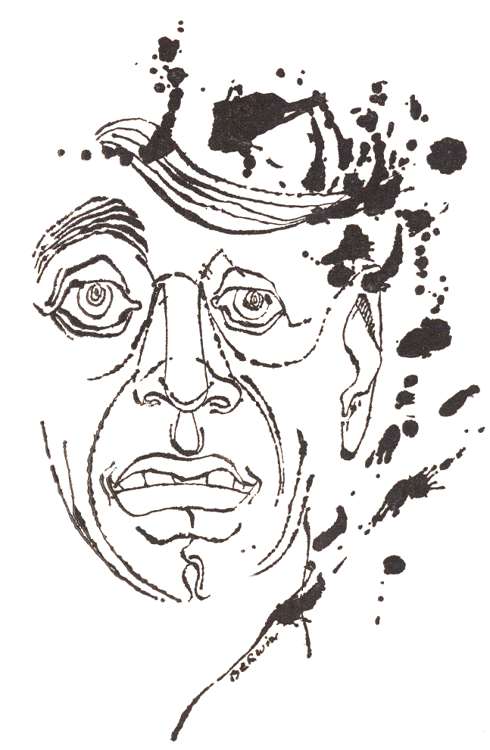
Title: An artist's life
Author: Harry Harrison
Illustrator: Milton Berwin
Release date: May 16, 2026 [eBook #78693]
Language: English
Original publication: New York: Space Publications, Inc., 1953
Other information and formats: www.gutenberg.org/ebooks/78693
Credits: Tom Trussel (This file was produced from images generously made available by The Luminist Archive)
by Felix Boyd
[Pseudonym of Harry Harrison]
Illustrated by Berwin
Dalgreen came back from the Moon to die, and there was only the art he knew worth living for. But then he found Di Costa, who painted as no human could ... and whose secret was too great for any man to know.
A busman’s holiday. A real busman’s holiday. I stay on the moon for a year, I paint pictures there for three hundred and sixty-five days—then the first thing I do back on Earth is go to the Metropolitan Museum of Art to look at more paintings. Brent smiled to himself. It had better be worthwhile.
He looked up the immense stretch of granite steps. They shimmered slightly in the intense August sun. He took a deep breath and shifted the cane to his right hand. Slowly he dragged himself up the steps ... they seemed to stretch away into the oven like infinity.
He was almost there ... a few more steps would do it. The cane caught between two of the steps, shifting his balance, and he was suddenly falling.
The woman standing in the shade at the top of the steps screamed. She had watched since he first climbed out of the cab. Brent Dalgreen, the famous painter, everyone recognized the tanned young face under bristly hair burned silver white by the raw radiation of space. The papers had told how his stay on the moon had weakened his muscles from low gravity. He had climbed painfully up the steps and now he was rolling hopelessly down them. She screamed again and again.
They carried him into the first aid room. “Gravity weakness,” he told the nurse. “I’ll be all right.”
She tested him for broken bones and frowned when her hand touched his skin. She took his temperature, her eyes widened and she glanced at him with a frightened look.
“I know,” he said. “It’s much higher than normal. Don’t let it worry you though, the fever isn’t due to the fall; in fact, it’s probably the other way around.”
“I’ll have to enter it in my report, just in case there’s any trouble.”
“I wish you wouldn’t. I don’t want the fact to leak out that I’m not as well as I should be. If you’ll call Dr. Grayber in the Medical Arts Building you’ll find that this condition is not new. The museum will have no worry about their responsibility as to my health.”
It would make wonderful copy for the scandal sheets. “MOON PAINTER DYING ... GIVES LIFE FOR ART.” It wasn’t at all like that. He had known there was danger from radiation sickness; in the beginning he had been very careful to be out in his spacesuit only the prescribed length of time. That was before he ran into the trouble.
There had been a feeling about the moon that he just couldn’t capture. He had almost succeeded in one painting—then lost it again forever. It was the feeling of the haunted empty places, the stark extremes of the plains and boulders. It was an alien sensation that had killed him before he could imprison it in oil.
The critics had thought his paintings were unique, wonderful, just what they had always thought the moon would be like. That was exactly his trouble. The airless satellite wasn’t at all like that. It was different—so different that he could never capture the difference. Now he was going to die, a failure in the only thing he had really wanted to do.
The radiation fever was in him, eating away at his blood and bones. In a few months it would destroy him. He had been too reckless those last months, fighting against time. He had tried and failed ... it was as simple as that.
The nurse put the phone down, frowning.
“I’ve checked and what you say is true, Mr. Dalgreen. I won’t put it in my report if that’s what you want.” She helped him up.
The moon was out of his thoughts later as one canvas after another swam into his vision. He bathed his senses in the collected art of the ages. This was his life, and he was enjoying it to the utmost, trying to make up for his year’s absence from the world. The Greek marbles soothed his mind and the Rembrandt portraits wakened his interest once again. He marvelled at the fact that after all the years he could still wander through these halls and have his interest recaptured. But he also wanted to see what the moderns were doing. The elevator took him to the Contemporary Wing.
Almost at once, his quiet enjoyment was broken by the painting. It was an autumn landscape, a representative example of the Classic-modern school that had been so popular for the last few years. However it had something else, an undefinable strangeness about it.
His legs were beginning to tremble again; he knew that he had better rest for a few minutes.
Brent sat on the wide lounge on the main staircase, cracking his knuckles, his mind whirling in circles as he rapidly introspected himself into a headache. There was no one thing in that painting that he could put his mental finger on, but it had upset him. It was disturbing him emotionally; something about the picture didn’t quite ring true. He knew there was a logical evaluation of a painting, just as there was a logical evaluation of any material object, but that wasn’t the trouble, he was sure. Equally, there was an emotional evaluation—more of a sensation or feeling; and this was where the trouble lay. Everyone has felt pleasure or interest at one time or another when looking at any form of visual art. A magazine photo, drawing or even a well-designed building could generate an emotional pattern. Brent was attempting to analyze such a sensation now, a next to impossible job. The only coherent thought he could muster on the subject was: “There is something subtly wrong with that picture.”
Suddenly he had the answer. It came in a second, as if revealed by some hidden source of insight. Perhaps his recent stay on the moon helped the idea to form; it had a relationship to things he had experienced there. It brought to mind the cinder plains that had never felt the foot of man. The sensation could be expressed by one word—alienness.
In the eternal lifelessness of the silent lunar wastes this sensation had a place. But how did it get into the polite autumn landscape? What twist in the mind of the painter enabled him to capture this strange feeling on canvas? Brent cursed himself softly. This wasn’t a painting of an alien landscape. It was an Autumn in the Woods landscape painted by a man who didn’t understand his topic. A man with an odd way of looking at things. A painter who could look at the bustling life of a fall day and capture the eternal death of a lifeless satellite.
Brent leaned forward on his cane, his heart beating in tempo with his swirling thoughts. He had to find this artist. He would talk to him, reason with him—beat him if necessary ... he must find out the man’s secret. The thought of his coming death sat like a cold black weight in his body. To die without knowing how to capture that sensation on canvas!
He had killed himself searching for it—to no avail. Yet all the time here on Earth was the man who had the knowledge he sought. The bitter irony of it swirled his head with madness.
The insane thoughts seeped away slowly. He sat on the couch until he was rested enough to trust himself on his feet. He had to find the man.
Down in the right hand corner of the picture in the shadow of a rock was the signature, Arthur Di Costa, printed with wide, sweeping strokes. Brent had never heard the name before but this fact was not unusual in itself. Real artists were a retiring crew. They labored in back rooms and old garages, filling canvas after canvas for their own satisfaction. Their work might never be shown until long after they were dead—dead.
That word kept intruding in his thoughts. He turned angrily and walked towards the guard who leaned casually on a sworl of abstractionist sculpture.
“Shore, mister,” the guard answered. “You’ll find the curator in his office—the door there behind them old hangings.”
“Thanks,” Brent muttered, and followed the course indicated by a meaty finger. He found an alcove partially concealed by the luxurious draperies. It contained a photo-electric water fountain and a neomarble door bearing the legend, G. Andrew Kinnent—Curator, Contemporary Wing. He pushed open the door and stepped into the receptionist’s office. She looked up from her typewriter.
“My name is Brent Dalgreen; I would like to see Mr. Kinnent.”
“Not the Mr. Dalgreen! Why I ...” The girl broke off, flustered. She leaned hard on the intercom button.
“Go right in, Mr. Dalgreen. Mr. Kinnent will be very happy to see you.” But the lovely smile that accompanied the statement was wasted on him; his thoughts were elsewhere, today.
After thirty minutes of shop talk Brent drew the conversation around to the present exhibit—and one painter in particular.
“Mr. Di Costa is one of our most brilliant young painters, yes, indeed,” the curator said smugly, as if he had personally taught Costa every painting trick he knew. “He has only lived in New York a short while, but the boy has made quite a name for himself already. Here, let me give you his address, I’m sure you would enjoy meeting him. Common interests, you know.”
Brent was easily talked into accepting the information he had come for in the first place. He kept his real thoughts secret from the vociferous Kinnent. They would seem more than foolish—unsupported as they were by a single shred of real evidence. He couldn’t let this deter him. The sands of his life were trickling out, but there was something he had to do first.
The building was one of a hundred identical greenstone structures that had lined the streets in the fashionable Thirties. The site of the former garment center was now one of the most favored residential districts in the city. Brent stood across the street from number 31, ostensibly studying the headlines on the newsvend machine. The windowless exterior gave the obvious fact that the owner was fairly well off financially. Any information he sought would be inside—not outside. He crossed the street and stepped into the chrome entranceway.
The inductance of his body actuated the automatic butler and the soft mechanical voice spoke from over the door.
“The Di Costa residence. May I serve you?”
“Mr. Brent Dalgreen to see Mr. Di Costa.”
“I’m sorry, but I have no information regarding you, sir; if you care to leave a mess—” The robot tones stopped with a sharp click, to be replaced by a man’s voice.
“I am very happy to greet you, Mr. Dalgreen. Won’t you please step in?”
The door swung quietly open to reveal a small wood-panelled vestibule. It wasn’t until the door closed again that Brent recognized it as an elevator. There was a feeling of motion and the end wall slid back to reveal a book-lined sitting room. The occupant turned from his desk and stepped forward.
Brent took the proffered hand—at the same time trying to penetrate the man’s smile. Di Costa was taller than Brent with a thinness that seemed to contradict his graceful movements. They shook hands, and his hand had the same qualities; thin, long and strong. At this point Brent realized he was staring; he hastened to respond to his host’s hospitality.
“I hope you will excuse my just dropping in like this, Mr. Di Costa. I have seen some work of yours at the Metropolitan, and found it, well, very interesting.”
Brent stopped, aware of how weak his reasons seemed when brought out in conversation. He was more than pleased when Di Costa interrupted him.
“I understand perfectly, Mr. Dalgreen. I have had the same experience many times when looking at your paintings and those of some of our fellow artists.” He smiled, “Not all of them, I assure you. I have looked at these works and said to myself, I would like to meet the man who did that. This very rarely happens, a fact which I deplore. That you feel the same way towards my work is both flattering and most enjoyable.”
Di Costa’s friendliness broke the ice; they were soon on the best of terms. Brent sat in the comfortable leather chair while Di Costa mixed drinks at the built-in bar. This gave him a chance to look around the room. A brown study, it fitted the word. The decorations were all subdued to the room as a whole, the sort of things a man would buy for himself. The only clashing note was the rotary book rack in the corner.
He suddenly realized that it was revolving slowly, had been doing so since he first entered the room. Something else ... yes, there on the desk, the bronze ashtray was also revolving with the same steady motion. They created an unusual effect, yet an oddly pleasing one. It fitted the room and the owner’s personality.
“And here are the drinks. A toast first—always a good idea. Long life and good painting, to both of us.”
Brent frowned to himself as he sipped the drink. There is a fascination about shop talk that carpenters and bank executives indulge in with equal pleasure. Brent found himself easily drawn into conversation on the merits of alizarin crimson and the influence of Byzantine art on Renaissance Italy. Yet all the time he talked a small portion of his mind was weighing the other’s words, testing and observing. But his host was everything he seemed to be—a gentleman of private means with an active interest in painting.
A half hour had passed, entertaining but unenlightening, when a light rap sounded on the study door. It opened to reveal an attractive woman, tastefully dressed in a gray and silver robe of classic Greek design, the latest fashion.
She hesitated in the doorway. “I don’t mean to disturb you, Arthur, but there is ... oh, excuse me, I had no idea you had a guest.”
Di Costa took her gently by the arm. “I’m very glad you did, my dear. Let me introduce the famous Brent Dalgreen.” He passed his arm around her waist. “My wife, Marie.”
Brent took her hand and smiled into her large brown eyes. She returned his greeting warmly—with exactly the right amount of pressure on his hand. A loving wife, a pleasant home—Arthur Di Costa was a model of the modern gentleman. The painting in the museum seemed unimportant in the face of all this normality.
For a fraction of an instant as he held her hand, his eyes were drawn to a portrait that hung next to the door.
It was only by the strongest effort of will that he prevented himself from crushing her hand. Marie was there in the portrait, her portrait....
The same subtle transformation as the painting in the museum. Something about a twist of the mouth—the haunting look in her eyes as she stared out of the picture. He tore his gaze from the painting but not before Di Costa had noticed his attention.
“It must be a strange sensation,” Di Costa laughed, “to meet both my beautiful Marie and her portrait at the same instant. But here, let me show you.” He touched the frame and a soft light bathed the painting. Brent mumbled something polite and stepped nearer, as if mere proximity would answer his questions.
Di Costa seemed flattered by his famous guest’s interest. They discussed the many problems of a painting and their happy or unhappy solution. Blushing slightly, Marie was coaxed into standing under her portrait. She pretended not to notice the dissecting artistic analysis that could be so embarrassing to the outsider. “That blue hollow in the neck helps the form ...” “... the effect of the gold hair on the cheekbones ...” She turned her head “just so,” and “a little more” while they talked.
Yet all during the discussion a small part of Brent’s mind was weighing and analyzing. The how of the paintings was becoming clearer although the why still escaped him. It wasn’t that there was an alienness in the figure itself, it was more as if the person were looking at something totally strange to worldly eyes.
He felt the small throb of an incipient headache as his frustrated thoughts danced dizzily inward on themselves in ever tightening circles. The mellow sound of a chime from the wall cabinet provided a welcome interruption. Di Costa excused himself and stepped out of the room—leaving Brent alone with Marie. They had just seated themselves when Di Costa returned, looking as if he had received painful news.
“I must ask you to excuse me, but my lawyer wishes to see me at once—a small but important matter about my estate. I am most unhappy to leave now. We must continue our talk another time. Please do not leave on my account, Mr. Dalgreen—my house is at your service.”
When her husband left, Brent and Marie Di Costa talked idly on irrelevant topics, they had to, since he had no idea of what might be relevant. You couldn’t walk up to a girl whom you’d met for the first time and ask, “Madam, does your husband paint monsters? Or perhaps you dabble in witchcraft! Is that the secret?”
A quick glance at his watch convinced him it was time to go, before he wore out his welcome.
Turning to light a cigarette his eyes fell on the mantle clock. He registered surprise.
“Why, it’s three-thirty already! I’m afraid I’ll have to be leaving.”
She rose, smiling. “You have been a most delightful guest,” she laughed. “I know I speak for Arthur as well as myself when I say I hope to see you again.”
“I may take you up on that,” Brent said.
Their forward progress was suddenly impeded as the elevator swung open to discharge a small bundle of screaming humanity. Dazed, Brent realized it was a young girl as she swept past. The child collapsed on Marie Di Costa’s shoulder, her golden hair shaking with muffled sobs. A plastic doll with a shattered head gave mute evidence of the source of the disturbance.
Brent stood by self-consciously until the crying was soothed. Marie flashed him an understanding smile while she convinced the child at least to say hello to the visitor. He was rewarded with the sight of the red, tear-stained face.
“Dotty, I want you to meet Mr. Dalgreen.”
“How do you do, Mr. Dalgreen ... but Mommy the boy stepped on the doll and he laughed when it broke and ...” The thought was once again too much to bear—the tears began to course again through the well-used waterways.
“Cheer up, Dotty. You wouldn’t want your father to see you like this,” Brent suggested.
These seemingly innocent words, while having no affect on the little girl, had a marked affect on her mother. Her face whitened.
“Arthur is not Dotty’s father, Mr. Dalgreen. You see, this is my second marriage. He ... I mean we cannot have children.” She spoke the words as if they were a pain, heavy within her.
Brent was slightly embarrassed—yet elated at the same time. This was the first crack in the facade of normality that concealed the occupants of the house. Her sudden change of expression could only mean that there was something troubling her—something he would give his last tube of oil paint to find out. Perhaps it wasn’t the secret hidden in the painting, but there must be a relationship somewhere. He was determined to search it out.
Apartment lights were out all over the city, the daytime world was asleep. Brent stirred in the large chair and reached out for the glass of sparkling Burgundy that was slowly dying on the end table. A little flat—but still very good. It was one of the luxuries he allowed himself. A luxury that might really be called a necessity to one who lived by selling his emotional responses, translated into color.
The wine was going flat, but the view of the city never would. New York, the eternal wonder city. The soft lights of his studio threw no reflections on the window, and his sight travelled easily over the architectural fairyland. Sparkling search-beams swept across the sky, throwing an occasional glint as they slid across a jetcar or a stratoplane. A thousand lights of a thousand hues twinkled in the city below. Even here on the one-hundred-eightieth floor he could hear the throbbing roar of its ceaseless activity. This was the foremost of the cities of man, yet somewhere in that city was a man who was ... not quite human.
Brent had the partial answer, he was sure of that. He had found the missing factor in one of his own paintings. It was the only one he was even slightly pleased with. He had turned it out in nine solid hours of work, one of the “dangerous exposures” the doctors talked about. He had it propped on the video console, a stark vista of Mare Imbrium in the afternoon—moon time. It was a canvas touched with the raw grandeur of eternal space. It had a burning quality that reacted on human sight. An alien landscape seen through a human eye. Just as the Di Costa canvases were human scenes seen through a different eye. Perhaps not totally foreign to earth—they weren’t that obvious. Now that he understood, though; the influence was unmistakable.
He also had substantiating evidence. The Law was the Law and genes would always be genes. Man and ape are warm-blooded mammals, close relatives among the anthropoids. Yet even with this close heritage, there could be no interbreeding. Offspring were out of the question; they were a genetic impossibility.
It followed that alienness meant just that. A man who wasn’t Man—homo sapiens—could never have children with a human wife. Marie Di Costa was human, and had a real tear-soaked human daughter to prove it. Arthur Di Costa had no children.
Brent pressed the window release and it sank into the casement with a soft sigh. The city noises washed in along with the fresh smell of growing things. The light breeze carried the fragrance in from the Jersey woodlands. It seemed a little out of place here above the gleaming city.
Leaning out slightly, he could see the moon riding through the thin clouds and the morning star, Venus, just clearing the eastern horizon. He had been there on the moon. He had watched them assembling the first Venus rocket. Man, the erect biped, was the only sentient life form he had ever seen. If there were others, they were still out there among the stars. All, that is, except one ... or could there possibly be others here on Earth?
This was useless thinking though. Don’t invent more monsters until you’ve caught your first. A night’s sleep first. After that, he could start setting his traps out tomorrow.
For the tenth time, Brent threw a half-eaten candy bar into the receptacle and started down the street. Being a private eye was so easy in the teleshows—but how different the reality was! He had been shadowing Arthur Di Costa for three days now, and it was ruining his digestion. Whenever his quarry stopped, he stopped—often on the crowded city streets. Loitering was too obvious, so he found himself constantly involved with the vending machines that lined the streets. The news sheets were easily thrown away, but he felt obliged at least to sample the candy bars.
Di Costa was just stepping onto the Fifth Avenue walkway. Brent got on a few hundred feet behind him. They rolled slowly uptown at the standard fifteen miles per hour. As the walkway crossed Fifty-Seventh Street, a small man in a black and gold business suit stepped briskly onto it. Brent noticed him only when he stopped next to Di Costa and tapped him on the shoulder. Di Costa turned with a smile—which changed slowly into a puzzled expression.
The little man handed what appeared to be a folded piece of paper to the surprised painter. Before Di Costa could say anything, the man stepped off the walkway onto a safety platform. With a quick movement, surprising in a man of his chunky build, he vaulted the guard barrier and stepped onto the downtown walkway.
Brent could only stare open-mouthed as the black figure swept by him and was lost in the crowds. Surprised by the entire action, he turned back to find Di Costa staring directly into his eyes!
Whatever course of action he might have considered was lost. Di Costa took the initiative. He smiled and waved. Brent could hear his voice faintly through the street noises.
“Mr. Dalgreen, over here!”
Brent waved back and did the only thing possible. As he walked slowly forward he saw that Di Costa’s curiosity had gotten the better of him. Brent watched him open the note, read it—and change suddenly. The man’s arm dropped to his side, his body stiffened. Staring straight ahead, he stood on the walkway, eyes fixed and as full as a Roman portrait bust.
Dalgreen hurried toward the man. Events were going too fast. He had more than a suspicion that the note and the short man were somehow connected with the secret of the paintings. He stepped forward.
The man stared ahead, unseeing and unhearing. Brent felt justified in removing the mysterious note from between his fingers. One side was blank, but the other contained a single illegible character—queer sign made up of flowing curves crossed by choppy green lines. It resembled nothing Brent had ever seen in his entire life.
They rode uptown side by side. Brent leaned on the railing while Di Costa remained fixed in his strange trance. The note in Brent’s hand was tangible evidence that his suspicions had some basis in fact. As he examined it again, he was aware of an undefinable tingling in his hand. The note seemed to be vibrating, shaking free from his hand in some unknown way. Under his startled gaze it glowed suddenly and disappeared! One instant he had held it, the next his hand was empty.
He leaped back in surprise—passing through the space formerly occupied by Di Costa. Gone—while he had been studying the note! Leaning over the rail he had a quick glimpse of the stiff figure entering the Central Park Skyport. Cursing himself for his stupidity, Brent changed lanes and raced back to the Skyport entrance.
His luck still held. Di Costa was on the outgoing air cab line. It would take him at least ten minutes to get a cab this time of day. With a little speed and a few greased palms Brent could rent a Fly-Your-Own before the other man was airborne.
Shortly after, the orange and black cab flashed up from the take-off circle followed closely by Brent’s blue helio. The two aircraft flew north and vanished in the distance over the Hudson.
The air cab stayed at the 10,000 foot level. Brent cruised at 8,000, lagging slightly behind, keeping in the blind spot of the other ship. The entire affair was moving too fast for his peace of mind. He had the feeling that he was no longer a free agent, that he was being pushed into things before he decided for himself.
He suddenly felt elated. The strange symbol on the note, the note that disappeared in such an inexplicable fashion, proved the existence of alien hidden forces. Every mile that rushed under his plane brought him closer to the answer. He didn’t fear death—it was no longer a stranger to him. The moments of time left to him might be made more satisfactory if he ferreted out this secret. He smiled to himself.
Fifteen minutes later the two ships grounded at the Municipal Skyport in Poughkeepsie. Brent parked the ship and followed his quarry down to the street level. Except for a certain stiffness in his movements, Di Costa seemed normal. He walked quickly and turned into an office building before Brent could catch up with him.
Throwing discretion aside, Brent broke into a run. He turned into the lobby just as the elevator door closed. He pressed the call button but the car continued to rise. The indicator stopped at four, then slowly sank down again.
He was too close to the end to even consider stopping now. He stepped into the self-service elevator and pressed four. The door closed and the car began to ... descend!
With the realization that he was trapped came the knowledge that there was very little he could do about it. Just wait and see who—or what—might be outside the car when the door opened!
The elevator dropped down to a level that must have been far beneath the basement floor. The door slid slowly back.
The room was not what he had expected. Not that he had any idea of what there would be; it was just—just that this room was so ordinary!
Ordinary—except for the side wall. That was an impossibility. It was a glass wall looking into a vast tank of swirling water—only there was no glass! It was the surface of the ocean standing on its side. He felt himself drawn into it, falling into it.
The sensation vanished as the wall suddenly turned jet black. He became aware for the first time that he wasn’t alone in the room. There was a girl behind a chrome desk. A lovely girl with straight bronze hair and green eyes.
“An untrained person shouldn’t watch that machine, Mr. Dalgreen; it has a negative effect on the mind. Won’t you please step in?”
His jaw dropped. “How do you know my name? Who are you? What is this pl....”
“If you’ll be seated, I’ll be with you in a moment.”
Brent saw that the elevator would stay here until he got out. He stepped into the room, and the door sliding shut behind him didn’t help his morale any. He was into it up to his neck, and the other team had taken complete charge. He sat.
The redhead pulled the sheet of paper out of her typewriter and pushed it into the strange wall. It once more had the undersea look. Brent kept his eyes averted until she turned to him with a slight frown furrowing her forehead.
“You have been very interested in Arthur Di Costa’s activities, Mr. Dalgreen. Perhaps there are some questions you would like to ask me?”
“That, lady, is the world’s best understatement! Just what happened to him today ... and what is this place?”
She leaned forward and pointed. “You’re responsible for Mr. Di Costa’s visit here today. You were observed following him, so we brought him in, in the hope that you would come also. The message he received was a code word designed to trigger an automatic response planted in his mind. He came directly here, controlled by the posthypnotic suggestion.”
“But the note,” he exclaimed.
“A simple matter! It was written on a material made entirely of separate molecules. A small charge of energy held them together for a brief period of time. The charge leaked out and the material merely separated into its constituent molecules.”
The utter impossibility of the situation was striking home. The evidences of a superior culture were unmistakable. These people were his....
“Aliens, Mr. Dalgreen—I suppose you could call us that. Yes. I can read your mind quite clearly. That is why you are here today. A thought receiver in Arthur Di Costa’s study informed us of your suspicions when you first walked in. We have been following you ever since, arranging your visit here.
“I’ll tell you what I can, Mr. Dalgreen. We are not of Earth, in fact, we come from beyond your solar system. This office is, to be very frank, the outpatient ward of a sanitarium!”
“Sanitarium!” Brent shouted. “This is the office only ... then where is the sanitarium?”
The girl twirled her pencil slowly, her piercing stare seeming to penetrate his eyes—into his brain.
“The entire Earth is our sanitarium. Mixed in with your population are a great number of our mentally ill.”
The floor seemed to tilt under Brent’s feet. He clutched the edge of the desk. “Then Di Costa must be one of your outpatients. Is he insane?”
The girl spoke quietly. “Not insane in the strictest sense of the word. He is congenitally feeble-minded; his case is incurable.”
Brent thought of the brilliant Di Costa as a moron, and the inference shook his mind. “That means that the average I.Q. of your race must be ...”
“Beyond your powers of comprehension,” she said. “To your people Di Costa is normal, really far above average.
“On his home planet he was not bright enough to take his place in that highly integrated society. He became a ward of the state. His body was altered to be an exact duplicate of homo sapiens. We gave him a new body and a new personality—but we could not change his basic intelligence. That is why he is here on Earth, a square peg in a square hole.
“Di Costa spent his childhood on his home planet, living in an ‘alien’ environment. These first impressions drive deep into the subconscious, you know. His new personality has no awareness of them—but they are there, nonetheless. When he is painting, these same impressions by-pass his conscious mind and operate directly on his thalamus. It takes a keen eye to detect their effect on the final work. May I congratulate you, Mr. Dalgreen?”
Brent smiled ruefully, “I’m a little sorry now that I did. What are your plans for me? I imagine they don’t include a return to my earthly ‘asylum’?”
The girl folded her hands in her lap. She looked down at them as if not wanting to look Brent in the eye when she made her next statement. However, he wasn’t waiting for it. If he could overpower the girl, he might find the elevator control—any chance was worth taking. He tensed his muscles and jumped.
A wave of pain swept through his body. Another mind—strong beyond comparison—was controlling his body!
Every muscle jerked with spasmodic activity, halting his plunge in mid-air. Crashing to the desk he lay unmoving; every muscle ached with the fierce alien control. The redhead looked up—eyes blazing with the strength she had so suddenly revealed.
“Never underestimate your opponent, Brent Dalgreen. I adopted the earthly form of a woman for just this reason. I find your people much easier to handle. They never suspect that I am ... more than what they see. I will release your mind from my control, but please don’t force me to resume it.”
Brent sank to the floor, his heart pumping wildly, his body vibrating from the unnatural spasm.
“I am the director of this ... sanitarium, so you see I have no desire to have our work exposed to the prying eyes of your government. I shall have to have you disposed of.”
Brent controlled his breathing enough to allow him to speak. “You ... intend to ... kill me then?”
“Not at all Mr. Dalgreen, our philosophy forbids killing except for the most humane reasons. Your physical body will be changed to conform to the environment of another of our sanitarium planets. We will of course remove all the radiation damage. You can look forward to a long and interesting life. If you agree to cooperate you will be allowed to keep your present personality.”
“What kind of a planet is it?” Brent asked hurriedly. He realized from the girl’s tones that the interview was almost at an end.
“Quite different from this one. It is a very dense planet with a chlorine atmosphere.” She pressed a stud on her desk and turned back to her typewriter.
Brent had a last, ragged thought as unconsciousness overcame him. He was going to live ... and work ... and there must be some fine greens to paint on a chlorine planet....
This etext was produced from Rocket Stories, September 1953 (Vol. 1, No. 3.). Extensive research did not uncover any evidence that the U.S. copyright on this publication was renewed.
Obvious errors have been silently corrected in this version, but minor inconsistencies have been retained as printed.
New original cover art included with this eBook is granted to the public domain.