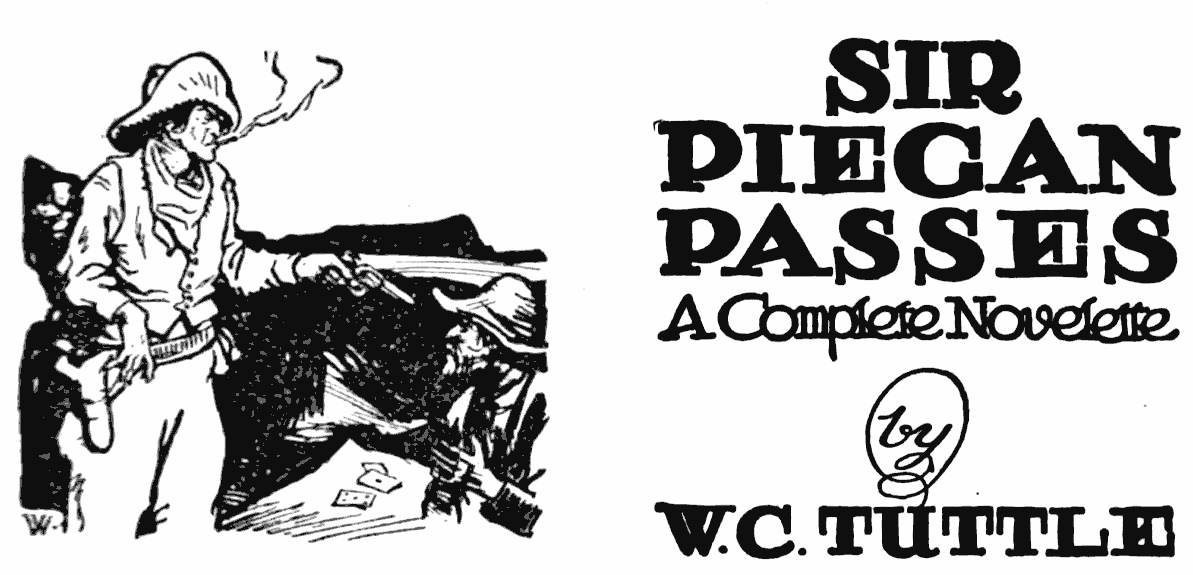
SIR PIEGAN PASSES
Solomon Kane’s heart would, if properly broken up, have made a number of perfectly good arrowheads. His conscience, if properly cut to certain lengths, would have made any number of perfectly good corkscrews. Outside of that, Solomon Kane was normal.
Kane had money—plenty of it; but when it came to earning money by the sweat of his brow, Solomon Kane never even got moderately moist. No, he was too shrewd to earn anything—except possibly a few curses, which were exploded behind his broad back.
Kane had come to Micaville several years before this story begins—came with a working capital of ten dollars and an assaying outfit. Micaville was young. A big strike had been made. Prospectors were thicker than the proverbial flea; and great was the need of an assayer. Solomon Kane came at an opportune time—for Solomon Kane.
It was no trouble for Solomon Kane to determine how much gold a certain sample of rock contained. Not a bit of trouble. He gazed within the crucible, computed the approximate weight of what was contained therein—and subtracted enough to show barely a trace in his assay certificate.
Thus discouraged, the prospector lost no time in moving on to other ground. Casual conversation had shown Solomon Kane the exact location of the aforementioned sample. What could be more simple—except the prospector? Solomon Kane was thereby able to pick his prospects, which had been abandoned by the original locator, and waxed fat from his shrewdness.
He owned an unpretentious assay office on the main street of Micaville; still plying his trade. He had sold most of his properties, at a fair profit, you may be sure; but there still remained one piece of property, which Solomon in all his wisdom had not been able to acquire.
It has been said that every man has his price; but Solomon never looked at a price tag. Whether old Cale Winters wanted a hundred or a half-million, it made no difference to Solomon.
Old Cale Winters had no assays made. In the first place, he did not trust Solomon; in the second place, he knew that the ledge in his short tunnel would not run over three dollars per ton in free milling gold. Old Cale Winters knew this; he also knew, from a chance remark, that Solomon Kane wanted the property.
Bush Cleveland, Solomon’s right-hand man, had unconsciously dropped a remark, which caused old Cale Winters to go back to his cabin and talk seriously to his family; which consisted of his wife and daughter. They were just about ready to vacate their two claims and move to some other spot.
Solomon Kane looked with great favor upon Jennie Winters, who, with her blue eyes and black hair, and a figure seldom found in mountain girls, was not at all hard to look upon.
Jennie looked upon Solomon Kane and saw a middle-aged, gross, pig-jowled human being, with colorless eyes, no eyebrows, fingers like cucumbers and feet which turned out at an awkward angle when he walked. Solomon Kane was not good to look upon.
Jennie’s indifference toward him seemed to only cause Solomon to double his desire to acquire old Cale’s property—for nothing. Micaville, which was still in a half-civilized state, gave no heed to such esthetic things as love.
Whether Jennie Winters married Solomon Kane or not would make no difference to the mineral output of the district, the price of beans, the opening of a new honkatonk or the secret plans to organize a vigilance committee. Micaville was neutral on anything except sudden wealth or sudden death.
The two claims, which caused Solomon Kane to break the Tenth Commandment, were located about two miles from town. Old Cale Winters and his family lived in a two-room log-cabin on a bit of level benchland, just above a deep cañon. About two hundred yards from this cabin was the mouth of Winters’ tunnel. The claims were registered under the name of The Jennie and Joe Mining and Milling Company.
Jennie and Joe were twins at birth; but Joe failed to “make the grade,” as they say in Micaville. His only claim to posterity was a name in the family Bible and on a worn location notice.
Jennie and her mother had no faith in the Jennie and Joe, and did not conceal the fact that it was better than an even bet that they would starve to death before Cale Winters ever found anything except indications of mighty hard work.
Cale Winters had felt the same about it, until he knew that Solomon Kane wanted the property. If it was desired of Solomon Kane it must be better than a three-dollar-a-ton proposition.
Bush Cleveland was an emaciated, keen-eyed, slouchy individual, who always rolled a fresh cigaret while his present smoke was still burning. In this way he saved considerable on the price of matches. One light would suffice him for the day.
Bush Cleveland, for all of his physical and mental deficiencies, had a nose for gold. He was a human divining-rod. Solomon Kane kept Bush supplied with liquor, tobacco and three square meals a day. This increased Solomon’s overhead expenses greatly. Bush’s salary amounted to an extra dollar or two per month—Solomon using the dollar to get Bush completely inebriated, after which he would get Bush to sign an affidavit that he had received his thirty dollars that month. These monthly debauches were blanks to Bush Cleveland, and he never did know what became of his salary—nor cared. Solomon Kane was a good man to work for.
Bush knew where the real vein could be found on the Jennie and Joe. He had showed it to Solomon, and together they had tested, estimated and traced it until Solomon Kane dreamed nightly of the wealth, which old Cale Winters was keeping from him.
It grew to be an obsession with Solomon. Bush Cleveland smoked his innumerable cigarets, signed for the salary he never received, and Micaville went on in its own dumb way; while old Cale Winters and his family grew very poor and very discouraged.
Old Cale was crabbed and mistrustful of the rest of the world. He wore a holstered Colt on his hip and swore to perforate any one who meddled with his property. This did not react in his favor in the eyes of Micaville. It meant that some day old Cale would mistake some innocent man for a trespasser and fill him so full of lead that he would have to be shipped to a smelter before being attended by the undertaker. No man likes to be shot by mistake.
Solomon Kane knew old Cale’s mental attitude, and respected it. Solomon was not the kind to seek oblivion at the point of a pistol. No, Solomon was wary of powder smoke.
He met Mrs. Winters at the general store and was very polite to her. He even carried the groceries out to her rickety old cart and untied the old wabble-legged cayuse for her. For this kindness he received the information that she and Jennie were sick unto misery over their property, and would leave Micaville at a minute’s notice—if old Cale would go with them.
Old Cale was the fly in the axle-grease. Solomon took this under advisement. He told Bush Cleveland about it. Bush inhaled three more cigarets and propounded a plan, which savored of downright meanness. In fact it was something which drove the color from Solomon Kane’s face—and that took some shock. He put one of his ham-like hands over Bush’s mouth, looking fearfully around at his crucibles and furnace. Walls have ears; so why not furnaces and crucibles?
Bush’s cigaret burned a neat little blister on Solomon’s palm, and necessitated the squandering of a match on the next smoke, which was already under construction.
“My ——!” gasped Solomon. “You speak of such a thing?”
Bush did not deny it, and Solomon’s question was superfluous. He knew what Bush had suggested. Solomon got very busy without knowing just what he was doing, and Bush laid out plans for his next cigaret.
After an interval of perhaps five minutes, Solomon turned to Bush.
“You—uh—I am surprized, Bush. Never have I stooped to such things.”
Bush had nothing to say. There was no argument in favor of his suggestion; so why worry about it. Solomon continued to clean up his work-room; but his mind was not on his work, which was attested by the fact that he unconsciously drew the cork from a nitric acid bottle and sniffed at the contents. It is not pleasant.
After a sufficient length of time Solomon sat down close to Bush, and yawned. It was a stage yawn. Bush lighted a fresh cigaret.
“Who,” said Solomon softly, “who would do this?”
“Eh?” Bush looked quizzically at him for a moment. “Oh, yeah.”
Bush grew very thoughtful. He had almost forgotten what he had mentioned to Solomon. He forgot things easily; which was why Solomon valued him so highly.
“Oh, some gun-fighter, Sol.”
“Sure—some gun-fighter!” spat Solomon disgustedly. “Just any gun-fighter, I suppose.”
“For about a thousand dollars,” nodded Bush.
Solomon took this under advisement. A thousand is a lot of dollars. Bush broke into his unhappy reveries.
“Mebbe you’ll have to pungle up five thousand—I dunno.”
“I betcha you dunno!” gasped Solomon, “You think too much in big money, Bush.”
“Ex-cuse me,” grunted Bush, and began manufacturing another paper smoke.
“That Jennie and Joe is a gamble,” observed Solomon softly. “Mebbe I’ll lose money on such a deal.”
“Mebbe,” admitted Bush dreamily.
Solomon squirmed in his seat. He was cautious. Bush was not responsible for anything, when drunk. If Bush talked he might talk secrets.
“You know any gun-fighters, Bush?” softly.
“Not pers’nally.” Bush shook his head slowly. “I know one by reputation. He’s a bad hombre, Sol. That man would shoot his own grandfather for five thousand dollars.”
“Five thousand dollars! Why emphasize one gunman? I am not a good shooter; but I’d——”
Solomon wiped his brow with the palm of his hand.
“And he’d keep his mouth shut,” stated Bush.
“I should think he would,” agreed Solomon sourly.
“Cinch,” agreed Bush, who did not take Solomon’s tone of voice into consideration. “It could be worked like this——”
Solomon listened closely to Bush’s scheme. Solomon had a flinty heart and a crooked soul; but he did not like the scheme. It was very, very bad. Five thousand was a lot of money. That was the objectionable part of the scheme. The rest was fine. Maybe this gunman would meet him half-way.
Bush agreed that he might; but reminded Solomon that a professional gunman is nobody to argue with.
“We get him here first and then we talk prices,” stated Solomon wisely. “You help me make him understand that we don’t want to buy him outright—just use him for a little while. Rent is cheaper than a cash buy.”
Bush nodded over an unfinished cigaret.
The Piegan Kid wasn’t going anywhere in particular. He expected ultimately to connect up with some cow-outfit. He had a fairly good horse, a beautiful saddle and a very good gun. The Piegan Kid was neither of heroic proportions nor Adonis-like of feature.
His face was peaked under the shade of his wide sombrero, and a pair of inquiring gray eyes looked out upon the world unafraid. His flannel shirt, well-worn chaps and boots run over at the heel proclaimed him a son of the dim trails.
Suddenly a streak of gray fur seemed to glide out of a clump of mesquite. An instant later it whirled and raced on its back track. The Piegan Kid’s spurs had already been socked home and his rope untied. The Kid craved excitement, and there is plenty of excitement in a race across the hills in the wake of a frightened coyote.
The horse ran low to the ground, with the Kid standing high in his stirrups, the wide coil of rope whirling in his hand.
Suddenly something went wrong with man and beast. Old Man Badger had builded his domicile right in the line of march, and the running bronco had dropped one fast moving front foot into Mr. Badger’s front door.
Came a kaleidoscopic movement of man and beast, and the man landed in a heap in a patch of mesquite and Spanish dagger. The horse tried to get to its feet; but fell back.
The Piegan Kid got to his feet and untangled himself and rope from the brush. Barring a few scratches and gouges from the Spanish dagger-plant he was as good as new. He limped back to the horse and looked it over.
“Coyotes,” muttered the Kid to himself. “Coyotes is hoodoos.” He drew his gun, slowly cocked it; while a pair of buzzards circled high overhead. It is hard to deceive a buzzard as to the true state of affairs. The Kid glanced up at them and wondered if they were in cahoots with the coyote. Anyway, there was only one thing to do, under the circumstances. The Kid holstered his smoking gun and looked down upon his fancy saddle. It was no ordinary hull. He had won it from a rodeo-following Mexican. Its silver rosettes, fancy stamping and general air of money-worth appealed to the Kid. He looked all around. He had no way of knowing how far it was to the next town or cattle-ranch; but he was not going to give up that saddle and bridle and fancy Navaho blanket.
He was about twelve miles from Micaville; but he did not know it. Micaville would have meant nothing to the Kid, except that it might be a place where he could secure a new horse.
The Kid was no pedestrian. As far back as he could remember he had always bestrode a horse when going any distance; which made it imperative that he secure a horse as soon as possible. He was like a born sailor, wading around in the ocean.
The big saddle weighed very heavy, and the Navaho blanket seemed to invite the rays of the sun. The bridle reins had a nasty habit of tangling in his feet and throwing him. Taking it all in all, the Piegan Kid was not enjoying the middle of the day.
Suddenly, he stopped. Coming up the gentle slope toward him was a man on a pinto horse. A closer view showed that the man was riding bareback. He did not look like the type of a man who would make a practise of riding a skinny pinto bareback. This man wore two holstered guns. He was a rather greasy-looking person, a trifle taller than the Kid; and not at all pleasant of feature.
The Kid waited for him to come up. They looked closely at each other. The Kid dropped his outfit to the sand and took the makings of a cigaret from his pocket. The other man slid off his pinto and also produced the makings. During this particular operation there was no word spoken. The Kid offered a light from his match, which the other accepted.
“Badger hole,” explained the Kid.
The other man nodded and puffed slowly on his cigaret. Finally he said:
“Bronc pulled away at a water-hole yesterday. When I found him he’d rolled the saddle off.”
The Kid looked longingly at the pinto. It wasn’t so much of a pinto either; but it was something to hang the saddle on to, and it had four good legs. The other man looked at the ornate saddle. He was very tired of riding bareback, and the saddle appealed to him in more ways than one.
Their glances met. The stranger waved a hand to encompass the horse and saddle.
“We’re kinda in the same fix, pardner. How about gamblin’ t’ see who rides proper?”
“My saddle against yore bronc?” queried the Kid.
“As is,” nodded the stranger. “One hand of draw-poker.”
“Yo’re on,” said the Kid.
He spread his gaudy blanket in the shade of a mesquite, while the stranger dug deep into his chaps-pocket and produced a greasy deck of cards. The Kid glanced at the cards, which were badly soiled and dogeared from many games, and felt that this stranger was probably very familiar with that certain deck of cards. He had a rippling, free-handed shuffle, which bespoke familiarity with that old deck.
The Kid noticed that this stranger did not offer to cut for deal; but took it for granted that he was to pass out the cards. The Kid said nothing; which was a peculiarity of the Piegan Kid. He knelt on the edge of the blanket and watched the man shuffle the cards.
This stranger squatted on his heels, with both feet on the edge of the blanket. The Kid also noted this. Then came the deal—five cards apiece. The Kid’s hand showed two aces, a nine, a trey and a jack. He tossed the last three cards aside. The stranger discarded three.
Without a word the stranger dealt him three cards. As the Kid picked up his cards the stranger dealt himself three. It was an even draw. The Kid’s hands were on the blanket, grasping his three cards. The other placed the remainder of the deck on the blanket beside him.
Then the Kid grasped the blanket, together with the three cards, threw himself backwards and stood the stranger on the back of his neck.
The man spun on his shoulder, threw himself to a sitting position—and gazed into the muzzle of the Piegan Kid’s heavy Colt pistol.
“The top of the deck is the place to deal from,” said the Kid slowly. “Unbuckle yore belt.”
There was nothing for the stranger to do but obey. The Kid took the two guns and threw them far away into the brush. Then he cinched his saddle to the stranger’s horse and swung into the saddle.
“Adios,” nodded the Kid.
The stranger said nothing. After the Kid faded out over the crest of a hill, the stranger went on a hunt for his pistols.
A few miles further on the Piegan Kid struck the main road to Micaville, and in due time he arrived at the town. This was about two weeks after Solomon Kane and Bush Cleveland had deliberated deeply.
The Kid swung down at a hitch-rack; but the eagle-eye of Bush Cleveland had spied him before he reached the rack, and the Kid turned to look into the bland face of Solomon’s hired man. Bush was rolling a cigaret.
“This is the place,” announced Bush.
The Piegan Kid looked from Bush to the street and back to Bush. The Kid mentally classed Bush as being loco, and turned to tie his horse. Bush moved in closer and whispered:
“Follow me, but don’t act like yuh was,” and turned away across the street.
The Kid watched him cross the street and enter a building, on which was the faded sign—
It was all Greek to the Kid. Why did this man want him to follow? The Kid shrugged his shoulders, shifted his gun a trifle and followed Bush. He believed that he was perfectly capable of taking care of himself, and his curiosity had been aroused.
The Kid looked back at his horse and deliberated whether he would lead it across the street to a more convenient hitch-rack. He usually kept his rolling-stock as handy as possible; because the Piegan Kid had, in the past, found it necessary to leave town very suddenly.
He finally decided to take a chance. Bush had left the door partly open, and the Kid peered inside before coming in. It seemed to be an ordinary assay office; so he went in. There was no sign of Bush Cleveland; but Solomon Kane was peering over the top of an ancient roll-top desk, sizing up the Kid.
“What could I do for you?” asked Solomon, a slight quaver in his voice.
The Kid lounged against the short counter and sized up the room. He did not speak. Solomon got to his feet, peered cautiously out of the dusty window and crooked a cucumber-like forefinger at the Kid.
“Come in here to talk.”
He opened a door and stood aside for the Kid to go in past him. The Kid was too wise for any such a move. He shook his head and squinted at Solomon. No stranger would follow him into a strange place—not if he knew it. Solomon grinned in appreciation of the Kid’s caution and went in first.
Bush was inside, sitting on a broken-backed chair. Solomon waved the Kid to a stool; but the Kid shook his head and leaned back against the door.
“Don’t take no chances, eh?” grinned Solomon nervously.
The Kid grinned. Solomon shoved his hands deep into his pants pockets and shifted his feet. Then he said—
“Mebbe we do business, eh?”
The Kid wrinkled his nose. He did not like the smell of acids, which filled the room. Solomon cleared his throat.
“I make you a deal for one thousand dollars. What you say? Cash on the spot.”
The Kid’s eyes wandered around the room. No, this man must be speaking to him. Solomon watched him closely. One thousand dollars cash did not seem to excite the Kid greatly. Solomon swore to himself that this man must be another Captain Kidd.
“You ain’t talkin’ to me, are yuh?” asked the Kid seriously. Solomon knew he had shot too low. He must part with more money.
“It ain’t worth more,” he whined, “but to you I make it two thousand. That is my top. You say yes?”
The Kid shook his head. He had been unable to read the sign on the door. Perhaps he had got into a lunatic asylum. Solomon misconstrued the Kid’s negative. Two thousand was clearly not enough. Solomon looked to Bush for a sign—and got it. Bush spread four fingers across his knee. Four thousand!
Solomon’s throat contracted sharply. He wondered if he would be able to make the offer without suffering a complete breakdown. The Kid had not moved nor changed expression. As Solomon looked at him the Piegan Kid’s right hand eased slowly nearer to the butt of his gun. Solomon caved.
“I—I make it four thousand.”
It was a supreme effort. The Kid sniffed again. The acid odors tickled his nose and he sneezed sharply. Solomon nearly fainted. It was like an explosion. Bush tore a tobacco-filled cigaret paper square in two and dropped his package of tobacco to the floor. The Kid rubbed his tingling nose.
“You—you take my offer?” quavered Solomon.
The Kid looked queerly at him and shook his head.
“I am not a millionaire!” wailed Solomon. “How much you want, anyway?”
“Lemme do this,” interrupted Bush. “You ain’t got no sense in this kinda thing.”
He turned to the Kid.
“Pardner, will you take five thousand dollars and keep yore mouth shut?”
The Kid’s mouth opened, as if he were about to speak, but no words came. He glanced around the place and back at Bush.
“Yeah. I don’t mind,” very little above a whisper.
Bush turned triumphantly to Solomon.
“That’s the way to do business, Sol.”
“My ——!” breathed Sol. “Anybody should do business with five thousand dollars! That ain’t business—that’s craziness!”
“Aw, give it to him!” Bush grew in his own importance. “Yuh can’t be a piker in a deal like this.”
He turned to the Kid, and added—
“Can he?”
The Kid shook his head slowly. He was willing to be led now. Solomon went into the other room. Bush rolled a cigaret, while the Piegan Kid pinched himself in a tender spot and wondered deeply.
Sol came slowly back, carrying a large bill-fold. Bush blew a thin stream of smoke toward the ceiling and looked important. Hadn’t he engineered the deal all the way through? He turned to the Kid.
“I knowed yuh as soon as yuh hit town. Yore letter said to watch for a black-and-white pinto bronc.”
“Oh,” said the Kid softly, and watched Solomon Kane strip off five bills. They were for one thousand dollars each; and each one was a tissue from the heart of Solomon Kane. The Kid took them. They felt crisp and new, probably for the reason that few thousand dollar bills are handled enough to wear off the crispness.
Solomon Kane swallowed hard and sat down heavily. He had often collected his pound of flesh, but this was the first time he had ever gambled with such an ante as that. Bush looked at him with a sneer. What was five thousand—to Bush Cleveland?
The Kid shuffled the bills and waited for some one to start talking. Solomon seemed unable to do anything except breathe heavily. Finally he turned to Bush and said—
“You tell ’im, Bush.”
Bush lighted a cigaret and grew important again. He looked with pity upon Solomon Kane and turned to the Kid.
“This is like I told yuh in that letter. All yuh got to do is bump off a guy. Sabe? Name’s Winters. Packs a gun all the time and won’t let nobody on his claims. All yuh got to do is go across near his tunnel. He’ll come out and try to run a sandy on yuh.
“You don’t sabe the old coot, and yuh fill him with lead. Everybody knows he’s always threatenin’ folks with his gun. Yo’re a stranger around here, and you shoots in self-defense. Then yuh can vamoose if yuh feel like it, or yuh can stay innocentlike and have the jury clear yuh.”
“And don’t seem to know us,” cut in Solomon wisely.
“Thasall right,” said Bush. “You give him a assay certificate, Sol. If anybody seen him come here we can say he brings some samples and waits for a report.”
“And you keep that report by you,” ordered Solomon. “You should have that for my alibi, y’ understand?”
The Kid nodded. He wasn’t any too keen-minded; but he knew what they were paying him to do.
Bush took a piece of paper and drew a rough map to show the Kid where Winters’ place was located. Then Solomon tore up the paper and threw it inside a furnace.
“Yuh can go to it any time yuh feel that-away,” said Bush. “Sooner the better.”
The Kid nodded and looked at Solomon, who seemed to have shrunk considerable. That five thousand had reduced him physically, it seemed. The Kid licked his lip and half-smiled down at the bills.
“You want a ree-seet?”
Solomon’s mouth opened widely and closed slowly, as he shook his head.
“Nossir! Between us there is only honor. I pay you and I expect you to do my instructions.”
The Kid put the bills into his pocket. Solomon watched them disappear, and in his heart grew a great fear that they would never come back dragging the big interest.
“I depend on your honor,” stated Solomon slowly. “I hope you play square, and I—I——”
Solomon wiped the moisture from his brow with a moist palm.
“You play square with Solomon Kane and you never lose by it.”
“Five thousand ain’t much,” said Bush importantly. “You shoot square with us we’ll make it worth yore while, y’betcha.”
Solomon stared at Bush wonderingly.
“You should mind your own business, Bush! Ain’t I made it worth his while? You think I am the mint? Eh?”
He turned to the Kid.
“You got paid, ain’t you? That’s my top price. Now I make out one assay certificate.”
With trembling hands Solomon Kane made out a certificate. It showed the date, number of samples, and checked off what the sample was tested for. From force of habit he wrote—Gold; no trace.
The Kid folded it up and put it in his pocket.
“All through?” asked the Kid.
“Yes,” nodded Solomon and held out a ham-like hand.
“You shake on the deal, mister?”
The Kid did not see the hand. He shifted his gun just a trifle as he hitched up his belt.
“Glad of it,” he remarked. “This place stinks.”
“Acid,” smiled Bush.
“Not—entirely,” replied the Kid.
The Piegan Kid got a room in a small hotel. He was not in the habit of renting a hotel room; but he wanted a place where he could be alone and think. It was a big effort for him to think, and he needed plenty of time and complete solitude.
He locked the door and sat down on the bed. He took out the five bills and examined them. One thousand dollars each! He tried to visualize what five thousand dollars amounted to; but after it got past a hundred he was groping into space. Now, if it had been about eighty dollars he could have understood. He had eighty dollars once, and he could remember what it bought. Why, one of those pieces of paper would buy at least twenty saddles. That meant that he could buy a hundred saddles. He squinted around the small room, trying to visualize what one hundred fifty-dollar saddles would look like. It was nerve-racking.
From a contemplation of his vast wealth his mind went back to the men who had given it to him. As far as the Kid could see it was a gift. There was no question but that they wanted him to kill a man in return for the money; but the Kid wasn’t the right man. He had begun to suspect the man who had dealt from the bottom of the deck.
The pinto had been the mark of identification. The Kid laughed a soundless laugh. It was a good joke. He wondered if he ought to go and kill this man Winters. No, that wouldn’t be right either. He wasn’t the man who was supposed to do the deed. Anyway, the Kid wasn’t a murderer.
He rolled up the five bills and put them back in his pocket. Suppose somebody held him up? He took them out and hesitated. He took off a boot and slipped them into the toe. It made an awkward lump against his toes. No, that wasn’t a good hiding-place. If somebody hit him on the head, with the intent to rob, they would most surely take off his boots. He removed the bills.
He thought of hiding them under the straw-tick of the bed. That was a bad idea. He looked at the carpet, but it was threadbare. Anyway, there was danger of a fire in a building like that. His hat-band might suffice; but there is always danger of losing one’s hat. Finally a smile came over his face. He knew where the safest place on his person was—and it was the last place where a robber would ever think of looking.
After making his cache, the Piegan Kid jingled his heels down the narrow hall, crossed the street to his horse and rode out of town. No one had given him a second glance. He was just the ordinary cowpuncher type, and Micaville was used to cowpunchers.
Solomon Kane and Bush Cleveland had seen him take his horse from the rack, and their faces were glued to the dusty pane of glass, as they watched him leave in the direction of the Jennie and Joe.
“He ain’t losin’ no time,” remarked Bush.
Solomon’s chin sagged sadly.
“He should be quick for five thousand—and there is nothing between us but honor.”
“You didn’t want no receipt,” reminded Bush.
Solomon sniffed mournfully.
“Just honor, Bush. Nobody can show a jury your name on a receipt, when you do business strictly on honor. My honor is fine, but—Bush, how did he strike you—like he was honest?”
Bush licked the edge of a cigaret paper carefully and shaped the smoke before he said—
“Sol, that old Winters must be a good shot. Suppose he kills this gun-fighter.”
“My ——!” gasped Solomon. “Why think such pleasant things? Ain’t you never thought of that before I gave up my five thousand? Why not? Why—” Solomon grew inarticulate.
“We’ll hope for the best,” soothed Bush.
“Hope!” squealed Solomon. “Men with brains don’t have to hope. I listen to you——”
“You talk like this feller was already dead,” sneered Bush. “Maybe he won’t even see Winters.”
Solomon stared at Bush for a moment and then seemed to fairly pounce upon him in a frenzy. It was like a grizzly bear attacking a sheep. It wasn’t a fight—just an attack. Solomon lifted Bush by his shoulders and shook him loose from his cigaret. Then he deposited Bush into a chair with such vigor that the underpinning of the chair gave way in a glorious crash.
“Sot!” roared Solomon. “Thinker! Some day you ‘maybe’ me too much and I kill you! Shut up! Don’t talk. Inside me it is all riled up. Five thousand dollars! Maybe I fire you, Bush—maybe.”
Bush got painfully to his feet and cast around for his cigaret, which had been ground to powder under one of Solomon’s big feet. Bush showed no animosity toward Solomon. It was not the first time Solomon had let his temper get the best of him.
Solomon watched him roll a fresh cigaret, and when it was rolled he lighted a match and held it for Bush.
“You know, Bush,” said Solomon softly, “you know I am a friend to you—a good friend, Bush.”
“Y’betcha,” nodded Bush. “We get along fine, Sol.”
Old Cale Winters had just come to the mouth of his tunnel, smarting from a verbal encounter with his wife. He was forced, secretly, to admit that she was right. He had put in many months at hard labor, and there was nothing to show for it, except a tunnel. There was very little demand for tunnels.
Their supply of money was about exhausted, and their food supply was running very low. It began to look as if they were going to have to move to a more productive place. Anyway, a low-grade quartz-mine was of no value to a poor man.
It meant that he would have to give up his claims, unless he wanted to come back each year and do the assessment work. It was not a pleasant outlook. He was scratching a piece of quartz with a misshapen thumb-nail, when his daughter, Jennie, came up to him.
Jennie had been a listener to the confab, and, while she indorsed her mother’s views, she felt sorry for her dad. He was getting old, and he had looked very tired when he left the shack; so she had come to cheer him.
She sat down on one of the handles of an ore-filled wheelbarrow. Old Cale squinted at her. He suddenly realized that Jennie’s clothes were not exactly of fine quality nor style. She had never had a chance to be like other girls.
“Jen, I reckon we’ll foller ma’s advice.”
Jennie nodded slowly.
“Maybe it’s best, dad. You’re working yourself to death, and there don’t seem to be anything in sight.”
“I ain’t worryin’ about me.”
The old man shook his head.
“I reckon I ain’t been square with you and the old woman. Women folks kinda hankers for dew-dads and plenty of their own kind to talk with. I—I reckon we’ll vamoose to some place where the old man can pick up some money. I plumb hate to leggo this prop’ty—especially when I feel that Sol Kane hankers for it. Whatcha reckon he wants of it, Jen?”
“He might work it, dad. Solomon Kane has plenty of money.”
Cale Winters shook his head vehemently. “Nossir! He ain’t shootin’ at no three-dollar ore, he ain’t! If I only knowed——”
Jennie lifted her head and glanced down toward their cabin.
“Who is that, dad?” she asked.
A man, riding a pinto horse, had stopped at the cabin door and was talking to Mrs. Winters. He turned and rode slowly toward the tunnel. Cale Winters shifted his pistol so that it lay across his lap. He had mentally given up his claims; but he was still willing to protect them.
The Piegan Kid rode up close to them and got off his horse. There was nothing secretive about his approach. He looked at Jennie and then at the old man, who was squinting narrowly at him.
None of the three spoke. After a moment’s hesitation the Kid sat down on the edge of the cut, across from the old man, removed his sombrero and wiped his brow with the back of his hand.
“Kinda hot,” he remarked softly.
“Uh-huh,” grunted old Cale Winters. “Whatcha want?”
“I heard,” said the Kid slowly, “I heard that you was kinda mean about folks crossin’ yore claim.”
“Yuh did?” grunted the old man. “Well, yuh heard right.”
“I s’pect so,” agreed the Kid absently. “I came.”
Jennie stared at him. It seemed absurd that any man would come just to test her father’s threats. Still, this man did not appear to be of the type who would pick a quarrel with an old man. Old Cale Winters got slowly to his feet and pointed across the hills.
“Young feller, you better move on. I said I wouldn’t stand for no trespassin’ and I meant it. Vamoose pronto!”
The Kid shook his head and picked at the rosette on his chap-pocket. He was not a bit disturbed at the old man’s belligerent attitude. Finally he looked up.
“Know a feller named Sol?”
Jennie and her father exchanged glances and both looked at the Kid.
“Sol Kane?” asked the old man.
“I dunno. Assayer.”
“That’s him! What about him?”
The Kid pondered a while, as he glanced around. Then—
“You worth anythin’ to him—dead?”
Old Cale’s hand dropped to his pistol butt and he took a half-step toward the Kid; but the Kid did not seem to mind his attitude.
“What do you mean?” asked Jennie wonderingly.
“I dunno,” admitted the Kid, “I just ask, thasall.”
“He wants these claims,” growled old Cale. “That’s what he wants.”
“Val’able?”
Old Cale sighed and looked toward the yawning mouth of his tunnel.
“Valuable? I dunno. I ain’t never got very rich. Vein is about three dollars a ton.”
“Mebbe,” suggested the Kid. “Mebbe there’s another vein.”
Old Cale nodded. He had long suspected that there was, and that Solomon Kane, in some way, had discovered it. Jennie looked anxiously toward the Kid, who blushed under her direct gaze. He was not used to having a pretty girl look at him.
“What do you know about another vein?” asked old Cale.
“Nothin’. I’m strange around here. If you was dead, I don’t reckon yore wife and daughter would stay here very long.”
“What you drivin’ at?” snapped old Cale.
“Ain’t that a fact?”
The Kid’s question was directed at Jennie, who smiled.
“I think I know what you mean. No, I don’t think we would stay long.”
The Kid smiled and got to his feet.
“Much obliged. Well, I reckon I’ll be goin’. Kinda hot, ain’t it.”
“Wait!” snapped old Cale. “I want yuh to explain a few things, feller.”
The Kid swung into his saddle and smiled at the old man.
“Pardner, I can’t explain nothin’—yet. Don’t know much m’self. Adios.”
He rode around the foot of the bluff, heading back toward Micaville. The sun had gone down, and the long shadows of the West range had almost reached the little shack. Old Cale shook his head and put his hand on his daughter’s shoulder.
“Jen, I don’t sabe that feller a-tall. He don’t talk sense, don’t yuh know it?”
“At least he didn’t waste a lot of words,” smiled Jennie. “I think he will come back again.”
“He ain’t scared to,” smiled the old man. “Danged if I believe he can be bluffed.”
Buck Helm, the two-gun man, was slightly disgusted with the state of affairs. When the Kid had outsmarted him in the poker-game, it had rather amused Buck. The loss of the pinto meant little to him; but it gave him something to look forward to. He would most surely make the Kid dance when they met again.
But walking was very unpleasant. He had no idea where Micaville was, nor the road to Micaville; so he managed just to miss the road all that twelve miles to town, and was in a vile temper when he arrived.
A few scoops of cactus-juice restored his spirits and he cast about for the party or parties who had engaged him for a certain piece of business. He was to come to the assay office. The letter, which Bush had sent him, unsigned, had been destroyed, according to instructions; but there was no question but that he could prove his identity.
It was very easy to find the assay office. Buck sauntered inside and leaned on the narrow counter. Bush and Solomon were in the back room, gloating over the best of a sample from old Cale Winters’ property, when they heard the thump of Buck’s heels on the thin floor. Solomon covered the crucible and went out to meet another victim of misplaced confidence.
Solomon squinted at Buck Helm and placed both big hands on the counter.
“Something you want?” he asked.
Buck grinned slightly. The cactus-juice had permeated his innermost being, and he felt kindly disposed toward all men. He leaned closer to Solomon.
“Well, pardner, what was the job yuh wanted done?”
Solomon stared at him. He did not know this man. A frown gathered on Solomon’s forehead and he caressed his generous nose with a thumb and finger.
“I want no job done, stranger.”
“Yuh don’t?”
Buck’s smile moved away. He looked around the place and back at Solomon.
“More’n one assay office in this here town?”
“Nossir. I have exclusive in Micaville.”
“Funny,” grunted Buck. “That letter said for me to come to the assay office.”
Solomon shifted his big feet. Somehow the soles of his feet had suddenly grown hot. Premonitions always seemed to heat his pedal extremities. He grew nervous.
“A letter? What letter, stranger?”
Bush Cleveland sauntered to the doorway and gazed upon Buck. Solomon glanced at Bush.
“I got a letter,” stated Buck slowly. “It said for me to tear it up right away, and——”
“What?” gasped Bush, leaning away from the wall. “You got a lul-letter? You?”
He goggled at Buck and his wide eyes shifted to Solomon, who was clutching the counter with both hands.
“I got a letter,” nodded Buck. “It said——”
“Pinto?” gasped Solomon. “A pinto horse?”
“Uh-huh,” nodded Buck smiling. “I lost it——”
Solomon croaked like a giant frog and hurled himself away from the counter and into Bush Cleveland. Together they crashed to the floor, half-in and half-out of the connecting doorway.
“Huh-help!” squealed Bush.
Buck swung across the counter, grasped Solomon by the neck and tore him away from his victim. Bush, choking and wheezing, rolled into the back room, while Solomon clawed desperately at Buck’s legs, cursing in a language which was strange to Buck.
The Piegan Kid had noticed that there was a rear door to Solomon’s back room, which opened into a very dirty back-yard. He did not wish to go into the main entrance this time; so he rode in at the rear, got off his horse and came to this rear door just in time to hear Bush’s cry for help.
Micaville houses were not exactly soundproof structures, and by leaning close to the ill-fitting door, the Kid was able to hear what was going on inside.
Bush got to his feet and tried with both hands to iron out his wrinkled vocal cords. Solomon’s grip had caused them to sag considerable. Also he had half-swallowed a well-lighted cigaret, which did not tend to increase his comfort.
Buck let Solomon get to his feet; but brushed away the pawing hands.
“Aw, talk sense!” snapped Buck. “What’s all this yowlin’ about, anyway?”
Solomon motioned for Buck to enter the back room. He was unable to speak. Buck went in, keeping one eye on Solomon and the other on Bush. Solomon closed the door and glared at Bush, who was still suffering.
“You do this!” wailed Solomon, shaking both hands at Bush. “Pig head! You think of everything awful, except this!”
“What’s all the fuss about?” queried Buck. Solomon swallowed hard and choked over his flow of words.
“You come now! Five thousand dollars I give to a man on a pinto horse! Where are you? Where is he? —— of my fathers, I am ruined! Five thousand——”
He dived for Bush; but Bush tripped over a box and fell out of the way. Solomon crashed into the wall and fairly bounced away, mouthing curses, brokenly.
Buck grinned. It was as good as a play. He did not sabe the plot; but the action was very good. Solomon waved his arms weakly and collapsed into a chair.
“If yore spring is run down, mebbe yuh can talk sense,” suggested Buck. “Talk about that five thousand.”
“O-o-o-oh!” wailed Solomon. “Talk sense? Did you ever lose five thousand? Could you talk sense if you did?”
“Lemme tell him,” suggested Bush painfully.
“You—oh—” Solomon nodded weakly.
“Yes—sure. You tell ’im, Bush. After you finish telling about it, I’m going to kill you, I think.”
Bush had long ago decided that Solomon’s threats of death were on a par with his promises—never kept; so he proceeded to regale Buck Helm with the story of their great mistake. Buck was interested. Five thousand dollars was a lot of money. There was not the slightest doubt but that the Piegan Kid had laid up a lot of real trouble for himself. What Buck would do to him would be a scandal, even in the eyes of the buzzards.
Buck got more information than the Piegan Kid did. Buck found out about the rich ore vein. Solomon was too sick to object to Bush’s description of the exact spot where the true vein cropped out of the ground. Buck was not a miner and had no interest in this; but the Piegan Kid, just outside the rear door, chuckled to himself.
“Yuh say he went out toward this here shack?” asked Buck.
“Yes,” nodded Bush.
Buck considered this deeply. He knew that he was going to kill the Piegan Kid—if the Kid was still within reach. Perhaps the Kid had cached the money, and the killing would only satisfy his revenge. He turned to Solomon.
“Yeah, I can probably do this here job for yuh; but we ain’t talked prices yet, pardner.”
“Prices?” Solomon’s voice was barely above a whisper and he stared blankly at Buck. “I paid five——”
“Not to me,” grinned Buck. “I ain’t seen no money.”
“I—” Solomon was stuck for words.
“Might as well take a chance,” said Bush. “Maybe this time it will be——”
“Maybe?” shrieked Solomon. “You ‘maybe’ me again and I kill you dead! Pig head!”
“If this mine is so danged valuable—” began Buck.
“Maybe he’ll take it on commission,” grinned Bush.
“More ‘maybe!’” groaned Solomon. “Always like that. I tell you what I do; I give you a thousand dollars for this job. You get back that five thousand from that crook and I let you have four thousand of it. Five thousand is my top-price, mister.” Solomon’s voice creaked to a stop.
“Gimme the thousand,” grunted Buck. “I can’t do nothin’ tonight; but I’ll do the job up right in the mornin’. You gimme the directions and quit worryin’. Sabe?”
“You will let him pick a fight with you?” asked Solomon eagerly. “This old Winters?”
“He’ll shoot,” warned Bush.
“Pick ——!” grunted Buck. “I play cinches.”
“Sure, sure,” nodded Solomon. “That’s business.”
Solomon’s heart went out with that added thousand and the walls of his chest shrank visibly when Buck placed the money in his pocket, and went out of the front door.
Bush was slowly rolling a cigaret when Solomon came back and sat down. The atmosphere was funeral-like in its density.
“Well,” said Bush slowly, “that’s settled, I hope.”
“You hope, do you,” weakly. “Always maybe and hope. Six thousand dollars! —— of my fathers! I wish I was a good shooter.”
“Use a shotgun and pull the trigger with yore toe,” advised Bush. “Yuh can’t miss.”
“Fool! How could I shoot anybody——”
The rear door creaked open and the Piegan Kid stepped in, gun in hand. Solomon’s voice failed him; but his mouth remained at full aperture. Bush’s cigaret fell to his lap, where it smoldered in the wrinkles of his pants.
But Solomon’s cunning did not completely desert him. He forced a smile, which he intended for a pleasantry; but it was the smile of a patient on an operating table, when the surgeon has informed him not to be surprized if he never recovers from the anesthetic.
“So soon,” murmured Solomon, his jaws almost locked.
“Uh-huh,” admitted the Kid, with a slight grin, keeping the gun pointed at the two men.
“Don’t do that,” begged Solomon. “Why should there be a gun between friends. I don’t pay you to shoot me.”
“Didja do the job already?” asked Bush, trying to extinguish the burning spot in his lap.
“Both of yuh get up,” ordered the Kid. “Stand up.”
There was nothing to do but obey. Solomon braced his flat feet and tried to stand erect; but his knees were very weak.
“Come on,” ordered the Kid, throwing the door open.
“Why—why—” faltered Solomon, but the menace of the cocked pistol left the question unanswered.
He went out slowly and behind him went Bush Cleveland.
Luckily there was a moon; otherwise Solomon Kane would have been hard put to find a trail for his out-turned feet. The Kid led the pinto and herded Solomon and Bush ahead of him. It was a long two miles to Solomon and Bush, because they knew not what was in store for them.
They knew where they were going. Solomon planted his feet carefully on the narrow trail and swore deep in his throat. He was not a good walker, and Bush seemed to take delight in stepping on his heels, which extended considerably to the rear. Bush did not mean to hurt his boss; but he knew that a pistol muzzle was fairly close to his vertebrae, and the blamed thing might be easy on the trigger.
Just to be on the safe side, the Kid yelled to Winters as they came near the cabin, and the old man came to the door, with a lamp in his hand. He stared with undisguised amazement at Solomon and Bush. Both of them were perspiring freely and breathing heavily.
“Yuh mind if I herd ’em inside?” asked the Kid.
“No-o-o,” drawled old Cale. “Bring ’em in.”
Jennie and her mother stared at the Kid and his prisoners. Solomon slumped into a chair and stared at the floor. Bush sat down and began to roll a cigaret. He was not worrying about anything except his nerves.
“What does this mean?” asked old Cale, squinting at the Kid, who leaned against the doorway and grinned.
“These two hombres was kinda interested in yuh, old-timer; so I thought I’d bring ’em over to see yuh.”
“They was, eh?” Old Cale glared at Solomon, but that worthy only settled lower into his chair.
“We dunno nothin’,” declared Bush. “This —— crook drawed a gun and——”
“Hold on!” grunted the Kid. “Nobody asked you to buy into this game,” and then he turned to old Cale.
“These two gents are goin’ to tell yuh where the rich ore is located on yore property.”
“That’s a lie!” exploded Solomon, waving his fat hands. “How should we know where it is? How—what makes you think we know where it is? Bah!”
“I was at the back door,” said the Kid softly. “You fellers talked kinda loud.”
“Don’t you believe him,” begged Solomon. “He don’t hear nothin’. He’s a badman—a crook.”
“I kinda thought yuh knowed where that vein was, Solomon,” said old Cale. “Mind tellin’ me where it is?”
Solomon shut his lips tightly. It seemed that he was playing a losing game; but he was game enough to keep his hole-card covered. The Kid smiled around at the others and walked to Bush. The tobacco and papers were lying on his knee and the Kid took them.
“Whatcha mean?” grunted Bush, making a reach for the smoking material; but the Kid put them in his hip pocket.
“Ask me for a smoke next time,” grinned the Kid. Bush’s cigaret was almost gone and he looked curiously at it. Suddenly it struck him that the Kid was going to keep him from smoking. He tried to knock the fire from the cigaret, thinking to save it, in case the Kid refused to supply more; but the paper unwrapped and the tobacco sifted to the floor.
A clock on a shelf tick-tocked loudly. It was nine o’clock. The Kid looked at Jennie and her mother.
“You folks might as well go to bed. I’m goin’ to set up with these whippoorwills.”
“You goin’ to keep us here all night?” Solomon was properly indignant at such a thing.
“You try goin’ before I tell yuh good-by,” dared the Kid.
“I don’t sabe it,” said old Cale, “but I’m backin’ this boy’s play, y’betcha. I’ll set up with you, young feller.”
“Mind lettin’ me have a smoke?” asked Bush.
The Kid shook his head.
“No, I don’t mind; but yuh got to tell where that rich vein is first.”
“You go to ——!” roared Solomon.
Bush frowned at Solomon and licked his lips.
“Who’s goin’ to smoke this cigaret, Sol?”
“Goin’ to tell?” asked the Kid.
Bush swallowed with difficulty and rubbed the back of his hand across his lips.
“No! I dunno where it is.”
“Use yore own judgment,” grinned the Kid.
Midnight came. The four men were very silent. Bush had not asked for a cigaret; but the Kid could see that his nerves were growing tighter each minute. His eyes flashed to the clock and back to the Kid. Solomon sat deep in his chair, his head slumped between his shoulders. Once in a while his pig-like eyes would open and gaze with malevolence upon the Piegan Kid. No doubt, Solomon would have taken the chances of arrest or of being shot, if he could get back that five thousand dollars.
Old Cale Winters asked no questions. He knew that things were going to come his way; but just how, he was unable to see. The Kid occasionally rolled and smoked a cigaret, with evident satisfaction. Bush turned his head the other way and appeared to try and sleep; but the Kid knew that sleep was far from his mind.
The first lights of dawn seemed to touch the peaks. It would be an hour yet before it would be daylight. The Kid edged over to a front window and glued his face to the pane. He could see the dim outlines of the hills. As it grew lighter he could see a spot where the trail to Micaville wound in sight. The Kid watched this closely, and within fifteen minutes he was rewarded.
A man came around this point in the trail and disappeared, coming toward the cabin. The Kid grinned. He had made a good guess. Buck Helm was going to bushwhack old Cale Winters. About a hundred yards from the cabin was an outcropping of granite, brush covered, which stood about ten or twelve feet higher than the rest of the slope.
The Kid watched closely for quite a while. Suddenly he glimpsed Buck Helm as his body blocked out an open spot on the short sky-line. Buck was almost to his destination.
The Kid turned slowly and looked at old Cale.
“Got an extra gun, old-timer?”
The old man got to his feet and walked over to the corner, where he picked up a Winchester rifle. Without a word he handed the Kid his pistol and sat down again with the rifle across his lap. The Kid grinned and motioned the old man to follow him to the back of the room. Solomon roused up and glared at them, while Bush Cleveland’s nerves twitched visibly.
“I’m goin’ out the back winder,” whispered the Kid. “You watch the clock, will yuh? In five minutes you tell Solomon Kane he can go.”
“What’s the idea?” Old Cale did not relish the idea of releasing them until he knew about that true vein.
“Idea’s all right,” said the Kid. “Let Bush go, too, if he wants to. He’s harmless now.”
“Yo’re the doctor,” muttered the old man resignedly as he let the Kid out of the rear window, keeping one eye on his prisoners.
The Kid circled the cabin and crept silently into a patch of mesquite. He had not been named Piegan for nothing. Silently but swiftly he made his way in a wide circle, coming in behind the rocky outcropping, where he knew the two-gun man waited for old Cale Winters.
He slipped off his boots, as an added precaution, and crept silently through the brush. Not a twig broke under his feet, nor a twig scraped his clothing. The light had increased until the details of the cabin were plain from that distance.
Clear out to the edge of the outcropping crept the Kid. He knew that he must be within a few feet of the gunman, although he could not see him. He slid softly to the very edge and peered down.
Just below him, almost in reach of his hand, was the gunman, kneeling in a tangle of brush. The Kid could see the top of his sombrero, part of his shoulders and the hand which held the gun.
To get closer would be almost impossible, as any noise would apprise the man of his danger. Suddenly the man lifted his gun, and the Kid glanced toward the house. The door had opened and Solomon Kane came out. The Kid knew it was Solomon Kane, but the gunman did not. He had never seen old Cale Winters; so he guessed that this hulk of a man, coming out of the door, must be the man he was after.
A second later he fired. The Kid had figured to use Solomon Kane to attract the gunman’s attention, but he did not think the gunman would shoot so quickly.
At the crash of the gun the Kid launched himself over the ledge, while Solomon Kane, shocked by the bullet, reeled against the house. The Kid had his jump timed just right, but he did not allow for the loose piece of ledge, which broke with him as he jumped; and instead of landing on the broad back of Buck Helm he landed several feet short and his gun flew out of his hand.
Helm whirled on the Kid, shooting blindly. The bullet whined off a rock. Again he shot, but the bullet struck low, filling the Kid’s eyes with sand. The Kid was diving forward by this time and his groping arms circled Helm’s knees. Helm fired again—fired as he reeled backward and the bullet went wild again.
The battle looked unequal. Helm was a much larger man than the Kid. They crashed down into the bushes and both got to their feet. Helm tried to draw his other gun; but the Kid went into him, smashing him flat in the mouth. The Kid reached for his gun, but did not draw it. Helm yanked at his gun again and the Kid tore into him, smashing with both hands, forcing Helm to let go his gun.
Old Cale Winters was yelling from down by the cabin, but the Kid did not know what he was saying. Helm tore into him, striking and kicking. He threw the Kid back against the cliff and tried again to draw his gun; but the Kid came right back, grinning wickedly, and cut Helm’s face with right and left hooks.
Helm mouthed curses and spat broken teeth, while he strove desperately to get that gun loose. The Kid bored into him, slashing like a panther, blinding Helm with a cross-fire of cutting blows to the face. Suddenly Helm lashed out with his foot.
Like a flash the Kid grabbed the foot in both hands, threw himself sidewise, and upset Helm, just as Helm managed to get his gun free. The Kid saw that the gun was loose and launched himself headlong into Helm, as the gun flashed almost in his face and powder burned the back of his neck.
They crashed together. The Kid rolled free with his vision filled with shooting stars. He thought that Helm had hit him on the head with the pistol; but a moment later he realized that his head had come in contact with Helm’s jaw, and that Helm was knocked out cold.
He staggered over, tossed Helm’s guns away and leaned against the rock. Suddenly he realized that Jennie and her father were beside him. He heard old Cale saying:
“Buck Helm, or I’m a liar! I know three sheriffs what hankers for his hide.”
The Kid shook his head to clear his vision, and grinned at Jennie. Bush Cleveland staggered into the scene, looking longingly at the Kid.
“I told him,” chattered Bush, pointing at the old man. “I told him where that —— vein was. Gimme a smoke!”
Cale Winters nodded.
“Yeah, he told me. Solomon Kane’s got a bullet in his shoulder.”
The old man looked down at Buck Helm, who was not recovering any too fast, and said:
“Young feller, I reckon there’s a sizable reward fer that critter. I don’t sabe how yuh whipped him, cause he’s a humdinger in a fight. Why didn’t yuh shoot him? Gosha’mighty, yuh sure took a lot of chances.”
“Costs money to shoot,” grinned the Kid. “You take this here bad-man and collect on him. Mebbe it will give yuh somethin’ to start minin’ on. I don’t want it.”
Jennie stepped in close to the Kid and held out her hand.
“I don’t know how you did it all; but I want to thank you.”
The Kid took her hand, bashfully, but dropped it immediately. He had never shaken hands with a girl before.
“Yo’re wu-welcome, ma’am,” and then he turned to her father. “You’ll take care of the rest of it, will yuh?”
“You ain’t leavin’ us, be yuh?”
“Yeah, I reckon I’ll be driftin’. I don’t stay long in any one place. Hope yuh all have luck with yore mine.”
“But that is no way to do,” complained Jennie. “You have done so much for us that we’d like to have you stay a while with us. Stay and get acquainted, won’t you?”
The Piegan Kid shook his head slowly.
“No’m, I don’t reckon so. I ain’t much of a hand to get acquainted with folks. It don’t always pay to know me too well.”
“Isn’t there anything we can do for you?”
“Well,” the Kid looked at her for a moment. “Well, I reckon there’s one thing yuh can do for me, ma’am—give me one of them there things yuh hold yore hair together with, will yuh?”
Jennie removed a hairpin from her hair, looked at it curiously and handed it to him. The Kid put it in his pocket.
“Well, I reckon I’ll just say adios, folks. Pleased to meetcha. Goin’ to be kinda hot today.”
And without another word he turned, limped down to the cabin, where he mounted his pinto and rode away.
Old Cale Winters looked down at Helm, who was beginning to show signs of life. Helm was worth several dollars to the man who turned him over to the law. Bush Cleveland was rolling his inevitable cigaret and trying to absorb enough smoke to make up for what he had been denied. The fate of Solomon Kane—the punishment for their ill-fated scheme—had no interest for Bush.
Jennie Winters, likewise, had little interest in anything except her own musings, as she gazed off across the hills, where a man and a pinto horse was fast fading into the landscape.
Like a knight of old, who had gallantly ridden away, with only a lady’s glove or kerchief, the Kid had asked less than they. He had saved her father’s life at the risk of his own; very likely gave them the key to a vast wealth, yet all he asked——
“Dad,” said Jennie, turning to her father, with misty eyes. “Dad, wasn’t that a queer thing to ask for—a hairpin?”
“Yeah,” admitted the old man, “it was queer. Young fellers has queer ideas, Jen. Likely wanted it to remember yuh by.”
Jennie sighed and looked back across the hills. There had been little romance in her life. This knight of the dim trails had ridden into her life, performed a wonderful service, and ridden away. He gave much and asked little.
Far out in the mesquite-covered hills the Piegan Kid reined in the pinto and looked back. From his pocket he took the hairpin, which he straightened out and bent into a small hook.
Then he took his pistol from its holster, inserted the hook into the muzzle, and, after a few ineffectual snags, drew out the tightly rolled thousand dollar bills.
He threw the hairpin away, put the bills inside his shirt and holstered his gun.
“This —— bankin’ business almost got me killed,” he grunted, unromantically, and headed into the dawn of the desert hills.
Romance is what you leave behind.
Transcriber’s Note: This story appeared in the August 10, 1923 issue of Adventure magazine.