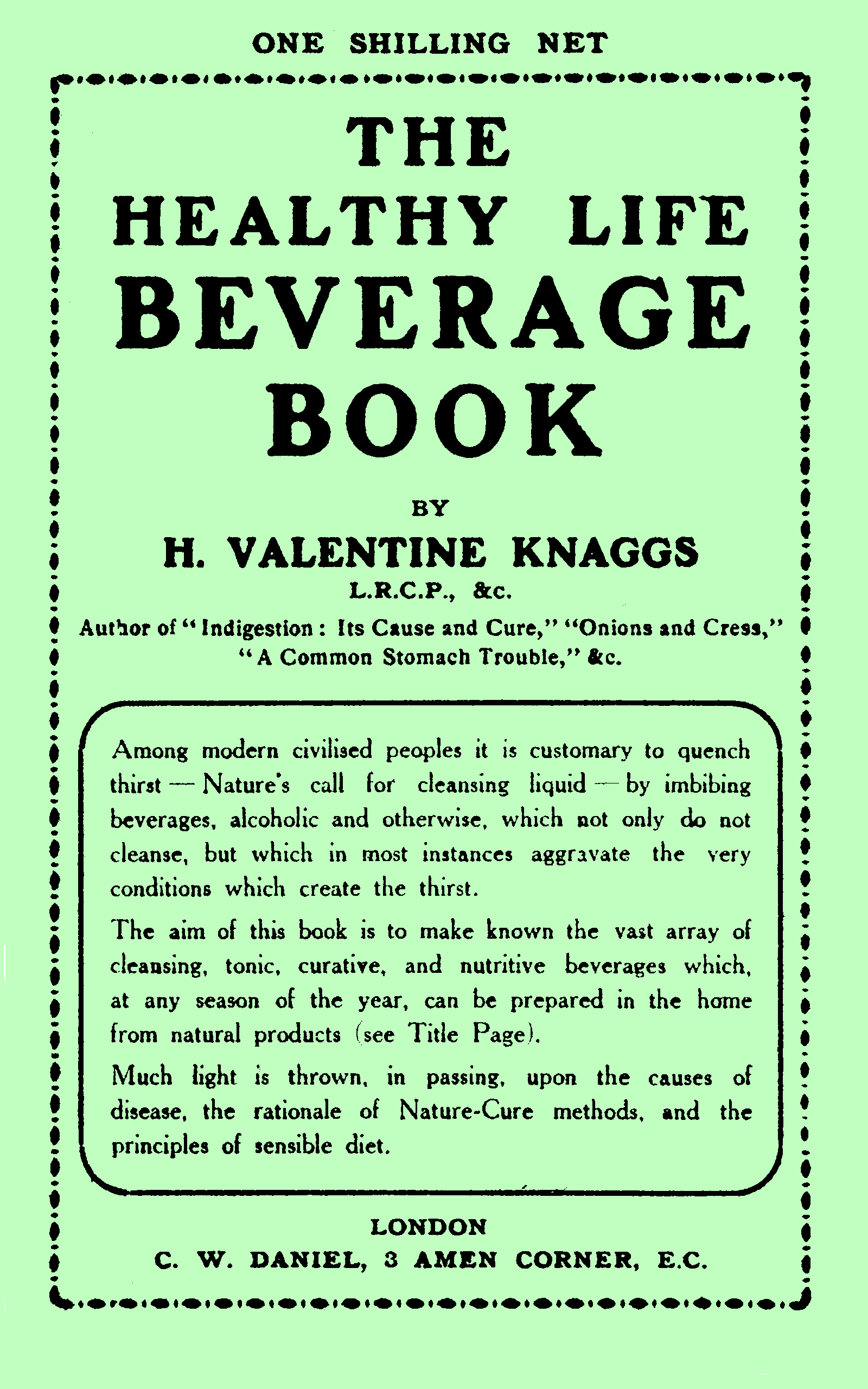
Title: The healthy life beverage book
A compilation, alphabetically arranged, of refreshing, curative, stimulating, and nutritive liquids, comprising fresh fruit and vegetable juices, vegetable broths, cereal drinks, unfired fruit soups, nut milks, plant teas, herbal decoctions, fruit syrups, gum water, &c., with critical notes on water, milk, casein, whey, beef tea, yeast extracts, vinegar, sugar, coffee, tea, cocoa, &c., also information respecting the nutritive and medicinal properties of all the products referred to
Author: H. Valentine Knaggs
Release date: May 29, 2026 [eBook #78781]
Language: English
Original publication: London: C. W. Daniel, 1911
Other information and formats: www.gutenberg.org/ebooks/78781
Credits: Charlene Taylor, Ian Crann and the Online Distributed Proofreading Team at https://www.pgdp.net (This file was produced from images generously made available by The Internet Archive)
[Pg 1]
[Pg 2]
BY THE SAME AUTHOR.
HELP FOR CHRONIC SUFFERERS.
1s. 6d. net; post free 1s. 9d.
THE MICROBE AS FRIEND AND FOE.
1s. net; post free 1s. 2d.
THE CAUSE & CURE OF CONSUMPTION.
1s. net; post free 1s. 2d.
INDIGESTION: Its Cause and Cure.
1s. net; post free 1s. 2d.
ONIONS AND CRESS.
6d. net; post free 7d.
A COMMON STOMACH TROUBLE.
1d.; post free 1½d.
[Pg 3]
The HEALTHY LIFE BEVERAGE BOOK
A COMPILATION, ALPHABETICALLY ARRANGED, OF REFRESHING, CURATIVE, STIMULATING, AND NUTRITIVE LIQUIDS, COMPRISING FRESH FRUIT AND VEGETABLE JUICES, VEGETABLE BROTHS, CEREAL DRINKS, UNFIRED FRUIT SOUPS, NUT MILKS, PLANT TEAS, HERBAL DECOCTIONS, FRUIT SYRUPS, GUM WATER, &c., WITH CRITICAL NOTES ON WATER, MILK, CASEIN, WHEY, BEEF TEA, YEAST EXTRACTS, VINEGAR, SUGAR, COFFEE, TEA, COCOA, &c., ALSO INFORMATION RESPECTING THE NUTRITIVE AND MEDICINAL PROPERTIES OF ALL THE PRODUCTS REFERRED TO.
BY
H. VALENTINE KNAGGS, L.R.C.P., &c.,
Author of “Indigestion: Its Cause and Cure,” “Onions and Cress,” &c., &c.
LONDON:
C. W. DANIEL
3, Amen Corner, E.C.
1911.
[Pg 5]
It has been said, with considerable truth, that man is not by nature a drinking animal. If present-day economic and climatic conditions permitted, and man’s normal palate called for, a universal, daily and abundant use of fresh fruits and vegetables, the necessity for drinking, per se, would disappear, and this book would not need to have been written. Modern civilized life, however, includes an omnivorous diet, widespread adulteration of foodstuffs, a sparsely cultivated countryside and a scarcity throughout the greater part of the year of cheap, sound fruit and salad vegetables. Such factors have produced a physical degeneracy in our midst, clear to all who have eyes to see and perfectly obvious to anyone who is of necessity brought into immediate daily contact with physical disease and ill health. This degeneracy is revealed in bodies all more or less clogged with waste and effete material, a condition clearly traceable to faulty diet and unnatural environment.
A human body thus clogged needs liquid for cleansing purposes, and that need expresses[Pg 6] itself in thirst, since it is Nature’s voice. Unfortunately, civilized man is in the habit of answering that cry for liquid by imbibing beverages which not only do not cleanse, but which in many instances sadly aggravate the very conditions which created the thirst.
The aim of this book is to make known the vast array of cleansing, curative, tonic and nutritive beverages which, at any given season of the year, can be prepared from the materials supplied by a prodigal Nature.
In the following pages, much light is thrown (in passing) upon the working of the human body, the nature of disease, the process of digestion, the rationale of Nature Cure methods, the principles of sensible diet and the harmful nature of certain popular beverages and commodities.
The chief indication of the need of liquid is thirst. This statement needs qualifying. When thirst is caused by over-indulgence in stimulating drinks, alcoholic or otherwise, the drinking of further stimulants will not satisfy Nature, even if, for the moment, the feeling is stilled. Moreover, when thirst is induced by the eating of salted, over-seasoned, or adulterated and preserved foodstuffs, the mere fact of freely drinking fluids of any kind will not correct the sensation of thirst.
To permanently overcome thirst it is not only necessary to choose a suitable beverage that is really cleansing and cooling, but also to remove the cause of that unnatural thirst by abstaining from the types of food and drink[Pg 7] which produce it. Hence the urgent need, among the public, of a better knowledge of food chemistry, of the simple construction of the human body, and of the right kind of food reform, which is inseparable from that study.
Every care has been taken to ensure accuracy. Most of the recipes have been tested, and the subjects have been arranged alphabetically to facilitate easy reference.
I have to thank Mr. E. J. Saxon for carefully revising the MS. of this book and for preparing same for the press. His wide knowledge of the subject has eminently fitted him to give me this assistance.
H. Valentine Knaggs, L.R.C.P., etc.
55a, Welbeck Street, W.
[Pg 8]
[Pg 9]
Acorns are the ripened fruit of the oak tree. They once formed a considerable part of the food of primitive man and are still used in some countries as a substitute for bread.
Acorns contain starch, sugar, albumen, citric acid, and tannin; to the last named all parts of the oak tree owe their astringency.
When dried, roasted, and ground, acorns constitute a fair substitute for coffee, and mixed or blended with a due proportion of either coffee or cocoa they are used as popular beverages in Germany. It is a pity that the acorn is not better known and more freely used in this country, seeing that the oak tree is so widely grown here.
Acorns are gathered in the late autumn, when they are fully ripe; they are shelled, cut into pieces, slowly dried in hot dry air, then roasted to a cinnamon brown colour, ground, and put away in any air-tight package.
Beverages made of roasted acorns are tonic and astringent, and are thus useful in cases of catarrhal irritability of the digestive and other organs. In Germany acorn cocoa is often given to children so suffering as a temporary substitute for milk when the latter is found to be exerting[Pg 10] an injurious effect. Acorn coffee is also thought to diminish the desire for strong drink in those afflicted with this craving. If used alone, acorn coffee is best served up as a decoction, the ground roasted acorns being boiled for about five minutes in water, then strained and served.
Alcohol, especially if taken in the form of whisky, brandy, or strong spirits of any kind, stimulates the nervous system of the body and produces a temporary feeling of well-being. This ultimately lapses into a variable degree of intoxication, drowsiness, and sleep, according to the quantity taken. Alcoholic indulgence exacts an enormous toll in the form of paralysing influences upon the whole human system. Surely, then, it is sheer lunacy for anyone acquainted with the real facts to talk of alcohol as being serviceable and useful to mankind.
There is not the slightest necessity for anyone, whether in health or ill-health, to partake of alcoholic beverages, and no enlightened Food Reformer would dream of touching them in any shape or form.
If one must indulge in alcoholic beverages, then the light wines and beers, such as are used universally on the Continent, should be chosen in preference to the stronger wines and spirits resorted to in this country.
[Pg 11]
Wine contains albumen, sugar, dextrin, with an abundant supply of organic mineral salts. The light native wines of France and Italy, etc., contain relatively little alcohol, and thus do not bring on those destructive changes in the tissues which occur as a result of imbibing spirits or the stronger wines and beers. The organic salts in the light wines, although verging on the inorganic, may play an important part, since they are asserted to be highly anti-scorbutic. The Food Reformer will, however, infinitely prefer to obtain these same salts by eating the grapes themselves, or similarly constituted fresh fruits or vegetables, before they have been allowed to get into the despoiling hands of the brewers and wine-makers.
Beer, like wine, in addition to the alcohol present, contains sugar, dextrin, and organic mineral salts, combined with the yeast extract derived from the yeast fermentation. Its distinctive taste is due to the added hops and bitter aromatics.
When beer is freely drunk, the alcohol, sugar, and dextrin will greedily appropriate the oxygen supply of the body. In this way it saves the fatty and muscular tissues of the body from combustion and equally retards the destruction[Pg 12] of uric acid and other partially burnt-up forms of tissue waste. Heavy beer-drinkers either become fat, some of them abnormally so, or they develop rheumatism or gout.
Furthermore, the free acids present and the bitter principles from the hops act as a stomachic and tonic. They stimulate appetite, thereby inducing people to eat more food than they need.
The mineral salts of beer, especially the phosphates of potassium and magnesium, are often present in relatively large amounts, and, as in the case of wine, are said to be anti-scorbutic. Beer has, unquestionably, a decided effect upon the blood in some cases of scurvy, acne, and skin troubles of a pustular kind. This may be due to its inorganic salts, or it may equally be caused by the yeast extract which beer contains (see under Yeast).
Taken in any excess, beer, especially the modern bottled gaseous varieties, will excite attacks of gout and rheumatism even more readily than wine. For such reasons alone it should be rigorously avoided by those who are in any way predisposed towards the rheumatic diseases.
From a nutriment point of view, beer or stout are supposed to give us a supply of soluble carbohydrates, important organic mineral salts, and bitter tonic principles. This may be so, but the whole effect is marred by the alcohol and vinegar present. A better way would be to[Pg 13] give these items in the form of “Sweetwort,” the beer liquid before it has undergone the fermentative, destructive alcoholic process, or by the use of malt extracts suitably diluted and flavoured with tonic aromatics. A still better way is to eat the grains first-hand, as some form of wholesome cereal food, and drink with it plain water, to which fruit or vegetable juice has been added.
The following information culled from the Vegetarian Messenger of August 1909 may interest readers:—
“Reprinted from the ‘Hospital’:—‘A glass of beer is 89 to 94 per cent. water, 2 to 6 alcohol, 1 to 5 malt sugar, 2 to 3 the nutriment in bread crust, and half that in meat. A glass of good ale is as nourishing as one of milk. A quart of good beer equals nearly ¼ lb. bread. It contains one-sixth of the energy a working man needs daily.’
“A correspondent writes:—‘This is rather disturbing—what is the truth? Surely some comment is needed in the Messenger.’
“I am astonished that a medical journal of such standing as the Hospital should print such a statement. The writer, if a medical man, must be strangely ignorant of simple food analyses. Here is Professor Church’s analysis of a pint of pale ale, i.e., 20 ounces:—
| oz. | grains | grains | grains | ||
| 18 | 409 | water | 17 | acetic acid | 10 mineral matter |
| 1 | 12 | alcohol | 372 | extractive matter | |
“Here is Church’s analysis of a pint of milk:—
| oz. | grains | oz. | grains | grains |
| 17 | 330 water | 0 | 333 milk fat | 72 mineral matter |
| 370 protein | 1 | 22 milk sugar |
“The comparison speaks for itself; apart from water, the chief ingredient of beer is alcohol, described by some dictionaries as a powerful narcotic poison.”
[Pg 14]
Sweet almonds are one of the most highly nutritious forms of food known to mankind. They contain approximately 21 per cent. albumen, 55 per cent. pure fat, 17 per cent. carbohydrates, and 2 per cent. organic mineral salts.
The sweet Valencia and Jordan varieties, on account of their purity of taste and composition, are particularly suitable for making nut milks and nut beverages. Almond milk is especially useful as a demulcent in catarrhal troubles. The bitter almond is sometimes used for flavouring and culinary purposes, but it contains certain principles which render it impossible to be used freely as a food stuff.
One method of preparing a milk from almonds is that known as the old-fashioned Almond Mixture which the chemist of olden days often found a troublesome thing to prepare. To make this it is first necessary to prepare the compound powder of almonds. This is composed of 8 ozs. of almonds, 4 ozs. of refined sugar, and 1 oz. of gum arabic. In selecting the almonds for use they should not be too old, as they are then too oily and do not lend themselves to beverage making. They should not be rancid or unpleasant to taste, otherwise the beverage will be undrinkable. Pine kernels can be used with[Pg 15] almonds if desired, if it is wished to cheapen the cost of the finished article. Assuming that the nuts are fresh and of good quality, the next thing is to blanch them. The best way to do this is to soak them overnight in cold water, then rub off the skins and subject them to a slow dry heat until all moisture has been removed and the nuts are found to break crisply. It is a bad plan to put the almonds into very hot or boiling water, as this coagulates the albumen of the nut, toughens it and so renders it difficult of assimilation.
When the almonds are blanched and thoroughly dry they must be pounded or buttered. In the olden times it was usual to place the almonds in a mortar and pound them until they were reduced to a soft buttery mass. Nowadays it will be found better to put the dried nuts through a food chopper which possesses a nut butter attachment, or through the flaker attachment of the Dana Food Flaker. In this way we get an almond butter in a state of very fine subdivision. This will answer equally well either as a nut butter for table use, or for the purpose of making the almond mixture or almond milk. Pure almond butter (or “almond cream”) is sold by most “Health Food” stores, ready prepared in tins and can be purchased by those who do not wish to go to the trouble of making it for themselves. To make the compound powder of almonds, mix the pounded or buttered nuts[Pg 16] with the sugar (or with an equal amount of sugar of milk) previously mixed with the gum arabic also in a state of fine powder. Rub them all lightly together and pass through a coarse sieve. To make the almond mixture, add gradually one part of the compound almond powder to 8 ozs. of distilled water, then triturate and strain.
To make almond milk, add water to the prepared “almond cream” mentioned above, little by little, working the cream and water together all the time with the back of a spoon, until the desired consistency is attained. This constitutes a very digestible and extremely valuable substitute for cow’s milk. Pine kernels can be used to replace almonds if desired.
Almond milk of a sort can be made by mixing 3 ozs. of pure almond oil with 1 oz. of the best quality of powdered gum arabic, then adding water gradually with constant stirring until it has become thickened, then adding more water until the required consistency is obtained. Rose water, or orange flower water, used to be added to this in the olden days, but powdered cinnamon, or lemon juice, or other flavouring can be added instead, if preferred.
[Pg 17]
The apple is the best of all fruits, and has also the immense advantage of now being practically available all the year round. It contains ·4 per cent. of protein, 14·2 per cent. of sugar in its perfect form, ·5 per cent. of fat, ·5 per cent. mineral matter, with 84 per cent. water, also in its purest form.
Apple juice stimulates life and activity, owing to the purity of its ingredients and the large store of organic nerve-feeding phosphorus that it possesses.
Naturally the best way to drink apple juice is by eating the fruit itself, ripe and ready to hand, finished by Nature. As this is not yet compatible with the modern view, which calls for endless variety and no end of cooking, the apple has of necessity to lend itself to all forms of cookery, and, as such, has to be prepared in many different ways as beverages. In the case, also, of ill people, the cooked apple, although in reality less digestible than its unfired prototype, yet may appeal more to the jaded appetite of the invalid.
One noted fact which should not be forgotten is that the typhoid bacillus, and many other germs of the same family, cannot exist in fresh apple juice for any length of time. Hence fruit and vegetable juices are obviously the remedy for typhoid fever, not milk or whey.
[Pg 18]
The juice of fresh apples is extracted in cider-producing districts, and is a very excellent drink. Cider, too, is good if the amount of alcohol contained in it is very small. At the present time there are several brands of sterilised apple juice on the market which are practically free from alcohol.
To extract quickly the juice from apples so that it may be available in an uncooked or unsterilised form, all that is necessary is to pass apples, from which all bruised and tainted parts have been cut out, through an Enterprise Fruit Juice Press. This costs from 18s. upwards according to size and capacity required. In this way the juice can be quickly extracted in a vital, uncooked state.
Crab-apple juice, or verjuice, is much appreciated in certain parts of the country, the sharpness appealing to some palates more than sweetness. If some of our farmers in the apple-growing districts would start small factories and have one or two machines with a quantity of bottles and a sterilising outfit, they could use their windfalls, and any ripe apples which they could not sell to advantage, for the purpose of bottling sterilised apple juice.
The peel of an apple contains quinic acid, which is a powerful natural solvent of uric and[Pg 19] other acids. Some food reformers have even advised people to eat the peel, and discard the pulp. The peel of apples should never be thrown away, but made into a drink, or added to other beverages. It should, of course, be rubbed clean, and any decayed parts removed before use.
Fruit soups are made on a general plan of utilising one or more fruits to give the distinctive flavouring, then adding some form of starchy material, such as potato flour, sago or barley, to thicken, then adding honey, dried fruits, and spices to flavour the soup. This is a strange way of treating one of Nature’s finest productions, but the modern palate has to be led, not pushed.
Apple soup should preferably be served cold, or iced, in small cups. It is a food—spoilt to some extent by the cooking process—and should always be very slowly sipped, and used as an appetiser.
A plain apple soup can be made as follows:—Take 2 lbs. of apples, preferably of the sour cooking kind; either slice them along with peel and core, or, if the soup is wanted at once, finely grate the apples on a flat grater, or the apples can first be roasted or baked. To the apples prepared in one of these alternative ways add 1 oz. of mealy baked potato, or flaked rice or pot barley, and about 2½ pints of water. Simmer[Pg 20] until soft, strain through a wire sieve, and serve either very hot or very cold. If the apples are sour, season them with honey or prune juice; and if sweet, use parsley, spices as cinnamon or cloves, or ginger. Chemical-free “cracker” or “wafer” biscuits, or macaroons, can be served with the soup.
This is an excellent cooling, antiseptic fever drink provided it is not too much dosed with sugar. To prepare it, cut a few sound apples into small pieces, or grate them finely; remove any tainted or wormy parts, while doing this, but do not throw away the peel, as this, as mentioned, contains valuable organic salts which exert a strong purifying effect upon the blood. If the outside surfaces of the apples are dirty, they can be scrubbed and dried before use. Place the apples (say three large ones) into a quart of boiling water, cook, or, better, simmer in a double-lined saucepan until soft. Pour off the liquor, season with a little lemon juice, grated lemon peel, and honey, and serve very hot. Unripe apples make the best apple water, or windfalls can be used for this purpose.
Another method of making apple water is to bake some sound apples in the oven. When softened, stick a few cloves into them and sprinkle with a little brown sugar. Let the apples fully bake and the cloves and sugar become[Pg 21] slightly browned, then pour boiling water upon them. Let them stand until the water has taken up the goodness, then finally strain and serve hot.
Apple coffee, or apple tea as it is sometimes styled, as sold commercially, is made by taking a quantity of apple rings or pippins, drying and roasting them slowly until quite crisp, then grinding them and storing away in an air-tight receptacle. Moisture causes the powdered roasted apple coffee to become sticky, and eventually to cake together in a mass.
To prepare apple coffee for use, add to one teaspoonful of the powder a half pint of boiling water, boil for a few minutes to bring out the flavour, then serve hot by pouring through a strainer into a breakfast cup. Add milk or cream and lemon juice if desired.
Apple coffee is a pleasant beverage if nicely made, but people soon tire of it and return to ordinary coffee or tea, unless they have entirely evolved out of the use of all stimulating beverages, and then they would not require even the apple coffee.
[Pg 22]
The banana, on account of its peculiar flavour, does not lend itself well to the making of beverages. This fruit contains 1·3 per cent. of protein, 22 per cent. of carbonaceous material, ·6 per cent. of fat, ·8 per cent. mineral matter, with 75·3 per cent. water.
The banana contains a relatively large amount of starch and sugar. While unripe the fruit develops starch, and in that state closely resembles the potato. As the fruit ripens this starch is converted into sugar. If the fruit ripens naturally on the plants, this sugar will become fruit or grape-sugar. If, on the other hand, the bananas are picked unripe, and then imported from the Tropics to this country, the sugar obtained will be largely cane sugar. The latter sugar is evolved by the starchy part of the unripe banana undergoing fermentative changes which lead to the production of cane, and not fruit sugar. It is this cane sugar, developed in the imported and artificially ripened fruit, that makes the banana more difficult to digest here than in the countries where it is allowed to ripen naturally.
Pass a number of bananas through a potato masher to finely pulp them, then sterilise by[Pg 23] prolonged boiling in a steamer or double-lined saucepan. Dilute, if necessary, with rice water and serve as a soup. This soup exclusively used is said to be excellent as a cure for severe diarrhœa or dysentery. 10 to 40 ozs. of banana pulp can be taken daily in this way.
Unlike apple water, banana water is not very pleasant, and it is difficult to make it palatable. To make it, put about three fully ripe sound bananas into a pint of boiling water, allow to slowly simmer until dissolved, then strain and warm up for use as required. A little honey or malt extract, with ginger, cinnamon, or other spice, can be added to give flavour.
This is not at all an unpleasant drink if properly prepared and not burnt.
It is made from the dried bananas which are sold usually at 6d. per lb. These are cut up, slowly dried in the oven until crisp, then ground and stored away in any damp-proof packages. The beverage is prepared by pouring ½ pint of boiling water upon a teaspoonful of the ground coffee. A few minutes’ simmering brings out the flavour more strongly, and so does a small pinch of salt, if the user has no objection to this. The coffee should be poured through a fine strainer before serving.
[Pg 24]
Barley is a cereal grain which in many respects differs from wheat and other cereals. The Roman gladiators were trained on barley; and barley cakes, or bread, constituted the staple article of diet among the labourers of earlier days. The protein of barley consists chiefly of albumen and casein (not gluten). Hence, like oatmeal, it cannot readily be made into bread, unless wheat or rye flour, which is rich in gluten, be mixed with it. Barley cakes are a splendid food and have the advantage for most people of being decidedly laxative. Barley contains from 15 to 17 per cent. albumen or protein, 2 to 3 per cent. fat, 70 to 75 per cent. starch and dextrin, 2·5 to 5·5 per cent. of mineral salts, being specially rich in iron and phosphates, and from 10 to 15 per cent. water. There are several varieties of barley sold commercially. The grain sold varies according to the amount of treatment that it has undergone at the hands of the miller. Thus, we have whole barley, which when ground is known as barley meal, a favourite food, alas, for pigs. This when rolled and supplied as flaked barley is best for making beverages, etc. Scotch milled or pot barley is the grain deprived of its outer husk by the miller. Pearl barley is this same pot barley deprived of all its covering layers and rounded and polished by attrition. Patent barley is the flour made from pearl barley.[Pg 25] Pot barley bears the same relation to the pearl variety as unpolished rice does to the polished kind. The polishing process removes the outer coating of the grain, in which much of the protein and the bulk of the organic salts are secreted.
Barley water is useful as a remedy for colds and catarrhs, and, when taken for coughs and chest troubles, is usually flavoured with liquorice, figs, and raisins. To make it, proceed as follows: Take 4 tablespoonfuls or 2 ounces of either pot or flaked barley, wash same and put into 1 or 2 pints of clean cold water, preferably distilled. Bring to the boil and simmer for from 5 to 20 minutes. The time allowed should be regulated according to the consistency required. The more glutinous the longer should it boil. When done to the required consistency the water should be strained and served up very hot. To season, just before time has expired for boiling, add strips of lemon rind and some lemon juice. Gum arabic can be used to increase demulcency, and honey or malt extract to sweeten. To make “Barley water pectoral” for coughs, etc., add to each quart 2 ounces of sliced figs, ½ ounce of bruised liquorice root, 2 ounces of stoned raisins, and 1 pint of water, then boil down to 1 quart and strain.
Barley water as usually made is said to contain to each pint 43·6 grains of solid matter. It is[Pg 26] composed thus in 100 parts: Protein ·028, fat ·025, carbohydrates ·375, mineral salts ·021, water 99·551.
Barley water, unless made with the whole or flaked barley, is much overrated as a food for infants. It is better to give extract of malt (a teaspoonful to a pint of fresh cow’s milk) than a mixture of milk and barley water made with pearl or patent barley.
Infants under 5 months of age secrete very little “diastase,” the mouth ferment which digests starch or sugar. Mother’s milk is rich in diastase and other ferments.
Barley water should not, as a rule, be made from the patent barley flour, which is mainly starch and sadly deficient in protein and mineral salts. The sole justification for its use is urgency, for barley water can be prepared at once with the patent flour. One teaspoonful of the flour is added to two tablespoonfuls of cold water, and a pint of boiling water is poured upon it; it is then boiled with constant stirring for 5 minutes until clear.
Considering what an almost endless series of palatable and really nourishing drinks can be produced from purely vegetable sources, it is surely unnecessary to add beef tea to their number.
[Pg 27]
Yet a few words about beef tea may not be out of place, in order to clear up any doubts that the public may have about it.
Beef tea imparts a sense of well-being and exhilaration, because it stimulates the living tissues of the body to increased and unnatural activity. This is naturally followed by a subsequent stage of fatigue.
Claude Bernard found that dogs fed on meat extractives and beef teas died sooner than dogs having nothing at all but water. This arose from the stimulation of these preparations.
Dr. Austin Flint of New York also showed that beef tea and urine gave practically identical results on analysis. (Bulletin No. 28, revised edition, Agricultural Dept., U.S.A.)
Urine is an extract of the tissues; the blood bathes the tissues and washes out from them the poisonous waste; these are carried by the blood-stream to the kidneys, by which they are thrown out of the body as urine. An extract from the tissues, as in the case of meat extracts or beef tea must thus possess the same characteristics as urine. Why, therefore, drink it, or indeed any form of meat beverage?
The truth has been well expressed by Mr. Edgar Saxon in the following passage (extracted from The Christian Commonwealth of June 7, 1911):—
“It is obvious to all who have studied animal physiology that conservative cookery applied to mutton or any meat is a fatal error. Animals function in the same way as you and I.[Pg 28] Their processes of digestion, assimilation, and excretion are, especially in the case of the higher mammals, almost identical with our own. When their life ceases under the poleaxe or the knife their tissues are inevitably saturated with waste matter on its way to excretion through the kidneys, the lungs, and the skin. The comparatively pure arterial blood escapes; the impure venous blood to a large extent remains, and gives the colour and flavour to the gravy so highly prized by meat-eating nations.
“So that the only way to get the proteid (or the body-building element) out of meat, without at the same time getting all this highly undesirable and distinctly poisonous broken-down waste matter is to make the strongest possible ‘beef tea’ or ‘mutton tea,’ throw it down the sink, and then eat the tasteless fibre that is left behind. The latter is rich in proteid, the former is simply a harmful and intrinsically repugnant stimulant. These are not the wild ravings of a one-eyed vegetarian crank, but plain scientific facts which cannot be refuted.
“It would seem to be, therefore, a fair working principle to lay down if we say that the juices of vegetables should be conserved as cleansing tonics, and the juices of meat eliminated as poisonous stimulants.
“I hasten to add that I am not suggesting that people should live on vegetable broth and meat fibre! The former is an excellent natural medicine, but not a food in the sense of building tissue. The latter is very nourishing, but insipid to a degree.”
The beetroot of our kitchen gardens contains a large amount of cane sugar, mixed with, relatively, an abundant supply of organic mineral salts. Sugar is extensively manufactured from beetroot on the Continent. Among the organic salts, that of soda predominates, so that in a raw state beetroot is an excellent food to remove acidity.
[Pg 29]
Beetroot is in almost universal use as a form of salad. For this purpose it is cooked, peeled, cut into slices and then served steeped in vinegar. In this state it is decidedly indigestible. The vinegar should be omitted and the cooked beet should be put through a wire sieve to form a purée. In this form it can be taken freely without discomfort.
Undoubtedly the best way to serve beetroot as a salad is to first clean and scrub the uncooked roots, then scrape them with a cobbler’s knife, which should have a saw-edge made by sharpening it upon a piece of sandpaper. A plateful of fine beetroot shavings is thus obtained which are very light and digestible. They contain also the full available amount of the mineral salts in the roots. Scraped beetroot, mixed with lemon juice, makes an excellent dressing for green salads. It can also be used to give colouring to salads or to drinks.
The juice from beetroots can be extracted by means of the Enterprise Press, or it can be had by finely grating and then extracting the juice under pressure. 1 ounce of juice can be obtained from about 2 ounces of the freshly pulled roots.
Take 1 large fresh beetroot, scrub, clean and chop it up into pieces, add 1 quart of water, boil until the goodness has been fully extracted, then strain and serve.
[Pg 30]
The black currant, on account of its rich flavour and acid, astringent juice, lends itself specially to the making of pleasant beverages.
The freshly expressed juice of black currants sparingly taken, diluted with distilled water, makes an excellent cooling and tonic beverage. The juice can be extracted in quantity when the fruit is in season by means of the Enterprise Press and, after first being sterilised, can be kept in bottles for use as required. If only small quantities are needed an ordinary potato masher will do quite well for extracting the juice. When ordinary wine bottles are used for sterilising purposes the juice must be bottled into them and then sterilised. If corks are used instead of stoppers they must be first boiled in paraffin wax.
Take one ¼ lb. jar of best black currant jelly, add the contents to 1 pint of hot water, dissolve and serve hot. This should be sipped at intervals and not taken freely.
The bran and husks of wheat are the richest known substances in potash and phosphate salts. 1 lb. contains 93·1 grains of potash and[Pg 31] 201·6 of phosphates. There are several kinds of bran, but that known as “Pollard” (the part of the flour rejected in making “Standard” flour) is the best for making beverages.
To make this, select bran that is fresh and clean, so that a fair percentage of the cerealin, or bran ferment, adheres to it. Take two handfuls of this fresh bran and pour pure cold water over it. Allow it to stand four hours, or overnight; then strain off the clear part for use.
Add lemon juice for making bran lemonade. Do not boil or heat the bran used for making bran water, as heat destroys the action of the bran ferment. This drink is invaluable in cases of rickets, and can be sweetened with honey or malt extract.
Take three heaped-up tablespoonfuls of good fresh bran. Place in a large jug. Pour upon it a quart of boiling water. Cover with cosy, and let stand for fifteen minutes to draw. Strain and sweeten with lemon and honey, and if required in a thickened form add a few pieces of good gum arabic.
If required thick and glutinous, the bran should be boiled in the water until it has attained the requisite consistency. An eggshell is useful[Pg 32] to clarify the liquid. The gum arabic would not be needed if the bran were boiled for any length of time.
To use bran as a coffee substitute, old bran will do just as well as new. It needs to be roasted until a strong coffee flavour has developed; but great care should be taken not to burn the bran. It is often a very desirable thing to bake or roast old bran, as thereby it is effectively sterilised.
The tops of the ordinary broom, which grows freely on moors and commons, are said to be a good remedy for dropsy and kidney trouble. The tops contain much carbonate of potash, and a powerful sedative.
This is made by pouring a quart of boiling water upon a large handful of fresh or dried broom tops, placed in a warmed jug, allowing to stand until drawn, straining and serving up warm as required.
This is made by boiling broom tops in water in a covered vessel for 10 minutes and then[Pg 33] straining for use. Use 1 oz. of tops to the pint of water.
Boil half an ounce each of broom tops, dandelion leaves and juniper berries, with 1½ pints of water. Continue to boil until the liquid has been reduced to 1 pint, then strain for use.
Buchu leaves come to us from South Africa, and contain a strong aromatic principle which has an excellent effect upon the kidneys.
Put ¼ oz. of the leaves in a teapot, previously warmed, pour on them 1 pint of boiling water. Allow to stand for 5 to 10 minutes and then pour into cups and drink.

[Pg 34]
These forms of green vegetable come in very usefully during the winter months. They are abundantly supplied with purifying, acid and waste-eliminating, organic mineral salts. Most of these salts are lost when these vegetables are cooked and served in the orthodox way.
Cabbage heart, the flower part of cauliflower and Brussels sprouts, first washed, cleaned and cut into quarters, can be used in salads or as an addition to mixed salads. As a general rule, it is best to eat these vegetables in an uncooked form. Cooking, by decomposing their sulphur mineral salts, with which they are richly endowed, makes them smell unpleasantly. It is quite a mistake to imagine that the vegetables, cited in the above heading, are indigestible in their raw state since, if finely prepared by grating or by slow mastication, they are not only digestible but markedly blood-purifying as well. A dish of cooked cabbage or Brussels sprouts often increases indigestion and induces, as well, sleepiness and tiredness.
These vegetables, with any other winter green foods, as leeks, onions, etc., can be made into a[Pg 35] thick broth or purée by slow stewing in an earthenware jar in the oven. In this form they are not so cleansing as when taken in the salad form, but still serve a useful purpose, especially if taken the last thing at night. A little oatmeal, pot barley or unpolished rice may be added, if relished, to the other ingredients.
Carrots contain a fair percentage of starch and sugar, combined with a little proteid and organic mineral salts. Carrots in a grated form (raw) make an excellent salad eaten with oil and lemon juice, or the grated roots can be used as a dressing for a mixed green salad.
The juice extracted by the Fruit Press, or by grating and squeezing, is strongly antiseptic, and moderately palatable, and is thus a valuable remedy to correct acidity. Carrot juice is especially good in the case of children who are anæmic and ailing and they usually like the taste of it.
Grate a large cleaned carrot; add a few of the green tops, well bruised, mix them together with a pint of boiling water, strain and then serve.
[Pg 36]
is one of the most appreciated of all the salad vegetables and it comes to us freely in the winter time when other green vegetables are scarce. Its aromatic flavour and delicious crispness appeal to the palates of most people. Celery, growing as it does in the ground, is very rich in organic mineral salts and for this reason it is found to be an excellent remedy for catarrh and rheumatism. The seeds are useful, owing to their strong celery flavour, for seasoning soups and drinks of various kinds.
The juice can readily be extracted from cleaned celery heads by the Fruit Press or by the slower process of grating and chopping, and then squeezing the juice out under pressure by means of a potato masher.
1 large celery root (or from 4 to 6 ounces); 1 pint water. Boil the celery until soft, strain the water off, and serve hot. 1 ounce of butter, some vegetable stock, or other seasoning, can be added if the soup type of “tea” is wanted.
It is asserted by some authorities that beverages made from roasted cereal grains are free from the stimulating effects of tea or coffee. This[Pg 37] statement is, however, erroneous. The germ portion of all grains contains fat and proteid elements which are analogous to the caffein and aromatic oils of tea and coffee. When the grains are roasted they develop, although to a less degree, the same stimulating principles found in the latter. It is well known that dextrinized cereals are markedly stimulating when given to the lower animals. To discard tea, coffee and cocoa altogether and to replace them with cereal beverages, is like, so to speak, tumbling from the frying pan into the fire. In the case of the latter, so to phrase it, the fire is not so uncomfortably warm as the frying pan.
These forms of beverage, some of which are sold in packets under proprietary names, are made from roasted grains, and are often advised by food specialists who think that tea, coffee and cocoa are injurious, owing to the caffein or “drugs” that they contain. To most people they are not so palatable as tea or coffee, although, with use, many people get to prefer them after a time.
is made from brown and roasted wheat berries to which some oats and barley can be added if desired. Grind finely, pour 1 pint of water upon 1 ounce of the meal, bring to the boil for one minute and drink alone, or with cream.
[Pg 38]
An alternative method is to take 1½ ounces of roasted mixed cereal grains finely ground. Add 2 pints of boiling water, set on stove and boil, then set it back and let it soak 15 minutes. Add the white of one egg before serving.
Well mix together various cereals, good clean bran, and either dried malt extract, honey or molasses. Slowly dry and roast until browned, but not charred. Use as required for preparing a cereal coffee. The addition of almond cream improves the flavour.
Take of wheat, barley, oats, rye, maize and bran, each two heaped tablespoonfuls, grind in an ordinary coffee mill—or the whole grains may be used. Add 8 pints of water. Boil for three hours and, when cold, pass through linen. Sweeten and flavour to taste. This beverage contains from 4 to 6 drachms of soluble organic saline matter to the quart. The use of “Cerealis” yields excellent results in cases of disorders characterized by marked loss of phosphates, since it contains a large percentage of organic phosphates.
Chamomile flowers possess a strong and distinctive aromatic odour and taste. They are tonic, stimulating, and soothing, and are excellent[Pg 39] for strengthening digestion. When made into a beverage and taken between meals, they check fermentation and flatulence, and are especially good for children suffering from summer diarrhœa. The German flowers are said to be less bitter and more laxative than the English or Italian varieties.
Add ½ ounce of the flowers to a pint of boiling water, allow to stand in a covered vessel for two hours, strain and, when cool, take a wineglassful before meals. The addition of a little liquorice root or juice removes the bitter taste.
Take six heads of chamomile flowers, a little bruised ginger, add six ounces of boiling water, allow to stand a few minutes, strain, and drink, hot or cold, as desired. This is a good remedy for children.
This fruit in season is very suitable for preparing beverages. The morella cherry is the best, on account of its strong aromatic flavour.
The fresh juice of cherries is obtained by washing and stoning a quantity of sound fruit, then passing the pulp through a Fruit Juice press. If much juice is required, a cherry stoner will be found a time-saver.
[Pg 40]
Mash ½ lb. of cherries (morellas by preference), crush a few of the stones with their kernels, add a little honey and cinnamon, pour upon them a pint of boiling water, set back on stove, or place in a fireless cooker, for several hours, then strain for use.
Take 1 pint of cherries, the juice of one lemon, honey and two teaspoonfuls of some form of starchy cereal. Mix cereal with cold water, and then with boiling water to dextrinize. Add other ingredients and simmer all together for 30 minutes with 1 pint of water. Serve cold or iced.
Take 1 lb. of cooking cherries, ½ ounce of banana flour, 1 teaspoonful of lemon juice, ½ ounce of malt extract or honey, 2½ pints water. Boil until cooked, rub through sieve, and serve with fried bread croûtons and little dumplings.
The chestnut is similar in composition to the potato. It may be likened to a potato growing upon a tree. It has very little in common with other nuts.
Scald some fresh chestnuts to loosen the skins, carefully remove all the outer skin and then[Pg 41] grate them, using an ordinary nut grating machine. Mix from 4 to 8 ounces of the grated chestnuts with a pint of boiling water, simmer for a few minutes, strain and serve hot. Chestnut flour, sold commercially, can be used instead of the freshly ground chestnuts.
Cinnamon is the bark of a tree and comes chiefly from Ceylon. It contains astringent matter and an essential oil which is said to exert a deadly effect upon disease-producing germs. Thus it makes an excellent fever drink for influenza, catarrh of the bowels, and consumption. It has also been known to cure cancer. It is inadvisable to use the ground cinnamon as supplied by grocers, as this is frequently adulterated. The cinnamon sticks, or “whole” cinnamon, should be purchased always.
Take 1 ounce of cinnamon sticks, bruise, or coarsely powder, pour upon them a pint of boiling water, allow to stand until drawn, strain, then drink a small teacupful hot, several times a day.
This is made like the water, with the exception that the water and cinnamon should be boiled together for 15 minutes before straining.
[Pg 42]
The very strong decoction, used in cases of cancer, is made by boiling 1 lb. of the best cinnamon sticks with 2 pints of water (preferably in vacuo), and allowing it to simmer down to 25 ozs. The resulting decoction should be poured off without straining and 10 per cent. of glycerine added to preserve and sweeten. Of this decoction about ½ pint should be taken as the daily dose.
Cocoa is a very popular form of beverage. It is more of a food than either tea or coffee, because it contains a considerable amount of fat and albuminous matter. The beans contain 1 to 1½ per cent. theobromin, an alkaloid identical with the thein or caffein found in tea and coffee. They also contain from 45 to 50 per cent. of cocoa butter, a pure type of vegetable fat, as well as from 13 to 18 per cent. proteids. Phosphate of soda is one of the chief organic mineral salts contained in cocoa.
The beans before use are roasted, which changes the starch into dextrin and develops aromatic substances as in the case of tea and coffee.
Cocoa is seldom sold here in its pure state, as the beans are hard and require powerful machinery to crush them. We can, however, obtain forms of cocoa which contain the full[Pg 43] constituents of the beans. Among these may be included “cocoa nibs” and “rock cocoa,” the last named being mixed with sugar and being usually prepared on the Estate where the beans are grown.
Most of the cocoa sold in this country is in the form of a fine powder called “Cocoa Essence.” By means of machinery the beans are finely ground and the oil is extracted; the fibre is also extracted, or well broken down.
Crush 1 ounce of the nibs in a mortar or grate them in a small nut mill. Put into a pot, simmer 4 hours. Pour into a clean dish, skim the fat. When cold reheat and serve. Or grate as much “rock cocoa” as is required, boil for an hour or more until fully dissolved. “Swizzle up” and serve. The great drawback to these articles is the difficulty of dissolving the cocoa, and the time wasted in preparation.
The great advantage of the various Cocoa Essences is their ease of preparation. One teaspoonful has merely to be dissolved in ½ pint of boiling water or milk and water and the drink is ready to serve. In making, it is always best to first mix the cocoa essence with a little cold water before adding the hot water to ensure a smooth beverage free from lumps.
[Pg 44]
Another form of cocoa beverage is that made from ordinary chocolate, or chocolate in a powdered form. Chocolate is prepared by crushing and finely grinding or pulping the beans, adding sugar, dried milk, etc., and, when it is in a soft state, running it into moulds to set. To make a chocolate beverage, dissolve a sufficient amount of the prepared chocolate in boiling water, add milk to taste and serve. To many people it is sickly, owing to its sweetness; to others it is fermentative.
The cocoashells, or the husks of the cocoa beans, like the bran of cereal grains, are well laden with organic mineral salts, especially those of iron and phosphorus. A very valuable nutritive beverage can thus be made from them. They also possess the advantage of cheapness. To make the beverage, place a handful of the shells into a covered saucepan with 1½ pint of water, bring to the boil, strain, serve very hot, either alone or with milk or cream. (It is best to buy one of the sifted and cleaned or malted preparations of cocoashell now on the market, as the ordinary loose cocoashell obtainable at grocers’ shops is frequently inferior and often very dirty.) Another method is to grind the cocoashells in a Dana machine or a nutmill, and make exactly in the same manner as tea, in a teapot, adding milk or cream to taste.
[Pg 45]
The dried and roasted berries of the coffee plant make an agreeable and exhilarating beverage, which does not produce the same dire results as wine or alcohol, although it affects its votaries in other ways. It stimulates the nervous system and, if taken to excess, produces tremors and irregular action of the heart. It increases the frequency of the pulse, removes the sensation of fatigue during exercise, and also increases the action of the waste-eliminating organs.
Coffee contains an aromatic oil (which gives to it its distinctive flavour), a peculiar drug principle, called caffein, and also dextrin and mineral salts. The aroma of the oil is brought out by the roasting process.
In England, coffee is usually made from a poor quality of bean, served up tepid and muddy, and drowned in a deluge of water. Probably it was prepared in this way, when first introduced into this country, since in a petition against its use in 1674 it was described as “a base, thick, nasty, stinking, puddle water.”
It is always wise to pay a good price and obtain the best quality and then prepare it with due care and attention.
Coffee should preferably be taken either as a pure infusion called “Black Coffee,” or with an equal part of hot milk. Two teaspoonfuls or[Pg 46] more of whipped egg cream greatly improve its flavour.
Above all, cane or beet sugar should not be added to it, as these spoil the characteristic flavour of the beverage and eventually ruin the digestion of the person taking it.
Coffee is always at its best when the berries are freshly roasted as wanted, and then immediately ground and used. This roasting process, however, takes up much time, which few people are prepared to give.
The roasted beans keep fairly well, even for months, if packed in small air-tight hermetically sealed tins or bottles. A slight warming or parching of the beans, or of the ground coffee, is a fair expedient, although nothing can compare with the fresh roasting immediately before the coffee is made.
From 2 to 4 dessertspoonfuls, or 1 to 2 ounces, of coffee should go to the pint.
Fast boiling water, or milk at a temperature of 180° to 200° F., should be poured over the infusion, and it should then be allowed to stand for a few minutes with occasional stirring or shaking until ready.
It has been found that coffee gives up 19 to 25 per cent. as an infusion, but yields up from 30 to 35 per cent. if prepared as a decoction. To get this extra value out of the grounds the[Pg 47] latter are often boiled with more water after the infusion has been made. This decoction is then added to the next lot of fresh infusion to give it colour and body. The objection to this is that the boiling process extracts much of the undesirable caffein and astringent matter, which it is unwise to drink.
In some restaurants, coffee is made in an enamelled saucepan, a pinch of salt is added to increase the flavour, and boiling water is poured on. It is set back on the fire, stirred well at intervals and allowed to come to the boil without actually boiling. The lid is put on and it is set on a slow fire till a scum arises. It is now lifted from the fire. Lastly it is allowed to settle and the process repeated.
This is a common (and undesirable) method usually adopted when a maximum amount of coffee has to be made from a minimum amount of berries.
This is a favourite beverage among Food-Reformers. When coffee has been lightly roasted the caffein is said to be undeveloped and thus passes away in the grounds. According to the late Joseph Wallace, pale roasted coffee corrects fermentation, and, unlike ordinarily roasted coffee, removes dyspepsia and sleeplessness; it is also antidotal to food poisoning and cholera. Pale roasted coffee, taken in strict moderation,[Pg 48] may be safely looked upon as a distinctly useful beverage in spite of what may be said against it on the score that it contains caffein (which is a xanthin or uric acid type of substance).
In preparing pale roasted coffee, the correct way is to use 1 ounce or 4 dessertspoonfuls of freshly ground berries to each pint of water. It must not be boiled. Infuse in warmed earthenware pot. Pour on fast boiling water, stir with a wooden spoon, pour backwards and forwards, then allow to settle. Distilled water is the best to use. When the coffee settles and goes to the bottom of the pot it is ready.
A poor cup of coffee is produced as a result of:
(1) Inferior quality, or bad roasting.
(2) The purchase of too large a quantity of ground coffee which thus loses its aromatic oil as a result of prolonged keeping.
(3) The use of an insufficient or excessive amount of coffee to the quantity of water used.
(4) Not allowing it to stand long enough or, on the other hand, boiling it or permitting it to stand too long.
(5) By not serving either coffee or milk thoroughly hot.
To make this, put into a little metal pot, two large tablespoonfuls of very finely ground coffee[Pg 49] and ½ pint of boiling water; sweeten if necessary with a tablespoonful of honey. Bring to the boil three times, then pour into small hot cups without straining.
The so-called “French Coffee,” as usually sold over here, is a mixture containing a preponderating amount of chicory, and the coffee used is often over roasted. It is questionable whether coffee made from this blend can be truthfully styled “French.” It is well known that the French people make far better coffee, as a rule, than we do in this country.
is a special kind of prepared compound containing coffee mixed with roasted figs, etc. It is sold in square blocks and is an Austrian product. It enters largely into the composition of the celebrated Austrian or Vienna coffee. In making coffee usually a small quantity of the fig compound is added to give body and colour to the finished beverage.
is a cheap product of the dried endive root. It yields a darker and more bitter infusion than does coffee. It sinks in water while coffee floats for a long time, owing to the gases formed in the roasting process. It is best avoided.
[Pg 50]
The cokernut (sometimes spelt “cocoanut,” though it has, of course, no connection with cocoa) is a sort of “ugly duckling” when compared with other nuts, and few people partake of it regularly. Probably the only time when it is freely eaten in England is during Bank holidays, when the cokernut shies of the fairs force the nuts upon those members of the speculative public who venture their pennies and secure the prize. The milky fluid in the cokernut, as well as the nut substance itself, is very nourishing, and being fairly cheap, it might to advantage be more freely eaten as a form of proteid food. It makes an excellent curry. The nut does not seem to make, or appear in, any popular beverages. “Desiccated cokernut” is not to be compared with the fresh cokernut, but if it is used at all, the cokernut meal should be procured.
The fluid obtained from the inside of the ripe nuts is an excellent and nourishing drink, and is strongly antiseptic.
Take half a cokernut and finely grate the white pulp, or use an equivalent amount of fine cokernut meal; 2 or 3 small onions, fried; ¼ to ½ ounce of curry powder; 1 or 2 apples; any[Pg 51] root vegetables. Stew 1 hour, then mix in 3 teaspoonfuls of cream, 1 teaspoonful of flour, 2 tablespoonfuls of butter and 1 teaspoonful of lemon juice.
Fresh cranberries are astringent and acid and are said to be one of the finest fruits for purifying and vitalizing the blood. Dr. Robert Bell strongly recommends them in cases of cancer.
The juice extracted by means of the Fruit Juice Press is invaluable in disorders affecting the blood. It can be used as an application outwardly applied for certain skin troubles. It is also a useful and pleasant salad dressing.
Take one tumblerful of cranberry jelly, dissolve it in 1 pint of hot water; when dissolved, serve hot, and slowly sip it.
The cucumber belongs to the melon tribe of plants and is a favourite vegetable for use with or as a salad. For this purpose it is best eaten[Pg 52] in pieces and not cut into thin slices. It consists chiefly of pure nature-distilled water mixed with fibre and a little mineral organic salts.
The rind is often very bitter, but it contains valuable organic salts, like the husks of cereals or the peel of apples. It is a good thing to eat this rind as a remedy for constipation, or to include it in the extracted juice when an aperient effect is desired.
The juice extracted by the Fruit Juice Press and taken in small cupfuls is a cooling refrigerant drink. It is a valuable remedy for outward application for which purpose it is sometimes mixed with glycerine.
The ordinary currants used for culinary purposes are the dried fruit of a small grape. They come from the Grecian Archipelago. They must not be confused with the red and black currants which grow in orchards and kitchen gardens here. Currants make a useful sweetening agent for drinks, and for this purpose they should first be well cleaned and afterwards mashed by passing through a Dana Food Flaker. It is always wise to buy the better quality, as the cheaper kinds contain much unripe, inferior, and imperfectly dried fruit.
[Pg 53]
The juices and salts of the dandelion exert a stimulating influence over the whole system, helping the liver, kidneys and bowels. The fresh leaves are an excellent addition to salads, but should be quickly grown and partially bleached, otherwise they are intensely bitter and tough. The flowers also, which grow freely in the springtime, are a good addition to salads.
Chop finely or bruise 2 ozs. of fresh young dandelion leaves. Pour over them 1 pint of boiling water. Let stand 2 hours in a covered vessel and then strain for use.
A wineglassful can be taken cold three times a day, or this quantity can be added to a breakfastcupful of hot water and drunk as a tea.
Add 4 ounces of finely chopped or well bruised fresh green dandelion leaves to 1½ pints of water. Boil the liquid until it measures a pint, then strain and use in the same way as the tea. This is a stronger preparation than the tea.
This is a fairly pleasant beverage, and closely resembles ordinary coffee in taste. It is especially advantageous when tea or coffee are[Pg 54] found to disagree. It is an excellent drink for dyspeptics, as it stimulates all the organs of the body and also exerts a cleansing action upon them.
The roots are usually dug up in October, dried, cut into small pieces, carefully roasted and ground.
To make it add 1 teaspoonful of the roasted dandelion coffee powder to ½ pint of boiling water, bring just to the boil, strain, and serve, adding milk or cream if desired.
The distinctive feature of the date is its large sugar content. This sugar is of a mixed kind, being partly fruit sugar, and partly cane or invert sugar. The presence of this latter makes the date somewhat difficult of digestion in cases where the power of digesting cane sugar is small. Dates go well with nuts of all kinds. They are better assimilated when eaten with fresh green salad.
On account of their sweetness, dates have at times been used for preparing a coffee by drying and roasting them in a slow oven or kiln. So made, the resulting powder must be kept in an air-tight tin, otherwise it will absorb moisture, and become caked.
The stones of dates also have been used,[Pg 55] after careful roasting, to make a coffee, but the grinding process is difficult, owing to the intense hardness of the stones.
In the deserts of Arabia and northern Africa the date is a food of immense importance and frequently constitutes the sole food of the Arabs when travelling. Even the stones are pulverised, and fed to the camels. In the East, the date palm bears the title “the tree of life”: its length of life and fertility are certainly astonishing.
It is not necessary to pay a high price for good dates. The Hallawi, Khedrawi, and Caliphat varieties are the best, having the softest fibre and thinnest skins, and their price is moderate, the Hallawi, for instance, being quoted by one well-known London store at 1s. 6d. for a 7 lbs. carton.
Add 1 quart of water to 1½ lb. of washed and scalded dates. Allow the dates to soak for a few minutes. Then, with a potato masher or something of the kind, break up the dates until the water has reduced them to stones and fibre. Strain off the liquor and heat it to very near boiling point. Add cream or milk, according to taste. This makes an excellent drink with about half milk. To those who lack energy it will often bring about surprising results. (Bernarr Macfadden.)
[Pg 56]
Eggs, being in a liquid form, and at the same time highly nourishing, constitute a very important ingredient of food beverages. Moreover, in their raw state they are very easy to digest. Many advanced vegetarians, especially the Hindoos, abjure eggs because they assert that they exert an injurious effect upon the generative system. It is quite practicable to entirely discard eggs from a dietary with proper training. Beginners at any vegetarian régime will find it wise to include eggs until they have trained their digestive organs to do without them.
Those who follow the “uric acid theory” in diet, take the white only and discard the yolk for the reason that the latter contains xanthin, a form of uric acid.
This is a light, easily digested food for those who require rest from ordinary foods, as in cases of gastric catarrh, fevers, diphtheria, etc. It is made as follows:
Take 2 egg whites, separate in patent egg-white separator, add a teaspoonful of lemon juice, or if preferred, use dill or cinnamon water, and ½ pint of distilled or barley water. Mix[Pg 57] well together and sip slowly. An easy way to prepare this is to first beat up the egg whites, add to water, transfer to a bottle and well shake contents until thoroughly combined. A tablespoonful of pure preservative-free cream is a useful addition in cases where cream is easily digested.
This also is a light restorative fever drink. Make thus: 1 egg white; ½ oz. malt extract or honey; juice of 1 lemon or orange; ½ pint of distilled or barley water.
These are forms of beverage containing usually both whites and yolks, and if combined with other foods are perfectly balanced meal-nutrients. Thus:
1 new laid egg beaten up well; ¼ oz. dry malt extract or ½ oz. thick malt extract; teaspoonful of lemon juice; ½ pint of water. Serve cold and sip slowly.
1 new laid egg whipped well; grated nutmeg or cinnamon to taste; ½ tumblerful of unfermented cider, apple, grape, or other acid fruit[Pg 58] juice. Serve cold or lightly warmed. (It must not be boiled, or the egg will become coagulated.)
An egg mixed with fruit juice and pure cream constitutes a full and perfectly balanced light meal, if sipped slowly. Thus: 1 beaten-up new laid egg; 1 oz. pure cream; ½ tumblerful of grape, apple, orange, or other fruit juice. Tomato or some vegetable juice extracted by the Enterprise Fruit Juice Press, can be used to replace the fruit juice, if preferred.
This constitutes a full meal, but to render it digestible it must be very slowly sipped through a straw: 1 egg; grated nutmeg or other spice; a little tomato or vegetable juice; tablespoonful of pure cream; pint of fresh rich milk. Mix well together, and sip slowly.
2 tablespoonfuls of prepared clean cocoashell; 1 teaspoonful of cocoa essence. Boil in some water for about 15 minutes; then add ½ pint of fresh (not boiled) milk, and lastly, 1 beaten-up new laid egg. Serve cold or moderately hot; but do not boil, or the egg will coagulate and spoil the beverage.
[Pg 59]
There are many varieties of the Eucalyptus tree which grow in special abundance in Australia and New Zealand. Unfortunately, however, the tree does not flourish in Great Britain, as the winter frosts kill it. The leaves of the Eucalyptus tree possess powerful antiseptic properties. When the fresh leaves are not available, the dried leaves can be substituted.
Place in a teapot ½ oz. of broken leaves, add 6 ozs. of water; infuse ½ an hour; add liquorice or honey to sweeten. This is said to be an excellent remedy for colds, influenza, and diabetes. The oil used similarly is not found to have the same effect (Mr. Faulds, in British Medical Journal, Jan. 1902.)

[Pg 60]
All fresh fruits are rich in organic potash salts, such as the citrates, malates and tartrates. These are essential to the renewed construction of the tissues and organs of the body. These salts, as they exist in fresh fruits, are acid, but in the body they undergo combustion and become converted into alkaline carbonates so that fresh acid fruit juices are really curative of acidity when this is due to ill health and fermentation. Far different is the case of mineral acids, which remain acid throughout.
Fruits contain more than two-thirds water (in this resembling the human body) and are therefore good thirst quenchers. The water in fruits is practically the purest and most perfect distilled water obtainable. The man who eats fruit freely is seldom thirsty.
These are real foods, and are best made by extracting with a fruit press the fresh juices of the fruits available. They are served cold or iced in small China bowls or bouillon cups. Excellent drinks are made by mashing and pulping bananas, gooseberries, strawberries, raspberries, currants, plums, or any moderately soft fruits. Then adding the pulp to a quantity of hot or cold water, straining, sweetening (if necessary) and serving in dainty cups or glasses.
[Pg 61]
Owing to its hot aromatic constituents ginger is frequently used as an addition to foods, medicines and beverages, to correct any tendency they may have to disturb the stomach and create colic. Ginger is obtainable as whole roots (green, dry, or in syrup), in powder form or as an essence in a liquid concentrated form. Ginger is preserved by the Chinese in a ripe form with sugar, and imported into Great Britain both in the familiar quaint jars and in a dry form. The latter is dry externally, but soft within, and much to be preferred to the made-up heavily sugared varieties sold in cubes and chips by confectioners.
Teacupful of dry Chyloong ginger cut fine; 4 breakfastcupfuls of water. Boil 20 minutes, strain, add a teaspoonful of lemon juice, or 1 oz. of orange juice. Serve cold.
The gooseberry is a common and relatively cheap spring and summer fruit, and is well adapted for the purpose of making beverages. The green gooseberry from its tartness is preferable. It is one of the first of the spring fruits to come in.
[Pg 62]
2 lbs. green gooseberries; ¼ lb. malt extract or black treacle; ¼ pint water; cornflour to thicken. Trim and wash gooseberries; stew until soft; add more water as needed, but use as little as possible; sieve, and finally add the malt extract or treacle. Serve either quite cold or quite hot, according as circumstances render desirable.
The value of the grape as a food is remarkable. This fruit is especially good in cases of anæmia, and as a restorative in severe illnesses. For this purpose the hot-house black grapes are the best.
By far the best juice is that which one gets from eating sound ripe grapes, or from drinking the recently extracted juice from fresh grapes. The many unfermented grape juice beverages on the market are not so good as the fresh juice, because they have been sterilised to enable them to keep. It is easy to extract the juice in its fresh state by means of the Fruit Juice Press and it is best to include the stalks when passing the fruit into the machine. If a press is not available the grapes can be mashed and pulped by putting them into an ordinary potato masher and collecting the juice as it runs from the wire meshes.
[Pg 63]
Add a wineglassful of either fresh or sterilised grape juice to a tumblerful of hot water. Add lemon and some form of cooked cereal (cornflour, oatmeal flour, etc.), if desired, for grape soup.
In America there is a group of vegetarians who believe in grass-eating on the Nebuchadnezzar plan. If it is tender and young it is said to be by no means unpalatable. It makes an excellent addition to salads. The generality of mankind are, however, strongly averse to eating grass in any form although there is no reason why it should not, in common with other greenstuff, form a part of the daily diet. The analysis of grass shows that it is a very useful food. According to a recent analysis it consists of Proteins 3.5, fat 0.8, Carbohydrates 9.7, fibre 4.0, mineral salts 2.0, water 80.0.
Clover possesses valuable medicinal properties. There is a form of clover which exerts a marked effect in imparting fertility to the ground by restoring nitrogen to it after it has been depleted by wheat and other nitrogen using crops. The red, or meadow, clover has been used as a remedy for cancer.
[Pg 64]
Take a handful of clover, fresh clover by preference, or if this is not in season the dried clover must do instead; place it in a warmed teapot; pour a pint of boiling water over it; allow to stand until drawn, and take a teacupful at frequent intervals.
Many of the edible gums known to commerce, such as gum arabic and gum tragacanth, are often found useful as additions to beverages to thicken them or to make them more soothing and demulcent.
1 teaspoonful of best quality gum arabic; tumblerful of cold water; let stand until dissolved; then flavour with lemon, or any other fruit or vegetable juice.

[Pg 65]
Honey consists of pure fruit sugars extracted by bees from flowers. Its colour, taste and odour thus partake in some degree of the flowers from which it has been collected. The virgin honey in the comb is the best to use, although the most expensive. Honey is a useful addition to many beverages as a pure and natural sweetening agent. For this purpose it is preferable to either cane or beet sugar. As a rule, it is better to avoid low priced foreign honey (unless it bears an absolute guarantee of purity) as few articles of food are more widely adulterated.
This was a famous drink in ancient times. It is made by boiling together one part of honey and 8 parts of water.
This also was a popular drink with the early Norsemen and our own Anglo-Saxon forebears. It was a mixture of light red wine and honey, with a little fresh herb added sometimes.
Hops possess tonic and sedative properties. They contain an aromatic oil which gives to the[Pg 66] plant its medicinal virtues. Practically all fragrant herbs have a tendency to bring on sleep and hops are no exception to this rule. Hops are often given in various ways to induce sleep and to soothe the nervous system. A hop pillow is a device to attain the same end.
½ oz. hops; 1 pint water; infuse in the usual way. Dose is 4 to 8 tablespoonfuls. Malt extract can be added to improve the taste and mitigate the intensely bitter flavour of the hop.
This is an excellent relish to go with salads. It should be scraped into fine shreds using a cobbler’s knife sharpened with sand paper. It makes an excellent addition to vegetable drinks.

[Pg 67]
Lemonade is one of the oldest and still one of the best of the popular beverages. The juice of a lemon contains citric acid, a little malic acid, with sugar, albumen, etc. Its acids are capable of oxidation in the body where they become converted into carbonates. Thus the juice of lemons or limes is much used in cases of fevers, because by this same process of oxidation the acid citrate salts are converted into carbonates, which neutralize bodily waste and promote the removal of acid and toxin poisons. The aerated “lemonade” sold in bottles and syphons bears only the most distant relationship to the lemon and is not a desirable beverage from the health point of view. The same holds good as regards the lemonade crystals, so extensively advertised to-day.
Take a washed lemon, pare rind off thinly—do not grate deeply, as the pith is bitter and unpleasant—then extract the juice with a glass lemon squeezer. Add to the pared rind and juice 1 oz. of honey in a jug and pour over all 1 pint of boiling water, cover jug, allow to cool, and when cold strain. Cover well to preserve aroma; serve iced. Do not make the lemonade[Pg 68] by pouring boiling water upon slices of lemon because the bitter pith will then spoil the flavour of the drink for most people.
Slice thinly 1 whole lemon and rind; put this into 1½ pints of cold water; cook down to ½ pint; strain. This is bitter, but some prefer it.
Add to 1 quart of strong lemonade (iced) a few drops of essence of peppermint, and some cherries cut up. Add white of egg for hoarseness, and black coffee for headache.
Add the juice of 1 lemon or of 2 oranges, to 1 pint of plain water. Use honey by preference if sweetening is desired.
The bottled lemon squashes and lime cordials are not pure in the strict sense of the term, since they are bound to contain 10 per cent. alcoholic pure spirit by Government regulations.
This is one of the best, because it is the most relished, of all the salad vegetables. It is also valuable for the many organic mineral salts that it contains. Lettuce possesses sedative qualities and the extract obtained from the leaves is a powerful sedative.
[Pg 69]
The juice of lettuce extracted by means of the Fruit Juice Press is one of the best means for supplying organic mineral salts in an easy way to those who suffer from a deficiency of these essential substances. It can be taken at intervals.
Lime is an essential constituent of bones, teeth and other parts of the body. Our supply for building these tissues is best derived from the organic lime contained in uncooked salad vegetables or vegetable teas. It is very doubtful whether lime can be absorbed by the tissues when supplied to them in an inorganic form. Thus lime water is a liquid of very questionable nutritive value.
Linseed or flax seed is highly nourishing, but not palatable to most people. It is also demulcent and soothing by reason of the oil and gummy material that it contains; hence it is often given to soothe inflamed throats. For this purpose it has the effect of linseed supplied externally in poultice form.
1 oz. of linseed, ¼ oz. bruised liquorice root (or a piece of liquorice the size of a filbert nut),[Pg 70] water 1 pint. Simmer slowly for from ½ to 4 hours, strain, cover up and serve as required.
1 oz. whole linseed; juice of 1 lemon; 1 oz. honey; 1 pint of water. Wash seeds, put in cold water in saucepan, simmer 1 hour, add lemon juice and honey to taste, and strain. If too thick add hot water to dilute.
Whole seeds 1 oz.; 1 pint barley water; simmer 1 hour, let stand until cold, then add juice of two lemons and 1 oz. of honey or malt extract. If the seeds are eaten as well, this combination will be found a most efficient corrective of obstinate constipation.
The dried roots, the powdered root, or the extract prepared from them, called Spanish liquorice or juice, consists chiefly of a substance having an intensely sweet taste, and this is combined with gum, starch, a resinous substance, proteid matter and organic mineral salts. Liquorice differs from sugar in not being susceptible to alcoholic fermentation. The chief use of liquorice is as a sweetening agent for other beverages. Given alone it is useful in stomach troubles and in sleepiness in the place of soda. It is also said to be an antidote to correct the tobacco habit. It makes a good sweet for children, if taken sparingly, and it teaches them to chew.
[Pg 71]
Malt is the product of germinating barley. The grains are allowed to germinate on a hot damp floor and the process is stopped at a certain stage by means of kiln drying. Diastase, a powerful digestive ferment, is formed in abundance so that malt extract of good quality is able to convert starch into a digestible and easily assimilated sugar. Malt is also rich in phosphates, which makes it an excellent bone and teeth former. Malt is usually sold as malt flour, which consists of the kiln dried grains in a powdered form. Derived from this, is the thick sticky substance resembling glue, called “malt extract.” If this extract is further dried, we get the dry malt extract in powdered form, which is the most convenient to use in a general way for sweetening purposes.
This can be prepared from malted barley, malt flour or extract of malt, by dilution with water to a suitable consistency.
Let malted barley stew and soak and infuse in hot water until all the goodness has been extracted therefrom. This constitutes a form[Pg 72] of strong sweet non-alcoholic beer and is an excellent drink which was much used in olden days. With added hops it is the actual material from which beer is made.
Take any ordinary vegetable soup and thicken it with malt flour or malt extract.
The marrow is practically all water, containing only a very small percentage of organic mineral matter. It is an excellent cure for obesity because the person taking it thinks he is getting a lot of food, whereas he is practically drinking water. As the salts of vegetable marrow are chiefly in, and immediately under, the skin, it is obvious that, when peeled and boiled in the usual unenlightened way, this vegetable is reduced to so much cellulose and water. When baked whole in the oven its flavour is a revelation to those who have never tasted it except in a boiled form.
This can be extracted by the Fruit Juice Press and may be taken freely as a cooling drink, seasoned to taste.
[Pg 73]
Cook one or more marrows with a minimum amount of distilled water until soft, strain, and take freely. This is a pleasant substitute for hot water. Do not add salt to it.
The use of cow’s milk at meals or between meals as a beverage is one of the greatest dietetic blunders which could be perpetrated. Human milk is a nutritive fluid, very useful for the fast-growing young mammal and perfectly adapted as such for young infants.
But for adults who have ceased to grow, cow’s milk is needless and injurious. It is also one of the best culture media for tuberculosis and other germs. Therefore, it is better to use acid fruits, and fruit or vegetable juices, instead of milk when beverages are called for.
Milk is a fluid, containing its various food constituents ideally balanced for the purpose of building up the young body. With the sole exception of man, however, every animal in a state of nature ceases using milk as a food when once the period of infancy has passed. Speaking recently at the Working Men’s College on “Wild Parts of China,” Professor A. Henry mentioned as a curious fact that the Chinese, Japanese, and Koreans, who number one-third of the human[Pg 74] race, abstain from the use of milk, cheese and butter. This probably accounted for the absence among them of zymotic diseases.
This is an excellent beverage if it agrees; or dried separated milk, diluted with water to the proper consistency, can be used as a substitute. It should be quite sweet and fresh from the churn.
These are fermented forms of milk beverage made by adding yeast or other organisms, with sugar, to induce fermentation with the consequent production of alcohol.
This is a form of buttermilk made by allowing pure preservative free milk to go sour naturally. The natural process is often aided by means of the addition of the cultivated germs natural to the curdling process. When this is done the finished article is more regular in taste and composition. It is a much “overrated” beverage.
A mixture of milk and soda water in equal parts is a favourite beverage with many people. The soda water has the effect of delaying the curdling process, and so the milk becomes more digestible. The soda water should be added to[Pg 75] the milk and not vice versa. The right proportion for making milk and soda is 1 part of soda water to 2 of milk. Lime water can be used in its place in the same proportion and 15 grains of bicarbonate of soda diluted with water is the equivalent to a third of a tumblerful of soda water. But it should be clearly understood that inorganic mineral substances such as are contained in soda water and lime water are not capable of assimilation by the human body and have to be excreted, or retained at the peril of health.
Casein is the proteid part of milk and as such it is a valuable food, provided it is combined with other foods rich in mineral salts, such as the juices of vegetables, which replace the whey that has been removed in the production of the casein.
Casein given alone, owing to its freedom from all organic matter, is useless as a nutrient, because without the addition of the mineral salts it is just a chemical substance.
Casein is prepared from milk in the process of making whey, the curd part (rejected in the process) being precipitated, washed, and dried to form a white powder. Casein is, of course, the material from which cheese is made, and the “cottage cheese” made from milk curdled with lemon juice is one of the finest proteid[Pg 76] foods extant, being much more nutritious and more easily digested and assimilated than ordinary cheese which contains animal rennet and is mixed with common salt and other constituents.
To prepare casein stock, add 1 oz. of casein to ½ pint of water and boil until dissolved. When cold it appears as a thin transparent jelly and will keep good for a day. This stock may be used for making soups or as an addition to coffee, tea and other beverages to increase their nutritive value. It gives body and makes them more invigorating.
The common Spearmint of our gardens is a useful addition to salad. It has a strong refreshing smell which stirs up the appetite. Mint is chiefly used for making mint sauce, which is a useful dressing for salads. To make it, wash half a handful of freshly picked mint, add to it a third part of parsley, pick stalks from leaves, mince the leaves very fine, add a little honey to taste and 4 tablespoonfuls of lemon juice (not vinegar).

[Pg 77]
This closely resembles the various cress plants, and makes an excellent addition to salads. It is easily grown in town and suburban gardens. The leaves are always clean and the washing required is but slight. The flowers also are good to use in salads.
The juice can be extracted from nasturtium leaves by passing them through the Dana Food Flaker and then pouring boiling water upon them to make an infusion.
The common stinging nettle of the hedgerow possesses excellent medicinal virtues in many ailments, and is considered to be especially good for nettlerash. The young tops are used as a delicious vegetable in the springtime and resemble spinach. Nettle tea is one of the oldest beverages and has been in common use for centuries.
Procure a quantity of nettle leaves or tops, or if they are not in season, the dried herb can be used instead. Place a handful of the leaves or tops in a warmed teapot, and pour a pint of boiling water over them. Allow to stand until drawn, and then drink while hot, or the tea can be allowed to cool and a wineglassful can be taken three times a day.
[Pg 78]
Oaten drinks prepared from rolled oats or oatmeal are favourites with athletic men and such drinks are especially good when hard work in the open has to be done. At harvest time in Scotland it has long been the custom to give the labourers oatmeal water as being the most quenching drink possible.
Take 1 oz. coarse oatmeal, add to it 1 quart of cold water, let it stand for 2 hours, draw off as wanted, stir before taking.
Take from 4 to 6 tablespoonfuls of well cooked oatmeal porridge, add to it 1 quart of water, bring to the boil with stirring. When quite smooth strain it for use.
Mix 1 tablespoonful of oatmeal with 1 quart of boiling water. But first mix the oatmeal with a little cold water before adding the hot water. Stir constantly. Boil for 3 hours. Replenish water as necessary, strain, season and serve hot. The fine oatmeal, or oatmeal flour, is the best for this purpose.
[Pg 79]
Procure some lightly roasted oats, grind 1½ to 2 ozs. of these and pour upon them 1 pint of boiling water, sweeten with malt extract, honey or manna, and serve hot.
Toast a thin oatcake until brown, pour boiling water over it, cover jug. When cold strain, and serve cold.
are a natural provision for the winter months when salad vegetables are scarce. The Spanish onion being the mildest is the best to eat raw, and should be cut up into slices for salads. The smaller or spring onion is equally good to add to salads of mixed green vegetables to give them a zest. The reader will find the subject of onions fully dealt with in the author’s book, “Onions and Cress,” price 6d.

[Pg 80]
Paraguay or Maté, Yerba Maté or Jesuits’ Tea, consists of the leaves of the Brazilian holly, which grows wild in many parts of South America. The picked leaves are dried and reduced to a coarse powder for use. Paraguay Tea has been known to the South American Indians from prehistoric times and has now been in almost universal use among the whole white population since the 17th century. It is practically the sole non-alcoholic stimulant in vogue among the working classes of that continent.
Maté contains a percentage of caffein, an astringent matter analogous to tannin, and a peculiar volatile oil. It thus closely resembles tea but is thought by those who take it to be more exciting and to possess superior invigorating powers, while its long-continued use does not appear to induce harmful results.
The South Americans drink Maté all day long and practically at every meal. The infusion is made in a cup by pouring hot water upon the powdered leaves. Into this cup is placed a metal tube or bombilla furnished with a perforated bulb or strainer at its lower end. This cup is passed round from hand to hand. To the European, Maté tastes like ordinary tea to which senna or some kind of herb has been added. This at first is nauseous, but custom makes it more pleasant.
[Pg 81]
The infusion is made by simply pouring boiling water upon the Maté and allowing it to stand as in the case of ordinary tea.
The infusion should be drunk shortly after making as it blackens on standing. The leaves will bear two or three steepings. The natives usually add a lump of burnt sugar and sometimes a few drops of lemon juice, but seldom milk or ordinary sugar.
Maté possesses a great advantage over tea in that it is laxative, and thus a good remedy for constipation and sluggish action of the liver. To attain the best results, a large very hot cupful should be taken in the morning fasting, followed by a walk or suitable gymnastic exercises.
This common herb of our kitchen gardens, so much prized by the votaries of the culinary art, is thought to be mildly aperient and to act upon the kidneys. There are two varieties, the tall and the curled. Parsley is mostly used in the preparation of sauces of which the less said the better.
Take a handful of curled parsley, wash it, bruise the stalks and boil for ten minutes; then pick out the stalks, chop the leaves very fine, put back into the water, boil for another ten minutes, strain and serve as a hot drink, taking a small wineglassful at intervals.
[Pg 82]
Put a handful of well chopped parsley into a warmed teapot, pour boiling water upon it, let it stand a few minutes, then strain and serve.
Take a handful of parsley, a little scraped horseradish root, mince and pound and then add 1 pint of boiling water. A few young onions, lemon juice and oil can be added to modify the flavour if preferred.
The pear is not much used for simple beverages. In the countries where this fruit grows plentifully an intoxicating drink known as perry is made which closely resembles cider and by many is preferred to it.
2 lbs. hard stewing pears, 6 ounces of water, half a teaspoonful of aniseed, honey to taste, 1 stick of cinnamon, 2 pints of water. Stew slowly until dissolved, strain, and serve either quite cold or very hot.
Dried peas, as well as beans and lentils, are theoretically the most nourishing foods extant and food reformers are fond of comparing them with meat and other foods to prove this. It is, however, in practice that we often find these[Pg 83] comparisons unreliable. Most people find the pulse foods markedly difficult to digest; so that the relatively greater amount of nutriment that they contain does not serve them much. Pulses are good for those fortunate people who have very strong digestions which they can back up with plenty of open air exercise. It does not avail much for the city dweller with deficient digestive power to try to live on pulse foods when he finds that it only leads to endless dyspeptic discomforts.
Green peas and green broad beans as well as French beans in a fresh green state are, however, quite valuable articles of diet. They contain far less nutriment, but they are, in return for this, much more easily digested. They go well in salads uncooked, if flaked or grated.
Take 4 ozs. of green peas, or green broad beans or an equivalent amount of well soaked and softened marrowfat peas. Pass once or twice through the Dana Flaker and mash well, add pulped rhubarb, cucumber and tomato to flavour; mix all with 1 pint of boiling water; allow to infuse, or boil for a few minutes, strain, and serve hot.
This herb is universally employed as a corrective of dyspepsia and colic. It contains 1 per cent. of volatile oil, to the presence of which[Pg 84] its medicinal virtues are due. Peppermint possesses warming properties which also make it valuable for relieving pain. For this reason the bruised leaves or the expressed oil are often used as an outward application. Peppermint enters into the composition of many of the warming comforting drinks which are sold commercially under a variety of names.
Take 1 oz. of the dried or fresh leaves, add to them 1 pint of boiling water, strain, and take a wineglassful as a dose.
The fresh pineapple contains an abundant supply of a powerful ferment or vegetable trypsin which possesses strong digestive powers. The juice of a pineapple will freely digest flesh meat and other animal or vegetable products. The ferment is so powerful that the workpeople who prepare pines for tinning have to wear rubber gloves to protect their skins.
This can be extracted by means of the Fruit Juice Press. The fresh fruit must first be cut up into slices and the outer skin removed to facilitate the passage of the pineapple pieces through the machine. Fresh pineapple juice is a valuable remedy for sore throat and for diphtheria.[Pg 85] The syrup of tinned pineapple is in no sense a substitute for the above, since it is chiefly sugar and water.
It is a singular fact that children have been known to munch a raw potato whenever they can get a chance of doing so. The potato is the most alkaline of all the root vegetables. It will clean dirty hands as well as old pictures or walls. It is the organic soda which does this. The potato is anti-scorbutic or a remedy against scurvy. This is why all ships carry a big supply of this tuber with them. The pulp of a grated raw potato is the finest remedy for acidity and stomach fermentation. Its earthy taste is objectionable. To correct this, one need only pour over the grated or pulverised roots some hot vegetable soup.
By passing clean scrubbed potatoes through the Enterprise Press we get a pungent alkaline liquid which is strongly antiseptic, but very nauseous. Some people are willing to drink it if their sufferings are great, but others will think that the remedy is worse than the complaint. The flavour of the juice can be improved by adding honey and lemon juice, or a little fresh carrot juice.
[Pg 86]
Bake a large potato in the oven; then cut up skin and all, and add pint of boiling water; allow to stand; strain, and serve hot.
The dried plum or prune does not lend itself much to the making of beverages. To prepare prunes first clean and then soak them in warm water, for 8 hours, more or less, according to the size, age, and hardness of the fruit; then chill them, and carefully dry them in a cloth for use. Their flavour and appearance are quite spoilt when they are cooked in the customary foolish fashion, namely, boiled furiously for an hour with sugar. If cooked at all, they should be placed with water in a jar in the oven and allowed to stew very slowly until swollen to the full roundness of fresh fruit, adding a little water, if necessary, during the process, but no sugar—there is plenty of natural sugar in the fruit. People who follow this method for the first time are always greatly astonished at the delicious flavour and handsome appearance of the fruit. And this applies to practically all dried fruits.
½ lb. prunes; 3 pints of water; simmer until soft; sieve, boil again and serve either hot or iced. The addition of fresh apple juice just before serving is an improvement.
[Pg 87]
Raisins, especially the muscatel variety, are often better food than grapes, because the sugar they contain has been thoroughly matured and ripened, and because only the best and healthiest of the grapes can be used in their preparation. Very pale raisins should be avoided as their light colour is the result of added sulphur.
This is a favourite Indian drink (Draksherash) and is made from raisins with a few spices.
3½ ozs. chopped raisins; 1 pint of water. Boil until soft and then strain for use. This is an excellent remedy for constipation.
The raspberry when in season is an excellent fruit for making beverages. The following is an example:
Mash a quantity of the fruit with a wooden spoon; strain through a jelly bag. To 1 pint of the juice add ¼ to ½ lb. pure honey and 1 quart[Pg 88] fresh lemon or lime juice. Boil for a minute or so, and strain off the scum. When cold, bottle and cork with corks dipped in paraffin wax or melted resin.
These must not be confused with dried currants. They should only be very sparingly used, as they are strongly acid and astringent. Eaten to excess they are apt to scour the system and bring out nettle rash and eczema among those who have irritable skins.
1 lb. ripe red currants, 2½ pints water, simmer until soft, sieve, season with lemon and honey, and add a little oatmeal flour to thicken.
8 ozs. strong red currant juice, 1 quart of water, 2 ozs. malt extract or honey. Simmer 5 minutes and allow to cool. Slice 2 lemons and 2 oranges thin, and put them all into a bowl with ice.
One ¼ lb. jar red currant jelly, 1 pint hot water. Dissolve, and give in small quantities as a fever drink.
[Pg 89]
This is an excellent vegetable uncooked, and may be sliced and added to salads as a substitute for lemons. The natural grown stalks are better than the forced variety, as the latter contains much manure poison which makes them liable to disagree.
This is a good substitute for lemon juice or vinegar in dressing salads. The rhubarb can be grated for the purpose on an ordinary flat grater, when it breaks down into juice and stringy fibres; or the Enterprise Press will quickly do the work.
½ lb. to 1 lb. of rhubarb stalks, 1 pint of cold water, honey, malt extract, black treacle or liquorice to taste. Extract the juice from the stalks, strain, add to the water and sweeten to taste. Beetroot well grated, or the juice of beetroot, is a good addition to this rhubarb water as it adds other valuable organic salts and also sweetens the drink. Banana pulp can also be used for the same purpose.
During the Indian Mutiny, in certain besieged towns, the Europeans ate the rice and the natives[Pg 90] drank the rice water. The latter had the best of the bargain for the rice water contained the bulk of the organic mineral salts. The former consisted mainly of starch.
The starch granules of rice are the smallest of any of the starchy foods, and the rice berry contains less mineral salts than any other grain. For this reason a diet of rice has been strongly recommended in cases of Bright’s disease. The unpolished rice should always be used. The use of the polished variety is now known to produce the Indian disease called “Beri-Beri.”
Take 1 oz. best unpolished rice, a stick of cinnamon, 1 tablespoonful of seeded raisins (if no bowel trouble is present); wash the rice well in cold water, add the raisins and cinnamon, steep in 2 pints of water, keep just warm 2 to 3 hours. Then boil slowly for 1 hour and carefully strain. Season to taste or add cream.

[Pg 91]
This remarkable herb consists of the dried stigmata of our cultivated Crocus Sativus. It is a herbal remedy which was much believed in and used in the olden days. Saffron was thought to clean the blood and it was often given to children for their usual ailments and fevers. Saffron contains a strong yellow colouring matter, and it is still much used for the purpose of colouring butter, cheese, bread and cakes which the ancient housewife thought increased their dietetic value. Saffron Tea is one of the most ancient as well as one of the most popular of herbal drinks.
Take 1 small teaspoonful of saffron, add this to a pint of fast boiling water, allow to stand, strain, and take of it a wineglassful occasionally.
Most food reformers object to the addition of salt to their beverages on the score that it is an inorganic mineral poison which the body cannot utilise. It is always easy to leave it out when making beverages of any kind. The necessity for adding salt is, however, so ingrained in the minds of the average cook that unless[Pg 92] recipes are made up personally it is often impossible to get the salt excluded. Salt is a strong and stable mineral and it thus greatly increases the flavour of soups, coffee, tea, etc. The use of salt is specially bad where the kidneys, and the system generally, are clogged up with waste poisons, and it is a common experience among food reformers that an almost complete cessation of colds follows the absolute avoidance of table salt.
Grown chiefly in India and the West Indies, sarsparilla is reputed to be an excellent remedy for purifying the blood. It is not an uncommon thing to see hawkers at country fairs selling it as a beverage. The usual preparation used is the Decoction which is made as follows:
Take 1 part of Jamaica roots cut up transversely, add to it 12 parts of boiling distilled water, allow it to soak for 1 hour, boil 10 minutes, cool, strain, and add water to make 8 parts. A wineglassful of this decoction can be taken at intervals.
There are various forms of mosses, lichens and seaweeds which are collected and sold commercially. Among these may be included the[Pg 93] seaweeds known as Iceland moss and Carrageen or Irish moss, as well as the lichen moss grown in Japan called Agar-agar.
1 oz. each Iceland moss and Carrageen; thoroughly clean in several lots of boiling water to remove bitter principles and sand; then boil ¾ hour in 1½ pints of water, strain and flavour to taste.
Take 2 ozs. of any kind of fruit juice, add 1 pint of hot water in which a few small strands of agar-agar have been previously dissolved.
½ pint fresh milk, 1 oz. dried separated milk, ⅛ oz. agar-agar, a little cinnamon or nutmeg to flavour. Simmer until all is dissolved and then stand aside to set. Serve cold as a jelly, or warm up to use as a thick demulcent drink.
¾ lb. fresh tomatoes, rubbed through a sieve, 2 bay leaves, 1 small onion, 2 ozs. lemon juice, ¼ oz. agar-agar, 1 pint water. Simmer until the agar is dissolved, strain and serve cold as a jelly or warm up as a thick demulcent drink.
This vegetable, which can be made to grow almost anywhere, has the highest percentage of organic mineral salts among the green vegetables.[Pg 94] One rarely, however, hears of anyone eating it until these salts have been boiled out of it and it has been served up in one of the customary unscientific ways. It should be picked when young and tender. If one has a garden, it can be put in as successive crops to come up at intervals of about a fortnight apart. In this way a supply of young tender leaves will always be available. The large coarse leaves are not suitable for salad purposes but they can be used for making teas or for producing spinach juice. Spinach should be combined with other salad vegetables. It is richer in iron than even eggs or flesh meats; hence its value in cases of anæmia.
This can be freely extracted by the Fruit Press and can be given as a blood tonic in doses of from 1 to 3 wineglassfuls daily. It is a far better blood producer than all the pills of the Pharmacopœia.
This is made by chopping or bruising a quantity of the young leaves, then pouring boiling water upon them, and when drawn, serving for use. The acrid bitter principle found in spinach can be neutralized by adding a little milk, or oatmeal flour, or lemon juice with honey.
[Pg 95]
Growing as it does near or upon the ground this fruit contains a full supply of soda, potash, lime, iron and silica, in this resembling the vegetable rather than the fruit.
The strawberry comes in for a few weeks and then goes out of season again just as one is, after a few painful experiences, becoming accustomed to it. The little seeds, being new to the stomach, are apt to disagree with people and to upset their gastric arrangements. Yet the strawberry, if it could only be made available all the year round, would be one of our most valuable fruit foods. It is said to be good for gout and rheumatism, but many people seem to get these very diseases, including piles, from eating them because the irritating seeds, and the fruit acids, together with the added sugar and cream eaten with them, act as complicating elements.
Can be extracted easily from the fruit by pulping, straining the juice, and using it as required. The time will come when some enterprising fruit grower, instead of allowing his fruit to go to waste because of a glut, will take to bottling the juice, and he will certainly find a ready market, for strawberry juice is fully equal in nutritive value to apple juice and grape juice, both of which now find a remunerative field commercially.
[Pg 96]
Take a wineglassful each of strawberry and cucumber juice, mix, and drink cold.
Take 1 lb. of ripe strawberries, and after first removing the stalks, cleaning the fruit and mashing them, add to a pint of boiling water and serve hot without added sugar.
In the West Indies, where the sugar cane is indigenous, the negro consumes sugar juice and not manufactured sugar and he has fine teeth and excellent health. The juice of the sugar cane contains saline mineral matter, with albumen, etc., and is a natural food just as is beetroot in its uncooked salad state. But sugar as we know it here is a chemical or inorganic substance.
Majendie and others showed that animals fed on commercial sugar perished in from two to four weeks with all the symptoms of exhaustion and atrophy.
A diet consisting largely of white bread and sugar, especially if the latter is taken melted in various beverages, will produce catarrhs of every type.
The inordinate use of sugar produces heartburn, neuralgia of the stomach, acid eructations,[Pg 97] loss of appetite, anæmia, and either a state of constipation or diarrhœa. Muscovado (sold as “pure cane” Barbados and Puerto Rico) is the old-fashioned sugar boiled in peculiar open pans. When the juice comes from the crushed canes it resembles dark thick treacle. This requires to be strained to remove the grit and other impurities. After that it has to be boiled and subjected to other processes to get the uncrystallizable portion of the juice or the treacle separated from the crystallizable or ordinary sugar of commerce. Then the best kinds are filtered through animal charcoal and, when sufficiently purified, allowed to crystallize. The soft brown cane sugars (Barbados, etc.) are the least harmful; while the worst are the white crystallized and dyed yellow beet sugars which form by far the largest bulk of what is sold in Great Britain.
Those who wish to maintain a high resistance to disease and decay, and a clean digestive and circulatory system, should wean themselves away from the habit of sugaring their tea and coffee, lemonade and other beverages, and rely more and more upon the natural sugars present in honey, dried and fresh fruits, malted grains, etc. It has been picturesquely, but truthfully, said that “sugar burns in the body like thin paper in the fire: it flares up, giving momentary heat, but leaves a lot of useless waste in the grate.”
[Pg 98]
The “tamr hindee,” or Indian date, is chiefly grown in the West Indies. The pulp is preserved in sugar. It is both sweet and acidulous. The latter attribute is due to citric, malic and tartaric acids as well as potash bitartrate. Tamarinds are an essential ingredient of Indian curries. The tamarind is an excellent antiseptic and is thus advantageously used in fever cases.
4 ozs. tamarinds, 1 pint cold water. Pour the water over the tamarinds and let stand 1 hour. Before using, stir or beat, and strain. Chopped figs are a useful addition to this beverage. The dose of tamarind water is from 2 teaspoonfuls to 2 table spoonfuls or more.
1 tablespoonful of tamarinds, 1 pint of milk warmed. Allow to dissolve, strain, and then drink.
If this beverage is made by boiling the two ingredients together, a whey is obtained which is very palatable.
Vegetable tar is obtained by dry distillation from various pines and firs. It consists of resinous[Pg 99] matter, united with acetic acid, oil of turpentine and charcoal.
Bishop Berkeley in 1744 published a remarkable treatise on the wonderful virtues of tar water, and this treatise was much criticised and satirized at the time. It is prepared by stirring 1 pint of vegetable tar with ½ a gallon of water for 15 minutes, then allowing the tar to subside and straining off the liquid. Half to 2 pints can be taken daily in divided doses. It is not an unpleasant drink and can be sweetened with honey or liquorice if desired. Tar water is practically a coffee made from roasted wood so that the difference between it and ordinary coffee is not so great as one might imagine.
Tea is drunk in different ways, according to local custom.
In China, where tea is rarely used until it is a year old, and is drunk constantly during the day, a small quantity of the leaves is put in a cup and hot water poured upon them. This is allowed to stand for a very short time and is then taken without any admixture of either milk or sugar.
In Russia, where only the very best teas are used, a slice of lemon is added to the infusion, and it is drunk without milk or sugar.
[Pg 100]
“The Mongols and Tartars use what is called brick tea. This is the refuse of tea mixed with decayed leaves and twigs, and made into hard masses or bricks with the fluid of ox or sheep’s blood. It is rubbed into powder, boiled with the impure water of the Steppes, and salt and fat are added. This is drunk in enormous quantities, mixed with milk, butter and meal.” (Cassell’s Family Doctor.)
Tea contains approximately: Caffein or thein (combined with tannic acid) 1·8, dextrin 9·7, albumen 2·6, cellulose 22·0, tannin 15·0, extractives 20·0, ash containing potash, soda, magnesia, phosphoric acid, chlorine and iron, with oil, wax, resin and silica 5·4.
“Tea is stimulative and restorative, and its action upon the nervous system is reinforced by the fact that it is usually taken hot. It results in the pulse being quickened. The elimination of pulmonary carbonic acid and that of the skin being increased.”
“The active principle in tea called theine exerts a very powerful influence upon the nerve structure of human beings if administered in a concentrated state. It first lessens the heart’s stroke, then producing a feeling of pleasant excitement. In large doses it causes wakefulness. In very large doses it may be followed by convulsions and death. It is a compound similar to morphia and nicotine. 2 teaspoonfuls furnish 4 to 6 grs. which is a full stimulant dose.[Pg 101] 1 lb. of the leaves contains about 175 grs. of theine.” (Dr. R. J. Mann: Familiar lectures on the physiology of food and drink).
“Tea is a light beverage and taken in moderate quantity is exhilarating and restorative. When tea is consumed in a strong state and immoderately, it is capable of acting in a powerful manner on the nervous system; nervous agitation, muscular tremors, a sense of prostration and palpitation constitute effects that have been witnessed. It also constipates.” (Pavy.)
Tea-tasters suffer from head troubles, tremors and eye disorders, heart troubles and dyspepsia also occur.
Tea checks stomach and bowel digestion, and the digestion of starch ceases entirely in the presence of tea and coffee.
Tea and coffee are among the most powerful poisons of the vegetable kingdom. Their bewitching influence lies in their narcotic properties.
Strong Indian tea is a cause of excessive constipation.
“Green tea” is seldom used nowadays. Its colour and flavour are produced by a peculiar method of drying the leaves. As this method includes the use of copper pans, and the tea appropriates a proportion of copper, the use of green tea is to be strongly deprecated. A cup of green tea will, it is true, temporarily cure even the severest headache, but the cause of the[Pg 102] headache, whatever it may be, is untouched, and possibly only aggravated by such irrational methods of “cure.”
The drinking of “Chinese Soup” (as we may call it) is a habit which may profitably be dispensed with altogether. The British custom of deliberately coaching children into the taste for tea is very silly. Children whose diet from the outset contains fresh fruit and pure water, will never crave for tea, coffee, or alcohol.
1 lb. of tea contains about 2 ozs. of tannin. This is a powerful astringent and is the same as the oak bark used by tanners to harden the skins of animals in the process of manufacturing leather. It has been computed that if a person consumed a good average number of cups of strong tea (with milk) daily he would partake in one month of enough liquid leather to make a fair sized pair of boots! There is, indeed, no doubt whatever that the tannin present in all tea (and to the largest extent in the popular Indian tea of to-day) hardens the lining of the stomach and bowels, thus inevitably inducing many serious disorders. It also hardens the food eaten, and in particular delays and diminishes the digestion of proteid substances.
China tea contains more theine and less tannin than the Indian or Ceylon varieties. This fact should make the former more popular, especially when the more delicate flavour comes to be appreciated.
[Pg 103]
Tea is best kept in lead foil or in tins impervious to moisture. It readily absorbs strong odours, and is soon tainted thereby. It also acquires the taste of the paper in which it is wrapped.
An early morning cup of weak China tea taken without sugar or milk is a source of comfort and refreshment to a good many persons, when the mental and physical faculties are in a more or less lethargic state. The preparation of the early morning tea necessitates the stirring betimes of the domestics of the household, who are thus enabled to set a good example to those who employ them!
It is very unwise to purchase cheap tea, for it is not only much more astringent and harmful (being made from the coarse leaves of the tea plant) but it is not really economical. Fine tea (1s. 10d. to 2s. 6d. per lb.) if purchased of reliable blenders is always more healthful, goes farther, and gives greater pleasure to the consumer. The middle and upper classes in Russia would not tolerate the quality of tea which is generally used in Great Britain.
The presence in tea (as bought) of tiny golden “tips” is a good indication of it containing a fair proportion of the tenderest shoots of the tea plant—a distinct sign of sound quality.
Those who really wish to break off the tea and coffee habit will find that the sipping of any pure fruit or vegetable juice (in summer cold,[Pg 104] and in winter hot) such as this book describes, is by far the best method. The use of “cereal coffees” seldom eradicates the craving for stimulant.
Care and exactitude are imperative. Earthenware pots are best as, if warmed, they retain the heat better, although they do not get so quickly heated as metal pots. The pot used should be quite clean and free from old leaves. Metal pot infusions are often stronger than those prepared in earthenware pots, because the polished surface quickly takes up the heat and retains it, if previously scalded out; but the heat radiates more quickly from a metal surface, therefore, it more quickly cools.
Freshly drawn water should be used. See that it boils thoroughly. Do not allow it to boil for more than a few minutes. If water contains much lime or iron it will not make good tea. First clear such water by boiling or other means to get rid of the temporary hardness and then pour through a watering can two or three times to get it well aerated and then proceed to boil it again for use. Distilled water, thus aerated is the best to use. The quality of the tea is much influenced by the kind of water used, and one tea will do better with one kind of water than another.
To boil the water use a kettle free from fur.[Pg 105] Allow 1 teaspoonful of tea to each person. Infuse 5 minutes. When the leaves sink it is ready. Pour off from the leaves, or put tea in a muslin bag and when drawn take out the bag and throw it away. A cold teapot spoils the tea. Therefore warm the teapot first. Always use furiously boiling water.
The Japanese powder the tea, put a certain portion in a teacup, pour boiling water upon it and drink it as soon as it is cool enough.
Put the tea in a kettle with cold water, cover it close, place it on the fire and make it all but boil. When a sort of white scum appears on the surface take it from the fire. Another method is, on the night before, to pour cold water on the leaves. The next morning pour off liquor and heat it as required.
Use black, not green or mixed teas; place a very thin slice of lemon in the cup after it is filled. Use no milk. The organic citric acid in the lemon juice offsets the tannin.
Quart of made tea, wineglassful of grape juice (the freshly extracted juice is the best), 2 ozs. lemon juice, and some orange juice. Serve cold.
This is very refreshing in summer and is widely used throughout Australia, especially in the[Pg 106] Bush. It is a remarkable fact that in Australia, where the consumption per head of meat and tea is the highest in the world, the mortality from cancer is also highest. This may not be a strong enough basis for a definite theory, but it should surely give English people cause to “furiously think.”
This is a very old and still popular drink. It is thought to purify the water by reason of the charcoal which it contains. Cut crusts from a stale wholemeal loaf, twice as thick as usually cut, toast carefully until browned and hard, but not burnt or blackened. Instead, the crusts may be cut up into dice and slowly roasted.
Next pour boiling water into a heated jug and put the toast crust or the roasted dice into the jug. Do not pour the water upon the toast. Let it stand until cold, strain to remove grit, and serve either hot or cold as desired.
A little sliced lemon, orange juice, currant jelly or grated apple can be added for flavouring as desired. The beverage should be as brown as sherry.
“Put into a jug of hot water
A piece of bread toasted dark brown;
It’s refreshing in any complaint
And helps to keep fever down.”
(Cookery Rhymes by Miss Potter, 1862.)
[Pg 107]
This is a splendid salad vegetable which closely approximates to fruit. The flavour is much appreciated although often an acquired taste. Far from being a cause of cancer (as is still ignorantly held by some) the free use of tomatoes is one of the best methods of preventing it. The finest tomatoes in the market are those grown in soils free from animal manures.
It is easy to extract the juice from sound ripe tomatoes. First scald the tomato to easily remove the skin; then pulp the fruit and strain through butter muslin.
To make this, first skin the tomatoes, then beat up and mash into a pulp, add celery or parsley and water, simmer until soft, then strain and serve.
The turnip lends itself to uses similar to those indicated on other pages where vegetables of the salad or root variety are referred to. Scraped or grated it forms an excellent addition to salads. It makes a good addition to soups, and a tea can be made from it by infusing the grated turnip pulp in boiling water.
[Pg 108]
Valerian root possesses a strong and rather unpleasant smell. It has a soothing effect upon the nerves and is often found to be useful in cases of sleeplessness.
Place 1 tablespoonful of the crushed root in ½ pint of boiling water. Allow to stand for a few minutes and then drink. The best time to take it is just before going to bed.
Green and root vegetables, on account of their valuable organic mineral salts, are desirable acquisitions for making soups and beverages, as has been indicated throughout this book. Such liquids possess strong waste-eliminating properties, so that they are particularly good for people suffering from catarrhal, gouty and rheumatic diseases.
The fresh juices extracted by means of the Enterprise Fruit Juice Press are the most valuable as eliminating agents, because their organic minerals are in no way impaired or devitalized by heat. These vegetable juices can be made into “unfired soups” which may be served iced in small cups as appetizers and waste eliminators.
[Pg 109]
The following cooked soups are examples of thousands of others:
Invaluable for use in a “vegetable fast.” Add to 1 pint of water in a saucepan, 2 large carrots, 2 turnips, 1 spanish onion, 1 small bunch of parsley, any apple peel, or stalks or outside leaves of cabbage, etc., 1 tablespoonful of pot barley or unpolished rice.
Method: simmer together for several hours until soft, rub through a wire sieve, and serve very hot.
If the soup is wanted quickly, first grate the root vegetables on a flat fine grater.
No salt, pepper, or soda should be added to this soup, but dried herbs can be used if necessary for flavouring if such is desired.
2 onions, 2 carrots sliced, pint split peas, 2 ozs. rice (unpolished). Put all into earthen pot with one gallon water, close, stew till thoroughly softened. Serve hot.
Take some roots and green vegetables in season, add small onion and some cabbage seeds. Cut or chop into small pieces, and simmer in butter for about 15 minutes. Then add enough hot water and allow all to become pulpy, put through fine sieve. Result: a fine strength-giving broth.
[Pg 110]
Mix 1 oz. wholemeal flour with 1 oz. butter until smooth, heat in a saucepan until golden colour, then, still churning and stirring, add to the soup to be thickened.
Water 14 pints, carrots 13 ozs., potatoes 10 ozs., turnips 3½ ozs., peas or haricot beans 3 ozs. Boil together for 4 hours. (Hery.)
Water 1 quart, fresh sorrel leaves 1½ oz., lettuce leaves ½ oz., chervil ¼ oz. Boil for an hour, then add 80 grains of butter.
Scrape and wash half a dozen large carrots, put into a large stew-pan with enough water to cover them, include one head of celery and an onion cut into thin pieces. Cover stew-pan close, set on slow stove for 2½ hours, boil for 2 or 3 minutes, rub through sieve or tamis cloth with wooden spoon. Serve hot in a breakfast cup.
Wash and drain 4 large sticks of rhubarb and put in a stew-pan with sufficient water, add 2 onions sliced, a carrot, a piece of butter, and minced or grated lemon peel. Stew until tender and serve.
Obtain from 12 to 15 ripe tomatoes, take off stalks and cut into pieces, put in stew-pan with[Pg 111] water, a capsicum, a clove and other spice. Cook slowly until dissolved, then rub through sieve or vegetable masher into stew-pan. Warm up again and serve.
is made by fully fermenting any vegetable substances which contain starch, sugar or cellulose. The fermentation process is carried beyond the alcohol stage and the vinegar plant is usually used to ensure uniformity of the fermentative process.
Father Kneipp, the great continental Nature Cure exponent, used vinegar to increase the effect of cold water applications upon the skin, since it dissolves the surface layers of the skin in a corrosive way. In this way a deeper penetration of the water was found to be possible. In a strong form vinegar removes corns and warts, but it needs to be carefully applied lest injury to the skin should occur, which may induce eczema or other skin trouble.
Taken internally, vinegar injures the walls of the stomach and hinders the formation of the blood. It is for this reason that silly people sometimes drink it freely to become pale and thin. Its use in salad dressing is unwise. It should be replaced by fresh lemon juice.
A good lotion for the hair used by Father Kneipp was made by dissolving the heads of fresh stinging nettles in vinegar.
[Pg 112]
The late Dr. Kirk of Edinburgh, who was one of the pioneers of Nature Cure methods in Scotland, also used and recommended a particular brand of acetic acid (a refinement of vinegar) for external application. One of his favourite methods was to first bathe the part in hot water, then spread over it a thick lather of vegetable ash soap, repeating this several times, then rub pure acetic acid into the skin, and finally do the like with pure olive oil. (See Papers on Health, new edition, 1911, 2s. 6d. net).
Most food reformers are agreed that vinegar in the guise of food, should be entirely avoided, as a form of poison which is even more detrimental to the human tissues than alcohol itself. They use lemon or lime juice in its place.
The Romans used vinegar as a beverage, diluted with water, when on their marches; but probably this was in reality a very acid kind of cheap wine.
It has been asserted that “vinegar, or acetic acid, plays a double part in the body of first an acid of a neutral salt, and then in the form of carbonic acid as the acid of an alkaline salt. This valuable dietetic quality [which, by the way, is common to all fruit acids] is partly counter-balanced in English vinegar by the circumstance that sulphuric acid (1/1000 by weight) is allowed to be added to vinegar, the sulphuric acid being hurtful from the tendency to form insoluble salts of lime. This mineral acid is not necessary and its addition is not permitted on the continent.”
[Pg 113]
There is obviously no remedy or drink so easily obtainable and of such general use as pure water. It is about the oldest beverage that man ever had and it still is by far the best. What is nicer, for example, than a glassful of cold spring water on a hot summer’s day, or more inspiring than a tumblerful of hot distilled water taken on waking in the morning to clean the digestive organs before they start on their daily round of inner toil.
Water is an essential constituent of all the tissues, and of all the secretions and excretions of the human body. Three-fourths of the surface of the globe is occupied by water and two-thirds of the human body is made up of the same commodity. This fact alone shews the supreme necessity of water to our organism.
The body expels through the lungs, the skin, the kidneys, etc. (i.e., through the various excreting organs) several pints daily. A very large amount of water is also used in the preparation of the saliva, gastric juice and other internal secretions of the system. It is obvious, therefore, that an intake equal to that lost must be supplied to make up the deficiency and to restore the balance.
[Pg 114]
To maintain health, from 4 to 5 pints of water or the equivalent in fruit or suitable beverages, is needed to supply the daily wants of the system. It should be remembered, however, that practically all foods contain water to greater or less extent, and the quantity named above is not meant to indicate the amount of water as such to be taken per diem. The water content of the entire diet is to be reckoned in.
This water is called for:
(1) To manufacture the various secretions, such as the saliva, gastric juice, etc.
(2) To dilute the blood and enable it to fulfil its regular functions of a common carrier of nutriment.
(3) To regulate the combustion constantly going on in the tissues, as a result of the normal assimilation of our food.
(4) To clear and wash out the waste of the tissues.
(5) To moisten the food residue in the bowels and thus prevent constipation.
From the above data it is clear that water plays an important part in the building up, purification and breaking down of the tissues of the body. It is essential then that water should be taken in proper quantity, for internal cleanliness is every whit as important as external cleanliness.
[Pg 115]
Water taken internally washes out (by the kidneys) the urea and the wastes and inorganic minerals for which the body has no need. It also clears out uric, oxalic, lactic and acetic acids or other injurious substances of an acid nature which have formed, as a result of fermentative and putrefactive changes occurring during the process of digestion and assimilation.
When disease has developed in the body, water serves the useful purpose of cleansing and increasing the fluidity of the blood and the tissues. By removing accumulated waste, which is the usual cause of most diseases, it places the tissues affected in a better state to take up and assimilate new food. Water is a universal solvent and thus unclogs the tissues of their waste, increases combustion and oxidation. In other words it favours the elimination of carbonic acid and the absorption of oxygen. This cleansing process, so frequently noticed in the case of fasting patients, who are freely drinking distilled water, and washing out the bowels by the douche treatment, promotes appetite, and often encourages an increase of weight among those who are too thin and reduces the weight of those who are too fat.
To carry out the cleansing of the body which is an essential part of the treatment at Health[Pg 116] Resorts and Hydropathic Establishments, water is the agent chiefly relied upon. The chief value of Spa and mineral waters in the nascent or free state, lies in the quantity of water imbibed, together with the hygienic environment and pleasant occupation of the mind, which are the usual adjuncts of such health resorts. It is extremely doubtful if the various minerals present in these special “waters” are in any sense usable by the human body, though they may possibly act in some cases and under certain conditions as purgative agents.
When water is taken on an empty stomach, it first washes the stomach and the bowels, it is then absorbed by the veins of the stomach and passes via the liver to the right side of the heart. The heart now pumps it through the lungs to reach the left side of the heart, from which, finally, the water is carried along the blood to every nook and cranny of the body. It is finally eliminated by the kidneys, or by the lungs as watery vapour, or by the skin as perspiration.
The absorption of water by the veins of the stomach is increased by a low pressure of the blood, which in turn, is produced by any sudden or rapid loss of the fluids of the body as in severe bleeding, diarrhœa, profuse perspiration, or as happens as a result of fasting and starvation.
Absorption is retarded, on the contrary, by a hard and unyielding state of the blood-vessels,[Pg 117] mainly caused by a plethoric or over-nourished and over-watered condition of the body.
The temperature at which water should be taken is important. Very hot water is thought to constipate, tepid water to relax and cold water to be aperient. This is not always the case, since hot water, by relaxing the tissues and supplying heat to them, very often promotes the action of the bowels and other organs. This, to some extent, is brought about by the stimulating effect of the hot water upon the nervous system.
The quantity of water taken should be much restricted in cases of heart disease and dilated stomach, since the water makes the task of a maimed heart more onerous, owing to the larger bulk of the blood that it has to pump along the blood-vessels. The quantity should especially be restricted when heart disease is complicated with kidney trouble and dropsy. Abstinence from water and other fluid beverages is also an essential factor in the successful treatment of the common disorder known as “Dilated Stomach.”
Excessive water drinking, combined with over-eating and the free use of salt and alcoholic drinks,[Pg 118] also has a tendency to lead to the overworking, and consequent clogging up, of the kidneys and thus promotes dropsy, or when this is not the case, to a water-logged condition of the tissues (bloatedness or obesity).
Water should not be taken with meals, unless in small amounts as beverages, for this practice retards digestion by unduly diluting the digestive juices at a time when they ought to be in a concentrated condition, and thereby encourages flatulence and acid dyspepsia.
It is also inadvisable to drink cold water when overheated, although in the Turkish and vapour bath the free consumption of water, hot or cold, is often strongly recommended.
Water drinking, combined with a natural salt-free diet, is an invaluable remedy in cases of catarrh of the stomach. It increases digestive power and appetite by removing the mucus and poisonous fermenting material contained in this long-suffering organ. It thus arrests flatulence, heartburn and acidity, and enables the stomach to regain its healthy activity.
Water drinking has been found to be curative in almost every disease known to man, with, perhaps, the sole exception of heart disease or dilated stomach, and even these disorders might be prevented if water drinking had been[Pg 119] resorted to in the early stages, before the disease had established itself.
As stated, combined with proper diet and hygiene, water is the remedy, par excellence, for practically all diseased states of the stomach and bowels. It is good for rheumatism, gout, defective eyesight, and all disorders directly or indirectly due to some perverted state of digestion or assimilation.
The best results are certainly obtained from the use of hot water, cold water being only used by those in a good state of health to quench thirst, or to relieve constipation, by means of the early tumblerful of cold water.
To follow out the hot water treatment by the methods usually advised, it is necessary to take about 2 to 4 pints daily in divided doses. The temperature of the water should be from 100°F. to 130°F., or that of an ordinary cup of tea properly made. 1 pint should be taken on rising, or before getting out of bed. Another should be imbibed at, or 1 hour before, bedtime. The remaining 2 pints should be consumed during the daytime and well between the meals, i.e., about 3 to 4 hours after a meal.
To get the best effect, the water must not be drunk quickly, but sipped very slowly and deliberately.
If nauseating, a little fresh lemon juice, or a[Pg 120] little fresh fruit or tomato juice of some kind, can be used to make it more palatable.
Hot water, sipped and taken as thus directed, acts first of all as a diluent. By diluting the acids and poisons contained in a dilated and unhealthy stomach, it relieves headache, neuralgia and other symptoms and causes a dispersal of the irritants. As a stimulant it supplies to the tissues, and especially to the nerves, much needed energy. As a food it supplies heat which, otherwise, would have to be obtained from the heat-giving foods eaten.
The hot water treatment is also invaluable for sleeplessness, provided it does not produce an irritable state of the bladder.
This hot water method, combined with the use of minced lean beef, is an essential part of the well-known Salisbury Treatment. The immediate effects of this are highly salutary; the remote effects, however, are not good. Very few people can continue it strictly for more than a few days. It is very unnatural, artificial and revolting, and equally good results, which are permanent, accrue from simply drinking the water and greatly restricting the carbonaceous or starchy portion of the patient’s diet. This is practically what the Salisbury diet does in an extreme form, the meat being designed to supply proteid alone; to the exclusion of all starchy and sugary foods. As, however, much[Pg 121] purer forms of proteid are obtainable in a pleasant form from “cottage cheese,” nuts, dried casein, etc., the meat is really quite unessential to the treatment.
When water is ordered as part of a treatment, it should always be taken alone, and preferably distilled, for when mixed with any foods, such as milk, its virtue as a dissolvent—the very quality for which it was demanded—is practically lost.
Water is liable, in one way or another, to become contaminated with various injurious elements. It may contain organic matter which may be a source of disease, and it always contains inorganic or crude mineral constituents, which it takes up from its contact with the earth.
If water contains organic animal or vegetable impurities, as might be the case when rain, spring or well water are the only sources available, it is imperative to treat this water in such a way that any living organic elements are destroyed. Impure water can only be rendered safe for human use by first thoroughly boiling. Then filtration will clear off its solid particles.
Rain water possesses the great advantage of being soft and comparatively free from mineral[Pg 122] constituents. It contains organic matter which it collects as it passes through the air. To a large extent this can be removed by boiling and filtration.
Ordinary tap water as found in the regular supply of most towns is generally very hard, owing to the presence of lime and magnesia salts. Such water can be partially softened by boiling, which drives off the carbonic acid gas and so causes the carbonate salts to deposit. The remaining or permanent hardness due to other earthy salts, is not influenced by heat and can only be got rid of by distillation. Quicklime does the same thing as boiling, since it absorbs the carbonic acid gas, and allows the precipitated mineral salts to sink to the bottom of the vessel or vat used in treating the water.
Undoubtedly, the best means of purifying water consists in distillation, which completely removes any and every trace of mineral matter, besides all organic impurities. There are now quite a number of simple easily worked and inexpensive “stills” on the market, which can be used on an ordinary gas or oil stove, or on the kitchen range. Or distilled water can be bought as required in gallon jars from chemists.
Distilled water is probably the best possible form of water for all drinking and culinary purposes. It is, moreover, a magnificent solvent[Pg 123] of bodily waste and if properly made and aerated is delicious to drink, either hot or cold.
The use of distilled water is not contrary to Nature, as some assert, for the purest water is rain water collected in a pure and lofty atmosphere. Moreover, rain water is distilled from the sea via the clouds.
It is asserted that distilled water is not always advisable in the case of young children, owing to its absence of lime and magnesia salts, which on a theoretical basis are the salts which contribute to the formation of bone, etc. This assumes, of course, that inorganic mineral matter can be assimilated by the human body, which is very much open to doubt. All lime and other mineral salts to be assimilated by the animal organism require to be made organic—that is built up into the living plant tissues of fruits, vegetables, cereals, etc.—before they can be utilised by living animal tissues.
In adult and advanced life distilled water is unquestionably always most beneficial, for the reason that inorganic lime and magnesia salts deposited in the tissues and walls of the arteries, are the chief cause of old age. It is an old and true saying that a man is as old as his blood-vessels (arteries).
[Pg 124]
This is the clear part of the milk after the cream and curd have been extracted from it. On the Continent the “Whey Cure” is a popular method of treatment for certain diseases and the patient takes 5 pints daily with vegetables and fruit.
To prepare it, warm 1 pint of milk to blood heat, then add to it a glassful of white wine or cider, set on one side till the curd has settled. Pour off the clear whey and season to taste. The curd, if washed in two changes of water, makes an excellent cream cheese, which is specially palatable when some fresh cream is added to it.
is specially advantageous for babies suffering from infantile scurvy. To make it, add the juice of 1 orange or lemon to a quart of milk, warm slowly (but do not boil) until the curds form, then strain and cool for use. A little honey or black treacle can be added to sweeten, if found too sour.
Wintergreen leaves and berries contain a good deal of natural salicylic acid and are thus an excellent remedy for rheumatism. The herb is usually taken in the form of an infusion or “tea,” made by pouring a pint of boiling water upon 1 oz. of the leaves. This is poured off the leaves when drawn, and a wineglassful taken at intervals.
[Pg 125]
Mushrooms, and edible fungi, among which we must include the yeasts used by bakers and brewers, are saprophytes, or parasites, living upon the products of rotting vegetation and decaying organic matter. Nature uses these living vegetable organisms or plants for the purpose of rapidly clearing such objectionable matter from the earth. The one thing in their favour is that they are very rich in potassium salts and in neuclein, which latter is said to be the product which is released when our own tissues undergo disintegration and decay.
It is a popular belief that mushrooms are equal in nutritive value to beefsteak, but this is a double-faced delusion. 10 lbs. of mushrooms only equal 1 lb. of prime beef in proteid content, and the same quantity of beef, containing as it does 80 per cent. of water, is far surpassed in food value by about ½ lb. of pine kernels, almonds, or ordinary cheese, because these latter are nearly free from water, and are (an important point) toxin-free.
Singularly enough, yeast extracts are now largely used as beverages, and as vegetable substitutes for meat extracts. They are often employed by vegetarians for flavouring soups and entrées so as to give these a “meaty” character. Yeast in its fresh state, as well as in the form of extracts, exerts a marked curative action upon boils and abscesses, being administered[Pg 126] for this purpose in the form of yeast extract beverages. It has been said that this treatment merely suppresses the complaint, but as, in the author’s experience, people so treated seem to be permanently benefited, it is difficult to see how this can be so.
Apropos of this statement the following letter appeared in the August (1909) issue of the Vegetarian Messenger signed by E. Lewis:—
“The letter by ‘T’ last month amused me very much, and brought to my mind the following:—The wife of a friend of mine had been ailing for some considerable time. I tried very hard to get her to give up yeast-raised bread, but failed to do so, but she continued with various mixtures for a few weeks longer, when, to my surprise, I found she had left home to undergo a month’s special treatment. It was some time before I could get to know what the treatment was. I was astonished when her husband told me it consisted of one gill of brewers’ yeast every morning before breakfast. I thought they had gone mad, and feared the lady would be dead before the month end, but I got another surprise when she arrived home in the pink of health, and now, after eleven years’ hard work, she is still in splendid health. Ask any old man and woman what the simple teaspoonful of brewers’ yeast did to their children, and they will smile, shake their heads and say, ‘make bonny lads and lasses of them.’ They ate little or no fruit, and seldom vegetables, but plenty of plain bread, oat cake, buttermilk, and ‘fatty cake.’”
This letter is inserted deliberately, for the idea of eating yeast or drinking yeast extracts is repugnant to most advocates of an unfired diet. It is chiefly the cooked food votaries who need the cleansing action of yeast extracts[Pg 127] to help them to get rid of the fermenting devitalized pabulum which they take into their digestive organs. The yeast extract exerts a cleansing action upon the contents of the stomach and bowels, when filled with fermenting food waste, and thus prevents the entry into the blood of the poisonous acids and toxins, to get rid of which the white corpuscles of the body are called out.
This, of course, is the theory I have evolved as the result of considerable experience in the use of yeast extracts in the cure of boils, and I have often watched the white corpuscles steadily decrease in the blood, and the general condition of the blood improve, under their influence. I am aware that this is at direct variance to the Wallace theory, that the yeast cell is identical with the white corpuscles of the blood. It must be remembered that the late Joseph Wallace did a colossal amount of work when he first began his investigations upon the blood, and he acquired by such means an insight into the state of the body which was remarkable. Investigation of the fresh living blood is the only satisfactory way of diagnosing disease in a thorough manner. One of the things that Mr. Joseph Wallace was most emphatic about in his long-continued pioneer observations was the identity of yeast and the white corpuscle. For many years I tried to work on his lines and confirm this identity, but in vain, for the[Pg 128] more I investigated, the more I was convinced that yeast cell and white corpuscle were absolutely distinct from each other, although they both did the same sort of work,—the one as scavenger in the vegetable kingdom, the other in the animal realm. The white blood corpuscle reproduces itself in the animal way, and is often seen to have amœboid movements. The yeast cell always reproduces itself by what is called budding, and never appears to have any amœboid movements at all. The following cutting from the Herald of Health indicates the “Wallaceite” attitude towards yeast extracts:—
“Yeast versus Beef-tea. A complaint is being made in the British Medical Journal that ‘yeast extract is being largely used as a cheapener in so-called beef teas.’ Students of Physianthropy know that it is the yeast, and the products of yeast fermentation, essential to all dead flesh, that are among the worst features of flesh foods when eaten by the human subject. From the disease-producing standpoint beef-tea is not so injurious as yeast extract, yet yeast compounds, minus the beef-tea, are largely patronised by those vegetarians who aim at getting as near as possible the fleshpots of old without resorting to the slaughter-house.”
Minor punctuation changes have been made.
Missing header “Y” has been added on page 125.
The following corrections have been made:
Changed ‘acount’ to ‘account’ in “on account of its strong” on page 39.
Changed ‘refrigerent’ to ‘refrigerant’ in “a cooling refrigerant drink” on page 52.
Changed ‘prefered’ to ‘preferred’ in “much to be preferred to the” on page 61.
Changed ‘forbears’ to ‘forebears’ in “our own Anglo-Saxon forebears” on page 65.
Changed ‘tripsin’ to ‘trypsin’ in “powerful ferment or vegetable trypsin” on page 84.
Changed ‘necesssitates’ to ‘necessitates’ in “early morning tea necessitates the stirring” on page 103.
Changed ‘dypspepsia’ to ‘dyspepsia’ in “flatulence and acid dyspepsia” on page 118.
Changed ‘saphrocytes’ to ‘saprophytes’ in “saprophytes, or parasites” on page 125.
Changed ‘I’ to ‘It’ in “It was some time” on page 126.
The following changes have been made for consistency:
Changed ‘Nature-Cure’ to ‘Nature Cure’ in “the rationale of Nature Cure methods” on page 6.
Changed ‘pot-barley’ to ‘pot barley’ in “flaked rice or pot barley” on page 19.
Changed ‘breakfast-cup’ to ‘breakfast cup’ in “strainer into a breakfast cup” on page 21.
Changed ‘sterilized’ to ‘sterilised’ in “after first being sterilised” on page 30.
Changed ‘sterilizing’ to ‘sterilising’ in “used for sterilising purposes” on page 30.
Changed ‘sterilized’ to ‘sterilised’ in “and then sterilised” on page 30.
Changed ‘waste eliminating’ to ‘waste-eliminating’ in “action of the waste-eliminating organs” on page 45.
Changed ‘well-known’ to ‘well known’ in “It is well known that the French people” on page 49.
Changed ‘spring-time’ to ‘springtime’ in “grow freely in the springtime” on page 53.
Changed ‘airtight’ to ‘air-tight’ in “kept in an air-tight tin” on page 54.
Changed ‘two thirds’ to ‘two-thirds’ in “contain more than two-thirds water” on page 60.
Changed ‘sterilized’ to ‘sterilised’ in “they have been sterilised” on page 62.
Changed ‘sterilized’ to ‘sterilised’ in “sterilised grape juice” on page 63.
Changed ‘Food-Flaker’ to ‘Food Flaker’ in “through the Dana Food Flaker” on page 77.
Changed ‘long continued’ to ‘long-continued’ in “its long-continued use” on page 80.
Changed ‘utilize’ to ‘utilise’ in “which the body cannot utilise” on page 91.
Changed ‘stewpan’ to ‘stew-pan’ in “put in stew-pan with water” on page 110.
Changed ‘blood vessels’ to ‘blood-vessels’ in “pump along the blood-vessels” on page 117.