Title: Studies of chess
Containing Caïssa, a poem, by Sir William Jones; a systematic introduction to the game; and the whole Analysis of chess
Author: F. D. Philidor
Contributor: William Jones
Editor: active 1799-1822 Peter Pratt
Release date: June 2, 2026 [eBook #78804]
Language: English
Original publication: London: Printed for Samuel Bagster, 1803
Other information and formats: www.gutenberg.org/ebooks/78804
Credits: Aaron Adrignola and the Online Distributed Proofreading Team at https://www.pgdp.net (This book was produced from images made available by the HathiTrust Digital Library.)
BY
SIR WILLIAM JONES;
A Systematic Introduction to the Game;
AND
THE WHOLE
ANALYSIS OF CHESS,
COMPOSED BY
Mr.
A. D. PHILIDOR:
WITH
Original Critical Remarks.
IN TWO VOLUMES.
“Ludimus effigiem belli.”
VOL. I.
London:
Printed for SAMUEL BAGSTER,
No. 81, Strand.
1803.
Printed by W. Smith,
King Street, Seven Dials.
Contents of the First Volume.
| PAGE | |
| Caïssa, a Poem, by Sir William Jones | 1 |
| Introduction to Chess | 21 |
| Elementary Institutes | 23 |
| Description of the Pieces | 24 |
| General Maxims | 35 |
| Progressive Examples—First Essay | 54 |
| ———— Second Essay | 68 |
| Scale of Powers | 82 |
| Second Essay resumed | 85 |
| The Scholar’s-Mate | 98 |
| Game of Combinations | 112 |
| Analysis of Chess | 125 |
| Philidor’s own Games—First Party | 127 |
| —— —— —— Second Party | 143 |
| —— —— —— Third Party | 157 |
| —— —— —— Fourth Party | 175 |
| Philidor’s First Gambit | 190 |
| —— Second Gambit | 212 |
| —— Third Gambit | 235 |
| The Cunningham Gambit | 251 |
[Pg iii]
PREFACE.
Chess is distinguished from other games, by having long had the suffrages of contemplative men in its favor; the countenance of illustrious characters of the most opposite professions. Generals have modelled their operations on its little portable field; philosophers have traced consequences through its range of combinations; divines have exercised contemplation in its vicissitudes. Teeming, through its varied progress and turns, with excitements to thinking, it is, in its essential tendency, a gymnasium of the mind. [Pg iv]
It is unnecessary to insist on the right of this game to be classed alone, as the distinction with which it is viewed is a general sentiment. The Editor is equally unoriginal on another subject, his own merely coinciding with public impressions. This is the excellence of the work of Philidor, as a deposit of science and experience. It is a publication intrinsically pervaded by invention and skill. The substance alone is, however, entitled to unqualified eulogy: it must be admitted, that Philidor presented it in a dress capable of improvement. This partly arose from an implicit adoption of terms which he found in the game; and partly from the difficulty of giving his ideas an expression, as clear as their conception, when conveying them in a foreign language.
Hence the Editor found it necessary to recompose some, and to retouch almost all the notes of the [Pg v] ANALYSIS. For any degree of obscurity which may remain, or have acceded, he is thus become chargeable. He hopes he has not unsuccessfully endeavoured at clearness; and he felt it not a duty, incumbent on his province, to aim at elegance.
In the notation of the moves, the following are the principal alterations upon which he has ventured. When the first lessons at Chess were given to Philidor, a habit of speaking of a piece, as making two moves at once, infected his masters; and he imbibed it. “The king’s pawn two moves.” It would be as proper to direct a bishop to make at once seven moves. For phrases which have been repeated till they cease to be strange, in marking the distance to be passed by a pawn, the Editor uses the phrases, “one square”—“two squares.”
When two or three captures succeed without intermission, he [Pg vi] found the word retake employed. But a piece once lost, is recovered by a different process than capture; and though a player may make reprisals or retaliate, he cannot, by any latitude of accommodation, be said to retake. As this expression must perplex a novitiate, by implying a resemblance in Chess and arms, which, in this respect, does not exist, and cannot be agreeable to the proficient who considers its incorrectness, it is rescinded, in the present copy, for the simple word take.
The term double check was indiscriminately applied, in the ANALYSIS, to a situation which it precisely marks, and to another situation. The king in check with two pieces, and one piece taking such an attitude to give check, that a part of the assailing power diverges on a second piece, are, surely, different relations of the mimic forces. The Editor has introduced the new term divergent check, for the latter situation [Pg vii]
The high reputation of Philidor, has not deterred the Editor from critically examining each successive example in the Analysis, whether invented or adopted; and if an inquisitorial review has detected circumstances, in the collision of the pieces, which appear to flow from oversight, it is a just encomium on that accomplished player, that they are very few. Aware of the delicacy with which movements dependent on complicate play should be touched, the Editor has uniformly retained the original course assigned by Philidor; with regard to any change of course, merely proposing it in a stricture, or pursuing it in the detached form of a variation.
The ANALYSIS, as left by our professor, was not accompanied by a compendium of the first elements of Chess, though a standard display of the constitution of the game must be more or less necessary to every [Pg viii] person who consults a Chess Book. The INTRODUCTION now prefixed, proceeds on the supposition, that the reader is an inquirer on every point connected with the board and pieces; any other idea excludes method, and involves rejections that may be attributed to caprice. The divisions will enable each reader to pass, in masses, those particulars of which he does not want to be informed.
The rising series of games form an ascent to PHILIDOR. The inceptive party is interspersed with moves which are declared to be wrong: these may have a parallel use with the examples of false construction inserted in grammars. The latter have long been pronounced to furnish an improving exercise.
The scale of powers is a branch of Theory, new in its design. An engaging part of the work remains to be noticed.
The Poem of Sir William Jones is [Pg ix] introduced as a relief from a serious application to the game, and an elegant embellishment. Among its numerous beauties, the description of the operations of the knight, may be pointed out as eminently happy. The reader of taste, far from disapproving the assignation of twenty pages to this admired effusion, will regret that the recreative flight is so soon suspended; and the amateur and polite scholar will hail, with pleasure, such a classical offering to Chess.
[Pg 1]
CAÏSSA .
OR
THE GAME AT CHESS.
A POEM.
WRITTEN IN THE YEAR 1763.
BY SIR WILLIAM JONES.
[Pg 2]
The first idea of the following piece was taken from a Latin poem of Vida, entitled Scacchia Ludus, which was translated into Italian by Marino, and inserted in the fifteenth Canto of his Adonis: the author thought it fair to make an acknowledgment in the notes for the passages which he borrowed from those two poets; but he must also do them the justice to declare, that most of the descriptions, and the whole story of Caïssa, which is written in imitation of Ovid, are his own, and their faults must be imputed to him only. The characters in the poem are no less imaginary than those in the episode; in which the invention of Chess is poetically ascribed to Mars, though it is certain that the game was originally brought from India.
[Pg 3]
[Pg 7]
[Pg 21]
A
SYSTEMATIC
INTRODUCTION
TO
THE GAME OF CHESS.
[Pg 22]
[Pg 23]
INTRODUCTION TO CHESS.
The board on which this game is played, like that used at Draughts, is a square, divided into sixty-four lesser squares, and checquered black and white. At Chess these squares have the technical name of houses, and are all made use of in play.
In placing the board, care must be taken that one of the two white corner squares be at the right hand of each player. Note—That when the board is in this position, the several ranges of houses running in a strait line from left to right, are called ranks; those perpendicular to them, running from one player to the other, take the name of files, and the two ranges, sloping from one corner of the board to the opposite, (one of white, the other of black squares, touching at the corner), are diagonals; so are the lesser ranges which run in a parallel direction. [Pg 24]
Allotted to each competitor are sixteen, viz. a king, a queen, two bishops, two knights, two rooks, and eight pawns. As a necessary distinction, each set is coloured in a different way; one is commonly white, the other red or black.
THE DISPOSITION OF THE PIECES ON THE BOARD
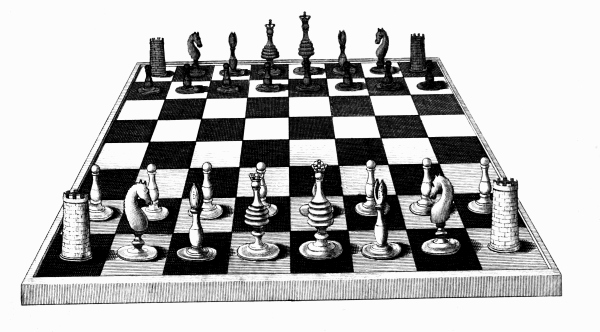
Is as follows: The white king is to be seated on the first or nearest rank, on the fourth house (a black one) from that corner of the board which is to the right of the player to whom he belongs; his queen close to him on his left, on a house of her own colour—on one side of each of these, a bishop—adjoining each of the bishops, a knight—and last of all, at the corners of the board, the two rooks. Having thus arranged the first line, let the whole of the second rank be occupied [Pg 25] by the pawns, one before each of the dignified pieces. As to the counter set, the black king is to be placed on the farther side of the board, exactly opposite the white one—his queen opposite the white queen—and so on; placing all the pieces opposite those of corresponding denominations—the pawns on the second rank as before.
To illustrate what has been said, and to prevent any misunderstanding respecting it, as well as to shew the forms of the pieces, the plate forming the frontispiece is given; which see.
THEIR POWERS AND MODE OF ACTION.
The gradation in rising from the lowest, to the higher pieces, will shew the comparative worth of each kind.
I. Of the PAWN. When one of the pawns is moved, it must be along the file in which he has been first placed, in a strait line towards the adverse party. The first move may be either one or two squares, at the option of the player: after which, no one of them, while he remains a pawn, can advance more than one house [Pg 26] at a time. When once brought out, a pawn, more restrained than any other piece, cannot retreat or move back again. He is prohibited too from quitting his own file for that of another, except in the single case of making a capture; on which occasion he moves obliquely into the next file, to the right or left (as the case may happen) one house forward; placing himself on the square of the piece taken,[11] which is removed from the board; after which he is confined to moving directly forwards as before, and cannot leave his new file for another, but on a similar occasion to that which led him into it.
A pawn, like every other agent on the board, takes any piece that comes within his reach, indiscriminately from one of his own quality to the queen.
II. The KNIGHT. The move of the knight is peculiar to himself, and difficult to explain. It is two squares at once (three, including his own) in a direction partly diagonal and partly strait. The house he goes into, is always of a different colour from that which he leaves. It may likewise be said to be uniformly next but one to [Pg 27] the latter; although in his passage to it he passes transversely over the corners of two.
The knight’s power of capture reaches to any square that his move will take him into.
Note—That this is the only piece that has a vaulting motion; or that is not precluded from going to a square, between which and his own other pieces intervene: just to shew what is meant, if good play permitted it, any one of the knights could move out before a pawn had stirred, alighting on the third square of either the bishop or the rook; without waiting, as the other superior pieces are obliged, till an opening be made.
III. The BISHOP. By observing the plate it will be seen, that the bishops of the same set are placed on squares of a different colour; the white king’s bishop, for instance, being seated on a white, and the white queen’s bishop on a black square. What makes it necessary to remark this, which is common to the knight and rook, is, that the bishop, unlike all the other pieces, is obliged to walk, throughout the game, on that colour of the exchequer[12] that he was placed on at the commencement of it; which is a necessary [Pg 28] consequence of his motion being purely _diagonal_. His step is in other respects very unlimited, as he may, at a single effort, go any length of squares from one to eight. The bishop, if the road be open for him, takes at any distance.
IV. The ROOK. The rook moves in strait lines, forwards or sideways. He can, at one step, pass along a whole rank, or a whole file, or stop short at the first, second, third, or any other square of a rank or file, as occasion may require. Like the bishop, and on the same condition, he takes at any distance[13].
V. The QUEEN—unites the moves of the bishop and rook; and, like them, when the road is open, takes at any distance. [Pg 29]
VI. The KING—except when he avails himself of the privilege of castling, can move only one square at a time; of course he can take at no greater distance: he may, however, both move and take either forwards, backwards, sideways, or aslant. When policy shall invite the player to the expedient, and the previous unarbitrary removal of the bishop and knight on his right, or of the bishop, rook and queen on his left, has rendered it effectible without any violence to propriety, the king may castle with either of his rooks; which is done by placing the king on that knight’s square that is next to the rook with whom he castles, and by placing the rook at the other side of the king, on the bishop’s square adjoining. This ambidextral manœuvre of changing the situation of two pieces at one time, the player is allowed to employ but once; and not at all if the king has previously moved. It is impracticable and unnecessary at the beginning of the game. The only prerogative of the king, is a great one; that of never being taken. [Pg 30]
OF PROMOTING A PAWN TO BE A QUEEN, ROOK, &c.
When a pawn has penetrated to the farthest rank on the adverse side of the board, he is rewarded with promotion to the highest vacant dignity[14]; that is to say, if the person playing him there has lost his queen, he succeeds to the honor. If instead of his queen one or both of the rooks be lost, he is made a rook. If the queen and rooks have escaped capture, he is made a bishop. If the bishops have likewise been preserved, he is made a knight. The ceremony of transformation taking place in either case, and which is necessary to distinguish him, is very short: A sort of exchange: The pawn is removed from the board, and put among those taken by the adversary; and a captured piece, of [Pg 31] the denomination he is advanced to, is taken from thence, and substituted in his room. It can hardly be necessary to say, that his powers and mode of action alter with his quality.
OF GIVING CHECK, AND CHECK-MATE.
Upon this the game hinges. As the king is never taken, whenever an adversary is advanced upon him in such a manner, as that, remaining where he is, if he were any other piece he would be captured; the person advancing it is to salute him with the word “Check,” warning him of his situation; upon which it is absolutely necessary for him to alter it in one of the following ways: either, relatively, by taking the threatening piece, or interposing[15] one of his own between that and himself; or, positively, by removing to a square where neither that nor any other of the adversary’s pieces reach. If he cannot do one of these, the game is lost. This inextricable contact with an adverse piece is technically termed CHECK-MATE. [Pg 32]
OF GIVING A STALE.
The game may be lost too in quite an opposite manner. By the constitution of Chess, the king is on no account to move into check; and, therefore, when, as it not unfrequently happens, one party has crowded up the king of the other with so many pieces, that the only move left him would take him into check; if the person to whom the king so circumstanced belongs has no other piece, or no other that can be moved, the contest must necessarily stagnate. Come to an end before the arrival of the regular result, it can be proceeded in no further. It is not, however, undecided. The player giving the other the stale, (so, in the language of Chess, the dilemma which the king is in is called) is, by a rule immemorially acquiesced in, adjudged to have defeated himself.
REASONS FOR ASSIGNING,
IN THE CASE OF A STALE-MATE,
THE VICTORY TO THE PARTY SUFFERING IT.
A little reflection will shew that this rule is not incapable of the justification which at first sight it may seem to want. It would be an [Pg 33] intolerable defect in the game to have it perpetually liable to an accident that would render it undecisive. The only way of avoiding this defect, is the instituting an artificial rule, awarding the victory, whenever a stale happens, to one party or the other.
The necessity of making some kind of decision being arrived at, the propriety of placing the bias where it is may be easily evinced.
It is to be recollected that the rule under discussion is an arbitrary one. The expediency of an arbitrary rule, however great, cannot entirely divest it of the dissatisfactory; and therefore the seldomer there is occasion for it the better: now the making him to lose by a stale, who may always avoid it by caution, is an effective bar to its happening very often.
Other properties of this rule do not merely justify—they highly recommend it. The bias which it has adopted serves to balance the advantages of the game, as it is entirely in favour of the weaker party. Owing to this very bias, whenever the critical case, to which it is applied, is likely to occur, a greater exertion of intellect in conducting the approach is incited; than which nothing can be more agreeable to the genius of the game, as the professed object of Chess is to call out the powers of the mind. [Pg 34]
Thus a defect inherent in the structure of the game, and from which it were impossible to free it, is overruled so as to give it a higher degree of interest. Upon the whole, the necessity for this rule is not to be deplored.
OF A DRAW GAME.
If it be not superfluous to put it any where, it must be added here, that whenever from the greatness of the loss on each side, (the more potent pieces, and those capable of becoming so, being gone), or from any other cause, it becomes certain that neither party can give the other Check-mate; the game is to be discontinued as insipid and useless, the players consenting to draw their pieces, and begin afresh.
[Pg 35]
These questions occur at every evolution—What piece is to be moved? Where is it to be moved to? After the first time, for a very obvious reason to the practical player, (the abstraction from any particular situation, which from the latitude of moves in the power of the adversary, the mind of the theorist is forced to make), we can only give helps for the reader himself to decide them.
The game cannot be better opened than by advancing the king’s pawn two squares. If the first adventurer be threatened, the queen’s or bishop’s pawn may lend him support. Which of the others should succeed will depend greatly on the moves of the opposite party. The pawns must not be so placed as to interrupt the freedom of the other pieces. Where the pawns are not equal to the defence of each other, the other pieces [Pg 36] must be brought out to support them:[16]—in this business the bishops are in general the preferable agents, as they are not so liable as the knights to be clogged by the obstructions which this early stage of the game from its crouded stage is sure to present[17].
[Pg 37] Prudence requires that the superior pieces be not over forward in acting offensively; because by every one that is driven back you lose a move: but when a few pieces have been[18] changed, and the game is somewhat advanced, and there is no danger of their stopping the progress of such of the pawns as you wish to push on, you need not be shy of using the knights, any more than the bishops, in occasional attacks on the most unguarded of the adversaries.
The queen must not be moved hastily;—for offence in particular, not till some kind of method pervades the rest of your pieces—and you can guess what aspect the game is likely to assume. To put this piece in motion before you had digested a set of measures, and had a probable certainty of succeeding in them, would be entirely to misemploy her great powers.
As the rooks, while the game is thronged, can effect nothing worthy their attempting; generally speaking, it is advisable to keep them in reserve till towards the conclusion of the game. The usefulness of the rook, gradually increasing as the crisis approaches, is then very little inferior to that of the queen[19].
[Pg 38] The king is not to act offensively. He is to be put where he will be least open to attack; and, while a fatal one is possible, neither move nor take but with a view to his own defence. The two points to which every thing else is to subserve, are, the giving check-mate to the adversary’s king, and the preservation of your own.
To make you as much acquainted with the right way of endeavouring at these, as bare Theory is able to do; it will be necessary to be a little more particular.
§ 1. On that side of the board, whether right or left, on which you mean to castle the king—neither the bishop’s, the knight’s, nor the rook’s pawn must stir from its place; because the principal inducement to the measure, is, the protection he will receive by retiring behind them.
2. The other pawns must be kept together and well supported; and not suffered to straggle forwards alone. A party of these, managed with address, may, in a future part of the game, repair the loss of a capital piece, or do some other signal service. [Pg 39]
3. At the same time that you are concerting the attack of the adversary, endeavour (but not so as to interfere with any thing of more importance) to have your own king so circumstanced that he may castle when he pleases. Should this convenience be effected, if his not being castled be no obstruction to your other operations, let him remain at his own square till there is a necessity for his going to the retreat secured for him. The advantage to be gained by this procedure is, that the adversary will be obliged to form two distinct systems of attack.
4. As soon as the adversary has castled, if it be on a different side of the board from that on which you have castled, or intend to castle, let your pawns opposite bear down upon his king. The queen and what other pieces you can spare, in particular the rook to whom their removal opens a field, must support them in this onset[20].
5. Where a direct attack upon the adversary’s king is impolitic or impracticable, you must endeavour to take those of his pieces that most contribute to render it so. [Pg 40]
6. Ineffectual checks, or checks that the adversary can easily elude, are in general to be refrained from; as they are very apt to lead to loss of move, loss of the checking-piece, and so on. Experience, however, will furnish a few cases, in which there is a propriety in giving such a check—where it will force the adversary’s king into a more exposed situation—where the movement, necessary to avert it, will leave a capital piece unguarded—where, the adversary’s king not having castled, nor being in a condition to do so, it will force him by moving to forfeit that privilege—and where, having a piece of your own attacked, that you are not able otherwise to save, it will cause the removal of some piece that impedes his escape.
7. In defending your own king when closely attacked—where it will either cause the adversary to lose a move, or increase your comparative strength; and at the same time, be a successful means of parrying the check—you should offer to make an exchange of pieces.
8. If the king be castled, the pawns forming a cordon before, or round him, should be guarded as much as possible from the brunts of the adversary. [Pg 41]
9. Whenever, from being either reduced in number, or obliged to quit their stations, the defence afforded the king by these becomes precarious—or whenever the king is not castled at all—some of the superior pieces should be kept in readiness to contribute actively to his safety; being posted so, that where they cannot prevent, they may at least cover him from check. Their number and quality circumstances must decide. Those that operate at a distance, will not on this service be out of their province; nor will it often be found of them, as it will of the knights, that they are thereby rendered the less prepared to act offensively. The keeping, too, such pieces as the rook, the bishop, or the queen, near your own king, may sometimes cause the adversary to relax in his caution where it does not add to his security.
10. Of the queen, it is however to be noted, that she must never stand in such a way before the king, as that were an adverse rook or bishop to attack her, her moving aside would leave the king in check; because were she to be so attacked, should the rook or bishop be well guarded, and you had no piece to interpose, as it would not do to expose the king, you could no how avoid losing the queen for a less valuable piece. [Pg 42]
11. Great advantages are often gained by an ambuscade; which is the having one piece, a pawn, for instance, so placed before another, we will say the queen, that though the adversary, on a cursory view, might seem to be safe; yet by simply playing the piece in front, whose intervention alone keeps him from it, check, single or double[21], will be discovered to his king.
12. While intent on projects of offence, take care that you are not surprised yourself. Indeed every detail of a stratagem to be practised on the adversary, carries with it a tacit admonition to beware of the like from him; as to caution against any evolution, is saying, “look out for an opportunity to practise it.”
13. Take care that an adverse pawn does not advance upon two superior pieces, which is called forking them; knights and rooks are particularly liable to be attacked in this way, the pawns not requiring to be guarded, because the moves of those pieces do not comprehend the [Pg 43] moves of the pawn. Thus where there is not a reciprocity in the mode of action between a smaller and a larger piece, the approach of the smaller may be very dangerous.
14. Hence it is, that unremitting vigilance must be exerted throughout the game, to prevent either of the adverse knights from checking the king and queen at the same time; because as the king can only save himself from the knight by a positive removal, the sacrifice of the queen is rendered inevitable.
15. Nor must the adversary be suffered to direct the insidious power of the knight, on any other two pieces of more importance than himself; as the loss of one of them for the knight, or for nothing, will be sure to follow.
16. When two pieces are attacked in such a way, that one of them at least must be lost; in deciding which to give up, you must not think so much on the difference in their worth, which may be more than counterbalanced by other circumstances, as on the particular effects which the capture of this or that is likely to have.
17. Whenever you are so well prepared for the worst, as to have two or three pawns so near the adversary’s farthest rank, and so well posted, [Pg 44] that you are almost certain of reaching it with one of them when you please; you may be the bolder with your capital pieces—and, where you would be otherwise in doubt which to surrender, the less tenacious of retaining one of them in preference to another that is less capital.
18. Without there should be no other way of saving the king, or no other but what would be attended with a greater disadvantage, never cover him from check by placing a superior piece in that manner, that a pawn of the adversary, by being advanced a move, could take him; lest the adversary, availing himself of the opportunity, oblige you to a losing exchange.
19. In order to have as powerful pieces as you can in play, let those that are stationed to guard some other stationary ones, be of no greater force than is necessary; that is, where the motives for employing one of several pieces on this service are in other respects equal, take the lowest.
20. Where two of the adversaries are so circumstanced that you take either, similar considerations to those in the 16th section will determine you.
21. Where an adversary is so exposed that you can take him when you [Pg 45] please, be in no haste about it: but see whether there be not some danger to avert, or advantage to seize, in another quarter, and let him alone till it be effected. It may at length be in your power to combine the piece that shall move into his square in some extensive scheme, as he may be supposed to move merely to take this piece.
22. Where an adverse pawn has advanced to the square immediately before your king, do not take him, unless some consideration superior to his worth impels his removal from the board; as an adverse pawn before the king is generally found to be a safeguard.
23. Whenever you can anticipate by calculation that the sacrifice of such and such a piece, though it can yield no immediate requital, will yet lead to such an arrangement, as will enable you in the end to give the adversary check-mate, true policy requires that you make it.
24. Never let an over-eagerness of the victory which a superiority may promise you, lead you to endanger its forfeiture by giving a stale: on the contrary, till you can give check-mate without a risk of miscarriage, always leave the adversary ample room to move. [Pg 46]
25. Whenever you have clearly the disadvantage of the game in other respects, and yet happen to be in a position that by good management, may be turned into a stale; you must, as your only resource, endeavour to avail yourself of it. To do this, the following case will serve as a general clue. Your king is close pressed on all sides, and you have only the queen and an inferior piece left in play—take the first opportunity of playing the inferior piece so, that by its being either blocked up or lost, the king would be in a stale already if you had not the queen.—This done, with the queen keep giving incessant[22] check to the adversary’s king, till at length, to avoid a check-mate, the adversary is forced to capture him. Your object will then be attained.
Note—Sometimes a check-mate or a stale will speedily terminate the game; sometimes it will happen that the pieces are nearly played away, without either taking place. To the latter case, the six sections that next follow are exclusively adapted. [Pg 47]
26. When the adversary’s force is so much diminished, that your king, if in any, is in no immediate danger—and your own force is so much diminished likewise, that you can make no effective attack without him—the necessity and policy of confining the king to defence only will be superseded.
27. Among other uses to which he may then be devoted,—you must take every opportunity of putting him in motion, where your doing so, will be the only or the best way of either gaining or preserving the move, which it is of such importance to have, that if the contest has been otherwise equally conducted, your getting the game will depend upon nothing else.
28. He may then, too, as circumstances vary, occasionally be of service, either in protecting some pawn of your own which may be more advanced than the rest, and which you want to raise to queen; or in taking or harrassing any pawns of the adversary on the like expedition.
29. The note at the bottom of page 37, respecting the rook, is a sufficient intimation that the king may, in this stage of the game, be employed in combination with another piece in giving check to his antagonist. [Pg 48]
From the same note it is to be inferred, that if one party has only a king, and the other in addition to the king has but one piece, and that piece be a knight or a bishop, it must be a draw game; and therefore that, next to a queen or a rook, it is best for that piece to be a pawn, from the possibility of making him a piece of the first power. This serves to introduce the two following
PARTICULAR CASES.
30. The adversary has the king and a pawn, and you have only the king. You will naturally endeavour to intercept that pawn—his king, if he be in any danger, will as naturally go to his assistance—this, if the king is time enough to save him, will bring them together. Though you will then have failed in taking the pawn; yet, if you can get before either to the square towards which the pawn is moving; by manœuvering on the first square of that file, and the second of that and the adjoining files, you will either make a draw game, or win by a stale.
31. Upon certain contingencies, the adversary may have the king, a [Pg 49] bishop, and a pawn, when you have only the king, without being able to beat you: which contingencies are these:—If the pawn be on a rook’s file—if you can get into the square at your end of that file—if this square be of a color different from that on which the bishop moves—all these concurring, it is even possible for you to win by a stale.
32. To conclude; if you would have something more than a mere exemption from defeat, depending on chances, to hope for, let this rule, in connection with the others, be specially regarded. From first to last, the changes and declensions, successively taking place in the number, value, and situation of the pieces must be noted with exactness; and no movement at any time made till the consequences are considered. This, among other good effects, will the better enable you to conjecture what the adversary may mean to do, and to take measures accordingly. If closely pursued, it will at once prevent you from giving any advantage to the adversary, and from overlooking any which he may give to you.
[Pg 50] The initiate reader, having arrived thus far, will perhaps be impatient to make a practical essay. From that, though it may originate in a mistake, we would not withhold him. As what we design, is his progressive improvement, we do not care how soon he is convinced that he cannot make himself master of the whole at once. After he has made the experiment, we would, for his next essays, direct his attention to two or three games which we mean to detail as examples, move by move. By studying these, and noting the foregoing directions, one at a time, as the advantages of pursuing, or the effects of deviating from them are laid open, he will soon imprint the spirit of them on his memory; and practice, either by himself, or with a friend, will imperceptibly confer on him a habit of adopting them with promptness.
If he is a genius, practice will do more; it will lead him to form maxims of his own for indescribable cases.
After setting down the laws of the game, which will end this chapter; we give the examples promised, chiefly as vehicles for rules for particular situations, which can only be imparted with clearness, when particular situations are exhibited on the board. [Pg 51]
THE LAWS OF THE GAME,
Reduced to their most simple Construction, are,
I. If a player touches a piece, he must play it somewhere; and when he has quitted it, he cannot change its place.
II. If one party, by mistake or otherwise, makes a false move, and it is not discovered till after the other has played in his turn, it cannot be revised or rectified by either.
III. If a player misplaces the pieces, and, before he finds it out, plays two moves, it is at the choice of his opponent to permit him to begin the game afresh or not.
IV. If one party plays or discovers check to the king of the other, and neglects to notify it, the other may let him remain in open check till he does.
V. After the king has moved, or if both the rooks have moved, he cannot be castled.
Where the object is mutual improvement, and not decision of skill—or where the superiority of one party is admitted, and the object is the improvement of the other—the first four of these may be dispensed with.
[Pg 52]
CHAP. III.
Progressive Examples
APOLOGETIC INTRODUCTION.
As it is not the habit of every reader to wade patiently through a preface, the author begs leave to condense here the substance of an apology, which, from the influx of topics, could not there be presented in a disentangled form.
Whoever has marked the experiments of a novitiate in Chess, must have observed a propensity to a variety of moves, which while they appear to open a field teeming with advantage, really lead to results that are disastrous. Some of these are interspersed in the following examples, and the adverse consequences with which they are pregnant traced to their source. Thus by the publication of games with notes, a plan to which Philidor led the way, the student steps by a short route on the high ground, to which the guides who framed the artificial passage, [Pg 53] only reached by repeated labor and experience. But a gigantic genius, it would seem, cannot conceive exactly what are the desiderata of a mind of less compass; and Philidor left a trying distance between the level from which the inexperienced would rise, and the steps at the bottom of his ascending ladder. A professor, who is not incapacitated by extraordinary powers from imagining where interposition is wanted, may supply acceptable remedies for these vacuities.
Let us now attend the pupil at the board, and conduct him through such evolutions as may fit him to appreciate and enjoy the enterprise and spirit of Cunningham, the brilliant promptness at resource of Salvio, and the comprehension and foresight of Philidor.
[Pg 54]
FIRST COUPLET OF MOVES.
(a) Unless necessity call for it, no one of the other six pawns should be moved until you have ascertained on which side to castle. The queen’s pawn advances but one square, not so much because the black one prevents his going farther as to support that of his own king.
(b): This move is partly accounted for by the remark on the last.
(c) The same remark will shew, that the whites are played with more propriety than the blacks. [Pg 55]
(d) If this move had been made before, the king’s pawn of this party might have been preserved; the snatching away of which, has rendered them in situation and comparative strength, much inferior to their adversaries.
(e) The chief object of this, and some subsequent moves, is the having the king in readiness to castle.
(f) Finding that his adversary means to castle with the queen’s rook, the player of the whites begins to get his opposite pawns ready to advance.
(g) This attack on the black rook is not a good move; for the bringing out of the black knight, which it incites as the only, though an easy mode of parrying it—a movement which his player might not otherwise have meditated—or if he had, must have lost a move in effecting—gives the rook an opportunity to be very troublesome to the opposite pawns. [Pg 56]
(h) This is to protect the knight’s pawn from the black knight.
(i) There is no impropriety in the queen’s standing thus before her king, so long as no guarded rook of the counter set can be brought to attack her; and while her player has several pieces that he could interpose.
(k) If he did not castle now, he could not preserve his knight’s pawn in it’s place, without forfeiting the privilege. To have advanced him a square, would, however, have been better.
(l) To make way for the following move. If the white queen’s bishop had not quitted his house, the command he would have had of the diagonal into which this move is made, would have prevented it; which it will be presently seen it was the interest of that player to have done. [Pg 57]
(m) Any move that is properly made, and which preceding remarks, or a subsequent move will shew the reason of, we shall not observe on. It may, however, be of use to review the situations of the two sets of pawns; those of the white party to the left of the king, are advanced so as to derive from themselves all the support they want: whereas the pawns to the left of the other player must depend entirely on the superior pieces for protection. When pawns are seated, like these, on files that do not adjoin, they are, considered by themselves, as insecure as they can be.
(n) But if the pawns are played worse, the bishops and knights of this party are played better than those of the other.
(o) The move of the white pawn, which was necessary to the prosecution of the white queen’s scheme, gave the black knight an opportunity of coming here without suspicion, as he seems to remove merely for his own safety. [Pg 58]
(p) From the cramped situation in which the player of the white’s too eager attention to projects of offence, had left this bishop, whether he takes the black one or not, he must be lost.
(q) Though the player of the blacks is a knight, and the difference there is between a king’s bishop and a queen’s bishop, the better for these exchanges; he might have conducted them in a way by which he would have profited more essentially; as the third example will shew.
(r) To avoid being taken by the knight’s pawn. [Pg 59]
(s) Had the white pawn made this capture, the black king, instead of receiving the defeat which the present move has given him, by retiring to his rook’s square, would have been a long while secure from any further attack.
(t): But as he was made to castle when he did, merely to shew that it is not always a measure of safety; we shall, in the next example, point out how he might have acted better.
⁂ When the student is conscious of having done wrong, and yet at a loss to know what rule he has broke, he may conclude it to be the last, that contained in section xxxii.: this is indeed so comprehensive, that all the others might be resolved into it. [Pg 60]
EXAMPLE II.
THE PRECEDING GAME
CONTINUED FROM THE SIXTEENTH COUPLET.
Note—Games which, like this, are taken up from others, are called Back-Games.
(a) He is thus ready to be converted into a capital piece, and as long as he remains there, will prevent the black king from moving into any square on the queen’s part of the file.
(b) If the rook’s only object was to snatch this pawn and retire, it was worth the effort; he has, however, something else in view.
(c) Intending at the next move, by taking the opposite pawn, to secure making a bishop of his own. [Pg 61]
(d) To seize this advantageous post, he has left a rook to be taken and his king to be checked. The bold kind of play which each pursues, can only be justified by a conviction that the result will be favourable. Both, however, cannot have this conviction. The event will shew which is right.
(e) He prefers this to his own second square, that he may not be checked by the white rook.
(f) As the black queen, who cannot be dislodged, will, at her next move, by taking the pawn, give the king check-mate—the player of the whites has no other resource than constantly checking the black king—if he cannot mate him, and can be stopped from checking, the moment he is, he will lose the game.
(g) He takes care to move on white, that he may not be checked by the bishop. [Pg 62]
(h) If this player could give perpetual check, it would be a draw game—fifty moves in this way would make it so—or a less number, if a course of moves was begun that had before been made.
(i) As the queen can no longer check the king without being taken, the bishop is placed here to prevent the black queen from taking the pawn; which, however, he can do but for a moment. [Pg 63]
(k) If the player of the whites could in this way have lost all his pieces, he would have won by being in a stale; this, however, from their number, was never possible; or it would not have been prudent in the adversary to have made the 20th move—a move which has won him the game. [Pg 64]
EXAMPLE III.
A SECOND BACK-GAME.
Continued from the Thirteenth Couplet
of Example I.
(a) If, instead of the bishop, the pawn had taken the knight; the black bishop, by taking that pawn, would have given check-mate instantly.
(b) The object of this and the future moves of the white player, is to prevent check-mate, which he now perceives the other thus early to meditate. When the tyro has seen what these moves are, it will edify him to try whether better ones might not have been adopted. On this, however, and similar experiments, he must not hastily conclude; because was he to move the whites not so well, and the blacks more than proportionally worse, the necessary consequence might lead him to think that he had moved the former better. [Pg 65]
(c) Without the co-operation of the black pawn, this could not have been done. The player of the whites should have taken this straggler before he proceeded to detach the queen. [Pg 66]
EXAMPLE IV.
VARIATION TO THE FIRST BACK-GAME.
Beginning from the Nineteenth Couplet
of Example II.
(a) He offers to change rooks, that such a dangerous neighbour as the black one may be either taken or driven away.
(b) This, however, not only prevents either, but keeps the white queen from going to the black king’s rook’s 4th square; by which the black knight, whose vicinity is as incompatible as the rook’s with the safety of the white king, would have been obliged to remove to cover the check.
(c) To remain, or to remove without checking the adversary, would have been equally dangerous.
(d) As the player of the whites cannot remove either of the pieces menacing his king, he has now, as he had in Example II. no other way of defending him than attacking the black one. [Pg 67]
(e) If the king had taken the rook, the game would have lasted one move longer. In that case the black queen must have gone to her king’s knight 3d square, and then to the black knight’s 2d square; so she should have done, if, at the 24th move, instead of that set down, the white knight had gone to his queen’s bishop’s 3d square.
Remarks.
⁂ Of two different modes of playing, both of which end in a defeat, that is the best which protracts the game the longest.
†§† No game can end so soon as the longest form of that we have already given, that is played throughout well on both sides.
[Pg 68]
EXAMPLE V.
Exhibiting Situations rendered critical by Enterprise,
and the
Resources of Play in those Situations.
(a) Not for any purpose that it will immediately answer, but that he may escape the obstruction, which, if it should be necessary to advance the queen’s pawn a square, would be opposed by his moving directly out. We have seen in Example III. that by a pawn on one side, and a knight on the other, this bishop was so embarrassed, as not to be able to move even for his own preservation.
(b) The having two pawns a-breast of each other, at houses 4. of the king and queen, secured by the changes which brought them there from capture by pieces of their own quality, and therefore, in their further progress to the promotion line, easily protected— is a great step towards making one of them a queen. To have them in this position, is the object of the present and several succeeding moves: of the corresponding moves of the blacks, the object is to prevent it. [Pg 69]
(c) To provoke the black pawn to capture him, on the presumption that his player would prefer doing that to retiring with his bishop—The player of the whites intending afterwards to supply his place by a reprisal.
(d) The player of the blacks, willing neither to take the pawn nor to retire with his bishop, plays this pawn here, in order that if the white one takes his bishop, he may retaliate in kind.
(e) The plan of having two pawns in the middle of the exchequer is thus rendered abortive. The bringing this knight out was the principal mean of defeating it.
(f) This leaves the king’s bishop liable to be changed for the bishop of the adversary’s queen. If, however, the knight had not moved at all, or moved otherwise, his player might have been obliged to an exchange, in which the difference against him would have been of real moment. [Pg 70]
(g) Between equal players the minutest advantage should be seized on. It may be observed here, that the superestimation of the king’s bishop over the bishop of the queen, rests on his not being prevented by the colour of his field, from checking the adversary at his original square. The white player having had the first move, the other could not well have foiled him, with regard to the pawns, at a less expence.
(h) That he may not be taken by the knight if the bishop should remove.
Variation.
To protect him from the knight, instead of pushing him a square, the queen’s knight is moved to the 3d house of the queen’s bishop. This would be ineffective—the adversary, by placing his king’s knight at his king’s bishop’s 3d square, might counteract it so completely as to make the bishop retreat at the same time that he secured taking the pawn—at least, secured an exchange, by which he would get the pawn to boot.
[Pg 71]
(i) To support the pawn.
(k) An adventurous speculation, in which the risk is but little.
(l) Ditto.
(m) To preserve the means of preservation.
(n) To lay an embargo on the black queen.
(o) Any where else, she would be taken. [Pg 72]
(p) The comment on the next is a comment on this.
(q) If the black queen had moved aside into one of the three squares to which her sphere of action is at present reduced, the white rook, by taking the pawn opposite, might have ensured check-mate in another move.
(r) Had the queen’s rook taken the black queen, the black king’s rook, by crossing to the white king’s square, would have won the game; by the present move, that way of receiving check-mate is rendered impossible. In advancing a pawn to the adverse party, let it always be as far as is consistent with security.
(s) In order to extricate herself.
(t) He does this, which will cause him to be exchanged for the white rook, to save his own king from the check-mate which is still impending, and which, had the white queen been suffered to take his king’s knight’s pawn, would by now have been inflicted. [Pg 73]
(s) The black queen has thus made a triumphant retreat. To the advantages which sometimes attend giving check, although it can be easily eluded or covered, already enumerated, may be added that of gaining a move. There is still another: under the present circumstances, the taking of a piece is ensured by it.
(t) This player could not do better to prevent the check-mate, which the white queen would else have given, by taking the pawn. [Pg 74]
(u) That the liability of check-mate by the white minister’s stepping into their first rank may at once be quashed. An instance similar has before occurred. Of the moves in general now, but a few, we imagine, will require to be observed on.
(v2) To preserve his pawn (v1) (v2). The subsequent moves will for some time be conducted on the plan of these. Of the player of the whites, inferior in numbers, though not in force, the object is, either to take, or keep in inaction, these pieces of the adversary preparatory to advancing his own pawns on this side. The pawns of the adversary on the other side, which are so disposed that he could make no impression on them, he is not concerned at present to obstruct any otherwise than his movements in this quarter virtually will. The object of the player of the blacks will declare itself. [Pg 75]
(w) Of the rook, the knight, and the knight’s pawn on the other side, no one can move without one of them being taken; this player has, therefore, no better alternative than urging to promotion the pawns on this.
(x) The advancing a white pawn on the black knight, a step that is in readiness, would have enabled the white queen to make great havoc among the pieces she hovers over, had this rook remained where he was. The present movement, and timely sacrifice of a pawn will prevent any further uncompensated loss.
(y) The knight protects the pawn, the rook protects the knight. [Pg 76]
(z) The opportunity of giving check, which the white queen neglects, is one of those cases in which it ought to be avoided. The black king, by removing to his queen’s bishop’s 2d, would have covered both himself and the rook; and the whites (including the loss of one to themselves and the gain of one to their adversaries) would have sustained a difference against them of two moves.
(a) This secures an equivalent for the pawn which the knight will be forced to desert.
(b) The king, when his pieces are advancing to the adversary’s side, should keep as near to them as possible. [Pg 77]
(c) If the king did not remove now, the white pawn, on becoming a rook, would check-mate him.
(d) Though it is not to be presumed that the player of the whites, with his present force, will check-mate the other, yet he is now acting rightly; for were he to refrain any longer from offence, his adversary would make a queen before he could make an additional rook, and perhaps turn the tables on him. What he aims at present, is not a mate, nor primarily a capture; but to bring about such a change in the position of the blacks, that the foremost of his pawns may wrest the move from the foremost of theirs.
(e) Any where else he would, probably, either soon lose his rook, or suffer a worse disaster. [Pg 78]
(f) Had he gone to the white queen’s knight’s 4th square—and had the white queen then moved to the 1st square of that knight—the loss of the black rook would have been inevitable.
(g) The remaining black pieces are posited so, that an attempt at this time to make any further capture, or to give check-mate, might only bring their pawns nearer to promotion. As this piece has now the start, this is the moment to push him on.
(h) He thus makes way for the black pawn without exposing either himself or the rook. [Pg 79]
(i) For some of the moves commented on, we were in doubt whether the tyro, unaided, could in passing have accounted: of this, and the following ones, we are persuaded he will at once see the reason.
(k) As check-mate is unavoidable, it is a matter of indifference what moves he makes. He adopts those which will put off the evil longest. We set them down merely that the game may not seem unfinished. [Pg 80]
The move at which the fortune of the blacks began to decline, and at which a back-game may with most interest be taken up, is that where the queen takes the white knight (couplet 23). At the moment before (numbers and force considered apart from position) the advantage was on their side. What followed this move will impress on the student, that [Pg 81] whenever an adversary seems to expose a piece to capture without securing an equivalent, or without securing a proper one the reprisal which the white bishop might have made on the black knight, as it would have spoilt the position of the white pieces, and lessened their comparative strength, could not be considered a proper one] he must not attribute to accident what may be the effect of design, and take the exposed piece without hesitation. If the player he is contending with be not contemptible, it is rather to be suspected that he has, as the player of the whites had in the present case, some ambuscaded motive for losing the piece: whether he has or no, it behooves the student, before taking it, well to examine.
The game just ended, affords occasion likewise to observe, that sudden incursions on the adversary’s pieces are only to be made with caution. The 13th move of the blacks, the difficulty with which the queen retreats, and her being once within an ace of capture, very forcibly suggest this maxim. Of this move, however, we do not mean to impeach the propriety.
At the 10th move, to have acted more systematically, the black bishop should have stopped at the 4th square of the bishop of his king. In the counterstep to this and other moves, the whites, too, might have acted more systematically: but as we mean to give separate examples of that kind of play, from which these are deviations, and as many of the intervening moves are properly consequent one of the other, it will not be necessary to begin any variation of the last example at an earlier move than the 1st of the 23d couplet. [Pg 82]
The introductory chapter classes the pieces in the order of their relative values; but nothing is added of the ratio in value, which two or three inferior pieces bear to a superior, or two superior; as the introduction of minute discriminations, before the attainment of some practical knowledge, might have perplexed the reader. As, however, situations occur on the board, in which it is necessary that the most critical calculations of force should be consulted, and as the propriety of accepting or declining some exchanges depends on [Pg 83] punctilious considerations, it is thought proper to give, as a prelude to the remaining examples, the following scale:
| 2⅕, | 14, |
| 9, | 15, |
| 9, | 28. |
With respect to qualification for attack and defence, the facility of conducing to these ends, by a stationary attitude, or by moving, and extent of action, the powers of the pawn, the knight, the king, the bishop, the rook, and the queen, are to each other in this proportion.
The values of all the pieces, except the pawn and king, are commensurate with their powers.
The nature of the game puts the king’s value above competition.
The value of every pawn, taking into the account the probability of his becoming a capital piece, is on the average, about 5⅖.
SECOND SCALE OF POWERS.
In the foregoing estimate, of the five superior pieces the highest force is taken; that is to say, each is supposed to be in that part of [Pg 84] the board where its sphere of action is largest: assuming, however, that in play the probability of their occupying any given square is equal, their powers will be,
| 2³²/₁₆₀, | Pawn | 9¹²⁰/₁₆₀, | Bishop |
| 6⁴⁰/₁₆₀, | Knight | 15, | Rook |
| 7⁹⁰/₁₆₀, | King | 23¹²⁰/₁₆₀, | Queen. |
The pawn’s chance of promotion makes his value 4¹⁴³/₁₆₀.
It will be perceived, that by this scale, the relative powers of the pawn and rook, with respect to each other, remain as before; while with respect to the other pieces, that of the former is trivially, and that of the latter, greatly enhanced.
In finding both scales, the part of the board within the sphere of each respective piece wherever it is placed, is supposed to be unoccupied.
As the player cannot always put the pieces where their range of action will be the most extensive, the latter scale is the safer to be adopted, as a datum from which to estimate their values, in balancing one piece against two pieces, two against three, previously to suffering or effecting such a kind of exchange.
[Pg 85]
(a) His standing before the pawns on this side is of no consequence, as their only use will be to obstruct the white ones: those on the other side are what this player must expect to promote. The only other way of preserving this knight, moving the black queen to the 1st rank, would have been a bad step.
(b) He would have been safe before the black queen; but by thus threatening check-mate he gains a move, and is in a better position.
(c) The king must not only not move into check himself, but no piece must move so as to expose him to it; therefore, if, instead of this, the bishop’s pawn had moved a square, the white bishop might have taken his assailant with security.
(d) To keep the black knight from checking the king. Had this pawn been moved further, the black knight, at the white knight’s 4th house, supported by the black queen and rook’s pawn, would have totally obstructed him and his companions. [Pg 86]
(e) As, from the impendence of the white queen and bishop, the protection of both the knight and the rook is necessary to the pawns on the other side, moving forward with safety, this player is about to transfer them there.
(f) To sustain the rook’s pawn when that of the knight advances.
(g) He could not get to the square he is going to without first coming here: to protect him in this first stage of his gambit[24], was the chief reason of placing the rook where he is. [Pg 87]
(h) He moved to save the king’s bishop’s pawn, now amply protected. The pieces are so arranged, you see, that if the black player was to begin exchanging, the white one would have the last capture. At the time of observing (g) the reverse was the case.
(i) Pawns, as they are pushed on, increase in value. Of a set of pawns, one at least of which you are striving to promote, neither should, if possible, be moved without having a piece as guardian, should no enemy at the moment be at hand; for a sudden occurrence, the same which may prevent you from providing for his safety, may bring an adversary in a position to command him. But though this pawn, as thus moved, is in the predicament of having no support, it would have been still worse to have stirred any other; if the rook’s pawn had advanced a square, the knight’s pawn of the blacks, by advancing two squares, might have completely blockaded all three. A circumspect resiler from enterprise, instead of moving either, would have placed the king behind the knight’s pawn. [Pg 88]
(k) This more than prevents the black pawn’s being advanced upon the bishop.
(l) She could not do better. If the black bishop’s pawn had been moved against the bishop, the white knight would have taken him. If the rook had taken the knight, the bishop would then have taken the rook. Combinations, such as these, may be carried to a great extent, and very much try the skill of the player. [Pg 89]
Variation.
(m) This queen takes the king’s bishop’s pawn.
(n) Nothing better could be done than to offer this. Paradoxical as it may seem to the unpractised reader, if the three pawns on the queen’s side of the board were entirely away, the player of the blacks would be better off. By moving his king to intercept the white ones, and by judiciously managing his own, he might then, and the other could not help it, so exchange one for one, that to the white king and single pawn left, his own would at length stand opposed in the manner described at the end of Section xxx; the consequence of which would be, that the adversary, to avoid a stale, would resign his pawn, content neither to beat nor be beaten. But, circumstanced as he now is, the player of the blacks would be soonest check-mated on the interception plan. We will suppose him to have gone upon it, and to have arrived at the point just mentioned. The white king instead of surrendering his pawn, closely supports him, leaving the black king without a move, and, but for having other pieces, in a stale. Then follows the move at which we are pausing. The white pawn takes the pawn, and leaves the black queen’s rook’s a free passage. The white pawn gets to the promotion line a move before his rival, and at the moment of doing so, gives check-mate. [Pg 90]
(o) It is better now to lose a pawn than a move. If the queen’s rook’s pawn were to take the black one, the other player would make a queen first; for the black queen’s rook’s pawn having then nothing to interrupt him, would be virtually a move before either of the other white ones; and as to the capturing pawn, then in the knight’s file, the black king need not lose the time of one step to keep him from promotion. [Pg 91]
Though at the risk of dividing the reader’s attention, we have been fuller on the part just preceding, in order that it may serve as a precedent for cases not exactly similar. The moves after this, however, will require no remark from us. [Pg 92]
When the queen made the last capture, the game was virtually ended. If, however, the player of the blacks is obstinate enough still to continue it, the following is the most summary way of mating him.
From 50 to 54, the white king crosses toward his queen, the black king in the mean time regrading in the same two squares, so as to prevent the queen, who remains inactive, from taking his pawn: 55, (the white king being at his queen’s bishop’s 3d square) the queen gives check; the king removes: 56 to the end, the queen takes the pawn, and in concert with her king, effects the check-mate. [Pg 93]
EXAMPLE VII.
A SECOND BACK-GAME TO EXAMPLE V.
TAKEN UP AFTER THE 24th COUPLET
OF EXAMPLE VI. pa. 85.
(a) Combining with his knight’s, in support of his rook’s pawn.
(b) Instead of supporting his right hand pawns from behind, as he did in the last game, in order to advance them against the white queen and bishop—a plan that was found unsuccessful—this player is now endeavouring to remove the white queen and bishop in the first instance.
(c) To save herself and the pawn.
(d) Chiefly to preserve her knight.
(e) To protect the bishop. [Pg 94]
(f) Pawns, whose only use is obstruction, can seldom promote their object by moving forwards[25]—and therefore, while there is any thing to do in another quarter, they should in general only be moved, as this has been now, for self-preservation.
(g) To support the bishop’s pawn in his next move.
(h) In employing only the king to escort his pawns, to which he is at present adequate—and reserving his rook as an ambuscaded check to the advancement of the white ones—this player pursues an eligible policy. [Pg 95]
(i) The white pawns are very critically situated, for they can hardly move without committing themselves. Had the knight’s advanced a square, and his immediate opponent two squares, an uncompensated loss would have been inevitable; so that this move of the queen, though not the most obvious, is, perhaps, the best that could be made.
(k) This is far better than moving the queen away. When one is sure of promoting a pawn before the adversary—if an occasion of exchanging queen for queen does not offer, it ought to be sought—that the preponderance which the promoted pawn will give, may be as great as possible. [Pg 96]
(l) This, and not the reverse, that his pawns may not be doubled, or two in a file—which, had this player taken the queen, would have been the case. Doubling pawns is chiefly to be avoided, when, as here, there would be no pawn in an adjoining file: when there are others to support them, it is an evil so evanescent, that no sacrifice ought to be made to prevent it.
(m) To make way for the knight.
(n) If he had taken the pawn, the critical square would have been within the range of the white bishop. [Pg 97]
(o) The rook’s forbearing this capture thus long, is an exemplication of rule 21. If it had been material to prevent the white player from having a queen, this player would have detached the rook along his own rank to a square out of the knight’s reach; and on the white pawn’s becoming a queen, would have exchanged the rook for the queen.
[Pg 98]
EXAMPLE VIII.
Meditating and evading that Stratagem.
(a) In this example, and the rest that make up the section, which after the 2d move are very different from those that go before, it is rather the movements of the blacks than of the whites that are proposed for imitation. The mode to be pursued by one player, depends in a great measure on that pursued by the other: we have therefore given these, that the tyro might not be surprised into a defeat, or uncompensated loss, if an opponent, having the first move, should at the 3d couplet take the same step that the whites have done here—a step of that fundamental kind, that the future aspect of the game is influenced materially by it.
(b) She thus prevents the white queen, as well from taking the king’s, as from giving check-mate by taking the bishop’s pawn. [Pg 99]
(c) The object of the white player now is, either to snatch a piece and retire, or, by the sacrifice of a knight or a bishop, make a practicable breach in the black pawns.
(d) The remaining moves, declare their object.
The reader will observe, that the game might be finished at the 4th couplet; which is the earliest termination it can well be made to receive, and is called the scholar’s-mate.
The game may be finished in two couplets, the fatal stroke being given by the second move of the second player: but there requires so much fatuity to permit this, that it has the name of the fools-mate. [Pg 100]
(e) As the forces of both are at par, or nearly so, and the intricacies consequent on the 3d, 4th, and 5th steps gotten over, it is not essential to our purpose to proceed any further. If the reader likes to pursue the subject, the economy of the pawns and other pieces during the rest of the game, is not very different from the finishings in the second essay. In the mean time we submit to him some variations, all of which, however, as soon as the blacks are equal or superior to the whites, and the future moves of both, independent of those that have preceded, will, like this, be discontinued. [Pg 101]
EXAMPLE IX.
MOVES CONSEQUENT ON THE ATTEMPT
TO GIVE THE SCHOLAR’S-MATE.
Beginning after the Sixth Couplet of
Example VIII.
(a) Owing to this, the black bishop cannot move without exposing the rook. To save his bishop, and the knight’s pawn, or to lose neither without a recompense, will require the black player’s utmost skill. [Pg 103]
EXAMPLE X.
Beginning after the Ninth Couplet of
Example IX.
(a) The white player must lose one of the pawns without a recompense, and had he suffered this to be taken, he would have lost two—because the knight would then have attacked the king’s pawn and rook, and both could not have been saved.
(b) If the king had not removed, the black knight would have taken the bishop’s pawn and given check; the consequence would have been, that the rook as well as the pawn, would have been lost for the mere knight. Now the knight cannot remove without exposing his own rook.
(c) Of his gambit, which he may not have occasion to finish, the object is, to support the black rook when the other knight removes. [Pg 104]
[Pg 105]
EXAMPLE XI.
Beginning, like the last, after the 9th Couplet of
Example IX.
(a) Had the black player suffered the white bishop to take his bishop, moving out his knight in order to capture him with his rook, he would be unable to break the white pawns.
[Pg 106]
[Pg 107]
EXAMPLE XII.
Beginning after the Seventh Couplet of
Example IX.
A better mode to be pursued by the blacks than any yet exhibited, is the following. [Pg 108]
EXAMPLE XIII.
Beginning at the Fifth Couplet of
Example VIII.
(a) The player of the white knight, feeling his insecurity, would be glad to exchange him; therefore had this knight gone to the bishop’s 3d square instead of the 1st, the white one would have taken him. The white knight, by giving check, would have afforded his queen time to remove from the rook. [Pg 109]
EXAMPLE XIV.
Beginning after the Seventh Couplet of
Example XIII.
(a) If, instead of this, the black knight had moved, as in the 8th move of the last Example, the white knight would have taken him.
(b) If the white player had neglected this move to take the pawn in his queen’s power, the black queen, would have captured, in addition to the bishop’s pawn, by afterwards successively checking the king, two or three other pawns, without ultimately suffering the white knight to escape.
(c) It was not a matter of indifference whether or not be exchanged the queen: if he had not, he must have lost the king’s pawn uncompensated. [Pg 110]
GENERAL REMARKS.
On the part of the blacks it is to be observed, that the result of the two last ways of moving, though something more in their favour than the result of any of the others, is not so decidedly superior as at the first view it may seem. The white player’s having preserved all his pawns entire is a circumstance that almost counter-balances his disadvantages; for to prevent one of the three white pawns on the king’s side from becoming a queen, the other player must exchange for them, at least two knights and the pawn opposite: Suppose these changes to have taken place, and the difference in favour of the blacks will be very inconsiderable.
With respect to the propriety of the reader’s opening the game in this way, when his having the first move puts it in his power, we know but one case in which there would be any.—When there is any reason to think, that, from the antagonist’s estrangement to it, notwithstanding [Pg 111] his having had some practice, the triumph of beating him in four moves might be attained[26]. In such a case, as there is a probability of snatching a piece on its failure, and as no decisive loss is to be apprehended if one be defeated even in that, it cannot be very imprudent to try it. Another consideration which, in such a case, lessens the impropriety, is, that if you meet with success, either complete or partial, the adversary, at his turn of moving first, may be induced to adopt the same mode, which most probably, from its novelty, will to him be disastrous. As soon as this stratagem ceases to profit, or if it fails in the first instance, it will of course be instinctively resigned.
A deviation on this plan, from the maxim, “Never count on the mistakes of your adversary, or act as if you expected him to adopt measures different from those which you would adopt in his situation,” is, perhaps, the only kind of one not very reprehensible.
[Pg 112]
A STUDY.
(a) That this move should precede all the others, is right in theory as well as in practice. We add the following, which is more definite, to the reasons directly or indirectly already dropt for it. The rooks are useless at the beginning of the game,—the knights, to step out, require no pawn to be moved,—the bishops cannot render their immediate service without an opening;—the advancement of the king’s pawns 2 squares, which leaves the king’s bishop and queen at liberty to act, without exposing the king, either in front or obliquely, is therefore dictated by propriety, as the preliminary movement. And there are other reasons, if it would not divide the attention to give them here.
(b) This move, in these circumstances, may now and then be used with advantage as a change, instead of that which places the king’s bishop at the same square; it will, though the adversary has the first move, prevent him from getting two pawns a-breast in the centre—and if he be unused to it, rather confine and disconcert his other operations: at the same time, your own king’s bishop will, in some degree, be cramped by it. [Pg 113]
Remarks.
†⸸ The moves, with this mark (†) will be found to menace, with this (⸸) to parry. [Pg 114]
(c) Saving himself and the pawn.
(d) With a view to take the king’s pawn with his knight, which would be secured from the black knight by the ambuscade on the rook; and if he be disappointed in the way he expects, with another view.
(e) To save the king from check-mate. [Pg 115]
(f) This player’s object now will be to promote the pawns on his queen’s side as soon as he can.
(g) This player having no pawns which he has any prospect of promoting, at least while those on the adverse king’s side remain unbroken, cannot do better than, availing himself of his superiority in other pieces, endeavour to snatch some of the pawns of the adversary; attacking him first on one wing, then on the other, and bringing two or three pieces to bear upon one.
(h) If the knight’s pawn, with a view to save this, had moved a square, the black bishop would have taken the knight’s pawn.
Remarks.
‡ The moves with this mark, will be found not directly to parry a menaced blow; but merely, by making a counter attack, to suspend its execution. [Pg 116]
(i) To save himself and the knight’s pawn.
(k) The pawns cannot advance with safety at present.
(l) This is hardly parrying an attack, it is rather flying from it; however, he is only driven to the square to which he was gambiting. [Pg 117]
(m) To save the king from check-mate.
(n) The assault of the white knight prevented this player from executing the scheme that he intended; or otherwise, instead of giving check with his bishop, he would have taken the white king’s bishop’s pawn with his knight.
(o) When a player has fewer pawns, and more superior pieces than the adversary, he should bring as many of the latter into play as he can: if he adduce, on the whole, but one more piece, and carry on the combination with skill, the other must give way at last. [Pg 118]
(p) Of the four squares which he may go into, if he were not to take one of the two next his adversary’s side, he would, at the next move, lose either a pawn or his rook.
(q) The black player has now virtually won: we shall make the rest of the moves as summary as propriety will allow. [Pg 119]
(r) If he goes to his rook’s 1st, the black king’s rook checks him at his first square; and when the white rook takes the black king’s rook, the black queen’s rook takes the capturer, and repeats check: the king removes, and is check-mated.
[Pg 120]
Conclusion.
In the former edition of this work, the author took occasion to introduce, with a game of Philidor, some observations on the critical situations, into which an inexperienced player may get, from attempting that master’s mode of managing the pawns, on account of the address and ability which a successful pursuit of it requires. The difficulty is, should the adversary abandon the direct mode of opposition with his own pawns, to guard against the facility which he thereby obtains, of employing a great number of his superior pieces in forcing the position of your king. This inconvenience is to be prevented, without relinquishing the defence of the pawns, or failing in their ultimate promotion, but there is danger, in pursuing any plan intensely, of acquiring a manner. The judicious player will avail himself of the masterly instructions which Philidor gives for the evolutions of the minor pieces; without reposing on his system on all occasions; adopting or declining it, as he finds it successful or disastrous [Pg 121] with different players; and obstructing, or conniving at its trial on himself, as it may be in unison with the general mode of the person who would practise it. The models of Cunningham and Salvio, requiring great stores of resource to prevent the adventurer from suffering by enterprise, will in practice be equally delicate to follow. The spirit of these accomplished specimens is what you should endeavour to seize. In opposition to any project, to adhere invariably to the routine of moves in the best edited forms is ineligible; for instance, if you were to imitate exactly the second mover in the first party of Philidor, an inferior player might beat you by rote. And though the black player, under the conduct of Philidor, suffering the establishment of two white pawns in the centre, proceeds on the conception, that it could not be prevented, without giving his skilful opponent in some shape or other an equivalent advantage; you will sometimes find it profitable to try the effect of that equivalent advantage, where the variation forces the adversary to the resource of his own talents. Thus, while with a mixture of prudence and spirit, you do not disdain to adopt from edited forms moves that are suited to the situation; the features of your play [Pg 122] will be impressed with the character of your own powers; and you will guard against a habit of ingrafting moves in a mechanical series, as if you wanted that promptness which should conform itself to all circumstances.
You may play the game of Hannibal or Fabius. If you have naturally a disposition for enterprise, and are fertile in expedients, you will do well to cultivate it, as it will prevent an adversary of slower parts from prosecuting those systematic plans, which he has tried and proved. If, on the contrary, your abilities are rather solid than splendid, you must, even in those speculations into which a player of an opposite turn will sometimes draw you, keep as near as possible to the shore of certainty, never launching into a new track with wantonness, never without deliberation. But whether your ingenuity expatiate, or your judgment, preponderate, your best guide will be Experience. If you have enlisted both these in your accomplishments, you will not want, though you will excuse, the officiousness of advice. [Pg 123]
The observations on points, respecting which the practice is not entirely uniform, are postponed to the appendix. [Pg 124]
[Pg 125]
ANALYSIS
OF
THE GAME OF CHESS.
By Mr. PHILIDOR.
TO WHICH IS ADDED,
SEVERAL PARTIES, PLAYED BY THE
AUTHOR BLINDFOLD,
AGAINST
THREE ADVERSARIES.
A New Edition,
WITH CORRECTIONS BY THE EDITOR,
CHIEFLY REGARDING THE PERSPICUITY OF THE LANGUAGE.
Ludimus effigiem belli. Vida.
Advertisement.
It is to be observed, that in the Notes, the reader is addressed as the player supposed to move the white pieces, and the player of the blacks, an imaginary antagonist of the reader, is spoken of in the third person, to avoid equivocation.
It is also to be observed, that when the manœuvre of castling is performed in the following examples, the king stands on the square next but one to his own, and the rook on the square adjoining the king’s original square;—so that the place for castling on the king’s and on the queen’s side, is not, as in the preceding games, uniform:—but the king and rook stand on the same squares on the king’s side. [Pg 126]
[Pg 127]
ANALYSIS OF CHESS.
Philidor’s own Games.
FIRST PARTY,
With Two Back Games; the First beginning from the Twelfth, and the Second from the Thirty-seventh Move, of the Black.
(a) This pawn, is pushed two steps, for two reasons: the first, to hinder the adversary’s king’s bishop from attacking your king’s bishop’s pawn; the second, to bring the strength of your pawns into the centre of the chess-board. [Pg 128]
(b) When you find your game in the present situation, viz. two pawns in a front line, you must take care not to push either of them, before your adversary proposes to change one for the other: which you will then avoid, by pushing forwards the attacked pawn.
(c) If, instead of being withdrawn, this bishop gives check, you are to cover the check with the bishop; and, in case he takes your bishop, you must take his bishop with your knight, who will then defend your king’s pawn.
(d) Before the bishop’s pawn has been pushed two squares, avoid playing the knight at the bishop’s 3d, when it will answer the purpose to play him any where else; for the obstruction which the knight gives to the motion of the pawn, is sometimes inconvenient in its consequences. [Pg 129]
(e) The bishop retires, to avoid being attacked by the adversary’s queen’s pawn, because that would force you to take his pawn with yours, and separate your pawns.
(f) He plays this pawn to give an opening to the rook; and this cannot be hindered, whether he or you take.
(g) You should not take the pawn which is offered you, because your king’s pawn would then lose its file; whereas, leaving yours to be taken, you supply its place by the pawn of your queen, and sustain it afterwards with your king’s bishop’s pawn. These two pawns united will undoubtedly win the game.
(h) He takes the pawn to pursue his design of giving an opening to his rook. [Pg 130]
(i) He plays this bishop to add to the security of his queen’s pawn, and to enable him to push afterwards his queen’s bishop’s pawn: you could, it is true, oblige him to double a pawn in the knight’s file, by taking his king’s bishop with your queen’s bishop, but this would make an opening to his king’s rook: besides a doubled pawn, when connected with others, as his would be, is by no means disadvantageous; however, the present attitude of the pieces will be the subject of a back game, making him take your queen’s bishop with that of his king.
(k) Your king’s pawn being as yet in no danger, your knight attacks his bishop, in order to take him, or have him removed.
(l) It is always dangerous to let the adversary’s king’s bishop command the diagonal of your king’s bishop’s pawn; and therefore when your queen’s pawn cannot form a bar to his action, it is necessary to oppose him with your queen’s bishop, and to exchange him for that piece, if you cannot procure him for a smaller. [Pg 131]
(m) You castle on that side, in order to sustain and strengthen your king’s bishop’s pawn, which you will advance two squares as soon as your king’s pawn is attacked.
(n) He is forced to push this pawn, to hinder you from playing your king’s bishop’s pawn upon his queen, which would give you two pawns in a front line upon his field.
(o) This pawn is played to enable you to push your king’s knight’s pawn two steps. [Pg 132]
(p) He plays this pawn to hinder your knight entering his game, and forcing his queen to remove, which would immediately make an opening for your pawns.
(q) You play this knight to enable yourself to push your king’s bishop’s pawn next, which will be then supported by three pieces, the rook, the bishop, and the knight.
(r) He plays this knight, in order to cut off the communication between your pieces, and break the strength of your pawns; which he would undoubtedly do, by pushing his king’s knight’s pawn; but you prevent his design, by sacrificing your rook. [Pg 133]
(s) You play the rook to support your king’s pawn, which would be left without adequate support, were you to push your king’s bishop’s pawn.
(t) The queen returns to this square, in order to hinder the check-mate, now prepared.
(u) The queen offers to be exchanged with the other queen, in order to break the scheme of a check-mate, by the adverse bishop and queen. [Pg 134]
(x) You are to observe, that when your bishop runs upon the white squares, you must put your pawns upon the black ones; or, if your bishop runs upon the black, you must have your pawns upon the white; by which course the bishop prevents the adversary’s pieces from intruding between your pawns. This rule is hardly ever to be dispensed with, in case you attack, and have some pawns advanced; but, in case of a defence, the rule must be reversed, and the pawns set upon the bishop’s colour. [Pg 135]
(y) Here is an example of the above note: if your bishop run black, your adversary’s king might insinuate between your two pawns.
(z) As the king may retire to his bishop’s square, we will make it the subject of a second back game. [Pg 136]
[Pg 137]
FIRST BACK GAME,
TO THE FIRST PARTY,
On the Twelfth Move of the Black.
[Pg 141]
SECOND BACK GAME,
TO THE FIRST PARTY,
On the Thirty-seventh Move of the Black.
[Pg 143]
SECOND PARTY,
With Three Back Games: the First on the Third, the Second on the Eighth, and the last on the Twenty-sixth Move of the Black.
(a) It is absolutely necessary to advance this pawn two squares to prevent your adversary from bringing his pawns into the centre of the board; and this he certainly could effect, by pushing his queen’s pawn two squares against your bishop, which would give him the move and attack.
(b) Had he pushed his queen’s pawn two squares instead of taking, it would have materially altered the game, so we will make it the subject of a back game. [Pg 144]
(c) He has two reasons for playing this bishop: the first is, to push his queen’s pawn, in order to make room for his king’s bishop; the second, to oppose it to your king’s bishop, and take him from the field in time, according to the rule prescribed in the first game.
(d) If, instead of getting out his superior pieces, by playing his knight, he should continue to advance his pawns, he might with ease be made to lose the game. It must be observed, that one or two pawns, too far advanced, may be reckoned as lost, except when there is an open field for other pieces to protect them, or when the same pawns may be sustained or supplied by others. By a back game it will convincingly appear, that two pawns in a front line, situated upon the chess-board’s fourth square, are better than upon the sixth square. [Pg 145]
(e) He pushes this pawn two squares to prevent your pawns falling upon his.—Here observe, two equal bodies of pawns are on the board: you have four to three on your king’s side, and he has four to three on his queen’s side; the player that is able first to separate his adversary’s pawns, on the side where they are most in number, will undoubtedly win the game.
(f) This move is material, by its seasonable anticipation, because by pushing his king’s rook’s pawn a square, he would have cut off the communication between your pawns; your king’s knight’s pawn being then unable to join that of your bishop, without being exposed to be taken by his rook’s pawn. [Pg 146]
(g) Though a rook is commonly more valued than a knight, yet your game may be better than his: because, notwithstanding this loss, your king is safe, and you are the better enabled to form your attack on which ever side your adversary may chuse to castle.
(h) It is essential to play your queen to sustain your king’s knight’s pawn, least he should sacrifice his bishop for your two pawns, which he certainly would; because all the strength of your game consisting in your pawns, the breaking of them would give him the attack, and probably make you lose the game. [Pg 147]
(i) In order to engage your adversary to push his queen’s bishop’s pawn, which would give you the victory very soon, by making an opening for your knights.
(k) He castles on that side to avoid the strength of your pawns upon his king, which present a menacing front, and are already farther advanced than those on the side of your queen.
(l) Had you given him check with this knight, you would have entangled your bishop, and lost many moves: it is therefore better to go back.
(m) He brings back his queen to her home, with a design to place her next at her king’s bishop’s square, to increase the support of his queen’s bishop’s pawn. [Pg 148]
(n) With a view to pursue your attack on his pawn.
(o) In order to gain a move, and to hinder your king’s knight from placing himself at your queen’s knight’s third square; but as the twenty-sixth move might have been different, it will be the subject of a back game.
(p) Let him now play as he will, his situation is irretrievable; because your knights have got a free passage into his game. [Pg 149]
(q) If his king takes your queen’s bishop, you have his queen by a discovered check; and if he removes his king elsewhere, he loses his queen’s bishop.
(r) The queen next takes the adversary’s queen’s pawn, exposes every one of his pieces, and wins the game. [Pg 150]
FIRST BACK GAME,
TO THE SECOND PARTY,
On the Third Move of the Black.
[Pg 153]
SECOND BACK GAME,
TO THE SECOND PARTY,
On the Eighth Move of the Black.
[Pg 155]
THIRD BACK GAME,
TO THE SECOND PARTY,
On the Twenty-sixth Move of the Black.
[Pg 157]
THIRD PARTY,
THE BLACK PLAYER MOVING FIRST;
With Three Back Games.
N. B. The tactics of this game are not quite regular; but the first moves of the white are very well calculated, especially when some odds are granted.
(a) It is always advantageous to change your king’s bishop’s pawn for the adversary’s king’s pawn, because, by that means, your king’s and queen’s pawns may place themselves in the centre of the chess-board; besides, in castling on the right wing, your rook is at liberty to act, at the beginning of the game, as will be shewn by a back game on the same play. [Pg 158]
(b) If your adversary should refuse taking your bishop’s pawn, you are still to leave it exposed, and not move it forward until he has castled; when the pawns of your right wing, must form an attack upon the pawns which cover his king, as is explained in a back game on that move. You are, in general, to decline shewing hastily whether you have determined to push the pawns on your right or left wing before your adversary’s king has castled, because he will otherways retire on the side where your pawns are less advanced, and consequently less able to hurt him.
(c) Should he take your knight with his bishop, you must take the bishop with your pawn, in order to concentre your pawns.
(d) This is the best square your king’s bishop can chuse, except the fourth of your queen’s bishop: in that place he may be of use in forming your attack upon the adverse king’s rook’s pawn, in case he castles on his left side. [Pg 159]
(e) If he had castled on his queen’s side, it would then have been your game to castle on your king’s side, in order to assail him with all the pawns on your left. It should be observed, that as it is dangerous to attack the adversary too soon, you should forbear engaging him closely, until your pawns are previously sustained by one another, and the supporting pawns by your superior pieces. The unsuccessful result of a premature assault is exhibited in a back game.
(f) He plays the knight to make room for his king’s bishop’s pawn, with a design next to advance it two squares, to endeavour to break your cordon of pawns. [Pg 160]
(g) If he had pushed his king’s bishop’s pawn two squares, instead of taking your bishop, you should in the first place have attacked his queen with your queen’s bishop, and then have pushed your king’s rook’s pawn upon his bishop, to force him to take your knight; then his bishop must be taken with your pawn, in order the better to support your king’s pawn, and replace it if lost.
(h) If he did not take this knight, the bishop would remain imprisoned by your pawns; or his player would lose three moves, which would ruin his situation. [Pg 161]
(i) With the design either to attack and remove your queen, or to double it, if necessary, with the other rook.
(k) To give room to your queen, in case your adversary attacks her with his king’s rook.
(l) The refined motives which produced this move make it difficult to comprehend and explain. Preparatory to analysing it, let it be observed, that when you have a range of pawns extending diagonally, the pawn which is the leader must take his successive stations cautiously, not protruding without necessity more than a square before the second in the range, so as to want support. One project of the adversary, was to force you to commit your pawns. Seeing your king’s pawn out of the oblique line formed by your other pawns, and unprepared for any useful co-operation; he proposed, by pushing his queen’s bishop’s pawn, either to induce your queen’s pawn to advance a square, that its progress might be blocked by his pawn, while your king’s pawn was left behind, or to cause your king’s pawn to move to its support, one effect of which would be, that your own pawn would shield his king’s rook’s pawn from the menacing action of your bishop. Both these designs you defeat by impelling the king’s pawn against his rook, and it is eligible to sacrifice it, rather than accomplish his views. Should he take your king’s pawn, a free passage is obtained for the pawn of your queen, which you are to advance immediately, and sustain in case of need, with your others, in order to move it to queen, or engage it in some exertion that may conduce to the game. It is true that his queen’s pawn, passing, at the capture, into the king’s file, appears to have the same advantage of having no opposition from your pawns to make a queen; however there is a difference, because his pawn being separated, and incapable of support from the other pawns, will be in danger, all along its passage, of seizure by your pieces. This move, as I observed before, is difficult to comprehend in all its bearings, and it requires a proficiency in play, to see the propriety of it. [Pg 162]
(m) It was expedient to play this knight, to stop his king’s pawn: it concerned you the more to stop this pawn, because in its present state, it blocks the passage of its own bishop, and even of its knight. [Pg 163]
(n) He plays his queen, in order afterwards to give check, but if, instead of playing her, he had pushed his king’s rook’s pawn, to hinder the attack of your knight, you must have pushed your queen’s pawn one square, which would have insured you the game.
(o) He takes the bishop to save his king’s rook’s pawn; besides, the bishop proves more incommodious to him than all your other pieces, and by this play he keeps your queen’s rook from moving, after capturing yours, as it would discover check to the king. [Pg 164]
(p) Having the advantage of a rook against a bishop, towards the end of a party, you will gain by changing the queen. His queen is troublesome to you, and might render him effective service could he keep her, but as you have placed yours, he is forced to exchange, to avoid check-mate. [Pg 165]
(q) You must seize the open files, to bring the rooks into play, especially at the latter end of the game. [Pg 166]
FIRST BACK GAME,
TO THE THIRD PARTY,
On the Third Move of the Black.
[Pg 170]
SECOND BACK GAME,
TO THE THIRD PARTY,
On the Fifth Move of the Black.
[Pg 172]
THIRD BACK GAME,
TO THE THIRD PARTY,
On the Tenth Move of the Black.
[Pg 175]
FOURTH PARTY,
WITH TWO BACK GAMES,
The First on the Fifth, and the other on the Sixth Move.
(a) Ill play of the adversary in these circumstances; because by pushing your queen’s pawn two squares, you regain the advantage of the move.
(b) If, instead of moving the pawn here, he had moved the king’s knight to the king’s second square, you should have pushed your king’s pawn an additional square; sustaining it afterwards with your king’s bishop’s pawn. [Pg 176]
(c) If, instead of pushing this pawn, he had moved his queen’s bishop to the king’s third, you must have moved your king’s bishop to the queen’s third, and then the situation of the game would have been exactly as it is at the sixth move of the Second Party: but if he had attacked your queen with his queen’s bishop’s pawn, he would have played very ill, because his queen’s pawn would have been left behind. Vide note (l) pa. 161.
(d) It is policy to decline changing your king’s pawn for your adversary’s king’s bishop’s pawn, or your queen’s pawn for his queen’s bishop’s pawn; on account of the paramount utility of the royal pawns; occupying the centre, they preclude the adversary from the most advantageous posts.
(e) If, instead of pushing his queen’s pawn, he had taken your king’s, you should have taken his queen; his pawn would have been in your power afterwards; and by preventing him from castling, you would have kept the attack in your hands; but as he could seat his queen at her bishop’s second square, that alternative is traced through a second back game. [Pg 177]
(f) When you have two bodies of pawns, with an interval between, and an opportunity of transferring a pawn from one body to another, by exchange; the pawn should pass to the larger division, to concentre them. [Pg 178]
(g) Having no object for the power of his queen as she stood, he removes her to make room for his pawns, with an intent to push them upon you.
(h) The pushing of this pawn, it is confessed, obstructs the game, by lessening the facility of exchanging; but the power to make an opening with your king’s rook’s pawn, is still reserved, and it will be expedient to use it, as soon as your pieces are ready to form and sustain the attack.
(i) You castle on your queen’s side to acquire more freedom in attacking on your right. If, instead of castling, you had taken the pawn exposed, the result would have united in the centre the adversary’s pawns, and impeded the operation of your pieces. [Pg 179]
(k) Had you taken the knight with your queen’s bishop, you had fallen into the error, above deprecated, of uniting in the centre the adversary’s pawns.
(l) He plays this bishop to fill the place of his king’s knight’s pawn, in case it be taken.
(m) He plays this pawn to attack the knight that covers your king, having no move that is obviously better; for by taking your pawn he would be equally subject to lose the game. [Pg 180]
(n) If he takes the pawn with his bishop, he equally loses the game.
(o) It would appear, that if you can succeed in planting round the retreat of the adverse king two or three pawns, making an approach for your powerful pieces, by an exchange, the utmost address of the adversary, after permitting this, cannot accomplish the king’s safety. [Pg 181]
FIRST BACK GAME,
TO THE FOURTH PARTY,
On the Fifth Move of the Black.
VARIATION BY THE EDITOR.
To the State previous to the 28th Move, return the Pieces.
(a) When the king is impeded by his own pieces, it is termed a smothered-mate. As the mate in the back game was partly smothered, the object of this variation is to prevent a repetition of that, by timely removes and exchanges. [Pg 185]
(b) She opens for her king the only passage by which he can escape. [Pg 186]
[Pg 187]
SECOND BACK GAME,
TO THE FOURTH PARTY,
On the Sixth Move of the Black.
[Pg 190]
WITH SEVEN BACK GAMES;
Two on the Fourth Move, One on the Fifth, One on the Sixth, Two on the Seventh, the last on the Eighth.
(a): Instead of that move, you might have pushed your king’s rook’s pawn two squares. This will be the subject of a back game.
(b) Instead of playing this bishop, he might have moved his king’s knight’s pawn one square. A subject for another back game. [Pg 191]
(c) By playing this pawn you force him to defend his king’s knight’s pawn with that of his rook; by drawing out his rook’s pawn, you keep his king’s knight confined; nor can he then sally without exposing his pawns to be taken.
(d) He had two other ways of playing; he might push his king’s bishop’s pawn a square, in which case you sacrifice your knight, in order afterwards to give check with your queen, which insures you the game; or, he might push his king’s knight’s pawn a square upon your knight. The latter is made the subject of a third back game.
(e) If, instead, he had advanced his queen’s bishop’s pawn a square, you must have played that of your king, in order afterwards to take his queen’s pawn in passing, in case he was to push it two moves, with a design to obstruct your king’s bishop. Another subject for a back game.
N. B. You are to observe, that in the attack of Gambits, the king’s bishop is the best superior piece, and the king’s pawn the best pawn.
[Pg 192]
(f) If, instead of moving this pawn, he had played his queen’s bishop either to his king’s third square, or to your king’s knight’s fourth square, he might have been made to lose two different ways. Both experiments are traced to their consequences, in two back games, beginning at this seventh move.
(g) He may now without danger play his bishop on this square, as your queen can no more double with your king’s bishop by attacking two of his pawns; but if, instead of moving this bishop so, he had moved him to his king’s third square, he would have lost the game. The result of such play is seen in the last back game.
(h) It is very material in the attack of Gambits, not to spare your pawns on the king’s side, and even to sacrifice them all, if it be requisite, though merely for the sake of the adversary’s king’s pawn, because that pawn hinders your queen’s bishop from coming into play, and co-operating with the pieces that form your attack. [Pg 193]
(i) If, instead of exposing this bishop, he had taken yours with his queen, or had taken your knight with his queen’s bishop, he would have lost the game. [Pg 194]
(k) If you had pushed your queen’s bishop’s pawn, you would have lost the game; because your adversary by pushing his queen’s bishop’s pawn, would have forced you to remove your queen’s pawn, to take it, and have afterwards attacked at once your rook and your bishop with his knight. [Pg 195]
(l) From the manner in which the two parties are balanced, as to position, and the number of pieces, it is evident that it is become a draw game, unless some very great error is committed. This game shews, that a Gambit equally well attacked and defended, will not be decisive on either side; it is true that he who gives the pawn has the pleasure of uniformly attacking, and a prospect of winning, which would be realized, if he on the defensive did not maintain the most undeviating good play for the first ten or twelve moves. [Pg 196]
STRICTURE BY THE EDITOR.
At the 17th move, there is an oversight in each player, one giving, and one overlooking a material advantage. Though one white knight, at the first view, seems protected by the other, the king’s knight is exposed to the bishop, on account of the ambuscaded action of the queen upon the king. Were the bishop to take, as he should, a train of involved movements might arise. The plain course, suggested by the position, would be best for the white player, though it leave the rival party the majority of a knight.
[Pg 197]
FIRST BACK GAME,
TO THE FIRST GAMBIT,
On the Fourth Move of the White.
SECOND BACK GAME,
TO THE FIRST GAMBIT,
On the Fourth Move of the Black.
THIRD BACK GAME,
TO THE FIRST GAMBIT,
On the Fifth Move of the Black.
On a review of the board where the gambit ceased, the white pieces appear very judiciously placed. [Pg 203]
FOURTH BACK GAME,
TO THE FIRST GAMBIT,
On the Sixth Move of the Black.
FIFTH BACK GAME,
TO THE FIRST GAMBIT,
On the Seventh Move of the Black.
SIXTH BACK GAME,
TO THE FIRST GAMBIT.
On the Seventh Move of the Black.
VARIATION on the 16th Move.
Return the black king’s knight to his square, the black queen to her bishop’s first, the black bishop to his rook’s square, the black pawn to his king’s third, the white queen to her knight’s third, the white rook to its king’s rook’s square—and the resources of the black player will be found not exhausted. As Scipio saved Rome by attacking Carthage; so a counter stroke in Chess, is often the best defence.
Instead of regarding the assault of the white rook on the bishop, which is to draw the black queen, by an exchange, from the square where she supports the king’s pawn; at the countermove, let the black player assail the white queen with his rook’s pawn; when he has obliged her to quit a square from which she has an aspect on his king’s pawn, he may protect his bishop, by moving his knight, and the party will not be circumvented, as a necessary consequence of the preceding moves. The white queen may not retire, but persevere in taking the king’s pawn, though defeated in her design of removing the rival queen; the train of changes to which this will lead, will leave the white party a majority of two pawns, added to the difference between a knight and a bishop; as one of the pawns will stand alone, and the black pieces will be well disposed for manœuvring, this superiority cannot be considered decisive.
[Pg 209]
SEVENTH BACK GAME,
TO THE FIRST GAMBIT,
On the Eighth Move of the Black.
The science of Philidor has kept the balance critically suspended to the last.
[Pg 212]
WITH FIVE BACK GAMES:
The First on the Third Move, the Second and Third on the Fourth, the Fourth on the Ninth, and the Fifth on the Eleventh Move of the Black.
(a) A better way of playing at this move, would be to advance your king’s bishop’s pawn two squares; as you will see by a back game.
(b) There are two other ways of playing in this place; the one, playing the king’s bishop to the queen’s bishop’s fourth square; the other, pushing the pawn of the queen a square; which will make the subject of two back games. [Pg 213]
(c) He might have removed his queen to one of two other squares, but this is the best; for had he made her retire to your king’s knight’s fourth, you might have taken his king’s bishop’s pawn, by first attacking her, and then giving check, and perhaps afterwards have forced his queen; and if he had carried her to his king’s rook’s third square, you could have attacked his king’s bishop’s pawn with your king’s knight, which would entirely have decided the game in your favour.
(d) It is essential in the gambits to play this pawn, that you may afterwards be able to place your queen at her knight’s third square, by so doing you strengthen your position and perplex your adversary, especially if he has played his queen’s bishop, without attacking one of your pieces. See, respecting this, the fifth and sixth back games of the first gambit. [Pg 214]
(e) If, instead, he take your king’s knight, with his bishop; a third back game will shew you how to act.
(f) If, instead of taking your queen, he had given check, a fourth back game will shew you the course to make him lose the game.
(g) I have given it as a general rule, always to unite your pawns, and bring them into the centre. Here is, however, an exception for two reasons; first, if you take with your king you gain a pawn, your adversary not being able to prevent it; secondly, the queens having been exchanged, your king has nothing to fear, and by bringing him into play, he may be as useful as any other piece. [Pg 215]
(h) Your king would not be safe on that square, if your adversary had a bishop running white to drive him from the post; but, as it is, your king sustains all your pawns.
(i) You might have played this rook to your king’s square; but in this case your queen’s rook would have been rendered almost useless; it is better therefore to retard your attack, and get all your pieces into action.
(k) He prepares to push his queen’s pawn a square, to break your centre; but you must prevent it, by putting him under the necessity of defending himself. [Pg 216]
(l) He endeavours to attack you on your left, and make an opening for his rooks.
(m) You would have played wrong had you taken his knight with your bishop, because by taking your bishop with his pawn, that pawn would obstruct the passage of your knight; it was therefore necessary to play this knight first, in order to have no useless piece.
(n) If he had taken your knight, you must have taken his knight with the pawn, and afterwards attacked his king’s bishop’s pawn, by playing your queen’s rook to the adverse king’s second square. [Pg 217]
(o) If, instead of playing the rook, he had taken your pawn, you would have won the game in a few moves, because he would have lost his queen’s bishop’s pawn; so, if he had taken your knight with his own, you would have taken his pawn with yours, giving check by discovery. [Pg 218]
(p) If he had played his king instead of his queen’s rook, you might have given check with your queen’s rook, and taken that of his king. It must be observed here, that what has decided the game in favour of the white, is, that the king, having been in a situation, to enter the field with safety, which rarely happens, has been as instrumental to victory, as the best of his pieces. Charles XII. of Sweden was observed, very characteristically, to move the king more than any other piece; but this conduct is seldom to be imitated, on account of the ruin which involves the whole community of pieces, if the king meet with a disaster.
VARIATION.
At the 28th move, let the bishop check, instead of the rook; and the check-mate will be effected, almost at the instant, without circumevolution, or difficulty.
[Pg 219]
FIRST BACK GAME,
TO THE SECOND GAMBIT,
On the Third Move of the Black.
(a) I make the white pawn take that pawn, to shew that it must cause the loss of the game; the best move in this puzzling situation, would have been to play your queen to your king’s second square.
(b) He exposes your king’s bishop to be taken by his queen.
(c) So situated he cannot chuse but win. [Pg 220]
Philidor does not seem to think this worth pursuing. [Pg 221]
SECOND BACK GAME,
TO THE SECOND GAMBIT,
On the Fourth Move of the Black.
(a) By the check of the knight. [Pg 222]
The white player’s suffering his bishop to be taken, to get so good a compensation for him, has something very ingenious in it. [Pg 223]
THIRD BACK GAME,
TO THE SECOND GAMBIT,
On the Fourth Move of the Black.
(a) This is highly tactical, because one of the white pawns is doubled, and this will extend them on the four centre files;—for the black queen must exchange. [Pg 228]
FOURTH BACK GAME,
TO THE SECOND GAMBIT,
On the Ninth Move of the Black.
The Editor must however confess, that if the queen’s rook, at the countermove, return to its square; he does not know how to press the white pieces upon the black king, so that he shall not elude the mate. If any other piece than the black rook move, there will be an immediate smothered-mate. If the rook move to any square short of his own, the defeat of the king will be retarded, in proportion to the area which is left him. [Pg 233]
FIFTH BACK GAME,
TO THE SECOND GAMBIT,
On the Eleventh Move of the Black.
[Pg 235]
WITH THREE BACK GAMES:
The First on the Second, the Second on the Third, and the Third on the Eleventh Move of the Black.
(a) If he had pushed this pawn but one square, it would have entirely changed the game; therefore, I make it the subject of a back game.
N. B. It is the best way of playing it, in order to avoid the snares of your adversary in the Gambit, when you receive the advantage of a piece.
(b) He might take your king’s bishop’s pawn with his king’s pawn; the basis of a material change, and the subject of a back game. [Pg 236]
(c) So situated, the game must appear equal: but on a minute balance the advantage is in your scale, because on your left wing you have four connected pawns, whilst your adversary’s pawns are in divisions of three and three, and all separated from the centre. [Pg 237]
(d) It was indifferent to him whether he castled on the king’s or on the queen’s side. After the manœuvre of castling, I have already given a general rule for impelling your pawns, against his covering pawns; however, for illustration, I shall give a back game on that duplicate move.
(e) This would have been wrong had he not castled on his king’s side, because by pushing his king’s rook’s pawn, he had forced your bishop to retire; but, at present, it is your interest to excite him to push the pawns that cover his king, to prepare a breach for the attack.
(f) If he had not removed his queen, to replace her with the king’s bishop, the play of this knight would have perplexed his game. [Pg 238]
(g) If, instead of playing his queen, he had taken your knight, you must have taken his knight with your queen; forcing him to derange his pieces, by manœuvering to save the mate, with which he would be threatened.
(h) If, instead of taking, he had withdrawn his bishop, you would then have taken his king’s knight’s pawn with your knight, and that would have given you the game. [Pg 239]
(i) If he had attacked your queen with his bishop, instead of playing his rook, you would have taken his bishop with your king’s rook; this, by making an opening upon his king, would have given you an easier attack.
(k) If he had not played his queen to this square, you must have taken his bishop with your rook, and that would have secured the game.
(l) If, instead of withdrawing his king, he had covered him with his queen, you must have taken his bishop, giving him check; and you would have been left on the right wing with two pawns and a bishop against a rook only, added to a good attack, which, improved, would be sufficient to win the game; but, as he has played his king instead of his queen, you cannot do better than make an end of the party by a drawn game, with a perpetual check. [Pg 240]
FIRST BACK GAME,
TO THE THIRD GAMBIT,
On the Second Move of the Black.
SECOND BACK GAME,
TO THE THIRD GAMBIT,
On the Third Move of the Black.
[Pg 248]
THIRD BACK GAME,
TO THE THIRD GAMBIT,
On the Eleventh Move of the Black.
If, at the 28th move, the king, instead of the rook, be placed at the bishop’s second, the game may be protracted, though the mate cannot be finally eluded.—The practice of forbearing to involve the king in the conflicts of the field, is a necessary part of good play; but a mechanical habit of leaving him inactive, without reflecting whether a sally would or would not promote his defence, must be kept from insinuating into the player’s manner.
[Pg 251]
One on the Seventh Move of the Black, and One on the Eleventh of the White.
(a) If, instead of playing this bishop to his third square, he had played him to his king’s second square, you would have won the game in a few moves, as will be seen by a back game.
But if the stricture on the tenth move of that back game be correct, no previous move involves a necessity for the speedy mate which the black king suffers.
(b) If he did not sacrifice his bishop, you would certainly win the game; but losing that for three pawns, he must conquer by the superiority of his pawns, provided he is not too hasty in pushing them before he has got out all his pieces. [Pg 253]
(c) By pushing this pawn two squares you had given his knight a free entry into your game, which would have lost you the party. The subject of a back game.
(d) This move is of great consequence to him for ensuring the party, because it hinders you from attacking his king’s knight with your queen’s bishop, to effect afterwards a separation of his pawns, by sacrificing a rook for one of his knights, and this would have turned the game in your favour.
(e) He plays this knight to take your queen’s bishop, who would be troublesome to him, were he to castle on his queen’s side. Here we may observe, as a general rule, that when a player has advanced pawns, it becomes policy to commence a distinct hostility against the bishops, because they can menace the pawns, and block their way, more effectually than any other piece. [Pg 254]
(f) Knowing no expedient way to save your bishop, you play your queen to replace him; for if you had seated him at your king’s bishop’s fourth, to hinder the check of his knight, he would have pushed his king’s knight’s pawn upon the bishop, and made you lose the game immediately.
(g) He offers to exchange queens to break the direction of yours, so that he may place his queen at her third square, in case you refuse to take her.
(h) If you did not take the queen, your situation would be still worse. [Pg 255]
(i) If he had pushed this pawn two squares you had gained his queen’s pawn, which would have improved your game. [Pg 256]
(k) You must never resign the passages, nor suffer the opponent to double his rooks; accordingly, rather than suffer this, he proposes to change piece for piece.
(l) He plays this in order afterwards to push his king’s knight’s pawn upon your knight, to force him from his position; but if he had pushed his knight’s pawn before playing this, your knight, vaulting to your king’s rook’s fourth, would have stopped the progress of all his pawns. [Pg 257]
(m) Had he given check with his rook’s pawn, instead of playing this, he would have acted contrary to the instruction given in the first party. Vide note (x). [Pg 258]
The black pawns are conducted in a masterly manner on each wing, so as [Pg 259] to lay a foundation for a beneficial result; but the halting march of the white pawn, which consumes the 33d and 34th moves of the white, seems to be a waste of a move at a critical period. [Pg 260]
FIRST BACK GAME,
TO THE CUNNINGHAM GAMBIT,
On the Seventh Move of the Black.
(a) You waive the capture of the queen, to seize the opportunity of forcing a mate. [Pg 261]
STRICTURE, and OUTLINES
of a VARIATION.
The station assigned to the bishop at the 7th move, is as injudicious as the advantage taken of it is brilliant;—nevertheless there is no critical necessity for the mate being so precipitate. The king, at the 10th move, should refuse taking the knight. This creates him chances of escape, and leaves the hostile party but one mode of effecting any thing decisive. The knight, adopting that mode, at the following move, assaults both king and queen. The difficulty and embarrassment of the black pieces will then appear. The king, in protracting the struggle, exposes to dispersion and destruction his left wing. Equal play, exerted so long after a critical stroke, cannot retrieve the step on which the interest of this back game turns: but equal play may prevent the sudden extinction of manœuvring; and the practice of the best [Pg 262] defence in situations of which various points are open to the enemy, imparts a facility at resource. It is not necessary to be circumstantial, in marking the conduct of the variation. Other expedients present themselves to retard defeat, the turns of which the reader may explore: but as the Editor finds already one variation on this back game, he declines multiplying ingraftments of a branch upon a branch, lest the principle of the gambit should be lost in its ramifications, and the attention diverted from the leading effect.
[Pg 263]
SEQUEL
TO THE FIRST BACK GAME;
Shewing how to accomplish a Mate,
if the King refuse to
take the Bishop.
SECOND BACK GAME,
TO THE CUNNINGHAM GAMBIT,
On the Eleventh Move of the White.
During the latter part of this game, the whites had the majority of a bishop; the blacks that of three pawns: the aid derivable from the bishop could not countervail the manœuvring of three pawns. [Pg 269]
COMPENDIUM of the
CUNNINGHAM GAMBIT.
From all the preceding forms of this gambit it appears, that on the system of action and counteraction there pursued, the blacks must win, if they do not at the seventh move withdraw the bishop to the king’s second; and that therefore, on the part of the white pieces, it is expedient to change the mode of operation previous to that move. When the black bishop checks, at the fourth countermove, no eventual good is obtained by covering with the pawn. Cunningham shews that the step below is an effective substitution.
(a) Playing the king to the bishop’s square, makes it impossible for the adversary to preserve the gambit pawn, which it will be always in your power to take; and you will acquire by it a constant attack upon him. [Pg 271]
END OF THE FIRST VOLUME.
Printed by W. Smith,
King Street, Seven Dials.
STUDIES OF CHESS;
CONTAINING
CAISSA,
A POEM,
BY
SIR WILLIAM JONES;
A Systematic Introduction to the Game;
AND
THE WHOLE
ANALYSIS OF CHESS,
COMPOSED BY
Mr.
A. D. PHILIDOR:
WITH
Original Critical Remarks.
IN TWO VOLUMES.
“Ludimus effigiem belli.”
VOL. II.
London:
Printed for SAMUEL BAGSTER,
No. 81, Strand.
1803.
Printed by W. Smith,
King Street, Seven Dials.
Contents of the Second Volume.
PHILIDOR’S WORK CONTINUED.
| PAGE | |
| The Queen’s Gambit | 1 |
| Regular Parties | 33 |
| First Regular Party | 34 |
| Second Regular Party | 49 |
| Third Regular Party | 54 |
| Fourth Regular Party | 69 |
| Fifth Regular Party | 75 |
| Sixth Regular Party | 81 |
| The Salvio Gambit—First Party | 88 |
| ——— —Second Party | 101 |
| Supplements to former Games | 107 |
| Practical Mates and Ends of Parties | 120 |
| Rook and Bishop against a Rook | 121 |
| Mate with a Knight and Bishop | 135 |
| A Rook and Pawn against a Bishop | 142 |
| Mate with a Rook | 148 |
| The Queen against a Rook and Pawn | 152 |
| The Queen against a Rook | 160 |
| Rook and Pawn against a Rook | 168 |
| Queen and Pawn against a Queen | 172 |
| Drawn Game with a Pawn | 181 |
| A Knight against a Pawn | 185 |
| Two Pawns against One | 187 |
| Two separate, against Two united Pawns | 194 |
| Observations on Ends of Parties, | |
| and Powers of Pieces combined | 196 |
| The Laws of Chess | 199 |
| Games played without seeing the Board | 205 |
| —— First Match | 206 |
| —— Second Match | 226 |
| —— Third Match | 244 |
| Appendix | 259 |
[Pg 1]
ANALYSIS OF CHESS.
OTHERWISE CALLED THE GAMBIT OF ALEPPO,
WITH SIX BACK GAMES;
Respectively on the Third Move of the White, the Third Move of the Black, the Fourth Move of the White, the Seventh Move of the White, the Eighth Move of the Black, and the Tenth Move of the White.
(a) Had you pushed this pawn but one square, your adversary would have confined your queen’s bishop during half the game. The subject of the first back game.
(b) If, instead of playing this, he had sustained the gambit pawn, he would have lost the game; as will be seen by the second back game: but, if he had neither pushed this pawn, nor sustained the gambit pawn, you must have pushed your king’s bishop’s pawn two squares, in order to have three pawns in front.
(c) Had you taken his king’s pawn, you would have lost the advantage of the attack. The subject of the third back game.
(d) If he had played any thing else, by pushing your king’s bishop’s pawn two squares, you would have procured for your pieces an entire liberty to act. [Pg 3]
(e) If, instead of playing your knight, in order to get rid of his king’s bishop, according to the rule prescribed in the first party, note (c), you had taken the gambit’s pawn, you had lost the game. The subject of the fourth back game.
(f) If, instead of taking your knight, he had played his bishop to your queen’s fourth, you might have attacked him with your king’s knight, and left him no possibility of escape.
(g) If he had pushed his queen’s knight’s pawn two squares, in order to sustain the gambit pawn, he had lost the game; (as is exemplified in the fifth back game) and if, instead of that, or the move he has adopted, he had chosen to take your king’s pawn, your taking his capturing pawn would not commit yours to his knight; because, were he to take it with his knight, he would lose the game, through a subsequent check from your queen. [Pg 4]
(h) This critical move requires a back game: if you had taken the first of his double pawns with your king’s bishop’s pawn, you would have lost the game.
(i) In taking with this pawn, you give your rook an opening upon his king. [Pg 5]
(k) Your queen’s imposing aspect on the adversary’s left wing, continually alarms him for the safety of his king. He sees that were you to place your queen’s rook at the king’s bishop’s square, he could only prevent check-mate, were he to keep the queen, by placing her at the counter-square, which would contract her sphere of action very much; he therefore makes an offer to change the queens, as the most eligible mode of extinguishing the danger; which you must accept, or give him the attack. [Pg 6]
(l) Some moves which want an obvious motive, are explained by the following move. [Pg 7]
(m) If, instead of playing this, you had taken his pawn with your rook, you would have lost the game; because your king would have prevented your rook from arriving at the promotion line, in time to stop the passage of his knight’s pawn. [Pg 9]
(n) Had he not taken your pawn, you would have won the game immediately.
(o) If, instead of taking his pawn, you had taken his rook, you would have lost the game. [Pg 10]
In pursuing a literal course through the steps of this gambit, the attention is repaid by numberless strokes, well designed and well [Pg 11] parried. It is observable that this is the first party that has not opened with the move of the king’s pawn. For the leading steps of this model, the boards of Europe are indebted to a City in the East—the East which as it gave birth to Chess, has had expert players from an immemorial era. [Pg 12]
FIRST BACK GAME,
TO THE QUEEN’S GAMBIT,
On the Third Move of the White.
[Pg 16] The mode in the Cunningham Gambit was synthetical: but it will be recollected, that the conduct of this gambit is properly analytical. The first form of it presents a series of moves critically good; embracing, throughout, the expedient, in moving for both parties. Slightly surveyed, it may seem less brilliant than the back games, as the balance of play precludes a decisive result, while it is, on that account, superior to them. As the management of the queen’s gambit is delicate, and depends on circumstances apparently trivial, at the opening; the back games are to shew the advantage which one party gives to the other, by deviating from the model at particular stages. [Pg 17]
SECOND BACK GAME,
TO THE QUEEN’S GAMBIT,
On the Third Move of the Black.
THIRD BACK GAME,
TO THE QUEEN’S GAMBIT,
On the Fourth Move of the White.
FOURTH BACK GAME,
TO THE QUEEN’S GAMBIT,
On the Seventh Move of the White.
FIFTH BACK GAME,
TO THE QUEEN’S GAMBIT,
On the Eighth Move of the Black.
SIXTH BACK GAME,
TO THE QUEEN’S GAMBIT,
On the Tenth Move of the White.
Setting aside the move in each, which is distinctly pointed out as inducing defeat in its ultimate tendency, the moves in these back-games are made with a penetrating regard to consequences; and in a circumspection in the use of stratagem and resource, which is not detected intermitting, in any of the skirmishes of the party, may be traced the revising attentions, and mellowing touches, of a succession of players.
[Pg 33]
The range of gambits is not completed, and yet we propose to enter on some regular parties. Without proceeding on the idea, that the reader will play the games as they are presented, the order of which a diversity in the degree of proficiency, and an individual pursuit of peculiar attainments, as desiderata, will occasion every one more or less to break; it will perhaps be expected, that modes of play, which by their properties seem assigned to a common class, should not be detached in their arrangement, without apology or explanation.
The various gambits agree in this, that they proceed rather on experiment than on system, and the surrender of the pawn, is a feature common to them all: but they so diverge in the field of stratagem after this step, that their course of evolutions cannot be traced to any participation of principle, nor is there any necessary connection between them.—For these reasons, and that the cultivation of regular play may not continue suspended, without an adequate cause, the Editor follows the arrangement of Philidor, in introducing some examples of attack and defence strictly systematic before the Salvio gambits. By pursuing alternately the severe walk of method, which moves to the end by a gradual process; and the devious flight of adventure, which attempts the game by a coup de main; the spirit of each may be rendered easier to seize, as the traits in which their opposition consists, are seen in contrast.
[Pg 34]
WITH FOUR BACK GAMES;
The First on the Third Move of the Black, the Second on the Fourth Move of the White, the Third on the Fifth Move of the Black, the last on the Sixth Move of the White.
(a) This is the best place the king’s bishop can occupy in the first moves of a party; here, he batters the adverse king’s bishop’s pawn, against which the first attacks are generally formed.
(b) The black being able to play different ways, we will make different parties of it. [Pg 35]
(c) He prevents you from establishing two pawns a-breast, and occupying the centre. To prevent that, the black has three other ways of moving at this period, the effects of which are severally shewn, in the first back game, the supplement to the first back game, and the third back game.
(d) If you had moved this knight to your king’s second square, you would have lost the game: one object exemplified in the second back game.
(e) He would have laid a foundation for his own defeat, had he taken your pawn with his bishop: another object exemplified in the second back game.
(f) Had he attacked your king’s bishop’s pawn with his knight, it would have given you time to establish your pawns in the centre. The consequence is seen in the third back game. [Pg 36]
(g) If you had pushed this pawn two squares, you might have occupied the centre for a moment, but could not have remained there; as is shewn by the fourth back game.
(h) If he had moved his queen’s bishop to your king’s knight’s fourth square, you must equally have advanced your king’s rook’s pawn; you must never leave your superior pieces to the menace of the adverse bishop.
(i) The pawns have been played on both sides to prevent the bishops from becoming troublesome to the knights.
(k) When your queen’s pawn cannot be interposed to the action of the adverse king’s bishop upon your king’s bishop’s pawn, you must have your queen’s bishop in reserve, to be posted at your king’s third square; because the queen’s bishop is the only piece which can effectually be opposed to the adverse king’s bishop.
(l) If he had moved back his king’s bishop, instead of taking your bishop, he would have lost a turn: when you exchange pieces it is an advantage to take first. [Pg 37]
(m): An additional advantage now appears from playing your king’s rook’s pawn at the seventh move, for he might at present attack you with his king’s knight, and afterwards play his king’s bishop’s pawn to bring the knight again into action; these hits ought to be eagerly improved, especially in parties wherein your adversary forces out your knights before your pawns. [Pg 38]
The game is equal; the white has only, what he set out with, the move; he who can first bring his king’s bishop’s pawn into play, by pushing it two squares, without making any sacrifice, or deranging his pieces, will have the superiority of situation. The uniformity arises from the black player’s making his moves duplicates of the adverse moves, which he has hitherto done with propriety and success: but such a plan of counteraction is to be pursued with reserve and discrimination, and not excessively or mechanically. A player who should continue it, from this situation, having the move against him, would certainly lose. [Pg 39]
FIRST BACK GAME,
On the Third Move of the Black.
(a) He plays this knight to hinder you from pushing your queen’s pawn two squares. If, instead of this knight, he had played his queen’s bishop’s pawn a square, your next move might equally take place.
(b) He might have withdrawn his bishop to his queen’s knight’s third, which move will make a supplement to this back game.
(c) If he refuse to take your bishop, you must take his king’s knight, and push your queen’s knight’s pawn two squares, attacking his bishop; and afterwards push the same pawn upon his knight, in order to take the pawn with your queen’s bishop’s pawn gratuitously, instead of changing pawns. [Pg 40]
SUPPLEMENT,
TO THE FIRST BACK GAME,
On the Fourth Move of the Black.
(a) If on this attack, he withdraws his knight, he gives you an opportunity of establishing your pawns in the centre.
(b) He hereby limits the operation of your king’s bishop, and gains time to assign a place of safety and utility to his knight. [Pg 42]
(c) In order that he may place his queen’s bishop at his king’s third square, without disturbance from your pawn.
(d) In this situation the black pieces have as good a game as the white; there is indeed a pawn passed and sustained on the side of the white; but this advantage is counterbalanced by the imposing attitude of the black king’s knight, who cannot be dislodged but by changing piece for piece; and in that case, the pawns of the black would unite in the centre, giving, equally to them as to the white, a passed pawn. [Pg 43]
SECOND BACK GAME,
On the Fourth Move of the White.
(a) If this move did not cost you a pawn, it would undoubtedly be the most politic, as it is the most convenient place for the knight; because, here he does not obstruct the passage of the pawns. But it is sometimes expedient to obstruct the pawns with the knight, to avoid a greater disadvantage. See the supplement to this back game.
(b) The black must win the game, having the advantage of a pawn, added to a good situation. [Pg 44]
SUPPLEMENT,
TO THE SECOND BACK GAME,
On the Fourth Move of the White.
(a) This, by forcing your king to move, disables him from castling; but there is no disadvantage involved in not castling, when your pieces can easily get out; very often it is even better so, provided your king be safe. [Pg 45]
(b) So situated the white player has the advantage, his pieces being brought out to better effect, and more conveniently arranged. [Pg 46]
THIRD BACK GAME,
On the Fifth Move of the Black.
(a) If he take this knight with his bishop it will mend your game, because the change will bring your pawns into the centre.
(b) You might push your king’s pawn on his knight, and get two moves by so doing; but this pawn once pushed, your adversary would offer twice to change it, by pushing his queen’s pawn a square, and his king’s bishop’s pawn a square: your pawn would then remain alone and separate; it is therefore better to leave your two pawns a-breast, to avoid opening your game. In marching his knight, and retrograding, he has uselessly consumed two moves. [Pg 47]
(c) He castles, to attack your king’s pawn with his rook; you must therefore castle, to be ready to sustain the pawn with your counter-rook.
(d) It is evident that the white player has the better game, having the advantage of three moves more than the black, and the centre pawns tactically advanced: nothing remains on the side of the white, but to remove the obstruction to the motion of the king’s bishop’s pawn as soon as possible; that will decide the game against the black. [Pg 48]
FOURTH BACK GAME,
On the Sixth Move of the White.
This party is equal; your pawns in the centre are broken: this mode of play may be ventured with an antagonist to whom you give some advantage: by such a player, you rely that every critical opportunity will not be seized, or you would not give the advantage.
[Pg 49]
VARIANT FROM THE FIRST PARTY, AT
THE SECOND MOVE OF THE BLACK.
(a) Though stationing the pieces before the pawns must not be wantonly engaged in, I think this play is necessary in the present situation, to keep the advantage of the move; nevertheless, you might at the fourth move push your king’s bishop’s pawn two squares: such a game, though it embarks in danger, is calculated to disconcert a mere observer of routine, to whom some advantage is given. [Pg 50]
(b) If, instead of castling, he had played his queen’s bishop to your king’s knight’s fourth, you might have played your queen to her knight’s third, which would have given you the game; but should he play the same bishop to his king’s third, take him with yours, and afterwards play your queen to her knight’s third.
(c) If he had not adopted counterplay, his king’s bishop must have been forced by your pawns.
(d) Had he played this bishop to your king’s knight’s fourth, you must have pushed your queen’s pawn; and, varying again, if he take your king’s knight with his bishop, you take with your knight’s pawn, the better to bring your rooks into play, as they then have an approach to the pawns that cover the adverse king. [Pg 51]
(e) Your queen attacks two pawns, which your adversary can only sustain by placing his queen at her bishop’s square; this situation may take place in the first moves of a party, and very frequently your adversary finds himself unable to sustain the two pawns at once.
(f) If he had played his bishop to your queen’s knight’s fourth, your must have sustained your king’s pawn with your queen. [Pg 52]
(g) You thus force the knight to retreat or to take, which is better than suffering him to hover over the pieces, to make a capture at his own discretion.
(h) He plays this pawn to hinder your knight from attacking his king’s pawn, as otherwise he would be forced to defend it with his rook, which would afford you time to double your rooks on the file of your king’s bishop. It is proper to observe, that in almost every case, whoever commands an opening with double rooks, must have the advantage; it is therefore an established maxim not to yield up these passes. [Pg 53]
(i) So situated, the white must have chiefly in view to oblige the adversary to push his king’s pawn a square, so that he may place a knight, sustained by two pawns, at the fourth square of the adverse king’s bishop, which ought to decide the game in his favour: the black will, in opposition, seek the means of doubling the two rooks, and bring the queen’s bishop’s pawn into play, by pushing him two squares.
[Pg 54]
Variant from the First Party, at
the Second Move of the Black,
WITH THREE BACK GAMES;
On the Third, the Seventh, and the Eleventh Move of the Black.
(a) He prepares to push his queen’s pawn two squares, in order to intercept the action of your king’s bishop, occupy the centre with his pawns, and recover the advantage of the move.
(b) He might, according to his first design, have pushed his queen’s pawn two squares. This will furnish interest for a back game. [Pg 55]
(c) If he had played his king’s knight to his bishop’s third square, you must have attacked the knight with your king’s pawn, by which play you would have won many moves.
(d) If, instead, he had advanced his king’s bishop’s pawn two squares, you must then have pushed your king’s pawn.
(e) He makes this move in order to break your pawns in the centre, or be able to establish his pawns strongly on his queen’s side: he would have played wrong, had he pushed his queen’s bishop’s pawn upon your queen; as appears by a back game. [Pg 56]
(f) It would have been improper for the adversary to take with his queen’s bishop’s pawn, because his pieces would be confined, and their sphere of action less extensive than yours.
(g) It would be wrong to give check with your queen, because it would answer no useful purpose, and for any other, she ought not to be removed from one of the four files in the centre; you must, on the contrary, keep her behind your principal pawns, especially in the beginning of a party.
(h) It would have been bad play to push his queen’s bishop’s pawn; and a back game on this move will shew it to be of consequence, when you have a cordon of pawns, to push the leading one. [Pg 57]
(i) This move is indispensible to prevent him from pushing his queen’s bishop’s pawn, which would bring two of his pawns a-breast upon your ground; besides, affording a favourable opportunity for his bishop to get out.
(k) If he had pushed his queen’s knight’s pawn two squares, you would have won a pawn, by attacking his queen with your queen’s knight.
(l) This party is quite even, the position is as good on one side as the other, the bishops are reduced to a narrow field, and the rooks are free. [Pg 58]
FIRST BACK GAME,
On the Third Move of the Black.
(a) If, instead of giving check, you had removed this bishop to your queen’s third square, you would have lost the advantage, both of the move and of the situation, because he would immediately have made himself master of the centre, by pushing his king’s pawn. [Pg 59]
(b) If he had sustained this knight by any other piece, he would have been subject to lose him, by your pushing the king’s bishop’s pawn two squares.
Philidor leaving the conduct of the party here—adds—"Such being the situation of the game, you have chiefly two objects in view: first, to fortify the queen’s bishop, whose direction annoys the adverse king, and next to attack the queen’s pawn, which being separated from the other pawns, can no longer be sustained but by [Pg 60] the pieces. It is always advantageous to attack a separated pawn, were it only to employ the adverse pieces." This direction consigns the black pieces to the defensive: but if the Editor rightly interprets the indications of their situation, timid play must be discarded. As the black knight loses two moves, by the retreating course, assigned him in the back game, it is requisite to attempt a variation.
VARIATION BY THE EDITOR,
On the Tenth Move of the Black.
(a) He takes an assailing position, leaving you to attack the exposed pawn as you can. The knight is protected by an ambuscaded check. Several pieces, in the course of the variation, are so protected. [Pg 61]
(b) Were the adverse queen suffered to take the pawn, in the present situation of the pieces, there would be a smothered mate.
(c) To prevent check-mate. From the present position, he must not stir, while the adverse rook and queen menace his queen, unless to take the rook, or to give check. [Pg 62]
The black player has the best of the game. Whatever changes take place must be to his advantage. As the juncture did not favor the promotion of the single black pawn; involved play against the adverse superior pieces, was the only expedient by which the black pieces could support a competition. If at the 11th move, the white king should not castle, and the attacked pawn should be moved against the knight, the black queen must still go to the adverse knight’s 4th. [Pg 63]
SECOND BACK GAME,
On the Seventh Move of the Black.
(a This allows you to lay a foundation for a result) in your favour. You must give him no other opportunity of pushing his queen’s pawn; if you succeed, his king’s bishop must remain imprisoned, and your pieces will cover more ground than those of your adversary.
(b) This move is essential; he would otherwise have attacked your queen with his queen’s knight; by which he would have obtained liberty to push his queen’s pawn, and disengage his pieces. [Pg 64]
(c) If circumstances had permitted you to remove your queen’s bishop to the king’s third square, he would have played his king’s knight to his fifth square, in order to take your bishop, and free that of his king. It is convenient to preserve a bishop of the same diagonal with your adversary. The oblique action of the bishop is very dangerous, and the best defence is to oppose bishop to bishop.
(d) He plays this knight in order to exchange him for your bishop. [Pg 65]
(e) None of the attacks of the adversary are dangerous, because they do not break your centre; and you may dislodge the knights whenever you please; this proves that real attacks are to be made only by the co-operation of several pieces, and very seldom succeed with one or two.
(f) In order to hinder your queen’s knight from attacking his queen’s pawn.
(g) Instead of removing this knight, he might have sustained him by playing his queen to her knight’s third square: then you would have pushed your king’s knight’s pawn. [Pg 66]
(h) In this situation you have a practicable road for the attainment of the game, but it will depend on preventing the adverse queen’s pawn from advancing, and on not being too hasty in pushing the pawns on the right wing, till the king is ready to sustain them. [Pg 67]
THIRD BACK GAME,
On the Eleventh Move of the Black.
(a) If he take your knight, his queen must necessarily fall into your hands, because it cannot be sustained by any other pawn; besides, you may attack it with all your pieces.
(b) He plays this knight to get rid of your bishop, and open afterwards a passage for his king’s bishop upon your king and queen, which would prove very dangerous.
(c) Your view is, to oblige him, either to sustain the pawn of his queen, or to take your knight. [Pg 68]
(d) You might have taken his queen’s pawn with your knight, and afterwards played your queen to your king’s fourth, to force his knight; but he would then have disentangled his queen by giving check; so that this move is previously necessary.
(e) Being no longer able defensively to sustain his queen’s pawn; he is forced to take your knight, to preserve it.
(f) In this situation, the white player must win; the remaining measures being, to hinder the adverse queen’s pawn from coming into play, and to sustain the centre pawns, not advancing them too hastily.
[Pg 69]
Variant from the First Party on the
Third Move of the Black,
WITH ONE BACK GAME;
On the Fifth Move of the White.
(a) You might push this pawn only one square, but then your situation would be the same, as that already shewn in the first variation. [Pg 70]
(b) Instead of taking, you might push the king’s pawn a square, which would not be amiss against a player to whom some advantage is given. The subject of a back game.
(c) Had he removed his bishop to his queen’s knight’s third, he would have committed himself, and conspired to establish your pawns in the centre.
(d) Had he not played in this manner, he would have given you time to occupy the centre with your pawns.
(e) You might give check with your queen at your king’s second square, but this move would enable your adversary to educe his queen’s bishop; besides, the king and queen are, generally, not to be placed on the same line, especially when the file is left open by the exchange of each party’s pawn. [Pg 71]
(f) He plays this with a view, either to get out his queen’s bishop, or to remove your king’s bishop.
(g) You push this pawn to break the chain of pawns that cover his king.
(h) As he has pushed his king’s bishop’s pawn two squares, you must endeavour to post one of your knights at the adverse king’s fourth square, from whence he cannot be removed but by an exchange, and an exchange will unite your pawns in the centre. [Pg 72]
(i) He will not concentre your pawns by taking your knight.
(k) This move is necessary, to prevent his knight from occupying your king’s third square.
(l) I should think the white has the better game, on account of the place where the queen’s knight stands; however, such an advantage, unaccompanied by any other, is not decisive: the black must not take the knight before he has displaced one of the pawns that sustain the knight, which may be done by changing the queen’s bishop’s pawn for the adverse queen’s pawn, and then both games will be even. [Pg 73]
FIRST BACK GAME,
On the Fifth Move of the White.
(a) Had he withdrawn his knight, that move alone would have given you the game.
(b) You might cover check with your queen’s knight, placing him at his bishop’s third, and if he then played his king’s knight to your king’s fourth, you would not be without means of sustaining your centre; in that situation, his best play would be to push his queen’s pawn two squares.
(c) Had he pushed this pawn two squares, your centre would have been safe. [Pg 74]
(d) If your king’s bishop’s pawn had been played two squares, he might have broken your pawns, by pushing his queen’s bishop’s pawn to the full extent.
(e) The black player has succeeded in breaking the white central pawns. The design of this back game is to prove, how dangerous it is, when two pawns stand on a front line in the centre, to advance one, before your adversary offers to change. You should wait the offer, and then the pawn may be pushed safely. If, even after you had incautiously assailed the knight with your pawn, instead of pushing his queen’s and his bishop’s pawn one square only, he had advanced either of them two squares, offering to change, your centre would have remained safe.
[Pg 75]
Variant from the First Party, on the
Third Move of the Black;,
WITH ONE BACK GAME,
On the Third Move of the Black.
(a) As, instead of this move, he might have played his queen to your king’s rook’s fourth, it will be the subject of a back game. [Pg 76]
(b) He forces you to get out your king’s knight before your pawn; but after repelling the attack, you may manœuvre to bring the pawn into play. You might for the knight have substituted the queen; but she is better at her home, because she enables you to advance, with effect, the queen’s pawn upon his king’s bishop.
(c) He plays his knight with a view to hinder you from pushing your queen’s pawn two squares, nevertheless this move may be ventured; as is illustrated in another party.
(d) It is not always advantageous to push the pawns on the wings; as the removal of the knight’s pawn, in particular, lays open the rook, such a step must be taken cautiously.
(e) If he had advanced this pawn two squares, you must have pushed yours upon his knight, according to the rule already prescribed, always to advance the attacked pawn. [Pg 77]
(f) Not being able to turn your king’s bishop’s action with his pawns, he interposes his queen’s bishop.
(g) He might take with the pawn, and it would not be bad play.
(h) Had he castled on his queen’s side, he would have committed to you the advantage of situation. [Pg 78]
(i) Had you not taken this pawn, he would have advanced it another move upon your bishop, have dislodged him, and obtained an easy attack upon your king’s wing with his pawns.
(k) Now, the pursuit of the white must be, to change the king’s bishop’s pawn with the adverse king’s pawn, and that will turn the advantage on his side. [Pg 79]
BACK GAME,
On the Third Move of the Black.
(a) On this move, the king’s knight might be played to his bishop’s third.
(b) If, instead of his queen’s retreating, his bishop had taken your king’s bishop’s pawn, giving check, you must have taken his bishop with your queen; and you would have gained a piece.
(c) The rook’s third square is not the best place for the knight, but it is necessary in the present crisis. [Pg 80]
(d) Had he withdrawn this knight, you must then have placed yours, now attacked, at his bishop’s second square; and at the subsequent move, have played your queen’s bishop to the king’s third, to take off the adverse bishop.
(e) It is evident, that the white player has several moves over the black. The black pieces have been engaged in a speculation which always proves miscalculated against a good player. The queen, making the premature attack has retreated, and she must again remove, to avoid the approach of the adverse, and to make way for her own pawns.
[Pg 81]
(a) This way of opening the game, when you have not the move, is entirely defensive, and therefore not to be adopted if any advantage is granted; but commencing on equal terms, it is a good experiment on strength of an adversary with whose skill you are unacquainted.
(b) On this move he might have forced you to play the gambit, by pushing his king’s pawn two squares; and you could not take without being exposed to a check from his queen. The train of moves, then induced, would terminate in his favor, if he played critically correct. [Pg 82]
(c) You might have pushed your queen’s pawn two squares, in order to change it with his queen’s bishop’s pawn, and this move would not be amiss; but it would bring his king’s bishop to his queen’s bishop’s fourth, where he would give great annoyance to your pieces, unless you had your queen’s bishop to oppose him.
(d) He might have played his queen’s pawn one square; in that case, you must have taken his pawn with yours, to hinder him from placing his pieces on the side of his queen, correspondingly to those on your king’s side.
(e) It would be bad play in him to take your pawn, as that would be clearing the way for your queen’s knight; so it would be wrong for you to take his pawn with yours, as that would present an advantageous post to his king’s bishop. [Pg 83]
(f) He attacks your queen’s knight’s pawn in order to induce you to push it, but it is better to sustain it; for if it leaves its place, he may, by pushing his queen’s rook’s pawn two squares, form a successful attack on your left wing.
(g) Had he attacked your queen’s bishop with this knight, you must not have suffered him to change piece for piece; but have withdrawn your bishop, and forced his knight to retreat afterwards.
(h) As your queen’s knight cannot sally, without exposing you to the risk, of having either a pawn doubled, or your queen forced, it is necessary to take off his king’s bishop. [Pg 84]
(i) You play this knight that he may be in a course to co-operate with your king’s knight at your queen’s fourth; the rook’s third is the best post he can at present take. In general, it is essential to keep open a free communication between the knights; as it is desirable to post them on squares, where they can neither be attacked by pawns, nor forced by other pieces to retreat.
(k) He pushes this pawn with a view to break your centre, and it would be assisting his scheme to take it.
(l) His design is to make an opening for his king’s rook, and were he allowed to push this pawn another square, he would force and break the rear of your cordon of pawns.
(m) As your king’s knight, sustained by two pawns, may safely place himself at his fifth square, so the adversary takes your pawn, that he may procure for his knight a similar post. [Pg 85]
(n) He plays this rook, to secure the command of the file. Here is a juncture at which a rook may well be sacrificed for another piece. Supposing that you were not to close this line with your knight, he would remove his rook to your king’s knight’s fourth square, where, supported by two pawns, it could not be taken, without concentring his pawns.
(o) He plays this knight with a design of procuring him as good a place as yours now occupies.
(p) By this move you break the direction of his queen, and your two knights are united to attack and take his knight’s pawn. [Pg 86]
(q) It would be dangerous to castle on your left, because the adversary might form an easy attack upon your king; besides, your king must occupy his knight’s third square, in order to restrain the adverse king’s knight, and in the mean while sustain your pawns.
(r) This is necessary to prevent him from making himself master of that file, by changing his knight for yours, the consequence of which would give him the game. The rooks are never to yield up the openings. At present the game is even, except that the pawn advanced on the ground of the black, may be said to give the white some little advantage.
The conduct of the regular parties is analytical, the most consummate form of each taking the lead, from which the back games [Pg 87] that branch, are inferior either in the dexterity or the regularity of the moves. By some of the back games it appears, that a player may commence his investment of the adverse party in form, and yet, from the manner of the play that is opposed to him, be diverted into irregularity. Again, on the other hand it will appear, from some examples of the Salvio Gambit, on which we are going to enter; that when one player meditates a speedier circumvention than regularity of approach could effect; defensive movements may be adopted by the other, of a systematic character, the influence of which shall be so strong, as to impress, by degrees, a conformity to method on the attitude of both sets of pieces. At the same time, in practice it will be found, that a continual recurrence to principle must modulate the movements of gambits, or they will resemble the incursions of the Cossacks. The difficulty is, when you attempt a coup de main at Chess, to preserve such an arrangement, that you may return to the progressive method, if obliged, without taking lower ground than the adversary.
[Pg 88]
FIRST PARTY,
WITH THREE BACK GAMES.
(a) Doctor Salvio, in his Treatise, printed at Naples, in the year 1723, lays down this defence of the gambit, but without examining thoroughly any combination; the great number of moves which arise and succeed each other every instant in this party, very possibly may have prevented him from analyzing and calculating the matter.
Philidor can only mean, that Salvio has not particularised any combinations different from the step dictated, in collateral notes on the play; though it is evident that he must have traced them, from his ultimately fixing on the most complete defence. [Pg 89]
(b) The seventh move may be played different ways; two only however are eligible: the first, to take the pawn with the bishop, and give check; the other, to play the queen’s pawn two squares—pursued in two back games.
(c) If, instead of taking your queen, he had pushed his king’s knight’s pawn, you must have taken his king’s bishop’s pawn, giving check, and then have played your knight to your king’s bishop’s third square.
(d) Had he pushed his queen’s pawn one square, instead of taking your pawn with his knight; you must have taken his king’s bishop’s pawn with your knight, and sacrificed the knight and bishop for two pawns and a rook; the subject of a back game. [Pg 90]
(e) If he had moved his king to his queen’s square, it would have been your game, to have drawn back your king’s bishop, in order to give double check with your knight, or make him lose a turn.
(f) In this situation you must either win a pawn, or force the change of his king’s rook for your knight.
(g) Had he pushed his queen’s pawn one move, it would have been proper to have attacked his rook with your knight, and then to take his queen’s pawn with the knight, leaving his rook exposed to your bishop. [Pg 91]
(h) It would be bad play to attack his rook with your knight, who being without a retreat, would at length be forced and taken.
(i) Being no longer able to sustain this pawn, he pushes it: you must readily take it, because all pawns separated and advanced on your ground must be lost.
(k) In this position the white party have this advantage, that their pieces are disposed in better order; nevertheless, this manner of playing the gambit is no ways advantageous against a player, to whom a piece is granted; though this party, when played without odds, is a very good one. [Pg 92]
FIRST BACK GAME,
TO THE FIRST PARTY,
On the Seventh Move of the White.
(a) Salvio here directs the removal of the king to his queen’s square; but, after the most exact calculations, I think it would be better to play the king to his second square: that the reader may, however, judge which is the preferable course, I exhibit both ways of playing, adding a variation on the seventh move of the black.
(b) You are forced to withdraw the bishop, in order to avoid the loss of a piece.
(c) If he had taken your king’s pawn with his knight, you must have played your queen to your king’s square, to offer an exchange of queens, which would restore your game to a firm state of defence; but if, instead of pushing this pawn, he had played his knight to his king’s rook’s fourth, you should have taken his king’s knight’s pawn with your queen, permitting afterwards double check: then, by taking his knight and sacrificing your rook, your situation from embarrassing rises to advantageous. [Pg 93]
(d) This is a very bad retreat for your knight; but if you had attacked his rook, your piece would have been forced. It is the adverse king, played to his second square, on the seventh move, that has thrown your game into so perplexing a situation.
(e Had he given double check with his knight, you) would have won a piece by removing your king; and if he had exchanged queens, you would have put an end to his attack.
(f) This move is very requisite, to disengage your king’s rook.
(g) If you were to take his pawn with yours, he would instantly give you check-mate. [Pg 94]
(h) It is advisable to push this pawn; and not to take, which would establish his king’s knight upon your ground.
(i) You thus prepare for bringing out the pieces of your left wing, without being obliged to place your knight at his bishop’s third.
(k) In this position, though the black pieces have the advantage, yet the game is not irrecoverably lost, because the white have still some chance of succeeding in placing their pawns in the centre. [Pg 95]
SUPPLEMENT,
TO THE FIRST BACK GAME.
(a) Had he taken your king’s pawn, you must have played your queen to your king’s second.
(b) It is unnecessary to proceed; the variations of the first back game recur, with the difference that you have one pawn less. [Pg 96]
SECOND BACK GAME,
TO THE FIRST PARTY,
On the Seventh Move of the Black.
(a) This creates no necessity of withdrawing your bishop as in the first back game, so that remaining in advance, he may hinder the adverse king’s knight from posting himself at his king’s rook’s fourth; a move portending danger.
(b) Had you withdrawn your king’s bishop to attack the king and rook with your knight, he would have played his knight to his king’s rook’s fourth, and sacrificed his rook to win the game.
(c) There were two other ways for him to have played; the first, to force your knight to retreat, by pushing his queen’s pawn upon him; the other, to take your king’s pawn with his knight, in which case you should offer an exchange of queens, by playing yours to your king’s square. [Pg 97]
(d) Had you taken his pawn with yours, he would have won the game.
(e) If you had moved the king to his bishop’s second square, the black would have won the game, by giving check with his king’s knight’s pawn, and, at the next move, check with his king’s knight.
(f) This move forces his queen to retreat, and allows time to put your game in a state of defence. If you could exchange queens, your condition would be still better, for your pawns not only stand in the centre, but are farther advanced than his. [Pg 98]
Before the retreat of the queen, it will be proper for the gambit pawn to take, giving check; that it may not be lost without compensation: and the queen, on her retreat, must make such a demonstration by her position as will effectually dislodge the bishop. [Pg 99]
THIRD BACK GAME,
TO THE FIRST PARTY, OF THE SALVIO GAMBIT,
On the Eighth Move of the Black.
(a) If instead of this, he had played his queen’s knight to his bishop’s third, you must have taken his knight with yours, and sustained your king’s pawn, by that of your queen.
(b) It is better to take his pawn, than to surrender your bishop to it, because his rook still remains exposed. [Pg 100]
(c) He might with his knight have attacked your queen’s bishop’s pawn, which you would have defended with your queen’s knight.
(d) This move is necessary, because he could have taken your king’s pawn by sacrificing his knight, and afterwards have taken your queen’s knight’s pawn with his bishop.
(e) He could not have sustained the king’s or gambit pawn for more than two or three moves.
(f) In this situation, it is better to advance the king under the pawns, than to castle, and you will have then a better game than your adversary.
[Pg 101]
WITH ONE BACK GAME,
On the Seventh Move of the White.
(a) You might castle at the fifth move, and suffer him to take your knight; you then take his knight’s pawn with your queen, and depend for reprisals on attacking his king’s bishop’s pawn. All your pieces would easily get out, and before he could secure his king, it would be easy for you to regain some advantage. [Pg 102]
(b) If you had taken his king’s bishop’s pawn with your knight, he would, by pushing his queen’s pawn two squares, have gained two pieces for his king’s rook. As the same pawn might have been taken by the bishop, and check given at the same time, it will form the subject of a back game.
(c) Had he brought out his queen’s knight to his bishop’s third, you must have taken his knight with yours, and then offered queen for queen at your king’s square.
(d) Had you taken his king’s pawn with your knight, he would have left his rook exposed, playing his king’s knight to his rook’s fourth, as a prelude to a double attack on your king and rook, which would throw you into a disagreeable situation. [Pg 103]
(e) Had you taken the pawn with yours, he would, by taking with his king’s knight’s pawn, have opened the line for his queen’s bishop; by which you would be exposed to the hazard of losing your queen, or receiving check-mate.
(f) He plays this pawn to prevent his queen being forced. (See the situation at the thirteenth move of the second back game of the first gambit, volume the first.) And should he castle, or otherwise vary his play, it would be your game to propose queen for queen, at your king’s bishop’s square. [Pg 104]
(g) It was of consequence to withdraw his bishop, for by pushing your king’s rook’s pawn two squares, you would have broken all his pawns.
(h) From this period the endeavour of each must be, to bring out the pieces as soon as possible; but the white must persist in not taking the king’s knight’s pawn with his rook’s pawn; and, though the black have the advantage in numbers, by a pawn, the situation of the white will then be preferable. [Pg 105]
BACK GAME,
On the Seventh Move of the White.
(a) Had he withdrawn his king to his queen’s square, you should have pushed your queen’s pawn to its extent, and you would have obtained a firm position; but by this move, he dictates the retreat of your king’s bishop, otherwise by pushing his queen’s pawn he would gain a piece.
(b) He had two other ways of playing; the one, to take your king’s pawn with his knight, on which you play your queen to your king’s second square, letting him give double check with his knight, that sacrificing your rook for the knight, you might win the game. The other way would be, to transport his king’s knight to his rook’s fourth, in which case you ought to propose an exchange of queen’s at your king’s square. [Pg 106]
(c) Had he given double check with his knight, you ought to have withdrawn your king to his knight’s square, and then he would lose a piece; and had he taken your queen, you ought to have taken with your knight, to facilitate the bringing out your pieces.
(d) In the present situation the white seem to have the best of the game.
[Pg 107]
SUPPLEMENT
To the First Gambit
in the First Volume:
WITH TWO BACK GAMES;
On the Fifth Move of the Black, and the Sixth of the White.
(a) You might have taken his king’s knight’s pawn with yours, but your pieces would then have been too much entangled; nevertheless, I shall make it the subject of a back game.
(b) At present he has the superiority over you of a pawn: but in abatement of that advantage, it is to be observed, that the pawn which should be foremost, being left behind, will remain useless till it attain your king’s bishop’s fourth square.
(c) Let him have played what piece he would, you certainly should have played as you have done, unless he had exposed some piece to be taken. [Pg 109]
(d) His knight, which he arms with two pawns, you must forbear taking; as it would unite his pawns in the centre, introducing his king’s bishop’s pawn, now useless, to a post that would ensure him the game.
(e) It is better to castle on your right than on your left; because your king will sustain the knight’s pawn, in case your adversary takes your queen’s bishop. [Pg 110]
(f) The position of the two parties is nearly even. The white pieces must carry all their disposable force against the adverse king’s bishop’s pawn, in order to take it: the black, on the other hand, must manœuvre to exchange the king’s knight, in order to unite their pawns in the centre. It is apparent from this gambit, that it is not advantageous to push the king’s rook’s pawn two squares, at the fourth move. [Pg 111]
FIRST BACK GAME,
On the Fifth Move of the Black.
(a) Had you taken the exposed pawn with your knight, he would have pushed his king’s bishop’s pawn upon your knight, forcing him to retire to your king’s bishop’s second: he then, taking your king’s pawn with that of his bishop, would have secured the advantage of position.
(b) In this situation you must exchange queens, as the most eligible step; and afterwards take the gambit pawn. The two games are even. It is easily seen, that this way of playing the gambit is neither of a very interesting nature, nor affords the same after-games or numberless variations that spring from Salvio’s gambits. [Pg 112]
SECOND BACK GAME,
On the Sixth Move of the White.
(a) Had you played your king’s bishop to your queen’s bishop’s fourth, attacking his king’s bishop’s pawn, he would have removed his queen to her king’s second square, and rendered your position far from good.
(b) It would be bad play to take your knight with his.
(c) Though he defends his knight with his queen, he might without danger have sustained him, by pushing his queen’s pawn two squares: in which case you must have removed your king’s knight to his bishop’s second. [Pg 113]
(d) You play the knight to hinder him from pushing his queen’s pawn two squares; but if, contrary to your expectation, he should move the pawn to its full extent, you may take it without danger.
(e) Had he played the knight to his king’s bishop’s fourth, you must have attacked his king’s bishop with your queen’s knight, to procure his removal; and if he had afterwards taken the rook’s pawn and given check, you should have taken his bishop with your rook, to give check with your queen’s knight. [Pg 114]
(f) The game is nearly even: the gambit pawn will in time be taken, as it is separated, and cannot be sustained, but by the pieces. [Pg 115]
SUPPLEMENT
To the Third Party
in the First Volume;
the Black moving first.
WITH ONE BACK GAME,
On the Seventh Move of the White.
(a) It is better to push this pawn the second square, than to expose the queens, which would bring on a series of very puzzling moves; whereas, on the mode intended to be pursued, whether he takes the king’s pawn, or the king’s knight, you will find ways to defend yourself. [Pg 116]
(b) If you had sustained your queen’s pawn with that of your queen’s bishop, you would have lost the game; but in this situation he cannot take the pawn that is upon the file of your king, without losing in return the one that is at your king’s third. There is yet another way of playing, giving check with the king’s bishop: it will make the subject of a back game.
(c) The pieces of the white seem to be the better placed. [Pg 117]
BACK GAME,
On the Seventh Move of the White.
(a) Had he covered the check with his queen’s bishop, you had been enabled to take his king’s knight with your queen.
(b) If he take this pawn with his king’s bishop’s pawn, you take his queen’s knight, giving check; and afterwards take his king’s knight with your queen. [Pg 118]
(c) Had he taken the pawn that is at his king’s third, and attacked your queen, you must have taken his queen with your knight; and upon the capture of your queen, your knight, by attacking the king and rook, would have ensured the game. [Pg 119]
The advantage of position inclines to the white party.
[Pg 120]
AND
Ends of Parties.
METHOD OF GIVING CHECK-MATE WITH A
ROOK AND
A BISHOP AGAINST A ROOK.(a)
(a) In a former edition, I thought it would suffice to place the black in that position, which was most favourable to a protracted defence: but, as many lovers of the game desire to know the mode of forcing the black into the position, here assigned to him, it will be displayed in a subsequent example. [Pg 121]
(b) He takes the situation most calculated to elude you. To give check-mate, you must force your adversary to place his rook, either at your queen’s square, or at your queen’s third square. In either position, the game will be won, after a few computed moves.
(c) He is now obliged to play his rook to your queen’s square, or to your queen’s third square.
(d) You have already forced him to play his rook to one of those squares where he is in a course to lose: but this is not enough; for your rook must not be farther from your king than the number of squares which a knight passes at a move. If you were to play your rook to its queen’s bishop’s second square, he would play his rook to your queen’s second square; and you must be eternally recommencing: whereas, by passing your rook on your right, he must, to parry the mate, play his rook to your king’s bishop’s square, which is no better than that of his queen. [Pg 122]
(e) As he might have played his king to his bishop’s square, we will make it the subject of a back-game.
(f) He could have played his rook to your king’s bishop’s third: the subject of another back-game.
(g) He brings back his king to form an interval, for his rook to cover the check of your rook.
(h) He might have played the king to his bishop’s square: the subject of the last back-game. [Pg 123]
[Pg 124]
FIRST BACK GAME,
On the Fourth Move of the Black.
(a) You force him, by this move, to play his rook to your king’s knight’s square, to parry the mate; which will give you his rook gratuitously.
(b) You leave him no other way to ward the mate, than playing his king to his knight’s square; for, if he check with his rook, you preserve your attack impending in undiminished force over him, by covering with your bishop. [Pg 125]
[Pg 126]
SECOND BACK GAME,
On the Fifth Move of the Black.
(a) If he had moved his king to his bishop’s square, you would have played your rook to his king’s rook’s second, in order to give mate the next move.
(b) If he had moved his king to his queen’s square, you must have played your rook to his queen’s knight’s second, in order to give mate the next move. [Pg 127]
(c) If he had played his king to his rook’s square, you would have won his rook, giving check by discovery.
(d) If he had played his rook to your king’s third, to prevent the check of your bishop; you must have played your rook to your king’s rook’s fourth, in order to give mate the next move. [Pg 128]
THIRD BACK GAME,
On the Seventh Move of the Black.
METHOD
OF FORCING THE BLACK TO TAKE THE
POSITION ABOVE ASSIGNED, IN ORDER TO
GIVE MATE WITH A ROOK AND BISHOP
AGAINST A ROOK.
(a) If you had checked with your rook, he would have covered with his; but he is now obliged to retract his rook, which enables you to employ your bishop.
(b) This prevents his rook from covering the check from yours, so that you may force his king to retrograde. [Pg 130]
(c) This move is material, in order to employ your bishop as above directed; that is, to debar his rook from covering the check, which you will give with yours.
(d) If he had moved the king to his square, you must then have advanced your king to the face of his king, and left your bishop exposed. The whole difficulty consists in placing your bishop at the adverse king’s fourth. Your adversary’s manœuvre to prevent it, will be, leaving his king inactive, and playing his rook, alternately, from the second to the first square of your king’s bishop. [Pg 131]
(e) Had he given you check with his rook, you must have played your king to the adverse queen’s fourth, which would have given your bishop the necessary liberty. The adversary could have likewise played his king to his knight’s square, which will be made the subject of a back game. [Pg 132]
BACK GAME,
On the Seventh Move of the Black.
It may be seen by this back-game, that when the pieces do not exactly stand in the situation before assigned, there may be various ways to force the mate: but a circumstance that cannot be dispensed with, is, that the bishop must stand on a diagonal that runs close to his king, to cover him in case of a check.
[Pg 135]
OF GIVING CHECK-MATE WITH
A KNIGHT AND A BISHOP.
(a) The mate must be given in the corner which is of the colour on which the bishop moves; and when the adverse king retires to the corner, differently coloured, the stroke is effected, by a gradual process of eighteen or twenty moves. [Pg 136]
(b) The office of the knight is, to exclude the adverse king from the squares which are out of the bishop’s field.
(c) If he had played his king to his rook’s fourth, you must have given check with the bishop at your king’s second; and should he then pass his king to that quarter of the board which has a corner square of your bishop’s colour, you will mate him in a few moves.
(d) If he had moved to his rook’s third, you must have played your bishop to your king’s second, to oblige his king to seek shelter in the black angle, whence your knight will soon dislodge him. [Pg 137]
(e) From this position, the mate is forced in about eighteen or twenty moves.
(f) The knight prevents his king from returning to the corner. Your object is, to exclude him with the knight from the black squares, and with the bishop from the white ones.
(g) He might have played his king to his queen’s square; which is traced to its consequences in a back game. [Pg 138]
BACK GAME,
On the Eleventh Move of the Black.
(a) It is to be observed, that the knight does not change the direction of his moves, whether the black player adopt the course of the game or the back game.
(b) If you had given check with your bishop, he would have passed his king into the other corner; and your attack would have been eluded. [Pg 141]
(c) It is needless to proceed. The position induced by the back game, is that of the seventeenth move of the game.
[Pg 142]
WON WITH A ROOK AND A PAWN
AGAINST A BISHOP.
(a) If you had pushed your pawn, to give check, you would have furnished the adversary with the means of making a drawn game, as will be seen afterwards.
(b) If he had withdrawn his king, you must have protruded yours to the van of your pawn. This party is to be won, only by advancing your king, and confining that of your adversary to the last rank, previously to pushing the pawn. [Pg 143]
(c) This move imposes on him a necessity of retracting his king, and resigning the field to yours.
(d) In this position the game is won, either by pushing the pawn to queen, or forcing the adverse bishop. [Pg 144]
A DRAWN GAME,
WITH A ROOK AND A PAWN
AGAINST A BISHOP.
(a) The result from this movement must be a drawn game, because your king cannot recover the opportunity of advancing before your pawn, supposing your adversary to play with critical precision. [Pg 145]
(b) It is material for him to keep his bishop at a distance from your king, to enable him to give check, should you play the king to one of the black squares next to your pawn.
(c) If he had covered the check, you would have won the game, by pushing your king forwards to the black square facing his bishop.
(d) If he had played his bishop to your king’s rook’s second, you would have won the game, by playing your rook to his king’s knight’s second. It is to be observed, that, in the defence of this party, the bishop, while he is so distant as to secure himself from capture, must be ready to step into a diagonal that bears on the adverse king. [Pg 146]
(e) Had you advanced the king, he would have obliged you to retrograde, by a check from his bishop.
(f) Any other movement would have occasioned him the loss of the game.
(g) In this position your pawn is forced; as your king cannot proceed, without intercepting the communication between the pawn and the rook. [Pg 147]
(h) When a player has a bishop against a rook, he must as soon as possible station his king on a corner square of the chess-board, of a different colour from the field of the bishop. It is the only place where he can insure a drawn game.
[Pg 148]
OF GIVING CHECK-MATE
WITH A SINGLE ROOK.
(a) His king must be opposite to yours, previously to each time of your giving check with your rook; because his king is then forced, by the check, to retrograde. [Pg 149]
(b) If you had played your king opposite to his, he would have restored his king to its previous place; whereas, should he on this move play his king to the face of yours, you may force him back by the check of your rook.
(c) In the present case he is obliged to place his king opposite to yours, or absolutely to abandon the rank. [Pg 150]
There is another mode of giving check-mate with a rook, which may be practised with great facility, and which will, in general, be found [Pg 151] more summary than that which has been exhibited. A description of it, sufficiently intelligible, may be conveyed to the player, without a notation of the moves. The principle of it, is, to confine the adverse king in a square, two sides of which are formed by the extremities of the board, and two sides by two impassable lines, running from the station of the rook. This station must, at the commencement, prescribe all possible limitation; and the square you continually abridge, by the progression of the rook, supported by the king. When the adverse king is reduced to an area of four squares, it will be proper to suspend the action of the rook, leaving him in the great diagonal, on the third square from the corner. The interim will be employed in seating your own king on the third square of the rank or the file. This completes the preparation for check-mate.
[Pg 152]
WON BY THE QUEEN AGAINST
A ROOK AND A PAWN.
(a) This party is a drawn game, when the pawn has not been moved from its place; but, in the event of its having been advanced, the queen must win.
(b) His defence depends entirely upon not letting your king pass, and in meditation of the intended obstruction, playing his rook alternately from the queen’s bishop’s fourth to the king’s fourth, being always supported by his pawn. [Pg 153]
(c) This move is superfluous and unavailing; and I adopt it, only to shew, by what trivial means turns may be gained or lost.
(d) This move lays a certain foundation for a decision in your favour; you must, therefore, at the second move of the queen, take this position. [Pg 154]
(e) This check forces his king to occupy the same file with his pawn; this will be a great facility to your own king, in passing.
(f) You place him under the dilemma of removing his rook from his king, or giving a free passage to yours.
(g) If he had played his king to your queen’s fourth, you must have played your queen to his queen’s bishop’s third. He might also have played his rook to his king’s rook’s fourth, to hinder the passage of your king; the movements which you should then adopt, are exhibited in the first back game. [Pg 155]
(h) If here, too, he had played his king to your queen’s fourth, you must have played your queen to his queen’s bishop’s third.
(i) At the instant your king gets in the rear of his pawn, the advantage of the game will turn on your side: to attain this, you must force him to play his king.
(k) He could have played his king to his queen’s bishop’s second square. This course is pursued in the second back game. [Pg 156]
(l) If he had detached his rook from his king, the object of your play must have been to force his rook, by a divergent check. [Pg 157]
The termination of this party, regularly conducted from this move, may be seen in p. 160.—As many amateurs may not be acquainted with the method of giving check-mate with a queen against a rook, the opportunity which the state of the board presents for exhibiting that operation is embraced. It may be pursued in immediate continuation, by suspending the back games. [Pg 158]
FIRST BACK GAME,
On the Ninth Move of the Black.
(a) His rook being distant from its king, allows you to take it by a divergent check, or at least to take his pawn.
(b) This back game shews the facility with which a queen may force a rook, when detached from its king. [Pg 159]
SECOND BACK GAME,
On the Fifteenth Move of the Black.
(a) The ability of the king to manœuvre behind the pawn, commands the event of the game.
[Pg 160]
BY THE QUEEN AGAINST A ROOK,
Being a Continuation of the Party in Page 157.
(a) It is unavailing to give check with your queen, before your king has approached the adverse king.
(b) He offers you his rook for nothing: but, if you take it, he will be stale-mate. [Pg 161]
(c) Your last move was by no means tactical. The queen should have remained on the fourth square from the corner. The move was made merely to shew the game which might then be played by your adversary. If you were to take his rook, he would be stale-mate. This cannot be too much attended to at the end of this party.
(d) Had you played your king to your queen’s knight’s third, he would have made a drawn game, by giving you check at your queen’s bishop’s third. [Pg 162]
(e) Your king may now invest the adversary, by a near approach, without any danger of making him stale-mate.
(f) He is obliged to remove his rook from his king, which gives you an opportunity of taking his rook by a divergent check, or making him mate. [Pg 163]
(g) If he had covered the check, you would have given mate at your queen’s bishop’s square.
(h) This party can be won only by forcing the adversary to detach his rook, in order to ensure its fall, by a divergent check. [Pg 164]
A DRAWN GAME,
WITH THE QUEEN AGAINST
A ROOK AND A PAWN.
(a) In this position it is a drawn game; because neither the queen, nor the king, can come upon the rear of the black pawn, as in the former party. [Pg 166]
A DRAWN GAME,
WITH A ROOK AND A PAWN
AGAINST A ROOK;
Or LOST GAME,
IF THE PLAYER HAVING ONLY
A ROOK PLAY ILL.
(a) By commanding the third rank with his rook, he hinders your king from advancing; if he were to desert that rank before you had pushed your pawn, he would lose the party, as will be seen by a back game. [Pg 167]
(b) He ought not to move his rook from this line, until at the instant of your pushing the pawn.
(c) If he had given check, he would have lost the game.
(d) And he must give you perpetual check, unless you will be induced to detach your king from your pawn: and if, in adopting that course, you enfilade obliquely from his successive checks, toward his rook, he will transport his rook, at the moment of its being reached by your king, so as to ensure the fall of your pawn.—If your king retires upon your own rook, he will change rooks.
[Pg 168]
ON THE FIRST MOVE OF THE BLACK,
WHEN A ROOK AND A PAWN
WIN AGAINST A ROOK.
(a) If you had placed your king opposite his, he could have regained the opportunity of making a drawn game, by giving check with his rook.
(b) Had he given check at his queen’s rook’s third, you must have covered check with your pawn: and had he removed his king to his queen’s square, you must have given check with your rook, afterwards playing your king to the adverse king’s second square.
(c) Had he left his king unmoved, you must have given check, and changed rook for rook. [Pg 169]
(d) This is the only move which can ensure victory: every other leads but to a drawn game.
(e) Had he given check, you must have played your king to the adverse king’s second.
(f) Had he played his king to his bishop’s third, you must have given check with your rook, and at the next move pushed your pawn.
(g) Had you pushed your pawn, it would have been a drawn game. [Pg 170]
(h) He plays thus, in order to hinder your king from moving out on the queen’s side of the board, and to bring him, by a check, again under your pawn, in case he move out on the king’s side. [Pg 171]
(i) As in England, the stale-mate is the loss of the game, you might, at this move, play your rook to your queen’s second.
[Pg 172]
WITH A QUEEN, AND A PAWN,
AGAINST A QUEEN
(a) In this position, the white should seek an opportunity of changing queen for queen: the black should keep the king at a distance from the adverse king, in order to prevent that exchange, and to be the better enabled to give perpetual check. [Pg 173]
(b) He cannot, in this position, give check, without losing the game; but he may hinder your pawn from making a queen.
(c) It is plain, that, when the checking intermits, such a position may be taken as to prevent the pawn from making a queen. [Pg 174]
A GAME WON
BY A QUEEN, AGAINST A PAWN
NEAR MAKING A QUEEN.
(a) To win this game, the queen must be previously brought, as near as possible, to the adverse king. [Pg 175]
(b) It is this move which enables you to win the game, because you force him to play his king under his pawn.
(c) As his pawn cannot make a queen, you must employ the interval in which your queen is inactive, in bringing your king in proximity to his. [Pg 176]
(d) It is uniformly the same move which forces him to play his king under his pawn.
(e) You will proceed with a reiteration of the same moves, till your king is seated close to his pawn, and then the game is won. [Pg 177]
A DRAWN GAME,
WITH A QUEEN AGAINST A PAWN
NEAR MAKING A QUEEN.
(a) In the former party, you forced his king to come under his pawn: but he may now, without risk, leave it exposed to be taken; for you would make a stale-mate by taking it: this ought then to be a drawn game. [Pg 179]
ANOTHER DRAWN GAME,
WITH A QUEEN AGAINST A PAWN
NEAR MAKING A QUEEN.
(a) Being continually forced to remove your queen from that file, to make room for his king, you could never bring up your king in time: so it must be a drawn game.
It is to be observed, that the pawns of the two bishops, and of the two rooks, at one square from promotion, make a drawn game against a queen; and the pawns of the king, and the queen, and of the two knights, lose in such a position.
[Pg 181]
WITH A SINGLE PAWN;
Or A GAME WON,
IF HE WHO DIRECTS THE UNACCOMPANIED
KING SHOULD NOT PLAY WELL.
(a) It is necessary to bring his king alternately to the face of the adverse pawn, and alternately to the face of the adverse king, in order to oppose the promotion of the pawn. [Pg 182]
(b) If he had removed his king to his square, or to the knight’s square, he would have lost the game. The subject of a back game.
(c) Were you in the present position to push your pawn, you could not sustain it without making a stale-mate.
(d) His defence depends upon opposing his king to yours; if, on the other hand, the possession of the move enabled you to oppose your king to his, you would win the game. [Pg 183]
(e) He places his king in that alternate opposition to your pieces, which infallibly brings on a drawn game. [Pg 184]
BACK GAME,
On the Fourth Move of the Black.
It may be seen by these examples, that the unaccompanied king, to make a good defence, must, at the last stage of his retreat, refuse to move from before the adversary’s pawn.
[Pg 185]
BY A KNIGHT DISTANT FROM HIS KING,
AGAINST A PAWN ADVANCING
TO PROMOTION.
(a) He cannot push his pawn, without receiving a divergent check from your knight; therefore it is a drawn game. It is important to observe, that in positions, when the knight can neither check, nor hinder the pawn from advancing, a divergent check will be in his power, if the pawn be advanced.
[Pg 187]
WITH TWO PAWNS AGAINST ONE;
Or A PARTY WON,
IF THE PLAYER WITH THE SINGLE PAWN MISMOVE.
(a) Before we proceed, let us review the board at the stage at which we find the game. If the black pieces were to play first, the white would win; but the white party having to commence, it will be a drawn game.
(b) Had he played his king to his king’s bishop’s fourth square, you would have regained the move; which would have been the earnest of victory. The subject of a back game. [Pg 188]
(c) Had he played his king to his queen’s fourth, he would have lost the game. The subject of the second back game.
(d) By refusing to advance from his eligible station, he is enabled to oppose your king, whether you chuse to place him at his own fourth, or at your queen’s fourth.
(e) This is the identical position at which we commenced. Supposing the future moves of the adversary to be correctly made, no variation in your course can prevent it from being a drawn game. [Pg 189]
FIRST BACK GAME,
On the First Move of the Black.
(a) Had he removed his king to your king’s knight’s fourth, he would lose the game, equally as he will by the present course.
(b) Had he played his king to his second square, or to his queen’s second, you must have advanced your king opposite his, to effect the capture of his pawn.
(c) He could have declined taking your pawn; a mode of play that is pursued in the second back game. [Pg 190]
(d) As often as the king can move in the van of a single pawn, the adversary cannot hinder you from making a queen. [Pg 191]
SECOND BACK GAME,
On the Second Move of the Black.
(a) You again get the move, because he cannot play his king fronting yours: he must absolutely retrograde either to his third square, or to his queen’s third square. In either case, your king may place himself in opposition to his.
(b) If he had withdrawn his king to his second square, or to his queen’s second, you must have advanced your king opposite his. [Pg 192]
(c) Had you taken his pawn with yours, it would have been a drawn game.
(d) By this step he has regained the move, since he may oppose king to king; but by the sacrifice of a pawn you may recover it over him, and a single pawn is enough to win the game. [Pg 193]
[Pg 194]
WITH TWO SEPARATED PAWNS,
AGAINST TWO UNITED PAWNS.
(a) From this position, if the black were to commence play, the white would win the game. [Pg 195]
(b) Had he played his king to his bishop’s third, you would have advanced your king towards his pawn, and he would have lost the game.
(c) Had he played his king to his bishop’s fourth, you would have recovered the move; and the move, at these critical junctures, is the game.
(d) As he does not advance his pawn, nor suffer your king to take the place opposite to his, it must be a drawn game.
[Pg 196]
ON THE ENDS OF PARTIES,
AND
ON THE POWERS OF PIECES
VARIOUSLY COMBINED.
A single pawn cannot win, if the adverse king be placed in opposition to it.
A single pawn may win, if the king be placed in the van of his pawn.
Two pawns against one must win, almost in all cases: but he that has the two pawns, must avoid changing one of them with the adversary’s pawn. [Pg 197]
A pawn, and any piece whatsoever, must win in all cases; a pawn on a rook’s file, co-operating with a bishop, whose diagonal is of a different colour from the square at which the pawn must make a queen, only excepted.
Two knights alone cannot mate.
Two bishops alone may mate.
A knight and a bishop may mate.
A rook, against a knight, makes a drawn game.
A rook, against a bishop, makes a drawn game.
A rook and a knight, against a rook, make a drawn game.
A rook and a bishop, against a rook, win.
A rook and a bishop, against a queen, make a drawn game.
A rook and a knight, against a queen, make a drawn game.
A queen, against a bishop and a knight, may win.
A rook, against a bishop and two pawns, makes a drawn game.
[Pg 198]
A rook, against one knight and two pawns, makes a drawn game, because in this, as in the last case, he who has the single potent piece, cannot be hindered from sacrificing it for the two pawns.
A queen, against one rook and two pawns, makes a drawn game.
[Pg 199]
The Laws or Constitutions of a Game are originally established, either to prevent or decide contests; because, by defining what is in itself indefinite, by determining that which, without any explanation, would be uncertain, they put an end to all obstinacy and dispute. These statutes, founded at first in reason, consecrated afterwards by custom, confirmed at length by the practice of the best players, and the approbation of the most illustrious authors, may be reduced to the XVII following RULES, which the Society or Club of Chess in England have adopted for their code.
[Pg 200]
LAWS OF CHESS.
The chess-board must be placed in such a manner, that each player may have a white square at his right hand.
He that gives a piece is supposed to have the move, unless it be agreed otherwise. In games without odds, lots must be cast for the move, which afterwards becomes alternate.
If a pawn or piece have been forgotten at the beginning of the game, it will be in the adversary’s choice, either to begin the game afresh, or to go on, permitting, nevertheless, the piece forgotten to be set in its place.
If it is agreed to give the advantage of a piece, or a pawn, and it have been forgotten at the beginning of a game, it will be left to the choice of him who has suffered by such a mistake, to proceed, or to recommence.
A piece once touched must be played, unless it be said, in touching it, J’adoube: but if [Pg 201] a piece be displaced or overturned by accident, the player in whose set it is, will be allowed to restore it to its place.
If you touch one of your adversary’s pieces without saying J’adoube, he has a right to oblige you to take it; and, in case you touch a piece not prizable, you, who have touched it, must play your king if you can.
When one has dismissed a piece from his hand, he cannot take it again, to play it to another place; but so long as he keeps his hold of it, he is at liberty to play it where he pleases.
A player making a false move, must play his king, as in rule VI. but no false move can be recalled after the adversary’s succeeding move: so if the irregular move be not revoked in time, the position taken must remain as if it had been just.
Every pawn which has reached the eighth or last square of the chess-board, is entitled to make a queen, or any other piece that shall be thought proper; and this, even when all the pieces remain on the chess-board. [Pg 202]
Any pawn has the privilege of advancing two squares, at its first move: but, in this case, it may, in passing, be taken by any pawn which might have taken it if it had been pushed but one move.[32]
The king, when he castles, cannot in his flight exceed two squares, that is, the rook with which he castles must take the square next to the original square of the king; and the latter, leaping over, must be posted close on the other side of the rook.[33]
The king cannot castle when in check, nor after having been moved, nor if in passing he was exposed to a check, nor with a rook which has been removed from its place: and he that castles when he should not, must play his rook touched, or his king, at his own choice. [Pg 203]
If a player give check without warning, the adversary will not be bound to ward it off; and he may consequently play as if such check did not exist: but if the former, in playing the next move, were to say, Check, each must then retract his last move, as being false, and he that is under check is to obviate it in the prescribed form.
If the adversary warn you of a check, without however giving it, and you in consequence touch, or move, either your king, or any other piece, you will then be allowed to retract, so long as your adversary has not completed his next move.
If any one touch a piece which he cannot play without exposing his king to check, he must then play his king; and if his king cannot be played, the fault is of no consequence.
When one has nothing else to play, and his king being out of check, [Pg 204] cannot stir without coming to a check, then the game is stale-mate. In England, he whose king is stale-mate wins the game[34]; but in France, and several other countries, the stale-mate is a drawn game.
At all conclusions of parties, when a player seems not to know how to give the difficult mates, as that of a knight and a bishop against the king, that of a rook and a bishop against a rook, &c. at the adversary’s request, fifty moves on each side must be appointed for the end of the game: these being accomplished, it will be a drawn game.
The Editor invites the experienced reader’s particular attention to the 9th, 10th, 11th, and 12th rules; as some points intended to be established by them, seem open to discussion.—vide Appendix.
[Pg 205]
Played without seeing the Board.
Mr. Philidor being of opinion that an entire collection of the games he has played without looking over the chess-board would not be of any service to amateurs, he will only publish a few parties which he has played against three players at once, subjoining the names of his respectable adversaries, in order to prove, and transmit to posterity, a fact, of which future ages might otherwise entertain some doubt.
The following Account appeared in the London News-papers, the 9th of May, 1783:
"Yesterday, at the Chess-club in St. James’s Street, Mr. Philidor performed one of those wonderful exhibitions for which he is so much celebrated. He played at the same time three different games, without seeing either of the tables. His opponents were Count Bruhl, Mr. Bowdler, and Mr. Maseres. To those who understand chess, this exertion of Mr. Philidor’s abilities, must appear one of the greatest of which the human memory is susceptible. He goes through it with astonishing accuracy, and often corrects mistakes in those who have the board before them. Mr. Philidor sits with his back to the tables, and some gentleman present, who takes his part, informs him of the move of his antagonist, and then, by his direction, plays his pieces."
In the triple party before mentioned, Mr. Philidor gave the move to Count Bruhl and Mr. Bowdler, and the advantage of a pawn and the move to Mr. Maseres: the moves of each party were played alternately.
[Pg 206]
Mr. BOWDLER’s Party.
Mr. MASERES’ Party.
He received the King’s Bishop’s Pawn, and the Move.
[Pg 226]
Played at the Chess-Club, the 10th of May, 1788, against Count Bruhl, Mr. Nowell, and Mr. Leycester.—Mr. Nowell and Mr. Leycester received the odds of the Pawn and the Move, and Count Bruhl only the Move.
Count BRUHL’s Second Party.
Mr. NOWELL’s Party.
He received the King’s Bishop’s Pawn, and the Move.
Mr. LEYCESTER’s Party.
He received the King’s Bishop’s Pawn, and the Move.
[Pg 244]
Mr. Philidor played Three Games at once; Two without seeing the Boards, and the third on looking over the Table. His Opponents were the Hon. H. S. Conway, Mr. Sheldon, and Capt. Smith. The Game (Mr. Philidor being allowed to see the Pieces) was against Mr. Conway; the Move he gave to each of his Adversaries.
Hon. H. S. CONWAY’s Party.
Mr. SHELDON’s Party.
Capt. SMITH’s Party.
Not to retrace a connected series of moves in the game, the reader will perceive that the black king should have been moved to his knight’s second, and not to his knight’s fourth, by which the mate would have [Pg 258] been thrown to a considerable distance; if a blemish be in the 33d move conspicuous, so was brilliant manœuvring in preceding stages.
These exhibitions of play are not, indiscriminately, models: but the amateur who wishes to see the gambit pursued, from the inceptive state in which the studied examples leave the gambit, to a decisive result, may consult Count Bruhl’s Second Party with advantage.
The Editor cannot express greater admiration than he feels, at the talents which supported the masterly professor in a successful combat with distinguished players, under combined difficulties and privations voluntarily encountered. The chance of confusion in the picture in his mind, furnished some dependence to his opponents: but it was scarcely to be expected, that a player, so completely exercised, should be drawn into a novel situation, or an untried combination; or that if such could be offered to him, that his progress would be embarrassed.
[Pg 259]
By suggesting elementary regulations, and by improvements on the best plans of his predecessors, Philidor laid a foundation for investing the theory of the game with stability and excellence; and there wants only the concurrent efforts of reasoning players, to give the few principles which remain afloat, or which rest, by sufferance, on bases that do not harmonize, a settlement that by an agreement of parts, and a coincidence with order, shall be entitled to permanence.
As the object of the game is to convey into the mind a facility at resource by exercise, it seems peculiarly worthy to receive, from time to time, all the improvement, as a system, that experience and reflection can bestow. But the thinking votary of Chess, in the cultivation of this slow maturity, will guard it from all radical [Pg 260] changes; because the history of its progress, through successive ages, and in various countries, allows no hope of producing all at once, by any effort of mind, a combination of study with amusement, to be pursued as a game, that shall rival it in utility and interest.
As a prelude to a complete adjustment of principles, the Nomenclature of Chess, circumscribed in subjects, but redundant in obscurity and error, deserves attention. Care should be taken to distinguish, by appropriate terms, the Elementary Institutes which fix the powers, and modes of action of the pieces, from the General Maxims, or Directions for Playing, which communicate, as far as theoretic indications can, the most dextrous ways of using them; and these, again, should be distinguished from those Laws or Regulations which obviate or decide disputes between players, respecting punctilios in the management of the pieces, and the board. In Treatises of Chess, these have been indiscriminately blended under the general name of Rules; to the impediment of the student, exploring publications for a lucid path to the game. A neglect of division and arrangement, was the less pardonable in works professed to [Pg 261] be scientific compendiums of Chess, because discretionary liberty was afforded, in the local position of the materials, by the extent of the plan. The framers of the Laws of Chess[36], on the contrary, had it not in contemplation to compose a system for the uninitiate; which is a satisfactory apology for their mixing decisions on a few disputed points, which belong to the class of Elementary Institutes, with Provisions, or Laws, to prevent the errors or inadvertencies of players, from obstructing the game.
It is not intended to call in question the justness of the general tenor of their short code, which administers corrections of incidental informalities, perfectly equitable. Sections IX, X, XI, XII, however, are employed in regulating the powers and modes of action of peculiar pieces, embracing the most problematical points. Separating these, we investigate their propriety, in the order there pursued.
Section IX. enacts, that a pawn may become a queen, when ALL the pieces remain on the board. Consequently a player may have two, or a greater plurality [Pg 262] of queens. How, enquires the player recently entered on the study of the game, is each additional queen to be represented and distinguished? By placing two pawns on one square, and pushing them about in company; a solecism in theory, a barbarism in practice. Against it, Philidor, in the first edition of his work, violently inveighs. His reasons and his poignant ridicule are recorded; but he has not favoured us with the arguments by which he was afterwards induced to give it countenance. Perhaps he was overborne by a majority, prepossessed in favour of a practice, to which, from their first acquaintance with the game, they had been accustomed.
The Editor begs leave to suggest, that by limiting the promotion of the pawn to the highest office or, power, vacant, an incongruity revolting against method, may be avoided; and a moderate share of skill will still enable the player, to derive the utmost preponderance from a pawn on the eve of promotion. It is only necessary previously to offer an exchange of queens, which can seldom be refused, without surrendering the advantage of position: not to mention that the conversion of a pawn merely into a rook, would prove, in the hands of an able player, an effective acquisition. [Pg 263]
We now enter on the consideration of Section X. It must be owned that Philidor was always an advocate for the principle which pervades it, inculcating it before it was engrafted in the English code. It professes to establish, that an unmoved pawn may be disqualified from advancing two squares, by the circumstance of an adverse pawn having penetrated to the fourth square of an adjoining file. There is a refinement in this decision, which, while the mistake on which it rests lay undetected, recommended it to the ingenious. Expose the mistake which probably gave rise to it, and the rule is left without foundation. The phrase "two steps the first move," or "two moves the first step," an occasional substitution, was current through chess books, and with players. Hence a habit was implicitly contracted, of contemplating a pawn exercising this power, as making TWO moves of ONE square each, not ONE continued integral move of TWO squares. The Editor observes, that if the former idea be right, every one must admit the rule to be right; for who could make a journey of 20 miles, that is precluded from going the first 10. But if the latter idea be the correct one, if the [Pg 264] pawn, at its first move, have really the power of going two squares at one effort, it is as irregular to prohibit the exercise of that power, because the pawn, were it to halt on its way, would be taken; as it would be to prohibit the bishop, the rook, or the queen, the full exercise of their greater powers, whenever there is a square in the line of their passage, at which they could not rest without being taken. Ought any of the latter pieces to be precluded from passing such a square? The absurdity of the phraseology which supports the rule is conspicuous, when extended to the queen; it would be grotesque to say, that she makes seven moves. For these reasons, in describing the properties of the pawn, in the INTRODUCTION TO CHESS, in the first volume, no notice is taken of this disqualification.
Section XI. involves nothing that can materially offend the advocate of order, except that in pursuing one species of uniformity, it loses sight of another. By confining the king to move precisely the same distance from his original square, whether he castles on the king’s side or the queen’s side, his relation to the covering pawns, when castled, and the space from the exterior of the board, is not on each [Pg 265] side uniform. If the rule be intended to restrain a piece from exerting unnecessary license, in leaping over another piece, it should be remembered, that either the king or the rook must vault three squares in castling on the queen’s side, and the king is entitled to the prerogative of taking this flight once in a campaign, in preference to the rook. Under the mode here prescribed, the king is not equally shielded on the queen’s side as on the king’s. In the inceptive games of the Introduction, the castled king is invariably placed on the knight’s square, and the rook on the bishop’s. The object, however, is of less importance than the two preceding; and as to any striking influence on the aspect of the game, does not furnish materials for a cogent argument, founded on a comparison of effects. The reader having surveyed both modes, will induct that which he approves, into his own practice.
Section XII. embraces several objects. It is therefore recapitulated, with the points which the Editor invites to be considered, distinguished by Italics. "The king cannot castle when in check, nor after having been moved, nor if in passing he was exposed to a [Pg 266] check, nor with a rook which has been moved: and he that castles when he should not, must play his rook touched, or his king, at his own choice." Is not the prohibition upon the king from castling, when in check, as extraordinary as if a general were prevented from flying under the guns of a fort, when the efforts of a numerous enemy were concentrated on him? If this disability be essential to a tactical conduct of the game, let it be continued. It seems, however, to have been transmitted from player to player, after the reasons which occasioned it ceased to exist. In past eras of Chess, the king and rook had such a latitude in castling, that the assailant might be defied to conjecture to what part they would be transported. The most expedient qualification of this license, that then presented itself, was to restrict the king from castling when in check, in order that an elaborate attack might not be entirely eluded. Succeeding legislators of Chess have defined the place of castling, and the distance to be passed; and the original argument, for the prohibition under discussion, has vanished. Reason will not oppose a repeal of one of the restrictions on the chief piece on the board, at the multiplicity of which every person, on a first introduction to the game, feels surprise. [Pg 267] It is to be added, that very interesting situations occur, by allowing the king to castle when in check; and that trains of operation parallel, cannot be induced under a contrary practice.
With respect to the prohibition from castling, if the king in passing would be exposed to a check, it rests precisely on the same grounds as the disability imposed on the pawn; and a restriction from passing a square on which an adverse piece acts, should be imposed on all the pieces, or on none; now if it were general, it would be impossible to pursue the game, from the wearying and minute examination of every square, in all possible tracks, which would be incumbent on the player; and the consequent paralysis of the leading pieces, which it would occasion. If this excessive refinement controlled all the movements on the board, chess would have a constitution most ingeniously impracticable.
FINIS.
Printed by W. Smith,
King Street, Seven Dials.
Published for Samuel Bagster,
No. 81, Strand.
BELL’s BRITISH THEATRE,
CONTAINING
The Ninety most esteemed Plays,
EACH ORNAMENTED WITH A CHARACTER PRINT,
At Sixpence each,
or, neatly bound and gilt in 22 Vols. 3l. 3s.
The same Work may be had,
PRINTED ON FINE VELLUM PAPER,
And each PLAY embellished with TWO PLATES,
Price 4l. 8s. complete in Numbers,
or, 6l. elegantly bound in 22 Vols. with the
Titles of each Play lettered on the Back.
List of the Plays in Bell’s British Theatre.
THE MINOR THEATRE,
(being a Companion to the British Theatre)
containing
THIRTY-SIX CHOSEN FARCES OF THE
BRITISH STAGE,
WITH MINIATURE PORTRAITS OF THE ACTORS,
in 7 Vols. neatly bound and gilt, 17s. 6d.
The same Work may be had,
PRINTED ON FINE VELLUM PAPER,
WITH
PORTRAITS and SCENE PRINTS,
bound in 7 Vols. elegant, 1l. 8s.
Neatly Printed in One thick Vol. Octavo,
GLEANINGS
FROM
BOOKS on AGRICULTURE,
WITH TWO PLATES OF INSTRUMENTS
USED IN AGRICULTURE,
Price 7s. 6d. Boards.
Footnotes:
[5] The chief art in the Tactics of Chess consists in the nice conduct of the royal pawns; in supporting them against every attack; and, if they are taken, in supplying their places with others equally supported: a principle, on which the success of the game in great measure depends, though it seems to be omitted by the very accurate Vida.
A parody of the last line in Pope’s translation of the Iliad,
[11] This is the custom of all the pieces on a capture.
[12] A technical name for the board.
[13] Having gotten through the last of the pieces of which there are more than one of a sort, in order to confirm the reader in what he might suppose, and to leave him no question to make, we turn aside to observe to him, that the difference in the worth of pieces of the same kind, is indeed next to nothing; that the little odds there is, between superior pieces of the same description, is in favour of that on the king’s side; and that of the four centre commoners, which are reckoned rather the best, the king’s bishop’s commoner is the most esteemed.
[14] Under the scheme that advances the pawn to the rank of the piece whose square he gets into, it happens that when his player has not lost a piece of that identical quality, the only reward of the pawn is to stand exposed to incessant attacks, without the power of retreating in any direction:—To have both the bishops of a set moving on the same colour, an anomaly which will seldom occur, and which the other is just as liable to induce, is the only one that can result from this scheme.
[15] Note—This second mode of defending himself cannot be practised when he is checked by the knight, owing to the vaulting motion of that piece; he must then have recourse to either the first, or the third: and should he be checked by any two pieces at once, which is called double check, the third only will avail.
[16] One piece to guard another, at Chess, must be placed so that if the piece he is designed to guard were an opponent he could take him. The protection results from the adversary’s being deterred from a capture by the certainty of a reprisal. The king alone is to be guarded in a different mode, and that mode will be explained in its place.
[17] It may seem strange that the knight, which overleaps every other piece, should be more liable to obstruction than the bishop: the reason of the fact is, that the knight cannot stop short of, any more than exceed, a very limited extent.
[18] To change our exchange pieces is to lose one or two of your own for the sake of taking one or two of the adversary’s. It serves to clear the board, and enlarge the scene of action; and, when you get a piece of greater value than that lost, it encreases your comparative strength. Nevertheless it is only to be done with caution, and of those pieces for which you have the least occasion.
[19] To the adversary’s king stript of his attendants, the rook, with the sole assistance of his own king, is capable of giving check-mate beyond the possibility of illusion; a degree of prowess which, besides the queen, no other piece than the rook can boast.
[20] If the adversary castles on the same side with you, an adherence to what is contained in the first section will lead you to attack him with the superior pieces only.
[21] A rook and a bishop may be placed so that the adversary’s king is in check with neither; and yet by moving that nearest him forwards or sideways, he will be in check with both; and so with respect to others.
[22] The kings, in the course of play, may happen to be circumstanced so nearly alike, as for the adversary’s to be liable to a stale at the same time with yours. This will be a very nice point indeed, and require your utmost skill and caution in checking—and now and then a temporary forbearance.
[23] Note. When there is but one piece that can move, or take, or be taken, in the manner described; as it would be unnecessary, we shall never circumstantially name it.
[24] A gambit is an indirect and circuitous movement, by several intermediate steps, to a particular square. In a larger sense, a gambit is a game mostly made up of such movements; it, perhaps, includes the idea of one player being quickly circumvented.
[25] When those they are to stop are more than a step off, they never can.
[26] If he is inexperienced, it will be no triumph.
[27] Takes the pawn, passing by. To some readers this will be an enigma, and to them is offered the solution. It was an institute of Mr. Philidor, that when a pawn has penetrated to the fifth square, of his own file, which is the fourth on the adversary’s side; adverse pawns, on adjoining files, not having moved, forfeit the privilege of going two squares; and if one of them should move two squares, the advanced pawn may take him, placing himself as if the captured pawn had moved but one square. This player, celebrated for his skill, was very anxious to have this rule, and the mode of enforcing it, received into general practice; but notwithstanding the dazzle of his example, there seems, in its principle, an unnecessary deviation from system, into caprice and irregularity. In the appendix, its claims to be a permanent institute of Chess, are analysed.
[28] Philidor surrenders the position of the blacks as desperate; but it would appear, that if the queen wait to move to more advantage, the king’s bishop resuming his square; after the exchange of the bishop for the knight, if the white knight chuse to check, they would be fortified at every point.
[29] Q. Would it not be better to put the queen’s knight at his king’s second square, because that would force away the white bishop; and the black king’s bishop might then take the pawn guarded by the queen, as a gratuitous capture?
[30] A forced-mate is a mate, which, though a few desperate sacrifices might protract it, is inevitable.
[31] It is not strictly uniform to insert comments in the text, yet as the ease of the reader seems consulted by it, when they are so simple as to require no pause, the Editor retains them there.
[32] One square would be more correct: but the language of this tenth rule is retained verbatim; because the reasoning on which the rule rests, seems to depend on this mode of speaking. Editor.
[33] The old way of castling in several countries, and it still subsists in some, was to leave to the player’s disposal, all the interval between the king and the rook, along with the squares first assigned them.
[34] Reasons calculated to allay the surprise which attends the first mention of the rule, may be found in the Introduction to Chess, in the first volume.
[35] The Editor cannot avoid observing, that if instead of the retreat here made by the knight, the queen were transported to the black queen’s rook’s square, check-mate might be soon effected. He has hitherto forborne, and he will not multiply remarks on these games, played ex tempore, lest it should seem hypercritical. In few cases, indeed, would a passing animadversion on a single move be of utility. A proposed change, before it can add any thing to the store of experience, must have its consequences traced in a back game.
Transcriber’s Notes:
The cover image was created by the transcriber, and is in the public domain.
Deprecated spellings or archaeic words were not corrected.
Typographical and punctuation errors have been silently corrected.