Title: Old violins
Author: H. R. Haweis
Release date: June 9, 2026 [eBook #78831]
Language: English
Original publication: Edinburgh: John Grant, 1910
Other information and formats: www.gutenberg.org/ebooks/78831
Credits: deaurider, Branka P and the Online Distributed Proofreading Team at https://www.pgdp.net (This file was produced from images generously made available by The Internet Archive)
TRANSCRIBER’S NOTE
Some minor changes to the text are noted at the end of the book.
New original cover art included with this eBook is granted to the public domain.
Collector Series
| Autographs and Manuscripts |
The Collector Series | English Water- Colours |
| Stamps | Tapestry Lace and Embroidery |
Miniatures |
OLD VIOLINS |
||
| Fine Prints | English Book Plates |
|
| by Rev. H. R. Haweis |
||
EDINBURGH JOHN GRANT 1910 |
||
| Coins | Pictures | |
Porcelain |
Old Bibles |
Ancient Glass |
[Pg v]
| CHAP. | PAGE | |
| Prelude | 7 | |
| I. | Violin Genesis | 15 |
| II. | Violin Constitution | 22 |
| III. | Violins at Brescia | 30 |
| IV. | Violins at Cremona | 42 |
| V. | Violins at Cremona (continued) | 60 |
| VI. | Violins in Germany | 91 |
| VII. | Violins in France | 104 |
| VIII. | Violins in England | 118 |
| IX. | Violin Varnish | 146 |
| X. | Violin Strings | 153 |
| XI. | Violin Bows | 161 |
| XII. | Violin Tarisio | 171 |
| XIII. | Violins at Mirecourt, Mittenwald, and Markneukirchen |
186 |
| XIV. | Violin Treatment | 198 |
| XV. | Violin Dealers, Collectors, and Amateurs | 214 |
| Postlude | 237 | |
| Dictionary of Violin Makers | 239 | |
| Bibliography | 281 | |
| Description of Plates | 287 |
[Pg 7]
What is the secret of the violin? Why is it that when a great violinist appears all the other soloists have to take a back seat?
The answer is: the fascination of the violin is the fascination of the soul unveiled.
No instrument—the human voice hardly excepted—provides such a rare vehicle for the emotions—is in such close touch with the molecular vibrations of thought and with the psychic waves of feeling. But whilst the violin equals the voice in sensibility and expression, it far transcends it in compass, variety, and durability.
Consider the singular completeness and perfection of this instrument as a sort of physical and vibratory counterpart of the soul. The four strings no doubt limit and define its compass, and only in the quartet and collectively, is it capable of extended effects of complex harmony; but as a tone-producing instrument and within its limits it is perfect—every gradation of sound between tone and semitone is attainable, and for no other instrument can this be claimed.
[Pg 8]
Next I observe that the violin possesses a trinity in unity of power which invests it with a quite singular and felicitous completeness of its own:—
(1) Accent—and in staccato passages almost the accent of percussion.
(2) Sustained sound—to a degree far beyond the capabilities of the human voice.
(3) Modified tone—and in such refinement of gradation, that the melting lines of the spectrum can alone supply us with a parallel or analogy.
Your piano possesses accent, but once strike a note, soft or loud, and it passes beyond your control.
The piano has little sustained and no modified tone.
Your organ has accent and sustained tone, but in a very imperfect sense modified tone; and a brief survey of all musical instruments now in use will convince the student of acoustics that nowhere but in the violin do we find to anything like the same degree, that trinity in unity of power summed up in accent, sustained sound, modified tone.
But the half has not yet been revealed. The trinity of power in the violin is placed under the immediate control of two hands—of ten fingers, each hand functioning differently. The hand on the finger-board is engaged in pressing the strings; the other hand wields the bow, and not only sets the strings in vibration, but drives, tears, plunges, caresses, checks, prolongs, magnetises and regulates, in an altogether marvellous fashion, the outpourings of sound, which are in reality the outpourings of the musician’s soul,—and further:
[Pg 9]
Has it ever occurred to you, my reader, how differently the same piece of music, or, for the matter of that, the same violin, sounds in the hands of two different players?
A few of Paganini’s solos were written down, and Sivori, who passed as his only pupil, was in the habit of playing some of them; yet no one was ever wrought to frenzy or melted into a passion of tears by that elegant performer. I have often heard him. The gentlemen in the orchestra remained calm, and listened with admiration and approval. But when Paganini played, the drummer on one occasion so shook with excitement that he was utterly incapable of playing his part at all, and Professor Ella, then a violinist at the first desk, went up and did it for him, whilst the other violinists were so lost in wonder that they could hardly concentrate their attention sufficiently to come in at the “tutti.”
When Paganini raised his bow on high, it came down on his four strings with a crash. What made it sound like thunder? It was the thunder in his soul! When his violin wailed with sweetness long drawn out, why did the tears roll down the faces of hardened orchestral veterans, and even great virtuosi like Lindley and Dragonetti? Why did the people just go off into fits of laughter when a comic vein seized the prodigious Maestro in the midst of his variations on the Carnival de Venise?
I have heard Wieniawski play his since much hackneyed “Legende”—it may have been somewhere[Pg 10] in the sixties. I never heard anything so weird—spirit voices in the twilight—the wail of lost souls—one positively saw ghosts. I have heard the “Legende” a hundred times since by Neruda, Nachez, Sarasate, and I know not how many more, but I have never again seen ghosts.
What was it? It was the mystery of touch. The language of touch is but half understood, but the language of touch is the language of soul, and the perfection of touch is reached when a sensitive finger controls a vibrating string or nerve and sends its own psychic thrill along the waves of sound or sensibility.
The same no doubt is true of the pianoforte touch, though in a less degree, because a percussive touch can never have the power of a sustained and modified pressure.
Recent science has thrown some curious sidelights upon this same sense of touch. It affirms that the trained fingers of the blind actually acquire from exercise, practice, and adaptation, new nerve-cells filled with grey matter exactly similar to the thinking and feeling grey nerve matter of the brain—in fact, the fingers of the sensitive musician have the power of thought and emotion delegated to them; and just as thinking matter is not confined to brain cells, but extends all down the medulla oblongata, which responds to stimulus, even when the head is cut off—so we now know that brain cells may be acquired, I had almost said cerebrated, and used even by the fingers.
Now, supposing we bring these thinking, pulsating[Pg 11] finger-tips and wed their subtle pressure to waves of sound, who shall say that these special sound waves may not be so impregnated with brain waves as that sound thus charged with soul may convey through the auditory nerve to other souls the passion, the emotion, the sorrow, the joy, and whatever else is generated in the heart and brain of the musician? ’Tis not more inconceivable than thought-reading.
This goes far to account for the personal fascination which players exercise through their art. Their soul waves becoming brain waves, float out, charged with whatever is in the musician; and if there is nothing in the musician, as not unfrequently happens, they float out charged with nothing!
The witchery of the violin for collectors is perhaps more difficult to explain. Very often these fanciers don’t play, and still more often they seem to have an objection to other people stringing up their treasures and playing on them. It is the construction, not so much the sound of the violin, that deprives the collector of his senses; but we ought to be very thankful to these monomaniacs, for without them there would be few masterpieces still extant; through them the violin goes into a period of Devachan, or enforced rest. At all events, it cannot be worn out, or chipped, or rubbed, or trifled with by repairers whilst in the collector’s cabinet.
All the finest violins are known and carefully stalked—the health of their owners watched; and when the time comes, they either find their way to the open[Pg 12] market or are picked up briskly by the great dealers, sometimes for fabulous sums. Mr Hill of Bond Street thinks nothing of a thousand pounds for a really fine specimen of Strad.
Watch the collector exhibiting his treasures to a select company after lunch. You will soon see he is not the daft creature whom the uninitiated who only want to hear the fiddle are apt to suppose. He knows the influence which that old Gasparo or Maggini had upon the Cremona school. He marks with admiration the emergence of the Amati and Guarnerii from the Brescian models; for him even the quaint long ∫ ∫’s of the old makers stand in lovely contrast with the more graceful but still pointed sound-holes of Joseph or more rounded ones of the great Antonius. To him that ancient viola cut down from a larger-sized model of viol now extinct, and placed side by side with an Amati tenor, is as interesting as the study of comparative anatomy to a scientist.
Then your collector is never tired of dwelling on the perfection of those forms which slowly emerged as the survival of the fittest in that exciting quest for the sensitiveness, sweetness, and sonority of tone which occupied the lifelong meditations of Nicolo Amati and Stradivari. Anon he will call your attention excitedly and sympathetically to the grace of the curves, the surface never flat or board-like, but full of a variety of levels like the satiny surface of a fine human body. You might almost believe that a whole system of muscle—a very living organism—lay beneath the “back” and[Pg 13] belly, which to his eyes are alive with swelling and undulating grace;—and then think of the varnish like a sheet of thin jasper, at once shielding from decay, whilst revealing as years roll on the transparent filaments of the mottled maple or sycamore and the pine, and crossed between the fibres with millions of tiny rays which betray the desiccated cells—now fit for resonance—through which the sap once flowed!
But I must not anticipate matter which more properly belongs to violin manufacture. I only wish to affirm, in justification of the existence of players, hearers, and collectors alike, that the violin charm has its own rationale.
I may perhaps be pardoned if I close this prelude with some words which I used before the Royal Institution in 1872.
“The violin is perennial. It grows old with its perpetual youth. There is no reason why it should ever wear out. It sings over the graves of many generations. Time, that sometimes robs it of a little varnish, has no power over its anointed fabric.
“The hard durable substance steeped in silicate-like varnish has well-nigh turned to stone, but without sacrificing a single quality of sweetness or resonance.
“The violin is the only fossil which still lives, and lives with a fulness of life and a freshness that contrasts quaintly enough with the fleeting, sickly, and withering generations of man. Even should mishap bruise or break its beauty it can be endlessly restored. It is never fit for death; it survives a thousand calamities;[Pg 14] nay, even when cut up and dismembered, its several parts, scattered through a dozen workshops and three hundred years, live on with a kind of metempsychosis in new forms, and still cling strangely to their individuality, so that men taking up a patchwork violin say, ‘It is fine—the front is poor, the head is tame, but see here is a Stradivarius back!’
“Thus human in its power and pathos, superhuman in its immortal fabric, the violin reigns supreme, the king and queen of all instruments—and, in the hands of a Paganini, a Joachim, an Ernst, or a Sarasate, the joy and wonder of the civilised world.”
[Pg 15]
CHAPTER I
VIOLIN GENESIS
To me it has always appeared unimportant and not very interesting to answer the question, “Were or were not the ancients—by which we usually mean Babylonians, Egyptians, or Greeks and Romans—acquainted with the fact that stretched strings could be set in tonal vibration by means of horse-hair, reed, or some other fibre?” They knew most things, and how much they knew we are only now beginning to discover.
At one time we thought that even the Romans did not know that water rose to its level, but they were well acquainted with the fact.
We pride ourselves upon the triumphs of modern surgery, but we now find that the Egyptians were also great surgeons and operated successfully for calculus.
The wonders of electric telegraphy are doubtless of modern origin, but the Greeks were at least aware of the attractive properties of amber, which they called “Electron,” though they made no use of electricity, and they may very likely have been acquainted with the principle of rubbing, as they certainly were of plucking, a string in tension to produce a sound—without[Pg 16] ever elaborating the idea in an instrument for musical purposes.
Both Fêtis and Vidal deny that any instrument of the viol tribe existed in antiquity, apparently on the slender grounds that the few fragments of pottery, papyrus, or mural decoration known to us have not yet revealed the fact. I think it probable that these savants are wrong. Like the use of the wheel, bow and arrows, bow and string for drilling holes, the bow or something like it employed for musical purposes is likely, on a priori grounds alone, to be of immense antiquity, and at least as old as the knowledge of percussion instruments such as the drum, or of wind instruments such as the pan-pipes.
I don’t lay any great stress upon pictures of stringed instruments with something like a bridge taken to prove the existence of a bow, especially if the bow happens to be absent—a guitar has a bridge but no bow, so has the zither and the bandoline, which are plucked with the fingers or a plectrum. The much-talked-of Canino Vase (fig. 103, vol. iii. of Micali’s Storia Degli Antichi Popoli Italiani), showing apparently a sort of instrument with apparently a sort of bow, has been held by some to be conclusive that something like the violin tribe was known to the Etruscans. Possibly! Personally I am not satisfied that it is a musical instrument at all which is figured on that same vase—it might be anything, from a rattle or a torch to a broom or a dust-pan. The strongest point in its favour as a musical instrument is not the[Pg 17] rough image on the vase, but the fact that a musician, astronomer, and doctor, by name Chiron, is seated beside it.
We probably see the descendants of any such instruments as may have existed in those times in the Ravanastron, which has been recognised by some as the oriental precursor of the occidental fiddle.
Altogether, I think that, from the musical point of view, too much time, and a surplus of barren antiquarian lore, have been bestowed on the origin of the viol tribe.
Our business begins not even with the building up of the viol out of the Rebek, Crouth, and Rotta (see “Music and Morals,” p. 382), but with the emergence of the violin tenor, violoncello, and double-bass out of that confused, tentative, and often grotesque crowd of viols and viol da Gambas, specimens of which are still exhibited behind glass in our Art Museums and Loan Collections. We have little to do with them. They are of no more living account than the Egyptian mummies in the British Museum. A few retain a gleam of practical importance for the violin collector, because they have been cut down for tenors or otherwise used up during the last three hundred years by violin makers: the others remain of interest to musicians only; like the bones of fossil crocodiles, they are curious studies in the comparative anatomy, not of reptiles, but of musical instruments, that is all.
No, it is with the distinct evolution of the violin, by[Pg 18] which I mean the violin tenor, violoncello, and double-bass types, from the nondescript, dusky, tubby, ungainly machines, muffled in sound and dubious in form, that for me at least begins the history and the interest of the violin tribe.
The genius of these elect types is inseparably connected with song—sacred song.
Viols were used in churches to play chants in unison with the monks’ voices (probably also to assist their defective musical ear). When the singing-schools of Italy arose and divided the voice into treble, alto, tenor, and bass, a suitable viol was told off as the companion of each voice. Soon after this the modern divisions, the octave and the discovery of the perfect cadence, laid the foundation of the art of modern music (Monteverde, 1570). The violin emerged.
The endless discussions as to exactly when the violin proper made its appearance, or the tenor proper, or when the viol da Gamba got modified into the current violoncello size and shape, will probably continue to agitate those whose minds have a special aptitude for such researches. A very general statement will probably satisfy general readers, and even special lovers of the violin.
The name of Duiffoprugcar haunts this dim transition period, and although the violins extant under his name have all been discredited, and not always distinguished from Vuillaume’s clever forgeries, I remember one of the first judges in Europe, who was certainly quite alive to the tricks of the trade, showing me a reputed [Pg 19]Duiffoprugcar (hung and labelled in the South Kensington Museum), which he then believed to be genuine. It had lost the tubby characteristics of the viol tribe; it was, in fact, an early Brescian violin, linen-lined, but its claim to be a Duiffoprugcar was withdrawn.
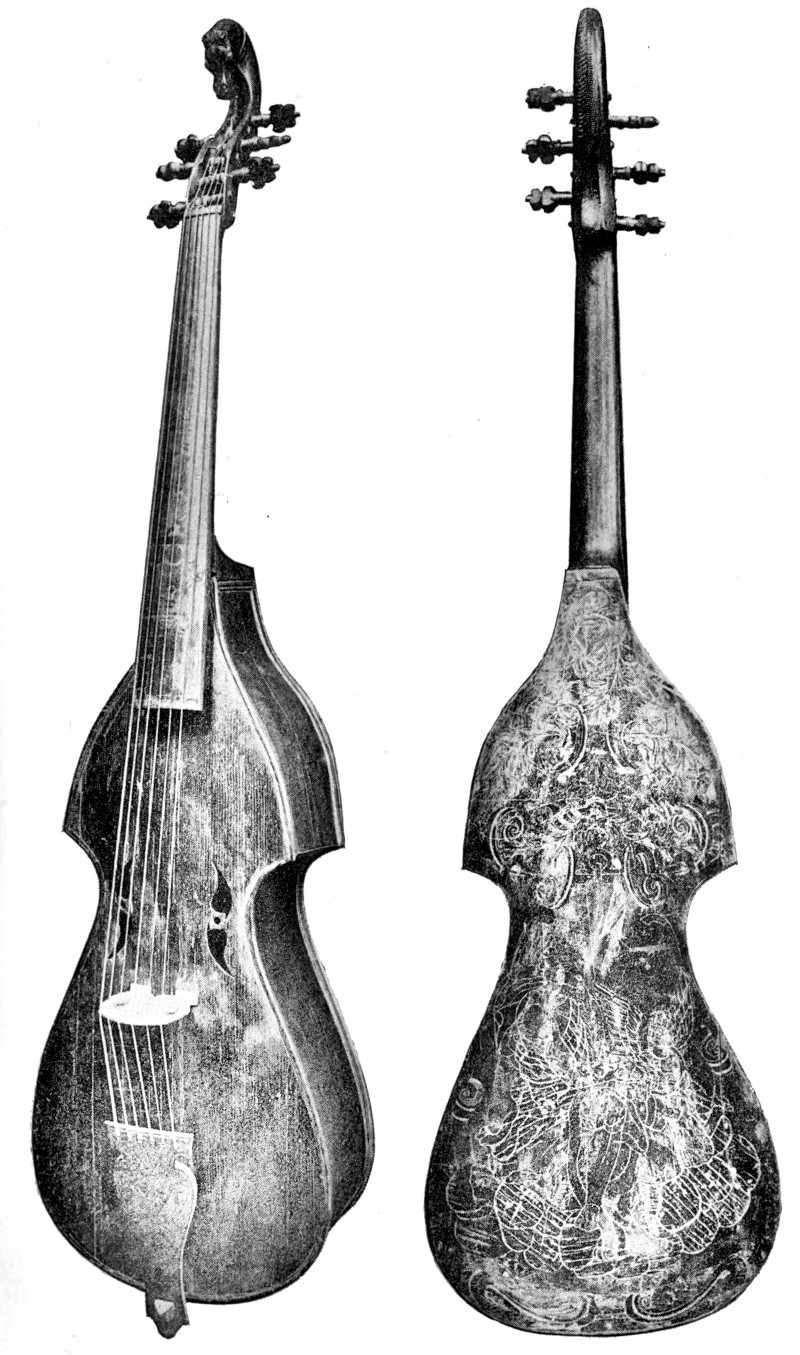
Duiffoprugcar was born in 1514 at Fussen, in the Bavarian Tyrol. He was an inlayer and mosaic worker. He is now known to have visited Paris, and to have worked at Lyons. There is a fine portrait of him etched by the engraver Wariot in 1562, and a curious viol is extant by him, with a map of Paris inlaid at the back, once owned by Vuillaume, and within recent years secured for the Brussels Conservatoire Museum by its intelligent curator, Mr Victor Mahillon. Mr Donaldson’s beautiful viol da Gamba is the only other known specimen of his work. There is no evidence that Duiffoprugcar ever made what we should call a violin, and very good negative evidence to the contrary. In a curious old print exhibiting his portrait, a copy of which is owned by Messrs Hill, amongst the various viols represented no such instrument as the violin appears.
It is easy to see how inevitable was the differentiation of the violin tribe from the first moment that a vocal quartet came to be conceived of. First the viol is selected to double a part, next a viol is made in a modified way to suit the part, and very soon the modification assumes the forms and proportions known as violin, viola, and violoncello.
[Pg 20]
But in the early days of violin genesis the instrument was quite subordinate to the voice; it only gradually conquered its independence with the emergence of the string trio and string quartet. It would happen thus:—
Two people would meet to sing, and the missing tenor or bass voice would be supplied by a viola; or three would meet who could not sing at all, when it would occur to them that the vocal parts might be played instead, and with even more accuracy perhaps than the very average voices would attain to.
The instrumental trio and quartet thus at once came into being.
Next, music would be written independently for such combinations, and the voices would be egged out altogether, and presently the treble or violin would show a tendency to throw the others into the shade, and at last be thought worthy of a solo all to itself, and thus the independent position of the instrument would quickly be established.
All attempts to date exactly the stages of this differentiation of the violin tribe are likely to be misleading.
You cannot say exactly when perspective was discovered or rediscovered by the Italian painters, it developed gradually; and so the violin developed gradually, born of new musical needs and new musical knowledge.
In the midst of the old chaotic world of viol noises that preceded it, the struggle to displace the old viol[Pg 21] players and the slow disappearance of the whole clumsy craft is aptly summed up in the words of one who lived at the moment of transition. He writes—
[Pg 22]
CHAPTER II
VIOLIN CONSTITUTION
One of the subtle charms of the violin is that it may be called bisexual.
It unites in itself and welds together the masculine and feminine qualities.
Its very fabric is bisexual. The soft, easily moved vibrations of the swelling front are controlled, checked, and yet excited by the slower and harder pulsations of the maple back. The porous deal and the close-grained maple or sycamore thus thrill together, and each supplies the deficiency of the other, both blending in harmonious and sympathetic union, the ribs welding the back and the belly into an organic whole, whilst the sound-post, poetically called by the French the soul of the violin (l’âme du violon), collects the quick and slow vibrations, and fusing them, produces the subtle resultant of violin tone.
That tone is the offspring of neither back nor front, nor ribs alone, but of all these differently vibrating surfaces, collected and made musical in the “soul,” and poured forth as the breath of life from the ∫ ∫ holes as out of the very mouth and nostrils of the violin. Surely the children of the violin are nothing[Pg 23] but the sweet and subtly compounded sounds that it utters.
The bisexual figure holds good even to the bow and strings. The bow is the male and the strings are the female elements. They can only vibrate when touched—swept into a tempest of emotion or caressed into tender whispers.
They wait and pine for this magic touch, and long for their own fulfilment. They are so sensitive that they respond to the lightest feathery kiss of the powdered and anointed horse-hair—they murmur, they sigh, they scream, they weep, they laugh, but only when smitten, coaxed or agonised, sometimes almost torn, at others calmly and masterfully swept; whilst the finger-tips, pressing out the vibrations and generating those magnetic thrills which go forth charged with the musician’s very thought and feeling, aid and abet the masculine power of the bow. They are its ministers; without them the might of the bow itself would be impotent; without them the very strings would be unable to yield their infinite variety of tone and inflection of meaning. Yes, certainly the violin is of all instruments the most human, personal, and sympathetic, for the violin is truly bisexual.
It is also a miracle of art, strength, and simplicity—we may say at once, as light as a feather and as strong as a horse. It is composed of thin sheets or slips of wood, only about a fragment of an inch thick; but, by the simplest and soundest mechanical construction, these are so put together as to resist a strain[Pg 24] of about a hundredweight upon the belly, neck, and tailpiece, from the tension of the four strings.
Six sycamore ribs and twelve internal blocks and linings suffice to hold the back and belly together.
The neck carries the ebony finger-board and lifts its characteristic scroll or head—so expressive that makers can almost be recognised by its physiognomy.
The neck is let solidly into the ribs and fastened against the lower part of the belly. When firmly glued it is extremely difficult to detach it, and once only in my experience has the neck of a violin proved unequal to support the enormous pull made upon it by the strings.
It was in Ceylon. The heat was intense and moist. I had borrowed a violin for experimental purposes in one of my lectures at Colombo. In the middle of an attempted passage the neck quietly doubled up; the strings fell in a loose cluster. The glue had liquefied, and the whole fiddle came to pieces in my hands. What no time nor wear and tear had been able to effect had been suddenly achieved by the peculiar hothouse, vapour-bath treatment of the tropics.
The early viol-makers no doubt at first selected their wood empirically; but it soon became an established rule to take a soft wood for the belly and a hard wood for the back. If all were soft, the sound would be muffled and tubby; if all were hard, the sound would be metallic and light; neither must the thickness of back and front be uniform—each must be thicker[Pg 25] towards the middle, but how thick or how thin must depend upon the relative densities of the wood. The problem was to find the relative densities which would best vibrate together—a cunning connoisseur in timber can judge of these densities even by the feel of the wood. Of course the densities will affect the tone yielded by the wood when set in vibration, and it is difficult to believe that Stradiuarius and his school were unacquainted with some exact technical method of testing the acoustic properties of these woods.
Monsieur Savart’s experiments with specimen strips of Stradiuarius backs and bellies showed that in most cases tested there was the difference of one tone between the belly and the back. A 1717 and a 1708 Strad back both yielded a F♯, a 1724 and a 1690 Strad bellies gave the interval, so that Stradiuarius worked his backs and bellies on some regular principle. On examining specimens of Joseph Guarnerius, it was found that his best were made with only a full tone between back and belly; but occasionally the interval was greater.
The sound-bar is a subtly proportioned strip of pinewood running nearly all the way down the middle of the belly inside. The increasing tension of the modern pitch has made it necessary to strengthen all the old violin sound-bars, as the increasing demands for execution have compelled the lengthening of all their necks.
It is needless to say that the sound-bar readjustment is a delicate surgical operation, more difficult than the substitution of a long violin neck for a short one, for the neck no more affects the tone than the screws in the[Pg 26] head. But any blundering with a sound-bar is fatal to the nervous system of the violin; the wolf may suddenly be evolved—that horrid dull growl which sets the teeth on edge, and which, once generated within the violin, is so difficult to diagnose or to cure. The best old masters finished everything inside their violins as carefully as the purfling and the joinings which would meet the eye, and this although a century might elapse before those tiny smooth blocks in the angles, or that carefully-cut close lining of wooden strips fitting neatly to the bellies as a glove to the hand, might chance to be seen at all.
Many forgeries have thus been rudely unmasked, the forger only having troubled to make clean the outside of the cup and platter, whilst within you find the dead men’s bones of his slovenly dishonesty. He worked only to sell, and to sell by deception (not because he cared for his craft or respected his instrument), and his works do follow him! But as Mr Lowell says—
The finger-board is of black ebony; in the old fiddles it was often inlaid. There need be little said about it except that the old masters would be puzzled to know what a player could want with our long finger-boards, and still more would they have been puzzled could they have heard the extraordinary and complex effects we[Pg 27] manage to produce with our extended compass and phenomenal shifts, in spite of the absence of frets to measure intervals.
The Finger-board must be kept smooth and even, or it will not be possible to “stop” fifths or any other chord in tune. You will notice in old finger-boards the strings have worn deep channels, which of course mar the vibration. The height of the strings above the finger-board is to some extent a matter of fancy, and of course depends on the height of the bridge. A child or young girl would soon be discouraged with attempting to press strings raised too high above the finger-board, and of course the higher you ascend the harder must be the pressure. On the other hand, if the strings are too close down, the touch is no doubt light to your heart’s content; but you cannot get a sufficiently full vibration, and your tone will suffer.
The Bridge! I had almost said the asses’ bridge, for indeed thereby hangs a tale. The hard-wood bridge, with its whimsical perforated visage, and its two slender feet clinging closely to the smooth belly of the violin, has been sometimes treated with scant courtesy by writers, and even makers do not all seem fully alive to its importance. I notice repairers will send you back your violin with a bran-new bridge, and no apology, if they happen to have mislaid or broken yours. But the bridge not only exercises the most important and indispensable functions of carrying the four strings under a combined pressure of seventy pounds, but it is in closer and more intimate contact with the instrument than[Pg 28] any other of its appendages. It is so squeezed upon the wood as to be almost pressed into it, far more so than the finger-board or the tailpiece, or even the blocks and linings. It is charged with the primary vibrations from the strings and the secondary vibrations of the belly, ribs, and back; nothing goes on in that wondrous air column enclosed in the violin walls without the bridge taking cognisance of it, and possibly hindering or aiding and abetting its successful exit from the sound-holes.
I am aware that I have been thought fanciful in this matter, but an experience of many years has convinced me that it is not easy to get a bridge that suits a violin perfectly, and most dangerous to trifle with the close and quasi marital relations which exist between the violin and its bridge. I dislike new bridges. I love old ones; and why, when all the rest happens to be old, is the bridge alone to bring the raw sap of youth to vex the mellow and desiccated repose of melodious age?
The position of your bridge, like that of your soundpost, the adjusting of your screws, the thickness of your strings, belongs rather to the management than to the constitution of the violin.
The only further details fit to be noted here seem to be the button supporting the tailpiece, which has a character of its own, in its size, material, and fixture; and the far less important tailpiece, to which we may add the purfling and other occasional inlaying.
The Tailpiece, of course, is strictly indispensable,[Pg 29] but it does not much matter what it is made of, or how it is decorated.
The Purfling, although occasionally resisting damage to the outlying edge, is chiefly ornamental, and consists of three thin strips of wood—two ebony or whalebone, and one of white wood—glued together and inlaid.
In the purfling we have the last survival of the inlaying as applied to musical instruments. You will notice that the further you go back the more elaborately inlaid are the viols and violins. It was thought that the instrument, which was little more in those days of rudimentary music than a toy, might fitly be exploited to show off the conceit of artists and the skill of cabinet-makers; but as music developed and tone was reckoned all-important, every detail likely to interfere with this new development gradually disappeared, till in the hands of the Cremonese makers the faint memory of all the gorgeous mother-of-pearl, ebony, ivory, gold and silver embossing, survives only in the narrow three thin lines of the purfling which strike the contour of the instrument and give piquancy to its form.
And thus the perfect sounding violin, though denuded of all superfluous decoration and meretricious adornment, yet remains a miracle of art—“a thing of beauty and a joy for ever.”
[Pg 30]
CHAPTER III
VIOLINS AT BRESCIA
The violin proper is an Italian creation. It comes from the north of Italy. Stainer, it is true, is an early maker, and he bore a German name, but his date is after all 1621-83, whilst that of Maggini is 1590-1632; and if you visit the frontier village of Absam, near the town of Hall, where he lived, you will observe that he dwelt on the high-road between the Tyrol and Italy, and that his training, his talent, and his market were Italian.
But Brescia was really the home of the violin, and there is possibly something in the heavy salt seasoning of the Tyrolean pines which specially favours that peculiar resonance, sensitiveness, and durability for which the Brescian and Cremonese schools are famous.
The name of Gasparo di Salò (Bertolotti was his real name), now chiefly famous for his double-basses and violas, must ever be revered by students as the master of the great Maggini, who was in reality the father of the violin, in the sense of having clearly, at once and for ever, differentiated the instrument as a distinct type.
Salò is a lovely spot on the shores of the lake of[Pg 31] Garda, in the province of Brescia, and about twenty miles from the big town. It was early famed for its culture. Foreigners went there for the sake of its schools, and the Corporation records show that sacred music especially flourished there. It is now certain that Gasparo migrated thence to Brescia and worked in that town. Maggini was as certainly his pupil. This is proved by a legal document, dated 1602, which has lately been discovered, bearing the joint signatures of Gasparo and Maggini, who is termed his “garzone,” or apprentice.
Gasparo’s share in violin-making proper could not have been very great, as the earliest violin orchestral music appeared in Italy in 1608, and Gasparo died in 1610 or thereabouts—a fact which, taken in connection with the extreme rareness of any Gaspardian instruments which can be called violins, seems to argue that the piccolo violino which was presently going to be master of the situation was only just creeping up.
I have seen and played on one very fine Gasparo violin, the property of Lord Amherst—D and A strings rich and pure, 1st and 4th rather muffled, but on the whole the tone is mellow and powerful.
This almost unique Gasparo violin is still bulgy, but a great improvement on the old viol build; the head is long and quaint-looking, but lacks that finish and character which later masters put into their scrolls. Gasparo’s basses are still much sought after, and Dragonetti possessed more than one.
A giant specimen, known as the Duke of Leinster’s[Pg 32] bass, may still be seen at the South Kensington Museum, and I exhibited it at the Royal Institution in 1872. His work is heavy and lacks refinement, but his tone is grand and full-bodied.
Gio. Paolo Maggini was the child of his father’s old age, and born at Botlicino, near the town of Brescia, which afterwards became the family headquarters.
Brescia was at this time a strongly fortified place, and a print as late as 1764 probably gives us a fair notion of what it looked like between 1560 and 1632.
Swift brooklets ran down the streets, and outside the walls were spreading woodlands and ploughed fields. It boasted of a splendid brick palace, the Broletta, and a massive belfry of rough stone (Torre del Popolo), a Castello, and an old Duomo; the streets were adorned with frescoes. The Cathedral of San Pietro de Dom was famous for its music, and had an organ and full orchestra. The viol-makers and the monks were then, as they have since been, in intimate relations, and it was a couple of monks who befriended Gasparo when he was down in the world in health and fortune, and sadly needed it.
The princes of Italy at this time (1512-1630) were great patrons of art, letters, and especially music. Brescia in 1600 was under Venetian rule. The town or fortress was from its very position constantly in the midst of wars and rumours of wars, and was appropriately famed amongst other things for its manufactory of swords and armour.
It is surprising how little military commotions seem[Pg 33] to have affected, either at Brescia or at Cremona, the manufacture of musical instruments. There seems to have been an uninterrupted line of viol and cither and lute makers at Brescia from 1300 and onwards.
But when it is remembered that war does not interrupt the functions of religion or diminish the importance of the clergy (nay, often enhances both), we can understand that the musical instrument makers might have been as much in demand, in the stormiest times of the Visconti and Medici, as druggists, soothsayers, or mountebanks; and they probably made impartially for friend or foe—for any one, in fact, who could afford to pay.
Up to within the last few years very little was known of this man Gio. Paolo Maggini—Magino or Magicino. As he put only the name and place, but not the date, on his labels (all dated Magginis are therefore frauds), it is not easy to assign fixed dates to any of his instruments, and the personal information to be squeezed out of them is of the meagrest description. He worked in Brescia; few of his instruments survive. His violas are as rare as Gasparo’s violins, but he distances all other makers in the attention that he gave to that newfangled and suspiciously regarded instrument, the true violin.
His handwriting, some of which survives, would lead one to suppose that his education was very moderate, but the signatures of illustrious princes of this period are no better. Recently, however, the State Archives of Brescia have revealed some interesting gleams of[Pg 34] information which enable us to show him in his workshop with one apprentice, Franchino, and a young wife, aged nineteen, Maddalena Anna, who brought him a dowry, and afterwards children.
A picture of his house in the Contrada del Palazzo, Vechio del Podesta, lies before me. It has but two storeys, and the family lived upstairs, surrendering the ground floor to the violin business.
In a woodcut by Jost Anian, Zurich (1539-91), we have an authentic picture of such easy, leisurely, calm workers as Maggini.
There is the rude substantial bench, the tools, the glue-pot, the planks and the wood in blocks, bits of fiddles and strips of timber hung up on the walls; the aproned artificer is carefully trying a lute as he sits on his three-legged stool.
What simplicities! Were we to enter in imagination the studios in which the greatest pictures in the world were being painted about this time, the same meagre appliances and absence of superfluous luxury would doubtless have greeted our eyes.
But our gorgeous modern studios hung with the spoils of the East, and iridescent with precious pottery and curiously worked metals, our modern workshops with their exquisite mechanical appliances and all sorts of labour-saving machines, somehow fail to rival in quality of production those old masters who sat on three-legged stools, ground their own pigments, made their own glue and varnish, and chopped and chiselled their own wood.
[Pg 35]
If you consider Maggini’s period (1560-1632) you will see how exactly the direction of his genius was conditioned by the demands of his age.
The singing-schools of Naples had resulted in a call for stringed instruments in increased numbers, but the old viols were seen to correspond ill to the altered times, and the need for an instrument which would render leading melodies effectively was felt just in proportion as such melodies became multiplied with the rise of vocal music, sacred and profane.
Most writers on the violin seem to have a passion for cutting up a maker’s life into periods, as though a man could rise one morning and say, “Go to now, let us enter upon period number three, in which the back shall be sloped so, and the belly brought down thus, and the curve of the bouts tilted, contracted, or elongated thus.” All that can be safely said is, after such and such a time Maggini or Amati dropped or adopted this or that feature as a rule, and we may infer that a maker came under such and such influences, and so forth.
Now I come to speak of Maggini, I will trace roughly but clearly what may be called his continuous development, rather than any so-called three periods.
Naturally at first the pupil made like his master Gasparo. His violins suggested big viols on a small scale. They had a heavy look; they were of large size, which makes the sides seem lower than they are, for in reality the ribs are not higher than those of the Amati.
[Pg 36]
The heads look rough, because, with the reduced size, no increase of refinement or delicacy has yet been reached; now, they are cut without symmetry; now, the fluting of the scroll is not smoothed, even the grooves for the purfling are not neat, nor is the purfling itself sharp.
Maggini’s early backs, sides, and bellies are cut on the slab—that is, across the grain.
Then Gasparo’s sound-holes have got narrower in the hands of his pupil, and Gasparo has probably got credit for some of the improvements of Maggini, as there can be little doubt that some violins labelled Gasparo are the work of his pupil, just as early Stradivari violins are in existence signed Nicolo Amati.
If I may hazard the remark, in my opinion Maggini did not copy so long or so seriously the work of Gasparo as did Stradivari copy Nicolo. The reason is obvious. The stride between Gasparo and Maggini is far greater than that between the late Nicolo and the Strad. By the time Nicolo died the violin had already risen to that supreme and independent individuality and dignity which it has never since lost.
Stradivari got the violin all ready made; it was Maggini’s glory to have assisted at the individualisation of the “King” type.
Presently we become aware that Gasparo is dead and buried. The Maggini bellies now cease to be cut on the slab, but show the long parallel grain lines of the[Pg 37] wood as in the Amatis; the art of wood selection for sonority and sensitiveness seems already to have reached the 1650 Cremona level. The sound-holes are more delicate, but still a little quaint; they are invariably bevelled inwards, a practice entirely discarded by the Cremona masters.
Sir Joseph Chitty’s, and Mr Sternberg’s, and the Dumas’ tenors are good specimens of Maggini’s first independent work illustrating the above characteristics. The Dumas family were friends of Beethoven, and enthusiastic admirers of Maggini’s work. They possessed at least one valuable “chest” of his instruments. A chest is described by an old writer as “a large hutch with several compartments and partitions in it, each lined with green baize” (we have since gone heavily into velvet and plush).
There are only about eight violas or tenors of Maggini’s known; they do not vary in their proportions.
The model of the Dumas viola is of the master’s most arched type—a feature much exaggerated by Stainer and his followers. It is, like almost all this master’s specimens, adorned with double purfling, set close to the edge, with the usual Maggini bevel at the corner joints. These corners give it a special physiognomy; they are short, and make no appeal to the eye like the later Cremonas. The tenor’s ∫ ∫ holes are upright, short, and broad; they are higher than in the same maker’s violins, the top curves as usual larger than the bottom ones, the back and belly both in two pieces; the bass bar and blocks inside have been strengthened;[Pg 38] the rough tooth of the well-known Brescian plane has left its mark on the wood inside. The Dumas tenor is in exquisite condition; the varnish is unlike the old Gasparo brown, it glows with rich golden tints. Its type is admirably defined; no one in looking at this tenor can say, “This is a little violoncello,” or “This is a big violin.” It is a distinct viola type, and it set the type for all succeeding violas. The Cremona makers worked on it, but they did not re-create the tenor; they could not.
The Dumas-Maggini violin is in equally fine condition; it looks so new that some have supposed that, although eighty years before Stradivari, it must be a copy made by Strad of the older master, but it is absolutely authentic and genuine.
Before Maggini died, we notice that a very high standard of finish has been reached, unknown to him in his earlier days, or, as for the matter of that, to any of his predecessors. Observe the improved purfling, the bouts and mitres cut with clear intention, but never so marked in physiognomy as the Amatis, the sound-holes quite as sharp as theirs; but, above all, the arching has at last come down—this true hint, so early given, was not at once adopted by Maggini’s Cremonese successors. Stradivarius at last fixed it and regulated it in a model from which no later maker has found it safe to depart with the exception of Duke and Klotz, who obstinately adhered to the Stainer high bellies with deep side grooves.
Maggini’s later varnish runs out of the old Gasparo [Pg 39]brown into orange and golden yellow, as luscious as anything to be found in a Joseph or a Strad.
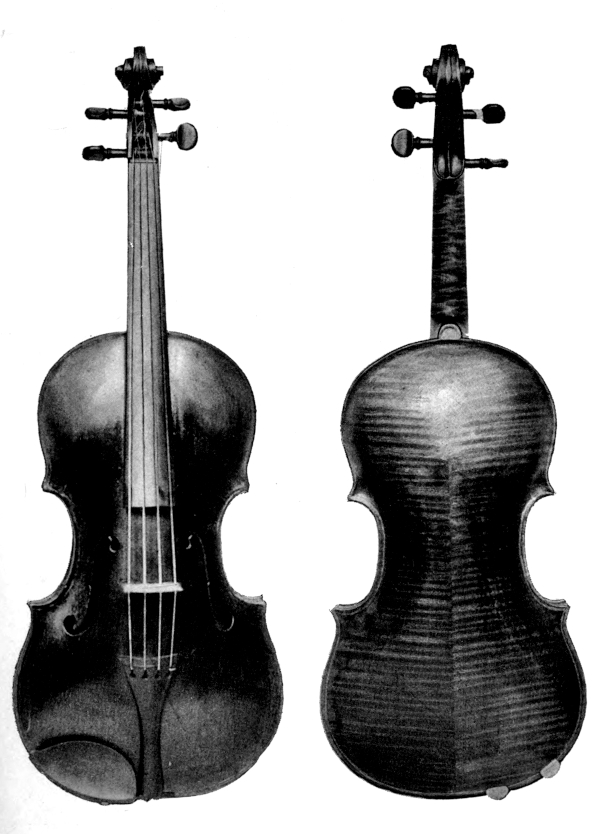
Although Maggini adhered to his double purfling, there are specimens of his work in exhibitions without it; and at least one curiously but not carelessly made instrument is known where the purfling at the back is neither double nor even inlaid, but merely drawn sharply in black lines. A very fine single-purfled violin, formerly in the collection of Prince Caraman Chimay, now in the possession of Mr Antonietti, possesses an unrivalled tone of the Maggini timbre. Many of his violins retain the old taste for other inlaid ornamentation. He does not run into maps and portraits, but a graceful clover-leaf pattern is often found at top and bottom of his backs, twisted, as it were, out of the purfling, and a sixfold trefoil sometimes occupies the centre of the back; but an acute observer has noted that there is no instance of the central trefoil combined with the clover-leaf pattern.
Not less remarkable than this great maker’s definition of the violin and viola types was his conception of the violoncello. The Maggini ’cello is not the son of the double-bass, but the father of the tenor. It is much more like a large tenor than like a small double-bass; the proportions are, as it were, enlarged from the tenor, not reduced from the flat-backed bass. Maggini’s bent was entirely in the direction of the smaller violoncello pattern.
The early and even the later Cremona ’cellos were too large, and there is very little doubt that the[Pg 40] powerful influence of Maggini can be traced in the evolution of those perfect but moderately sized Strad ’cellos which date mostly after 1700.
The tone of Maggini is full, mellow, and plaintive, rather than biting like Stainer, bell-resonant like Strad, or soft and sensitive like Nicolo Amati; but great players like Vieuxtemps, Ole Bull, Leonard, and De Beriot have found him sufficient, and if more have not extolled Maggini, it may be on account of the rareness and inaccessibility of his instruments.
It has been said by a competent authority that not more than fifty extant Magginis are known, and in England at present (1897) about thirty violins, ten violas, and but two violoncellos and one double-bass.
Maggini died at the comparatively early age of fifty-one. All researches made in the archives of S. Lorenzo, his parish church, have failed to reveal the date of his death, and the worst of it is that the registers of that church prior to 1700 have disappeared.
We hear plenty about his wife, Anna Foresti, who died 1651, aged fifty-eight, and was buried in a neighbouring parish.
It is more than probable that Maggini himself was a victim to the plague which raged at Brescia in 1632, and that he was hastily interred, or, dying at the Pest House, no official note of his death may have been taken. At any rate, in 1632, the year of the plague, his son describes himself as “filius quondam Johannis Pauli”—the son of the late Gio. Paolo.
His last income-tax return is dated 1626, and he[Pg 41] was dead in 1632, so he must have died at latest in 1632, and therefore could not have been more than fifty-one. Maggini was doubtless well off, owned considerable property in and out of town, was the father of six children, and, what was of far more importance, the father of the modern violin.
[Pg 42]
CHAPTER IV
VIOLINS AT CREMONA
Cremona! Amati! two words making melody with their very syllables, and a deeper harmony still for the lover of music, from the association of ideas which they excite.
With the assumed immigration of makers from Brescia—the emergence of the Amati family (the name of Amati is not found in the Brescian archives), and their final residence at Cremona—begins the classic period of the violin.
Cremona, ancient city of strife, which, owing to its very situation (κρι μόνος, “high rock” and “alone”), was the battle-point of the middle ages from the days of the old Goths and Lombards down to quite modern times; Cremona, with its stately cathedral so little known or visited, yet possessing two of the finest red lions couchant, supporting portico columns of one of the noblest cathedral façades in Italy; Cremona, with its antiquated back streets, its drowsy quiet life gliding on apart from the beaten thoroughfares of travel—truly, Cremona town is a place to set one dreaming!
I have narrated elsewhere my pilgrimage to the place which so ungratefully forgets almost the very tradition[Pg 43] of the Amati, Stradivari, and Guarnerii, whose fabrics alone have given it a musical immortality, and whose names are hung up high like the stars, which no discords of the middle ages, sieges, or brawls can ever reach.
Let us now try and come face to face with these immortal makers.
Andrea Amati (père) settled at Cremona, and made violins from 1520-46. He brought with him his brother Nicolo (not the great Nicolo, afterwards master of Stradivari, Italian, or Stradiuarius, Latin).
Andrea Amati had two sons, Antonio and Geronimo, who made violins jointly as well as separately. When Antonio married, the fiddles of neither seemed to improve. The brothers ceased for a time at least to work together (there being, it is said, a period in which there are no joint reductions); but as there are much later violins bearing their joint names, it has been assumed that they again collaborated. If we trust some of these late labels—the brothers being born about 1555-56, and one of the joint violins being dated 1687—it would follow that the venerable artificers were still making violins at the age of 136 years, which beats Stradivari himself, who only worked till he was ninety-three.
Geronimo, according to one writer’s account of his labels, went even one better, for there is a Geronimo violin dated 1698; so if this Geronimo, brother of Antonio, was born about 1556, which is tolerably certain, he went on working even longer than Moses, with his eye undimmed and his natural strength unabated, down to the age of 148!
[Pg 44]
The confusion has arisen from confounding Geronimo, brother of Antonio, with Geronimo, son of the great Nicolo (born 1649, died 1740). But if there exists a signed Geronimo and Antonio dated 1698, which seems very doubtful, it would be certainly easier to believe that, as the demand for Italian instruments by makers of repute had well set in before 1700, the late Antonio and Geronimo label was stolen from the old workshops—the last two figures of 16—being filled in, and the label clapped on to cover the fraud; whilst any Geronimo violin dated 1698 would be by Geronimo, son of Nicolo; or at most, one made up by some enterprising pupil out of the débris of the elder Geronimo’s workshop—perhaps about the time that Nicolo the Great, son of Geronimo and grandson of Andrea, was working with his pupils, Stradivari and Andrea, Guarnerii, and his own son, the younger Geronimo or Girolamo Amati.
But with this Geronimo Amati, son of Nicolo (born 1649), and a certain Don Nicolo Amati, an Italian priest, we need not trouble ourselves beyond recording their names.
A good deal has been said about Andrea Amati and his violins. He was certainly the founder of the family, but not much is known about him except that he probably, almost certainly, acquired from Brescia the Maggini type, and that his violins are somewhat smaller, arched in the belly, with a varnish that runs out of the Brescian brown into the mellow and brilliant gold and ruddy tints common to the Cremona varnish;[Pg 45] the later Amatis have a tendency to revert to the browner hue.
That Andrea made some choice violins for Charles IX. of France—twenty-four violins, twelve large, twelve small pattern, known as “les petits violons du roi”—there can be no doubt, but they disappeared from Versailles in the political disturbances about 1790. The arms of France, we are told, were painted on the backs, and they are said to have been of beautiful workmanship.
A ’cello, “Andrea Amati Cremonentis faciebat, 1572,” was sold amongst some others belonging to Sir William Curtis, May 1827. This is known as the “Bridge’s viollo.” Its history is romantic, it having been presented by Pope Pius V. to Charles IX. of France, and surnamed the “King.”
The Amati characteristic, which culminates, along with other qualities of sonority, in the great Nicolo, 1596-1684, is sweetness of tone; but a certain want of power is noticeable, especially on the fourth string. The “A” is beautiful, the “E” soft and delicate, and the third very full and round—qualities which are also conspicuous in the brothers Geronimo.
But if Amati tone is of cabinet, not concert quality, its quality is of a kind unequalled for charm and sensitiveness, and although not loud, some violins made by the brothers have a considerable carrying power.
The Amati heads or scrolls retained a certain simplicity and antique Brescian look even after the finish and form of the body of the violin had left the Brescian[Pg 46] school far behind. The double purfling of Brescia is also gone, but the brothers purfled very beautifully, with a bend of perfect regularity and smoothness.
The violins of Antonio are better than his brother’s, but the joint violins are the best, and have been oftenest forged.
The brothers indeed made excellent violas, but, as the fashion then was, too large. They have been sometimes cut down. Sir Frederick Gore Ousely once had a fine specimen, which I remember playing upon many years ago at Tenby—tone very full and mellow.
Richard Blagrove, a brother of Henry Blagrove, the admirable early Monday Popular violinist, was a viola player, and used a reputed Amati, but it was really a Gagliano. Many of us (1897) can remember how richly it contributed to the triumph of a quartet, of which Joachim, Riess, and Piatti were often the other members.
Her late Majesty the Queen had a fine painted Amati, unfortunately cut down; and Miss Seton’s Geronimo Amati is a rare specimen, and from the MS. of Ascenzio, a priest at Madrid, we learn that it was a favourite violin of Charles IV. of Spain.
Geronimo, after separating from Antonio, reduced the arching of his bellies, but, singularly enough, without improving his tone-power. The over-arching of the early makers and scooped side-curves are generally supposed to be a vice in acoustics finally overcome by the gentle natural curve and flatter models of Nicolo, but it is perhaps possible to ride a theory too hard. I have certainly played on instruments deeply grooved,[Pg 47] with rounded bellies, powerful Dukes and piercing Stainers, which, according to the orthodox theory, had no business to sound as loud as they did. It is well known that in both these Amati makers the late Cremona flat curve is conspicuous by its absence; and whilst I do not for a moment deny that the flatness of the Stradivari model is preferable, I think the superiority of the late Cremona tone may be due to a good many other things beside that. It will always be a question whether the man who makes possible the last perfection of an art or the man who actually achieves it is really the greater genius. Pietro Perugino or Raffaello in painting; Chaucer or Shakespeare in literature; Handel or Beethoven in music; Gasparo and Maggini or Stradivari in violin-making; but popular opinion generally plucks the blossom without troubling itself much about the roots, and the prices fetched by the finest Strad and the finest Gasparo, or even Nicolo Amati, practically settle the question as regards the violin-makers. £400 is an unusual price for a fine Nicolo (£250 is nearer the mark, 1898); £1000 is not an uncommon figure for a good Strad, and his finest specimens command £2000 (1898).
Nicolo, the great son of Geronimo, was born in 1596, and died close upon the seventeen hundreds, in 1684. Nicolo was quite aware that he resumed in himself the fine qualities of his distinguished family and improved upon them. It is true he did not trouble himself much with his grandfather Andrea, whom he probably regarded as a worthy old gentleman[Pg 48] quite out of date. There could have been little in those small, almost three-quarter size, brown varnished, and sweet but feeble-sounding violins to attract the aspiring grandson; but there were qualities in the somewhat larger models of the famous brothers, Geronimo and Antonio, which set his hand and head agoing, when as a boy he fell to copying and carving backs and bellies, and twisting ribs and throwing scrolls, in his father’s little workshop at Cremona, opposite the west front of the Saint Dominic Church.
Nicolo the Great doubtless followed and imitated his father Geronimo, but wishing to miss nothing, and perhaps labouring under a sense of obligation or merely out of genuine affection, his labels embody an immortal acknowledgment of indebtedness to both masters. They run thus:—“Nicolaus Amatus Cremonem Hieronymi Fil, ac Antonij Nepos fecit, 1677.” (The italics are mine.)
Nicolo the Great’s smaller patterns made in his father’s workshop are not unfrequently to be met with, and can be picked up for between £80 and £100, or even less.
But as we watch his dates, the touch of Nicolo very soon becomes distinctive. On the death of his father and uncle he found himself in possession of a workshop which inherited a great name, but which was destined to transmit to future generations the greatest violin names in the world. Among the pupils of Nicolo in 1653 sat the brothers Guarneri, Andrea Guarnerius having witnessed the marriage of his master[Pg 49] Nicolo and signed the register; and by the side of Andrea Guarnerius sat a young man named Antonio Stradivari, or, as we usually call him, Stradiuarius.
Most of the Nicolo violins before 1645 are of the smaller pattern, but after this date down to 1684, the year of his death, the eye of a connoisseur will notice an increase in size, a finish in workmanship, and a more delicate purfle (never double). The model is still somewhat high in back and belly, but with an increasing tendency to get flatter; the side-grooving is less pronounced, whilst the corners are noticeably drawn out into finer points full of character, arresting the eye, lightening as it were the model, and giving the whole physiognomy of the instrument a grace and piquancy hitherto unattempted.
The sound-holes of Nicolo are pointed and somewhat narrow; the scroll is cut a little too flat for the later taste, but passes as the century wanes into a somewhat larger and bolder style. The wood seems to be chosen almost as much for its mottled or fine-grained beauty as for its acoustical properties.
The early Nicolo varnish is of brownish Brescian type, but later on it glows with the rich amber tints of Cremona, and those dragon-blood stains which give to some Strads and Josephs such warm and generous tints like the sunlit dashes of mellow red on a ripe nectarine.
Mr Somers Cocks (1898) has a most glorious Amati violoncello, “one of the finest ever seen or heard,” so said to me a distinguished connoisseur. Mr Marshall[Pg 50] Bulley’s violoncello, a Jerome (the younger) Amati, is also a rare gem of tone and workmanship.[1]
The grand Amati violin pattern runs some of the Stradivari violins very hard, and is evidently the model on which the 1700-35 Strads are “calqué,” as the French say. The side-grooving, generally held to interfere with the volume of tone, whilst supposed by some to add to its sweetness, has not disappeared as in the Strad grand model, but it has become less pronounced. The tone is lovely and sensitive, and the Nicolo is truly delightful to handle. It is par excellence the lady’s violin.
The one before me, where the varnish still remains, melts into light orange with clear golden gleams in it. If Joseph is the strong male, Nicholas or Nicolo certainly belongs to the softer and more yielding sex. The tone is most delicate, and of ravishing sweetness. It seems to leap out almost before the horse-hair has feathered the strings. It continues to sing on like a vibrating silver bell, as if intoxicated with itself, long after the bow has ceased its contact. In the sweet Nicolo the lover finds no bars, no obstacles; it is won almost before ’tis wooed (Plate V.).
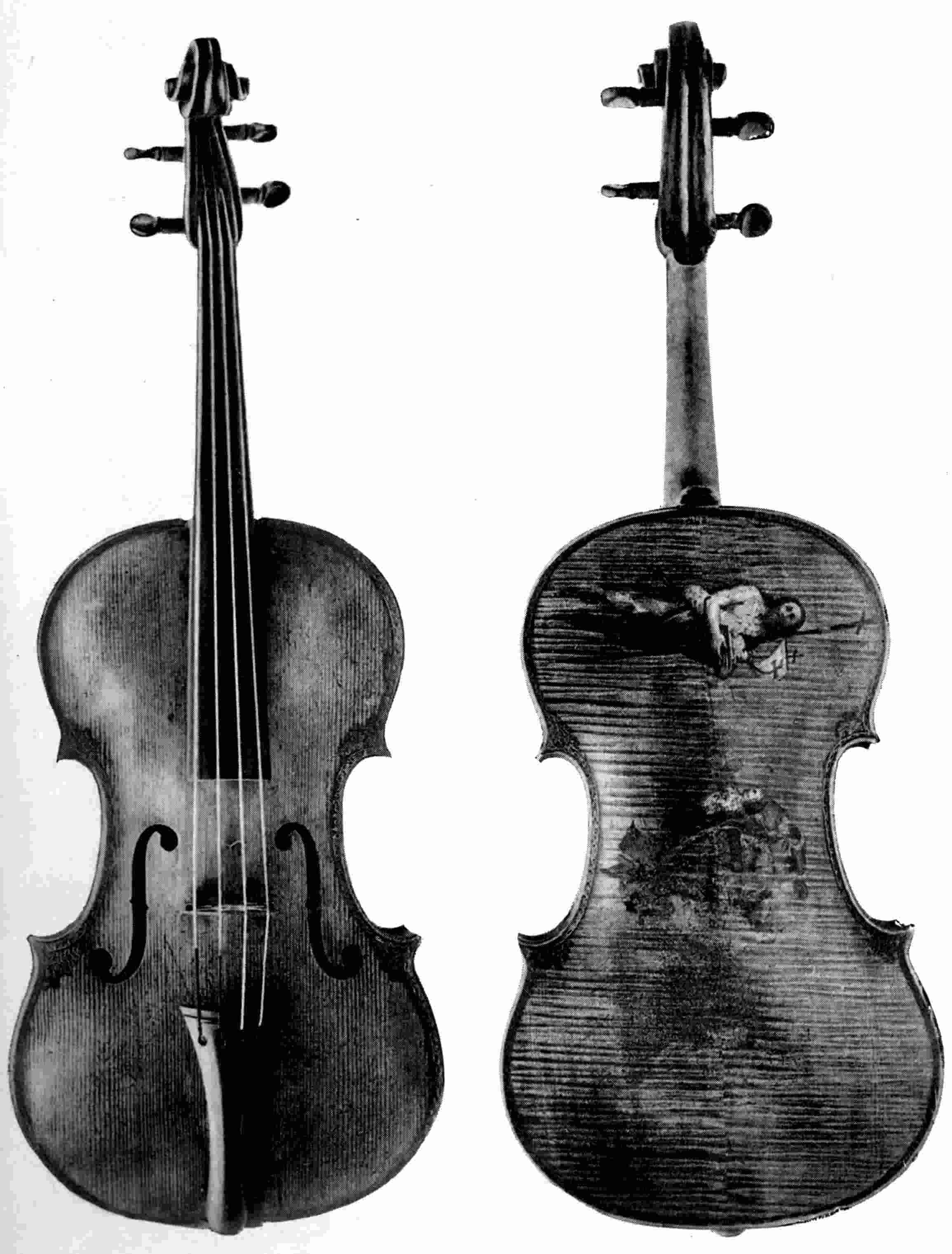
We are interested to know that in his own time Nicolo’s work was carefully imitated, if not forged; whilst his supremacy over one of his best pupils, Francesco Rugereo, Rugieri, or Rugerius, was clearly [Pg 51]acknowledged; for we find that a certain Tomaso Antonio Vitali, who seems to have bought a violin with a Nicolo label inside, and paid twelve doubloons (or about £12, 10s.) for it, complained bitterly that on removing the false label he had discovered the name of Ruggeri underneath it. The aggrieved Tomaso thereupon applied to his liege sovereign, the Grand Duke of Modena, for summary redress, avowing that he had given a higher price because the violin had a label of Nicolo, “who,” he adds, “was a maker of great repute in his profession, but now it was proved to be only a violin by Rugerius the pupil, a maker of less credit.” The violin, he said, was scarce worth to him more than three doubloons; the petitioner therefore prayed the Duke for redress. Whether he got it or not was no doubt very important to him, but of very little consequence to us. The fact that he made the application is the point.
The Guarnerii family must have made violas or violins as the sand of the sea in number, if the frequency of their labels may be taken as any guide; and in truth they were a long-lived and industrious family, and doubtless made a good many instruments, chiefly violins. But the reputation of Andrew and Peter, and above all the great Giuseppe (Joseph) del Gesù, led to the early fabrication of pseudo Josephs, and labels in numbers far beyond what all the great makers of Cremona together could have produced.
Andrea Guarneri (Andrew Guarnerius) the apprentice, as we have seen, was one of the witnesses to the[Pg 52] great Nicolo Amati’s marriage in 1641, and Nicolo enters his pupil’s name in the church register as aged fifteen, which gives us the year of his birth, 1626. He worked on till 1698; in 1652 he married, and two of his sons, Giuseppe (not the great Giuseppe, his nephew) and Pietro, worthily sustained and improved upon their father’s reputation.
Many of the violins of Andrea Guarneri are of the smaller Nicolo pattern, but somewhat inferior, and not always well finished. The wood of his rare ’cellos, however, although plain in appearance, can boast of singularly fine acoustic qualities.
There is a well-known ’cello now (1897) belonging to Miss Theobald, of his finest workmanship.
Giuseppe, second son of Andrea Gianbattista Giuseppe, born 1666 to 1739, as distinguished from Del Gesù or “Jesus” Giuseppe, struck out a freer line of work. His narrow-waisted boldly-curved instruments, with their Brescian-looking sound-holes set low down, his rich, almost too profusely rich, varnish and fine wood, but not over-finished workmanship, give his violins quite a characteristic appearance, and in power of tone they are superior to his father’s. But next to the great Giuseppe del Gesù, Pietro Guarneri is the flower of the family, and most sought after by amateurs.
The grain of his bellies is often wide, the distance between the sound-holes is conspicuous, the sound-holes themselves are rounder and less Brescian, the scrolls are beautifully cut, and the varnish is superb, from golden tints to pale red, which has thrown some writers into[Pg 53] rhapsodies about setting suns and the colours of the rainbow.
Passing over a lesser Pietro, son of the lesser Giuseppe, son of Andrea, who worked at Mantua, we come to the one man who, with the exception of the great Nicolo, is worthy to measure swords (or bows) with Stradivari. He came, singularly enough, from a side branch, and not in direct descent from Andrea or any violin-maker, being the son of one John Baptist Guarnerius, and was born at Cremona in 1683.
The father of the great Giuseppe was the son of one Bernardo Guarnerius, who was a cousin of Andrea, and therefore the great Joseph was nephew of Andrea Guarnerius, just as the great Nicolo was the nephew of Andrea Amati; but a distinguished fact separates our Giuseppe from all his illustrious kinsfolk, and it is this, that his father, Bernardo, does not seem to have been a violin-maker at all, so the young Giuseppe owed his teaching most probably to his uncle and cousins.
Most writers have speculated blindly enough upon his distinctive appendage “del Gesù” some talking about the Jesuits or a supposed religious bent. This is one of the many cases where sapient antiquaries, in seeking for recondite origins, neglect the simplest facts and ignore the easiest explanations. What can be more simple than for the great Giuseppe, conscious of his superiority to Gianbattista, son of Andrea Guarneri, as well as anxious to distinguish himself from Gianbattista, his father, and coming after both, though preferred before them, should call himself the[Pg 54] “del Gesù” or Jesus, who followed after the John Baptist of the family? So far from indicating any particular reverence for religion, the assumption of this bold title seems to me to partake more of a certain irreverent levity; and if, as tradition says, the great Giuseppe or Joseph was somewhat of a free liver, and perhaps even a sceptic, he may have had small scruples in so lightly treating sacred names and subjects.
The question as to who may have been his master, and the influence (or otherwise) of Stradivari upon him, has also been involved, as I think, in needless mystery.
Since Del Gesù worked at Cremona and must have been, as a cousin and nephew, a good deal with his uncle and cousins, Andrea, Giovanni, and Pietro, who lived there, it is no great stretch of fancy to suppose that when he showed the family bent for violin-making, he should have been apprenticed to study the art with his cousin Giuseppe, son of Andrea, in which case he must have lived next door to where Stradivari was working all through his finest period; and though Giuseppe’s violins are rightly said to be in the style of his cousin’s Gianbattista, and he may have drawn his early inspirations from his cousin, it is impossible to suppose that so able a man could be in daily contact with and yet wholly insensible to the influence of the greatest maker who ever lived. Why, he not only worked next door to Strad, but probably met him every afternoon at the neighbouring café, and was doubtless often about his shop, year in year out.
Of course the differences in the work of the two[Pg 55] great masters are obvious. The massive, bold, and original lines and less scrupulous finish of Joseph the Great, the powerful (almost brutally powerful) scroll, the loud trumpet-like imperious tone, all mark the masculine as contrasted with the sweeter and more feminine qualities of the gentler, bell-like Strad. The fact also before alluded to, that between the back and the belly of the Strad there is usually but one note, whilst between the back and belly of the Giuseppe del Gesù there are sometimes more, all prove sterling and distinct originality, as Rafael was distinct from Perugino or Michael Angelo from Leonardo da Vinci. But enough; for to draw these comparisons before describing the master may seem like putting the cart before the horse.
So let us now, without further ado, locate the great violin shops at Cremona and peep into workshop No. 6, in the Piazza S. Domenico, now Piazza Roma.
In about 1540, Andrea Amati had set up his modest establishment, trained his sons, and taken apprentices, bequeathing to Nicolo his plant and pupils.
Stradivari and the early Guarnerii then worked together, cheek by jowl; by-and-by Stradivari migrated to No. 5, next door, and the Guarnerii with Giuseppe del Gesù, who died in 1745, the latest and greatest of that family (surviving Stradiuarius, who died in 1737, eight years), then set up at No. 6.
As I have had occasion to remark elsewhere, these three names, Amati, the Guarnerii, Stradivari, there be none like them; these three shops opposite the[Pg 56] big Church of S. Domenico, now demolished, there never were nor will be three such violin shops.
Here were made, in long, quiet years of peaceful labour, between 1560 and 1760, in steady and friendly rivalry, all the greatest violins in the world.
The Giuseppe del Gesù on which Paganini played, now in the Town Hall in Genoa, the Stradiuarius on which Ernst, now Lady Hallé (1898), plays, Canon Percy Hudson’s violoncello, Joachim and Wilhelmj’s “Strads,” the Alard, the Betts, the Dolphin, the Messie, the Pucelle, the Tuscan, the Fountaine, the Rode, and the Viotti—these be the wonders of the violin world.
But in following the development of the Guarnerii family into the seventeen hundreds, the position of Giuseppe del Gesù, the king of the Guarneri, must be clearly defined before we describe the rise and progress of Stradivari, who ran parallel with, and who, in the estimation of most violinists, seems to combine in himself, the ne plus ultra of all violin perfection.
Nothing about Giuseppe Guarneri del Gesù is more remarkable than the determined way in which, after examining the Amati types, he deliberately went back to the Brescian Gasparo and Maggini models for inspiration. The time had come when powerful tone was wanted. The Amatis were sensitive, sweet, and weak; in the larger and more massive Brescians Giuseppe found the suggestion of what he was destined to make perfect. If only he could add their volume to the Amati sensitiveness—an hour more or[Pg 57] less spent on the cutting of corners or neater purfling—what did it matter? Strength, power, was what he wanted, and the sentiment is thrown off in the bulldog type of his head or scroll, in the thickness of his boards so much criticised, in the boldness rather than the grace and delicacy of his curves.
He tried many experiments: flat make, full make, sound-holes cut almost perpendicularly, shortened, slanting, and sometimes disproportionately long. He was watching the effect on the volume and quality of tone, and when he had in his own way conquered that secret of grand sonority, whether empirically or by calculation, then, and not till then, his workmanship improves.
He was like a man who had no time to think of the delicate cooking till he had stayed his main appetite. His frequent habit of cutting the wood upon the cross, à contre sens, as in the case of Mr Alfred Gibson’s instrument (1897), a superb specimen of Del Gesù, shows up the coruscations of the grain, and brings out each pore and vein by the agate-like varnish—not agate-like in the sense of the French chippy varnish, but in its clear crystalline depth and transparency. Del Gesù’s varnish is never clotted, but is laid on thoroughly, yet with a light hand. Mr Ruskin used to say that Sir Joshua Reynolds’ touch was so light that he could paint on a gossamer veil; Del Gesù’s brush is also as light as a feather. Some of Del Gesù’s later violins, dating from about 1740, after the death of Stradivarius, are amongst his finest. The one used[Pg 58] by Professor Sauret, and the other lent to Mr Ludwig by Mr Frazer, are particularly fine, and belong to this period. Paganini’s Joseph, now in the Town Hall at Genoa, Alard’s, in the Museum of the Conservatoire of Music, Turin, and Vieuxtemps’, now in the possession of Maurice Sons, also belong to this great period.
The life of Joseph Guarnerius is more or less enveloped in mystery. It seems, for instance, utterly impossible to get at the truth about the so-called prison fiddles. Whenever a Joseph or a presumed Joseph which is not up to Joseph’s standard comes into the market, it is dubbed a Del Gesù prison-fiddle.
The story runs that Giuseppe, being a somewhat reckless person, got into trouble and was locked up for many years, during which time the gaoler’s daughter got him any wood she could find, and he made these inferior pot-boiling fiddles, which she disposed of for such moderate sums as she was able.
I prefer to put this legend wholly aside. Del Gesù may not have held sacred things in high estimation, and he may have been somewhat of a free liver—this rests on the authority of Carlo Bergonzi’s grandson, who was not even a contemporary of Del Gesù—still he may have got the gossip from Bergonzi, his own father, who was Stradivari’s pupil, and doubtless a rival maker; and tongues may wag when interests are or seem to be opposed, and stories will come forth finely variegated when there is an extraordinary absence of reliable facts, as there undoubtedly is in the case of Del Gesù.
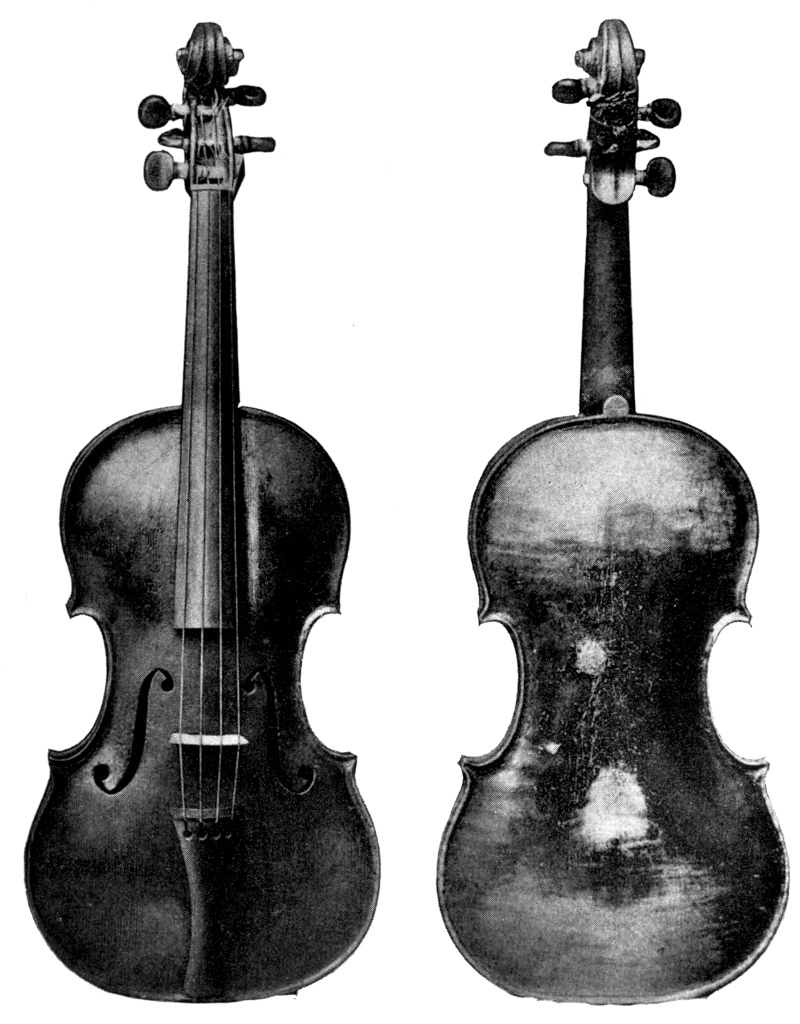
[Pg 59]
There is, however, no direct evidence whatever that Del Gesù was for years in prison and that he died there, as says the legend; but Canon Bazzi of Cremona has lately unearthed one Girolamo Guarneri who did die in prison in 1715, and the names of two very different men, one illustrious and the other obscure, have before now got mixed up, to the detriment of the illustrious one.
Something similar is said to have happened to the great Athanasius, whose name has been confounded with that of the obscure Pope Anastasius, in whose presence a creed was recited by one Bishop Victricius, and the confession of faith thus recited by command of Anastasius now passes as the creed of Saint Athanasius, since it emphasises the Trinitarian doctrine chiefly connected with the name of that illustrious doctor.
A Giuseppe del Gesù is much more difficult to find than a Strad—his output, as compared to that of Stradivarius, is as one to six; his life was shorter, and his working career probably more erratic. But he is placed on a level with the immortal Antonio by some who know how to handle him, and the prices of his wares have already reached four figures.
[Pg 60]
CHAPTER V
VIOLINS AT CREMONA—continued
There is something inexorable about the concensus of posterity.
Individuals may chafe under it, and writers may try to reverse its verdict. You even have crazes for the revival of neglected poets, painters, and musicians, but you will never succeed in pushing from their pedestals the great gods whom posterity has once decided to bow down to.
De Beriot may choose to play on a Maggini, and Paganini may prefer his Joseph, but even Maggini, Nicolo Amati, and Giuseppe Guarnerius, who stand round as it were saluting one another, leave Stradivari apart by himself like a Colossus on a mountain, and yet no one, not the greatest connoisseur, is able to say exactly why. When so many esteem individual violins above some Strads, and when Joseph del Gesù is held to run the magic master very hard, still Strad stands apart upon his mountain for all men to look up to and wonder at. And why? We can only say it is the way with all the greatest; there is something of the mystery of heaven about the incommunicable touch; the true aureole forms about no head to order, and the lonely seats are kept for the mighty.
[Pg 61]
Antonio Stradivari or Stradiuarius was born in 1644, and died, in his ninety-third year, in 1737. We get the date of his death from the register, and the date of his birth is fixed by a violin label (1736) in his own handwriting, in which he states that he was ninety-three years old when he made the instrument.
Stradiuarius married at the age of twenty-three a woman of twenty-seven, who had been a widow for three years, whose maiden name was Ferraboschi, and he adopted her one little girl. By her he had six children, some of whom died before him. His second wife, whom he married several years later, bore him five children, two of whom died before him—so that in all Stradivari had eleven children. None of them seemed to have inherited their father’s genius; only Omobono and Francesco Stradivari made even decent fiddles, and so far maintained the great name as to succeed at first in selling their wares at their father’s prices. The buyers probably hoped that at least the wood might have been selected by Stradivari père, and much of it probably was; and if there was the chance of getting a spare rib or back or belly with a touch of the master upon it, it was surely worth a little speculation.
Antonio Stradivari and Andrea Guarneri, as stated before, were young garzoni or apprentices together in the workshop of the great Nicolo Amati—sat on the same work bench, used the same tools, and doubtless discussed the same problems.
In and out of that shop ran, no doubt, the boy Giuseppe Guarneri to see his uncle Andrea. He must[Pg 62] have always found Stradivari there; and when, later on, Giuseppe imbibed a taste for fiddle-making, and became himself the great Del Gesù, it is hard, I insist upon it, to believe that what must have been a lifelong acquaintance with the mighty Stradivari should have had no influence whatever in forming his ideas and methods.
There is no mention of the youthful Stradivari having accompanied Andrea Guarneri to the wedding of his master, Nicolo Amati; Andrea was doubtless the older pupil, and Antonio Stradivari was taken on later.
“If thou wouldst teach, learn; if thou wouldst create, first copy.” It is generally held that for some years, roughly between 1660-70, Stradiuarius simply made up, blocked out, drew, glued, mixed varnish, and worked generally, but without signing his own name to any fiddles. He was learning; but in 1660 he begins to sign his name, not from pride, but because his master made him do so. From before that date to about 1670, which brings us to within fourteen years of Nicolo Amati’s death, he made what are sometimes called Amati Strads.
At this time Antonio followed closely the violins of the early Nicolo rather than the grand Amati pattern, but he appears to have followed his master’s developments continuously, slowly, but surely.
There exists a Stradivari violin with a label Nicholai Amati (anno 1667), and about that date (when he married) Antonio seems to have left his master’s workshop, but still continued closely to copy Nicolo, and many violins of his between 1660 and 1670 pass as[Pg 63] Amatis, whilst others are called Amati Strads, and some are apparently joint productions.
When Stradiuarius married (about 1667) and left Nicolo Amati, he set up round the corner in the same street as the brothers Guarnerii, and almost next door to them, in the square opposite the great Church of S. Domenico. From about this time connoisseurs notice a great improvement in Stradivari’s technique; but up to 1672 at least, remaining a close copyist of Amati, he doubtless kept on terms of the closest intimacy with Nicolo, now in his decline, and benefited by the abundance of orders flowing in for Amati violins which the old master was unable to execute.
From 1660 to 1684 was a period of great activity, perhaps haste; even some pot-boiling Stradivari violins may then have been made as the young family increased. Antonio’s wood is often plain about this time, and not up to the best taste and selection of his master, but he evidently remained his right-hand man to the end; and when Nicolo died, at the ripe age of eighty-eight, he left all his tools and his plant not to his son Girolamo, then about thirty-five, but to Antonio Stradivari, then just forty years old.
In 1680, four years before the death of Nicolo, Antonio had so far prospered as to be able to buy his house (which I visited in 1880), at 1 Piazza Roma, for about £800. Desiderio Arisi, a Cremonese, has left an interesting MS. in which he speaks of “his intimate friend Antonio Stradivari.” The MS. is dated 1720, or seventeen years before the death of Stradivari.
[Pg 64]
Arisi alludes to a point of great interest which early excited my attention and curiosity—the many-sidedness of the man. “In Cremona,” writes Arisi, “is also living my intimate friend Antonio Stradivari, an excellent maker of all kinds of musical instruments.” Indeed, he could make anything that was in demand, and he did; he could “fancy-purfle” to order, inlay, make fiddles in odd shapes, or with a twist in the curve here or there, or longer or shorter for experiment, or big or small.
The Marquis Carlo dal Negro of Genoa owned a Stradivari harp in 1820. The master was not above making mandolines and lutes to order. Messrs Hill own a perfectly plain Stradivari guitar in fine condition. It is of exquisite close-grained wood. I have often wanted to hear the sound of that guitar. I noticed a Stradivari cithern in the South Kensington Loan Collection with an elaborately carved female head of great beauty. I did not wonder that he who could carve such scrolls could carve a head or anything else.
There are, or were, within the present century, other gems of workmanship, some of which it is to be feared have perished, children’s fiddles, instruments made with small figures, flowers, arabesques. Everything that comes from his hand is finely accurate in drawing. Sometimes his decoration is merely painted in black, sometimes ivory, ebony, or mother-of-pearl is used, but everything Stradivari did was perfectly done; he qualified himself to the nth, as mathematicians say, for each branch of his art.
[Pg 65]
In these days one man draws, another blocks out, another inlays, another finishes. Stradivarius did all, and did all consummately well. His heads and arabesques are worthy of Cellini, his inlaying of the finest Florentine marqueterie; his scrolls and curves are of Pheidian beauty; his varnishing is his own.
On the death of Amati, Stradiuarius and the Guarnerii had the Cremona market to themselves, and whilst the competition was quite wholesome, there is no reason to suppose that their rivalry was other than a friendly one. They had all been brought up together, they had worked as boys together, they had doubtless lent each other tools, touched up each other’s backs and bellies, varnished each other’s ribs, criticised each other’s scrolls from boyhood; and now that the Cremona violin was in the ascendant, and kings and nobles from Spain, France, Germany, Saxony, and even England were anxious for Cremona fiddles, there was a market for them all.
The bitterness of competition is not always due to rival makers, but often to over-production; and such a thing as over-production of fiddles in those days was unknown. Nay, the orders that came in could not be executed fast enough. Music walked faster than the instruments could follow it. When the King of Poland wanted a Strad violin he knew his man, and sent his Capelmeister Voleme to Cremona, with orders to stop there and bring back the twelve violins ordered for the court orchestra. “So,” says Arisi, “Voleme arrived in 1715 on the 10th June, and[Pg 66] remained there three months, and when all the instruments were ready he took them with him to Poland.”
But at this time Stradivari was at his zenith. “There is not in the world,” writes Lorenzo Giustiniani, a Venetian nobleman, to the great artificer in 1715, “a more skilled maker of musical instruments than yourself, and as I wish to preserve a record of such an illustrious man and famous artist, I trouble you with this letter to ask whether you feel disposed to make me a violin of the highest quality and finish that you can bestow upon it.”
But we must not anticipate.
After the death of the illustrious Nicolo Amati, this patient pupil, this careful copyist, this accurate and tireless student and experimentalist, begins to assert his strong individuality. His scroll departs from the feminine Amati type, and becomes striking and independent, his sound-holes recline more, his corners are pronounced, his middle bout curves are prolonged, his varnish is almost fancifully varied from rich gold to soft velvety red. His wood is now invariably chosen with the utmost care, and as he made chiefly for the nobility, royalty, and the higher clerical dignitaries, he was not only on his mettle, but he could afford to work just as he chose.
In 1682, Michele Monzi, a rich Venetian banker, sent him an order for a chest of violins, altos and ’cellos, which were to be presented to our King James II. They were so much liked that his Majesty ordered a viol di gamba of Stradiuarius in 1686.
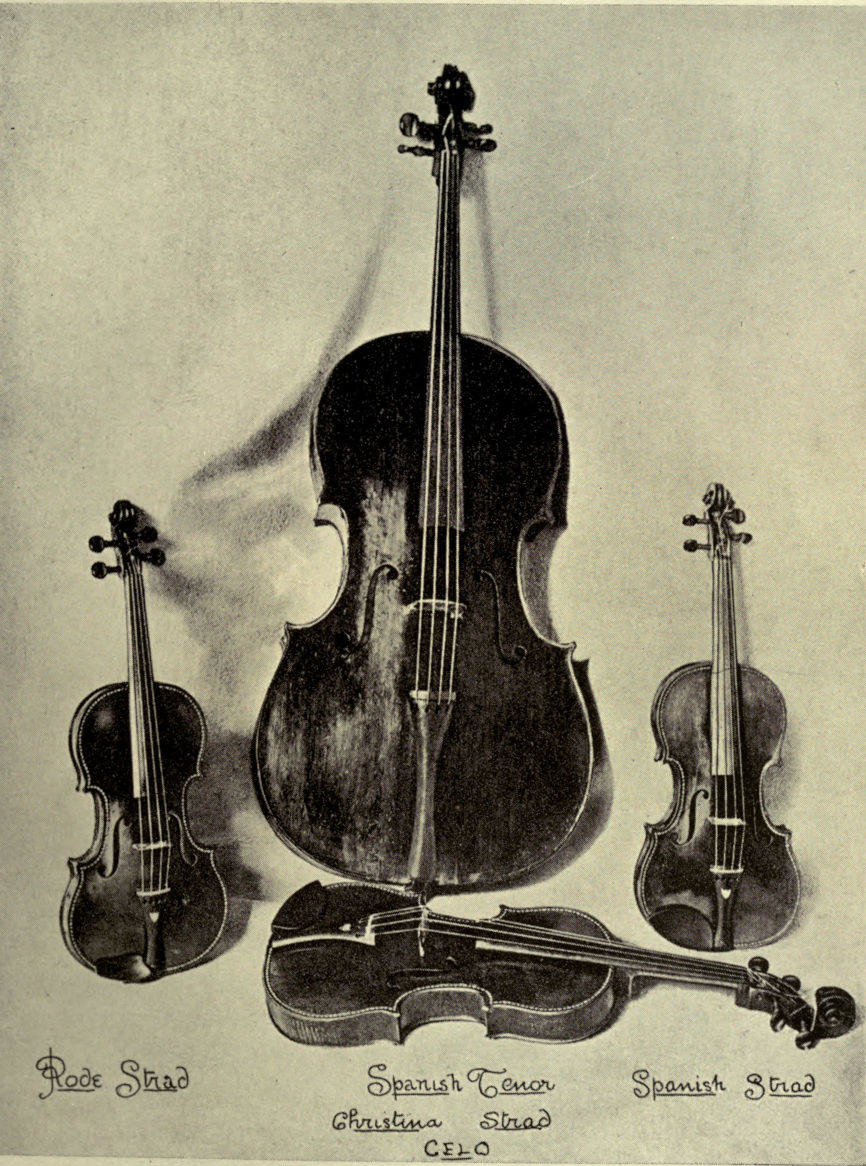
Rode Strad — Spanish Tenor — Spanish Strad
Christina Strad
CELO
In 1685, Cardinal Orsini, afterwards Pope Benedict XIII., had ordered a violoncello and two violins of him, besides making him “one of his private attendants,” an honorary title, but equivalent to appointing Stradiuarius instrument-maker to the Cardinal Archbishop. We commend this fact to his Holiness Pope Leo XIII. (1897), who has lately placed the violin on his index expurgatoritus of instruments, as being too frivolous for the solemnities of divine service! Yet Pius IX. was a pretty good fiddler.
In 1687 Stradivari makes his famous set of instruments for the Spanish Court, inlaid with ivory, with a scroll-work running round the sides. One of these rarities—a violin—found its way into the hands of Ole Bull, the famous violinist. It has been since sold in England to Dr Charles Oldham of Brighton. The tenor is, I believe, in existence. When last in the market, it had lost its ivory purfling, which has since been exquisitely replaced by Messrs Hill.
There are extant several very small violins made evidently to order about this period. The fallacy of different sizes for different ages from childhood upwards is one which will always smile to makers and those acute persons who teach the violin and buy their pupils’ instruments, which of course have to be changed as the children grow up, for larger and larger ones. I have always protested against this. A child of eight had much better play the violin like a violoncello (at the age of seven, as I did myself) than be given a small one; but when I was eight I could hold a full-sized[Pg 68] violin to my chin—not quite in the correct position, no doubt, but near enough. Thus from the very first, when at six or seven years of age, I played the violin like the violoncello, I never had to unlearn my intervals in stopping the strings. The brain learns intervals. An habitual tenor player never plays the violin quite in tune, and vice versâ; and so every time a larger violin is placed in the pupil’s hands, the brain is bothered with the narrower stopping learned in the preceding period. Still, no one can regret the exquisite cabinet, almost toy specimens, made by the Amati and Guarnerii as well as by Strad. Artistically they are gems; musically, fallacies. I have never got anybody to agree with me about not using dwarf fiddles. Joachim, I believe, contended that for a child to use a large fiddle stiffens his muscles. I don’t believe it; it certainly did not stiffen mine. I believe I am also in a minority in my partiality for old bridges. Neither theory is, in fact, “good for trade.”
In 1690 Stradivari executed a celebrated order for the Prince of Tuscany, through the Marquis Bartholomeo Aribati. Of these chefs-d’œuvre the Marquis writes: “I assure you the Prince has accepted your instruments with more pleasure than I could expect. The players in the orchestra are unanimous in expressing appreciation. They declare your instruments to be quite perfect; they all say they never heard a violoncello with such a tone as yours. My having brought to the knowledge of such a person as his Highness your great skill will doubtless procure you many orders from[Pg 69] his exalted house”—and then follow more orders for two tenors. On this occasion, we learn, from the relics of Stradivari in the possession of the Marquis della Valle, that the great violin-maker characteristically enough made the most beautiful cases for the royal instruments, decorating them profusely with armorial bearings and symbols appropriate to each instrument.
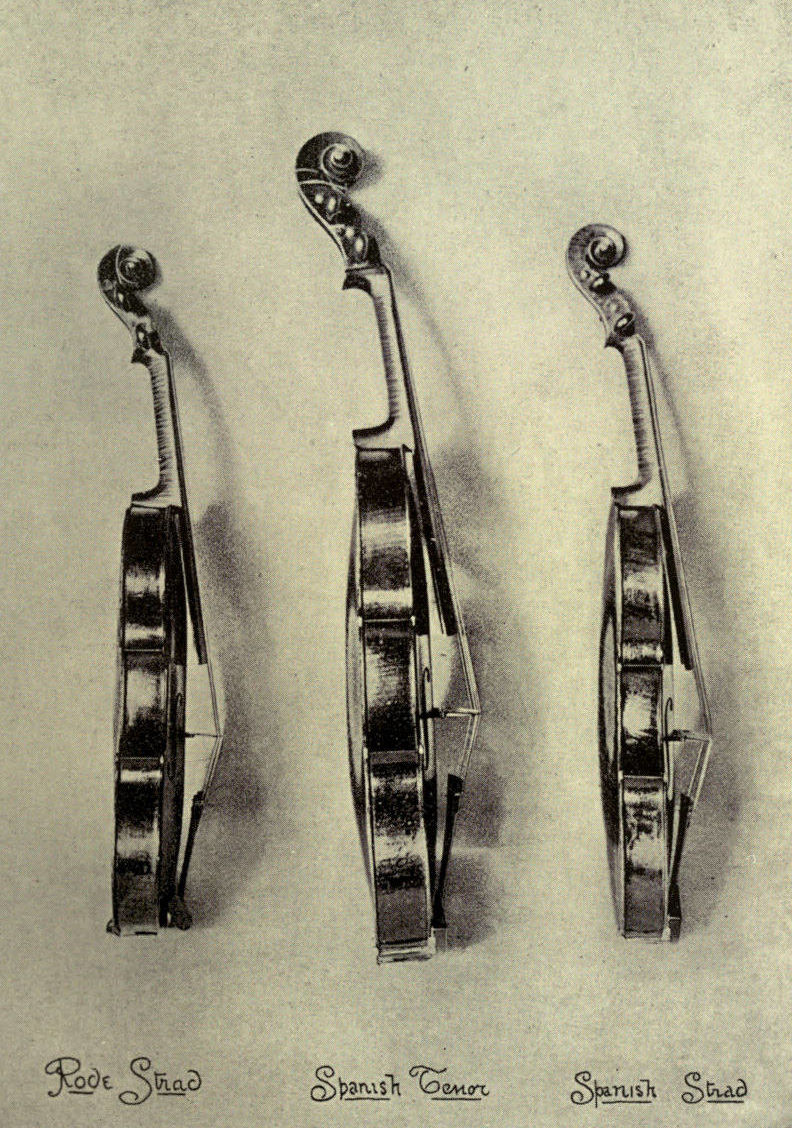
Rode Strad — Spanish Tenor — Spanish Strad
The order was given in 1684, but the instruments were not handed in till 1690. The Grand Duke, it seems, came back for more, as there was found amongst his instruments a violin of the grand pattern bearing the later date, 1716.
I cannot forbear to call attention to the exquisite chromo-lithographs of the Tuscan violin, and the lucid description and history of this last-named famous masterpiece, in Messrs Hill’s handsome monograph. He declares it to be in the very finest preservation still, with an unbroken and authentic record, and to possess all the noblest qualities of the incomparable master. It is on the very verge of his great period, bearing the date 1690, and was bought by Mr David Ker in 1794. The Tuscan viola and violoncello are still in the Institute at Florence, and I advise all lovers of Cremona who get the chance to go and inspect them.
The only other point of great general interest before the year 1700, when Stradivarius enters on his golden period, is the deliberate manufacture of a certain number of violins on a pattern distinct from the Amati, and from any patterns adopted by himself before 1686-1694, or after 1700. These instruments are known as[Pg 70] long Strads, and they seem to be a sort of constructional or experimental link between the smaller Amati pattern and the grand Strad pattern of 1700-37—a model evidently suggested by the grand Nicolo, but not adopted by the cautious Strad till some years after Nicolo’s death.
From 1694 to 1700 Stradivari not only went out of his way to make long Strads, which not only looked longer because they were narrower and pinched in, but actually were longer—i.e. 14-inch, as compared to the 1690 13-inch Strad. In other respects also he walked through his own traditions. Having mastered all violin lore, he was evidently at last trying a series of daring experiments to settle in his own mind once and for ever certain problems of tone.
We have known painters trifle with colour in the same way. Gainsborough would paint his blue boy, and Whistler symphonies in green, mauve, or anything else unexpected, and Turner would recreate the light that never was on sea or land; but in reality it was no trifling, but study in arrangement of colour. So you can have study in construction, empirical ventures, and a testing of tone problems, whether in sound or colour.
As Stradivari mused and carved, and glued and varnished, year after year, his meditations might run thus: “Flatten the belly—thicker here or there according to wood, density of fibre; air column restrained by narrow width, as in the long pattern, but same cubic inches of air allowed for in length or height of ribs, only differently defined by different shapes of instruments. Enlarge[Pg 71] width, thin planks, but try different thicknesses; see how different densities of wood go together. Try old seasoned wood for back, newer for belly, or vice versâ; if wood hard, thin it; if soft, thicken it; try effect of higher ribs on flat curves; lower the ribs on more bulgy curves and grooved sides. What did Nicolo aim at with his grand pattern? Adopt his width and size, and flatten his belly. Try and save his sweetness (did the grooves give that?) with the flatter back and belly, which gives louder tone, adopting the mathematical curve of nature, suggested by the vibration of a string; certainly that gives power. Is a joined back, or a back in one piece, best or indifferent? That would depend on wood attainable. How would it be to patch bits of precious wood if inter-congenial? That generally succeeds. A good secret that, but an open one—wanted always the patcher!”
This idea of patching was certainly one of the most inspired thoughts that ever occurred to him. He seems to have kept wood of the finest acoustic properties for his best orders. He had favourite planks; we can trace one of these by a stain that runs through the grain, and the wood crops up again and again in some of his best fiddles.
The plank must have been known to his pupils, for the remains of it were worked up after his death.
“Now for the sound-bar,” ponders Stradivari; “thick or thin, according to the density or elasticity of the back and belly. And its position? A little transverse, of course—slightly diagonal to be in the[Pg 72] line of vibration. Study effect on power of different strings by placing it a fraction of an inch one way or another; place it slightly aslant for experiment. And the varnish?” But that will call for a few separate paragraphs by-and-by.
I have tried to indicate the kind of observation and meditation, demanding unlimited time, patience, and love, which Stradivari devoted for the better part of a century to his art, and without which those Cremona chefs-d’œuvre, the Dolphin, the Messie, Tuscan, Betts, and Pucelle Strads, could never have come forth.
I have alluded to Strad’s taking late to the large Amati pattern for violins, inclining for some time to the small size. I do not know that any one has yet noticed that in violoncellos Strad reversed this order of work, making his early violoncellos large, and diminishing their size. As he reached his golden period he probably felt that the demands made by virtuosity and tone-power were quite alike consistent with a larger type of violin and a smaller and more manageable size of violoncello.
The violinist is well aware of the value of Strad’s golden period, which will cost him gold; for, after about 1700, a fine Strad will be worth to him from £1000 and upwards, according to its condition.
The long apprenticeship was at last over, and in 1700 the master had reached the ripe age of fifty-six, an age at which so many have achieved their greatest work. He was at the acme of his power, experience, and fame; no one could teach him anything now, and[Pg 73] apparently he had nothing to learn. He could at last wield his tools as a Millais or a Tadema wields his brush, a Flaxman his pencil, a Canova his chisel, or as a Mozart or Wagner handles his score. He knew what he wanted, and he could do it, and do it with a spontaneous ease and joy which seems even now to smile to us from the saucy corners of his bouts, the free daring curves of his grand pattern, and the lightly tossed and lifted scrolls.
No one has failed to notice the masterful ease, the emancipation from all mannerism, the cool defiance of precedent and uniformity, and even symmetry, which characterises his great period from 1700 to 1730.
The violins are not all alike. Strad knew that the secret was not merely in the pattern or shape; he could vary his curves, and yet produce masterpieces, because he knew all about the air column, the wood densities, and the proportions and quantities which should be combined for the requisite result, and he could mix them differently like a master colourist. He no more treated every violin as if it had the same constitution than does a physician treat every human body alike; it is not so much nitrogenous or carbonaceous food, and so much liquid, but it is these and other things used in proportion, according to your digestion and temperament, which will produce in that instrument, your body, the harmony of health; and how close is the analogy between the constitution of a violin and that of a human body—how varied is the texture, the tissue, quality, fibre, and density of the component[Pg 74] parts of each—I have endeavoured to point out as succinctly as I could.
So, in the grand period, the grand pattern Strads are all made with a trained, almost inspired instinct, according to those laws which govern the tone qualities aimed at; but the fiddles are by no means alike to look at. They have the charm of imaginative variety, combined with the unity of supreme excellence.
To this great period belongs the Dolphin Strad, so called, it is said, from the melting and almost iridescent tints of the varnish. To me, however, the violin almost suggests the life, freedom, and elegant poise of that graceful fish whose name it bears. The beauty and acoustic properties of the Dolphin wood are quite special, and can easily be compared with other violins of the same period, some of which are much plainer to look at, and somewhat different in form, and though very charming, hardly so bell-like in tone.
The last time I had the privilege of touching the Dolphin Strad was at my lecture on violins before the Royal Institution in 1880. I shall never forget its ringing notes and its exquisite sensibility. It seemed anxious to speak before it was spoken to; when touched, it seemed to do all for itself like magic. Instead of the player showing it off, it shows off the player; he begins to feel he has nothing to learn in tone production. It is almost like sitting at those ingeniously contrived pianos that make elaborate music, and you merely have to put your hands on a dummy keyboard, press the keys, and appear to be playing, and[Pg 75] then you roll off Chopin and Mendelssohn perfectly, though you can scarce play your scales! Since then Vuillaume’s sound-bar has been replaced with a stronger one by Messrs Hill. It seemed to me quite perfect before, but I suppose one must bow to experts in such matters.
The best opinion limits the number of instruments which Strad made to about two thousand, only eight hundred of which at most are known to be extant. Compared with any other maker except Vuillaume, both as regards output and survival of work, Strad probably bears the palm.
An elaborate description, a careful portraiture of every known Strad, together with its history, as far as recoverable, I must leave for some more gifted and industrious recorder. I believe Messrs Hill are preparing the most complete monograph on Stradivari which has ever yet or is ever likely to appear, and I only wish I could dip into their MS. and steal a few pages. It will certainly, when it appears, be a monumental work, and there is no time to lose, as many of these gems are known to have been destroyed, others dismembered, whilst some are at the bottom of the sea. There are, however, a few more famous specimens, which are of such unique interest that they cannot be passed over even in so general a survey as this.
Mr Croall (1897) of Edinburgh is the happy owner of M. Artôt’s Strad, varnished dark red, quite perfect, and one of the finest known for tone; it is dated 1716. Lady Hallé still plays on Ernst’s violin, bought for[Pg 76] £500, and presented to her by the Earl of Dudley and some others. I shall never forget the wonderful effects elicited from it by the great magician Ernst in his palmy days, nor can I understand the statement recently made that its tone is difficult to elicit. I have heard the faintest vanishing whisper of its strings on the Covent Garden stage when, as a boy, I was seated up in the top gallery at one of Benedict’s monster season concerts early in the fifties.
A romantic interest attaches to two Stradivari violins which have come down to us in absolutely perfect condition: one is called the Messie, the other the Pucelle or the Virgin.
The Messie was secured by Vuillaume after the death of that remarkable man Luigi Tarisio, to whom further on I devote a special section. It bears date 1716.
Tarisio would never let it be seen till Vuillaume possessed it; it had then never been touched or played upon. He lengthened the neck, but, without inserting his new neck, he fixed it to a block placed outside the ribs. Count Cozio de Salabue had bought it in 1760, but never allowed it to be played upon.
Tarisio bought it after the Count’s death, and at his own death in 1854 it passed to Vuillaume, and was exhibited (No. 91) in the South Kensington Loan Exhibition of 1872, and for the first time unveiled beneath glass to the gaze of admiring thousands.
When I first saw the Messie I could not believe my eyes. It was covered throughout and uniformly with thick rich red-brown varnish, laid on with a firm brush,[Pg 77] level and lavish. It seemed to have left the workshop only the day before; the anointed glitter of the fresh varnish was upon it, it looked hardly dry. It is of the grand pattern, but not heavy and massive like some of the great Del Gesù’s, but beautiful as a Pheidian carving, full of a certain special grace and elegance. One “∫” is a shade lower than the other—a practice so common with Strad, especially in his later period, that it must have been intentional, his artistic eye not tolerating even the suggestion of mechanical uniformity. The Greeks worked similarly, no two sides of their Corinthian capitals ever quite matching.
The “Messiah” back is in two pieces, the corners are absolutely unrubbed, and completely covered with varnish—of no other specimen can this be said. The head is light and graceful, “the scroll,” as I have elsewhere observed, thrown off like a ribbon lightly curled about the finger, and drawn in, one side of the scroll cut a little lower than the other; the lines of the scroll are picked out with thick black paint; only faint traces of this remain in other violin heads. The black outline was artistically conceived, as it called full attention to the scroll curve, always so characteristic a part of violin physiognomy.
As the Messiah recently bought by Mr Crawford of Edinburgh for £2000 has now been played upon, it seems a pity that the world should not sometimes be allowed to hear its voice; and I venture to say that a well-advertised concert, in which two of our finest violinists should be invited to play on the Messiah[Pg 78] and the Pucelle—i.e., each player upon each instrument once, thus giving four solos, so that the audience might hear the same violins under different fingers—would be an epoch in the musical world. The announcement would doubtless pack St James’s or any other London hall.
The Pucelle or Virgin is the last Stradivari violin I have space to notice. The “Virgin” is so called because its interior organism had, up to the time when it came into M. Vuillaume’s hands, not been interfered with—i.e., the inside bass bar had never been touched. All the old violins have had these bars strengthened, and their necks lengthened, to meet the strain of the modern high-pitch tension of the strings on the belly, and the lengthened finger-board which the development of advanced virtuosity demands.
These readjustments the Pucelle owes to Vuillaume. She is in fine preservation otherwise, although her varnish is a good deal rubbed in places. Her contour, so fanciful are even good judges, is by some considered more graceful than that of the Messiah, but less graceful by others. To me there seems to be little to choose between them; each is a distinct conception.
The Virgin’s varnish is of a rich soft brown and yellow tone, rather contrasting with the Messiah’s bright red. The head is stronger and less graceful than that of some Strads (the Dolphin’s, for instance); the Virgin’s back is in two parts, the belly is a little higher than that of the Messiah. The only vestige of repair about her is where the chin has rubbed into the[Pg 79] purfling, which has accordingly been renewed. The corners are somewhat fancifully cut, running straight out in the top bouts, and hanging away in the lower bouts; there is a rather marked indentation of the curve beneath them.
The Virgin is labelled 1709, and she reached Paris in 1840 (of course it is a Tarisio violin); it has been owned by Mons. le Roy, a banker, and passed to his heir, Mons. Glanday. She is now the property of a member of the same family, and is very jealously guarded by her owner.
In vain does imagination seek to recover the image of the great maker as he lived and moved and had his being through ninety-three years of shower and shine. Undisturbed by petty sieges and local disturbances and changes of administration, sought for and admired impartially by the friends and the foes of his country, he wrought out calmly his own matchless ideal.
Violins have no politics, and the great republic of Art dominates the ages, and comprehends whilst it survives the rise and fall of dynasties and empires.
I sometimes seem to see the grand old man standing at the door of his modest but comfortable house—a tall, thin, perhaps rather gaunt figure, most likely not a man of many words, carrying on for ever mental processes connected with his subtle handicraft, seldom seen without a chisel in his hand.
Behold him just risen from his stool, or come round to superintend or criticise a carelessly cut scroll of[Pg 80] Bergonzi, his best pupil; and before he goes up into that almost sacred attic, open to the air, at the top of the house, where hang the varnished fiddles and anointed strips a-drying, he mutters a rebuke or rectifies a curve.
The old man comes to the door, and stands for a moment looking down the street. He wears his woollen nightcap and his inevitable leather apron; he salutes the neighbours as they pass, but they do not stop to speak to him, they know he has no leisure for that. Only later, at the café-cabaret, it may be, he will chat with Joseph Guarnerius, and exhort him to more refinement; or tell his sons they will never uphold the reputation of the firm if they do not work harder; and as it is known that the master detests interruptions at home, in those moments of rare leisure when he emerges with the regularity of clockwork to sip his vino or sirop or coffee, Capelmeister A. or Padre B. or Monsignor C. may surprise him for a chat, and inquire timidly when the violoncello or quartet of violins ordered are likely to be ready, and get for reply something too enigmatic or oracular to be of any service; so patrons or patrons’ emissaries had to sit down at Cremona and wait on the master’s convenience for the masterpieces that could be got nowhere else.
His prices seem to have been altogether moderate, but we must remember that the value of money was far greater in those days, a sovereign going then nearly as far as five go now.
He sold his violins for £10 (= £40); the original[Pg 81] price of his violoncellos and violas does not seem to be known.
Although he had a large family, he must have made, if not inherited, money, for there seems to have been a proverb current at Cremona, “As rich as Stradivari.”
Some years ago, fresh from my visit to the house of Stradivari, then still standing in the Piazza Roma, Cremona, I gave a full description of the great maker’s entourage, which I need not here repeat; but a single paragraph may serve better than anything that I can now write, at the distance of over a decade, to place the reader in the atmosphere in which Antonio Stradivari worked for more than half a century.
I stood in the open loft at the top of his house where still in the old beams stuck the rusty old nails upon which he hung up his violins. And I saw out upon the north the wide blue sky, just mellowing to rich purple, and flecked here and there with orange streaks prophetic of sunset. Whenever Stradiuarius looked up from his work, if he looked north his eye fell on the old towers of S. Marcellino and S. Antonio, if he looked west the Cathedral with its tall campanile rose dark against the sky, and what a sky! full of clear sun in the morning, full of pure heat all day, and bathed with ineffable tints in the cool of the evening when the light lay low upon vinery and hanging garden, or spangled with ruddy gold the eaves—the roofs and frescoed walls of the houses.
Here, up in the high air, with the sun his helper, the light his minister, the blessed soft airs his journeymen,[Pg 82] what time the work-a-day noise of the city rose and the sound of matins and vespers was in his ears, through the long warm days worked Antonio Stradivari.
Before the time came for the busy hand to fail, Antonio ceased to sign all the violins that he made; but, with an old man’s natural pride, he continued to sign a few down to the year of his death, registering the number of his years in each case, and it is from one of the latest of these, dated 1736, that we know his age.
He sank quietly to rest, evidently worn out naturally and nobly, if not with his eye quite undimmed and his natural strength unabated, certainly still full of marvellous vigour, unpalsied senses, and undulled perception.
When the Chapel of the Rosary in the Church of S. Domenico, opposite to which he had lived all his life, was pulled down, his funeral tablet was rescued, and it is now in the Town Hall at Cremona; but where are his ashes? Are they in the present family vault of the Stradivaris, in the Campo Santo of Cremona, or in the parish of S. Matthew? I was unable to ascertain. The tablet bears the following simple inscription:—“Sepolcro di Antonio Stradivari E svoi Eredi, Anno 1729.”
Many of his family had preceded him to the grave, both of his wives and six of his eleven children, his last wife dying only nine months before him, a significant and painful event in a life so regular and uneventful, [Pg 83]and one which may not unnaturally have hastened his own end. None of the family seem to have been buried in the S. Domenico vault, but in one belonging to Signor Francesco Vitani, in the parish of S. Matthew; so it may be Antonio lies there.
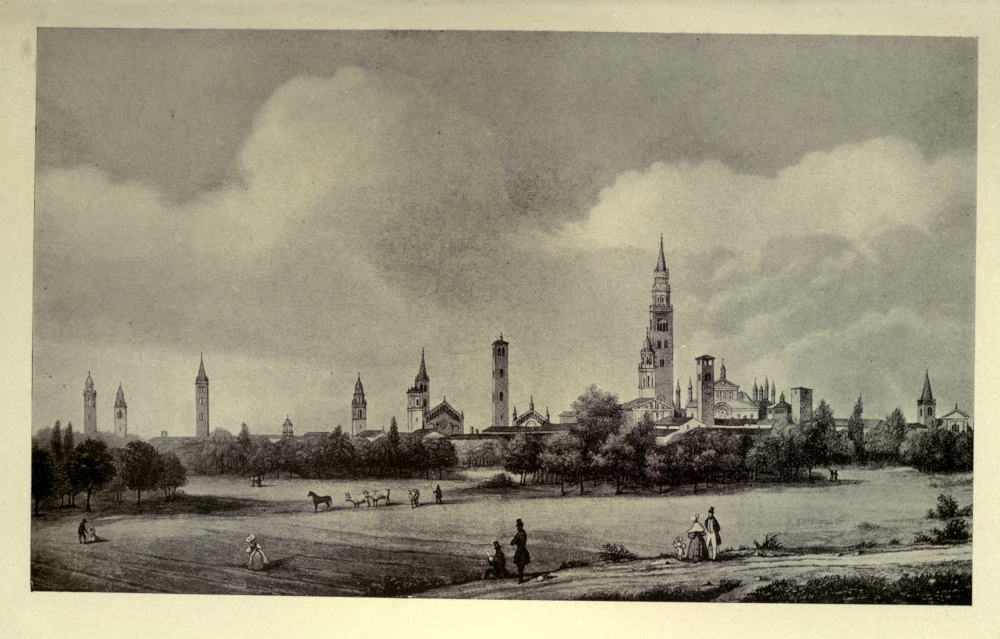
The Church of S. Domenico was pulled down several years ago; the house of Stradiuarius was destroyed only recently. The Piazza S. Domenico is now the Piazza Roma, and when an average Cremonese is asked about Stradivari, he thinks of the fashionable avocat of that name, who appears to spend his time chiefly at Milan, and may possibly resent the notion that a man in good society should ever have had ancestors connected with fiddle-making. Sic transit.
The achievements in violin-making up to the first quarter of the eighteenth century are clearly summed up in the names of Antonio Stradivari and Giuseppe (del Gesù) Guarneri.
It would be an interesting and thorny question to debate whether any variations of importance or additions in excellence have since been noticeable, and of course we naturally look to the best Cremonese makers, who followed these giants of tone-power and sweetness.
The name of Carlo Bergonzi at once stands out as worthy, if not to be bracketed with that of the two mighty men, at least to receive their mantle and reflect something of their lustre. Carlo Bergonzi was Stradivari’s favourite pupil; he lived next door, and afterwards occupied Stradivari’s own house with his son.
[Pg 84]
He finished many of his master’s late violins, and issued some others after his death collected from the débris of the great man’s workshop; and Stradivari left him all his tools and plant.
He worked at Cremona between 1720-47 or 50, and followed at first Stradivari’s example; for as Antonio made his early fiddles on the pattern of Nicolo Amati, so did Bergonzi closely copy the grand Strad pattern. But later on, and before the death of the old man, Bergonzi conceived the ambition of attempting to weld the power of Giuseppe Guarnerius with the round, bright, bell-like sweetness of the Stradivari. To what extent he succeeded must be left to the judgment and decision of connoisseurs, but the grand quality for which his violins are increasingly appreciated is, no doubt, their powerful sonority; that he clearly saw must be the indispensable quality for all violins of the future.
The old tinkling days were over; the feeble, scraping, and muffled viol tone was a thing of the past. The instrument had finally emerged from the cloister, was no longer to be a mere adjunct to the voice in dim sacristies and cathedral choirs; its sphere henceforth was to be out in the wide, wide world, its triumphs were to be won in the concert room, the opera house, and the grand musical arenas of solo virtuosity.
And so, undoubtedly, what Bergonzi aimed at was body of tone and carrying power, and he won it. This dominant idea has modified even his pattern. He looks bold and loud. Yet is the pattern not Guarneri,[Pg 85] but Stradivari modified. Notice the larger breadth of the top curve, a certain bold angularity about the bouts, and a freer development of the lower part of the violin as well; the sound-holes set lower and nearer to the purfling, and the flat model which Stradivari discovered to be favourable to loudness. The scroll is also characteristic—flatter in some places than that of his master, but made to look bold and full of self-assertion by reason of the strongly-defined and prominent curl of the ear, which stands out and at once challenges attention.
The whole build is massive. The Bergonzi will outlast the Strad; it will be the survival, if not of the fittest, of the strongest. The very varnish is laid on with a lavish hand, to allow for wear and tear; it is even clotted in places, and is said in some specimens to have cracked and become scurfy. It is of a red Cremona brown, velvety, and quite the right sort.
Until within the last few years Bergonzi has not received his dues; the scarcity of his instruments may in part account for this; but in France, and especially in England, he is now fully recognised and much sought after. There are, however, only about sixty authentic instruments of his known. His working life was but about twenty-five years. Two notable Bergonzi violins are those in the possession of Miss Eissler and Signor Simonetti. There is a famous Bergonzi double-bass of singularly fine quality now in possession of Mr I. Sears of Boston. In Count Cozio[Pg 86] de Salabue’s collection there were two very fine Bergonzi violins, dated 1731 and 1733.
There were five other Bergonzis—a son and grandsons; they all made fiddles, but they were of no account, and were far surpassed by some other makers who themselves belong to the decline period of the Cremona school.
Although I have called Bergonzi Stradivari’s best pupil, it would be very unfair to ignore the merit of Lorenzo Guadagnini (1695-1740), the only one of that name who poses as a pupil of Stradivari. He was born at Piacenza, but lived at Cremona till about 1740. In about 1795 he removed to Milan after leaving his master at Cremona, but returned to die in his native town. His make is bold, his model flat, his varnish not so rich as his master’s, his head original, but without the grace of Antonio.
His son, Giovanni Battista, born at Piacenza, 1711-1786, made violins which are almost more highly esteemed than his father’s. He imitated Stradivari perhaps more closely than his father, but Count Cozio de Salabue, who thought very highly of him and bought several instruments from him, is careful to mention that Giovanni Battista Guadagnini prided himself upon being no mere copyist. In fact, the Guadagnini in the hands of Mr Willy Hess is quite equal to the best of Lorenzo’s work. He was always changing his place of residence, and wandered from Piacenza to Milan, and at last to Turin, where he died. His own explanation was that the envy of rivals made[Pg 87] each town too hot for him, but his neighbours said that his frequent migrations were due to his own hot temper. There were seven Guadagninis who made violins between 1695 and 1881, but of these the first two, father and son, alone need be taken account of.
It has been the fashion to separate the Italian makers into schools according to the place at which they happened to live—the Milanese, the Venetian, the Neapolitan, the Bolognese, etc.; but it is much more important to notice the influences under which the chief makers worked than to identify them with special towns.
A Cremonese who works at Venice but carries the Cremonese traditions with him, is still a Cremonese, and belongs to the Cremona school.
Thus, the “mighty Montagnana,” as the novelist Charles Reade called him, made Cremona violins and violoncellos at Venice. He worked between 1700-40 as a pupil of Stradivari, and survived his master only three years. But he came to him when the Cremona art was already perfected, and studied the finest models, assisting in all probability at the very manufacture of the most wonderful instruments in the world. With such a training, on his arrival at Venice he easily took the lead and kept it, and to this day his instruments, especially his matchless violoncellos—alas! too few in number—are little if at all inferior to the best of Antonio.
Montagnana’s outline is by no means a servile copy,[Pg 88] of Stradivari. It is flattened at top and bottom, and seems to the eye less graceful; but in his selection of wood, his glorious varnish, the relative thickness of his slabs, and in the cunning knowledge of those fibre densities in back and belly which are likely to sound well together, he is second to none.
Montagnana no doubt embodies and transplants to Venice the Cremona secrets. As I noticed in the case of Bergonzi, Montagnana, owing to the paucity of his instruments as well as to the splendour of his contemporaries, Strad and Giuseppe Guarneri, has not until lately received the honour which is due to him. He suffers, too, from having often been labelled Guarnerius or Bergonzi, makers who had the vogue of the day. These frauds are now being unmasked, and the few great successors of the Cremona giants, Bergonzi, Montagnana, Guadagnini, and Balestrieri (very fine in Guadagnini’s style, flat, big build, powerful tone), and Storioni, have at last a chance of taking their proper places and fetching their prices.
When we come to Lorenzo Storioni (1769-99) we come to the last maker of importance who can with any show of plausibility be called even a second or third rate master of Cremona. Storioni’s model was Joseph Guarnerius, but he copied him more in his rough work than in his great qualities. In his varnish we notice the singular change which came over the Cremona varnish after about 1760. Up till then all the Cremona violins have the Cremona varnish; after that time it simply disappears. Why is it? This[Pg 89] interesting problem I shall have to consider in my chapter on Cremona varnish.
Storioni’s instruments are not much esteemed in England as yet, but are thought a good deal more of in Italy.
I may here fitly mention the Gagliano family, who are associated with the Neapolitan school, but really derive their importance from Cremona. Alessandro Gagliano, the first of the name, was distinguished for his very fine red varnish, 1695-1730. A violin remarkable for its tone is the Gennaro Gagliano that has been used by Mr Otto Peiniger for solo purposes during many years.
Alessandro Gagliano was actually in early life a bonâ fide pupil of Stradivari. Finding himself, no doubt, unmercifully overshadowed by the prestige of the immortal workshops in the square of S. Domenico at Cremona, and being a person of native enterprise, Alessandro Gagliano migrated to the South, carrying with him the Cremona craft, and founded the so-called Neapolitan school. His model was, of course, the approved flat one of the golden age, 1700-37, but his scroll is small and rather mean, the ∫ ∫ are set low down, and the work is sometimes lacking in finish. It is in the varnish of Alessandro Gagliano that we see some connection with Stradivari, his varnish very often being fine in colour and of the right texture.
Attempts have been made to classify the various towns in which Italian violins were made during the Cremona period into schools, which is about as profitable[Pg 90] an occupation as the attempts to divide the work of individual makers into distinct periods—one period runs into another, and one school runs into another.
Roughly speaking, you find but two influences—the Cremona, i.e., the Nicolo, the great Giuseppe and greater Antonio influence with its flat form, gentle curves, and red and yellow varnish; and the German, i.e., the Stainer model, of which I shall presently speak, with its elongated form, arched belly, deep side-grooves, and brown-yellow varnish.
Some fine Venetian and Milanese makers like Montagnana and Serafino inclined to Stainer, whilst the Roman and Neapolitan adhered more to the Cremona type; but Stainer himself learnt at Cremona, and all the best men like Tecchler (Rome) and Gagliano (Naples) who went South copied either Stradivari or Giuseppe Guarnerius. The Milanese school, on account of the great importance of the capital, naturally attracted good makers like Grancino, Testore (pupil of Grancino), and Pietro Giovanni Mantegazza (1687-1720).
Venice, Florence, and Bologna can also boast of a few respectable names, but I prefer, for the sake of completeness, to treat them later more in catalogue style, for the guidance of the student, and not to mix them up with the great central figures which have formed the subject, and I hope absorbed the attention, of the reader of this section.
[Pg 91]
CHAPTER VI
VIOLINS IN GERMANY
Of course, by this time, “every schoolboy,” to use Macaulay’s famous phrase, knows that most things—including, alas! violins—can be made in Germany faster and cheaper than anywhere else; and if we trust to German writers like Dr Schebek, we might almost believe that viols, not to say the violin, originated in Germany.
I am quite willing to leave the viol origin an open question. If, on the one hand, Albert Dürer and his father-in-law both made violins and dated back to 1500, Benvenuto Cellini tells us that long before 1500 his father made the finest Italian viols at Florence; and an ingenious writer has now unearthed a print by Maso Fineguerra, the father of engraving about 1460, in which Thalia is represented playing on a small violin pochette or kit—which, by the way, has rather upset the idea that the kit was a reduced violin, but seems to show, on the contrary, that the violin followed the kit instead of the kit following the violin, the kit being in reality a small violin. It is thus triumphantly argued by Mr Fleming that even the predecessor of, and every suggestion of, the[Pg 92] violin came from Italy; but in his ardour he fails to notice that although an Italian print shows a woman playing on a kit, the kit she plays on might all the same have been “made in Germany.”
If I see an English picture with a tomahawk and a boomerang, I do not assume at once that the objects depicted were necessarily “made in England.”
But, as far as this book is concerned, such questions are of quite secondary importance. It is sufficient to notice that the first instruments possessing the distinctive features of what we call the viola and the violin, as distinguished from the viol tribe, came from Brescia and Cremona; and that the greatest, if not the earliest, German maker, Jacobus Steiner or Stainer, is commonly reputed to have studied at Venice, or, as some say, learnt his art under Nicolo Amati at Cremona.
As we approach the great figure of Stainer we are in the presence of a man who stands only second in popular estimation to the greatest of the Cremona masters. Indeed, so great a musician and eminent an authority as Sir John Hawkins writes in 1776: “The violins of Cremona are exceeded [sic] only by those of Stainer a German whose instruments are remarkable for a full and piercing tone.” The popularity of an English maker, Duke, who followed the German Stainer model, and whose fiddles were all the rage when good Sir John wrote, may have a little blinded his eyes to the Cremona chefs-d’œuvre—few of which, if any, he had ever seen. But it is no small tribute to the power of the German that for at least a hundred years he retarded the due[Pg 93] recognition of the Cremonas and gave a faulty direction to the violin pattern throughout England, France, and Germany.
The arguments in favour of Stainer having visited Cremona in his early life rest a good deal on romance—the story of his having been a pupil of the great Nicolo, whose daughter he is said to have refused to marry, is unreliable. Whether he went home or stayed at home and married the village belle whom he appears first to have compromised, and who bore him seven daughters and one son after marriage and one daughter before, it matters very little to us.
Poems and novels have been written about this unhappy child of genius, but, as far as I can gather, the only reliable facts seem to be these, and they have been quite recently unearthed and sifted by Herr Ruf, who died at Hall in 1877:—
Jacob Steiner or Stainer was undoubtedly born at Absam, a village not far from Hall. The townlet lay on the high-road between the Tyrol and Italy, and doubtless nothing that went on in the northern cities of Lombardy was long in finding its way to Hall, for mules and pedlars constantly carried all sorts of merchandise—viols, and violins, and lutes amongst other things—to and fro. The great argument against Steiner ever having received early instruction at Cremona seems to be that he affected the tubby raised bellies and deep side-grooves of the old German viols; but it must be remembered that if as a boy he came under Nicolo Amati’s influence, it was at a time when Nicolo himself[Pg 94] approached far more nearly the raised viol form than he did later on when his own model improved. The Steiner pattern is therefore consistent with all these theories:—
Firstly, that Steiner adopted the raised pattern which he found at Cremona, and which was then common throughout the violin-making world; that, returning early to Absam, he adhered to it, and, perhaps from motives of national pride, accentuated it Germano more.
Secondly, that he visited Cremona later, when his own model was already formed, and was too proud to alter it.
Thirdly, that German he was, and German he remained, and never went to Cremona at all.
All these questions, upon which much ink and paper have been spent, remain more interesting to the antiquarian than to the collector. Still, an indescribable interest and a deep human pathos seem to cling about the meagre facts of this remarkable man’s life.
Stainer’s popularity was so enormous that ten times the number of violins he could ever have made have been attributed to him, and his name has been forged quite as often as that of the great Stradivari.
Stainer married in 1645, and was appointed one of the Archducal servants, 1669; he advanced rapidly in favour, became violin-maker to the Emperor’s court, and was turning out instruments as fast as he could make them, forming such admirable pupils as Klotz[Pg 95] and Albani, when he fell a victim to the odium theologicum.
Heretical books were found in his possession, or heretical opinions were expressed by him, or both. He was, in fact, a Lutheran, and a Lutheran in Absam was far too near to the preserves of Mother Church, and very soon, like a hawk on a pheasant run, he was shot down. Stainer was also miserably in debt, and perhaps somewhat litigious, as people of genius and independence of character are wont to be.
In 1677, having got out of prison, Jacobus petitioned the Emperor Leopold, whose protégé and employé he had been, and who was a great musical amateur, for money. Leopold lost his opportunity; unlike Ludwig of Bavaria, who won for himself an easy immortality by supplying Wagner with funds, Leopold turned a deaf ear to the immortal violin-maker.
Stainer seems to have dragged on a wretched existence for six years longer, overburdened with care and debt. The attentions of his wife and eight daughters did not prevent him from going mad with worry and want; nay, a helpless and incompetent family may even have contributed to this so unhappy close of a splendid but blighted career.
They show even now at Absam the bench to which the wretched man is said to have been bound when his paroxysms came on. He died in 1683, not only insane but insolvent. His wife died in great poverty six years afterwards, in 1689.
There seems no room in this sad life-story for his[Pg 96] sentimental retreat into a monastery on account of his inconsolable grief for the death (?) of his wife. Had she been such an inestimable blessing, we might have expected her to have kept her gifted husband alive, managed his household more thriftily, rescued him from his debts, moved the hearts of his great patrons, or at least saved him from going mad.
But, on the other hand, eight daughters were doubtless a trial to a couple who seemed always hard up; and the one son, born in 1657 and dying in infancy, as we learn from a tombstone in the Pilgrims’ Church at Absam, deprived the great artificer of a coadjutor who might have been interested in building up the firm, and, perhaps, brought into it those business faculties without which the most brilliant abilities in every department of life so often make shipwreck.
A certain Marcus Stainer, whose reputed date is about 1665-69, and who called himself citizen and violin-maker, it is difficult to connect with the illustrious Jacob, although he has been called his brother, and some say he was a monk and actually assisted Jacob Stainer in the workshop.
The great violinist Tartini is said to have possessed two of this man’s instruments, called Peter and Paul.
Veracini, another eminent soloist, is said to have lost both of them in a shipwreck.
Herr von Reimer possesses a violin with label “Markus Steiner Burger und Geigenmacher, anno 1659” (not a very clerical label, by the way), and that is all that can be ascertained about this other Stainer; for of[Pg 97] an Andreas Stainer, 1660, nothing but the name is known.
So everything tends to keep the ill-fated genius Jacob apart. Alone he remains as the one important rival of the Cremonese school; alone he stands at the head of all the Germans. Genuine Stainer instruments are rare; Stainer labels, copies, and forgeries are innumerable, and one of the greatest curses of the fiddle market.
The general look of a Stainer is so distinct from that of any maker except such as copied him, that it must arrest the attention of even a casual observer.
The Stainer belly is much higher than the back, the rise is kept up through half its length; the varnish is yellow (or as in the Elector Stainers), with a sort of pale-rose flush in it.
The early pattern, deep Amati side-grooves, the long-shaped, beautifully thrown end of the scroll, sometimes a lion’s head carved with the art of a Stradivari, the narrow purfling lying close to the sides of the strong, roundly moulded edges, the circular-topped sound-holes rather shorter than the Cremonese, peg-box often dark brown, contrasting with the palish-yellow belly—such are the leading characteristics of the great Jacob.
His earlier specimens bear varnish something akin to the Amatis; they are also of the smaller pattern. A good example of them is one in the possession of Mr Russell of Bedale, Yorkshire, dated 1645.
Jacob’s finest type may be seen in the famous Elector Stainer; of these he is said to have made twelve, one[Pg 98] for each of the Electors. The popular legend refers them to his Benedictine monastery, but there is no shadow of proof that he ever was there at all; perhaps, however, if one Markus Stainer who is reputed to have made Peter and Paul was a monk, he may have been a Benedictine monk, and as the obscure Guarneri who did get locked up seems to be responsible by transference for the great Joseph del Gesù’s legendary incarceration, so Monk Markus may do duty for J. Stainer’s reputed sojourn and residence in a Benedictine monastery. It matters very little when the Elector Stainers were made; most connoisseurs are agreed that the two quite authentic “survivals of the fittest” are miracles of workmanship, beauty, and the perfection of Stainer tone.
The Stainer tone! What is there about that tone, which for 150 years so fascinated the musical world as to dull the perceptions of so experienced a professor as Sir John Hawkins to the more exquisite timbre of the finest Cremonas? No one but myself is responsible for the following conjecture.
Perhaps there is less tonal difference between the early Amati and the later Strad than between the early Amati and the full-blown Stainer; and it may have been the sharp, pungent contrast—the type of tone that was quite new, as it were an original creation—which at once arrested and held the ear of that epoch. For, after all, musicians in the seventeenth century were only beginning to be cultivated in the delicate appreciation of tone nuances. The proof of[Pg 99] this would not be far to seek. It is quite notorious, though to us amazing, that the differences between the Amati, the Strad, the Guarnerius, and the Bergonzi or Ruggerius, should not have been more clearly apprehended. When, for instance, a man—an orchestral leader, too—had bought a Ruggerius and paid for a Joseph, we do not find that he was dissatisfied with it until he discovered that the label was false. The superb qualities of the great Joseph have been appreciated only since the Strad craze; but the world-wide cult of Strad dates from Tarisio, who began his work of violin exploration and discovery in 1827, dying only in 1854. But any tyro would be arrested by the clear, sharp, biting tone of Stainer. A violinist in the orchestra could make his Stainer cut through all the first fiddles, and once the taste for that sort of tone was excited, it would be to the ear what curry, or vinegar, or quinine bitter, or absinthe is to the palate. The Stainer tone is a sort of drastic, stinging stimulant to the ear, almost an intoxication; and the ear that has been once caught by it craves for it, and misses it even in the loud richness of Joseph, the exquisite velvety timbre of Amati, or the superb ringing brightness of the great Antonio.
Thus, in his own original way, Stainer met the crying want of his age for loud and piercing tone. He was the very antipodes of the tubby, muffled sound of the old viols. With a bound he reached the opposite pole. The coarse ears of the multitude were at once tickled and “grisé,” as the French say, by his wiry[Pg 100] intensity; and soloists soon found that it was an immense help to wield a novel and stinging timbre which, without any special gift of theirs, awakened attention like the roll of a drum, or the blast of a cornet, or the tinkle of a triangle.
These considerations alone, in my opinion, account for the popularity of Stainer in all ages; the bulk of hearers belong to the musically untrained, who like pungency, and desire above all to have their ears tickled.
Just in proportion as music developed and the musical ear got trained to higher and higher refinement, so that specialities of tone became a cult for the ear, as specialities of colour for the eye, just in that measure did the great and subtle qualities of the Cremona school emerge, whilst the rage for Stainer, Klotz, and Duke declined.
I have no wish to disparage these last-named fine artificers. The increasing rarity of their instruments, and the really splendid qualities which we grant ungrudgingly to the best of them, must always make them much prized, and I fully expect that in a few years there will be a revival of the Stainer craze, and that his violins may then touch Cremona prices. I shall be very glad if they do; it will mean that at last we shall get something like a definite sifting of this great master’s best specimens, and that in this shaking in auction rooms, and in the cabinets of collectors, the forged parasites and impudent copies which have for years sailed under false colours—labels (libels, I mean)—will[Pg 101] fall off into the limbo of violin refuse and other things “made in Germany.”
The best pupils and followers of Stainer were Klotz and Albani; but as it became the fashion to dub every one who made respectable violins in Germany about that time, and showed traces of the Stainer model, “pupils” of the great man, modern writers have grown properly cautious about dogmatising.
If all Stainer’s reputed pupils had really worked with him, they ought certainly to have married his eight daughters and relieved him of some of his heavy family responsibilities.
Sebastian Klotz or Kloz (1675) and his son Mathias (1696-1709) made excellent violins, and some prefer the son’s to the father’s. There were, besides, four other Klotz, relationship uncertain. Sebastian of Mittenwald visited Florence and Cremona; but although when he returned to his native town he announced his intention of making a second Cremona of Mittenwald, he and his family adhered mainly to the Stainer model, and reproduced very successfully the Stainer tone. Vidal says that his sons inundated Germany with false Stainers. Of the great violin manufactory which, on the suppression of the Mittenwald Fair in the seventeenth century, is said to have revived the commercial prosperity of the town, no trace now remains; but it is certain that, whilst the Klotz family lived and worked, a pretty steady stream of pseudo- (or scuola) Stainers poured forth from Mittenwald till about the year 1750.
[Pg 102]
The Albani family, like the Tecchler, stand midway between the Cremona and the Absam school, but Albani père (1621-73) was certainly Italian, though he was born and lived at Botzen, in the Italian Tyrol, where he made German fiddles in the Italian style and for the Italian market, although his son Joseph was also bitten with the Cremona model. Albani’s violins pass for Italian; they are varnished red, and rival the Amati tone, and the Joseph Albanis are more highly esteemed than the violins of Albani père.
It is further significant of Albani’s popularity in Italy, that the most accomplished maestro and composer of the early part of the eighteenth century, Corelli, played on an Albani. This appears certain from an examination made by Mr Arthur Hill of the will of the late William Corbet, who had a large collection of rare fiddles, and disposed of them in his will, where mention is made of an Albani fiddle, which he left with the memorandum that it had belonged to Corelli. This is a very interesting example of a carefully excavated fact, and does Mr Arthur Hill great credit.
Tecchler, also called a pupil of Stainer, is perhaps most esteemed for his violoncellos, the best of which run the Strad ’cellos very hard. A very fine Tecchler ’cello is in the possession of Mr E. W. Hennell (1898), and there are several others in this country. Tecchler seems to have made few, if any, violins, which is strange, as his master made few, if any, violoncellos; he worked in Rome between 1695 and 1735. His instruments[Pg 103] are sometimes rather cumbrous; his varnish is yellow, like Stainer’s.
The subsequent history of “violins made in Germany” is, to say the least, very mixed; nothing so good as Stainer was done there before him, and nothing equal to him has been done there since.
The golden age of German violin-making begins and ends with Jacobus Stainer.
[Pg 104]
CHAPTER VII
VIOLINS IN FRANCE
Italy and Germany have to look back to their golden age, but it seems as if France and England had to look forward.
France and England have never yet gone beyond a doubtful silver age, but there is good reason to think that the manipulation and alchemy of time, whilst thinning out by wear and tear and loss the older gems, will not only transform the Piques and Lupôts, and perhaps the Vuillaumes and Chanots, but also the Banks, Forsters, and Fendts, and probably the Dukes and Hills, into golden quality, with very advanced prices; and so, instead of being, like Artemus Ward’s future, behind them, they may still be found to have their future before them.
The French work contemporaneous with the Cremona period is not nearly so interesting, nor do the makers appear to have been nearly so capable as the men who followed them towards the close of the seventeen hundreds. This is no doubt accounted for by the streams of violins pouring out of the Italian and German workshops, the superior reputation of Cremona, which drew at once the patronage of the[Pg 105] Spanish and French Courts, and perhaps the small demand for stringed instruments in France compared with the huge demand in Italy and throughout Germany.
So there was a poor market as yet for French work.
In Italy, in the luxurious little Duchies and Principalities, as well as in the churches, and in Germany in the small Electorates, each of which supported its band and gave an indirect impetus to the churches, Reformed and Roman Catholic, violin-making flourished, and so it came to pass that Italy and Germany made for all the world.
The Cremona period in France can boast of but two considerable names, Jacques Boquay (1705-30) and Pieray (1700-25). Boquay worked on the early Cremonese model, which had already been left behind by the modified forms of Stradivari (1700 great period). His violins have not yet reached a high selling figure, but may possibly rise; they are by no means scarce; his varnish is reddish-brown, transparent, warm and soft. He reverted to the Jerome Amati type, arching even a little more than Jerome.
The quality of his tone is good, but it lacks power, which in these advanced days tells against him except for cabinet playing.
Claude Pieray (1700-25) worked in Paris, and followed the later Amati contour, but he was far enough removed from the Cremonese influence to follow a line of his own. Whilst varying, some think capriciously, the thickness of his wood, and not always securing the best quality of wood, he varnished pale red, and[Pg 106] turned out a small and large pattern; but he evidently inclined to the larger pattern of the late Amati Strad.
A violin of Pieray’s was advertised in the sale of Tom Britton, the musical coal-heaver, as “a very beautiful violin, and as good as a Cremona,” which shows that even at that date the Stainer influence, then so strong in England, had not dimmed the fame of Cremona. However, it would of course have been absurd to compare him to Stainer, the affinity between Pieray and Amati being too obvious.
But the really great silver-gilt if not golden age of French violin-making dawned with Lupôt (1736-58), was extended by Pique (1788-1822), Vuillaume (1798-1875), Chanot (1801), Gand (1802), and Aldric (1792-1840), famous for his varnish; and Fent,[2] an admirable copyist, whose violins often sell as Lupôt’s copies of Strad.
The labours of these great French disciples of Cremona, copyists and occasional forgers as they were, are sufficient to decide for ever the superiority of the Strad model over all others. Their lives were chiefly occupied in reproducing the unique Antonio minutely without attempting the least modification of the ultimate Cremona form, which he had defined.
The firm of Lupôt, immortalised by Nicolas Lupôt (1758-1824), dates back to 1696 or somewhat earlier. The father and grandfather of Nicolas Lupôt resided [Pg 107]at different times at Plombiers, Luneville, and Orleans, but Nicolas was born at Stuttgart in 1758. He returned to Orleans in 1770.
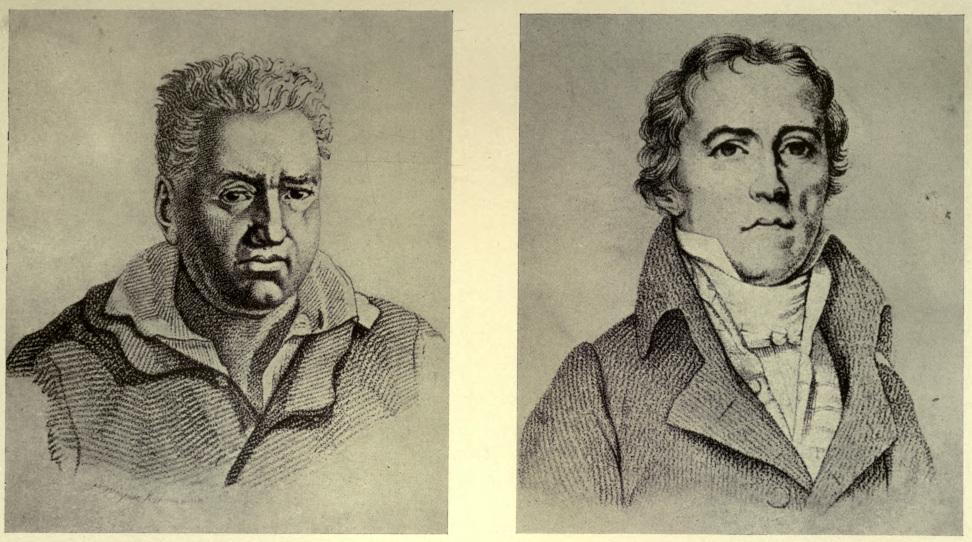
F. TOURTE - N. LUPOT
Nicolas Lupôt was a man of great discernment, and not carried away with the fashion of the times. Although during the first twenty years of his life he must have seen and heard the German model of Stainer extolled, neither his own work nor yet his father’s show any leaning towards it. His eye was enamoured with the Stradivari grand pattern, and his best violins are such loving and faithful copies of the great Antonio that many amateurs and some professional judges have been deceived by them. But Lupôt never got rid of the glassy, chippy French varnish, and although his warm orange tints are generous and the varnish has been laid on with a lavish hand, the rubbing bare by time of a Lupôt is very different from that fading away upon the fibres of a Strad, where always a subtler film protecting the wood seems to linger, a sort of mist of varnish to the end.
But Nicolas Lupôt was a great workman, and, as Hamlet modestly puts it, “indifferently honest”—that is, honest as violin copyists go. He did not imitate, he copied, and varnished throughout; he never aged his copies prematurely, or tried to take in buyers; he reverenced his great Cremona model too much to palm off his own work as those of the master. Of course his violins have rubbed since and aged since, but they have aged and rubbed honestly, and are every year increasing in value, and distinctly mellowing[Pg 108] in tone and sensitive quality. The moment Nicolas Lupôt arrived in Paris, early in this century, his talents were recognised; orders flowed in, and he remained and remains without a rival in the French school.
He was appointed maker to the Paris Conservatoire, which involved the manufacture of the annual prize violin to be presented to the gold medallist of the year, and to this academic privilege we are doubtless indebted for some of his finest efforts. A violin which would annually at the time be associated with one of the chief musical events of the year, and come under the criticism of all musical Paris, would certainly call forth the mettle of one who admittedly “took the cake,” but was not without formidable rivals.
One of these rivals was Pique. He was in the habit, it is said, of buying Lupôt’s fiddles unvarnished, varnishing them, and labelling them with his own name. He had better have left the varnishing alone and contented himself with a fraudulent label. It is surprising that he should have stooped to such a device. Pique is quite a considerable person, second only to Lupôt as a maker. He must have been influenced by commercial considerations, but his dishonesty is a great tribute to the superior popularity and merit of Lupôt. Still Pique was so clever that he could have afforded to be honest.
François Gand, who entered as Lupôt’s pupil in 1802, was much beloved by his master. He became his best[Pg 109] pupil, married his daughter, and succeeded to his business in the Rue Croix des Petits Champs in 1824.
Time has invented a new industry—the art of repairing—which François Gand raised to a veritable fine art (Mennégand, Kolliker, Rambeaux and W. Ebsworth Hill have since rivalled him). Pique would join and split mutilated grain in such a way that, without the aid of a microscope, the patch or closed fissure cannot be spotted. He would spend days over mending a crack; it became with him a sort of passion of ingenuity.
It was almost worth breaking a fiddle to have it mended by Gand, and his exquisite skill and profound knowledge as a repairer no doubt gave rise to the common but risky notion that an old violin was improved by being mended, as some surgeons pretend that a skilful operation will not only prolong life, but positively improve the constitution. The firm of Gand and Bernadel is still of high standing in Paris. The violins of François are useful and solidly built, but lack altogether the Italian grace and finish of his master, Lupôt.
Pique (1788-1822) is by some held to have run Lupôt very hard as a copyist of Stradivari. Pique avoids at once the error of the vulgar copyist, who cannot refrain from emphasising the peculiarities of his model, and the sin of the brazen forger, who bakes and rubs, treats with acids, and simulates the cracks and the wear and tear of time. But Pique had some conscience. He may have passed himself off as Lupôt, but at least he never posed as Stradivari.
[Pg 110]
Those conversant with Pique’s instruments observe a very high and conscientious finish throughout. Spohr, the violinist and composer, played for many years on a Lupôt, and was never tired of extolling both Lupôt and Pique. Pique died in 1822, two years before Lupôt, and his violins improve every year, and will by-and-by fetch prices second only to those of Lupôt, which are already up to £200 (1897).
A Vignette of J. B. Vuillaume.
If I were to seek for an appropriate pendant to the figure of William Ebsworth Hill in London, I could not find a better one than Jean Baptiste Vuillaume of Paris. Yet the two men were very different;—the careful, neat, systematic enthusiast, with a shrewd eye to business, and the dreamy worker always apparently in the midst of a chaos of material, out of which he alone could select at a moment’s notice what he required; the ready purveyor of whatever sort of article happened to be wanted, and the careless distributor of his wares, who forgot what he owed his customers, and kept them waiting for months; the clever copyist, the reverent repairer, the ingenious brain for ever evolving new sorts of bows, fiddle shapes, screws; and the idolater of the old forms, who had so firmly grasped the truth that violins and all that belonged to them had culminated at Cremona before the middle of the eighteenth century, that he never aspired to invent anything new or alter anything old;—the Parisian, who [Pg 111]made many fiddles, and died rich; the Londoner, who made few fiddles, but repaired innumerable antiques, and died with but a moderate competence. The force of contrast could go no further; nay, you can look at the two men’s faces, and see the secret of their characters writ plain enough.
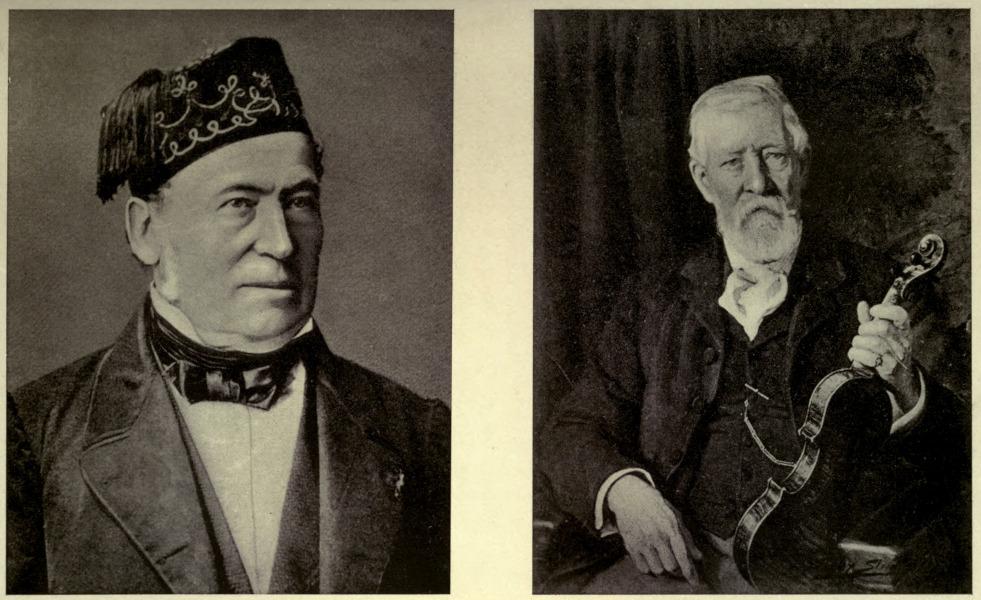
J. B. VUILLAUME - WILLIAM EBSWORTH HILL
I can remember old Hill’s dreamy gaze, peering at me with screwed-up eyes through his spectacles. You were nothing in particular to him, duke or pauper; it was your fiddle that gave you the importance or the reverse in his eyes. But look at Jean Baptiste Vuillaume’s portrait—it lies before me as I write: the jaunty embroidered and tasselled velvet skull-cap, the well-arranged black satin tie, the well-cut coat, the grave sharp look and keen eye, not dreaming at all, but taking everything in at a glance; the mouth a little aslant, as we often see it in men of speculative and ingenious minds; the firm fine nose, and the strong quiet face, but a face that betrays a mind ever alert, capable of dominating its owner’s gifts, his customers, and the market generally, whilst the man was genuinely devoted to the art and craft which made him great, and rich, and famous. Yes, the two great connoisseurs might well hang side by side in twin frames, for they are two types, united by a like enthusiasm and speciality of craft and knowledge, but differently interesting, variously unique each in his own way.
Both were hereditary violin-makers, and the tendency—I had almost said the cult—was born and bred in the blood.
[Pg 112]
Vuillaume was early saturated, in his father’s workshop at Mirecourt, with all the secrets and arts of the trade, long before he served his apprenticeship. But Paris drew the young fellow, then only nineteen, with an irresistible magnetism.
Victor Hugo, that typical Parisian of Parisians, has somewhere described the Frenchman’s inborn love of his capital, the centre to him of life, art, pleasure, movement, industry, and invention. So to Paris must your Jean Baptiste go. But to whom?—to whom but Chanot (Francis), incomparable worker, copyist, forger, suitable adept, indeed, for such a bright novice.
With Chanot, Vuillaume remained till 1821, when he went over to Lété, the organ-builder, who also dabbled in fiddles, and was glad to have at his beck and call as a foreman such a specialist, with all the experience of Mirecourt and the craft of Chanot at his back; in fact, he lost no time in taking the young man into partnership, and the partner throve so well that he married in 1828, being then just thirty years old.
Things ran smoothly with Vuillaume; his wife did not drink, or abuse him, or waste his money. His home was happy, and, in the sunshine of domestic peace, his talents expanded in the direction of that growing market which was created by the taste for old fiddles, excited by Tarisio, and supplied by the not always scrupulous skill of Chanot.
But Vuillaume went one better than Chanot. Chanot’s trick was to produce such deceptive copies or[Pg 113] patch with counterfeit backs and bellies of his own—or to forge downright a whole antique, to be foisted upon some unwary but ill-informed enthusiast. But Vuillaume, to his honour be it said, soon discerned that the world at large could not be won by fraud, but that men were the slaves of imagination and sentiment. This timely and philosophic discovery made him famous and wealthy, almost at a bound. He loved the old Italian fiddles; he had the best opportunities of seeing them; his admirable technique enabled him to copy them accurately—to counterfeit the wear and tear, even the cracks and worm-holes, the inlaying, the rubbed varnish, the old wood; and for about five pounds, or even less, he proposed to provide people with new fiddles, which looked like old ones worth fifty or a hundred pounds.
The device succeeded beyond the dreams of avarice. Orders poured in faster than they could be executed. Just look at the old man’s face. Can you not see the shrewdness, betrayed by that slight pucker in the lip, which discovered and worked this now familiar tendency of human nature to possess what seems, if you can’t afford to buy what is really good? It is the secret of cheap art, shoddy satsuma, coarse blue china, common silks, oleographs, and sham Palais Royal jewellery galore—every bazaar reeks with it; whilst the biggest warehouses are not above selling a made-up wine that deceives the palate, a walking-stick not ebony, only paint or stain, and furniture not really inlaid, but ditto ditto. So Vuillaume began early those amazing[Pg 114] copies, chiefly of Stradiuarius, which even now deceive the innocent, and for a moment may even puzzle a connoisseur. Well, it was no doubt shoddy, but shoddy of the best sort; shoddy raised to a fine art, like those roses so subtly made out of silk or cambric that we might easily pop them into water to prevent them from fading.
This new-found copying industry was a delight as well as a profit to the clever French craftsman.
He loved a Cremona; he copied it as men copy the old masters again and again, till they know every touch of the immortal workman, and revel in its reproduction.
“I have completed,” remarked Vuillaume in his declining years, “three thousand instruments, all sold, all paid for, and the money spent, and it affords me great satisfaction.”
Like Ebsworth Hill, Jean Baptiste loved to do it all himself. Every instrument was varnished carefully by his own hands, and many are made throughout by him.
But what is the actual merit of Vuillaume’s violins? Fine work, yes; admirable counterfeits, yes; but the great expectations raised by the appearances are unfortunately not always answered by the tone. His best are good, and will run into forty pounds, perhaps more; but his worst are dear at five pounds. Nor can Vuillaume pretend to rival in power his great French predecessors, Pique or Lupôt, who copied, but without registering the defects of age, accident, and decay, which are so cleverly reproduced in Vuillaume’s typical specimens.
[Pg 115]
It is an exaggeration to say that Vuillaume baked his fiddles; but he treated the wood chemically in various ways, besides reproducing cracks and even worm-holes; and this artificial age put upon his planks not only fails to carry the mellowness and timbre of wood grown naturally old, but seems actually to impair instead of improving its quality, and this is but too apparent as the instruments recede in time farther and farther from the hand of the too cunning artificer.
There are, however, a few fine quartets of instruments, one of which, made for the Comte de Chimay, was lately exposed to public view in Messrs Hill’s windows in Bond Street. These are varnished equally throughout, and no attempt at aging the wood or tampering with the surface is visible. The work throughout is charming and finished, as in the best Cremonese models, and the only wonder is, that as everything about them is so good, the tone is not better; still, everything is relative. But Vuillaume claims to be judged by a high standard, and so we judge him.
Vuillaume’s ingenious brain was ever devising improvements and novelties, but few of them have turned out successes.
He made a violin tenor, but it never came into use, it being too cumbrous. He made a steel bow; but, although hollow, it was found to be too heavy. He made a sourdine tailpiece which acted on the bridge, but it has never superseded the usual simple[Pg 116] dummy contrivance. He made a self-hairing bow, which is still sold by Mr Withers; but most violinists prefer to pay a small sum and get their bows haired, just as most men prefer to get themselves shaved—it is less trouble, and does not cost much.
Apart from his undoubted finish as a workman, and skill as a copyist, Jean Baptiste Vuillaume’s title to fame will rest largely on his connection with Tarisio. As we have seen, he not only dealt with him living, but bought all the violins found in the bedroom along with the peasant carpenter’s lifeless body.
His possession of the Messie, which he kept in a glass case, and never allowed any one to touch, was a source of great anxiety to him during the Paris Commune in 1870.
He writes to Madame Alard, his daughter, who married the celebrated violinist of that name: “In my last I spoke to you of Alard’s violin and my Messie, and of certain valuables I have here. I do not know what to do with them, for if one survives, one will be able to recover the valuables when the hubbub is over; and some sous can be buried, but violins cannot be buried.” And again: “Where ought I to place all these in case of pillage?”
He referred chiefly to his violins, and old medals received in the Paris Exhibition from 1827 to 1855, and the Great Exhibition medal in London, 1851.
Later on we are relieved by reading: “I have found quite a safe hiding-place protected from fire, et puis à la grace de Dieu!”
[Pg 117]
All went well with the treasures, and in 1875, when he died, the Messie fell to the joint share of his only two children, Jeanne and Claire. Jeanne (Madame Alard) bought out Claire’s interest for five hundred pounds, the violin at that time being valued at one thousand. In 1890 Messrs Hill bought it for Mr R. Crawford for the unprecedented figure of two thousand pounds, the largest sum ever given by a dealer for a single instrument. Mr Charles Reade valued it at six hundred, but that was several years ago, when a first-class Strad could be obtained for about three hundred and twenty pounds. Prices have run up since then, and (like “Charley’s Aunt”[3] as we write) are “still running”!
Down to the end of his life Vuillaume was a great dealer, and he hurried over to London when quite an old man to attend the sale of Mr Gillot’s fiddles. He mistook the date, and arrived a day after the sale. He came into Mr Hill’s shop in Wardour Street, and gave vent to his disappointment. Mr Hill, whom he always visited when in London, had bought several instruments, and had a second deal with Vuillaume then and there, much to the Frenchman’s gratification. It is interesting to catch this glimpse of the two greatest dealers and artificers of the age face to face for one moment, and in such friendly and characteristic relations.
[Pg 118]
CHAPTER VIII
VIOLINS IN ENGLAND
It is an amusing fact that hardly a Continental writer on musical instruments, M. Vidal excepted, has thought it worth while to give any reasoned account of the English viol and violin-makers who have occupied such a distinguished place in the history of the art.
I heard the other day of an American school atlas which left out all the islands in the world as unimportant details calculated to confuse the minds of young students. England, of course, being a small island, was one of the first to disappear.
The names of Barak Norman, Banks, Forster, and Duke may be somewhat confusing, but we must risk the mention of them just for the sake of an approximate completeness.
The fact is, that in Queen Elizabeth’s time the English were really almost a musical people. Whether the viols came across from the Low Countries or Germany or from Italy has never seemed to me a matter of much importance. Undoubtedly the viol and its descendants is cloisteral, and that means Italian, since all the arts along with Christianity spread from the great Italian centres—Rome, Florence, Milan, Brescia;[Pg 119] and in Elizabeth’s time Italian influence is as marked in English music as it is in the Shakspearian drama, or in these gorgeous brocades, silks, and tapestries that still dazzle us behind glass at the South Kensington Museum, or in such Elizabethan gems of Renaissance architecture as Knole and Hatfield, which seem to touch as with the glory of a foreign world the palatial seats “of our old nobility.”
Modern music rises in Elizabeth’s reign with Monte Verde and the discovery of the octave and the perfect cadence.
Along with it rise the Italian singing-schools of Naples; whilst the viols, improved to meet the new demands, culminate in the Brescian, Maggini and the Cremonese Amati patterns (the very word Madrigala, the hymn of the Mother of God, is Italian and cloisteral), and the viols which accompanied such part-songs were doubtless of Italian origin.
But, for all that, the viols were genuinely naturalised and acclimatised in England, and for a short time it seemed as if England were even going to lead the art of viol manufacture.
The father of Galileo the astronomer declared in 1583 that the best lutes were at that time made in England, and we know that lute-making and viol-making so invariably went together that in France and Italy the violin-maker is to this day called a “lutier”; and J. J. Rousseau remarks, a little loosely perhaps: “The viol passed from the Italians to the English, who first began to compose and play harmonised[Pg 120] pieces for it, and who imparted the knowledge to other kingdoms.”
Mace, an old writer and quite a musical expert (1676), mentions the viols of Ross (1598) and Smith (1633) as “old instruments” in his day. But the movement did not go on, and I cannot for a moment doubt that what checked the rise of music and the manufacture of musical instruments in this country was that same Puritan craze which snubbed art, smashed the stained glass, and mutilated our cathedrals throughout the land.
Viols had by this time crept out of the cloister and joined hands with the frivolous Rebek, used at fairs and pothouses. At all events, in Cromwell’s time and the “Barebones-praise-God period,” everything that savoured of festivity was tabooed, and the fury against art seemed part and parcel of all sincere religion, according to the masses at least.
To Cromwell’s honour be it set down that he was personally no such extremist, and that he, moreover, saved for us Raffael’s cartoons; but still music in any of its secular forms was mightily discouraged by the Puritans, whilst in its higher religious form it was associated with Prelacy and Papacy, and we have to wait for that reaction in favour of the world, the flesh, and the devil, which marked the Restoration, and which also made provision for the more innocent as well as the more perilous delights of music in the home, the concert room, the theatre, and the sanctuary.
In Charles I.’s band (1625) there were “eleven[Pg 121] violins and four viols,” so at last the violin was creeping up; but not until Charles II.’s restoration did the full-fledged violin come in with a rush of “four-and-twenty” fiddlers, over whom presided no less a person than the immortal Thomas Purcell, who, in a brief span of life, achieved his almost Mozartian fame, and died at the early age of twenty-seven, just ten years younger than the incomparable Wolfgang Amadeus.
The King had no doubt got his notion of fiddle bands from Louis XIII.’s “petits violons du roi”; and from the French Court, our “merrie monarch” borrowed a good many other ideas of a less respectable and harmless character.
The King was so seriously addicted to music that he could hardly hear a sermon and never eat his dinner without the solatium of his four-and-twenty fiddlers.
“They played before him at his meals,” writes Anthony Wood in the diary of his life, “as being more airy and brisk than the viols”; and the grave Evelyn much resents the invasion of the upstart “petit violon” and its profane intrusion. He writes in 1662: “One of his Majesty’s chaplains preached, after which, instead of anthem or solemn wind music accompanying the organ, was introduced a concert of twenty-four violins between every pause, in the French fantastical light way, better suiting a tavern or a playhouse than a church.”
’Tis an ill wind that blows nobody and nothing any good, and we cannot doubt that his Majesty’s royal[Pg 122] mistresses, like the Duchess of Cleveland (Barbara Palmer), the Duchess of St Albans (Nell Gwynn, the actress), the mother of the Duke of Monmouth (Lucy Walters), the Duchess of Portsmouth (Louise de Querouaille, a French girl), greatly favoured all the more frivolous diversions with which secular music, and especially the new-fangled violin, were associated.
These ladies were bound to be musical, as music undoubtedly delighted the “merrie monarch,” and flattered his jaded tastes by its frequent novelty and emotional excitations.
The revellers at Whitehall soon attracted to the capital the greatest violin players from foreign parts. The supremacy of the new violin pattern was achieved, and the rage of virtuosity began.
Even John Evelyn succumbed to the witchery of Thomas Balzar, a Swede, who arrived in 1656. He seems to have been the Paganini of the period, and electrified the Court. Evelyn calls him “incomparable”; he played off at sight the most amazing difficulties with ravishing sweetness and “improvements”; he played a full concert on his single instrument, so that the rest flung down their violins, acknowledging the victory. As to worthy Mr Paul Wheeler and Mr Mell, who were the Spohrs and De Beriots of their day, they had to hide their diminished heads.
We are not surprised to hear after this that his Majesty installed the great Balzar as director of his twenty-four violins, retained his services at court, and buried him in the cloisters of Westminster Abbey.
[Pg 123]
It will be convenient to focus our attention on English violin-making about this time, for doubtless the arrival of these foreign players, and the popularity of the king’s band, gave a great impetus to our native manufacture. The supply of foreign violins, for which there was now a growing demand abroad—i.e., in England and France—began to give out as the century waned. There were plenty of old viols, but no old violins to fall back upon; the violin was a new product; and, as the court set the fashion, we should naturally expect the English viol-makers would be wide awake to the importance of supplying the new want, and such was the case.
The Brescian and Cremonese fiddles were hardly known in England, and what the Italians made were chiefly for home consumption.
As the English were great viol-makers in Elizabeth’s time, we may ask: Why did they allow the Italians to take the lead in violins? Why is the English school of violins at least fifty, and the best English violins a hundred years later than the early Cremona chefs-d’œuvre? Why is Nicolo Amati’s date 1596-1684, whilst W. Forster is 1713-1801, Duke 1769, and Banks 1795? The answer is not far to seek: the fact that violin manufacture was checked by the Puritan movement in England, whilst its progress in Italy was steady and continuous, enabled the Italians to steal a march upon us which turned us into pupils, and pupils afar off too, when we resumed the industry. I do not say that the superior climatic conditions and[Pg 124] generally the art atmosphere of the small Italian courts must not also be taken into account; but when attention was called to improved tonal quality, and a timbre, power, and sensibility undreamed of by the old viol-makers became de rigueur, in response to the demands of virtuosity and the advance of the musical art, Italy was bound to win; such Tyrolean woods, such varnish, such sun, such sentiment, as was required for the perfect evolution of the violin, could hardly be found outside Italy. Both Spain and Germany confessed to the fact, nor could England put it aside. Accordingly, the highest praise that was ever given to an English maker was given to Benjamin Banks (1727-95), who was called “The English Amati”; but to this day no one has ever been called “The English Stradivari”!
Passing by Aireton (died in 1807), who copied Amati, but used yellow varnish; Henry Jay (1744-77); the famous kit-makers (the kit is a tiny instrument with normal neck and finger-board, used chiefly by dancing-masters), the Kennedys, father and son (1730-1870), most prolific but mediocre fabricators, chiefly of violins and tenors; Panormo and Parker, the two first excellent eighteenth-century makers; we make special mention of John Rayman, one of, if not the earliest, English violin-maker. “An extraordinary Rayman” was amongst the violins owned by Britton, the musical coal-heaver. Urquhart was also a maker of exceptional originality.
Pamphilon (1685) was a fair and excellent workman,[Pg 125] high model, moderate tone, with quite splendid varnish. “Peter Walmsley, at Ye Golden Harp in Piccadilly,” good copyist of Stainer and an excellent maker, we are bound to notice on account of his early date and more solid reputation.
“Barak Norman” worked and sold fiddles at St Paul’s Churchyard (1683-1740). His label runs thus, with a ✠ and crown above it, similar to the labels of Del Gesù, some of which he may have seen: “Barak Norman and Nathaniel Cross, at the Bass Viol in S. Paul’s Churchyard, London, fecit 1702.”
Mr Walter Brooksbank of Windermere had one of the Cross viol da gamba, in which, after the style of the early bell founders, the instrument is supposed thus to speak for itself. “Nathaniel Cross wrought my back and belly” (the scroll and sides being by Barak Norman).
Meares, about whom little to speak of is known, except that he was probably a pupil of Rayman’s, is reputed to have taught Barak Norman.
Meares is known to have adopted the Brescian model. He was probably the earliest English maker of violoncellos. He retains some of the decorative use of purfling, which rapidly went out as the new violins came in. He runs his purfle into his monogram with attendant flourishes. Meares made at first chiefly viols, after that tenors of excellent quality.
His violins are much esteemed. He was a close copyist of Maggini.
Three of his viols were exhibited in the South[Pg 126] Kensington Loan Collection of 1872, but one of them, dated 1690, had been cut down.
It remained for Stradiuarius, in the dawning year of the eighteenth century, to discover and fix the model of the bass viol that needed no cutting down.
The musical world owes a debt of eternal gratitude to the Forster family; there were four of them.
“Great-grandfather John (1683), maker of spinning-wheels and violins.
“Grandfather William, the Forster, commonly called ‘Old Forster.’
“Father William, No. 2, who also made spinning-wheels.
“William, No. 3 (1764-1824).”
His sons, the two brothers William (1733-1824), and Simon Andrew (1731-1869).
The second Forster (1739-1807), William, called “Old Forster,” bears off the palm.
Born in the north, a native of Brampton, he made his market, like his father, out of the spinning-wheel industry of Cumberland, but he was a many-sided man, a great repairer of viols, and afterwards a maker of violins, the greatest maker in the north—the greatest maker in all England.
He commended his violins to the public by playing on them himself. He was not beneath playing at country dances and on village greens.
We may be sure he never lost an opportunity of parting, for a consideration, with the violin he played upon—since naturally, people would often be seized[Pg 127] with a desire to possess themselves of an instrument which they had heard discourse such excellent music and to the purpose.
Indeed, I have sometimes known professors in these days who would so cunningly play to their pupils that they have been able to palm off for considerable sums quite inferior instruments.
How much more easy must it have been for the man who made them, and made none but the best, and played them on occasions when his purchasers’ spirits were high and their dispositions yielding, to dispose of his exceptional wares.
About 1759 Forster seems to have concluded that Cumberland was played out, and, sighing for new worlds to conquer, he came south. He was quite a young man, but in the great whirlpool of London, as it was even then, he seems to have sunk so low as cattle-driving, but that is in itself a tribute to his versatility and pluck. Presently he sets up in the Commercial Road, East, but finding there neither demands for spinning-wheels nor fiddles, takes to gunstock-making, till he at last “strikes ile” with one Beck, of Tower Hill, and there makes such fiddles that Beck grows fat while Forster remains lean.
Unable to get his wages raised, he leaves Beck in 1762, and sets up at Duke’s Court, a site now occupied by the National Gallery.
For about ten years Forster adopted the high Stainer pattern, then so popular in England, and attracted the patronage of amateurs like Colonel West. Afterwards[Pg 128] he set up in St Martin’s Lane, and then went to 348 Strand. He had by this time attracted the attention of royalty, and the Duke of Cumberland, George III.’s son, is said even to have once dined with him off black pudding.
Old Forster’s versatility and enterprise is still further shown by his opening communications with the great Joseph Haydn, and it is chiefly to him that England owes the introduction and publication of Haydn’s immortal Symphonies.
The shrewd old man doubtless saw the profit which lay hid in a scheme which would popularise the greatest writer for stringed instruments who ever lived, and he had not miscalculated.
The same cleverness which prompted him to give the English a dose of the Stainer model when Stainer was the rage, prompted him to revert to the later Amati grand pattern as he reached his ripe maturity. He also changed his varnish before the close of his life, and is said to have found the secret of solving amber with the assistance of the chemist Delaporte, who invented some stuff known as the Verins Martin.
Amongst his patrons were George III., who, as Prince of Wales, was fond of playing the violoncello, probably one of “Old Forster’s,” and who, when he asked Haydn, who had been listening to him, how he thought he played, received the altogether diplomatic reply, “Vy, your ’ighness do play like a Brince.”
Peter Pindar (Dr Walcot) and Bartolozzi the engraver were also amongst Forster’s patrons. He made[Pg 129] but four double-basses, and his tenors and ’cellos are thought better of than his violins. They are steadily rising in value. He died in the same year as Haydn (1808). His son William already suffered much from the foreign competition, which was just beginning to tell, the duty which protected the English manufactures having been removed.
William made some very good instruments, but they do not equal his father’s; and he made a great deal of rubbish for the trade besides.
There was no doubt a certain erratic vein in the Forster family, which in Old Forster took the shape of amazing versatility and profitable enterprise, but which in his son and grandson degenerated into speculative eccentricity. The son went in for buying grocery, and invested in other bad businesses. The grandson turned out very unmanageable, but clever and many-sided; he worked for a time with Thomas Kennedy, but got away from him and went in for play-acting, sometimes taking a turn in the orchestra at the violoncello desk. He made about fifteen instruments altogether, two or three of which only approached the Forster high level. He died in 1824, suddenly, whilst still quite a young man.
His brother Simon made a large number of violins—tenors and ’cellos; they are those signed S. A. Forster, but they do not rank very high. He was the first to write a history of the violin, and has deserved well of all succeeding writers, who quote him with a touching simplicity of faith, as though,[Pg 130] forsooth, because the first, he must needs be the best authority.
At the name of Benjamin Banks all tenor and ’cello players lift their hats; for although the later importation into England of Cremonas has somewhat obscured our countryman’s fame, his splendid work—even surpassed, as some think, by his sons James and Henry—is bound to hold the market again; and a name extolled by the great virtuoso Lindley, whose favourite instrument was a Banks, is not likely to be neglected by Lindley’s successors, even though they may be the happy possessors of Stradivari basses.
Benjamin Banks (1727-1795) was a contemporary of Old Forster (1713-1801), but there is no reason to suppose that the two artificers ever met or materially interfered with each other; for Banks worked at Salisbury, whilst Forster worked in London, and no express trains bore fiddles or fiddle-buyers swiftly to and fro in those days.
Benjamin Banks copied Nicolo Amati very closely; but Mr Sandys speaks of a rare long-shaped violoncello of his quite of the Stainer pattern, with the round-topped Stainer sound-holes. This was none other than the great Lindley’s famous instrument which so nearly escaped destruction in a coach accident. The passengers had a bad shaking and a bad spill, and Lindley and his violoncello among them; but the rare enthusiast, in the midst of the confusion, had but one thought. He flew to his ’cello-case, and was found seated in a ditch, quietly playing[Pg 131] away to assure himself that his beloved was uninjured.
Mr Lucas had an excellent Benjamin Banks violin, but Banks tenors and violoncellos are more esteemed. Banks made no double-basses; his varnish is yellow-brown, of excellent quality, but badly laid on, that on his bellies being often clotted, so that, in technical parlance, it is said to kill the grain.
The Earl of Pembroke, who presumably knew no better, ordered a violoncello of Banks to be made entirely out of an old cedar-tree, which had been blown down in his lordship’s park (Wilton). It was, as might have been foreseen, a great failure in tone. Of course Banks made it “right enough,” and pocketed the money, but it is doubtful whether the Earl ever got his money’s worth.
I remember a very carefully made violin, all of silver, another expensive freak of ignorance and eccentricity; doubtless it sounded like a tin kettle, and was musically of no use whatever. Some of us may have heard an ingenious itinerant violinist playing on a tin biscuit-box with similar results.
Benjamin’s scrolls are not very elegant, but that does not affect his tone. Benjamin had a very good idea of his own importance, and probably, too, a suspicion of the extent to which his name would be taken in vain after his death. He tried to make this more difficult by not only varying his labels in about four different ways, but also stamping his instruments in several places with his own peculiar seal, B.B.
[Pg 132]
Benjamin’s sons fell far below their father, but the old man left quite a number of white unvarnished instruments in a cellar when the business was sold, all of which were duly completed and sent forth with his name, to which, however, they have but a partial right; for, as his sons worked with him, it is by no means certain that every fiddle in Bank’s shop at the time of his death was made by Benjamin père.
Duke (1754-69) was remarkable as having largely contributed to create in England the Stainer furore which so confused the judgment of amateurs in this country, and retarded for at least fifty years the triumph of the Stradivari grand pattern. In reality the best Dukes are on the Amati pattern, but they are few in number, and though there are innumerable fraudulent Dukes about, a real Duke is seldom seen. The fraudulent Dukes exaggerate the high bellies and deep grooving of the earlier Amati, and thus pass for Stainer pattern. Duke’s varnish is also of a yellow or yellow-brown hue. It is not likely that Duke’s reputation will increase, though the rarity of genuine Dukes and the plentiful number of counterfeits may still run up a few real specimens to fancy prices.
I cannot close this brief survey of the old English makers without a mention of Bernard Fendt (1756-1832). He was originally a Swiss cabinet-maker, but coming to London, went into business with Thomas Dodd, for whom, and with whom, he began to make violins. Fendt soon got hold of another cabinet-maker, a compatriot, and Dodd took him also into the[Pg 133] business. These two clever artificers soon raised Dodd’s business to great prosperity, and Dodd thus had the honour of putting his own name in their violins. All he had done, however, was to varnish them, but he did that superlatively well, so that Dodd’s varnish became as famous as Dodd’s bows.
Fendt afterwards left Dodd and worked for John Betts, who was famous for his imitations of Amati, which he said paid better than making fiddles with his own name in them. Many of his best imitations were made by Fendt, who has thus created the reputation of two makers besides himself. His son, who died only in 1851, would have equalled his father had he not been seduced by the vicious practice of prematurely aging his violins, thus pandering to the taste for old fiddles at the expense of the fiddles themselves—for it is notorious that such frauds do not improve by age.
A Vignette of W. E. Hill.
Dark—yes, to my eyes very dark; but the light in William Ebsworth Hill’s old shop in Wardour Street was good enough for him; a greater glare might have flouted those hundreds of old brown fiddles, and dusty débris of fiddles, which that very moderately sized establishment was hung, lined, strewn, and littered o’er with.
So the dim light, relieved on foggy days with a casual gas-jet, or even a candle-end, seemed better than the garish sunlight for that dusky brood—even as the moonbeam, according to Sir Walter Scott, touched the[Pg 134] grey ruins of Melrose more tenderly than the light of day.
There were no electric lamps in those days (in 1870), consequently no patent asbestos appliances for converting the impure London gas into a specious and blazing rival.
Mr Hill tried to do too much. In his back shop he conducted repairs, and frequently brought his “repairs” into the front shop. I have seen him there, behind the counter, busy with gouge, knife, or scraper. When customers or applicants for advice arrived—some with cheap German fiddles which they fondly believed to be rare specimens of Cremona, others with their own good, bad, and indifferent instruments to be done up—they were received one and all with the same mild and tolerant inattention, born not of incivility, but of abstraction. Such as knew Mr Hill in those days, knew the nearest approach we shall perhaps ever see to the great Cremona makers. I do not say that any of Mr Hill’s work (barring his exquisite repairs and carving) is likely to rank with theirs; he was an admirable maker, but he very soon left off making. When the duty on foreign violins was removed there poured into England a continuous stream of fiddles, which entirely swamped the demand for new ones of English make. Mr Hill, following the market, turned his attention to repairing and dealing; but the art and craft atmosphere, the knowledge, the familiarity with violin constitution, the infallible intuition and single-minded love of the violin for its own sake,[Pg 135] as a thing of beauty, wonder, mystery, more than enough to monopolise a lifetime of devotion—this is what made Mr Ebsworth Hill the spiritual heir of the grand old fiddle-makers. “Why,” he said to me once, “talk about not knowing the touch of this or that maker? I know the sort of tools Stradivari or Joseph used. I can see the mark of a special favourite knife here or gouge there. I know which way he used to cut and slice, and how he held his tool for such and such a kind of finish. I can see ’em at work, and the handling of one is no more like another’s than the touch of one painter is like another’s.”
When you took a fiddle in to show Mr Hill, you had to wait Mr Hill’s good time; he seldom answered immediately he was spoken to, but would look up dreamily through his spectacles without laying down his file or knife, and let off some such dogmatic and oracular sentence as: “You want to know how I can tell a fiddle. Well, I don’t know how I can tell; and there are days when I don’t trust my judgment—days I can’t see, for instance. I leave off looking at fiddles for a day or two; and when I come back I take up this fiddle and that, and just at first I can’t see anything—those fiddles tell me nothing; it’s a peculiar state of mind—just as a player or a surgeon’s hand gets out, so a judge’s eye gets out. I know exactly when I see and when I can’t see, and when I can’t see I hold my tongue; and I know exactly how much I can see, but I don’t tell everybody.” The casual visitor could make very little of old Hill at first. There[Pg 136] was a curious sort of inner otherwhereness—to coin a word—about him. Some people found him very trying indeed. You never knew whether he heard what you said; but when at last he favoured you with a remark, you discovered that he had not only heard your words, but that he had accurately gauged you.
His action was often unexpected and sometimes alarming. I one day entered his shop with a friend who had a fiddle which he much prized, and indeed it was a really valuable instrument, but needed overhauling.
We both stood in front of the counter, and old Hill was bending over a scroll that he was fitting on to a new neck. I addressed him on behalf of my friend, but he took no notice whatever; he remained absorbed in his delicate adjustments; and no Prince of the blood would have fared any better than we did until he had finished what he was about. Again I mentioned my friend’s name: “Mr —— has brought you his fiddle to look at by my advice. Perhaps you can tell him what ought to be done.” Hill looked up, nodded, eyed my friend through his spectacles with cold interest, and then resumed his work. I had to rouse him a second time before he seemed to grasp the fact that my anxious friend had taken his precious Cremona from its case and was standing with it in his hand ready for the magician’s inspection.
At last Hill laid down his tool, and taking the instrument in his hands, gave it one quick glance and a couple of taps; he then deliberately looked in its[Pg 137] astonished owner’s face, tore off the finger-board, loosened the neck, and drove a knife under the belly. The fiddle was soon in pieces, and he threw the loose fragments aside in a heap, took up his repairs again, and said he would attend to the matter by-and-by, and the gentleman need not stop; and we got no more out of old Hill that day, who immediately became reabsorbed in his work.
I shall never forget the rueful and amazed look with which my poor friend beheld the tearing to pieces of his Cremona, but I touched him on the arm, and seeing that Hill was in no mood for talk, got him out of the shop, assuring him that it was all right, and that the great repairer had shown more interest than usual in his valuable instrument, or he would never have torn it to pieces then and there; and with such words I strove to comfort my perplexed and anxious friend.
I am bound to add that although Hill kept him waiting several months, when the fiddle came back its owner was more than satisfied, and declared that he then heard his Cremona for the first time.
Mr William Ebsworth Hill came of a family of violin-makers and violin-players. Joseph Hill, who was born 1715, was proud to trace his descent from the “Mr Hill” mentioned in Pepys’ Diary as being employed to alter his lute and viall.
Joseph was a prolific and excellent violin-maker, and carried on business in the early part of the eighteenth century at the sign of the Harp and Flute in the Haymarket.
[Pg 138]
He had five sons; all made violins and three played professionally, whilst the other two, like the present four brothers Hill in Bond Street, followed their father’s vocation alone. The third son, Lockey Hill, was the father of Henry Lockey Hill, who became in his turn the father of William Ebsworth Hill, known in the middle of this century as Mr Hill of Wardour Street. Hill’s father, Henry Lockey, an excellent violin-maker, died in 1835. The Hills seem prolific in sons, and Lockey left four sons. Henry distinguished himself as an admirable quartet player, and well do I remember the splendid tone of his Barak Norman tenor at Willis’ Rooms as far back I think as 1848, when, with Sainton, Piatti, and Cooper—one of the best, as it was almost the earliest string quartet cast in London—he assisted in delighting and educating a select public in the mysteries of chamber music, which has been since so freely expounded by Ella’s Musical Union and the Monday Popular Concerts.
Berlioz always spoke of Henry Hill in terms of the highest praise; he even went so far as to say that he considered him one of the first performers in Europe.
It is seldom that a tenor player ever comes in for direct commendation. He acts as a sort of go-between to violoncello and violin; but his individual efforts, although so important to the combined effect, are usually lost sight of between the grand work of the bass and the brilliant lead and musical embroideries of the first and second violins.
There are too few concertos or strong parts written[Pg 139] for the poor tenor, the Cinderella of the establishment, which is regrettable when one thinks of the glorious violas of Maggini and the Amati. Mr Hill’s Barak Norman is now the property of Mr Doyle.
William Ebsworth Hill, our great repairer, connoisseur, and dealer all in one, was born in 1817. He was educated at the Borough Road School, under the well-known Dr Lancaster, but it is certain that he went early to the bench, for at the age of fourteen we find him employed in cutting bridges in his father’s workshop.
For this purpose he used only a bradawl and a knife, and towards the end of his life he returned to bridge-cutting, and has left many beautiful specimens. His sons have a collection of two hundred, and no two of the same pattern; they have also reverently preserved under glass his simple tools. He worked with extraordinary rapidity, equalled by his fastidious finish. He preferred the commonest tools, so only they were of the finest metal. He used to scorn the mechanical labour-saving appliances which now enable workmen to turn out hundreds instead of dozens of fiddles, and he heartily despised artificers who needed an elaborate plant before they could produce anything decent. A good maker, he was wont to say, could make a fiddle “with a knife and fork.” Mr Hill’s skill in bridge-making on one occasion misled so eminent a judge as Monsieur Fétis, of the Brussels Conservatoire. In 1851, the Prince Consort having expressed a wish to hear a concert of old instruments, a viol d’amore which was to be played by Ebsworth’s brother, Henry[Pg 140] Hill, required a new bridge, which Ebsworth very quickly made. I remember hearing Hill perform on this viol d’amore with seven strings, at one of Monsieur Julien’s Popular Concerts at the old Surrey Gardens. The elaborate arpeggios were most fascinating, and unlike anything I ever listened to before or have ever heard since. In due time the viol d’amore, which had been lent by the Brussels Conservatoire, was returned, and Monsieur Fétis, who was the Principal, and engaged at that time in writing his valuable monograph on Stradivari, was very much bent upon hunting up old bridges. He happened to pitch upon the viol d’amore bridge, which he declared to be a highly interesting specimen of the artistic work of the great Cremona period. Mr Alfred Hill, one of Ebsworth Hill’s sons, happened to be at Brussels, and his attention was called to Monsieur Fétis’ eulogium on the antique viol d’amore bridge. “That,” says Mr Alfred to Monsieur Victor Mahillon the curator, “is not an old bridge; it was cut by my father.” An incredulous smile overspread the worthy curator’s face, which was quickly changed into a look of apologetic admiration and surprise when Mr Hill, junior, turning up the bridge, pointed to “W. E. Hill” stamped upon it.
Ebsworth Hill’s father died in 1835, and not long afterwards Ebsworth, wishing to perfect himself in the technique of his art, went to study under the accomplished maker Charles Harris, of Oxford.
About 1838 he set up for himself in St George’s Road, Southwark.
[Pg 141]
Mr Woolhouse, the well-known collector, was one of his earliest patrons; but his fame soon spread, and he found he had more work than he could well manage. He was also much resorted to as one of the few men whose judgment on a violin admitted of no appeal, and who could be trusted to give an honest opinion.
From Southwark, Hill went to Wardour Street, which for many years was as much the violin quarter in London as the Rue Croix des Petits Champs is in Paris. It was there, when I was little more than a boy, that I first made Mr Hill’s acquaintance. I used to take him my fiddles, and I was always drawn to the young boys, his sons, who frequented their father’s shop, and had the profoundest sense of his importance and ability. It is not too much to say that Arthur, Alfred, William, and Walter Hill have enjoyed unique opportunities from their earliest childhood, and have not failed to qualify themselves assiduously for the high position that the firm of Hill & Sons now holds in the violin world.
The boys inherited violin tendencies. They were steeped from childhood in violin tradition. They had special chances for seeing, handling, and diagnosing most of the great violins now extant. No time or money was spared by their father on the boys’ education, and certainly no boys ever made a better use of their privileges.
Alfred and Walter went to Mirecourt, to study all that could be taught in the most scientific and celebrated workshop in the world.
[Pg 142]
Arthur stayed at home and kept his eye in, being always in close attendance on his father, and never missing an opportunity of acquiring a new fact, or a fiddle, old or new, which was likely to bring grist to the mill or credit to the firm.
From what has been said it may have been inferred, and not erroneously, that Ebsworth Hill was not, financially speaking, a business man—though he did all his own business. For years everything that came into the shop passed through his hands; he made every repair, doctored every fiddle, adjusted every screw, regulated or replaced every sound-bar and sound-post, and even strung the fiddles for his clients with his own hand—in short, he did or closely superintended everything; division of labour, to the extent to which it is now carried, being a thing unknown in those early days.
That such a system could not bring in large profits was obvious. Hill had many bad debts; his memory for fiddles was infallible, but his memory for accounts shocking, and he was cheated right and left.
His fame was so widespread that orders poured in which could not be executed; and when the old man’s apparently inexhaustible powers of work began to give out, the sons, who had watched proceedings for years and slowly qualified themselves for every department, came in and broke up the one-man system—not before financially confusion was becoming worse confounded. They trained their workmen, distributed the work, kept proper accounts for the first time, and in a few[Pg 143] years built up what is, perhaps, when considered in all its branches, the largest individual violin-dealing industry in the world.
Mr Hill was a man of striking appearance: thin, spare, with light hair, and moustache early gone grey; blue-grey eyes, very keen; a thoughtful face, often lighted up with a whimsical smile—for the man was full of humour, though mostly of a genial sort.
He was very much more of an all-round man than people who merely conversed with him on violins would suppose. Highly educated, in the usual sense of the word, he was certainly not; but he had a great acquaintance with human nature, and an extraordinary insight into character.
His sly remarks on men and their manners, including their morals, were a perpetual feast to all who were admitted to his intimacy. In his own special line he was without a rival. He did not always say what he knew, but he never said what he did not know.
He was frequently appealed to in doubtful cases, but was greatly opposed to litigation, and it was difficult to extract from him any opinion likely to lead to it.
Once in the witness-box he was what the lawyers call a dangerous customer. His manner was perfectly quiet, assured, and straightforward. He was absolutely decided, and would never budge from his opinion, and under pressure of cross-examination often raised a laugh at the expense of counsel.
His sons have treasured many of his wise and witty[Pg 144] sayings. On one occasion he refused to sell to a customer who already owed more than he could pay. Hill remarked dryly when the gentleman had left the shop, “That man’s complaint is wind in the pockets.” Of an amateur who was proud of showing off his style on his fiddles, Hill, looking up from his work, would say with a comical twinkle, “Hark, now, he’s doing the lovely.”
The manner was often worth more than the matter.
His memory was as extraordinary as Tarisio’s. On one occasion a claim was brought against a railway company for sixty pounds’ damage to the belly of a violoncello. The company demanded a valuation, and damages to be assessed by Hill. The claimant at last angrily submitted. Hill reported on the instrument, which he repaired for about thirty shillings. Five pounds he thought would be very liberal damages. The owner was furious, and would not even accept fifteen guineas. Mr Hill was at last called up, and made the following unpleasant statement: “This instrument does not belong to this man at all. It is one of the instruments belonging to her Majesty, and used by the members of the private band.” The soi-disant owner was perfectly dumbfounded, but was obliged to confess that he had actually borrowed the instrument when employed as deputy in the Queen’s Band several years before, and had never restored it. Mr Hill had only seen it once before.
A violin, said to be by F. Panormo, was sold as such by a dealer in Pentonville Road. It came into[Pg 145] Hill’s hands many years afterwards, who was asked to take it in part payment for another violin. He said: “This fiddle was not made by Panormo; it was made by my father about the year 1812 for my brother Henry, and owing to the difficulty of getting good foreign wood, my father made the back and ribs from English maple. It could not possibly have a good tone, but I should like to have it, and will allow £10 for it.” Mr Hill immediately proceeded to remove the belly. On the inside was written in pencil, “Made for my son Henry in the year 1812.”
Mr Hill led an extremely abstemious life. His only relaxations were reading and long walks on Sundays. Towards the close of his life he found himself surrounded by his sons, superintending a large staff of workmen, and his workshops at Hanwell, adjoining his country home, are well known. For some years before he died the direction of affairs had practically passed into the hands of his sons, whom he had so admirably trained to succeed him, and to them is entirely due the present great commercial prosperity of the firm.
William Ebsworth Hill sank gradually from senile exhaustion of brain power, and died in 1895, aged seventy-seven.
[Pg 146]
CHAPTER IX
VIOLIN VARNISH
When a true chemist enters a laboratory fitted up with the usual mysterious tubes, crucibles, “baths,” and general apparatus for distillation, and his nose scents the aroma of gums, spirits, essential oils, and what not, he experiences an atmospheric sensation which enthuses him for his work. What the odour of stables is to the lover of horses, or the smell of paint to the artist, that is the laboratory aroma to the chemist.
I have no insight into crucibles, and I don’t like smells. The proportion of subtle weights and measures, avoirdupois or troy, are beyond me; the disputations of science and the general incapacity of scientists to agree about mixed problems puzzles and sometimes “impatients” me, as the French say.
In wading through various treatises on Cremona varnish I regret to say I have experienced vague emotions of annoyance and perplexity which I would fain conceal from the reader. I should like to pose as the clear exponent of the famous Cremona secret, or hold some one fixed opinion, buttressed by arguments weighty enough to confound all opponents, and[Pg 147] based upon the “triumphs of modern research.” The triumph of modern research seems to me to consist in the discovery that we have as yet failed to discover the Cremona varnish, as, although we may speculate about it and at moments seem to come very near the mark, as yet we cannot make the stuff, or, at all events, apply it in Cremona fashion to our new fiddles.
It may be consoling, but not very satisfactory, to reflect that no one has mixed it or applied it in Cremona fashion since about 1750; but that fact only serves to whet the curious appetite, and each writer braces himself for renewed disquisitions, visits workshops, and scrapes bits off Cremonas when he can, perhaps dabbles himself with gums and alcohol, and pumps fiddle-makers with a view to wringing the secret out of the Cremona sphynx.
So entirely mixed is the whole subject that the violin world can’t even decide in what the proper functions of the varnish consist. One maintains that it is merely for the preservation of the wood, another that it greatly affects the tone, and the third that it is chiefly decorative.
To me it seems almost a truism to say that the varnish is good for all three purposes: that it preserves the wood is certain, though exactly how is open to discussion; that it affects the tone is equally certain, though exactly how is still a moot point; that it is decorative is obvious, though taste in the colouring has varied with each school of makers as much as some makers have varied with themselves.
[Pg 148]
For my part, after reading a dozen disquisitions on the Cremona varnish, and inspecting hundreds of fiddles for a quarter of a century, I applaud the courage and reticence of Mr George Hart, who, in his valuable book on old violins, gives just five pages on Italian varnish, with an intelligent description of its various appearances, a brief quotation from the inimitable writer Charles Reade, and not a single recipe.
As I am not writing for violin-makers, but only for collectors, I shall certainly not rush in where authorities like Mr Hart fear to tread, and shall content myself with a few probable suppositions and a few more generally descriptive remarks.
Some authorities maintain that the wood should be first saturated with oil before the colouring varnish is applied, a practice which has a tendency to clog the pores, so that until some age has been put on and the wood has become desiccated and shaken free from the grosser oily particles, the vibrations are stifled and the tone consequently dull.
Others declare that the sizing of oil should not penetrate the wood far, but leave it free to desiccate by itself, and merely act as a sort of veneer for the colour varnish which has got to be spread over the transparent oil covering. The wood, in fact, has to be sized first and varnished afterwards. Taking this view, the process would be something of this kind: The white belly is cut from fine pine which has been six or seven years drying in the sun, but never exposed to rain and waits patiently for its anointing. A stick[Pg 149] of that resinous gum beloved of artists, gamboge yellow, from Gamboga, Siam, or China, is then powdered and dissolved in pure alcohol; sloes are sometimes added, or when a yellow ground is not desired, sandarak and the long resinous tears of benzoin are treated with pure alcohol. When the back, belly, and ribs are thoroughly dry, the colouring, like a flavouring to taste, is added.
The chief colouring ingredients appear to be of two kinds of sandal-wood, one yielding red orange tints, from Calcutta, and the other a deeper red, from the Coromandel Coast. An alcoholic solution of these is mixed with essential oil of turpentine, freely oxydised (or exposed to the air) and laid on the perfectly dry surface in successive layers, each layer being allowed to dry separately.
The colour coating thus lies like an agate film over the oil sizing, and through the top varnish as through coloured glass may be seen—dyed orange, or red, or brown—all the delicate curls and fibres of the wood, shown up as by a kind of Röntgen rays by the oil size.
We are told that the resins used may be divided into hard and soft, and that of these the soft, such as mastic and dammar, are the best, because the most elastic and friendly to the waves of vibration. The mastic and dammar resins seem to unite, in the greatest perfection, the three essential properties most suitable for varnish—elasticity, solidity, and transparency.
The Cremonese are said to have used nothing but the soft resins. The much-talked-of, old-fashioned[Pg 150] dragon’s blood, a resinous gum from the Draconian Draco, does not seem now to be commonly forthcoming. The Calami Draco of Borneo has taken its place. The old dragon’s blood has been much talked about, and credited with giving a certain splendid sanguineous flush to some of the rare Cremonese bellies upon which the judicious amateur dotes.
And now, what is amber varnish? The usual answer is, there is no such thing. Certainly it was never used by Stradivari, for it is said the secret of fusing that hard gum was only discovered by Martin the chemist in 1737, the year of Stradivari’s death. On the other hand, I hear that amber has been found in the varnish of Giuseppe del Gesù—by what analysis I do not know. The usual way of rubbing a violin and smelling the surface has always seemed to me to furnish a most unreliable test. One saith, “I smell benzoin”; or another, “I smell mastic”; and a third, “I smell amber”; and a fourth, “I smell nought”; and this battle of olfactory organs is like to go on, as saith the poet—
or, as we may say—
So here I desire to take my leave of this thorny subject, and with a sense of relief I abandon crucibles to the expert, and oils and resins to the disputatious, merely reminding our collectors for practical purpose that the Brescian varnish is soft and brown, but without[Pg 151] the magical Cremonese transparency; the Cremona is amber-coloured (early) or (later) light red orange, and sometimes velvety brown, and very soft and glossy as it rubs away.
The Venetian varnish of many shades is very clear; the Stainer, yellow-brown, with a subtle roseate flush at times; the normal German, brown and muddy; the French, Cremonese in colour, but glassy and chipping rather than soft and glossy. Some of the English varnish is remarkable, that of Dodd even approximating closely to the Cremona school, etc.
On the whole, the best solution of the Cremona mystery seems to me that it was probably no mystery at all, which also best accounts for the disappearance of the varnish towards the middle of the eighteenth century. It is absurd to suppose that the varnish used by at least one hundred makers for more than one hundred years (for Italian violins from 1550 to 1660 up to 1740 all have it) could have been a secret; it was probably the ordinary varnish of commerce, superseded by the quicker and more convenient spirit-varnishes which came in and thrust it out of the market, and these ready-made compounds proved excellent for furniture which is not prized for its resonant or variously tinted qualities, but they unfortunately put out of court the kind of varnish best suited for violins—the yielding, soft, elastic oil varnish; and the very ingredients, e.g. dragon blood (of the liliaceæ trees), ceased to be in demand, and consequently disappeared from the Italian markets.
[Pg 152]
The materials being now absent, the varnish was differently composed. The trick of mixing it got lost along with the stuff to be mixed, and the Cremonese secret, once an open secret, lapsed and lapsed, as it seems, most irrecoverably.
At one time every one knew how the ancient war-galleys were rowed; how the Pyramids were built; how Stonehenge was poised; how the Medicean poisons were distilled, and how the old masters mixed their colours; now no one knows.
Of the Cremona varnish it must be written, as we have to write of these unexplained disappearances of the lost and missing—
“Gone, and made no sign.”
[Pg 153]
CHAPTER X
VIOLIN STRINGS
“To scrape the inside of a cat with the outside of a horse” is far from an accurate or exhaustive description of violin playing, nor can I understand why violin strings are called cat-gut at all, since they are made from the intestines of the sheep, goat, or lamb, and have absolutely nothing to do with pussy.
I can only suppose that the frightful and melancholy tones habitually elicited by inexperienced players may have reminded people of the nocturnal cat sufficiently to credit that maligned animal with providing part of the mechanical apparatus for their production.
Of late years a great deal has been said about the extreme importance of the strings, of adapting the player to the fiddle’s constitution, etc. I freely admit that some players with very strong hands, like Lindley and Dragonetti, can manage thicker strings with effect better than people with weaker muscles. I also admit generally that it would be a mistake to string a sensitive old Nicolo Amati with thick strings, which a robust Joseph or Bergonzi might be able to bear; that a raw new fiddle to be rubbed down in the orchestra will also take to thick strings; and that it is pretty obvious, as[Pg 154] every player knows, that one cannot stop fifths in good tune if the strings are not relatively well proportioned.
It is also a truism that it is best to buy the best strings, and that false strings are abominable. But I do not go much beyond this, and I would say about strings what I say about bows, that bad workmen always complain of their tools, and that, as Paganini was able—although as a mere trick—to discourse excellent music with a tobacco-pipe or a reed, so his admirers were often surprised to notice that he would go into the concert room with his strings very much out of condition.
Practically I do not suppose that one violinist in fifty uses a string-gauge; he soon learns to judge sufficiently by the eye what his fingers want, what his tone requires, and what his violin exacts.
Still, in these days of analysis and detail, there being nothing left untalked about, writers have fastened quite within the last thirty years on the strings; but I have often noticed that players who fuss most over these details, which are doubtless of importance, are those who are least able to avail themselves of the perfect conditions which they seek. Perfect gut, rosin by rule, and an exquisitely poised bow, no more make a fiddler than scientific sanitation makes a healthy subject. I cannot too persistently urge that the violinist bends conditions to the magic of his will and his skill.
His business is to qualify himself, and then get the[Pg 155] best fiddle, bow, and strings that he can. This ought he to do, and not to leave the others undone.
There is no reason to suppose that any advance in the manufacture of gut-strings has been made since the seventeenth century. Even a work by Le Roy, dated 1570, gives the best recipe yet known for the detection of false strings.
“It is needful,” he says, “to prove them between the hands in the manner set forth in the figure” (which we reproduce); and he goes on to explain what everybody now knows—that if two lines only appear, the string is true; if more, false. But he fails to add that such a rough test only holds good for the thinner and simpler woven cords. In Doni’s book (1647) we find such subtleties as these: “There are many particulars relating to the construction of instruments which are unknown to modern artificers, as, namely, that the best strings are made when the north (and the worst when the south) wind blows”—a suggestive hint relating to the acknowledged importance of atmospheric, perhaps magnetic, and at any rate climatic, conditions.
How do we make our strings?
Putting aside mature sheep and goats, we kill our young Italian lamb in September. We open him at once, and take the intestine whilst still warm; stretch it on an inclined plane; scrape it and clean it thoroughly without delay. We then steep it for about fifteen hours in cold water, with a little carbonate of soda, and then substitute tepid water for a few hours more.
[Pg 156]
Now we are ready to remove the fibrous or muscular membrane from between the peritoneal and mucous membrane. This is done by women, who scrape it with a cane. The precious selected membranes are then soaked in jars containing an ammoniacal solution; they are then rubbed through the fingers three times a day, treated with permanganate of potash, cleaned, sorted, cut, and split; and, finally, the threads are spun—three or four thin threads for first violin strings, three or four thicknesses for the second, six or seven for “D” string. Double-bass strings take up to eighty-five threads. Further twistings, soakings, and polishings take place, into which we need not enter, and the strings are finally dressed with olive oil and then coiled.
I have gone into these details to show with what care and complex elaboration string manufacture is carried on.
The false string is due to inequalities, lumps, and varieties of texture in the gut; and if only the defective part can be distributed either near the head or the tailpiece, outside the vibratory length, your false string becomes true. This is why the experiment of reversing the string, putting tail portion headwise or vice versâ, will sometimes remedy the defect.
For the fourth or silver string the gut or silk (which is used) is wrapped with pure silver, or copper, or alternate silver and copper wire. The beautiful French patent silver fourth, as smooth as polished steel, is incomparably best for solo playing; it is also thinner,[Pg 157] in my opinion too much thinner, than the mixed silver and copper fourths, which are very serviceable for rougher orchestral work.
The vice of silver strings is to rise (and of gut strings to fall) with heat; but if your screws are in perfect order, and you are expert enough, you will remedy either by a rapid subtle twist during a bar’s rest, or a quick nipping the head of the peg between the first and third joint of your left-hand forefinger. I have seen Sarasate tune two pegs thus in the course of a very brief “tutti.”
Mr Hart may be accepted as a final authority on the relative merits and the different schools of violin strings at present in the market, and his dicta substantially agree with my own experience. Of course he gives the palm to the Italian strings, which is largely due to the good climatic conditions, which enable their manufacture to be carried on in the open air and sunlight of that favoured clime.
In Rome strings are yellowish, hard, and brilliant, and a little rough in finish.
The Neapolitans are smooth, soft in texture, and whiter in appearance.
The Paduans polished, durable, and frequently “false.” Strings “made in Germany” (Saxony), as a set off against the swarms of trade German fiddles, rank next to Italian.
The French rank third. Their larger strings are better than their seconds, which are often brittle; their patent first accribelles, made of silk, are hard[Pg 158] and brilliant, but not comparable, in my opinion, to a fine Roman gut “E” string.
The English make a good, serviceable, dull green looking string, durable, uneven, and not unfrequently false. To my mind, English strings are only fit for rank-and-file orchestral fiddling, but not good enough for the loader. Mr Heron Allen, who has given great attention to such details, says that the best strings in the market are imported from Signor Andrew Ruffini of Naples, but I have always had a weakness for Roman strings.
Too great caution, however, cannot be used in buying strings. Never buy from any but the best firms; they can’t afford to keep “job lots, going vera chep”—these may be bought up by provincial houses and retailed to an undiscerning public.
Notice that small “job lot” people do not know how to keep their strings—or, I should rather say, they keep them too long and too dry.
It does not follow that even the best strings will turn out successes if they have been kept too long or too dry.
I once ordered £1 worth of Roman “E” strings for myself, and another £1 worth for a friend. They all arrived as dry and brittle as mummy wood; they all snapped as I put them on. In about a week I got a furious letter from my unfortunate friend who had trusted me—all his strings had snapped.
I have but one counsel to give. Take the best firm’s advice and pay the best firm’s price—if you can afford it. Always keep a couple of tested, i.e.[Pg 159] stretched “E” lengths in your case. If you are a soloist this will save you some annoyance and delay should your “E” string go in the middle of a performance.
So far, then, and no further, need I discuss violin strings; but there are two other violin adjuncts not important enough to call for a separate chapter. I allude to the mute and the chin-rest. The mute is occasionally fixed on the bridge to give the sound that singular faint far-off twang like the whisper of a ghostly violin. The mute has the singular property of making the violin abnormally sensitive for the time. The mute is made of wood, metal, or vulcanite; personally, I much prefer the metal mute—it does the business more thoroughly. It is not a good practice to use the mute habitually while practising to subdue the sound. The violin really resents the use of the mute at all, but will put up with it for a short time (just as a good horse will not resent a spur or a bearing-rein in moderation). For a minute or two after the removal of the mute the violin does not quite recover its tone; some of the particles in its wood have been exposed to a different or eccentric vibration by the dominating mute, and the full tonal vibration is not immediately recoverable. It is as though you had put a man in boots with leaden soles for a time, and then suddenly freed him; he would not at once regain his full suppleness of movement.
Quite within the last thirty years the cult of chin-rests has become almost universal. When I was a boy people held the violin honestly under their chins, and[Pg 160] a few used a silk pocket handkerchief. I much prefer it to this day; but something between the chin and the violin is no doubt good for the protection of old instruments already too much rubbed by centuries of beards and bristles.
I have nothing to say against the various velvet, vulcanite, and ebony fixed substitutes for the homely pocket-handkerchief, except that in my eyes they are extremely ugly, and to my chin extremely uncomfortable; but I may be very much out of date, and in such minor matters “chacun à son goût,” or, as Pepys would say, “there’s an end on’t.”
[Pg 161]
CHAPTER XI
VIOLIN BOWS
He who wields the violin bow aright wields the wand of a magician. If ever mortal could call the spirits from the vasty deep, it is the virtuoso who throws into sympathetic vibrations the cords of a Cremona.
The wood of his wand, from the forests of Fernambuc or Pernambuco, choice and seasoned, and delicately graduated and tapering, receives through the varying pressure of his five fingers the waves of his personal magnetism.
The back of his thumb will often touch even the hairs which are in direct contact with the strings, and therefore the psychic and emotional vibrations of the artist’s soul are wedded closely to the physical pulses of sound which throb in the agitated air column of the Cremona, and flow forth in the air waves (like light and heat), filling space with their musical magnetism, and seeking only the medium of kindred spirits and suitable organisms to utter through the vibrating human nerve tissues of others the open secrets of the player’s soul.
No Mesmer, or magician of the East, controls a more subtle force than does the violinist, who, face to face[Pg 162] with his audience, lifts his tapering wand and rules therewith the
“Tides of music’s golden sea setting towards eternity.”
By those who indite exhaustive historical or constructive treatises on the violin—the bow, like the violin, has been treated archæologically—we have been led up to ancient monuments and shown bows (or things supposed to be bows) on vases, sculptured frescoes, missals and other monkish manuscripts. We have been sent out to wild islands and continents, and introduced to the Ravanastron bow of ancient Ceylon; the bow of the Moorish rebab; the ninth, eleventh, twelfth, and thirteenth century viol bows of Europe—all more or less primitive, with sometimes gut for hair, or hair loose, hair limp, and with no means of regulating its tension except by the introduction of the fingers to press the hair or tighten it for a moment.
In Paul Veronese’s Marriage at Cana (Versailles) this is well shown. Paul himself was a viol player, and apparently held his bow chiefly by the hair for this same regulative purpose.
C. Simpson (the division “viol”), 1667, gives a somewhat more advanced viol bow, in which the hand splits the difference between wood and hair and rests on both (Fig. iii). Of course, when held to the chin, this clumsy finger regulation of the hair tension would be less convenient to manage, and hence we come upon the eighteenth century with a strip of notched metal (Fig. iv.) and a movable sliding nut.
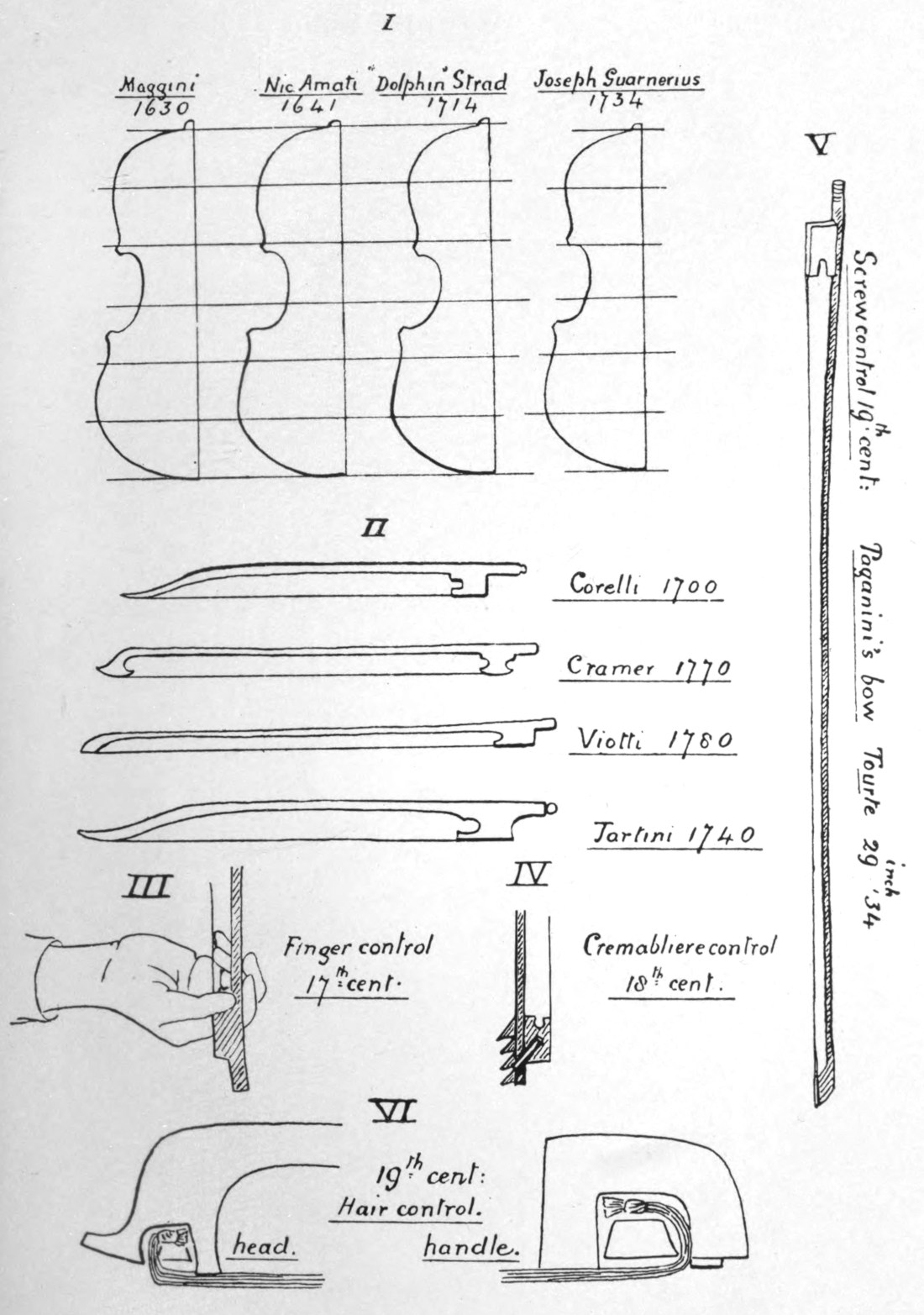
I
Maggini, 1630 — Nic Amati, 1641 — Dolphin Strad, 1714 — Joseph Guarnerius, 1734
II
Corelli, 1700 — Cramer, 1770 — Viotti, 1780 — Tartini, 1740
III
Finger control, 17th cent.
IV
Cremabliere control, 18th cent.
V
Screw control 19th cent.:
Paganini’s bow Tourte 29 inch ’34
VI
19th cent.:
Hair control.
head. handle.
[Pg 163]
As for our purpose the violin proper began in the eighteenth century with the emergence of its true type from the viol tribe, so for our purpose the violin bow begins with the emergence of the violin. A glance at the bows of Corelli (1700), Cramer (1770), Viotti (1780), and Tartini (1740) (Fig. vi.) will show the evolution in the direction of the Tourte bow; and although Tourte (1740) is generally credited with substituting the screw for the crémaillère, it will be noticed that Corelli’s bow (1700) has already got the screw. But is the Corelli bow authentic, or in reality a bow subsequent to 1740, the earliest working date of Tourte père?
With François Tourte, the younger son, culminated the art of violin bow making. He is the Stradivari of the bow. We give his portrait, but father and son were both master-workers. Although the Stentor (Fig. vi.) bow’s head has superseded, for some reason, the more rounded form of François Tourte, nothing has been done since in advance of Tourte, and “after Tourte” is still the greatest recommendation a bow can have.
It is easy to see what called forth François Tourte. He came in answer to a need. He doubtless heard of Tartini and examined his bow. It was comparatively short and cumbrous. Forty years afterwards Viotti comes to Paris, and with him dawns a new era in violin playing. Refinements and delicacies of tone, upper shifts and varieties of execution, various styles of bowing, dealing with staccato, arpeggio, and rubato, methods varied and brought to perfection, demanded qualities of balance, lightness, and elasticity which[Pg 164] would have been quite thrown away on the old sawing and scraping school of the seventeenth century. The very Cremona violins, beginning to mature as the century waned, called aloud for a suitable and sympathetic companion to caress, excite, charm, draw from them their sweetest tones and most vigorous powers.
François Tourte was rescued from the clock-making business, to which he had been early apprenticed, by the sheer bent of his own genius. His brother, who worked with his father, was not the genius, and, as is often the case, the father failed to see which of the two sons was to carry on the fame of the house, and there may have been jealousies and disputes besides. The poor stuff given François to work upon when, after eight years of watch-making, he was allowed to enter the parental workshop a little, suggests that he was the male Cinderella of the family.
He had to deal with strips of old sugar-barrels and fashion them into bows, which he sold for about fifteen-pence each. But as soon as he got a free hand he experimented with all kinds of wood, and arrived at the conclusion that the only wood suitable for his purpose was Fernambuc wood. It combined stiffness and lightness, but was very difficult to obtain, on account of so many ports being in those disturbed times blockaded. Fernambuc wood was only imported for dyeing purposes, and the price had risen in Paris to five francs a pound. Then, as only pieces with straight grain were required, whole trees might be cut up in search of a[Pg 165] few likely strips. This accounts for the high prices of Tourte bows, even when first produced.
They were doubtless largely labours of love with this matchless artificer, who could neither read nor write. The nut would be often made of tortoise-shell, jewelled with mother-of-pearl, and gleaming with a gold screw button. These cost £12, and would now fetch, if ever they came into the open market, fancy prices. His bows, mounted in silver with ebon nuts, sold for three guineas, and now fetch £30.
Tourte père originated the backward bend of the bow, which is not cut but artificially bent by heat; but both the father’s and the eldest son’s bows are held to be now too short for the strain of execution put upon them by modern players—not so François Tourte’s, and all bows made “after Tourte.”
He fixed the proportions—length, between 29·134 inches and 29·528 inches. The weight of the bend is nicely poised with the gold, tortoise-shell, or ebon of the nut; in each is a small wedge, as may be seen in Fig. viii., which nips the hairs and keeps them flat. The fine selection of hairs, 150 to 200 (modern exigencies require more, or up to 250), the careful flattening of it out, the preference for live hair, or hair combed out and not taken from dead horses who may have lain some time in the shambles; above all, the exquisitely graduated thicknesses, now held to be de rigueur, all characterise the intuitive genius of Tourte.
I say advisedly “intuitive genius,” for Tourte had no education but that of a watch-maker. This may,[Pg 166] indeed, have given him his fine sense of delicate and exact proportions, but it is still remarkable that examinations of the diameter of Tourte bows in different places give uniform results. The bows swell or taper in the same place, and as the air columns in the violins of Strad give the same note, so do the bows of Tourte yield the same proportions, which it has not been found safe or expedient to depart from.
Violin bows may be smaller or larger, i.e. shorter or longer, as far as I can see, without any detriment to Tourte’s principle; children, women, and exceptionally long armed men may have to use them, but the proportions, the wood, the balance, even the mechanique, must be left as Tourte left them—perfect.
The one point in mechanique in which the invention of F. B. Vuillaume may be thought to have improved upon Tourte is in his fixed nut for viola, tenor, or violoncello bows. This consists of a metal nut, which alone is moved by the screw up and down inside the main nut, which remains rigid; thus the length of the hair exposed for playing always remains the same.
The only other original maker of the first rank and excellence, who has been nicknamed the English Tourte, was John Dodd. He was born in 1752, and lived chiefly at Kew, and there he was buried. He was always out at elbows, even when his reputation was at its height. Poor Dodd had his friends and admirers. He was his own worst enemy; he was undersized in stature, and walked with a shuffling gait. He wore his clothes until[Pg 167] they were in rags, and a broad-brimmed hat somehow gave him an additionally dilapidated air.
I am afraid he drank, for although his habits were said to be regular, the most regular of them all was his four daily visits to the public-house, where he consumed what to less experienced topers seemed an immoderate quantity of a drink called “pearl.”
When the old fellow was known to be excessively hard up, kind Mr Richard Platt, a musical professor of the town, and Dr Sellé, who has given us some of the above details, came to the rescue. But the bow-maker tired them all out, and ended at last in the Richmond Workhouse.
I will not say whether he can be exactly cited as a frightful example of the degrading effects of liquor, for he died of bronchitis at the altogether respectable age of eighty-four.
Indeed, he had his qualities; no bribe or stress of want could make him swerve from his sense of what was due to his art.
His wood is as magnificent as his workmanship. He doubtless had his secret, but it was possibly one that he could not impart. He would take no apprentice, for fear he should learn the trick; and whether he could or could not teach it, he refused £1000 offered him by some one who wanted to learn it. Dodd’s bows are not very uncommon; he died only in 1836, and, strange to say, these true musical wands do not run into a five-pound note yet (1898).
John Dodd the bow-maker must not be confounded[Pg 168] with Thomas Dodd the fiddle dealer and varnisher, who employed Fendt and Lott to make the fiddles. John Dodd the bow-maker was the brother of Thomas Dodd. John lived in Blue Bell Alley, Mint Street, Southwark, before he went to Kew, but the rustic suburbs suited his habits, and as he had acquired a European reputation before he died, it little mattered where he lived.
Vuillaume of Paris made excellent bows, and even founded a school of bow-making. Many bows that don’t sell as his are stamped “d’après Vuillaume,” “scuola de,” which is certainly more respectable than a forged label to which violin dealers do so commonly resort.
Vuillaume’s hollow steel bows have never “caught on,” though good players have used them now and again. But then a good player can use any bow, and whilst a good bow is a luxury, a real violinist will be able to perform very respectably with a bad one. It is said that Paganini on one occasion excited the wonder and enthusiasm of his audience by performing on his instrument with a long churchwarden clay pipe, and at another time with a rush!
It would be unfair even in a sketch like this, which only professes to seize the salient point of general interest to collectors and amateurs, not to mention Jacques Lafleur (1760-1832), an admirable imitator of Tourte.
Lupôt, brother of the great violin-maker (1774-1837), was the first to line with metal the groove in the underside[Pg 169] of the nut, to prevent wear and tear of the ebony or tortoise-shell.
Domminique Peccate (1810-74) is also thought to have almost rivalled Tourte. He was originally a barber, and transferred the delicacy of hand required in tonsorial operations to the fine adjustments and elegant tapering and octagonal proportions of violin bows.
Peccate went to Vuillaume in 1826, stayed with him eleven years, and then became foreman to François Lupôt. He ended his life at Mirecourt, where he began it; latterly he worked entirely on his own account.
We have now among us one James Tubbs, whose bows are already known throughout the world owing to their attractive appearance and good balance. Time will alone decide Tubbs’ position in the scale of bow-makers, for time alone will determine the question of “last,” “warp,” and flexibility, and general endurance of efficiency.
On rosin, about which pages have been unnecessarily written, I have but one word to say—get it pure. You can do this by confining yourself to the best shops, or those who deal with them. Go to Hill, Chanot, Hart, Withers, and Vuillaume.
Some ignorant people talk of rosin as “greasing the bow.” Smooth horsehair or greased horsehair is, of course, useless. It is not the absence but the presence of friction which sets the strings in vibration; it is the surface of the horsehair, roughened by infinitesimal particles of rosin, which prevents the horsehair[Pg 170] touching the string with a continuous pressure, so that it receives in reality a succession of tiny shocks. This is what renders the succession of vibrations so rapid as to sound continuous.
Without rosin, the violin, in spite of strings and bow, and the art of all Cremona, would be mute.
To average rosiners let me give a word of advice, early given me by my old master, Ouri, pupil of Frank Mori: “Don’t rub the horsehair down smooth with long sweeps, but powder the rosin off into the hair with quick rubs and a light hand; in this way you avoid rubbing the oleaginous particles of the gum into stickiness.”
I notice that the best players use plenty of rosin and never let the bow get thirsty. I remember the matchless violinist Remenye taking up my violin and bow and calling aloud for rosin. “Why, you have no rosin on; you cannot expect the violin to speak without.” Yet I thought my bow had plenty of rosin on, but it was not enough for Remenye, who powdered it away in clouds. But please to remember that, however thirsty the bow may be, the violin does not require to drink, and the habit of smothering and smearing its beautiful smooth belly with thin glutinous dust is a most vile one, and worthy only of third-rate second violins at fourth-rate music halls. These musical galley-slaves may not have time to clean up; you of the Stradivari and the Amati violins and the Tourte and the Dodd bows ought to have, or you are no fit guardian of such treasures.
[Pg 171]
CHAPTER XII
VIOLIN TARISIO
This extraordinary man, originally an obscure Italian carpenter, at once created and answered that demand for Italian violins which followed both in England, and to a great extent in France, the rage for the German, and especially German of the Stainer and Klotz pattern.
Luigi Tarisio, like W. Forster, eked out the scanty income which he derived from making tables and benches for the peasants by playing dance music on a very poor fiddle at village routs.
He wandered from place to place, what time the vintages were being gathered in, and the simple folk, who turned out in their Sunday finery for a little relaxation and merriment, doubtless regaled the Italian carpenter with open-hearted hospitality, whilst he, in return, mended their benches and fiddled for them at the vineyard cabarets.
Our Charles Mathews has given in his delightful autobiography interesting glimpses of that free, open-air, open-hearted life; for he also, for a time, lived amongst these rustics of a favoured clime, enjoying their simple pleasures, and contributing in his own[Pg 172] peculiar way, by his histrionic gifts and a somewhat free-handed distribution of coin, to their revels and their needs.
Luigi Tarisio soon began to be dominated by the spell of his violin; he got to notice other violins, to repair them all in the way of trade, to possess them, not always very honestly, pitting his own growing knowledge of their merits against the ignorance or necessity of their owners. Gradually Tarisio the carpenter and Tarisio the fiddler seemed to be merged in Tarisio the cunning repairer and Tarisio the still more knowing buyer.
He bought chiefly by exchange, for money he had little or none; but he began in the early years of this nineteenth century to lead that nomad life—as it seemed to outsiders, the life of a common pedlar—which enabled him to glide without suspicion into half the sacristies and convents in Italy.
Wherever he went, bag on shoulder, and basket of tools in hand, his cry was not “knives to grind,” nor “shoes to mend,” but “violins to repair.”
He usually had with him a decoy violin or two, in the shape of common fiddles in good playing order; and over a glass of lemonade or a bottle of wine, in some local café or monasterial domicile of priest or cathedral musician, the cunning Tarisio would view with unaffected pity the miserable old battered Cremonas which were then lurking in a thousand ecclesiastical nooks, split as with the “wolf,” ill-adjusted, ill-strung, and generally out of sorts, and whipping out[Pg 173] his common fiddle in perfect order, would play a few notes on each, so manifestly to the disadvantage of the Cremona that an exchange was soon effected, and Tarisio would decamp with an Amati, a Strad, a Joseph or Bergonzi treasure, which, after a little clever mending, might be worth a fortune; and in this way he possessed himself, often for a few francs, of instruments which now fetch over £1000 in the open market—if ever they get there.
Tarisio, with the infallible instinct of a born collector and connoisseur, in a few years was able to gauge accurately the merits of the different great Italian makers. He knew exactly where to rank the Amatis, and how to separate the qualities of the great Nicolo from those of Andrea; he understood the supreme excellence of Antonio and the power of Giuseppe, and all other grades of merit of which even the admirers of the Cremona school in England seemed entirely ignorant of. All Amatis at that time were lumped together, and Stradivari and Giuseppe Guarneri were hardly known at all.
But Tarisio knew all this, and a good deal more, before he tossed his heavy bag of old violins one day over his shoulder and set out, they say, on foot, or anyhow else he could, for Paris; for what market was there in Italy for such priceless Cremonas when their owners were prepared to give them up for fiddles worth from five to twenty shillings?
But why did Tarisio go to Paris? He probably judged wisely that the Stainer craze, and the huge[Pg 174] crop of common violins then being made in Germany, would have killed his market nearer home. Then he must have heard when a boy how Napoleon I. had ransacked the art treasures of Italy, and how, under the advice of the cultivated Marquis d’Avèze, who had narrowly enough escaped the guillotine in 1793, the great conqueror had inaugurated a high Art Exhibition for the people.
The famous bronze-gilt horses from S. Marco, Venice, the Dying Gladiator, the Apollo Belvedere, the Cupid and Psyche from Rome, and Raffaello’s Transfiguration itself, had been carried in triumphant procession through the streets of Paris, and installed in a vast hall for the benefit and instruction of the people. Of course a rage for everything Italian was the result, and the shrewd Tarisio may have thought, why not a rage for old Italian fiddles?
One day in the year 1827 there arrived at the shop of M. Aldric, at that time a famous violin dealer in Paris, a travel-worn man in ragged clothes, who had begged and fiddled his way for days and weeks across country. He carried a huge dustman’s sack over his shoulder. He seemed to M. Aldric a very poor sort of pedlar, grimy and unkempt enough to claim kinship with the man who had “used somebody’s soap sixteen years ago, since when he had used no other.”
The fashionable violin dealer was at first inclined to show him the door, but probably something in Tarisio’s independent manner betrayed that indefinable quality we call character, and, more in amusement or out of[Pg 175] pity than with any serious intent to make a deal, M. Aldric allowed the pedlar to empty his sack of fiddles on his counter. It is easy to imagine his astonishment at what he saw; but he seems to have kept up his indifferent manner, not supposing the poor creature before him could be in the least aware of the treasures he sought to dispose of.
M. Aldric was soon undeceived.
He quickly found the tables turned upon him.
The clever French tradesman was conversing with the greatest violin connoisseur that the world has ever seen, or in all human probability ever will see, for no one can ever again have Tarisio’s opportunities, even should he unite in himself Tarisio’s extraordinary qualities.
Now, the pedlar, with all his enthusiasm and self-sacrifice, was a man of exceeding cunning, and had that tact, quickness, affability, and bonhomie which is well known to tourists in Italy, and has often proved so fatal to the amateur of old laces, pottery, and objects de vertu, or to such as may have tried to do a little fancy collecting as they passed through the Italian towns, and haggled over bargains in small curiosity-shops and market-places. So, with due astuteness, the shrewd carpenter had not brought his best wares on this his first visit; he had come on a voyage of discovery, and only produced a small pattern Nicolo Amati, and half a dozen Maggini, Ruggerii, and such-like. He had with him no Strad, no Joseph, not even a grand pattern Nicolo, but he had brought enough.
M. Aldric, concealing his emotion, and fervently[Pg 176] hoping the shabby man did not know the value of his wares, offered him a small sum for the lot, which Tarisio refused, doubtless with those picturesque invocations of horror to the Virgin and all the Saints which seem necessary to the Italian who attempts to convey to a “screw” the mingled indignation and pity excited in his generous and artistic breast by a mean offer.
Tarisio was certainly disappointed; but he forgot that he himself had to create the market; and so at last he left, with his empty bag indeed, but with his ragged pockets far from full.
Back to Italy, back to his monasteries and cabarets, a little dazzled; but, with unabated energy, he recommenced his search.
He was now beginning to be known far and wide as a clever repairer and a convenient dealer. As his stock of good, bad, and indifferent fiddles increased he could offer a greater selection, and readily parted with the worst ones, nicely done up, to his ignorant and confiding but not over-wealthy Italian patrons.
When next he journeyed to Paris he met with a different reception. Vuillaume, Thibaut, and Chanot the elder opened their privileged doors to him, and especially Vuillaume had the acumen to see that in Tarisio he had lighted upon what gold-diggers call a veritable “pocket,” and gave him higher and higher prices for the harvest of Amatis, Strads, Guarneri, and Bergonzis which now flowed steadily into Paris through this odd medium.
Tarisio was far more than a connoisseur and dealer;[Pg 177] he was a singular and most whole-hearted enthusiast. As the novelist Charles Reade (who was himself a great fiddle dealer and knew Tarisio) has well said, “The man’s whole soul was in his fiddles. He was a great dealer, but a greater amateur. He had gems by him which no money would buy from him.” Mr Reade then goes on to relate how once, when a splendid equipage rolled by him in Paris, the carpenter remarked, “He would sooner possess one Strad than twenty such carriages.” He would stalk the back or the belly of a valuable fiddle until he recovered the whole, just as the Roman antiquary stalked the fragments of the Hercules Farnese, finding the trunk in one place and the head in a ditch miles away.
Chanot had stumbled upon the cracked belly of a Strad violin in Spain. Ortega, the fiddle-maker, had sold the remainder, ribs and back, to a Spanish lady, fitting them nicely with a brand-new back made by himself! The precious belly caught Tarisio’s eye in the shop window, and he at last worried Chanot into parting with it for 1000 francs. Off went Tarisio to Madrid, extracted from the bewildered Ortega, who had sold the patched Strad, the required information, interviewed the donna who possessed the patched Strad, and who, after the fashion of the high-born Spaniard, at once said, “Sir, the instrument is at your disposition,” which only meant that she would part with it for a consideration, or what she considered to be the good round sum of 4000 francs. This was a mere bagatelle for such a treasure, which, refitted[Pg 178] with its own belly by Vuillaume, is now known as the Spanish Bass.
It was sold for £800, and exhibited in the south Kensington Collection of 1872 (No. 188).
On one occasion, says Charles Reade, Tarisio was crossing the Bay of Biscay with his famous Spanish Bass. The ship rolled; Tarisio clasped his treasure tightly and trembled. It was a terrible gale, and for one whole day they were in real danger. “Tarisio spoke of it to me,” continues his friend, “with a shudder. ‘Ah! my poor Mr Reade,’ he exclaimed, ‘the Bass of Spain was all but lost!’” As to Tarisio also being lost, that did not seem to matter so much!
It is not too much to say that, with hardly a memorable exception, all the great Cremonese and Brescian fiddles, which now command such prix fous, have passed through the cunning hands of Luigi Tarisio the pedlar, and most of them have at one time been benefited by the tender and artistic skill of Vuillaume, his great patron.
When Tarisio, who by this time wore a decent coat, and no longer carried Cremonas in a sack on his back, visited England in 1851, he was received by the whole trade as a person of rare quality, as indeed he was.
Mr John Hart took him to see Mr Goding’s unique collection. As one by one the owner took his treasures out of a glass cabinet, before ever he had got within two paces of Tarisio, he was amazed at hearing their names called out. A glance was sufficient. Tarisio had[Pg 179] had them all through his hands—the “King” Guarnerius, Lafont’s Guarnerius, the matchless Bergonzi, the Marquis de la Rosa’s Amati, Ole Bull’s Guarnerius, the famous Serafino ’cello, called the Beauty—all of which might never have reached Mr Goding had it not been for the enterprise and indomitable energy of the Italian carpenter who now stood before him.
Barring a narrow circle of dealers, it may seem strange that so remarkable a man should not have been more widely known and esteemed during his lifetime; but we can well understand that the restricted circle of dealers amongst whom he moved, did not find it to their interest to place their special Cremona “pocket” within reach of the wealthy amateurs out of whom they themselves were busy making their market.
Tarisio, had he been dealer first and enthusiast second, might have done better financially; but he did not do badly, and he wanted little except the privilege of handling Cremonas to the end of his life and dying in their good company.
He did both. Although there was a strain of geniality about Tarisio, he never seemed to unbend except in the company of fellow-enthusiasts; and as he was too cautious to give himself away to Italians, from whom he was gradually securing the spoils which built up his fortune, fame, and immortality, the only people who really knew Tarisio were the few foreigners like Vuillaume, the Chanots in France, John Hart the dealer and Charles Reade the novelist in England.
[Pg 180]
In his own land he remained to the end nothing but the quiet, unobtrusive repairer and occasional dealer in dilapidated fiddles.
It seems he had removed to Milan, where he was quite safely hidden, along with his fiddles, up in an attic at the top of a second-class restaurant in the Via Legnano Porta Tegnaglia.
No one was ever allowed to enter his room. He locked himself in, and he locked himself out. They saw him going up and down the staircase, and that is all they saw of him.
One day in 1854 Tarisio dragged himself up those stairs for the last time. Whether he had any premonition of his end, none may know—certainly no one was with him when he died—only it was noticed that he locked himself in, but came out no more; nor had he gone down to the restaurant for any of the necessaries of life.
At last the neighbours thought it time to ascertain what was taking place in that mysterious attic. They seemed to have watched his strange movements closely, but their efforts to find out who he was and how he lived had been hitherto fruitless, as he made a point of carrying on his particular and nomadic business at a distance from his abode. They were not going to be baulked any longer, so they knocked, but there was no answer.
At last they broke open the door, and a strange and piteous sight burst upon them. There, on a squalid couch, lay the pedlar, quite dead.
Around him all seemed chaos—piles of fiddle-boxes,[Pg 181] fiddles in and out of cases, tenors, ’cellos, violins in pieces and violins whole. Half a dozen Strads there; a Gasparo (afterwards Mr Bennett’s), a Ruggieri (Mr T. R. Bradson’s); about a hundred Italian fiddles, by different makers.
Here, too, was found the “Messie” or “Messiah.”
These trophies created little enthusiasm at the time, but to the joy of the relatives, two nephews, who had been hunted up with difficulty by the municipal authorities, a sealed packet was found containing valuable securities and a considerable amount of gold.
The rest is matter of common history.
The instant his friend and patron Vuillaume heard of the magician’s death he hurried to Milan, and visited the nephews at their farmhouse.
“Where are the fiddles?”
“At Milan; but we have six here.”
On the spot Vuillaume opened the cases. The first contained a splendid Strad, the second a Joseph del Gesù, the third a Carlo Bergonzi, the fourth and fifth two Guadagninis, and the last the famous Messiah, preserved by Count Cozio de Salabue, intact until 1824, when it was bought by Tarisio.
Vuillaume came to terms with the nephews for these six, and then lost not a moment in visiting the famous attic at Milan, where he found 246 more, which he bought at once for £3166, leaving the astonished heirs no doubt laughing in their sleeves, under the impression that the gobe-mouche of a Frenchman had been nicely hi-diddle-diddled by the wily Italians.
[Pg 182]
When we remember that a couple only of these gems would realise now more than the sum Vuillaume paid for the lot, we may well remember the proverb, “He laughs best who laughs last.”
A Vignette of Paganini.
I have advisedly steered clear in this collector’s volume of violin-players and violin-music, excepting in so far as they acted or reacted in any way upon the violin and its progress towards perfection. From this point of view, the growth of music appears to be responsible for the definition and survival (as the fittest) of the violin, violoncello, and double bass; and virtuosity is certainly responsible for the lengthening of the violin-neck and finger-board, the strengthening of the sound-bar to resist an increased string-tension, and the lengthening of the bow. But virtuosity can claim nothing more than these trifling details. The Strad pattern of 1684 to 1700 has remained completely unaffected by the feats, vagaries, or demands of soloists.
In this the grand pattern violin stands out in sharp and singular contrast to the old grand pianoforte. The imperious demands of Liszt and Thalberg, Rubinstein and his followers, have compelled a series of improvements in strength, sonority, delicate mechanism, and sensibility, undreamed of by the old firms, and only perfected by the later Erards, Broadwoods, Collards, and Steinways. But not a single substantial improvement [Pg 183]has been made in the violin since the last one left the hand of the great Antonio at Cremona, and not even a trifling modification of any sort has been adopted or applied to the grand violin of the golden period for at least a century. The excuse then for introducing the name and portrait of Paganini into this book is not because he reacted in the least degree upon the art of violin-making, but because he accepted it as an absolutely finished art, and asked for nothing which he found not in Strad and Joseph.
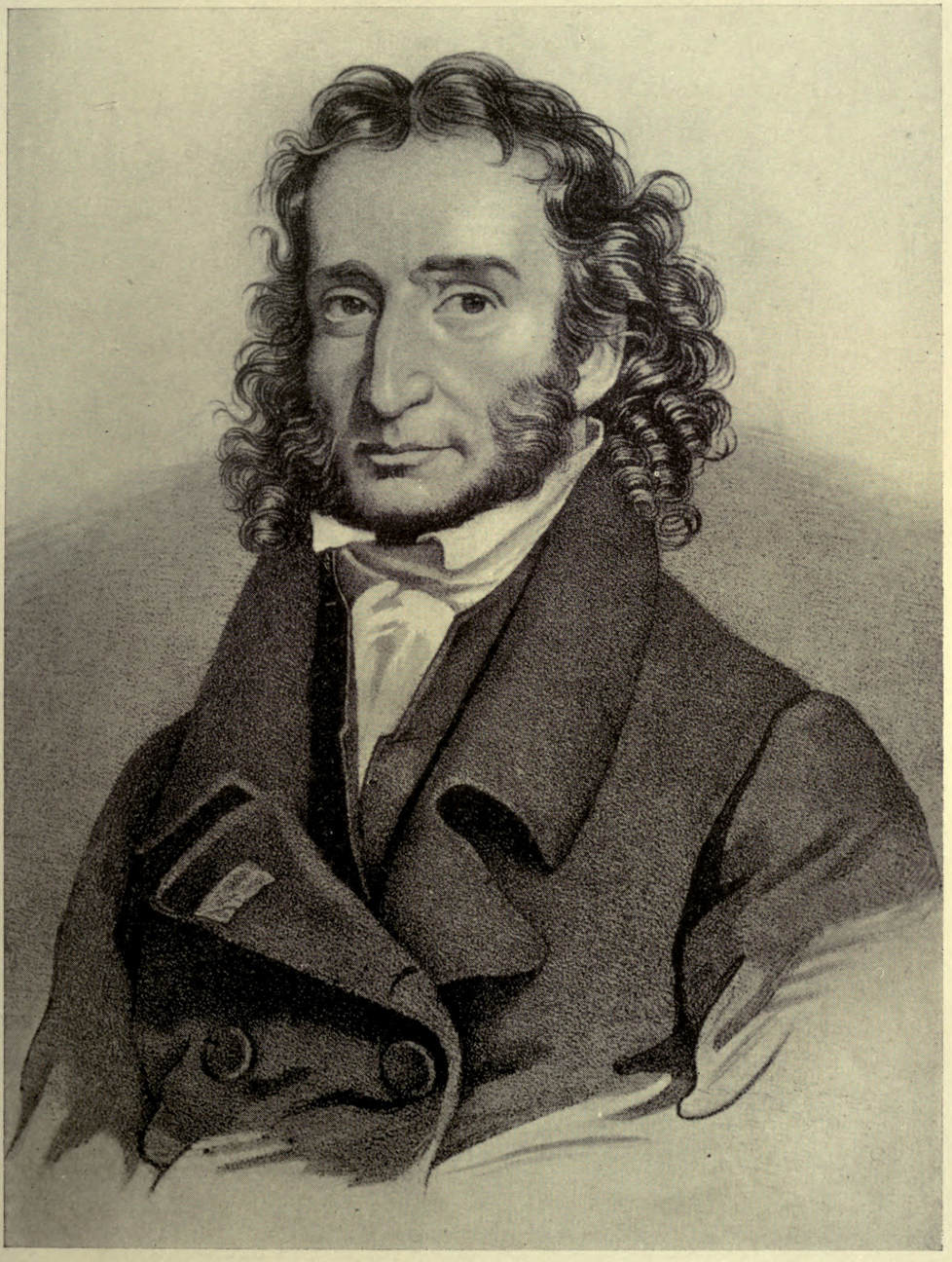
NICOLO PAGANINI
Now this is important and interesting, because Paganini was the greatest of all players in this culminating century of the musical art—a man admittedly unsurpassed in the opinion of violin experts like John Ella, Cipriani Potter, Onry, and others, who, for forty years after his death, listened to all the phenomenal violinists of an age which boasts of Ernst, Joachim, Wieinawski, and Sarasate and Ysaye. As it has not been possible to produce the face and figure of any of these great old makers, with the one exception of Lupôt, who belongs at best to the silver age, I have thought it worth while to glorify their work by reproducing the grand though eccentric face and figure of the one man who has invested their chef-d’œuvres with that romantic glamour, that almost unearthly prestige which the violin alone amongst instruments can lay claim to.
Paganini’s favourite violin, a Joseph Guarnerius, lies in its case under glass to this hour, open for all eyes to inspect, in the Town Hall at Genoa, his native town, to which he has bequeathed it. His dying directions,[Pg 184] that no one should ever play upon it, recall Shakespeare’s curse upon those who should move his bones. The great musician’s orders have not been quite so scrupulously observed as those of the immortal bard of Avon. In “My Musical Life” will be found my “Homage à Paganini,” together with a woodcut of Danton’s very fine bust, given to me by John Ella, who played in the orchestra among the violins when first Paganini visited England.
Nothing is so ephemeral as the fame of an orator, actor, or musician, unless they leave books or music behind them. Henceforth the phonograph may do something to give future generations some idea of the fascination which lived and died with them; but no phonograph will ever give us even a faint echo of Siddons’ declamation or Paganini’s playing; these are alike buried with the generation which they charmed and electrified. But in Leigh Hunt’s description of Paganini’s performance we have something like a pictorial phonograph, if I may hazard the hibernianism, of the “Pale Musician’s” mighty personality and power. Somewhere between the forties and fifties, I remember, as a very young boy, standing awestruck before a thin, gaunt, dislocated wax effigy of Paganini in an ill-fitting dresscoat, with wild dreamy eyes and arm uplifted high—just as Leigh Hunt describes him—before his bow came down like a crash of thunder on the strings; but let the lively and graphic essayist who heard him, speak for himself:—
“Paganini, the first time I saw and heard him, and the[Pg 185] first time he struck a note, seemed literally to strike it, to give it a blow. The house was so crammed that, being among the squeezers in the standing-room at the side of the pit, I happened to catch the first glance of his face, through the arm akimbo of a man who was perched up before me, which made a kind of frame for it; and there, on the stage in that frame, as through a perspective glass, were the face bent and the raised hand of the wonderful musician, with the instrument at his chin, just going to commence, and looking exactly as I described him—
To show the depth and identicalness of the impression which he made upon everybody, foreign or native, an Italian, who stood near me, said to himself after a sigh, ‘O Dio!’ and this had not been said long when another person in the same manner exclaimed, ‘O Christ!’ Musicians pressed forward from behind the scenes to get as close to him as possible, and they could not sleep at night for thinking of him.”
[Pg 186]
CHAPTER XIII
VIOLINS AT MIRECOURT, MITTENWALD, AND MARKNEUKIRCHEN
Mirecourt
Mirecourt in Lorraine has the glory of being associated from so early a date as 1566 with the Cremona workshops.
Andrew Amati, who made six small fiddles for Charles IX. about that time, employed Nicolas Renauld of Nancy, who was a pupil of the celebrated Mirecourt lutist Tywersus, to assist him in finishing these important court orders, which did so much to establish the supremacy of the “petit violon” over the crowd of competing viols which then held the popular ear, and, as we have seen, died very hard.
The great princes of Lorraine occupied a castle of pleasure called Ravenel, at a short distance from Mirecourt.
These accomplished noblemen, touched with Florentine culture, often made excursions into Lombardy, and delighted in the refinements of the Italian princedoms and duchies.
They brought back with them pictures, ironwork, laces, musical instruments.
[Pg 187]
Tywersus, their private lute-maker, was deeply influenced by the work and models of the early Amatis, and from the school of Tywersus came Nicolas Renauld, Jean Medard, and Nicolas Medard. When Amati left Paris, whither he had gone to present his violins in person to Charles IX., he left behind him Nicolas Renauld, who slipped into the lucrative post of luthier to his French Majesty, and we find his friend and co-worker Medard installed in the same fat office under the Grand Monarque, Louis XIV., who, with his expensive mistresses, certainly spared no money or patronage to secure those who could in any way minister to the extravagant court pomp and artistic amusements of the Pompadour and the Petit Trianon.
Meanwhile Mirecourt, in the heart of the Vosges mountains, with easy access to the grand timbers of their ancient forests, within beck and call of Lombardy, and in close touch with the great Italian fiddle-makers, Mirecourt long held supremacy as one of, if not the most important mart of fiddle manufacture.
It shared with Mittenwald and Markneukirchen the honour of supplying that rapidly growing violin market which was now springing up, and whilst Cremona made largely for home consumption and a few foreign courts, Mirecourt undertook the more modest but equally useful duty of multiplying Cremona school violins, which circulated far and wide throughout the French provinces, and frequently reached our own shores; indeed the fiddles often passed for Cremonas.
The popularity of these Cremona replicas brought[Pg 188] on that inevitable deterioration in quality which always follows over-rapid production and cheap wares, and at one time Mirecourt, in spite of its elaborate industry, was fast becoming a byword for bad fiddles. Happily the danger was seen and speedily checked, and Mirecourt now stands out as perhaps the greatest and most excellent emporium of modern violin manufacture.
All who wish to know what can be known, go to Mirecourt, just as people who study art go to Rome and Florence, or people who study the fashions go to Paris.
To Mirecourt we owe Rambaux, who was born there in 1802 and died there only in 1870.
Francis and George Chanot both came from there.
The Lupôt family are claimed as natives of Mirecourt, although the greatest of them, Nicolas, whose violins run some of the finest specimens of Cremona very hard, was a native of Stuttgard. His father was a Frenchman, and came from Mirecourt. All his traditions belong to Mirecourt, and these, as we all know, he carried with him to Paris, where he died in 1824, and was succeeded by Gand.
The names of Maucotel, Medard, Menegand, Silvestre, and Deragay, and above all Vuillaume, must always shed an imperishable lustre upon the little town in the Vosges mountains.
Every one of the Vuillaumes, eight in number, including the immortal Jean Baptiste, were born at Mirecourt. Two settled at Brussels, three at Paris, but all the others lived and died at Mirecourt.
William Ebsworth Hill was careful to send his sons[Pg 189] to this celebrated school of violin art, and we may be sure that they did not come away until they had possessed themselves of everything that Mirecourt had to teach the violin maker or the connoisseur.
M. Thibouville Lamy of Mirecourt, who has trade branches in Paris and London, manufactures a violin at about 3s. 10d. cost price, selling at about 4s. 6d.; but Markneukirchen probably leads in cheapness and quantity, if not quality, turning out quite playable fiddles for the modest figure of £1 to £2, 10s.
The best Mirecourt fiddles will fetch from £6 to £10.
The Grand and Bemardel prices range from £16 to £20.
The ever-increasing demands for “trade fiddles” of all kinds, as distinguished from the solo violins reserved for the use of virtuosi, has called forth an abundance of fair makers beyond the limits of Mirecourt, Mittenwald, and Markneukirchen.
In England it is enough to mention such names as Hill & Sons; Duncan of Glasgow; the Chanots, London and Manchester; the late Furber, London; in Paris, Bernardel, Silvestre, Germain, Audinot, and Chardon; in Vienna, Zach, Bittner, Lembök, Voigt, Guttermann, Rampfler; in Munich, Sprenger; in Frankfort-on-Maine, Lenk; in Breslau, Liebich; in Brussels, Darche; in Lille, Hel; in Milan, Marchetti; in Turin, Bros. Guadagnini; in Cremona, Ceruti; and for further general information the reader may consult the tolerably exhaustive catalogue index of makers at the end of this volume, for the bulk of which I am indebted[Pg 190] to the studious and admirable labours of Miss Stainer. Her booklet is entitled “Violin Makers,” and it forms one of the music primers of an educational series issued by Novello & Co.
Mittenwald.
In old days Mittenwald, quaintest of Bavarian towns, with its frescoed houses and its picturesque river-side, for it is on the banks of the dear Isar, overshadowed by the Wetterstein and Kurwändel mountains, was a town of considerable importance from very early days as the halting-place for the Romans on their way to the Danube.
It long retained its peculiar caravanserai character, which resulted in the establishment of the handy mart or Mittenwald fair, for which in more recent times the place was chiefly famous. After the removal of the fair to Bozen, the importance of Mittenwald began to decline; trade and commerce suddenly seemed to have made unto themselves wings, until one Matthias Klotz, who in his boyhood is said to have been apprenticed to no less a person than the great Nicolas Amati, settled at Mittenwald, and wrote up outside his house: “Matthias Klotz, Geigen Macher, im jahr 1684.” The prime hazel and maple, to be found in the Wetterstein hills, is of splendid quality, and the woods, then close up to the town, were full of old trees.
Thither, before the days of Matthias, was wont to come a dreamy, ill-regulated sort of person, who excited[Pg 191] the curiosity, and perhaps ridicule, of the villagers by tapping their trees with a hammer and then putting his ear close to the wood to hear the sound.
They thought he was mad, and he did go mad from worry and want, but the sanest thing he ever did was to tap those trees and listen to the sound.
His name was Jacob Stainer.
Matthias Klotz was only nineteen when he came to Mittenwald, but by this time the Mittenwalders, who had heard how the eccentric tramp with the hammer had gone back to Absam and made the place famous by his fiddles, were prepared to receive the young workman with favour and hospitality, for they hoped he might do something of the kind for Mittenwald.
They were not mistaken. One year before Klotz arrived at Mittenwald, Stainer had died incoherent and insane at Absam, and now that the greatest of German makers was dead, Mittenwald was soon destined to become noted in its turn for its fiddles.
It is generally affirmed that Klotz was a pupil of Stainer. Certainly his relations with Nicolas Amati are not very well defined. The probabilities are that he was a pupil of both—in the sense of being familiar with their work. The fact that his violins are sometimes mistaken for Stainer, points to the strong Absam influence which was upon him—it could hardly be otherwise—whilst the tendency noticeable in the fiddles of his son Sebastian, who certainly did visit Cremona, to bring down the model flatter than was fashionable at this time, indicates that the firm at all events[Pg 192] reflected the later Amati model of Nicolas, who died the very year Klotz came to Mittenwald.
Had Matthias or Sebastian Klotz attended to the methods either of Stainer or Amati more carefully, they would have observed that wood cut in spring with the sap in it was not calculated to last like the drier autumn timber. Whether from haste or ignorance, the Klotz wood, especially that used by Matthias and Sebastian, is sometimes found to be worm-eaten, but Sebastian’s fiddles are much esteemed. His brothers, George and Egidius, and his nephew, Joseph, son of Egidius, all made fiddles of the same type—varnish running from yellow to brown, and laid on rather more lavishly than was the habit of Matthias, founder of the firm.
The Mittenwald industry, although now less prolific than that of Markneukirchen, preceded it in point of time, and undoubtedly it was through Bavarian Mittenwald that the Cremona influence reached Saxony.
Master Reiter, whose teacher was Johan Vauchel of Wurzburg, is now the most prominent Mittenwald maker, and Herr Neuner, who was a pupil of Vuillaume, directs the school and factory. The school instructs about twenty boys, and is under Government.
Out of eighteen hundred Mittenwalders, three hundred are fiddle-makers.
The place provides from fifteen to twenty thousand instruments per annum, including zithers and guitars. I will not say that Herr Reiter, who is an artist versed in the old secrets and the old enthusiasms, is personally[Pg 193] responsible for the “trade fiddles” that annually pour from the Mittenwald workshops. He himself has made comparatively few fiddles, but he supervises them all, and remarked to a visitor the other day, “I, Master Reiter, never let one go out of my hands that has not been thoroughly tested, and I have sent out into the world, to Russia, to America, Athens, and where not, some two hundred violins and twenty-five ’cellos, besides having repaired some four hundred others.”
Markneukirchen.
Quiet resting-places, secluded valleys of the Tyrol, mountains of Saxony!—Mittenwald, Markneukirchen, Mirecourt; sleepy Italian towns!—Brescia, Cremona, once provincial villages like Mirecourt, far from the stir of mighty cities!—such retreats seem to have been ever favourable to the development of violin manufacture. Something, too, of simple and almost naïve religious sentiment has entered into the production of the earlier violins, most of which were, after all, chiefly intended for the sanctuary, Catholic or Protestant.
The arts and craftsbook of the Worshipful Guild of Violin-makers of Markneukirchen, 1677 to 1772, has lately been unearthed and translated by the many-sided and indefatigable Heron Allen, and it throws a kind of sudden flashlight upon the origin of an industrial centre which has since become one of the most famous emporiums of violins “made in Germany.”
[Pg 194]
Here we read how a mere handful of masters and workmen went out from kith and kin into a wilderness—some would say a paradise—for the sake of worshipping God in their own way—that is to say, the new reformed Lutheran way. They settled, to the number of sixty-six, about the year 1627, at the retired and mountainous village of Markneukirchen. The old book which records their uneventful annals begins characteristically enough with, “In the name of the Holy Trinity, Amen”; and then follow the names of twelve families, the principals being Reicher, Hans George, Polles, Gaspar, Schönfeldes, and Gaspar Hopf; and from this modest nucleus, emigrants, chiefly from Graslitz, grew the famous Guild, which by-and-by was responsible for scattering abroad violins innumerable, labelled with every known name, and of quality good, bad, and indifferent; for it is a notable peculiarity of the Markneukirchen makers that, whilst they were compelled by the rules of the Guild to produce diploma instruments and others of recognised quality, the cost of production has got down as low as about four shillings, and a very playable instrument, labelled Stradivari, is actually sold for a sum not much above that astonishing cost price.
Many of these workers were all-round men, and did not confine themselves to fiddle-making. Thus, Carl Frederick Jacob was carpenter, locksmith, and general instrument maker; one Andrea Gher, 1587, was a schoolmaster; whilst Gasper Reichel was a barber. Gottfried Pitz was admitted to the Guild on easy[Pg 195] terms, because he had served his country as a cavalry soldier.
The master-workers were mostly people of some substance. They had to pay a tax of one florin on being admitted to mastership; but sons of a master were admitted on a reduced fee of five florins.
Most of the masters were expected to have a decent house, with a room large enough to entertain the Guild with their wives at a banquet on their installation. As this cost some money—there were various ways of lightening the burden when the candidate happened to be a desirable addition to the Guild—he was allowed to pay in instalments, or part was remitted by favour. A popular means of effecting economy was to propose to marry the daughter of a master; that at least staved off payment. The apprentices often got in cheap that way.
Hans Adam Narlitzer, who “intended” to marry a master’s daughter, was admitted on reduced terms, on the understanding that, if the match did not come off, he was to pay up in full.
One Kretchman also “intended” to marry the youngest daughter of Hans Martin Schönfeldes; also Johann Christian Envel, in 1761, had “half a mind” to marry the youngest daughter of Reichel, and was admitted for ten thalers; but in case he could not make up his mind to marry the girl, or any other master’s daughter, he would have to pay thirty-one thalers. In no case is it recorded that any of these gentlemen failed to marry as per contract; the masters’[Pg 196] daughters probably took very good care of that, or would have sufficient influence to suppress the fact of their rejection.
With the spread of the Reformed opinions, there at first arose a certain demand for violins in the new churches; but the rigid Lutherans soon smelled the odour of abuse and reversion to Romanism, and discouraged any approach to ornate services, or an over-supply of instrumental accompaniment. A decree that the violins used in Church should be reduced in numbers naturally spread consternation throughout the little country town; but the growing demand for stringed instruments of good quality for secular bands soon counteracted the effect of sectarian bigotry and clerical parsimony; and when one Joseph Haydn, bandmaster to Prince Esterhazy in Vienna, practically founded the modern orchestra with its symphony, and created the modern oratorio and quartet, the demand for violins and basses led to a prodigious development of the Markneukirchen industry; and as the masters not only had ready access to the best Cremonese models, but were surrounded by some of the finest maple timber in the world, felled in forests full of seasoned trees hundreds of years old, the fame of the Markneukirchen makers soon spread throughout Europe.
At Mittenwald a similar community flourished, and the crop of German instruments made, and still made, by these enterprising artificers have flooded all the orchestras of the world, providing them with samples of every maker, from Gaspar and Maggini to Stradivari,[Pg 197] the Guarneri, Bergonzi, and Guadagnini. The Mittenwald makers owed their inspiration chiefly to Egidius Klotz, pupil of the great Stainer. They were as famous for their fine hazel-fir timber as the Markneukircheners were for their maple; it was also through the Mittenwalders that the Cremona methods filtered readily into the more northern region—Markneukirchen, Prague, Nuremburg, Wurzburg, and Franken.
The increased demand for instruments resulted necessarily in a tendency to deterioration, which did not escape the attention of the Guild, and rigid rules were drawn up, called “Beneficent Mandates for the Suppression of Abuses.”
Every master had to prove himself equal to producing one masterpiece as a sample of his skill, though it was freely admitted that a cheap demand involved a cheap type of instrument, which could not be expected to rival the diploma standard of tone and finish.
The quaint record of the Markneukirchen arts and craftsbook ends with the year 1772, and with the words “Deo Gloria.” Since that date the names of Reichel, Schuster, and Paulus have all been en evidence at various European Exhibitions as medallists and exhibitors of distinction; but, after a great fire in 1840, a good many families left the town, and thus the old centre became like a flower that had overblown itself, and began to obey the inevitable law by which a mature centre distributes itself gradually, losing as it were its own central wealth in its circumference, as the seeds of the dandelion get blown abroad over all lands.
[Pg 198]
CHAPTER XIV
VIOLIN TREATMENT
The notion that the more a fiddle is knocked about the better it is, is similar to the theory that the more you knock about a horse the better he goes.
A good horse will take a great deal of spoiling, and so will a good fiddle. Your well-bred beast, even when broken down, if you turn him out to grass and attend to his ailments, will recover marvellously, and so will a violin, if you glue him up, readjust his nervous system, keep him dry, and coax him a bit.
The delusion that a fiddle is all the better for being maltreated is due to this:—Many people observe that their old, battered, disorganised fiddles, which went into the skilful repairer’s hands sounding like tin kettles, come out with the true Cremona timbre; but that, my deluded friend, is not in consequence, but in spite of the knocking about to which your favourites have been exposed.
The fiddle-doctor has attended to your violin’s internal economy, and gently healed its bruises, killed the wolf or fiddle stomach-ache from which it was suffering, glued tight the rattling back, ribs, belly, fixed the loose sound-bar, and readjusted your Cremona’s[Pg 199] very soul (l’âme du violon), which is the sound-post and so it fares well; but remember, ’tis better to keep a fiddle in repair and use than allow it to get out of both, and go a mere wreck to the workshop.
I am not forgetting, when I say “use,” that the incessant and continued playing upon an instrument is said to result in its getting what Joachim calls “played out,” and that collectors have been great benefactors by withdrawing choice instruments from wear and tear, giving them thus long periods of suspended animation; but, as a general rule, so long as a violin lasts—and how long it will last is still a vexed question—fair wear and tear and attention is just as good for a fiddle as work, exercise, and cleanly habits are good for man and beast.
Neglect is never good; knocking about is never good!
Lay it to your heart, O young player!
What is that precious thing committed to your care? You have brought it home from the auction-room—your Amati. There was a conspiracy to keep down the bidding. An influential dealer wanted to buy it cheap, having already half sold it in advance for twice as much as he meant to give; he went up to £40 at the auction and stopped, but you were the dark horse and made another bid; he winked at the auctioneer, supposing it to be a bogus bid; the man with the hammer paused and looked at the dealer, who shook his head; for once the dealer had been too clever and lost his Amati for a £5 note. It was knocked down to you.
[Pg 200]
You get it home; there is something wrong about it; the timbre of the A string is unequal—sweet, but too weak—it has a crack in one rib.
You don’t expect a trumpet-sound like that of a Joseph, or quite the bell-like ring of a Strad, but you do mean to have a quality like the ripple of water—a round, soft, and incomparably sensitive and intime tone, not to be surpassed by Strad and never reached by Stainer.
Of course your early Nicolo has got to be overhauled. He has got a crack—perhaps more than one. Why, he is already more than two hundred years old, and may have a mark of the young Stradivari’s chisel about him. Of what attention is he not worthy! Take him to a subtle violin medicine-man, who will at a glance see what he has got to deal with, and will sit down before him and think!
He will then take him up, handle him, tap him, pull him to pieces with excessive care and reflection. When you get him back, you may still be not quite satisfied, but wait. Your treatment has to begin where the fiddle-doctor’s ends.
The convalescent home comes after the hospital—your house is the convalescent home.
The glue must dry; the changed sound-post must grow to the newly-directed strain and tension of the vibrating boards; the refixed flanks must learn to deal with the air column, and the filled-up crack, by constantly thrilling with the rest, must have time to forget that it ever was a crack!
[Pg 201]
Be not impatient. Play upon it gently at first, and by-and-by draw out its tone; lay it aside and watch that no harm comes to it; let it lie open, with a soft silken wrapper on the strings—near, not too near the fire; it must not get hot, but, like good claret, just the temperature of a comfortably warm room.
Think of it in winter as you would think of your pet canary; don’t let it get chilled at night; let it be in your own bedroom, or wherever there is an atmosphere and temperature fit for a well-cared-for “human.”
’Tis half human; ’tis caressed by your hand; it lies close to your cheek; ’tis breathed on by you when you press it, in moments of rare inspiration and musical trance, between your chin and your left breast, where its vibrating back actually feels the pulses of your own heart. The waves of sound that you generate from it are saturated with the magnetism of your touch; the trembling pressure of your fingers comes from the shaking of your own life-blood as it beats in the mysterious valves of the heart, and seems to mingle with those more than atmospheric, those psychic waves which travel out upon the air in a flow of magic sound conveying your inmost self to the inmost selves of others!
So this half-human thing must live with you and be cared for by and fare with you, and be kept in good humour.
See that no clot of dirt be in its case, no speck of rosin to vex and fret the smooth amber-coloured back. Take it out lovingly; polish it with soft handkerchief;[Pg 202] keep it shining wherever the varnish still shows up, and scrupulously clean elsewhere.
The vile notion that a coat of rosin does good, and may be left with advantage like a festering mass on the belly underneath the strings, is a most grievous delusion!
Why suffer the corrosion of the varnish with a foreign substance to remain there more than on any other part of the wood?
Rosin is for the strings, not for the belly, and the strings are for friction, and are intended to be scraped through and worn out and replaced, but the belly is for vibration and is never intended to wear out.
Your rosin is life to the strings, enabling them to speak, but ’tis death to the wood, stifling its pores and striking it dumb!
Never touch your violin with oil, or spirit, or colouring. Only a skilled repairer can venture to do that, and even he will not always be wise.
I have seen really good old instruments too much cleaned or daubed over ruthlessly with muddy brown varnish, much, as Ruskin says, he saw men with knives and mops of paint at Venice scraping away and splashing over with raw blue the vast old faded skies of Paul Veronese!
A spick and span mania seizes at times upon restorers of all schools.
A relative of mine had a Spagnoletti restored to him by a cleaner, but so repainted as to be worthless.
Have not half the cathedrals in the land been disfigured[Pg 203] by whitewash, starched and bleached just like so much dirty linen, and the old frescoes obliterated like so many disfiguring stains; and even now, in these more enlightened days, how many old carvings have been replaced by modern routine-work sculpture, whilst the walls, façade, and floor of grand old St Mark’s at Venice have been smeared over with Salviati’s modern mosaic. Thus have I seen a Maggini botched and browned over so completely with bad German varnish as to leave only faint traces here and there of the original coating.
Never in the matter of varnish dare to replace what time has stolen; that loss of old varnish is a tribute paid not ungrudgingly to “the Vandal years,” who have spared the life and been unable materially to injure the fabric of the rare old instrument. Above all, thou favoured guardian of a Cremona, never let it get near damp, or suffer from any other mouldering or corrosive influence.
A friend of mine, finding that the worm had got into his violin case, which contained a Guadagnini, proceeded to saturate his case with benzoin, and before it was properly dry replaced the precious instrument, with the result that the old varnish was brought up in blisters all over the back, which is now one crinkled mass, as rough to the touch as a nutmeg-grater. The varnish was completely ruined, and what is worse, the violin has never sounded like itself since; a clear proof to my mind that the varnish affects the tone, or at least that damaged varnish impairs it.
[Pg 204]
It is not at all an uncommon thing to find a violin, which has been left unplayed upon for some months, sulky when first taken out.
Do not be rash or fidget with the bridge or soundpost. Warm the fiddle up gently; rub it lightly with all due care, and play on it without taking any notice of its temper; go on for a couple of hours; you will find, to your surprise, that it has recovered all its own sweetness and charm, and will be ready to charm you with the delightful sensitiveness of its response. All that was really wanted was for the temporarily disused channels of vibration to be again filled with sound—the pores—the desiccated hollows to be once more shaken up in the old way. The instrument has really gone to sleep—some of its nerve currents have got sluggish—that is, the desiccated powder molecules have stuck in the pores and must be set rolling again. But, like one just awakened, the fiddle takes a little time to be “all there,” as the idiom runs.
Something similar may be observed in a large hall. When, after the atmosphere has been quiescent for some time, speaking first begins, the speaker will not be heard well; the atmosphere is stiff, and only when the whole of it has been set in vibration—and that takes a little time—does it become sensitive and sufficiently elastic to be capable of transmitting the slightest inflections of sound.
There is, again, an electric as well as an atmospheric and molecular state of the air and all other vibratory substances, but this is a side of acoustics extremely[Pg 205] little understood, and can only be dealt with empirically by speakers, singers, players, and especially handlers of violins, who will instinctively make use of some laws which they do not understand, and which indeed do not yet seem to have been correctly formulated.
I feel that something ought to be said about the position of the sound-post, though frankly I would rather not say anything.
Whatever advice one gives is certain to be wrongly and mischievously applied.
Technically, the sound-post should be a little behind the right foot of the bridge, if you look from head to neck, which is of course the left foot if you look from neck to head. It ought also to be straight—if it is aslant—unless the surface of the ends be cut on a slope. Of course it clings but partially to back and belly, whose throbs it is intended to blend; a little too near the bridge will often produce a light hard tone; a little too far will tend to a loose, muffled, or tubby quality; a little to the right will brighten the right string at the expense of the left, and vice versâ. Get it exactly in the fit place, and you attain the utmost sensibility and equal sonority of which your violin is capable. But so capricious are the vibrational laws, and so subtle are the peculiarities of each violin’s nervous system, that the position which at first has failed to yield good results will ultimately be found to have won its way to the heart of your violin, the instrument adjusting itself to what was at first an[Pg 206] uncongenial treatment of its nerves, until the nerves learn to sympathise, and even rejoice, in special directions of pressure and tension induced by the sound-post. When this happens, better let well alone and don’t attend to outside advice of experts.
It is seldom wise to encourage an amateur, or any but a skilful hand, to trifle with the position of the sound-post. If it must be moved or has fallen down, why then by all means take the advice of an expert; go to the doctor.
The same sort of advice may be given about the position of the bridge. Granted that you have a bridge which suits your instrument (and the importance of this I have elsewhere dwelt upon), then consider whether ’tis worth while to move your bridge at all. The two little side slits in the ∫ ∫ indicate approximately the position of the bridge; let a violin-doctor determine the right height, which, remember, must be modified according to its position, and the slope and elevation of the finger-board. But here again there is a vague and subtle margin for readjustment; the importance of the bridge’s position is of course directly related to the whereabouts of the sound-post, as the bridge is a prime factor in dealing first with the vibrations transmitted by the sound-post from belly to back.
There are violins which gain brilliancy by the bridge leaning a little forward, but this is of course dangerous, as a little more, and down comes the bridge. The theory of course is for the feet of the bridge to grip equally at[Pg 207] all points the surface of the belly—flat and close, and with equal pressure. Now, if the bridge leans forward, the grip of the back part of the feet is slightly lifted, whilst the pressure of the front part is accentuated, and if it leans backwards, precisely the reverse takes place. Yet so capricious are fiddles, that some do not seem to like to have their bridges quite straight, and so they have got to be humoured.
Without grave cause I should advise not meddling with bridge or sound-post after they have been readjusted by a good repairer. He may not have been quite right; he may not have had the time or patience to deal with your malade imaginaire of a fiddle—for amongst fiddles as amongst people, there are malades imaginaires which baffle the profession—but your fiddle-doctor will be probably more right than you—fussy, irritable, discontented, inexperienced amateur, and, if you leave off tampering with the works, the fiddle will very probably adjust itself and get all right.
Then of course you must remember that whenever you touch the bridge you touch the elevation of the strings above finger-board. Put bridge back, you slacken the touch for the player by bringing the strings close down on the finger-board; put it forward or tilt it, and you lighten the touch; make it harder for the fingers by lifting the strings higher from the finger-board.
And now a word about your finger-board. This is generally made of ebony; the old masters used various brownish woods, choosing, of course, the harder ones, which they often inlaid beautifully. Sometimes even[Pg 208] they used ivory; you may perhaps have noticed that on some violins you have a difficulty in stopping fifths, or indeed any chords, in tune. This, unless you are a mere blunderer, comes from the state of your finger-board. You may not have noticed it, but you will observe that the strings, by constantly being squeezed by the fingers against the smoothly-arched surface of the ebony, have worn channels in the wood, but channels of unequal depths; the consequence is that the same pressure, forcing two strings down on unequally raised surfaces, fails to produce that relatively equal pressure necessary for producing your true fifth; the string also being sunk, it does not get the full benefit of the finger’s pressure, as the shock of impact will be broken by the higher level of the finger-board on either side of the sunken string.
In this way the tone quality as well as the intonation suffers from what so constantly eludes observation—a worn finger-board.
Of course a new finger-board, or the restoration of an old one, is a very easy matter, and can in no way affect, except for the better, any violin.
It may safely be said that no violin now in use has either its original finger-board or, for the matter of that, its original neck. Strings of very ill-assorted thickness are also responsible for imperfect fifths.
The management of the pegs sometimes presents difficulties to the novice. Rosewood, ivory, and boxwood have been tried, but ebony seems to be the favourite, though many incline, as I do personally, to[Pg 209] rosewood, which is less dense, and thus, in contact with the maple-head (which is again less dense in fibre than the rosewood), offers a less hard and violent contrast than does the iron ebony to the porous maple.
But the all-essential thing is for the pegs to be nicely fitted, and it is a vile practice to rosin the pegs to make them stiffer, or to rub them with lead-pencil or whitening to make them turn more easily.
If your peg sticks, it is either because it does not fit the hole, is not smooth, or because you have rammed it in too far in order to resist the pull of a string, probably coiled round and round the pegs in a tangled, twisted mess.
There never should be a need for this over-ramming in of the screw, nor would there be if, when you pulled up your new string to pitch, you immediately let it down, drew the stretched part tight, and then screwed up again, when you would find, instead of ever so many coils, you had reduced the number to one or two, which would at once lift the strain from your screw, and make it needless for you to force it in till it stuck and almost refused to move at all.
You should be able, when your fiddle is at your chin, to nip the peghead between the first and third joint of your forefinger, and adjust the pitch to a nicety and in a moment; but then the resistance of the screw must be so nicely balanced with the tension of the string as to allow of its moving easily when gripped, and keeping in its exact place when left.
It is a very strange thing that, whilst all sorts of[Pg 210] mechanical contrivances for moving violin screws have been suggested, and even tried and adopted for guitars and double basses, the violin retains its simple and primitive screw; nor would any one who lays claim to a decent position in the trade dream of advising a departure in this, or indeed in any other respect from the custom of the Cremona school and its successors.
Concerning the stringing of your violin, beyond the hints I have given with regard to the accumulation of evils round the peg, there is not very much to be said.
The quality, manufacture, preservation, and price of strings has already been dealt with; and here, as in everything connected with violins, there must be fine and sympathetic adaptation of strings both to the performer and to his instrument.
A young girl will naturally incline to thinner strings than a strong man, just as she will usually prefer a lower bridge, which will reduce the resistance because of the reduced distance between the strings and the finger-board.
Some players will prefer a thick first or third string, according to the quality of tone they are able to elicit; some a smooth or rather thin patent fourth in preference to the usual more roughly-coiled and thicker G string, which, however, is preferable for orchestral playing; but, as a rule, buy your strings according to gauge, if you can’t trust your eye, in a good shop, and you will not be disappointed.
Remember, as I have previously intimated, that any great inequality in the relative thickness of your strings[Pg 211] may be quite as much responsible for your imperfect fifths as an old channelled finger-board. Use plenty of rosin, and let the string be seasoned with it right up to the bridge, but not much, if at all, below the top of the finger-board. The rosin must be well rubbed in before you attempt solo work, as any excess of what I may call raw undigested powder will produce a most vile screeching.
The tone of a fine violinist never reminds you of the cat-gut and rosin. In the pure disembodied tone of Piatti, Joachim, or Sarasate we entirely lose the sense of all beggarly elements; they have suffered a change into “something rare and strange.”
The rough-and-ready way of testing false strings by setting them in vibration, holding by each end, and twitching till the double line is seen, and if a third line appears condemning the string as false, is a method often, not always, reliable. You can never be quite sure till you have put the string on. If false, you may get a true length out of it by trying another part; but, as a rule, if one length of a string is false, it is bad all through. A player, especially a soloist, should always have a length or two of stretched and tested firsts in his case, or, better still, in his waistcoat pocket, before he goes on the platform, unless he can ensure the presence of a second reliable instrument at hand in case of a sudden breakage.
Strings have every kind of vice short of downright falseness. You need not put up with wheezy or dull, or any sort of impure vibration, and beware of[Pg 212] laying the blame on the violin when the string is the offender.
Of course, if the sound-bar or the back or belly of the violin is loose, or the sound-bar askew, that will account for a good deal. By tapping all round the front and the back, just where these join the ribs, you can easily discover by a certain jar or rattle whether and where something is loose; it may be one of the blocks or linings.
Test the fiddle and you may acquit the strings; test the strings and you may acquit the fiddle.
You may sometimes experience a difficulty in playing the A or D string without striking the E or G; this may be due to your own clumsiness, but it may also be due to the curve of your bridge being too flat, or someone or more of the strings having eaten too deeply into the bridge.
If your hand perspire much—and all hands perspire—your strings, especially your E string, will rag out. It is difficult to say exactly at what stage in the ragging process it is advisable to change your string. It is strange, but true, that the tone of an old ragged string is not materially impaired. I have sometimes fancied that such thorough tough and seasoned strings are even improved in spite of age and infirmity. Certain it is that the smoothest string will go without warning, and the raggedest will sometimes hang on down to a mere thread.
Paganini perspired frightfully, so much so that he always carried a dry shirt in his violin case, and a gentleman[Pg 213] noticed that when he opened his case to take out his violin for a public solo, his strings were in rags.
I have sometimes observed that, oddly enough, a second or third string is less durable after it has ragged than a first; the wearing of the threads which compose the thick strings seems less hard and tight than those of the thin chanterelle, or the resultant material is softer and gets soaked and cheesy, and like cheese is readily cut through by the nails.
Lastly, the amateurish and falsely-assumed economical habit of slackening all the strings each time the violin is replaced in its case is a delusion and a snare; it only worries your instrument’s nervous system.
Slacken your bow, not your strings.
The violin gets accustomed to the normal strain, and adjusts itself to it, and resents being deprived of its due tension as much as an athlete would resent his dumb-bells being removed.
The strings are quite as likely to break by being constantly fidgeted up and down, and the violin is much more likely to get demoralised by the wearing action and reaction of a varying strain, than if you let it alone with all its strings at their accustomed pitch.
[Pg 214]
CHAPTER XV
VIOLIN DEALERS, COLLECTORS, AND AMATEURS
I Have come to the conclusion, “after long years,” that there are three things about which your averagely honest man has no conscience whatever—the first is a horse, the second is an umbrella, and the last, but not least, is a fiddle.
He will buy from some needy ignoramus a fiddle worth £100 for a £5 note, if he can. He will sell a fiddle which cost him £5 for £100, if he can. Truly, the caveat emptor of the ancient Romans covers a multitude of sins.
On the other hand, the extreme ignorance of many persons who have violins to sell offers singular temptations to dealers, who are a class of people constitutionally on the make.
In bygone days, people who did not play the violin used to be criminally careless about the instruments that happened to be in their possession. Cremonas might lie for years in damp attics, or hung up in disused cupboards on rusty nails, or away in the dust of ages on the top of old beds and cabinets. Even if the fiddle was ultimately stolen—borrowed and not returned—it[Pg 215] was thought hardly worth a serious inquiry; it “was all to pieces” or “only an old fiddle”; and, indeed, I have before now seen such with the belly off converted into serviceable dustpans.
Credulity has succeeded to ignorance, and now any one who has any sort of shabby-looking fiddle fancies he has got a rare Cremona!
He will advertise it unblushingly in the halfpenny papers, bring it gravely to supposed judges, and make a favour of even showing it to a dealer.
Nothing will shake the confidence of these simple folk in their spurious wares; they will bring out a common brown German dated Maggini, and you point out that Maggini never dated his instruments; they suppose you to be envious. Or they show you a Stainer rashly dated fifty years after that maker’s death (such an one was lately brought to me), with a label so recent that you wonder at the brazen fraud. As to the good and tolerably deceptive French copies of Strad, their name is legion, and for a moment a person fairly conversant with fiddles may be deceived by such a subtle and withal honest copyist as Lupôt, but to the eye of the experienced dealer the varnish is quite enough. The varnish that chips off instead of rubbing away, thus leaving the raw wood more exposed than permeated, is not Cremona varnish.
Of course as to the new labels in modern type I have nothing to say. No one but a complete fool in fiddles could be taken in by them.
Still, when all gross cases are put aside, there is an[Pg 216] excusable margin left for honest error, especially when personal interest is on the side of error.
I have very little doubt that my old friend, the late Mr Cox, well known as an acute picture dealer, really believed in a certain violin which he called the Red Knight. He bought it at the great sale of Gillott’s fiddles as a rare Joseph Guarnerius.
I would never tell the old man to his face that his Joseph was a very plausible red Landolpho copy of Joseph, and I was even weak enough to allow it to lie on the table of the Royal Institution side by side with the “Dolphin,” Enthoven’s Maggini, the Emperor of Russia’s Strad, a genuine Nicolas, a Joseph and a Jacob Stainer; in short, the Red Knight lay by favour for one evening in company with some twenty gems of worldwide reputation.
In the course of my lecture, to please my old friend, I took up the Red Knight, remarking, “Here is a fine violin labelled Joseph Guarnerius, once the property of Mr Gillott, now owned by Mr Cox.” I said no more.
A few weeks afterwards the Red Knight was sold for £300, partly on the strength of my having vouched for it at the Royal Institution.
Meanwhile the Jupiter of judges, William Ebsworth Hill, had been consulted by the purchaser, who, on finding that he had only got hold of a Landolpho, wanted his money back.
I think they would have gone to law if they could have counted on me as a witness; but when I was[Pg 217] threatened with a subpœna, I replied, “I would certainly go into the box, but should have utterly to deny that I had vouched for the genuineness of the Red Knight or expressed any opinion whatever about it except that it was ‘a good fiddle labelled Guarnerius,’ worth perhaps £60 but not £300.”
The upshot was that I was not subpœnaed. Mr Cox refunded the money and the buyer restored the fiddle.
No one doubts but what Mr Gillott, of steel-pen celebrity, did obtain, chiefly through Charles Reade of “Never Too Late to Mend” fame, a great many very fine fiddles, but I am afraid that Mr C. Reade was also responsible for some comparative rubbish like the Red Knight. Certainly I find a very dubious Strad tenor (one of Gillott’s) labelled 140 in the South Kensington collection. As to this particular collector’s specimen, if I grant him his belly and his sound-holes, it is about all that I can do—for Strad never threw that scroll nor touched with plane or chisel that back and ribs.
I brought home from Australia a so-called Peter Guarnerius—really an excellent violin—but it was no more a Guarnerius than a Strad, and was sold far under its value as a Camillo Camilli, which it probably was. But what will you? After all, a fiddle at any given time is worth what it will fetch.
The most impudent fraud or the most blatant delusion which has ever come under my notice was the so-called Maggini exhibited by Mr J. W. Joyce (110, South Kensington Exhibition, 1872).
[Pg 218]
It was made by Bernhardt Fendt, and I gave in the Pall Mall Gazette of the period its history and the names of its chief owners; but it was not removed, neither was the Amati tenor (No. 147), labelled and hung as Maggini, ever re-labelled, nor was a Klotz fiddle which bore a Stainer label ever corrected.
The only fraud I succeeded in dislodging was a spurious Bergonzi—also sent up by Mr J. W. Joyce—which after my attack on the South Kensington collection of 1872 disappeared.
The poor thing, no worse than the Bernhardt Fendt which brazened it out like a false claimant, was merely made a scapegoat of.
These be among the humours of your loan collections!
But we must be indulgent. Some mistakes are sure to be made, but it is only fair to remember that the fiddle world is vastly indebted to these grand fiddle exhibitions all the same. The exhibition of 1885 at South Kensington was not one whit less important than the 1872 show.
The 1885 specimens were more discreetly selected than those of 1872. They had the advantage of being largely controlled by Mr Hill.
Besides the usual supply of leading Italian makers, the English school was remarkably well represented. There was found a capital Ford, a maker who has not received due credit for his excellent work. A good Duke and Walmsley, and a yellow fiddle by Tobin, a man quite noticeable for the cut of his scrolls, which are always full of character.
[Pg 219]
There was an interesting John Lott, richly varnished. A romantic interest must always attach itself to this fine maker on account of his early Bohemian life, recorded by Charles Reade in a memoir called “Jack of All Trades.”
Charles Reade, who knew Lott intimately, tells us how at one time he travelled through Europe with a menagerie and became famous as the keeper of a most clever but vicious elephant called Djek, who, after killing ever so many men, had to be demolished herself with a cannon, and was then cut up for elephant steaks to feed the town.
It was only after the loss of Djek that John Lott came again to London and took up the fiddle trade, which he had learned in boyhood.
Joseph Hill, Lockey Hill, and Banks, were also well seen at South Kensington in 1885. There was also a matchless Urquhart, very venerable—Anno 1666—the date of the great fire of London, which happily spared it!
The Stradivarius case contained Mr Hill’s interesting 1732 Strad (now Ysaÿe’s violin), which, although made so late in his life, was signed by the old man, who after 1730, as a rule, had left off signing his instruments.
A truly serio-comic chapter might be written on the huge prices given for frauds. A friend of mine gave £200 forty years ago for a supposed Strad (which was only a Lupôt) at a time when £40 was a long price for the clever Frenchman.
A violin professor I know sold a very poor Strad the other day, but made a very good thing out of it.[Pg 220] When the lady showed it me, I took a liberal view, and said that £300 would have been a long price. Her countenance fell.
“Good gracious! I gave £600!”
“Keep it long enough, and anything by Strad will fetch that; but probably not,” I added, “in your lifetime or mine.” This was some years ago.
On the other hand, bargains in Strads and Josephs, Bergonzis and Stainers, are still no doubt to be got, but only about as often as bargains in Raphaels, Rubens, Rembrandts, or Tintorets; but amateurs of pictures and fiddles are mostly wrecked on school-pictures and school-fiddles, often getting fair money’s worth, but not what they pay for.
Betts purchased one of the finest Stradivari in the world for 20s. When John Lott opened it in Vuillaume’s presence, he found the original bass-bar. The bar—so Charles Reade tells us—was low and short, and quite incapable of bearing the strain of concert pitch, and John Lott replaced it with one stronger. The Betts Strad was sold to George Hart for 800 guineas—a heavy price fifty years ago.
Mr John Hart, father of George Hart, picked up a violoncello in Oxford Street for a sovereign or two. The timbre caught his ear as he passed three street-musicians—violin, cornet, and ’cello.
Lindley, the great player, came into his shop and bought a fine Forster ’cello for a round sum. This was the Oxford Street ’cello.
The destiny of violins has ever been one full of ups[Pg 221] and downs, and, like human beings, they have been literally kidnapped, as in the case of Spohr’s, which was lifted from behind his travelling carriage; shipwrecked, like the Peter and Paul, vide page 96; murdered by those Vandals who patch stray bits of slaughtered Cremonas into modern fabrics, and sold for slaves, as in last century, to be scraped in dim churches or ancient orchestras, until found out to be royalties in disguise by the Chanôts and Vuillaumes of the nineteenth century.
One would suppose that the stealing of a first-class instrument would be next to impossible. Hardly a fiddle of mark now exists which is not known to one or other of the great dealers in Paris, London, or Berlin; and whenever it changes hands, it is likely to come before them again for inspection and verification. Yet some of the famous Spanish Court Strads have vanished no one knows where, and another famous Strad from the Plowden Collection, whilst in possession of one of our diplomats at St Petersburg, disappeared, and has never since been traced.
Many years ago I left a Vuillaume, labelled Albani, in a railway carriage when I got out to take refreshment. I was not gone five minutes, but in that five minutes my Vuillaume had gone.
After the death of a well-known nobleman, a certain so-called Strad in an elaborate case, with finely-mounted bows, was submitted to Mr Hill for inspection. It was nothing but a common German fiddle; but Mr Hill told me he had no doubt that the original occupant[Pg 222] of the noble case had been stolen. Probably many such thefts have been committed by dishonest servants. Nothing could be easier than to substitute one fiddle for another in houses—and they are legion—where people do not know one fiddle from another, and where fiddles lie unused and unvisited in lofts and cupboards, I might almost say from generation to generation. No soloist who travels should fail to insure his treasure. Sarasate had a heavy insurance on his violin when he went to America.
But worse than theft is mutilation. The chances are that what is stolen, unless it be stolen deliberately to cut up, will some day reappear intact; but the chances are small that a mutilated instrument will ever collect its disjecta membra.
Still, as in the case of Tarisio’s Spanish bass, that too is possible, just as the recovery of the Hercules Farnese statue, before alluded to, was possible.
A well-known amateur whose Strad had been taken to pieces for repair and the pieces wrapped in bits of paper, on unfolding the fragments found the head missing. The loss seemed irreparable, but a day or two afterwards an old apple-woman picked it up in the gutter, and happened to take it to the very fiddle-shop charged with the repair of the Strad. That Strad head was worth just 2s.—to the old woman!
Nothing is easier than the perpetration of a fraud by a clever copyist if he chooses to attempt it. Incredible as it may appear, Paganini was shown by Vuillaume two fiddles, one of which was his own and[Pg 223] the other a counterfeit, and was quite unable at the moment to decide which was which.
Chanôt’s copy of the Carlino or Kerlino 1454 viol, No. 14, South Kensington 1872 Exhibition, completely deceived me until I had the opportunity of handling both instruments at leisure.
These frauds extend to bows. The Tourte and Dodd bows in existence that know not Dodd or Tourte are legion.
I should recommend my readers never to leave a valuable bow in their case when they send their violins for repair.
I lost a good Dodd myself in that way. Fine bows are not safe even in the orchestra anteroom; they get “changed.” It seems so simple to some people, when a bow, a crush-hat, or an umbrella happens to be lying about, to mistake it for their own and leave theirs behind, especially if it is inferior in quality to the one they chance to catch up by mistake! As luck will have it, ’tis seldom a worse one that gets caught up!
A friend of mine happened to leave a fine Tourte bow in his case, and then he sent his fiddle for repairs to a smart dealer who shall be nameless here. When the case returned, it had a bow in it, but it was a copy, and a very good copy, of a Tourte. In this instance the dealer restored the original under pressure.
In everything connected with a fiddle and a bow I say, Beware! Beware! Further, let me say to amateurs, not one in a thousand of you, even with practice and opportunity, is fit to judge of a violin; you may easily[Pg 224] know what suits you, and that no doubt for practical purposes is the essential. You can hardly know what is genuine.
Over and above culture and wide observation and experience, a certain instinct is required, and few are they that have it. Why, my friend, if William Ebsworth Hill, from whose judgment there was no appeal, got “his eye out” when only for a few weeks he left off looking at fiddles, or distrusted his own judgment on certain days, as to my knowledge was the case—for he was at once the most diffident and absolute of men—what chance have you? Why, none at all!
I will go further than this, and declare that half the violinists now before the public are no more judges of a genuine fiddle than my cook. A man may be a judge without being able to play, and a man may play divinely and not be a judge. At the same time Charles Reade’s opinion would have been even more valuable than it was had he played himself. He never would have written those foolish paragraphs about modern-made fiddles sounding as well as old Cremonas had he played himself. It is all the difference between a man who looks at another man on horseback and one who has got to ride the horse himself; the first may not see much difference in two horses, but the second soon finds it out!
Playing the fiddle won’t make you a judge, but you will be a better judge if you can play the fiddle. I remember showing Remenyi a very fine copy of Strad which had deceived many. He walked up and down[Pg 225] my room playing upon it with delight, and pronounced it a genuine Strad beyond a question. It was a Lupôt for all that.
As for your ordinary amateur, he will judge by an old-looking label, being unaware that forgers keep old battered counterfeit type in stock, or he will note the place of the little buttons which fasten the inner blocks, supposing that each maker had his favourite position for these buttons from which he never deviated. Others will prate about Strad’s wasp sting purfle running counter to the angle of his corners, or declare that one maker never made his back in two pieces, whilst another never made it otherwise.
But there is one mark occasionally found in old Italian violins which I do not remember to have seen forged or imitated, or indeed even so much as alluded to by any writer.
If the amateur happens to have an instrument with a little round hole in the back of his fiddle a few inches below the nut, filled up skilfully so as to be almost imperceptible, he may be quite sure he has got an old violin, probably one of the oldest, as the practice of falling suddenly on the knees and letting the violin hang, in processions in which the singers went before and the minstrels followed after, has long been abandoned.
That little hole, so cunningly plugged, shows the place where a slight chain connected the instrument to a button-screw or hook, so that at the elevation of the Host, the minstrel might suddenly fall on his knees[Pg 226] without the fear of dropping his fiddle. I have an old Andrew Guarnerius so plugged, and the violinist Oury first pointed this out to me and explained the reason of the plugged hole!
Scores have sent me descriptions of their fiddles, and expected me to pronounce on the genuineness of them, or are sure that they own a real Strad or Amati, because theirs (in their opinion) exactly corresponds to my description of Strad or Amati in “Music and Morals.” All this shows that the outside public have not the faintest inkling of true violin lore.
Oliver Wendell Holmes felt this when he wrote to me in 1885.
He had himself written very charmingly on the violin, and the passage is quoted with approval even by so redoubtable a critic as Mr George Hart in his admirable book “The Violin” (1887).
Oliver Wendell Holmes had the acuteness to see that all mere picturesque writing was valueless from a technical point of view, and he thus expresses himself to me in a letter dated December 5, 1885:—
“I never knew until I read what you say of the instrument what profanation I had been guilty of to touch one, much more to write about it!” and he was kind enough to add: “You have given a life to the fiddle such as nothing but its own music ever gave it before!”—words which, coming so spontaneously from the author of the “Autocrat of the Breakfast-table,” I think I may be allowed to quote with pardonable pleasure.
[Pg 227]
There is a point interesting alike to collectors, amateurs, dealers, and players, which I feel somewhat strongly about in view of much recent, and, as it seems to me, ignorantly conducted controversy.
It is whether, as far as tone and sensibility are concerned, the best modern fiddles are not quite as good as the best old ones. We hear repeatedly stories of Strads and Josephs being played side by side with modern fiddles, whilst the best judges have failed to detect the superiority of the old over the new. This test is most unsatisfactory. The ear is as easily confused as the palate. It is currently reported that if you taste alternately port wine, cream, and sherry, you will not, after a few sips with your eyes shut, be able to tell the difference; but no one argues from this that there is no difference. The ear is not only easily confused about the quality, but even about the direction of sound.
Let one man shut his eyes and another snap his fingers on the right, left, and above the other’s head several times running, and this one shall be utterly unable to tell after a few turns where the fingers are being snapped. No one is a real judge of the distance from which a sound comes. If, then, we can be easily puzzled when plied with such tests about the direction and the distance, no wonder if tests expressly designed to confuse us about timbre should be equally successful. But the question is practically settled by soloists invariably preferring a fine old fiddle to a fine new one, not as connoisseurs, but as players, and there must be a reason for this.
[Pg 228]
Therefore, I will hear of no talk, even from the lips of a Charles Reade, about the varnish, the finish, the artistic beauty in form or colour of the old violins being largely responsible for this avowed preference. It is tonal power—quality, sensibility, volume, timbre—a something personal, as it were, to the old fiddles, which points to certain real qualities in their makers which have not since been rivalled, and this is quite apart from the item of age.
Age will make a good fiddle better, but it won’t make a bad fiddle good; it may also be possible to prematurely age a new fiddle, not with heat or acids, but quite legitimately, by incessantly and for long periods of time grinding it through every semitone of its compass, and well-made modern fiddles will doubtless improve every year, like good wine, up to a certain point. They will then probably deteriorate. But the age at which the old Cremonas are bound to deteriorate has happily not yet been reached.
The root of the matter lies here.
A listener behind the door may not know the difference between a Strad or Joseph or some other, but the player does. A spectator in the Park may see no great difference between the pet horse ridden by the lady and the even more handsome quadruped upon which her groom follows; but she knows. So the hunter knows his horse, and values him above another horse which looks better; the beast he rides will answer to his will, go anywhere with him, and rise to every occasion.
This is what your Strad fiddle does.
[Pg 229]
All violinists will tell you that there is a reserve of force about a Strad; you can “pull out,” and you will never be disappointed.
All lovers of Amati will tell you that they find in Nicolo a trembling sighing sensitiveness, a tenderness, and a tone delicate to the point of vanishing, which endears Amati to the women, and still leaves his finest instruments unapproachable for cabinet-playing.
And all players will tell you that for domination and downright big-battalion power, Joseph Guarnerius del Gesù has not his equal.
And the reason for this real, not fancied, supremacy of the great makers and their best pupils?
The reason is complex, no doubt—so complex that, when all precautions have been taken to imitate wood, proportions, varnish, workmanship, so as thoroughly to deceive the eye, the modern chef-d’œuvre is, in spite of puzzled auditors, still not identical in quality with the old Cremona gems.
I was called the other day to judge a set of English bells, cast with the same proportions of tin and copper, of exactly the same size, weight, and model as a suite of Belgian bells cast by Severin Van Aerschodt; but the sound?
Ye gods! No silver clang and tin-kettle parody could be further apart than were those English and Belgian bells.
But to return to our fiddles. The reasons of Cremona supremacy remain to be tackled.
I hazard the following points:—
[Pg 230]
1st. Selection of wood. No doubt the old Lombardian forests, with their salt-impregnated roots, provided rare planks. The vaunted American woods fail technically to satisfy the Cremona requirements.
2nd. The knowledge, at first empirical, then intuitive, born of a lifelong study of the relative density of woods fitted to vibrate together. Nothing can teach this, no rule or measurements; for every plank varies in porousness, density of fibre, age, and seasoning.
Charles Reade was napping when he expressed a hope that a certain Stradivari back, mated with a new belly, might some day be united to some Stradivari back of which he knew; but unless it happened to be the belly Strad had selected for that particular back, what reason is there to suppose that the result would be satisfactory?
3rd. I am of opinion that the old method of careful oil-sizing and the subsequent application of gum materially affected the tone.
Think for a moment only of what is implied in the saturation—too much or too little of the wood—with oils, spirit, gum of this or that quality.
Necessarily some vibratory capacities must be affected—for better, for worse—by the filling in, one way or another, of the wood pores; and do not the commonest of modern artificers admit that the Cremona varnish, and the exact mode of its application, is as yet undiscovered; and when they speak otherwise, do they not laugh in their sleeves?
4th. Admit that the proportions are exactly equal, the column of air almost identical in cubic measure,[Pg 231] about 512 to the second; still remains the vibratory qualities of infinite varieties of grain—coarse or close, loose or serried—in wood fibre acting upon that air column.
The old makers varied their models, but, no doubt, had regard to the thicknesses and the subtle relations between the hard and soft woods which would produce the power or quickness of reply, or sweetness, or penetratingness aimed at.
It may be that the secret for the production of these is quite incommunicable, just as a painter, an actor, a singer, a sculptor will do a thing before you, which you cannot do, which he cannot teach you how to do, though he place his brush, his chisel, his music, his toga and footlights at your disposal.
5th. We have no time for failures; they had. Endless experiment, endless comparison, observation, meditation, unlimited leisure: one and the same man made each part, and knew the interpenetrative qualities and the mutual adaptation of the sundry parts.
We now have subdivision of labour; each man makes one of the parts, and some one else puts them together. How can such backs accord with such bellies? How can such ribs cotton with such strange and fortuitous planks? Truly a scratch company brought together like strangers, yet expected to accept their arbitrary assortment, and make sweet harmony together. But they were not fastened together, in view of one another, by one and the same master-mind, who knew what was good for them, and what they were good for!
[Pg 232]
6th. But given the possibility of favourable conditions—time, absorption, infinite experience, and all the accumulated knowledge of the past—and given a modern Nicolo, Strad, Joseph, or even Bergonzi, and given climate, and given wood galore, and might not we expect Cremona results?
Why, yes, with Cremona conditions, certainly, or at least a very fair approximation; and I am far from saying that we are not on the road to it.
Until lately it has not been worth while for makers like the Hills, the Gands, or the Chanôt firms to do aught seriously but repair or parody closely for the eye the old fiddles.
But such of Vuillaume’s fiddles as have not been aged with heat and acids, and the fine £10 to £30 violins now being made conscientiously by Messrs Hill, in proportion as old fiddles become rare and inaccessible, must come to the fore. Anyhow, players will, it is hoped, give up the idiotic folly of paying large sums for indifferent old fiddles, even with respectable names, when they can get really fine new ones for half the money with twice the tone—a good tone, too, which a very few years will suffice to mellow.
We write these words in the interest of dealers, collectors, players, and artificers alike—indeed, it would be well worth while for collectors even now to get hold of the finest attainable specimens of new work. As a mere speculation it would be at least as sound an investment as laying down good vintages of port or sherry.
[Pg 233]
A good Hill recently made, price £30 or £40, e.g. the fine copy of the Tuscan Strad, only requires age to mellow it into a price of three figures.
These new and garish-looking instruments, which, after all, do not look more gaudy than the Messie Strad, are exceedingly loud in tone, and withal very sensitive.
A certain tartness of timbre merely calls aloud for another ten or twenty years to soften and refine it into the Cremona tone.
Meanwhile, the aspirants to Cremona excellence are entertainingly numerous. From time to time I get letters accompanied with samples from people who claim to have discovered the secret of the Cremona varnish.
Here and there some enterprising maker will get a literary friend to extol him as the successor of Stradiuarius.
I came across a pamphlet the other day assigning Cremona rank to a worthy musician who makes fiddles en amateur, and a certain German working in America, whose violins present all the usual characteristics of instruments made in Germany. I actually got half through this remarkable document, written au grand serieux, before I discovered that it belonged to the liver pill, patent syrup, and soap class.
Rumours may reach you from America of the wonderful Californian wood. Well, European experts tell me that, fine as is the marking, it does not yield the required timbre, and that the planks now coming over[Pg 234] from the old forests of Herzgovina and Bosnia are far superior for fiddle-making purposes.
Then think of the care and study in selection made by those old Italian artificers who frequented the Brescian and Cremonese markets, and haggled over special bits of timber. They knew exactly where it came from—the peculiarities of the soil, iron or salt impregnated from whence it came; whether it was cut as it should be, in autumn, with the sap out of it, and exactly how long it had been cut, and to what conditions it had been exposed before it came to be worked up. The subtleties were endless. Who troubles their heads about such things now?
No! The fact about modern fiddles you, my anxious inquirer, may take it for granted is what I have stated. Take good new fiddles by Hill, Chanôt, Bernardel, Gand, and, according to the time and individual or one-man power and skill spent upon them, they will rank high, and higher by-and-by; and if ever the genius and the conditions which obtained at Cremona, anno 1700, are again found, then, and not till then, will the peers and rivals of the Cremona masterpieces be seen and heard—and paid for.
It may be rash to attempt a scale of prices, when the experience of the last fifty years proves that we have to deal with a sliding scale. Forty years ago my father bought a rather small Andrea Guarnerius at Puttick & Simpson’s for £4, which could not now be picked up under £20. No Cremona from 1660 to 1760 can be got for much less, though many[Pg 235] better fiddles can be got for half that price. Of course the rise in the Strads is quite phenomenal. Stainer, on the other hand, is not valued as highly by comparison as he was last century; whilst, owing to the rarity of real Stainers, the demand for Klotz and Albani, more easily attainable, has somewhat increased, and generally all the second and third class makers are being hunted up and command good figures now, just as a man who can’t get Charles II. silver will put up with William and Mary, Queen Anne, and even the early Georges.
It is quite safe to buy Urquhart, Ford, Banks, Forster, Furber (Henry, David, or John), and Pamphilion; but the once popular “Duke” days are pretty well over.
Lupôt should be always secured, and Vuillaumes that have not been cooked with acids and heat; and no collector will go far wrong with Pique.
Venetian fiddles, and especially violoncellos, near akin to Cremona, will be sure to rise; and, as a rule, the Northern fiddles will command a better figure than the Southerners—Rome and Naples.
But all such hints are general, and must be taken for what they are worth, for stray specimens will often turn up belonging to almost any school, which will have rare merits and can hardly be accounted for by any systematic classification.
The following up-to-date (1898) scale of prices may be a useful but rough guide to the collector with money that burns his pocket:—
[Pg 236]
PRICES
[1898]
| Stradivari | £2000 | to | £200 | |
| Joseph Guarnerius | 1000 | ” | 100 | |
| Other Guarnerii | 300 | ” | 30 | |
| Nicolo Amati, and the brothers Anthony, and Gerome |
500 | ” | 80 | or £50 |
| Stainer | 200 | ” | 30 | |
| C. Bergonzi | 600 | ” | 40 | |
| Maggini | 500 | ” | 50 | |
| J. B. Vuillaume | 60 | ” | 20 | |
| Lupôt | 200 | ” | 50 | |
| Pique | 60 | ” | 10 | |
| Forster (’cellos) | 100 | ” | 20 | |
| Duke | 40 | ” | 5 | |
| Banks | 100 | ” | 20 |
There are two general rules, which, like all rules, may have some exceptions—not many:—
I. Never buy a fiddle simply at the owner’s valuation; judge it by your own knowledge if you have any, or that of an expert if you have none.
II. If you buy at auction, always go a few pounds better than the highest bid offered by a dealer, and if you win, you will be in luck.
III. Before sending a valuable violin to be “done up,” select your repairer carefully. A fiddle maker is not necessarily a fiddle restorer, and may be quite ignorant of the traditions which should regulate this branch of the luthier’s art.
IV. Get your violin’s pedigree as far as you can in detail, with names and dates. Had this been always done, exhibitions would have been spared many a delusion and collectors many a fraud.
[Pg 237]
My task is ended.
The shades of the great melodious dead still seem to hover around me—as their echoes
“Roll from Pole to Pole,”
and from
Violins may be made hereafter, copies may deceive the eye, sounds bewilder the ear, but there will never again be an Amati or a Stradivari, any more than a Phidias or a Raphael.
The age of discovery comes but once.
It is big with the future up to the moment when it resumes in itself the golden heritage of the past. We may imitate, but we cannot reproduce; nor will that thrill of perfection—that emotion of eternal novelty which we experience in contemplating and sounding the Cremona masterpieces—ever electrify those who handle their pale effigies, uninformed by that secret magic which only appertains to absorbing things done for the first time.
Hail! to the mighty dead, whose incommunicable touch is still felt by millions upon millions from generation to generation!
[Pg 238]
Hail! to the mystic life, which still circulates throughout the arteries of ten thousand orchestral organisms!
Hail! to the undying names of those who first imprisoned (in order to set free) the passionate longings and divine aspirations of humanity—in the
Soul of a Cremona!
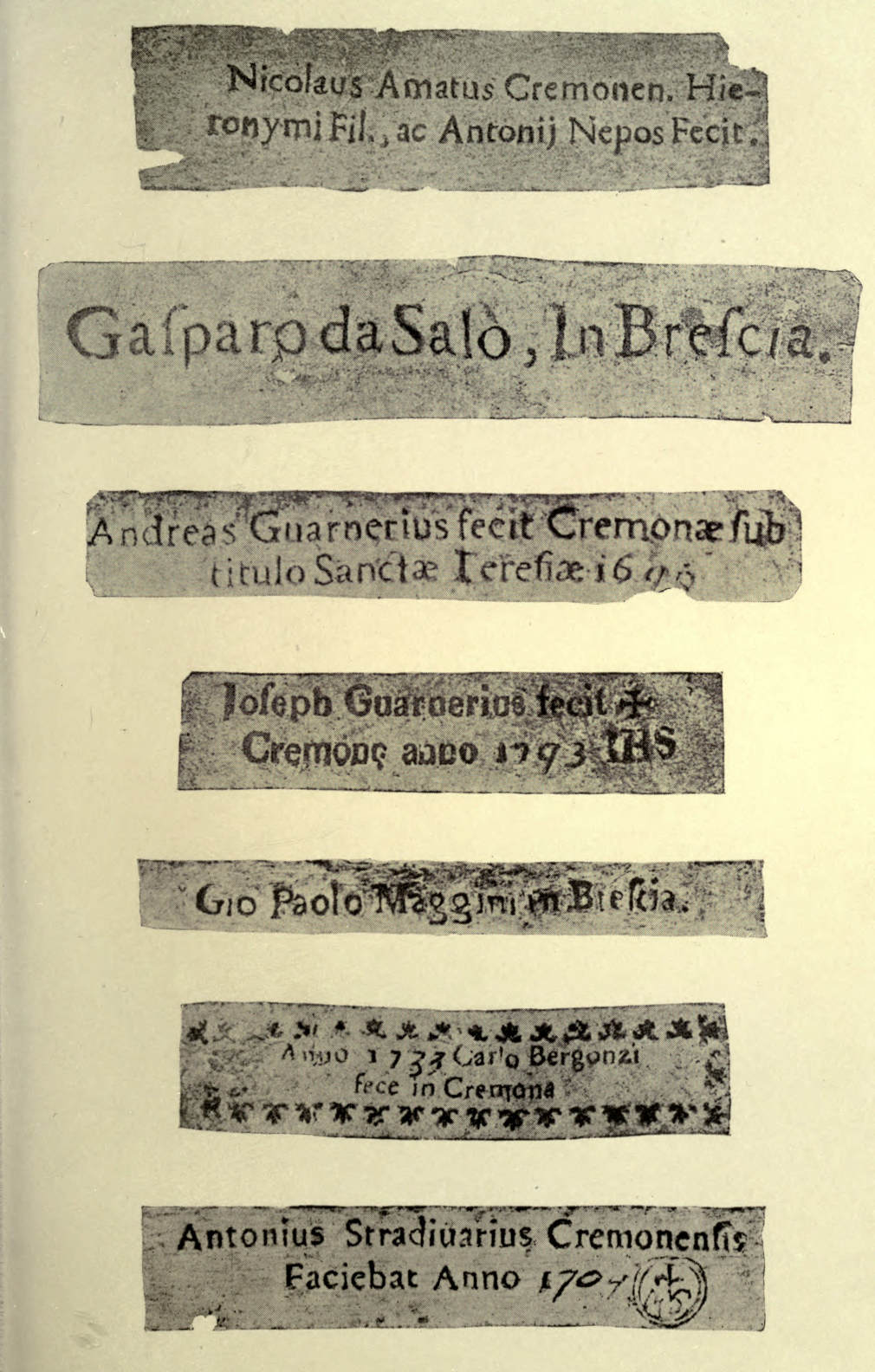
Nicolaus Amatus Cremonen. Hieronymi Fil., ac Antonij Nepos Fecit.
Gasparo da Salo, In Brescia.
Andres Guarnerius fecit Cremonæ sub titulo Sanctæ Teresiæ 1696
Joseph Guarnerius fecit ✠ Cremona anno 1793 IHS
Gio Paolo Maggini in Brescia.
Anno 1733 Carlo Bergonzi fece in Cremona
Antonius Stradiuarius Cremonensis Faciebat Anno 1709
[Pg 239]
DICTIONARY OF VIOLIN MAKERS
Aachner, Philipp. A Mittenwalder, 1772; ordinary German characteristics.
Abbati, Giuseppe. He worked at Modena, according to Forster, 1775-93.
Absam, Thomas. Lived at Wakefield, in Yorkshire; but his name, identical with the birthplace of Stainer, suggests a German origin. Employed by Pickard, of Leeds; his labels run: “Made by Thomas Absam, Wakefield.” Date 1810-49.
Acevo. Doubtful whether he ever existed. Fétis saw a bass viol which he connected with his name. It was signed at the back, “Marin Marais,” but it is all very shadowy.
Adam, Jean Dominique, son of Jean Adam. Both worked at Mirecourt, according to Vidal; both made bows, and the son made the best, and signed all he sold himself, 1823-69.
Adams, C. Takes rank merely as a local maker at Garmouth, Scotland, 1800.
Aglio, Giuseppe dall’, of Mantua; varnish bright yellow, 1800-40.
Aireton (Airton), Edmund, of London. Made good fiddles on the Amati and Steiner models; he varnished yellow, 1727-1807.
Albanesi, Sebastiano, is said to have lived at Cremona; his work is almost unknown, 1720-44.
Albani, Mathias, b. about 1621, Botzen (Tyrol); d. there 1673. (See p. 102.)
Alberti, Ferdinando. Milanese; yellow varnish. Label: “Ferdinando Alberti, fece in Milano, nella contrada delle pesce al segno della Corona, nel anno 1740-60.”
Aldric. Maker and great repairer. Labels: “Fait par Aldric,” or “Rue de Seine, 71, près celle de Bussy, Aldric, luthier, Paris, an. 18—.” (See p. 174.)
Alessandro. A Venetian maker, 1540.
Aletzie, Paul. Worked at Munich; good tenors and violoncellos, German type, 1710-20.
Allard, François. Successor of Maubert, 9 rue du Petit-Pont, 1788-89.
Alvani. A Cremonese maker, 1750.
Amati, Andrea. The father of the Cremona school, 1525. (See Chap. V.)
Amati, Antonio, elder son of Andrea Amati; b. Cremona about 1560. (See Chap. V.)
Amati, Girolamo, second son of Andrea Amati; b. about 1562. (See Chap. V.)
Amati, Girolamo, third son and successor of Nicola Amati; b. Feb. 26, 1649. (See Chap. V.)
Amati, Giuseppe. Said to have lived in Bologna, seventeenth century. (See Chap. V.)
[Pg 240]
Amati, Nicola, younger brother of Andrea Amati, is said to have worked with him, 1568-80. (See Chap. V.)
Amati, Nicola, son of Girolamo Amati; b. Dec. 3, 1596; d. April 12, 1684, aged eighty-eight, according to the registers of Cremona Cathedral. (See Chap. V.)
Ambrogi, Pietro. Cremona and Rome. “Petrus Ambrogi, Crem. fecit Romæ, an. 17—.”
Ambrosi, Pietro. A Brescian maker; very mediocre, 1712.
Ambrosio, Antonio d’. Neapolitan, 1820.
Amelot. French maker in Lorient; yellow varnish; mediocre, 1812-29.
Anciaume. Existence doubtful.
Anselmo, Pietro. Cremona and Venice; small pattern; deep yellow varnish; fair maker, 1700.
Antoniazzi, Gregorio. Bergamo, 1738; labels bear: “in Colle, 1738.”
Antonio, Cypriano.
Antony, Girolamo. Cremonese pattern; yellow varnish, 1751.
Ardenois, Johannes. Ghent, 1731.
Artmann. Weimar, cir. 1760; pupil of Ernst of Gotha; Amati pattern; yellow varnish.
Askey, Samuel. Pupil of John Morrison; employed by Corsby, cir. 1825.
Assalone, Gaspare. Roman; Amati pattern; over-arched; poor yellow varnish.
Aubry. Paris; a nephew of Aldric (who dealt with Tarisio); inferior to his uncle, 1840.
Audinot, Nestor Dominique, b. at Mirecourt 1842; worked under Sébastien Vuillaume; took up his business in 1875 at the age of seventeen; is very industrious, and makes excellent instruments. Labels: “N. Audinot, luthier, élève de Vuillaume, Paris.”
Augière. Pupil of Clément, Paris; good maker; red and brown varnish, 1830.
Baader, J. A., & Co. Mittenwald; wholesale producers on cheapest terms; their Stainer copies are good, 1854.
Bachelier. Inferior French maker, 1777-89.
Bachmann, Carl Ludwig. An excellent maker of Berlin, 1716-1800; violins, violas, and ’cellos often mistaken for Cremonas; a viola player; maker to the Prussian Court; founder of the Berlin Amateur Concerts; inventor of screw pegs for double-basses.
Bachmann, O. Good maker, of Halberstadt; first-rate repairer; wrote on violin construction, 1835.
Bagatella (Bagattella), Antonio. Padua; good restorer; much employed by German princes; made few good instruments, but wrote learnedly on violin construction, 1750-82.
Bagatella (Bagattella), Pietro. Padua, 1760-66.
Bailly, Paul. Mirecourt; fair maker; Chicago Exhibitor, 1893.
Baines. London; pupil of Furber, 1780.
Bairhof, Giorgio. Naples; Gagliano school.
Bajoni, Luigi. Milanese, 1840-76.
Baker, Francis. London, 1696.
Baker, John. Oxford, 1688-1720; excellent tone; yellow varnish; transition maker.
[Pg 241]
Balestrieri (Balestieri), Pietro, brother of Tommaso. (See p. 88.)
Balestrieri (Balestieri). Tommaso, brother of Pietro. (See p. 88.)
Ballantine. Scotch, 1850-56.
Banks, Benjamin, son of George and Barbary Banks, 1727-95. (See pp. 130-132.)
Banks, Benjamin, second son of Benjamin Banks (1727-95), b. Sept. 13, 1754; d. Jan. 22, 1820. (See pp. 130-132.)
Banks, James and Henry, fourth and sixth sons of B. Banks (1727-95). (See pp. 130-132.)
Barbanti, Silva Francesco. A maker at Correggio, 1850.
Barbieri, Francesco. Veronese; early Guarnerian pattern, 1695.
Barnes, Robert Pupil of Thomas Smith; set up with John Norris, 1765; employed Aireton, but used their own trade label.
Barnia, Fedele. Milanese, 1716-51.
Baroux. Paris; very good bow-maker, 1830.
Barrett, John. London; a contemporary of Barak Norman and Nathaniel Cross; long and arched pattern; yellow varnish; sweet tone; labelled: “John Barrett, at the Harp and Crown in Pickadilly, London, 1731.”
Barton, George. London; d. cir. 1810.
Bassot, Joseph. Paris; fine maker; brown and reddish varnish; earlier yellow and inferior; label: “Joseph Bassot, luthier, Paris, 1802.”
Baud. Versailles; experimented omitting sound-bar, but not a success.
Bausch, Ludwig Christian. Good bow-maker; Naumburg and Leipsic, 1805-71.
Bausch, Excellent bow-maker; silver medallist, Dresden; friend of Spohr, 1840.
Beckmann (Bekman), Sweno. Stockholm; rough maker, 1700-6.
Bedler, Norbert. Würzburg, 1723.
Bela, Szepessy. Good contemporary maker; worked at Budapest and Munich, and is now in London; copies Strad and N. Amati.
Bellone, Pietro Antonio, known as Il Pescorino, Milanese, 1694.
Bellosio, Anselmo. Venetian; pupil of Serafino and master of M. A. Cerin, 1720-80.
Belviglieri, Gregorio. Fairly good Bolognese maker, 1742.
Benedict, Jose. Cadiz, 1738.
Benedicti, Donate de. Cremona, 1674.
Benti, Matteo, b. 1579. Brescia; contemporary of Maggini.
Beretta, Felice. Como; Guadagnini school; bow-maker, 1760-85.
Bergé. Toulouse, 1771.
Bergonzi, Benedetto, d. 1840. (See p. 86.)
Bergonzi, Carlo. Cremona; the first of the great Bergonzi family of makers; b. (?); d. 1747.
Bergonzi, Carlo, third son of Michel Angelo. (See p. 86.)
Bergonzi (Baganzi), Francesco. Named as early as 1687.
Bergonzi, Michel Angelo, son of Carlo; b. 1722; d. after 1765.
Bergonzi, Nicola, eldest son of Michel Angelo.
Bergonzi, Zosimo, brother of Nicola.
[Pg 242]
Bernardel, Auguste Sébastien Philippe. An excellent maker who worked under Lupôt and Gand. Firm: “Bernardel et fils,” then “Gand et Bernardel”; Paris (1849) gold medal, London (1855) gold medal.
Bernardel Frères. Ernst Auguste and Gustave Adolphe, sons of Sébastien Philippe.
Bertasio, Luigi. Piadena, 17—.
Bertassi, Ambrogio. Piadena, 1730.
Bertet, Joseph R. French maker; little known, 1754.
Bertrand, Nicolas. Paris; a few early fiddles, 1686-1735.
Betts, John Edward, known as “Old John Betts”; b. 1755, at Stamford, Lincolnshire; d. March 1823; was buried at Cripplegate Church; pupil of Richard Duke, senior. (See p. 132.)
Betts (Ned), Edward, nephew of John Betts; like him a pupil of Richard Duke. He died between 1815 and 1820.
Bianchi, Nicola. Pupil of Guadagnini, 1800 to 1875; Genoa, Cremona, and Paris; fair maker.
Bindernagel. Gotha, 1745-1804; inferior maker.
Bittner, David. Viennese, 1862-80; made chiefly for America.
Blair, John. Edinburgh, 1820.
Blaise, Mirecourt. 1820; indifferent.
Blanchard, Paul François, 1865-94; worked with J. B. Vuillaume; very good violins; his workmen turn out good cheap ones; follows Strad; Mirecourt and Lyons.
Bodio, Giambattista. Venice, 1792-1832.
Boivin, Claude. Paris, 1735-53; fair maker.
Bomberghi, Lorenzo. Florentine, seventeenth century.
Bomé, Thomas. Inferior; French.
Booth, William. English; 1779-1858; good repairer.
Booth, William, son of W. Booth, senior; b. 1816, Leeds; d. 1856; a clever workman.
Boquay (Bocquay), Jacques, b. at Lyons. 1700-30. (See p. 105.)
Borbon (Bourbon), Gaspar. End of sixteenth century; Brussels; Gaspar model.
Borelli, Andreas, 1730-47; Parma; Guadagnini model.
Borlon, François. Antwerp maker, 1680-1710.
Boucher. London, 1764.
Boullangier, Charles, b. 1823, Mirecourt; d. October, 1888. Learnt his trade in Mirecourt till 1843; worked with Vuillaume and Gand and Bernardel, also for Edward Withers, London; good copyist of Strad.
Boumeester (Baumeester). Amsterdam maker, 1637-68.
Bourdet, Jacques. Fair French maker, 1751.
Bourgard, Jean. Worked in Nancy about 1780-87.
Boussu. Bruxelles about 1750-80; fairly good Amati pattern.
Braglia, Antonio. Modena, eighteenth century.
Brandiglioni. Brescia; copied Maggini.
Brandl, Karl. Budapest; exhibited in London Exhibition, 1862.
Branzo, Barbaro Francesco. Padua, 1660.
Bremeister, Jan. Amsterdam, 1707.
Breton, J. F. Paris, 1740-80.
[Pg 243]
Breton, Le, b. 1780, at Mirecourt. No great value; 1812 to 1830.
Broschi, Carlo. Parma, 1730-44.
Brown, James, b. 1755, d. Sept. 1830. Silk weaver in Shoreditch, London; pupil of Thomas Kennedy; chiefly a repairer of instruments.
Brown, James, jun., son of the above; both father and son fair workmen; b. Nov. 1786; d. 1860, at White Lion Street, Norton Folgate; apprenticed to his father, but was principally employed to make bows.
Brown, son and pupil of James Brown, jun. When about twenty years old, ceased to make instruments.
Browne, John. Cornhill, London, 1743; copied Nicholas Amati.
Brubach, Antoine, b. Jan. 22, 1847, Mirecourt; head of “Klein et Cie.,” Rouen.
Brugère, Charles Georges, b. Nov. 10, 1865, at Mirecourt; excellent maker; only labels what he makes himself.
Brugère, Charles Malakoff, d. 1894. Son of above; made about 100 good fiddles; the family still work at Mirecourt.
Brugère, François, brother of Charles Joseph Brugère. Had three sons, all makers.
Buchstadter (Buchstetter), Gabriel David. Ratisbon, 1752; Cremona flat pattern; good orchestral instruments.
Budiani, Giavetta. Some of his large bass viols adapted for double-basses with four strings; contemporary of G. P. Maggini.
Buonfigliuoli, Pier Francesco. Florentine, seventeenth century.
Burgle, Johann. A maker in Griezbach, 1828.
Busas, Domenico. Vicenza, 1740.
Busseto (Buseto), Giammaria del. Cremonese viol-maker, 1540-80; said to have taught Andrea Amati.
Bussot. Paris, 1788.
Buthod. Cheap Mirecourt maker; good strong fiddles fit for orchestral use; turned out about 900 instruments a year; contemporary of Vuillaume.
Cabroli, Lorenzo. Milan about 1716; indifferent.
Cabroly. Toulouse about 1740-47; fair.
Caeste, Gaetano. Cremona in 1677.
Caesto (Caesta), Pietro Antonio della. Treviso, 1660-80; copied Strad.
Cahusac. London about 1788. Worked with Banks’s sons.
Calcani (Calcagni), Bernardo. In Genoa, 1710-50; copied Strad carefully and with good effect.
Calonardi, Marco. Cremona, seventeenth century.
Calot (Callot), b. 1810. Paris and Mirecourt; fine workman: good tone.
Calvarolla, Bartolommeo, of Torre Baldone (Bergamo). About 1753-67, Bologna and Bergamo; fair.
Camilli, Camillus (Camilus di Camila). Mantua about 1739-50; copied Strad; resembles also Landolfi; excellent tone.
Camillio, Davido. Cremona, 1755.
Cappa, Giofredo (Goffredo), 1590-1640. Worked with the Amatis; unequal in work; his instruments have often been cut down.
[Pg 244]
Cappa, Giachimo (Gioacchino) and Giuseppe. Working in Saluzzio, and in Turin about 1661-1712; indifferent.
Carcassi, Lorenzo Francesco and Tommaso. Florence, about 1735-58; not first-rate.
Carlo, Giuseppe. Milan, 1769.
Carlomordi, Carlo. Verona in 1654.
Caron. Versailles, 1775-85. Maker to the Queen; not remarkable.
Carter, John. Worked in London, 1780-90, for John Betts. Good; often sold for Betts’.
Casini (Cassini), Antonio. Modena about 1660 to 1700. Made large violoncellos; fair.
Caspan, Giampietro. Venice about 1650; Amati pattern; violins small, yellow varnish.
Cassanelli, Giovanni. Ciano in 1777.
Cassineau. Paris; maker of all sorts.
Castagnery (Castagneri), Andrea. Worked in Paris, 1732-57; he made good instruments.
Castagnery (Castagneri), Gian Paolo. A maker from Cremona, who worked in Paris about 1630-62; very good and sweet tone.
Castellani, Luigi, son of Pietro Castellani. Florence, 1809-84; good restorer of fiddles, but made none.
Castellani, Pietro, b. Florence, second half of the eighteenth century. Made only a few violins.
Castello, Paolo. Genoa about 1750-80; fair.
Castro. Worked in Venice, 1680-1720; indifferent appearance, but good wood.
Catenar (Catenari), Enrico. Turin about 1670; fair; a follower of Cappa.
Cati, Pier Antonio. Florence, 1741; famous for his “kits.”
Cavalorio. Geneva, 1725.
Cellini, Giovanni, the father of Benvenuto Cellini, b. in Florence; d. there of the pest, 1527 or 1528. Architect; lute and viol maker. His viols, made about 1500-5, had a great reputation.
Celoniati (Celionati), Giam Francesco, 1732. Good maker; Amati pattern; yellow varnish. “Joannes Franciscus Taurini, anno 1732.”
Cerin, Marc Antonio. A maker in Venice, 1780-93; pupil of Anselmo Bellosio; fair maker.
Ceruti, Enrico, son of Giuseppe Ceruti; b. 1808; d. Oct. 20, 1883. Cremona, at 14 Via Borgo Spera; made about 365 instruments; much esteemed in Italy.
Ceruti, Giovanni Battista, 1755, Cremona; d. 1817. Pupil of Lorenzo Storioni; good; made about 500 instruments; varnish yellow.
Ceruti, Giuseppe, son and successor of Giovanni Battista, 1787; d. 1860, Mantua. Fair maker; chiefly repairer.
Challoner, Thomas. Worked in London in the eighteenth century.
Champion, Jean Baptiste. Paris in 1783.
Champion, René. Paris, 1731; finished and graceful; varnished like Boquay.
Chanot, François, son of a musical instrument maker in Mirecourt; b. 1787, d. 1828. (See p. 112.)
Chanot, Georges, a brother of François; b. March 26, 1801; d. Jan. 10, 1883.
Chanot, Georges, son of Georges Chanot.
[Pg 245]
Chanot, G. A. Manchester.
Chappuy (Chapuy), Nicolas Augustin. Paris about 1732-76; fairly good; badly varnished. Fr. Habeneck played on one of his violins for many years.
Chardon, Marie Joseph, son-in-law and pupil of Georges Chanot, sen.; b. May 22, 1843, Paris. He succeeded his father-in-law in 1872; good maker; better restorer.
Chardon, Marie Joseph Antoine Georges. Worked under his father.
Charle. Paris in 1748.
Charles, Theress. From Mirecourt, but settled in London, in King Street, Soho.
Charotte. Mirecourt; d. 1836; settled in Rouen in 1830; indifferent.
Chatelain, François. About 1777-91; good maker; collaborated sometimes with Renault.
Chéron, Nicolas. Paris, 1658-91.
Cherpitel, Nicolas Emile. Mirecourt, 1841-93; worked with the Gands at Paris; very good workman.
Chevrier, André Augustin, b. in Mirecourt. Paris, and then in Brussels, 1838.
Chiavellati, Domenico. Lonigo in 1796.
Chibon, Jean Robert. Paris, 1775-85; indifferent.
Chiocchi (Chiocci), Gaetano. In Padua nineteenth century; good maker and repairer.
Chrétien, Hippolyte, 1845-89. Lyons; excellent maker and restorer.
Christa, Joseph Paul. About 1730-40.
Christophle, Jean. Avignon, 1655.
Clark. London, living at Clerkenwell. A pupil of Matthew Furber.
Claudot, Augustin. Paris, beginning of eighteenth century; large pattern, yellow varnish; wood good, work carefully finished; branded his instruments with his name, “Augustin Claudot.”
Claudot, Charles. Paris; but probably came from Mirecourt; indifferent.
Clément. Paris, about 1815-40, in the rue des Bonnes-Enfants; a good deal sought after.
Coffe-Goguette. Mirecourt, 1834; excellent maker; fine tone.
Cole, James. Manchester; pupil of Tarr and George Crask, 1858.
Cole, Thomas. London about 1672-90; good tenor maker.
Collier, Samuel. London, at “Corelli’s Head” on London Bridge, about 1750-55.
Collier, Thomas. London, 1775.
Collin, Claude Nicolas. Mirecourt; d. 1864; pupil of N. F. Vuillaume, Brussels.
Collin-Mézin, Charles Jean Baptiste, son of C. N. Collin. Mirecourt, 1841-89; excellent maker and restorer; good Strad and Amati copyist.
Collingwood, Joseph. Worked in London about 1760, at the “Golden Spectacles” on London Bridge.
Contreras, Joseph, 1710-80. Madrid or “Granadino”; beautiful Strad copyist; has passed for Strad.
Contreras, son of Joseph Contreras.
Conway, William. London about 1745-50.
Cordano, Jacopo Filippo. Genoa about 1774.
[Pg 246]
Cornelli, Carlo. Cremona, 1702.
Corsby, George. London; believed to be a brother of Corsby of Northampton.
Corsby. Northampton about 1780; chiefly made double-basses.
Costa, Agostino. Brescia and Venice in the seventeenth century.
Costa, Marco della. Treviso, 1660-80.
Costa, Pietro Antonio della. Worked in Treviso about 1740-65; fair Amati model.
Cousineau, Georges, 1753-1824. In 1788 was entitled “Luthier de la reine”; made all sorts of instruments.
Cramond, Charles. A maker in Aberdeen, 1821-34.
Crask, George. Worked in various places, Salford, Manchester, etc.; prolific worker; Italian pattern.
Cross, Nathaniel. London about 1700-51. (See p. 125.)
Crowther, John, 1755-1810. He worked occasionally for John Kennedy.
Cuchet, Gaspard, 1729.
Cunault, Georges, b. 1856, Paris; Miremont, 1874-82; a good workman.
Cuny. Paris about 1740.
Cuthbert. Maker of viols and violins in London, seventeenth century; fair.
Cuypers, Johannes. The Hague about 1779.
Daniel. Antwerp about 1636-56; two specimens in Antwerp Cathedral.
Daniel, Charles. Marseilles in 1762.
Darche, C. F. Brussels; was a pupil of N. F. Vuillaume (a brother of the Parisian maker); better restorer than maker.
Darche, Nicholas. Aix-la-Chapelle.
David. A contemporary of Pierray; Paris about 1730; indifferent.
Davidson, Hay. Huntly, 1870.
Davis, Richard. London; employed by Norris and Barnes; but when Norris died in 1818, he succeeded to the business. He knew little of violin-making, and always remained more of a dealer in, than a maker of, instruments.
Davis, William. London (in 1846 sold business to Edward Withers); restored violins; Maucotel worked for him.
Day, John. Ingenious amateur maker, devoted to reproduction of Cremonas, nineteenth century.
Dearlove, Mark. Leeds, 1812-20.
Dearlove, Mark William, son of Mark Dearlove. Leeds, 1828-62; employed good workmen—Absam, Gough, Fryer.
Decombe (not De Comble). Paris, eighteenth century.
De Comble, Ambroise, b. at Tournai, Belgium, end of the seventeenth century; worked till 1760; said to have been a pupil of Antonio Stradivari at Cremona; instruments scarce, well made, of excellent wood, and have a rich tone.
Deconet, Michele. Venice about 1742-79; Cremona school.
Defresne, Pierre. Rouen, 1730.
Dehaye (Deshayes), nephew and only pupil of Salomon, 1775-1825, Paris; more dealer than maker; sold all sorts.
Dehommais, 1870. Successful amateur maker.
[Pg 247]
De Lannoy, N.J. Lille about 1740-75; fair maker.
Delanoe, Pierre Jean. Paris, 1754.
Delanoix. Brussels about 1760; good maker.
Delany (Delaney), John. Dublin in 1808; an original egotist, 1808. Label bears: “Made by John Delany, in order to perpetuate his memory in future ages. Dublin, 1808. Liberty to all the world, black and white.”
Delau, Lucien, 1836-48. On the death of Charotte he joined Jeandel in violin-making, and they continued the business at Rouen.
Dennis, Jesse, 1795-1855. London; apprenticed to John Crowther, 1805; worked under Matthew Furber.
Derazey, J. Mirecourt; successor to J. Nicolas, jun.; sold his fiddles; made good cheap ones, from 5 to 150 francs; a prolific firm.
Deroux, Sébastien. Mirecourt and Paris; b. 1848; making in 1898; good restorer; best Cremona models. Signs: “A. S. D.”
Deschamps, Claude. Paris, 1783-85.
Desjardins. Caen, 1763.
Despons, Antoine. Paris about 1610; rare, but not very good.
Desrousseau. Eighteenth century.
Devereux, John. He worked with B. Simon Fendt in London; migrated to Melbourne.
Dickenson (Dickinson), Edward. Strand, London, about 1750-90; Stainer model; inferior.
Dickeson (Dickson), John, b. in Stirling. London and Cambridge, about 1750-80; excellent.
Didelin, Joseph. Nancy, 1765-75; poor maker.
Didion, Gabriel. Mirecourt; d. 1881.
Diehl (or Diel, as it was originally spelt). Friedrich, son of Nicolaus Diehl; 1814-67; Darmstadt; fair.
Diehl (Diel), Heinrich, a son of Johann Diehl.
Diehl (Diel), Jacob, son of Nicolaus Diehl; d. 1873; Bremen in 1834, then Hamburg.
Diehl (Diel), Johann, a brother of Nicolaus Diehl. Mayence.
Diehl, Martin. Mayence, eighteenth century; work poor.
Diehl (Diel), Nicolaus, b. 1779, d. 1851. Son of Martin Diehl, to whose business he succeeded.
Diehl (Diel), Nicolaus Louis, d. 1876. Was a son of Jacob Diehl; worked in Hamburg; he published a work on Italian violin-makers.
Dieulafait. A viol-maker; Paris in 1720.
Dini, Giambattista. Lucignano in 1707.
Ditton. London about 1700. In Thomas Britton’s Collection was a “good violin by Ditton.”
Dodd, Edward, b. 1705, Sheffield; d. 1810, London, at the age of 105. First bow-maker of this name. He lived in Salisbury Court, Fleet Street; buried in St Bride’s Church.
Dodd, James, second son of Edward. Also made bows.
Dodd, James, son of James Dodd, sen.; was a good bow-maker.
Dodd, John, eldest son of Edward Dodd; b. 1752. (See p. 116.)
[Pg 248]
Dodd, Thomas, third son of Edward Dodd. Employed Bernhard Fendt and Lott; proud of his varnish; an all-round man, and dealer in all sorts of instruments; violoncellos fetch £50.
Dodd, Edward and Thomas, sons of Thomas Dodd, sen. Both learnt from Bernhard Fendt, and carried on the business at St Martin’s Lane.
Dominicelli (Domincelli). Ferrara, 1695-1715; studied in Brescia; copied the Amati pattern; varnish of a golden colour.
Dominichino, Giuseppe. Verona, 1700; Amati pattern.
Donato, Serafino. Venice, 1410-11.
Doni, Rocco. A priest in Florence, 1600-60; made lutes and violins.
Dopfer (Döpfer), Nicolaus. Mayence (?) about 1768; instruments well made, slightly arched; sound-holes small but well cut, varnish brown.
Dorant, William. Spitalfields, 1814.
Dorffel (Dörffel), Johann Andreas. A violin and lute maker in Klingenthal, Saxony, in 1743.
Drinda, Giacomo. Pianzo, eighteenth century.
Drögmeyer, Hermann August. Bremen; wrote a book on violins, 1891.
Drouleau or Droulot. Paris, 1788-1800.
Drouyn, Dimanche. Paris.
Duchéron, Mathurin. Contemporary of Boquay, working in Paris in 1714.
Duiffoprugcar (Duiffoproucart), Gaspard, 1514. (See p. 18).
Duke, Richard. London about 1750-80. (See p. 132.)
Duke, Richard, son of Richard Duke.
Dulfenn, Alexander. Leghorn in 1699.
Duménil, N. Paris, 1786.
Dumesnil, Jacques. Paris about 1655-60.
Duncan. Aberdeen, 1762.
Duncan, George. Glasgow, 1887.
Durfel (Dürfell), J. G. Altenburg, 1778; double-basses excellent; violins very arched; muddy dark brown varnish.
Du Riez, Nicolas. A good French maker; Abbeville, 1663.
Eberle, Johann Ulrich. Prague about 1730-60; good Cremona copyist.
Eberti, Tommaso. Italian maker about 1730-50.
Edlinger, Thomas, b. in Bohemia, and was living in Prague 1712-15. Good.
Eglington. London in 1802; fair tone.
Elément, Jean Laurent. Paris in 1783.
Elsler (Esler), Johann Joseph. Mayence about 1715-30; bass viol maker; transition on verge of the violin.
Emiliani, Francesco de. Rome about 1715-20; fine workman; yellow varnish.
Engleder, Andreas, Munich, 1854; an original designer.
Engleder, Ludwig. Bamberg, 1854; German pattern; fair tone.
Ernst, Franz Anton, b. Dec. 3, 1745, Georgenthal, Bohemia; player and maker; Stradivari pattern, and some say approached Stradivari tone.
Eulry-Clément. Mirecourt, 1800.
[Pg 249]
Eury. About 1810-30, Paris; an excellent bow-maker, 1820. He was working at 20 rue des Lyonnais-Saint-Jacques in 1820. His bows are justly celebrated, and are thought to rival even those of François Tourte. He generally marked them with his name.
Evangelisti. Florence, eighteenth century.
Evans, Richard. London about 1742-50.
Eve, Jacques. German model, arched; brown varnish; good workman.
Fabris, Luigi. Venice in nineteenth century.
Facini, Agostino. A monk at Bologna, 1732-42; delicate workman; yellow varnish.
Falaise. French follower of Pique; Cremona pattern; yellow varnish.
Farinato, Paolo. Venice about 1700-30; fair maker, Serafino pattern.
Febbre. Amsterdam in 1762.
Fendt, Bernhard. (See p. 132.)
Fendt, Bernhard Simon. (See p. 132.)
Fendt, Francis, fourth son of Bernhard Fendt. (See p. 132.)
Fendt, François, best known in France as Fent.
Fendt, Jacob, third son of Bernhard Fendt.
Fendt, Martin, second son of Bernhard Fendt.
Fendt, William, second son of Bernhard Simon.
Ferati, Pietro. Sienna, 1754-64; poor maker.
Féret. A pupil of Médard; Paris, 1708; good maker.
Ferguson, Donald. Huntly, Aberdeenshire.
Ferguson & Son. Edinburgh, beginning of the nineteenth century.
Ferrari, Agostino. Budrio (Italy), eighteenth century.
Ferrari, Alfonso. Carpi (Modena), 1738.
Ferrari, Carlo. Sienna in 1740.
Feury or Ferry, François, son-in-law of Leclerc the violin-maker. Paris about 1750-60; violins small pattern, the sound-holes small, varnish red, work good.
Fichtl, Martin. Vienna, 1750-57; careful in wood and varnish.
Ficker, Johann Christian. Cremona, 1720-22; German style.
Ficker, Johann Gottlieb. Cremona about 1788-89.
Fiker, Johann Christian. Neukirchen (Saxony), eighteenth century.
Fiorillo, Giovanni. Ferrara, 1780; German and Italian patterns; violoncellos are best.
Fiorini, Giuseppe, son of Raffaele Fiorini, b. 1867. Excellent maker.
Fiorini, Raffaele, b. at Pianoro. Worked at Bologna.
Firth, G. Leeds, 1836; pupil of William Booth, sen.
Fiscer, Carlo and Giuseppe, brothers. Milan about 1760-64; inclined to German style, but good varnish.
Fischer, Anton, b. 1794, d. 1879. Vienna.
Fischer, Zacharie, b. Nov. 5, 1730, Würzburg; d. there Nov. 27, 1812; first began baking his wood to age it; his violins are still liked.
Fleuri (Fleury), Jean François. Paris, 1783-85.
Fleury, Benoist. Paris, 1751-91; fair maker.
Florenus (Florinus), Guidantus or Florentus. Bologna[Pg 250] about 1700-60; far from first-class.
Fonclause, Joseph (called “Le Mayeux”), b. 1800 à la Conté; d. 1865, Paris. Mirecourt, and employed by Vuillaume.
Forcheville, J. Baptiste. Early pochette-maker.
Forster (Foster or Forrester), John, b. Kirkandrews, on the Esk.
Forster, Simon Andrew, son of William Forster (1764-1824). (See p. 126.)
Forster, William, son of John Forster; b. 1713-14; d. 1801. (See p. 126.)
Forster, William (“Old Forster”), son of William Forster (1713-1801). (See p. 126.)
Forster, William (“Young Forster”), son of William Forster (1739-1808). (See p. 126.)
Forster, William, eldest son of William Forster, 1764-1824. (See p. 126.)
Fraiser, Giorgio. Cremona, 1666; worked for Nicola Amati.
Franck. Ghent, 1800-30; chiefly a clever repairer.
Frankland. London, 1785; employed by the William Forsters.
Frebrunet, Jean. Paris 1750-60; good maker; yellow varnish.
Fritsche (Fritzche), Samuel. Leipzig, 1787; pupil of C. H. Hunger; good maker (Cremona model) and fine repairer.
Fryer, Charles. London and Leeds, 1830-40.
Furber, David. Pupil of John Johnson (1750-60), a maker in London. (See p. 234.)
Furber, Henry John, son and pupil of John Furber.
Furber, James, first son of Matthew Furber, sen.
Furber, John, third son of Matthew Furber, sen.
Furber, Matthew, sen., son of David Furber.
Furber, Matthew, second son of Matthew Furber, sen.
Gabrielli, Antonio. Florence, 1760; good violins.
Gabrielli, Bartolommeo. Florence about 1730.
Gabrielli, Cristoforo. Florence, 1730.
Gabrielli, Giovanni Battista. Florence, 1740-70; good tone, excellent wood, yellow varnish; his violoncellos and altos considered best.
Gaetano, Antoniazzi, b. Aug. 7, 1825, Cremona; good maker, has gained medals of honour; his sons, Ricardo and Romeo, work with him.
Gaffino, Giuseppe. An Italian, worked in Paris, 1745-83; careful maker.
Gagliano (Galiano), Alessandro, b. 1640. (See p. 89.)
Gagliano, Antonio, son of Giovanni, grandson of Nicola. (See “Raffaele Gagliano.”)
Gagliano, Ferdinando, eldest son of Nicola, grandson of Alessandro. (See p. 89.)
Gagliano, Gennaro, second son of Alessandro, brother of Nicola; b. about 1680, at Naples; d. 1750. He was the best maker of this family.
Gagliano, Giovanni, fourth son of Nicola, nephew of the great Gennaro; d. 1806.
Gagliano, Giuseppe and Antonio, second and third sons of Nicola; lived at Naples.
Gagliano, Nicola, eldest son of Alessandro; b. about 1675,[Pg 251] at Naples; d. there about 1745.
Gagliano, Raffaele and Antonio, sons of Giovanni, grandsons of Nicola.
Gaillard-Lajoue, J. B. Mirecourt; d. about 1870; first an apprentice and then first workman in the workshop of Gand; fair maker.
Gairoud, Louis. Nantes about 1740.
Galbani, Piero. Florence in 1640.
Galbicellis, G. B. Florence, 1757.
Galbusera, Carlo Antonio. Follower of Chanot; made a guitar-shaped model; violins much praised, but little known now.
Galerzena. Piedmont, 1790.
Galland, Jean. Paris, rue St-Honoré, about 1744-50.
Galram, Joachim Joseph. Lisbon in 1769.
Gand, Charles Adolphe, eldest son of Charles François Gand; b. Dec. 11, 1812, Paris; d. Jan. 24, 1866.
Gand, Charles François, eldest son of Charles Michel Gand; b. Aug. 5, 1787, Versailles. (See p. 108.)
Gand, Charles Michel, the head of the Gand family; b. 1748, at Mirecourt; d. 1820, Versailles.
Gand, Charles Nicolas Eugène, second son of Charles François Gand; b. June 5, 1825, at Paris; d. Feb. 5, 1892, Boulogne-sur-Seine.
Gand, Guillaume, second son of Charles Michel Gand, 1792-1858.
Garani (Garana), Michelangelo. A maker in Bologna about 1680 to 1720; small value.
Garani, Nicola. 1700. Fair instruments, Gagliano pattern; plain wood, yellow varnish.
Garenghi, Giuseppe. Brescia, 1857.
Gasparo da Salò, son of Francesco Bertolotti, b. 1542. (See p. 30.)
Gattanani. Piedmont, 1785-90.
Gattinari. Enrico. Turin, 1670-75.
Gattinari, Francesco, son of Enrico Gattinari. Good maker, 1700-5; red varnish.
Gautrot. Mirecourt, 1855.
Gaviniés (Gavaniès), François. 1700-63, Bordeaux; 1730 Paris, and was living in Rue St-Thomas-du-Louvre, 1734-63. Unequal maker of violins, some cheap and poor, others very superior.
Gedler, Johann Anthony and Johann Benedict. Fussen, Bavaria, about 1750-96. Poor violins.
Geisenhof (Geiffenhof, Geigenhof), Franz, b. 1754; d. 1821. Fairly good.
Gemünder, August, b. 1814, Würtemberg; d. Sept., 1895, New York. Excellent maker, fine copyist.
Gemünder, George, brother of August Gemünder, b. 1816 in Würtemberg.
Germain, Emile, son of Joseph Louis Germain. Turin, 1870-88. Studied at Mirecourt. Prolific maker, good varnish, fair tone, fine repairer.
Germain, Joseph Louis, b. July 23, 1822, Mirecourt, 1868; worked with F. Gand family and B. Vuillaume. Excellent maker and repairer.
Geroni, Domenico. Ostia, Italy, about 1800-20. Inferior.
Gherardi, Giacomo. Bologna, 1677.
[Pg 252]
Ghidini, Carlo. Parma, about 1746.
Gianoli, Domenico. Milan, 1731.
Gibbs, James. London, 1800-45. Was employed by J. Morrison, George Corsby, and Samuel Gilkes.
Gibertini, Antonio. Parma, 1830-33. Stradivari pattern. Employed by Paganini as a repairer.
Gigli, Julio Cesare. Rome, 1730-62.
Gilbert, Nicolas Louis. Metz, 1700.
Gilbert, Simon, son of Nicolas Louis Gilbert. Metz, about 1737.
Gilkes, Samuel, 1787-1827. Morton Pinkney, Northamptonshire. London. Worked for William Forster (1764-1824). Nicola Amati pattern; clever maker.
Gilkes, William, son of Samuel Gilkes, about 1811-75, in Grey Coat Street, Tothill Fields, Westminster, London. Prolific maker; chiefly double basses.
Gioffreda, B. Turin, in 1860.
Giordano (Giordane), Alberto. Cremona, about 1735-40.
Giorgi, Nicola. Turin, 1745.
Giraniani. Leghorn, 1730.
Giron. (See “Villaume.”)
Giuliani. Cremona, 1660. Pupil of Nicola Amati.
Gobetti, Francesco. Venice, 1705. A pupil of Antonio Stradivari. Alleged fine wood, varnish, and tone.
Goffriller (Gofriler), Antonio. Venice, 18th century.
Goffriller, Francesco. Venice. Fair maker; yellow-brown varnish.
Goffriller, Matteo. Venice, 1690-1740. Careless in wood but careful in work; yellow varnish; arched pattern violin excellent.
Gonnet, Pierre Jean. Paris, 1775-83.
Gosselin. An amateur maker in Paris about 1814-30.
Gosset. Rheims, 1769.
Gouvernari, Antonio. Cremona, 1600-10.
Grabensee, J. A. Düsseldorf, about 1850-55.
Gragnani, Antonio. Leghorn, about 1741-80. Rough workmanship; inferior wood; sweet tone.
Gragnani, Gennaro. Leghorn, 1730.
Gragnani, son of Antonio Gragnani. Inferior to his father.
Grancino, Francesco and Giam Battista, sons of Giovanni and grandsons of Paolo Grancino. 1710-60. (See p. 90.)
Grancino, Giovanni, son of Paolo Grancino. Milan 1690-1730.
Grancino, Paolo. Worked at Milan, 1665-90. Pupil of Nicola Amati at Cremona.
Grand-Gérard. Vosges, 1790-1810. Also Paris. Prolific but inferior.
Grandini, Geronimo, sen. Mirecourt. Some merit.
Grandjon, sen. Mirecourt.
Grandjon, J., son of Grandjon, sen. Mirecourt. Fair maker.
Gray, J. Fochabers, Banffshire, Scotland, in 1870.
Greffts, Johann. Fussen, Bavaria, in 1622.
Gregori. Bologna, 1793.
Grimm, Carl, b. about 1792; d. 1855, Berlin. One of the best German makers.
Grimm, Ludwig, son of Carl Grimm.
Griseri, Filippo. Florence in 1650.
[Pg 253]
Grobitz, A. Warsaw in 1750. Good violins on the Stainer pattern.
Groll, Matthew. Meran, Tyrol, in 1800.
Grosset, Paul François. Paris, 1747-59. Pupil of Claude Pierray. Inferior.
Grossi, Giuseppe. Bologna in 1803.
Grou. 1752.
Grulli, Pietro. Cremona, 1883.
Guadagnini, Antonio, son of Gaetano, grandson of Carlo Guadagnini, b. 1831; d. 1881 at Turin. (See p. 86.)
Guadagnini, Felice, son of Carlo Guadagnini. Turin, 1835.
Guadagnini, Francesco and Giuseppe, sons of Antonio Guadagnini. Turin.
Guadagnini, Gaetano, son of Giambattista, grandson of Lorenzo. Turin about 1750.
Guadagnini, Gaetano. (See “Carlo Guadagnini.”)
Guadagnini, Giambattista, son of Lorenzo, b. 1711 at Cremona; d. Sept 18, 1786, at Turin.
Guadagnini, Giovanni Battista, brother of Lorenzo Guadagnini. Milan, Piacenza, and Turin about 1695-1775.
Guadagnini, Giuseppe, second son of Giambattista, grandson of Lorenzo, b. 1736; d. about 1805.
Guadagnini, Giuseppe. (See “Carlo Guadagnini.”)
Guadagnini, Giuseppe. (See “Francesco Guadagnini.”)
Guadagnini, Lorenzo. b. at Piacenza (?) about 1665. A pupil of Antonio Stradivari at Cremona.
Guarini, Joseph. Germigny, Vosges. Good violins, double purfle, powerful tone.
Guarneri, Andrea. b. about 1626 at Cremona; d. there Dec. 7, 1698. (For the Guarneri family, see p. 51.)
Guarneri, Caterina (?), daughter of Andrea.
Guarneri, Gian Battista, son of Bernardo, younger brother of Andrea.
Guarneri, Giuseppe, known as “del Gesù,” the greatest of the family. (See p. 51.)
Guarneri, Giuseppe Giovan Battista, second son of Andrea. b. Nov. 25, 1666, Cremona; d. soon after 1738.
Guarneri, Pietro, son of Giuseppe Giovan Battista Guarneri, grandson of Andrea, b. April 14, 1695. 1760.
Guarneri, Pietro Giovanni, eldest son of Andrea. b. Feb. 18, 1655, at Cremona; d. about 1740.
Guédon, Jacques Antoine. Paris, 1775-77.
Guérin, Alexandre Sauveur, 1834-88, Hyères. Pupil and successor of Edmond Daniel; works at Marseilles; repairs old instruments and makes new ones on the pattern of Stradivari; much admired.
Guerra, Giacomo. Modena, 1810.
Guersan, Louis. A maker in Paris about 1730-69; one of the best French makers; great experimentalist; used spirit varnish.
Gugemmos (Gugemos). Fussen, Bavaria. Eighteenth century; poor maker.
Guglielmi, Giobattista. Cremona, 1747.
Guidantus, Joannes Florenus. Bologna, 1685-1728.
Guidomini, Lorenzo. Milan, 1740.
Guillami. A Spanish family, 1680-1780.
[Pg 254]
Guiton, R., of Cork. Good.
Gusetto, Nicola. Florence, 1730.
Gutermann. Vienna, nineteenth century. Good.
Haensel, Johann Anton. Was maker and musician to the Duke of Schönburg at Rochsburg, 1800-15.
Haff. Augsburg, eighteenth century.
Hamberger, Joseph. Pressburg, Hungary. Firm still maker at Vienna.
Hamm, Johann Gottfried. A German who worked in Rome about 1810; violins ivory edged.
Hammig, W. H. Leipzig, tenth century; good work.
Harbour or Harbur. A maker, London, 1785.
Hardanger. Norway.
Hardie, James & Sons. Edinburgh, 1837-90. Industrious makers and exhibitors. Maggini, Stradivari, and Guarneri models.
Hardie, Matthew, 1825, and Thomas, 1856. Good violins, violas, and violoncellos on the Amati pattern.
Hardie, Peter. Dunkeld, 1773-1863. Excellent violoncellos.
Hare, Joseph (or John), 1700-30. Reacted against Stainer pattern in favour of Stradivari. London, 1726.
Harham. London, 1765-85.
Harmand. Mirecourt in 1772.
Harris, Charles. London, 1780-1800. Seldom labelled; his work good, especially ’cellos, Stradivari and Amati pattern; red varnish.
Harris, Charles, eldest son of Charles Harris. Worked for John Hart, nineteenth century; yellow varnish.
Hart, John Thomas, 1805-74, London. Pupil of Samuel Gilkes; made few instruments; reputation for experience and skill in repairing.
Hassert. Eisenach, eighteenth century. Good instruments, not much arched, beautiful wood, amber-coloured varnish; good copyist.
Hassert. A brother. Eisenach, 1790, in Rudolstadt. Instruments too much arched; rather harsh tone.
Haynes, Jacob. London, 1746. Stainer pattern.
Heberlein, Heinrich, jun. Clever maker in Markneukirchen, nineteenth century.
Heesom, Edward. London, 1748-50. Stainer pattern.
Heidegger. Passau.
Hel, Pierre Joseph, 1842-95. Seven years in Mirecourt, then with Sébastien Vuillaume in Paris, and Nicolas Darche at Aix-la-Chapelle. In 1865 he started his own business at 14 Rue Nationale, Lille; full of ingenuity; peculiar methods of seasoning wood without fire; has received much praise and many honours; a beautiful maker.
Held, J. J., b. July 17, 1823-89, Flamersheim, Rheinbach (Cologne). Great repairer and careful maker of about sixteen instruments a year; much esteemed.
Hell, Ferdinand. Vienna, 1854. Eccentric maker of a trumpet-violin.
Helmich. Continued Carl Grimm’s business.
Henderson, D. Aberdeen.
Hénoc (or Hénocq), François. Paris, 1775-89.
Hénoc (Hénocq), Jean (?Georges Bienaimé). Maker, Paris, 1768 to about 1790.
[Pg 255]
Henry. Paris.
Henry, Carolus, son of Jean Baptiste Henry, 1803-59; prolific maker; inventor of a barytone fiddle (not a success); a good maker otherwise.
Henry, Eugène, son of Charles Henry, 1843-92; an excellent maker of fine repairs; business continued by Charles Bruyère.
Henry, Jean Baptiste, b. 1757-1831, Mataincourt, Mirecourt (Vosges). He was the head of the present family of makers.
Henry, Jean Baptiste Félix, eldest son of Jean Baptiste Henry. 1793-1858. Paris. Pupil of his father; in Bordeaux, 1822; in Marseilles, 1825. In 1844 he returned to Paris. A prolific maker, but never signed.
Henry, Octave, son of Jean Baptiste Félix Henry. 1826-54. Paris. In Grenoble in 1854; made a great many violins.
Henry. A violin bow-maker; 1812 at Mirecourt; 1870, Paris; worked with Chanot; made excellent bows.
Hildebrandt, Michael Christopher. Hamburg, 1765-1800; good work; fine repairer.
Hill, Henry Lockey, son of Lockey Hill; grandson of Joseph Hill; b. 1774; d. Aug. 1835. (For Hill family see p. 133).
Hill, John. Red Lion Street, Holborn, 1794.
Hill, Joseph, b. 1715; d. 1784. He was a fellow-apprentice of Banks, working at “Ye Harp and Hautboy,” in Piccadilly, London, under Peter Wamsley, about 1740-42. Worked till 1772. His sons, William, Joseph, Lockey, and Benjamin, were all makers.
Hill, William, son of Joseph Hill. Worked in London about 1740-80.
Hill, William Ebsworth, son of Henry Lockey Hill, 1817-95. The present members of the firm are his four eldest sons: William Henry, b. June 3, 1857, followed the musical profession for some years before joining his brothers in the business; Arthur Frederick, b. Jan. 25, 1860; Alfred Ebsworth, b. Feb. 1862, who worked for some time at Mirecourt (Vosges), and was the first Englishman to go there to study; and Walter Edgar, b. Nov. 4, 1871, who also worked at Mirecourt. They employ a large staff of assistants in their workshops at Hanwell. (See p. 133.)
Hircutt. London about 1600.
Hochbrücker. Donauworth, Bavaria, 1699. Later at Augsburg. Made some violins, but is chiefly known as the inventor of pedals for the harp, about 1720.
Höhne. Dresden and Weimar.
Hörlein, Carl Adam, b. 1829-75. Winkelhof, Würzburg; great reputation both as maker and repairer.
Hoffmann, Anton. Courtmaker in Vienna, 1850.
Hoffmann, Martin. Leipzig, 1725; in Leipzig from about 1685; violins and violoncellos of good tone, inelegant pattern; shows well the transition period between viol and violin by recurrence to older types of a five-stringed violoncello.
Hofmans, Matthias. Antwerp, 1700-50; choice maker in the Cremona style.
[Pg 256]
Holloway, John. London. 1794.
Homolka, F. Kuttenberg, Bohemia, 1850; good maker, but wood rather too thick.
Hopkins. Worcester; exhibited a double-bass in London in 1862.
Horil, Giacomo. Rome, 1720-50.
Hornsteiner (Hornstainer), Joseph. Mittenwald, 1730; good double-basses; mediocre.
Hornsteiner (Hornstainer), Mathias. Maker in Mittenwald, 1770-1800; better than Joseph.
Hosborn, Thomas Alfred. London, 1629. A bass viol exhibited in Paris, 1878.
Huet, Henri. Paris, 1775-90; good workmanship.
Hulinski. Prague in 1760; instruments were well made; varnish red-brown.
Huller, August. Shœneck, 1735-76.
Hulskamp, G. H., b. in Westphalia. Settled in New York, U.S.A. In the 1862 London Exhibition he exhibited violins made on a new pattern. Instead of the ordinary sound-holes, was one round hole in the middle of the violin, just below where the bow sets the strings in motion; his innovations ineffectual.
Humel, Christian. Nuremberg in 1709.
Hunger, Christoph Friedrich, b. 1718, Dresden; d. 1787, Leipzig; excellent instruments.
Hurel, Jean. Paris, living in 1686, Rue des Arcis, at the sign of “A l’image de St Pierre”; from 1689 to 1717, Rue St Martin, near the Fontaine Maubué. He was maker of instruments “pour la musique du Roy.”
Husson. See “Buthod.”
Ivrontigni, Wougelli. Turin.
Jacobs, Peeter. Amsterdam, about 1690-1740; prolific maker; sometimes mistaken for Nicola Amati; grand pattern; whalebone purfling; sweet tone.
Jacobs. Amsterdam; probably son of Peeter; used dark red varnish of good quality.
Jacot, A., eldest son of Jean Charles. Paris, 19th century.
Jacot, Jean Charles. Metz, 1811-87.
Jacquot (Jacquart), Charles, 1804-80. Mirecourt; much esteemed; careful finish; a learned connoisseur and successful exhibitor.
Jacquot, Etienne Charles Albert, eldest son of Pierre Charles Jacquot, b. 1853-82, Nancy.
Jacquot, Jules Victor, second son of Pierre Charles Jacquot, b. Aug. 12, 1855.
Jacquot, Pierre Charles, son of Charles Jacquot; b. March 10, 1828-94. Nancy; had a great reputation, and exhibited beautiful instruments at various Exhibitions; his two sons worked with him.
Jais, Johann. Botzen, 1775; varnished brown.
J’Anson, Edward Popplewell. Manchester. Learnt from William Booth, jun.
Jauch, Johann, b. Gratz, Styria; in Dresden, 1765-74. Cremona pattern; learned maker; tone rather harsh.
Jay, Henry. A maker of viols in London about 1615-67; justly celebrated, and on the verge of the violin period.
[Pg 257]
Jay, Henry. Worked in London about 1746-68. He was best known for the small violins or “kits” that he made, which were used by dancing-masters; also made some violoncellos.
Jay, Thomas. Working in London from about 1690; made some excellent violins.
Jeandel, Pierre Napoleon, 1812-79. Courcelles-sous-Vaudémont (Meurthe), Rouen, and Paris; red varnish; good tone.
Johnson, John. London, 1750-60. Stainer pattern.
Jombar, Paul, Paris. He worked for Gand and Bernardel; started his own business in 1892.
Jorio, Vincenzo. Naples, 1847, Good.
Joseph, J. Vienna, 1764.
Juliano, Francesco. Rome, 1620-70.
Kembter. Dibingen, 1725-30. Varnish yellow or reddish; neat maker.
Kennedy, Alexander. Scotland, 1695-1785. Excellent maker; high repute; spirit varnish, brown; Stainer pattern.
Kennedy, John. London, 1816. Buried in Shoreditch Church. Pupil of Alexander Kennedy. Violins and violas, all very arched; Stainer pattern.
Kennedy, Thomas, 1784-1870, London. Son of John Kennedy. Worked sometimes for William Forster; made at least 300 violoncellos, as well as other instruments. Good tone, fine finish.
Kerlino, Joann.
Kiaposse, Sawes. St Petersburg, 1748-50.
Kiesgen, Louis. Paris. Fine workman. Pattern of Gand; red varnish.
Kirschschlag. Tyrol, 1780.
Klein, A. In 1884, Rouen. Important firm. Red varnish. High Exhibition awards.
Kloss, Ernst. Breslau.
Klotz (Kloz), Egidius. (See p. 119.)
Klotz, George, son of Mathias and grandson of Egidius Klotz. Mittenwald, 1750-70.
Klotz, Johann Carl. Mittenwald, about 1740-55. Excellent work; dark varnish.
Klotz, Joseph, brother of George Klotz. Mittenwald, 1774. Also followed the Stainer pattern.
Klotz, Mathias, son and pupil of Egidius. 1650. His three sons, George, Sebastian, and Joseph, were all makers.
Klotz, Michael and Carl, two brothers. Mittenwald about 1770. A great many of the violins with “Stainer” labels are made by members of the Klotz family.
Klotz, Sebastian, a brother of Joseph and George Klotz. 1700-40. The best maker in the family. Large pattern, not much arched; varnish is excellent, the tone clear and full.
Klüher. Markneukirchen, Saxony.
Knitting, Philipp. Mittenwald, 1760.
Knittle (Knitl), Joseph. Mittenwald, 1790.
Knoop, Wilhelm. Meiningen. Stainer pattern; good.
Koeuppers, Jean. The Hague, 1755-80. Well-made fiddles; ugly yellow varnish.
Kolb, Hans. Bavaria, 1666.
Kolditz, Johann. Rumburg, Bohemia, 1796. Good violins and violas.
[Pg 258]
Kolditz, Mathias Johann. Munich, 1720-55.
Koliker, Jean Gabriel. Paris, 1783-99. Clever repairer.
Kramer, H. Vienna in 1717.
Krigge, Heinrich. Danzig, 1756-58. Maggini pattern, model large size, neat edges and work, and double purfling in ink.
Kriner, Joseph. Mittenwald, 1785-95.
Krupp, Pierre. Worked in Paris, Rue St Honoré, 1777-91; he also made harps.
Kühlewein und Tetzner. Makers in Markneukirchen. Exhibited in Munich, 1854.
Küntzel. Berlin. He exhibited a quintet of instruments in London, 1862; tone excellent.
Kuntzel, Laurent. 1790. Hof Bavaria and Breslau, 1815-55. Excellent violins on Italian model.
Lacroix, Salomon. Nineteenth century.
Lafleur. London, brother of the Parisian maker.
Lafleur, Jacques. A bow-maker in Paris. Excellent disciple of Tourte.
Lafleur, Joseph René, son of Jacques. 1812-74. Excellent bow-maker.
Lafranchini, Jacobo de. Worked for Maggini.
Lagetto, Louis. An Italian maker; Paris, 1745-53; early Italian model.
Lambert. Prolific but indifferent maker.
Lambert, Jean Nicolas. Paris, 1743-85. Not remarkable.
Lambin. Clever repairer in Ghent, 1800-30.
Lamy, N. Alfred Joseph. A bow-maker; 1850-89, Mirecourt; excellent.
Landi, Pietro. Sienna, 1774.
Landolfi, Carlo Ferdinando. Milan, 1740-75. Unequal maker; at his best often mistaken for Joseph or Peter Guarnerius; £50 outside price, but rising in value.
Lantez, M. E., son-in-law of Grandjon, sen. Mirecourt.
Lanza (Lansa or Lausa), Antonio Maria. Brescia about 1675; followed the patterns of Gasparo da Salò and Maggini; excellent maker.
Lapaix, J. A. Lille (Nord, France), 1840-55. Tried many new shapes with moderate success; industrious and ingenious.
Laprévotte, Etienne. Mirecourt; 1856, Paris. Made good violins; beautifully finished; also guitars.
Larche. Brussels, 1847. Dyed his fiddles with acids, with usual result of impoverished tone.
Larcher, Pierre. Tours, 1785. Pupil of Guersan, Paris, but work dissimilar; brown varnish of poor quality.
Laska, Joseph. 1738-1805, Prague. Pupil of J. Kolditz; worked for best makers in Dresden, Berlin, Vienna, and Brünn; his violins popular in Bohemia, Saxony, and Poland.
Lautten, L. W. Tyrol. One “fine and handsome” violin known.
Lavazza (or Lacasso), Antonio Maria. Milan about 1700; Stradivari pattern; good varnish, pale red.
Lavazza, Santino. Was working in Milan at the same time as Antonio Maria Lavazza.
Leb. Pressburg, eighteenth century; one of the best German makers of his time.
[Pg 259]
Le Blanc. Family of makers who, through four generations, worked in Paris, eighteenth century.
Leblanc, Claude. Mirecourt, eighteenth century.
Leclerc, J. N. Paris, 1760-80; good maker and repairer.
Lecomte (or Fouquet-Lecomte), Antoine. Paris, 1775-1800.
Lecuyer, Pierre. Paris, 1775-83.
Leduc, Pierre. Paris, 1647; one of the oldest makers there.
Leeb, J. Carl. 1792-1819. Vienna.
Lefebvre (Lefebre), J. B. A Frenchman who worked in Amsterdam, 1735-70; Amati pattern; yellow varnish.
Lefèvre (Lefebvre). Toussaint Nicolas Germain. Paris, 1783-89.
Legros de la Neuville, Nicolas. French maker, eighteenth century; guitars, violins, and violoncellos.
Le Jeune. A family of makers who for several generations worked in Paris; nineteenth century.
Le Jeune, François. Paris, eighteenth century; violins and viols; not remarkable.
Le Jeune, Jean Baptiste. Made harps and violins in Paris; eighteenth and nineteenth centuries.
Le Jeune, Jean Charles. Paris in 1776; succeeded by his nephew, Guillaume Martin, in 1822.
Le Jeune, Louis. Paris, 1783-89.
Le Lièvre. Paris, 1750-80.
Lemböck, Gabriel. 1814-92. Budapest; worked with Fischer in Vienna; copied Guarnerius; much esteemed.
L’Empereur, Jean Baptiste. Paris, 1750; few instruments.
Lenk, W., b. 1840; 1881, Schönbach bei Eger, Bohemia; worked under Klüher in Markneukirchen; then Berlin, Breslau, Vienna; finally settled at Frankfort; fair maker.
Lentz (Lenz), Johann Nicolaus. Came from the Tyrol to London; friend of Bernhard Fendt; varnished like Dodd and J. F. Lott.
Leoni, Carlo. Treviso, 1861.
Leoni. Parma in 1816.
Le Pileur, Pierre. Paris, 1750-55. Not very good.
Lété, Simon, b. about 1768; 1828 made very cheap, good fiddles for £1; at one time a partner of J. B. Vuillaume.
Lewis, Edward. London about 1700. An excellent maker; yellow and red varnish; in Thomas Britton’s collection was an “excellent tenor by Mr Lewis” and a “rare good” bass-violin.
Liebich, Ernst, b. Oct. 27, 1796-1876; Stradivari and Guarneri pattern; he was the father of
Liebich, Ernst. 1830-84, Breslau. Italian pattern. His son,
Liebich, Ernst. 1862-95, Breslau. Excellent repairer; makes few, but good; best Italian patterns.
Liebich, Johann Gottfried. 1752-1813.
Liedolf, Joseph Ferdinand. Vienna eighteenth century.
Lignoli, Andrea. Florence, seventeenth century.
Lilly, James. An English maker, 1821.
Linarolo (Linerolli), Francesco Giovanni. A family, seventeenth century; on the verge of the violin period; some of their instruments have been adapted for tenors.
[Pg 260]
Lippeta, J. G. Neukirchen, Saxony, 1771.
Lippold, Johann Georg. 1780. Fair maker; brown varnish.
Lolio, Giambattista. 18th cent.
Loly, Jacopo. Naples, 1627. Pattern of Grancino; yellow varnish; made large-sized tenors.
Longman and Broderip, dealers who employed Jay or Benjamin Banks, and labelled with their own names.
Lorenzini, Gaspare. Piacenza, eighteenth century.
Lott, George Frederick. 1775-1853.
Lott, George Frederick. 1800-1868.
Lott, John Frederick, son of G. F. Lott. (See p. 219.)
Lotz, Theodor. Pressburg. 1730-40. Good violins.
Louis. Geneva.
Louvet, Jean, brother of Pierre Louvet. Paris, 1730-60. Made bad fiddles, but good hurdy-gurdys and harps.
Ludici (Ludge), Geronimo Pietro. An amateur maker in Conegliano in 1709.
Lugloni, Giuseppe. Venice in 1777.
Lupo, Pietro. Antwerp. In 1559 he is said to have sold to a musician sent by the town of Utrecht, “five violins enclosed in their case,” for the sum of £72.
Lupôt, François, son of Laurent Lupôt.
Lupot, Nicolas. The greatest of the family. (See p. 106.)
MacGeorge. Edinburgh, 1800-20.
Macintosh. Dublin, 1830-40. Pupil of Thomas Perry.
Maffeotto, Giuseppe. Rome, eighteenth century.
Maggini (Magino or Maglino), Gio Paolo. (See p. 32.)
Maire, Nicolas. A violin bow-maker in Paris; 1800, in Mirecourt; 1878, Paris; apprenticed to Jacques Lafleur; he made excellent bows.
Maldonner. Füssen, Bavaria, 1760.
Mann, Hans. Naples, 1720-50. His instruments are rare; Stradivari and Guarneri patterns.
Mantegazza (or Mantegatia), Pietro and Giovanni. Two brothers working in Milan about 1750-1800; they made many good altos.
Mantovani. Parma, eighteenth century.
Maratti, Giambattista. Verona about 1690-1700. Good tone.
Marcelli, Giovanni. Cremona in 1696.
Marchetti, Enrico. Turin, nineteenth century. Good maker.
Marchi, Giovanni Antonio. Bologna, 1740-95. Good violoncellos and violins; violins high model; beautiful maple-wood back and sides; varnish golden yellow.
Marco, Antonio. Venice, 1700.
Marconcini, Giuseppe. Pupil of Storioni; Ferrara, where he died at a great age, 1841; unequal maker; very good sometimes.
Marconcini, Luigi. A pupil of Omobono Stradivari, 1760; Ferrara and Bologna; good workmanship; pale red varnish.
Mariani, Antonio. Pesaro, 1640 to 1700; not of much value; reminds of Maggini, but rough, purfling double.
Marino, Bernardino. Rome. Worked up to 1805.
[Pg 261]
Marquis de Lair. Mirecourt, 1800. Violins and violoncellos of Stradivari pattern; work poor, the wood not good; varnish ugly brown; tone bad.
Marshall, John. London about 1750-60. Stainer pattern; work good.
Martin. A family of makers in Paris, chiefly repairers.
Martin, Jules. Germigny, Vosges.
Martin. London, 1790-95, who lived at Hermitage Bridge, Wapping.
Mast, Jean Laurent. Paris, 1750. His instruments are well made; violins; blackish varnish.
Mast, Josephus Laurent, son of Jean Laurent Mast. Mirecourt; still there in 1820; better than his father, but not very noteworthy.
Maucotel, Charles, brother of Charles Adolphe Maucotel. 1807-60, Mirecourt. Studied under Gand; went to London; excellent tone.
Maucotel, Charles Adolphe, brother of Charles. 1820-58, Mirecourt. Apprenticed in Mirecourt; went to Paris; worked under J. B. Vuillaume; excellent copyist of Stradivari.
Maussiell (or Mansiedl), Leonhardt. Nuremberg, 1720-50. Stainer pattern; very good.
Mayr (Maier), Andreas Ferdinand. Salzburg, about 1740-80. Is said to have made the small violin on which Mozart learned to play.
Mayson, Walter H. A maker in Manchester who began as an amateur, but soon adopted violin-making as a profession. His instruments are excellent.
Meares, Richard. A maker of lutes. London in 1677; lute and viol-maker on verge of the violin.
Médard, Antoine, b. 1621. (See p. 187.)
Médard, François.
Médard, Henri.
Médard, Jean.
Médard, Nicolas.
Médard, Sébastien.
Meiberi, Francesco. Leghorn, 1745-50.
Melling. Paris, 1753-71.
Mellini, Giovanni. Guastalla, Italy, 1768.
Meloni, Antonio. Milan, about 1670-95. Followed the Amati pattern; his instruments are small, but good tone.
Mennégand, Charles. Nancy, 1885. Apprenticed at Mirecourt; went to Paris and Amsterdam; worked with Rambaux; returned to Turin; consummate repairer.
Mennesson, Emile. 1842-98, Rheims. Has made 2380 violins; fine copyist of Stradivari’s “Messiah” period; gold medallist.
Mériotte, Charles. Lyons about 1730-60. Made on the Stradivari pattern; yellow-brown varnish; good workmanship.
Merlin, Joseph. London, 1770-80. His violins and his mechanical pegs for violins and violoncellos at first the vogue, but have not maintained their place; he followed the high Stainer model; instruments were well made, but tone not good.
Messeguer. A Spanish maker, 1646.
Mette, François. A maker in the South of France.
Mezadri (Mezzadie), Alessandro. Ferrara, 1690-1720.[Pg 262] Amati school, but failed to rival their grace; inferior tone.
Mezadri (Mezzadie), Francesco. A maker at Milan about 1700-20; his altos were of small pattern.
Mialfi, Joannes. A Spanish maker about 1769; nothing remarkable.
Michaud. Paris about 1788.
Michelis, Pelegrino (or Peregrino) di Zanetto, son of Zanetto de Michelis, b. 1520. Made lutes and other instruments in Brescia; on the verge of the violin; a fine tenor known.
Michelot, Jacques Pierre. Paris about 1780-95, at the sign of “A la Mélodie.” He made five-stringed viols and violins.
Mier. London, 1786.
Miggé, Otto, b. June 16, 1857, Coblenz; made 80 violins and 14 violoncellos; good tone.
Milani, Francesco. Milan about 1740-60. School of Lorenzo Guadagnini.
Milhet. Bayonne, 1820.
Mille. Aix-la-Chapelle. A small pocket-violin is known.
Miller. London, 1750.
Miller, A. St. Andrews, Scotland.
Minozzi, Matteo. Bologna, eighteenth century.
Miraucourt, Ludovic (or Joseph). On verge of violin; still made viols in 1743.
Miremont, Claude Augustin, son of Sébastien Miremont. 1827, Mirecourt; d. 1887, Pontorson (Manche); in 1844 to Paris, and worked first with Lafleur, then with Bernardel until 1852, when he left France for America, and settled in New York; returned to France; made chiefly violoncellos; excellent tone; Stradivari pattern.
Miremont, Sébastien. Mirecourt, 1810.
Modessier. Paris in 1810. His instruments a large pattern; excellent wood.
Moers, Jean Henri. Paris, 1771.
Mohr, Philipp. Hamburg, 1650.
Moinel, Charles, nephew of N. E. Cherpitel. Paris, 1893. Continued Cherpitel’s business.
Moitessier, Louis. Mirecourt, 1780 to 1825. He made a large number of instruments; many violins; rather common; fair tone.
Moldonner. Fussen, Bavaria, 1756-98.
Molinari, Antonio. Venice, 1672-1703.
Mongenot. Rouen, 1763.
Montade (Montani or Montaldi), Gregorio. Cremona, 1690-1735. Pupil or imitator of Omobono Stradivari; fairly good.
Montagnana, Domenico. A celebrated maker in Venice about 1720-50. (See p. 87.)
Montron. Paris, 1780-90.
Morella, Morglato. A maker of lutes, rebecs, and viols, 1510-50; has lasted into the violin epoch on account of his viols having been cut down for violas.
Morona, Antonio. Istria (Istrien) in 1731.
Morrison, John. 1760-1830. Poor maker; did job work for the trade.
Mottenhaver, Edward. New York, U.S.A., who has taken out a great many patents for inventions.
Mougenot, Georges. 1843-98, Mirecourt (Vosges). Worked in Brussels for N. F. Vuillaume,[Pg 263] and succeeded him; uses “hands,” but plans and finishes himself; gold medallist.
Nadotti, Giuseppe. Piacenza, 1760-70.
Namy, Jean Théodore. Paris, 1755-1807; fine restorer; worked for Salomon’s widow in Paris.
Naylor, Isaac. A pupil of Richard Duke; worked at Headingly, near Leeds, 1778-92.
Nermel, J. M. Paris, 1777-89.
Neuner, Ludwig. 1840, Mittenwald (Bavaria). Grandson of Mathias Neuner, also a clever maker of violins, who worked for some time in London; worked for J. B. Vuillaume, Paris; settled in Berlin; accomplished maker; sends out from his firm 20,000 instruments a year; very cheap and good money’s worth; can do better quality when he chooses.
Newton, Isaac. London about 1775-1825. He made fairly good instruments, but used a dingy yellow varnish. Sometimes made violins and violoncellos for Betts, but these were always varnished by the latter.
Nezot. Paris, 1730-60; transition maker from viols to violins; only a few violins.
Nicolas, Didier, l’aîné (known as “deaf Nicolas”), 1757-1833, Mirecourt; clever workman and large employer; large pattern, loud tone; suitable for orchestra.
Nicolas, François Nicolas Fourrier (was known simply as “Nicolas”), b. Oct. 5, 1758. 1816, Paris. Made all the instruments used in the private orchestra of Napoleon I.; careful choice of wood; good proportions; closely copied from beautiful specimens of Cremona; not much in fashion now, but good violins of his still about.
Nicolas, Joseph, son of Didier Nicolas. 1796-1864. Mirecourt; eccentric maker; after his death his stamp and his father’s sold off with stock, and used for violins made by neither. Pupil and successor of his father.
Nicolas, Mathieu. Mirecourt. His instruments of ordinary workmanship, some yellow or red varnish.
Niggell, Simpertus. A maker of viols and violins. Fussen, 1743-66; transition maker of viols and violins; flat pattern.
Norborn, John. London, 1723.
Norman, Barak, b. 1688; d. 1740. (See p. 125.)
Norris, John, b. 1739, London; d. March 10, 1818; pupil of Thomas Smith; went into partnership with Robert Barnes in 1765.
Novello, Pietro Valentino, brother of Marco Antonio Novello. Venice, eighteenth century.
Novello, Marco Antonio, a brother of Pietro Valentino Novello; in Venice at the same time; good work.
Noversi, Cosimo. Florence, seventeenth century.
Obbo, Marco. Naples, 1712; ordinary work.
Obici (Obue), Bartolommeo. Verona in 1684.
Odani, Giuseppe Morello. Naples, 1738.
Odoardi, Giuseppe. Working until 1675, Ascoli, Italy; some confusion about his date,[Pg 264] 1675-1740; died at 28; self-taught; an original genius; about two hundred violins; much valued when can be found.
Ohberg, Johann. Stockholm in 1773; fairly good; a yellow varnish.
Oneda, Gio. Battista, b. 1529. A maker of cithers and violins (?) in Brescia about 1562.
Ongaro, Ignazio. Venice, 1783.
Orlandelli, Paolo. Codogno, Italy, eighteenth century.
Ortega. 1840; maker and repairer. Madrid.
Ostler, Andreas. Breslau, 1730; chiefly viols.
Otto, Carl August, fourth son of J. A. Otto; b. 1801, Jena; d. 1883, Ludwigslust; maker to the Mecklenberg-Schwerin Court.
Otto, Carl Christian, second son of J. A. Otto, 1792; Halle; repairs old instruments.
Otto, C. W. F. Louis, fifth son of J. A. Otto, 1805-84, Stockholm.
Otto, Georg August Gottfried, eldest son of J. A. Otto; 1789, Weimar; 1857, Jena; good maker.
Otto, Heinrich Wilhelm, third son of J. A. Otto; b. 1796. Amsterdam and Berlin.
Otto, Hermann, son of Ludwig Otto, 1859-84. Cologne, St Petersburg.
Otto, Jacob August; b. 1764, Gotha; d. 1830, Jena. Pupil of Franz Anton Ernst at Gotha; settled in Weimar; maker to the Court; worked also in Halle, Leipzig, Magdeburg, Berlin, and Jena; fine repairer, but made excellent violins and violoncellos. His five sons all became violin makers.
Otto, Ludwig, son of Georg August Gottfried Otto; b. 1821, Jena; 1887, St Petersburg, Cologne, St Petersburg. He exhibited three violins, a viola, violoncello, and double-bass, in London, 1862. They were all well made, and were moderately priced.
Otto, Louis, son of Carl August Otto; b. July 15, 1844, Ludwigslust. Pupil of his father in Ludwigslust, 1860-65; in Cologne, 1865-66, then went to Hanover, 1872; then still there (1898); careful in selection of wood; large Stradivari pattern; excellent work; has made 238 violins, and many tenors and ’cellos. First prizeman, Chicago and Melbourne.
Ouvrard, Jean. 1725-46; pupil of Claude Pierray. Transition maker, but true violoncello pattern, though continued to make viols.
Pacherele, Michel. A maker in Paris in 1779; followed Guersan; slightly arched; yellow varnish.
Pacherele, Pierre. 1803, Mirecourt; 1871, Nice; fellow-apprentice of J. B. Vuillaume at Mirecourt; worked at Genoa, and with Pressenda, Turin; made a great many violins, altos, and violoncellos, all of good workmanship; varnish too thick; took Stradivari for his model; a clever repairer.
Pacquet. From Aix; working in Marseilles in 1785.
Padewet, Johann. A good maker; d. about 1874; started at Basle, 1844, but moved to Carlsruhe.
Padewet, Johann, son of Johann Padewet; b. Aug. 23, 1851-95,[Pg 265] Carlsruhe. Hanover, Berlin, under Aug. Riechers till 1874. Assisted by two workmen, he makes forty to fifty instruments (violins, violas, and violoncellos) a year, on the Stradivari pattern, using oil varnish of reddish-yellow or golden-brown colour; good repairer.
Pagani, Gian Battista. Cremona, 1747.
Paganoni, Antonio. Working in Venice in eighteenth century.
Pageot (Pajeot), son of Louis Simon Pageot; b. Jan. 25, 1791, Mirecourt; d. there Aug. 24, 1849. A maker of bows. In his workshops about 8000 dozens of bows were turned out at prices varying from 6d. to 14s.
Palate. Liège, 1710; Italian pattern; excellent instruments.
Palma, Paolo. Lucca, 1760.
Pamphilon, Edward. A maker in London, on London Bridge, about 1680-90. (See p. 124.)
Pandolfi, Antonio. Venice, 1700-20; good; yellow-brown varnish.
Panormo, Edward, either a son or a grandson of Vincenzo Panormo; he worked both in London and in Ireland.
Panormo, George. London. Probably a grandson of Vincenzo Panormo.
Panormo, George Lewis, second son of Vincenzo Panormo. Very good bows; fine guitars and a few good fiddles.
Panormo, Joseph, eldest son of Vincenzo Panormo. London. Died in great poverty; good workman; violoncellos excellent.
Panormo, Vincenzo (known as “old Panormo”), b. Nov. 30, 1734, Monreale, a village near Palermo, Sicily; d. 1813, London. Began at sixteen; worked in England, Ireland, and Paris; perhaps with Bergonzi in Cremona; excellent maker; powerful tone; Stradivari pattern; clear yellow varnish; also guitars.
Panzani (Pansani), Antonio. Rome, 1735-85; good maker.
Paquotte Frères. Henri Félix, 1857, and Placide, 1864, sons of Jean Baptiste Paquotte, to whose business they succeeded in July 1888. Paris; a few violins; excellent in tone, but firm chiefly repaired.
Paquotte, Jean Baptiste. Nephew of Sébastien Paquotte; one of the best Paris makers of the day, 1860-88.
Paquotte, Sébastien. Mirecourt, 1800-63, Paris. In 1830 he founded the business in Paris.
Paraldic. 1722.
Pardi. Paris, 1788.
Pardini, Bastiano. 1700.
Paris, Claude. Paris, 1775. In 1816 was joined by his nephew; spirit varnish, a red-yellow colour.
Parker, Daniel. London, 1740-85. A very clever workman, possibly a pupil of Urquhart or Pamphilon. Red varnish, wood excellent, tone clear and powerful. He made largely for the trade; his instruments are often sold under other names; no viola or violoncello of his known. About 1793 instruments valued at five guineas each; about 1805 they realised as much as fifteen.
Parth (or Perth), Andreas Nicolas. Vienna about 1790.
[Pg 266]
Pasta, Domenico and Gaetano. Brescia about 1700-30; followed the Amati instead of the Maggini pattern; poor tone; varnish brown.
Patzelt, Johann Ferdinand. Vienna.
Pazzini, Gian Gaetano. Florence, 1630-70. According to label a pupil of Maggini; instruments are not common.
Pearce, George; b. Nov. 16, 1820, Warminster; d. 1856, London. In the workshop of S. A. Forster as errand-boy, taught violin-making, and became an excellent workman.
Pearce, James and Thomas. Brothers working in London, 1780-1800; work poor.
Pearce, William. London.
Peccate, Charles. Maker of bows in Paris, 1889.
Peccate, Dominique. 1810, Mirecourt; d. there, Jan. 13, 1874. In 1826 was apprenticed to J. B. Vuillaume at Paris, and worked with him until 1837; then François Lupot died, and Dominique succeeded to his business at 18 Rue d’Angivilliers; returned to Mirecourt; ranks next to François Tourte as a bow-maker; at first sold for 16s., now price quadrupled.
Peccate, jeune. A brother of Dominique; also made bows; worked for J. B. Vuillaume; work is inferior to that of his brother, 1856.
Pedrazzi, Fra Pietro. A Dominican friar; working in Bologna in 1784.
Pemberton, Edward. London in 1660; instruments ugly, but tone good and the varnish fine. It has been suggested that a Pemberton was the maker of the instrument presented to the Earl of Leicester by Queen Elizabeth which has “J. 15/78 P.” engraved on the tail-pin—supposed to be the initials of the maker and the date of the year (1578) in which it was made. If so, he was the earliest English maker of the four-stringed violin.
Perault. A maker in Paris, 1775-77.
Péron (or Perou), Nicolas. Paris, 1775-90; appointed maker to the Duchess of Orléans; instruments well made; yellow-brown varnish; Gagliano pattern.
Perry, Thomas. A maker in Dublin, 1767-1827. He was in partnership with William Wilkinson; they made good violins.
Persoit. Maker of excellent bows in Paris. He made for J. B. Vuillaume, 1823-41; but then started a business of his own. He marked his bows “P. R. S.”
Peters, Michael. Weyberg in 1801, judging from two labels in a bass-viol of seven strings; the first runs: “Dieses Instrument ist gemacht, anno 1627,” the second is “Arranschirt von Michael Peters in Weyberg, anno 1801.”
Petz. Fussen, Bavaria, 1770.
Pezzardi. Brescia, 1580-1610; violins similar to those of Maggini; sometimes sold as Maggini.
Pfab. Hamburg.
Pfretzschner, Carl Friedrich, son of Johann Gottlob Pfretzschner. Worked in Cremona; no great merit.
Pfretzschner, Johann Gottlob. Cremona, 1794; not good.
Pfretzschner. Neukirchen.
[Pg 267]
Pichol. Paris.
Picino. Padua, 1712; instruments arched; dark varnish.
Pierrard, Louis, 1890. A maker of excellent violins, with red-brown varnish, and of good tone, Brussels; pupil of Mougenot, but started his own business in 1883; wrote “Traité de lutherie.”
Pierray (or Pierret), Claude. A contemporary of Boquay; he worked in Paris about 1700-30.
Piete (Picte), Noel. Paris, 1760-1810; beautifully finished workmanship.
Pillement, F. Paris, 1790-1820; capricious maker; dark varnish.
Pilosio, Francesco. Gorizia in 1748.
Pique, François Louis; b. 1758 at Rorei, near Mirecourt; d. 1822, Charenton St Maurice. Went to Paris in 1777.
Pirot, Claude. Paris, 1800-20; good violins, Italian pattern; bellies slightly arched, backs hardly at all; the sound-holes well cut; varnish thick, red-brown or pale yellow colour.
Pitet (or Pilet). A maker in Paris latter part of the seventeenth century; no great value.
Pizzurmus (Pozzurnus), David. Genoa, 1760.
Plack (Plach), Francis. Schœnbock, Bohemia, 1740-80; good violins.
Plane, W. Glasgow, 1860.
Plani, Agostino de. Genoa in 1778; commonplace.
Platner, Michele. A Swiss; working in Rome in 1747; fair workmanship; rather arched; scroll well cut; varnish golden-red.
Plumerel. Was working in Paris in 1740.
Plumerel, Charles. Angers, France, in 1822.
Poiros, Louis. French maker.
Poirson, Eloph. Paris, 1875-89; first an amateur, afterwards made for the trade; good work.
Polis. Luca de. Cremona in 1751.
Pollusca (Pollusha), Antonio. Rome in 1751.
Pons, César. Grenoble, 1780-1820; violins large size, arched; work not good.
Polron, Peeter. A double-bass used in the Cathedral of Antwerp is dated 1647.
Postacchini, Andrea. Firmo, 1824; excellent maker, and good repairer of instruments.
Postiglione, Vincenzo. 1835 at Naples; good maker, and made many instruments, which rise every year in value.
Powell, Royal and Thomas. Two brothers who worked in London, 1770-1800; employed by William Forster, and his son, William Forster; work neat and good.
Pressenda, Giovanni Francesco; b. 1777, Turin; d. there, 1854. Was the son of a strolling fiddler, Raffaele Pressenda; went to Cremona; there studied violin-making under Lorenzo Storioni; learnt there to make the varnish for which his violins were afterwards noted; Stradivari pattern, not much arched, sound-holes well cut, proportions correct, wood good, but scrolls rather roughly finished; red-brown varnish of excellent quality.
Preston, John. York, 1785-95.
[Pg 268]
Prevôt (or Prevost), P. Charles. Paris from 1775-89.
Prieur, Claude Edme Jean. Paris, 1775-89.
Quinot, Jacques. Paris, 1660. Mentioned in 1680 as being “one of the most clever of the honourable luthiers of Paris.”
Racceris. Mantua, 1670; similar to the Gagliano family, with one of whom he is said to have been in partnership.
Raffaelle, Nella (or Della). Brescia, 18th century; pattern of Maggini; his instruments have the sides ornamented with inscriptions; brown varnish; no great merit.
Rambaux, Claude Victor, 1806-71; at Darney in the Vosges; d. at Mirecourt. Went to Caen and worked under Thibout, 1824-27; then to Paris, where he worked with Gand; great repairer and adapter of old instruments by cutting down.
Ramfpler, Franz, 1834-90, Munich; pupil of Andreas Engleder, Munich; used his own invented varnish; made good fiddles.
Rance, Thomas. Brussels, about 1680-85.
Ranta, Pietro. Brescia, 1733; Amati pattern.
Rasura, Vincenzo. Lugo, 1785.
Rau, J. F. Nuremberg; exhibited at Munich in 1854 a violin of good though rather coarse tone.
Rauch, Breslau, and Rauch of Würzburg, two brothers, 1730-60; good violins; used their own models; varnish red; tone sound.
Rauch, Jacob. Mannheim, 1720-50; good work; violins Stainer tone; excellent altos, violoncellos, and double-basses.
Rauch, Sebastian, 1725-90 Hamburg, and Leitmeritz in Bohemia; violins arched, not remarkable.
Raut, Jean. Bretagne; who worked in Rennes till about 1790; pattern of Guarneri; red varnish.
Rautmann. Brunswick.
Rawlins. London in 1779.
Rayman, Jacob; b. in the Tyrol, but settled in London about 1620-48.
Razenzo, Carole. Barcelona, 1690.
Realli, Cosmo Battista. Parma, 1667.
Rechiardini, Giovanni (called “Zuano”). Venice, 18th century.
Regnaut (Renault), Jacques. Paris, 1665-85; a little pocket-violin, with silver purfling, was dated 1682; maker to the King.
Reichel, Johann Conrad, brother of Johann Gottfried. Neukirchen in 1779.
Reichel, Johann Gottfried, brother of Johann Conrad. Absam; pupil of Stainer; work rough; red-brown varnish of poor quality.
Remy. A French maker; 1840, Paris and London; Italian pattern; wood artificially aged.
Remy, Hippolyte, eldest son of Jean Mathurin Remy. 1835-70 in Paris; no great merit.
Remy, Jean Mathurin, son of Mathurin François Remy; b. 1770, Paris; d. 1854; his work same as father’s; oil varnish.
Remy, Jules Hippolyte, second son of Jean Mathurin Remy; b. 1813, Paris; d. 1876.
[Pg 269]
Remy, Mathurin François, 1775-91, Paris; yellow-brown varnish.
Renaudin, Léopold; b. 1749, at Mirecourt; guillotined, May 7, 1795. He settled in Paris, living in the Rue St Honoré from 1776 till his death at the sign of “Aux amateurs”; fairly good violins, but too much arched; varnish almost black in colour; excellent double-basses.
Renault, Nicolas. A French maker, 16th century.
Renault, Sébastien. Paris, 1775-1805. Cithers of his are known dated 1779, 1786, and 1804; a violin is described as made on a good pattern, with yellow varnish of fair quality; worked with F. Chatelain. Advt.: “Renault et Chatelain, luthiers, font et vendent louent, achètent et raccommodent toutes sortes d’instruments de musique, etc., à Paris.”
Renisto. Cremona, 1735-40; pupil of Carlo Bergonzi, whose work he copied closely.
Resle, Andrea. Fiesso in 1740; good.
Reynaud, André. Tarascon, 1754-66; good violoncellos.
Richards. London.
Richelme, A. Marius. Marseilles; curves of the upper and lower bouts almost returning to the ancient viol-shape. He published in Marseilles, 1868: “Etudes et observations sur la lutherie ancienne et moderne.”
Ricolazzi, Lodovico, 1729.
Riechers, 1836, Hanover; d. 1893, Berlin. Was first a pupil of L. Bausch at Leipzig, then moved to Berlin in 1872, at the special request of the violinist, Joseph Joachim; made excellent instruments on the Stradivari and Guarneri patterns; about 1000 violins and over 200 violoncellos were made in his workshop.
Riess. A maker, Bamberg, about 1740-60; fair maker; Stainer pattern.
Rinaldi, Benedetto Gioffredo, Pupil of Pressenda; d. 1890. Turin.
Rivolta, Giacomo. Milan, 1822. Good work.
Rocca, Giuseppe Antonio. Turin, 1835-55; worked at one time for Pressenda; Stradivari pattern; varnish is poor quality.
Röscher, C. H. W. Bremen, 1871.
Roger, G. Montpellier, 1820.
Rogeri, Gian Battista; b. Bologna, 1650. Cremona, under Nicolo Amati; Stradivari was a fellow-pupil of his.
Roismann, Johann. Breslau, 1680.
Rol. Paris, 1753.
Romano, Pietro. Pavia, 18th century.
Romarini, Antonio. Cremona, 18th century.
Rombouts, Pieter. Amsterdam, 1705-35; he made violins, violas, and violoncellos, much arched; bright but thick varnish.
Rook, Joseph. London, about 1777-1830; good work; Forster pattern.
Ropiquet. Paris, 1810-30; he was an orchestral player; made some violins of no great value.
Rosiero, Rocco. Cremona, early part of 18th century.
Rosio, Paolo. 1857, Verolanuova; Brescia.
[Pg 270]
Rota, Giovanni. Cremona, 1800-10; rough work; varnish yellow.
Rota, Giuseppe Antonio. Turin, 1825; his work similar to that of Pressenda; varnish is red-brown.
Roth, Johann and Christian. Both about 1675, the former at Darmstadt and the latter at Augsburg.
Rottenbrouck. Brussels, 1700-25; pattern of Amati; red-brown varnish.
Rovetta, Antonio. Bergamo, 1840-70.
Roze. Orléans, 1755-65; good workmanship; varnish yellow.
Ruggeri (Rugieri), Francesco. 1668-1720. Was the first of a family of makers in Cremona, very often confused with Rogeri of Brescia. (See p. 50.)
Ruggeri (Rugieri), Giacinto, son of Francesco Ruggeri; b. in Cremona.
Ruggeri (Rugieri), Guido. Cremona about 1720.
Ruggeri (Rugieri), Pietro Giacomo and Giovanni Battista. Both working in Brescia about 1700-25.
Ruggeri (Rugieri), Vincenzo, son of Francesco Ruggeri. Cremona about 1700-30, is also said to have worked in Brescia. He made many altos and violoncellos; work rough; last member of this family to make violins. He also used “il Per” on his labels, for the same reason, probably, viz., to distinguish his work from that of the Rogeri of Brescia.
Ruggeri, Gianbattista. Cremona, cir. 1693.
Ruppert, Johann Heinrich. Erfurt about 1720. His violins, altos, and violoncellos were of a flat model, without linings, corner blocks, or purfling; loud tone, and dark brown varnish.
Sacchini, Sabattino. Pesaro in 1686.
Sacquin. Paris about 1830-60; instruments well made, especially the double basses; followed the Stradivari pattern.
Saint-Paul, Antoine. Paris, about 1765-90. He was son-in-law and successor of Louis Guersan; his advertisement says, “Il fait et vend toutes sortes d’instruments de musique sçavoir; violons de Cremone, violons de sa façon et de toutes sortes d’auteurs; alto-violas, basses et contrebasses.”
Saint-Paul, Pierre. Paris, 1740.
Sajot. Paris, 1730-35; instruments with flat backs; varnish yellow-brown; the work poor.
Salino, J. B. Rome in 1760; very arched; varnish bad, brown.
Salle, le Père. Paris about 1825-53. He made a few violins; beautiful copies of Guarneri; fine repairer and great connoisseur.
Salomon, Jean Baptist Deshayes. Rheims, 1747-70 (?); went to Paris, where his widow carried on the firm, employing Namy; later he settled in the Rue de l’Arbre-sec (about 1769). He died before 1772, for in that year Namy is mentioned as working for the widowed Madame Salomon. He made few violins, but they show good work, and are on a similar pattern to[Pg 271] those of Louis Guersan, his contemporary; they have yellow-brown varnish; unequal maker; some good violoncellos and bass viols.
Salzard, F. Paris.
Sanoni, Giovanni Battista. Verona, 1740; instruments much arched; rose-coloured varnish; good work.
Santagiuliana, Giacinto. Venice, 1830.
Sante, Pesaro. 1670.
Sante, Giuseppe. Rome, 1778.
Santo, Giovanni. Naples, 1700-30; copied Amati; small pattern; well made; varnish poor.
Santo Serafino; b. at Udine; worked in Venice about 1710-48. (See p. 90.)
Sanzo Santino (Santo Sentino). Milan, 18th century; good; resembles Grancino.
Saraceni, Domenico. Florence, 17th century.
Saraillac, François. Lyons, 1678-1712.
Sassano. Fine Italian maker; rarely met with; yellow varnish; beautiful free tone.
Saunier, Edmond. 1754-80, Bordeaux and Paris. Was a pupil of Lambert of Nancy, the “Carpenter,” but did superior work.
Savani, Giuseppe. Carpi, 1809.
Sawitzki (Sawicki), Nicolaus; b. 1792, Poland; d. 1850; settled in Vienna; good.
Scarampella, Giuseppe, son of Paolo Scarampella; 1838-80 (?), Brescia, Paris, Florence. He restored the viola and the famous violoncello of Stradivari kept in the Istituto Musicale of Florence, and in 1884 succeeded Castellani as keeper of the collection of instruments there; makes new instruments, following the Stradivari or Guarneri del Gesù patterns; tone clear and strong; the work carefully done; reddish oil varnish.
Scarampella, Paolo; b. Sept. 25, 1803, Brescia; d. April 7, 1870. A carpenter by trade, but made many violins, violoncellos, guitars, and mandolines.
Scarampella, Stefano, son of Paolo Scarampella. Brescia, 1843; settled in Mantua; made many good violins.
Schaendl, Anton. Mittenwald, 1753.
Scheinlein, Johann Michael, son and pupil of Matthäus Friedrich Scheinlein; 1751, Langenfeld; large Stainer pattern, but avoided the arching; full and pleasant tone; but wood not being thick enough, so not durable.
Scheinlein, Matthäus Friedrich, 1710, Langenfeld in Franken (Franconia); d. there, 1771. A violinist, but taking great interest in violin-making, began by repairing old instruments and finished by making new ones; much arched; dark brown varnish; work careful.
Schelmayer, Christian. Cologne.
Schlick, Leipzig.
Schmidt. Cassel, 1817; Stradivari pattern, but edges are larger and purfling not so close to the sides; spirit varnish; wood of bad quality.
Schmied. Vienna, 18th century.
Schönfelder, Johann Adam. Neukirchen in 1743.
Schonger, Franz. Erfurt, 18th century; fairly good.
Schonger, Georg, son of Franz Schonger. Erfurt; better[Pg 272] than his father, and left some good violins; Italian pattern; good repairer.
Schorn, Johann Paul; 1680-1716, Innsbrück; made excellent violins; much arched; good varnish.
Schünemann, Otto. German; appointed Director of the School of Violin-Making at Schwerin.
Schulz, Peter. Ratisbon, 1854; German school; good.
Schuster, Gebrüder. Brothers who make cheap fiddles, 75s., good tone, at Markneukirchen.
Schuster, Michael. Also connected with the business in Markneukirchen, Saxony.
Schwartz, Bernard. French maker who settled at Strasburg, 1795-1822; two sons, both makers.
Schwartz, Georges Frédéric; 1785-1849; and Théophile Guillaume, 1787; Strasburg, 1861, sons of Bernard Schwartz. Pupils of their father, and at his death succeeded to his business, which became “Frères Schwartz.” Théophile was chiefly concerned in the instrument-making, Georges gave his time to making bows; he gained a well-merited reputation. His bows are generally marked near the nut with “Schwartz, Strasbourg.”
Schwartz, Théophile Guillaume, son of Théophile Guillaume Schwartz; b. Sept. 3, 1821. In 1852 he succeeded to the business in Strasburg at 2 Place Saint-Thomas; chiefly repairer.
Schweizer, Johann Baptist. Budapest, 1798-1875; pupil of Geisenhof in Vienna; his violins not arched; work neat.
Segher, Girolamo; b. 1646. Was a pupil of Nicola Amati, and was working under him, 1680-82.
Seni, Francesco. Florence in 1634.
Serasati, Domenico. Naples, 1710-50; fair.
Siciliano (Ciciliano), Antonio. Venice about 1600. A tenor and a bass viola da gamba in the Modena Museum, Vienna.
Siciliano, Gioacchino, son of Antonio Siciliano. Venice about 1680.
Silvestre, Hippolyte; 1808, Saint-Nicolas-du-Port (Meurthe); 1879, Sommerviller, near Nancy. Was first a pupil of Blaise at Mirecourt, then of J. B. Vuillaume at Paris.
Silvestre, Pierre, brother of Hippolyte; b. Aug. 9, 1801, at Sommerviller, near Nancy; d. 1859, Lyons. Was also a pupil of Blaise at Mirecourt, then went to Paris; worked with Lupot; excellent violins; made about 350 instruments, bearing his label: “Pierre Silvestre à Lyon, 185—.” When working with his brother, the label used was: “Petrus et Hippolytus Silvestre fratres fecerunt Lugdun.”
Simon. Salzburg, 1722.
Simon, Claude. Paris, 1733-88.
Simon, P.; b. 1808, Mirecourt. Went to Paris in 1838, where he worked for some months under D. Peccate; then to J. B. Vuillaume; made most excellent bows, and generally marked them with “Simon, Paris,” near the nut.
Simonin, Charles. Mirecourt. Was apprenticed to J. B. Vuillaume at Paris, and became one of his most able[Pg 273] workmen. In 1841 he settled in Geneva, then went to Toulouse; excellent maker.
Simoutre, Nicolas. 1788, Mirecourt; d. 1870, at Metz. His son, Nicolas Eugène, was also a maker.
Simoutre, Nicolas Eugène, son of Nicolas Simoutre. 1834-89, Mirecourt. Was first a pupil of his father, then of Darche in 1852 at Paris; then of Ch. Roth in 1856 at Strasburg; worked in Strasburg, Mulhausen, Basle, and Paris; a prolific writer on his art.
Simpson, James, and Son. Were musical instrument makers in London in 1794.
Sirjean. Maker of bows in Paris, 1818.
Sitt, A. Prague, 1854. Stradivari pattern, which improve with age.
Slaghmeulen, Jan Baptist van der. Antwerp, 1672. The varnish a pale brown.
Smith, Thomas. London, 1740-90. Pupil and successor of Peter Wamsley; fine violoncellos; Stainer pattern; rising in price. John Norris was a pupil of his. Label: “Made by Thos. Smith at the harp and hautboy in Pickadilly. London, 1756;” similar labels were used until 1766.
Smith, William. Hedon, Yorkshire, in 1786.
Sneider, Giuseppe. Pavia, 1700-25. A pupil of Nicola Amati. Violins slightly arched; varnish is a rich yellow colour; instruments made by Girolamo, son of Nicola Amati, have often been attributed to Sneider.
Snoeck (Schnoeck), Egidius. Brussels, 1731. Amati pattern; dark reddish varnish.
Snoeck, Marc. Brussels, 1744. Clever repairer.
Socchi, Vincenzo. Bologna, 1661.
Socquet, Louis. Paris, 1750-80. Not good.
Soliani, Angelo. Modena, 1752-1810.
Somer, Nicolas. Paris, 1725-50.
Speiler. A German maker, 18th century.
Sprenger, Anton. 1834, Mittenwald. Makes violins and violoncellos on the Stradivari and Guarneri patterns; oil varnish of good quality.
Stadelmann (Statelmann), Daniel Achatius. 1680-1744, Vienna, who showed great ability in imitating the Stainer pattern; he used thin varnish of a deep amber colour; the work is well finished.
Stadelmann (Statelmann), Johann Joseph, son of Daniel A. Stadelmann; good copyist of Stainer, 1764.
Stadl, Michael Ignatius. Vienna in 1770. Fair.
Stainer, Andreas. Was working in Absam about 1660; made few violins.
Stainer, Jacob, son of Martin Stainer and Sabina Grafinger. (See p. 93.)
Stainer, Marcus, brother and pupil of Jacob Stainer; he worked in Laufen, Austria.
Stanza, Giuseppe, b. 1663 in Venice. Pupil of Nicola Amati at Cremona.
Statlee, Anderl. Genoa, 1714. Pupil of Girolamo, son of Nicola Amati.
Steininger, François. Paris, 1827. Excellent maker.
Steininger, Jacob. Frankfort, 1775. Nicholas Diehl was a pupil of his.
Stirbat (Stirrat), David. Edinburgh, 1810-15; good.
[Pg 274]
Storioni, Lorenzo. 1751-80, Cremona. Worked at 3 Contrada Coltellai; he was one of the latest, if not the last of the celebrated makers of Cremona, and his instruments, though of great merit, show signs of decadence in the art. (See p. 88.)
Stoss, Bernard and Martin. Fussen, Bavaria; worked in Vienna; fair makers.
Stoss, Franz. Fussen, Bavaria, 1750-98.
Stradivari (Stradiuarius), Antonio, son of Alessandro Stradivari and Anna Moroni. (See p. 61.)
Stradivari, Francesco, son of Antonio Stradivari. 1671-1743.
Stradivari, Omobono, son of Antonio. 1679-1742.
Straube (Staube). Berlin about 1770-75. Few known, but good; excellent repairer.
Straus, Joseph. Neustadt, 1745-50.
Strnad, Caspar. 1750. He settled in Prague and worked there, 1781-95; good maker.
Strobl, Johann. Hallein in 18th century.
Sturge, H. 1811-53, Bristol; repairer, Huddersfield.
Sulot, Nicolas. Dijon, 1825-40. Eccentric maker.
Sursano (Sorsano), Spiritus. Cuneo, 1714-35; inferior.
Tachinardi. Cremona, 1690.
Tadolini. Modena, 19th century.
Tanegia, Carlo Antonio. Milan, 1725-30.
Tanigardi (Taningard), Georgio. Rome, 1735.
Tarr, William. Manchester, 1829-55; made some fair double-basses.
Tassini, Bartolommeo. Venice, 1754; followed Testore.
Taylor, 1750, London; supposed pupil of Panormo; good instruments, principally double-basses, and clever at repairing old ones.
Techler (Tecchler), David; 1666-1743. (See p. 102.)
Tedesco (Todesco), Leopoldo, 1625-58; pupil of Nicola Amati in Cremona, 1653-54.
Teoditi (Teoditti), Giovanni. Rome, 17th century.
Ternyanini, Pietro. Modena, 1755.
Testator, “Il Vecchio.” Milan, 1520; reputed transition maker from viol to violin.
Testore, Carlo Antonio, eldest son of Carlo Giuseppe Testore. Milan, 1735-65; followed the Guarneri model; violoncellos and tenors very good; varnish golden-yellow.
Testore, Carlo Giuseppe; b. at Novarra; settled at Milan about 1687, and worked there till about 1720; pupil of Giovanni Grancino, for whose work his instruments are often mistaken; best workman in this family, but made few instruments. When the well-known Lindley “Grancino” violoncello was repaired in 1884, the removal of the Cremona label exposed the original label in good preservation, as follows: “Carlo Giuseppe Testore allievo di Gio. Grancino in Contrada Larga di Milano, 1690.” A double-bass of his was played on by the celebrated Bottesini at concerts; it had a splendid tone. Label: “Carlo Giuseppe Testore in Contrada larga di Milano al segno dell aquila, 1700.” He had two sons, Carlo Antonio and[Pg 275] Paolo Antonio, both violin-makers.
Testore, Giovanni, son of Carlo Testore, q.v.
Testore, Paolo Antonio, second son of Carlo Giuseppe Testore and the last maker of this name.
Thériot, J. B. Paris, 1783.
Thibout, Aimé Justin. 1808-62, Caen.
Thibout, Albert, son of Gabriel Adolphe Thibout. 1839-65, Paris; succeeded his uncle, Gabriel Eugène, as “luthier de l’Opéra,” and was succeeded in his turn by the brothers Gand.
Thibout, Gabriel Adolphe, son of Jacques Pierre Thibout, 1804; Paris, 1858; not as good as his father.
Thibout, Gabriel Eugène, son of Jacques Pierre Thibout. 1825 at Paris; succeeded his brother, Gabriel Adolphe, as “luthier de l’Opéra” in Paris; 1861, Boulogne-sur-Mer.
Thibout, Jacques Pierre. 1777-1856, Caen. First worked at Caen, then under Koliker at Paris; fine maker; excellent tone; workmanship rivals best Cremona style; varnish red on amber ground. Advt.: “Nouveau procédé approuvé par l’Institut. Thibout, luthier du roi, rue Rameau, no. 8, à Paris, 1825.”
Thibouville-Lamy, Jérôme. A little before 1867 he became sole proprietor of the various factories at Mirecourt; he gradually substituted mechanical for manual labour, and while increasing the number of instruments made, at the same time reduced their price, so that at last he was able to exhibit at Vienna in 1873 his famous violins at 4s., 8s., and 16s. each. By 1887, 35,000 instruments had been made by this firm. He was awarded a medal, Vienna, 1873; medal of honour, Santiago, 1875; prize medal, Philadelphia, 1876; and gold medal, London, 1885. He was made Chevalier of the Legion of Honour, April 10, 1877, and Officer, Jan. 15, 1892.
Thin, Mathias and Georg. Vienna, 18th century; good.
Thir, Johann Georg. Vienna, 1791.
Thomassin. Worked under Clément at Paris, 1825-45; good.
Thompson (Thomson), Robert. London, at the sign of the “Bass-Violin,” in St. Paul’s Churchyard, 1749-64; Stainer pattern. He was succeeded by his sons, Charles and Samuel, who worked about 1775-85.
Thorowgood, Henry. London, 18th century. Label: “Made and sold by Henry Thorowgood at the Violin and Guitar under the North Piazza of the Royal Exchange, 17—, London.”
Thumhardt, Munich and Straubing in the 18th century; German style.
Tielke, Joachim. One of a family of makers. Hamburg, 1539-1701. He was celebrated for the lutes, theorbos, guitars, and especially the viols of all kinds which he made, of very fine tone, ornamented with the richest and most varied inlaid work; one violin of his is also mentioned.
Tilley, Thomas. London, 1774.
Tiphanon (Thiphanon), Jean François. Paris, 1775-1800.
[Pg 276]
Tirler, Carlo. Bologna, 18th century.
Tobin, Richard. London, 1790-1840; pupil of Perry, Dublin; worked for John Betts; followed the Stradivari or Guarneri patterns; good maker. A son of his was also a maker.
Todini, Michele, 1625. Lived in Rome; made a few violins.
Tolbecque, Auguste, son of Auguste Joseph Tolbecque; 1830-51, Paris. He was a violoncellist; also worked at violin-making under Rambaux in Paris; made a small number of new instruments; extremely clever at restoring old ones.
Tononi, Antonio. Bologna, 17th century.
Tononi, Carlo, son of Felice. First worked, 1698-1739, Bologna; settled in Venice. His instruments vary; they are generally of a large pattern, not so highly arched as those of his brother Giovanni; varnish similar to that of Santo Serafino; yellow-brown colour. He often branded his monogram near the button of the tailpiece.
Tononi, Felice. Bologna, 1670-90. He worked with his son Giovanni; their violoncellos have a great reputation in Italy.
Tononi, Giovanni, son of Felice. Worked in Bologna till about 1705; few instruments of his are to be found.
Toppani, Angelo de. Rome, 1720-40. His instruments are rarely seen, are similar to those of Techler, but more arched; varnish golden-yellow; sound-holes are cut large.
Torelli. Verona, 1625.
Toring (Torring). Maker and repairer of violins; London, 1800.
Tortobello, Francesco. Rome, 1680; Maggini pattern.
Touly, Jean. Nancy, 1730-47. Label: “Fait par moy Jean Touly à Nancy, 1747.”
Tourte, François (“le jeune”); b. 1747, Paris; d. there, April 1835. Was a younger brother of Xaver Tourte. (See p. 163.)
Tourte, le Père. Settled in Paris about 1740.
Tourte, Xaver (l’aîné), eldest son of Tourte père.
Trapani, Raffaele. Naples, 1810; workmanship is good; violins large patterns, with prominent edges and heavy purfling; the scroll Brescian type; varnish thick and of a red-brown colour.
Trévillot, Claude. Mirecourt, 1698.
Trinelli, Giovanni. Italian.
Trunco. Cremona, 1660.
Truska, Simon Joseph, 1734-1809, Raudnitz, Bohemia. Entered Strahow Monastery, Dec. 8, 1758, taking the vows, Jan. 1, 1761. Became proficient as a musician and composer, and then began to construct instruments, making violins, altos, violas d’amore, and bass-viols.
Tubbs, James. A maker of excellent bows, Wardour Street, London.
Turner, William. London in 1650; splendid wood. Label: “William Turner, at ye hand and crown in gravelle lane neere Aldgate, London, 1650.”
Tywersus. Instruments are similar to those of Andrea Amati. Nicolas Renault was a pupil of his. (See p. 187.)
[Pg 277]
Ugar, Crescenzio. Rome in 1790; work is German in character; brown varnish.
Ungarini, Antonio. Fabriano, 1762.
Urquhart, Thomas. A maker in London about 1650-80; he was probably a Scotchman. His work resembles that of Jacob Rayman, with whom he may have worked, and shows great merit. His violins are of two sizes, some on a small, others on a large pattern, very arched, the corners not very prominent, the purfling narrow and placed close to the edge; the oil varnish, of a yellowish-brown or sometimes red colour, is of excellent quality, and is similar to Italian varnish; the tone is clear and silvery. His violins and violas are rare, and no violoncello of his has been seen. Urquhart is sure to rise in value, and some of his work is splendid in finish.
Vaillant (Vaillot or Vaillaut), François. Paris, 1736-83; good workmanship; varnish poor.
Valentine, William. London, died about 1877; made good double-basses.
Valler. Marseilles, 1683.
Vandelli, Giovanni. Modena, 1796-1839; fair work.
Vanderlist. Paris, 1788-89. Guadagnini pattern and varnish. He branded his name on his instruments. Label: “Luthier, rue des Vieux-Augustins, près de l’égout de la rue Montmartre, Paris.”
Varotti, Giovanni. Bologna, 1813.
Varquain. Paris, 1742.
Vauchel, Joseph. Damm about 1840. He exhibited two violins at Munich in 1854, which had a fine tone, and was awarded the medal of honour. Hörlein was a pupil of his.
Venzi, Andrea. Florence, 1636.
Verbruggen, Theodor. Is known as one of the makers in Antwerp in 1641 by a double-bass which he made for use in the Cathedral.
Verini, Andrea. 1884.
Verle, Francesco. Padua about 1590. Label: “In Padova Francesco Verle.”
Vermesch, le Père. Beaumont-sur-Oise in 1781.
Véron, Pierre André. Paris about 1720-50; good work; pattern Italian.
Vetrini, Battista. Brescia about 1629; small pattern; wood is excellent; good yellow varnish.
Vetter, Jeane Christophe. Strasburg in 1744.
Viard, Nicolas. Versailles, 1790.
Vibert, J. B. Paris, 1775.
Vibrecht, Gysbert. Amsterdam, 1700-10.
Villaume et Giron. In a violin of fairly good workmanship was the printed label: “Villaume et Giron, Troyes, 170—.”
Vimercati, Pietro. Do not confound with Gaspar, a lute-maker. A maker in Brescia in the 17th century; is thought to have been a pupil of Carlo Tononi in Venice; instruments arched; Maggini pattern.
Vinaccia, Antonio. The head of a family of makers; worked in Naples, 1766-74; pattern of Gagliano. Two sons, Gennaro and Gaetano, were also makers, but chiefly of mandolines.
[Pg 278]
Vinaccia, Pasquale, son of Gaetano, 1806-81.
Vincenzi, Luigi. Carpi in 1775.
Viorillo, Giovanni. Ferrara, 1780; followed Stainer pattern.
Vir, Hieronimo di. Bresa, Silesia.
Vitor, de. A maker in Brescia in 1740; instruments similar in appearance to those of Maggini; large pattern; fine workmanship.
Vitus de Angelis. Bologna, 1609.
Vivoli, Giovanni. Florence, 1642.
Voel, E. Mayence, 1840; his instruments follow the Stradivari more than the German pattern; general workmanship good.
Vogel, Wolfgang; d. Feb. 17, 1650, Nuremberg; instruments much liked.
Vogler, Johan Georg. Würzburg in 1749. Label: “Johann Georg Vogler, Lauten und Geigenmacher in Würzburg, 17—.” His son was the celebrated Abbé Georg Joseph Vogler.
Vogt. Good instruments, Vienna, in the Speigel-Gasse.
Voigt, Martin. Hamburg, 1726. His work is similar to that of Tielke. A bass-viol, the back inlaid in ivory, having Apollo, Venus, Mercury, and Diana represented, was dated Hamburg, 1726, and was exhibited at the South Kensington Museum, London, 1872.
Voirin, François Nicolas. 1833, at Mirecourt; 1885, Paris. After working at Mirecourt, he went to Paris in 1855, and for fifteen years made bows for J. B. Vuillaume; he obtained as “collaborateur” a “mention honourable” at the 1867 Paris Exhibition; gold and silver medalist, Paris, 1867 and 1878; followed the Tourte pattern, but made the head of his bow less square; his workmanship shows wonderful finish and elegance. He was awarded a silver medal at the Paris Exhibition in 1878, the only prize given to bow-making; and some of his bows exhibited after his death at the Antwerp Exhibition were awarded a gold medal. He branded his bows with “F. N. Voirin, à Paris”; to this was added, on those bows exhibited at Paris, 1878, “Exposition, 1878.”
Vuillaume, Claude; b. 1772, Mirecourt; d. 1834. He is the first member known of this family of violin-makers.
Vuillaume, Claude François, fourth son of Claude Vuillaume; b. March 1807, Mirecourt. His son, Sébastien, was also a maker.
Vuillaume, Jean; b. 1700; d. 1740. A maker in Mirecourt; is said to have been a pupil of Stradivari, but his work shows no sign of it.
Vuillaume, Jean Baptiste, eldest son of Claude Vuillaume. 1798, Mirecourt; 1875, at Paris. (See p. 110.)
Vuillaume, Nicolas, second son of Claude Vuillaume. 1800-71, Mirecourt. Worked with Jean Baptiste, his elder brother, for ten years at Paris.
Vuillaume, Nicolas François, third son of Claude Vuillaume. 1802, Mirecourt; 1876, Brabant. He worked with his brother, Jean Baptiste, Paris; made fair instruments, and[Pg 279] was a fine copyist of Stradivari.
Vuillaume, Sébastien, son of Claude François Vuillaume; b. 1835; d. 1875, Paris. He was the last maker of this family, and continued to make bows on the same pattern as Jean Baptiste Vuillaume, having in his possession the machine for cutting bows which J. B. V. had invented shortly before his death. Bronze and silver medals: Paris, 1867; Havre, 1868.
Wagner, Benedict. A maker of lutes and violins in Estwangen in 1769.
Wagner, Joseph. Constance, 18th century.
Waldaner. Fussen, 1770.
Walter, Jean. Paris, 1775-1800.
Wamsley, Peter. A maker in London about 1715-51. He had at one time a great reputation, especially for his violoncellos. He copied the Stainer pattern very closely, and also made a few imitations of Stradivari instruments; but in his attempts to obtain an Italian quality of tone he thinned the wood too much, making the tone sound hollow. His violoncellos with thicker wood have a fine tone, so have his double-basses; the latter are rare, and generally have red varnish.
Weaver, Samuel. London; known by his printed label, “All sorts of musical instruments made and sold by Saml. Weaver on London Bridge.”
Weickert. Halle, 1800.
Weigert, Johann Blasius. Linz, 1721; a viola d’amore known, labelled: “Joann Blasius Weigert Lauten und Geigenmacher in Linz, 1721.”
Weisz (Weiss), Jacob. Salzburg, 1733-61.
Wenger, Gregor Ferdinand. Salzburg, 1750-60.
Wenger. Padua, 1622.
Wettenengel, Gustav Adolph. Neukirchen, Saxony, 1828. He wrote an excellent practical treatise on violin-making.
Weymann, Cornelius. Amsterdam, 1682.
Widhalm (Withalm), Leopold. Nuremberg, about 1750-80; imitated Stainer; wood carefully chosen, sometimes too thin; the varnish red colour, good quality. Several of his violins have double purfling, and are branded with his initials inside.
Wightman, George. Only known by his label: “George Wightman, Wood Street, London, 1761.”
Willems, Hendrick. Ghent, Belgium, 1650-1700. An alto of large pattern has remarkably fine wood used for the belly; the corners are prominent and squared at the end; Brescian model; the neck ends in a lion’s head; the outline and the beautiful finish could almost be mistaken for Italian work, but the varnish is too dry. Nearly all his instruments have beautiful wood for the belly, but walnut, lime-tree, or plane-tree wood is frequently used for the back and the sides, especially in the case of the basses.
Willems, Hendrick. Ghent; some time after the previous Hendrick already mentioned. He made a violoncello or bass with five strings, labelled: “Heyndrick Willems tot[Pg 280] Ghendt, 1717.” A violin, dated 1743, had the belly made of carefully selected pine, the back of walnut, and the sides (very exceptional) of maple.
Willems, Jooris. Ghent, 1630-65; a cornet-player, 1634-71. The first mention of him is in August 1634; used lime-wood and finely-figured maple; Italian style.
Willer. Prague, 18th century.
Wise, Christopher. Transition maker of viols and violins in London, 1656; small pattern, not much arched; yellow varnish, good quality; careful work. Label: “Christopher Wise, in Half-Moon Alley, without Bishops-Gate, London, 1656.”
Withers, Edward. He succeeded to William Davis’s business at 31 Coventry Street, London, in December 1846. Both Charles Maucotel and Boullangier worked under him at one time.
Withers, Edward, eldest son of Edward Withers, b. Oct. 22, 1844. Pupil of his father and John Lott. Commenced business at 31 Coventry Street, London, in 1856; makes about twelve instruments per year, on the Stradivari and Guarneri patterns, using good oil varnish, amber colour.
Witting, Johann Georg. Mittenwald, about 1775; his instruments are well made; dark varnish.
Wornum, Robert, 1742-1815. A music-seller in Glasshouse Street, also a violin and violoncello maker.
Worte, Matthias. Augsburg, 1639.
Wright, Daniel. London, 1745. Label: “Made by Daniel Wright in Holborn, London.”
Zach. Vienna; makes good instruments.
Zanfi, Giacomo. Modena, 1756-1822.
Zanoli, Giacomo. Padua, 1740.
Zanoli, Giambattista. Verona, 1730; rough work; German style.
Zanotti, Antonio. Lodi and Mantua, 1734.
Zanotti, Giuseppe. Piacenza, 18th century.
Zanti, Alessandro. Mantua, 1770; Stradivari pattern; poor varnish.
Zenatto, Pietro. Treviso, 1634.
Zimbelmann, Filippo. Florence, 1661.
Ziverger (Zwerger), Anton. Mittenwald, 1750; good wood; dark varnish; fair finish.
[Pg 281]
BIBLIOGRAPHY
It is very difficult to define my obligations to previous writers and advisers when I owe almost everything to them; but I am bound to state specially, that without Messrs Hill & Sons’ assistance and counsel, and the works of Fétis, Vidal, George Hart, Heron-Allen, and Mr Fleming, I could not have written this book at all. The preceding list of makers has been largely adopted from Miss Stainer’s elaborate Music Primer, “Violin Makers,” published by Novello.
ENGLISH.
Hamilton, J. A. Hamilton’s “Catechism for the Violin.” London, 1848. R. Cocks & Co. Fifteenth Edition, 1883, contains Preface by John Bishop.
Fétis, François Joseph. “Biographical Notice of Nicolo Paganini.” Includes a sketch of the history of the violin. Schott & Co. 8vo.
Jousse, J. “Theory and Practice of the Violin.” London, 1811.
Macdonald, John. “Practice and Theory of the Violoncello” (printed for Author). London, 1811. Appendix, 1815. Also “A Treatise on the Harmonic System, Divisions of Strings, &c. &c.” London, 1822.
Otto, Jacob Augustus. “Treatise on the Construction, Preservation, and Repairs of the Violin.” London: Longmans, 1833.
[Pg 282]
Dubourg, George. “The Violin.” H. Colburn. London, 1836. Small octavo, fifth edition. Enlarged by John Bishop, of Cheltenham, 1878. R. Cocks.
Mackintosh. “Remarks on the Construction and Materials employed in the Manufacture of the Violin.” Dublin, 1837. 8vo pamphlet.
Paine, John. “A Treatise on the Violin.” Printed for the Author, 1850.
Purdy, George. “A Few Words on the Violin.” W. G. Goulburn, 1858.
Sandys, William, and Forster, Simon Andrew. “The History of the Violin.” London, 1864. J. R. Smith, Addison, & Lucas. Large 8vo.
Fétis, François, Joseph. “Notice of Anthony Stradivari.” R. Cocks. Large 8vo. 1864.
Pearce, Joseph, jun. “Violins and Violin-makers.” Longmans, 1866.
Adze, Willet. “Musical Notes,” including “Violinists” and “The Violin and its History.” London, 1869. R. Bentley.
Davidson, Peter. “The Violin.” Pitman: Edinburgh, Aberdeen, 1871. Small octavo. Fourth edition, 1881.
Reade, Charles. “A Lost Art Revived.” Gloucester, 1873. John Bellowes. Large 8vo.
Goffrie, Charles. “The Violin.” Philadelphia, U.S.A., 1876. G. André & Co. 8vo pamphlet.
Smith, H. P. “The Construction of the Violin.” Syracuse, U.S.A., n.d. (1877). Roblee & Co.
Schebek, Dr Edmund. “The Violin Manufacture in Italy and its German Origin.” London, 1877. W. Reeves. Large 8vo pamphlet.
Broadhouse, John. “Facts about Fiddles.” London, n.d. (1879). W. Reeves.
Porter, Thomas. “How to Choose a Violin.” London, n.d. (1879). F. Pitman. 8vo.
Nicholson, J. “Designs and Plans for the Construction and New Model of Violin, and Arrangement of the New Model Violin.” London, 1880. Printed by H. K. Lewis. Large folio.
[Pg 283]
Hart, George. “The Violin, its Famous Makers.” London, 1875, 1884, 1880. Dulan & Schott. Large post 4to and small 8vo.
Hart, George. “The Violin and its Music.” London, 1881. Dulan & Schott.
Gemünder, George. George Gemünder’s “Progress in Violin-making.” Astoria, New York, 1881. Published by the Author.
Reade, Charles. “Jack of All Trades.” London, 1882. Chatto & Windus.
Heron-Allen, Edward. “Opuscula Fidicularum.” London, 1882. Mitchell & Hughes.
Heron-Allen, Edward. “De Fidiculis Opusculum” II. London, 1883. Mitchell & Hughes.
Heron-Allen. “Markneukirchen Arts and Crafts Book” (translated).
Hill & Sons. (1) “The Messie,” (2) “The Tuscan,” (3) “Gio. Paolo Maggini.” Novello, Ewer & Co.
Chanot, Georges. “Hodges v. Chanot.” London, 1882. Mitchell & Hughes. Large 8vo pamphlet.
Engel, Carl. “Researches into the Early History of the Violin Family.” London, 1883.
ITALIAN.
Zanneti, Gasparo. “Il Scolaro.” Milan, 1645.
Tartini, Giuseppe. A Letter from the late Signor Tartini to Signora Maddalena Lombardini, translated by Dr Burney. London, 1771. R. Bremner.
Bagatella, Antonio. “Regole per la Costruzione de’ Violini, Viole, Violoncelli, et Violoni.” Padova, 1786. A spese dell’ Accademia.
Pancaldi, Carlo. “Progresso Italiano nella Costruzione del Violino operato da Antonio Gibertini da Parma.” Palermo, 1845. Tipografia Maddalena. Small 8vo.
Regli, Francesco. “Storia del Violino in Piemonte.” Turin, 1863. Enrico Dalmazzo. Large 8vo.
[Pg 284]
Lombardini, Paolo. “Cenni sulla celebre scuola Cremonese degli stromenti ad arco.” Cremona, 1872. Tipografia dalla Noce. Large 8vo.
Rinaldi, Benedetto-Gioffredo. “Classica Fabbricazione di Violini.” Turin, 1873. Rinaldi. Large 8vo pamphlet.
Valdrighi, Luigi Francesco. “Liuteria Modenese antica e moderna.” Modena, 1878. Toschi. 8vo.
—— Musurgiana No. 9. “Strumenti ad arco Rinforzati.” Modena, 1881. G. T. Vincenzi e Nep. Large 8vo pamphlet.
FRENCH.
Rousseau, Jean. “Traité de la Viole.” Paris, 1687. Ch. Ballard.
8vo.
Leblanc, Hubert. “Défense de la basse de Viole contre les
Entreprises du Violon et les pretensions du Violoncelle.”
Amsterdam, 1740. P. Mortier. 16mo.
Jacquot, A. “Music in Lorraine.”
Terrasson, A. “Sur la Vielle.” Paris, 1741.
Leclair, Jean Marie. “Tablature idéale du Violon.” Paris, 1766.
8vo.
Sibire, L’Abbé. “La Chelonomie.” Paris, 1806. Brussels, chez
l’Aullur et Millet. Second Edition, 1823. Weissenbruch. 8vo.
Chanot, François. “Rapport fait à l’Académie des Beaux Arts
3 Avril 1819.” Paris, 1819. 4to.
Contanger (Le Dr Henri). Gaspard Duiffoprugcar et les Luthiers
lyonnais du xvie Siecle. Paris, 1893. Fischbacher.
Savart, Félix. “Mémoire sur la Construction des Instruments à
Cordes et à Archet.” Paris, n.d. (1819). Roret. 8vo.
Maugin, J. C. “Manuel du Luthier.” Paris, 1834. Roret
12mo.
Maugin, J. C., et Maigne, W. “Nouveau Manuel Complet du
Luthier.” Paris, 1869. Roret.
Desmarais, Cyprien. “Archéologie du Violon.” Paris, 1836.
Dentu et Sapia. Large 8vo pamphlet.
[Pg 285]
Fourgeaud, Alexandre. “Les Violons de Dalayrac.” Paris, 1856. Leclerc. Large 8vo pamphlet.
[Youssoupow, Prince.] “Luthomonographie Historique et Raisonnée.” Frankfort S/M., 1856. Ch. Fugel. Large 8vo.
Gallay, Jules. “Les Instruments à Archet à l’Exposition Universelle de 1867.” Juanst. 8vo.
Grivel, Victor. “Vernis des Anciens Luthiers.” Grenoble, 1867. F. Allier. 8vo.
Gallay, Jules. “Les Luthiers Italiens.” Nouvelle édition du Parfait Luthier de l’Abbé Sibire. Paris, 1869. Académie des Bibliophiles.
Plassiard, J. A. “Des Cordes du Violon.” Lille, 1876. Danet.
Vidal, Antoine. “Les Instruments à Archet, les Faiseurs, les Joueurs d’Instruments, leur Histoire sur le Continent Européen.” Suivi d’un Catalogue générale de la Musique de Chambre. Orné de planches gravées à l’eau forte par Frédéric Hillemacher. Paris, 1876: J. Claye. 3 vols. 4to. Edition-de-luxe.
Coppée, François. “Le Luthier de Cremone.” London, 1880. Dulan & Co. 12mo.
Simoutre, N. E. “Aux Amateurs du Violon.” Bâle, 1883. G. A. Bonfantini.
GERMAN.
Reichardt, Johann Friedrich. “Ueber die Pflichten des Ripien-Violinisten.”
Berlin und Leipzig, 1776. G. J. Decker.
Bagatella, Antonio. “Ueber den Bau der Violine.” Leipzig,
n.d. (1806). Kuhnel. 8vo.
Wettengel, Gustav Adolph. “Neuer Schauplatz der Künste
und Handwerke.” Ilmenda, 1828. B. F. Voigt.
Bachmann, Otto. “Theoretisch-praktisches Handbuch des
Geigenbaues.” Leipzig, 1835. G. Basse.
Baader, J. “Chronik des Marktes.” Mittenwald.
Abele, Hyacinth. “Die Violine.” Neuberg A/D., 1864. A.
Zrechter. Small 8vo.[Pg 286]
Schubert, F. L. “Die Violine.” Leipzig, 1865. Merzeburger.
Diehl, Nicolaus Louis. “Die Geigenmacher der Alten
Italienischen Schule.” Hamburg, 1866, 1877. J. F. Richter.
Wettengel, Gustav Adolph. “G. A. W.’s weil Violin-bogenmachers
zu Markneukirchen.” Weimar, 1869. B. F.
Voigt.
Wasielewski, Joseph Wilhelm von. “Die Violine im XVII.
Jahrhundert.” Bonn, 1874. M. Cohen.
Ritter, Hermann. “Die Viola Alta.” Heidelberg, 1876. G.
Weiss. 4to.
Niederheitmann, Friedrich. “Die Meister der Geigenbaukunst
in Italien und Tyrol.” Hamburg, 1876. Aug. Cranz, 1876.
—— Cremona. “Eine Charakteristik der Italienischen
Geigenbauer.” Leipzig, 1877. Carl Merzeburger. 8vo.
[Pg 287]
DESCRIPTION OF PLATES
PLATE I (to face page 18)
A Duiffoprugcar viol da Gamba, owned by Mr George Donaldson. This matchless antique is doubtless one of many, but most of the rest have perished; it stands almost alone as a poetic specimen of the phantasy of the old viol makers. It is elaborately decorated on the back, after the taste of the period, with an excess of ornament, which the fine instinct of the subsequent makers of violins rejected as prejudicial to tone. The habit of adopting a creature’s head, or a face, for a scroll long lingered, and is not unknown in the work of Stradivarius. In England numerous copies of Duke that have been palmed off as original have lion heads. These instruments were usually “made in Germany,” and it appears to have been a favourite practice there to use such carved scrolls.
PLATE II (to face page 38)
A Maggini violin (the “De Beriot”) owned by Mr Antonietti. The Maggini here given is an admirably preserved specimen of the great Brescian master, who, next to Stradiuarius, did more than any one man to inspire and define the ideal shape, from which even the Amati at first departed, but which Strad had the genius to restore and perfect. The corners, however, have been rubbed, and not in every case renewed, otherwise it is in as perfect a condition as can be expected in so old a fiddle. The scroll is cut with a care and an advanced finish which reminds us of the bolder Strad period, 1700-30. Maggini, oddly enough, was little honoured in the first quarter of this century, but De Beriot had the insight to discern his merits; and from the time he adopted him for his masterly and full-toned performances, the Magginis rose, and have been continuing to rise, in public estimation.
[Pg 288]
PLATE III (to face page 50)
Her late Majesty’s Amati tenor is in beautiful condition; it is elaborately ornamented, in lieu of the usual purfling. It was, doubtless, originally made to order for some great prelate; and it bears on its back a noble coat of arms hardly decipherable, and the image of John Baptist carrying a lamb (“Behold the Lamb of God!” John i. 36). The instrument was used in Her late Majesty’s private band by Mr Hann (1898). Like many old viols it has been somewhat reduced in size. For the loan of this instrument I am indebted to the good offices of Sir Walter Parratt, director of the late Queen’s private band.
PLATE IV (to face page 58)
Paganini’s Joseph Guarnerius. This is a fine and very characteristic specimen of the mighty Del Gesù. It is in his most powerful and massive style (the head almost brutal in its bull-dog strength), with full rich colour thickly laid on to match. Seldom, indeed, do we find so much varnish left on the back of so old a violin. The instrument has been very carefully dealt with. The story of how it passed into Paganini’s hands is well known. An Italian amateur, who evidently knew its value, lent it to the great maestro, and, after hearing its marvellous qualities, as drawn forth by the Magician of the Violin, declared that no other hand should henceforth set its chords in vibration. Paganini left it to his native town of Genoa, and there it may still be seen in the Town Hall. It was his favourite instrument; and the giant Joseph Guarnerius was well matched with the giant Nicolo Paganini.
PLATE V (to face page 66)
The Rode and Spanish violins and the Spanish tenor, it will be observed, are all inlaid. Strad was no bigot, and although we may confidently assert that he disapproved of all inlaying or decoration on the bellies or backs, and confined it to its narrowest limits when resorted to in lieu of the usual strip of purfling, he probably judged that if it did not encroach upon the vibratory surfaces much beyond a common purfle, it was comparatively harmless. It is likely that the Rode Strad, whose history I am unable to record, was made for Royalty or some great Prince Cardinal of the Church, the extra decoration being considered due to the high rank of the patron, or wrought in obedience to a special request. We have many evidences that Strad[Pg 289] was not above pleasing the individual whims of his clients. He was himself an expert carver, and could inlay with the best of them when he chose. The Rode Strad was sold to Messrs Hill by M. Lamoureux, the eminent French conductor, and by them to Dr Oldham of Brighton. The Strad ’cello is a good specimen of Strad’s improved bass model. The size is brought down characteristically, and the comparative smallness of the upper, contrasting with the ample development of the lower part, gives the instrument an appearance of lightness and grace; whilst the delicate and somewhat narrow head, with its sufficiently massive and finely cut out scroll, admirably balances the whole to the eye with a certain “chic” quite a la Strad.
PLATE VI (to face page 68)
This plate contains profiles of the three Strads shown in Plate V., and is interesting as displaying the variety exhibited in Strad’s scroll carving. The Spanish Strad has quite an Amatisé scroll, long, light, and very restrained, and undeveloped at the lower extremity. Notice the greater freedom of the Rode scroll, quite in Strad’s best manner. The Rode model is also flatter in the back, but the bellies are all flat in the approved style, after the earlier Amati groove had almost entirely disappeared from the Cremona model.
PLATE VII (to face page 82)
A Panoramic View of Cremona, taken outside Porto Po from the banks of the river, and engraved about 1830 by Caporali. Names of buildings, counting from the right of the print: 1. Church of S. Pietro; 2. Tower of the old prisons near the Town Hall; 3. Battisterio; 4. Cathedral; 5. Town Hall Tower; 6. Torrazzo, the Cathedral Tower, the highest in Italy; 7. Church of S. Marcellino; 8. Church of S. Domenico; 9. Church of S. Agostino; 10. Church of S. Lucca; 11. Church of S. Omobono, patron of the town; 12. Church of S. Agata; 13. Church of S. Ilario; 14. Church of S. Luca. Signor Sacchi, a native of Cremona, has kindly identified all the above for me.
PLATES VIII AND IX (to face pages 106, 110)
These portraits of Tourte, Lupot, Vuillaume, and Ebsworth Hill being fully dwelt on in the text, need no further comment.
[Pg 290]
PLATE X (to face page 162)
This plate of backs, bellies, and bows, has been fully explained in the text.
PLATE XI (to face page 182)
Portraits of Paganini abound. Landseer sketched a series, which, however, are slightly of the nature of caricatures. It was difficult to do otherwise. The Maestro’s features were so marked, his long hair so weird, the tall forehead, the wide sensitive mouth, the dark eyes, the ungainly and gaunt, almost dislocated attitudes of the man lent themselves freely to a lively and not always sympathetic or respectful pencil. The portrait, a rare one, here produced, hits the happy mean. The finest representation of him is, however, Danton’s small bust (admirably reproduced by Mrs Haweis’ pencil in “My Musical Life,” where see my biographical study of Paganini).
PLATE XII (to face page 238)
For a fuller list of labels, the “Collector” had better consult Mr Vidal’s most valuable book referred to in our Bibliography, from which our seven specimens are reproduced. I may observe that a forged fiddle may often have what purports to be a genuine label. A reference, therefore, to these facsimiles may be useful.
Buyers should also beware of labels bearing dates posterior to the death of the alleged makers. I have seen Stainer’s so decorated. Stainer labels in two different sorts of type, i.e., the name in a running type and the rest in print, are never genuine. Duke copies of Stainer, often very good ones, sometimes present this peculiarity. Notice that Gasparo and Gio Paolo Maggini never dated their instruments. There exist numerous dated copies of Maggini—generally recent copies—De Beriot having brought the great Gio into notice. These are all frauds.
Stradiuarius changed his labels late in life, using a v instead of u, and spelling Stradivari or Stradivarius. This is called the cursive v. Some Stradivarius-labelled violins have all the figures of the date printed, e.g., 1712. These are forgeries. The last two figures in the real labels being always filled up in ink, which has much faded. It does not, however, follow that all thus filled in are genuine—indeed, most are frauds. A particularly favourite date for forged Stradivari labels is 1721.
[Pg 291]
PRINTED BY OLIVER AND BOYD, EDINBURGH
[Pg 294]
Uniform with this Volume
By Frederick Wedmore
Contents: Introduction—The Task of the Collector—Claude, Vandyke, Ostade, Hollar—Rembrandt (Illustrations)—French Revival of Etching (Illustrations)—Whistler and Haden—Later English Etchers—Dürer: The “Little Masters” (Illustrations)—Italian Line Engravers (Illustrations)—French Eighteenth Century Prints (Illustrations)—Turner Prints (Illustrations)—Mezzotints (Illustrations)—Lithographs—Appendix: Certain Woodcuts—Postscript—Bibliography—Index.
“The ‘collector of moderate means,’ for whose special behoof the volumes of the Collector Series are designed, will take pleasure and find profit in the admirable guide to Fine Prints which Mr Frederick Wedmore has written for Mr Redway. It maps out the ground for him who would go forth on the delightful quest of rare and beautiful etchings, line engravings, and mezzotints; and at every turn it gives him valuable hints and directions.”—Scotsman.
“It gives a bird’s-eye view of a large and important subject for the benefit of the man of taste. Mr Wedmore is a well-known art critic, and altogether a competent hand for the undertaking. He discusses the work of the masters of engraving, ancient and modern, including even the great lithographers.... A capital index completes a model volume of its kind. The work contains many beautiful reproductions from the best engravings of some of the best men, rendered with admirable fidelity in the different styles of line, mezzotint, and etching.”—Daily News.
The Magazine of Art says:—“Mr Wedmore is one of the few professional writers in England with a truly refined and appreciative knowledge of prints—possessing that more eclectic sense proper for the cult. As a guide he may be confidently commended to the reader, who will not fail to admire the delicacy and tact with which Mr Wedmore handles the necessarily commercial side of the subject. He deals adequately with the great Dutch and French periods of etching, the recent revival of that art in England, our great period of mezzotint, and line engraving in Italy, as well as the prints of Turner, lithographs of the present day, and famous woodcuts of the past.”
[Pg 295]
Uniform with this Volume
By W. Carew Hazlitt
New and Revised Edition
Illustrated with 12 full-page Plates depicting 129 Rare Pieces
Pub. 7s. 6d. net
CONTENTS
Introductory—Collectors and Collections—Value of Coins—Unique or Remarkable Coins—Greek Coins—Rome—Continent of Europe—United Kingdom—The Coin Market—Terminology—Bibliography—Description of Plates—Index.
“Mr Hazlitt is an expert in regard to coins; his book from the practical standpoint is trustworthy.”—Notes and Queries.
“We may say at once that we have a very interesting and instructive volume before us. The subject is, of course, only lightly touched upon, and no attempt at dealing with any section of it in detail is made. This is as it should be in a book on coins in general.”—Antiquary.
“Perhaps as excellent an introduction to the study of a delightful pursuit as could have been written.”—Daily Telegraph.
“Abreast of the latest discoveries and theories, and is sure of a welcome from the general reader as well as from the collector.”—Scotsman.
“This admirable volume gives a bird’s-eye view of the whole. It is clear that Mr Hazlitt is not only an enthusiast in the subject of his book, but also a student whose knowledge is at once singularly wide and remarkably accurate.”—Publishers’ Circular.
[Pg 296]
By W. Carew Hazlitt
A General Survey of the Pursuit, and of those who have engaged in it, from the Earliest Period to the Present Time; with an Account of Public and Private Libraries, and Anecdotes of their Founders or Owners, and Remarks on Bookbinding and on Special Copies of Books, illustrated with a beautiful photogravure of a famous sale of books at Sotheby’s, square cr 8vo, art canvas, gilt top, fore and under edges uncut
Pub. 7s. 6d. net
“As Mr Hazlitt shows, his field of choice is wide enough. Ancient typography fascinates some, but here a long purse is needed. Bibles and Testaments, Liturgies, Books of Hours, or similar devotional works appeal to others. The British Museum Library, for instance, is singularly rich in editions in all languages of the ‘Imitatio Christi.’ Books of travel, of voyages, and on topography, such as county and town histories, have all their devotees, and of late years the search for Alpine literature has become so much keener that some books, printed barely forty years ago, have quite doubled their published price. Yet even the systematic collector, as Mr Hazlitt tells us, often runs risks. Here, as among all things human, fashions and whims exist, and a particular class of literature may have ‘booms’ and ‘slumps,’ like certain ‘stocks’ of a questionable character. The books, for instance, in William Morris’s library were ‘below mediocrity in state,’ and of little intrinsic value, yet they excited keen competition, and went for sums ‘which were simply absurd.’”—Standard.
“The subject abounds with stories, for, indeed, in a sense which the author of the aphorism little imagined, habent sua fata libelli. We might fill columns with curiosities about the buying and selling of books from these pages. Mr Hazlitt, however, is not of the non-literary collectors; no man could write such a book as this about the subject if he were. Readers, therefore, as well as buyers, may find ‘The Book Collector’ to their taste. Then there is the eleventh chapter, with its many interesting anecdotes of inscriptions; often the casual name or note which some purchaser or owner of a bye-gone time has written will be of more interest than the volume itself.”—Spectator.
“There is pleasure nevertheless—nay, much intellectual and sometimes pecuniary profit—in the pursuit, when intelligently pursued. Mr Hazlitt discourses pleasantly on every side of book-collecting, and his book will be valued by all interested in the subject.”—Chambers’ Journal.
[1] An unique set of instruments by the Amati family worthy of mention is the quintett, composed of three violins, a viola, and a violoncello, now (1898) in the possession of Miss Willmott.
[2] This Fent is no relation, as far as is known, to the family working in England, whose name is spelt Fendt.
[3] A popular comedy (1898).
TRANSCRIBER’S NOTE
Obvious typographical errors and punctuation errors have been
corrected after careful comparison with other occurrences within
the text and consultation of external sources.
Some hyphens in words have been silently removed, some added,
when a predominant preference was found in the original book.
Except for those changes noted below, all misspellings in the text,
and inconsistent or archaic usage, have been retained.
p61-> ‘the boy Giuseppe Gaurneri’ amended to ‘the boy Giuseppe Guarneri’
p105-> ‘Jaques Boquay’ amended to ‘Jacques Boquay’
p278-> ‘he branded’ amended to ‘He branded’