Title: Animals of ancient lands
Author: Carroll Lane Fenton
Editor: E. Haldeman-Julius
Release date: June 16, 2026 [eBook #78879]
Language: English
Original publication: Girard: Haldeman-Julius Company, 1922
Other information and formats: www.gutenberg.org/ebooks/78879
Credits: Tim Miller, Sam Lamb and the Online Distributed Proofreading Team at https://www.pgdp.net
TEN CENT POCKET SERIES NO. 274
Edited by E. Haldeman-Julius
Carroll Lane Fenton
Author of “Animals of Ancient Seas,”
“The Building of the Earth,”
“A History of Evolution,” Etc.
HALDEMAN-JULIUS COMPANY
GIRARD, KANSAS
Copyright, 1922,
Haldeman-Julius Company.
[Pg 3]
List of Illustrations
| Page | |
| Fig. 1 | 8 |
| Fig. 2 | 10 |
| Plate I. | 12 |
| Plate II. | 13 |
| Plate III. | 17 |
| Plate IV. | 24 |
| Plate V. | 26 |
| Plate VI. | 29 |
| Plate VII. | 32 |
| Plate VIII. | 36 |
| Plate IX. | 39 |
| Plate X. | 45 |
| Plate XI. | 47 |
| Plate XII. | 63 |
This volume of the evolution series of the pocket library is, like its predecessors, an expansion of a lecture which the author has frequently given before popular audiences. It differs from its immediate predecessor in that it is more loosely planned, and less obviously designed to instruct. Geologic tables and explanations have been omitted entirely; these the reader can secure from the volume in this Series (No. 47) entitled “Animals of Ancient Seas,” while something about fossils and their origin is given in the first chapter of “The Building of the Earth.” (No. 275.)
The lecturer is more fortunate than the writer in that his illustrations are more numerous; indeed, a good stereopticon lecture need be little more than a collection of beautiful and accurate slides interestingly described. However, the publishers have been generous in the number of illustrations used in these booklets, so that the difficulty is in a measure overcome.
It remains for me to acknowledge my indebtedness to the various authors and articles mentioned in the text and in notes. Dr. Lucas’ excellent and interesting book, “Animals of the Past,” has afforded in a concise form much information that otherwise could have come only from scattered technical papers. The article by Dr. Case has furnished the base for the entire first chapter, much of the material being reproduced with but the slightest changes in wording and arrangement, with the omission of some technical data. Professor Case’s position as our principal authority on Permian vertebrates gives this chapter a reliability that could not be achieved by a second-hand re-writing of material from his larger and more detailed monographs.
C. L. F.
[Pg 4]
In the first book of this series, “Animals of Ancient Seas,” (No. 47) we followed the evolution of animal life from the most primitive one-celled creatures to the fishes, and from the most primitive fishes to those which possessed lung-like organs that enabled them to breathe from air as well as water. The next stage in evolution was the development of feet and legs from the fish fin, and this was accomplished before the end of that geologic period known as the Devonian, or more commonly, as the “Age of Fishes.” True, no actual remains have been found, but one fortunate collector succeeded in getting out a fossil footprint, which is all that is needed to prove the case. This footprint was made by an animal that looked much like the mud puppy, or salamander, of modern streams and lakes, and was related also to the frogs and toads. Like these creatures, he spent the early part of his life in water, breathing with gills, and possessing a more or less fish-like form, while in his maturity he lived at least partly on land, and breathed by means of lungs. This type of development, almost universal among his class, has gained for them the name of Amphibians, or “double livers.”
During those periods which are correctly known as the Mississippian and Pennsylvanian, [Pg 5]but which are more commonly grouped under the one name Carboniferous, the amphibians increased in variety, and gave rise to a new and immensely important group of animals, the Reptiles. Since everyone knows the general characters of this group, we shall not take the trouble to define them. The important thing about them, so far as evolution is concerned is that they are capable of living on land throughout their whole lives, not even the eggs having to be deposited in water. This, as can readily be seen, is a very fundamental character, for as long as animals were confined to water during their earliest stages, great progress was quite impossible. Imagine what a state humanity would be in if every child had to begin life in some brook, lake, or pond, and could not emerge from the water until it was fifteen to twenty years old!
Unfortunately for our knowledge of life in the past, fossils of both amphibians and reptiles are by no means common in the Carboniferous systems. It was not until the times of coal deposition were almost past, and great mountains and broad plains were taking the place of shallow seas and sombre swamps, that land dwelling animals became really abundant. This appearance of dry land was not only the cause of the development of the wonderful array of animals that inhabited the Permian world, but also the reason why so few of them are preserved as fossils, for it is only when the bones of animals become buried in water-soaked layers of sediment, or covered by water, that they are readily petrified. An animal that dies [Pg 6]and remains exposed to the open air stands very little chance of becoming a fossil; its bones are gnawed by carrion feeders, worn by the wind, and broken up by decay. Thus of the hundreds of thousands, even millions, of buffalo, cattle, antelope, and elk whose carcasses have dotted the plains of this continent in the past half century there remain but a few rotten and frost-split horns and bones. Without question there are, in the muddy banks and bars of rivers, skeletons and parts of skeletons that are undergoing the slow process of petrification, and that will be dug up and treasured in the museums of some future civilization. And just as the record of animal life of today will be but a fragment of that which actually exists, so the record of the great land fauna of the Permian period is but the merest trace of the myriad creatures of that time. It is only in the most exceptional places that great quantities of bones were brought together under conditions favorable to fossilization, and such a district is found in northern Texas.
“When the Appalachian Mountains were raised, an extension of their southern end reached across what are now Arkansas and Oklahoma, terminating in the Wichita Mountains.... North of this range rose a broad upland, reaching from the Rockies to the Appalachians and to the Canadian line on the north; south of the mountains a shallow sea reached nearly to their base, and some great rivers from the mountains and uplands poured their flood waters into the sea and built up a great delta. The remains of animals which haunted the [Pg 7]banks of the rivers were swept into them in time of flood and carried out to be deposited in the delta, which covered most of what is now Wichita, Archer, Wilbarger counties in the State of Texas. Naturally, most of the remains which found their way into the streams were already fragmentary, as they had rotted on the banks, and had been torn by predatory animals, but in their course to the sea they were still further disintegrated so that, rolled by the waters and beaten by the waves, they sank to their burial as little more than water-worn fragments; ends of limb bones, isolated vertebrae, and broken skulls, which do little more than tantalize the student with the hints of new forms and new relationships that can not be verified. In some places these water-worn fragments are so thick upon the ground that they literally can be shoveled up by the wagon load. In some instances the bodies of animals found their way unharmed into the water and, distended by the gases of decomposition, floated far and uninjured until they came to rest on some mud flat beyond the reach of sharks or other predatory animals. Such skeletons are preserved entire with most remarkable perfection, but they are exceedingly rare, and it is a fortunate collector who turns up even one in the course of a whole season of search.”[1]
[Pg 8]
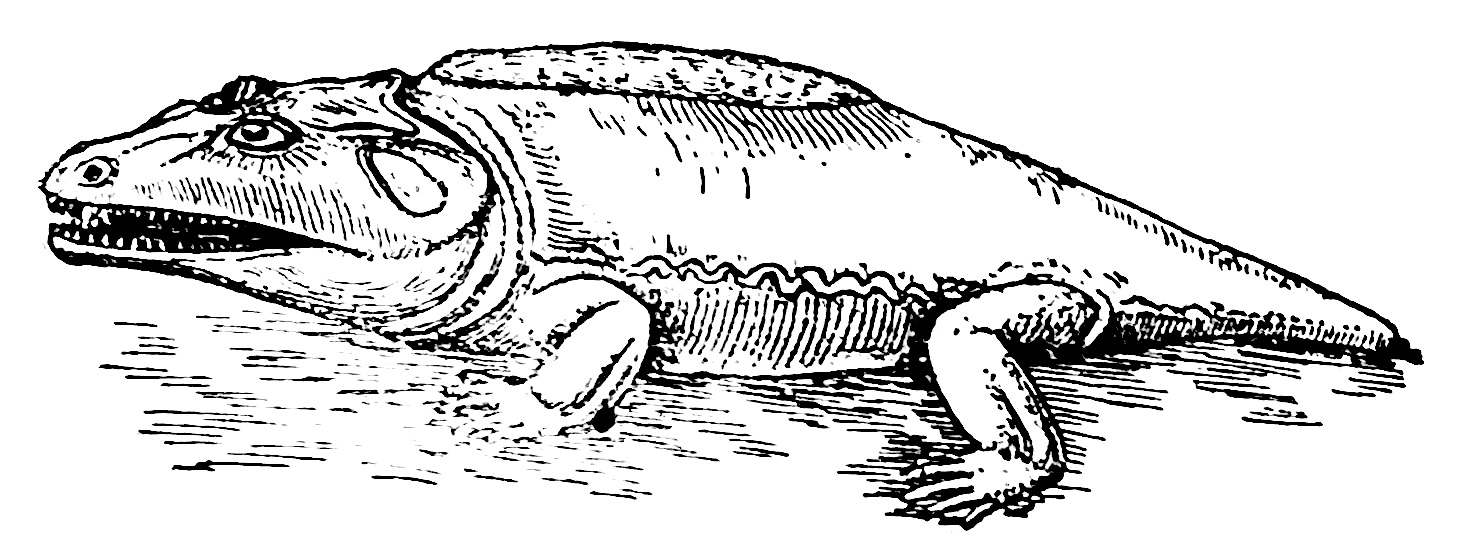
FIG. 1
Cacops, a remarkable Permian amphibian.
Among the most remarkable of the animals found in the stratified rocks of this ancient delta are the amphibians. During the preceding ages, as we have seen, they were the masters of the continental world—the largest and most progressive of land dwellers. But by the time of the Permian they were on the downward road which was to lead them, not to extinction, but to the obscure positions of toads, frogs and salamanders. But this decline did not come at once, and with overwhelming completeness; the early amphibians did not yield tamely to the fate of old age. During the Permian, and the succeeding age, the Triassic, there lived some of the largest and strangest amphibians that the world has known. Some of them returned to the water and developed eel-like bodies with enormous, arrow-like heads; some lived in trees, where their remains have been found by geologists studying coal deposits; others protected themselves by armor and crawled about more or less unmolested, while not a few even went so far as to take refuge in the ground.
[Pg 9]
The giant among all amphibians was Eryops, of the Permian, with a length of about eight feet. He looked somewhat like an immensely overgrown salamander with flabby sprawling legs that were incapable of lifting his body from the ground except by the greatest effort. His skull was from two to two and a half feet in length, and looked like that of a gigantic frog, the jaws were equipped with sharp, cone-shaped teeth and sharp, powerful tusks. Evidently Eryops held about the same position in Permian swamps of Texas as the alligator does in the Georgia bayous of today, lying near the surface of the water with only its eyes and nostrils exposed until the approach of a victim stirred it to movement.
Sharply contrasted with the giant Eryops, and doubtless often its victim, was the unique Diplocaulus. The head of this amphibian was the form of a rather angular crescent, with strong spines directed to the rear, and protected by heavy armor. The eyes and nostrils were directed straight upward, and situated at the forward end of the skull. The body, remarkably enough, was long, thin, and eel-like, with only rudimentary limb bones, and delicate ribs. Probably the animal spent its entire life in the water, wriggling along and pushing its enormous head before it along the slimy bottom. Perhaps, when attacked from above, Diplocaulus was thrown into a frenzy of energy that lifted his heavy, armored head above the bottom, and thrashed it about in the water, but anything like swimming must have been quite beyond his power.
[Pg 10]
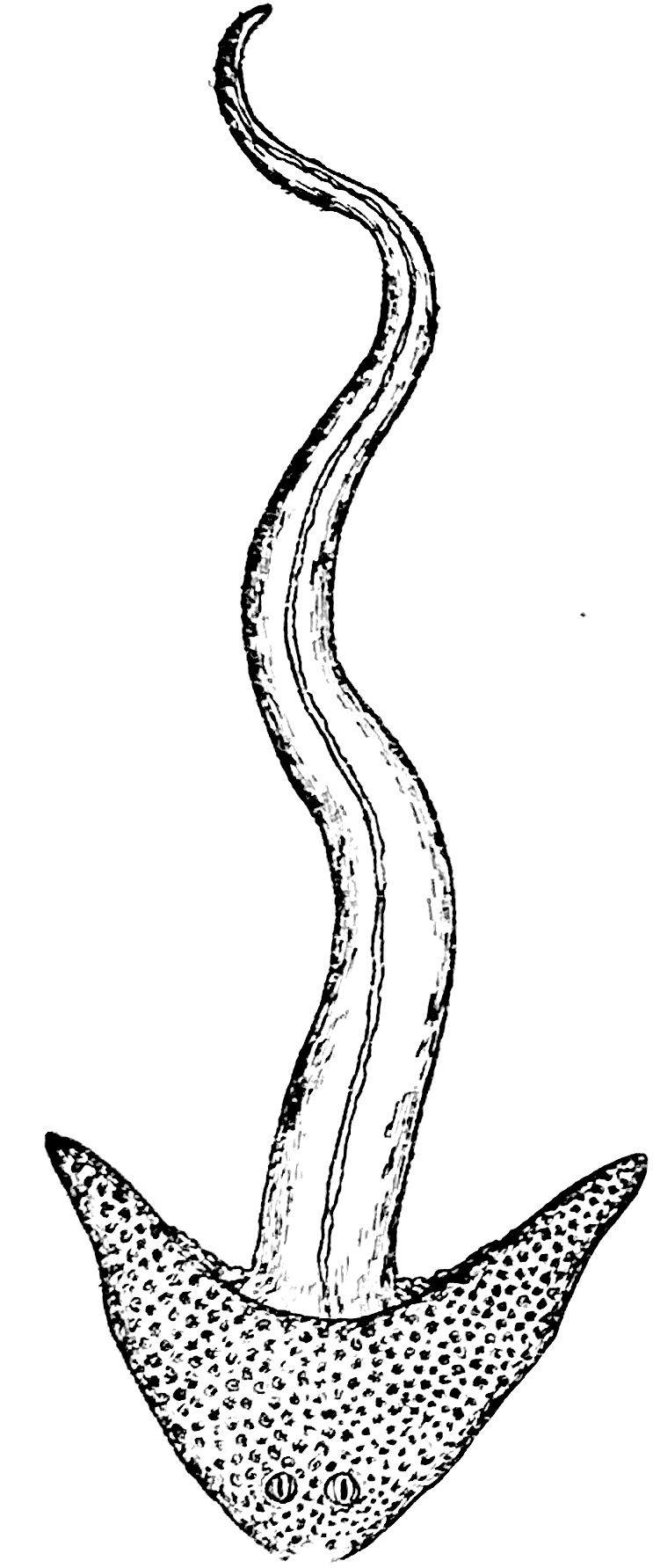
FIG. 2
Diplocaulus, the most bizarre amphibian known.
But, bizarre though the amphibians of this Permian deposit are, they are exceeded by the reptiles. These creatures, as we have seen, made their appearance in the Pennsylvanian, or late “Carboniferous,” and already, in the very beginning of their history, they showed an astonishing diversity of form and habit. There were reptiles that lived in the water, and reptiles that lived on dry land; reptiles that ate flesh, reptiles that ate plants, and reptiles that ate both. Some of them were extremely primitive, closely resembling their amphibian ancestors, while others were like nothing that has lived either before or since.
The simplest of the flesh-eating reptiles were aquatic, living in the waters of swamps and rivers, and perhaps even in the sea. Their bodies and tails were long and slender; their teeth were simple, cone-shaped affairs of almost [Pg 11]equal size throughout the entire length of the jaw. Such a dentition indicates that the reptiles possessing it preyed upon small animals which they did not have to tear to pieces; they merely seized their food and swallowed it, leaving the entire process of digestion to the internal organs, just as do the snakes of today. The upper portions—called dorsal spines—of the backbones in these forms were short, as they are in most lizards, and did not project through the skin.
In other, and somewhat higher reptiles, the teeth appear to be differentiated, those at the forward ends of both jaws being enlarged to form tusks, while the posterior ones are flattened, so that cutting edges are developed that would cut the prey and assist materially in its capture. In some of these same forms the dorsal spines of the backbones are very high, and project above the back as does the fin of a fish.
In Dimetrodon, the last of the series of spiny backed, carnivorous reptiles, these characters reached their culmination. The incisor and canine tusks attained an enormous length and strength, projecting from the jaws as much as three inches. The notch back of the incisors is large and deep, and the posterior teeth [Pg 12]of both jaws are recurved and have sharp, serrated edges so that they must have had all of the cutting power of a Malay knife or kris. [Pg 13]A more effective set of weapons for the cruel business of capturing prey and holding it despite its desperate, agonized struggles hardly could be conceived. At the same time, the [Pg 14]spines on the back developed to an enormous length, and in some species tapered with the delicacy of a whip lash. The tail was short and strong, and the feet armed with well-developed claws, all of which go to show that the animal was purely land dwelling in habit. Dimetrodon reached lengths of more than eight feet, and was by all odds the largest and most powerful creature of his day. We can imagine him crouching in the bushes or tall grasses by the side of some stream, watching for other reptiles that come to quench their thirst, and making a fierce, scuttling rush upon his prey. Most often, perhaps, this was another reptile, but the ponderous, slow-moving amphibians also must have suffered from the attack of the powerful Dimetrodon. There is ample evidence that these animals often waged fierce battles among themselves, for it is common to find bones which have been broken during life and healed again, telling of furious reptilian contests for mates or territory, or perhaps with the single brute idea of a cannibalistic meal.
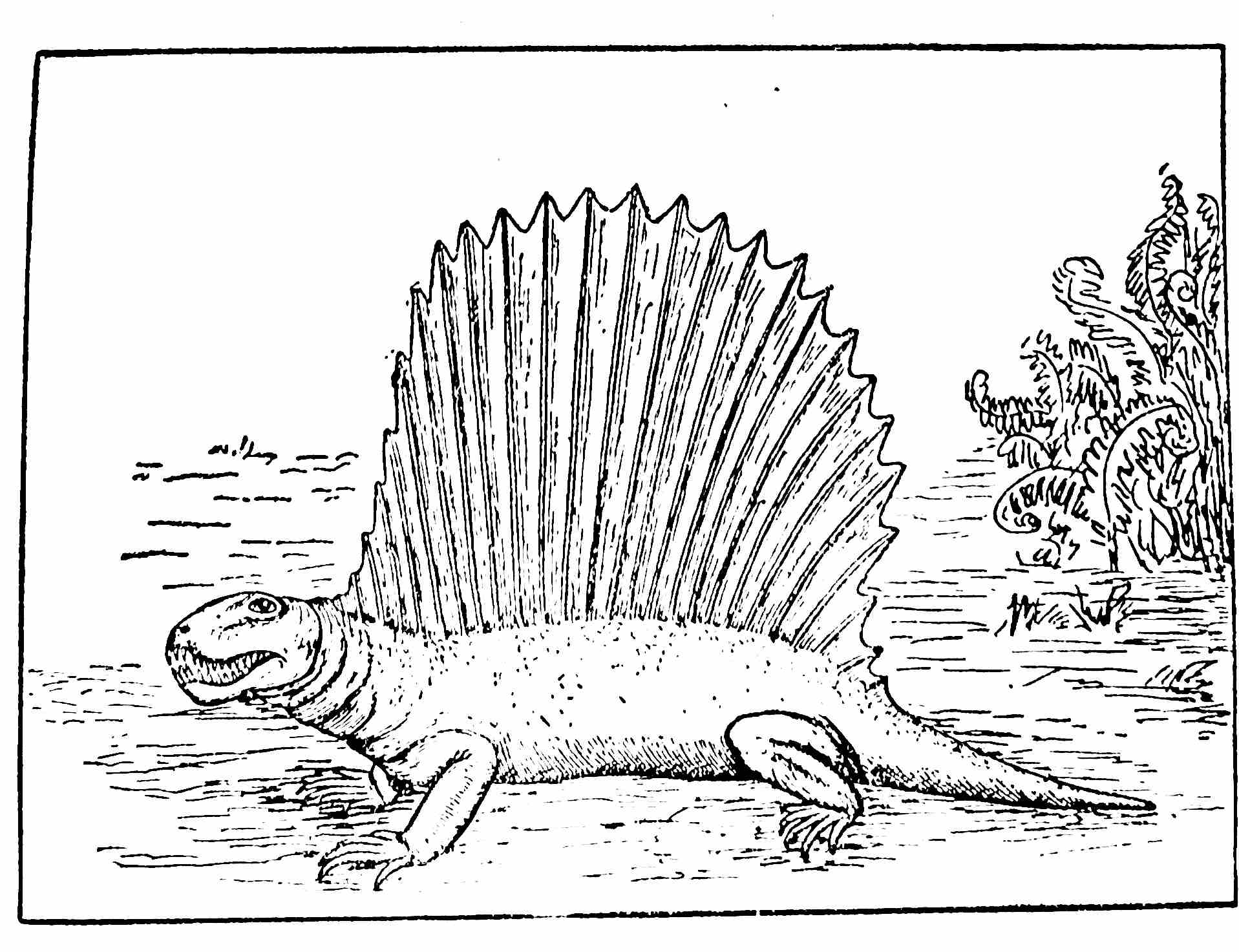
PLATE I.
Restoration of Dimetrodon, the largest animal of the Permian lands.
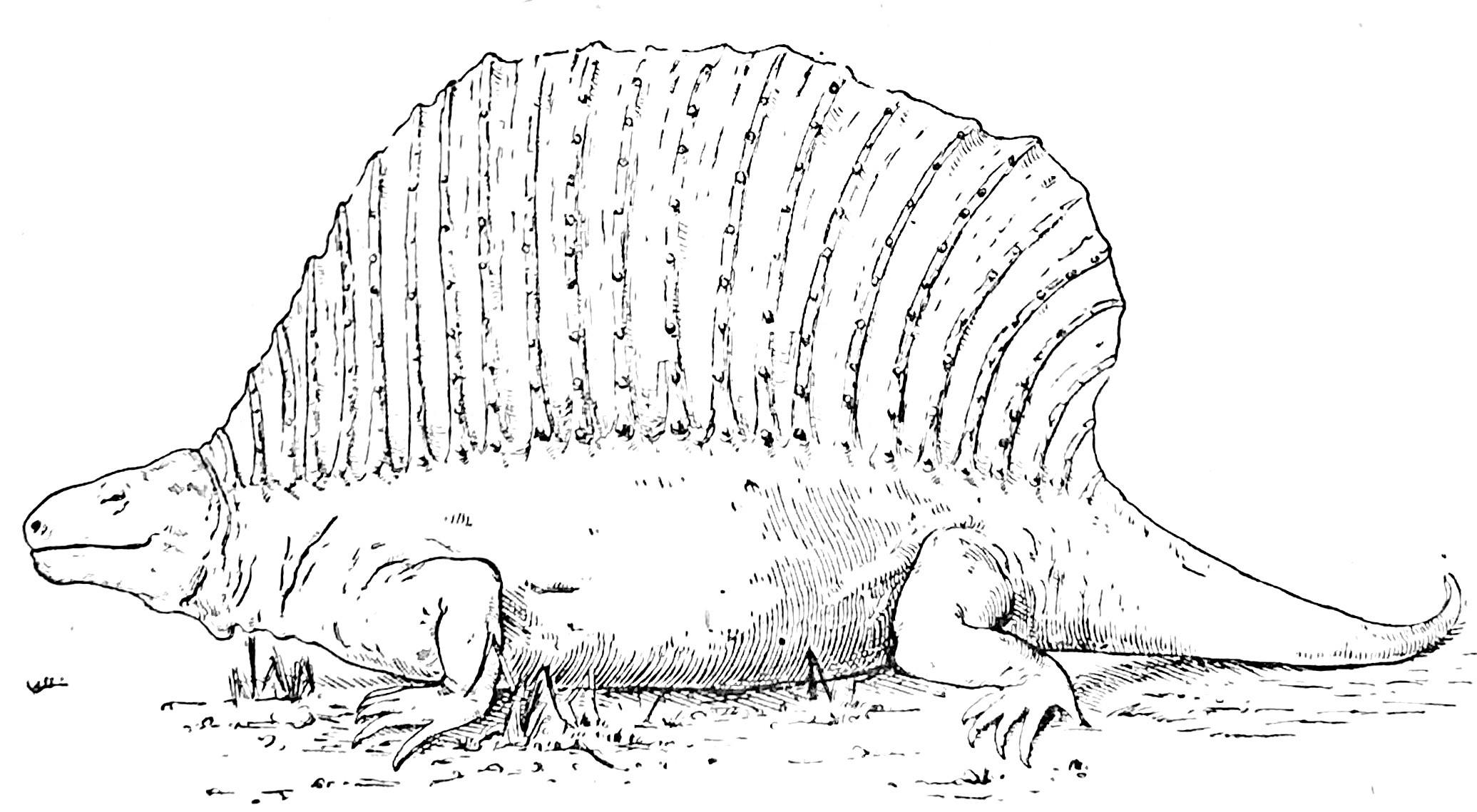
PLATE II.
Naosaurus (Edaphosaurus), the profusely spined mud-grubber. (After Case.)
But a more wonderful animal still has left its remains among the rocks of this delta. Like Dimetrodon, it possessed high spines on the back, but instead of being simple and tapering, they were furnished with projecting processes on either side, much like the yard arms of old fashioned sailing ships. This resemblance led Cope, a pioneer American paleontologist, to call the animal Naosaurus, or “Ship Lizard.” But in spite of his fierce appearance, Naosaurus was totally unlike Dimetrodon in habit, being a peaceful, sluggish eater of shellfish, and perhaps of plants. This animal probably has the most remarkable dentition of any [Pg 15]creature known. The incisor teeth are chisel-like, as though useful in cutting strong, coarse vegetation; behind them are five triangular teeth not unlike those of such flesh-eaters as the lion and tiger; behind these are simple cones, like those of the primitive lizards. But, most wonderful of all, on both the palate and the corresponding portion of the lower jaw are heavy plates of bone covered by short, stumpy teeth, such as occur in the jaws of those fish which live upon shellfish. Seemingly, therefore, the animal ate all sorts of food, but instead of having a generalized pattern of teeth like the pig or man, it possessed a separate set for each type of diet.
The discovery that Naosaurus was an eater of plants and molluscs, and not a predatory form, makes more perplexing than ever the question as to the use of the spines on the back. On such a thick-bodied, sluggish mud-grubber the cross-barred spines must have had about the same value as an ornamental frieze on a canal boat. What conditions of environment could have produced similar structures on creatures of such dissimilar habits as Dimetrodon and Naosaurus?
The structure of the animal shows that these spines were not covered by flesh, but by a thin membrane of skin, through which the spines showed as plainly as the rays in the fin of a fish. It is hard to conceive of this great dorsal frill as being anything but a hindrance to both pursuer and pursued. Cope suggested, in a spirit of fun, that these animals were the natural precursors of the modern fin-keeled yacht, [Pg 16]and that when they wished to navigate the Permian waters they swam upon their backs. Other authors have made other suggestions of about the same note, but few have been able to make any serious contribution on the subject. The obvious suggestion is that the spines served as some form of protective mimicry, helping the animal to remain concealed among the reeds which bordered the lakes or streams. But this seems hardly necessary in an animal that was the dominant form of its time and needed no concealment unless as an aid to lying in wait or making an unseen approach until sufficiently near for its final rush upon its unsuspecting prey. This last, is perhaps, a fair suggestion, but it seems that the burden of maintaining such a weak structure must have far outweighed any advantage of concealment. The spines were slender and were constantly being broken in battle and by accident, and the animal must have expended no inconsiderable amount of energy in repairing the damaged structure.
There remains the suggestion that the spines were remnants of a formerly useful structure, and that their mature condition was purely due to overgrowth. It seems certain that when a structure has developed so far as to give an animal a distinct advantage it may continue to grow until it is a burden rather than a help. Thus the spines, originating as a protective feature, may have given their possessors such a decided advantage that they were almost free from attack. In this stage [Pg 17]they may have become over-nourished, and have [Pg 18]continued growing by a sort of inertia or momentum until they reached their greatly exaggerated development.[2] Furthermore, there is a tendency, both in plants and in animals, for a species nearing its extinction to develop a spiny or horny habit. This we saw in the invertebrates, among the aging Cephalopods, and it is quite conceivable that a similar state of affair prevails among these reptiles. For Dimetrodon and Naosaurus,[3] dominant though they were, were nearing the end of their life cycle. In their senile aberrations they carried the development of spines to greater and greater lengths, until, in their declining strength they were unable to maintain their species, and so disappeared from the earth.
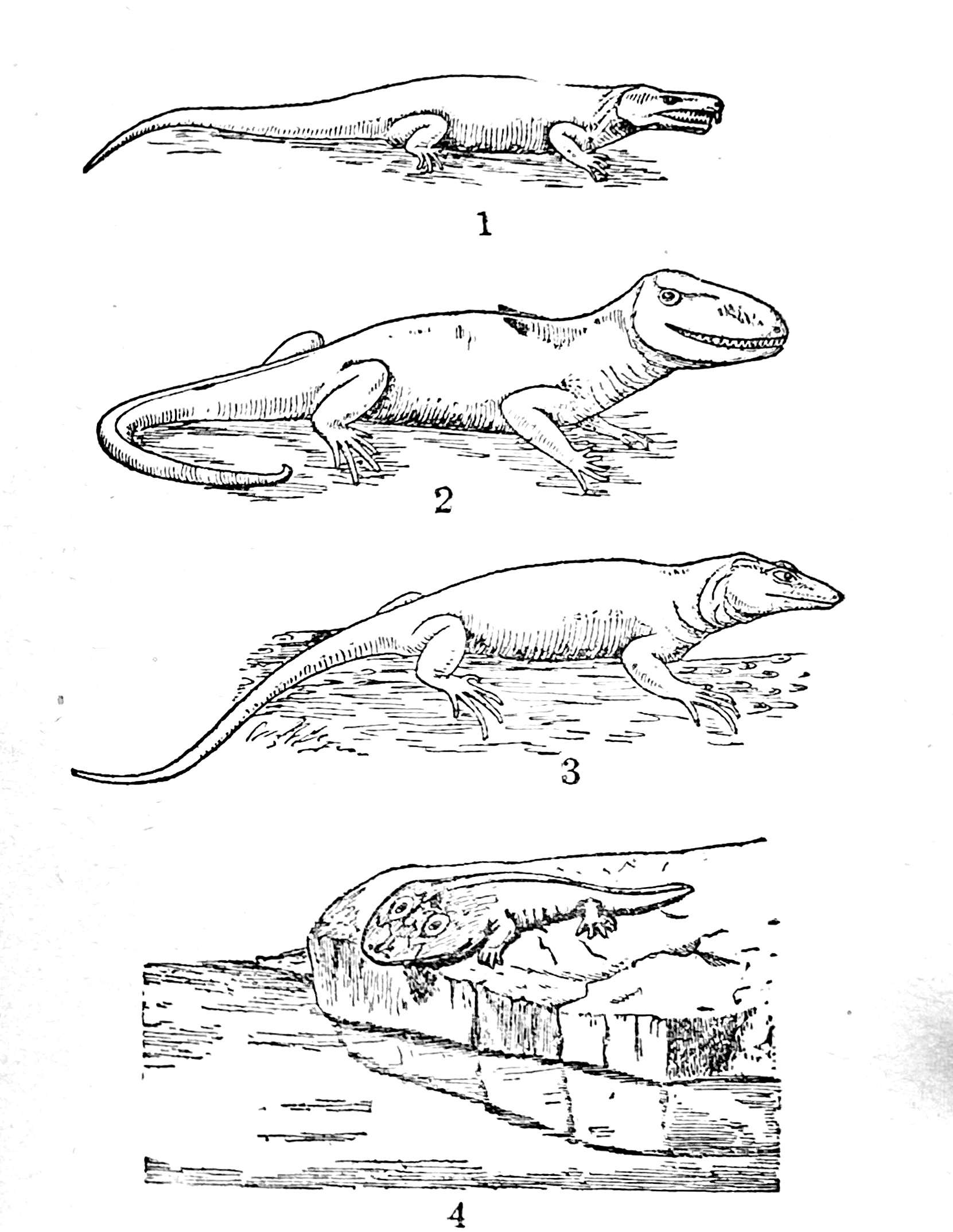
PLATE III.
Permian vertebrates, restored by Williston and others. 1-3 are reptiles, while 4 is an amphibian.
[1] Case, E. C., “A Great Permian Delta and its Vertebrate Life,” Pop. Sci. Monthly, Dec. 1908. This quotation is somewhat paraphrased, while the remainder of this chapter is based very largely on the article.
[2] Paraphrased from Case, Loc. Cit.
[3] A relatively recent discovery, made by Dr. Case, shows that the name Naosaurus must be dropped, being replaced by the earlier name Edaphosaurus. The former name, however, is the commoner, as well as the more descriptive.
The continent of North America during that portion of the earth’s history which we may call the Age of Reptiles would have seemed to our eyes like another world. The present coastal outlines, mountain chains, valleys, rivers, lakes, and plains have, with few exceptions, come into being long since that time. [Pg 19]During the early part[4] of the age there were high mountains in the eastern part of the continent, which sent strong, muddy streams flowing to the Atlantic. California, on the other hand, was under the Pacific; the Sierra Nevada region was a great trough, while throughout that region which is now eastern Colorado, Utah, western Texas, and Arizona there lay a belt of broad, shallow lakes.
The plant life of those times differed as much from that of previous ages as from those that were to follow. The great Pennsylvanian coal forests of lepidodendrons, sigillarias, and their allies, had almost completely vanished from the earth. The higher lands were clothed with cone-bearers, such as the Aurucarian pines of present day Australia. Thick, gloomy forests of tree ferns covered the moist regions, while great “canebrakes” of horsetail reeds whose stems reached four or five inches in thickness bordered the bayous and marshes. Cycads, trees which, though related to the pines and spruces, look like palms, were abundant in the forests of this time.
During the middle portion of the Age of Reptiles conditions, both in geography and in plant life, underwent no striking change. But in the late Mesozoic, the Cretaceous period, there were many changes. The Atlantic Ocean encroached on the eastern part of the continent, [Pg 20]while the Gulf of Mexico extended as far north as Illinois, and reached westward over Texas. A broad mediterranean sea stretched from the Gulf to the Arctic Ocean, and from Iowa to Utah, with the Colorado Mountains rising from it as a chain of islands. West of the sea was a broad belt of swamp land which extended from northern Alberta almost to Mexico.
The plants of the Cretaceous changed with the geography. The Cycads, so abundant in the early Mesozoic, became rare in most regions. The highest types of flowering plants gained an almost complete ascendancy, and forests of a decidedly modern appearance covered the continent from the Gulf of Mexico to the Arctic Ocean. “Among the kinds of forest trees whose remains are found in the continental deposits of the Cretaceous are the magnolia, the myrtle, the laurel, the fig, the tulip tree, the chestnut, the oak, beech, elm, poplar, willow, birch and maple. Forests of Eucalyptus grew along the coast of New England,[5] and palms on the Pacific shores of British Columbia. Sequoias of many varieties ranged far into northern Canada. In northern Greenland there were luxuriant forests of magnolias, figs, and cycads; and a similar flora has been disinterred from the Cretaceous rocks of Alaska and Spitsbergen. Evidently the lands within the Arctic Circle enjoyed a warm and genial climate, as they had done during [Pg 21]the Paleozoic. Greenland had the temperature of Cuba and southern Florida, and the time was yet far distant when it was to be wrapped in glacier ice.”[6]
Such were the conditions under which flourished the mightiest race of animals that has ever lived upon land. The Dinosaurs not only were the dominant animals of their time, but they reached sizes so great that they have been rivalled by but one group of mammals—the whales. They maintained their supremacy throughout a long period of time estimated at from nine to one hundred millions of years; they survived important changes in geography and climate, and became extinct through a combination of causes which are yet only half known. Perhaps the great changes in life conditions at the end of the Cretaceous had much to do with their disappearance, as may also have been true of other reptiles living at the same time. Not improbably, too, the rise of egg-eating mammals, more intelligent and active than the dinosaurs, was a factor; and last of all, there remains the ever ready and ever probable hypothesis of racial old age.
The Dinosaurs were descended, in the opinion of those who have studied them, from primitive, lizard-like reptiles with fairly long limbs, long tails, five toes on each foot, and a complete series of sharp pointed teeth. In all probability, according to Dr. W. D. Matthew,[7] [Pg 22]this ancestor was fully capable of living on dry land, and was more or less in the habit of walking on its hind legs alone.
One of the most striking things about the Dinosaurs is their notable lack of brain power. In man, a creature weighing anywhere from one hundred twenty to two hundred pounds, on the average, the weight of a normal brain is about three pounds. The smallest brain that can exist and possess reasoning powers is about two pounds, while the smallest human brain known to be fitted for life alone weighs just a little more than ten ounces.
We can readily see that if conditions were proportionate among the Dinosaurs the size of the brain would be almost unbelievable. Instead, the reptile Claosaurus, which once inhabited the valleys of Maryland, and was twenty-five feet long and more than twelve feet high, had a brain so small that it must have weighed less than one pound. Brachiosaurus, probably the biggest beast that ever walked, was not much better equipped, while Triceratops, a Dinosaur having more than twice the bulk of the average elephant, possessed a brain weighing about two pounds. Truly they who are prone to refer to the “brainlessness” of human beings should consider the Dinosaurs before they speak! These great beasts must have [Pg 23]known just about enough to rest when they were tired and eat when they were hungry; “coming in out of the rain” doubtless was an idea altogether too complicated for them to grasp.
But, as Lucas and others have emphasized, intelligence is one thing and living another and a very different one. The poor, weak brains of the Dinosaurs doubtless had but little to do with the primary functions of life; the spinal cord took care of them. In some of the beasts, notably in the armored giant Stegosaurus, the spinal cord possessed a sacral enlargement that was twenty times as large as the brain. This remarkable fact, when announced by Professor Marsh, attracted great attention, and was made the subject of much newspaper writing. Thousands of people who would never recognize the name Stegosaur are familiar with the marvelous character of that beast as he is described in this catchy though fanciful poem:
[Pg 24]
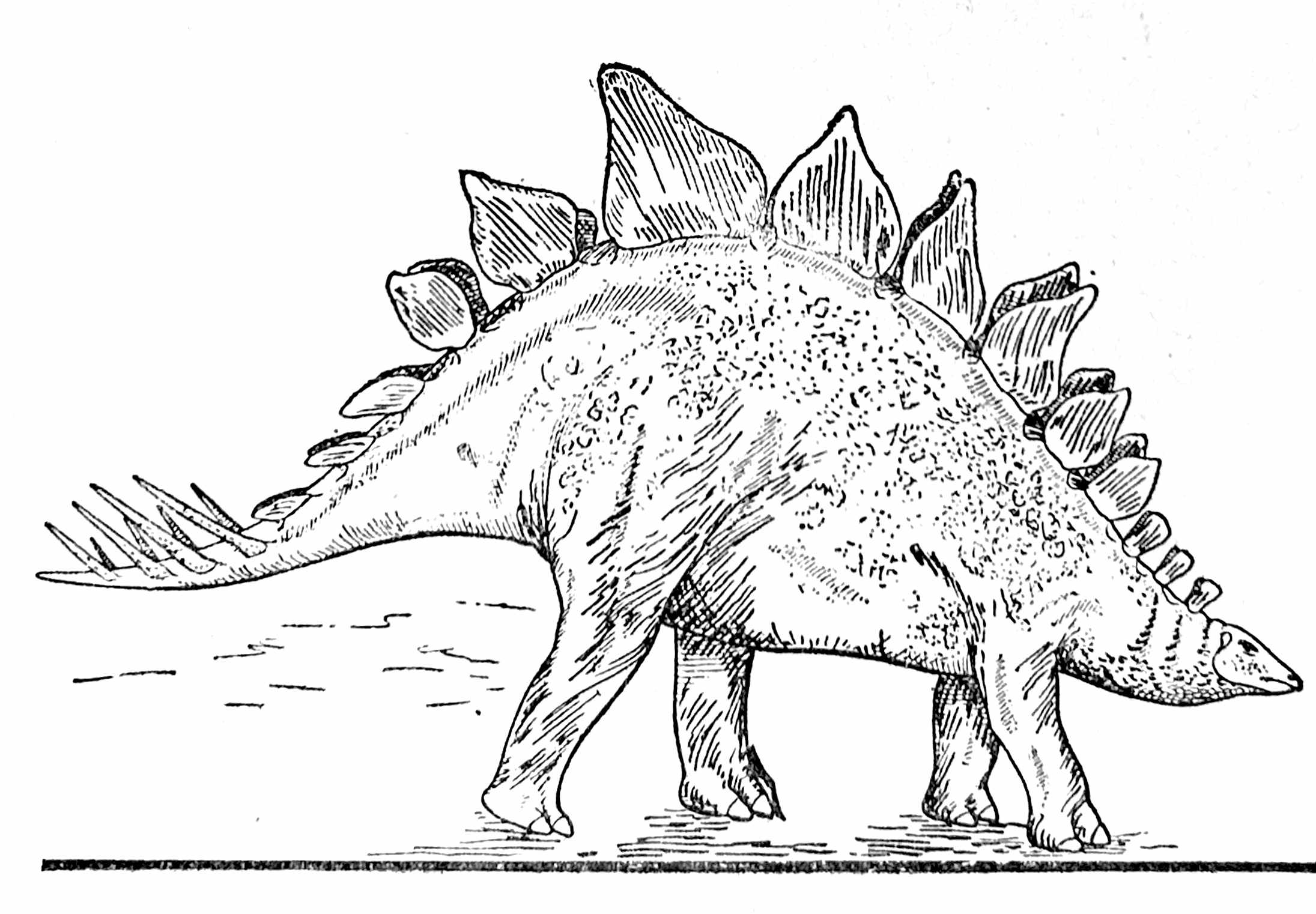
PLATE IV.
The armored giant Stegosaurus.
[Pg 25]
THE DINOSAUR.
The Dinosaurs, like all other groups of animals, may be divided into sub-groups, depending on habits, structure, etc. The commonest classification separates them into three divisions: the carnivorous, the amphibious, and the beaked. One of the most remarkable of the flesh-eating species, though not the largest, is Allosaurus, a powerful reptile that once roamed over the western part of North America. He walked by means of his hind legs only, using [Pg 26]his long tail as a balance for his body. The huge head, armed with long, sharp teeth, was [Pg 27]set on a heavy, short neck; casts of the brain indicate that it was of much the same type as that of the modern alligator, but considerably less effective.
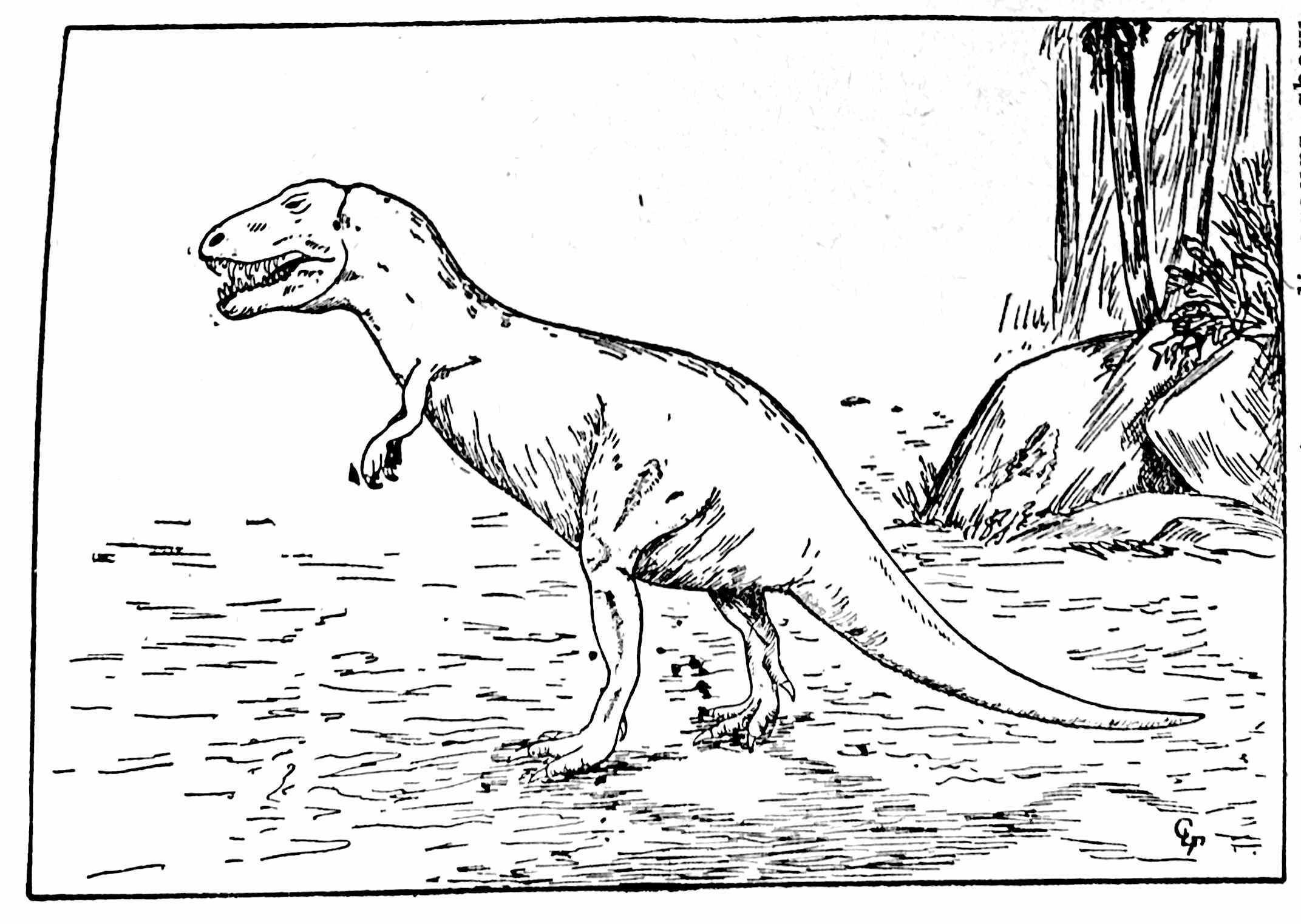
PLATE V.
One of the greater carnivorous dinosaurs, showing the large head, long teeth, tiny fore limbs and ponderous walking legs typical of the group. (Modified after Lull.)
Allosaurus lived upon dry land, seldom venturing into the great Mesozoic swamps. He was predaceous, attacking his prey in swift, mighty rushes, tearing it with the jaws and occasionally striking it with the powerful tail. Anything like the elaborate stalking of game such as we see in the tiger and lion of today was impossible to the Dinosaur; he simply lay in wait until the close approach of prey stimulated him to his tremendous but half instinctive rush. The kill was torn to pieces and swallowed without chewing, as is the case with the alligator of today.
The amphibious Dinosaurs, which must have provided much of the food for Allosaurus and his kin, were characterized by blunt teeth and claws, strong, elephant-like legs and feet, long neck, and small head. They attained very great size, some of them, as we have said, being the largest of land animals. They may well be typified by Brontosaurus, the Thunder Lizard, which though not the longest, was one of the largest of his kind. The skeleton which is mounted in the American Museum is sixty-six feet long, the animal when alive having weighed about thirty-eight tons. The body was large and rather short; the neck long, and the head small. The tail was long and thick, and the legs massive and post-like. The bones of the legs were very long and heavy, the thigh bones being from five to six feet long—the [Pg 28]largest single bones so far discovered. The vertebrae, or “backbones,” were as much as four and one-half feet high, being larger than those of the whale.
The teeth and general structure of Brontosaurus give fairly reliable evidence as to the habits of the animal. It spent its life in the shallow water of lagoons, feeding upon the succulent water plants. There is no evidence that it swam very much; probably its principal mode of progression was wading, with the immense body partly supported by the water. Perhaps the beast occasionally left the water for the purpose of laying eggs, as is shown in Knight’s oft-printed restoration. It appears, however, that Brontosaurus was not built for land travel; that his joints were so imperfectly formed that he could not have moved on land without tearing those of the leg to pieces. Dr. Matthew thinks that the species of this genus bore their young alive, as do certain modern reptiles, and therefore had no need to leave the swamps and bayous at any time during their lives.
Within the last few years there have come sketchy preliminary accounts of a mammoth find near Tendaguru, Africa, by an expedition sent out from Germany. They announce the discovery of a Dinosaur whose neck and fore limbs far exceeded those of Brontosaurus, although the hinder parts of the skeleton were relatively small. It appears that this giant, which the German savants appropriately named Gigantosaurus, is identical with the [Pg 29]American form Brachiosaurus, whose fragmentary [Pg 30]remains are on exhibit at the Field Museum of Chicago. It is, without question the largest known Dinosaur, so far as weight goes—a long-necked wading creature that lived much as did Brontosaurus but was capable of going into considerably deeper waters, quite beyond reach of the fierce carnivorous giants of the land.
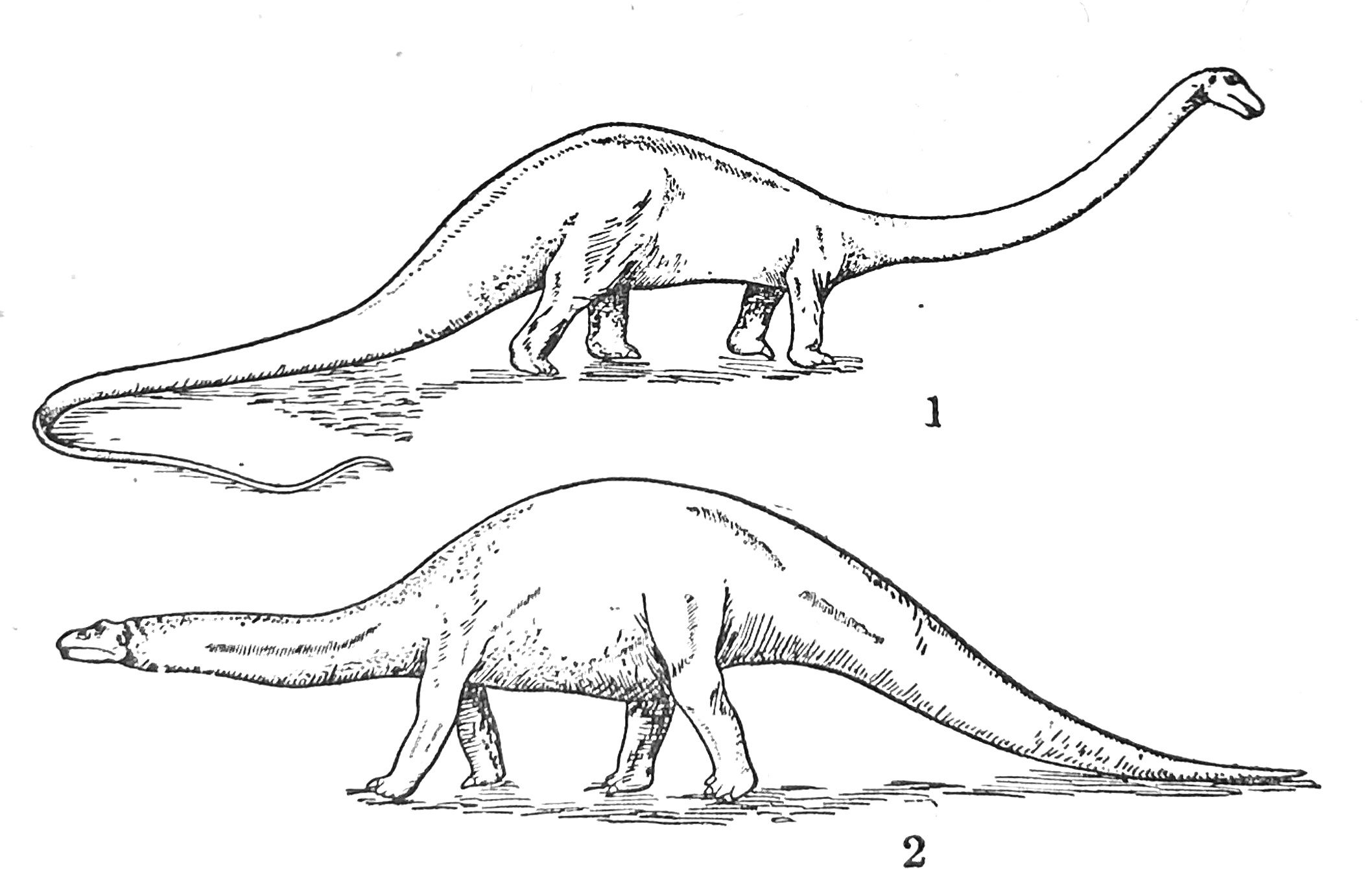
PLATE VI.
Fig. 1—Diplodocus, the longest Dinosaur known.
Fig. 2—Brontosaurus, the giant that could not walk except in water, because of his great weight and feeble joints.
The distinctive character of the third group of Dinosaurs is the possession of a horny beak or bill, much like that of modern birds. Indeed, there are many features in the anatomy of these reptiles that indicate their relationship to the birds, and it is probable that the remote ancestors of the two groups were very closely connected—perhaps identical. But the ancestral birds developed feathers and took to flying, while the ancestral beaked Dinosaurs (Predentates) specialized in the direction of land life, and in their later development became even more widely diversified in form than did their feathered relatives.
The beaked Dinosaurs lived entirely upon vegetable food. The best known of them, Triceratops or “He-of-the-three-horned-head,” looked more like a gigantic, long-tailed rhinoceros than a reptile. Above each eye was a long, sharp horn which extended forward; the bony cores which remain in the fossils are as much as thirty-three inches long, and during life the horny covering must have lengthened them by six inches to a foot. The horn above the nose was considerably shorter, yet would have compared favorably with that of many rhinoceroses.
[Pg 31]
“Standing before the skull of Triceratops,” says Dr. Lucas, “... one notices in front of each eye a thick guard of projecting bone, and while this must have interfered with vision directly ahead it must have also furnished protection for the eye. So long as Triceratops faced an adversary he must have been practically invulnerable, but as he was the largest animal of his time, upward of twenty-five feet in length, it is probable that his combats were mainly with those of his own kind and the subject of dispute some fair female upon whom two rival suitors had cast covetous eyes. What a sight it would have been to have seen two of these big brutes in mortal combat as they charged upon each other with all the impetus to be derived from ten tons of infuriate flesh! We may picture to ourselves horn clashing upon horn, or glancing from each bony shield until some skilful stroke or unlucky slip placed one combatant at the mercy of the other, and he went down before the blows of his adversary ‘as falls on Mount Alvernus a thunder-smitten oak?’”
Two Triceratops horns in the possession of the United States National Museum bear the marks of such an encounter as that described by Dr. Lucas, for one of them is broken about half way between the tip and the base, and the stump is healed and rounded over. Evidently their owner was not seriously injured in the fight, but lived to a ripe old age in spite of [Pg 32]his infirmity.
Triceratops had a number of relatives, at least one of which is even more famous than [Pg 33]himself. This is Stegosaurus, the great Armored Dinosaur that possessed the remarkable enlargement of the spinal cord. Like his three-horned relative, Stegosaurus was a land dweller that walked upon four legs. His head was very small, as were his fore limbs; his body was very large, and his tail long and powerful. Along his back ran two rows of bony plates, some of which were four inches thick at the base, and two and one-half feet high. The tail bore, near the tip, two pairs of spines which were almost as long as the back plates, and half again as thick. The hind limbs were long and straight, in marked contrast with the front ones, so that the creature when walking must have appeared to be in constant danger of turning a somersault.
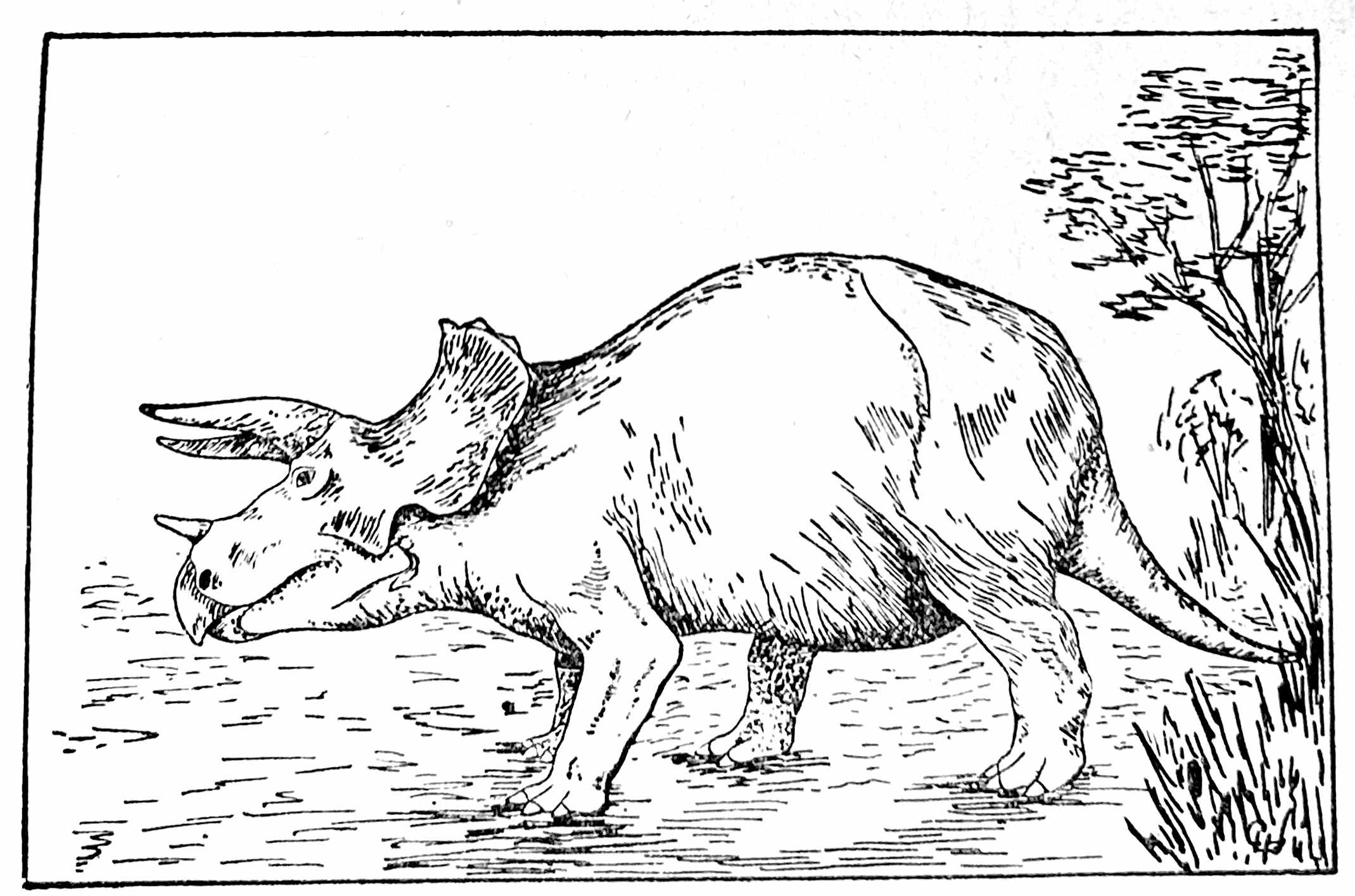
PLATE VII. Triceratops, the Three Horned Reptile.
Stegosaurus was a contemporary of Brontosaurus and the carnivorous Allosaurus. Like the former, he was a peaceful plant feeder, but unlike him, did not flee to the shallows in order to avoid his flesh-eating relatives. For this great armor, although undoubtedly developed in the interests of peace, was hardly designed with any consideration for the Hebrew creed of turning one cheek when the other is smitten. Stegosaurus was too brainless and to clumsy to go about seeking trouble, but to those creatures foolhardy enough to attack him he could offer stiff resistance. A few blows of the huge spiked tail, more powerful than the club of the mightiest ogre of mythology, would be quite enough for even such giants as Allosaurus. Stegosaurus, like the [Pg 34]rhinoceros of modern Africa, probably went his way unharming and unharmed.
The Dinosaurs first appeared during the Triassic period when they roamed through the valleys of eastern North America in great numbers, leaving their footprints on the soft, fine mud of the valley flats. The succeeding period, the Jurassic, was their Golden Age—the age of Brontosaurus, Allosaurus, Stegosaurus, Diplodocus and other monsters. During the Comanchean and Cretaceous periods the larger Dinosaurs became extinct, and were supplanted by the smaller beaked forms, such as Triceratops. At the end of the Cretaceous period, which was also the end of the Age of Reptiles, the Dinosaurs became almost totally extinct. Perhaps a few of them survived in specially favored localities, for Dinosaur bones are found in rocks which a number of geologists refer to the beginning of the Age of Mammals. But such survivals were of small importance, and had little effect on the general annihilation. The Dinosaurs were unable to meet the demands of a dry-land environment, and joined the great hosts of creatures that at various times have held the earth in their sway and then, defeated by causes at which we can only guess, have passed into extinction.
[4] The Mesozoic Era, or Age of Reptiles, is divided into four periods—Triassic, Jurassic, Comanchean, and Cretaceous. The first two are here referred to as the “early” part of the age; the third as the “middle,” and the fourth as the “late.”
[5] The Eucalyptus is now common in Australia, while the Sequoia is the “Big Tree” of California.
[6] Norton, Elements of Geology, 1st Ed., p. 378.
[7] Dr. Matthew, curator of vertebrate paleontology at the American Museum of Natural History, is one of the authorities on Dinosaurs. His book, “Dinosaurs,” published by the Museum, has afforded much of the material to be found in this chapter.
The sea, as we have seen, was the metropolis of primitive life. Then came the amphibia, and [Pg 35]the scene of animal activities was partially transferred to land, while with the coming of reptiles the abandoning of the sea by the higher forms of life seemed to be insured. Yet the change did not come so rapidly as one might think, for the reptiles after having begun their conquest of the land sent not less than three great branches back to the water, and one of these, at least, extended its domain around the world, from the islands of the South Seas to what are now the plains of North America.
During the latter part of the Age of Reptiles a great island sea spread over a large part of this continent, while other portions of the world were similarly inundated. Almost everywhere on the expanse of the shallow Cretaceous waters might have been seen the forms of huge, snake-like reptiles, the Elasmosaurs, whose arrow-shaped heads, poised on long necks rose from ten to twenty feet above the surface as they swam about searching for food or avoiding enemies. When the prey was located, the reptiles dived to capture it; when an enemy approached they swam away with almost incredible swiftness. Their long necks were attached to large, thick bodies which ended in long, tapering tails. The legs were modified to form broad paddles, of great value in swimming; the front pair, perhaps, were used in seizing prey. Being carnivorous, the Elasmosaur ate whatever it could catch, and Elasmosaur bones are commonly found along [Pg 36]with those of creatures on which they fed. Not uncommonly large quantities of rounded pebbles [Pg 37]are found with the remains of these reptiles, sometimes a peck of them in a single deposit. These stones filled the same purpose as do the “gizzard stones” found in the stomachs of modern birds. Evidently the Elasmosaurs and their allies did not tear or bite their food into small bits, but relied on the action of their stomachs, assisted by these stones, to do the work.
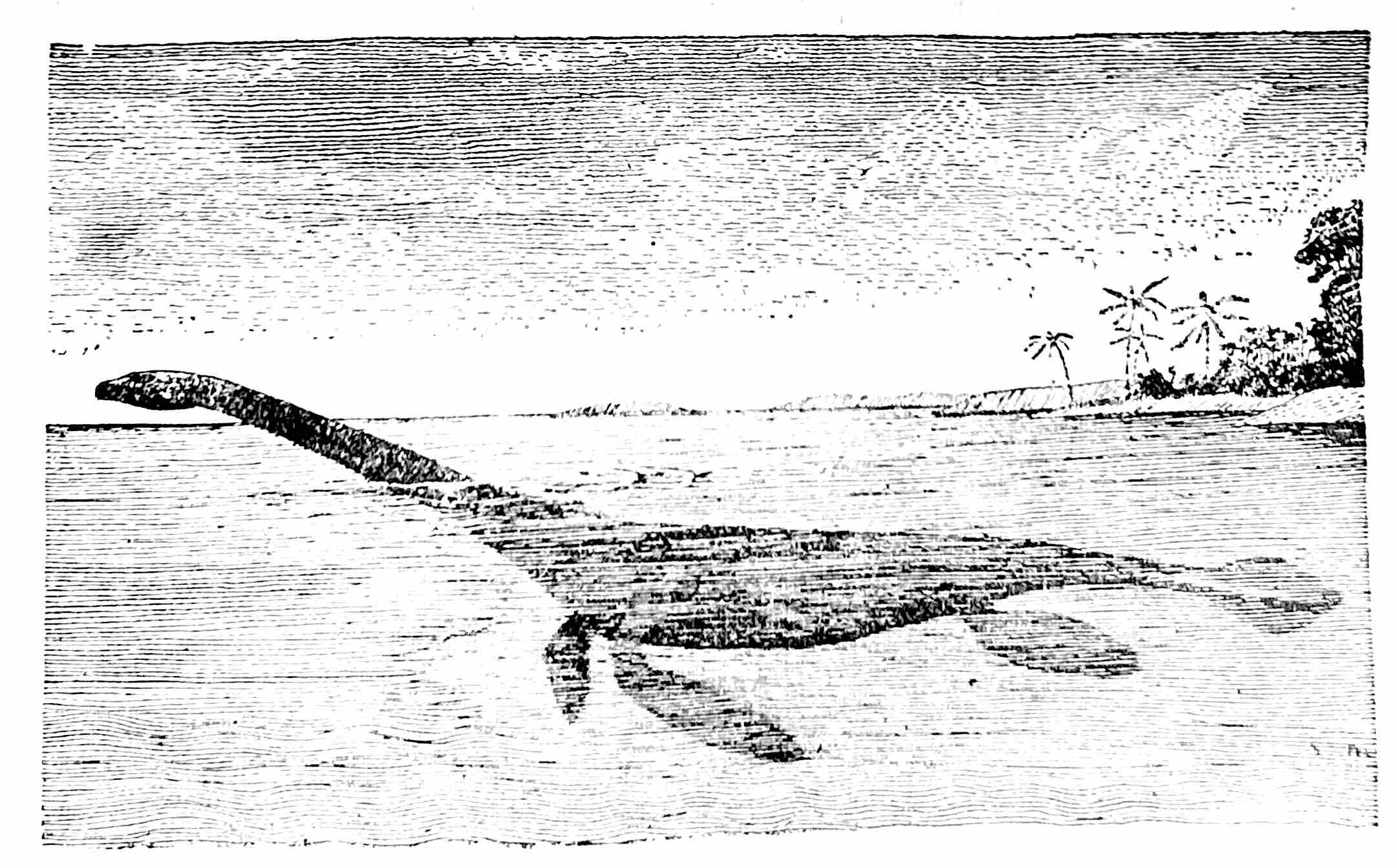
PLATE VIII. An Elasmosaur swimming, as drawn by Williston.
But, remarkable though these reptiles may seem, they were by no means the rulers of the Mesozoic oceans and seas. The great Mosasaurs were not only the giants of those waters, but were far more numerous and wide-spread than their less hardy and prolific contemporaries.
We may quite properly call these animals great, for so they were. But it is well to remember that among the lower animals as among men there are degrees of greatness; moreover there is a general desire on the part of men to magnify the animals of the past, and consider them as being far larger than any that live today. Few people, when thinking of ancient creatures, stop to recollect that the whales of today are by far the largest animals that ever lived on the earth, just as modern shellfish compare very favorably with those of past ages. True, there are no reptiles today that compare with the largest of the Dinosaurs, but by no means all of the Dinosaurs were giants. A few Mosasaurs attained a length of forty feet—some even forty-five—but most of them were less than twenty. Among modern reptiles, the Mugger, or Man-eating [Pg 38]Crocodile of Africa grows, if allowed to live long enough, to a length of twenty-five or thirty feet, and therefore exceeds in measurements as well as weight the average Mosasaur.
The Mosasaurs were elongated and gracefully fish-like in form. Their heads were large, flattened, and conical; the eyes were placed on the sides rather than the top of the skull. Their tails were long, with flattened, fin-like extensions that assisted the four broad, powerful flippers when the creatures were swimming. Like their distant relatives, the snakes, they possessed four rows of teeth on the roof of the mouth. These teeth were valueless for chewing, but were of utmost service in holding the prey, which was swallowed entire. The probability is that the tongue was long and forked, while the structure of the throat and windpipe indicates that the mighty Mosasaur’s only call was a serpent-like hiss.
The first Mosasaur was discovered in the quarries beneath St. Peter’s Mount, near Maestritch, Germany, some ninety feet below the surface. Immediately on finding the specimen the workmen informed Dr. Hoffman, the surgeon of the local forces, and an ardent collector of fossils. He labored with the quarrymen for two weeks, and was rewarded by an almost perfect specimen which he took to his home and cleaned with great care and success. The fossil was so unusual, and was made the basis of so many papers, illustrations, and discussions, that the canon of the cathedral which stands on St. Peter’s decided that he should [Pg 39]own the specimen. Dr. Hoffman refused to give it up, and Canon Goddin instituted a long, expensive, and harassing law-suit, making certain feudal rights the basis of his claim. The whole chapter, of course, stood with their reverend brother, and the decree went against the surgeon, who was forced to give up his [Pg 40]specimen and pay the costs of the trial. For several years the skull remained in the possession of the clergyman, and Hoffman died without regaining it. Finally, during the French revolution, Maestritch was bombarded and captured. During the attack, the artillerymen had not been allowed to shoot into that part of the city where the fossil was known to be. The canon, guessing the reason for this particular favor, hid the skull in a vault, but was forced to give it up when the city was plundered. The French, who did not hesitate to appropriate anything of value in either science or art, bore the famous Mosasaur off to Paris, and put it in the museum at the Jardin des Planes, where it still remains.
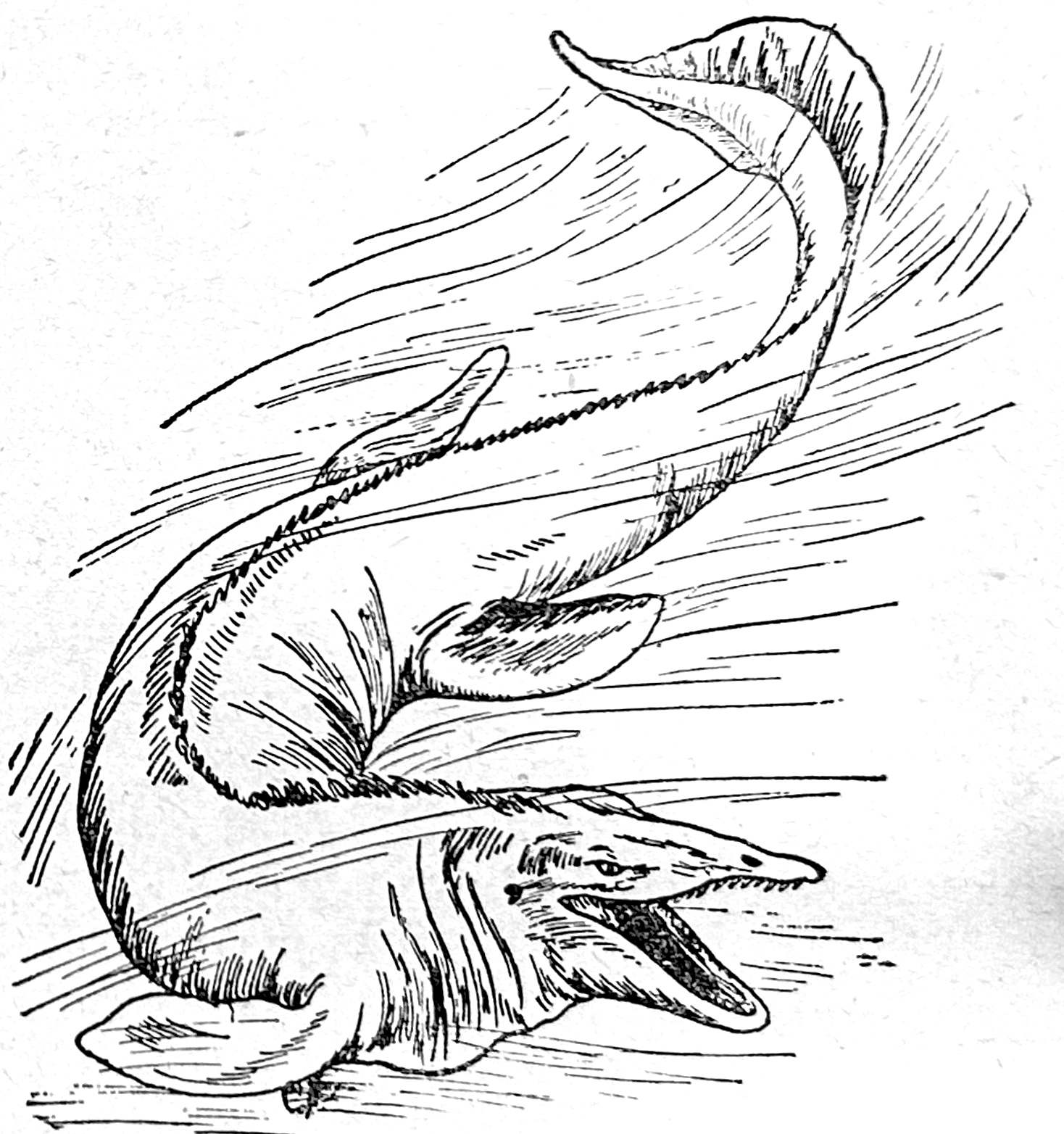
PLATE IX.
A Mosasaur swimming.
The first American Mosasaur discovery took place in 1820, at Great Bend, Mo. Major O’Fallon, an Indian agent, found a fine specimen which he took to his home in the town of St. Louis. A few years later the relic was taken to Germany by Prince Maximilian of Wied, after his famous trip through the United States in search of natural history specimens and information. Since that time hundreds, even thousands, of specimens have been collected and described from the Cretaceous rocks of this country. The shallow seas that covered Kansas were the headquarters of the Mosasaurs, and their skeletons are abundant in the chalk cliffs of the district.
Among the fishes which were the prey of the Mosasaurs was the great Portheus, or Bulldog fish, whose long, sharp teeth and powerful body indicate that it often evened matters by [Pg 41]capturing smaller mosasaurs. The head of this monster was twice as large as that of a grizzly bear, while the muzzle was stouter and deeper than that of a bulldog. Some of the teeth projected as much as three inches above the gums, sinking a full inch into the pits—as long as the fangs of a tiger, but more slender. Two pairs of these deadly teeth crossed each other on either side of the snout, and were re-enforced by numerous other long, conical teeth farther back on the jaw.
Above the water soared or flew—it is not yet decided which—the great Pterosaurs, or winged reptiles. According to the current conception, these great beasts flew above the water, swooping down to snatch fishes and smaller mosasaurs, on which they fed. Some of the Pterosaurs had wing spreads of eighteen to twenty feet, and if they actually did fly, were without doubt the largest of all denizens of the air. At night and while resting they clung to cliffs and rocks by means of the long claws with which their wings were equipped.
While we do not know whether or not the Mosasaurs fed upon turtles, there were plenty from which they might have made their choice. One of them, at least, was of gigantic size, having a flipper spread of at least fifteen feet. The skin was smooth and leathery, that over the back being strengthened by several ridges of stiffer integument. The back flippers were relatively small, while the front ones were very broad and without an armor of claws.
[Pg 42]
Gradually, after countless centuries of relative quiet, the earth began to re-shape its surface. Mountains, plains, and plateaus arose, leaving those sea-dwellers that could not swim or crawl to perish in the hot suns of a new time. The once broad seas grew smaller and smaller, were divided into lakes and basins, continued shrinking. The sea-dwellers were imprisoned in these basins, where they preyed upon each other with greater ease than had been possible in the open waters of earlier times, while the fishes died from the constant freshening of the water. The stronger gorged upon the weaker until they were left stranded on the ever rising bars, with no food but their kindred, and little strength to either attack or escape. At the last they may have made desperate attempts to escape by land, or else lay starving in the shallow, muddy pools. Perhaps as the waters shrank a few of the great saurians fed with them, eventually making their way into the new sea and ocean areas. But in all probability any such refugees were so beaten and starved that they had but little chance for success in life under their new environment. By the time of the great uplift which proved their undoing, the Mosasaurs and their allies were an old race,[8] and had little vitality left with which to cope with new situations. [Pg 43]They died, leaving no descendants,[9] and only the scattered remains in Cretaceous rocks remain to tell of the once mighty hordes.
[8] For a discussion of the age of groups, life cycle of species, etc., see the author’s booklet, “Animals of Ancient Seas,” No. 47 of this Series.
[9] Rumors of Paleozoic monsters living in remote portions of the earth appear constantly, but without foundation in fact. Just this year (1922) newspapers and some magazines have made a great to-do about a Plesiosaur that was supposed to be living in a South American lake. The Plesiosaurs, aside from being as ancient as the Mosasaurs, were exclusively marine; therefore, a report of one of them in a lake is utterly absurd.
When and how the first bird came into being is one of the undiscovered secrets of paleontology. The probability is that at some time during the late Triassic—the first division of the Mesozoic, or “Middle Life” era—a little reptile somewhat like the smallest of the bird-like dinosaurs developed feathers and began to make short flights through the air. Whether this reptile, which actually may have been a dinosaur, developed wings on his forelegs and rose from the ground, or whether he developed feathers on both front and hind legs and began by gliding, is a matter of theory. Just now the latter view seems to be the more elaborately worked out, and therefore the more widely accepted. But there is fashion in theories just as there is in dress, and some new discovery may easily render the supposed four-winged ancestor passe.
[Pg 44]
But, uncertain though the origin of birds may be, there is little doubt regarding the most ancient known member of the class. It is the famous Archeopteryx, found in the equally noted lithographic quarries at Solenhofen, Bavaria. This ancient bird, for all practical purposes the starting point in the history of the feathered animals,[10] was considerably smaller than a crow, and possessed a short, strong beak which was armed with sharp, reptile-like teeth. The wings were short and broad, while the tail was considerably longer than the rest of the body, and was of very remarkable construction. As everyone who has ever shot sparrows or plucked a chicken knows, the tail of a modern bird is made up very much like a feather fan, and closes up like one, with the bony part very short and broad. In the Archeopteryx, however, the tail was long and lizard-like, with the feathers placed in pairs, one pair to each tail joint. Thus the creature when flying must have looked much like an undersized crow dragging after him a palm leaf instead of a tail.
As may be inferred from the foregoing description, the feathers of Archeopteryx are well preserved in the two fossils which have been [Pg 45]found. However, they are shown only on certain parts of the body, and from this some scientists have concluded that the bird possessed feathers on only the wings, tail, and [Pg 46]thighs. There seems, however, to be little ground for this conclusion, and restorations of the creature showing it as a bird-like lizard with a few tufts of feathers are hardly to be relied upon. It is very improbable that such highly developed feathers as those which are preserved should have been present without the more primitive ones being found on the back, breast, and neck. Also, since the feathers of the latter type are smaller and more easily destroyed than those of the wings and tail, it is quite natural that they should fail to be preserved in the old Jurassic sediments.
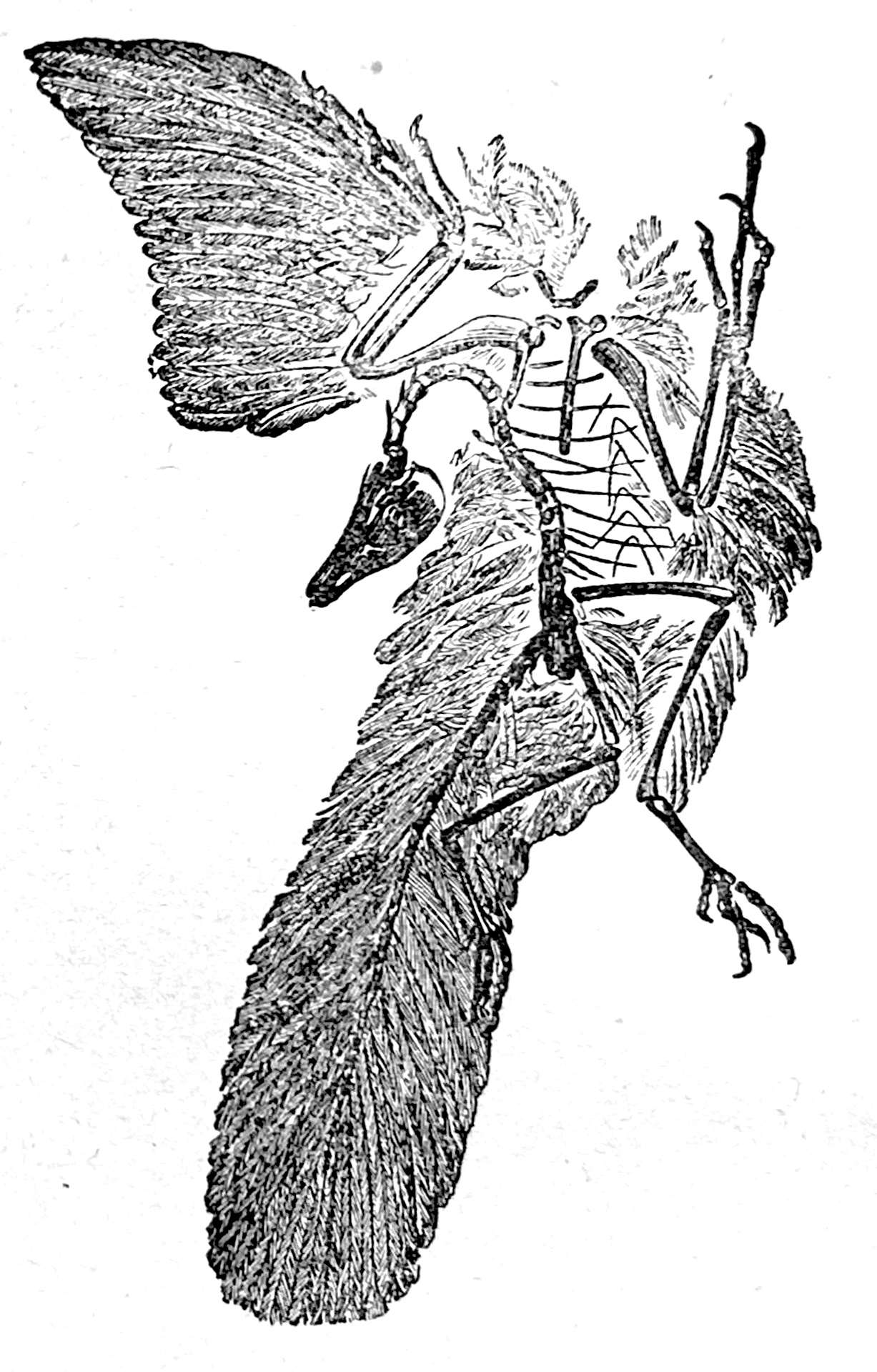
PLATE X.
The fossil remains of Archeopteryx.
The Archeopteryx lived during the period when the Dinosaurs were in the height of their glory. Whether or not he was descended from any of the birds who, without much question, left tracks in the Connecticut valley during the preceding age cannot be determined. Doubtless those ancient forms would hardly have been recognizable as birds, yet inasmuch as they wore feathers they may properly be placed in that group. For we may both concisely and accurately define birds as animals with feathers, for feathers are possessed by every bird that lives, and are possessed by no creatures other than birds. Flight, as we shall see in the next chapter, is a characteristic that is by no means universal in the bird world, but even the flightless birds, such as the ostrich and the Apteryx, are covered with feathers. True, in the penguins, birds that spend most of their time on and under the water, the feathers have been changed so that they are hardly recognizable, [Pg 47]yet a closer examination shows the essential [Pg 48]structure to be there, and our definition is upheld.
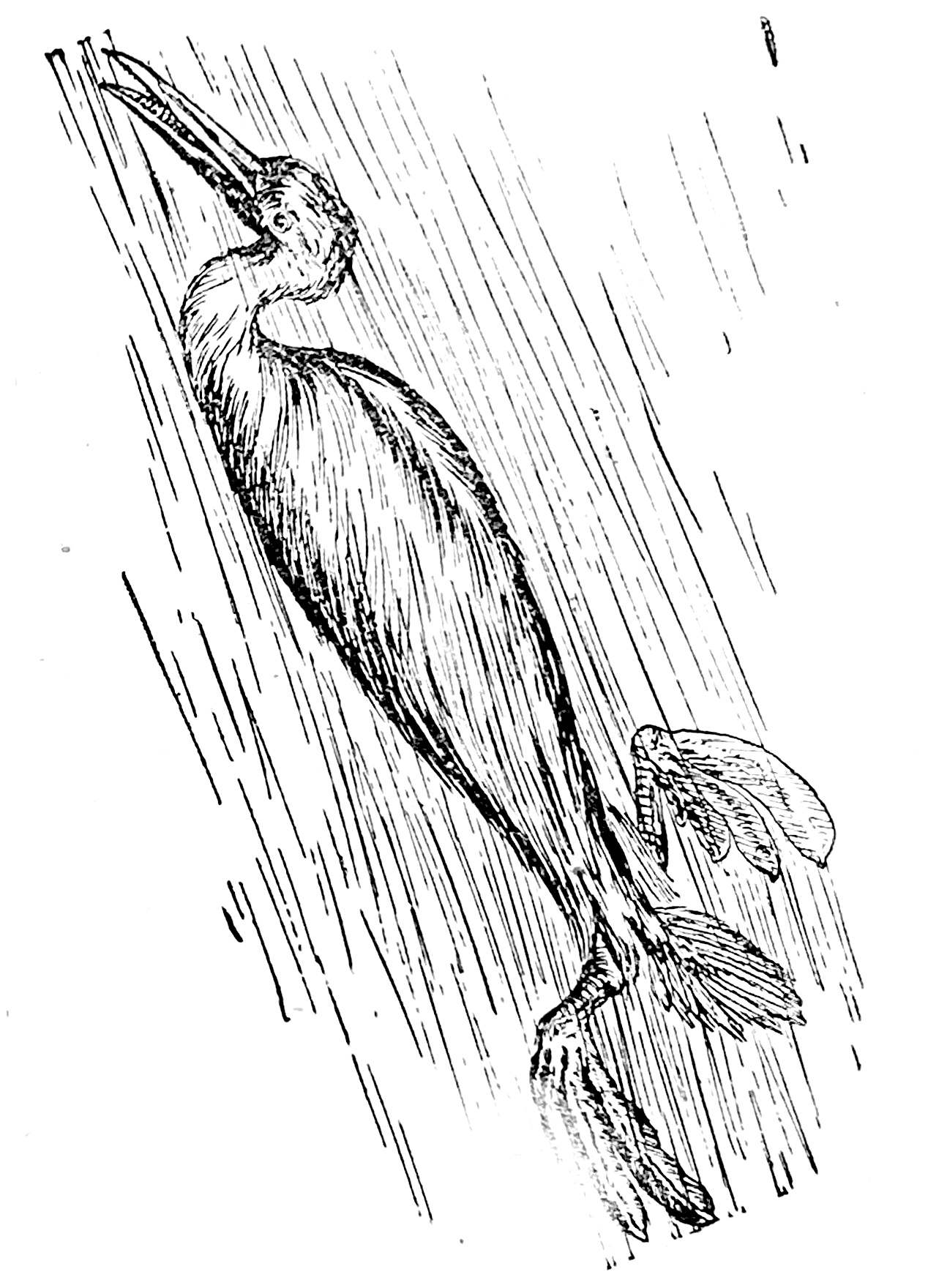
PLATE XI.
Hesperornis swimming beneath the water.
(After Lucas.)
The next birds of which we have relics were inhabitants of the western part of our own country, and although separated by tens or hundreds of thousands of years from the Jurassic Archeopteryx, they still possessed teeth—a characteristic that separates them sharply from all modern birds. They were first collected during the years 1870-71 by Professor O. C. Marsh, who was at that time exploring the chalk beds of western Kansas. It was not until 1873, however, that Marsh was able to give his specimens a thorough laboratory examination and discovered that the jaws were set with teeth, thus establishing a new and most important fact in evolution.[11] Previous to this men had been quite willing to believe that birds were descended from toothed animals, for all the creatures from which they might have come were toothed, but not a few hesitated to acknowledge that birds themselves possessed similar equipment. But with Marsh’s discovery the case was proved, and “scarce as hen’s teeth” ceased to be a joke, at least so far as fossils are concerned.
The larger of the two species of birds found in Kansas was a truly remarkable creature, in some ways the most astonishing bird that has [Pg 49]ever lived. Hesperornis (western bird) looked much like an overgrown, wingless loon, or “hell diver,” and was quite as much at home in the water as is that bird. Instead of swimming with the wings, as does the penguin of Antarctic regions, Hesperornis swam with its legs and feet, and did it so successfully that the wings disappeared, with the exception of a single bone. At the same time, the muscles of the breast, which are used in moving the wings, dwindled away, so that Hesperornis, although some five feet in length, was remarkably slender and torpedo-shaped.
Concerning its habits and probable appearance during life Dr. Lucas says: “As a swimming bird, one that swims with its legs and not with its wings, Hesperornis has probably never been equalled, for the size and appearance of the bones indicate great power, while the bones of the foot were so joined to those of the leg as to turn edgewise as the foot was brought forward and thus offer the least possible resistance to the water. It is a remarkable fact that the leg bones of Hesperornis are hollow, remarkable because as a rule the bones of aquatic animals are more or less solid, their weight being supported by the water; but those of the great diver were almost as light as if it had dwelt upon the dry land. That it did not dwell there is conclusively shown by its build, and above all its feet, for the foot of a running bird is modified in quite another way.
“The bird was probably covered with smooth, soft feathers, something like those of an Apteryx; this we know because Professor Williston [Pg 50]found a specimen showing the impression of the skin of the lower part of the leg as well as of the feathers that covered the ‘thigh’ and head. While such a covering seems rather inadequate for a bird of such exclusively aquatic habits as Hesperornis must have been, there is no getting away from the facts in the case in the shape of Professor Williston’s specimen, and we have in the Snake Bird, one of the most aquatic of recent birds, an instance of similarly poor covering....
“The restoration which Mr. Gleeson has drawn[12] differs radically from any yet made, and is the result of careful study of the specimen belonging to the United States National Museum. No one can appreciate the peculiarities of Hesperornis and its remarkable departures from other swimming birds who has not seen the skeleton mounted in a swimming attitude. The great length of the legs, their position at the middle of the body, the narrowness of the body back of the hip joint, and the disproportionate length of the outer toe are all brought out in a manner which a picture of the bird squatting upon its haunches fails utterly to show. As for the tail, it is evident from the size and breadth of the bones that something of the kind was present; it is also evident that it was not like that of an ordinary bird, and so it has been drawn with just a suggestion of Archaeopteryx about it.
“The most extraordinary thing about Hesperornis, [Pg 51]however, is the position of the legs relative to the body, and this is something that was not even suspected until the skeleton was mounted in a swimming attitude. As anyone knows who has watched a duck swim, the usual place for the feet and legs is beneath and in a line with the body. But in our great extinct diver the articulations of the leg bones are such that this is impossible, and the feet and lower joint of the legs (called the tarsus) must have stood out nearly at right angles to the body, like a pair of oars. This is so peculiar and anomalous an attitude for a bird’s legs that, although apparently indicated by the shape of the bones, it was at first thought to be due to the crushing and consequent distortion to which the bones had been subjected, and an endeavor was made to place the legs in the ordinary position, even though this was done at the expense of some little dislocation of the joints. But when the mounting of the skeleton had advanced further it became more evident that Hesperornis was not an ordinary bird, and that he could not have swum in the usual manner, since this would have brought his great knee-caps up into his body, which would have been uncomfortable. And so, at the cost of some little time and trouble, the mountings were so changed that the legs stood out at the sides of the body, as shown in the picture.”[13]
The birds progressed while their kindred and ancestors, the reptiles, were declining. By the dawn of the Eocene, the first period of the Age [Pg 52]of Mammals, the birds were very much like those of modern times, and in the last three million years or more very little change has taken place. However, there were a number of bizarre and gigantic forms which arose during the later ages of bird ascendancy, and those we shall consider in the following chapter.
One who has observed the great abundance of birds today might well conclude that bird remains should be among the commonest of the vertebrate fossils. Exactly the opposite, however, is true, for bird bones are among the rarest finds of the paleontological collector. Bones of the wings and legs, and occasional skulls, go to make up the bulk of the finds, with smaller bones, and impressions of the feathers turning up just often enough to keep the collector in a constant state of anticipation. A few eggs, also, have been found in the strata of western United States, but as yet the birds that laid them are unknown.
The scarcity of bird fossils is a problem to which no satisfactory answer has yet been given. The commonest theory is that dead birds, because of their very light weight, float for long periods of time, and are thus exposed to the attacks of weather, bacteria, and carrion feeding birds and animals. The bones, too, are light and easily broken, so that they will not stand the wear as will the heavier remains of mammals and sea-dwelling shellfish. Yet, in certain formations of France and Oregon, where conditions are not notably different from those of other and barren strata, remains of birds [Pg 53]are fairly common. This proves that under proper conditions, whatever they may have been, bird bones did fossilize—a fact which holds out the hope that some day a fortunate collector will unearth a large and varied deposit, and will then be able to fill out some of the greater gaps in the history of feathered creatures.
[10] That is, until a more ancient specimen is discovered. One must always be prepared for new discoveries in paleontology, just as in other sciences.
[11] Although the first specimen of Archeopteryx had been found several years before, it was too poorly preserved to show the teeth. It was not until 1877 that the famous Berlin specimen, which shows the teeth and feathers so admirably, was discovered.
[12] This restoration served as the copy for the accompanying plate.
[13] Animals of the Past, 1st Ed., pp. 83-85.
As we have seen in the preceding chapter, the earliest birds were both stranger and, in some cases at least, larger than most of the species found on earth today. But as we go upward in the geologic scale, we find that the primitive birds were far outstripped by their relatively modern descendants. Some of these feathered Goliaths, such as the Ostrich of Africa, are alive today; some have but recently become extinct, and their relics are found by thousands in the districts where they once roamed. Still others, though probably not the largest of their class, died out thousands, or even millions of years before man appeared upon the earth. They, like the mighty dinosaurs that preceded them, succumbed to the many enemies which constantly attack every animal that lives and left the earth to their more successful rivals and descendants.
Among the best known of the more recent avian giants, so recently extant that it still lives in the traditions of the peoples whose [Pg 54]ancestors feasted upon its flesh, is the great Moa of New Zealand. The first announcement of the existence of this remarkable bird was made by the Rev. W. Colenso, a missionary who later became Bishop of New Zealand. Early in the year of 1838, while on a missionary trip in the North Island, Bishop Colenso secured from the natives of Waiapu legends regarding a mammoth bird, called the Moa, which possessed a human head, and which inhabited a mountain some eighty miles inland. This creature, according to the legends, was the last of his kind, and was carefully guarded by two gigantic lizards who stood watch while the bird slept. When an enemy, especially a man, approached, these lizards roused the Moa, who immediately rushed upon the intruders and trampled them to death. It appeared that none of the savages had ever seen this bird—due, perhaps, to its watchful guardians and fierce prowess—but they were very sure of its existence. In fact, they used bones of his dead relatives in making their fishing implements, and these bones, they assured the bishop, were quite as large as those of the European ox.
But a short time later, another missionary, the Rev. Richard Taylor, discovered a bone which was said to belong to the Moa, and received considerable free information about its possessor from the natives with whom he was associated. But, as Dr. Lucas remarks in telling of the incident, just “as the foot of the rainbow moves away as we move toward it, in his case the bird was said to dwell in a quite different locality from that given by the natives [Pg 55]of East Cape” where Rev. Colenso had secured his information. Taylor’s informants, like the other natives, had not seen the Moa, nor did they even know anyone who had, but they had no doubt of its existence. When after many years of search, however, there was not a single explorer who had seen, heard, or tracked the giant bird, scientists refused to believe the tales of the natives, and some went so far as to deny that the Moa had lived at any time within the era of man.
These latter, however, went somewhat too far in their questioning. For even though no man has seen the living Moa, its remains are scattered abundantly over the hills, valleys and swamps of New Zealand, and from them scientists have been able to gain a very reliable idea of the size, structure, and general appearance of the feathered giant. Probably the most remarkable find of Moa remains was made in one of the large, dry caves of South Island, where collectors secured not only a number of bones with the original flesh adhering, but also several patches of skin to which clung numerous feathers of a chestnut color tipped with white. True, these small, rusty-brown feathers were not very spectacular, but when we stop to consider that they have been kept for hundreds, perhaps even thousands, of years without any preservative whatever, and that they belonged to a race of creatures now totally extinct, our respect for them increases greatly. Since the original possessor of those feathers died in his New Zealand cavern many wars have been won and lost, powerful nations have [Pg 56]arisen, new languages and systems of thought have been established, and the surface of the earth has been carved, planed, and pitted by the restless inventive animal called man. And now that same man is spending a considerable amount of his most prized possession—money—to gather and preserve the broken, dried remains of that old New Zealand bird, his relatives and ancestors.
It is now well known, that instead of but one species of Moa, as the New Zealand savages told the missionaries, there were twenty or more. Some of these were quite small—but little larger than the turkey—while others, such as Dinornis (terrible bird) must have reached a height of at least ten feet, and were, in all probability, the largest birds that have ever been seen on earth. Remarkably enough, some writers have not been satisfied with even these great dimensions, and have stated the height of some of the Moas to be from twelve to fourteen feet. These measurements, however, can be attained only by placing the skeleton in a most unnatural position, which the bird could not possibly have maintained while alive. There is a natural desire on the part of man to magnify his discoveries, and the remains of extinct creatures are favorite subjects for such romancing. Unfortunately for the writers, these same bones offer incontestable evidence as to the actual sizes of the creatures to which they belonged, and sooner or later all errors must be corrected and “the high made low.” As Dr. F. A. Lucas has insisted over and over again, the greatest monster [Pg 57]always shrinks before the application of a two-foot rule.
The Moas, like the modern Ostriches, were quite incapable of flight. Indeed, many of them were totally wingless, lacking even the tiny, almost invisible vestigial wings that are to be found in such modern species as the Cassowary and Apteryx. But what they lacked in wings the Moas more than made up for in legs. Those of one species, dubbed elephantopus (elephant-footed) were so ponderous that one cannot but wonder what purpose they served. The theory most generally accepted is that they were of value in digging out the roots of ferns, upon which the Moas appear to have fed. Furthermore, when we remember that one blow from the foot of an angry ostrich is quite enough to kill a man, we cannot doubt that the Moa was quite able to either trample underfoot, or smash to a shapeless pulp almost any enemy that might have assailed it. The lizard watchmen of the Maori legend are, of course, inventions, but the ferocious habits of the enraged Moa are without question matters of pure fact.
So far as known, the Moas were confined to New Zealand, some species inhabiting North Island, some South, but with very few common to both. From this fact Lucas, and others who have studied the birds, conclude that the two islands were originally one, and that long after the Moas came into existence there was a submergence which divided the island into two. After that submergence sufficient time elapsed to allow for the development of several species of Moas, each restricted to one [Pg 58]island. Inasmuch as the birds could not fly, and probably were poor swimmers, there was but little intermingling of the faunas. “Although Moas were still numerous when man made his appearance in this part of the world, the large deposits of their bones indicate that they were on the wane, and that natural causes had already reduced the feathered population of these islands. A glacial period is believed to have wrought their destruction, and in one great morass, abounding in springs, their bones occur in such enormous numbers, layer upon layer, that it is thought the birds sought the place where the flowing springs might afford their feet at least some respite from the biting cold, and there perished miserably by thousands.”[14]
The glacial cold, however, did not completely destroy the Moas. We have already seen that legends of the birds were told to the pioneering white missionaries, and other tales of Moa hunts and Moa feasts were not uncommon. It is uncertain whether the last of these giants was eaten by the ancient Maoris, or by a race that preceded them. Some authors have suggested, apparently on fairly good ground, that Moas formed the sole important flesh food of these prehistoric peoples, and that with the dying out of the avian food supply, the hereditary [Pg 59]liking for flesh naturally led to cannibalism. Thus the savages who destroyed the Moas turned to destroying themselves, were supplanted by another race which handed on the knowledge of the Moas to the white man who in turn set about killing off the savages.
From the New Zealand Moa to Sinbad the Sailor, and his huge and unintentionally beneficent Roc, is, at first thought, a very far cry, yet the separation is not so great as it seems. The Arabian tales give the habitation of the Roc as either Madagascar or one of the adjoining islands, and it seems very probable that the original of the huge bird that carried the adventurous Sinbad out of the crater of diamonds was the Aepyornis, a distant relative of the Moas, and an inhabitant of Madagascar. It is quite true that the Roc was a gigantic bird quite capable of carrying off an elephant to make a meal for its young, while the Aepyornis was little larger than an ostrich, was incapable of flight, and fed upon plants. These facts, however, would in no way interfere with the fancy of an Arabian story teller, whose original materials probably were a collection of Aeypornis legend substantiated by fragments of the bird’s enormous eggs. Hardly greater exaggerations are perpetrated weekly by the “feature writers” of American Sunday newspapers, and these men have all the resources of modern science at their disposal.
The actual scientific “discovery” of Aepyornis did not take place until 1834, when Jules Verreaux, a French ornithologist received a sketch of a huge egg, found in the island of [Pg 60]Madagascar. The informant, a traveler, said that he had seen two of these eggs, one of which had been used in cracking rice, while the other had been sawed in two to be used as bowls. Later on, some fragments of a shell were secured by another traveler, and finally, in 1851, two entire eggs and a number of bones were secured and sent to France. They were studied by Geoffroy St-Hilaire, a noted naturalist and pioneer evolutionist, who christened them Aepyornis maximus, or “greatest lofty bird.” The last part of the name was appropriate so far as the eggs are concerned, for they stand as the largest of all eggs. Some idea of their size may be gained by comparisons; the measurements alone do not mean a great deal. The egg of the ostrich, which is usually considered to be quite immense, measures four and one-half by six inches; that of the Aepyornis is not less than nine by thirteen inches, and would hold the whites and yolks of six ostrich eggs! The size seems even greater when we say that it would hold the contents of more than twelve dozen hens’ eggs or thirty thousands of the tiny, bean-like eggs of the hummingbird. Had there been giants in the old days, as fairy tales and occasional newspaper articles seek to convince us, they would have had no trouble in satisfying their breakfast appetites with a couple of Aepyornis eggs, poached. Fortunately for Aepyornis, in his day there were neither giants nor newspapers; had either existed he doubtless would have been exterminated by hunters long before his time.
Despite the excellence of their preservation, [Pg 61]relics of the giant birds of New Zealand and Madagascar are not easily seen by the student. There are fine collections at Harvard University, and the American Museum in New York, and in museums in Europe and New Zealand, but there are few, if any Moa eggs in the United States. Specimens of this sort are very expensive; Aepyornis eggs have sold in London for as high as two hundred pounds (about nine hundred seventy-two dollars) and most American museums are desperately poor, being forced to rely on the generosity of private individuals for money with which to buy specimens.[15]
Leaving the giant eastern birds, and the scarcity of collections of their remains, we may transfer our attention to a group of American birds, the huge Phororhacidae of Patagonia. Although far older, geologically these birds were not discovered until long after the Moas and Aepyornis were well known. Even then, it was not believed that so massive a bone as the jaw of Phororhacos could possibly belong to a bird, and it was [Pg 62]necessary to find much more complete relics before the case could be proved.
It is one of the ludicrous facts of paleontology that most of the large-sounding names were used up on the Moas, some of which were small, and that Dinornis (terrible bird) was wasted on root-eating creatures that probably were of meekest temperament when not annoyed. In the Patagonian birds, on the other hand, we have species that were really terrible, with their powerful legs, huge heads, sharp, crooked beaks, and strong talons. One of them, Brontornis, or thunder bird, possessed leg bones larger than those of an ox, the drumstick being thirty inches long and two and one-half inches thick. The corresponding bone in the turkey, largest of the domestic birds, the length is but five and one-half inches. The most imposing of the Patagonian birds, however, is the Phorohacos, a creature unique among the bird world. This creature stood seven or eight feet in height, possessed a head larger than that of a horse and a neck as thick, and was armed with huge, sharply hooked beak and long, sharp claws. One of Dr. Lucas’ illustrations shows the skull of the race-horse Lexington placed beneath that of Phororhacos. That of the bird is one inch longer and one and one-half deeper.
The structure of Phororhacos, like that of all other animals, affords an excellent key to its food habits. Probably they did not feed upon roots, as did the Moas, for had they done so their strong, hooked beaks would have been useless, or nearly so. Neither is it probable [Pg 64]that they caught fish; the beaks of most fish-eating birds, and particularly of the herons, which are related to Phororhacos, are long, adapted to spearing. Beaks and claws like those of the Patagonian giant are found, in most cases, in birds that feed on either carrion or living animals, or both. In the accompanying illustration the bird is shown as just having killed a small grass-eating animal, and preparing to devour it. Were it to be proved—as it can hardly be—that Phororhacos fed upon carrion alone, the restoration would have to be modified greatly, in appearance though not in proportion. Carrion eaters seldom have feathers on the upper part of the neck and the head, as may be seen by examining such notorious eaters of dead flesh as the vultures or “buzzards.” But the designer of the original restoration, as life-drawings of extinct animals are called, was satisfied to consider his subject as a swift-running bird of prey that preferred fresh killed meat, and did the killing itself.
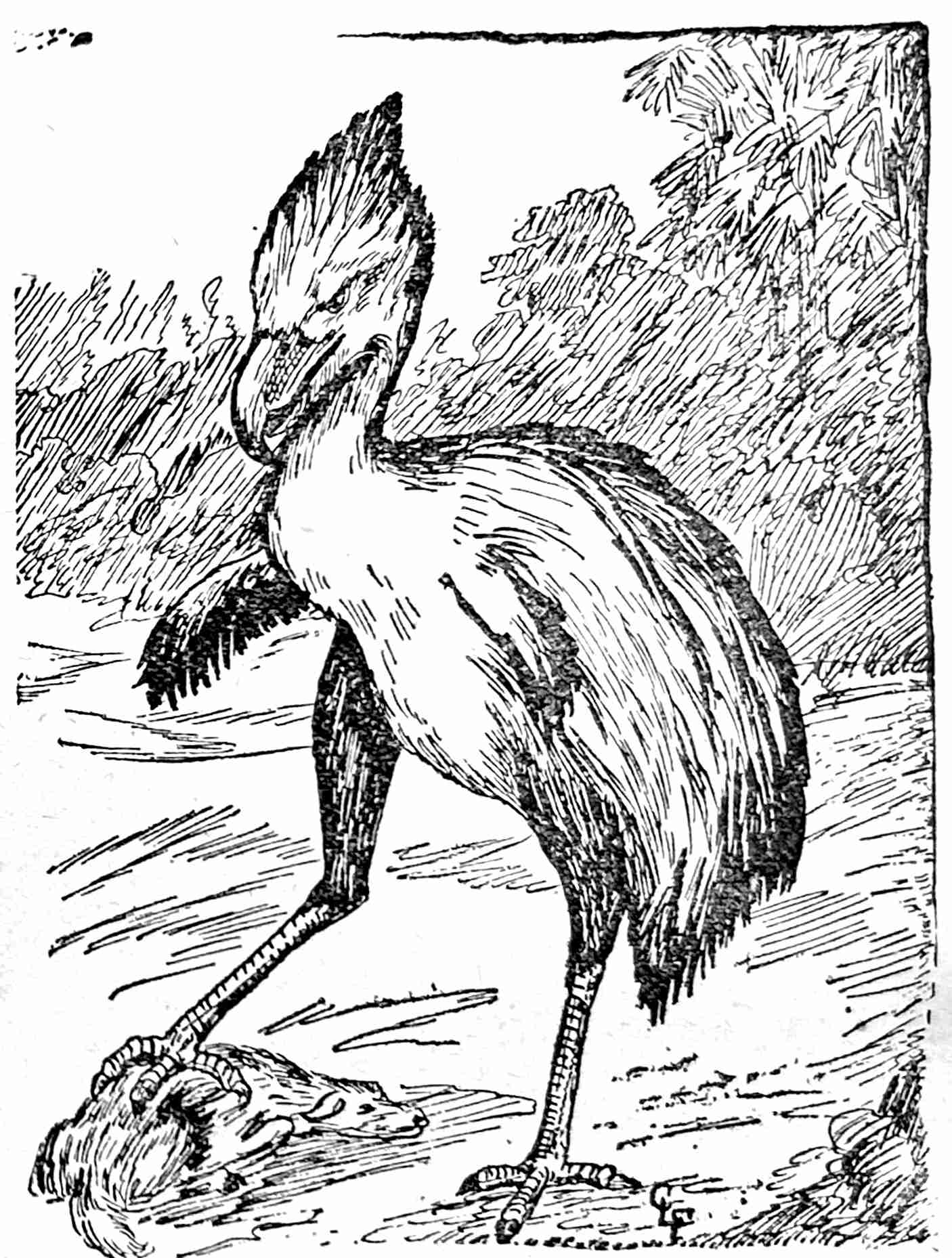
PLATE XII.
Phororhacos preparing to devour its prey.
(After Lucas.)
[14] Lucas, Animals of the Past, 1st Ed., p. 143. Note that, since the Moas were on the decline when man appeared in their environment, and they had no other powerful enemies, the huge legs could hardly have had defence as their chief function.
[15] This is true of the United States National Museum, at Washington, where the customary appropriation for securing specimens is $10,000 per year. At this national institution it is not rare for employees to draw upon their own small resources in order to secure particularly desirable collections. The same condition is to be found in other museums of the country, excepting the American Museum of Natural History in New York. It, though privately endowed, is housed by the city of New York, and is the largest and best supported museum in the western hemisphere.
Footnotes were moved to the ends of the chapters in which they appeared.
Illustrations were moved to the ends of the paragraphs in which they appeared. The list of illustrations was not in the original text. Plate V was originally untitled.
Inconsistencies in hyphenation have been standardized.
Minor punctuation errors have been changed without notice.
Spelling was retained as in the original except for the following changes:
| Page 6: “elk whose carcases” | to | “elk whose carcasses” |
| Page 9: “He loked somewhat” | to | “He looked somewhat” |
| Page 10: “But, bizarre though The” | to | “But, bizarre though the” |
| Page 15: “the natural percursors” | to | “the natural precursors” |
| Page 18: “their senile aderrations” | to | “their senile aberrations” |
| Page 21: “active than the diosaurs” | to | “active than the dinosaurs” |
| Page 23: “an idea altogether to” | to | “an idea altogether too” |
| Page 30: “loked more like a gigantic” | to | “looked more like a gigantic” |
| Page 34: “survivals were of smalll” | to | “survivals were of small” |
| Page 35: “they swam about seaching” | to | “they swam about searching” |
| Page 42: “with greater ease than has” | to | “with greater ease than had” |
| Page 42: “But in all probalility” | to | “But in all probability” |
| Page 44: “uncertain though the oirgin” | to | “uncertain though the origin” |
| Page 52: “weather, bacteria, and carrrion” | to | “weather, bacteria, and carrion” |
| Page 54: “year of 1838, whie” | to | “year of 1838, while” |
| Page 54: “especially a man, aproached” | to | “especially a man, approached” |
| Page 54: “they were very sure if” | to | “they were very sure of” |
| Page 54: “in a quite a different” | to | “in a quite different” |
| Page 55: “and that they belond” | to | “and that they belonged” |
| Page 58: “birds sought the pace” | to | “birds sought the place” |
| Page 59: “turned to destroying hemselves” | to | “turned to destroying themselves” |
| Page 60: “studied by Goeffroy St-Hilaire” | to | “studied by Geoffroy St-Hilaire” |
| Page 62: “and two and one-haf” | to | “and two and one-half” |