Title: The money-spider
Author: William Le Queux
Illustrator: Cyrus Cuneo
Release date: June 22, 2026 [eBook #78920]
Language: English
Original publication: Boston: Richard G. Badger, 1911
Other information and formats: www.gutenberg.org/ebooks/78920
Credits: Bob Taylor, Tim Lindell and the Online Distributed Proofreading Team at https://www.pgdp.net (This book was produced from images made available by the HathiTrust Digital Library.)
THE
MONEY-SPIDER
BY
WILLIAM LE QUEUX
Author of “The Great God Gold,” “The
Red Room,” etc., etc.
RICHARD G. BADGER
THE GORHAM PRESS
BOSTON
Copyright 1911 by William Le Queux
Entered at Stationer’s Hall
All Rights Reserved
The Gorham Press, Boston, U. S. A.
In this Life of many troubles,
what pain is greater than this:
Desire without ability, when
that desire turneth not away?
| Part I | ||
| Chapter | Page | |
| 1 | Introduces a Red-Faced Man | 1 |
| 2 | Concerns Certain Secrets | 8 |
| 3 | The End of the World | 17 |
| 4 | The Touchstone of Misfortune | 27 |
| 5 | An Allegation | 35 |
| 6 | Strange Matters of Fact | 43 |
| 7 | The Captain Makes a Suggestion | 53 |
| 8 | Reveals the Shadow | 61 |
| 9 | The Arctic Wilderness | 66 |
| 10 | Towards the Doom | 72 |
| 11 | Face to Face | 82 |
| 12 | Love’s Shadow | 90 |
| 13 | Faces in the Mist | 97 |
| 14 | Is In Several Ways Mysterious | 107 |
| 15 | Lifts the Veil | 116 |
| 16 | Bride and Lover | 123 |
| 17 | Some Amazing Facts | 132 |
| 18 | The Four Letters | 141 |
| Part II | ||
| 1 | Bide Tryst | 149 |
| 2 | The Peril of Dick Jervoise | 158 |
| 3 | Strangers in London | 166 |
| 4 | Thyra Makes an Admission | 175 |
| 5 | The Bond of Silence | 182 |
| 6 | Contains A Problem | 190 |
| 7 | The Problem Continued | 199 |
| 8 | The Man Bourtzeff | 208 |
| 9 | An Indiscreet Friendship | 217 |
| 10 | A Curious Truth | 225 |
| 11 | On the Ripley Road | 233 |
| 12 | A Hammersmith Hero | 242 |
| 13 | Another Problem | 253 |
| 14 | A Warning is Uttered | 268 |
| 15 | The Villa Sergio | 277 |
| 16 | On the Adriatic | 284 |
| 17 | A Question is Asked | 292 |
| 18 | Father and Daughter | 299 |
| 19 | In Black and White | 308 |
| 20 | A Woman’s Honour | 322 |
| 21 | Towards the Truth | 329 |
| 22 | Alza Makes a Confession | 338 |
| 23 | In Sound of Piccadilly | 345 |
| Conclusion | 354 | |
[Pg 1]
THE MONEY-SPIDER
“And if the truth were ever exposed—what then?”
“Bah! You never need fear that, my dear fellow. The people we are dealing with are discreet—silent in their own interests. This isn’t the first little piece of confidential business I’ve had with them.”
“Well, I don’t like it.”
“But you want money!”
“Not if I’m compelled to commit a crime to obtain it.”
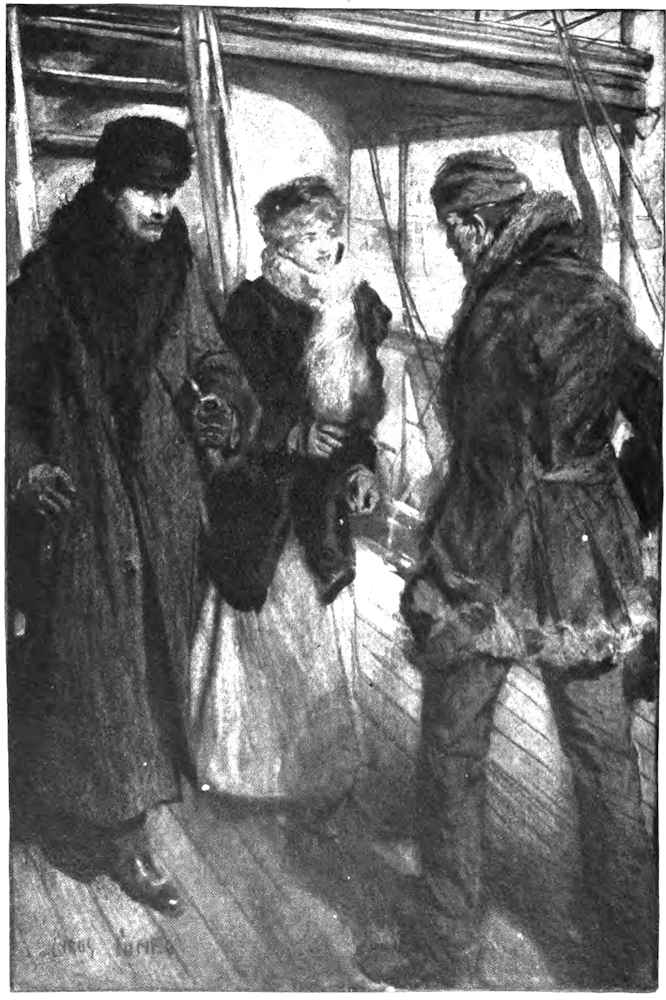
“Ah, my dear Jorgen, you’re becoming really too scrupulous in your old age,” laughed the fat, pimply-faced man in a well-cut yachting suit, as he drew heavily at his cigar and lolled back in a long cane-chair on deck. “You should recollect that in these modern days of ours honesty spells poverty.”
“Not always, Peter, not always,” protested the other, a broad-shouldered, burly, grey-bearded man in a well-worn suit of blue serge. “One can be honest and prosper, even now.”
“Seldom, my dear fellow, seldom. Men to become millionaires must be unscrupulous,” replied Peter Sundt, the owner of that fine steam yacht, the blustering, red-faced man who had once been a fisherman, but who now [Pg 2]practically controlled the great cod-fishing industry of Finmarken. For him hundreds of men toiled upon the deep, reaping the harvest of the Arctic Ocean, while he, wealthy and luxurious, lived in summer at his beautiful home near Christiania, and in winter at his splendid white villa among the palms at Ragusa, on the blue Adriatic.
The man seated at his side, gazing thoughtfully across at the broken coast of the French Riviera lying purple in the spring sunset, was of an altogether different stamp. Big, broad-shouldered, with a kind, merry, furrowed face and a deep-toned voice, he was a typical sailor of the bluff, hail-fellow-well-met type. Indeed, for forty years he had sailed the Polar Sea in search of the whale, and in the days before Sven Foyn invented his deadly cannon-harpoon, he had had many thrilling adventures in the frozen North—adventures which, if written, would assuredly make a most fascinating book.
Nowadays, however, he had given up whaling and had settled down in a snug appointment as harbour-master at Vardo, that far-off little town on the most northernly point east of the North Cape, a place beyond the pale of civilisation and where for many months each year the inhabitants lived in the perpetual Arctic night.
He had known Peter Sundt, the millionaire of stock-fish, all his life, and had now sailed to the South with him on his magnificent yacht in order to keep a certain appointment at an obscure hotel—the Palmiers—at Monte Carlo.
The cruise around the North Cape, past Hammerfest, down the long, broken coast-line of Norway, through the Straits of Dover, across the stormy bay and through Gibraltar, had been a most pleasant one. It was years since Berentsen had sailed a summer sea, nearly his whole life having been spent on the edge of the ice-pack, therefore he had greatly enjoyed his old friend’s hospitality.
[Pg 3]
Yet now they were off Villefranche, with Beaulieu lying in its picturesque bay, and the Tete de Chien rising against the clear sky, with the brown rock of Monaco beyond, the old harbour-master had become suddenly thoughtful and apprehensive.
Besides the crew—a hardy set of Norwegians and Danes—they were the only persons on board. Peter Sundt was a widower, and in no way a lady’s man. From small beginnings he had risen to become one of the wealthiest and most influential men in Norway, while his friend, Jorgen Berentsen, bluff old sailor that he was, had continued his life of the sea until his friend had been able to obtain for him the post of harbour-master of that far-away, dismal town, which was the outpost of civilisation.
Jorgen had been appointed to Vardo at his own request. Born and bred within the Arctic Circle, he cared little for the South, and the pleasures of Christiania or Trondhjem had never held any attraction for him.
Like most Norwegians, both men knew English, and, indeed, had been conversing in that language.
“The meeting is at ten to-night, isn’t it?” asked the old harbour-master slowly, with a sigh, his deeply-furrowed face bearing a thoughtful, apprehensive expression.
“Yes. Our friend said so in the wire I received at Marseilles,” replied his red-faced host.
“I’m half inclined to withdraw, even now. I confess, Peter, I don’t like the affair.”
“And after all the trouble you’ve taken!” exclaimed Sundt. “Why, you’ve planned every detail.”
“I know; but I’m ready to sacrifice it all in order to preserve my innocence, my own honour.”
“Honour, be hanged!” laughed his wealthy friend. “Who cares a jot for your honour except yourself? If I’d prided myself upon my honour I’d to-day still have been a [Pg 4]fisherman. My advice to you, my dear Jorgen, is to get money wherever you can. Never refuse a good thing. You’ve taken my advice before, and you’ve profited, haven’t you?”
“Yes,” replied the other, with a deep pull at his cigar. “I owe everything to you, Peter—everything. I’d still have been at sea now had it not been for your kind offices.”
“Well, we’ve struck a bargain, you and I; and we’ve kept it. You’ve placed in your pocket a good many thousand kroners which you otherwise would not have had.”
“And you also,” laughed Berentsen uneasily.
“Certainly; and I hope we shall both make a good many more thousands. We shall, providing you don’t continue to suffer from these absurd fits of groundless apprehension. Self-exposure would mean exposure of myself—and I couldn’t afford that—as you well know!”
“But to thus betray—”
“Oh, rubbish!” laughed Sundt, interrupting him. “Let’s talk of something else. You’ve never been to Monte Carlo. You’ll be amused there, I can assure you.”
“I’m thinking of Thyra. How would she judge me if she knew the truth?” he remarked in a low, intense voice, his bearded chin sunk upon his breast and a far-away look in his deep-set eyes.
“Thyra will marry one day, I suppose, and you’ll want money to give her. Look at the practical side of life, man! Get the money now it’s within your grasp.”
“Thyra would disown me as her father,” said the thick-set, old sea-captain in a strained tone.
“As many another daughter would disown her father if she knew all his business secrets,” remarked Sundt, with a smile. “Ignorance is always bliss.”
“Well, Peter, I don’t like it!” exclaimed old Jorgen, jumping from his long cane-chair, and taking three paces [Pg 5]up the deck and three paces back again—his old habit of the bridge. His face had grown pale and rigid.
Peter Sundt cast a curiously crafty glance at him while his back was turned. But the unusual expression only rested upon his countenance for a moment. Next second it had vanished, and with a smile full of forced bonhomie the millionaire said:
“My dear fellow, put all worry behind you, as I do. Little Thyra believes you to be the most honest man in all Norway, as every daughter believes her father to be. Why should she ever be undeceived? All of us have one skeleton in our cupboard. Why should we go out of our way to exhibit it?”
“But this mysterious person we are here to meet? What guarantee have we of his good faith? He might blackmail us!”
“He will not do so. I’ll guarantee that.”
“How can you stand guarantee for him?”
“Well—I have had previous experience,” replied Pete, rather slowly. “The reason why the appointment for meeting is made here in Monte Carlo is to avoid suspicion. The place is so cosmopolitan that even though we might be watched, there would be nothing extraordinary in us meeting a stranger here. Besides, I always come here for a fortnight or so each Carnival, before going round to Ragusa.”
“I somehow scent danger,” declared the Captain, halting and leaning with his back to the rail. “I don’t think I shall meet the mysterious person, whoever he may be or however much I may gain by the commission of the crime!”
“What!” cried the owner of the yacht, starting in surprise and staring straight at his friend. “You surely don’t wish to back out of the bargain now? This isn’t like you, Jorgen.”
[Pg 6]
“I see signs of a gathering storm,” he replied, heartily wishing he had never accepted his host’s invitation.
“Where?”
But the old harbour-master only shrugged his broad shoulders and, as he did so, cast his cigar-end into the water.
A smart French steward appeared with a tray upon which was tea, and setting it near his master, retired.
The two men did not speak. The silence of the sunset hour was unbroken save for the jar of the engines and the low swish of the calm, blue waters, as they steamed straight to the long, low Cap d’Ail.
They were close enough to the rocky shore to distinguish the Corniche road, running like a white ribbon over the olive-clad Monte Bastis, while in the centre of the picturesque scene rose the ancient village of Eze, perched high-up upon its conical hill, with the white flower-embowered villas of the wealthy dotted everywhere over the sloping mountain-sides.
To old Captain Berentsen the scene was an unfamiliar one. He knew the ice-bound coasts of Kolguev, Franz Josef Land, Spitzbergen, Nova Zembla. He lived far beyond the tree zone, in a dismal land of grey mists and snow blizzards, where nothing grew save the Arctic mosses. Therefore, the fairy-like scene before him was entrancing.
Yet he gazed upon it all as a man gazes at his own open grave.
His hands were clenched upon the iron rail, and as he looked seaward his teeth were set, his deep-lined brow clouded. His face was turned away from that man who, though his host, held him so irresistibly in his power. He was poor, and his poverty had compelled him to become, as he now was, the helpless puppet in that fat man’s hands.
[Pg 7]
He was thinking of Thyra—his sweet-faced, neat-waisted little daughter, whom he had left at home in that far-away town, now plunged in the darkness of the long Arctic night. He had sacrificed his own honour in order that she should not want. What, however, would she, devoted child that she was, say if she knew the real reason of his present pleasure cruise with this coarse-handed, red-faced millionaire—the object of the secret meeting which Sundt had arranged for ten o’clock that night?
“You’re a fool, Jorgen!” declared Peter Sundt, bluntly at last, “and ungrateful, too! I point out to you a mode by which money can be secured for Thyra and yourself, and you’re disinclined to take advantage of it!”
“If the truth were exposed,” declared the unhappy man in a faltering voice, “I would never dare to look my daughter in the face again!”
Peter Sundt laughed.
“And have your hands been so very clean in the past, eh?”
“That is just why I fear—why I fear always.”
“You’re a coward, as well as a fool. You will never become a rich man.”
“I’d rather remain poor and honest.”
Sundt laughed again.
“Honest!” he sneered. “Isn’t it rather late in the day, Jorgen, to talk of honesty? Rest assured that Thyra will never know. So just calm yourself, and make hay while the sun shines—as the English say.”
But bluff old Jorgen Berentsen only buttoned his pilot-jacket tightly and paced backward and forward on the deck, his heart full of regret and poignant bitterness, yet held fettered and bound by the great crime he was being forced, against his will, to commit.
[Pg 8]
Monte Carlo at night.
You who know the Riviera know well the scene. It never changes, the terrestrial paradise that is so near hell. The garish, noisy cafes, the expensive restaurants, full to overflowing with the smartest crowd in Europe, the myriad-coloured lights, the waving palms, the beds of sweet-smelling flowers, the well-dressed men, the pretty women in wonderful toilettes, and the centre of it all, the Casino with its red-carpeted steps, its wide portals, and its uniformed attendants. It was just before Carnival, and the place was crowded.
The old harbour-master and his millionaire host had dined at the Hotel de Paris, amid a scene of luxury unfamiliar to Jorgen Berentsen. The artistically lit tables, the flowers, the gay laughter of the pretty women, and the soft strains of the Roumanian band, all combined to create an impression upon the case-hardened old whaling captain, who had spent the greater part of his adventurous life in the desolation of the Arctic. To him civilisation of that luxurious kind was a revelation.
As they crossed the palm-lined Place to the Casino they could see the long white yacht, with its many lights, lying in the port, a magnificent craft that had been familiar to habitués of the Riviera for several seasons past.
Peter Sundt was well known to the officials in the Casino, otherwise it is doubtful whether the entrance-card [Pg 9]would have been issued to his burly companion, who carried with him so unmistakably the air of the Northern sea.
But the door at the end of the atrium swung over, and a moment later the pair found themselves in the great world-famous gaming-room, where the roulette tables were already crowded by a smart, eager throng. It happened to be a Saturday night, and that is the evening of the week when the women dress well and put on their jewels.
“Rien ne va plus!” The strident cries of the croupiers were incessant, mingled with the fascinating jingle of gold, the soft rustle of bank-notes, and the sharp click of the little ivory ball which, each moment, brought many of those standing by nearer to the verge of ruin.
As Peter and Jorgen passed from table to table they found at each crowds four or five deep, eager to stake their money in the hope of the fickle goddess smiling upon them.
Hot and close were the rooms, as they always are, with that indescribable odour which ever pervades the place—that fevered, fetid odour of mingled perspiration and perfume.
Sundt, while standing at one of the roulette tables, handed a croupier a hundred-franc note to place upon the last dozen. Then old Jorgen, following his example and bitten by the contagious excitement, handed the same croupier a louis to place on the zero.
The game was made, the ball spun, and gradually losing its impetus, it fell with a loud click.
“Ze-r-ro!” announced the croupier.
The old captain’s furrowed face brightened when a moment later he was handed a small handful of golden louis, which he at once pocketed, and then turned away, with Peter congratulating him upon his stroke of luck.
[Pg 10]
But Jorgen smiled bitterly. He was dreading the fast-approaching hour—ten o’clock.
As they were passing on to the next table, a tall, slim, dark-haired French girl, quite young, but most elegantly dressed in pale pink chiffon, unmistakably a creation of the Rue de la Paix, with a big black hat which suited her admirably, and a collar of gleaming diamonds, swept past them laughing gaily with an elderly woman in grey satin who accompanied her. Into her golden chain purse she was carelessly stuffing a number of thousand-franc notes, which she had just won by a lucky coup.
Peter Sundt halted and stared at her for a second. His red cheeks had blanched, and he held his breath.
She, however, had not noticed him, and passed on towards the great swing doors.
As she walked down the room, two young Frenchmen, evidently Riviera loungers, bowed acquaintance with her, and she smiled upon them. She was not more than twenty, and her clear-cut, regular features were strikingly handsome.
Jorgen Berentsen noticed his friend’s sudden surprise, but made no remark. He, however, wondered that the sight of that butterfly of fashion, that elegant little Parisienne, with her dark hair arranged in bandeaux across her white brow, should have produced such a curious impression upon him.
The young girl went out, her skirts rustling as she walked, leaving Peter Sundt standing in the great salon gazing after her as though dumfounded.
“Who’s that?” the Captain inquired a few moments later.
“That girl? Oh!—oh, well only somebody I know. I am very surprised to meet her here, that’s all,” he responded, somewhat confused.
[Pg 11]
“A friend of yours—eh?”
“Well—no—not exactly,” replied the millionaire, now thoroughly recovered from the evident shock that her unexpected appearance had caused him.
But the harbour-master saw plainly that the sight of that young Parisienne, flushed with the excitement of winning a large coup, had produced an extraordinary change in his companion, and that he knew more of her than he intended to admit.
“Perhaps you’d like to follow and join her? If so, I’ll stay here for a little,” said the burly old sailor.
“Join her!” echoed his companion, staring at him. “Join her! No, thank you,” he said, laughing grimly. “No,” he added, with an apparent effort, as he braced himself up. “Let’s go into yonder room, and watch the trente-et-quarante.”
And together they strolled in the great painted salon adjoining, where only gold was being played, and where the cards were being dealt in a quiet and serious manner.
To the hardy old sea-captain gambling possessed little attraction. He had won a zero, and was therefore perfectly satisfied. Already he found the atmosphere stifling and the thousand perfumes of the women nauseating. The jingle of gold sounded everywhere, and above all the voices of the croupiers inviting the company to play, or declaring that no further stakes could be accepted, or announcing the winning numbers.
“I’m ready to go,” he said at last, with a deep-drawn sigh as he looked at the big clock at the end of the great gilded gaming-room.
It wanted but fifteen minutes to ten—the hour of the secret appointment which he had been so long dreading.
At ten o’clock he was to commit a crime unpardonable!
Together, they passed through the atrium, down the red-carpeted steps, and out into the moonlit Place.
[Pg 12]
The manner of the red-faced man had changed. He gazed swiftly on every side, and looked eagerly across to the terrace of the Cafe de Paris, as though in search of that laughing, dark-haired girl, the sight of whom had caused him such great surprise.
But she had gone; and upon his coarse face was a look of bitter disappointment.
As they re-crossed the Place and walked on beneath the dark shadows of the palms, the old sea-captain, pale and agitated, suddenly halted, exclaiming in a determined voice:
“No, Peter! I—I’ll not do this! I—I’ll go no further!”
“What!” cried his companion, stopping aghast. “What are you saying?”
“I say what I mean,” replied the bluff old fellow resolutely.
“You can’t mean it! Why, it would be utterly absurd to withdraw now,” declared Peter Sundt.
“Better withdraw now than be guilty of such an offence,” the Captain replied in the low, hoarse voice of a man struggling with his own conscience.
“I’ve arranged it all and brought you here, yet you now go back upon your word, and make a fool of me!” cried the other.
“You brought me here, Peter, as your catspaw—just as I have always been, ever since I took that first false step!” remarked the old fellow, who owed his present snug position to the man standing before him.
“And what have you to complain of, pray? I’ve assisted you, exercised my influence on your behalf, yet this is how you thank me! You cast mud in my face!” exclaimed the wealthy man in quick anger.
“I shall not do this,” said Berentsen. “I have decided.”
“You shall! Come, it’s just on ten o’clock. We shall be late. Women are impatient creatures.”
[Pg 13]
“Not a step further will I go in this dirty business, Peter—even for you.”
“But I say you shall!” was Sundt’s determined response. “You’ve suddenly grown conscientious, a trait which in you, my dear Jorgen, is unusual. Conscientiousness is a very bad sign. No man who entertains such thoughts can ever hope to prosper in these bright days, believe me!”
“I—I’d rather starve than do this to-night,” declared Jorgen, his eyes staring before him, as though confronted by his own terrible doom.
“You can’t afford to starve, my dear friend,” replied the other with a short, harsh laugh. “Besides, think of little Thyra!”
“It is of her that I’m thinking,” he said. “What would she say if she knew that her father was—was—a—— But enough! Let us part, Peter. Let us part now. I will get back to the north alone.”
“Listen!” exclaimed the red-faced man angrily. “You are not going to play the fool like this. Come,” and he linked his arm in that of his friend. “Come, at once, and don’t show the white feather. I never before thought you were a coward, Jorgen.”
“I’m no coward!” cried his companion fiercely. “No man has ever called me that. But I refuse to commit this crime at your bidding!”
“You will act as I have arranged,” replied the other. “If not—well, you know the consequences.”
“Yes,” said the old fellow in a low, strained voice, “imprisonment for me—and ruin for the child!”
“You have to choose one or the other,” the coarse-faced man remarked. “As I told you not long ago, you must choose between prosperity and ruin. None but an imbecile would choose the latter—which must mean your exposure to Thyra.”
[Pg 14]
The man addressed bit his lip. His hard hands were clenched. Within him a fierce struggle was taking place, for he knew alas! too well, that this man, who had amassed a huge fortune by his callous unscrupulousness, now held him entirely in his power.
He was thinking of Thyra—his own little Thyra, to whom he was so entirely devoted.
Peter Sundt, quick to notice his companion’s indecision, linked his arm in his again, and drew him slowly forward, saying:
“Come, man. Don’t be a fool! You can’t draw back now. Why discuss such an unpleasant subject further? Come—or we shall be too late.”
And the old harbour-master, his face pale, his eyes set straight before him at the long dark vista of the palms, allowed himself to be slowly led towards that fatal rendezvous, knowing, alas! that to refuse at that, the eleventh, hour would mean an exposure that he dare not face.
He was as a fly in the web of the spider. The more he struggled, the more inextricable became his position. So he only sighed bitterly, and with set teeth bowed to the inevitable.
It was not long before they reached the obscure little hotel, the Palmiers—a place in a narrow street which make a speciality of cheap table d’hôte luncheons and dinners. And into its small private entrance both men entered, Jorgen Berentsen holding his breath, terrified at the act which he was thus forced to commit.
Five minutes afterwards Peter Sundt emerged alone, and retracing his steps, sauntered slowly back to the Place du Casino, where, beneath the dark shadow of the trees, he halted, anxiously awaiting the man over whom he exercised a baneful influence.
[Pg 15]
For a full twenty minutes he idled up and down, impatiently smoking a cigar, until suddenly Jorgen’s big, square figure loomed up in the darkness.
“Well?” inquired Sundt anxiously.
“It’s done!” answered the old fellow breathlessly, in a low, hoarse voice. “Let’s get away from this horrible place—away anywhere.”
“First let’s go across to the Cafe de Paris yonder. You want a drop of brandy, no doubt. Then we’ll go on board. By eleven, we’ll weigh anchor and be away.”
They crossed to the big, brilliantly-lit cafe, where, at the small tables, many well-dressed men and women were drinking in the interval of staking their money on the tables of the Casino opposite.
Upon the terrace outside Peter’s quick eye caught sight of the sweet-faced young Parisienne in pale pink chiffon and black hat, seated alone at a little table placed in the shadow against the wall.
He therefore turned, and walking along the terrace both men took seats at a table near. So agitated was the old harbour-master that he, at first, did not notice her.
It was only when he followed the direction of his companion’s eyes that he recognised the girl whom they had encountered in the Rooms. He saw that she had turned her head, and was staring straight at Peter Sundt with a wild, fixed look, as though she had seen an apparition.
With her dark eyes still upon him, she drained her tiny liqueur glass. Then her pretty lips relaxed into a smile, half of recognition, half of defiance.
Peter Sundt raised his hat politely, and was in the act of crossing to where she was seated in the shadow, when she half-rose from her seat. Her face suddenly became blanched and drawn, her jaws were fixed, and next instant, even before he could reach her, she had collapsed upon [Pg 16]her chair and, reeling sideways, fell heavily upon the stone flooring.
In a moment both men dashed across to her, and all became confusion, for there were many people seated in the vicinity.
The first belief was that she had merely fainted, but next moment a terrible truth became evident. Upon the little marble table lay a tiny phial about two inches long, and empty. Jorgen took it up and smelt it. The odour was that of almonds.
In a few seconds two agents of police were on the spot, not, however, before the old harbour-master had realized the ghastly fact.
The unfortunate girl, like many another butterfly whose wings are singed in that gilded inferno opposite, had deliberately swallowed a fatal draught!
The police wrested her lifeless body from Peter Sundt, who held it tenderly in his arms, and as they did so the red-faced man, now pale as the poor girl herself, placed his hand wildly to his brow, and shrieked aloud:
“Dead! My God!—she’s dead! This, then, is my punishment—the vengeance of Heaven!”
[Pg 17]
“What secret can father have with Peter Sundt? Poor dad! He looked so scared and worried! What can have happened, I wonder, to bring Peter so far up here again to Vardo? It’s just seven months ago since dad went south with him.”
The sweet-faced girl of twenty, whose soft, fair hair streamed out upon the icy wind, spoke thus to herself as, resting upon a great brown boulder, she fixed her big grey, wide-open eyes straight before her upon the limitless expanse of stormy Arctic Ocean.
That wide waste of grey, tempest-tossed waters, the very edge of civilisation, were assuredly a sea of despair.
Thyra Berentsen, the bright, merry girl of sweet, almost child-like, beauty, lived amid surroundings which were the most dismal and dispiriting in all that barren, ice-bound, Arctic land of Finmarken.
The month was August, yet she wore a thick blue beret, a fur-lined coat of Astrakhan, and on her hands wool-lined mitts of leather, for there, far east of the North Cape, the thermometer was at freezing point.
Upon a small rocky islet, bare of the slightest trace of vegetation, swept constantly by the cutting blizzards, and buffeted by the long, dark, oily-looking rollers of the Polar Sea, stands a tiny town of low wooden houses, mostly roofed by turf. Such is Vardo, the last post of civilisation in the Far North, and the point of departure of many [Pg 18]Arctic explorers who have gone to their graves, and assuredly the most wretched, lonely, and inhospitable spot of any between the high, frowning Nordykn, standing sheer from the glacial ocean, to the White Sea.
On the one side, from the rolling waters, rise the high grey cliffs of the mainland of Europe, while on the other lies the wide, open ocean, where the long breakers roll in from Nova Zembla, the ice-pack, and the unknown frozen Land of the No Return. The wind, the tearing, icy wind, swept that August afternoon straight from the unexplored regions of the Farthest North, causing the girl to button her fur coat tightly at the throat and thrust her mittened hands into her pockets.
“I wonder,” she repeated to herself, “I wonder what it all means?”
Ever and anon she glanced along the path in the direction of the wretched little log-built town, as though in expectation of someone whom she was awaiting.
Behind her, across that narrow strait, lay the great lone land, where even the stunted Arctic willow was unable to take root, and where, indeed, nothing grew save the carpet of a myriad different species of wild flowers, the red cloud-berries, and the yellow reindeer-moss; the dismal uninhabited wilderness of barren rock and sky, of river and limitless tundra, snow-covered plains in winter, but in summer a treacherous, mosquito-infested morass.
In all that wild Norrland beyond the Polar Circle no spot is more bleak or more desolate, nor is the climate with its grey fogs, its continuous blizzards and iron frosts, more terrible anywhere than here. Hammerfest, on the western coast, is the most northerly town in the world, but not the coldest, for it is sheltered by the island of Soro opposite. Vardo, on the contrary, standing out as it does in the [Pg 19]Arctic Sea, is more open and exposed than any other inhabited point along that terrible rock-bound coast. Its community is, indeed, a hardy one of sturdy fisher-folk, who year in, year out, battle fiercely with the elements for their bare existence.
Here, it is not the land, but the sea, that is ploughed. Men do not sow and wield the scythe in summer, but reap in mid-winter without having sowed. In the months in which the long night holds its undisputed sway, when the light of the sun has given place to that of the moon, and the rosy flush of dawn and sunset to the glow of the Northern Lights, then those dwellers in the Far North gather in the rich harvest of the sea.
Yet the sky there is ever low and grey, the sea ever stormy, and the winds ever howling, while the temperature, even in August, is that of December in our own much-maligned England. The midnight sun which proves so attractive to European tourists who go in comfortable steamers, and entertained by string-bands, up as far as the North Cape, gives its continuous light in summer; yet, alas! is no compensation for those long months of the Polar night, when God’s blessed sunlight is entirely withheld from that dismal, grey, forgotten land.
In such surroundings, and amid those rough, uncultured toilers of the sea, Thyra—the only daughter of old Captain Berentsen, the harbour-master—had been born, and now lived.
The bleak monotony and stern wildness of everything was, alas! terribly gloomy. The tourist steamers never went so far as Vardo.
Notwithstanding those tempestuous winds, the very air was polluted, for every now and then a breath of the sickening effluvia of the fish-drying houses, the fish-guano works, the whale boileries or the fish offal decaying everywhere [Pg 20]in the streets, reached the girl’s nostrils where she sat.
“I wonder why dear old dad is so troubled?” she repeated to herself, sighing as she gazed blankly around upon the cheerless scene, so colourless and so inhospitable. Across her mind at that moment flashed the recollection of Christiania, with all its brightness, its movement and its civilisation; the capital in which she had been for some years at school. But her schooldays being over, she had, three years ago, returned home—returned to an exile’s life among those rude, uncouth fisher-folk, an existence terribly galling to a girl so accomplished and so refined.
She thought of her old schoolfellows living their happy lives, possessing friends and enjoying the sunshine of the south.
And she sighed again.
Hers, alas! was a life of dreary loneliness and cramped confinement upon that narrow, treeless islet, with its eternal odour of decaying codfish. Her life was as monotonous as the scene itself. All her day-dreams down in Christiania had come to naught. Her mother had died long ago, and her father’s household consisted only of herself and Feyia, the old Lapp woman who acted as housekeeper.
In all Vardo there was no girl of similar age or similar education with whom she could associate, for the simple reason that no man would dwell with his family amid that savage sea if he could possibly avoid it.
Reflecting upon this, and still wondering why the red-faced old Peter Sundt, the wealthy fish-exporter, had come up from the south to see her father, she saw on glancing towards the town the tall figure of a young man striding towards her.
[Pg 21]
The quick flush of colour tinging her soft cheeks told its own tale. He waved his hand, and, smiling, she waved back to the man to whom she was secretly betrothed.
“I am so sorry, darling, that I’m late!” he cried in French, lifting his cap as he took her mittened hand. “I hope you have not waited very long. The mail has just landed, and I was compelled to reply to an important letter.”
“I have not been here long, Paul,” was her reply in the same language. “Have any strangers arrived by the mail boat?”
“Only two Englishmen. They’ve come up from Tromso, the captain told me. I haven’t seen them yet. Really,” he added, “one is quite out-of-the-world up here, with only a mail once a fortnight to create a little excitement and to bring us news from the land of the sunshine.”
They were standing together. He was looking into her raised beautiful countenance with his dark eyes full of passionate love, while the gaze of those blue unfathomable eyes that held him so irresistibly beneath their spell was fixed and unwavering.
Paul Grinevitch was Russian. His knowledge of Norwegian, or of Finnish, was not very extensive, therefore they talked either in French or in English, both of which languages Thyra spoke extremely well. About thirty, tall, athletic, with a handsome, refined face and a small dark moustache, its ends trained upwards in German fashion, he was extremely courteous and gentlemanly, while his bearing was undoubtedly military, though at the moment he was wearing a suit of thick, rough tweeds.
Six months before, he had landed one afternoon from the mail-steamer which had come up from Tromso, and becoming unaccountably attracted by the remoteness of the place from civilisation, had taken up his quarters in [Pg 22]the turf-roofed house of an old fisherman, with whom he had made many excursions in the neighbourhood in search of sport.
Any stranger landing at the little place is at once known to everybody; therefore, within a few hours of his arrival, Thyra had found herself introduced to him, and it had been, on the part of both of them, a case of love at first sight.
Paul Grinevitch had pretended that the reason his visit had been so long protracted was because of the excellent fishing and shooting which the neighbourhood afforded. But truth to tell, the sole attraction was the beautiful Thyra, from whom he was unable to tear himself away.
They met—again and again. She had possessed the young Russian, body and soul.
He had told her little about himself, very little, save that he had been at college in Moscow, and that his parents lived away in the far south at Odessa. That he was a gentleman, old Jorgen Berentsen had known instinctively from the very first moment of their acquaintance and that he was comfortably off was likewise apparent. Letters came to him sometimes bearing on their envelopes a golden coronet and cipher, and it was whispered in Vardo that he was the son of a Russian Privy Councillor in the Czar’s entourage.
Indeed, on one occasion he had, for one of the fish merchants, scribbled a note to the captain of the port of Archangel, and the bearer of the note had returned and told everybody how all-powerful the recommendation had been, and with what respect the Russian official had treated him.
Therefore, all Vardo knew that Paul Grinevitch was a gentleman, even though they regarded the reason of his continued residence among them as something of a mystery. It was known that he was frequently in Thyra’s company—and everybody wondered.
[Pg 23]
They were, indeed, a handsome pair, as they stood together at the edge of those cold, grim waters.
He was in love with this beautiful daughter of the Arctic—in love with her honestly, deeply, completely. Paul, to whom the smartest salons of Petersburg, of Moscow, and of Paris were ever open, loved the sweet-faced daughter of the old weather-beaten sailor of the Polar seas.
He had not released her hand, but stood with it held in his own, gazing into those deep, child-like eyes that held him ever in such fascination.
“Thyra!” he exclaimed in a deep, low, earnest tone, as a sigh escaped him.
“Well?” she asked, looking up into his face as she smiled mischievously, all trace of the troubled expression upon her countenance having vanished.
“Thyra—my own darling!” he cried. “I—I—I want to tell you something, but—well, I—I can’t!” And he sighed again and drew himself up, his passionate gaze still fixed immovably upon her.
“Why not?” she asked simply. “If it is a secret, surely you can trust me? Am I not your betrothed?”
“Ah, yes!” he cried hoarsely. “It is just because of that—because we are to marry in a few weeks that I cannot tell you.”
The girl stared at her lover in blank surprise. She had never before seen him so distressed. What could he mean? Had the mail just in brought him bad news?
A serious, apprehensive look overspread her beautiful face—a face that was,—indeed, peerless in its perfection. The soft sweetness of her features, so well-cut and so regular, was such that it would assuredly have caused comment even among the women of the haut monde in the Park or in the Bois. Hers was a type of rare, delicate beauty, with her unfathomable eyes, her well formed nose, her pointed [Pg 24]chin and dimpled cheeks; a beauty that was delightfully innocent and child-like, without being insipid; a beauty the more remarkable considering the rigour of that terrible climate, and how soon, alas! the faces of the sturdy men and women of the Finmarken coast—the end of the civilised world—become hard, furrowed and weather-beaten.
The long strands of fair hair blown out upon the wind were soft as floss silk, and as she smiled she disclosed an even row of pearly teeth behind dainty lips, bearing upon them the true bow of Cupid, and made for kisses.
Yes, Thyra was lovely. The young Russian told himself that again, as indeed he had done a thousand times within those past six months. Among the girls he had met in Paris and in Petersburg, in Monte Carlo or in Rome, he had never met one so beautiful, so dainty, so full of inexpressible charm.
And she was his—his very own. She had promised, three weeks ago, to be his wife, and old Jorgen, the bluff old retired Arctic sea-captain, had given his consent upon one condition—that the strictest secrecy was to be observed regarding the engagement.
Why, they both wondered. What motive had the old fellow in withholding the news from that tiny, gossiping, rough-and-ready little world of Vardo?
“Paul,” exclaimed the girl, slowly twining her soft arm around her lover’s neck, regardless of the fact that they might be observed. “Do tell me, dearest, what is troubling you. Why does our forthcoming marriage prevent you telling the truth to me—the woman who is to be your wife?” she asked in English in a low, persuasive tone, raising her lips to his and fondly kissing him with long, clinging caress. That kiss itself was assuredly enough to make any man’s head reel.
[Pg 25]
The young man sighed. She noticed his brow contract as he bit his nether lip involuntarily.
“Because, my darling—because it is a secret which, though I long to confide it to you, I—I dare not. Indeed, I must not. You are to be my wife—my own love—” And he held her with trembling hands and kissed her with the fierce passion of affection. “But there—I was a fool to have mentioned it—to have aroused your apprehension, my own dear heart. I so long to be able to tell you, and yet—and yet—”
“Yet what, Paul?”
“I cannot. I—I dare not.”
“Not when I, Thyra, ask you to tell me? Not when I make an urgent request to you—the man who is to be my husband?” she asked in a voice of quiet, earnest reproach.
“No, no!” he cried, in quick distress, his gloved hand clenched in desperation. “No, darling; don’t put it like that. Forget, I beg of you; forget my unpardonable foolishness in mentioning a matter which, after all, does not concern you, and has naturally aroused within you some grave forebodings. We love each other, surely that is sufficient? Come, let us put all gloomy thoughts aside.”
“Then your thoughts are actually gloomy ones?” she exclaimed, in quick alarm. “Why do you try to conceal the truth from me, Paul? This is not like you.”
“Because, my darling, in this matter it is, for the present, imperative that—that I should remain silent. Silence is best for you, and for me,” answered the young man. “One day you will know; but, Thyra, though I regret deeply that I cannot explain matters, you must, for the present, remain in ignorance. I cannot bring myself to tell you. No, I will not, even though I could. You love me, my own dear heart, therefore why should I bring upon you sorrow, apprehension, perhaps a great bitterness [Pg 26]of heart? Let us live—let us be happy, even though our bliss may be fleeting as your summer snows. You are mine, my own sweet well-beloved—my own darling wife that is to be!”
[Pg 27]
Thyra’s home was very plain and simple. Up there, in the far-away North, they are all simple folk, honest, hardy, strong of heart and strong of hand.
The dismal little street of Vardo consisted of two rows of low, wood-built, inartistic houses, mostly without an upper floor, the majority being roofed with peat, upon which grew a varied assortment of the Arctic mosses. One or two of the houses were tiled, and one of these—one somewhat superior to the others, inasmuch as it possessed an upper storey, where curtains showed at the big, ugly square windows—was occupied by old Captain Berentsen.
On the same evening that Paul had made that inexplicable declaration to Thyra the girl was seated in the upstairs dining-room with her father, her head bent beneath the lamp trying to read an English novel, while old Jorgen himself lounged in his easy chair near the stove, smoking his big Norwegian pipe.
In Vardo those who possess a house of one storey live upstairs because the deep snows of winter too frequently shut out the light from the windows of the lower floor. The room wherein sat the pretty girl and her grey-bearded, weather-beaten father was not a particularly comfortable one, if judged by our southern standard of luxury. The floor was carpetless, the chairs were cane-bottomed, the walls were of wood, and upon them were one or two cheap Russian oleographs of brilliant colouring. Over the door [Pg 28]hung a small ikon, or holy picture, for Thyra’s mother had been Russian, from Archangel.
At one end of the room was the buffet of varnished pine, while at the other was a cottage piano, one of the very few in that most northerly point of Lapland. The windows were double, to keep out the cold, and before them were two or three sickly-looking flowers in pots.
The pot-plant is the hobby of the people of Finmarken. In almost every house one will find a wretched little geranium or two, with their blooms dwarfed by the uncongenial climate and surroundings, or a pet rose, stunted and unhealthy, with its blossom drooping or its bud already fading before it had opened.
As nothing grew out of doors in that high latitude, Thyra had brought up those plants with her from Christiania, a thousand miles south, when she returned from school, and she had carefully tended and nursed them ever since.
With her elbows upon the table, she was deeply absorbed in the English sixpenny edition of a popular detective story which one of her old schoolfellows had sent her. In the zone of light from the small petroleum table-lamp her face, now that her cap was removed, showed even more perfect in its beauty, so sweet and so thoroughly feminine.
Outside the storm howled fiercely, the tearing wind, its force unbroken from the ice-pack, shaking the windows and ever and anon causing the very house to tremble. But was it not the usual condition of things in August? Therefore neither father nor daughter made remark.
Old Jorgen Berentsen, sitting there in the shadow watching his daughter as he smoked, was assuredly a fine figure of a man—a man of many adventures. On one occasion his vessel had been wrecked on the barren coast of Melville Land, in East Greenland, and after months [Pg 29]of suffering and starvation, during which all his companions died except two, he had been rescued by another whaling vessel. On a second occasion the ship he commanded had foundered, and the crew managed to reach land at the terrible delta of the Lena, in Northern Siberia, near where De Long and the party of the Jeannette had perished two years before.
Little wonder was it, therefore, that his brow should be so deeply furrowed, that his hair should be grey, that his voice should be gruff, or that his strong hand should possess such an iron grip.
Forty years of navigating the Arctic Ocean, first high up in the crow’s-nest and afterwards as captain, had stirred within him the call of the Polar Mystery as it stirs every man. Even now, retired as he was, with the sinecure of harbour-master, and acting as vice-consul for several foreign countries, he often closed his eyes and imagined himself back again upon the bridge of his grimy, evil-smelling whaler with the biting wind whistling through the rigging and the brilliant aurora waving across the northern sky.
Living as he constantly had done in the land of the Great Night, his aid and advice had been sought by almost every Arctic explorer of the past twenty years. It was he who had provided the sled-dogs for Nansen and for Jackson; he who had given advice to Shackleton upon his equipment for the Antarctic; he who had been consulted by Peary, by the Duke of the Abruzzi, and by Wellman of airship fame. To him the ice-bound coasts of Franz Josef Land, of Nova Zembla, of Spitzbergen, and of Greenland, with their steel-blue glaciers and snow-covered bluffs, were all well known. Indeed, he knew far more of Arctic life, Arctic conditions, and Arctic mysteries than any Fellow of the Royal Geographical Society of England.
[Pg 30]
Nowadays, however, his adventures were all of the past. His wife was dead and, with his daughter to bear him company, he led a frugal, quiet, uneventful life, a life that bored him somewhat in summer and became well-nigh intolerable in the three months of perpetual night from November to January. Those dead, dark, bitterly cold days, when the lamp burned perpetually and when the little town was silent as the grave, made him long for the old activity at sea and the keen excitement of hunting the leviathan of the deep.
The last days before his retirement had been spent as captain of a passenger vessel between Bergen and New York, hence he had learned to speak English in addition to his native Norwegian, and Finnish and French.
A ring at the door-bell below aroused them. Thyra raised her head from her book with a sigh. At that moment she did not wish to be disturbed.
“Oh, I quite forgot, my dear,” the old man exclaimed. “The Mercur came in this afternoon, and I asked the captain to come in and bring his two passengers, young Englishmen. I met them on the quay. They seem to be gentlemen.”
Thyra frowned slightly as she heard old Freyia, the Lap woman who acted as housekeeper and maid-of-all-work, go to the door, and next instant came the cheery voice of the captain of the Mercur, the black old cargo-boat which, trading between Vardo and Hamburg, and calling at all the ports down the Norwegian coast, brought them the mail from the south.
When each six or seven weeks the Mercur, with her high black funnel and white bands, appeared through the driving mists and entered the harbour it was always a day of activity, for the captain was highly popular everywhere, and with the visits of the Mercur came news of friends, [Pg 31]and the stores without which the dwellers on that remote little island could not exist.
“Well, Miss Thyra,” exclaimed the captain cheerily as he entered the room. “And how are you getting on up here, after Christiania, eh?”
He was a tall, rather good-looking, fair-moustached man, well set-up, and extremely smart both in manner and dress. Well known to all along the Norwegian coast as something of a dandy, his uniform was always spotless, the braid upon it was untarnished, and his boots always well shined, even though he sailed those stormy seas. Besides, though he was Norwegian born and bred, his name, curiously enough was typically English—John Martin.
“Well, Captain Martin,” exclaimed the girl, with a laugh, as she cast a furtive glance at the two strangers behind him, “here it is scarcely so gay as in Christiania, of course. Yet it is my duty to be here and look after dad, so, of course, I must not grumble.”
“Allow me to introduce two friends of mine,” the captain said in fair English. Then, indicating the elder of the pair of Englishmen, a good-looking, dark-haired, merry-eyed fellow in a well-cut suit of blue serge, he said, “This is Mr. Jervoise—Miss Thyra Berentsen.”
The other, a short, rather thick-set man of thirty-two, with a small moustache and wearing gold pince-nez, he introduced as Doctor Owen Odd, adding, “These gentlemen have been with me all the way from Bergen—my only passengers this trip.”
“And a most delightful time we’ve had, Miss Berentsen,” declared Dick Jervoise. “Your friend the captain has been untiring in his efforts to make us comfortable in the heavy weather we ran into after rounding the North Cape.”
[Pg 32]
Thyra raised her eyes to his, and regarding him for a second, saw honesty in his gaze. Then she smiled answering:
“Everybody knows how pleasant Captain Martin makes a voyage. I’ve been with him twice down to the south.”
“And I hope you’ll make many more trips with me, Miss Thyra,” declared the fair-haired man who, ashore, had exchanged his spotless uniform for thick grey tweeds.
At old Jorgen’s invitation the trio sat down, the two Englishmen delighted with their experience. It was unique to be entertained in a house so far north—and by such a delightful hostess, with her beautiful face and her pretty broken English.
The four men were soon chatting, while Thyra, instantly at ease with her English visitors, busied herself in setting out the little glasses for the vodka.
Martin was explaining to his English friends the adventurous career of the old man who sat there smoking his long pipe with its carved meerschaum bowl, and they were listening, entranced by the captain’s story.
The old fellow, however, modestly disclaimed all title to be classed among Arctic explorers.
“I’m only a whaling skipper,” he declared, laughing. “My explorations have been done out of necessity, and were the outcome of mishap.”
Dick Jervoise glanced around the small, plain room, devoid of any cosiness. He noted the small, sickly looking flowers, the double windows, the big stove roaring though it was an August night. All was so strange, so unusual, so extraordinary after the civilisation and luxury of London.
He fixed his eyes upon the beautiful countenance of the girl who offered him the Russian cigarettes. In all his wide experience never had he seen a face so sweet, so entirely perfect. And he noticed that Owen was also gazing at her in wrapt admiration.
[Pg 33]
She raised her big grey eyes from the box suddenly, and their gaze met.
In the white lamplight Captain Martin saw the slight flush rise to the girl’s cheeks. He smiled within himself for, as a bachelor, he was never averse to a mild flirtation. He knew well how much the girl had been admired down in Christiania, and had heard how she might have made a most excellent match with one of the richest men in Norway if old Jorgen had not ordered her to return home to that life of grey monotony which was surely sufficient to crush all the gaiety and brightness out of any young girl’s heart.
For nearly an hour they sat together chatting, Thyra explaining to the two visitors many interesting facts concerning the nomad Laplanders and their habits—some of whom, dressed in their reindeer skins, they had seen that afternoon—while the pair sat listening, entranced by the music of her voice.
Presently the door-bell rang again, and a few seconds later a short, stout, pompous man with a red, pimply face, and a big diamond in his cravat, entered the room.
It was Peter Sundt.
Thyra held the man in distinct dislike. She had hated him ever since she was a child.
Of late he had seemed to hold some irresistible power over her father, a power that was, to her, an entire and complete mystery.
As he entered she did not fail to notice how uneasily her father stirred in his armchair, or that the greeting extended to him was not that genuine, hearty one with which he had met the captain of the Mercur.
What secret was there between them?
The Englishmen were introduced, and the coarse, red-faced, loud-voiced man tossed off his vodka at a gulp, and [Pg 34]seemed to treat everybody with supreme disdain—even Thyra herself.
Her eyes again met those of Dick Jervoise, and in them he discerned a mutely expressed disgust. To him it seemed that society in Vardo was not very refined, and he pitied her, compelled as she was to live amid such depressing, soul-killing surroundings.
At last Martin and his friends rose to go, and Jervoise, promising to call again before the Mercur sailed, bowed over the girl’s hand, followed by the doctor.
She accompanied them downstairs to the door, leaving her father alone with Peter Sundt.
The instant she had left the room the coarse-featured man rose, and approaching the grey-haired captain, bent and asked in a low, hard voice:
“Well, have you decided? I’ve come here for your answer, remember.”
The old man removed his pipe slowly from his lips and looked straight into the other’s face.
“I—I haven’t had sufficient time to consider. I—”
“But you will decide to-night—now—before I leave this house,” declared the man firmly. “If your answer is in the negative you know well what the result will be.”
“Ah! I see,” cried the other fiercely. “You—you now hold the dagger at my throat, because you know that I am utterly in your hands. Are you a man that you should make this demand, Peter Sundt, or are you one of hell’s fiends?”
But Peter Sundt, quite unperturbed by his victim’s outburst, coolly poured out another glass of vodka and tossed it off, a smile of triumph upon his pimply face as he did so.
He knew that Jorgen Berentsen was as wax in his hands.
[Pg 35]
“That’s a very neat and dainty little girl, the harbour-master’s daughter,” remarked the doctor to his friend as, half an hour later, they were seated together in the narrow little saloon of the Mercur, having a cigarette prior to turning in. For a month the black old steamer, with its odoriferous cargo of dried fish, whale oil, and cod liver oil had been their home, and their stomachs had long ago grown used to the flavour. To the uninitiated, however, the effluvia was poisonous, especially in a rough sea.
Dick Jervoise agreed, but remained unusually thoughtful. Truth to tell, the sweet face of Thyra Berentsen had so impressed him that he could think of nothing else. Those soft grey eyes, that slim, dainty figure, and that musical speech in three or four languages, had charmed him. Was it not entirely and utterly unexpected to find up there, so far north beyond civilisation, amid that rough, hard-handed fisher-folk, a girl so perfectly beautiful, so sweet and so child-like?
“By Jove!” declared Owen Odd, “she’d make a sensation even in the park in town! Fancy a girl like that being doomed to live in this awful place, where codfish is the sole and staple food and industry. When we started, Dick, I never thought we’d get into so high a latitude as this.”
“Well, we’ve taken Martin’s advice,” replied his friend. “He said if we rounded the North Cape we’d get [Pg 36]into a part of the world that, though bleak and rugged, would interest us.”
“It interests you, my dear fellow, because you’ve been such a traveller; but for myself, who’ve had to stay at home grinding at hospital for my degree, I confess I’d prefer a warm climate with palms and oranges and girls in black mantillas. You’re too blase for that, I know. You spend every winter on the Riviera, or in the south of Spain, while I’m forced to practise medicine among the poor of Hammersmith.”
Dick Jervoise was still staring straight before him, hardly conscious of what his friend the young doctor was saying.
“Well,” he exclaimed at last, with a faint smile, “the air up here is a bit fresher than in King Street, Hammersmith, isn’t it? Why, they say that along this coast, though the wind is so keen and the climate so terrible, there are no cases of consumption.”
“Because all the weaklings here die young, my dear old chap. Only the tough ones can survive. Fancy spending the winter here—three months of perpetual night—ugh!”
Dick, his mind still fixed upon the girl to whom the captain had that evening introduced him, said:
“I don’t know, Owen, whether it struck you to-night the same as myself, but somehow the face of Thyra Berentsen is, to me, a face of tragedy.”
“Tragedy!” laughed the young doctor from Hammersmith. “I don’t quite follow you, Dick.”
“Well, I scarcely know how to explain myself,” was the other’s reply. “In the countenance of some people I find their destiny portrayed quite distinctly. Perhaps other people do not possess the same faculty of—well, divination, shall we call it? But in the rare cases in which I have discerned the future in a person’s face I have seldom been in error.”
[Pg 37]
“That’s curious,” exclaimed Odd, suddenly interested. “And so you foretell tragedy and unhappiness for the pretty Thyra, eh?”
“Yes. I fear, alas! that unhappiness will be her lot, even though she’s now so merry and light-hearted.”
The young medical man shrugged his shoulders. He was used to the quaint ideas, and sometimes rather eccentric whims, of his old friend.
To him it seemed a quaint conceit to be able to foretell a girl’s future by her face. A woman’s past may often be read in her eyes, but to divine the future was something novel.
Both men smoked on in silence.
They had been at Eton together, and afterwards at Oxford. Subsequently, however, their ways in life had parted. Owen Odd, the fair-haired, thick-set young man, had studied medicine at Edinburgh, where he had taken his M. D. degree. He then expended what little capital he had in the purchase of a partnership in Exeter, but this did not turn out well. His partner bolted, and died abroad, and Odd, until he could pull himself together, had to be content with the not very lucrative post of assistant to a doctor living in Bridge Avenue, Hammersmith.
With Richard Jervoise it had been different. For him life held all the sweets and but few of the sorrows. The second son of Sir James Jervoise, Baronet, ex-Lord Mayor of London and underwriter at Lloyd’s, his lot had always been cast in pleasant places. When he was twenty-two his father, who had amassed a fortune in the City, had died, leaving the snug little Hertfordshire estate to Richard’s elder brother James, who of course, also succeeded to the baronetcy, and to him bequeathed property which brought him in a clear two thousand a year.
[Pg 38]
It was not much, as money goes nowadays, but it had enabled him to lead a life of easy luxury, travelling hither and thither just where his fancy willed, and now, at thirty-five, he found himself already a thorough-going cosmopolitan.
He was of a quiet, studious nature, almost the exact opposite to his elder brother, James, who had married a vain, giddy little woman six years before and was generally believed to have run through the greater portion of his inheritance. In order to be near his friend Odd, Dick Jervoise occupied a cosy little flat in Castelnau Mansions, Barnes, that big red-brick building which lies just across Hammersmith Bridge, commanding a wide sweep of the Thames. When he was at home, but few evenings passed that they did not sit together smoking and gossiping.
Owen’s practice lay mostly among the struggling poor in the back streets of Hammersmith, for his principal held the post of parish doctor, and often when he would relate some tale of distress—a sick widow with half a dozen hungry little ones, or an ailing father with a motherless family—Dick’s hand went instinctively to his pocket and never withdrew without a little gift for them.
Though of such a wandering, restless disposition, and though he spent much of his time at the gay Continental resorts, the dark-haired, good-looking man’s chief hobby was the study of folk-lore, a book upon which he intended one day to write.
Owen and he had long planned a trip together, but the absence of a doctor’s assistant for long periods is always difficult. At last, however, it had been arranged, a locum tenens had been provided, and already the pair had been away from London seven weeks—weeks that had been extremely enjoyable, even though they were sailing that stormy Arctic sea.
[Pg 39]
If the truth were told, the fair-haired Thyra had charmed both men, even though neither of them was very impressionable where the fair sex were concerned. Both had already had their little affairs of the heart long ago. That of Dick Jervoise had been a somewhat painful one, and in consequence he had, like so many other men before him, made a solemn vow of celibacy. His friend knew some of the facts though not all. They were unpleasant facts, hence he never mentioned or recalled them. He knew of the unfortunate affair and, with a true friend’s solicitude, he was careful always to avoid any reference whatsoever to the subject.
He recollected Dick’s silent grief and unspoken bitterness; he remembered the great change that had been wrought in him by the now-buried episode.
Thus were they smoking in silence when John Martin entered the little saloon, and taking down his long Norwegian pipe, slowly began to fill it, asking in his broken English:
“Well, what do you think of Vardo, eh?”
“Interesting for half a day, captain,” Jervoise replied; “but a terrible place.”
“Yes,” admitted the captain, with a laugh. “Not much amusement here, is there? Poor old Berentsen! He must find it pretty dull, after his active life. But there, he’s an Arctic sailor, body and soul.”
“Pretty hard on his daughter, to be doomed to live here,” the doctor remarked. “She told me she was at school at Christiania, and finds it deadly dull after the capital.”
“I should think she does,” replied the captain as he lit his big pipe. “You should be up here in the long night. You’d never forget it.”
“But what do the people do all the winter?” asked Dick.
[Pg 40]
“Do? Well, they just manage to exist, and that’s about all,” was Martin’s reply. “Of course, a good many Lapps come down to the coast yonder, but beyond that all is still, and the place, five or six feet deep in snow, is silent as the grave.”
“It’s really a shame that such a pretty girl should be buried in such a hole as this!” declared Jervoise.
Instantly a strange look crossed the fair-haired captain’s face, and he stroked his yellow moustache. Then, a few moments later, he said:
“Well, perhaps she’s better here than down in Christiania, after all. I’ve taken her backwards and forwards several times, and we’ve had some merry music on that piano. She’s a splendid player, you know.”
“Why is she better here than in the capital, captain?” inquired Owen, his curiosity aroused.
“Oh, for certain reasons,” Martin answered, with a smile. “After leaving school she lived with an aunt for a year, and tasted the social delights of the capital.”
“You’re growing mysterious,” laughed Jervoise. “What’s the reason she is better here, in this awful place?”
But the captain only puffed at his long pipe, while the curl of his lip betrayed that he knew more than he intended to tell.
“Ah, a love affair, of course!” exclaimed Owen.
“As an old friend of the family I happen to know the truth,” replied the captain, suddenly growing serious; “but I’m not permitted to tell you why she was not allowed by her father to remain in Christiania.”
“A secret!” exclaimed Dick, bending towards the captain, very much interested. “Was it some schoolgirl love affair?”
“Mr. Jervoise,” replied the Arctic skipper, in a tone of slight reproach, “that question is really not a fair one. [Pg 41]Captain Berentsen and his daughter are my friends, remember, and I have no right to discuss their private affairs.”
“Oh, pardon me,” Dick cried quickly. “I know I’m too inquisitive, only—well, the fact is that she’s delightful, and the mystery about her had only increased our interest.”
“Let the mystery rest, Mr. Jervoise. It’s far best, I assure you,” declared Martin. “No good is ever served by raking up the past, especially where a woman is concerned.”
The two Englishmen exchanged swift glances. What did the captain mean?
The past? Surely that young girl with the grey eyes and sweet, innocent face could not have had “a past!”
“Well,” remarked Owen, “whatever may be the reason of the girl’s recall from the south, certainly it’s very hard upon her that she should be exiled in this dreadful hole.”
“Best for her, doctor, best for her, I assure you,” declared the captain emphatically, his pipe between his teeth.
“Why?”
“For reasons which, as I have already told you, are secret,” he replied, his face, still sphinx-like. “The story is a curious one, I admit. I’m sorry I’m not permitted to tell it to you. If I did it would certainly surprise you both.”
“Why don’t you tell us, captain?” urged Jervoise persuasively. “You’re always so ready to explain everything. And we will both regard what you tell us as a confidence.”
“No, I cannot tell you the reason of Thyra Berentsen’s return to Vardo,” responded Martin firmly. “Please, please don’t press your question. It’s a secret—you [Pg 42]understand—one that I am not permitted to divulge. Captain Berentsen is one of my best friends.”
Both the Englishmen were sadly disappointed. There was a reason—some strong reason, they realised—why the merry, easy-going Norwegian captain, who was always so merry and careless of everything, had so suddenly become obdurate, refusing to tell them anything.
The secret concerning the pretty Thyra was—well, it seemed that it was not altogether creditable. What, they wondered, could it be?
No explanation was forthcoming, therefore they both wished the captain good night and went along to their respective cabins.
[Pg 43]
When Thyra, bright and fresh-looking, entered their own small living-room on the following morning, she found her father seated in his armchair, bent, pale, and tired.
The room, the double windows of which were seldom, if ever, opened, smelt strongly of the odour of overnight tobacco; the dirty vodka glasses were still upon the table, and as the grey, sunless light fell upon the rugged face of the burly old whaler the girl saw that something serious was amiss.
The room with its wooden walls, its wooden ceiling, and its gaudy oleographs, presented a strangely bizarre appearance in the morning light, while it was at once apparent to her that her father had not been to bed.
“Why, dad,” she cried in alarm, falling upon her knees before the seated man, “what’s the matter?”
“Nothing, my child, nothing,” the burly old fellow replied hoarsely, as his hand wandered to her white brow and he tenderly stroked her fair hair.
“But there is—I know there is!” she declared. “You haven’t been to bed at all!”
“No,” he replied. “I couldn’t sleep, so I went out.”
“What, were you out in all that storm? Why, it shook the house to its foundations.”
“Yes; it blew hard in the night. It was fortunate for Martin that he anchored inside the breakwater. If not, [Pg 44]the Mercur would probably have dragged her anchor and come ashore.”
She glanced out of the window, and saw that the neighbouring roofs were lightly covered with snow.
“Now, dad,” the girl said, winding her soft arm about his neck persuasively, “I demand to know why you’ve been so upset these last two days. I’ve noticed a change in you, you know.”
“Change in me, dear!” he exclaimed, pulling himself together with an effort at once. “Why, what change is there in me? It’s only your fancy.”
“No, it isn’t. Ever since Peter Sundt arrived yesterday morning you’ve not been yourself. I’ve noticed it, so you can’t deny it!”
The old fellow’s weather-beaten face, now pale and haggard, instantly changed. He bit his lip, but tried, nevertheless, to look unconcerned. His hand trembled nervously, and the girl detected in his deep-set eyes, with their grey overhanging brows, an expression such as she had never before seen there.
Jorgen Berentsen was usually a deep-voiced, humorous, open-hearted man, whose beaming face and iron-hand grip were sufficient index to his honesty of character. But as he sat there, bending over his kneeling daughter, he presented the picture of a heart-broken, disappointed man.
“I didn’t know that Peter’s landing had had any extraordinary effect upon me, dear,” he said, with a vain attempt to smile. “Perhaps I’m not very well,” he added in faint excuse.
“You are worried about something, dad. You must tell me,” she urged.
“It’s nothing, really nothing,” he assured her, stirring in his chair. “Freyia is late. Why hasn’t she prepared breakfast, I wonder.”
[Pg 45]
“No, dad; it’s rather early. I got up because I intended to go out for a walk.”
“To meet Paul, eh, dear? Ah!” and the old man sighed as his bony fingers entangled themselves in the girl’s silken tresses.
“Why do you sigh like that, dad?” she ventured to ask, taking his other hand and raising it to her lips. “I love Paul, and I’m sure—quite sure—that he loves me.”
“I know that, my dear. I’ve seen quite enough to be aware that you’re deeply in love with one another,” remarked the old man. Then, after a pause, he added, “I only wish—”
“Wish what?”
“I only wish, my dear, that we knew a little more about Paul Grinevitch. He is always so silent concerning himself. He has told me practically nothing.”
“He is, at any rate, a gentleman, dad. And, further, he has ample means. You told me that only the other day, you know. Besides, what should I care if he hadn’t? I love him.”
“Love!” the old man echoed in a hard voice. “Ah! yes, dear child, I know—I know, alas! what love means to you both. I loved—once.”
And he sighed deeply at some recollection of long ago that stirred his memory to its depths. She was surprised, for she had never seen her father in that strange and somewhat sentimental mood before.
More than ever was she convinced that some secret existed between him and that red-faced parvenu, Peter Sundt, the man who carried with him the odour of fish into the salons of Christiania society.
“Yes, dad,” she said, raising her soft white hand and pushing his grey hair back from his brow. “You loved my dear mother—just as Paul loves me.”
[Pg 46]
The old man sat staring before him. All the natural bonhomie had fled from his face. He was hard and silent, as though his very nature had been frozen by the bitter thoughts that now obsessed him.
“Why don’t you try and induce him, my dear, to tell you more about himself,” he urged in a hoarse voice. “The fact is, Thyra, I don’t like you, my only child, marrying a man about whom I know practically nothing, and who, after all, may be only an adventurer.”
“Oh, dad! you really shouldn’t talk of Paul like that!” she exclaimed quickly, in a voice of reproach. “Within your heart you know quite well he’s not an adventurer, or you would never have given your consent to our secret engagement.”
“No, dear, I don’t say he is an adventurer. Personally, I believe him to be a very honest fellow. And certainly he would never remain here in Vardo were it not for you. Who would stay here if they could get away?”
The girl blushed slightly. She knew that her father spoke the truth.
“Then why may we not make our engagement public?” she asked. “Only yesterday Paul expressed a hope that you would soon allow us to make our love known.”
But the lines in the old sailor’s brow grew perceptibly deeper, and he only drew a long breath without answering.
“I know how lonely you will be when I am married and go south,” she said. “We shall live in Russia, I expect. Paul talks of Moscow; but I would prefer Petersburg, as in summer I could always come to Archangel by rail, and get here by the mail to see you. And perhaps after I’m married—perhaps you, dad, could get some appointment farther south, where there are sunshine and trees and flowers.”
Her father shook his head sadly. Appointments as harbour-master were few and far between. There were [Pg 47]always hundreds of applicants. For the office he held he had been the lucky candidate out of nearly three hundred retired seafaring men.
“For myself, darling, I care nothing,” he said, looking into her grey eyes fondly. “It is your own future I am thinking of. I have lived my life, as hard a one as that of any man. What matters now if I die up here? Besides the hot summers of the south don’t suit me. I’ve lived almost my whole life here in the Arctic.”
“But though I love Paul, father, I don’t feel happy if I have, after marriage, to leave you alone,” she said quickly, her eyes fixed upon his.
“My dear, though I know so little of your lover’s position or of his past I’d—well,” he went on, with a strange catch in his voice, “I’d rather that you married him than—”
“Than what?” she asked in quick surprise.
“Oh—well, nothing, dear,” he declared. “I’m not very well this morning, that’s all.”
“Now, dad,” she cried reproachfully, “that really isn’t fair. You have something upon your mind which you won’t tell me. Peter Sundt stayed talking with you for a long time last night after I went to bed. What has he been saying to upset you?”
“Why, nothing, dear!” her father laughed faintly. “What ever caused you to imagine that? I’ve known Peter a great many years; indeed, ever since he used to live in a hut at Gamvik, behind the Sletnes, and go out fishing for cod.”
“I’m aware of that. But why would you rather see me married? Tell me the reason,” she urged.
“Well,” he laughed uneasily, “because you would, I know, be far happier with a good husband than living up in this dull place so full of the evil odours of decaying fish [Pg 48]and so far beyond the culture and refinement amid which you were educated. I’ve always lived the rough life of the sea. With you, child, it is different. You are unfitted for this climate, its long darkness and its hardships. Surely you can see what a sacrifice it will be to me to allow your marriage, but——” and he paused. “Well, shall I tell you the truth?” he asked, staring again straight before him.
“Yes, do, dear dad!” she cried suddenly, again flinging her sinuous arms about his neck.
“Well, all to-night I’ve been thinking and wondering—wondering if I consented to your marriage with Paul at an early date, would you make your father a firm and definite promise?”
“A promise! Why, of course, dad,” she declared, kissing his wrinkled cheek. “But do you really mean that I may marry Paul soon?” she asked excitedly.
For a second the old fellow hesitated, almost as though he had not the courage to make such a promise.
“I have decided, dear Thyra,” he answered in a deep, distinct voice, “that if Paul Grinevitch is willing, he may marry you as soon as ever he wishes.”
The girl sprang up in a veritable delirium of joy.
“Oh, dad, you are really too good!” she cried, bending and kissing him again and again. Then, on reflection, a few moments later she saw that this sudden decision must be due to some unexpected circumstance.
What, she wondered, had happened to so change her father’s usual character, to cause him to remember his own love of long ago, and at the same time to induce him to allow her immediate marriage with Paul?
“I give my permission, dear, on this one condition,” he said. “That you make a solemn promise to me—that [Pg 49]you promise——” he added hoarsely, without, however, concluding his sentence.
“Yes, dear dad; what am I to promise you?”
Again he hesitated. It struck her curiously as though he were ashamed to speak.
“I—I want you, Thyra, to promise me one thing,” he stammered. “Remember, I, your father, ask you to grant me this. After your marriage there may be some evil spoken of myself—a foul calumny spread by a blackguardly liar!” he cried, his eyes flashing suddenly. “If there is,” he said, looking straight at her with an almost imploring expression, “if there is, promise me that you will not believe one single word of it—promise me that you, my own Thyra, will not misjudge me!”
“Father,” she answered quite quietly, for she saw how deadly earnest he was, “I promise you. Of course, I would never believe any allegation against you, who have been always so good and kind to me. When you brought me back up here from Christiania, I fretted and thought you unkind. But now I know different—you were cruel to me in my own interests. But,” she added, taking both his hard hands in hers, “tell me what is the nature of this calumny—what evil do you anticipate that people may say of you?”
“It will be sufficient for you to know when you hear it!” was the old fellow’s broken reply. “As long as you close your ears to the lies of my enemy, then I do not fear. The world may seek to crush, humiliate, and ruin me with a disgraceful scandal which I am powerless to refute. Yet I am still a man—and I will face them and bear the indignity for your own dear sake, even though, at the same time, it will mean the loss of you to me.”
Then the bluff, broad-shouldered man in silence took the girl’s soft hand in his own iron grip. And thus they [Pg 50]sat for a long time; she joyful yet full of curiosity at what her father had hinted; he hard-mouthed, grave-faced, and broken.
She felt vaguely that that moment was the crisis of her father’s life. He had an enemy who had threatened to encompass his ruin. Yet she was powerless to act, save to reassure him by repeating her promise of refusal to believe any word that might be uttered against him.
At what had her father hinted? Why, indeed, had he so suddenly and so willingly given his consent to their engagement being known, and their marriage taking place? What had caused the change in him?
These and a hundred other thoughts ran through her puzzled brain as she sat at his feet in silence, her hands in his, until they were at last interrupted by the entry of the faithful, flat-faced, bead-eyed old Lapp woman whose name, Freyia, meant in the Lapp tongue “the Goddess of Love.”
Though she had left her encampment many years to take service in Vardo, Freyia still retained her national dress, the long jacket of reindeer leather falling below her knees, secured by a leather belt and edged with gay-coloured red, yellow, and blue cloth, while her legs were encased in leather moccasins. Many a time old Jorgen had tried to induce her to adopt civilised garb, but she had always refused. A Lapp, go wherever he or she may, clings ever to the dress of his nomad clan.
Thyra, when the old woman entered to prepare breakfast, rose, and went to her own room to write a note to Paul announcing the good news, while her father turned to the window, and with hands clenched and teeth hard set, held his breath as he looked out upon the snow-covered roofs and the grey, stormy ocean beyond.
[Pg 51]
He had made that sacrifice for Thyra’s sake. For him, in the evening of his days, the future held only a painful scandal which he must now face, and which would, more than probably, bring upon him ruin as well as disgrace.
That same morning Dick Jervoise and his friend had, on rising, packed some eatables together and taken one of the big, high-prowed old boats out of the harbour and across the rough sea to the mainland, being anxious to ascertain what the bleak, treeless, inhospitable coast was like.
In a deep hollow they found a Lapp encampment—a dozen or so miserable tents of reindeer skin, with their quaintly-garbed tenants in their curious, four-cornered caps stuffed with eider-down, and many of them in heavy furs, even though it were summer. The Lapp is an extremely friendly person, therefore they spent the morning photographing, buying spoons and other articles of reindeer horn, tobacco pouches, purses of skin and other Arctic souvenirs, in turn being invited by the head-man into his tent and given the place of honour beside the ever-burning fire.
At five o’clock in the afternoon they returned to the ship to wash and make themselves respectable before having dinner, intending to go ashore to Vardo afterwards.
In the saloon they found Captain Martin in mufti, taking his cup of tea and slice of lemon.
“Well?” he asked cheerily. “And how have you fared to-day among the Lapps?”
They both declared that their outing had been full of interest, whereupon the fair-moustached, dandified man exclaimed:
“I’ve got some interesting news for you. Vardo is full of it.”
[Pg 52]
“What’s that?” inquired the doctor. “We haven’t seen a newspaper for a month.”
“Thyra Berentsen—the girl you both admire so much—is to be married.”
“Married!” gasped Jervoise.
“Yes. I’ve had orders this morning to go on to Archangel for half a cargo, after calling at Vadso and Kirkanaes. Therefore she and her father and the happy bridegroom sail with us when we go south in a fortnight’s time.”
“But who is she to marry? Surely not one of these uncouth fishermen!”
“No. He’s not at all uncouth. On the contrary, he’s a very refined, good-looking and wealthy young gentleman—a Russian from Moscow named Paul Grinevitch.”
Jervoise stood staring at the captain, his mouth wide open.
“Paul Grinevitch!” he echoed. “She has promised to marry him?”
“Yes. The announcement has set all Vardo agog. Everybody is talking of it. Why?”
The other’s teeth were clenched, his brows had contracted, and his cheeks had gone pale. Odd, standing with his back to him, did not notice the sudden change in his friend.
“Oh, for no reason!” he managed to reply. “I—well I’m greatly surprised. Nobody told me that she was engaged. That’s all.”
But as he turned away he muttered some words below his breath, though neither the captain nor the doctor heard him.
“Paul Grinevitch! So I was not mistaken after all, when I thought I caught sight of you yesterday! You are hiding here, at the end of the world, and you intend to marry Thyra Berentsen! You—you of all men!”
His blanched countenance grew rigid as he turned on his heel and left the narrow little saloon.
[Pg 53]
When, two days later, Dick Jervoise rose, dressed with difficulty owing to the heavy sea, and ascended to the deck, he found they were approaching a small bay where, through the drifting fog could be distinguished a line of low wooden houses, painted various colours, brown, white and blue, behind which, upon a small eminence, stood a tiny white church with pointed spire, while away on the horizon showed a range of low bare hills.
A dispiriting scene, ineffably sad. A grey, wintry sky, a grey sea, a grey land, while so chill was the wind that even though he wore a heavy leather-lined motor-coat, he shivered. And it was the height of summer. They were far away now from the haunts of the twenty-guinea midnight-sun tourists—away in the great lone land.
The Mercur was approaching the little fishing station of Vadso, a lonely desolate little place on the Norwegian and Russian frontier. On the bridge stood Captain Martin, smart and spruce in his uniform, and without an overcoat, chatting to the big-bearded Norseman who had piloted them through the many dangerous channels beyond the Nordkap, and who was now keeping a wary eye upon the difficult course they were taking.
For a ship to approach Vadso closely is impossible, therefore, while still a mile from the long breakwater, the pilot pulled three times at the cord of the siren, sounding the Morse-code signal, and then drew over the engine-room [Pg 54]lever. The answering bell sounded, and the engines suddenly stopped.
A shout, and down plunged the anchor with whirr and rattle.
Owen had not yet risen. While Dick had remained on board all the previous day, pleading a slight indisposition, the young doctor and the Captain had been ashore at Vardo and spent the evening with the Berentsens. They had come on board again about four o’clock in the morning, and sailed at once, eastward for Vadso.
Before turning in, Owen had come into his friend’s cabin to inquire how he was, and to explain how they had spent the evening at the harbour-master’s hospitable little house.
“Thyra was there, of course?” asked Dick, suddenly interrupting him.
“Certainly. And the young Russian too. It appears that their engagement was formally announced to-day, and it has created as great a sensation among the fisher-folk of Vardo as a similar announcement in the Morning Post does in Mayfair. She’s being congratulated everywhere.”
“And what sort of fellow is he?” inquired the man.
“A gentleman, I believe,” replied the young doctor carelessly. “Speaks English as well as most educated Russians, is rather good-looking, but slightly disfigured by a white scar against his left ear. He’s evidently devoted to her, and seems quite a decent sort of fellow.”
Dick turned over in his narrow berth without a word. He only sighed. Truth to tell, however, he had turned his head away lest his friend’s curiosity should be aroused by the expression upon his countenance.
“Well,” exclaimed Owen after a slight pause; “you’re tired, old chap. I really ought not to have disturbed you, only—well, I thought you’d like to know all the news.”
[Pg 55]
“Thanks, old chap. I’m not disturbed. But I’ll just have an hour or two longer.”
“Right. We’re due off Vadso at nine,” Owen said cheerily, and he left the cabin, closing the door after him, and struggling unsteadily to his own berth, for the ship was already on her way, rolling heavily outside the harbour.
After that, Dick Jervoise had slept but little. So it was really the Paul Grinevitch! The white scar that he remembered so well—the mark of Cain upon him—proved his identity.
He was glad that after Martin had told him of Thyra’s engagement, he had not set foot in Vardo again. Surely he had pursued the only course possible?
Yet the discovery had utterly staggered him.
Even now, as he stood upon the black, greasy deck, slippery with the cod-liver oil which oozed from the many barrels lashed to the bulwarks, the strange and unexpected truth filled his mind. The Captain, from the bridge above, shouted a merry “Good-morning”; but he only replied mechanically.
He was thinking of Thyra, and that man, her lover—of all men.
Again he shivered, and even while half-frozen by that biting wind he was at the same time asphyxiated by the horrible effluvia wafted from the cod-curing and boiling-houses and poisonous odours from guano factories.
A big, high-prowed boat rowed by six Lapp fishermen in furs with leather mitts upon their hands, came alongside, and into it was flung the small, half-filled mail bag from the south. Then the Captain, Dick and Owen Odd, together with the two officers, the engineer and mail officer—the same merry little company who had met there every morning for the past month—assembled for breakfast.
[Pg 56]
“Well, Mr. Jervoise,” inquired the Captain cheerily from the head of the table, “what have you decided? We sail at ten to-night for Archangel. Shall you come with us, or do you intend taking a trip inland for a fortnight, and we’ll pick you up again at Kjelvik on our way south? As I said yesterday, you’d have a most interesting journey with the Lapps. Of course you’d perhaps be compelled to rough it a little, but you, as a traveller, wouldn’t mind that.”
“I think it would be jolly good fun,” declared Odd enthusiastically. “I’ve been looking up the route on the map. Of course, Captain, you wouldn’t fail to call in for us? We don’t want to be left up here all the winter,” he added with a laugh.
“We shall be at Kjelvik fifteen days from to-day,” answered the Captain. “The voyage from here along the Murman coast and up the White Sea is not at all interesting. You’d find much more enjoyment in a journey across country. Mr. Ackerman, your British consul here, would no doubt find you a reliable Lapp guide, and you wouldn’t have much trouble. The steward can give you some tinned food, and I daresay you can buy a little cooking-stove ashore. I did the journey once across to Kistrand, on the Porsanger Fjord, and had a most excellent time.”
“How far is it?” inquired Jervoise.
“About four hundred kilometres—the last two hundred through a magnificent mountain range. The country is a very wild one, and quite unknown to travellers. But you’ll find the Lapps exceedingly friendly,” the Captain said. “There are two routes from here to Kistrand. One is by road to a little place called Nyborg, across the Tana River, and then due east by the track in the valley of the Mats and over the Borgavarre to a tiny place called Laxelven, at the extreme head of the Porsanger Fjord [Pg 57]and thence north for fifty kilometres to Kistrand. From there you can go in a boat down the fjord to Kjelvik, where we will pick you up. The other, which is longer, but more interesting, is to ascend the Tana from Seida to Karasjok in a Lapp boat for about two hundred kilometres, and drive thence due north to Laxelven and on to Kistrand. I should certainly recommend the latter route as less tedious. The Tana, as you know, divides Norwegian Lapland from that of Finland. Besides you’ll be able to see the Laplander at home.”
Captain Martin’s description appealed to the adventurous spirit of Dick Jervoise. He had roughed it in many odd corners of the world, and his main object in going so far north now was in order to see the Lapps and their mode of life, to study a people about whom scarcely anything has ever been written.
So there and then he and his friend decided to take the Captain’s advice and go by the longer route of Karasjok and up the Fjelma valley. The journey by road and river would occupy them about thirteen days, the Captain estimated. The Mercur could not be in the Magerosund—behind the island of Magero on which the North Cape is situated—for at least eighteen or nineteen days, being compelled to call at all the tiny fishing stations between Vardo and the North Cape, those clusters of wooden huts sheltered beneath the bare rocks, such as Makur, Mehavn, Gamvik and Finkongkjeilen. Therefore they would have five or six days to spare, in case of untoward circumstances.
The big map of Lapland was brought from the chart-room, spread upon the table of the saloon, and eagerly examined by the ship’s officers and the two Londoners. Then, when the route was decided, the steward was interviewed, and tinned provisions obtained from the store-room. There being no fresh food in the north, all the [Pg 58]victuals on board the Mercur, including the vegetables, were preserved. The only thing fresh was the ever-present codfish, the very smell of which permeated everything on board.
A couple of reindeer skin sleeping sacks were brought out of the store-room, as well as a tea-kettle, a cooking-pot or two, matches, a couple of drums of petroleum, and other necessaries.
For several hours Dick and his friend were thus occupied in their preparations, packing warm clothing into two canvas mail-sacks. After luncheon they went ashore to interview the British consul, Mr. Ackerman, and to purchase a cooking-stove.
The doctor was delighted. It was his first experience of travel upon an unbeaten track. Hammersmith and Hammerfest were indeed widely separated. He recollected the dust and stuffiness of King Street, Hammersmith, with its working-class crowds, now, as he gazed upon the quaint though evil-smelling little town of Vadso, so far removed from the bustle of the world.
On landing at the breakwater, the Captain accompanying them, they found that the population of about a couple of thousand were mostly Laplanders. The few Norwegians occupied a central group of houses, one tiny street, while all around, in the rows of ramshackle sheds built of odds and ends of driftwood, old petroleum-tins and slabs of stone, lived the Lapps, or Kvaen, as they call themselves.
Alongside the water stood a row of little wooden houses painted in bright colours, interspersed by old boats transformed into various uses, and black wooden sheds for the drying of the cod.
In the centre of all was the little torv, or market, which at the moment of their arrival presented quite a picturesque [Pg 59]scene. Around the stalls, where various wares were displayed, notwithstanding the cutting wind, was an unwashed crowd of all the races of the far North—Norwegian fishermen, Russian sailors, Finns, Russian Lapps in four-cornered caps, tunics of dark blue homespun ornamented by heavy embroideries in red and yellow cloth, Lapps of the Finmarken, short of stature, in ragged furs, with knitted blue caps with scarlet tassels, and knives in their belts, while Samoyeds from Archangel were distinguishable by their long caftans of reindeer hide. Truly a most remarkable crowd—a melange of a dozen different languages and a dozen different costumes.
Consul Ackerman proved to be a shipping-agent and agent of the universal Lloyd’s. Upstairs, in his comfortable wooden house, where stunted roses and geraniums struggled for life behind the double windows, the two Englishmen were introduced by the Captain, the usual glass of vodka was offered as sign of the hospitality of the North, and the conversation soon drifted to the ways and means of the projected journey across the Kistrand.
Mr. Ackerman, a pleasant middle-aged man who had spent his life in the Arctic, and who had travelled in various parts of Lapland and also out across the terrible country of the Kola, sat for a full hour and gave them a number of useful hints regarding their proposed route.
Eventually they descended to the ground floor, where a funny, bead-eyed little man wearing ragged furs, and whose face was of distinctly Mongol type, was introduced.
“This is Henkela,” explained the consul. “You may place every reliance in him. He is a Lapp of the Finmarken, and has travelled your route several times. He often does odd jobs for me, for he speaks Russian as well as a little English.”
[Pg 60]
At this, the brown-faced aborigine of those inhospitable tundras of the North grinned, nodded, and exclaimed:
“Yes.”
In Norwegian the consul explained the route which the travellers desired to take, and to every word Henkela listened most attentively. His age it was impossible to guess, for the average Laplander begins to look old at twenty-five.
Both Dick and Owen noted that he was not particularly clean-looking, but the consul had already warned them that they must expect dirt in travelling so far from European civilisation. Dick was used to it, and possessed the practised traveller’s instinct of being able to keep himself clean under almost any circumstances. Odd, as medical man, however, regarded uncleanliness with horror.
The remainder of that short grey day was occupied mostly in preparations, the wizened-faced Henkela being particularly active in adding to the stores various articles of necessity which had been forgotten.
On the road from Vadso to Nyborg reindeer are only used with the sleds in winter, therefore Henkela obtained horses with two very shaky vehicles, while at the general store Dick and Owen each purchased, at the Lapp’s request, pairs of leathern mitts, and from a house in the Lapp town each a pesk, or huge coat of reindeer skin with the fur outside.
That evening the pair, together with the Captain, dined with the consul, and afterwards Captain Martin bade them farewell and went off in the ship’s boat, promising to call for them at the little fishing station of Kjelvik within eighteen days.
Half an hour later the siren, echoing across the dark fjord, announced the departure of the Mercur for Archangel.
[Pg 61]
The only road in Northern Lapland worthy the name is that which runs for fifty kilometres or so from Vadso, along the edge of the desolate Varangerfjord to Seida, on the broad Tana, one of the most noted salmon rivers in the world.
Next morning, soon after it became light, Jervoise and his companion driving in one rickety old vehicle and the little beady-eyed Henkela in his ragged furs seated on the top of the impedimenta in the other, set forth upon the journey, the consul shouting them a cheery adieu.
The whole of the little Lapp town seemed to have been made aware of the impending departure of the Englishmen, for a hundred or so quaintly-garbed men and women, mostly in leather or in furs, turned out to witness the triumphant start of Henkela, who was evidently a most popular person.
During the night it had snowed, and the ground was still covered to the depth of perhaps an inch. All around the Varanger is a veritable wilderness. As they left Vadso a tree two yards high, growing in a sheltered corner of the town, was pointed out by Henkela to the two men in the cart behind as a vegetable prodigy. And as they went out upon the road, forth into that grey sad country of silence and solitude, an inexpressible feeling of melancholy fell upon them both.
“How horribly depressing this place is!” Owen remarked [Pg 62]when they got beyond the town, the road running close to the edge of the broad fjord, where, far across, showed the misty mountains in Russian territory.
“Yes,” answered Jervoise mechanically. He was driving, but his thoughts were far from that scene of wintry desolation—away in a different vista of palms and olives, of sunshine and blue sky—a scene that was delightful to the eye, but full, alas! of bitter tragedy.
Before him, as he drove from the drifting mists of morning, arose that peerless face of the fair-haired daughter of the old Arctic whaler—the tall, graceful girl with the grey eyes that had held him in such strange fascination—even before he became aware of the identity of her lover.
He was thinking of her—thinking as he had done a hundred times during those past twenty-four hours—thinking, too, of that man whom she had promised to marry.
And whenever he thought of him, whenever there recurred to him that scene among the gnarled grey-green olives of the south, he set hard his teeth, and his nails drove themselves into his palms.
Owen noticed his friend’s silence, but attributed it to the impressive sadness of the scene. The road they were travelling was the most northerly in Europe, and was passable for wheeled vehicles only about three months in the year. In the country of the Great Night the sled and reindeer are the usual means of locomotion. The Laplander uses a pulk, or boat-shaped sled in which he sits and is drawn by reindeer, one of the most uncomfortable modes of travelling in the whole world, for the bottom of the pulk being rounded, and not being on runners like the Russian sled, is constantly turning over, and its occupant usually finds himself beneath it.
Winter had not, however, yet set in in earnest. Nevertheless, [Pg 63]the ground was lightly covered with snow until the whole country, flanked on one side by the great grey expanse of the fjord and on the other by the sloping treeless waste, was the very acme of inhospitable desolation.
Not a tree was visible, not a habitation—nothing but a long, straight road through a desert of intense white snow and grey water.
The ravines were rich in polar flora, with a thousand different varieties of mosses, as well as the dwarf cloud-berry or “multebaer,” which, as every visitor to Scandinavia knows, is so dear to the Norwegian palate. No plant higher than a few inches, however, survived that terrible climate of that Arctic desert.
It was freezing hard, and even in their mitts and heavy coats the two travellers soon began to be chilled to the bone. Therefore, after about five miles, at Henkela’s suggestion they pulled up and exchanged their motor-coats of European civilisation for the big Lapp pesks of reindeer skin.
Both laughed at the bulky figure each presented in that unaccustomed garb.
As they travelled westward the snow became less until the stony road was only lightly powdered, the way, however, still keeping along the edge of the broad fjord, until, after five hours, they pulled up at a long, log-built house, alone in that treeless region, which proved to be the post-house of Bergeby.
This, the most northerly skyds-station which the Norwegian government maintains, proved to be a curious little place. In the carpetless guest-room was a table and some chairs. That was all. Travelers supplied their own food and their own bedding.
The post-house keeper produced his register for the Englishmen to sign, and having done so, they “killed” a tin of corned beef, off which they made a rough meal, [Pg 64]handing the remainder to the faithful Henkela, who devoured it without much ceremony.
As they sat together in that lonely little house so far removed from any human habitation, smoking cigarettes while the fresh horses were put to amid the shouts of Henkela, Owen remarked:
“Well, old chap, when we set out from London we never anticipated this journey, did we?”
“No,” responded his friend reflectively. “We’ve met with several unexpected incidents,” he added meaningly.
Truth to tell, that journey did not interest Dick in the least. Usually he loved the excitement of travel, but at that moment it only bored him. He was on a route unfrequented and unknown to all save the Lapps of that district and the Finnish post-driver who passed along twice each month. Yet the pale, tragic face with the grey eyes was ever before his vision, blotting out every other thing and every other interest.
Owen Odd was puzzled. His companion’s almost complete silence during that long drive had caused him considerable reflection. Dick Jervoise was always so full of dry humour that he began to wonder whether his friend’s present attitude was due to any annoyance he might have unwittingly caused him.
“What’s the matter, Dick?” he ventured to ask at last.
“Matter?” echoed the other, rousing himself suddenly. “Nothing. Why?”
“Well—because you’re not exactly yourself to-day, old fellow. That’s all. I’m afraid you’re annoyed with me for going ashore the night before last when you were seedy.”
“Annoyed, my dear Owen! What rubbish! Surely we are good friends enough not to quarrel over any childish disagreements,” he said, pulling himself together and [Pg 65]bracing himself up with an effort. “Forgive me,” he added apologetically, “if I’m not quite as bright as usual. I’m sorry.”
“My dear fellow, don’t be so foolish,” laughed the other. “As long as you’re not annoyed with me I don’t mind, I assure you.”
Dick Jervoise suppressed a sigh. What would Owen think if he knew the truth? Yet he must never obtain knowledge of it—never—never.
Paul Grinevitch would be sailing with them on board the Mercur for the south. He and his bride—his bride!—would be traveling to Christiania to be united as man and wife!
On board the steamer they must meet. And then?
Aye, and then?
[Pg 66]
Leaving the Varangerfjord just before darkness set in, the travellers struck across the wide, rolling tundra, and for many hours went forward, until about two o’clock in the morning they drove into an enclosure in the centre of which stood a small wooden hut, together with several other ramshackle out-buildings.
It was the last resthouse on the road. Indeed, the road, or rather the track, ended there, for before it lay the broad, swift-flowing Tana river. The stockade kept out the wolves in winter, and the house itself, raised several feet from the ground, showed the depth of the snows which lay there for several months each year.
Henkela banged loudly upon the wooden door, shouting something in Lappish, while Dick and Owen descended from the cart, cold and cramped, stamping their feet upon the frozen ground to promote the circulation.
A deep, guttural response came from within, and after the lapse of five minutes or so, the door opened, and upon the threshold before the lamplight stood a tall, fair-haired Finnish Lapp, in his blouse of dark blue cloth heavily embroidered with red, and long fur boots with upturned toes.
With a broad grin of amusement upon his fat face, he stretched out both his big hands to wish the travellers welcome, and a few moments later Dick and his friend found themselves inside a good-sized wooden room, bare [Pg 67]and carpetless, of course, save for four truckle beds, an old couch, some chairs, and a stove, the warmth of which was indeed gratifying after the frosty night.
“Senko, our host, asks whether the gentlemen would like some coffee?” asked Henkela in his very indifferent English, and at the same time there appeared a good-looking Finnish girl of fourteen, who was introduced as Senko’s daughter, and who busied herself in piling driftwood into the stove.
She was a fresh-looking, blue-eyed girl, all smiles and bows. Her dress was typical of the civilised Lapp, fur boots like her father’s, a short homespun skirt with heavy blue ornamentation, and a Russian shawl of scarlet and white plaid around her shoulders.
Dick replied that coffee would be welcome; therefore the girl at once retired into the back premises to prepare it. Coffee is a speciality with the Lapps, and wherever one may go, even among the half-civilised aborigines like Henkela, it is always quite drinkable.
“By Jove!” remarked Owen, spreading his hands to the stove. “This is a weird place, isn’t it?”
“Yes,” his friend answered. “We’re getting beyond civilisation now. This is the last resthouse.”
Henkela explained that for the next seven days or so they would be compelled to throw themselves upon the hospitality of the nomad Lapps for shelter in their huts, while Senko, his big face beaming with pleasure at entertaining strangers from that almost legendary land, England—the first he had ever had—came forward and through the guide, answered their eager interrogations.
He was a fine specimen of a man, six feet two in height, a perfect type of stalwart northerner. His blouse was held by a wonderful girdle of chased brass, and in a repousse sheath reposed the usual long knife used by the Lapp for the slaughter of reindeer.
[Pg 68]
Henkela and Senko were in deep consultation, speaking in Lappic, of course. The subject of their conversation was the best means of getting up the river to Karasjok, and presently Henkela turned to the pair, saying:
“Senko has a boat which will just suit us. We shall want three rowers, and he will get them from the encampment down in the ravine, two miles away. He will send there in the morning.”
“Let us go, too,” suggested Owen. “We’ll then see the kind of men we are getting.”
So that was arranged. Coffee was brought by the blue-eyed girl, who also bent and unlaced Dick’s boots, and the whole party sat down to sip the comforting beverage.
“Well,” declared Owen, laughing, as he looked around, “this is really most quaint!”
True, it was a curious experience. But curious experiences are of every day occurrence when one is travelling beyond the zone of our modern civilisation. Those people whom they were among were a race who fought the elements every day in order to live; a race who had never seen a tree or flower as we know them, who knew nothing of trains, tramways, or modern locomotion, and who cared not a jot how the world lived so long as they themselves obtained sufficient for their daily wants.
While the coffee was being drunk and all smoked the cigarettes which Dick offered from his case, Senko entertained them with an account of how a bear had been killed close by on the previous day, concluding his narrative by showing them the skin.
All the while he slapped his leg and laughed merrily, as though the arrival of two wandering Englishmen in the middle of the night at that outpost of civilisation was the greatest joke he could conceive.
[Pg 69]
At last, however, tired out, Dick, Owen and Henkela, dressed just as they were, threw themselves down on the beds, blew out the smoking lamp, and all slept soundly until the dawn.
After more coffee, and some ship-biscuits and ham from their stores, the humorous giant, who at every turn slapped the travellers heavily upon the back as a sign of good-fellowship, conducted them to the Lapp encampment.
It consisted, they found, of a dozen or so roughly constructed conical-shaped huts covered with turf, a hole being left in the roof to allow the egress of the smoke. Beside each hut was a framework of sticks, upon which were stretched reindeer skins in process of drying, antlers, salmon from the river, and pieces of reindeer meat awaiting consumption, all placed high out of the reach of the many grey, wolf-like, Arctic dogs which barked vociferously and snapped viciously at their approach.
Senko stooped, and pretended to take up a stone, whereupon the animals slunk away. It is the only method of quieting the ever-barking dog of the Laplander.
A shout from Senko, and a little undersized native in ragged furs, wearing a cap similar to that worn by Henkela, emerged from one of the huts and shouted back what was evidently a welcome. Then the party entered the encampment, Henkela explaining that to enter without permission was, by his people, considered the gravest form of insult.
To receive assistance or hospitality from the Lapp the traveller must always place himself in the position of being helpless. He will then be most kindly and considerately treated.
They approached the hut of the head-man who had greeted Senko, and as they entered the narrow but not uncomfortable little dwelling, Henkela exclaimed:
[Pg 70]
“Rafthe vissui” (Peace to your house).
“Ibmel addi” (God grant it) was the man’s reply as, by dumb signs, he motioned the two Englishmen to a heap of furs placed on the right of the smouldering fire, the place of honour.
In a Lapp hut the master and his family sleep on the skins spread on the right of the fire, and the servants on the left.
A wizened, brown-faced little woman in furs, wearing a cap similar to the man, and dressed like him, was cleaning a cooking-pot, quite undisturbed by the intrusion, while the interior, with the suffocating smoke curling through the hole in the roof, dimly lit by the light from the doorway, presented a strange, unusual scene. Around the place were heaps of reindeer and fox skins, in one spot the cooking utensils, in another a heap of fur clothing, while close to where Owen sat lay a child of six or seven, calmly sleeping.
A sharp-nosed dog rose, sniffed the two strangers inquisitively, and then, satisfied with his investigations, curled himself again before the fire.
Henkela, a minute later, explained in his broken English that the head-man, having heard what the pair required, bade them welcome, and promised to let them have three of his best men as rowers to Karasjok.
Then Dick handed round his cigarette-case, and all smoked, including the old woman. Presently the two Englishmen were taken to the stockade, where a herd of about eight hundred reindeer was enclosed against that arch-enemy of the Lapp, the wolf.
Upon his reindeer the lonely Laplander practically subsists. He lives upon the flesh, he makes his tent and his clothing of its skin, his thread of its sinews, his cheese of its milk, his implements of its bones, and often his fire of its offal. All this Henkela explained.
[Pg 71]
Dick, student that he was, soon discovered Henkela to be a man of more than average intelligence. In his youth he had been for some years at the government school at Vadso, and, possessing a rather musical voice, he had, he said, learned many of those ancient songs which for centuries past have been produced and orally spread among the Lapps—including many of the runes of the “Kalevala.”
In a moment Dick Jervoise became interested. He had long ago closely studied the various works of Russian and Norwegian writers upon the traditional poetry of the Lapps and Finns, and here was an opportunity to gather much information at first hand which hitherto he had not been able to obtain.
Henkela’s English was, of course, not very clear, but it was quite sufficient to act as a channel through which he could obtain knowledge.
He had gone deeply into the subject. In the cosy comfort of his little flat at Barnes he had studied many translations of the Finnish and Lappish runes, those heroic or magic songs which have been handed down from the remote ages. The song of the “Origin of the Kantele,” those of the “Journey to Vipunen,” “Vainamoinen’s Wound,” and the “Expedition for the Sampo” were all well known to him; therefore, with much gesticulation and not without difficulty, he discussed them with the black-eyed little man in furs and knitted cap, as, after making final arrangements with the three Lapps who came forward as rowers, they walked back side by side to Senko’s house.
At last Dick Jervoise seemed to take a keen interest in the journey; therefore Owen was gratified. Though the story of the ancient runes or of the “Kalevala” did not interest the doctor, yet he was delighted to see that in his friend, student that he always was, a new interest had been aroused.
[Pg 72]
The ascent of the broad Tana in that big old black boat was slow, tedious, and terribly monotonous.
For the most part the river, famous for its salmon and the particles of gold the water contains, flowed across a great, open, treeless tundra, and often the current was so strong that the three rowers required the assistance of Henkela, himself a fisherman, to keep her head to the stream.
The distance from Seida to Karasjok was nearly three hundred kilometres, and most of the course lay due south through a barren land entirely uninhabited save where the Lapps had settled upon the banks to fish. And it was in these huts, in every way similar to the huts of the encampment near Seida, that each night they sought shelter and slept.
Landing several times each day to cook food and stretch themselves was the only recreation they obtained; therefore Dick, seated in the stern of the boat hour after hour and day after day as they slowly ascended the stream, turned his main attention to Henkela, in order to improve his knowledge of the Lapp poetry.
The weather was by no means propitious. Often they would be delayed for hours by those dense white mists which hung over the river each morning, and more than once snow fell heavily. Still, even Owen, matter-of-fact Londoner that he was, was compelled to admit that the [Pg 73]journey was fraught with plenty of excitement and many humorous episodes.
To enliven the voyage, and to encourage the rowers to their oars, Henkela, at Dick’s request, took to chanting the old runes. Sometimes he would sing of the beautiful Luonnotar, daughter of the air, of the supreme god, the ancient of years, Ukko, or of Vainamoinen, the eternal singer who was for thirty years imprisoned with his mother.
Hour after hour, across those broad-flowing waters with their rippling shallows, would the voice of the dark-faced Lapp sound, with that soft sibillation peculiar to his own unwritten tongue, musical almost as Italian.
As well as he could he would, after chanting the runes, explain what they meant in English.
One day Henkela, as the rowers kept up the rhythm of the oars, was explaining the rivalry in magic between the Finns and Lapps which is so strongly marked in the magic and epic runes.
“Lapp magic is not poetical,” he was explaining as well as he could in his somewhat indifferent English. “It is of that damnable kind, called by the Norse seidr. This word has not entered the Finnic tongue, but we Lapps have taken it and applied it to formless or rude images of our deities in wood, or in stone, because we used them years ago in our magic operations. We Lapps all believe in magic.”
“But surely you are Christians!” Jervoise exclaimed.
“We believe in magic, nevertheless,” Henkela declared. “Each day when I go forth fishing I make my song of prayer—my rukouksia. I say: ‘Vellamo, mistress of waters, Queen of a hundred sea-caves, Arouse the scaly crowd, Urge on the fish flocks. Forth from their hiding-place. Forth from the muddy slime. Forth to this net-hauling. To the weights of the hundred-meshed. Take [Pg 74]now thy beauteous shield. Shake the golden water-lily with which the fish thou frighten’st. And driv’st them towards the net. Beneath the plain so gloomy, Above the boulders black.’”
“Most interesting!” declared Odd, who had been listening attentively.
“Again,” exclaimed the Lapp with the sharp black eyes, as he puffed at his long pipe, setting his gaze straight towards the grey bank of mist before him. “Again, if I am ill, and I take waters as a medicine, I repeat the words: ‘O pure water, O Lady of the waters, Now do thou make me whole, Strong as before. For this I beg thee dearly, And in offering I gave thee, Blood to appease thee, Salt to propitiate thee.’”
One morning, after passing an uncomfortable night in the hut of some nomad Lapps near the dreary Finnish settlement of Audagoski, they had been delayed from starting for several hours by the dense fog which hung over the river, and in which it was impossible to row.
At length, however, about noon, they had made a start, and at the suggestion of Jervoise, Henkela had resumed his explanation of the land of Pohjola as being the seat of evils and darkness. In all the Lapp songs Pohja, or Pohjola, is conspicuous, and according to Henkela that mythical country of the far north beyond the eternal snows was inhabited by Lapps, and the lady of Pohjola was Lady of the Lapps.
This Lady is one of the principal types among the heroines of the “Kalevala,” and from her mythic region, ill-omened in character and harbourer of ills, come forth all the evils that afflict the northern peoples, such as ice, snow, cold winds, and the darkness of winter. It is a remote region, existing they know not exactly where; but in what direction is clearly shown by the icy breath of [Pg 75]Boreas which comes out of it. A country of fearsome imagination, an outer land on the northern confines of the earth (ulkomaa), essentially dark (pimea) and cold (kylma) the country of Pakkanen (icy coldness), a wretched land, fatal to men and heroes, where sun and moon are never seen, but visible in the eternal night is the “coloured cover” (kyrjokansi) or the star-studded vault of the sky.
All this curious lore of a practically unknown people Dick Jervoise found peculiarly fascinating, and by the hour he sat chatting and learning from Henkela, whose broken English daily became clearer to the pair.
That morning the little brown-faced man had, at Jervoise’s request, been chanting the “Kalevala,” the rowers keeping time with the runes as they passed through that dismal, depressing land. The quaint ancient poetry told how the daughter of the air, tired of her long solitude, came down from the vast untrodden regions of the air and settled on the surface of the waters, where for seven hundred years she floated hither and thither as Lady of the Waters.
The runes told how the egg of a duck fell into the sea and broke, and the fragments underwent a transformation. From the two halves of the shell arose the vault of the sky, and the terrestrial hemisphere below it; from the yolk the sun took form; from the white the moon; from the more shining parts the stars; from the darker parts the clouds. The story was told of how every tree grew, save the oak, which Vainamoinen, the eternal rune-maker, at last made grow by a fire lit by five sea-maidens; how it rose so high as to darken the clouds, and how a giant was called to cut it down and fling it into the waters, where it was carried north to the shore of the dreaded land of Pohjola.
He sang those five hundred or so lines of the quaint [Pg 76]national song of ages long past in his curious plaintive chant, the rowers straining at their long oars and keeping time.
And when he had concluded he translated portions of it into his indifferent English. The conclusion the two travellers understood to be as follows:—
The river mists had now lifted, disclosing the low, treeless banks of the broad-flowing waters—a wide, dreary, uninhabited wilderness. Here and there clumps of dwarf silver-birch, the trees only four or five feet in height, struggled for an existence. This was the edge of the tree zone. Travelling south, it was the first sign of vegetation in addition to the moss and lichen of the Arctic tundras.
As next day and the next they continued their voyage up-stream the birches grew thicker and higher, their grey trunks adding to the general melancholy of the scene.
At rare intervals they passed a few scattered Lapp huts near the river bank, when the rowers would shout their salutations, awakening a horde of dogs whose barking made exchange of greetings difficult. Sometimes they would land to allow the three rowers to rest, and receive the hospitality of a Lapp hut, and in exchange make presents to the chubby, brown-faced little children in furs.
In that great lone, God-forgotten land, where fog and stretches of snow intensified the gloom, and where the only means of subsistence were the fish and the reindeer, those fur-clad wanderers of the tundra, dwarfed of stature and still savage of nature, only just managed to keep body and soul together. Many of the men went, in winter, down to the coast to work in the cod-fishing or in those strong-smelling “hjelder,” the timber-built sheds where the fish is dried for the European markets. The others remained in their turf-built settlements, herding their reindeer and awaiting the passing of the long night.
[Pg 78]
Henkela one afternoon ordered the rowers to halt at a sharp bend of the river, now rapidly narrowing and more wooded on its banks, and, landing, conducted Jervoise and his friend to the “siedi,” or sacred oracle-stones of Lavvajok. The same day they passed three dangerous rapids, which roared and foamed, and as night closed in they found themselves at the junction of the Karasjokka (rapid river) with the Tana.
Dick Jervoise had one thought, one fear. Each day, each hour, brought him nearer a crisis of his life. And that thought obsessed him during the whole journey through the monotonous gloom.
They found a Lapp hut, where they spent the night wrapped in their furs, for it was snowing heavily and intensely cold; and next morning ascended the swiftly-flowing stream which ran through thick birch woods to the little Lapp town of Karasjok, where their boat journey ended.
The time at their disposal was very limited, for they had already taken a day and a half longer in ascending the Tana than they had estimated, and now, in order to catch the Mercur, they would be compelled to travel in all haste due north again to the Porsanger Fjord.
Though they found Karasjok and its three hundred or so inhabitants intensely interesting, they could only remain there six hours. Then, bidding adieu to their three rowers, they with Henkela, mounted into two ramshackle vehicles, each of which was driven by a Lapp in reindeer pesk, fur boots, and four-cornered cap stuffed with eider-down, and set their faces due north across the wide, rolling tundra, upon which snow had already fallen, though not so deeply as to enable them to use sleds.
From Karasjok to Laxelven, at the extreme head of the fjord, was a distance of about a hundred kilometres. But [Pg 79]progress was difficult owing to the bad state of the track. The route is a winter way used by the Lapps in their boat-sleds. Therefore, in autumn, before the heavy snow has fallen, it is in places almost impassable.
On the road there was neither resthouse nor even Lapp huts, therefore the drivers were compelled to husband the strength of their horses, and progress was consequently very slow.
Evening drew on with that curious steely light only seen within the Polar circle, that bright greyness which quite suddenly gives place to total darkness. They were slowly plodding their way around the base of a bare, giant, snow-covered mountain, known to the Lapps as the Gvornik and for ages regarded as sacred, owing to its form like a crouching man. The birches around were stunted, and ever and anon could be heard the dismal howling of the wolves which infest that district. Before them in the cheerless gloom lay the grey waters of the Lake of Igja, and Henkela explained that while in winter the sleds traversed its frozen surface from end to end, it was at that season necessary, in order to avoid the swamps, to make a long detour.
For the thousandth time Dick Jervoise cursed himself that he had not continued in the Mercur, landed at Archangel, and gone south to Petersburg. The journey they were now completing must end in disaster. That was inevitable!
The tired horses stumbled over the rough way, and the tearing wind in their teeth was bitingly cold. So sharp, indeed, was it that Dick and his friend had their faces half hidden by their big fur hoods and their hands in their mitts. All were hungry; therefore, after consultation, it was arranged to halt by the lakeside, light a fire, and have a meal, while the horses rested.
[Pg 80]
In that lonely, dismal spot they remained, sheltered from the tearing wind as well as they could by the two Lapp carts, until about three o’clock in the morning, when, all having snatched a brief sleep reclining before the fire on their baggage, they struck camp and pushed again onward.
“If we don’t turn up in time at Kjelvik,” laughed Dick, as he mounted into the rickety old vehicle, “then Martin must go on with the mails and we’ll be left up here to spend the winter! What would your patients in Hammersmith do then, my dear fellow—eh?”
“They’d have to die happily, without my aid,” exclaimed the other, with grim humour.
“Never fear,” interrupted the faithful Henkela, “you will be in Kjelvik in time. We have yet two days. We shall be at Laxelven to-morrow evening, and row down the fjord fifty kilometres to Kistrand, and then by another boat to Kjelvik.”
“We leave it entirely to you, Henkela,” Jervoise said. “We must catch the Mercur at all hazards. We couldn’t spend the winter here with you. We have no proper clothes or equipment, and could not, in consequence, withstand the cold.”
“You would have to wear the dress of our people and live in our huts. You would not suffer,” answered the Lapp simply. “Our life, though so rough to you, is very healthful after all.”
“We’ll return again next year—never fear,” Owen promised.
He was just as anxious to rejoin the ship as his friend had been to leave it.
Dick had grown more silent and thoughtful in the hours which slowly passed as they pushed forward towards the coast.
[Pg 81]
How much would he give if he could but avoid travelling by the old Mercur? True, he could land in Hammerfest after they had rounded the North Cape.
But it would then, alas! be too late.
On board that black steamer, with its eternal smell of cod-liver oil, was Paul Grinevitch, the last man in the whole world he desired to meet. Had not Captain Martin told them he was to pick up Berentsen, Thyra, and the young Russian on his way back from Archangel?
Alone in that terrible land of darkness and desolation all the winter it was impossible to remain.
To meet that man to whom Thyra Berentsen was engaged was now absolutely imperative. There was no way by which to avoid him.
On the morrow he must board the steamer; he must meet Paul Grinevitch face to face!
He shrank, yet he set his teeth hard and his brows contracted at thought of what must ensue at that encounter.
A name escaped his lips involuntarily, yet so low that his friend seated beside him did not distinguish it.
“Thyra! Thyra!”
Yes. He must act—act even at risk of his own honour—for her sake!
[Pg 82]
Four days later.
A cold, cheerless morning with grey sky, drifting snow and a biting wind.
From Laxelven they had rowed the whole length of the wide Porsanger Fjord, first to Kistrand and then on to Kjelvik, the wretched little fishing station on the island of Magero, just behind the North Cape.
The Mercur was due that day.
The fortnight of hard travel had fagged them both, and now, resting in a bare and rather uncleanly little hut belonging to a fisherman, the outlook over the grey narrow Magerosund, with the high, brown rocks, rising sheer on either side, was terribly dismal and dispiriting.
Henkela had gone forth, and with the searching eyes of the fisherman was scanning the horizon eastward for any sign of the steamer. But there was none.
A little cluster of miserable huts, together with the two or three drying-sheds, comprised the most northerly fishing station in Europe, being nearly one hundred kilometres north of Hammerfest.
The climate at that point, exposed to the open Polar ocean, was even worse than at Vardo, while the stench from the cod-liver boilery was dreadful. The dwellers there, the hardy toilers of the sea, most of them Lapps, knew not a bright day of sunshine as we of the south know it, nor had they ever in their lives seen either tree or even flower other than those upon the mosses of the tundra. [Pg 83]Never a cornfield or an olive grove, a vineyard or a grass pasture had they ever gazed upon. They knew of nothing but those storm-tossed waters of the glacial sea, the floating ice, the bare rocky land, and the bird-covered bergs from which, even as the two Englishmen gazed, countless thousands of gulls, penguins and auks came forth darkening the sky in their flight.
Dick Jervoise, still in his big reindeer coat and with a fortnight’s growth of scrubby beard upon his chin, was sitting on an upturned barrel calmly smoking a cigarette.
The moment he had been dreading through all those days of travel since they had left Vadso was now approaching.
He was to meet Paul Grinevitch!
Owen Odd, with an air of nonchalance, very different from that calm attentive attitude he adopted in his shabby little surgery in Hammersmith, was seated on a box impatient for the arrival of the Mercur.
“By Jove, Dick!” he was saying. “I’ll be glad to get out of this stinking hole. It’s the worst place we’ve struck in the whole journey. Only fancy being doomed to live here and to work in the boilery yonder! Phew!” and he held his nose against the sickening stench.
“Yes,” laughed his friend. “This is, I admit, rather different from other places—the perfume factory at Grasse, and the otto-of-rose distillery at Kazanlik, for instance. Yet surely ours is an experience never to be forgotten, an experience of the hard conditions of life on the edge of civilisation.”
“This place, Henkela tells me, is one of the fishing stations belonging to that fat, red-faced old man Sundt whom we met at the Berentsen’s. He controls the fishing and boiling here, at Mehavn, Finkongkjeilen, and lots of other places.”
[Pg 84]
“And is reputed to be a millionaire—eh?” added Dick.
“They say so—and all out of cod-liver oil and stock-fish,” Owen laughed. “The more consumptives there are in the world, then the better for his pocket! Some men’s fortunes actually depend upon the spread of disease.”
“Doctors included,” remarked Dick, with a mischievous smile.
Whereat Odd laughed, and with impatience suggested they should go outside and join Henkela to scan the horizon for signs of the incoming Mercur.
The whole of the wretched little colony of undersized men, in furs and mitts, unclean men, with pale brown faces of Mongol type, with small, narrow eyes, short, scrubby beards, full lips, and blunt noses, was agog with expectation. The rare visits of the steamer which brought them stores and took away their barrels of oil and the great packages of dried cod down to Hamburg, was always a red-letter day. The few Norwegians and Russians who worked there looked for letters and newspapers from the civilised land they had known in their youth. The others, the half-savage Lapps, loved the excitement of drawing their big black boat alongside the steamer in the heavy sea, and shipping their black, greasy barrels on board.
The work was always very perilous, for the sea around that great frowning cliff, called the Helnes, was never calm, and the wind, straight from the ice, was always rough, bleak, and bitter. Many a life had been lost in the work of shipping the oil and the wind-dried fish, and many, alas! in the work of gathering the scaly harvest of the sea.
The shingly beach, whereon the great breakers of the Arctic were lashing themselves into a boiling foam, was strewn with thousands of cod-heads and offal, while from the boilery came forth a dark vapour, poisoning the atmosphere for miles around.
[Pg 85]
Some Lapps, in their grey, ragged furs, their dirty red-tasselled caps, and their fur boots, turned up at the toes, were busy packing the last bales of dried fish, shouting among themselves and hauling on the cords as they bound four or five hundred cod together. A Norwegian, one of Peter Sundt’s managers, in furs and mitts, stood by, directing operations.
Outside some of the huts the Lapps were mending nets, others tarring and repairing their boats, while the flat-faced women within were busy cooking meals and attending to their household duties.
Henkela, as they strolled along the shore, chatted here and there in his own soft tongue with the fur-clad fishermen, while as they passed the flag-staff the Norwegian flag was run up as signal of the approach of the steamer.
Away on the grey horizon could be seen the sharp, rocky point of the Svoerholtklubben, standing out from the land eastward, and from behind this Henkela pointed out, the Mercur would first be distinguished.
That little colony, which, through those months of the great Arctic night, toiled and fished in a perpetual darkness, only broken by the occasional aurora borealis, and in snowstorms and blizzards almost continuous, was, Henkela declared, enjoying a “fine” day! “Fine” meant that there was no fog, no snow, and it was daylight.
The eyes of the colony were even upon that far-off, indistinct horizon, and were so for several hours, until nearly midday, when a shout from a group of Lapps attracted the two Englishmen; and they saw emerging from behind the long, misty headland a thin trail of black smoke.
The heart of Dick Jervoise fell. He bit his lip, uttering no word. Owen, however, set about packing their traps together and seeing that they were carried down to the [Pg 86]boat which Henkela had engaged. They had paid off their faithful attendant, paid him well, and he had expressed his delight in many ways.
For the next four months there would be no steamer to take him back to Vadso; therefore he explained that he would return to Karasjok by the way they had come, wait there until the Tana was frozen, and then travel in a reindeer pulk over the surface of the river, and so back to his own settlement.
Dick had scribbled a note to Mr. Ackerman, explaining how pleased they had been with the Lapp’s services, and there now remained nothing but to leave that damp, dreary, inhospitable land.
The two friends stood watching the rapid approach of the black, battered old steamer, with its high black funnel bearing the three narrow white bands, the vessel that had been their home for so many weeks, and was now to bear them back to the civilisation and hustle of modern life.
With the long trail from her smoke-stack, she steamed direct for the shore, until, when about three miles away, there sounded from the siren that well known warning note, the Morse code signal of long and short blasts, announcing its approach.
Ashore all was bustle in the little place. Men, women, and children ran down to the beach to watch the only link they possessed with Europe, that unknown country of the sun, the country whence came the flour without which they must die—the country about which the men who had seen it told such marvellous stories.
The Laplander is ever a child in his vivid imagination, and though he may be rough and uncouth he builds castles in the air and imagines that he has seen that wonderful city of which he had heard so much—the capital, Christiania, where lives King Haakon.
[Pg 87]
At last the Mercur suddenly altered her course, dropping anchor about half-a-mile from land, whereupon the boats, already laden with barrels and bales of fish until they appeared top-heavy, put off, followed by the boat with the two Englishmen and their impedimenta, Henkela insisting upon coming in order to see his charges safely on board what he termed “the Hamburger.”
The crucial moment for Dick Jervoise had arrived. He knew that among the passengers on deck watching the arrival of the cargo would be Paul Grinevitch.
In a few moments, too, he would bow over the white hand of Thyra Berentsen, the girl with the grey, child-like eyes, that he so admired—the eyes that now ever haunted him.
The approach was difficult on account of the tremendous sea running, but at last Dick found himself on board, shaking hands with Captain Martin, who, smart in his well-kept uniform, was greeting the pair.
“Well, how did you get on? Had a good journey—eh?” he inquired.
“Excellent!” Owen declared. “It was all most interesting. And you?”
“Oh, pretty bad weather in the White Sea; quite unusual at this season,” responded the captain. “But,” he added, “we have on board our friends from Vardo, the captain, his daughter, and the Russian gentleman. They go down with us to Trondhjem for the wedding. You will land there and go on to Christiania by train, I suppose?” he asked of Jervoise.
“I—well, I really don’t know,” Dick replied, almost mechanically. “I may get off at Hammerfest or Tromso.”
“Better not,” advised the captain. “The summer season is over now, you know, and winter is setting in. Up here it is not place in winter for you people from the south.”
[Pg 88]
“Well,” declared Odd, “I’ll have to get back to Christiania and across to Hull as soon as I can, even though you stay here, Dick. I’ve my practice to return to, remember.”
“We’ll discuss it all later on,” Dick said; and as he turned he found a burly man in yachting cap and thick blue pilot-jacket standing behind him. It was Jorgen Berentsen, whose face beamed with good-humour as they grasped hands.
“I’m going down to Trondhjem,” he explained, “I go to be present at my daughter’s wedding. You land at Trondhjem, too, of course. I hope you and your friend the doctor will accept our invitation to the ceremony. You,” he added, addressing Owen, “have met Monsieur Grinevitch. You met him the night before you sailed.”
“Yes,” replied the young doctor. “But my friend Jervoise has not yet done so.”
“He’s on the upper deck, I believe, with Thyra. Of course they are inseparable!” he laughed merrily.
Inseparable! Would they be, thought Dick Jervoise, if father and daughter knew the shameful truth.
Above their heads rang out a peal of merry, girlish laughter.
She was leaning upon the rail just over them. He could hear the man’s voice—a voice which he had, alas! bitter cause to remember.
Her lover made a remark, whereat she laughed again.
Dick Jervoise overheard what the man had uttered. His brows contracted, and, smiling a hard, tight-lipped smile, he turned away.
Jorgen Berentsen held him, however, in conversation for a few moments longer, while Owen had already gone below to wash and make himself presentable.
Then, just as he turned to descend to his cabin, he came face to face with Thyra and her lover.
[Pg 89]
Dressed in neat blue serge, with a long seal jacket, a fine blue foxskin around her neck, and a small fur toque, she presented a delightfully dainty figure, as her grey eyes shone with delight at meeting the Englishman.
“Ah, Mr. Jervoise!” she cried, holding out to him her hand in its leather mitt. “Here you are at last! We’ve been wondering ever since we left Vardo whether you would get across here in time.”
“We arrived only this morning, Miss Thyra,” he answered, bending over her hand with his cosmopolitan courtliness. “It took us much longer to ascend the Tana than we had anticipated, and it seems we very nearly lost the steamer.”
“Oh, Captain Martin intended to wait twenty-four hours for you,” she declared. “We could never have left you and Doctor Odd in this awful place all the winter! Allow me to introduce Mr. Grinevitch, my future husband—Mr. Richard Jervoise.”
The Russian, in a suit of rough homespun, and wearing a thick, grey, half-military overcoat, reaching to his heels, and a golf cap, turned from gazing across at the land and faced him.
For a second the pair stared into one another’s eyes. There was defiance, even hatred, in the glance of both of them.
Thyra, however, did not detect Paul’s expression. Her usually quick intelligence had now become blinded by her intense and all-absorbing love for him.
She did not notice that quick flash of anger, so cold and metallic.
The two men bowed stiffly in silence. Neither uttered a word.
Dick Jervoise, with an excuse that he was unpresentable, passed by them and went straight downstairs.
The strife had begun. How would it end?
[Pg 90]
Evening fell rapidly; the shadows deepened into black, impalpable clouds.
Slowly the Mercur steamed up the narrow Magerosund behind the bare, rocky island of Magero, on which stands the North Cape. On either side rose, sheer from the rolling waters, the dark, black, inaccessible rocks, the home of thousands of sea-birds.
As daylight faded the scene became inexpressibly grand. The merry little company had assembled below in the shabby little saloon, where somebody was playing the old piano. Only Paul and Thyra were on deck, standing near the chart-room, hand in hand, and watching the northern twilight fast deepening into night.
Thyra, for the first time since leaving Vardo, felt a weight of sadness upon her soul. What was it? The gloom, the oppression of twilight in that remote and barren place through which destiny was carrying her; or was it the mere reflection of Paul’s unwonted seriousness?
She spoke, raising her beautiful eyes to his, but he remained silent, his cigarette between his teeth, his gaze fixed straight before him.
The light was being run up to the mast-head, the music ceased, and the only sound was the rhythmic throbbing of the engines and the hiss of the angry sea. An infinite sadness, a mystery of fearful shadow fell blacker and blacker from the heavens.
[Pg 91]
Why had her father so suddenly and inexplicably allowed her marriage to Paul? This thought again recurred to her as she stood leaning upon the rail in silence. It was certainly most generous of him to make that sacrifice—to allow her to marry and leave him to lead his life alone in that dismal settlement of the Far North. Yet she felt that there was a reason—some strong reason—of which she was being kept in ignorance.
True, she loved Paul with all her heart. Yet, somehow, when she came to analyse her feelings, she regarded the future, the embarrassments of the first days of marriage, with just the slightest trepidation.
Surely her soul was becoming involved in the shadows darkening her!
Together they paced the slippery deck, sometimes with difficulty, owing to the heavy roll of the Polar Sea. Her lover buttoned her coat tightly at the throat, and tightened the splendid blue fox around her throat, for the wind was biting.
The ship’s bell clanged out the time of day, and the mast-head light showed brighter in the darkness.
A strange sense of oppression had fallen upon her. She was not guilty of folly in action, but certainly her words were strange. Paul found them amusing, yet they distressed him.
Though seemingly calm, Thyra could not hide that she was under the dominion of some fixed idea. What was she thinking about?
He halted, and at a point secluded from the view of any sailor who might be on deck, he embraced her tenderly, imprinting a fond kiss upon her soft, white cheek. And yet, even as he held her in his arms, he felt her far, immeasurably far, away from him.
What could it mean?
[Pg 92]
“Aren’t you happy, my darling?” he asked at last.
Paul’s searching question had its echo in her soul also. What was it that they lacked? They were both of them strong and young, the girl told herself. Paul loved her ardently, blindly; he lived only for her; and he was so good-looking. His fine, passionate eyes, his soft white hands, his clear-cut features possessed a magic which intoxicated her.
Since leaving Vardo, three days before, they had been skirting that northern iron-bound coast, spending greater part of their time on deck, standing or sitting hand in hand. The stern grandeur of the scenery was everywhere impressive; the gloom of that silent coast alternated with the gaiety of Captain Martin and his officers, and the merry strains of the old piano below. True, the sea was rough, but was she not essentially a child of the sea?
As they steamed along in the gathering gloom, black masses of rock reared themselves perpendicularly out of the waters, rising directly from the deeply cut fjords, and, riven and cleft, towered precipitously upwards or leaned threateningly over. On their heads lay masses of ice stretching for miles, covering whole districts and scaring away all life save the torrents to which they themselves gave birth.
The midsummer sun had disappeared. No longer at midnight it stood large and blood-red on the horizon, its veiled brilliance reflected alike from the ice-covered mountains and from the ocean, as Dick and Owen had witnessed it, for the brief summer in that dread wilderness of rock and icy sea had passed.
There is a bewildering, overwhelming charm about that northern latitude—that region of silence and mystery—a charm that is unlike any in the whole wide world. It is a charm that grips the heart unconsciously, and yet so [Pg 93]firmly that all who have sailed the Arctic seas, or travelled on those barren lands of the far north, strangely enough, are ever eager and ever long to return once again to those islands and skerries and that maze of bays, sounds and straits of the northern coast of Lapland, which possesses for the southerner an attraction as magnetic as they do for the compass of the mariner.
As the darkness deepened, the steamer slowly passed beneath a high black cliff rising sheer from the water, which, the girl pointed out to her lover, was one of the largest bird-covered bergs of the district, the home of millions of eider-duck.
“How strange it is,” she remarked for want of something to say, for she saw that he seemed troubled, “that only two causes can move the sea-birds—the eider-ducks, auks, gulls, terns, oyster-catchers, and the rest—to visit the land: the joyous springtime sense of new-awakening love, and the mournful foreboding of approaching death.”
“I was not aware of that,” he said, gazing up at the towering wall of black rock. “You have studied the birds, I suppose?”
“A little,” she laughed. “It’s curious that not even winter, with its long night, its cold, and its storms, can drive them to the land; they are proof to all the terrors of the North. They may alight, but only for a short time, often on a solitary island in the sea to oil their feathers more thoroughly than can be done in the water. But when with the sun’s first brightness love stirs in their breasts, all—young and old alike—though they may have thousands of miles to swim and fly, strive to reach the place where they themselves first saw the light of day. And if, in mid-winter, months after the breeding-places have been left desolate, a sea-bird feels death in his heart, [Pg 94]he hastens, as long as his strength holds out, that he may, if possible, die in the place where he was cradled.”
“It is surely much the same with us,” he said, holding her hand. “We would all of us, if we could, die in the place where we were born.”
He spoke mechanically. The truth was that his thoughts were far away from that gloomy solitude. Before him had arisen a vision of the past—a recollection of sunshine and brightness, of sweet-smelling violets and carnations, of pretty women and well-dressed men; of a land where man had enhanced the beauties of nature until it seemed almost a terrestrial Paradise. And as he gazed upon the scene he saw two faces—a man’s and a woman’s—faces that he had believed until an hour ago he would never again recall.
The man—that man who alone knew the terrible truth—had risen against him, risen as though from the sea! He had come on board, and had met him face to face!
Thyra, in ignorance of the reason of her lover’s silence, stood by his side in uneasiness.
Try how she would, she could not account for that strange feeling of oppressive sadness, precursory of evil. Something was not right. Of that she felt convinced.
And yet what could it be? Her father, devoted as he was to her, was taking her to her aunt’s in Trondhjem, where she was to be married to Paul. Afterwards they were to live in St. Petersburg. They had decided upon the Russian capital in preference to Moscow. Before they had left Vardo, Paul and her father had spent some hours together, and what her lover had said had apparently entirely satisfied the old captain.
“Soon,” Paul was saying, as with her soft hand in his they both fixed their gaze upon the dark waters, “soon you will be mine, my own dear wife. Then we shall be happy—so happy,” he added in a strange voice.
[Pg 95]
“Aren’t we supremely happy now, Paul?” she asked. “Surely this journey should be the happiest in all our lives!”
He bit his lip. But in the darkness she could not see the hard expression upon his countenance.
“It is. Of course it is,” he assured her with an uneasy laugh. Yet his thoughts were all of that man. Richard Jervoise, in the saloon below, the man with whom he must sit and eat at the same table in half an hour. Then a moment later he said: “I never anticipated, dearest, that we should be traveling south so soon. All this seems a dream, Thyra—a dream too sweet to be a reality.” And his fingers closed tightly upon hers.
“Yes,” she declared, turning her face, half buried as it was in her furs, towards his with a passionate look in her eyes, filled with the light of unshed tears. “I know, Paul, how fondly you love me. Need I say that I love you, dearest, just as fervently, and that I am very, very happy?”
“Are you?” he cried quickly. “Do you know that from your attitude to-day I began to suspect that you had been filled by some grave apprehensions—that something had caused you uneasiness.”
“Did you?” she laughed with well-feigned carelessness. “How absurd! Why, Paul, I’m the happiest girl in all the world. I have your love. What more can I desire?”
“That’s right,” he exclaimed cheerily. “Love, peace, happiness—all that makes life worth living lie before us. Therefore why let these dispirited surroundings influence our thoughts? In Petersburg my friends will welcome you warmly, and you will soon be mistress of your own home.”
“And you, dear heart,” she said, clinging to him, “will be my husband. Ah! Paul, my Paul, I want nothing else in all the world—only you.”
[Pg 96]
He bent until his lips touched hers.
Yet as she returned his passionate caress his conscience smote him. What would she, who trusted him so entirely and implicitly, she so innocent of the world and its pleasures and its pitfalls, think of him if she knew the shameful truth?
She clung to him, for where they stood no one could witness their embrace. He loved her, yet he feared—feared that tall, athletic, straight-eyed Englishman who had once before crossed his path in that far-off southern land, and who now, at the very moment of his triumph, had risen a living witness of his dishonour!
As he held her slim form close to his breast, covering her dainty mouth with his kisses, yet standing unsteadily on the slippery deck owing to the long roll of the sea, he reflected. His brain was awhirl. True, Dick Jervoise could, if he chose, tell a strange and bitter truth. Yet was not that hateful Englishman utterly in his power, after all?
Could he not, if he so wished, crush him so completely that any word he uttered in retaliation would be disbelieved?
And his lips tightened into a hard smile, even as he pressed them again to those of the sweet, innocent girl whose pure soul he possessed and whose intense love was all-consuming.
[Pg 97]
The evening meal in the small saloon of the Mercur was bright and pleasant, even though it consisted of tinned provisions and many varieties of cheese in Norwegian style.
Captain Martin, his uniform carefully brushed, his linen spotless, and his fair moustache carefully curled, sat at the head of the table smiling brightly, while Berentsen, the bluff old whaler, and Owen Odd were the life and soul of the little party.
Paul Grinevitch had been allotted a place opposite Jervoise, but as he seated himself the Englishman had smiled affably and remarked that it was the first civilised meal he and his companion had enjoyed since leaving Vadso. The Russian having replied with equal affability, none of the party guessed that the two men had met on a previous occasion in circumstances both remarkable and tragic.
Indeed, Thyra, her lover, and Dick Jervoise were soon in animated conversation, the last-named describing their journey to Karasjok and relating many of the humorous incidents of the road.
Now and then the two men exchanged glances—quick, covert glances—each wondering what was passing at the back of the other’s mind, while Owen was laughing heartily with Martin and the grey-bearded harbour-master, the hunchback mail officer and the engineer joining in the [Pg 98]hilarious chorus. Captain Berentsen’s broad smile lighting his weather-beaten face, told of unruffled good humour, that easy-going good-fellowship of the true-born sailor. Full of amusing anecdote and possessor of a keen sense of humour, he kept the little company in fits of laughter as he related to them some of the ludicrous experiences during his whaling days. He had, just before his appointment as harbour-master, been second in command of the copy of the Viking ship built by the Norwegian Government and sent over for exhibition at the World’s Fair in Chicago.
The voyage of the weird-looking craft across the Atlantic and the sensation it caused aboard the various vessels met on the way, he described most humorously. Some skippers, discovering it looming up on the horizon, believed that Noah’s Ark was still afloat, while others fancied it was one of the Armada vessels risen from the deep, or the Flying Dutchman himself.
“You should have been on board with me!” he was saying in English. “We had the greatest fun, I assure you. We would refuse to answer signals, and they would heave-to and come on board to see who and what we really were. The crews of some craft were evidently frightened, for they stood away directly they sighted us. They believed Old Nick himself to be aboard.”
“Yes,” remarked Captain Martin; “no doubt it was a most unusual looking vessel, and must have given a good many people a turn! One doesn’t meet Viking ships on the high seas very often in one’s life.”
“Well, we, of course, acted suspiciously in order to puzzle every ship we met,” laughed Berentsen. “And in mid-Atlantic we experienced some very bad weather into the bargain.”
The meal was enlivened throughout by nautical and [Pg 99]other reminiscences, and afterwards, at Dick’s request, Thyra went to the piano and, smiling sweetly, sang one or two of the gay French songs she had learned from a book, called “Les Chansons de Paris,” which Captain Martin had brought her up from the south a year before.
The first she sang was “Heures d’Ivresse,” the popular ditty which Leontine Deschamps sang for so long at the Folies Bergere, and the refrain of which was:—
This she followed by the dainty chansonette of Denoisy, “Les Refrains du Printemps”:—
[Pg 100]
Sweetly she sang, with a tuneful verve and a pronunciation full of charm, and when she had ended all the party applauded her again and again, bringing a slight flush of embarrassment to her soft cheeks.
Captain Berentsen, a fine burly, grey-bearded figure as he stood at the table, his body swaying easily with the motion of the ship as became the sailor, gave a humorous recitation in Norwegian, while Dick Jervoise, now thoroughly reassured by the Russian’s attitude of pretended disregard of the past, gave one of the Ingoldsby Legends.
Thus passed the first evening of the southward voyage, Martin and Berentsen smoking their long, Norwegian pipes with the huge bowls, and everyone contributing to the general entertainment. Captain Martin had but little to do with the navigation of the ship, for so dangerous are the channels and fjords right down to Bergen that the vessel was constantly in charge of the two pilots which she always carried to and from the North.
Paul Grinevitch’s turn came. He seated himself at the piano and, with a quick glance at Jervoise first, ran his fingers over the yellow keys, and then, in a rather good tenor voice, began:—
Fanchonnette! Those words, that haunting refrain of the cafe concerts, brought back to the eyes of Dick Jervoise the vision that he would fain forget—the vision of that sweet-faced girl with whom he had walked in the olive groves at sundown and in the bright moonlight by the tideless southern sea! He tried to close his ears to the words, but, alas! it was impossible. He sat rigid, staring towards that man seated at the piano, that man who was taunting him, torturing him with a refinement of cruelty of which those about them never dreamed.
It was a pretty song. Ah! yes; but they knew not the tragic memories which that tune awakened within the heart of the tall Englishman. Before him rose a grey mist, and from it a woman’s face gazed forth, at first with a look of bitter reproach in her big, blue eyes, to be succeeded a moment later by an expression of terrible haunting horror, the face of a woman who was gazing into eternity.
Once, while singing, Paul Grinevitch, turned from the instrument and again glanced at Jervoise. Their eyes met. The singer recognised by the Englishman’s countenance the effect of the song upon him, and, after a pause, commenced the last verse.
[Pg 102]
It was her song! Had not they both sat and witnessed her triumphs; had they not both joined their plaudits with those of the after-dinner crowds at the Alcazar d’Ete, the Ambassadeurs, Olympia, the Parisiana, and that gilded casino beside the Mediterranean? Ah! yes. It was her song—the one he remembered so well, the one she had sung at his request on that last never-to-be-forgotten night.
His nails drove themselves into his palms and the perspiration stood upon his brow at thought of it all. There was a grim fatality, surely, that he should meet Paul Grinevitch face to face—that Grinevitch himself should sing that song out upon that chill Arctic sea!
He sat staring straight before him, not moving a muscle. His attitude, though none noticed him save the Russian, was that of a man fascinated by a peep into the future.
Strange how a simple song, the scent of some common flower, the mention of a name, recalls in both men and women after long years the vivid recollection of a tender affection of a forgotten love. For one brief moment the heart strings are touched, and respond in sympathy. Then, disregarding the present, we live again for a short space beside the one we loved and, more often than not, drink our fill of the tragedy of the past.
Fanchonnette! The very name caused a big lump to rise in the throat of Dick Jervoise. The torture of it all was beyond endurance. He could have risen and struck down that grinning man who, singing her song, knew that he was cutting deeply into his enemy’s heart more cruelly and relentlessly than by a knife thrust. Scenes, some sweet and tender, some—alas! tragic and terrible, arose in quick succession before his clouded vision. In all he saw her countenance—that pale, wan face, with the shadow [Pg 103]of death upon it—that face upon which he had, alas! looked for the last time!
Ah! it was cruel—too cruel of Grinevitch to sing that song. It was inhuman to thus torture him, well knowing that he dare not raise his voice in complaint.
At last the singer sang the concluding refrain, and then turned to his victim. But the latter dare not raise his gaze. He was sitting pale and erect, glaring before him at that hideous ghost of the past.
“What a charming little song!” Thyra declared; and as her lover rose from the piano and rejoined her she gazed into his eyes with an expression of fervent devotion.
As soon as he could, Dick Jervoise escaped from the saloon and, followed by Owen, ascended to the deck. The night was now dark, with a tearing wind straight from the ice-pack, causing the vessel to labour heavily in the long rollers, for they were now out in the open Polar Sea again, and would remain so until they reached Hammerfest.
Behind the canvas wind-screen on the bridge the pilot, in heavy fur coat and mitts, paced up and down, his keen, deep-set eyes ever upon his difficult course. From the high funnel sparks flew out far across the angry waters, while ever and anon a huge wave would strike the bows, causing the ship to shiver from stem to stern.
“Ah!” cried Dick to his companion, as he bared his head to the wind, “it is more pleasant up here than down there in that stuffy saloon.”
“Yes,” answered the Doctor, “I noticed just now that you were a bit pale, Dick. What’s the matter?”
“Nothing, my dear fellow—nothing,” laughed the other. “I’m tired, perhaps.”
“Better turn in early to-night,” the doctor suggested. “But, I say, the young couple seem most devoted, don’t they? Thyra has been engaged to the Russian for quite [Pg 104]a long time, I hear, though the secret, for some reason or other, hasn’t been allowed to leak out. Then, all at once, it is announced, and the marriage hurried on as quickly as possible. Rather strange, isn’t it?”
“Yes,” responded Jervoise, as they walked together towards the stern, careful to avoid stumbling against the piles of miscellaneous deck cargo. “You said, I think, that the Russian has been staying in Vardo for some time. What took him up to such an out-of-the-world place, I wonder?”
“Who knows? What took us there, for example? Only just our wanderings. Same with him, I suppose. He met her, and fell in love with her—just as you or I would probably have done had we been first on the scene. Myself, I have no hesitation in saying that she’s one of the most charming and intelligent girls I’ve ever met.”
“We were agreed on that point on the first evening we went to the harbour-master’s house,” said Dick slowly. “What do you think of the man?”
“Well, rather a good sort, I should call him,” was Owen’s deliberate reply. “I know there’s a prejudice against Russians all the world over. People believe they treat their wives badly. But I can’t imagine him treating Thyra—or, in fact, any woman—badly. He’s completely devoted to her, that’s quite apparent, and she has eyes only for him. They make a very smart pair.”
Dick Jervoise smiled.
“Love-making is always amusing and sometimes ludicrous—when you are only a witness,” he said. “The lover always puts on his best behavior before his enchantress. It is certainly so in this case. Paul Grinevitch is, I admit, good-looking, courteous, well-spoken, and essentially a ladies’ man; but——” And he paused. His mouth shut with a snap.
[Pg 105]
“But what? Don’t you think he’ll make a good husband for our little Thyra? I call her ours because we seem to have discovered her.”
“Husband!” echoed his companion quickly. “Thyra would be better off in her grave than to marry such a man.”
“Why do you anticipate unhappiness for her?” asked Owen in quick suspicion.
“Because that man, like most of his race, conceals the claws within the velvet paw. When powerless, he is humble and humiliated; but give him power over a woman and he will tire of her and crush the heart—nay, the very life—from her. Ah! you don’t know, old chap—you don’t know.”
“Why, what’s the matter with you to-night, Dick?” inquired his friend. “You don’t seem to have a very good opinion of Paul Grinevitch.”
“No,” Jervoise snapped, “I have not. Thyra will regret the day of her marriage to that man—depend upon it.”
“Don’t you think your condemnation—well, rather premature, old fellow? You’ve only been with him a few hours.”
“I’ve seen sufficient to know the truth,” was the other’s hard response.
Could it be that Dick was jealous of the Russian, his friend wondered. He had noticed his curious pre-occupied demeanour all through their journey across from Vadso. Prior to their meeting with Thyra he had been his sane, rollicking, easy-going, cosmopolitan self. Could it mean that Dick had fallen desperately in love with the daughter of the harbour-master, and now, discovering that she already had a secret lover, he hated him?
That was the only solution of the problem. Dick, dear old Dick Jervoise—who was to him almost as a brother—was [Pg 106]deeply in love! This Russian, with his courtly airs and piercing eyes so full of passionate glances, was his rival for the hand of the beautiful Thyra.
Owen Odd was silent. The position was both painful and difficult. He had never suspected it, for he had long ago believed Dick to be proof against a woman’s smiles, case-hardened against feminine blandishments, as most men who lead cosmopolitan lives at last become. But his words were sufficient proof of the hatred and bitterness in his heart.
“You don’t appear to like Paul Grinevitch, eh?” he repeated a few moments later.
“Like him!” cried Dick. “I—I hate him.”
“Because she loves him?” slowly suggested Owen in a softer voice.
“Not for one reason alone I hate him,” declared Dick frankly, “but for many.”
At that moment he would have given worlds to have been able to unburden his heart to his friend. But, alas! it was quite impossible.
Fanchonnette! Fanchonnette! That name, the haunting music, the face of that man seated at the piano was still before him, until he almost cried aloud to the wind in agony of soul.
[Pg 107]
Owen and Dick spent a pleasant hour on deck next morning with the dainty grey-eyed girl, while Paul and Captain Berentsen smoked and chatted in the deck-house.
In her neat serge gown, long sealskin travelling coat, and fur toque she was a delightful little companion. Anticipation of the coming event in Trondhjem filled her with intense, almost childish, excitement, and she had already made both the Englishmen promise to remain to be present at the marriage feast. To Paul—her Paul—she was utterly and entirely devoted. She spoke of him almost with every breath.
Leaning against the rail on the upper deck, she chatted merrily in English with the two men, always piquante and always amusing, as the ship rounded the high rocky headland of the Island of Kyalo. Suddenly, pointing with her mittened hand to the grey distance, she exclaimed:
“Look! There’s Hammerfest—the most northerly town in the world. You saw it on your journey north, of course.”
“We didn’t land,” Dick replied. “We put in there at night and left at dawn. Captain Martin said there was very little to see, and promised us a longer stay on our return.”
“I heard him say this morning that we’ll remain six hours there,” she replied. “I know the place quite well. I have an uncle who owns one of the boileries yonder.”
[Pg 108]
“And his factory contributes to the unpleasant effluvia, of course,” laughed Owen.
“I suppose so,” she answered. “But all these places must really seem very terrible to both of you after the sunshine and warmth and trees and flowers of your southern land. I love Christiania. Everything there is so bright and gay—and life altogether so very different.”
“You ought to see London,” Dick remarked. “There’s far more movement and bustle there than in Christiania.”
“Ah! yes. I have read so much of your great London, where the railways run underground. I would love to see it. Paul has promised to take me there some day.”
Jervoise held his breath. Paul! She spoke ever of that man. In her ignorance and inexperience she believed in him; believed all the lies he had told her. She worshipped him as a god.
Gradually they approached the small bay where the northernmost little wood-built town nestled at the foot of its stony hill. In the harbour were moored rows of small Russian schooners, which had come round from the White Sea for fish, together with some whalers, distinguishable by the white crow’s-nest upon their mast. Along the shore stood a row of wooden drying-houses and boileries for making cod-liver oil, all of them emitting an effluvia that already caused them to hold their noses. Above the other roofs rose the pointed wooden spire of the church against the rocky background. There, as at Vardo, Thyra explained, the sun never set from the middle of May until the end of July, and never rose from the middle of November until the end of January. On going ashore they found it a quaint and very interesting little place, notwithstanding the noxious odour of boiling cod that pervaded everything. In the Gronnevold Gaden were a number of stores and shops, and from the post [Pg 109]office—built high from the ground on account of the deep snows experienced for so many months each year—the two Englishmen obtained their mail, which had been lying there for some weeks, together with a London newspaper or two, the most recent a month old.
Captain Berentsen, with Thyra, took Paul to introduce him to his brother-in-law, and not until a few moments before sailing did they scramble back on board.
Then, in the grey evening light, the vessel stood south for the Loppen Sea.
During that week’s voyage south to Tromso, and eventually to Trondhjem, calling at Lodingen, on the Lofoden Islands, at the rocky little island of Skjervo, threading the narrow Raftsund and the dangerous channels between the thousand islands north of Bodo, obtaining glimpses of the great pale-green glaciers of the Svartisen, they passed through the finest fjord scenery of Norway, and as each day succeeded day the air grew perceptibly warmer. They were returning to the European summer.
One afternoon, not long after leaving Bodo, with its background of irregular snow-capped mountains, they crossed the Polar Circle, their small signal-gun being fired to mark the event, while in the saloon a bottle of champagne was opened, and the future prosperity was wished to the happy pair now so soon to become man and wife.
Paul Grinevitch curiously enough, displayed no further animosity towards the Englishman. Ever since singing that song of Fanchonnette he had, indeed, showed a marked cordiality towards his fellow passenger, frequently chatting with him, and even on one or two occasions taking a hand at bridge. It was as though he had thrown down the gauntlet, and now stood defiant and triumphant.
Two passengers, bearded Norwegian merchants, had joined the ship at Tromso, and as they skirted the rocky [Pg 110]coast, a grand panorama day after day, the merriment grew greater. The oppression of that terrible desolation of the bleak Nordland was being lifted from them all now that upon the land, right down to the sea shore, grew the firs and pines, while the houses and smiling villages of civilisation nestled beneath the brown rocks.
They were entering the Norway of the tourist, the picturesque fjords of the twelve-guinea-yachting-folk and the fjields of the tweed-attired personally-conducted. But the season was over. The last tourist steamer had gone south, and even though it was early September, winter was creeping on; in those latitudes there is no autumn.
Thyra’s gay, rippling laughter rang everywhere throughout the vessel as one afternoon they steamed up the beautiful Trondhjem Fjord towards the busy Northern port. All was excitement and bustle, and the deck was heaped with baggage. The girl had, in her lover’s presence, repeated the invitation to the two Englishmen to remain in Trondhjem and be present at the wedding, and as Grinevitch had added his cordial request with hers, Dick and Owen both accepted. Captain Martin, whom Berentsen and his daughter pressed to remain, had promised to do his best to anchor for three days before proceeding down to Hamburg.
Owen Odd was still sorely puzzled. He could not for the life of him decide whether, after all, Dick was really in love with Thyra or whether his friend, by some extraordinary intuition, believed Paul Grinevitch unfitted to be her husband.
Many times during walks along the oily deck with his friend he had reverted to the subject, but Dick had always declined to discuss the matter.
“I hope she will be very happy,” was all he would say. [Pg 111]Never once did he again betray his animosity towards the man who was to be her husband. It was that very fact which mystified the doctor so completely.
Thyra and her lover had spent most of their time together seated in cosy corners out of the wind, chatting and discussing the future. When he was nigh the love-look was ever in her eyes—that expression which in a woman is so unmistakable.
On landing at last Dick and Owen took up their quarters at the Britannia Hotel, Paul having announced his intention of going to the Grand, where he had stayed on a previous occasion. Thyra went at once with her father to her aunt, the widow of a Government official, who occupied a large house facing the fjord, about a mile from the town. The house Thyra had pointed out to Jervoise as they approached the landing stage.
Trondhjem, surrounded by its green hills, proved to the travellers a pleasant little place with fine main streets broadly built in order to diminish the danger of fire, even though they were perhaps a little too full of shops of false curios and those rubbishy souvenirs prepared for English and German tourists who land there, and purchase articles of reindeer-horn, Lapp “skaller,” knives and caps, and make believe they have visited the North.
As at Hammerfest, on their journey north they had put in at night and sailed at dawn; therefore, after so much knocking about in the Arctic, Dick and his companion were glad to bid adieu to their rather narrow quarters on the storm-battered old Mercur, to sleep again in a civilised bed, and eat food that had not been tinned. A few days’ sojourn there, they resolved, would prepare them for the journey home. Therefore in the hotel they took their ease and waited for the wedding feast.
Martin they frequently met in mufti in the streets, but [Pg 112]Paul Grinevitch, it appeared, was mostly with Thyra out at her aunt’s house. At first it had been uncertain whether the necessary formalities prior to the marriage could be completed within the three days at Martin’s disposal, but a note from old Jorgen Berentsen delivered at the hotel told them that all was in order, and that the wedding, which was to be of the quietest nature, was to take place in the quaint old cathedral of Trondhjem, wherein repose the relics of St. Olaf, and which is probably familiar in photographs to many readers of this drama of the Arctic seas.
That same evening the two Englishmen met Paul emerging from a jeweller’s in the Dronningens Gaden. At first the Russian endeavoured to avoid them, and seemed a trifle flurried at the encounter.
“No,” laughed Owen good-humouredly. “Now you might just as well confess! You’ve been to buy your bride a present. May we not be allowed to see it?”
With some reluctance the Russian at last handed the doctor a leather case, which, on being opened, disclosed a pretty hair-ornament in diamonds of chaste design in the form of three ears of barley.
The keen eyes of Grinevitch met Dick’s. In them was that same look of bold defiance and of triumph.
The Englishman lowered his gaze, made a remark of admiration of the present, and then spoke of something else.
“Well,” exclaimed the Russian presently, “you will be at the church, both of you, to-morrow at twelve.” And he rushed off, for he had, he said, to visit his fiancee.
“You hate that man, Dick—and he hates you!” Owen declared the instant Paul was out of hearing. “I saw it in the fellow’s eyes.”
Jervoise started at his friend’s words. Then he had noticed!
[Pg 113]
“Yes,” he replied, with a feeble attempt to laugh it off. “I—well, I suppose he’s jealous of me. Yet I can assure you he has not the slightest cause.”
Next day was bright and brilliant as Dick Jervoise passed from the warm sunlight into the grey, sombre interior of the great cathedral with its wonderful windows. That day he acted as though in a dream.
He saw the little group in the shadow before the altar, the pair kneeling, the pastor speaking in low, impressive tones in the Norwegian tongue. Not more than a dozen people were present in that vast edifice and all seemed attired in black. Owen whispered something, but he sat unheeding his friend’s words. Then there was a short prayer, and Thyra Berentsen and Paul Grinevitch rose from their knees man and wife. He saw the passionate love-look in her eyes, as arm in arm they walked out. Yes. She loved him entirely and devotedly; she believed in him as other women had believed! Ah! it was all tragic—horrible.
Dick drove to the Hotel Angleterre, where the feast was to be held and where he stood to congratulate the bride and bridegroom, though his words almost froze upon his lips. The food he afterwards took almost choked him. He had been compelled to stand by and see that sweet-faced innocent girl, so full of plans for the future, sacrificed to that man whom he dare not rise up and denounce—that man who had sung “Fanchonnette,” and who stood triumphant.
At the feast there was much merriment. Old Jorgen, beaming with good-fellowship and satisfaction at the match made by his daughter, related some of his best stories, throwing his sister-in-law and the other guests into fits of laughter, while on every hand the bride and bridegroom received congratulations and toasts in their [Pg 114]honour until Dick Jervoise could no longer bear it. He rose, making an excuse that he must send a telegram, and, going out, did not return.
That night at seven he and Owen took their seats in the express for Christiania, his intention being to cut himself adrift in future from the newly-wedded pair. That man’s presence was to him a perpetual torture. His evil, crafty face brought back all the bitter past. Owen was aware of the deadly hatred existing between the men, but of course believed it to be owing to jealousy. He suspected that his friend loved the beautiful Thyra.
Dick had sent a hurried note to the Grand, wishing Paul Grinevitch a cold adieu, and was greatly surprised, while he and Owen were seated together in their compartment at the moment of departure, to see Paul and his bride upon the platform, followed by old Jorgen and Captain Martin, the latter more spruce and dandified than ever.
“Why, of course, I quite forgot!” cried Owen. “They go to the capital to spend their honeymoon! I didn’t expect, however, they’d be travelling by our train.”
A compartment at the rear had been reserved for the pair; therefore the two Englishmen descended, and, having greeted them, promised to see them on their arrival in Christiania next morning.
Then the train moved off, and through the brilliant, moonlit night wound due southward among those fertile valleys of the Hedenmark, until, at ten o’clock next morning, the travellers found themselves in the Norwegian capital.
On alighting, the Englishmen greeted the happy pair, Paul promising to send his address in Petersburg to Dick’s club in London. They had, he said, decided to go to the Hotel Victoria, at the corner of the Raadhus-Gaden, for a few days, as Thyra wished to visit her relations and one [Pg 115]or two of her old schoolfellows. The Englishmen, in reply, said they were putting up at the Grand.
“We may perhaps meet again before you leave Christiania,” the young wife exclaimed merrily as she held out her hand, and Dick Jervoise bent over it gallantly.
As he did so he whispered:
“Remember your promise! Make excuses to him to get away, for I shall be awaiting you. Be careful to arouse no suspicion.”
Then, with a quick, meaning glance, a glance of bitter hatred at her husband, who was standing near, he raised his hat, and, turning upon his heel, walked across to the fiacre, whereon the baggage was already piled.
“Well, Dick, old chap,” remarked Owen, with a slight sigh, as they drove together out of the station, “that little incident of our lives has, I suppose, ended. By Jove! how lovely she looks!”
“Yes,” responded his friend hoarsely, “it has ended—but badly for her, poor little girl, I fear—very badly.”
“You seem to know something, Dick!”
“Yes,” replied his friend, “I do; I could tell a story that would amaze you.”
[Pg 116]
Husband and wife drove at once to the Hotel Victoria, situated near the harbour.
Thyra felt happy again at Paul’s side, squeezed in the corner of the fiacre. Yes, certainly, Christiania was the dream-city, full of gardens, fountains, grand buildings; a city great and splendid by day and by night! She felt joyous, as if she had drunk wine; she chattered with feverish animation. Never afterwards did she succeed in remembering what she said in that first hour of arrival; she did remember, however, that her pleasure was marred by the strange thoughtful look upon Paul’s face, a look she had never noticed there before.
They reached the hotel at last. The manager came forth, bowing, and Thyra was impressed by the grand entrance-hall and the marble staircase, which seemed a continuation of the splendours of the street.
The suite of rooms reserved for them was on the first floor, a pretty sitting-room, two bedrooms, a dressing-room, and bath-room, and when their baggage was deposited and the porters and chambermaid had left, Grinevitch clasped his wife in his arms and fondly kissed her.
“Paul,” she said, “you don’t, somehow, seem your old self to-day. How is it?”
“I don’t know,” he laughed. “I wasn’t aware that I was unusually uninteresting.” And he assumed an air [Pg 117]of gaiety which she, with her woman’s quick perception, detected was forced and false.
She took off her hat and cloak; her little face, all eyes and lips, seemed suddenly pale and frightened under the waves of her abundant hair.
He grasped her hand and raised it tenderly to his lips, saying:
“Tell me, little one, what’s the matter? You, who seemed so very happy as we drove from the station, are now worried and pale.”
“Why, I’m sure I’m not, Paul!” she protested. “I’m so delighted to be back again in Christiania. I want this afternoon to go and see my old schoolfellow, Aslang Anderson, if you’ll let me. I sent her a postcard from Trondhjem.”
“Of course, dearest, go and see her, if you wish. I have letters to write, so I’ll remain in after luncheon.”
Thyra, who had sought permission to be absent not without some apprehension, breathed more freely when her husband gave his consent. Would he have done so so readily, she wondered, if he had known her real intention?
When she had washed and redressed her pretty hair, they sat down to dejeuner in their little salon, both laughing merrily while they ate their meal.
Paul, who had been rather surprised at her change of manner, attributed it to her excitement at again finding herself back in the capital, where she had spent so many happy days of her girlhood.
“My friend has no idea I’m here,” she was saying. “I did not telegraph to her, as I want to give her a surprise. She doesn’t even know I’m married.”
But Paul listened to her chatter only mechanically. His mind was full of other things. A cloud had arisen [Pg 118]upon the horizon, and he was now wondering if it would pass over, as so many clouds had passed over, or if it would burst.
If it did, what then? Well, he would be instantly overwhelmed. The truth would be out! He held his breath at the mere thought of such ugly contretemps.
Their marriage had been a strange one, it was true, but its result was foredoomed to be stranger, with a denouement undreamed of.
About two o’clock Thyra put on her furs, and for the first time since her marriage wished her husband “Au revoir!” promising to be back in a couple of hours at most. She knew her way well about the capital; therefore, before leaving Paul, she kissed him and begged him not to be apprehensive on her behalf.
“Get through all your horrid letters, dearest,” she urged, “and we will go out to the theatre this evening. It will be such a great treat to me, you know.”
So he promised her, and, with a ripple of light, happy laughter, she left him, and disappeared with a frou-frou of her skirts down the great staircase.
From the window he watched her turn the corner out of sight, for she preferred not to take a cab. She loved to walk in Christiania, she declared.
Then, when she had gone, the man drew a long breath, and, as he stood in the centre of the room, he gasped:
“My God! if she knew! Ah! if she knew, what would she think? But she must never know the truth—never!”
He lit a cigar to steady his nerves, and then passed out upon the balcony, where he seated himself, staring moodily down into the street.
Afterwards, agitated and unnerved, he rose and, returning to the room, sat at the writing-table for a short time. The three letters he had written with a fountain-pen, he [Pg 119]took in his hand, and, descending to the bureau, asked that they might be sent to the post office to be registered. He also remarked to the manager that any visitor who should chance to call should be shown to his room at once.
Then he re-ascended the broad staircase and paced the room in quick agitation. The expression upon his countenance showed that he dreaded something—that a dark cloud overwhelmed him.
Shortly before half-past three a waiter tapped at the door of the sitting-room and ushered in a tall, slim young woman in deep mourning, and wearing a veil.
“Well, Paul,” she exclaimed in a hard voice, the moment the man had gone, “this is a curious situation, is it not? So you are married!”
She spoke in Russian, though by her dress and manner she presented the appearance of a Frenchwoman. She was dark, and, when she raised her veil, revealed well-cut regular features.
He had risen, but had scarcely greeted her. Indeed, he had not even offered her a chair.
“Ah!” she laughed, “I see that my presence here is not altogether welcome, eh? You are devoted to your bride from the snows, of course,” she added with a sneer.
“Cannot we leave Thyra out of this discussion?” he asked coldly, indicating a chair, in which she seated herself.
“It seems that she’s gone out and left you. Have you quarrelled already?”
“It was fortunate, perhaps, that she wished to go and visit an old schoolfellow.”
“Fortunate for you. She would not have approved of this meeting.”
“I can’t think why you assume this attitude, Alza,” he cried angrily. “Surely it is only to torture me that you recall the past?”
[Pg 120]
She laughed triumphantly.
“Is the past so very bitter, then? I did not know you possessed a memory. I don’t.” She laughed airily. “It was not always so. You have tasted the sweets, you now have the dregs.”
“Yes,” he said, in a hoarse, bitter voice, “I know, alas! And you are carrying out your threat. You intend to expose me—to tell Thyra the truth.”
“I am here to do so,” was the woman’s calm response. “It is only right that she should be informed. She little knows whom she has married, poor girl.”
“And you!” he cried fiercely, advancing a few paces towards her. “You! What if I tell the truth—that you are the woman who——”
“My dear friend!” she exclaimed, interrupting him, “you are perfectly at liberty to make whatever charge you like against me. I am quite capable of taking care of myself.”
“Not always. Remember what you owe to that white-livered Englishman!”
“He was at least a gentleman, Paul,” she declared, “and, if he had chosen, he could have made matters very awkward for both of us.”
“If we had allowed him.”
“We could not have prevented it. I was caught like a rat in a trap.”
“Yes, I know,” laughed Paul Grinevitch, “but isn’t it best to drop the subject? Why are you here in Christiania—on the old game, I suppose?”
“My business here is my own affair,” she replied with an air of defiance. “You and I are not friends, so it is scarcely probable that I shall tell my secrets to my enemy, is it?” Then, suddenly catching sight of Thyra’s photograph on the writing-table, she crossed and took it up. It was a cabinet portrait in a plain silver frame.
[Pg 121]
For some time she regarded it in silence, then she replaced it with just a suspicion of a sigh. It was a pretty picture, one which Paul had himself taken up at Vardo, showing the girl in furs standing beside one of the high-prowed fishing-boats.
Afterwards, when she turned again to the man at her side, there was a curious hard expression in her eyes. It was evident that she held him in distrust. She had come there at his invitation, but, nevertheless, in order to make a statement to the woman who was now his wife.
“Well?” he asked; “don’t you think it’s time you left? Thyra may return at any moment.”
“I thought you wished to see me?”
“I did. I believed that you were better disposed towards me than you are. I wanted to ask you a favour.”
“A favour of me—eh?”
“Yes, Alza,” he said in an earnest, altered voice, “since that scoundrel Bourtzeff has spoken we are both sailing in the same boat. You know my position—penniless.”
“You’ve married Thyra, and haven’t a sou!”
“That is unfortunately true. I’ve been a fool, an absolute fool, but I loved her. I went too far, and I couldn’t draw back.”
“Well?”
“I want money—money to take us to England. You have plenty, I know. That last little affair with the French bonds must have brought you at least a hundred thousand francs. Will you lend me some?”
The well-dressed young woman sighed slightly, her dark eyes still fixed upon him.
“You want me to assist you to carry this grim comedy of marriage still further?”
“Yes. Why expose me? It would break the girl’s heart. You yourself have suffered sufficiently, I know; at least spare her—I beg of you.”
[Pg 122]
She hesitated for a few moments.
“Yes, Paul, as you appeal on the girl’s behalf, I’ll remain silent, and I will help you, only on one condition.”
“What’s that?”
“You will resume your friendship with me—your business friendship, if we may so put it,” she said, her eyes still upon his.
“But, Alza—I—could never do that! It wouldn’t be fair to Thyra.”
“Fair or not,” replied the young woman with determination, “if I help you, then you must in return give me your assistance.”
“And run the risk of arrest?”
“Are you not doing so now—each hour since Bourtzeff has betrayed us? Come, you will write a letter to Enderlein, agreeing to assist us again, and I will telephone to the Norsk Credit Bank for funds for you.”
“But I—I really can’t. I’ve done with that kind of thing—done with it for ever.”
“Very well,” she laughed, “then we, on our part, have done with you, and shall regard you still as an enemy.”
[Pg 123]
Owen and Dick, on their arrival after the night journey from Trondhjem, idled about the Grand Hotel and took a stroll up the broad Karl-Johans-Gaden, smoking and inspecting the shops.
The young doctor did not fail to notice that, with Thyra’s departure, Dick’s manner had entirely changed. He had now become listless and careless, and once or twice had remarked, with a deep sigh, upon the tragedy of the girl’s union with the young Russian.
The life and movement of the capital was pleasant enough after their long sojourn in the silent north, yet both men were now anxious to get back to London.
As Dick strolled at his friend’s side up the principal street his mind was full of Thyra, and of apprehensions regarding her future. His blood boiled when he realised the full consequence of her marriage to Paul Grinevitch. That she should have married that man—of all others!
Through his brain surged a thousand bitter thoughts. The past arose before him, hideous as a bad dream. He saw nothing of the scene before him. His thoughts were far away in the south—away in another land. The face of another woman—one almost as fair as Thyra—arose before him—the woman who had loved the Russian better than her own life.
He bit his lip, and tried to brace himself up. Beneath his breath he uttered a fierce imprecation.
[Pg 124]
“What’s the matter, old chap?” inquired Owen. And only then Dick realised that he was making a fool of himself before his friend.
They lunched together in the big restaurant of the hotel, and, soon afterwards, Dick, with a somewhat lame excuse that he wanted a little exercise—for they had not been able to get any during the past month or so—put on his overcoat and went out.
Owen, not in walking mood, preferred to lounge about with a new Tauchnitz he had bought earlier in the morning.
“I’ll be back in time for dinner,” Jervoise said as he left the hotel, and then, passing up the street for some distance, he took from his pocket the plan of the city which he had torn from his Baedeker, and, having studied it for a few moments, continued his walk right up to the royal palace, situate, as it is, on an eminence, in the centre of a pretty park. Then, taking the road through the royal grounds to the right, he emerged into the suburb of Homansby.
Walking some distance, he found himself in a small, rather secluded square, the name of which he noted upon it, and there he halted, lit a cigarette, and waited in expectation.
His countenance was pale, and his eager apprehension was apparent. Not a soul was to be seen in the vicinity, therefore the spot was eminently adapted as a place of rendezvous. A full quarter of an hour he waited, until at last around the corner came a smart, slim, female figure in furs—that of Thyra, the newly-wedded bride.
He raised his hat as he advanced, while her sweet countenance lit in a glad smile of welcome.
“I—I’m so glad you were able to get away,” he exclaimed quickly. “Where can we go, so that we may talk? I have something very important to say to you.”
[Pg 125]
“It is very wrong of me to have done this, Mr. Jervoise,” she said. “I was compelled to tell my husband an untruth—that I was going to visit an old schoolfellow.”
“You can go to see her afterwards,” laughed the Englishman. “Shall we go back into the park? We shall not be disturbed there.”
“As you wish,” was her reply, and, strolling at her side, they turned and retraced their steps along the Holbergs-Gade into the well-wooded royal demesne which nowadays is thrown open to the public.
“Doctor Odd does not suspect that you are meeting me, I hope?” she asked apprehensively.
“Certainly not. Our meeting must be kept a most profound secret—at all costs, and for several reasons.”
“I, on my part, shall never admit having seen you,” she smiled.
“Nor I. You may depend upon that.”
“But if you wished to speak to me, Mr. Jervoise, why didn’t you do so when we were on board the Mercur?” she asked, puzzled.
“There were reasons why I could not,” he said, rather evasively. And as they walked on in silence he glanced at her face, and could not help remarking her striking beauty. She, the sweet, pale-faced, innocent Thyra, was the victim of that man who was now her husband!
The very thought caused his nails to press themselves deeply into his palms.
At last, after entering the park and traversing one of the byways, they found a seat away from the more frequented paths. Then, when they were seated side by side, he turned to her, and, looking very seriously into her face, he said:
“Madame Grinevitch—for I suppose I must now call you by that name——”
[Pg 126]
“No,” she said; “Thyra to you, Mr. Jervoise—always Thyra,” and she smiled.
“Very well, then,” he said, “I will continue to call you Thyra. I first want you to forgive me for daring to presume to speak to you upon a subject which is—well, very painful to me.”
She stared at the Englishman in wonder. She did not follow his meaning.
“I—I think it was ill-advised for me to have met you,” she said, stirring uneasily. “What would Paul say if he knew?”
“Paul will never know—nobody must ever know. Understand that!” he cried. “I have my own honour, my own safety, at stake—as well as yours.”
“Your safety!” she echoed. “What do you mean?”
“I mean that if the secret of this meeting were ever betrayed, it might prove disastrous for us both. You do not know Paul Grinevitch as well as I do.”
“You surely do not insinuate anything against my husband!” she exclaimed, looking straight at him.
“I—oh, no!—well, I mean this,” he stammered. “But of course, it would not be my place to make any remark. Paul Grinevitch is your husband, after all.”
“Yes,” she said, and in a slow, distinct voice she added, “And I love him.”
Dick Jervoise drew a deep breath. He wanted to speak to her, but could not find a way. He realised that in asking her to that secret rendezvous he was only making a fool of himself.
“‘Love is blind’ is an old and true saying, Thyra,” he remarked.
“And you think I am blind—eh?” she asked quickly.
“Certainly not—except towards myself.”
“How?”
[Pg 127]
“You do not realise that in asking you to meet me here—for the last time—that I wish to act sincerely in your interests, but—but, unfortunately, am debarred from so doing.”
“Please explain further,” she urged with a slight frown of thoughtfulness.
“I intended to speak to you, but—well, Thyra, I—I haven’t the courage! You are married now. Therefore it is, alas! too late.”
He was longing to warn her against the man whose wife she had become, but she, unfortunately, misunderstood his words. She believed that his intention had been a declaration of love.
“Yes, Mr. Jervoise,” she said with a slight sigh. “It is, as you say, too late. I am already Paul’s wife.”
“Ah, that is the cruel tragedy of it all!” he cried, starting up suddenly. “If—if I only dared to tell you the truth—to speak openly. But I see that I was wrong in asking you here, in attempting to tell you the truth. If I did, you would never believe me.”
“I think, Mr. Jervoise, it would be better if I left you,” she said quietly. “This interview is as painful to me as to you.”
“Thyra!” he said. “You are in ignorance of the tragedy that lies before you—ignorant of the past of Paul Grinevitch. If you but knew, you would hate him with as deep and fierce a hatred as I do!”
In an instant her cheeks flushed crimson with anger.
“How dare you ask me here in order to make vague allegations against my husband!” she demanded resentfully.
“I want to tell you the truth, but you will not allow me,” he answered quickly. “Ah! do not misunderstand me, Thyra. I am acting in your interests, because, even [Pg 128]though you are now married to this man, I—I still hold you in sincerest regard. If—if I cannot be your husband—I can at least stand your friend!” he blurted forth.
“My husband should be my best friend,” she said, her eyes downcast, for she saw in this speech of the Englishman’s a covert declaration of love.
“Your husband!” he cried. “Go to him, and ask him if he knows poor Helene Marquet.”
She turned and faced him with a strange look in her wide-open eyes. For a moment she held her breath in surprise.
“What is it—what do you really allege against Paul?”
“I allege,” he said, “that he is not what he represents himself to you to be. I have tried to remain silent, Thyra, for your sake. But I cannot any longer. I know that I ought to have spoken before, but—well, I did not wish to destroy your confidence in that man, lest you should think that I did it for my own personal ends and in order that I might take his place in your heart. But now it can no longer be alleged that I have any ulterior motive, except to warn you against him; I have met you here to speak with you and place you upon your guard.”
She was silent. His words had confused her. What could he mean?
“Tell me, Mr. Jervoise,” she asked in a hard strained voice, “who is this woman Marquet?”
“Ask him,” was Dick’s response. “Go back to him, and tell him that you know a friend of Helene Marquet’s, and that this friend has told Nicholas Bourtzeff of his whereabouts. Then watch the effect of your words upon him.”
“And this on the first day of my marriage!”
“Better to-day than later—when you are numbered among his victims,” was Dick’s earnest reply. “Only I [Pg 129]beg of you to regard the source of your information as a secret one.”
“Then you fear Paul?”
“Fear him!” cried Dick in furious anger. “I do not fear him! He fears me, rather. I hate him, and if ever we meet again I—I’ll crush the life from him with as little compunction as I’d kill a viper!”
“You would kill Paul?” she gasped.
“It would only be what he richly deserves—and, alas! Thyra, you will agree with me some day—when you know the truth!”
The girl was silent. What the Englishman had told her caused her to reflect deeply. Could it really be true that Paul—her Paul—her husband—was only an adventurer after all?
No. It could not be. She refused to believe. What proof had she against him? She was his wife, and it was not just to him that she should listen to such calumny.
Who was Helene Marquet? At least she would know that, and would demand a reply from his own lips. Oh! why, she thought, had not the Englishman told her this before her marriage, instead of waiting until it was too late?
No word was spoken between the pair for a full five minutes. Then, suddenly stirring herself, she said, rising from her seat:
“I wish to go, Mr. Jervoise.”
“Why so quickly?”
“I have got my girl friend to call upon, in order to justify my absence.”
“Ah! You fear your husband,” he remarked bitterly. “But it will not be for long, I venture to think.”
She noticed the strangeness of his manners, and wondered.
[Pg 130]
Then she bowed, her eyes filled with tears, and refusing to remain longer with him wished him adieu, and hurrying away down the path was quickly lost to sight.
A few minutes later Dick, with his pale drawn face hard set, turned upon his heel and walked in the opposite direction.
“At any rate,” he muttered between his teeth, “I’ve told her the truth and unmasked the scoundrel!”
And he strode along, not knowing whither his footsteps led him.
About three hours later he returned to the hotel, distrait and thoughtful, and slowly dressed for dinner. The latter was not by any means a cheerful meal, and Owen noticed how gloomy his friend had become.
In order to liven him up a little he suggested a music-hall, and not until midnight did they return to the Grand.
About half-past twelve, just as they were leaving the big, noisy cafe which occupied the ground floor of their hotel, to ascend to their rooms, a page-boy approached them asking for Mr. Jervoise, and saying that a gentleman was in the bureau desiring to see him instantly.
Filled with curiosity as to who his visitor might be at that hour, Dick found a tall, thin-faced, elderly man, who, speaking in fairly good English, said:
“I have been sent, sir, by Madame Grinevitch, at the Hotel Victoria. Would you kindly go to her at once.—She is in greatest distress, poor young lady!”
“Distress at what?” he gasped, his face in an instant pale as death.
“Ah! then you have not heard—you have not read the newspaper this evening?” said the man. “You are unaware of the mysterious occurrence. Madame’s husband is dead!”
“Dead!” the two gasped in one breath, staring at each other.
[Pg 131]
Dick’s face was blanched to the lips. Owen noted how his hands were trembling, and how his eyes seemed starting from his head.
“Ah, gentlemen!” exclaimed the thin man who stood before them holding up his hands. “It is indeed a most annoying matter for our hotel, and calculated to greatly injure us. Poor little Madame! She has been out alone all the afternoon, and returning a little after six found her newly-wedded husband lying dead upon the floor of their sitting-room—murdered!”
[Pg 132]
The announcement electrified them.
“What can have happened?” gasped the doctor, staring at his friend, who, standing rigid, could utter no word. “We must go at once to her.”
Dick Jervoise hesitated. He was trembling like a leaf. He tried to articulate some words, but his tongue clave to the roof of his mouth.
“The matter is already in the hands of the police,” exclaimed the thin-faced Norwegian, who explained that he was manager of the hotel. “The poor lady is distracted. For nearly two hours she remained unconscious. Then she only sat moaning her dead husband’s name—Paul—Paul! Afterwards she asked me to find Mr. Jervoise, and to inform him of the terrible tragedy. Ah! gentlemen,” the man added, “it is most unfortunate for my brother’s hotel. Business is bad enough just now, without this damaging occurrence.”
“Is it an entire mystery?” asked Jervoise. “Is nobody suspected?” he managed to inquire.
“Nobody,” was the reply. “But, gentlemen, we are wasting time,” added the man. “I have a fiacre; let us go to her.”
Outside it had been raining for the past three hours. Christiania was drowned in mire and gloom. As the rickety fly rumbled over the stones up the broad Karl-Johans-Gaden, the principal street of the city, to where [Pg 133]the great arc lamps of the station shed their cold white brilliance, Dick Jervoise sat as a man in a dream. The announcement had staggered him. Why had she sent for him. Why had she dared to do that? There was a danger, a peril to her and to him. He knew that it would now require all his self-possession, all the cunning he possessed, in order to avert suspicion of the truth.
She had loved that man who was now dead—the man struck down by an unsuspected hand.
His teeth were tightly clenched, and he held his breath. It was fate. In her presence he had felt the burning, the fragrant, the intoxicating whirlwind of life. She was everything his youth, his instinct, his soul had yearned for of maddest and sweetest. How many years had he not travelled and dreamed of that one pale, sweet face—the one woman who would fill the void within his heart! The delicious expectation was already beginning to be shrouded in his cosmopolitan world, weariness was beginning to seem altogether gone when she had appeared in that out-of-the-world place.
And then—and then——
He bit his lip as the vehicle, with the rain pelting against the closed windows, turned from the zone of brilliant light around the station into one of the long, narrow, ill-lit streets on the right, the Dronningens-Gaden, and presently they drew up before the hotel-entrance.
They found the dead man’s bride huddled up in a chair in a small sitting-room on the first floor, a pale, pathetic little figure whose face, turned towards them as they entered, had strangely changed.
Jervoise crossed to her, and, bending, spoke softly, humbly, almost sweetly, but with that sweetness one employs towards a sick and fractious child.
For a moment it seemed that Thyra was unconscious of [Pg 134]his presence, but next instant, with a curious haunted look in her fine eyes, she shrank from him.
A grave-faced, elderly man was standing at her side—the doctor who had been summoned to her when she had fallen unconscious beneath the blow. To both Englishmen it was apparent that the unfortunate girl’s mind had become slightly unbalanced by that sudden shattering of all her hopes, of all her love—that love born of dreams and enchantments.
Dick Jervoise still stood before her in silence, his eyes fixed upon hers, as though he read into her very soul. Why, if she had called him, did she now shrink from him?
Owen looked from the sweet, wan face with the dishevelled hair, to that of his friend. The attitude of the pair puzzled him. Why did she, who on board the steamer had been so friendly with Dick, now glance at him with eyes so full of dread and terror?
“Madame,” he exclaimed at last, “we are here to assist you. We have heard the terrible, appalling news. What can we do?”
“Do!” she answered hoarsely, raising her pointed chin from her breast. “Do! Why, find the man who, in my absence, killed my Paul!”
And Owen noticed that, as she spoke, she fixed her eyes upon those of his friend.
The scene was indeed a sadly pathetic one—the slim, white-faced girl-wife, seated in that small, rather shabbily furnished room to which she had been moved after the tragedy, the man who loved her so intensely standing before her, bowed and undecided.
Owen Odd saw that, for some unaccountable reason, Dick feared her just as much as she feared him. What, he wondered, had really occurred? In a flash the recollection of his friend’s long absence that afternoon crossed [Pg 135]his mind. She, too, had been absent from her husband—out making a call upon one of her old schoolfellows, it was said. Had Thyra and Dick met—and spoken?
Suspicions—dark, grave suspicions—arose within him, but, being Dick’s friend, he resolutely put them aside. Yet he could not conceal from himself his friend’s bitter hatred of the man now dead; nor could he forget that Dick himself, in a moment of anger, had denounced the murdered man.
“Paul! Paul!” cried the poor girl suddenly in English, lifting her white arms into space, now believing in her delirium that her husband still stood before her. “Ah! you are still sad!” she went on. “You think it a mere passing caprice. If you could only know the truth—how many days, how many weeks, how many months even, I had thought it over, examined it all, tortured my conscience with it! If you knew how many times I have tried to express in words what I want to tell you.... I have never found it possible to speak; some tyrannous force has always prevented me from opening my heart to you. And now you are my husband, dearest, we two, by ourselves, far from every molesting voice, we two alone, shall decide our destiny. Hear me! I will try and explain.... More than ever, at this moment, I love you. I am united to you for my whole life—and for the life beyond. I—I was crying, and I fancied I saw your eyes clouded too; it was at that moment I realised that I loved you above everything in the world, and I decided then to make the sacrifice for you. I—I——”
Her rambling sentences were too painful to the listeners—painful to Dick most of all.
The grey-bearded man standing by her motioned to them, and they left the room, feeling themselves powerless to assist. Even Owen, a medical man himself, recognised [Pg 136]that the case was better left in the hands of a doctor of her own people.
In the corridor outside they met the thin-faced Norwegian who had conducted them there, and another rather stout, fair-haired man, whom the other introduced as a commissary of police.
“The whole affair is a complete mystery,” explained the thin-faced hotel manager in English. “Yonder is the room in which the tragedy occurred—if you care to see it.”
And he conducted them along the passage to the farther end, where, on opening a door, they found themselves in a good-sized salon, rather well furnished with two long French windows overlooking the small, tree-lined square and the harbour beyond.
As the electric light was switched on, they saw at one end of the room a high carved sideboard, and on the walls each side long gilt mirrors. Across near the windows was a restful-looking couch with a big yellow silk cushion, in the centre a square table, and in a corner, set cross-wise, a small escritoire.
On the table, in a big vase, was the splendid bouquet of white flowers which Captain Martin had presented to the bride as she had entered the train on the previous night, the odour of them heavy and oppressive, now that they were drooped and fading.
Jervoise tried to blot the scene from his vision. Had he dared, he would have refused to enter there.
Those words of Thyra’s, as in her delirium she believed that her husband still lived, haunted him. His, indeed, was an agony of soul.
Her sacrifice—what had been her sacrifice?
“See!” exclaimed the commissary of police in Norwegian, pointing to the dark green carpet behind the table.
[Pg 137]
Owen bent, and upon it saw a large brown patch, still damp—the life-blood of Paul Grinevitch. On the yellow silk cushion which the official turned over was another ugly stain, and again upon the couch, to which it was apparent the unfortunate man had crawled after receiving the mortal wound.
“Explain to us all that is known concerning the affair,” urged the young doctor, turning to the hotel proprietor’s brother.
The other shrugged his shoulders, exchanged a few words in Norwegian with the stout police official, and then answered:
“There are several very remarkable features about the case, the commissary says. As far as we in the hotel know, what happened was this: The young gentleman sent a telegram last night from Trondhjem, engaging a suite of rooms for himself and wife. When they arrived we at once saw they were newly-wedded, and gave them this suite, the best in the hotel. They took their dejeuner up here at eleven, after which, according to the waiter who served them, it seemed as though the young lady had been crying bitterly. At two o’clock the chambermaid, who was called to button the young lady’s blouse, heard her say that she was going over to the Hegdehaugen quarter to visit a friend, while he declared that he would remain in and write some important letters. He sat down and wrote three. Then he lounged in a chair in the balcony and smoked for some time. Afterwards he descended to the bureau, bringing his letters, asking me to have them registered, and telling me that if anyone called they were to be shown up to his room directly. At half-past three, or thereabouts, a young lady in deep mourning, wearing a veil and speaking with a distinctly foreign accent, called, and inquired for Monsieur Grinevitch. She held in her [Pg 138]hand a letter, as though a letter of introduction, and was at once taken up in the lift and ushered into the salon.”
“A woman!” gasped Dick Jervoise, interrupting. “Was she French?”
“We cannot tell,” the man went on. “All we know is a statement by the waiter who, a few moments afterwards, heard voices raised in anger. The pair were speaking in some foreign tongue—probably Russian. The lady went to the telephone yonder and rang up somebody—whom we don’t know. The communication is direct with the exchange, which, unfortunately, does not keep a note of the numbers inquired for. The waiter heard her speaking for some time—the gentleman prompting her what to say. Then she rang off, and seemed to be persuading the gentleman to act somewhat against his inclination. Eventually he sat down at the table, scribbled a letter, which he sealed with wax, using the gold seal upon his watch-chain. Then, their disagreement having apparently ended, she laughed merrily, wished him adieu, and the gentleman saw her along to the lift.”
“Then there are people who saw this woman!” Dick demanded eagerly. “They could recognise her again, I mean?”
“They say so. I did not see her.”
“She wore a veil,” remarked Owen. “She therefore evidently meant to conceal her identity.”
“No doubt. Is that to be wondered at, with the bride’s absence in view?” remarked the brother of the hotel proprietor, the latter, they understood, being absent in the Telemarken.
“And what occurred afterwards?” demanded Jervoise quickly, now breathless in curiosity.
“His actions afterwards were most mysterious. The lady having left, he called the waiter, and, announcing [Pg 139]his departure by the Wilson steamer which sailed at ten to-night for Hull, order his bill to be prepared. He then called the hotel messenger-boy, and, writing a note, told him to take it to an address behind the Royal Park, and there wait for a reply. The note was addressed to a man named Nystrom, who chanced to be out; therefore the boy waited there for hours, until this evening, when he returned, having failed to deliver the note.”
The stout police officer, who evidently understood English, like so many officials in Norway, interrupted the hotel manager with some rapid words.
“These gentlemen,” the other explained, “are intimate friends of the poor young lady.”
“And also of the dead man,” added Doctor Odd. “Therefore we wish to know the most complete details, in order, if possible, to throw some light upon them.”
“The authorities are entirely puzzled,” declared the thin-faced man. “They do not suspect anybody—at present.”
“But what happened after the unfortunate man had sent the boy on the message?” Dick inquired.
“He wrote a telegram addressed to Captain Berentsen, in Trondhjem, announcing his immediate departure for England, and giving his address in London at 108, Keppel Street, Russell Square.”
“Did he give no reason for his sudden departure?” asked Owen.
“None. His wife, remember, was not aware of this decision, which we think must have been arrived at in consequence of the unwelcome visit of the lady in black.”
“But apparently he expected her,” said Dick.
“No. I understood him in the bureau to say that a gentleman would call.”
“Ah!” remarked Owen. “Then the lady called and [Pg 140]found him unawares. She, however, knew Madame was absent, or she would scarcely have dared to visit him, I think.”
“But the assassination!” exclaimed Jervoise anxiously. “What led to it?”
[Pg 141]
“How can we tell?” asked the Norwegian as he stood beside that ugly stain upon the carpet.
“It could not have been suicide?” suggested Owen Odd.
“Impossible. Both doctors have unhesitatingly pronounced it a case of murder. The victim was struck down from behind, they declare, and very considerable force must have been used,” was the reply. “After the despatch of the telegram it is probable that the young Russian destroyed a quantity of papers, for, as you see, in the stove yonder there has been a fire, and there still remains a quantity of tinder, all of which will to-morrow be carefully examined by the police.”
Both Englishmen turned, and saw inside the open door of the high, tiled stove a quantity of burnt paper.
“It is as though he wanted to get rid of some documents that were incriminating,” declared the doctor to his friend.
“Exactly. Yet what had he possibly to fear? He was crossing to England in a few hours,” Dick said.
“He probably did not wish to take them to London. He no doubt had reason.”
The round-faced official interrupted, whereupon the hotel manager added:
“The police theory is that the documents were burned by the assassin.”
“Most probably,” exclaimed Jervoise.
[Pg 142]
“Yet shortly afterwards, when he ordered some tea, the waiter says that in the room there was a strong smell of burning paper, combined with a curious choking odour, like some chemical—which he had never before smelt in all his life.”
“Then that would surely lend colour to the theory that he himself destroyed the papers,” remarked Owen.
The fat commissary elevated his broad shoulders with an expression of stupefaction.
“A chambermaid, passing along the corridor about five o’clock, declares that she heard voices in this room,” went on the hotel manager, “and believed that Madame had returned. One voice, she asserts, was a female one. But,” he added, “the servants are scared, and therefore one cannot believe all the statements that have been made.”
“Was that the last known of Mr. Grinevitch?” inquired Owen.
“Yes, except that he again descended to the bureau, and, obtaining a copy of the Petit Parisien, returned to his room.”
“After the lady’s voice was heard there?”
“Yes, ten minutes afterwards. That is why we disbelieve the chambermaid. The police have closely questioned her, and now discount her allegation. She is not now certain whether it was a woman or only the young gentleman speaking aloud to himself. At any rate, when he came down for the newspaper, I spoke to him, and he was perfectly calm. ‘I may be out when my wife returns,’ he said. ‘If I am, kindly tell her I have only gone along to the telegraph office and will be back immediately.’ He ascended again in the lift, and that was the last I saw of him alive.”
“What else is known?” anxiously inquired Dick, his blanched face drawn and haggard.
[Pg 143]
“Nothing—or practically nothing,” was the prompt reply. “Madame returned in a fiacre just after six. As she passed through the hall I noticed that she seemed very flurried, and anxious to get upstairs. I spoke to her, giving her her husband’s message, but she scarcely heeded me, and flew upstairs without waiting for the lift. She dashed along the corridor and opened the door. Then a loud, piercing shriek alarmed us, and the terrible truth was quickly apparent. I was called instantly, and on entering here my eyes met a ghastly scene. The poor fellow was lying beside the couch over there, with life extinct, while on the floor beside him his girl-bride had fallen in a dead swoon.”
“And was no stranger seen to enter or leave the hotel?” asked Owen with knit brows.
“Absolutely nobody.”
“How many entrances are there here?”
“Only one—by the main hall. There is, of course, a kitchen entrance, but it is shut off from the visitors by a locked door, the key of which hangs in my office. The door has been examined, and has not been unlocked.”
“And the only visitor was the young lady in mourning?”
“She was the only visitor. Of that we are quite certain.”
“Then who committed the crime?” asked Jervoise.
“Ah! that is an absolute and complete mystery—one which is rendered even the more remarkable by certain extraordinary facts which have been discovered since the grim occurrence.”
“And what are they?” demanded the young Hammersmith doctor.
“Several,” replied the hotel manager. “One is, perhaps, more curious than all the rest. You will recollect that the deceased gentleman, before his death, sent our [Pg 144]messenger with a note to a certain person named Nystrom. That note was not delivered. But the police have just ascertained that the man in question is an adventurer who is wanted in Copenhagen on a very serious charge, and whose arrest was only this afternoon applied for by telegram by the Danish police.”
“Curious.”
“The authorities believe that the note sent by the unfortunate man was a preconcerted signal, or warning.”
At that moment two police officers in uniform entered the room, and handed to the commissary several letters.
“Ah! here are the letters I sent to the post office to be registered this evening—the letters which Mr. Grinevitch brought down to me after his wife’s departure!” exclaimed the manager. “See, they are all addressed to persons in Russia. It is fortunate that they had not been despatched.”
The fat commissary laid the three sealed letters upon the table, and, taking his penknife, slit them all open, being eagerly watched by all assembled.
“Zo!” he ejaculated as he took out the contents of the first.
“Extraordinary! The same as the mysterious letter to Nystrom!” exclaimed the hotel manager.
And to the two Englishmen were exhibited three sheets of the hotel notepaper—blank!
“Most curious!” declared Odd, turning again to his friend. “What can they all mean?”
“Who knows?” replied Jervoise in a hoarse, inert voice. “That there’s no suspicion against anyone is also very strange. The destroying of papers, the sudden resolve to cross to England, and the unwelcome visit of the woman in black, all point to suicide. And yet——”
“It was murder—crafty and deliberate murder, I tell [Pg 145]you,” the manager declared. “The poor young man was, according to both doctors and police, struck treacherously in the back as he was seated at the little escritoire over there. He rose, reeled across to the spot where that stain appears on the carpet, and in his dying agony dragged himself here to the sofa. It is their belief that in his dying moments he was trying to reach the window in order to call for assistance.”
“I see no sign of any struggle,” Owen Odd said, glancing around the scene of the tragedy.
“There was none,” answered the Norwegian. “He was struck down before he could turn to defend himself. He probably never even saw his assailant.”
Dick Jervoise pursed his hot lips. There was a strange, stony look upon his countenance—a look which his friend Odd had never seen there before. Was it possible that he knew something more about the tragedy than the police knew? Was it possible that he had, on that same afternoon, met Thyra in secret?
He recollected the strange glance in the girl’s eyes when he had entered to where she sat—that look of undisguised terror—of abhorrence.
Yes. Dick was concealing from him some facts which, if divulged, would place that amazing affair in a very different light. Of that he felt convinced.
Knowing his friend so well, and being acquainted with his every mood, he saw quite plainly that he was strenuously endeavouring to conceal some knowledge which he possessed.
Was he shielding the woman with those wonderful grey eyes? Or was he withholding, for his own purposes, a guilty secret?
The pale cheeks with just a spot of colour in the centre, the dry, half-parted lips, the contracted brows, the haggard [Pg 146]deep-set eyes, were all most unusual to Richard Jervoise. Besides, had he not been absent from the Grand Hotel during the whole time of the bride’s absence from her husband?
But why should he sit in judgment upon his friend—his oldest, his dearest friend, he reflected. No. A thousand times no. He would believe nothing against him, even if the suspicion were so strong—even if, after the first shock, it was Dick whom the bereaved bride had summoned.
He set his teeth, steeling himself against all that horrible suspicion. Within himself he declared that Dick could in no way be an accessory to the fact of that most terrible and mysterious crime.
“And what is now being done?” asked Owen of the hotel manager.
“Everything that is possible,” he replied. “The police have removed the body. The scene was a most painful and tragic one. When the poor young lady recovered consciousness after the shock, she returned to the body of her husband and refused to leave him. She believed him to be still alive, and, kneeling by him, made all sorts of strange and wild statements.”
“What did she say?” gasped Dick in breathless anxiety.
“Oh, all sorts of curious things. She made an allegation against some man, but would not name him. She said she knew now who was her husband’s enemy.”
“Then the police are in possession of some suspicious fact?” exclaimed Owen with a side glance at his friend.
“The doctors did not consider her in a fit state to be questioned. Her statements were so very contradictory.”
Jervoise breathed again. He longed to get away from that room where the floor still bore traces of the horrible crime.
“But,” the young doctor went on, “what are the police [Pg 147]doing? Surely it is known by what means the assassin gained access to Grinevitch’s room?”
“We cannot tell,” answered the thin-faced Norwegian. “The hall-porter saw no stranger enter or leave, though he was at his post the whole time. Neither did the servants see anyone go into the room, even though several of them, their curiosity aroused by the happenings of the previous couple of hours, were almost constantly on the watch. There were whispers among the servants that the bridal pair had quarrelled; hence the whole staff on this floor had become instantly inquisitive, as was but natural. Yet the assassination was committed swiftly and surely by invisible hands.”
“Could anyone have climbed up from the street—or come along the balcony?” Owen suggested.
“See for yourself,” replied the other, throwing open one of the long windows.
Both men, followed by Dick, stepped out upon the spacious balcony into the rain. But at a glance all saw that entrance by the window was entirely out of the question.
“No,” Owen said, reassured. “The assassin must have entered by yonder door, for if the victim had been sitting writing, then the murderer could have crept across the carpet noiselessly and struck the blow ere the other could realise his danger.”
“That is exactly the police theory. They are doing all in their power to obtain some clue. Already they have taken away certain things—the door knobs, as you see, and other small articles—in the hope of finding fingerprints. The whole of the Christiania detective force are at this moment engaged in trying to solve the mystery, and endeavouring to trace Nystrom and the dead man’s unknown visitor. You can do nothing, gentlemen, I fear—nothing [Pg 148]except to try and console the poor young lady. Let us return to her.” And the hotel manager led the way back to the room where Thyra was still sitting silent, crushed, lifeless.
The grey-bearded doctor stood near the window, looking out gloomily upon the wet night.
As they entered he held up a warning finger. They halted.
In the slim girl-widow’s grey eyes they detected a strange, wild expression as her gaze fell upon Dick Jervoise.
“Ah!” she gasped with sudden surprise, stretching forth both her thin, white hands. “You—Mr. Jervoise! I—I must speak to you—alone! Come in for a few moments, and send all these people away. I—I want to speak with you—alone!”
Owen and Dick exchanged glances. Then the grave-faced doctor, who had been watching her, spoke something in Norwegian, and all withdrew—all save Richard Jervoise.
They closed the door softly, leaving the pair alone. The Englishman stood in the centre of the room trembling, staring, pale as death, his chin sunk upon his breast. To her he dare not lift his stony eyes; he dare not utter a single word.
For several moments there was dead unbroken silence.
Then, bending forward and looking straight at him with those great, wide-open eyes, she said in a hard, distinct voice:
“Mr. Jervoise, you lied to me! I know the truth!”
[Pg 149]
The grey light of the brief December afternoon had deepened into darkness.
The Woodland Pytchley had enjoyed a splendid day across South Rutland. Meeting at Stockerston Hall, they had found in Great Easton Park, and after a sharp run across Holyoaks Lodge, the fox had crossed the Eye brook to the Uppingham road, where the kill had taken place.
Another brush had been secured in that long little spinney behind Seaton Grange after a hard chase, and a third, an old dog-fox, had been given to the hounds in Laxton Park.
The smart crowd of men and women who had followed—people who hunted with the Quorn, with Lord Exeter’s, or with the Fitzwilliam three or four days a week—had agreed that it had been the best run of the season. Then, after mutual adieux, they had, in the falling light, all separated to ride home, each his own way, some for many a weary mile.
Dick Jervoise’s road back to Ingarsby Hall, his aunt’s splendid old place, lay by bridle-paths which he knew well, paths which he had ridden ever since a boy. That morning he had gone to the meet with his cousin Harry, a young Yorkshire landowner, but the latter had been [Pg 150]thrown out at a spot north of Uppingham, where he had had a spill in a brook, and Dick had not seen him since. Therefore he rode on alone, his tired bay mare stumbling ever and anon, and causing him to utter language scarcely suited to a drawing-room.
His way lay across bare ploughed lands, and through Harrington Wood, leafless and dismal in the fading light, until close to the old mansion of Kirby, gaunt and grim in its loveliness and decay, he was compelled to dismount and lead the mare.
Thus he trudged onward for nearly five miles, sometimes across ploughed land, or over broad pastures and along muddy lanes, every inch being known to him. The shortest cut is not always the easiest, for on his way he found a brook so swollen that he had to remount in order to cross it.
Fox-hunting ran in Dick Jervoise’s blood. His father had been one of the most noted followers to hounds in the grass country, and one of the fastest cross-country riders of his day. Before his death he had been M. F. H., and more than once had received tempting offers to write his reminiscences of the Belvoir and the Grafton. In the hunting season Dick frequently stayed with the Dowager Countess of Corby at Ingarsby, and rode with both the Woodland Pytchley and Mr. Fernie’s.
In his well-worn hunting pink he looked a fine athletic fellow, an ideal English sportsman, as indeed he was. Though a student who loved to pore over his dry-as-dust books in his little flat overlooking the river at Hammersmith Bridge, yet no sooner had cub-hunting commenced than he was down at Ingarsby and up and out at four o’clock in the morning, riding with the huntsman and his pack through the mists before daybreak.
“A chip of the old block,” old hunting-men had dubbed [Pg 151]him long ago. In his teens he had earned his laurels by breaking his collar-bone in a bad fall over at Cold Overton, and even other accidents of minor count had never deterred him from enjoying hot runs over that ideal country north of his late uncle’s fine ancestral domain.
As he entered the great old-world stableyard, Chapman, the groom, touched his cap, and, glancing at the mare, exclaimed:
“Gone lame, sir—eh?”
“Yes,” Dick replied, handing over his mount. “We’ve had a pretty hard day, but we killed three times, so we mustn’t grumble.” And he entered a door, traversing many stone corridors of the magnificent old Tudor mansion, worn hollow by the feet of many generations, until he passed into the great hall, with its high windows of stained glass, its oaken roof, its rich carpets, stands of armour of bygone Corbys, and the splendid old Gibbons carvings.
Before the wide, open hearth, where blazed huge logs, the tea-table had been set, and around it, with the well-preserved, white-haired Countess presiding, were several gay, gossiping young men and women of the house-party.
Dick’s entry was hailed with delight, and news of the run eagerly demanded.
“And where’s Harry?” inquired her ladyship, pouring out Dick’s tea from the silver pot.
“Don’t know, aunt,” replied her nephew airily. “Last I saw of him was in a ditch, looking a bit muddy and rather the worse for his fall. I saw he wasn’t hurt, and rode on.”
“You hunting men are really extremely selfish,” declared the old lady, when at the same moment Burton, the elderly butler, handed Dick a telegram on a salver, saying:
“It came for you, sir, about twelve o’clock.”
[Pg 152]
Jervoise tore it open, read its contents, and thrust it carelessly into the pocket of his scarlet coat. Then, turning to a pretty girl in blue, the daughter of a Yorkshire banker, he began to chaff her regarding something he had heard in the hunting-field that day anent her latest swain. The girl blushed, declaring that what he said was both cruel and untrue.
“Well, that’s what Teddie Mills told me to-day as we rode together. And he’s your cousin, isn’t he?” asked Dick, good-humouredly.
Ingarsby was a splendid old Tudor place, with battlemented towers, turrets, buttressed walls, and noble oriel windows originally glazed with beryl, and imposing structures with numerous shields of arms and heraldic devices upon the masonry. On the painted glass of the high mullioned windows of the hall beneath where Dick stood were emblazoned the shields of the various families with whom the Earls of Corby had intermarried; and straight before him, at the rear of that great, open fireplace with its shining dogs, was a secret chamber, in which twenty persons could comfortably dine, as well as the entrance to a subterranean passage to a house three miles distant.
The white-haired Countess had led a lonely widowhood in that beautiful old place for twenty odd years, dividing her life between there and her snug, little house in Curzon Street. She was a very charming, well-preserved woman, essentially aristocratic in bearing, whose “turn out” was always one of the smartest in the park, whose hospitality was unbounded, and who at Ingarsby delighted in surrounding herself with young people, for there was plenty of hunting and some of the finest shooting in the Midlands.
Sir James Kingwell, first Earl of Corby, who died three years after the Restoration, was a typical old cavalier, [Pg 153]who spent twenty years of his life as a prisoner in the Tower. Many of the portraits in the hall, in the dining-room, and in the splendid ball-room were historical, among them being the picture of the Earl of Shrewsbury, who was slain in the notorious duel by the second Duke of Buckingham. Indeed, the old place was full of interesting relics, but practically unknown because her ladyship, preferring privacy, had closed her doors rigorously to all sightseers, prying archæologists, or photographers of the illustrated papers.
There was much merry chatter over the tea cups around the huge, blazing logs. About a dozen young men and women had assembled, and were discussing in anticipation the ball which Lady Exeter was giving at Burghley on the following night, and to which the house-party had been invited.
Dick, however, managed to slip away up to his room, the great, old-fashioned apartment which he always occupied, and was known as Henry VII’s room, as that monarch, when Earl of Richmond, was said to have ridden from Bosworth Field to seek refuge at Ingarsby, then a monastery. It was a quaint, old-world room, the mullioned windows of which looked out across the terrace, the monks’ fish ponds, and the great park beyond. In the centre was an old, carved, four-poster bed, the counterpane of which was of silk embroidered by hands dead three centuries ago.
So frequent a visitor was he at his aunt’s that he kept some books there, and the big writing-table in the corner Burton had provided for him specially.
Entering his room, he threw off his hunting coat, drew off his riding boots, and then re-read the telegram which had been handed to him in the hall.
[Pg 154]
“I wonder!” he exclaimed to himself aloud, as he crushed the message in his hand, standing staring at the fire, the light of which illuminated the room. “I wonder if I dare?”
He drew a long breath, standing in indecision.
“By Jove!” he went on. “If it’s not dangerous—then I may, after all, see her again. I may——”
But he did not finish his sentence, for a second later, with sudden impetuosity, he tossed the telegram into the flames, and with a changed expression on his face lit a cigarette, and flung himself into the big, cretonne-covered armchair to think.
“No!” he cried aloud at last. “She was a fool—an absolute fool. Her words aroused suspicion. Owen suspects—everybody suspects!” And he gave vent to a harsh, bitter laugh as he leaned back in his shirt sleeves and blew a cloud of smoke from his lips.
Presently, after half an hour, his man Carter, a smart, clean-shaven man, entered to arrange his master’s evening clothes. Without a word the servant crossed to the wardrobe, and busied himself in getting out the suit and spreading it, with the dress-shirt, collar and tie, upon the bed.
“Shall you dress now, sir?” he inquired at last.
“No, Carter,” was his master’s reply. “Perhaps I shan’t dress at all this evening. At eight I want you to send word to her ladyship that I’m not very well—caught a chill out hunting to-day—and ask her to excuse me from coming down to dinner. Pretend I’m in bed, and have some food brought up here. I’m going out this evening, and I don’t want anyone to know I’ve been absent. You understand?”
“Exactly, sir,” answered the well-trained man.
“I don’t know when I’ll be back—before the house is [Pg 155]closed, I hope. If I’m not, watch Burton to bed, and then go down to the ball-room, and leave one of those two end windows unfastened for me. I shall go out that way—as I went once before.”
“Very well, sir.”
“And if my cousin Harry or anyone wants to see the invalid, say I’m asleep, and have told you I didn’t wish to be disturbed. You’ll stay on duty up here all the evening, and eat my dinner for me.”
“Yes, sir.” And the man stood awaiting further commands, without moving a muscle of his aquiline face.
“Remember, not a soul must know of my absence. A lady’s good name may perhaps be at stake. If I’m back early I may dress and join the men in the billiard-room. I don’t know yet. Be discreet, that’s all.”
“I shall be, sir. No one shall know you are absent.”
Then Dick Jervoise exchanged his hunting breeches for a rough suit of country tweeds, and, putting on a golf cap and taking a stick, he glanced at the little silver travelling clock upon the dressing-table. It was, he saw, nearly seven.
He felt in his hip pocket, as though to reassure himself that he had something there. Then, with parting instructions to his man, he left the room, descending by the stairs at the end of the corridor, and by an intricate route threaded those endless stone passages and reached the great ball-room.
It was in darkness, but in order to make sure he was alone he touched the electric switch, and next second the magnificent room with its polished floor and splendid portraits, the scene of so many brilliant gatherings, was flooded with a bright light from a dozen crystal electroliers. After a hasty glance around, he extinguished the hundreds of lamps, and then, walking to the further end of the huge [Pg 156]apartment, opened one of the long, lead-paned windows, and, climbing through it, dropped softly upon the grass outside.
Then, keeping in the shadow as much as possible, he slipped across the stone bridge that spanned the lake in front of the house—the ancient fish pond of the Carthusian brothers—and struck out straight across the park to the dark woods beyond.
The night was moonless, with heavy clouds precursory of rain; but the way being known to him, he walked on without hesitation, and was soon within the wood, taking a narrow footpath, which, in twenty minutes or so, brought him out into a ploughed field, which he skirted, passing in turn across a wide pasture, and at length gaining a narrow lane full of deep cart ruts, where walking in the darkness was somewhat difficult.
Presently, however, he came out upon a broad highway, the many telegraph lines beside which denoted that it was a main road, and, turning to the left, walked along for a full half-hour, passing on his way a small hamlet consisting of half a dozen or so tiny cottages with dormer windows peeping forth from their thatch.
By the light from one of the windows he glanced at his watch, and seeing that he was late, quickened his pace up a long hill. A big motor car with a long bonnet and a single searchlight glaring in front, came swiftly down, and, passing him, bespattered him with mud from head to foot. He recognised that it was the Ingarsby car—the six cylinder—which was conveying an arrival guest, the Honourable Walter Bryant, a friend of his, from Ashley station, on the Market Harborough line, to the Hall.
Rockingham Hill, one of the steepest in the Midlands, he climbed, and presently turned into a road by the left, which at length brought him in sight of the lighted windows [Pg 157]of a village. He avoided the village street, for, passing the inn on the outskirts, he turned again into a dark, muddy lane on the left.
Walking still farther for about a quarter of a mile, he halted against a gate standing white in the darkness, and next moment a figure loomed up out of the night.
It was a woman—a woman who uttered his name in greeting.
[Pg 158]
“You sent me no reply, therefore I feared lest you might not come,” exclaimed the woman, speaking rapidly in French, with an accent purely Parisian.
Her voice was soft and refined, yet so dark was it that her features were scarcely distinguishable. That she was young and rather handsome, with a somewhat oval face, was, however, apparent; and wearing a short fur bolero and neat, felt travelling hat, she presented quite the average chic appearance of the Frenchwoman.
“Well,” he asked as he leaned upon the gate, “why do you wish to see me so urgently after our last meeting in London?”
“To tell you something, mon cher ami—something curious which I have discovered.”
“Well, and what’s your latest discovery, eh?” he asked in a half-mused tone.
“That he is living in hiding in this neighbourhood.”
“Whom?”
“Bourtzeff.”
“Bourtzeff!” echoed Jervoise in amazement. “Bourtzeff here? Impossible!”
“I tell you he lives in Great Easton,” she responded calmly. “I’ve been lodging near by for the past ten days—watching. Something serious is in progress. Of that I am absolutely convinced.”
“But is it not dangerous for you, of all women, to be [Pg 159]here, in the vicinity, and alone? Remember he’s not a man to stick at trifles!”
“Bah! I do not fear him, monsieur,” laughed the young woman defiantly.
“But how did you trace him?”
“By patience,” she replied. “You know how he fled from Keppel Street the instant the news became known. At that time we were not even aware of his identity. We had no suspicion—nothing but a mere address in London to guide us. We commenced investigations, you and I. I admired your careful methods, but you relinquished the inquiry too early—you were, my dear friend, just a trifle too impatient. I waited and watched, day by day, week by week, for I knew that the landlord of that house was a consummate liar, and that he was endeavouring to shield some mysterious person whom he had sheltered. The matter was difficult, because of your friend Doctor Odd’s constant inquisitiveness. I don’t like that man, for he has, I feel confident, strong suspicions.”
“And surely not exactly unnaturally?” he remarked in a strained voice.
“Ah, yes!” she snapped impatiently. “I know you believe him to be your friend. But mark me, M’sieur Dick, that man will prove your enemy.”
“You always say so, I know. But I venture to think you entertain a rather unfair prejudice against him,” Jervoise said.
“Time will prove that,” replied his companion. “At present it is sufficient to know that I waited in patience until, late one evening, about a fortnight ago, I was watching the house in Keppel Street, more out of curiosity than anything else, when a hansom drew up, and from it alighted a man, who ascended to the door and quickly let himself in with a latch-key. It was Nicholas Bourtzeff! [Pg 160]From that moment until now I have never lost sight of him.”
“And he does not suspect?”
“Not in the least.”
“You say he is in hiding over in Great Easton. I know the place quite well—about a couple of miles from here.”
“He is the guest of a certain Doctor Larcombe, who lives in a house at the extreme end of the village.”
“I know him,” Jervoise said, much surprised. “Larcombe rides to hounds sometimes.”
“He is apparently living there as a paying guest in the name of Siegler.”
“Are you sure it is Bourtzeff?”
“Absolutely. I have seen him a dozen times or more. I know him rather too well, alas!” replied the woman.
“Bourtzeff! Bourtzeff!” he repeated to himself.
“Then what is your theory?” he asked.
“Theory!” she exclaimed, speaking still in French. “I have none, my dear m’sieur. I regard his movements, as strange, very strange—that is all. Paul Grinevitch telegraphed to Jorgen Berentsen that he intended to leave Christiania at once, and go direct to 108, Keppel Street, Russell Square. An hour later he was killed. Then when inquiries are made at the address in question, a mysterious lodger, who only returned that day, instantly disappears. Now this mysterious person turns out to be Nicholas Bourtzeff who had gone into hiding in the name of Siegler. Surely there is an object—and that object is fear of something. But what it is, how can we tell?”
“Be careful that he doesn’t discover you, mademoiselle.”
“I shall take very good care of that,” was her reply. “I have taken lodgings with a good woman in Middleton village, and am supposed to be a governess waiting for a family to return from India. Yesterday I had news from [Pg 161]Christiania. The police have made an arrest—the fools! They’ve thrown one of the hotel waiters into prison.”
Dick Jervoise was silent. What mademoiselle had told him caused him the greatest surprise. Why had Nicholas Bourtzeff fled from one hiding-place to the other on hearing the news of Paul’s death? What connection, indeed, could the two men have had, except that they were compatriots?
“But he was in London at the time of the affair?” remarked Dick, after a long pause.
“Ah! That is just the point,” replied mademoiselle quickly. “He was not at Keppel Street on that day, nor did he return there until four days after the tragedy.”
Jervoise was again silent. The circumstance was suspicious.
The woman who stood there—a woman who was in many ways remarkable—had become his friend. His acquaintance with her was a clandestine one, it was true. She was not a person in whose company he would care to be seen publicly; but though unscrupulous and full of clever subterfuge, yet she was, nevertheless, acting in his interests.
More than a month ago she had called at his flat overlooking the river beyond Hammersmith Bridge, and for several hours they had been engaged in earnest conversation. It was then that Dick Jervoise had told the young, dark-eyed, foreign lady, Alza Dresler, of the remarkable death of Paul Grinevitch, and she had started to her feet on hearing the amazing story.
She had placed her black-gloved hand in Dick’s as sign of friendship, and from that moment to the present had, alone and quite unaided, been pursuing a somewhat erratic course.
She was one of those women whose age it was quite [Pg 162]impossible to determine, and whose exact nationality was as equally uncertain. In certain circles in London and in Paris she was well known as a struggling artist, with sufficient private means to support herself. In her own artistic set she was extremely popular. Until two years before she had occupied a studio high up in the roof of one of those old houses in the Rue Madame, in Paris, but of late her headquarters had been in a shabby house in a mean street off the Tottenham Court Road. She travelled a good deal, notwithstanding her limited means, and outside her artistic set she had quite a wide acquaintance in both capitals.
Good-looking, always neatly dressed, and quite ladylike and refined, she was at home in almost any grade of society. Yet Dick Jervoise, who in common with certain others who knew the truth concerning her, always avoided being seen with her in public.
Owen Odd, on the other hand, had been attracted towards her from the first moment of her introduction by Dick, and, notwithstanding the latter’s veiled warnings, he had managed to snatch two or three evenings away from his practice to take her to theatres. He found the romance surrounding her particularly fascinating, for was she not to the world a mystery?
“The affair becomes more complicated, Alza,” Dick exclaimed at last. “Somehow I can’t quite conceive that Bourtzeff has ever had any dealings with Paul.”
“That remains to be seen,” she said. “You know Bourtzeff almost as well as I do.”
“And for that reason I do not think it wise for you to live here alone and watch him. Remember he has spies ever about him.”
“My dear M’sieur Jervoise, I am quite capable of taking care of myself,” she cried, laughing his fears to scorn. [Pg 163]“Already I am trying to ascertain why Grinevitch decided to come to London, and I hope soon to learn something.”
“Ah! Yes. It will be interesting,” said the man. “But do you suspect Bourtzeff?”
“At present I suspect nobody. First, let me discover the reason of Paul Grinevitch’s sudden decision. Then, perhaps, we can form some theory. At present, I can only watch.”
“Rather dull for you in Middleton,” he laughed. “The place is never very exciting even in summer, but at this time of year it must be pretty quiet.”
“As an artist, my dear m’sieur, I can adapt myself to any mode of life,” she declared with a light laugh. “In this affair I have an object, you will recollect—a personal interest.”
“A personal vengeance,” he said, correcting her, in a low, meaning voice.
“Well, if you choose to put it so,” she said in a changed voice. Then she added: “Though you were unaware of my presence, I’ve seen you in the neighbourhood of Ingarsby on two or three occasions. I saw you walking with two young ladies on the Bulwick road one afternoon, and twice you’ve passed me in a motor car without recognising me.”
“Ah! you wore a veil, I suppose!”
“Certainly. Mourning always suits me well, you know!” she laughed.
“And how does this Siegler pass his time?” he inquired. “The doctor, of course, has no idea of his identity?”
“No. Everyone believes him to be a German professor of botany. He is friendly with several people in the neighbourhood. In fact, he’s dining out this evening at a house about two miles from here. When I leave you, I’m going across there to try and discover something concerning these friends of his.”
[Pg 164]
“What’s their name?”
“Sedgwick, I believe it is. They are a father, mother, and two daughters, and live in a big, old-fashioned, ivy-covered house lying back from the road not far from a place called the Holy Well. Some fine cedars stand on the lawn.”
“Sedgwick!” exclaimed Dick Jervoise. “I happen to know the Sedgwicks, of Blaston! Does he know them?”
“He went there to dine this evening, I tell you. He and the doctor drove over in the dog-cart. They passed me on this road.”
“My dear Alza, you’re a very remarkable woman!” he ejaculated. “By Jove! nothing seems to escape you.”
“When my mind is set upon accomplishing something, no power on earth turns me against it. You know me well enough,” was her answer. “In this affair I have an object in view—a distinct object. Whether I remain here for a day, or for a year, it is, to me, immaterial. I shall accomplish it. You asked me for advice—you asked my assistance. As for advice, I urge you once again to beware of that man who calls himself your friend—Doctor Odd.”
“But why? I don’t understand.”
“I need not go into details, M’sieur Dick,” answered the woman, standing there in the darkness. “Indeed, that is not my habit. I am working in your interests—in those of Thyra; and also—well, I do not deny it; why should I?—in my own. Since I saw you last, sixteen days ago, I have again seen your friend the doctor. Oh! he was very charming. He took me to the play, and to the Savoy to supper afterwards. I accepted his invitation that evening for one reason alone. I wanted to ascertain something.”
“Well?”
[Pg 165]
“I was successful. I discovered what I wanted to know. I discovered that he was not your friend.”
“Not my friend? How can you tell that?”
“He has seen Thyra,” was her slow reply. “He slipped across the Channel to meet her—to tell her of his suspicions, I expect.”
“You think so?” gasped Jervoise, standing rigid before her. “He suspects me!”
“Yes. That is my surmise. But I had one truth—from his own lips—that he loves her!”
“Loves her!” echoed her companion in a hollow voice. “Why, he has always given me to understand——”
“My dear M’sieur Dick,” interrupted the mysterious woman, whose face he could only indistinctly distinguish. “That’s just it! You are so very confiding, so easily misled. It is your failing, if I may be forgiven for saying so. That man loves Thyra; hence he is no longer your friend, but rather your most bitter enemy! Ah! yes. You will discover the truth ere long. He loves her—loves her!”
[Pg 166]
In one of the luxurious pale blue and white sitting-rooms in the Hotel Ritz in Piccadilly, Peter Sundt, the millionaire of stock-fish, lounged lazily by the fire, smoking an expensive cigar.
His well-cut frock coat, smart fancy vest, carefully-trimmed moustache, and hair arranged with care, gave him a somewhat gentlemanly appearance, though his red and rather pimply face was coarse, his hands rough, and his manner betrayed his plebeian birth and the struggles of his fisher days.
The man for whom thousands were at that moment netting those cold, dark icy seas, whose nauseous-smelling boileries supplied three parts of the whole world’s produce of that boon to the consumptive, cod-liver oil, whose fishing fleets were spread all across the Arctic seas, and whose influence in Norway was almost equal to that of the Prime Minister himself, sat regarding his visitor with narrowed brows.
Upon the hand holding his cigar a fine diamond flashed in the firelight, and removing his gaze from the pale, drawn face of the man seated opposite him, he thoughtfully contemplated the ash, waiting for a reply to his question.
His visitor was the grey-bearded, bluff old sailor, Jorgen Berentsen.
Outside in Piccadilly the short, grey, January afternoon was drawing to a close. The great arc lamps were [Pg 167]already lit, though it was not yet dark, and the roar of the traffic reached the two men, notwithstanding the double windows. One window of the room looked away across the Green Park towards Buckingham Palace, the other upon the life and movement of Piccadilly itself.
“Well?” asked Sundt at last, speaking in Norwegian. “I invited you to come here because I want to know the truth, Jorgen. You know it. Come, tell me.”
“I have already replied. I do not know the truth.”
“You mean that you refuse to tell me!” cried the red-faced man, his dark eyes flashing angrily. “Do you recollect what I told you in your own house up at Vardo?”
“I do—perfectly,” replied the other in a strained voice quite unusual to him.
“Then why have you not heeded? If you had taken my advice long ago you could have become a rich man, left your wretched northern tomb, and lived away in the south in the sunshine and flowers, as I do.”
“Thank you,” replied the old sailor. “I am perfectly happy as I am. Thyra is returning with me—to live as we lived before.”
“You’re mad, man. Do you actually intend to take the girl back to the rough Arctic life in that most dismal hole on all our coast?”
“She wishes it.”
Sundt shrugged his shoulders in impatience, and drew heavily at his cigar.
“Then all I have to say, Jorgen, is that you are very foolish. She would be far better in Christiania, or even in Paris. You have a sister living there. I remember her when I was a boy.”
“My child wishes to go north with me. Therefore I shall agree. Surely her married life was brief enough, and fraught with sufficient ill-fortune.”
[Pg 168]
“Yes,” sighed the cod-liver oil manufacturer. “It was a most painful and mysterious affair. I was at Havre at the time, and didn’t hear of it until nearly a week later. The French papers are somehow always slow in reporting events in Norway. As soon as I read about it I telegraphed to you, and to her, my condolences.”
“We received them,” replied the old harbour-master quietly.
“My yacht took me from Vardo on the morning following my call upon you, and I was fortunate in catching the mail boat south from Hammerfest. Otherwise I suppose I should have travelled down by the Mercur with you all. But it must have been a most painful affair!” he declared with a sigh. “Poor girl! she has no doubt felt it terribly—after only a few hours of marriage.”
“The mystery of it all is most puzzling,” declared the elder man. “You read the details afterwards, I expect, in the Norwegian papers.”
“I did. It was most extraordinary. Every feature of the case seemed mysterious. Even Thyra did not, on that fatal afternoon, pay the visit she was supposed to have made; or, at least, that is what one of the papers, which assisted the police in their inquiries, declared.”
“That fact is, I fear, correct,” answered Berentsen with a sigh.
“And has your daughter ever told you the true story of her movements on that fatal afternoon?” inquired the red-faced man with a curious look in his searching eyes.
“Unfortunately, she refuses. It is her own affair, she says. She resents any inquisitiveness as to where she went during her absence from her husband.”
“Has it not struck you, my dear Jorgen, as somewhat curious that she should, on the very first day of her marriage, make an excuse to her husband, and go forth to keep [Pg 169]some clandestine appointment—for that it was, without a doubt?”
“Whatever her movements were, they were in no way dishonourable, Peter,” replied the bluff old man. “Thyra would never deceive the man she loved.”
“But, my dear friend, she did deceive him. Even you, her father, must acknowledge that. She made an excuse to meet somebody. And she has kept her secret from the police, and from everybody.”
“You speak as though her secret, as you call it, were a guilty one!” cried her father, reddening with anger.
“My dear Jorgen, please do not misunderstand me! I have viewed the whole of the tragic and mysterious circumstances from every standpoint, and have arrived at one conclusion—the only one possible in the circumstances—that Paul Grinevitch was murdered through jealousy. And the man loved Thyra—still loves her, without a doubt. That man is the assassin, depend upon it. The natural theory is that she consented to meet him for the last time in Christiania that afternoon, to bid adieu. They met. Then the lover, seized by a paroxysm of hatred towards the bridegroom, hastened to the hotel, before she could reach it, and struck him down.”
“But the visitor—that woman in black! The sending of the blank message to Nystrom, and the sudden decision to cross to London. Did they have no connection whatever with the crime?”
“None, I think,” Sundt replied slowly, twisting the diamond ring around his finger. “The crime was undoubtedly committed by some man who was passionately in love with your daughter, and who believed, by ridding her of Grinevitch, he might eventually take the dead man’s place.”
“No man will ever take Paul Grinevitch’s place in my [Pg 170]child’s heart,” declared the old harbour-master vehemently, as he sat staring straight before him. “It is all so cruel and bitter! As though my poor girl had not sufficient to bear, the gossips in Christiania spoke all sorts of hard things of her, hinting at some love affair while she was still at school there, and declaring, as you have just declared, that she had a secret lover, by whose hand her husband had been struck down. Ah!” he cried. “It is cruel—too cruel! Christiania is the most gossiping place in all Europe. Why, some evil-natured person actually made an allegation that my poor child was privy to her husband’s death—that she went out purposely while the dastardly deed was accomplished!”
“Yes, Jorgen, I, too, heard that same report,” remarked the great man slowly. “Scandalous though it was to invent such a theory, yet——”
“Yet what?” asked the grey-bearded man quickly.
“Well, there are so many unsolved mysteries connected with the young man’s death, that one does not know really where to commence. I think I’m correct in saying that not a single one of those mysteries has yet been elucidated—not even the identity of the young lady in mourning.”
“The police bungled the inquiry from the very beginning. The intelligence of our police of Norway cannot be compared with that of even Denmark.”
“To me it is very curious that a woman could have gone boldly to the room of a man just married during his wife’s absence, remain there in consultation for a considerable period, and be seen to the lift, and then leave the hotel, and disappear completely off the face of the earth,” declared the man with the pimply face. “It seems utterly incredible. Either the Christiania police are utter blockheads, or else the whole affair was a most marvellous conspiracy.”
[Pg 171]
“The latter, I’m inclined to think, Peter. My own opinion is that jealousy had nothing whatever to do with the death of Paul Grinevitch.”
Peter Sundt smiled incredulously, blew some particles of tobacco ash from his coat sleeve, and raised his eyes to the man before him.
“Tell me, Jorgen,” he demanded at last. “What did you know about young Grinevitch? What did he explain to you concerning himself?”
The grey-bearded old sailor regarded his questioner uneasily. Then, after some hesitation, he answered:
“Well, the fact is, he told me very little, except what I had already discovered. When he asked for my daughter’s hand, he explained that his family was a highly influential and respected one in Moscow, that his father’s estates were in the Government of Tula, that his mother was dead, and that he had one sister living, married to the Governor in Kiev.”
Peter Sundt nodded with evident satisfaction.
“But as regards his means?”
“Beyond his pay as a lieutenant in the Imperial Guard, he had an allowance from his father of twenty thousand kroners a year.”
“H’m! A little over a thousand a year in English money,” remarked Peter. “They might have lived comfortably upon that. Was there no other source of income?”
Old Jorgen started quickly, and looked the stock-fish millionaire straight in the face.
“What—what do you mean?” he inquired.
“Paul Grinevitch told you the truth, I suppose? He surely would not deceive the father of the woman he was about to make his wife.”
“I have no reason to disbelieve anything that he told me.”
[Pg 172]
“Then he explained to you something in confidence, eh?”
“Well, he did,” admitted the elder man.
“And yet you allowed him to marry Thyra,” observed the other reproachfully.
“They loved each other.”
“Bosh! The fellow’s good looks attracted her. That was all. He was her first love.”
“Then you apparently know more of Grinevitch than you’ve ever admitted, Peter,” Jorgen remarked at last.
A dead silence fell. From without came the dull roar of the London traffic in Piccadilly, with the occasional “honk” of the horns of taxi-cabs. But within the luxurious room the two men sat on either side of the fire, each knowing that the other was his bitterest enemy.
Jorgen Berentsen had not forgotten the hard meaning words which Peter Sundt had uttered on the last occasion when he had come to see him at Vardo. Neither had Sundt forgotten the harbour-master’s open defiance.
“Paul Grinevitch was not exactly what he represented himself to be, eh?” Sundt declared decisively.
“How do you know?”
“Because I took the trouble to institute some inquiries in Russia. You have told me that Thyra loved him. Well, if she did, then she may, after all, congratulate herself upon her freedom.”
“I don’t quite follow you.”
“Then let me speak a little plainer, shall I? Let me point out one fact which you, and everyone else, have overlooked; a fact that is patent, and may possibly lead to a clue to the assassin.”
“What is that?”
“You will remember that on your journey south you had as fellow-passengers two Englishmen—one a doctor named Odd, and the other a man named Jervoise.”
[Pg 173]
“Perfectly. Very pleasant young fellows.”
“Both were very friendly with Thyra, were they not?”
“I believe so. She used to chatter with them in English, and, moreover, they came to the marriage feast, invited by Grinevitch.”
“I am aware of that,” said the other. “I am aware, too, that they travelled to Christiania by the same train as the pair, and that Richard Jervoise was greatly attracted by Thyra. That Englishman loved your daughter, Jorgen.”
“And what of that? She is very beautiful, as you yourself have many times acknowledged. Many men in various walks of life have been attracted by her.”
“None more so than this Richard Jervoise,” was the red-faced man’s hard reply. “And there are certain facts which are, in themselves, very remarkable.”
“What facts?”
“The two Englishmen were in Christiania together on the day of Paul’s death,” Sundt said. “Well, yesterday I called upon Doctor Odd at his surgery, and after some careful questioning, established the fact that all the afternoon of the tragic affair Jervoise was absent from the Grand Hotel.”
“Well?”
“Thyra was absent from her husband, and——”
“What!” cried the old man, starting up angrily. “What, you insinuate something against my daughter’s good name. You, who——”
“I insinuate nothing, my dear Jorgen,” replied the man who supplied the world with its cod-liver oil. “I merely point out two facts which are indisputable. And I would add two others—namely, that it happens to be within my own personal knowledge that Paul Grinevitch was not at all the person he represented himself to be, and, secondly——”
[Pg 174]
He paused, without concluding his sentence.
“And secondly what?” demanded the old harbour-master with a frown.
“Secondly, Richard Jervoise and Paul Grinevitch met several years ago, and they were the bitterest of enemies. This man Jervoise found the young Russian on the eve of marriage with the girl with whom he had so suddenly fallen desperately in love. And—and,” he added. “Well, I leave you, Jorgen, to form your own conclusions.”
The old harbour-master sank back in his silken chair, as though he had been smitten a staggering blow.
[Pg 175]
That same afternoon Dick Jervoise had stood for a considerable time watching at the long window of his sitting-room in that great block of red-brick flats at Castelnau, on the Barnes side of Hammersmith Bridge.
The view across the wide reservoirs and up the Thames beyond old-world Chiswick and its Mall was one of the most extensive and picturesque in the immediate environs of London. His were cosy quarters. He had chosen them for two reasons; first to be near Owen, whose surgery was in Bridge Avenue, just over the long suspension bridge, and second because it was an open spot, with plenty of light and fresh air both back and front. His rooms were not extensive, but quite sufficient for the simple wants of a bachelor. The sitting-room was a square, good-sized apartment papered a dark red, with well-filled book-cases, a big, old-fashioned sideboard, whereon were two or three pieces of antique silver, and in a corner a large, roll-top writing-desk with the telephone instrument upon it.
On the table in the centre stood a big epergne of sweet-smelling mimosa, bringing with it a fragrance from the Riviera, and before the bright fire stood two inviting armchairs. That room, as were also the dining-room and the bedroom, was the very acme of bachelor comfort, for he had furnished them with considerable taste in order to make cosy quarters for himself when in London.
One room beyond the kitchen was, indeed, piled with [Pg 176]battered travelling cases and the impedimenta he sometimes used on his longer expeditions, the articles ranging from a tent to a luggage label.
The titles of the books lining that well-warmed, little den were sufficient index to the character of its owner. They were mostly works on archæology or folk-lore, and many of them, being extremely rare, he had purchased at high prices.
Standing at the long French window which opened upon a narrow balcony, where a row of variegated laurels flourished in long boxes, he stood eagerly watching every vehicle as it crossed the bridge from the Hammersmith side.
His face was pale and serious, and it was apparent that his nerves were at their highest tension.
Time after time he glanced back anxiously at the Chippendale clock upon the mantelshelf, and then stood breathlessly waiting.
The roadway below was one of the chief highways out of the metropolis, and led to Wimbledon, Richmond, Kingston-on-Thames, and the open country beyond. Hence, as he watched, hundreds of motor cars and motor ’buses whirred along over the bridge, and away along the broad road towards Barnes Common and Mortlake.
Slowly the light faded. Already the lamps on the great bridge had begun to glimmer, and lights were shining on the river bank across at Chiswick.
Suddenly a taxicab slowed up after it had crossed the bridge, and came quietly towards the kerb. Dick caught sight of a face within, and next instant dashed down the stairs.
In the entrance he grasped the hand of the visitor he had been so anxiously awaiting.
It was Thyra.
[Pg 177]
Together they ascended to the second floor, and he ushered her into his sitting-room. She entered the flat timidly, for was not her visit a clandestine one!
Within, he helped her off with her fur coat and boa, and pulled one of the big armchairs before the fire, saying:
“I began to fear that you could not get away, or that you didn’t receive my message.”
“I was compelled to wait until my father went out. He had an appointment with somebody.”
“With whom?”
“He did not tell me. As soon as he had gone I slipped out, hailed a cab, and gave the driver your address. But oh! how utterly bewildering is your great London! I have driven miles and miles. I had no idea that London was so huge.”
He smiled at her as, standing with his back to the fire, he gazed upon her, noting how extremely handsome she was. Her neat mourning enhanced her pale beauty, yet as she raised her great grey eyes to his, he saw them shadowed, and full of weariness.
He had not seen her since that grey afternoon when, four days after the tragedy, he had called upon her in Christiania to wish her adieu. They had written to each other several times until she had announced her impending arrival in London, and he had sent her that urgent message to come and see him.
“I wanted to talk to you alone,” he stammered, after a painful pause.
“And I, too, have been longing to see you, Mr. Jervoise,” she said. “There were things I wished to speak about which I dare not write in letters.” And instinctively she glanced at the closed door.
“You need have no fear,” he assured her. “My man is out, and we are entirely alone.”
[Pg 178]
She glanced round the room with her great wide-open eyes, so full of childish innocence. Everything English was so new to her, everything interested or astonished her. She had regarded Christiania, with real trees in its streets, as a terrestrial paradise, but London, with its great parks, miles of streets, and bustling millions, was assuredly a universe in itself.
“Nobody must know that we have met,” she said in an anxious tone. “Remember our secret!”
“Your secret is entirely safe with me, Thyra—if I may be permitted to call you by your Christian name,” he answered in a deep, earnest voice.
“I know it is! I feel I can trust in you, Mr. Jervoise. You are indeed my friend.”
“Yes. I am your friend,” he repeated, looking straight into those eyes, so wonderfully clear and yet wearing that strange, hunted look that he had never before seen in them.
“Nobody suspects?” she asked the next moment in a hoarse whisper, bending forward in her chair towards him.
“Nobody. Our secret is quite safe.”
She stirred, and rearranged her skirts, his words having reassured her.
London! When, three days ago, she had landed at Tilbury with her father from Gothenburg, she had been filled with childish joy at the mere thought that London was near. London! The long-dreamed-of city of wonders, the world’s metropolis, the home of all splendours, all delights—London, the home of Richard Jervoise.
She had, however, dreaded that meeting. She knew that to see him again was imperative, yet she anticipated the encounter with fear and misgiving—nay, with something akin to horror. Nevertheless, on receipt of his dreaded demand, she had braced herself up, and now faced the ordeal unflinchingly.
[Pg 179]
As Dick Jervoise stood still looking into those splendid eyes, he read what was passing in her mind.
“Thyra!” he said slowly, in a very low, impressive voice. “You are apprehensive—far too apprehensive. You are unnerved, I fear. Pray calm yourself, or your very attitude may excite suspicion.”
“Ah!” she cried, putting her gloved hands out before her. “How can I act otherwise? How can I remain calm with this terrible torture of conscience upon my mind?”
And she rose from her chair, tall and willowy, and stood before him, her fair head bowed.
“Come,” he said, placing his hand upon her slim shoulder tenderly, “you must learn to conceal all these fears of yours if you would hide our secret from the world.”
“But somehow—well, somehow I cannot!” she declared wildly, her face now pale and drawn. “Heaven knows what a struggle I constantly have with my own heart—my own conscience!”
“No, no!” he said, firmly yet gently. “Dismiss all that from your mind. Nobody is aware of our meeting in Christiania on that fateful afternoon, and——”
“Ah! If I had only had the courage to refuse to keep that appointment with you! It was not right—it was unjust—unjust to Paul.”
“No,” he said quite frankly. “What I did was entirely in your interests, Thyra. You have already admitted that. Our secret is safe—therefore why need we trouble further?”
“I had no proof of what you told me,” she protested quickly. “It was a remarkable story, but you could not bring the slightest evidence to substantiate a single word of it.”
“You will have ample proof in due course,” he said. “I promise you that.”
[Pg 180]
“Somehow you never seem to realise our mutual danger,” she exclaimed. “I am a woman, and perhaps I can see further ahead than you. Has it never struck you that your friend Dr. Odd may have suspected our secret meeting on that afternoon?”
“And, pray, what if he does? The suspicion cannot be substantiated. I have already taken very good care of that. The police are still making inquiries,” he added with a grim smile. “They arrested some poor devil of a waiter the other day, I hear, and had to release him after a few hours’ detention.”
“You laugh!” she cried, her eyes flashing in quick protest. “You!”
“I laugh because you and I know he is innocent,” was his brief yet indefinite answer. “But,” he added, “tell me one thing, Thyra. Did Paul ever mention to you the name of a friend of his called Nicholas Bourtzeff?”
“Bourtzeff? No. I never heard him mention the name,” she responded, shaking her head.
“And he never mentioned any friend of his living in London—at that address in Keppel Street, Bloomsbury, which he telegraphed to your father?”
“Never. I had not the slightest idea of his intention of coming to London, or that he possessed any friend here.”
Dick Jervoise smiled within himself when he recollected Alza’s dogged tenaciousness to the clue which she believed she had discovered. When the fire of vengeance once burns in a woman’s heart, it is indeed unquenchable.
It had grown quite dark now, and the room was only illuminated by the uncertain flicker of the fire.
“Are you positive that your friend, the doctor, is still unsuspicious?” she asked him in a low, strained voice at last.
“Of course. Whatever causes you such ridiculous apprehension?”
[Pg 181]
“Because—well, because I am not convinced yet that our secret is absolutely safe,” was her reply. “Suppose the truth were ever discovered, the truth of what occurred that evening? Where should we both be? You remember your words!”
The man standing with her against the mantelshelf bit his lips, but he remained silent.
The shadow of a guilty secret was upon his brow.
He held his breath, and the hand that sought hers trembled.
[Pg 182]
Two days later Dick Jervoise called upon Captain Berentsen and his daughter at the house in Talbot Road, Bayswater, where they had established themselves in apartments. The first-floor rooms of the usual London lodging type had been recommended to them by some friends in Christiania, and as Dick was shown up by the maid-of-all-work he greeted Thyra, in pretence that they had not already met in secret.
The old captain invited him to remain and have tea. They expected to stay in London for a month at least, he said—indeed, until the long Arctic night at Vardo had passed, when they would return to their treeless coast again.
In his thick, blue reefer suit, and with a distinctly nautical air, the old fellow looked strangely out of place in a Bayswater lodging. He had made no mention to Thyra of his visit to Peter Sundt. He was absent on many occasions “doing business,” as he had explained to her.
Dick offered to show London to Thyra, an offer which was gladly accepted. Therefore, on the following day, he again called, and, finding her alone, they went forth together.
Her attitude towards him was at once friendly and mysterious. It seemed as though, while she held him in distinct disfavour, in abhorrence, yet somehow he exercised [Pg 183]over her a power which was inexorable, as though, almost, he held her beneath a spell.
That her mind was full of the terrible tragedy of a few months before was shown by the frequent sighs that would escape her, and by her constant dread of their secret being suspected.
In that dread secret between them lay the power and influence which Dick Jervoise possessed over her. And, somehow, in those covert glances of hers there was another and yet more curious expression—the expression of admiration, even of devotion.
How full of strange incoherence and contradiction is the soul of woman!
Thyra was thankful to Dick for his offer to take her to see London. The few days she had spent in that Bayswater lodging with her father absent had been very dismal and dispiriting. It rained almost incessantly; the sitting-room with the lace curtains, the cheap ornaments upon the mantelshelf, and the strong-smelling apples upon the mahogany sideboard, was oppressed the whole day long by a grey twilight.
Occasional hansoms or tradesmen’s carts passed along the melancholy street into the square beyond, and the tempestuous wind, which made the room draughty, howled incessantly, the whole making on Thyra an impression of unutterable dreariness.
The splendid city of her dreams, the great and brilliant London, seemed pervaded by this howling wind, that had followed her from the icy sea at Vardo, through which sounded the roar of a thousand other voices, the ceaseless roar of the traffic, the booming of toilsome life, dismal under never-ending rain.
With profound tenderness Dick Jervoise took her forth to show her some of the principal “sights”—the Houses [Pg 184]of Parliament, Buckingham Palace, the National Gallery, and such-like institutions of which London boasts, but of which the average Londoner knows nothing. The first morning they spent in the British Museum, after which he gave her luncheon at the Trocadero, where the life, movement, and music brought back to her some of her old brightness.
Many of her naive remarks filled him with amusement. On the night of her arrival in London she had, it appeared, believed the asphalte roadways to be polished; but now they were drying she had discovered her mistake.
The weather had cleared after luncheon, and they walked down Regent Street and through the Strand to the law Courts, where for a few moments they sat listening to counsel making an able defence in some Chancery action. Then they took a motor-omnibus to Trafalgar Square, where he showed her the lions and the Nelson monument, after which they entered the National Gallery and took a cursory glance at some of the art-treasures preserved there.
She examined everything with the keen inquisitiveness of a child, while he, on his part, took the greatest interest in showing and explaining everything.
The crowds and hustle of the Strand bewildered her. More than once, as they passed along, he noticed men’s heads turned to admire her striking beauty. But, all unconscious of the sensation she created, she walked on at his side listening intently to his explanations.
There was a bond between them—a bond that was unbreakable. She could not disguise that fact from herself. Were it not for that one thought, grim and terrible, she would have been happy, perhaps even been able to forget the black shadow that had so suddenly fallen upon and clouded her young life.
[Pg 185]
Along Pall Mall they went, and up St. James’s Street. He pointed out Marlborough House, St. James’s Palace, the various clubs—including his own, a great, dark, smoke-blackened building close to Piccadilly.
As they passed, the liveried hall-porter, who chanced to be standing upon the steps, recognised and saluted him.
She peered within the hall with curiosity, and inquired what the place was like inside. She had never seen a club before.
“It looks very old,” she declared, gazing at the sombre but handsome exterior.
“Over a century and a half ago it was opened,” he answered. “At that time it was the principal gaming-club in London, and huge sums were lost and won here every night. Nowadays it is a place where men dine and smoke and chat, and into which no lady is ever allowed to set her foot.”
“Isn’t that rather selfish?” she laughed.
But he explained to her that there were also ladies’ clubs, known to the irreverent men as “catteries.”
As they turned into Piccadilly she half closed her eyes, and before her there arose a vision of the man so suddenly snatched from her. Instantly she hated the tall Englishman striding along at her side. Her depression reasserted itself.
Twilight was falling. The people passed rapidly along the pavements, umbrellas under their arms; here and there the lights were springing up in the shops, and through the moist air strayed the odours of the stream of motor-omnibuses and private cars with the confused noise that dulled her senses.
That man, walking by her side in silence, gave her a vague sensation of terror.
She fixed her great eyes upon the crowd, fascinated by [Pg 186]the coming and going, as by the flowing of a stream. Dick, the man who, with her, held the secret, uttered some words, but she did not heed them. Casting her eyes upward, she saw the network of telegraph wires hiding the grey sky, and it renewed her oppression.
The elegance of the women who passed her caused her envy. It was impossible that there could be so many shapely or beautiful women in London. They were all painted and padded and powdered, and some had false hair. Oh, yes—she knew! Those London women were artificial, unreal, “made up” by their hairdressers, their tailors and their maids. They were women of falsity, corruption and hidden misery.
And this was London!
Dick fixed his enamoured eyes upon her, and seeing the strange expression upon the beloved features, fell to wondering.
He hailed a passing taxicab at the corner of Park Lane, and drove to Westbourne Grove, for she had expressed a desire to look at the windows of the drapers’ shops there. Besides, it was close to her home.
For a long time she enjoyed the delights of the goods so temptingly displayed in the windows. A hat she saw there—the latest French creation—interested her far more than the Madonna of Raphael, while over an evening gown in cream lace she went into ecstasies. How would she herself look in it, she wondered?
Before those gaily lit windows her oppression again vanished.
“Look!” she cried in childish delight. “Look at that lovely lace. How exquisite! And that robe de chambre—you call it tea-gown. Is it not a lovely colour? It would suit a blonde to perfection. Ah! I have never seen in Christiania such lovely things as these! Very costly. I suppose they are—far too costly for me.”
[Pg 187]
And she ran on in that strain, while her companion stood behind her, much amused at her excitement and at her pretty broken English.
At the side of one of the windows was a long mirror, in which she examined herself from top to toe. He noticed it, and smiling, forgave her the little feminine vanity.
They turned down a dark street of private houses, and the moment they had left the shops Thyra felt the weight of sadness again upon her soul.
There arose that phantom of the past—the white face of the man now lying in his grave. She shuddered, and went on down the dull, melancholy street in silence. The man at her side was no longer the tall, good-looking Englishman she had met at Vardo, but an evil shadow that haunted her everywhere.
Yet she could not evade him. How could she?
“What if the world knew!” she reflected as she walked along at his side. “What if the shameful truth ever became known? How would the world judge her—and him?”
In the cheaply furnished upstairs drawing-room in Talbot Road they found that the Captain had not returned. Therefore Thyra rang for the tea, while her companion stirred the fire and lit the gas. Then she went into the next room to remove her hat.
When alone, he stood staring blankly into the fire in deep reflection. Was he not playing a very dangerous game? he asked himself. Were not they both in equal peril? What if Owen discovered his visits, and that he was her constant escort about the town? Already his friend, he knew, entertained certain suspicions which might very easily be confirmed by this too frequent companionship.
And yet, when he thought over it all—when he came to [Pg 188]reflect—how could he keep apart from her? True, her husband had only been dead a few brief months. Yet there were circumstances quite exceptional—circumstances which none knew beside their own two selves.
A few moments later, having taken off her hat and furs, she re-entered the room and poured out his tea.
He watched all her movements with eyes full of admiration. She had sipped her tea in silence, her gaze fixed upon the flames.
Then, of a sudden, she raised her face to his. He saw it was pale and anxious. Upon her countenance the shadows had deepened, like a black, impalpable cloud. She glanced across at the door, as though to reassure herself that it was closed.
Then, looking him in the face, she whispered:
“I have just been thinking that if you are in my company too much, your friend, Doctor Odd, might suspect!”
He started. She had voiced his own thoughts of only a few moments before.
“Well—let him suspect,” her companion answered, laughing quietly. “Of what can he accuse us?”
She placed her white hand upon his; he felt it trembling.
“Ah, no!” she whispered hoarsely. “Do not let us discuss it! Let us both take every precaution. We are in peril—you have said so yourself. We have enemies—both of us. Therefore it behoves us to beware!”
“I know,” he said, placing his hand upon her shoulder reassuringly. “But you are too apprehensive, Thyra. Leave all to me. No one knows the truth—and no one shall ever learn it.”
Thus, ignorant of Peter Sundt’s statement to the Captain—ignorant, indeed, that the ruler of those northern settlements was in London, or that he had discovered Dick’s previous knowledge of the dead man—the pair [Pg 189]remained conversing and exchanging confidences, Thyra receiving from her companion certain instructions how to act.
Notwithstanding all these precautions they were taking to avoid any revelation of a ghastly truth, the pitfall—a secret and well-concealed one—now lay open before them.
[Pg 190]
It was just past ten o’clock one bitterly cold night about ten days later.
Owen Odd was in his narrow, stuffy little surgery, bending over a memorandum-book in which he was making some notes with his fountain-pen. For four mortal hours—ever since six o’clock indeed—his waiting-room had been crowded by lower-class patients, many of them in receipt of medical relief from the parish of Hammersmith; others club patients, mothers with peevish babies, and honest working men suffering from various ills.
Now, however, he had dismissed the last one, washed his hands, and was putting down certain addresses to add to his visits next morning, prior to eating his lonely evening meal in the shabby dining-room upstairs.
The surgery was reached by a basement door at the side, over which burned the red lamp. Dr. Maureward, his principal, lived over at Chiswick, where he had another practice, while Odd occupied that small and poky house in the centre of a street in which nearly every window bore the legend “Apartments.”
Owen was an indefatigable worker. He loved his profession, even though the work among the poor was terribly fagging, and his daily visits extended over a wide and populous area from the Hammersmith infirmary over at Wormwood Scrubbs, away to private patients at West Kensington and Barnes Common.
[Pg 191]
He closed his book with a sigh, and was about to turn down the gas when an elderly maidservant entered, saying:
“You’re wanted, sir.”
“Good Heavens!” he exclaimed irritably. “Am I never to have a moment’s peace? Who is it now?”
“A young woman, sir.”
“Well, show her in; and, Margaret, keep my dinner warm—it may be nothing.”
The next minute a tidily dressed maidservant was ushered into the surgery. Her white apron and cuffs showing beneath the jacket she was wearing, and her hat somewhat awry, gave evidence of the haste with which she had come.
“Good-evening,” said Owen, rising. “What can I do for you, pray?”
“Would you come at once, the missus says; the master has been taken bad again very sudden.”
“Ah! What’s the matter? And where does your master live?”
“’Eart, I fancy it is. He went queer like all on a sudden, and can’t get his wind. And our flat’s No. 2, Plevna Gardens, Shepherd’s Bush, and will you come at once, please?”
“Heart, is it? Well, I’ll come,” said Owen with a sigh, as the thought of his delayed, and probably spoilt, dinner flashed across his mind. “Tell your mistress I’ll be there almost as soon as you are,” opening the surgery door for the girl. “By the bye, what is your master’s name?”
“Major Gordon, please, sir.”
“All right; I’ll come.” And, shutting the door, he turned to the shelves that lined the surgery, and selected two or three phials containing the drugs applicable to cases of “heart,” and placed them in the brown leather [Pg 192]hand-bag which so often accompanied him on his professional rounds; and then, as he wrapped a comforter round his throat and put on his thick overcoat, he called out some further directions to Margaret anent his dinner, and left the house.
He knew Plevna Gardens, a turning out of the Shepherd’s Bush Road, though he never had had a patient there previously. The houses had originally been private dwellings, but of recent years had been altered into flats; and though the neighbourhood could not be regarded as exactly aristocratic, they, in their new guise, had found a very good class of tenants to whom the question of rent was of importance.
No. 2 lay on the north side of the street, and entering the hall, he found by the board that “Major Gordon” occupied the second floor. In answer to his knock the door was opened instantly, as though someone had been awaiting his advent.
“Oh, doctor, how good of you to come so quickly! And yet I somehow felt you would. Please come in. My father seems a little better now, I am happy to say, but I’m very uneasy about him.”
For a moment Owen found a difficulty in replying. He was startled out of speech by the vision of beauty that stood before him. It was no servant that had opened the door, but a lady whose right to the designation was written on every line of her gloriously moulded features. Never before had such a vision of radiant beauty dazzled him and compelled him to silence.
A wealth of light-brown hair, now somewhat in disorder, hung low over a broad forehead, and the ripples and waves seemed to catch and imprison the gleams that fell from the overhanging electric lamp. Her dark blue eyes, gazing into his own, appeared unnaturally large owing to [Pg 193]the anxiety that pervaded them, and this same anxiety was indicated in the lines of the little mouth, which struck Owen as being a perfect representation of Cupid’s bow.
“I’m delighted to hear it, Miss—Miss——” stammered Owen, for once shaken out of his professional sang-froid.
“Gordon,” replied the girl, for she was little more. “It is my father who is ill.”
“So I understood from your servant. May I ask is he liable to these seizures?”
“No; I can hardly say that, but he has had one before, more than a year ago, and they always make me so nervous.”
“Naturally—naturally,” said Owen, stepping into the small hall, and rapidly recovering his professional air. “Perhaps I had better see him at once, when I may be able to afford him some relief.”
“Oh, yes; please come this way,” and the doctor, having removed his wrap and coat, followed the girl to a bedroom situated at the end of a rather narrow passage. There, lying on a couch, he found his patient, a man of some fifty years of age, whose handsome face was white and drawn with pain. His eyes were closed, and he was breathing heavily.
“Father, here is Doctor Odd. Isn’t it good of him to have come so quickly? Mary had hardly got back before he was here. We are both most grateful to him, I am sure.”
A faint smile flickered round the sick man’s mouth, and, opening his eyes, he held out his hand to Owen, saying:
“I’m much obliged to you, doctor, and am sorry to have had to give you the trouble.”
“Don’t mention it, major. We doctors don’t regard it as trouble when we can be of use. I’m glad to hear you’re already feeling a little better.”
[Pg 194]
“Thank you, yes. The sharpness of the pain has decreased. Amy, my child, leave us for a little. We will call you if anything is wanted.”
“Very well, papa. Now, mind and be a good patient,” with an attempt at a smile. And then, turning to Owen, “I shall be in the next room, doctor, and shall hear you if you call. You will see me before you leave?” And as she spoke the anxious look took the place of the smile.
Alone with the major, Owen made a thorough examination of his patient, at the same time asking such questions as might help him in diagnosing the case, and even as this was in progress he could mark a rapid improvement. In the end he came to a conclusion in his own mind which he had no hesitation in imparting to his patient.
“Well, major,” he said, “I’m delighted to be able to tell you I don’t think there is anything seriously amiss. Your heart is weak, certainly, and you will have to be careful; but, beyond this, there is no organic disease, and there is no reason why you should not be as strong as ever again. You’ve been in India, I understood you to say?”
“Yes, for some years.”
“Ah! That terrible climate plays Old Harry with a good many men, and, besides that, I fancy you have been worrying about something or other lately. Eh?”
At these words the major turned his head sharply, scanning Owen’s face intently; and then, in a tone affecting indifference, “Well, perhaps I have. We all have our little worries, doctor, don’t we?”
“Oh, we do; but the less we make of them the better it is for us.”
“Excellent advice, which we cannot always follow. However, in this case I’m going to follow it.” And the words were spoken with an air of decision that struck Owen as peculiar.
[Pg 195]
“Well, major,” he replied, “I’ll run in and see you again to-morrow, and in the meantime will send you round some medicine. Get to bed early, and don’t get up till I’ve seen you to-morrow morning. My report to Miss Gordon, I’m sure, will give her satisfaction. I’ll see her as I go out, and give her one or two small directions, and now, good-night—and, above all, don’t worry.”
“Good-night, doctor, and many thanks. I’m going to obey you. You’ll find Amy in the dining-room. Good-night.”
As Owen left the room Miss Gordon was waiting in the passage for him. Silently she drew him into the dining-room, and it was not till the door was shut that she uttered the one word, “Well?”
“Miss Gordon, I am delighted to be able to say it is well—or nearly so. I mean there is nothing seriously amiss with your father beyond a weakness of the heart, from which so many business men and others suffer.”
“Thank God for that, doctor. You don’t know what your words mean to me.” And her eyes were brimming over with tears, the result of the sudden relaxation of the strain she had undergone. And she laid her hands on Owen’s arm as she continued: “I shall never be able to thank you enough for what you have done for my father.”
“Really, Miss Gordon, you are making far too much of my poor services. I have done nothing. You must thank Nature and a good constitution; but now it lies with you to help them both by taking care of your father and keeping him from worrying—at any rate for a time.” But while he was belittling his services Owen found the thanks of this lovely girl very pleasant to his ears.
“You may be sure, doctor, I shall do all in my power to carry out your instructions.” But as she uttered these words her companion fancied he could detect a tone of [Pg 196]doubt that belied the assertion, which caused him to continue:
“Of course, Miss Gordon, I do not wish to appear inquisitive, but is there anything that you know of that has been troubling your father of late?”
He put the question in as casual a way as he was capable of, but he did not fail to detect the hesitance with which the girl answered “N-o, nothing particular,” and, feeling that he was perhaps trespassing on delicate ground, he continued:
“Well, I prophesy that to-morrow will show a great improvement in our patient.” It was a pleasure to make use of the word “our”; it seemed to couple his companion and himself together in a way that he had perhaps no right to do more openly.
“So, doctor,” and a bright smile lit up the face before him, “you, too, venture to prophesy at times?”
“Certainly. But why do you say that?”
“Oh, I don’t know. Only doctors are generally supposed to be so matter-of-fact.” And the smile was still there.
“Not always, Miss Gordon. They are only men, after all, and must relax at times. But before I entirely lose my character, let me give you one or two directions regarding your father and his diet.” And then, in the most matter-of-fact way, Dr. Owen Odd proceeded to lay down certain rules and regulations with regard to the patient, while Miss Gordon, seated at a side table, made notes on a little tablet.
At length he concluded with the words: “There, I think that is all I have to say—nothing very appalling, is it?”
“No, doctor. You may rely on your directions being carried out, at any rate as long as I am here.”
[Pg 197]
“Here? Then don’t you live here? Excuse me asking.”
“Oh, yes, I live here, but I’m out a good deal; still, if it were necessary I would remain at home while my father was unwell.”
The idea of this lovely girl going out to earn her living came rather as a shock to Owen. It had not occurred to him that such could be the case. The room he was in, and, indeed, the flat generally, so far as he had seen, was furnished luxuriously, and gave no indication of lack of means in the possessors. He glanced across at her, and there was something in his look that caused her to burst into a merry laugh, as she said:
“I’m afraid, doctor, you take me for one of the butterflies that neither work nor spin. If so, you’re quite wrong.”
“I beg your pardon, Miss Gordon; I did not presume to think anything of the kind—that would only be impertinence on my part.”
“Not at all, doctor. Let me confess at once I earn my own living and, in a measure, that of my father as well.”
“And every credit is due to you, I’m sure. If more women only did the same it would be a bad thing for the fashionable doctors. But in—excuse me, I was forgetting myself.”
“Don’t mention it, pray. You would say how do I earn it? I look at hands.”
“Ah! A manicurist?”
“No. Not a manicurist. Something better than that.” And the eyes that were regarding him were sparkling with fun.
“Then, Miss Gordon, I confess I’m quite at sea.”
“I wonder if you’ll be horrified when I tell you, for I hold with the saying that one should be quite open with one’s lawyer and doctor.”
[Pg 198]
“There could not be a truer saying, and whatever you may choose to tell me, Miss Gordon, you may be quite sure will go no farther.”
“Then, Doctor Odd, you see before you Madame Juliette!”
[Pg 199]
“Madame Juliette!” gasped Odd, staring with fixed astonishment at the graceful, girlish figure before him.
“I thought I should astonish you, Doctor,” laughed Miss Gordon. “You have never consulted her, I think?”
“Never. But there must be some mistake. We cannot be alluding to the same person.”
“Oh, yes, we are.”
For a moment or two Owen remained silent, lost in doubt, and then continued:
“The Madame Juliette I refer to is the woman who has taken all the West End by storm by her wonderful exhibitions of clairvoyance and psychic powers. Her rooms at 103A, Bond Street, are crowded daily by those who go to consult her, and who come away in every case convinced of her mysterious attributes. As I said, I have never been there myself, but I know several who have, and they have given me a minute description of what has taken place, and it certainly appears to me that she must be gifted with some occult powers unknown to the generality of people. The Madame Juliette I mean is undoubtedly a factor in London society of to-day.”
“Really, Dr. Odd, you are giving me a most flattering character—one I am afraid I hardly deserve,” said Miss Gordon with a smile.
“And you mean to tell me you are this person?”
“Without a doubt.”
[Pg 200]
“But, from the descriptions given me, she is stout, and middle-aged—very unlike you, Miss Gordon,” continued Owen, still far from being convinced. “And she poses as an Indian, and looks it—at least, so my friends tell me.”
“Your friends appear to be close observers with graphic powers of description, for they have painted a very true picture of me in my professional guise.”
“You are not joking, Miss Gordon?” said Owen, with his eyes still fixed on his companion’s face, for as yet he felt hardly able to believe what he had just heard. The idea of this slim, graceful girl, with the pink-and-white complexion of the Anglo-Saxon race, being able to pose and take in the fashionable world as a dark-skinned, obese-bodied Oriental, was more than he could momentarily grasp.
The smile on the girl’s face showed how she was enjoying his perplexity, and she continued:
“I am afraid, doctor, you hardly grasp what can be done with judicious padding, an artistic make-up, and suggestive surroundings. I can assure you the native origin of Madame Juliette has never yet been questioned, and all her clients are content to take her as they find her, and to believe, more or less, in what she tells them.”
“Well, Miss Gordon, I can only say you astound me, and yet, if it is necessary that you should make money, the role you have selected is probably as good as any other, providing—well, providing that——” And here Owen stammered, for he hesitated to finish the sentence he had commenced.
“Providing I am honest in my business, you intend to say—eh, doctor?”
“Yes, that is what was in my mind, I confess,” replied Owen.
“Naturally. It is the first idea that would occur to [Pg 201]you, and I’m glad you mentioned it. We have not known each other long, but when our acquaintance is a little older, I am sure, doctor, you will not regard me as a cheat and charlatan, as are so many of those who profess the same powers as I do.”
“My dear Miss Gordon, don’t imagine for a moment that I am presuming to judge you. I have not the faintest right or groundwork on which to do so. You startled me at first, I admit, and this must be my excuse for saying what I did.”
“Oh, I quite understand. But, you see, doctor, I spent a good many years of my life in India, and as it happened, I had exceptional opportunities of meeting and learning from one who was deeply versed in the mysteries and secrets of—well, call it what you will, the science of orientalism. It has been given to few to be favoured as I was, and now, when occasion demands, I see no harm in putting my knowledge to account.”
“Certainly not, Miss Gordon. I now begin to understand a little more clearly.”
“The facts of the case are shortly these: my father was able to do a kindness to a certain man in India, and he was much at our bungalow. From the first he appeared to take a great fancy to me; I was but a child at the time, and he endeavoured to show his gratitude by instructing me in much that he knew himself, and is jealously guarded from Europeans as a rule. This new path of knowledge took my youthful fancy at once, and I gave more attention to it than I did to my ordinary lessons. My memory is a good one, and I forgot nothing that I was taught, and at the same time was ever eager to learn more. My aptitude and diligence so pleased my teacher that there was no trouble that he would not take to help me forward, till at last, I may say, I knew nearly as much as he did himself, [Pg 202]and even then he and I continued to study together, for—like other sciences—there is no limit to Oriental mysticism, and the more one learns the more there is to know.”
“And I can quite understand that you found it a most fascinating study, Miss Gordon.”
“I did indeed——But stop a moment, please; I think I hear my father calling.” And as she rose from her chair Owen said:
“Really, Miss Gordon, I ought not to have detained you talking in this way. I’ll be going.” And he, too, rose.
“No, doctor; if you don’t mind waiting a few minutes longer I should like to tell you a little more, as I have commenced.”
While she was absent Owen could not help marvelling at the incidents of the last hour and a half. Previous to that he had little to engage his thoughts beyond his practice and the matters connected with his friend Jervoise; and now, in answer to an apparently casual summons, he found himself chatting familiarly with, and listening to the confession of, a girl who, besides being dowered with a beauty such as he had never before had the fortune to come across, was armed with powers that had won her one of the first places in the talk and tattle of the West End drawing-rooms. It was all so strange and inexplicable. And then the curious fact flashed across him that he should have been summoned when there were a score of doctors nearer to Plevna Gardens than his surgery. Everything this evening seemed more or less of a mystery and with a shrug of his shoulders he left the matter there, just as the door opened to admit his hostess.
“You’ll forgive me, I know. My father has got into bed, and seems quite comfortable and likely to sleep. He wished me to thank you for staying with me for a little time, for he said he was sure I should be dull all by myself.”
[Pg 203]
“Oh, don’t mention it, Miss Gordon. I have been far too interested to want to go.”
“I must say you are an excellent listener, doctor. But what was I saying when my father called? Oh, I know. Well, after a time my father and mother and myself left India——”
“Your mother? I was not aware that——”
“She died some years ago,” said the girl in a saddened tone, and then suddenly raising her eyes, she fixed them on Owen’s face with an intensity that made him feel strangely ill at ease. He felt he could not endure their penetrative power; it was as though she was viewing his inmost thoughts, reading the secrets of his brain, and he dropped his eyes till, with a faint sigh, she continued:
“We resided for a time in the West of England, and, when my father had retired, came to London. Here, owing to financial misfortunes, our circumstances were not as comfortable as they had been, and then it was that the thought occurred to me to make use of the knowledge I had gathered while a girl in India.”
“I had a little money of my own, and this I expended in taking and fitting up in Oriental style a suite of rooms in Bond Street, and in advertising pretty largely. At first my father was much against my plan, and it was only on my undertaking to adopt a disguise that he gave his consent. I was familiar with Hindustani, and it was no difficulty to me to assume the character of a mysterious woman of the East. Hence the appearance of Madame Juliette on the London stage. And, Doctor Odd, you have no idea of the superstition, and love of the mysterious and occult in the fashionable circles of to-day. It is rampant, I assure you, and if I were to lower myself, and condescend to tricks, my clients would swallow them without a grain of suspicion. But that I will never do; [Pg 204]I give them just what I am able to do honestly, and no more, and with that they must be content.”
“And now I think I have fulfilled my promise to make a full confession, and have only to thank you for listening to me so patiently.”
“My dear lady, the thanks are all due from me. You have interested me more than I can tell you. Previous to this evening I regarded these matters as pure humbug.”
“But they’re not, I can assure you, doctor. There is a certain amount of humbug mixed up with them in some cases, but the true practitioners would ignore such subterfuges. At times we do employ ‘suggestion’ as an aid to bring the client’s mind into a proper condition, but beyond this—no, no.”
“Oh, that is quite legitimate. We doctors are equally guilty in that respect; indeed, ‘suggestion’ in some cases does more in effecting a cure than all the drugs in the pharmacopœia could do. But there is one thing I should like to ask you, Miss Gordon, if you will not think me too inquisitive?”
“Oh, no, no. Ask me what you like.”
“Then what caused you to send for me this evening, when there were so many doctors nearer you?”
“Doctor, you’ve asked me a question I cannot answer, beyond saying that something told me to send. I had seen your name on the brass plate, but, as far as I know, previous to this evening my eyes had never rested on you; and yet——” And once more, as the words came to an end, the eyes of the girl became fixed on the face of the man before her with an intensity that was startling. But it was only for a second or two, and then, as on the previous occasion, with a little sigh she became herself again.
“It’s curious,” said Owen. “I don’t understand it.”
“No more do I,” replied the girl. “But in occultism [Pg 205]there is much that in our normal condition we are not able to grasp. But if I cannot satisfy your curiosity in this respect, I may perhaps in another. Would you like me to look at your hand.”
“By all means. It would be interesting.” And Owen drew his chair nearer that of the girl, and held out his hand.
She took it gently in her own, and, bending over it, examined it intently. For a time she did not speak, and then, almost in a whisper, muttered something in a language unfamiliar to him, breaking off to look up with a bright smile saying:
“Forgive me. I am so accustomed to this little trick of the trade, I forgot you were in a sense behind the scenes, as it were. But do you mind coming to the table; there is one point on which I am not quite clear.” And while she spoke she moved across the room, and from a cabinet took a shallow crystal dish, into which she poured some thick, inky fluid from an Oriental clay vase, and set it on a table beneath the electric light.
“Kindly sit opposite me, and gaze intently into the fluid. You will see nothing, but it will be an aid to me.”
Owen did as he was bid, and for a few minutes there was silence, broken at last by his companion’s voice:
“Your early life was uneventful and happy. You did fairly well at school and college. You have travelled far, and seen strange sights. You have been in the company of criminals—yes, yes—more than one; and yet this is not clear. There is something that betokens a murder. Still, I—no, it is not clear even now.”
At these words Owen gave a very palpable start as his suspicions of his friend flashed across his mind. With an effort he pulled himself together and his companion gave no sign of having observed his action, but continued:
“It is not clear. It is not clear.” And, passing her [Pg 206]hand across her eyes, she rose, saying, “Doctor, I can do no more to-night. I ought not to have attempted even this much. I have had a hard day; and my father’s attack has tried me more than I thought. You must excuse me, please.”
“Certainly—certainly. I’m sorry that I should have put you to this trouble. It was very good of you.”
“You must not judge me by this evening, doctor. As I say, I’m not myself, and under these circumstances I never do myself justice.”
“Oh, I don’t know. The first part was quite true, and as for the criminals—well, I suppose we doctors do occasionally come in contact with them. But the murder——” And Owen smiled, as though politely contravening the suggestion.
“Ah, don’t take any notice of that. It was there I may have failed. I could not see clearly; everything was indistinct. Forget my words, doctor. It would have been better if I had remained silent. What? Must you be going?”
“I really must, and am ashamed of having taken up so much of your time. I’ll call in to-morrow morning, and after that I hope your father will have no further need of my services.”
“I trust not—professionally; but I am sure he will always be pleased to see you as a friend, when you can find time to look in on him. You see, I’m obliged to be a good deal away from him. Good-night, and once more let me thank you for what you have done.”
“Good-night, Miss Gordon, and please don’t mention it.” And Owen made his way down the stairs and out into the night, while Amy Gordon returned to the room they had just left, and, seating herself before the fire, gave herself up to her thoughts. What they were none [Pg 207]can tell. At times a happy expression rested on her fair features, soon to be chased away by a troubled look of perplexity, which in its turn gave place to a smile.
Meanwhile Owen was making his way back, to his solitary rooms, almost unconscious of those who passed him or of those he passed.
“Is it possible she can know anything?” he muttered. “It’s most extraordinary! And yet—well, time will show.”
[Pg 208]
The next morning Owen called at Plevna Gardens, as he had promised, and found his prognostication had proved true, and that the major had had a good night and was practically himself again. Miss Gordon had waited to see him before leaving for Bond Street, but she had little conversation with him, and yet in the few sentences she uttered he thought he noticed a change from the previous evening. She seemed more shy and reserved, and yet at the same time cordial and friendly.
After hearing his report she vanished for a few minutes, and, returning dressed for outdoors, shook hands with him, saying:
“I’m afraid you must excuse my not staying any longer, doctor. I’ve a busy day before me—many appointments; but don’t hurry away if you can spare a few minutes, for I am sure my father will be glad of a chat with you. Good-morning.” And, kissing her father and telling him she would be back as soon as she was free, she left the flat.
Owen stayed talking for a short time, and then, at the major’s request, promising he would look in again one evening shortly, left as he too had a heavy day before him.
It was two or three days after this, when he had finished his entries and was about to go upstairs to supper, that old Margaret entered the surgery saying:
“Mr. Jervoise is in the dining-room, sir.”
Owen pursed his lips. For a moment his brows contracted.
[Pg 209]
Then he ascended at once to where his friend was awaiting him.
“Halloa, old chap!” exclaimed Dick in his usual cheery manner. “I haven’t seen anything of you for nearly a fortnight, so thought I’d just run over and look you up.”
“Good. Have a bit of supper,” exclaimed the doctor, blinking at his friend through his gold-rimmed pince-nez. “I rang you up on the ’phone several times, but got no reply. Suppose you were out.”
“I’ve been out quite a lot of late,” answered Jervoise, though he did not say that Thyra was in London, or that he had been almost daily in her company.
Jervoise could not conceal from himself the fact that his friend’s manner was unusually strained. True, they sat down to the table together and commenced the cold supper which had already been laid. Yet there was not in the doctor’s greeting that old warmth of some months ago. Why?
Their conversation was mostly upon a topic in which both took a keen interest—motor-racing.
Presently, however, Owen, as he raised his glass of claret to his lips, asked:
“Have you heard any more of Alza?”
“No. I believe, however, she’s still in England.”
“Why?”
Dick shrugged his shoulders, answering:
“Her movements are usually mysterious, I fancy.”
“A rather dangerous woman, I’ve heard.”
“What—as far as good looks go, you mean?” Jervoise laughed.
“In several ways—if what I hear be true.”
“What do you hear?”
“That she’s scarcely a person in whose company one should be seen.”
[Pg 210]
Dick did not answer for a moment. He was reflecting upon the fact that his friend had taken her out on several occasions, and yet he now denounced her as an undesirable person. Had they quarrelled?
“Well, old chap, didn’t I tell you something of the sort long ago?”
“Yes, but you didn’t tell me all that you might have done concerning her.”
“A man never wishes to say hard things about a woman—especially if she’s pretty,” Dick laughed.
“Yes, but you might at least have told me what you knew.”
“You admired her, my dear fellow, so I left you to find out for yourself.”
“She’s a very mysterious young person. What can have induced her to so closely watch that house in Keppel Street?”
“Nothing, except that I explained that that address was the one given by Grinevitch immediately prior to his death.”
“You know Alza well—eh?”
“I have known her for several years, both here in London and in Paris. I thought that perhaps, with her unique knowledge—and it is no doubt unique—she might assist us in elucidating the reason why Paul Grinevitch intended so suddenly to travel to London. I therefore told her the whole of the strange story, as you are quite well aware. When I had finished, some curious idea apparently occurred to her, though she would explain nothing to me. But an hour later she embarked upon a campaign of vigilant surveillance, which, I presume, she is pursuing at this moment.”
“But why?”
“For her own ends. That’s my firm opinion.”
[Pg 211]
“Then she’s not acting in your interests?”
“Why should she? She has no motive in assisting me. Yet she may, of course, have a personal motive in entertaining the suspicion which it is now quite certain she does entertain.”
Owen looked at his friend through his glasses with a glance of distinct suspicion, and went on eating.
Truth to tell, he had been charmed by the good-looking young Frenchwoman to whom Dick had introduced him. He had found her bright and vivacious, and it had been to him a distinct pleasure to take her out to theatres on several evenings. But this was before his summons to Plevna Gardens.
Why she had been engaged in so closely watching that dark house in Keppel Street was to him a complete mystery. She had told him that she had acted on behalf of her “old friend M’sieur Jervoise,” yet Dick had now declared that he had no claim upon her whatsoever.
That curious telegram sent by Paul immediately prior to his death had, of course, been the subject of inquiry, at the request of the Christiania police, by Scotland Yard. But the detective-inspector who had called at Keppel Street had admitted that he could make out nothing from the landlord’s reply. It was true that he had received a telegram from Norway, signed Paul Grinevitch, but as the name conveyed nothing to him he had kept it a couple of days, and, hearing nothing further, had destroyed it, and dismissed his expected arrival from his mind.
People who let lodgings in London frequently receive telegrams and letters from people who either change their minds at the last moment or who do not arrive in the metropolis after all.
Thus, when Scotland Yard’s cursory inquiry had failed, this bright-eyed young Frenchwoman had openly declared [Pg 212]her intention of ascertaining the truth. Owen had himself visited that quiet street at night on more than one occasion, and, though unnoticed by her, had seen her waiting in the vicinity patiently watching.
This action of hers had surprised him. It seemed as though she was keeping that silent surveillance on Dick’s behalf.
Suddenly Owen raised his eyes from his plate, and, looking straight at his friend, asked:
“Among your many acquaintances have you ever known a man named Nicholas Bourtzeff?”
Dick held his breath. Had Alza told him the truth, he wondered?
“Yes,” he admitted. “I don’t know him very intimately. I met him in Paris once.”
“With Alza, I suppose?”
“Why?”
“Because he is, I hear, a friend of hers.”
“And who is your informant?”
“Alza herself.”
“Well?”
“The man is an undesirable, is he not?” asked Owen.
“Perhaps so,” was his friend’s reply. “You see, I know so very little of him that I can say nothing.”
“Who is he?”
“A Russian, as his name implies—a refugee who lives mostly in Paris, I believe.”
“Refugee is a synonym for revolutionist. Is he one?”
“In his case I think it is an exception,” Dick replied. “As far as I know, his flight from Russia had no connection whatever with politics. He was persecuted by drastic police methods, and simply left the country in order to obtain freedom. Ask any Russian, and he will mention to you dozens of men who have left the country from the [Pg 213]same cause. To the public mind every Russian residing abroad must be either a Nihilist or a spy, which is simply absurd. In certain of the Governments of the Empire the police are so utterly unscrupulous in making arrests nowadays that the better-class people prefer to obviate disaster by residence abroad.”
“Then this Bourtzeff is not a revolutionary?” asked the other quickly.
“I know nothing against him,” was the other’s quick response.
“And what is Alza?”
“An artist. I daresay she has shown you some of her water-colours. She often designs covers for some of the illustrated magazines.”
“I asked what she is, not what she’s supposed to be.”
“I repeat—an artist.”
Owen Odd smiled incredulously, in a manner which showed Dick that he was aware of something concerning the girl’s real profession.
“Is it not a fact,” asked the fair-haired man in pince-nez, “that a very curious story is told concerning this Alza Dresler?”
Dick laughed.
“Many stories are told of women which are cruel and untrue,” he declared. “Why, my dear fellow, the penalty paid by a pretty woman is the scandal talked of her. The more beautiful the girl the more bitter the gossip.”
“I know that,” said Owen impatiently. “But, Dick, I am simply asking you a question. You introduced the girl to me, and I believed her to be what you represented her—an artist.”
“And so she is.”
“Admitted. But she is something more,” he said. “I have discovered that a very grave suspicion attaches [Pg 214]to her, as being the associate—indeed, the decoy, and at times the spy, of certain very dangerous characters—a gang of swindlers well known to the police both in Paris and London.”
Dick laughed again, even though his amusement was forced.
“My dear fellow,” he cried, “whoever told you that romantic story?”
“I was noticed in her company—as a matter of fact at the Gaiety Theatre—by a sergeant of the Criminal Investigation Department who lives in Brook Green Road, and whose wife happens to be a patient of mine. He came here and warned me against her.”
Dick suddenly grew thoughtful.
“What did the detective say? If she’s such a dangerous character, why didn’t he arrest her?”
“He had no warrant, I understood. He explained that she was one of a most dangerous gang of international thieves, who carry on their clever depredations for the most part on the Continent.”
“That’s extremely interesting,” Dick said. “I had no idea hers was such a romantic story. Personally, I’ve never met any of these daring friends of hers whom you mention. What strikes me as curious is that if our little friend is known, as you declare, she has not been arrested ere this.”
“I said, my dear fellow, that grave suspicion attaches to her. Perhaps there is insufficient evidence for the French police to demand her extradition.”
“Didn’t your friend the police officer make any further explanation?”
“Well, he did. He stated that about twelve months ago, when she was in London on the last occasion, she was with a young Frenchman, named Laurillard, at [Pg 215]supper at a small restaurant close to Leicester Square, when my friend arrested her companion on a warrant from France, charging him with obtaining a very large sum by blackmail from a wealthy landowner near Toulon. The allegation afterwards was that the girl had been used by the gang as decoy, and that the landowner in question had proposed marriage to her. The Paris police telegraphed for Alza’s arrest, but she had already left London.”
“I don’t believe it!” declared Dick abruptly, pretending utter unconcern. “Her whereabouts in Paris is well known. She lives in the Rue Madame, and could be found almost instantly.”
“The charge against her was afterwards withdrawn, I’m told. Her companion, however, is now serving seven years.”
“He was one of her associates, I suppose,” Dick remarked with perfect calmness as he refilled his claret-glass.
“Of course,” responded Owen. “And a further fact which I have established is that this man Bourtzeff, whom she followed so closely, is not a Russian gentleman, as you suppose, but a very clever criminal who was long wanted by the police. He was once a member of the association to which she belongs, but he denounced them and their doings to Monsieur Hamard, of the Paris police, and came over to England. She followed, and has discovered him. She intends mischief—vengeance for the betrayal of herself and her friends.”
Dick sat silent. It amazed him that Owen should have found out so much. What else did he know, he wondered?
“Now,” added the doctor, “does it not strike you as a most remarkable coincidence that only one hour before Paul Grinevitch met his death he should have sent a mysterious warning to the man Nystrom—who, it has since been discovered, was a well known criminal wanted [Pg 216]for a serious crime—and should also have intended to seek refuge at that very same house in Keppel Street where Nicholas Bourtzeff was living in hiding?”
“Yes,” replied Jervoise in a strange, hard voice, twisting his cigar in his hand, his eyes fixed upon it. “It is a problem which seems to admit of no solution.”
[Pg 217]
“Dieu! Why are you here, M’sieur Dick? You are an imbecile! If you are seen here, in Bournemouth, you may spoil everything.”
“It was imperative, Alza, that I should come here,” Jervoise answered in French. “I have come to give you warning.”
“Warning!” cried the good-looking young Frenchwoman. “Of what, pray?”
They were seated together in a corner of the winter-garden of the Royal Bath Hotel at Bournemouth.
Arriving from London half an hour before, he had found her lolling lazily in one of the wicker armchairs, displaying a neat ankle and just a suspicion of finest lingerie for the admiration of a clean-shaven young fellow in blue serge, who had the unmistakable bearing of a naval officer. Dressed with quiet elegance in black, with a big black hat and some fine sables around her neck, she presented a very ladylike and refined appearance, her chic being that of the true Parisienne.
The meeting was quite unexpected on her part, yet Dick for the last week, ever since that evening at Owen’s house, had been endeavouring to trace her whereabouts. He had hastened next day down into Rutland, only to discover that she had left for Edinburgh. North he went, and on making inquiries at the Caledonian Hotel, learnt that, after a week, she had gone to London, leaving an [Pg 218]address at Baron’s Court, Kensington, for letters to be forwarded. At this address, a house at which she had lodged on one or two occasions, he had ascertained her whereabouts at Bournemouth, and had that morning arrived in order to consult her.
There were several idlers in the winter-garden, including an old Anglo-Indian and his wife; therefore Dick suggested that they might walk out and talk where there were no eavesdroppers. None who chanced to see that well-dressed and essentially refined young lady, who always kept herself aloof from everybody, and who passed her lonely hours in reading fiction or doing fancy needlework, would have for one moment guessed that she was actually what Owen Odd had declared her to be.
None, indeed, would believe that she was at that watering-place with a fixed purpose, and that that purpose was an evil one.
For the past ten days or so she had been at the hotel, living there in the name of Duveen, and half the men were longing to make her acquaintance. But she disregarded them all, and remained entirely apart from everybody. The other guests noticed that she seldom went out, but attributed it to the fact that the weather had turned bitterly cold, and if she were weak-chested the East winds were the reverse of beneficial.
The advent of Dick Jervoise, therefore, surprised those tea-table gossips, who spent the greater part of the day in the winter-garden, a kind of great conservatory with palms, fishponds, and tropical birds. Therefore, Alza, quick to note any impression upon her neighbours, rose, fastened her furs, took up her muff, and they both passed out and down the hill leading towards the pier.
“Fortunately, he has gone motoring with two men to Salisbury to-day,” she said as they went along. “Otherwise I dare not be seen out—especially in your company.”
[Pg 219]
“Then Bourtzeff is here—eh?” he asked quickly.
“Of course—at the Grand. If he were not here I should not be. I prefer my own Paris, cher M’sieur Dick, I assure you! This place—ugh!” and she made a wry face and shuddered.
Her companion laughed.
“It must be very dull for you to be so much alone, of course.”
“I need not be alone, but unfortunately I cannot afford to make chance acquaintances. They always have a habit of turning up just at the moment when one does not desire them. You know,” was her answer, “I nearly met with complete disaster once, owing to an indiscreet friendship.”
“Ah! Alza,” he said as they passed the pier entrance and continued along the cliffs. “You are an exceedingly clever woman.”
“You have more than once made that remark before,” she replied, smiling, at the same time drawing her furs closer about her throat; for, though the day was bright, yet the winter wind was strong and exceedingly cold. There were few people about, for on such a day visitors prefer the shelter of the Invalid’s Walk to the rough wind of the cliffs.
“I have not come to seek you to pay you compliments, my dear mademoiselle,” he said seriously when they had strolled some distance. “As I have already said, I am here to warn you—to warn you seriously.”
She turned her dark, luminous eyes towards him, and with an air of careless merriment exclaimed:
“Good! Tell me—what’s the danger now?”
“My friend Odd has discovered who and what you are. He knows practically everything!”
She stared at him, a trifle paler, holding her breath.
[Pg 220]
“Then I hope he is interested,” she said briefly.
“But you do not seem to realise your danger!” he pointed out. “You were seen in his company, and recognized by a detective. The officer told him who you were.”
She pursed her shapely lips, and twisted her skirt more tightly about her shapely hips.
“You think I ought not to remain in England—eh?” she asked in a hard voice.
“I certainly think there is a grave peril if you do,” he said. “Why are you still watching Bourtzeff?”
“For reasons of my own—personal reasons.”
“He is your enemy, that I know. But if he discovers you will he not again turn upon you—as he did once before?”
“He will not have a chance,” responded the girl in a determined tone, still speaking in French. “He gave information to the Prefecture of Police which sent the man I love to Cayenne, remember! Because he turned police informant he fancies himself safe. But he is unaware of the fate that I—I, Alza Dresler—have marked out for him!” she cried, her dark eyes flashing with a fire which plainly showed her hatred.
“You are safe neither in England nor in France, Alza,” the man said quietly. “You once did me a great service—one that I have never forgotten, and have ever thanked you for. You——”
“Oh! enough, mon cher Dick!” she declared, interrupting him and putting up her black-gloved hand to stay his words. “You forget how deeply I regard you for that great kindness, that generosity you showed to me. You could have handed me over to the police, but you let me go free because I was a woman. I know I’m bad—I can’t help it! My father was a thief, and, as you know, [Pg 221]I have lived among thieves all my life. My whole existence has been one of fraud, subterfuge, and deception. My friends are the worst and most unscrupulous in all Europe. I admit it all—all. Yet how can I change it?”
“I know, mademoiselle,” said Dick in a low, sympathetic voice. “I entirely understand your position and appreciate your difficulty. You are an associate of certain undesirable persons through no fault of your own. You were born in criminal surroundings, and taught dishonesty from childhood. Your intelligence has been sharpened by long association with keen, clever men and women who live upon their wits, until now you are as expert as they. You can assume refinement and innocence so marvellously that your victims become as wax in your hands. I know it all, mademoiselle, and no one more regrets your position than I do myself.”
A serious expression was upon her dark, handsome face. She had always liked the tall Englishman, always respected him, and had ever been ready to listen to his advice.
At that moment there arose before her eyes the recollection of one day, a few years before, when they had met at the Hotel du Parc, at Vichy, and a month later at the Sudbahn Hotel, at Semmering in Austria; of their long walks together in the mountains, and of the friendship that sprang up between them. Then, of that fateful night when, at the instigation of a certain man living in the hotel, she had managed to step into the little salon occupied by the pretty French actress, and, on searching, had discovered the string of fine pearls she was known to possess.
Could she ever forget that moment? She had taken them from their velvet case, and was holding them in her hand beneath the green-shaded lamp when she heard a movement behind her, and, turning in alarm, saw the tall [Pg 222]Englishman, who happened to be a friend of the actress, standing there! He knew the truth. He barred her passage, and charged her with the theft. He had caught her red-handed! “Mademoiselle,” he said, “I followed you here, and I have seen you take the pearls. Your friend is that stout man in spectacles who speaks German, and who has been here for the past fortnight, yet whom you have pretended not to know. He is your accomplice. I have seen you meet in secret. I shall ring, and hand you over to the police.” His finger was already upon the electric button near the door, when she had dashed across, and, flinging herself wildly upon her knees before him, begged forgiveness—begged his silence, begged his protection—even though she were a thief.
In those brief, exciting moments, as they now walked together, she recollected his hesitation, his deep, earnest, reproachful words, and how, taking her hand, he had assisted her to rise. He had taken the pearls from her, returned them to their case, and, with a generosity she had seldom found in men, had given her his word of honour to remain silent.
The next moment she slipped along the corridor to her room, and half an hour later faced the actress in the big salon, smiling as though nothing had happened.
Her German-speaking friend was already at the station, on his hurried departure for Vienna, while she, later that same night, had written a brief note of heartfelt thanks to the Englishman, and, giving her address in Paris, promised that if ever he wanted a friend he had but to write to her. “All my friends are in future your friends,” she wrote in that note. “We all owe you a deep debt of gratitude for your generosity towards me.”
As she walked along that broad, sandy pathway, with the grey sea stretched deep below, she was wondering if he, [Pg 223]too, were thinking of the same strange, almost romantic circumstances—that startling incident which had sealed their curious friendship.
Had he denounced her that night, her fat friend, who was wanted on half a dozen different charges of placing certain forged bonds into circulation, would have also fallen into the drag-net of the police. Ugly revelations would, no doubt, have ended, and the identity of the various members of that circle of unscrupulous undesirables would have been exposed.
As it was, he had urged her to reform. Ah! she recollected too well those deep, earnest words of his! How they had rung in her ears ever since. They recurred to her now. And after that brief but bitter reproach, he had allowed her to pass out. She owed her liberty to the silence of Richard Jervoise.
And now her present visit to England had been at his request. He had written to her asking her to redeem her promise, and perform him a service. The same day she had received his letter she had crossed the Channel, and next morning called at his flat at Barnes.
In his own snug den he had told her the story of the strange death of Paul Grinevitch—a story to which she had listened with the deepest interest. She had written down the address in Keppel Street, and, having discovered that Nicholas Bourtzeff visited the house in question, her vigilance had never for one instant been relaxed.
Dick knew that this Russian was her bitterest enemy, yet it was by no means plain why she should exercise that constant surveillance upon his movements. That he had been travelling from place to place was clear from her own erratic journeys, yet why she should be ever at his heels, and why she should risk detection and betrayal, as she no doubt was daily risking, remained to him a complete enigma.
[Pg 224]
“My duty was to come here and warn you, mademoiselle,” he went on as he strode at her side. “For aught you know, the police are making inquiries concerning your whereabouts, now that you have been recognized with Owen.”
“And your friend the doctor, of course, believes what he has been told concerning me,” she remarked very quietly.
“Without a doubt. I have tried to cast disbelief upon the statements of the police officer, but denial in the circumstances, is, as you see, rather difficult.”
“You need not deny it, M’sieur Jervoise,” she answered in a low, bitter voice. “One day, ere long, I know I must find myself under arrest. I have had many narrow escapes in my career; therefore I can’t always hope for success.” And she smiled sadly, looking into his grave eyes.
“But why run this risk?” he cried. “Surely it is unnecessary? Why not slip away to Germany, Holland, Denmark—anywhere save here and in France?”
She was silent for a few moments. Then, halting and turning her eyes to his, she said in a calm, thoughtful tone:
“M’sieur Dick! Did you not ask me to perform for you a service? You love the Norwegian lady, Thyra. Is not that so? Tell me the truth.”
“Yes,” he stammered after a brief pause, the colour rising to his face. “I do not hide the truth from you—my friend. Why should I? I love her.”
“Then if you do,” she answered quickly, “if you do—then please allow me to remain here—and act in your interests. I am your friend, as you have declared—your sincere friend, M’sieur Dick, and one who owes her liberty to you!”
[Pg 225]
The pair had walked on beyond Alum Chine, towards Canford Cliffs.
For a long time the man had remained silent, while his well-dressed companion, holding her skirts daintily with one hand, her sable muff swinging in the other, strolled at his side.
When in those warm summer days she had first met him, in that smart hotel in Vichy, she had admired him with an admiration almost akin to affection. But she had discovered that his heart belonged to that pretty French singer whom she had followed to Semmering, and whose pearls she had, at the instigation of her friends, attempted to secure.
That theft had, she had afterwards admitted to herself, been prompted a good deal by jealousy, for she saw the singer constantly in the Englishman’s company, and had been told that they were lovers.
The woman was beautiful, it was true. Her photographs were constantly appearing in the illustrated Press. She was the idol of Paris, where she reigned as queen of the variety stage, while in winter she lived in her pretty white villa on those sheltered, olive-clad slopes above Beaulieu—that quietest and most lovely spot on the whole of the Cote d’Azur.
More than once, indeed, Alza had shed silent tears because of the Englishman’s infatuation for this woman. [Pg 226]But she had always hidden the secret of her heart. She had hidden it until now.
He had told her—confessed to her—that he loved Thyra.
What had really occurred on that afternoon in Christiania puzzled her, and at the same time aroused her suspicion. She knew too well that Paul Grinevitch and Richard Jervoise were bitter enemies. Had not Grinevitch arrived suddenly at Semmering, and had she not overheard the quarrel between them, from which she had learnt to her surprise that they were rivals for the hand of the pretty French singer?
What had occurred afterwards she knew not. The young Russian had left suddenly for Italy next morning, while the singer still remained in her apartments. Six months later she had heard a strange story, which she could hardly believe. But Love is a purblind, and Justice a squinting deity.
It seemed that the two men had, by a strange vagary of circumstance, again become rivals for the hand of the same woman. Grinevitch had died. What more natural than by the hand of the tall Englishman?
That thought had occurred to her more than once. Yet her suspicion was not confirmed by the confession her friend had made regarding his love for the fair-haired Norwegian.
“Alza,” he exclaimed at last, “I do urge you to have a care of yourself. If Bourtzeff discovers you he will certainly seek to protect himself.”
“He is your friend, M’sieur Dick,” she pointed out. “He knows that you allowed him to escape from Semmering, where he was posing as Professor Max Krause of Cologne, and has more than once referred to your generosity to us both.”
“That does not alter his attitude towards you, mademoiselle. [Pg 227]He has already turned police informant, and at any moment he may denounce you. I suppose, if he chose, he could make some revelations—eh?”
“Yes,” sighed the girl, “ugly ones. I have been, nay, am still, their catspaw, as you know.”
“Because of your good looks,” he remarked quietly. “Men admire you, and——”
“And afterwards regret the folly of falling in love with me,” she added bitterly in French, at the same time sighing. “Ah, M’sieur Dick! How can I help it—how can I avoid it? They hold me in bondage—a bondage from which I can never free myself.”
“Except by reforming—by becoming an honest woman,” he suggested very quietly.
“An honest woman,” she echoed, her gaze fixed blankly upon the grey, wintry sea, her oval, purely French face pale and drawn. “How can I ever become that? So habituated am I to a life of movement and excitement that I could never exist without it.”
“Unless you loved a man, and became his wife.”
“And who, pray, would ever love me, or would respect me if they knew the truth concerning my past?” she cried. “No, M’sieur Dick, that is impossible—quite out of the question. I may love, but I can never be loved in return. My future is hopeless—only shame and imprisonment. I know it. Therefore I make the best of my liberty while I may. Ah!” she went on, “you do not know how full of subterfuge and adventure is my life; how, sometimes, I meet unexpectedly men who have much bitter cause to recollect the day when they declared their love to me. Sometimes I am threatened with exposure and prosecution; I am upbraided and cursed by those who have fallen victims of those heartless blackguards who, speaking a dozen languages and travelling everywhere, direct my [Pg 228]actions. Yet I am defiant, even though at heart I am full of compassion, of compunction and regret.”
“I know, Alza,” he said, still sympathetically. “Your position is a tragic and regrettable one. You are a thief and an adventuress against your will, against your better nature. Your father was a thief, and you were trained to be one from your early youth. Not a woman in all London, or in all Paris, is cleverer than you. You can gauge a man’s intellect and read his thoughts, and you can exercise over him a power almost hypnotic. I know it—I have seen it. And I know how, to you, reform and honesty must seem well-nigh impossible.”
“I loved—once,” she exclaimed hoarsely, “you know.”
“Victor Laurillard.”
“Yes—the man who, through Nicholas Bourtzeff, is now at hard labour in Cayenne because, at Bourtzeff’s own direction, he assisted me!” she said hoarsely. “I dare not appear at the Assize Court of the Seine to give evidence in his defence.”
“But why did Bourtzeff treat you thus? At Semmering all his craft and cunning were directed towards assisting you. From what you afterwards told me, I understood that the operations of the association of criminals were directed by a man named Enderlein and himself.”
“So they were. But Bourtzeff quarrelled with Enderlein—who is a landowner and lives unsuspected on his estate near Cochen, on the Moselle. The disagreement arose over the divisions of the proceeds of a big hotel robbery at Cannes. Victor took sides with Enderlein, with the result that Bourtzeff severed himself from us and gave information to the police. Poor Victor was arrested for an affair at Toulon, and condemned. And on the night of his sentence Bourtzeff came to my studio and laughed in my face. I swore vengeance,” she added, [Pg 229]with clenched hands, “and I am here in England for that purpose!”
“But are you perfectly confident of your own power?” asked Dick seriously, fixing his eyes upon the girl, who, though an adventuress, was nevertheless his friend.
“If I go to prison he will go also,” she responded. “He is ignorant of the true extent of my knowledge.”
Jervoise was silent for a few moments. They had nearly arrived at the new hotel on the summit of the Canford Cliffs.
“And as regards the connection of Grinevitch with this man?” he asked presently. “What is your surmise?”
She looked at him quickly. The mention of Paul’s name reawakened all those terrible suspicions within her heart.
“How can I surmise anything?” she stammered, in an endeavour to evade his question.
“What connection had Grinevitch with Bourtzeff?” he asked.
“They were both Russian,” she said, “and they were friends.”
“How do you know that?”
“Because, when Grinevitch arrived at Semmering, Bourtzeff recognised him in the hotel garden, and coming to me quickly declared that neither of us must be seen. Don’t you recollect that we both suddenly disappeared from the hotel, and were absent four or five days? He evidently did not wish to meet the new arrival.”
“It seems much as though Grinevitch had made his peace with Bourtzeff, and intended to join him.”
“Certainly. That is my theory.”
“You have no knowledge of the relations which previously existed between the two men?” asked Jervoise, recollecting how vigilant had been her watch upon the house [Pg 230]in Keppel Street, and how, from the first moment, she had been ready to assist him in prosecuting his inquiry.
She hesitated. On her part she was still suspicious that the story he had told her regarding the events in Christiania was not exactly the correct one. He loved Thyra, and had been the bitter enemy of Grinevitch.
Alza Dresler was a girl of exceptionally keen intellect. To practise any deception upon her was, indeed, difficult, for her own life was wholly a fraud and a deception. In Dick’s story she had from the very first recognised a flaw. He had not told her everything, and that fact piqued her; for was she not his friend, was she not acting wholly and entirely in his interests, acting in disregard of her own peril, performing for him a service in return for his own generosity when he had caught her a thief red-handed?
“Bourtzeff was evidently in fear lest your friend should recognise him,” the girl remarked at last. Then, when they paused together in their walk a few moments later, she turned her eyes to his again, saying:
“You were very devoted to Helene Marquet in those days, M’sieur Dick. What happened afterwards? She no longer sings her song, ‘Ma Fanchonnette,’ I suppose? Do you remember how fond you were of it?”
And she glanced again into her companion’s troubled face.
[Pg 231]
“Yes,” he answered, in a thick, husky voice. “I remember, alas! I remember only too well.”
“And you are recollecting—as I, alas! am recollecting—those moments when you found me in her salon,” she said, in a slow, pensive voice.
“No, Alza; I am not,” he protested. “No. That is a memory long past and forgotten. I am thinking of something else—of what happened afterwards.”
“And what did happen?” she inquired, recognising from his drawn features that whatever was the memory it was a painful one. “I know that you and Paul Grinevitch were rivals in Helene’s affections.”
He started, staring at her.
“How did you know that?” he gasped.
“I overheard your quarrel in the hotel on the day I returned,” she answered frankly.
He stood rigid, as though turned to stone. Even she, the woman criminal and a thief though she be, had become suspicious—she was reading in his eyes the tragic truth!
“Where is Helene?” repeated the girl, without affecting to notice his agitation.
“Surely you know? Why ask me?” he protested in the same hoarse voice.
“I do not know. I have never seen her since you and she left Semmering.”
He was silent, his face turned to the low-lying coast across Poole Harbour.
“Helene is dead,” he answered in a low tone scarce above a whisper.
“Dead!”
“Ah! yes, Alza!” he cried despairingly. “You knew her—you knew that she was once my dearest friend; therefore you may know the end. That winter she went to her villa on the hillside at Beaulieu, while I lived at the [Pg 232]Bristol, down on the bay. She went there to rest, prior to fulfilling an engagement in New York. Well—how shall I explain it? Paul Grinevitch came unexpectedly, and lied to her about me, as he had lied before. In consequence I was dismissed. She, to whom I was devoted, gave me my conge, and Paul usurped my place in her affections. He proved heartless and cruel, like all his race, who would rule their women with the knout. I know it, for she wrote me a pitiful letter of farewell, and in it told me the painful truth. I have that letter now, Alza,” he added, looking straight at the girl who stood facing him. “The hand that penned it was, half an hour later, lifeless! She took her own life with chloral, because Grinevitch—the accursed blackguard that he was—had wrecked her life and afterwards deserted her!”
“And that man,” remarked the girl in a slow voice, full of hidden meaning, “has received his deserts! The debt is paid!”
[Pg 233]
Owen Odd worked hard through the early part of March, for it was his busiest season. An epidemic of influenza had again broken out, and in all the districts of the metropolitan area that of Hammersmith was the most affected.
Therefore, being out both night and day, he saw but little of Dick, who, seated in his high-up flat on the opposite side of the long suspension bridge, pursued his studies.
He ran up to Perthshire for a fortnight’s curling, and to play in a match on Corsbreck, but returned earlier than he intended, for Thyra was still in London, and he longed to be again beside her.
Their constant association constituted in itself a grave danger. They were both only too well aware of that. Yet somehow there existed a magnetic attraction which drew them towards each other. Those grey eyes held him in fascination now just as they had done on the first evening they had met.
Whatever suspicions had been aroused in the mind of Jorgen Berentsen by Peter Sundt had apparently been allayed by Dick’s frank, open manner. Only Jorgen knew of Sundt’s presence in London. The man, living at his ease in the best suite at the Ritz, had extracted a solemn promise from Jorgen to tell no one of his whereabouts, hinting as the reason that in the City were some busy speculators who were worrying him to sell his fishing [Pg 234]interests in the north to a public company; and who, if they knew him to be in London, would allow him no peace.
Hence, old Jorgen kept the secret, and had not even told his widowed daughter.
There being a spell of dry, frosty weather, Dick had on a good many occasions hired a motor car, and taken Thyra and her father for runs to various places around London, such as Hitchin, St. Albans, Chelmsford, Guilford, and down to the Metropole at Brighton.
To the girl-widow, who had spent most of her days in the bleak Arctic, motoring along those country roads was a new sensation in which she delighted. Hitherto her only experience had been that of taxi-cabs, but in a “forty” the run was so much more exciting and exhilarating.
The old whaler, too, grew fond of travelling by car, and many pleasant days they thus passed together. Father and daughter had decided to remain on in London until the warmer weather, the old fellow having obtained further leave of absence from his post as harbour-master.
The character of the mysterious “business” upon which he was so often absent from Talbot Road was never revealed. The truth was, however, that, aided by Sundt, both financially and otherwise, he was making diligent inquiries in Russia concerning the antecedents of Paul Grinevitch.
Peter had telegraphed to his agent at St. Petersburg, and in consequence the man had duly arrived at the Ritz. Then, after several interviews, at which Jorgen was present, the Russian had received instructions to proceed to Tula, Kiev, and other places, and make inquiries. The result of these both men were now awaiting.
Notwithstanding the grave suspicion cast upon Richard Jervoise by Peter, the old captain, nevertheless, liked him. [Pg 235]He had taken to him from the very first day when Martin had introduced him at Vardo.
On several occasions, when he had arrived at Talbot Road with the car, Dick had found that the Captain was unavoidably absent “on business,” but Thyra was always there to welcome him warmly. Of late she had, it seemed, grown fonder of his company than hitherto, though at times he was quick to notice the slightly thoughtful frown which clouded her white brow.
One morning, when he called with the car, and found the Captain out, he proposed that they should wait till his return after luncheon. But she pointed out that it would be too late to go for a run of any length, and suggested that they should travel down to Guilford and lunch together at the inn where they had lunched a week previously.
This they did, going by way of Kingston and Ripley, duly arriving at the inn, where they had a pleasant tete-a-tete meal, no one else happening to be present.
After a few sentences on indifferent matters when the waiter had left, the pair had fallen silent. They exchanged glances, but Thyra spoke within herself, as was her habit, and made note of a sudden and sad discovery. Dick was changed! No; this time it really was not mere fancy! He was changed.
She became puzzled. What could it mean? She held her breath when she recollected all the past—that bitter, never-to-be-forgotten past.
She sighed for that free life at Vardo, with the fresh wind from the ice-pack, those rolling, open seas, and the brilliant Northern lights that so often lit the sky. Ah, how happy was her life there! How very different from that stifled existence on a drawing-room floor at Bayswater.
[Pg 236]
And yet? She looked into her companion’s face, and her gaze wavered. And yet, alas! there was that bond which she could not now break!
He was proposing to take her father and herself to a play at the Garrick on the following evening. But she said, almost mechanically:
“Is it wise? Remember that you should not be seen with me so much! You never know who may be watching.”
He laughed—a scoffing laugh that was new to him. He was scornful. Was it of herself?
Fancies! Folly! Peril!
“My dear Thyra,” he said, “you are so full of apprehension. What have we to fear? Our secret is surely safe—as it always will be.”
And he looked at her again with that strange, unusual gaze that caused her to shudder.
Half an hour later they were seated together in the closed car travelling back over that well-kept, open road towards Ripley.
Yes. He was changed, she thought, as she sat at his side, gazing at the ever-winding road and bare trees rising straight before her.
She had noticed how his expression had transformed. A woman is always quick to read a man’s face, and certainly she was no exception. Something gloomy, something deprecating, had come into his eyes. Had he really lost faith in her?
To remove all vestige of her fear she spoke to him again, a smile in her great grey eyes as they fell upon his. Her heart thumped wildly, for he did not answer. He remained plunged in thought, his mouth hard and rigid, still regarding her fixedly.
“Mr. Jervoise!” she exclaimed, as her gloved hand [Pg 237]involuntarily fell upon his and an unexplained anxiety took possession of her. It was about as bad as the inexpressible terror of that night after the sudden discovery of her widowhood. “Speak to me,” she urged. “What’s the matter? At the inn you were defiant and scornful, yet now you seem just as full of apprehension as I am.”
“I was thinking,” he said, his eyes fixed upon hers. “Nothing,” he added. “Don’t be alarmed.”
“But——”
She did not conclude her sentence. The car roared on through the grey, threatening afternoon, and with a sudden swerve sped through the village street of Ripley and out again into the country roads.
“Why do you ask?” he murmured at last. His voice was hardly a breath, but a breath in which Thyra felt the raging of a storm of resentment.
Again she was afraid.
She now became conscious of a mysterious transformation. Only a day, nay, only an hour, previously it was her own soul which had escaped that of Richard Jervoise, hiding itself behind a world of littleness, of vanity, of vain desires and ambitions; now, on the contrary, it was his soul which some occult, unseen, but violent, force was trying to wrest away from her. She attempted to fathom the mystery. It was weird and inexplicable.
What is it? she asked herself. Does he mistrust—is he afraid of me? Why is this?
“Thyra,” he said at last, “you must explain to me what you intend to do. You seem mysterious to-day.”
“As soon as my father is ready we go back to Vardo,” she answered quite simply.
“Without further thought of me—eh?” he asked in a voice of reproach.
“I did not say that. I shall always remember you as a [Pg 238]very kind and very dear friend of my father and myself,” she faltered, not quite understanding the drift of his conversation. The car roared on.
“Nothing else?” he asked hoarsely, his eyes fixed upon hers.
Again she was silent. What, indeed, could she say?
He repeated his question in a low, intense voice.
“You know already,” was her answer at last.
“I don’t—I don’t understand,” he exclaimed.
But he could get no word from her lips. There was a whole gulf between them, an immense expanse of cold, colourless water, perfidiously silent, like that of the broad lake along the edge of which the car was at that moment travelling.
“Thyra,” he exclaimed suddenly, after another long silence, “yesterday, as I was leaving the club, I saw a friend of your father’s coming down St. James’s Street in a hansom.”
“A friend of my father’s?” she echoed. “Whom?”
“That stout, red-faced man to whom I was introduced in your house,” he replied.
“What, Peter Sundt!” she cried. “Why, he cannot possibly be in London. He’s always at his villa at Ragusa all the winter!”
“I’m quite certain it was the man. One cannot forget a pimply face like his!” he laughed lightly.
“No,” she declared. “But are you quite certain you were not mistaken?”
“Absolutely.”
“Then,” she said reflectively, “if he really is in London, my father’s mysterious absences on business are easily accounted for. He goes to see him.”
“Why?”
Her breast heaved slowly, and fell.
[Pg 239]
“Well—I believe there is some secret between them. I’ve thought so for months past. When you met him at Vardo he had come up there expressly to consult my father upon some point. They held several long consultations in private.”
“What is the nature of their secret, do you imagine?”
“How can I tell? Except——” And she hesitated, a slight flush rising upon her pale cheeks.
“Except what?”
“Well,” she faltered, when he had repeated his question, “the secret is mine alone. The fact is that we had met in Christiania before I left school, and I had been invited to a garden fete he had given. My father and he being very old friends, he used to send me pretty presents at Christmas and on my birthday.”
“Well?”
She was again silent. The car, with horn sounding ever and anon, was rushing onward towards London.
“About a year ago he came to Vardo on his yacht, and stayed with us for several days,” was her reply. “One afternoon, when we were out together walking, he took my hand, and—and he declared that he loved me; and, despite the great difference of our ages, that if I would consent he would make me his wife.”
“That man?” Dick gasped, staring at her in surprise. “He proposed to you?”
“Yes,” she answered blankly. “It was only a week before I met Paul. I told him frankly that I could never marry a man whom I did not love. But he refused to take my refusal for an answer, and said he hoped that I would reconsider my decision. With the pride of the parvenu he pointed out to me the social position I might occupy, and the means that would be at my command, if only I became his wife. And further, he promised that [Pg 240]on my marriage he would place to my father’s credit such an amount that would secure for him a competency, so as to allow him to resign his appointment at Vardo and come to live somewhere in the south.”
“In fact, he wished your father to sell you to him just as though you were a barrel of cod-liver oil—eh?” he asked grimly.
“Yes—almost,” she laughed uneasily.
“Was your father aware of this?” Dick quickly asked.
“I told him. But he only replied that he would never wish to influence me in any way regarding my marriage, and urged me not to marry until I could honestly love. But——”
“Well?”
“My surmise is that the secret between Peter and my father is still in regard to my marriage—as it has always been,” she replied in a strange voice.
“You think, then, that this rough, red-faced fisherman still desires to marry you?” asked Dick, with quick resentment.
“Yes,” she answered very slowly. “Though my father has never once referred to the subject since, I somehow entertain a vague suspicion that Peter has again approached him upon the subject. Marriage with that man, with his fine house in Christiania, his villa on the Adriatic, and his immense wealth, would be regarded by the world as a splendid match I suppose,” she added, laughing bitterly.
“But you surely will never marry him, Thyra!” he urged earnestly, taking her hand tenderly in his. “You do not love him—do you?”
“I do not,” was her prompt answer, as with a sudden movement she pushed her hair back from her brow, as though its weight oppressed her. “But who knows what [Pg 241]the future may bring?” and she stared at the white, winding road before her.
“It will bring you happiness, I hope.”
“Happiness!” she echoed hoarsely. “I married for love, alas!—for happiness! But what did I receive in return? Ah! You!” she cried, staring at him, and suddenly drawing herself away from his contact in repulsion. “You—you speak to me of happiness—you—of all men!”
And, unable to restrain herself longer, she burst into a flood of bitter tears.
[Pg 242]
Owen Odd’s time seemed to him more occupied than ever since his summons to Plevna Gardens that winter’s night. His practice was a large, if not a very remunerative, one, and the patients, though they did not expect to be charged large fees, looked for as much attention as if they paid in guineas instead of shillings. Dr. Maureward’s assistant was not one to neglect his duties; he was as attentive and considerate to the cases where the fees were very doubtful as to those where he knew the bill had only to be sent in to be paid at once.
For one thing, it was his nature to do with all his might what his hands found to do; and, beyond this, there was an incident in his past that was ever present to his mind emphasising the dangers of duty neglected.
From the time of his becoming assistant to the Hammersmith practitioner he had never found much time that he could honestly call his own in which to mix with such friends as he had in London. Now that small circle was enlarged by the occupants of the second floor flat at No. 2, Plevna Gardens, he was not inclined to forego the pleasure their society gave him.
His professional calls there had been followed by others of a purely social nature. Both the major and his daughter had pressed him to come in when he could spare the time in an evening, and smoke a pipe and have a chat without any ceremony—invitations which he was only too [Pg 243]ready to accept, though it entailed more strenuous work earlier in the day to obtain the necessary leisure.
On further acquaintance Owen had found the major a most interesting and amusing companion, well read and broad-minded, with whom it was a pleasure to converse, and his stories of his Indian life and adventures, in which his daughter, Amy, would often join, were always worth listening to; so that those evenings, when the young doctor, having worked at high pressure for the greater part of the day, found himself free for an hour or two, were red-letter ones in his calendar.
But Owen did not try to beguile himself into the belief that it was the major’s society alone that drew him to Plevna Gardens. There was a greater attraction than the old soldier’s stories, good as they were.
Amy Gordon, the Madame Juliette of the West End, had taken up an all-absorbing position in his life and thoughts.
He loved this beautiful girl with all the passion of his nature. Since that first evening she had been the one woman in the whole world for him. She had come into his life in such an extraordinary and mysterious way, in a way that even she herself could not account for, that he saw in their acquaintance something more than lay upon the surface. That it was preordained he had not a shadow of a doubt, and he read in the fact a happy issue to what at the outset was nothing more than a professional call. But at the moment he did not see how this was to come about. He was a poor man, with nothing, as far as he knew, save his work to depend upon; and in his present position that did not promise much. The post of assistant in a second-rate practice never meant affluence; and, beyond that, Amy Gordon was making money fast, and he was not one to marry—as the saying is—for money: he [Pg 244]would scorn to be a hanger-on to his wife. No, when he married he must have an income equal to that of the woman he sought as his life-long companion. But for the moment he could afford to let matters drift. Outwardly they were only acquaintances, and, as far as he could see, Amy regarded him as nothing more.
She always seemed pleased to see him, and, as visit followed visit, grew to treat him more and more as a friend; but at times there was something in her manner that he could not fathom. She might be talking to him in the most natural and unconcerned way, and then suddenly she would become utterly absent and oblivious of the present, with her gaze fixed on space, and deaf to any remark he might make.
He could not help noticing this only occurred in connection with himself, and he one day taxed her with the fact.
“Is that so, doctor? I’m very rude, I’m afraid; but you must forgive me. I can’t help myself. It is the result of my life in India, I expect. At times my thoughts seem to escape me, and wander off in a manner that I cannot control.”
“But this is never the case when you are talking to the major; it is only with respect to me.”
“Really? Doctor Odd, you must see I am not as other girls; there is something strange about me. No, no; it is so,” as Owen made a deprecatory movement. “I think I have told you before there are many things about myself that puzzle me. I seem to possess a second nature, over which I can exercise no control. It is something altogether beyond me, and I can merely obey.”
“If I might give you my professional opinion, I should say you were working too hard up at Bond Street, and required rest and a change. You are threatened with [Pg 245]nerves, Miss Gordon. And nerves are nasty things when they are thwarted or ignored.”
“Yes, a change would be nice, no doubt, but it is out of the question just now, with the season in full swing and one’s waiting-room crowded. No, I must wait a little time for that.”
“Then all I can say is, get as much rest as you can, Miss Gordon, together with outdoor exercise. There’s nothing like fresh air, after all.” And the major returning to the room just then the conversation took a different turn.
It was shortly after this, as Owen was returning one evening from visiting a patient in New Street, near the Creek, that the laughter and shouts of some children playing on the muddy, shelving bank of the river attracted his notice, and he stopped to watch them. Not that he could see much—the night was closing in, and objects in the distance were becoming indistinct. His outdoor work was over for the day, and taking his case from his pocket he committed the unprofessional act of lighting a cigarette. He stood there, lazily smoking, when in a moment the tone of the shouting changed from merriment to horror and dismay, and he became aware of a small form rushing towards him, bawling something he could not catch, and pointing towards the knot of youngsters lower down.
“What’s the matter, Tommy?” asked Owen, laying his hand on the boy’s shoulder as he passed and stopping him.
“Jem Blain’s in the water, and drowning,” screamed the boy; and would have rushed on if Owen had not detained him. “’Ere, leave go, will yer? I’m going to tell his mother,” with a further struggle to get free.
“Where is he? Can you see him?” And Owen hurried down to the lad’s companions at the water edge as his informant dashed off into the gloom.
[Pg 246]
The tide was running out fast, and some twenty yards from the shore the doctor could just make out something on the surface of the river, but the next moment it had disappeared.
“There he is! There he is! He’s been down once already, and he can’t swim.” And the boys moved along the mud bank as the object was carried down towards the bridge.
Owen recognised that there was not a moment to delay—it was a case of life or death within the next minute or two; and, tearing off his coat and waistcoat as he ran, he dashed into the river somewhat in advance of the drowning lad, hoping to be able to get far enough to intercept him as he passed.
He was a good swimmer, but he soon found that, weighted with the thick clothes he was wearing, he had no easy task before him. Striking out as rapidly as he was able, he reached the spot he had made for, only to see the boy for a moment through the gloom some four or five yards from him, nearer the center of the river. And then it was only an arm and hand that caught his eye; the rest of the small body was submerged.
And now it became a race, muscle against tide, and the owner of the muscle meant to win.
During the next few moments Owen experienced all the fascination that is felt by those engaged in a great struggle in which determination comes to their aid. He had often fought death before, but it had been in a quieter, though not less determined, manner. Then there had been waiting, watching, and expectation. Now all this was compressed in one gigantic effort—all he could do must be done at once, or it would be useless. Death had got his grasp on his victim, and unless he could tear him from his grip before his fingers tightened his opponent must prevail.
[Pg 247]
Owen swam as he had never swum before. Every ounce of his strength and willpower he put into his strokes. He would win, he would not be beaten. The boy’s life was not so much to him—he hardly thought of that as a life—it was the act of snatching it from destruction that filled his mind through those moments of intense concentration.
He was gaining. There was little to guide him now. All had disappeared save one small hand.
Half a dozen strokes and he would be up to it. He felt he had the strength of three men as he cut through the muddy tide.
He had been swimming on his side, using the powerful overhead stroke, and now he turned his head to grasp his prize.
The hand had disappeared. There was nothing before him but the rippled surface of the river. He was too late, after all.
“He’s just in front of yer, master. He’s gone under. Can’t yer grab him?” came the shout from the bank from the drowning lad’s companions.
Owen’s breath was almost gone, swimming as he had been had taxed him to the uttermost; but he was not beaten yet. Taking a long breath, he dived. He could see nothing beneath the surface—the light was too dim and the water too thick. But if the sense of sight failed he still retained that of touch, and he had not progressed more than a couple of yards when he felt something in contact with his hand. He grabbed it, and, coming to the surface, dragged it with him.
As he shook the water from his eyes he could have shouted, had breath remained, in exultation. He had got the boy!
[Pg 248]
For the moment victory was with him, but the struggle was not over yet.
The tide was running strongly, and each moment drew him farther from the shore. It was useless to attempt to fight his way back—he had not the strength. All he could do was to keep himself and his prize above water. Fortunately, the boy was unconscious, and did not struggle. He held him as he had learnt to hold a rescued person in the old days of his swimming instruction, and trod water, suffering himself to be carried on by the tide, and reserving his strength as much as possible.
Meanwhile the shouts of the boys on the bank had given notice that something was amiss, and attention had been called to the river, so that by the time Owen and his burden drew near the bridge at Hammersmith a fringe of excited watchers lined the up-river side, peering into the gloom in the hope of catching sight of rescued and rescuer; and as a small dark object could be made out, to all appearance helplessly floating on the surface, a mighty cheer went up. At the same time a boat shot out from the shadows on the Middlesex side.
That cheer reached the ears of the swimmer and infused new courage through his weary limbs. He had been feeling he could not hold out much longer. He was chilled to the bone, and his legs and arms felt like lead; his grasp on his prize was relaxing. But now he knew his position was seen and that help was at hand.
He would not give in. Life was worth a further struggle. And during those dark moments the face of Amy Gordon seemed to smile on him through the gloom, and he felt brave and confident once more.
But it was the final effort. The will was there, but the body was weak. It had been taxed to the uttermost, and could do no more.
[Pg 249]
Again he felt the remains of his strength vanishing, and this time he knew it would not return.
“Keep up! Keep up! There’s a boat coming!” rang the cry from overhead. “Keep up!” And Owen almost smiled as it reached his ears. It was so easy to shout directions from dry land.
The boat was coming. He had caught sight of it. Would it be in time? It was a long way off yet, and he was so weary, so weary. One more effort. He tried to make it. He could not. His arms and legs refused to act. He was beaten at last, after all. It seemed hard, but——Darkness came down on him, and he knew no more.
It was the evening following the events just related.
Amy Gordon had entered the dining-room at Plevna Gardens to find her father seated in front of the fire, with a paper in his hand. He looked round as she approached to kiss him, as she always did first thing on her return from business.
“So you’ve got back all right, dear.”
“Yes, father, and very glad I am to be home once more. I’ve had an awfully busy day. They’ve been coming in in shoals. I could not see them all, and disappointed a dozen or more by telling them they would have to write for appointments.”
“Then you’ve not seen the paper, I expect?”
“Not I. Why, I had hardly time to swallow my lunch, much less amuse myself by reading.”
“Well, go and get ready for dinner, and afterwards I’ll show you something that will interest you.”
“Why, father, what secret have you got for me—eh?”
“Never mind now. Go and do as I tell you,” and there was an amused smile on the major’s face.
[Pg 250]
Dinner was over and had been cleared away. The servant had placed the decanters on the table at the end nearest the fire, and Amy and her father had turned their chairs towards the blaze, when the girl said:
“And now, father, for your wonderful secret.”
“Look at that!” said the major, handing his daughter a copy of the Reflector of that day’s date. “What do you think of that? It seems we number a hero among our friends.”
Amy took the illustrated sheets, and was glancing at them carelessly when her eyes suddenly became fixed on the representation of a man, in ordinary professional costume, above the heading, “A Hammersmith Hero.”
“Why, it’s Doctor Odd, surely?” she exclaimed.
“Yes, it’s the doctor right enough, though it’s a precious bad likeness. But read what they say about him. It was a plucky thing to do.”
Without answering, Amy rapidly read the glowingly worded description of Owen’s adventure the previous evening.
It gave a more or less accurate account of what had taken place, and concluded as follows:
“Jem Smith, the bargee, with his companion, forcing their boat against the swiftly flowing tide, only managed to reach the gallant rescuer just in time. The brave doctor was in the act of sinking, and had already disappeared save for his head, when Smith, throwing his oars aside, leant over the gunwale and grabbed him by the hair with one hand, while with the other he seized the unconscious lad. This was all he could do, and though his companion quickly came to his aid, they were compelled to await the arrival of a second boat before the doctor and the boy he had so gallantly risked his [Pg 251]life to save could be lifted from the water and brought to land. Both were unconscious, and for a long time resisted all efforts to restore animation; but at length these proved successful, and the two recovered sufficiently to allow of their being removed to their respective homes. On our representative calling later in the evening he had the satisfaction of hearing both were going on as well as could be expected, and that the gallant doctor would probably be quite himself again in the course of a few hours.”
“We congratulate Hammersmith on numbering among its inhabitants a gentleman who, while giving his time and strength to the alleviation of pain and suffering, does not hesitate to risk his life in the cause of humanity. It is understood that the attention of the Royal Humane Society will be called to the heroic action of Dr. Owen Odd.”
“Well, Amy, what do you think of that, eh?” asked the major, as, watching her eyes, he saw that she had reached the last line.
“The doctor’s a brave man, father. It isn’t everyone who would have done what he did.”
“No, it isn’t. I think it would be nice if we sent round to ask how he was getting on. What do you say, Amy?”
“As you like, father. But I should fancy he will be coming very shortly to see you. He hasn’t been for more than a week now.”
“No, he hasn’t,” and while he was speaking the major had kept his eyes on his daughter’s face, for resting on it was an expression he could not understand. Her eyes had remained glued on the portrait of the “Hammersmith Hero,” and yet they seemed to be looking through it rather than at it.
[Pg 252]
Her father made one or two further remarks, which drew monosyllables in reply, and, seeing she was lost in thought, he took up a book, and silence reigned in the room.
When at length his daughter spoke it was to make a remark on an entirely different matter, and the subject of the doctor’s exploit was not again referred to.
On the major retiring at half-past ten, his usual hour, his daughter, after seeing him to his room and that all his things were put out ready, returned to the dining-room, and taking up the Reflector again, opened it, spread it out upon the table, and leaning her head upon her hands, gazed at the illustration.
Some minutes passed in this manner, and then, rising quickly, she exclaimed in a tone ringing with conviction:
“At last I have it. Of course it was he. I knew I should remember.” And switching off the light she left the room.
[Pg 253]
It was about ten days after the evening of which mention has been made in the last chapter, and Amy was again seated by herself before the fire in her cosy dining-room. In her hand she held a letter, the writing and spelling of which left much to be desired. She had found it on her arrival home that evening, and, having opened it, had said to her father:
“Oh, it’s from old Martha; she seems to have got another place, and thinks it is going to suit her.”
“I’m sure I hope it may. At her age she is not everyone’s servant. Where has she gone to now?”
“Chippenham, with one old lady, who has a small house where there are few stairs, so it won’t be such a trial for her legs as at her last place.”
“Sounds better,” said the major, returning to his paper. “She isn’t begging, I hope?”
“Oh, no; old Martha would have to come very low indeed before she did that, poor old soul! Even after Carry’s death, when she was so long out of a place, she did not do so. I think she would almost starve before her pride would allow her to ask for charity.”
“Yes, yes; she’s a good old thing. You might do worse than have her here with us.”
“I have thought of that, but I’ve no fault to find with Mary, and when we were wanting a servant Martha was engaged. So I hope things will go on all right with her [Pg 254]now.” And Amy left the room to change her things, placing the letter in her pocket. She had only glanced at it hurriedly, and it was not till her father had retired for the night, and she had the dining-room to herself, that she read it carefully. Ignoring the bad grammar and curious spelling, it ran as follows:
“Spring Cottage,
Chippenham,
Tuesday.“Dear Miss Amy,—I thank you for your letter, and hope this will find you as it leaves me at present. I am in a comfortable place as above, and few stairs, with a Miss Warnford, who has plenty of money, but no legs, not to speak of, through rheumatism. Likewise her temper is awkward at times when it’s bad. But I can put up with that, and humouring her she soon comes round.”
“You ask me about your cousin, Miss Carry Dean. As you will remember, I was only with her a fortnight before she was taken bad for the last time. It was very good of you to get me the place, and I should have been very happy and comfortable there if things had gone right. But it was not to be, and, poor soul, she’s gone, so I say nothing against her. She was took bad one evening after her supper at seven o’clock, and not liking the looks of her I ran to the cottage next us, and sent Tom Harris, who lodged there, for her doctor, Mr. Duke, who lived in the village. He was away at a case, and they did not know when he would be back. Tom came and told me, and, Miss Carry getting worse, I told him to get a horse or something and go to Exeter and fetch one of the doctors there. He said he knew one what had cured a mate of his—a Doctor Hodge, I think it was—so I told him to fetch him. Off he goes, and Miss [Pg 255]Carry was getting worse and worse; and there was I awaiting and awaiting, till at last I heard the horse outside. Tom had come back and no doctor. He’d seen him, he said, and he would be here well-nigh as soon as he was. But he didn’t come. I waited an hour or more, and my mistress getting worse and worse; and then I was going down to see Tom and send him off again, when she just gave a great sigh and was gone. And the strangest thing was that when they came to call Tom next morning he was dead, too.”
“When Mr. Duke came that morning he said nothing could have saved my mistress, but that I did quite right to send Tom off to Exeter; but he made a rare fuss about no doctor coming, but Tom being dead no one knew what doctor he had been to. I thought Hodge was the name he said, but being that flustered I couldn’t be sure; and then it turned out there was no doctor of that name in the town. They didn’t have an inquest, as Dr. Duke could sign for her, and everything went off quietly, and I stayed and took care of the house till matters were settled up; and then, as you know, Miss, I was out of a place for some time, and that’s all I can tell you; but if you want to know anything more, and will drop me a line, I’ll try and tell you. So no more at present from—Yours respectful—Martha Green.”
Having finished the perusal, Amy laid the two sheets in her lap and sat motionless, staring into the fire. There was a hard look on her face, and her brows were contracted into deep lines. She was thinking, and her thoughts were not of the pleasantest.
“I’m certain that picture in the Reflector was taken from the likeness I saw in the photographer’s in Exeter,” she muttered. “I had completely forgotten it till I saw [Pg 256]the reproduction in the paper, and then it came to my mind in an instant. It’s curious that though I had seen him several times, the fact that I had seen his photograph at Exeter never occurred to me until I saw his portrait in the paper, and that not a good one. And then—then if it were he. And yet I can’t—no, I can’t—think that he would do such a thing. Still, what I saw in the lines of his hand that first evening he came to see my father——” And again there was silence, broken only by a deep sigh.
Once again the girl spoke. She had a habit of talking to herself when alone. It had commenced during her studies in the mystic in India, and lately she had found it growing upon her.
“It wouldn’t be fair to judge him on a supposition only; and yet I cannot put the question to him, for, after all, it has nothing to do with me. He would resent it, naturally. He has attended father professionally, and has called once or twice since, but that is all.” And she shrugged her shapely shoulders in a manner that conveyed much.
Still she sat on, gazing into the fast dying fire.
“Had this man, Tom, lived everything would have been explained, no doubt; as it is, the uncertainty remains, and, considering the time that has passed since then, it is not likely to be cleared up—at any rate, down there.” She gave a little laugh as the idea of what some of her clients would think of her powers did they know how uncertain and ignorant she felt at that moment. And that laugh seemed to break the thread of her cogitations for she rose and, switching off the light, left the room.
But she could not switch off her thoughts as easily as she did the light, and for hours she lay awake, turning over and over in her mind a problem that refused to be solved.
[Pg 257]
It was with very mixed thoughts and a feeling of resentment against herself that she rose the following morning, after a disturbed and wakeful night. She was angry with herself at the interest she found she was taking in this acquaintance she had formed with a young suburban doctor, whose portrait, she was now convinced, she had first come across a long time previously in a photographer’s shop during a casual visit to Exeter.
She had been strolling down the main street, and pausing to glance in the window had been struck by a collection of portraits in a pierced mount, in a single frame, and headed, “The Committee” of something or other—she could not remember what. She had paid no particular attention to it, and not one of the other likenesses remained in her mind; and yet, directly she had seen the illustration in the Reflector, she had felt sure she had seen somewhere the original portrait of which it was a reproduction, and gradually it came to her that it was in the Exeter shop.
It was curious, inexplicable.
There was something here that she could not fathom. When her father had been taken ill, why had she selected as the doctor to be called in a man whose name she had only seen on a brass plate some distance from where they lived? And why had she felt so confident that he was the one man she ought to send for? And again, why, on that evening, when her father was better, had she so far departed from her rule of strict incognito when away from business as to reveal herself to him and attempt to give him a specimen of her powers? Had she been prompted by pride or a feeling of curiosity, and a wish to gather something of his former life?
These were questions she could not answer. All she knew was that there was something at the back of her [Pg 258]mind that was defying her and causing her uneasiness. And, try as she would, she could not drive out thoughts of the young doctor.
That morning, before leaving Plevna Gardens for business, she did two things. She looked out in an old album a portrait of her dead cousin, Carry Dean, and, fitting it into a silver frame, from which she removed the likeness of an old schoolfellow, placed it on a side table; and she wrote the following note, to be posted on her way to Bond Street:
“2, Plevna Gardens, W.,
Thursday.“Dear Doctor Odd,—It is now some time since we had the pleasure of seeing you. Why is this? My father has often wondered when you were coming to have a chat with him again, and both he and I are anxious to have the chance of offering you our congratulations on the performance of a very brave action, and of hearing further and fuller details at first hand. As you know, we are almost invariably at home in the evening, so come when most convenient to yourself. My father unites with me in kind regards.—Sincerely yours,”
“Amy Gordon.”
She had just finished this, and was placing it in an envelope, when her father entered the room. In walking round the table to take up the paper his eye caught sight of the photo of his dead niece.
“Why, my dear, what’s the meaning of this? What have you brought out poor Carry for?”
“Fancy, father, fancy. I thought I should like to have her there for a time, at any rate.”
“Very well, dear, by all means.” And taking up the frame and walking to the window: “Poor thing, poor [Pg 259]thing; she went very suddenly, didn’t she? and only old Martha with her. Very sad, very sad, and she was such a bright, merry girl when she was young;” and, replacing the frame, “just off, dear? Well, take care of yourself. I think I shall run up to the club this morning, it’s such a fine day.”
“The very thing; it would do you good. By the bye, father, I’ve sent a line to Dr. Odd, suggesting he should look us up when he has time.”
“That’s right. I’m longing for a chat with him. He’s one of the best. Good-bye, child, good-bye.” And with a kiss to her father Amy left the room.
“And now you’re feeling none the worse for your efforts, eh, doctor?” said the major.
“No, thank you. I was a little stiff the next morning, but that was all. If it had been ten years ago I don’t suppose I should have noticed it. And really, I hate all the fuss that was made over it, for the fact that I am a good swimmer—I don’t say this in self-praise—reduces my action to nothing out of the ordinary.”
“No, no; we don’t admit that, do we, Amy? It was something very much out of the ordinary, something that not one man in ten would have taken on.”
“Then more shame for the ten, either for not having learnt to swim, or, having done so, being afraid to put their powers to a proper use.”
“Well, well, I’m glad it was you and not I to whom the chance came.”
Owen Odd had looked in on the major and his daughter, and the trio were seated round the fire, for the evening was chilly, the two men enjoying their pipes.
“It was kind of you, Miss Gordon, to write to me, though without your invitation I had meant to call; but [Pg 260]I fear you are tired this evening, are you not?” for the girl had spoken little.
“Oh, no, nothing to speak about. I had rather a full day, certainly, but I’m thankful to say I often have.”
“Then I ought not to stay,” replied Owen, making a movement to rise.
“No, no; don’t think of such a thing. Please go on talking; I was anxious to hear all about it,” and a smile drove away the somewhat constrained look that had rested on her face.
“Oh, yes, doctor, sit still. Amy and I were quite excited about it. But, tell me, you were precious near done when they got you out, were you not?”
“I was, I admit. You see, I haven’t had much practice of late, and to keep oneself afloat in one’s clothes takes some exertion, to say nothing of having to support the dead weight of a body as well. But one does not think of that at the time. I don’t quite know what one does think about, except there is the feeling that one won’t be beaten, and you keep on going to the last gasp.”
“And how is the boy you saved?” asked the girl.
“Oh, I have called at his house since, and found him as well as ever, the young rascal. And didn’t I give him a rare jacketing for all the trouble he has caused?”
“Was he duly penitent?”
“Not as he ought to have been; he seemed to regard it as a joke, and considered himself more of a hero than anything else. However, I think he’ll be precious careful in future when playing on the banks.”
“They certainly did not flatter you in the Reflector portrait,” said Amy, joining in the conversation once more.
“No; wasn’t it awful. And how those journalistic folk manage to get hold of the portraits they do is a puzzle [Pg 261]to me. That one was from a photo I had done in Exeter some years ago, and it was considered rather a good one at the time.”
“Oh, yes, I know it. At least, I’ve seen it before,” said the girl, raising her eyes and looking Owen straight in the face.
“You know it, Miss Gordon!” and Amy fancied she detected a look of uneasiness as he uttered the words in a constrained tone.
“Yes, I think I saw it in a shop in Exeter.”
“Then you know the place?”
“I can’t say I do, not really. I’ve been there once or twice, but it is some time ago. I have no friends there.”
“Ah, wasn’t the water cold that night!” said the doctor with a shudder, changing the trend of the conversation abruptly. “It was that that tried me as much as anything, I think.”
“It must have been. I wonder you did not get the cramp. If you had——”
“I should not be enjoying myself here to-night,” replied Owen with a laugh. “But it is not a matter to joke about, and I’m most thankful things turned out as they did, and that I was able to save a life that in the end may do some good in the world.”
“Yes; that must be a splendid feeling, and one you doctors have more opportunities of experiencing than laymen,” said the major. “Speaking as a military man, our object is to take life, while yours is to save it. What a difference! And yet we are both doing our duty, in opposite ways.”
“It seems to me that the doctor’s feeling must be the higher of the two, though as a soldier’s daughter perhaps I ought not to say so.”
[Pg 262]
“I don’t know that, my dear,” replied the major. “Duty is duty in whatever direction it may lie.”
“And how many of us can truthfully say we have always performed it,” said the girl, with her eyes still upon Owen. “By the bye, doctor, did you know a practitioner in Exeter of the name of Hodge?” she continued.
“Hodge, Hodge, not while I was there. But, of course, that was some time ago,” and again Owen turned the conversation by some remarks to the major, and for a time Amy remained silent. Nor did Owen try to draw her into the conversation. He had a feeling that all was not right; there was a cloud over the gathering that he had never noticed on former occasions. In some way a barrier had arisen between the girl and himself. Outwardly there was nothing that could be noticed, and yet it was there, and he was convinced she was aware of it as well as himself. He could not account for it, nor was it of his raising; therefore, it must be her doing. It worried him, and he was ill at ease.
For some time longer he sat talking to the major, but on his part the conversation was forced, and he feared it might be noticed.
At length, in connection with a remark that had been made respecting some well known man, Miss Gordon said:
“May I trouble you, doctor, to hand me ‘Who’s Who’? You’ll see it on that side table.”
Owen rose at once, and in order to take it had to move the photo that Amy had recently placed there. She was watching him closely. A strong light fell upon it, and as he moved it she saw him glance at it in a casual way and put it aside, but without any sign of recognition or interest.
“That is a cousin of mine who died,” she said. “Do you see any likeness to me in it?”
He handed her the book, and, returning to the table, [Pg 263]took up the frame and brought it under the light, examining it closely.
“Not the slightest, Miss Gordon. She looks very delicate,” and he replaced it. He did not resume his seat, but, after talking for a few minutes, shook hands with his host and hostess and bade them “Good-night.”
The major soon after this retired, leaving his daughter still sitting before the fire.
Again she was deep in thought. She had laid a little plot, and it had not come off; or had there been no groundwork on which to construct it? She was uncertain, and this it was that was exercising her mind. As she thought over the events of the evening she grew angry with herself.
She blamed herself for allowing her thoughts to dwell on a man she knew so little of, and whose acquaintance she had so recently made, for she could not hide from herself the fact that they certainly did circle round one point in a way they had never done previously.
Again and again, during her interviews with her clients in Bond Street, she found his strong, virile features rising between her eyes and the hand she was examining; and the fact lowered her self-esteem. In her own mind she called it weakness, and determined to conquer it. He had been kind to her father, and she liked him. His society made pleasant break in their evenings a deux, but it should remain at this. She would draw a line over which he should not pass.
Every girl at a certain age has the intuitive knowledge when a man finds in her something more than he finds in other girls, and Amy was no exception to the rule. She knew that she had already become a very important factor in the life of Owen Odd. In a measure the knowledge gave her pleasure, yet, on the other hand, she was not sure that she would allow matters thus to remain. Her character, [Pg 264]owing to her experiences in India, differed a good deal from that of a homebred girl. She was accustomed to read more beneath the surface, and she was convinced that there was something in the past connected with her father’s friend that was hidden from the world; and this, in spite of her Yogli training, she was unable to arrive at.
On arriving at his rooms Owen was surprised to find Dick awaiting him. The two friends had not met for some little time, for both had been much engaged on their own affairs.
“Hallo, my gallant Leander,” exclaimed Dick, rising from the armchair in which he had been lounging. “I felt I must come and see if you had wrung yourself dry again by now after your swim.”
“Now, then, no chaff, Dick. That’s an old story, and, as far as I am concerned had better be forgotten. I’m about sick of it. One can have too much of a good thing.”
“All right, old fellow; I quite understand. You always were so modest,” and Dick laughed loudly as he slapped his friend on the back. “And, apart from that little incident, how have things been going with you, eh?”
“Fairly well. I haven’t made a fortune yet, if that is what you mean. They’re not to be picked up in Hammersmith—at least, not every day. And you——?”
“Oh, much the same as usual. I’ve been doing a bit of motoring now and then, and knocking about generally. You know Thyra and her father are in town, I suppose?”
“No, I didn’t.”
“Well they are, and Peter Sundt as well.”
“Really, we only want one or two more, and the whole of our Arctic Circle will have come south,” replied Owen, with a laugh. “I suppose you’ve been showing them round?”
[Pg 265]
“Some of them. But new friends don’t blot out old ones, there’s room in my heart for both, and I want you to give me a little of your company to-night.”
“New friend. Great Scot! I didn’t know you placed that scarlet-faced Sundt in that category.”
“I don’t. The beast! I hate that fellow, Owen, hate him like poison. Bah! it leaves a nasty taste in my mouth even to mention his name, so let’s drop him. Keep your coat on, and let’s be off to more habitable regions for an hour or two. I hate Hammersmith.”
“You appear to have a wave of general hate flooding you this evening, Dick. What’s the matter?”
“I’m hanged if I know. I feel I’ve got the hump, but for no particular reason. I do get like that sometimes, as you know. I tell you what; we’ll take the Tube to Leicester Square and look in at the Empire—there’s a turn I rather want to see. It may be rotten, but the fellows are talking about it a bit, so I must see it. What do you say?”
“I’m game, if you think we shall be in time. When does it come on?”
“Ten forty-five.”
“Then we can do it if we look sharp. The Empire will be a bit of a change after this confounded place,” and, after giving some instructions to Margaret, the two friends left the house and made their way to the Tube station in the Broadway.
During the journey their conversation was limited, for the “pipes” that now riddle subterranean London do not tend to promote conversation; but arriving towards the conclusion of the ballet, and having made their way to the promenade, they were able to chat to their heart’s content, and at the same time watch the show.
The turn Dick was anxious to sample came on directly [Pg 266]afterwards, and neither of them was particularly struck with it.
It merely exemplified the knots into which the female body may, by early and consistent training, be tied and was more curious than graceful.
“Well,” exclaimed Dick, as the curtain hid the panting performer, “I hope she’ll get something to eat now; she can’t have had much before the show. What do you say, doctor?”
“Probably not. These people must have hard lives. It’s wonderful what some of us will do for money.”
“It is, and there are many less honest ways of making it than the one that girl follows.”
Owen turned sharply at these words, and looked hard at Dick, but he was lighting a cigarette at the moment, and did not notice the action of his friend. “Have you had enough? Well, then, come on, and we’ll look in at the club and have a drink before travelling West again.”
“Right you are—an excellent programme. Let’s walk; I want a breath of fresh air after all this smoke, and it isn’t far.”
They had left the glare of the lights in front of the Empire behind them, and were proceeding along Coventry Street, when Dick said:
“Did you notice those two fellows we passed just now? One of them seemed to know you, Owen.”
“No. Where are they?” looking round.
Dick also turned. “They’ve vanished. I thought as we passed them they didn’t want to be seen. They’d a shifty, hang-dog look.”
“Did you know them?” asked Owen.
“Don’t think so; and yet I almost fancy I’ve seen one of them before somewhere.”
Several times, as they made their way through the [Pg 267]Circus, either Dick or his friend looked round, but noticed nothing unusual, and by the time they reached the club they had forgotten the incident.
They stayed there chatting till it was time to make their way to Dover Street for the last train to Hammersmith, and then, as they were just about to cross Piccadilly, Dick exclaimed:
“There’s one of those fellows!” and dashed back, threading his way quickly through the gaily bedizened throng that lingered on the pavement.
Owen was too startled to move for a moment, and had hardly turned to follow his friend when he found him again at his side.
“Missed him. He dodged me, and disappeared somewhere. I’m certain he was following us, or he wouldn’t have bolted as he did when he saw he was spotted. But come along, Owen, or it will mean a cab. We’ve only got a minute or two.” And hurrying on, the friends just managed to catch their train, and eventually parted in the Broadway.
As Owen walked to his rooms he several times looked back over his shoulder. He was fearful lest he should be followed.
[Pg 268]
A few evenings after Dick and Owen’s visit to the Empire, on the latter’s return home at the end of his afternoon round, Margaret met him in the surgery and handed him the slate with the names of the callers during his absence. He glanced through it, making one or two remarks, and then, as he laid it down, she pointed to a note lying on the table. The envelope was dirty and thumb-stained.
“Who brought this?” he inquired.
“A little boy, sir. I asked him who it was from, and he didn’t seem to know. He said a man had given it to him, and told him to leave it here.”
“Oh, all right,” and the servant left the room as Owen tore open the envelope. Inside was half a sheet of paper, as dirty and crumpled as the cover, and on it, written in pencil, were the following lines:
“Owen Odd,—You seem to be getting on; I am not. I’m hard up. Meet me this evening, at eight-thirty, under the third lamp-post on the south side of Brook Green, and, for the sake of old times, bring some money in your pocket. You will then recognise the writer.”
“Infernal cheek!” muttered Owen, as he crumpled up the missive and threw it into the fire, immediately afterwards making a grab at the paper, but too late to save it.
[Pg 269]
“Hang it! I never thought of that; I might have recognised the writing. Well, it can’t be helped now, and, in any case, I shouldn’t have gone. It was only a try on.” And he dismissed the matter from his mind, more especially as the evening turned out a very busy one for him, and it was late when he found himself finally disengaged.
Some two or three days later another note arrived in the same manner, but the tone of it was different. There was no formal commencement—it began straight away:
“You took no notice of my first letter. I give you another chance. Be at the place I first mentioned at eight-thirty this evening. If you cannot come then, come to-morrow night at the same time, and mind and bring what I asked you for. If you fail me again I shall know how to act. I am watching you daily. Be wise in time.”
“Who in the name of wonder can have sent this?” muttered Owen, holding the dirty paper under the gas and examining the writing. “A feigned hand, I’m certain, and yet an educated hand. I don’t think it can be one of my patients. Well, I shan’t go. But if this kind of thing continues I shall have to stop it. I’m not going to be badgered and threatened for nothing. But the police shall do it, not I,” and for the second time he put the matter aside and did not allow it to worry him. He, however, took the opportunity of running over to Barnes and showing the last missive to his friend Dick.
“Look here, Owen, do you think it can have anything to do with those fellows we saw following us from the Empire the other evening?” said Jervoise, after glancing over it.
[Pg 270]
“I should think not; but then, you remember, I did not see them.”
“No, you didn’t. If you should get another of these things you might let me have it, and I’d keep the appointment and see what kind of a man your correspondent is. It would be rather a joke.”
“All right; the next one that comes I’ll send on to you, but it may be only meant as a sell by some fellow who thinks himself devilish clever and funny.”
“Of course it may, there are such heaps of fools about. But now come along with me; I’m going to run up to the club.”
“Can’t, old fellow. Sorry, but I’m far too busy. I must be off,” and the two friends parted.
No more dirty notes arrived for Owen, and he had concluded he was right in setting it down as a sell when one morning, just as he was preparing to start on his round, the surgery bell rang, and on his opening the door he found the major standing outside.
“Ah, doctor, I’m glad I caught you. I was afraid you might have gone.”
“You are only just in time, major. But what is it? Nothing wrong, I hope?”
“Not with me, I’m glad to say. But I wanted a word or two with you, if you can give me a few minutes,” replied his visitor, entering.
“Certainly. Come in and sit down.”
“We shan’t be overheard here?”
“Oh, no. The surgery is as secret as a confessional.”
“Good. Well, I’ve received a most extraordinary communication referring to you, and though I don’t believe a word of it I thought it was only fair you should see it. Just glance your eye over that,” and the major drew a letter from his pocket and passed it across the table.
[Pg 271]
Owen smiled as he picked it up. A glance at the direction was sufficient to convince him that it came from the same quarter as those he himself had received.
“Read it, doctor, read it,” said the major, closely watching Owen’s face as he drew out the usual half sheet, containing the following words:
“Major Gordon,—As a friend I warn you against Doctor Odd, who has insinuated himself like a snake in the grass into your flat! He is no fit companion for your daughter or yourself. You have merely to ask him about Exeter, and my words will be proved. A doctor given to drink is one to be avoided.”
“This is getting beyond a joke!” exclaimed Owen hotly, as he finished reading. “I shall place the matter in the hands of the police at once.”
“Well, I really think you ought to, though, mind you, I don’t believe a word of the insinuation in it. And I ask you nothing.”
“Oh, for my own sake, I can’t leave it there, though I confess I am not quite clear what the blackguard is driving at in mentioning Exeter. I’m very glad you came round, major, and showed me this, for it is not the first I have seen.” And Owen gave his visitor an account of the receipt of the two previous notes, and then said:
“About Exeter. I certainly was in practice there, and was grossly deceived in my partner. It is true I did not pay much for my share of the practice, because I was given to understand that it was a small one, but that it only required working up. The books, such as they were, seemed all right, and showed a certain amount of profit, but the patients were anything but high class, save in one or two instances. Still, as a young man, I had hope that [Pg 272]by sticking to work I might in the end make a good thing of it. But it was not long before I discovered what kind of a man my partner was. He was more frequently to be found in the public house than the surgery, and his character was well known in the town. But when all right he was clever as an operator. I had invested most of my capital in the venture, so I could not well withdraw, and for some years I fought on. I have every reason to believe that as far as I was concerned I was respected and liked, and I obtained several public appointments. But in the end I found it would not do. I should never be any better. My partner was a millstone round my neck that I could not shake off, so I determined to ‘cut my loss,’ and start once more. I dissolved the partnership, and for a time took locum tenens, till I came here as assistant to Doctor Maureward.”
“It seems hard on you, doctor, but I suppose you were not sufficiently careful in making inquiries at first, eh?”
“No, I was young and green, and too anxious to get to work and make money, and I looked on people as honest till I found them the reverse.”
“And what was your partner’s name, if it’s fair to ask?”
“Jakes, Benjamin Jakes, and about as big a walking beer-barrel as you’ll come across in a day’s march. But he soon came to the end of his tether.”
“I expect so.”
“He had relied on me, and when I left him he rapidly went to utter grief, was sold up, and, I heard, left the place; and since then I’ve entirely lost sight of him.”
“Did you part good friends? I expect not.”
“Well, not exactly bad ones. He didn’t like my going, but he could not stop me, and so had to make the best of it.”
“And you’ve never heard of him since?”
[Pg 273]
“Never.”
“Do you think he is the sender of these letters?”
“I can’t say. It is not his writing, but, at any rate, they are from someone who is acquainted with Exeter.”
“Well,” continued the major, rising, “you will take what steps you think best, and the sooner you get hold of the blackguard the better. I’m glad I came round to you first thing; and remember this, doctor, what you have told me will make no difference in our relations, and both my daughter and myself will always be glad to see you at our house when you can spare the time to run in.”
“Thank you, major, thank you. Will you mention this matter to Miss Gordon?” as Owen remembered some words had fallen from her lips that first evening he had been in her company, when she had been examining his hand.
“Just as you like.” And then, after a pause, “No, I don’t think I will. Some girls are quick to get silly notions into their heads—not that Amy does. Still, perhaps it would be better not,” and the two men left the surgery together.
On Owen’s return, some hours later, he had not been in the surgery many minutes when the telephone bell rang.
“Well?” he shouted, taking up the receiver.
“Are you Doctor Odd?”
“Yes. Who are you?”
“Never mind. But you see I have kept my promise, and this is only the commencement——”
“You thundering scamp! I only wish I was at your end of the line for a couple of minutes,” growled Owen, trembling with rage.
A light laugh rang in the receiver by way of answer. “Don’t get raggy,” continued the voice. “You know [Pg 274]how you can put an end to it all. To-night at the place and time I named, and mind and bring plenty with you.”
“I’m hanged if I do. You don’t get a penny from me.”
“All right, old man; I shall have to try stronger measures. Ta-ta,” and the speaker was cut off.
Without moving from the instrument Owen rang and gave Dick’s number at Barnes. He was at home, and his friend gave him a hurried account of what had taken place.
“This is better, old fellow. We shall get hold of the villain now, or I’m a Dutchman,” answered Dick. “But who are this Miss and Major Gordon? You have never mentioned them before.”
Owen had somehow brought Amy’s name into the story without thinking, and replied in as careless a way as he could assume:
“Patients of mine.”
“The former beautiful and the latter gallant, I’ll be sworn,” and Owen could hear an amused chuckle as he replied, “Now, no fooling, Dick; this is a serious matter.”
“It is, my boy, it is, and I’m going to help you if you want me. I’ll be with you about seven, if you’ll be in, and then I’ll take the job on. Miss Gordon wouldn’t like you to run any risks, eh? But, I say, what about the little Alza—what will she have to say?”
“Shut up, and don’t be an ass. I’ll be in at seven, and show you this last effusion. Good-bye,” and he rung off.
Dick turned up punctually at the time mentioned, and the two friends had a long conversation, when it was decided that Jervoise should go alone to the rendezvous and see if he could recognise any one, Owen remaining at home till his return.
Brook Green is not a particularly lively spot at any time, and on this exceptionally cold spring evening it attracted few loiterers. One or two couples of lovers [Pg 275]huddled close together on the seats, but everyone else seemed more intent on getting along as quickly as possible than lingering about. There was, of course, a stream of pedestrians passing along the west side, where is the road leading from Shepherd’s Bush to Hammersmith; but there was no lingering here either.
Dick rather enjoyed the idea of doing some amateur detective work, and set about it in what he considered the orthodox way. Making his way to the north side he walked briskly along, stopping opposite the third lamp-post on the other side the Green, presumably to light his pipe, but at the same time taking a glance over the grass to see if there was anyone waiting about.
Beyond a man who was walking in the direction of London as quickly as he himself had been he could see no one.
He continued his pace, keeping level with this individual, until the end of the Green was reached, and then saw him disappear down one of the adjoining streets.
Waiting a few moments, to ascertain if his actions were a blind, and he would return, Dick crossed to the south side and made his way back again. Three or four people passed him, but there was nothing about any of them to call for attention, and he was fain to admit that he was at a serious disadvantage, and with small hope of discovering anything, unless the opening movement came from the other side.
Again and again he passed the indicated lamp-post, and once, when a man, about whom he had his doubts, overtook him there, he stopped him and asked him for a light. His request was civilly complied with, but nothing further came of it; and after an hour of this kind of work Dick threw up the sponge and returned to the surgery.
“Well, what luck?” was Owen’s greeting.
[Pg 276]
“None; I’ve drawn blank. No one came, or else I was spotted and my presence not appreciated,” and he proceeded to give his friend an account of his wanderings.
They had been talking some ten minutes when there was a rattle at the letter box in the outer door, and Owen going to it found another of the dirty thumb-stained envelopes. Returning with it, and scanning the contents, he exclaimed:
“Confound the fellow! Listen to this:
“‘It’s no use your playing this fool-game. Old birds are not caught with that kind of chaff. Either you come yourself or leave it alone. Your friend, Dick Jervoise, is about as poor hand at aping a “tec” as I’ve seen. I’ll try something stronger now, so look out, and then you may hear from me again.’”
“Umph! That’s pleasant,” growled Dick. “Not content with doing me he chaffs me. By Jove! I should like to get at him.”
“Oh, I’m not going to stand any more of this!” exclaimed Owen angrily. “I’ll put it in the hands of the police at once. Come along, old man, we won’t humbug about it any more,” and together the two friends made their way to the Hammersmith police station.
[Pg 277]
Spring—April, the month of the flowers, on the blue, sunny Adriatic.
Along that ruggedly beautiful coast, one of the most picturesque in the whole world, with its green palm-clad islands, its winding inlets, sharp, rocky promontories, and steep, brown cliffs, there is surely no place more delightful nor more full of interest than grey, old-world Ragusa.
Back behind a long, green, rocky island, it nestles at the foot of the steep slopes of Monte Sergio, once an important port in the days of the Republic of Venice, but now silent and almost forgotten, save by those who have recently begun to know and enjoy the glorious natural beauties of the Adriatic, in preference to the gambling, landscape gardening, and unhealthy life of the now played-out Mediterranean shore.
Zara, whence comes the maraschino, Spalato, and Lussimpiccolo are quaint, charming little places, rapidly gaining public favour with Austrians and Hungarians, but are as yet practically unknown to English people. Yet of them all Ragusa is assuredly the most pleasant and the most interesting.
Peaceful, undisturbed by traffic, and entirely mediæval, it reminds the traveller who knows his Riviera of one of those old towns on the Italian side—those unfashionable ones that you only visit if you chance to motor from Monte Carlo along to Genoa.
[Pg 278]
Difficult it is to realise that this sleepy, antique little place, where everybody speaks Italian, was the port of the Balkan hinterland in those brilliant days when Venice was queen of the sea. To-day, it is a tiny decaying town of cyclopean walls, of narrow streets and queer crooked byways. Across its dry moat and through its ponderous gateway with the crumbling coat of arms carved in the stone, carriages are unable to pass. Hence there is an absence of bustle which one finds in other towns. Quaint Bosnian, Dalmatian and Montenegrin costumes are worn by many of the people, the shops sell genuine antique embroideries, old silver and old arms. While almost as soon as one enters the main street by the Porta Pille or land-gate, one seems out again at the water-gate.
The stranger who strolls about those small piazzas, inspecting the Duomo, the sixteenth century churches, with their long flights of steps and their celebrated Madonnas, the fine Renaissance Rector’s Palace, the splendid old mediæval fountain and the rest of the relics of an age bygone, will be struck by the peaceful air of it all. The world has progressed with rapid strides these last three centuries, but it has passed Ragusa by unaltered. The same to-day as in the seventeenth century, the town within its huge walls still remains, a place of deep shadows with glimpses of bright blue sea at the ends of dark crooked alleys.
Here may the wandering Englishman linger and reflect, for is it not full of historic associations; is not that beautiful, palm-clad island of Lacroma opposite, the gem of the Adriatic, associated indisputably with the heart of Richard Cœur de Lion?
And if the traveller, retracing his steps along the Corso to the Porta Pille and crossing the dried-up moat to the splendid avenue of mulberry trees outside the walls—the [Pg 279]quarter of the villas and hotels—chances to glance upward at the green hillside behind, he will notice, dominating the town, a huge white villa in Italian style, with red roof and two long rows of green-painted sun-shutters standing embowered in its palms, roses and tangles of climbing geraniums. By a single glance it will be recognised as the finest villa on all that beautiful coast, more palatial, indeed, than that of a certain royal personage which stands on the mulberry-lined boulevard below.
If inquiry be made of the owner’s name, the traveller will be told in Italian that it belongs to a great foreign signore, a signore “molto ricco”—the Cavaliere Sundt.
The fine steam yacht, with its yellow funnel and white hull, lying yonder beyond the molo and flying the bargee of the Royal Norwegian Yacht Club, is his, while you will also hear stories of the Signor Cavaliere’s colossal wealth and lavish hospitality to the great people who sometimes stay at the Villa Sergio as his guests. Ragusa knows nothing of the source of the great signore’s income, and cares less.
That bright sunny afternoon Thyra, in a white gown girdled with pale grey, was seated alone in a long wicker chair upon the marble terrace, her sad eyes fixed away upon the green, picturesque island, and the blue sea beyond, its calm surface ruffled only now and then by the slight flower-scented zephyr from the land.
How different were those surroundings—that glorious garden, with its luxuriant vegetation, its agaves, cypresses and palms, its violets, carnations and roses, and that calm sapphire sea—to those of her own home in the far-off Arctic! Here, surely, was paradise itself.
Yes, she lay back with her head upon the great cushion of pillow silk, and gazed thoughtfully with half-closed eyes out to sea. She was thinking—ever thinking. Her [Pg 280]father had put to her a question three days ago—a question which she had not yet answered.
She sat there a prey to puerile terrors and unwholesome thought. She was wrapped in frozen shadows; a mysterious force drove her towards a glacial atmosphere where all was dizziness and grief. Her vision clouded, she seemed suspended in a twilight heaven, wafted towards some unknown land, like those little white, drifting clouds before her, the grey birds migrating without hope of rest.
Even this world of joy, of sunshine, of flowers, had become small, melancholy, even tiresome. After a week its novelty had worn off; she was no longer at her ease in it. She was thinking—thinking ever of the tall Englishman who had raised her hand to his lips for the last time. She was driven to confess herself a melancholy thing. It was not the world that had changed. Ah, no; it was her own self.
On that evening of her return from Guilford with Dick Jervoise she had charged her father with concealing from her the fact that Peter Sundt was in London, and he had been compelled to plead guilty.
Next day, Peter had called upon them, and invited both father and daughter to spend a week or two at Ragusa, and afterwards to return to Christiania in the yacht, an invitation which, after some hesitation, the girl-widow had accepted.
Her acceptance was, as a matter of fact, only on the point of economy. Her father had pointed out that the expense of remaining in London much longer would be too great for his slender purse, while if they went as Peter’s guests, they would not only see a part of the world which they had always longed to see, but also get back to Norway when the bright weather commenced.
Therefore, two days later she had, in secret, taken a taxicab to Dick’s flat, and there wished him farewell.
[Pg 281]
The scene between them had been both painful and touching. The sweet scent of those carnations growing in profusion about her, greeted her nostrils, and stirred a bitter memory. Upon his table that afternoon there had been a small bunch. He had placed them there in honour of her visit.
She recollected the strange, hopeless expression upon his face when she announced her immediate departure. He had inquired whither she was going, and she had told him.
Then his chin had sunk upon his breast, and for a long time he had remained silent. With a sigh he crossed the room and arranged some papers upon his open writing-table. It was because she should not see the expression of pain upon his features. That she knew quite well.
At last he faced her and spoke frankly, his voice only faltering once. She heard him to the end—to the bitter end.
Yet did he speak the truth? Were his words sincere? He had spoken, but what proof had he? He could give her none—none! His excuse was but a lame one, after all; yes, one unsupported by any single vestige of proof. And so, after half an hour—perhaps the most painful half-hour in all her life—she had risen from that big armchair by the fire to take leave of him.
Now, as she sat alone staring at those slowly drifting clouds, she remembered it all—the silence of that room at Barnes, unbroken save by the whirr of a passing motor ’bus, the musical chimes of his clock, and his hoarse earnestness when he had bent over her hand and kissed it for the last time.
She was a fool for ever revealing Peter Sundt’s proposal of marriage. She saw it now, alas! that it was too late. She had seen in the eyes of Richard Jervoise such flow of [Pg 282]tenderness, of regret, of dream, that she had at first not the heart to rob him of it.
But the one dread thought had occurred to her—that same bitter thought that had for so long oppressed her, that had held her apart from him always. The words he had spoken were full of deep and tragic meaning. Yet, in face of her better judgment, how could she believe him to be in real earnest? No. She had effectually concealed her sadness and disquiet, and in silence allowed him to kiss her hand in farewell.
A shout of laughter from the mulberry avenue below filled the perfumed silence, awakening her to a sense of her surroundings.
Ah, yes. She recollected. His words had soothed her sick heart as a balsam soothes a wound. And yet, a moment later, she had wished him adieu, and passed down the stairs—and out of his life.
Did he still recollect her? she was wondering. Did he think of her—did he ever recall the past?
These and other thoughts were fleeting through her mind when, of a sudden, she heard a footstep, and turning saw her father approaching.
“Why, my child!” he cried, “why are you sitting here alone? We’ve been hunting everywhere for you!”
“I thought you went out after luncheon, dad,” exclaimed the girl-widow, rising to her feet with a slight sigh of weariness.
“So I did. But I was only away half an hour. Run and get a thicker dress on, child. The weather is so good that Peter has decided to take us to Lesina on the yacht. We shall dine on board, and be back by eleven o’clock, or so. It will be a full moon, too.”
She hesitated.
“I don’t think I’ll go, dad. I can amuse myself quite [Pg 283]well here. Will you make excuses for me; say I’m not well, or anything,” she urged.
“But my dear child, why? It will be most enjoyable. You know how pleasant it was when the yacht met us at Trieste and brought us down here; you were delighted.”
“Yes. But—well now it is different.”
“Why? Tell me, child. Something is troubling you,” inquired the sturdy old fellow. “Tell me what it is,” he added in a lower voice.
She was silent, her white, hard-set face turned from his.
“He has spoken to you again, eh?” asked the sturdy old fellow, in a changed tone.
She held her breath, but her silence was to him sufficient indication of the truth.
[Pg 284]
The evening light was falling.
The freshness and sweetness of the calm sea ruffled only by the wake of the vessel vivified the air; all was peace, transparence, purity.
Thyra, in a perfect-fitting costume of blue serge with a blue beret, a cap which always became her, leaned over the rail of the long, spotless deck of the yacht with her back to the sunset, watching the sky grow pale, diaphanous, tender green like a delicate crystal, flecked with the night clouds now beginning to appear from over the land.
After long persuasion by her father she had consented to embark, and now they were hugging the broken coast, and threading their way in and out among the many green islands, some of them with white lighthouses standing high upon them.
Peter, in a smart yachting suit and white shoes, had been lounging at her side, pointing out the many objects of interest along that picturesque route. First the mouth of the Ombla which comes down out of Herzegovina, then the great bare rock rising sheer from the sea, the Daksa, the tiny town of Malfi in its deep bay, and Valdinoce, a picturesque cluster of houses among the olives and almonds on the green mountain side.
Beneath the great island of Calamotta they passed the incoming mail steamer from Trieste, the big old red-funnelled Graf Wurmbrand, the passengers of which [Pg 285]crowded to the side to see the splendid yacht, and to wonder who might be its owner.
Thyra heard the man’s constant chatter in Norwegian, but to her it was without interest. Only once, indeed, did she ask a question.
They were passing what is known as the stag islands, the tiny islets of Jaklan, Giuppana and Mezzo, when, between the last-named and Calamotta he pointed out the narrow channel.
On either side of the strait rose the land, beautifully wooded, with here and there clumps of palms, and even from the yacht could be seen profusions of flowers.
“See, up there, yonder—that ruined fortress!” he was saying. “That’s the ‘Scoglio Sant’Andrea’, where Margherita Spoletano’s lover was imprisoned by the Ragusans.”
“And who was she?” inquired the girl-widow, gazing at the ruined walls perched high up on the cliff.
“A woman who sacrificed her life for the man she loved,” was his reply. “She lived on the island of Calamotta, and as her brothers forbade her to row across to meet her lover and took their boats away, she nightly swam across to visit him, and to take him news of what was transpiring in old Dubrovnik, as Ragusa was called at that time.”
“How romantic!” exclaimed the girl, glancing at the two islands and at the strong, swirling current running between them. “She must have been an expert swimmer.”
“The story is quite authentic,” Peter exclaimed. “For many weeks she swam to and fro, until one night she was discovered by her two brothers who, on her attempting to land, hurled her back into the stream, and she was carried away and drowned in the darkness.”
“How sad,” Thyra had remarked, and then the yacht, [Pg 286]suddenly altering her course, steered to the Strait of Meleda, past the high lighthouse at the end of the island, and the ruined tower became hidden from view.
Within that belt of islands the water was almost as a millpond, while from the stern of the vessel lay out a long, widening wake for a mile or so behind.
Peter Sundt, smoking his cigar, had left her side to join her father, who was upon the bridge talking to the Norwegian captain. And now she was again alone to reflect and to ponder.
As the light fell over the land, the afterglow grew deeper. The ship’s bell tolled the hour, after which she raised herself from the rail and strolled slowly up and down the fine, long deck kept so spotless.
The vessel was truly a palatial one. Ocean-going in every sense of the word, with powerful engines and built for heavy seas, old Peter each year sailed down from Christiania, across the Bay of Biscay, up the Mediterranean, and through the Straits of Messina, returning north when the spring had ended. Fitted with every luxury and kept up in splendid style, he had purchased it five years before when its owner, a royal prince, had died, and he had since crossed the Atlantic in it on several occasions.
Thyra had seen it lying at the quay at Christiania and at Vardo, but had never been on board until at Trieste when they had descended from the sleeping-car that had brought them through from Calais, and embarked for Ragusa.
The deck chairs with the monogram “P. S.” upon them, the shining brasswork, the blue and gold deck saloon, with its flowers and silken lounges, which she entered a moment later to get her jacket, all betrayed immense wealth. The artistic taste had, of course, been that of the previous owner, for what artistic temperament [Pg 287]could be expected of that ex-fisherman, who ruled the cod-liver oil and stock-fish market?
Having obtained her jacket Thyra sighed as she went forth on deck again. All that display of luxury, both on board the yacht and at the Villa Sergio, only irritated her. Old Peter’s red face and rasping voice jarred upon her. She wished she had been firm with her father, and refused her host’s invitation. The evening cruise did not interest her in the least.
She wished to be alone—alone amid the flowers, amid the sweet scent of those carnations in the garden, to think—and to reflect upon the past.
Old Jorgen called to her in his loud, nautical voice, and she was compelled to ascend to the bridge and join the two men who sat in deck chairs in the full enjoyment of their cigars.
They had run past Meleda, with its numerous chasms and gorges, and had come to an island whereon stood a lonely monastery, which Peter explained was the Benedictine house of Santa Maria, now turned into a forester’s residence.
Thence, with the girl leaning back against the rail, her hair blown out upon the wind as she chatted with feigned merriment, the vessel’s course lay through the narrow Canale di Curzola, between the fertile islands of Curzola and Sabbioncello, and out again towards Lesina, lying low and purple in the distance against the darkening afterglow.
All was so silent, so peaceful, so beautiful; not a sound reached the bridge save the low throbbing of the engines, as the vessel sped through the unruffled waters, straight for that distant island.
How different was the life on board the grimy old Mercur, and yet did she not prefer Captain Martin’s [Pg 288]round, cheery face and blue, kindly eyes and those rough-and-ready days in the boisterous Arctic seas?
A smart steward came to announce that dinner was served. Then, descending to the saloon, they found the table laid with fine napery, splendid silver, and bright with flowers.
Carnations were among them. Their scent caused her to start—it brought the past to her vision and to her mind. The remembrance of that afternoon at Barnes when she had parted from the tall Englishman who had been her friend.
She was friendless now—utterly and completely friendless.
She took off her beret and jacket, and casting them upon a lounge, took the seat which the pimply-faced man offered her. She seated herself just as mechanically as she ate her dinner—just as mechanically as she joined in the conversation between her father and their wealthy host.
The meal, delicate and well-cooked, was served with a quiet seriousness that would have become the table of his royal highness, the previous owner. Indeed, Peter congratulated himself that several of the men who waited upon him had been royal servants who had afterwards entered his service. On the plates the princely crown still remained, and probably he was not at all anxious to remove it.
While at table the twilight darkened into night, and the vessel’s bows, when within a mile of Lissa, were turned and the return journey began outside the island, the route taken by the Austrian Lloyd mail boats. There was not much sea—not sufficient to cause either of those case-hardened sailors, or even Thyra herself, to notice it.
True, the vessel began to labour and roll a little ere [Pg 289]they rose from table, but Thyra, when she ascended to the deck, saw that the moon was rising and that the night was one of those clear, brilliant ones so often experienced in the Adriatic in the springtime.
Old Jorgen and Peter sat in the fumoir, over their coffee and cigars, while she obtained her fur-lined travelling coat which her father had thoughtfully brought for her, and took a seat in one of the long chairs upon the deck.
She rested her chin upon her hand, and gazing straight across the moonlit waters, recalled the past. It had become a habit with her now—a habit that was gradually revealing itself traced upon her beautiful face, causing a darkness beneath her eyes and an unusual pallor upon her cheeks.
Those last words—that last wild appeal of Richard Jervoise—was still ringing in her ears. He loved her! Could she close her eyes to that most patent of all facts? Could she say within her own heart that he had lied to her?
He had confessed his love that afternoon, at the moment when she had told him of her departure. With her woman’s intuition she had guessed his secret from the first. Those words of his were wild and uncurbed as he had blurted forth the truth—words which had constantly recurred to her ever since.
Of Paul she was gradually ceasing to think. When she remembered him it was not with love—only with regret that he had not lived to allow her to discover the truth. She knew, alas! that he was not what he had pretended to be—that he had deceived her! Something that had come to her knowledge had in a single moment swept away her widow’s tears, had caused her to remember him only as a mysterious person, and not as lover or husband.
True, she bore his name by law. That was all. Her [Pg 290]marriage had been a mere incident, which in a few hours had come to a termination.
Richard Jervoise—Dick, the quiet, studious, slow-speaking Dick—had come into her life at the very moment of her husband’s tragic death. Sometimes she reproached herself with having allowed him to seek her company so soon after widowhood. Yet was it not imperative—did he not hold the strange secret which she shared with him?
At first it had been mere friendship; now it was true, passionate affection. He had confessed his love to her. But had she been just in her disbelief? Had she been right in her refusal to hear him, knowing what she did?
Richard Jervoise loved her! He, of all men in the world!
“What greater tragedy could befall a woman than this that has befallen me!” she cried bitterly to herself, her great eyes fixed upon the waters as they rippled past in the clear moonlight. “Dick—Dick loves me! Do I love him? Ah!” she sighed. “Yet how could I ever marry that man? No, never, never! I will not sell my soul to the devil for love. Rather would I become the wife of this red-faced hog, who has invited me into the gilded cage he has already prepared. Rather let me become the chattel of this man older than my own father, than the wife of Richard Jervoise, the man who——”
She paused. Her face showed hard and white beneath the moonbeams. Her small, delicate hands were clenched as she stared straight before her, seated there rigid as a statue.
“Do I love Richard?” she asked herself aloud, for there was none to hear. “Ah! no!” she cried the next second. “I must not ask myself that question. I loved once, but may not love again. The Devil tempted me in London, and, thank Heaven! I had the strength to draw [Pg 291]back. No, Dick and I have parted for ever. I will never consent to see him again—never in all my life! His wife! God! No; never could I become the wife of that man, even though we may love each other. His love-kisses would blister me.”
“Ah! why is my future so black, so utterly hopeless? Why must I suffer these agonies of conscience!” Then she paused for a moment, and added: “My duty is plain. It now lies towards my dear old father. I must protect myself from Richard Jervoise by—by consenting to marry the man I do not love! It is imperative, hateful though it be. I will make the sacrifice for my father’s sake, and also to save myself from Richard Jervoise. I must become the wife of this man I despise and hate—the man who, as Dick so very justly put it, will purchase my body and soul! How strange it all is! Surely no other woman had ever found herself forced to marry the man she detests, in order to save herself from the man she loves! But I must”—she whispered to herself hoarsely—“I must. I can never become the wife of Richard Jervoise. It would be too awful—an offence before God!”
[Pg 292]
Thyra’s nature was a complex one. She was the embodiment of youth and health. She was essentially an outdoor girl. She was very good to look upon, and every man who saw her wished to see her oftener.
In her soul she possessed that beautiful sense of reserve and personal isolation which is innate in the best type of woman, an isolation which she was not only prepared to surrender lavishly—when the time came—but to surrender once and for all. She had the gold to give, but she would not fritter away her treasure in the small change of passing flirtations. A woman’s consciousness of isolation is her only protection. No man dared to look into the big grey eyes of Thyra and think for an instant of familiarity. The respect that women of her character earn of men is their great reward. Man is a savage barbarian, and has no “bloom” to knock off, but his homage is unbounded to the beautiful woman who has many admirers, but who, without effort, stands apart as something almost sacred. That homage is given to the woman who keeps herself isolated and alone in the hidden chambers of her soul until she meets the one man who holds for her “the key of darkness and of morn.”
Such a woman—sweet, lovable, and yet isolated—was Jorgen Berentsen’s daughter.
In the elegant little fumoir aft, a cabin hung with dark green silk, with parquet flooring, and with a real fireplace [Pg 293]where coal could be burnt in winter, and cosy corners as though one were on land, Peter Sundt and his guest were smoking.
Jorgen Berentsen’s host had apparently been asking a serious question, for he was seated in silence, his cigar between his teeth, his eyes fixed upon the silk-panelled wall opposite, his big, hard hand stroking his grey beard.
“Whatever you may say, Jorgen,” exclaimed the red-faced man at last, his gaze fixed upon the harbour-master of Vardo, “I shall go to her to-night—now—to make one last appeal.”
“My girl has views of her own upon marriage—especially so soon after Paul’s death,” responded his friend. “Suppose she again refuses?”
Old Sundt’s manner changed in an instant.
“Refuses! She will not refuse this time. She will consent to marry me—for her father’s sake,” he said meaningly.
“You—you would tell her!” gasped the other, starting from his chair.
“Jorgen,” said the other very quietly, “I love your daughter—and I intend to marry her.”
“You have said that before,” exclaimed the captain in a low tone of distress.
“You have never pleaded my cause!” snapped the ruler of the Arctic fisheries.
“I allow my daughter to act exactly as her heart dictates,” was his slow but determined response.
“Heart? Rubbish! Marriage is a mere matter of convenience. Would it not be better for her to be my wife, and wealthy, than to live with you up in that out-of-the-world corner, where she sees nobody except sailors and fishermen? You—too—would be better off in the south, in a nice house with a garden. There’s a little [Pg 294]villa just outside Ragusa which belongs to me, and in which you might live, so as to be close to us.”
“Peter!” exclaimed the bluff old fellow, looking straight into his face, “why tempt me like this? I have told you and I repeat my words, that I will not attempt to use any influence with Thyra. She married the man she loved—and tragedy was the result. Let her act now as she thinks best. What affection can a girl in her present pitiable circumstances have in her heart?”
“I don’t want her affection now,” he declared; “that will come in due course. You will remain here and give me permission to go and speak to her.”
“She will refuse. Why trouble her?” queried her father, who, be it said, had no great love for this man who had risen from a common fisherman to the position he now held. He knew, alas! the hundreds of lives that had been sacrificed in those boiling seas in the gathering of the harvest which had made old Peter Sundt the wealthy man he was. He knew well, too, the hardness of the man’s heart, and how, times without number, he had refused succour to the poor widows and little children of the men who had been swallowed up by the sea in his service. He was a callous man, whose one thought was money, and from whose heart every spark of human sympathy had long ago been crushed in his desperate fight for fortune. Sitting there at his ease, the splendid diamond glistening upon his coarse, red hand, and his yachting cap pulled over his eyes as he lay back smoking, he presented the picture of the typical parvenu.
“Why are you so certain of her refusal, Jorgen?” he asked, removing the cigar from his hard mouth. “Her love match brought her only sorrow. I can’t think what possessed you to allow her to marry that man. Recollect what our inquiries have revealed!”
[Pg 295]
“Yes,” sighed the captain; “but she loved him—therefore I gave my consent.”
“And brought about her unhappiness,” he added grimly.
“I was not to know. It was not my fault.”
“No; you were not to know that Paul Grinevitch had been met at Vardo by a man who was his worst enemy, and that he would be followed by him to Christiania,” he said bitterly.
“Then you still maintain your theory?” asked Berentsen. “You still think that the hand that struck down Grinevitch was the Englishman’s?”
“There seems no doubt. The result of our inquiries all point to it unmistakably.”
“I confess I am not yet convinced.”
“Recollect what his friend the doctor told me when I called upon him. He was full of suspicion at the time. There is no doubt that on that fatal afternoon Thyra met the Englishman, and—well, we may easily guess the rest.”
“Then you believe that Jervoise went in secret to the hotel and killed his enemy?”
“Yes, of that I feel confident,” exclaimed Peter Sundt. “He had a double motive—first revenge, and secondly, by killing Thyra’s husband, he removed the object of his jealousy. He was deeply in love with her—he admitted that to Doctor Odd.”
After a few moments’ silence, Jorgen said:
“I don’t think we need discuss that painful affair any further, Peter. The police have made every inquiry, but have failed to establish any clue to the assassin.”
“Because they are ignorant of many of the true facts—facts which we ourselves have discovered. The police of Christiania are utterly incompetent—a set of fools!”
“If you are so confident that your theory is the correct [Pg 296]one, why did you not go to Scotland Yard when in London, and place your evidence before them?”
“And cause the arrest of Richard Jervoise?”
“Yes.”
“Because, my dear Jorgen, I wished to save you and Thyra from disgrace,” was the man’s answer. “Cannot you see that by such a course Thyra’s secret meeting with Jervoise would have been exposed—that her conspiracy with the Englishman would have been revealed?”
“What!” cried the captain; “do you actually accuse my daughter of conniving at her husband’s death?”
“Of course not, my dear friend. You quite misunderstand me. I only point out what the world would naturally conclude from the facts,” he answered. “But, as you wish, let’s drop the painful subject. Let us commence afresh. I will go to her, and hear her decision.”
“It will be as before,” declared the captain. “I spoke to her only this afternoon before we came aboard.”
“Well, what did she say?”
“That her decision was irrevocable.”
Peter Sundt slowly knocked the ash from his cigar, and then drained his small glass of Benedictine.
“A very foolish declaration, Jorgen—as far as you are concerned.”
“Ah! Then you still throw the onus upon me, eh?”
“Have I not told you a dozen times? Have you not had sufficient opportunity? Remember, you tried once to evade me. I do not forget that!”
“You are as inexorable to-night as you ever were, then?” remarked Berentsen in a deep, earnest voice.
“Quite. I am not a man to depart from my word. You know me well enough,” was the answer of the other.
“Very well, go to her,” exclaimed the bluff old whaler. “Go and speak to her if you wish. I am prepared to abide [Pg 297]by my girl’s decision!” And he set his teeth, and gazed out through the porthole upon the moonlit sea.
“But you say she will refuse,” the elder man exclaimed. “What then?”
“Then act as you have already threatened,” he cried with a sudden boldness. “Surely you cannot think that I will be a party to compelling my child to marry you in order to save myself! No! I will never do that, Peter, never! My girl shall choose her own husband.”
“She chose before—and a pretty mess she made of it!” sneered the other. “If she will marry me I’ll give her all the freedom and the means she desires. She shall have a life of happiness and pleasure in whatever circle of society she desires. Birth counts for nothing in these days, when barons of ancient lineage have to earn their bread as waiters and counts become hairdressers. No; it is men like myself who rule society, and rule the world. The only thing that tells nowadays is hard cash. I, who began life as a fisherboy, have entertained royalty on board this very yacht, and more than one royal highness has dined at my table.” He laughed. “And why? Merely because even those of royal blood bow down before the golden calf and turn their backs upon the penniless portion of their own aristocracy. Oh, life is an amusing game with men like myself, I can assure you,” he added.
“Amusing, because you hold men’s destinies in the hollow of your hand—just as you hold mine!” Jorgen remarked in a hoarse voice of bitter reproach.
“Mine is a fair bargain, surely?”
“In which either my child or myself pays the penalty!”
“When a man commits a folly he must expect to bear the punishment,” was Sundt’s abrupt reply, as he put down his cigar-end and rose, adding: “I am going to her. [Pg 298]If you wish to precede me, and to speak to her on my behalf, you are at liberty to do so.”
“I shall not,” Jorgen blurted forth. “I have already told you that she will refuse, and that I am ready to accept the burden of responsibility.”
“Remember that there will be no drawing back,” said Peter in earnest warning. “I gave you full opportunity.”
“And I have not, and will not, avail myself of it. If you have marked me out for ruin, as you seem to have done—well, so be it. My child shall never be forced into marriage with you in order to effect my escape.”
“Good!” exclaimed the red-faced man, straightening his cravat before the mirror. “Remember, Jorgen, that upon Thyra’s decision to-night rests your own future.”
And, with an expression of dark determination, he strode out upon the deck, forward to where sat the girl-widow in the long chair, the brilliant moonlight falling upon her, bright almost as day.
At her side he halted, bent over her, and uttered a word.
But she turned her white face from him, without response.
So he straightened himself and stood in silence, his hand resting upon the back of her chair.
That moment was the crucial one of Thyra’s life. Her decision meant either her own unhappiness or to her beloved father—even though she were ignorant of it—disaster worse than death itself.
[Pg 299]
It was past midnight.
Thyra stood leaning upon the marble terrace of the Villa Sergio, still gazing upon the moonlit sea.
Below, a few lights twinkled in the town, while across on the headland of the island of Lacroma shone out the warning beacon. The feathery palms and bamboos above her whispered in the faint breeze, but the dead silence of the night was over everything.
Alone, standing there in silence, it seemed to her that some mysterious being, black in the night shadows, had smitten her heart. She had awakened from the evil stupor of the past few hours. She was making a supreme effort to rid herself of the shadow, of the weight of the incubus, or else she felt that she must fall beneath its weight, crushed by the black shadow upon her. She must die.
This hour of conflict she had dreaded. From day to day she had put it from her like a bitter cup, but she had at last faced the ordeal—and it was over.
Yet she still felt a mysterious fear. What would Richard Jervoise say—what would he do when he learnt the ghastly truth? She was in the maze of an evil dream.
A footstep sounded close to her. It was her father, come to her again at that same spot where he had stood in the afternoon.
“My child!” he said softly, placing his big hand upon [Pg 300]her shoulder. “Peter has told me. I—I have come to offer you my congratulations, dearest.”
“Thank you, dad,” she answered coldly, her face still turned from him.
“You do not know, Thyra—you cannot know—all that I feel—all that your marriage to Peter Sundt means to me,” he faltered in a low tone. “Ah! my child, I hardly dared to hope that, after all, you would give him your hand.”
The girl turned suddenly, and, burying her face upon her father’s shoulder, burst into tears.
“I know! I know!” he exclaimed in a low, sympathetic voice, endeavouring to comfort her. “I know all that you must feel—with the man you loved only dead so short a time. But, child, you must forget him—after all—he deceived you—he was worthless.”
“Who told you that?” she asked suddenly, drying her tears and raising her face to his. “Who makes any allegations against Paul?”
Her father was silent. Her question was a distinctly awkward one.
“Well,” he said uneasily, “there are curious rumours current, my dear. They say that Paul Grinevitch was not an officer, as he declared, and that his parentage was not what he made it out to be—that’s all.”
“But do you think, even though it be so, that his memory is any the less vivid to me, father?” she asked reproachfully.
“No, I do not,” he answered. “Indeed, that is just why your decision to-night was to me so unexpected—and so mysterious.”
She did not speak. He held her around the waist, while her head fell upon the shoulder of his thick pea-jacket, which, on landing, he had not removed.
“I have promised to marry Peter Sundt—to become [Pg 301]mistress of this place—for one single reason, father,” she said at last in a toneless voice.
“Go on.”
His voice resounded in the silence of the night.
“There is nothing more to say,” she declared.
“Ah! I know, Thyra,” he whispered, holding her closer to him. “You have done this for my sake, child—to save me!”
“To save you, dad—I—I don’t understand!” she cried, looking into his face, puzzled, white, and haggard in the moonlight.
“Did Peter tell you nothing, then?”
“Nothing, dad. He only asked me once again to become his wife—and—and I consented.”
Jorgen Berentsen held his breath. At least this man who had been the friend of his youth had not betrayed him to his daughter. He had threatened, it was true, but he had been too loyal to his old friendship to carry out his threat.
“I—I can only congratulate you, my dear child,” her father ejaculated uneasily.
“But what should he tell me?” she asked. “How could it be that I could save you, dad? Please explain yourself.”
“Oh, nothing, dear—really nothing,” he declared. “I only wondered whether Peter had told you something—well, something that is confidential between us, that’s all.”
“Then if I am to be Peter’s wife I may surely know the secret?” she said quickly, at once interested. That secret which she had guessed long ago had, for months, caused her to ponder.
“One day, perhaps,” he said, with an attempt to laugh; “at present place your mind entirely at rest. It is nothing very serious, I assure you.”
[Pg 302]
But she was not satisfied.
“Dad,” she exclaimed in a low, intense voice, “you and Peter have had a secret together for a long time. I have known of your constant consultations. Why did you go so often to see him at the Ritz in London?”
“I went to him often, it is true,” replied the sturdy old fellow, “but it is not in connection with—with my secret,” he answered lamely.
“Then why—why didn’t you tell me at the time that Peter was in London?”
“Well, because he and I were engaged in making inquiries concerning your dead husband.”
“What interest had Peter in him, pray?”
“Only because he loved you, I think.”
“Love!” she echoed quickly, in a tone of disgust and reproach. “Please do not utter that word again, dad.”
“Then—then it is true,” the old man whispered in her ear, “you do not love him, eh?”
“I hate him, father!” was her frank response; “yet, though I hate him, I must nevertheless marry him.”
“Why?”
“For reasons of my own. I loved once, remember—I cannot love again.”
“Except one man,” he remarked very quietly as he bent to her ear.
“Whom do you mean, father?”
“Mr. Jervoise.”
She drew a deep breath, but no word escaped her lips. Jorgen Berentsen knew that he had spoken the truth. He had seen love in Dick Jervoise’s eyes when he came to Bayswater. Sometimes he had been secretly glad that his heart-broken daughter had won the affection of the clean, long-limbed Englishman, yet a moment afterwards [Pg 303]he would reflect upon the admission Doctor Odd had made to Peter, and the proof that Thyra and Jervoise had met clandestinely on the very first day of her marriage.
Why? Ah! that was the problem. A thousand times he had reflected upon it—a thousand times, as he had sat with Dick at table, in the car, at the theatre, he had tried to learn from his demeanour the true nature of his secret accord with his daughter. But the Englishman, ever upon his guard, had remained silent as the sphinx.
The sweet breath of the flowers filled the night air where they stood. The soft musical bell of the Convent of San Francesco came up from the town below, followed by the deep-toned notes of those of the Duomo, of San Biagio, and the Orologio; the slight zephyr from the sea stirred the feathery branches above—a scented night of spring in beautiful Dalmatia.
On the left, the open French windows of the villa let forth a flood of light across the splendid garden. But Peter Sundt remained in his Arabesque fumoir at the further end of the house, for at his suggestion had Jorgen gone forth to find his daughter.
“Thyra,” exclaimed her father very tenderly, “I want to ask you one question, dear. Now that the painful affair in Christiania is all of the past and forgotten by everyone save yourself, perhaps, I think that I have a right as your father—as a man who loves his daughter devotedly—to know the truth.”
“What truth, dad?” she asked, turning to him in quick surprise.
“I know, child,” the man went on, his hand placed lovingly upon her slim shoulder; “I know that what I am about to ask must cause you pain. But I cannot avoid it—where the honour of you, my dear daughter, is at stake!”
[Pg 304]
“I don’t understand, father,” she ejaculated, turning her face to his.
“Then, listen, child,” he said in a low, serious tone. “It is alleged that you met Richard Jervoise on the afternoon of Paul’s death—that—that you are aware of the identity of his assassin!” he blurted forth.
“Father!” gasped the girl, falling back as though she had been struck a blow. “Who says this—who makes such an allegation?”
“Your enemies, my child.”
“Then if my enemies say this,” she answered, holding her breath, “surely you, my father, should not heed them! Am I to have no peace of mind?” she sobbed bitterly. “Is this the latest charge against me—that I am an accessory to my husband’s murder?”
“I do not believe it, my dear child,” he assured her. “How can you think that I could ever believe any ill of you?”
“Does—does this man Peter Sundt believe it?” she asked in a dry, hard voice.
“Why, of course not—or he would never have asked you to become his wife,” was the man’s response, not, however, without just a moment’s hesitation. Was it not Peter himself who had made the startling allegations? he reflected.
Father and daughter stood together in silence for a long time. At last she said:
“Peter has to-night told me something of which I was hitherto unaware, father. He is, it seems, a widower.”
Jorgen Berentsen drew a deep breath.
“Ah! he has told you that, has he? Well, perhaps, child, it is better for you to know now than afterwards that he has been married before.”
“You, who have known Peter nearly all his life, knew [Pg 305]his wife, of course, dad. What was she like?” asked the girl with some curiosity.
“Oh, it was so many years ago that I scarcely recollect her, save that she was a pretty, dark-haired girl, Marguerite Meunier—a French governess in the household of a prominent member of the Storthing. That was, well, fully twenty-five years ago. They lived for about two years in Tromso, for in those days Peter was not wealthy. Then the rigours of the climate were too severe for her, and he took her to live in Christiania, and afterwards, I think, to Copenhagen. She died of phthisis, in Mentone, I believe, three years after her marriage. Peter was devoted to her, and after her death was like a man demented.”
“Did he treat her well?” asked the girl, gazing thoughtfully upon the long line of the moon’s brilliance across the rippling sea.
“He lived, it seemed, only for her,” declared her father. “I remember how they used to be pointed out as a model pair, for both of them were young and both were handsome. It was our climate of the north that killed her, poor fragile little woman. She had been born and bred in the south—in the Jura, I have heard.”
“And she went back to France to die!” sighed the girl.
“Since her death Peter has devoted his whole time and energies to the amassing of wealth,” remarked her father. “His case is not unique. In the past of many a man who is to-day hard and embittered will be found a similar hidden episode. Look at myself, Thyra! I have never been the same man since God thought fit to take your dear mother from me. When I lost her, I, alas! lost everything that was dear to me in this world—except you,” he sighed. “And now—and now you are to leave me!” and he swallowed the big lump that rose in his throat.
[Pg 306]
“Not of my own free will, dad,” she assured him, twining her long arms about his neck and kissing him fondly.
“Then what has induced you to consent to this marriage?” asked the sturdy old man, much puzzled. “Why have you made—well, this sacrifice?” he blurted forth again.
“I have reasons—reasons that are mine alone,” was her ambiguous answer, as her breast rose and fell slowly—“reasons rendered the stronger now that I know the cruel allegations made against me and—and against——” She could not finish the sentence. She burst again into tears.
“And against the man you love, child,” he added very softly. “Ah, yes! I know. I know all that you must feel—all that this must have cost you to give your hand to this man. Believe me, I have tried to prevent it all, but, alas! I have been powerless. I deeply regret, now, that we ever accepted his invitation to come to this gilded palace of his.”
“I do not. It is for the best undoubtedly. Marriage with Peter Sundt, though he is older than you, my father, will perhaps save me from a worse fate, now that love and happiness are in future utterly debarred me.”
“No, child; don’t speak so despondently. You are still young, with all your life before you. Come, dry your dear eyes,” he urged, drawing her tenderly to him. “It’s late; let me see you to your room.”
She restrained her emotion, but in the light he saw that the expression upon her face had entirely changed. She seemed years older. The light of youth had faded from her lovely countenance; her eyes were hard and stony, and upon her mouth was an expression which showed the determination with which she had made her self-sacrifice, [Pg 307]had renounced her love, and with it all in the world she had held most dear.
That night she did not close her eyes. Instead, she wrote a long letter of many pages to Dick Jervoise.
[Pg 308]
We must return to London, and more particularly to Hammersmith.
Owen’s action in placing the matter of the annoying letters in the hands of the police had led to nothing, so far as the discovery of the writer was concerned. He still remained unfound. And the authorities owned themselves baffled.
But there seemed to be one good result from his so doing: the letters had ceased as suddenly as they had commenced. After the one that arrived on the evening of Dick’s amateur effort at detective work, Owen had received no more, and the annoyance was fading from his mind, the more so as his friend was away in France, and he had no one with whom to discuss the incident, as for certain reasons of his own he would not revert to the matter with the major.
At first he had worried himself a good deal over it, but when the infliction ceased he grew to look on it as the work of some lunatic who had wished to have a joke at his expense, and was satisfied with the result.
And there was another matter which occupied his mind a good deal. His relations with the Gordons were not as pleasant as they had been at first. Not that he could complain of anything on the part of the major; he was always friendly and glad to see him. But with the daughter it was different, and yet Owen could hardly say in [Pg 309]what way the difference lay, except that he appeared to be making no headway with her. She was coolly polite when they met, and when he spent the evening at their flat she would remain in the room working, but her share in the conversation would be very slight.
As he expressed it, “she suffered him,” and he could find nothing definite in her manner with which to find fault, at least openly. Her father did not seem to notice anything, so what could he say? Yet a lover is more exigeant than a man in his right senses, and looks for more. Owen was far from contented, the thing worried him, he felt there was no reason for her thus to treat him, and that she was not dealing fairly with him.
He did not care to allude to the matter to the major; it was something between Amy and himself, and between themselves it should remain.
At last his mind was made up, and, having a few hours to spare, he took the “Tube” up to Bond Street and paid a call on Madame Juliette. He found the waiting-room unoccupied, and her attendant informed him that she had a client with her, but that she would see him next.
It was the first time he had paid a visit to her professional apartments, and he was struck with the semi-oriental manner in which they were furnished. All the luxuries and glamour of the East seemed to be gathered there, and in the subdued light shed by the shaded lamps—for the daylight was excluded by thick hangings over the windows—it was easy to imagine he had been transported to the heart of India.
But he had not long to wait before he was summoned by the silent-footed, dark-skinned boy to follow him along a short passage, at the end of which he drew back a door, and, raising a thick curtain, Owen found himself in the presence of Miss Gordon. She rose from a low divan [Pg 310]upon which she had been sitting and bowed, but did not offer her hand.
Owen took his cue from her, and, waiting till he heard the door close, said:
“I trust you will excuse my calling on you here, Miss Gordon, but there is a matter on which I wished to have a few words with you, and I thought we might find more privacy here than at Plevna Gardens.” Amy made no reply, merely bowing again, and Owen continued:
“It is impossible for me, Miss Gordon, to have failed to notice the change in your manner towards me. When I had the honour of making your acquaintance you were most kind and friendly, and I will not hide from you the pleasure this gave me; but since then, from some cause, I know not what, you have entirely changed, and, to speak honestly and openly, I don’t think you are treating me fairly. I may have done something to offend you, but, if so, it has been unwittingly, and I am entitled to know what it is.”
Beyond a slight increase in colour which showed plainly beneath the stain with which her face was darkened, Amy had heard him apparently unmoved, but now that he paused she said quietly:
“What you say is quite true, Dr. Odd. For a time your acquaintance gave me great pleasure, I admit; but does not your own conscience give you a clue to the change you have remarked in me?”
“Honestly and truthfully, it does not. I am utterly and completely unable to account for it.”
“I did not say anything to you,” she continued, “because the change arose from a professional incident, which I felt in a sense no concern of mine, and concerned you before we came to know you. Besides that, at first it was only a conjecture on my part of which I had no proof.”
[Pg 311]
“And now you have?” replied Owen.
“I think so.”
“Then I demand to know what it may be,” said Owen sternly.
There was silence for a few moments while the girl was thinking deeply, and then she continued:
“You were in practice in Exeter?”
“I was.”
“And your practice had not a high reputation?”
“I don’t think you have a right to say that, Miss Gordon. Unfortunately my partner turned out far from what I had hoped, since he did not bear the highest character for sobriety, but I don’t think anyone could say anything against me.”
The girl nodded, then said: “You knew a Miss Dean, I believe?”
“I don’t recall the name.”
“Miss Carry Dean.”
“No, I think not.”
“Think again, Dr. Odd. She died.”
“No,” after a moment’s thought; “I’m sure I did not know her.”
“It may be so. Yet you were called in by her.”
“I think not.”
“Did you ever go by the name of Hodge?”
A smile flickered over Owen’s face at these words as he replied:
“I have certainly been called by that name by some of my poorer patients. You see, my own name is an uncommon one, and the other would be more familiar to them. But what has this to do with it?”
“Doctor, I have perhaps been hardly fair to you, and ought not to have remained silent, but for my father’s sake I took a course which I considered best, seeing he had [Pg 312]made a friend of you, and your society gave him pleasure. But now I will be quite open.” And Amy gave her visitor a full account of her cousin’s sudden death between the promised visit of the “Dr. Hodge” and the arrival of her own attendant, continuing, “Since the letter I received from Martha Green, I have made inquiries in Exeter, but the incident took place some time ago, and the information I was able to gather was vague and unsatisfactory, and did not serve to satisfy my mind.”
“It would have been much more fair had you applied to me as the fountain head in the first place, I think,” replied Owen hotly.
“I see it now. It would have been. However, I did not. And lately I have received from an unknown quarter a letter which went some way further in confirming the suspicions that were in my mind.”
“I demand to see that letter. You owe me that at least,” said Owen sternly. And Amy had never liked the man so well as now, when, with anger blazing in his eyes, he was fighting for his character and reputation. Gazing at him she hesitated for a moment or two, and then, going to a drawer in her bureau, took from it a sheet of paper, and handed it to him.
A single glance was sufficient. “Ah,” he exclaimed, “another of these vile innuendos. I am sorry—very sorry, you should have allowed yourself to be influenced by a thing of this kind. A stab in the back, given by a coward.”
The girl had no answer ready. Her conduct was now placed before her in its true light, and she saw where she was miserably at fault.
“But it shall not rest here,” continued Owen. “I have been traduced, and you have sided with my traducer without giving me a chance of being heard. Apart from [Pg 313]my friendship with your father, this must be cleared up. As a medical man I will not suffer this stain on my character to go unchallenged. Now, Miss Gordon, putting aside all thoughts of the friendship which I had hoped might perhaps in time have grown into something stronger and closer between us, I ask from you the fullest particulars regarding the death of your cousin, and my supposed summons to her bedside.”
The girl’s answer was a burst of passionate tears. The lawful indignation, and the straightforward accusation against herself by the man in whom she was taking a greater interest than she cared to admit, was more than she could bear in silence, and she broke down miserably.
Her tears gave Owen the sharpest pain, but he would not give way. She had been unfair to him, and must take the consequences. He waited till she had regained command over herself, and then quietly put to her question after question till he was thoroughly conversant with all the details. And then, as he was preparing to leave, he said:
“And now, Miss Gordon, you must leave the matter with me. I shall not hesitate to apply to you if I see that you can in any way assist me, but till I can get to the bottom of this foul charge I shall not accept either your or your father’s hospitality. I do not wish to appear hard or cruel to you, but you must see the case in its true light, and how it is absolutely essential that I should clear myself. Good afternoon,” and he would have left the room; but Amy, holding out her hand to him, said:
“One moment, doctor. You have been far kinder to me than I deserve; extend your kindness a little longer. Do not be too hard on me. As I once told you, I am not like other girls, my training in the East has made me suspicious and easily influenced. You will come to the [Pg 314]truth, ay, sooner than you think—I feel it, I know it——”
“How do you know it?” asked Owen sharply.
“I cannot tell, but I do know it. It is my mind.”
“If you can know these things, why did you not know that you were thinking wrongly of me?” asked Owen, with a sneer, for which he was sorry directly afterwards. “Forgive me,” he continued, “I should not have said that. Till I have come on the truth I must keep away from you,” and, hesitating no longer, he left the apartment.
Taking the “Tube” to Shepherd’s Bush, he set out to walk from there to his rooms. He wished to think.
He had learnt something, he had learnt the secret of Amy’s behaviour towards him. He thought he had learnt something more, namely that, in spite of what passed, there was deep hidden in her heart a warmer feeling towards him than she was disposed to admit even to herself. And then came the thought that even if she were in time to return the passion which, in spite of her conduct, he still felt towards her, how could he, with his indefinite prospects and meagre resources, aspire to her hand? But—well, “sufficient for the day,” etc., and he strode on.
By the time he reached Hammersmith evening had fallen, and the electric lamps were lit. He was approaching a poor side street when there emerged from it a figure of a man, bent as though with weakness and tottering in his steps. It caught Owen’s eye, and he was thinking something must be amiss, when, after swaying a moment, the legs collapsed, and the figure sank in a heap on the pavement.
Owen hurried up, and, raising the head, from which the hat had fallen, from the stone, exclaimed:
“Good heavens! Jakes, it is you!”
[Pg 315]
There was no answer. The man was unconscious. At first Owen thought him dead, but, ascertaining his heart was still beating, he appealed to some of the crowd that had quickly gathered to help to carry him to his surgery, which was only a few yards distant. Laying him on the couch, and having got rid of the helpers, with the exception of the policeman who stayed for the doctor’s verdict, he applied restoratives, and soon the colour began to return to his face, and his eyes slowly opened.
“He’ll do now, constable. You can leave him with me; I’ll look after him till he’s better. You might give me a call later to hear how he gets on. But for the present what he requires is absolute quiet.”
“Right, sir, I’ll look in on my way to the station on going off duty, so that I can make my report. Good evening.”
Left alone with his former partner, Owen sat by his side, watching him carefully. The change in him was so great he had been startled at first. The last time he had seen him he had been a stout man; now he had shrunk away to almost nothing. His cheeks had fallen in, and his eyes were hollow, while his skin, a sallow colour, hung in folds about his jaws.
It was some time before he was sufficiently recovered to speak, and when he did it was in anything but a pleasant manner.
“Odd! is that you? Curse you! What am I doing here? I’m not going to let you——” and he made an effort to rise.
“Lie still, old man,” said Owen, pushing him back. “It’s all right. I’m looking after you. You’ve not been well, but you’ll soon be better. Here, drink this,” handing him a glass. “It’s not whisky,” with a smile. “You shall have some of that later on.”
[Pg 316]
The sick man looked up doubtfully at the face that was bending over him, and then, having taken the draught, sank back with a sigh and closed his eyes.
Owen waited patiently, for the man seemed to have fallen asleep. At length the eyes opened once more. “Now you’re feeling a bit better, aren’t you? Eh, old man?”
“Yes; but what have you got to do with me? Where am I?”
“In my surgery. You fainted in the street, and I was passing and had you brought here. I’ll take care of you.”
“I’ll be hanged if you do. I’m going,” and once more he tried to rise, but sank back with a groan.
“Don’t be a fool, Jakes. You’re not fit to move yet, and you’re all right here.”
“Honour bright? Is it all square?”
“Rather. What do you take me for? Surely I can look after an old chum?”
“You always were about as good as they make ’em, Odd, and I’ll take your word.”
“That’s right. You just trust me, and I’ll soon have you on your legs again.” Though in his heart Owen much doubted his ability to do so.
It was an hour later, and Jakes was sitting up. He was better, but far from right.
“Look here, Odd,” he was saying, “I can’t stand this—your doing all this for me.”
“Nonsense, man, you’re in my hands now, and, what’s more, you’re not going to leave this place to-night. Where are you living. I’ll send round for your things; I’ve got a spare room you can have, and then I can keep my eye on you. Old fellow, you want tinkering up a bit. Where am I to send?”
Jakes gave vent to a bitter laugh. “You can send to [Pg 317]10, Milton Street, but they won’t let you have anything of mine. I owe them a couple of weeks’ rent, and, after all, I’ve got nothing but a pair of worn-out boots and a shirt or two there. I’m on my beam ends, fair stony, Odd.”
“All right, old chap, I can lend you what you want for the time, so we won’t trouble them. My supper will be ready soon, and you’re going to have a little soup then, and after that off to bed with you. A good night’s rest will be everything,” and Owen left the room to give directions to Margaret.
He was away five minutes or more, and when he re-entered the surgery it was to find his late partner leaning forward, with his head on his hands, sobbing like a child.
“Steady, old fellow, steady; this won’t do. Drink some of this at once. You’re over-strained. Lie back again. We’ll have our supper here, and then it will only be one move to your room.”
Jakes did as he was told, and gradually regained command of himself. Owen would not suffer him to talk much, but he could not stop him from saying:
“If you knew what an infernal cur I am, Odd, you wouldn’t be doing all this for me; you’d kick me into the street, and I deserve it.”
Owen looked at him sharply for a moment or two, and then said, with a laugh:
“Should I? Wait and see. But to-night I listen to nothing. To-morrow will be soon enough to hear your story. And now, if you’ve finished, I’ll help you to your room, and put you to bed, for I’ve got to go out to a patient.”
“Ah, you’re not one to neglect a summons; I remember that in the old days.”
“I hope not. Now come along,” and together the two men slowly made their way to the upper storey.
[Pg 318]
Owen’s call did not take him long, and when he got back he paid a visit to his patient, and found him sleeping calmly. He returned to the surgery to smoke his last pipe, and sat for a long time wondering and thinking.
Jakes spent a good night. Owen had been able to make a thorough examination of him, but the result had not been satisfactory. In his own mind, Jake’s fate was sealed. He was suffering badly from Bright’s disease, and it was only a question of—it might be—days.
Owen had broken the fact to him as kindly as he could, and Jakes had been prepared for it.
“Just what I expected,” he said. “A fellow couldn’t live as I’ve done without something of this kind, and I’ve gone it pretty warmly since you and I parted. I’ve been down on my luck for some time, and have lived on drink, not food, when I’d anything to buy it with, and, damn it, man, you’ve behaved like a trump to me, and I can’t keep it any longer. It was I who sent you those letters, meaning to get something out of you, but you weren’t to be drawn.”
“You, Jakes?”
“Yes, I. Now kick me out.”
“Kick you out? Not I. No, I don’t treat an old friend like that, for we were friends in the old days; but there is one thing I am going to do, and that is get you into a hospital, where you will be properly looked after and nursed far better than you could be here.”
“I’ll go, Odd. I shan’t be a burden to anyone long, but I’ll be none at all to you; you’ve been too good to me as it is.”
Owen made no answer; he was thinking. Suddenly he said:
“Jakes, do you know a Miss Gordon?”
“Yes, I do. Your Miss Gordon. I traced her out, [Pg 319]and sent her a letter. I’m going to hide nothing. I meant to queer your pitch there, to spite you, and make you attend to my demands.”
“Do you know who she is?” asked Owen, rising and pacing the room, for he felt his temper was in danger of giving way.
“Yes, a cousin of that Miss Carry Dean who sent for you, or, as the man she sent called you, Dr. Hodge. I answered in your name, and promised to go at once, but I’d had more than enough then, and forgot all about it till the next morning; and then when I drove over to the village and asked for her house and I was told she was dead, I saw the best thing was to lie low and say nothing about it. I often wondered why there was no row about that afterwards.”
“The man who came for you died as soon as he got back, that’s why,” said Owen.
“What luck!”
“But how was it I knew nothing about this?”
“You were away in France, on that one holiday you took.”
“Are you sure of this?”
“Certain.”
“Will you put it down in black and white?”
After a moment’s hesitation: “Yes, I owe it to you; but make it as easy for me as you can, Odd.”
“It won’t be used against you, if you mean that. I only want to clear myself.”
“Get a sheet of paper and write what I dictate; I’ll sign it.”
Owen readily did as requested, and within a few minutes was in possession of a document that he felt sure would set him right in the eyes of the girl he loved so passionately.
As to the wreck of humanity, Jakes, the following day [Pg 320]Owen was enabled to gain him admission to an hospital where, after lingering for a week, constantly visited by his former and forgiving partner, he died.
Once more Owen was in the sanctum of Madame Juliette, in Bond Street, but with what different feelings from those he had experienced on the former occasion!
Miss Gordon was seated on the divan, with a paper in her hand which she had been reading.
“Forgive me, Doctor Odd. I can say no more,” she murmured, looking up, her lovely eyes bright with unshed tears.
“Your suspicions are at rest, Miss Gordon?” inquired Owen calmly.
“Completely. They should never have arisen.”
“They should not but, as they did, you should have applied to me at once to allay them. But I will not say any more. We are all apt to make mistakes, and that you of all people in the world should have done so in the matter hurt me more than I can tell you. There, I have had my say, and shall not refer to it again. We will bury the incident, and try to forget it. And we are friends once more?”
“If in your generosity you can really overlook what I have done, and can accord me that privilege,” continued the girl, her countenance showing plainly the emotion she was suffering.
“My heart contains no dearer wish,” said Owen, taking the hand she had all unconsciously held towards him. “And at some future time, should Fortune smile more kindly on me than she has done in the past, it may be that you will——But at present I have no right to ask anything further. I must be content with what I already possess, to me a most precious guerdon.”
[Pg 321]
At these words the eyes of the girl fell, and a deeper colour suffused her cheeks and neck, but she made no answer, only allowing her hand to remain where it rested. They stood thus for some moments in absolute silence, and then Owen said:
“And now I may resume my visits as formerly?”
“As often as you care to come. My father—and I—will always be delighted to see you, you may be sure.”
“Thank you, Miss Gordon, it will be a pleasure on my part that I have sadly missed of late. I shall take advantage of your permission and look in this evening. For the present Au revoir, Amy,” and without another word Owen left the room, and the girl sank back on the divan with a happy sigh that told of the lifting of a cloud that for some time past had overshadowed her otherwise happy life.
[Pg 322]
London. London—the giant metropolis of the universe—in the month of May.
London, the ever-moving, ever-extending, the smiling paradise of the rich, the pitiless wilderness of the poor, the desolate world of misfortune and disappointment of the struggling middle-class; the city of broken hopes and of sudden fortunes, the shameless, wanton city of blazing wealth, of sinful waste, and, alas! at the same time the stony-hearted city of abject suffering, of pathetic self-sacrifice, and of slow starvation. The city of sharp contrasts, where to retain life one must possess money, where men purchase titles and honours as easily as they do their dinners, where blackguards loll in the windows of the best clubs, where notorious women cover their misdeeds by their titles, and laugh behind their fans at the common world—the City of the Great Sin.
It was seven o’clock. A bright, pleasant evening, as Dick Jervoise drove out of Charing Cross Station in an open taxicab, along Pall Mall, and up St. James’s Street, where he called at his club for his letters. Then he drove along Piccadilly and Knightsbridge to his flat at Barnes.
He wore a grey travelling coat, and before him was a well-worn and much-labelled suit-case, for he had just arrived from the Continent, and was in haste to get home. As he went along he read the letters he had just received, tearing them, one after the other, into fragments which he cast to the winds.
[Pg 323]
Carter, who opened the door to him, said:
“Doctor Odd rang up an hour ago, and asked if you were home, sir. I told him I would ask you to ring up when you came in.”
“Very well, Carter. Anyone else rung or called?”
“No one particular, sir. Only that young French lady. She came last Tuesday week, I think it was, expecting that you had returned. She left a note for you. It’s on your desk.”
Dick, without removing hat or coat, entered his sitting-room and, tearing open the note, read it. His face fell. For a second he hesitated, then, tearing it up, dropped it into the waste-paper basket.
“Carter, tell the doctor I’m back, and would like to see him if he can run across,” he said. “I’m going to have a wash—for, by Jove! I want one after three days and nights in that confounded wagon-lit!”
The man went to the telephone as he was bid, while his master passed into his dressing-room.
A quarter of an hour later Owen Odd entered, greeted his friend, and sank into the armchair beside the fireplace.
“Well?” asked Dick, standing on the hearthrug with his hands deep in his trousers pockets.
“Well?” said the doctor, blinking at his friend through his pince-nez. “What’s the result?”
“Nothing.”
“You’ve had a fruitless errand, eh?”
“Entirely. I’ve been on the move these last six weeks, travelling almost incessantly, but all, alas! to no purpose,” he sighed.
“Sundt is back at the Ritz,” Owen remarked. “They arrived from Ragusa a week ago. The captain and Thyra are at their old quarters in Bayswater. I called there three days ago—to congratulate her.”
[Pg 324]
“Well, what did she say? How did she look?” inquired Jervoise listlessly.
“She looked as bright as ever, but said very little regarding her engagement, except that she was busy, ordering dresses and hats and other fittings. I suppose you’ll call?” he added, watching him.
“No, Owen; I don’t think I shall.”
“She will expect to see you, surely?”
“She won’t know I’m back in town.”
“I told old Sundt of your impending arrival. I saw him yesterday.”
“I wish you had left me out of the question, old chap,” exclaimed Dick.
“He invited me to the Ritz—on purpose to inquire your whereabouts, it seemed to me.”
“Why, what do my movements concern him, pray?”
“How should I know? He seems, however, to take an unusual interest in you,” Owen answered. “Perhaps—perhaps he has guessed your affection for Thyra.”
“The old man can know nothing.”
“Unless she has told him.”
“Why should she tell him anything?”
“Well,” said Owen, “whether she has made any statement to him or not, he is in possession of some facts which are—well, to say the least, extraordinary, and I tell you frankly, Dick, they have caused me considerable surprise and misgiving.”
Jervoise, for the first time, noticed the curious expression upon his friend’s face.
“Why? What has he been telling you?”
“He has been questioning me again—concerning that afternoon when you were absent from the hotel in Christiania.”
“And what did you tell him?”
[Pg 325]
“What could I tell him—except the truth? Look here, Dick,” added the man in pince-nez, “I may as well tell you openly, and at once, that he, and others too, apparently, entertain a grave suspicion of you.”
“Of what?”
Owen Odd was silent. At last, with an effort, he said:
“Of being the murderer of Paul Grinevitch.”
Dick’s face was blanched, his brows narrowed, and he bit his lip.
“And you share that suspicion, eh?” he asked hoarsely.
The doctor shrugged his shoulders.
“Come,” his friend said, “you may just as well admit it. We are friends, therefore I give you leave to speak quite frankly.”
“Well, Dick, to be perfectly open, I do not consider your explanations have been at all satisfactory. You’ve more than once contradicted yourself, remember.”
“I admit it,” was the other’s rather lame answer; “but I regret if you, my friend, entertain any doubt concerning me.”
“You declared to me on the morning of the wedding that Paul Grinevitch was a scoundrel. Yet later, when I asked you if you had known him before you met in Vardo, you evaded the question.”
“I did so with an object.”
“The object of revenge, it seems,” retorted his friend bitterly.
“My dear fellow, both you and that man Sundt may make what allegations you wish; charge me with being the assassin, if you will. I know well that in your heart you believe me to be the murderer. Ever since our return from the north you’ve shunned me, and made excuses for not calling. Yet I am powerless to defend myself from such attacks.”
[Pg 326]
“Why powerless? An innocent man can always prove his innocence!”
“Except when the guilt cannot be established,” replied Dick boldly, looking his friend straight in the face.
“But surely you can make explanation, man, when this fellow Sundt is working so diligently to bring you to justice?”
“Justice!” he echoed, with a short laugh. “Let the man who has robbed me of my love rob me of my liberty—my life, if he wishes; but he cannot rob me of my honour, or my own self-respect.”
“To tell you the truth, Dick, I fail to discern any motive in this indefatigable inquiry which Peter Sundt has instituted. It seems that he has sent detectives over half Russia to try to find out the truth concerning the dead man’s past.”
“I know. I, too, have just been over the same ground.”
“What’s his motive?”
“Hatred of me, no doubt,” he answered. “He probably knows that Thyra loves me.”
“She does love you, then?” asked his friend anxiously.
“Of that there is no doubt. And I love her in return. Why should I conceal the truth from you, my friend?”
“From his conversation with me he has, it seems, established a point which in any event is unfortunate, both for Thyra and for you. He has discovered that on the fatal afternoon you met her in secret in the Slotsparken, and were seen walking with her in the direction of the Oscars Gade.”
He started perceptibly.
“Well,” he asked, “and what else?” He held his breath, as though in sudden terror of what was to follow.
“He reserves the full extent of his knowledge to himself, knowing that I am your friend. Indeed, he tried to [Pg 327]extract from me a promise to make no mention of this matter to you.”
“H’m! And he called you to the Ritz in order to try and ascertain exactly where I was, eh?”
“He called me to tell me that, in consequence of certain admissions made by Thyra, he had caused further inquiries to be made in Christiania, the result of which practically established your guilt.”
Dick’s chin had fallen upon his chest, as he stood in silence before the man who had been his friend. He made no remark. He neither sought justification, nor did he make explanation.
“And now,” Owen went on, “it surely is for you to relate the true facts of what occurred that afternoon—or—or else I fear that this fresh information will be placed before the police.”
“My dear fellow, all these secret inquiries on the part of Peter Sundt only go to prove one thing—how bitter is his hatred of myself.”
“Admitted. Thyra may, I fear, have been slightly indiscreet,” he replied. “Yet if she loves you, as you appear to think, is it not very strange that she should consent to marriage with this coarse old parvenu?”
“I alone am aware of the reason, Owen,” he said very seriously. “On the night she became engaged she wrote and told me all. I do not blame her,” he cried bitterly. “Ah! I only pity her!”
“Peter has apparently been employing someone to watch your movements,” the doctor went on. “He asked me if I knew anything concerning your little friend, Alza Dresler.”
“You—you told him the truth, of course?”
“I told him nothing; but he admitted to me that he had asked Thyra if she knew her.”
[Pg 328]
“He has asked Thyra!” gasped the unhappy man. “He has told Thyra of my friendship with Alza!” he cried, white to the lips.
“It seems so.”
“Then she will believe——”
“Believe what?”
“Why, she will believe that I have lied to her—that I’ve betrayed her!”
“Why don’t you make a clean breast of the whole affair, Dick? Surely it would be best!” urged his friend, looking straight at him.
“Owen,” he said, fixing his dark, serious eyes upon the doctor, “my secret is hers. Cannot you see that in this a woman’s honour is at stake—the honour of the woman I love!”
[Pg 329]
Several days had passed—pleasant May days in London.
Yes; Miss Berentsen was at home—for Thyra had again retaken her maiden name soon after the tragic affair—and Richard Jervoise followed the rather saucy maidservant up to the drawing-room in Talbot Road.
The grey-eyed girl, seated near the window, reading, rose as he entered, but her greeting was cold and strained. He was dressed in frock coat, and carried his silk hat in his hand, for his visit there was a formal one, and he had therefore dressed for formality.
“I’ve called, Miss Berentsen, to offer you my—my congratulations,” he stammered. “I have just heard of your return to London.”
“Thank you very much,” she replied in a low voice. “Won’t you sit down?”
He took the straight-backed chair she indicated, and began to inquire how she had enjoyed herself on the Dalmatian coast.
“I know Ragusa quite well,” he remarked. “I’ve stayed there twice on my way down to Cattaro for Montenegro. It’s quite charming. I think I know the Villa Sergio, too—a big white place on the hill. And so you are very soon to be its mistress! Where does the wedding take place?”
“In Christiania. Mr. Sundt leaves London to-morrow in order to make the arrangements. Meanwhile”—she [Pg 330]laughed uneasily—“look at all these things that are continually arriving!” and she pointed to a pile of dressmakers’ and milliners’ boxes at the further end of the room.
“Well,” he sighed sadly, “I hope, Thyra, that you will be very, very happy. I hesitated before I came to call upon you, but I felt that I must at least bid farewell to you once again.”
“Once again!” she echoed bitterly. “Do you recollect our farewell that fatal afternoon in Christiania—and what occurred afterwards?”
“Why recall it?” he faltered, raising his hand. “Why remember the past, now that the future is so bright for you?”
“Can I ever forget it?” she asked. “Can you ever forget it?”
He shook his head in silence, his overburdened heart too full for words. He loved her as he loved his own life.
“Richard,” she said at length in a changed voice, “I think you really ought not to have come here. You might at least have spared me this!”
“I had no desire to offend you,” he assured her quickly. “I recollect all that you wrote in your letter, and I thought——”
“You thought that I was ignorant,” she exclaimed in sudden indignation, interrupting him. “Since I wrote that letter, however, I have heard of your intimate friendship with a woman—a certain Frenchwoman of bad character, named Alza Dresler.”
“Well?”
“I hear that this woman who is such an intimate friend of yours is an adventuress of the very worst type?”
“She is undoubtedly judged by the world as such,” he said.
[Pg 331]
“Then you defend the woman?”
“She is my friend.”
“You admit it—even—even while you have pretended to love me!”
“Friendship and love are entirely different feelings,” he declared. “The woman, though she may be what you allege, is nevertheless my friend.”
Thyra rose impatiently. Her heart was full of indignation that he should admit friendship with a mere adventuress.
She turned upon him quickly, and in a few forcible words expressed surprise that he should have dared to declare his love for her on that day prior to her departure for Ragusa.
“I told you my heart’s secret, Thyra,” he answered in a low, hoarse whisper, “because—because I could restrain the truth no longer.”
“The truth!” she cried indignantly, her jealousy overcoming her. “Why, at the same time you told me that, you were actually meeting this Frenchwoman in secret!”
“With an object,” he exclaimed. “With one distinct object, Thyra. If you were aware of the whole of the facts you surely would never speak thus to me.”
“Then tell me the facts,” she urged. “Tell me the truth.”
“Not from my lips shall you hear it—but from hers.”
“From hers? What do you mean?”
“I anticipated your misjudgment of my actions, therefore I have asked the woman herself to call upon you.”
“To call here—a person of her character? You must be mad!”
“Whatever may be her character, Alza Dresler has a good heart. And, further, let me tell you that though she has never met you, she is nevertheless your friend.”
[Pg 332]
“My friend? Why?”
“Be patient, and you will see.”
At that moment Captain Berentsen entered the room, surprised to find Thyra’s visitor, yet eager to leave the pair alone. Too well he knew the heart’s secret of his daughter, who had, alas! now sacrificed herself. And yet did not that sacrifice mean his own salvation?
Ah! the bitterness of it all. Many a night had that sturdy old whaler spent in secret tears. He foresaw his daughter’s doom. What could be expected of a loveless marriage between such a pair—the girl cultured and refined, with artistic taste and artistic temperament; the man a rough boor, bloated with the egotism begotten of great wealth.
The suspicions sown in his mind by Peter Sundt regarding the tall Englishman had caused him much reflection. Certain it was that his daughter and Richard Jervoise were in secret accord. Was it not proved by his visit there at that moment?
As he had entered he saw that something had passed between them in the nature of a secret.
“Mr. Jervoise had called to congratulate me, dad,” the girl explained rather lamely.
“I heard you were abroad,” the captain exclaimed, addressing the Englishman, who in his well-cut frock coat looked taller. “We have not long been back from the Adriatic.”
“So Thyra has just told me,” Dick replied. “But, captain, I called here for a second purpose,” he added. “I called in order to introduce to you and to your daughter a friend of mine—a lady.”
“Oh! Who’s she?” inquired Jorgen quickly. Old salt that he was, he rather prided himself upon his engaging ways with the fair sex.
[Pg 333]
As he uttered the words the maid opened the door, announcing:
“There’s a lady called to see you, Miss. Her name is Dresler.”
Thyra held her breath. She had no desire to meet the woman, yet of sheer necessity she gave orders for her to be shown up.
A moment later Alza, neat in black, with a large feather boa about her neck, entered, while behind her stood a man, a perfect stranger to them all.
“Ah, M’sieur Dick!” cried the pretty Frenchwoman. “I only arrived in London this morning at five o’clock, and received your note. I went at once to Barnes, but you were out, so I came on here as you desired.”
“This is Miss Berentsen,” Dick said. “Allow me to introduce her, and also Captain Berentsen.”
Thyra bowed coldly. The woman was, she had been told, one of the most clever and unscrupulous adventuresses in Europe.
“This gentleman,” Alza explained in turn, indicating the rather well-dressed man about thirty, tall, with a fair, somewhat bristly moustache, “is a person of whom you have no doubt all heard in connection with the unfortunate death of mademoiselle’s husband—Mr. Oscar Nystrom.”
“Nystrom!” echoed Dick. “Then, sir, you are the mysterious correspondent of Paul Grinevitch?”
“I am,” he answered in rather indifferent English, bowing courteously. Alza explained that he was a Dane, and until that moment, because he was wanted by the police, he had not dared to come forward. Indeed, he had been in hiding in Seville, until she had, after long inquiry, found him and induced him to risk a journey to London in order to explain certain matters.
“I told M’sieur Nystrom of your estrangement from [Pg 334]Mr. Jervoise, mademoiselle,” she explained, turning to Thyra, “and it was that which induced him to place himself in his present peril.”
“It is really extremely kind of him,” remarked Thyra rather coldly.
“Ah, mademoiselle!” cried Alza, “you do not understand—you cannot understand. You doubt my good intentions, because you have perhaps heard what I am. But I tell you at once that M’sieur Dick is my good friend. He was once very kind to me, and in consequence I owe him a service, one which to-day I hope to repay.”
“In what way, Alza?” he asked, for it was apparent that he had no idea that the man Nystrom would accompany her on that visit.
“Listen, and I will tell you,” she said. “You love mademoiselle—you told me so,” she went on. “You sought my assistance, the assistance of a bad woman. Oh, yes,” she laughed, turning towards Thyra, her dark eyes dancing, “I know I am an adventuress—a woman of no character! But in consequence I am enabled to move in quite a different circle from yours, I can seek and obtain information in the undercurrents of life that are unsuspected by respectable folk like yourselves. But I—I was respectable once, as respectable as you yourself, mademoiselle,” she faltered; “M’sieur Dick knows. Some day he may tell you my true history—the history of an unfortunate woman!”
“Mademoiselle!” cried Thyra, advancing towards her with sudden emotion and taking her hand, “are you really my friend? Are you speaking the truth?”
“I am,” was the Frenchwoman’s reply. “Your friend—and his.”
“Then forgive me, please forgive me,” pleaded the grey-eyed girl. “Only a moment ago I uttered hard [Pg 335]words concerning you, because—because—well, perhaps I was jealous of you.”
“Ah! then you do love M’sieur Dick still?” she inquired quickly. “You have no love for Peter Sundt?”
There was no reply. The girl’s chin had sunk upon her breast. Her silence, however, was sufficiently indicative of the true state of her mind. Her father had placed his hand tenderly on her shoulder.
“Good!” Alza cried, her black-gloved hands held behind her back. “Then I will tell you something which will probably surprise you all. M’sieur Dick telegraphed to me in Paris long ago, and asked me to redeem the promise I once made to him under rather strange circumstances. Well, I have redeemed it. I have had more than one narrow escape of detection and arrest, for, as you may probably guess, the police are anxious for closer acquaintance with me. Nevertheless, though I may probably be convicted and spend some years in prison, I have nevertheless the satisfaction of knowing that I have at least done one good action in my life in ascertaining the truth concerning the death of Paul Grinevitch, the man who belonged to the same set as myself. The man who, like myself, unfortunately, was a thief and a swindler.”
“My husband—a thief!” gasped the unfortunate girl. “What are you saying? What proof have you of this?”
“My poor mademoiselle,” Alza exclaimed, “that man deceived you, as he had deceived M’sieur Dick long ago. He told you a picturesque story as to his antecedents and his high family connections, but I tell you he was one of us. He was an adventurer, it seems, and, soon after poor Helene’s death, became actively associated with us. The reason he went north to Vardo was in order to be out of the way. Inquiries were being made concerning certain [Pg 336]forged French bonds, which had been printed in London and had been placed in circulation in Cologne, as well as the theft of the Countess de Magnan’s jewelry from the Gare de Lyon in Paris. The fact was that he had been betrayed, together with my lover and Oscar Nystrom here, by a man who was a member of our gang, but who had turned police informant. My lover was arrested and sent to Cayenne, but Paul managed to escape to the Arctic and get off scot-free, while Oscar went to Russia. The man who denounced them both was a compatriot of Paul’s, a man named Nicholas Bourtzeff.”
“Quite true,” remarked the fair-moustached Dane, interrupting, “quite true! Mademoiselle’s lover was sent to Cayenne by information furnished by that accursed police-spy,” a statement which seemed to cause Thyra to regard Alza with greater cordiality.
“But what is the truth concerning my unfortunate husband’s death?” asked the young widow, pale-faced and anxious, still half expecting that this good-looking Frenchwoman was endeavouring to remove the suspicion from Dick Jervoise. They were friends, old Jorgen also reflected, and therefore the woman was not likely to implicate him.
“Mademoiselle, the facts are extremely curious—amazing,” she answered. “Only yesterday, very far from here—in the town of Orleans—did I learn the one fact which gave me a clue to the remarkable truth. And I hastened to London at once, to find M’sieur Dick, and to place before you both the true and remarkable story. I have said that I am your friend, as well as M’sieur Dick’s. Listen, and I will prove to you the truth of my assertion. I do not ask you to believe me without absolute proof, but I do ask you not to allow yourself to be prejudiced against me merely because of the unfortunate fact that I am, alas!—what I am.”
[Pg 337]
Dick and old Jorgen stood aside in silence and wonder. Both watched that woman whom the world denounced as an adventuress—the woman who for months had been ever active in the interests of the man to whom she owed her liberty.
“Speak, Alza,” Dick said in a quiet, intense tone, looking from her to the man at her side. “Do not keep us in suspense longer. What discovery have you made?”
For answer she handed him a small, folded, yellow paper.
He opened it, glanced at it for a few seconds, as though unable to believe his eyes.
Then he stood staring at her, speechless and rigid.
[Pg 338]
Slowly refolding the paper, Dick Jervoise handed it back to the young Frenchwoman, who, with her dark eyes fixed upon him, asked: “What does that convey to you?”
“Everything,” he answered.
“Then you had better tell mademoiselle the truth.”
“The truth! Who can prove it?” he cried. “I have been suspected—nay, I am still suspected—of being the assassin of the man I hated.”
“And really not without good cause, Mr. Jervoise,” the old whaler remarked quietly. “Remember, it has been long ago proved that upon that afternoon you met my daughter in secret.”
“Proved by Peter Sundt—the man who is madly jealous of me!” declared Dick with sarcasm.
“But the fact remains, nevertheless,” remarked the captain slowly.
“There need be no further concealment of it,” Thyra interrupted in a low, pained voice. “It is quite true that, at Mr. Jervoise’s request, I met him in secret that afternoon. He met me for two reasons—in order to bid me adieu, and also to reveal to me something—something that both astounded and horrified me.”
“Horrified you? What was it?” gasped her father.
“Mr. Jervoise told me the truth about my husband’s treatment of the poor unfortunate cafe concert singer, Helene Marquet, who had committed suicide after he had [Pg 339]deserted her,” she went on. “He showed me a cutting from the Petit Nicois giving the facts of the tragedy. Ah! imagine my feelings when I knew that I, in my ignorance, had married such a man! He might soon treat me the same—desert me! For a long time we walked together—how long I have no idea. Mr. Jervoise told me the truth now, alas! that it was too late, that he had never had an opportunity of previously warning me against Paul Grinevitch. He told me the whole sad story of poor Helene Marquet. I became beside myself with indignation and fear. I saw how he hated Paul, and with a just hatred, too, for the man who was my husband had robbed him of the woman he loved. At last I asked him to leave me. He went, but as he did so he vowed a terrible vengeance upon the man who had caused the death of poor Helene. I did not heed his words, so entirely was I wrapped in my own thoughts. I wandered on and on until evening, when I returned to the hotel—to charge my husband with the terrible allegation. And when I entered the room,” she cried, “I—I saw that murder had been done. An unknown hand had meted out to him his just deserts!”
“And you naturally supposed, child, that the avenging hand was Mr. Jervoise’s?” remarked her father.
She nodded in the affirmative.
“Just as Peter Sundt has supposed,” added Dick bitterly. “I admit that the evidence against me was circumstantial and convincing. That’s the reason why your daughter and myself have preserved the secret of our meeting, for has not her own honour been at stake? What would the world have thought of a woman who, on the first day of her marriage, had made an assignation with another man?”
“Ah! yes,” cried the girl. “I saw, immediately after [Pg 340]I had consented to meet you, that I was doing wrong, but my curiosity got the better of me, and you promised to reveal something to me concerning Paul.”
“Why did you not speak in Trondhjem—before the marriage?” inquired Alza.
“Had I done so, my words would only have been regarded as the outcome of jealousy, and, besides, I had another reason,” he replied. “I was therefore compelled to wait till after the marriage, when my denunciation and warning could be made without ulterior motive. Ah! I assure you that my position throughout has been a most difficult one, more especially because from the first my friend, Dr. Odd, suspected me, and when Peter Sundt approached him he expressed his views very strongly.”
“Then it is not true, Richard!” cried Thyra wildly; “not true that when you left me you went to the hotel—to——”
“I tell you it is not true; I am not guilty of your husband’s murder,” he replied in a firm, calm voice. “I admit that I had a motive in committing such a crime—the avenging of the death of poor Helene; but, thank God, I did not carry out my threat!”
“Then who did—who did?” demanded the pale-faced girl, looking wildly about her. “Cannot you see that, until we know the truth, suspicion must still rest upon you, Richard, notwithstanding your denials?”
“I know that full well,” was his answer. “Yet I can bear whatever allegation may be made against me. Paul Grinevitch sinned before God, and he received his punishment at the hand of man.”
“At the hand of a man unknown,” added Captain Berentsen.
“Pardon,” interrupted Nystrom; “unknown to you, but known to others.”
[Pg 341]
“Known!” cried Thyra, turning to him and speaking in Norwegian. “Who committed the crime? Tell me quickly. It was not Mr. Jervoise—speak!”
“No, Miss Thyra,” answered the stranger. “Your friend is innocent.”
“I would like to ask Captain Berentsen a question, M’sieur Dick,” Alza interrupted. Then, turning to the old whaling captain, she asked him if he had ever, many years ago, met a young Frenchwoman named Marguerite Meunier, at the same time exchanging a significant glance with Dick.
“Meunier!” repeated the old fellow. “The only lady named Meunier I remember was the wife of Peter Sundt.”
“She died fully twenty-five years ago, eh?”
“I believe so. She died somewhere in France.”
The Frenchwoman nodded, while her companion—the man wanted by the police—whispered something to her in an undertone.
“I don’t understand the reason of that question,” Thyra remarked.
“Perhaps not,” replied Alza. “But first let me make a confession, let me explain certain facts which are a mystery to you all, even to M’sieur Dick himself. You will recollect that it was proved that at the Hotel Victoria, in Christiania, a lady visited Paul Grinevitch shortly before his death? Well, I was that visitor.”
“You!” gasped Dick. “You never told me this!”
“Because I deemed it best to withhold the information until I obtained something tangible,” was her answer. “I did not come forward and make any statement, for a very obvious reason. It was, I saw, quite within the range of possibility that a woman of my character would at once be suspected of the crime. So I slipped away to Paris on that same night, as soon as I read of the startling [Pg 342]discovery in the papers. Your telegram, a week later, found me there. You asked me to assist you, and I of course knew more concerning both the victim and the tragedy than you did. I recognised in what direction to work if I would discover the truth, and lost no time in instituting my secret inquiries, which, from that moment until the present, I have never relaxed.”
“Why did you call upon my husband during my absence?” inquired Thyra, surprised.
“I had business with him. Remember, he had been an associate of mine in several rather crooked affairs. He had telegraphed to me, asking me to come to Christiania to meet him, he having emerged from his hiding-place in the north. I stayed at the Grand Hotel, and actually passed M’sieur Dick in the entrance on that fatal day, though he did not recognise me.”
“But what was the nature of your business with Paul?” demanded his widow.
“Financial. He required funds for his immediate necessities and to take him to England, where he intended to settle down amid respectable surroundings, while at the same time preserving his connection with us—to be our agent in Russia, as a matter of fact. At first we had a few words regarding a little occurrence immediately prior to his escape to the north. Afterwards he expressed regret at the arrest of my lover, Victor Laurillard, and I told him at whose instigation the arrest had been made, and warned him against the informer Bourtzeff. Then, as agent of our principal, Herr Enderlein—who, by the way, is never known in connection with us, though it is his active brain which evolves our plans—I discussed ways and means with him. The amount he wanted was larger than I had with me, therefore I telephoned to the Norsk Credit Bank to ask how long it would take to obtain money by telegram [Pg 343]from Frankfort. The answer was that it could not be paid for four days. What I had told him regarding Bourtzeff appeared to cause him considerable thought, and must, after I left have induced him to resolve to go to London and face the man who had turned informant. That’s the only reason I can see for the despatch of that telegram to Captain Berentsen.” Then she added: “Before I left he showed me your photograph, mademoiselle, and declared that he was deeply in love with you.”
“Love!” cried Thyra indignantly. “How grossly he deceived me!”
“Unfortunately he did,” sighed the dark-eyed Frenchwoman. “I expressed surprise that he should have married, but he merely replied that he had resolved upon that step as one towards respectability.”
“But the hotel people stated that when you came down in the lift you carried in your hand a letter.”
“Certainly. He wrote that in order to make my visit appear one of legitimate business, for we knew that the whole eyes of the hotel were upon us, and he indeed expressed regret that he had not appointed our meeting elsewhere.”
“But what happened afterwards?” asked Thyra frantically. “What occurred after your departure?”
“He sent a telegram to his father-in-law, giving his address in London; he burned a quantity of compromising papers he carried, including a quantity of spurious French bonds, and he booked passages for himself and his wife by the next Wilson steamer for Hull.”
“But those letters which he addressed to persons in Russia?” asked Dick. “They only contained blank sheets of paper.”
“They were blank to the eyes,” laughed Alza, “but not [Pg 344]to us. They were messages announcing his impending arrival in St. Petersburg, written in invisible ink.”
“He wrote to me also,” added the stranger standing at Alza’s side, “but I did not receive his letter. I had already left.”
“What was that paper you showed Mr. Jervoise a few minutes ago?” inquired Thyra of the neat-waisted Frenchwoman.
Alza and Dick exchanged meaning glances, by which the others knew that some further secret existed between them, and they felt that in that secret was an amazing, yet unsuspected, truth.
[Pg 345]
At the little writing-table set in the window at the Ritz Hotel, overlooking the Park, the stout, pimply-faced man with a choice cigar between his teeth sat scribbling letters with his fountain-pen.
The evening gloom was falling, but he had not troubled to rise to switch on the light.
He had dressed early, for he was going forth to dine with a friend, a Norwegian diplomat, at the Carlton Club, and a small glass of vodka, his favourite spirit, stood at his elbow.
The door opened, and, thinking it was his man, he snappishly gave several orders regarding his clothes without deigning to look up.
“Mr. Sundt,” exclaimed a firm, manly voice, “I make no apology for this intrusion on your privacy. I am here to demand by what right you have denounced me to Captain Berentsen and his daughter as a murderer!”
Peter started, his brows contracted, and he rose indignantly to his feet, recognising in his visitor Richard Jervoise.
“And pray, sir, by what right do you force your way into my room like this?”
“To demand an apology,” said the tall Englishman, “an apology to myself and to Miss Berentsen.”
“To Miss Berentsen!” he echoed. “Are you mad, my dear sir?”
[Pg 346]
“Mad! Perhaps I am; but, if I am, it is your blackguardly insinuations, your cruel and unjust allegations that have made me so.”
“Well, really, sir,” exclaimed the other pompously, “if your attitude is so insulting, I must ask you to leave my rooms at once. You appear to be labouring under some misunderstanding, that the suspicion upon you as the assassin of Mr. Grinevitch is due to me.”
“You have made that allegation! Can you deny it?”
“I cannot deny it any more than you can deny that you met the man’s wife in secret—that you, her lover, had an assignation with her on the afternoon of the tragedy,” was his answer as he stood near the fireplace, his hands thrust deep in the pockets of his trousers.
“And you actually say this of the pure, good woman whom you have asked to become your wife!” cried Dick, his blood boiling.
“I merely repeat what is the truth. My dear sir, I always believe in facing the truth unflinchingly.”
Dick Jervoise laughed in the man’s face.
“Good!” he said. “Then let me recall an incident which may, perhaps, have passed from your mind. Do you recollect our first meeting that evening up at Vardo? On that night you came to Captain Berentsen’s house for a distinct purpose—to ask him for his daughter’s hand.”
“And instead he gave her in marriage to a man who was a thief, and for whom the police were searching,” observed the red-faced plutocrat.
“Granted,” Dick said; “but do you recollect your conversation with the harbour-master after we had all left? Do you remember how you threatened him with exposure, nay, with ruin, if he refused to compel his daughter to contract an odious marriage with you?”
“What are you saying, sir? Have you taken leave of your senses?”
[Pg 347]
“No, I’m telling you the plain truth,” was Jervoise’s answer. “Shall I recall you something further? Well, I will. It was you who, by your influence, obtained for Jorgen Berentsen his appointment as harbour-master of Vardo. Why? Because you knew he would be a tool in your hands to falsify the harbour accounts, and to cheat the Government out of dues leviable on your fishing-fleet. For years you have compelled him to do this, but of a sudden, you, knowing your strong position, turned upon him and threatened him with exposure and prosecution if he would not compel Thyra to marry you. For that reason, in order to strengthen your hand, you contrived to compel him to sell to an agent of the Russian Government at Monte Carlo a plan of the defences of the harbour of Vardo.”
“You’re a liar!” exclaimed the other with growing uneasiness. How, he wondered, could this Englishman know that if Jorgen had not told him?
“Listen,” Dick went on; “Captain Berentsen, determined to allow his daughter to marry the man she loved, defied you, and you returned south in your yacht to Havre.”
“She married that scoundrel Grinevitch, and you were jealous of him! Come, why don’t you admit it?” asked Sundt, his anger rising. He was unused to be spoken to in so bold a manner.
“You repeat your allegations, then?” cried Dick. “You assert that I was her husband’s assassin?”
“The evidence I have collected certainly points most conclusively to that.”
“And you, at the same time, cast evil report upon the very woman who has given you her hand! Peter Sundt,” he cried, “you are as big a blackguard as—nay, bigger than—Paul Grinevitch himself!”
[Pg 348]
“You—you call me a blackguard?” cried the Norwegian in his rather broken English.
“I repeat my words. Your actions have already proved it.”
“Bah! you are jealous that Miss Berentsen should marry me!” he sneered. “Alas! it is the penalty of wealth for poor men to be jealous of one.”
“I am not jealous of you, sir. I should be very sorry indeed to be in your shoes—you who would, by such means, coerce a father into compelling his daughter to enter into a marriage with the man she hates.”
“You lie! She does not hate me!” he cried fiercely.
“I say she does, for to-day, Peter Sundt, she has learnt the truth.”
“What truth?”
“A truth which you will probably deny, of course. You were married before—to a Frenchwoman, Marguerite Meunier.”
“Well? Is it such an extraordinary thing that a man should be a widower?”
“You admit that the poor woman died, somewhere in the south of France, of a slow wasting disease, but that she left a daughter?”
“Why should I deny it?”
“If you do it would be useless,” he said with a smile, “for here”—and he produced the yellow paper which Alza had given him—“here I have the copy of her certificate of birth.”
The red-faced man bit his lip. The shadows had gathered in that blue and gold room, but its occupier still did not switch on the light. He had no desire to reveal his face to the young man who had so suddenly arisen as his deadly enemy.
The reason why Jorgen Berentsen had confessed the [Pg 349]conspiracy to defraud the Norwegian Government puzzled him. In that fact alone he foresaw that the tables had already been turned upon him, notwithstanding his great wealth and influence.
“You having acknowledged the existence of your daughter, who must be a grown woman by now, will perhaps extend the courtesy of a meeting with an old friend—providing, of course, that I am not trespassing upon your time,” he added with mock courtesy.
“Friend!” he snapped. “What friend?”
For answer he walked to the door, and, throwing it open, admitted Oscar Nystrom.
The man’s red face fell. He stared at the stranger as though he saw an apparition, yet puzzled to recognise him.
The Dane’s face broadened into a wide grin as, advancing into the room, he exclaimed in Norwegian:
“I did not expect to have the pleasure of meeting you again so soon.”
“Again!” exclaimed Sundt. “Why? I do not recollect ever setting eyes upon you before! For what reason do you claim acquaintanceship with me?”
“In order to recall to you certain facts which you may have forgotten,” was the other’s hard, distinct answer.
“What facts?”
“Facts concerning the death of my friend, Paul Grinevitch. My name is Oscar Nystrom, the man to whom he wrote only half an hour before his death.”
“Nystrom!” cried Sundt, suddenly brightening. “Why, you are the man for whom the police are in search! I—I’ll ring for the hotel people, and give you into custody.” And he made a movement towards the electric bell, adding, “I wish for no conversation with gaol-birds.”
“Ring! Do!” laughed the Dane, urging him to raise the alarm.
[Pg 350]
“Well,” Sundt asked roughly after a pause, staying his hand, “what do you want? This is some blackmailing scheme or other, I suppose? It won’t be the first time I’ve been bled. Every rich man is, more or less,” he said, laughing harshly.
“I am not here to bleed you, Mr. Sundt,” answered the Dane, speaking in his indifferent English. “I am here to tell you something—something that has apparently slipped your memory. Paul Grinevitch, thief though he was, had one friend—and it was myself.”
“Well?”
“Turn up the light, and see if you recognise me!”
“It is unnecessary. I don’t know you in the least,” snapped the other.
“Then I’ll turn it up, and you shall have a better look,” replied the man quickly, as next instant the pretty room was flooded with a brilliant light.
Sundt’s coarse, red face was livid. Dick saw plainly the effect that Nystrom’s presence had had upon him.
“Now,” exclaimed the Dane determinedly, “listen to what I have to say.” He spoke again in Norwegian, but Dick could nevertheless follow, for had he not previously related, in his broken English, the same facts to that little assembly in Talbot Road? “You believed that your wealth would place you, Peter Sundt, above suspicion, and at the same time, by the possession of your private yacht, you were able to establish an alibi that you were not in Christiania on the day in question.”
“Alibi! What do you mean?” gasped the unhappy man, the colour fading instantly from his fat, flabby face.
“Just this, that one of my companions, a girl named Alza Dresler, has, after long search and tedious inquiry, discovered certain facts, and these, in conjunction with what I myself saw with my own eyes, are sufficient to make plain the truth.”
[Pg 351]
“What truth?”
“Patience, and I will explain,” cried the man, looking him straight in the face. “I had received a telegram from Grinevitch, dated from Tromso, saying that he would be at the Hotel Victoria at Christiania with his bride on a certain date. I wished to see him privately, and therefore at once took train from Copenhagen and engaged a room at the Victoria, as well as a room in a private lodging. Remember, I knew the police were in search of me, and I took two lodgings, so that, if watched at one, I could take refuge in the other. We do that sometimes, when we know that watch may be set upon the railway stations. Well, on the morning in question, seated in my room above theirs, I witnessed the pair arrive with their trunks, but, not seeing Paul go out again, I hesitated to intrude upon their privacy. All the afternoon I waited. I saw Alza come, and I saw her leave. Then it struck me at last that my friend must be alone. I dared not inquire of the waiter if madame were out, as I did not wish my acquaintanceship with Paul to be known. At last I resolved to slip down upon the floor below, and see if he were alone. I tapped at the door of the sitting-room, but as I did so I heard a scuffle. So I pushed it open, and I saw you—you—Peter Sundt! You had a knife in your hand, and you were standing over Paul’s prostrate body! You had killed him!”
“It’s a lie!” cried the stout man, his face now blanched to the lips. “I—why, you never saw me! It’s a lie! An absolute lie!”
“In an instant I recognised the truth. Paul had been killed, yet what could I do? If I raised the alarm I should only be compelled to tell my story to the police, and so betray both the dead man and myself. His poor widow, too! I recollected what a double blow it would be to her [Pg 352]if she learnt that the man whom she had married only the day previously was an expert thief! Therefore I slipped back upstairs. Nobody saw me—not even you, Peter Sundt; but I had met you face to face in the corridor only an hour previously.”
“And who, pray, will believe this absurd story of yours?” he asked with well-feigned arrogance.
“I need only tell you that a week ago Alza returned to the Hotel Victoria at Christiania and showed your photograph to the hotel servants. They have recognised you as the man who gave his name as Stenersen, who represented himself as a commercial traveller, and who occupied the room next to the little salon where the tragedy was enacted. Peter Sundt, it is proved up to the hilt that you, too, went first to Havre in your yacht, and then travelled with all speed by Frederikshavn and Gothenburg back to Christiania to await your victim. The police of Christiania have already been informed. An agent of police was with me only at ten o’clock this morning, and I made the same statement to him as I have made to you.”
The man with the pimply face, the plutocrat of the North, stood with his hand resting unsteadily upon the back of the chair. His blanched countenance at last broadened into a forced smile.
“Utterly ridiculous, my dear sir!” he exclaimed in a hollow voice. “What motive do you allege I had in killing this gaol-bird who was your friend?”
“Motive!” echoed the man Nystrom. “You had the strongest motive a man could have—the motive of a fierce and bitter revenge.”
Sundt made a gesture of quick impatience.
“Then, if you deny it, hear my proof!” he went on. “You had, by accident, discovered that Helene Marquet, the beautiful cafe-concert singer who had been deserted [Pg 353]by her lover and had in consequence committed suicide before your eyes in the Cafe de Paris at Monte Carlo, was your daughter. Your wife, because of your ill-treatment of her, had placed her child with her sister, a poor woman living in a back street in the Montmartre in Paris. Your daughter had become famous, and had died without knowing that you were her father. But you found out the name of the man who had been responsible for her death—you afterwards discovered him in hiding in Vardo—and, with craft and cunning, you followed him down to the capital and carried out your plan. You took the man’s life for two reasons—one because he had caused your daughter’s untimely end, and the other because he had married Thyra Berentsen, whom you had intended should become your wife. Now,” he added, looking the quivering man straight in the face, “do you deny it?”
The accused hung his head in silence. What could he say? He tried to utter some words—words of extenuation—but they froze upon his lips.
The denunciation by the actual eye-witness was complete, admitting of no defence, no argument, no forgiveness.
Dick Jervoise stood watching the unhappy wretch, whose wild terror next moment was, indeed, fearful to behold. He, however, remained silent.
Enough surely had been said by Oscar Nystrom.
The quiet was complete. The little clock ticked softly upon the mantelshelf, the cab-bells tinkled outside in Piccadilly, and the “honk!” of motorhorns mingled with the dull roar of the London traffic.
But the man by whose hand Paul Grinevitch had fallen stood motionless, staring as though he were already gazing into eternity.
[Pg 354]
On that fateful night, after Oscar Nystrom’s denunciation of the assassin, Alza Dresler, accompanied by the fair-moustached Dane, sat for a long time with Dick Jervoise and Owen Odd in the former’s flat at Barnes, explaining how, while watching Nicholas Bourtzeff with evil intent, it became apparent to her that Nystrom might possibly have met Grinevitch in Christiania. From the letter sent to him by the victim before his death, it was apparent that Paul knew of his friend’s presence in the Norwegian capital. She had therefore spared no effort to find the Dane, who had so successfully concealed himself from the police, and had at last run him to earth in the south of Spain. She knew long ago that poor Helene Marquet had committed suicide because of Paul, and recollection of that fact set her wondering whether in that could be any motive for revenge.
At risk of her own liberty she approached Bourtzeff, explained her theory, and sought his assistance. In consequence of the fact that his compatriot had been killed so mysteriously, and that Dick Jervoise, his friend, was suspected, he consented, and the pair thereupon made up their differences. Bourtzeff went to Paris, and, after diligent inquiry and search, was at Orleans rewarded by the discovery of Helene’s parentage, and consequently the motive for the crime.
Peter Sundt had acted throughout with the greatest foresight and that marvellous cunning that had characterised his whole successful career. Yet he had believed [Pg 355]that the parentage of the beautiful singer who had taken her own life was a secret from all save himself, and that the terrible truth could never be discovered.
“When you recognised Paul at Vardo, why didn’t you denounce him to the Berentsens?” asked Odd of his friend.
“Well, because I was not altogether certain of what might be the result,” was Dick’s reply. “My motives might have been entirely misjudged, and, besides, Paul Grinevitch, heartless scoundrel that he was, had intercepted a letter which I wrote to poor Helene on the Riviera only a few days before she took her life—a letter which I feared that, if driven into a corner, he might attempt to make use of to implicate me in the tragedy of her death and besmirch a dead woman’s honour. And so I remained silent until—until at last I could no longer keep my secret from Thyra, his latest victim; but, alas! it was then too late!” Then, turning to Alza, he took her hand, saying in deep earnestness: “To you, dear friend, both Thyra and myself owe a great debt which we can never, never repay.”
“It is already repaid,” replied the young woman, flushing slightly and then hesitating. “And—and M’sieur Dick, I want to tell you both something—something you suggested to me a long time ago. Do you remember? Well, it is this. Oscar and myself have decided to have in future nothing further to do with Enderlein and his friends. Yesterday we agreed to marry, and try—if it is possible—to settle down to a respectable and honest life.”
“It is possible, I am sure it is!” declared Dick. “And I congratulate you both. If at any time in the future, Alza, you want a friend, you know there is at least one man who is ready and anxious to assist you.”
[Pg 356]
The others had gone, leaving Dick and his friend with the pince-nez alone.
“And so it’s all clear at last, and the sun seems likely to shine on some of us once more. It’s not a bad old-world after all, is it, Owen?” the former was saying.
“In my eyes it’s turning out an infernally good world,” replied the doctor, and there was a particularly merry and knowing smile gleaming through the glittering gold ovals.
“That’s right. You always were sympathetic, old boy, and could enter into another fellow’s happiness as though it were your own.”
“Think so! P’raps you’re right. When one is happy oneself one joins more readily in the happiness of others.”
“What do you mean, you old rascal? You’ve got something up your sleeve, I expect.”
“It hasn’t troubled you much lately if I have. You’re about as selfish as they make them, Dick.” But the laughter in his eyes died away with the sting of the last remark.
“Oh, shut up, and tell me what you do mean.”
“Well, do you fancy you’re the only fellow in the world worthy of Dame Fortune’s smiles? Aren’t there hundreds of others fifty times as good as you who are entitled to a bit of luck now and then?”
“Of course there are; but what the devil are you driving at? The cryptic role does not fit you, Owen. If you’ve got any news, out with it, man. You’ll feel better afterwards,” and Dick laughed joyously.
“Well, I didn’t mention the matter before because you were so full of your own affairs that I doubted if you were capable of even taking it in, or at any rate appreciating the full significance as regards myself. The fact is, Dick, I’ve come in for a tidy bit of money.”
[Pg 357]
“You have? Bravo! bravo! old chap. I’m delighted to hear it,” and Dick sprang up and shook his friend’s hand till the latter winced. “You deserve it, every penny of it. And I hope there are a good many of them.”
“A tidy few. How many are there in £15,000?”
“Fifteen thousand! By Jove! that’s a piece of luck worth having. I congratulate you, old man, ’pon my soul, I do. But where has it all come from? Where is the patient blind enough to leave such a sum to the man who has done his best to kill him?”
“It was no patient, but my mother’s brother, my Uncle Roger, whom I haven’t seen since he went to the Transvaal ten years ago. I always liked him, and he seemed to take to me, and now he’s dead—poor old fellow—he’s left me a pretty substantial proof of the fact.”
“I should think he had, the old brick! He was something like an uncle. There aren’t many of that kind knocking about, worse luck! Well, Owen, the next thing you must do is to find a wife.”
“I’ve found one.”
“Great Scot! What next? Go gently; I can’t stand too much of this all at once. Do you mean to tell me in cold blood you’re engaged to be married?”
“Something very like it,” replied Owen, smiling.
“And you never gave me a hint, you mean beggar! I’m ashamed of you. But who is it? A real good one, I hope, and worthy of one of the best?” And again Dick made an onslaught on his friend’s hand.
“Yes, Dick, she is a good one. You won’t find another like Miss Gordon in a long day’s march.”
“Miss Gordon! By Jove! I remember now. You mentioned her name some time ago. I’d forgotten all about her.”
“Naturally; she’s English, not Norwegian.”
[Pg 358]
“Now, then, drop it. No chaff. I want to hear your story. You know mine.”
And we will leave Owen to tell it. The two men were both deeply in love, and we can imagine the nature of the conversation, which they found a great deal more interesting than perhaps the reader would.
A brief telegram which appeared in the newspapers six days later conveyed but little to the millions of newspaper-readers throughout the United Kingdom, and yet, like so many other paragraphs in our daily journals, it contained the last scene of a hidden life-drama.
From Lloyd’s agent at Lisbon, the intelligence was to the effect that the captain of the Italian cruiser Livorno had put in there to report that at night, while in a dense fog about eighteen miles south-south-west of Cape Finisterre, he had come into collision with a Norwegian steam yacht, belonging to Mr. Peter Sundt, of Christiania, the owner on board. The vessel, cut in two, had foundered immediately, and only four persons had been saved, the first officer and three able seamen. The concluding words of the telegram were: “Mr. Sundt controlled the cod-fishing industries of the Lofoden Islands and the Arctic coast of Finmark.”
Only at New Scotland Yard, at the Prefecture of Police in Paris, in the bureau of the Pubblica Sicurezza in Rome, and in the police headquarters of the other European capitals did the announcement convey a true meaning. The hue and cry was cancelled, and the little folding cards, with the photographs upon them, were placed among the “warrants withdrawn.”
The fetters of black winter again lay heavily upon the Arctic coast.
[Pg 359]
The fierce north-west wind swept dark clouds across the frozen land, and the snow was drizzling down in small flakes. The mountains had already thrown on their snow mantles, and the low ground of the immense tundra, stretching away a thousand miles to the south, had put on its garment of dazzling whiteness.
It was white and frozen everywhere, save for that grey, bleak, tempestuous sea which beat upon the ice-covered rocks where Thyra and Dick Jervoise, wrapped to their eyes in their Lapp coats of reindeer skin, stood together, hand in hand.
At that self-same spot she had stood with Paul Grinevitch just over a year ago. She had just recalled that fact to the man to whom, only a month before, she had been wedded in London. They had accompanied the captain on his last journey up there in the old Mercur, prior to retiring to live in the south, and were again in those same bleak, dismal surroundings wherein they had first met.
That great grey sea, wreathed in its drifting white mists, was, however, no longer to them the sea of despair as it once had been. On the contrary, as they stood together, her fur-mittened hand gripped warmly in his, and their gaze fixed on one another’s eyes, their true hearts beat in unison with an all-absorbing affection.
Surely no pair in the whole universe were happier than they! Standing upon the very edge of the world, they faced the north, the great region of the unknown, with the knowledge that the future held for them only joy and brightness and perfect peace.
The snow whirled about them, the keen frost made their faces tingle, but they heeded not. A thin cloud swept over the white ground—formed by the whirling snow. Then the wind suddenly became a tempest; the cloud rose to heaven, bewildering even to those most [Pg 360]weather-hardened, and dangerous in the extreme to all things living—the snow-hurricane was upon them.
Bent against the tearing storm, themselves covered with snow, they with difficulty made their way to a low stone hut—for they were fully half a mile from Vardo—and beneath its wall sought shelter from the Arctic blizzard.
The long night was rapidly approaching, for the sky was dark, though it was but midday.
“My love,” he said, placing his arm tenderly about her, “as the storm passes, so pass the dark, clouded days of our lives. Very near have we both been to disaster and shipwreck upon the quicksands of life, but by God’s grace we have both been spared to enjoy each other’s affection. To-morrow we shall leave here for the blue skies and sunshine of the distant south—for the little villa among the olives at Bordighera which I have rented for the winter.”
“Ah! Dick, my own dear Dick!” she cried, burying her face in his furs. “You can never realise all that I suffered in those dark days of distress and suspicion—those days when I loved you, and yet dared not to show it. But”—she sobbed for joy—“it has all ended, now we are at last man and wife. You fought a brave fight for me; you rescued me from the hands of an assassin. I am yours to-day, for always—my husband—my love—for ever!”
He pressed her to his breast in silence, a silence far more eloquent than mere words.
And as they stood there the storm cleared quite suddenly, as do the fierce blizzards of the Arctic, and they walked back through the snow to the harbour-master’s wooden house, hand in hand, childishly blissful in all the sweet ecstasy of each other’s perfect and abiding love.
| pg 22 Changed: | That he was a gentlmen |
| To: | That he was a gentleman |
| pg 23 Changed: | The soft sweetness of her feaures |
| To: | The soft sweetness of her features |
| pg 29 Changed: | equipment for the Antartic |
| To: | equipment for the Antarctic |
| pg 43 Changed: | seated in his armchair, bent, pale, and tried |
| To: | seated in his armchair, bent, pale, and tired |
| pg 50 Changed: | encased in leather mocassins |
| To: | encased in leather moccasins |
| pg 61 Changed: | driving in one ricketty old vehicle |
| To: | driving in one rickety old vehicle |
| pg 68 Changed: | fought the leements every day |
| To: | fought the elements every day |
| pg 117 Changed: | who had been rather suprised |
| To: | who had been rather surprised |
| pg 117 Changed: | back in the captial, where she had spent |
| To: | back in the capital, where she had spent |
| pg 193 Changed: | Miss—Miss——” stammmered Owen |
| To: | Miss—Miss——” stammered Owen |
| pg 196 Changed: | use of the word “our”; it semed |
| To: | use of the word “our”; it seemed |
| pg 213 Changed: | Is is not a fact |
| To: | Is it not a fact |
| pg 215 Changed: | Her wherabouts in Paris |
| To: | Her whereabouts in Paris |
| pg 228 Changed: | I undestood that the operations of the association |
| To: | I understood that the operations of the association |
| pg 297 Changed: | She choose before—and a pretty mess |
| To: | She chose before—and a pretty mess |
| pg 326 Changed: | my life, it he wishes |
| To: | my life, if he wishes |
| pg 334 Changed: | quite a different cricle from yours |
| To: | quite a different circle from yours |
| pg 336 Changed: | theft of the Countess de Magnan’s jewelery |
| To: | theft of the Countess de Magnan’s jewelry |