Title: China
a geographical reader
Author: Harry Alverson Franck
Release date: June 26, 2026 [eBook #78953]
Language: English
Original publication: Dansville: F.A. Owen Pub. Co., 1927
Other information and formats: www.gutenberg.org/ebooks/78953
Credits: Richard Tonsing and the Online Distributed Proofreading Team at https://www.pgdp.net (This book was produced from images made available by the HathiTrust Digital Library.)
Transcriber’s Note:
New original cover art included with this eBook is granted to the public domain.
The very best way to give boys and girls a clear idea of just what life is to their brothers and sisters of other lands is to take them through those lands. If they cannot go in person (and of course few can), a well-written story of travel will be a valuable substitute for personal experience.
To be of educational value to the reader, a book of travel must first of all be authentic. It must have been written by one who knows at first hand the things about which he writes. A superficial knowledge gained by flitting through a country along its main traveled routes is not sufficient to enable a writer to tell a complete story about it.
Among the notable travelers of our time, probably none has more thoroughly covered many countries than Harry A. Franck, the author of this book. His travels have not been mere sight-seeing tours. He has gone into the out-of-the-way places and lived in the homes of the common people, to study their habits and manner of living. He has visited their temples and schools. He has learned something of their language and talked with them on all manner of subjects so as to become familiar with their views of life.
From boyhood, Harry Franck had a desire to know about the great outside world. In 1900, during his first summer vacation while attending the University of Michigan, he set out, with only $3.18 in his pocket, to see something of Europe. He worked his way across the ocean on a cattle-boat, visited the principal cities of England, then Paris and the Exposition that was being held there. He signed as an able seaman for the return trip and reached Ann Arbor for the fall term, only two weeks late.
6Mr. Franck worked his way through college and intended to make teaching his profession, but that first European trip gave him an appetite for more travel. When he was graduated, he started out, with only enough money to buy supplies for his camera, to work his way around the world—which he did in sixteen months. After this trip he wrote “A Vagabond Journey Around the World,” which is regarded as one of the most remarkable books of the kind ever published. Since then he has written many other volumes telling of his experiences.
During more than twenty years of travel, Mr. Franck has covered half a hundred countries. He has journeyed 50,000 miles on foot and at least an equal distance by primitive native methods. In gathering material for this volume and for “The Japanese Empire” (in the same series), he traveled for two and a half years through the Far East. He often endured hardship and faced danger to give the world the truth about the Oriental lands.
This book may be given to children as supplementary geographical reading with the assurance that it is based on actual facts verified by recent travel. The world to-day is not what it was even a decade ago. Conditions, customs, the very people themselves have changed; some greatly, some slightly. A book of this kind, to be really helpful, must reflect these changes. It is no less true, however, that a book of this kind should be concerned chiefly with those characteristics and aspects of a country and its people which have an element of permanence. For this reason, the history and perplexing political problems of China are merely touched upon by Mr. Franck. To do more would be outside the scope of a geographical reader.
Mr. Franck carries equipment for obtaining the best possible pictures. Most of the illustrations in this volume are from photographs taken by him personally, often under conditions that involved difficulty and sometimes peril.
As children read about the land of China, we feel confident that they will be impressed with the fact that the people of the whole world are one great family; that what affects one nation 7affects all nations to a greater or less extent. They will realize that while certain lands may seem “backward” to us who enjoy the conveniences of Western civilization, we are indebted to them for many things that have made our civilization possible. For example, the compass, which was essential to the development of navigation and which, as improved by the Italians, enabled Columbus to make his great voyage of discovery, was invented by the Chinese nearly 4000 years ago. Children, like adults, must be led to see that people everywhere have their virtues and ambitions, their trials and hardships, and that the misfortune or the prosperity of one country is reflected in other countries far away.
Knowledge of these facts should prompt us to work for the peace and well-being of all peoples, particularly through the channel of our schools. In this connection, Payson Smith, Commissioner of Education for Massachusetts, has aptly said: “Education in all lands should lead the youth to recognize those interests which are common to humankind, to magnify the virtues which all men hold in common, to minimize those differences and distinctions which divide, and to interpret the history of race and nation in those terms that are helpful to world progress as well as to national self-respect.”
To the Century Company, New York, publishers of Mr. Franck’s “Wandering in Northern China” and “Roving Through Southern China,” grateful acknowledgment is made for permission to use certain of the author’s photographs which first appeared in one or the other of those volumes. The illustrations referred to are on the following pages of this book: 30, 36 (lower), 40, 46, 49, 53, 63, 66, 68, 72, 74, 78, 84, 85, 86, 90, 98, 108, 125, 127, 128, 137, 144, 156, 163, 164, 166, 181, 198, 201, 206, 209, 211, 216, 228, 232, 236, 238.
To the Chinese Consul-General, New York, who gave the proofs of “China” a critical reading, both the author and the publishers are indebted for suggestions and comments.
To Miss Lena M. Franck, the author’s sister, who, as an experienced teacher, was able to give valuable advice, an expression of appreciation is due.
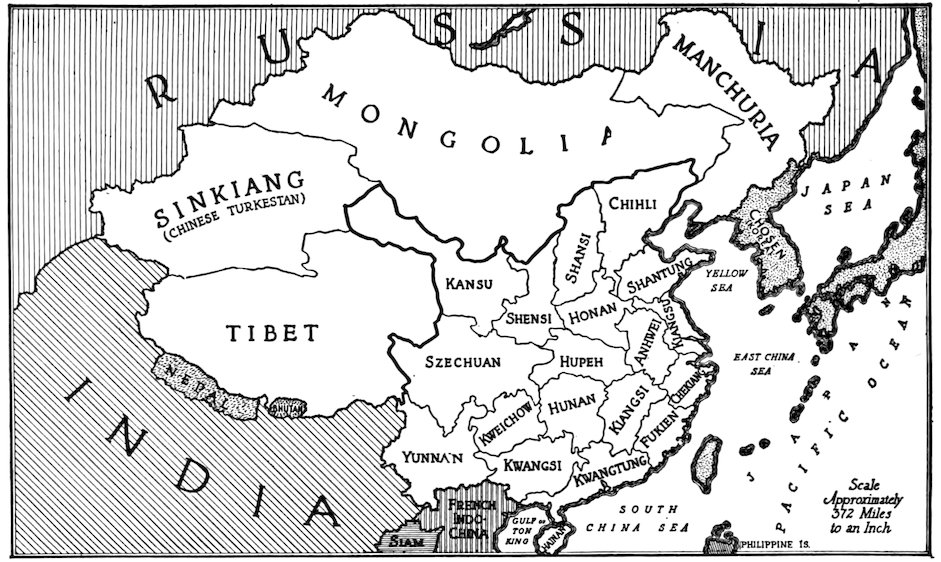
Area of “China proper” (east and south of heavy line) contrasted with that of the ancient Chinese Empire which included also Manchuria, Mongolia, Sinkiang, and Tibet.
| CHAPTER | PAGE | |
|---|---|---|
| I | China’s Place in the World | 11 |
| II | Manchuria, The Eastern Three Provinces | 21 |
| III | Through the Great Wall to Peking | 34 |
| IV | Our Home in Peking | 45 |
| V | Some Queer Chinese Customs | 58 |
| VI | Across Mongolia to Urga | 70 |
| VII | Shantung, Land of Confucius | 81 |
| VIII | Through the Heart of Old China | 93 |
| IX | The Great Mohammedan Province | 104 |
| X | Where the Fish Wagged Its Tail | 116 |
| XI | China Has Her Own Ways | 129 |
| XII | The Chinese Language and Schools | 141 |
| XIII | Foreigners in China | 151 |
| XIV | Along the Great Yang-tze Kiang | 159 |
| XV | Difficult Journeys | 175 |
| XVI | Down the Southern Coast | 191 |
| XVII | In the Province of Kwangtung | 203 |
| XVIII | A Summer in Southwestern China | 215 |
| XIX | Among the Primitive Tribes | 227 |
| XX | Szechuan, Largest of Provinces | 241 |
| Pronunciation List | 253 | |
| MAPS | ||
| The Old Chinese Empire and Present-Day China | 8 | |
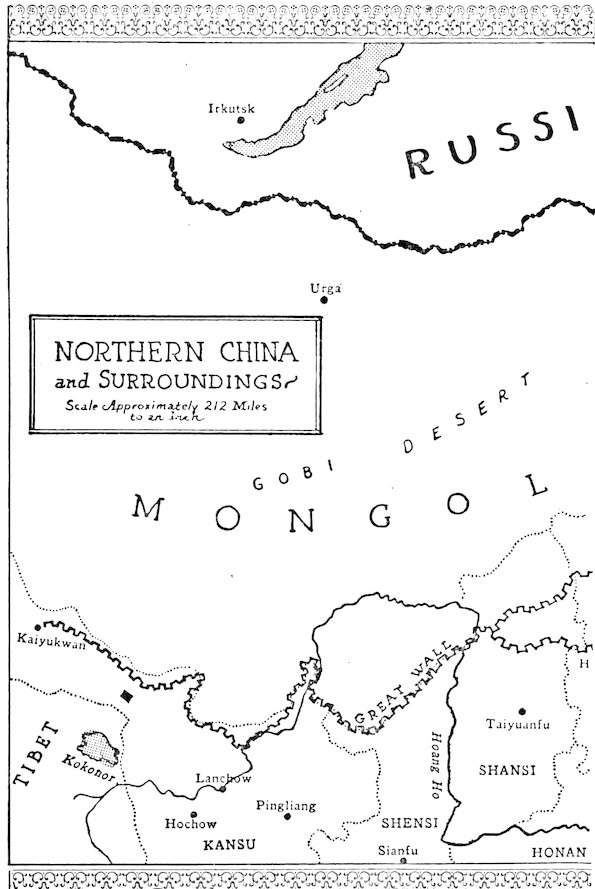
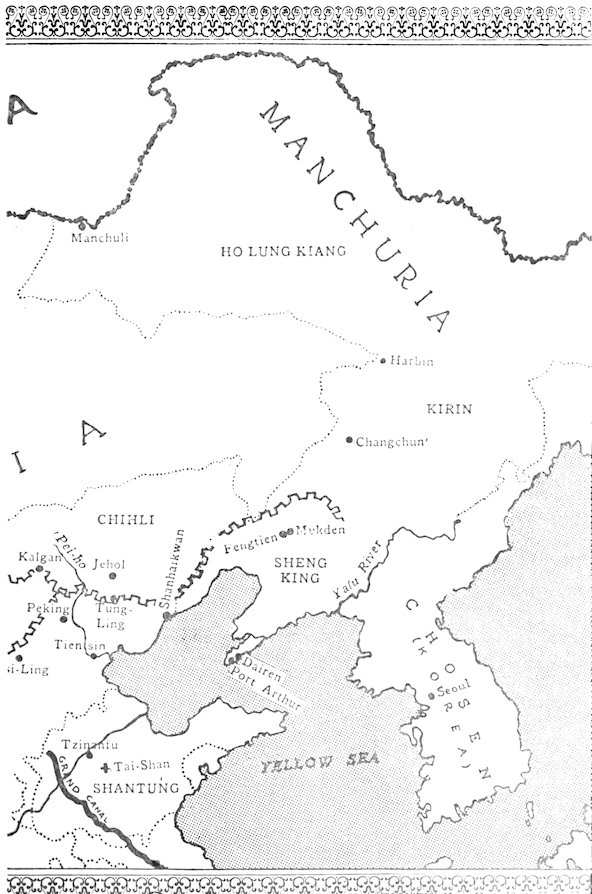
| Northern China and Surroundings | Inside Front Cover | |
| Southern China and Surroundings | Inside Back Cover | |
Keystone View Co., Inc., of N. Y.
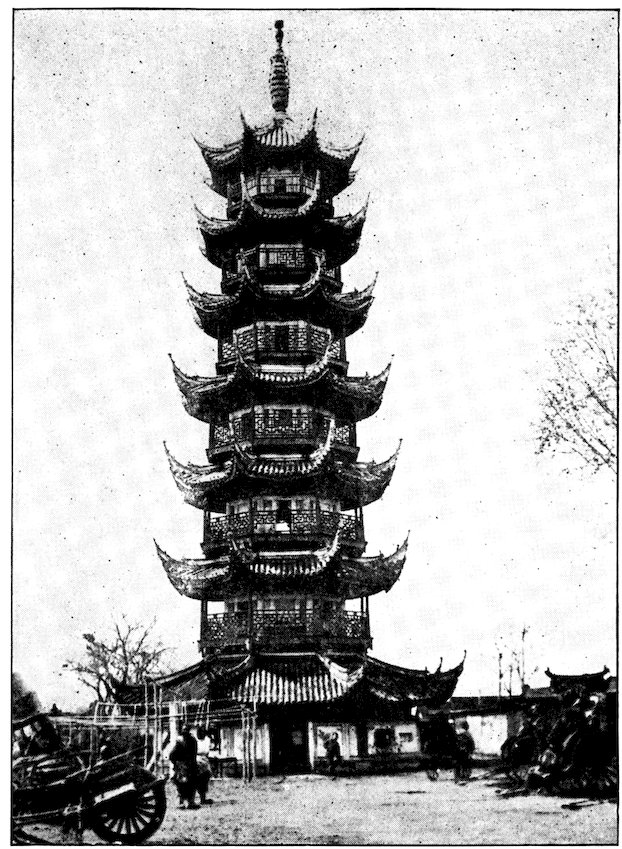
The Chinese came very near inventing the skyscraper when they built the first pagoda of this sort. One sees a great many of them in China. They have either six or eight sides, and are always an odd number of stories in height, up to thirteen. Often, as here, they have graceful veranda roofs. Pagodas are religious structures, and in form resemble somewhat the Christian spire and the Mohammedan minaret.
China is the oldest living member of the family of nations. It is the country in which conditions to-day are most nearly like what they were thousands of years ago. The long journey we are about to make through all parts of it will be like going to a great museum. But this museum, instead of containing the relics of people long dead, will look, for the most part, as if it were being lived in by an ancient race. Here and there, however, we shall see things that make us think of our Western civilization.
It seems hardly necessary to tell anyone where China is, or to say that the Chinese make up nearly one-fifth of the whole human race. You probably know that China occupies most of eastern Asia between Russian Siberia and the Pacific Ocean, or the China Sea, and that its climate ranges all the way from that of Canada to that of Florida.
Doubtless you know, also, that politically China is no longer an empire, as it was for thousands of years. Since 1911 it has been a republic, in name at least. This republic has not quite the same area as the empire had, for after the revolution which changed the form of 12government, several parts of the vast territory declared their independence. Even in what we may call China proper, different war lords rule in different regions and there is a great deal of confusion. Of course all the most intelligent and patriotic Chinese hope that this condition is only temporary.
Less than half the great territory that was once ruled over by the Chinese Emperor (called the Son of Heaven by his people) is in China proper. The rest of it consists of the great dependencies or colonies of old China, almost all of which have now declared, or at least act as if they had declared, their independence. Of them all Manchuria is the most like China itself. The enormous lands of Mongolia, Sinkiang or Chinese Turkestan, and Tibet are not Chinese any more than are the people who inhabit them, but have very different soil and climate as well as manners and customs. We shall find these former parts of the Chinese Empire very thinly settled, some with hardly two persons to the square mile, while in China proper there are as many as 675 people to the square mile.
During our travels through the eighteen provinces of China proper and most of its former dependencies, we shall see that the Chinese have their own ways, which in many respects are quite different from our ways. Yet if we pause to think as we read, we shall discover that they (and all the rest of mankind for that matter) are at bottom much like us. We shall find that every people’s outward peculiarities are mainly the result of a particular environment, of climate, soil, opportunities, and the like. We shall see how absurd 13it is to look down upon the Chinese, who have adjusted themselves to their environment more successfully than almost any of us. Is it not proof enough of this that China is still a nation thousands of years after the disappearance of its sister nations, Babylonia and Assyria?
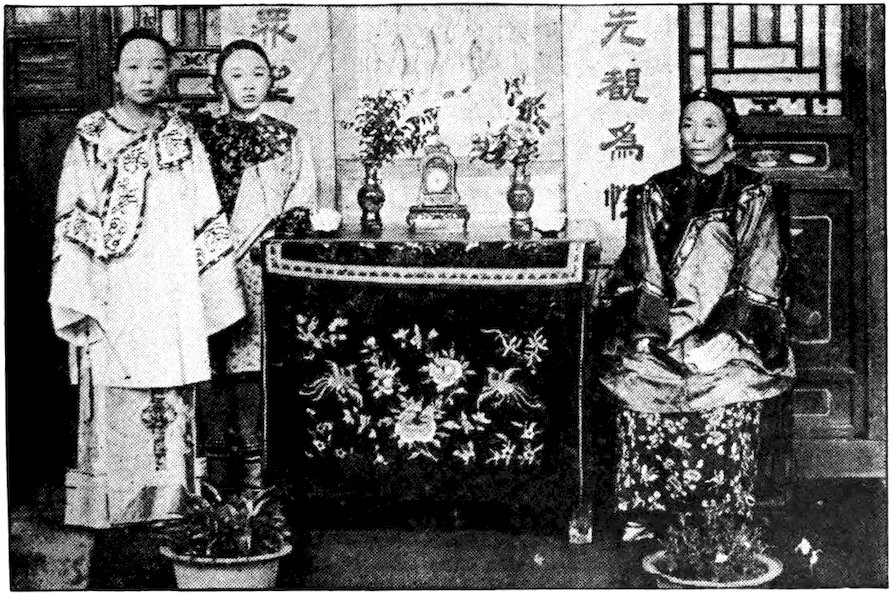
Chinese ladies of wealth and position, showing examples of the beautiful embroidery for which this people is famous.
Yet there are now many people who fear that China also is going to disappear as a nation. In order to understand that point of view, we shall have to look a little into recent Chinese history. For nearly three hundred and fifty years China was under the rule of the Manchus, who were really not Chinese at all, though gradually they came to seem almost the same. It was 14against the Manchu emperor and the many less powerful Manchu rulers under him that the Chinese revolted in 1911.
But though a republican form of government may seem natural to us, who have been used to one for many generations, it was not a simple thing for the Chinese suddenly to change so completely. Under their Manchu emperors only a small proportion of the Chinese had ever learned to read and write. They had never had the right to vote and had known little of what their central government was doing. They had not had newspapers and magazines to keep them informed. Millions of them, living far from Peking, the capital, and without education, had gained no real idea of what government means. They had had to pay taxes every year or oftener to someone who said he was collecting them for the government, and each one saw the elders of his own village attending to its affairs. Perhaps they were sometimes taken before a mandarin sent out from Peking, to be tried for some crime or misdemeanor. But that was all that the great mass of Chinese knew about government.
We in America are great believers in education. In China there are increasing numbers of men, many of whom have attended American colleges, who realize that until the masses of the people learn to read and write, at least, they cannot be expected to have intelligent ideas about government. One Chinese, who is a graduate of Yale University, is a leader in the movement for education of his countrymen, and he is attempting to do away with illiteracy in one generation 15by means of a simplified written language. Later on I shall tell more about language difficulties in China, and more about the educational system in that country. We can always be proud that the United States has done much to bring educational advantages to the Chinese through the Boxer Indemnity Fund. This fund consists of money which was due to the United States from China because of lives lost and property damaged in the Boxer Rebellion of 1900. Instead of using the money, our government turned it back to China as a fund to establish Tsing-hwa University near Peking and to bring promising Chinese students to America to be educated in our colleges and universities.
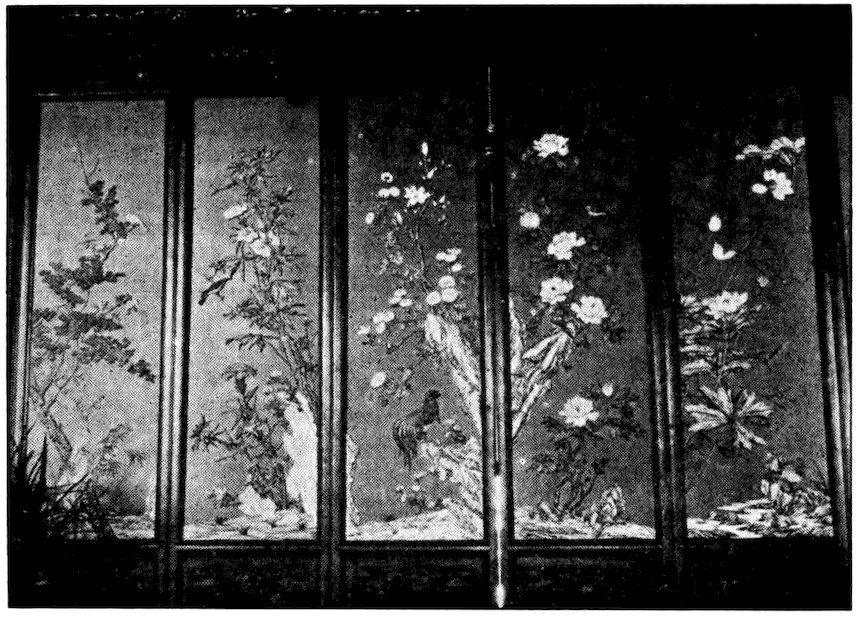
A screen in the palace of the late Empress Dowager in Peking is an example of the wonderful artistic creations of the Chinese.
16Naturally enough, the Chinese did not know how to elect a president and a parliament and all the other officials that are needed to run a republican form of government. It was natural also that men who wanted to have important government offices found ways to get them without being elected. One of the favorite ways was to collect a private army and start ruling over a certain city or county or province, whether the people liked it or not. A Chinese who had been one of the chief generals of the Manchu emperor began to send out men of his own choosing to govern the different parts of the country. Although he had been elected president by a parliament or congress (which he had largely chosen himself) even he had only a vague idea of what a republic is, and finally he tried to make himself emperor and establish a new dynasty.
But there were too many other men who wished to obtain good positions for themselves under this new Western form of government. Some of them were subordinates of the president, and they knew that if he made himself emperor their own chances of some day becoming president or anything else of importance would be slight. So they opposed the founding of a new dynasty, and the president who wished to be emperor died in 1917 without having placed his family on the throne.
After he was gone, and there was no strong man left in the central government at Peking, many of the military governors of provinces and even local officials which this president had appointed, became independent. They had their own soldiers, and the people 17could do nothing against them. For thousands of years the Chinese have been used to being ruled by force, without having anything to say in the matter, so most of them cannot see why they should be expected to take any part in governing their country.
This is what makes many people think that perhaps China as a nation, the oldest nation on earth, is going to disappear. Since the revolution of 1911 nearly all its great dependencies have become practically independent. Many men, under the name of tuchun, or marshal, or general, and so on, have made themselves dictators over different parts of China proper. Some of them are entirely independent of the central government at Peking. Some only obey the orders of Peking when they wish to do so. China no longer has a genuine central government. There is no Chinese army, though there are millions of Chinese soldiers. Each different ruler of different parts of the country has his own army, which obeys him only. As we travel about this ancient country we shall find that it seems like a collection of independent provinces or still smaller divisions. Sometimes we shall find a single city divided between two different generals.
Many of these rulers with their own armies are very selfish men, who keep for themselves as much as possible of the money they gather in taxes. Some of them are constantly fighting among themselves, trying to drive one another out and take more territory for themselves. Things in China to-day are much as 18they would be in the United States if each of our generals and colonels took the division or the regiment he has under him and ruled the part of the country he is stationed in, without paying any attention to orders from Washington.
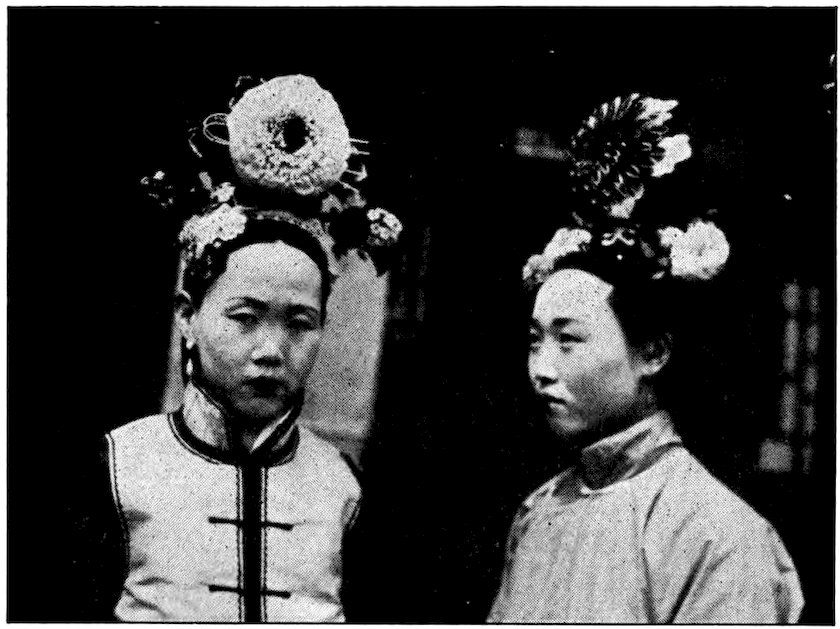
Manchu women decorated for a holiday. Their headdresses are especially elaborate, but they also use white and bright red paint (rouge) on their faces when they dress up.
It will probably be some time before we know whether China is going to break up into a number of small countries or remain the great nation it has been for thousands of years. Some people think one of the marshals or generals will finally conquer all the others and make himself president or emperor of the whole country. Others fear that outside nations may have to step in to establish order in China. Still other people 19hope that the Chinese people themselves will be able sooner or later to straighten out their own affairs, as they have done several times before during their long existence.
While all this misgoverning goes on in China, the Chinese remain hard-working and cheerful, as they have so long been. The civil wars among the various generals in different parts of the country make life very unpleasant for the people. Before our travels are finished, I am sure you will decide that the Chinese deserve a much better government than they now have. Almost all foreigners who live among them find them very likable, though of course they have their faults, just as Americans and all other peoples have.
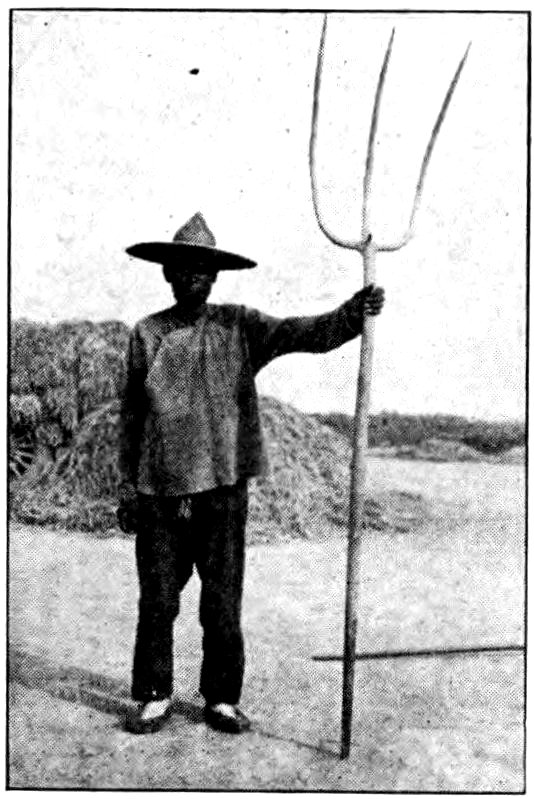
One reason why there is not a larger sale for American farm implements in China is that in many parts of the country the farmers raise their own pitchforks and other tools by binding small growing trees into the desired shapes.
You may be surprised, as I was, that we can travel almost anywhere we wish, in all the eighteen provinces, even while many civil wars are going on. A few foreigners have been killed and a number have been robbed in China during the past few years. But when I show you how 20I traveled in all parts of the country, often entirely alone, and through many out-of-the-way regions, without ever being hurt or robbed, you will probably decide that the Chinese are pretty good people after all. When I tell you also that my mother and my wife, with our two small children, went anywhere they wished, even late at night, in many of the great cities of China, while rival generals were fighting within or outside the walls, you will certainly admit that the Chinese are our brothers under their yellow skins.
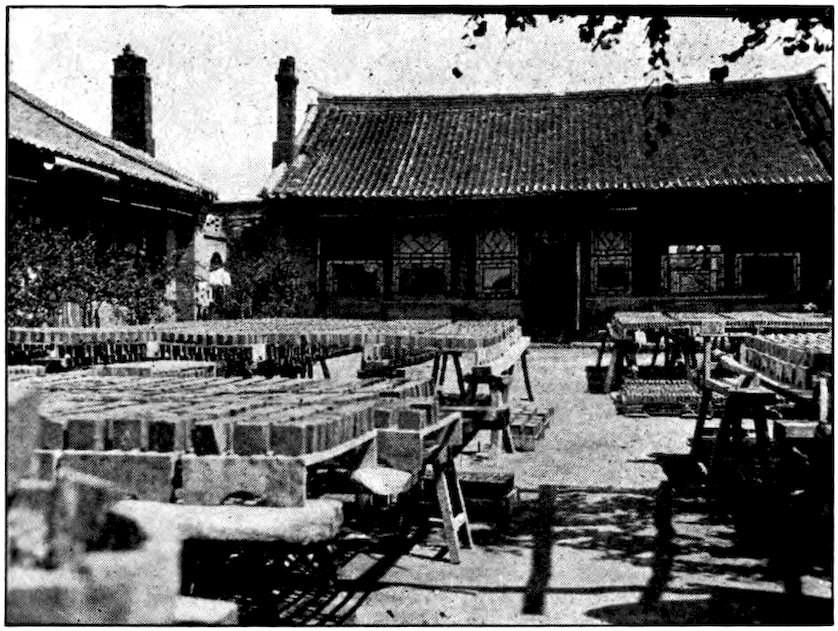
A soap factory in Mukden, Manchuria, where the cakes laid out to dry are all bright yellow in color. It is hardly the sort of soap that we would care to use on our skin.
We approached China, not by a steamer landing at Shanghai or Tientsin or Canton, as most travelers do, but in the more modern, interesting way, through Japan and its great new continental dependency, Korea (Chosen). The Eastern Three Provinces, as the Chinese call what we know as Manchuria, are situated much like our northeastern states, with Siberia and Mongolia taking the place of Canada. Yet the moment we crossed the big railway bridge over the Yalu River, we realized that we were in China, even though we were not yet in China proper. At the very edge of the river we began to see women with bound feet, coolies in blouses and blue cotton trousers drawing rickshaws and pushing wheelbarrows, and in front of the stores and hotels long upright wooden signs with strange characters on them.
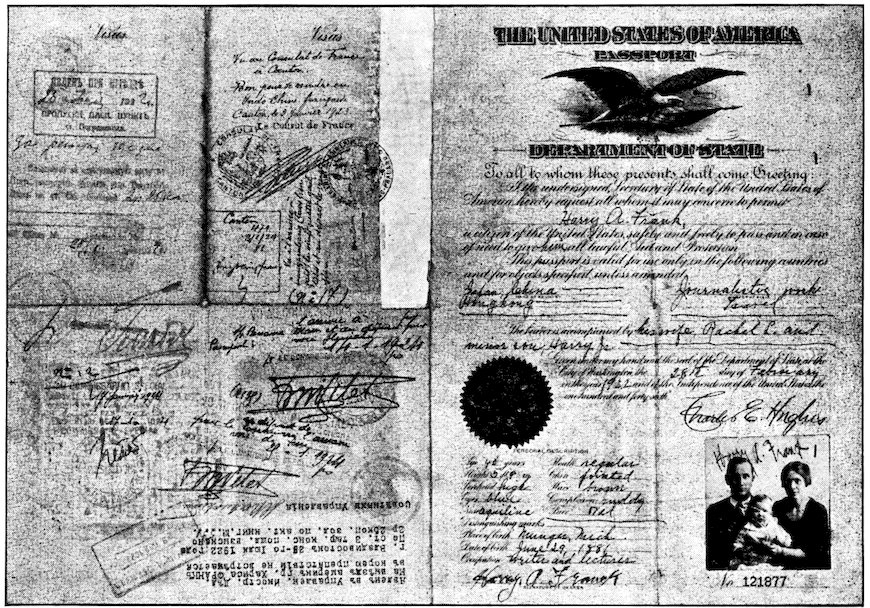
Fourth and first pages of our passport, signed by Charles E. Hughes, Secretary of State.
In a way, however, Manchuria is partly Japanese and partly Russian. After the war of 1904–5 between Japan and Russia the southern part of the great railroad which the Russians had built there was turned over to Japan. So the American-style trains that run through Korea not only go on to Mukden, the capital of Manchuria, but there is a Japanese railway, also with the kind of trains we have at home, 500 miles 23long from Dairen and Port Arthur to Changchun, and many miles of Russian railway north of that. The Japanese govern the land along their railway and certain parts of all the large cities on its route. The rest of Manchuria is ruled by a Chinese who is really independent of Peking and the rest of China.
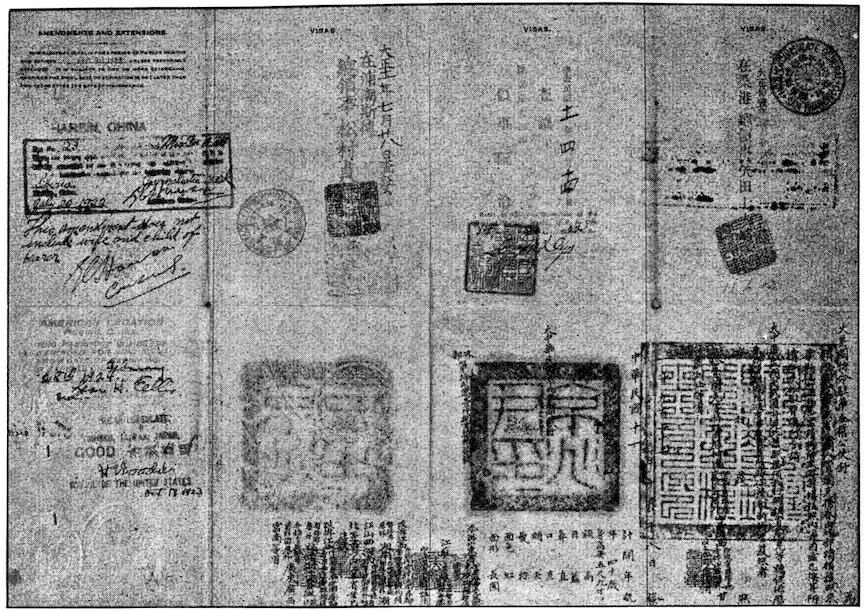
Second and third pages of our passport. The visas were stamped in many different colors.
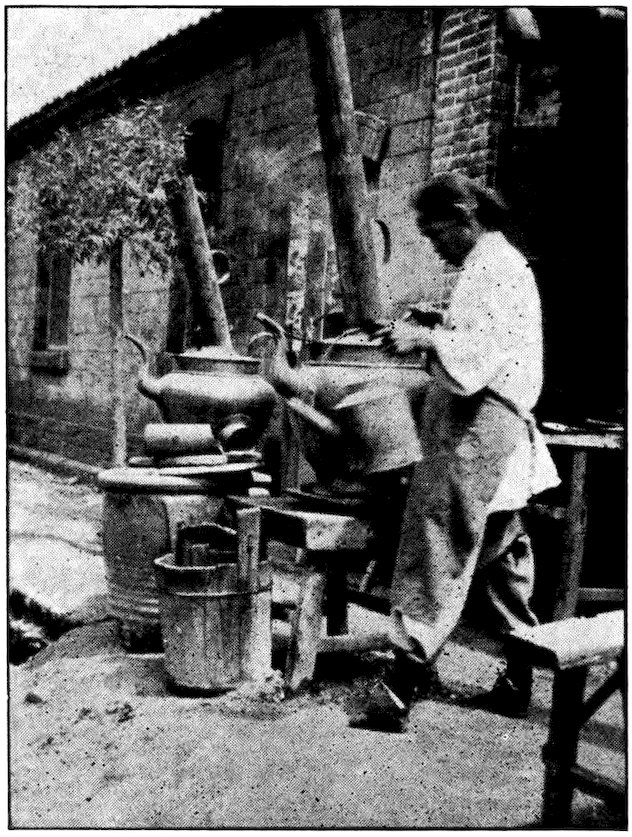
A coolies’ tea shop in Mukden. The water is heated in these huge teakettles. The woman in charge has bound feet.
Two or three miles beyond the Japanese part of Mukden (near the railway station) is the old city of Mukden. More exactly this is Fengtien, for Mukden is the name given it by the Russians. Like almost all 25the cities of China, it has a great wall about it made of huge bricks like blocks of stone and with gateways so built that the roads through them have to make two sharp turns. All Chinese city gates have this double-elbow form, because the people used to think (as many of them do still) that the air is full of invisible evil spirits, which can move only in a straight line. Such gates also help to protect the city against enemies.
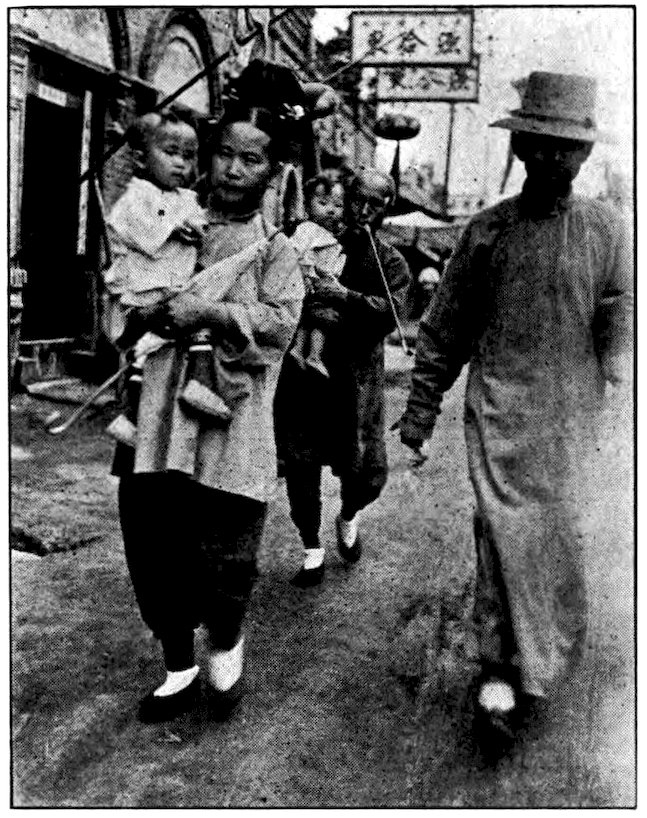
An interesting study in Manchu costumes and customs. The woman in front wears the peculiar headdress of her race, but grandmother, behind, is enjoying an unburdened head and a long pipe. Being Manchu women, neither has bound feet. The man looks as if he might welcome a style that demanded shorter skirts.
Inside its walls Fengtien is a real Chinese city. Most of the streets are rough and many of them are very narrow; that is the way the Chinese have built their cities for thousands of years. Along the streets we saw huge brass teakettles as large as nail-kegs. There was a charcoal fire under each of them, and steam poured forth from the great spouts. The Chinese are always drinking tea, and the little stands or stores behind the great kettles are tea shops for the coolies and other poorer people. Many of the women who tended these kettles wore the queer Manchu headdress. This is something like a thin board nearly as wide as it is long, set across the top of the head, with the jet-black hair wound about it, and adorned with flowers and jewelry. Unlike their Chinese sisters Manchu women do not have bound feet.
Before other shops hung big wooden signs shaped like the strings of “cash”—little brass coins with a square hole in the center—which some Chinese still use as money. Such a sign shows that the shop is that of a money-changer. There are so many kinds of money in China that places where one can exchange one sort for another are common in all its cities.
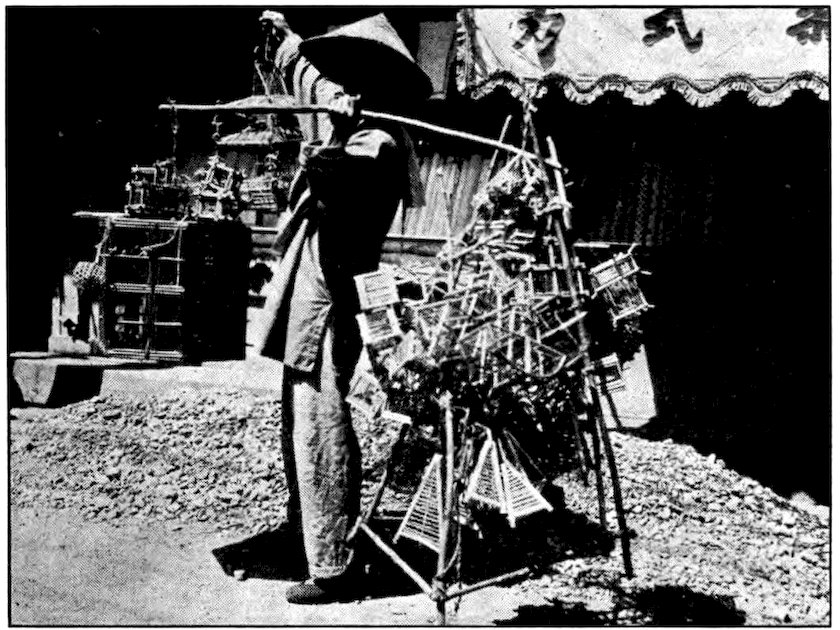
You might think that the queer contraption carried by this peddler was a jumble of big jackstraws. Instead, it consists of bamboo cages, and in each cage is—not a bird, or a squirrel—but a cricket, a singing cricket! The Chinese like to have them around and are willing to pay for the pleasure.
Among the peddlers of all manner of things who went up and down the streets shouting their wares, were men with dozens of little cages made of strips of bamboo as thin as straws. Inside each cage was a cricket or two, or a katydid, or a grasshopper of the singing kind. The Chinese buy these caged insects for their shops or their houses, just as we do singing-birds. All along the streets we could hear the little creatures contentedly chirping. I bought one for my little boy, who was then two years old, thinking that it would be about the right size of bird for him. But the cricket did not seem to like to belong to foreigners. It would not sing for us at all. We had not intended to keep it a prisoner long, for after all, birds and crickets and polar bears probably like their freedom as well as the rest of us. So after a few hours we took the cricket to the park and turned it loose. But I am afraid our kindness 28did not do it much good; for two Chinese boys at once began chasing it and probably they soon caught it and sold it back to the cricket-seller again.
For nearly three hundred and fifty years, the Manchus, big men of the Mongolian race who originally came from Manchuria, ruled all the Chinese Empire. They had a throne at Mukden, which travelers still go to see. It is as empty now as the great palace in which it stands. To-day we might almost say that there are no Manchus. There are many thousands of people in China who still call themselves by that name; but while ruling China the Manchus became so much like the Chinese that it is hard to tell them from the rest of the population. We shall find that the Chinese almost always absorb the people who come to live with them, even their conquerors.
One of the most amusing things in Mukden is its street-car system. The cars are drawn by mules, and run from the Japanese railway station to the old city of Fengtien. They are such miserable old cars that only the poorer Chinese usually ride in them. Other people go by rickshaw or by automobile or in what foreigners call a Peking cart, a sort of box set on two wheels, covered by a rounded roof, and with no springs whatever. Yet those same street cars once ran on Third Avenue in New York! When electric cars took their place there they were sold to Tokyo, and when the Japanese capital also adopted electric trolleys those old cars were sent on to Mukden. The Chinese ruler of the Eastern Three Provinces hopes soon to have electric street cars also, and then the old cars that have 29traveled so far may go still farther, or perhaps be turned into playhouses for rich Chinese children.
As we traveled up and down Manchuria by the Japanese railway, we did not wonder that China would like to get back these three eastern provinces. Manchuria is not only a very fertile country, it has few inhabitants compared to crowded China. Thousands of Chinese coolies come to Manchuria every summer, to work in the harvest fields and elsewhere. Some of them go back home each autumn; but quite a few remain, so that the old home of the Manchus is not only ruled over by a Chinese but a large proportion of its inhabitants are now Chinese.
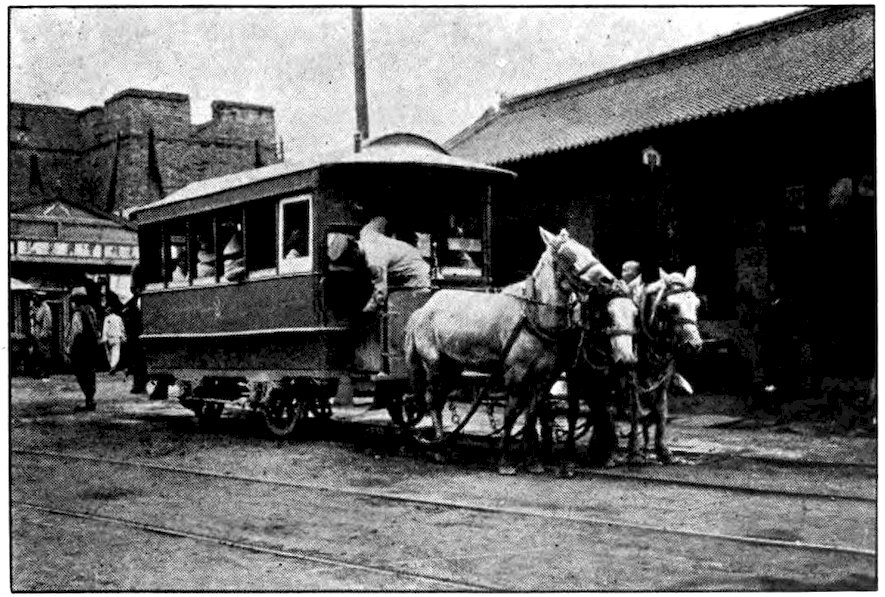
Horse cars such as this one make leisurely trips between the Japanese railway station in Mukden, Manchuria, and the old walled town. These cars once saw service on Third Avenue, New York.
30The most important crop we saw along the way is what the Chinese call kaoliang, very much like the Kaffir-corn or sorghum grown in our own southern states. Great fields of this, so high that a man on horseback can hide in it, stretched away over the horizon. Bandits sometimes conceal themselves in the kaoliang-fields, so that the people of Manchuria and of a part of northern China proper are always glad when the grain is cut. Most Americans think that all Chinese eat rice. Up in the north, however, where the winters are as cold as in Canada, there are millions who almost never taste rice, but live on kaoliang, and millet, and even corn and wheat, which also grow there.
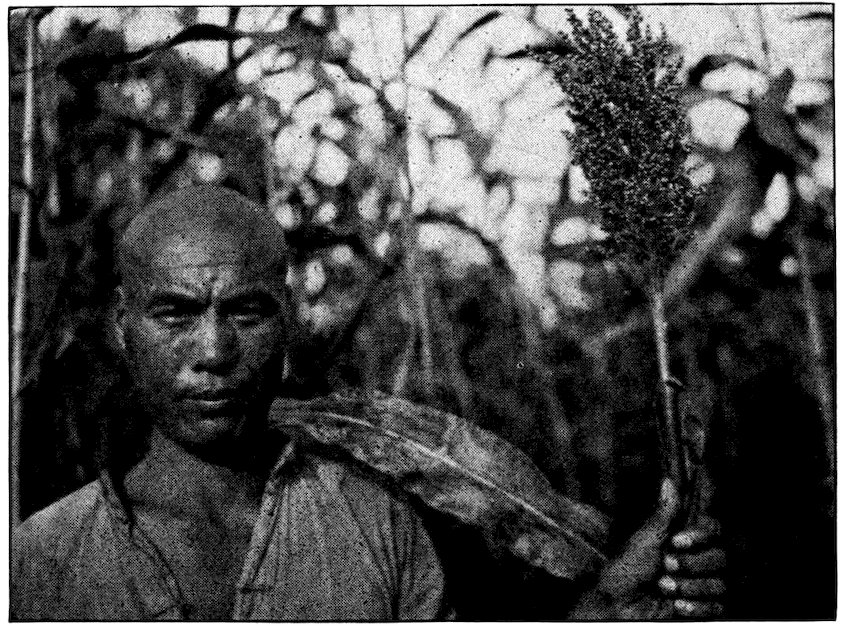
The grain of the kaoliang, one of the most important crops of northern China and Manchuria, which often grows to a height of fifteen feet. Incidentally, a field of kaoliang makes a fine hiding place for bandits.
31Another very important crop in Manchuria is the soya-bean. The food part of this is pressed out and made into a kind of curd, which the Chinese everywhere eat. Some of it is made into a salty sauce into which the people dip each chopstickful of their food. A Chinese would dislike going without his soya-sauce as much as we would dislike being deprived of salt. What is left of the soya-bean after the food value has been pressed out of it is shipped, in great round blocks that look like grindstones, to all parts of China, to be used as fertilizer.
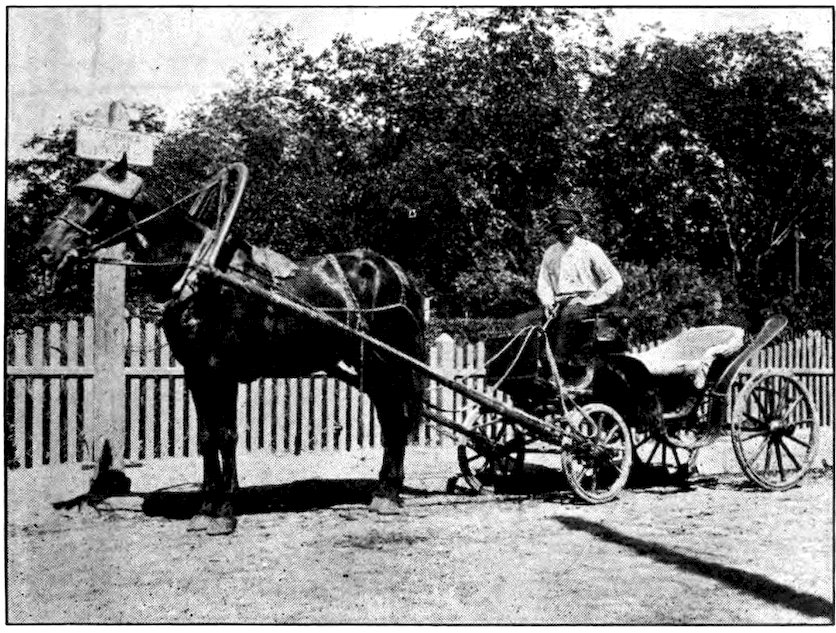
Up in Harbin and the rest of northern Manchuria one often sees things which remind him of Russia, for many of the people in that region are Russians. Here is a droshky, such as might be hired for a ride in Moscow.
Northern Manchuria is a kind of Russianized China. Beginning at Changchun, where travelers change from 32the American style trains of the Japanese railway to Russian trains that remind one of Europe, there are more Russians at the stations and farmhouses along the way than there are Chinese. Even some of the men in Chinese soldier uniforms are Russians, big blond men who look so much like us that we are surprised that they cannot understand us. But it is harder to get along here than on the Japanese railway line. All Japanese stations have their names on the signboards in English as well as in Japanese. On the signboards north of Changchun, however, the names are in Chinese and Russian, but not in English.
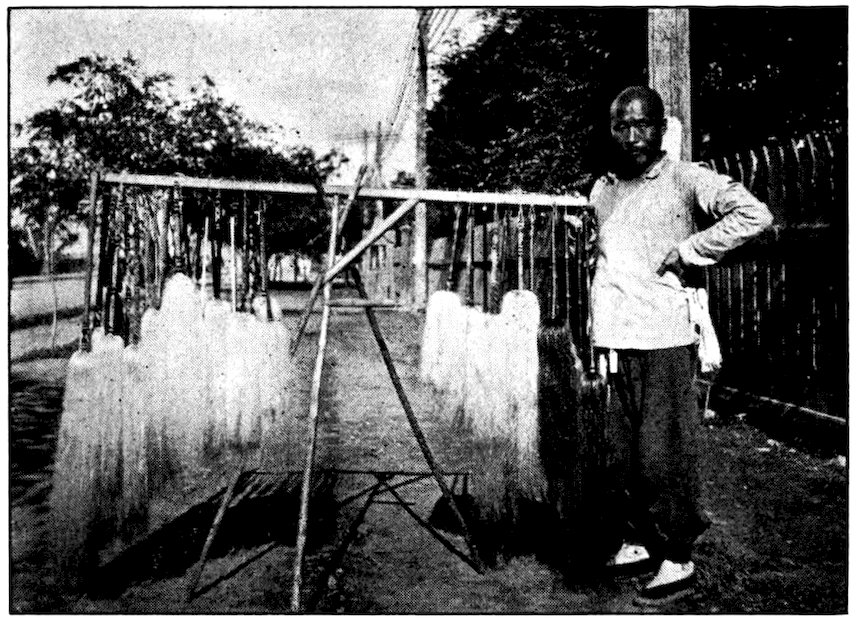
In Harbin in July it is terribly hot, and flies are very numerous. The people don’t understand that they ought to “swat” flies and kill them off, but they use a sort of horse-tail fly scarer such as this peddler has for sale.
33Gaudy Russian churches, with queerly shaped steeples, and painted in bright blue, green, and other strange colors, rise above all the larger towns. Especially in Harbin, the traveler can almost imagine himself in Russia. There, for instance, it is bad manners to go into an office without leaving your hat and overcoat in the anteroom. You are expected, on entering a store, to shake hands with the proprietor and the clerks, and to do so again when you leave. We saw many Russian beggars, too, men who had lost everything and been driven out of their native land when Russia changed its government. At Manchuli, beyond which lies Bolshevik Russia, we turned back toward Mukden and Peking.
It was still another style of train that carried us from Mukden to Shanhaikwan, the first town of China proper. The cars had rounded roofs and were divided into compartments, like the cabins on a ship. The train was packed full of Chinese soldiers, in very faded gray cotton uniforms. They crowded some of the cars so that other passengers could not get on at all, and they even slept on and under the tables in the dining-car. Very few of them had tickets. We were to find this a common thing on all Chinese railways. Many of the soldiers of the different marshals and generals ruling China are not well trained or disciplined; some of them are hardly real soldiers at all. But the trainmen, not being able to do anything against their rifles and bayonets, have to let them ride whether they have any real right to or not.
At Shanhaikwan the Great Wall of China reaches the sea at last, weary from its more than 1500 miles of climbing over the mountains. I passed through the Great Wall in half a dozen different places before I left China, so that it came to be like an old acquaintance. As you perhaps know, it was built nearly two thousand years ago, to keep the wild Mongolian tribes living north and northwest of it from getting into ancient 35China. Yet they did get in, in spite of this great barrier along the frontier, conquering, and for quite a long time governing, all China.
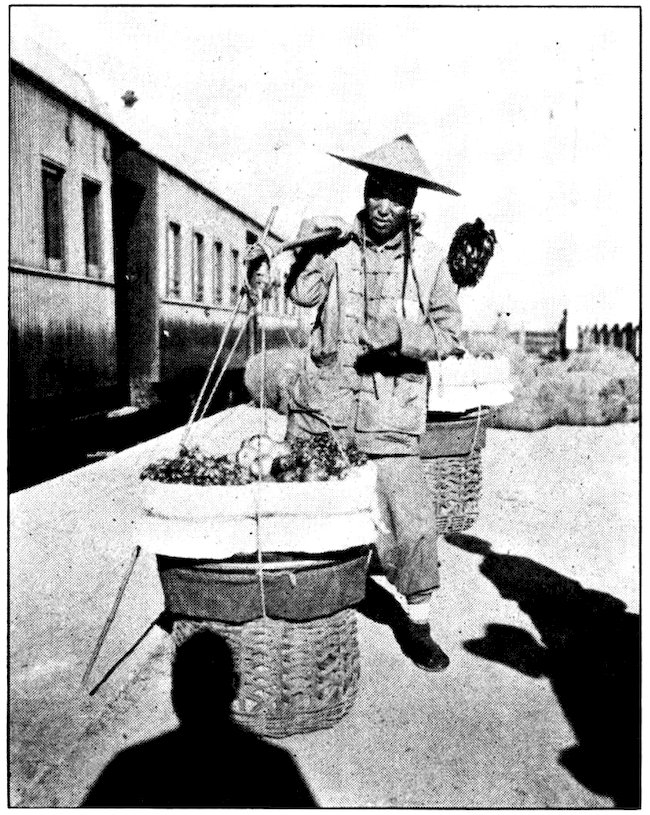
In July and August, on the way from Mukden to Peking, one finds plenty of fruit on sale at the railway stations. A springy hickory or bamboo pole such as this peddler carries may be shifted from one shoulder to the other and is not burdensome.
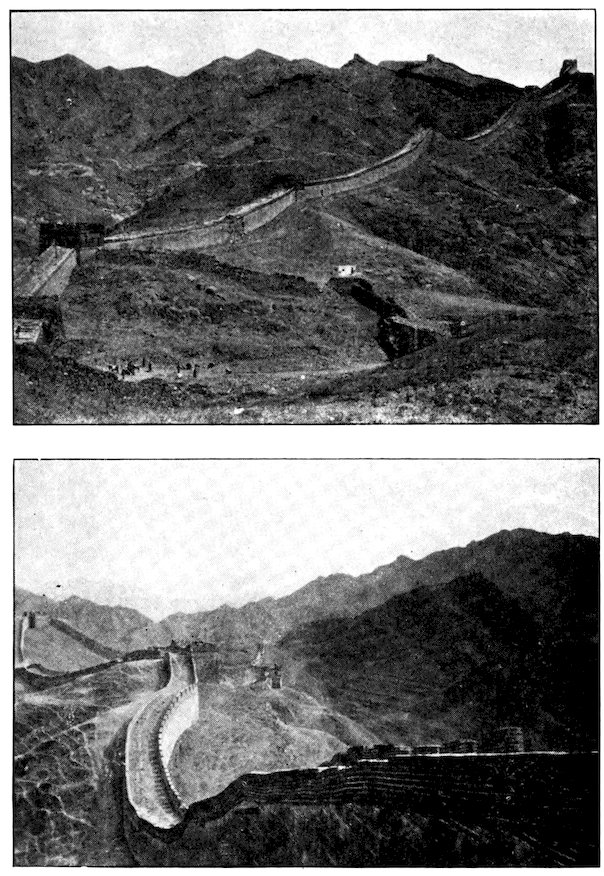
Two views of the Great Wall of China, which clambers over the mountains for more than 1,500 miles from the desert to the sea.
The Great Wall of China has often been called one of the seven wonders of the world. Perhaps you would not think it so wonderful if you merely hurried through one of its gates, or saw a short section of it. Much of 37it is built of huge bricks or great blocks of cut stone, and it is from twenty to thirty feet high and wide enough for two automobiles to pass on its top. When you stop to think that the people who built the wall had no modern machinery at all, that they had to cut all those stones and make those great bricks by hand, then carry them and lift them to where they were needed without even a wagon or a pulley, you will begin to see that it is a remarkable job. Then if you ride or walk out along the wall and see how it climbs and winds for mile after mile, up hill and down dale, you will marvel still more. Finally, when you have passed through it in half a dozen places, some of them hundreds of miles apart, and found it still climbing on over high mountains, with a big tower for its defenders rising above it every few hundred yards, you will certainly admit that it is one of the greatest works of man.
If the Great Wall of China were laid down on the United States, it would stretch from New York nearly to Omaha, even with all its twists and curves; and if it were straightened out it would reach almost to Denver. It is true that it is not a solid stone wall. When we rode out along it on donkeys behind the round-roofed town of Shanhaikwan, we found that there it is really two brick walls, each about three feet thick, the space between filled with earth and broken stone and the top paved with bricks. These slate colored bricks are huge compared to ours; one of them weighs more than twenty pounds. It is true also that far out on the borders of Tibet, where the Great Wall ends at Kaiyukwan, it becomes merely a high ridge of baked 38mud. But I am sure no nation to-day would care to build one like it, even with modern machinery. The Chinese, by the way, call the wall the “Wan Li Chang Cheng,” or the Ten-Thousand-Li-Long Wall. As a Chinese li is about one third of our mile, the Chinese exaggerate in calling it more than three thousand miles long. It really is only half that length, but I am sure it seemed even longer to the many thousands of drafted men who built it!
There were many Chinese towns, with mobs of rickshaw-men struggling for passengers at the stations, on the all-day ride from Shanhaikwan to Tientsin. Some were large walled cities, where we could catch a glimpse of very narrow streets as packed with people as our train was; and everywhere we were made to realize how overcrowded a country China is. If the living are many, the dead seem still more numerous. The country is dotted with little cone-shaped mounds of earth, most of them about four feet high. They are Chinese graves, very few of them marked by a stone or in any other way.
The Chinese revere their ancestors so deeply that each family preserves its graves for dozens, sometimes even hundreds, of generations. When a man dies, his children go to a geomancer, a kind of wizard, and have him decide where the body should be buried. The geomancer pretends to consult the invisible spirits which most Chinese still believe in, and finally chooses a spot where he claims the dead man can rest well. As 39the places chosen by geomancers may be anywhere, there are no graveyards in China. Rather one might say that the whole country is a graveyard. We thought the unmarked mounds on the way to Peking were thick, but later I saw millions of them, always thickest near the big cities.
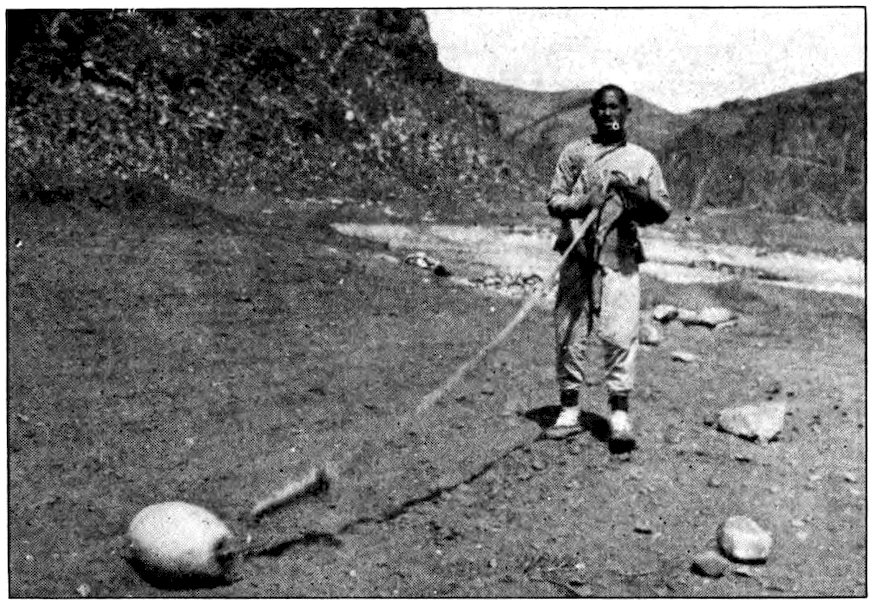
In dry northern China, after a field has been plowed, the clods of earth are sometimes broken up by dragging a stone roller over them.
The graves are a great hardship to the people of China. With nearly half a billion population, old China can hardly furnish any one man land enough to grow food for his family. Yet almost every farmer’s little patch of earth is made still smaller by the grave-mounds of his ancestors. He has to plow around these graves every year, and must not plant on them, so that they add to his work and decrease his crops. 40In olden times the Chinese leveled their graves whenever a new dynasty ascended the throne. But now that there are no more emperors, the graves are left, and it begins to look as if some day there will be nothing else left.
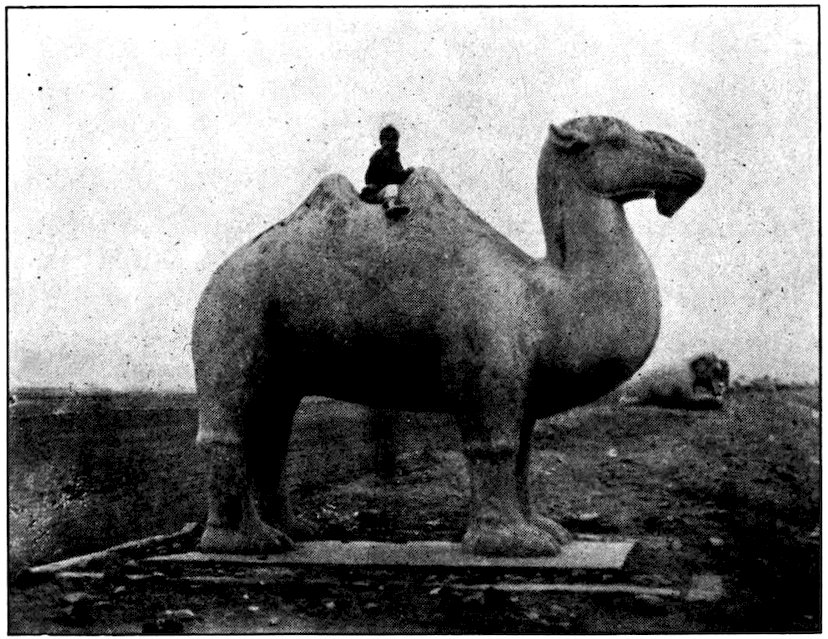
The way to the Ming tombs is lined with figures of camels, elephants, and other creatures. How large they are may be seen by comparing with the small boy, who seems to be trying to find out “how the camel got his hump.” Each figure is carved from a single block of granite.
The rich Chinese have much more elaborate graves than the simple mounds of earth. If a man leaves his descendants money enough, a temple is built to his memory. Here members of his family come, often for hundreds of years afterward, to burn incense and say prayers before his spirit-tablet. The tombs of dead Chinese emperors are still more costly. There are 41groups of them on the north, east, and west of Peking. Two of the groups may be reached by train, but Tung-ling, or the Eastern Tombs, just north of where we were now traveling, can be reached only on foot or on donkey-back, and this group I found most interesting. There are not a dozen emperors buried at Tung-ling, yet the tombs cover hundreds of acres. Each tomb includes several large buildings, elaborately decorated inside and out, and there is a walled village of caretakers for each tomb.
The people whose business it is to look after the tombs are all Manchus, because only Manchu emperors are buried at Tung-ling. This is true also of Hsi-ling, the Western Tombs, a hundred miles away on the other side of Peking. So closely do the watchers guard the things belonging to the dead rulers that three men with their keys are required to open one tomb-temple. I got permission from the high-caste Manchu head man of one of the villages to visit the tomb of the famous Empress Dowager, the crafty old woman who ruled China for a long time up to the beginning of the present century. One man knelt to unlock a padlock at the bottom of the great door, another man climbed a stepladder to unlock one at the top, while a third man attended to the ordinary lock in the middle. Inside there were chairs covered with silk of bright yellow, the imperial color. Yellow dragons, a symbol of the rulers, climbed the big black pillars supporting the ceiling. The ceiling itself and the walls were painted in colored 42squares. Food in silver and gold and lacquer dishes had been set before the altar; for the Chinese believe that the spirits of the dead become hungry just as living people do.
The approach to a Chinese imperial tomb is lined with stone images of animals and men. They are nearly always in pairs: two elephants, two camels, two mandarins, two warriors, two horses, two strange beasts that never existed anywhere except in a Chinese imagination. Especially at the tombs of the Mings (who preceded the Manchus) north of Peking, the stone guardians or servants are remarkable. Even the camels and elephants are fully life-size, though they are chiseled out of hard granite. Some of the stone men are so huge that I came barely to their knees. At the Manchu tombs the stone figures are not so large, but the carving is finer.
Great pine forests surround all the imperial tombs, and people are sternly forbidden to cut down a single tree. In fact until recently the mountain range back of Tung-ling could not be touched by the ax or the plow, because it was considered a “shield” against the evil influences from the north that might disturb the dead emperors. But soon after the revolution the government allowed the forests on the “shield” to be cut, so that now the range supplies many fine logs for lumber, and colonists have begun to cultivate the hillsides. It was a queer sight to see men chopping and burning down the forests, and living and planting, here in ancient China, very much as our pioneers and frontiersmen did when America was first being settled.
Over the range behind Tung-ling and outside the Great Wall is a very remarkable place called Jehol which few foreign travelers ever see. It was a summer home of the Manchu emperors, and some of them built magnificent palaces and surprising temples there. One called the Potala is copied after the great temple of the Dalai Lama in Lhasa in Tibet, which very few white men have seen. It clambers in building after building up the hillside. Another temple has inside it a golden figure of Buddha so large that I had to climb to the fourth story to see the face, and many of its dozens of arms were much higher than that. Still another temple has five hundred life-size golden Buddhas, varying in features and attitudes, sitting on either side of long gloomy passageways. These figures we shall find in most large Chinese cities. They are supposed to represent Buddha in all of his moods and tempers.
The scenery of Jehol I found far from ordinary. Among other strange forms in the great circle of mountains about it is a mammoth upright rock shaped like a policeman’s night-stick. The Chinese call it the “clothes-beater,” because to them it resembles the club which Chinese women use in washing their clothes at the edge of a stream or mud-hole. Nearly half a day distant from Jehol by donkey travel I could still see this strange rock standing above the horizon.
Along the railway from Manchuria the territory grows very uninteresting. When large mounds, almost as white as dirty snow, rose on the landscape, we 44at first took these to be graves, but found that they were salt, shoveled up in the great pans of earth in which sea water is evaporated. Salt is a very important product in China, although there are almost no mines of solid salt, such as we have in America. There are salt “gardens,” owned by the government but managed by foreigners, from which formerly Peking received large revenues. Now most of the money goes to local dictators.
Tientsin, the port for Peking, and the leading port in northern China, is seventy miles above the mouth of the Pei-ho and about the same distance southeast of Peking. It was opened to foreign trade and residence by treaty in 1860. In the foreign settlement, called Tsuchulin, half a dozen European countries own land, and have their own laws and police and government. Yet about the docks even of this foreign part of town we saw many gaunt, hungry-looking coolies who haul wagons of freight along the cobblestone wharves for wages of about six cents a day. We soon left Tientsin behind and sped away toward Peking.
For nine months we lived in the Chinese capital, and found it a delightful home. Our house was out on the eastern edge of the Tartar City, so close under the great Tartar Wall that the sun was late in reaching us every morning. It was a Chinese house. That is, it had no cellar and no upstairs, not even a garret. Really it was four houses, one on each side of a brick-paved court about thirty feet square, each house having two rooms. Whenever we went from the bedrooms to the dining room, or from the living room to the nursery, we had to go outdoors. But as the sun is almost always bright in Peking, even on the coldest winter day, we did not mind doing that. The courtyard of a Chinese house insures plenty of light and air and makes up for the lack of certain conveniences that Westerners are used to.
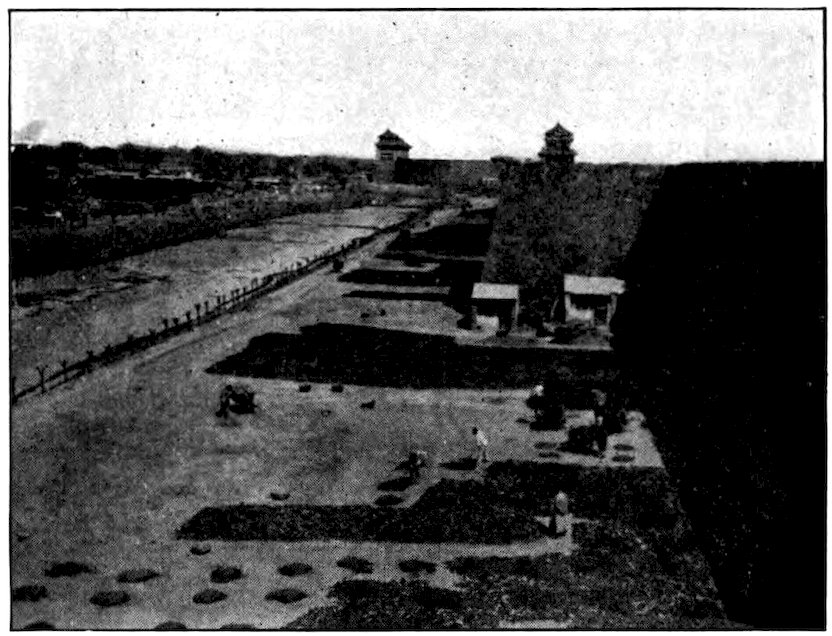
Outside the Tartar Wall at Peking, showing the watch towers at its corners. We lived on the eastern edge of the Tartar City, just inside this wall, and we found that its height made a difference in the time the sun rose for us. The top of the wall is a promenade where foreigners and wealthy Chinese often go for an airing.
We had five servants, all of whom cost less than one servant does in most parts of the United States. Four of them were men and one was a woman, and none of them knew a word of English. So of course we had to learn Chinese. By his third birthday my son spoke Chinese better than he did English. One servant, called “boy,” though he was forty years old, was a kind of butler and chambermaid. He made the beds, waited on table, answered the doorbell, and bossed the other servants. The cook was also a man, and he was an excellent cook, for he had once worked in the kitchens of the Manchu court. The coolie was a tall, strong young man who swept the floors and the court, kept the coal stoves burning, washed the dishes, and did all the laundry. The rickshaw-man had nothing to do but draw us about town in his shining rickshaw on its pneumatic-tired wire wheels. This was kept just inside the street door which opened into the court. Sometimes he ran five miles with me, as fast as a cross-country runner, although I weigh about 170 pounds 47and might have with me my son or some baggage. The woman servant was called the ama. She took care of the children, besides doing all the sewing and other work of that kind.
Peking servants do not get Thursday and Sunday afternoons off. They work all day long, seven days a week, unless you tell them to go out and enjoy themselves. Yet they are very cheerful and respectful and kind-hearted. Some Americans and other foreigners living in Peking have a dozen servants, and a whole collection of houses, one back of the other, inside a great wall. China, you know, is the land of walls, though it has no fences. There is a wall around the country, at least on the north and northwest; almost every city is surrounded by a wall, and most Chinese live inside a walled “compound.” Ours shut us off completely from the sight of our neighbors, though not from the sound of their voices or the noises of the streets. All day long and even late at night peddlers selling food and all sorts of things wandered through our street, each one making some peculiar sound to show what he was selling. The man who sharpened knives and scissors blew a horn or clashed a dozen pieces of iron fastened together with a cord. The barber twanged what looked like a huge pair of tweezers. The china-riveter, who mends broken dishes, carried bells. Blind beggars, tapping along the street with a long cane, struck a little hammer on a big brass disk like a musician’s cymbal.
Our Chinese neighbors seemed to eat frequently between meals. When a man or a woman, a boy or a girl, 48felt hungry he stood in the doorway of his house or compound with a few big copper pennies in his hand until the cabbage man or the rice man or some other food seller came along. A few of these peddlers had little carts on wheels, but nearly all of them carried their wares at the ends of a springy pole balanced on one shoulder. Even the barber carried his shop with him on a pole, and when our “boy” or our coolie wanted his hair cut, or rather, his head shaved—for that is the Chinese style now—he squatted out in the street while the barber did the job.
The hutung, as the narrow side streets of Peking are called, are not paved but are covered with black earth pounded hard by many feet. During the rainy season, which usually comes in the summer, they are likely to be deep in mud. But the most unpleasant feature about Peking is its dust storms. Sometimes immense clouds of dust sweep through the city until everything—even one’s eyes—is filled with it. One hot night, when we had left all our windows open, such a storm blew up, and in the morning our faces and our bedclothes were covered with yellowish brown dust. Some people think this dust comes from the Gobi Desert, outside the Great Wall, but actually it consists of particles of dry dirt from the streets and from the cultivated fields all about Peking.
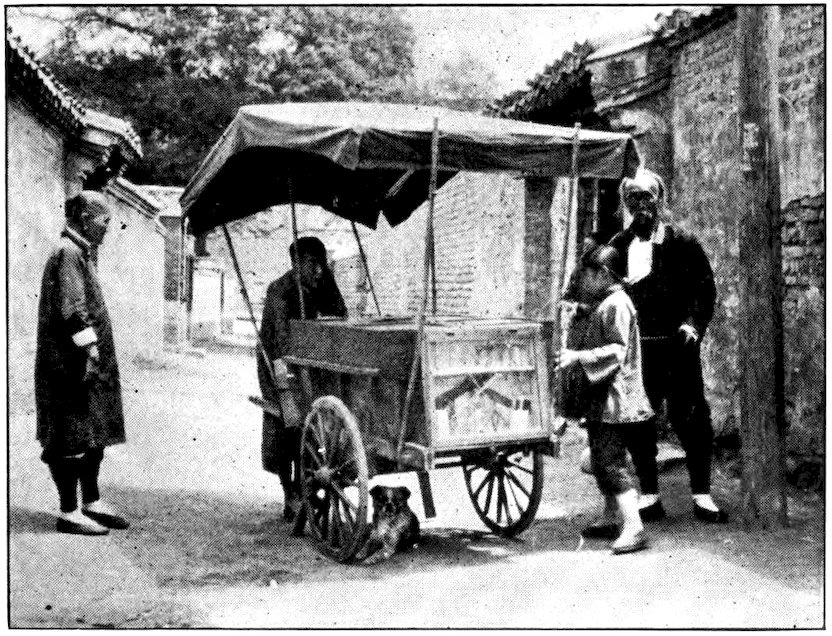
This was one of the comparatively few peddlers in our Peking neighborhood who owned a cart. Plenty of men with things to sell went through the narrow street outside our house, but most of them carried their wares on a shoulder pole.
Besides its many hutung Peking now has some wide streets on which run electric street cars. Until recently, however, there was not a street car in China, except in the foreign concessions in some of the big ports. The great majority of the Pekingese ride in rickshaws. The police said that they had registered more than forty thousand of these grown-up baby-carriages. Not only men but (in spite of a law forbidding it) young boys draw them. It was a sad sight to see two small boys, who should have been in school, running along the streets with a big fat man in their carriage, one boy pulling and the other pushing. Sometimes rickshaw boys are sent home, but the law is not always enforced. It is interesting to remember that the rickshaw was brought over to China from Japan. 50It is said to have been invented by an American missionary for the comfort of his invalid wife.
It is said that rickshaw-pullers do not live long, because the running gives them heart disease. Once during our nine months in Peking I saw a rickshaw-man who had dropped dead between the shafts, letting the carriage fall over backward with his passenger. But our own rickshaw-man was more than forty years old, and he had been running ever since he was a boy. Life is very hard for most of the poor rickshaw-runners of China, especially those who do not have regular jobs with a foreigner or a wealthy Chinese. They have to wander the streets or sit in their carriages in all kinds of weather, and in the winter some of them freeze and even starve to death.
Besides its more than forty thousand rickshaws Peking has queer horse carriages, that look like piano boxes on four wheels; there are quite a number of bicycles, and of course many automobiles. Some people come in from the country on horseback, others ride in mule litters, which look like little prairie schooners without wheels, slung on two poles that are fastened at each end to a mule. Formerly many people rode in sedan chairs, carried by men. But now such vehicles are seldom used except to carry a bride to her wedding or mourners in a funeral procession. Then they are covered with red cloth and are very gay looking affairs. Foreigners usually ride in rickshaws, for it is easier to talk to your “horse” and tell him where to go than to try to guide an automobile through the narrow and often crowded hutung.
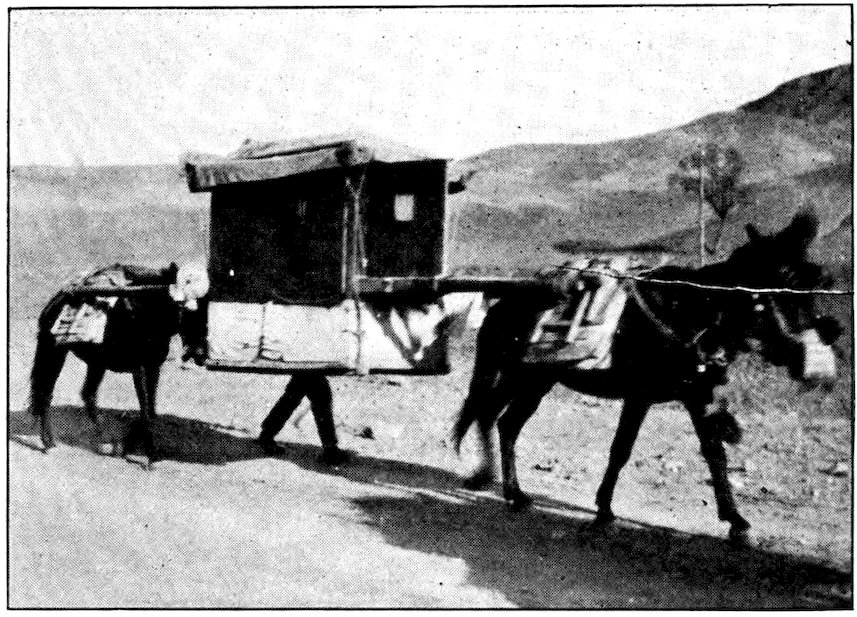
One of the styles of mule-litter in northern China. In such a conveyance rich men and officials come to Peking from the northeast or from any region where there are no railroads.
Peking is so filled with interesting things and places that we did not see all even in nine months. First there are the shops, selling everything you can imagine. Some are filled with canned and other goods from our own land and from Europe. But most of them have only Chinese wares. Here, for instance, is a toyshop, with all manner of playthings to amuse the children. The Chinese, who are very fond of children, make the most amusing toys you have ever seen, though often so flimsy that they break easily. In some streets there are long lines of silk shops. The Chinese produce great quantities of silk, and shops selling the same article 52are more likely to be grouped than to be scattered about town. This is so not only in China but almost everywhere in Asia. The clerks in these shops often wear long silk gowns, like most of the wealthy men. Perhaps the queerest shops in Peking are the drug stores. Some now have the same wares as American drug stores, but the old-fashioned ones display ground tiger bones, which the Chinese think will give a man a brave heart, rat meat that is supposed to make the hair grow, and snake-skins that are used for some malady or other.
Then there are the coffin shops. The Chinese who can afford it always have themselves buried in great wooden coffins that look like big hollow trees, with tops so heavy that a man cannot lift one of them. Rows of these are kept in plain sight in the open shops along the streets, for the Chinese think a coffin is a very pleasant piece of furniture. Sometimes a Chinese son gives his father a beautiful coffin as a New Year’s present, and the father keeps it in his parlor and brings in his neighbors to see it. The Chinese have used so much wood in their coffins that most of the country has no trees left, except about temples and imperial tombs.
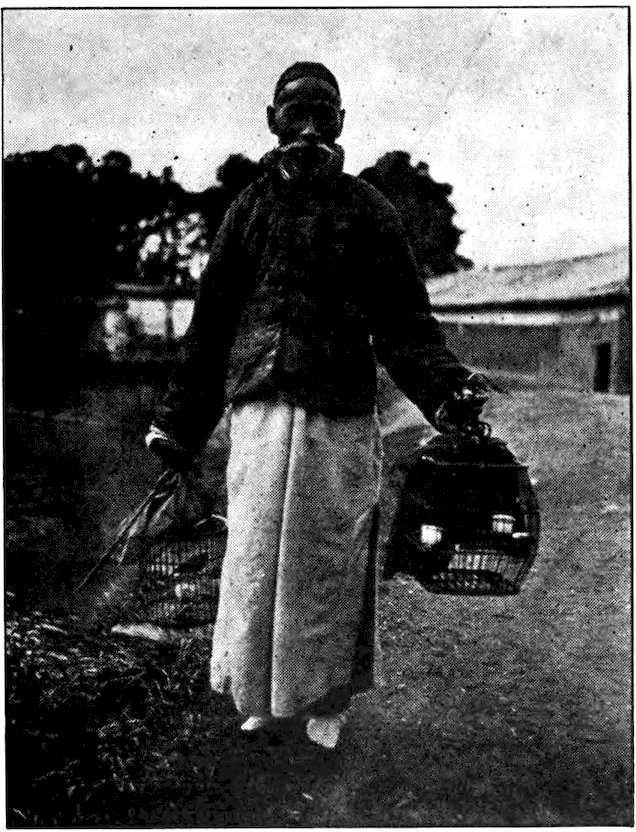
A Chinese gentleman taking his pet birds out for a walk.
The Chinese are very fond of birds, and there are many bird stores in Peking and all the other large cities. We often saw an old man walking down our hutung with two or three birds sitting on a stick, each with a string tied about one leg. Now and then they flew out as far as the string would let them, and then came back and perched on the stick again. Even bankers and rich merchants take their birds out for an airing in China. Sometimes we would see a man carrying a cage in either hand, and if he could find a park he would go and hang the cages in a tree and let the birds sing, while he sat underneath smoking his long pipe. Another curious Chinese custom is to fasten a whistle to a pigeon in such a way that when the bird flies the air rushes through the whistle and blows it. Some of these whistling pigeons are always flying about over Peking and other large Chinese cities, making a weird music and surrounded by flocks of other pigeons 54just as the sheep or cow with a bell is followed by the others of the flock or herd.
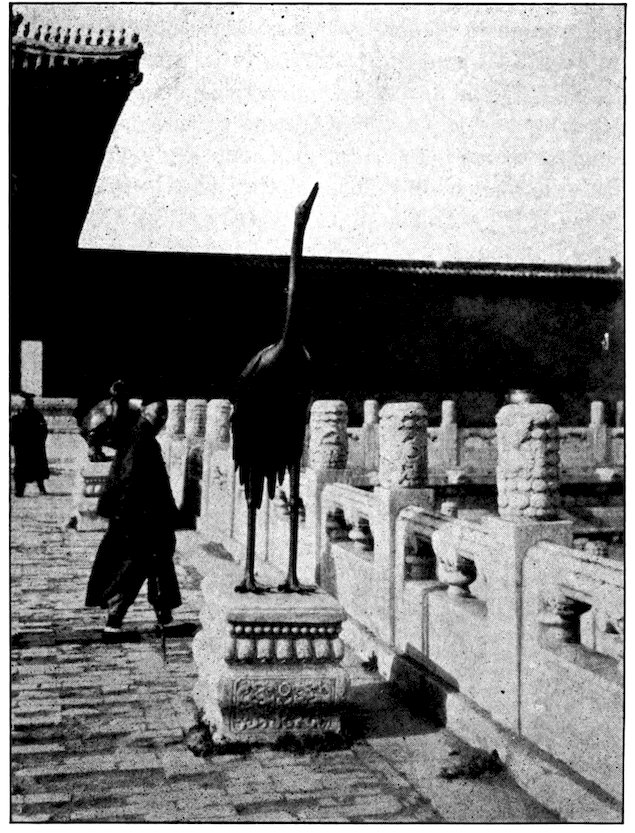
The buildings inside the formerly “Forbidden City” of Peking contain great art treasures, and people are now allowed to see these—but they are not supposed to take pictures. Down near the big bronze turtle is a policeman who is on his way to tell me that my camera must not be used.
55In Peking there are wonderful old palaces and temples such as the temples of Confucius and the lamas from Mongolia. In the center of the Tartar City are dozens of palaces with golden-yellow roofs, all surrounded by an imperial-yellow wall. Once the emperors lived there, and it was called the Forbidden City. But now travelers can visit it by paying a small fee, and find inside museums of old Chinese things, wonderful vases and paintings and lacquered screens. Around this old home of the emperors is the Imperial City, once filled with Manchu courtiers and surrounded by a great wall roofed with blue tiles. Then outside that is the Tartar City, in which we lived, though formerly only the soldiers of the Manchu rulers with their families could live there. South of this is what foreigners call the Chinese City, bigger than all the Tartar City and also surrounded by a great wall.
As the streets are not always pleasant, most foreigners and the richer Chinese take their promenades on top of the Tartar Wall. Just outside our house was a gate that opened on a ramp or inclined walk leading to the top of this wall, and every afternoon our little boy would go up there to play. It is even larger than the Great Wall of China, being as high as a three-story house and so wide that four automobiles might run abreast on it. It is made of great dull-blue bricks, filled in between with earth and stones, and paved over 56with other bricks. A parapet on either side, so high that only a grown person can see over it, keeps one from falling off the wall. At each corner of the city, and over the two gates in each side of the wall, are great roofed structures that look like apartment houses, though only birds and bats live in them.
It is thirteen miles around the top of the Tartar Wall. One day I started out after breakfast and walked the entire distance, returning just in time for one o’clock dinner. As most of the wall is made of earth, grass and shrubs grow on its top and sometimes on its sides. In some places I had to make my way through what looked like a jungle. But the Chinese find use for everything, and in the autumn men come and cut the high grass for hay and the brush for firewood, and sometimes soldiers who guard the gates make little gardens on top of the wall. In one place, behind the home of the American Minister to China, our Marines patrol the wall day and night and do not let anyone who might make trouble pass. That is because in 1900 the Chinese rose against the foreigners in their Legation Quarter at the foot of the southern wall and tried to kill them all.
A queer thing about the Tartar Wall of Peking is that only foreigners and the better class of Chinese are allowed on it. Even those of our servants who had been born in Peking and had always lived there had never been on top of the wall, until they worked for us. The Chinese say that if the poor people were allowed on the wall they would crowd it and make it very filthy; the foreigners say it is too easy a place to 57attack them from, if the people get angry again as they were in 1900. So our little boy was a kind of passport for our servants. If the ama had him with her, the Chinese soldiers at the ramp-gate let her go up and stay without question. But if she tried to go up alone they would not open for her. So our “boy” and our coolie and even our cook used to ask permission to take our small son up on the wall, in order that they might enjoy the wonderful view of Peking, green with tree-tops, and of the Western Hills far off on the horizon where the sun sets.
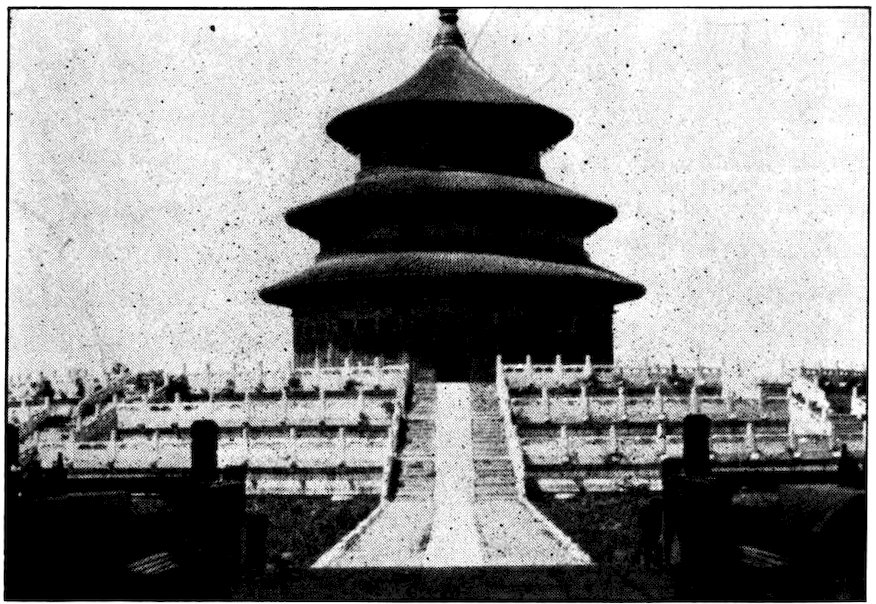
The Temple of Heaven at Peking is out in the Chinese City. Here the Emperor formerly came once a year to worship. Now the place is a tourist picnic ground. In the foreground are the chairs of an open-air restaurant.
Looking down from the great Tartar Wall of Peking we saw Chinese ways quite different from our own. The great flat, tree-topped capital with only artificial Mei-shan, or Coal Hill, rising above it, does not look at all like an American city. The highest structures are the empty defense towers over the city gates. The only buildings reminding one of our own large cities are those built by foreigners—hotels, mission schools, and American hospitals. The city stretches so far that schoolbooks used to call Peking the largest city in the world. Now we know that it has hardly a million inhabitants, and we realize that a very extensive city with mostly one-story houses inside compounds (walled enclosures) may have fewer people than a city smaller in area but with buildings of many stories.
There are few sewers in Peking, and in most parts of it there is no running water. Just outside our compound wall was a big well with a windlass and some ancient buckets. All day long, men with loudly squeaking wheelbarrows wheeled water in tall wooden tubs from this and the many other public wells all about town, and sold it at the poorer houses. The street sprinklers of Peking consist of two buckets of water 59on the end of a pole, and a long-handled wooden dipper. A soldier or a coolie moves slowly along the principal streets throwing water with this dipper. As it is often bitterly cold in Peking (though a clear, dry cold that is rather enjoyable) ice forms quickly, and sometimes even the man with the dipper has hard work standing up. In midwinter I used to ride about the city on a little red horse that I had brought from far western China, and in some of the streets made icy by the dripping of water-wheelbarrows or by the street-sprinkler, my mount acted as if he were on skates.
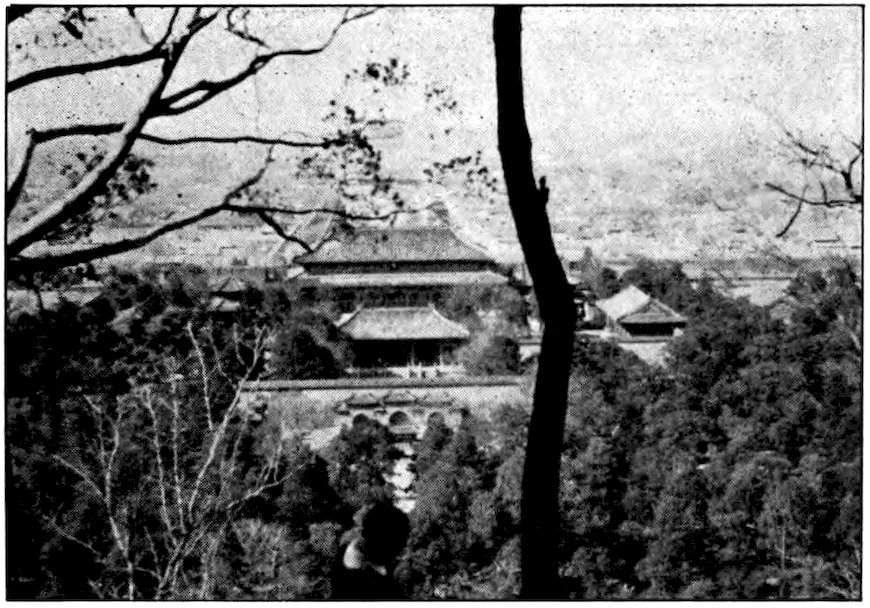
The part of Peking known as the “Forbidden City.” It is not forbidden any more, because there are no more emperors to live there and keep ordinary people out. One can look down upon its wonderful palaces, as here, from Mei-shan (“Coal Hill”).
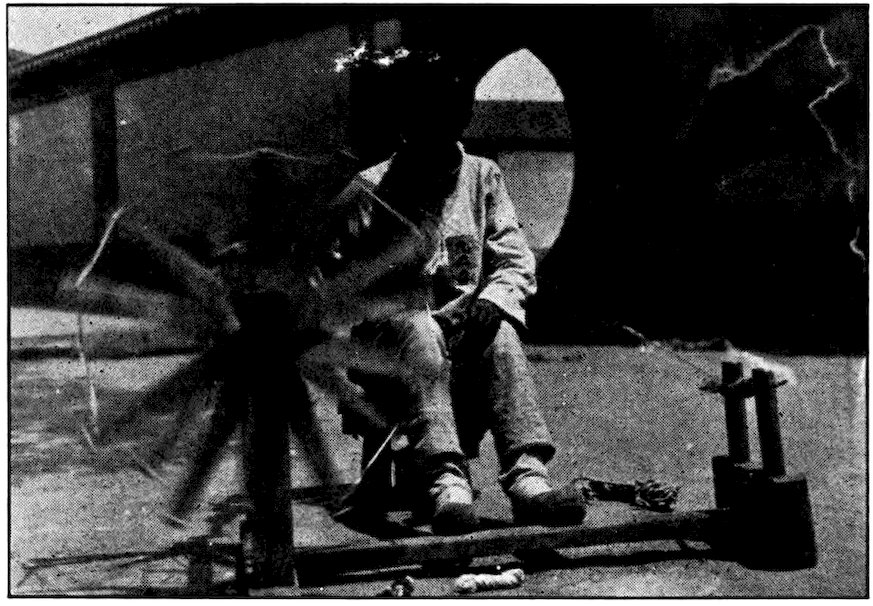
In China prisoners are given useful work to do, as they are in America. This man, in a prison yard, is spinning yarn. The characters on his jacket give his number, which is 820.
Inside the corners of the city wall are dumping grounds. But dozens of rag-pickers, mostly women and children, come to claw among the rubbish, and they leave very little. Here the camels bringing freight from the north and west sleep by night. Because the foreigners they see are never ragged, as so many Orientals are, most Chinese think that all foreigners are rich. We could hardly pass through the smaller streets, or peer over the parapet of the Tartar Wall on which the common people are not allowed, without hearing dozens of boys and girls shouting “E mao ch’ien!” As nearly as we can translate so different a language as the Chinese, this means “One dime money!” But any of these ragged urchins would be glad even of a big copper, and they would remain friendly and smiling even if we gave them nothing. One of the most remarkable things about the Chinese 61is that they can be cheerful even when it seems as if they must be miserable. The real beggars of Peking are professionals, who do nothing else. They have a union, and many of them have much better clothes than those they wear when wandering up and down the streets. Begging is not looked upon as disgraceful by some Chinese. In fact, they have a very gentle word for a beggar; they call him a yao-fan-ti—that is, a “want-rice-man.”
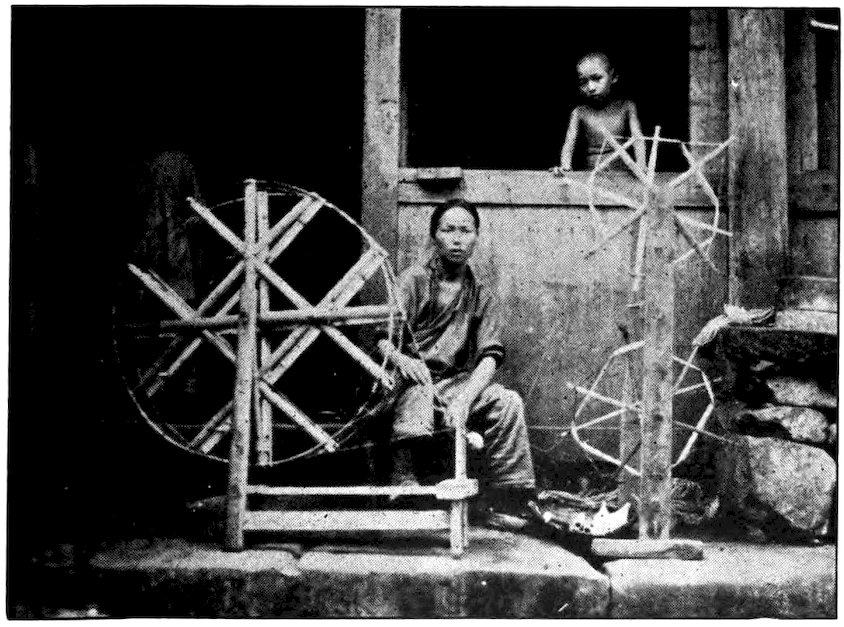
Women making silk thread by the crude process still used in most of China. The thread is being unwound from a large reel onto smaller ones.
For a few days we were able to skate on the broad moat outside the Tartar Wall. But soon dust ruined 62the surface of the ice, and the only fun that remained was to be pushed along in sleds by coolies. Then men began to cut the ice and pack it away in hollows in the ground along the moats, covering it with earth and reed mats. There are no ice-houses in Peking, and the average Chinese prefers tea to any kind of cold drink, even in summer. It is a real summer too, even in Peking, so hot that about the first of June great reed-mat awnings and false roofs are put up over most of the stores and the courtyards of all but the poorest people. A big company rents these peng and sets them up, but will not sell them. In the fall the company sends men to take them away again.
Peking has thousands of public eating places. They range all the way from the little stalls for coolies which we often passed in “Square Handkerchief Alley” and other narrow streets on our way to the central part of town, to great restaurants where rich Chinese come for their feasts and banquets. Although Chinese food is different from our own, most foreigners become fond of it, or at least of some of it. Such things as old pickled eggs, sharks’ fins, bird’s-nest soup, and silkworms may taste better to the Chinese than they do to us; but there are also pork, and duck, and pheasants and partridges, vegetables and fruits, and many other things quite like the food we eat. But the cooking is different, and everything must be cut up into small pieces before it is put on the table, for there are no knives and forks. The Chinese eat with two chopsticks, made of bamboo or bone, or perhaps ivory, and both held in one hand. After some practice we had no 63great difficulty in picking up our food with chopsticks, but we never became accustomed to eating out of the same bowls as other diners, and we did not quite like having a kind Chinese host pick out a tidbit for us with his own chopsticks.
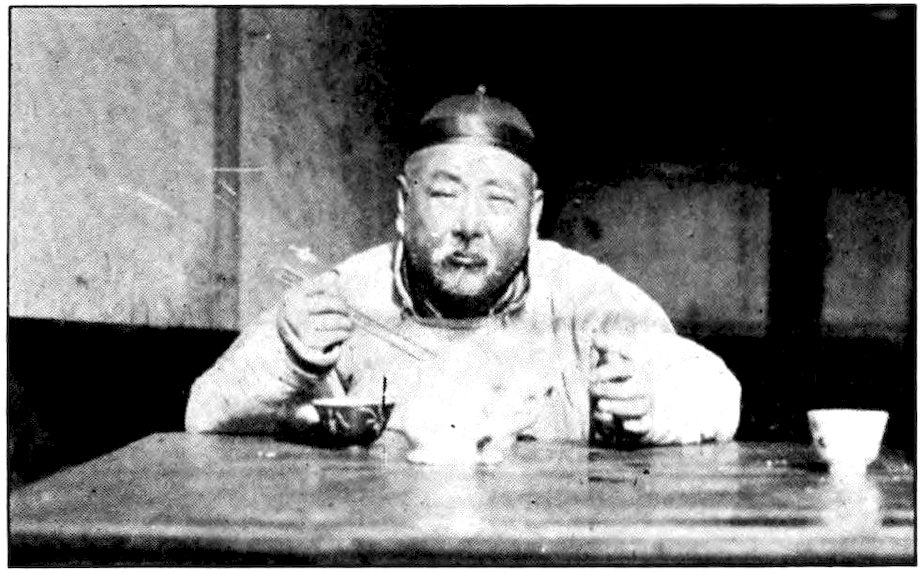
A Chinese kindly showing us the proper way to hold chopsticks. As a matter of fact, if he had known that I was taking his picture he would probably have run away. Some Chinese think that anyone by harming the picture of a person can harm the person himself.
The Chinese do not kiss and they seldom put their arms around one another. Nor do they shake hands as we do. When two men meet, each one clasps his own hands together and shakes them, at the same time bowing and smiling. Women do the same. Perhaps the Chinese and Japanese are right when they say that kissing, or even hand-shaking, is not very sanitary.
Chinese babies have no cribs or cradles; instead they learn to sleep tied in a cloth on the mother’s back, or 64on the back of a servant or a young brother or sister. No doubt it is because they are brought up in this way that the Chinese can sleep anywhere at any time, undisturbed by anything. When a Chinese baby is old enough to walk it is given gay cloth shoes with a cat’s face on the toe of each. Small children’s caps usually have the face of a demon on the front, because some Chinese still think this will scare off evil spirits that might harm the child. But many of the old customs no longer have a particular meaning.
Often we met strange processions in the streets of Peking. We knew that it was a wedding procession if somewhere in the middle there was a closed sedan chair, covered with bright red silk. Most Chinese marriages are still arranged between the families by matchmakers, and the new husband and wife probably have never seen each other. The girl, at least, may not want to be married at all. Sometimes people on the street can hear her crying, inside her chair, though no one is able to see her. When she is delivered at her husband’s house she becomes not only a wife but also a kind of servant of her new mother-in-law. Some Chinese men have several wives, but the first one always has the best position. Of course the Christianized Chinese follow Western practice in having but one wife, and before marrying, many of them court a young lady of their own choice.
If the principal part of a procession is a longer, heavier burden than a sedan chair, the onlooker knows 65that a funeral is passing. The heavy wooden coffin, carried by a dozen or more men, is usually covered with brightly colored silks, and generally there is a live rooster on top of it. The rooster seems to represent the soul of the dead person, and is sacrificed at the grave. These processions are often very long, and whether a wedding or a funeral is being held there is a great variety of the noises which the Chinese consider music.
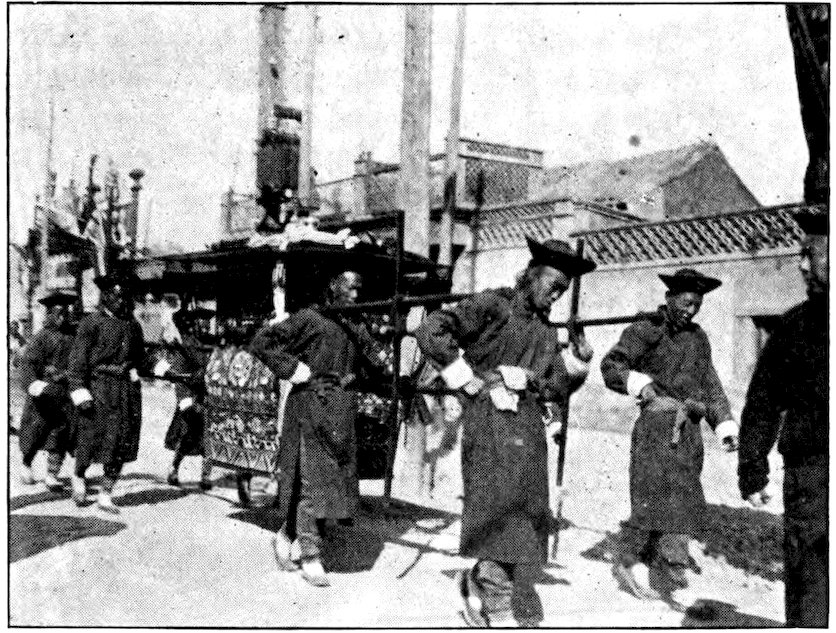
The principal part of a Chinese funeral passing through the streets of Peking. Bright colors are used in the covering for the coffin, in the hearse, and in the garments of the pallbearers, so that the procession is not very sad looking to an American eye.
Dozens and sometimes hundreds of ragged men and boys, dressed in rather dirty garments of strange designs and gay colors, march in a funeral procession. 66They carry queer looking pieces of furniture and other strange things. Some bear paper horses and automobiles, paper wives and servants, bundles of silver or gold-colored paper to represent money. All these are burned at the grave, because the Chinese think the dead need such things in the next world. Centuries ago live horses and live servants were killed at the grave, so that they could serve their masters in the Chinese heaven.
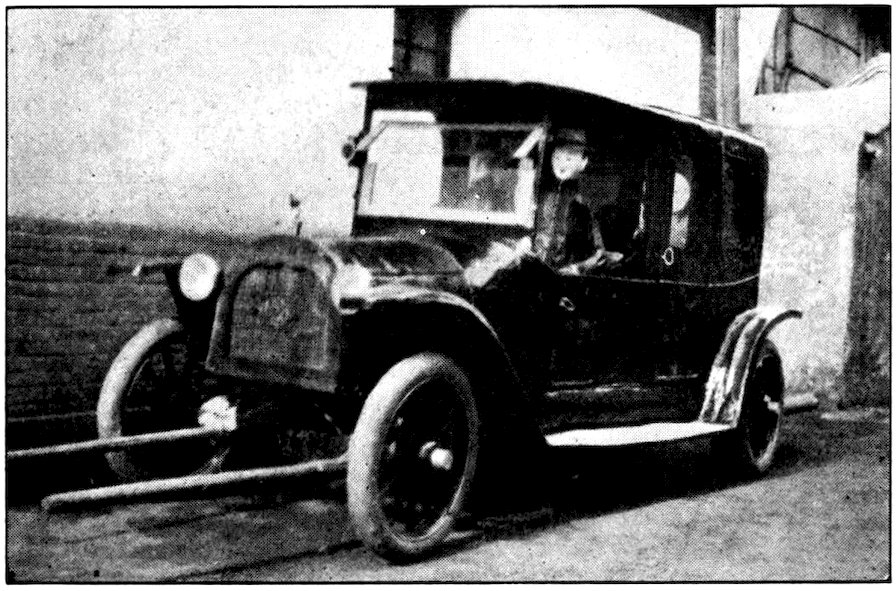
This automobile, which I saw in the hutung (narrow street) leading to our home in Peking, was made entirely of paper and cardboard, including chauffeur and footman. It was to be carried in the funeral procession of a rich man and burned at his grave so that, as his relatives believed, he might use it in the next world.
Now and then we went to a Chinese theater, not only in Peking but in the smaller cities and villages. Some of the theaters in the capital are built much like 67ours, though the plays on the stage are quite different. Many foreigners go to see Mei Lan-fang, China’s greatest actor. He is a slender, ladylike youth, and always plays girls’ parts, as did his father and his grandfather. In China acting is considered a very low profession, but Mei Lan-fang now earns as much as our greatest actors. I spent an afternoon at his home in the Chinese City of Peking, finding it filled with very artistic things, and my actor host proved himself a cultured gentleman.
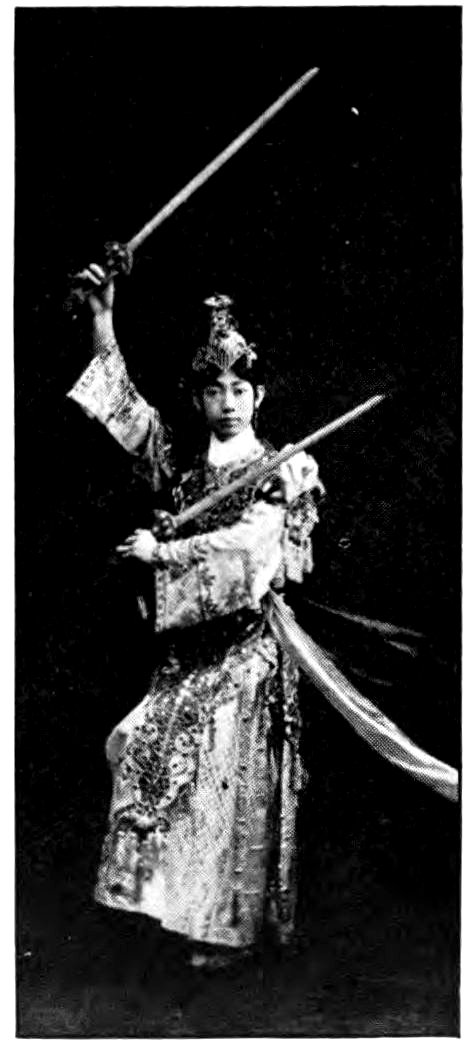
Mei Lan-fang, China’s greatest actor. He plays only women’s parts. Here he is representing a girl who led troops to war after her father was killed.
In the old-fashioned theaters of Peking things are much as they are in the crude actors’ booths set up at the edges of villages or as they are in American circus tents. The audience sits on rough wooden benches, and the back of each bench has a shelf for those sitting behind. Men and boys place cups of tea and little dishes of peanuts and squash-seeds and other food before each spectator. There is always a great hubbub in the audience, for everyone one talks, and even shouts whenever he likes. To add to the confusion, hot towels 68are constantly being thrown back and forth over the heads of the people. One man or several men stand at a tub of hot water and wring out the towels, then throw them in bundles to other men, who distribute them to the audience and gather them up again. In Chinese restaurants also the guests use hot towels before and after eating.
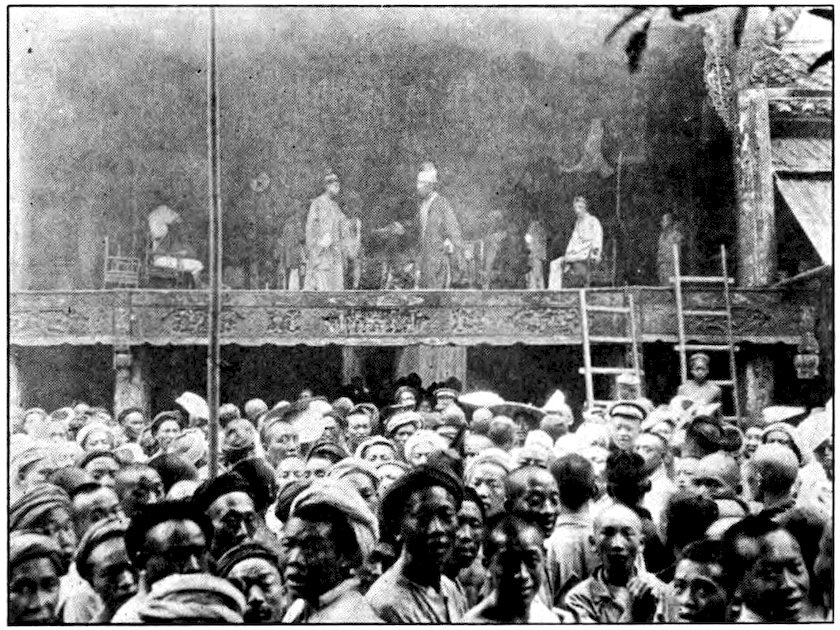
A view inside a Chinese theater, showing a play in progress on the high stage. For the moment, the “outside-country-man” who was taking the picture interested the audience more than the drama did. That would not bother Chinese actors, but imagine what some of our American “stars” would do if they were to be interrupted in such a way!
On a Chinese stage there is no curtain and almost no scenery. Or rather, the curtain, such as it is, is at the back of the stage. The actors go behind it to change their costumes, but they can always be seen by part 69of the audience. Much of the acting is pantomime; that is, motions without words. There is also a kind of dancing, and often the actors shriek in terrible, unnatural voices. A man with a lot of flags sticking out from his shoulders is supposed to be a general. A man who carries a kind of whip is supposed to be on horseback, and there are other symbols that mean something to the Chinese but nothing to foreign spectators. Foreigners find the Chinese theater property man very amusing. He wears black or coolie blue, and is supposed to be invisible to the audience. So he wanders about freely among the actors, throwing down a cushion for one of them to kneel on, piling a chair on a table to represent a mountain, and so on. If an actor is “killed,” the property man helps him to his feet and he walks off the stage. If the moon is supposed to be shining, this “invisible” coolie holds up a crescent or a circle of paper on the end of a stick.
Some of the audience wander about among the actors and stand or sit on the stage. Bands of ragged boys may crowd so close as to be under the actors’ feet. Musicians with strange instruments sit on one side of the stage, and come and go whenever they like. The deafening noises they call music are positively painful to foreign ears. At intervals a servant of one of the actors, dressed in his everyday clothes (even if the drama represents a time centuries ago), brings his master a cup of tea. The actor holds a corner of his costume across his face and drinks, and the audience pretends not to see him do anything that is not part of the play.
Often we saw long files of camels come marching into Peking with dignified tread. Unlike the camels of Egypt and Arabia, which have one hump, these had two. In the winter they were very shaggy with long hair. This hair is so valuable, for making blankets and similar things, that in spring the drivers tie networks of strings about the animals to keep them from shedding it along the way. In olden days these camel caravans carried all the freight between Mongolia and Peking, and even to-day they are strong competitors of the railroads in many parts of northern China.
The camels I saw so strongly lured me to the desert that I decided to follow them over one of the long caravan routes. Besides, I wanted to see Urga, the strange capital of Mongolia, far away across the Gobi Desert. If I had traveled with the camels, however, I should have been six weeks or two months reaching my destination. So I took the train from the northeastern corner of Peking and traveled all day to Kalgan, passing through the Great Wall near the ancient tombs of the Ming emperors. From Kalgan, an American automobile, belonging to a Russian who buys furs and sends them to New York, carried me 700 miles across the desert in three and a half days. Yet there was no 71road at all most of the way. First we had to climb a sandy and rocky river valley, some of it so steep that teams of mules helped to draw the automobile. Mongolia is a high plateau, several thousand feet above sea level. Then we sped away across the Gobi, sometimes along the tracks made by the camel and ox-cart caravans and sometimes by no track at all.
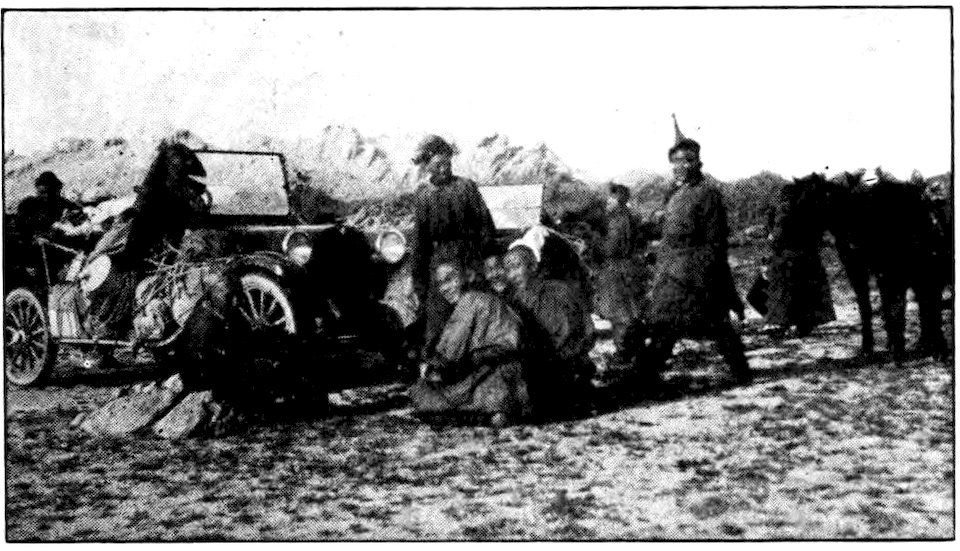
The red-clad Mongol lamas or priests gathered excitedly around our automobile whenever they found us halted on the 700-mile trip across the Gobi Desert to Urga. The car was loaded to the limit.
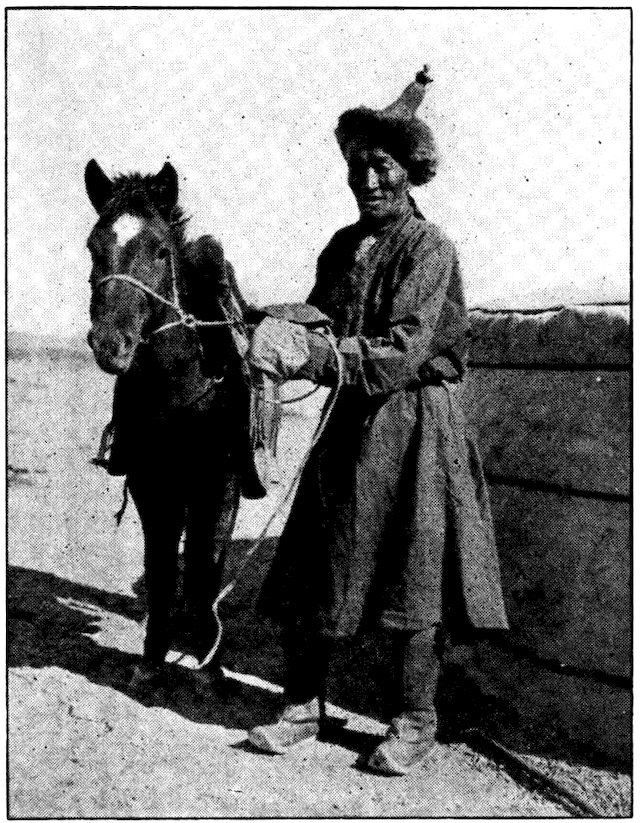
All Mongols ride, though their horses usually look too small for them. This man wears his queer-shaped hat (representing a sacred mountain in Mongolia) to show that he, like most Mongol men, is a priest or lama. He wears also red boots and he stands by the side of a yurt or felt tent.
Much of the Gobi is hard gravel, with thin brown grass on it, not shifting sand like the Sahara. There was even quite a lot of fertile land on the first day’s ride, and thousands of Chinese colonists have begun to cultivate this and build villages there. The Mongols themselves are nomads, who do not plant but keep great herds of cattle, flocks of sheep, and many horses, which they drive about wherever they can find pasture. Their houses are movable, also, hardly more substantial than tents. The Mongols call them yurts. They are round, with an almost flat top, about six feet high in the center. Until they become dirty they are white, for they are made of thick felt, fastened to a light wooden framework. The Mongol women make this felt by laying sheep’s wool on the ground, pouring water on it, and rolling it out into large sheets. One of these houses can be taken down and packed on the 73backs of animals in an hour, and set up somewhere else almost as quickly.
We spent one night in a yurt. We had expected to sit out on the desert all that night, until we caught sight of three or four weather-darkened felt huts. Half a dozen camels were lying on the bare ground near them, and some twenty Mongol men, women, and children came out of the huts when they heard us coming. One of the men was a lama, or Mongolian priest, and though he also was only a visitor he bossed everyone within reach. More than half the men of Mongolia are lamas, who usually live in great monasteries in various parts of the thinly populated country. They have shaven heads and wear long dark-red cloaks and big red boots.
Such boots, as a matter of fact, are worn by all the Mongols, even women and children. They are large enough to allow for half a dozen thick woolen stockings, for the weather is very cold most of the time in high Mongolia. It is so difficult to walk in these boots that Mongols on foot move much as if they were wearing a ball-and-chain, like prisoners. But this does not matter, for they travel almost entirely on horseback. Men, women, and children are as much at home on a horse’s back as our cowboys are. They all dress a good deal alike, in long coats usually made of sheepskin with the wool on the inside. But the women, especially in the region of Urga, the capital, and of the two or three 74other towns, wear one of the strangest headdresses in the world. The photograph on page 78 will give you some idea of how peculiar it is.
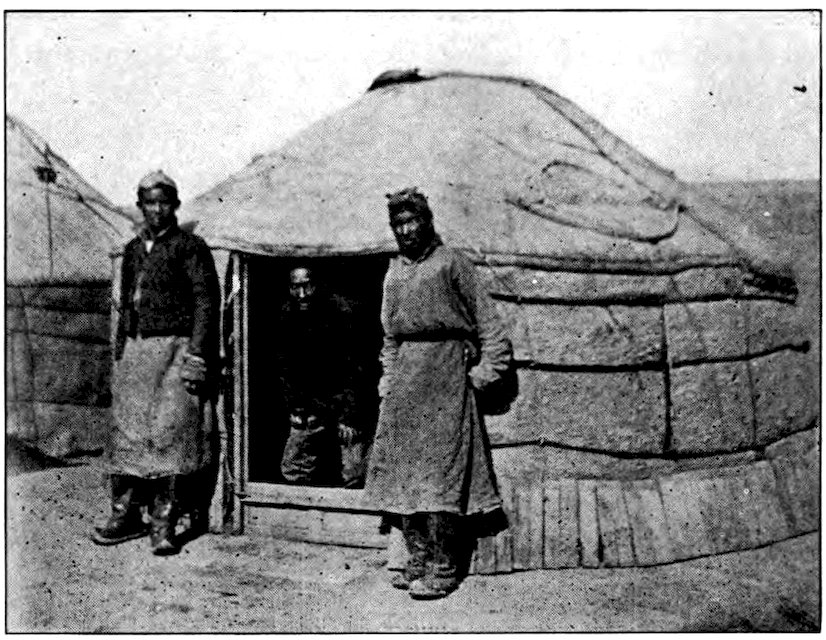
The nomad Mongols of the Gobi live in round tents or yurts. On a light wooden framework they stretch thick felt made from the skins of their own sheep. Sometimes they have a stovepipe but usually they simply leave a flap of the tent open so that smoke may escape. The Mongols can take a house down or set one up in about an hour.
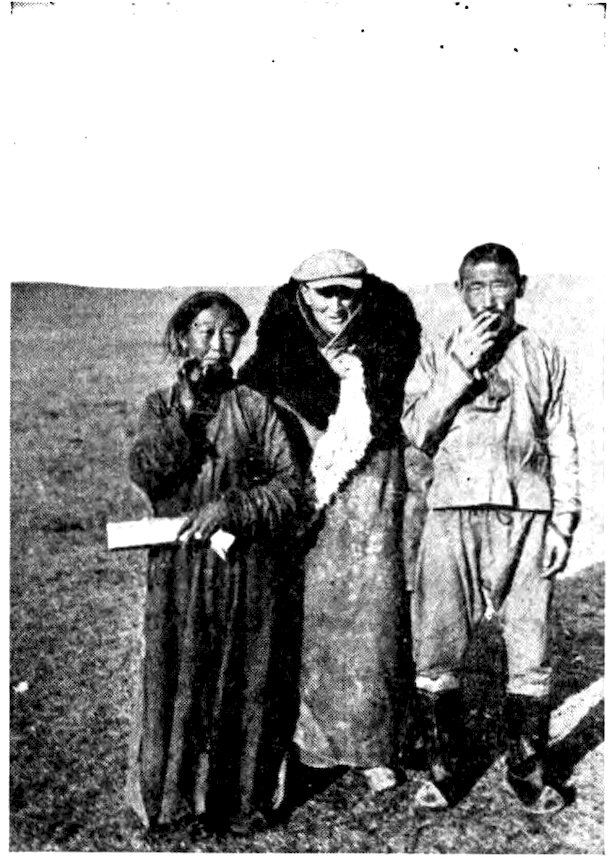
I was glad of the warmth of a great sheepskin coat when I traveled across the Gobi Desert. With me are a Mongol and his wife.
When the lama invited us inside one of the yurts we had to stoop to get through the tiny doorway. The door was merely a flap of felt, and when this was closed the yurt became very hot. Yet the Mongols kept on all their fur coats and other heavy garments, as if they were entirely comfortable. A little iron cage in the center of the tent was filled with fuel which made so quick and hot a fire that I think I should have been roasted if I had not gone outside occasionally. No wonder nearly all Mongols seem to have bad colds! Tea was prepared over this fire-cage and served to us in brass bowls. The Mongols eat almost nothing but meat. When I opened a can of cherries they hesitated to taste them, and they were almost as much afraid of a bar of chocolate as if it had been dynamite. I tried to give a bit of it to a young Mongol woman in the yurt, but I found that this is very bad manners in 76Mongolia. Instead, I should have handed it to one of the older women and let her pass it on to the girl. Yet the women quarreled over the tin cans we threw away, for such things are very valuable to people in a desert land.
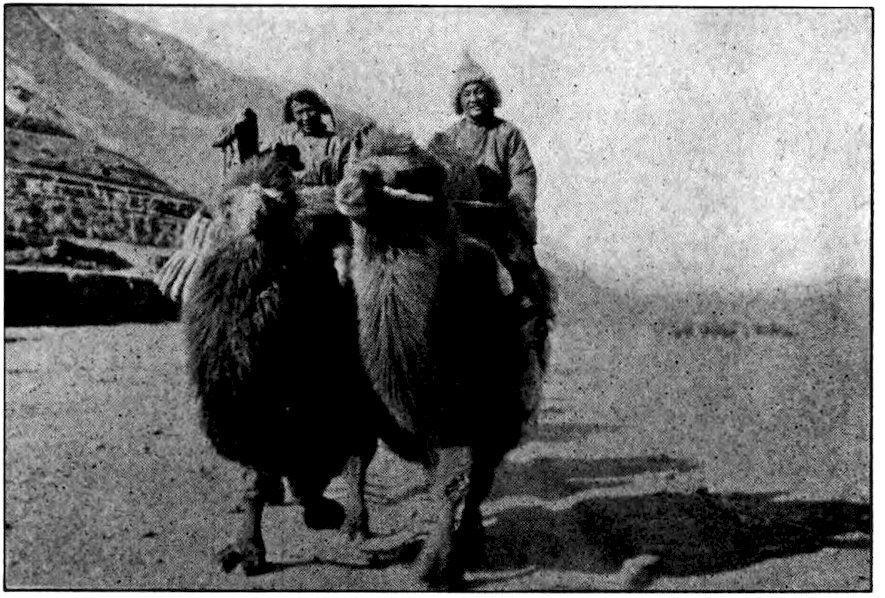
Two Mongols of the Gobi Desert riding their camels down a river valley into Kalgan, a Chinese city. The camels have on their shaggy winter coats.
By and by all the women went to other tents and we lay down to sleep with the lama and two other Mongol men. The lama sent another man outside to sleep on the ground, because there was not room enough for him inside, and all night long we heard him coughing. The lama took off all but his trousers, said his prayers in a loud voice, and lay down on a bundle of sheepskin robes. One of these robes he pulled over himself. When I set up my cot, the lama said he would not dare 77to sleep on such a thing, for fear of falling off it in his sleep.
We might have lost our way during those three days if it had not been for a row of telegraph poles carrying a single wire clear across the Gobi. This is a part of the line from Peking to Paris. (When our first little girl was born in Peking, the cablegram we sent to America was flashed across Mongolia.) On the third night we slept in a lonely telegraph station where two Russians live the year round. The last half-day was among low hills. Along the way we saw thousands of marmots, looking like gophers or prairie dogs as they sat on their hind legs outside their holes. Many American women wear coats made of the skins of the Gobi marmots. We also saw hundreds of antelope, sometimes long lines of them racing across the horizon.
Urga is a holy city. In it lives Bogda-Khan, whom the Mongols call a “living Buddha” and treat like a god. When he dies, his soul is supposed to enter the body of a boy born about the same time, and this boy is brought to the great cluster of palaces inside a wall on the outskirts of Urga and becomes a new Bogda-Khan. Pilgrims come hundreds of miles to worship him, throwing themselves down on their faces on boards placed outside his palace walls. I found this “god” had a dozen kinds of automobiles and spent many thousands of dollars every year for other Western inventions that he hardly knew how to use. Whenever he went to the golden-roofed palaces of Urga itself 78he rode in an automobile, usually his Ford, though he had several much larger cars.
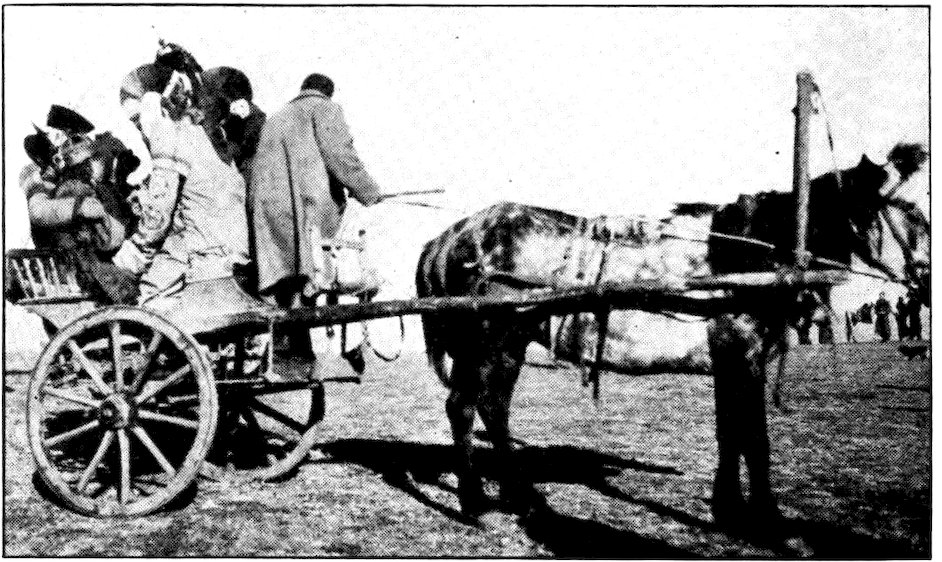
Just where the driver will sit on this queer vehicle is a mystery, but perhaps he prefers to stand. The cart is of a Russian-Mongol variety, seen at Urga, and the passengers are Mongol ladies in their amazing headdress.
Most of Urga is made up of temples and lamaseries, the monasteries of the lamas. The most important ones have roofs covered with real gold which gleams in the cold sunshine until it almost hurts the eyes. Thousands of lamas in their dark-red robes live in Urga, and spend much of their time squatting on cushions in long, closely packed rows inside their religious buildings, studying their sacred texts by shouting them at the top of their voices. In Urga there are hundreds of prayer wheels, or rather, wooden cylinders, each under its own little roof. Inside each “wheel” are thousands of prayers written on tissue paper, and the Mongols think that every time they turn the cylinder 79around it is the same as saying all those prayers aloud. So long lines of pilgrims march about among the temples and stop to turn each prayer cylinder. Some of the most pious throw themselves face down at every step, when making this circuit, so that it takes them several days to make the rounds and be ready to go home again.
The Mongols do not keep shops, though they sometimes sell things in the open-air market on the bank of their dirty little river. Some Russians have stores in Urga, but nearly all the traders are Chinese. All kinds of furs can be bought there, but nearly everything else for sale comes from China or the outside world. The streets are just muddy lanes, and most of the houses are surrounded by walls of tree trunks set upright in the ground close together and sharpened on top. They reminded me of the stockades our ancestors built against the Indians.
China still claims that Mongolia belongs to her, but most of it is now really independent—or rather, it is controlled by Bolshevik Russia. Although the officials are Mongols, Russian “advisers” sent out from Moscow tell them what to do. These advisers, like the lamas, seemed very surly. Indeed, I have never been in a place where I felt less welcome. For one thing, hardly had we reached Urga before my American companion and I were arrested because someone said we had shot a Mongol on our way across the desert. If we had been convicted we should probably have been shot ourselves at sunrise next morning. But it took us only a few hours to prove that we had been many 80miles away from where the Mongol was shot, and that he was not hurt much anyway. It is not far from Urga to Irkutsk, where the Trans-Siberian Railway would have carried us to Europe. But of course I turned back toward Kalgan and Peking where I had left my family, crossing the Gobi this time in two and a half days, though even in September we found much snow and ice.
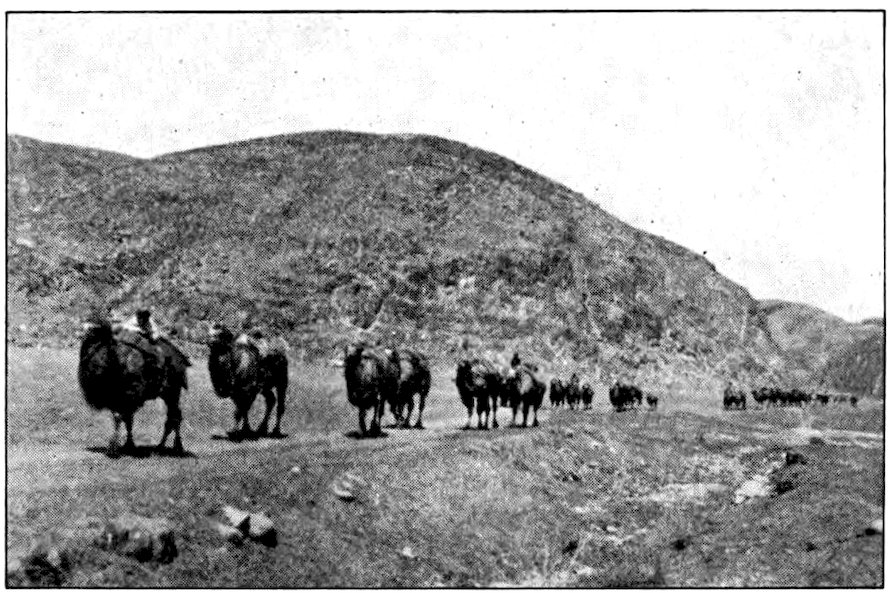
A camel caravan making a slow journey across northern China. Usually ten or twelve camels are held together by stout cords. One end of a cord is fastened to the back of a camel and the other end to a stick which runs through the nostrils of the camel behind.
One day I took the train back to Tientsin and down to Tzinanfu, capital of the province of Shantung, the land of Confucius. Grave-mounds of all sizes were thick everywhere along the way, for this is one of the oldest and most densely populated parts of crowded old China. Tzinanfu, with its huge city wall surrounded by a moat in which many of the women wash their clothes, is a mixture of very old Chinese ways and some quite modern ones. Two railways come into it and automobiles may be seen in the wide streets of a suburb outside its wall, yet most of the people still travel as they did hundreds of years ago. Many ride on donkeys and many more in “Peking carts.” As these have no springs, they are very painful vehicles on the terrible roads of most of China. Every time a Peking cart strikes a rut or a stone, the side of the box whacks the passenger, so that unless he puts pillows or quilts all about him he will be covered with bruises at the end of the trip. Only the front of the box being open, the traveler by Peking cart can see little unless he kneels and peers out above the mule’s tail. One boy I knew said these strange carriages ought to be called “peek-out carts” instead of “Peking carts.”
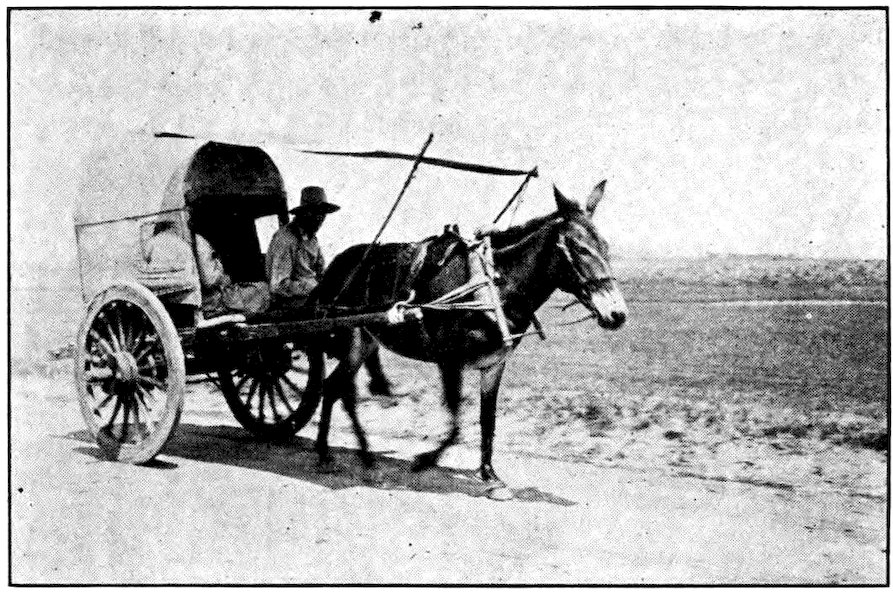
A “Peking cart” of the kind used very generally in northern China. In southern China the roads are seldom wide enough for a two-wheeled vehicle. Being without springs or axle-grease, the Peking cart gives one a rough ride, and most of the roads are not so smooth as this one.
But the chief Shantung vehicles are wheelbarrows. Hundreds of them go screeching back and forth between the stations and the walled city, some with freight and some with passengers. They are much larger than our wheelbarrows, with a big wooden wheel sometimes as high as a boy ten years old. Different kinds are used in the city and country. The city wheelbarrows have a long benchlike seat with a back on each side of the wheel, and a rest for the feet. They reminded me of an Irish jaunting car. Often I saw one coolie wheeling eight and sometimes ten Chinese women, who, because of their bound feet, could not walk to the factories where they worked. These 83city wheelbarrows, which are cheaper than rickshaws because more than one person can ride on one, even carry many men passengers.
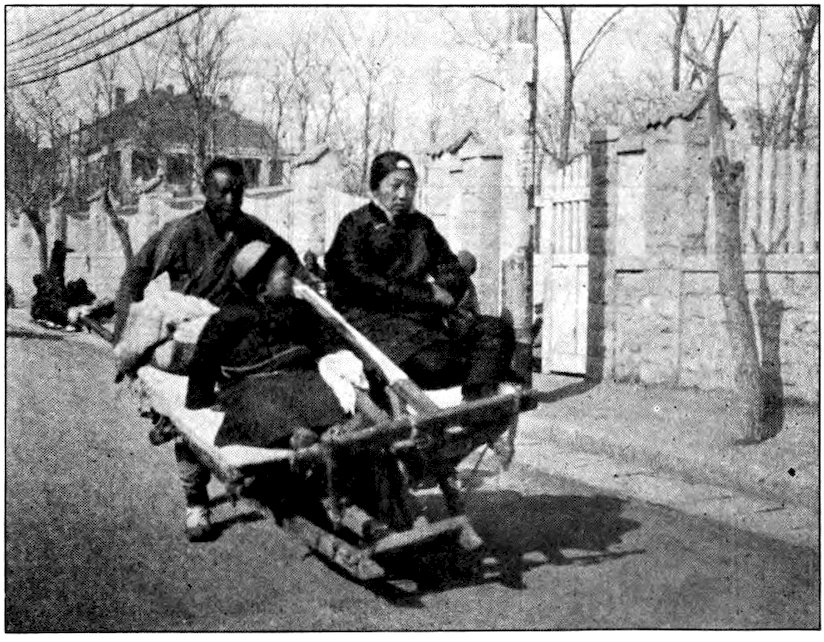
Passenger wheelbarrow in Tzinanfu, capital of Shantung Province.
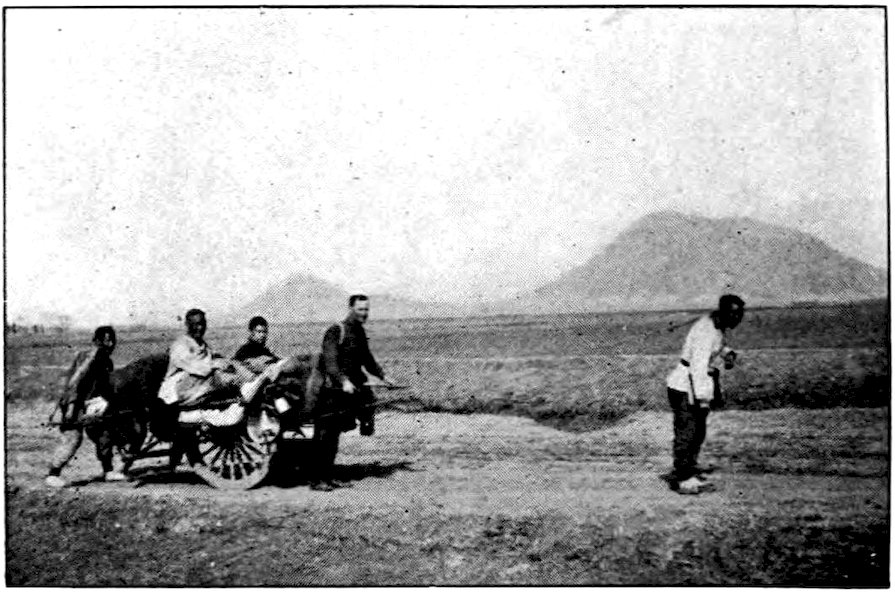
Once I changed places with the middle coolie of the three who furnished motive power for my country wheelbarrow in traveling through Shantung Province. I found the job not so hard as it had looked from my seat on the barrow.
I made a long trip on one of the country wheelbarrows. The American missionary with whom I went weighed nearly two hundred pounds and I weigh about one hundred and seventy. Moreover, we had at least one hundred and fifty pounds of baggage. Yet both of us and all our things rode on one wheelbarrow. The platforms along its sides were so long that we could stretch out on top of our bedding and other baggage and chat as comfortably as if we had been lying in the same bed. One man pushed and steered at the handles behind and another pulled at a pair of handles in front. Each of them had the stout strap fastened to the handles passing over his shoulders. On the way back we had a third coolie, who walked ahead pulling at a rope attached to our primitive vehicle. Sometimes a donkey is hitched to the wheelbarrow in this way, and often the coolie’s sons tug all day at these ropes, from the time they are old enough to be of any use. Occasionally a coolie puts a sail on his wheelbarrow, so that the wind will help him along. Once I changed places with the coolie between the front handles, and found that his work was not quite so hard as it looked. Yet I should hate to have to earn my living as a 85Shantung wheelbarrow coolie, at about ten or fifteen cents a day.
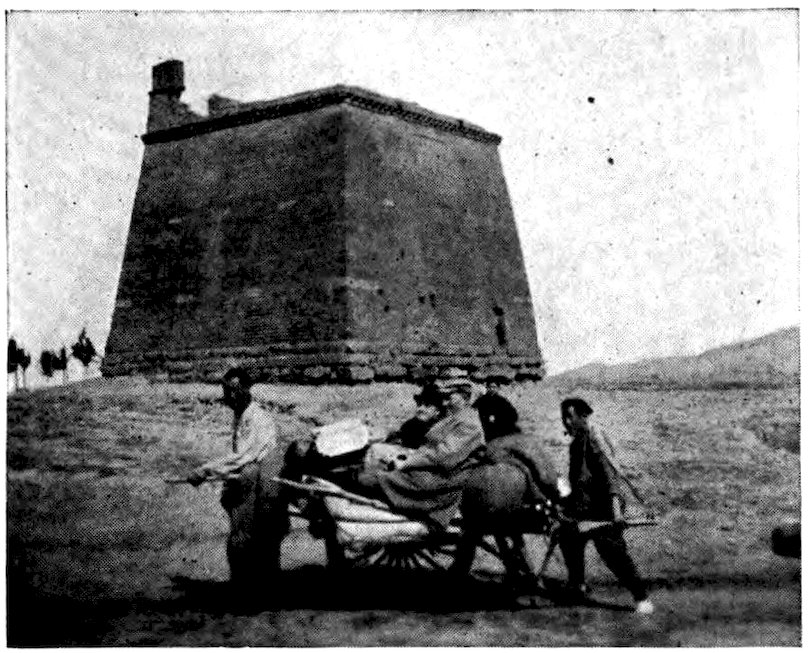
A country wheelbarrow in Shantung Province, larger than those used in the cities, on which an American missionary and I made a long journey. In the background is one of the old towers which were used for sending messages before the telegraph reached China. A fire was built on top of such a tower and controlled in such a way that the signal could be read by watchmen on the next tower. You have perhaps read that the American Indians used puffs of smoke as signals in a similar way.
One reason the wheelbarrow is used in Shantung and many other parts of China is that the roads are often miserable trails too narrow for a two-wheeled vehicle. China has had terrible roads for thousands of years, because the rich men who rode or were carried or pushed did not care how bad they were, and the poor coolies who were the sufferers had nothing to say about it. Even to-day the roads run on private 86land and the owner often plows them up every spring in order to plant the ground they are on.
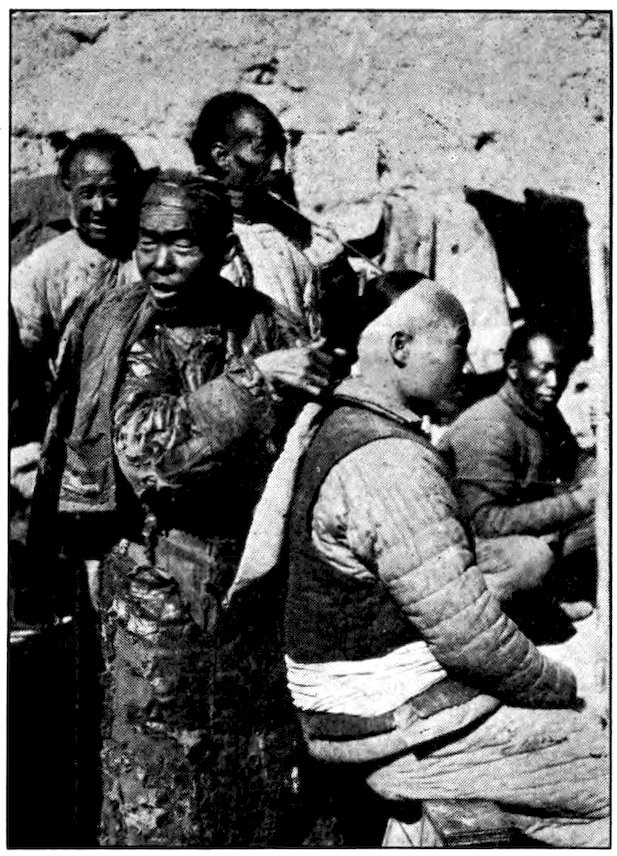
Many a Chinese coolie gets his hair dressed once a month by a wandering outdoor barber. In this case, a switch is just being added. It is only in the more backward parts of China that men keep their queues. Most sell the queue for a few cents and have their heads shaved all over. Shears were not used even in the days when the queue flourished.
We passed several big towers, built of bricks on the outside and filled with stones and earth within, like China’s walls. These were used, for hundreds if not 87thousands of years, to send messages across the empire, by building fires on top of one after another. Now that China has a modern telegraph system these towers are not used and are falling, or being torn down for the materials in them.
In most parts of China the queue, or what we sometimes disrespectfully call the “pigtail,” is no longer worn. Although many of the countrymen of Shantung Province still have themselves barbered in that fashion, a great many queues must have been cut off even there since the revolution of 1911, to make millions of hair nets for American and European women. I saw a whole jailful of prisoners making hair nets, but the demand has decreased since bobbed hair became popular in the Western world. If there are any Chinese women who bob their hair I did not see them. But in some cities in China the police cut off and sell the queue of any man caught wearing one. Probably the poor coolies and countrymen who cling to the old custom do not know that the Chinese were ordered to wear their hair in this way as a sign that they had been conquered by the Manchus.
Thousands of years ago what we now call China was divided into dozens of little kingdoms. There were several of them in what is now Shantung. One day, for instance, I traveled for hours among huge grave mounds of the kings of Lao-an, buried long before the time of Christ. One of those ancient kingdoms was called Lu, and in it was born the great Chinese sage 88Confucius. This famous philosopher is to the Chinese what Mohammed is to the Mohammedans or Moses to the Jews. There is a temple of Confucius in every important city in China and he is worshipped by millions every day in the year, especially during the spring and autumn festivals in his honor.
In a Peking cart I jolted from the railroad to Chufu, where Confucius lived five and a half centuries before the birth of Christ. The village itself was rather a miserable place, with deep mud in the streets and houses that few Americans would live in even for a day. But inside a huge compound shaded by many venerable trees stood the finest temple of Confucius in China, several temples in fact, one behind the other. It would take pages to describe those mammoth and artistic old buildings. In the main one there is a statue of Confucius, larger than life-size, in the costume of those ancient days. All such Chinese statues have the same pose. Huge brass and iron bowls standing before this image and the altar it rests on were filled with the ashes of many thousands of joss-sticks burned by pious pilgrims. In the room behind these is another altar, on which stands an upright stick bearing the name of the wife of Confucius. There is no statue of her, because the Chinese do not think it proper to represent a woman in that way. The carved marble pillars in front of the principal temple are famous all over the world.
An ancient road between two double rows of very aged trees leads from the temple compound to the grave of Confucius. Knowing how fond the Chinese are of 89colors and elaborate things, it seemed strange to find this grave of their greatest man so simple, just a mound of earth among some trees, with an upright slab of stone bearing his name in three Chinese characters in gold. Long ago as Confucius lived, a direct descendant of his occupies a kind of palace near the temple grounds. He is little more than a boy, the seventy-seventh generation since the sage. It is said that he wishes to go to college in the United States! All over this part of Shantung I found people who bore the family name of Confucius, Kung. Some of them were rich and some were peanut-sellers.
Of all the things I did in Shantung I think my climb up Tai-shan was the most interesting. That sacred mountain is the greatest place of pilgrimage in China. I am sure I passed at least ten thousand pilgrims on my way. Rich Chinese and most foreigners who go up Tai-shan ride in chairs, on the backs of coolies. They are queer-looking chairs, little more than a seat on poles, and the coolies carry them up sidewise. The carriers give inexperienced riders a great scare every time they change shoulders, for the path follows the edge of a great precipice.
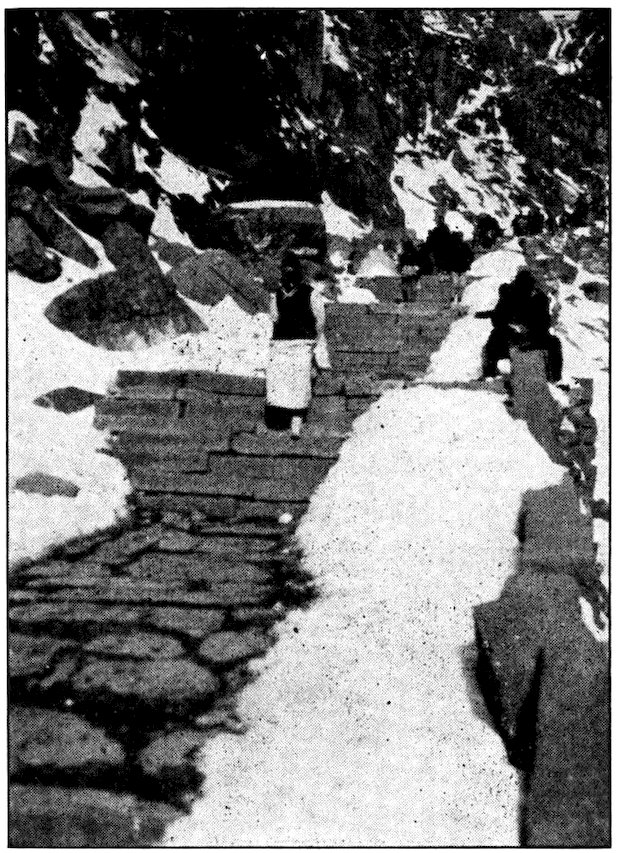
The stairway to the top of Tai-shan, sacred mountain in the province of Confucius. I climbed up it on the first of March when snow was still on the ground. Hundreds of Chinese pilgrims were going up or coming down. The stairs are really much steeper than they appear in the picture. In the upper right-hand corner you can just see the gate at the top of the long climb. It is several miles away.
I like to make such journeys on my own feet, however, even though, as in this case, one must climb ten miles of stone stairway. Here and there, especially during the first part of the climb, there were level spaces a few yards or a few feet long. A temple and a tea-house under old spreading trees stood beside most of these. But the last half of the climb was like going up steep stairs in a house five miles high. Thousands of beggars lived in holes in the rocks and in grass huts along the sides of the stairway. Pilgrims carried newsboy sacks of brass “cash” for these beggars. 91The pilgrims believe that anyone who climbs Tai-shan without giving something to each of them will not have his prayers answered when he reaches the top. There were baskets more or less full of “cash” in the middle of almost every step on that ten-mile climb. As the chair-carriers walk on the outside ends of the steps, the passengers can easily drop a coin into each basket as they pass over them. Some of the beggars of Tai-shan are poor cripples or the victims of terrible diseases. But a great many of them looked healthier than the Chinese who live in crowded cities, and some of the beggar children fairly glowed with health.
From the temples (much like any other temples in China) on the cold snowbound top of Tai-shan, I could make out “China’s Sorrow,” as the Hoang Ho or Yellow River is called. It is a kind of vagabond river, changing its course every few years, so that the poor people living along it are constantly worried. Once it ran into the sea in southern Shantung, then suddenly changed its mind and started northward to its present mouth. This was much as if our Potomac were to move to Maine. All the people in its new bed had their homes and farms washed away, and now the old bed is a stretch of rice and wheat fields. The silt that comes down with the Yellow River in its snakelike course across northern China gives the stream its color and its name and clogs the channel until the river is higher than the country about it. Then the Hoang Ho breaks through its dikes again and goes on a new rampage.
92Bandits overrun many of the hills and mountains in Shantung Province. Once while I was traveling in what people considered a much more dangerous region, just outside the Great Wall to the north, bandits stopped an express train not far from the birthplace of Confucius and carried off twenty or more foreigners, many of them Americans. Some of the prisoners had to live for more than six weeks in a bandit camp on a hilltop, part of the time under terrible conditions. Partly because there are so many bandits, the Grand Canal from southern China to Peking is now hardly used at all. In olden days this canal brought to the emperors the tribute rice, a kind of tax in produce, from all the country to the southeast. In places it Was dug through high rocky hills, and the Shantung part of it has several locks to lift or lower the boats from one level to another. However, the bandits alone are not responsible for its being abandoned. Silt has been allowed to fill many parts of the canal since the coming of railways.
In October I left my family in Peking and set off on a two months’ journey into the northwest. Yet the first part of this trip took me hundreds of miles south, on the railway from the capital to the Yang-tze River. Again I found the trains crowded with rowdy soldiers whose only tickets were their rifles and bayonets. From the windows I saw, besides millions of grave-mounds, thousands of smaller piles of earth of the same shape. These consisted of rich top-soil that was to be spread over the fields before they were planted again. Men and donkeys were plowing; sometimes a man and a donkey, or a cow and a donkey, were hitched together. Women who sat on tiny stools to spare their bound feet pulled up peanuts and put them in funnel-mouthed baskets. Great quantities of peanuts are grown in China. Some of them are miserably small, but American missionaries introduced the Georgia goober some years ago, and now those excellent peanuts are sold everywhere. I once heard of an American lady who sent her son in China a big bag of peanuts for Christmas. She did not know that peanuts are much more plentiful and far cheaper there than at home, or she might have sent popcorn instead, for there is none of that in China.
94Not very far south of Peking I turned westward on a narrow-gauge railway built by the French. On this, soldiers without tickets did not ride, because the ticket-takers were Frenchmen or Belgians who were not afraid of them. This railway runs through a very rocky, mountainous region into the province of Shansi, which means “west of the mountains,” just as Shantung means “east of the mountains.” Most Chinese names for places, which look and sound so queer to us, are just as simple as that when they are translated.
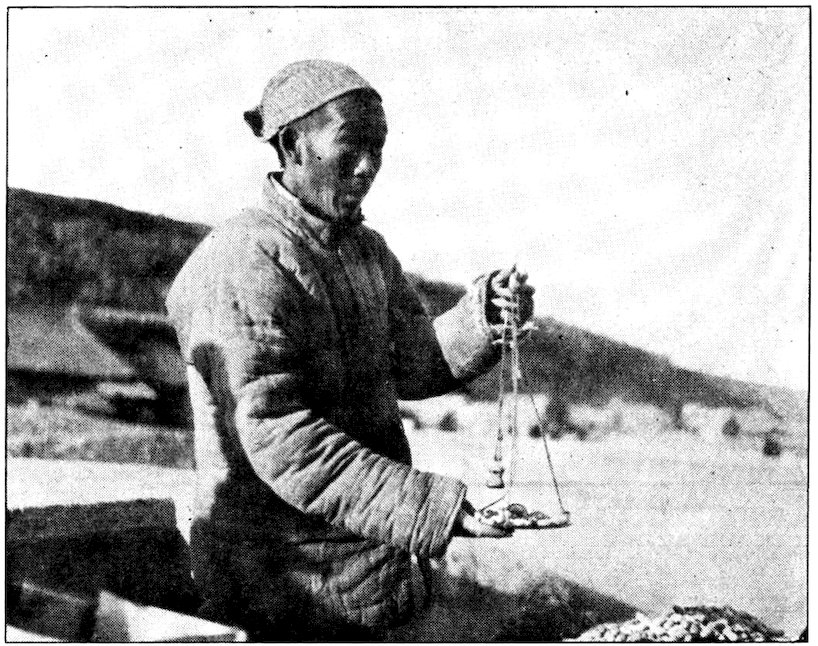
This merchant is engaged in the very serious business of weighing out a copper’s worth of peanuts. Probably you could buy up his whole stock for ten cents.
The railway into Shansi ends at Taiyuanfu, meaning “great plain.” It is properly named, for all about that 95provincial capital lies a flat, rich country, growing rye and barley and other crops which we have at home. The land is not well watered, however, for the Chinese have been so foolish as to cut down almost all the trees that once covered northern China; and ground without trees does not hold moisture long. I saw hundreds of men drawing water from wells in the fields. Many of these wells have four windlasses, so that four men, one standing on each side of the well, can all draw up water at the same time.
Shansi is often called the “model province” and the general who rules it the “model governor.” Instead of putting into his own pocket (or into his own account in the foreign banks in Hankow and Shanghai) all the money he gathers in taxes, this governor spends much of it for the good of the people. He has built some fairly good automobile roads, though they are merely made of piled-up earth which sometimes washes away in the rainy season. China still has no good stone or cement or macadam roads; but perhaps those will come also some day, when there are more model governors.
The governor of Shansi had driven almost all the bandits out of his province, and had stopped the growing of poppies, from which opium is made. He had forbidden the smoking of opium, and had provided a place in Taiyuanfu where people could come and be cured of the opium habit. He had forbidden foot binding also, but old customs die hard, and as a fine of a 96few dollars is the only punishment for parents who bind their daughters’ feet, there are still some, even in Shansi Province, who cling to the practice.
Because it is forbidden in Peking and not much practiced in the coast cities which most foreign travelers see, many people think that foot binding is dying out. But I am sure that during my two years’ wandering in all parts of China three fourths of the women and the girls over eight or ten whom I saw had crippled feet. Many of them could hardly walk at all. Both in the mud-floored houses and in the fields they often knelt at their work, using for protection knee-pads that reminded me of the shin-guards of our football players.
When a Chinese girl is six or seven years old, her mother or her grandmother binds long strips of wet cloth about her feet. The cloth shrinks in drying and squeezes the feet tightly. Every few days new cloths are bound on, until the bones of the feet are broken and the toes are bent back against the heels. By the end of two or three years, the feet have often become so small that they look as if they had been cut off at the ankle. Of course it hurts a great deal to walk on such feet, and perhaps that is why Chinese women are seldom as cheerful and smiling as most Chinese men.
Often girls have to sleep in an outbuilding while their feet are being bound, so that they will not disturb the family with their crying. Yet if their feet are not bound they cry too, for they think that they will never get husbands unless they have “lily feet.” It is said that this custom grew up hundreds of years 97ago because one of the wives of an emperor had very small feet and the other women copied her style. It should be said, however, that nowadays among the more modern Chinese, girls with bound feet are not desired as wives.
Much farther south along the main railway line I took another narrow-gauge railroad westward again, this time in the province of Honan. This district was so full of bandits that when we set out from the end of the rails the general who governs that part of China sent a dozen soldiers with us. At one town the heads of two bandits lay in little wooden cages fastened at the upper corners of each city gate. But China is gradually becoming more modern in her forms of punishment, and now criminals are generally executed by being shot. The cangue, a great wooden platform fastened about the necks of prisoners, with the story of their crimes written on it, used to be common, but during my two years in China I saw only two prisoners wearing it.
We rode for four days in mule litters, along the strangest roads in the world. In my litter—a kind of cot with a rounded mat roof—I had all my baggage, including even a trunk. It is not hard to read or even to sleep in such a litter, swung between two mules, but it often tips until one expects to fall out. Once, just as we arrived at an inn for the night, my litter did turn over, and spilled everything, even the trunk, upon me.
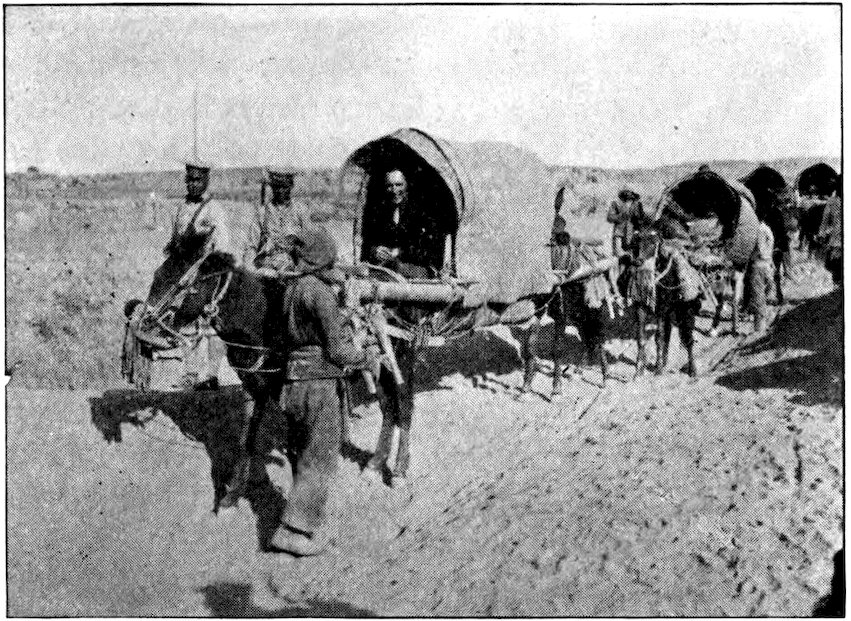
It is dusty work riding through the loess country in a mule litter unless you are the first one in a procession, as I was here. Two of my soldier guard stand at the side of the litter.
The roads in this part of China are great ditches, a hundred, sometimes two hundred, feet deep. As the sandy gravel soil, which geologists call loess, washes out easily beneath the rains and blows away in great clouds of dust when it is dry, the travel of many millions along these roads for thousands of years has worn them down into canyons, with walls on either side as perpendicular as those of a skyscraper. If the Chinese had not cut down their forests, the roots of the trees would have held the soil together. Sometimes when mule or camel caravans meet in these deep roads they cannot pass, and one or the other has to turn back until they can find a wider place in the canyon.
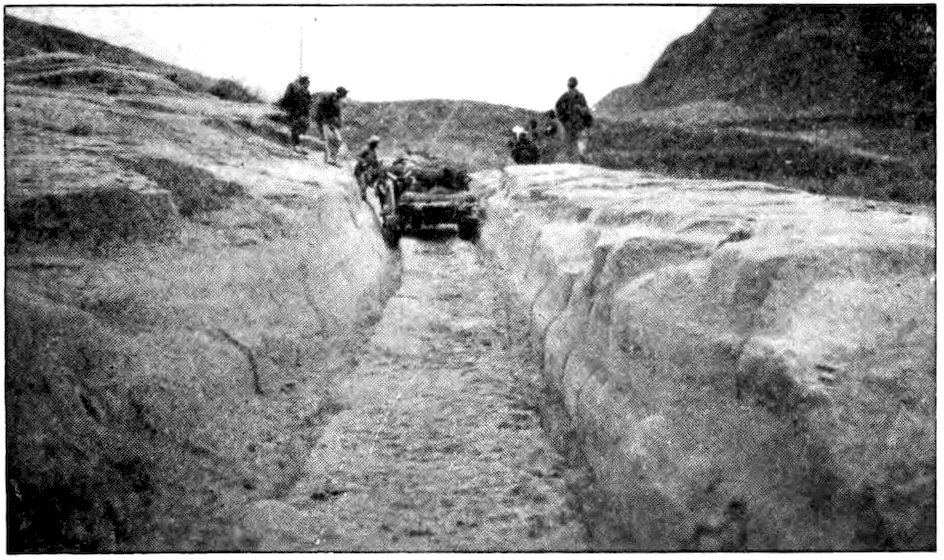
Roads grow old in China. This one in the western part of the country has been worn down, to the depth shown, in solid rock.
Beyond the great walled city of Sianfu, capital of Shensi Province and once called the “second capital” of China, we rode on mule back and had two-wheeled carts to carry our baggage, beds, and food, and also our cook and “boy.” There also the road was worn deep into the earth in many places, and to escape the heat and dust we often walked or rode along the edge of the chasm. It was more pleasant to walk, for if you have ever ridden a mule in a mountainous country you know how fond that animal is of the very brink of precipices. Perhaps he thinks he has nine lives, like a cat, or it may be that he likes thrills and danger, as some people do. Once the hind legs of the mule just in front of me, ridden by an American major, went clear over the side of the cliff, with a hundred-foot drop to the road below. Yet nothing serious happened. The animal scrambled like mad for a moment 100to regain its footing, and then went calmly on again, still just as close as possible to the edge, as if it could learn nothing by experience.
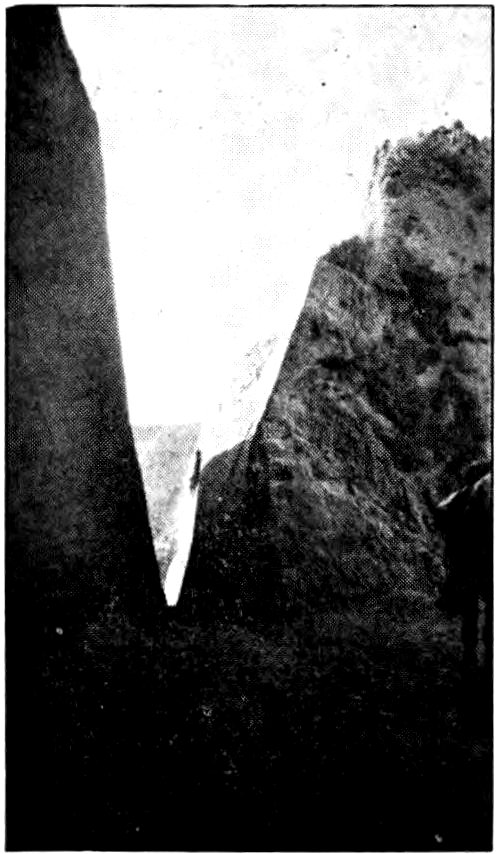
In some places the loess soil of western China is worn to a depth of one hundred feet or more, where a road has been used for centuries.
Often we came upon great square holes in the ground, twenty or thirty feet across and as deep. Ladders went down into them, and showed us that they were the courtyards of houses. Each side of the hole was dug out to form a house, where not only the people but their dogs and chickens and pigs live. On top of the earth above these sunken dwellings, the people thresh their wheat by driving mules or other animals round and round over it as it lies on the hard threshing-floor. They winnow the grain by throwing it up in the wind with a wooden scoop much like a snow-shovel, and what wheat they do not need for themselves they send to market, sometimes many days away, in long brown bags carried on wheelbarrows. We passed trains of as many as fifty of these wheelbarrows loaded with wheat. The faces of the 101men pushing them were often as twisted and strained as are those of champion runners at the end of a hard race.
Still farther westward there were large towns without a single house in them! The people all live in caves dug in the loess hillsides, a mud-brick wall with a small door in it across the front. This is another punishment for cutting down the forests generations ago, so that there is no wood left either to build with or to burn. Children go out and pick up every straw or twig that can be used as fuel, and even then there is so little to burn that they dare not make a fire to warm themselves, but must keep the precious fuel only for cooking. As it grows colder and colder during winter in the high altitude of western China, the people put on more and more garments padded with cotton. Is it not strange that the Chinese worship ancestors who made them so miserable by cutting down all their forests?
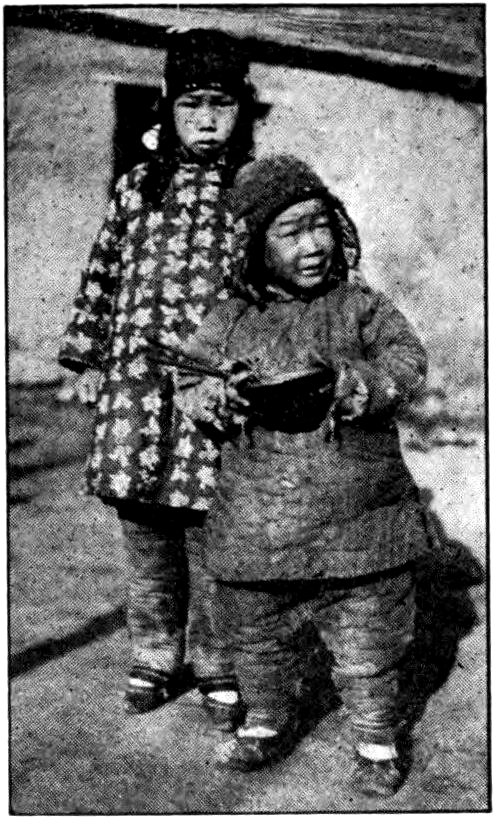
A Chinese girl and her younger brother, in their bright-colored, cotton-padded winter clothing. You will see that the girl’s feet are bound.
We stopped every night in a Chinese inn, which is very different from our hotels. It consists simply of 102mud-brick buildings around a yard filled with braying mules and crowing roosters. The only furniture is the k’ang, a mud-brick platform covered with a thin reed mat and having a fireplace beneath it. An inn servant would build us a fire under this strange bed if we told him to; but as the only fuel available was straw or small brush, we found that it made more smoke than fire.
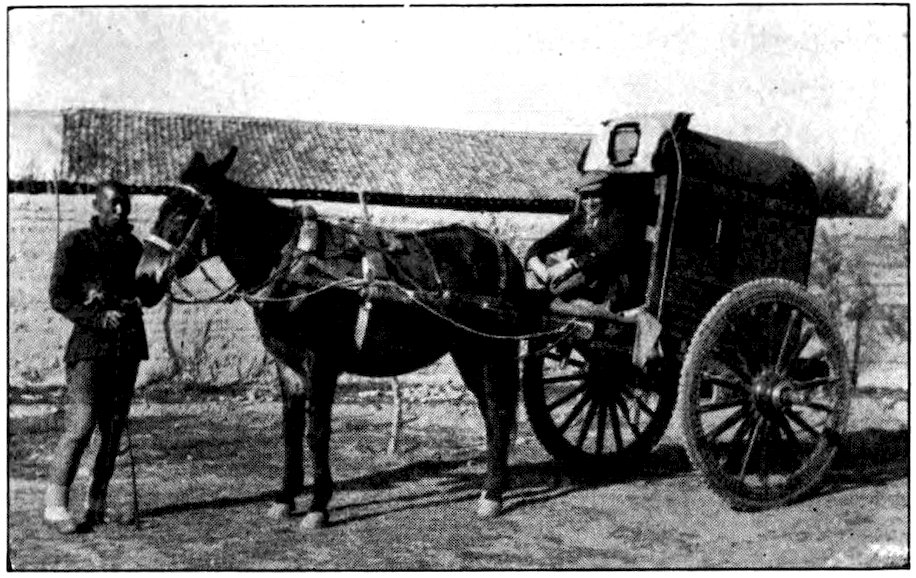
The governor of Shensi Province sent his car of state to bring me to a banquet in honor of my traveling companion and myself. Although quite handsome, it was after all a “Peking cart” and no more comfortable than that queer vehicle is when not decorated. On this cart the tires were made of sharp iron points to prevent skidding. They hardly improved the surface of a road! An ordinary Peking cart is shown on page 82.
Most Chinese still prefer stone-hard beds and would not sleep in a soft one if they had it. But we carried cots, as all wise foreigners do who go beyond the railways and steamship lines in China. During the last 103six weeks of that trip into the far northwest it was bitterly cold at night, though the sun blazed all day long. After sunset, as soon as we could set up our cots on top of the k’ang, we crawled into our thick sleeping-bags, lined with sheepskin with the wool inside, and did not get out until morning. When the cook had coaxed a dinner for us out of a miserable little mud stove in the inn, the “boy” would set it out on top of our bedclothes, where we could eat by merely putting our arms outside. Then he would roll up inside his own puk’ai, the great cotton quilt all Chinese travelers carry with them in winter. At four in the morning he would come to wake us, bringing a hot breakfast. We started every day two hours before daylight and jogged steadily on until dark, seven days a week. This we did in order to finish the long journey in time to spend Christmas with our families in Peking.
In spite of all the hard work our “boy” had to do, he never complained. Nor did we find the people along the way grumbling because of their miserable lot in life. Even small children in this region often wore nothing but a cotton-padded shirt or blouse, as if their parents wished to harden them for the rough life they would always have to lead. The bitter winter weather had chapped many of them with deep cracks from head to foot.
One morning nearly two weeks after we had left the end of the railroad we entered the province of Kansu. This forms the far northwest of China proper, much like Washington and Oregon combined into one state, except that instead of being bordered on the west by the ocean it runs up into the lofty mountain ranges of Tibet. The great road, which is really not much more than a very wide trail, to Lanchow, capital of the province, was lined with double rows of huge old willow trees from the very boundary of the province. A viceroy who once ruled Kansu for the Manchu emperors planted those trees, and if a man was caught cutting one of them down his head was cut off. Yet quite a few of them were missing! In certain places the loess soil had blown or washed away until a tree had fallen. But it was plain that some of the willows had been cut down. The Chinese are so eager for wood that they will risk a great deal to get it.
That day, after a great wind-storm, we saw women and children and a few men sweeping up fallen twigs and leaves. Except for that avenue of huge willows along the ancient route to its capital, Kansu is just as bare and treeless as the rest of northern China, and any kind of fuel is very precious.
105We still had a soldier guard in some places, because the Chinese officials were afraid bandits or robbers might attack us. Often the keepers of the inns where we spent the nights told us of people being held up and robbed along this road. But for some reason we were never troubled in this way during the journey.
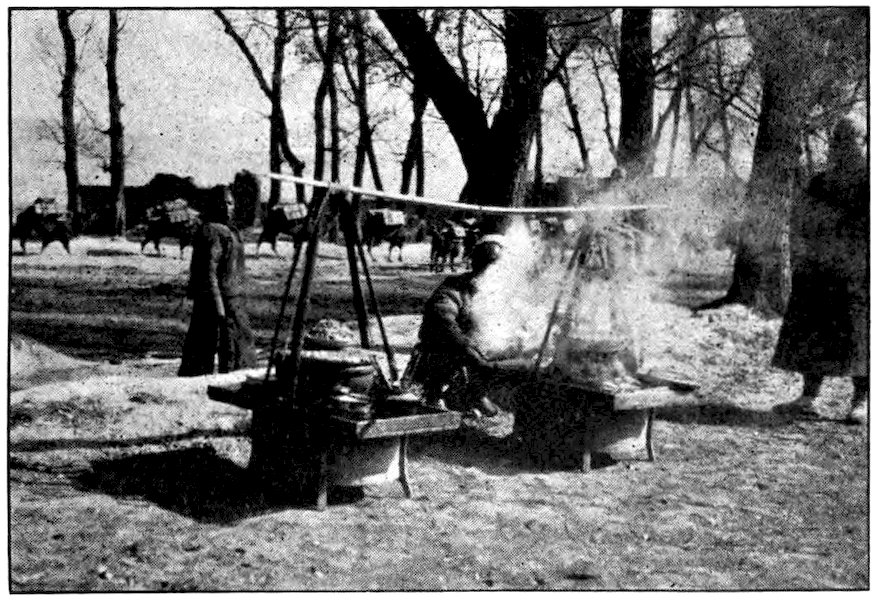
This is not a “Texas hots” stand, though it looks a little like that American institution. It is a traveling restaurant, by the side of the great willow-lined highway leading to the capital of Kansu. When he lacks customers, the proprietor picks up his restaurant and trots on in search of business. In the background is a camel caravan.
Now and then we passed long soldier trains, whole regiments of soldiers traveling eastward, perhaps to take part in a civil war in some other part of China. They traveled in mule-carts or horse-carts, on foot, on long strings of camels, and in even stranger ways, and did not at all look like our well organized armies of the West when moving from one place to another. 106At the head of each soldier train was a huge homemade flag with the name of the general on it in enormous Chinese characters; and at the top a very tiny Chinese flag. This was so symbolical of present conditions in China that it always made us smile.
We passed long camel trains, though none of them quite so long as the one of thirty-six dozen camels I had seen in crossing Mongolia. Every ten or a dozen of these stately two-humped animals were fastened together by ropes running from the tail of one camel to a stick through the nose of the one behind. The camels usually traveled at night and grazed or lay down in the daytime. The drivers were swarthy, rough looking men, with Mongolian features, and dressed in long dirty sheepskin coats, much like those of the Gobi. Therefore it looked strange to see many of them spinning yarn and some knitting socks and other garments as they plodded along behind their beasts. Later some one told us that American and British missionaries had taught the people of Kansu to spin and knit. They must have forgotten to mention that to Western eyes only women and girls look well doing such work.
Though they were perhaps the first to make silk, and have used cotton for a great many centuries, the Chinese formerly had few if any woven wool garments. They have long used wool clothing, especially up on this cold plateau of Kansu, but made it of sheepskins with the wool still on them. Some authorities 107claim that the Chinese never wove wool until taught by Westerners; but I have been informed that “sheep’s hair blankets” were known in very early times. The art of weaving such blankets may have been brought into China from Turkestan by the Huns.
Even here, where there are so many sheep, the great majority of the people dress in the thickly cotton-padded garments, much like our quilts, that are used in China wherever it becomes cold. Many of the men and boys along the way in this cold province wore earlaps embroidered with flowers or birds or other things in very gay colors. These are made by the women, who, because they all have long hair, do not need earlaps themselves. Most of the men, however, had the same kind of Chinese knitted wool caps as we wore. If it is warm enough, these can be rolled up about the top of the head; when it is very cold they can be pulled clear down to the shoulders, a hole being left for the eyes.
Chinese winter garments are so much warmer than ours that most of the few foreigners we met in Kansu wore Chinese clothing. They were nearly all British missionaries. Formerly they, and many Americans doing mission work, let their hair grow long and braided it in queues, like the Chinese. Now there are no foreign men in China with long hair. Yet most of the countrymen in this province still wore “pigtails.” We saw many peasants and coolies squatting on the ground, or on the little narrow sawhorses the country people of 108China use as chairs, while the village barbers attended to them.
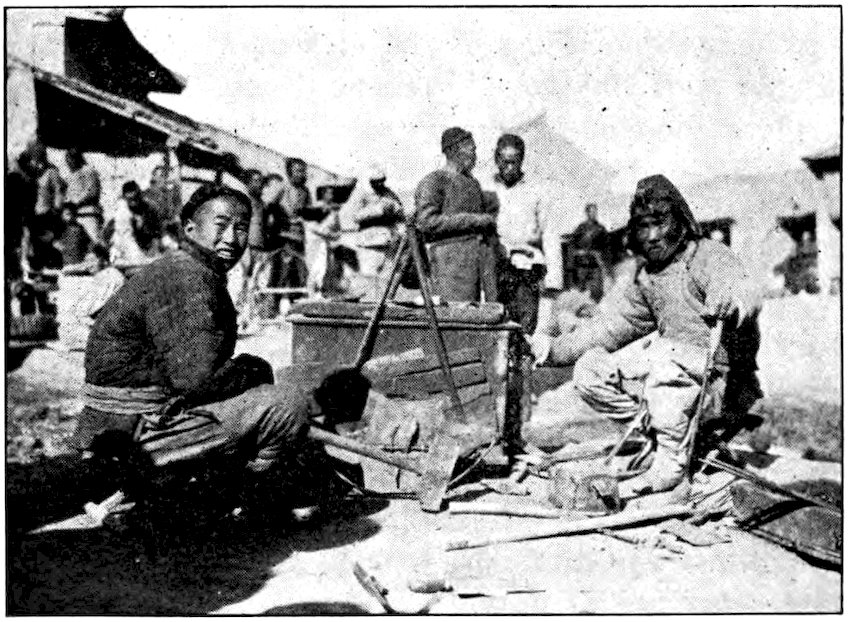
An outdoor blacksmith shop in a village of northwest China. The owner can pick up his entire equipment when he is ready, and trot away with it on a shoulder pole.
Many of these barbers carried their shops on the ends of a shoulder-pole, and went about looking for customers. They used no shears but only big awkward razors. With one of these they shaved the face (sometimes even the eyebrows) and clear around the head, leaving the hair long on top. Then they braided the queue, which often reached to the man’s thighs. Once I saw a barber adding a hair-switch to a coolie’s queue, so perhaps many of them wore more hair than grew on their heads, just as some American women do. Chinese barbers always carry long sticks like slender pencils, because customers expect to have their 109ears cleaned out. Their work is crude, but they do not charge one tenth as much as our barbers do for a hair-cut.
We passed through one big city, named Pingliang, and many smaller towns. All of them were surrounded by great walls. There was always a road around the city close to the wall, so that travelers who preferred not to go inside need not do so. We usually went inside, for we wished to see all the cities, and it was likely to be time to eat dinner or find an inn for the night. The elbow-shaped gates and the narrow streets were often so crowded that we had as hard a time getting through as an automobile does on Fifth Avenue, so we did not wonder that many caravans went around the outside of the walls.
Another reason for caravans staying outside is that those which carry foods or produce have to pay taxes whenever they enter a city gate. For a great many years China has had these local taxes, called likin. When the Constitution of the United States was written, not only duties on exports were forbidden, but it was forbidden to levy duties on goods shipped from state to state. If we had the Chinese system, there would be customs duties not only on things coming into the country but on those going out also; and goods shipped from New York to New Orleans, for instance, would have to pay taxes perhaps a hundred times along the way, at every town or river-post or military barrier. Treaties with foreign countries do not allow the 110Chinese to collect likin on foreign goods, but now some of the military dictators ignore the treaties made in Peking under the Manchus and require that all goods pay duties.
Even in this far interior of the country there were many peddlers along the roads. As it is very difficult for the women, because of their bound feet, to go to town to shop, there is plenty of trade for peddlers. On that two months’ trip I saw only one girl whose feet were natural, and she was an orphan and slave-girl whom no one had taken the trouble to “make beautiful” for a future husband. She had little hope of ever getting a husband, and the Chinese consider it disgraceful for a woman not to be married.
There were not only peddlers but even traveling restaurants! Each “restaurant” consisted of a coolie who trotted along carrying two big baskets of food warmed by little clay stoves. Most of the country people of Kansu live on wheat or Indian corn or kaoliang. They grind the grains between big millstones, the bottom one stationary and the top one turned by hand. Often we saw two women or girls marching round and round these mills on their crippled feet, and sometimes a blind man or boy who did nothing else all day long, without even a Sunday off. But the Chinese, from babyhood, are hardened to comfortless and laborious lives, and no one ever seems to complain of hardships.
We could buy chickens and eggs, mutton and sometimes beef, and vegetables and fruit along the way. 111Of course there was also plenty of pork, the favorite Chinese meat. But most foreigners do not eat Chinese pork, because the pigs live on all sorts of garbage. The Chinese seldom drink milk, and they do not make butter or cheese. We could get tea anywhere, but no coffee or cocoa. So we found that of the trunkful of tinned things we had brought along, the canned milk, cocoa, oatmeal, sugar, butter, jam, cheese, and fish were very useful. As most of the native food is good and nourishing, we could have lived without any of our own things. We might even have gotten along without our cook and “boy.” But we preferred to see to the preparing of our own meals, for the cooks in most Chinese inns have very little idea of cleanliness.
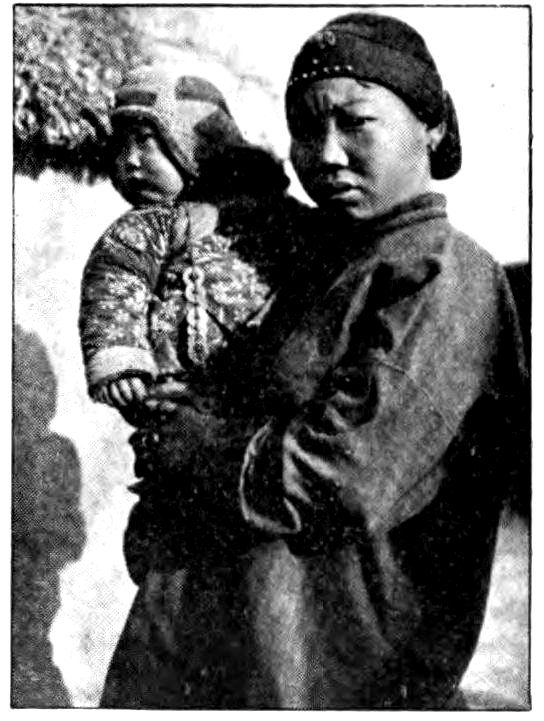
A Chinese mother and her baby in winter clothing. The baby wears a string of “cash” (money) as an ornament, and perhaps in the hope that it will keep evil spirits away. The child’s clothes have much red in them. To the Chinese, red stands for happiness.
There was much game along the way. The American major who traveled with me shot pheasants as pretty as any you ever saw in a zoological garden, and plenty of pigeons, wild ducks, and wild geese. Under the Manchus the people of China were not allowed to own guns, so that even where nearly all the inhabitants 112looked hungry, as in Kansu, they could not shoot the plentiful game. In every town there were great quantities of persimmons, much better than those of our southern states. They looked like huge tomatoes and tasted best of all after they had been frozen. We ate them with spoons and found them as good as ice cream. But the Chinese pears, also very plentiful, were much poorer than ours. They were hard as rocks, not a bit sweet, and had no more taste than a raw potato.
Almost every hill or mountain along the way was terraced in great shelves of earth, to the very top. When we saw them they were quite bare, making the whole landscape a dreary yellowish brown. But with spring a great change would come. Then all the terrace-fields would be green, and if the traveler looked down upon them from above, all the earth about him would seem green. Yet if he were down in one of the sunken roads, looking up, he would get quite a different impression, for then he would see only the wall-like sides of the terraces, and they would still be bare and brown.
Millions of the Chinese are Mohammedans or Moslems. There are nine mosques even in Tientsin, on the eastern edge of the country, and every large town has at least one mosque. But in the great northwestern province of Kansu fully half the people are followers of Mohammed. The other Chinese call themselves Han-ren or “sons of Han.” The Mohammedans who 113conquered much of Asia and a part of Europe more than a thousand years ago made their way through Sinkiang, which we call Chinese Turkestan, into Kansu, but did not travel clear across China.
Some of the soldiers remained, and took Chinese wives. This explains why many of the Mohammedans of this great northwestern province look more Arabic or Turkish than Chinese. Most Chinese Mohammedans, however, look just like the other Celestials, except that the men and boys usually wear a white cap. That is because their ancestors were not soldiers from the west but Han-ren who were converted, or compelled to turn Moslem or be killed.
Mohammedans do not eat pork, and where there are more of them than of Han-ren in a Kansu town no one is allowed to keep pigs. We often stopped at Mohammedan inns, and the proprietor always told our cook that he must not use any lard or cook any pork on his premises. Yet we noticed before long that we were getting bacon for breakfast every morning, and asked the “boy” about it.
“Oh, Hwei-hwei no catchee know bacon allee same pork,” he answered in the pidgin-English that he had learned in Peking.
By that he meant that the Mohammedan inn-keepers did not know that the bacon we had brought along in tin cans or glass jars was a form of pork; and he went on to say that the cook told the inn-keepers it was “foreign-style” beef. We asked the cook not to play that trick any more, for travelers should not do anything to offend the people they are among.
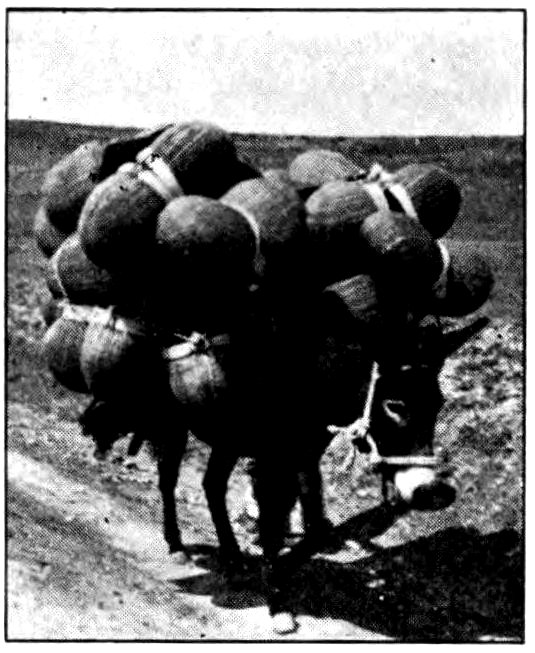
A donkey-load of water buckets made of bamboo splints woven as if for a basket. Such buckets are not entirely water-tight, but they do very well.
In many cities and towns where there are more Han-ren than Moslems the latter have to live outside the walls. Several times there have been great Mohammedan rebellions in China, and some people think there will be another one. But the Mohammedans are better treated now than they were under the Manchus. There are Mohammedan soldiers in Kansu and in some other parts of China, and some Hwei-hwei have even become generals. When China took the name of Chinese Republic, it changed its flag from the big yellow Manchu banner bearing a dragon, to a flag of five stripes, one color to represent each kind of people in the old empire. The yellow stripe stands for the Han-ren, or ordinary Chinese, the blue for the Manchus, the black for the Tibetans, the red for the Mongolians, and the white for the Mohammedans.
Most Mohammedans, obeying the rules of their religion, do not drink wine or other intoxicating liquors, and will not allow themselves to be photographed. But the Chinese Moslems do not seem to know their 115Koran (the Mohammedan Bible) very well. Some of them get intoxicated on Chinese rice-wine, and even the mullahs, or Moslem priests, allowed me to take their pictures and, still more strange, to photograph the interiors of their mosques.
They were very simple interiors compared to those of ordinary Chinese temples. There were no gaudy pictures or painted gods or demons. The floor was covered with straw mats and always the western wall contained an Arabian niche. When a Chinese Mohammedan prays, as he is expected to do five times a day, he must bow down with his face toward the west, for Mecca, the holy city of his faith, lies in that direction.
All the Mohammedan men come to the mosques on Fridays, but no women are allowed inside. There are washing-vats outside every mosque, because the men must wash themselves before entering. They are even supposed to change their clothes, though many of those in Kansu are too poor to have a change. In each mosque is kept a coffin having a false bottom. In this Chinese Mohammedans carry their dead to the grave. There they leave the body and bring the coffin back again. The Chinese of other faiths, who bury their dead in huge wooden coffins, think this very stingy and disgraceful.
A few years ago there was a great earthquake in Kansu. As the soil is almost sandy, with no tree-roots to hold it together, this did much damage. Millions of the people live in caves, and thousands were killed by being buried in these underground houses. We passed many places where the great road to Lanchow had been covered deep under the mountain-sides that had slid down when the earth shook. In others the whole road, with its four rows of willows and even the mule-paths in it, had been carried nearly half a mile or turned at right angles to its former course. The new road was a trail that climbed over the new hills wherever the first travelers after the earthquake had been able to get through.
One Chinese name for the earthquake is “Where the Earth Walked.” The landscape looked as if the earth had been boiled, leaving a ruined world, a world wearing away. There were places where all the population, all the terraced fields, all the villages had been wiped out. Elsewhere other people had come in, or those who had escaped the earthquake had rebuilt their towns. Most of mankind seem to be optimistic. People come back to live where such a calamity has happened, as if it could never be repeated.
117Some of the sides of hills that fell off during the earthquake dammed up little streams and made big lakes where there had never been a lake before. There was so much danger that some of these would overflow and drown towns or villages below them that a great deal of work had to be done to cut channels for draining these lakes. Many thousands of dollars subscribed by Americans were spent in this work.
Most Chinese still think the earth is flat and held up by a turtle or a huge fish. Even our mule-driver, who was just as sensible in most things as an American workman, believed the earthquake was caused by this great fish’s wagging its tail!
Almost every day we met the Chinese “fast mail.” This consisted of a coolie who carried across his shoulder a pole with some mail-bags at either end of it. On his blouse big Chinese characters warning people not to disturb him were painted or sewed. Such men carry about eighty pounds, and they trot nearly fifteen miles before they turn the bags over to another coolie. Their monthly pay is only about nine American dollars, yet they are very loyal in their work. Sometimes they are robbed and even killed, and many of them have an iron point on the shoulder-pole to use as a weapon.
Of course where there are railroads or steamers or other modern forms of travel the mails are carried as they are in our country. But all China has fewer miles of railway than many of our single states. About 118half of the eighteen provinces have never heard a train-whistle, and some of the others have only one short rail line. Until the fighting between rival generals stops there will probably be no more railroads and very few highways built. For this reason most of the mail must continue to be carried on men’s shoulders, or on the backs of pack-animals.
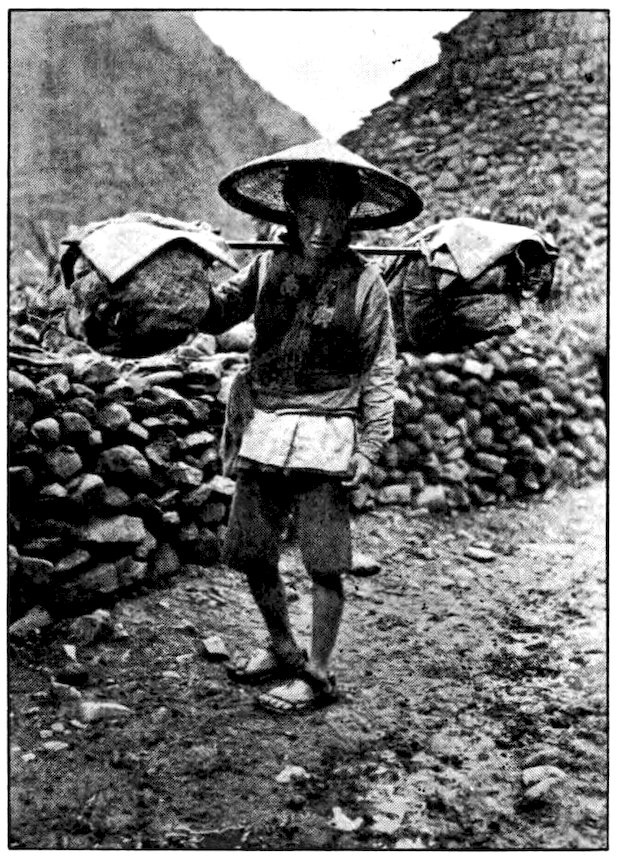
One of the sturdy and loyal coolies who are the “fast mail” in interior China. They can trot fifteen miles with eighty pounds of first-class mail on their shoulders. Each wears characters on his blouse telling that he is a postman and must not be delayed or molested.
119We now and then met a long pack-train wending its way across the broken country with many loads of parcel-post packages. In other parts of western China I met caravans of more than a hundred coolies toiling painfully along under cruel loads of this heavier mail. Many people say that the Chinese postal system is so good because the men at the head of it are foreigners. They point to the very poor telegraph system as proof that the Chinese cannot do such things properly for themselves. But anyone who has traveled in the far interior will give much of the credit to the hard-working and poorly clad coolie mail-carriers who trot night and day over the difficult trails.
The Chinese seem to have more curiosity than any other people on earth. Or it may be that this appears to be so, because among them staring is not considered bad manners. Even in cities where there are many foreigners, gaping crowds often gather about one.
Way out in Kansu, and in most other parts of the country, enormous mobs crowd about a foreigner the moment he appears in the street. Often on this trip almost all the men and boys and many of the girls in town left whatever they had been doing and packed themselves so closely about me that it was hard to breathe, especially as great clouds of dust were raised by their feet shuffling on the unpaved street.
I never found one of these mobs unfriendly, though some foreigners have even been killed by them. I always saw far more smiles than scowls. If I could 120think of enough Chinese words to make a joke, the whole crowd roared with laughter. If I started to go away, they made an opening for me much more quickly than most American crowds would. They had merely come to see the “strange looking person” and watch his “queer” doings. If I wrote in my notebook, they stared and laughed at what they considered my funny way of writing. As they write from top to bottom and from the right-hand side of the page toward the left, and use a camel’s hair brush to make marks like chicken-tracks, my fountain-pen and the marks I made with it seemed very amusing to them. If I read a book, they thought it queer that I did not begin at what we call the last page, as they do. Almost everything the foreigner does seems strange to Chinese who have not met many foreigners.
In some of those Kansu villages people told us they had never seen a foreigner before. Most of the people of interior China cannot tell one kind of foreigner from another. I was often asked if I were a Japanese, though I hardly think I look like one. Any person not Chinese is a wai-kuo-ren, an “outside-country-man,” to most Chinese, and many of them think there are only two kinds of people in the world—themselves and those who live in the other country which they think makes up the rest of the earth.
I had learned to speak some Chinese by this time, and I learned more before my travels in China were over. But if you have ever been in a country where 121you do not speak the language well you have probably found that many people think they can make you understand by shouting their strange words louder and louder. I have even known Americans who tried in this way to make foreigners understand.
Sometimes it became rather painful to have a great mob crowded about me and one or several men shrieking in my ears. However, I found a way to cure those shriekers. I would put my lips very close to the ear of the man who had just shouted a question at me as if I were stone-deaf, and shout back at him in English some such words as “You don’t say so?” He would go away rubbing his ear but laughing with the rest of the crowd, for the Chinese are very quick to appreciate a joke even on themselves. The story would travel so far ahead of me that it might be several days before another crowd would think it was my ears that were weak rather than my understanding.
In many of these far-away parts of old China the money still consists of the little brass coins, with a square hole in the center, which foreigners call “cash.” They are strung on strings, usually a thousand to a string. A knot is tied to mark off each hundred coins, and the ends of the strings are tied together. One “string” of “cash” weighs about eight pounds, yet it is hardly worth twenty-five cents in our money.
Can you imagine carrying a dollar that weighs thirty-two pounds? Yet we saw many men in Kansu with as many as six “strings” on their shoulders. 122They were usually soldiers or workmen or carrying-coolies who had just been paid off; and you can see how lucky they are that their wages are only about a dollar a week! Our mule-driver paid fifty or a hundred “cash” for a bowl of rice, and coolies who carried my things on their shoulders in other parts of China would often lug also an additional eight or sixteen pounds in change with which to buy their food and lodging and tobacco.
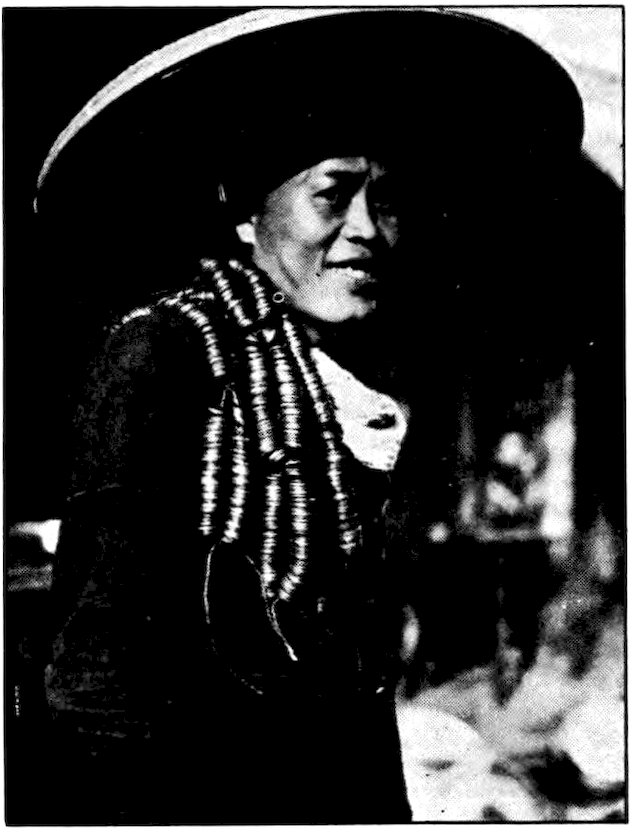
A Chinese coolie with his week’s wages, worth about a dollar, and weighing forty pounds or more in strings of “cash.”
Not very long ago the only money in China, besides the strings of “cash,” consisted in silver lumps often 123called “shoes” by foreigners, because they were shaped somewhat like a shoe. Each shopkeeper had a scale like one of our steelyards but made of wood, and when a customer bought something the silver to pay for it was weighed out. If one “shoe” was too much, out came a little saw or ax to cut it in two. We saw people using this kind of money in Kansu, sometimes adding a little silver BB shot to complete the weight. But now most of China uses big copper coins, worth ten or twenty, and in some places even fifty “cash,” and for bigger transactions the silver dollar.
When foreigners began to trade with China about a hundred years ago, they did not want “cash” in payment for their goods, and they did not like the lumps of silver. So they introduced into China the dollars that the Spanish used in Mexico and other Latin-American countries. Now the Chinese mint their own “Mex” dollars, which are just as big as ours but worth only about half as much. They call them E quai ch’ien, or “one piece money.”
There is paper money like ours in Peking and the large coast cities, usually issued by foreign banks, but this is seldom accepted in any other city, and it is of no use in the country districts. On this trip into Kansu, and many other journeys that I made in other parts of China, I had to carry long rolls of silver dollars wrapped in paper. The governor of that province had melted up all the “cash” and coppers that came into his treasury and made new coins by pouring the metal 124mixed with sand into moulds. These coins we could break in two with our fingers, and they were worth so little that merchants had to send donkey-loads of them from town to town in payment of new goods. We often met these donkeys, their bags of coin rattling like a junk-shop in a cyclone. Even in the capital of the province the money poured out on shop counters sounded like coal rolling down an iron chute.
Lanchow, the capital of Kansu, is a great walled city in a little valley on the Yellow River, way up where the stream is neither yellow nor very large. It has several walls, dividing it into sections. Many of the inhabitants are Mohammedans. Those men who wore thick skull-caps of natural white wool and kept mutton-shops we knew at once to be Moslems, as we did the ahong, or mullahs, who went up to the top of the mosques five times a day and called the Moslems to prayer with words meaning “Allah is great.” The Chinese Mohammedans are not allowed to translate the Koran into their own language. They must read it in the original Arabic even if they do not understand the words they are pronouncing.
Inside its walls China’s most northwestern city was much like other Chinese cities. Swarms of people poured back and forth through the narrow streets, along with donkeys, mules, horses, and camels. Coolies carried every kind of thing, clean and dirty, and shouted and bumped their way along as they do all over China. Hundreds of them were engaged in carrying 125two big buckets of water apiece from the river to all parts of town. People who wanted water paid these men about a cent a bucket.
Now, in December, it was bitterly cold and though there is much coal in northwestern China few of the people could afford to burn it. There were many almost-naked beggars wandering the streets of Lanchow. They slept in any hole they could find, like the hungry homeless mongrel dogs that roamed about looking for scraps of food.
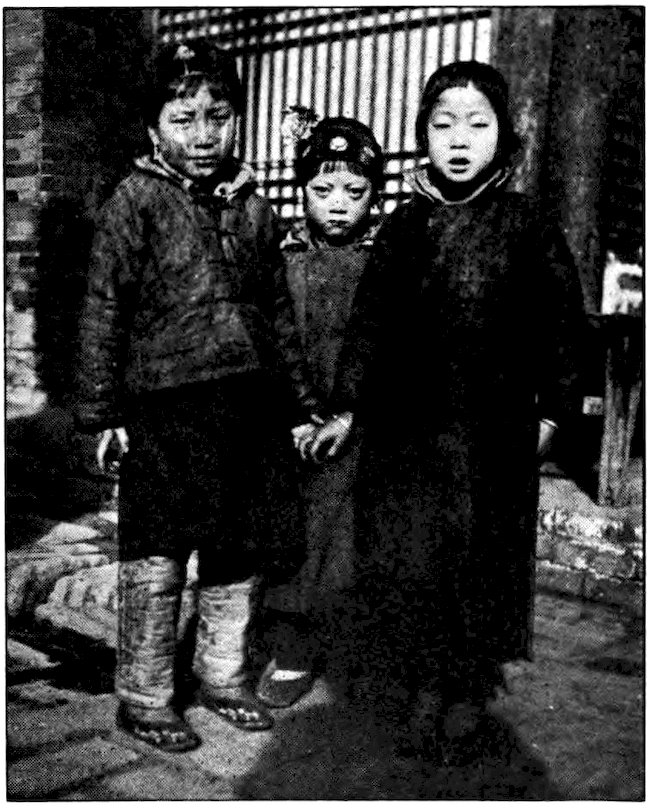
In Lanchow I saw these Mohammedan schoolgirls, whose garments were a riot of color.
There are no rickshaws in Lanchow, nor in all 126Kansu Province. High officials rode in the picturesque old sedan-chairs once used all over China. One of those officials was a European, head of the Salt Monopoly office in Kansu, and to see him come rushing home after dark carried by six shouting men swinging great Chinese lanterns in front of them was a very interesting sight. Like a great many other Chinese cities, Lanchow has no street-lights, except those which people set up or carry themselves.
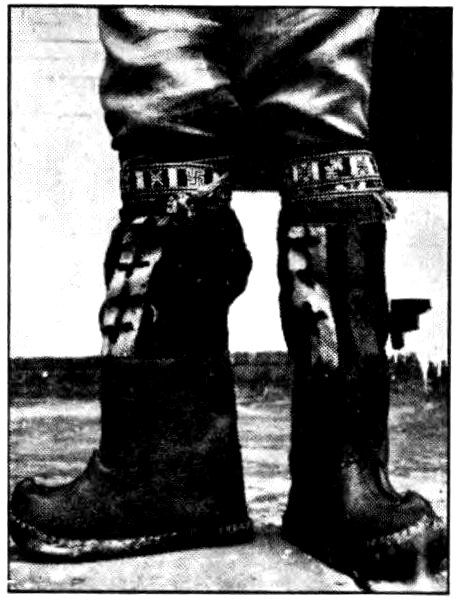
These very handsome boots are the kind worn by a tribe living on the borders of Tibet.
Over the mountains not far from Lanchow is Hochow, a sort of capital of the Mohammedans. From there we might have gone on to Sinkiang and the Kokonor, or Blue Lake, region of Tibet. Tibetans, and in fact people of all the races of central Asia, were to be seen in the streets of Lanchow. We should have liked to go on to all the places they had come from, but the traveler soon finds that it is as hard to go everywhere during one lifetime as it would be to take all the courses in a great university in four years.
Most people returning from Lanchow float down the Yellow River on rafts made of goat-skins filled with air. But the river was full of ice now, and in some places frozen solid. So we bought 127horses and hired two more mule-carts to carry our things and our servants, and set off one morning across an American-built bridge. That three weeks’ journey northeastward was interesting, but not so much so as the route we had come by. Often the only building we saw all day was the government inn for travelers where we spent the night. So much of the land was covered with ice that we wished we had skates.
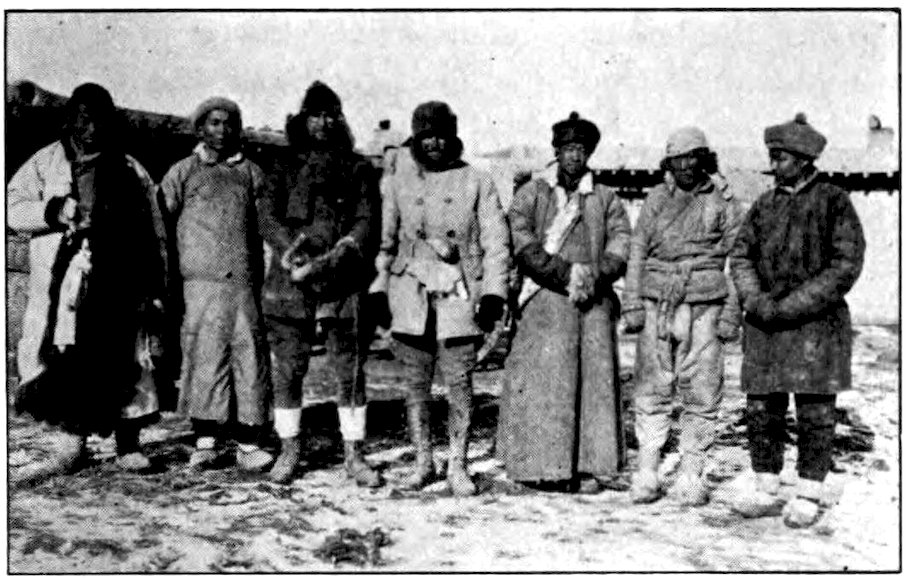
Our party coming back from Lanchow. I am in the middle; the American major on my right (as we stood facing the camera); our cook on my left; our “boy” on the major’s right; and our three mule drivers at the ends of the row. You can see that we seem to have been well supplied with clothing, yet we were often cold. It was December and we were several thousand feet above sea level.
One cold morning we passed through the Great Wall, but away out there it was merely a big mud ridge. For two days we waded through sand dunes like those at the southern end of Lake Michigan, and if it had not been so cold we might have imagined ourselves 128in the Sahara. Some of the towns were ruled by Mohammedans and others by European Catholic priests.
Nearly every day we heard rumors of bandits who might fall upon us along the lonely road. But we reached the end of the railroad through Kalgan safely, and twenty-four hours later stepped off the train in Peking. As we had always started long before daylight every morning, when it seemed as cold as the North Pole, we had not shaved for weeks. My beard must have made me look like a Bolshevik, for my small son wept when he met me at the station.
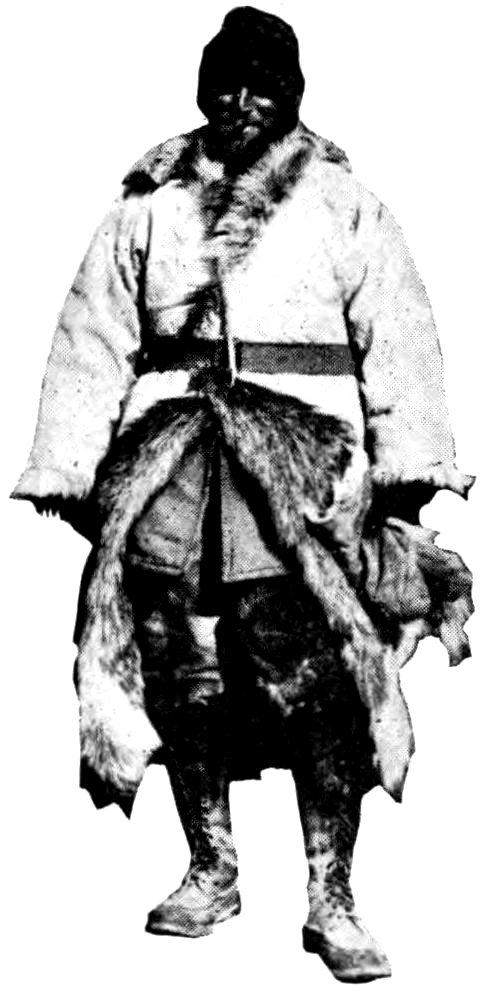
I didn’t look like “Daddy.”
The Fourth of July, Christmas, and our other holidays mean nothing to the Chinese, but they do celebrate certain days of their own. The most important of these is New Year’s, though even that is not the same day as ours. For the Chinese still use the moon calendar, and their lunar New Year’s comes from three to six weeks later than our January first. Every time there is a new moon they start a new month. As it is only twenty-eight days from one new moon to another, this makes their year short. So they put in an extra month every two or three years.
They have no real names for their months, but call them “First Moon,” “Second Moon,” and so on. The extra month is not named thirteen, however, but is “tucked in,” as it were. So if you happen to be in China during one of their years of thirteen months you may wake up some morning and find the month that was finished the night before starting over again. Its name might be translated “June number two,” or something of the sort.
The years, however, have names. They are named for twelve animals—the rat, the dog, the goat, and so on. When the twelve are finished, a new start is made. Five times around forms an era, or what we sometimes 130call a Cycle of Cathay. Probably that is because sixty years is about the natural length of a man’s life. Also, it is easier to record dates if the years are grouped into cycles, in the same way that we group them into centuries.
If you ask a Chinese when he was born, his answer will be something like, “I appeared on the tenth day of the third moon in the Year of the Rooster.” If he is speaking of his grandfather or giving some date long ago, he will also mention the cycle or the reign of some emperor. When parents plan a Chinese marriage, a horoscoper is asked to make sure that the positions of the stars and the moon at the dates of birth of the boy and girl to be married, would be favorable. We would regard such dependence on signs as superstitious, yet other peoples, Western as well as Eastern, have similar superstitions.
In some ways the calendar of the Chinese is better, or at least truer, than ours. Their seasons are more exact, because their New Year’s is nearer the real middle of winter. The dates they call “Stirring of the Insects,” “Corn Rain,” “Sprouting Seeds,” “Small Heat,” “Great Heat,” are close to the times described by those phrases. On the other hand, in America the hottest days may come long before the middle of summer, or they may come in September; so “Great Heat” would not mean much to us.
It is convenient to be able to tell, merely by looking at the moon, what day of the month it is. Centuries ago our ancestors also used the moon calendar. But the Chinese are gradually changing many of their 131old customs. Since the revolution of 1911 the official government calendar is the same as ours, just as it is in Japan. Those who work for the government get two New Year’s holidays.
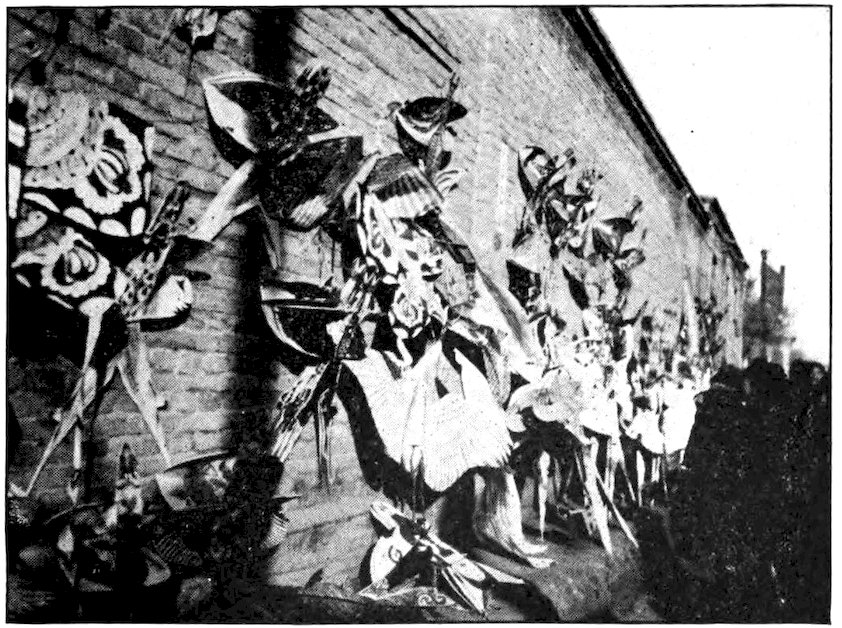
Among the many sorts of things sold at the Chinese New Year’s are kites of all imaginable shapes, including those representing birds and butterflies.
We saw two Chinese New Year’s days, one in Peking and the other down in southern China. They were especially good ones, for the first began the Year of the Pig, last of the twelve, and the second opened a new Cycle of Cathay. The Chinese expect all kinds of bad luck during the Year of the Pig—which the Mohammedans call the Year of the Black Sheep, because they cannot mention the “unclean” animal they are forbidden to eat. But they think all their troubles will be 132over when the new cycle begins. In this they are sure to be disappointed, but they have a great celebration anyway.
Every Chinese who can do so, returns to his family home for New Year’s. All the ancestral graves should be cleared and redecorated then. The ancestors have to have religious services in their honor and must be given food. The Chinese think the spirits of the dead eat the aroma of the food set before their altars, and leave for the living the food itself. So New Year’s is a time of feasting, like our Thanksgiving and Christmas. Everyone wears his best clothes, brand-new ones from head to foot if possible. The children dress just like their parents, except that they may wear gayer colors.
For days before New Year’s the markets are crowded, since everyone who possibly can is buying. Besides the new clothes, one must have gifts for all his friends and relatives. New Year’s day rather than Christmas is the time to give presents in China, just as it is in France. Toys of all kinds appear in little booths built in the streets and in the temple grounds. People flock to the temples, to burn bundles of paper that they pretend is money, and handfuls of joss-sticks. More firecrackers are heard than on our Fourth of July. The Chinese think the noise drives away evil spirits. There was so much of it all about us that lunar New Year’s eve in Peking that even our little boy could hardly sleep.
133The people eat all night long, one feast after another. The next day they make calls all day and eat and drink still more. The stores close, not simply for the day but for a week or more. But before you accuse the Chinese of being lazy in taking so long a holiday, as some travelers have, remember they do not have fifty-two Sundays of rest every year. Old men go out and fly kites, or take their birds for an airing. Younger men go to the theaters, or gamble at fantan or mah jong behind the closed shutters of their own or their friends’ shops. However, if you know the shopkeeper’s back door or secret entrance, you can usually buy anything you want, for the Chinese are enterprising and do not like to miss a chance to do business.
We wandered for days about the streets of Peking during the first week of that Year of the Pig, and still we did not see all the celebrations. There were brick walls covered with painted pictures, temple-grounds as packed as a county fair-ground, streets swarming with buyers and sellers and strollers, and lined for miles with hawkers’ stands and amusement booths. These sold only holiday things, but there were such quantities of them that the whole city looked like crisscrossed streaks of color. Not only the colors but the people were gay, and all sorts of noises that the Chinese call music rose above the happy uproar.
On the wall of every Chinese house, above the place where the cooking is done, is a paper with a picture 134of what the Chinese call the Kitchen God. At the end of the year this god is supposed to go to heaven and tell how the family behaved itself for the twelve or thirteen months just ended. So the picture is taken down just before New Year’s day, and burned. But before the Kitchen God is sent to heaven by fire his lips are rubbed with candy or sugar, sometimes with opium, so that he will tell only “sweet” things of the household he spent the year in! This trip to heaven and back is supposed to take seven days. At the end of that time new Kitchen Gods, in very bright colors quite different from the old smoked ones, appear everywhere.
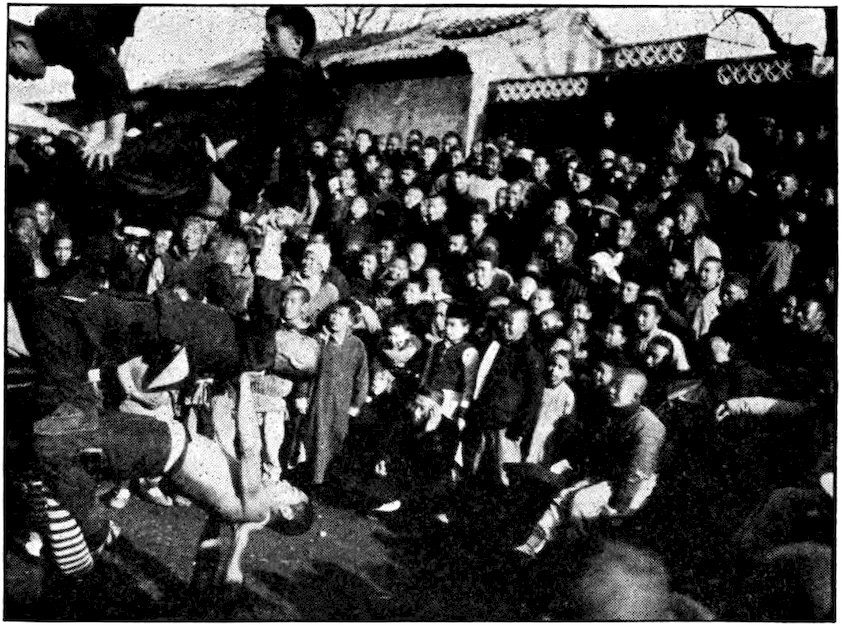
The Chinese New Year’s is a great time for outdoor shows. These acrobats could not ask for a more interested crowd to watch them perform.
135In the small, poor towns of southern China where I spent the second New Year’s, there was not room in most of the little houses to feed and worship the ancestors. So out in the narrow street before almost every door stood a table, with a cooked chicken or duck, its head tucked under its wing, and other food, as well as bowls of rice-wine. Just behind this, inside, was the ancestral altar, with a crude picture representing the dead fathers of the family.
Every hour or two the oldest living man or boy would come out into the street and kneel before the table, touching his head to the ground. Then he would stand up and burn incense-sticks and make motions with the cups of wine toward the altar inside as if he were inviting the ancestors to eat and drink. Sometimes there was only an old woman left to perform this ceremony, either because the family was dying out or because no man or boy of it could get home for New Year’s. Between these family services nearly all the people of the town spent their time gambling and refused to do any work whatever.
It seems terrible to the Chinese to have a family die out, because then no one will look after the spirits of the members who are dead. Therefore all manner of queer tricks are used to “protect” boys from the evil spirits which the Chinese think are always trying to harm them. Many Chinese boys wear an iron or silver chain about their necks, with a great padlock on it. This is put on by a priest and is meant to warn 136evil spirits that the boy belongs to the temple and must not be harmed.
Often a boy is dressed as a girl, or called by a girl’s name, because the evil spirits do not bother with girls. Once I had as a servant a boy of about twelve with a ring in his nose. More exactly it was a piece of telegraph-wire twisted into a ring shape and thrust through the cartilage between the nostrils. This was supposed to prove that he was a pig—which in some ways he was!—so that invisible spirits of evil would let him alone.
If the Chinese did not have as a religion what we usually call ancestor worship, they would be able to live better. Because everyone, even beggars, must leave sons to burn incense to them after they are dead, China is terribly crowded. Because huge coffins are used to bury those who have left sons, much of China is suffering for lack of trees. Because graves must be kept for many generations, if not forever, millions of acres of land are wasted. If all the grave lands were cultivated the Chinese would have much more to eat.
Most of the Chinese are so poor that they never really have all they want to eat, except perhaps at New Year’s. There are so many Chinese that if one man leaves a job twenty will come running to get it. Therefore most jobs are sold by the man who has more than he can do himself, just as we sell goods. There are many labor unions in China, some of them hundreds of years old. But they cannot raise wages as our labor unions can, because there are too many people looking for work.
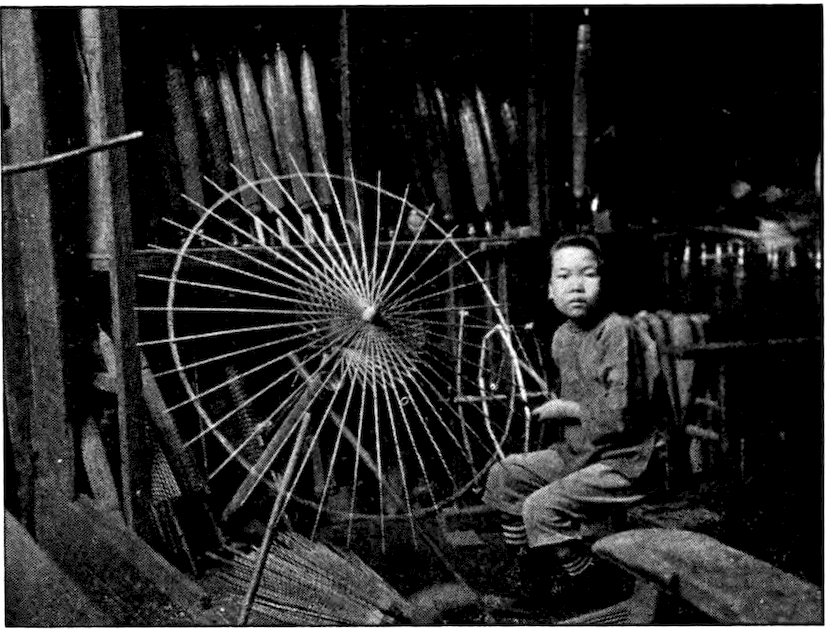
A Chinese girl making paper umbrellas. The ribs of the umbrellas are of bamboo splints, tied together with colored strings. Tough, oily paper, brightly colored in gay designs, is fastened to the ribs. A number of finished umbrellas, closed, are in the rack.
The Chinese are probably the hardest workers in the world, and certainly they are the most cheerful under hardships. No doubt that is because there have been so many more people than jobs for many centuries. They do not go around with chips on their shoulders as much as with smiles on their faces. Perhaps if we were as crowded for room as the Chinese are, we should have discovered that it is best to get along with other people as smoothly as possible, instead of picking a quarrel easily.
138The Chinese are workers rather than fighters. They consider it bad manners to get angry, or at least to show anger. They call it “losing face” to be seen doing that, or anything else that makes them ashamed. They do fight sometimes, especially those of the coolie or poorer class. For even the Chinese have nerves, though they have learned to keep them under better control than we have. But like most people of Asia they do not even know how to “make a fist.” They fight by scratching, or still more by shouting. The man who can call the other the most names or get the crowd about them to laughing at the other wins the fight, by making the other “lose face.”
I must tell you a story to illustrate that peculiar Chinese custom of “losing face.” An American missionary doctor who has lived almost all his life in China was once giving out tracts in a country village. It was years ago, before the Boxer uprising in which many foreigners were killed, and when there was more danger of being mobbed. As he sat down in the village tea shop a woman came up and began insulting him.
“Ah,” she cried, “there is one of those wicked foreign devils who cut out the eyes of our children to make medicine, and eat our hearts to give themselves our courage!” In those days most of the Chinese believed such silly tales about foreigners, and some do yet. They could not understand modern medicine and surgery, brought to China by missionary doctors.
139The doctor went on calmly sipping his hot tea. The crowd began to look angry. There seemed to be danger that the mob would fall upon the doctor. Then up walked a man without any nose! But he was smiling broadly and greeted the doctor in a very friendly way.
“Don’t you remember me?” he asked. “Don’t you remember when you cut off my nose?”
“There,” cried the woman, “what did I tell you? See what that wicked foreigner did to this man!”
Then the doctor remembered that the man had come to his hospital with cancer of the nose, and the only way to save his life was to cut the nose off. The crowd grew more and more angry, but the noseless man calmed it down, and finally the doctor, who speaks excellent Chinese, said: “Yes, we do sometimes cut off a man’s nose, and sometimes even take out an eye. But it is only when there is no other way of curing him. Now, if you people will give this woman money enough to come to my hospital, I will cut out her tongue, and your village will not be bothered any more with her scolding.”
The crowd roared with laughter, for no one likes a joke better than the Chinese. The woman, laughed at, had “lost face.” She slunk quickly out of sight, and the doctor was as safe in that village ever after as he would have been at home.
It is often said that the Chinese do things backward. But there are reasons for all Chinese customs, and if we stop to think we shall perhaps find that it is our own ways of doing things that are backward. For instance, 140the Chinese call the compass, which they invented, a “point-south pin.” Does it not point south as well as north? In China the women wear trousers. We are beginning to find that in some ways they are better for women than skirts. The Chinese always put the family name first and the given names after it. When we make telephone-books or directories we do the same thing. Instead of saying “good-by,” or “I must be running along,” the Chinese say “Mant-zow,” that is, “Walk slowly.” They consider it undignified to hurry. It is all in the point of view. The Chinese do not see a man’s face in the moon but an old man chopping down a tree. Who will say that they are wrong and we are right?
We should always be interested in the language of any country we travel in. If we take the trouble to learn a little of it we shall get much more pleasure as well as more learning out of our travels. Interpreters often fool us even when they have no intention of doing so, for it is not easy to translate so strange a language as Chinese. It is not simply that the words are different from ours, but the Chinese mind often works differently. For instance, if you ask a Chinese waiter, “Is there no bread?” he will answer “Yes” if there is none and “No” if there is some. What he means is “Yes, you are right; there is no bread,” or “No, you are wrong, there is bread.” This is really just as sensible as our way, isn’t it?
It is not very hard to learn enough of a language, even as strange a language as Chinese, to get around alone. If you study it a little and listen to the people all the time, you will be surprised to find how soon you can talk to them on simple matters. It is a good idea to take along a few picture books when you travel in China, or in any other foreign country. The pictures interest the boys who gather around you, and you will learn the names of the things in the pictures by hearing the boys pronounce them.
142Magazine advertising pages will do almost as well. The trouble there is that many Chinese do not know the difference between photographs and fanciful drawings. Several times in out-of-the-way parts of China boys asked me if we really had such funny-looking people in our country as the dwarfs and trolls and fat little men carrying cans of soup shown in some of our advertisements.
The Chinese do not write with letters. Each word is a kind of picture, and there are tens of thousands of them. There is no way of telling from the characters or pictures how the word should be pronounced. So instead of only twenty-six letters, all the thousands of characters have to be learned separately. The Chinese typesetter in a printing-shop does not sit down at his work. He has to walk from one end of a long room to the other to get the characters he needs. These characters are the same not only all over China but in Japan, Korea, Formosa, and French Annam. But they are pronounced differently in each country, and in different parts of China also.
A Korean can talk to an Annamese, or a Japanese to a Formosan, or a man of northern China to one from the south. But he has to do it the way deaf and dumb people talk to us—by writing, sometimes by merely pretending to write, the character with a forefinger in the palm of the hand. I have had Chinese or Japanese servants, who could not make me understand by talking, draw invisible pictures for me in their 143hands. Because a Korean or an Annamese would have understood them they thought any foreigner should.
Although the language spoken by the Chinese is really primitive in its make-up, like the language of our Indians and many uncivilized tribes, they have made it a very civilized language, and can talk as easily about literature or philosophy as we can. Each word or character has one syllable. Sometimes several characters are combined, as in “point-south pin,” but those are really separate words.
Now if you will try to invent a language with only one-syllable words in it you will find there are not enough sounds to make many words. The Chinese got around this difficulty in a very clever way. If they drawl a word it means one thing; if they say it sharply it means something else; if they say it in a high voice it means quite a different thing from what it means when said in a bass voice. A boy whose voice is changing has a hard time talking Chinese.
Foreigners call these different ways of saying the same words “tones,” though they are rather intonations. The language of Peking has four “tones”; down in Canton there are nine, that is, the same syllable means nine different things, depending on the “tone” in which it is pronounced.
My little boy, who was just beginning to talk when we reached Peking, learned Chinese more quickly than he did English. That was natural, for words of one syllable are easier to learn than long ones. In fact, 144in a way Chinese is a child’s language. It has almost no grammar, no genders, no tenses, no singular and plural, no articles, and very few of the other troubles that we have in our own language lessons.
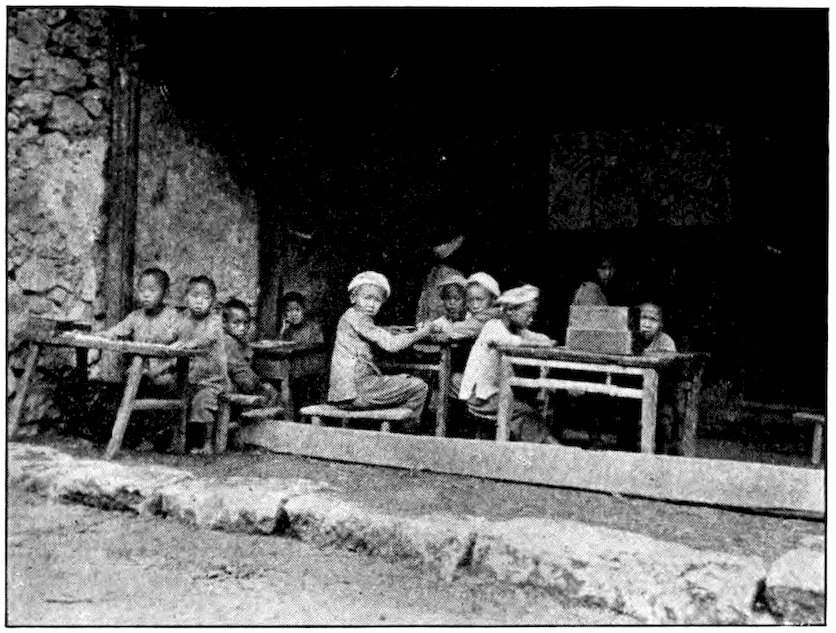
A Chinese school of the old sort. It has no front wall, though a main road goes past it and there is no “front yard” at all! How would you like to try to get lessons sitting out on the curbstone or on the edge of the highway? The old style of study consists in shouting Chinese classics, so as to memorize them, while the teacher sleeps or smokes.
If a Chinese wishes to ask whether a thing is good or bad he simply says, “Good not good?” For “A man riding a horse came down the lane,” he says, “Man horse come lane.” But that does not mean that Chinese is an easy language to learn well. The “tones” alone are harder than all our grammar, and most boys 145take from six to eight years to learn to read and write. So we should find it hard work to learn Chinese properly.
China now has many schools much like our own. The pupils study about the same subjects that you do, though of course they take Chinese history instead of American or European. They sit at desks like yours, have teachers paid by the government or the city, and use books similar to your schoolbooks, except that they begin at the back and read down columns from right to left.
Some American schoolbooks have been translated into Chinese. There are gymnasiums and physical training in some schools, though many Chinese boys seem to like to play checkers or ping-pong or croquet rather than baseball and football. There are manual-training schools and all kinds of technical high schools and several large Chinese universities. Boys and girls usually go to different schools, or at least to different classes, for the Chinese think that this is the best arrangement.
Out in the villages and in the far-away parts of the country there are still many of the old-fashioned schools which China had before the revolution. There the pupils usually sit on narrow sawhorses and shout all day long at the top of their lungs. The old style of teaching was to have the pupils memorize as many of the old Chinese classics as possible, and to write essays just like those that were written hundreds of 146years ago. If we had that system in our schools, you would have a book of Shakespeare or of some old philosopher before you, and each pupil would be reading in a different place and shouting different words at the same time. The teacher pays very little attention, unless the shouting dies down. Then he jumps up, perhaps with a switch or ruler, and sets everyone to shouting again.
Very few girls go to these old-fashioned schools. In fact most Chinese still think girls do not need an education. Millions of boys and even more girls, especially the sons and daughters of peasants and coolies and other poor people, never get to school at all. There are not yet places enough for them, and only in a few cities are children required to go to school if they or their parents do not wish it. In olden times, not so long ago, students were shut up in cells in great examination-halls when the time came to take their examinations. They were left there sometimes for two or three days, during which they had to write essays as much as possible like those in the old Chinese classics. No one was expected, or even allowed, to have any ideas of his own.
You would be very much mistaken if you thought that because millions of them cannot read or write, the Chinese are not intelligent. Even those who still have many of the ridiculous old superstitions are very bright and have a great deal of hard common sense. In fact I have seen many an “ignorant” Chinese coolie 147whose mind was much sharper than the minds of some Americans who go through high school and then read nothing much for the rest of their lives but a daily newspaper and now and then a cheap novel.
Compared to the number in our country, there are very few newspapers in China. Most of those are miserable little sheets that look like the handbills scattered about by our stores and theaters. But the Chinese get the news, for all that. They hear much of it at the tea shops where all the men gather. The women do not often go to such places, but many of them exchange gossip on the river-bank or pond-edge where they do their washing. Whenever I traveled through the country away from railroads and steamers I heard my mule-drivers or boatmen or carrier-coolies exchanging the news with those they met from the other direction everywhere along the way.
Tea shop gossip is, of course, hardly equal to a good daily newspaper, or to the better class of weekly and monthly magazines. There are no movies in most parts of China, either, and very few of our many other ways of telling people what they ought to know. That is one of the reasons why China cannot yet be a real republic, just as it is the reason why there is so much uncleanliness and unhygienic living and disease. If you have no way of showing people the truth you cannot teach them why they should brush their teeth every day and take frequent baths.
Some Chinese men and women, as well as foreign missionaries, are doing all they can to teach the poor people who have never had time to go to school or 148could not find room in one. In Taiyuanfu, the capital of Shansi Province, the “model governor” put up big billboards with one thousand of the most important Chinese characters painted on them. Rickshaw-coolies waiting for customers and women going to market can study these and perhaps in time learn them. Of course knowing only one thousand of the many Chinese characters is much like knowing only the words in one of our readers for first grade. But with that start many a coolie who has never been inside a school has learned to read at least the newspapers. Now the thousand-character idea is being used in many parts of the country.
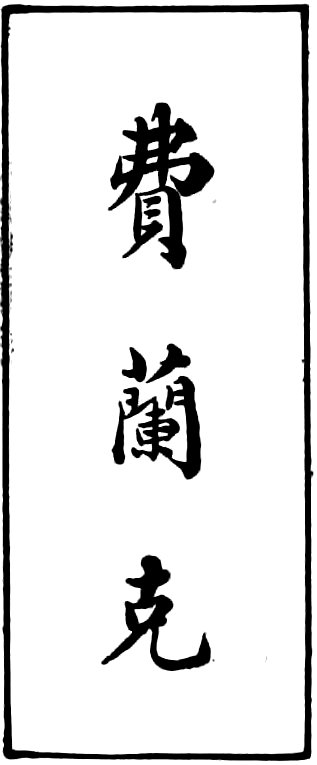
My Chinese name, Fei Lan-kuh.
Every foreigner who goes to China, by the way, should take a Chinese name. The Chinese cannot pronounce or even write our names in their characters. Besides, there are only about a hundred Chinese family names, and they are the only ones the Chinese recognize. My own Chinese name is Fei Lan-kuh. Fei is as nearly as the Chinese who have not studied English can pronounce my last name. They could no more read my real name on a visiting-card than you can read the one on my Chinese card. To the Chinese I was Mr. Fei. The character with that sound means extravagance, and Lan-kuh 149means orchid and self-control. But I do not believe the Chinese thought me either extravagant or flower-like!
Some Chinese and many foreigners have tried to make an alphabet that could be used instead of the thousands of picture-words it takes so many years to learn. But that is not easy, because even if you can invent letters to represent all the queer Chinese sounds you still have to find ways to show whether the word should be pronounced high or low, fast or slow, or in any other of the various “tones.” Besides, the Chinese say that if they stop using the old characters they will no longer be able to read their famous classics. They remind us that the boys and girls of Korea and Annam, where the Japanese and the French have introduced simplified books, can no longer read Confucius or any of the old philosophers. We should not like it if the English language were so changed that our children would be unable to read the great classics of our literature.
In olden times education was held in great honor in China. Those who stood highest in the old-fashioned examinations had the best chance of becoming high government officials. Coolies still consider a boy who goes to high school very far above them. Some students have taken advantage of this to start trouble against foreigners or against the government, but most of them are learning to take a really intelligent interest in the problems of their country.
150We must not forget that the Chinese invented gunpowder, the compass, printing, porcelain, and many other important things. They have thought out some of the greatest proverbs, some of the wisest philosophy that the world possesses. They are the most ingenious people on earth. If they have never become really inventive as well as ingenious, it is because there were always so many men ready to work for almost nothing that it was cheaper to get along, for example, with a windlass than to invent a windmill.
Would it not seem strange if certain foreign countries owned and governed parts of New York, Washington, St. Louis, and others of our large cities? Yet that is exactly the condition in China. Not only does England own the island of Hong Kong and a portion of the neighboring mainland, but the best parts of nearly all important Chinese ports belong to Japan, Great Britain, France, Italy, and other European countries. These foreign colonies in China are called “concessions,” because they were conceded by the old Chinese government, sometimes after wars between the foreign countries and China. Most of them were merely leased for a long term of years, rather than given. But they are really foreign colonies within China.
China did not want to open her doors to the West any more than Japan or Korea did. The Chinese thought all other peoples were barbarians; and they still do, to a large extent—just as we still sometimes call them heathen. So the emperors decided that it would be better if their people did not come into contact any more than necessary with the rude traders and seamen from the outside world. To begin with, therefore, the Chinese quite willingly allowed the 152foreigners to build up ports and cities on certain bits of Chinese territory turned over to the outsiders.
Many of the pieces of land leased to the foreign governments were so poor that the Chinese officials must have snickered to themselves when they gave them to the despised “barbarians.” Where the great modern foreign part of Shanghai now is there was little more than a swamp. The pretty little foreign business and residential island of Shameen in Canton was a patch of sand in the river, covered with water at high tide and with garbage or refuse at low tide. So it was with most of what have now become the most modern parts of many Chinese cities. In the beginning the Chinese thought they were holding the “barbarians” back by letting them live only on such pieces of ground. But now, seeing how much better off the foreigners are under their own laws in cities they have built for themselves, many Chinese wish that the concessions belonged to China.
There is at least one very good argument in their favor. If a Chinese politician or general or thief or murderer gets into one of the foreign concessions, the Chinese government cannot do anything to him. If he puts his stolen money into one of the foreign banks in a concession, the Chinese from whom he stole it cannot get it back. We naturally would not like it if France or England or China or any other country protected our criminals in certain parts of our own cities. So we are rather glad the United States has no concessions 153in China, except that Americans help to govern the part of Shanghai known as the International Settlement.
After the World War Germany and Austria and Russia lost their concessions in China, and also the privilege of trying their own people in China under their own laws. But if an American were to rob or kill a Chinese, or anyone else, in any part of China, he could not be tried by a Chinese judge according to Chinese laws and be shut up in a Chinese prison if he were found guilty. All the Chinese could do to him would be to arrest him and take him to the nearest American consul. If he were charged with only a small crime, the consul himself could try him. If it were something important he would have to be taken before the regular American court in Shanghai presided over by a judge appointed by the President in Washington. He would be tried by American laws, and if he were found guilty he would be sent to an American prison, perhaps in the Philippines.
Strangely enough, the Chinese themselves wanted the foreigners to have this privilege of extraterritoriality (as it is called), just as they wanted them to take the concessions. They did not care for the bother of trying to make the rough seamen and other “barbarians” who came to their ports behave themselves. They preferred that the “barbarians’” own governments should attend to such matters. It was much as if the boys of one school had gone to another school to 154play football. Naturally the teachers of the “home” school would rather have the visiting teachers look after the conduct of their own pupils.
But in time the Chinese discovered that this privilege of not being subject to the laws and officials of China was an advantage to the foreigners in the country, just as the concessions were. From every country go out bad as well as good men, and some foreigners took advantage of the situation to do things in China which they should not have done. Then consuls and judges have sometimes seemed too lenient in dealing with their countrymen. Besides, the Chinese say that it is not fair to a great nation like theirs to allow other peoples to have such privileges. It makes China “lose face.”
Yet even now the people of fourteen different nationalities, all European except ourselves and the Japanese, have extraterritoriality in China. Russians and Germans and Austrians, however, can be tried in Chinese courts and sent to Chinese prisons. Up in Manchuria I saw more than two hundred Russian prisoners in a Chinese penitentiary, and at least one of them was afterward executed. There were two or three Germans in prison in Peking, and a few in other parts of the country. Now many of the Chinese are demanding that all foreign nations give up legal privileges, as well as concessions. But foreign governments say that it would not be fair to their people living in China to do this until Chinese courts become less corrupt and more independent of local dictators, and until Chinese prisons are improved.
You would probably be surprised, as we were, to find how many foreigners live in China. There are thousands of Americans, to say nothing of all the other nationalities. Perhaps half of these are business men, many of them living in Shanghai. Some of them are interested in the Chinese people, but too many are interested only in the money they can make out of them. When they leave their offices they go to their own clubs or parks or golf-links, where no Chinese are admitted except as servants. Many of them never learn to speak Chinese, even though they live in China half their lives. In fact some who were born there cannot do so. They talk to their servants and clerks and rickshaw-men in pidgin-English, which is a dreadful “language” made up of Chinese sentences translated into words that are really not English at all. “Master no wantchee catchee sampan chop chop” is the way they would say, “I do not wish to take the boat yet.”
If any of you ever go out to China to represent an American company I hope you will not look down upon the Chinese as some business men do. Parts of China are made as ugly by advertising billboards as many of our own roads and railroads are at home. Some foreign companies even paint their advertisements on temples and city walls. When they receive such treatment, it is no wonder that the Chinese occasionally call us Yang-gwei-tze or Fang-gwy-lo, that is, “foreign devils.”
There are at least ten thousand foreign missionaries in China, more of them Americans than of any other one nationality. They learn Chinese, study Chinese history, and take much interest in the people. Chinese temples are everywhere, but there are now many churches also. I do not remember a single large city anywhere in China that has not at least one church and a foreign missionary or two. Some have many more than that. Great establishments, such as schools, hospitals, and universities, have been built by foreigners in Peking and in nearly all the provincial capitals. Hard-working American and British and other men and women go about the country holding services in the villages and curing sick people.
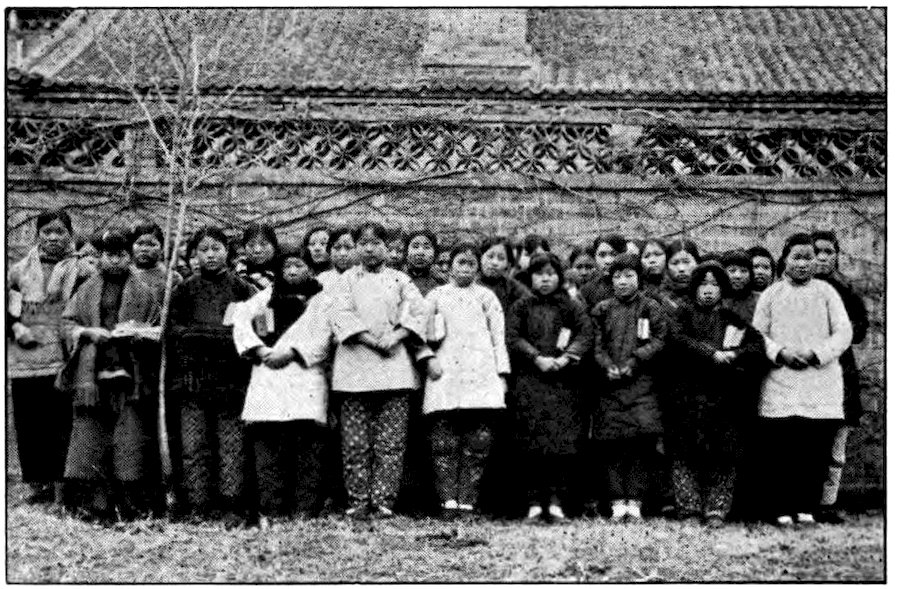
High school girls who are attending an American mission school in Shantung Province. They are not allowed to have bound feet.
157In the olden days missionaries suffered hardships in China. They lived in miserable Chinese mud-brick houses and ate poor native food. Often they caught dreadful diseases and sometimes they were mobbed and even killed. But now nearly all of them live as comfortably as they could at home. They build good foreign houses, eat their own kind of food, and have more servants than they could possibly have in the United States. Of course some things are not so pleasant as they are at home, but others are more so. Missionaries living far back in the interior still sometimes have to rough it. I spent two days with a French priest who had lived all alone in a miserable little Chinese city for twenty-five years. He had never been back to France and expected to die at his post. Most Protestant missionaries go home for a year every seven years, and they usually have their families with them.
Although foreign missionaries have been working among the Chinese for nearly a hundred years there are by no means as many Chinese Christians as there are Chinese Mohammedans. Yet it must be very interesting work to be a missionary in China. A doctor or a teacher, especially, should get great satisfaction out of helping the Chinese, for in some things they are not yet able to help themselves.
Many Chinese are now objecting to mission schools. They say that every country should control its own schools. They believe the children will lose their patriotism for China and become attached to the countries their missionary teachers come from. They ask 158us if we would like it if Chinese started schools for American boys and girls in the United States and tried to make them Buddhists or Confucianists. However, China herself has not yet built enough schools for all her children.
There are Chinese Christians who wish to establish a Chinese Church also, and quite a number of missionaries agree with them. They say that they should pay their own way in religious matters as well as in any other. They cannot see any good reason why they should be divided as Methodists, Presbyterians, and so forth just because Christians in America and Europe are so divided. The time may perhaps come when nearly all Chinese Christians will join together to form a true Chinese Church.
China is so large a country that what is true in the north is often not true at all in the south, nor perhaps even in what is called Central China, the basin of the Yang-tze Kiang. This “Son of the Sea,” as its name means in English, cuts China in two much as the Mississippi does the United States. But instead of flowing from north to south, it flows from west to east. Rising among the lofty mountain ranges of Tibet, it runs clear across China proper to the Pacific Ocean. It is more than three thousand miles long, considerably longer than the Mississippi, and with its many branches it drains fully as much territory as our own greatest river.
Yet though most foreigners think so, the Yang-tze does not exactly divide northern from southern China. The real dividing-line is farther north, about at the thirty-fourth parallel of latitude. In crossing that invisible line on our way south by railway, either from Peking to Shanghai or from Peking to Hankow, six hundred miles up the Yang-tze, we shall see an almost sudden change in the life and realize how much difference is made by climate. There will be no more camels; no more “Peking carts” bumping along on wheels having sharpened spikes for tires; no more 160wide roads. We shall see narrow trails winding through the rice fields, wide enough only for men on foot or for wheelbarrows.
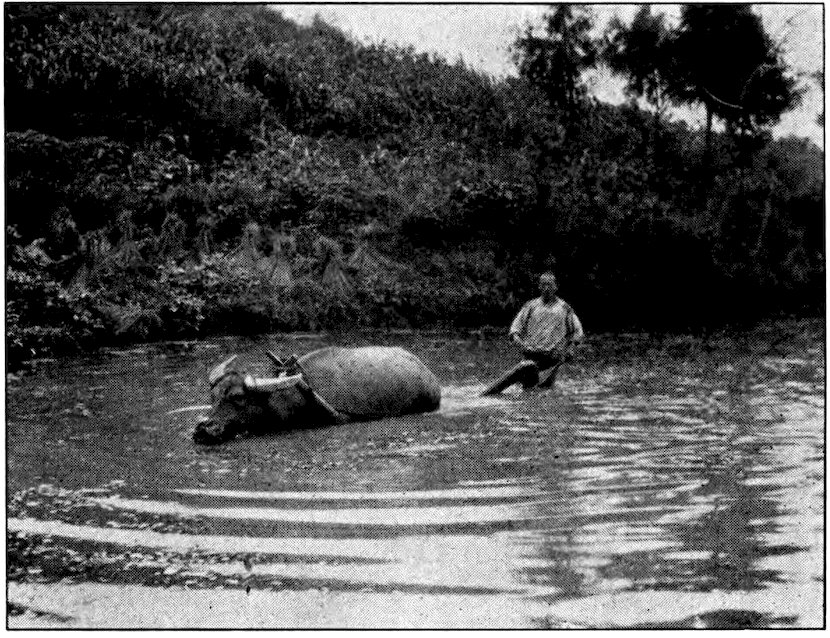
Plowing a rice field is not exactly fun for the man, but the water buffalo seems to enjoy the muddy, flooded field.
Even the most important “roads” of southern China are seldom more than two and a half or three feet wide, though often they are paved for hundreds of miles with broad slabs of stone. The carrier-coolie, usually with his load at the two ends of a springy pole, carried over the shoulder, is the chief beast of burden throughout southern China. I have had coolies tell me that this is an easy way to carry heavy loads 161because, since the load bounces up and down as they trot, they really feel the weight only half the time! At any rate, they become so used to carrying things that way that if they have load enough for only one end of the pole they put a stone, or perhaps a little boy or girl in a basket, at the other end. Often it is easier for a Chinese to carry two of his small children than one, especially if he has twins!
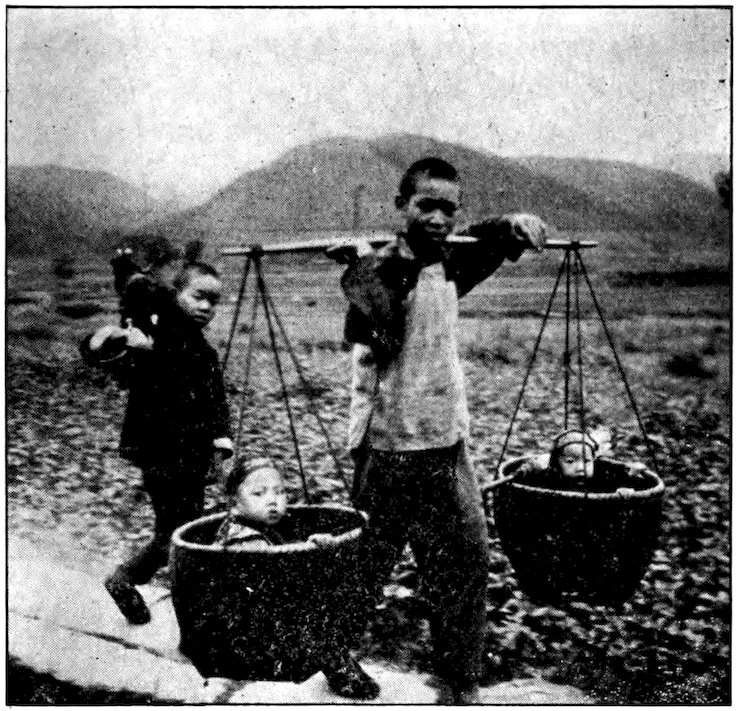
Men in China are so used to carrying everything hung by long cords from the ends of a pole that they often take the baby to balance some other load. Or, if they have twins to take for a ride, it is very easy to carry them in this way.
Instead of the kaoliang and millet and wheat of northern China we now find rice growing everywhere. 162Along with the flooded rice fields comes the water-buffalo, the carabao of the Philippines. He loves to wallow in places where rice grows, only his eyes and nostrils above the surface of the water. Though the line between northern and southern China is not marked on a map, it is so distinct that I know places where wheat grows in one field and rice in the next one.
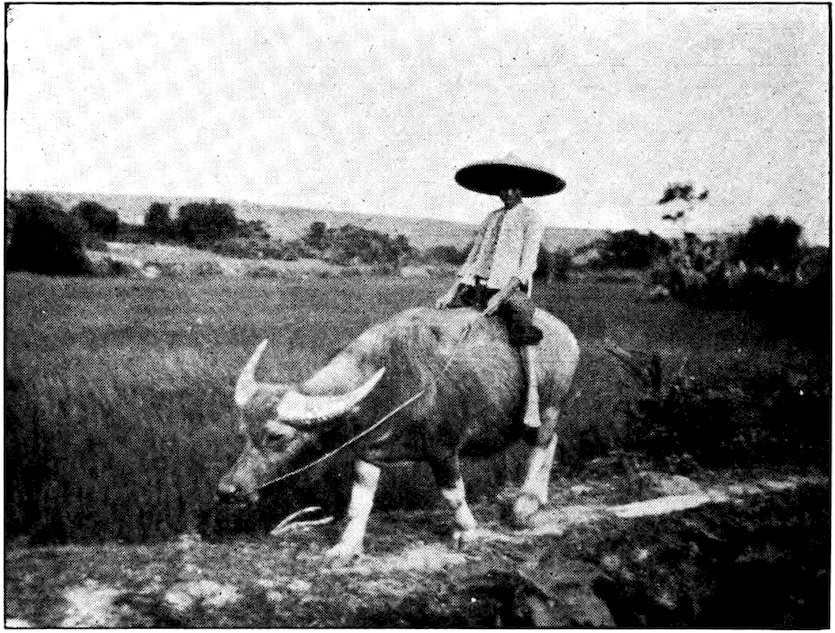
The boys, and some of the girls, in southern China ride the water buffaloes to keep them out of the rice fields while grazing along the dikes. A Chinese boy learns to sleep soundly stretched out on the animal’s back, but it is hard to see how he can do that and be really “on the job” too.
Most people who visit China land at Shanghai and perhaps think of that as the most important Chinese city. This is not true, although it is the most important 163“foreign” city in China. In the International Settlement or the French Concession you can almost imagine yourself in some big American city; and it is the foreigners rather than the Chinese who rule it. Yet there is a big Chinese part of Shanghai also, an old city that was once walled, where things are much the same as they are a thousand miles from any foreign concession. At the end of the electric car lines built for the foreign sections, passengers often transfer to wheelbarrows which bounce them away over roads almost as bad as those in the far interior. As a port, Shanghai leads all other cities of the Far East.
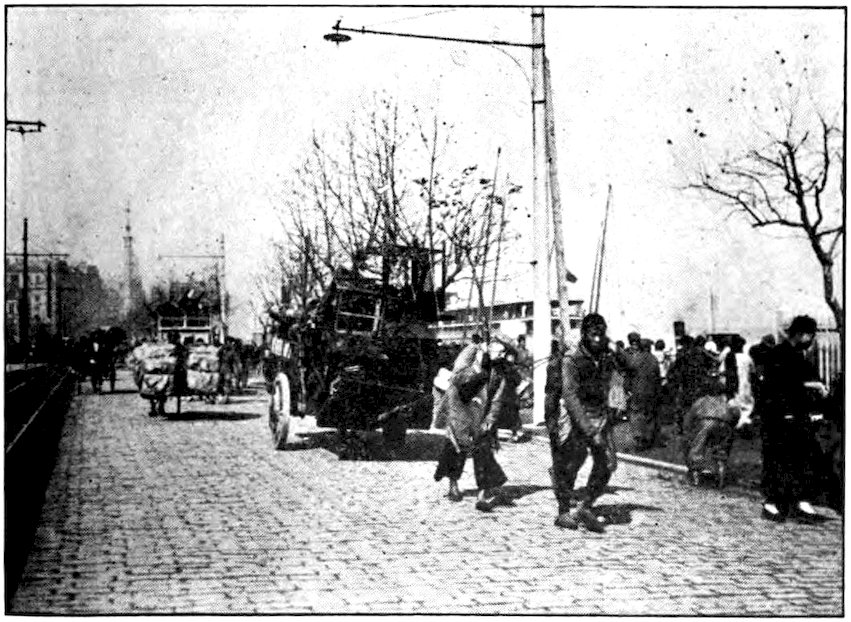
In many ways, Shanghai is a very up-to-date, modern Western city, but, as appears here, men still do much of the work that horses or trucks would do in our country.
Shanghai is not on the Yang-tze, but on a branch of it called the Whangpoa. Yet all the big steamers going 164up the “Son of the Sea” start from there. Many of these steamers are British or American or Japanese; indeed, one of the complaints of the Chinese against foreigners is that they were forced to make a treaty allowing anyone to use their great river. The United States does not allow foreign boats to carry freight or passengers on the Mississippi, you know, or even between the ports on our coasts.
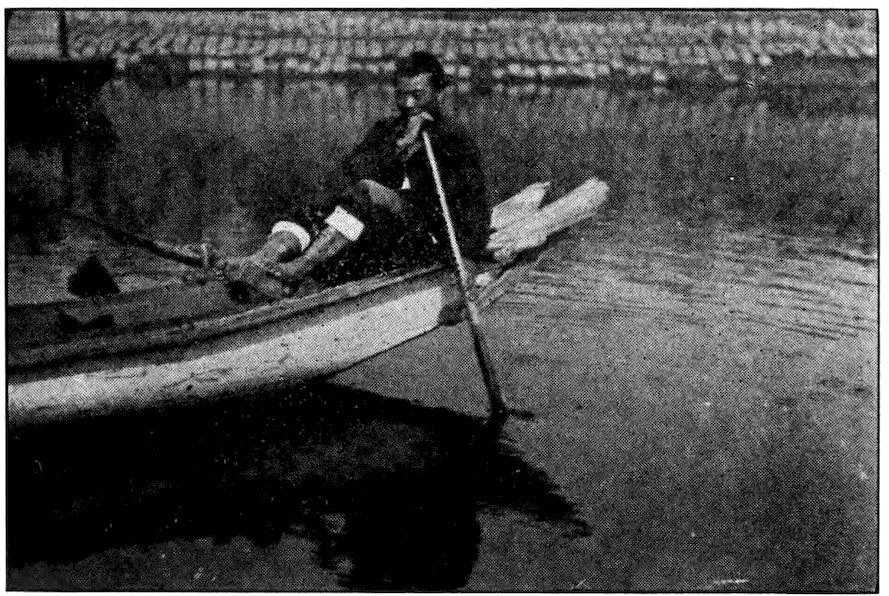
This is a scheme that beats the “daily dozen.” Boatmen around Shaohsing, which is across Hanchow Bay from Shanghai, row with their feet and paddle with their hands, at the same time. They can keep this up for twenty-four hours at a stretch.
Two cities we must not fail to see before we go farther inland are Soochow and Hangchow. Both of them are on the Grand Canal, though not exactly on the Yang-tze itself. They are famous old cities with 165many canals and queer high-arched stone bridges, and the Chinese have a saying that they are the most beautiful places outside of heaven. I doubt, however, whether you would think them so very beautiful, and I am sure you would not find them clean enough to be called heavenly.
The Grand Canal, by which the people of southern China sent their taxes in rice to Peking for hundreds of years, crosses the Yang-tze at a pretty place called Chinkiang. The canal goes on northward and the river takes us to the west. Almost at the junction is the famous old city of Nanking. Its name means “southern capital,” as Peking means “northern capital.” But though it has been the capital of China at various times during the past two thousand years, like several other cities, it is now only the capital of a province. If it filled all the space inside its great wall, it would be one of the largest cities on earth. But it was almost destroyed several times during various wars, especially in the war against the Taiping rebels, about the time of our Civil War. We rode for miles through hilly country even after entering the city gate, and found Nanking itself down in the southern end of the inclosure—much as if it were a peck of potatoes left in a two-bushel sack.
We can travel to Nanking from Shanghai either by railroad, in about five hours, or by steamer. On the river we shall pass modern cotton-mills and other proofs that China may in time become a great industrial nation of factories, like Japan or the United States. But as we travel farther we shall discover that 166the great mass of the Chinese still work in little groups, often in their own houses, and that they are still in the family stage of industrial development, just as Western peoples were once—and not so long ago, either, as world history is measured.
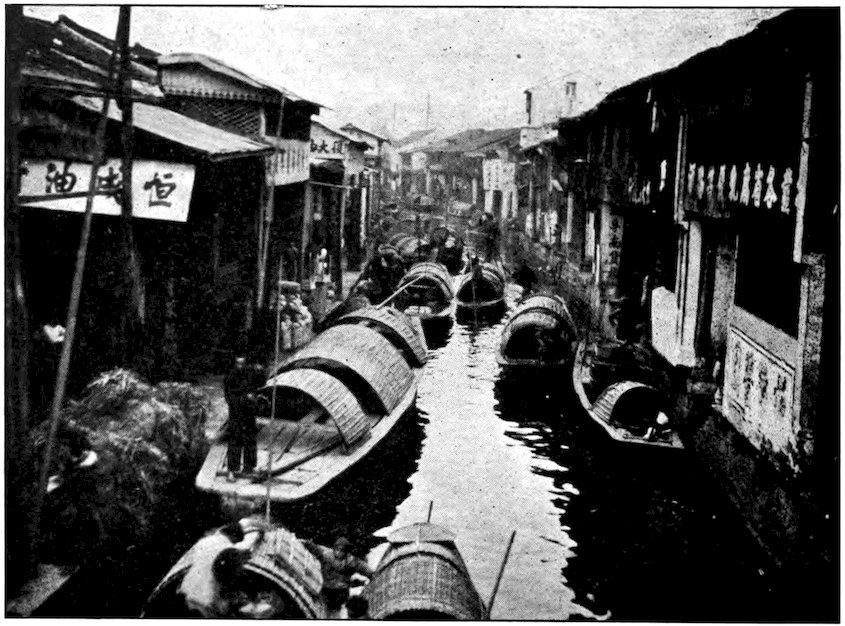
A “street” of Shaohsing which, like many cities of southern China, somewhat resembles Venice in having many canals. These water-streets, if not so beautiful as those of the Italian city, are certainly picturesque.
As we plow on up the Yang-tze, so wide that sometimes we can see only one of its low flat banks at a time, we do not wonder that the Chinese named it “Son of the Sea.” Besides the big foreign steamers, as comfortable as those crossing the Pacific, there are thousands of native craft. Sometimes a hundred sails are in sight at once; near at hand we see that they have ribs of bamboo which remind us of the lines on a sheet of writing-paper. Many of the boats or junks have an eye painted on each side of the bow, usually protruding like the eyes of a fish. The Chinese think that a boat needs to see its way just as a man or an animal does.
There are many smaller boats also on the Yang-tze. Some are what we call sampans, which in Chinese means “three boards,” and that is about all some of them are. The fishing boats crawl along the shores and sometimes go far out into the stream. Some are rowed by an old man or woman, or even by a boy or two, while at the bow stands a stronger man with what looks like a huge pair of scissors made of bamboo. He thrusts the crosspieces and attached net down to the bottom, closes the “scissors,” and draws them in again. If he catches a fish, or anything else good to 168eat, he dumps it into the boat. Generally he catches nothing, but he goes right on working as fast as he can without really hurrying. As I have said before, the Chinese think it undignified to hurry. Along some of the canals of China we shall find men lifting weeds and slime off the bottom with these scissor-like implements; nothing is wasted in China, and the stuff collected makes good fertilizer.
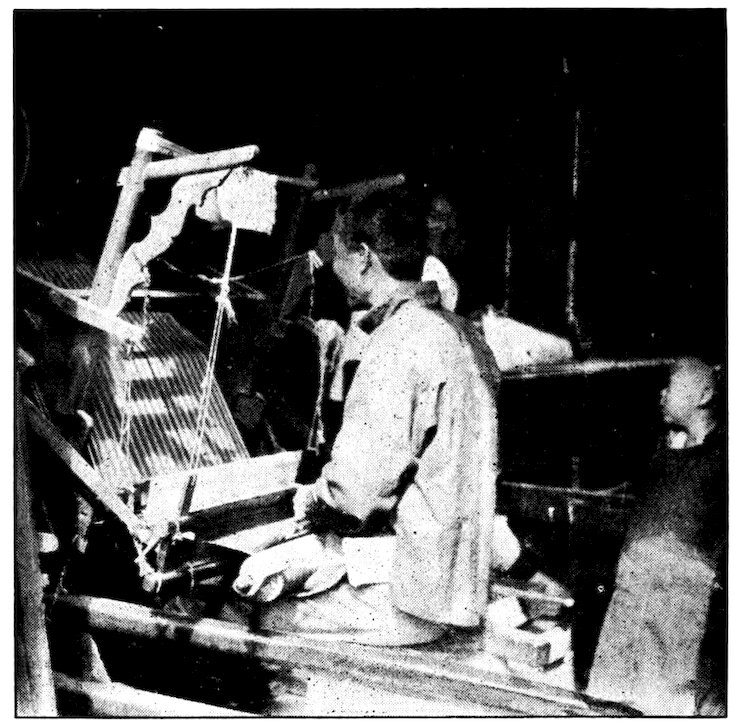
Thousands of Chinese cloth weavers work in little dens like this. Often they eat at their loom, and sleep on a board or mat underneath the crude wooden machine. Yet these workmen do not seem to think their lot a hard one.
The more common form of fishing-boat along the Yang-tze and in many other parts of China is a raft, 169usually anchored at the shore. A little hut made of grass and reeds shelters the fisherman, and a long square dip-net, much like the one we sometimes use, held open with a bent bamboo fastened to each of its corners, is balanced at the end of a long pole. Now and then the fisherman pulls up the net by hauling the inboard end of the pole down to him in his hut. Even such nets do not seem to catch many fish, but no people have more fisherman patience than the Chinese. They even fish in little ponds about the towns, and fix rows of poles so as to spoil the net of anyone who tries to catch their fish at night.
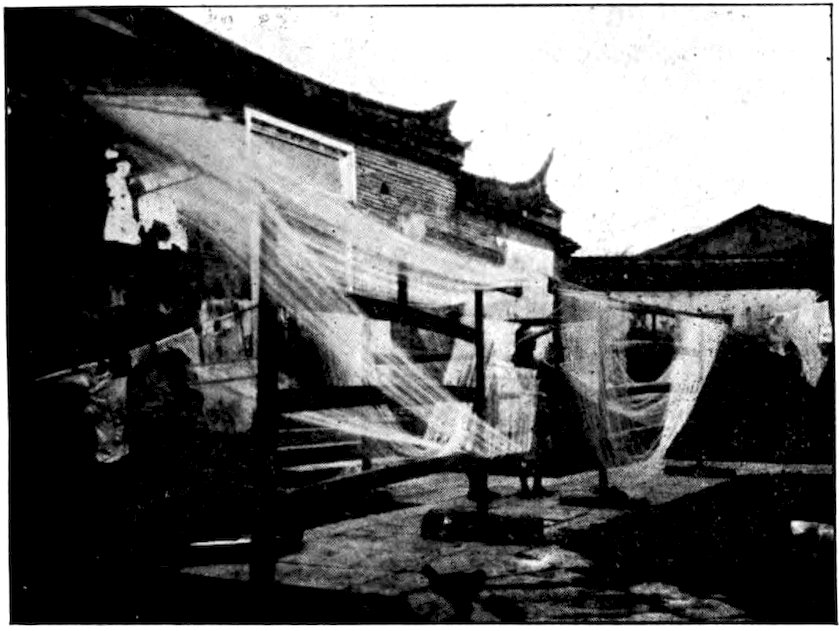
Silk thread hung out in a yard to dry before being woven into cloth. The making of silk is one of the most important industries of China, but it is nearly always a home-and-family, rather than a factory, industry.
170Several times we saw big flocks of ducks being driven across the river. Two men in small boats each had a long pole with a lash on its end. They hit the water with the lashes to make the ducks go the way they wished. I have seen hundreds of these duck-herders driving their flocks over hills and through swamps and rice fields looking for feeding grounds, or bringing them home again at night.
Even beggars have boats on the Yang-tze. Some, in miserable “three boards,” paddle up close when travelers stop, and beg for the rice that has been left over from the last meal. If they see a stick of wood in the river, or anything else they can possibly use as fuel or food or for any other purpose, they hurry after it and fish it out. Some of these beggar-boats make one think of big washtubs, and nearly all contain whole families, the children lying about on bundles of rags that serve as bedding. More than once I saw a man in a tub hardly as large as those we use on wash-day, paddling himself about with two pieces of board smaller than tennis-rackets. In ponds about Nanking and along the Yang-tze a man or woman, or a child, sometimes goes out in one of these tubs to pull up water-chestnuts from the bottom. The Chinese eat these, as they do almost anything, although from them, the missionary doctors say, comes one of the worst native diseases.
The Chinese never really row a boat. Sometimes a dozen or more men stand at the front, facing forward, 171and push at long oars. But the more common way is to scull, just as the gondolier of Venice does, with a single oar sticking out behind, its inboard end fastened to the deck with a piece of rope. All over southern China there are families that have no other home but their boat. They are born, grow up, marry, and die on boats. Most of them have an altar to their ancestors taking up the best part of their floating home. The women handle a boat just as well as the men do, and baby sleeps serenely on mother’s back while she sculls.
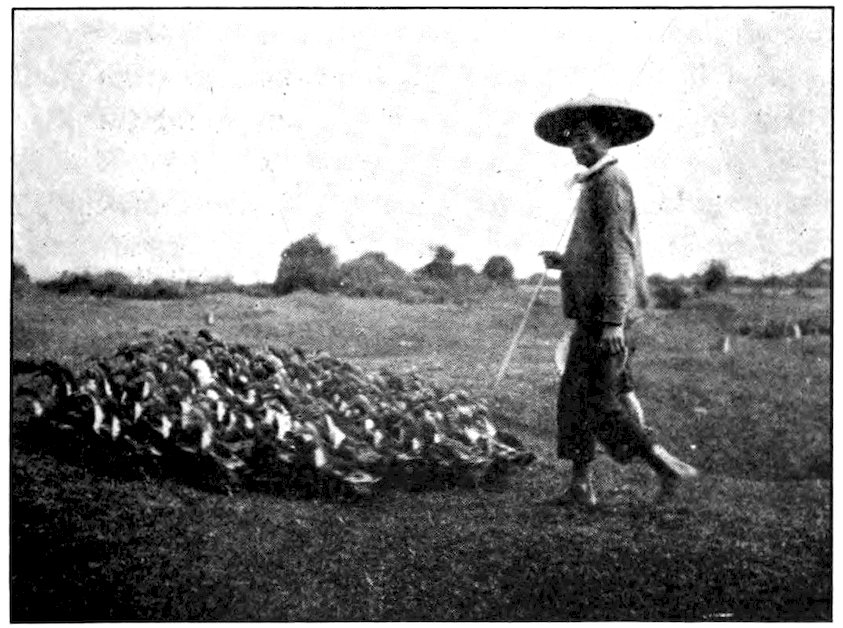
The duck herder, driving his flock to a place where they can pick up food, is a very common sight in China.
There are a number of large cities along the Yang-tze, but the big foreign steamers dock at only a few of them. At other places, such as Anking, capital of the 172province of Anhwei, passengers landing have to jump into small boats sculled out from the shore. Those who wish to board the steamer scramble, somehow, with many shrieks, onto the lower deck. Often baggage is lost in the confusion, and sometimes passengers are drowned.
Outside its walls Anking has a pagoda that looks quite new, but like nearly all pagodas in China it is about a thousand years old. A pagoda is supposed to protect a town from evil spirits, and sometimes it has another use, as is the case with that at Anking. The Chinese imagine that this city is a boat, and think that its two pagodas keep it anchored. The second pagoda is only the shadow thrown across the river by the real one at sunrise. Now, unless they wish to float away and live somewhere else, you would think that the people of a town that is a boat would be careful to keep repaired the pagoda that serves it as anchor. But the people of Anking either thought they would be better off somewhere else or they grew very careless. They allowed their pagoda to fall almost into ruin. Finally a rich Chinese rebuilt it, in gratitude for having been kept from sailing on a steamer that sank during the voyage he had planned to make on it.
Not far from Anking is a sacred mountain called the Chio Hwa Shan, or Nine Flowery Mountains, because of the strange form of its peaks. I climbed to the cluster of temples and monasteries at the top, along with hundreds of pilgrims. But as we shall 173climb even more famous sacred mountains before we leave China I shall not take time to tell you much about this one. Kiukiang, the next important city above Anking, is partly a concession belonging to foreigners, like Nanking and Wuhu. From the river the walled city of Kiukiang along the bank looks very picturesque, but when we land we find only the foreign part of it clean enough for an enjoyable walk.
Higher still, six hundred miles up the river, are the triplet cities of Hankow, Hanyang, and Wuchang. Together they have nearly as large a population as Chicago. Hankow is a foreign concession, with some six- or eight-story buildings, modern streets, and a wonderful foreign club with everything from golf to cricket, from horse-racing to swimming-pools, where the many foreign residents come in the afternoon and evening to hear band concerts and enjoy themselves even more than most of them could at home. Just across a creek with hundreds of native boats on it are the great steel mills of Hanyang. The Japanese have a strong influence in the control of these mills as they loaned money to build them. Across the Yang-tze is Wuchang, a big Chinese city and capital of an important province. Here began the revolution of 1911 that drove the Manchu emperor off the throne at Peking and gave China the name of a Republic.
Foreign and Chinese steamers go on up the “Son of the Sea” a thousand miles more, but they are smaller steamers than those between Hankow and Shanghai. 174That part of the great river is often beautiful and much more interesting than the wide lower Yang-tze with its flat shores. We shall see it when we come down from far western China at the end of our Chinese travels. Now we will return to Kiukiang and climb to Kuling, a foreign city. Here my family and I spent the summer with more than three thousand other foreigners. There were at least twenty different nationalities in that foreign community, and China has no more to say about governing it than it has about governing Kansas City.
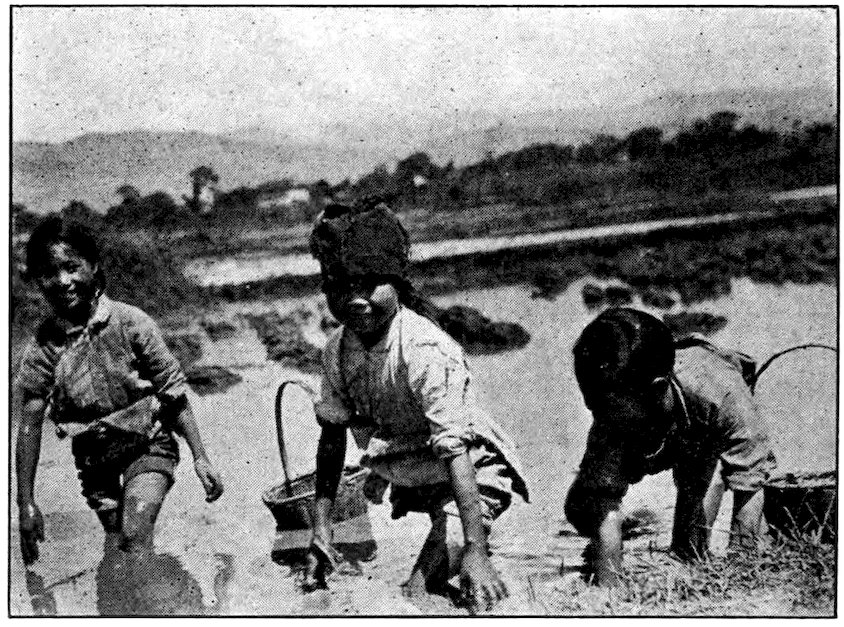
When a rice field is plowed, the children follow and gather a certain kind of snails which the Chinese consider good eating. It doesn’t seem to be very hard work for these youngsters, who probably get the same kind of pleasure from the task as American children would in making mud pies or sand forts.
We could easily imagine ourselves in an airplane when looking down upon the great Yang-tze plain from Kuling, four thousand feet above it. Most of the summer the river was so full that it overflowed its banks and flooded much of the surrounding country. But we could still tell which was the real river, by the darker yellow of it, as it wound away across the green country like a gigantic snake. On the other side of our mountain we could look down upon the great lake of Poyang, the largest in China. The Tung Ting Hu, farther up the Yang-tze, is sometimes called the largest; but it is so only when the flooding Yang-tze fills it during the summer.
Far away across Poyang Lake lies a city that ought to be more famous than it is, for it is the china-town of China, where nearly all the best Chinese porcelain has been made for hundreds of years. Yet many foreigners who know that the most wonderful porcelains on earth have always been made in China have never heard of Kingtehchen, and millions of Chinese themselves do not know its name. That is what comes of a city’s being so far away from a railroad or any other modern form of transportation that only those who are willing to endure hardships can reach it. As the 176crow flies it is only about a hundred miles from Kuling to Kingtehchen, but it took me longer to get there than it does to go from New York to Salt Lake City.
First of all I had to descend the mountain, this time on the lake side. I had found a coolie, who carried my cot and bedding and some cans of food and other baggage, and who boiled my eggs and did other simple cooking for me along the way. He thought that seventy coppers a day (fifteen cents in our money) would be about the right wages. On the way down the narrow trail, steep as a stairway, we met many other coolies, such as we had seen climbing to Kuling all summer.
Everything that goes up there has to be carried on men’s backs, whether it is a trunk or a barrel of cement or the timbers as big as telegraph-poles that are used as beams in the foreign houses. We passed long trains of these coolies, each with two great poles tied together in V-shape over his shoulders. Almost all foreigners and wealthy Chinese who come to Kuling are carried up in chairs. The coolies were naked to the waist, with streams of sweat running down their sun-browned bodies. Yet when they stopped to rest, leaning the ends of their poles against the mountain side, they seemed to shiver, though we had often found Kuling too hot.
I have made many difficult trips in various parts of the world, but I do not remember a short journey that was as hard as that tramp to Kingtehchen. We might have gone by boat along the lake and up a river, but no one knew how long that might take. So after 177crossing the lake by sampan, we found one of those flagstone roads that wind through rice fields in southern China. Though hardly three feet wide, it dropped so suddenly into the muddy fields on either side that we had to walk on the stones all the time. You can imagine how hot it was, in the middle of August, with never a cloud in the sky or a tree along the way; for we were as far south as Georgia.
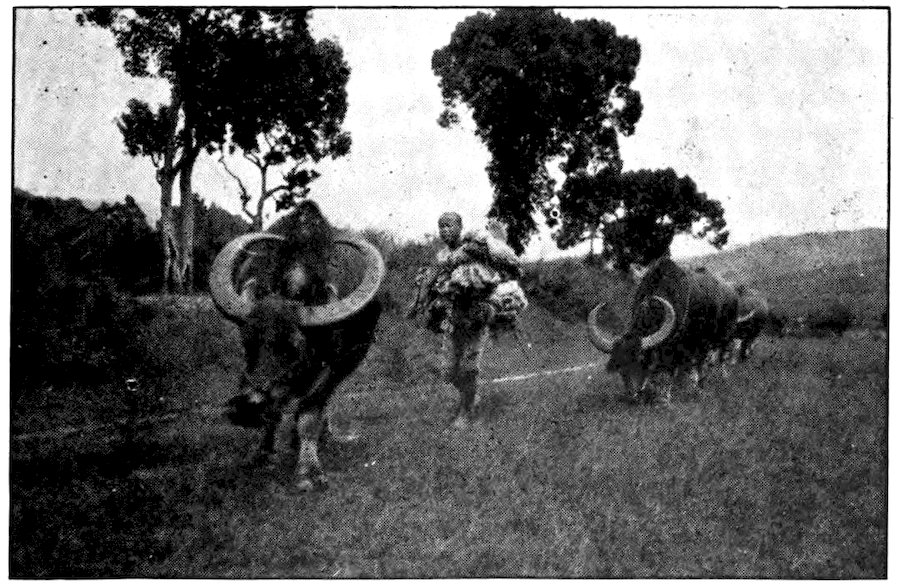
Did you ever hear of buffaloes wearing straw sandals? The driver is carrying a supply of such footgear for these water buffaloes. The animals’ hoofs are so soft that when a long trip is taken the sandals are put on them for protection.
To make matters worse, much of the country was flooded. I waded all one day and part of another, in water often above my knees. If you have ever tried that, you know how it makes the thighs ache. My bare 178feet slipped on the slimy stones of a road which squirmed about almost invisible beneath the water. If I stepped off the edge I went up to my waist in mud. Once I split a toe-nail, but luckily it did not become infected. Before the trip was over I had a dozen blisters on my feet, and my legs ached from pounding the hard stones and ploughing through the water all day.
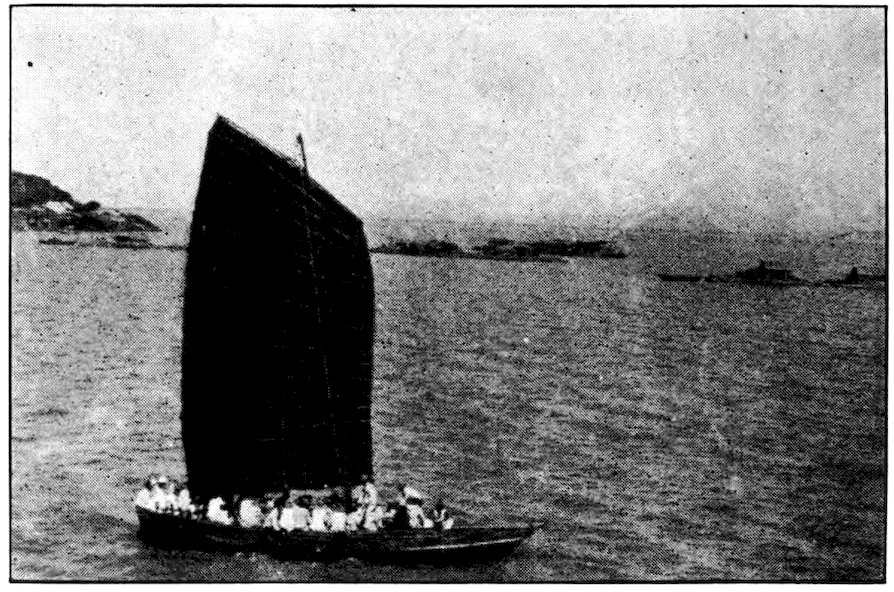
A crowded passenger boat on Lake Poyang, the largest lake in China. You will notice that the one big sail has many parallel ribs, made of strips of bamboo, to keep it stiff.
The first night I stayed with an English customs officer in a town at the edge of the lake. I was so hot from the walk that I might have been wakeful anyway, but the hubbub kept up by the night watchman made sleep quite impossible. For hundreds of years Chinese watchmen have made their rounds pounding sections of dried bamboo that sound like drums, or clashing pieces of iron together, or shouting at the top 179of their lungs. Some of them, like this watchman, do all these things at once. They say it is to prove that they are awake and on the job, but I suspect it is partly to give warning in time, so that they will not have to fight thieves and robbers. Can you imagine one of our policemen going about town pounding a drum or blowing a whistle all night?
The other nights I slept outdoors, putting up my cot with its mosquito-net on some corner of the narrow road, and once down on the bank of a river. The Chinese never sleep outdoors at night, if they can help it, no matter how hot it may be inside, and when traveling they always stop at the largest, noisiest, and dirtiest town they can find instead of out in the pleasant country. My coolie was horrified at my foolishness, and all the people for miles around came and stood near my cot half the night, talking about the “crazy outside-country-man.” In fact I was often pointed out along the way as the queer fellow who risked being moon-struck or killed by the evil spirits that fly at night.
It was harvest-time, and all day long the dull thump! thump! thump! of the threshers sounded in our ears. Instead of using reapers or binders and threshing-machines the Chinese cut their rice by the handful with a sickle and then beat out the heads of it into a big wooden box so heavy that it usually takes two men to carry it from field to field. Often there were four men at one box, each pounding on a different side of it and making a sound as regular as do several men with sledges working at the same blacksmith’s anvil.
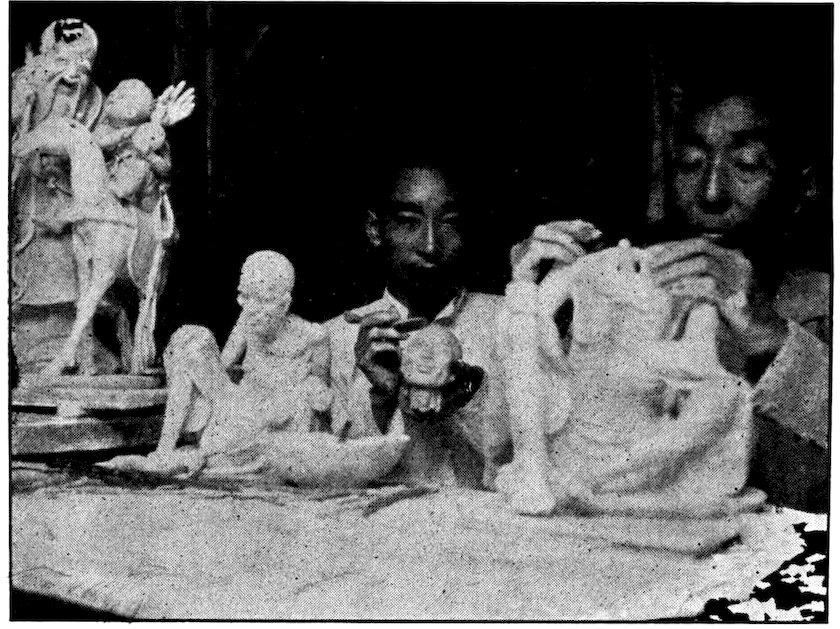
This father and son of Kingtehchen are noted for the porcelain figures they make. After the figures are baked, they are covered with bright colors and baked again.
We reached Kingtehchen on the fourth morning and found it a very large, crowded, and busy town, with streets as narrow as they were a thousand years ago. It stretches five miles along the inner curve of a shallow river, and the bank is twenty or more feet high because broken china has been thrown out upon it for centuries. Walls and every other possible thing are made of porcelain dishes that melted together in the kilns or were broken or otherwise ruined in the making. Yet much rubbish remains unused.
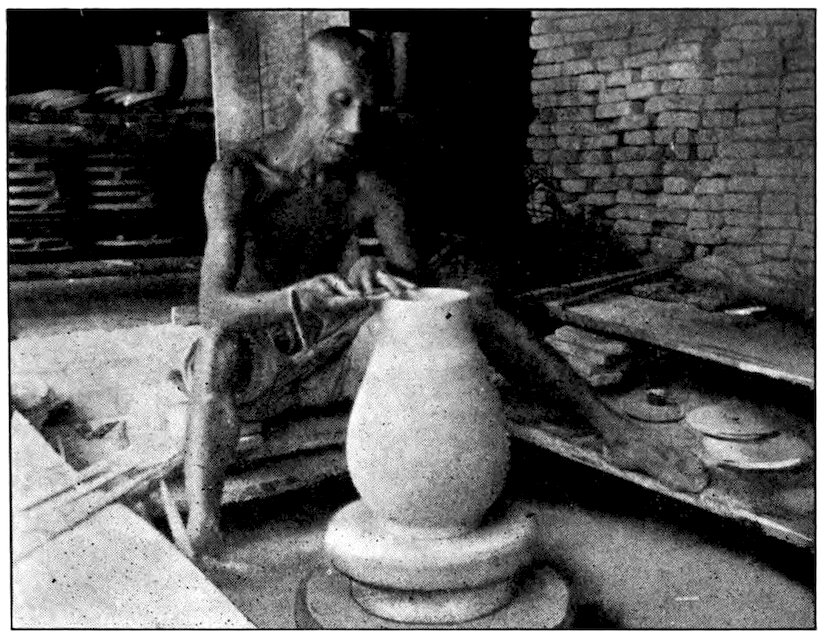
An old potter of Kingtehchen, the china-town of China, who has worked in a porcelain factory since he was a boy. He throws a lump of clay upon a horizontal disk, or “wheel,” makes the wheel revolve, and “shapes up” a vase or bowl from the whirling mass of clay, using his fingers and a stick.
Almost everyone in town above the age of six or eight works in one way or another in the manufacture of porcelain. Hundreds of families make china dishes in their own homes, but there are also some larger factories. The most important establishment used to make porcelains for the emperors, and the manager of it showed me some of the most magnificent vases and delicate porcelain things I have ever seen. Hundreds of men do nothing all their lives but carry loads of pine firewood on their shoulder-poles from the boats that bring it down the river to the kilns where the dishes are baked. Sometimes as many as six thousand dishes are stacked up in a single kiln, where they are baked for about thirty-six hours.
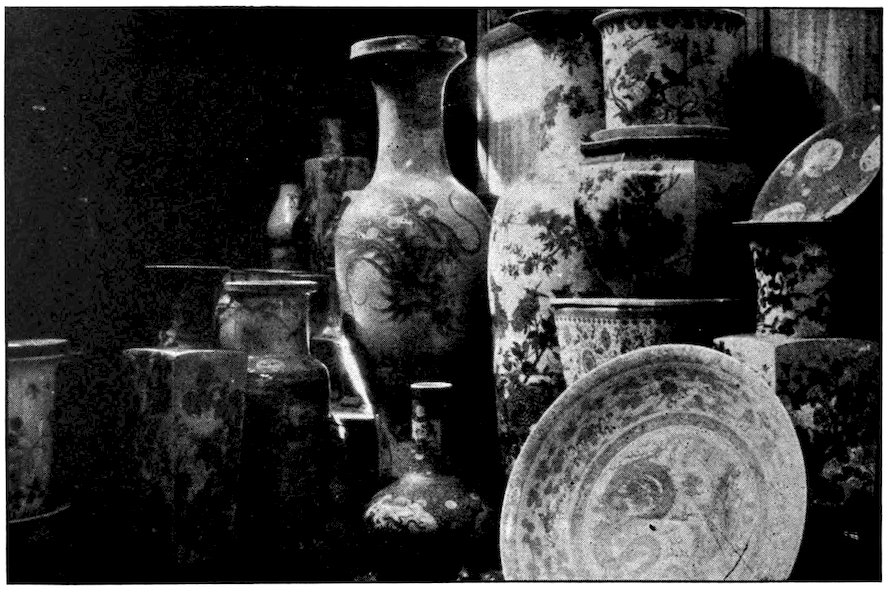
These vases and other porcelain articles represent the finest work done by the skilled potters of Kingtehchen, that fascinating city far off the beaten track of travel.
183During that time the kiln-boss never sleeps. He tells whether the fire inside is hot enough by spitting into the hole where the tons of pine wood have been thrown. Nearly everything else is done in the same primitive, old-fashioned way. For instance, the “biscuit,” as the unbaked dishes are called when they are still soft clay, are carried through town to the kilns on boards which are balanced on men’s shoulders. These men become so expert that they can make their way with a board on each shoulder through the narrow crowded streets of Kingtehchen without once having an accident. There are a few rickshaws in the china-town, but they are not allowed to operate until after four o’clock in the afternoon, because they would interfere with the “biscuit” carriers and the other thousands of carriers racing back and forth to do their part in giving to the world the famous porcelains of China.
Nearly all the best things made in Kingtehchen go down the river by which I returned to the lake. There were whole junk-loads addressed to an old Chinese firm located in New York City. The river is so shallow on account of the broken china that has washed down it during hundreds of years that the boatman of our sampan had to wade and push most of the twenty-four hours. The dirty old steam-launch that carried me across the lake towed six fantastic old junks which reminded me of the ships of Columbus. They were all piled so high with porcelains packed in rice-straw and boxes that they looked doubly strange in the full moonlight.
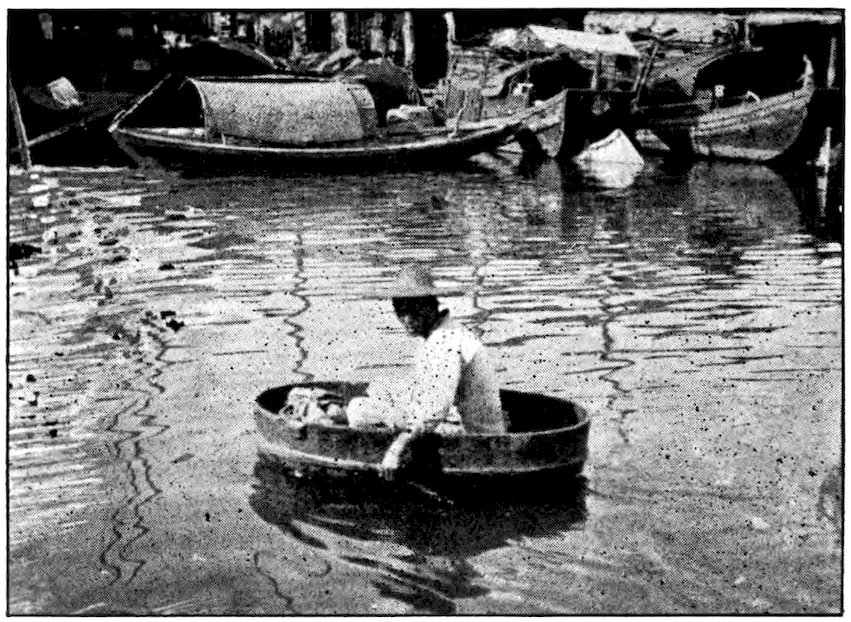
Not “three men in a tub” this time, but only one; and perhaps the result will not be so tragic as when the three wise men of Gotham went to sea in a bowl. Certainly, in China, one sees a great deal of boating of this sort. The man shown here was paddling himself about the harbor of Jaochow on Lake Poyang, picking up anything that he could use for food or otherwise.
There are many cormorant fishers on Lake Poyang, and in other parts of southern China. The small boats they use have a pole perch along either side, and on these sit the silly birds who do the fishing. The instant a cormorant sees a fish in the water it dives, coming up with the fish in its beak. The bird would like to swallow the fish, or at least drop it into the great neck pouch which every cormorant possesses, until there was time for a meal. But the bird’s owner has put a ring around its neck, so that it can do nothing but drop the fish into the boat. Yet the cormorant 185goes on fishing all day long, and all it gets from the man is now and then a few of the smallest fish.
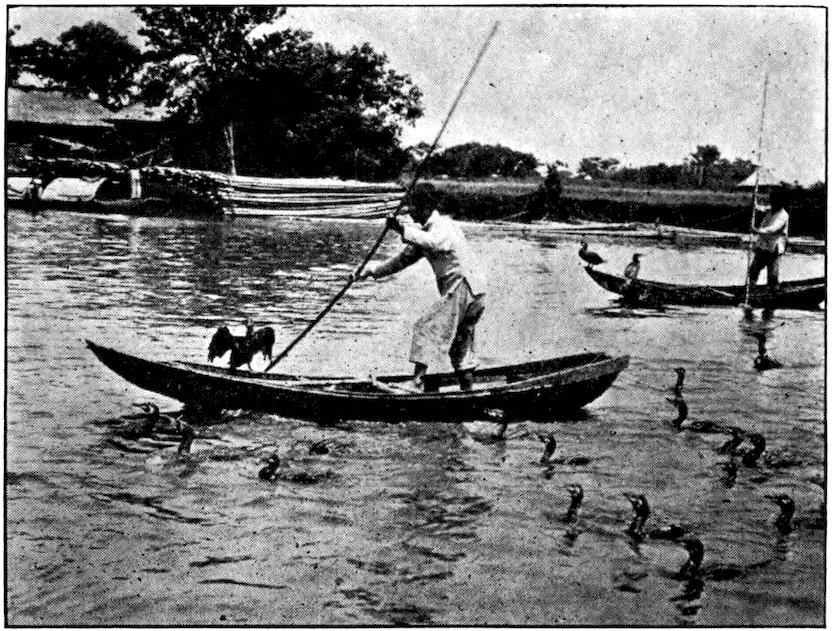
Publishers’ Photo Service
Cormorants fishing for their Chinese owners. Each bird, prevented by a ring around its neck from swallowing the larger fish, drops these into the boat.
From Lake Poyang I made another very interesting trip, to Foochow on the southern coast. People said it would be dangerous, because of the many bandits along the way. On my river journey down to the lake I had been so crowded in a sampan with a dozen Chinese that I could hardly turn over on my cot. This time I was the only passenger on a much larger boat, and I had my meals on another boat in which traveled two American women missionaries.
186The river was so very shallow and the wind so often from the wrong direction that it took us eight days to go a hundred miles up the stream. Often we put on our bathing-suits and waded ahead of the boats, and sometimes we had to wait an hour or two before they caught up with us. I went ashore and walked the last fifteen miles, and had coolies ready to go on over the mountains to Fukien Province with us when the boats finally arrived.
This overland trip was also just about a hundred miles, but it was faster than the one by boat. However, instead of sitting in my canvas-chair and reading or sleeping, I had to walk more than twenty-five miles a day over very rough trails under a blazing sun. The ladies rode in bamboo chairs, each carried by three coolies.
The three most interesting things along the river had been the irrigation, the indigo, and the trackers. The land was dotted with circular thatch roofs over water-wheels, around which water-buffaloes or oxen or cows marched all day long slowly hauling up water for the thirsty rice fields. Often we saw from a dozen to twenty huge casks or tall tubs standing at the edge of the river. When I got ashore I found these filled with what looked like willow switches, covered with a very blue liquid. Fields of these switches grew along the banks, and I discovered that they were indigo, from which the Chinese make, not blueing for wash-day, because they do not use that, but the dye for the denim garments worn by nearly all the poorer people of China.
187What we usually call trackers are a very common sight on the rivers of southern China. They are the coolies who haul boats upstream, sometimes with freight or passengers. We passed long lines of them on the shore or out in the water itself, each with the boat rope over one shoulder. In places the pulling was so hard that they bent double, touching the ground with their fingers, and pulling like plow-horses.
Because there are always so many looking for jobs in China, a man must toil his best if he is to satisfy his employer and avoid being discharged. Nearly all the way up the river we kept pace with a fleet of rafts loaded with American kerosene. Every morning the trackers started pulling them before daylight and every evening they worked until it was pitch-dark before they gathered around a small fire to eat their rice.
But going down a river is very different from coming up, especially on the native boats of China. From the ancient town where I left the ladies at their mission station, I took a “slipper-boat,” as it is called because of its shape, down the Min River. This stream was so swift that three days were enough for the last half of a journey which had already taken me more than two weeks. Every day there were dozens of rapids that I should never have gotten through alive if my Foochow boatman had not been so expert with his sculling oars.
There were many bandits along the Min just then. An American woman had been robbed even of her shoes. At one town I met a group of missionaries, returning 188from their summer homes on the seashore, who had lost most of their baggage when they were attacked by a large band. But it is hard to stop anyone going down-river on the Min. Once some bandits leveled their rifles at me and ordered me to come ashore, but before they had gotten up courage to shoot we were around a bend and out of sight.
Southern China is much more wooded than the north. Trees grow faster, and besides there have not been so many people through the centuries cutting them down and grubbing out their roots. Fukien Province had big forests, which made it look so different from treeless Shantung or Kansu that it did not seem to belong to the same country. But now an American lumber company is also doing its share toward making Fukien treeless and rainless. Some of the huge logs, started floating down the river at high-water season, were caught now on sharp points of rock. There were wrecks of boats here and there, too.
All the towns along these Chinese rivers are built so close to them that they seem to be fairly hanging over the stream. Rubbish and garbage are thrown from the backs of houses into the river. American cities often make the river-bank a boulevard or promenade, but the Chinese make it a dumping ground. The main street is just inside the first row of houses. Of course there is reason in this, because it is so hot most of the year in southern China that a narrow, shaded street is more pleasant than a sunny river-bank.
The big boats along the Min have a high platform, much like the bridge of a steamer. The steersman 189stands on this, so that he can see all the rocks and other dangers, and at the same time handle the enormous oar used as a rudder. Some of the oars were forty or fifty feet long, and even then they were not always strong enough to swing the boat around quickly in a dangerous place. In order to balance this oar-rudder so that one can handle it, the inboard end has a big stone tied to it. Or, as the Chinese are always very saving, it may be weighted with a piece of the cargo, such as a heavy bundle of brown rice-paper.
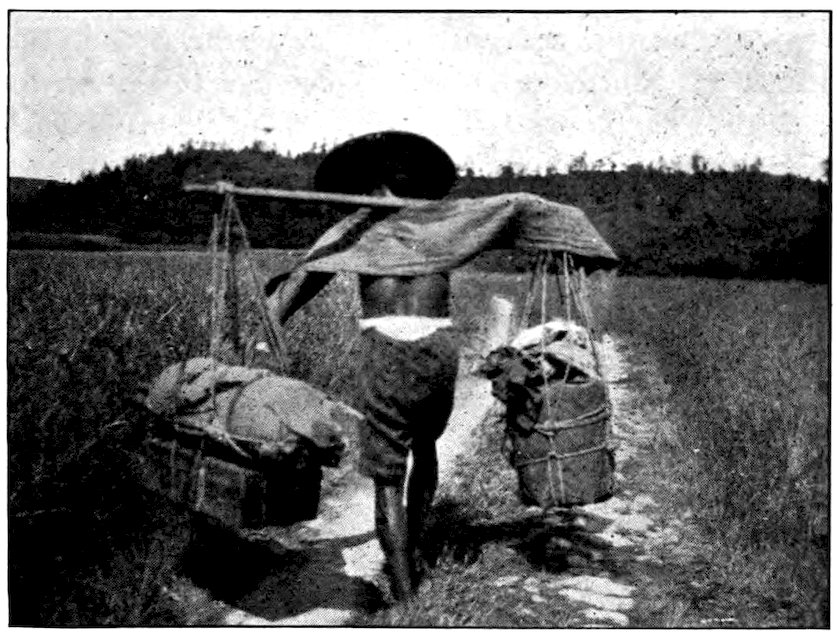
This is the coolie who carried my cot and other baggage on the overland part of the trip from the Yang-tze to Foochow. The strip of cloth keeps the pole from slipping off his sweating shoulders.
Below the pretty walled city of Yenping the Min is so broad and has so few rapids that we went on all 190night instead of tying up to the bank at the foot of a town. But along about two in the morning, when we were in a very wide place in the river, so strong a wind came up that the top of my boat was blown over upon me and we only just managed to get to a sandy shore without being upset. Later we found that a typhoon had swept the southern coast of China that night, and in the morning it was still blowing so hard that the boatmen did not dare go on. I decided to go across country. Four hours of tramping along winding flagstone roads brought me to Foochow, but my boat and baggage did not get there until the following evening.
Foochow is one of the most important ports along the southern coast of China. It is not exactly on the coast, however, being thirty-four miles up the Min River. The old city was placed three miles back from the river, because in the olden days the inhabitants feared attacks by pirates. Now there is also a long, slender city all the way from the walled town to the river. Besides, two islands in the river are so covered with houses and shops and people that it is hard to draw one’s breath, and on the farther bank is still more city. Part of this last is the foreign concession, called Nantai, with one long modern street or road shaded by big evergreens and lined by comfortable foreign houses, offices, schools, and churches, each in its own yard.
The view from these foreign houses over the several parts of Foochow and up and down the Min is very picturesque. Besides the people crowded upon the two islands and on the mainland there are thousands who live in boats. These are packed tightly together, row after row, so that the water too seems to have its streets. If a boat gets a job carrying a passenger or some freight it is very fortunate, for there are many more boats than there are boating 192jobs. Most of the boats simply serve as homes, and the man goes ashore in the daytime to earn the family rice by pulling a rickshaw or doing any other work he can find.
A very ancient bridge, made of huge stone blocks that have been worn glass-smooth by millions of feet, crosses the river, taking in the two crowded islands on the way. It has so many piers that when the river is high the water is held back, and most of the boats cannot pass it at all. So Foochow is talking of putting up a modern iron bridge, which will be more convenient but less picturesque than this old stone structure, crowded with people all day long.
Large steamers do not come up to Foochow, but stop at Pagoda Anchorage several miles down the river. Yet, handicapped as it is, the city is a great port. Quantities of tea, grown in Fukien, are shipped from Foochow. The city is noted for its waterproof oiled silk, its silversmiths and goldsmiths, and its lacquer-work. I saw a lacquered screen that a man had spent eight years in making. He worked every other hour and rested in between, because this work is so wearisome. Two or three such screens are all he can make in a lifetime. It took him until he was about twenty to learn how, and after he is thirty-five his eyes will no longer stand such fine work. Yet he was paid only about twenty-five cents a day, with rice and a plank to sleep on. Foochow and the cities higher up the Min are noted for their pillows, but you would not recognize 193them as such. They are made of a block of wood covered with woven-bamboo that gives slightly, and are painted bright red. Like the Japanese, most Chinese prefer a hard pillow, and coolies think a brick makes a very good one.
In Foochow and the region about it much of the work is done by women who wear three great silver or pewter daggers in their hair. It is said that they are descendants of tribes conquered by the Chinese, and that because their ancestors were given daggers as a protection against the Chinese soldiers these present-day women wear the weapons also.
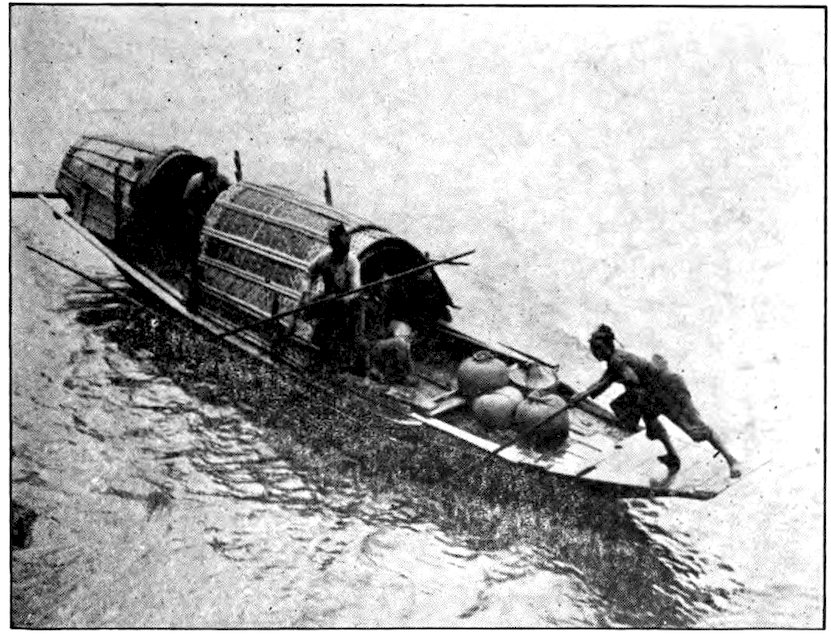
In Foochow District “field women” such as these do any work that men can do, for they do not have bound feet and they have become used to hard labor. Each of them wears three silver or pewter daggers in her hair. The “field women” are said to be descendants of tribes that were conquered centuries ago by the Chinese.
Most of China speaks more or less the same language, which we call mandarin. But all along the coast from Shanghai onward, in a strip about a hundred miles wide, there are many dialects. Only about three million people use the Foochow speech, and few of them can talk to other Chinese. It is much as if Chicago had its own language which other Americans could not understand.
Amoy, as foreigners call it, farther on along the coast in the same province, also has its own dialect. There the foreign concession is a rocky island a mile or more from the native city. Between it and the shore is a splendid harbor. A little piece of railroad that runs a few miles inland is the only railway in all Fukien Province. Out in the ocean opposite Foochow and Amoy is the big island of Formosa. Formerly it belonged to China, but it was taken by Japan after her war with China in 1894–95. The Chinese in Formosa, except recent immigrants, have Japanese citizenship and rights of extraterritoriality when on the mainland, and some of them cause the Chinese authorities there much trouble.
Swatow, still farther on, is of more importance to foreigners and their steamers than it is to the Chinese. Some time before I reached the city a great tidal wave had swept over it, destroying many buildings and killing thousands of people. Certain of the narrow streets were crisscrossed with timbers holding up the house-walls on either side. In other places the streets were wide and well paved, with quite new and modern shops 195along them—as if the tidal wave had done the place some good after all, by making rebuilding necessary.
A railroad about thirty miles long runs from Swatow to a larger and much older city, called Chaochowfu. There I saw some things which I had read of in old books on China but which I thought had now disappeared. For instance, thirty men were carrying an enormous slab of stone through town, and in some places they had to go far out of their way because the stone was too long to turn a corner. Each coolie had the end of a bamboo over his shoulder, and they were all chanting a kind of song as they crept along. Chaochowfu is famous for a great bridge. Part of it is made of great stone slabs such as those I saw being carried. The rest of it is a pontoon bridge, that is, a bridge of boats which can be moved aside when other boats wish to go up or down the river.
The queerest of the old-fashioned customs I saw in Chaochowfu was hard to believe. Two young men went about inflicting wounds on themselves in order to arouse sympathy and induce people to give them money or food. There are so many more people than good jobs almost anywhere in China that such queer ways of getting a living are often tried. Once I saw a dwarf who earned his rice by the use he made of a pipe with a very long stem. Wherever he saw a crowd of coolies, he went up to them and passed around the end of the stem. Each man who took a few puffs gave the dwarf some “cash” or a copper coin.
Hong Kong is not really in China, but it is quite Chinese. It is a high rocky island belonging to England, but Chinese make up most of the population. Its wonderful blue harbor can accommodate hundreds of ships, and nearly all the flags of the world are seen there. Most of the English residents live on the mountain side, back above the native town and business section.
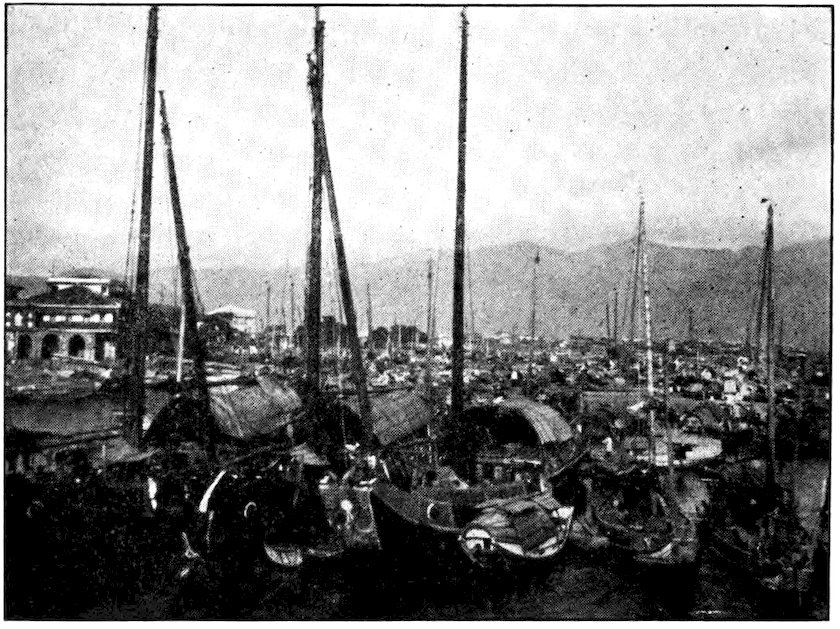
Thousands of boats like these are used as homes along the coast of southern China. The people are born, married, and die on boats. Do you notice the eyes at the bow of some of these queer craft? The Chinese think a boat needs to see just as well as a man or an animal.
Two-story street cars run along the main street, but curious chairs, like shallow boxes on poles, carry the people who wish to ride up the hillside. An electric 197cog-wheel railway, with stout steel cables between the cars, takes passengers up to the Peak, from which there is a wonderful panorama of sea and islands. Four hours by steamer across the bay from Hong Kong is the oldest foreign colony in China, Macao. The Portuguese have had it for nearly three hundred years, but now it is little more than a big gambling and opium den.
The most interesting city in southern China is Canton, a short day or night ride up the Chu-kiang, or Pearl River, north of Hong Kong. Since shortly after the revolution of 1911 it has been separated from the rest of China, with a government of its own. Therefore it often calls itself the “southern capital.” Its spoken language is also different from mandarin, so that we could not talk to the people at all. I once acted as interpreter between two Chinese. One was a man from Canton who spoke English, and the other a man from the north, whose language I could speak a little, but of which the Cantonese could not speak a word. The Chinese name of Canton is Kwangchowfu, and it is the capital of Kwangtung Province, from which we get our name for the city.
We lived for several months in Canton. Our house was in Saikwan, the western suburb. Never have you seen such a labyrinth of winding narrow streets as the one through which we had to pick our way to get home. Many of the houses and shops had outer doors of wooden bars, so that the air could enter but beggars 198and robbers could not. Most foreigners who have just come to China are afraid to go into those narrow streets of old Canton.
A board with round hollows in it is used in Canton as a sort of cash register. The principal money in that city is the silver twenty-cent piece. A man tosses a handful of money onto the board, shakes the board until there is a coin in each hollow, empties the coins into a basket, and picks up another handful.
The noise made by rushing coolies and yellow-faced merchants shrieking for customers is enough to terrify anyone at first. Yet when one gets used to it one finds this fear of Chinese street life as foolish as being afraid of the dark. We had no trouble at all during 199our many long wanderings through the famous old city, though often we were lost and had to wander a long time before finding our way. In time we became very friendly with these rushing, shouting people who at first seemed rather dreadful.
There was formerly a great wall about Canton, and a second one not far from the river. But Dr. Sun Yat-sen, a famous Chinese who headed the revolution against the Manchus, had the walls removed while he was governor of Canton. Once when he was a young man he had to climb over the city wall in the middle of the night in order to save himself from the Manchu soldiers. So perhaps he was glad of the chance to tear down the walls and make wide streets in place of them.
Some similar avenues have been cut through the old walled city. Here one sees private automobiles and autobuses rather than the old sedan-chairs. But during most of the year it is pleasant to turn off the sun-scorched dusty new streets and wander through the old ones, so narrow that sometimes you can touch both walls at once. Many of these streets are roofed over with awnings made of oyster-shells, so that they are completely protected from the glaring sunshine.
The best view of Canton is from Five Story Pagoda hill, once a part of the city wall. The famous old temple that gives the hill its name is in a ruinous state, and may soon fall down entirely unless the Cantonese repair it. In the center of the city below rises the Flowery Pagoda, one of the prettiest in China. Close to it is a great green spot called the British Yamen, because the English took it during a war and still hold 200it. Beyond stands what the Cantonese call the Smooth Pagoda. Unlike other Chinese pagodas, this is not built in stories. It is really an old minaret, with a little mosque at its foot, and dates from the time when there were many Mohammedans in Canton. Outside the old walled city among other Moslem graves is the tomb of a man who claimed to be the uncle of Mohammed.
The two church spires that rise above the city to the left belong to the big cathedral built by the French. Down by the river, on the farther edge of the city, stands a high building that seems to belong to New York. It is a great Chinese department store, much like ours at home, where you can buy almost anything. There are other quite modern buildings along the Bund, the wide water-front street that is always filled with traffic. Wireless towers stand out against the skyline. Across the river is more of Canton, on an island called Honam. There we found no wide streets at all, and it was like solving a Chinese puzzle to find our way through its maze of narrow crooked passageways.
Canton produces much silk, beautiful native furniture, fans made of everything from peacock feathers to stout paper on which are written Chinese sentences. It would take pages just to mention the beautiful and interesting things found in the city’s open-front shops. Near the French cathedral is a dirty little street where all sorts of pretty and sometimes useful things are 201made of ivory. Boys who do not seem old enough to have learned any trade carve artistic figures and curious playthings out of elephant tusks. Some of the shops use bone instead of ivory, and strangers must be careful when buying. Across the river in Honam the famous Canton china is decorated with bright red fighting-cocks and other designs; but it is not made there, coming undecorated all the way from Kingtehchen.
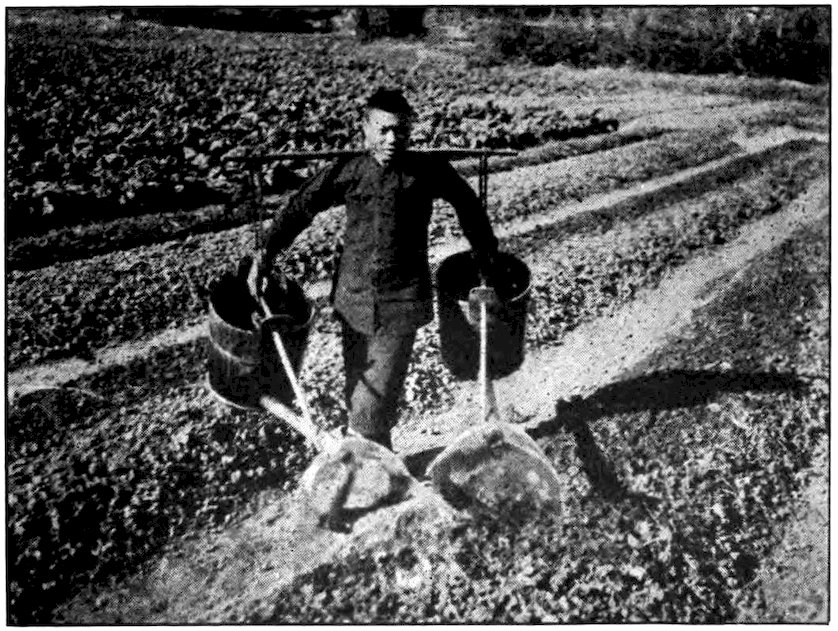
Watering a garden in the outskirts of Canton. The Chinese are tireless agricultural workers and know their business well.
The foreign concession in Canton is an island called Shameen. One third of it belongs to the French and the rest to the British. But Americans and Japanese and people of many other nationalities live there and have banks, consulates, and so forth. No vehicles except 202baby-carriages are allowed on Shameen. With its wide shaded streets, its park, tennis courts, and football field, it looks much like an old New England city.
A narrow canal separates Shameen from the native city, and watchmen keep most Chinese from crossing either of the two bridges. Boat-homes, of which there are thousands in the river and in the canals of Canton, are not allowed to stay on the foreign side of the canal, but they are as closely packed against the opposite bank as automobiles in a city street. Several other foreign communities have grown up in the outskirts of Canton, for Shameen is by no means large enough to accommodate all foreigners.
Gaudy weddings and funerals make their way through the city streets. The delicious Chinese fruit called laichee, which America knows only after it is dried, grows in some of the parks. Not every feature of Canton is pleasing, however. The rickshaws do not have wire wheels and pneumatic tires, like those of Peking and most of northern China, but wooden buggy-wheels that make a great racket and give one a rough ride. When the tide is out, the canals on which people glide home at high tide are often very smelly and far from pretty. One day I saw an official pounding a prisoner with a big hickory club to make him confess; sights even more distressing are sometimes seen.
Kwangtung, the province in which Canton is located, is as big as some of our largest states, and rich and important. From Sze Yap, the Four Districts, on the western side of the Canton delta, come nearly all the Chinese laundrymen and restaurant-keepers and other Chinese who live in the United States. In fact a large proportion of the Chinese in all other parts of the world are from Sze Yap. If you ask them they may say they are from Canton. But that is either because they know by experience that you have never heard of Sze Yap and that you may know of Canton, or because they mean by that name the province of Kwangtung.
On the junk that carried me from the Bund in Canton to Kongmoon, principal port of the Four Districts, my cabin was much like a piano-box turned on its side, and the queerly shaped boat was piled with Chinese cargo until it looked like a haystack floating down the river. First we went upstream a little way, towed by a launch that showered sparks and cinders on us, and steered by half a dozen men who walked back and forth along a cleated board at the stern, pushing an enormous oar that stuck out behind. When we wished to warn another boat, a man beat with a hammer on 204a hanging piece of iron. Roosters among the cargo did their part in helping to keep us awake nearly all night.
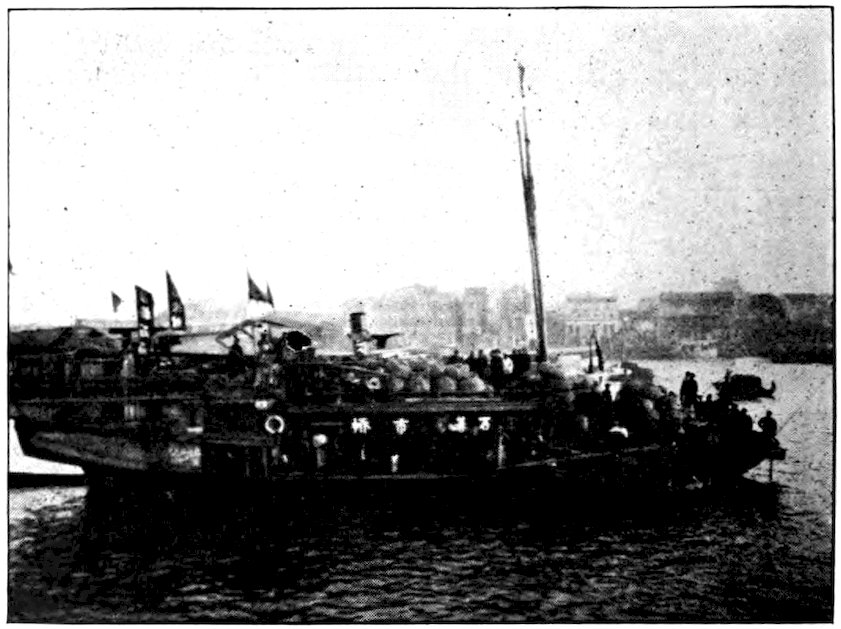
The queer cargo boat in which I went from Canton (seen in the background) to Kongmoon in the Four Districts.
There is a railroad more than a hundred miles long from Kongmoon on into Sze Yap. It is an interesting railroad because it was built by a Chinese who came to the United States when he was seventeen and later was a foreman during the construction of one of our great transcontinental railways. He had worked in California as a laundryman and a fruit-picker, but finally grew rich. He still owns a big store in Seattle. He decided to spend his money for the good of his 205home district, so he came back and built this railroad. He was more than eighty years old when I spent a night with him at his railroad headquarters at Sunning, but he was still president and general manager and superintendent as well as owner of the line.
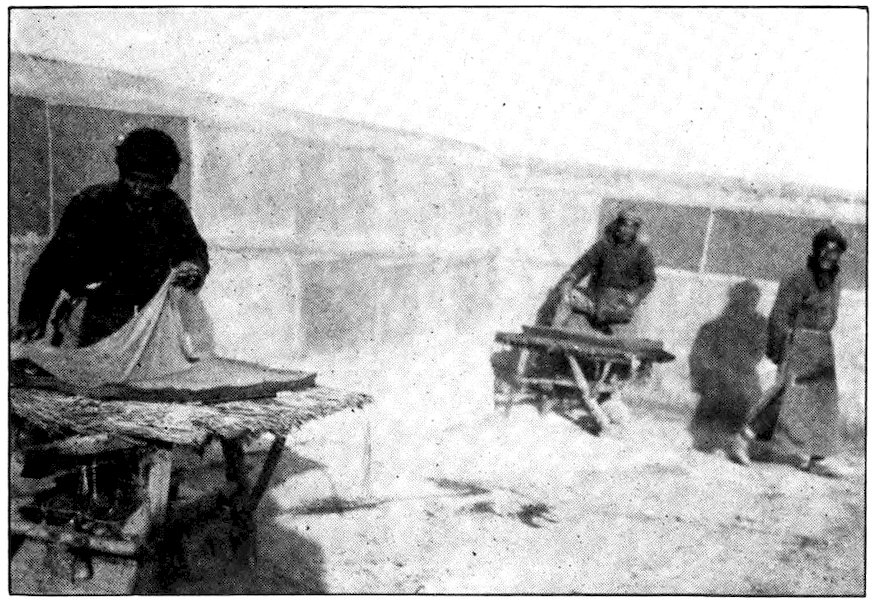
Making brown paper of rice straw. The chopped straw is soaked in water and pressed out into sheets. The wet sheets are pulled off one at a time and put on the mud walls to dry.
Almost every day I met Chinese men in Sze Yap who had been in the United States and spoke more or less English. That was lucky, for the people of the Four Districts do not speak real Chinese. This is the reason that the Chinese we have in America cannot talk to those from other parts of China. One evening I spent with a Mr. Lee who, with his brothers, owns a Chinese restaurant in Cleveland. He took me to a restaurant in Kung-yik where I had a real American meal. Another man I met was dressed like an American 206high school student, and spoke English so perfectly that I did not know he was Chinese until I had looked closely at his face. As a matter of fact, he could not speak Chinese, for he had been born and educated in Oregon. His name was Fred Hang. He had come home to be married, so that his family line would not die out, and soon after the wedding was over he was going back to the university of his native state. He acted as if he were very homesick for America, and he must have found it stupid not to be able to talk to his Chinese relatives.
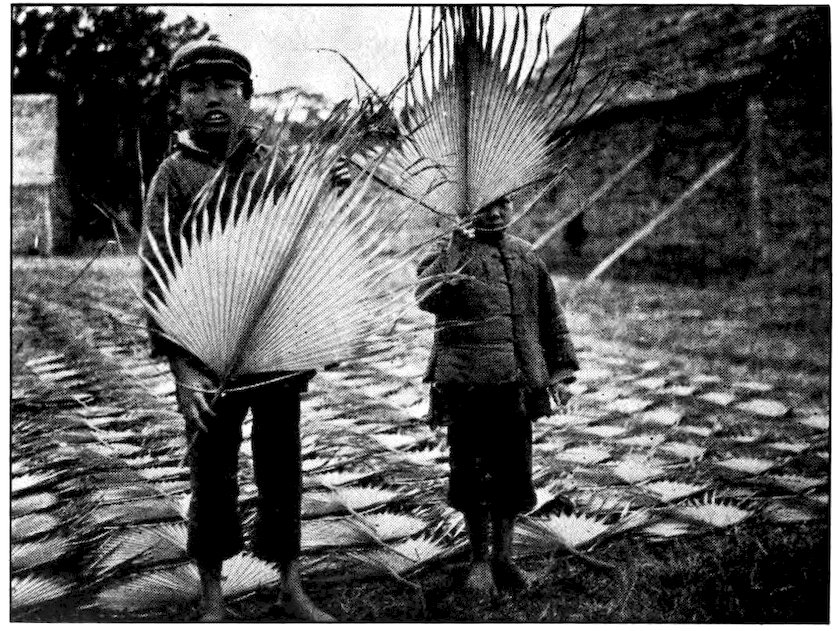
Palm-leaf fans are made of the young leaves of a low palm, which are fastened to sticks so as to be kept open and are laid out to dry. The ground here is covered with drying fans.
One of the curious facts about Sze Yap is that the millions of Chinese palm-leaf fans come from one little 207section of it, around the old town of Sunwei. The very short palm-trees or bushes from which these fans are made do not seem to grow well in any other place. When they are large enough, the leaves are cut and piled up in stacks. Then they are spread open with a stick and laid out to dry. After that, old women cut the ends off and sew a cloth border around them. These women earn about ten cents a day, and the fans are so cheap in China that almost every coolie in the south carries one. The tops of the leaves are made into raincoats.
There are a great many pirates in the lower Canton delta, as there have been for hundreds of years. They capture people and hold them for ransom, tying them to stakes and leaving them to die if someone does not pay to have them freed. They have better boats and better weapons than the government itself, and now and then they capture and loot foreign steamers. The English captains of two boats I traveled on were killed soon afterward by pirates, and one night a band of them stole one of the big steam launches that ferry people across Hong Kong Harbor, carrying it off, passengers and all. Yet two American missionaries who are working among the lepers on an island in the delta can go anywhere among the pirates and are treated like old friends. The pirates watch for Chinese returning from America and other foreign countries and often rob them of all they have earned. I met one old man who had only an old silver watch left when he 208got back to the town he had emigrated from when he was a boy.
Once I went overland from the Yang-tze to Canton. The northern part of the province was very mountainous, and the mountains were dotted with the whitewashed stone-heaps that are the graves of that region. Cement graves of horseshoe shape and of all sizes, some of them as big as a house, are common in other parts of Kwangtung and in Fukien. The ranges of high hills about Sunwei are dotted with graves as far as one can see, and Paak Wan Shan, or White Cloud Mountain, near Canton is covered with thousands of them.
Part of that trip from the Yang-tze was down the North River of Canton, and the last 140 miles of it was on a railroad built by Americans. This was intended to run all the way from Canton to Hankow, where one can take a train for Peking. Some day, if the Chinese ever stop fighting among themselves, that important line will be finished, and then Peking and Canton will perhaps become better friends. The trains on that railroad and on the one in Sze Yap were crowded with soldiers, most of whom had no tickets. Two other railroads enter Canton, but I found that the one from Hong Kong had been broken by the armies of rival Chinese generals who used this region as a battle-field.
From Canton I went to Hainan (“South of the Sea”), China’s largest island. It also belongs to 209Kwangtung Province, and some day it will probably be joined to the peninsula stretching toward it from the mainland, for the channel becomes more shallow every year, and ship captains always dread the passage through the Straits of Hainan. We saw the wrecks of several steamers on our way to Hoihow, the principal port of Hainan. There is no real harbor, and passengers have to climb down rope ladders into sailboats that are often dancing wildly in the waves. Sometimes, when the tide is out, they have to wade the last half mile to shore.
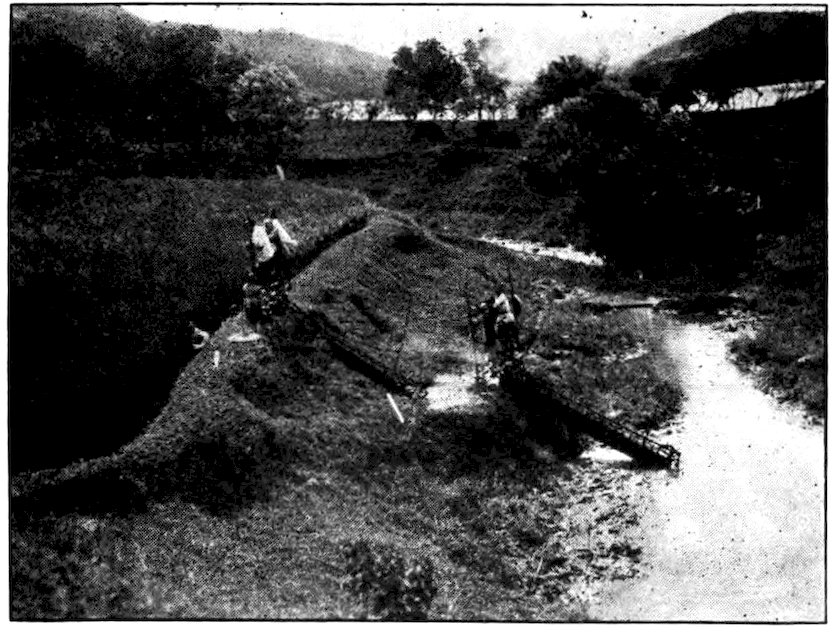
“Field women” and girls lifting water into the rice fields by means of sluiceways with a chain of paddles such as are used in many parts of southern China.
Kiungchow, the chief city, and much of the northern part of Hainan, are not very different from the rest of China. But in the interior there are great valleys of 210palm-trees, from which copra, or coconut-meat, is exported. The climate and landscape remind the traveler that he is not very far from the Philippines.
A tribe called the Loi lives in the mountainous center of the island, especially about the beautiful peaks called the Five Finger Mountains. The woods are thick, and travelers there are always much troubled by leeches. The Loi have their own headmen and are not governed by Chinese law. In harvesting rice, they cut off the upper six inches and bundle it, hanging the bundles head-down over poles and threshing it as they need rice to eat. Rattan, to gather which is painful work since it grows among masses of thorns, is sold to Chinese who export it.
Hainan is particularly noted for its pigs. On the way inland I met thousands of coolies carrying pigs—the pigs seem to prefer this to being driven, and the Chinese humor them. If the pigs are small, a man carries one at either end of his shoulder-pole. If they are large, two men carry one on a pole between them. Every steamer that passes Hoihow east-bound takes a load of pigs. They are piled up on the deck like cordwood, sometimes six or eight layers deep, each in the kind of basket-net in which they are brought from the interior. You may imagine what such a ship smells like!
Bamboo is another important Hainan product. It would take at least a whole page even to mention all the things the Chinese make out of that very valuable 211plant. It is not properly called a tree, though sometimes it reaches fifty feet in height, and shoots up so fast that one can almost see it growing. The rivers of Hainan have enormous water-wheels made of bamboo, so large that you wonder how a people without pulleys or other modern contrivances can raise them. Dozens of sections of the hollow bamboo are set at an angle on the outside of the wheel, and as the wheel turns, these dip up the water, pouring it into troughs that carry it away into the fields. When the river is too low to run a water-wheel, the farmer has to walk along the top of his wheel all day long.
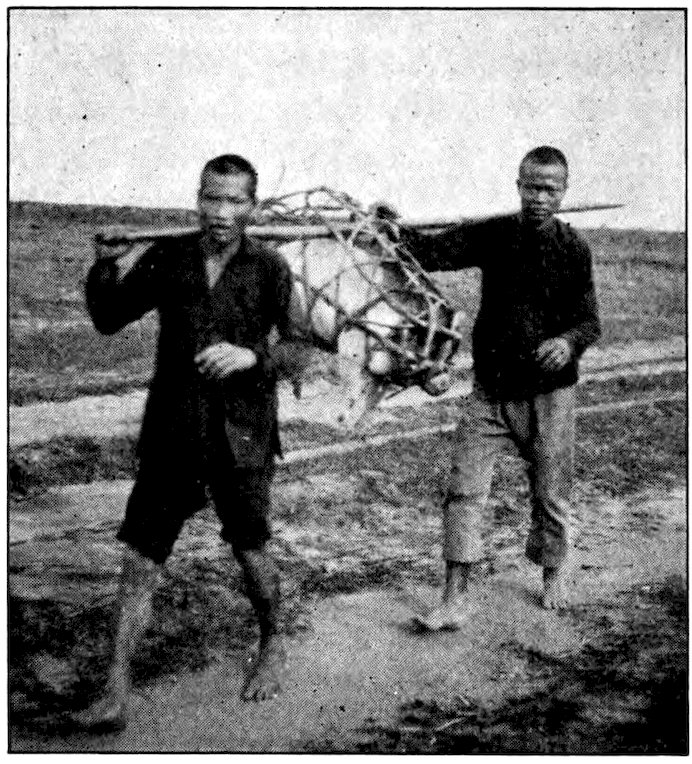
This little pig really went to market, and he was carried there too. In China pigs won’t walk to market, and as they are the most important product of Hainan Island they have to be transported somehow.
212Another way of raising water in rice-growing southern China is by a wooden sluice that has an endless chain of upright boards running through it. Men, women (since Hainan women do not have bound feet) and children trot up and down all day on the kind of treadmills that keep such sluices working. Sometimes the sluices are run by hand, with two handles like the pedals of a bicycle. The Chinese have invented all sorts of primitive devices to raise water for their irrigation, but they never seem to have thought of windmills. The treadmill is useful in various ways in a country where there is plenty of cheap labor. Some of the boats on Canton’s river are propelled by a big stern-wheel turned by many coolies climbing forever up a treadmill inside.
The last time I came back to Canton I traveled the whole length of the Si-kiang, or West River, through the province of Kwangsi. The little Chinese steamers were so crowded with passengers that men slept even on the floor under my cot. Most of them smoked opium, and the sweetish odor of that destructive drug was in my nostrils during the entire two weeks’ journey. Although it is against the law in China to grow poppies and transport the opium made from them, nearly every steamer down the Si-kiang carries tons of it. The rival generals make much money out of it, and no one dares interfere with them. Some of the 213boats fly the flag of the United States, because a rascal who pretends to own them gets them registered as American ships and no Chinese can interfere with a boat flying our flag. There are very few of our countrymen, however, who take such mean advantage, and our consuls are gradually driving out of the country those who do.
An attempt on the part of China to stop the importation of opium from India resulted in a war with Great Britain in 1840, and in China’s being forced to open certain ports to opium or anything else that Western nations chose to send. However, in 1907 an agreement was made between Great Britain and China by which the Indian Government was to reduce gradually the opium exportation to China.
Kwangsi is much poorer than Kwangtung, because so much of its land is rocky. Along the upper part of the West River stand queerly shaped rock hills like rows of fantastic skyscrapers. Many have caves in them, sometimes a hundred feet up, and bandits often use these as their headquarters. In the Bay of Along, at the western end of Kwangtung Province, there are thousands of these rocky peaks that seem to float on the blue sea. I do not know a more beautiful place than this bay anywhere in the world.
A Chinese who had been cook for the British customs commissioner at Nanning, capital of Kwangsi Province, opened a foreign restaurant. But there are few foreigners in Nanning, and those have their own homes, cooks and all. So the enterprising Chinese did not get much trade until he began serving the favorite 214Chinese dish in those parts. It is a mixture of cat and snake meat, and Chinese who have eaten it say it is very “sweet” and good. I did not try it.
At Kachek in the island of Hainan I saw a man roasting dogs in a pit he had dug in the ground. People who were attending a fair and theatrical entertainment near by sometimes came to him for a feast of dog-meat. Dried rats may occasionally be seen hanging before shops in southern China. Yet it would not be fair to say that the Chinese in general eat cats, rats, dogs, and snakes. In a few parts of the country they do, especially in times of famine. It is claimed by some Chinese that wherever any of these animals are used as food, it is because of certain medicinal qualities that they are supposed to possess. For instance, the snake meat is said to be a remedy for a kind of leprous ailment; and the Chinese say that the “rats” are not really rats as Americans know them, but a sort of field mice which feed on the rice plant.
Not one foreigner among a thousand who come to China ever travels into the part of it we are now going to visit. Yet the least known parts of many a country are often the most interesting. It would have been better to have turned my travels about, and gone to Kansu in the summer and to the other two great western provinces of Yunnan and Szechuan south of it in the winter. But we cannot always arrange things exactly right in traveling any more than in the other affairs of life.
The usual way to Yunnanfu now is by the railway from Haiphong, chief northern port of the French colony of Indo-China. The trip takes three days, but to go in any other way would take at least that many weeks. The narrow-gauge railway, built by the French, is one of the most remarkable pieces of engineering in the world, and the scenery along the last two thirds of the way is magnificent. The trains do not run at night, so the passengers have to go to hotels. The first night is spent in the Indo-Chinese border town of Laokay and the second in the Chinese town of Amichow.
Almost as soon as we had crossed the frontier again into China the second morning, we began to climb up 216into rather bare mountains. The train dashed from one tunnel into another, passing over many a steel-arch bridge high above roaring mountain torrents. Sometimes the engine and the last car came so close together that the train reminded us of a kitten chasing its own tail. Once we were three hours making our way in a horseshoe curve between two towns that were only a few miles apart across a gorge. All the time beautiful mountain scenery surrounded us. At two or three points the railway is more than a mile and a half above sea-level. There is a saying that as many coolies lost their lives in building that railroad as there are ties along it.
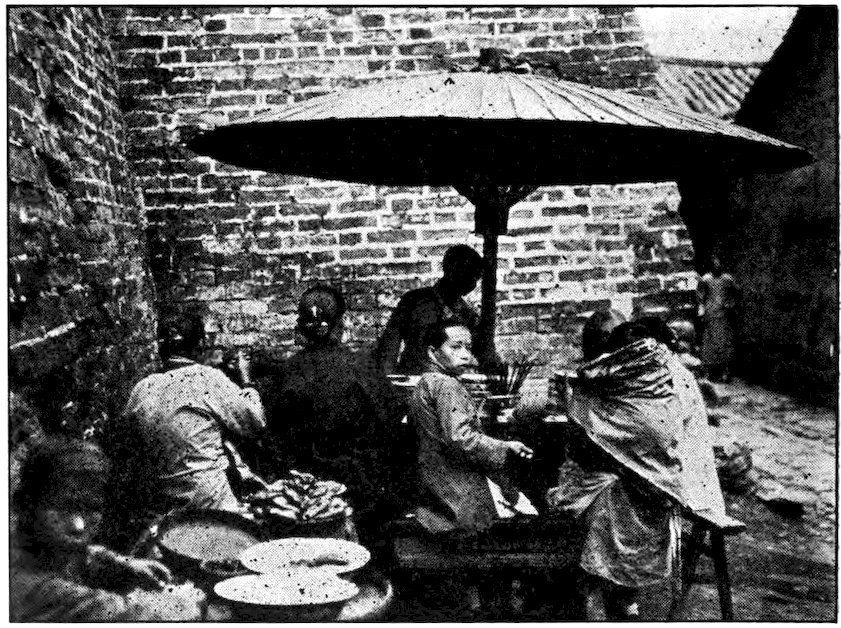
The Chinese may not know what a picnic is, but they often eat outdoors in such a makeshift restaurant as this. These people under the big umbrella are having a meal just inside the city wall of Yunnanfu, lofty capital of Yunnan Province.
At last we came out high above a great blue lake and descended into the capital of Yunnan Province. Though it is as far south as our Palm Beach, this place is a favorite summer resort for the French of Indo-China, because it stands six thousand feet above the ocean. Of course the older part of it is walled, but the governor who has ruled it since the revolution has cut conveniently wide openings in place of some of the old gates, and has made a few good straight streets, well paved with stone. Most of the streets are still narrow, and covered with cobblestones worn so smooth that the least rain makes them as slippery as ice.
Yunnanfu shows many queer contrasts. The new university owns some big modern buildings, including laboratories and dormitories, and an athletic field. Several of the professors were educated in Kansas. On the other hand, the street cleaning is done by ragged and almost naked prisoners, with great irons clanking on their legs. Many of the shops are so shallow that customers have to stand in the street lined up along the shop’s counter. Street-stands have rows of tin basins and towels for those who wish to bathe, and combs and brushes are for rent.
One day the governor came to the dedication of a new wing of the British Mission hospital. He wore the long silk robes of the Chinese gentleman, but had on his head an ordinary stiff straw hat. This, we fancied, was the result of his Japanese training, which had 218given him many of his modern ideas of governing. The people of Yunnanfu are so superstitious that when a fire broke out near one of the governor’s new openings in the city wall, they said he must have angered the spirits by cutting into the wall. Claiming that this same action was to be blamed for a great drouth, they paraded through the streets carrying the rain dragon from one of the temples, and everyone threw water on it. They painted out the sun god on the city gates and painted the rain dragon in its place. They also dressed up a dog in the queerest costume they could find and led him about town, while everyone laughed loudly at him; for an old Chinese proverb says that if you laugh at a dog rain will come.
Sure enough, finally it did rain, but now so much water fell that crops were drowned out, the railroad was broken in a dozen places, and the whole city was in danger of being flooded. So the people decided that they had prayed too hard for rain, and began to pray for it to stop. They painted out the rain dragon and painted in the sun again. They closed the northern gate, because they thought wicked spirits were sending in the rain that way. Anyone living outside the north wall had to walk a long way around every time he entered the city. At last the rain stopped and the people were sure their gods had answered them.
It was during the first rains that I started on a thousand-mile trip to the capital of the next province and beyond. Both the American consul and the Chinese 219governor refused to let my family go with me. They said it was too dangerous. But I was allowed to go myself, if I would let the authorities send a military guard to protect me along the way.
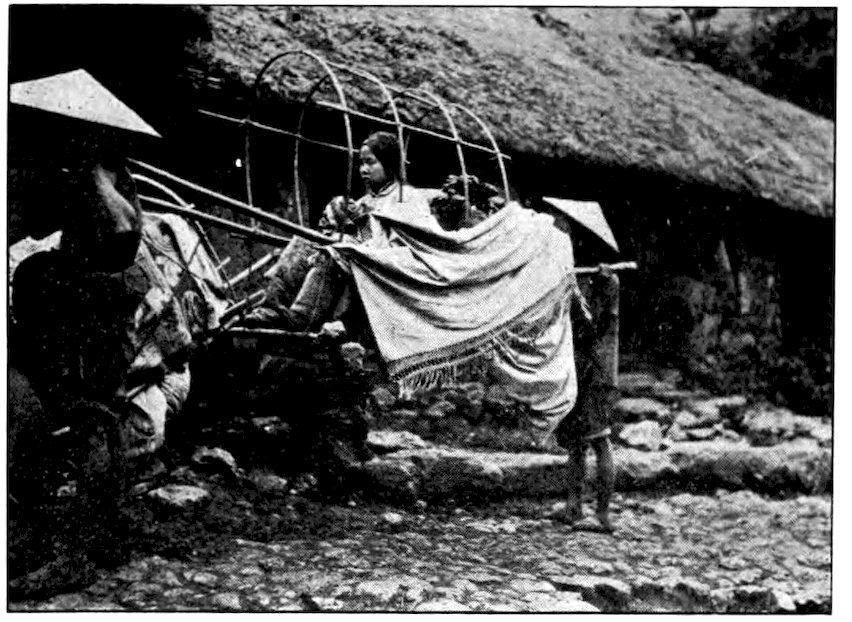
This blind girl, whose feet were bound, was carried for a week along the trail that we took north from Yunnanfu. Her home was two hundred miles inland.
The American agents of some of our big corporations doing business in China sometimes have as many as five hundred soldiers with them on a journey through Yunnan. I had visions of having to pay much more than I could afford for the trip, for while the government pays the soldiers their regular two or three dollars a month, the man they escort is expected to give each of them at least ten cents every day. Suppose you spent five hundred dimes a day for a month, how much 220less money would you have at the end of that time?
Fortunately for me, the governor did not think that I was a very important person. When I was ready to start only four soldiers were sent to accompany me! Every day or two along the way other soldiers would take their places. Sometimes there would be only one man, without even a gun. Those who had guns did not always have cartridges. Once a soldier’s rifle began dropping apart and he borrowed string from me to tie it together! Perhaps my guard expected to scare the bandits, if we met any, without firing a shot.
I took a horse with me on that trip, though I intended to walk a great deal. In fact I often had to walk, for in many places the trail was so bad that I could not ride. Yet I was following an ancient and important highway between two of the three great provincial capitals of western China. I had a servant, named Yang Chi-ting, who cooked very good American meals, and did any other work I needed done along the way. He walked all the time, until I was able to buy a horse for him nearly five hundred miles north. Although his wages were only five dollars a month (and he bought his own food), that was so much in Yunnan that along the way I often heard him boasting of his high wages, and the people gasped with astonishment when they found how much he got. A more faithful and harder-working servant it would be very difficult to find anywhere. By this time I had learned enough Chinese so that I could often have long talks with Yang and for weeks at a time I did not speak a word of English, unless it was to myself.
At the start I had four coolies to carry my baggage and supplies. Two were enough on the last part of the trip. The coolies all smoked opium, as do many people of Yunnan. The poppies from which opium is made grow there profusely. Every morning I had hard work getting my carriers started early, because they must smoke opium first and then eat breakfast. If they did not eat after smoking, they would fall sick along the way. When we stopped at noon they would lie down on the earth floor of some hut and smoke again, and at night they would smoke for hours. This dreadful habit finally makes wrecks of those who indulge in it. Yet those coolies could carry a hundred pounds each, over terrible mountain roads, for twenty-five or thirty miles a day.
Sometimes the trail was like a deep ditch full of stones, in which we waded and slipped and sprawled. At other times it was as steep as the roof of a church. Once we passed a caravan of more than two thousand pack-mules, carrying opium and silver money. We were three days getting past it. With it were many soldiers and rich men or officials riding in sedan-chairs, carried by poor coolies who looked like worn-out horses.
Some day perhaps there will be a railroad through that part of the world, and then all such freight and passengers will go by train. But now the Chinese toil along just as their ancestors did a thousand years ago, stopping each night in mud hovels where there is nothing but the earth floor to sleep on, unless they have brought bedding with them.
All the Chinese women along the way had bound feet. When they had to walk in the mud they used little wooden sandals that looked like a horse’s hoofs. In this mountainous province many of the people are so poor that their clothing is nothing but rags. We saw children eating cornstalks. Yunnan grows much corn and many potatoes, though it is so far south that the potatoes at least would not grow at all if most of the province were not higher than Denver. The majority of Chinese have never heard of potatoes. Even in Yunnan they are called “foreign vegetables.” In other parts of China people will not eat potatoes if they can get anything else, and even the Yunnanese much prefer rice. But most of them cannot afford it.
Among the places we stopped at for the night were Ta Pan Chiao, which means Big Plank Bridge, and Hong Shih Ai, or Red Stone Cliff. As I have said before, though Chinese names look and sound queer to us, their mystery vanishes when we find what they mean. The same is true of the gaudy wooden signboards that stand before Chinese shops. In one large city I saw a sign that had been turned into English, and it said “Happy Heart Furniture Shop.” Most Chinese signs would be as simple as that if we could read them.
I must mention one of the many adventures that happened to me on that Yunnan journey. It had been raining all day, and we had been slipping and sliding 223along the side of a high mountain, almost as steep as the wall of a house. Many streams without bridges crossed the trail; the biggest roared down a great gorge. Still, there was nothing to do but try to cross it, unless I wished to lie out on the mountain side all night. After driving my horse in, I went higher up and crossed on some rocks.
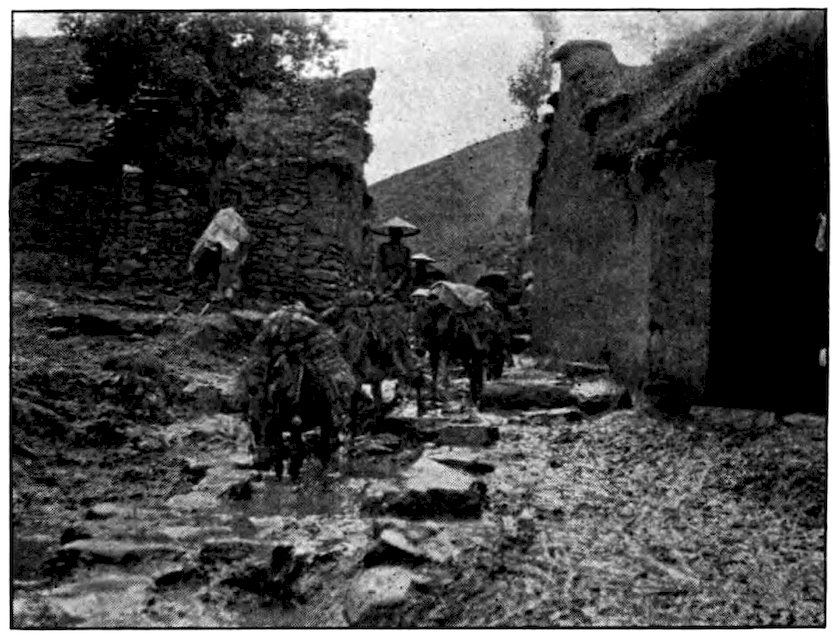
From this you can get an idea of the terrible road that we traveled over for weeks on the overland route between Yunnanfu and Chengtu, capitals of the great southwestern provinces of China.
When I reached the other side no horse was to be seen. Coolies whom I could not hear above the roar of the stream waved their arms and pointed down the gorge. I looked, and was horrified to see only the head of my poor horse, whirling around far down in the rapids. Not far beyond, the gorge fell into a 224deep and swift river that later joins the Yang-tze. I fancied that the carcass of my poor horse, with the saddle and the several valuable things in the saddlebags and the coat I had tied on it, would finally be washed out into the ocean at Shanghai, about a month later.
But Chinese horses are hardy, just as the coolies are. Some men ran down to the edge of the stream and managed to catch the horse by the head. Finally they got its front feet up on a rock. Without even waiting to reach solid earth again, the animal began calmly eating the grass it could reach. Perhaps if it had fallen a few hundred feet farther it would have been still more hungry. But I found later that its nerves had been badly shaken. For two days after that it trembled at every tiny stream and I had to walk all the way, though sometimes the road seemed to be almost vertical for half a day at a time.
I spent the Fourth of July in a city named Tungchuan, but I did not hear a single firecracker. Not only was there not another American within several hundred miles of me, there was not even a white man of any nationality; and as it did not happen to be a Chinese holiday, no Chinese were shooting off firecrackers. (By the way, do you know that firecrackers are red because that is the Chinese color for happiness?) Tungchuan makes vessels of copper and brass. They are pounded out by hand on little anvils stuck in the ground, and turned on crude lathes run by a 225foot lever. You have perhaps seen a grindstone run in that way.
But the greatest industry of Tungchuan is the making of felt rugs. Chopped up sheep’s wool is rolled out into a kind of thick blanket, just as the Mongols make the felt for their movable houses. Then flour paste is daubed on it, in patterns of flowers, birds, and so forth, after which it is soaked in vats of dye. The dye colors the parts that are not covered with paste, and when that is scraped off the flowers or other designs remain white. Most of the Tungchuan rugs are bright red. Often we saw trains of pack-mules loaded with them struggling along the trail.
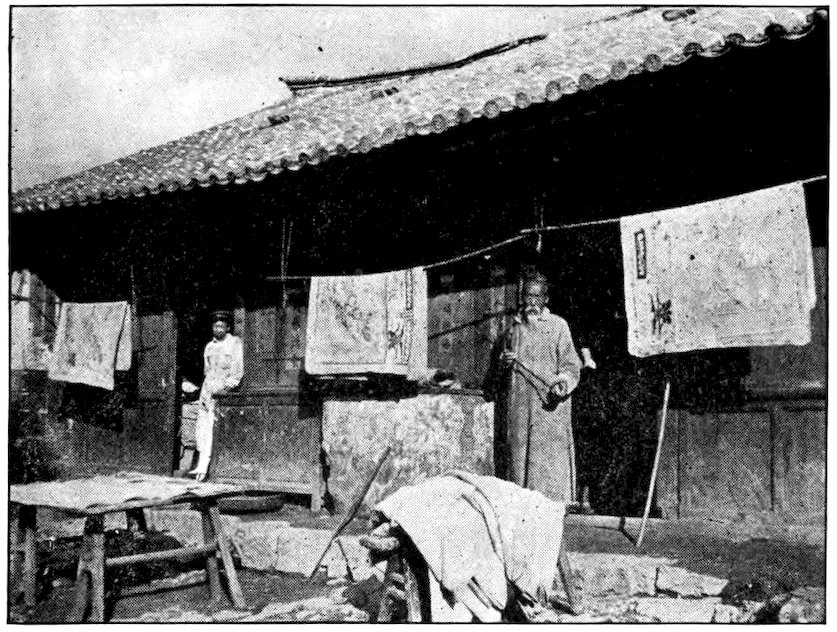
In Tungchuan one of the chief industries is the making of felt rugs. The decorative designs are painted on in flour paste so as to remain white when the rest of the rug is dyed bright red or some other color.
Thousands of towns in China are noted for making one or two particular kinds of articles, which may not be made anywhere else. Other things are made in many places, nearly always by the same crude methods. False money to be burned at graves is one of these things. In almost every town, boys stand at a great wooden block driving a hollow chisel into big piles of rice-paper. Each sheet comes out looking as if it were a sheet of brass “cash,” and the pious people buy the sheets in quantities so that their ancestors will have money in the next world. We met many coolies carrying enormous loads of this coarse paper. In other towns men take bars of tin and pound them for days at a time to make sheets of tinfoil. These are folded together to look like the “shoes” of silver that are still used as money in some parts of China. Some of the “shoes,” painted yellow to represent gold, are burned by the richer people at the graves of their ancestors.
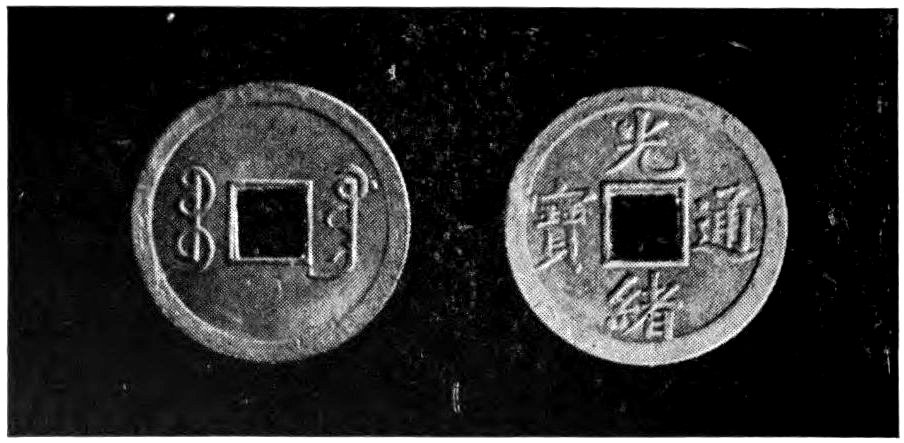
The two sides of a Chinese “cash,” issued in the reign of the Manchu Emperor Kwang-su. Kwang-su was on the throne from 1889 to 1908, although the Empress Dowager was the real ruler.
The halfway station on the ancient trail between Yunnanfu and the Yang-tze is the walled city of Chaotung. I left most of my baggage there and went on a side-trip to the eastward. That was the only way to see Kweichow, the most isolated province of China, and I had determined to visit all eighteen provinces. Besides, the western part of that province is noted for its wonderful scenery, and—most important of all from my point of view—many of the tribesmen of China live there.
Long before the Chinese conquered what we now call China, many other tribes or races of people occupied that territory. In a way they were much like the Indians in America, and the conquering was very much the same. That is, the Chinese gradually defeated the tribes in the north and the east, and the conquered people either were absorbed, by marrying with the Chinese, or they fled south and west. That is probably why there are many dialects along the coastal strip of land between Shanghai and Indo-China. The descendants of the people who fled south, and were finally conquered when the ocean stopped them from fleeing farther, kept their own languages, more or less mixed with Chinese.
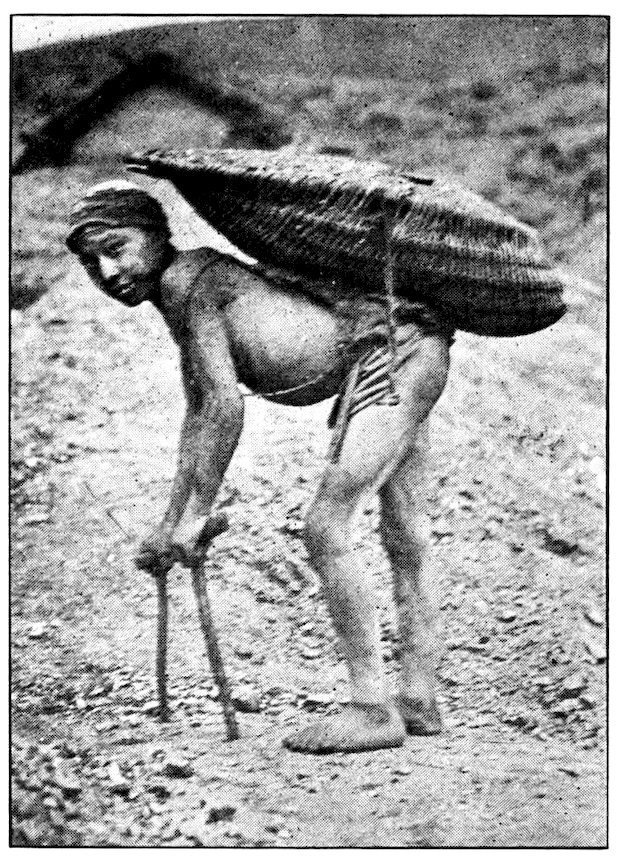
The coal mines near Chaotung are so shallow that only boys can carry the coal out of them, and they have to stoop in this four-legged fashion. What an outcry would be made if growing boys in America worked under such conditions!
The first signs I saw of aboriginal tribes not entirely absorbed by the Chinese, were the “field-women” of Foochow district, each with three daggers through her hair. The farther west I went, the more I saw of peoples who have lived in China for thousands of years and still are not Chinese. In Kwangsi Province many of the inhabitants are Chung-chiah, one of the most 229important of what we might almost call China’s Indian tribes. The tribes are especially numerous in the southwest, but have farms of their own or rent them from the Chinese. The Chinese have had less trouble with these early peoples than we once had with our Indians. Millions of them are left, although it is many centuries since the Chinese began to conquer them. One of the aboriginal tribes has never been conquered, and lives under its own laws in a mountainous region where the Chinese rarely dare go.
I rode and walked all day in the rain over a very difficult mountain trail from Chaotung to a place called Shih-men-k’an, or Stone Gateway, in Kweichow. British missionaries have headquarters there, in several whitewashed buildings that stand out against the green mountain sides. They work among the Hwa Miao, or Flowery Miao, who get their name from the gaudy garments they wear. There are also Black Miao, who wear black garments, and River Miao, who live in river valleys. The many thousands of Flowery Miao live among high mountains, at least a mile above sea-level, and they are all farmers.
Two of the missionaries went on with me next day. There was to be a Hwa Miao festival at one of their stations in the mountains. My servant, Yang Chi-ting, walked all that day, just as he always had; but it was so distressing to see him toiling up and down those terrible mountain trails that I bought him a horse next morning. The horse, by the way, was a 230splendid little stallion, plump and lively, and a wonderful hill climber; and I paid just ten dollars for him. Later I sold him in another part of China for more than he had cost; but if only I could have brought him back to America and had wished to sell him, I could easily have asked and obtained ten times as much for him.
The only way I can describe the wonderful scenery of western Kweichow is to ask you to imagine several great green worlds, covered with little farms of strange shapes, piled up into the sky on the far side of gorges so deep that the rivers at the bottom seem threads. There were many tracts of splendid forest on this high rolling landscape; for parts of southern and especially southwestern China have not been settled long enough by the Chinese to have all their trees turned into coffins.
The Hwa Miao live off the main trails. They do not like visitors as well as the Chinese do, and they do not have stores, with things to sell. Their villages are usually hidden in clumps of trees back among the hills. They raise hemp, in what geologists call sink-holes, and weave their own garments from the fiber in the stalk. They eat oatmeal and buckwheat and corn, which are their principal crops. I saw many a buckwheat field in blossom, adding to the beauty of the landscape. Some of the cornfields were so steep that we wondered how the women and girls hoeing them could stand up.
231Miao oatmeal is rather different from our own. When these people go out to work in their steep fields, or start on a journey, they take along dry oatmeal in a sack. When they are hungry they put some of this in a bowl and pour cold water on it, mixing it with their fingers. Then, if they have no chopsticks, they make a pair out of the first switch they can find, and eat. If they are more thirsty than hungry they use much water, and if they are more hungry than thirsty they use little water. Of course they have no sugar or milk, and not even salt. The rest of their life has just as little luxury. If you looked into one of their huts you would probably think it a very badly built and poorly kept pig-sty.
Yet the Hwa Miao are very likable as well as simple people. Nearly three thousand of them were gathered for the festival. Missionaries did not find it so hard to convert the Hwa Miao as they did the Chinese, perhaps because no one else had ever been kind to them as far back as they could remember. Formerly they had festivals in which everyone drank too much corn-whiskey and did even worse things. So the missionaries introduced a kind of field day with our style of sports. I saw running and jumping and pageants and outdoor games that are much more familiar to us than they are yet to the Miao.
Most interesting to me were the people who had come to see the games. Some had walked for two days over the mountains to get there. Many had changed their clothes in a gully or in one of the mission buildings. Even the girls each carried a sack containing her best 232clothes, and oatmeal or cornmeal enough to live on while away from home. The people filled a steep cornfield above the playground, as they might a stadium.
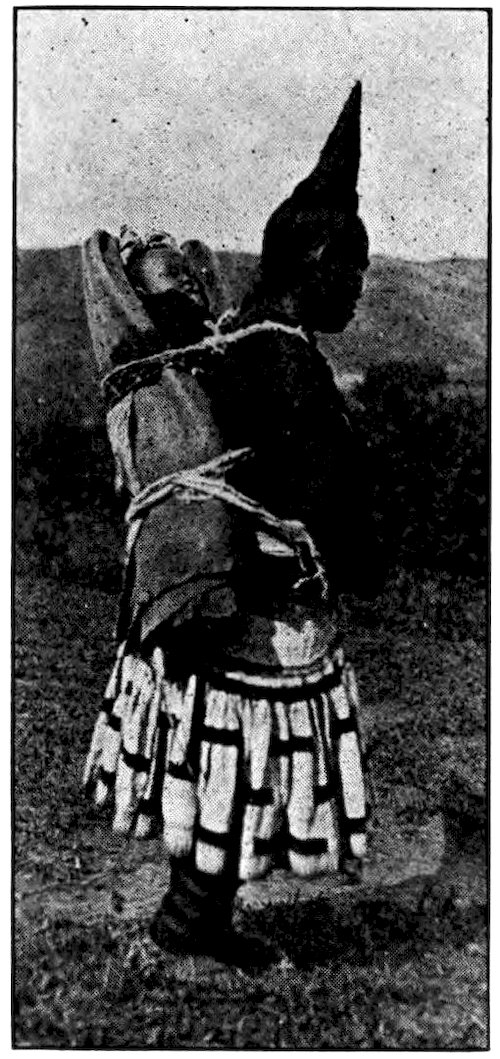
A Miao mother watching the of the Christian festival while her baby sleeps on her back. Below her gay skirt she wears wrap leggings and straw sandals.
No wonder they are called the Flowery Miao. It would be so difficult to describe the gaudy homespun garments, especially those of the girls and young women, that I shall have to let the photographs I took give you some idea of them. Red and black were the most common colors, but there was every other hue one could think of. The women’s hair was not jet-black, and oiled, as it always is among the Chinese women, but had a reddish-brown tinge. Possibly the color is caused by the sun, as Miao girls never wear hats. They never cut their hair, but do it up in puffs and masses and coils, and adorn it with all manner of ornaments, such as porcupine quills, silver bangles, wooden combs and more things than 233I can name. Many of them wear huge silver earrings of strange designs, and bracelets that clank as they walk. Their gay pleated skirts come barely to their knees. Below the knees they wear what we might call wrap leggings, in gay colors. Their feet are always bare, except that sometimes they wear tsao-hai, or straw sandals, like the Chinese. Once a girl is married, however, she puts away all her ornaments. Earrings, bracelets, her gayest garments, all disappear. Her hair, wound tightly about a stick set upright on her head, is built into a cone shape. A Miao mother’s hair is quite safe from tangling by baby’s fingers.
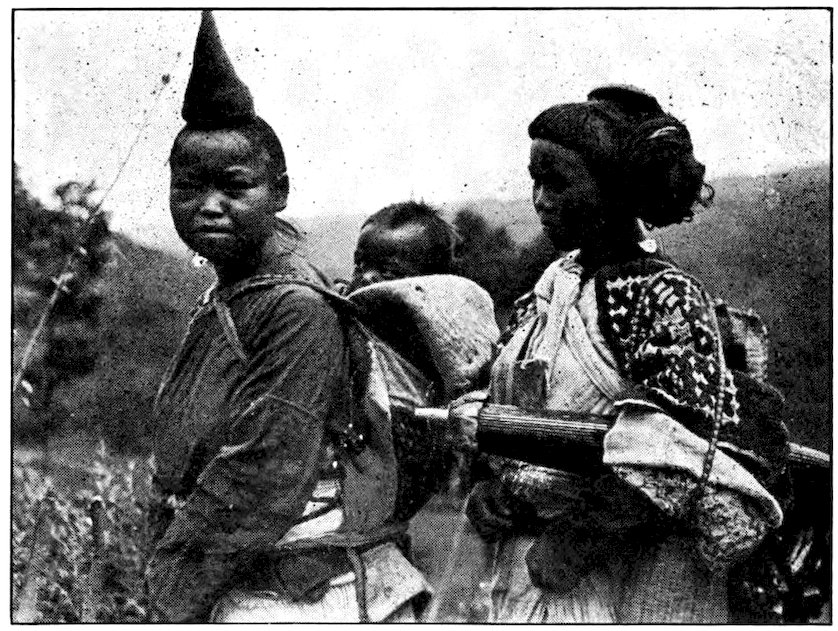
A Hwa Miao mother with her baby on her back, and a Hwa Miao girl. The girls wear elaborate garments and do their hair in complicated style with many ornaments. Married women never put on ornaments, and they build their hair up into a cone shape, wrapped around a stick.
The Hwa Miao are almost slaves, for they all have to rent their land from a more powerful tribe or from the Chinese, and do just about what the landlords tell them to do. We call that other tribe the “Lolos.” You will find this word in geographies and encyclopedias, which is unfortunate, for it is the insulting name given these people by the Chinese. They prefer to be called the I-bien or Nosu. They are tall and stately, quite different from the short, sturdy Hwa Miao. The women wear cloth turbans and long gowns, often of purple, but never of the gaudy colors liked so well by the Flowery Miao. The men now usually dress like the Chinese, though some of them still wear a turban, and many use a white felt cape nearly half an inch thick.
The “Lolos” are divided into three classes. At the top are the “Earth Eyes,” landlords owning often thousands of square miles of land and ruling much as did the feudal barons of Europe during the Middle Ages. Their homes are castles, generally on some high spot from which they can see for many miles around. Under them are the Black Nosu, who are freemen, usually owning some land, but obliged to become soldiers and fight for the “Earth Eyes” when the latter are in danger. Under these are the White Nosu, who have been slaves for hundreds of years.
Over in Kweichow the “Lolos” have been conquered by the Chinese, or at least live in peace with them. But in a great mountainous region almost encircled by the Golden Sands, as the upper Yang-tze is called, are 235the independent “Lolos.” We passed within sight of this region on the way northward again from Chaotung by the main trail. But I did not cross the river for a visit. So far as is known, only three white men have ever been among the independent “Lolos.” One was an English lieutenant, whom they killed. The other two were English missionaries, one of whom told me about his trip. He found some of the “Lolos” so well educated that they could read the Chinese classics.
The women were much more independent than most women of Asia—more nearly regarded as the men’s equals. There were many tribes, each ruled by its headman, and most of them were at war with other tribes. Their country is so mountainous that many of the trails seem as steep as ladders.
To me, the most interesting fact of all about the independent “Lolos” is that they have many Chinese slaves. If you can imagine our Indians of Colorado, for instance, living in their mountains so independently that whenever a white American ventures among them he is put to work and kept as a slave, you will understand that the Chinese have really never conquered all of China. In fact the independent “Lolos” make raids on the territory across the Golden Sands whenever they need new workmen. An American farmer who needed more hired men during harvest-time would have to go to a labor-agency, but not so the “Lolo”!
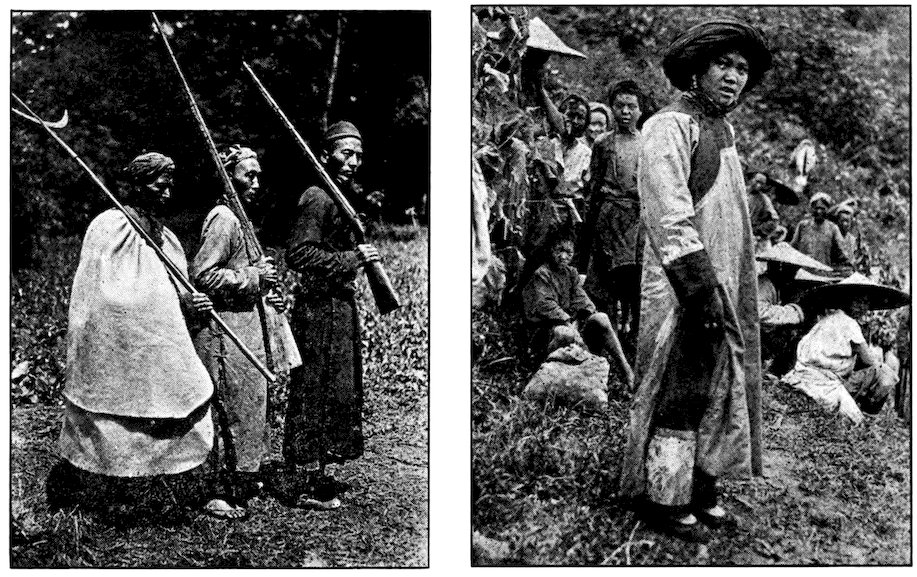
On the left are three Black Nosu or “Lolos,” who have to bear arms (and such queer arms!) to protect their feudal lords, the “Earth Eyes.” On the right is a “Lolo” woman. These people belong to a tribe which the Chinese have never entirely conquered.
Yet I might have visited the independent “Lolos,” as well as the “tame” ones of Kweichow, if I had had time, for they do not hate white men as they do the 237Chinese. But they are a very suspicious people; and I should either have had to find a missionary whom they had known for years, and coaxed him to go with me, or have lived on the “tame” side of the river myself for years until they had come to know me. Perhaps some boy who reads this will be the one to make the world acquainted with that strange tribe who have defied the conquering Chinese for hundreds of years. Spots are still left on this old globe of ours for boys now growing up to explore, thereby making themselves as famous as some of our old geographers.
Most travelers take two weeks to go from Chaotung to the Yang-tze. But it is all downhill, and by promising my coolies special wages I made the trip in ten days. The trail follows a river which, when I first saw it, was a small white stream that seemed to drop from the sky. It fell, really, from a mountain, the summit of which was lost in clouds. For hours we went down steep stone steps alongside it, and for a week we scrambled along a terrible trail, with the roar of the stream always in our ears. The hills were so steep that the people had to build their houses right over the trail. In one day we often rode or walked through several dozen houses, in some of which rice and tea were sold and sometimes poor lodgings were offered. As the houses close their doors at night no one can travel after dark.
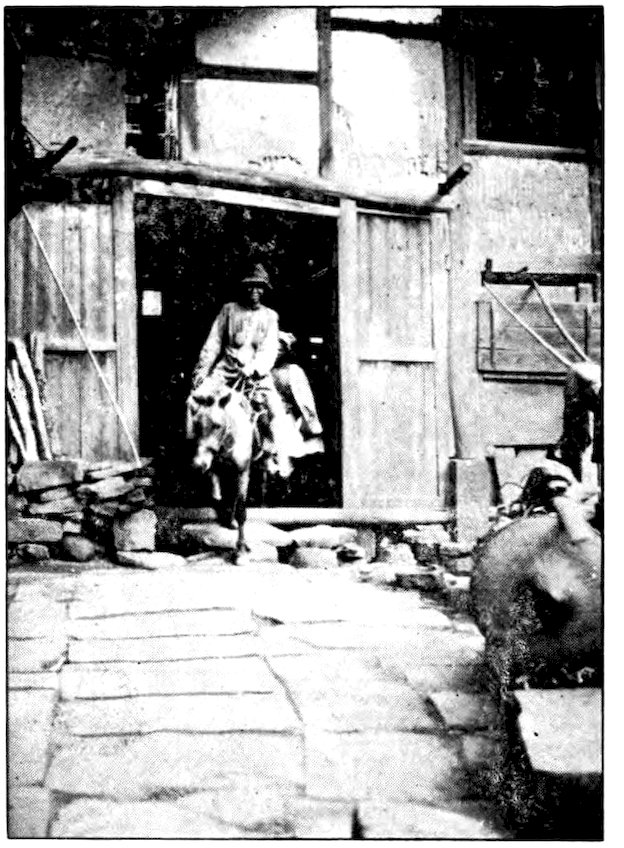
On the way from Chaotung to the Yang-tze we often had to ride straight through dozens of houses in a day because they are built over the narrow trail and it is impossible to go around them. This introduces to you my very valuable servant, Yang Chi-ting, riding on the fine little stallion I bought for ten dollars in Kweichow.
Pigs were tied by one leg to prevent them from falling down the mountain side. Land was so scarce that many a farmer piled a few shovelfuls of good earth on top of a huge rock and grew three or four stalks of corn in it. As we dropped lower and lower, it became hotter and hotter. The delightful climate of the highlands disappeared, along with the potatoes 239and finally the corn, and before long we were surrounded again by rice fields.
The most interesting people we saw on that part of our trip were the bay-fu. Most Chinese carry their loads at the ends of a pole across the shoulders. But out in the mountainous parts of Yunnan and Szechuan, the great west-central province which I entered about a week’s journey below Chaotung, they bay—that is, they “carry on the back.” We met thousands of these men every day, some in caravans miles long. It was often very difficult to get past them with our horses, on the narrow trail. Each had on his back a kind of heavy wooden knapsack, something like a dog-sledge with the runners stretching forward over the head. On this contrivance the bay-fu carried loads that we would not believe possible, if missionaries and other foreigners had not often weighed them.
Most of these coolies, so thin that their ribs could be counted ten feet away, were hardly as big as the average American woman; yet many of them carried leads of more than two hundred pounds! They start in as children, and of course the training their ancestors have had for hundreds of years helps also.
I met a boy of eight who had fifty pounds of rock-salt on his back, besides the heavy wooden framework itself. The coolie cannot lift his load. He has to be lifted to his feet after he gets under it, unless he has put it together on a ledge or a table. Once up he will walk twenty or twenty-five miles a day over the mountain 240trails. But if he falls down under his load he cannot get up until someone without a load comes along to help.
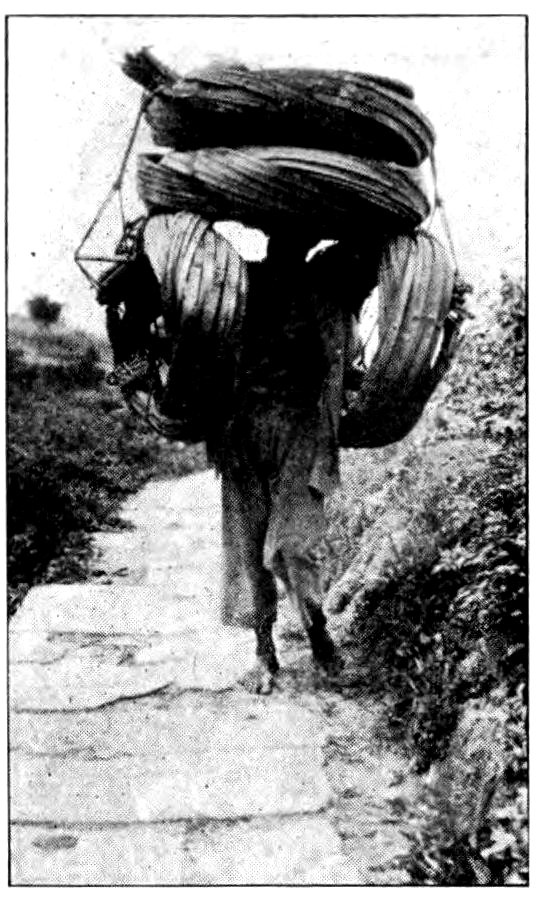
A load weighing about 150 pounds, consisting of bamboo splints from which will be made ropes such as are used in the deep salt wells of Tzeliuching in Szechuan Province. The coolie has to pick his way on the narrow flagstone road which, winding endlessly between the rice fields, is typical of southern China.
It was hot in Suifu at the end of July when Yang Chi-ting and I, with our horses and our baggage, reached there on a very shaky native boat. The water in the branch which we had been following for a week was so high that it snatched us in about four hours over a distance that usually takes two hard days by land. It gave us a queer feeling not to hear a sound from the river while we were traveling on it, though it had roared in our ears day and night when we were clambering along its stony shores. Two hours after we took the boat the branch joined the Yang-tze, 1700 miles above where it reaches the ocean near Shanghai. Up there the Yang-tze rushes on as if it were still dizzy from its fall down out of the mountains of Tibet—a very different stream from the broad placid river below Hankow.
We were still more than two hundred miles from the capital of the great province of Szechuan, which means “Four Rivers.” We might have taken a small steamer up another branch of the Yang-tze and perhaps have found water enough in a small branch of this big tributary to have gone on to Chengtu by another native boat. But only those with plenty of time and no end of patience should travel up small rivers in China. 242So we hired two new coolies for what was left of our baggage, and started off still farther to the north.
The road for the first two days was brand new. Yet it was just the same kind of road as those that have been built in southern China for many centuries, described in an earlier chapter—a very winding ridge of earth high above the flooded rice fields, covered with huge slabs of stone, and barely three feet wide. As a road of this kind gets older, the rains wash away the earth ridge under the stone slabs and sometimes leave them balanced so that a breeze will almost move them. Up in the mountains I often had my heart in my mouth for fear my horse would step on the unsupported outer edge of one of these stones where the road hung over some great cliff or steep river bank. As a matter of fact, the foolish animal three times went over a cliff, stone and all, and once with me on its back. But that horse seemed to have as many lives as a cat, and nothing ever seemed to hurt it, though it was thin as a bay-fu coolie before our thousand-mile journey was over.
Szechuan is the largest and one of the most fertile of the eighteen provinces of China proper. It is nearly as large as Texas. But while our largest state has hardly five million inhabitants, Szechuan is said to have fifty-five million! Many parts of it are mountainous and its scenery is beautiful almost everywhere. Even if the hills we were traveling among now were mere knolls compared to the great mountains of Yunnan and Kweichow, they were often of such curious shapes, and the humid atmosphere made the 243landscape so attractive, that every mile forward was a new pleasure. Here and there over the road was a p’ai-lou, or memorial arch of stone, elaborately carved, and in some cases hundreds of years old. Such arches are found all over China, but there seem to be more of them in Szechuan than anywhere else.
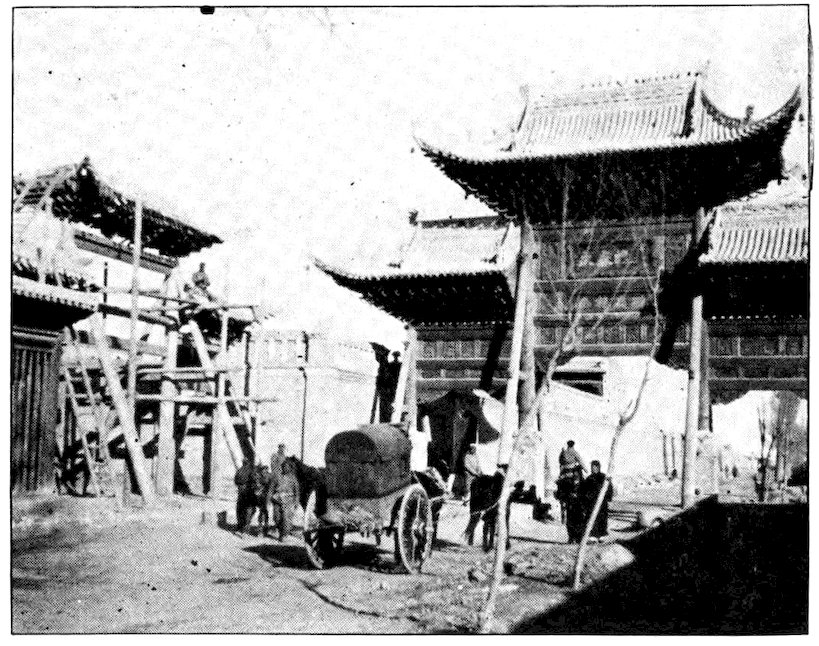
There are thousands of old p’ai-lou or memorial arches in China, many of them of carved stone. The arch shown at the left in this picture is the only one I ever saw being built. It and its companion are of wood, gaily painted.
Caravans of freight-coolies often crowded the Chinese inns so that I had to sleep in a temple. But the people do not object to that at all, if you give the caretaker a few cents when you leave. In fact they 244see nothing wrong even in letting a foreigner sit in the priest’s chair before the altar and put his feet on the table on which, during ceremonies, food is laid out for the god or spirit inside. I did not do that, but Yang Chi-ting used to serve my supper on that table, while I sat in the priest’s comfortable armchair. Sometimes he brought in a wooden tub and filled it for my bath. As the temples had no floors except the earth, a little water spilled meant only a patch of mud.
One night I slept on the high stage of a great town temple, while hundreds of people came to gaze up at me from the courtyard below as if I were a theatrical performer. Another night I slept in a church—I do not mean during services! As they have never had our feeling of reverence for religious buildings, it is not strange that Chinese Christians think it all right for a foreign traveler to use a church as a lodging. But the church was much less comfortable than a temple. A poor little mud-brick hovel with Mother Earth for floor, filled with narrow wooden benches, it was stuffy and hot, and a very noisy street was just outside. But Yang slept as soundly on two benches set together as I did in my cot covered with a mosquito-net.
Accidentally I packed the net in a different load from the cot one morning, and that night I had to sleep without it. The coolie who carried the box I had put it in fell behind and did not overtake us until next day. Such an occurrence is very rare in China. Not more than two or three times during my two years of traveling in that country did a carrier stop at night before 245he caught up with me, no matter how bad the road or weather, or how tired he may have been. Nor did the carriers ever steal a thing out of my baggage, though they were often alone with it for hours and knew that there were rolls of silver dollars in boxes that were sometimes not even locked.
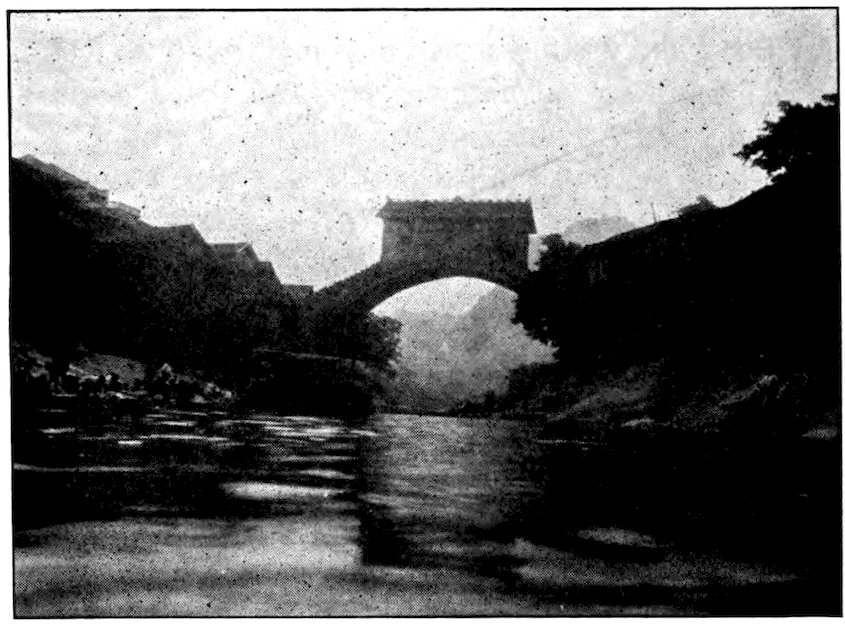
An arched bridge that carries a temple on its shoulders. It crosses a mountain tributary of the upper Yang-tze.
As I look back, the worst trick ever played upon me by a carrier in China was this one of leaving me without my mosquito-net. Not only did swarms of mosquitoes feast on me all night, so that I never once fell entirely asleep, but in the morning I found that they were the kind of mosquitoes that carry malaria. I lost no time in taking a large dose of quinine and 246luckily I did not fall sick. I once had malaria in South America, and I would rather be captured by bandits than have it again.
Speaking of bandits, no soldier guard was sent with me after I crossed the border of Yunnan Province. Yet Szechuan also has its brigands. Two Americans had been killed by them the summer before, and one day I met an Englishwoman who had been robbed of everything except the clothes she wore and her wedding-ring. No other white man went over the trail from Yunnanfu to Chengtu during all that year, because it was so dangerous. Possibly the reason robbers and bandits never trouble me, no matter where I travel, is that I always look too poor to be worth the bother!
The day after that mosquito-y night was Sunday, and I spent most of it at a famous old city named Tzeliuching. That may sound like a terrible name, but it means nothing worse than “Salt Wells.” No one seems to know for how many centuries salt water has been taken out of the ground in that region. The wells are hundreds of feet deep and hardly a foot in diameter, though sometimes in solid rock. Yet the Chinese still use their crude, ancient tools to dig them, instead of modern drills. They use ropes made of bamboo strips, in place of steel cables, and water-buffaloes that plod round and round a great wooden drum take the place of steam or electric engines. The water is brought up in very long bamboos, with a valve 247in the end. Hundreds of coolies do nothing all their lives but carry water to pour into those wells so as to soak up the salt rocks. The brine is boiled down, and the salt, in big blocks like flat stones and almost black in color, is carried away in every direction. Coolies often toil along for a month with two hundred pounds of it on their backs.
One morning, a week north of the Yang-tze, we climbed up over some rock hills and came down upon the great plain of Chengtu. That rich, floor-flat region is so large that it took me six hours to reach the city it supports, and a long day of trotting later on to get to the northern edge of it. My horse could not trot on this first day, because the ditch that the Chinese call a road was deep with mud.
There were still slabs of stone laid sidewise, but here they were laid a foot or more apart, to save the cost and labor of putting them close together. Stone has to be carried a long way to the plain of Chengtu, where there is not even a pebble. Besides, horses or mules very rarely pass over that road, and the coolies who do their work can step from one stone to another.
The people of this region so seldom see a horse that they called our s’en-kou, which means just “animal,” as if they did not know what particular kind of animal we rode. Though our horses were very tame, almost everyone shrieked and ran away when we were seen coming. Often we had to ride through the narrow main street of a town crowded with people 248on a market day, and the only way to do so was to let our horses plow through the dense throngs as a boat does through water. You have never seen anything in the movies as funny as the way people would tumble over one another to get out of the way the moment they felt or heard or smelled or saw one of our “animals” close behind them.
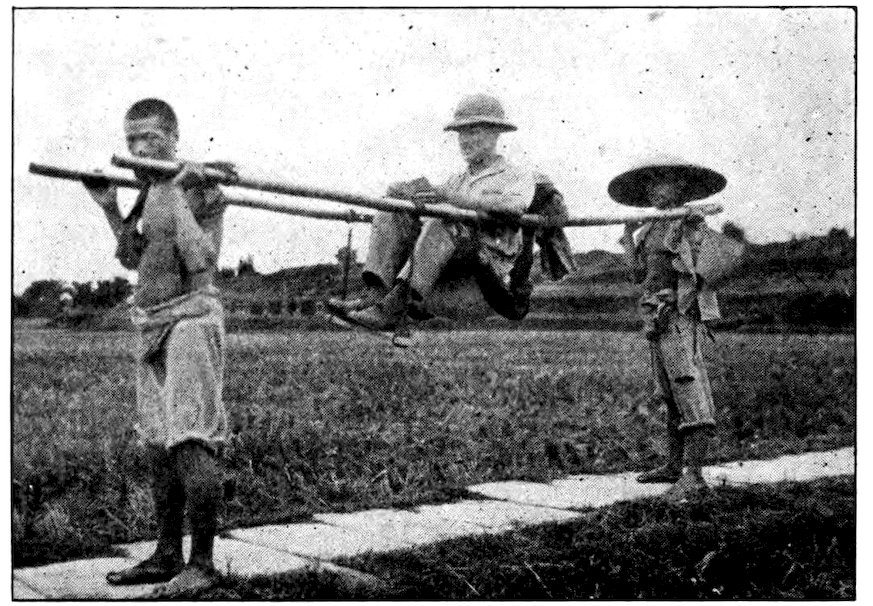
Just to see how it felt, I rode one day in a hwa-gan. I found my riding as smooth as if I had been in a Pullman car. If I wanted to sleep, all I had to do was to stretch out, with my legs over the poles.
The Chinese of this region who can afford to ride use sedan-chairs or wheelbarrows, and especially hwa-gan. The hwa-gan consists of two bamboo poles with a seat and a foot-rest hanging from them by ropes. I once rode in one myself, just for the experience, and found it easier riding than an American railroad car, 249though I prefer to do my own walking. The chair-coolies of Szechuan are famous for the smoothness of their trot. If you get tired of sitting up in a hwa-gan and reading or looking at the landscape, all you have to do is stretch out and hook your legs over the poles in front of you and go to sleep. The Chinese learn to do this very well.
There was a very strict young governor at Chengtu when I reached there, and he no longer allowed wheelbarrows to come inside the city walls. As there are no rickshaws so far west, nearly everyone had to walk. That was especially hard on the ladies, for almost all except foreign ladies, and the Manchu women remaining from imperial days, had bound feet.
Every foreigner who comes to one of these far interior provincial capitals is expected to call on the governor. I had to borrow a sedan-chair from an American resident, for it would have been very bad Chinese manners to have gone to the yamen, or governor’s palace, on one of my horses.
The chairs for rich or important people have poles curving upward in the middle, so that the person carried is high above the common crowd; and the carriers knock out of the way anyone who does not hear their shout of warning in time to jump. The Chengtu chair-coolies jog through the crowded narrow streets at about five miles an hour, and a third man changes places with one of the other two every block or so, without the passenger’s even feeling it.
250I often called on governors and other high officials in China and always found them very courteous, though occasionally one of them thought the way to shake hands was to grasp my thumb with his right hand. Some governors invited me to Chinese feasts, where I ate too much for my health. Not only is the best Chinese food very good indeed, but it is bad manners at such a feast not to eat just as much as possible. These feasts usually came at about eleven in the morning and four in the afternoon, and when I was invited to luncheon and dinner by foreigners on the same day that I went to Chinese meals I was very well fed indeed.
The governor of Chengtu invited me to the movies rather than to a feast. He took six of his wives with him, leaving the seventh at home to look after the children. The American “Wild West” film shown that evening seemed to be greatly enjoyed by the large crowd that packed the outdoor auditorium. This governor had very modern ideas. He let his wives bob their hair and ride bicycles. At the time I talked with him he was cutting seventeen wide streets through the ancient capital. Since then he has been driven out in one of China’s many civil wars, but before he went Chengtu saw its first automobile, and other modern things are to come.
The streets of Chengtu are gay in many places with bright silk threads that are being woven into cloth. The place has a mint and an arsenal and some other modern establishments; but most work is still done in family groups rather than in big factories. A pleasant 251feature of that huge and very interesting old city is that even the coolies have bamboo armchairs in their tea houses, instead of the narrow uncomfortable sawhorses that in most parts of the country serve the poorer people as seats.
My last side-trip in China was the climax of them all. I climbed a stone stairway more than two miles high, to the Golden Summit, as the Chinese call it, of the sacred mountain of Omei-shan. It is 11,000 feet above sea-level, and though August had been blazing hot down on the plain, we felt as if we were at the North Pole up among the great wooden temples above the clouds.
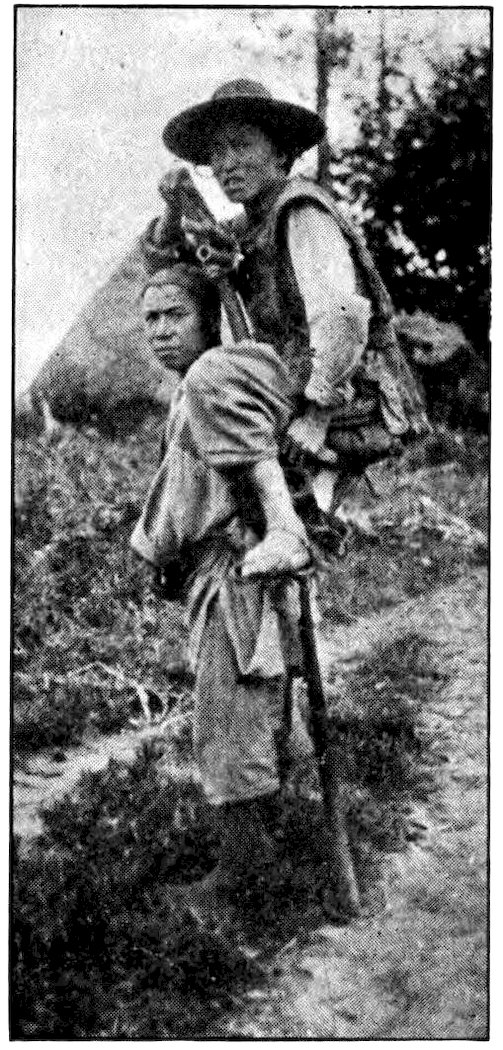
For those who cannot climb the 11,000 feet to the summit of the sacred mountain of Omei-shan in western China, this kind of steed is waiting.
Many thousands of pilgrims climb Omei-shan in a year, and now and then one throws himself from the top, because he expects in that way to get to heaven. From the summit I had a splendid view of the vast snow-capped mountain ranges of Tibet, that lofty land which so few white men have even entered.
252If I tell you that I came down that two-mile stairway much faster than I went up, you will not be surprised; and if you have ever come down so steep a mountain you will also not be astonished that my legs ached for days afterward.
I found I could get into a boat at the foot of Omei-shan, or under the walls of Chengtu, and go by water all the way to San Francisco or to New York. Of course, I had to change to larger and larger boats, first at Kiating, with its enormous Buddha carved in the high river bank. The next change was to a comfortable foreign steamer at Chungking, the great river port of Szechuan, on its rock shaped like an alligator’s back. This boat took me through the wonderful gorges of the Yang-tze, with their cliffs higher than our highest skyscrapers. From Ichang another steamer carried me to Hankow, where I boarded a still larger one for Shanghai. There an ocean liner was ready to carry me and my family homeward across the Pacific.
AUTHOR’S NOTE: The pronunciation of Chinese words here indicated is as nearly as possible that of the Chinese people themselves, rather than the usual foreign pronunciation. Since the Chinese language has sounds which ours does not have, and since there is less accent than “tone”—a kind of musical inflection which it is impossible to indicate with any symbols we have—it is in some cases impossible to give the exact English equivalent.
In the unenviable task of Latinizing all these sounds, the Americans and British (missionaries, for the most part) who reduced them to the accepted spellings with our alphabet, were not always entirely successful in expressing exact shades of sound. From the start, certain Chinese words might well have been spelled differently in English, to give us more nearly the real pronunciation. For example, some of the k’s might better have been j’s, the j’s more exactly r’s, the p’s preferably b’s, etc. Thus, if the name of the capital of China had been Latinized as “Bayjing,” foreigners would pronounce it much more nearly in the Chinese way than they do in saying “Peking.” As people have become accustomed to the spellings employed in maps, encyclopedias, and geographies for generations—and, more or less, to the pronunciations indicated in dictionaries and other reference works, the attempt here to give more exactly the Chinese pronunciations will doubtless provide some surprises.
The symbols of Webster’s New International Dictionary have been used.
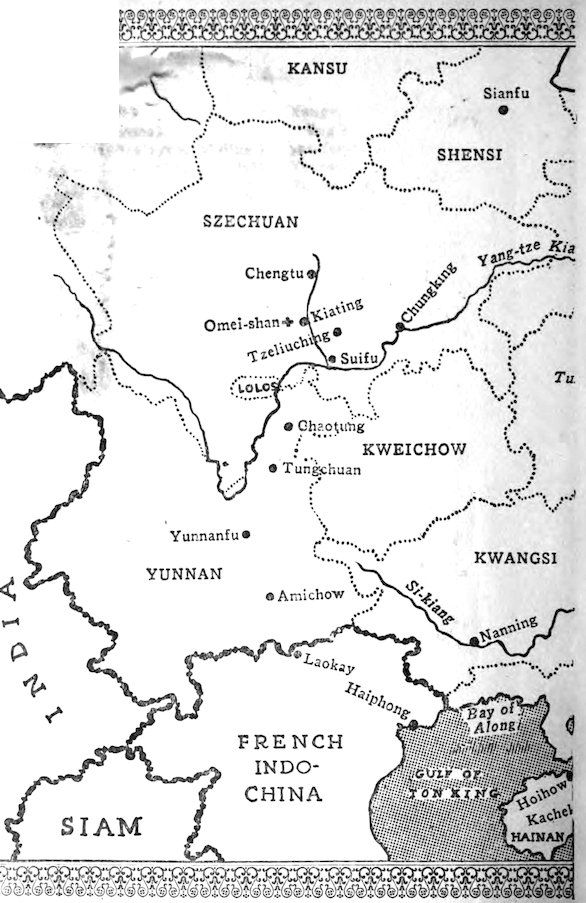
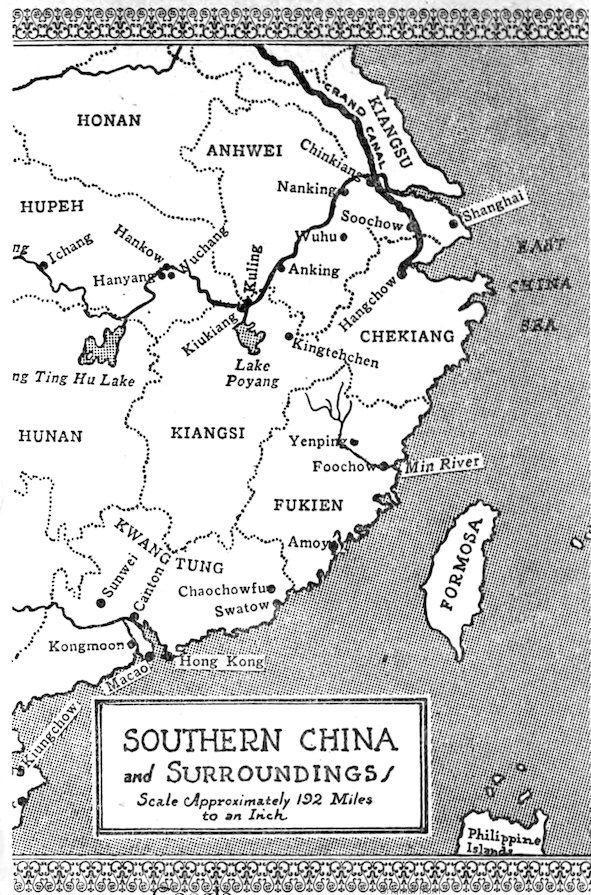
A series of Geographical Readers for Intermediate Grades, written by Harry A. Franck and published by F.A. Owen Publishing Company:
Books by Mr. Franck published by The Century Company, New York: