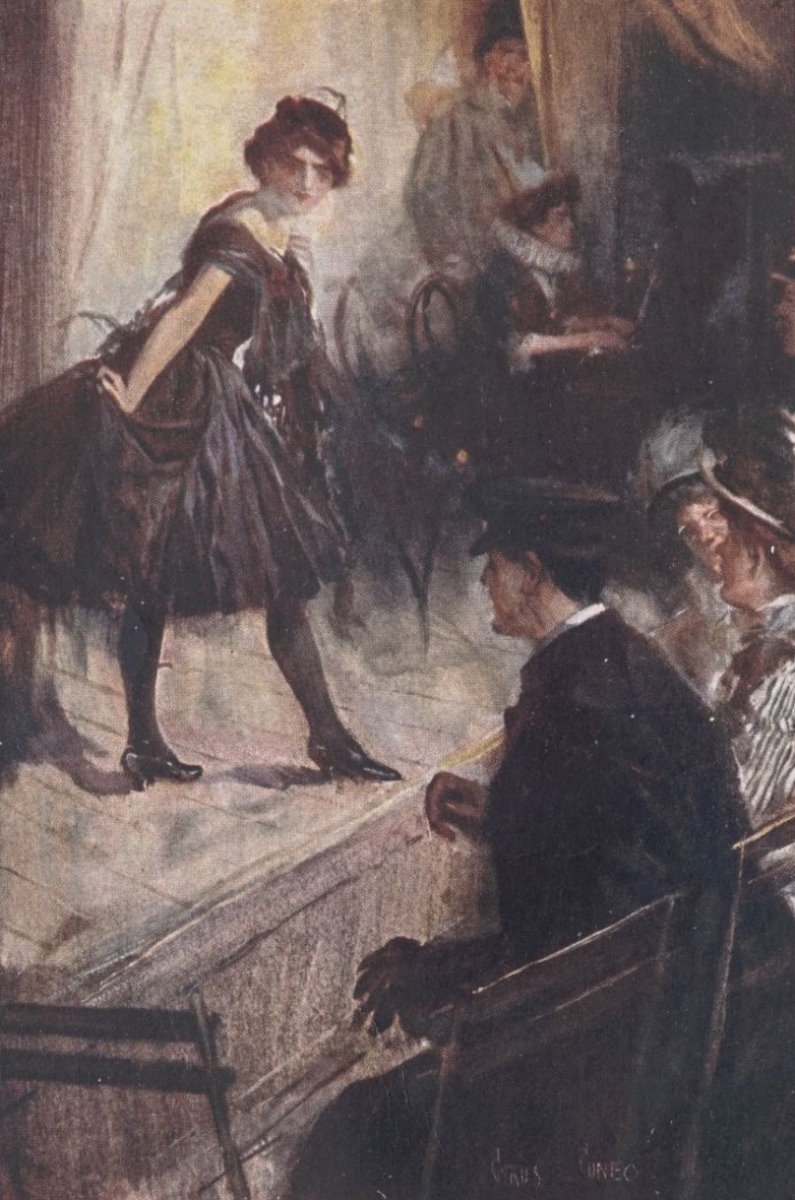
Title: The show girl
Author: Max Pemberton
Illustrator: Cyrus Cuneo
Release date: June 29, 2026 [eBook #78976]
Language: English
Original publication: Philadelphia: The John C. Winston Company, 1909
Other information and formats: www.gutenberg.org/ebooks/78976
Credits: an anonymous Project Gutenberg volunteer
BY
MAX PEMBERTON
Author of
“The Garden of Swords,”
“Sir Richard Escombe,” etc.
THE JOHN C. WINSTON COMPANY
PHILADELPHIA
Copyright 1909
by Max Pemberton
Copyright 1908
by Max Pemberton
All Rights Reserved according to
the Copyright Laws of the
United States and Great Britain
To
James Gordon Bennett
Hommage Reconnaissant
4. Henry Gastonard continues the story in a letter to his friend Paddy O’Connell
5. Henry Gastonard writes to Paddy O’Connell telling him the story of a dinner and a challenge
6. Being a telegram from Paddy O’Connell to his friend, Henry Gastonard
9. Being a further instalment of the story from the pen of Paddy O’Connell
10. Henry Gastonard writes to Paddy O’Connell a letter concerning his search for Mimi the Simpleton
11. Henry Gastonard informs Paddy O’Connell of his probable return to London
12. Henry Gastonard tells of a visit to his cousin, the Rev. Arthur Warrington, at Lowestoft
14. Paddy O’Connell apologises for his silence
15. “The Chimes” at Yarmouth, and what Henry Gastonard learned of them
16. Henry Gastonard gives a further account of his meeting with Mimi the Simpleton
17. Paddy O’Connell lays down the law
18. In which we hear something of the Pageant at Lowestoft
20. In which Mimi replies to Monsieur Henry
21. Being a telegram from Henry Gastonard to his friend Paddy O’Connell, of Glendalough
22. Being a reply from Paddy O’Connell to Henry Gastonard’s telegram
23. Paddy O’Connell shares the news with his sister Clara
24. In which Henry Gastonard keeps his promise to Martha Warrington
26. Madame Mimi writes a letter to Paddy O’Connell
27. Paddy O’Connell replies to Mimi’s letter
28. The same author addresses Henry Gastonard at the Hotel Metropole, Brighton
29. Henry Gastonard makes an urgent appeal to Jules Farman, of the Rue de Quatre Septembre, Paris
30. Jules Farman sends to Henry Gastonard some account of his stewardship
31. Henry Gastonard sends Paddy O’Connell some account of his labours in Paris
32. In which Paddy O’Connell advised his friend Harry to pay a visit
33. The Reverend Arthur Warrington thanks Paddy O’Connell for services rendered
34. Henry Gastonard tells Paddy O’Connell of his visit to Madame Lea
35. We meet the Marquis de Saint Faur and another old friend
36. Paddy O’Connell writes a brief letter from Jack Straw’s Castle at Hampstead
38. The Reverend Arthur Warrington rebukes his wife, Martha Warrington, upon a trivial account
39. We hear of Paddy O’Connell in a letter to Martha Warrington at Cambridge
40. A brief note from Jules Farman, in Paris, to Henry Gastonard, at St. Germain
41. In which Henry Gastonard receives a summons from the Marquis de Saint Faur
42. Paddy O’Connell hears that he may leave London, and is invited to take the first train to Paris
44. Mr. James Frogg, of Serjeant’s Inn, receives an unexpected answer to an expectant letter
46. The Reverend Arthur Warrington receives the news and makes some complaint of it
49. Madame Lea d’Alençon has really nothing to say; but she says it charmingly as ever
51. Mimi and Harry write to Paddy and advise him of their approaching visit to Ireland
[Being a letter from Henry Gastonard of the Maison du bon Tabac at Paris to his friend Paddy O’Connell of Glendalough, County Wicklow.]
Maison du bon Tabac,
May 15th, 1905.
Dear Paddy,—You will have seen it in the papers, if papers still cross the pass to those ancient halls which enshroud the immortal glories of the clan O’Connell—but, my dear Paddy, you will have little idea of its meaning or be as far from the truth of it as Paul Delmet from a parson’s cassock or the Chevalier Honoré de Villefort from the castles in Spain which the entirely disinterested Baroness has lately bequeathed to him.
I can hear your comments, your wisdom, can imagine your displeasure. What—a man who should be riding his hack in the Row, putting a yacht into commission at Cowes—or at the worst buying a thousand guinea motor-car to carry his friends from their creditors—this man living in a hovel at Montmartre, spending his money upon chansonniers, grisettes, cocottes and all that paste-board riff-raff which has made the Quat-Z-Arts famous wherever the American language is not spoken. This is what you say, my dear Paddy—this is what my beloved cousin Arthur is saying when he tells himself that in twelve months’ time the curtain falls upon the play, and he, the patron, walks off with the proceeds.
Be sure that I forget this unpleasant truth whenever life will permit me to do so. The thought for to-morrow is not often the spectre at the feasts over which Marcelle presides, nor one which Mimi La Godiche—which is to say Mimi the Simpleton—long permits to remain in heads as empty as her own. I am to lose my fortune of seven thousand pounds a year if, at the mature age of twenty-five, I am not earning five hundred pounds a year by my own labour and talent. So be it, Paddy. Let us eat and drink, for to-morrow we will dine. This fortune may carry some little sunshine even to the benighted halls of the Agile Wolf. I make no complaint of destiny—nor of Mimi La Godiche, whose friends robbed me of a trumpery cigarette-box which is again upon my table while I write this letter.
I say that I make no complaint of destiny—why should I? Let me but open this window, upon which Gabriel de Math has drawn in the best French chalk an impassioned sketch of an empty champagne bottle—let me but open it and the world is at my feet—Paris of the golden domes, Paris of the dark eyes and the meaner streets—a great black Paris, a Paris of woods and gardens and river, of the mills which grind the grisettes’ corn, of the hives whence issue the noctambules and night hawks, whose prey has gossamer wings of greenbacks, whose morrow is never because of the eternal to-day. All this lies in the great bowl before me. I pour my fortune into the abyss and they strive for it far below, in a glitter of brass and spangles, in a flutter of white petticoats and silken hose and shirt fronts which would be better at the laundry. But none knows the truth—I am the mad Englishman who neither paints nor plays. And I am as poor as the rest of them—and God knows how poor that is.
So, you see, Paddy, I have my consolations, and among others, as the papers have told you, the friendship of Mimi La Godiche. What a fine old cardboard tragedy they have made of it all! Did I not sally forth at midnight, armed with a blunderbuss and a scimitar to cut down the apaches who lurk beneath the shadow of la Galette? Did I not enter a café which the police are afraid to enter? and did not these strong hands drag therefrom the brave fille who had returned my stolen diamonds to me and was in danger because of her honesty? News “fitting to the night,” upon my word, “black, fearful, comfortless and horrible.” Would for the sake of this Hector that it were the truth and nothing but the truth—but, my dear Paddy, there’s little of the truth in it at all, as these indentures shall bear witness. It’s as false as Fifine of the Alcazar, and not half as pretty.
You will remember that I have known Mimi La Godiche for some three months now. She is a pretty, round-limbed blonde, with a mop of tousled hair, eyes full of “fair speechless messages,” the reticence of Cleopatra, the youth of Cupid, the devilry of the whole Rue Champollion in the shape of her bewitching neck.
I saw her first at the Fête de Neuilly. She stood upon a platform with a strong man, a juggler and a clown; and when she sang I determined that she should come to the Quat-Z-Arts and sing to the Bohemians of the Butte. Montmartre gave her the cold shoulder. Can you wonder that an audience which has heard Odette Dulac sing “Je suis Bête” should decline to hear Mimi La Godiche warble “Toujours l’amour,” in a dress that makes her look like a kitchen-maid and a voice that would befit a Sunday-school? She came, she saw, she did not conquer. I offered to send her back to the lion-tamer, who is to her father, mother, uncle and brother—she declined the invitation, preferring to sit to Desmond Barrymore, the American, and not a little delighted to earn her bread at so light a task.
Now, my dear Paddy, you must tell me, for by all the kingdoms of the grisettes, I swear that I do not know what my obligations to this waif and stray may be. Must I pose as the philanthropist of the books, and send her to a convent at Brussels or a finishing school at Brighton? Should I plod patiently beneath a soiled genealogical tree to discover if, in some remote slum of Paris, Lyons, or Marseilles, there may not be living a venerable kinswoman, perhaps newly released from prison, who will harbour her? Or shall I remember that the devil knows his own and will not forget her?
I cannot tell you. She is earning an honest living with Desmond Barrymore, and will come to no harm there. Life and laughter and the light of cities are her whole existence. And imagine the talk of the Rue Pigalle repeated in the cloister or the argot Montmartrois at church parade in that “fayre town of Brighton!” It can’t be done, Paddy. I am the victim of my own enthusiasm, and Mimi will return to her lion-tamer no more.
Meanwhile, there are the thieves. The papers have told you that I, a young English student, studying the sculptor’s art in the great ateliers of Montmartre, was robbed at the Quat-Z-Arts Ball of a gold and diamond cigarette-case worth a hundred pounds. At the best it is a half truth—at the worst an ignorant lie.
None knows better than yourself, Paddy, the deserved fame of the Quat-Z-Arts Ball. Here America does not come, nor Sir Lord Moneybags enter. There is no ticket more prized in all Paris than a ticket for the Quat-Z-Arts; there is not a festivity in any ballroom in Europe more decently conducted for those who see eye to eye with these Bohemians of the Butte, and understand them. True, Venus in many shapes rides sky-high upon the gilded floats; you sup upon the floor from the contents of paper bags thrown down to you from the galleries above; but of the vulgar things to be done in London or New York by those who are merely vulgarian, you do none at all. So, my dear Paddy, I certainly did not lose my pretty cigarette-case (given to me, you remember, by old Bardon, the banker, for dragging his beloved “cheeild” from the Solent) at the Quat-Z-Arts Ball; nor would anyone outside a lunatic asylum puzzle his head to say where I did lose it.
Perhaps it was in a cab on my way to the Abbaye de Thélème, that sordid supper-house of the Butte, to which one resorts in sheer despair of sleep and solitude; perhaps later on at the Capitol, to which, I remember, Mistress Mimi would be conducted with Amé Decroix, the poet; Honoré de Villefort, the Chevalier; and that bald-headed old rogue of a perpetual mendicant, Georges Oleander, who writes the revues. I neither know nor care; for my memories are of a night of life, and colour, and music; of a scene glittering with dresses and the pictures that great artists have given to their fellows—of music which should have moved the feet of every dancing faun that ever trod a pedestal—of wit and laughter, the veritable elixir vitæ.
This is no psalm-singing screed that I write to you, Paddy, nor are you the man for the pæans of self-righteousness. I will confess without shame to certain bons moments. Though I am not, and never have been, the lover of Mimi La Godiche, there have been instants of the madness in which I have played a madman’s part.
But Mimi neither misunderstands me nor is misled. Did I but drop the shabbiest of handkerchiefs, she would become my mistress to-morrow; but I have no intention of soiling fine linen in this way, nor do I contemplate such a charming ménage as she would certainly disgrace. When I embraced her at the Quat-Z-Arts, the floats of my Lady Venus were already sky-high and the parquet a sea of billowy chiffon—but I did not do so to give her an opportunity of stealing my cigarette-case (as that old blackguard Georges Oleander will have it), nor will all the avocats in Paris convince me that this was the moment of my loss. No, my dear friend, it was at the Abbaye, I repeat, and if not at the Abbaye, then at the Capitol.
I am asking you to keep this fact in mind that what follows after may be better understood. You know me too well to suppose that I would have cried to high Heaven for the loss of a twopenny-halfpenny diamond box, or even be complaining of it to any man. But it was my misfortune to be asked for a cigarette out of that same by the prince and father of all beggars, Maître Georges Oleander aforesaid, and so, in a moment of surprise, I discovered the loss.
What next is the tale, Paddy? You will guess it first time—that Mimi La Godiche had thrown her fair arms about me, not in an ecstasy of love or passion, but purely to pocket the case and enjoy the contents at her leisure. This I had from the Chevalier Villefort not a week ago. On Sunday I learned for the first time the true value of a mendacious tongue and what it may mean even here on the “mountain” whence you look down upon the domes of Paris.
The scandal was everywhere. Remember that there is in Montmartre a great colony of artists, musicians and writers, not less honest, not less clean-living than the inhabitants of many a sanctimonious town in the country of your oppressor. These may esteem the marriage-tie lightly; but they hold love to be a sacred thing, and they would no more think of robbing their neighbour than of shooting the Pope.
These had been good friends to Mimi La Godiche because of my patronage. But no sooner is the black word spoken than every door is shut upon her, skirts drawn aside, tables shifted, slander uttered in no mere whisper. They recalled her coming—the strong man of the Fête de Neuilly, the clown, the tights, the van, the vagrant’s life. A little more of it and they would have pushed her headlong over to the great congregation of grisettes, maquereaux and night-hawks who throng the cabarets of the Butte. In short, my dear Paddy, they would have made a criminal and something worse of her—and you know what that would mean among the savages of Montmartre. Let me tell you next how I have come to save her from such a fate—if it be but for the moment—for, as Richter has told us, woman is the most inconsistent compound of obstinacy and self-sacrifice with which we are acquainted.
I have saved her. She is in this very room while I am writing this letter; but, Paddy, if she were to walk a hundred yards down the alley which has the honour to house me I would not answer for her life.
To make this clear, let me return to the Sunday after “the crime” and to my own recreation upon that innocent day. A morning with Sabine Monterey and old Villefort upon the Seine at Poissy; lunch in a frock coat and glory with Lea d’Alençon at her apartment in the Avenue de Malakoff; then to Longchamp; a little dinner at Armenonville, and afterwards the long journey home, the steep climb to the Butte and the card-box house which permits me to look down upon the sails of La Galette.
Why I went so far that Sunday night I cannot tell you. There is still my apartment in the Hôtel St. Paul open to me when I would return to civilisation. But I think the amorous Lea had put thoughts of Mimi into my head, and, wondering if all were well with her, I returned to the Maison du bon Tabac and to my bed. Ten minutes after I had entered the house, came Chocolat, the messenger from the old Café of the Assassins, knocking as the devil knocked on old Luther’s door at Weimar. Then I knew that all was not well with Mimi, and down I went, the black man upon my heels, vainly endeavouring in three languages to tell me what had happened.
What a jargon it was, what a medley of all the elusive argot of the cabarets! This much alone was clear—that Mimi La Godiche had got somehow into the Café of the Assassins (they call it the Lapin Agil to-day), and that if I did not get her out she certainly would be murdered.
True, there was a cipi, or municipal guard, to protect her from the immediate fury of her friends; but these would force her presently to the pavement, and then God help her! So much Chocolat, the messenger, declared as we hurried down the alley, passed Cerberus at the gate thereof, and plunged into the darkness of the labyrinth below. I could save Mimi La Godiche—the patron wished it; madame, his wife, was of like opinion. The danger lay in the alleys—not in any house, and certainly not at the famous cabaret of the Agile Wolf. Upon this point Chocolat was emphatic. They could look after their own—the streets were another affair.
Well, I reached the place at last, after as unpleasant a descent as ever led to Avernus, and entered the café just upon the stroke of midnight.
You know the place; the dirty courtyard before it; the rude benches in the shed that serves for a concert-room; the horrid unshaven faces of men who wear the mask of death; the savage ferocity in the women’s eyes. Of course, there are lights enough; lights and a rousing piano, and a chansonnier who lisps things we should be very sorry to repeat to-morrow. The fellow was singing nothing more virile than “Monsieur le Curé” when I came in, and, to be candid, not a soul there paid me a sou’s worth of attention. Remember that I was unknown in these places except as a poor devil of a sculptor trying to singe his wings in the candle of ambition. This reputation has been my protection hitherto, alike at the Maison du bon Tabac and in the alleys of the Butte.
Here at the Lapin Agil I must lose it, finally and irreparably, as all the omens seem to say—and losing it, have no longer a home upon the Butte of Montmartre.
De Courcy was singing when I entered the cabaret, and a bald-headed old man with a chalk-faced child, who should have been his daughter, appeared the only claque which the performer commanded. Little Mimi La Godiche I spied out at once, sitting at a table with a huge ruffian they call the Mount upon the one side and Desmond Barrymore upon the other. I was glad to see Desmond there, and pushed my way over to him. Across the room there stood a company of as savage an appearance as any defender of the Café des Assassins might desire—squat, burly, black-eyed brigands, fearful women, girls who saw the sun rise every day but rarely had seen it set. These were watching Mimi and the Mount as though the whole drama moved about them. Desmond Barrymore, however, did not appear to know what it was all about, and told me so immediately.
“The man says he’s robbed,” he explained—pointing to the Mount with the stump of a tattered cigarette. “I guess he’s dreaming. Come right in, Henry, and help me to put the fear of God into him.”
He made way for me upon the bench, and I sat down and began to ask Mimi about it. Her cheeks have not much colour in a common way, but they were now a beautiful crimson and there was light enough in her eyes to set the café on fire.
“What’s up, Mimi?” I asked her. “Why did you send Chocolat barking to my door?”
She kicked a pair of fat legs against the bench, and, leaning back, she laughed in the ruffian’s face as he bent down to catch her answer.
“Ah, mes enfants,” she cried, imitating the inimitable Georges Tiercy in his famous song. “Ah, mes enfants—ce cochon de Jean-le-Mont a une écrevisse dans le vol-au-vent”—and by that she meant (for the line is already grown grey) that the fellow who pestered her had a bee in his bonnet.
“How did you come here?” I asked her.
“In the automobile of Monsieur le Comte de Pigalle.”
They laughed at this, for I need not tell you, Paddy, that the Rue Pigalle does not boast its Count, and that an automobile which could climb the Butte might set out to-morrow to vanquish Mont Blanc.
“No, nonsense. Mimi… there has been a row. What is it all about?”
Barrymore intervened, jerking a fine fat thumb towards the ruffian.
“The fellow says she robbed him.”
“Of what, Barrymore?”
“Of a cigarette-case set in diamonds.”
Again the café roared with laughter. A cigarette-case set with diamonds at the Lapin Agil! Oh, famous treasure! I, of course, knew the truth in an instant. Mimi La Godiche had stolen my property from the man who stole it from me.
“What do you say to that, Mimi?”
She looked at me as a child in wonder—never was there a cleverer little actress or one with a cooler head.
“Do not be foolish, Monsieur Henry (ne faites pas des bêtises), I only smoke a pipe.”
“And you, my friend?”—this to the ruffian they call the Mount.
But he flinched at the question, and drained a glass of filthy liquor before he answered it.
“She stole the box. Do I steal with my own hands? No, monsieur, but the she-cats of Paris could rob the Bourse. I was walking to my seat when she pushed against me. Ask the ‘cipi’ if it is not true? I will have her searched, I tell you… she shall give me back my property!”
“Your property, good man! Do you carry cigarette boxes set in diamonds?”
“Monsieur, I am an honest man—this property was lost in Paris, and I would restore it to its rightful owner.”
“Then you will restore it to me immediately, for it is mine and was lost at the Quat-Z-Arts Ball, as you very well know.”
Well, Paddy, this took him by the heels, so to speak, and laid him upon his back. I had been careful not to advertise the case, fearing a reputation for riches among the apaches of the Butte; but the cat was out of the bag this time and every ear intent. As for the ruffian, he was floored for the moment; but he recovered a second wind of argument presently, and, being both drunk and querulous, was by no means done with.
“It is an affair for the police,” he exclaimed, lurching as he sat, and bringing his fist down with a smashing blow upon the table. “Ask the ‘cipi’—she must go with me to the police-station and take the affair there. I am an honest man and I will not be robbed. You say that this is your case, monsieur—well, prove so much to the police and I shall have no more to say. But you shall prove it—I will make you, I, Jean-le-Mont—hear that, monsieur—I will make you prove it!”
He stretched an arm across the table and pulled the lappet of my coat with clumsy vigour. I saw that an uproar was at hand, but determined to keep my temper as long as possible. Big as Desmond Barrymore and I are, we were no match for the black company upon the opposite side of the room—and there was a magazine which any foolish word might fire in an instant. So it was necessary to temporise and, above all things, to keep the mob quiet; in which endeavour I called for a bottle of wine and some cigars, and affected to make light of the fellow’s impudence.
“You are talking nonsense,” I said. “My case had my name inside it—we can easily prove that. Drink a glass of wine with me and then come to the station. What’s the hurry about? We sha’n’t run away, and I don’t suppose you have any engagement. Now, isn’t that a fair offer, monsieur?”
He muttered something, I know not what, and sank back to glower at the waiter Juno, who snapped the cork from a bottle and set it before me. Mimi, I observed, was still smiling; Desmond Barrymore playing with his cigarette as a man over-anxious, but not afraid. As for the canaille opposite, I perceived its hesitation, and did not fail to take its meaning. There could be no brawl permitted in the cabaret, but there might very well be a pretty affair outside. In a word, they waited for us to go, each believing that he or she would shortly become the possessor of a gold cigarette-case set with diamonds. This was the state of the game when the man they call Jean-le-Mont spoiled everything by a premature declaration of hostilities, both unexpected and maladroit. For what should he do but lurch to his feet, catch Mimi by both her slim arms, and begin to hug her like a bear; while he did not cease to shower upon her that unnameable abuse in common use upon the Butte.
Now, this was very unexpected, Paddy, and left the “backs” rather nonplussed. A table stood between the pair—bottle and glasses had already gone crash to the floor. Had I struck at the man immediately, I might have hit Mimi, and done her a mischief; it was impossible to get at the fellow’s legs or to secure so firm a grip upon his arms as would open them and release his prey. Luckily, Desmond is a man of some wit, and did not fail me. I saw him watching the pair with a droll expression upon his face; then he calmly put his cigarette under the giant’s nose, and held it there until the fellow turned upon him savagely and struck a Triton’s blow. Before he could repeat it I had laid him on the floor with a counter that Molt of Cambridge taught me; and you could count the minutes before he rose again.
Forgive me, Paddy, for thrusting upon you this plain tale of a tavern brawl. The papers have a “piece” about it, and that is my excuse. It will also permit you to understand the new rôle in which I find myself—that of brother, uncle, guardian, foster-father, tutor, friend to a tousled-haired nymph of the slums, for whom now I am solely responsible.
Admittedly, there has been some personal humiliation before this was arrived at. Your ready mind will depict the scene in the cabaret after that Jean-le-Mont lay upon the floor, and the “cipi” drew his sword and bawled murder. Upon my life, I thought the three of us were done for. The cries, the fierce oaths, the looks, the words of them! And then upon it all, the enraged patron forcing us all to the street, swearing that he would have no murder in his house; which, my dear Paddy, remembering that it used to be the Café of the Assassins, you must admit to be both illogical and disloyal.
He said that we should go, and go it seemed we must. The place was in an uproar now; the steep street very soon became a pandemonium. I knew that the apaches were out, and I would tell you what I would tell no other man alive, that I had the fear of God in me down to my very toes.
And what of this waif and stray, Mimi La Godiche, who had my cigarette-case upon her, and must, but for our protection, jostle with the ravening wolves at the door? I had never understood the child, and I understood her less in that moment—for there she was smiling still, or, stooping, as her trick was, to smooth her short dress over her knees; now bursting into laughter; now saying, “Ah, mes enfants,” in that tone inimitable of the cabaret. And the ruffian at her feet had drawn a knife long enough to cut up the beef at Smithfield. Oh, my dear Paddy, what a harvest of the green years as Jehan Rictus would paint them for us in those immortal verses which my countrymen so rarely understand!
This babel of sounds endured five full and dreadful minutes, I suppose, during which time the ladies of the company lost no time in emptying the glasses of the gentlemen, and the gentlemen in picking the pockets of the ladies. When it became clear that we must go or face an enraged patron and three of the prettiest bullies in Montmartre, I whispered a word to Desmond to stand all close until we reached the street, and then to go as calmly and with as little concern as might be toward my box of a house upon the height.
Granted that this was the uninventive hope of a man who certainly believed he would find a knife in him shortly; but, Paddy, what better plan could you have named, or by what road did wisdom lie?
We had to go out into that darkness of the gutter, where the wolves were waiting, and to go upon the instant. No excuse, no entreaty seemed to modify the temper of the ruffian, who feared the police, and would have none of us. For my part, I preferred the unknown dangers of the pavement to the clubs of Chocolat and the patron; and, although a scene in Thiers recurred to me, when the prisoners from the Abbey were driven forth to slaughter in those fateful September massacres, I chose to whistle one of Legay’s songs rather than to recite it. Then, putting my arm about Mistress Mimi’s waist, I dragged her from the place, and went pell-mell to the fray. Eheu, Paddy, what a moment to live! what a pretty episode in the life of a young gentleman come to Paris to study the sculptor’s art!
We were in the thick of it, then, and no mistake at all about the matter. Fifty at least of the choicest blackguards of the Butte waited in the alley and swarmed about us instantly. I felt their hands all over me like mice upon a sack of corn. One rogue thrust his great fingers into my waistcoat pocket, and had the satisfaction of taking therefrom an American time-piece of the value of three shillings and sixpence; another robbed me of a wooden pencil in a tin case; a third of a couple of five-franc pieces and some small change. This plunder was far from being what they wanted. Just as the vultures loom mysteriously upon the horizon when a man sits down to die by the wayside, so did they appear at this talk of gold and diamonds.
Had there been but two or three there gathered together, I don’t doubt they would have dealt with us as men deal with chickens at Easter; but their very numbers defeated a set purpose, and the lights of the cabaret forbade a murder. For a little while we swayed about as a ship caught in a vortex; the lamps shone down upon faces besotten with drink or fired by greed; I could see the room behind us, the figure of the patron, who still gesticulated, the gaunt form of Jean-le-Mont, now risen to his feet; and it seemed to me to take the place of a pleasant harbour one had quitted in despair. Then I think a ruffian tried to pull me down from behind; but the press was too close, and I caught his hand in mine and went near to breaking his wrist. This was a mistake, for he also possessed a knife, and drew it, and it needed an iron hand upon his throat to silence him.
I am going deeper than I meant into these police-court news, Paddy, chiefly that you may understand my present difficulty with Mimi La Godiche. Let me tell you that when the fun really began, when fists were busy and hats were flying down the Butte, when the women shrieked and fled and the men called upon their fellows to make an end of us, I discovered that she had friends, even among such as these, that she could call them by their gutter-names and that they would answer her. It may be that many of them hung back just because it was Mimi of the booths and the fêtes foraines, and by no chance could she be credited with the possession of sixpence; but, the reflection apart, my spirits sank when I heard them recognise her, and a sense of degradation, impossible to define, afflicted me anew.
What a position for Henry Gastonard to be in—self-sought, inevitable, the price of this gipsy’s game upon the Butte; the consequence of a chosen masquerade and a self-imposed war upon civilisation!
Were there not a thousand devils of my Saxon self-respect crying at my elbow to have done with it—to pitch them a handful of money—to say to them, “There is your sister in the arts; take her by the hand and lead her to her home?” A flash of thought it may have been, while I dealt with the gentlemen of the pavement and calculated the chances with a greater precision; but there it was, and while it ran strong in my head, the girl herself lay almost in my very arms, smiling still, a very gamin enjoying a brawl as a common incident in her daily life. Do you wonder, Paddy, that I clung to my wreckage and refused to part with it to any other robber upon the shore? By heaven and earth, I swear she is the best plucked ’un that ever wore a red silk stocking or showed it on a booth to a gaping multitude. And that you shall come to believe for yourself presently—when I take you fifty paces further from the cabaret and show you in a line just why we were not murdered.
Do you remember the Rue St. Vincent, that narrow lane by the Assassins, with the great black buttresses and the dingy oil-lamp we used to deride together? Well, it was just by there that we seemed in for the worst; just by the very corner that you would not have paid the half of a brass farthing for our chances.
I had as good as given it up, and fallen to wondering what it feels like to have six inches of steel in your vitals while twenty hands are picking your pockets and twenty more are rifling your shoes. That this was premature, the unexpected but quite gentlemanly appearance of some fifteen agile sergents de ville immediately assured me. They had been fetched, it seemed, by the “cipi,” or municipal guard, at the cabaret, who, while he would not have lifted a finger to save Mimi La Godiche, was by no means willing that an Englishman should be papered to-morrow, or found drowned upon the following morning. Thus the company, armed to its very teeth, and thus the rats scuttling to their holes, the women left to slither down the steep, the men crying that Mimi La Godiche was une guêpe, and that they would settle with her upon another occasion.
I thanked the guard, Paddy; thanked Desmond Barrymore for his kindness to the girl; and bidding him “good night” (it should have been good morning), I climbed the mountain to that verdant alley wherein my home lies, and took Mimi to the parlour with me. Her first act was to return me my diamonds. I need not particularise as to where she had hidden them, or what was her inspiration. She is here as I write this, like a dog upon my carpet. She has been for twenty hours almost in the same position—but what am I going to do with her, what provision make for her, or how am I going to smuggle her in safety from this mount of thieves, I know, my dear Paddy, no more than your estimable self.
So let me have your consolations. All places are filled with fools, says Cicero—but there are but two at the Maison du bon Tabac, and one is Mimi La Godiche and the other—
Yours eternally,
Henry Gastonard.
[The response of Paddy O’Connell, of Glendalough, County Wicklow, to his friend, Henry Gastonard of the Maison du bon Tabac at Paris.]
Glendalough, County Wicklow,
May 18th, 1905.
Dear Henry,—Your letter is received. I gather therefrom two facts:—1. That you are making a fool of yourself in Paris. 2. That this occupation is congenial to you and the lady of the circus, upon whom you appear to have bestowed your patronage.—Believe me to be, My dear Henry,
Yours sincerely,
Paddy O’Connell.
[A letter from the same brief author addressed to the Reverend Arthur Warrington of Beldon, Suffolk.]
Glendalough, County Wicklow,
May 18th, 1905.
Reverend Sir,—Your request that I would favour you with such news as I may from time to time receive from my friend Henry Gastonard permits me to assure you that he is now established in Paris, and appears, by his diligent habit and assured gifts, to be doing all that will presently entitle him to the permanent possession of the fortune, conditionally bequeathed to him by his late father, Henry Gastonard, of London and Bordeaux.
My dear Sir,
Yours very faithfully,
The O’Connell of Glendalough.
[Henry Gastonard continues the story in a letter to his friend Paddy O’Connell.]
The Hôtel St. Paul, Paris,
May 24th, 1905.
Dear Paddy,—Permit me to ignore the flattering document I had the honour to receive from you three days ago.
Friendship, my dear Paddy, calls for something more than a pious expression of opinion upon the reason or conduct of a friend. It demands a sympathetic endeavour to understand, and an unshaken determination to accept such facts as are confided to us and call for our judgment. To tell a man he is a fool is often to tell him the truth. But I am not aware of many who have become less foolish for the knowledge, or have derived any consolation whatever from so bald an utterance.
Now, Paddy, you know as well as I do that you are all agog for further news of Mimi La Godiche; and were you in Paris this little chit of the booths would have your warm friendship, and you would lay scalps upon the green should any defame her. Cannot I see you with your feet upon an historic mantel-shelf, and your eyes (so far as tobacco smoke will permit) upon a regal ceiling, reading that same letter for a second time, and willing to barter all Ireland and the people thereof for one week of the Butte, one month of this rolling world of gilt and tinsel and all its spangled joys. Admit the truth of it, and write me something sensible. For, Paddy, I have need of you—there is the devil to pay, and the game grows interesting.
You will remember that I left Mimi La Godiche upon my hearthrug. Barrymore had left us; the time was the early morning of the day; the canaille of the Assassins had gone God knows where. Save for the old soldier, who is at once my valet-de-chambre, butler, cook, housemaid, and scullery wench, there was no one with me in the Maison du bon Tabac.
Depict the scene, Paddy, and bear with a recital of my virtues. A room as large as an opera box; about its walls the drawings of Caran d’Ache, Henri Riviere, and Willette; a couple of armchairs, as ragged as the beggars at the door of St. Eustache; a yacht’s piano bang against the wall; a buffet with all the drinks that are not good for us; the very worst novels littering all the tables; cigarettes and cigars everywhere; pipes in all the niches—such is the mountain home of Henry Gastonard, gentleman.
And upon the hearthrug of this charming apartment, style Louis de Montmartre, the tousled-haired Mimi squatting like any lady of the harem, her legs crossed, her feathered hat in her hand, her cheeks as rosy as a picture from a Christmas-book.
Now, Paddy, I have told you something of Mimi the Simpleton; but, to be as frank as the priest of Clanconnell, ’tis precious little that I myself know of her, anyway. I can no more tell you whether she be virtuous or otherwise than recite ten chapters of the Koran. This is a difficulty, to be sure, which my friends of the Hill will never understand. I can hear the roar of laughter which would attend its expression either in the neighbourhood of Neuilly or in that of la Galette. Mimi La Godiche virtuous! Then was Catherine of Russia a latter-day saint, and Lucretia herself as misunderstood as all the historians would now have us to believe. This would be the opinion of the Butte and of Neuilly. It is not my opinion—I cannot tell you why; nor do I trouble myself for reasons.
She sat upon my hearthrug, I say, her legs crossed and her great feathered hat in her hand. When I questioned her, her answers were often monosyllables; sometimes nods and smiles; long sentences but rarely. Of her past she appeared to know nothing at all. Her birthplace she named as Vendome, but was not sure of it. She could tell me nothing of her childhood; the Fair she spoke of with dread; the lion-tamer Cassadore stood to her for all terrors past, present, and to come. She would have burned her hand in the fire rather than return to him.
“Have you no remembrance of your father?” I asked her.
She shook her head many times, as one who wished to think but could not.
“And your mother?”
“There was someone at Orleans, Monsieur Henry, and after that Cassadore. Oh, Cassadore always, I assure you.”
“You must be able to tell me more than that, Mimi. Somewhere, somewhere in your life, there was a woman who was kind to you. Now, don’t you remember when?”
“I remember a very old lady, Monsieur Henry—that would have been at Orleans. And then the road—the great, white, open road—so many days, so many nights… and after that Cassadore always until you came, Monsieur Henry.”
“Why did you not run away, Mimi?”
“To whom should I run?”
“Anywhere away from Cassadore. You are young… you can work; why did you not leave him?”
“It was impossible, monsieur—as well ask the Abbé to run away from his church.”
“You mean that the life had become necessary to you?”
“Yes, yes, I mean that—would you put me in the kitchen, Monsieur Henry?”
“Certainly not, Mimi—but, you see, you can’t stop any longer in Montmartre, and what then?”
Her face clouded, but only for an instant.
“I shall go away with you, Monsieur Henry.”
“Why should you go with me?”
“Because I do not wish to go with Cassadore.”
“There are plenty of others who would take you away, Mimi. Why do you think of me?”
“I cannot tell you, Monsieur Henry—you must know yourself why it is.”
“And if I do, what then? Suppose I cannot take you away?”
“I shall ask Mr. Barrymore.”
“Oh, Barrymore would not be of any use to you.”
“Then I shall go back to Cassadore.”
“It wouldn’t be safe for you to stop in Montmartre now—I suppose you understand that much, Mimi?”
She laughed a little at the suggestion.
“Jean-le-Mont is very angry,” she said, “I am afraid of Jean-le-Mont.”
“When did you steal my cigarette-case, Mimi; how did you know that Jean-le-Mont had it?”
“He came to Mr. Barrymore’s atelier three days ago—the Italian who makes the models told me that Jean had the box. At the Lapin Agil I gave him a rose, Monsieur Henry, and then put my arms about his neck. Ah, the droll—he discovered it at once, but he did not wish to tell because the others would know and rob him afterwards. Then Mr. Barrymore came in because he saw me there, and I told him, and we sent for you——”
“And this was the first time you have stolen anything, Mimi?”
“Monsieur Henry, you know that it is.”
* * * * *
Observe, Paddy, the reiteration of this. I know that she is virtuous; I know that she is honest. No reasons given or asked, as they say in the thieves’ advertisements. Upon my word of honour, the good faith of it is astonishing! For I do know, Paddy… and I would stake my fortune (or what is left of it) upon the truth of my astonishing creed.
I shall not fatigue you with further particulars of this amazing morning. For a couple of hours, perhaps, I slept upon my bed, and Mimi upon the hearthrug; but at six o’clock I waked her, and stopping only for coffee and a roll, I was out of the house by seven and upon my way to the Paris of law and of civilisation. All my instinct told me that the thieves of the Butte would make short work of Mimi La Godiche if she remained in their neighbourhood. Let her go to the old haunt this night, and a knife in the back or a collarette of rope would certainly be her reward. You know Montmartre; you know the particular kind of blackguard and of blackguardess it can vomit from its cavernous and detestable mouth. From these I fled with Mimi at my side—whither, the great Saint Christopher, patron of travellers, alone might tell me.
You are aware that I have an apartment at the Hôtel St. Paul, and thither first I took the child in the hope that inspiration would come and a swift solution of a pretty problem be found. Be sure the excellent patron stared not a little, and that Madame, his wife, sniffed more of the morning air than had filled her ancient lungs for many a day. But a better entertainment was that provided by Narisse of the Faubourg St. Honoré, who came round with his hand-maidens to dress her, and must take my directions three times before assuring himself finally of the madness of this English traveller.
Oh, Paddy, cannot you hear this man as he exclaims to heaven upon the feathers of Montmartre, and sees a national infamy in the fine, if tattered stuffs of Belleville? No doubt I should have gone not “Chez Narisse” but the Magazin du Louvre; there bought not silk and chiffon but good, honest serges, a hat to fit a governess and lace suitable to the deaconess of a Sunday-school. But, Paddy, I am a man, and I know the name but of one costumier in all Paris, and he is Narisse, and he made of Mimi La Godiche a veritable beauty in less time than you or I could finish a rubber of bridge at the club. Ah, these mad Englishmen—they still exist it appears, and blessed is Paris because of them! And what shall be said for the girl herself, and what must she do upon the instant but sing the man a song after the fashion of Jehan Rictus, just because of the clothes he had put upon her back. Believe me, when I tell you that the models themselves came near to joining in the chorus, and that Narisse was speechless before the end of the second verse.
Mimi, then, is dressed and in her right mind. Will you follow me as I lead her forth about the hour of twelve o’clock, and ask myself, what next? There are many in Paris who know me, and not a few who stared with some astonishment. Whatever the costumier’s art, my dear Paddy, it cannot disguise the walk, the airs, the manner of the Butte. I am a person of some sensibility out of doors, and I object to that freedom which grips you hysterically by the arm, at odd intervals, to drag you to a shop window and exclaim upon a rope of pearls which would ruin a Maharajah, or an emerald bracelet none but a Rothschild could buy. It is not a joy to me when my companion has the wit and the language which silences enterprising cabmen or calls for the retort discourteous of the foot-passenger who has been obstructed. Publicity has no charms for me; I prefer to give the wall to the humourists and to go in obscurity.
We lunched at the Café of the Cascade in the Bois. There was a goodly company present, and “her ladyship” fell in love with the Baroness Séchard, who was with Pechala, of the Spanish Embassy. I think the grand manners of many of these far from grand dames somewhat astonished her; but the size of the asparagus tickled her sense of humour, and the bill was ever in her mind.
“What will happen to us if you cannot pay the bill, Monsieur Henry?”
“We shall go to prison, Mimi.”
“Cassadore went to prison once—at Châlons-sur-Marne—I do not wish to go to prison, Monsieur Henry.”
“Then we must try to find some money, Mimi. How much have you now?”
The question should not have been put, for Mimi carries her money where she carried my cigarette-case, and made no secret of the matter.
I was but just in time to prevent a display which might have brought us the bill on the spot, and, as it was, Etienne, the waiter, grinned from ear to ear as he floated to us with a sole à la Victorine.
“Did they not tell you in the Rue Pigalle that I am rich, Mimi?”
“You could never be rich, Monsieur Henry; you are not clever enough.”
“But, Mimi, am I not a sculptor?”
This appeared to her a droll saying. She laughed quite honestly and again appealed to my candour.
“You know that you will never be a sculptor; you have no talent, Monsieur Henry; even I have more talent than you. Besides, if you were”—she added wisely—“how poor we should be.”
“It is not good to be poor in Paris, Mimi.”
“It is not good to be poor anywhere, Monsieur Henry.”
“But if one has no way to get a living—as I have not, what then, Mimi?”
“Oh, then one sleeps at the Hôtel of the Belle Etoile. I have stayed there often when I used to go to the Fêtes. It is a very large hotel, and you can see the stars while you lie in bed.”
“Would you go back there, Mimi?”
“Jesu—no; why do you speak of it when one is no longer hungry, Monsieur Henry?”
I did not pursue the subject further, but paid the bill and went out with her to the Bois. A shabby cab made the usual grand tour with us and helped us to pass a pleasant hour. Perhaps it astonished me to discover that the Bois impressed her but little—but then she had been accustomed to the spangles all her life and could make little of a passable equipage with a fat Baroness in it, or a costly motor driven by a man who looked like an Oneida Indian. Her exclamations were few but her observation unfailing. She detected me at once when I nodded to Lea d’Alençon, who drove a pair of cream-colored ponies near the Cascade.
“Why did that lady look so angry, Monsieur Henry? Are you in love with her?”
“Why should I be, Mimi? She is the wife of Captain d’Alençon of the Engineers.”
“But she is in love with you—I am sure of it. And she is very angry with you.”
“Then I cannot help it. Let us get out and walk, Mimi, and ask ourselves where we are going to stay to-night. That will be more interesting than Madame d’Alençon.”
“You wish to see her pass again—is not that the reason, Monsieur Henry?”
Well, of course it was, and she had guessed wisely enough; but what was I to say to her? Lea is one of my virtues, as I have told you before, Paddy. When I wish to balance the books of all the moralities, cash, day and ledger, Lea d’Alençon stands for the most valuable of my assets. She is too clever to be anything else, and yet you might call her the most amorous woman and one of the most dangerous in Paris. Just a hundred times, perhaps, has she advised me to get out of this delectable country and go back to England. I might have done so but for her promise to visit me there upon an early occasion. Be sure, Paddy, that I have no desire whatever to cut the Captain’s throat merely to prove myself a good Parisian. Lea is charming as a friend. She would be all the malignities impersonified otherwise.
I should tell you that I had recognised her when she passed me, and that this astonished her considerably. It is considered less than nothing at all in Paris to drive in the Bois with a cocotte—but to recognise your lady friends when thus employed must be named little less than an infamy. So here was a pretty problem for this majestic Astarte with the raven locks and the liquid black eyes and all the langour of the trained voluptuary. Either I wished to insult her or it were possible that my companion might be introduced. This she must have told herself, for the chariot reappeared presently and was drawn up at the pavement not fifty yards from the place where we stood.
“Bon jour, Madame d’Alençon.”
“Bon jour, Monsieur Gastonard.”
“I have a story for you; when will a good comrade hear it?”
“Why not at five o’clock; my husband is at Valérien. Is it a story of the theatre, Monsieur Gastonard?”
“It is a story of virtue, madame.”
We laughed together. This poor old Pantaloon Virtue still provokes a smile—if his name be ever mentioned—in such saloons as Lea d’Alençon and her kind have made famous. Some spirit of sheer devilry must have prompted me to this confidence, Paddy; but behind it lay a firm belief in the sagacity of this shrewd woman of the world and in her honesty. She would place Mimi the Simpleton in some possible situation—I had not a moment’s doubt of it.
How we laughed together over the whole story when I went to her rooms an hour later. Mimi, meanwhile, had been dispatched to the Hôtel St. Paul, and there entrusted to the safe custody of la patronne. I myself sat in a wonderful cradle chair and watched Lea pour out really excellent tea from a Chinese pot that should have been behind glass. She had changed her gown for a delicate robe of lace and chiffon, and thrust the prettiest pair of feet in all Paris from a petticoat over which a costumier must have shed tears of joy.
“Who is this girl?” she asked me.
I told her that I did not know.
“Why has she become virtuous?”
“A natural condition, Lea; why is not marble chalk?”
Observe, Paddy, that Lea and I have been some months at the point when “Monsieur” or “Madame” provokes ridicule, and no formality clouds our brutal frankness. Had it been otherwise I could not have spoken to her of Mimi La Godiche at all.
“Let me tell you the girl’s story,” I said, “or what I know of it. Six months ago she was performing outside the walls of Paris with a monster of a man named Cassadore, whose riches are three lions and whose wardrobe a pair of spangled tights. I was in the tent when this child was taken into the cages with this man, and I did not fail to remark two facts; one, that she was absolutely lacking in a sense of fear, and, secondly, that she might become eventually one of the most beautiful women in Paris. Five francs judiciously expended obtained an introduction to her—a hundred francs bought her of the lion-tamer. Rejoice, my dear Lea, that in our society women are not sold for a hundred nor for ten hundred francs, or who can tell what I might not bid for you at an auction. In Mimi’s case the bargain was soon made. After all, the tamer had a dozen girls of her station ready to be driven into the cages at his nod—what was this girl to him? I bought her and took her to the Butte. Febry, of La Galette, gave her a chance to get hissed upon his stage, and she did not disappoint him. I tried her again, paying a thousand francs for the privilege at the Quat-Z-Arts and the Coq d’Or. Again, my dear lady, she was a hopeless failure. No femme de chambre acting in the kitchen could have failed so dismally. And yet I continue to believe in her; my faith is unshaken. I am ready to declare that she will become a great actress, astonish Paris, and end in an apartment not a third of a mile removed from the Arc de Triomphe or the Avenue Marigny. It is this faith which brings me now to the house of the charming Lea d’Alençon. I come, foi d’honneur, simply to seek a salve to my vanity. How shall I get this child taught? Where shall I place her while she is being taught? You, of all my friends, can best advise me upon that point. Do so, and you shall not find a more grateful man in Paris to-day.”
Well, I could see that I had impressed her, but I had not convinced her, as the next question proved.
“Why do you say that the child is virtuous?” she asked me.
“Because I know her to be so,” was my retort. “Put your hand upon the marbles at the Madeleine and will they burn you? It is true that a fire might be conceived of such a nature as to melt your marble and cause it to run as liquid steel—but, my dear Lea, we are not talking of the forges, but of the facts. This child is virtuous because she is utterly devoid of any desire to be anything else. The wisest up on the Butte recognise the truth and are proud of it.”
“And now these very people drive her out. Did you not tell me that she cannot return to Montmartre, Henry?”
“Certainly not—at least, to the only quarter of Montmartre where it would be possible for her to live. The thieves have marked her down—she would not be alive a week if she remained up there.”
“And you propose——?”
“My dear Lea, nothing of the kind. I have no matrimonial intentions, believe me. It is you who will propose.”
She laughed a little wickedly. The talk had drifted apart from my idea, and I could not but be amused by her sudden volte face.
“Louis does not return from Valérien until to-morrow,” she said quickly. “I am supposed to dine with my sister Lucille. Where are you going to take me, Henry?”
“Alone, Lea?”
She looked me straight in the face.
“Let us ask the Curé of the Madeleine.”
“By all means. And while we dine we will make plans for Mimi.”
“Let us dine on the island,” she cried, ignoring it; “there is the safest place in Paris.”
“I will be at the Cascade at a quarter to seven. Of course, it may be a tragedy.”
“The tragedies, my dear Henry, are always for to-morrow.”
And so, Paddy, amiable fool that I was, I consented. It will be no surprise to you to hear that the Curé of the Madeleine had another appointment, and could not turn up. But of this dinner and of all the absurdities which followed upon it, I will write to-morrow.
Meanwhile, find me, my dear fellow, your friend,
Harry.
[Henry Gastonard writes to Paddy O’Connell telling him the story of a dinner and a challenge.]
Hôtel St. Paul, Paris,
May 30th, 1905.
Dear Paddy,—This is to tell you that I go out with Bernard d’Alençon somewhere about daybreak to-morrow, and that when I write again, Paris will be in possession of a pretty scandal.
I am not joking, my dear Paddy. A more serious human being than Henry Gastonard does not exist in all this city to-night. I am to fight Bernard d’Alençon, and I am to fight him somewhere in the neighbourhood of the Bois at five o’clock to-morrow morning. The affair is as irrevocable as the sunset I have just witnessed from the Chalets du Cycle, where Mademoiselle Mimi has given me tea and recited, to the great astonishment of waiters and cyclists alike, the first lesson she received this morning from Pelletier, of the Conservatoire.
So, if you please, has this great question of the hour been settled. A woman’s shrewd opinion has backed up a mere man’s idea that something may be made of Mimi the Simpleton, something at least ventured in her interests. The suspicion that this chit of the fêtes foraines may yet startle Paris is so much an obsession where I am concerned that I have willingly agreed to place her with Pelletier for twelve months and to see what comes of it. He is too clever a man to try to make a silk purse out of a sow’s ear. He will train her for the Vaudeville or the Palais Royal, and if he cannot make a success of her, then is she lost indeed. She lodges meanwhile in a little English pension near the Louvre, and God help its inmates if she have the mind to misbehave herself!
Be sure that for me this is a closed book, and that I am very unlikely, when once this other folly is over, to see or hear of Mistress Mimi again. The whim of a moment has given her a chance in Paris; the whim of another will banish her from my recollection when, as must be, if I am not killed to-morrow morning, I set out to save my fortune from my cousin and to make those five hundred pounds per annum which will enable me to hold it.
You will remember, Paddy, that when last I wrote to you, I was about to dine in blessed seclusion with that amiable but charming woman Lea d’Alençon. Providence and a far from belle Americaine saved me from such an imprudence. The American lady, I understand, appeared just when Lea was wrestling with a refractory hat and an equally obstinate pyramid of her famous black hair. She carried a letter from Elise d’Alençon, the Captain’s sister, who is now in New York, and could not, in decency, be denied. What Lea said, or, better still, what she thought, I leave you to guess; but she covered her retreat by asking her cousin Emilie, who is madly in love with young Derogy of the Chasseurs, and by sending post haste for the cavalryman to join us. So we were five at the table instead of two, and we dined at Armenonville and not at the Cascade.
I was glad of this—frankly glad. Lea is too good a friend of mine that I should ever wish her to become anything else. And remember, Paddy, that virtue is as much a matter of opportunity and of accident as of the commandment, both written and unwritten. To you alone would I confess my belief that it had been her intention to bring matters to a crisis this night. Bernard was conveniently at Fort Valérien; her mother had gone to Tours to let their chateau to a Yankee from Vermont; I had come to her in a romantic mood and appealed to her upon the score of my interest in another woman—a sure passport to intimacy. And then upon the top of it all the lady from New York, Jenny Middleton she called herself, with an accent to butter your bread and the eye of the eagle as it soars. Oh, we were a merry party, be sure; and even cousin Emilie (who is married to a man of sixty as sour as vinegar and as yellow) made little of her cavalryman in such a presence.
You know the dinner at the Armenonville, as good as it is dear, as chic as it is distant. We discussed London restaurants with our soup; the Verney scandal with our fish; the character of the American man with the entrée and Mimi the Simpleton with the ices. Mrs. Middleton, I observed, was much interested in the character of my protégée and firm in her belief that I had made a fool of myself.
“She will go back to the lion-tamer in a month,” she said, “and leave you with the bill for a keepsake.”
When Lea began her dissertation upon virtue, the lady from the West joined in the merriment, and I perceived that here was an American who, like others of her countrywomen, had no interest in Paris virtuous but much in Paris of the vices. It was cheerful to be done with it all at last, and to begin that momentous return which might land me either in an infamy or, at the best, destroy my friendship with the charming Lea.
I say the fun began at Armenonville, and you will readily understand the nature of it. Lea did not disguise her intention to return in my cab—Emilie was equally insistent upon riding with the guardsman. For a little while we stood in the glitter of the lights, amid the most wonderfully dressed women in the world, scheming and planning to our different ends. First it would be Lea suggesting three cabs and a hurried departure—then the cavalryman gallantly volunteering to telephone for an automobile which would carry us all. Mrs. Middleton herself providentially had special designs upon me, and watched her prey with a feline patience beautiful to behold. When two cabs appeared, I put the agitated daughter of Venus in the first of them, and by a ruse got Lea and Emilie and the cavalryman into the second.
This was providential to be sure, if we may suppose Providence stoops to the mild intrigues of pretty Frenchwomen; for I may tell you that d’Alençon himself did not stop the night at Fort Valérien, but was back in his own apartment at half-past nine, and detected there by Lea just at the moment she was waiting for me to appear and take her to supper as I had promised. Ah, the dear soul, what a terrible five minutes she must have spent upon the pavement waiting for my cab! But a blessed destiny had sent me on with the Stars, to say nothing of the Stripes, to the gates of the Jardin de Paris, whence a messenger carried a hasty note back to Lea telling her of the impossibility of it.
Oh, these fair Americans! Do you know, Paddy, that if I were a man of genius, I would make the five hundred a year which my father’s Will demands just by catering for their naughtiness in Paris. Of course, the whole affair would have to be a sham, as unlike the true Paris as Bayswater is unlike London, and no more vicious than a magic-lantern show in a Sunday-school. Then I should catch the class which now visits that poor place the Jardin de Paris, net the fools who go to the Moulin Rouge because they ought not to go, and send them back to their native land as happy as a “week-ender” who has seen the Louvre.
Mrs. Middleton, I discovered, had come to Paris to write a book upon French social customs. She assured me that it was imperative upon her to visit the music-halls. “I want to see the people play,” she said. “I guess they work pretty well the same everywhere; but it’s the national games I’m set upon.” When I pointed out to her that the lady who displayed hose to her fellow-countrymen at the Jardin de Paris was a Spaniard, and not a Frenchwoman, she insisted immediately on going to verify the fact. It was two in the morning before I got rid of her, and then I had to tell her that if she were shut out of her hotel the police would want to know the reason why.
So you see, Paddy, I neither dined nor supped with the charming Lea; and, once more having escaped those fascinating toils, returned at length to a welcome bed. When I awoke on the following morning the valet at the hotel informed me that Captain Berton, of the Engineers, desired particularly to see me, and upon the fellow being shown up, I learned in ten words that he had come to arrange this pleasantry with d’Alençon.
Perhaps, had I been clothed and in my right mind I should have answered him as he deserved, offered to punch the Captain’s head, and told his ambassador not to make a fool of himself. This, unfortunately, did not happen. Berton caught me when I was both tired and irritable, and I sent him headlong to Honoré de Villefort, that old rascal of a Chevalier who will never cease to remind me of his obligation. What is even worse, Paddy, I named pistols—and that is just the maddest thing your friend Henry Gastonard has done since he was born.
I am a fool—I know it. Often as I have desired to play in one of those gigantic farces they call an “affair of honour in Paris,” never did I contemplate standing up to a man with a pistol in my hand. Of course, I had no real cause of quarrel with Bernard d’Alençon, nor he with me. He is madly jealous of the charming Lea, and hates me like poison; if he can shoot me to-morrrow morning, he will do so.
But, Paddy, I shall, in very truth, have finished my French education when this is over, and be prepared to return to England and a sober life. It is true that there might be an accident—you may say the same every time you call a hansom cab—but, Paddy, if the fun should be spoiled and this man hit me, then I call upon you, as the oldest friend I have, to do what you can for my little friend of the Butte, and to remember that there is no one else in all Christendom who would give her sixpence if not—
Your friend,
Harry.
[Being a telegram from Paddy O’Connell to his friend, Henry Gastonard.]
You must be mad. Have wired the Embassy. Am coming over.—Paddy.
[A letter from the Rev. Arthur Warrington of Beldon, Suffolk, to Mrs. Arthur Warrington at Porchester Terrace, Bayswater.]
My Dear Martha,—I will not say thank God; but, are we responsible for this unhappy young man’s folly? Should it have pleased the Almighty to call him I will see Sands and Collier about the estate at Ingershall immediately. Please let me have telegrams as the evening papers come in. To think that this should be the end of Henry Gastonard’s fortune, his son a debauché in Paris, shot down in a vulgar duel about a married woman, and, I doubt not, precious gold lavished upon her. But we, dear wife, shall know how to spend that fortune to God’s good ends.
I shall, of course, buy a motor-car at once should the worst follow.—Your devoted husband,
Arthur.
[In which Paddy O’Connell of Glendalough, writes to his sister Clara a full account of the duel between Henry Gastonard and the Captain Bernard d’Alençon.]
Hôtel St. Paul, Paris,
June 7th, 1905.
Dear Clara,—You will have learned from the newspapers some of the news I have to tell you, but this will not make you less anxious to hear it a second time from a family pen.
I arrived in Paris early on the Saturday morning, and drove to the Hôtel St. Paul; for, where else would I be driving at all on such a day? The newspapers gave me a fine account of poor Henry as we went along, and small hope had I of cheering him alive or talking to anything better than a corpse. When I arrived at his hotel, they would have shut the door in my face but for a way I have with them, and for sure the journalists are here all day and would tear the very bandages from Harry’s body to photograph the wounds.
Well, I made my way up to the sick man’s room at last, and there found the poor fellow stretched upon his bed and looking by no means so cheerful as I should have wished to see him. By his side there was a little French girl, the one whom he wrote about last week, and a more beautiful creature the Lord never created.
This, I confess, was some surprise to me. I am very well acquainted with the ladies of Paris, and had made a picture of this particular lady for myself. Clara, I was as far from the truth as Dublin from Cork. This is a face that the man Greuze should have painted. And oh, the airs and graces of her, the little winning ways, and the dignity! He tells me that she came from the circus; but if he were not on his back I’d call him a liar. Mimi the Simpleton for sure—why, she has the sense of twenty in her head, and ’tis your own Paddy who grows red in the face every time he argues with her.
Well, the child sprang up upon my entrance, and stood there glaring at me like a wild cat out of the shows. What French I remember leads me to the belief that her observations were neither flattering to my appearance nor my manner—but, God forgive me, I may have mistranslated it. As for Harry, he just stirred in his sleep and told me to go away, which so tickled me that I laughed like a boy at the pantomime.
“Go away!” says I, “Then ’tis yourself that must be putting me out, for no other man in Paris can do it.”
“Why,” says he, “if it isn’t old Paddy.”
“My boy,” cried I, “my friend—the only one that ever I shall love in all this world—oh, God forgive you, Harry, for this,” says I.
“Paddy,” says he, “I thought you were a journalist. They’ve been here all day, Paddy.”
“Show me the man that will come here when I am by, and I will tell you where to bury him.”
“The old Paddy, every bit of him. Spoiling for a fight, as ever he was.”
“There is no more peaceable man in Paris,” says I; “but lucky that your Captain has gone to the wilds! I’d have shot him, Harry, though the Parliament itself had been there to prevent me.”
He laughed again at this, but I saw that he was in pain, or, to be honest, the little Greuze girl did that same for me, and spoke words of which I was content to be hearing poorly. ’Tis plain she worships the ground he treads upon, though there is not much of that same just now—while as for the boy himself, if there’s any woman in Europe he cares a button about, ask Paddy O’Connell to drink cold water, and see that he gets it.
“Why do you come here? Why do you make this noise?” she asked me—oh, the impudence of it!—with her pretty eyes blazing like coals and her cheeks so crimson that a Bishop might have kissed them. “Are you his friend to do this? Oh, be ashamed of yourself,” says she, “and go away immediately.”
’Twas a just rebuke, Clara, and Paddy not the man to be minding it. Presently, when I had done penance before her, she permitted me to sit in a chair at the bedside; and, every time I opened my mouth to speak, she looked so tremendous that I gulped down my words and ate them for very shame. By and by the doctor came in and asked Harry if I had been talking, and “never a word” says I, which was the truth to be sure.
I should tell you that Harry was shot on the collar-bone, and devil a shirt will he be putting on for a long while to come. ’Tis precious hard luck, for he was leaving for England next week to get his living as the Will wants him to do. What’s to come of it all now, God only knows. If he’s not making five hundred a year by his own exertions this time next year, he’ll lose his fortune, and that weedy old hack of a curate in Suffolk come in for the whole of it but a paltry hundred pounds a year. This must be talked over between us hereafter. To-day, when the doctor was gone, and the little witch with the pretty face sent out to do some shopping for him, he told me the story of the fight, and sorry I am that Paddy O’Connell missed that entertainment. For it was a fine affair entirely.
“Why did you go out with the man?” I asked him.
He answered me as shortly:
“Curiosity, Paddy.”
“The cause of half the mischief in the world. Was the woman sorry about it?”
“The beautiful Lea? Oh, my dear Paddy, she went to church to pray that I might shoot him.”
“There was nothing between you—your solemn word, Harry?”
“Paddy, am I the man——”
“I’d like to meet the one who’d tell me that you were.”
“I have done everything that men do in Paris—why should I have missed this, Paddy?”
“Ye were not the man to miss it. Show me the one who says so, and I’m ready for him.”
“I wanted to understand why people laugh at what they call an affair of honour. They all do laugh in England, and yet there are worse ways of putting a bit upon men’s tongues. When I chose pistols I hardly knew what I was doing. But I said it and had to stick to it, Paddy.”
“Of course, ye did. Ye weren’t afraid of him, Harry.”
“Not as you would understand it—upon my word, no. But a man who has been up all night in a reeking café, and then sees the sun rise over Belleville and remembers an appointment for six o’clock in a garden near Auteuil, that man would be a liar to say he liked it. There was one mortal hour, Paddy, when I would have given half my fortune to know what was going to happen. I remember thinking that most Englishmen would have pooh-poohed the whole affair and fallen back upon the national cant about scruples. Blame old Villefort, who dosed me with half the filth they keep at the Taverne Royale—and that old beggar, Oleander, who drank enough brandy to poison a regiment on the score of it.
“We came down from the Butte singing ‘Brunette aux Yeux Doux’ with all our lungs. I sha’n’t tell you a lie and say that I thought Paris looked beautiful, or anything of the kind, for it just isn’t, Paddy. Everything seemed as cold as a November fog. The sun shone sardonically—I remember seeing maids about the doors of the houses, and envying them their occupation. A cabby who chaffed us was little better than an irritating blackguard, who should have been whipped.
“When we arrived at Count Louvier’s house—you know we fought in his garden—I remember hearing the bell ring about five hundred times before they let us in. If anyone had spoken, if someone had made a joke, I would have been grateful to him then, Paddy—but we just entered the hall of the house in silence, walked straight through to the garden, went on down toward the river, and took up our positions on the borders of a little thicket of fir, without as much as a monosyllable from any one of them. I didn’t like that—you wouldn’t have liked it yourself, Paddy.”
“Ye should have whistled an air,” said I, “laughed and joked yourself. That puts the iron into them. I remember that I was whistling ‘Finnigan’s Wake’ when I knocked down Peter Morley, that had me up at the police-court afterwards. Ye should have whistled, Harry!”
He smiled at the idea of it, and for some while he would not talk again. When he had rested himself and taken a drink of the stuff the doctor man gave him—God send me good whisky in such a plight!—he told me the rest of it.
“They put a pistol into my hand, Paddy, and it felt just like an iron bar. When I saw d’Alençon I wasn’t angry with him, but the devil on two sticks could not have cut an uglier figure than he did. The man was shooting fire already from his eyes—he couldn’t stand still a minute, was here and there and everywhere, but always turning back to look at me, as though he would tear my heart out——”
“Ye weren’t behind in that, Harry?” asks I. “Ye didn’t wish him the top of the morning, or anything of that kind?”
“No, Paddy—but I was sorry to see him so angry. I had done him no injury—what he has suffered—for I know Lea’s story—is in a measure, his own fault. Perhaps I had been wiser never to see her at all—I used to swear I would cut it every time I left her. If Paris were not the smallest city in the world when you want to avoid anybody, I would have kept my word. But I think she used to wait for me—hide where she knew I would come, and make a fool of herself all the time. That’s why the Captain looked like a human devil when he stood opposite to me that morning. If he hadn’t hit me with his bullet, I believe he would have used the butt.”
“Ay, and a man’s game, too, Harry. ’Tis one I would have had a hand in myself—but you shouldn’t have missed him, boy—you used to be handy with a pistol, and you shouldn’t have missed him.”
He sighed a bit at this, and I saw that I had wounded his vanity. Presently he said:—
“I could have shot him dead, Paddy, if I had wished—but, you see, I had Lea in my mind all the while, and I couldn’t be angry about it. It is difficult to make you understand it, but when the Chevalier placed us on the ground and put the pistol into my hand, I was half afraid to look at my man at all, his eyes were so queer. I could think of nothing else, Paddy. I didn’t remember that he might hit me; I forgot the man altogether; the fight was between me and the ugliest pair of eyes I have ever seen. When the word came to fire, I turned very slowly and raised my pistol with a child’s arm—I couldn’t look the Captain in the face, Paddy.”
“And ye didn’t try to hit him at all, Harry? Will ye tell me that ye let the blackguard go empty?”
“I fired when the Chevalier spoke, but I took no aim, Paddy. The Captain hung back and looked at me for some minutes before he shot me. I remember that there is a little wall running at an angle behind the corner of the wood, and over this I could see the river and a barge. A woman was steering a great lumber boat, and crying out something to a man on the towing path—and I kept asking myself when she would disappear from my sight; if it would be instantly in a sudden darkness; or slowly, as a picture fades from a sheet. When the crash came it was just as though a man had hit me with a hammer and then put a branding iron upon my shoulder. I forgot all about d’Alençon’s trouble then, and if I had held another pistol in my hand I would have shot him, rule or no rule. That’s the truth, Paddy; the pain maddened me—I could have crushed his head in my hands, stamped him under foot—I no longer cared—I was sorry that there had been no reason for his challenge.”
“Shame on you for that. Please God, I’ll shoot him before the week is out.”
“No, no, Paddy—I absolutely forbid you to do anything at all.”
“I tell ye I’ll shoot him—right or wrong, I’ll have a bang at him.”
He laughed—just the same boyish Harry Gastonard that won my love twelve years ago at Charterhouse.
“He’ll choose swords if you challenge him, Paddy.”
“Then let him choose ’em and be hanged to him.”
He was about to reply when the little witch that Greuze should have painted came into the room again—and God forgive me, I told her that he had not opened his lips since she went out. It was now almost time for him to have his food—so I went up to my own room to write this letter.
Be easy, Clara. The Captain is not in Paris, and there’ll be no fighting—unless he should return—but of that you shall be the first to have the news.
Would my sister have me stand by when my oldest friend is on his back and the whole French nation dancing for joy of it?
I’ll do no such thing—shame upon any O’Connell who would. So God bless you, Clara—and more will I write when next I have a letter for you.—Your affectionate brother,
Paddy.
[Being a further instalment of the Story from the pen of Paddy O’Connell.]
Hôtel St. Paul, Paris,
June 30th, 1905.
Dear Clara,—I address this to you from the Hôtel St. Paul, but I would have you to know that I am these two days at Poissy, which is a riverside hamlet at the gates of Paris. Harry is here with me, looking all his old self, and the little witch of a Greuze girl. We fish all day and catch nothing, and at night we listen to the singing when there is any. But, oh, my dear Clara, ’tis the oddest folk in the world which comes to this place, and no people for the back drawing-room at all. But that is between you and me, and need not be told to our neighbours at Glendalough.
Ye should know that the Seine winds about Paris, and is here a pretty river enough, with a bit of a feathery island and an inn, to which the Bohemians come when they are not playing at the theatres. Such a company they are! The prettiest women of Paris, dressed in collars and straw hats (and not always so much as that upon them), and the drollest figures of men that I ever clapped eyes upon. They spend the mornings upon the river bank or in their barges, fishing for gudgeons which they do not catch; but in the afternoons they go off to make love in the woods, and come back as brazen as the colleens from a fair. In the evenings we have dinner and music; and pretty enough it is to sit out in the moonlight and listen to these merry nightingales when they are in the mood to amuse us.
This is the outside of the platter, Clara; but the inside is not so pleasing by a long way. For one thing, I have discovered that the little simpleton Mimi is head over ears in love with my friend Harry, and he is not far short of that with her. And if this was not the worst of it, what should happen but that he had a visit last night from the very last person in Paris who ought to be seen with him, and she none other than the Captain’s wife, Lea d’Alençon.
Oh, ’tis a pretty business entirely, and enough to drive a sane man silly. I had believed that he was done with Madame Lea for good (as he ought to be, for her folly has got him into trouble enough). The weeks that have passed since the duel have hardly brought her name up betwixt us. I said that she was back with her husband, who would learn to treat her better; when what should happen but that she turns up at dusk last night, in a fine automobile with a nigger man driving, and is closeted a full hour with Harry to my certain knowledge. To say that I was angry is but to express my feelings poorly. You will be my judge in that.
It would have been about eight when Lea came. Harry had gone up from the boat to the hotel, and I was helping Mimi to carry up the tea things, for we had been for a bit of a picnic, and a merry one, forsooth. I saw the automobile and a veiled woman getting out of it; but the child was the first to recognise Lea, and she had no pleasure of the meeting, you may be sure.
“That is Madame d’Alençon,” says she, as pale as a little ghost when she said it.
“Madame who?” asked I, not wishing to believe it.
“Madame Lea,” cried she. “How could it be anyone else?”
“Oh, come,” says I, “there’s more than one Madame whom he knows in Paris.”
She stamped her foot, just like a wild beast scenting its prey.
“You know it is Madame d’Alençon, Mr. Paddy. Why do you not prevent it?”
“What! Shall I bundle her into the car and send her back to Paris? Pretty talk if I did that, my dear.”
“She has come here to beg money of him, Mr. Paddy. You know she would not come for anything else.”
“What!” cried I. “Don’t you think she is in love with him?”
She laughed at this, long and drolly, the laugh of a woman who is shaken by a passion she cannot express otherwise.
“Love—love—oh, what is all this talk of love? Go to her and offer money, and then come back and speak to me of love.”
“My dear,” says I, “ ’tis plain you will never be the friend of Madame Lea, in spite of what she’s done for you.”
“Done for me, Mr. Paddy! Oh, yes, yes, yes—she tried to prevent me seeing Monsieur Henry again. I remember that, and the English pension where I was to be locked up and treated like a school-girl, that she might be with him—her lover—while I was away.”
“Her lover! I’ll not have Harry called that.”
“It is true, true,” she said, “and I—I am nothing when she is here. Why did he call himself my friend at all? Why did he take me from the Fête? I was happy then—yes, happy, Mr. Paddy. Why did he not leave me where I was?”
She turned away from me and sobbed just for all the world like a grown woman who has come upon the supreme sorrow of her life. To be sure, Clara, I was much taken aback, and hardly knew what to say to her. Never until this moment had I understood how deeply she loved my friend, Henry Gastonard; but here was all her love written down in glittering tears which a child would have understood. No longer did I doubt the story of her virtue in a society where virtue is never much more than a jest. All that had happened up at the Butte and afterwards at the Hôtel St. Paul became as clear as the day. Mimi the Simpleton was ready to die for the devil-may-care English boy. I had guessed it before, but to-day I was sure of it.
“Oh, come,” says I, “ ’tis hearts that are soon mended when two have the will to do it—and, see here,” says I, “will ye be leaving him to the black woman who will ruin him, or take a hand in that affair yourself? Come up with me to the house now and hear what the lady has to say. I’ll engage that neither of us will be behindhand in the civilities—and, Mimi,” says I “ ’tis your duty to go up.”
Well, she would not hear me, but went off in a tantrum down again toward the river and the boat. When I entered the house I discovered Harry to be closeted with Madame Lea in the little sitting-room upon the first floor, and far from pleased she was to see me, as you will imagine. A very beautiful, stately woman, as dark as the shadows upon a crimson rose and as full of passion as a caged Spaniard. I observed immediately that she had been telling the old story to my friend Harry, and with no mean success; for he paced up and down like a wild beast thinking of the country, and seemed to welcome my intrusion as though a special providence had sent me to watch over him.
“You know Madame Lea,” says he, with a wave of his hand toward her.
“If I know her,” says I—and then, “I’ll take leave to ask a word after Captain d’Alençon and his health.”
She laughed at this, saying something in French about “these droll Irishmen;” but she did not inform me that the Captain was well, and, be sure, I was over-anxious about him.
“Is he in Paris, Madame?” I asked her. “ ’Twould be good news that he was in Paris.”
“Monsieur d’Alençon is at Chalons,” says she, blazing up suddenly; “he has been transferred there at his own request.”
“Then ’tis to Chalons that you’ll be going presently, Madame?” says I.
She did not reply to this, while Harry looked as foolish as a man can look when a woman has put a question to him and he has no mind to answer it. For my part, I was never more at my ease, and I sat there watching the fair-haired lad and the grown woman, and thinking that but for my presence in that same hotel, she would carry him to Paris with her for pity’s sake.
“Are you fond of the fishing at Poissy, Madame?” I went on. “ ’Tis little that they seem to catch here and a long while in the catching of it. I have taken one gudgeon this day, and my friend two more—but you will not have come here for the fishing, perhaps?”—I put it to her.
She answered me with a commonplace. Harry appeared to be greatly troubled while I spoke, and presently he could stand it no longer.
“Madame d’Alençon is in trouble,” he said, “I am sure you do not understand that, Paddy.”
“In trouble?” says I, “then that’s the worst news I’ve heard this day. Would it be about the Captain’s going to Chalons?”
“Captain d’Alençon has behaved like a blackguard, Paddy.”
“I won’t doubt it. Let me meet him soon that I may tell him so.”
“He has gone to Chalons and left this poor lady almost penniless.”
“Then let her follow him immediately and see that someone else hears of it.”
“She cannot follow him, Paddy. You are talking nonsense. We must put ourselves in her position and try to help her. I’m sure that there is not a man in Paris, who would be readier to do so than my friend Paddy O’Connell.”
I answered this at once—
“If it’s to me that she’s come for advice, why here I am as ready with it as the best of them. For all that, her coming was an imprudence, Harry, and she’ll allow me to say that she’d have done better to have stayed away.”
I said this in English, for I thought that she had no knowledge of a Christian’s tongue—but here I must have been mistaken, for she blazed up immediately, and said aloud that I had insulted her.
“Who is this man?” she asked him. “Why do you permit him to say these things? Is he your friend? No; a friend would not insult your friends. I wish to speak to you alone, Harry—have I not the right to ask that?”
“Certainly you have, Lea—Paddy does not mean what he says. He will understand everything better when I tell him about it afterwards. Come, Paddy (this to me), now do be reasonable for once, and put your philosophy in your pocket. I am sure you are very sorry for Madame d’Alençon.”
“So sorry,” says I, “that if I could meet the Captain this night, I’d put him in the river to show the good opinion I have of him.”
They laughed together at this, and then, to change a subject which was not by way of being too delicate, Harry spoke of dinner, and the lady was quick enough to say “yes.” No one in this country does much without eating or drinking before and after they do it; and a better ornament for a dinner-table than Lea d’Alençon you would not be finding anywhere. She is a stately, vivacious lady, living chiefly for the glory of showing herself to the gentlemen of Paris, and of making love to such of them as captivate her fancy. Here, at this little inn at Poissy, she cut a fine figure enough, and sat down to the table as though she were a queen of a mountain kingdom come down from the heights to dine with pigmies below. We sat and listened to her talk as humble ministers to an acknowledged wit; all of us, that is, but little Mimi the Simpleton, and she was silent enough but for one or two words of repartee that by no means discredited her.
’Twas as good as the leaping at the Horse Show, Clara, to watch the woman and the child upon opposite sides of that table, and to see the love that went flying between them. First, it would be Madame Lea talking to Harry with the grand air of the woman who finds herself in the nursery; then my little Mimi making such a grimace behind the lady’s back that I must hold to the table with both hands to prevent the explosion that was within me. When Lea asks her quite affably what she came to Poissy to catch, Mimi answers as readily, “I came to catch myself”—and when Madame went on to say “That is a new kind of amusement”—says Mimi, “You are not too old to learn it.” None the less, I knew the child was all on fire because Harry talked so much to the other one, and I was not a bit surprised when she ran away to her own room directly dinner was done, and refused to come near us for the rest of the evening.
This would have been about nine o’clock; Madame left us at a quarter to eleven when Harry had told her for the twentieth time that he was not returning to Paris, and that she must go back alone. I saw that his refusal caused her much chagrin, but I will do him the credit to say that it was just what I had expected of him. When she was gone, and we sat together for a last pipe before turning in, he asked me frankly what were his responsibilities toward this woman, and what he ought to do for her.
“The man has left her, you see,” says he; “he has made my friendship for her the excuse, and gone off with himself to Chalons. None but a jealous Frenchman would have planned quite such a devilish revenge as that. He doesn’t divorce her, doesn’t talk of a separation; but he leaves her in Paris without a sixpence, and then practises the moralities. Confess, my dear Paddy, that there is something particularly French and subtle in all this. Lea has been accustomed to all the luxuries. She is a woman who cannot live without them. Poverty to her is something beyond the bounds of imagination—a shadow-land too woeful to contemplate. And now d’Alençon thrusts poverty on her. He leaves her in a house of glass, whence she can see the pleasures to which she is accustomed, but is forbidden to take part in them. Two or three chosen servants are there to spy upon her. What alternative has such a woman if it be not an alternative of dishonour?”
“Ye speak truly,” says I, “and yet, if I were asked to name the biggest fool in Paris to-night, ’twould be this same Captain d’Alençon. The man cannot see further than the end of his nose, and that, I am sure, is no famous spectacle. Of course, he has no love for the woman left, and may be trying to drive her to those devices which he suspects, but cannot prove. Your own course is clear, Harry—you may help her if you can help her honourably. But you’ll not see her again, and you’ll deny yourself because you are a man of honour to begin with, and a lover in the second place.”
“A lover, Paddy? What do you mean by that?”
“Just as much as I say, and not a word more. You are in love with little Mimi upstairs—I’d cry shame upon you if you were not.”
He was taken aback at this, and did not answer me for quite a long while. When he spoke, I knew that I had touched his heart-strings, and that he would deny it no more.
“If it’s true, Paddy, what then?” he put it to me.
“Why,” says I, “you’ll leave for London in three days’ time; get honourable employment, which will save your fortune, and then come back to Paris to marry her—she, meanwhile, having been at some good school to soften the manners of her.”
“Do you think they want softening, Paddy?”
“I’m sure of it. Put all this talk of play-actresses and opera singers out of your head and come down to the truth. Mimi will make you a good wife… but you’ll have to teach her how.”
“She’d never stop at any school, Paddy.”
“Try her and see; and, directly it’s done, go back to London and work for your living.”
“Ah,” says he, rising abruptly, “it’s a fine old philosopher come out of Ireland after all. Well, my boy, I’ll ask Mimi in the morning, and hear what she has to say about it.”
“And you’ll not see the other woman again?”
“Not of my own volition, Paddy… upon my honour, no.”
“Ah,” says I, “and a fine old friend is that same volition when ye begin to weigh it up and a pretty woman’s in the balance. But I’ll take what I can get,” says I, “and be thankful it’s no less.”
Upon which, Clara, we parted; but how the promise is to be carried out, or what the future of such a man may be, God only knows. Now, at the very minute of closing this letter, I learn that Mimi La Godiche has left the hotel early this morning, and is nowhere to be found. Such a thing was not wholly unexpected by me; but what it may mean to my friend Harry Gastonard, I prefer not to think.
Never was a man in such a state of misery and despair. I can do nothing for him, say nothing, think of nothing. The child has gone, and there’s an end of it. But God keep her wherever she may be is the prayer of, your affectionate brother,
Paddy.
[Henry Gastonard writes to Paddy O’Connell a letter concerning his search for Mimi the Simpleton.]
Hôtel St. Paul, Paris,
July 15th, 1905.
Dear Paddy,—The calamity of your sudden departure from Paris is in no way mitigated by the sad news I have to tell you. Mimi is not found, nor have I any clue to her whereabouts other than a pitiful little letter from her, posted three days ago at Raincy, a suburb of Paris, and evidently a sincere expression of her determination not to return to me.
That Lea d’Alençon is at the bottom of it all I have not the smallest doubt. But there are subsidiary reasons, and one of them your own frankness before Mimi concerning my fortune and my future. The idea has come to her that I am lost if I remain in Paris. She is madly jealous of the other woman, and would have me leave France that I may also be quit of the fascinating Lea. Such is the truth, Paddy; such is the naïve confession of one whom few would credit with so sure an instinct or so faithful an affection.
Meanwhile, as I need not tell you, who stood by me during the dark of the day, that my efforts to find her and to bring her back are unceasing, and pursued with all the advantage my fortune can bestow. Recently I revisited the old haunts at Neuilly, which we re-discovered together before your sister’s unfortunate illness recalled you from Paris. The quest of the lion-tamer, this horrible monster of a Cassadore, was rewarded with success some days ago, when I found him in a booth at Conflans, and was immediately admitted to his august presence. But he knows nothing of Mimi, nor is it reasonable to suppose that even her resolution would carry her again to scenes so reminiscent of the phantoms of her childhood.
I say that he knows nothing of Mimi, but this is not to believe that he would not hear of her gladly, and press her joyfully to his grimy bosom if any opportunity occurred. A truly heroic figure, vast and proud and formidable, I found him in a wooden shed behind a crazy circus, taking a plat du jour of black bread and ancient beef, and making frequent applications to a green bottle which contained an unknown but, I doubt not, potent liquor. Upon either side were lions, which so delight the simple people of the fêtes and fairs about Paris. They were shut off from the passage in which he sat by huge beams of timber; but these stood so wide apart that a paw could pass at half a dozen places—and you, Paddy, will understand how much I enjoyed that interview. For there were lions at the front of me and lions at the back of me, and, although some of them seemed half asleep, there were others very wide awake indeed, and so playful that I wonder I came away with any flesh upon my bones at all.
We spoke between the roaring—no pleasant sound at any time, and doubly fearful when you have a lion within a foot of you. I found Cassadore quite frank, both about Mimi and his business. The lions, he admitted, were half-drugged when he put them through their paces. It was true that the great African brute Salambo had eaten his keeper, “Sammy,” when he, Cassadore, was away in Paris; but, after all, you cannot make Christians of lions by burning them with red-hot irons, nor was the “Sammy” aforesaid quite sober when he entered the cage. In a voice resounding with dramatic tones, the man described how he had returned to find his servant eaten to the very neck—“mais, monsieur, the eyes were wide open and staring, and the head was untouched.”
Of Mimi the fellow told me much. He had bought her of an old woman at Orleans. There was no other word for it. He saw the child capering before a dirty home, and was struck by the readiness and the wit with which she answered his questions. Assuming her to be a waif and stray entrusted by callous parents to a mercenary hag, he made a bargain on the spot, and took Mimi away with him. His further assurance that he loved her as his own daughter, uttered between lengthy draughts from a capacious bottle, carried less conviction than his story. He had, so he said, spent large sums upon her education, and taught her himself those charming accomplishments which she displayed at the many fêtes her presence graced. Having in turn sold her to me (for it came to that), he asked if I thought he had no sense of honour, no finer feeling than to play the part of a mean kidnapper, taking young women from respectable homes? This I answered immediately in the negative—for who would contradict a showman with half a dozen lions at his back!
Admit, my dear Paddy, that this quest is not a little pitiful, when you remember the object of it. Consider what my acquaintances would say of me if they heard that my latest occupation is to search the booths about Paris for a child who was capering with a tambourine a few months ago, and may now be returned to that employment. With these I myself should not argue. There is a day in every man’s life when he must stand outside the world’s conventions, break with all common tradition, and write the page of action for himself. Such a day is mine—I am indifferent to all else but its issue.
This spirit, my dear Paddy, is moving me to employ every agency money can command for the recovery of little Mimi. I have just engaged the services of Jules Farman, perhaps the cleverest officer in Paris to-day, and he is with me in this quest. Our latest call was upon the old woman Marie, who lives in a cottage upon the great high road between Blois and Orleans. Here we gleaned but little. The child is the natural daughter of persons unknown. She was left with a sum of money, and a “mother’s care”—do not laugh, Paddy—was bestowed upon her. Farman assured me that this hag would not help us, but on the day following our return to Paris, he carried me suddenly to the suburb of Raincy and declared that he had a clue. Mimi was travelling with a rascally showman named Gondré. A hundred franc note would buy her freedom—that freedom I would have paid not a hundred but ten thousand francs to ensure.
We left for Raincy early in the afternoon and visited the show as any bumpkins ready to gape at aged Pantaloon, or to lay our offerings at the feet of a rouged and battered Columbine.
The tents were pitched in a clearing of the wood near the village—half a dozen of them with sorry spavined hacks grazing round about, and as fine a collection of rascality in charge as all France could show you. I will not dwell upon the shame with which I discovered myself seeking the child in these haunts. I am not easily moved to excitements, Paddy, but when we approached this place and I told myself that little Mimi had left me for such a life as this, that I was about to re-discover her and take her to my house—be sure never to leave it again—then, believe me, I lived one of the truest hours of life that I have ever known.
I say that we walked about the grounds as ordinary bumpkins, but, be sure, our eyes were seeking Mimi everywhere, and the first disappointments came when we discovered nothing whatever that would justify Farman’s optimism. The man Gondré proved to be a veritable clown of the vulgarest kind—a fellow of small physique, mean eyes and jaded energies. He stood upon the platform of a booth supposed to contain an angry panther, who shared a dinner with a white-haired Circassian, and generally displayed tenderness towards her—but when we paid our money and went in, we discovered the panther to be nothing more than a German wolf-hound, while the white-haired Circassian was a lady from the neighbourhood of la Galette, who had resorted with some success to the potentialities of common washing soda.
This did not surprise me, but I was disappointed to find that Farman was well known to these people, and that I had done better to have gone there alone. True, every door opened at his coming, but the suspicion remained that these vulgar wits were being played against his own, and that they understood perfectly well why he had come to Raincy.
From this moment I, myself, despaired of finding Mimi at all. Useless for Farman to tell me that she was hidden somewhere in the neighbourhood of the fête and that he would not leave without her. I began to believe that our coming had been anticipated and Mimi removed. It is true that a gleam of hope came to me after dinner, when my friend asked me to go with him to a cottage a little way from the town and did not hesitate to say that Mimi was there. The place proved to be a tumble-down shanty in the very heart of the wood, a mere cabin reeking of filthy odours and indescribably damp. Here we found the fellow Gondré, and with him a handsome girl, sleek and dark-eyed and of the gipsy blood. They received us civilly, and said that they believed that the young woman was discovered and would be handed over to us. I perceived nothing in their demeanour to awaken suspicion, and for the first time I really dared to believe that Mimi was found.
Farman, upon his part, took the affair a little cautiously. I think that he feared something, both from the lonely situation of the house and the known reputation of those who owned it.
When Farman and I were left alone in the room, no light but that of a coal fire in a broken grate, the doors closed, the silence of the wood all about us, I detected a certain uneasiness, a readiness to set his chair closer to mine and to feel for his revolver, which were some comment upon the gallant reputation he bears in Paris. Unable to hold his tongue, he recited in low tones the story of the man Gondré, his known share in a recent story of crime, the assassinations, robberies and assaults of which the law had failed to convict him—and, as though this were not enough, he began to blame me for seeking Mimi at all.
“She has been bred to this life,” he said, “and nothing will wean her from it. What can you hope—to make her your mistress? Believe me, she would not live with you a month. Much better to leave her to these people and return to London. If she goes with you to-night, she will leave you again. I know her kind—there are ten thousand of them in Paris, and not an honest one among them. You are risking your money, perhaps your life, in this quest. Is the girl worth it, whatever her looks?”
It was difficult to answer this—for be sure the man had the logic of the argument. I could not enter upon the discussion of my reasons, most certainly could not confess to him the whole truth, that I would sooner have parted with every shilling of my fortune than have returned to Paris without Mimi.
Happily the argument terminated before it had begun—I am quoting from you, Paddy—by the sudden appearance in the room of the man Gondré, the gipsy girl, and another young woman apparently of some twenty-five years of age.
I have told you that there was little light to speak of in this mean hovel. A reddening fire, a guttering candle, showed me immediately that the newcomer was not Mistress Mimi, nor did she resemble her in any way. To be candid, the girl wore an odd and ungainly appearance, and I had scarcely blurted out an impatient exclamation when Farman laughed aloud and asked, not altogether to my astonishment, “Why did you bring that boy here?” Then I perceived the truth—the so-called girl was a young actor from a neighbouring booth, and he still wore the clothes in which he had delighted the bumpkins of the country side.
“Why do you bring that boy here?”
“Mais, monsieur, you are insulting us.”
“Do you wish me to remember your history, Maître Gondré? Now, come, no nonsense. Produce the child, and we will make it worth your while.”
The question was direct and demanded an answer. I realised now the dangers of our situation. These people understood that we had money upon us to ransom Mimi if she could be found. They were determined that we should not leave the cabin with that money upon us if any wit of theirs, or violence, could extort it from us. To this end the young actor had been called from a neighbouring booth. I had no doubt that others were being summoned from other booths, and that our position must soon become desperate. Meanwhile, the fellow Gondré was protesting by the honour of all his ancestors that we had insulted him, doing what he could to detain us and showing his hand most impudently.
“If this young woman is not the person you seek, I am sorry,” he rejoined. “It is not my fault, monsieur. Admit that I have been ready to oblige you. I am sure the young gentleman will wish to recompense me for my trouble. Is it not so, monsieur—you will be ready to pay us for what we have done and for any further information we can bring you? Let that be understood, and I will undertake to find the girl within a week. But naturally we are too poor to work for nothing.”
I was about to make an answer to this when Farman stood up and replied for me. I could see that the situation alarmed him, and that he was employing all his wits to extricate us from it. Agreeing apparently with the man Gondré’s contention, he said that he would speak to me apart and then make them an offer. This, I think, deceived the company for an instant, and before they had time to debate it, we were standing outside in the wood and the door behind us was closed.
“Run!” he said—“run—or, by God, they will murder us!”
I did not ask him a single question, did not even care to know why a man armed with such authority as he possessed should be in danger of his life in such a place as the woods by Raincy. It was very late by this time, and the thicket about us black, dark, and still. We took a path at hazard, and, forcing our way through the brushwood would have reached the town of Raincy itself and the railway station there, but we had not gone fifty paces before the men were on our track, many men, as it appeared by their shouting, and quite open in their pursuit of us. I had a revolver with me, and I need not tell you that Farman had his, but it became clear to me that these would be of little service in such a place. When my companion pulled me from the path and dived into a thicket at the edge of a considerable copse, I would not have wagered a sovereign upon our chances, nor admitted any but the seemingly inevitable conclusion to so sorry an adventure.
We lay in the thicket for a couple of hours, I suppose. If the ridiculous nature of the proceeding occurred to me, be sure I was not willing to admit it. A man does many foolish things in the name of woman, but is not often ready to write about them. And I do believe, Paddy, that we came as near to being knocked on the head for a few francs as any two men that ever set out upon a Quixotic errand and forgot to count the cost of it.
More than once I perceived the slouching figure of the man Gondré, as he thrashed the undergrowth and exhorted his brother ruffians to diligence. The youth who had disguised himself as a girl came into the very place where we lay, and almost stepped upon Jules Farman. This was the finest moment of it all, for, had he discovered us, Farman would have shot him dead and the rest of the gang swarmed into the copse in a moment. I think he was himself afraid of the darkness and not unwilling to escape it. When he had gone, a voice from afar called him to another covert, and we were left alone.
I should tell you, Paddy, that all this happened at a distance, perhaps, of a couple of miles from the town. Had we run for it in the first instance, other showmen would have emerged from other booths and reinforced the gang, who would have murdered us first and robbed us afterwards as cheerfully as they would have gone to the tents to exploit the “white panther” from the Indies. For this reason, and no other, Jules Farman chose to go to ground, and I could not but admire his prudence. When the immediate danger appeared to be abated, he led me through the wood, not toward the town of Raincy itself, but to the main eastern railway line, and there, by a stroke of good fortune, we found a “marchandise” or goods train waiting at a signal cabin, and instantly boarded it and were taken to Paris. It was five in the morning when I made the Gare de l’Est—an hour later when I reached my rooms in the Rue St. Paul and flung myself upon my bed as weary and disappointed a man as any in Paris.
For now it is clear to me that the quest of this child is vain, and that she has determined to separate her lot from mine, cost her or me what it may.—Dear Paddy, yours as ever,
Harry Gastonard.
[Henry Gastonard informs Paddy O’Connell of his probable return to London.]
July 21st, 1905.
Dear Paddy,—I have received your letter dated July 18th, but I cannot say that I have hastened to reply to it. This is very fit and proper, for who would dare to reply in haste to a document which contains so formidable an indictment.
I am going to the devil, you say, and going, in motor parlance, upon my fourth speed. The writing is upon the wall, but I have no eyes to read it. A few brief months shall roll and then my inheritance pass to the amiable parson at Beldon, and I become a beggar upon the streets—or in the poorhouse, as the case may be. So be it, my dear Paddy—for what is written is written, nor shall all the tears blot out a single line.
Consider the irony of it. I am to earn five hundred pounds a year by my own labours. The fortune bequeathed to me by my dear father is not to help that undertaking. Useless for me to go into the city, to choose a Hebrew at hazard and to say to him, pay me five hundred per annum and I will lend you twenty thousand. The Will forbids the trick. The money must be earned by me, by my own labour and industry, or my cousin must have my fortune. Poor devil, he wants it badly. I have not the heart to begrudge him a single penny of it.
But, Paddy, imagine your friend Henry Gastonard upon an office stool or seeking half commissions in the purlieus of Throgmorton-street! Of talents I have none. I could not earn a shilling by writing for the newspapers, or persuade even an enthusiastic friend to set up a bust of mine in any hall or cellar in Europe. The world has been to me a pleasant place. I have drunk of the fountains of Bimini and quaffed draughts of perpetual youth. To dress and drive, to dine, to dance, to sing, to sleep—behold my curriculum! I can no more imagine life without its music, its laughter, its love than I can depict the Châtelet without its Zulema or the Athénée robbed of the art of Mademoiselle Yalone. If I have lived in Paris among the Bohemians, it is because they stand to me for the fullest impersonation of the joie de vivre. I may sink to poverty, pass into the shadows of obscurity—but to the degradation of the servile state, never, dear Paddy, upon my honour.
So your letter leaves behind it but the gratitude of a man who bends to the truth but is obstinate to the fact. I am answering it by a confession—and one which will not be very welcome to you. Yesterday I saw our old friend Lea d’Alençon again and spent many hours in her company. She is to be divorced, I understand, and Paris amused by a pretty scandal. You know how little this concerns me. You will be very sure that my meeting with her was accidental and that I forbore to seek her out of my own volition—even as I promised you.
Let me say that it began with a wild dinner given at Charine’s by that mad voluptuary, Willy Martin, the American. I accepted his invitation because Paris has bored me very much since Mimi went away, and there are not enough decent people left in the whole city to keep a reasonable man from suicide.
We dined in a room set out to represent a cabin in the mountains. There were back cloths of perpetual snow and cooling glaciers, distant views of mountain peaks and wonderful pictures of impossible valleys. The table was supposed to be a bank of the driven snow, above which a cascade suspended its frozen waters. For partners of the feast, there were handmaidens in dominoes—beautiful of course, because Willy Martin declared them to be so. When I drew a paper from the basin and discovered that my particular lot was to be cast with a green domino of some magnificence, then I thought of St. Patrick and of you and declared myself in luck. Alas, Paddy, I had not been two minutes at the table when, despite her domino and a most excellent disguise, I discovered that I had the amorous Lea for a companion and that the drawing was entirely to her satisfaction.
It is some weeks, as you know, since I have seen this adorable creature. To judge by her conversation, she has been on the verge of a decline because of my neglect. Almost her first words destroyed that fond illusion of her poverty which helped her to win my sympathies when she visited me at Poissy.
I no longer believe her story that d’Alençon left her without a shilling, although it would appear to be true that his patience is exhausted and that he is about to take a quite unusual step for a Frenchman, and to divorce her. This, if the tongue of gossip has not done her an injury (which is possible), he appears to have the right to do; and yet it is delightful to hear her protesting her innocence and declaring that all her fault is a love of the light and a positive aversion from social darkness.
“I shall go and live in the East,” she said to me in a languorous outburst, when the dinner was still young. “I must have sunshine and music, Harry—all the sober things are hateful to me; I could never be an obedient wife to any man. Of course, I am sorry for my husband. It is the privilege of a woman to be sorry for the man she cannot love. He married me—I did not marry him. What child in a convent ever marries any man, or is to be held responsible for the womanhood which comes to her afterwards. Marriage to me was a release from routine and the lives of the Saints. I had learned to hate the Saints; I would have kissed the feet of any man who closed that dreadful book to me. And all the world was opening to my eyes, the great world, immense to the childish imagination as the heavens, and as full of golden stars. Do you wonder that I leaped for joy when they told me I was to be married.”
I had never heard Lea serious before; but I do believe she was serious upon this occasion. My promise that if she went to the East she would hear little even of the “tom-tom” in a harem, and find the prophet’s limitations trying did not move her a hair’s-breadth. Had she not seen “The Belle of Teheran” as they staged it at the Bouffes, and did not that glittering spectacle of sequins and seraphs stand to her for the whole glory of the Asiatic world?
“You would be one of four, Lea,” I said to her, “an adorable quarter of a gloomy ménage. It is true that you would be permitted to sleep upon cushions, and to wash your hands in a fountain, but, my dear lady, consider the dernier cri in turbans, and reflect. There is no glamour of the East except in the West. Go to the Bouffes when the floats are dark, and see what the scenery looks like. Does it remind you of anything on earth which is not the apotheosis of the mean and the shabby. To me the East stands for a kind of opera comique, which is to be suffered only by those who view it from afar. I like to read of pashas and pagodas, of temple bells and little Burmese maidens; but when I am among them I think of the fleas. You, Lea, would be calling for sweet scents and a passage home before you had been in the place twenty-four hours. As for the aged Vizier who owned you, I doubt if he would have a whisker left in a week. My compassion would go out to him.”
Well, Paddy, she refused to see it, and I perceived that for the moment some wild scheme of romance is in her head, and may lead her to new extravagances sufficiently wild and sufficiently foolish to astonish this Paris which loves the bizarre and the daring. She is not without rich relatives, and, as she told me to-night, there is an uncle at Marseilles who is always ready to befriend her. Men are sometimes very gentle toward a woman whose chief enemy is her own beauty. Lea will find defenders, whatever may be charged against her; and it would not astonish me in the least to hear that she had become a queen of the colony at Cairo or a novice among the Benedictine nuns at Subiacum. Nothing, indeed, would be too outrageous for the changing dispositions of a woman who has drunk of the cup of satiety, and already has found it bitter.
Willy Martin’s dinner came to an end, I should tell you, in a blaze of glory, which nearly set the restaurant on fire. A nymph, supposed to be imprisoned in the ice, but really shut up in a glass case, danced a wild pas seul upon the table, and overturned the candlesticks into the lap of little Jane Merlot, from the Opera Comique. When her robe caught fire—and she could ill spare it—the soda water was employed to extinguish the flames—a bright idea, and one which set this rollicking company to other notions not less brilliant. From this moment, a battle of the corks took the place of that polite talk so dear to our forefathers.
I found myself at five o’clock of the morning upon the road to Versailles in a forty-horse car driven by Lecallo, of the Opera. Lea, in a green domino, soaked to the hems in aerated waters, was at my side, and heaven alone knew whither we were going! As for Lecallo, he drove like the devil possessed; and before I had quite realised the absurdity of the venture, we stood at the door of the Hôtel de France, at Chartres, and a pretty crowd of early birds were cheering us to the echo.
Such, my dear Paddy, was the first stage of an adventure as ludicrous as it was lamentable. I give you my word that I would have paid a hundred sovereigns at any moment of it to have been quit of the predicament and safely back in my own room at the Hôtel St. Paul. This sum I would have doubled when Lecallo, with intentions of the loftiest kind, chose to drive his car on to Tours, and left me in the Hôtel with one green domino and a crushed opera hat. Now, for a truth, was my own position both perilous and impossible. It became infinitely worse when Lea, disdaining all other arts, threw herself upon her genius for romance and suggested an immediate journey to a desert island where none should discover us.
“What has Paris done for us?” she asked me dramatically.
I answered that it had just given us an excellent dinner and a nymph in a block of ice.
“Be serious, my dear Harry,” she said; “did you not tell me last night that you never wished to see Paris again?”
“Not until the morning, Lea. At night I never wish to see Paris again until the morning.”
“Ah, you jest when I am so much in earnest. Take me away, Harry, take me from all temptation—to the sea, to the woods—anywhere, if I may forget what has been, and learn to hope.”
“But, my dear Lea, does a pretty woman ever cease to hope?”
“She ceases to hope when the man who should be her friend ceases to remember. I have been telling myself for the last ten days that the luckiest day of my life was the one which determined my husband to divorce me. The supreme injustice demands the supreme sacrifice. I am now going to blot out ten years of my life and start again from my girlhood. I shall leave Paris, perhaps leave France. As I do not intend to deceive myself, there will be no part for religion in this reformation of a soul. I shall live as all the other good women about me. Reputation will be nothing to me, for I shall have nothing to win by reputation. Even my name will not betray me, for I shall be Madame d’Alençon no more. This is my settled resolution. I am waiting to hear how far you, the oldest of my friends, approve it.”
This, my dear Paddy, was the astounding confession this romantic woman now poured into my amazed ears. Whether to take it seriously, or to believe it to be the natural sequel to a night of frivolity, I know no more than the dead.
For the moment I appeared to be confronted by a sudden purpose, and to become aware of an aftermath to the harvests of folly. Lea, I said, had wearied at last of all that Paris had to give her. Love, light, laughter, music—these revolted her, and she would turn from them. It might be possible that the tongue of slander had wholly maligned her, and that at heart she was a virtuous woman, seeking something as yet lacking to her life. Upon this I felt able to pronounce no settled opinion. Has not old Georges Oleander written that the one riddle man may never solve is the riddle of a woman’s confidence?
“What do you want me to do, Lea?” I asked her baldly. “How can I help this wonderful scheme of yours? Do you suggest that I buy a desert island and a camping outfit for two? Or shall it be a caravan and a month in the forests of Amboise? You have only to say the word.”
Well, this pleased her immensely. She clapped her hands at the novelty of the idea, and I could see that the “reformation of the soul” had gone to the wall for the time being, at any rate.
“I should like nothing so well,” she said. “A caravan in the forest—how absolutely delightful. Did not the Chevalier Leblanc have one last year? You remember—it was in all the papers. A motor caravan—a little bedroom, a salon, and a kitchen behind it. My dear Harry, you could not suggest anything I would like half so well. Let us go back to Paris immediately, that I may order my dresses.”
“But, Lea, I don’t happen to own a caravan, and it would take some months to build one. Besides, I made no promise to go with you—certainly not alone.”
She looked at me amazed. Here was a thing that Lea d’Alençon could not for a moment understand.
“My dear Harry, what do you mean? Shall we take a sergent de ville with us, then?”
“But, Lea, consider our reputations. I grant you that this appearance at Chartres is little to our credit, but, at the worst, we can blame the car. I don’t think your friends would accept a similar excuse in the case of a caravan. We could not say that we burst a tyre and were detained for a whole month in the Forest of Amboise.”
She was much piqued. Of course, she did not take my words literally, but they were understood in some way as an anticipation of all she had been leading up to, and a ready repudiation of it. Her reply intimated this in plain terms, and also was very far from that flippant response I had expected.
“Are my friends’ opinions anything to me, Harry? Will they be anything when I am a divorced woman? Is it really of no concern to you whatever, what happens to me afterwards? I do not believe it. Honour gives a woman claims which love may deny to her. Are you insensible to them?”
“You know that I am not, Lea. My friendship for you would do much, but it would not do it upon a false compulsion of honour. The story of your life is your own. It would be no kindness to make it mine, nor should I permit you to do so.”
“You have never loved me, Harry.”
“I have often said so, Lea.”
“Then why do you not go away from me?”
“Perhaps I shall take you at your word—in a caravan.”
She laughed a little angrily. I could see that she was greatly chagrined by our brief talk, but by no means ready to accept it as final.
“Would you leave me without a friend in Paris, Harry—must I think that of you?”
“You know me better than to think it, Lea.”
“But you are telling me that you mean to go?”
“I am answering you as you asked to be answered.”
“And that is the man—always—always—when the flower is cut from the tree, it is already a dead flower to him.”
“Not always, Lea. I have known him to keep it quite a long time—in a book. But, of course, the particular man was very young. Now, here is our breakfast coming. Is not that a subject more agreeable to you?”
She shook her head, and would not admit the fact. The repast was the dullest I have ever shared with the stately Lea, and even the purchase of a respectable frock—the best that the city of Chartres could discover—did not allay her gloom. In truth, my dear Paddy, she has determined to marry me when her husband divorces her, and is dismayed to discover that I am not as determined to marry her. For my part, I know not what to think, and I am wondering if honour may not have something to say to me after all. Certain it is that her husband’s jealousy chose me before others for its subject, and chose me without a shred of justice or reason. They say in Paris that there would have been a reconciliation but for that mad journey of hers to Poissy and the inn. You know how little I was responsible for that—you do not need to be reminded of its circumstances.
All that has happened to Lea d’Alençon has been of her own seeking. For this reason my mood impels me to decline to respond to her sentiment or to be deceived by it. Nor am I yet wholly convinced that it is real. When we returned to Paris to-night, Lecallo having called for us unexpectedly at five o’clock of the afternoon, the first decent person we met, upon quitting the Bois de Boulogne, was the Count of Marcy, just returned from Dieppe, and upon his way to the Engadine. He greeted Lea rapturously, and immediately spoke of a little dinner at the Ritz, and of another couple who were to dine there with him. She accepted the invitation instantly, and quitted me to go and dress. It is true that I promised to meet her to-morrow and to give her a “man’s opinion” upon the whole situation; but that promise will not be fulfilled. And it will not be fulfilled, Paddy, because Farman has just brought me the precious news that Mimi has been traced to England and is now engaged with a troupe of ragamuffins playing in the barns and booths of my own country.
So I go to London immediately. The decision is irrevocable. And it may be that I have seen Lea d’Alençon for the last time.
I will not say I wish it so, for I have called her my friend; but the event might be better in the end for her and for—Yours in great good hope,
Harry Gastonard.
[Henry Gastonard tells of a visit to his cousin, the Rev. Arthur Warrington, at Lowestoft.]
Hotel Metropole, Lowestoft,
July 31st, 1905.
Dear Paddy,—The late Douglas Jerrold remarked that he doted upon the sea—from the beach. It seemed yesterday that the sea doted upon me when it rolled me like a barrel in my bunk and moved me to appeal to high heaven for immediate annihilation. The passage across was about as dirty as a Channel passage can be—and that, as you know, you who are fond of singing the glories of the deep (when you are on shore) is a shade which blackest night cannot surpass.
I made no stay in London save to dine and to sleep at the Carlton. The hansom which drove me across Trafalgar Square showed me no amazing novelty, nor was I long enough in the city to find the place much changed. It is true that there is now a fine bit of life and colour where once the dingy old Pavilion stood—for I visited the new building after dinner—and Leicester Square seems less shabby than formerly; but a man who comes over from Paris is rarely amazed by anything that London can show him, and admits her later day claims reluctantly. In one matter alone do I find a real advance, and that is the newer hotels, which, I venture to think, are just about as good as any in Europe.
You did not answer my last letter—possibly because of your indignation; it may be because of your want of interest. A man who is playing golf by the seashore (for I am convinced you are there) cares little for the fact that his neighbour is in a bunker, and less for the means by which he may extract himself therefrom. Nor do I expect the Paddy of old time to be changed very much from that Hector who has washed his hands of me upon more than one occasion, and is quite ready to do so again when my letters have made him angry enough. You think that I am playing a fool’s game, Paddy, and your silence bears witness to the fact. So be it—until we gather scalps together at Portmarnock, and I play you for your boots, which, most likely, are unpaid for.
You should know that Jules Farman’s information sent me to London, and from London pell-mell to the East Coast of England, where I am to find Mimi the Simpleton among a company of clowns, and to withdraw her immediately from that humorous if unwashed society. If Farman is to be believed, the girl left us deliberately at Poissy, met an old comrade of the Fêtes upon the outskirts of Paris, joined his troupe immediately; and having acquired the distinction of dancing a Spanish dance which is not Spanish, and of playing upon a guitar which is no guitar at all, set out with certain vagrants of the city to amuse the desperadoes of the outskirts and their obliging families.
This company appears to have prospered for a little while, and then to have been drowned, partly by drink and partly by the winds of adversity. It broke up at Rheims, sent straggling members on to Brussels, there fell in with an Englishman of enterprise, was re-organised by him and wafted over to our native country where upon the sandy shore or the less accommodating shingle it amuses the prosperous of suburbia and bears witness once more to the smallness of this terrestrial globe and the fertile resource of its inhabitants.
Admit with me, my dear Paddy, that there is something wonderfully fine in this superb independence. Reflect upon the homes you know, the motherhood there, the gregarious instincts of childhood, the bonds binding even the most wretched—do this, and then put side by side with it the life and actions of such a child as Mimi the Simpleton. She has not known a home these many years. She cannot have the remotest idea of the meaning of motherhood. The streets of a city have taught her the great lessons of self-reliance and of self-help. She is not afraid to be alone. All the terrors which inflict the man of substance, bills payable and bills due, the rise or fall of values, doubts concerning the future, the perils of ambition, the bitterness of loss, these have no meaning for Mimi the Simpleton. Let the sun shine and she will laugh. Give her bread and coffee and she has the riches of Crœsus. Take her to a café, where the lights dance and the fiddles are busy, and you are opening to her the floodgates of Paradise. Fortune is powerless against armour such as this. What matters it if the bread be lacking to-day—will not to-morrow be more generous? Who shall complain that the sun sets in a cloud, when he will rise in splendour at dawn?
You may ask me, Paddy, how it comes to be, if this be Mimi’s creed of life, that I would intrude upon it with a more exacting philosophy or a friendship that is critical? I shall not attempt to answer these questions. I am drawn to this child, I know not by what spell. It is not love, as men commonly employ that word. I do not seek, be sure of it, to put shame upon her, or to ask her to be the instrument of passion. But she has become necessary to my life. The vagrancy of the years has brought me to this, that there is just one other vagrant upon the road with whom I would share the wigwam, just one other little comrade who must help me to light the camp fire and to watch by it when the sun has set. To this end I am pursuing Mimi upon this Eastern strand. To this selfish purpose I am about to command that she shall cast off the Spaniards and remember the lessons of yesterday. She may refuse or she may consent—but I shall pursue the issue if necessary through the years.
Accompany me, then, to this “gay” resort; follow me to the sandy shore of Lowestoft; but particularly, my dear Paddy, to the temporary home of my cousin, Arthur Warrington, who is here as a locum tenens, and has already fascinated a large number of females and a smaller (a much smaller) number of pious males. Arthur, I must admit, was not as pleased as he might have been to see me. The exclamation that he uttered was not altogether ecclesiastical, nor do I choose to remember it; but it did not imply welcome, not as you and I understand the word. When he had recovered the shock, he confessed to me that he believed me to be dying in Paris, and was naturally much relieved to find that his alarms were groundless.
“I think you wrote me to that effect, Arthur,” said I. “If I did not reply to your letter, pray forgive me.”
“Oh,” says he, blushing to the roots of his beautiful auburn hair, “I do not think that I wrote, Henry—I had not your address—but we were both distressed, greatly distressed, I will say.”
“Well,” said I, “you seem to have been worrying, Arthur—but say no more about it; for here I am as sound as a smacksman and as hungry. What’s more, I have come to stop with you for a week or two if you will have me, which, if I remember your invitations correctly, is a pleasure you have been looking forward to for a long time. Now, isn’t it, Arthur? or am I mistaken?”
Well, he stammered and stuttered again, and was in the middle of a parable about the green room and the pink room, when in comes cousin Martha, who is one of the jolliest little women in Suffolk and as clever a flirt as ever was yoked to a parson’s cassock. Be sure Martha had her lord and master down in a minute and was trampling upon him in two. What! to turn their own flesh and blood into the streets—who ever heard of such a thing! Of course I must stay with them. And wouldn’t I be useful, too! She thought of that in a minute.
“Don’t you know we’re to have a Pageant here,” says she, “of course you paj, Henry?”
“Of course,” said I, “anything that you tell me to do is done immediately, Martha. Shall we paj now or await a more solitary occasion?”
She expressed some confusion at this, and hastened to explain that they were about to have a Pageant at Lowestoft in which they would celebrate the early arrival of the Danes in England and the glorious victories of Queen Boadicea. There were to be real Norsemen and real ships—to say nothing of bloody fights on the foreshore and the gathering of the clans upon such heights as this land of marsh and marigolds can command.
“Arthur is to be a monk,” says she. “Of course he will be a Protestant monk, but he will wear sandals and shave his hair. I am to play a British maiden, Harry. I shall wear a bearskin upon my shoulders and dye my hair red—now don’t you think it will look beautiful?”
I assured her that nothing could be finer; and “as for the reputation of the late Mrs. Astley of glorious memory, whose hair was to be wrapped about her feet whenever she stooped to the earth to do it, that,” said I, “is already perished.”
This flattery was by no means unwelcome to cousin Martha. She told me that they were having great trouble with the townsfolk, who had entered into the fray almost with too much spirit—especially a local vendor of wines, who wanted to play a modern monk Roger and to roll kegs of beer down the hills to the sea. There were many candidates, I discovered, for the maidens’ parts, especially such maidens as were to be carried in the arms of the barbarians. Not less popular was the office of Druid, who would cut the mistletoe provided by the Army and Navy Stores and generally conduct the sacred rites as tradition and Christmas have sanctioned them.
“And what do you do, Arthur?” I asked the parson, “and what, if you please, is a Protestant monk? Forgive the ignorance which remembers so little history. Of course it is a showy part, or they would not have asked you to play it. You were always a bit of an actor, weren’t you, cousin? Don’t you remember when you came out to us at Bordeaux, that little Mademoiselle Charcot who——”
He exclaimed, “Hush, hush!”—it is astonishing how rarely a cleric is tolerant of reminiscences—and when my cousin little Martha implored me to tell her the whole story, Arthur silenced her immediately by an answer to my previous question.
“A Protestant monk is one who carried the evangels before the days of the Papacy——”
“Then against what did he protest, Arthur?”
“Against the pagan intolerance of his day—just as we protest in our own time against the pagan intolerance of the social world. I intend to show the people that their vices are not changed from those of fifteen hundred years ago——”
“What a lively business. Do you have a band?”
“It is not seemly to jest upon such a subject, Henry.”
“Oh, I know it—pray forgive me. Of course you are quite right. The old gods are far from done with yet. Venus, I think, still gets an engagement occasionally, and Janus is often looked in the face by the morning papers. I admit that there is still something to be said for bearskins, while caves should be a godsend to the man who has just come down from Carey-street. Why don’t some of you parsons set us an example? Sell that thou hast—especially your brewery shares, Arthur—and live in a cave. I’ll bet you what you like that cousin Martha in a bearskin would fill your church every Sunday though half the bishops in England were at the shop opposite.”
“The shop, Henry! Has Paris taught you to call a church a shop?”
“In Paris, my dear Arthur, there are no monks. The Government has done the protesting.”
“For the good of France, undoubtedly. The pure religion.”
“Your religion, Arthur—but look here, I’m not out for a theological argument. Let us talk of the Pageant. What does Martha suggest that I should play?”
“Would you like to be a knight in armour, Harry, and buy your own armour?”
“That’s a generous proposal, Martha. Did knights in armour come over with the Danes?”
“Oh, dear, no—I had forgotten that. Suppose you were a Norseman with beautiful long hair——”
“To match yours, Martha? Arthur wouldn’t like that.”
“But a Norseman was such a splendid creature. You would have to speak in a guttural voice, Harry, and carry a scimitar.”
“It sounds well, Martha; but I should prefer the cellarer’s part. I could look after the wine vats very well. If that’s not it, how would you like me to play Henry the Eighth on the Field of the Cloth of Gold? I could get the costumes from Fox’s; and I tell you what, if you want any humour, I’ll drive on to the course in my motor car.”
Arthur raised his eyes to heaven at this, while Martha seemed not a little affronted. They were both very serious about this business, poor dears, and not a little concerned for its success. To pacify them, I fell in with the Norseman idea, and then sat down to tea.
You can have no idea, Paddy, of the meaning of these pageants to country towns, or of the enthusiasm they excite. People are in and out of this house every ten minutes to consult the “Master.” Young girls, who would have blushed to show their ankles yesterday, are popping themselves in skins and sandals with the glee of children. There is an eloquent Free Church Minister staying here who preaches twice every quarter against the theatre, and is now about to appear as a Druid priest with a sickle. He rehearses his part like any actor at the Haymarket. Frivolity is immediately resented. When I suggested that a fleet of motor-boats should bring the Norseman to the shore, just to contrast the old ideas with the new, shocked looks met me, and an open protest. The most trivial mistake costs its maker a reproof. I have just heard Arthur deliver a sound rating to a wretched tailor who thought that a Dane might very well carry a musket, and produced one left to him by his great-grandfather. The majesty of the Pageant brooks no levity.
It will be apparent to you that I had little opportunity for any really private talk with my beloved cousin during these first days of my arrival, nor does there appear any possibility of my finding one until this mummery is over. For that matter, I am very doubtful of the utility of such a proceeding, nor do I think that I shall profit by it. A sportsman would consent to my plan immediately; but Arthur is not a sportsman. I shall propose to him that we divide the inheritance, and have done with it; but I know from the outset he will find some shifty plea upon which he may excuse himself. If he does, I am what the world calls a ruined man—which is to say, Paddy, that I must work for my bread like any other decent fellow, and not complain if the loaf is yesterday’s.
Sometimes I admit that the change will be stupendous. I have wanted for nothing, as you know, since I was a little child. My poor father indulged me in every way, so that now, at the mature age of twenty-four, I am as blasé as many a man of forty. All that any sane bachelor can need is to be purchased by seven thousand pounds a year. I can run a motor-car, keep a small sailing yacht, hire a shoot, travel. I need no house, for the finest hotels are open to me, with all their luxuries. From that to abject poverty is to be a swift descent. Paddy, I shall have a subsistence, but nothing more. The rest will go to dear cousin Arthur—to the glory of God and the purchase of a manor-house he has his eye upon.
Meanwhile, there is always Mimi. Would she come to me, I wonder, if I were poor? It might be so; in which case one of the Beatitudes would again be justified, and Harry Gastonard awakened in an instant from his lethargy. I shall ask her this question when I find her—to-night or to-morrow, as the case may be, Paddy.
Meanwhile, waft me your blessing across the emerald seas, and find me, as always, Your friend,
Harry Gastonard.
[The Reverend Arthur Warrington writes in all haste to his Solicitor, Mr. James Frogg, of Serjeant’s Inn, Strand.]
St. Philip’s, Lowestoft,
Feast of St. Alphonsus.
James Frogg, Esq.
Dear Mr. Frogg,—I am writing in much haste to inform you that my cousin, Henry Gastonard, has returned from Paris, and has had the effrontery to come here.
I trust I am not lacking in charity, nor harder than my fellows, but the life this young man has led in Paris makes him no fit companion for my wife, who, I regret to say, appears to have taken a fancy to him, and insists upon his remaining with us.
I write, therefore, to ask you if this will imperil in any way my hopes under the will of Martha’s uncle; are we doing right to have Henry here, and is there any possibility of the judges construing this as a consent upon my part to any division of the valuable property? Please inform me at once that I may convince Mrs. Warrington of her folly, and put an end to this foolish infatuation.—Dear Mr. Frogg, yours very faithfully,
Arthur Warrington.
[Paddy O’Connell apologises for his silence.]
The Dormy House, Portmarnock,
August 3d, 1905.
Dear Harry,—I should have told you before that you did wisely to leave Paris, and, please God, to see that “iligant faymale” no more. ’Tis many a man that goes to the devil when he might have gone any other road for the asking of a cheap ticket—and you, I am glad to see, are now restored to your senses and safely back in the land of the Sassenach, where I wish you much prosperity. You have wits of your own, man, and a lively presence. Let me implore you to use them in some honorable occupation, if it is only to spite that long-legged beggar of a parson, who would drive the very saints out of heaven should he by any chance arrive in the neighbourhood of that highly praised locality.
Meanwhile, Harry, I am waiting for your news of Mimi. What a droll little witch she was to be sure—and, man, ’tis lucky for ye that I am your friend, or the Lord knows where she would have landed me. Seek her out by all means and restore her to civilisation. Ye’ll never need to be ashamed of her in any company. There are women who are born to be the light of men’s lives; and if ever I saw one of the kind, the little lady whom Greuze should have painted is one of the company. Find her, I say, and play a gentleman’s part towards her. You’ll never regret it, my boy.
I am writing you but a brief letter, for the golfers here have been playing games upon this old bird and ruffling his plumage excessively. Yesterday, young Willie Jackson made me a bet of a sovereign that he’d drive a ball off the face of his watch, and I took him immediately. Well, he goes out to the tee as cool as a martyr at the stake, pops his watch down on the sand, sticks a ball on the top of it, and smashes the whole lot to blazes. You could have heard me laughing two holes off as I paid the money and chaffed him.
“ ’Tis to the watchmaker ye’ll be taking that same,” says I, “and asking him what’s wrong with the works?”—for there wasn’t a ha’p’orth of the watch left, not enough to put in a teaspoon. To which he answered, as impudent as anything:
“I think not, Paddy; it was a penny watch I bought in Dublin three days ago.”
Ye may think that I didn’t show my nose in the club-house any more that day, Henry. And, as if this wasn’t enough, young Philpots persuaded me to play him with one of those pneumatic balls to-day, and a fine game he had with me. The harder I hit it—and you know that driving is my pride, being able to outdrive any man in Ireland when I hit one—the harder I hit it the shorter, so to speak, it went, until some of my finest brassies weren’t travelling twenty yards, and my cleeks not ten.
“Be hanged to the ball!” says I at last, “I believe it’s bewitched.”
“Oh, come,” says young Philpots, “nothing of the kind Paddy; ’tis your precious bad driving. Now, what did you drink with your dinner last night?”
“Not more than half a pint of whisky, and perhaps not so much.”
“Then your eyesight must be going, Paddy. I’d see a doctor if I were you when I got back to town.”
“There’s no better eyes in Ireland,” says I; and I picked the ball up and put it in my pocket. After that I knocked young Philpots all to blazes, so I knew it was the ball, and would have said so if the Archangel Gabriel himself had come along and denied me. When I got back to the club-house, I took young Martin, the pro., aside, and asked him a few questions.
“Why did ye sell me such a thing of a ball as that, Martin?” I asked him.
He professed great astonishment.
“There’s nay a better baa’ made,” says he.
“Will ye play a round with it yourself, Martin?”
“Ay, when there’s wind in it.”
“Wind!” cried I, beginning to understand.
“True,” says he, “when there’s wind in it; but no’ when a gentleman has pricked her wi’ a needle before the other gentleman ganged oot.”
Henry—I saw it in a moment! That young devil of a Philpots had let all the air out of the ball before I began to play with it. The story’s all over the place—I’ll never show my face here for a month, unless it be to pull the noses of the pair of them for the pleasure of saying good-bye to such jovial companions. My dear Harry, yours as of old,
Paddy O’Connell.
[“The Chimes” at Yarmouth, and what Henry Gastonard learned of them.]
The New Vicarage, Lowestoft,
August 6th, 1905.
Dear Paddy,—Byron told us that:
“Christians have burned each other, quite persuaded;
That all the Apostles would have done as they did.”
I am not quite sure that my dear cousin, Arthur, would not put me immediately to the stake were it not for this worldly little wife of his, who leaps through the hoop of his philosophy like a clown at the circus, and is never so pleased as when her antics move him to paroxysms of jealousy.
Let me, none the less, postpone for the moment a narration of this particular tragedy, and thank you for your letter. I am sorry to hear that they let the wind out of your pneumatic golf ball, and so provoked you to expressions not found in the catechism—but, my dear Paddy, is not half the world flogging balls so treated, and are not the fortunate few those who can command a superfluity of that necessary gas by which mankind achieves success?
I give you this for consolation. Would to heaven you could console me as effectually. For, to be candid, Paddy, I am as hard driven by my doubts as ever a man was in this world. Yesterday I saw Mimi for the second time. My first visit was paid to her almost immediately after I had written to you; and a sorry enough pilgrimage it was, so full of drab shades and mournful harmonies that I write of it with reluctance, and do not speak of it at all.
Recollect that I had traced the child to the old town of Yarmouth, and was determined to seek her there. Of course, my car is here, and serves me well at these times. A fast journey in the famous “forty,” which has carried us together upon many a merry venture, brought me to that fishing village they call Gorleston; then to an even more crabbed street—the main thoroughfare of Yarmouth to wit. I know nothing of these places, but the approach to them depressed me greatly, and left me but ill prepared for the really superb sea-front which a side street of Yarmouth presently disclosed to me.
It is inconceivable, Paddy, that such a parade as this should be so little known to the children of civilisation. Depict a wonderful strand of the purest golden sand, a gentle sea with many ships in a narrow street, a wide thoroughfare abutting upon the promenade, and a mile of houses as a background to it all. Do this, I say, and you will still have the poorest idea of Yarmouth—for its glory lies in the booths they have erected upon the sand, and in its entertainments, its wide piers, its floral halls, its orderly gardens, and superabundant bandstands. Such a city upon a seashore I have never seen in all my life. I drove my car to a decent hotel on the front, and I descended presently, feeling as lost as an African set down suddenly at Ludgate-circus.
This would have been about a quarter to eight o’clock of a splendid summer evening. Thousands of lights were now blazing upon the promenade, lights large and small, and of all the hues of the rainbow. Turn your ears where you would, music pleased or offended them. And what music, Paddy!—now that of a fine military band, again of a hurdy-gurdy, and upon that the tinny notes of a worn piano, laboriously thumped by some child of the academies. Nor was this sufficient, for youths passed raving of Jenny or Sarah, and here and there a woman screeched some incoherent lines which the music-hall or the sea beach had taught her.
I crossed the street, and ventured upon the golden sands. The barbarity of the scene impressed me strangely. That such an artist, such a born child of all that is really the fruit of genius as Mimi the Simpleton, should have sunk to this, inflicted me with an intolerable melancholy which nothing could relieve.
Here, Paddy, here I must find Mimi the Simpleton. To this ultima thule some inspiration of the nomad’s life had wafted her. You can have little idea of the emotions which followed me to the quest of her as I threaded the human lanes, and would have closed my ears to their voices, but could not.
But I will not weary you with a recital to so little purpose. Let it be sufficient to say that when I discovered Mimi at last, it was not upon the lower sands where the meaner booths are set, but in a considerable wooden structure built almost against the promenade, and promising at least a better atmosphere and a better company.
Here a bill at the door informed that “The Chimes” were performing, and that for the inconsiderable sum of sixpence I might be privileged to hear the famous singer Wat Urling in his famous song “Bonny Bill,” and also to witness the gyrations of the Spanish dancer “Alphonsine.” Other lines accorded notoriety to a certain Jack Bendall, and to a person by the name of Bertie Idden, who, it appears, had played the banjo before the crowned heads of Europe, and was still alive to tell the tale. These promises I read swiftly, and, paying a shilling for the front row, I passed into the place, and saw Mimi again.
It was a quaint scene, Paddy. Some fifty square yards were fenced in by a wooden awning and provided with benches and garden-seats. The platform at the further end had a torn Union Jack for its emblem, and a Spanish flag to cross it. Here stood a piano, and two or three chairs for the performers, of whom there appeared to be five, including the lady accompanist. All were dressed in quasi-Pierrot costumes of black and yellow; and Mimi, I observed, wore precisely similar garments to the men.
As to the entertainment, it consisted of a part-song sung in three keys and wofully discordant; but Mimi left the group at the end of it, and returned shortly afterwards in a black spangled dress and a quiet, respectable mantilla.
I took my seat in a garden-chair to the left of the stage, and watched the child closely. She had not seen me, and I perceived that her whole soul went out to this business of the dancing. Perhaps it stood to her for a reflex of Paris in a dismal land. I can imagine her recalling the balls of the Butte—all the familiar faces of the Quat-Z-Arts—and believing for the time being that the music was made by Jean Delmas, and that Chardibert was her partner in the dance. She had no talent for such a class of entertainment—so much I confess at once. Her dancing was spirited, but inelegant; she threw herself about with the uncouth gestures of a child at play. When she sang, it was not in Spanish, but in that argot of the atelier, which even a Frenchman in the audience might not have understood. But I understood it, Paddy; and, as though she were speaking to me alone of all the company, I watched her intently until her eye caught mine, and she ceased to dance as suddenly as though a strong man held her ankles to the floor.
This was for the merest fraction of a minute. A seedy individual in a long grey overcoat—or rather, an overcoat which had once been grey—strode forward from his nook behind the piano and addressed her in rough tones. She answered him with a nod, and continued to dance immediately, which provoked a whole torrent of bad language, and a subsequent draught from a substantial flask when the back of the piano somewhat hid the man from the audience. Mimi, upon her part, now danced on as though she had never seen me at all. I did not catch her eye again, not once, until the entertainment was done and the people had quitted the enclosure.
Be sure, however, that I had no intention of leaving without seeing her. That would have been a folly surpassing all. No sooner was the crowd departed than I walked up to the platform and spoke to her in the French she understood so well.
“Bon soir, Mimi. Shall we go and fish for gudgeons at the Châtelet?”
“Ah, mes enfants—it is Monsieur Henry who has come back.”
“What are you doing in this place, Mimi?”
“I am dancing, Monsieur Henry.”
“I see perfectly well; but you are tired of dancing, and are now going to return to Paris with me.”
“That is impossible, Monsieur Henry. I have not got a boat.”
“But I shall buy one. Go and tell these gentlemen that you can dance no more for them. I shall wait until you have done so.”
She shrugged her shoulders defiantly.
“Does Madame d’Alençon send you here, Monsieur Henry?”
“I will tell you when you have spoken to your friends.”
She was about to answer me when the greasy man stepped forward and intervened. He spoke in the jargon of the music halls.
“ ’Ere,” he said, cocking a vile cigar in the corner of a huge mouth, “and what’s all this?”
“I have come to take this young lady to her friends,” said I.
“Ho,” cried he, “and ’ave you? Well, a bloomin’ long journey that’s going to be. ’Ere, you clear out of this—we don’t ’ave none of your sort ’ere.”
I stepped up upon the platform and looked him squarely in the face.
“My man,” said I, “by whose authority did you take this girl from her home, and when will you show it to the police?”
He turned a little pale, and took his cigar from his mouth hurriedly.
“What’s that to you?” he asked.
“It is everything to me,” said I, “as you will presently discover.”
“Is she ’ere against ’er will, then? Arst ’er yourself. Ain’t I givin’ ’er advantages? Who says I took ’er from ’er friends—who says it?”
“I say it, and presently will prove it.”
“Oh, you do, do yer? Well, my name’s Jack Bendall, and my ’ome’s the Pav. at Ealing. Now go and prove it—let me see you do it. Why, half the profession will answer for my character. Who’s going to answer for yours—and who the deuce are you, all said and done?”
He did not wait for me to answer, but called Mimi up to him.
“Do you know this man?” he asked her.
“Yes, Monsieur; that is Monsieur Henry.”
“Is ’e related to you?”
“He is one of my friends—I knew him in Paris.”
“A—student, I suppose. Just as I thought. Well, now ’e’s going out of ’ere, and right sharp, too.”
Imagine the fellow’s impudence, Paddy. He strode up to me in a threatening attitude and laid his hand upon my collar; but not a second time, for I tripped him before you could count two, and threw him headlong down among his own stalls.
“Hands off,” I said when he had picked himself up, “and learn to behave yourself. I am now going to the police station. You can follow me there if you like.”
I did not wait a moment longer, but marched from the place—Mimi watching me with wide-open eyes, another woman snivelling on the bosom of her “poor Jack,” and that worthy himself close upon my heels. As it turned out, my car stood within twenty yards of the place, and the sight of it with the great flaming headlamps and the gaping crowd about it sobered the clown immediately. He pushed up to me with a sidling gesture and spoke his first civil word.
“No offence meant, guv’nor. Gawd witness I never ’armed the girl. Don’t be ’asty like. So help me ’eaven, my own daughter ain’t been treated better. Now, what’s it all about—you ain’t going to do nothink imprudent, guv’nor?”
I turned upon him and took him at his word. After all, I had no case for a police-court, and he might have beaten me hollow there. It was prudent to temporise, and I did not lose the opportunity.
“I am the guardian of this child,” said I. “Your honesty is not at stake if you listen to reason. I don’t hold you responsible for her appearance here, but I must speak to her immediately. Show me where that can be done, and we may settle the affair yet.”
“If that’s all, guv’nor, you can speak to ’er in the show and welcome. I didn’t know I was talking to a gent like you—though. Gawd’s truth, I’d pay a fiver to learn that fall.”
“Oh,” says I, showing him a five-pound note, “no need to try it a second time. Take the company out and give them supper at my expense. I suppose that’s your last show to-night?”
“The last’s at half-past nine. You can ’ave twenty minutes with her. She said her name was Mimi Oliver and that she came from Bordeaux. Is it the truth, guv’nor, or a lie?”
“It’s a lie,” said I. “She left my house in Paris to go to you. Now leave us together, please; I have much to say to her.”
He nodded assent, and I went up to the platform again. The show was quite deserted by this time, and the performers made a hasty supper in the corner over by the piano. As for Mimi, she sat upon a bench a little way from the others, dressed in her spangles and wearing that pretty smile I have never yet been able to fathom as long as I have known her. Whether she was pleased by my return, or still angry, I cannot say. But I went up and sat beside her; and then I knew, Paddy, that nothing but her courage kept her from weeping.
Of this interview, with its new issue, of all that she confessed to me, and of my plans for her, a letter to-morrow must tell you. I am but just in time to catch the post, and, to be plain with you, old friend, my heart is full of a sadness I cannot define and would write of to no other. The memory of this interview recalls it powerfully. Let me then sleep upon it all—and bidding you a hearty good night, remain—My dear Paddy, your friend,
Harry Gastonard.
[Henry Gastonard gives a further account of his meeting with Mimi the Simpleton.]
The New Vicarage, Lowestoft,
August 8th, 1905.
Dear Paddy,—I was too seedy to write to you yesterday, nor did my good cousin’s chatter concerning the things of this world help me to get better. Arthur is the kind of man who buys in an earthly market and would realise in a celestial. He began to talk of motor securities this morning, and did not cease until he was called to the church for Litany—but he went with thunder on his brow, for little Martha insisted on shewing me the greenhouses meanwhile, and the man is as jealous as Othello.
You will readily imagine that I linger in this house chiefly for the comedy of it. I believe that Arthur would have told me to go this morning if pretty Martha had not cut in before him. “Arthur is so delighted to have you here,” says she, looking hard at him across the table, “there are so few educated folk in these parts that it is a real kindness for any friend to come and see him.” You should have seen the black looks he cast back at her. I do believe the poor man nearly choked himself with the toast he was eating.
I shall go over to the hotel at Yarmouth to-morrow, Paddy—later on, perhaps, from there to Cromer, where Mimi goes with the troupe. So much tells you in a word that I have not persuaded her to quit the gentleman of the cockney accent, or to forsake the delights of posing before an ignorant multitude as the Señorita Alphonsine. What is in her mind I do not know for any certainty. She understands, she must understand, that I have no interest in Lea d’Alençon, and never had. But a jealous woman, more especially when the Butte has taught her to be jealous, is one of the most incomprehensible of all mysteries, and such, I begin to fear, will our little friend Mimi remain.
I talked to her very frankly the other evening, perhaps as frankly as ever I spoke to her in all my life.
“You left me at Poissy because Madame Lea came there,” I said—and then I asked her—“Was that just, Mimi? Could I prevent her coming?”
To which she answered:
“You could have prevented it, Monsieur Henry. No woman goes to a man who does not wish to see her—she writes to him.”
I laughed at this. How like the Mimi of la Galette.
“Of course, old Georges Oleander taught you to say that. I remember it was one of his great, also foolish, sayings. Those were famous days, Mimi. I wonder what you would have said if I had forbidden you to see Mr. Barrymore or Count Charles, or any of the friends you used to know? Suppose I had been jealous, as I had the right to be——”
“But you, you, Monsieur Henry—you were not my lover; why should you be jealous?”
“Mimi,” said I, “we are going to forget the past just as we would forget a sad book that we have been reading. What is to prevent us? I shall never see Madame Lea again. If I saw her a thousand times, it would make no difference. You know that I love you, Mimi. How often must I say it to make you believe?”
The words moved her to some emotion. There is no more intelligent face in Europe than hers, none more beautiful; and I could see that the child was wrestling with some great temptation, unknown to me, and unconfessed.
“It would be folly to speak of it, Monsieur Henry,” she said presently; “I am not fit to be your wife. You are rich, and we are no longer at the Maison du bon Tabac. I tried to follow you out into the world, Monsieur Henry, but I lost you there—and I shall never find you again.”
“Mimi,” said I, “there has always been this between us. You call me rich, but in a few months’ time I may be poorer even than these people who employ you. Is not that enough for you? Shall I make myself poor to-morrow because riches keep you from me? Is that your wish, Mimi?”
“I know the truth,” she said quietly; “your great Irlandais told it to me. You are rich, and if you work you will remain rich. Do not believe those who tell you that the poor are happy, Monsieur Henry. That is what the rich say to defend themselves. Oh, do you think that I can be happy so far away from France and among these strange people? Would I not return to-morrow if I could do so?”
“You shall return, Mimi—we will go together.”
She laughed drolly, turning the pathos of it with the cleverness a born actress alone could command.
“To the Butte,” she cried, “on the high road? We will sup at the Lapin Agil and breakfast at the Capitol. That’s what I dream of when I dance before the people—but you are not in my dreams, Monsieur Henry; I think of a Paris which you have left—I do not see you any longer among my friends.”
“Because you yourself have determined that it shall not be so.”
“No—because you were not born of us; because you are an Englishman who has work to do in your own country. I am in my own world even in this poor place. It is not your world—it must never be so.”
* * * * *
This was the sum of it, Paddy, often repeated. This child believes that all my love for the Butte and its people is but a sham affection, that it will pass, that I am born to riches and position. She is clever enough to think that a marriage with me would be a false step, leading neither to her happiness nor to mine. All this fine philosophy of hers is no sounder than the bloom upon a flower. If I could conjure up the old house in Paris, people it with the old figures, recall the old precarious life, the days of poverty, the days of comparative riches, the empty cupboards, the chiding corks—if I could do this, and say, “Mimi, come back to me,” she would be in my arms in an instant. But she is afraid of her new situation; London has chilled her finest instincts—she can think of me but as the “great Monsieur Henry, of the Hôtel St. Paul.” And between me and her a great barrier is fixed.
How to combat this argument I know not. My threat to shed myself of my money is both idle and impossible—it is the word one whispers to a woman in an ecstasy of passion, and repeats with a shamed grin next morning. I feel, Paddy, that I could not support poverty—and yet here is poverty staring me already in the face, and promising, like the Devil in “Faust,” that he will have me some day. To you I put the problem, for God knows I can make little of it. Is there any way—any sane way—by which I can win this child’s love and make her my wife? Would it be a crime to do that? Am I a madman to be thinking of it at all? Write to me, old friend, and speak in plain terms. The Paddy of the old time was never ashamed to do that.
You may address your letter to the vicarage, for little Martha will see that everything is forwarded. I am tired already of this lantern-jawed cousin of mine, who nagged his wife for three hours last night because she would not turn me out, and prayed before breakfast this morning for charity. I heard them quarrelling; the wall was not thick enough to keep those dread sounds out—but she silenced him in the end, though how, I do not know. When next I saw her she was wearing a bearskin on her shoulders, and her hair was the colour of a terra-cotta house. They are to have the first dress rehearsal for the Pageant to-morrow—and Arthur, who has just preached another sermon against the theatre, is to be there with a megaphone.
God bless him! He is the poorest creature in Suffolk, though not in the least aware of the fact.—Dear Paddy, yours dolefully,
Harry Gastonard.
[Paddy O’Connell lays down the law.]
Glendalough,
August 12th, 1905.
Dear Harry,—What I would have you to do is to set about getting your living. ’Tis honest advice and the best I can give you—though it’s precious little I do in that line myself, and a poor hand I would be at the employment if my father—God rest his soul—had not done the business for me.
I am little acquainted with the art of money-making, and no wise adviser in that matter. But I see plainly enough that if you do not set about earning your living, this parson man will be banking your fortune and thanking God for it, while you will be next door to a beggar in the streets, and a mighty unsuccessful one at that.
Let me ask you what you could bring to the child if you lost your fortune. This gipsy notion is well enough when a man follows it by choice; but there is a time of life when you begin to sniff at the cooking-pot and to ask how many thorns are in your bed before you—and you will come to that before most of us, by reason of the habits you have acquired. Indeed, Harry, I am not sure that you understand at all what this loss of fortune may mean to you, nor do I believe your life will be worth living when you have lost it.
You are young, you have a fine presence, people take a liking to the looks of you, you are by no means wanting in brains. Should you get on the Stock Exchange you would find clients enough—or, for that matter, you might turn your Art knowledge to some advantage and see what you can do in that line.
Shake your wits together, my boy, and make a start, to-morrow if you can. I couldn’t do it myself—unless I were taken up by those who would learn to ride, or golf, or play a decent hand at bridge; but you can do it, Harry, for you have the brains; and if you love this little girl out of France, and if your heart is full because of her, you will lose no time in following my advice and preparing that home she will be willing enough to occupy.
Meanwhile, see, for God’s sake, that no harm overtakes her. It’s worse than wicked to hear of the company she is in. Pay for a change of employment and do not let her know that you have done it. Your purse may help to achieve this. Pull the strings of it wide open, Harry, and put her in some decent way of life, in London for preference, and where you can watch over her. I have said from the first that the blood of the Bohemian runs strong in her veins. I doubt that you will ever tie her to any house or country—but the effort is worth the making, and you know that you have my good wishes in the matter.
As for your prudence, your right to marry her or the wisdom of it, you know that I am a man who said be hanged to convention many years ago. What a sorry peep-show, what a play of shams and meanness and false pleasures is this social world we know, and into which we were born! I tell you that the hut on the mountain side—if there be good whisky therein and a decent golf course within riding distance—is all the palace I will ever require; while, as for my friend Harry, if the great high road and the café at the far end of it are not his goal, then say that I know nothing of men and less of the sex that does us all the mischief.
You will set about earning your living, Harry, and put Mimi to some decent employment unbeknown to her that you have done it. This is the wisdom and the wish of your old friend,
Paddy.
[In which we hear something of the Pageant at Lowestoft.]
The Grand Hotel, Cromer,
August 14th, 1905.
Dear Paddy,—The Pageant at Lowestoft came and went on Saturday last—the occasion of its first representation—and your faithful epistler has departed with it under circumstances which should be made known to you. These were as ridiculous as they were inevitable; but they have left my good cousin in a sad state of mind, and his little wife no less agitated.
I count it nothing less than a tragedy, Paddy, that your friend, Henry Gastonard, who would no more make love to another man’s wife than he would steal the spoons from his table, should twice carry a firebrand into a peaceful house and there extinguish it not at all or but doubtfully. This, none the less, has been my undeserved fate. I quitted Lowestoft, leaving my cousin torn by jealousy concerning Martha and myself. His anger is as absurd as his suspicions; but of both you shall now hear.
To begin with, let me say that I had some fine fun with him on Friday night upon my return from Yarmouth. The talk after dinner chanced to turn upon the ease or difficulty of making money; and, wishful to chaff Arthur, I began to speak of my own intentions. To have heard me you would have said that I had but to lift a finger to make ten thousand a year. I spoke of this scheme and of that, of the financiers I knew and the financiers who wished to know me. I mentioned young Gould casually, and threw in Harry Vanderbilt as though he were a paper-weight; to all of which Arthur listened entranced. His colour alternated between that of the departing rainbow and the newly-imported orange. There were moments when he was at a loss how to address me at all.
“Did you say that you were venturing your own capital in these affairs?” he asked me. The simple fellow, a child would have seen through the question.
“Not a penny of it,” said I, filling my glass with the Marsala, old in bottle, which he buys from a neighbouring grocer for one-and-three; “not a penny of it, Arthur. You must understand that I am bringing the new French motor-cab companies to London, and when the Syndicate has put down two hundred and fifty thousand, there should be some seven or eight for me as negotiatory vendor to begin with; and if they don’t pay me twelve or fifteen hundred a year afterwards to look after their interests, I’m a Dutchman. What I wanted to ask you was just this: Do you think I am wise to take up such a thing as a motor-cab, or would you advise me to stick to the flotation of the new submarine company, in which you know that I have interest? You have great sagacity and perception, and so I put the question to you frankly.”
Upon my word, Paddy, the man’s face was a study when I said this, and it was worth anything to hear him humming and hawing in the very best pulpit manner before he answered me.
“A clergyman knows little of financial affairs,” he remarked, coughing slightly to cover his difficulty. “Undoubtedly, a cab is not a very dignified conveyance, and er—hem, the future of the motor-car is—that is—may be—a dusty one. I should consider the whole question very closely, Henry. There are two sides to it, as to every question.”
“And to every cab, Arthur. Well, I shall take your advice, for, of course, if I don’t do something very soon, you will be having my little lot and driving a four-in-hand to Hurlingham. I don’t mean to let you do that, Arthur. I shall stick to the money; though, if ever you want fifty for parochial uses, don’t forget to tell me.”
He was visibly upset—he is not a man who can hide his feelings. I believe that if I had said the word, he would have consented to a compromise on the spot. But I am an obstinate fool, Paddy, and I feel that I would sooner sleep on the Embankment without a shirt to my back than part with one shilling to this disciple of the Law and the Profits who would spend it so ill.
This badinage was a pretty prelude to what was to come. We were up early next morning, and the streets all a-blowing and a-growing before the fishing boats had come in. You do not know Lowestoft, Paddy, but you will please to understand that there is, beneath the northern cliff, a very pretty stretch of grass land, whereon golfers and others disport themselves. Toward this at eleven o’clock in the morning half the inhabitants and all the visitors wended their way; and here the great battle between the invading Danes and the inhospitable Britons was to take place, directed by my cousin Arthur, who carried a megaphone and took his station upon a watch-tower. As this is not a horsey locality, the most part of us went afoot, and a fine, straggling show of hire-purchase assassins we must have looked to any sane man who had happened upon us at hazard.
Just imagine the narrow, fishy street of a fishy town packed from end to end with twentieth-century monks, romping British maidens, Druid priests, Danes, and Norsemen. Depict a fat grocer waddling along in a tin-pot helmet and a tunic down to his knees. Create for yourself the image of a substantial matron in a frock that looks like a—but you have seen the catalogues of the linen houses and will spare my blushes. Over all wave the flags and the banners. There are a few horsemen—six-and-six the first hour, six shillings afterwards—a great many battle-axes, pikes, and spiked maces. The fishermen, who stare as we pass by, laugh vulgarly. Some of the youths, who are to do the fighting, begin already and need the police to separate them. I observe that the girls are all in a hurry to be carried screaming to the hills and that they rehearse their parts upon any opportunity, even the most trifling.
Such was the beginning of the Pageant at Lowestoft. Never, I suppose, was Arthur Warrington in better form; it was better than any Criterion farce to hear him shouting the stage directions from his watch-tower. Of course, had he been a clever man, he would have engaged some genius from the theatres to have helped him as to the stage management; but he is not a clever man, and chaos followed him to the battle-field. Oh, my dear Paddy, what a joy it was when that bellicose crowd heard him bawling: “Harps to the mound; all the lyres this side; ancient Britons, quick march; Danes ashore!” Could energy and a shrill voice have achieved success, Arthur assuredly would have been crowned there and then with a laurel; but, alas, what are energy and shrillness when your Druid priest is invariably in the refreshment tent and your Danes upset the boat which is bringing them ashore?
You will remember that little Martha had persuaded me to play the part of one of these Scandinavian heroes, and a veritable sea-lion she said I looked when the costumier had finished with me. Though she herself stood for a British matron, I observed that her dress leaned toward the soubrette ideal, and that she proposed an early and satisfying adjournment to the tent wherein ices and other delicacies were vended. In this she was generally imitated. A more desultory battle, a wilder, more nonsensical puppet show, I have never seen upon any field of Europe. Danes playing leap-frog on the sands; Druids chasing each other, and the ladies—with sickle and artificial mistletoe—warriors flirting already when they should have been fighting; trumpeters passing their trumpets round for their neighbours to “have a blow;” monks talking politics and passing each other the morning papers; fat men asking “Where do we go?” stout ladies no less at a loss. My dear Paddy, the hills would have rung with your laughter and the sea given it back to you in roaring harmonies.
I will confess that we got something like order when the battle was done, and that some of the Druidical rites were pretty and imposing. A dance of “early British maidens,” in the afternoon, left footprints on the sands of time; but the attempt of a monk to join in the business came near to ruining it. From this moment onward toward sunset the affair showed some signs of a degeneration which boded ill for the later hours. I found myself without part or place in a disorderly ensemble, and I suggested to Martha that she should be carried off incontinently to the sea; and that we would go for a little row until the multitude had recovered its senses. To this she consented very gracefully, and, a boat being quickly found—for many watermen had come to the place—I put off in it and soon left the madding crowd behind us.
You must admit, Paddy, that there was little harm in this. We rowed in full view of the shore; as a Norseman it was my business thus to act in the presence of a British maiden. In a less romantic mood, I desired to have a little talk with pretty Martha—for none was possible at her house—and to hear exactly what she thought of my own affairs and of my cousin’s interest in them. She is a candid little body and responded immediately to my invitation. I found her no less merry than eloquent, and, to be honest, she was not born for a parson’s wife.
“Arthur thinks he’ll have your fortune,” she said; “he’s buying motor-cars already with it.”
“And you encourage him, Martha?”
“Women always encourage men when they wish to be extravagant in a proper way. But I don’t believe you’ll part with the money—and, to be honest, I hope you won’t.”
“Those are not Arthur’s sentiments.”
“Would they be mine if they were? No man is the better for a woman agreeing with him. Of course, I want Arthur to do well in the world, but that’s no reason why he should do it with your fortune, Harry. As it is, your father left him five thousand pounds, and he ought to be satisfied.”
“Especially in view of the simple life, and all that. Is not Arthur a bit of a Socialist, Martha?”
“Yes, he believes in having all his neighbours’ things in common. He preached about it several times—they don’t like it in the country, and someone wrote to the Bishop.”
“Did he suggest that his lordship should divide also?”
“Now you’re silly, Harry. What I wanted to tell you was that you really must begin to do something in the world.”
“I have blown a trumpet this very morning, and nearly cut off a Saxon’s head by accident. Is not that an achievement?”
“It is the kind of achievement which sends Arthur buying motor-cars——”
“To the glory of God, and the delight of the local repairer. Tell me, Martha, do you think I could earn any money, if I tried? Is it quite a mad hope?”
“You could do so, Harry—you have brains enough. Arthur admits that—he read your article about East Anglia in the magazine, and is quite sure you have abilities.”
“Strange term. I wonder how many men have gone to the devil because they had abilities?”
“But you really have them, Harry. That little bust you sent me over from Paris a year ago was beautiful.”
“Offer it to an art dealer in Piccadilly and see if he will give you five shillings for it. That kind of talent is the ruin of most of us. We touch the hem of Art’s garment, but she doesn’t stop to bless us. If I had been born a Portuguese Jew, and educated in the Ghetto, I might begin to speak of abilities. There are few left in the ordinary way.”
“But, at least, you might work, Harry.”
“What man who is in love works?”
“You! In love! Now, do tell me. Is it true—you aren’t joking, Harry?”
“I am not joking, Martha. Look at me and see. I am in love with a little French lady who is dancing on Yarmouth beach. It was she who kept me away from you last night.”
“Now, that’s nonsense, and I shall not listen to you.”
“I beg your pardon—you will listen as long as I go on talking. No woman shuts her ears to a man’s love story—she couldn’t if she tried.”
“But—it—it would be disgraceful, Harry!”
“Most of the pleasant things in life are disgraceful—from a narrow point of view. I think you used to dance before you married Arthur.”
“Oh, I only waltzed—that’s not the kind of dancing I mean.”
“Let me suggest to you, Martha, that you have not seen the Señorita Alphonsine. It would be fair to postpone a decision.”
“Harry, I shall not believe it any more than I believed the story of the married woman for whom you fought a duel.”
“That’s kind of you, Martha. A woman who does not believe a story about another woman is a treasure. She usually knows it is true because she has seen it with her own ears——”
“Eyes, Harry——”
“No, I mean ears. She sees it because she hears it.”
“Are you going to marry this dancer?”
“Ah, that’s what I don’t know. She also objected to Madame Lea, and her ideas about marriage are of the East, eastward. It is a subject you do not hear much about in a French atelier.”
“Arthur says that he does not think any Frenchman can be saved—he read somewhere that even the married men hardly remember the names of their own wives—that is, in the society of which you speak.”
“An embarrassing circumstance. He was once in Paris for three days, I think.”
“Yes, we had cheap tickets, and saw the Louvre and the Madeleine——”
“I wonder he did not bring an accent home—and pay duty on it at Charing Cross.”
“But he is quite a French scholar, you know. He has read Lafontaine, and he says that French people can never be as religious as we are, because the Bible isn’t the same thing when it’s translated.”
“A fine thought. But tell me, Martha, will you be my best woman if I marry Mimi?”
“Mimi—is that her name?”
“Yes, and a pretty name, too—don’t you think so?”
“What is the best woman at a wedding, Harry?”
“The woman who doesn’t run the bride down. Mimi hasn’t a friend in England and hasn’t a rag to her back. If she will marry me—and God alone knows whether she will or no—I want to see that she is all right and wants for nothing.”
“I’ll do that with pleasure if Arthur will let me.”
“Oh, Arthur be hanged. If this boat continues to carry us out to sea, as it is doing, we shall never see Arthur again.”
“But, Harry—oh, my dear cousin, where are we going?”
“That’s just what I want to know, Martha. Apparently we are on the way to the Hook of Holland. Do you know the Dutchmen? A charming people and some fine old cities.”
I spoke at random, but, to tell you the truth, Paddy, I never was in such a stew in my life. There is a tremendous current running down this narrow strait, and we had been talking so heedlessly that it had carried us far out to sea before I had thought anything about a course at all. When the danger became apparent, we must have been a good mile from the shore, drifting apparently toward the southeast and carried almost as swiftly as a stick upon a river. And, as if this were not enough, what should happen but that my right scull, refusing to respond to my herculean efforts, broke off short at the thowl and left me with but a stump in my hand. Then, in truth, the lid was off the casket—then, indeed, I foresaw what was to come, both the peril and the folly of it.
Poor little Martha! What a face she wore, and what a devil of a mess we seemed to be in! We had set off late in the afternoon, and it was now about the hour of sunset. I looked about me and saw a great watery plain glowing toward the west with a sheen of melting light; but, cold and grey as unburnished silver elsewhere. By here and there, a herring boat worked seaward beyond the banks; there were steamers upon the horizon, and one which had just passed us making northward, as it were, to Shields or the Humber. But, of help to be had for the crying, I saw positively none. As for the town of Lowestoft, it was now but a fringe of houses above a shimmering horizon. I could not even espy the masqueraders upon the beach, though there came to us from time to time a murmur of distant music, and, as it were, the ghost of a human voice. At last we passed away even from these—the sun sank; the waters began to beat about us a little ominously and the wind to utter a warning.
Now, Paddy, you may imagine how little I liked this situation and how careful I was that my real opinion concerning it should be kept from the frightened little woman at the tiller. A sailor, I suppose, would have made light of the whole affair, arguing that the set of the tide would change anon and that the same boat which was now being carried out to sea would presently be carried home again. So plain a fact did not occur to me even while I had a pair of sculls in my hand; but with one scull overboard and no particular use for the other I fear it entered but little into my calculations. At the best I hoped that some passing ship might pick us up—at the worst that we might drift right across in safety and take an early boat to Harwich and our homes. But the latter was a wild dream, as you may suppose—and I had all my work to do to comfort little Martha and to applaud her bravery.
“To begin with,” I put it to her, “we cannot go far in these parts and not spy out a herring-boat. The herring is a homely fish, Martha, and will naturally suggest Arthur and the fireside.”
“He will never forgive me,” she said, “never—never—you don’t know him, Harry. I shall hear of this to my dying day.”
“Of course you will. He will tell it proudly. An idiot of a man broke an oar out at sea and was only saved from a watery grave by the pluck and the resource of a brave woman—isn’t that what Arthur will say?”
“Think of the scandal in the parish, all the tongues that will be wagging—think of that!”
“It will be finer talk than the Pageant. Please write it down Martha, it may come in useful if I should perpetrate a book.”
“Don’t, don’t,” she cried, “don’t say it, Harry. I am afraid, horribly afraid.”
“Now, that you are not, or you would not confess it, Martha. It is I who am in a panic. I never was brave in the dark, and this particular kind of darkness is my abhorrence. I wonder if I flared a box of matches would it be any good, Martha. Do you think a fishing smack would understand it?”
She made some evasive answer—the poor little body, I don’t wonder that the situation scared her. There we were out in the gathering darkness, not a light in sight save at distant Lowestoft, the wind blowing cold as a blast from the hills, the sun gone down in a cloud, and the sea rising with a mournful cry which would have shamed the spirits of desolation. What to do, how to act even an old sailor might have been puzzled to say. My primitive maritime knowledge, obtained upon the yachts at Trouville, suggested an attempt to keep the head of the boat towards the swelling breakers and her bows above the crests of the increasing waves. I sat by Martha’s side, and, employing the remaining scull as a paddle, tried to achieve so desirable an end. But not without many a weird evolution which came near to costing us our lives.
To be candid, I was within an ace of drowning my cousin’s pretty wife, and that’s the whole truth of it. If you would give me ten thousand pounds upon the table, I would not again encounter those grim hours of helpless battling with monstrous waves and increasing winds blowing upon us out of the void of the night.
Such a sense of loneliness and despair I have never experienced. We seemed to have left the world of men far behind us. Great hollows opened and threatened to engulf us. We mounted to crests and beheld a grey horizon capped by mountainous clouds with the moon struggling to break a golden way amid them. I knew then that long hours had passed; I doubted that we should ever see the shore again.
And what does a woman do in moments like these. Well, if little Martha may speak for her sex, she cries a little, laughs for contrast, shivers when the cold can no longer be denied, and grows hot with hope upon the slightest word of encouragement. When I told her that I espied the light of a fishing-boat, she put both her arms about my neck and kissed me—when I had to admit that it was sailing away to the northward she just cried like a child who has met with disappointment. Nor was that poor creature, her husband, often out of her thoughts. A woman’s devotion to the man she has married may be diverted by his own follies, but the right kind of woman goes back upon it in the hour of danger. So with pretty Martha to-night. She wept not for herself but for the man’s sorrow—and there I could not comfort her at all.
It would have been nearly four o’clock of the morning and full light when the boat they had sent out from Lowestoft found us at last. We both got wet to the skin going aboard her, and were wrapped up in blankets when we arrived at the Vicarage. Shall I say that Arthur received us with a tragic air? Nothing of the kind; he just blubbered like a schoolgirl and was down on his marrow-bones—for which I honoured him—there and then. His demand for explanations came afterwards. Those were tragic, indeed. “There must be a public account of this,” he said. I told him not to be a fool, and he retorted by asking me to leave his house.
“I do not say,” he was good enough to remark, “that you can command the elements. Such was the power of the men of old. But at least you should know better than to leave the beach in full view of the people, with my wife as your companion, in so mad a folly. For that I shall never forgive you.”
“Then you won’t continue to say the Lord’s prayer,” was my retort—and I left him to think upon it.
But, naturally, I couldn’t stay here, Paddy—so where should I go but to Cromer, where “The Chimes” are playing. Be sure that the palms of these worthies were greased long ago, that the gentleman known as Jack Bendall has bought a new overcoat, that the lady at the piano is resplendent in a wonderful gown of satin, and that aromatic cigars of a Belgian brand are freely smoked by the company.
Mimi is now a queen among them.
But I am daring to hope that her sovereignty will be transferred elsewhere very soon—and that my daring plan will be rewarded by that success which you, my dear Paddy, would be the first to wish me. So in high hope find me,
Your friend,
Harry Gastonard.
[In which we translate a letter from Henry Gastonard of the Maison du bon Tabac, at Hampstead, to Mimi the Simpleton, at Felixstowe.]
Maison du bon Tabac, Hampstead,
August 29, 1905.
Chère Mimi,—Do you remember when Mademoiselle Marcelle taught us to sing—
“J’ai du bon tabac dans ma tabatière,
J’ai du bon tabac, tu n’en aurais pas?”
There is a song ma mie, which others have been singing this afternoon in the house which their old comrade Mimi will not enter. Ah, mes enfants! And what shall I say to them?
Behold the builder, and ask if he be not punished enough. So much is admitted by those who have climbed upward to this height as you and I, ma mie, climbed upward in the old days, by the Villa Polichinelle, under the sails of La Galette, to the little house where Gabriel de Math had written immortality upon the windows and your old friend Desmond Barrymore used to sing you to sleep while he painted.
They came here, Mimi, out of the Paris they love, to bring a message from the Butte to this savage land. But one is missing who should have welcomed them—ah, mes enfants.
It is not Paris, this new house of the bon Tabac at Hampstead, but you might rub your eyes sometimes and believe another story. Here, as upon our own beloved Butte, there stands the villa with the roses twined about it; here is the same tangle of a garden that served the Chevalier for his verses; here we sip the red wine and sing the songs which Jean Bataille taught us. One voice alone is missing. One who used to love us will not come to us—and the roses droop, and silence falls, and we know that we have not forgotten.
Riches did not build this house, ma mie, nor will they support it. We are all poor as in the splendid days. If we open a little window and look down to the valley, we see the great city, and try to make believe that it is the Paris we love. Ah, what a cheat is that, and how willingly we consent to say, There is the dome of the Invalides, and there St. Jacques, and there the frowsy houses of the Mich’. Georges Oleander, the pitiful old mendicant, started the game and is the busiest to play it—but your old friend Desmond Barrymore makes one of the conspirators, and he has a little bust of you in clay upon the table as I write.
Not Paris, but to those who will that it shall be so, a city of their desires. For what land is not a home to us when old friends are about us and there is good wine upon the table, and we may eat a Chateaubriand aux pommes and hear the Chevalier singing to us, and laugh at old Georges Oleander when he would beg the money for a new debauch to-morrow. Fifty francs may be the sum total of our riches—I doubt that it will be more. Each is poorer than his neighbour, and proud of the fact. When you come to us, ma mie, let your hands be full of gold, or we shall starve. Let Mimi be the Queen of our Treasury.
You will find the house without difficulty, for your new friends will be aware of its situation when you tell them that it is in the Walk at Hampstead Heath, near London, and has the verses of Villon—though they will not have heard of him—upon the façade. Should you remember our loneliness, take an early train to London, enter a chariot, and demand to be driven here. As I say, your friends will direct you—and are you not rich, Mimi?
This is the message of the Chevalier Honoré de Villefort: Let Mimi come to us.
And this the command of Georges Oleander: Let Mimi come to us.
And this the great hope upon the lips of Desmond Barrymore: Let Mimi come to us.
And this the prayer of one whose house is empty when Mimi is not here.
Ah, mes enfants.
Henry Gastonard.
[In which Mimi replies to Monsieur Henry.]
11, The Parade, Felixstowe,
Wednesday.
Ah, cher Monsieur Henry, if I knew how to answer you.
Why should I go to dream a little while if I must awake to remember. Ah, mille noms, faut-il être Parisienne.
There must be roses in the heart if we would wear them on the cheek; but in my heart none, Monsieur Henry; for it has grown empty.
I hear the Chevalier—but why would he call me to that great city of shadows? Does Monsieur Barrymore laugh at me when he would have me believe that he is happy in this England? Shall I think well of Monsieur Oleander because he also is deceived a little while? Here I look all day across the sea where they tell me that France is. I am a child, but they call me a woman. Ah, mes enfants! What pages I have turned in this great book of sorrow that none may see my tears fall upon them.
A little while and the sun will shine, and then there is the great cold road again and the sad-faced people, and we go away, oh, so far away towards the dark and the night; and there is no light in the sky behind us to tell us where the city is; we hear no laughter anywhere; but the end of the world is beyond, and we voyage with shut lips toward it.
I remember such a journey as this; it was long ago when I was so little, that you, Monsieur Henry, could have put me in your great big pocket. An old woman led me by the hand away from a great warm house down to the water and the ships. I remember that it was twilight and then night, and that I saw my home behind me as a star one sees low down in the heavens. And then we came to a hut in the wood, and there were ugly men, and I could not sleep, and when it was day all that I had known went from my mind, and I remembered nothing but the lonely road, and the strange faces, and the harsh words I heard. You know how far I have journeyed since those days. Ah, what palaces we have visited together, you and I, Monsieur Henry—and how often I have lost you! Can you wonder that I would rest—even I?
I dance still with these English friends, and they are very kind to me. The people here say that my dancing is wicked; but there are many clergymen, and they love to say “shockink.” I live in a little room where I can watch the sea, and I go out every morning, long before the people are up, to float on the waves, and look for the ship which will carry me back to France. But there is no mermaid here, no fairy swims with me; I cannot find the silver shell, and I return to my little house to say it will be never, that I shall see France no more, that all the world has deserted me.
Shall I make you sad, Monsieur Henry, to tell you all these things? If I do, the Chevalier will make you laugh, and that will be the recompense. Oh, he is droll, the Chevalier. Do you remember when he loved Madame la Comtesse de Brianville—and would have borrowed twenty francs to marry her? Ah, mes enfants—but those were days!
And Monsieur Georges. Yes, I would like to see him again, and that great Monsieur Barrymore who used to sit me on his knee before he painted my picture.
And they are all in your Maison du bon Tabac, and there is Paris below the windows, the Paris you love to dream of, and you sing the songs that Jean de Bataille made. Ah, mes enfants—if I were there!—Your friend,
Mimi.
[Being a telegram from Henry Gastonard to his friend Paddy O’Connell of Glendalough.]
Have news of the gravest importance. Please come to London at once to the Maison du bon Tabac, at Hampstead. I count upon you.—Harry Gastonard.
[Being the reply from Paddy O’Connell to Henry Gastonard’s telegram.]
Impossible to leave before the next train—am catching it.—Paddy.
[Paddy O’Connell shares the news with his sister Clara.]
4, The Walk, Hampstead, London, N.W.,
September 5th, 1905.
My dear Clara,—’Twas a rough crossing I had, and it found me by no means unwilling to step from the sea to the land. But I’d be no good Irishman if I complained of a little rough water between me and the Sassenach; and so here I am and, God be good to me, in the midst of as wild a company of men as ever drank wine out of a flower vase or cooked their beef on a spirit stove. And, faith, they do drink and eat from the morning until the night, and, after that, from night to the morning again—as the garden bears witness, for I swear ’tis full already of the bottles, and beginning to be heaped up at that.
There was a man at Euston who clapped a false bag over my valise and stepped into a cab with it; but I saw him just in time, and jumped into the cab with him. He appeared by no means pleased at this; and when the driver asked “Where to?” “Why,” says I, “to Scotland Yard.” You should have seen the fellow alight, leaving me in possession of a machine to steal bags which might well be a fortune to me.
But, Clara, I am to tell you of my visit to Hampstead, where Harry is—and not of any bags at all—which I now proceed to do as well as these hilarious folks will let me, and as coherently as the madness of it makes possible. You should know that I found Harry in a little house on the top of a hill by London, at a place they call Hampstead; a great, big, bare heath of a wilderness where the folks go to be happy on Sundays, and which is large enough for the drunken ones to fall down and sleep convenient. This is the famous Hampstead Heath, wherefrom, they tell me, you can see the dome of St. Paul’s and Westminster Abbey, though little of one or the other did I see, but only a great big hole full of smoke and the roofs of railway stations, and the factory chimneys sticking up above it.
The house itself is a bit of a place not much bigger than a cabin on a bog. Some man, who has a wonderful taste for the arts, painted it the colour of the great Atlantic Ocean, and there are creepers all over the face of it, and some poor little roses that are pining for the country but will get no chance of air yet awhile. As for the interior of the place, well, there we have Harry’s wit at work, for the rascal has made it as like his little house in Paris as money and pains could do; and, as if this were not enough, he has invited over a troop of the rogues that he used to know, and filled them with good red wine until there isn’t a man among them who could tell you whether he’s himself or his neighbour. But here I get ahead of the story, and that, my dear Clara, will never do.
I arrived at the house about six o’clock of the evening. No man could have mistaken the place, for a great tri-colored flag was flying out of the bedroom window, and a crowd stood before the windows to hear the Chevalier Villefort singing the French song which has the fine classic chorus—“Fifine, elle est doloreuse.” When I knocked at the door, loud enough to shake the door off its hinges, such a shout went up as should have brought the fire engines to the street. And what a rushing to the door, what cries of “Entrez—herein—kum een”—what hands thrust out to drag me along—what a tossing up of my bag—God help the whisky—what a pandemonium! A rat fallen among terriers would not have been so shaken to the very roots as your poor Paddy. Faith, I think that about forty of them were sitting on my chest at a time, though it proved afterwards that there were but five in the house, including the little witch that Greuze should have painted, and she was as wild as any of them, and as ready for the frolic.
Well, they pulled me into a room that was conveniently furnished with a piano that had but two or three notes to it, and chairs that had no proper backs to them; and, seeing that I was hungry and famished after the journey, they set a bottle of curaçoa and a yard of bread before me and bade me fall to.
The place itself was so thick with smoke that I was hard put to it to say whether I was looking out of the front of my head or the back; and I was in no way surprised to hear that they had made a night and a day of it, and proposed to double the term. As for the men, their clothes would have made the fortune of a circus. Harry himself wore a suit of travelling checks loud enough to knock down a nigger minstrel. The long-whiskered beggar-man, Georges Oleander, had an old golfer’s red coat to his back and a sea-green waistcoat for its own brother; the lady-killer Villefort, a real Frenchman as you see them in Paris and a gentleman as well, he wore a frock-coat and a rose like a cabbage in his buttonhole; while as for the little witch Mimi, she was dressed in a frock down to her knees and a pair of crimson stockings bright enough to light the candles. What it all meant—the house, the people, the noise—your Paddy knew no more than the people in the street. What was worse, no man among them seemed able to tell him.
“Finish your breakfast first,” says Harry—it was then about half-past six o’clock of the afternoon—“and then we can lay the cloth for dinner. I’ve ordered it from the confectioner’s, and we’re going to have a real good time. Upon my word, Paddy, you were an old brick to come—whatever should we have done without you?”
“Why?” says I, wondering still more, “and what do you propose to do with me?”
“Why, to make you sing ‘Finnigan’s Wake’ to begin with, and then the next best song you can remember. Come, Paddy, no heel-taps—you must be thirsty, and I wish we had something else but curaçoa. They’ve drunk all the wine and I’ve sent for some more.”
“From what I perceive,” says I, “they have already drunk what you’ve sent for. Is it a wake or a wedding, Harry? You didn’t send for me all the way from Ireland to join in a smoking-concert. I’ll not believe it at all.”
He said “Hush,” and, presently, when the others were fallen to their games again, he took me out into the bit of a garden, where there was a fountain and a satyr—though the gentleman had a clay pipe in his mouth instead of a flute, and someone had sketched the picture of a broken bottle just where he should have worn his tail. Here we had a moment’s privacy, and here I began to get at the truth of it.
“Harry,” asks I, “will ye answer me a plain question—what are all these tipsy gentlemen doing here, and why have you brought that little lady among them?”
Well, he took me by the arm and began to walk me up and down the narrow path.
“They’re not tipsy,” says he, “they’re just glad, Paddy. It’s a long story, my boy, and a good one. But I’ll have to tell it you in two minutes.”
“Ay,” says I, “and it’s the story of the child, no doubt.”
He nodded his head. He’s a fine handsome lad, with a wicked wisp of brown curls over his handsome forehead, and two clear blue eyes which should go deep into any woman’s heart. And he never looked handsomer than he did this night.
“Her story, of course, Paddy. I have won her by a trick, my boy. Don’t say now that I was wrong to go to my cousin’s house, for it was little Martha who put the first notion of it into my head.”
“Did the parson call you out?”
“No, he called me in lest the neighbours should see.”
“Did he complain of his ship coming home—the poor devil of a man?”
“It was a little awkward, certainly—but it saved me, Paddy. I just ran over to Cromer to see Mimi, and then came on to London to fit up this house. What will appeal to her, said I, will be a new Maison du bon Tabac.”
“You’ve plenty of it here. ’Twould take a telescope to see across the room.”
He was a little cross with me for interrupting him, and, in faith, I was as curious to hear his story as he to tell it. So I just held my tongue and let him run on freely.
“I determined if I could,” he said, “to find Mimi a little house in London, which would speak to her of the old days in Paris and lead her to forget that she is among strangers in a strange country. So I fitted up this place. You see what kind of a place it is, Paddy—just a replica of the old villa on the Butte, with the very furniture that we used to laugh at there. Then I sent for my friends, and the good fellows came at once. How could they keep away?”
“You paid their fares, Harry?”
“Yes, and old Georges had an accident with his at the Cabaret of the Tête Noire—so I had to send it twice. But they came, Paddy, and we began to live the old life just as we lived it at Montmartre—and then we wrote to Mimi; we all wrote to her, and we sat down and waited for her. My God! if you had known what those days of waiting meant to me.”
He was deeply moved, and my heart went out to him. I have spoken to you before of his great love for this child—and, to be sure, it is an honest man’s devotion, full of fine, chivalrous thoughts and so utterly unselfish that it must bring him to abject poverty by and by. This, however, was not the time to speak of it.
“But she came to you, Harry?” said I; “she came to you, man?”
“God be thanked, she did, Paddy. It was last night—these fellows had all gone off to dine in Soho at a French café no Christian man has ever heard of. I was alone in the house—all my spirit had gone, for Mimi’s letter seemed to say that she would not come. All the prophets of evil whispered in my ears and promised me misfortunes while I waited. I lived half a lifetime of poverty, distress, and disappointment—alone in the dark of the garden looking down upon the lights of London, and asking if they hid Mimi from my sight. You know what moods like these can be—how we seem robbed of every shred of hope, how we say that good fortune will never visit us again—wish almost that our lives were lived. That was my case for two long hours—oh, my dear Paddy, may I never live such hours again.”
“And then,” says I, “then, my dear Harry, you were lifted up to heaven in a jiffy. Elijah didn’t beat you at the flying.”
He laughed like a boy at this, while he squeezed my arm as though he would press all the human kindness out of me and add it to his own store. Trust a man in love to be a miser with his sympathies.
“As true as gold, Paddy,” says he, “she came at nine o’clock, just when I had put pistols in the balance with laudanum, and was watching the scale. I can hear the wheels rolling on the gravel now—ah, the roll of the wheels that carry your mistress to you, is there any sweeter music in life?”
“Did she come alone, Harry?”
“The man they call Jack Bendall brought her. I gave him a ten-pound note for himself and a fiver each for the others of the company. Of course, I didn’t guess at first that Mimi was in the cab, and my heart started to beat like a fire-pump. She was ill, I said, gone back to France perhaps—or even dead. Then, Paddy, I heard her voice! Think of that, old boy, I heard her voice!”
“ ’Twas what was said in the Dublin Courts last week, when Mary Wentworth went for a divorce from old Mike. She heard a voice in the parlour—a female voice——”
“Oh, be serious, Paddy, be serious.”
“The very words the Judge used. Do you mean to marry her now you’ve got her here, Harry?”
“Am I a rogue, Paddy? I’d have married her this morning if the priest would have done it.”
“The priest—what priest?”
“Why, the one from the little French church. Old Georges went to fetch him, but we’d had so much wine that Georges couldn’t explain himself, and the priest thought there was someone sick, and came immediately. When he got there, it was just about half-past five in the morning. The room was full of bottles and tobacco-smoke, and Villefort was playing ‘All the little sheep and lambs,’ and singing it as well. When the good father came in and saw Mimi fast asleep in an armchair and the rest of us looking as though we had been boiled in old Bordeaux, he just bolted, Paddy.”
“Ah,” says I, “it’s astonishing how the ecclesiastical mind revolts at originality. Ye couldn’t call him back, Harry?”
“No, I didn’t try. We’re to have a special license now and to be married in the morning. Mimi’s sent for her clothes, and I’ve got a frock-coat coming over.”
“Will you live in this place when it’s done?”
“Ah, that’s what I don’t know. You see, I had to catch her by a trick, but I won’t keep her that way, for we have our livings to get. That’s a task I must set about at once.”
“You were for setting about it two years ago. I remember you bought a quire of paper and two nibs, and were for writing the History of the Palais Royal. You got as far as a sketch of Cardinal Richelieu dining at the Ritz Hotel, didn’t you?”
“Yes, Paddy, but it’s a great scheme, and I shall finish it some day.”
“Some day is the Bohemian’s yesterday. He’s always going to do great things yesterday. Harry, my boy, you’re taking the devil’s own risk; there are few men who would countenance you, I suppose.”
“But you, you, Paddy, you don’t forbid it?”
“I’ve wished it from the start. It may be the making of you—if it isn’t the ruin. I’d sooner see you married to this little girl than dangling at a married woman’s apron-strings as you were in Paris. Riches don’t go for much if they can’t do better than that for you, Harry.”
“Oh, but you’re talking of things that have been. I don’t want to hear about them—heaven knows, there are sad moments enough.”
“Why sad moments?”
“I cannot tell you. It’s just obstinacy. Sometimes I tell myself that even if I marry Mimi, I shall not keep her with me. I’m afraid of her own past, afraid of my own future. Consider what gipsy lives we have led. How are we to go on living them, how am I to hope that she will settle down to the hum-drum things of a suburban existence? And, of course, I dare not take her back to Paris; you know how foolish that would be.”
“Put the thought out of your head. You would be a madman to play with it. As for keeping her—well, a man who cannot keep a woman who loves him isn’t worth his salt. I’ll not hear it. You have no right to be talking like this—not to-night anyway. Begin to speak of dark things when the sun is setting on your happiness. You can keep it above the horizon as Joshua did if you set out to slaughter the heathen who are the masters of your idleness. Work, Harry—that’s the best friend in a man’s home.”
He did not answer me; in truth, he had no chance. The dinner made its appearance, and we all sat down to it—such a merry company that must have recalled all the days of the old Kit Kat Club, and of the wild dogs that frequented the same. For you must know, Clara, that this Hampstead place has seen the poets Keats and Leigh Hunt, who was another writing man, and Charles Dickens, to say nothing of the prize-fighters who had their training quarters in these parts, as Harry told me over the dinner-table; and I’ll warrant there has been many such a carouse as we held this night, and with reasons not half so good. Meat and drink, song and dance—the men breaking up the chairs and tables; all sorts of music, wine enough to float a man of war, French ways and manners of it—ay, a night and a morning, too, for the bride fell fast asleep in the arm-chair just when the sun came up, and there were three of us on the benches in the garden when they cried the milk in the streets. Nor will I write this to our shame. We were children of the highway for the nonce. God knows, there is too much of brick and mortar in the world.
You may ask me, Clara, how I, a decent man in my own country, and respected in County Wicklow—as any clergyman who plays golf will bear witness—how I can encourage this tipsy life or give moral support to my old friend, Henry Gastonard, when he is the victim of it. I’ll tell you in a word. He will go to the devil if he does not marry this little witch, and the way he has set out to marry her is the only one by which his journey’s end can be reached.
Think of the child’s life—she who danced in the booths about Paris, she who has been a fortune hunter—God help her!—almost since she was old enough to lisp any words at all. Would such a pretty waif and stray go to a man who had red plush breeches about him and solid silver on his table? Would she enter a house of double doors with a marble staircase beyond? Never, I’ll swear, to her life’s end. He has won her through her heart, and worthily won her too.
They were married this morning at ten o’clock at the French Consulate, and afterwards by the man that keeps the Registry. The rest of us were half asleep, but we kept it up to the end, and when we left them at ten o’clock of the night and they were alone together in the house, we stood by the window a moment to watch him kiss her very tenderly before we went down the hill to the pit where London lies. She is now his wife—God bless her pretty face!—though what their future is to be, whether a fair way in a garden of roses or all the sorrow of the children of Alsatia is more than any man may dare to say—let alone your affectionate brother,
Paddy.
[In which Henry Gastonard keeps his promise to Martha Warrington.]
4, The Walk, Hampstead, N.W.,
September 21st, 1905.
Dear Martha,—I have owed you a letter for a long time, but really, my dear cousin, a man whose honeymoon is but a fortnight old has little time to think of the sun—and his days are brief enough.
I was sorry to hear that Arthur considers my marriage a “mere scramble on to the banks after a wild plunge into the vortex of sin.” I hope he was not eating new bread and butter when he uttered this masterpiece. Marriage, I remember, was not made much of by St. Paul, and Arthur used to be a Pauline until he met you. What he is now I have not yet discovered. You, who have broken the box of sweet spices at his feet, are right to complain of the holes in his socks—but as a married man I have no sympathy with you.
This is dreadful news, too, about your hair. These new dyes are troublesome tenants, and do not take our hair upon a repairing lease. It really was very noble of you to dye it so bright a red for the sake of the Pageant. And now, you say that the dye won’t come out, and that you must return to Beldon still wearing the brand of Boadicea. Cheer up, Martha. Have not some of the noblest women in history—chief amongst them our Elizabeth of blessed memory—dressed auburn locks for posterity and gloried in their possessions? For my part, had I known of the fact when writing my skit, “The People of the Pageant,” I would have mentioned it to your lasting honour. The little book appears to be getting about—I had no idea that such a trifle could interest so many.
But concerning more serious things. I am living, as you wished me to live, in a box of a cottage upon Hampstead Heath. The place is pretty enough, and now that we are married I am putting some comfort into it. This is only to be done secretly and by stealth. Chairs, which were not there yesternight, are discovered at breakfast time. A new piano dropped from the heavens, so to speak, and has notes that play. I have bought a splendid brass bed, and the men rigged it up while Mimi was out shopping. She suspects me, but says little. I have not told her in the very word that I am poor; but I have led her to that belief, and her devotion is the consequence.
Would it be foolish to tell you, Martha, that I am not wholly happy in spite of all this? The vaguest fears afflict me. I know not from day to day what evil is to overtake me, and yet I am conscious of evil. Perchance it is but the aftermath of golden days, lived in a sunshine I had never hoped to see. Perhaps it is but a lover’s humour—I cannot say, and yet it is as real as any thought that ever dwelt with me.
You must know that old Paddy O’Connell, the wild Irishman with the thunderous voice and the jet black locks and the magnificent figure, remains, good friend that he is, in London to “see me through it,” whatever that may mean. He is lodged at the Jack Straw Castle Inn, on the very summit of the Heath here, and he is with us the best part of the day, and often the best part of the night. As Mimi refuses (because of my poverty) to engage a servant, and is at once housekeeper, cook and general servant to the establishment, I welcome Paddy as valet in ordinary, and do not refuse him. At the brushing of a coat or the carrying of a coal-hod he is immense; while his choice of wines and cigars is not to be questioned. For the rest, he has a new scheme of money-making ready for me every day. His last was as wild as his first—it would do cousin Arthur good to hear of it.
Paddy thought he had discovered a new furnace and retort for the making of gas. He wished to put a thousand into the thing and for me to work it in his interest. The invention, it appears, was run by a sharp American, who had the machine set up in a mews near Baker-street, and invited us there to witness his experiments. I went by appointment, and, of course, Paddy accompanied me. Apparently, the inventor made gas out of anything you like. He had a small furnace and a retort with a meter attached. I don’t know much about the business, but I have a pair of eyes in my head, and I used them carefully while we witnessed the first experiments. Certainly they were wonderful. The inventor lighted a fire with a little bundle of sticks and then put all sorts of things into the furnace—bits of paper, bits of cloth, rubbish from dust-bins; and all the time the meter showed that gas was being made. He declared to us on his word of honour that he could make gas “out of dead cats” if he chose. I went away puzzled, but Paddy was enchanted.
“See here,” says he, “is it a fortune to ye or is it not?”
“My dear Paddy,” said I, “fortunes do not come quite so kindly—I want to think a bit.”
“Think be hanged!” says he, “ ’tis thinking ye have been for five years or more. Will ye starve or make gas?”
“Gas,” said I, “does not generally starve, Paddy. There’s a lot of it about in London.”
“To the devil with it, Harry. Will ye take the man’s offer or leave it?”
“I’ll tell you to-morrow, Paddy, when we have seen him again.”
He was very angry at this, and would not come to lunch with me. Of course, I told Mimi all about it, and asked her opinion. She knows less about gas than I do; but she has a wonderful little head of her own, and her wisdom often puts me to shame.
“People cannot make gas out of rubbish, Harry. I am sure of it. Did you light the fire yourself, or did he?”
“Oh, he did, Mimi.”
“Very well; take some wood to-morrow and offer to light it for him.”
I told her that I would do so, and we changed the subject with a laugh. She had made a wonderful omelet, but had put sugar instead of salt into it, and I had to confess that a savoury omelet made with sugar was a delicacy to captivate the heart of Brillat Savarin. The afternoon we spent in the lanes on our bicycles, and at night a mollified Paddy came to dine with us and made no reference to the gas, though I observed that he took but a moderate quantity of that commodity with his whisky.
Ten o’clock had been the hour fixed for our second visit to Baker-street, and we were there, as the Americans say, on time. I don’t know whether the inventor took the matter as already settled, but he wore a fine frock-coat and had a pretty white rose in his buttonhole. The usual preliminaries being over, he told me that he proposed to make gas out of a box of child’s bricks, an old volume of illustrated newspapers, and a woman’s discarded shawl. I listened patiently, and did not interfere until the moment he was about to light the fire; when I stepped forward and produced the bundle of sticks with which Mimi had provided me.
“Look here,” said I, “if you expect me to put any money into this, I must light the fire to-day.”
Well, Martha, if a thunderbolt had hit him the man could not have looked more surprised. And yet his sang-froid did not desert him; he pretended to acquiesce with the best of good grace.
“It is immaterial to me,” he said; “you will find the furnace a little damp—so many queer things get into it. By all means try, and I will get a pair of bellows to help you.”
He was out of the room in a jiffy, and we heard him running down the stairs. For my part I made no attempt whatever to light his fire.
“Paddy,” said I, “he will return with those bellows on the kalends of March. I’ll give you fifty pounds if he comes back to-day.”
Paddy would not hear of it.
“What!” cried he, “d’ye mean to say we have met with a swindler?”
“Undoubtedly, and a very impudent one.”
“I’ll never believe it. Ye do the man an injustice; ’tis a lie, I say!”
“Very well, Paddy; send out for some lunch and the morning newspapers. We can soon prove it one way or the other.”
Poor man, he was in a fearful state, for there is no more trusting soul in all Ireland to-day than Paddy O’Connell. I need not tell you, Martha, that the man never came back. The secret of his furnace was the secret of the bundle of sticks with which he lighted his fire. These were chemically prepared, and generated the gas which caused the meter to register.
And so, alas, poor Paddy! There was no more sorrowful man in Hampstead than my good friend that night. If he made no actual reference to the evanescent subject of gas, I observed that he took plain water with his whisky and uttered certain pious aphorisms concerning the wickedness of this world in general and of its merchants in particular. Forty-eight hours afterwards he had another scheme prepared. I am to set up in London as an art connoisseur—to advise the dealers concerning old pictures and the public concerning new ones. This, he says, will bring me a decent income, at any rate, and assure me the friendship of millionaires.
“And who knows,” he asks me triumphantly, “that one of ’em won’t take a fancy to you and make you a partner in his affairs? ’Tis a thing that has happened, and not so wonderful. Ye have Mimi to keep, and ye may have the children. Will ye be sitting idle while she starves, Harry? Shame on ye for the thought.”
To which I can make no response, Martha. Idleness has caught me in its iron grip, and I am spellbound. The sunny days pass so swiftly. There is a crown of tousled hair upon my pillow when I wake; I see the one face in all the world that should be there when I go to my sleep at night. Mimi herself appears to live in a kind of wonderland. Sometimes she dreams through long spells of silence; there are other hours when the old life stirs in her blood and all the riot and merriment of the Butte must claim her. Again and again I have spoken to her of her childhood, but can awaken no new memories. A wood, and a lonely road, and a woman’s terrible face—such are her impressions. To speak of them is to recall those phantoms of fear which have haunted me from the beginning and are not unknown to her. I repeat that they may be the creations of happiness itself, for what is left for me to desire but this possession of all that I have sought—this peace which passeth understanding?
Convey, I beg of you, to cousin Arthur such impressions of my affection as will suit his mood. His sermon on the “Damnable Errors of Modernism” I should have thought a little advanced for the simple fisherfolk at Lowestoft. As for the holiday-makers, they must be hard put to it sometimes to discover something new—so I suppose they went in. The main thing is, did you play to capacity; I mean, in ordinary parlance, had you a good collection?
It would be cruel to hear that the damnable heresies aforesaid were assessed by Lowestoft at a sum of seven-and-six sterling—the amount in the plate upon the last occasion when it was put before—Your affectionate Cousin,
Harry.
[Containing certain instructions to M. Jules Farman, ex-agent of police at 4 (bis), Rue du Quatre Septembre, Paris.]
4, The Walk, Hampstead, London, N.W.,
September 28th, 1905.
Dear Monsieur Farman,—The inquiries set up for me by the French Consul, of which I spoke to you in a recent letter, appear to have been without fruit. I am, therefore, craving your kind services once more in my interest and begging your diligence.
It is known to you that I have married Mademoiselle Mimi, who cost us so pretty an adventure at Raincy together; but the circumstance of my marriage and my wife’s own solicitude make it more necessary than ever that I should be put in possession of all the facts which inquiry and patience may disclose concerning her birth and parentage. I know no one in Paris to whom I would as soon commit my interests as to you, and I hereby beg of you to accept the service and to spare no expense to further it. From what the Consul has been so good as to tell me, your inquiries will be best pursued in the neighbourhood of Orleans, and especially at the house of the old woman Marie, if she be still living and capable of answering any questions at all.
There is another circumstance—so shadowy that I mention it with hesitation, but so full of remote possibility that I have no right to withhold it. For some days now, I have had the idea that this little house of mine in London is being watched. Possibly my fears are altogether groundless. We have led an eccentric life in this place and have carried here some of the habits and practices with which Paris made us familiar. These may have provoked the curiosity of the neighbours or of others who have heard of them by rumour. Be that as it may, my wife has been much alarmed upon more than one occasion, and I am not without my fears that we are upon the threshold of a greater mystery than any which has yet attended her adventurous life.
I may add that there is just one man in Paris who, in my wife’s judgment, should have been sought out by us before but has escaped our observation and eluded our reckoning. He is a burly ruffian who frequents the old Café of the Assassins, and he is often to be found there nowadays. They know him by the name of Jean-le-Mont, a title by which you will readily discover him.
I commend this man to your notice as one who might be able to help you. Meanwhile, accept the assurance of my profound consideration.—And permit me to remain,
Yours very faithfully,
Henry Gastonard.
I enclose a draft for a hundred pounds. You are to draw upon me immediately for any further sums you may require.
[Madame Mimi writes a letter to Paddy O’Connell.]
The Hotel Metropole, Brighton,
Sunday.
Dear Great Big Monsieur Paddy,—I cannot very much write the English as now, but I shall have to say to you what is not proper. Why do you tell me the untrue things about my husband—that he is the poor man and no more shall have any of the moneys? Is it, Monsieur Paddy, because the men always think they are good when they tell the untruth to the lady? But I know, and I am angry, very angry with you. You shall never tell me untrue things again—jamais de ma vie.
I would tell you that we have gone away from the Hampstead to the border of the sea. If Harry had not the moneys he could not have led me here in the big motor-car—so big, Monsieur Paddy, that we could have put you in it as well. And we have come to the hotel, and I am so frightened of the people and I think I shall run away. But Harry says no—and I remain, for I could not be, oh, not for a little single hour, away from the place where mon mari dwells. So I stay, but am very sad—dear friend, if you would understand how sad I am!
Why do the men come to my house and watch me? I do not say to my husband half the things I know, for that shall make him afraid also. Is it, Monsieur Paddy, that someone hates me for being his wife? Shall you think that Madame Lea sends the men? She is not the woman who may forget him—how well I remember it, and how often I tell it by myself when no one is in the apartment with me. She will not forget—that clever, wicked Madame Lea who love all the men for moneys but not any at all for the love.
It was because I have been afraid that my husband brought me to the border of the sea. We have put on all our clothes and are very beautiful. I must not sing as I walk to and fro, and if the music makes me want to dance I must hold myself down upon my banc. All the afternoons the monde goes up and down in a carriage—such gros monsieurs with fur round their necks, and the English lady who is so sad and makes her shoulders bare before she sits down to dinner.
I like the sun and I like the sea—the great big wild sea, where across so far is my beloved France. I am very happy with my husband, but, oh, so much afraid, that I wake in the night and lay my head upon his breast and cry myself because he is there and I am his wife. Ah, Monsieur Paddy, how unhappy to be no one—never to have known that you were a little child and that you had a home. I am that, and I am ashamed because it has been so—that I am not as the others, and that my husband shall never be proud of me because of what I was when I left my father’s house.
Will you not write to me, my dear Monsieur Paddy, and tell me how wrong I am? Do not refuse Mimi the Simpleton. She is very simple still, dear Monsieur Paddy, and she have no right to believe that her happiness is not the dream which will pass away.
Why did you go from us to your desert country? Why did you leave us? It was not kind, Monsieur—and you have been our friend. All the others is gone away—the Chevalier, the wicked Monsieur Oleander, the kind Monsieur Barrymore. They have taken my husband’s money and gone away—ah, quel drole du monde!
Mais vous,—Well, I shall forgive you, for you will come back to me. And you will write the letter to say that I am wicked and that I must not be afraid. And please to tell me that it is not Madame Lea, and that my husband will never see her—never as long as we both shall live.
Your devoted,
Mimi Gastonard.
[Paddy O’Connell replies to Mimi’s letter.]
The Headland Hotel, Portrush, Ireland,
October 2nd, 1905.
Dear Mimi,—Your pretty letter came to me in confidence, my dear, or I would have answered you with a telegram. Though, to be sure, what a man puts in a telegram is private enough, neither he nor anyone else being able to made head nor tail of it sometimes. What I wanted to say to you was just this—that you are a foolish little girl to write to me as you did, though there’s no one I’d sooner hear from, and no one whose letters I’d be readier to answer.
What’s all this nonsense about the men that watch you, Mimi? Don’t the men always watch a pretty woman anyway? I’ll not flatter you at all, but if it’s the watching that you’re after, come over to this golfing country, and you shall have five and fifty men on the first tee to see you off, and as many of the women behind them to declare you’d be pretty if it wasn’t for your “faytures.” So have done with your nonsense! I’ll be writing Harry this very day and giving him a word of my mind about all that you tell me. He’s made strange friends in his days of seedtime, and they’re above the ground now at the harvest. That’s the way we men have ’em, my dear. We sow friendships in our youth and often enough reap thistles in our old age.
Harry was wise to take you away, and I hope he’ll keep you in the same place. There’s nothing like change, though precious little of that same comes the way of Paddy O’Connell. To me the world is all the same, my dear—just a great grass field with a lot of sand-pits therein, and your Paddy in one of them for a certainty.
What d’ye think the fellows here had the impudence to do this morning? Why, to follow me and old Colonel Willis when we were playing a round of the golf. He’s a very wicked habit of using bad language, which I have no mind to be listening to, and when I saw a crowd about the first tee, I asked them what they supposed they had come out to see. And what do you think they answered me? “Why,” says one of them, “we haven’t come here to see—we’ve come here to listen.” Be hanged to their impudence.
There’s one point in your letter which I haven’t spoken of, Mimi, and I speak of it now unwillingly. ’Twould be about the Lea woman. Be sure that Harry will see no more of her. I say it, and Paddy O’Connell makes no mistakes in a matter of this kind. He’s done with her—he wished to be done with her a year ago, but she wouldn’t let him. And ask yourself this, my dear—when a man has got the woman he wants, is he likely to want the woman he hasn’t got? Think no more of it, I say. Be off with him to all the places where there’s music to be heard and bright people to be seen, and let me hear of the brave little girl I used to know in Paris, and will never forget.
So here’s my love to you wrapped up in a bit of a letter and posted in the great Irish country. ’Tis no great spirit I’m writing in, but you’d never understand all the trouble that comes to a man who’s taking three on the greens where he ought to take two, and can never hold a hand at the cards without somebody insulting him. To the devil with them all! They put two aces of hearts in the pack of cards I played Bridge with last night, and me not discovering it until the second rubber. Would ye wonder that I walked out of the window and banged it after me.
I write to Harry by this post. If he shouldn’t show you the letter, don’t pretend to know what’s in it.
But it’s wisdom, my dear, and that’s a rare commodity in these days.—God bless you—and,
Paddy O’Connell.
[The Same Author addresses Henry Gastonard at the Hotel Metropole, Brighton.]
The Headland Hotel, Portrush, Ireland,
October 2nd, 1905.
Dear Harry,—What’s all this now about your trouble at home and the men that are looking after you? Is it dreams, or are spirits about? I hear from your angel of a wife that some nonsense has come into both your heads. And I haven’t the patience to hear it—so there’s the truth.
Now, you have got to be up and doing, and acting the man’s part. Remember, you have made as odd a marriage—but as wise a one—as any man that ever put a ring in his waistcoat pocket, and couldn’t find it there when the parson asked him. Mimi is a little wild animal that you took from the prairie—as soft as silk, as gentle to your hand; but, man, with the blood of the prairie in her veins. Remember this every day you get up from her side—she’s the daughter of savages, and her birthright will cry out for a hearing sometimes.
What are all these fears of hers? Are they not the alarm of the gazelle which sniffs a lion on the sky line, and would be moving? What are the mad outbreaks you speak of—the frenzied desire for change and movement? Are they not born of the same impulse which sends a wild pony scampering through the forest and keeps him at it until he’s exhausted? Be very patient with her. The man who would keep a wild bird well should not begrudge the money he spends for a decent cage—and a large one to boot.
To be plain with you, Harry, I’d be less troubled about your good little wife if I had a better story to tell of her husband. You say that you are planning a scheme which will surprise me presently. Did you ever hear tell of the South Sea Bubble where a rogue made a fortune by advertising a business “presently to be disclosed?” Paddy O’Connell is not the one to be putting his hopes for you in any company like that. Be up and doing; do you realise that in a few months you’ll have no more than a bank clerk, and with a power of spending which would shame the Jam of Rorypore?
Did I tell you that I had a letter from America which gave me some concern for a few days? A fellow wrote me that he had discovered a gold mine, and, being an old friend of my father’s, had put me down at the beginning for fifty shares. “These,” says the man, “are now worth about a thousand apiece, and there is gold banked against your name in New York to that amount.” All that I had to do was to send him a cheque for five hundred and forty pounds, the unpaid call on the shares. Bedad, I’d have done it but for McCarthy, the solicitor, who’s the finest nose in Ireland for scenting out a “do,” and was on the rat before he’d got half way out of his hole.
“Why,” says he, “this is the gold brick over again.”
“What brick?” asks I, astonished.
“The gold brick,” says he; “if you go out there, he’ll show you a lump of gold as big as a Kerry flint, and there’ll be lead inside of the same.”
“You’ve no trust in humanity,” says I—and “Devil a bit,” says he—so I’m keeping my money, though I’ve heard of a little scheme for shipping Irish horses to the gold-fields of Alaska, which should be worth something if worked by honest men. Ay, and that’s the rub. Henry, my boy, where do the honest men hide themselves these days? I’d sooner look for an old ball in a bunker full of stones than try to find one of the same.
You must be coming to Ireland and bringing Mimi with you. We’ll show her the wild man’s country together, and, perhaps, be teaching her the golf. ’Tis true that neither of us can play, but, my dear boy, the best teachers in the world are those who know nothing themselves, as you’ll observe both in the realms of art and literature, to say nothing of those of sport. Bring the child over and let’s cheer her up awhile. I’ll warrant there’ll be men enough to watch her; but she won’t be afraid of them, devil a bit.—Your friend, as ever,
Paddy.
[Henry Gastonard makes an urgent appeal to Jules Farman, of the Rue du Quatre Septembre, Paris.]
4, The Walk, Hampstead,
October 11th, 1905.
Dear M. Farman,—Your response to my urgent telegram that you should leave Paris and come to me immediately, brings the reply that you cannot leave until to-morrow. I am therefore writing you this letter with what composure I can in the face of this dreadful event, that you may be in possession of all the facts before you leave Paris, and able to deal with them there, if they are of service to you.
It was at nine o’clock last Sunday night that I first discovered the crime which had been committed in my house. I had been absent, perhaps the best part of an hour, making a call upon a friend who desired to consult me upon a French picture he purchased recently. We returned from Brighton upon the previous afternoon, my wife apparently having overcome those hallucinations which have troubled her for some weeks past, and being quite reconciled to the prospect of a continued residence at Hampstead. She was in no way unhappy at the thought of being alone, nor did I have any scruples about leaving her. My suspicions were first awakened when I discovered that my friend had not written to me at all, and that the letter which I received from him was a clever but undoubted forgery.
You may imagine with what haste I went back to Hampstead. I had left my wife at the piano in the sitting-room, where, the weather being chilly, a bright fire burned; but I perceived immediately I approached the house that it was in darkness, although a glimmer upon the blind still spoke of the firelight. This alarmed me greatly. I tried to open the front door with my latchkey, but found that the bolt had been slipped. A loud knock and ring obtained no answer. I was now seriously alarmed, as you may suppose, and being determined to obtain instant admittance to the house, I smashed the large pane of glass in the sitting-room, and entered without further delay.
I have told you that I left my wife in this room, seated at the piano in the further corner near the French window by which you pass out to the garden. That she had been called away without warning was proved by the fact that one of the candles still guttered in its socket, though too faintly to give any light, and that the sheet of music lay upon the floor, indicating that she had been turning the very page when the summons came to her. Save for the fact that the fire burned low and that the electric light was switched off, there was nothing else in this place to excite suspicion. I called my wife loudly by name, going to the window and hoping to find her in the garden. She did not answer me. I returned to the hall, and immediately discovered the body of the man.
Some of the newspapers, I remember, say that he was a Spaniard. I should pronounce him nothing of the kind, but one of your own countrymen who had lived long in the South. When I found him he was quite dead, and had fallen forward upon a wicker seat at the foot of the stairs. To this, perhaps, he had staggered after the blow was struck. I could not at the first detect any mark upon his body, nor did I wish to believe that he was dead; but, running out into the street to give the alarm, I sent one of my neighbours for the police, another for a doctor. The latter told us the worst immediately. The man had been struck down by a heavy implement; his skull had been fractured, and he was dead.
It is not my intention, in such a letter as this, to dwell upon my own state of mind at such a moment, or to relate to you the trivial incidents of such a momentous hour. My wife’s disappearance, the evidence of a conflict in the hall, the wild tales told by the neighbours, were but the first fruits of a tragedy which paralysed my faculties. To all their questions I could give only the vaguest answers. I told them that I knew nothing of the wretched man who had been struck down in my house; I could give them no clue as to the purpose of his visit. I had never seen him before, did not know him, could not imagine any business which should bring him to my house.
To the police I confessed Madame Mimi’s story of men who watched her and of vague fears which had haunted her. They pressed me for particulars more minute, and I could not answer them. Nor did I perceive their drift then as I perceive it now. They believe, incredible as the supposition is, that the murdered man had been one of my wife’s lovers in Paris, that he visited her secretly, and that for some reason at present undisclosed she has murdered him.
I must tell you the plain truth: I can keep nothing from you. London speaks of little else than this appalling crime; nor am I sure that the voice of popular opinion does not agree with the cruel assumptions of those officially in charge of this case.
I have, my dear Farman, been associated with you in much that concerns my private life, and always in the cause of one dear to me and to whom my happiness is for ever linked. You will imagine my situation this day in England. I am alone in my house, and there is a hue and cry in the streets for the woman I love more than anything on earth. I can say nothing to which the world will listen in her defence. My letter to the newspapers is printed by some, by others withheld as indiscreet. The police themselves but repeat a parrot’s tale—“The man came to the house; he was my wife’s lover; he was killed by her, aided, it may be, by some of the disreputable friends she knew in Paris and who are now hiding her for their own ends.”
Admit, my friend, the preposterous nature of this assumption. You have known the child that the Butte called Mimi La Godiche. Is not her whole story a refutation of this calumny most base? Did she not guard her virtue in a circle where the very name of virtue has long been forgotten? Were not her gentleness, her charity, her forbearance the wonder even of the outcasts among whom she was thrown? And this child is now charged with a lover and with his murder! Oh, monstrous, I say! most monstrous and damnable, as I will presently prove to them.
In a common way, I have now no right to speak of fortune; but I have been saving of my resources, and still possess a few thousand pounds of my own, every penny of which goes to the purpose of my wife’s vindication. If others fail, I will find her. If these vigilant police cannot track her down, I will do so, going by night and day to my task until the truth is known and justice accomplished. Be you my friend in this, I beg of you. By all that is of old association and friendship, stand by me now and bring your magnificent resources to my aid.
I should tell you that the murdered man was apparently forty years of age, small of stature, with a trimmed black beard and a wealth of black hair slightly speckled with grey. He was very well dressed, apparently a man of the world—but there is nothing on the body to tell us who he was nor any clue as yet to his identity. Cross to London, I beg of you, and help us to identify him. Our work will begin when that is done; it cannot begin before.
So I repeat, come without delay to a man whose friends stand apart from him but whose faith is unshaken.
Henry Gastonard.
[Jules Farman sends to Henry Gastonard some account of his stewardship.]
The——Inn, Hampstead,
October 16th, 1905.
Dear Sir,—I am sending this by a trusty hand to the New Travellers’ Club in Piccadilly as your esteemed instructions command me.
I have to-day viewed the body of the murdered man and am glad to tell you that I was immediately able to identify him. He is the Count d’Antoine, who had an apartment in the Rue Boissiers at Paris, and is far from being unknown to our best society.
I had the honour to be employed by the Count some three years ago upon a mission whose particulars do not concern us. He was of an old family of the Antoines, of Picardy, a well-known shot and horseman, and by no means an idle member of the Jockey Club. During recent years his fortunes have been at a low ebb, but he made friendships which served him well, particularly that of the Marquis de Saint Faur, who will be desolated to hear this grievous news.
I will say at once that I am utterly unable to imagine any cause of association between Madame Gastonard and this poor gentleman. He was not a frequenter of the artistic world; had, to my knowledge, no interest in books and pictures; had set foot in Montmartre perhaps twice in the whole course of his life. This I am able to tell you because I found it necessary to go into the details of his career somewhat closely when I had the honour to act for him.
I am compelled, Monsieur, to address you very plainly, and to speak at this moment as I would hesitate to do at any other. The assumption upon the part of the police in London that Count Antoine had been at one time the lover of Madame Gastonard is not supported by any evidence, and is to me entirely incredible. I shall refuse to give serious consideration to such a supposition until I am compelled to do so by testimony I cannot refuse. And I would beg you not to bestow upon it a second thought.
We are therefore confronted by this perplexing fact: That a man, distinguished in French society, but knowing nothing of London, goes over to England to see a lady of whom he had no previous knowledge; that he visits her in a remote quarter of the city when she is alone; that he is followed there by others and murdered in her very presence. To this there can be but one explanation. The Count d’Antoine was the instrument of some secret embassy; he desired to see Madame alone; but his purpose was known to others, who followed him, and defeated it at the last moment. Let us analyse the more material evidence for this.
And first, the desire to see Madame alone. Is it possible to believe that the Count’s arrival at the moment of your absence could have been coincidence—especially when your own habits are remembered, and the rare occasions when you quit your house after nightfall? More probable in every way is the assumption that he had watched the house for some days, waited patiently for his opportunity, and availed himself immediately of your absence.
None the less, the fact is significant—for this is done, observe, not by a low fellow, possibly a blackmailer or a beggar, but by a French gentleman of position, one justly esteemed for his honourable actions, and quite incapable of any dishonour in this purpose. Here our difficulties begin; but here also I think that we begin to see the light.
Of this it will be time enough to speak when that light shines a little brighter, and is strong enough to lead us to some surer ground. My duty at the moment is to place the evidence before you in its simplest form, and to deduce therefrom such an hypothesis as may be both reasonably possible and no less serviceable to us. And here I ask you to observe that the Count d’Antoine would not have approached Madame as he did unless the disclosure which he had to make must be embarrassing to her or to others. The alternative is the assumption that he was her lover—an alternative so grotesque that I do not permit it so much as to appear in my reckoning.
No, Monsieur; the case is not one of those elementary studies of human folly or of human passion, with which the police of France are so often called upon to deal. It is the story of a man who carried a secret from France to London, who was followed thither by others who shared that secret with him, and determined either to prevent its disclosure or themselves to profit by it. Such unknown men shadowed the Count—it is possible that they watched the house as he watched it, and were themselves about to do what he would have done but for this tragic interruption. The question remains: Was their object that of blackmail, or did they act for some unknown persons who had determined to guard at any cost this imagined secret?
It is true, Monsieur, that the crime itself gives no clue to such a study of intention. At the first blush I might argue that the disappearance of Madame, who, I do not doubt, has been forcibly abducted from your house, points to the fact that blackmail is the issue; but we are not to forget that an alternative presents itself, and that these men having committed this crime, must for very safety’s sake also silence the solitary witness of it. So they abduct Madame, and hold her as a hostage either until they gain a place of safety or have purchased her silence in another way.
Of these alternatives, it is my sincere hope that the former approximates to the truth rather than to the latter. Men whose one desire is gain will resort to extreme measures reluctantly. I should fear less from the avowed criminals of Paris, who have a precious secret to sell, than from others whose projects may be more daring. Such evidence as I can collect helps me to the belief that it is with the criminals of Paris that I have to deal.
Permit me to recapitulate this evidence as briefly as may be.
And firstly, that of your neighbour, Captain Esmond, the officer of Marine who witnessed the Count’s arrival at your house. This he declares to have been within ten minutes of your departure—so proving that the Count was aware of your absence and desired immediately to avail himself of an unexpected opportunity.
Secondly, the evidence of the cabman Williams, who testifies that a small covered motor-car waited the third part of an hour or more at the corner of the street near by the great house, Bell Moor, and passed him later on near Swiss Cottage station, going at a great pace in the direction of Regent’s Park.
Thirdly, the evidence of the boy, Harry Carter, who spoke to the driver of the car and obtained an answer—he believes in the French tongue, but is unable to say; so ignorant of any other tongue is he.
Fourthly, the evidence of the servant girl, Cecily Rayner, who declares that she saw a man climbing over the garden wall of No. 4 about the hour of this crime, and that she mentioned the matter to her mistress, who immediately went out to the garden but discovered the house to be in darkness and heard no sound of any kind.
This, Monsieur, is our evidence. To me the conclusions are very natural:
1—That the Count was murdered almost immediately he entered your house.
2—That the assassin entered by the way of the garden, passed through your sitting-room, and struck the unhappy man while he was actually in conversation with Madame.
3—That this crime was so swift, so brutal, and so remorseless that your wife fell in a faint—and so lying was carried immediately to the carriage without being able to offer any resistance whatever.
4—That the assassin was either in the service of the Count, or so situated as to be in possession of his plans and intentions, and thus able to forestall them.
Such, Monsieur, is the result of the work I have had the honour to do for you. I confess with regret that we have dug but a poor foundation, and that the corner-stone of our house is yet to be laid. This task must be accomplished not in London but in Paris. I leave to-night by the boat train from Charing Cross and beg you to accompany me.
For in Paris alone, Monsieur, shall we discover why the Count d’Antoine visited Madame Gastonard, and what was the secret, so precious to him and to others, which he could disclose to her alone.
I have the honour to be, Monsieur,
Your obedient servant,
Jules Henry Farman.
[Henry Gastonard sends Paddy O’Connell some account of his labours in Paris.]
Hôtel St. Paul, Paris,
October 19th, 1905.
Dear Paddy,—Your letter speaks of a good heart and a true friendship. In your own words, God bless you for it.
I cannot tell you what I have suffered during these terrible days. There are few to whom I would speak of it. Sometimes I wish to God that I could wake no more. The world moves about me as a rushing sea of which I am afraid. I fear for my very reason.
Consider it all and bear with me. I was the happiest man in Europe before this trouble came. Nothing in life but Mimi mattered then. Oh, Paddy, if I could tell you what it was to have her always with me—to wake each day and find her head upon my pillow, to sleep with her white arms about my neck. None of us knew her a little bit in the old days. But, Paddy, I learned to know her; I learned the truth which few men learn—the secret was mine—the sweetness of it past belief.
And to say she is gone from me! If she were dead, the bitterness of the truth could not be more poignant. I think of every city as her prison; I pass no house in Paris that I do not say, If Mimi were there! A thousand suppositions of life and death torment me every day. Does she know what I suffer? Is it not possible that she will send a message to me? Day answers nothing—the nights are silent. I can but wait and pray.
You say that you arrived in London upon the morning after my departure. I do not ask you to come to me in Paris, because I know not whether Paris will be my home to-morrow, or some other city to which destiny may lead me. Be sure that I am prepared for anything. I work with Jules Farman literally from the rising of the sun until midnight. We have visited more dens in Paris than I would have numbered for all the slums of France. And we know no more than the meanest servant of the police, who writes his theories in five folios, where my wife is hidden, or what this stupendous mystery may be.
You will have read my letter in the English papers, and I have little to add to it to-day. It was my purpose to remove the cowardly suspicions which hover about the name of one of the purest of women, and this I believe that I have done. Is it not monstrous to see how ready the world is to doubt a woman’s honour, how willing to anticipate her guilt. No reason governs the tongue of scandal, nor does justice curb it. Here was a pretty French girl—she is immoral, says slander. A man visits her—a man she has never seen before—he is her lover, says the multitude. He is foully murdered in her house—she must be the murderess. An English police, never clever when any gift of subtlety is demanded, will accept no story but the one which ministers to its love of the commonplace. A French police, readier to look further afield, still believes that the Count was Mimi’s lover. And I am alone against these. My love can but speak in a voice which the clamour of conviction would drown. Ah, Paddy, if I could but call these slanderers one by one before me; could compel them to answer me; could wring a cry of justice from their throats. For I alone knew what Mimi was, and alone I must defend her.
I have told you that we visited many of the dens upon the further side of the Butte. Our reward is some story of the disappearance of the notorious ruffian, Jean-le-Mont, and of his aforetime accomplice Bar-le-Duc the apache. This was learned at the old Café des Assassins when we visited it the second time. If we risked much, you will believe how little any thought of personal danger deterred us. Indeed, I do truly believe that a ruffian there was within an ace of drawing a pistol upon us both—but Farman is the master of such men as these, and I am never afraid in his company.
I should tell you that it was mid-day when we visited the Café and found no one in charge but a very pretty and very ragged little French girl sitting before a charcoal stove in the outer room. She knew Jules Farman well, and asked him pointedly why he came there a second time in as many days. When he answered her evasively she ran away to tell someone else, who proved to be a dirty and unwashed ruffian, by name Rogers—for he was an Englishman long known to the English police and well watched by the French. This fellow was already drunk—a bottle of spirits stood by the side of his filthy bed; a revolver lay close to his hand. Had he been sober, there would have been civility enough; but in his mad state he flourished his pistol wildly upon our entrance and would have shot us for a word. In the end Farman frightened him thoroughly, and he told us somewhat abjectly to follow the giant Jean-le-Mont and to put our questions to him.
It is possible that this is a clue; it may be mere coincidence. You will not have forgotten my letter to you in which I told you of the robbery at the Quat-Z-Arts ball, of Mimi’s recovery of my gold cigarette-case from this very ruffian, and of his subsequent threats against her. But I find it hard to believe that a monster, whose one ambition of the day is to steal money for his drink to-morrow should remember so pitiful an incident, much less the name of one of the thousand friendless girls who haunt the Butte and its vicinity.
In this Jules Farman agrees with me—but he asks the pertinent question, Is it not possible that this fellow may be the agent of others unknown, and that all he has done has been done for money which comes to him from this undiscovered source? I hope that it may be so. The police of London are searching Soho and other haunts of Frenchmen for any news of him—the police here are not less diligent.
You will not be angry with me, Paddy, for speaking of another matter, and one of which you will hear with little pleasure. Yesterday I had a letter from Lea d’Alençon inviting me to her house, and assuring me that Monsieur le Capitaine was heartily ashamed of his treatment of me. There has been, I understand, something resembling a reconciliation between the pair, though God knows how long a woman will be content to be the amiable companion of a man who prefers to go to bed at eleven o’clock at night and considers a dinner at Armenonville as the first instalment of his purgatory. I shall not go to her house, be sure—nor could I contemplate such an infamy as any renewal of this acquaintanceship would imply. None the less, I am troubled—for she speaks in a postscript of her ability to help me, and declares that my happiness may depend upon a prompt response to her invitation.
You say that you are in London awaiting my return. I can give you no definite news of this, but I could wish it rather sooner than later. Everything here reminds me of Mimi and the happy days. I visited the old Maison du bon Tabac the other day and spent an hour in its empty rooms. Not a scrawl upon its shabby walls, not a broken pane in its windows but spoke to me of my little wife and the golden days which are no more. And just as it is tumbling into decay, so, Paddy, is the house of my own life falling. I see the great city of Paris below me—it speaks of eternal things and of the darkness which is eternal. The green woods rise beyond, and I remember that they gave me Mimi in the days of the springtime, even as their falling leaves may hide her to-day from my sight.
All that is here, the voice once musical of Paris, the glare of her lights, the rolling traffic in the streets, the unceasing business of pleasure—all this has no meaning for me. I pass by as a man who has no place in such a pageant, who must walk apart until the end. Even the memory of the golden days has become an evil thing. I shut the old pictures from my eyes, but they rise up to mock me. Ah, Paddy, the day is dark indeed, when a man’s youth stands to him for an evil memory, and he would blot the yesterday of life from the book he has written.
Write to me often, old friend. Remember how very much I am alone. If circumstances seem to promise a continued stay here, I will beg you to come to me. Meanwhile, find me, as always, dear Paddy,
Your friend,
Harry Gastonard.
[In which Paddy O’Connell advised his friend Harry to pay a visit.]
Jack Straw’s Castle, Hampstead,
October 21st, 1905.
Dear Harry,—I have no telegram from you this morning, and am remaining here. Be good enough to wire upon receipt of this to say if you would sooner have me in Paris or London—for ’tis little I care where, so long as I may be of service to you.
Your letter to the daily papers has done a power of good. I had no idea that any friend of mine could write with so much feeling and good sense, and I congratulate you upon it. The town, I am told, continues to talk of little else—but you have given the affair a new turn, and the newspaper editors have more than they can do with the letters that come to them.
Now, my boy, I am going to speak very plainly to you. Had you asked me a month ago whether you should go to Madame Lea’s house, I would have turned my back upon you for the question, and put it out of your power to ask me another for many a long day.
But this is not my advice this morning. There is something lying at the back of my head which may be common sense or may be a fool’s burden; but it is crying to me all the time that a woman may be the heart of this mystery, and to a woman you may well go for that news which no man is able to give you.
I say, go to this Lea d’Alençon and hear what she has to tell you. When your dear wife is found, ’twill be Paddy O’Connell who will make his advice good and relieve you of the burden of it. Go to her, and ask her plainly what is the meaning of the postscript to her letter. She’ll tell you in five minutes. There never yet was a woman born who could keep good or bad news from the man who meant to have it from her.
I shall say no more, lest I should put thoughts into your mind and inspire you with a hope that has no justification in the facts. One thing I do ask you to believe, and it is this: that if your wife is alive and well, and I believe her to be both, we shall have a message from her before many days have run. ’Tis a poor sort of a house which can keep a clever woman from speaking out of its windows when she has the mind to be eloquent—and Mimi is no singing bird to be content with a spoonful of canary seed. We shall hear from her, I say, and the news will be good news. So go to visit Madame with a light heart—and be sure you carry yourself well before her—for a woman tells little to a coward, and this lady may have much to tell.
I would have you to know that your cousin Martha stands with me in this opinion, and is all for your going to Madame Lea. “ ’Tis a woman’s story,” says she, “and a woman must tell it.” I find the little body mightily concerned about the whole business, and as full of ideas as a pod of peas. She has been to Hampstead almost every day since I was here, and we have ransacked your home together for the clues we did not discover. A livelier companion I would never wish to find, and, being Arthur’s wife, I forgive her much—even her calling me a fool for wanting to put an advertisement in the papers advising Mimi that you are in Paris.
As for Cousin Arthur, there’s a man that has found some heart at last. I’ll do him the justice to believe that his sympathy is gratis, and not a return for the seven thousand a year of your money which he hopes to get in the springtime, and thereafter to preach the Sermon on the Mount from the neighbourhood of Park-lane. I have here by me, as I write, a copy of Taylor’s “Holy Living” and a new edition of Smiles’ “Self Help,” which he has just sent down to you. There is also a slip of texts underlined, with which I take leave not to trouble you. It is well meant, and it would be sinful for us to mock him because he wears a Roman collar and is a little less human than the rest of us.
Don’t fail to let me have the news. The best part of my own is told by the newspapers before I can breathe a word of it. They have made a profitable business of this mystery, and there is not a drawing-room, a club, or a kitchen which does not discuss it every day and all the days. For you, yourself, I find the warmest sympathy—and it is possible that you have already done something to earn the same for your dear wife. God bless her, wherever she is, and send her back to us before our hearts are broken.—Your friend,
Paddy O’Connell.
P.S.—I have just sent a telegram to an editor man asking him what the devil he means by an article in his paper this morning suggesting that Mimi is shielding somebody, and that’s why the police cannot trace her. It is necessary to be discreet and patient, but if he doesn’t contradict it to-morrow, I’ll go down and break every bone in his body, just to show my good opinion of him.
[The Reverend Arthur Warrington thanks Paddy O’Connell for services rendered.]
The Red Farm, Beldon, Suffolk,
Eve of the Feast of St. Raphael.
Dear Mr. O’Connell,—I am much obliged by your letter and packages containing the little books you were unfortunately unable to deliver to my poor cousin. I thank you also for your friendliness towards Mrs. Warrington during her mission or charity to the great Metropolis.
That there is no further news concerning this unhappy affair distresses me greatly. The wages of sin are dreadful indeed; leading, it would appear, beyond the promises of Holy Writ to these awful mysteries this twentieth century brings before us. I have no doubt that poor Harry meant well when he married this girl; but I cannot forget that he was not blessed by Holy Church, and that he is now reaping the fruit of his indifference.
A home broken up, this dreadful suspicion hovering about his poor wife’s name—oh, my dear sir, what moral lessons do not these things convey. Let us offer him what consolation we can, remembering with the poet Shakespeare that—murder, though it have no tongue, will speak with most miraculous organ.
I pray God that these assassins will be brought to justice speedily.—And am, with renewed thanks, my dear sir,
Yours faithfully,
Arthur Warrington.
P.S.—Would you be good enough to remind Mrs. Warrington, who in her distress may have overlooked so trifling a detail of the domestic curriculum, that the patterns of the chintz did not reach me from Smallgroves, and that she would do well to see the people about it while she is in London?
[Henry Gastonard tells Paddy O’Connell of his visit to Madame Lea.]
Hôtel St. Paul, Paris,
October 24th, 1905.
Dear Paddy,—I had called upon Madame Lea before your letter reached me. This was done at Jules Farman’s request, for, be sure, that which you were thinking was not forgotten by a man so able.
I found Madame alone in a handsome apartment in the Avenue Kleber. She is not changed a wit, is the same beautiful languorous creature that we knew of old time.
I told you in my last letter that there is some talk of a reconciliation between her and her husband. This I do not believe, preferring the view that the Captain’s affections are temporarily engaged elsewhere. A man who is kind toward his own failings generally has some charity to spare for those of his wife. Possibly, the man is merely a philosopher—I do not make myself his judge.
It is sufficient to say that Madame received me with great cordiality, impressed upon me the fact that we were alone and bade me open my heart to her. If I did not do this, be sure that my attitude was by no means irresponsive. I had come to her house to learn if Madame Lea had a secret, and, learning that, to obtain it from her if that were possible. A false word would have ruined all. I realised that Mimi’s very life might depend upon success or failure; nor was I unaware that my own happiness might be won or lost in that very room.
We begin with a talk that was commonplace enough—her health and mine, my departure from Paris, the absurdities of our last meeting—and so to Mimi and my marriage by a natural sequence which diplomacy demanded. I found her eloquent immediately when Mimi’s name was mentioned. A woman will discuss a man’s love affair readily enough; there is no surer passport to his confidence, perhaps to his heart. And Lea d’Alençon, you will remember, speaks with little fluency upon any other subject.
Imagine, Paddy, a considerable apartment furnished with all the precarious grace of the Louis XV. period—but flauntingly modern and garish in its tone. Say that the walls are panelled in silk of a deep golden hue; put long mirrors wherever there are niches for them; place clocks of many kinds upon the tables and in the angles—Cupids marking the hour of the day; the Hesperides shouldering the golden apple; “Father Time treading Gaea beneath his giant feet”—all the baubles which are sold in the Rue de la Paix, and others which came God knows whence.
The furniture itself was bought, I believe, at the last Exhibition. It is fine but new, oh, so new!—and Lea’s gown of white and gold brocade is caught up by it as a flower of bizarre magnificence suitable to so bright a bed. As for Madame, her eyes are as black as ever, her hair as splendid—but I think the sun has pencilled that pallid face and that the years have not forgotten her. Not until I spoke of my marriage did she betray her wonted energy—not until that moment did the natural woman reveal itself.
“Why did you not tell me that you were in love with the girl when first I saw you?” she asked. “I would have helped you, Henry—is not a woman always willing to help a man in love?”
“That, my dear lady,” said I, “is an abstruse speculation. And I am in no mood for argument. Do you not know what the papers are saying of my wife?”
She posed languidly and watched me with some cunning.
“I am forgetting how to read English,” she said, “and, Henry, you have forgotten how to teach me.”
This I passed by. Were Lea d’Alençon upon the scaffold, she would open a flirtation with the executioner.
“The news is in your own journals,” I said, “and why not? Does Paris wish to forget one whose picture had no second in last year’s Salon? But I see that she does—and, Lea, you know the story as well as I do. Let us abandon the preliminaries, God knows I have little heart to begin at all.”
She shivered slightly, I knew not why; and for some while her thoughts appeared to be voyaging afar. Presently she recollected herself and addressed me seriously.
“Did you know the Count d’Antoine?”
“Absolutely, no.”
“Never met him while you were in Paris?”
“Never once—but remember my life. The Butte knows little of society—if there is any democracy in this world, it is that of the atelier and the conservatoire. At the Hôtel St. Paul I was merely an English gentleman seeing Paris. Why should I meet the Count d’Antoine——”
“But your wife——”
“Would you say that she knew him?”
She paused and bit her lip. I could imagine that her thoughts were travelling again. From this moment, I cannot tell you why, I began to suspect her. And, Paddy, remember what suspicion meant to me, the hopes and fears of it, the straw upon the stream of a woman’s caprice, the light upon the crest, to lose which were a torture.
“Would you say that Mimi knew the Count, Lea?”
She smiled now—a wan smile, not of jest, but of her own endeavour to deceive.
“There were few pretty women whom the Count did not know——”
“Then you were among the number?”
“I met him twice at the house of the American, Madame Martin, and again at the Austrian Embassy. A very handsome man, one of those who bewitch women with the notion that they have a thousand stories, but would never tell them. Oh, yes, I knew the Count.”
“And you believe it possible that Mimi knew him?”
“Everything is possible in Paris—did she not frequent the gardens?”
“It is a lie—she knows the West as a tourist from my own country. Her home was on the mountain.”
“You say so, Henry—oh, forgive me, I am trying to help you. If she did not know the Count, why did he go to her house?”
“The question I am here to ask you, Lea.”
“To ask me—am I a sorceress, Henry?”
“In so far as a sorceress is usually cleverer than her kind, yes.”
“Then you think—oh, but it is impossible, it is ridiculous.”
She laughed aloud, forcing herself to the mood as an instrument may be forced by cleverness to a note of discord foreign to it. I perceived now that she had brought me to her house for curiosity’s sake—not to tell me what she knew, but to ascertain the extent of my own suspicions. The discovery maddened me. I could have caught her arms, and thrust her down, and compelled her to confess. The torture she put upon me was as deliberate as the insult—and yet I suffered both for Mimi’s sake.
“It is ridiculous,” she repeated, “the same folly which sends a man to a woman when his trouble is a woman. I knew the Count; knew him as I have told you. Would he speak of every chit the atelier or the cabaret discovered for him? It is madness, Monsieur Henry. You know that I cannot help you.”
“And yet you invite me to your house?”
“To offer you my sympathy, my friendship—to hear you tell me why you did this thing; you, who could have a thousand friends among your own people, to seek one out of the great caravanserai of irresponsibles, to prate of her virtue, to fight for her, to marry her—is not a woman’s curiosity justly provoked?”
“And for curiosity’s sake you sent for me to-day—pardon me. I shall answer that question for you. There was something beyond curiosity, Madame d’Alençon, there was fear.”
She opened her eyes in wild alarm at this. I had seen her angry before, but never as she was angry now. There is something of the tigress in every passionate woman—a good deal of it in Lea d’Alençon. For a moment I could almost contemplate a second tragedy—and I do believe, Paddy, had there been a weapon to her hand, she would have struck me.
“Fear!” she cried, raising herself upon a frail arm, and making no attempt to modulate the shrill echo of her alarm. “Of what, then, am I afraid, Monsieur Gastonard?”
“You are afraid of discovery, Madame d’Alençon.”
She laid her head back upon the cushions, and laughed defiantly. I can give you no better account of her speech and actions than to say that they were those of an enraged woman whose breeding has no reserves of self control. A washerwoman complaining at the tub, a virago at the doors of a tavern had not been a spectacle less repulsive.
“Discovery, Monsieur Gastonard; a precious word, discovery! Are you mad? Must I say that you have lost your reason? Discovery of whom, of what—of the fact that all the world knows, that you married a noctambule, and have been whining ever since for sympathy; that your Jezebel is as old in her vices as she is young in years; that you were the dupe, the victim of the canaille of the Butte—must I say this?—or shall I order you from my house; call my servants to protect me? Shall I do that, Monsieur Gastonard?”
I kept my temper; the stake was, beyond all belief, momentous to me. A false step would have put me outside her door; and remember how premature I had been, how much the unwise agent of my own unwarranted impulses.
“You are very angry with me,” I said; and added, “perhaps with reason. Of course, I should not have put it in that way, though it is a method which others will not hesitate to adopt——”
She turned at this—quickly, as one alarmed, and called to reason by something which hitherto had escaped her reasoning.
“Others, Monsieur Gastonard?”
“Certainly—others. There is my friend, Jules Farman, of the Secret Police. He knows much that neither of us might wish him to know. And please do not forget that there are circumstances of this crime which have set the whole world by the ears. There is not a policeman in Paris or in London who will not move heaven and earth to get at the truth. So we are all concerned in the matter—and if anyone of us has been foolish, said or done something which might implicate us, now is the time to set it right. I put this to you as a friend. Tell me why you sent for me to-day, and if the confession is to your disadvantage, I will accept your confidence as an atonement.”
There never was, Paddy, such a wild arrow shot in all this world before, and never will be again, I do believe. Nothing but a dogged faith in my own convictions could have bent such a bow. This woman had sent for me; her manner sufficiently declared her embarrassment. Unless she had something to offer me, my visit must end in her discomfiture. Lea d’Alençon is not the woman to bring such an affront upon herself. This I perceived, and in my mad desire for the truth could have knelt at her very feet, and implored her to aid me. She knew—the key was locked in the safe of her intrigues. My God! What a torture to say as much, and to realise my own impotence!
Well, the shot was fired, and the target touched. She had listened to me with her eyes wide open, and her mouth pursed up, as though anger were held at bay a little while by reflection. When she spoke, her voice had lost its shrill timbre of protest, and all its pleasing qualities been regained.
“We are all foolish sometimes, Monsieur Gastonard. I was foolish when I counted you among the number of my friends. Let us not speak of it. You say that I brought you to my house because I know something. Very well; I do know something, and you shall know it—the dead Count was your wife’s lover; that is what I know, Monsieur Gastonard.”
“It is a lie,” said I. And I leaned back in my chair, and watched her critically. “So poor a lie that so clever a woman as Madame Lea should not have told it.”
She turned her eyes away from me, and continued her infamous story, unabashed and unashamed.
“It is a lie,” I repeated—but her words held me to my chair as though an unknown hand caught me by the throat. “Why do you tell me so foolish a lie, Madame Lea?”
She rose and came across to me. The spell of her mendacity was broken.
“I tell it because I loved you,” she said. “Yes, yes, yes, it is the truth, and no lie. I loved you, and you left me for this creature, this canaille, this girl of the fêtes and the circus. Shall I keep the truth from you now? She murdered the Count when he had no more money, and his presence was an embarrassment. Do not his friends know it—did not the Marquis de Saint Faur shut his door upon him for that very reason?”
“I will ask the Marquis,” said I. But I could hardly speak the word for trembling.
“Yes, yes,” she said, “ask him—but you will have far to go, for he is at Corfu, upon his yacht.”
“I beg your pardon; he returned to Paris last night.”
It was as though I had struck her in the face. She stood there as some marble figure of distress, motionless, with a fixed and unchanging smile upon her lips.
“The Marquis has returned?”
“As I say—last night. I am going now to his house.”
I turned upon my heel, and left her. She had not moved from the place when I passed out. I could see that a word would have unsealed her lips and cast her, a mendicant for pity, at my feet. But I went straight on to the hall and the street, and calling the first cab which came to my view, I ordered the man to drive me to the house of Monsieur le Marquis de Saint Faur.
He was not within—he is to see me to-night.
Ah, Paddy, If I could but know what he will say—if I could but be sure that this foul lie will pass no human lips again!
The heart has gone out of me—I must watch and wait through the long night—
Your friend,
Harry Gastonard.
[We meet the Marquis de Saint Faur and another old friend.]
Hôtel St. Paul, Paris,
October 25th, 1905.
Dear Paddy,—I am keeping my promise, and, at much inconvenience, hastening to let you know, both what was done last night, and what is proposed to be done to-day. That you have no news I gather from your silence. Had there been but a single ray of light, I know with what speed your kindness would have winged it on to Paris. An empty letter-bag chills my hope with its intimation of despair and hopelessness.
Oh, I cannot get away from it, Paddy—asleep or awake, the question rolls in my ears with a sound of drums. She is alive—she is dead. A thousand arguments push reason and patience aside, now bidding me accuse, now reproach her—anon chanting an office of black conspiracy, again deluding me with fair promises. For would not Mimi, of all people in the world, have found a way, if any door were open to her cleverness? What trick, I ask, what mendacity keeps her silent? Has an unknown assassin dared a second crime, that the first may be covered? And why, and why—why did this come to me in the springtime of my happiness? What mockery of my destiny sent it to my door at such a time?
I have seen the Marquis de Saint Faur, and he has told me that Lea’s story is a black lie. The arrows of a base calumny rarely stick, Paddy, but they prick and bruise, and often leave a scar. I am ashamed of having gone to his house, and yet not ashamed. His manner perplexed me utterly—we make nothing of him, and yet we may not dismiss him. Is it not becoming a mystery beyond all hope, all thought?
I am convinced of one thing, and it is this, that Lea d’Alençon never intended me to hear the Marquis’s name. It escaped her lips by accident, at a moment of stress, when the lie meant all to her, and the man who would deny it was, as she believed, beyond the confines of appeal. An accident of speech, a chance word uttered by Jules Farman, informed me of St. Faur’s unexpected return to Paris, and last night I called upon him at his hotel.
This was at nine o’clock. Despite the season, the famous corridor of the Ritz Hôtel showed me many familiar faces. I heard the American tongue, with its shrill suggestion of dominance; passed by notorious “affairs” and discovered the Marquis at last, one of four at a little table, and two of them as well dressed and elegant women as I have ever seen in this famous place.
The Marquis himself is all that his ancestors might have been before the “grand manner” perished in France. Tall and stately, with a bearing dignified beyond words, his bow is not to be matched off the boards of the Theatre Français; while his reception of me was that of a great nobleman who has been unwelcomely disturbed but would utter no complaint. In his hand he held the card upon which I had scribbled the words—“concerning Monsieur le Comte d’Antoine.” But I had looked to see him in a private room, and my apologies were expressed with all the earnestness I could command.
“Mr. Gastonard,” he asked me, “must this be urgent?”
“It shall be when Monsieur le Marquis may please—but no words will express my gratitude if it may be soon.”
“I have an apartment here,” he went on, “will you do me the honour to come at eleven o’clock to-night?”
I said that I would do so, and turned away. He had named me aloud, however, and one of the women—of singular beauty and much sweetness of manner—uttered an audible exclamation, and stared, I thought, more directly than good manners permitted. At the door the porter, who knows me well, told me that the Marquis was staying in the house.
“And the ladies with him?” I asked.
“They are the Princess Hélène of Ilidze and her cousin, Monsieur.”
There was nothing to call for remark here, and I went out and paced the boulevards until the appointed hour arrived. In the old days, Paddy, nothing gave me more delight than to walk alone in Paris when the lights were blazing and the cafés black with people and all the boulevards alive with the hum of leisure and frivolity. What a scene unmatched, I used to think it; what drolleries one witnessed; comedies fed upon sugar and water; tragedies brooding upon black coffee and a twopenny cigar—everywhere the fiddlers thrashing unoffending catgut; women talking against time—men against their sweet persuasiveness—waiters playing the acrobat—fat proprietors of restaurants perspiring and beaming at their doors—what a scene and what a people!
And the Jehu on his box and the turbulent sea of crashing traffic coming whence God alone knew—the ferocious cries of peaceable men—the glittering pavements—the spreading aureoles of monstrous lights—theatre flares as triumphal arches of shimmering fire—great wide windows to bewitch you with their merry revelations—the throat of Paris grown hoarse but weary—ah, I say, what scenes and what a people! And yet I could pass them by to-night without a thought, believe that they mocked me, cry upon the happiness and the laughter of others, say that the music was discordant, the women so many Jezebels, the men a company of chattering fools, the whole city a pandemonium whence I would willingly escape. So does trouble war upon us, so is this land fair or a wilderness, as fortune shall dictate.
The Marquis was in his room when I returned at eleven o’clock. He wore a black smoking-cap and had lighted a cigar. You know the rooms upon the first floor of the Ritz, little arbours, as it were, cut out of those vast walls, but arbours furnished as the old châteaux were, and often borrowing the treasures of châteaux for their ornaments. The apartment was lighted by a single reading-lamp, placed upon a table at the Marquis’s side. Whisky and soda and tumblers stood to hand. He was alone and I perceived at once that he received me not unwillingly and with some curiosity.
“You are here to speak of my poor friend the Count d’Antoine,” he said. “I know your name, Mr. Gastonard, and the story of these recent days. Be good enough to sit down. I regret that I should have been compelled to defer the hour of our meeting, but the reasons were self-evident. There are the cigarettes, if you will smoke.”
He lighted one himself, standing with his back towards me, but scanning my face, as I could see, in the mirror above the chimney-piece. Fear of my own quick tongue bade me imitate him and smoke—for there is no weapon of discreet speech so sure as a cigarette in the mouth. When he had seated himself, I stated my purpose very frankly.
“Yes,” I said, “it would be about the Count d’Antoine. He was very well known to you, Marquis—I may say that he was your friend.”
“Most willingly—one of the oldest of my friends and one of the most esteemed.”
“Then my second question needs no apology. I have been told that my wife was his mistress. Is that story true or is it false?”
He did not answer me immediately. Perhaps my own pitiful state alarmed him, for I could not master my distress. It was there for all the world to spy upon—a man’s heart stripped for others to revile.
“Is the story true or false, Monsieur le Marquis? Pardon my insistence—your answer means more to me than I can tell you.”
Again a little spell of silence, and that impenetrable mask upon an immobile face to defy me. Oh, my God, why did he not speak? Did honour forbid, or the truth?
“I understand you very well, Mr. Gastonard,” he said at last, “and I think that I may reply as you would wish—”
“You think, Monsieur?”
He waved the objection aside a little masterfully.
“Who can answer for a man’s secrets—much less for a woman’s? I believe that my friend the Count had never seen Madame Gastonard until he visited her in London.”
“Thank God for that—thank God!”
“He had never mentioned her name to me—so much I remember perfectly. And I think he would have done so if the facts were as you suppose.”
“I suppose nothing, Marquis. A woman sent me here—Madame Lea d’Alençon.”
“Madame d’Alençon—ha!”
He smiled quietly, but a phase of anger succeeded the smile, and upon that a glance of mistrust.
“Madame d’Alençon—what does she know of my poor friend?”
“She met him at the house of Madame Martin, the American. This story of an intrigue reached me first from her lips—she sent me to you believing that you were at Corfu upon your yacht. I had learned by accident of your altered plans—and so I came to you.”
He nodded his head, staring down into the blazing fire of logs which had been kindled upon my entry.
“You did very well,” he exclaimed, “very well to come to me. The Count was more than my friend—he was almost a brother to me.”
“Then you know why he went to England?”
He did not look up, but his very attitude revealed something to me. This was a question he would willingly have been spared.
“I—what should I know of it?”
“Pardon me—you were intimate friends, and the supposition is not illogical. Then you knew nothing, Monsieur?”
“Of what happened, nothing. Had it been otherwise, the police would have heard from me the same day.”
“And you hazard nothing, Monsieur le Marquis?”
He smoked quietly for a little while—but answered me eventually by an evasion.
“You are asking me many questions—may I put one or two to you?”
“I shall answer everything, Marquis.”
“They will be embarrassing questions, but they are not put without a purpose.”
“That is understood.”
“You first met Madame Gastonard at one of the Fêtes about Paris, I think?”
“At the Fête de Neuilly.”
“And were attracted by something in her appearance or manner? Would it be very difficult to tell me a little intimately of that, Mr. Gastonard?”
“By no means. I was attracted firstly by her originality, and then by my belief that she was not born amongst these people. A Louis Quinze clock is beautiful at Fontainebleau, but you pass it quickly where there are hundreds like it. In the Rue de Pigalle one would remark it immediately. I saw that she had not been born to such an environment. Her voice had the timbre of birth. There were gestures, phrases, a manner which cried loudly for a truer story. I stayed to talk to her, as one might rest to pick a rose in a swamp. That was the oddest thing, Marquis—the advantage remained with her. No one to my knowledge has ever patronised Mimi the Simpleton.”
“Why did they give her that name?”
“I can but surmise. She lived in her dreams apart from them. Their world was not her world. She walked through it with skirts lifted, upon the tiptoe of her birthright. To me it always seemed that her mind strove ceaselessly to recall something which illness or terror had blotted from its recollection. She was a born leader of the people—she ruled by right of blood—the most ignorant were conscious of it.”
“And she could give you no account of her past?”
“So meagre an account that its pursuit were hopeless. She remembered an old woman named Marie, the great white road from Blois to Orleans, voices in a wood—and then the Showman’s booth. The ‘beforetime’ lay in the golden mists of childhood. She believes that it was a happy time—this memory of a burden as of happiness has come through the mists and has never been laid down. Oh, yes, Mimi was happy in her childhood, I have no doubt of it.”
“You pursued your inquiries none the less, Mr. Gastonard?”
“I have spent thousands of pounds in the quest——”
“And nothing further has been learned?”
“Nothing has been learned.”
He nodded his head, and for quite a long while said no word. He was standing up when next he spoke and he looked me fairly in the face.
“Mr. Gastonard,” he exclaimed, “I sent the Comte d’Antoine to England.”
“You, Monsieur!”
“As I say, I sent him to England, to see Madame Gastonard, and, if possible, to persuade her to pay a brief visit to Paris.”
“Monsieur—Monsieur!”
“For a purpose of an honourable, I will say, in fact, of a noble character; but one I cannot reveal even to you.”
“Then you know her story, Marquis?”
“I believe that I know it—but as belief which is not certainty might work an inconceivable mischief, my lips are sealed.”
“But—but——”
My astonishment did not move him. He continued in an inflexible tone.
“I sent the Comte d’Antoine to England to verify certain facts which had come to my knowledge. He was murdered in your house; but how or why he was murdered you have my word that I do not know.”
“You can imagine no reason—think of no possible agent?”
“Of none, or his name would have been known to the police these many days.”
“Then I am not to say that the Count’s errand concerned others?”
“By no means could it possibly have concerned any human being other than the person who prompted it.”
“Not an errand where money was the issue?”
“Absolutely not—I can tell you no more; I am not permitted to tell you more.”
“Having told me sufficient to make me the most miserable man in Paris! Are we not now become conspirators in this, Marquis? Are not our interests common interests?”
“In a measure, yes—I see that you suffer much.”
“Marquis,” I said quietly, “I would give half the years of my life to see my wife to-night.”
“A sentiment most honourable. Should it be possible for me to further it, count upon my warm endeavour.”
“Meanwhile, you are unable to help me?”
“I am quite unable, Mr. Gastonard.”
I did not press the point. Here was a man of honour of the old type; my knowledge of such men told me that I might question him for a century and learn nothing if honour sealed his lips. Perhaps some shadow of a wonderful truth already crossed my path, but made it the blacker because of these events. Of one fact I had no doubt. He was as ignorant as I of the story of the Count’s death and of Mimi’s abduction from my house.
“I am quite unable to help you at present,” he repeated, “and it is very probable that I shall be leaving Paris to-morrow upon the voyage of which you have heard. Before I go, let me say that you have my good wishes, my warmest wishes for your success. Good night, Mr. Gastonard; do not hesitate to write to me—or to come to me, if that be advisable. And be sure of my interest whatever happens.”
I thanked him, plainly perceiving that he wished to terminate the interview and that any further question would be unwelcome to him. It was after midnight when I went out to meet a chill night, with a drizzle of hostile rain which drove the people from the boulevards and sent the loafers to the baser cafés. For my part, although there were cabs at the doors of the Ritz, I determined to walk to my hotel. So many strange thoughts came to me, so many hopes, so many fears have been my portion, that I have learned to dread the constraint of rooms and turn to the liberty of streets and the darkness. Here, under God’s sky, be there a heaven of stars or a veil of cloud, I may still believe that my little wife is looking upward, that her eyes are cleaving the night as mine, and that the same prayer which I breathe is also upon her lips.
Ah, Paddy, will it ever be that I shall wake again to find her pillowed head upon my arm, to know that I have won her love and will keep it to the end? If Paris would but answer me that—the mocking crowds, the darkened canopy of night, the unknown voices which torment me! Shall to-morrow be as yesterday and all the morrows after? Oh, God forbid!—I cannot lose her; I will not cease to hope that even as she came to me in this city of my youth, so shall Paris surrender her now in the hour of my need.—Your friend,
Harry Gastonard.
I had closed this letter, but must open it again. Jules Farman brings me a strange piece of news. It may mean much or little. He followed me, it seems, to the Ritz last night believing that I also had been followed now for some days in Paris. He had waited some twenty minutes in the Place Vendome, when a man passed whom he recognised. It was our old friend the famous ruffian Jean-le-Mont, from the old Café of the Assassins. The man lingered a little while outside the Ritz, and then went on toward the Boulevards.
Now, what does this mean—what does your wisdom make of it? Jules Farman will say nothing. He has been very silent these last few days. Is it possible that our first ideas are to be justified? I begin to believe so, even if the light be dim and the path uncertain. Tell me what you think and do not fail to write to me. I am very lonely, Paddy. There is not a man in all the world so wistful of sympathy as your friend Harry to-night.
[Paddy O’Connell writes a brief letter from Jack Straw’s Castle at Hampstead.]
Jack Straw’s Castle, Hampstead,
October 27, 1905.
Dear Harry,—I’ve no mind to be writing letters on a Friday, but as we can’t blot that same day out of the week, anyway, and there’s good luck to come in this world as well as bad, here goes for a trial of it.
I am still fixed upon this wild heath, though God knows why. You tell me neither to come nor to go, so here I am for the middle course, as the car-driver said when he put me into the canal for fear of spoiling the banks with his wheels. Little Martha I see every day, and we’ve had more than one lunch and dinner at the foreign cafés down West, on the off-chance that we might do some good to you—though this is not a matter that should be named to her preaching man of a husband. What a poor thing he is, to be sure—preaching on a text of St. Paul about marriage directly her back is turned, and giving it out to the flock that celibacy is the blessed state! She’ll give him celibacy when she gets home! Faith, I’d like to be there when his ears are boxed.
Your letter speaks of no good spirit, my boy, and I’m not wondering at it. But you’ll be good enough to believe this—that if any harm had happened to Mimi, your wife, the news of it would have come home to you before this time. She’s well, and she’s kept away from you by some villain or the other who would profit by her story later on. That’s my certain belief, and nothing will shake it. A girl as clever as Mimi the Simpleton is not going to stay in any cage while her wit can squeeze through the bars thereof; and we’ll be hearing from her, with any luck, before the year is very much older.
So I say to you, cheer up. Hope’s a good friend, even if he does treat us uncivilly sometimes. Many the time, after taking ten in a bunker, have I forsworn the pastime of golf, and resolved, by my father’s name, to take to hoeing turnips. But here I am, at a sixteen handicap still, and willing to back my luck against the company should occasion offer.
I would tell you that we put the advertisement offering your thousand pounds for news of Mimi in all the papers, and have had perhaps a thousand answers. This London is a funny place, and as many rogues as fools in it. Sometimes I think that half the world’s gone mad. Is our dear little girl a wild animal that people should be writing to you as they are writing? Every crank with a bee in his bonnet, every wide-eyed lunatic who thinks his sister passed somebody like Mimi in the streets is spoiling good paper and pestering us. And then the newspapers themselves, still at it with their theories, and the great doctors of learning, and the scholars from the colleges, and the lunatics that have escaped out of Bedlam, all large in print with their stories of what happened, and their advice gratis to the rest of the company. ’Tis a very pandemonium of suggestion, and not one idea worth a silver threepenny among the whole of them.
Meanwhile, Harry, my boy, will you be letting Paddy O’Connell know what he can do for you? ’Tis no pleasant holiday-time—ten days for eleven guineas—that I’m spending in these parts.
Picture your friend walking on the lonely heath, and hunted about by vulgar men in buttons if he so much as drives a golf ball into a perambulator. This is my occupation—and when I’m tired of it, there are the horse-riders to be seen on the tan, and the motor-cars, which the police are fining.
As for the horsemen, we’ve no such riding in Ireland, and wonderful it is to see, especially the elderly gentlemen on the six-and-sixpenny nags, who take a little horse exercise for the liver’s sake. One of them fell off by the pond yesterday, and I caught his steeplechaser for him. Such a sorry nag never came out of a knacker’s yard in Ireland; but the man himself was shivering like a half-drowned dog when he came up, and sovereigns would not have persuaded him to mount again.
“Did ye see that?” he asks me; “did ye see him buck?”
“Why,” says I, “not exactly. But if you’ll get up and make him do it again, I’ll tell you what it is.”
He was very angry at this, and wouldn’t hear of it.
“I’m not a jockey,” says he. “Do you suppose I’m going to ride a buck-jumper? Wait till I get back—I’ll tell Boulder what I think of him!”
“Just clap your hands,” says I to this, “and the old horse will run home by himself. ’Tis a fine afternoon for walking, and good for the spirits. I would be taking the second hour first next time you go out. ’Tis cheaper in the long run.”
You can see any amount of these fellows on this “blasted heath,” Harry, but not much else that I know of. And I am staying here because my old friend asked that same of me; and, if he wishes it, I’ll remain until they wake me and afterwards. As for the little house, the curious folk still come to stare at the place, and Sunday finds them loafing about half the day, just as though there were to be another bad business for their amusement, and a wrong done to them should it not happen. Yesterday one of them pushed his nose so far into the garden that for a halfpenny I would have punched it.
He turned out to be a French waiter from a little hotel in Soho, and had much intelligence of his own; so I fell to some agreeable talk with him, and was much struck with his remark that the real way to get at the truth would be by offering money to one of the gang to turn King’s evidence. To be sure, we’d have to learn the name of the fellow first—but that’s to be done, I am persuaded—and if you would hear the Frenchmen for yourself write to Monsieur Jean Rabasseur at the Café Bousson, Soho. A man of some intellect who might be useful to us.
Meanwhile, for the sake of all that’s charitable, either summon me to Paris or send me back to Ireland. Your letters speak of a poor spirit; and if there is one man in this land of Sassenachs who could cheer you up, ’tis that same rogue Paddy O’Connell. So send for me and have done with it. Martha leaves London to-morrow, and then I’ll be lonely indeed. “I must go back to my dear husband,” says she; and when I offered to send for him to London, ’twas just “Heaven forbid, Mr. O’Connell! would you spoil my holiday?”
So you see, women are much the same all the world over; and, if ever I would marry a wife, I’ll look her up and down first, and ask myself some questions. Is she the kind to go in double harness, and how will she run without blinkers? Is it my money she’s after, or the beautiful face I see in the glass? Be sure, I’ll be hard to convince. ’Tis rarely a husband’s face the women see in that same mirror; and lucky for the husbands that they have no gift of second sight—all of which goes to the making of that incurable old bachelor—Your friend,
Paddy.
P.S.—There was a letter came to-day from the office of the “Daily Bulletin.” I’m sending it on. You’ll see it’s marked “urgent,” so don’t answer it until you get it. Meanwhile, the others are going to the waste-paper basket, especially the bills, which have an ugly look, and should not be left lying about any house to annoy a man.
[In which we hear of Henry Gastonard at the Pavilion Henry Quatre in the town of St. Germain by Paris.]
Pavilion Henry Quatre, St Germain, By Paris,
November 5th, 1905.
Dear Paddy,—I have very great news for you, and I hardly know how to tell it. This must be the excuse for my silence these many days. Oh, my dear old chap, if you knew what it all meant to me! But I will try to tell you soberly, though God knows how much my impatience tempts me to heroics.
You have been to St. Germain in my motor, and will not have forgotten it. Don’t you remember that great forest plateau above the river; how the old car groaned to climb the height, and what a lovely view we had from the very terrace before the windows?
That was in the “witching month of summer.” I remember that we set out after a dinner at Bernotti’s, which you thought execrable, and a supper, chez Maxim, which won upon your fancy. We were a partie carrée in the car, and you were not a little alarmed lest news of the escapade, and of two young and amiable ladies from the Chatelet should ever reach the secluded shades of Glendalough.
Those, my dear Paddy, were the roses of yesteryear. We gathered them upon the velvet sward of youth, the vine leaves in our hair, and the garlands of eternal hope about our brows. You, I remember, were all for a fortune your uncle was about to leave you, and a chateau at Bougival—I for a gold medal at the salon and a niche in the eternal temple. Let us draw the veil upon such a treacherous jade. Did not old John O’Connell leave every shilling to the priests—bad cess to him, and is not the very bust I then worked upon become a corner-stone in the house of my abasement?
I am once again at St. Germain, Paddy, and the changed season of the year speaks eloquently for me. What a rare day of autumn, what a chill, bleak night, with a voice to whisper of winter! Here is the very same terrace, magnificent as of yore—that terrace upon a glorious height wherefrom you look down to the valley of the shining river, away across the desolate plain of poplars, whereupon humanity plays its Lilliputian rôle upon a mighty field, and beyond which Paris herself is but a blur upon a far horizon. But it is a silent terrace, Paddy, and the “monde” has deserted it. No gay music of fiddles now; no majesty of womanhood; no rustling silks and floating chiffon, and “Monsieur” to glance to the right of him and to the left of him ere sitting at the table of his guilt. Even the “teuf teuf” is silent, and the very stables cry desolation to you. The sun gave and the sun has taken away; and for want of that little sunbeam the chiffoned elves are hidden, and the world of laughter has fled the woods.
But I hear you resenting this philosophy and asking for the news. Let an excuse of prolixity be that of the day and of the hour. It is Sunday, and but two parties at this famous house. I linger here because the events of these latter days forbid me to tear myself away. Would you have it otherwise as the circumstances go? Was it not on Friday that Jules Farman came to me, whispered a word in my ear that quickened my pulse as wine, and even hinted that the end was near? A more reticent man does not exist—there is no greater pessimist in all the service. And he came to me and told me—he permitted me to hope—he encouraged me to believe the best. Do you wonder that I behaved like a fool for three good hours, and did not cease so to behave until he threatened to leave me behind and to do the work—if work were to be done—himself?
There are some private affairs, Paddy, which are better for the wisdom of an old friend’s tongue—and this is one of them. I was in a poor way when Farman came to me and had begun to say that the Marquis de Saint Faur would never reveal what he knew of the Count d’Antoine’s visit to London. More than that, I imagined that the purpose of the visit could throw no light upon its dreadful sequel. Here was a French gentleman, of the older fashion, who told me plainly that he kept a secret from me, but begged me to believe that his reticence was both wise and honourable. And I must believe him; I must carry the assurance that he knew, and that his knowledge must be hidden from me.
A torture truly—for what burden is so heavy to a man in doubt as the silence of another who could speak? I perceived that the Marquis would never speak; and, driven to the belief that my little wife had not left England at all, was upon the point of keeping my promise to you when Farman came with his amazing story, and all the castles of despair were demolished in an instant.
This was at five o’clock of the afternoon of Friday. There had been a day of wonderful sunshine for the month of November, and many people in the streets. I lunched with that pleasant fellow, the Chevalier Honoré de Villefort, at the Madrid, and went with him afterwards to the house of the famous painter, Delmormet, who has a studio for portraits in the Avenue de Malakoff. A promise to Villefort that we would go up to the Butte together to dine, and then make a tour of the old cafés, was not fulfilled, for I had no sooner come in sight of the Hôtel St. Paul than I remarked a large motor-car standing at the door, and leaped to the conclusion that it had come for me. In this I was not mistaken. Jules Farman himself waited in my room, and instantly informed me of the truth.
“Madame Gastonard is at Bougival—in an old house near the river,” he said.
I looked at him, but did not answer. The room and all things in it were spinning before me as a gyroscope. The temptation to laugh was almost uncontrollable.
“What do you say, Farman?”
“That Madame Gastonard is at Bougival, and that we must go there immediately.”
I walked across to the buffet and filled a wineglass with brandy. It was odd to hear my own heart beating, odd to be lifted in an instant, as it were, upon the wings of light to a very heaven of gratitude and thanksgiving—and yet my prudence saved me. Doubt whispered loudly in my ear. I could laugh for excitement and yet curse the fate which made me doubt. Even Jules Farman was powerless against that native caution which has saved me so many days.
“Why do you believe this, Farman?”
“Monsieur,” he said very simply, “the man Jean-le-Mont has told us something.”
“He has told you something—yes—but what? Speak, man, for God’s sake! Is your heart of marble that you play with me like this?”
He seemed astonished. He is officialdom personified. What are men and women to him but names to be docketed, identities to be established, the persons of the drama which can move him to no excitements.
“It is a long story,” he said next, “and we have little time. If you are ready, we will go to Bougival.”
I did not answer him immediately. The voice of prudence cried to me to make haste. Good God, that I should delay, I who would have gone through fire and water for Mimi’s sake! And he reproached me, this smooth-faced servant of bureaucracy who had done his work so well.
“I am ready, Farman—let us go,” I said—for he delayed now.
He pointed to my thin overcoat.
“Not without our furs, monsieur; the night will be cold.”
The rebuke was just, and I perceived that he was heavily clad, though in other respects the same reticent, unobtrusive creature we have always known. When all was ready, he gave a direction to the driver to go to Asnières—a suburb to the northwest of Paris—and taking his seat beside me in the tonneau, we made the journey without a single word spoken between us.
And what could I say to him? What treasure of my inmost thoughts should I lay bare at such an hour? My love? Impossible to speak of that. My gratitude? He was well aware of it. The doubts lingering, the spectres of incredulity? They sat by his side too, for his very reservations betrayed him. Enough for me to say, Mimi is at Bougival; I am going to her; I shall find her to-night; to-morrow she will awake upon my heart. Were we not flying towards her?—streets and boulevards devoured us with an appetite of distance insatiable; houses and shops, cafés and restaurants—so many stars of light to guide us; intervals of blackness; bridges above and rivers below; trains crashing upon iron girders; trams humming toward the city—all the panorama of the flight as though shown upon a cloth. And afterwards the open country. Streets emaciated; factories at intervals; red blasts of light against a black sky; the fresher air of fields and parks; and beyond all, one clear star upon an imagined horizon—the star of our faith and purpose.
I have never been more grateful to a motor-car in my life, and may never be as grateful again. Here was a machine of steel whose soul sent out a sympathetic message to my own. “I know, know, know,” the voice of it seemed to say. A horse bending to the whip could not have answered more readily to the fevered cries of a despairing master. We covered the ground as upon some magic carpet stretched out at my desire. When the flight ended, when the voice from the heart of steel was no longer heard, I noticed that we stood before a little café in the narrow street of an inconsiderable town. And I was as one awakened from a nightmare of sleep. Was she here; was this the house? The omens said, no. I glanced at the café and perceived two old friends standing at its doorway. They were the mendicant Georges Oleander and the merry Chevalier Honoré de Villefort—whom I had but just left in Paris.
“We are here to dine with the Chevalier,” Farman whispered to me as we descended; “please to remember that. We are returning at eleven o’clock. I wish no other suggestion to be made. It is very important.”
I nodded my head to him, and we entered the house together. A zeal, burning to a point almost beyond endurance, bade me welcome this respite, as a man may welcome an inn upon a journey to the house of his pleasures. The café, I observed, was one frequented by the students; a shabby little place, with a damp, stained frieze of faded gilt to speak of ancient glories. The occupants of it were a dozen students, poets, painters, and the riff-raff of the schools. Dinner had been set for us in a mock cabinet particulier—but a sorry imitation of the genuine article. Here, anon, we were joined by Desmond Barrymore, and immediately he had entered, the patron himself served up the first course of a dinner whose menu might have been in Chinese, for all I remember of it.
Imagine my feelings, Paddy, as I sat at this rude table with the old friends who have fought so many battles—and cracked so many bottles—of Bohemia in my company. Not many months ago, Barrymore and I were fighting for little Mimi’s very life in the Lapin Agil on the Butte. I left Paris, and he came across the sea to witness my marriage. Again a few weeks roll on, and he is here as a silent witness of my despair. The others, good fellows that they were, could but act a mean part on such a night. Ah, for the old times when no man cared a sou for the morrow, and sufficient for the day was the evening thereof. This thought tempted me sometimes. We may well dread a gift of happiness, for shall there not be an aftermath of sorrow, whatever our fortune?
It was not hidden from me that Jules Farman had called upon these good comrades of mine to share his confidence. They were excited, but not eloquent. Recalling old days of the games, I found them in that mood which overtakes a man when he is about to run or row a race, and believes that he will win it. They talked at rare intervals, drank much wine, evaded my questions, and rarely looked me in the face.
When dinner was over, we went into the outer room and joined the Bohemians there. This I understood to be part of the stratagem, and I made no comment upon it; and, for that matter, the scene was droll enough. The artist—especially the French artist—in Suburbia is a wild creature, as you know well; nor were these men exceptions. We discovered them in all attitudes, some sprawling at the tables, some billing and cooing in far secluded corners. The man at the piano had a girl upon his knees, and cuddled her while he played. The shadowgraph which they acted presently would have brought the police into any establishment in London. But here it seemed innocent enough. After all, the spirit of the play goes for much.
Depict a far from clean sheet drawn across one end of this mean room, and a shadow-play cast upon it. There is a sick man shown, and he is in extremis. Appear a doctor, who pulls out the fellow’s tongue with a pair of pliers, and rams it in again with a motor tyre lever. Medicine is administered to the moribund creature as a horse is drenched with drugs. The relatives gather round the bed, and begin to divide up the man’s property between them. But they are reckoning without their host. The wonderful drug acts upon the sick man with amazing and miraculous results. He sits up in bed, waves the throng off, spurns his wife aside, leaps from his couch, and embraces the pretty nurse ecstatically. This is the whole cure; and those who were the spectators have now become the imitators, inspired by the mens sana. The artists embrace all the pretty girls near them. Somebody puts out the electric light, and in the darkness we hear squeals and giggles. Thus genius amuses itself—thus, the story of the youth of to-day, whom Fame will acclaim at maturity to-morrow.
Just as a man upon his way to a rendezvous, where the opportunity of a lifetime awaits him, may be amused by the gamins of the pavement, so did this absurdity of the café engross me. It was something to lean back in my chair and to tell myself that I was a prisoner there for Mimi’s sake. Later on, when the appointed hour came, I would go to her and tell her how I had waited. And prudence said that Jules Farman delayed because our very success depended on his cleverness.
Strangers at the café—would not that rumour be bruited abroad quickly enough. I imagined also that he waited for some man to come or go, was watching patiently as we sat, and numbering the very minutes as the old wooden clock above the doorway numbered them. Nor in this was I mistaken. At eleven o’clock precisely he rose, and we followed him from the place without a word. The great car stood already at the door; we entered it, and were whirled away as it might seem toward Paris, but in reality toward St. Germain and the chateau of Bougival below the heights.
Now, this was not a long journey, but to my impatience nigh intolerable. I knew nothing of the road we followed; the night was so black that the sharpest eyes could make little either of the route or its environment. I can only tell you that we perceived the lights of St. Germain at last, and had no sooner set our course toward them than we turned from the high road and entered upon a narrow track which was little better than a waggon-way. This we followed, perhaps for the half of a mile, then the River Seine came to our view, and at the same moment the car stopped, and I knew that this was our destination.
There is no moon before midnight this month, and we had fallen upon a black, dark night. My busy eyes could follow the silver shimmer upon the still water of the river, but little else of the scene about. It is true that a glint of light at the far side of a meadow seemed to tell of a house there, though of what nature I could not hazard. Farman himself carried many anxieties, and he entered the wood at the roadside, and remained there some minutes alone before we had his confidence. When he returned, he gathered us about him, and began to speak in a low voice.
“Madame Gastonard,” he said, “has been in that house for three days. She was taken there by a man named Bedotte and the old woman Marie from Orleans. I have reason to believe that both of them are in the house to-night. The others were the man Jean-le-Mont and the showman Gondré. The former is now in our pay, and the latter has been arrested at Asnières to-night. We shall find the man Bedotte dangerous, but I do not think he will trouble us very much. If there should be others with him, whose names I do not know, I may have to ask you gentlemen to give me some help. Be pleased to take these—and to use them if I bid you.”
He went to the car, and produced three revolvers from it. Old Georges Oleander’s protest that he was more likely to shoot one of us than any other caused a smile even at such a time. But we gave him a heavy knobbed stick in place of the pistol, and so set out in single file across a marshy meadow toward the house. My own place was upon Farman’s heels, and I would have given much for another word with him. But he walked fast and resolutely, and did not stop until a hound began to bay and another to answer from a house upon the further side of the river. Then he stopped and listened.
“I had not thought of a dog,” he said quietly; “we must remember him, gentlemen.”
The Chevalier assented with a jest, Georges Oleander, I thought, a little dolefully. As for me, I did not lift my eyes from the lamp which shone across the fields as an omen of salvation. Mimi was there, harboured in that mean house. Men so vile that no man could name them truly were her jailors, and she stood alone among them. Incredible! and this was Farman’s story—the word of a man who had never lied to me. Oh, think of it all, Paddy, and try to follow my footsteps toward the house. Be patient if the record is not to be set down without emotion.
I had supposed that we should approach the place covertly and a tip-toe. Such, however, was not to the mind of this amazing Jules Farman. He crossed the meadow as bold as any pedestrian out for the air on the Champs Elysées, and with less concern. As the villa took shape against the curtain of the sky, I made it out to be little more than a modern cottage set in a narrow garden which sloped toward the river. There was no other house in sight, nor any outstanding object to relieve the sense of isolation and security. But the river at the back was plainly in our favour, and I judged that the common at the front could conceal no sentinel. So perhaps I began to understand why Farman went so resolutely, and did not halt until we were but fifty paces from the door.
“Monsieur Gastonard,” he said quietly, “you will please to use force should the occasion arise. I am hoping that it will not arise, and that our visit to the café will have been useful to us. If you please, gentlemen.”
He waited for them to go on, smiling, I thought, for a brief instant at old Oleander’s hesitation. When they had opened the garden gate—whereby they paused a little while—the hound ceased to bay, and as hounds will, at a resolute approach, began to fawn upon them. They were lost to our view, and with no further delay, Farman walked toward the villa and knocked three times upon its door.
It would be impossible, Paddy, to tell you of my own sensations during these instants of waiting. Depict me standing in the miserable patch of formal garden, at the door of a paltry red brick villa, listening, as I have never listened in all my life, trembling, I do believe, in the very excitement of my hope. More than once the temptation to cry out almost overpowered me. I must tell her that I had come—must let Mimi know that I waited for her. I could have beaten down twenty doors in my rage against delay, smashed the glass of the window to atoms, and razed the very building to the ground. Upon the other side was this imperturbable Farman, as quiet, as cat-like as ever, listening with bent ear, betraying no emotion; seemingly convinced already of his success. And I must obey him faithfully, wait as he waited, crush my impatience in hands of iron. Oh, I say, it was intolerable, and yet it was the truth!
No one answered to our bold knock; the silence became almost insupportable. A minute we waited, two minutes, and still there was no sound but that of our own quick breathing. As for the lamp which burned so brightly, we could see it plainly, standing upon the table of the front room and the single ornament of that bare apartment. For the rest, there was no carpet on the floor, no ornament, no picture—but just the room itself and the bare wooden table and the lamp standing upon it. This we might have looked for, but not for the mystery of the silence, the absolute stillness which met us—so that one could have heard a watch ticking in the hand. Were the men warned, then? Had they fled the place? My heart sank low at the thought—and yet it was a thought that crept upon me.
I had spoken no word to Farman since we entered the garden of the house, but this new turn was not to be borne, and I could suffer it no longer. A hurried whisper asked him what he made of it—and, a little to my surprise, he answered me aloud.
“They are asleep,” he said quietly; “we must wake them”—and he knocked so loudly that the hound began to bay again, and I could hear the voice of Oleander cursing him. Plainly, we had no further need of concealment.
“Who is asleep?” I asked a little brutally. “Did you not tell me that Madame Gastonard was here?”
“I believed so,” he answered as quietly.
“You believed so—well?”
“I shall tell you presently.”
His answer told me that he, with all his discernment, could make little of the situation. My own advice had been to force the window of the room, and this he now proceeded to do—but first he lighted a little lantern and laid his pistol on the sill. A disingenuous catch gave way at the first attempt, and we climbed through immediately, and went straight toward the inner door. Here for an instant Farman stood irresolute.
“There may be some danger,” he said—and then he asked me—“are you quite prepared?”
I whispered that I was, and he flung the door wide open, searching the hall beyond with the faint rays from a policeman’s lantern. There were signs of habitation here such as we might have expected—a felt hat upon a cane-seated chair, a basket such as women take to market, a stick so heavy that it was almost a bludgeon, an old mackintosh hanging upon a nail driven into the wall. The floor was uncarpeted and showed mud from clumsy boots—at the far end the door of the kitchen stood open, and a flicker of firelight from the grate still flashed upon its plastered walls. Thither now we went cautiously. But the place was tenantless—though a kettle still sang upon the hob and some dishes stood unwashed upon the table.
I often think, Paddy, that nothing is so sure a test of a man’s nerves as a house of unknown perils, which we must search room by room. I am afraid of little in this world. It is no mere boast—for these things are purely physical—but I possess some presence of mind beyond ordinary, and a contempt for many of the situations of danger which tradition has glorified. And yet I swear to you, the sweat ran down my face like rain while I stood by Farman’s side in that shabby kitchen and asked him, what next?
No longer did I believe that Mimi was here—and yet I was forbidden to say that she was not here. The evidence of recent occupation, the shreds of coarse food, the empty bottles lying pell-mell in the scullery, a woman’s tattered bonnet flung to a corner, a little jug of milk set apart with a few dry biscuits—these were the witnesses to Farman’s good faith and witnesses no logic could shake.
As he had spoken, so the truth—that my dear wife had been the captive of these ruffians in this very house, that she might even be a captive still or worse than a captive. For now I shall tell you that an overmastering fear of the worst took possession of me and would not be quieted. I cared nothing for the men or the danger of their presence. Every step, long dragged out and heavy, was as a step toward a dreadful secret. The upper stories of the house became in an instant the chambers of the terrible truth. And above all was the torture of the thought that we had come too late, and but for those useless hours at St. Germain might have saved her. This latter brought me to the nadir of despair. Even Farman took pity upon me.
“I begin to think that Madame is not here,” he said quietly. “Let us go upstairs—we shall not be long in doubt.”
I looked him full in the face, and did not spare him the question.
“Is she alive, Farman?”
“Why should they kill her? The blackmailer never kills—he has not the courage.”
I could but shrug my shoulders.
“Then their object has been blackmail?”
“It could be nothing else, Monsieur.”
I admitted his reasoning, but it did little to console me. If there were peril of our proceeding this must be the moment of it. For we had to climb the narrow stairway, ignorant of those who were above, and powerless to shield ourselves from their attack.
How it came that I was up on the first floor before Jules Farman I am not able to tell you. I remember only that I stood on a dark landing listening to my own heavy breathing, and unable to distinguish other sounds. What light there was came astreak through a narrow window high above us. I could make out the shapes of doors, but they were shut and meaningless. The floor was but a black patch until a warm ray of light shone down upon it from my companion’s lantern and instantly declared its secret.
An old woman lay there—a shrivelled, white-faced hag of a woman, whose clothes were little more than a bundle of rags, whose hand still clutched the heavy stick with which, perchance, she had been struck down. And this Jezebel had gone to her account. The mask of death is sometimes unmistakable. It was unmistakable on Friday night when I came face to face with the old woman, Marie of Orleans, upon the landing of the house at Bougival.
I say that it was a dreadful discovery, and yet, God knows, my thoughts in the instant of it were less of this stricken huddled body upon the floor than of the events which had preceded the murder. There is always awe of death, Paddy, however humble the subject, however callous the discoverer. And at the dark of the night in a lonely house with mystery whispering all about, the awe is manifold. Here we were, stooping to put our hands upon the dead woman’s heart, listening as we did so for any sounds from the secret rooms, and yet, perchance thinking of our own safety all the while. Who had been the instruments of our vengeance upon this mumbling hag? Must we unearth them presently, strike them down as they had struck her, spend the precious hours in such a butcher’s task?
For my part, I thought that any instant might bring the ruffians upon us. It was a trial intolerable to watch the closed doors and wait for them to open. Why did the men delay? And Mimi—my God, why was she silent? Then a better instinct began to say that she was not here, and this gave me courage. Let me know the fact for a truth, and I cared not how many villains were harboured here.
We opened the doors one by one, Farman carrying his lantern. I had a revolver at the cock. But I shall tell you at once that we discovered nothing. There were beds in two of the rooms, and a third had a paltry ameublement which spoke of a gentler occupation. But in the main the house remained the same hard and chilling villa that we had imagined it to be—and I vow that there was something beyond all words melancholy in that secret which lay at the heart of it. An empty, barren house and a dead woman’s body upon the stairs. So much for Bougival—so much for all our plotting and our planning and our bold emprise.
The men who had done this thing had been warned. They had fled the neighbourhood, cheated us, and perchance the police. Even Farman admitted as much when he called us together and deigned, for the first time, to share a confidence.
“Gentlemen,” he said, “I cannot blame myself. The man Bedotte was here an hour ago—I knew that Madame Gastonard was here at sunset. You see what has happened—there has been a quarrel, and this woman has been killed. I would have come to Bougival sooner if it had been safe to come—but I was afraid for Madame Gastonard while the showman Gondré was here. We set a trap for him and he has been taken at Asnières to-night. The other man, Bedotte, has not been sober for many days. That is why I came to the house as I did; but, believe me, if what I surmise be true, nothing has been lost by delay, and we shall have good news of Madame to-morrow. I am now to leave the police to do their own business here and to advise Monsieur Lepine of ours. We may return immediately to Paris, for our work is done.”
And so, Paddy, we left this melancholy house and returned to the car. I can still see the villa, the lamp shining from the lonely room, and the river bathed in moonlight—for the moon was up by this time and all the scene made glorious. It was something, at least, to know that my beloved wife had escaped that mean temple of death, perchance had known nothing of its secrets. None the less, I clung to the neighbourhood as to some place which should minister to my sentiment, and, determining to stay the night at St. Germain, returned thither with my companions. They, be sure, were not the men to decline such hospitality, and they sat up with me until dawn, offering a thousand explanations of Farman’s conduct, and justifying it in no way.
What was this man keeping back from us? Why did he, who had served me so faithfully many a day, serve me so ill to-night? Recollect that I had but the shabbiest of facts from him. He had told me merely that my wife had been abducted from her house by those who had known her as Mimi La Godiche at Montmartre, and who believed that they could profit by the knowledge. And upon this a talk of blackmail—yet not a word that would enlighten me, no names, no histories—nothing but the intimation. This we said again and again as we sat in my room at the Pavilion Hotel and waited for the day. Circumstance had deluded us. We could make nothing of it.
* * * * *
I had nothing from Farman yesterday, but to-day there came a little note in which, evading other issues, he tells me that the man Bedotte has been traced to Rheims, and is evidently making for Brussels; but that the police are close upon his track, and an immediate arrest is expected. “As for Madame,” he says, “the opinion is growing that she escaped from the house and need no longer be sought among these people.” But of this he will write me further at a later hour.
And so you see, Paddy, that I am tied to this hotel in as great a state of doubt and perplexity, of hope and longing, as ever mortal suffered. I know not what to decide, what to believe. Inconceivable, indeed, that Mimi should not have gone straight to Paris, if this tale of escape were true. A telegram assures me that nothing is known of her, either at the Hôtel St. Paul or at Montmartre; and had you in England any news, I doubt not it would have come to me before this. What, then, am I to say? That she has not wished to return to me? God forbid any such thought.
I will send you another letter in the morning, as soon as the event permits. Should anything happen in London, let nothing delay a telegram. Of the trivial affairs, there is a request here from the editor of the “Daily Bulletin” that I will write a second letter for him. It would serve no purpose, and I have said so. His desire to see me privately dictates the wish that you shall be my ambassador. Quit the game of golf and the perambulators and spend a quiet hour in Fleet-street. The power of the press is a wonderful thing, I assure you, but the journalist at lunch by no means terrifying. Ask the good fellow to meet you at the Savoy, and I do not think the state of parties will forbid.
How odd it seems to be writing like this. I feel it not at all. The shadows crowd upon me. If I could but say, Let there be light!
Yours, dear Paddy,
Henry Gastonard.
[The Reverend Arthur Warrington rebukes his wife, Martha Warrington, upon a trivial account.]
The Red Farm, Baldon, Suffolk,
Sunday within the Octave of All Saints.
Dear Martha,—Your continued stay with my cousins at Cambridge does not seem a great compliment to your husband. John is a very estimable man, it is true; but I ask you if it is discreet or prudent that a clergyman’s wife should associate with one who is not ashamed to attend the horse races at Newmarket, and has declared from a public platform that the Anti-Field Sports’ League is a society of charlatans.
I had expected you to return and tell me more of this dreadful affair in which our cousin Henry is implicated. Is it kind to protract my anxieties? If it indeed be true that his unhappy wife has fled, then I think that the future need give us little anxiety. I say, God forbid that any harm should have overtaken the poor creature; but the human destinies are not in our hands, and we must humbly bow to them. To-day I wrote to Mr. Frogg, suggesting that we had some right to an inventory of the property. The great house at Fawlands, now let to Lord Lesborough, contains priceless furniture bought by Henry’s father, my uncle, and of this a valuation should be made. It is possible that by judicious economy and some practice of self-denial—in which I shall invite your cordial help—we might be able to live there ourselves when the present tenancy is terminated. But I shall permit no worldly ambitions to hamper my sacred calling, and in this course I must be guided by the Bishop. There is a See to be founded presently at Bury St. Edmunds, and there should be four residentiary canonries as a minimum. Here your brother’s influence with the Lord Chancellor may help us, and I should not hesitate to give a series of dinners in London to promote so worthy an aim. After all, rich men owe something to society, to do their duty in that state into which they were born; and we should be strangely forgetful of our privileges if we were merely to husband this money which the Lord has put into our keeping.
Would you not like to be a canon’s wife, Martha? Remember that a Deanery may lie beyond, or even a Bishopric. I will not permit myself to think of these things. To-morrow I should have an answer from Mr. Frogg, and also, I hope, a letter announcing your return. These sporting people, surely, are no fit companions for a clergyman’s wife!
Your devoted husband,
Arthur.
[We hear of Paddy O’Connell in a letter to Martha Warrington at Cambridge.]
Dear Mrs. Warrington,—I am careful, you see, not to say “Martha,” lest this letter should fall into your husband’s hands—bad cess to him! and he be making a fool of himself, as you say that he would. So it shall just be “Mrs. Warrington,” though laughing up my sleeve I am all the time, and you the same, I do not doubt.
Well, my dear, I am having the blazes of a time in this wilderness of a place, and all for my friend’s sake; though, God knows what use I am to him any more than the policeman at the corner, who has had many a good glass of my whisky, and would like many another. Harry says ’tis to Paris I am to go presently, though what for the old gentleman himself would be hard put to it to guess. The last news I have from him speaks of the dreadful things we read in the papers this morning. It would be clear that the little witch is gone from the people that have had charge of her, and that this wicked story of wrong and mystery is no clearer to us than ever it was. But so far as it goes, we must be content with it; for I would no more doubt her than I would doubt my sister Clara, and whatever she has done has been done for the best—of that I am sure.
Did it never occur to you that this pretty child may have a history out of the ordinary? It has been in my mind since the first day of our meeting, and as more in my mind than ever to-day. Who was her father? but, more important to ask, what was her mother’s name? Did you never hear tell of the airs and graces of her, the pretty ways that were strange in a showman’s tent, and the dignity which no man ever humbled? We may have lost good manners in this twentieth century, Mrs. Warrington, but we haven’t lost the good sense which tells us whether our fathers were gentlemen or villains, and this is an instinct we’ll keep yet awhile.
I say that Mimi Gastonard is the daughter neither of a showman nor a peasant, and if my surmise is not correct, put Paddy O’Connell down with the fools.
To speak of things better understood, I don’t wonder to hear that you were annoyed about the horse-racing. ’Tis no consolation to have missed those same great races, the Cæsarewitch and Cambridgeshire, and you so near to the course. Your cousin John evidently knows a good thing, and his win upon the double event must have gladdened your heart. But I’m sorry to hear that he put but a sovereign apiece on for you, and he might well have made it a tenner. Man is a curious animal, and always niggardly about his own kills. I shall tell Mr. John that same if ever I meet him.
Well, Martha, I miss the piquet we used to play on quiet afternoons, and that’s a certainty. This god-forsaken Hampstead puts pistols in my hands every evening, and takes them out again when the sun shines in the morning. Just to think that the riding has begun in Ireland, and me, Paddy O’Connell, doomed to a six-shilling hack and a gallop as far as your arms can reach. Yesterday, in Harry’s interest, I lunched with a newspaper man at the Savoy Hotel, and was much disappointed to find that he drank water. “ ’Tis a little gas one needs in politics,” says I, “and champagne’s the stuff;” but he would have none of it. I should tell you that he has big notions of Harry’s literary gifts, and wants some more letters out of him. I told him a story or two about the parish priest of Glendalough, who, when the Bishop told him that golf was sending men to the devil fast, replied that he wondered at it, for they did it mostly on sloe gin. After this, he asked me to write a series of papers on “a humorist in the mountains of Ireland.” But I declined immediately. “ ’Twould be over the heads of your people,” says I, “and that’s where all good Catholics should be in this life or the next.”
I expect to go to Paris to-morrow or the day after, and will write you when I get there. There is a parcel of books at the house, sent to you by your husband; but you don’t seem to have opened them. Will I forward them on or give them to the heathen? Advise me by return.
And with kind regards, please find me, yours, as per last,
Paddy O’Connell.
There was a curate man got hold of me in Hampstead, and took me to a Christian Endeavour meeting. He persuaded me to put on the boxing gloves, and one of his flock gave me a precious black eye. ’Twas a Christian endeavour surely, and cost me a bandage. So I’m only seeing half of this letter, which you can tell your husband if it should fall into his hands.
[A Brief Note from Jules Farman in Paris to Henry Gastonard at St. Germain.]
4 (bis), Rue du Quatre Septembre,
November 8th, 1905.
Monsieur,—I am very well able to understand your displeasure, and regret that it should have been incurred. Permit me to assure you that I have not deserved it. The circumstances of this unhappy case concern so many others, there are so many threads to this tangled skein that I crave your indulgence if all does not march as you would wish it.
You heard from me yesterday the welcome tidings both of Madame’s safety and of her content. When the moment comes—and it is hourly expected—I feel that you will be the first to acquit me of the deception which has been practised. Madame believes that you are on your way from England, and will arrive in Paris, it may be to-day, it may be to-morrow. When you are with her, I doubt not that you will readily understand both our desire for delay and her continued residence. This story, believe me, is put forward for the best of reasons—reasons, I repeat, which you cannot fail to approve.
But something, Monsieur, may be told by me in the meanwhile, and that I do not hesitate to write. It is now clear that Madame Gastonard was placed as a child at the Convent of the Sisters of the Sacred Heart at Feonville, near Orleans. A childish frolic carried her from the gardens of the old house to the woods upon the road to Blois, where she fell into the evil hands of the murdered woman, Marie Bordon, and was by her sold to the travelling showman, Gondré. So, passed from hand to hand, she becomes the servant of these rogues, and is lucky to find a home at last with that honest man Cassadore. Her story until the moment of her entry into the Convent School will be told to you by others, I trust, before many days are passed.
I have directed, Monsieur, that this message shall reach you at St. Germain, believing that your continued stay in that town is both wise and convenient. In the meantime, dear sir, be assured of the loyal service of,
Your devoted,
Jules Henry Farman.
[In which Henry Gastonard receives a summons from the Marquis de Saint Faur.]
Château of Bougival,
November 8th, 1905.
Dear Mr. Gastonard,—The obligation of silence which recent events have imposed upon me is the more deserving of apology as it is the less possible of explanation.
May I beg of you to believe that all which has been done, or contemplated, is such as would appeal to any man of honour, and particularly to one who has shown such gifts of prudence and self-restraint as you have done these latter days?
The story of Madame Gastonard’s infancy is not one which may be written circumstantially even for you, Monsieur. But the pages which are missing will be supplied by your knowledge and experience of the world and of men, and will not be regretted because of that knowledge. Great names are implicated, and particularly the name of a noble woman, who has suffered much, and yet must suffer. I beg you, in the name of womanhood, to bear this fact in mind from the beginning.
For the rest, I am content that your judgment shall decide what is to be told to the world and what concealed. The rest is your own—an inheritance of a destiny once decreed and irrevocable.
Do me the honour, I beg of you, to come to the Château de Bougival without delay, there to hear from Madame Gastonard’s own lips both the story of these recent days as she alone may tell it, and that other story, which will be told for the first time to any man by, Yours, with cordial esteem,
Gaspard de Saint Faur.
[Paddy O’Connell hears that he may leave London, and is invited to take the first train to Paris.]
Château de Bougival, near Paris,
November 15th, 1905.
Dear Paddy,—Please to pack that monstrous bag of yours, and to come to us immediately. You will get a train from Paris to St. Germain, and I will send a motor there to meet you. But be sure to wire, for Mimi says you are more likely to send your telegram from this house than from London.
Oh, Paddy, Paddy—what a day, what news, what happiness! I am here in this old château, and Mimi is at my feet while I write to you. We have before us the great park of Bougival; there is warm sunshine though the month is November; the trees are bare and leafless, but they show us the shining river, and it shall wing our message to the friends who love us. For thirty-six hours I have hardly let Mimi escape from my arms, but to-day she bids me write to you; and I obey, even as she who watches me with such a story of love and gratitude in her childish eyes.
I have found her—the dreadful days will come no more; already we have learned to believe that yesterday was not, and that to-day is eternal. So much is to be told immediately; but of the rest your own perception shall tell you, and you alone, when you come to Bougival. And you will come without delay. Trains shall be too slow for you; the sea shall provoke you; the inventions of man imprison those kindly thoughts you would speed to us. As you stood beside us in the hour of darkness, so now will you stand with us in the light—the first and best and biggest-hearted of our friends. So I repeat, let nothing prevent you, but come, for we weary for you.
It was on Wednesday afternoon that I received a letter from the Marquis de Saint Faur inviting me to this place. There was little in it that would interest you beyond the invitation which it contained, and you may imagine with what haste I set out at its commands. Oh, be sure, I had some dim perception of the truth, or I would not have been content to rest in that lonely hotel, as I did, and to suffer patiently the mysteries which crowded upon me. Mimi was well, I said, and had the best of reasons for her silence.
To-day I know it was the truth. If you ever come to understand, Paddy—in which case you will be the one man in all Europe who will share the great truth with me—then your own shrewd common-sense will have written the story for you. My lips are sealed; I am content that they should be sealed. For is not Mimi at my feet while I write, and may not I stoop to kiss her rosy cheeks when I will?
I set out for Bougival on Wednesday night, then, and in 20 minutes was at its gates. To my inquiry whether the Marquis owned the Château, the people about gave an evasive answer. Some seemed to think that he did; others spoke of a foreign tenancy, chiefly by that beautiful but notorious woman the Princess Hélène of Ilidze, and her cousin the Duchess de Bourg. Both these ladies had been with Saint Faur when I met him at the Ritz Hotel in Paris; and from all that gossip says, it was no surprise to me that one of them, at any rate, should be found at Bougival. But of this I had little time to speculate, for I set out for the Château within half an hour of receiving the Marquis’s letter, and was at the gates exactly at seven o’clock on Wednesday evening.
I knew that it was seven o’clock, for bells chimed as my car raced up the long avenue from the lodge, and the great clock above the stables was still telling the hour when a butler opened the door to me and invited me within. That the servants expected me it was not possible to doubt. Neither my name nor my business was asked, but being conducted directly into the great hall of the château, footmen relieved me of my wraps and assured me that Monsieur le Marquis should at once be informed of my arrival. And so they left me in that stately place; and for the first time since the letter came to me, I could ask myself the meaning both of it and of this bewildering sequel.
Imagine a vast apartment, Paddy, domed above and built almost entirely of marble. There were mosaics in gold for the frieze and paintings above, such paintings as Vernet made for the ceilings of the Louvre, but skilfully adapted to a vast and ornate concavity. A wide staircase glowing with a crimson carpet boasts five caryatides to bear its burdens. The chimney is a masterpiece by an unknown artist—a colossal structure protruding centaurs far into the room and pillared with jasper and chalcedony. Above there is a great picture of Turenne, the Turenne of the fables and the wars, mounted and riding as a Marshal-General of France. Other portraits also of soldiers adorn the place, but there is one of the Empress Josephine, painted, I imagine, during the stormy days of St. Cloud, and cleverly reflective of that turbulent time, which is a masterpiece beyond all question. As to the furniture, it is sparse but very beautiful. I note a clock with the Graces which could not be bettered at Fontainebleau. A massive bureau is in the finest style of that magnificent Boulle whom posterity has imitated and derided. A brief glance says that this apartment stands as an atrium to a house of princes. The manner of it, the size of it, that indefinable atmosphere which the ages create could never mislead. I am in the house of an aristocrat, and he has summoned me to find Mimi there.
So much is plain from the beginning, but the event which carried my beloved wife to such a place, which sealed her lips while she resided there, and brings me to her as a very suppliant, is dwelt upon almost with reluctance, stands, it may be, almost as a shadow beyond. I seem to know, and yet I do not know. You, Paddy, with your powers of swift perception, will not fail to understand me. You will read already in this book of an amazing destiny.
I say that they left me in this splendid hall, and that for many minutes I had no companion there. The house itself spoke both of occupation and of ceremony. I perceived footmen about the table in the dining-room, whose door opened to the right of the great fireplace where the logs blazed brightly. The landing above echoed the voices of maids, and, upon that, another voice which caused my heart to leap as though one had spoken to me from the grave. When a chime of bells echoed musically in the heights of the dome, I understood that they were ringing the dressing-bell, and remembered with some consternation that I had come to the château “as I was.” But the thought passed away as swiftly as car and train could carry me.
If anything disturbed my serenity, it was the absence of the Marquis. He knew of my arrival, and should, I thought, have welcomed me the sooner. But the minutes passed, and still he did not come; and one by one the old phantoms swarmed up to torment me. If she were not here, after all! If a trick had been played me! Inconceivable, and yet how real to a man who had suffered so much.
It was odd, Paddy, but all memory of the tragic days we have lived through passed utterly from my recollection in that house. No longer did I care what the world had said of Mimi or what it would say to-morrow. That awful night, when I stood upon the threshold of my little house to gape upon a dead man’s body and to know that my wife had left me; that had been wiped out of my calendar as though a hand of mercy reviewed the page. The house in which I stood, the great names I had heard, Mimi’s presence at the château—with what woeful reiteration did I not repeat the harassing questions to which I had no answer. She knew that I was here and yet she did not come to me! How my heart sank at that! What an abasement of love and faith—and how swift a repentance!
She comes at last—I hear the patter of feet on the stairs above—so gentle that it might be the south wind brushing the cheeks of a rose. What a moment to live as I turn about to spy a sweet apparition on the stairs, to watch a girlish figure descend them one by one, to say that she is my Mimi, and yet to remain almost unbelieving. Stand so far with me, Paddy, but then shall you turn your eyes away. There are things said and done between two who love which are holy in their sanctity and God-given in their secrecy. Were it otherwise I could no more tell you what befell us in that instant of greeting than I could speak the dreams which the lightest hours of sleep have given me. Was it not enough that I caught her in my arms and that kisses forbade her to speak at all? Are there not hours of living so precious that they would remain heaven though it were hell afterwards to all eternity? And such an hour was that at the Château of Bougival—when Mimi ran down the great staircase to my embrace, and my lips sealed her sweet confession.
You will remember that she wore a trim black dress when she was with us at Hampstead, made cleverly as the French make all these things; but a little overmuch in the fashion of the nunneries. I recollect that we chaffed her about it, and that the Chevalier would have gone out to get a Franciscan robe to match it; while old Georges Oleander was all for singing the office, especially that part of it which counsels the giving of alms to the needy.
This dress and the pretty picture it enshrined have stood during all these weary days for my image of Mimi as I should find her at last and take her again to my house. But it was not to be. The Château of Bougival has dealt too well by its prisoner. No little girl of the atelier and the mountain descended that proud staircase to my embrace. In her place I found a stately figure of Paris, gowned and dining; a Mimi robed in silk and chiffon, with a gift of jewels about her white neck and a sparkle of diamonds upon her arms. Oh, and the grace and shyness of her, as though she were half afraid, but wholly sure of her reception! And here is the wonder. She spoke not at all of the things I had expected to hear from her lips. She told me nothing of the night of crime and flight; nothing of the days intervening; no story of her coming to this house—but happy in my arms she laughed at my perplexities and asked me if I would have her otherwise. And, Paddy, I knew not what to say to her. She is changed as it were in a twinkling. My quick perception could not put the fact aside. She has come into her inheritance—she is Mimi of the Butte no longer and never will be again.
Let me try to tell you of the talk which passed between us as we stood together in the hall and cared less than nothing though all France had been listening. It will not be to write down the sighs and sounds of a lover’s meeting—you, Paddy, of all men care nothing for those since you met the widow at Ostend; but I would wish to tell you how cleverly this mere child kept, even from me, the things she had been charged to hold sacred, and how even my persistency could not shake her. And first, of our meeting in the house at all.
“The Marquis sent for me, Mimi,” said I; “I looked to find him here.”
“And you found me, Monsieur Henry——”
“Monsieur Henry! Am I that to you, Mimi? Is it the Mimi of the Lapin Agil again? Let me look into your eyes—let me see why you are changed.”
“I am not changed,” she rejoined very sweetly, “but I am very happy, mon mari.”
“How long have you been in this house, Mimi?”
She tried to think. An impaired memory is among the first fruits of all that has befallen her.
“Ah, mes enfants, how long have I been here? There would be nights and days—long nights and days. Then Madame came and I was happy. She will tell you, Harry—she can remember how long I have been here.”
“Did the Marquis bring you, then? Did he discover you at the villa?”
She shuddered; a spasm of pain crossed her face. I regretted that I had spoken of such a place at all.
“Bedotte went down to the river,” she said presently, her mind gathering the threads one by one, “I was alone and afraid. Alors, the woman Marie is there and I think of her. Ah, mes enfants! She comes to my bedroom and begins to tell me the things I heard long ago, when I was a little child and ran away to the woods. I think she was ivre, mon mari—and I laughed at her. Then I saw that she was no longer the Madame Marie who had frightened me. She prayed and mumbled and wept. Oh, it was droll, for she seemed to think I was a baby again and would have sung me to the sleep. But I crept away, and then she told me to go. It was mechante to hear that. ‘Go,’ she said, and she tumbled to the door and held it wide open—and the black house was there and the men to kill me. I was afraid to go, and I told her so, and then she wept again and sat by the fire rocking herself as a baby. I was frightened, affreusement, but I went to the top of the stairs and then a little way down them. Monsieur Bedotte had not returned, so I opened the door. And then I ran away from them—Jésu, how I ran! The woman called to me from the window, but still I ran, until I heard her scream, and then I could run no more. A long while afterwards I came to the river and the boat; and when I asked the boatman to take me to Paris he laughed. I should have been afraid of him also, mon mari, if there had not been someone else in the ship, a great big monsieur, big as Monsieur Paddy and as kind. He asked me why I wished to go to Paris, and I told him. He said he would take me there but that I must rest first. Then he brought me to this house and Monsieur the Marquis came to speak to me. He promised that he would write to you—and now you have come—ah, mes enfants, you have come and I am happy.”
She spoke slowly, Paddy, and with less than a Frenchwoman’s volubility. Perceive that she had told me nothing of the house itself, of its master or its mistress. The dramatic story of her flight from the villa may have been her apology.
Cannot you depict the scene—the rogue’s house standing apart in the meadow by the river—one blackguard summoned to Asnières by a trick and arrested there—another betraying the gang; a third leaving the old witch in charge and going, perchance to a cabaret to drink?
He returns and finds the captive fled; in a savage outburst he strikes the old woman dead and leaves her body in the house. We arrive when all this has happened, but our knowledge of human nature is not deep enough to read the riddle aright. We do not say that even this hag may have known an instant’s humanity, though it were the humanity of the bottle. She moans and babbles and weeps—the motherhood of the dead past stirs again in her veins, warmed by absinthe or bad brandy—and she bids the child to go. Thus in a frenzy she invites the death which must await her. The man returns and attacks her brutally. He knows that the game is up, while we are but guessing at the nature of his pastime.
This much was plain to me; but the sequel to the story I found as perplexing as ever. Nor had I any further opportunity at that moment to question the little girl who shrank in my embrace as though afraid of her own narration. For that matter the Marquis himself appeared now, and hastened to excuse himself. He was a fine figure of a man in his dinner dress, and so natural in his grand manner that none but a clown would have mocked it. Almost his first words informed me that he had sent a motor to St. Germain for my baggage and commanded me to sleep at the Chateau.
“There will be much to speak of to-morrow,” he said, addressing both my little wife and myself; “for the moment it is sufficient to dine. Let Joseph show you to your room, Mr. Gastonard. I am sure you are very tired.”
I did not demur, and finding my clothes already laid out for me, I dressed with what haste I could and descended to a little salon upon the first floor where they told me I should find the ladies. Mimi was here, and with her that remarkable woman the Princess Helene of Ilidze and her constant companion the Duchesse de Bourg. Even you know something of the adventurous life of the former. All the world followed her flight from the Austrian Court with the singer Monterez; her amazing escapades at Geneva have never been concealed; her subsequent appearance in Paris and friendship with the Marquis de Saint Faur have long ceased to amuse as gossip.
An old story now, but unforgotten, Paddy. She preserves an ancient beauty with little art, I perceive. There is no finer intellect in all Europe, no woman possessing so many accomplishments with so little of mediocrity in their display. Her volume on the “Story of Hungary” is a classic. She has had an operetta done in Milan with sufficient critical abuse to ensure its success. Kindly tongues would give her forty-five years, I suppose. She might be anything from thirty-five to fifty; for she is one of those women who go arm in arm with Time and are careful not to quarrel with him.
This was the lady who presided on Wednesday night at the dinner-table in the Château of Bougival. The little dark Duchesse, her companion, is but the setting to the jewel. I noticed that she ate and drank with much dispatch, as subservient people will—wreaking her silent vengeance upon the viands. The Princess herself talked incessantly, and chiefly to me. Her range of subjects was amazing. I laughed at the sketch of the typical Englishman, whose foot is on his native heath but whose heart is in the Jardin de Paris. The Emperor Franz Joseph is the greatest man in the world, she thinks, and Anatole France the next to him. Paris, she declares, is being spoiled by the Socialists. The new Frenchman is well represented by the ugly steam trams which disfigure his streets. Religion is fashionable only among monarchists, and will profit eventually by their conservative traditions. Sentiment is departing from France; it would be a good thing if a king were chosen and murdered—for that would revive sentiment. As for art, the moderns are getting as good as they deserve, and if they desire better, they should hang the picture-dealers. She herself has recently discovered Corfu and means to build a villa there. She declares it to be the finest climate in the world—and you can only play roulette when the sun is shining. All this, mind you, in a mood most frivolous; by no means embarrassed, casting sweet smiles about her, and stroking little Mimi’s hands from time to time as though a new pet had come into her house and must be made much of.
Now, Paddy, I am but a narrator of facts as far as this letter goes—the thinking must be done by you. Why has this extraordinary woman kept Mimi in this house? And what is the meaning of such amity? I could but make a hazard at the dinner-table and less than a hazard afterwards. In truth we settled down to a formal evening, just as though Mimi and I had driven over from a neighbouring château and were to return presently. A game of billiards with the Marquis, a little gallantry played by the obliging Duchesse—and then to bed. And through it all my dear wife acting a part to perfection.
I swear she was wonderful, Paddy—this flower of the fêtes, this child of the atelier playing the grand dame at the Château of Bougival as though born to it. If she tripped once or twice the stumbles were humorous enough, just a catchword from the Butte, a sudden jest—it may be an inelegant attitude. But in the main as little to be criticised as Madame the Princess herself—a woman who also has lived in the ateliers and is not entirely a stranger to the student’s quarters.
I say that I watched the play amazed alike at Mimi’s part therein and understanding little until we were alone in our bedroom together. Then almost with dramatic suddenness the child’s courage left her. She fell into my arms in a passion of weeping—she whispered in my ear a truth that I had expected from the beginning. Pride in it, love, shame,—all were there. And I hushed her to sleep upon it, my beloved, who has come to me from the unknown but can speak to-day with other children of immortal memories and the golden days. Let this be her message to you, Paddy—and let this be my Good Night. Mimi is happy and knows the secrets of the years. Do you in your turn come to us as swiftly as may be. Have we not as much need of our friends in our joy as in our sorrow?
And so I shall look for you by any—or as you would say, by every train. Bis dat qui cito dat—which is to say “Hasten.”
Yours ever,
Harry Gastonard.
[Martha Warrington, being returned to her home, receives there a letter from the Château of Bougival.]
Château de Bougival,
November 19th, 1905.
Dear Mrs. Warrington,—I have to tell you that I have left the horse-riders of Hampstead and am come to this house, which is a palace not far from Paris, and as comfortable quarters as Paddy O’Connell has ’lighted upon these many days. Should you wish to write to me, address the letter as above, though you might put “care of the Marquis de Saint Faur,” who is one of my friends, and a very noble gentleman.
Well, I arrived here after the blazes of a journey, and not knowing at all why Henry had sent for me. At first I thought it would be some news which he could not well put on paper, and after that I thought it wouldn’t. Bougival, I would tell you, is a stretch of park-land on the river near Paris, lying under the height of St. Germain, which you will have heard of in the French books your husband forbids you to read. The train took me to the station of the place, and a fine motor-car from there to the house; so, you see, I was made much of, and mighty pleased with myself when I set foot in what the French call “the vestibule.”
’Tis true that the footmen—and the Marquis must have half a hundred of them in this place—speak the French tongue poorly, and that I had to fall back on my Sassenach; but we must allow something to ignorance, and that is as cheap an article in France as in England. Any way, I couldn’t be angry in so fine a house; and, being fortunate enough to arrive about half-past seven o’clock of the evening, they conducted me to a bedroom as big as a church, and sent as many men to wait upon me as though I had been an Emperor. This put Paddy in a dilemma, for, notwithstanding that his forefathers were kings in their own countries, he can’t suffer another man to put a shirt on his back, nor is he happy when a couple of flunkeys would see his head in the washtub.
You must know that Harry wrote me a long letter inviting me to this house, and telling me nothing at all, except that his wife was here. I’d suspected it all along, though hearing the name of the place for the first time; and now, says I, the truth is coming out at last. ’Tis some great man or woman in Paris who has been after hunting the child, and that poor Count d’Antoine who was murdered at Hampstead was but his or her ambassador. I’d have been worse than a fool not to have guessed as much after receiving Harry’s letter and reading the papers—though God forbid I should come to believe any newspaper at my time of life. For all that, I know a fox when I see one; and what I say is this, that Mimi has aristocratic friends in Paris, and there were rogues who got news of those friends, and set out to blackmail them. I’ll swear as much against all the justices. ’Tis a vulgar crime, after all, and the truth will make it no better.
This I must tell you to begin with, for ’tis a different kind of story which must come after. The last paragraph of this letter left me in the dressing-room at the château—and that’s no place for a lady. I’d been there about five minutes, I suppose, when Harry came roaring in, and hailed me with a hunting cry you could have heard away in Paris. Faith, the man had lost his head entirely, and when he had kissed me on both cheeks as the Frenchmen do, he rolled me over and over on the bed—though I had a clean shirt on my back—and treated me worse than any terrier. ’Twas “Paddy, you brick!” and “Paddy, such news!” and “She’s here, in the house, Paddy!” until my ears were bursting with it. Not a word would he let me speak, though I had a king’s message to bear him, and when I got down to the drawing-room at last my collar was up to my ears and my white choker on top of it. A fine figure of a man I must have looked among such company—and the Marquis bowing to me until his nose almost touched his boots, and Madame the Princess flashing a pair of eyes nearly as black and as wicked as your own. But there I was, and I had to make the best of it, and not a man or a woman would I notice until I had caught the little Greuze girl in my arms and squeezed her until she hollered.
Well, they were all amused at this, and Madame, the Princess Hélène, who is one of my friends, and a great lady in Paris, she took my arm and led me off to the dinner-table. I had the Duchesse upon one side of me and the Princess upon the other; and faith, says I, what a tale to tell at Glendalough. Such gold and silver plate, Martha; such glass, such paintings! My neck aches this very day for staring up to the ceilings to look at the gods and goddesses dancing in the hayfields, and caring no more for the liquor down below than the archbishop at a teetotalers’ meeting. What with these bare-legged beauties and the great ladies and the witty talk, bedad, I could have been content to stop at the table a month, and to have thought twice about leaving it then.
But this is to speak of Paddy O’Connell, and you, woman-like, will be all for hearing of Madame Mimi. How did she bear herself, you ask? The little colleen out of the cafés and the circus—how did she carry herself in such a place? Why, no grand dame born to it could have done better. Even my friend the Marquis told me so afterwards; while, as for the Princess, she couldn’t like the child better if she were her own daughter. Not one of them that does not spoil and pet her, believe me. I listen to their talk, and a thousand wild thoughts run in my head. What is Mimi to them? Why did they send to London for her? How comes it that ruffians would have blackmailed them?
You are a discreet little body, and you will not speak of this to any human being; but you’ll think about it very much, Martha, as I am thinking about it this minute, and saying I’d be a fool not to guess the truth of it. And if my suppositions are true, is the child’s behaviour a wonder to be gaped at? You will be the first to say “no” to that. She has the blood of nobles in her veins, and what matter a jot if the bend sinister is written across her story? Let the story go where it will. I would be proud of it if I were Harry—and so much I have told him to-day.
Write to me as soon as you can—when your husband is at his sermons should be a good opportunity—and tell me how far I am right. My own programme is uncertain. This lovely November weather makes life well enough in the glorious park about this château, and a sweet time we are having of it. The Marquis plays golf very well, and I am winning money of him. Mimi and Harry are nearly always on horseback, for he is teaching her to ride, and a willing pupil he has found. What is troubling them is the approaching trial of the man Bedotte, who, it seems, was Count d’Antoine’s valet, and is to be tried at St. Germain for the murder of the old woman Marie. I fear the public, which laps up a scandalous story as a dog takes water, will insist upon much being told which otherwise should be concealed. But we shall have the judge with us, for where is the lawyer born who could write unkind things about that beautiful woman the Princess Hélène?
Rely upon me, in any case, to send you all the news. Harry is fretting still for his fortune, though Mimi, I hear, is to have two thousand a year from the Marquis. He says he means to accept an offer from the editor of the “Daily Bulletin” to become Paris correspondent at a stiffish sum, and I do believe he’ll carry out the threat. In which case they will have an apartment in Paris and a villa at Fontainebleau which he discovered the other day when in his motor-car.
I’ll be a lonely man then, Martha, and glad to see you sometimes. Should the “Society for the Suppression of Human Emotions” determine to hold its meetings in London, you’ll be going there and may manage to let me know. In which case, an accident might find me in the great Metropolis also.
Meanwhile, with my kind regards, believe me, dear Mrs. Warrington,
Yours faithfully,
Paddy O’Connell.
[Mr. James Frogg, of Serjeant’s Inn, receives an unexpected answer to an expectant letter.]
Château de Bougival, near Paris,
December 2nd, 1905.
James Frogg, Esq.
Sir,—In answer to your esteemed letter demanding to know how far the conditions of my revered father’s will have been observed by me, I beg to state:
1. That they have been wholly fulfilled.
2. That an agreement was signed yesterday between the editor of the “Daily Bulletin” and myself, in which I am engaged by him as his Paris correspondent for the term of one year, at a salary of seven hundred pounds.
A copy of this agreement I beg to enclose for your inspection, and remain, Sir,
Yours faithfully,
Henry Gastonard.
[Mr. James Frogg, of Serjeant’s Inn, passes on the unpleasant news to the Reverend Arthur Warrington, of Beldon, Suffolk.]
3, Serjeant’s Inn, London, E.C.,
December 4th, 1905.
The Reverend Arthur Warrington, M.A.
Reverend and dear Sir,—I have this day received the enclosed letter from Mr. Gastonard. Its claims, I fear, are incontestable.
The Will of the late Henry Gastonard, of Bordeaux and London, provided that the bulk of his considerable fortune should pass from the possession of his only son in the case that the young man was not earning five hundred pounds a year by his own efforts at the age of twenty-five years.
Such a condition, I regret to say, has now been fulfilled. The Agreement between Henry Gastonard and the editor of the “Daily Bulletin” is not a document I should advise you to contest. No court would question its bona fides; nor would any Chancery judge be willing to interpret the Will in any strict sense.
Such are the facts. Believe me, dear Sir, that I deplore them, and am,
Your faithful servant,
James Frogg.
My charges in the matter of this business, £74 6s. 8d., are detailed in the schedule I have the honour to enclose.
[The Reverend Arthur Warrington receives the news and makes some complaint of it.]
The Red Farm, Beldon, Suffolk,
December 5th, 1905.
James Frogg, Esq.
Dear Mr. Frogg,—God’s will be done—though this, indeed, is dreadful news. That the cup should be dashed from my lips at the last moment! I can hardly believe my eyes while I read.
Of course, this alleged contract is nothing but a trick. Would anyone pay seven hundred pounds a year to a youth who has lived a worthless life? Why, even I cannot earn a hundred pounds a year by my writings, and you know how voluminous they have been.
I must tell you plainly that if I cannot derive some benefit under this Will, my affairs will be in a very bad way. The debts incurred by my wife at the time of that miserable and insensate pageant at Lowestoft still press heavily upon me and interfere with my work among the poor. I owe some two hundred pounds beside, chiefly to my publishers, who brought out my last volumes upon Athanasius and St. John Chrysostom. They have the indelicacy to say that there is no money in the Apostles. I must pay their account immediately, and also your own charges.
Would it be possible, do you think, to find some wealthy person who would lend me money upon note of hand alone? I should not object to a reasonable rate of interest—though perhaps they would lend it to the Lord at a lower figure? How can a clergyman do his duty when harassed by debt?
This is a dreadful misfortune, and I cannot contemplate it with equanimity. What will Henry do with his vast fortune? Oh, it is deplorable to think that it may be spent chiefly upon this dancing girl, who, I have reason to believe, is the natural daughter of a dissolute French nobleman. My own position is rendered more difficult by the fact that I have already entered into considerable engagements upon the supposition that nothing could deprive me of the money. And now Henry so far forgets his birth and tradition as to write for a common newspaper.
Will you please to let me know what I shall have to pay by way of interest for a loan, say of five hundred pounds? Would fifteen per cent. satisfy the lender? I have some hopes of being chosen for one of the new canonries at Bury St. Edmunds, which is about to become a cathedral city. This would mean eight hundred pounds a year and a house, I suppose. I could pay off the money in three years.
Kindly write to me without delay.
Yours truly,
Arthur Warrington.
P.S.—Should you see Mrs. Warrington, I beg you will not mention to her the fact that I am trying to borrow money. My loss, I regret to say, causes her some amusement. She is going to London this week to support the meeting of the Society for the Suppression of the Human Emotions—but I have not the heart to accompany her. She would have gone to the Charing Cross Hotel, but she hears by accident that a very objectionable Irishman, who is her particular aversion, happens to be staying there; so she will be at the Grand. She may call upon you. Be discreet, I pray.
[Paddy O’Connell informs his sister Clara that he is detained in London upon business of some importance.]
The Grand Hotel, Charing Cross,
December 13th, 1905.
Dear Clara,—I arrived here on Saturday night from Paris, but I didn’t come on to you for reasons which the great Deep can speak of, and especially that part of it which lies between Dover and Calais. Faith, every soul on board but me was sick; and nothing but the natural delicacy of my feelings prevented that same calamity overtaking me.
I propose now to rest a few days in London. There are my stockbrokers to see, and some of Harry’s business to be attended to. You have heard by my letters and the newspapers all that has been going on in France, so I do no more than to tell you that Harry is hard at work already as a newspaper correspondent, and a mighty pretty one at that. If he doesn’t succeed as a newspaper man, it will be because he tells the truth, which is not what some of ’em in Fleet-street want at all, as I found out when I called John Ferguson, of the “Daily Herald,” a black-hearted liar. But Harry will do well, I hope; and he’s saved his fortune for certain.
Apropos of this, ’tis the oddest thing in the world, but I met Mrs. Warrington in this very hotel, and had some talk with her. She is a sensible little body, and doesn’t grudge Harry his fortune at all.
“After all,” says she, “ ’twas his father’s money and not ours.” But I fear the parson man, her husband, is in a bad way about it and swearing like the devil. It appears that he’s been counting his chickens before they were hatched, and a pretty brood of blue envelopes have come out of the nest. I shall have to be writing to Harry to do something for him. ’Tis not cricket at all to be expecting a fool to pay the whole price of his folly, for God knows, we are no wiser than we were born, and that’s not very wise at all where some of us are concerned.
I shall stay a few days in London, though I expect to be very busy all the time. To-night I may go to the theatre by way of relaxation; you wouldn’t have me kill myself with hard work, though anxious I am to get home to Ireland and the riding.
I will just say that Harry writes to me almost every day, and is full of his happiness. My friend, the Princess Hélène, has gone to Corfu on the Marquis’s yacht, and the Duchesse de Bourg with her. Harry and Mimi could have the great château to themselves if they chose; but, will you believe it, they have gone up to the little house on the Butte, just to pass a day or two, they say, and to see what the old life was like. ’Twould be odd to hear that the little Greuze girl cared anything about that now, but I suppose Harry knows what he is doing, and he’ll have plenty of murders to send to the newspapers.
Do not be at the pains to write to me, Clara. I shall be coming home as soon as all these lawyer men have finished with me.
Meanwhile, I am, as ever, your affectionate brother,
Paddy.
There was a man stopped me by Charing Cross Station yesterday, and asked me if I could direct him to the house of the Archdeacon of Middlesex. I had a little talk with him, and took him afterwards to my hotel. ’Twas a most wonderful story he had to tell me. His cousin, it appears, is a prisoner, in Spain, and knows of a buried treasure near Cadiz. About fifty pounds will buy the man’s liberty, and he’s willing to share the treasure, which dates back from Columbus’ day, and is mostly in moidores, though all sound gold, with any man that will find him the money. I’m of the mind to join them. ’Twould be something to come home to you, Clara, with a ship full of guineas. And all for a paltry fifty pounds.
[In which Henry Gastonard hears of Jules Farman again, and of the criminal known as Bedotte the valet.]
4 (bis), Rue du Quatre Septembre, Paris,
February 21st, 1906.
Monsieur,—I have the honour to report as follows:—
The criminal Henry Bedotte Sanvalier was executed this morning on the public ground between the prisons of La Roquette and Les Jeunes Detenues.
I was privileged to visit the prisoner at five o’clock and spent some minutes alone with him. He was entirely unrepentent, and heard with much satisfaction that his comrade, Gondré, the showman, had received a sentence of ten years’ forced labour. I have, monsieur, seen many men die before the gates of La Roquette, but no man more contemptuous of death or its sequel. Of this, however, you will read in the newspapers.
My questions to Bedotte were few but important. I had to discover (a) if Madame d’Alençon had played any conspicuous part in this affair, and (b) under what circumstances the abduction of Madame Gastonard from the Convent of Orleans was safely accomplished. To both of these I had satisfactory answers.
There was another actor in this drama, monsieur, but he is dead. I refer to the husband of the woman Marie, a man who had been in the service of the Marquis de Saint Faur, who planned the abduction of the child, and who hid her successfully from the police during the active weeks of the pursuit.
Madame, your wife, is speaking but in general terms when she tells us that she has no clear memory of this criminal—nor might we expect it. But it is clear that no convent would be so conducted that children could pass its gates when they chose; and that if any such event had occurred, the police of Orleans would not have failed in their duty.
No, monsieur, Madame Gastonard was cleverly kidnapped from the house during the hour of the children’s recreation. She was carried to the poorer quarter of Orleans, and there hidden for many weeks. In the interval an unforeseen event occurred: the husband—the man who knew the truth—was arrested. The old woman had but a vague notion of it; she carried the child away with her upon a gipsy’s journey, fell in with the showman Gondré, and finally sold her prize to that honest fellow Cassadore. And now, monsieur, the sequel becomes clearer.
When you sent me to make enquiries at Orleans as to the truth of certain stories you had heard concerning the infancy of Madame Gastonard, it chanced that another was similarly occupied for a purpose which will be self-evident. She was Madame Lea d’Alençon, then posing in Paris as your friend. Her acquaintance with Count d’Antoine was slight, but she used it as a clever woman could to extort from him some confession of the truth. Possibly, although this could not be proved in a court of law, she herself set counter agencies to work. She may have betrayed the secret to the man Gondré; if not to him, then to the old woman Marie. The criminals themselves appear, upon this, to have joined forces and arrived at a determination to work together. They did not know where Madame Gastonard was to be found in London; but they followed the Count to her house, and there murdered him—as Bedotte declares—because he threatened them with the police. Their object was to blackmail the Marquis de Saint Faur and the Princess Hélène. But most fortunately this was prevented. The public may have guessed the truth; but many truths are guessed by the public, monsieur, and remain guesses to the end.
Monsieur, the world forgets these things very quickly, and it will not be less willing to blot out this page. If it should be turned once more, you will have Madame d’Alençon to thank. But I shall not fail to frighten her, and fear is the only weapon which will silence a woman’s tongue. In this you may count upon me, not only in your own interests but in those of my esteemed patron, the Marquis de Saint Faur.
I will add, monsieur, that a vast crowd assembled to see Sanvalier die, and that his death was accompanied by that brutal circumstance which unhappily is still favoured by our French law: the man would not receive the priest Abbé Falier nor permit any consolations but those of a glass of brandy and of a cigarette. He smoked when they had bound him, and the cigarette was still between his lips when the head fell. Such was the end of a very evil scoundrel who murdered a noble gentleman and deserved a fate less kind.
I will add that at the moment when the knife descended and struck the head from the body, I heard a shout from the crowd, and perceived there the notorious Jean-le-Mont. This man’s release was necessary, but I regret it. He has returned to the old Lapin Agil on the Butte, where I doubt not that I shall soon have the pleasure of arresting him upon another account.
Be assured, monsieur, of my esteem, and permit me to remain,
Your faithful servant,
Jules Henry Farman.
[Madame Lea d’Alençon has really nothing to say; but she says it charmingly as ever.]
The Hôtel Metropole, Monte Carlo,
February 25th, 1906.
Dear Mr. Gastonard,—I compliment you upon your self-denial. To refuse an invitation to dinner with your old friend! And to forbid me the opportunity of complimenting Madame!
Surely it is not true, cher Monsieur Henry, that Madame Gastonard is about to return to the circus? I positively refuse to believe it. But the world has such a méchante tongue. Tell me that it is not so. Indeed, the report—and your unkindness—move me to some envy. Must I tame the lions—at my age? Helas, the spangles do not suit me!
It was good of you to come here, for now we may talk. How proud you must be of Madame’s success. I have even heard it said that she is learning to speak grammatically. How clever of her when one remembers the lions and the hoop! I am sure you are very, very proud!
My dear husband has returned from Tunis. We were laughing together yesterday at your misfortune—but very kindly of course. How very foolish of you to amuse Paris as you did. And all for a mere woman.
Ah well, as the proverb goes—il n’y a que le matin en toutes choses.
Your friend,
Lea d’Alençon.
[Mimi the Simpleton writes a brief note to Madame the Princess Hélène of Ilidze and we translate it.]
The Riviera Palace Hotel, Monte Carlo,
March 3d, 1906.
Dearest Mother,—We return to Paris to-day, and Harry says that I may write to you. I have wished to write so many times, but he has forbidden me. We are to go to Paris and then to London to see that great big Monsieur Paddy, who loves me.
Dearest mother, there has never been anyone in my life to whom I could speak as I have spoken to you. All the secrets have been locked in my own heart, but you have shared them. When I was in Paris at the cafés and the circus, I knew that someone would come some day and open the secret place of my love. You only in all the world can do so. Many, many years I carried my hope with me and never dared to speak of it. How much, dearest mother, is a woman alone among men. We bear our burdens and none knows of them.
Will you write to me, dearest, to the château; and I will have the letters sent to London, if we go there. I know that I may not see you often, but I will count the days until I see you again. Our jewels do not shine less brightly because we do not look at them, and I know that you think of me as your child. So often have I said she is my mother, and that is the sweetest word. The years were long, dearest, until I learned it; but I would live them all again if the end might be like this.
Harry writes so well that they wish him to go to England. He has promised to go there to see his cousin, Madame Martha, who is in trouble. She has lost all her money and Harry is going to give her some, for her husband the clergyman cannot preach without money, and that would make the people unhappy, she says. Afterwards we wish to buy the Château of Marcey-le-Rideau and to go there for all our holidays. Harry says that he does not wish to write any more for the newspapers. It makes him so angry when they leave his work out and put someone else’s in. And it is never so good as Harry’s.
Dearest mother, will you come to Marcey-le-Rideau and let me call you mother there? It will not be my home if you do not.
All the lonely, lonely years forgotten! Dearest, will you say that they must never return?
Your loving daughter,
Mimi.
[Mimi and Harry write to Paddy and advise him of their approaching visit to Ireland.]
On board the Lapin Agil, Lisbon,
April 2d, 1906.
Dear Paddy,—You have been too long without a letter, so now we are both writing to you.
I am holding the pen and Harry is spelling the English words. That is why there are so many blots.
Dear Mr. Paddy, we cannot go back to Paris. We went there once and lived for three days at the old Maison du bon Tabac. It was so beastly. Harry says you (meaning me) must be very young to live where the people have nothing to do but to say what they will do some day. So we have grown up and do not do it.
We are now in Lisbon, where, Harry says, they used to have an earthquake. It has not swallowed up all the people, but there are a great many left. Harry says the girls are very pretty, but I do not think so.
It is better to be on a yacht when she is standing still than when she is walking. I do not like the sea, but Harry says it is good for me.
Please, Mr. Paddy, may we come to Ireland to see you? It was very naughty of you to quarrel with cousin Martha because she said you could not play golf. And to go back to Ireland in a huff. Of course, we shall say you play golf very well when we are at your castle.
Harry has bought the Château of Marcey-le-Rideau, and we are to descend there in the summer. One room is to be called Mr. Paddy’s room. Harry says it shall be very big, so that you can beat the floor with the golf clubs. He is building a little house in the grounds which we have named the Maison du bon Tabac. You may smoke there, Mr. Paddy, when you are angry and cannot get out of the bunker.
We met Madame Lea at Monte Carlo, and I did not bow to her. She has grown so ugly and has fallen in love with her husband. Ah, mes enfants! What would happen to people if they were to fall in love with their husbands!
At Cintra, which is a very beautiful mountain near here, we met an American lady, who, Harry says, is an heiress. You should come out and marry her. Perhaps she would fall in love with you afterwards.
But I will not have anybody falling in love with Mr. Paddy. He is my friend. I wish him to die as a bachelor. Harry says he will do it, so I am happy.
Please say if we may come to your castle. The yacht will take us, but I shall go upon the railway line.
Your affectionate,
Mimi.
P.S.—Say if it’s convenient, old chap? Don’t for heaven’s sake turn your good sister out to grass, or anything of that sort. Just a bed and a crust, with a pipe and a whisky afterwards. It will be enough to see you, old Brian Boru. And God bless you, anyway.
THE END.
The Bernhard Tauchnitz edition (Leipzig, 1910) was consulted for many of the changes listed below.
Cyrus Cuneo provided the frontispiece.
Minor spelling inconsistencies (e.g. Chatelet/Châtelet, music halls/music-halls, tiptoe/tip-toe, etc.) have been preserved.
Alterations to the text:
Punctuation fixes: some quotation mark pairings, and some missing periods and commas. Also, adjust some of the letterheads’ location lines to end with a comma.
Change four instances of Mr. Fogg to Frogg.
[Chapter I]
Change “lunch in a frock coat and glory with Lea d’ Alençon” to d’Alençon.
[Chapter V]
“The suspicion that this chit of the fétes foraines may yet startle” to fêtes.
[Chapter IX]
“but you will not have come here for the fish ing, perhaps?” to fishing.
[Chapter XII]
“bears witness once more to the smallness of this terrestial globe” to terrestrial.
[Chapter XVI]
“for litttle Martha insisted on shewing me the greenhouses” to little.
[Chapter XIX]
“the house which their old comrade Mimi wil not enter” to will.
[Chapter XXVIII]
“Is it dreams, or is spirits about?” to are.
[Chapter XXXIV]
“She posed lanquidly and watched me with some cunning” to languidly.
[Chapter XLIX]
(letter signature) Change Lea d’Alencon to d’Alençon.
[End of text]