Transcriber’s Note.
This is volume 2 of a 2 volume edition. Volume 1 can also be read at Project Gutenberg.
Each volume contains additional matter unique to that volume but pertinent to both.
Please note that while this is not a fascsimile of the published volume, it remains a "warts and all" version in accordance with the printer’s note in volume 1:
“Typographic peculiarities have been followed, even to the copying of gross faults, like doublets, that will be readily corrected by the reader. The object of the reprint is not merely to present the thought of the author, but to illustrate the typographic style of his time with its usual defects.”
i
MOXON'S
MECHANICK EXERCISES
Handy-works.
Applied to the Art of
Printing.
The Second VOLUMNE.
By Joseph Moxon, Member of the Royal
Society, and Hydrographer to the King’s
Most Excellent Majesty.
LONDON.
Printed for Joseph Moxon on the West-side
of Fleet-ditch, at the Sign of
Atlas. 1683.
The Compositers Trade.
PREFACE.
In a strict sence, a good Compositer need be no more than an English Scholler, or indeed scarce so much; for if he knows but his Letters and Characters he shall meet with in his Printed or Written Copy, and have otherwise a good natural capacity, he may be a better Compositer than another Man whose Education has adorn’d him with Latin, Greek, Hebrew, and other Languages, and shall want a good natural Genius: For by the Laws of Printing, a 198Compositer is strictly to follow his Copy, viz. to observe and do just so much and no more than his Copy will bear him out for; so that his Copy is to be his Rule and Authority: But the carelesness of some good Authors, and the ignorance of other Authors, has forc’d Printers to introduce a Custom, which among them is look’d upon as a task and duty incumbent on the Compositer, viz. to discern and amend the bad Spelling and Pointing of his Copy, if it be English; But if it be in any Forrain Language, the Author is wholy left to his own Skill and Judgement in Spelling and Pointing, &c. his Copy, and Correcting the Prooves, unless they be Latine, Greek or Hebrew, for to those Languages there is generally a Corrector belongs to the Printing-House: And how well other Forrain Languages are Corrected by the Author, we may perceive by the English that is Printed in Forrain Countries.
Therefore upon consideration of these accidental circumstances that attend Copy, it is necessary that a Compositer be a good English Schollar at least; and that he know the present traditional Spelling of all English Words, and that he have so much Sence and Reason, as to Point his Sentences properly: when to begin a Word with a Capital Letter, when (to render the Sence of the Author more intelligent to the Reader) to Set some Words or Sentences in Italick or English Letters, &c. But of this more at large in ¶. 6.
Thus much of his qualifications: Now to his Taask.
The Master-Printer gives him his Copy, and directs him to his standing Place or Case, and orders him Letter to Work withal.
If his Case want Papering, as all New Cases do, and many times old, He must Paper his Case.
199
§. 22. ¶. 1. Of Papering and Laying the CASE.
The Composster sends the Boy to the Master-Printer, or to him that attends the Warehouse, for Half a Quire, or a Quire, or so much as he guesses he shall want, of good strong Wast-Paper, and cuts it into so many several Scantlins as the number of each Scantlin of his Boxes in his Case are; but he cuts his Papers so large, as each Paper may ly double in its Box, and have enough besides to fold almost half way towards the middle of each Paper, and also enough to turn up again against the sides of each Box, about the thickness of a Pica, or an English, above the bottom of the Box; and its Paper on all its sides, except the upper side of the Box, which, as near as he can, he leaves no turning up of Paper to, because the tendency the whole Case has downwards by its a-slope position, the Letter in each Box tends also downwards, and therefore is not so apt to get between the Paper and that side of the Box, as between the Paper and the other sides of each Box: But yet that upper side, and all the other sides of the Box, he Papers so smooth and tight, that he leaves no wrinckles in the turnings up against the sides of the Box; but if there be any, drives them carefully into the corners of the Box, lest his Letter, especially if it be Small, should get into the openings of those 200Wrinckles, and in time work their way under the Paper.
Having Paper’d his Case, he considers how the rest of the Cases in that House ly, viz. into what Boxes the several Letters are to be disposed; for they are not in every Printing-House disposed alike, and accordingly he applies himself to fill his Case with Letter.
If a Fount of New Letter be brought home from the Founders, the Compositer has no more to do, but to fill each Box in his Case with so many of each sort as each Box will hold, and fall to Composing till he has emptied his Case; which the same way he fills again, and Composes on again till the whole Fount be Set up: But when he has no longer any New Letter to work upon, he must Destribute some former Set Forms to fill his Case withal.
And before I shew you the Rules and Method of Destributing and Composing, it will be necessary I say somewhat of the Case, and Laying it.
By the Case is meant, in Printers common diolect, a Pair of Cases, viz. the Upper and the Lower-Case: They are described with the most common way of Laying them, in Plate 2. A the Upper Case, B the Lower Case. The Upper Case is devided into Ninety eight Boxes all of equal size; but the Lower Case is devided into but Fifty six Boxes, and those of four different sizes (as you may see in the Figure) by the Frame and Black streight Lines representing the several Partitions. The manner how the several sorts of Letters are disposed in the several Boxes, is called, Laying of the Case, where in the Upper Case you see 201Capital A Ly in the uppermost Box on the Left-hand, B C D E F G succeeding it in that Row to the Right hand, as far as the broad Partition in the middle of the Case; under Capital A lies Capital H, I K L M N O orderly succeeding it to the right hand, as far as the great Partition in the middle of the Case: But the Figure being plain, I refer you to it.
The Lower Case is not devided according to an orderly succession of the Alphabet, in Ranks; for those Letters that are most used are laid in the biggest Boxes, about the middle of the Case, That the Compositers hand may have the quicker access to them. See the Figure.
¶. 2. Of Rincing a Form of Letter, in order to Destributing it.
After the Press-man has Wash’d a Form, he brings it to the Rincing-Trough, and rears it a little a-slope on one of the ends of the Chase, either against a convenient place of the Frame of the Rincing-Trough, or towards the Wall; for so plac’d, the Face of the Letter runs less hazzard of receiving dammage, and the Form stands in a proper position for the Compositer to rear a Letter-board against the backside of it.
The Compositer therefore brings a Letter-board, and puts the Face of it against the back-side of the Form, and draws Form and Letter-board toward him, leaning them against his Knee till he can conveniently grasp about the middle of the sides of the Chase and Letter-board between his Fingers under the Board, and his Thumb upon the Chase and Furniture: And 202if the Form be not too heavy, in this position he lifts it up to the Rincing Trough; but if it be too heavy, as most commonly it is, He lifts it up in this position till he brings the upper edge of one of the long sides of the Letter-board to rest between his Belly and Stomach, and then sets Letter board Form and all in the Rincing-Trough, letting the hither side of the Board rest upon the hither Ledge of the Rincing-Trough; that the Form may tilt downwards.
When it is on the Rincing Trough, he gets the Mallet and Shooting-stick, and holding the Mallet in his Right hand, and the Shooting-stick in his Left, he places the Foot of the Shooting-stick (that is the thin end of it) against the narrow ends of each Quoin, and knocking with the Mallet upon the Head of the Shooting-stick as gently as he can to drive them back, he loosens every Quoin; and this is call’d Opening of the Quoins, Unlocking of the Quoins, Opening of the Form, and Unlocking of the Form.
But in the Unlocking of the Form, he observes these three Circumstances:
First, He begins at the Foot-Quoins of a Quarter, and loosens them; then with his Fingers and Thumb he puts them up again pretty stiff; yet not so stiff, but that he can again with his Fingers and Thumb loosen them.
The Reason why he opens the Foot-Quoins first, is, because the Letter is less subject to Squabble between Line and Line (that is Head and Foot, the length of the Page) than it is between side and side (the breadth of the Page): For all the Letters of a Line being of the same Body, are all of the same size 203in their parallel bounds; and the two sides of the Letter being generally considerably broader than the Thickness of the Letter, are held by their breadth and flatness faster and closer together in a motion towards the Head or Foot of the Page, than they are a-thwart the Lines, there being generally many thin Letters and Spaces in a Line, whose thickness is very little considerable to their Body or parallel bounds: So that if the Form be loose, those Thin Letters and Spaces not having a Thickness proportionable to their Body to keep them in their proper Square, their Thin Edges twist them about, and one Letter very seldom twists alone, but forces many others (perhaps in some Lines above and below it, and on each side of it) out of its square position.
But the Foot-Quoin being thrust up again with the Fingers, that the Lines may joyn again after they were knock’d open with the Mallet and Shooting-stick, make the Thin Letters in the Lines less subject to Squabble (as not having the room to twist about) because Opening the Foot-Quoins afterwards with the Fingers, offers less violence than the smart knock of a Mallet.
Secondly, He holds the Shooting-stick much aslant to the Letter-board, so as the Foot of it touch not the Face of the Letter-board, lest with knocking upon the Shooting-stick (it being hard Wood, and the grain running downwards) the Foot should batter and spoil the Face of the Letter-board.
Thirdly, He Unlocks the outermost, viz. the broadest Quoins first, and then with his Fingers thrusts them pretty close up again, unless the Form he Unlock 204be a great Letter, for then he observes not this Circumstance so nicely; then the other Quoin, or (according to the bigness of the Form) Quoins.
Having Unlock’d the Foot Quoins, he Unlocks the Side Quoins in the same manner and order; and being provided with a Pail, or a great Pan full of fair Water, and a Wooden Dish; he takes a Dish full of fair Water, or more, if the Form require it, and throws it upon the Form, till he have so well wetted it, that the Water may sink between the Letters in the Form, to hold and keep every Letter contiguous to its next.
Then he Opens the Quoins pretty loose, the Foot Quoins first, and in Opening them he considers the Body of the Letter, whether it be Great or Small, and accordingly he Opens them; for at the Foot he Opens them about the thickness of the Body of the Letter: But on the Sides not above half the Body.
By Opening, you must now understand removing the Quoins, till they stand loose, or distant from the Furniture, the Body, or half the Body of the Letter.
He Opens but one Quarter at a time, viz. one of the hithermost Quarters, till he have well Rinc’d that, which when he has done, with his Fingers he thrusts the Quoins of that Quarter stiff up again, aswell that it may be the less subject to Squabble or Break, as that the Water may the better be squeezed out from between the Letter; when he comes to Destribute it.
Having thus Opened the Quoins, He also Opens the Furniture, viz. the Head sticks, and the Inner Side-sticks and Gutter-sticks, if the Form have any, to make himself the more room to Open the Letter: The Balls of the three first Fingers of each Hand he places 205near the ends of the Head-stick, and Opens it by taking as good hold as he can of so much of it as stands above the Cross of the Chase, drawing the Head-stick towards him about half the Body of the Letter. And in the like manner he Opens the inner Side-sticks, but draws them towards him about a quarter of the Body of the Letter. Yet sometimes this Office is not perform’d with the three Fore-fingers of each Hand, but with the two Thumbs; and this is when the Quarter of Letter stands between the Head or Side-sticks, and then he places his two Thumbs near the ends of the Sticks, as before he did his Fingers, and thrusts the Sticks, Letter and all, from him.
And having Opened the Quoins and Furniture of one Quarter, he also Opens the Letter, that it may receive the Water more plentifully: He Opens the Letter, by fixing the Balls of his Fingers of both his Hands upon the Face, and so thrusting and joggling it from him, and drawing it towards him from Head to Foot, and from Side to Side, and then throws a good Dish full or two of Water upon it, and with the Balls of his Fingers still rubs upon the Face of the Letter, that by shaking and joggling the Letter, the Water (e’re it sink through the Letter) may the better Rince away that Ly that by the Press-mans washing soak’d into it: And this joggling the Letter, and throwing on fresh Water he continues till the Water that spurts out from between the Letters by this joggling, be as clear as it was when it was thrown on, and then, and not till then, he knows his Quarter is well Rinc’d: Then with his two Thumbs, one 206placed on the side of the Foot-stick and the other on the side of the Side-stick, as near as he can, he thrusts both at once towards their opposite Cross, and so thrusts the Letter and Furniture close up again: And that the Letter may not be in danger of Squabbling or Breaking, he thrusts the Quoins loosly up again also.
As he Open’d and Rinc’d this first Quarter, he Opens and Rinces the others.
The reason why he Opens and Rinces the hithermost Quarter first, is, because the Water that descends from the hithermost Quarters does in a degree help to Rince the nethermost also.
Having thus Rinced the whole Form, and with his Fingers shut it up again, he lets it stand a little while to drain; then grasping the two ends of the Letter-board a little beyond the middle, with his Fingers underneath, and the Thumb-balls of his two Hands upon it, he sets one side of the Letter-board against the bottom of his Stomach, and carries Letter-board, Form, and all to the Destributing Frame.
Then he falls to Stripping of one Quarter first: Taking the Quoins quite out, and laying them upon the Face of the Letter, either on the same or another Quarter (if he Strips but one Quarter at once) with their ends standing the same way they stood in the Chase, and in the same order of succession; then he removes the Side and Foot-sticks to their respective sides, close to the inside of the Chase, and again removes the Quoins, laying them in the same order he laid them upon the Face of the Letter, upon the upper sides of the Side and Foot-sticks, and Chase; 207then, as I told you before, how he Opened the Inner Side-sticks, just so again he not only opens them, but by the Side and Head-sticks he draws or slides the Letter from the Crosses, that he easily takes them out if he pleases; or if he have room enough to come at the Letter without, he lets them stay in.
Thus the first Quarter is Stript, and so the other Quarters successively, in order to be Destributed.
¶ 3. Of Destributing.
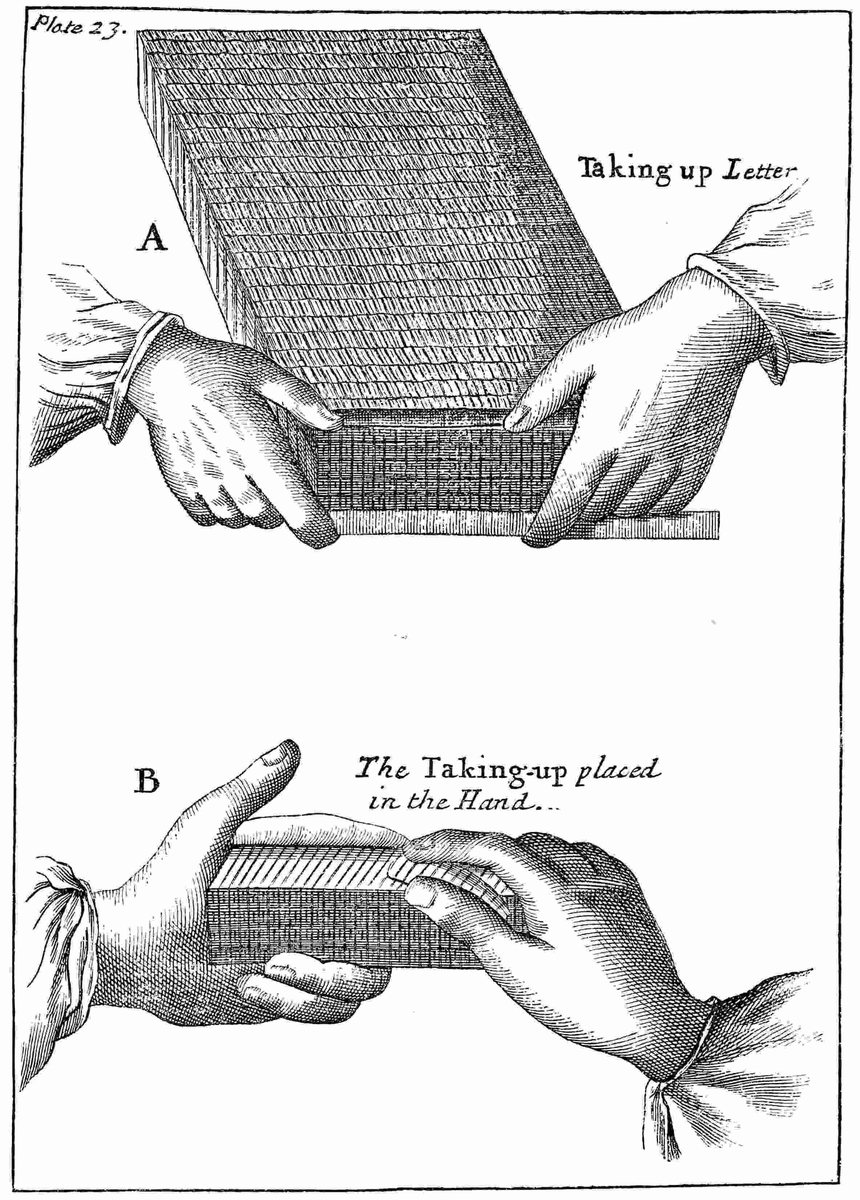
The Compositer seeks among the Furniture for a Riglet, a little longer (about a Pica or English) than the Line of the Page he is to Destribute; or else he cuts a Riglet to that length (this Riglet is called a Destributing-stick) and coming to his Stript Form, or Quarter of the Form he is to Destribute, he places one flat side of the Riglet against the Head of the Page, and claps the Balls of his two Fore-fingers behind it, and the inner Joints (next his Fore-fingers) of his middle Fingers he claps against the ends of so many Lines as he intends to Take up, supposing it Pica, about Seven; and presses them pretty close to the sides of the Lines: Then with the ends of the Balls of his two Thumbs he parts that number of Lines from the rest of the Page, by pressing gently towards his Riglet or Destributing-stick upon the Face of the Letter of the farthest Line, which, if the Joints of his middle Fingers press pretty hard towards each other at first, easily part, and he may open that number of Lines so far from the rest of the Page, that he may get the Balls of his Thumbs 208far enough upon the shank of the Letter: So that the pressing the Lines yet a little harder between the Joints of his middle Fingers, and pinching with his Thumbs the Letter hard against the Riglet, with a quick jerk he rears that Taking-up upon his Destributing-stick. See Plate 23. at A.
Having it upon his Destributing-stick between both his Hands, with the Face of the Letter from him, he disingages his middle Fingers, and with his fore Fingers and Thumbs holding the Riglet, and now the Top of his Taking-up pretty loosly between them, he turns (as on two moving Axises) the ends of the Lines that were towards his Right Hand, and guides them to the Thumb-ball of his Left Hand: Thus the Face of the Letter is turn’d towards him; then bowing the inner Joynt of the middle Finger of his Left Hand (which before prest the left side of the Line) under the middle of the Riglet he takes the weight of the Taking-up upon it, which yet he eases as he lifts, by mounting the now Right Hand end of the Lines a little above an Horizontal level, and depressing the Left Hand ends a little below; so that now he he has his Taking up in his Hand, with the Face of his Letter towards him, and the Notches upwards, he goes with it to his Case, and places himself against the middle of it. See Plate 23. at B.
Then clapping the Ball (or if he will take off more than the length of the Ball) of his middle Finger of his Right Hand, of the second Joint of that Finger, against the bottom of the uppermost Line of his Taking up towards his Right Hand, and his fore Finger about the middle of the shank of the Letter, 209he slides or draws towards him about an Inch or an Inch and an half of that Line upon the Ball of his Thumb, which is placed at the Face of the Letter to receive it: And as it comes off the Taking up, he with his aforesaid two Fingers and Thumb disposes it so among his Fingers that he gathers the Ball of his fourth Finger under the bottom of the Letter, and then he brings what he has taken off towards his Sight to read; then with a sleight thrusting the Ball of his Thumb outwards, and drawing inwards the Balls of his fore and middle Fingers, he spreads and Squabbles the shanks of the Letters between his Fingers askew; and remembring what Letters he read, he nimbly addresses his Hand with a continued motion to every respective Box, which his Fingers, as they pass by, lets a Letter drop into, till his Taking off be quite Destributed.
Having Destributed that Taking off he makes another Taking off as before, and so continues his Takings off till his whole Taking up be Distributed: And thus he Takes up and Destributes till his Case is full.
If the Form were not well Rinc’d, the shanks of of the Letters will be more or less slippery, and with long Destributing will make the Balls of the Fingers and Thumb supple, by the wetness of the Letter and sharpness of the Ly; and consequently the grain of the skin will be made clumsie, and those Joints feeble; so that they will not so well fasten upon the sides of the Shank to command the Letter, and draw it askew, or be so nimble at disposing them into their several Boxes.
210
This happens most if they work upon small Letter, and that old, and the Ly old too, for then the Ly will have much Inck mingled in it: And the Compositer will have much ado to Rince his Form so clean but that the Letter will be slippery, and consequently not spread, as aforesaid. But against it they may use a remedy, which is, to have a piece of Allom about the bigness of a Hasel-nut, lye in one of the Boxes of the Case; for by feeling that now and then, the dilated pores of their Fingers are again contracted, and fit to do their office: For by the greasiness of the Letter, the grain of the Skin of the Fingers were so dilated, that the Compositer could not so actively draw the Shanks of the Letters askew, as aforesaid.
The Compositer, if conveniences suit, chuses to Destribute his Letter over Night, that he may have a dry Case (as he calls it) to work at in the Morning, because Wet Letters are not so ready and pleasant to pick up as Dry; and besides are apt to make the Fingers sore, especially if the Ly be not so well Rinc’d from the Letter as it should be. In the Winter, when he Destributes in the Day time, he commonly brings the Lower Case, when full of Letter, to the Fire to dry, rearing the farther side of the Case a little upwards: And when it is well dryed, he sets it again upon the Frame.
211
¶ 4. Of Composing.
The Compositer now addresses himself to Composing: And looking a little over his Copy, to see how it pleases him, for he runs different fortunes, either of good or bad Copy, viz. well or ill writ, if it be a Written Copy, or much Italick, Latin or Greek, or Marginal Notes, or few Breaks, &c. for this he likes not in his Copy: But a Printed Copy, or a fair Written Hand, and full of Breaks pleases him well, and is by Compositers call’d Good Copy, Light, Easie Work; when the former they call Bad, Heavy, Hard Work: And if a Price be already made for a whole Book, the Good and Bad is done at the same Price.
If the Measure be already made, that is, if he was already upon that Work before, and his Composing-stick be set to the Measure of that Work, he needs not, or must not alter his Composing-stick: But if his Measure be not made, he must unskrew the Skrew of his Composing-stick, and slide the Cheeks nearer to, or farther off the Head of his Composing-stick, till he have exactly fitted his given Measure.
If it be a Printed Copy he is to Work on, and his Work must run Line for Line with his Copy, he then without more ado, Sets or Composes the fullest Line he finds in his Copy, and slides up the Cheeks of his Composing-stick, and pinches that Line between the Cheeks and the Head, till it stands as stiff or hard in the Stick as he intends to Justifie all the rest of his Lines: Then screws up the Composing-stick.
212
Justifying (in Compositers Language) is the stiff or loose filling of his Stick, for if it be fill’d very stiff with Letters or Spaces, they say it is hard Justified, if loosly, they say it is loose Justified.
Having the Measure fitted, he places the Galley on his Upper Case on the Right Hand, for those Boxes are seldomest used, because in them are placed only the Latin sorts, or sometimes the Small Capitals, Astronomical Signs, &c.
He places his Galley so, that the Left Hand corner of the bottom of its Frame stands lower upon the Case than any of the other Corners, for in that position the Letters at the end of every Line stand safest from falling, as leaning towards the rest of the Page.
Some Compositers use Visorums, as is described in Plate 2. at i. Therefore pricking the point of the Visorum most commonly upon the Border or Frame of the Case on the Left Hand about the &-Box, they fold the Leaf of Copy they Compose by, so as the bottom of it may rest upon the Square-Shoulder near the bottom of the Visorum; then with two pieces of Scaboard tyed together at one end, they clasp both the Copy and Visorum between these two Scaboards, which two Scaboards pinch the Copy and Visorum fast enough to keep the Copy in its place, and at the same time also serves for an Index to direct the Eye to every Line, as the Compositer moves it downward.
After this preparation, the Compositer falls to Composing. But first reads so much of his Copy as he thinks he can retain in his memory till he have Composed it, as commonly is five or six words, or sometimes a longer Sentence. And having read, he 213falls a Spelling in his mind; yet so, that his Thoughts run no faster than his Fingers: For as he spells A, he takes up A out of the A Box, as he names n in his thoughts, he takes up n out of the n Box, as he names d in his thoughts he takes up d out of the d Box; which three Letters set together make a Word, viz. And; so that after the d he sets a Space: Then he goes on to the next Word, and so Composes on, Setting a Space after every Word till the Words come to the end of the Line, for then he sets no Space.
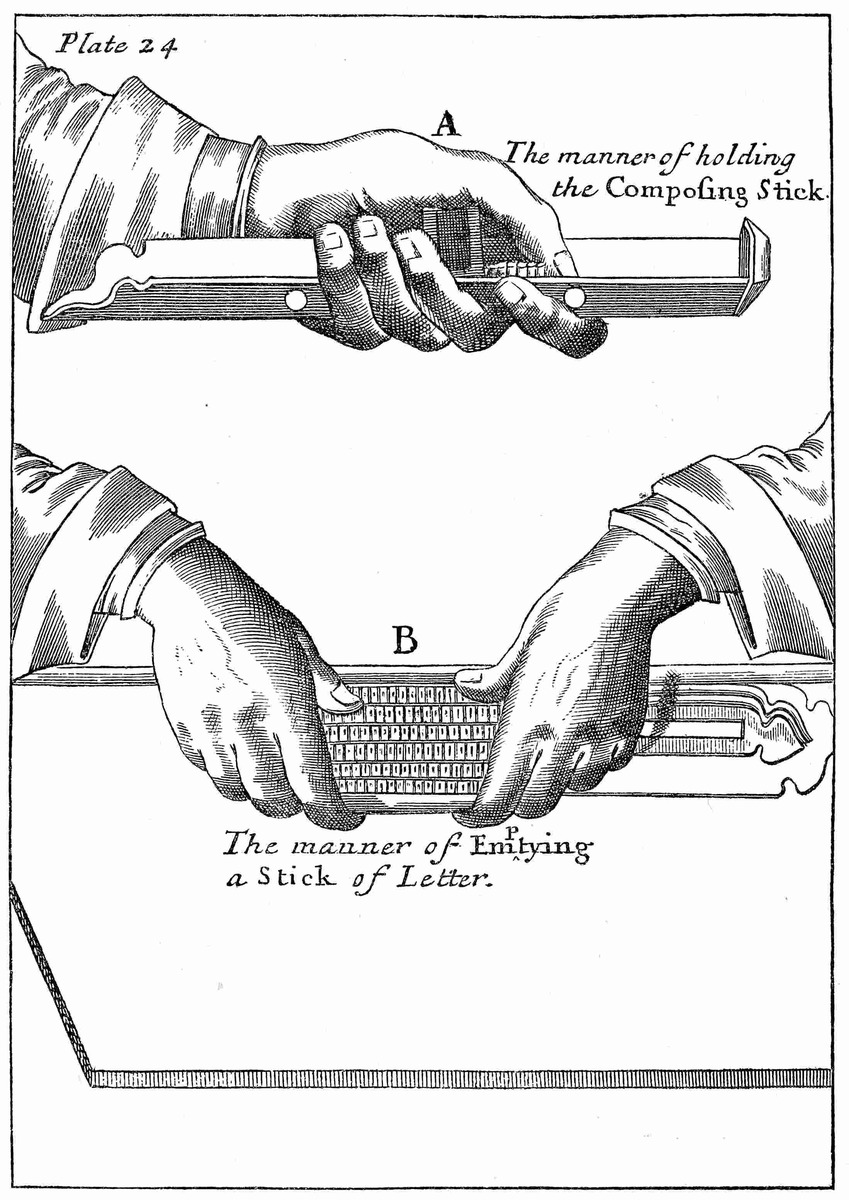
When he Composes the Letters he holds the Composing-stick in his Left Hand, placing the Second Joynt of his Thumb over the moving Cheek of the Stick, and the end of the Ball of his Thumb reaches down to the bottom of the Cheek and Stick; so that with the end of the Ball of his Thumb he gently presses the Letter close to the Cheek, and keeps the Letters tight and square together, as he places them in the Stick successively. See Plate 24. at A.
And as his Eyes are very quick in reading his Copy, and in shifting its Visual Ray to the several Boxes he is to have a Letter out of, so is his choice what Letter to take up very sudden; for though the Box be full of Letters, yet in an instant he resolves and pitches his Fingers upon that one, which for its posture and position his Fancy reckons lyes most commodious for his immediate seizing. For position, he generally chuses that which lies uppermost, because it is readiest at Hand to snatch up: And for posture, that which lies with its Face towards his Right Hand, because catching at the Letter near the Face-end of the Shank, he by an accustomed sleight, in his Fingers 214while it is coming to the Stick, disposes it so, that as the bottom of the Shank goes directly forwards, towards the bottom of the Stick, so the Notch of the Letter shall also be placed upwards.
Most Compositers use a Composing-Rule, which is only a piece of a Brass-Rule cut to the length of the Measure, with a small Ear left at either end, to take it out by when the Line is full, and to lay it upon the Compos’d Line, to Set successively a succession of Lines upon, till the Stick be full.
This Rule is very commodious to Work with, because the Letter slides easier and smoother down to the Back of the Stick, than it will upon a Line of Letters: Besides, the Letters Compos’d on it stand streighter and truer in Line, and are less subject to Hang, than those Compos’d on a Line of Matter; unless with a Riglet (as that they many times do) they rub pretty strongly along the Line they have Compos’d, which is a labour more than needs, and the loss of some time to make the Work more unpleasant.
Having Composed one Line, if it ends with a Word or a Syllable and a Division, and just fill the Measure, it needs no more Justifying; but if the Line conclude not as aforesaid, then he puts a Space more between every Word, or so many Words as will fill up the Measure pretty stiff, viz. Justifie the Line. But if the Line be not yet Justified, he puts another Space between every Word, or between several Words, till the Line be Justified: So that here is now three Spaces, and strictly, good Workmanship will not allow more, unless the Measure be so short, that by 215reason of few Words in a Line, necessity compells him to put more Spaces between the Words. This often happens in Marginal Notes, where the White between Words is often as great or greater than between Line and Line.
These wide Whites are by Compositers (in way of Scandal) call’d Pidgeon-holes, and are by none accounted good Workmanship, unless in such cases of necessity, as aforesaid.
And as Lines may be too much Spaced-out, so may they be too close Set: It maybe accounted too close Set when only a Thin-space is set between Words, especially if no Capital Letter follows the Thin-space or Point go before it. Thin-spaces being intended and Cast only that the Compositer may Justifie his Lines the Truer, and not to serve for convenient distinction between Words; yet do some Compositers too often commit this error, rather than put themselves to the trouble of Spacing out a Line, where many Spaces must be used to Space it out.
A good Compositer takes care not to Set too Close, or too Wide; for if he Set too Close, and should happen to leave out a Word or two, it will give him a great deal of trouble to get those Words in; Nay perhaps when he comes to a Break he drives out a Line, for which Line perchance he may be forc’d to Over-run all the Pages that are Set forwards upon that Matter. And if he Sets too Wide, and he chance to Set a Word or two twice over, he may be forc’d to make Pidgeon-holes e’re he come to a Break, and then perhaps his Break is got in too, and his Page a Line too short, and he forc’d to Over-run several 216Pages e’re he can drive that Line out. As I shall farther shew you when I come to the ¶ of Correcting.
In Justifying his Line he takes great care that it do not Hang: It is an unproper Term, yet grown into Use, for when the Letter stands askew, and not directly Square, they say it Hangs. New Letter is most subject to Hang, especially if not very smoothly Drest; Because the least Bur, or sharpness of its Angles, may catch in the Burs or Angles of the Letters that stand next them, and so make them stand aslope, and one Letter standing aslope is very subject to make all the other Letters in that Line stand aslope too. Therefore if he find his Letter Hang, while his Line is yet loose, viz. Unjustified, he gently with the Ball of the Thumb of his Left Hand, thrusts the top of the shank of the Line where it Hangs, moving the Letter somewhat from him, towards the farther end of the Stick, and with the Balls of the two Fore-fingers of his Right Hand pats upon the Face of the Letter, till he have got them into an upright position. He moves or drives the top of the Shank of the Letter from him, because generally the placing the Ball of his Thumb on the top of the shank of the Letter when he Composes (as was shewn before) is subject to draw the Letter askew towards him, but that his care commonly prevents it: Yet if by chance the Line should Hang from him, then he with the Ball of his Thumb as aforesaid, draws the Letter towards him, to set it upright.
217
Here is now one Line Compos’d: And as he Compos’d that Line, so he Composes Line upon Line till his Stick be full: When his Stick is full, he Empties thus; He lays his Stick down upon his Lower Case, with the bottom of his Stick against the hither Ledge of the Case, and the Face of the Letter upwards; being provided of a Riglet just the Length of his Line, he lays his Riglet against his last Line, and places the Balls of his two Fore-fingers behind the Riglet, near the middle of it, if the Line be not too long, and then only as near the middle as he can to command it with his Fore-fingers; and he places the Balls of his Thumbs against the first Line in his Stick as far below the Face of the Letter as he can, and he places first the Joints of his middle-fingers against the Sides of the Letter at the two ends of the Line, so as I shewed you he did when he was Taking up his Letter to Destribute it; and in this posture pinching the Letter between his Thumbs and his Fore-fingers, and and squeezing his two middle fingers towards each other, he leans the Letter in the Stick almost flat upon the Riglet: But if his Lines were Hard Justified, he cannot perhaps with the first leaning the Letter back get them clear out of the Stick, therefore he again wriggles the Stick of Letter forwards and backwards, till he gets them quite out. See Plate 24. at B.
Having gotten them out, and in this posture fast between his Thumbs and Fingers, and the Letter leaning almost flat upon his Riglet, he directs both his hands together to his Galley, and nimbly claps that Stick of Letter down into the Galley, placing the 218first Line close and upright against the lower ledge of the Galley, and the begining of his Lines close and upright against the left hand Ledge of the Galley, and then disingages his Fingers and Thumbs, and leaves his Riglet standing in its place till he have occasion to use it in like manner for the next Stick of Letter.
As he Set this Stick of Letter, so he Sets on till his Page is Out, Remembring after the last Line of every Page to set a Direction: That is, he Sets a Line of Quadrats and at the end of it the first word of the next Page, or if the Word be very long and the Line very short, two Syllables, or sometimes but one of that Word. And if it be the First Page, viz. the first Page of that Sheet, he Sets a Signature about the middle of the Line, or rather a small matter nearer the end than the middle is, (because when the Sheets are wrought off and gather’d, they Collation something quicker: The Collationer not being forced to prick up with his Bodkin the corners of the Sheet so high to see the Signature: which in a long train of work saves time.
If it be the First Page of the first Sheet of a Book the Signature is A, if the first of the second Sheet B, if the first of the third C, and so successively till he come to W, which is always skipt, because the Latin Alphabet has not that Letter in it; but next V follows X Y Z, so that if the Book contain above three and twenty Sheets, the Signature of the four and twentieth Sheet must be A a, if five and twenty B b; till in like manner he run through the Second Alphabet, and comes to the third, fourth, &c. still as he begins a new Alphabet adding an a.
219
To the second Page, or any other Even Page, he Sets no Signature, but to the Third which is an Odd Page he does, viz. A 2. The Figure of 2 is no part of the Signature, but is only an adjunct to shew the Book-binder the Second Leaf of that Sheet, that he may the surer Fold the Sheet right.
If it be a Folio Sheet he cannot set A 3 in a single Sheet, because it has but two Odd Pages in it; but if they be Quir’d Sheets, that is, two, three, or four Sheets Quir’d together, he must set A 3 in a Folio, though not in the First, but Third Sheet of that Quire. But no wise Compositer, except he work on Printed Copy that runs Sheet for Sheet, will be willing to Compose more Sheets to a Quire than he shall have a Fount of Letter large enough to set out, unless he will take upon him the trouble of Counting off his Copy: because he cannot Impose till he has Set to the last Page of that Quire; all the other Sheets being Quired within the first Sheet, and the last Page of the Quire comes in the first Sheet. But when he Composes Quir’d Work, the Signature of the first Page is A, the Signature of the Sheet Quir’d next within the first Sheet is A 2, the first Page of the next Quir’d-Sheet A 3: So that the Signatures of all the Sheets in the first Quire is A, A 2, A 3, &c. according to the number of Sheets Quired together. The second Quire begins B, B 2, B 3, &c. The Third Sheet C, &c. according to the number of Quires. This is called Printing in Quires. Now to return.
If the Form be Quarto, he Sets under the Fifth Page Signature 3. If Octavo, he sets also under the Fifth Page Signature 3. and under the Seventh Page 220Signature 4. If Twelves, he sets also under the Fifth Page Signature 3, and under the Seventh Page Signature 4, and under the Ninth Page Signature 5, and under the Eleventh Page Signature 6. The Rule is, that all Odd Pages should have a Signature, if they stand on the Out-side of the Sheet; and the reason for the Rule is, that the Gatherer, Collater and Bookbinder may the readier lay Sheets right, if they be turned wrong. This Rule is not among Compositers so well observed as it ought to be: For in Quarto’s they not only leave the Signature 4 out, but rarely put in Signature 3.
¶ 5. Some Circumstances a good Compositer considers and observes in Composing.
A good Compositer is ambitious as well to make the meaning of his Author intelligent to the Reader, as to make his Work shew graceful to the Eye, and pleasant in Reading: Therefore if his Copy be Written in a Language he understands, he reads his Copy with consideration; that so he may get himself into the meaning of the Author, and consequently considers how to order his Work the better both in the Title Page, and in the matter of the Book: As how to make his Indenting, Pointing, Breaking, Italicking, &c. the better sympathize with the Authors Genius, and also with the capacity of the Reader.
Nor does a Compositer the least shew his skill in the well ordering and humouring of a Title Page, which, because it is the first Page of a Book, we shall begin the Compositers Considerations at.
221
He, as aforesaid, judiciously reads his Title Page, and considers what Word or Words have the greatest Emphasis in it. If many Words precede the Emphasis, he considers whether it be best to make one or two Lines, or more of them, by electing a Body bigger or less to Set the precedent Matter in, and whether any of these Lines ought to be Indented, either at one end or both, viz. Set in the middle of the Line. And what Words of Emphasis come in that precedent Matter; that he may Set them either in Capitals, Roman, Italick, or English; and at last bring the great Emphasis, which is generally the Title or Name of the Book in a Line by it self, and just fill it if he can; which he has some helps to do, by the great Bodied Letters of the Lower Case, or else by Capitals, Roman, Italick or English, of a proper Body, which best pleases his fancy, or is in present mode.
If this Word of great Emphasis be Set in the Lower Case, yet he Sets the first Letter a Capital, and he Sets no Space between Letter and Letter, but between Word and Word he does, if there happens more than one Word in that Line: But if that Word be Set in Capitals, he chuses to Set a Space between every Letter, and sometimes he Sets two Spaces, yet that is rather to drive out the Line.
If he Sets but one Space between the Letters in a Word, he Sets three Spaces between Word and Word: And if he Set two Spaces between Letter and Letter, he Sets four Spaces betwen Word and Word, as well to give a graceful appearance to the Eye, as to make a Visible and proportionable distinction between Word and Word.
222
He also considers what Whites to Set between his Lines; as either a Line of Quadrats, and of what Body; or (if his Title Page be large) but a Scaboard: and at last Justifies his Page in Length, either by adding more Whites (where they may be proper) if his Page be too short, or by taking out or diminishing Whites if the Page be too long: And this he does by altering the Body of Whites, for if a White-line be English, he may take it out, and in its room put in Pica, Long-primmer or Brevier, according as he finds he has Run out; yet this he does with Consideration, where more or less White is properest.
But the mode of ordering Titles varies; as may be seen by comparing the Title Pages of every twenty years: Therefore a Lasting Rule cannot be given for the ordering them: only what has been said in general concerning Emphasis, and in particular to humour the Eye, the Compositer has a constant regard to.
When he is to Work upon a continued Series of Matter, he Sets the Title of the Chapter or Section in a bigger Body and different Character than his Matter is Set in; as if the Matter be Set in English Roman, he Sets the Title in Great Primer or Double Pica Italick, but the Words of Emphasis he will Set in Roman, and varies the Character for them as well in the Title, as he does in the Matter.
If his Title be short, he Sets it in the middle of the Line, by Setting Quadrats on both sides: If his Title be long, he Sets the middle Line in the middle: If it make three or more Lines, he Indents the first with an m Quadrat, and the other with two 223m Quadrats. Before his Title he sets a White-line, viz. a Line of Quadrats, and so he does after it; but with regard to what the bigness of the Body of the Letter the Title is Set in, Runs out; for these Whites must be set of such Bodies (bigger or less) as will make the difference of the Body the Title is Set in, a just number of Lines with those of the Body the Matter is Set in, because the length of the Page, as aforesaid, must be Justified. And he always forecasts to put rather more than less White before the Title than after it; because the Title has relation to the Matter of the Chapter or Section it is Set to, and therefore ought not to be so distinct, as from the precedent Chapter or Section.
After his Title, he begins his Chapter or Section with a Two-lin’d Letter, or Three or Four-lin’d Letter, but Indents it not. He begins his Chapter or Section with the first Line in the Stick, unless his Stick be very Deep, or his Two or Three-lin’d Letter small, because it may else reach above the top of the Stick, and so hinder him from filling up Lines to the Body of the Two or Three-lin’d Letter.
After the Two or Three-lin’d Letter, he Sets a Capital Letter of the Body his Matter is of, and Indents all, those Lines that are to fill up the Great Letter with an n Quadrat.
He cannot use his Composing-Rule (mentioned in the foregoing part of this ¶) till he have filled up Lines to the Body of the said Great Letter; because his Composing-Rule is too long to go between the Great Letter and the Head of the Stick: but then he uses the end of a Riglet to rub along the Lines he 224has Composed to smoothen them, and so Set on till he has filled up the whole Body of the Great Letter, and most times somewhat above it; which Letter he afterwards Justifies with Small Bodied Quadrats, or with Scaboards or Cards, or with any or all of them till the Great-letter stands even with the number of Lines that it Indents, and afterwards uses his Composing Rule, and Sets the succeeding Lines to their full Length.
If it be a great Wooden Letter, he begins his Chapter or Section with, it is most times too Deep for the height of the Cheeks of his Stick; therefore he Justifies his Stick-full just to the breadth of the Wooden Letter with Quadrats or Quotations, and Sets on between those Quadrats or Quotations and the Head of his Stick, as I shewed before, till his Stick be full of Lines; which Lines he Empties, leaving the Quadrats or Quotations in his Stick, to serve, as before, for the succeeding Stick or Sticks, till he have Composed Lines enough for the Depth of the Wooden Letter.
As he Sets on, he considers how to Point his Work, viz. when to Set , where ; where : and where . where to make ( ) where [ ] ? ! and when a Break. But the Rules for these having been taught in many School-books, I need say nothing to them here, but refer you to them.
And as he considers how to Point, so he considers what proper Names, either of Persons or Places, he meets with in his Copy, as also what Words of great Emphasis, and what Words of smaller Emphasis, what Obsolete Words, and what Foreign, &c.
225
When he meets with proper Names of Persons or Places he Sets them in Italick, if the Series of his Matter be Set in Roman; or in Roman if the Series of his Matter be Set in Italick, and Sets the first Letter with a Capital, or as the Person or Place he finds the purpose of the Author to dignifie, all Capitals; but then, if conveniently he can, he will Set a Space between every Letter, and two or three before and after that Name, to make it shew more Graceful and Stately. For Capitals express Dignity where-ever they are Set, and Space and Distance also implies stateliness.
Words of great Emphasis are also Set in Italick, and sometimes begin with a Capital Letter: If the Emphasis bear hard upon the Word to be exprest as well as the Thing to be exprest, it ought to begin with a Capital. I shall bring for instance an Observation I made above forty years ago on the Word that, viz. that that Word may be reitterated five times, and make good Sense: If it be set thus it will seem nonsense, that that that that that; but if it be Set thus, that that That that that Man would have stand at the beginning of the Line should stand at the end; it will, by toning and laying Emphasis on the middlemost That become good Sense. Now all the thats ought to be Set in Italick, and the middlemost That ought to begin with a Capital, because it is both the Thing and Word.
Words of a smaller Emphasis may be Set in the running Character, viz. Roman, if it be the Series of the Matter; or Italick, if Italick, but begun with a Capital: Instance in the last Sentence, That which expresses both the Thing and Word, &c. Here Thing and Word 226both bear Emphasis, though not very great, and therefore ought to be dignified more than those Words that precede or follow those Words. Yet I know some Authors are now so nice to mark both the Word Thing and the Word Word in Italick.
After a . though not at the end of a Break he begins with a Capital.
When in Composing he comes near a Break, he for some Lines before he comes to it considers whether that Break will end with some reasonable White; If he finds it will, he is pleas’d, but if he finds he shall have but a little single Word in his Break, he either Sets wide to drive a Word or two more into the Break-line, or else he Sets close to get in that little Word, because a Line with only a little Word in it, shews almost like a White-line, which unless it be properly plac’d, is not pleasing to a curious Eye.
Nor do good Compositers account it good Workmanship to begin a Page with a Break-line, unless it be a very short Break, and cannot be gotten in in the foregoing Page; but if it be a long Break, he will let it be the Direction-line of the fore-going Page, and Set his Direction at the end of it.
Indenting after a Break (unless it be the end of a Chapter or Section) is an m Quadrat, (more or less is not proper) Set at the beginning of the Line: But when Verses are Indented, two, three or four m Quadrats are used, according to the number of the Feet of the Verses, but most times according to the fancy of the Author.
English obsolete Words he Sets in the English Character, 227the first Letter, if the dignity of the Word require it, as aforesaid, with a Capital.
Foreign Languages he meets with in his Copy, if the Master Printer have them in his House, he Sets them in the proper Character; if not, the Author must write them in the common Character, and the Compositer Sets them as they are written.
That I may be the less unintelligent to the Reader, I will inform him that in Printers Dialect (as in this last Paragraph it is used) Language is understood Letter: For the Compositer does say, I shall use a Word or two of Greek Letter, or Hebrew Letter, or Saxon Letter, &c. but I shall use a word or two of Greek, a Word or two of Hebrew, Saxon, &c. so that the Word Letter, is in Compositers Dialect, understood by naming the Language.
If Indentures instead of Marginal Notes come in a number of Lines, he Indents his Stick, as I shewed you he did for a Wooden Letter, leaving a convenient White between his Matter and Indenture, and then again Indents his Stick to Set the Matter that comes in those Indentures, allowing a reasonable White between the Top and the Bottom of his Indenture, and then Justifies it up to an exact number of Lines, as he did the Wooden Letter.
If Marginal Notes come down the side (or sides, If the Page have two Columns) he chuses to Set them in on the Stone, rather than in his Galley; because both his Page and Notes stand safer, being cloathed with the Furniture, than they do when they stand Naked in the Galley. Therefore I shall say nothing of Marginal Notes till I come to Imposing.
228
Some other Circumstances (according as variety of Work does happen) a Compositer may meet with; but by what has been said upon this and several other Trades, the Ingenious (as they occur) may easily consider how they are to be performed.
Nor (as afore was hinted) is a Compositer bound to all these Circumstances and Punctilio’s, because, in a strict sense, the Author is to discharge him of them in his Copy: Yet it is necessary the Compositers Judgment should know where the Author has been deficient, that so his care may not suffer such Work to go out of his Hands as may bring Scandal upon himself, and Scandal and prejudice upon the Master Printer.
¶ 6. Of Tying up a Page.
We may remember the Compositer has yet a Page in his Galley: This Page must be Tyed up with a Packthred Cord, courser or finer according to the bigness of his Letter and Page: For Small Letter, which rarely is used to great Pages, he chuses a fine Packthred, strong and limber; but for great Letter and great Pages a stronger that will better endure hard pulling at: Wherefore he seeks a Cord for his purpose, or else takes so much off the whole Quoil as will serve his turn, and taking the end on’t in his Right Hand, lays that end about an Inch within the Direction-line, and a little lower than the middle of the Shank of the Letter, and holds that end there close with the two Fore-fingers of his Left Hand, then he slides his Right Hand along the 229Cord, straining it as stiff as he can along the right side of the Page, and turns it about the Head of the Page as close down to the Ledge of the Galley as he can, and so slides his Hand over the Cord till he draws it about all the sides of the Page: and when he comes to the first end of the Cord, he doubles up that end so as it stand above the Face of the Letter, and whips the Cord over that end, that the end may not slip; then he twists part of the remaining Cord about his Right Hand, and grasping his Left Hand Fingers about the Direction Corner of the Page, as well to hold the end of the Cord from slipping, as to keep the Page tight in its position, with his Right Hand he pulls the Cord as hard down the side of the Page as he can; and keeping the Cord straining, whips it again about the Head and other sides of the Page, and so again about all the sides of the Page, keeping it still straining; and always as he comes to the Right Hand side of the Page, pulling hard, and taking care that it slip not: Having whipt the Cord twice about the Page, he holding two of his Left Hand Fingers against the Direction-corner upon the Cord, that it slip not, with the Ball of his Thumb of his Right Hand, and the Balls of his Fingers to assist, thrusts against the opposite diagonal corner of the Page, and removes it a little from the Ledges of the Galley, that he may with the Nail of the Thumb of his Right Hand have room to thrust the Cord whipt about the Page, lower down upon the Shank of the Letter, (to make room for succeeding whippings of the Cord, and then thrusts or draws the Page 230close to the Ledges of the Galley again; then whips the Cord again about the Page (as before) till he has whipt it four or five times about the Page, taking care that the several whippings lye parallel to each other, not lapping over any of the former whippings.
Having whipt the Cord four or five times about the Page, he with his Bodkin or the corner of a Brass Rule (which lies best at hand) fastens the Cord, by thrusting a noose of it between the several whippings and the Right Hand side of the Page, close up to the Direction-line, then draws the lower part of that Noose close up to the very corner of the Direction-line, that it may be the better fastned between the Page and the Whippings: Then, if his Cord be not of a just length, he cuts it off from the rest of the Quoil, leaving so much length to it as that the end of it may stand upright an Inch or two above the Face of the Letter; the reason will shew it self when we come to Imposing. Then he removes the Page pretty far from the Ledges of the Galley, to see if the Whippings lye about the middle of the Shank of the Letter; if they lye too high, as most commonly they do, he thrusts them lower with the Nail or Nails of his Thumbs. Then (if the Page be not too broad) he places his Fore or Middle Finger, or both, of his Right Hand on the Right Hand Side of the Page, and his Thumb on the Left; and bowing his other Finger or Fingers under the Head of the Page, he rears up the Handle-end of his Galley with his Left Hand almost upright, and so discharges the Galley of the Page, by delivering it upright into his Right Hand. Having his Page 231upright in his Right Hand, at the Head, he claps the Fingers of his Left Hand about the Foot of the Page, upon the ends of the Lines on the Right Hand Side of the Page, and his Thumb on the Left Hand side of the Page, with the Palm of his Hands towards the Face of the Letter, and such Fingers as he can spare bowed under the Foot of the Page, turning the Page with the Face of the Letter from him, and letting it rest upon the inside of his Fingers, under the Right Hand Side of the Page, and so goes with it to the Correcting-stone.
But if the Correcting-stone be full of Forms or other Letter, as many times it is, then before he begins to Tye up his Page he provides a Sheet of Waste Paper, supposing it a Quarto Page, and doubles that Sheet in four, and while he has the Page upright in that Hand (as aforesaid) he takes that doubled Sheet into the Palm of his Left Hand, and claps it against the bottom of the Page, and turning his Left Hand outward, receives the Page flat upon the Paper on the Palm of his Hand: Then with his Right Hand grasps the Sides of the Page and the Sides of the Paper, which turn up again above the bottom of the Page, and sets it on a Letter Board, or some other board in a convenient place under his Case. He places that Page on the Left Hand the Board with the Foot of the Page towards him, that the other Pages that are in like manner set on the Board afterwards, may stand by it in an orderly succession against he comes to Impose them.
If it be a large Folio Page, or a Broad-side he has Tyed up, he cannot take that into his Hands, because 232it is too broad for his Grasp; therefore he carries his Galley, Page and all to the Correcting-stone, and turns the Handle of the Galley towards him, and taking hold of the Handle with his Right Hand, he places his Thumb and Ball of his Thumb on his Left Hand, against the inside the Head-ledge of the Galley, to hold it and keep it steady, and by the Handle draws the Slice with the Page upon it, out of the Galley, letting the Slice rest upon the Correcting-stone: Then he thrusts the Head-end of the Slice so far upon the Correcting-stone, that the Foot of the Page may stand an Inch or two within the outer edge of the Correcting-stone; and placing his Left Hand against the Foot of the Page, in the same posture he last plac’d it against the Head-ledge of the Galley, he draws the Slice from under the bottom of the Page, and leaves it upon the Correcting-stone. See Plate 25. at A.
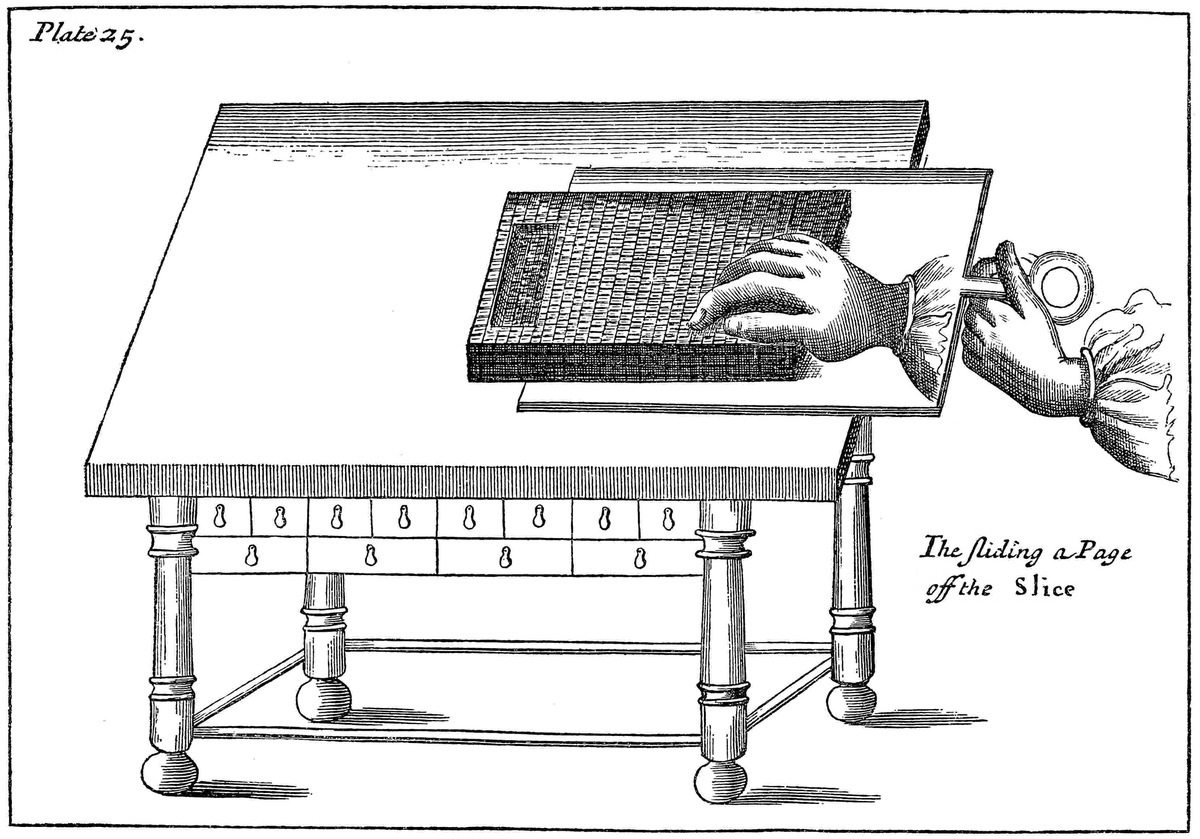
¶ 7. Of Imposing.
Imposing is the placing of the Pages that belong to a Sheet, with the Chase and Furniture about them, in such an order as when the Sheet is wrought off at the Press, all the Pages may be Folded into an orderly succession.
There are four Volumns in use that are differently Imposed, viz. Folio, Quarto, Octavo and Twelves.
The manner of Imposing these Sheets will be plainer represented in a Table than by many words; therefore in Plates 26, 27, 28. I have given you Drafts of each Volumn, both First and Second Form, viz. White Paper and Reteration; as you may see noted over each Form in the Plates. For Example, the two Forms in the Folio Sheet: In the First Form 233you may see 1 on the Left Hand and 4 on the Right, which shews that the First Page must stand on the Correcting-stone on that Hand, and the Fourth on the Right Hand, with the Foots of the Pages towards you; and so for all the other Forms. The number of the Page belonging to each Sheet is marked in what place it is to stand on the Stone in the Chase, and the Figures of those Numbers are placed with their Head and Foot upwards and downwards, as the Heads and Foots of the Pages must stand in the Chase.
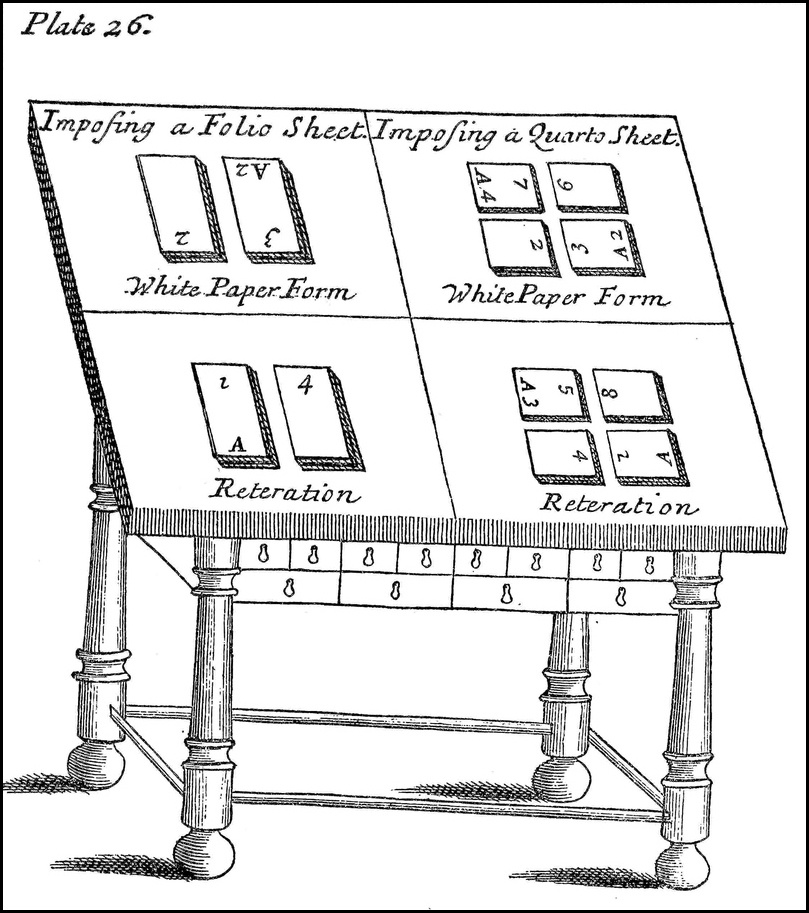
The places of these Pages for all Volumns the Compositer has always in his memory, yet has he a help if he remember the places of but the first half of the number of Pages of each Volumn: For if he knows the place of the first Page, the Page that stands next it must be that number which makes one more than the number of all the Pages in the Sheet. For Example, in the Folio; next the First Page stands the Fourth Page, 1 and 4 added makes 5, viz. one more than the number of Pages in the whole Sheet. See Plate 26. Again, In the Twelves Volumn next the First Page stands the Twenty Fourth, 1 and 24 added makes 25: Next 2 stands 23, which added makes 25, viz. one more than the number of Pages in the whole Sheet. This is a help, and a certain Rule for placing the Pages of any Volumn, if he knows but by memory the places of the first half number. See Plate 27. Thus you will find an Even and an Odd Page stand together.
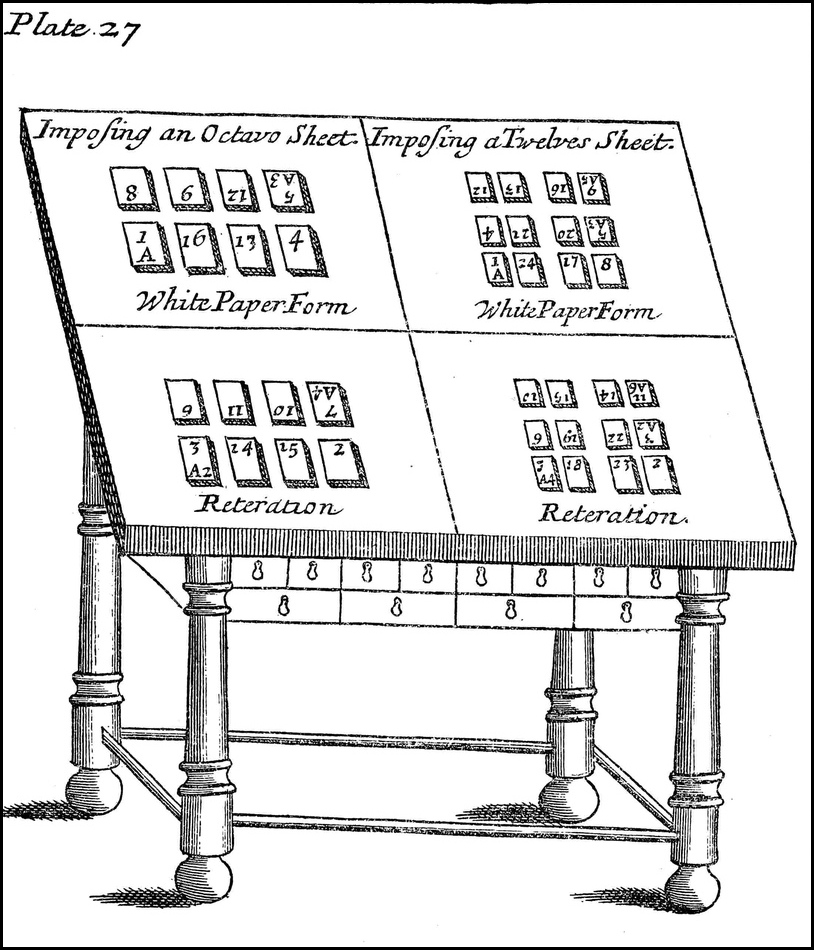
The other Volumns, viz. Sixteens, Twenty-fours, Thirty-two’s, are but the Octavo’s and Twelves doubled, or twice doubled and Imposed in Half-Sheets. For Example, The Sixteens is two Octavo’s Imposed 234on each side the Short Cross; the Twenty-fours is two Twelves Imposed on each side the Long Cross, and a Thirty-two’s is four Octavo’s Imposed in each Quarter of the Chase. And thus they double a Volumn as oft as they think fit. But as was said before, they are Imposed on each side the Cross, or in each Quarter of the Chase, as the Volumn that is doubled or re-doubled is Imposed in the whole Chase.
In Half-sheets, all the Pages belonging to the White Paper and Reteration are Imposed in one Chase, and are plac’d, as you see by the Drafts (in Plate 28.) of Half-sheet Forms. So that when a Sheet of Paper is Printed on both sides with the same Form, that Sheet cut in two in the Short Cross, if Quarto or Octavo, and in the Short and Long Cross, if Twelves, and folded as Octavo or Twelves; the Pages (I say) of each Half-sheet shall follow in an orderly succession.
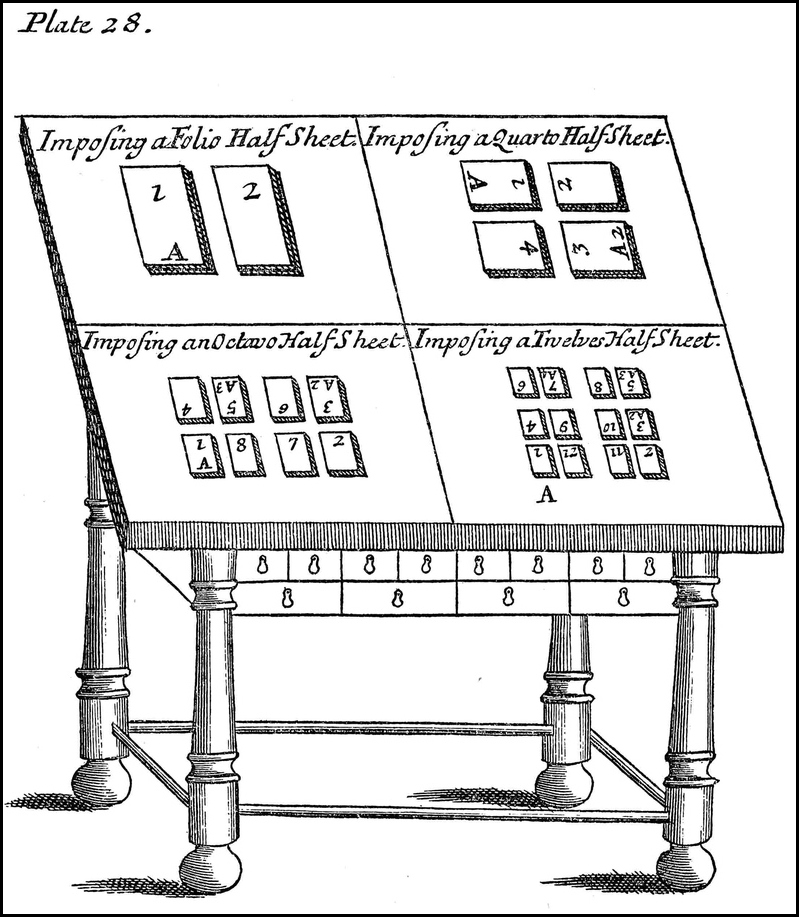
Having premised thus much, he takes up the Pages he set by on Papers in an orderly succession when he Tyed them up, grasping the edges of the Papers that stick up on both sides the Page tight, that so the bottom of the Paper may stand the stronger against the bottom of the Letter, to keep it from falling out; and bringing it thus to the Correcting-stone, he gets the two last Fingers of his Right Hand under the Head of the Page, but not under the Paper sticking up about the Head of the Page, keeping his other two Fingers and Thumb on the sides of the Page, and slips or slides his Left Hand, so as the Palm of it may turn towards the bottom of the Page; and rearing the Page up on 235end on his Right Hand, he discharges his Left to take away the Paper behind the Page; then he grasps his Left Hand about the Foot-end of the Page in the same posture that his Right Hand grasps the Head-end. And having the Page thus between his Hands with the bottom of the Letter towards him, he directs both his Hands to the place on the Stone where the Page must stand, and claps it down on the Stone so nimbly, that the whole bottom of the Page comes all at once to the Face of the Stone, lest otherwise he endanger the Breaking, Squabbling, or Hanging, &c. of the Page. And thus he sets down all the Pages of the Form: which having plac’d in order and rank, as before I have shew’d in the Drafts of each respective Volumn, he lays the Chase about them; and (if he have not a Form already Drest) seeks out Inner Side and Head-sticks of such a thickness, as with the Cross may make a Margin between the adjoyning Pages convenient to the Volumn and size of the Paper.
If his Side or Head-sticks be a little too thin, and and he cannot find any to his intended thickness, he puts a Scaboard or two between the Head or Side-stick and the Cross, as well to have more Margin as to commode the Press-man (if occasion be) when he makes Register, as I shall further shew when I come to the Section of the Press-man.
Then he seeks outer Side and Foot-sticks, his Side-sticks of the exact length of the Page, or a Scaboard shorter, or he cuts them to that length, that the Foot-stick Bear not against the end of the Side-stick, because then the Letter will not Rise; for the 236Foot-stick must be a little longer than the breadth of the Page, that it may shoot beyond the end of the Side-stick.
Then he fits the Chase and Furniture at Side and Foot, with Fore and Hind Quoins, and takes off the Cords from the Pages, as shall be shew’d by and by.
But if Marginal Notes come down the Side or or Sides of the Pages (for if there be two Columns in a Page, the Marginal Notes may come down both sides) then, before he fits his Foot-sticks he sets a Scaboard the length of the Page, against the side of the Page the Notes come on, and a row of Quotations almost down the length of the Page, or sometimes but one or two in a place at convenient distances, to keep the Letter of the Side of the Page upright, according as he finds his particular Notes stand near or far asunder, and afterwards fits his Foot-stick. Then he Sets his Notes, commonly between the Cheeks of his Stick, which for that purpose are fitted to the Measure of the Quotation: And having Set them, he places them in the proper places where they must come in, and with Quotation Quadrats of proper Bodies, Justifies them up, feeling (at last) carefully and cautiously at the Foot, that they be neither too soft nor too hard Justified to the length of the Page.
Now if he have a Chase, or Form, or Furniture already Drest (these several phrases are used, though they all signifie the same thing.) If he have (I say) a Form Drest, that is, if he or other Workmen have been Working on the same Work, i. e. Book, before he uses one of the Wrought-off Forms, and having it 237on a Letter-board, Rinc’d, as was shew’d in ¶ 2. of this Section, he places it on a Bench or Joint-stool, on that Hand that stands most commodious with that end of the Stone he Imposes on, and so as there may be a corresponding position, with the Form Wrought off and that Imposing, viz. that the First Page (and consequently all the rest) of the Wrought off Form stands on the same Hand with the First Page of that Form that is Imposing.
Then taking out and laying the Quoins in their proper places, as I shew’d when he Stript the Form, at the latter end of ¶ 2. he a little wriggles the Chase from one Side to the other, and forward and backwards to Loosen it, and the Cross or Crosses from the close pinching of the Letter and Furniture: then takes it off the Chase, and lays it about those Pages he is Imposing: Then with his two fore-fingers and Thumbs he takes away the Inner Side-stick and the Head-stick at once, and at once removes them to the responding Quarter of the Form Imposing, into the responding places from whence he took them in the Wrought off Form. And as he does by the Inner Side-sticks, so he does by the outer Side-sticks, and by the Quoins; placing them in their respective proper places between the Furniture and Chase, or so many of the foremost Quoins, as will go in before the Cords are unwhipt from the Pages. Thus the Wrought off Form is Stript and Naked; and stands by to Destribute.
Having thus translated the whole Furniture of the Wrought off Form to the Form Imposing, he finds the end of the Cord that he left sticking up above the 238Face of the Letter (which perhaps by this time is got between the Furniture and the Page) and laying the Ball of his left Thumb, on the Face of the Letter at the Direction corner of the Page, to keep it from Rising, he takes the aforesaid end of the Cord, between the Fore-finger and Thumb of his Right Hand, and pulls gently to loosen the Noose that fastned the Cord when he Tyed up the Page, till he draws the Noose out, and after it successively all the several Whippings; which done, he places the Balls of his Thumbs, one against the middle of the Side-stick, and the other against the middle of the Foot-stick, and at once thrusts the Page close against the Inner-Side and Head-stick, and so makes room to get in all the Quoins. But if there be more than one Page in a Quarter, as in Octavo’s and Twelves, then he unties all the Pages of that Quarter, beginning with the Inner Pages first, before he can put in the Quoins. Then again, thrusting hard with his Thumbs, against the outer Sides of the Side and Foot-sticks of the several Quarters, to thrust the Letter up tight and Square, he looks over the Form as nicely as he can, to see what Letter or Letters may Rise in the Form, (that is, stand higher than the rest) and with the Balls of his Fingers of both his Hands, (the Quoins being close and hard thrust up) pats upon the Face of the Letter to beat them down: But this is not enough to smoothen the Form, but only to smoothen it so as the edges of the Dressing-block (when it comes to smoothen it quite) may not job against them. Then he takes the Dressing-block, described Section 9. ¶ 3. in his left Hand, and lays 239the smooth side of it upon the Face of the Letter, at the bottom of the Quarter next him; or he takes the Shooting stick, or sometimes the lower part of the clutched Fist of his right Hand, and knocks either with the Head of the Shooting-stick (or his Fist, as aforesaid) gently upon the upper Side of the Dressing-block, with quick knocks, removing the Dressing-block in a lineal rank upwards, and knocking still quick upon it, as it goes along and comes down again with the Dressing-block, in another lineal rank parallel to the first: Then in the same order goes up again and down again, till he have run over the whole Form, still knocking with quick knocks upon the Dressing-block, that so he may be sure to press down every Rising Letter in the whole Form, if he see any Spaces or Quadrats stick up, he thrusts them down with his Bodkin.
Then to Lock up the Form, he takes the Shooting-stick in his Left Hand and the Mallet in his Right, and placing the Foot of the Shooting-stick against the small Quoin between the Side stick and the Chase, drives that a little gently up, and then removes the Shooting-stick to the next Quoin, and so to the third Quoin (if there be so many) between the Side-stick and the Chase; Then removes his knocking to the thick end of the Foot-stick, and afterwards knocks the Foot Quoins gently up: Then knocks pretty strongly with the Shooting-stick against the thick end of the Side stick, and Drives the Quoins yet harder up: Then to the thick end of the Foot stick, and and Drives those Quoins also harder up. Then at last knocking again, against the thick ends of the Side 240and Foot-sticks, he knocks up the Quoins so hard, as that he thinks the Form may Rise: To try if it will, he draws the hither Side of the long Side of the Chase, about an Inch or two over the edge of the Stone; and putting his two hands under the Chase, Dances the Form three or four times so as it may just Rise off the Face of the Stone: but not so high as that any loose Letters or Spaces may drop out, if there be any in; but only so high as he may see if there be any in or no. If he finds there are many in that do not Rise with the Form, he says the Form Dances, wherefore he looks carefully upon his Pages of Letter, to find out the Cause: For generally, either the Letter Hangs or the Lines, are ill Justified: or else it is not Hard enough Lockt up.
If he finds by his Eye the Letter Hangs: he must Un-lock and Loosen the Form, or that Quarter that Hangs pretty Loose, that the Letter may be set to Right; which he does with patting upon the Face of the Letter where it Hangs, with the Balls of the Fingers of both his Hands, to twist or turn them into a Square Position.
If it be only a Single Letter or two that drops, he thrusts the end of his Bodkin between every Letter of that Word, till he comes to a Space: and then perhaps by forcing those Letters closer, he may have room to put in another Space or a Thin Space; which if he cannot do, and he finds the Space stand Loose in the Form; he with the Point of his Bodkin picks the Space up and bows it a little; which bowing makes the Letters on each side the Space keep their parallel distance; For by its Spring it thrusts the 241Letters that were closed with the end of the Bodkin to their adjunct Letters, that needed no closing. Or sometimes he chews a small bit of Paper, and with the Point of his Bodkin forces that in on one side of the Space: and so fills up the Vacancy between the Space and the Letter. But both these ways are meer present Helps, and (in plain terms) accounted Botches, as being an Argument that his Lines were not well Justified in his Stick.
If he finds the Form or any part of it, was not hard enough Lockt up, he Locks all, or part harder up, as was shew’d before.
But now his Form Rises; Wherefore he draws the Long Side of the Chase (as before) a little over the edge of the Correcting-Stone, and putting two or three of his Fingers into the Vacancy between the Quoins, or else into the Vacancy at the ends of the Chase; he rears the Form upon the farther Side of the Chase, and removing his right Hand to the Short end of the Chase, grasps it near the upper corner, and then discharges his left Hand also; and removes it to the diagonal corner of the Chase; and so slides the long Side of the Chase off the hither Edge of the Correcting-Stone: Then slipping his Hands to the bottom of the Chase, about two or three Inches within the corners, with the insides of his Hands towards the Face of the Letter, and leaning the upper Side of the Chase against the upper part of his Breast, and clutching the Brawn of the inside of the upper Joynt of his Arm over the upper corners of the Chase, he carries the Form so before him to the Press, and lays it upon the Stone, for the Press-man to make a Proof 242of. The Proof being made, the Press-man brings the Proof, and layes it on the Compositers Case: and he brings the Form again and layes it on the Correcting-Stone, and rubs it over with the Ly-Brush, as shall be shew’d in proper place. And the Compositer gives the Correcter the Proof and his Copy to Correct it by: which being Corrected, the Correcter gives it again to the Compositer to Correct the Form by.
¶ 8. Of Correcting.
If there be but few Faults, and those easie ones, the Compositer Gathers the Corrections in his Stick, beginning at the bottom of every Page, and so ascending upwards: Because when he is Correcting, the Corrections of the top of the Page stand then first in the Stick, and therefore are readiest to his Hand. But if there be many Faults he brings the Lower-Case to the Correcting Stone, and takes his Corrections as he uses them.
Then with the Mallet and Shooting-stick he Unlocks the Form, as was shew’d in ¶ 3 of this Section. But keeps the Quoins pretty tight up, to secure the Letter from Squabbling or Hanging.
Then he Folds his Proof so oft double, till all the Pages, except that he intends to Correct first are Folded out of Sight, and he also Folds down the Left Hand Margin of that Page under the Proof, and then lays that Folded Side of the Page along, and close to the same Page in the Mettle: So that the Head-line in the Proof lye in the same range with the Head-line on the Mettle, and the Foot-line even 243with the Foot-line on the Mettal, and consequently all the Lines of that Page both on the Proof and Mettal agree, and stand in a mutual range.
Now therefore he looks in the Proof, to see where the Correcter has markt a Fault, and having found it in the Proof, he runs along that Line with his Eye to the same Line on the Mettle, which he easily does, because the Line of Mettle stands in the same range with that in the Proof, and finding the Fault in the Mettle also, he having now his Bodkin in his right Hand, with the Blade of it between his Fore-finger and Thumb, within half an Inch or three quarters of the Point, and the middle of the Bodkin within his clutched Hand to guide and command it, he sticks the Point of his Bodkin into the Neck of the Letter, viz. between the Beard and the Face, and lifts it with the Point of the Bodkin so high up above the Face of the other Letters, that he can lay hold of it with the Fore-finger and Thumb of his left Hand to take it quite out.
I must a little digress, to paraphrase on the posture he holds the Bodkin in: For in the sticking his Bodkin into the Letter, he holds the Blade of it, so that it may make as small an angle with the Face of the Letter in the Form as he can, viz. as flat towards the Face of the Letter as he can, without touching the Face of any of the adjacent Letters with the Blade of the Bodkin; For if he touches the Face though lightly, yet it may more or less Batter and spoil the Face of those Letters it touches, and so he creates himself a fresh trouble to mend them.
The reason why he holds the Blade of the Bodkin 244as flat to the Form as he can, is, Because a small Horizontalish entrance of the Point of the Bodkin into the Neck of the Letter, will raise the Letter up above the Face of the Form, the Blade of the Bodkin being fastned in the little Hole it makes in the Neck of the Letter: But if he should stick the Point of the Bodkin straight or straightish down upon any part of the Letter, it would indeed make an Hole, but not fasten in the Mettle, to draw it up; for the weight of the Letter would make it slip off the round and smooth Point of the Bodkin. Besides the pressing the Point of the Bodkin with his right Hand against the side of the next Letter on his left Hand, keeps the Point of the Bodkin fast in the little Hole it makes in the Neck of the Letter, and therefore though the Bodkin have but a little entrance, yet it has hold enough to draw it up by. Now to return.
Having taken the Fault out, he puts the Letter that the Correcter markt in the Margin of the Proof in the room of it. Suppose an o were markt and n dasht out, therefore when he has taken the n out he puts an o in the room: These two Letters being of equal thickness, gives him no trouble to Justifie the Line again after the Fault is Corrected; but if they had been of unequal thicknesses, as suppose an m to come out, and an n to be put in; in this case he puts in a Space between two words (where he finds most convenient) to Justifie the Line again: Or suppose an n to come out, and an m to be put in; now he must take out a Space where he finds most convenient to make room for the m, as being thicker by a Space than an n. Thus as he Corrects 245he still has a care to keep his Lines true Justified; which he tries by pressing the Balls of his two middle Fingers pretty hard against the ends of three Lines, to make them rise a little above the Face of the Form, whereof the Line he examines is the middlemost; for if that Line is not hard enough Justified, he will between the Balls of his Fingers find it hollow, or it will not Rise with the other two: And if it be too hard Justified, he will find the Balls of his Fingers Bear only or hardest against that Line, and the Line on each side it will not Rise.
If there be a long word or more left out, he cannot expert to Get that in into that Line, wherefore he must now Over-run; that is, he must put so much of the fore-part of the Line into the Line above it, or so much of the hinder part of the Line into the next Line under it, as will make room for what is Left out: Therefore he considers how Wide he has Set, that so by Over-runing the fewer Lines backwards or forwards, or both, (as he finds his help) he may take out so many Spaces, or other Whites as will amount to the Thickness of what he has Left out: Thus if he have Set wide, he may perhaps Get a small Word or a Syllable into the foregoing Line; and perhaps another small Word or Syllable in the following Line, which if his Leaving out is not much, may Get it in: But if he Left out much, he must Over-run many Lines, either backwards or forwards, or both, till he come to a Break: And if when he comes at a Break it be not Gotten in; he Drives out a Line. In this case if he cannot Get in a Line, by Getting in the Words of that Break (as I just now shew’d you 246how he Gets-in what was left out in the Proof) or by making less White to the Title of a Section or Chapter (if any happen in that Page) he must Over-run the next Page backwards or forwards, till that Line Comes in: Thus sometimes he Over-runs all the succeeding Pages of the Sheet, and at last perhaps Drives out a Line to Come in in the next Sheet.
If he have Set a word or small sentence twice, he must take that out, and Drive-out his Matter. If he be near a Break, and the White of that Break not very long, he may perhaps Drive it Out at the Break by putting in part of the next Line to fill up almost so much as he took out; but not quite so much, unless his Matter was at first so Wide Set that he can Space out no more, or unless the Break-line he comes to have so much White in it that he fears Getting-in that Line: If either of these inconveniences happen, he Drives-out as much as he can backwards in the Matter; that is, he takes out so much as he thinks he cannot Drive-out when he is at the Break: He takes it out at the beginning of the Line, and puts it in at the latter end of the Line before it: But first he takes out almost so much of the beginning of his Second upper Line, to make room for it: I say almost so much, because he intends to Space-out the rest if it were not too Wide Set at first. And thus he runs on from Line to Line, still taking out less and less at the beginning of every former Line, and putting it into the Line above that, that he may Space-out his Matter as he Over-runs, till his Double-Setting is Driven-out.
But if he have Set a Line or Lines twice, and 247cannot Drive it or them Out at a Break or Breaks; or that he cannot Set more Whites at the beginning of a Section or Chapter, he must Over-run the next Page or more, or the whole Sheet till it be Driven-out: And if in Over-runing the whole Sheet it be not Driven-out, he must Set so many Lines, of the following Matter as will make up the last Page.
Many times either for Getting-in or Driving-out, the Compositer will chuse to Over-run in his Stick, and then he Wets the Page he is to Over-run, with the Spunge (that the Letter may the better stick together) and he separates so much of the former part of the Page as he intends to Over-run, from the rest of the Page, and places himself before the Notches of the Letter, and takes up about an Inch and an half or two Inches of the first Separated Line, and brings it to the Stick; and as it it is coming along he turns the Notches upwards, and places that Taking up in the Stick. When he Takes-up, he places the Inside of the first Joynt of his middle Finger of his right Hand against the beginning of that Line, and the Ball of his Thumb against the other end of that Taking-up, and the Ball of his Fore-finger behind the Taking-up, about the middle of it, and so pinching it lightly brings it to his Stick, as aforesaid. And having thus by several Takings-up, gotten a Line into his Stick, he looks it over to see what Spaces or other White he can take out or put in, according as he has either Left-out or Set-twice, and then he Justifies the Line again, as was shew’d in ¶ 5. of this Section. And thus he Over-runs Line after Line, 248till he has Gotten-in or Drove-out his Leaving-out, or his Twice Set Matter.
If the Compositer is not firmly resolv’d to keep himself strictly to the Rules of good Workmanship, he is now tempted to make Botches; viz. Pidgeon-holes, Thin-Spaces, no Space before a Capital, Short &s, Abbreviations or Titled Letters, Abbreviate Words, &c. And if Botching is in any Case excusable, it is in this; for with too great Spacing-out or too Close Setting, he many times may save himself a great deal of Labour, besides the vexation of mind, and other accidental mischiefs that attend Over-running.
It sometimes chances that a Compositer, by having two or more Pages in his Sheet with the same Direction-line, or by mistaking the right place of his Page when he set it by on a Paper under his Case, as was shew’d ¶ 7. of this Section, or by some other accident that may happen; I say it sometimes happens (but seldom through too much care) that he Transposes two Pages, or more, in his Sheet: In this case he Unlocks that Quarter, or those Quarters the Pages are in, and loosning the Cross or Crosses from those Pages and their Furniture, takes the rest off the Correcting-stone with their Furniture about them: And if it be a Folio or Quarto he does not wet the Pages, because those Forms have Furniture about every side of the Page, which will keep up the Letter from falling down; But he only places the Balls of his two Thumbs against the outside of the Furniture, about the middle of the Head and Foot of the Page, and the insides of his two middle Fingers, assisted by his Fourth and Little Fingers, 249in a parallel position to his middle Fingers, (to strengthen them against the Furniture) about the middle of the Sides of the Page, letting the length of his Fingers reach as far from each corner of the Page towards the middle of it as he can, and so by a steady pressing the Balls of his Thumbs and the Balls of his Fingers on each Hand towards each other, he draws, or as he sees most convenience, thrusts the whole Page out of its wrong place, and sets it by on the Stone, till in the same manner he removes the other Transpos’d Page into the place of the first remov’d Page: And thus if there be more than two Transpos’d Pages in the Sheet, he removes them all, and Sets the right Pages in their right places.
But if it be an Octavo or Twelves, or any other Form that has Gutter-sticks between two Pages, he must Wet those Pages he leaves on the Stone, because when he removes one Page, by the help of the Gutter-stick, one side of the other Page will stand Naked; and consequently with the Shaking, Joggling, or Trembling of the Stone or Floor, the Letters on that side will be in great hazard of falling down, especially if the Face of the Stone happens not to be truly Horizontal: I say, happens not to be truly Horizontal, because the Stone is seldom laid with any caution, but only by guess.
Having placed the Pages in their right places, he again lays the Chase about them, and Locks them up again, as was shew’d in ¶ 7. of this Section: Then he carries the Form to the Press, and lays it on the Stone for a Second Proof, and sometimes for 250a Third Proof; which having Corrected, he at last brings the Form to the Press, and again lays it on the Stone Right, viz. in Folio’s and Octavo’s with the Foot of the First or Third Page (which he easily knows by their Signatures) towards him, and the side of it next the Plattin: And in Quarto’s and Twelves, with the Foot of the First or Third Page next the Tympan.
After all this Correcting a Revise is made, and if any Faults are found in any Quarter of it, or in all the Quarters, he calls to the Press-man to Unlock that Quarter, or the whole Form, that he may Correct those Faults: For when the Form is on the Press it is not the Compositers task to Un-lock the Form: Neither would a good Press-man be content he should make a knocking on his Press, especially if the Press-man have Made-ready his Form, as shall be shewed in the next Section.
¶ 9. Of Counting or Casting off Copy.
Counting or Casting off Copy (for both Phrases are indifferently us’d) is to examine and find how much either of Printed Copy will Come-in into any intended number of Sheets of a different Body or Measure from the Copy; or how much Written Copy will make an intended number of Sheets of any assigned Body and Measure.
The Rule and Method of Counting off either Printed or Written Copy is the same, only Written Copy is more difficult, because subject to be irregularly Writ: Therefore if I shew you how the Compositer 251Casts off Written Copy, I do at the same time inform you how to Count off Printed Copy.
The Compositer therefore first considers what Bodied Letter his Work is to be wrought on: then he carefully peruses the Copy, considering with himself whether it be evenly Written or unevenly Written, viz. whether it be throughout of an equal siz’d Hand, or whether part be close Written and part wide Written; if it be an equal siz’d Hand, that is, equally close Written in general, as well between Letter and Letter, Word and Word, as between Line and Line, he has scarce more trouble to Count it off than Printed Copy.
Wherefore, the Measure being given, he Composes one Line in his Measure: The Matter he Composes he chuses out of that part of his Copy that in his Judgement he admits is most indifferently Written, between Wide and Close, as being such as his whole Copy, one part with another, will likeliest Come-in alike with. This Line being Compos’d, he considers how much of his Copy it takes up, viz. whether it runs Line for Line, or whether two Lines of his Copy make one Line in his Stick; or whether a Line and an half, or a quarter, or half quarter of his Copy, &c. make one Line in his Stick; or whether a Line of his Copy make two Lines in his Stick, or a Line and a half, or a quarter, or half a quarter, &c. and accordingly calculates what just number of Lines will make another just number of Lines in his Stick. For Example.
If his Copy and Measure run Line for Line, then consequently 10, 20, 30 Lines of the Copy will make 25210, 20, 30 Lines in the Measure; and accordingly he counts what number of Lines in his Copy will make a Page; and by that, what number of Lines will make two Pages, four Pages, eight Pages, and consequently so many Pages and Sheets as he is to Count off.
If two Lines of Copy make one Line in the Stick, then consequently ten Lines in the Copy will make five Lines in the Stick; twenty Lines in the Copy ten Lines in the Stick, &c.
If a Line and a half of the Copy make one Line in the Stick, then fifteen Lines of Copy makes ten Lines in the Stick, thirty makes twenty, &c.
But a pair of Compasses makes the best expedition in Counting off of Copy, and (by my experience) I have found the surest way. I Compose one Line as aforesaid; if the Line I Compos’d Gets-in part of the next Line, viz. the second Line of the Copy, I place one Foot of a pair of Compasses at the beginning of the First Line, and open the other Foot to what was Got-in of the Second Line, and turn the Compasses about upon the Foot in the Second Line, till the other Foot reach the Third Line of the Copy; then turn about the Foot in the Third Line of the Copy till the other Foot falls in the Fourth Line of the Copy; and so from the Fourth, to the Fifth, Sixth, &c. till the Compasses end with a Line in the Copy, or near the end of a Line, remembring as I go along, how oft I turn’d the Compasses about. Suppose, for Example, seven times: Then I number the Lines of Copy, beginning with the first Line and ending with the last Line, that the Points of 253the Compasses were turn’d over, and find them Eight, Nine, Ten, &c. and say Eight, Nine, Ten, &c. Lines of the Copy, makes Seven Lines of the Measure.
As now I have shew’d you how I Count off Copy if it come in more than Line for Line, so I shall shew you how I proceed if a Line in the Copy Drive out in the Measure.
It is but placing one Foot of a pair of Compasses at the farther end of the first Line, and opening the other Foot to the place where the Compos’d Line ended, and by turning about the Compasses, as before, to the Second, Third, Fourth Lines, &c. till they end in the beginning of a Line in the Copy; for then (as before) counting the number of Lines, beginning with the first, and ending with the last; Suppose Eight, Nine, Ten, &c. I say Eight, Nine, Ten, &c. Lines of the Copy makes so many Lines as is the number of times the Feet of the Compasses were turned about, between the first Line and the last Line.
Another way Arithmetically perform’d.
Suppose it be requir’d to know how many Sheets 127 Pages of Written Copy will make? I count the number of Letters contained in an ordinary Written Line of Copy, such a Line as I guess is likely to Run Line for Line with the generality of the rest of the Copy: And (for Example) I find 43 Letters in that Line: Then I count the number of Lines in an whole Page, and find 35 Lines, I Multiply 43 by 25435, the Product is 1505 for the number of Letters in an whole Page: Then I multiply 1505 by 127, the number of Pages in the whole Written Copy; the Product is 191135, the number of Letters in the whole Written Copy.
If it be now required to know how many Sheets in Quarto, of the English Body this Written Copy will make, agreeable to any Measure already Printed? As for Example, the length of a Page given is 33 Lines, and in one Line is contained 47 Letters: I multiply 47, the number of Letters in one Line, by 33, the number of Lines in a Page, the Product is 1551. With this Product I divide 191135, the number of Letters in the whole Written Copy, and the Product gives 123, that is, 123 Pages in Quarto, which divided by 8, the number of Pages in one Sheet, gives 15 Sheets and 3 Pages.
If it be required to know how many Sheets it will make of Pica in an Octavo, or of Long Primer or Brevier in Twelves, &c. the manner of Working is the same: For Multiplying the number of Letters in one Line by the number of Lines in one Page, and Deviding the number of Letters in the whole Work (suppose, as in the foregoing Operation by 191135) by the number of Letters in one Page, the Product gives the number of Pages in the Quotient: And then at last Deviding the number of Pages by 16 if an Octavo, or 24 if Twelves, &c. you have in the Quotient the number of Sheets, and in the Remain (if any be) the number of Pages.
These two last ways are the surest Rules for Counting off Copy: But yet the Compositer has several Considerations 255upon his Copy before he dares conclude he has truly and exactly Counted off.
For first, a strict regard must be had to the Breaks that come in the Copy: For long Breaks in the Copy are generally likely to be Got-in, and consequently a Line is Got-in: But short Breaks often Drive-out a Line. Therefore though the Compositer has already in general Cast off his Copy, yet he more particularly considers his Breaks; and indeed they serve as so many Regulators to him, to keep him within the bounds of his Counted off Copy: For every Break he examines by the number of Lines from the last Break, by the length of the Break, and by the close or wide Writing of his Copy, whether it will be Got-in or Drove-out, and accordingly marks it in his Copy, before he reckons he has done Counting off.
A Break to be Got-in he marks thus [, and adjoyns in Numerical Figures, the number of Lines the Matter between the last Break and it will make. A Break to be Drove-out he marks thus - - -, and (as aforesaid) adjoyns Numerical Figures to remember him what number of Lines he accounted that Matter to make from the last Break.
If Chapters, Sections or Paragraphs happens in the Copy, the Compositer takes room enough to set them and their Titles gracefully in; and marks in Numerical Figures what number of Lines he assigns for it.
If as he Counts off his Copy he finds Abreviated Words, he tells the Abreviated Words to the full number of Letters that spells the Word at length, because in Composing he Sets those Words at length: 256And should he not consider it in his Counting off, he would in Composing find his Matter Run out from his Copy.
Scarce any Copy is so regularly Written (as hath several times before been hinted) but that some places are Wider, and other places Closer Written, than the generality of the Copy, wherefore he considers both these accidents in his Copy, and accordingly allows for them.
If it happens that much Italick comes in the Copy, as sometimes two or three Lines, or more, or half a Page, an whole Page, or several Pages; the Compositer considers Italick is thinner than Roman, and consequently Gets-in more than Roman does, and therefore in his Counting off will allow accordingly for it.
The proportion that I allow for it is as 9 to 10, or which is all one, as 45 Roman Letters is to 50 Italick Letters: So that if a Measure holds 45 Roman Letters, the same Measure will hold 50 Italick Letters.
As Italick is thinner than Roman, so the English Face is thicker than the Roman; wherefore if he meets with the English Face, he considers that accordingly.
I find the proportion to be as 40 to 43, viz. 40 English Faced Letters fill the same Measure that 43 Roman does; and consequently for every 40 Lines to be Set in English he must Count off 43 Lines; and so proportionaply for more or less.
But yet I shall not deliver these my Observations on the Italick and English to hold thus in all Italicks 257and Englishes, nor all Romans of the same Body to be of an equal Thickness, because some are Cut Thicker or Thinner on the Face: And besides, sometimes Letter Cast, though in the same Matrices, are by the Founder Cast Thicker or Thinner, and consequently in either Circumstance Drive-out or Get-in: Wherefore a Compositer will consider what Fount of Letter it is he Works on, and accordingly Count off his Copy.
¶ 10. Of Papering up of Pages.
Papering up of Pages, or Papering up of Letter, are two phrases indifferently used for the same meaning. Though this Operation seems so sleight and trivial that it may be thought not worth mentioning, yet it being a task incumbent on the Compositer, it becomes mine too to shew how it is performed.
It is thus: When a Book is finisht, and the Compositer is to Work on other Letter afterwards; the Wrought off Letter is to be Papered up. The Press-man therefore having Washt the Wrought-off Forms, the Compositer Rinces them, as was shewed in Section 22. ¶ 3. He Rinces the Letter as well as if it were Rinced for present use, or rather better: for else the Inck that is desolved among the Ly would, with long standing by, harden between the Letter, and make the Letter stick so fast together that when it comes afterwards to be Destributed, the Compositer shall not without great difficulty and trouble get them asunder. This sticking together of the Letter is call’d Baking of the Letter. And Compositers in this Case say, The Letter is Bak’d.
258
The Compositer having Stript the Form, whips Cords as tight as he can about every Page, not to Tye them up for good and all, but aswell to keep up the Letter on the sides of the Pages that it fall not down, while it stands by for some dayes on the Letter-board to Dry, as to keep the Letter tight together that he may the better with his Hands take an whole Page at once off the Letter-board.
When it is Dry, if the Pages are not too broad for his Grasp, he places his Body against a side of the Pages, and the Balls of his two Thumbs against the side of a Page, one indifferently between the middle and Head of the Page, and the other between the middle and Foot of the Page, and with the three Fore-fingers of each Hand placed on the other side of the Page, grasps the Page between them and his Thumbs; and to keep his Hands the steddier, stretches the insides of his Little-fingers one against the Head the other against the Foot of the Page: And having the Page thus Steddy between his Hands close prest on all the sides of the Page, he with a quick motion nimbly rears one side of the Page upright, and receives the weight of it either on the Balls of his Thumbs or on the Balls of his Fingers, as best likes him; and so carries it to his Galley and Tyes it firmly up; as was shewed ¶ 6. of this Section.
As he took and Tyed up this one Page, so he takes and Tyes up all the Pages. But if a Page be too big for his Grasp, he underlays the Slice of a Galley till it lye within a Scaboard so high as the edge of the Letter-board, and getting some one to hold the Slice steddy against the edge of the Letter-board he slides 259the Page, with the Head or Foot forwards upon the Slice, and so carries the Page to the Galley and Tyes it up, as aforesaid.
He sends the Boy to the Warehouse-keeper for so much Paper as he finds he shall want; and if the Pages are small, he layes a single Sheet down on the Correcting-Stone or on a Letter-board, and sets a Page down on that Sheet of Paper, so as the farther Side of the Page may stand towards one end of the Sheet; and so far on the Sheet, as that the end of it may lap over the Face of the Letter, and about half way down the Shank of the Letter, on the hither side the Page: And smoothing the Paper tight over the Face of the Letter, and half way down the Shank on the hither Side, and quite down the Shank at the Head and Foot of the Page, he folds the loose Paper that hangs over the ends of the Page, from each corner of the Page, to end in an Angle in the middle of the loose Paper, and then folds the other end of the Sheet of Paper tight over the Paper that covers the Face of the Letter; and also folds the loose Paper at the ends of the Page down into Angles, as he did the former loose ends: Then rearing his Page over the further side, lays the Face downwards, still smoothing the Paper tight, and folding in the un-folded corners, to meet in the same Angles with the former folded Angles in the middle of the loose Paper: And thus so long as he has Paper to spare he turns his Page, wrapping it at least twice, or if he can thrice about in Paper, folding and doubling down the Loose Paper into Angles as before: And at last turns up those Angles or Lappets 260either over the Face or Bottom of the Letter, and turns the Page upon those folded Lappets, that its weight may press and keep them close under the Page.
If the Pages are large, so as one Sheet will not compass them twice or thrice about, to be strong enough to bear the Letter, which generally sinks downwards into the middle of a Page, he lays two, or sometimes three Sheets under the Page: And as he wrapt up the first Lay of Sheets, adds more to lengthen them out, that they may wrap at least three or four times about the great Page.
Having thus Paper’d up the Pages, and folded the Lappets under them, he writes upon the upper side what Letter it is, viz. Long-Primer Roman, Long-Primer Italick, Pica Roman, Pica Italick, Pica English, English Roman, Italick, &c. and sets them by for the Master-Printer to dispose of.
§. 23. Of the Correcter, and his Office.
A Correcter should (besides the English Tongue) be well skilled in Languages, especially in those that are used to be Printed with us, viz. the Latin, Greek, Hebrew, Syriack, Caldæ, French, Spanish, Italian, High Dutch, Saxon, Low Dutch, Welch, &c. neither ought my innumerating only these be a stint to his skill in the number of them, for many times several other Languages may happen to be Printed, of which the Author has perhaps no more skill than the bare knowledge of the Words and their Pronunciations, so that the 261Orthography (if the Correcter have no knowledge of the Language) may not only be false to its Native Pronunciation, but the Words altered into other Words by a little wrong Spelling, and consequently the Sense made ridiculous, the purpose of it controvertible, and the meaning of the Author irretrievably lost to all that shall read it in After times.
He ought to be very knowing in Derivations and Etymologies of Words, very sagacious in Pointing, skilful in the Compositers whole Task and Obligation, and endowed with a quick Eye to espy the smallest Fault.
But I shall say no more of his Qualifications; but suppose him endowed with all necessary accomplishments for that Office.
The Compositer either carries him a Proof, or sends the Boy with it to his Appartment, which is commonly some little Closet adjoyning to the Composing-room; And the Master-Printer appoints him some one that is well skill’d in true and quick Reading, to Read the Copy to him, whom I shall call the Reader.
This Reader, as I said, Reads the Copy to him, and the Correcter gives attention; and at the same time carefully and vigilantly examines the Proof, and considers the Pointing, Italicking, Capitalling, or any error that may through mistake, or want of Judgement be committed by the Compositer.
| If he finds one Letter Set instead of another, as in this Word tho for the, he dashes out the wrong 262 Letter thus thø, and Writes the Letter it should be on the Right Hand Margin of the Page, right against the same Line, and makes a Dash behind it, as you may see in the Margin. | e/ |
If two or three, or more Words in the
same Line have Faults in them, as in these
Words,  ; where first
an o is Set instead of a, e instead of c,
t instead of r, and c instead of o: These
he marks in an orderly succession towards
the Right Hand, against the same Line,
as you may see in the Margin. ; where first
an o is Set instead of a, e instead of c,
t instead of r, and c instead of o: These
he marks in an orderly succession towards
the Right Hand, against the same Line,
as you may see in the Margin.
|
a/ c/ r/ o/ |
But if one word be Set instead of another,
as Scoff instead of Smile, here he
marks Scoff out thus  , and writes
Smile, as in the Margin. , and writes
Smile, as in the Margin.
|
Smile / |
| If a Word or Words, or Letter, or Point be Left out he makes this mark ʌ where it is Left out for a mark of Insertion, and Writes in the Margin what must come in. | |
If a Space be Left out he makes the former
mark of Insertion where it should
come in, and makes this mark  in the
Margin. in the
Margin.
|
/
|
| If a whole Sentence be Left out, too long to be Writ in the Margin, he makes the mark of Insertion where it is Left out, and only Writes (Out) in the Margin. If the Sentence Left out be not very long, he Writes it under the Page, or on the Left Hand Margin of the Page: 263 | (Out) |
| But if it be too large to be Writ in the Margin, or under the Page, he Writes in the Margin, See the Copy. | (See the Copy) |
If a Word or Sentence be Set
twice, as Him Him, he marks out
one Him thus  , and makes
this mark , and makes
this mark  in the Margin, for Deleo,
to take out. in the Margin, for Deleo,
to take out.
|
/
|
If a Letter be turned thus  , he
dashes it out as you see, and makes
this mark in the Margin. , he
dashes it out as you see, and makes
this mark in the Margin.
|
 / /
|
If Words are Transposed, that is,
if one Word stand in another
Words place, as, no I love Swearing,
and it should be, I love no
Swearing; he marks this Fault
thus,  , and
makes this mark , and
makes this mark  in the Margin.
The like mark he makes
in Matter and Margin if two Letters
are Transpos’d. in the Margin.
The like mark he makes
in Matter and Margin if two Letters
are Transpos’d.
|
/
|
If a Space or an m or n Quadrat,
&c. stick up, and Print Black, as
between these words, he marks
in the Margin thus. words, he marks
in the Margin thus.
|
| |
| If a Word be Set in Roman Letter instead of Italick or English Letter, he dashes the Word underneath thus, and Writes Ital. or Eng. in the Margin. | Ital/ Eng/ |
| In like manner, if a single Let- or more Letters be Set in Roman 264 Letter, and it should be Italick or English Letter; or if in English or Italick, and it should be Roman Letter, he dashes the Letter or Letters thus underneath, and writes Ital. Rom. or Eng. in the Margin: | Ital/ Rom/ Eng/ |
| Or if Lower-Case Letters be Set instead of Capitals, he dashes them underneath, and Writes Capt. in the Margin. | Capt./ |
Having Read the Matter of the Proof he examines again if the Form be right Impos’d, for though he before turn’d the Pages in the Proof as he read them according to their orderly places, yet he will scarce trust to that alone, but again examines them on purpose, and distinctly, which he does not only by the Direction Word, but by examining the whole Sentence the Direction comes in, both at the end of the Page, and the beginning of the next Page.
He examines that all the Signatures are right, and all the Titles and Folio’s.
If the Work be large Forms and small Letter, he has a second, and sometimes a third Proof, which he Reads as the first.
After the Second or Third Proof he has a Revise, which is also a Proof-sheet: He examines in this Revise, Fault by Fault, if all the Faults he markt in the last Proof were carefully mended by the Compositer; if not, he marks them in the Revise.
Thus you see it behoves him to be very careful as well as skilful; and indeed it is his own interest to be both: For if by his neglect an Heap be spoiled, he is obliged to make Reparation.
265
Advertisement to AUTHORS.
Although I have in the precedent Exercises shew’d the Accomplishments of a good Compositer, yet will not a curious Author trust either to his Care or Abilities in Pointing, Italicking, Capitalling, Breaking, &c. Therefore it behoves an Author to examine his Copy very well e’re he deliver it to the Printer, and to Point it, and mark it so as the Compositer may know what Words to Set in Italick, English, Capitals, &c.
For his Italick Words he draws a line under them thus: For English Words he draws two lines under them thus; and for Capitals a line of Pricks thus, or else draws a line with Red Inck.
If his Copy, or any part of it, be Written in
any Foreign Language, he is strictly to spell that
266Foreign Language right: Because the Compositer,
as I said in the Preface to this  , takes
no notice of any thing therein but the very
Letters, Points and Characters he finds in his
Copy.
, takes
no notice of any thing therein but the very
Letters, Points and Characters he finds in his
Copy.
If an Author have not (through haste in Writing) made Breaks in proper places; when he comes to peruse his Copy he may find cause to make several Breaks where he made none: In such a case he makes a Crotchet [ thus, at the Word he would have begin his new Paragraph.
Thus in all particulars he takes care to deliver his Copy perfect: For then he may expect to have his Book perfectly Printed. For by no means he ought to hope to mend it in the Proof, the Compositer not being obliged to it: And it cannot reasonably be expected he should be so good Natured to take so much pains to mend such Alterations as the second Dictates of an Author may make, unless he be very well paid for it over and above what he agreed for with the Master-Printer.
The next Exercises (God willing) shall be 267the Press-mans Trade, The Office of the Ware-house-keeper, The Customs of the Chapel, And a Dictionary to explain the hard Words and Phrases used in the whole Practice of Typography: Which will be the Conclusion of this Second Volume.
ADVERTISEMENT.
There is now coming forth a small Book, intituled Enneades Arithmeticæ; the Numbring Nines, or Pythagoras his Table, extended to all Whole Numbers under 10000. And the Numbring Rods of the Right Honourable John Lord Nepeer, enlarged with 9999 Fixt Columns or Rods, of Single, Double, Triple and Quadruple Figures, and with a new sort of Double and Movable Rods, for the much more sure, plain and easie performance of Multiplication, Division, and Extraction of Roots. The whole being very useful for most Persons, of whatsoever Calling and Employment, in all Arts and Sciences: All having frequent Occasions of Accompts, Numbring, Measuring, Surveying, Gauging, Weighing, Demonstrating, &c. The Divine Wisdom having from the Beginning Disposed all things in Measure, Number and Weight, Sap. 11. 21.
Printed for Joseph Moxon, at the Sign of Atlas in Ludgate-street. Where also these Numbring Rods, (commonly call’d Napier’s Bones) are made and sold.
The Press-mans Trade.
PREFACE.
The Printing-Press that a Press-man works at, is a Machine invented upon mature consideration of Mechanick Powers, deducted from Geometrick Principles; and therefore a Press-man indowed with a competency of the Inventers Genius, will not only find great satisfaction in the contemplation of the harmonious design and Make of a Press, but as often as any Member, or part of it is out of order, he will know how to remedy any deficiency in it. This 270alone will intitle him to be an Understanding Press-man: But his care and serious industry in the Physical and Manual performance of his Task, must give him the Reputation of a good and curious Work-man.
§. 24. ¶. 1. Of the Press-mans Trade.
An understanding Press-man therefore knows not only how to direct a Printers Joyner to Set up and Fasten a Press when it is made, but also how to give a strange Joyner and Smith instructions how to make a Press, and all its parts, in a Symetrical proportion to any unwonted size, if in a strange place he shall have occasion to use it.
I have already at large insisted upon the dimensions of every particular Member of an ordinary siz’d Press in § 10, 11. But in those Sections did omit shewing you how the Press is Set up and Fastned; yet promised to do it when I came to the Press-mans Trade: It being not only a care incumbent upon him, but a Curiosity he would assume to himself to direct and see the Joyner set and fasten it in a Steddy and practical position. We will suppose a strange Joyner, and not a Printers Joyner (as here in London he may be furnisht with) who generally by their constant conversation in Printers work, do or ought to know as much of Setting up a Press as the Press-man himself.
The Joyner therefore having set together the Frame, viz. the Cheeks, Feet, Cap, Head, Till, Winter, Hind-Posts, Ribs, Carriage, &c. The Press-man directs, and sees him perform as follows by and 271by. For I should have told you that before the Head is put into its place, the Press-man besmears the whole Tennanted ends and Tennants well with Soap or Grease, and also the Mortesses the Head slides in, and so much of the Cheeks as the ends of the Head work against, that the Head may the easier work up and down.
He also before the Carriage is laid on the Ribs, besmears the two edges of the Plank and the under side of the Coffin well with Soap or Grease; and the like he does by the inside of the Wooden Ribs, that they may slide the easier beside each other.
Now to return to the Joyner. The Press-man, I say, directs and sees him perform as follows.
1. To place the Feet upon an Horizontal Level Floor, as I shewed in the First Volume, Numb. 7. § 7. when I spoke of the Level that Carpenters use.
2. To erect the Cheeks perpendicularly upright, as I shewed Vol. 1. Numb. 7. § 8. when I treated of the Plumb-line.
3. To place the Stays or Braces so as the Press may be kept in the most Steddy and Stable position, as well to give a check to the force of the hardest Pull he makes, as to the hardest Knock the Bar shall make against the farther Cheek, if by chance (as sometimes it does) it slip out of the Press-mans Hand.
This consideration may direct him to place one Brace against the end of the Cap that hangs over the hither Cheek, and in a range parallel with the fore and hind side of the Cap: For the more a Brace 272stands aslope to the two parrallel sides, the less it resists a force offered to the end of them, viz. the hither end of the Cap, which is one main Stay to the whole Press.
If he place another Brace against the hinder corner of the farther end of the Cap, it will resist the Spring of the Bar, if it slip out of the Press-mans Hand.
And if he places two other Braces, one against the hither corner of the hind-side of the Cap, and the other against the farther corner of the fore-side of the Cap, the Press will be sufficiently Braced-up, if the Room will afford convenience to place the farther end of the Braces against.
By convenience I mean a firm solidity to place the end of the Braces against, be it either a Stone-wall, Brick-wall, or some principal Post, or a Girder, &c. that will not start or tremble at the force of a Pull.
The Braces ought to be straight, and of Substance strong enough proportionable to their Length: And if convenience will allow it to be fixed in such a position that they stand in the same straight Line with the upper Surface of the Cap, viz. that the farther end of the Brace neither dips lower or mounts higher than the upper side of the Cap. Neither ought the Brace, though thus posited, to stand aslope or askew, viz. make unequal angles with the side of the Cap it is fastned to, but it ought to stand Square, and make right angles with the respective side of the Cap; because in those Positions the Braces best resists the force of continued Pulls.
273
But though this be by the Rules of Architecture, the strongest, firmest, and most concise method for Bracing-up a Press, yet will not the Room the Press is to stand in always admit of convenience to place the Braces thus: Therefore the Press-man ought to consider the conveniences of the Room, both for the places to fit the Braces to, and the positions to set the Braces in; placing his Braces as correspondent as he can to these Rules.
If he doubt the crazy make of the Winter, he will cause two Battens of three or four Inches broad, and a full Inch thick, to be nailed close to the outer sides of the Feet of the Press, which will both strengthen the Winter, and keep the lower part of the Cheeks from flying out, and also hinder the Press from working into a twisting Position.
And though I am loath to name the Under-laying of the Feet, because at the best it is but a Botch, and Subjects the whole Press to an unstable position yet because by accident it may happen, the aforesaid Battens will also keep these Underlays from working out.
Joyners that Work to Printers have got a Custom to place a strong Piece of Timber between the middle of the Cap and the Ceiling or Roof of the Room, which can do no service there, unless they intend to support the Roof: For the weight of the Press alone will keep it close to the Floor, and the strength of Stuff between the Mortesses in the Cheeks and the ends of them, are intended to be made strong enough to resist the Rising of the Head: For should that strength of Stuff start, neither their strong Piece of 274Timber, nor the strength of the Roof, would resist the Rising of the Head: but Head and Cap, and Timber and Roof too, would all start together, as by experience I have seen. For indeed the strength of Stuff between the Mortesses that the Tennants of the Head works in, and the upper ends of the Cheeks, and the Strength of Stuff between the Mortesses that the Tennants of the Winter lyes in, and the lower ends of the Cheeks resist the whole strength of the working of the Spindle out of its Nut. So that the Cap suffers no pressure upwards or the Feet downwards, unless the force of the Spindle break the strength of Stuff between the Head and the upper ends of the Cheeks, or the strength of Stuff between the Winter and the lower ends of the Cheeks.
The Press being thus far fastned, the Carriage is laid on; and if the Joyner performed his Work well in making the Wooden-work, it will at first lye exactly Horizontal; if not, it must be mended where it is amiss before the Press-man can Lay the Stone; and before the Stay of the Carriage can be fitted under the end of the Ribs.
¶ 2. Of Laying or Bedding the Stone.
We will suppose the Wooden Ribs to lye on the Winter exactly, flat and Horizontal, therefore the Press-man now Lays the Stone: If the Stone be a good thick Marble Stone, and all the way of an equal thickness between the Face and the Bottom, he may Bed or Lay it upon so many large Sheets of Brown Paper as will raise the Face about a Brevier 275above the Superficies of the Coffin, and the Stone will do good service.
Or he may Bed or Lay it on Bran; which indeed the Press-man most commonly does, if the Stone be qualified as aforesaid.
The manner how he lays it on Bran is thus,
He grasps an handful of Bran and lays it down at the hither corner of the Coffin on his Left Hand, and it will form it self into a small Hillock; then he takes another handful of Bran, and lays that down in the same manner near the first, towards the further side, and so a third, &c. towards the further side, till he have filled the whole breadth of the Coffin. Then he in like manner lays another row of Hillocks, beginning at the hither side of the Coffin; and so a third and fourth row, &c. till the length of the Coffin is filled as well as the breadth: Then with a Riglet he drives the tops of these Hillocks into the Valleys between them, to spread the Bran into an equal thickness in the whole Coffin. Which done, he lays the Stone upon it.
But in this case he considers to lay so much Bran thus into the Coffin as may make the Face of the Stone rise about a Great Primer higher than the Superficies of the Coffin: For else he must take all his Bran out again, and new-lay his Hillocks, making them bigger or less, till he have fitted the Face of the Stone, to lye about a Great Primer, as aforesaid, higher than the Superficies of the Coffin.
But if it be a thin Stone, or a Purbeck or Portland Stone, it is great odds if it be thus Laid, but it breaks with the first Pull: Therefore these Stones 276are generally Laid or Bedded with Plaister of Paris, which before it hardens, will of it self run into an Horizontal position.
This Plaister of Paris is tempered with fair Water to the consistence of Batter for Pancakes, or somewhat thicker, and such a quantity is put into the Coffin as may raise the Face of the Stone about a Scaboard higher than the Superficies of the Coffin.
The different matter the Stone is Laid on is the reason why the Face is Laid of different heights above the Superficies of the Coffin: For by the force of a Pull about a dozen Sheets of Brown Paper may be squeez’d closer by a Brevier Body, which brings the Face of the Stone into the same Level with the Superficies of the Coffin. And Bran squeezes much more. But Plaister of Paris not at all.
When he Lays the Stone on Bran, or on Plaister of Paris, he and his Companions slings the Stone in two strong Packthreds, placing one towards either end of the Stone; and each of them taking an end of each String in each of their Hands, with the Face of the Stone upwards, and brought as near as they can into an Horizontal Position, they with great care and caution let it into the Coffin, and as near as they can, so as the whole bottom of the Stone touch the Bedding all at once; lest by raking the Bedding with any part of the bottom of the Stone first, the Horizontal form of the Bedding be broken.
Having laid the Stone down, they draw the Packthred from under it: And by squeezing a little Water out of a Spunge upon about the middle of the Face 277of the Stone, try whether the Stone lye truly Horizontal, which they know by the standing of the Water: For if the Water delate it self equally about the middle of the Stone, the Stone lies Horizontal: But if it have a propensitude to one side more than another, the declivety is on that side, and the Stone must be new Laid.
Having laid it Horizontal, they Justifie it up with the Justifiers I mentioned in § 11. ¶ 17.
¶ 3. Of Setting the Rounce.
The Rounce being well Set does not only ease a Press-man in his Labour, but contributes much to Riddance in a train of Work.
In the old-fashioned Presses used here in England, the Press-man finds often great trouble and loss of Time in Setting the Rounce: Because the Girts being nailed to the Carriage-board behind, and to the Frame of the Coffin before, he cannot alter the position of the Rounce without un-nailing and nailing the Girts again, both before and behind. Nay, and sometimes though he thinks he has been very careful in Winding the Girts off or on the Barrel of the Rounce, as he finds occasion requires; Yet by straining either of the Girts too hard, or not hard enough, or by an accidental slip of either of the Girts, or by stirring the Rounce out of a Set position, when he thinks he has Set the Rounce, he has it to do again. Besides, The Carriage-board, Frame of the Coffin, and the Rounce-barrel, all suffer tearing to pieces by often drawing out and driving in o Nails.
278
But in these new-fashioned Presses all these inconveniences are avoided, for the Press-man, without nailing or un-nailing, Sets the Rounce to what Position he will, only by lifting up the Iron Clicker that stops the wheel: For then Winding off so much Girt, and Winding up so much Girt at the opposite end of the Carriage, his Rounce is Set, without hope or Hazzard.
He Sets the Rounce to such a position, that when the fore-end of the Tympan will just lye down and rise free, without touching the fore-edge of the Plattin, then a line drawn or imagined from the Axis of the Handle of the Rounce, to a Perpedicular or Plumb-line, let fall from the Axis of the Spindle of the Rounce, these two lines shall make an angle of about 45 degrees, which is half the Elevation between an Horizontal line, or Line of Level, and a Perpendicular, or Plumb-line.
¶ 4. Of Hanging the Plattin.
When the Press-man Hangs the Plattin, he lays a Form upon the Press, and about a Quire of Paper doubled upon it (this Quire of Paper thus doubled is called the Cards) then layes the Plattin upon the Cards, and so Runs the Carriage and Plattin in, till the middle of the Plattin lye just under the Toe of the Spindle: Then he puts the Pan of the Plattin in its place, and in part Justifies the Head, as shall be shewed in the next ¶. And he un-screws the Hose-screws, till the Spuares at the ends of the Hose come down to about a quarter of an Inch of the Square of 279the Socket they are fitted into in the ends of the Garter, and when the Toe of the Spindle is fitted into the Nut in the Pan of the Plattin, he examines by straining a Pack-thred against the two foresides of the Cheeks of the Press, whether the fore-edge of the Plattin is set in a parallel Range with the fore-sides of the Cheeks: If it be not, he twists the ends till the edge of the Plattin stands parallel with the Pack-thred, and consequently with the Cheeks.
Then with the Bar he Pulls the Spindle hard down upon the Plattin, and Sets the edges of a Paper-board between the Bar and the farther Cheek of the Press, to keep the Bar from starting back.
And having provided fine Whip-cord, he knots a Noose on one end and puts it over one of the Hooks of the Plattin, lashing the Whip-cord also upon the farthermost Notch of the Hose-hook, and again upon the Plattin-hook, and again upon the Hose-hook, and again upon the Plattin-hook: So that here is now three Lashes of whip-cord upon the Plattin-hook, and upon the farthermost Notch of the Hose-hook. Wherefore he Lashes his fourth Lashing of whip-cord now upon the second Notch, viz. the middlemost Notch of the Hose-hook, reiterating these Lashes on the middlemost Notch and Plattin-hook also three times. And thus in like manner Lashes also three Lashes upon the third and last Notch of the Hose-hook and also of the Plattin-hook, observing to draw every Lashing of an equal strength.
Then he begins to whip about these Lashings to draw them close together: He begins, I say, at at the bottom of the Lashings, viz. close above the 280Plattin-hook, and draws his whippings very tight and hard, and contiguous above one another, till he have whipt so near the top of the Lashings, viz. near the Hose-hooks that he finds the Lashings (which now spread wide asunder because the Notches of the Hose-hooks stands far asunder) will yield no longer to to his whiping and pulling: So that now he fastens his whip-cord with two or three hard knots, and cuts it from the Coyl.
In like manner he begins at the opposite diagonal corner of the Plattin, and lashes and whips that: And also the two other corners of the Plattin as he did the first, carefully observing to draw all his lashings and whippings of an equal strength, lest any corner of the Plattin either mount or dip.
If he finds he strained the whip-cord not hard enough; or (when he is in his train of work) that the Plattin-cords with long working work loose; or that the Toe of the Spindle and the Nut it works in, have worn one another; he by turning the Screws at the upper ends of the Hose, draws up the Nut of the Plattin closer to the Toe of the Spindle, and by consequence strains the Plattin-cords tighter up; which is also a great convenience in these new-fashioned Presses: For, for any of these aforesaid accidents the Press-man that works at our English-Presses must new Hang his Plattin: When (as aforesaid) in these new Presses he only turns about a Screw.
281
¶ 5. Of Justifying the Head.
Justifying the Head is to put into the Mortesses in the Cheeks between the upper sides of the Tennants of the Head, and the upper sides of the Mortesses in the Cheeks, an equal and convenient thickness of (either) square pieces of Felt, Pastboards, or Scaboards (some or all of them) that when the Press-man Pulls, the Tennants of the Head shall have an equal Horizontal level Check.
In Justifying the Head, the Pull is to be made Longer or Shorter.
If the Press-man be tall and strong and his work be Light, that is, a small Form and great Letter, which needs not so strong a Pull as a Large Form and small Letter, he covets to have a Short-pull; that is, that the Spindle shall give an Impression by that time the Bar comes but about half way to the hither Cheek (in Printers Language Down.)
But if the Press-man be low, and not very strong, he will require a Longer Pull, especially if the work be Heavy, viz. a Large Form and small Letter: Because the heighth of the Bar is generally made to lye at the command of a reasonable Tall man, and therefore a Low man cannot Pull the Handle of the Bar at so great a force at Arms-end as a Tall man; but will require the swinging of his whole Body backwards to add force to the Pull: So that if the Pull be not Longer, he cannot fall enough backwards to get the Handle of the Bar within his command and force. And therefore a Low man and Heavy Work requires a long and Soaking Pull.
282
A long or a Soaking or Easie Pull, is when the Form feels the force of the Spindle by degrees, till the Bar comes almost to the hither Cheek of the Press, and this is also call’d a Soft Pull; because it comes Soft and Soakingly and easily down: And for the contrary reason the Short Pull is call’d an Hard Pull, because it is suddenly perform’d.
That which makes a Hard Pull, is putting into the Mortesses in the Cheeks solid Blocks of Wood, which will scarce Squeeze by the Strength of a Pull: And that which causes a Soft Pull is putting in pieces of Felt or Pastboard (as aforesaid) which being Soft will Squeeze and retain their Spring for a considerable time, yet will at length grow hard with Working, and then the Pull grows Longer; which the Press-man mends, by putting in another Felt or Pastboard into each Mortess.
The Head cannot be conveniently and well Justifyed soon after the laying of the Stone, if it be Laid on Bran, because though the Force of the Spindle will at the immediate time of the Pull Squeeze the Bran in the Coffin close, yet so soon as the force of the Spindle is off the Bran, all its dry parts, by their several irregular positions, will like so many Springs, at the same moment of time endeavour to recover their Natural tendency, and heaves the Stone upwards again: So that generally for a day or two Working the Stone will not lye Solid, though at length through the often and constant Squeezing the Bran it will. But if the Stone be Laid on Brown Paper, or Plaister of Paris, it quickly finds a Solid Foundation.
When the Press-man Justifies the Head, he unscrews 283the Female Screws of the Head Screws, that the weight of the Head may draw it down, to make room to put the Justifyers into the Mortesses in the Cheeks; and when he has put in so many as he thinks convenient, he Screws up the Head again as hard as he can. Then lays the Cards on the Form, on the Press, and Runs in the Carriage under the Plattin, and Pulls hard upon it, while his Companion Screws up the Head as hard and tight as he can, that the Carriage, Tympan, &c. may Run the freelier under the Plattin.
¶ 6. Of Oyling the Iron Work of the Press.
The Ribs, the Tympan Joynts, the Frisket Joynts, the Garters, both ends of the Rounce-Spindle, the Nut and Spindle, and the Toe of the Spindle, are all to be well Oyl’d; that they may all perform their several offices the easier, lightlier and nimbler; both Upper and Under hand.
All but the Nut and Spindle, and Toe of the Spindle, are Oyl’d with a Feather dipt in a spoonful, or little Pot, or Oyster-shell, &c. of Sallad Oyl; and that feather dabb’d upon so much of the Ribs as he can come at, at either end of the Press: For then by Running the Carriage three or four times quick Out and In, it desperses the Oyl equally the whole length of the Ribs, and at the same time Oyls the Cramp-Irons.
And for Oyling the Joynts, he commonly takes out the Pins and Oyls them, and puts them in again; and with the edge of a Feather dabs a 284little Oyl between the Crevices of the Joynts.
He thrusts the Feather in between the Spindle of the Rounce and its Collers.
To Oyl the Nut and Spindle, he pours a good quantity of Oyl in at the Hole in the Head, and with a Cork stops the hole again to keep out dust and filth: Then drawing the Bar quick to and fro about half a score times, he works the Oyl equally about the Nut and Spindle.
To Oyl the Toe of the Spindle, he pours about a Spoonful of Oyl into the Plattin-pan.
¶ 7. Of Making Register, and Making Ready a Form.
A curious Press-man will take care that against the Compositer brings a Form to the Press his Press-stone be wip’d very clean; for if any (though small) hard extuberant matter lye on it, the Letter that lyes on that extuberant matter will, with Pulling, quickly Rise, and not only Print harder than the rest of the Form, but bear the force of the Plattin off of the Letters adjacent to it. And therefore many times a Press-man will receive the Form from the Compositer when he has only Set the Form on the side of its Chase upon the Press-stone, that he may be the Surer the Face of the Stone is clean when he layes the Form down; as also that he may carefully examine that the backside of the Form is clean before he goes about to make Register, or otherwise make ready his Form.
Making Register is to Quoin up a Form and otherwise alter Whites (if need be) between the Crosses and Pages: So as that when a second Form of the same 285Volumne, Measure and Whites, is plac’d in the same position, all the Sides of each Page shall fall exactly upon all the Sides of the Pages of the first Form.
The first process a Press-man makes towards this Operation, is the chusing and placing of his Points: For to large Paper he chuses Short Shanked Points, and to small Paper Long Shanked Points, and proportionable to intermediate sizes of Paper: For his Points ought to be placed so as that when he is in his Train of work, they prick the Point-holes within the grasp of the hollow between his hand, Thumb, and Fore-finger; because when he shall Work the Reteration he may the better manage and Command the sheet he lays on the Tympan and Points.
Nor will he place his Points too near the edge of the Paper, because when he Works the Reteration, he would be forc’d to carry his furthermost Point-hole the further from him, which in a long train of Work loses Time: For the Laying Sheets quickly on their Point-holes adds much to riddance. So also the less distance between the further and hither Point-hole makes more riddance than if they are far distant; because he must draw his Body so much the further back to place that Hole on its Point. Therefore he places the hither Point farther into the Paper than the farther Point, if it be Folio, Quarto or Octavo, but to Twelves equally distant from both edges of the Paper.
By placing the Points unequally from the edges of the Paper, as in Folio’s, Quarto’s and Octavo’s (as aforesaid) he also secures himself the more from a Turn’d Heap when he works the Reteration; because 286without very much altering the Quoins, he shall not be able to make Register: And Press-men (especially if they Work upon the same sort of Work) seldom or never remove the Quoins on the further side the Carriage, nor on the right hand end of the Carriage, but let them lye as gages for the next Form: For thrusting the Chase close against these Quoins, the Register is almost (if not quite) made: The Compositer having before, according to his Task, chosen the Chases exactly of an equal size, and made strait and equal Whites between the Crosses, &c.
Having chosen his Points, he places them so that they may both stand in a straight line parallel with the top and bottom sides of the Tympan; which to know, he strains a Packthred cross the whole Tympan, laying it at once upon the middle of the Heads of both the Point-Screws, (for we will suppose the Joyner hath made the Mortesses into which the Point Screws are Let, parrallel with both the ends of the Tympan) then if both the Points stand in that straight line they are parrallel, if not, he moves one or both of them upwards or downwards till they do, and then Screws them fast.
Then he layes the Tympan down upon the Form, holding the Frisket-end of it in his Left-hand, about an Inch or an Inch and a half above the Face of the Letter, and Sinks his Body downwards till he can see between the Form and Tympan, and with the Ball of the middle finger of his Right-hand presses a little gently upon the Tympan just over the Point-ends of each Point successively, to see if the Points fall in or near the middle of the Slits in the 287Short-Cross. If they fall exactly in the middle of those Slits, the Form lyes right between the middle of both the ends: If they fall not exactly in the middle of both these Slits, he moves the Form between the ends of the Carriage, till they do, and then Quoins up the two ends of the Chase.
Then laying the Tympan flat down upon the Form, he layes the Blankets in it: (They are call’d the Blankets though generally it is but one Blanket doubled:) Then he puts the Iron-Pins, fastned through the hither side of the Inner Tympan into the Holes made through the hither side of the outer Tympan for Gages: And turning about the Tongues of the Iron-Buttons, that are fitted into the outer Side of the outer Tympan over the upper Side of the Inner-Tympan, he Screws the Button fast down. He also Screws down the Iron-Button at the end of the Tympan. These Buttons thus Screwed down are to keep the Inner-Tympan fast in, that it Spring not upwards.
Then he Folds a sheet of the Paper he is to Work long-ways, and broad-ways, and lays the long Crease of it upon the middle of the Long-Cross; and the Short Crease over the middle of the Gutters of the Short-Cross, if the Short-Cross lye in the middle of the Form, (for in Twelves it does not, but then he guesses at the middle;) then wetting his Tympan (as shall in proper place be shewed) he turns it down upon the Paper, and Running in the Carriage, Pulls that Sheet, which with the force of the Pull now the Tympan is wet, will stick to the Tympan; and turning up the Tympan again sees how well the Sheet was laid; that is, how even it was Laid: For 288if it was laid even on the Form, the Margin about the out sides of all the outer Pages will be equal; But if the Sheet be not laid even, he lifts it up Side by Side till he have loosen’d it from the Tympan, and removes it by his discretion till it be laid even: And then Pulls again upon it to fasten it to the Tympan. This Sheet is call’d the Tympan-sheet.
Then he lays another Sheet even upon the Tympan-sheet, for a Register Sheet, and a Waste Sheet over that to keep it clean from any filth the Face of the Letter may have contracted and imprint upon it, and Pulls these two Sheets. Then he Runs out the Carriage, and takes up the Tympan, and takes off the two Sheets, laying the waste Sheet by: But turns the other Side of the Register-Sheet the proper way his Volumne requires, viz. end-ways if it be Octavo or Folio; or Side-ways if Twelves or Quarto, &c. as at large you see in the Section of Imposing. And laying the Point-holes in the Register-Sheet over the Points, lays his waste Sheet on again, Runs-in the Carriage, and Pulls upon that the Second side of the Register-sheet, to try how well the Impression of the Sides of all the Pages agree, and lye upon the Impression in the first Pull’d Side. If he finds they agree perfectly well, Register is made. But if the Impression of the last Pull’d Side of the Register-sheet stand be-hither the Impression of the first Pull’d side, either the whole length of the Sheet or part, he observes how much it stands be-hither: If the thickness of a Scaboard, a Nomparell, a Long-Primmer, &c. he loosens the Quoin or Quoins on the farther side of the Carriage, and opens one or both of them, viz. removes 289them backwards till they stand a Scaboard, a Nomparell, a Long Primmer, &c. off the sides of their respective Corners: Then Knocks up one or both the opposite Quoins, till he have removed the Chase, and the Chase by consequence has forc’d the opened Quoin or Quoins close against their Corners. Or if the Impression of the last Pulled Side, stands within the Impression of the first Pulled Side; he observes how much also; and Loosning the hither Quoin or Quoins, and Knocking up the opposite as before, makes Register, for the Sides of the Sheet.
Then he observes how the Register of the Head and Foot agrees. And if he finds it agrees on both sides the Short Cross, he has good Register; supposing the Compositer has performed his Office, viz. made all his Pages of an equal Length, &c.
If the Impression of the Last Pulled Sheet, lye without the Impression of the first Pulled Sheet, towards the upper or lower end of the Tympan, he opens the Quoins at the respective end, and Knocks-up the opposite till he have made Register: Which to try he Pulls another clean Register-sheet as before. And if he finds Register agree on all the Sides of the Form the Task is performed: If not, he mends as aforesaid till it do.
But it sometimes happens that the Compositer has not made an exact equal White between all the sides of the Crosses: In this case, altering the Quoins will not make good Register; wherefore the Press-man observes which side has too much or too little White; and unlocking the Form takes out or puts in such a number of Scaboards as he thinks will make good 290Register: which he tryes by Pulling a Sheet, and if need be, mending as before, till he have Pull’d a Sheet with good Register.
Although the Press-man have made Register, yet he must further Make Ready the Form before he can go to Work upon it. Under this phrase of Making Ready the Form is comprehended many Considerations, leading to several various Operations; For first, The Frisket must be Cut: which to perform, the Press-man fits the Match-Joynts of the Frisket into the Match-Joynts of the Tympan, and pins them in with the Frisket-pins: And having Beaten the Form, turns down the Frisket and Tympan on the Form. And having also Rubbed the Blankets to soften them, lays them smooth and even in the Outer-Tympan, and Pins the Inner Tympan in upon them, as was shewed in the beginning of this ¶, and Pulls as before, and as shall farther be shewed in ¶ 15. upon the bare Frisket.
Then he Runs out the Carriage, and takes up the Tympan and Frisket together off the Form and lays them on the Gallows; Then takes the Frisket-pins out again, and takes off the Frisket: And laying it flat on a Paper-board, with the point of a Pen-knife cuts through the Frisket about all the Sides of each Page, allowing to each Page he thus cuts out of the Friket about a Nomparil Margin on all the sides of the cut cut Pages: Then he puts and pins his Frisket again on the Tympan, as before.
2dly, He takes care that the Tympan be well Wet; which he does by squeezing Water out of a Spunge on the backside of it, till it be well Wet all over, and well soak’d and limber.
291
3dly, That the Form be well and fast Lock’d up.
4thly, That no Letters or Spaces lye in the White-lines of the Form; which may happen if the Compositer have Corrected any thing since the Form was laid on the Press, and the Compositer through oversight pickt them not all up.
5thly, If any Wooden Letters or other Cuts be in the Form, that they be exactly Letter-high: If not, (for it seldom happens they are) he must make them so; If they are too Low, (as they generally be) he Under-lays them: But first He examines how much they are too Low, by laying one Card or one Scaboard or two Scaboards, or a Scaboard and a Card, &c. upon the Face of the Wooden Cut, and gently feeling with the Balls of the Fingers of his right Hand if the intended Under-lay, viz. the Scaboard, Card, &c. lye exactly even with the Face of the Letter, If it do not, he tries thicker or thinner Under-lays till he have evened the Under-lay with the Face of the Letter: For then the Balls of his Fingers will go smoothly and equally over the Under-lay and the Face of the Letter, as if they were one and the same Superficies.
Having evened his Under-lay, he Unlocks that Quarter it is in, and takes the Wooden Cut out of the Form, and cutting a Scaboard or Card or what it wants a little smaller than the bottom of his Wooden Cut, he lays it into the place he took the Wooden Cut out of, or else he Pasts the Under-lay on the bottom of the Wooden Cut, and puts the Wooden Cut into its place again upon the Under-lay. But yet he trusts not to his Judgment altogether for the thickness 292of the Underlay: But Locking up the Form again, Pulls the Cards upon it to sink it as low as it will go, and Beats and Pulls a Sheet to see how it pleases him. If it be too low, which he finds by the Pale Printing of it, he Underlays it a little more, and again trys by Printing till it pleases him. But by no means he lets the Cut stand too high, though but a small matter, For then it will Print too Hard and too Black, and deface the beauty and fairness of the Cut; So that it may better stand about half a Card too low, than in the least too high.
If the Wooden Cut be too high, he causes a Joyner to Plain off some at the bottom.
6thly, If a White Page or Pages happen in a Form, and he uses a New-drawn Frisket, then he does not Cut out that Page: But if he Work with an Old Frisket, and that Page is already Cut out, he Sews, or sometimes Pastes on a Scaboard, if the Page be not too broad, or a strong Pasteboard to the Sides and Crosses, to cover the White-page in the Form, that it Print not Black.
If the sides of the Pages adjacent to the White-page Print Hard, as most commonly they do, because the White-page is generally lower than Letter high, so that the force of the Spindle squeezes the yielding Paper, Tympan and Blankets below the Plain of the Face of the Letter; and besides the force of the Spindle falling upon the center of the Plattin, and the Plain of the Plattin not finding resistance to entertain it equally, presses lower down upon the low White-page, than upon the Face of the Letter; so that the Press-man either Underlays the White-page, 293as he does Wooden Cuts, or else he fits a Bearer on the Frisket.
The Bearer is a Riglet of a convenient thickness: and this convenient thickness the Press-man finds as I shewed you how he found the thickness of his Under-lays for Wooden Cuts; only with this difference, that as then he made his Wooden Cut exactly Letter-high, so now he maks his Bearer and the Furniture his Bearer bears on Letter-high: Wherefore he Pasts one side of his Bearer, and lays it as he would have it on the Furniture, with the Pasted side upwards; and laying his Tympan and Frisket down upon the Form, with his Fingers presses on the outside the Inner-Tympan Frisket and all, upon the place where the Beares lies; So that with the Paste the Bearer sticks to the side of the Frisket, which he takes up again: and if he thinks the Paste not strong enough to hold it till the Form is wrought off, he sews it to the Frisket by pricking his Needle on both sides the Bearer, and lashing the Thred over it so often till he thinks it fast enough sew’d on.
7thly, He examines whether the Frisket Bites not: That is, whether no part of it Print upon any of the sides of any of the Pages: if they do he cuts away so much and about a Nomparel more off the Frisket where it Bites.
8thly. He examines if the Beards of the Letter Print at the Feet of the Pages: If they do, He considers whether the too short or too far Running in of the Carriage causes it. Or whether it be only the Beard of a short Page that Prints; If it be the Beard of a short Page that Prints, he remedies it with an 294Under-lay as I shewed he did in the White Page.
If the Carriage be Run in too short, and the Feet of the Pages stand towards the Plattin, the Hind-side of the Plattin will press strong upon the Feet of those Pages: And if the Carriage be Run in too far, the Feet of the Pages that stand towards the hinder Rail of the Tympan will most feell the force of Plattin, and according to a greater or less proportion of that force, and to the softness or yielding of the Paper, Tympan, and Blankets, and all other Springs in the Press, mentioned in §. 11. ¶ 1. of this Volumne, the Feet of the Pages and Beard of the Letter will more or less Print Hard.
Wherefore in this case he Runs the Carriage under the Plattin, till the farther Edge of the Plattin just cover the Feet of those Pages, and with a piece of Chalk makes a White stroke over the Board of the hither side of the Carriage behind, and the upper side of the Rail of the Ribs: Then he Runs in the Carriage again, till the Foreside of the Plattin just cover the Feet of the Pages next the Hind Rail of the Tympan, and makes another mark with Chalk on the Rail of the Ribs to joyn with the mark he first made on the Board of the Carriage. Then he Runs out the Carriage, and lays the Tympan down on the Form; and Runs in the Carriage again till he joyn the mark or line he made first on the Carriage-board and Rail of the Ribs, and makes a mark with Chalk on the farther Rail of the Tympan just range with the Foreside of the Plattin. This mark on the Tympan shews him how far he must Run the Carriage in against the Fore-edge of the Plattin for the First Pull. Then he 295Runs in the Carriage farther, till he joyn the same Mark or Line on the Carriage-board to the second Mark he made on the Rail of the Ribs, and makes another Mark on the further Rail of the Tympan just range with the Fore-side of the Plattin, for the Mark he is no Run the Carriage in to against the Fore-edge of the Plattin, for his Second Pull.
9thly, He Examines if the Catch of the Bar will hold the Bar when the Spindle makes a small Spring, viz. When the Bar flies but a little way back from the pressure of the Form: If it will not, he knocks up the Catch a little higher till it will, and then Screws the Screw on the Shank, and consequently the Catch close and firm against the Cheek of the Press.
But if the Catch stand too high, so that it will not without a great Spring, (viz. when the Bar is Pull’d hard from the farther Cheek) fly up; He then knocks upon the top of the Catch to sink it lower; And when it is well fitted Screws it up again, as before.
If the Catch of the Bar stand too Low, it will not hold the Bar; But it will Come down again of it self when he is in his train of Work: For if, as it often happens, he lets the Bar fly harder than ordinary back, or if it slip out of his Hand, it will knock hard against the Cheek, and Spring back again.
If the Catch of the Bar stand but a little too High, the Violence of the Bars flying back to make it stick on the Catch will soon Loosen the Square of the Bar in the Eye of the Spindle; and indeed subject the whole Press to an unstable condition.
This is another ease and convenience these New-fashioned Presses gives the Press-man: For in the Old 296make of the Press, when the Catch of the Bar holds too hard, or too soft, he is troubled to Raise or Sink the Catch with the thickness of Scaboards, which being indevisable, does not without trouble or luck justen it to an exact Heighth. And besides, These Under-lays being but put under the Catch upon the Wooden Bearer without any Fastning, are very subject to work out by the constant disturbance the motion of the several Parts of the Press (when at work) gives it: Or else (which is worse) he many times is forced to batter the Cheek of the Press, with drawing and driving of Nails out and in it, to fit on another Catch bigger or lesser, whereas here with a softer or an harder knock of the Hammer (as aforesaid) he Raises or Sinks the Catch, and afterwards Screws it firmly up.
10thly, He considers whether the Stay of the Frisket stands neither too forwards or too backwards. The Stay may stand too forwards, though when it is leisurely turn’d up it stays the Frisket: Because, when the Press-man is in a Train of Work, though he generally throws the Frisket quick up with an accustomed, and as he intends, equal strength; yet if his guess at strength in throwing it up varies, and it comes (though but a little) harder up, the Batten fastned on the Cap, and the Perpendicular Batten fastned to the aforesaid Batten (as is described in §. 11. ¶ 21. of this Volumne) will by their shaking cause a Spring, which will throw the Frisket back again upon the Tympan: Nay, though (as sometimes it happens) a solid Wall serves to do the Office of a Stay for the Frisket; yet with a little too hard throwing it up, 297the Frisket it self will so shake and tremble (its Frame being made of thin Iron) from end to end, that e’re it recover rest, its own Motion will by the quick running of a Spring through it beat it back again.
If the Stay stand too backward, then after he has given the Frisket a Touch to bring it down, it will be too long e’re it come down, and so hinder his Riddance.
Therefore he places the Stay so, that the Frisket may stand but a little beyond a Perpendicular backwards, that with a near-guess’d strength in the tossing it up it may just Stand, and not come back; For then with a small Touch behind, it will again quickly come down upon the Tympan.
11thly, He considers the Scituation of the Foot-step, and that he places so as may best suit with his own Stature; For a Tall man may allow the Foot-step to stand farther off and lower than a Short, because his Legs reach farther under the Carriage, and can tread hard to add strength to his Pull; when a Short man must strain his Legs to feel the Foot-step, and consequently diminish the force of his Pull.
12thly, He fits the Gallows, so that the Tympan may stand as much towards an upright as he can: Because it is the sooner clapt down upon the Form and lifted up again. But yet he will not place it so upright, but that the White Sheets of Paper he lays on it may lye securely from sliding downwards: And for Reteration Sheets their lying upon the Points secures them.
In these New-fashioned Presses there is no trouble to place the Gallows, so as it may mount the Tympan 298to any Position: For sliding the Male-duftails made on the Feet of the Gallows through the Female Duftails fastned on the Planck of the Carriage, performs this great trouble that in our English Presses requires Un-nailing the Studs of the Gallows and Nailing them again; and many times tearing them and the Carriage-Planck to pieces: And that so oft as the fancy of the Press-man alters, or another Work-man comes to Work at that Press.
13thly, Few Press-men will Set the range of the Paper Bench to stand at right angles with the Plank of the Carriage: But draws the farther end of the Paper Bench so as the hither side may make an Angle of about 75 Degrees (more or less) with the hither side of the Carriage: The reason is, if the hither side of the Paper Bench stand at right Angles with the hither side of the Carriage, he must carry his Hand farther when he Lays out Sheets which would hinder riddance: Besides his Companion has a nearer access to it, to look over the Heap; which he frequently does, to see the constant Complexion of the Work.
14thly, The Press-man brings his Heap and Sets it on the hither end of the Paper Bench as near the Tympan as he can, yet not to touch it, lest it stop the Tympan in a train of Work: and he places an end of the Heap towards him. Then taking off the Paper-board that cover’d it when it was Prest, he lays the long sides of it parallel to the sides of the Paper Bench: Then he takes the uppermost Sheet (which as you may Remember is a Waste-sheet) and lays it on the empty Paper-board; And taking Three or Four or Five Quires off his Heap in both his Hands, 299he lifts it a pretty height above his Head, and claps it as hard as he can down upon the rest of the Heap, to loosen the Sheets that with Pressing stick close together: And not thinking them yet loose enough, he thrusts them long-ways and side-ways, heaving and huffing them till he think he has pretty well loosen’d or hollow’d that quantity of Paper.
Then with the nail of his Right Hand Thumb, sloaping from his Thumbward, he draws or slides forwards the upper Sheet, and two or three more commonly follows gradually with it, over the hither edge the Heap, to prepare those Sheets ready for him to snatch off the Heap.
15thly, He considers if the Face of the Tympan be moist enough, for a Tympan-sheet to stick to, for though he Wet the back-side of it before to supple it, yet if the Tympan be strong, the Water will not soak quite through to moisten the Face, So that he wets the Spunge in fair Water, and besprinkles the upper side or Face of the Tympan all over: And squeezing the Water that is left in the Spunge well out again, rubs it quickly and gently all over the Face of the Tympan, to drink up or lick off the body of Water that he besprinkles on, and only leaves moisture on the Face of the Tympan to hold the Sheet.
Here accrews now a benefit by the make of these New-fashioned Presses to the Master Printer: For these Presses having a Gutter fastned to the Hind-rail of the Carriage (as was described in § 10. ¶ 9. of this Volumne) to receive the Water that falls from the Tympan, and to convey it beyond the farther side of the Press, secures the Blank of the Carriage 300from Wet and moisture, and consequently from that cause of Rotting.
Then he takes a Sheet of Paper off the Heap for a Tympan-sheet, and Folds it exactly into four quarters, and lays the Creases of the Sheet exactly upon the middle of the Short and Long Crosses, if the Volumn of the Form allows them both to be in their respective middles of the Chase; if not, he lays the Creases exactly against the Notches in the Chase that are made for them respectively: And if his Frisket be Blackt with former Work, he lays a Sheet of Waste-Paper upon the Creast-sheet: Then lays the Tympan down on the Form, and Pulls on these two Sheets, and takes up his Tympan again, and lays by the Waste-Sheet; but the Creast-Sheet he lays on the Tympan. But first presses the Tympan downwards, from under the Shank of each Point successively, puts the two opposite sides of the Sheet under the Shancks of the Points, and the Holes the Points prickt with Pulling exactly under the bottom Revits of the Points: Then taking a little Paste on the Ball of one of his fingers, a little besmears the under corners of that Sheet, and claps them down close on the Tympan, that the Sheet may stick: But the bottom corner of that side the Sheet that is next to him, he besmears within the Matter of the Sheet, viz. within the Impression the Form made. For when he has fastned that corner down, he tears off the Margin, (by guess) in a straight line athwart the very corner, that it may not lye in his way to catch at as he Takes off Sheets, when he is in his train of Work.
This Sheet is called the Tympan-sheet; and is only 301as a standing mark to lay all the other Sheets exactly even upon, while he Works upon White-paper.
The Press-man does now suppose he has Made Ready: Yet for assurance he will try his Register once more, lest some of the Quoins should have slipt. How he made Register I shewed you before, wherefore if his Register be not good, he mends it as I there shewed. But we will suppose it now good, wherefore he gently Knocks up all the Quoins in the corners, with an equal force to fasten them.
Though I have in Numerical order set down these Operations, Circumstances and Confederations in this ¶: yet does not the Press-man oblige himself to observe them in this or any other orderly succession: Because it often happens that some of these Operations may more readily be performed out of this or any other prescribed Order.
¶ 8. Of Drawing the Tympans and Frisket.
Drawing the Tympans or Frisket is the Covering and Pasting on of Vellom, Forrels or Parchment upon the Frames. To each Tympan and Frisket is chose a Skin large enough to cover and lap about the Frames.
These Skins the Press-man rumples up together, and puts them into a Pail of fair Water to soak; and if he thinks they do not soak fast enough, he takes them and rubs them between his Hands, as Women wash Cloaths, to supple them, that the Water may Soak the faster in. And being throughly Soakt he wrings the Water as well out as he can.
Then the Boy having provided a Brush and about 302a Pint of Paste, made of fine Wheaten Flower, well boiled in fair Water to the consistency of Hasty-pudding, he spreads the Skin flat upon a Table; and first Pastes the under Side of the Tympan; then lays it on the middle of the Skin, and rearing each side successively up, Pastes the Skin also from the insides the Tympan to the outer edges of the Skin, and lays the Tympan down flat again: Then he Pastes all the other sides of the Tympan, and wraps the Skin about the two long Sides first, Cutting the Sides of the Skin away so much, till he leaves only enough to reach almost quite through the under-sides of the Tympan again: Then drawing and straining the Skin tighter, he drives in the points of two-penny or three-penny Nails about six Inches distant from one another, to keep the Skin from starting as it Dries.
Having thus Drawn the sides, he with the Point of a Pen-knife cuts square holes in the Skin, just where the Iron-Joynts fall, for the Joynts to fall into, and Draws and Strains the ends of the Tympan as he did the Sides; wrapping the ends of the Skin under the under-sides of the Tympan, and where Wood is, drives in the points of Nails, as before.
Then setting it by to dry; when it is dry, he draws the Nails.
As he Drew this Tympan, so he Draws the other: and the Frisket also: only, because he cannot drive in Nails, (the Frisket being all made of Iron) he doubles the Skin over the sides of the Frisket, and being well Pasted, as aforesaid; he Sews the sides that Lap over down upon the whole Skin, to keep it from starting while it drys: And he Pastes a Sheet 303or two Thick of Paper all over the inside of it; as well to strengthen as to thicken it.
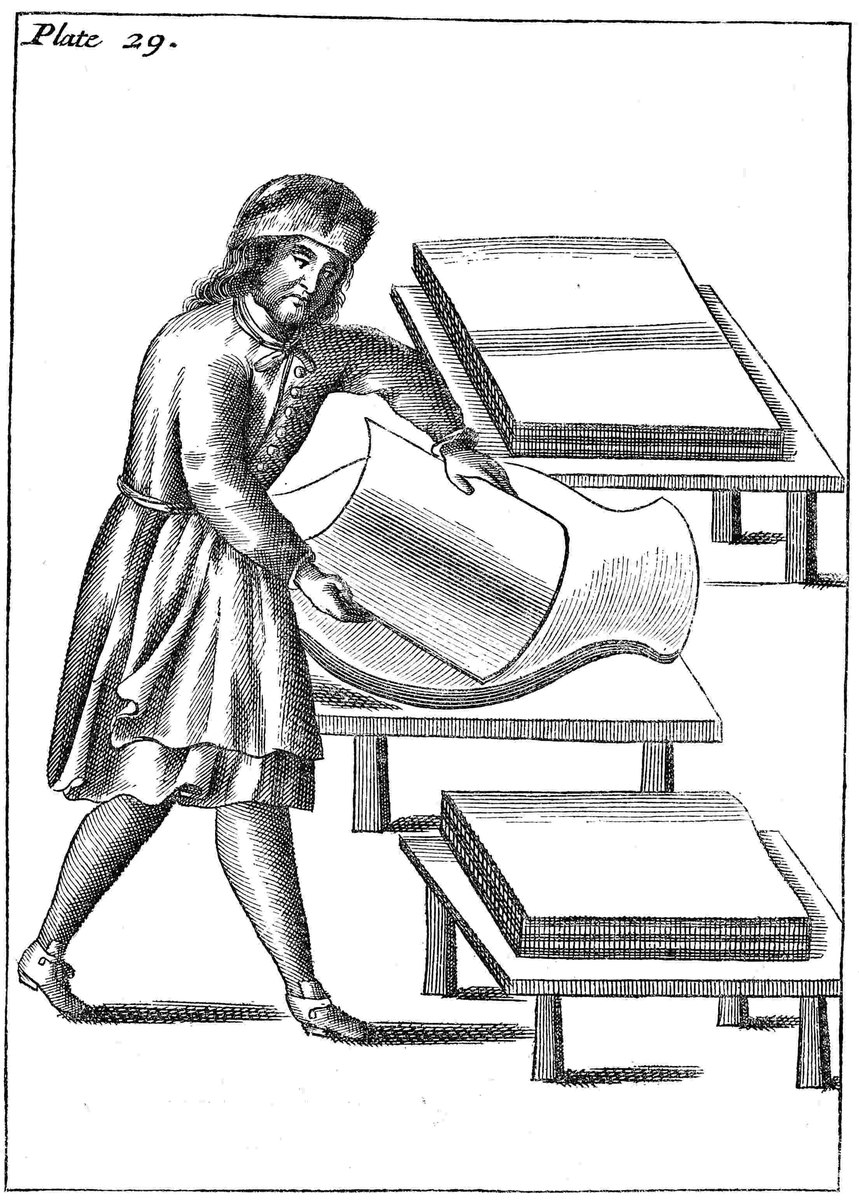
¶ 9. Of Wetting Paper.
Paper is commonly Wet in a Tray full of fair Water. The Press-man places the length of the Tray before him; his dry Heap on the Left Hand the Tray, and a Paper-Board with its Breadth before him on his Right Hand of the Tray: He lays first a Waste Sheet of Paper on the Paper-board, lest the Board might Soyl or foul the first Sheet of the Heap. Then he takes up the first Token, and lays it in such a position that the backs of the Quires lye towards his Right Hand, that he may the readier catch at the Back of each Quire with his Right Hand, when he is to Wet it: And he lays that Token athwart, or somewhat Crossing the rest of the Heap, that he may the easier know when he has Wet that Token.
Then taking the first Quire of the Heap with the back of it in his Right Hand, and edge of the Quire in his Left, he lays the Quire down upon the Waste Sheet, so, as that the back of the Quire lye upon the middle crease of the Waste Sheet, and consequently one half of the Quire already laid even down upon one half of the Waste Sheet. If the Paper be Strong, he opens about half the Quire, and turns it over dry upon the other half of the Waste Sheet: But if the Paper be Weak and Spungy, he opens the whole Quire, and lays that down Dry.
The reason why he lays the first Laying-down Dry, is, because it lying under the rest of the Heap 304will sufficiently imbibe the moisture that Soaks from it: And the reason why he leaves but half a Quire Dry for strong Paper, and an whole for Spungy, is, Because Spungy Paper Soaks in moisture faster than Strong.
Having laid down his Dry Laying, he takes another Quire off the Dry Heap, with the back of the Quire in his Right Hand, and the edge of the Quire in his Left, (as before,) and closing his Hand a little, that the Quire may bow a little downwards between his Hands, he Dips the back of the Quire into his Left Hand side of the Tray of Water: And discharging his Left Hand of the Quire, Draws the Quire through the Water with his Right; but as the Quire comes out at the Right Hand side of the Tray, he nimbly catches the edge of the Quire again in his Left Hand, and brings it to the Heap, but by lifting up his Left Hand bears the under side of the Quire off the Dry Paper, laid down before, lest the Dry Sheet should stick to the Wet, before he have plac’d the Quire in an even position, and so perhaps wrinkles a Sheet or two, or else put a Dry Sheet or two out of their even position, on the sides or ends.
But this Drawing the Quire through the Water he performs either nimbly or slowly: If the Paper be Weak and Spungy, he performs it quickly; if Strong and Stubborn, slowly.
To place this Quire in an even position, he lays the back of the Quire exactly upon the opening crease of the former Quire, and then lets the side of the Quire in his Left Hand fall flat down upon the Heap; and discharging his Right Hand, brings it to 305the edge of the Quire; and with the assistance of his Left Hand Thumb (still in its first position) opens or divides either a third or half of the whole Quire, according to the quality of the Paper, (as was said before,) and spreading the Fingers of his Right Hand as much as he can through the length of the Quire, turns over his opened division of the Quire upon his Right Hand side of the Heap.
The reason why he spreads the Fingers of his Right Hand as much as he can through the Length of the Quire; is, because the outside Half Sheet is Wet, and consequently quickly Limber, so that if the Paper be Weak, it would fall Down before the rest of his Opening, and double into wrinkles, which thus spreading his Fingers prevents.
In the same manner he Wets all the Quires of his Dry Heap. See Plate 29.
But having Wet his first Token, he doubles down a great corner of the upper Sheet of it on his Right Hand, so as the farther corner may lye a little towards the Left Hand of the crease in the middle of the Heap, and so as the hither corner may Hang out on the hither side of the Heap about an Inch and an half: This Sheet is called the Token-Sheet, as being a mark for the Press-man when he is at Work to know how many Tokens of that Heap is Wrought-off, and consequently to know how many is to Work.
When he has Wet the first Token, he removes the next uppermost Dry Token askew on the Dry Heap, and successively all the rest, as I shewed in the beginning of this ¶.
Having Wet the whole Heap, he lays a Waste 306Sheet of Paper upon it, that the Paper-Board to be laid on, Soyl not the last Sheet of the Heap: Then three or four times takes up as much Water as he can in the hollow of his Hand, and throws and sprinkles it all over the Waste-sheet that it may moisten and Soak downwards into the un-wet upper part of the last Division of the Quire.
The Paper being thus Wet, he takes up the whole Heap upon the Paper-board, and sets it by in a convenient place of the Room, and lays another Paper-board upon it: And upon the middle of the Paper-board, sets about Half an Hundred Weight, and lets it stand by to press, commonly till next Morning: For Press-men generally Wet their Paper after they have left Work at Night.
The manner how Paper is Set out, shall be shewed when I come to the Office of the Warehouse-keeper.
¶ 10. Of Knocking up the Balls.
Ball Leathers (as I said before in § 11. ¶ 21.) are either Pelts or Sheep-skins: If Pelts, they are chosen such as have a strong Grain, and the Grease well Wrought out of them: They are either Wet or Dry before they come to the Press-mans use: If Wet, he having before-hand provided a round Board, of about Nine inches and an half Diameter: Supposing the Ball-stocks to be six Inches diameter, lays the Round Board upon the whole Pelt, and cuts by the out-side of the Board so many round pieces as he can out of the Pelt, reserving two for his present Use.
And hanging the rest up (commonly upon the 307Braces of the Press) to dry, that they may not Stink or Mould before he have occasion to use them.
But if his Pelts are Dry, he lays them to Soak (by choice in Chamber-ly) but I never heard, or by my experience could find why it is preferred before Fair Water: For the purpose of Soaking them is only to supple them.
If he Work with Leather, It is chosen with a Strong and close grain: Wherefore by experience it is found that the Neck-piece, and indeed all along the back of the Skin is best; but it is commonly subject to be greasie, which gives the Press-man sometimes a great deal of trouble, to make his Balls Take. He also lays the Ball Leathers in Soak to supple them.
When they (either Pelts or Leathers) are well Soaked, he Rubs them well with both his Hands, and then twists and wrings them (as Women do Cloaths) to get the Water out again.
When they are well wrung, he Sits down upon a Seat about fourteen or fifteen Inches high, commonly a Heap of White Paper, if it stand conveniently for him; but not upon a Printed Heap, least his Weight pressing it cause the un-dryed Inck to Set-off: He sits down, I say, and lays the Ball-stock upon his a little opened Thighs near his Knees, that with closing his Thighs he may hold it in a Steddy position, and with the Handle of the Ball-stock towards his Belly. Then taking the Ball-Leather, he laps or Folds about three quarters of an Inch of one part of it over so much of it towards his Left Hand into a Plaight, and laying the edges of that Plaight towards him, an Inch above the edge of the Ball-stock, he with the Head of 308the Sheeps-foot drives a Ball-nail into the middle of the Plaight, a little more than half an Inch above the the edge of the Ball-stock: But he Drives the Ball-nail not quite up to the Head, but leaves about almost a quarter of an Inch of the Nail out; that with the Claw of the Sheeps-foot he may Draw the Nail again when occasion serves.
Having driven the first Nail, he turns about the Ball-stock, till the opposite side, and as near as he can guess, point of the edge of the Ball-stock lyes directly upwards between his Thighs, (as before,) and then taking as near as he can guess the opposite edge of the Ball-leather between his Fore-fingers and Thumb of his Left Hand, he holds the edge of the Ball-leather upright, and having his Wooll or Hair Teized, lying by him on his right Hand on the Floor, he grasps at once as near as he can guess, so much as may just serve to fill his Ball-leather and the hollow of the Ball stock; which bringing to the hollow of the Ball-stock, he draws the Ball-leather over it; and lapping the edges of the Ball-leather over, as before, makes another Plaight, and Drives another Nail, as before: So that here is now the two opposite Sides of the Leather Nailed on. Then he takes up the Ball by the Handle in his Left Hand, and observes whether the Wooll tend more to one than the other open half: If it do, he thrusts it with the ends of his Fingers of his Right Hand into the middle, or else over to the other Half, till the Wooll lyes equally on both the Halfs.
If he have put too much or too little Wooll into the Ball, he either takes some out, or adds more to, as 309the respective Half may require. Then lays it down again between his Thighs, as before, and lays another Plaight in the middle of the Ball-leather on one of the open Halves, and as near as he can guess, between the middle of the two opposite Nails; and Nails that Plaight down to the Ball-stock, as before.
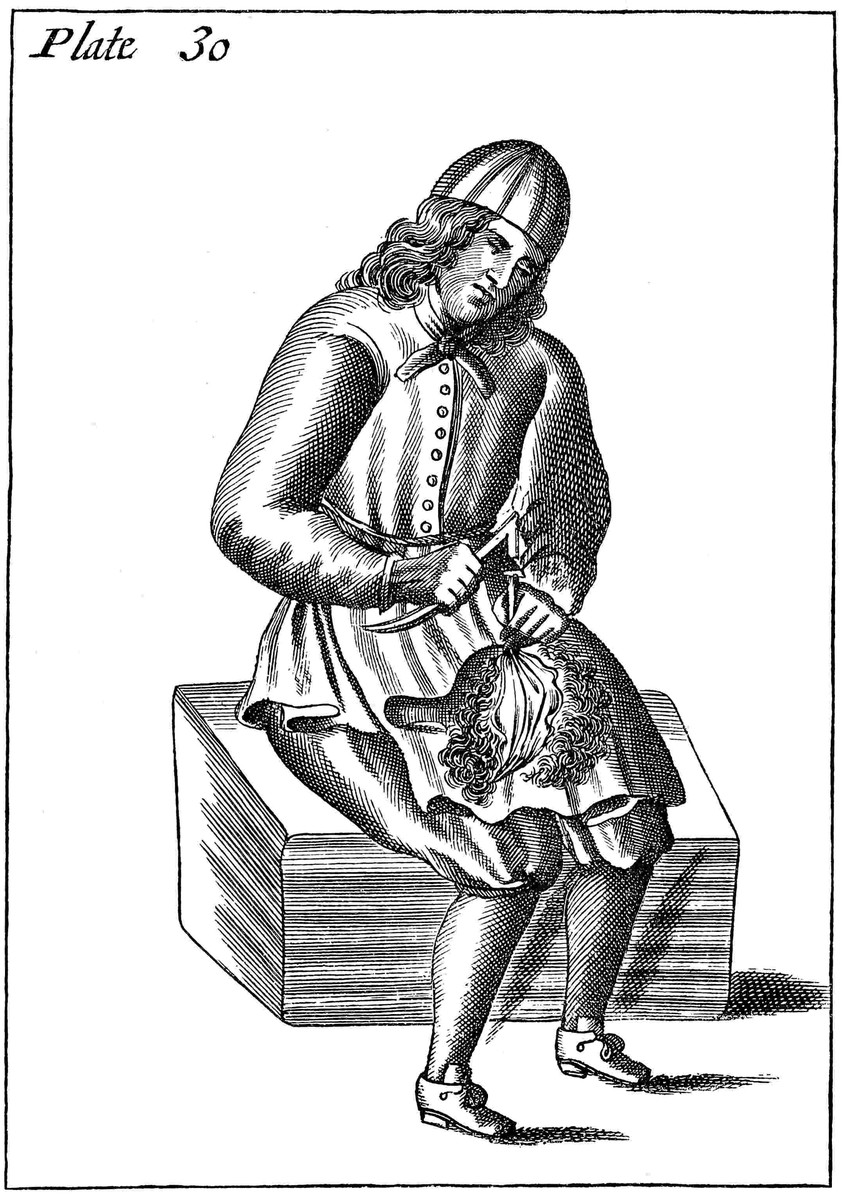
In the like manner he Nails down the other open sides, (now Quarters,) and then again takes a View how the Wooll is disposed into the middle of the Ball; and where he finds it tend most to any of the open Quarters, he Drives the Wooll with the ends of his fingers, as before, or sometimes when the Balls have been Wrought with, and blackt with Inck, with the Head of the Sheeps-foot into the middle, and then Nails down as before all the open Quarters as near as he can guess; between the middle of his former driven Nails, and then again, takes another View as before, to see how the whole Ball pleases him.
If he finds any of the Plaights laid too near one another, he draws that Nail, and alters that Plaight, to lay it as near as he can by guess, in the middle between the next two Plaights.
Then he considers if his Ball be round: If it be not, he thrusts the Wooll from the bunching-out side, towards the wanting side, either with the ends of his Fingers, or the Balls of one of his Hands; while the Wooll is yet loose in the Ball-stock: For when the Ball has been Wrought withal, it will grow so hard, that the Wooll will not move out of its place.
Having Knockt up one Ball well, he Knocks up the other, as the first.
310
The Balls are well Knockt up, when the Wooll is equally dispersed about all the Sides, and the middle smoothly covered with the Leather, viz. not rising in Hillocks, or falling into Dales, not having too much Wooll in them, for that will subject them to soon hardning, and quickly be uneasie for the Press-man to Work with; or too little, for that will make the Leathers, as the Wooll settles with Working soon flap, and wrap over it self into Wrinkles. So that he cannot so well destribute his Balls: But the Balls ought to be indifferently plump, to feel like an Hard stuft Bed-pillow, or a strong Spunge a little moistned with Water.
Having Knockt up the Balls, and Rub’d out the Inck, as shall be shewed in the next ¶, he trys if his Balls will Take, that is, he Dabs the top of one of them three or four times lightly upon the hither part of the Inck-block; If he finds the Inck sticks to it equally all about, and that so much as has toucht the Inck-block is Black, it Takes: But if scarce any of the Leather is Black, or that it be Black and White in Splotches, then the Balls does not Take: Wherefore he considers whether his Ball be too Wet, or else Greasie, for each of these inconveniences will hinder the Taking of the Ball.
If it be too Wet, he burns half a Sheet or an whole Sheet of Waste Paper, and waves his Ball to and fro over the flame of it; but so quick and cautiously that he neither shrinks the Leather or Dryes it too much: In Winter time when a fire is at Hand, he dryes it gently by the fire.
If it be Greasie, he with the edge of the Ball-knife 311scrapes off the thick Oyl, that Works down out of the Nut and Spindle of the Press, or else with the point of his Knife takes a convenient quaintity of Oyl out of the Plattin-pan, or for want of either takes fresh Sallad Oyl and smears and spreads it well all over the whole Ball-leather; and then holding the Ball-knife in his Right Hand, with its edge a little sloping downwards that it cut not the Ball-leather, and the handle of the Ball-Stock in his Left Hand, he joyns the bottom of the Ball-leather, viz. as near the outer edge of the Leather as he can, for the Ball Nails to the edge of the Ball-knife, and turning the Ball about by its Handle, presses it hard against the sloapt edge of the Ball-knife, and at once drives the laid on Oyl and Grease too before the sloapt edge of the Ball-knife; but he keeps the Handle of the Ball-Stock, and consequently the whole Ball too, constantly turning, that the whole circumference of the Ball may be Scraped: And as the Ball has performed a Revolution against the sloapt edge of the Ball-knife, he draws gradually his Left Hand a little backish, that the sloapt edge of the Ball-knife may by several Spiral revolutions of the Ball, scrape up to the very top of the Ball, and carries before it the Oyl and Grease thither: Which having there, he gathers up upon the Blade of his Ball-knife and disposes of it, as of so much Dirt and Filth.
After a due process of either of these Operations respectively, his Ball will Take, and he again dabs gently the top of his Ball three or four times on the Inck-block (as before) and finding it Take, he takes the Handle of it into the clutched Fingers of his Left 312Hand, holding the Ball-stock just a little above the circle of his Fore-finger and Thumb, and grasps the Handle of the other Ball-stock into his Right Hand, with the circle of his Finger and Thumb upwards, and the now bottom of his Right Hand downwards, but not resting upon the Ball-stock; and trys if that Ball will Take, by dabbing the Leather of it three or four times upon the other Ball; If it do not Take with dabbing, he twists the Balls in either Hand close and hard, contrary to one another, to besmear the upper with the under Ball. If after this, the upper Ball do not Take, he considers the cause, and remedies it, as he did the first Ball.
¶ 11. Of Rubbing out Inck.
Before the Press-man goes to Work, he Rubs out his Inck.
If the Inck have lain long on the Inck-block since it was Rubbed out, the Superficies of it generally is dryed and hardened into a Film or Skin, wherefore the Press-man carefully takes this Film quite off with the Slice before he disturb the Body of the Inck: For should any, though never so little of it, mingle into the Inck, when the Ball happens to take up that little particle of Filin, and delivers it again upon the Face of the Letter, it will be a Pick, and Print black, and deface the Work: And if it get between the Face of two or more Letters, or the Hollows of them, it will obliterate all it covers. And if it be Pull’d upon, and the Press-man not 313careful to over-look his Work, it may run through the whole Heap.
Wherefore having carefully skinned off the Film with the edge of the Slice, he scrapes his Slice clean with the Ball-knife, lest some small parts of the Film should yet stick to, or remain on the Slice: And then with the Slice brings the body of Inck into the middle of the Plain of the Inck-block, and searches the sides of the Inck-block, by thrusting the edge of the Slice forwards along them and all the angles of the Inck-block, and so scrapes off all the Inck as clean as he can, and gathers it to the whole mass of Inck: Then with the Slice he turns the whole mass about half a score times over and over to mingle it well together, lest some part of it should be more consolidated than the rest: And to mingle it yet better, he then falls to Rubbing it with the Brayer, grasping the Handle of it in his Right Hand, he begins to Rub with all his strength at the hithermost side-boundings of the Body of Inck, and keeping Rubbing through the almost whole length of the Inck-block, he gradually proceeds to the farther side of the Body of Inck. In this manner of Rubbing he bears hardest upon the farther edge of the Brayer, because the hither sides of the Inck-block are not fenced in with Rails about them; and should he Rub with the bottom of the Brayer flat upon the Inck-block, he might draw too great a body of Inck to the unfenced sides; so that the Inck would be subject to run off: This Rubbing is only to spread the Inck pretty equally over the superfices of the Inck-block: Wherefore he now begins a circular Rubbing, observing in the circulation 314of the Brayer that he always a little mounts the part of the edge of the bottom, which in its progress is ready to approach a prominent body of Inck, that it may somewhat slide over it, that the Inck be not lickt up high on the sides of the Brayer.
Then with the Handle of the Slice in his Left Hand and the Handle of the Brayer in his Right, he joyns the bottom edge of the Slice to the side of the Brayer, holding the flat of the Slice Horizontal, and the bottom of the Brayer perpendicular both over the Inck-block, and keeping his Brayer and Slice in this position, by turning the Handle of the Brayer in his Right Hand, held pretty stiff against the edge of the Slice, he scrapes off all the Inck that the side of the Brayer has lickt up: And setting down his Brayer, he takes the Slice in his Right Hand and lays what Inck he scrapes off the side of the Brayer again upon the Inck-Block, and Slices the whole mass of Inck into the farthermost corner of the Inck-block.
This Rubbing of the Inck may serve when the Inck-block had Inck on it before.
But if no Inck were on the Inck-block before, then he lays new Inck on the Inck-block: Wherefore he considers what Work he Works on: whether it be small or great Letter: If it be small Letter, or curious Work, the Inck must be Strong he Works with: But if it be great Letter or sleight Work, he makes Soft Inck serve, or at least mingles but a little Hard Inck with it.
If the Inck be too Hard, as sometimes in very frosty Weather it will be, then, though his Work be curious, yet he must Rub in a little Soft Inck to soften it; 315because it will not else Destribute well upon the Balls; especially if the Leathers be a little too Wet, or a little Greasie: Besides, it may and many times does pull and tear the Grain off the Skin; which not only spoils the Skin, but fills the Form full of Picks.
Sometimes when he finds the Inck too pale, he Rubs in Blacking, but he first joults the bottom of the Blacking Tub three or four times against the ground, that if by chance any dirt or filth have gotten into it, it may sink to the bottom of the Tub.
But when he either mingles Strong and Weak Inck together, or else puts in Blacking, he applies himself again first to Rubbing with the Brayer, the length-way of the Inck-block, as before, and then to a circular Rubbing, as before; and to cleansing his Brayer, as before; and this long-ways Rubbing, circular Rubbing, and cleansing his Brayer, he reiterates so oft, till he judge the whole mass of Inck sufficiently Rubbed and mingled, and the Blacking perfectly imbibed by the Inck: And then he Slices the whole mass of Inck to the farthermost corner of the Inck-block, as before.
¶ 12. Of Destributing the Balls.
I shewed you in ¶ 10 of this § how he dabb’d the Ball on the Inck-block, to try if it would Take: And I shewed you in what Posture he handled the Balls when he tryed if the other Ball would Take: Therefore for Taking Inck and Handling the Balls I (to avoid tautology) refer you to that ¶.
Having now Taken Inck, and gotten the Balls in his Hands, in that posture, he Works them side-ways 316upon one another to and from him, and with a craft (acquired by use) in the Handling of the Balls, all the while keeps the Handles, and consequently the whole Ball-stocks (both) turning round in his Hands and in a motion contrary to each other, viz. His under Ball moving from the Left Hand to the Right, and his upper Ball moving from his Right Hand to to the Left; and by and by in a second motion contrary to the first, viz. his under Ball moving from the Right Hand to the Left, and his upper Ball moving from the Left Hand to the Right.
And these motions and Operations he continues so long till he judges, and in part perceives the Inck is equally Destributed all over the whole Ball-Leathers.
The first way of turning the Ball Handles, while the Balls are moved to and from him, is made by pressing the ends or Balls of the fingers of both his Hands upon the Ball-handles from-wards his Hands: And the second way of turning them contrary to the first, is made by gathering in the ends or Balls of of his fingers while they are in their circular to and fro motion. But because in gathering in his fingers, he does somewhat dis-ingage his grasp of the Ball-Handles, therefore he lightly and almost insensibly, tosses the Ball-stocks a little up, that when they are dis-ingaged from a close grasp, his fingers ends may the easier draw the Handles towards him. This is a Hand-craft, which by continued use and practice, becomes familiar to his Hands.
317
¶ 13. Of Beating.
The Press-man imagines, or by his eye judges the length of his Form (be it what Volumne it will) devided into four equal parts or Rows, which four Rows for distinction sake, I shall number from the Left Hand to the right, with first Row, second Row, third Row, fourth Row, just as an Octavo Form is exactly devided by four Rows of Pages.
He places his Left Hand Ball at the hither end of the first Row, so that though the Ball be round, yet the square encompassed within that round shall sufficiently cover so much of the square of the hither end of that Row as it is well capable to cover; and his Right Hand Ball he sets upon the hither end of the third Row: He sets his Balls close upon the Face of the Letter, with the Handles of the Ball-stocks a little bending towards him: But as he presses them upon the Face of the Letter, he mounts them perpendicular; and lifting at once both the Balls lightly just clear off the Face of the Letter, he removes them about the fifth part of the breadth of the Form upwards, viz. towards the farther side of the Form, and again sets them close down upon the Face of the Letter, with the Handles of the Ball-stocks again bending a little towards him, as before: and as he presses them upon the Face of the Letter, mounts them perpendicular, as before: Thus in about four or five or six such motions, or rather removes of the Balls, according to the breadth of the Form, he Beats over the first and third Rows. Thus Beating from the hither 318towards the farther side, is in Press-mens phrase called Going up the Form.
The reason why he bends the Handles of the Ball-stocks a little towards him, is, that the Ball-leathers drag not upon the Face of the Letter; for then the edges of the hollows between the Lines or Words, or the edges of the cavities below the Face would scrape Inck off the Balls to stop up or choak the Form. And the reason why (before he removes them) he mounts the Handles of the Ball-stocks a little perpendicular, is, that the Balls may touch in their greatest capacity upon the Face of the Letter.
To Come down the Form, he skips his Balls both at once from the first and third Row to the second and fourth Row, and brings them down as he carried them up; only, as before, he bended the Handles of the Ball-stocks a little towards him, so now he bends them a little from him: That the Ball-leathers (now Coming down) drag not, as aforesaid. Then in like manner he again skips the Balls from the second and fourth Row to the first and third Row, and again Goes up the Form with the Balls, as he did before. And then again skips, as before, and Comes down the Form again with the Balls.
Having thus gone twice upwards and twice downwards with the Balls, the Form is sufficiently Beaten in a train of Work, when the Face of the Letter Takes well.
But if he Beats the first Sheet of a fresh Form, or after a Form is Washed, or he makes a Proof, he Goes three four or five times Upwards and Downwards: Least the Face of the Letter should happen to be Wet 319or moist, and consequently un-apt to take Inck, without reiterated Beatings.
¶ 15. Of Pulling.
We will suppose now two Press-men going in the Morning to their train of Work: The one they distinguish by the name of First, the other his Second, these call one another Companions: The First is he that has wrought longest at that Press, except an Apprentice, for he must allow any Journey-man though new-come that stile: Generally the Master Printer reposes the greatest trust upon his care and curiosity for good Work; although both are equally liable to perform it.
All the priviledge that the First has above the Second is, that the First takes his choice to Pull or Beat the agreed stint first: And that the Second Knocks up the Balls, Washes the Forms, Teizes Wooll, and does the other more servile Work, while the First is imploid about making Register, ordering the Tympan, Frisket, and Points, &c. or otherwise Making Ready the Form, &c.
The First now takes his spell at Pulling: For the First and Second take their spell of Pulling and Beating an agreed number of Tokens: Sometimes they agree to change every three Tokens, which is three Hours work, and sometimes every six Tokens; that they may both Pull and Beat a like number of Tokens in one day.
Under the general notion of Pulling and Beating is comprised all the operations that is in a train of work 320performed by the Puller and the Beater: For though the Puller Lays on Sheets, Lays down the Frisket, Lays down the Tympans and Frisket, Runs in the Carriage, Runs out the Carriage, takes up the Tympans, Takes up the Frisket, Picks the Form, Takes off the Sheet, and Lays it on the Heap, yet all these Operations are in the general mingled and lost in the name of Pulling. And as in Pulling, so in Beating; for though the Beater Rubs out his Inck, Slices it up, Destribute the Balls, peruses the Heap, &c. yet all these Operations are lost in the general name of Beating. Thus they say the First or the Second is Pulling; or, the First or the Second is Beating; though they are performing the different Operations aforesaid: unless upon particular occasions the respective Operations are particularly nam’d.
As there are many Operations conjunct to Pulling, and Beating, so the Press-man performs them with various Set and Formal Postures and Gestures of the Body. For,
To take a Sheet off the Heap, He places his Body almost straight before the hither side of the Tympan: I say almost straight, Because it is more straight before the side of the Tympan than it is before the angle made by the Paper-bench and the side of the Tympan: But he nimbly twists the upper part of his Body a little backwards towards the Heap, the better to see he takes but one Sheet off, which he loosens from the rest of the Heap (as I have shewed before) by drawing the back-side of the Nail of his right Thumb on his Right Hand nimbly over almost the whole length of the Heap, and receiving the hither end of the Sheet 321with the inside of his Left Hand fingers and Thumb catches with his Right Hand about two inches within the farther edge of the Sheet near the upper corner, and about the length of his Thumb below the hither edge of the Sheet, and brings it nimbly to the Tympan: And at the same time twists his Body again straight before the Tympan, only a very little moving his right Foot from its first Station a little forwards under the Carriage Plank: And as the Sheet is coming to the Tympan (we suppose now he Works upon White Paper) he nimbly disposes the fingers of his Right Hand under the farther edge of the Sheet near the upper corner; and having the Sheet thus in both his Hands, lays the farther side and two extream corners of the Sheet down even upon the farther side and extream farther corners of the Tympan-sheet, but he is careful the upper corner of the Sheet be first laid even, upon the upper corner of the Tympan-sheet; that he may the sooner disingage his Right Hand: And if by the nimble casting his eye, he perceive the sides of the Sheet lye un-even upon the Tympan-sheet, he with his Left Hand at the bottom corner of the Sheet, either draws it backwards, or pulls it forwards, as the Sheet may lye higher or lower on the hither corners of the Tympan-sheet, while his Right Hand being disingaged, as aforesaid, is removed to the backside the Ear of the Frisket, and with it gives it a light touch to double it down upon the Tympan. And by this time his Left Hand is also disingaged, and slipt to the hither under corner of the Frisket, to receive it, that it fall neither too hard or too quick down upon the Tympan: For hard 322falling may shake the loose Sheet on the Tympan out of its place; and so may the quick pressure of the Air between the Tympan and Frisket, after the Sheet is well laid: and while his Left Hand receives the Frisket his right is disingaged from the Ear of the Frisket, and removed to the middle of the back-side the Tympan; which he grasps between the Balls of his Fingers and Thumb, to lift it off the Gallows, and double it and the Frisket together on the Form. And while the Tympan is coming, he slips his Left Hand Fingers from under the Frisket to the hither outer corner of it, as well to keep the Sheet close to the Tympan in its position, as to avoid the jobbing of the lower side of the Frisket against any small square shoulder, either of the Furniture, Quoins, Chase, or the corners that may stand higher than their common Plain.
Then nimbly slipping his Left Hand, he with it grasps the Rounce, and with a moderate strength, nimbly gives its Winch about one Turn round; I say about, because the first Pull will generally fall out to be made about the middle of the Carriage; (as was shewed in § 11. ¶ 16.) but perhaps not just in the middle: yet to regulate his Runing in, he made a mark before on the farther Rail of the Tympan, (as I shewed in ¶ 3. of this §) to which mark he Runs the Carriage in, till he bring the mark in a Range with the fore-edge of the Plattin; and as it is coming, skips his Hand to within an Inch or two of the end of the Bar, and then at once gently leans his Body back, that his Arm as he Pulls the Bar towards him may keep a straight posture; because in a Pull it has then 323the greatest strength. And he also slips his right Foot upon the Foot-step, while his Left Hand holds fast by the Rounce; as well to rest on the Foot-step and Rounce, as to enable his Body to make a stronger Pull; which will prove Longer or Shorter, according to the strength put to it, and also the Hard or Soft Justifying of the Head, (as was shewed in ¶ 5. of this §.)
Then disingaging his Right Hand again from the Handle of the Bar, he slips it to the Bow of the Bar, before the Handle fly quite back to the Cheek of the Press: For should the Bar by its forcible Spring knock hard against the Cheek of the Press, it might not only shake some of its Parts or circumstantial appurtenances out of order, but subject the whole Machine with oft reiteration to an unstable position. Besides, the farther the Bar flyes back, the more he hinders quick riddance in recovering it again. But yet he must let the Bar fly so far back as that the Tympan may just rise clear off the Plattin; lest when he Runs in his Second Pull, the Face of the Plattin rub upon the Tympan, and shoves the Sheet upon the Face of the Letter, and sometimes Slurs, and sometimes Doubles it upon the Face of the Letter.
Having Pull’d the First Pull, and having the Rounce still in his Left Hand, He turns the Rounce about again, till the Carriage Runs in so far, as that the second mark on the Rail of the Tympan comes into a Range with the hither edge of the Plattin, as before the first mark did; and then Pulls his second Pull, as he did his first; and slips his Right Hand again off the Handle of the Bar to the Bow, (as before) and guides the Bar up to its Catch leisurely, that coming 324now near the Cheek it knock not against it: and just as he has Pulled his Second Pull, he gives a pretty quick and strong pressure upon the Rounce, to turn it back, and the Carriage out again: And so soon as he has given that one pressure, (as aforesaid) he desingages his Left Hand from the Rounce, and claps the fingers of it under the middle of the Tympan, and on the Ear of the Frisket: and while this is doing, removes his Right Hand to the now upper, but immediately it will be the under-side of the Tympan Rail, within four or five Inches of the upper end of it, to receive the Tympan, as it is lifted up off the Form by his Left Hand. And having thus received it, lets it descend gently down on the Gallows. And as it is descending, slips his Left Hand fingers under the hither lower corner of the Frisket, and gives the Frisket a toss up; while by this time his Right Hand being disingaged from the Tympan, is ready to catch the Frisket by the Ear, and convey it quick and gently to its Stay: And while the Frisket is going up; he slips the end of the middle finger of his Left Hand, or sometimes the ends of his two middle fingers with their Balls upwards, under the hither lower corner of the Pulled off Sheet, and at the instant he has got them under, he nimbly bows his Joynts upwards, to throw up the corner of the Sheet, to make it mount a little, for him to gather about two Inches hold of it between the Balls of his Thumb and fore-finger. And heaving the whole Sheet by this corner a little upwards, He at the same time lifts it off the Points, and draws it somewhat towards him; and as it comes, catches it near the upper corner of the same side of the 325Sheet, between the foremost Joynts of his fore-fingers and Ball of the Thumb of his Right Hand, and nimbly twisting about his Body towards the Paper-bench carries the Sheet over the Heap of White-paper to a Paper-board, which before he placed beyond that Heap on his Right Hand, (as aforesaid in ¶ 14.) and lays it down upon a Waste-sheet laid for that purpose on that Paper-board; but while it is coming over the White-paper Heap, though he have the Sheet between both his fore-fingers and Thumbs, yet he holds the Sheet so loosly that it may move between them as on two Centers, as his Body twists about (as aforesaid) from the side of the Tympan towards the side of the Paper-bench.
Thus you see both the Press-mans Hands at the same time alternatively ingaged in different Operations: For while his Right Hand is imployed in one Action his left is busie about another, and these exercises so suddenly varied, that they seem to slide into one another; one Posture beginning when the former is but half performed.
Having thus Pulled one Sheet, and laid it down: He turns his Body towards the Tympan again, and as he is turning gives the next Sheet on the White-paper Heap a Touch with the backside of the Nail of his Right Thumb, as before, to draw it a little over the hither edge of the Heap, and lays it on the Tympan, &c. as he did the first; and so successively every Sheet till the whole Heap of White-paper be Wrought off.
As he comes to a Token-sheet, he un-doubles that, and smooths out the Crease with the back-side of 326the Nails of his Right Hand, that the Face of the Letter may Print upon smooth Paper. And being Printed off, he folds it again, as before, for a Token-sheet when he works the Reiteration.
Having Wrought off the White-paper, he turns the Heap thus:
He takes the Paper-board that his White-paper lay on, and sets it down on the ground: Then removes the Heap to his Left Hand; then takes up the Paper-board, and lays it on his Right Hand: And if it be Twelves, or any Form Imposed like Twelves, as Twenty fours, &c. he turns it from one long side of the Paper to the other, that is, the long side of the Paper that stands on his Right Hand when the Printed side lies upwards, he turns over to his Left Hand, and lays the un-printed side upwards. In performing this, he grasps off of the Wrought off Heap so much at once between both his Hands as he can well govern, without disordering the eveness of the sides of the Heap, viz. a Token, or more, and lays that upon the Paper-board; then takes another grasp in like manner, and lays that on the first grasp, and so successively, till he have turned the whole Heap, grasp by grasp. Then removes the Heap near the Tympan, and lays the other Paper-board beyond it, as the first Paper-board stood before; always remembring to lay a Waste-sheet first on the Paper-board.
Having now turned the Heap, and made Register on the Reteration Form (as was shewed in ¶ 7. of this §) he Works off the Reteration: But he somewhat varies his posture in the Laying on his Sheets: For as before, when he wrought White Paper, he 327catcht the Sheet by the upper farther corner with his Right Hand, he now having heaved up the Sheet (as aforesaid) catches it as near the farther side of the farther Point-hole as he can, with the Ball of his Right Hand Thumb above the Sheet, and the Ball of his fore-finger under the Sheet, the readier to lay the Point-hole over its respective Point: which having done, he slips his Body a little backwards, and both his Hands with it, his Right Hand towards the hither Point-hole, with the back-sides of the Nails of his fingers to draw or stroak it over the Point: and the fingers of his Left Hand, as they come from the farther corner, nimbly slipping along the bottom edge of the Sheet, till they come to the hither corner; and then with his fore-finger and Thumb, layes hold of it, to help guide the Point-hole on that Point also: Then Pulls that Sheet, as before, as he did the White Paper, and so successively all the rest of the Reteration. Only, the Token-sheets, as he meets with them, he Folds not down again, as he did the White Paper.
If a Press-man have no Companion, but works alone; he has a little oblong Square Form or Bench made to stand so high as the Face of the Letter upon the Press-stone, and so long as to contain the Balls when set upon the Ball-leathers.
This Form or Bench some Work-men will place on the hither side the hither Cheek, within about half an Inch of the foreside of the Cheek: And other Work-men will place it on the farther side of the Carriage; each sort of Work-men supposing that in the place he sets it, the Balls stand most commodious for 328his quick taking up and setting down: I shall not plead the convenience of either, but in short speak to the inconveniences of both.
The inconvenience of placing it on the hither side the hither Cheek, is, that the Press-man must twist his Body somewhat about to take up the Balls. And the inconvenience of placing it on the further side the Carriage, is, that the Press-man must thrust his Body over the Form to take up the Balls: both ways strain the Body, and hinder riddance.
Those that place it on the hither side the Cheek, begin and end their Beating as has already been shewed, viz. on the hither side the Form: But those that place it on the farther side the Carriage, begin and end their Beating on the Rows on the farther side the Form.
One Press-man in his train of Work will Beat so soon as he has laid the Tympan on the Gallows after Pulling: Another will not Beat till he has laid his Sheet on the Tympan, and doubled the Frisket down on it: both sorts fancying their own way most quick and commodious: For these conveniences are the purposes they both drive at.
¶ 16. Of Printing Red, or other Colours with Black.
When Red and Black are to be Printed upon the same Sheet, the Press-man first Makes Register, as was shewed ¶ 7. and Makes Ready his Form as was shewed ¶ 14. of this §. Then having a new Frisket Drawn, as was shewed ¶ 8. He Prints upon his new Frisket with Black. And having before a Proof-sheet 329Printed Black, with the Words to be Printed Red under-lined on that Proof-sheet; He takes off his Frisket, and lays it flat on a Paper-board, and with a sharp-pointed Pen-knife neatly cuts out those words on the Frisket, and about half a Scaboard Margin round about the words, that he finds under-lined on the Proof-sheet: Then sets the Frisket by till he has wrought off his Heap with Black, and puts his common Frisket on the Joynts of the Tympan again.
While the Press-man is Cutting the Frisket, the Compositer takes those Words out of the Form that are Under-lin’d on the Proof-sheet, and in their place puts Quadrats, m-Quadrats, Spaces, &c. to Justifie the Lines up again.
Then Locking up the Form, the Press-man Works off the Heap Black, as was shewed in the last ¶.
Having wrought off his Heap Black, he takes off the common Frisket, and puts on his new cut Frisket: Then taking a piece of thick Scaboard he cuts it into so many small slips as there are Whites in the Form to be Printed with Red; These small slips he cuts exactly to the length of the Quadrats, &c. the Compositer put in, and to the breadth of the Body; but rather a small matter less than bigger, lest they bind at the bottom of the Shank of the Letter: for when the Compositer takes out the Quadrats, &c. he put in before the Form was Wrought off Black, these slips of Scaboards the Press-man pricks on the Point of a Bodkin and puts them into their respective holes: And being loosen’d off the Point of the Bodkin with the blunt Point of another Bodkin, are laid down flat on the Press-stone; These slips are called Underlays, and 330are described in ¶ 14. of this §. Upon these Underlays the Compositer puts in again the Words or Letters he took out before the Form was Wrought off Black: So that these Words now stand higher than the other Matter of the Form, and therefore will Print when the other Matter will not. But yet for the more assurance that the other Matter Print not, the New-cut Frisket was prepar’d, which hinders any thing to Print but what Prints through the Holes cut in it; which Holes these Underlaid Words fall exactly through.
Having mingled the Red, or any other intended Colour with Varnish, as shall be shew’d in the next ¶, he Beats the Form as with Black; and Pulls it very lightly, lest these Underlaid Words standing higher than the rest of the Matter, Print too Hard.
¶ 17. Of mixing and Grinding Colours with Varnish.
Varnish is the common Menstruum for all Colours that are to be used in Printing.
Red is the chief Colour that is used with Black in Book-Printing: of Reds there are two sorts in general use, viz. Vermillion and Red-Lead; Vermillion is the deepest and purest Red, and always used to Books of Price. Red-Lead is much more faint and foul, and though more used than Vermillion, yet used only to Books of Vulgar Sale and Low price, as Almanacks, &c.
Yet may other Colours also be used to Print withal; yea, any Colours that are used in Oyl-Painting, as Lake and Russet, which are Reds deeper than 331Vermillion; Virditur Indico and Bice for Blews; Orpment, Pinck, Yellow Oaker, for Yellow: Virdigreace, and Green Virditur, for Greens: or what other Colours may be fancied.
But all Colours for Printing must be Ground with Soft Varnish; especially those Colours that are of themselves Dryers; as Red-Lead, Vermillion, Orpment, Verdigrease; For should they be Ground with Hard Varnish the Colour’d Inck would dry and harden so quick and fast upon the Form, that it would soon be choaked up, and consequently want Washing e’re the Form be Wrought off; which would be very troublesome to the Press-man, because he must expect to have all his Underlays to new fit to their places: And besides, it will so Dry and Harden upon the Balls, that the Grain of the Leathers would quickly tear off, and fill the Form full of Picks.
The fittest Colours therefore for Printing, are such as are of the lightest Body and Brightest Colour.
They are to be Ground with a Mullar on a smooth Marble Stone, so long that the Colour becomes impalpable, and is throughly mingled with the Varnish.
¶ 18. Of Printing with Gold and Silver.
This Operation is seldom used but for Printing Names; and therefore rarely drest in a Form to the Press; but is usually Printed in the Stick: And then the Compositer Justifies his Stick very Hard, as well 332that the Letters fall not out when the Back of the Stick is turned upwards, as that the strength of the Hard Varnish the Face of the Letter is Beat with, pulls not the Letter out of the Stick.
Therefore the Press-man makes two little Balls, by tying about an Handful of Wooll in new clean Leather, and dabs one of his Balls upon the Hardest Varnish he has, and with the other destributes his Varnish to a convenient Fatness, as he did his Balls in ¶ 12. With one of these Balls he Beats the Name; and having his Paper Wet, he lays a single Blanket on the Correcting-stone, and his Paper on the Blanket; and with a Riglet fitted to the Stick, he presses the Letter to keep it straight in Line: Then places the Face of the Letter exactly flat down upon the Paper, and with the force of both his Hands presses the Letter hard and even down upon the Paper, to receive an Impression: But he takes care not to wriggle the Letter in the Stick backwards or forwards, lest either the Beard Print, or the sides of the Letter be more or less besmeared with the Varnish: Because the Gold or Silver will stick to the least Sully that the Varnish may chance to make.
Then cutting his Gold or Silver to a size full big enough to cover the Printed Name or Matter, he lays his Gold or Silver on what was Printed, and with a little White Cotton gently presses the Gold or Silver upon the Printed Matter, and lets the Paper lye by a while; as well that it may dry, as the Varnish Harden, (which will quickly be) he with his Handkerchief gently wipes over the Printed Matter. So shall all the Gold or Silver that was 333toucht by the Varnish, stick to the Varnish on the Paper, and the other will wipe away.
If he lifts to Polish it, he uses a Tooth or the Ivory Handle of a Knife.
¶ 19. Rules observed; and Remedies to the Inconveniences the Press-man may meet with in a Train of Work.
1. The Press-man is to make a Proof so oft as occasion requires: If he takes off his Form to make a Proof, he Un-locks and lays the Quoins, as shall be shewed when I come to Washing of the Form: but many Printing-houses have an empty Press stands by to make Proves on.
The Compositer having brought the Form to the Press, lays it down on the Press-stone, and the Press-man places it even under the Plattin, that the Plattin Bear not harder on the hither or farther side of the Form: Then he Pulls the Cards upon the Form, to press it into a flat position: Then Beats the Form four or five times over, that he may be sure it Take: Then he lays the Proof-sheet on the Form, so as by his Judgement it shall have an equal Margin on all its opposite sides, and a double Blanket on the Proof-sheet; and Running in the Carriage, Pulls the Proof-sheet: Having Pull’d it, he Runs-out the Carriage again, and takes the Proof-sheet off the Form. Then with the Ly-brush dipt in Ly, he Rubs over the Face of the Letter three or four times, to Wash off what Inck may remain on it, and carries the Form 334again to the Correcting-stone and lays it down: And the Proof he carries to the Compositers Case.
2. If the Form he Works on be Small-letter, or Old Letter, he uses Strong Inck; and Beats Lean: For Weak Inck and Fat Beating, will quickly Choak up the Face of the Letter. But to fetch off Hard Inck thin Beat on the Face of the Letter, he Pulls Hard. But if the Form be great Letter or Black English Letter, it will allow Fatter Beating.
3. He keeps a constant and methodical posture and gesture in every action of Pulling and Beating, which in a train of Work becomes habitual to him, and eases his Body, by not running into unnecessary divertions of Postures or Gestures in his Labour, and it eases his mind from much of its care, for the same causes have constantly the same effects. And a Pull of the same strength upon the same Form, with the same Beating, and with the same Blankets, &c. will give the same Colour and Impression.
4. That every two Sheets, if the Form be small Letter (rarely three, unless Great Letter) he Takes Inck; and so soon as he comes off the Form, viz. has Beat it, he falls to Destributing his Balls. And that Sheet which he Takes not Inck he steps to the Heap to overlook the Colour, viz. whether he has Taken too much or too little Inck; and to see if no accidents have befallen the Form, viz. that no Letters, Quadrats or Furniture, &c. Rise, that no Letters are Batter’d; That Bearers fail not, viz. grow so thin with long Pulling on, as not to perform the office of Bearers; that the Register keep good; that no Pick be got into the Form, or any other accident that may deface 335the beauty of the Work, but all this while still keeps his Balls Destributing.
If he have taken too much Inck, which sometimes may happen (but seldom for want of carelessness) he will not Take Inck again, till he have wrought his Balls to a good and moderate Colour. But if the Sheet already Pull’d, be so Black that it may not tolerably pass, he Doubles or Folds it in the middle and lays it cross the Heap, that the Gatherer may take or leave it, in case the Heap falls Short. If he foresee the next Sheet will also be too Black, he takes a Dry Sheet of Waste Paper between his Balls and Destributes upon that Dry Sheet, that it may take off the Inck.
If in doing this, the strength of the Inck have Pull’d the Paper to pieces, so that small rowl’d-up bits may stick upon the Ball-leathers, if they be but a few he picks them off with his Fore-finger and Thumb, but if there be many he makes his Balls clean by Scraping them (as I shewed in ¶ 10. of this §) for else these small rowl’d-up bits of Paper will be apt to fill the Form full of Picks.
If Letters, Quadrats or Furniture Rise, he puts them down, the Letters and Quadrats with his Bodkin, and the Furniture with his Hammer, and Locks the Quarter they are in, a little Harder.
If any Letters are Batter’d, he Unlocks the Quarter they are in, and desires the Compositer to put in others in their room.
If Bearers Fail, that is, Squeeze thinner with long Pulling on, he takes those Bearers off, if they are on the Frisket, and puts on thicker: But if the Furniture, 336were Under-laid (as I shewed in ¶ 7. of this §) he Unlocks the Quarter they are in, and Underlays them according to his Judgement.
If Register be Out, which sometimes happens by the starting of the Quoins, he mends it, as I shewed in ¶ 7. of this §.
If a few Picks are got into the Form, that is, little bits of Paper, Skin or Film of Inck, Grease or other filth which may stick to the Face, or get into the hollows of the Letter, he with the point of a Needle picks them out: But if many be gotten in, he takes off the Form and Washes it, as shall hereafter be shewed.
And though he every other Sheet overlook the Heap (as was said before) yet his Companion that Pulls, by an habitual use casts his eye upon every single Sheet; Yet rarely hinders his riddance by it, for while he is taking the Sheet off the Tympan, he gives a quick spreading glance upon it, and lays it down, as was shewed ¶ 15. of this §, unless he perceive somewhat to mend: For then he lets it lye on the Tympan till he has mended what was amiss.
And that he may Take Inck more equally, to keep the Balls of an equal Fatness, he keeps the Rubb’d out Inck on the Inck-block of an equal Fatness; which to do, he with the under-edge of the bottom of the Brayer, draws often from the mass of Inck a small, (and as near as he can guess) an equal quantity of Inck, viz. about the quantity of a Pea, and with the Brayer Rubs and disperses that Inck of an equal thickness, all over the hither corner of the Inck-block. While this is doing he holds the Balls upright on one 337another in his Left Hand, leaning the Handle of the uppermost Ball-stock against his Breast.
The equal and often Taking of Inck in a small quantity, and constant Destributing of the Balls, is the onliest means to keep the Heap throughout of an equal Colour, and to avoid Beating of Fryers.
5. If he meets with naughty Sheets in his Work; as torn, or stain’d, &c. he Prints them not, but throws them under the Paper-bench; and if any crease or wrinkles be in any Sheet, he laying the backs of his four Left Hand fingers upon a smooth place in the Sheet, rubs with the backs of the Nails of his Right Hand Fingers from-wards him upon the wrinckles, till he have smoothened them.
6. And though his constant care is to Lay every particular Sheet even upon the Heap, yet it often happens either through White Pages that may come in the Form, which because not Printed lye solid on one another, the unequal pressing of one side or end of the Paper, or the unequal Bearing of the Plattin on one side or end of the Form; I say it often happens by these accidents, that the Heap, as it grows higher is on one part of the Sheet raised above, and on another part sunk below an Horizontal level: It is raised higher on that side or end of the Heap most prest in the Tympan, and by consequence makes the Paper there more Huffie; Because deep pressure of the Letter into the Paper below the common level of the Sheet bears the Paper off from the Heap, on the underside the Sheet; and the greater the number of Sheets are thus Printed off and laid on the Heap, the more that side or end of the Heap shall Rise: 338And by the Rule of Contraries, when White Pages come in the Form, the greater number of Sheets laid on the Heap, shall where those White Pages lye, make the Heap lower in that place, because they clap solider together, for want of Printing the Paper through the backside level of each Sheet: So that the small un-level lying of every Sheet, though unperceptable, in a small number of Sheets, makes each Sheet incline to the lowest side of the Heap, and as the Heap accumulates heighth, throws the Heap more or less towards the dripping side, or end over the bottom of the Heap.
To remedy which, he claps the insides of both his Hands against both the ends of the Heap, but more forcibly against the Hanging over end towards the other end, till he has drove the Heap into an upright position.
If either of the sides hang over, he with the inside of his Left Hand commonly against the farther side of the Heap, and the outside of his Right Hand fingers on the hither side the Heap, either draws the hanging over side towards him with his Left Hand, or thrusts it from him with his Right Hand fingers, as aforesaid, while his opposite Hand does the office of a stop, that it be not drawn too forward, or thrust too much backward. Then where the Heap rises above the Level, he with the inside flats of one or both of his Hands presses it down into an Horizontal Plain.
7. If it be a Reteration he Works, and a great Number is laid on, he uses a Tympan-cloath instead of a Tympan-sheet: This Tympan-cloath is a Fine and 339even Linnen Cloath, about an Inch or two larger on every side than the Paper he Works on: He Wets this Cloath and wrings the Water out again, so that it remains only moist: Then lays his Cloath instead of his Tympan-sheet, and Pastes the corners of the under side of it to the Tympan, and Works upon it as on a Tympan-sheet.
One reason why he uses a Cloath to Work the Reteration on rather than a Sheet of Paper, is, because a Sheet of Paper quickly wears out, which a Cloath will not do. Another reason is, that when the Inck that wrought off the White Paper Sets off upon the Tympan Cloath, it may in clean Ly be washt clean again: For a good Press-man will not Work on a foul Tympan Cloath or (if he use no Cloath) on a foul Tympan-sheet, because as the Inck of the White-paper aforesaid, set off on the Tympan Cloath, so the more the Tympan Cloath has gathered Inck from the White-Paper, the more it will Return or give back again, towards the besmearing of every Sheet that is Printed on it.
The reason why the Press-man does not use a Cloath to Work the White Paper with, is, because in Working the White-Paper, the use of the Tympan-Sheet is principally to lay all the Sheets of the Heap even by, as being of the exact size with all the rest of the Heap, which a Tympan-Cloath is not, nor could it, without great trouble, be reduced to that size by the Press-man, or if reduced to that size, without much difficulty be laid even or square on the Tympan: Because the Cloath when Wet, will be hard to be kept straight and square, but every side 340will naturally run into irregularities, which a Sheet of White Paper will not do.
8. Sometimes, through the loose Hanging of the Plattin on its Cords, or through the much wearing of the Hose, or the Garter, or the Worms in the Nut and Spindle, or the irregular wearing of the Toe of the Spindle in its Nut, or too much play of the Tennants of the Head in their Mortesses, or the irregular dryness of the Tympan, or through irregular Runing in of the Carriage, It will happen that the Letter will Double upon the Sheets, that is, Print double.
If the loose Hanging of the Plattin be the cause, it is easily mended by turning about the Female Screws fitted to the tops of the Hose, as was shewed ¶ 4. of this §.
If the Hose be worn, or the square holes the Hose Works in, it may for the present be botcht up by putting Scaboards between the Hose and the square holes of the Till; but to mend it perfectly either another Till must be made, or a new Hose, or both.
If the Garter be worn too wide; the Smith must either mend the Old, or make a new one.
If the Worms of the Nut or Spindle be worn, the Spindle must be examin’d by the Smith, and made true, and have a new Nut Cast on it.
If the Toe of the Spindle and its Nut, or either of them be worn irregularly, it is Smiths Work to mend.
If the Tennants in the Head have too much Play in their Mortesses; which though it seldom happens, yet if the Head were not made of well seasoned Stuff, the Tennants may be subject to shrink, and so have 341too much play. There is no substantial remedying this fault, but by making a new Head.
If an unproper temperature of the Tympan be the cause; that is, when it is dry in one place and moist in another, the dryed place may by its spring force the Paper against the Face of the Letter, and in part Print it before it come to feel the force of the Plattin; (but this is rather slurring than Doubling) and when the force of the Plattin does come, the spring in the dryed part will again remove the Paper, and the force of the Plattin gives its full Impression where the Paper is thus removed, but when it is real Doubling, it happens generally on the whole Sheet.
This Doubling or Slurring is mended, by reducing the dryest part of the Tympan to an equal moist temperature with the moistest.
Doubling often happens in the middle of the Form, and the reason is, because the foreside of the Plattin Prints beyond the middle of the Form at the first Pull, and the hindside of the Plattin by the Second Pull reprints part of the First Pull: So that a Spring in the Tympan removes the Paper in this interval of Time.
This fault is mended by exact observing the Runing in of the Carriage.
Doubling may also happen by the too loose and flapping straining of the Tympan, when it was first Drawn.
This cannot be mended without taking the Tympan off, and Drawing on a new one.
A Press-man having Pull’d a Sheet, may by some accident (either of Object or Discourse) let it ly on the 342Form after he has Run-out the Carriage, and afterwards forget it was Pull’d, yet may perhaps lift the Tympan a little off the Form, which lifting off (if the Joynts are not very good) will remove the Sheet, if then he Pull it again, it will Double.
This fault because it is but an accident I shall pass by, and only say,
If the Joynts are so faulty (as sometimes Old Joynts are) that the Press-man cannot keep Register with them, the Smith must make new or mend the Old.
9. When the Press-man leaves Work at Noon, he draws half the Nails out of the Balls, and takes the Wooll out: Then doubles the loose half of the Leather over the remaining Nail’d-on half, with the Incky sides of each half next each other, and Rowls up the Leathers close, and laies them in a Bowl or Pan of Water to Soak till he has Din’d.
He also covers the Form with the Tympan, to keep it from dust or filth that may fall on it: And takes out the Blankets and lays them on the Heaps: And with a Spunge Wet in Water besprinkles the backside of the Tympan, to Soak it whiles he is at Dinner.
Coming again to his Work afternoon, he takes the Handles of the Ball-stocks between his Thighs, (being seated as before, when he knockt up the Balls, ¶ 10.) to hold them fast, and he takes the turn’d down backsides of the Ball-leathers in both his hands, (for the other side being all over Black, would black his Hands) and rubs them between his Fingers very well, to supple them. Then squeezes and Wrings the Water well out again; and Teizes his Wooll, by 343opening all the hard and almost matted knots he finds in it: but he does not pull the Wooll or hardned knots in it assunder from the whole mass of Wooll: But endeavours to keep the Wooll of each Ball intirely connected in the same mass, and only opened, to Loosen and Soften it: For pulling the knots to pieces, would tear the Wooll, and soon make it unfit for use. Having Teazed the Wooll he Knocks up his Balls again, as I shewed in ¶ 10.
Then he goes to the Tympan, and squeezing his Spunge as dry as he can, he rubs it over the backside of the Tympan, to Suck up the Water, that may lye on it.
Then taking the Blankets, he rubs them between both his Hands to soften them; for we must suppose that the Mornings Pulling on them has compacted and hardned them: being well Rub’d, he lays them in the Tympan again, as was shewed before in ¶ 7. and falls again to his Afternoons train of Work.
Having wrought all day, though his Form be not Wrought off, it may yet be Foul, so that he must Wash it: Nay, in small Letter a good Press-man will Wash his Form twice a day: Wherefore he calls to the Boy to Heat the Ly, somewhat before he is ready for it, about a Heating time: And having a Shooting-stick lying by him on the Till or some other convenient place, drives every Quoin between the Furniture and the Chase fast up; least they may have somewhat shrunk, or else started back: Then with a piece of Chalk he makes a score on the two farthermost Corners of the Carriage; and through the Quoins droven against them, and upon the two Corners of the 344Carriage of the Tympan and their Quoins, and lets the Quoins ly; but he Unlocks all the opposite Quoins, and takes them out of their places; laying those Quoins that he takes from between the fore-end of the Carriage and the Chase on the hithermost upper long side of the Plattin, the hithermost Quoin on the hithermost side of the Plattin, and the farthermost Quoin on the farthermost side of the Plattin; with their small ends towards him, and fromwards him as they lay on the Carriage. The Quoins that he takes from the hither side of the Carriage, he lays on the hithermost Return side or end of the Plattin; that on his Left Hand on the Carriage, towards the farther Corner of the Plattin, and that Quoin on the Right Hand on the Carriage, towards the hither corner of the Plattin, with their small ends towards the Hand they lay on, on the Carriage.
Having taken out and placed these four Quoins, he tryes if the Form will Rise, as was shewed § 22. ¶ 7. then takes up the Form, and carries it to the Ly-Trough, and lays it in it, even as the Compositer brought the Form to the Press, and laid it on the Press-stone. § 22. ¶ 7. and taking the Ly Kettle, or Chafer, in his Left Hand pours the Ly Scalding hot place by place over the whole Form: And then with the ends of the Hair of the Ly Brush rubs gently over the whole Form: And as he thus Rubs with his Right Hand Rocks the Ly-Trough a little on its Axis, that the Body of Ly may accompany the Ly-Brush in its progress from the hither to the farther side of the Form: And thus he Washes the Form still on, till he perceive the Face of the Letter purely clean.
345
Then he lets the Ly out again into the Ly-Kettle at the Hole and Pipe in the Left Hand hither corner of the Ly-Trough: and stopping the hole again, sets by the Ly-Kettle. Then with a Dish or two of fair Water he Rinces off the Laver of the Ly that may ly on the Face of the Letter, and rears up the Form and throws a Dishful or two of fair Water on the backside of it, to Rince it also. Then takes the Form out of the Ly-Trough, and sets it by, shelving with its Face against the Wall, to Dry.
If the Heap be Wrought off, he lets the Compositer know it, to take Charge of it.
Having Wrought off his Heap, he takes it off the Paper-bench, and sets it by on the floor, covering it with a Waste-sheet: And gives notice to the Boy, or to the Ware-house-keeper, to fetch it away and Hang it up to Dry.
Then he draws the Balls, and takes the Blankets out of the Tympan (as at Noon:) And if he have Paper to Wet, Wets it as was shewed ¶ 9. of this §.
§ 25. The Office of the Warehouse-keeper.
¶ 1. Of Hanging up Paper.
The Warehouse-keeper takes the Heap out of the Press-room, and carries it into the Warehouse, or other Drying-place, and setting it upon a Form or Bench of convenient heighth, with an end of the Heap from him, he takes the Handle of the Peel in his Left Hand, and lays the Board flat down upon the Heap, with the Left Hand side of the Board towards 346the Left Hand side of the Heap, and so as its upper edge may reach to almost three quarters of the length of the Sheet, and that the Right Hand end of the Peel may ly on the middle of the Heap: Then with his Right Hand he doubles over so much of the Heap as he thinks good, perhaps about a Quire, or half a Quire, or about seventeen Sheets, more or less, either as he can allow them time to Dry, or have room on his Racks to Hang them on. Having thus doubled his first Doubling on the Heap, he removes the Left Hand half of the Peel almost off the Heap, viz. to about two Inches within the Left Hand side of the Heap, and doubles, as before, a second Doubling to hang over the first Doubling, towards the Left Hand about two Inches, as aforesaid, on the Peel, and as near as he can guess, the same number of Sheets. And having these two Doublings on his Peel, he takes the Peel off the Heap, and holding the Handle a little aslope, that the Shorter Folding-over of the Sheets may open from the Peel, he lifts it up, and places it at one end of his first Rack, and lets it hang on it, by drawing the Peel from under the Paper. In like manner he Loads and unloads his Peel again successively, till he have Hung up the whole Heap. See Plate 31.
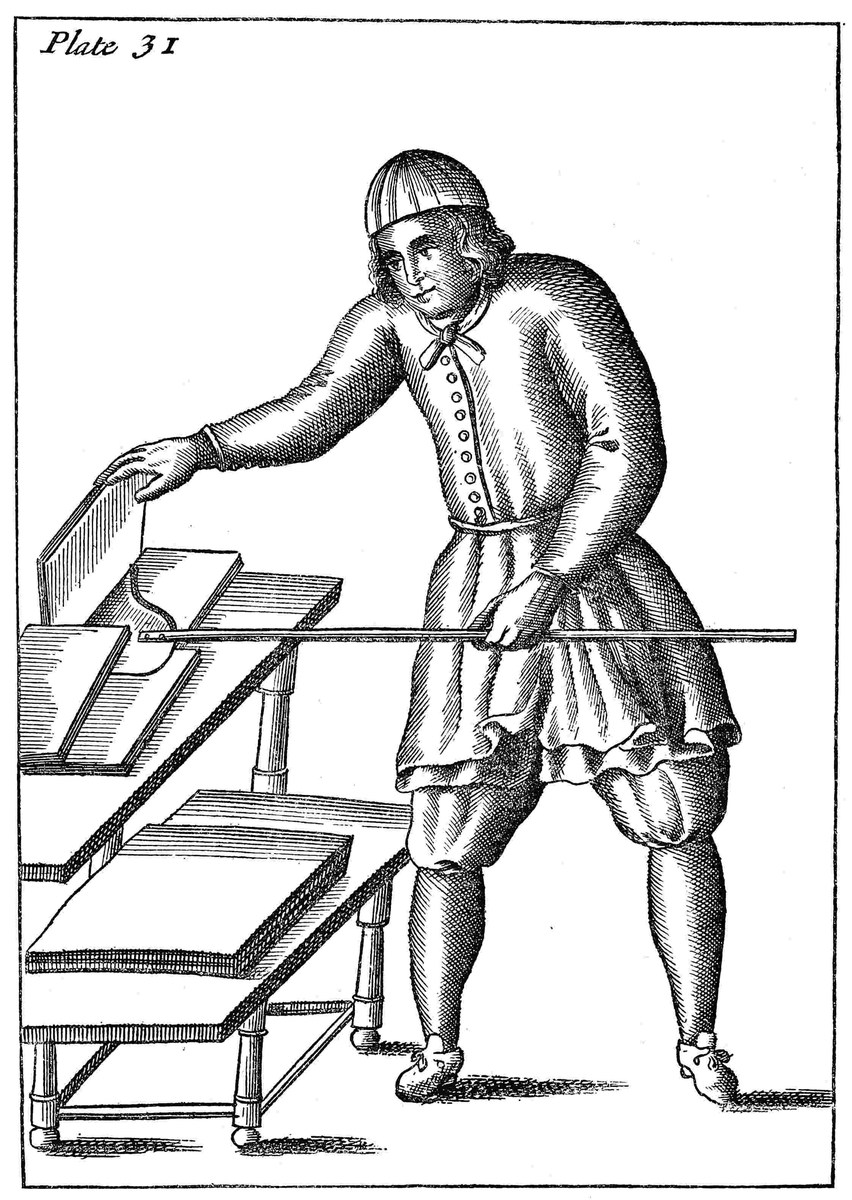
Note, that the sides of the Sheets do not hang against one another, but lap over one another, as you may see by Plate 31. Nor are they Hung up to Hang with their edges against the side of the former Hanging-up, but to lap over, so as every Right Hand Doubling may lap about two Inches over the Left Hand Doubling; that when the Books are taken down, 347the Warehouse-keeper clapping the flat side of his Peel against the Right Hand edge of the Paper, slides several Doublings over one another (perhaps three or four:) And putting the Peel under them, takes them off the Racks, and lays them on the Heap again, on a clean Waste Paper, and sets the Heap orderly by, till it comes to be Gather’d.
The Warehouse-keeper is also very careful to lay all the Sheets, so as the respective Signatures of every Sheet may ly exactly over the respective Signature of the first Sheet, lest when the Books come to be Gathered, some Sheets may be Turned, which will give him a great deal of trouble to Turn them right when he Colations the Books.
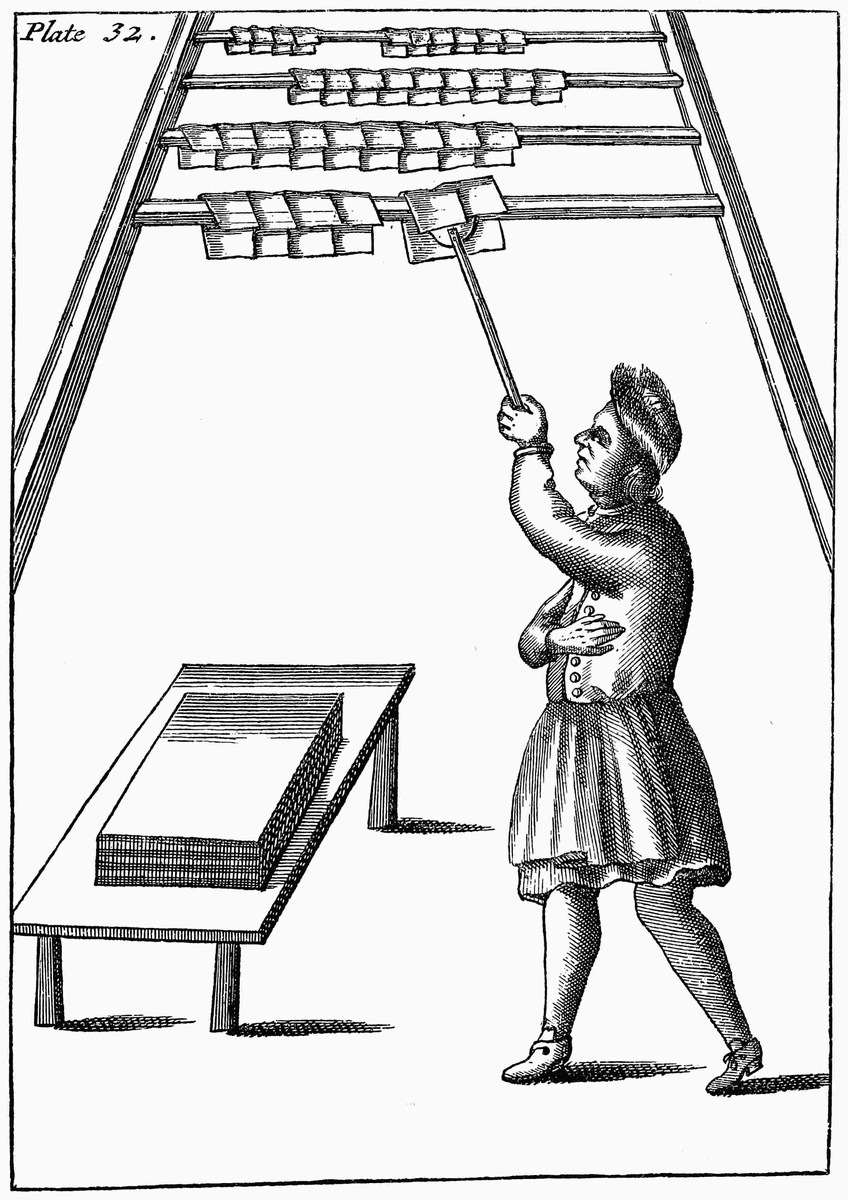
¶ 2. Of Laying the Heaps.
Laying the Heaps is to place them on Benches or Forms of a convenient Heighth, in an orderly Signatural Succession. By an orderly Signatural succession, I mean the first Signature, which most commonly is A (and therefore shall be so accepted) be placed on the Left Hand of the Bench, with either the Side or Foot of the Page, as the Volumn requires, that hath the single Signature A at the bottom of it upwards, and towards the hither side of the Bench. On the Right Hand side of the Heap A is B, and next it C, in like order D E F, &c.
348
¶ 3. Of Gathering of Books.
Gathering of Books is to take one Sheet off every Heap, beginning at the last Heap first, viz. at the Left Hand end of the Range. The Gatherer takes it off with his Right Hand, and disposes the hither end of the Sheet into his Left Hand, clapping his Left Hand Thumb upon the middle of the Sheet, to hold it fast. Then he takes a second Sheet off the second Heap from the Left Hand, viz. towards the Right; and lays the second Sheet on the first, and so successively a third, a fourth, a fifth, &c. till he has Gathered the last Sheet on his Right Hand; still observing to lay the middle of each Sheet under his Thumb, and all the single Signatures on each Sheet orderly and successively on one another.
Thus he Gathers on, till one of all the Heaps Comes off; which when it does, he Doubles or Quires up all the other Heaps, and lays them by till he can Bundle and Tye them up; which when he has also done, he writes upon them Imperfections of (the Title of the Book) and Writes on it the Signature of the Sheet that is Wanting, and sets it by in a convenient place of the Warehouse, that he may have recourse to it on any occasion.
Though I shewed how he Gathered the Books, yet shewed not how he Knocks them up and Folds them: Wherefore,
Having thus Gathered one Book, he Knocks it up, that is, he carries it to a Table provided on purpose 349near him; and taking the ends of the Book between the two Bows of the Thumb and Fore-finger of each Hand, he grasps the ends loosly between them, and placing the hither long side or edge of the Book on the plain of the Table, he lifts the whole Book a little above the plain of the Table, (about an Inch or two, more or less) and while the whole Book is held loosly by its ends, lets it fall gently down on the Table, that the edges of such Sheets as may stand out, or lower than the rest, may be drove even with the rest of the edges of the Book, and also that the edges of such Sheets as may lye above the edges of the Book may be joulted downwards, and lye even in the same Range with the rest of the edges.
And as he is Knocking up the lower edge of the Book, he at the same time evens the two ends of the Book, by thrusting the Bows of his Thumbs and Fingers against the ends of the Book, which being loosely grasp’d, and the Bows of his Thumbs and Fingers bearing pretty stiff towards each other; will drive in the ends of such Sheets as may stick out at either end; and so even the ends of the Book at the same time.
Having thus even’d all the edges, he lays the Book flat down on the Table, and holding one end of it stiff and tight in his Left Hand, he rubs the whole flat of his Right Hand hard upon the upper Sheet, to press it and all the other Sheets as close together as he can; then takes it up, and gives the edges another or two gentle Knocks, as before; and then Folds up, or Doubles the Book, according to its respective Volumn.
350
If it be Folio, Quarto, Octavo or Sixteens, he Folds it in the Short Cross; but if it be Twelves, Eighteens, Twenty-fours, he Folds it in the Long Cross.
But most times before he Folds the Books he will Colation them: (as shall be shewed by and by:) therefore having Gathered the Book, he lays it by on a Sheet of Waste Paper, and Gathers a second Book as he did the first, and lays that flat open on the first, then Gathers a third, fourth, fifth Book, &c. as before, and lays them successively on each other, till he have raised an Heap of Books so high, that he grows cautious of laying more on, lest its heighth should exceed his management. Then Gathers on, and raises another Heap or Heaps till one of the Signatures comes off.
¶ 4. Of Colationing Books.
The Colationing of Books, is,
First, To examine whether the whole number of Sheets that belong to a Book are Gathered in the Book.
Secondly, To examine that two Sheets of one sort are not Gathered.
Thirdly, To examine whether the proper Signature of every Sheet lye on its proper corner of the Gathered Book.
To do this, The Colationer provides himself with a Bodkin; which is nothing else than a pretty thick Sowing Needle, (most commonly broken-eyed,) having its thick end thrust fast into a round piece of Wood, about the thickness of a Tobacco-Pipe, and about three or four Inches long.
351
Now having the Heap of Gathered Books before him, with the single Signature A lying upwards on his Right Hand, and his Left Arm cross the Heap, and his Hand near the Signature corner, with his Bodkin in his Right Hand, he pricks up the corner of the first Sheet A, and at the same moment he pricks it up, slips the Balls of his two Fore-fingers of his Left Hand, and secures it from falling back again on the Gathered Heap of Books between his Thumb and hinder Joynt of his Fore-finger, and immediately pricks into the Sheet B, casting his Eye upon the Signature, as well to see that it is B, as to see that it is singly B, and not B 2, B 3, &c. For if the single Signature lye not on the same corner of the Heap, the Sheet must be turned till it do. In like manner he picks up and receives C D, &c. still casting his Eye that it be the right Letter, and single Signature, as aforesaid.
If he finds two Sheets of the same Signature, he takes one out and lays it by, or else on the Heap, if they be not all Gathered.
If he finds one Sheet wanting, he fetches that Sheet from the Heap; or if he want it at the Heap the Book is laid by as Unperfect till he have Colationed the whole Impression of Books, to see if he can make it Perfect with some other Book, that may have two of the same Sheets Gathered in it.
Having examined that his Book is Perfect, he Knocks and Folds it up, as was shewed in the last ¶.
Having Gathered, Colationed and Folded these Books, he Tells them, to see how the Impression Holds out; and as he Tells them, he lays a set number of 352Books (if the Books be Thick, five, if Thinner, Ten, if very Thin, twenty five or fifty) with the Folded Side or Back one way, and the same Number of Books, with the Folded or Back-side the other way, viz. the edges of the latter number of Books upon the Backs of the former Number: As well to distinguish and Count the Number of Books readily, as to keep the Bundle in a flat and Horizontal position. For if the Backs of the Quired Books in a Bundle, should lye all one way, the Fold of the Back being more or less hollow in the middle of each Book, will in a Number of Books, by springing upwards, mount the Backs; and consequently the edges of the Books in the Bundle will be depressed, so that in a great Bundle the Books will be subject to slide off one another.
These Books being thus Counted, he sets them by on Waste Paper in convenient Piles, viz. Piles of about three or four Reams high (according as the Paper may be thicker or thinner) he sets them by (I say) in Piles of equal Numbers, Range by Range, till the whole Impression is set by.
And before he Tyes them up, he puts them into the Standing Press, placing in it so many Books as the Press will hold, both in width and Heighth; observing to set in every Pile he puts Range by Range into the Press, an equal number of Books, that each Pile may equally feel the force of the Screw.
Then with a strong Iron Bar he turns about the Spindle as oft he can, with his main Strength to Squeeze and Press the Books as close and tight as he can together: and so lets them stand in Press about 353a Day and a Night. Then takes them out, and in like manner puts in more Books, till the whole Impression is Prest. See Plate 32.
As he takes each number of Books, he Tyes them up with Packthred, lays a Waste Paper under and upon each Bundle; and if the Master-Printer Printed the Impression for Himself, he writes the Title of the Book, and number of the Books on the uppermost Waste Paper, and sets them by square and orderly on the Shelves in the Warehouse, to deliver them out according to the Master-Printers order. But if the Impression were Printed for an Author, or a Book-seller, he sends them to the Authors or Book-sellers, without writing on the uppermost Waste Paper.
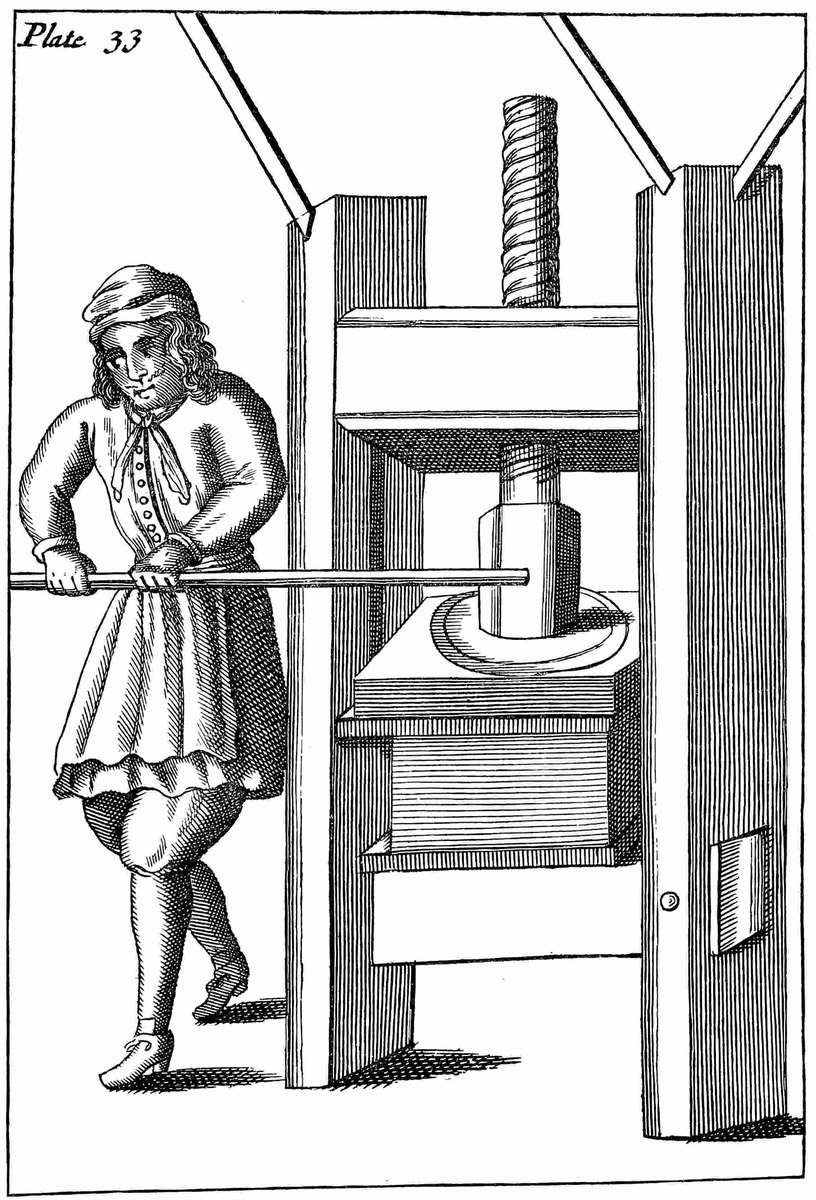
¶ 5. Of Setting out Paper, and Culling the Cording Quires.
Each Ream of Paper contains twenty Quires: These twenty Quires are by the Paper-makers so disposed that the Back or Doubling of each Quire lyes upon the opening or edges of the next Quire: For reasons given in the last ¶.
Two of the twenty Quires in a Ream are called Cording Quires, viz. the two Out-side Quires; because the whole Ream is Corded or Tyed up between them. They are also called Cassie Quires, because they serve for Cases to the Ream. These Quires are by the Paper-maker made up of torn, wrinckled, stained, and otherwise naughty Sheets; yet does not perhaps the whole Quire consist of such Sheets, but commonly 354some good Sheets are in Culling found among them, as shall be farther shewed by and by.
The Warehouse-keeper therefore when he Sets out Paper, lays by the uppermost Cording Quire, and then nimbly snatches with his Right Hand at the back of the next Quire, and if the back lys towards him, draws it into his Left Hand with the edges of the Quire towards his Fingers; but if the back lye from him, nimbly turns it while it is coming to his Left Hand, and so again nimbly snatches at the back of the succeeding Quires, placing their backs all one way on the First Quire in his Left Hand, till he have Counted or taken off of the Ream a Token; which Token, if it be set out for Half a Press, viz. a Single Press-man, is generally but five Quires, and is indeed often called Half a Token: But if it be for an Whole Press, it contains Ten Quires. This Token he lays by near him, upon a Waste Sheet of Paper, and again applies himself to Set out the next Token in the same manner, but lays the next Token with the backs of the Quires over the edges of the former Token, and thus Sets out so many Tokens as his Heap requires, yet always considers how his Paper Holds out, whether five and twenties, or but four and twenties: If it Holds out five and twenties, he Sets out in every Fourth, Fifth, or Sixth Token Eleven Quires, to secure the Impression to Hold out. If but four and twenties, he Sets out Eleven Quires, in every second Token, and at last a Quire more to the whole Heap to make good the wanting Sheets of every Quire, and to make Proves, Revises, Register-Sheets, Tympan-Sheets, and to supply other accidents that may happen at the Press, 355either by naughty Sheets, or Faults committed in Beating, Pulling, Bad Register, &c. for all or any of these accidents that happens to a Sheet, the Press-man doubles it, and lays by in the Heap as Waste, as I shewed § 24. ¶ 18. (4) and still he remembers, as aforesaid to lay by the two out-side Quires of every Ream; and at last lays on the Heap another Waste Sheet of Paper, and so brings it to the Press to be Wet.
The Culling the Cording Quires, is, to examine every Sheet one by one. To do it, he lays the Cording Quires, or many Cording Quires open before him against the Light, and takes up every Sheet successively and observes the goodness of it: Such Sheets as he finds good, he lays on his Right Hand, and the Bad on his Left. If a Sheet have but a little corner torn off, viz. so much as he judges the Book-binder would take off with his Plow, to make the Leaf square with other Leaves, he accounts that a good Sheet: But if more be torn off, he lays it by for Bad; and so he does Wrinckled and stain’d Sheets.
Having thus Cull’d all the Cording Quires, he tells out the good Paper into Quires, allowing five and twenty to the Quire, if the Quires of the Ream hold out five and twenty; or else but into four and twenty. And the good Paper thus Cull’d, he tells into an Heap or Heaps, as far as it will go.
But yet the careful Warehouse-keeper will not give the Press-man this Culd Paper to Print at the begining or end of a Book, but disposes that Heap or Heaps so as they may be used about the middle of the Book: For though we call’d it good Paper, yet it very rarely 356happens to be so beautiful as the Inside Quires.
The Bad Paper he also Tells out into Quires, but allows no more than four and twenty Sheets to the Quire, because it is commonly set by in the Warehouse to be sold.
It is also the Office of the Warehouse-keeper to keep a Day Book, and in it to set down what Books he Sells, and for how much, and to whom, and whom by order of the Master-Printer he Trusts with Books, and for how long Time; that so the Master-Printer may as oft as he pleases have an account how the Impression, or part of it, is disposed of.
(As an Appendix.) Ancient Customs used in a Printing-house.
Every Printing-house is by the Custom of Time out of mind, called a Chappel; and all the Workmen that belong to it are Members of the Chappel: and the Oldest Freeman is Father of the Chappel. I suppose the stile was originally conferred upon it by the courtesie of some great Churchman, or men, (doubtless when Chappels were in more veneration than of late years they have been here in England) who for the Books of Divinity that proceeded from a Printing-house, gave it the Reverend Title of Chappel.
There have been formerly Customs and By-Laws made and intended for the well and good Government of the Chappel, and for the more Civil and orderly deportment of all its Members while in the Chappel; and the Penalty for the breach of any of 357these Laws and Customs is in Printers Language called a Solace.
And the Judges of these Solaces, and other Controversies relating to the Chappel, or any of its Members, was plurality of Votes in the Chappel. It being asserted as a Maxim, That the Chappel cannot Err. But when any Controversie is thus decided, it always ends in the Good of the Chappel.
1. Swearing in the Chappel, a Solace.
2. Fighting in the Chappel, a Solace.
3. Abusive Language, or giving the Ly in the Chappel, a Solace.
4. To be Drunk in the Chappel, a Solace.
5. For any of the Workmen to leave his Candle burning at Night, a Solace.
6. If the Compositer let fall his Composing-stick, and another take it up, a Solace.
7. Three Letters and a Space to lye under the Compositers Case, a Solace.
8. If a Press-man let fall his Ball or Balls, and another take it up, a Solace.
9. If a Press-man leave his Blankets in the Tympan at Noon or Night, a Solace.
These Solaces were to be bought off, for the good of the Chappel: Nor were the price of these Solaces alike: For some were 12 d. 6 d. 4 d. 2 d. 1 d. ob. according to the nature and quality of the Solace.
But if the Delinquent prov’d Obstinate or Refractory, and would not pay his Solace at the Price of the Chappel; they Solac’d him.
The manner of Solacing, thus.
The Workmen take him by force, and lay him on 358his Belly athwart the Correcting-stone, and held him there while another of the Work-men, with a Paper-board, gave him 10 l. and a Purse, viz. Eleven blows on his Buttocks; which he laid on according to his own mercy. For Tradition tells us, that about 50 years ago one was Solaced with so much violence, that he presently Pissed Blood, and shortly after dyed of it.
These nine Solaces were all the Solaces usually and generally accepted: yet in some particular Chappels the Work-men did by consent make other Solaces, viz.
That it should be a Solace for any of the Workmen to mention Joyning their Penny or more apiece to send for Drink.
To mention spending Chappel-money till Saturday Night, or any other before agreed time.
To Play at Quadrats, or excite any of the Chappel to Play at Quadrats; either for Money or Drink.
This Solace is generally Purchas’d by the Master-Printer; as well because it hinders the Workmens work, as because it Batters and spoils the Quadrats: For the manner how they Play with them is Thus: They take five or seven more m Quadrats (generally of the English Body) and holding their Hand below the Surface of the Correcting Stone, shake them in their Hand, and toss them up upon the Stone, and then count how many Nicks upwards each man throws in three times, or any other number of times agreed on: And he that throws most Wins the Bett of all the rest, and stands out free, till the rest have try’d who throws fewest Nicks upwards in so many throws; for all the rest are free: and he pays the Bett.
359
For any to Take up a Sheet, if he receiv’d Copy-money; Or if he receiv’d no Copy-money, and did Take up a Sheet, and carryed that Sheet or Sheets off the Printing-House till the whole Book was Printed off and Publisht.
Any of the Workmen may purchase a Solace for any trivial matter, if the rest of the Chappel consent to it. As if any of the Workmen Sing in the Chappel; he that is offended at it may, with the Chappels Consent purchase a penny or two penny Solace for any Workmans singing after the Solace is made; Or if a Workman or a Stranger salute a Woman in the Chappel, after the making of the Solace, it is a Solace of such a Value as is agreed on.
The price of all Solaces to be purchased is wholly Arbitrary in the Chappel. And a Penny Solace may perhaps cost the Purchaser Six Pence, Twelve Pence, or more for the Good of the Chappel.
Yet sometimes Solaces may cost double the Purchase or more. As if some Compositer have (to affront a Press-man) put a Wisp of Hay in the Press-mans Ball-Racks; If the Press-man cannot well brook this affront, he will lay six Pence down on the Correcting Stone to purchase a Solace of twelve Pence upon him that did it; and the Chappel cannot in Justice refuse to grant it: because it tends to the Good of the Chappel: And being granted, it becomes every Members duty to make what discovery he can: because it tends to the farther Good of the Chappel: And by this means it seldom happens but the Agressor is found out.
Nor did Solaces reach only the Members of the 360Chappel, but also Strangers that came into the Chappel, and offered affronts or indignities to the Chappel, or any of its Members; the Chappel would determine it a Solace. Example,
It was a Solace for any to come to the Kings Printing-house and ask for a Ballad.
For any to come and enquire of a Compositer, whether he had News of such a Galley at Sea.
For any to bring a Wisp of Hay, directed to any of the Press-men.
And such Strangers were commonly sent by some who knew the Customs of the Chappel, and had a mind to put a Trick upon the Stranger.
Other Customs were used in the Chappel, which were not Solaces, viz. Every new Workman to pay half a Crown; which is called his Benvenue: This Benvenue being so constant a Custome is still lookt upon by all Workmen as the undoubted Right of the Chappel, and therefore never disputed; yet he who has not paid his Benvenue is no Member of the Chappel, nor enjoys any benefit of Chappel-Money.
If a Journey-man Wrought formerly upon the same Printing House, and comes again to Work on it, pays but half a Benvenue.
If a Journey-man Smout more or less on another Printing House, and any of the Chappel can prove it, he pays half a Benvenue.
I told you before that abusive Language or giving the Lye was a Solace: But if in discourse, when any of the Workmen affirm any thing that is not believed, the Compositer knocks with the back corner of his Composing-stick against the lower Ledge of his Lower 361Case, and the Press-man knocks the Handles of his Ball-stocks together: Thereby signifying the discredit they give to his Story.
It is now customary that Journey-men are paid for all Church Holy days that fall not on a Sunday, Whether they Work or no: And they are by Contract with the Master Printer paid proportionably for what they undertake to Earn every Working day, be it half a Crown, two Shillings, three Shillings, four Shillings, &c.
It is also customary for all the Journey-men to make every Year new Paper Windows, whether the old will serve again or no; Because that day they make them, the Master Printer gives them a Way-goose; that is, he makes them a good Feast, and not only entertains them at his own House, but besides, gives them Money to spend at the Ale-house or Tavern at Night; And to this Feast, they invite the Correcter, Founder, Smith, Joyner, and Inck-maker, who all of them severally (except the Correcter in his own Civility) open their Purse-strings and add their Benevolence (which Workmen account their duty, because they generally chuse these Workmen) to the Master Printers: But from the Correcter they expect nothing, because the Master Printer chusing him, the Workmen can do him no kindness.
These Way-gooses, are always kept about Bartholomew-tide. And till the Master-Printer have given this Way-goose, the Journey-men do not use to Work by Candle Light.
If a Journey-man marry, he pays half a Crown to the Chappel.
362
When his Wife comes to the Chappel, she pays six Pence: and then all the Journey-men joyn their two Pence apiece to Welcome her.
If a Journey-man have a Son born, he pays one Shilling.
If a Daughter born, six Pence.
The Father of the Chappel drinks first of Chappel Drink, except some other Journey-man have a Token; viz. Some agreed piece of Coin or Mettle markt by consent of the Chappel: for then producing that Token, he Drinks first. This Token is always given to him who in the Round should have Drank, had the last Chappel-drink held out. Therefore when Chappel-drink comes in, they generally say, Who has the Token?
Though these Customs are no Solaces; yet the Chappel Excommunicates the delinquent; and he shall have no benefit of Chappel-money till he have paid.
It is also Customary in some Printing-houses that if the Compositer or Press-man make either the other stand still through the neglect of their contracted Task, that then he who neglected, shall pay him that stands still as much as if he had Wrought.
The Compositers are Jocosely call’d Galley Slaves: Because allusively they are as it were bound to their Gallies.
And the Press-men are Jocosely call’d Horses: Because of the hard Labour they go through all day long.
An Apprentice when he is Bound pays half a Crown to the Chappel, and when he is made Free, another half Crown to the Chappel; but is yet no Member of the Chappel; And if he continue to 363Work Journey-work in the same House, he pays another half Crown, and is then a Member of the Chappel.
A Founding-House is also call’d a Chappel: But I suppose the Title was originally assum’d by Founders, to make a Competition with Printers.
The Customes used in a Founding-House are made as near as may be to those of a Printing-house: but because the Matter they Work on, and the manner of their Working is different, therefore such different Customes are in Use, as are suitable to their Trade, As
First, To call Mettle Lead, a Forfeiture.
Secondly, A Workman to let fall his Mold, a Forfeiture.
Thirdly, A Workman to leave his Ladle in the Mettle Noon or Night, a Forfeiture.
The Printers of London, Masters and Journey-men have every Year a general Feast, which since the re-building of Stationers Hall is commonly kept there. This Feast is made by four Stewards, viz. two Masters and two Journey-men; which Stewards, with the Collection of half a Crown apiece of every Guest, defray the Charges of the whole Feast; And as they Collect the Half-Crowns, they deliver every Guest a Ticket, wherein is specified the Time and Place they are to meet at, and the Church they are to go to: To which Ticket is affixed the Names and Seals of each Steward.
It is commonly kept on or about May-day: When, about ten a Clock in the Morning they meet at Stationers Hall, and from thence go to some Church thereabouts; Four Whifflers (as Servitures) by two 364and two walking before with White Staves in their Hands, and Red and Blew Ribbons hung Belt-wise upon their left Shoulders. These go before to make way for the Company. Then walks the Beadle of the Company of Stationers, with the Companys Staff in his Hand, and Ribbons as the Whifflers, and after him the Divine (whom the Stewards before ingag’d to Preach them a Sermon) and his Reader. Then the Stewards walk by two and two, with long White Wands in their Hands, and all the rest of the Company follows, till they enter the Church.
Then Divine Service begins, Anthems are Sung, and a Sermon Preached to suit the Solemnity: Which ended, they in the same order walk back again to Stationers Hall; where they are immediately entertain’d with the City Weights and other Musick: And as every Guest enters, he delivers his Ticket (which gives him Admittance) to a Person appointed by the Stewards to receive it.
The Master, Wardens and other Grandees of the Company (although perhaps no Printers) are yet commonly invited, and take their Seats at the upper Table, and the rest of the Company where it pleases them best. The Tables being furnsh’d with variety of Dishes of the best Cheer: And to make the entertainment more splendid is Usher’d in with Loud Musick. And after Grace is said (commonly by the Minister that Preach’d the Sermon) every one Feasts himself with what he likes Best; whiles the Whifflers and other Officers Wait with Napkins, Plates, Beer, Ale, and Wine, of all sorts, to accommodate each Guest according to his desire. And to 365make their Cheer go cheerfuller down, are entertained with Musick and Songs all Dinner time.
Dinner being near ended, the Kings and the Dukes Healths is begun, by the several Stewards at the several Tables, and goes orderly round to all the Guests.
And whiles these Healths are Drinking, each Steward sets a Plate on each Table, beginning at the upper end, and conveying it downwards, to Collect the Benevolence of Charitable minds towards the relief of Prinners Poor Widows. And at the same time each Steward destributes a Catalogue of such Printers as have held Stewards ever since the Feast was first kept, viz. from the Year of Christ 1621.
After Dinner, and Grace said, the Ceremony of Electing new Stewards for the next Year begins: Therefore the present Stewards withdraw into another Room: And put Garlands of Green Lawrel, or of Box on their Heads, and White-wands in their Hands, and are again Usher’d out of the withdrawing Room by the Beadle of the Company, with the Companys Staff in his Hand, and with Musick sounding before them: Then follows one of the Whifflers with a great Bowl of White-wine and Sugar in his Right Hand, and his Whifflers Staff in his Left: Then follows the Eldest Steward, and then another Whiffler, as the first, with a Bowl of White-wine and Sugar before the second Steward, and in like manner another Whiffler before the Third, and another before the Fourth. And thus they walk with Musick sounding before them three times round the Hall: And in a fourth round the first Steward takes 366the Bowl of his Whiffler and Drinks to one (whom before he resolved on) by the Title of Mr. Steward Elect: And taking the Garland off his own Head puts it upon the Steward Elects Head. At which Ceremony the Spectators clap their Hands, and such as stand on the Tables or Benches, so Drum with their Feet that the whole Hall is filled with Noise, as applauding the Choice. Then the present Steward takes out the Steward Elect, giving him the Right Hand, and walks with him Hand in Hand, behind the three present Stewards another Round about the Hall: And in the next Round, as aforesaid, the second Steward Drinks to another with the same Ceremony as the first did; and so the Third Steward, and so the Fourth, and then all walk one Round more Hand in Hand about the Hall, that the Company may take notice of the Stewards Elect. And so ends the Ceremony of the Day.
This Ceremony being over, such as will go their ways; but others that stay, are Diverted with Musick, Songs, Dancing, Farcing, &c. till at last they all find it time to depart.
367
A DICTIONARY,
Alphabetically explaining the abstruse VVords and Phrases that are used in Typography. VVhich also may serve as an Index to direct to the most material Concerns contained in this Volumn.
Though I give you a Dictionary of so many Words and Phrases as are mentioned in these Exercises, yet I do not exhibit this as a Dictionary so perfect, that all the obstruce Words and Phrases used among Printers, Letter-cutters and Founders are here exposed; for Words and Phrases many times offer themselves either as Discourse or Contemplation occurs: Therefore such Words and Phrases as have escaped my Consideration, will, I hope, be discovered by some Printer, or others, that may have a kindness for Posterity; not only in this Trade, but in all Trades and Faculties whatsoever: That so a Dictionary may in time be compleated, that may render so great a number of Words used in England by English-men intelligible; which now for want of a proper Repository to store them in, seem not only Aliens to our Nation, but barbarous to our Understandings.
368
A
Abreviations are Characters, or else marks on Letters, to signifie either a Word or Syllable. & is the Character for And, e is The abreviated, t is That abreviated; and several other such. Straight stroaks over any of the Vowels abreviates m or n. They have been much used by Printers in Old Times, to Shorten or Get in Matter; but now are wholly left off as obsolete.
Accented Letters are much used in Latin Authors, and more in Greek. The Vowels are only accented, and are called Grave, thus accented à; Acute, thus accented á; Circumflex, thus accented â; and Deerecis, thus accented ä.
Accents are Dashes or Marks over the Vowels.
Air-hole. See § 18. ¶ 1.
Ascending Gage. See § 12. ¶ 5.
Ashes. Letter-Founders call the Skimmings of their Mettle, and the Sweepings of their House Ashes; and save both, to send to the Refiners; who with their fierce Fire draw all the Mettle out of the Ashes. See Fat Ashes. See Lean Ashes.
Ash-hole. See § 18. ¶ 1.
Assidue is Thin Brass Plate, such as adorns Bartholomew-Fair Hobby Horses: Founders use it to Underlay the Body, or the Mouth-piece, &c. of their Mold, if it be too Thin. See § 16.
B
Back of a Composing-stick. See § 9. ¶ 4.
Backside of the Form is the underside that touches upon the Correcting-stone or Press-stone.
Bad Copy. See § 24. ¶ 4.
369
Bad work. Any Fault at the Case, or Press, or at the Furnace, or at the Dressing-block, &c. is in Workmens Language called Bad Work.
Bake. See § 22. ¶ 10.
Balls. See § 24. ¶ 10.
Ball-knife. An old blunt-edg’d Knife, that Press-men lay by, to scrape their Balls with.
Ball-leathers. See § 24. ¶ 10.
Ball-Nails. The Nails that Ball-leathers are Tackt to the Ball-stocks with.
Ball-stocks. See § 11. ¶ 21.
Balls Take. See § 11. ¶ 21.
Beak. See § 12. ¶ 2.
Beam. See § 12. ¶ 4.
Beard of a Letter, is the outer angle of the Square Shoulder of the Shank, which reaches almost up to the Face of the Letter; and is commonly scraped off by the Founder: As in § 2. ¶ 2.
Beard-Gage. See § 13. ¶ 4.
Bearer. See § 4. & § 24. ¶ 7.
Beat. See § 24. ¶ 13.
Beat Fat. If a Press-man Takes too much Inck with his Balls, he Beats Fat. The Black English Faced Letter is generally Beaten Fat.
Beat Lean, is to Take but little Inck, and often: All Small Letter must be Beaten Lean.
Bed. See § 24. ¶ 2.
Benvenue. See Ancient Customs.
Bite. See § 24. ¶ 7.
Blankets. Woollen Cloath, or White Bays, to lay between the Tympans.
Blocks. See § 20. ¶ 3.
Block-Groove. ibid.
370
Body. See § 1. ¶ 2. & § 15. ¶ 1.
Botching Matrices. See § 17. ¶ 3.
Bottom line. See § 14. ¶ 2.
Bottom of the Matrice. See §. 17. ¶ 1.
Bottom Plate. See §. 15. ¶ 1.
Bow. See § 15. ¶ 1.
Brace, is a Character Cast in Mettle thus marked
 The Compositer is to have these Cast of several
Breadths, viz. to several numbers of Lines of a designed
Body (most commonly of Pica Body) that they
may hook in or Brace so many Lines as his Copy
may shew him; as at Charge is a Brace of four
Lines. See also § 24. ¶ 1.
The Compositer is to have these Cast of several
Breadths, viz. to several numbers of Lines of a designed
Body (most commonly of Pica Body) that they
may hook in or Brace so many Lines as his Copy
may shew him; as at Charge is a Brace of four
Lines. See also § 24. ¶ 1.
Brass-Rules. See § 2. ¶ 2.
Brayer is a round Wooden Rubber, almost of the fashion of a Ball-stock, but flat at the bottom, and not above three Inches Diameter: It is used in the Inck-Block to Bray or Rub Inck.
Break, a piece of a Line. Also the Mettle that is contiguous to the Shank of a New Cast Letter: This Break is formed in the Mouth-piece of the Letter-mould, and is called a Break, because it is always broke from the Shank of a Letter.
Breaking off is breaking the Break from the Shank of the Letter. See § 19. ¶ 3.
Brevier. See § 2. ¶ 2.
Broad-side, a Form of one full Page, Printed on one side of a whole Sheet of Paper.
Broken Letter. By broken Letter is not meant the breaking of the Shanks of any of the Letters, but the breaking the orderly Succession the Letters stood in in a Line, Page, or Form, &c. and mingling the Letters 371together, which mingled Letters is called Py.
Bur. See Rag.
C
Cannon. See § 2. ¶ 2.
Card. When several Bodies of Letter are Set in a Page, Compositers to Justifie that Page to an exact Length, put a Card to some White-line, or other Break and Lengthen out the Page the thickness of a Card. And Press-men also use a Card for an underlay. See § 22. ¶ 4. &c. § 24. ¶ 7.
Cards. About a Quire of Paper, which Press-men use to Pull down the Spring or rising of a Form, which it is many times subject to by hard Locking-up. See § 24. ¶ 4.
Carriage, is a part of the Press. For which See § 10. ¶ 9. It is also a part of the Letter-Mold: For which See § 15. ¶ 3.
Case. See § 3.
Case lies. See § 22. ¶ 1.
Case is full, viz. a Case full of Letter, wanting no Sorts.
Case is Low. When a Case grows empty, Compositers say the Case is Low.
Case Stands still. When the Compositer is not at Work at his Case, it is said, The Case stands still.
Cassie Paper. See § 25. ¶ 5.
Cast, is to Cast Letter. See § 19. ¶ 1.
Cast off Copy. See § 22. ¶ 9.
Catch of the Bar. See § 11. ¶ 11.
Chappel. See Customs.
372
| Charge, is to fill |

|
Paper with great Pages. a Page with long and many Lines. a Line with many Letters. a Pot with Stubs and Antimony. |
Chase. See § 9. ¶ 6.
Cheeks, is a part of the Press; for which See § 10. ¶ 2. and part of the Dressing-block-groove. For which See § 20. ¶ 3.
Choak. If a Form be not Washt in due time, the Inck will get into the Hollows of the Face of the Letter: And that getting in of the Inck is called Choaking of the Letter, or Choaking of the Form.
Claw of the Sheeps-foot. See § 11. ¶ 20.
Clean Proof. When a Proof has but few Faults in it, it is called a clean Proof.
Close Matter. Matter with few Breaks or Whites.
Close Work. ibid.
Colation Books. See § 25. ¶ 4.
Come. When the Face and Shank of a Letter is Cast perfect, Founders say, It Comes well; if unperfect they say, It does not come, or It comes not well.
Come Down, the Toe of the Spindle is said to Come down by Pulling the Bar: So is the Bar when it is Pull’d near the hither Cheek: Also, the Press-man is said to Come down the Form with his Balls: For which See § 24. ¶ 13.
Companion. See § 24. ¶ 15.
Comes off. A Form that receives a good Impression, Comes off well, if a bad Impression, it Comes off ill, or it Comes not well off. Also a phrase used in Gathering of Books; for a Heap that is Gathered off is said to Come off. See § 25. ¶ 3.
373
Composing Rule. See § 24. ¶ 4.
Compositer. He that Composes or Sets the Letters.
Composing-stick. See § 9. ¶ 4.
Copy-money. See Customs.
Cording-quire. See § 25. ¶ 5.
Correct. When the Corrector reads the Proof, or the Compositer mends the Faults he markt in the Proof, they are both said to Correct; the Correcter the Proof, the Compositer the Form.
Correcting-stone. See § 6.
Corrections. the Letters markt in a Proof are call’d Corrections. See § 22. ¶ 8.
Counter Punch. See § 13. ¶ 2.
Counting off Copy. See § 22. ¶ 9.
Coyns. See § 8.
Cramp Irons. See § 11. ¶ 15.
Cross Long, Short. See Chase.
Cull Paper. See § 25. ¶ 5.
Cut the Frisket. See § 24. ¶ 7.
D
Dance. See § 22. ¶ 7.
Dele. See § 23.
Destribute. See § 22. ¶ 3.
Destributing-stick. See ibid.
Devil. The Press-man sometimes has a Week-Boy to Take Sheets, as they are Printed off the Tympan: These Boys do in a Printing-House, commonly black and Dawb themselves; whence the Workmen do Jocosely call them Devils; and sometimes Spirits, and sometimes Flies.
Direction, the word that stands alone on the Right Hand in the bottom Line of a Page.
374
Direction-line. The Line the Direction stands in.
Double Letter. æ œ st sh, and several others Cast on one Shank are called Double Letters: ſ and f have several Ascending Letters joyned to them, because their Beaks hanging over their Stems would (were they not Cast on one Shank) ride upon the tops of the Stems of the adjoyning ascending Letter.
Double. A Sheet that is twice Pulled and lifted never so little off the Form after it was first Pulled, does most commonly (through the Play of the Joynts of the Tympan) take a double Impression: This Sheet is said to Double. Or if the Press-man Run in so, as the Fore-side of the Plattin Print with the First Pull into part of the Second Pull, or the hind edge of the Plattin Print with his Second Pull into part of his First Pull; either of these twice Printing is called Doubling. Doubling also happens through the loose Hanging of the Plattin, and through too much play the Tennants of the Head may have in the Mortesses of the Cheeks, and indeed through many Wearings and crasienesses that often happens in several parts of the Press. See § 24. ¶ 18.
Dress a Chase, or Dress a Form, is all one. It is to fit the Pages and the Chase with Furniture and Quoins. See § 22. ¶ 7.
Dress Letter. See § 21. ¶ 1.
Dressing Block. See § 20. ¶ 3.
Dressing Block-groove. ibid.
Dressing Hook. See § 20. ¶ 1.
Dressing Knife. See § 20. ¶ 4.
Dressing Sticks. See § 19. ¶ 6.
Drive out. When a Compositer Sets Wide, he is said 375to Drive out or Run out. In Founding, If Letter be Cast too Thick in the Shank it Drives out, or if it be Cast too Thick in any part of the Shank, as the Head, the Foot, the sides at Head or Foot, or Body at Head or Foot: They say, It Drives out at Head, It Drives out at Foot, &c.
E
Empty Case. See § 22. ¶ 3. & See Case is Low.
Easie Pull. See § 24. ¶ 5.
Easie Work. See § 22. ¶ 4. And Great Letter and a Small Form the Press-man calls Easie Work.
Empty Press. A Press that Stands by, which no Workman Works at: Most commonly every Printing-House has one of them for a Proof-Press: viz. to make Proves on.
English Body. See § 1. ¶ 2.
English Face. Plate 26. 27. are English Face Letters.
Even Page. The First Page of a Sheet or Form is called an Odd Page, but the Second, Fourth, Sixth, or any other even numbred Page is called an Even Page. See § 22. ¶ 7.
F
Face of a Letter, See § 13. ¶ 13.
Face of a Page, or Form. The Superficies of a Page or Form, where the Faces of every Letter lies in the same Plain.
Face-Gage. See § 12. ¶ 5.
Face of a Matrice. See § 17. ¶ 1.
Fat Ashes. Founders call their Ashes Fat, if they are considerably Heavy, because then they have much Mettle in them.
Fat. See Beat Fat.
376
Fat Face, or Fat Letter, is a broad Stemmed Letter.
Female Gage, Screws, &c. The Hollow Gage, or Hollow Screw that receives its Match Gage or Screw, &c.
First. See § 24. ¶ 15.
First Form. The Form the White Paper is Printed on, which generally by Rule ought to have the First Page of the Sheet in it.
First Page. See § 22. ¶ 7.
First Pull. See § 11. ¶ 16. & § 24. ¶ 7. Considerations 8. & § 24. ¶ 15.
Flat-Gage. See § 12. ¶ 3.
Flat Table. See § 12. § 8.
Fly. See Devil.
Follow. viz. See if it follows, is a Term used as well by the Corrector as by the Compositer and Press-man. It is used by the Corrector and Compositer when they examine how the beginning Matter of a succeeding Page agrees with the ending Matter of the precedent Page: And how the Folio’s of those Pages properly and numerically follow and succeed one another, Lest the Pages should be Transposed. But the Press-man only examines that the Folio and beginning word of the Second Page, and Signature of the First and Third Page (when the Reteration is on the Press) follows the Folio and Direction of the First Page, and the Signature of the Third Page follows the Signature of the First Page, orderly according to the Volumne, lest the Form should be laid wrong on the Press.
Foot of the Letter. The Break-end of the Shanck of a Letter.
377
Foot-line. See § 14. ¶ 12.
Foot of a Page. The bottom or end of a Page. See § 22. ¶ 7.
Foot-Step. See § 11. ¶ 21. & § 24. ¶ 7. & Considerations 11.
Foot-stick. See § 8.
Form. The Pages when they are fitted into a Chase.
Foul Proof. When a Proof has many Faults markt in it.
Fount. Is the whole number of Letters that are Cast of the same Body and Face at one time. See § 2. ¶ 2.
Frisket. See § 10.
Froze out. In Winter when the Paper is Froze, and the Letter Froze, so as the Workmen cannot Work. They say, They are Froze out.
Fryer. When the Balls do not Take, the Un-taking part of the Balls that touches the Form will be left White, or if the Press-men Skip over any part of the Form, and touch it not with the Balls, though they do Take, yet in both these cases the White places is cal’d a Fryer.
Full Form or Page. A Form or Page with few or no Breaks or White-lines.
Full Press. When two Men Work at the Press. It is called a Full Press.
Furnace. See § 18.
Furnace open, or Wind Furnace. See § 18. ¶ 2.
Funnel. See § 18.
Furniture. See § 8.
378
G
Gage. Gages mentioned in this Volumne have an adjunct Name, as Flat Gage, Joynt Gage, Italick Gage, Long Gage, Male Gage, Short Gage, Standing Gage, Steel Gage, which See respectively.
Galley. See § 5.
Galley-Slave. See the Customs.
Gallows. See § 10.
Garter. See § 11. ¶ 14.
Gather Books. See § 25. ¶ 3.
Geat, is the little Spout or Gutter made in the Brim of Casting Ladles.
Get in. Matter is Got in in a Line, Page, Sheet or Book, if Letter be Thinner Cast than the Printed Copy the Compositer Sets by. Or Matter is Got in if the Compositer Sets Closer: Or if he Widens his Measure; or puts more Lines in a Page. See a Line.
Girts. See § 11. ¶ 21.
Good Colour. Sheets Printed neither too Black or too White.
Good of the Chappel. Forfeitures and other Chappel Dues are Collected for the Good of the Chappel, viz. to be spent as the Chappel approves.
Good Work, is called so in a twofold sense: The Master-Printer calls it Good Work when the Compositers and Press-men have done their duty; and the Work-men call it Good Work, if it be Light Easie Work, and they have a good price for it.
Go up the Form. See § 24. ¶ 13.
Great Cannon. See § 2. ¶ 2.
Great Numbers. See Lay on. Above 2000 Printed on one Sheet are accounted Great Numbers.
379
Great Primmer. See § 2. ¶ 2.
Gutter-stick. See § 8.
H
Hag. See § 15. ¶ 1.
Half a Line. When Letter Drives out or Gets in in the Body, in a number of Lines, Founders say, It Drives out or Gets in Half a Line, a whole Line, a quarter of a Line, &c. viz. Half a Body, a whole Body, a quarter, &c. of a Body.
Half a Press. When but one Man Works at the Press, It is called Half a Press.
Half Work. He that Works but three days in the Week, does but Half Work.
Hammer end of a Punch. See § 13. ¶ 13.
Hangs. See Letter Hangs. & § 22. ¶ 4.
Hang the Plattin. See § 24. ¶ 4.
Hang up Paper. See § 25. ¶ 1.
Hard Inck. Inck very well Boyled. See § 11. ¶ 23.
Hard Justifying. See § 22. ¶ 4.
Hard Pull. See § 24. ¶ 5.
Hard Work. See § 22. ¶ 4. And small Letter and a Large Form, Press-men call Hard Work.
Head. See § 10. ¶ 5.
Head Line. See § 14. ¶ 2.
Head of a Page. The top or beginning of a Page. See § 22. ¶ 7.
Head-stick. See § 8.
Heap. So many Reams or Quires as is Set out by the Warehouse-keeper for the Press-man to Wet, is call’d a Heap: But then it is call’d a Dry Heap, till the Press-man have Wet it, and then it is indeed called a Heap. See also § 25.
380
Heap holds out. When it hath its full intended Number of Sheets.
Heavy Work. See Hard Work.
Heighth. See High against Paper.
High against Paper. If a Punch be not Sunk deep enough into the Matrice, the Letter Cast will not stand high enough against Paper. And if it be Sunk too deep into the Matrice, the Letter Cast will be too High against Paper. See § 17. ¶ 2.
Holds out, or Holds not out. These Terms are applicable to the Quires of White-paper, to Wrought-off Heaps, to Gathered Books, and to sorts of Letter &c. If Quires of White Paper have twenty five Sheets a piece in them, they say, The Paper holds out five and twenties. Of Wrought off Heaps, the Heap that Comes off first in Gathering is said, Not to Hold out. Of Gathered Books, if the intended number of perfect Books are Gathered, they say the Impression Holds out: But if the intended number of Perfect Books cannot be Gathered off the Heaps, they say the Impression Holds not out. And so for Sorts of Letter, either when it is in the Founding House, or in the Printing House.
Hole. By a Hole, in Printers dialed, is meant and understood a place where private Printing is used, viz. the Printing of Unlicensed Books, or Printing of other mens Copies. Many Printers for Lucre of Gain have gone into Holes, and then their chief care is to get a Hole Private, and Workmen Trusty and Cunning to conceal the Hole, and themselves.
Holy-days. See Customs.
Hollows of a Letter. The Sinking in of the Counter-Punch 381into the Punch makes these Hollows, so does Sculping into the Face of the Punch. See § 9. ¶ 4.
Hooks. See Hags.
Horse. The Form or Bench Press-men set the Heaps of Paper on. See also Customs.
Horse-flesh. If any Journeyman set down in his Bill on Saturday Night more Work than he has done, that Surplusage is called Horse-flesh: And he abates it in his next Bill.
Hose. See § 11. ¶ 14.
Hours. Press-men reckon their Work by Hours, accounting every Token to an Hours Work: And though it be the same effectually with Tokens, yet they make their prizes of different Work by the Hour; and it passes current for a Token. If two Men Work at the Press ten Quires is an Hour; if one Man, five Quires is an Hour.
I
Jaws. See § 15. ¶ 6.
Imperfections of Books. See § 25. ¶ 3.
Imperfections of Letters. When the Founder has not Cast a proportionable number of each sort of Letter, the wanting Letters are called Imperfections, as making the rest of the Fount unperfect. See Sorts.
Impose. See § 22. ¶ 7.
Impression holds out. See Holds out.
In-Page. See Out-Page.
Insertion. If the Compositer have left out Words or Lines, the Corrector inserts it, and makes this mark ʌ where it is Left out, which is called the mark for Insertion. See § 23.
382
Joynt flat Gage. See § 14. ¶ 4.
Joynts. See § 10. ¶ 9.
Inner Tympan. See § 11. ¶ 10.
Italick Gage. See § 12. ¶ 6.
Justifie a Matrice. See § 17. ¶ 2.
Justifie a Mold. See § 16.
Justifie a Stick, viz. a Composing-stick. See § 22. ¶ 4.
K
Keep in, is a caution either given to, or resolved on, by the Compositer, when there may be doubt of Driving out his Matter beyond his Counting off, wherefore he Sets close, to Keep in.
Keep out, is a caution either given to or resolved on, by the Compositer, when there may be doubt of Getting in his Matter too fast for his Counting off: Wherefore he Sets Wide, to Drive or Keep out.
Kern. See § 19. ¶ 5.
Kerning-Knife. See § 19. ¶ 5.
Kerning-stick. See § 19. ¶ 5.
Knife backt Sculptor, is a Sculptor with a thin edge on its back.
Knife-file. A file with a thin edge.
Knock up Balls. See § 24. ¶ 10.
Knock up Books. See § 25. ¶ 3.
Knock up a Letter. It sometimes happens with old Letter, that a Letter may be worn so low that it will not Print well in a Page: The Workman then takes that Letter out of the Form, and holds the Shank of it upon the side of the Chase, and with the Head of the Shooting-stick beats lightly upon the Foot of the Shank, till he have battered Mettle 383enough out of the Shank, to raise it higher against Paper: If it prove too high against Paper, he Rubs the bottom of the Shank upon the side of the Chase to rub it down: This Operation seldom happens, unless another of the same sort of Letter is wanting, and hard to come by: For else the Compositer will bow the Letter, and pop it into a Waste Box in his Case, where he puts all naughty Letters, that he may not be troubled with them another time.
Knot. See § 20. ¶ 3.
L
Ladles. See § 18. ¶ 3.
Lay in Sheets. When the Press-man lays Sheets on the Tympan, it is stiled Laying in Sheets.
Lay out Sheets. When the Press-man takes Sheets off the Tympan, and lays them on the Heap, it is stiled Laying out Sheets.
Lay on. A phrase used for the Number of Books to be Printed. Thus they say, There is 1000, 2000, 3000, &c. Laid on. See Great Numbers. See Small Numbers.
Lean Ashes. Founders call their Ashes Lean, if they are Light; because then they have little Mettle in them. See Fat Ashes.
Lean. See Beat Lean.
Lean Face. A Letter whose Stems and other Stroaks have not their full width.
Lean Stroaks. The fine Stoaks in a Letter.
Leather Groove. See § 17. ¶ 2.
Letter-Board. See § 7.
Letter Hangs. If the Compositer has been careless in Emptying his Composing-stick, so as to set the Letter 384loosely down in the Galley, and they stand not perfectly Square and Upright, the Letter Hangs: Or if after Overrunning on the Correcting-stone he has not Set his Letter in a Square position again, before he Locks up, (for we may suppose when the Pages are Open’d the Letter stands Loose, and more or less out of Square) So then, the Matter standing thus out of Square, is said to Hang. See § 22. ¶ 4, 7.
Light Work. See Easie Work.
Liner. See § 12. ¶ 7.
Lining-Stick. See § 16. ¶ 2.
Lock up. See § 22. ¶ 7. and § 21. ¶ 1.
Long Cross. See Chase.
Long Gage. See § 12. ¶ 5.
Long Primmer. See § 2. ¶ 2.
Long Pull. See § 24 ¶ 5.
Loose Justifying. See § 22. ¶ 4.
Low against Paper. See Heigth against Paper.
Low Case. When the Compositer has Compos’d almost all his Letters out of his Case, he says his Case is Low.
Lower Case. See § 3.
M
m Thick. See § 13. ¶ 1.
Make a Measure. See § 22. ¶ 4.
Make ready the Form. See § 24. ¶ 7.
Male Gage. The outer Gage, or outer Screw, that enters or fits into its Match Gage or Screw, &c.
Mallet. See § 9.
Matrice. See § 17. ¶ 1.
Matter. The series of the discourse of the Compositers Copy.
385
Measure. The width of a Page. See Composing-Stick.
Mettle. See § 18. ¶ 2.
Mold. See § 15. ¶ 1.
Monk. When the Press-man has not Destributed his Balls, some splotches of Inck may lye on one or more of them, which in Beating he delivers upon the Form; so that the Sheet Printed on has a black blotch on it: Which Blotch is called a Monk.
Mouth-piece. See § 15. ¶ 1.
N
n Thick. See § 13. ¶ 1.
Naked Form, or Page, is when the Furniture is taken from about all sides of the Form or Page. See § 22. ¶ 7.
Neck of a Letter. So much of the Punch as is Sunk into the Matrice is called the Neck; and when that Letter is Cast of Mettle, it is so much as comes above the Square of the Shank, viz. above the Beard.
Nick. See § 15. ¶ 1.
Nomparel. See § 2. ¶ 2.
Notch of the Matrice. See § 17. ¶ 2.
Notes. Quotations down the side of a Page are called Notes.
Number Laid on. See Lay on.
Nut of the Spindle. The Female Screw that receives the Worms of the Spindle.
O
Odd Page. The First, Third, Fifth, Seventh, and all un-even numbred Pages are Odd Pages.
Off. A Press-man usually says, I am off, meaning he 386has Wrought off his Token, his Heap, his Form.
Open Matter. Full of Breaks and Whites.
Open Furnance. See § 18. ¶ 2.
Open the Form. See § 22. ¶ 2.
Open Work. See Open Matter.
Over-run. See § 22. ¶ 8.
Out. A Compositer usually says, I am Out, meaning he has Set out his Page, Form, or Copy. See also § 23.
Out-Page. In Octavo’s, Twelves, Sixteens, every Out-side Page in the Sheet is called an Out-Page, the rest are called In-pages.
Out of Register. Bad Register. See § 24. ¶ 7.
P
Pale Colour. If there be not Blacking enough in the Inck, or the Form be Beaten with too Lean Balls, the Work will be said to have a Pale Colour.
Pallat. See § 15. ¶ 1.
Pan. The great Ladle that Founders melt their Mettle in, when they are Casting Letters, is called the Pan. See also § 9. ¶ 18.
Paper-bench. See Horse.
Paper-board. See § 7.
Paper the Case. See § 22. ¶ 1.
Paper Windows. See Customs.
Paper up Letter. Pages. See § 22. ¶ 10.
Pearl. See § 2. ¶ 2.
Peel. See § 11. ¶ 22.
Pelts. Sheep Skins untan’d, used for Ball Leathers.
Pica. See § 2. ¶ 2.
Picks. When either pieces of the Skin or Film that grows on Inck with standing by, or any dirt get into 387the Hollows of the Face of the Letter, that Film or Dirt will fill or choak up the Face of the Letter, and Print Black; and is called a Pick; because the Press-man with the point of a Needle, picks it out.
Pidgeon-holes. See § 22. ¶ 24.
|
Plattin. Plattin-hooks. Plattin-pan. Plattin-plate. |

|
See §9. ¶ 18 |
Play with Quadrats. See Customs.
Plow. See § 20. ¶ 5.
Points. See § 11. ¶ 19. Also , ; : . - ? ! (’) [ * § †, and other marks, are all by Printers and Founders called Points.
Point-holes. The two Holes the Points prick in a Sheet of Paper. See § 22. ¶ 7.
Point-Screws. See § 11. ¶ 9.
Press. See § 10.
Press-man. See § 24. ¶ 1.
Press goes. When the Press-men are at Work, the Press is said to Go.
Press goes Hard, Heavy. See § 24. ¶ 5. and Press goes Easie, Light.
Press stands still. When the Press-men are not at Work, the Press is said to stand still.
Press-stone. See § 11. ¶ 17.
Proof. See § 24. ¶ 18.
Proof Letters. See § 16. ¶ 2.
Proof Press. See Empty Press.
Print Hand. See Plate 11, 12, 13, 14, 15, 16, 17.
Pull—— Easie, Long, Short, Soft. See § 24. ¶ 5.
388
Punch. See § 13. ¶ 1.
Py. when a Page is broken, those broken Letters are called Py. See Broken Letter.
Q
Quadrats. See § 19. ¶ 1.
Quarters. Quarto’s, Octavo’s and Twelves Forms are Imposed in Quarters. They are called Quarters, not from their equal divisions; but because they are Imposed and Lockt up apart. Thus half the Short-Cross in a Twelves Form is called a Quarter, though it be indeed but one Sixth part of the Form.
Quoins. See § 8.
Quotation Quadrats, Are Cast the heighth of the Quotation. They are Cast of different Bodies, that the Compositer may have choice of them to Justifie his Notes or Quotations exactly against the designed Line of the Page.
R
Racks. See § 11. ¶ 22. & § 12. ¶ 19.
Rag. When Letter Cast has a Bur on any of its edges, that Bur is called a Rag.
Register. See § 15. ¶ 1. & § 24. ¶ 7.
Register-sheet. The Sheet or Sheets Printed to make Register with.
Reteration. The Second Form, or the Form Printed on the backside of the White Paper.
Revise. See § 23.
Ribs. See § 10. ¶ 8. & § 11. ¶ 15.
Riglet. Is a sort of Furniture of an equal Thickness all its Length. It is Quadrat high, of several Thicknesses, viz. a Nomparel, Brevier, Long-primmer, Pica, &c. Thick.
389
Rince the Form. See § 22. ¶ 2.
Rincing-Trough. The Trough Forms are Rinced in.
Rise. A Form is said to Rise, when in Rearing it off the Correcting-stone no Letter or Furniture, &c. stay behind. See § 22. ¶ 7.
Rounce. See § 11. ¶ 16.
Rowl up the Ball Leathers. See § 24. ¶ 18.
Rub Letter. See § 19. ¶ 4.
Rubs not. When the Shank is Cast too Thin, that in Rubbing part of the Face or the Topping or Footing Rubs away: Founders say, It does not Rub.
Rubs well. When the Shank of a Letter has a proper Thickness, Founders say, It Rubs well.
Rub out Inck. See § 24. ¶ 11.
Rules. viz. Brass Rules. See § 2. ¶ 2.
Run in the Carriage. See § 24. ¶ 15.
Runs on Sorts, when Matter runs much on some few Sorts of Letters, they say, it Runs on Sorts, See Sorts.
Run out from Copy. See Drive out.
S
Scaboard. See § 8.
Second at the Press. See § 24. ¶ 15.
Second Pull. See § 11. ¶ 16. Considerations 8. & § 24. ¶ 15.
Sets Foul. See foul Proof.
Sets Clean. See Clean Proof.
Sets Close. See Get in.
Sets Wide. See Drive out.
Set out Paper. See § 25. ¶ 5.
Set the Rounce. See § 24. ¶ 3.
Sets off. Work that is newly Wrought off at the Press 390often Sets off, especially if it be Fat Beaten with Soft Inck: For when it comes to be Beaten, or sometimes only hard prest by the Book-binder, the moist Inck spreads and delates it self round about the Face of every Letter, and sullies and stains the whole White Paper.
Shake. See § 19. ¶ 1.
Shank, the square Mettle the Face of a Letter stands on, is called the Shank of a Letter.
Sheeps-foot. See § 11. ¶ 20.
Shooting-stick. See § 9. ¶ 2.
Short-cross. See Chase.
Short-Page. See § 12. ¶ 5.
Side-stick. See § 8.
Signature. See § 22. ¶ 4.
Sinck Matrices. See Sinck Punches.
Sinck Punches. See § 17. ¶ 1.
Slice. See § 11. ¶ 11.
Sliding-Gage. See § 12. ¶ 4.
Sliding-Socket. See § 12. ¶ 4.
Small Numbers. Under 1500 Laid on is accounted a Small Number. See Great Numbers; and See Lay on.
Smoak Vent. See § 18. ¶ 1.
Smout. Workmen when they are out of constant Work, do sometimes accept of a Day or twos Work, or a Weeks Work at another Printing-house: this By-work they call Smouting.
Soaking Pull. See § 24. ¶ 5.
Soft Pull. ibid.
Soft Inck. Inck or Varnish moderately boiled. See § 11. ¶ 23.
Solace. See Customs.
391
Sop the Balls. When a Press-man has taken too much Inck, he is said to Sop the Balls.
Sorts. The Letters that lye in every Box of the Case are separately called Sorts in Printers and Founders Language; Thus a is a Sort, b is a Sort, c is a Sort, &c.
Space Thick, Space Thin. See § 12. ¶ 1.
Spindle. See § 11. ¶ 12. 16.
Spirit. See Devil.
Spring. See § 15. ¶ 1.
Squabble. A Page or Form is Squabbled when the Letter of one or more Lines are got into any of the adjacent Lines; or that the Letter or Letters are twisted about out of their square Position.
Stem. The strait Flat stroaks of a straight Letter is called Stem. See § 14. ¶ 1.
Stick. The Composing-stick commonly so called.
Stickfull. See § 22. ¶ 4.
Stiff Justifying. See § 22. ¶ 4.
Stirring-Pote. See § 18. ¶ 2.
Stoak-hole. See § 18. ¶ 1.
Stoaking-Rod. A Rod of thick Wyer put into such an Handle as is the Handle of a Letter-Ladle. Founders use it to stir up the Fire in the Furnace.
Stone. See § 19. ¶ 1.
Stool. See § 15. ¶ 1.
Stop. See § 19. ¶ 1.
Strip a Form. See § 22. ¶ 2.
Stroaks, are fat, lean, fine, hair. See § 14. ¶ 2.
Superiour Letters, are often set to Marginal Notes: They are Letters of a Small Face, high Justifyed by 392the Founder in the Mold near the Top-Line.
Swash-Letters. See Plate 15.
T
Tache. A small Board with Notches in its Fore-edge; either nailed upon the Fore-edge of the Work-Bench, or screwed into the Vice; so as the Notches may stand forwards to rest the Shank of a Punch in. See § 12 ¶ 9.
Tail of Letters. See § 14. ¶ 2.
Take off. See Customs.
Taking off. See § 22. ¶ 3.
Take up. See § 22. ¶ 3.
Take up a Sheet. See Customs.
Take Inck. See § 24. ¶ 10.
Teze Wooll, or Hair. See § 24. ¶ 18.
Thick Letter. A Fount of Letter that Rubs not high enough into the Neck is called Thick Letter; and consequently will Drive out Matter. See § 17. ¶ 2.
Thick Space. See § 13. ¶ 1.
Thin Space, ought by a strict orderly and methodical measure to be made of the Thickness of the seventh part of the Body; though Founders make them indifferently Thicker or Thinner.
Throat. See § 15. ¶ 1. & 6.
Till. See § 10. ¶ 6.
Toe of the Spindle. See § 11. ¶ 12.
Token. See § 25. ¶ 5.
Token Sheet. See § 24. ¶ 9. 15.
Tongue. See § 20. ¶ 3.
Tooth of the Plow. The pointed edge that Cuts the Groove in the bottom of the Shanks in the Blocks. See § 21. ¶ 5.
393
Transpose. See § 22. ¶ 7. & § 23.
Turn for a Letter. It often happens when Matter Runs upon Sorts, especially in Capitals, or some other Sorts seldom used, that the Compositer wants that Sort the Matter Runs on; wherefore he is loath to Destribute Letter for that Sort; or perhaps his Case is otherwise Full. Wherefore instead of that Letter or Sort, he Turns a Letter of the same Thickness, with the Foot of the Shank upwards, and the Face downwards; which Turned Letter being easie to be seen, he afterwards when he can accommodate himself with the right Sort, takes out, and puts the right Letter in its room. It is also a word used jocosely in the Chappel, when any of the Workmen complain of want of Money, or any thing else, he shall by another Workman be answered, Turn for it, viz. Make shift for it.
Tympan. See § 10. ¶ 10.
Tympan-Cloath. See § 24. ¶ 18.
Tympan-sheet. See § 24. ¶ 7.
V
Vantage. When a White-page or more happens in a Sheet, the Compositer calls that Vantage: So does the Press-man, when a Form of one Pull comes to the Press.
Varnish. See § 11. ¶ 23.
Visorum. See § 22. ¶ 4.
Un-lock the Form. See § 22. ¶ 2.
Underlaid. A Phrase used by Press-men for the Light and Easie, or Heavy and Hard Running in of the Carriage. Thus they say, The Press goes light and 394easie under Hand, or it goes heavy or hard under Hand.
Upper Hand, when the Spindle goes soft and easie, the Press-men say, It goes well under Hand, or Above Hand. But the contrary if it goes Hard and Heavy.
W
Wash the Form. See § 24. ¶ 18.
Way-goose. See Customs.
Weak-Inck. See Soft-Inck.
Wedge. See § 20. ¶ 3.
White-line. A Line of Quadrats.
White-Page. A Page that no Matter comes in.
White-Paper. Although the first Form be Printed off, yet Press-men erronically call that Heap White-Paper, till the Reteration be Printed.
Whole-press. See Full-Press.
Wind-furnace. See Open-furnace.
Wind-hole. See § 18. ¶ 1.
Wood. See § 15. ¶ 11.
Wyer. See § 15. ¶ 9.
FINIS.
| In | In | ||
| Page | Line | Original | Reprint |
| 17 | 9 | wieght | weight. |
| 17 | 23 | so | to. |
| 19 | 15 | witout | without. |
| 20 | 23 | thanthe | than the. |
| 22 | 15 | batttens | battens. |
| 36 | 21 | containiug | containing. |
| 42 | 31 | hyphen inserted after | Ten. |
| 47 | 25 | clapse | claspe. |
| 51 | 15 | an | and. |
| 56 | 3 | betwen | between. |
| 63 | 7 | Whether | Whither. |
| 64 | 4 | doublet of it corrected. | |
| 65 | 5 | doublet of it corrected. | |
| 65 | 18 | to | too. |
| 70 | 19 | Serews | Screws. |
| 77 | 15 | doublet of much corrected. | |
| 87 | 17 | doublet of the corrected. | |
| 89 | 1 | parenthesis inserted. | |
| 90 | 3 | in | into. |
| 92 | 9 | parenthesis inserted. | |
| 103 | 12 | Pnnch | Punch. |
| 120 | 5 | doublet of the corrected. | |
| 120 | 10 | a | at. |
| 136 | 30 | peice | piece. |
| 141 | 16 | Bottome | Bottom. |
| 145 | 9 | he | the. |
| 150 | 24 | puuch | punch. |
| 200 | 26 | in | is. |
| 211 | 17 | nor | not. |
| 213 | 24 | Lettets | Letters. |
| 221 | 26 | n | in. |
| 222 | 11 | Rnn | Run. |
| 237 | 16 | a bout | about. |
| 239 | 16 | thrust | thrusts. |
| 247 | 3 | Chapher | Chapter. |
| 247 | 11 | Over-rnn | Over-run. |
| 248 | 30 | Fnrniture | Furniture. |
| 253 | 7 | proeeed | proceed. |
| 267 | 16 | performanee | performance. |
| 276 | 2 | hatdens | hardens. |
| 294 | 24 | Rnns | Runs. |
| 297 | 6 | wiIl | will. |
| 303 | 15 | Wot | Wet. |
| 304 | 26 | Srrong | Strong. |
| 307 | 11 | is | it. |
| 307 | 27 | Bnll | Ball. |
| 308 | 6 | Seeeps | Sheeps. |
| 322 | 22 | parenthesis inserted. | |
| 332 | 22 | thc | the. |
| 378 | 19 | to | too. |
| 391 | 8 | o | § |
| 392 | 9 | a | § |
| 393 | 6 | ot | or. |
Title. At the Sign of Atlas. In Moxon’s time the houses in London and elsewhere were not numbered. A house of business was specified and identified by a sign painted with some peculiar device that could be recognized by people who could not read.
The Portraits. Satisfactory authority cannot be given for the accuracy of the portrait of Gutenberg. Moxon copied it from an earlier German book. The portrait of Coster is a copy of the print first shown by Scriverius in 1635. Van der Linde doubts its genuineness. The portrait of Moxon may be accepted as truthful. It first appeared in the fourth edition (1686) of Moxon’s “Tutor to Astronomie and to Geographie.”
The Dedication. “The Right Reverend Father in God, John, Lord Bishop of Oxford and Dean of Christ Church,” was Doctor Fell, one of the three persons to whom this work was dedicated. Doctor Fell had commended himself to men of letters by a recent gift to the University of Oxford of printing materials of great value. In a report written by him in 1679, he mentions “the low estate of the manufacture of printing” in England, and in the University, as the motive that induced him and associate members of the University, in 1672, to take “upon themselves the charges of the press in the said University, and at the expence of above four thousand pounds furnisht from Germany, France and Holland, an Imprimery, with 400all the necessaries thereof, and pursued the undertaking so vigourously, as in the short compass of time which hath since intervened to have printed many considerable books in Hebrew, Greek and Latin, as well as in English; both for their matter and elegance of paper and letter, very satisfactory to the learned abroad and at home.” Bagford said that the printing material so presented by the Bishop could not be equaled by any of the great printing-houses on the Continent. A specimen sheet of the types of the Oxford University Press dated 1695 fully warrants this assertion. The types, punches, and materials then given by Bishop Fell are insufficiently described by Rowe Mores in his “English Typographical Founders and Founderies,” on pages 44 and 45. A brief description of the Oxford Press as it now is, with suitable illustrations, was published by the Oxford University in 1894.
Bishop Fell was equally interested in paper-making. He encouraged George Edwards, “a cutter in wood of the great letters,” and an engraver of maps and other things made use of in the printing of books, to set up a paper-mill at Wolvercote. Bishop Fell died in 1686. Tom Brown made him the subject of his famous epigram:
2, 3. The Origin of the Invention. Moxon’s notice of the invention of typography records a general belief of the writers of that time. The Coster legend had been published, but it was not accepted as unimpeachable history. The weight of authority favored the claims made for Gutenberg. The “Tullies Offices” (Cicero, De Officiis) of 1465, printed by “Johanes Hust” (Fust) and “Petri de Geurshem” (Peter Schoeffer of Gernsheim), is one of the later books of these printers. The book generally received as the one first printed is the Bible of Forty-two Lines, which is at least ten years earlier. It is accepted as the production of John Gutenberg, John Fust, and Peter Schoeffer. Its claim to priority has been disputed in favor of the Bible of Thirty-six Lines, accredited to John Gutenberg only. 401Discredit is now given to the legend of the introduction of printing in Oxford in 1468 by Frederick Corseles. “The Dictes and Sayinges of the Philosophers,” printed by William Caxton at Westminster in 1477, is considered as the first book printed in England. The claims of Coster have been thoroughly sifted by Dr. A. W. Van der Linde, and his earlier writings on this subject have been translated into English by J. H. Hessels and published under the title of “The Haarlem Legend.” The claims of Caxton are fairly reviewed by William Blades in his “Life and Typography of William Caxton.”
6, 7. The Branches of Typography. The specification of Letter Cutters, Casters, and Dressers, of Compositors and Correctors, Pressmen and Ink-makers, and some other trades, indicates the complexity of the complete art of printing in 1683. The workmen in each one of these trades tried to keep it distinct, and to prevent its practice by any but those who had been qualified by regular apprenticeship. There were few master-printers who had even superficial acquaintance with the methods and usages of the different departments of typography, and their general ignorance tended to the degradation of the art. The ordinary book of the seventeenth century was distinctly inferior to a book of the same class of the sixteenth century that had been made from the beginning under the direction of a master “who could perform or direct others to perform” all the work upon it. It was for the purpose of diffusing a proper knowledge of the different processes among master-printers that this book was written.
Advertisement on page 8. The plot here mentioned was the one revealed by Titus Oates, who gave false details of an alleged conspiracy to kill Charles II, King of England, and to reëstablish the rule of the Roman hierarchy.
This advertisement is a side-light of value on the methods of the book-selling trade. Moxon foresaw that the cost of the complete book would be too much for the ordinary buyer. He tempted subscriptions by offering it in monthly parts: “2d. for each Printed Sheet. And 2d. for every Print taken off of Copper Cuts.” At these rates the complete book on printing, unbound, 402then cost 14s. 4d. The publishing of a book in parts was an old expedient to increase sales. I first note it in an edition of the Bible in Hebrew, published by Robert Stephens of Paris between the years 1539 and 1544.
Copper-plates were preferred for the illustrations because they could be engraved and printed more neatly and at a smaller expense. The arts of engraving on wood and of woodcut presswork were then in their lowest condition, and Moxon foresaw that his illustrations engraved on wood would not be properly printed.
9. Printing-house. Although “printing-house” is still used in England as a proper designation for the workshop of the master-printer, the term “printing-office,” which is more common in the United States, has equally good authority. Many of the early printers called their workshops by the Latin name of “Officina.” A book before me by Jodocus Badius, dated 1513, has the imprint “In Officina Ascensiana.”
10. The Cases and Press. The allowance of “four foot and a half by five foot and a half” for every pair of double frames or stands is the same as that established by modern usage. The allowance of seven feet square of space for each press, which necessarily includes the bank, and working-room for the two pressmen, seems small. It indicates a press for the printing of a sheet not larger than fifteen by twenty inches. The caution to put the presses upon a solid foundation, and to brace them with beams against the ceiling and side walls, shows that provision had to be made for the shrinking of the wood and for its imperfect construction.
11. Windows of glass were unusual. Paper (probably oiled) to admit the light was the only defense against cold, which was sometimes so severe that work had to be suspended. Then, as now, printers preferred the upper floors of the building for composition, and these upper floors were usually lighted by small windows near the ceiling. The English printing-house of the seventeenth century was rude, bare, and small. It was a large printing-house that had four hand-presses and a dozen frames.
403
13. Font. Moxon’s etymology is not approved by recent dictionary-makers, who tell us that font is derived from the French fonte, a casting, through fondre, to melt or to found. Font is now used to describe a complete collection of founded types. The English face here mentioned as opposed to the roman and italic must be understood as old English black-letter.
14. Sizes and Proportions of Type. Ten bodies of type are specified as a full assortment of sizes from pearl to “great-cannon.” Within this limit American and English type-founders now make twenty-one sizes, as well as some smaller and many larger sizes beyond the limit. The dimensions of the bodies here specified are irregular fractions of the English linear foot. An accurate or standard foot measure was not easily procured, and the irregular subdivisions of the foot were calculated with difficulty and often with error. Types so made were unavoidably inexact; when made in different foundries they did not accord in size, and there was often serious disagreement in the bodies of the same foundry when the types were cast at different times. For a specification of these variations, see Savage’s “Dictionary of Printing,” page 802, and any recent English work on practical typography.
Pick is the name given to any bit of dirt that falls in the counter of a type, and fouls the print.
The geometric rules for the proportions of letters as laid down by Moxon and other theorists are impracticable. They make no provision for the meeting of irregularly shaped letters and no allowance for optical illusions. To make letters seem harmonious and symmetrical in combination, some characters must purposely be out of drawing.
The commendation of Christophel Van Dijck (Christopher Van Dijk) is approved by modern bibliographers and printers. Willems, in his “Les Elzeviers,” rates him as the leading punch-cutter of his time, and as really superior to the famous French founders Sanlecque and Le Bé. The beauty of his designs, and the merit of the type made by his Dutch successors in type-founding, secured to them the practical control of the English market for more than a century. During Moxon’s time, and for many years after, British type-founders bought most of their 404punches and matrices in Holland. William Caslon, who began as a type-founder in 1720, was the first English punch-cutter who broke the domination of the Dutch type-founders in England.
It was the first purpose of the writer of these notes to have this book reprinted in the Dutch types that served Moxon for models. Unfortunately, they were not to be had. They were in the Enschedé foundry before 1735, but at that time they had been put aside as old-fashioned and unsalable. M. Fleischman, a German punch-cutter intrusted with the management of this foundry, had destroyed as useless old metal most of the Van Dijk punches and matrices. This wanton destruction should not prejudice the reader against Fleischman, for he was an expert punch-cutter, although the originator of a bad school of typography. It was from him that Bodoni of Italy, Didot of France, and Baskerville of England, drew their erroneous notions of the superior beauty of over-sharp hair-lines. This peculiarity is clearly shown in the new types of the specimen-book of the Enschedé foundry for the year 1786, which contains a portrait of Fleischman, and signed and dated specimens of his work at that time.
15. The Face or Style of Van Dijk Types. “... the commodious Fatness they [the Van Dijk letters] have beyond other Letters, which easing the Eyes in Reading renders them more Legible.” The word “fatness” cannot be understood as printers now accept the word, for the Van Dijk letter would now be rated as thin and much below the present standard of width. It was supposed to ease the eyes in reading because the interior counters of the small or round letters like e, o, and m had been enlarged, but this enlargement was most in height.
“... the true placing their Fats and their Leans” means the extension of thick-stroke to the corresponding shortening of hair-lines, as may be seen in a comparison of the old-style m with a modern m. This improvement was modified by Fleischman and his successors. He protracted the hair-line and shortened the thick-stroke, showing his own skill as a cutter, but seriously damaging the legibility of the letter. This unwise fashion is still in force in nearly all types of modern cut. The bold and sturdy types of William Morris, and the Jenson types 405of the Dickinson foundry, are practical protests (possibly too emphatic) against the effeminacies of the modern school of weak and delicate letter.
“... the sweet driving them into one another” I understand as the close fitting of the different letters. This close fitting or narrow set for each type, with a corresponding thinness of face, made a composition unusually compact. The novelty of this new style was most admired by French type-founders, who have never allowed it to go out of fashion. Fournier, in his “Manuel Typographique,” shows compressed types of many sizes, which he says are “in the Dutch style.” The type used by Moxon in his book is of the same English body as the type in which this reprint is set, but the Moxon face is a trifle taller and much more compressed.
The uniformity or geometrical accuracy of proportion that is here commended in all sizes of Van Dijk types could not have been made by careful drawing. Yet it does not appear that Moxon had instruments of precision that could measure with exactness any fraction smaller than the thirtieth part of an inch.
16. The Counters of Types. The deep cut or counter recommended for punches is correct instruction, but deep counters were uncommon. The punches that I have examined in the Plantin-Moretus Museum have relatively shallow counters. Fertel of St. Omer, writing in 1723, denounces the shallow counters then made by all founders as a cause of the bad presswork of French printers. Even Fournier (“Manuel Typographique,” vol. i, p. 12) says that a counter “about one fourth of a line” (.0222 of the English inch) is deep enough for types between nonpareil and long-primer or pica. No modern printer would be satisfied with a counter of this depth.
17. Types made for Books. The few bodies of type then made were for books only, and were provided in small fonts. The types most largely cast now are those intended for newspapers: brevier, minion, nonpareil, and agate, and they are provided in fonts of many thousand pounds. Italic, which then made at least one third, is now but one tenth of the entire weight of the font. In many morning newspapers italic is excluded.
406
The Beard of a type was the long sloping shoulder that connected the face with the body. The square and high shoulder of modern types, which is of recent invention, is indispensable for the proper moulding of types composed for stereotype work.
18. Decay of Engraving on Wood. “Few or good Cutters in Wood appear.” The decadence of engraving on wood is plainly indicated by Moxon’s choice of copper-plate for all his illustrations. The imperfect methods then in use for making brass rules are also illustrated on many pages of his book, where they show rules of unequal height and uneven face.
The “Planishing” of Brass Rule was the rolling of the metal in sheets before it was cut in strips type-high.
19. The Lay of the Type-cases. The illustration of the type-cases in plate 1 is apparently of a case in one piece, but the text distinctly says that two cases were used, an upper and a lower, as is customary now. The dimensions of the case, “two foot nine inches long, one foot four inches and an half broad,” are almost like those of the modern cases. These two cases were unwisely placed on the stand at the same inclination, so that they seem as one case in the illustration. The capital letters are unhandily put in the extreme left-hand corner of the upper-case. Arabic figures are at the foot of these capitals. There are no small capitals, but the boxes of the right side of the upper-case, of easiest reach, are filled with accents and astronomical signs. The copy of the compositor was laid over these boxes that were seldom used. To keep the copy near to the compositor’s eye, the hand in search of frequently used capitals had to make a needless length of reach.
The lay of the lower-case, as shown in plate 1 (b, c, d, e, f, g, in the upper row of large boxes; l, m, n, o, p, q, in the second row; r, t, u, in the lowest row), is an indication that the first printer laid the letters of the lower-case as we now lay the capitals of the upper-case, in alphabetical order. When it had been demonstrated that the letters were unequally used, and that the characters in most request should be near the compositor’s hand, the letters a, h, and the thick spaces took the places occupied by 407sorts not so often needed. The lay of the case and the size of the boxes in Moxon’s plan, and indeed in all modern plans, are not in proper position or proportion to give the greatest convenience to the compositor. Many attempts have been made to correct these faults, but none have succeeded. In this plan, as in other plans maintained by compositors of our time, tradition is stronger than reason. To this day the larger boxes of modern cases contain the same sorts and are in the same position as those of Moxon’s plan.
25. The Galley described in plate 2 is the modern slice-galley. The long tray-galley of wood and the long proof-galley of brass are not mentioned. It must have been customary for each compositor to make up his matter on a slice-galley as soon as he had completed his page. When composition was so managed the difficulty of keeping two or more men at work on the same book must have been great.
28. A Correcting-stone “four foot and an half long, and two foot broad” ... as “a convenient size for the generality of Work” is another indication of the small size of the forms.
28. Scabbord is an old spelling of scabbard or scale-board, which was once a thin strip or scale of sawed wood. The difficulty of sawing wood to uniform thickness led to the use of strips of thin iron, which were cheaper and more even as to thickness. The name that had been given to the wood was continued for the iron. Scabbards were also used as aids in justifying forms and in making register. The scabbards mentioned in printers’ grammars of the last century were of cardboard or millboard.
Gutter-sticks are so called because of the groove cut in the center, constructed after the fashion of a gutter for the drainage of water. The groove was needed to prevent the bagging of the tympan and the blacking of the white paper in the operation of presswork. The grooving of gutter-sticks is still maintained, although there is now no need for the groove.
Quoins “about three inches square” are not to be found in any modern printing-office.
408
31. The “Dressing-block” is now known as the planer, but the form of planer now in greatest use is usually two and one half inches high and eight and one half inches long.
“Sheers, such as Taylors use,” were common tools in all printing-houses fifty years ago, but they have been supplanted by simple machines that cut brass rule with more accuracy.
32. The Earliest Composing-sticks were veritable sticks of wood. The Plantin-Moretus Museum, at Antwerp, has preserved several of these venerable implements. The stick illustrated by Moxon with a bottom plate, which he calls the back, is one inch narrower than the stick now used in English and American printing-houses. In other features no serious difference can be noted. The sliding measure, now known as the knee, was then made in two parts for the composition of type in two distinct measures—one for the text and one for the marginal notes. The iron would now be adjudged too thin, and the soldering on of a head-plate of long-primer thickness would not be tolerated. The suggestion that the sliding measures, or the knees, could be filed when they proved untrue leads us to the inference that these frail composing-sticks soon became inexact.
34. A Chase “two and twenty inches long and eighteen inches broad” is the proper size for a form of crown paper fifteen by nineteen inches. This, we must suppose, was the size of paper in greatest use. The construction of the Moxon chase is substantially like that of the modern chase, but the iron used was thinner, and the method of hand-filing recommended for the making of squares and dovetails could not have been entirely satisfactory. The old chase must have been weak and easily bent or twisted out of square.
37. The Press in greatest use in England during the first half of the seventeenth century is the one shown in plate 3 and properly stigmatized by Moxon as a “make-shift slovenly contrivance.” The press that he approves and illustrates in plate 4 is the “excellently improved invention” of Willem Jansen Blaew, but it received no noteworthy improvement during the eighteenth century. In all its more important features it 409was the press on which Benjamin Franklin worked in Philadelphia and in London. It is now entirely out of use, and the technical names of its different parts are imperfectly understood and are often misapplied. Before study is made of the function of each part, the novice should understand the combined action of the different parts.
The form of type to be printed was placed on the bed, or, as it was then called, the stone (marked l in plate 4). The surface of the type was inked by dabbing it over with the inking-balls, which are shown on the left side of the wooden cheek of the press. The ink was evenly spread over the surface of the balls by rocking their opposing faces against each other in many directions. When the type was fairly covered with a film of ink, the damp sheet to be printed was laid upon the tympan (marked 5 in plate 4, where it is shown in very bad perspective), which Moxon calls the tinpan. The pressman then folded down the frisket (marked 6 in the plate and incorrectly drawn), so that it would lie flat upon the tympan. This frisket had been previously covered with a sheet of stout paper in which openings had been cut to allow the face of the types to meet the sheet to be printed. This mask of paper protected every other part of the sheet against a possible blackening of ink. The pressman then folded down the tympan so that it rested flat upon the form of type. This done, with his left hand on the rounce handle projecting from the wooden bridge (marked y in plate), he drew the form of type half way under the platen (marked c in plate), which, it should be noticed, is one half the size of the stone and of the form of type upon it (not shown in plate 4). With his right hand on the bar (marked q in plate) he pulled this bar toward him. This pull moved downward the screw and its attached spindle (marked i l m in the plate). The pressure so made, resisted above by the head e, and below by the winter d, was received by the platen and transferred to the paper and the types that were directly under the platen. This pressure printed one half of the sheet. Then the pressman put back the bar, and with the rounce handle moved forward the stone with the type upon it until the unprinted half of the sheet was covered by the platen. This done, he again pulled down the bar and completed the printing of the unprinted half of the sheet. Reversing the motion of the rounce handle, he 410drew backward the stone and type, unfolded the frisket and tympan, and removed the sheet that was printed on one side. This seems, and it really was, slow work; but all books printed before the year 1800 were made by this slow method. In all presses made in England before 1800, two pulls of the bar were needed to print a full sheet on one side. The press was not sufficiently strong to print properly a full sheet of demy by one impression. The power produced barely sufficed for the printing of the half-sheet. The minuteness of the directions here given concerning the construction and the fitting up of the different parts shows that rigidity of fitting was regarded as of importance. Yet it was foreseen that the press would leak pressure.
38. Willem Jansen Blaew, a map-maker and printer of eminence, was born in Amsterdam in 1571, and died there in 1638. His improvements to the press were made in 1620. As the Blaew press is now obsolete, I do not think it necessary to follow Moxon in a more minute explanation of the minor parts of his press.
Press-building was not a distinct trade in 1683. Every printer had his presses made to order from his own plans by a local joiner or carpenter, aided by a blacksmith or machinist. The bed-plate was of stone, and the platen of wood. Iron was sparingly used, and only for spindles, hooks, nuts, screws, bolts, etc., that could not be made of wood. Iron was of high price, and was cast or forged with so much difficulty that no one dared think of it as a proper material for the framework or for any of the larger pieces of the press. The pasting down of the vellum on the inner side of the tympan (now known as the drawer) was done to prevent the bagging or bellying outward of the outer tympan. The brayer of flat face was practically a wooden pestle. Its office was to distribute the ink on the block before it was taken up by the balls. This work is now done much better by a cylinder of wood, which still keeps the name of brayer.
59, 60. Moxon estimated that one quarter turn of a home pull of the bar lowered the spindle five eighths of an inch. In the pressure so given, only one fiftieth of an inch (“the Form 411to the Stone half a Scabbord”) was taken by the type, and about one twelfth of an inch by the paper, tympan, and blankets. This shows waste of power, even when impression was aided by an elastic spongy blanket. The greater part of the force exerted leaked away and was lost in the yielding wood and the compressible joints. A mechanician will see at a glance that a press so constructed could not exert more power than the printing of two octavo pages of type at one impression, and that it would fail entirely to face the black background of a large woodcut.
68. It does not appear that the stone was tested by a straight-edge or by a spirit-level. Many of the stone beds in use during the seventeenth century were uneven as to face and badly leveled, and compelled the pressman to make use of an elastic impression. The frequent breaking of the stones complained of by Moxon was due as much to bad leveling as to the carelessness of the pressman. His preference for the wood lignum-vitæ was reasonable.
69. A Platen of Beech-wood was liable to warp and split, but a more suitable material was rarely used. The only attempt at improvement known to the writer was made by Christopher Plantin of Antwerp, who had his platens covered with sheet copper to cover the cracks in the wood, and to hide the faults they made in impression.
70. The Points and Point-screws are old devices that were used in the fifteenth century. One can find the marks of point-holes in leaves of books printed by Ratdolt and other careful printers of that period.
72. One of the most useful improvements made by Blaew in his new press was the provision of leather girths, one end attached to the carriage, and the other to the barrel around the spindle. With a rounce handle on the end of this spindle, the pressman could easily run in and out the carriage with the type upon it. The first presses did not have this improvement. It is not to be seen in the woodcuts of the presses of Aldus, Badius, and other early printers. (Compare the cuts, plates 3 412and 4.) It seems that the carriage of the older form of hand-press must have been shoved in and pulled out by lugging at the framework of the carriage.
73. The Lye-trough, shown in plate 9, was in use fifty years ago as a wash-trough. The form of type, laid flat in the bottom of the trough, was drenched with water by rocking the trough to and fro.
74. The Paper-bench is now made with an inclined bank at the end nearest the pressman. This inclination aids him in seizing the sheet to be printed. On the flat end of the bench he lays the paper after it has been printed.
The Rack to hang paper on, and the Peel, illustrated in plate 32, are now unknown in many American printing-houses, which is much to be regretted. The development of printing that has put the wetting and dry-pressing of paper out of fashion, and has brought into general use the method of printing on dry paper against an inelastic impression, is not an unmixed benefit. The new method has quickened and cheapened common presswork, and has been of great advantage in the printing of fine woodcuts, but it has not bettered the presswork of books. The strong and readable print that was common at the beginning of this century is now produced with greater difficulty and at more expense upon dry paper.
75. Concerning Ink. The very minute description here given of the preparations for making the varnish of ink, which was badly done then in England and better done in Holland, should be enough to correct the common belief that the printing-ink of our predecessors was of better quality than the ink of our time. It is not necessary for the reader to be an expert to note that the materials were crude and the processes unscientific. No test of the quality of the linseed-oil is suggested, which must have been as uneven then as it is now. Nor is anything here said concerning the black, which was probably the crude smoke-black of commerce, with its usual taint of sulphur and other impurities. The cheap printing-ink of our time, even when made by a manufacturer of low repute, is more scientifically 413compounded, and is blacker and better, than the ink used by the ordinary book-printer of the seventeenth century. In Moxon’s book the ink is variable—on many pages pale, on others over-black; and there are variations of color not entirely due to uneven inking by the pressman. A weak ink applied to a bold type, and printed on wet paper against a spongy impression, seems blacker in print than a better ink printed on dry paper against an inelastic impression.
Resin was the only ingredient added to the black and varnish. No mention is made of other substances that are now rated as of great value.
85. Letter-cutting was always enveloped in mystery. Every new practitioner had to devise many of his own tools and work out his own methods, and independent action led some cutters into serious error. Others, unhampered by traditionary rules, introduced new methods. Moxon has frankly told us all about his tools. Some of them may have been invented by himself, but more of them were those of contemporary English and Dutch punch-cutters and of the makers of mathematical instruments. His descriptions of well-known tools like files, rules, or liners need no comment, but our surprise is aroused at their simplicity, and more than all, at his ignorance of tools of precision. Here and there he does mention the magnifying-glass, but nowhere does he speak of a micrometer. He had no unit as a base for measurement. He frequently describes a measure as a half inch, or as a quarter inch, rarely as an eighth inch. A sixteenth or thirty-second of an inch is never mentioned in these words. It is a proper inference that his measuring-rule was not so minutely subdivided. These nicer subdivisions had to be determined and marked by himself on measuring-rules of his own construction, and he must have done this work very well. To divide the body of english in forty-two equal parts is to make each part equal to about ⁴⁶⁄₁₀₀₀₀ an inch. One forty-second part of long-primer body would make each part about ³³⁄₁₀₀₀₀ of an inch. His method of determining the width of these parts was to make, by rubbing on a stone, seven thin spaces equal to the em quadrat, or square of the body. The full point or period was one and one sixth of this thin space; the colon, one and two sixths; the 414comma, one and three sixths; the hyphen, one and four sixths; the semicolon, one and five sixths. These were practically his testing measures, which were transferred to the plate he called his face-gauge. The modern punch-cutter will be amazed at the crudity of Moxon’s tools and methods; but crude as they were, they served him for making types that did good service. Nor does Fournier, in his “Manuel Typographique” of 1766, mention any tool of precision. A testing of distrusted types must have been done largely by sight and touch.
118. The Swash-letters here mentioned are capitals that show the writing-master’s flourished extension of line. In many letters these lines hang over the body, as in the old form of roman capital Q. They are most common in old italic, and are fairly illustrated in plate 15.
119. Emerick, emery.
120. Mr. Walberger of Oxford is the Peter Walperger or Walberger of Holland who was installed by Bishop Fell as a punch-cutter for the University Press, and who there earned the reputation of a good workman. He died in 1714.
124. Stem is the thick-stroke of a letter, sometimes called by type-founders the body-mark.
125. English Letter, as mentioned on this page, means Old English, or black-letter.
Moxon’s notions of proportion for the variable thickness of the stems or fat strokes of letters were tabulated by allowing forty-two equal parts as the height of the body. The thickness or the width of the stem in a roman capital should be five of these parts; in an italic capital, four; in lower-case roman, three and a half; in lower-case italic, three. These distinctions are nicer than those laid down by Albert Dürer in his diagrams on the proper proportions of letters, where it is stated that the width of the stem should be one tenth the height of the body, which is in the proportion of four and one fifth to forty-two.
These proportions are no longer maintained. The stem is 415now made of variable thickness to suit different styles of letter; sometimes it is in the proportion of two to forty-two, and sometimes ten to forty-two. The rule that the stem of the roman capital should be wider than that of the lower-case, and that the stem of the italic capital should be still thinner, has been generally observed in all type-foundries.
No defined width is made for the thin-stroke, which is now called the hair-line; but a glance at the diagrams in plates 11 to 15 is enough to show that this hair-line had a positive and appreciable width for its height. It was well understood also by all punch-cutters that this thin-stroke would appear in print much wider than it did in the punch. The elastic blanket that forced the wet paper not only upon the type, but lapped it around its edges, made the thin-stroke appear in print at least one half wider than it was in the punch or in the type.
129-147, and plates 18 and 19. The type-founder’s mould is peculiar to his art. It consists of two large pieces of steel, forming when combined an upper and an under side, so fitted to each other that types of different widths, from the thinnest space to the broadest quadrat, can be cast in its central hollow space without any change in the depth of the body. Each piece has firmly fixed attachments of many smaller bits of steel to insure this exact adjustment. Types may have been cast at a very early date in fixed moulds of sand, but types so made must have been expensive, of irregular body, and exceedingly variable in line, and could not have been combined with the accuracy that is indispensable to the easy practice of type-setting. The usefulness of typography really depends upon the squareness and geometrical accuracy of each type. A variation of one thousandth part of an inch in body is fatal. Early writers on typography did not clearly describe the mould, but they have put on record their admiration of the mechanism devised for the “wonderful art of letter-making,” and the “admirable proportion and harmony between the letters.” The mechanism that produced this accuracy was without doubt the mould.
The early type-mould was probably made adjustable in two directions, so that it could cast two or more bodies of type. The Bruce foundry of New York has a mould of this description 416of unknown age. Its peculiar construction explains slight variations of body in types of the same face, made by the same printer during the infancy of the art. This adjustable mould went out of fashion in the sixteenth century, but it was retained in many foundries as a mould of value for emergencies. The mould of fixed body, adjustable as to width only, has always been preferred.
Fournier says that the early moulds of Germany and Holland were of brass. Moxon’s mould was of iron. They are now made of steel, with a precision of fitting unimagined by any early founder. The most valuable improvement made in this mould was devised by Archibald Binny of Philadelphia, who, in 1811, affixed a spring to the matrix that gave to it a quick return movement after the type had been cast out of the mould. Many attempts have been made to alter the mould so that it could cast two or more types at the same time. Didot’s polymatype mould, made to cast fifty types at one operation, is the most notable but it can be used only on very small type, and it is not approved by English or American foundries. The mould attached to type-casting machines in most use is, in its more important features, the mould used by Moxon. The new Barth type-casting machine has a mould of different construction, but without great change in principle.
135. Geat is the old spelling of the word jet, or the waste metal that, in cooling, clings to the type at the orifice in which the hot metal is poured. The separation of this ragged bit of metal from the cast type is known as “breaking off the jet.”
142. Properly made, the two halves of the mould should fit so close as to be air-tight; but a too close fitting will not allow the escape of the air from the mould when the fluid metal is injected. An imperceptible slackness in fitting is necessary to allow the escape of the air at the joints. With this escaping air goes out also, at these joints, a thin feather-edge of cooling metal, then known as the rag.
The Justifying of the Mould was done without gauges. The types cast were tested by setting them up in parallel rows, one row head up, and one row feet up. If one row overlapped 417the other, the fault could be felt by a nice touch. The test of squareness was made by holding two types, nick to nick, between the eye and light. If a glimmer of light appeared, the mould was in fault. To the modern founder these seem tests of great crudity, but they were adjudged good enough.
145. The Dawk was a slight concavity or depression in the body of the cast type, made by a corresponding convexity in the mould. For the correction of faults Moxon allows the use of the file upon the mould with a freedom that must provoke the surprise of every modern mould-maker. For a modern type-caster to file a mould after it has been adjusted is now regarded as a blunder worse than a crime; yet Moxon says that accuracy need not be expected on the first, or even the seventh, time of testing. The workman must mend “on, on, on, by a little at a time, till at last it is so finisht.” The underlaying of different parts of the mould with an “assidue,” or thin plate of brass, as is here recommended, is evidence that the mould was often filed recklessly and to its injury. In no reputable modern foundry or machine-shop would this tampering with a mould be allowed. The straight-edge, the square, the eye, the fingers—these seem to have been the only available tools of precision.
149. Matrices. Soft copper is recommended because it is not liable to break the punches; but soft copper is not durable. Continued spurts of hot metal against a soft copper matrix soon blunt its edges and finer lines. Modern founders find it a wiser economy to use hard rolled copper, and risk the breaking of punches. Very large types are sometimes struck in copper softened by heat, but this is not regarded as good workmanship. A matrix made by the electrotype process, or by the use of a perforated copper plate riveted upon another solid copper plate, is preferred.
Counters. A thick space, or one third of the square of the body, is made the proper depth for the sinking of a matrix, but this depth was not always secured. The fear of breaking the punch made early founders cautious, and their matrices were sunk to a depth of one fourth or one fifth the square of 418the body. When the counter-punch had been made correspondingly shallow, the counter of the cast type and the beard outside the letter were often blackened by the inking-balls, and dots or spots of ink were transferred with the print to the wet paper. Fertel, a French printer of 1723, says (“La Science pratique de l’Imprimerie,” page 4) that the counters of some new types were of no greater depth than the thickness of a sheet of strong paper.
153. The Justifying of the Matrices is one of the nice operations of type-founding. Each matrix must have a free movement to and from the mould, but it must fit snugly to the nicest fraction. All the matrices for the same font must occupy a prescribed position upon the mould, exact as to top, foot, and sides. A slight deviation puts the types cast therefrom perceptibly out of line, or makes them crooked, with more space on one side of the character than on the other. Nor is this all. The face of the letter in the matrix must be in exact parallel with the face of the outer plate and the face of the mould. If higher at one side than at the other, the type cast therefrom will have a corresponding unevenness of height. If the distance between the outer surfaces and the faces of the letter is not the same in all the matrices, the types will be of uneven height.
It is a marvel that early type-founders did so well with their imperfect methods. The commonest fault was making the matrix too low, so that the types cast therefrom would be low to paper. As the remedying of this defect calls for an entire section on the botching of matrices, it may be inferred that a certain amount of botching was considered unavoidable. The press of the early printers seems to have been constructed to hide irregularities of height in type that were then thought unavoidable.
164. Making Metal. The melting-point of lead is about 617° and that of iron is about 2100°. At the greater heat lead is destroyed as a metal. It is possible to incorporate lead with iron, but it cannot be done by the process here described. The only useful office performed by the stub-nails was to deprive the antimony of its excess of sulphur, which was incorporated, 419undetected, with the dross and the slag. The proportions are not clearly stated: “For every three pounds of iron, about five and twenty pounds of lead.” The exact quantity of antimony is not stated. In the second paragraph it is said that the iron and antimony are equal as to weight. Were the ingredients twenty-five pounds of lead, three of iron, and three of antimony; or twenty-five pounds of lead, and three pounds of mixed iron and antimony? No mention is here made of tin or copper. The lead gave to the alloy softness and easy-working qualities; the antimony hardness and stiffness; the iron was intended to give hardness.
169. The Casting of Letters by the hand-mould was slow work. Four thousand types a day was the average performance. It was also hard work. To “face the type”—to make the liquid metal forcibly splash against the face of the matrix—the caster, as Bernard truly says, must make the contortions of a maniac. If it were not forcibly splashed, the type would have a defective face. The jerk or twist given to the arm was one of skill as well as of strength. It often happened that strong men were never able to acquire this knack. They might work hard all day, apparently going through all the motions, and yet be unable to make perfect types. The smaller the body of the type, the harder must be the jerk of the arm.
175. Tin. When types did not come with a good face, the caster put tin in the metal-pot, to make the metal fluid. This is the only mention of the use of tin as an ingredient, and it seems to have been used only to lighten the work of the caster.
The Rag, or feather-edge of thin metal made by the windage or escape of air at the joints, was rubbed off on a grindstone. This method of rubbing could not be employed for types like f or j or f, which overhang the body: the rag on these letters was more slowly taken off with a scraping-knife.
192. The Plowing of a Groove at the bottom of the type was the next process. No mention is made of an inspection of the type for the detection of faults of casting, as is customary in modern type-foundries.
420
197, 198. Copy. This introduction is obviously the outgrowth of some painful experiences with authors. “By the Laws of Printing, a Compositer is strictly to follow his Copy.” This law presupposes that the copy is always correct—a supposition as untenable now as it was then. Moxon admits that the compositor should amend bad spelling and pointing, and use capitals and italics with sense and reason, even if he has to deviate from copy. The standard of typographic style is much higher now. The compositor of to-day who undertook to reset this book in modern style would be required to cut out all the italics and more than half the capitals, readjust the punctuation, correct the spacing, make uniform the spelling, and remodel the headings and the make-up.
199. Cases. These directions for the papering of the cases indicate that many were of unseasoned wood or insecurely jointed. It is not probable that the different parts were dovetailed or fastened with screws.
201. Washing of Forms. The proper method of washing a form, as described on this and following pages, warrants the supposition that very thin ink must have been used, and that this ink must have flowed or spread downward on the spaces and quadrats and between the letters in loosely justified lines.
207. Distribution. In these prolix directions concerning distribution, it seems that a composing-rule was not used to uphold the type. The compositor made use of a reglet for the purpose.
212. The Galley here described was a quarto slice-galley, placed upon the ledge of the upper-case at the right hand, covering the boxes for signs and double letters, which were the characters supposed to be in least use. If the galley had been put in a sliding drawer, upon an inclined shelf under the stand, it would have been as accessible and not so liable to damage.
212. The Visorum, or projecting copy-holder, is now out of use. This is to be regretted, for it brought the copy nearer to 421the compositor’s eye, enabled him to keep closer attention on each line of the copy, and afforded readier access to all the boxes of the upper-case.
214. Reglets. The rude way in which composition was then done is shown in the second paragraph, in which it is said that compositors many times used reglets instead of brass composing-rules.
218. Signatures. The compositor was required to make up his page as soon as it was composed, and to add the direction, or catch-line, and the signature. The directions for signatures are minute. It was not enough to put the signature letter A at the foot of the first page of the first form. It must be repeated A2 on the third page, as an additional safeguard against the possible carelessness of the folder. If the section to be bound consisted of three or more double leaves, the fifth or seventh page of the section must be appropriately marked with A3 or A4. When these letters followed in numerical order, the folder knew that the folding was correct.
As only twenty-three letters in the alphabet were accepted for signatures (J, U, and W were rejected), the letters could serve only for twenty-three signatures, usually of eight, and never more than sixteen pages. If the book exceeded three hundred and sixty-eight pages, and sometimes a lower number, the alphabet was doubled as Aa. If the book had two or more volumes, the number of the volume had to be added to the signatures. This old method of the trade is still observed in Great Britain. In the United States Arabic figures are preferred for signatures.
The signature was put unhandily in the center of the line, making it difficult to be seen by gatherer or collator. Modern usage now requires that the signature be more conveniently placed for inspection, near the beginning of the white line. A recent fashion is to put the signature near the edge of the tail, so that it can be cut off by the binder. Another fad is to suppress all signatures. This is recommended because signatures are not now found in early manuscripts, but Blades has shown in his essay on this subject that they were always used by all 422writers of manuscript books, and that they do not show because they were put at the foot of the page and were afterward trimmed off in binding.
220. Emphasis. The remarks in the fifth paragraph place Moxon before us as a man who had his heart in his trade. The duty of a compositor, “to make the meaning of his Author intelligent to the Reader,” and “his Work shew graceful to the Eye, and pleasant in Reading,” is pointedly stated. His methods were well adapted for the time and for prevailing typographic fashions. He confesses that the “mode of ordering Titles varies; as may be seen by comparing the Title Pages of every twenty years: Therefore a Lasting Rule cannot be given for the ordering them: only what has been said in general concerning Emphasis.” To suit the taste of that time, print must have emphasis, and plenty of it. Every page was peppered with italic; important nouns and verbs and some that are not important must begin with a capital. For the title-page and the running title roman capitals were not bold or black enough. Recourse was had to black-letter. That there was some system, or attempt at system, in this conglomerate of styles is probable, but Moxon has not explained his rules. We know only that the style of this book is not uniform. A proof-reader of our time who attempted to make it uniform would score every page.
The fashion of displaying print with italic and capital letters died hard. More than a hundred years passed before readers discovered that too much emphasis in the text defeated its purpose, and made the text really harder to be read. Not even yet are all publishers and printers able to see that there should be a difference in the treatment of a poster to be read across the street and of a title-page to be held in the hand; and that there is but little more reason for classifying some words of a title in bold display-lines, and others in petty catch-lines of obscure small capitals, than there would be in treating the words of a sentence in the text in a similar manner.
The uncouthness of many of the titles of the seventeenth century is wrongly supposed by some critics to show the vanity of the printer, who wished to display, as well as he could, the extent of his collection. This supposition has no good foundation. The 423printer of that time did not have types enough for the needs of title-pages. Between pica and canon were only six distinct bodies and faces of roman letter, and they were rarely of uniform face. There should have been at least a dozen. These types were inelastic, and could not be neatly compressed or expanded to fit the words of every line. The prominent word or words selected by the author for a leading line might be too few or too many to fill that line. All the printer could do was to space out the letters of a short line, or divide words in the over-long line and put them in two lines. The words had to be accommodated to the type. It was for this reason that large roman lower-case, black-letter, and italic were so freely used. Moxon showed good sense in his preference for capital letters, for “Capitals express Dignity where-ever they are Set, and Space and Distance also implies stateliness.” Capitals were then made to one square standard form, and were really unfit for more than half the title-pages for which they had to be used. The variety of large roman capitals provided by modern type-founders is better now than it was two centuries ago, yet it is still imperfect. We have a greater variety of roman faces and more sizes, but not one of them is properly graduated in the larger bodies, as they should be, by a difference of three points only.
The mechanical directions concerning petty details of composition seem needlessly minute, but most of them are good, and are obeyed to this day.
232. Of Imposing. As the sheet to be printed in 1683 was always of small size, imposing was a comparatively simple process. But four foldings were made,—folio, quarto, octavo, and twelves,—all of them clearly illustrated by the plates. Some of the simple rules that our author lays down have been unwisely omitted in some modern printers’ grammars, viz: An even and an odd page always stand together; the folios of the two pages that stand together make, in their addition, one more than the number of pages in that form.
238. Planing Down. The instruction about this duty is needed more now than it was then. Our author recommends that projecting type be planed down with knocks on the planer 424from the closed fist, or with the head of the shooting-stick. Our larger forms require more force, but too much force is often given. The pounding of a form after it has been locked-up with furious blows from a heavy mallet is not warranted.
239. Locking-up. His process of locking-up is not so good. He advises the tightening of each page by the side-stick before that page is tightened at the foot. This indicates the commonness of slack spacing and line justification, for which he suggests the remedy of chewed paper forced into the slack line at the point of a bodkin! He confesses, however, that this is a botchy expedient. The frequent hanging or inward bowing of a page at its foot is usually produced by over-tight locking-up of the page at the side before locking-up the foot.
242. Correcting. As proofs could not be taken on galleys, all correction had to be done on the stone, and this was done as it is now, with the destructive bodkin. Unusual tolerance seems to have been given to the practice of overrunning matter in the form—a practice sure to make bad justification.
260. Of the Corrector and his Office. Moxon requires the corrector to be well skilled in “Latin, Greek, Hebrew, Syriack, Caldæ, French, Spanish, Italian, High Dutch, Saxon, Low Dutch, Welch, &c.” Nor is this all. “He ought to be very knowing in Derivations and Etymologies of Words, very sagacious in Pointing, skilful in the Compositers whole Task and Obligation, and endowed with a quick Eye to espy the smallest Fault.” One may rightfully doubt that any reader permanently employed by any master-printer of the old time had one half of these accomplishments. Moxon’s ideal of a corrector seems to have been based on the tradition that learned men had been employed by Christopher Plantin of Antwerp, and the Stephens of Paris. His error was that he mistook their principal duty, which was not so much to correct errors in proof as to prepare copy after its diligent collation with earlier editions or little-known manuscripts of merit. Scholarly work was cheap. Plantin paid his principal correctors lower wages than his compositors. That these correctors did a deal of scholarly 425work is not to be questioned, yet they overlooked many typographical errors. The scholarly preparer of copy and the editorial and critical proof-reader of the sixteenth and seventeenth centuries are now extinct. No living master-printer can afford to pay for the services of even a presuming successor to any one of these worthies. He has to be content with the proof-reader who is “very knowing in Derivations and Etymologies, and sagacious in Pointing.”
The signs or marks then used for the correction of proof are fewer in number, but are substantially the same as those in use now.
266. Alterations. The admonition to the author to deliver his copy perfect, and not to hope that he can mend it in proof without additional expense, is an intimation that badly prepared copy is quite as old as printing.
270. The Fitting of the old Hand-press. This section gives us a curious insight into the defects of the early hand-press. The smearing of tenons with soap or grease; the bracing up of the cheeks, head, and cap, with beams; “the crazy make of the Winter,” or the resist to downward impression; “the Under-laying of the Feet”—all these make one doubt whether this press was really “invented upon mature consideration of Mechanick Powers, deducted from Geometrick Principles.”
275. The Bedding of the Stone as here described was in bran, but plaster of Paris was sometimes used.
The pouring of water from a sponge on the face of the stone, to see whether it had a “propensitude” for one side more than the other, was the substitute for a spirit-level.
278. Of Hanging the Platen. The platen was suspended by whip-cords from hooks. The spindle was steadied in its action by the guide-rods attached to the hose. The adjustment of the whip-cords to the hose, so that they would not be unevenly strained when the spindle descended, was a nice operation that was not always done with accuracy. When unevenly hung the platen gave untrue impression.
426
281. Justifying the Head, as here described, was the repacking of the mortises with felt, pasteboard, and scabbard, so that the resist to the impression should be uniform. The mechanic who carefully reads these descriptions of the construction and operation of the press must wonder at the ingenuity of these cross-purposes. The press was made to give impression upon the paper overlying the types, and it must have been intended that the pressure exerted should be confined almost exclusively to the form of types. It should have been rigid and inflexible in every part where pressure might be lost. But we here see that provision was made in the beginning for the escape of the force exerted. Not one tenth of it was felt upon the type. Nine tenths of that force leaked out in the fittings, and really contributed to the needless wearing of elastic or shackly-fitted parts of the press. In important joints one finds elasticity where there should have been rigidity, as well as compressibility in the bed of bran under the stone, in the loosely tenoned head and winter, and in the swinging platen.
287. Additional elasticity was given by the use of a blanket in two folds, or a doubled blanket.
288. Making Register. The rude manner in which forms were sent to press is here shown by the directions to the pressman to correct them when out of register from half a nonpareil to a long-primer! He is ordered first to unlock the form and try to get the pages in register by changing the quoins, or by varying the pressure on them, which frequently produced a twisting of the cross-bars. If this expedient did not serve, then the pressman must put in or take out furniture until the pages were in parallel. This was bad practice. The proper usage now is for the pressman to return a crooked form to the compositor, and require him to make the change. Alterations of margins in crooked type-forms should be made on the imposing-stone, and not on the bed of the press.
291. The Underlaying of wood letters or engravings of any kind that are too low to receive impression is here made another duty of the compositor; but the underlaying or overlaying 427of types in masses or in patches to correct inequalities of impression is nowhere advised. The spongy blankets were the first and last resort for the correction of this fault.
319. Working at Press. Two pressmen were needed for its efficient service: one to ink the type, one to put on the sheet, print it, and take it from the tympan. It was intended that they should be of equal ability, so that they could do either kind of work. The proper product of the press so manned was put at the high standard of a token an hour, or two hundred and forty sheets printed on one side. The work-day was never less than twelve hours, sometimes more. The press was of small size, yet it required much activity to pull a token in one hour, for two pulls of the bar had to be made on each side of the sheet. In the middle of every ream the paper-maker put a cross slip of white paper as a mark or token that at this point one half-ream ended and the other half-ream began. Printers of our time continue the use of the word token as a measure of their work. The full ream printed on both sides is rated as four tokens.
Composition Inking-rollers came in with cylinder printing-machines. The success of the new machines depended on the rollers. According to Hansard, they were first made by Forster of Weybridge, England, who derived his knowledge of the value of a mixture of glue and molasses as a receiver and transferrer of ink from the Staffordshire potteries, where it was used as an aid in the decoration of crockery.
The first printer in the United States to use composition rollers was Jonas Booth of New York, who made them in 1827.
328. Printing in Red. This paragraph 16 requires careful reading for a clear understanding of the crudity of the old method of printing in red and black. The pressman unlocked the form and picked out all words to be printed in red, filling up the vacant spaces with quadrats. He then printed the black form in the usual way. This done, he again unlocked the form and withdrew the quadrats that had been used to fill the spaces to be occupied by the words in red. At the bottom of each vacated space he put in bits of scabbard as underlays for the types in red. The thickness of the scabbards is not specified, but it 428must be understood that they projected a nonpareil or more above other types. The form was then locked up, the red words being in their proper places. A new frisket was cut for this red form, and the red ink was beaten only on the types for red ink that projected above their mates. If the inking-balls slipped and inked any other part of the form, the sheet was protected from smear by the new frisket that admitted through it only the types intended for red. This treatment secured exact register (provided the paper had not shrunk in drying), but the rudely cut scabbards were an uncertain and variable support for the types, and usually made uneven printing. The caution to pull lightly and not print too hard was needed, for the difficulty of fairly inking and smoothly printing types so treated cannot be overrated.
331. Printing in Gold. Equally unworkmanlike, to our notion, are the directions about printing names in gold and silver. For this neither chase nor press was provided. The type as set in the stick was coated with hard varnish, and then pressed with the hands on wet paper against a blanket on the correcting-stone. This done, the gold or silver leaf was gently pressed on the print!
356. The Chapel. The common belief that the word “chapel” as the trade name of an association of printers in a printing-house is as old as Caxton, and that it was so given from a chapel attached to “the almonesrye at the reed pale” in Westminster Abbey, in or near which Caxton did his work, finds no warrant from Moxon. His explanation is more reasonable: “... some great Churchman, or men, ... for the Books of Divinity that proceeded from a Printing-house, gave it the Reverend Title of Chappel.” I find no mention in any book of earlier date of the word chapel as a synonym for a fraternity of printers. Although England is regarded as the birthplace of guilds and fraternities, there is no old record of any association of printers as printers only. The Company of Stationers was an association dominated by booksellers who were more intent on getting and holding patents and privileges for the sale of books than on improving or developing typography. Roger 429L’Estrange, the “surveyor of the Imprimerys,” writing in 1663, said: “The stationers have subjected the Printers to be absolutely their slaves by so increasing their number that one half must either play the knave or starve.” The customs of the chapel among journeymen probably came from Germany. Blades, in his “Depositio Cornuti Typographici” (London, 1885), shows that some of the customs of English printers closely resemble the older German customs that are fully described in this curious book.
Thomas Gent, printer, in his “Autobiography” (page 16, edition of 1832), thus describes his initiation in a London printing-house about the year 1714: “On my entrance amongst a number of men, besides paying what is called Ben-money [benvenue], I found, soon after, I was, as it were, to be dubbed as great a cuz as the famous Don Quixote ... though the insipid folly thereof, agreeably to their strange harangues in praise of the protecting charms of cuzship ... was not very agreeable to my hearing; yet, when the master himself insisted it must be done, I was obliged to submit to that immemorial custom, the origin of which they could not then explain to me. It commenced by walking round the chapel, (Printing rooms being called such, because first begun to be practised in one at Westminster Abbey;) singing an alphabetical anthem, tuned literally to the vowels; striking me, kneeling, with a broadsword; and pouring ale upon my head; my titles were exhibited much to this effect, ‘Thomas Gent, baron of College Green, earl of Fingall, with power to the limits of Dublin bar, captain general of the Teagues near the Lake of Allen, and lord high admiral over all the bogs in Ireland.’ To confirm which, and that I might not pay over again for the same ceremony, through forgetfulness, they allowed me godfathers, the first I ever had before, because the Presbyterian minister, at my christening, allowed none at his office; and these, my new pious fathers, ... were the unreverend Mr. Holt and Mr. Palmer. Nay, there were witnesses also, such as Mr. Fleming, Mr. Gibbins, and Mr. Cocket, stanch journeymen printers.”
In some printing-houses the jocularity and horse-play of the chapel meetings led to drunken revelries and a neglect of business that became intolerable. The chapel undertook to decide 430who was a fair workman and who was not. The fairness or unfairness of the workman was determined by his compliance or non-compliance with the rule of an irresponsible chapel. In 1820 the master-printers of London were almost unanimous in opposing the chapel. Hansard says (“Typographia,” pages 309, 310) that in most houses it was abolished.
Few of the old customs survive in America. The benvenue and the solaces are unknown even by name to the majority of journeymen compositors. The word chapel is still used: it defines an assembly of workmen in a composing-room who are members of a Typographical Union.
361. Way-goose. Hansard (“Typographia,” foot-note, page 305) quotes Bailey’s dictionary for the definition of the word: “Wayz-Goose, a stubble-goose, an entertainment given to journeymen at the beginning of winter.” Wayz is the old English word for stubble. A wayz-goose was a known dainty, and the head dish at the annual feasts of the forefathers of our fraternity.
363. The Company of Stationers is an old fraternity. Long before printing had been invented, the copyists, text-writers, and makers of devotional books of low price, like the Creed, Pater Noster, Ave Maria, etc., were associated, and sold their books in or near those streets of London that still retain the names of Pater Noster Lane, Ave Maria Lane, and Amen Corner. In the year 1403 they were formed into a guild and governed by a master and two wardens. In 1553 they owned and occupied a large hall near St. Paul’s Church, which was burned in the great fire of 1666. A new hall was built, and finished in 1670. Hansard shows in his “Typographia” (facing page 237) a print of the building as it then appeared, in which the festivities described by Moxon were celebrated.
Transcriber’s Notes.
Cover art created for this eBook is granted to the public domain.