Title: Katy Hunter's homes
Author: Mrs. C. M. Livingston
Release date: July 10, 2026 [eBook #79068]
Language: English
Original publication: Boston: D. Lothrop Company, 1876
Other information and formats: www.gutenberg.org/ebooks/79068
Transcriber's notes: Unusual and inconsistent spelling is as printed.
New original cover art included with this eBook is granted to the public domain.
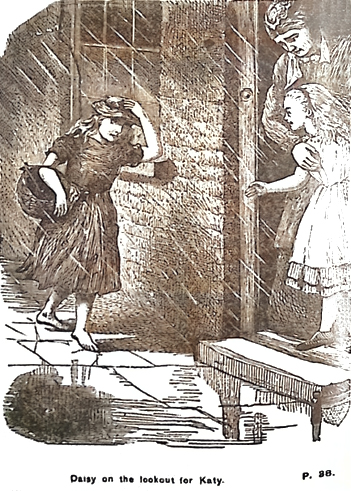
Daisy on the lookout for Katy.
BY
MRS. C. M. LIVINGSTON.

BOSTON
D LOTHROP COMPANY
FRANKLIN AND HAWLEY STREETS
Copyright, 1876, by D. LOTHROP & CO.
CONTENTS.

ALONE IN THE WORLD
A HARD DAY
FRIENDS
SIN AND SORROW
A NEW HOME
GLEAMS OF SUNSHINE
A VISITOR
SUNSHINE
"SHALL GIVE ACCOUNT"
CHRISTMAS PRESENTS
CONSCIENCE AND THE KATY-DIDS
FOURFOLD


KATY HUNTER'S HOMES.

ALONE IN THE WORLD.
IT was a very dismal old house, and it stood in a narrow alley in the great city. The doors were broken, and the windows were broken, and many of them stuffed with old garments to keep out the cold.
In one of the gloomiest rooms, a little girl, about seven years old, was sitting on a straw bed on the floor. The street lamps had just been lighted, and shone into the room and brightened it up a little. But Katy Hunter still sat with her face buried in the old quilt, crying bitterly and saying, "Oh, mamma, come back! Oh, don't leave me alone!"
Her dear mother had died two days before. They had just taken her away to lay her in the grave. Nobody had noticed the poor child, so she was left by herself.
When Katy was about four years old, she lost her father. They used to live in a pleasant village in New England, in a pretty little cottage. Mr. Hunter owned a small vessel that plied back and forth between the busy ports. They were a very happy little family. But in a wild storm the vessel was lost, and Katy's papa went down with it. Then Mrs. Hunter had to set herself to work in earnest, to earn a living for herself and baby. She struggled along for a time, not finding much to do, although she understood the dress-maker's trade.
At last, she heard that dress-makers were paid very high wages in the city. She was young and did not understand the world very well, and she thought if she might but get there, everything else would come easy. So as quickly as she could, she sold their little home, and bade good-bye to her native town. She had no relatives living, so there was no one to look to for help and advice.
We will not try to follow her all through the long, sad time, but she could not find the establishment that paid such high wages, and she found she must take very small pay or none. She managed at first, with the help of the little money she brought with her, to do very well, always hoping for better days; but the good days did not come to her. The times grew worse, the pay smaller, and she was obliged to leave the pleasant attic room where she lived, and go down to the worst part of the city, where rents were cheaper. But she found a room that was not quite so bad as some of them, where she hoped to keep her little girl from the swarms of bad children about them.
She worked beyond her strength and was taken sick. It was terrible to her to live in such a place, for she had been brought up in a tidy New England home. And as she lay on her bed burning with fever, she would groan and cry out, "Poor little Katy! Mamma will hurry and get well, then we will go away from this bad place. We'll go back to the green fields and sweet air."
Katy was a happy little thing, even in her dark, gloomy home, and sat for hours on her mother's bed, playing with her rag dolly or brushing her mother's hair, taking care of her, she said. Soon the dear Lord Jesus sent for the poor tired mother to come out of the dark into the light, to greener fields and sweeter air than she had ever dreamed of.
After the funeral, one of the neighbor women came in and found Katy asleep, worn out with crying. She took her up and carried her into her own room and put her in bed with her own children.
In the morning, when Katy awoke, she looked all about her in great surprise. She looked as if she did not belong to the same race as the Maloney children, with her fair face, and the short brown curls clustering about it, and the clear brown eyes that looked so sad now. The Maloneys awoke, too, and stared at her.
"Who be you, and where did you come from?" said Sally, a stout girl of ten.
"I know," said her sister Ann. "It's that little Hunter young one, that her mother has kept shut up in her room, for fear she should get a chance to speak to the like of us. Stuck up thing! I'm glad she is dead!"
By this time, Katy was crying and sobbing as if her heart would break.
"Stop that noise!" roared the father, who had, even so early as this, got whisky enough to make him cross.
So Katy sat scared and trembling, and watched the ragged children, with clothes half on, with unwashed faces, and uncombed hair, stand around the table and snatch bits of bread and bones from each other.
They called this breakfast. The mother was off to a day's work. If she had let drink alone, she would have been an industrious woman. As it was, she did a day's work now and then, enough, as she said, "to keep a roof over their heads."
After a little, there came a knock, and Peter Hanks shuffled in to make a morning call. To have a little talk, he said.
With their old pipes in their mouths, making clouds of smoke in the room, they sat over the miserable fire, and smoked and drank, for John Maloney brought out a jug of whisky to entertain his visitor.
While old Peter smoked and drank and talked, he kept casting glances at Katy, sitting on the bed.
He was saying to himself something like this:
"I tell you what it is, she's a pretty little tyke! What bright eyes she's got. Now she wouldn't make a bad picture at the corner of the street. Guess she'd get the dimes. I'm bound to have that little gal for mine, to bring up. She is smart, too, I know she is. I declare she looks jest like an angel lit down amongst this Maloney pack. But I bet she'll do well in that business, and it's time I stopped work and took it a little easier."
Though when he began work, or when he took it anything but easy, it would have been hard to tell; although he did have a sign over his door which read—
PETER HANKS, SHOEMAKER.
If people had depended on him to make shoes for them, they would have been badly off indeed.
Taking out his pipe and knocking out the ashes, he said:
"See here, old fellow, give that 'ere young-un' to me. You have more mouths now than you can fill; give her to me, and I'll bring her up right."
"Yes, you're a fit one to do that job, ain't you? But take her along, it's little I care what becomes of her."
So when Peter got up to go, he went toward Katy and said: "Come, little gal, come along o' me."
At first, Katy drew back.
But he really looked kindly at her and said: "Come, come along with me and get some dinner."
Katy was very hungry; she had had no breakfast, so she slipped her hand in his, and trotted along by his side.
They passed through the alley and turned up a narrow street, stopped before a miserable-looking house, went down two or three steps, and opened the door of a cellar. Now, I suppose you will think of your mother's cellar—clean and dry, with cement floors and whitewashed walls, and clean shelves full of good things, and the fresh air passing through, and such a good, sweet smell in it that you never feel like hurrying out.
It was no such cellar as that. It was dark, and dirty, and damp, so dark that a lantern had to be hung up in the daytime, to make it light enough to see anything clearly. There was nothing in the room but an old table, a bed, a couple of chairs and a broken stove. There certainly was no appearance of the promised dinner; for Peter's wife, a stout, red-faced woman, was busy at the wash-tub, splashing the suds about in a most uncomfortable way.
Peter said:
"Here, Nancy, I've brought this little gal home to work for us." As he said this, he gave a sly wink.
Nancy knew what he meant, for they had often talked it over how it would be a good plan to get a child somewhere and train her up to beg for them. But Nancy was cross to-day, so she only said "Humph!" and went on with her work.
After awhile, she brought out a few old dishes and some broken bits of bread and meat, and putting them on the table announced that dinner was ready. Katy was far too hungry to be dainty, and she ate her part with a keen appetite.
After dinner, Peter went out, and his wife soon followed. Before she went out, she threw an old straw bed down on the floor of a little closet, and, putting an old quilt on it, told Katy there was her bed, and she could go to it as soon as she liked, for all she cared.
Katy was glad enough to be left alone, so that she might have a chance to cry, and think about "dear mamma." Her poor little heart was almost broken, and she said aloud many times:
"Oh, mamma! Mamma! Why didn't you take me with you? I can't stay here in this dreadful place. What shall I do?"
When she was tired out, she said her little prayer and went to her lonely bed.
The first sound Katy heard in the morning was the coarse voice of Nancy Hanks, saying:
"Come, you young one, turn out of that as quick as you can!"
Katy, trembling with fear and cold, put on her clothes. Her mother had trained her to habits of neatness, and when she was dressed, she began to look about for some means of washing her face and hands, and smoothing her hair. But finding none, she ventured to say, "Please will you tell me where the wash-basin is?"
"Get away with you! Wash-basin indeed! You needn't go to putting on airs of that kind, miss, I tell you. Let's see what you are good for to do errands. Take this pail and get a pint of whisky at the grocery, at the end of the street; and mind you don't drink any of it."
Katy opened her eyes in astonishment; she had never tasted whisky in all her life, and thought that none but bad people ever did. But she took the pail and did as she was told.
There was the same pack of rude, ragged children in the streets as usual. She managed to slip along, without much notice from them when she went. But as she was coming back, one of the largest of the rough boys caught hold of her, and said: "Hurrah! What has little Snippie got in her pail, I wonder? Something good, maybe."
Katy ran as swiftly as she could, but he overtook her, and, snatching the pail away, drank half of the contents.
"Oh! 'Do' let me have it; do 'give' it to me," begged Katy, but the bad boy passed it around among the others, till the whole was gone. Then they threw the pail on the ground, and ran off, yelling and hooting.
Katy picked up the empty pail and started on. But what should she do? She was afraid to go in without the whisky. She wandered up and down a long time in the cold, until she saw Mrs. Hanks with a very red and angry face, standing in the door looking for her.
As soon as she got up to her, she snatched the pail and shouted, "Where is it? Say, where is it?"
Poor Katy sobbed out the story. But Nancy seized hold of her arm, and brought her in with such violence that she fell headlong on the floor. But the angry woman jerked her up, and shook her so that she could scarcely breathe.
"I'll teach you," she said, as she brought down her heavy hand on Katy's shoulders; "I'll teach you to go and steal from me. You drank it yourself, you know you did, or sold it for something else, as likely as not."

A HARD DAY.
KATY'S trials had only just begun.
After breakfast, Peter began to think about starting her in business, as he called it. So he took a look at her to see if she was "rigged right."
After quite a survey, he made up his mind that she was not, that she looked quite too well. Her shoes and stockings, though coarse, looked warm and comfortable; and her delaine dress, a dark brown, with red berries on it, Katy said, was not in the least like a beggar; neither was the little red hood nor the well-wadded scarlet cape, for mamma had turned and washed and colored and made over, and strained every nerve to keep her darling looking nice. No, in that dress Katy would look more like a sweet little Red-Riding-Hood, going to take something for her grandmother's supper, and Peter knew it.
So he called his wife into his counsels, and told her his plans for Katy, and that he wanted her fixed up right.
Nancy was more than willing to do this, for Katy's clothes would sell for quite a sum, and she meant that for her own private purse. Besides she should enjoy dressing the little minx in rags, she thought. So she took an old dress-skirt of her own that was ragged around the bottom, and tearing off a skirt long enough for Katy, made it up in a very few minutes, leaving the rags at the bottom as they were. Then she cut out a rude sort of waist, and basted, rather than sowed it together, and Katy's dress was done. Then she told Katy to take off her clothes, and she did not dare disobey.
Then Nancy dressed her in the rags, put an old hood of her own on the brown head, and wrapped her in a ragged shawl.
"I look just like a beggar," thought Katy.
Peter came in just then, and said:
"So you are ready, are you? Come on then."
Katy wonderingly followed Peter, who, with basket on his arm, went the whole length of the alley till he came to a short street that turned into a wide fine one with handsome houses each side of it. Here he stopped and said: "Now, little gal, you must take this basket and go into every house on this street. Tell them yer mother is sick, and you've got three little sisters, and they haven't got nothing in the house to eat, and ask 'em to give you some cold pieces; go to the basement door and pull the bell, and mind you stay till somebody comes; ring and knock till you bring somebody. Then you must hold out your hand to every one you meet on the street and ask for pennies, and tell them the same story about yer sick mother and yer three little sisters."
Katy was a timid little thing, but the idea of being a beggar indeed, and of being told that she must tell so many naughty lies, put courage in her, so she looked up in Peter's face and said:
"Oh, no, Mr. Peter, I can't do that. I never begged in my life, and my mamma told me never to tell a lie. She said God would hear me right off if I told a lie, and she said he didn't love liars, and he couldn't take them to heaven, and that's where she said she was going, and I want to go there so much. Please don't make me do it."
But the old man's face was dark with rage. He took hold of her arm and gave her a hard shaking, and told her she should do it. "What do you s'pose I took you for but to work?" he said.
"Oh, I will work," said Katy, with tears rolling down her cheeks. "I will work, Mr. Peter, pick up chips, or I'll run errands and do anything you tell me, but I can't be a beggar and tell lies."
"Now, stop that stuff. I say you 'shall,' and you just take this basket and do as I tell you, and when you have gone all through this street bring it home. Are you going to do as I tell you?"
Peter was holding out the basket, but Katy did not take it.
"No," said Katy, "I won't be a beggar and a liar, I 'won't.'"
"We'll see about that," said Peter. "I guess you would rather do it than take a good sound whipping. Come, go along, and you will get some real nice things to eat, and maybe they'll give you lots of money, then you shall have a penny for your own. Come, go 'long, that's a good gal," said Peter, thinking a little coaxing was what was needed.
"No! I can't. I never will," sobbed Katy.
"Come along home then," said Peter, seeing they were attracting the attention of the passers-by.
Peter was very angry, and he shuffled off home in less time than he came, dragging Katy with a pale sad face after him. As soon as they get there, he whipped her most cruelly, then he gave her the basket and told her to go and do as he bid her, but she could not stand up when she tried, and fell over on the floor in a fainting fit.
"There, now," said Peter's wife, "better kill her and be done with it."
And Peter almost thought he had killed her, for he splashed cold water in her face till she came to, then he lifted her up and put her on her bed, when he left her in peace for the rest of that day. Poor little lamb! Lying there in her loneliness and sorrow, with no one to comfort her, unless maybe the angels came and comforted her, for very soon the sobs ceased, and she fell into a sweet sleep which lasted till the next morning.
When Katy awoke the next morning, nobody else was stirring, so she lay still and thought it all over—all the hard things she went through yesterday, it seemed a good many days in one. Then she went back to the other days, when mamma and she lived in the pleasant attic room, before they got so very poor.
How brightly the sun peeped in there mornings, and how nice their little room looked when she opened her eyes and saw mamma setting the table for breakfast, and the fire burning brightly and the tea-kettle singing, and the coffee boiling, and the potatoes roasting; how good they did smell. Then pretty soon mamma's voice would say—
"Where is my little dautie? Don't she want to be dressed and eat breakfast with mamma?"
Oh, why didn't that nice time stay? Was that warm happy Katy and this poor hungry cold Katy the same? But what should she do about the begging? For she knew old Peter would send her as soon as he got up. The poor little body shrank from the thought, of any more dreadful blows, but then to put on those horrid clothes and be a beggar, such as she had often watched from the window.
"Oh dear! Oh dear!" she sobbed. "I suppose I've got to be a beggar, but I won't tell lies, anyhow.
"I wonder where my own clothes are, and if I have got to wear the dirty rags all the time. She's a naughty, bad woman to take away my clothes that my own mamma made me."
Just then Nancy told her to get up.
"I want my clothes," said Katy, but the only answer she received was a blow, and a command to put on the clothes she gave her, as that was all she would get.
Peter took the command now and told Katy to dress herself pretty fast and take her basket and start,—that she would get no breakfast until she begged it, and if she didn't find something to bring home for their dinners, she would get such a "thrashing" as she never heard of.
So out into the cold frosty air she went, without breakfast, with her bare feet and her thin clothes, letting in snow and wet. She did not tell the story that Peter told her to, though, she simply asked for pieces, and at many a place she fared well. Some seemed touched by the modest, half-ashamed way in which she asked. Then, for all she was dressed in rags, her little pale face, so sweet and sad, was different from the other beggars that came about.
The basket was getting nearly full, but Katy had the hardest part to do yet; she had not asked anybody for pennies. That was so hard to do, but she was afraid to go back without any; so with her head down, and her eyes on the ground, she held out her little hand to the first person she met.
She was such a wee little girl that the people in their hurry hardly saw her, and came near throwing her over, but many noticed the bright eyes far back in the hood and threw their pennies to her. One old gentleman gave her five cents, and said: "Bless me, what a baby that is to send out this cold day!"
She thought now she might venture to go back, for she was so tired and cold.
Peter and his wife were well satisfied with her first day's work.
"Didn't I tell you," said Peter, "that she could earn her own and ours, too?"
That day was a sample of a great many other long days and months that followed. Katy was started off every morning; be it cold, or wet, or stormy, no weather was allowed to keep her in. Sometimes she felt too weak and tired to walk any farther, and she would creep away in some sheltered place and lie down. The cold and thin clothes made her look very unlike the round-faced little girl she used to be. But she would drag herself about, all through the weary day, sometimes treated coldly, and told that she was a "nuisance," to "Get out! And not come there any more."
Often the people said, "nothing to-day." Then Katy had to go father into the other streets, and look till she found something to take home, for once or twice she had brought home an empty basket, and Peter had nearly killed her, he was so angry with her.
He and his wife both drank harder than before, and Katy was glad when she came home tired and shivering with cold to crawl into her poor little bed and wrap the old quilt about her, as often that was all the warmth she could get, for the miserable couple would both be in a drunken sleep, and the fire all out. If they were awake, they were usually quarreling, so she was glad to get away from them as quickly as she could.
For a while she used to say her prayer, but after a time she thought, "What's the use? I guess God has forgot all about me; I don't suppose he cares much for folks that live down in cellars anyhow."
So the poor little girl ran away from the only One that could help or comfort her.
Sometimes she had trouble with the bad boys in the alley. They would snatch her basket and steal everything she had in it. Then she must go back and get something more, or go home and be pounded and kicked as if she were a little animal.
But Peter, if he were sober enough, kept a sharp lookout after such times, although he always told Katy he didn't "believe a word of it."

FRIENDS.
ONE night when Katy was coming home, she met a girl by the name of Sally Dike, who lived in the same alley. Sally was a red-haired girl about ten years old, with a freckled face and a very big mouth. It seemed to be able to do more work than most mouths, for Sally managed in one way and another to keep it employed in eating the greater part of the time. As Katy passed along, Sally caught sight of a bit of mince pie. Now mince pie was what Sally hungered after more than almost anything else. She was afraid to snatch it out, because Peter had taught her a lesson on that point by means of kicks and cuffs. So she looked very smilingly at Katy, and said:
"Say, Katy Hanks! Don't you want to come into my house and see my little cat?"
"My name isn't Katy Hanks; it's Katy Hunter."
"Well, what's the odds; I say, don't you want to see my cat? If you do, come along in here."
And the door of Sally's home was stretched invitingly open.
A kitty! Oh, she had not seen or touched a kitty in such a long time, and she remembered a dear little white one she used to have, so Katy looked before and behind to see if she could see anything of Peter, and then slipped softly in at Sally's door. There, curled up in a chair, was a forlorn-looking gray kitten.
Katy forgot everything else; she put down her basket and took the kitty and smothered it and hugged it and kissed it. In the meantime, Sallie helped herself to the mince pie and whatever else she could find that suited her in Katy's basket.
"See here, Katy," said Sally, "whenever you bring me home something real good to eat, some pie and such, you may come in here nights and see this cat."
Katy hesitated; Nancy and Peter were fond of nice things, too, and people did not give of dainties plentifully to beggars. They always scolded her when she had not a good share of them, and charged her with eating them herself. But she promised she would when she could, for she wanted to come and see the kitty so much.
So it happened after that, that Katy, instead of going to bed when she got home, went in to play with kitty, if sitting in a corner with kitty in her lap could be called playing, calling it pet names and hushing it to sleep. She always carefully treasured up some nice bit for kitty from the basket, and it was something to look forward to all day. Doubtless kitty looked forward to it with pleasure as well, for she was a poor, half-starved thing.
Katy had found something to love. If it had been kitty's company only that Katy found at the Dikes', but she began to be quite intimate with Sally and Jane Dike, and they were bad, coarse girls, and often had a company of boys and girls ruder and wickeder than themselves gathered there. So Katy mingled in scenes that she never had before. They counted her in, and tried to make her drink some beer, but she never did that, although she was beginning to be poisoned. She used to be afraid of telling a lie, but now it did not seem so bad to her, neither did the coarse language and the rude oaths seem as bad as they did at first, and she would often laugh with the rest over things that, young as she was, her conscience told her were very wicked.
The little heart was forgetting all about "Jesus, tender Shepherd," that she used to pray to. The little lamb was so far away from the Shepherd that she did not hear his voice any more.
One morning as it drew near spring, Katy went as usual to a large handsome house to ask for cold pieces. It was a warm, bright morning, and the front windows were wide open. The lace curtains were blown about by the soft air, but it was something besides curtains that made Katy stop and stare so. A little girl about her own age stood looking down the street. She did not see Katy, so that poor little thing had time to look at her. She had wavy golden hair hanging over her shoulders. Her skin was so white and her cheeks so rosy that Katy said to herself, "She looks just like candy." Her dress was of soft blue cashmere, and she had a pretty little white ruffled apron on.
As she stood there, she sang a line of a hymn two or three times over,—
"Jesus loves me, this I know."
"Yes," thought Katy, "I guess he does love her, so pretty, and such nice clothes, and lives in such a big house. He loved me a little when I had good clothes and was clean. Then I s'pose the bigger house they live in and the nicer clothes they have, the more He likes them."
And Katy stood and looked at the handsome house and wished so much that she could live in such a place. As she went slowly on her way, she kept thinking about it and wondering why that little girl lived in a nice house and had pretty clothes, and she lived in a cellar and wore, oh, such dirty rags.
"How warm and nice the sun shines to-day," she said. "I s'pose He made the sun for the rich folks, too, but I'm glad there is so much of it they can't use it all up."
And the little one sat down on the edge of the curb-stone, and spread out her hands in the sun, and enjoyed it like a poor, half-frozen little pussy that she was.
For many days she watched to get another glimpse of the little girl who stood in the window, and she began to be afraid she would never see her again, when one morning, just as she was turning away, the same little girl came skipping down the broad stone steps dressed for a walk. It made Katy breathe very fast to be so close to her.
Daisy Grant looked at Katy and said:
"What is your name?"
"Katy."
"What are you going to do with all those pieces in your basket?"
This made Katy blush, for she had not yet become used to being a beggar, so she said, with her eyes on the ground:
"Take them home for dinner."
"Don't you have anything but them for dinner? I'll ask my papa to send you some roast beef. Why don't your papa buy you nice dinners?"
"I haven't got a papa."
"Well, your mamma, then."
"My mamma is dead, too."
"Oh, dear! No papa and no mamma. I should think you would die yourself. Don't the cold come in bad, in the holes in your shoes? And I do declare! You haven't got any stockings on. I mean to ask my mamma if you can't have some of my clothes, I have so many."
Just then a handsomely dressed lady came down the steps and took Daisy by the hand and they walked away.
One more brightness had come into Katy's life. She was eager to get out in the morning now to see if she might get a look at the little girl that she thought of by day and dreamed of by night.
And Daisy, too, was on the lookout for Katy. She had told her mother an eager story about the little Katy with "such pretty eyes," and begged to be allowed to give her some clothes. But Mrs. Grant was accustomed to hear just such stories every day, so she did not pay much attention to Daisy's request. But Daisy herself did not forget to do what she could. Sometimes she would come to the basement door and slip a little cake into Katy's hand; sometimes two or three little flowers from the conservatory, and once she put into her hands a mysterious little parcel done up in paper.
Katy hurried away to a place where she might sit down and undo her treasure. Oh! Could she believe her eyes? It was a little doll with a pink dress. True, it had lost a foot and its nose was almost worn off; it had seen hard service, but its eyes were left, and they were blue like Daisy's, and it had some tangled locks of curly yellow hair left, too. Katy hugged and kissed it, and wrapped it up carefully and went on her way, a very happy little girl.
As she went along, her little head was planning how she should get dolly in without Nancy and Peter finding it out, for she had learned to know that anything they could lay their hands on was sold. If only they would be out or asleep!
So Katy went softly in with her prize under her shawl. Sure enough they were both out, and she uncovered her dolly and feasted her eyes upon it. It was almost as good as having a kitty, and this was her very own, too, and she should sleep with her every night. So dolly was safely tucked away in her bed. Then Katy sat down by her and patted her and sung a little low song to her. She had not felt so happy in a long time. She did not go over to see the Dikes at all that night, but soon lay down to sleep with dolly in her arms.


SIN AND SORROW.
ONE morning Daisy Grant was out in the yard back of her father's house. It was a small spot covered with green grass. It was not large enough to run about and play in, but Daisy's papa had bought a little tent for her, and set it up out there. She had two little chairs in it, and when the days were warm enough she brought out her dolls and toys, and played there. She was humming her little hymn,—
"Jesus loves me, this I know,"
as she rocked her dolly in its little willow cradle, when suddenly looking up, she saw Katy, with her eyes very huge with wonder and delight.
"Come and see my dolly," said Daisy.
Katy had never seen so many pretty things before, and she could hardly speak, so great was her delight.
Daisy went on rocking her baby, and occasionally she would hum a few words of her hymn.
The words "Jesus loves me," caught Katy's ear, and she said:
"How do you know Jesus loves you?"
"'Cause I do—mamma said so; and my verse last Sunday said, 'Suffer little children to come unto me,' and it was Jesus that said it, and He called them to come to Him, and He took them up in his lap."
"I wish I had been there then," said Katy.
"Why, that is just what the hymn says. Don't you know it?" and Daisy's clear voice caroled out:
"'Oh, I wish that His hands had been placed on my head.
That His arms had been thrown around me.'"
"Yes, I do wish so," said Katy, and the words ended in a sob, and two big tears rolled down her cheeks.
This bright spring morning with its singing birds and fresh green on the grass and trees, and Daisy's pretty things, and Daisy herself, so clean and sweet, made Katy see just how dirty and forlorn she was, and what a great thing it would be to have some one to care for her.
Daisy was at her side in an instant, saying:
"Don't cry, Katy; mamma says He loves me just the same as He did them, and He will love you too, I know He will."
"Oh, no; He don't love such ragged, dirty children as I am, I know, 'cause nobody does. The other day there was such a pretty little girl going along just before me. She had on a blue silk dress, and a white fur cloak, and a pretty little fur hat with a feather, and long hair just like yours. A nice gentleman came by us; he looked so pleasant, and he was tall and handsome, and had a cane with a gold head, too.
"When he got up to her, he stopped and smiled at her, and put his hand under her chin and said, 'Well, little darling, where are you going?'
"He said a good many nice things to her, but he didn't say a word to me. I had to run away, I felt so bad; I was afraid I would cry right out loud. I s'pose Jesus would act that same way to me if he came along."
"I'm sure He wouldn't," said Daisy, "because he loves everybody; my teacher said so. But I must go in now; I hear mamma tapping on the window for me. Good-by, Katy; don't feel bad any more."
Oh, if somebody could only have made the poor little one believe how very much Jesus loves all such homeless, sad children as she, and that He does not care for fine clothes or a pretty face, if He only sees love in the heart for Him. But after all, she felt comforted a little because Daisy was so sure he loved everybody. And that night, when she went to bed, she tried to remember her little prayer beginning,—
"'Jesus, tender Shepherd, hear me.'"
One day, Mrs. Grant was looking over a trunk-full of Daisy's clothes, so as to determine what she needed new for spring. She put those that Daisy could not wear any more in a pile on a chair. There were a good many of them.
"After all," she thought, "why may I not please the child by letting her give some of these half-worn things to that little Katy that she thinks so much of? Perhaps they will be as good as thrown away, but we can try it, at least."
So she selected a dark print dress and long-sleeved gingham apron, some brown and white stockings, and a pair of boots that were still very good. With these, she put some under-clothes, a wide-brimmed brown straw hat, and a little woolen shawl of gay plaids. She called Daisy and told her that, when Katy came, she might come into the kitchen, and that Jane, the nursemaid, would help her put on the clothes.
"Oh, that is splendid," said Daisy; "that is better than to give me some nice thing, you good, good mamma. There she comes now!"
And the little girl, almost beside herself with delight, ran to call Katy, and tell her the good news. The clothes were brought down, but Katy said, after they had all been examined and admired:
"I can't put on such nice clothes; my hands and face are too dirty, and I never have a chance to wash them much now."
Jane was a kind-hearted girl, and felt sorry for Katy, so she said, "Well, come and take a wash, then."
She took her into the servant's bath-room and gave her a nice bath and combed her hair; it was still in short curls around her head. Nancy occasionally took the shears and chopped off the brown hair close to her head, but the little curls would soon come out again in spite of anything.
Then Katy was dressed in the nice clothes, and Daisy looked on dancing and clapping her hands, and saying:
"Why, they just fit you. Why, Katy, you look real pretty."
Katy looked at herself and then at Daisy, and when she began to say, "Oh, it is so nice," something choked her so that she didn't say anything.
"Now you take good care of your nice clothes," said Jane.
"Yes, I will," said Katy, "certain true, if old Nancy lets me keep them; I'm 'most afraid she won't, though."
She gathered up her old ones into a bundle, and went as fast as she could to a spot that she remembered passing the day before.
It was a vacant lot where a house had been burned down, and the blackened ruins still remained there. She went to the edge, and threw her bundle into the deep, dark place that had been the cellar. Then she almost laughed outright as she said,—
"Nobody 'll ever see the old duds again."
Then Katy took up her basket and went on with her begging, for it was getting near noon, and she had not gathered up much yet.
But she soon found that, for some reason, she did not get as much as usual. At one place the cook said:
"Oh, you look pretty well off in your fine clothes, I guess I'll save the pieces for them as needs it more."
And when she asked for pennies, as usual, one lady said:
"Why, my little girl, you look rather comfortable; I don't think there can be any need of your begging."
But it was getting dark, and she must go home even though she had but a scanty supply in her basket. But how could she meet Peter with so little? He would whip her almost to death.
"Oh, dear," sighed Katy. "I wish I didn't have to go back at all. If I could only go off somewhere and live with some nice folks now since I have got these nice clothes."
But where could she go in the dark, in the big city?
"Oh, what shall I do?" said Katy, to herself.
She was standing near a baker's shop, and the baker's boy was going back and forth with the warm loaves. He stepped to the back part of the shop for a moment.
"Nobody is looking," said Katy, and quick as thought she slipped one of the loaves into her basket, and darted round the corner out of sight.
The boy came back, jumped on his cart and drove away. He did not know that any one had taken a loaf from him, but there was an Eye that looked down through the darkness and saw it. Katy ran along as fast as she could go, thinking at every step that somebody would run after her and call her a thief, but nobody did. Then she began to breathe more freely and walk a little slower, but the Eye that saw her take it, followed her through the long street, and looked right down into her heart, and then Katy cried out:
"Oh dear! What did make me do it? Oh, I wish I hadn't! He'll never love me now, I know He won't. I guess I'll go and take it back, but I'm afraid, for maybe that man will put me in jail."
So she went slowly and opened the door into the cellar.
Peter and Nancy stared. They thought for an instant it was some stranger little girl, and were about to ask her who she was, and what she wanted, for really the little girl in the brown hat and bright shawl and pretty dress, did not look much like the Katy that they were used to seeing.
They were well pleased with the warm loaf, although they suspected how Katy came by it, and they gave her an unusually large piece of bread with molasses on it, and sent her to bed.
They did not say much about the clothes, but they had their own plans about them.
Katy went to bed, but she did not take her clothes off. She feared if she did that she would never see them again. She took her dolly in her arms, and tried to go to sleep, but she could nut. She did not say her prayers,—she was afraid to pray. She had never stolen anything before.
Although she had been among bad people a great while, her conscience told her that she had been guilty of a great sin. She had not forgotten her dear mamma yet and her teachings. So, instead of falling asleep very soon, as she was in the habit of doing, she cried, and tossed about, and when she did sleep, she dreamed that a man was taking her to jail.
In the morning, the first thing she saw when she opened her eyes was Nancy sewing on an old dress. This was an unusual thing, for Nancy did not use her needle much. Katy began to tremble, for she thought at once that Nancy was sewing together some more rags for her.
Sure enough! For pretty soon Nancy said:
"Now you can get up, and get out o' them good clothes just as quick as you can, and put these on. Do you s'pose anybody will give you any pieces or money when you're dresses like a lady?"
Katy scrambled out of bed in a great passion. She forgot that she was only a very little girl, and that Nancy was strong and rough.
"No, I won't," she screamed. "These are my clothes. Daisy gave them to me, and she told me to keep them, and I will, and you shan't take them, and you're a mean old thing. So!"
Nancy was in a rage herself by this time, and she flew at Katy and pounded her with her great fists, and stripped the clothes from her, shaking her till Katy's breath was nearly gone, then she threw the clothes at her and said:
"Now, put them on, and don't you have any more such tantrums, or I'll break every bone in your body. If you make away with them clothes, you'll go without, I can tell you. We got you to earn our living, and you 'bain't' goin' to rig yourself up like a lady."
Katy was almost broken-hearted. She threw herself down on her bed again and cried as if she would never stop. To go out again in such old rags, when she had been dressed up so nice yesterday. It was too bad! Too bad! And what would Daisy say, and how could she ever meet her again? She felt very sick and sore from the blows she had received, but the hard-hearted woman made her get up and go out as usual. She was passing listlessly along one of the principal streets, not caring where she went except to keep away from the street that Daisy lived on, when a voice said:
"Why, Katy! Is that you?"
Sure enough, there was Daisy standing in the door of a store.
"O Katy!" said Daisy. "Where are your nice clothes? Why, you look worse than ever."
Then Katy threw down her basket, and threw herself down on the pavement, and cried until Daisy was almost frightened. She did not know that any one could cry so.
"O Katy! Don't cry! Don't cry! Tell me all about it. I 'know' about it! The wicked old things! Took the clothes away that mamma gave you, didn't they? Never mind,—maybe you can get away from them some day, and live with some nice people. We are going to the country pretty soon. Maybe I can find somebody there that hasn't any little girl and wants one,—some good, pleasant folks, and they'll send for you; won't that be nice?"
"Mamma used to talk about the country," said Katy. "What kind of a place is it?"
"Why, don't you know? It's a b-e-a-u-tiful place. The grass is so green—great, big fields of it, too,—and the trees are full of white flowers, and it always smells so sweet, and the birds sing, and we go berrying, and get pretty mosses and wintergreens. It's just nice, I tell you."
Daisy's mamma called her just at this point, and Katy went on her way, wandering up and down.
She had a sore little heart; partly on account of the clothes being taken from her, and partly because her conscience troubled her about the bread. She tried to forget it, but she could not, every naughty thing seemed so much naughtier since she had heard more about Jesus.

A NEW HOME.
THE day was nearly done when Katy felt as if she could not go any farther, and she sat down on a stone step to rest herself.
A man stopped just in front of her to fill and light his pipe. As he saw Katy, he seemed to recollect something, for he said half aloud: "I declare if I didn't forget all about it."
Then he stood still and thought a few minutes, puffed away at his pipe and looked at Katy. It ended by his asking her name and where her father and mother lived.
"Haven't got any," said Katy.
"Well, who do you belong to, then?"
"Guess I don't much belong to anybody now," was the answer.
"Well, s'pose'n you go long o' me and belong to us. My wife wanted me to bring home a little girl to help her. Don't know as you're big enough, but then, you'll be getting bigger every day. Will you go?"
"Yes, I will," said Katy, jumping up with energy. "I never will go back to that bad old place again."
"Well, hurry up then, I'm afraid I shall miss the train."
So they walked along quite fast, Katy occasionally glancing up to see what sort of a person she was going off with.
He was short and stout and had rather a pleasant look, but he gave all his attention to his pipe, and took no further notice of Katy.
His name was Jacob Scram, and he lived a good many miles away in a smaller city, a manufacturing place, where he furnished beer enough to the men and boys who worked in the factories to make a great many unhappy families and miserable homes.
It was too dark by this time to see much of anything about her, but Katy's heart gave a great bound as she thought, "Maybe, I'm going to the country."
Mr. Scram soon settled himself for a nap, but Katy sat up wide awake, looking about her in great wonderment.
Jacob Scram had come to the city the day before on business, and his wife had told him to go to the "Home for the Friendless," and see if he could not get a little girl to help her. He forgot his errand until he happened to see Katy. Then he thought, "What's the use of botherin' and stayin' another day, I expect this one will do just as well as any of 'em, anyhow, she's friendless enough, if she didn't come from there."
It was morning when they reached the end of their journey. The Scrams lived in a narrow street, in two dark little rooms back of the saloon. There was a building within two feet of them on each side, so the rooms were very gloomy indeed. Mrs. Scram was getting breakfast, and the air of the room was suffocating with the smoke from the frying pork. Katy thought it wasn't a pleasant place to come to, not a bit. Mrs. Scram had on a soiled wrapper, and her light hair was twisted into hair pins about her forehead. She did not look pleasant, Katy thought; her mouth was drawn down at the corners, and her eyes were sharp.
"Well, here's your little girl," said Mr. Scram.
Mrs. Scram gave one look at Katy and then she said:
"Well, Jacob Scram! That's just exactly like you. That's just about as much as I'd think you'd know. To go and bring me home a little dud of a girl like that, and she's nothing but a bundle of rags, anyhow you can fix it."
Poor Katy! It was not a bright prospect. The baby, too, did his share toward making things uncomfortable, for he roused up and cried at time top of his lungs, and when Katy smiled at him, he only cried harder.
"Well, come along to breakfast," said Mrs. Scram. "Now she's here, I s'pose she's got to stay a spell, but I wish she was back where she came from."
After breakfast, Mrs. Scram told Katy to wash up the dishes, and she took her baby and a yellow-covered novel and sat down to rock and read. Of course it could not be expected that a little girl only nine years old could wash up the dishes, unless she had been taught by a careful mother or some one else, and a little girl who had spent a good deal of her life on the street as a beggar would not be likely to be very handy at little jobs of housework that other children could do with great ease. So Katy felt at a great loss to know just how to go to work.
"Come, don't stand gaping there," said Mrs. Scram, looking up from her book. "Scrape up the dishes and get the pan and put them in it, and put some hot water on them."
So Katy did it as well as she could, though in a very awkward way, putting a great share of the dish-water on herself, and on the floor. It took a long time to do it, and when Mrs. Scram finally laid down her book and came to see what fault to find with her, she gave Katy a sharp box on the ear for spilling so much water and bade her wipe it up.
After scolding a great deal, she seated herself once more, and Katy slipped out into the little back-yard to see if she had really come to the country. Alas! There was nothing green to be seen except some straggling spires of grass and a few weeds. It was a filthy little spot, and all around was dust and smoke and tall black chimneys.
"Come in," screamed Mrs. Scram, "and make a fire and pare some potatoes for dinner."
Make a fire! Now this was something Katy had never done in all her life. There were some wood and shavings lying there, and Katy put in two or three sticks, and put a few shavings on the top and lighted them. Of course, it went out as soon as the shavings were burned out.
After repeating this two or three times, Katy ventured to say, "The fire won't burn."
Mrs. Scram was in a very exciting part of the novel she was reading, and she felt very cross at being interrupted. She flew up in a rage, and boxing Katy's ears, told her to bring a bit of pine board and a knife. She cut kindlings and made the fire herself, and then Katy made bungling attempts to pare the potatoes.
That was a hard day. Mrs. Scram seemed to have great skill in boxing ears. Katy had been kicked, pounded, and shaken, but this was a new mode of punishment, and not much more agreeable than the others. She began to wonder if all the people in the world were so cross, and if they all drank beer or whisky. Mr. and Mrs. Scram drank beer instead of whisky, but that or something else made them out of humor much of the time. Then Mrs. Scram's novels did not sweeten her disposition. Those who give themselves up to novel reading are almost as bad as drunkards in one way, they do not try to make home happy.
Those were dreary days to Katy. The two dark rooms were like a prison. It was worse on some accounts than being with Peter and Nancy, for she was away from them all day, and so did not have some one finding fault with her all the time. Nobody can be happy who is continually scolded and blamed, and Katy began to get very cross too, and to answer back when she was scolded in a way that made it harder than ever for her. She had never learned to go to Jesus with her troubles and get help from him to bear them, so she had to fight her battles all alone.
She began to have a little pleasure in the baby, for he was getting fond of her, but he cried a great deal and it was hard work to tend him, and Katy often went to bed with her little arms and back aching.
Poor little baby Scram! He had a hard lot of it too. He did not know there was any more world than those two ugly dark rooms. Nobody ever carried him to a green spot, and let him pull dandelions and daisies and buttercups. He didn't have a brimming mug of warm milk every night fresh from the cow, only occasionally a little blue thin stuff they called milk from the milkman's cart.
Then he had the toothache most of the time, and his mother did not know how, or wouldn't take the trouble, to soothe him with a low sweet song or pretty play and make him forget his troubles. He never had heard of the little pigs that went to market, or had a ride to Boston on grandma's knee. Ah! That was almost the worst of it. He had no grandma. All that his mother seemed to do for him was to feed him with soothing syrup to keep him quiet, so when he was awake he was either very stupid or very cross.
You would have found at Mr. Scram's no plump fair little darling, full of fun and frolic, toddling about in white dresses and red shoes, for he had none of those pretty things, but instead, a poor thin hollow-eyed sad-faced baby, in dark dresses and soiled face and hands. Yet Katy was beginning to love him, for he was better than a kitten or a doll, besides she felt very sorry for him. Perhaps the dear Lord gives his most loving smiles to the child who tries to brighten the life of a poor sorrowful baby like this one.

GLEAMS OF SUNSHINE.
IT was a beautiful Sabbath morning, and the bells were ringing for church. Katy had now been several months in her new home. Things did not improve in the least, but grew worse if anything. She had never asked if she might go to church. She had never been in a church since she went with her mother. She had not forgotten it, and now, as she stood in the back-yard and heard the bells ringing, the thought came over her that it would be nice to go to church.
"But then—" she sighed—"how can I go with such clothes?"
She had seen the well-dressed people on their way to church, and often met Daisy going or returning, and as she recalled their dress, she thought:
"No, I guess they don't let folks come to church looking like this."
Not that Katy was dressed in rags as she used to be, but Mrs. Scram thought the less she spent upon Katy the better. Color and material and shape were of no consequence, if she were but covered, so her clothes were old and faded and ill-fitting, always made from cast-off garments, and they were not clean now, either, for Katy had not become very skilful in housework yet, and she was sure to spill dish-water or something else all over herself.
The more she thought about it, the more she wanted to get away in the direction of the bells. She did not like to ask Mrs. Scram, though, to let her go.
"I might just go and sit on the steps and hear them sing, and I mean to, if she'll let me," was the conclusion she arrived at before long. She did not mention church to Mrs. Scram,—she had a feeling that she would surely say "No" if she did, so she asked if she might go out a little while. Things were in as good a state as they could be in, in that family, for asking a favor. The baby was asleep, and Mrs. Scram had just commenced a fresh novel, so she said "Yes."
Katy covered herself as well as she could in a large, faded shawl; her hat was an old one of Mrs. Scram's, very odd-looking indeed. A queer little figure she was, as she set out to find a church. She did not have to walk far before coming to a stone church, covered with vines. The bell was ringing, and the people were hastening along.
Katy thought they all looked happy, bowing and smiling to each other. She did not go into the church-yard, but loitered by the fence. Just then a pretty carriage, drawn by two little gray ponies, stopped before the gate, and a lady and gentleman got out. The lady passed on into the church-yard, and stood waiting for her husband.
Katy was charmed. She thought, "Here is the very prettiest lady I ever saw."
But the lady's face was not remarkable, except that she had soft, loving eyes, and a pleasant mouth, that looked as if it smiled easily. And it could not have been the splendor of her dress that made Katy think so, for that was of soft, gray material, and except the few moss rose-buds in her gray hat, she wore little or no ornament.
People need not take so much trouble to appear what they are not, for they carry the whole story in their faces. If they are selfish and cross and proud, or unselfish and sweet-tempered and humble, it is usually all written out, and even a little child may read it.
The lady stood where she did not see Katy, her husband soon came, and they passed on into the church. The people had all arrived and taken their places, so Katy stole softly along, and seated herself in the doorway up in the corner.
It was very pleasant to sit there that lovely morning, and hear the grand organ, and the sweet singing. Then came the preacher's voice, and Katy leaned her head back, and gazed up into the blue sky. The green branches overhead waved in the breeze, the bees hummed, and the crickets chirped, and the minister's voice sounded farther and father off, and—Katy was asleep.
The next she knew anything about was hearing a soft voice say, "Why, here is a poor little chick fast asleep!"
Katy opened her eyes, and there was the pretty lady with the gray dress and pleasant face, looking right at her.
Katy was ashamed—she jumped up quickly. She had not meant to be there at all when church was out.
Mrs. Lynn—for that was her name—said: "Poor little girl! Were you all tired out? And did you have a nice nap?"
Katy hardly knew what she said, she felt so confused, with the people all about her.
"Won't you come into the Sabbath-school?" said the lady. "You may come into my class if you wish to."
Katy managed to murmur out: "I don't look fit."
"Oh, never mind that to-day, you'll do very well."
So Katy followed her new friend into the Sabbath-school room, and was soon seated in Mrs. Lynn's class of little girls, about her own age. You will think, perhaps, that Katy felt uncomfortable at once because of the cold looks given her by the other girls, or else drawing off to the other end of the seat away from her, as you may have seen girls do when a new scholar that was poorly dressed came into the class.
But these little girls were many of them poor. Mrs. Lynn had gathered up her class herself from the by-ways and back streets, poor, straying little ones, whose mothers did not know or care how they spent their Sabbaths.
She loved best to work among the neglected ones. The lesson for that day was about Jesus being the Good Shepherd. Mrs. Lynn told them all about sheep and the shepherds, then she hung up a large colored picture, and pointed out the happy little lambs frisking about in the green fields, and the shepherd standing near watching them. She told them how the lambs were not all contented in the pleasant pasture, and sometimes some of them wanted to get away from the shepherd and take care of themselves.
Then she brought out another picture of a little lamb that had gotten away from the fold, and was hurrying along as fast as it could go, over rough fields and through briars and brambles that tore the little feet. Deep, dark holes were all around it, and it was in danger of falling into them, but on it went, up the steep mountains, and the cold storm came on, then plunged into the dark woods where the howling of the wolves could be heard.
"Oh, dear," said Tiny Mills, "oh, do get him out of that quick, please do."
And Mrs. Lynn brought out the last picture, where the Shepherd had found the little lamb almost dead with fright and cold, and was bringing it back, the poor little thing lying in his bosom, wrapped in his warm cloak. Then Mrs. Lynn told them how "they" were little lambs, and Jesus was the Good Shepherd, and little children that loved to stay in the fold,—children that loved Jesus and obeyed their parents, and gave up sin, were happy, and the Good Shepherd kept close by them. But when children wanted to get away from Jesus, and go off among the briers and thorns of sins, they were in great danger. Satan was the wolf that was always lurking about to destroy them.
Then she told how Jesus goes after poor lost children who are sinning against him, how He calls them to come to Him, and be His lambs, and how much He loves them.
Katy listened eagerly, with eyes very large and earnest, to every word her teacher said. At last she ventured to ask:
"Does He love folks that haven't any nice dresses and money?"
"Yes, indeed He does, my dear child. When He lived here on the earth, He was poor Himself, and poor people were His friends, and He loved them. Yes, nobody need stay away from Jesus for want of money or nice clothes. Jesus is just as glad to see the poorest and meanest and wickedest people that ever lived coming to Him as He is to see the rich and great."
"Does he love folks that have done something very bad?"
Katy asked this question while the color came and went on her face, for the recollection that she had once stolen something, that she had once been a thief, had never left her and had often troubled her very much.
"Oh, yes, Katy. If one gives up doing the naughty thing, and asks Jesus to forgive, He forgives them and loves them all the same."
At the close of school, Mrs. Lynn got Katy's promise to come the next Sabbath if she could. She gave her a little picture of the Good Shepherd carrying a lamb in His bosom. And she whispered a few loving words to her that nobody else could hear, telling her that Jesus would love her if she would come to Him and be His little lamb, that she must pray to Him every day, and ask Him to give her a new heart, and that she might tell Him all her troubles, and ask His help, just as she would go to her mamma if she were living.
Katy went home with a lighter heart than when she came. When she got there, she found Mrs. Scram in bad humor, because she had stayed away so long. She tried not to be angry and slam the doors as she was in the habit of doing when she received the usual cuffing of her ears.
"The next time you get out, you'll know it," said Mrs. Scram. "Here I've been three mortal hours taking care of this cross baby, and I'm 'most tired to death."
The weeks passed away, and Mrs. Scram read just as many novels as ever, and scolded and cuffed Katy just as usual, and the baby cried as much, and the days were long and hot, and Katy sometimes remembered the words of her teacher and sometimes she did not, although she was taking some slow, short steps toward Jesus. She loved to get away by herself and study the little picture Mrs. Lynn gave her, and tried to remember all she said about being Jesus' lamb. She would have so loved to go to Sabbath-school every Sabbath, but she did not get there very often, and she did not always bear it well when Mrs. Scram said she could not go. Sometimes she would get very angry, and forget all about trying to be good.
It was a hard life she lived, and Mrs. Lynn was the only brightness in it. To tell the truth Katy had a good many troubles of her own making. She had a quick temper and a strong will, and sometimes showed them out in a way that made Mrs. Scram treat her still more harshly.
A VISITOR.
ONE day as Katy was coming in from an errand, she saw a little gray pony with a low carriage tied in front of the door, and when she went in, who should sit talking with Mrs. Scram but Mrs. Lynn! Katy's delight was so great that she could hardly answer when Mrs. Lynn spoke to her.
Mrs. Lynn had been asking Mrs. Scram all about Katy and getting a promise that she should attend Sabbath-School regularly. However ungracious Mrs. Scram might be to others, this gentle lady who was so polite and pleasant, and had given an orange to the baby, got no short or surly answers, although she did think when Mrs. Lynn first came in, that "she had better be tending to her own business."
When the lady went away, she gave Katy a little book filled with pictures, and told her she would teach her some of the hymns that were in it at Sabbath-School. Katy went with her to the door, and watched her get into the carriage and drive away.
"Oh," sighed Katy, "how happy she must be, to ride off this nice morning in that pretty carriage; I wish I was her."
And then she went back to the little dark room that looked darker than ever after the bright lady had gone out of it, back to the work that she hated, and it wasn't nice work a bit as she was doing it, washing dishes in some very greasy water that was almost cold. It is a different affair to wash dishes in the way some of you will learn to do it, and may be really pleasant work, to take a pan of hot water with a little soap in it, and as fast as you wash the dishes, rinse them in clean hot water in another pan; then after they are nicely drained, you will enjoy wiping them on a clean soft towel, and setting the shining rows of cups and plates on the shelf. Work is almost as nice as play sometimes, but poor Katy had no one to teach her.
Mrs. Lynn rode homeward in deep thought, and pony Gray had it all his own way, trotting along at a gait that pleased himself, and if he thought at all, he thought his mistress was asleep, but she was not. She was wide awake and thinking hard, and if she had thought aloud, one might have heard something like this:
"It is a great pity that Katy should be brought up under such influences, I wonder if they would part with her. What a dear little face she has, and her eyes followed me so wistfully. Could I undertake the task of training a child that has lived on the street so long? But I would like to put a little pleasure into her life. What if we take her and train her up as our own dear daughter? I know it will cost a good deal of self-denial and sacrifice, and perhaps I shall fail and she will only be a trouble to me instead of a pleasure."
Just then something seemed to whisper this little thought into Mrs. Lynn's ear. "What if you should undertake this work for the 'Master's' sake, and not think anything about your own pleasure?"
At this point, she seemed to have decided upon something, for she gathered up the reins briskly and bade Gray hurry himself. And very soon after, she drove in between the tall trees and up a broad carriage-way that led to her home.
Her husband was on the piazza watching for her. And he said as he helped her out:
"What a women of business my wife is getting to be, when she cannot be home at the dinner hour. You have some new schemes in your head now, I know by your looks; tell it quickly."
"Yes, I have," said his wife, "and you shall hear all about it pretty soon."
"Now," said Mrs. Lynn, when she and her husband were seated in their pleasant dining-room, "Don't you want to hear about my new scheme as you call it?"
So Mr. Lynn listened to the history of Katy, and an account of Mrs. Lynn's visit to the Scram's, which ended with:
"Now I want that dear little Katy for my own, I want to adopt her as our daughter. You will be sure to say yes, won't you? For I have quite set my heart upon it."
After thinking a little while, Mr. Lynn said:
"But my dear wife, have you counted the cost? Just think what a tax the training of one who has been a street child will be to your time and patience, why not take one who has not so much evil to unlearn as she probably has?"
"That is just it," said Mrs. Lynn, "I want to save her, she seems so bright and promising, and besides I love her a little already."
"Ah, I thought that had something to do with it. Well, I suppose if one is going to undertake such a thing, it is better to have a little stock of love to start with. As you are always right, you must be now, so I am sure you have my cheerful consent to do whatever you please, although I fear this will be a hard task that you have set for yourself."
But Mrs. Lynn did not look in the last as if she were about to undertake a hard task. Her eyes looked very bright and her smile very happy as she said:
"Won't it be delightful to have a dear little girl skipping about this very quiet house?"
But then, how could she be at all sure that the Scrams would give Katy up? It was very likely they would not wish to, for she was growing stronger and older, and of course would be more useful every day. The more she thought about it, the less prospect did there seem to be of carrying out her plans, and she resolved to go into the city again early the next morning and see Mrs. Scram. But she did not go, for the evening train brought company to remain several days, and Mrs. Lynn's time and attention were all taken up.
In the meanwhile, Mrs. Scram received a letter from a cousin who lived at the West, saying that she was coming to make them a visit.
"There, now," said Mrs. Scram to her husband. "If 'twasn't for that little plague you picked up in the streets and brought home, I might have Mary Jane stay all winter and help me. I just wish we could get rid of her, and will too, some way or other. There'll be enough of us in this tucked up hole without her, and she's nothing but a torment, anyhow."
So it came to pass that while Mrs. Lynn could scarcely sleep nights, so great was her anxiety lest she should fail of getting possession of Katy, that Mrs. Scram was full of frettings and scoldings lest she could not get rid of her.
After she had scolded about it several days, Mr. Scram said: "Well, well! Put her on the cars and send her back, she can live just as she did afore, I'm sure."
SUNSHINE.
THE next Monday morning, Mrs. Lynn was up early. She stepped briskly about, attending to some little household duties. She was impatient to be off to the city, that she might set her mind at rest about Katy, and in a short time, she and her husband were on their way. She left him at his office, and very soon after the gray pony was tied in front of Jacob Scram's saloon. The door was joyfully opened by Katy herself. Mrs. Scram soon came in, and Katy was sent out in the yard with the baby.
"I called," said Mrs. Lynn, "to know what you intend to do about Katy. Are you anxious to keep her?"
"Well; I rather guess we ain't. If we can get rid of her, we shall be glad enough."
"Then you would be willing to give up all claim upon her if I should take her?"
"Now you don't say," said Mrs. Scram, "that you want a 'young one' like that. I s'pose maybe you think you can make her good for something running errands and scouring knives, but I can tell you she's more bother than she's worth."
If Mrs. Scram had known that one of Mrs. Lynn's reasons for taking Katy was love for her, she would have been still more astonished.
"You may call Katy," said Mrs. Lynn, "and I will take her with me now, and you need not send any clothes with her."
"Well, if that don't beat all!" said Mrs. Scram to herself as she went to call Katy.
"Katy," said Mrs. Lynn, "put on your hat and shawl and come with me, won't you? Mrs. Scram says you may, and you would like a ride this fine morning, I'm sure."
Katy waited for no second invitation, and was soon seated by Mrs. Lynn's side in the little carriage.
Gray trotted briskly off, and Katy—why, Katy wondered if she were dreaming—if it were truly herself or some other little girl. She did not speak—she forgot to speak—she looked and enjoyed. And when they came out into the open country, all she said was, "Oh, I didn't think it would be so pretty!"
There were the fields that Daisy had told her of, and the woods. Birds sang, and squirrels chattered, as they rode under the drooping branches. Mrs. Lynn did not talk much, either. It was pleasure enough to watch Katy's face, that expressed so much wonder and joy.
"Katy," said Mrs. Lynn, after a little, "how do you think you would like living with me?"
"Oh, Mrs. Lynn!" said Katy. "I should like it so much. Could I? Will you let me? I will be so good and work so hard for you."
"Katy," said Mrs. Lynn, "you are on your way to my house now, and if you are a good girl, you shall always stay with us."
"Needn't I never go back to Mrs. Scram's any more?" said Katy.
"Never any more," said Mrs. Lynn. "You shall be our own dear little daughter."
Katy gave a little scream of delight, then the tears came to her eyes, and rolled down her cheeks. She would have enjoyed throwing her arms about Mrs. Lynn's neck, and kissing her, but she was too shy for that. And then, besides, she had a feeling that it was not fitting for such a ragged, forlorn-looking little beggar girl to come quite so close to the delicate lady by her side, with her pretty white cambric morning-dress.
But she managed to say at last, in a choked little voice, "Oh! I will try to be so good. I am 'so' glad!"
And now little Gray turned into the gate-way he knew so well, and up the-winding road to his mistress' door.
It was a lovely spot they were coming to. On one side of the graveled carriage-drive was a large, green lawn filled with tall trees, and seats were scattered here and there under them. The fountain in the centre made pleasant music, and farther up on the hill the white tent glimmered through the trees. On the other side, a flower garden was gay with blossoms. The gothic house had broad piazzas. One on the sunny side where Mrs. Lynn came with her book or work on cool mornings,—one on the north side, a cool retreat covered with vines.
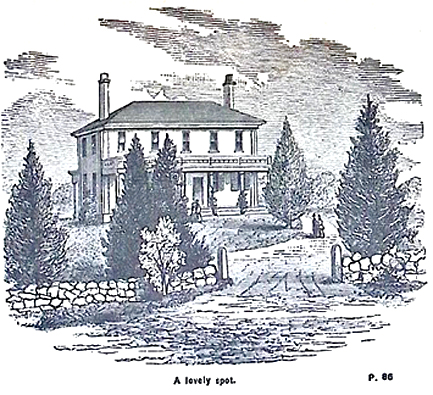
A lovely spot.
The first work, of course, on getting home, was to give Katy a good bath and change her clothes. And where were the clothes to come from? Mrs. Lynn was like Dorcas, the woman it tells of in the Bible, who made garments for the poor.
Katy was not the only little girl she had searched out and fed and clothed. When her own clothes were ready to be laid aside, she would cut from them a garment large enough for a child, and give it to a poor woman in the neighborhood to make.
So it happened that there was an old trunk up-stairs, half full of clothes of all sizes. Some for little toddlers, and some for ten and twelve year old children. It had been filled and emptied many times; for many a bundle of clothes went from that house to the poor in the city.
It was not long before a little girl in a pink dress and white apron might have been seen in the garden with Mrs. Lynn. It did not look much like Katy at a distance, but it was, only such a very clean, happy Katy that she hardly knew herself.
Early the next day, Mrs. Lynn went to the city. She spent the whole morning making purchases for Katy. It was wonderful how much one little girl seemed to need. There were dark ginghams for play and work, and pretty light cambrics and white dresses for other occasions. Nothing was forgotten, from the sash and pretty boots to the broad-brimmed hat and thick shoes for gardening.
One summer, Mrs. Lynn, expecting a little niece to spend a few weeks with her, had amused herself in fitting up a room in the way which she thought would please a child. It was called the pink room. It was a pretty little chamber with a large window looking off on to purple and blue hills. The paper on the wall had the faintest tinge of pink,—the little bedstead and bureau and washstand were pink, with small bouquets of flowers on them. The carpet was a light ground, with red and pink and white roses on it. The window had a white muslin curtain looped back with pink ribbon. Pretty pictures hung on the walls, and some shelves filled with choice little books.
This room was given to Katy,—this bright, beautiful room. It always looked, even on dark days, as if the sun were setting and shone into it. There is no use in trying to tell you how she felt when she was taken into it for the first time, but something as we shall, I suppose, when we see for the first time the beautiful heaven that God has prepared for us. This world will seem to us then just like the dark cellar and gloomy saloon that Katy had lived in so long.
She found courage now that she was clean and neatly dressed to throw her arms around Mrs. Lynn's neck and kiss her and thank her. And that dear lady took her in her arms and kissed her many times.
"Now, my new little daughter," said Mrs. Lynn, "I am going to teach you to be a very orderly little girl." And opening the door of a large closet, she showed to Katy hooks just high enough for her to reach, to hang her clothes on.
"Here in this little drawer put your gloves, in this one your handkerchiefs, in this one your aprons; and I feel sure that my Katy will try to please me in this, and that I shall never come up here and find all your drawers in confusion."
I t was a great pleasure to Katy to hang her dresses on the hooks and place the neatly-folded clothes in her drawers. And a great many times in the day, she tripped softly up-stairs and opened the door of her closet and took one more look at her dresses,—took down her white sack and tried it on, then peeped into every drawer in the bureau as if to make sure that the snowy little piles had not run away.
Then the little drawer that held her gloves and handkerchiefs—how precious it was! The little brown kid gloves for best, and a lisle thread pair for every day. She, Katy, with gloves on! Just like Daisy. Then all these things were her very own. It was too good; what a strange life it was.
Everything was different. In this house, there was no beer or whisky, no cuffs on the ear, no sharp words or wrangling. But instead, there was peace and good-will, even down to Susan and Mike; there were prayers and hymns of praise, and loving words and deeds filled up the whole day.
Mrs. Lynn began to give Katy regular lessons, for the poor child had never been taught to read. As this was the long summer vacation, she could not go to school yet, and Mrs. Lynn was glad it was so, for now she could teach her a little before she commenced school.
It was not only in reading and spelling and writing that Katy took lessons, but in many useful things besides. She succeeded finely in keeping her room in order. One secret of that was that Mrs. Lynn made a rule that everything must be put back in its place just as soon as she had done wearing or using it. She was getting to be quite a gardener, too, and spent many pleasant hours in the garden learning the names of plants, helping to tie up stray vines, pulling weeds, or gathering and arranging flowers.
Then, seated under a tree, perhaps she took a lesson in sewing. How many times she pricked her fingers, and what funny looking stitches she made!
Then when the work was all done, she and her new mamma took long rides over the hills, the green fields stretching away before them as far as they could see, then a bit of woods with squirrels chippering and birds singing. What a sweet smell, and how still it was when they stopped to rest a few minutes! No sounds but the squirrels and birds, and crickets chirping, and the music of the tall trees as they bowed and waved to each other in the little breeze. What beds of moss, and the red berries hiding away in it, and the white violets peeping up pretty heads, and the golden sunshine here and there making patches of light and shade. This was the country at last! No wonder her own mamma was always wanting to get back to it.
Katy was always disappointed when the horse's head was turned toward the city for a ride. There was where her old life was lived, and she did not love it.
Mr. Lynn had opened his heart to Katy from the first, and he soon grew very fond of the little maiden who was sure to come to the gate to meet him when he came home, and many a frolic they had through the grounds, Katy running and shouting in high glee, or she was in the swing, and he sent her far up among the green branches.
Katy had a play-house, too, under the trees, and her mother had bought her a doll, and a cradle, and some little chairs and a table, and dishes to play tea, for she said, "The poor child shall not be cheated out of every bit of her childhood, after all."
It was hard to tell who was happier, Katy or her new father and mother.


"SHALL GIVE ACCOUNT."
BUT was it always happy times with Katy? Did I hear somebody ask? What will you say if I tell you that sometimes she did not want to do as her mamma said she must, that she wanted to have her own way, and pouted and was cross, because she could not have it? What! A little girl that had had such kindness heaped upon her, dare to be so ungrateful as that!
But it was true, and I am not surprised at it, because I have been little girls do the same thing that had never known anything all their lives but love and kindness, and had been carefully trained by the best of mothers. And then it is very much as we all act toward Jesus. He sees us in the rags and filth of sin and takes us for his children, and loves us and gives us the clean robes of his righteousness, and promises us a beautiful home, and don't we often sit down and fret, or go about all covered with gloom because he does not make things go to suit us?
Sometimes Mrs. Lynn was filled with sorrow when Katy showed a great deal of self-will, but she had great patience with her, because she remembered Katy had had no one to teach her until now. And she prayed for her earnestly, and hoped that it would not be long before she would belong to Jesus indeed, for she had as yet got no farther than trying to be good.
She had improved, but she had not yet come to Jesus, and given her heart to him, and asked for the new heart. She was trying to make herself good, and began to feel that she was pretty good and did not need any help from Jesus. Didn't she go to church and Sunday-school every Sunday, and learn her verses and give her pennies and say her prayers? And she didn't tell lies, or break the Sabbath, or say bad words, as Sally Dike and those girls used to. Now that she had got into such a beautiful home, and had so many nice things and so many to love her, she seemed to forget how she had wished for Jesus to love her.
The summer was gone, the earth had put on her winter clothing, and so had Katy. Every morning, pleasant or stormy, you might have seen a little girl, dressed in warm bright merino and muffled in furs, her brown curls down on her shoulders now, moving briskly by Mr. Lynn's side on their way to the street-car, that should take them to the city, Katy to her school, Mr. Lynn to his office. You would hardly know Katy now, she has improved so much. She is a bright faithful scholar and a favorite with all.
Such a winter Katy had never known. It was quite a new thing to face the cold blast, so warmly clad that the cold could not creep in anywhere. Then how delightful to come to such a home at night. The warm fires glowing in the grates, the cheerful tea-table spread, bright carpets and curtains and warmth and beauty everywhere, best of all a gentle loving mother waiting for her. It was just one pleasure after another, whether she slid down hill, or rode swiftly over the snowy ground tucked in the warmest of robes, sleigh-bells jingling merry music, or, by the evening fire, cracked nuts and ate apples.
Whenever Katy saw some poor little waif all blue and cold, standing at the corner of the street, the wind blowing her rags, just as she used to look, it made her unhappy. If she had anything in her purse, she wanted to empty it, and would have taken off some of her garments to give, if Mr. Lynn had allowed it. She always remembered in her prayer, "Poor little cold hungry children without any homes."
One Sabbath after dinner, Katy established herself in a corner of the sofa to have a nice time with her Sabbath-school book. Something appeared to be the matter, she did not look happy. The minister had preached that day from the text, "So then every one of us shall give account of himself to God," and her mind was running on what he had said instead of being on the story she was reading. The words of the text kept coming before her.
"Give account," she repeated to herself. "I can't! I never shall, oh dear, oh dear," she said half aloud.
Mrs. Lynn looking up, said:
"Why, what is the matter with our little girl to-day? She does not seem to be much interested in her book; what has gone wrong, my dear?"
"Oh, mamma, the minister said that everybody must stand up all alone before God and tell all about themselves. Does it mean little girls too?"
"The Bible says, 'every one.'"
"But I can't! I'm afraid, I won't go up there by him, I'll hide."
"But God can see even through the darkness."
"I can't, I can't! I've been such a naughty girl." Katy buried her face in her hands and sobbed aloud, "Oh, must I? Isn't there ally way to get clear of it?"
"No, dear, the same Bible says the books will be open, the dead, small and great, shall stand before God."
"Oh, oh! How dreadful it is, I wish I never had been made. Aren't you afraid, mamma? But you are so good you needn't be."
"No," said Mrs. Lynn, with a smile, "I'm not afraid, not because I am good, but because when God calls me to come up before him, I can say I belong to Jesus, then it will be all right. If I am asked about my sins, I can say Jesus took them and suffered for me; or if I am asked about being pure and holy, I can say the Lord is my righteousness, or whatever I may be asked, I can say I love the Lord Jesus, then God will smile upon me, and bid me come into the beautiful city.
"Don't you see, my dear, how easy it will be in that day, if we only belong to Jesus? That is the great thing. To every one He says, 'Come, and I will give you a heart to love me, and everything else you need, and take you to live with me when you die.' Go to Him, darling, and tell Him all about it, how you are afraid of that day that will surely come, how you want to hide yourself in Him, and have a new heart."
"Oh, I can't, I don't know how."
"Don't you know how to come to me and ask my forgiveness when you have displeased me?"
"But I've tried, I 'can't,' I can't be a Christian."
"My poor little Katy, you can't be anything else, unless you belong to Satan. Every one serves Jesus or Satan. God commands every one to repent. To repent means to be sorry that you have sinned against God and stop sinning. If I command you to do anything, am I pleased with you until you obey me? When one comes to Jesus, he must come meaning with all his heart to give up every sin and try to please Him."
"I said the prayer you told me; it didn't do any good; I said it every night, too."
"Katy, do you remember how you wanted to go up on the hill with the girls after beech-nuts, and I was afraid the walk would be too long for you, how you came into my room and begged to go, and said you would stop every little while and rest? You were willing to promise anything, if I would only let you go. Did you ask Jesus that way when you knelt down before him."
"No," said Katy, blushing. "I guess I was thinking of something else, and I was so tired and sleepy."
"If you had come to me when you wanted to go after beech-nuts and asked in a stupid, sleepy way, if you might go, looking as if you didn't care whether I said yes or no, would I have taken much notice of it? I should have thought, 'Katy does not seem to care much about going; it is just as well that she should not.' You must be wide awake and mean what you say, when you pray."
"But I can't be 'good,' I've tried ever so hard."
"No, you never can make yourself good. You must tell Jesus so, and ask Him to take you just as you are, and make you His child. He says, 'Come to me and I will save you.' You must believe Him and come. That is being a Christian, believing what He says, and trusting Him to save you."
"Is that all? Haven't I got to be good?"
"You will try with all your heart to please Jesus when you really love Him. That is being good. He will keep you from being naughty if you ask Him and trust Him to do it."
"Oh, mamma, won't you ask Him to give me a new heart now?"
"Yes, I will my dear, but you must ask for yourself, and try to give up all your will to Jesus, and feel toward Him as I have told you, you must feel toward me. Be willing that he should plan and choose for you, and obey Him cheerfully."
They knelt together, and Mrs. Lynn asked most earnestly that Katy might now be taken by the Lord Jesus for His child, to be His forever. Then Katy asked Him too, and gave herself away as she never had before.
These prayers were answered. From that time, Katy was a true little disciple of the Lord, often making mistakes it is true, but always going with a grieved heart to her Savior for forgiveness. She felt from that time as if she belonged to the Lord. It was a great help when tempted to think, "What would please Jesus best?" or "If He were here looking at me, would I do so?"
CHRISTMAS PRESENTS.
"MAMMA," said Katy a few days before Christmas, "do you mean that I am to spend the money you gave me for Christmas exactly as I please?"
"Exactly as you please."
"Would you have any objection to my taking a little Christmas present to Mrs. Scram's baby? The poor little fellow hasn't any playthings, nor anything to make him happy."
"No, indeed. I am glad you thought of it, and will send something too; Mike shall drive in with you Christmas morning, and you can make a call all by yourself."
Katy had been thinking what to do with her money, after the presents for mamma and papa, and Mike and Susan, were all ready, and her thoughts turned to poor, unhappy baby Scram, for she had always kept a warm place in her heart for him. So the next day, after school, Katy went down-town and selected a dozen large sweet oranges, a blue scarf, and a pair of blue mittens, besides a little tin horse and wagon, and a box of blocks. This was after much looking about and study. It gave her great pleasure to go alone and buy these her first Christmas presents, to make a poor child happy.
On Christmas morning, Mrs. Lynn added to Katy's packages, a scarlet flannel dress for the baby, and Katy was soon on her way.
"Who in the world can that be," said Mrs. Scram, as a sleigh with gay robes and prancing ponies drew up before the door, and Katy was helped out. She bustled about to pick up things a little before the stranger should appear.
When she opened the door and saw Katy, she hadn't the least idea it was anyone she had ever seen before, for although it was not a year since Katy had left, she was very much changed. The round rosy face did not look like the pale sorrowful one Mrs. Scram used to know, nor did the trim little figure. No trace of the former Katy could be seen, from the white plume in her hat to the toe of her kid boot.
Katy seemed to forget that she was expected to speak. She just sat and looked. There was the same dish-pan standing on the table that she used to wash from, and there were the dishes, much the worse for wear, and the faded carpet, and the old broom standing behind the door, and the little dusty windows looking into the alley.
When Mrs. Scram remarked that it was a pleasant morning, Katy gave a start, for she almost expected Mrs. Scram to box her ears and tell her to wash up the dishes and sweep up the floor. But she came to her senses now, and said:
"Don't you know me? I'm Katy!"
"My stars!" said Mrs. Scram. "Now you don't say so. Got to be a fine lady I s'pose you think—don't do anything, I dare say, but fold your hands from morning till night."
"Oh, yes," said Katy, "I go to school every day and have to study hard."
"Study!" said Mrs. Scram with a sniff. "Well, I s'pose you're round to-day showing off your new clothes, most likely."
Katy's face flushed a little at this, for to tell the truth, she had felt a good deal of pleasure in letting Mrs. Scram see how well she dressed.
But she only said, "Oh, I came to bring the baby some little things for Christmas."
And she began to take the oranges out of her satchel. Baby could walk now, and he came toddling up to Katy, holding out his hand for one.
"You will give him one every day as long as they last, won't you Mrs. Scram? I remember how much he used to like them. And here is a little warm dress that mamma sent him, but these other things are my presents."
And she wound the soft tippet about his neck, and put the bits of mittens on his hands, and sent the little horse and wagon rolling across the room, and the baby laughed and jabbered and looked as happy as any baby.
Now Mrs. Scram had a feeling come over her that was rather new to her, she felt very much ashamed that she had spoken so roughly to Katy, and she made the baby kiss her hand and say "Thank you," and spoke pleasantly when Katy was going away. I shouldn't wonder if these little gifts made Mrs. Scram a better woman.
It was the very first Christmas that Mr. and Mrs. Lynn had ever had a little girl of their own to give presents to, and they hardly knew when to stop. There were books, and games, and pictures, and much to Katy's astonishment, a tiny gold watch and chain. She had not thought much about receiving gifts, for it seemed as if she had everything she could want already.
But it was a happy day to Katy, and none the less so because she had carried a little sunshine into the dismal home of the Scrams.


CONSCIENCE AND THE KATY-DIDS.
THE winter passed away full of busy cares and pleasures. Katy was losing her self-will, and growing more obedient and loving each day, and her mother had great comfort in her, and Katy was very happy herself, although one thing troubled her very much. Ever since she had become a Christian, the thought that she had once stolen a loaf of bread, and never repaid it in any way, had been a great grief to her. Sometimes she almost made up her mind to tell Mrs. Lynn about it, then Satan told her she needn't, that it was a long time ago and that of course she didn't intend to steal any more, and a loaf or bread wasn't any great affair, anyhow.
But Katy's conscience was growing tender the more closely she got to Jesus, and she did not feel at all satisfied with disposing of it in this way.
It was a warm evening in spring. Katy and her mamma sat on the piazza. The air was full of sweet smells from apple and lilac trees, the birds were singing soft little good-night songs, and the golden sun lit up everything with his last rays.
Mrs. Lynn was drinking it all in, with her eyes on the distant hills. She did not notice that Katy was not enjoying it with her, and that she was fidgeting about in a very uneasy way. The lesson in Sabbath-school the day before had been about the man who came to Jesus, and said if he had taken anything from any man, he restored it fourfold.
The teacher had talked a good deal about honesty, honesty in small things—if any one had been tempted into taking even a small thing from another, it was duty to make it good in some way.
So the old trouble was upon Katy. It had worried her all day in school, and had followed her home. How could she restore that loaf of bread?
It couldn't be done, at least it could not without telling somebody, and she never wanted to do that. Just here some little voices came from the tree overhead, and what did they say that made Katy start so, and that brought such a bright color into her face.
"Katy did!" "Katy 'didn't!'"
"Katy did!"
"Katy 'didn't!'"
On they went as fast and sharp as possible. What could it all mean? Did even the birds know all about it? Her troubled conscience made her ready to believe almost anything, and she had never heard a katy-did before.
The dispute went on:
"Katy did!" "Katy 'didn't!'"
Katy glanced at her mamma, wondering if she did not notice, but her face looked as serene as ever. Katy could stand it no longer, and she burst into tears, crying out:
"Yes, I did do it—I 'did!'"
"Why, Katy!" said her mamma. "What are you talking about? What is it, my dear?"
"Oh, mamma," said Katy, "what kind of birds are these that know all about me? I can't stand it. I did something real naughty once, that I never told you about. But how do they know about it?"
Then Katy poured all her troubles into her mamma's ear, just where she should have put them long ago.
And Mrs. Lynn comforted her by assuring her that it should all be made right if she could remember the place where the bakery was.
"Oh, yes," said Katy, eagerly. "I'm sure I know. I can see it now. It was on Canal Street. The man's name was Mr. Barton."
"Well, put it all away now, and never be troubled any more about it. And let me tell you a little about the katy-dids. They are not birds at all as you supposed, but tiny green insects, that you might think were little grasshoppers. They belong to the locust family, and the noise that you hear is made with their wings instead of their mouths. Now you must enjoy hearing the little creatures after this, and you must feel that they have forgotten all about this affair, and that they are saying,—
"'Katy did learn her lessons.' 'Katy didn't disobey.' 'Katy "did" grow up to be a good woman.'"


FOURFOLD.
DURING the next few weeks, there was a great deal to be done at Mrs. Lynn's. The sewing-machine and the seamstress were not idle, for there were a great many stitches to be taken to put the wardrobe of the family in order for the summer, and just as soon as all was done, they were to start on their journey, spending a little time in New York on their way to the sea-side.
Katy could hardly wait for the day to come. It would be so strange to go back to the great city where she used to live, when everything was so different with her now. She wondered if she should see Daisy again, and if Peter and Nancy were there,—if a certain bakery was where it used to be.
Katy had her own trunk and packed it herself, and it took a great many packings to get it to her mind. But the time came at last for them to start, and the morning train carried them swiftly on their way.
Toward evening, they arrived in the city. Taking a coach, they went to Mrs. Lynn's sister's, who lived in a handsome house up town. The travelers were shown into the brightly-lighted parlor, where they received a warm welcome from a lady and gentleman and little girl who sat around the table reading.
"And this is your little girl that you have adopted? My dear, this is your new auntie," said the lady, as she kissed Katy; "and it seems as if I had seen those eyes before, but that must be all fancy, of course."
In the commotion, nobody had thought to make the two little girls acquainted, and all were surprised when Katy exclaimed:
"It's 'Daisy,' mamma! I do believe it 'is' Daisy!"
Sure enough, there were the golden curls and the fair face and the sweet blue eyes. Nobody could forget her very well that had ever seen her.
"Yes, I'm Daisy," said the little girl, "but I don't know who you are."
"Why, don't you know? I'm Katy."
"Katy? Why—why—you're not the Katy that used to come here beg—with a basket, are you?"
"Yes," said Katy, blushing at the remembrance.
"Why, I never should have known you! Where have you been this long time? I was so sorry you didn't come any more," and the long-lost friends gave each other a warm greeting, while the older ones looked on, a good deal puzzled at all this.
"Now help us to understand this mystery," said Mrs. Grant to her sister. "How came Katy to stray off to you?"
So Katy's history was told and talked over with a great deal of wondering at the strange way in which things had turned out. And it was late before the pleasant party around the tea-table broke up and settled themselves for the night.
Perhaps you think that now Mr. and Mrs. Grant, since they knew all about Katy, felt as if they did not want a child who had once been a beggar to be a visitor in their house, and that Daisy, too, gave herself airs, and drew off from Katy, and tried to show her how far beneath her she was. But it was not so at all. They were a dear, Christian family, and were delighted to find that even one poor lamb had been snatched away from a life of misery.
Daisy and Katy were up with the first peep of day, and their tongues running very fast.
"O Daisy!" said Katy. "You can't think how much good that poor little dolly did me, that you gave to me."
"I remember it," said Daisy, "it had its legs or arms off, didn't it? How much I missed you, Katy, when you didn't come any more. I was afraid that old man had killed you,—and now you've come. It's so nice—it's just like a story-book; and we are cousins too, now, and can see each other real often."
And the two happy little girls wound their arms about each other, and skipped off to the garden, as Daisy called it. But it was the same little spot where Daisy had sat with her dolls the day Katy saw her. Now it was all gay with flowers.
Daisy spent a good deal of her time here at work, for she had planted the seeds and bulbs herself, and weeded and hoed and watered with great patience, as the pretty little garden plainly showed.
"Katy," said her mother one day, "you may come out with me a little while to do an errand."
When they were out by themselves, Mrs. Lynn said:
"Now we will attend to that business of ours about the bakery, you know."
"Oh, mamma!" said Katy. "Doesn't papa know?"
"No, indeed! This is our secret—yours and mine and the katy-dids. Now I want to see if we can find the place, and if the same man is there."
By means of street-car and omnibus they found themselves on the very corner that Katy had described. It was a bakery, and the sign read:
J. BARTON & SON.
"That is it," said Katy, "that is it!" And she would have rushed right in, if her Mother had not held her back.
"No, Katy, I will show you a better way. We will go now, and you may write to Mr. Barton enclosing as much money as you think you ought, and we will send it to him. That will be less embarrassing to you, and will answer the purpose just as well."
Before many hours had passed, Katy, after a good deal of study, brought the note to her mother, who said it was all right, and sent it to the post-office.
"Come with me," said Mr. Lynn to his wife and Katy, one day, as they were passing down Broadway. "Let us take this down-town omnibus, and see if Katy can find her way to where that old Peter used to live."
When they were once more in the neighborhood of the bakery, Katy soon found her way to the alley that she had traveled over so much.
"I should have supposed," said her mamma, "that you would have forgotten where to turn, by this time."
"Oh," said Katy, "I remembered that after I passed the bakery, I turned down by this big building with tall chimneys."
After walking a long distance down the alley, they came upon the old sign swinging in the wind,—
PETER HANKS, SHOEMAKER
And there, sunning himself in the doorway, sat old Peter himself. He was sound asleep, so they had a good chance to peep through the broken window, and see the home that Katy had left. The remains of the dinner were still on the table, and there was the whisky jug that accounted for the deep sleep of the master and mistress. For over on the bed in the corner, Nancy, too, was snoring, her mouth wide open. Her wash-tub stood in its usual place near the middle of the room—a large pond of suds under it, and the room was as dark and damp and mouldy-smelling as it used to be.
Katy noticed with a shudder the door of the closet standing open, where she had slept so many times on a heap of filthy rags.
Mr. and Mrs. Lynn turned away from the sickening sight with swelling hearts, and Katy grasped a hand of each, as if she feared that old Peter would wake and claim her even now. None of them spoke as they walked away, but each was in deep thought.
Katy was thinking:
"Oh, how good God was to let me get away from those bad old folks and that dreadful, 'dreadful' place, and then to give me such a home as He has. I must be very good all my life."
In Mr. Barton's bakery the lights were turned low. The business was done for the day, and Mr. Barton, a gray-haired man past sixty, with his face full of worldly care, seated himself by the fire to read some letters that had just been brought in.
"What does all this mean?" he said, as he opened one letter and some money dropped at his feet. Then he read it, and this is what it said:
"MR. BARTON: When I was a wicked little girl, I stole a loaf of bread
from you. You never knew it, I guess. It was more than two years ago.
Now I have learned how dreadful sin is, for I belong to Jesus, and I
want to make it all right with you. I send you fifty cents. I know the
loaf didn't cost so much, but I want to do as the man in the Bible
did,—pay back four times as much. Please forgive me.
"KATY."
When Mr. Barton had read it, he said:
"What in the world is all this about, anyway, and who is Katy?"
Then he took off his spectacles and wiped them, and read it again. Then he wiped his eyes and looked all about, as if there was any one there to see him, and leaned his head on his hand, and thought a long time. He thought how many times he had done things that were worse than this; and here was a little girl who thought she had committed a great sin in taking one loaf of bread.
Then one little sentence in the letter, "I belong to Jesus, now," kept itself before him. To whom did "he" belong? He had never stopped thinking about his business long enough to ask himself that question. He sat a long time and thought about these things, more seriously than he had in many years.
The next week, the two families started for the sea-shore, and for many happy weeks after, Daisy and Katy enjoyed being together. They bathed and searched for shells, and played in the sand.
And there we will leave them, only saying that Katy "did" grow up to be a noble, Christian woman, and worked hard for the Master, and had a warm heart for all little homeless children.
THE END.