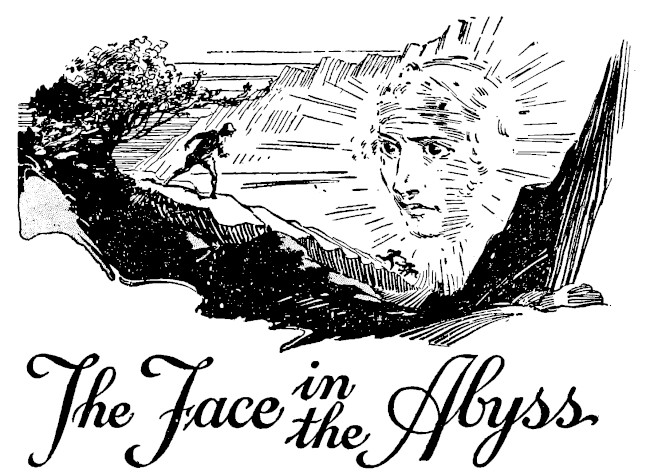
Title: The face in the abyss
Author: Abraham Merritt
Illustrator: Modest Stein
Release date: July 16, 2026 [eBook #79106]
Language: English
Original publication: New York, NY: The Frank A. Munsey Company, 1923
Other information and formats: www.gutenberg.org/ebooks/79106
Credits: Greg Weeks and Mary Meehan
By A. MERRITT
Author of "The Moon Pool," "The Metal Monster," etc.
A NOVELETTE—COMPLETE IN THIS ISSUE
And now the readers of Argosy-Allstory Weekly come once again to their old favorite, A. Merritt, who flashed like a shooting star across the pages of All-Story Weekly in the issues of June 22, 1918, and from February 1, to March 22, 1919, illuminating that most classically fantastic of all stories, THE MOON POOL, which was afterward brought out in book form and accepted in England, France, and America as equal to the best imaginative work of H. G. Wells or that older master, the late Jules Verne; after which he rose to greater heights in his serial that appeared under the title of THE METAL MONSTER.
In these two works Merritt struck an entirely new note, rich in imagination, the wondrous possibilities of science, and the fine balance of human interest and narrative charm. In every chapter he struck the cosmic chords of superlative invention. Letters from all over the world asking for further work from the pen of Merritt came to this office.
He has recently been induced, or, to be perfectly frank, he has again taken up his pen of his own volition and made another contribution entitled THE FACE IN THE ABYSS, which is published in this issue in full on the pages which follow.
We know of no more kaleidoscopic imagination among living writers. Merritt possesses not only a transcendental vision but the power to put in words the scenes that unfold and come full winged shimmering with light from the cathedral of his mind.
It has been just three years since I met Nicholas Graydon in the little Andean village of Chupan, high on the eastern slopes of the Peruvian uplands. I had stopped there to renew my supplies, expecting to stay not more than a day or two. But after my arrieros had unlimbered my luggage from the two burros, and I entered the unusually clean and commodious posada, its keeper told me that another North American was stopping there.
He would be very glad to see me, said the innkeeper, since he was very ill and there was no other Americanos in the hamlet. Yes, he was so ill that he was, to tell me all the truth, certain to die, and it would beyond doubt comfort him much to have a fellow countryman with him when that sad moment came. That is, he added, if he were able to recognize a fellow countryman, since all the time the señor had been at the posada he had been out of his mind with fever, and would probably pass away so.
Then with a curiously intense anxiety he implored me to stay on until death did come; a matter, he assured me, that could be one of only a few days—maybe hours.
I bluntly asked him whether his desire for me to remain was through solicitude for my ailing countryman or through fear for himself. And after a little hesitation he answered that it was both. The señor had come to the village a week before, with one burro and neither guides nor arrieros. He had been very weak, as though from privations and long journeying. But weaker far from a wound on his neck which had become badly infected. The wound seemed to have been made by either an arrow or a spear. The señor had been taken care of as well as the limited knowledge of the cura and himself permitted. His burro had been looked after and his saddlebags kept scrupulously closed. But I could understand that questions might be raised after the señor's death. If I remained I could report to the authorities that everything possible had been done for the señor's comfort and testify that none in Chupan was responsible for his injuries.
This did not sound very convincing to me, and I said so. Then the worthy innkeeper revealed what actually was in his mind. The señor, he said, had spoken in his ravings, of dreadful things, things both accursed and devilish. What were they? Well—he crossed himself—if I remained I would no doubt hear for myself. But they had even greatly disturbed the good cura, despite that he was under the direct protection of God. The señor had come, so his ravings indicated, from a haunted place—no less a place, the innkeeper whispered crossing himself again, than the shunned Cordillera de Carabaya, which every one knew was filled with evil spirits. Yes, evil spirits which would not lightly give up any one who had once been in their power!
And, in fine, the idea seemed to be that some of these demons of the Cordillera—about which, as a matter of fact, I had heard some strange tales—might come at any time for the sick man. If they did, they would be more apt to wreak their fury on one of the señor's own countrymen—especially if he was in the same room. The keeper of the posada did not put it that way, of course; he said that one of his own people was better qualified to protect the señor in such case than any strangers were. Nevertheless the theory plainly was that if I stayed I would act as a lightning rod for any levin of hell that might strike!
I went to the room of the sick man. At first glance I could see that here was no anderine, no mountain vagabond. Neither fever nor scrub beard could hide the fineness, the sensitivity, the intelligence of the face on which I looked. He was, I judged, about thirty, and he was in ill case indeed. His temperature showed 105 point 6. At the moment he was in delirium.
My first shock of surprise came when I examined his wound. It seemed to me more like the stab of some great bird beak than the work of spear or arrow. It was a puncture—or better, perhaps, a punch—clear through the muscles of the back and left shoulder and base of the neck. It had missed the arteries of the last by the narrowest of margins. I knew of no bird which could make such a wound as this, yet the closer I looked and probed the more sure I was that it had been inflicted by no weapon of man.
That night, after I had arranged my own matters and had him sleeping under a hypodermic, I opened up his saddlebags. Papers in them showed his name to be Nicholas Graydon, a mining engineer, a graduate of the Harvard School of Mines, his birthplace, Philadelphia. There was a diary that revealed so much of him truly likable that had I not already made up my mind to stop on with him it would have impelled me to do so. Its last entry was about a month before and ran:
Two weeks now since our arrieros deserted us, and we seem to be pretty thoroughly lost. Effects upon the three are curious. Sterrett manages to keep himself evenly drunk all the time. That spare burro of his must be loaded with nothing but that Indian hell-brew. Dancre is moody and sullen. Soames seems to have developed a morbid suspicion of all of us. Strange how the wilderness, the jungle, the desert, bring out the latent man in all of us. In Quito none of the three was half bad. But now—well, the luckiest thing for me will be for us to find no treasure. If we do, my throat will probably be the first to be cut.
Further down in the bag were two parcels, each most carefully and securely wrapped. Opening the first I found a long black feather oddly marked with white. I did not recognize the plume as belonging to any bird I knew. Its shaft was inlaid with little bands of gold, altogether a curiously delicate bit of goldsmith's work.
But the contents of the second package made me gasp with amazement. It was a golden bracelet, clearly exceedingly ancient, the band an inch broad and expanding into an oval disk perhaps three inches long by two wide. That disk held in high relief the most extraordinary bit of carving I had ever seen. Four monsters held on uplifted paws, a bowl on which lay coiled a serpent with a woman's face and woman's breasts. Nor had I ever beheld such suggestion of united wisdom and weirdness as the maker had stamped upon the snake woman's face.
Yet it was not that which called forth the full measure of my wonder; no. There are certain pictures, certain sculptures, certain works of art which carry to their beholders conviction that no fantasy, no imagination, went into their making and that they are careful, accurate copies of something seen by those who made them. This bit of golden carving carried that conviction.
The four monsters which held up the snake woman were—dinosaurs!
There was no mistaking them. I had examined too many of the reconstructions made by scientists from the fossil bones of these gigantic, monstrous reptilian creatures to be in error. But these giants were supposed to have died off millions of years before man first appeared on earth! Yet here they were, carved with such fidelity to detail, such impress of photographic accuracy, that it was impossible to believe that the ancient goldsmith who made this thing had not had before him living models!
Marveling, I held the bracelet closer to the light and as I did so I thought I heard far away in the blackness of the mountains and high in air a sound like a tiny bugle. In that note was something profoundly, alienly weird. I went to the window and listened, but the sound did not come again. I turned to find the eyes of Graydon opened and regarding me. For a moment he had slipped from the thrall of the fever—and the thought came to me that it had been that elfin bugling which had awakened him.
It was six weeks before I had Graydon well out of danger. And in that time he had told me bit by bit that well nigh incredible experience of his in the haunted hills of the Cordillera de Carabaya and what it was that had sent him so far down into the valley of the shadow.
Three years it has been since then. Three years and I have heard nothing of him. Three years and he has not returned from his journey back to the Cordillera de Carabaya where he went to seek mystery, ancient beyond all memory of man, he believed was hidden there. But more than that—to seek Suarra.
"If you don't hear from me in three years, tell the story and let the people who knew me know what became of me," he said, as I left him at the beginning of that strange trail he had determined to retrace.
And so I tell it, reconstructing it from his reticences as well as his confidences, since only so may a full measure of judgment of that story be gained.
Graydon had run into Sterrett in Quito. Or, rather, Sterrett sought him out there. Graydon had often heard of the giant West Coast adventurer, but their trails had never crossed. It was with a lively curiosity, then, that he opened the door of his room to this visitor.
And he had rather liked Sterrett. There was a bluff directness about the big man that made him overlook a certain cruelty of eye and a touch of brutality about mouth and jaw.
Sterrett came to the point at once. Graydon had no doubt heard the story of the treasure train which had been bringing to Pizarro the ransom of the Inca Atahualpa? And learning of the murder of that monarch had turned back and buried that treasure somewhere in the Peruvian wilderness? Graydon had heard of it, hundreds of times. And, like every other adventurer in the Andes, spent a little time himself searching for those countless millions in jewels and gold.
Sterrett nodded.
"I know how to find it," he said.
And Graydon had laughed. How many had told him that they, too, knew where lay hidden the hoard of Atahualpa the Inca!
But in the end Sterrett convinced him; convinced him at least that there was something more solid than usual in his story, something decidedly worth looking into.
There would be two others in the expedition, Sterrett told him, both men long associated with him. One was Dancre, a Frenchman, the other an American named Soames. These two had been with Sterrett when he had got hold of the old parchment with its alleged map of the treasure trail, and with its carefully drawn signs that purported to be copies of those along that trail; signs cut by its makers to guide those who one day, when the Spaniard was gone, would set out to recover the hidden hoard. Graydon asked why they wanted him, Sterrett bluntly enough told him—because he was an American; because they knew he could be trusted; because he could afford to pay half the expenses of the expedition. He, Dancre and Soames would pay the other half. They would all share equally if the treasure was found. Still another reason, Graydon was a mining engineer and his special knowledge might be essential when it came to recovering the stuff. Furthermore, if the treasure was not found, the region where they were going was full of minerals. He might make some valuable discoveries. In which event all would share equally as before.
There were no calls on Graydon at the time. It was true that he could well afford the cost. At the worst there would be adventure and some pleasant excitement. He met Dancre and Soames, the first a cynical, but amusing little bunch of wires and nerves, the second a lanky, saturnine, hard-bitten Yankee. They had gone down by rail to Cerro de Pasco for their outfit, that being the town of any size closest to where, according to the map, their trail into the wilderness began. A week later, with eight burros and six arrieros or packmen, they were well within the welter of peaks through which the old map indicated their road lay.
They found the signs cut in the rocks exactly as the parchment had promised. Gay, spirits high with anticipation, three of them at least spending in advance their share of the treasure, they followed the symbols. Steadily they were led into the uncharted wilderness.
At last the arrieros began to murmur. They were approaching, they said, a region that was accursed, the Cordillera de Carabaya, where demons dwelt and only fierce Aymaras, their servants, lived. Promises of more money, threats, pleadings, took them along a little farther.
Then one morning the four awoke to find the arrieros gone—and with them half the burros and a portion of their supplies.
They pressed on. Then suddenly, the signs had failed them. Either they had lost the trail, or there were no more carven symbols and the parchment which had led them truthfully so far had lied at the last. Or was it possible that the signs had been obliterated—cut away?
The country into which they had penetrated was a strangely deserted one. They saw no sign of Indians—had seen none indeed since when, more than a week before, they had stopped at a Quicha village and Sterrett had got mad drunk on that fiery spirit the Quichas distill. Food, too, was curiously hard to find, there were few animals and fewer birds.
But worst of all was the change that had come over his companions. As high as they had been lifted by their certainty of success, just so deep were they now cast into despair. The wilderness, the loneliness of it, their disappointment, had brought out the real man that lies hidden beneath the veneer we all of us carry. Sterrett kept himself at a steady level of drunkenness, alternately quarrelsome and noisy or sunk in a sullen mood of brooding, brutal rage. Dancre had become silent and irritable. Soames seemed to have reached the conclusion that Graydon, Sterrett and the Frenchman had combined against him; that they had either deliberately missed the trail or had erased the signs. Only when the two of them joined Sterrett and drank with him the Quicha hell-brew did either of them relax. At such times Graydon had the uneasy feeling that they were holding the failure against him and that his life might be hanging on a thin thread.
On the day that his adventure really began—that strange adventure to which all that had passed before had been prelude—Graydon was coming back to the camp. He had been hunting since morning. Dancre and Soames had gone off together on another desperate search for the missing symbols that would lead them to the treasure trail again.
Cut off in mid-flight, the girl's cry came to him as the answer to all his apprehensions; materialization of the menace toward which his vague fears had been groping ever since he had left Sterrett alone at the camp hours ago. He had sensed some culminating misfortune close—and here it was! He knew it; how, he did not stop himself to ask; he was sure. He broke into a run, stumbling up the slope to the group of gray green algarroba trees where the tent was pitched.
What had the drunken fool done? Graydon had warned them all that their situation was perilous; that if Indians came they must try to make friends with them—that they must be superlatively careful in their treatment of any Indian women.
He reached the algarrobas; crashed through the light undergrowth to the little clearing. Why didn't the girl cry out again, he wondered. There was a sickness at his heart. A low chuckle reached him, thick, satyr toned. Then Sterrett's voice, cruel, mocking!
"No more fight in you, eh? Well, which'll it be, pretty lady—the way to the gold or you? And by Heaven—I guess it'll be you—first!"
For an instant Graydon paused. He saw that Sterrett, half crouching, was holding the girl bow fashion over one knee. A thick arm was clinched about her neck, the fingers clutching her mouth brutally, silencing her; his right hand fettered her slender wrists; her knees were caught in the vise of his bent right leg.
She was helpless, but as Graydon sprang forward he caught a flash of wide black eyes, wrath filled and defiant, staring fearlessly into those leering so close.
He caught Sterrett by the hair, locked an arm under his chin, drawing his head sharply back.
"Drop her!" he ordered. "Drop her—quick!"
Sterrett hurled himself to his feet, dropping the girl as he rose.
"What the hell are you butting in for?" he snarled. His hand struck down toward his pistol. But even while the fingers were tightening around the butt, Graydon's fist shot out and caught him on the point of the hairy jaw. The clutching fingers loosened, the half drawn pistol slipped to the ground, the great body quivered and toppled over. Long before it fell the girl had leaped up and away.
Graydon did not look after her. She had gone no doubt to bring down upon them her people, some tribe of those fierce Aymaras that even the Incas of old had never quite conquered and who would avenge her—in ways that Graydon did not like to visualize.
He bent down over Sterrett. His heart was beating; feebly it was true—but beating. The reek of drink was sickening. Graydon's hand touched the fallen pistol. He picked it up and looked speculatively at the fallen man's rifle. Sterrett, between the blow and the drink, would probably be out of the running for hours. He wished that Dancre and Soames would get back soon to camp. The three of them could put up a good fight at any rate; might even have a chance for escape. So ran his thoughts. But Dancre and Soames would have to return quickly. The girl would soon be there—with the avengers; no doubt at this very moment she was telling them of her wrongs. He turned—
She stood there; looking at him!
And drinking in her loveliness, Graydon forgot the man at his feet; forgot all, and was content to let his soul sit undisturbed within his eyes and take its delight to her.
Her skin was palest ivory. It gleamed translucent through the rents of the soft amber fabric like the thickest silk that swathed her. Her eyes were deep velvety pools, oval, a little tilted; Egyptian in the wide midnight of their irises. But the features were classic, cameo; the nose small and straight, the brows level and black, almost meeting above it! And her hair was cloudy jet, misty and shadowed, and a narrow fillet of gold bound the broad, low forehead. In it like a diamond were entwined the sable and silver feathers of the caraquenque, that bird whose plumage in lost centuries was sacred to the princesses of the Incas alone. Above her dimpled elbows golden bracelets twined, reaching to the slender shoulders. The little, high arched feet were shod with high buskins of deerskin.
She was light and slender as the Willow Maid who waits on Kwannon when she passes into the World of Trees to pour into them new fire of green life—and like the Willow Maid green fire of tree and jungle and flame of woman gleamed within her.
Nothing so exquisite, so beautiful had ever Graydon beheld. Here was no Aymara, no daughter of any tribe of the Cordilleras, no descendant of Incas. Nor was she Spanish. There were bruises on her cheeks—the marks of Sterrett's cruel fingers. Her long, slim hands touched them. The red lips opened. She spoke—in the Aymara tongue.
"Is he dead?" she asked—her voice was low, a faint chime as of little bells ringing through it.
"No," Graydon answered.
In the depths of the midnight eyes a small hot flame flared; he could have sworn it was of gladness; it vanished as swiftly as it had come.
"That is well," she said. "I would not have him die—" the voice become meditative—"so!"
"Who are you?" Graydon asked wonderingly. She looked at him for a long moment, enigmatically.
"Call me—Suarra," she answered at last.
Sterrett stirred; groaned. The girl gazed down upon him. The slim hand touched once more the bruises on her cheek.
"He is very strong," she murmured.
Graydon thought there was admiration in the voice; wondered whether all that delectable beauty was after all but a mask for primitive woman, worshiping brute strength; looked into the eyes scanning Sterrett's bulk, noted the curious speculation within them, and knew that whatever the reason for her comment it was not that which his fleeting thought had whispered. She looked at him, questioningly.
"Are you his enemy?" she asked.
"No," said Graydon, "we travel together."
"Then why," she pointed to the out-stretched figure, "why did you do this to: him? Why did you not let him have his way with me?"
Graydon flushed, uncomfortably. The question, with all its subtle implications, cut. What kind of a beast did she think him? His defense of her had been elementary—as well be asked to explain why he did not stand by and watch idly while a child was being murdered!
"What do you think I am?" His voice shook with half shamed wrath. "No man stands by and lets a thing like that go on."
She looked at him, curiously; but her eyes had softened.
"No?" she asked. "No man does? Then what is he?"
Graydon found no answer. She took a step closer to him, her slim fingers again touching the bruises on her cheek.
"Do you not wonder," she said—"now do you not wonder why I do not call my people to deal him the punishment he has earned?"
"I do wonder," Graydon's perplexity was frank. "I wonder indeed. Why do you not call them—if they are close enough to hear?"
"And what would you do were they to come?" she whispered.
"I would not let them have him—alive," he answered. "Nor me!"
"Perhaps," she said, slowly, "perhaps—knowing that—is why—I do not call them!"
Suddenly she smiled upon him—and it was as though a draft of wild sweet wine had been lifted to his lips. He took a swift step toward her. She drew up to her slim lithe height, thrust out a warning hand.
"I am—Suarra," she said; then, "and I am—Death!"
And odd chill passed through Graydon. Again he realized the unfamiliar, the alien beauty of her. Was there truth after all in those legends of the haunted Cordillera? He had never doubted that there was something behind the terror of the Indians, the desertion of the arrieros. Was she one of its spirits, its—demons? For an instant the fantasy seemed no fantasy. Then reason returned. This girl a demon! He laughed.
She frowned at that laughter.
"Do not laugh," she said. "The death I mean is not such as you who live beyond the high rim of our land may know. It is death that blots out not alone the body, but that lord whose castle is the body; that which looks out through the windows of your eyes—that presence, that flame, you believe can never die. That, too, our death blots out; makes as though it never had been. Or letting it live, changes it in—dreadful—ways. Yet, because you came to me in my need—nay, more because of something I sense within you—something that calls out to me and to which I must listen and do desire to listen—because of this I would not have that death come to you."
Strange as were her words, Graydon hardly heard them; certainly did not then realize fully their meaning, lost still as he was in wonder.
What was this girl doing here in these wild mountains with her bracelets of gold and the royal Inca feathers on her lovely little head? No demon of the wilderness, she! Absurd! She was living, desirable, all human.
Yet she was of no race he knew. Despite the caraquenque plumes—not of the Incas.
But she was of pure blood—the blood of kings. Yes, that was it—a princess of some proud empire, immemoriably ancient, long lost! But what empire?
"How you came by the watchers, I do not know. How you passed unseen by them I do not know. Nor how you came so far within this forbidden land. Tell me," her voice was imperious, "why came you here at all?"
Graydon stirred. It was a command.
"We came from afar," he said, "on the track of a great treasure of gold and gems; the treasure of Atahualpa, the Inca. There were certain signs that led us. They brought us here. And here we lost them. And found soon that we, too, were lost."
"Atahualpa," she nodded. "Yes, his people did come here. We took them—and their treasure!"
Graydon stared at her, jaw dropping in amazement.
"You—you took them—and the treasure!" he gasped.
"Yes," she nodded, indifferently, "it lies somewhere in one of the thirteen caves. It was nothing to us—to us of Yu-Atlanchi where treasures are as the sands in the stream bed. A grain of sand, it was, among many. But the people of Atahualpa were welcome—since we needed new folks to care for the Xinli and to feed the wisdom of the Snake Mother."
"The Snake Mother!" exclaimed Graydon.
The girl touched the bracelet on her right arm. And Graydon, looking close, saw that this bracelet held a disk on which was carved a serpent with a woman's head and woman's breasts and arms. It lay coiled upon a great dish held high on the paws of four animals. The shapes of these did not at once register upon his consciousness—so absorbed was he in his study of that coiled figure.
And now he saw that this face was not really that of a woman. It was reptilian. But so strongly had the maker feminized it, so great was the suggestion of womanhood modeled into every line of it, that constantly the eyes saw it as woman, forgetting all that was of the serpent.
Her eyes were of some small, glittering, intensely purple stone. And as Graydon looked he felt that those eyes were alive—that far, far away some living thing was looking at him through them. That they were, in fact, prolongations of some one's—some thing's—vision!
And suddenly the figure seemed to swell, the coils to move, the eyes come closer.
He tore his gaze away; drew back, dizzily.
The girl was touching one of the animals that held up the bowl or shield or whatever it was that held the snake woman.
"The Xinli," she said.
Graydon looked; looked and felt increase of bewilderment. For he knew what those animals were. And, knowing, knew that he looked upon the incredible.
They were dinosaurs! Those gigantic, monstrous grotesques that ruled earth millions upon millions of years ago, and but for whose extinction, so he had been taught, man could never have developed.
Who in this Andean wilderness could know or could have known the dinosaur? Who here could have carved the monsters with such life-like detail as these possessed? Why, it was only yesterday that science had learned what really were their huge bones, buried so long that the rocks had molded themselves around them in adamantine matrix. And laboriously, with every modern resource still haltingly and laboriously, science had set those bones together as a perplexed child a picture puzzle, and timidly put forth what it believed to be reconstructions of these long vanished chimeras of earth's nightmare youth.
Yet here, far from all science it must surely be, some one had modeled those same monsters for a woman's bracelet. Why then, it followed that whoever had done this must have had before him the living forms from which to work. Or, if not, copies of those forms set down accurately by ancient men who had seen them. And either or both these things were incredible.
What were these people to whom this girl belonged? People who—what was it she had said—could blot out both body and soul or change the soul to some dreadful thing? There had been a name—
Yu-Atlanchi.
"Suarra," he said, "where is Yu-Atlanchi? Is it this place where we are now?"
"This," she laughed. "No! Yu-Atlanchi is the ancient land. The hidden land where the Five Lords and the Lord of Lords once ruled, and where now rules only the Lord of Fate and the Lord of Folly and the Snake Mother! This place Yu-Atlanchi!" again she laughed. "Now and then we hunt here—with the Xinli and the—the—" she hesitated, looking at him oddly; then went on. "So it was that he," she pointed to Sterrett, "caught me. I was hunting. I had slipped away from my—my—" again she hesitated, as oddly as before—"my followers, for sometimes I would hunt alone, wander alone. I came through these trees and saw your tetuane, your lodge. I came face to face with—him. And I was amazed—too amazed to strike with one of these." She pointed to a low knoll a few feet away—"so, before I could conquer that amaze he seized me, choked me. And then you came."
Graydon stared at the place where she had pointed. There upon the ground lay three slender shining spears. Their slim shafts were of gold; the arrow shaped heads of two of them were of fine opal.
But the third—the third was a single emerald, translucent and flawless, all of six inches long and three at its widest and ground to keenest point and cutting edge!
There it lay, a priceless jewel tipping a spear of gold—and a swift panic shook Graydon. He had forgotten Soames and Dancre! Suppose they should return while this girl was there! This girl with her ornaments of gold, her gem tipped golden spears, and her—beauty! Well, he knew what they could do. And while now he knew, too, how with all his wit and strength he would fight for her. Still they were two and armed and cunning, and he only one.
Suddenly he discounted all that tale of hers of a hidden land with its Lords and Snake Mother and its people who dealt out mysterious unfamiliar deaths. If this were all so, why had she come alone into the algarrobas? Why was she still alone? As suddenly he saw her only a girl, speaking fantasy, and helpless.
"Suarra," he said, "you must go and go quickly. This man and I are not all. There are two more and even now they may be close. Take your spears, and go quickly. Else I may not be able to save you."
"You think I am—" she began.
"I tell you to go," he answered. "Whoever you are, whatever you are, go now and keep away from this place. To-morrow I will try to lead them back. If you have people to fight for you—well, let them come and fight if you so desire. But take this instant your spears and go."
She crossed to the little knoll and slowly picked them up. She held one out to him, the one that bore the emerald point.
"This," she said, "to remember—Suarra."
"No," he thrust it back. "No!"
Once the others saw that jewel never, he knew, would he be able to start them on the back trail—if they could find it. Sterrett had seen it, of course, but that was not like having it in the camp, a constant reminder to Soames and Dancre of what might be unlimited riches within their reach. And he might be able to convince those others that Sterrett's story was but a drunken dream.
The girl regarded him meditatively, a quickened interest in the velvety eyes. She slipped the golden bracelets from her arms, held them out to him with the three spears.
"Will you take all of them—and leave your comrades?" she asked. "Here are gold and gems. They are treasures. They are what you have been seeking. Take them. Take them and go, leaving that man there and those other two. Consent—and I will not only give you these, but show you a way out of this forbidden land."
For a moment Graydon hesitated. The great emerald alone was worth a fortune. What loyalty did he owe after all, to Sterrett and Soames and Dancre? And Sterrett had brought this thing upon himself.
Nevertheless—they were his comrades. Open eyed he had gone into this venture with them.
He had a swift vision of himself skulking away with this glittering, golden booty, creeping off to safety while he left them, unwarned, unprepared to meet—what? Peril, certainly; nay, almost as certainly—death. For whatever the present danger of this girl might be at the hands of his comrades, subconsciously Graydon knew that it must be but a brief one; that she could not be all alone; that although through some chance she had strayed upon the camp, somewhere close were those who would seek for her when they missed her. That somewhere were forces on which she could call and against which it was unlikely three men, even well armed as they were, could prevail.
Very definitely he did not like that picture of himself skulking away from the peril, whatever it might be.
"No," he said. "These men are of my race, my comrades. Whatever is to come—I will meet it with them and help them fight it. Now go."
"Yet you would have fought them for my sake—indeed did fight," she said, as though perplexed. "Why then do you cling to them when you can save yourself; go free, with treasure? And why, if you will not do this, do you let me go, knowing that if you kept me prisoner, or—slew me, I could not bring my people down upon you?"
Graydon laughed.
"I couldn't let them hurt you, of course," he said, "and I'm afraid to make you prisoner, because I might not be able to keep you free from hurt. And I won't run away. So talk no more, but go—go!"
She thrust the gleaming spears into the ground, slipped the golden bracelets back on her arms, held white hands out to him.
"Now," she cried, "now, by the Wisdom of the Snake Mother, by the Five Lords and by the Lord of Lords, I will save you if I can. All that I have tempted you with was but to test that truth which I had hoped was in you and now know is within you. Now you may not go back—nor may they. Here is Yu-Atlanchi and Yu-Atlanchi's power. Into that power you have strayed. Nor have those who have ever so strayed ever escaped. Yet you I will save—if I can!"
Before he could answer her he heard a horn sound; far away and high in air it seemed. Faintly it was answered by others closer by; mellow, questing notes—yet with weirldy alien beat in them that subtly checked the pulse of Graydon's heart!
"They come," she said. "My followers! Light your fire to-night. Sleep without fear. But do not wander beyond these trees!"
"Suarra—" he cried.
"Silence now," she warned. "Silence—until I am gone!"
The mellow horns sounded closer. She sprang from his side; darted through the trees.
From the little ridge above the camp he heard her voice raised in one clear, ringing shout. There was a tumult of the horns about her—elfinly troubling. Then silence.
Graydon stood listening. The sun touched the high snowfields of the majestic peaks toward which he faced; touched them and turned them into robes of molten gold. The amethyst shadows that draped their sides thickened, wavered and marched swiftly forward.
Still he listened, scarce breathing.
Far, far away the horns sounded again; faint echoings of the tumult that had swept about Suarra—faint, faint and faerie sweet.
The sun dropped behind the peaks; the edges of their frozen mantles glittered as though sewn with diamonds; darkened into a fringe of gleaming rubies. The golden fields dulled, grew amber and then blushed forth a glowing rose. They changed to pearl and faded into a ghostly silver, shining like cloud wraiths in the highest heavens. Down upon the algarroba clump the quick Andean dusk fell.
And not till then did Graydon, shivering with sudden, inexplicable dread, realize that beyond the calling horns and the girl's clear shouting he had heard no other sound—no noise either of man or beast, no sweeping through of brush or grass, no fall of running feet nor clamor of the chase.
Nothing but that mellow chorus of the horns!
From infinite distances, it seemed to him, he heard one single note, sustained and insistent. It detached itself from the silence. It swept toward him with the speed of light. It circled overhead, hovered and darted; arose and sped away; a winged sound bearing some message, carrying some warning—where?
Graydon turned back. He bent over Sterrett who had drifted out of the paralysis of the blow into a drunken stupor. There were deep scratches on the giant's cheeks—the marks of Suarra's nails. The jaw was badly swollen where he had hit it. Graydon dragged him over to the tent, thrust a knapsack under his head and threw a blanket over him. Then he went out and built up the fire.
Hardly had be begun to prepare the supper when he heard a trampling through the underbrush. Soon Soames and Dancre came up through the trees.
"Find any signs?" he asked them.
"Signs? Hell—no!" snarled the New Englander. "Say, Graydon, did you hear something like a lot of horns? Damned queer horns, too. They seemed to be over here."
Graydon nodded, abstractedly. Abruptly he realized that he must tell these men what had happened, must warn them and urge them to prepare for defense. But how much should he tell?
All?
Tell them of Suarra's beauty, of her golden ornaments and her gem tipped spears of gold? Tell them what she had said of Atahualpa's treasure and of that ancient Yu-Atlanchi where priceless gems were "thick as the sands upon the bed of a stream?"
Well he knew that if he did there would be no further reasoning with them; that they would go berserk with greed. Yet something of it he must tell them if they were to be ready for that assault which he was certain would come with the dawn.
And of Suarra they would learn soon enough from Sterrett when he awakened.
He heard an exclamation from Dancre who had passed on into the tent; heard him come out; stood up and faced the wiry little Frenchman.
"What's the matter wit' Sterrett, eh?" Dancre snapped. "First I thought he's drunk. Then I see he's scratched like wild cat and wit' a lump on his jaw as big as one orange. What you do to Sterrett, eh?"
Graydon had made up his mind; was ready to answer.
"Dancre," he said, "Soames—we're in a bad box. I came in from hunting less than an hour ago and found Sterrett wrestling with a girl. That's bad medicine down here—the worst, and you two know it. I had to knock Sterrett out before I could get the girl away from him. Her people will probably be after us in the morning. There's no use trying to get away. They'll soon enough find us in this wilderness of which we know nothing and they presumably know all. This place is as good as any other to meet them. And it's a better place than any if we have to fight. We'd better spend the night getting it ready so we can put up a good one, if we have to."
"A girl, eh?" said Dancre. "What she look like? Where she come from? How she get away?"
Graydon choose the last question to answer.
"I let her go," he said.
"You let her go!" snarled Soames. "What the hell did you do that for, man? Why didn't you tie her up? We could have held her as a hostage, Graydon—had something to do some trading with when her damned bunch of Indians came."
"She wasn't an Indian, Soames," began Graydon, then hesitated.
"You mean she was white—Spanish?" broke in Dancre, incredulously.
"No, not Spanish either. She was white. Yes, white as any of us. I don't know what she was," answered Graydon.
The pair stared at him, then at each other.
"There's something damned funny about this," growled Soames, at last. "But what I want to know is why you let her go, whatever the hell she was?"
"Because I thought we'd have a better chance if I did than if I didn't." Graydon's own wrath was rising. "I want to tell you two that we're up against something mighty bad; something none of us knows anything about. And we've got just once chance of getting out of the mess. If I'd kept her here we wouldn't have even that chance."
He halted. Dancre had stooped; had picked up something from the ground, something that gleamed yellow in the firelight. And now the Frenchman nudged the lank New Englander.
"Somet'ing funny is right, Soames," he said. "Look at this."
He handed the gleaming object over. Graydon saw that it was a thin golden bracelet, and as Soames turned it over in his hand he caught the green glitter of emeralds. It had been torn from Suarra's arm, he realized, in her struggle with Sterrett.
"Yes, someting funny!" repeated Dancre. He glared at Graydon venomously, through slitted lids. "What that girl give you to let her go, Graydon, eh?" he spat. "What she tell you, eh?"
Soames's hand dropped to his automatic.
"She gave me nothing, I took nothing," answered Graydon.
"I t'ink you damned liar!" said Dancre, viciously. "We get Sterrett awake," he turned to Soames. "We get him awake quick. I t'ink he tell us more about this, oui. A girl who wears stuff like this—and he lets her go! Lets her go when he knows there must be more where this come from, eh, Soames. Damned funny is right, eh? Come, now, we see what Sterrett tell us."
Graydon watched them go into the tent. Soon Soames come out, went to a spring that bubbled up from among the trees; returned, with water.
Well, let them waken Sterrett; let him tell them whatever he would. They would not kill him that night, of that he was sure. They believed that he knew too much. And in the morning—
What was hidden in the morning for them all?
That even now they were prisoners, Graydon did not doubt. Suarra's warning not to leave the camp had been too explicit. And since that tumult of the elfin horns, her swift vanishing and the silence that had followed he had no longer doubt that they had strayed as she had said within the grasp of some power, formidable as it was mysterious.
The silence? Suddenly it came to him that the night had become strangely still. There was no sound either of insect or bird nor any stirring of the familiar after-twilight life of the wilderness.
The camp was ringed with silence!
He strode away, through the algarroba clump. There was a scant score of the trees. They stood up like a little leafy island peak within the brush covered savannah. They were great trees, every one of them, and set with a curious regularity as though they had not sprung up by chance; as though indeed they had been carefully planted.
Graydon reached the last of them, rested a hand against the bole that looked like myriads of tiny grubs turned to soft brown wood. He peered out. The slope that lay before him was flooded with moonlight; the yellow blooms of the chilca shrubs that pressed to the very feet of the trees shone wanly in the silver flood. The faintly aromatic fragrance of the quenuar stole around him. Movement or sign of life there was none.
And yet—
The spaces seemed filled with watchers; he felt their gaze upon him; knew with an absolute certainty that some hidden host girdled the camp. He scanned every bush and shadow; saw nothing. Nevertheless the certainty of a hidden, unseen multitude persisted. A wave of nervous irritation passed through him. He would force them, whatever they were, to show themselves.
He stepped boldly into the full moonlight.
On the instant the silence intensified; seemed to draw taut; to lift itself up whole octaves of stillnesses; to become alert, expectant—as though poised to spring upon him should he take one step further!
A coldness wrapped him, a shudder shook him. He drew swiftly back to the shadow of the trees; stood there, his heart beating furiously. The silence lost its poignancy, dropped back upon its haunches—but watchful and alert!
What had frightened him? What was there in that tightening of the stillness that had touched him with finger of nightmare terror?
Trembling, he groped back, foot by foot, afraid to turn his back to the silence. Behind him the fire flared. And suddenly his fear dropped from him.
His reaction from the panic was a heady recklessness. He threw a log upon the fire and laughed as the sparks shot up among the leaves. Soames, coming out of the tent for more water, stopped as he heard that laughter and scowled at him malevolently.
"Laugh," he said. "Laugh while you can—you damned traitor. You'll laugh on the other side of your mouth when we get Sterrett up and he tells us what he knows."
"That was a sound sleep I gave him, anyway," jeered Graydon.
"There are sounder sleeps! Don't forget it." It was Dancre's voice, cold and menacing from within the tent. He heard Sterrett groan.
Graydon turned his back to the tent and deliberately faced that silence from which he had just fled. How long he sat thus he did not know. It could not have been for long. But all at once he was aware that he was staring straight into two little points of vivid light that seemed at once far, far away and very close. They were odd, he thought. What was it so odd about them? Was it their color? They were purple, a curiously intense purple. As he stared, it seemed to him that they grew larger, but the puzzling double aspect of distance and nearness did not alter.
It was very curious, he thought. He had seen two eyes—yes, they were eyes—of that peculiar purple somewhere, not long ago. But he could not remember just where—there was a drowsiness clouding his thought. He would look at them no more. He raised his gaze, slowly and with perceptible effort, to the leafy screen above him. Unwinkingly the brilliant orbs stared back at him from it. He forced his gaze downward. There, too, they were.
And now he knew them—the eyes that had glittered from Suarra's bracelet of the dinosaurs! The eyes of that mingled serpent and woman she had called the Snake Mother!
They were drawing him—drawing him—
He realized that his lids had closed; yet, closing, they had not shut out the globes of vivid purple. His lethargy increased, but it was of the body, not of the mind. All his consciousness had concentrated, been gathered, into the focus of the weird, invading eyes.
Abruptly they retreated. And like line streaming out of a reel the consciousness of Graydon streamed out of him and after them—out of his body, out of the camp, through the grove and out into the land beyond!
It seemed to him that he passed swiftly over the moonlit wastes. They flashed beneath him, unrolling like panorama under racing plane. Ahead of him frowned a black barrier. It shrouded him and was gone. He had a glimpse of a wide circular valley rimmed by sky-piercing peaks; towering scarps of rock. There was the silver glint of a lake, the liquid silver of a mighty torrent pouring out of the heart of a precipice. He caught wheeling sight of carved collossi, gigantic shapes that sat bathed in the milky flood of the moon guarding each the mouth of a cavern.
A city rushed up to meet him, a city ruby roofed and opal turreted and fantastic as though built by jinn out of the stuff of dreams.
And then it seemed to him that he came to rest within a vast and columned hall from whose high roof fell beams of soft and dimly azure light. High arose those columns, unfolding far above into wide wondrous petalings of opal and of emerald and turquoise flecked with gold.
Before him were the eyes that in this dream—if dream it were—had drawn him to this place. And as the consciousness which was he and yet had, he knew, neither visible shape nor shadow, beheld it recoiled, filled with terror of the unknown; struggled to make its way back to the body from which it had been lured; fluttered like a serpent trapped bird; at last, like the bird, gave itself up to the serpent fascination.
For Graydon looked upon—the Snake Mother!
She lay just beyond the lip of a wide alcove set high above the pillared floor. Between her and him the azure beams fell, curtaining the great niche with a misty radiance that half-shadowed, half-revealed her.
Her face was ageless, neither young nor old; it came to him that it was free from time forever, free from the etching acid of the years. She might have been born yesterday or a million years agone. Her eyes, set wide apart, were round and luminous; they were living jewels filled with purple fires. Above them rose her forehead, wide and high and sloping sharply back. The nose was long and delicate, the nostrils dilated; the chin small and pointed.
The mouth was small, too, and heart shaped and the lips a scarlet flame.
Down her narrow childlike shoulders flowed hair that gleamed like spun silver. The shining argent strands arrow-headed into a point upon her forehead; coifed, they gave to her face that same heart shape in which her lips were molded, a heart of which the chin was the tip.
She had high little breasts, uptilted. And face and neck, shoulders and breasts were the hue of pearls suffused faintly with rose; and like rosy pearls they glistened.
Below her breasts began her—coils!
Mistily Graydon saw them, half buried in a nest of silken cushions—thick coils and many, circle upon circle of them, covered with great heart shaped scales; glimmering and palely gleaming; each scale as exquisitely wrought as though by elfin jeweler; each opaline, nacreous; mother-of-pearl.
Her pointed chin was cupped in hands tiny as a baby's; like a babe's were her slender arms, their dimpled elbows resting on her topmost coil.
And on that face which was neither woman's nor serpent's but subtly both—and more, far more than either—on that ageless face sat side by side and hand in hand a spirit of wisdom that was awesome and a spirit weary beyond thought!
Graydon forgot his terror. He paid homage to her beauty; for beautiful she was though terrible—this serpent woman with hair of spun silver, her face and breasts of rosy pearls, her jeweled and shimmering coils, her eyes of purple fire and her lips of living flame. A lesser homage he paid her wisdom. And he pitied her for her burden of weariness.
Fear of her he had none.
Instantly he knew that she had read all his thought; knew, too, that he had pleased her. The scarlet lips half parted in a smile—almost she preened herself. A slender red and pointed tongue flicked out and touched her scarlet lips. The tiny hands fell; she raised her head; up from her circled coils lifted and swayed a pearled pillar bearing that head aloft, slowly, sinuously, foot by foot until it paused twice the height of a tall man above the floor, twisting, it turned its face to the alcove.
Graydon, following the movement, saw that the alcove was tenanted. Within it was a throne—a throne that was as though carved from the heart of a colossal sapphire. It was oval, ten feet or more in height, and hollowed like a shrine. It rested upon or was set within the cupped end of a thick pillar of some substance resembling milky rock crystal. It was empty, so far as he could see, but around it clung a faint radiance. At its foot were five lesser thrones, low and with broad table-like seats. They were arranged in a semi-circle. The throne at the right end of this semi-circle was red as though carved from ruby; the throne at the left was black as though cut from jet; the three central thrones were red gold.
Black throne and ruby throne and middle throne of red gold were empty. In each of the other two a figure sat, cross-legged and squatting and swathed from feet to chin in silken robes of blue and gold. Incredibly old were the faces of the pair, the stamp of lost eons deep upon them—except their eyes.
Their eyes were young; as incredibly young as their settings were ancient. And incredibly—alive! And those vital, youthful eyes were reading him; the minds behind them were weighing him; judging him. Judging him—with what purpose?
Floated through Graydon's mind—or whatever it was of him that hovered there in dream or in spell or in obedience to laws unknown to the science of his world—the memory of Suarra's vow. By the Wisdom of the Snake Mother, and by the Five Lords and by the Lord of Lords she had sworn to save him if she could.
Why—these must be they, the two Lords she had told him still lived in Yu-Atlanchi! Certainly there was the Snake Mother. And that sapphire throne of luminous mystery must be the seat of the Lord of Lords—whatever he might be.
That fantastic city that had raced upward to enfold him was—Yu-Atlanchi!
Yu-Atlanchi! Where death—where death—
The Snake Mother had turned her head; the eyes of the two Lords no longer dwelt on his. They were looking, the three of them, beyond him. The serpent woman was speaking. He heard her voice like faint, far off music. Graydon thought that he glanced behind him.
He saw—Suarra.
So close to him she stood that he could have touched her with his hand. Slender feet bare, her cloudy hair unbound, clothed only in a single scanty robe that hid no curve nor lithesome line of her, no ornament but the bracelet of the dinosaurs, she stood. If she saw him, she gave no sign.
And it came to him that she did not see him; did not know that he was there!
On her face was the light of a great gladness—as of one who has made a prayer and knows that prayer has been granted. He reached out a hand to touch her; make her aware of him. He felt nothing, nor did she move—
And suddenly he realized once more that he had no hands!
As he labored to understand this, he saw the Snake Mother's swaying column grow rigid, her purple eyes fix themselves upon some point, it seemed, far, far beyond the walls of that mysterious temple.
Swift as a blow they returned to him. They smote him; they hurled him away. The hall disintegrated, vanished. He had vertiginous sensation of nightmare speed, as though the earth had spun from under him and let him drop through space. The flight ended; a shock ran through him.
Dazed, he raised his lids. He lay beside the crackling camp fire. And half way between him and the tent was Sterrett charging down on him like a madman and bellowing red rage and vengeance as he came.
Graydon leaped to his feet, but before he could guard himself the giant was upon him. The next moment he was down, overborne by sheer weight. The big adventurer crunched a knee into his arm and gripped his throat. Sterrett's bloodshot eyes blazed into his, his teeth were bared as though to rend him.
"Let her go, did you!" he roared. "Knocked me out and then let her go! Well, damn you, Graydon, here's where you go, too!"
Frantically Graydon tried to break that grip on his throat. His lungs labored; there was a deafening roaring in his ears; flecks of crimson began to dance across his vision. Sterrett was strangling him. Through fast dimming sight he saw two black shadows leap through the firelight glare and throw themselves on his strangler; clutch the slaying hands.
The fingers relaxed. Graydon, drawing in great sobbing breaths, staggered up. A dozen paces away stood Sterrett, still cursing him, vilely; quivering; straining to leap again upon him. Dancre, arms around his knees, was hanging to him like a little terrier. Beside him was Soames, the barrel of his automatic pressed against the giant's stomach.
"Why don't you let me kill him," raved Sterrett. "Didn't I tell you the wench had enough on her to set us up the rest of our lives? Didn't I tell you she had an emerald that would have made us all rich? And there's more where that one came from. And he let her go! Let her go, the—"
Again his curses flowed.
"Now look here, Sterrett," Soames's voice was deliberate, cold. "You be quiet or I'll do for you. We ain't goin' to let this thing get by us, me and Dancre. We ain't goin' to let this double-crossing whelp do us, and we ain't goin' to let you spill the beans by killing him. We've struck something big. All right, we're goin' to cash in on it. We're goin' to sit down peaceable and Mr. Graydon is goin' to tell us what happened after he put you out, what dicker he made with the girl and all of that. If he won't do it peaceable, then Mr. Graydon is goin' to have things done to him that'll make him give up. That's all. Danc', let go his legs. Sterrett, if you kick up any more trouble until I give the word I'm goin' to shoot you. From now on I boss this crowd—me and Danc'. You get me, Sterrett?"
Graydon, head once more clear, slid a cautious hand down toward his pistol holster. It was empty. Soames grinned, sardonically.
"We got it, Graydon," he said. "Yours, too, Sterrett. Fair enough. Sit down everybody."
He squatted by the fire, still keeping Sterrett covered. And after a moment the latter, grumbling, followed suit. Dancre dropped beside him.
"Come over here, Mr. Graydon," snarled Soames. "Come over and cough up. What're you holdin' out on us? Did you make a date with her to meet you after you got rid of us? If so, where is it—because we'll all go together."
"Where'd you hide those gold spears?" growled Sterrett. "You never let her get away with them, that's sure."
"Shut up, Sterrett," ordered Soames. "I'm holdin' this inquest. Still—there's something in that. Was that it, Graydon? Did she give you the spears and her jewelry to let her go?"
"I've told you," answered Graydon. "I asked for nothing, but I took nothing. Sterrett's drunken folly had put us all in jeopardy. Letting the girl go free was the first vital step toward our own safety. I thought it was the best thing to do. I still think so."
"Yes?" sneered the lank New Englander, "is that so? Well, I'll tell you, Graydon, if she'd been an Indian maybe I'd agree with you. But not when she was the kind of lady Sterrett says she was. No sir, it ain't natural. You know damned well that if you'd been straight you'd have kept her here till Danc' and I got back. Then we could all have got together and figured what was the best thing to do. Hold her until her folks came along and paid up to get her back undamaged. Or give her the third degree till she gave up where all that gold and stuff she was carrying came from. That's what you would have done, Mr. Graydon, if you weren't a dirty, lyin', double-crossin' hound."
Graydon's temper awakened under the insult, his anger flared up.
"All right, Soames," he said. "I'll tell you. What I've said about freeing her for our own safety is true. But outside of that I would as soon have thought of trusting a child to a bunch of hyenas as I would of trusting that girl to you three. I let her go a damned sight more for her sake than I did for our own. Does that satisfy you?"
"Aha!" jeered Dancre. "Now I see. Here is this strange lady of so much wealth and beauty. She is too pure and good for us to behold. He tell her so and bids her fly. 'My hero,' she say, 'take all I have and give up this bad company.' 'No, no,' he tell her, t'inking all the time if he play his cards right he get much more, and us out of the way so he need not divide, 'no, no,' he tell her. 'But long as these bad men stay here you will not be safe.' 'My hero,' say she, 'I will go and bring back my family and they shall dispose of your bad company. But you they shall reward, my hero, oui!' Aha, so that is what it was!"
Graydon flushed; the little Frenchman's malicious travesty shot uncomfortably close. After all, Suarra's unsought promise to save him if she could might be construed as Dancre had suggested. What if he told them that he had warned her that whatever the fate in store for them he was determined to share it and that he would stand by them to the last? They would not believe him.
Soames had been watching him closely.
"By God, Danc'," he said. "I guess you've hit it. He changed color. He's sold us out!"
For a moment he raised his automatic, held it on Graydon. Sterrett touched his hand.
"Don't shoot him, Soames," he begged. "Give him to me. I want to break his neck."
Soames pushed him away, lowered the gun.
"No," he said, deliberately. "This is too big a thing to let slip by bein' too quick on the trigger. If your dope is right, Danc', and I guess it is, the lady was mighty grateful. All right—we ain't got her, but he have got him. As I figure it, bein' grateful, she won't want him to get killed. Well, we'll trade him for what they got that we want. Tie him up!"
He pointed the pistol at Graydon, Sterrett and Dancre went into the tent, returned with ropes from the pack saddles. Unresisting, Graydon let them bind his wrists. They pushed him over to one of the trees and sat him on the ground with his back against its bole. They passed a rope under his arms and hitched it securely around the trunk. Then they tied his feet.
"Now," said Soames, "if her gang show up in the morning, we'll let 'em see you and find out how much you're worth. They won't rush us; there's bound to be a palaver. And if they don't come to terms, well, Graydon, the first bullet out of this gun goes through your guts. That'll give you time to see what goes on before you die!"
Graydon did not answer him. Nothing that he might say, he knew, would change them from their purpose. He closed his eyes, reviewing that strange dream of his—for dream he now believed it, thrust back among the realities of the camp. A dream borne of Suarra's words and that weird bracelet of the dinosaurs from which gleamed the purple orbs of the serpent woman.
Once or twice he opened his eyes and looked at the others. They sat beside the fire, heads close together, talking in whispers, their faces tense, and eyes a-glitter with greed, feverish with the gold lust.
And after a while Graydon's head dropped forward. He slept.
It was dawn when Graydon awakened. Some one had thrown a blanket over him during the night, but he was, nevertheless, cold and stiff. He drew his legs up and down painfully, trying to start the sluggish blood. He heard the others stirring in the tent. He wondered which of them had thought of the blanket, and why he had been moved to that kindness.
Sterrett lifted the tent flap, passed by him without a word and went on to the spring. Graydon heard him drinking, thirstily. He returned and busied himself about the fire. There was an oddly furtive air about the big man. Now and then he looked at the prisoner, but with neither anger nor resentment. Rather were his glances apologetic, ingratiating. He slipped at last to the tent, listened, then trod softly over to Graydon.
"Sorry about this," he muttered. "But I can't do anything with Soames or Dancre. Had a hard time persuading 'em even to let you have that blanket. Here take a drink of this."
He pressed a flask to Graydon's lips. He took a liberal swallow; it warmed him.
"Sh-h," warned Sterrett. "Don't bear any grudge. Drunk last night. I'll help you—" He broke off, abruptly; busied himself with the burning logs. Out of the tent came Soames. He scanned Sterrett suspiciously, then strode over to Graydon.
"I'm goin' to give you one last chance, Graydon," he began without preliminary. "Come through clean with us on your dicker with the girl and we'll take you back with us and all work together and all share together. You had the edge on us yesterday and I don't know that I blame you. But it's three to one now and the plain truth is you can't get away with it. So why not be reasonable?"
"What's the use of going over all that again, Soames?" Graydon asked wearily. "I've told you everything. If you're wise, you'll let me loose, give me my guns and I'll fight for you when the trouble comes. For trouble is coming man, sure—big trouble."
"Yeh?" snarled the New Englander. "Tryin' to scare us, are you? All right—there's a nice little trick of drivin' a wedge under each of your finger nails and a-keepin' drivin' 'em in. It makes 'most anybody talk after a while. And if it don't there's the good old fire dodge. Rollin' your feet up to it, closer and closer and closer. Yes, anybody'll talk when their toes begin to crisp up and toast."
Suddenly he bent over and sniffed at Graydon's lips.
"So that's it!" he faced Sterrett, tense, gun leveled from his hip pocket straight at the giant. "Been feedin' him liquor, have you? Been talkin' to him, have you? After we'd settled it last night that I was to do all the talkin'. All right, that settles you, Sterrett. Dancre! Danc'! Come here, quick!" he roared.
The Frenchman came running out of the tent.
"Tie him up," Soames nodded toward Sterrett. "Another damned double-crosser in the camp. Gave him liquor. Got their heads together while we were inside. Tie him."
"But Soames," the Frenchman was hesitant, "if we have to fight the Indians it is not well to have half of us helpless, no. Perhaps Starrett he did nothing—"
"If we have to fight, two men will do as well as three," said Soames. "I ain't goin' to let this thing slip through my fingers, Danc'. I don't think we'll have to do any fightin'. If they come, I think it's goin' to be a tradin' job. Sterrett's turnin' traitor, too. Tie him, I say."
"Well, I don't like it—" began Dancre; Soames made an impatient motion with his automatic; the little Frenchman went to the tent, returned with a coil of rope, sidled up to Sterrett.
"Put up your hands," ordered Soames. Sterrett swung them up. But in mid swing they closed on Dancre, lifted him like a doll and held him between himself and the gaunt New Englander.
"Now shoot, damn you," he cried, and bore down on Soames, meeting every move of his pistol arm with Dancre's wriggling body. Then his own right hand swept down to the Frenchman's belt, drew from the holster his automatic, leveled it over the twisting shoulder at Soames.
"Drop your gun, Yank," grinned Sterrett triumphantly. "Or shoot if you want. But before your bullet's half through Dancre here, by Heaven I'll have you drilled clean!"
There was a momentary, sinister silence. It was broken by a sudden pealing of tiny golden bells. Their chiming cleft through the murk of murder that had fallen on the camp; lightened it; dissolved it as the sunshine does a cloud. Graydon saw Soames's pistol drop from a hand turned nerveless; saw Sterrett's iron grip relax and let Dancre fall to the ground; saw the heads af Dancre and Sterrett and Soames stiffen and point to the source of that aureate music like hounds to a huddling covey.
His own eyes followed—
Through the trees, not a hundred yards away, was Suarra!
And there was no warrior host around her. She had brought with her neither avengers nor executioners. With her were but two followers. Yet even at his first glimpse it came to Graydon that if these were servants, they were two strange, strange servants indeed!
A cloak of soft green swathed the girl from neck almost to slender feet. In the misty midnight hair gleamed a coronal of emeralds set in red gold, and bandlets of gold studded with the same virescent gems circled her wrists and ankles. Behind her paced sedately a snow white llama; there was a broad golden collar around its neck from which dropped the strands of golden bells that shook out the tinkling harmonies. Its eyes were blue and between them swayed a pendant of some gem, rosy as the fruit of rubies mated to white pearls. From each of its silvery silken sides a pannier hung, woven, it seemed, from shining yellow rushes.
And at the snow white llama's flanks were two figures, bodies covered by voluminous robes whose goods hoods covered their faces. One was draped in darkest blue; he carried a staff of ebony and strode beside the llama somberly, something disconcertingly mathematical in each step he took. The other was draped in yellow; he carried a staff of vermilion and he fluttered and danced beside the beast, taking little steps backward and forward; movements that carried the weird suggestion that his robes clothed not a man but some huge bird.
Save for the tinkling of the bells there was no sound as they came on. Graydon's three jailers stared at the caravan struck immobile with amazement, incredulous, like dreaming men. Graydon himself strained at his bonds, a sick horror in his heart. Why had Suarra returned deliberately back to this peril? He had warned her; she could not be so innocent as not to know what dangers threatened her at the hands of these men. And why had she come decked out with a queen's ransom in jewels and gold? Almost it seemed that she had done this deliberately; had deliberately arrayed herself to arouse to the full the very passions from which she had most to fear!
"Dieu!" It was Dancre, whispering. "The emeralds!"
"God—what a girl!" it was Sterrett, muttering; his thick nostrils distended, a red flicker in his eyes.
Only Soames said nothing, perplexity, suspicion struggling through the blank astonishment on his bleak and crafty face. Nor did he speak as the girl and her attendants halted close beside him. But the doubt, the suspicion, in his eyes grew as he scanned her and the hooded pair, then sent his gaze along the path up which they had come searching every tree, every bush. There was no sign of movement there, no sound.
"Suarra!" cried Graydon, despairingly, "Suarra, why did you came back?"
Quietly, she stepped over to him, drew a dagger from beneath her cloak, cut the thong that bound him to the tree, slipped the blade under the cords about his wrists and ankles; freed him. He staggered to his feet.
"Was it not well for you that I did come?" she asked sweetly.
Before he could answer, Soames strode forward. And Graydon saw that he had come to some decision, had resolved upon some course of action. He made a low, awkward, half mocking, half respectful bow to the girl; then spoke to Graydon.
"All right," he said, "you can stay loose—as long as you do what I want you to. The girl's back and that's the main thing. She seems to favor you quite a lot, Graydon—an' maybe that's goin' to be damned useful. I reckon that gives us a way to persuade her to talk if how happens it she turns quiet like when I get to askin' her certain things—like where those emeralds come from an' how to get there an' the likes of that. Yes, sir, and you favor her. That's useful too. I reckon you won't want to be tied up an' watch certain things happen to her, eh—" he leered at Graydon who curbed with difficulty the impulse to send his fist crashing into the cynical face. "But there's just one thing you've got to do if you want things to go along peaceable," Soames continued. "Don't do any talkin' to her when I ain't close by. Remember, I know the Aymara as well as you do. And I want to be right alongside listenin' in all the time, do you see? That's all."
He turned to Suarra, bowed once more.
"Your visit has brought great happiness, maiden," he spoke in the Aymara. "It will not be a short one, if we have our way—and I think we will have our way—" there was covert, but unmistakable menace in the phrase, yet if she noted it she gave no heed. "You are strange to us, as we must be to you. There is much for us each to learn, one of the other."
"That is true, stranger," she answered, tranquilly. "I think though that your desire to learn of me is much greater than mine to learn of you—since, as you surely know, I have had one not too pleasant lesson." She glanced at Sterrett.
"The lessons, sister," he told her bluntly, indeed brutally, "shall be pleasant or—not pleasant even as you choose to teach us or not to teach us—what we would learn."
This time there was no mistaking the covert menace in the words, nor did Suarra again let it pass. Her eyes blazed sudden wrath.
"Better not to threaten," she warned, her proud little head thrown haughtily back. "I, Suarra, am not used to threats—and if you will take my counsel you will keep them to yourself hereafter."
"Yes, is that so?" Soames took a step toward her, face grown grim and ugly; instantly Graydon thrust himself between him and the girl. There came a curious, dry chuckling from the hooded figure in yellow. Suarra started; her wrath, her hauteur vanished; she became once more naïve, friendly. She pushed Graydon aside.
"I was hasty," she said to Soames. "Nevertheless it is never wise to threaten unless you know the strength of what it is you menace. And remember, of me you know nothing. Yet I know all that you wish to learn. You wish to know how I came by this—and this—and this—" she touched her coronal, her bracelet, her anklets. "You wish to know where they came from, and if there are more of them there, and if so how you may possess yourself of as much as you can carry away. Well, you shall know all that. I have come to tell you."
At this astonishing announcement, apparently so frank and open, all the doubt and suspicion returned to Soames. Again his gaze narrowed and searched the trail up which Suarra and her caravan had come. It returned and rested on the girl; then scrutinized the two servitors who, Graydon now realized, had stood like images ever since that caravan had come to rest within the camp; motionless, and except for that one dry, admonitory chuckling, soundless.
And as he stood thus, considering, Dancre came up and gripped his arm.
"Soames," he said, and his voice and his hand were both shaking, "the baskets on the llama! They're not rushes—they're gold, pure gold, pure soft gold, woven like straw! Dieu, Soames, what have we struck!"
Soames's eyes glittered.
"Better go over and watch where they came up, Danc'," he answered. "I don't quite get this. It looks too cursed easy to be right. Take your rifle and squint out from the edge of the trees while I try to get down to what's what."
As though she had understood the words, Suarra struck in:
"There is nothing to fear. No harm will come to you from me. If there is any evil in store for you, you yourselves shall summon it—not us. I have come to show you the way to treasure. Only that. Come with me and you shall see where jewels like these"—she touched the gems meshed in her hair—"grow like flowers in a garden. You shall see the gold come streaming forth, living, from—" she hesitated; then went on—"come streaming forth like water. You may bathe in that stream, drink from it if you will, carry away all that you can bear. Or if it causes you too much sorrow to leave it, why—you may stay with it forever; nay, become a part of it, even. Men of gold!"
She laughed; turned from them; walked toward the llama.
The men stared at her and at each other; on the faces of three, greed and suspicion; bewilderment on Graydon's, for beneath the mockery of those last words he had sensed the pulse of the sinister.
"It is a long journey," she faced them, one hand on the llama's head. "You are strangers here; indeed, my guests—in a sense. Therefore a little I have brought for your entertainment before we start."
She began to wunbuckle the panniers. And Graydon was again aware that these two attendants of hers were strange servants—if servants, again, they were. They made no move to help her. Silent they still stood, motionless, faces covered. In their immobility he felt something implacable, ominous, dread. A little shiver shook him.
He stepped forward to help the girl. She smiled up at him, half shyly. In the midnight depths of her eyes was a glow warmer far than friendliness; his hands leaped to touch hers.
Instantly Soames stepped between them.
"Better remember what I told you," he snapped; then ran his hand over the side of the pannier. And Graydon realized that Dancre had spoken truth. The panniers were of gold; soft gold, gold that had been shaped into willow-like withes and plaited.
"Help me," came Suarra's voice. Graydon lifted the basket and set it down beside her. She slipped a hasp; bent back the soft metal withes; drew out a shimmering packet. She shook it and it floated out on the dawn wind, a cloth of silver. She let it float to the ground where it lay like a great web of gossamer spun by silver spiders.
Then from the hamper she brought forth cups of gold and deep, boat shaped golden dishes, two tall ewers whose handles were slender carved dragons, their scales made, it seemed, from molten rubies. After them small golden withed baskets. She set the silver cloth with the dishes and the cups, she opened the little baskets. In them were unfamiliar, fragrant fruits and loaves and oddly colored cakes. All these Suarra placed upon the plates. She dropped to her knees at the head of the cloth, took up one of the ewers, snapped open its lid and from it poured into the cups clear amber wine.
She raised her eyes to them; waved a white hand, graciously.
"Sit," she said. "Eat and drink."
She beckoned to Graydon; pointed to the place beside her. Silently, gaze fixed on the glittering hoard, Sterrett and Dancre and Soames squatted before the other plates. Soames thrust out a hand, took up one of these and weighed it, scattering what it held upon the ground.
"Gold!" he breathed.
Sterrett laughed, crazily; raised his wine filled goblet to his lips.
"Wait!" Dancre caught his wrist. "Eat and drink, she said, eh? Eat, drink and be merry—for to-morrow we die, eh—is that it, Soames?"
The New Englander started, face once more dark with doubt.
"You think it's poisoned?" he snarled.
"Maybe so—maybe no," the little Frenchman shrugged. "But I think it better we say 'After you' to her."
"They are afraid. They think it is—that you have—" Graydon stumbled.
"That I have put sleep—or death in it?" Suarra smiled. "And you?" she asked.
For answer Graydon raised his cup and drank it. For a moment she contemplated him, approval in her gaze.
"Yet it is natural," she turned to Soames. "Yes, it is natural that you three should fear this, since, is it not so—it is what you would do if you were we and we were you? But you are wrong. I tell you again that you have nothing to fear from me—who come only to show you a way. I tell you again that what there is to fear as we go on that way is that which is in yourselves."
She poured wine into her own cup, drank it; broke off a bit of Sterrett's bread and ate it; took a cake from Dancre's plate and ate that, set white teeth in one of the fragrant fruits.
"Are you satisfied," she asked them. "Oh, be very sure that if it were in my wish to bring death to you it would be in no such form as this."
For a moment Soames glared at her. Then he sprang to his feet, strode over to the hooded, watching figures and snatched aside the cowl of the blue robed one. Graydon with a cry of anger leaped up and after him—then stood, turned to stone.
For the face that Soames had unmasked was like old ivory and it was seamed with a million lines; a face stamped with unbelievable antiquity, but whose eyes were bright and as incredibly youthful as their setting was ancient—
The face of one of those two draped figures that had crouched upon the thrones in that mystic temple of his dream!
The face of one of those mysterious Lords who with that being of coiled beauty Suarra had named the Snake Mother, had listened to, and as he then had thought had granted, Suarra's unknown prayer!
A dozen heart beats it may be the gaunt New Englander stared into that inscrutable, ancient face and its unwinking brilliant eyes. Then he let the hood drop and walked slowly back to the silver cloth. And as he passed him, Graydon saw that his face was white and his gaze was fixed as though he had looked into some unnamable terror. And as he threw himself down at his place and raised his wine cup to his lips, his hand was shaking.
The spell that had held Graydon relaxed. He looked at the black robed figure; it stood as before, motionless and silent. He dropped beside Suarra. Soames, hand still shaking, held out to her his empty goblet. She filled it; he drained it and she filled it again. And Graydon saw now that Sterrett's ruddy color had fled and that Dancre's lips were twitching and had grown gray.
What was it that they had seen in that seamed, ivory face that had been invisible to him? What warning? What vision of horror?
They drank thirstily of the wine. And soon it had taken effect; had banished their terror—whatever it had been. They ate hungrily of the loaves, the little cakes, the fruit. At last the plates were empty—the tall ewer, too.
"And now," Suarra arose, "it is time for us to go—if you desire still to be led to that treasure house of which I have told you."
"We're going, sister, never fear," Soames grinned half drunkenly, and lurched to his feet. "Danc', stay right here and watch things. Come on Sterrett," he slapped the giant on the back, all distrust, for the moment at least, vanished. "Come on, Graydon, let by-gones be by-gones."
Sterrett laughed vacantly, scrambled up and linked his arms in the New Englander's. Together they made their way to the tent. Dancre, rifle ready, settled down on a boulder just beyond the fire and began his watch.
Graydon lingered behind. Soames had forgotten him, for a little time at least; he meant to make the best of that time with this strange maid whose beauty and sweetness had netted heart and brain as no other woman ever had. He came close to her, so close that the subtle fragrance of her cloudy hair rocked his heart, so close that her shoulder touching his sent through him little racing, maddening flames.
"Suarra—" he began, hoarsely. Swiftly she turned and silenced him with slender fingers on his lips.
"Not now," she whispered. "You must not tell me what is in your heart—O man to whom my own heart is eager to speak. Not now—nor, it may be, ever—" there was sorrow in her eyes, longing, too; quickly she veiled them—"I promised you that I would save you—if I could. And of that vow was born another promise—" her glance sought the two silent, quiet shapes in blue and in yellow, meaningly. "So speak to me not again," she went on hurriedly, "or if you must—let it be of commonplace things, not of that which is in your heart—or mine!"
Stupidly he looked at her. What did she mean by a promise born of that she had made to him? A vow to these—Lords; to the mystery of the serpent's coils and woman's face and breasts—the Snake Mother? A vow in exchange for his life? Had they seen deeper into her heart than he and found there in very truth what he had half dreamed might be? Had she vowed to them to hold him apart from her if they would grant him protection, his comrades too—if they would have it?
Suddenly it came to him that for him, at least, the life she would save by such a barter would not be worth living.
She was packing away the golden cups and dishes. Mechanically he set about helping her. And, save for what he handled, he thought with grim humor, this was a commonplace thing enough surely to satisfy her. She accepted his aid without comment, looked at him no more. And after a while the fever in his blood cooled, his hot revolt crystallized into cold determination. For the moment he would accept the situation. He would let matters develop. His time would come. He could afford to wait.
Without a word when the last shining cup was in the pannier and the mouth of the latter closed he turned and strode to the tent to get together his duffle, pack his burro. The voices of Sterrett and Soames came to him; he hesitated; listened.
"What it was when I looked into his damned wrinkled old face I don't know," he heard Soames say. "But something came over me, Sterrett. I can't remember—only that it was like looking over the edge of the world into hell!"
"I know," Sterrett's voice was hoarse, "I felt the same way."
"Hypnotism," said Soames, "that's what it was. The Indian priests down here know how to work it. But he won't catch me again with that trick. I'll shoot. You can't hypnotize a gun, Sterrett."
"But they're not Indians, Soames," came Sterrett's voice. "They're whiter than you and me. What are they? And the girl—God—"
"What they are we'll find out, never fear," grunted the New Englander. "To hell with the girl—take her if you can get her. But I'd go through a dozen hells to get to the place where that stuff they're carryin' samples of comes from. Man—with what we could carry out on the burros and the llama and come back for—man, we could buy the world!"
"Yes—unless there's a trap somewhere," said Sterrett, dubiously.
"We've got the cards in our hands," plainly the drink was wearing off Soames, all his old confidence and cunning were returning. "Hell—what's against us? Two old men and a girl. Now I'll tell you what I think. I don't know who or what they are, but whoever or whatever, you can bet there ain't many of 'em. If there was, they'd be landin' on us hard. No—they're damned anxious to get us away and they're willin' to let us get out with what we can to get us away. Poor boobs—they think if they give us what we want now we'll slip right off and never come back. And as for what they are, well, I'll tell you what I think—half-breeds. The Spanish were down here; maybe they bred in with the Incas. There's probably about a handful left. They know we could wipe 'em out in no time. They want to get rid of us, quick and cheap as possible. And the three of us could wipe 'em out."
"Three of us?" asked Sterrett. "Four you mean. There's Graydon."
"Graydon don't count—the damned crook. Thought he'd sold us out, didn't he? All right—we'll fix Mr. Graydon when the time comes. Just now he's useful to us on account of the girl. She's stuck on him. But when the time comes to divide—there'll only be three of us. And there'll only be two of us—if you do anything like you did this morning."
"Cut that out, Soames," growled the giant. "I told you it was the drink. I'm through with that now that we've seen this stuff. I'm with you to the limit. Do what you want with Graydon. But save the girl for me. I'd be willing to make a bargain with you on that—give up a part of my share."
"Oh, hell," drawled Soames. "We've been together a good many years, Bill. There's enough and plenty for the three of us. You can have the girl for nothing."
Little flecks of red danced before Graydon's eyes. With his hand stretched to tear open the tent flap and grapple with these two who could talk so callously and evilly of Suarra's disposal, he checked himself. That was no way to help her. Unarmed, what could he do against these armed adventurers? Nothing. Some way he must get back his own weapons. And the danger was not imminent—they would do nothing before they reached that place of treasure to which Suarra had promised to lead them.
There had been much of reason in Soames's explanation of the mystery.
That vision of his—what was it after all but an illusion? He remembered the sensation that had caught him when he had first seen those brilliant purple jewels in Suarra's bracelet; the feeling that he looked along them for great distances back to actual eyes of which the purple jewels were but prolongations. That vision of his—was it not but a dream induced by those jewels? A fantasy of the subconsciousness whipped out of it by some hypnotic quality they possessed? Science, he knew, admits that some gems hold this quality—though why they do science cannot tell. Dimly he remembered that he had once read a learned article that had tried to explain the power—something about the magnetic force in light, a force within those vibrations we call color; something about this force being taken up by the curious mechanism of rods and cones in the retina which flashes the sensations we call color along the optic nerves to the brain.
These flashes, he recalled the article had said, were actual though minute discharges of electricity. And since the optic nerves are not in reality nerves at all, but prolongations of the brain, this unknown force within the gems impinged directly upon the brain, stimulating some cells, depressing others, affecting memory and judgment, creating visions, disturbing all that secret world until the consciousness became dazzled, bewildered, unable to distinguish between reality and illusion.
So much for his vision. That the face of the figure in blue seemed to be one of those Lords he had seen in that vision—well, was not that but another illusion?
Soames might well be right, too, he thought, in his interpretation of Suarra's visit to the camp. If she had power behind her would she not have brought it? Was it not more reasonable to accept the New Englander's version of the thing?
And if that were so, then Suarra was but a girl with only two old men to help her—for he had no doubt that the figure in yellow like that in blue was an old man too.
And all that meant that he, Graydon, was all of strength that Suarra could really count on to protect her.
He had spun his web of reasoning with the swiftness of a dream. When he had arrived at its last strand he stole silently back a score of paces; waited for a moment or two; then went noisily to the tent. For the first time in many hours he felt in full command of himself; thought he saw his way clear before him. Faintly he recognized that he had glossed over, set aside arbitrarily, many things. No matter—it was good to get his feet on earth again, to brush aside all these cobwebs of mystery, to take the common sense view. It was good and it was—safer.
He thrust aside the tent flap and entered.
"Been a long while comin'," snarled Soames, again his old, suspicious self. "Been talkin'—after what I told you?"
"Not a word," answered Graydon cheerfully. He busied himself with his belongings. "By the way, Soames," he said casually, "don't you think it's time to stop this nonsense and give me back my guns?"
Soames made no answer; went on with his hasty packing.
"Oh, all right then," Graydon went on. "I only thought that they would come in handy when the pinch comes. But if you want me to look on while you do the scrapping—well, I don't mind."
"You'd better mind." Soames did not turn around, but his voice was deadly. "You'd better mind, Graydon. If a pinch comes—we're takin' no chances of a bullet in our backs. That's why you got no guns. And if the pinch does come—well, we'll take no chances on you anyway. Do you get me?"
Graydon shrugged his shoulders. In silence the packing was completed; the tent struck; the burros loaded.
Suarra stood awaiting them at the side of the white llama, Soames walked up to her, drew from its holster his automatic, balanced it in out-stretched hand.
"You know what this is?" he asked her.
"Why, yes," she answered. "It is the death weapon of your kind."
"Right," said Soames. "And it deals death quickly, quicker than spears or arrows." He raised his voice so there could be no doubt that blue cowl and yellow cowl must also hear. "Now, sister, I and these two men here," he indicated Sterrett and Dancre, "carry these and others still more deadly. This man's weapons we have taken from him," he pointed to Graydon. "Your words may be clearest truth. I hope they are—for your sake and this man's and the two who came with you—him and him—" he wagged a long finger at Graydon, at blue cowl, at yellow cowl. "Quick death! We'll get them out of the way first. And we'll attend to you later—as it seems best to me."
He scanned her through slitted eyes that gleamed coldly.
"You understand me?" he asked, and grinned like a hungry wolf.
"I understand," Suarra's eyes and face were calm, but there was more than a touch of scorn in her golden voice. "You need fear nothing from us."
"We don't," said Soames. "But you have much to fear—from us."
Another moment he regarded her, menacingly; then shoved his pistol back into its holster.
"Go first," he ordered. "Your two attendants behind you. And then you," he Pointed to Graydon. "We three march in the rear—with guns ready."
Without a word Suarra swung away at the white llama's head; behind her paced blue cowl and yellow. And a dozen paces behind them walked Graydon. Behind the file of burros strode giant Sterrett, lank Soames, little Dancre—rifles ready, eyes watchful.
And so they passed through the giant algarrobas; out into the oddly parklike spaces beyond.
They had traveled over the savanna for perhaps an hour when Suarra abruptly turned to the left, entering the forest that covered the flanks of a great mountain. Soon the trees closed in on them. Graydon could see no trail, yet the girl went on surely, without pause. He knew there must be signs to guide her since her course took them now to one side, now to another; once he was certain that they had almost circled. Yes, trail there must be—unless Suarra was purposely trying to confuse them to prevent them from return. He could see nothing around him but the immense tree trunks, while the thick roof of leaves shut out all sight of the sun and so hid this means of discovering direction.
Another hour went by and the way began to climb, the shade to grow denser. Deeper it became and deeper until the girl was but a flitting shadow. Blue robe he could hardly see at all, but yellow robe stood out sharply, his bird suggestion suddenly accentuated—as though he had been a monstrous yellow parrot.
Once or twice Graydon had glanced at the three men behind him. The darkness was making them more and more uneasy. They walked close together, eyes and ears obviously strained to catch first faint stirrings of ambush. And now, as the green gloom grew denser still, Soames strode forward and curtly ordered him to join Dancre and Sterrett. For an instant he hesitated; read murder in the New Englander's eyes; realized the futility of resistance and dropped back. Soames pressed forward until he was close behind blue cowl and yellow. They did not turn their heads nor did the girl.
Dancre motioned him in between himself and Sterrett, grinning wickedly.
"Soames has changed his plan," he whispered. "If there is trouble he shoot the old devils—quick. He keep the girl to make trade wit' her people. He keep you to make trade wit' the girl. Eh?"
Graydon did not answer. He had already realized what the maneuver meant. But a wave of jubilation swept over him. When the Frenchman had pressed close to him he had felt an automatic in his side pocket. If an attack did come, he thought, he would leap upon Dancre, snatch the pistol and gain for himself at least a fighting chance. He kept as close to him as he dared without arousing suspicion.
Darker grew the woods until the figures in front of him were only a moving blue. Then swiftly the gloom began to lighten. It came to him that they had been passing through some ravine, some gorge whose unseen walls had been pressing in upon them and that had now begun to retreat.
A few minutes longer and he knew he was right. Ahead of them loomed a prodigious doorway, a cleft whose sides reached up for thousands of feet. Beyond was a flood of sunshine, dazzling. Suarra stopped at the rocky threshold with a gesture of warning; peered through; beckoned them on.
Blinking, Graydon walked through the portal. Behind and on each side towered the mountain. He looked out over a broad grass covered plain strewn with huge, isolated rocks rising from the green like menhirs of the Druids. There were no trees. The plain was dish shaped; an enormous oval as symmetrical as though it had been molded by the thumb of Cyclopean petter. Straight across it, five miles or more away, the forests began again. They clothed the base of another gigantic mountain whose walls arose perpendicularly a mile at least in air. The smooth scarps described, he saw, an area of a tremendous circle—as round as Fujiyama's sacred cone, but hundreds of times its girth.
Rushed back on Graydon the picture of that hidden circular valley with its wheeling, moon bathed colossi and uprushing city of djinns into which last night he had dreamed the purple eyes of the Snake Mother had drawn him! Had it after all been no dream, but true vision? Were these rounded precipices the outer shell of that incredible place?
Suarra's story—true?
Shaken, he glanced toward her. She stood a dozen paces away, hand on the white llama's neck and gazing intently over the plain. There was anxiety in her gaze—but there was none in the attitude of those two strange servitors of hers. As silent, as unconcerned, as detached as ever, they seemed to await the girl's next move.
And now Graydon noted that they were on a wide ledge that bordered this vast oval bowl. This shelf was a full hundred feet higher than the bottom of the valley whose sides sloped up to it like the sides of a saucer. And, again carrying out that suggestion of huge dish, the ledge jutted out like a rim. He guessed that there was a concavity under his feet, and that if one should fall over the side it would be well nigh impossible to climb back because of that overhang. The surface was about twelve feet wide, and more like road carefully leveled by human hands than work of nature. Its nearer boundary was a tree covered wall of rock; unscalable. On one side the curving bowl of the valley with its weird monoliths and the circular scarp of the mysterious mountain; on the other the wooded cliffs.
There was a stirring in the undergrowth where the trees ended their abrupt descent. A goat like animal slipped out of the covert and paused, head high, nostrils testing the air.
"Meat!" exclaimed Sterrett. His rifle cracked. The beast sank to the path, twitched and lay still. Suarra leaped from the llama's side and faced the giant, eyes blazing wrath and behind that anger, or so it seemed to Graydon, fear. "Fool!" she cried, and stamped her foot. "You fool! Get back to the cleft. Quick! All of you."
She ran to the llama; caught it by the bridle; drove it, the burros and the four men back to the shelter of the ravine mouth.
"You—" she spoke to Soames, "if you desire to reach that gold for which you thirst, see that this man uses no more that death weapon of his while we are on this path. Nor any of you. Now stay here—and be quiet until I bid you come forth."
She did not wait for reply. She ran to the cleft's opening and Graydon followed. She paused there, scanning the distant forest edge. And once more—and with greater force than ever before—the tranquillity, the inhuman immobility, the indifference of those two enigmatic servitors assailed him.
They had not moved from the path. Suarra took a step toward them, and half held out helpless, beseeching hands. They made no movement—and with a little helpless sigh she dropped her hands and resumed her scrutiny of the plain.
There flickered through Graydon a thought, a vague realization. In these two cloaked and hooded figures dwelt—power. He had not been wrong in recognizing them as the Two Lords of the luminous temple. But the power they owned would not be spent to save him or the three from any consequences of their own acts, would not be interposed between any peril that they themselves should invite.
Yes, that was it! There had been some vow—some bargain—even as Suarra had said. She had promised to save him, Graydon—if she could. She had promised the others treasure and freedom—if they could win them. Very well—the hooded pair would not interfere. But neither would they help. They were judges, watching a game. They had given Suarra permission to play that game—but left the playing of it rigidly up to her.
That nevertheless they would protect her he also believed. And with that conviction a great burden lifted from his mind. Her anxiety now he understood. It was not for herself, but for—him!
"Suarra," he whispered. She did not turn her head, but she quivered at his voice.
"Go back," she said. "Those for whom I watch have sharp eyes. Stay with the others—"
Suddenly he could have sworn that he heard the whirling beat of great wings over her head. He saw—nothing. Yet she lifted her arms in an oddly summoning gesture, spoke in words whose sounds were strange to him, all alien liquid labials and soft sibilants. Once more he heard the wing beats and then not far away but faint, so faint, a note of the elfin horn!
She dropped her arms, motioned him back to the others. From the dimness of the cleft he watched her. Slow minutes passed. Again he heard the horn note, the faint whirring as of swiftly beating pinions above her. And again could see nothing!
But as though she had received some message Suarra turned, the anxiety, the trouble gone from her face. She beckoned.
"Come out," she said. "None has heard. We can be on our way. But remember what I have said. Not a second time may you escape."
She marched on with the llama. When she reached the animal that had fallen to Sterrett's aim she paused.
"Take that," she ordered. "Throw it back among the trees as far as you can from this path."
"Hell, Soames," cried Sterrett. "Don't fall for that. It's good meat. I'll slip it in on one of the burros."
But Soames was staring at the girl.
"Afraid something 'll track us by it?" he asked. She nodded. Some of the cynic evil fled from the New Englander's face.
"She's right," he spoke curtly to Sterrett. "Pick it up and throw it away. And do as she says. I think she's goin' to play square with us. No more shootin', d'you hear?"
Sterrett picked up the little animal and hurled it viciously among the trees.
The caravan set forth along the rimlike way. Noon came and in another ravine that opened upon the strange road they snatched from saddle bags a hasty lunch. They did not waste time in unpacking the burros. There was a little brook singing in the pass and from it they refilled their canteens, then watered the animals. This time Suarra did not join them, sitting aloof with blue cowl and yellow.
By mid-afternoon they were nearing the northern end of the bowl. All through the day the circular mountain across the plain had unrolled its vast arc of cliff. And through the day Suarra's watch of its forest clothed base had never slackened. A wind had arisen, sweeping toward them from those wooded slopes, bending the tall heads of the grass so far below them.
Suddenly, deep within that wind, Graydon heard a faint, far off clamor, an eerie hissing, shrill and avid, as of some onrushing army of snakes. The girl heard it too, for she halted and stood tense, face turned toward the sounds. They came again—and louder. And now her face whitened, but her voice when she spoke was steady.
"Danger is abroad," she said. "Deadly danger for you. It may pass and—it may not. Until we know what to expect you must hide. Take your animals and tether them in the underbrush there." She pointed to the mountainside which here was broken enough for cover. "The four of you take trees and hide behind them. Tie the mouths of your animals that they may make no noise."
"So?" snarled Soames. "So here's the trap, is it? All right, sister, you know what I told you. We'll go into the trees, but—you go with us where we can keep our hands on you."
"I will go with you," she answered indifferently. "If those who come have not been summoned by the noise of that fool's death weapon"—she pointed at Sterrett—"you can be saved. If they have been summoned by it—none can save you."
Soames glared at her, then turned abruptly.
"Danc'," he ordered, "Sterrett—get the burros in. And Graydon—you'll stay with the burros and see they make no noise. We'll be right close—with the guns—and we'll have the girl—don't forget that."
Again the wind shrilled with the hissing.
"Be quick," cried Suarra.
Swiftly they hid themselves. When trees and underbrush had closed in upon them it flashed on Graydon, crouching behind the burros, that he had not seen the two cloaked familiars of Suarra join the hurried retreat and seek the shelter of the woods. He was at the edge of the path and cautiously he parted the bushes; peered through.
The two were not upon the rim!
Simultaneously, the same thought had come to Dancre. His voice came from a near-by bole.
"Soames—where those two old devils wit' the girl go?"
"Where'd they go?" Soames repeated blankly. "Why, they came in with us, of course."
"I did not see them," persisted Dancre. "I t'ink not, Soames. If they did—then where are they?"
"You see those two fellows out on the path, Graydon?" called Soames, anxiety in his tones.
"No," answered Graydon curtly.
Soames cursed wickedly.
"So that's the game, eh?" he grunted. "It's a trap! And they've cut out and run to bring 'em here!"
He dropped into the Aymara and spoke to Suarra.
"You know where those men of yours are?" he asked menacingly.
Graydon heard her laugh and knew that she was close beside the New Englander with Dancre and Sterrett flanking her.
"They come and go as they will," she answered serenely.
"They'll come and go as I will," he snarled. "Call them."
"I call them," again Suarra laughed. "Why, they do not my bidding. Nay—I must do theirs—"
"Don't do that, Soames!" Dancre's cry was sharp, and Graydon knew that Soames must have made some threatening movement. "If they're gone, you cannot bring them back. We have the girl. Stop, I say!"
Graydon jumped to his feet. Bullets or no bullets, he would fight for her. As he poised to leap a sudden gust of wind tore at the trees. It brought with it a burst of the weird hissing, closer, strident, in it a devilish undertone that filled him with unfamiliar nightmarish terror.
Instantly came Suarra's voice.
"Down! Down—Graydon!"
Then Dancre's, quivering Graydon knew, with the same fear that had gripped him:
"Down! Soames won't hurt her. For God's sake, hide yourself, Graydon, till we know what's coming!"
Graydon turned; looked out over the plain before he sank again behind the burros. And at that moment, from the forests which at this point of the narrowing bowl were not more than half a mile away, he saw dart out a streak of vivid scarlet. It hurled itself into the grass and scuttled with incredible speed straight toward one of the monoliths that stood, black and sheer a good three quarters of the distance across the dish shaped valley and its top fifty feet or more above the green. From Graydon's own height he could see the scarlet thing's swift rush through the grasses. As he sank down it came to him that whatever it was, it must be of an amazing length to be visible so plainly at that distance. And what was it? It ran like some gigantic insect!
He parted the bushes, peered out again. The scarlet thing had reached the monolith's base. And as he watched, it raised itself against the rock and swarmed up its side to the top. At the edge it paused, seemed to raise its head cautiously and scan the forest from which it had come.
The air was clear, and against the black background of the stone, the vividly colored body stood out. Graydon traced six long, slender legs by which it clung to the rocky surface. There was something about the body that was monstrous, strangely revolting. In its listening, reconnoitering attitude and the shape of its head was something more monstrous still, since it carried with it a vague, incredible suggestion of humanness.
Suddenly the scarlet shape slipped down the rock breast and raced with that same amazing speed through the grasses toward where Graydon watched. An instant later there burst out of the forest what at first glance he took for a pack of immense hunting dogs—then realized that whatever they might be, dogs they certainly were not. They came forward in great leaps that reminded him of the motion of kangaroos. And as they leaped they glittered in the sun with flashes of green and blue as though armored in mail made of emeralds and sapphires.
Nor did ever dogs give tongue as they did. They hissed as they ran, shrilly, stridently, the devilish undertones accentuated—a monstrous, ear piercing sibilation that drowned all other sounds and struck across the nerves with fingers of unfamiliar primeval terror.
The scarlet thing darted to right, to left, frantically; then crouched at the base of another monolith, motionless.
And now, out of the forest, burst another shape. Like the questing creatures, this glittered too but with sparkles of black as though its body was cased in polished jet. Its bulk was that of a giant draft horse, but its neck was long and reptilian. At the base of that neck, astride it, he saw plainly the figure of—a man!
A dozen leaps and it was close behind the glittering pack, now nosing and circling between the first monolith and the woods.
"The Xinli," came Suarra's voice from above him.
The Xinli? It was the name she had given the beasts of the bracelet that held in their paws the disk of the Snake Mother!
The dinosaurs!
His own burro lay close beside him. With trembling hand he reached into a saddlebag and drew out his field glasses. He focused them upon the pack. They swam mistily in the lenses, then sharpened into clear outline. Directly in his line of vision, in the center of the lens, was one of the creatures that had come to gaze, that stood rigidly, its side toward him, pointing like a hunting dog. The excellent glasses brought it so closely to him that he could stretch out a hand it seemed, and touch it.
And it was—a dinosaur!
Dwarfed to the size of a Great Dane dog, still there was no mistaking its breed—one of those leaping, upright-walking monstrous lizards that millions of years ago had ruled earth and without whose extinction, so science taught, man could never have arisen ages later to take possession of this planet. Graydon could see its blunt and spade shaped tail which, with its powerful, pillarlike hind legs, made the tripod upon which it squatted. Its body was nearly erect. It had two forelegs or arms, absurdly short, but muscled as powerfully as those upon which it sat. It held these half curved as though about to clutch. And at their ends were—no paws; no—but broad hands, each ending in four merciless talons, of which one thrust outward like a huge thumb and each of them armed with chisel-like claws, whose edges, he knew, were sharp as scimitars.
What he had taken for mail of sapphire and emerald were the scales of this dwarfed dinosaur. They overlapped one another like the scales upon an armadillo and it was from their burnished blue and green surfaces and edges that the sun rays struck out the jewel glints.
The creature turned its head upon its short, bull-like neck; it seemed to stare straight at Graydon. He glimpsed little fiery red eyes set in a sloping, bony arch of narrow forehead. Its muzzle was shaped like that of a crocodile, but smaller; truncated. Its jaws were closely studded with long, white and pointed fangs. The jaws slavered.
In a split second of time the mind of Graydon took in these details. Then beside the pointing dinosaur leaped the beast of the rider. Swiftly his eyes took it in—true dinosaur this one, too, but ebon scaled, longer tailed, the hind legs more slender and its neck a cylindrical rod five times thicker than the central coil of the giant boa. His eyes flashed from it to the rider.
Instantly Graydon knew him for a man of Suarra's own race—whatever that might be. There was the same ivory whiteness of skin, the same more than classic regularity of feature. The face, like hers, was beautiful, but on it was stamped an inhuman pride and a relentless, indifferent cruelty—equally as inhuman. He wore a close fitting suit of green that clung to him like a glove. His hair was a shining golden that gleamed in the sun with almost the brilliancy of the hunting dinosaurs' scales. He sat upon a light saddle fastened to the neck of his incredible steed just where the shoulders met it. There were heavy reins that ran to the mouth of the snake-slender, snake-long head of the jetty dinosaur.
Graydon's glasses dropped from a nerveless hand. What manner of people were these who hunted with dinosaurs for dogs and a dinosaur for steed!
His eyes fell to the base of the monolith where had crouched the scarlet thing. It was no longer there. He caught a gleam of crimson in the high grass not a thousand feet from him where he watched. Cautiously the thing was creeping on and on toward the rim. He wondered whether those spider legs could climb it, carry it over the outjutting of the ledge? He shuddered. A deeper dread grew. Could the dinosaur pack scramble or leap over that edge in pursuit? If so—
There came a shrieking clamor like a thousand fumaroles out of which hissed the hate of hell. The pack had found the scent and were leaping down in a glittering green and blue wave.
As they raced the scarlet thing itself leaped up out of the grasses not a hundred yards away.
And Graydon glared at it with a numbing, sick horror at his heart. He heard behind him an incredulous oath from Soames; heard Dancre groan with, he knew, the same horror that held him.
The scarlet thing swayed upon two long and slender legs, its head a full fifteen feet above the ground. High on these stilts of legs was its body, almost round and no larger than a child's. From its shoulders waved four arms, as long and as slender as the legs, eight feet or more in length. They were human arms—but human arms that had been stretched like rubber to thrice their normal length. The hands—or claws—were gleaming white. Body, arms, and legs were covered with a glistening, scarlet silken down.
The head was a human head!
A man's head and a man's face, brown skinned, hawk nosed, the forehead broad and intelligent, the eyes inordinately large, unwinking and filled with soul destroying terror.
A man spider!
A man who by some infernal art had been remodeled into the mechanical semblance of the spinning Arachnidæ, without the stamp of his essential human origin having been wiped away in the process!
Only for a moment the man-spider stood thus revealed. The pack was rushing down upon it like a cloud of dragons. It screamed, one shrill, high pitched, note that wailed like the voice of ultimate agony above the hissing clamor of the pack. It hurled itself, a thunderbolt of scarlet fear, straight toward the rim.
Beneath him, Graydon heard the sounds of frantic scrambling and a scratching. Two hands a full foot long, pallidly shining, shot over the rim of the ledge, gripping it with long fingers that were like blunt needles of bone, horn covered. They clutched and shot forward, behind them a length of spindling scarlet-downed arm.
It was the man-spider, drawing himself over—and the wave of dinosaurs was now almost at the spot from which it had hurled itself at the ledge!
The spell of terror upon Graydon broke.
"A gun," he gasped. "For God's sake, Soames, throw me a gun!"
Against his will, his gaze swept back to those weird, clutching hands. He thought he saw a rod dart out of the air and touch them—the long blue rod he had last seen carried by Suarra's hooded attendant in blue.
Whether he saw it, whether he did not, the needle-fingered claws opened convulsively; released their hold; slid off.
Glittering pack and ebon dinosaur steed alike were hidden from him by the overhang of the shelflike road. But up from that hidden slope came a fiendish, triumphant screaming. An instant later and out into the range of his sight bounded the great black dinosaur, its golden haired rider shouting; behind it leaped the jewel scaled horde. They crossed the plain like a thunder cloud pursued by emerald and sapphire lightrings. They passed into the forest and were gone.
"That danger is over," he heard Suarra say coolly. "Come. We must go on more quickly now."
She stepped out of the tree shadows and came tranquilly to him. Soames and Dancre and Sterrett, white faced and shaking, huddled close behind her. Graydon arose; managed to muster something of his old reckless air. She smiled at him, that half shy approval of him again in her eyes.
"It was just a weaver," she said gently. "We have many such. He tried to escape—or maybe Lantlu opened the door that he might try to escape, so he could hunt him. Lantlu loves to hunt with the Xinli. Or it may be that his weaving went wrong and this was his punishment. At any rate, it is fortunate that he did not gain this road, since if he had, the Xinli and Lantlu would surely have followed. And then—"
She did not end the sentence, but the shrug of her shoulders was eloquent.
"Just a weaver!" Soames broke in, hoarsely. "What do you mean? God in heaven, it had a man's head!
"It was a man!" gasped Dancre.
"No," she paid no heed to him, speaking still to Graydon. "No—it was no man. At least no man as you are. Long, long ago, it is true, his ancestors were men like you. But not he. He was just—a weaver."
She stepped out upon the path. And Graydon, following, saw waiting there, as quietly, as silently, as tranquilly as though they had not stirred since first he and his companions had fled—the blue cowled and yellow cowled familiars of Suarra. Immobile, they waited while she led forth the white llama. And as she passed Graydon she whispered to him.
"The weaver had no soul. Yu-Atlanchi fashioned him as he was. But remember him—Graydon—when you come to our journey's end!"
She took her place at the head of the little caravan. Blue cowl and yellow paced behind her. Soames touched Graydon, woke him from the stark amaze into which those last words of hers had thrown him.
"Take your old place," said Soames. "We'll follow. Later—we want to talk to you, Graydon. Maybe you can get your guns back—if you're reasonable."
Suarra turned.
"Hurry," she urged; "the sun sinks and we must go quickly. Before to-morrow's noon you shall see your garden of jewels and the living gold streaming for you to do with it—or the gold to do with you—as you yourselves shall will it."
They set forth along the rimmed trail.
The plain was silent, deserted. From the far forests came no sound. Graydon, as he walked, strove to fit together in his mind all that swift tragedy he had just beheld and what the girl had told him. A weaver she had called the scarlet thing—and soulless and no man. Once more she had warned him of the power of that hidden, mysterious Yu-Atlanchi. What was it she had told him once before of that power? That it slew souls—or changed them!
A weaver? A man-spider who was soulless but whose ancestors ages ago had been men like himself—so she had said. Did she mean that in that place she called Yu-Atlanchi dwelt those who could reshape not only that unseen dweller in our bodies that we name the soul, but change at will the house of the soul?
A weaver? A spider-man whose arms and legs were slender and long and spider-like—whose hands were like horn-covered needles of bone—whose body was like the round ball of a spider!
And she had said that the scarlet thing might have offended Lantlu by its weaving. Lantlu? The rider of the jetty dinosaur, of course.
A weaver! A picture flashed in his brain, clean cut as though his eyes beheld it. A picture of the scarlet thing in a great web, moving over it with his long and slender legs, clicking his needled hands, a human brain in a superspider's body, weaving, weaving—-the very clothing that Suarra herself wore.
A vast hall of giant webs, each with its weaver—man headed, man faced, spider bodied!
Was that true picturing? Suddenly he was sure of it. Nor was it impossible. He knew that Roux, that great French scientist, had taken the eggs of frogs and by manipulating them had produced giant frogs and dwarfs, frogs with two heads and one body, frogs with one head and eight legs, three headed frogs with legs like centipedes.
And other monsters still he had molded from the very stuff of life—monstrous things that were like nothing this earth had ever seen, nightmare things that he had been forced to slay—and quickly.
If Roux had done all this—and he had done it, Graydon knew—then was it not possible for greater scientists to take men and women and by similar means breed—such creatures as the scarlet thing? A man-spider?
Nature herself had given the French scientist the hint upon which his experiments had been based. Nature herself produced from time to time such abnormalities—human monsters marked outwardly and inwardly with the stigmata of the beast, the fish—even of the insect.
In man's long ascent from the speck of primeval jelly on the shallow shores of the first seas, he had worn myriad shapes. And as he moved higher from one shape to another his cousins kept them, becoming during the ages the fish he caught to-day, the horses he rode, the apes he brought from the jungles to amuse him in his cages. Even the spiders that spun in his gardens, the scorpion that scuttled from the tread of his feet, were abysmally distant blood brothers of his, sprung from the ancient Trilobite that in its turn had sprung from forms through which what was to be at last man himself had come.
Yes, had not all life on earth a common origin? Divergent now and myriad formed—man and beast, fish and serpent, lizard and bird, ant and bee and spider—all had once been in those little specks of jelly adrift in the shallow littorals of seas of an earth still warm and pulsating with the first throbs of life. Protalbion, he remembered Gregory of Edinburgh had named it—the first stuff of life from which all life was to emerge.
Could the germs of all those shapes that he had worn in his progress to humanity be dormant in man? Waiting for some master hand of science to awaken them, and having awakened, blend them with the shape of man?
Yes! Nature had produced such monstrosities, and unless these shapes had lain dormant and been capable of awakening, even Nature could not have accomplished it. For even Nature cannot build something out of nothing. Roux had studied that work of hers, dipped down into the crucible of birth and molded there his monsters from these dormant forms, even as had Nature.
Might it not be then that in Yu-Atlanchi dwelt those who knew so well the secrets of evolution that in the laboratories of birth they could create men and women things of any shape desired?
A loom is but a dead machine on which fingers work more or less clumsily. The spider is both machine and living artisan, spinning, weaving, more surely, more exquisitely than could any dead mechanism worked by man. Who had approached the delicacy, the beauty, of the spider's web?
Suddenly Graydon seemed to look into a whole new world of appalling grotesquerie—soulless spider men and spider women spread out over great webs and weaving with needled fingers wondrous fabrics; gigantic soulless ant men and ant women digging, burrowing, mazes of subterranean passages, conduits, cloace for those who had wrought them into being; strange soulless amphibian folk busy about that lake that in his vision had circled up to him before he glimpsed the djinn city.
Phantasmagoria of humanity twinned with Nature's perfect machines while still plastic in the egg!
Came to him remembrance of Suarra's warning of what might await him at journey's end. Had she meant to prepare him for change like this?
Shuddering, he thrust away that nightmare vision!
The sun was halfway down the west when they reached the far end of the plain. Here another ravine cut through the rocky wall, and into it they filed. The trees closed in behind them, shutting out all sight of the bowl and the great circular mountain.
The new trail ran always upward, although at an almost imperceptible grade. Once, looking backward through a rift in the trees, Graydon caught a glimpse of the grassy slopes far beneath. For the rest the tree screened, tree bordered way gave no hint of what lay ahead.
It was close to dusk when they passed out of the trees once more and stood at the edge of a little moor. A barren it was indeed, more than a moor. Its floor was clean white sand and dotted with hillocks, mounds flat topped as though swept by constant brooms of wind. Upon the rounded slopes of these mounds a tall grass grew sparsely. The mounds arose about a hundred feet apart with curious regularity; almost, the fancy came to him, as though they were graves in a cemetery of giants. The little barren covered, he estimated roughly, about five acres. Around its sides the forest clustered. Near by he heard the gurgling of a brook.
Straight across the sands Suarra led them until she had reached a mound close to the center of the barren. Here she halted.
"You will camp here," she said. "Water is close by for you and your animals. You may light a fire. And sleep without fear. By dawn we must be away."
She turned and walked toward another knoll a hundred feet or more away. The white llama followed her. Behind it stalked the silent pair. Graydon had expected Soames to halt her, but he did not. Instead his eyes flashed some crafty message to Dancre and Sterrett. It seemed to Graydon that they were pleased that the girl was not to share their camp; that they welcomed the distance she had put between them.
And their manner to him had changed. They were comradely once more.
"Mind taking the burros over to water?" asked Soames. "We'll get the fire going and chow ready."
He nodded and led the little beasts over to the noisy stream. Taking them back after they had drunk their fill he looked over at the mound to which Suarra had gone. There at its base stood a small square tent, glimmering in the twilight like silk and fastened to the ground at each corner by a golden peg. Tethered close to it was the white llama, placidly munching grass and grain. Its hampers of woven golden withes were gone. Nor was Suarra or the hooded men visible. They were in the little tent, he supposed, whence they had carried the precious cargo off the llama.
At his own hillock a fire was crackling and supper being prepared. Sterrett jerked a thumb over toward the little tent.
"Got it out of the saddlebags," he said. "Looked like a folded up umbrella and went up like one. Who'd ever think to find anything like that in this wilderness!"
"Lots of things I t'ink in those saddlebags we have not yet seen maybe," whispered Dancre, an eager, covetous light in his eyes.
"You bet," said Soames. "And the loot we have seen's enough to set us all up for life, eh, Graydon?"
"She has promised you much more," answered Graydon. There was an under-current of sinister meaning in the New Englander's voice that troubled him.
"Yeah," said Soames, absently. "Yeah. I guess so. But—well, let's eat."
The four sat around the burning sticks as they had done many nights before his quarrel with Sterrett. And to Graydon's perplexity they ignored that weird tragedy of the plain. They pushed it aside, passed it by, seemed to avoid it. Their talk was all of treasure—and of what they would do with it when out of these mountains and back in their own world. Piece by piece they went over the golden hoard in the white llama's packs; gloatingly they discussed Suarra's emeralds and their worth.
"Hell! With just those emeralds none of us'd have to worry!" exclaimed Sterrett.
Graydon listened to them with increasing disquiet. They were mad with the gold lust—but there was something more behind their studied avoidance of the dragging down of the scarlet thing by the dinosaurs, this constant reference to the llama's treasure, the harking back to what ease and comfort and luxury it would bring them all; something lurking unsaid in the minds of the three of them of which all this was but the preliminary.
At last Soames looked at his watch.
"Nearly eight," he said, abruptly. "Dawn breaks about five. Time to talk turkey. Graydon, come up close."
Graydon obeyed, wondering. The four drew into a cluster in the shelter of the knoll. From where they crouched Suarra's tent was hidden—as they were hidden to any watchers in that little silken pavilion looking now like a great golden moth at rest under the moonlight.
"Graydon," began the New Englander, "we've made up our minds on this thing. We're goin' to do it a little different. We're willin' and glad to let by-gones be by-gones. Hell! Here we are, four white men in a bunch of God knows what. White men ought to stick together. Ain't that so?"
Graydon nodded, waiting.
"All right," went on Soames. "Now here's the situation. I don't deny we're up against somethin' I don't know much about. We ain't equipped to go up against anything like that pack of hissin' devils we saw to-day. But—we can come back!"
Again Graydon nodded. They had decided then to go no farther. The lesson of the afternoon had not been lost. Soames would ask Suarra to lead them out of the haunted Cordillera. As for coming back—that was another matter. He would return. But he would come back alone—seek Suarra. Since well he knew no mysterious peril either to life or soul could keep him from her. But first he must see these men safe, wipe off the debt that he believed as one man of his race to another he owed them. He was glad—but the gladness was tempered with sudden doubt. Could the game be finished thus? Would Suarra and that pair of strange old men let them—go?
Soames's next words brought him back to reality.
"There's enough stuff on that llama and the girl to set us all up right, yeah. But there's also enough to finance the greatest little expedition that ever struck the trail for treasure," he was saying. "And that's what we plan doin', Graydon. Get those hampers and all that's in 'em. Get the stuff on the girl. Beat it. An' come back. I'll bet those hissin' devils wouldn't stand up long under a couple of machine guns and some gas bombs! And when the smoke's cleared away we can lift all we want and go back and sit on the top of the world. What you say to that?"
Graydon fenced.
"How will you get it?" he asked. "How will you get away with it?"
"Easy," Soames bent his head closer. "We got it all planned. There ain't any watch bein' kept in that tent, you can bet on that. They're too sure of us. All right, if your with us, we'll just slip quietly down there. Sterrett and Danc' they'll take care of the old devils. No shootin'. Just slip their knives into their ribs. Me and you'll attend to the girl. We won't hurt her. Just tie her up and gag her. Then we'll stow the stuff on a couple of the burros, get rid of the rest and that damned white beast and beat it quick."
"Beat it where?" asked Graydon, striving to cover the hot anger that welled up in him. He slipped a little closer to Dancre, hand alert to seize the automatic in his pocket. "We'll get out," replied Soames, confidently. "I've been figurin' out where we are and I saw a peak to the west there both Sterrett and me recognized. Looked like pretty open forest country between us, too. Once we're there I know where we are. And travelin' light and all night we can be well on our way to it by this time to-morrow."
Graydon thrust out a cautious hand, touched Dancre's pocket. The automatic was still there. He would try one last appeal—to fear.
"But, Soames," he urged. "There would be pursuit. What would we do with those brutes you saw to-day on our track. Why, man, they'd be after us in no time. You can't get away with anything like that."
Instantly he realized the weakness of that argument.
"Not a bit of it," Soames grinned evilly. "That's just the point. Nobody's worryin' about that girl. Nobody knows where she is. She was damned anxious not to be seen this afternoon. No, Graydon, I figure she slipped away from her folks to help you out. I take my hat off to you—you got her sure hooked. Nobody knows where she is, and she don't want nobody to know where she is. The only ones that might raise trouble is the two old devils. And a quick knife in their ribs'll put them out of the runnin' soon enough. Then there's only the girl. She'll be damned glad to show us the way out if chance we do get lost again. But me and Sterrett know that peak. We'll carry her along and when we get where we know we are we'll turn her loose to go home. None the worse off, eh, boys?"
Sterrett and Dancre nodded.
Graydon seemed to consider, fighting still for time. He knew exactly what was in Soames's mind—to use him in the cold blooded murder the three had planned and, once beyond the reach of pursuit, to murder him, too. Nor would they ever allow Suarra to return to tell what they had done. She too, would be slain—after they had done as they willed with her.
"Come on, Graydon," whispered Soames impatiently. "It's a good scheme and we can work it. Are you with us? If you ain't—well—"
His knife glittered in his hand. Simultaneously, Sterrett and Dancre pressed close to him, knife too, in readiness, awaiting his answer.
Their movement had given him the one advantage he needed. He swept his hand down into the Frenchman's pocket, drew out the gun and as he did so, landed a sidewise kick that caught Sterrett squarely in the groin. The giant reeled back.
But before Graydon could cover Soames, Dancre's arms were around his knees, his feet torn from beneath him.
"Suar—" Graydon cried before he was down. At least his shout might waken and warn her. The cry was choked in mid-utterance. Soames's bony hand was at his throat. Down they crashed together.
Graydon reached up, tried to break the strangling clutch. It gave a little, enough to let him gasp in one breath. Instantly he dropped his hold on the New Englander's wrists, hooked the fingers of one hand in the corner of his mouth, pulling with all his strength. There was a sputtering curse from Soames and his hands let go. Graydon tried to spring to his feet, but one arm of the gaunt man slipped over the back of his head held his neck in the vise of bent elbow against his shoulder.
"Knife him, Danc'," growled Soames.
Graydon suddenly twisted, bringing the New Englander on top of him. He was only in time, for as he did so he saw Dancre strike, the blade barely missing Soames. The latter locked his legs around his, tried to jerk him over in range of the little Frenchman. Graydon sank his teeth in the shoulder so close to him. Soames roared with pain and wrath; threshed and rolled, trying to shake off the agonizing grip. Around them danced Dancre, awaiting a chance to thrust.
There came a bellow from Sterrett:
"The llama! It's running away! The llama!"
Involuntarily, Graydon loosed his jaws. Soames sprang to his feet. Graydon followed on the instant, shoulder up to meet the blow he expected from Dancre.
"Look, Soames, look!" the little Frenchman was pointing. "They have put the hampers back and turned him loose. There he goes—wit' the gold—wit' the jewels!"
Graydon followed the pointing finger. The moon had gathered strength and under its flood the white sands had turned into a silver lake in which the tufted hillocks stood up like tiny islands. Golden hampers on its sides, the llama was flitting across that lake of silver a hundred paces away and headed, apparently, for the trail along which they had come.
"Stop it!" shouted Soames, all else forgotten. "After it, Sterrett! That way, Danc'! I'll head it off!"
They raced out over the shining barren. The llama changed its pace; trotted leisurely to one of the mounds and bounded up to its top.
"Close in! We've got it now," he heard Soames cry. The three ran to the hillock on which the white beast stood looking calmly around. They swarmed up the mound from three sidles. Soames and Sterrett he could see; Dancre was hidden by the slope.
As their feet touched the sparse grass a mellow sound rang out, one of those elfin horns Graydon had heard chorusing so joyously about Suarra that first day. It was answered by others, close, all about. Again the single note. And then the answering chorus swirled toward the hillock of the llama, hovered over it and darted like a shower of winged sounds upon it.
He saw Sterrett stagger as though under some swift shock; whirl knotted arms around him as though to ward off attack!
A moment the giant stood thus, flailing with his arms. Then he cast himself to the ground and rolled down to the sands. Instantly the notes of the elfin horns seemed to swarm away from him, to concentrate around Soames. He had staggered, too, under the unseen attack. But he had thrown himself face downward on the slope of the mound and was doggedly crawling to its top. He held one arm shielding his face.
But shielding against what?
All that Graydon could see was the hillock top, and on it the llama bathed in the moonlight, the giant prone at the foot of the mound and Soames now nearly at its crest. And the horn sounds were ringing, scores upon scores of them, like the horns of a fairy hunt. But what it was that made those sounds he could not see. They were not visible; they cast no shadow.
Yet once he thought he heard a whirring as of hundreds of feathery wings.
Soames had reached the edge of the mound's flat summit. The llama bent its head, contemplating him. Then as he scrambled over that edge, thrust out a hand to grasp its bridle, it flicked about, sprang to the opposite side and leaped down to the sands.
And all that time the clamor of the elfin horns about Soames had never stilled. Graydon saw him wince, strike out, bend his head and guard his eyes as though from a shower of blows. Still he could see nothing. Whatever that attack of the invisible, it did not daunt the New Englander. He sprang across the mound and slid down its side close behind the llama. As he touched the ground Sterrett arose slowly to his feet. The giant stood swaying, half drunkenly, dazed.
The horn notes ceased, abruptly, as though they had been candlelights blown out by a sudden blast.
Dancre came running around the slope of the hillock. The three stood for a second or two, arguing, gesticulating. And Graydon saw that their shirts were ragged and torn and, as Soames shifted and the moonlight fell upon him, that his face was streaked with blood.
The llama was walking leisurely across the sands, as slowly as though it were tempting them to further pursuit. Strange, too, he thought, how its shape seemed now to stand forth sharply and now to fade almost to a ghostly tenuity. And when it reappeared it was as though the moonbeams thickened, whirled and wove swiftly and spun it from themselves. The llama faded—and then grew again on the silvery warp and woof of the rays like a pattern on an enchanted loom.
Sterrett's hand swept down to his belt. Before he could cover the white beast with the automatic Soames caught his wrist. The New Englander spoke fiercely, wrathfully. Graydon knew that he was warning the giant of the danger of the pistol crack; urging silence.
Then the three scattered, Dancre and Sterrett to the left and right to flank the llama, Soames approaching it with what speed he might without startling it into a run. As he neared it, the animal broke into a gentle lope, heading for another hillock. And, as before, it bounded up through the sparse grass to the top. The three pursued, but as their feet touched the base of the mound once more the mellow horn sounded—menacingly, mockingly. They hesitated. And then Sterrett, breaking from Soames's control, lifted his pistol and fired. The silver llama fell.
"The fool! The damned fool!" groaned Graydon.
The stunned silence that had followed on the heels of the pistol shot was broken by a hurricane of the elfin horns. They swept down upon the three like a tempest. Dancre shrieked and ran toward the camp fire, beating the air wildly as he came. Halfway he fell, writhed and lay still. And Soames and the giant—they, too, were buffeting the air with great blows, ducking, dodging. The elfin horns were now a ringing, raging tumult—death in their notes!
Sterrett dropped to his knees, arose and lurched away. He fell again close to Dancre's body, covered his head with a last despairing gesture and lay—as still as the little Frenchman. And now Soames went down, fighting to the last.
There on the sands lay the three of them, motionless, struck down by the invisible!
Graydon shook himself into action; leaped forward. He felt a touch upon his shoulder; a tingling numbness ran through every muscle. With difficulty he turned his head. Beside him was the old man in the blue robe, and it had been the touch of his staff that had sent the paralysis through Graydon. The picture of the clutching talons of the spider-man upon the edge of the rimmed road flashed before him. That same rod had then, as he had thought, sent the weird weaver to its death.
Simultaneously, as though at some command, the clamor of the elfin horns lifted from the sands, swirled upward and hung high in air—whimpering, whining, protesting. He felt a soft hand close around his wrist. Suarra's hand. Again he forced his reluctant head to turn. She was at his right—and pointing.
On the top of the hillock the white llama was struggling to its feet. A band of crimson ran across its silvery flank, the mark of Sterrett's bullet. The animal swayed for a moment, then limped down the hill.
As it passed Soames it nosed him. The New Englander's head lifted. He tried to rise; fell back. Then with eyes fastened upon the golden panniers he squirmed up on hands and knees and began to crawl on the white Ilama's tracks.
The beast went slowly, stiffly. It came to Sterrett's body and paused again. And Sterrett's massive head lifted, and he tried to rise, and, failing even as had Soames, began, like him, to crawl behind the animal.
The white Ilama passed Dancre. He stirred and moved and followed it on knees and hands.
Over the moon soaked sands, back to the camp they trailed—the limping llama, with the blood dripping drop by drop from its wounded side. Behind it three crawling men, their haggard, burning eyes riveted upon the golden withed panniers, three men who crawled, gasping like fish drawn up to shore. Three broken men, from whose drawn faces glared that soul of greed which was all that gave them strength to drag their bodies over the sands.
Now llama and crawling men had reached the camp. The elfin horn notes were still. Graydon's muscles suddenly relaxed; power of movement returned to him.
With a little cry of pity Surra ran to the white llama's side; caressed it, strove to stanch its blood.
Graydon bent down over the three men. They had collapsed as they had come within the circle of the camp fire. They lay now, huddled, breathing heavily, eyes fast closed. Their clothes had been ripped to ribbons.
And over all their faces, their breasts, their bodies, were scores of small punctures, not deep, their edges clean cut, as though they had been pecked out. Some were still bleeding; in others the blood had dried.
He ran to the rushing brook. Suarra was beside her tent, the llama's head in her arms. He stopped, unbuckled the panniers; let them slip away; probed the animal's wound. The bullet had plowed through the upper left flank without touching the bone, and had come out. He went back to his own camp, drew forth from his bags some medical supplies, returned and bathed and dressed the wound as best he could. He did it all silently, and Suarra was silent, too.
Her eyes were eloquent enough.
This finished, he went again to the other camp. The three men were lying as he left them. They seemed to be in a stupor. He washed their faces of the blood, bathed their stained bodies. He spread blankets and dragged the three up on them. They did not awaken. He wondered at their sleep—or was it coma?
The strange punctures were bad enough, of course, yet it did not seem to him that these could account for the condition of the men. Certainly they had not lost enough blood to cause unconsciousness. Nor had any arteries been opened, nor was one of the wounds deep enough to have disturbed any vital organ.
He gave up conjecturing, wearily. After all, what was it but one more of the mysteries among which he had been moving. And he had done all he could for the three of them.
Graydon walked away from the fire, threw himself down on the edge of the white sands. There was a foreboding upon him, a sense of doom.
And as he sat there, fighting against the blackness gathering around his spirit, he heard light footsteps and Suarra sank beside him. Her cloudy hair caressed his cheek, her rounded shoulder touched his own. His hand dropped upon hers, covering it. And after a shy moment her fingers moved, then interlaced with his.
"It is the last night—Graydon," she whispered, tremulously. "The last night! And so—they—have let me talk with you a while."
"No!" he caught her to him—fiercely. "There is nothing that can keep me from you now, Suarra, except—death."
"Yes," she said, and thrust him gently away. "Yes—it is the last night. There was a promise—Graydon. A promise that I made. I said that I would save you if I could. I asked the Two Lords. They were amused. They told me that if you could conquer the Face you would be allowed to go. I told them that you would conquer it. And I promised them that after that you would go. And they were more amused, asking me what manner of man you were who had made me believe you could conquer the Face."
"The Face?" questioned Graydon.
"The great Face," she said. "The Face in the Abyss. But of that I may say no more. You must—meet it."
"And these men, too?" he asked. "The men who lie there?"
"They are as already dead," she answered, indifferently. "Dead—and worse. They are already eaten!"
"Eaten!" he cried incredulously.
"Eaten," she repeated. "Eaten—body and soul!"
For a moment she was silent.
"I do not think," she began again. "I did not really think—that even you could conquer the Face. So I went to the Snake Mother—and she, too, laughed. But at the end, as woman to woman—since, after all, she is woman—she promised me to aid you. And then I knew you would be saved, since the Snake Mother far excels the Two Lords in craft and guile. And she promised me—as woman to woman. The Two Lords know nothing of that," she added naïvely.
Of this, Graydon, remembering the youthful eyes in the old, old faces that had weighed him in the temple of the shifting rays, had his doubts.
"So," she said, "was the bargain made. And so its terms must be fulfilled. You shall escape the Face—Graydon. But you must go."
To that he answered nothing. And after another silence she spoke again, wistfully:
"Is there any maid who loves you—or whom you love—in your own land, Graydon?"
"There is none, Suarra," he answered.
"I believe you," she said simply. "And I would go away with you—if I might. But—they—would not allow it. And if I tried—they would slay you. Yes, even if we should escape—they—would slay you and bring me back. So it cannot be."
He thrilled to that, innocently self-revelant as it was.
"I am weary of Yu-Atlanchi," she went on somberly. "Yes, I am weary of its ancient wisdom and of its treasures and its people who are eternal—eternal at least as the world. I am one of them—and yet I long to go out into the new world—the world where there are babes, and many of them, and the laughter of children, and where life streams passionately, strong and shouting and swiftly—even though it is through the opened doors of Death that it flows. In Yu-Atlanchi those doors are closed—except to those who choose to open them. And life is a still stream, without movement. And there are few babes—and of the laughter of children—little."
"What are your people, Suarra?" he asked.
"The ancient people," she told him. "The most ancient. Ages upon ages ago they came down from the north where they had dwelt for other ages still. They were driven away by the great cold. One day the earth rocked and swung. It was then the great cold came down and the darkness and icy tempests and even the warm seas began to freeze. Their cities, so the legends run, are hidden now under mountains of ice. They journeyed south in their ships, bearing with them the Serpent people who had taught them most of their wisdom—and the Snake Mother is the last daughter of that people. They came to rest here. At that time the sea was close and the mountains had not yet been born. They found here hordes of the Xinli. They were larger, far larger than now. My people subdued them and tamed and bred them to their uses. And here for another age they practiced their arts and their wisdom—and learned more.
"Then there were great earth shakings and the mountains began to lift. Although all their wisdom was not great enough to keep the mountains from being born, it could control their growth around that ancient city, and its plain that were Yu-Atlanchi. Slowly, steadily through another age the mountains arose. Until at last they girdled Yu-Atlanchi like a vast wall—a wall that could never be scaled. Nor did my people care; indeed, it gladdened them, since by then they had closed the doors of death and cared no more to go into the outer world. And so they have dwelt—for other ages more."
Again she was silent, musing. Graydon struggled against his incredulity. A people who had conquered death? A people so old that their birthplace was buried deep beneath eternal ice? And yet, as to the last, at least—why not? Did not science teach that the frozen poles had once basked beneath a tropical sun? Expeditions had found at both of them the fossil forms of gigantic palms, strange animals, a flora and a fauna that could only have lived under tropical conditions.
And did not science believe that long, long ago the earth had tipped and that thus the frozen poles had come to be?
An inexplicable irritation filled him—instinctive revolt of the young against the very old.
"If your people are so wise," he questioned, "why do they not come forth and rule this world?"
"But why should they?" she asked in turn. "They have nothing more to learn. If they came forth what could they do but build the rest of the earth into likeness of that part in which they dwell? What use in that, Graydon? None. So they let the years stream by while they dream—the most of them. For they have conquered dream. Through dream they create their own worlds; do therein as they will; live life upon life as they will it. In their dreams they shape world upon world upon world—-and each of their worlds is a real world to them. And so they let the years stream by while they live in dream! Why should they go out into this one world when they can create myriads of their own at will?"
Again she was silent.
"But they are barren—the dream makers," she whispered. "Barren! That is why there are few babes and little laughter of children in Yu-Atlanchi. Why should they mate with their kind—these women and men who have lived so long that they have grown weary of all their kind can give them? Why should they mate with their kind when they can create new lovers in dream, new loves and hates! Yea, new emotions, and forms utterly unknown to earth, each as he or she may will. And so they are—barren. Not alone the doors of death, but the doors of life are closed to them—the dream makers!"
"But you—" he began.
"I?" She turned a wistful face to him. "Did I not say that when they closed the doors of death the doors of life closed, too. For these are not really two, but only the two sides of the one door. Some there are always who elect to keep that door open, to live the life that is their own, to have no dealing with—dreams. My father and mother were of these. They took the hazard of death that they might love—
"Ancient arts—ancient wisdom," she went on. "Wisdom that perhaps you have rediscovered and call new. Wisdom you yet may gain. Wisdom that may never be yours—and thank whatever gods you worship that you have not; pray to them that you never may have.
"Such wisdom as shaped the—weaver?" he asked.
"That! He was child's play," she answered. "A useful toy. There are far, far stranger things than the weaver in Yu-Atlanchi, Graydon."
"Suarra," he asked abruptly. "Why do you want to save me?"
A moment she hesitated; then:
"Because you make me feel as I have never felt before!" she whispered slowly. "Because you make me happy—because you make me sorrowful. When I think of you it is like warm wine in my veins. I want both to sing—and to weep. I want your touch—to be close to you. When you go—the world will be darkened—life will be drab."
"Suarra!" he cried—and drew her, unresisting now, to him. His lips sought hers and her lips clung to his. A flame leaped through him. She quivered in his arms; was still.
"I will come back," he whispered. "I will come back, Suarra!"
"Come!" she sobbed. "Come back—Graydon!"
She thrust him from her—leaped to her feet.
"No! No!" she cried. "No—Graydon. I am wicked! No—it would be death for you!"
"As God lives, Suarra," he said, "I will come back to you!"
She trembled; leaned forward, pressed her lips to his, slipped through his arms and ran to the silken pavilion. For an instant she paused there—stretched wistful arms to him; entered and was hidden within its folds.
There seemed to come to him, faintly, heard only by heart—
"Come back! Come back to me!"
He threw himself down where their hands had clasped—where their lips had met. Hour after hour he lay there—thinking, thinking. His head dropped forward at last.
He carried her into his dreams.
The white sands of the barren were wan in the first gleaming of the dawn when Graydon awakened. He arose with the thought of Suarra warm around his heart. Chilling that warmth, swift upon him like a pall fell that bleak consciousness of doom against which he had struggled before he slept; and bleaker, heavier now; not to be denied.
A wind was sweeping down from the heights. Beneath it he shivered. He walked to the hidden brook; doffed clothing; dipped beneath its icy flow. Strength poured back into him at the touch of the chill current.
Returning, he saw Suarra, less than half clad, slipping out of the silken tent. Clearly, she too, was bound for the brook. He waved a hand. She smiled; then long silken lashes covered the midnight eyes; rose-pearl grew her face, her throat, her breasts. She slipped back behind the silken folds.
He turned his head from her; passed on to the camp.
He looked down upon the three—gaunt Soames, little Dancre, giant Sterrett. He stooped and plucked from Soames's belt an automatic—his own. He satisfied himself that it was properly loaded, and thrust it into his pocket. Under Soames's left arm pit was another. He took it out and put it in the holster from which he had withdrawn his. He slipped into Sterrett's a new magazine of cartridges. Dancre's gun was ready for use.
"They'll have their chance, anyway," he said to himself.
He stood over them for a moment; scanned them. The scores of tiny punctures had closed. Their breathing was normal. They seemed to be asleep. And yet—they looked like dead men. Like dead men, livid and wan and bloodless as the pallid sands beneath the growing dawn.
Graydon shuddered; turned his back upon them.
He made coffee; threw together a breakfast; went back to rouse the three. He found Soames sitting up, looking around him, dazedly.
"Come get something to eat, Soames," he said, and gently, for there was a helplessness about the gaunt man that roused his pity—black hearted even as the New Englander had shown himself. Soames looked at him, blankly; then stumbled up and stood staring, as though waiting further command. Graydon leaned down and shook Sterrett by the shoulder. The giant mumbled, opened dull eyes; lurched to his feet. Dancre awakened, whimpering.
As they stood before him—gaunt man, little man, giant—a wonder, a fearful wonder, seized him. For these were not the men he had known. No! What was it that had changed these men so, sapped the life from them until they seemed, even as Suarra had said, already dead?
A verse from the Rime of the Ancient Mariner rang in his ears—
Shuddering again, he led the way to the fire. They followed him, stiffly, mechanically, like automatons. And like automatons they took the steaming coffee from him and drank it; the food and swallowed it. Their eyes, blank, devoid of all expression, followed his every movement.
Graydon studied them, the fear filled wonder growing. They seemed to hear nothing, see nothing—save for their recognition of himself—to be cut off from all the world. Suddenly he became conscious of others near him; turned his head and saw close behind him Suarra and the hooded pair. The eyes of Soames, of Sterrett and of Dancre turned with his own. And now he knew that not even memory had been left them! Blankly, with no recognition—unseeing—they stared at Suarra.
"It is time to start, Graydon," she said softly, her own eyes averted from their dead gaze. "We leave the llama here. It cannot walk. Take with you only your own animal, your weapons and what belongs to you. The other animals will stay here."
He chilled, for under her words he read both sentence of death and of banishment. Death of all of them perhaps—banishment for him even if he escaped death. In his face she read his heart, accurately; tried to soften his sorrow.
"They may escape," she continued, hastily. "And if they do, the animals will be here awaiting them. And it is well for you to have your own with you, in case—in case—"
She faltered. He shook his head.
"No use, Suarra," he smiled. "I understand."
"Oh, trust me, trust me," she half sobbed. "Do as I say, Graydon."
He said no more. He unhobbled his burro; fixed the saddlebags; took his own rifle and strapped it to them. He picked up the rifles of the others and put them in their hands. They took them, as mechanically as they had the coffee and the food.
Now blue cowl and yellow swung into the lead, Suarra at their heels.
"Come on, Soames," he said. "Come, Sterrett. It's time to start, Dancre."
Obediently they swung upon the trail, marching side by side—gaunt man at left, giant in the center, little man at right. Like marionettes they marched, obediently, unquestioning, without word. If they knew the llama and its treasures were no longer with them, they gave no sign. If they knew Graydon again carried his guns, they gave no sign either.
Another line of the "Rime" echoed in his memory—
Graydon swung in behind them, the patient burro trotting at his side.
They crossed the white sands, entering a broad way stretching through close growing, enormous trees, as though it had once been a road of stone upon whose long deserted surface the leaves had rotted for centuries; upon which turf had formed, but in which no trees had been able to get root hold. And as they went on, he had evidence that it had been actually such a road, for where there had been washouts the faces of gigantic cut and squared granite blocks were exposed.
For an hour they passed along this ancient buried trail. They emerged from it, abruptly, out upon a broad platform of bare rock. Before them were the walls of a split mountain. Its precipices towered thousands of feet. Between them, like a titanic sword cut, was a rift, a prodigious cleavage which widened as it reached upward as though each side had shrunk away from the splitting blade as it had struck downward. The platform was the threshold of this rift. Fifty feet wide from edge to edge it ran. At each edge stood a small, conical shaped building—temple or guard house—whose crumbling stones were covered with a gray lichen so ancient looking that it might have been withered old Time's own flower.
The cowled figures neither turned nor stopped. They crossed the threshold between the ruined cones; behind them Suarra; and after her, never hesitating, the stiffly marching three. Then over it went Graydon and the burro.
The way led downward at an angle barely saved from difficult steepness. No trees, no vegetation of any kind, could he see—unless the ancient, gray and dry lichen that covered the road and whispered under their feet could be called vegetation. But it gave resistance, that lichen; made the descent easier. It covered the straight rock walls that arose on each side.
The gorge was dark, as he had expected. The light that fell through its rim thousands of feet overhead was faint. But the gray lichens seemed to take it up and diffuse it. It was no darker than an early northern twilight. Every object was plainly visible.
Down they went and ever down; for half an hour; an hour. Always straight ahead the road stretched, never varying in its width and growing no darker, even the gray lichens lightened it. He estimated its drop was about fifteen feet in the hundred. He looked back and upward along its narrowing vista. They must be, he thought, half a mile or more below the level of the rift threshold.
The road angled. A breast of rock jutted abruptly out of the cliff, stretching from side to side like a barrier. The new road was narrower, barely wide enough for the three marionettes in front to walk on side by side. As they wheeled into it Graydon again felt a pang of pity. They were like doomed men marching to execution; hopeless; helpless and—drugged. Nay—they were men who had once been slain and drawn inexorably on to a second death!
Never speaking, never turning, with mechanical swing of feet, rifles held slack in limp arms, their march was a grotesquerie tinged with horror.
The new road was darker than the old. He had an uneasy feeling that the rocks were closing high over his head; that what they were entering was a tunnel. The gray lichens rapidly dwindled on walls and underfoot. As they dwindled, so did the light.
At last the gray lichens ceased to be. He moved through a half darkness in which barely could he see, save as shadows, those who went before.
And now he was sure that the rocks had closed overhead, burying them. He fought against a choking oppression that came with the knowledge.
And yet—it was not so dark, after all. Strange, he thought, strange that there should be light at all in this covered way—and stranger still was that light itself. It seemed to be in the air—to be of the air. It came neither from walls nor roof. It seemed to filter in, creeping, along the tunnel from some source far ahead. A light that was as though it came from radiant atoms, infinitely small, that shed their rays as they floated slowly by.
Thicker grew these luminous atoms whose radiance only, and not their bodies, could be perceived by the eye. Lighter and lighter grew the way.
Again, and as abruptly as before, it turned.
They stood within a cavern that was like a great square auditorium to some gigantic stage; the interior of a cube of rock whose four sides, whose roof a hundred feet overhead, and whose floor were smooth and straight as though trued by giant spirit level and by plane.
And at his right dropped a vast curtain—a curtain of solid rock lifted a foot above the floor and drawn aside at the far end for a quarter of its sweep. From beneath it and from the side, streamed the radiant atoms whose slow drift down the tunnel had filled it with its ever increasing luminosity.
They streamed from beneath it and around the side, swiftly now, like countless swarms of fireflies, each carrying a lamp of diamond light.
"There"—Suarra pointed to the rocky curtain's edge—"there lies your way. Beyond it is that place I promised I would show you—the place where the jewels grow like fruit in a garden and the living gold flows forth. Here we will wait you. Now go."
Long Graydon looked at that curtain and at the streaming radiant atoms pouring from beyond it. Gaunt man, little man, giant man stood, beside him, soulless faces staring at him—awaiting his command, his movement.
In the hooded pair he sensed a cynical amusement—in yellow cowl, at least. For blue cowl seemed but to wait—as though—as though even now he knew what the issue must be. Were they baiting him, he wondered; playing him for their amusement? What would happen if he were to refuse to go farther; refuse to walk around the edge of that lifted curtain; summon the three and march them back to the little camp in the barren? Would they go? Would they be allowed to go?
He looked at Suarra. In her eyes of midnight velvet was sorrow, a sorrow unutterable; despair and agony—and love!
Whatever moved that pair she called the Two Lords—in her, at least, was no cynical gaming with human souls. And he remembered her promise—that he could look upon the Face and conquer it.
Well, he would not retreat now, even if they would let him. He would accept no largess at the hands of this pair who, or so it now seemed to him, looked upon her as a child who must be taught what futile thing it was that she had picked for chosen toy. He would not shame himself—nor her.
"Wait here," he spoke to the three staring ones. "Wait here—do you understand Soames—Dancre—Sterrett! Do not move! Wait here until I come back."
They only stared on at him; unanswering either with tongue or face.
"Stay here!" he repeated sharply.
He walked up to the hooded pair.
"To hell with you!" he said, clearly and as coldly as he felt they themselves might speak were they to open those silent lips of theirs. "Do you understand that? I said to hell with you!"
They did not move. He caught Suarra in his arms; kissed her; suddenly reckless of them. He felt her lips cling to his.
"Remember!" he whispered. "I will come back to you!"
He strode over to the curtain's edge, swinging his automatic as he went. He strode past the edge and full into the rush of the radiance. For perhaps a dozen heart beats he stood there, motionless, turned to stone, blank incredulity stamped deep upon his face. And then the revolver dropped from nerveless hand; clattered upon floor of stone.
For Graydon looked into a vast cavern filled with the diamonded atoms, throbbing with a dazzling light that yet was crystalline clear. The cavern was like a gigantic hollow globe that had been cut in two, and one half cast away. It was from its curving walls that the luminosity streamed, and these walls were jetty black and polished like mirrors, and the rays that issued from them seemed to come from infinite depths within them, darting through them with prodigious speed—like rays shot up through inconceivable depths of black water, beneath which in some unknown firmament, blazed a sun of diamond incandescence.
And out of these curving walls, hanging to them like the grapes of precious jewels in the enchanted vineyards of the Paradise of El-Shiraz, like flowers in a garden of the King of the Djinn, grew clustered gems!
Great crystals, cabochon and edged, globular and angled, alive under that jubilant light with the very soul of fire that is the lure of jewel. Rubies that glowed with every rubrous tint from that clear scarlet that is sunlight streaming through the finger tips of delicate maids to deepest sullen reds of bruised hearts; sapphires that shone with blues as rare as that beneath the bluebird's wings and blues as deep as those which darken beneath the creamy crest of the Gulf Stream's crisping waves; huge emeralds that gleamed now with the peacock verdancies of tropic shallows, and now were green as the depths of a jungle glade; diamonds that glittered with irised fires or shot forth showers of rainbowed rays; great burning opals; gems burning with amethbystine flames; unknown jewels whose unfamiliar beauty checked the heart with wonder.
But it was not the clustered jewels within this chamber of radiance that had released the grip of his hand upon the automatic; turned him into stone.
It was—the Face!
From where he stood a flight of Cyclopean steps ran down a hundred feet or more into the heart of the cavern. At their left was the semiglobe of gemmed and glittering rock. At their right was—space!
An abyss, whose other side he could not see, but which fell sheer away from the stairway in bottomless depth upon depth.
The Face looked at him from the far side of this cavern. Its eyes were level with his. Bodiless, its chin rested upon the floor a little beyond the last monolithic step. It was carved out of the same black rock as the walls, but within it was no faintest sparkle of the darting luminescences.
It was man's face and devil's face in one; Luciferean; arrogant; ruthless. Colossal, thirty yards or more in width from ear to ear, it bent a little over the abyss, as though listening. Upon the broad brow power was throned, an evil and imperial power—power that could have been godlike in beneficence had it so willed, but which had chosen instead the lot of Satan. The nose was harpy curved, vulture bridged and cruel. Merciless was the huge mouth, the lips full and lecherous; the corners cynically drooping.
Upon all its carved features was stamped the very secret soul of humanity's insatiable, eternal hunger for gold. Greed and avarice were graven there—and spendthrift recklessness and callous waste. It was the golden lust given voice of stone. It promised, it lured, it threatened, it cajoled. And it—summoned!
He looked into the eyes of the Face, a hundred feet above the chin. They were made of pale blue crystals, cold as the glint of the Polar ice. Within them was centered all the Face's demoniac strength.
And as Graydon glared into their chill depths swift visions passed from them to his own. Ravishing of cities and looting of ships; men drunk with greed wresting great golden nuggets from the breast of earth; men crouching like spiders in the hearts of shining yellow webs and gloating over hordes of golden flies.
He heard the shouts of loot crazed legions sacking golden capitols; the shouting of all Argonauts since first gold and men were born. And he thrilled to their clamor; answered it with shoutings of his own!
Poured into him from the cold eyes other visions—visions of what gold, gold without end, could do for him. Flaming lures of power over men and nations, power limitless and ruthless as that which sat upon the Face's own brow—fair women—earthly Paradises—Fata Morganas of the senses.
There was a fire in his blood, a Satanic ecstasy, a flaming recklessness.
Why—the Face was not of stone! The eyes were not cold jewels!
The Face was living!
And it was promising him this world and dominion over all this world—if he would but come to it!
He took a step down the stairway.
There came to him Suarra's heartbroken cry! It checked him.
He looked again at the colossal Face.
And now he saw that all the darting luminous atoms from the curving walls were concentrated upon it. It threw them back, into the chamber and under and past the curtain of rock, and out into the abyss. And that there was a great circlet of gold around the Face's brow—a wide, deep crown almost like a cap. From that crown, like drops of yellow blood, great globes of gold fell slowly! They crept sluggishly down the cheeks.
From the eyes ran slowly other huge golden drops—like tears.
And out of each down turned corner of the mouth the gold dripped like slaver!
The drops of golden sweat, the golden tears, the golden slaver rolled and joined a rivulet of gold that crept out from behind the Face, crawled sluggishly to the verge of the abyss and over its lip into the unfathomable depths—
"Look into my eyes! Look into my eyes!"
The command came to him—imperious, not to be disobeyed. It seemed to him that the Face had spoken it. He stared again straight into the cold blue crystals. And forgotten now was its horror. All that he knew was—its promise!
Graydon dropped to the second step, then to the third. He wanted to run on, straight to that gigantic mask of black rock that sweated, wept and slavered gold, take from it what it had offered—give it whatever it should demand in return—
He was thrust aside. Reeled and caught himself at the very edge of the stairway.
Past him rushed the three—gaunt man, giant man and little man.
He caught a glimpse of their faces. There was no blankness in them now, no vagueness. No, they were as men reborn. Their eyes were burning bright. And upon the face of each was set the stamp of the Face—its arrogance, its avarice, its recklessness and its cruelty.
Faster, faster they ran down the steps—rushing to the gigantic Face and what it had promised them. As it had promised—him!
Rage, murderous and confusing, shook him. By Heaven, they couldn't get away with that! Earth and the dominion of earth! They were his own for the taking. The Face had promised them to him first. He would kill them.
He leaped down behind them.
Something caught his feet, pinioned them, wrapped itself around his knees: brought him to an abrupt halt. He heard a sharp hissing. Raging, cursing, he looked down. Around his ankles, around his knees, were the coils of a white serpent. It bound him tightly, like a rope. Its head was level with his heart and its eyes looked unwinkingly into his.
For a breathless moment revulsion shook him, an instinctive and panic terror. He forgot the Face—forgot the three. The white serpent's head swayed; then shot forward, its gaze fastened upon something beyond him. Graydon's gaze followed its own.
He saw—the Snake Mother!
At one and the same time real and unreal, she lay stretched out upon the radiant air, her shining lengths half coiled. She lay within the air directly between him and the Face. He saw her—and yet plainly through her he could see all that weird cavern and all that it held. Her purple eyes were intent upon him.
And instantly his rage and all that fiery poison of golden lust that had poured into him—were wiped away. In their place flowed contrition, shame, a vast thankfulness.
He remembered—Suarra!
Through this phantom of the Snake Mother—if phantom it was—he stared full and fearlessly into the eyes of the Face. And their spell was broken. All that Graydon saw now was its rapacity, its ruthlessness and its horror.
The white serpent loosed its coils; released him! Slipped away. The phantom of the Snake Mother vanished.
Trembling, he looked down the stairway. The three men were at its end. They were running—running toward the Face. In the crystalline luminosity they stood out like moving figures cut from black cardboard. They were flattened by it—three outlines, sharp as silhouettes cut from black paper. Lank and gaunt silhouette, giant silhouette and little one, they ran side by side. And now they were at the point of the huge chin. He watched them pause there for an instant, striking at each other, each trying to push the others away. Then as one, and as though answering some summons irresistible, they began to climb up the cliffed chin of the Face—climbing Graydon knew up to the cold blue eyes and what those eyes had seemed to promise.
Now they were in the full focus of the driving rays, the storm of the luminous atoms. For an instant they stood out, still like three men cut from cardboard a little darker than the black stone.
Then they seemed to gray, their outlines to grow misty—nebulous. They ceased their climbing. They writhed as though in sudden intolerable agony.
They faded out!
Where they had been there hovered for a breath something like three wisps of stained cloud.
The wisps dissolved—like mist.
In their place stood out three glistening droplets of gold!
Sluggishly the three droplets began to roll down the Face. They drew together and became one. They dripped slowly down to the crawling golden stream, were merged with it—were carried to the lip of the abyss—
And over into the gulf!
From high over that gulf came a burst of the elfin horns. And now, in that strange light, Graydon saw at last what it was that sent forth these notes—what it was that had beaten out on the moonlit barren the souls of the three; breaking them; turning them into dead men walking.
Their bodies were serpents, sinuous, writhing and coiling, silver scaled. But they were serpents—winged. They dipped and drifted and eddied on snowy long feathered wings, blanched, phosphorescent plumes fringed like the tails of ghostly Birds of Paradise.
Large and small, some the size of the great python, some no longer than the little fer-de-lance, they writhed and coiled and spun through the sparkling air above the abyss, trumpeting triumphantly, calling to each other with their voices like elfin horns.
Fencing joyously with each other with bills that were like thin, straight swords!
Winged serpents, Paradise plumed, whose bills were sharp rapiers. Winged serpents sending forth their pæns of faery trumpets while that crawling stream of which Soames—Dancre—Sterrett—were now a part dripped, dripped, slowly, so slowly, down into the unfathomable void.
Graydon fell upon the great step, sick in every nerve and fiber of his being. He crept up the next, and the next—rolled over the last, past the edge of the rocky curtain, out of the brilliancy of the diamonded light and the sight of the Face and that trumpet clamor of the flying serpents.
He saw Suarra, flying to him, eyes wild with gladness.
Then he seemed to sink through wave after wave of darkness into oblivion.
Gradon awakened. "Suarra! Beloved!" he whispered, and stretched out eager arms.
Memory rushed back to him; he leaped to his feet, stared around him. He was in a dim forest glade. Beside him his burro nibbled placidly the grass.
"Suarra!" he cried again loudly.
A figure stirred in the shadow; came toward him. It was an Indian, but one of a type Graydon had never seen before. His features were delicate, fine. He wore a corselet and kilt of padded yellow silk. There was a circlet of gold upon his head and bracelets of the same metal on his upper arms.
The Indian held out a package wrapped in silk. He opened it. Within it was Suarra's bracelet of the dinosaurs and the caraquenque feather she wore when first he had seen her.
Graydon restored the feather in its covering, thrust it into the pocket over his heart. The bracelet, and why he did it he never knew, he slipped over his own wrist.
He spoke to the Indian in the Aymara. He smiled; shook his head. Nor did he seem to understand any of the half dozen other dialects that Graydon tried. He pointed to the burro and then ahead. Graydon knew that he was telling him that he must go, and that he would show him the way.
They set forth. He tried to etch every foot of the path upon his memory, planning already for return. In a little while they came to the edge of a steep hill. Here the Indian paused, pointing down. Fifty feet or so below him Graydon saw a well marked trail. There was an easy descent, zigzagging down the hillside to it. Again the Indian pointed, and he realized that he was indicating which way to take upon the lower trail. The Indian stood aside, bowed low and waited for him to pass down with the burro. He began the downward climb. The Indian stood watching him; and as Graydon reached a turn in the trail, he waved his hand in farewell and slipped back into the forest.
Graydon plodded slowly on for perhaps a mile farther. There he waited for an hour. Then he turned resolutely back; retraced his way to the hillside and driving his burro before him, quietly reclimbed it.
In his brain and in his heart were but one thought and one desire—to return to Suarra. No matter what the peril—to go back to her.
He slipped over the edge of the hill and stood there for a moment, listening. He heard nothing. He pushed ahead of the burro; softly bade it follow; strode forward.
Instantly close above his head he heard a horn note sound, menacing, angry. There was a whirring of great wings.
Instinctively he threw up his arm. It was the one upon which he had slipped Suarra's bracelet. As he raised it, the purple stones that were the eyes of the snake-woman carved upon it, flashed in the sun.
He heard the horn note again, protesting; curiously—startled. There was a whistling flurry in the air close beside him as of some unseen winged creature striving frantically to check its flight.
Something struck the bracelet a glancing blow. He felt another sharp blow against his shoulder. A searing pain darted through the muscles. He felt blood gush from shoulder and neck. The buffet threw him backward. He fell and rolled over the edge of the hill and down its side.
In that fall his head struck a stone, stunning him. When he came to his senses he was lying at the foot of the slope, with the burro standing beside him. He must have lain there unconscious for considerable time, for the stained ground showed that he had lost much blood. The wound was in an awkward place for examination, but so far as he could see it was a clean puncture that had passed like a rapier thrust through the upper shoulder and out at the neck. It must have missed the artery by a hair.
And well he knew what had made that sound. One of the feathered serpents of the abyss.
The cliff or hill marked no doubt the limits of Yu-Atlanchi at that point. Had the strange Indian placed the creature there in anticipation of his return, or had it been one of those "Watchers" of whom Suarra had spoken and this frontier one of its regular points of observation? The latter, he was inclined to think, for the Indian had unquestionably been friendly.
And did not the bracelet and the ceraquenque feather show that he had been Suarra's own messenger?
But Graydon could not go back, into the unknown perils, with such a wound. He must find help. That night the fever took him. The next day he met some friendly Indians. They ministered to him as best they could. But the fever grew worse and the wound a torment. He made up his mind to press on to Chupan, the nearest village where he might find better help than the Indians could give him.
He had stumbled on to Chupan, reached it on his last strength.
Such was Graydon's story.
If you ask me whether I believe it, or whether I think it the vagaries of a fever-stricken wanderer, I answer—I do believe it. Yes, from the first to the last, I believe it true. For remember, I saw his wound, I saw the bracelet of the dinosaurs and I listened to Graydon in his delirium. A man does not tell percisely the same things in the cool blood of health that he raves of in delirium, not at least if these things are but fancies born of that delirium. He cannot. He forgets.
There was one thing that I found it hard to explain by any normal process.
"You say you saw this—well, Being—you call the Snake Mother as a phantom in that cavern of the Face?" I asked. "But are you sure of that, Graydon? Are you sure that this was not hallucination—or some vision of your fever that you carried into waking?"'
"No," he said. "No. I am very sure. I would not call what I saw a phantom. I only used that word to describe it. It was more—a projection of her image. You forget, don't you, that other exercise of this inexplicable power of projection the night I was drawn into Yu-Atlanchi by her eyes? Well—of the reality of that first experience there cannot be the slightest doubt. I do not find the other more unbelievable than it.
"The cavern of the Face," he went on, thoughtfully. "That I think was a laboratory of Nature, a gigantic crucible where under certain rays of light a natural transmutation of one element into another took place.
"Within the rock, out of which the Face was carved, was some mineral which under these rays was transformed into gold. A purely chemical process of which our race itself is not far from learning the secret, as you know.
"The Face! I think that it was an after-thought of some genius of Yu-Atlanchi. He had taken the rock, worked upon it and symbolized so accurately man's universal hunger for gold, that inevitably he who looked upon it responded to its call. The subconsciousness, the consciousness, too, leaped out in response to what the Face portrayed with such tremendous power. In proportion to the strength of that hunger, so was the strength of the response. Like calls to like the world over."
"But do you think that Soames and Sterrett and little Dancre really turned into gold?" I asked him.
"Frankly, of that I have my doubts," he answered. "It looked so. But the whole scene was so—well, so damnably devilish—that I can't quite trust to my impressions of that. It is possible that something else occured. Unquestionably the concentration of the rays on the region about the Face was terrific. Beneath the bombardment of those radiant particles of force—whatever they were—the bodies of the three may simply have disintegrated. The droplets of gold may have been oozing from the rock behind them and their position in the exact place where the three disappeared may also have been only a vivid coincidence."
"That the flying serpents were visible in that light and not in normal light shows, I should think, that it must have been extraordinarily rich in the ultraviolet vibrations," I suggested.
He nodded.
"Of course that was it," he said. "Invisible in day or night light, it took the violet rays to record their outlines. They are probably a development of some form of flying saurian such as the ancient pterodactyls."
He mused for a moment.
"But they must have possessed a high degree of intelligence," he went on at last; "those serpents. Intelligence higher even than the dog—intelligence perhaps on a par with that of the elephant. The creature that struck me certainly recognized Suarra's bracelet. It was that recognition which checked it, I am sure. It tried to stop its thrust, but it was too late to do more than divert it.
"And that is why I think I am going to find her," he whispered.
"She wanted me to come back. She knew that I would. I think the bracelet is a talisman—or better still, a passport to carry me by the watchers, as she called them. It was not just as a remembrance that she gave it to me. No!"
"I will come back—and with her," he told me on that day we clasped hands in farewell. I watched him until he and the little burro were hidden by the trees of the trail he must follow until he had reached the frontier of the haunted Cordillera, the gateway of those mysteries with which he had determined to grapple to wrest from them the maid he named Suarra.
But he has not come back.
END