Title: Tangled trails
Author: W. C. Tuttle
Release date: July 21, 2026 [eBook #79145]
Language: English
Original publication: New York, NY: The Ridgway Company, 1922
Other information and formats: www.gutenberg.org/ebooks/79145
Credits: Prepared by volunteers at BookCove (bookcove.net)
“Romeo” Kendall drove his stage team into Marlin City, skidded his horses and stage to a stop in front of the bank, and announced to the world that he had been held up and robbed. The bank officials investigated the treasure-box and told Romeo that he was wrong.
Then Sun Dog County laughed at Romeo Kendall, who stuck to his story, persistently and profanely. He swore by all the horned-toads and crippled-crawlers that two men had stuck him up, and that one of them held a gun on him while the other went through the treasure-box.
But the contents of the box, which consisted of ten thousand dollars in currency, consigned to the Marlin City bank, was intact; which made Romeo out a liar despite his protests.
Romeo drove the stage for Pelham & Malvene, of Silverton, who owned the line to Whipoorwill, via Marlin City, and also the line which ran through the Smoky Hills to Redrock. Sun Dog County decided that Pelham & Malvene were hard-up for help when they put Romeo on a driver’s seat, but there he sat.
Romeo had been christened Egbert, which name did not fit him. “Eg” fitted him better, to which had been added “Bad,” making him “Bad-Eg” Kendall. It was good and sufficient, but doomed to change, when “Soapy” Caswell, the wealthiest cattleman in the county, brought his daughter to Silverton.
Bad-Eg immediately fell in love with her. His affections were not reciprocated, but this did not affect Bad-Eg in the least. He found out what rooms the Caswells occupied in the Boston hotel, and when the shades of evening drew down over Silverton he procured a ladder, placed it against the window-sill of his lady love and proceeded to regale her with seductive strains from a guitar.
While the idea was not at all new, it attracted the attention of several folks who had seen him carrying the ladder. Everything proceeded nicely, except for the fact that Bad-Eg made a mistake in the room.
Soapy Caswell did not care for guitar music; he had but lately finished a disastrous session of draw-poker. He lifted the window just above the head of the love-blind Bad-Eg, and proceeded to crown the aforesaid Bad-Eg with a hand-painted water-pitcher. Bad-Eg lost consciousness and his nickname at the same time, and when he woke up he was named Romeo.
In no way did he resemble the Bard of Avon’s famous lover, after whom he was named. He was thin of feature, shallow of eye and had what the barbers call “squirrel-teeth.” His hair had been yellow in his youth, but now it was bleached to a neutral tint, and each and every hair seemed to follow the theory of “every one for himself.”
Romeo did not feel ashamed of his blighted love affair, but his thin soul did vibrate with anger against Soapy, who, not content with knocking Romeo off the ladder, went to the office of Pelham & Malvene and told Romeo that if he did not keep away from his daughter he would clip Romeo’s ears off and collect predatory animal bounty on same. Romeo’s feelings were encased in thick hide, but this shaft went home. Romeo was not sure what a predatory animal was, but he wisely figured that it was either a skunk or a coyote.
It was early morning three days after the Romeo holdup, and the Nine Bar Nine outfit were busily engaged in their favorite occupation of storing away food.
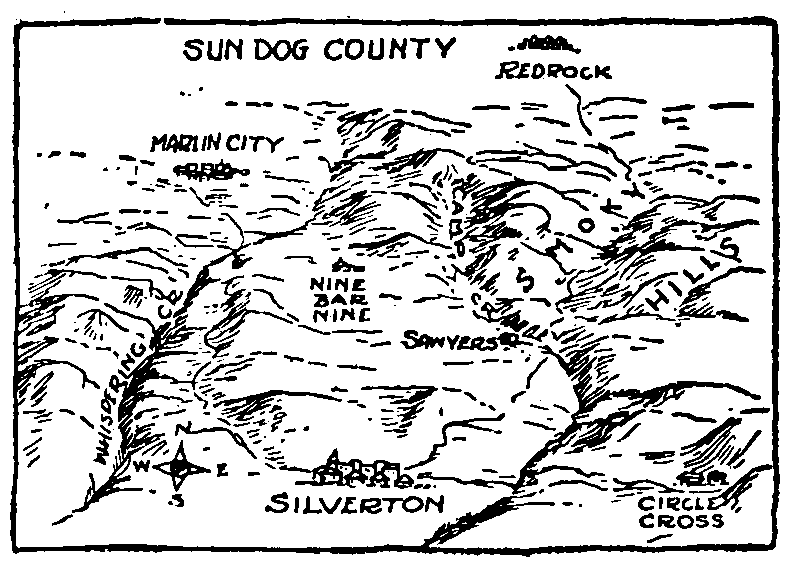
The Nine Bar Nine cattle ranch was located about twelve miles southeast of Marlin City, and consisted of the usual array of badly-in-need-of-repair corrals, a one-story, unpainted ranch-house, with a wide, comfortable porch. The long bunkhouse had been built to accommodate a big crew of hired men; but the herds had never grown too big for three or four men to handle them.
Lafe Freeman owned the place. He was a small, wiry, grizzled man, with keen, gray eyes and a wit which was sharper than a spine on a barrel-cactus. Lafe was one of the old school of gunmen—a fast-disappearing type at this time.
Just now the Nine Bar Nine only had two hired men. “Silent” Slade, a giant of a puncher, with a humorous face, slow of movement, but not slow of temper. A continuous flow of conversation had earned for him the nickname.
Silent wore a fancy chin-strap on his sombrero; cut the sleeves of his fancy shirt off at the elbows and affected southwest type of high-heeled boots, with fancy, stitched tops. He was also a trifle gaudy in the hand-stamped cartridge belt and silver ornamented holster.
“Harp” Harris could ride anything he could cinch a saddle onto, rope anything he could get in reach of, and was physically a human slat. Harp was well over six feet, but so extremely thin that he looked taller. A pair of bat-ears grew almost at right angles with his long, solemn face, and he improvised most of his own music from an ancient jew’s-harp.
Harp Harris split a fried egg exactly down the center, lifted one-half of it on a carefully balanced knife-blade, but stopped with it just short of his mouth, and spoke slowly.
“Wonder if he’s still huntin’ for the joker?”
Silent Slade lifted his head and stared at Harp. Lafe Freeman, the owner of the ranch, placed his knife and fork carefully on his plate and looked at Harp curiously.
“Of whom,” said Silent slowly, “of whom are you speaking?”
Harp deposited the egg carefully within his wide mouth, patted his lips with the knife-blade and proceeded to slide the blade under the remaining half of the egg on his plate.
“Brick Davidson,” he mumbled.
“What about him?” asked Lafe. Brick was the sheriff of Sun Dog County and former employee of the Nine Bar Nine.
“You tryin’ to run Brick’s office?” asked Silent.
Harp upset his egg, with an impatient gesture, and looked at Silent.
“For —— sake, can’t a feller open his mouth without you jaspers takin’ down your ropes? I was just thinkin’ out loud, thasall.”
“He was thinkin’ out loud,” said Silent wonderingly to Lafe. “How would yuh believe that a think could get past that mouthful of egg? Some day he’ll do that with his mouth filled, and them thinks will just bust out all over him, like the hives.”
“Yes, yore funny,” admitted Harp seriously; “I almost laugh—when I look at yuh, Silent.”
Harp lifted his coffee cup to his lips and took a swallow, but it went down the wrong channel, hung for a moment and then caused Harp much physical discomfort. Silent leaned across the table, grasped Harp by the collar and proceeded to hammer him viciously between the shoulders, which was beneficial to Harp and also satisfied Silent’s desire for revenge on Harp.
“If that’s a game—lemme in on it.”
Silent turned and looked at Brick Davidson, who was standing in the doorway grinning widely. Brick was neither of heroic proportions nor god-like of features. His hair was the color of new bricks, and his thin face was speckled with freckles. Nature gave him a wide mouth and blue eyes, and the gods of humor had marked him for their own.
Harp tore away from Silent and glared at Brick through his tears. Then he wiped his face with the back of his hand and took a jew’s-harp from his pocket.
“Don’t!” begged Brick. “Can’tcha be friendly, Harp? I don’t no more than get here, when yuh try to drive me away.”
“Didja ever find out who held up Romeo Kendall?” grinned Silent, shoving a chair out to Brick, who sat down and took out his tobacco and papers.
“Not yet,” admitted Brick slowly, and Harp began to play softly.
Silent reached for the egg platter, and Harp got to his feet, walked to the doorway, where he sat down with his back against one sill and his knees against the other. Harp’s idea of solid comfort was to find a spot where he could fold himself up like a carpenter’s rule.
“What are yuh doin’ over here this time of mornin’?” asked Lafe Freeman.
Lafe absolutely adored Brick Davidson, but denied having a pleasant thought for any one on earth.
Brick exhaled a thin stream of smoke through his nostrils, as he pursed his lips.
“You sold some cows to Dal Melchior a few days ago?”
“Sure I did,” nodded Lafe. “Four thousand dollars cash.”
“Did yuh put the money in the bank, Lafe?”
Lafe shook his head. He was notoriously afraid of banks.
“Lemme look at some of that money?”
Lafe rubbed his chin. Was Brick joking him?
“What’s the idea, Brick?”
“Lemme see the money, will yuh?”
Lafe produced a worn wallet and extracted a couple of bills, which he glanced at and handed to Brick.
“Them two twenties was in the bunch.” Silent and Harp had both moved in close and were watching Brick. If it was a joke it must be a good one, because Brick was very serious. Brick looked up at Lafe.
“Lafe, yuh made a mistake when yuh didn’t bank this money.”
“All right, I’ll bite,” grinned Lafe. “What’s the joke?”
“It’s no joke, Lafe. Mebbe yuh can see somethin’ funny in it, but the fact of the matter is—them bills are counterfeit.”
Lafe snatched the bills from Brick and glared down at them.
“I don’t believe a —— word of it!” he exploded. “I—uh—say, Brick; ain’tcha mistaken?”
“How in —— do you know bad money from good?” asked Harp.
“Do yuh mean to say that all my money is bad?” demanded Lafe.
“Likely all yuh got for them cows is bad,” nodded Brick. “Look close at these bills, Lafe. Do yuh notice that them ain’t silk lines in the paper? Drawed with colored ink. Them bills was in that joke holdup.”
“Don’t stop talkin’,” begged Lafe nervously. “Tell me who made ’em and I’ll go and massacree him.”
“That holdup bothered me,” said Brick. “At first she looks a lot like they was joshin’ Romeo Kendall, but it didn’t make me laugh, ’cause they didn’t razoo him none. I went up and talked with Bob Malloy at the bank. He gets out some of the money and we looks her over. Then Bob gets some kind of a statement from the Silverton bank, which shows that the size of the bills don’t fit the order. The money they got was all twenties and tens, but the papers says that there’s twenties, tens and fives.
“Then Bob sizes up the layout and finds out that the money ain’t worth nothin’—unless yuh can keep it circulatin’. Most of it was danged well made, but we found some that was pretty raw. Them two holdup men opened that box, took out the real money and put in the bad. Foxy, eh? They figured it would be a good joke on Romeo and that nobody would ever find it out.”
“Your danged brains is goin’ to cost me four thousand dollars,” sighed Lafe. “And high-water! I paid Harp and Silent out of that money last Saturday—yesterday.”
“Thasall right,” grinned Silent. “We lost it playin’ faro. I feel better over it now than I did.”
“The bank will make good what yuh got left, Lafe,” said Brick. “They stand to lose ten thousand. Pelham & Malvene ain’t responsible for holdups, bein’ as they won’t handle stuff for any express company.”
Lafe nodded.
“Yeah, I reckon I won’t lose nothin’, but she looks like a hard deal to beat. If it was horse stealin’ or cow rustlin’ yuh might stand a chance, but bad money don’t leave no tracks.”
“Anythin’ crooked leaves tracks,” said Brick seriously.
Lafe squinted at Brick’s face and smiled.
“Brickie, yore goin’ to get married pretty soon, ain’t yuh?”
Brick scratched his nose and shifted his feet.
“Well, I still have hopes, Lafe—as the horse-thief said when the rope broke.”
“You land them fellers who think they’re the mint, and I’ll give yuh half of that four thousand for a weddin’ present.”
Brick grinned—
“That’s danged generous of yuh, Lafe.”
“No, it ain’t, Brick,” Lafe shook his head. “I don’t figure you’ll land ’em.”
Lafe threw back his head and laughed heartily at his own humor.
“I’ll help yuh, Brick,” stated Harp seriously.
“——! This ain’t a perade!” snapped Silent. “Detectives don’t work to music.”
“If Lafe had only put his money in the bank——”
Harp was entirely apologetic.
“Uh-huh!” exploded Lafe. “O-o-oh, yeah! Like you do.”
“Feller gets fore-footed the minute he suggests anythin’,” wailed Harp. “If I got paid a livin’ wage I’d put somethin’ in the bank, but a feller——”
“This,” replied Lafe solemnly, “this is a —— of a time to ask for a raise, Harp.”
“There ain’t no harm in keepin’ your wants before the public, is there?” seriously, “I don’t blame folks for makin’ their own money. If I had a pen and ink——”
“And brains enough,” added Silent. “You’ve got about as much chance of makin’ money with a pen and ink as yuh have of puttin’ on a jew’s-harp concert in New York.”
“Who in Sun Dog has got brains enough?” asked Harp.
“Now yo’re talkin’,” grinned Brick. “It took brains to make that money and it took brains to figure out that way of makin’ a trade. Romeo ain’t got no idea what they looked like, but he swears they had cannons with the wheels taken off and pistol-butts put on.”
“Why in —— do they hire them kind of drivers?” asked Silent, who detested Romeo.
Silent was a giant of a man, with hands like hams, and feet which no ready-made boot would fit.
“Why don’t they hire men like Grant Dale?” queried Silent when nobody seemed to answer his question. “Nobody’d stick Dale up without a fight, y’betcha.”
“Dale would h’ist his hand as quick as Romeo did,” argued Harp. “You and me and everybody would.”
“Don’t argue!” wailed Lafe. “I’ve had some bad news and I want to know what Brick is goin’ to do.”
“Find out who made that money,” grinned Harp. “Anybody’d know what to do now. If I had a clue——”
Silent hunched his shoulders and circled Harp, opening and shutting his hands, as though preparing to annihilate Harp.
“You lemme a-lone!” wailed Harp. “I’m sincere, you danged hippy-pot-a-must!”
“Let him alone, Silent,” ordered Brick grinning, and then to Harp—
“All right; yo’re deputized to work with me.”
“Hol’ on!” grunted Lafe. “Who told you to come here and maverick my hired man?”
“Pa says you can go with the nice man.” Brick patted Harp on the arm. “Take off yore hat when yuh go in anybody’s house and don’t forget yore handkerchief.”
Harp grinned happily, but Silent shoved him aside and glared at Brick.
“Whatcha doin’—kiddin’? If yuh need a good man—I’m here.”
“Much obliged, Silent. Yo’re deputized to take care of the office while me and Harp run ’em to earth.”
“Not me! Oh, not me, Brick! I’ve set in that danged office for weeks and nothin’ come to pass. I need action.”
“Then sweep it out once in a while,” smiled Brick. “Maybe the county won’t allow yore wages, but if they don’t yuh can sue ’em.”
“Where do I get off?” howled Lafe. “Yuh bring me four thousand dollars worth of bad news and then yuh swipes all my hired help. Ain’tcha got no feelin’s?”
“I won’t take ’em if yuh feels thataway, cow-man,” soothed Brick. “I won’t discommode yuh.”
“Don’t short-hand yoreself,” begged Lafe. “I can get along, I reckon. If yo’re still short-handed I’ll let yuh have one of Shep’s yaller pups and a copy of Pilgrim’s Progress.”
“Aw, now yo’re sore at me, Lafie,” feelingly.
“You go plumb to ——!” Lafe bristled like a badger. “Take ’em away, cowboy.”
“I’ll try and return ’em in good order, Lafe.”
“One cinch, they won’t shrink,” said Lafe looking at Harp and Silent. “Nossir, they won’t shrink—unless yuh show ’em some work. If yuh need a real good man—yelp for me.”
“Yuh never can tell,” grinned Brick.
Brick was forced to admit that he did not have the slightest clue to work on. He did not know how counterfeiters worked. In fact it was the first counterfeit money he had ever seen. He realized that it was a job far beyond the ability of any one he knew in Sun Dog county.
Just why they did not get the money into circulation in some other way was of no consequence to Brick. Ten thousand is a lot of money, and he knew that the Marlin City bank would be hard hit.
Marlin City was the county-seat of Sun Dog county, but such an honor rested lightly on its shoulders. It had one street, which was dusty and hot in the Summer and, according to an old inhabitant, “the coldest —— place in North Ameriky in the Winter.”
The buildings were mostly built with false fronts, as if trying to fool the world into thinking that a one-story house could look like two, just because it had a tall front. The Marlin City bank was no exception to this rule. The sheriff’s office fronted on this street, with the jail built at the rear. Of shade trees there were none, and Nature seemed to reserve its cooling winds for the Winter—when no one could appreciate them.
Not having any clues at all, Brick left Silent at the sheriff’s office, tied an extra shirt inside his slicker-roll, and told Harp to “foller him and he’d wear diamonds.”
Silent mourned audibly, but took heart when Brick promised to let him in on anything that looked like real trouble. Silent was a fighter and did not hide his light under a bushel. Harp was also a fighter, but one who did not lead up to it with war-talk. Brick loved them both like a brother, but preferred Harp for this job on account of his ability to keep quiet.
It was mid-afternoon when Brick and Harp rode down the main street of Silverton and went into the livery-stable.
The town of Silverton was much the same type of a cow-town as Marlin, except that Silverton covered more territory, with many vacant lots. Some of Silverton’s business houses had been painted years before, but the weather had bitten deeply in spots, which gave them a splotchy appearance.
Silverton’s one big point of interest was the Short Horn saloon and gambling house.
It was the largest thing of its kind in the country. A number of other places vied with it for the patronage of amusement lovers; but the Short Horn remained supreme.
The main street was wide and dusty, with warped board sidewalks and numerous long hitch-racks, which were generally filled with saddle and work horses. The livery-stable was about the most pretentious building in the town, especially for height, as it required a second story, or loft, for hay. Near the door was a huge water-trough built from heavy planks, and placed in such a way that a horse could drink from it comfortably.
Jimmy McKeever, the stable-man, greeted Brick effusively.
“By jing! Howdy. Long time I no see yuh, Davidson. That ain’t Harp Harris with yuh, is it? Well, I’ll be danged if it ain’t! Never seen him so fat. What did yuh do, Harp, eat a bean sideways?”
“Yo’re a very fresh chambermaid,” declared Harp slowly. “You need teachin’ better manners,” and, with a quick movement of his foot, kicked McKeever’s feet from under him, dropping him on a pile of grain sacks.
McKeever rubbed his chin and grinned up at Harp.
“That,” declared McKeever, “that was plumb sudden.” And then to Brick—
“Did Buck Pelham come back with yuh?”
“Ain’t seen him for a month, Jimmy.”
“Yuh never?” McKeever got to his feet. “That’s funny. He went to find yuh two hours ago.”
“What for?”
“F’r gosh sake, didn’t yuh hear about Grant Dale?”
“What about him?”
“Got killed near Smoky Hill grade this mornin’, thasall.”
“You kiddin’ me, Jimmy?” Brick was very serious.
“Honest to —— I ain’t, Brick. Buck Pelham went to Marlin City to get yuh.”
“We cut across the hills from Whisperin’ Creek,” said Harp. “We must ’a’ missed him thataway.”
“The stage was held up,” explained McKeever. “Ed Sawyer comes along in his buckboard about that time, hears the shot and brings poor Dale back with him.”
“Who took the stage on to Redrock?” asked Harp.
“Who—oh, Dale wasn’t drivin’—Buzzard Bailey was drivin’. Dale quit his job last night, and Malvene had to put somebody on the seat; so he hired Buzzard to drive until he can get a reg’lar man.”
“Much obliged,” nodded Brick. “I’ll see what I can find out. C’mon, Harp.”
“I know as much as anybody——”
McKeever wanted to talk, but Brick and Harp were already outside, headed for the office of Pelham & Malvene.
They found Jeff Malvene humped over his desk going over a bunch of invoices, but he got up as they came in. Malvene was a sallow complexioned person, with puffy eyes, a scraggly blond mustache and a mouthful of discolored teeth. His shoulders were rounded until it gave him the appearance of making a continuous search for something.
Pelham & Malvene’s office was located on the West side of the street, and covered a space of about twenty by forty feet. About in the middle of the room, with one end against the wall, and facing the door, was Malvene’s desk. A couple of extra chairs, a rough cupboard of pigeon-holes full of dusty papers, a stage-schedule and a fly-specked lithograph of Custer’s Last Stand completed the furnishings. The ceiling was low, with a trap-door ventilator almost in the center.
“Buck made good time, I see,” Malvene remarked. He was not very cordial in his manner.
“He missed us,” replied Brick. “Tell me all yuh know about the killin’ of Grant Dale.”
“I don’t know much. Ed Sawyer brought him in and said it happened near Smoky Hill grade. Seems that two men held up the stage and Dale went for his gun.”
“Money on the stage?”
“I don’t know,” confessed Malvene. “Sometimes there is money shipped, but it ain’t advertised. We’re not responsible for valuables.”
“You fired Dale, didn’t yuh, Malvene?”
“Nope—quit. Said he was tired of driving over the same road all the time.”
Brick thought this over, and then—
“Was Dale sore at yuh, when he quit?”
Malvene shook his head.
“Don’t look like he was, does it? Man don’t usually lose his life defending the property of a man he dislikes.”
“No,” admitted Brick. “No, he wouldn’t do that. I’m wonderin’ if it was the same two fellers who held up Romeo.”
“That was a joke,” laughed Malvene. “You can’t make anything else out of it.”
“Can’tcha?”
Brick was very thoughtful. Malvene squinted at him, but Brick turned and looked out of the door where two men, Buck Pelham and Silent Slade, were dismounting. They jingled their spurs across the threshold and Pelham went straight to Brick and held out his hand.
“Missed yuh, sheriff. Suppose you’ve heard about things.”
Brick nodded.
“What there is to know—so far, Buck.”
Buck Pelham was a big, bluff sort of a person, blunt of speech but well liked.
Brick looked at Silent, who was busily engaged in reading an old stage-schedule on the wall, but now he looked at Brick guiltily and took a ring of keys from his pocket.
“Locked up the —— hermitage, and here’s yore keys.”
“Who told yuh to leave the office?” demanded Brick.
“Don’tcha try to boss me, Brick Davidson!” Silent was very emphatic, “I won’t stand for it, I tell yuh. Lemme stay in the open and I’m val’able, but I ain’t worth a dang inside four walls. Marlin City is as calm as a horse-trough, and I’ll be —— if I stay there and let you mockin’-birds have all the fun. Don’tcha ride me, Brick!”
“Glad yuh came, Silent,” said Brick seriously and turned back to Pelham, leaving Silent open-mouthed with surprize. He had expected to go back to the office.
“Got any idea who might do the job, Buck?” asked Brick.
“Not any. Maybe Buzzard Bailey can tell us more when he gets back tomorrow, but he was likely too scared to remember what they looked like.”
“Kinda like Romeo Kendall,” suggested Harp.
Pelham laughed—
“I reckon so, Harp.”
“Why don’tcha hire men to drive yore stages?” asked Silent. “Buzz Bailey is a disgrace to his namesake and Romeo Kendall is a shrinkin’ loco-weed.”
“Dale was a good man,” observed Pelham.
“If they killed him because he was a good man, the rest of your drivers will die a natural death.”
“Tryin’ to make us mad, Slade?” asked Malvene.
“Naw—ashamed.”
Silent turned on his heel and walked outside. Brick grinned at Malvene’s flushed face and turned to Pelham.
“I reckon we’ll have to wait ’till tomorrow and see what Bailey has to say.”
Brick and Harp joined Silent and they went to the Short Horn saloon and gambling house, the largest amusement place in the county. Otto Falk, the portly proprietor met them at the door.
“I am glad to meetcha,” rumbled Otto, shaking hands with all of them.
“First we drink, eh?”
The place was only partly filled, but there was quite a crowd at one of the roulette tables. Brick filled his glass and turned to Otto.
“To Grant Dale, wherever he is, Otto.”
“To Dale,” said Otto softly.
Brick had only met Grant Dale; but Dale had seemed a clean-cut, energetic sort of a fellow, with a friendly smile for every one. His talk did not savor of the range; but he seemed to fit in. He was considered a good driver, and had demonstrated that he was a clever pistol-shot. He was one of those fortunate individuals for whom every one seems to have a kind word.
A dance-hall girl walked behind them and Brick turned to look at her. She was rather pretty and her dress was just a trifle different from the usual tawdry things worn in honkatonks. Otto smiled at her in a fatherly way and nodded toward the cowboys.
“Miss Rosie, I like you to meet Mr. Davidson, Mr. Harris and Mr. Slade. Mr. Davidson is the sheriff.”
The girl smiled in acknowledgment and passed on.
“Rosie she’s a new girl,” said Otto, looking after her. “She sings.”
“She ain’t the regular type, Otto,” observed Brick.
“No. Rosie she just sings. I pay her good, Davidson. Nobody get fresh with Rosie. I think she be in hard luck and take work with me. You must hear her sing.”
“Got a good face,” observed Harp. “Yuh can always tell a good face. Anyway, I can, y’betcha.”
“Yuh must ’a’ picked yours in the dark,” laughed Silent.
They talked of things in general, bought more drinks and went back to the street, where they sat down in the shade and rolled cigarets.
“Well,” said Silent impatiently, “when do we arrest somebody, Brick?”
“Who would yuh select?”
“Somebody who’ll start a fight. I’m honin’ for action.”
Harp humped over and produced his jew’s-harp. Silent glared at him disgustedly.
“——!” he exploded. “If I ever get my hands on that asthmatic organ——”
“I like it,” Brick was serious.
“Yuh do? Well, you can have it, cowboy. If yuh ain’t goin’ to do anythin’, I’ll see if I can find a poker game with a loose chair.”
“Go ahead,” said Brick. “I’ll call yuh if I need yuh.”
They watched Silent hot-foot down the street in search of amusement. A door closed behind them and they turned to see Tony Lynch, one of Otto Falk’s gamblers.
Tony was a pleasant-faced young man, and noted for his honesty at the gambling table. Tony had evidently just dressed, as he was buttoning a very flashy vest as he came up to them.
“Hello, sheriff. Howdy, Harp. How’s things in Marlin these days?”
“Shufflin’ along,” smiled Brick. “Hear about Grant Dale?”
Tony hadn’t, for the good and sufficient reason that he had been asleep since seven o’clock that morning. Brick told him the story as it had been told to him.
Tony frowned over the information—
“That’s —— funny.”
“What is, Tony?”
“About Dale. The games closed early last night. Soapy Caswell wanted to play stud, but wanted me to do the dealing. Buzzard Bailey sat in and we had a three-handed session. Long about five o’clock this morning Bailey dropped out. I think it was about half-past five when Soapy decided to quit and went to his room. A little later on I heard the stage leaving. I looked out and saw Buzzard Bailey driving the stage out of town—alone.”
“Mebbe Dale was inside the stage,” suggested Brick.
“Might ’a’ been,” agreed Tony. “Been used to seeing him on the driver’s seat and never thought about him being inside the stage.”
“Did yuh know Dale very well?” asked Brick.
Tony shook his head.
“No, not very. He’s been here about three months. Nice kind of a boy. Never seen him drinking anything until last night.”
“Drunk?” queried Brick.
“Yeah, he was.”
Brick humped over, tracing meaningless patterns in the dust with a match. Tony watched him for a few moments and sat down beside him.
“Sheriff, do yuh know anything about phony money?”
Brick jerked up his head and stared at Tony.
“Meanin’ what, Tony?”
The gambler took out a long bill-fold and extracted several bills.
“Somebody,” said he slowly, “somebody is passing bad money around here. I’ve collected these in the last four months.”
Brick examined the bills. They were clever imitations.
“Anybody else know about this?” asked Brick.
“Buck Pelham. He got some, too. I showed him the first two I got, but I don’t know who passed ’em to me. That was about four months ago. Since then I’ve got the rest, but I’ve never been able to find who spent ’em.”
“Why didn’t you or Buck notify me, Tony?”
“I wanted to, sheriff; but Buck said it was a job for the U. S. Marshal.”
“Buck’s right,” agreed Brick, “but I wish I had known.”
“Likely a lot of it circulating around. Maybe they thought that a gambler was a good person to pass it on.”
Harp grinned down at the ground. He knew of eighty dollars of bad money that had bought chips for him and Silent, but through no fault of theirs.
“Well, I’ve got to go to work,” stated Tony, brushing off his trousers and replacing the bill-fold. “If I can help yuh any, sheriff—just yelp.”
“Yuh never can tell,” smiled Brick. “Much obliged.”
A small middle-aged man, well dressed, was walking up the other side of the street, going toward the bank. Brick got to his feet and called to him—
“Can I see yuh a minute, Mr. Bray?”
The man stopped and squinted at Brick, as he and Harp crossed the street. Felix Bray was president of the Silverton bank. He was precise in his conversation, held himself aloof from the rest of the community and was not entirely popular in Silverton.
Felix Bray dressed well and his linen was immaculate. He never appeared unshaven. Brick had noted that Felix Bray never seemed to be looking at him while in conversation, but just past him. Bray’s nose was sharp at the end and very thin at the bridge. He had a habit of compressing his lips tightly at the end of a sentence and often closed his eyes, as if amazed at his own wisdom. There was no question but what Felix Bray was a prominent citizen of Silverton, whether Silverton cared or not.
Brick lost no time in idle talk, but went straight to the point—
“Was there any money from your bank on that stage this morning?”
Felix Bray cleared his throat slowly, seemingly reluctant to divulge any information.
“Yuh know it was held up, don’t yuh?” asked Brick.
“I—I heard that it was, sir; but I have no information as to what was stolen. I believe there was a certain amount of money aboard, but am not prepared to say what amount. If it is necessary for you to know the exact amount, perhaps Mr. Nestor can give you the figures, sir.”
“He’s yore cashier?”
“Yes, sir. Is there anything else?”
“Nothin’ but curiosity,” grinned Brick. “Thanks.”
“You are entirely welcome, sir.”
Felix Bray gave a bird-like nod of his head and went on up the street.
“Nestor, eh?” mused Brick aloud. “Know him, Harp?”
“Heard of him,” grinned Harp. “Heard that he went out to see Soapy Caswell’s daughter. Soapy got real tough and told Nestor to rattle his hocks off the Circle Cross. Said he’d be —— if his daughter would ever marry a counter-jumper.”
Brick grinned—
“Soapy is goin’ to raise Susie to be a old maid, don’tcha know it? Cashier of a bank ain’t so bad.”
“Soapy’s got so danged much money that he likely wants Susie to marry some prominent galoot,” said Harp.
A tall, cadaverous individual was going down the street, but hurried across when he saw Brick and Harp.
“Howdy, Doc,” greeted Brick.
Doctor Bridger shook hands with them solemnly. Doc always appeared solemn. He was a fixture in Silverton, and had a sure-thing business. He was the only M. D., owned the only drug store in the town, and was coroner and undertaker. No matter whether the patient survived or not—Doc profited thereby. It was a business in which levity had no part.
“Suppose you’re down here on the Dale case. Hold an inquest as soon as the stage gets in tomorrow,” said Doc.
“Have yuh examined the body?”
“Yes. Dale was shot with a .45 caliber gun. The bullet severed an artery near the heart. Death was instantaneous.”
“Bullet go plumb through him, Doc?”
“No, not quite. It ranged downward. Malvene says that Dale was a very good shot, but he did not have a chance, I suppose.”
“I don’t reckon he did, Doc. I’ll be plumb glad to hear what Buzzard Bailey has to say.”
Buzzard Bailey was not unlike the bird after which he was named. He was slight of frame, stoop-shouldered and with a parchment-like scrawny neck, which appeared wattled at times. His face was bony and his nose prominent.
His testimony showed that Dale had been a passenger on the stage and had resisted the attempt of two masked men to rob the stage, during which time he was shot and killed. Sawyer had appeared on the scene, coming toward Silverton, and had offered to take Dale’s body to town. Buzzard’s testimony was short and to the point.
“Where was Dale going?” asked Doctor Bridger.
“Redrock,” replied Bailey.
“Paid his fare?” asked Brick.
“N—not to me,” said Bailey. “He said that Malvene——”
“I wouldn’t take his money,” said Malvene generously.
“Was Dale on the seat with you?” asked Brick.
“Yeah—sure he was.”
“When yuh left Silverton?”
“He was drunk when the stage left,” volunteered Malvene. “Too drunk to ride outside; so we put him inside the stage.”
“He sobered up and made me stop and let him onto the seat,” said Bailey. “We just got to the curve on that little grade this side of the Camp Creek crossin’ when these fellers popped out of the brush. Dale went for his gun, but they beat him to it. They made me dump off the money box. One of ’em held a gun on me and told me to mind my own business. I dunno what the other one was doin’, but all to once they both vamoosed into the brush and then Ed Sawyer came along.”
“Yuh don’t know how much they stole, do yuh?” queried Brick.
Bailey shook his head.
“Nothin’, I reckon. The box was there on the road behind the stage. I put her back on and turned it over to the bank at Redrock. If there was anything stolen the bank never said nothin’.”
“How much money did you have in the box?” asked the doctor.
“——, I dunno, Doc. She’s locked when I got it.”
“The man who fired the shot—was he down on the lower side of the grade, Bailey?”
“Uh-huh—in the brush.”
“Any more questions you care to ask, sheriff?” inquired the doctor.
Brick smiled and shook his head.
“No, I reckon I’ve found out all I expected to; which may be sufficient.”
“Got an idea, sheriff?” asked Buck Pelham.
“Y’betcha, Buck. C’m on, boys—” this to Silent and Harp.
“What I don’t know is this,” said Harp, “I——”
“Don’t start recitin’,” begged Silent. “What you don’t know would take a danged long time to tell.”
They sauntered down to the livery-stable and sat down on the horse-trough, which was in the shade. The trough was about half full of water, with six inches or so of muddy sediment at the bottom. Brick was slowly rolling a cigaret and staring down at the surface of the water, where a few flaky crumbs of tobacco had fallen. Suddenly he leaned closer and peered downward.
Pulling back the sleeve of his shirt he reached to the bottom of the trough and brought out a muddy Colt pistol. The light had flashed on the metal across the bottom of the butt, all of the gun except that part being buried in the sediment.
“For —— sake!” grunted Silent staring at the dripping weapon. “Whatcha know about that?”
Brick dried the gun on a handkerchief. It was a .44 caliber, with yellow bone handle, but without any distinguishing marks to identify it.
“Now, who in —— throwed their gun in the trough?” wondered Harp. “Must ’a’ been drunk or crazy.”
“Here comes somebody,” whispered Silent. Brick shoved the gun inside his chaps and turned to see “Nebraska” Yocum and “Curley” Klein coming near them. Nebraska was a mouthy sort of a cowboy, but Klein was a sullen sort, who wore his holster tied down.
Nebraska was thin-faced, with close-set colorless eyes and a shock of blond hair scraggled over his forehead below the line of his sombrero. He had one front tooth missing from his thick-lipped mouth. Klein was small and dark, with a Hebrew cast of features and close curling, black hair. The whites of his eyes were shaded darkly, like the eyes of an Indian. Both men were wearing gay colored shirts and gayer colored mufflers. Nebraska affected bat-winged chaps; but Klein wore tight-fitting pants, tucked in the tops of his boots.
“Hi-yah, sheriff,” greeted Nebraska loudly. “Waitin’ for some horse-thief to ride up to water his horse?”
“Mebbe,” grinned Brick.
Klein walked on into the stable, but came back out in a moment and circled the trough as though looking for something.
“Find it?” asked Nebraska.
Klein shook his head—
“Naw, it wasn’t there.”
Brick did not question him, but Nebraska volunteered the information that Klein had lost his gun.
“I reckon I was pretty drunk,” admitted Klein, slapping his empty holster.
“What kind of a gun was it?” asked Harp.
“Six-gun,” growled Klein sullenly.
“Which covers several varieties,” said Harp slowly. “Was this anythin’ out of the general run?”
“Good gun,” muttered Klein.
“What size?” asked Silent.
Klein squinted at Silent for a moment.
“Man sized, if yuh want to know, Slade.”
“Yo’re just as well off without it,” drawled Silent. “Yuh ought to pack a .22.”
Klein muttered a curse and his hand slid to his empty holster. Silent glanced at his hand and then at Nebraska.
“Loan him yore gun, Nebraska. He’s soreheaded like a old she bear, and if he wants action——”
Klein glared at Silent for a moment, but turned and went into the door of the livery-stable. Nebraska shrugged his shoulders, grinned at Brick and went in behind Klein.
“Watch out, Silent,” cautioned Harp. “That —— Klein had a gun in his holster when he went in there the first time.”
“He won’t shoot,” said Brick. “Not with three of us here. Now who in —— lost this gun and why does Klein want it?”
“Don’t yuh reckon it belongs to him?” asked Harp.
“If it did he’d describe it. He knows that somebody lost a gun and he wants to get it before somebody else does.”
Nebraska rode out of the stable door and swung his horse up to the trough.
“You didn’t find his gun, did yuh, Brick?” he asked.
“No,” replied Brick. “No, I never found his gun.”
“He got paralyzed drunk last night and lost it,” explained Nebraska. “Feller hates to lose his gun. Sore as a bear about it. Wanted him to come out to the ranch, but he says he’s goin’ to sleep in the stable for a while and then hunt some more for his gun.”
“You still with the 88 outfit?” asked Brick.
“Naw, I’m with Soapy Caswell—the Circle Cross. Me and Curley and ‘Snookie’ Duggan. I’m foreman now, Brick.”
“That’s nice,” agreed Brick. “Mebbe I’ll come out and see yuh some day.”
“Come ahead,” grinned Nebraska. “We’d sure welcome yuh.”
Nebraska swung off down the street.
Brick shook his head in wonder that Soapy Caswell should hire those three cowboys to guide the destinies of the Circle Cross. Duggan was the most unsavory of the lot, which did not mean that Klein and Nebraska were good citizens, by any matter of means.
Soapy was a solid citizen, but his interests seemed to be more centered around a poker table than they did around the Circle Cross ranch. Soapy was as crabbed as a badger and his tongue was vitriolic to a startling degree, but nobody disliked him because of his disposition. Soapy did not like Brick, whose very presence seemed to irritate the old cattleman. Soapy was touchy about certain things—things which Brick never failed to mention.
Brick got up and cautiously handed the pistol to Silent, who was wearing a coat.
“Slip that into your pocket, Silent; but for gosh sake don’t let anybody see it. I’m goin’ to see if I can find Soapy Caswell.”
“He’s up at Otto’s place, bogged down in a poker game,” said Harp. “You better wait ’till he gets through.”
But Brick waited for no man. Soapy looked up as Brick came in, and growled something inaudible as Brick moved in behind his chair. He shook his head at the dealer and moved back his chair.
“Got a —— jinks behind me,” he growled. “Deal me out.”
Brick smiled and walked back outside and in a moment Soapy joined him, grumbling about his run of ill-luck. They stopped at the edge of the board sidewalk. Across the street a couple of cowboys were settling an argument over which could jump the farthest, while several more stood on the sidewalk and made uncomplimentary remarks on the ability of both contestants. One of them made a jump, landed on his knees and sat down on his own spurs, much to the amusement of his competitor and the audience. Soapy watched them for a moment, with no trace of a smile on his face, and turned to Brick.
“Couldn’t win ’f I had the pick of the deck. Whatcha want, you red-headed raw-hider?”
“What makes yuh think I want anythin’?” grinned Brick.
“Go ahead—I’m listenin’,” said Soapy seriously.
“You got three nice burglars workin’ for yuh, Soapy.”
“Have I? What do you care who works for me?” Soapy was very indignant.
“Keep cool,” advised Brick. “You never bit anybody yet, Soapy.”
Soapy glared at Brick, masticating rapidly.
“Yo’re a —— old fool,” stated Brick. “Drinkin’ and gamblin’ and hirin’ crooks to run yore cows. Ain’tcha ashamed? Hirin’ cowboys who get paralyzed drunk and lose their guns.”
“Who did?” demanded Soapy. “Who got paralyzed and lost his gun?”
“Curley Klein did—last night.”
“Like —— he did!”
“Sure did, Soapy. I found the gun in the horse-trough.”
Brick grinned triumphantly, but Soapy demanded to see the gun.
“I’ve got her,” stated Brick. “Forty-four Colt, with yaller bone handle.”
“Smart, ain’tcha?” chuckled Soapy. “Oh, ve-e-ery smart; but Klein’s gun ain’t a .44 and it ain’t got bone handles.”
“Much obliged, Soapy,” grinned Brick. “Go back to yore little game and lose a few more cows.”
Brick sauntered off down the street, whistling unmusically between his teeth, while Soapy swore wonderingly and went back to his game.
Buck Pelham was alone in the stage-office when Brick came in, and Brick lost no time in opening conversation.
“Buck, how long ago did yuh first find out that bad money was rangin’ around here?”
Pelham rubbed his chin, wondering where Brick got his information.
“Did Tony tell yuh, Brick?”
“Yeah, but I knew before that, Buck. That Romeo holdup wasn’t no joke, but everybody don’t know it. There was ten thousand dollars in counterfeit in that treasure-box, when it got to the Marlin City Bank.”
“Is that a fact, Brick?”
“Uh-huh. Tell me what you know.”
“Not very much, Brick; except that most of the currency in the country is bad stuff. Used to be that silver and gold was about all yuh ever got hold of, but in the last few months it seems to have kinda dwindled down and currency took its place.”
“But where does it start from, Buck? There’s got to be some place where it starts, ain’t there?”
Buck nodded slowly.
“Sure has, Brick. You find the men who killed Dale and you’ll have the men who are flooding the country with bad money.”
Brick silently agreed. He had met Dale, but knew little about him. He seemed entirely capable.
“Where did Dale come from, Buck?”
“Came here from Miles City, Brick. He was a good man.”
“Do yuh reckon he was mixed up in this stuff in any way?” asked Brick. “Mebbe he knowed——”
“No, I don’t think Dale was mixed up in it. He wasn’t that type, Brick. I knew Dale pretty well, I think.”
“Do you think he was killed because he went after his gun?”
Pelham frowned at the wall for a moment.
“I wish I knew just what happened, Brick.”
Brick yawned and grinned.
“I’ll tell yuh just as soon as I find out, Buck. Adios.”
Romeo Kendall was coming in as Brick went out, and Romeo was very anxious to talk about holdups with Brick.
“Had any luck, sheriff?” he asked.
“I quit playin’ my luck a long time ago,” replied Brick. “How would yuh like to have me show yuh the fellers who held you up, Romeo?”
Romeo rubbed the back of his hand across his lips and said—
“I—I reckon somebody was funnin’ with me.”
“We’ll ask ’em pretty soon,” grinned Brick.
Romeo gawped at Brick, who brushed past him and went across the street into Otto’s place.
The place was partly filled. A number of men were standing at a poker table, watching Soapy Caswell, who was betting recklessly. Over at the piano an emaciated-looking young man was explaining a piece of music to the girl, Rosie.
Brick sat down and began to roll a cigaret, but looked up and noticed that the girl was watching him. She nodded to the piano-player and came slowly up to Brick, who got to his feet.
“I was just looking over a new song,” she said.
Brick nodded. For several moments neither of them said a word and then the girl said softly—
“Have you investigated the killing of Grant Dale?”
Brick stared at her curiously, and it suddenly struck him that perhaps the girl had been interested in Dale.
“Yes’m, I’ve kinda pried into it a little.”
“Do you know a man they call Nebraska?”
Brick nodded slowly—
“Yes’m. Name’s Yocum.”
“He and Dale were together about midnight. I heard him tell Nebraska that he was going to bed because he had to take the stage out the next morning.”
Brick studied the toes of his boots for a while.
“He likely meant that he was leavin’ on the stage,” said Brick. “He was headin’ for Redrock. Kinda looks like he went for his gun and they nailed him, ma’am.”
Brick turned his head and saw Buck Pelham coming in the door. He glanced around, saw Brick and came straight to him.
“Just got word from the Redrock bank, sheriff. Their money was intact. Nothin’ missing.”
“Another Romeo, eh?” smiled Brick, but Buck caught his meaning.
“Maybe. Barely possible that they heard Sawyer comin’ and beat it.”
“They did not,” declared Brick. “Two road-agents are not goin’ to lose a box of money, after killin’ a man. They’d at least stay and see who it was, and it’s a cinch that they’d ’a’ stood Sawyer in a corner while they helped themselves.”
“I reckon you’re right,” agreed Buck. “I hope yuh find the guilty ones, Brick. I liked Dale. He was a nice feller and drove well and he never got drunk until last night.”
“Got loaded for bear, eh?”
Buck nodded—
“Malvene said he was so drunk that they loaded him into the stage at the stable. Let me know if I can help yuh in any way, Brick.”
“Yuh never can tell,” replied Brick. “Much obliged.”
Buck sauntered back to the door, and Brick turned to the girl.
“Was Dale drunk when you saw him last night?”
“No. I did not see him take a drink during the evening.”
Brick scratched his head thoughtfully and nodded.
“Thank yuh, ma’am. I’m sure obliged to yuh, and that’s a fact. Adios.”
Brick walked straight to a roulette layout, where Tony Lynch was spinning the wheel for a lone customer, Curley Klein. Klein looked up at Brick, watched Tony rake in the bet and walked away. Brick watched him stop at the poker table and then turned to Tony.
“Did you see Grant Dale drunk last night, Tony?”
The gambler thoughtfully rubbed his forehead, but shook his head quickly.
“No, I didn’t, Brick. I heard—danged if I don’t believe it was——”
Tony glanced at the crowd around the poker table, and called—
“Klein!”
Klein turned and looked at Tony, who motioned for him to come over. Klein was in an evil frame of mind, judging from his sullen countenance, and Brick noticed that his holster held a gun.
“Whatcha want?” he half growled.
“Wasn’t it you who told me last night that Dale was blind drunk?”
Klein squinted hard at Tony and hesitated for a moment before he said:
“Well, what about it? Ain’t a man got a right to get drunk?”
“What time was this?” asked Brick.
Klein turned his head and looked at Brick—looked him over from boots to hat and his lips curled sarcastically.
“None of your —— business!”
Klein’s right hand had dropped to his gun as he spoke, but Brick did not seem to notice this. They were only about three feet apart—so close that the first shot would win. Brick laughed—laughed as though Klein had sprung the one big joke of the season. Klein’s hand dropped away from his weapon and he shifted his glance to the gambler, as though seeking an answer to all this merriment.
The shifted eyes was all that Brick required. Like a flash he whipped his left fist flush against Klein’s jaw, knocking him into the roulette wheel. Before Klein could recover from his astonishment Brick’s right fist swung in a short arc to the angle of his jaw on the opposite side from the first blow, and Klein lost all interest in things.
It all happened in a few seconds, yet the room was in an uproar by the time Klein slid to the floor. Brick backed against the bar and Buck Pelham crossed over beside him. Brick did not know how many friends Klein had in the place, and he was not taking any foolish chances.
Klein sat up in a moment and looked around vacantly. He felt of his lower jaw and got slowly to his feet. Soapy Caswell scowled at Brick and at Klein.
“What was it about, sheriff?” asked Otto nervously.
“I asked him a question—a question he could have answered, and he told me it was none of my —— business,” replied Brick evenly.
“Was it any of yore business?” queried Soapy.
“It sure was, Soapy.”
Soapy turned back to the dazed Klein.
“Yo’re fired, Klein! Understand what I’m sayin’? You’ve got six days’ pay comin’ to yuh. Go out to the ranch, roll yore little bundle and shake loose from the Circle Cross. Here’s yore six-days’ pay.”
Soapy handed Klein some money and Klein put it in his pocket. His jaw seemed to bother him considerably, but he did not look at Brick as he went out of the door. Soapy turned back to the poker table, talking loudly.
“I ain’t got a —— bit o’ use for the sheriff, but I ain’t goin’ to let my hired men talk back to him, y’betcha.”
Brick grinned at Buck Pelham, but Buck was serious.
“Look out for Klein, Brick. He’s a killer if there ever was one, and he won’t forget very quick. Whoo-o-ee! Boy, you sure do hit hard and fast. Mind tellin’ me what yuh asked him?”
Brick explained the question and quoted Klein’s reply.
“Klein got drunk last night and claims he lost his gun,” added Brick. “I found a gun today. Klein refused to describe his gun; so he didn’t get a look at the one I found.”
Buck did not seem curious to know what kind of a gun Brick had found; so Brick continued:
“Who got Dale’s gun, Buck?”
Buck shook his head.
“I dunno. I haven’t seen it, Brick. He must ’a’ had it with him when he was killed; but it’s kinda funny he never turned it in when he quit. The gun he carried belonged to me—or rather to me and Malvene.”
“Black-handled .45 Colt?”
Buck shook his head. “Nope. Forty-four Colt, with yellow bone handles, Brick.”
“Oh,” breathed Brick without a sign of surprise. “Well, I reckon I’m goin’ to put on a little food. See yuh later, Buck.”
“Watch out for Klein,” cautioned Buck.
Brick grinned and went out of the door. It was growing dusk. Brick looked up and down the street, but there was no one in sight; so he crossed the street and went into a restaurant.
Silent Slade declared that he was having the time of his young life. He had found a vacant seat at a poker table in McGill’s saloon at the lower end of the street, and for the first time in years the god of good-luck smiled upon him.
McGill’s place was a small saloon, with space enough in front of the bar for a couple of tables. McGill was a fleshy-jowled sort of a person, with pig-like eyes and a round, fat nose. His lower lip had sagged from years of holding the unlighted butt of a cheap cigar, and he talked in a strangled, husky voice, caused no doubt from too much cheap whisky.
But the place and proprietor did not affect Silent in the least. His working capital had been the lean sum of one dollar and seventy-five cents, but several successive showdowns had given him enough to do business on a larger scale; with the result that he owned most of the money in the game.
Just now Silent was generous in his words; which seemed to annoy Romeo Kendall and “Snookie” Duggan, who were in the game. McGill was also in the game and McGill did not like Silent Slade. Duggan was a square-built cowpuncher, with a lantern jaw and a crooked nose. His forehead sloped back sharply from his eyebrows, which showed no break between them. Suspicion seemed to dog his tracks, but he was either clever enough or lucky enough to keep one jump ahead of the sheriff. Duggan’s eyes were like the eyes of a chimpanzee—nearly round in shape and half hidden under his eyebrows.
“You fellers ain’t got the courage to back up yore hands,” complained Silent as he drew in a fair sized pot. “You play cards like li’l children. Duggan had me beat in sight, but his mind tells him that I’ve sure got somethin’ from a ten to a ace in the hole, which mates up with one of them three face-cards in sight. Duggan thinks he’s smart as ——, when he figures thataway, but li’l old man Slade’s son only had a trey in the ho-o-ole, thasall.”
Duggan shifted in his chair. Silent’s jovial sarcasm was making him nervous.
“Li’l chips all comin’ home to roost,” chuckled Silent as he peered at the corner of his hole-card. “Don’t nobody figure me for a trey in the hole this time.”
“First king bets,” intoned the dealer, and Silent shoved in a full stack of blue chips.
Duggan had the other king, and called the first bet. Romeo stayed with a seven in sight.
“Romeo thinks we’re kiddin’ like holdup men,” chuckled Silent, and Kendall flushed at the gibe.
Another king fell in front of Silent and he roared with unholy mirth. Duggan shoved back his chair in disgust.
“You can’t win, Duggan,” laughed Silent. “Nobody who works with men who lose their guns can win at anythin’.”
“Who lost a gun?” asked McGill.
“Curley Klein. Got drunk and lost his weepin’,” Silent drawled humorously.
“How do yuh know he did?” asked Romeo.
“’Cause, m’ little dearie,” explained Silent slowly, “’cause it hath been found, that’s why. Mebbe Klein thought he was a fish, ’cause it was found in the horse-trough. Brick Davidson was a heap pleased over it, but didn’t want to carry it himself.”
“Who took it?” asked Duggan quickly.
“Ol’ man Slade’s handsome offspring. Yessir, the beautiful child got the gun. Klein gets cocky and refuses to tell us what she looks like.
“‘What size?’ asks the sheriff.
“‘Man size,’ says Klein, and then I told him he ought to pack a .22. Haw! Haw! Haw!”
Duggan looked past Silent and made a move as though to get out of his chair. Silent turned and saw Klein near the table, facing him, and Klein’s face was black with rage.
For a moment they looked at each other, while the room went deadly still. Then Klein said:
“This time I’m goin’ to laugh.”
He barely finished the sentence when he drew his gun. Silent was in no position to draw, but he did not lose his nerve for a moment. Like a flash he ducked half under the table and reared straight ahead, upsetting the table, and as he threw himself forward his left arm encircled Snookie Duggan, throwing Duggan between himself and Klein.
Klein fired once, and the bullet tore through the edge of the table, burning Silent’s forearm, but he was unable to fire again for fear of hitting Duggan. Romeo tried to get out of the way, but Silent and Duggan crashed into him and the three of them went down in a heap.
Klein was backing away from them, trying to get a shot at Silent, who had a strangle-hold on Duggan, holding him right against him as a shield, while he slowly worked his gun from his twisted belt. Klein realized what Silent was doing and took a chance. His bullet clipped through Silent’s hair, but Silent suddenly let loose of the half-throttled Duggan and rolled free, shooting as he rolled.
Klein fired once more, but his aim was hasty and the bullet hit the wall a foot above Silent’s head. Silent fired twice. Klein’s right arm went as limp as a rope and his gun fell to the floor. For a moment he shifted his balance and then sat down hard on the floor.
“Set ’em up in the other alley!” grunted Silent, sliding to his feet.
Duggan’s gun had fallen from its holster in the struggle and now he reached for it, but Silent’s gun roared again and the bullet spun the gun off across the floor.
Romeo rubbed his bruised knees and stared at Silent. McGill had made no move to interfere. Silent looked at the wrecked card-table and at McGill.
“I’ll take two hundred and fifty and call it square, McGill. I had that much in front of me.”
McGill did not hesitate, but took a fat wallet from his pocket and began peeling off bills. Klein’s right arm was out of commission and he was almost sitting on his gun; but he made no move to use his left hand.
Silent accepted the bills from McGill, backing against the wall as he counted them. Watching the men he stepped to the table and tossed several of the bills to McGill.
“Come again, Mac; those are counterfeit.”
McGill glared at Silent and at the bills.
“You’re crazy!”
“If I take ’em,” amended Silent. “Gimme good money.”
McGill opened his wallet and took out a number of well-worn bills, which he passed to Silent. Then he took the ones Silent had rejected, looked closely at them and replaced them in his wallet.
“How do yuh know them bills are counterfeit?” asked McGill.
“Make a li’l guess,” grinned Silent, backing toward the door. “So-long, Klein. I still say yuh ought to pack a .22.”
Silent had stopped in the doorway, facing the center of the room. As he slowly turned to step outside, something crashed against his head and he fell sprawling on his face.
Brick heard the shooting and went to the door, but was unable to locate the direction of the shots. Harp came across the street and joined him, but was not able to tell where the shooting was. Pistol-shots were common in Silverton, but these shots had been spaced as if it was something besides an exuberant cowpuncher celebrating.
“Sounded to me like she might be down by McGill’s place,” stated Harp. “There was one shot, and then in a little while another and then another. Then two shots pretty close together. Where’s Silent, Brick?”
“Wasn’t he with you, Harp?”
“Naw. I’ve been in Scotty’s place. Went lookin’ for you, and I reckon I was in every place except McGill’s; but I didn’t see Silent.”
Brick swung away from the door, leaving his hat in the restaurant, and Harp trotted at his heels. It was about two blocks to McGill’s place. No one else had heard or paid any attention to the shots, which were a common thing in Silverton. It was the usual thing for a cowboy to announce his departure with a shot or two; but it was the spacing of these shots that aroused Brick’s suspicion.
Brick halted near a window and looked inside. McGill was standing near the bar, reading a newspaper, while Romeo Kendall was alone at a card-table, playing solitaire. There were no other men in the place.
All was peace therein, but Brick was not satisfied. He walked around behind the saloon. About a hundred yards away was an old barn and corral; an indistinct mass in the night. Suddenly a match glowed dimly, as though cupped in a hand, and went out.
Brick and Harp walked slowly in that direction and reached the corral fence, but there was no sight nor sound of the party who lit the match. Came a low-pitched, half-grunt, half-groan, and the figure of a man seemed to detach itself from the heavy shadow.
“Who is that?” asked Brick softly.
For several moments the figure did not reply, and then—
“Who in —— do yuh reckon it is?”
“Silent!” grunted Brick.
“Yeah—Silent! What in —— hit me, Brick?”
“Did yuh get hit?” asked Harp quickly.
“Didn’t yuh feel the jar?” wailed Silent. “By grab, it sure made cream out of the Milky Way. Did I get hit? Kinda.”
“What did yuh get hit with?” asked Brick.
“Think I selected it?” wailed Silent.
“Yuh didn’t get shot, did yuh?” This from Harp.
“Didn’t I? Thanks, Harp. I’m sure as —— glad there’s somethin’ that didn’t hit me.”
Silent got painfully to his feet and rubbed his head. His hand went to his holster and he grunted aloud.
“They went fifty-fifty with me on guns, anyway.”
“Did—did they take the gun I found?” spluttered Brick.
“No-o-o,” drawled Silent. “They pulled m’ shirt out all the way around to get the one I put inside though.”
“That was the one I gave you, Silent.”
“Naw, it wasn’t. I figured that Klein might hanker for that gun, and I played safe and put that yaller-handled one in my holster. Danged good gun, Brick. I sure winged Klein with it. We had a nice li’l party while it lasted, but some snake-hunter popped me on the nut as I backed out the door.”
“Out of McGill’s place?” asked Brick.
“Uh-huh.”
Silent searched his pockets and grunted mournfully:
“They took all m’ money—the danged burglars. It was good money, too. I made McGill take back the counterfeits and pay me in good old U. S. A.”
Gradually Brick drew the whole story from Silent, but he was unable to tell who hit him. It was a certainty that it was neither Klein, Duggan, Romeo nor McGill. Whether any of them had a hand in taking Silent away from the doorway would be hard to prove.
Brick was sorry that Silent had mentioned the bad money and also that he had told of finding the gun. Somehow Brick knew that there was a connection between that lost gun and some of the other things, but just what it was he did not know. He wondered if Soapy Caswell was mixed up in it in some way, and if he discharged Klein for the effect it would have in his favor.
It was easy enough to see why Klein made his gun-play at Silent. Klein was smarting from the fight at Otto’s place, sore at Silent for what he had said in front of the livery-stable, and when he heard Silent repeating it—well, it would make any man fight. Duggan would probably assist Klein, if he had a chance. McGill had made little protest on taking back the bad money, but that meant nothing. If there was a lot of the counterfeit in circulation a saloon-keeper would get more than his share, especially in a town like Silverton, where every other building is a saloon.
Silent was leaning against the corral fence rubbing his head. Harp had sat down on a pile of poles, but Brick stood apart, thinking deeply.
Moonlight silvered the old pole corral and softened the harsh outlines of the rough barn. From far up the street came the shrill notes of a violin, and the hoarse voice of a man, calling a quadrille:
“Balance all! Swing yore pardners!”
A man walked between them and the rear of McGill’s place, carrying a lighted lantern, which cast a grotesque shadow of enormous legs; which seemed to take long steps but did not. He stopped at a shack, and the lifting-lever of his lantern creaked as he lifted the chimney and blew it out. From far out on the hills came the yip-yip of a lonesome coyote.
Suddenly Harp began playing soft and low—
“Tung-g-g-g, bong-g-g, zung-g-g-g, hung-g-g”
“My ——!” wailed Silent, shoving away from the fence. “How hard do I have to get hit to save me from that danged jews’-harp? I reckon I’ve got a awful hard head, but my ears are awful sensitive. Aw-w-w ——! He won’t quit, Brick; so we might as well go away. I’m hungry—c’mon.”
“Give me that gun, Silent,” said Brick. “I’ll feel better if I’ve got it. You talk too danged much.”
“Leaves me crippled,” wailed Silent. “I’ve got enemies; don’tcha know I have, Brick?”
“Home-made ones,” grunted Brick, passing his own gun to Silent. “If yuh lose my gun I’ll run yuh plumb into Canada.”
“Whatcha want that yaller-handled smoke-pot for?” asked Harp.
“This,” said Brick, fitting it into his holster, “this here yaller-handled gun is the one Dale packed.”
“Heaven is my home!” grunted Silent. “Dale’s gun? Did he get drunk and throw it away, Brick?”
“Dale wasn’t drunk until after midnight, and nobody seen him take a drink after that.”
They walked back past McGill’s place. Silent turned and looked at the windows.
“They done me wrong in there,” he declared, “and I’m goin’ back and see what they’ve got to say. Ain’t goin’ to let nobody pat me over the head without me remindin’ ’em of it.”
Romeo was not there when they went inside. McGill, the lone inhabitant, looked up from his paper and visibly flinched at the sight of Silent’s blood-streaked features and Brick’s bare head. It looked like trouble to McGill and he didn’t want trouble. He knew this trio well enough to know that they were not to be trifled with.
“Somebody tapped me over the head,” stated Silent, looking around and back at McGill. “They took my money and my gun, McGill. I was still inside yore place when said tappin’ was done. Bow to the gentlemen and recite yore piece.”
“And nothin’ but the truth,” added Brick meaningly.
“Honest to ——, I dunno anythin’,” declared McGill. “If you remember, Slade, I ducked behind the bar. I can’t stand shootin’, honest I can’t. After you and Klein shoots at each other I gets all kinda trembly-like, and I was afraid you’d smoke somebody else up; so I ducked. Don’tcha remember me duckin’, Slade?”
“Just like you remember who hit me,” grunted Silent.
“I tell yuh I dunno,” wailed McGill. “Duggan helped Klein out of the place, I know that. I think yuh hit him twice in the same arm. Anyway he’s sick. Romeo never left until a few minutes ago, but none of ’em mentioned that you got hit. Mebbe yuh fell against the door—or somethin’.”
“Yeah!” snorted Silent. “Mebbe I threw away my money and my gun. I’ve got a —— good notion to shoot yuh right loose from yore shirt, McGill. I’m bettin’ that yuh know who hit me and you’ve likely got that money in yore till right now; but we’ll let her go as she lays—for now. I ain’t noways grudgin’ anybody what shoots at me, but I sure do hate —— out of a danged head-hunter.”
McGill opened his mouth several times, as though searching his soul for placating words, but the three indignant cowpunchers turned and walked outside. McGill went to the door, where he stood for several minutes. Then he sacrificed gain for safety by blowing out his lights and locking his doors.
Brick got his hat at the restaurant, and left Silent and Harp devouring large quantities of ham and eggs. They were both too hungry to question him, and Silent propped his head with one hand while he ate. A lump the size of an egg had raised on the side of his head, which he explored tenderly, as he ate.
Brick had several questions which he wanted to ask Malvene, who lived just at the outskirts of the town in a small cottage.
Brick knew the place, although he never had been there.
A light was shining under the drawn curtain of the large front window. Brick picked his way carefully up the narrow graveled walk, with its sidelines of white boulders, until he came to the small porch, which was partly covered by a climbing rose. The porch creaked with the weight of his feet and he listened for a moment before knocking softly on the door.
A tall, angular woman answered Brick’s knock, and he asked for Malvene.
“He ain’t here right now,” she replied. “Want to come in and wait fer him?”
Brick did want to. The woman led him through a narrow, uncarpeted hall and into a living-room, where a shaded oil lamp dimly lighted up the room. Brick glanced around. Hanging on the opposite wall was a large crayon-portrait of a hard-faced man, standing stiffly in all the glory of a frock coat, head thrown back as if challenging the world, and with one hand buried to the wrist inside the buttoned bosom.
Several red plush chairs were placed at regular intervals around the room. A small parlor organ stood in one corner, with an unlighted lamp on each side-bracket. Brick could see an embroidered motto framed on the wall, which showed dimly, “We Mourn Our Loss.”
A large chair, with a high back, was beside the table, and as Brick looked around, a man suddenly got up, like a jack-in-a-box and looked at him. He was a dark-complexioned, anemic-looking person, wearing heavy glasses. He was collarless and in his shirt-sleeves.
The woman turned to Brick.
“What—I don’t believe you spoke yore name.”
“No,” said Brick, “I don’t reckon I did. Yo’re Mrs. Malvene, ain’t yuh? I thought yuh was. I’m Brick Davidson.”
“Oh, yes. Mr. Davidson, meet Mr. Nestor.”
“Yeah,” drawled Brick, as they shook hands. “Yore the cashier of the bank, ain’t yuh?”
“Yes, sir.”
“Glad to meetcha, Nestor. I’m the sheriff.”
“Oh, yes,” replied Nestor vacantly. “Well, won’t you sit down.”
Brick sat down and leaned back in the chair.
“Down here on a case?” asked Nestor.
“Uh-huh.”
“Mr. Nestor rooms and boards with us,” volunteered Mrs. Malvene.
“Uh-huh,” nodded Brick indifferently.
A moment later Malvene came in. He hurried into the room, but stopped short at the sight of Brick, who was getting out of his chair.
“Well!” he grunted. “Visitor, eh?”
“Not exactly,” grinned Brick. “I just wanted to ask yuh what become of Dale’s gun. It didn’t show up at the inquest.”
Malvene squinted his left eye and rubbed the side of his face thoughtfully—
“M-m-m—I dunno, sheriff. Must ’a’ got lost in the shuffle.”
“What kind of a gun was it?”
“The one Dale had? I ain’t sure, but I think it was a .44 or a .45.”
“Likely,” said Brick dryly.
“Perhaps the robbers took it with them,” suggested Nestor.
“What robbers?” asked Brick quickly.
“Why, the—uh—the ones what shot him—the two road-agents.”
“Robbers? Was the stage robbed?”
Nestor and Malvene both looked vacantly at Brick.
“There wasn’t no robbery,” Brick shook his head. “Dale was murdered.”
“How do you figure that out?” asked Malvene.
“Why wasn’t the stage robbed?” retorted Brick.
“Well,” Malvene squinted and pursed his lips, “well, perhaps they got frightened after they killed Dale. Maybe they heard Sawyer coming. You’ve got to figure things like that, sheriff.”
“That,” declared Brick, “is just what the murderers aimed to have me do, but I—” Brick turned to Nestor—“You’ve been handlin’ money a long time, ain’tcha?”
Nestor nodded.
“Know good money from bad money?”
“Why—I—I don’t know what you mean?” Nestor seemed confused, but interested. “What about bad money, sheriff?”
“Remember the money yuh sent to Marlin City bank the time Romeo Kendall was held up?”
“Yes, I remember it; why?”
“It was all counterfeit when it arrived.”
“Is that a fact?” gasped Malvene.
Nestor dumbly rubbed his chin.
“It sure is,” grinned Brick. “Ten thousand dollars in bad money. Who owns the Marlin City bank?”
“I do not know,” said Nestor quickly. “Very likely a number of men.”
“Know anythin’ about the Redrock bank?”
“Not a thing,” declared Nestor.
Brick nodded his head and turned toward the door.
“Much obliged, folks. If yuh hear anythin’ about that gun of Dale’s, lemme know, will yuh, Malvene?”
“Sure I will,” nodded Malvene. “If I can help you in any way, let me know, sheriff.”
“Yuh never can tell,” laughed Brick. “Much obliged.”
Brick went outside and walked back toward the street. The trail was still dim, but he was not a bit discouraged. He knew that there was a link between Dale’s death and the counterfeit money, and he felt that the pistol in his holster was one of his best bets in unraveling the mystery. The counterfeit business was relegated to the background and he thought only of Dale’s death; feeling that the solving of this murder would clear up the other issue. Somewhere was the key to it all.
Brick suspected that Klein, Nebraska and Duggan knew something about it, but none of them was mentally able to conceive ways of flooding the country with bad money, much less manufacture it. Neither was Romeo Kendall nor Buzzard Bailey mentally capable of doing anything which required brains. Somehow, his thoughts reverted to Soapy Caswell. Still, Soapy was no mental giant.
Brick walked slowly back to the street. A man and a woman were coming down the sidewalk, and as they came into the light from a window, he recognized Felix Bray, the banker. They stopped in the shadow of a building and conversed for a moment. Brick stepped back into the alley, and watched. Bray turned and went back the way he had come, and the girl walked slowly past Brick. He watched her go to the alley between Otto’s place and a small general store, where she disappeared toward the rear of the saloon. It was Rosie, the singer.
Brick smiled to himself. It was rather amusing to think of the precise Felix Bray in the same breath with a honkatonk girl.
Bray was a married man. Brick had seen his wife, who was of the same type as her husband.
“The old son-of-a-gun’s steppin’ out,” smiled Brick. “Mostly all eggs look alike on the outside. Even a stick of dynamite looks kinda nice and slick on the outside, but she’s —— inside. I reckon it won’t hurt me none to talk to Mr. Bray.”
Felix Bray lived in the most pretentious house in Silverton, as befitted his position. It was a remodeled ranch-house, and was the only house in Silverton which had been painted since Brick could remember.
It was also the only house in Silverton which had any shade trees. This gave it an air of distinction, and also made it difficult of approach in the dark. No light was visible and Brick stumbled over the uneven planks, which had been laid from gate to porch during wet weather. Wet weather and hot sunshine had warped them, until it was like walking along the inside of a giant barrel stave.
Felix Bray answered Brick’s knock, carrying a small lamp in his hand, which he held high above his head to illuminate his visitor. Brick did not waste time in generalities.
“Who owns the Marlin City bank, Mr. Bray?”
“Why, I—I am not positive, sheriff; but I have been informed that Mr. Caswell but recently—ah—within the last few months—acquired control of the institution.”
“Soapy Caswell? Is that a fact? Who owns the bank at Redrock?”
“I think that is also controlled by Mr. Caswell.”
Brick grinned foolishly.
“Soapy’s gettin’ things kinda corraled, ain’t he?”
“Mr. Caswell is investing very wisely, I think,” Felix Bray was on the defensive.
“He don’t own your bank, does he?”
“He does not. Will you please tell me why you ask these questions, Mr. Davidson?”
“Well,” said Brick slowly. “Well, I’ve asked every other kind of a question and they ain’t got me nothin’; so I start in on banks. Does your cashier know that Caswell owns them banks?”
“Mr. Nestor? Certainly he does. Why do you ask?”
“Curiosity,” grinned Brick, “curiosity killed a cat oncet upon a time, but there ain’t no record of it doin’ any harm to a red-headed sheriff. Much obliged, Mr. Bray.”
“If I can be of any assistance, Mr. Davidson——”
“Yuh never can tell,” replied Brick. “Much obliged.”
Brick walked slowly back to the main street. He had worked every angle he thought worth while. Nestor had lied. Bray’s statement of the ownership of the two banks had let Soapy Caswell out of any duplicity in the business, for the reason that no man would send counterfeit money to his own bank. If Dale was mixed up in the counterfeiting gang—why was he killed? Why had Nestor lied? Brick shook his head, yawned at the moon and headed for the hotel.
“—— delight!” he muttered. “No wonder Sherlock Holmes shot himself full of hop.”
Brick found Harp and Silent in the lobby of the little hotel the next morning. Silent’s head was very sore and he was not in the best of humors. They ate breakfast and went to the livery-stable, where they saddled their horses. McKeever was curious to know what they had found out, but they volunteered no information. They rode out of town and headed up the road toward Redrock.
“We don’t care where we’re goin’,” said Silent, after a mile ride. “It’s a lot better to be surprized, ain’t it, Harp?”
“I ain’t never surprized at what Brick does,” Harp grinned.
“We’re goin’ out and take a look at the place where Dale was killed,” said Brick. “I’ve kinda got a hunch.”
The road led mostly over high ground, a dusty, rutty highway, with the scanty timbered hills to the left and the heavier foliage farther down in the valley; where willow, poplar and cottonwood took the place of the mesquite and bull-pine, which grew on the hillsides.
Bridges cost money, therefore Sun Dog County roads circled the heads of the ravines, instead of going across them, which made the roads go a long ways to cover short distances.
Brick knew the exact spot, and other evidence bore out the fact that he was right. There were the wheel-marks of the stage on the outer edge of the small grade, while at the upper side were the wheel-marks of Sawyer’s rig, where he had crowded into the bank in order to pass the stage.
They swung off their horses. Brick walked along the edge of the grade, looking down into the thick brush, which made a dense fringe beside the road. Suddenly he slid into the brush and came tearing his way out again. In his hand was a Colt pistol. Harp and Silent crowded around him and looked at the gun. Silent’s mouth opened in stunned astonishment.
“Mum-my ——!” he gasped. “My gun! Whatcha know?”
“That was my hunch,” grinned Brick, looking at the gun.
It was filled with cartridges. It was exactly like all Colt pistols of that model and caliber, except for a spot on the barrel, where Silent had tested the steel with a file. It was not noticeable except to those familiar with the gun.
“What does it mean?” asked Silent wonderingly.
“She was put there for me to find,” grinned Brick. “Dale had to have a gun, didn’t he? He lost his in the horse-trough.” Brick handed Silent the gun.
“Gimme back my gun and wear your own.”
Silent exchanged with him, and Brick shoved his own gun into its holster.
“Kind of a case of ‘gun, gun, whose gun yuh got?’ ain’t it?” asked Harp. “We’re right where we was before Silent got runty and lost his gun.”
Brick grinned and they swung back into their saddles.
“I wish this here gun could talk,” said Silent. “I’d sure admire to know who petted me on the head last night. Bein’ a deputy sheriff is hy-iu stuff and I like it fine, but I don’t like to have folks hammer my head. Brick, yore so awful danged smart—tell me, when do we shoot somebody?”
Brick laughed and swung sideways in his saddle, looking back:
“Mebbe there won’t be any shootin’, Silent. This here job is goin’ to take more brains than bullets, and——”
Came a sound which can only be heard—not described. A hiss, a thud, blending so quickly that one could not tell which sound came first. Brick jerked almost from his saddle, crumpled sideways and fell into a heap, while his horse whirled and clawed its way up the side of the grade.
Following the sound of impact came the whang! of a rifle, which echoed clatteringly from hill to hill, destroying all chance for Silent and Harp to locate its origin.
Both Silent and Harp were off their horses, guns in hand, almost as quickly as Brick had fallen. Their horses blundered off the grade into the brush, snorting wildly. Silent grasped Brick by the shoulders and dragged him off the road into the brush, where he trampled down a space to lay him down.
“Brains,” panted Silent. “Brains, ——!”
“Is he—he dead?” faltered Harp, craning his neck to view the open road below them.
“He is,” declared Silent chokingly. “He’s too —— dead to skin. Aw-w-w, ——! Lemme find the bushwhacker what fired that shot! I’ll eat his ears, Harp; honest I will!”
“I count coup on one of ’em,” objected Harp. “The best you can figure on is one lug. ——, I wish I had a rifle.”
Their rifles were on their saddles.
The two cowboys strained their ears and eyes, but there were no further shots, no movement. A chickadee danced up and down a dead branch, chattering happily. Down in the brush a family of magpies argued, as only a magpie family can argue; disturbed, no doubt, by the clatter of the rifle shot.
Came a rustling noise behind them, and they both whirled. Brick’s arms were spread wide and his hands were opening and shutting spasmodically. His face was purple and his lips fluttered gaspingly.
“Passin’ out!” groaned Harp. “Can’tcha think of nothin’ to do for him, Silent?”
“Why don’t you do somethin’!” snapped Silent. “Standin’ there with yore mouth wide open like a fly-trap. My ——, yo’re a helpless human, Harp Harris!”
“Can’tcha see he’s huntin’ for air?” wailed Harp. “Why don’tcha blow in his mouth?”
There was no doubt of this, but neither man seemed capable of starting it. When they did, they started together and bumped heads over Brick’s face. Silent’s head, being the harder of the two, won out. Silent set his lips over Brick’s half-open mouth, after filling his enormous lungs with air, and gave Brick Davidson the benefit of it all.
“My ——, don’t bust him!” warned Harp. “Use a little judgment, Silent.”
Silent lifted his head and glared at Harp malevolently.
“Who in —— is doin’ this blowin’, cowboy?”
Before Harp could reply, Brick exhaled—a long, shuddering breath. His lips drew in, his chest seemed to jerk, but this time he inhaled without assistance. The purple seemed to drain from his face and a chalky hue took its place.
“Hear him rattle?” whispered Harp. “Folks always rattle thataway before they die.”
“Rattlesnakes rattle before they strike, too,” reminded Silent.
Brick drew his arms in across his abdomen, stretched his full length and then turned over on his belly, bracing himself with one elbow. Silent and Harp watched him in awed silence. There was no doubt but what Brick Davidson was a very sick man. Finally he turned over weakly and blinked at Harp and Silent.
“You—you ain’t dyin’, are yuh, Brick?” faltered Harp.
Brick’s whisper was faint, but plainly audible—
“I—I hope so.”
Harp and Silent exchanged looks of relief.
“It ain’t so bad to die, when yuh hope yuh will,” sighed Harp.
Silent nodded solemnly and edged in closer to Brick.
“Didja get hit in the stummick, Brick?”
Brick’s eyes opened and he squinted at Silent. Then he raised slowly and painfully to a sitting position and looked around.
“What in —— happened, anyway?” he gasped.
“Yo’re shot,” declared Silent nervously. “Somebody shot yuh plumb off yore bronc, Brick.”
Brick frowned and looked down at his waist-line. His fingers fumbled at his belt and he straightened out to get a better look. His cartridge-belt was fastened with a heavy, ornate buckle, heavy steel, which had been stamped with an intricate design.
The top of the buckle had been torn away by the bullet.
“Plumb through the stummick,” whispered Silent.
Brick painfully pulled his shirt loose, disclosing a black-and-blue spot about the size of a silver dollar. The skin was bruised but not broken. Brick grinned painfully and took a deep breath.
“The old belt-buckle stopped it from goin’ plumb through me. Ow! Danged if that ain’t sore as a boil.”
“You was turned kinda antegodlin’ in yore saddle, too,” said Harp happily. “That helped yuh a lot, Brick. Lookin’ backward sure saved yore life, red-headed cowboy.”
“Feller can’t ride thataway all the time though,” complained Silent. “That bushwhackin’ whipoorwill likely thinks he’s handed one of us a harp. Yuh got to hand it to him for a dead-center shot. Let’s round up them broncs.”
“Not me,” declared Brick. “I’m goin’ to set here and suck in good air for a while. Never will catch up, I reckon. I feel kinda upset, don’tcha know it?”
“Yuh do look kinda peaked,” admitted Silent thoughtfully. “They picked on my head and they selected yore stummick, and now I wonder where they’ll——”
Silent glanced around Harp, who was sitting against a mesquite, with his hands cupped over his mouth, playing softly on his jew’s-harp.
Silent shook his head sadly—
“Harp, if I ever catch you unconscious——”
Harp grinned, wiped the back of his hand across his lips and got to his feet:
“Don’t brag about hittin’ folks when they’re down, Silent. Let’s find them broncs.”
Their horses had become tangled in the brush and were not hard to secure. There was no further sign of the bushwhacker, but they took no unnecessary chances.
Brick got painfully into his saddle. He was still sick and weak, but thankful that it was no worse than a bruise and a shock. He swung his horse off the grade and headed southeast, in the general direction of which the bullet must have come.
“Spread out,” ordered Brick. “Don’t give anybody a chance to shoot at more than one of us.”
They separated about a hundred yards apart and rode slowly. Clumps of mesquite, scattering groups of willows and a few cottonwoods dotted the broken hills. Cattle were ranging through this bunch of hills, the Nine Bar Nine and Circle Cross brands predominating.
Three coyotes trotted into the open, took one look at the riders, and faded away like three blurred streaks. Farther on a white-tail deer stepped gracefully out of a clump of cottonwoods. An instant later it flashed away into the trees, flag held high.
Under ordinary conditions the coyotes would have been greeted with a hail of pistol bullets, fired more for effect than for injury; while the deer would have been followed for a mile or so by a yelling rider, who hoped to get near enough to cast a lariat. But these three riders gave no heed to coyote or deer, riding straight ahead, guns swinging in their hands.
The wide valley narrowed to a pass, below which stretched the range-land of the Circle Cross. Southwest of this pass, hidden by ranges of rolling hills, was Silverton. The three riders gathered at the top of the pass.
“That bushwhacker likely pulled his freight out of there right after he fired that shot,” said Silent. “He was sure he nailed Brick and he didn’t wait any longer.”
“Like huntin’ for a whisper in a big wind,” complained Harp. “Where do we go now, Brick?”
“Circle Cross,” replied Brick. “I’ve got to have a talk with Soapy Caswell.”
“Do yuh suspicion Soapy?” asked Silent, as they spurred down the hill, but Brick did not heed Silent’s question. Harp grinned at Silent and Silent’s mouth opened in a silent laugh. They were both tired of following Brick around while he asked questions, and craved action. There were men at the Circle Cross who were likely willing to act swiftly.
Duggan would not forget that Silent had used him as a bullet shield; and Duggan was a reputed gunman. Possibly they would run across Klein. The thought of it permeated the soul of Silent Slade, and he lifted his voice in song:
Harp spurred in closer to Brick.
“And that whipoorwill has the gall to kick about jew’s-harp music, Brick! Ain’t some folks got queer ears?”
Brick did not even turn his head. He was thinking of just where to begin. The guilty parties were beginning to show their hand, because they knew he was uncovering some of the evidence, but Brick was not at all sure of what he had uncovered. The finding of Silent’s pistol proved that Dale had been murdered, and that at the time of the murder the guilty parties had neglected to plant evidence which would point to the fact that Dale was killed for resisting a holdup. But why was Dale killed? Where was the counterfeit money coming from? Was Felix Bray——
Brick pulled his hat lower over his eyes and grinned to himself.
The Circle Cross was a trifle more pretentious than the usual Sun Dog ranch. Soapy Caswell had started to build the ranch-house of brick; but it took too long to haul it over heavy roads, and he felt satisfied with half-brick and half-lumber, making it look like a frame building on a tall, brick foundation. A wide veranda, sans railing, extended around the north and east sides.
A collection of stunted trees were planted in orderly lines in the front yard, half-smothered in patches of timothy hay. Down the slope from the house was the bunkhouse. The barn was a huge structure, and was almost surrounded with pole corrals. The Circle Cross ranch buildings almost filled the space at the mouth of a dry ravine, and commanded a broad view of the range. There was nothing to recommend it in Summer, and the Winter winds had free sway, as they swept up from the North. A huge gate, with an arched top, opened from beside the road.
They rode in through the big gate at the Circle Cross and up to the bunkhouse, where some one was playing on a banjo. They dismounted and opened the door.
Nebraska Yocum was tilted back in a chair with the banjo on his lap, while seated on the edge of a bunk, his right arm in a sling, was Curley Klein.
Klein glared vacantly at the three men, but did not speak. Nebraska unhooked his heels from the rungs of his chair, and tossed the banjo on to the bunk.
“Hi-yah, sheriff,” he said pleasantly. “How come yuh wanders so far away from home? Come in, can’tcha?”
Brick grinned and shook his head.
“Lookin’ for Soapy Caswell. Is he home today?”
“Yeah, he’s up in the house, I reckon. What’s he done?”
Brick shook his head.
“I dunno—yet. Where’s Duggan?”
“Duggan?” Nebraska pondered the question deeply. “I’m danged if I know, sheriff. I’m the foreman—not a keeper.”
Klein said nothing. His averted face was purple with rage against Silent Slade, who was grinning broadly at him.
“Didja ever find that gun, Klein?” asked Harp innocently.
Klein shot Harp a malevolent glance, but did not speak.
“Funny thing,” mused Brick aloud. “Somebody hit Silent on the head the other night, took his gun away from him, and today I found it in the brush where Dale was killed.”
“Silent’s gun?” Nebraska looked queerly at Brick, who nodded. “Yessir. Whatcha know about that? They took his gun because it was inside his shirt, but they left the gun they wanted, which was in Silent’s holster.”
Brick laughed loudly. Silent and Harp grinned, but Nebraska and Klein did not seem to see the joke.
“Well, I’ve got to see Soapy,” said Brick. “After I find out a few things which he knows I’m goin’ to put Dale’s murderers behind the bars.”
“I reckon Soapy’s up at the house,” said Nebraska absently. “Was there a while ago.”
“Much obliged,” nodded Brick, and the three of them turned around and went up to the spacious ranch-house.
Just as they reached the rambling porch Soapy Caswell came out of the front door. He scowled at Brick, but Brick grinned widely at him.
“Howdy, Mr. Caswell.”
“Howdy, ——!” grunted Soapy. “Any time you come talkin’ Mister stuff to me I’m warned. What’s on yore vacant mind?”
Brick sat down on the steps and produced the makings of a cigaret, and Soapy, after a grunt of disgust, sat down near him. Silent and Harp squatted on their heels beside the house.
“Go ahead and uncinch,” grunted Soapy, squinting sideways at Brick, but Brick finished his cigaret before he spoke.
“If they don’t stop makin’ bad money in Sun Dog county, yore goin’ broke, Soapy.”
Soapy Caswell owned a real “poker-face,” but his nose twitched for a moment. He spat dryly and squinted off across the hills.
“Yeah?”
“Yeah,” replied Brick.
“That,” said Soapy slowly, “that is a copper-riveted cinch, Brick. Didja think I didn’t know it?”
“I reckoned yuh did,” nodded Brick. “I never knowed a thing about it until the other day. Why wasn’t I told?”
Soapy took a fresh chew and settled himself against a post.
“It’s a Gov’ment case, sheriff. Yo’re all right when she comes to smokin’ up rustlers and such critters, but this here bad-money job requires—brains.”
“Oh!” grunted Brick.
Silent and Harp chuckled joyously, but Soapy Caswell’s face was devoid of humorous intent.
“Whatcha doin’—waitin’ for brains to grow?” asked Brick, after a few moments’ silence.
Soapy shook his head.
“Nope.”
“Brains ain’t savin’ much money for you, are they?”
Soapy spat violently and shook his head.
“Can’t say they are, Brick. ’Pears that she’s a delicate thing to handle. I ain’t sayin’ you can’t run yore own office, but they seems to opine that yuh might get to b’ilin’ around and chase ’em away. The U. S. A. wants them mockin’-birds plumb bad, and the only way to get ’em is to let ’em think they’re gettin’ away with the job. They’ll uncover pretty soon. Sabe?”
“By the time yore two banks are busted, Soapy. Where do you get off?”
“I dunno,” admitted Soapy sadly. “I’m leavin’ it all to Jim Clelland, the U. S. marshal at Helena. I ain’t heard from him for a week, but he told me that things was comin’ along as well as yuh could expect.”
“Who do yuh reckon it is?” asked Brick.
“Me? Huh! Say, if I even thought I knowed—” Soapy shook his head. “Got me hawg-tied, so they have. She’s a cinch that it’s two fellers, and they’re slicker than grease.”
The four men sat silently for a while, and then Brick said—
“Soapy, how much was stole from the stage the day Dale was killed?”
“Seven thousand dollars. I found out that day that the ten thousand in counterfeit had been in the Marlin City bank. If I’d ’a’ known about it before I wouldn’t ’a’ taken the chance of sendin’ that seven thousand to Redrock.”
“When did yuh first find out about the bad money?”
“’Bout four months ago. Seems that Malvene got wise to some danged rich copper property over in Sunset Valley, and he wanted me to go in with him on the deal. I gave him four thousand dollars in bills. He didn’t want to carry the money with him; so he went to the bank at Silverton to get a draft.” Soapy shook his head sadly. “He didn’t get it. The cashier told him the money was phony. Malvene hunted me up and took me over to the bank, and the cashier showed me that it was counterfeit—every —— cent of it!”
“Where did yuh get it?” asked Brick.
“Redrock bank. I went up there afterward and we examined every danged cent of currency, but it was all O. K. Since then there’s been pieces of bad money scattered all around. Pelham got some, Otto got some. I’ve won it in poker games and got it in change at the stores. Five, ten and twenty dollar bills.”
“Does anybody else know that there was money stolen the day Dale was killed?”
Soapy shook his head.
“Nope. The cashier of the Redrock bank sent me a note.”
Soapy took out an old bill-fold and removed a dirty piece of wrapping-paper.
“This was all there was in the money box.”
Brick took the paper, on which was printed in pencil:
AS LONG AS YOU’RE WISE THERE’S NO USE SHOVING THE QUEER. THANKS FOR THE DONATION. (Signed) THE GANG.
Brick studied the penciled note for a time and handed it to Silent and Harp, who read it and gave it back to Soapy.
“When yuh goin’ to ship some more money, Soapy?”
Soapy stared at Brick for a moment and spat disgustedly.
“Never! Nossir! Pack it m’self after this, y’betcha.”
Brick laughed and shook his head.
“No, yo’re wrong there, Soapy. Tomorrow yo’re goin’ to make a big shipment. You go to the bank and tell Felix Bray that yo’re shippin’—uh—you fix up the amount so she’ll look natural. Send her out on the stage and I’ll do the rest.”
Soapy scratched his cheek, looked sideways at Brick and spat reflectively.
“Say yuh will, eh? Big shipment of money, did yuh say? Whose money—mine? Not by a —— sight! Them elegant road-agents won’t get no more wallops at my dinero, y’betcha. What’s yore brilliant idea, Brick?”
“My idea?” Brick grinned thoughtfully. “Why, I was just aimin’ to catch ’em, Soapy. Don’t yuh want ’em caught, or is it some kind of a game, where they won’t be no good unless some hired hand of Uncle Sam catches ’em?”
“Usin’ my money for bait, eh?” sarcastically.
Brick dug his heel into the dry ground and nodded his head.
“Uh-huh. I kinda reckon it will be good fishin’, Soapy. Can yuh put yoreself out that much?”
Soapy studied Brick for a while and then looked at Harp and Silent, who were humped up in the shade smoking slowly.
“I’m handlin’ the pay-roll of the Whipoorwill camp,” stated Soapy slowly. “It’s at Silverton now, and I was kinda wonderin’ just how I’m goin’ to get it to the mines. Due there tomorrow night. Nobody knows it. She’s in the safe at the bank, and she’s had me guessin’ how to ship it safe.”
“That pay-roll is about fifteen thousand dollars,” mused Brick. “That’ll do real well, I reckon.”
“Tell me yore idea, will yuh?” asked Soapy. “I don’t want to——”
“Nope.” Brick was emphatic.
“Too many minds thinkin’ on the same thing will ruin it. You furnish the money and I’ll do the rest. You tell ’em at the bank to hand the stage-driver the money and I’ll see that she gets through.”
Soapy nodded slowly.
“All right, Brick. I hate like —— to do it, but I reckon I’ll gamble a little with yuh. Did yuh find out anythin’ about who killed that Dale feller?”
“I’m thinkin’ about him a lot,” admitted Brick seriously. “That’s the —— of sending a city man into a cow country to compete with range outlaws. Mebbe Dale was a good detective, but——”
“Did Pelham tell yuh?” asked Soapy quickly.
Brick grinned and shook his head.
“Nope. Deducted most of it m’self, Soapy. Made a good guess and you told me I was right. Pelham hired him, when the U. S. marshal sent him in to smell out the bad-money business. You fellers make me plumb tired. Ought to arrest all of yuh for blockin’ the wheels of progress. C’mon, boys.”
Soapy had nothing to say, but sat on his porch and watched the three men mount and ride slowly out of the place. Harp and Silent said nothing until out of earshot and then Harp said,
“Klein rode away a while ago, Brick. Saw him swing in behind the cuttin’ corral and drop into that dry coulee. Mebbe he went toward town. Nebrasky has been watchin’ us from the bunkhouse window all the time. Reckon Klein went out the back window.”
Brick laughed.
“They’re gettin’ all het up, I reckon. Well, they ought to.”
He spurred into a gallop and the others followed him. They swept around the grades, riding bunched as they headed for Silverton.
The first part of the ride was around sharp curves, where the three horses crowded shoulder to shoulder to keep on the grade. None of the three men made any comment, and rode with their hats pulled low, swinging free in their saddles. Suddenly they struck a long stretch of straight road, which led along the slope of a timbered hill. Far beyond them they could see an object lying in the middle of the road. As they drew closer they could see it was a blanket-roll, lying in the middle of the road, as though some one had lost it. They instinctively drew rein to stop and investigate, but Brick suddenly drove his spurs home, whirled his horse off the road, as he yelled:
“Don’t stop! Split up and ride like ——!”
Harp and Silent obeyed like a flash, whirling off the grade, each swinging wide of the other and following in the general direction taken by Brick.
From above them on the hill came the spiteful “whang!” of a rifle and the bullet ricocheted off a rock in front of Harp. Another rifle joined in the chorus and bullets buzzed like angry bees around the three running horses. A running horse is a difficult target, especially when the shooter is over-anxious, and the three horses swept through a clump of cottonwoods out of view from the hillside.
Beyond this clump of cottonwoods which fringed a dry watercourse, was open, flat country, sparsely covered with clumps of small brush. The cottonwoods extended in a broken line for a hundred yards or more, filled with a tangle of briars and willows.
On the opposite side, beyond the road, the mesquite and rock-covered hill sloped gently for several hundred yards, broken here and there with deep gashes, brush-filled. The ambushers had picked a desirable site for their work; but had overlooked the fact that Brick, or some of the others, might be suspicious.
Brick slid off his horse, drew his rifle from its scabbard and darted back into the cottonwoods, followed in a moment by Harp and Silent. They watched the side of the hill for quite a while, unrewarded by anything which looked like a human being.
“They tried to fox us,” grunted Brick. “Knowed we’d stop to see what was in that bundle and they’d have a standin’ shot at us.”
“How did yuh get wise to it?” asked Harp admiringly.
“Looked too good,” grinned Brick. “Could yuh imagine any man losin’ his blanket-roll like that? Nope, they made it too danged good. Oh, o-o-o-o-oh!”
Brick squinted his eyes sharply and slid his peep-sight up to the last notch. A moment later the .45-70 roared and Brick ducked low under the cloud of smoke and peered at the side of the hill.
“—— the luck!” he swore feelingly. “Got the horse instead of the rider.”
“Make me mad if I missed a man at seven hundred yards,” agreed Silent seriously. “Yuh ought to practise more, Brick.”
A bullet spattered a handful of leafy foliage on to their hats, and all three of them fired back at a puff of smoke from the side of the hill. Then they ducked down in the brush and ran fifty feet farther down the cover, grinning at each other as they heard bullets ripping into the trees near where they had fired.
Again they fired at a spot just below the haze of powder smoke on the hill, but without visible results.
“Aw-w-w, this ain’t no fun,” grumbled Silent. “Let’s spread out and sneak up on ’em. I want to notch m’ sights on one of them jaspers. Got any idea who it is, Brick?”
“I reckon it’s our friend Duggan doin’ most of the shootin’, assisted to the best of his ability by Klein. Let’s go and smoke ’em out.”
They sneaked out of the brush, crawling on hands and knees, and taking advantage of every bit of cover until they reached the road. A bullet slapped into the dust in front of Silent, filling his eyes with sand and his soul with bitterness.
“Gosh blasted chuckwallas!” he snorted, digging both fists into his eyes to wipe away the tears.
“Little sand won’t hurt yuh,” was all the comfort he got from Harp, who hugged a bush and grinned widely. A bullet cut through the top of the bush, and Harp rolled away to another and larger cover.
Brick’s rifle roared once. Silence for a count of ten, and then there began a popping like an automatic.
“By the horns on a toad, I got that hombre!” announced Brick as he slammed shells into the loading-gate of his rifle; “There they go!”
He fired three times more, but failed to score.
“Gone over the hill,” he yelled, “but they left one of ’em for a nest-egg. C’mon.”
Silent and Harp got to their feet and followed him cautiously up the hill. It was at least five hundred yards to where they found a roan horse lying on its side in a tangle of brush, and about fifty yards beyond that lay the body of a man. They turned him over, squatting low in the mesquite to guard against any long shots fired from the ridge.
Brick gave a whistle of astonishment as he looked at the face of the dead man.
“Ed Sawyer!” grunted Silent, “Whatcha know about that?”
Sawyer owned a small ranch between Silverton and Redrock, on Camp Creek, where he owned the Lazy S brand. He had minded his own business and was known as a silent man, even in a land where men do not usually talk to any great extent.
Brick studied him for a while and got to his feet.
“We’ll pack him down to the road, boys. We can rope him to my horse and I’ll double up with Harp.”
“Where does he come in on this deal?” asked Harp slowly. “Think there’s goin’ to be any trouble over snuffin’ him out?”
“He was in bad company,” replied Brick, “and I reckon he had it comin’ to him. You wanted action, cowboy; so don’t yelp at a puny little start like this. Silent, me and you will pack him down, while Harp watches the ridge real close-like. I sure hate to have lead whisperin’ around my back.”
It was a difficult task to carry the body down the hill. Mesquite and rocks and loose gravel made the footing uncertain, and there was the added danger of a shot from the top of the hill.
Brick and Silent grunted and slid with their burden, while Harp staggered sideways most of the time, slewing around over the brush and rocks and trying to keep his vision somewhere near a focus on the skyline of the ridge.
“Never mind ’em,” grunted Silent jerkily to Harp. “Nobody could ever hit us, unless they was sufferin’ from St. Vitus dance.”
Harp glanced at Silent and tripped over a boulder, which caused a wonderful flow of profanity toward the laboring Silent.
“Don’t talk to the guard,” grunted Brick, whose hat had jerked down over one eye, where it hung rakishly, causing him to keep his eyes on the sky in order not to lose the hat completely.
They reached their horses, tied the body on Brick’s horse and headed back for town, keeping off the main road for fear of another ambush.
The town of Silverton evinced great interest in their coming, especially when they found that Ed Sawyer was the victim.
Many questions were hurled at Brick, who shut his lips tight and refused to talk about it. There was no question but that it was a peculiar situation, viewing it from Silverton’s angle. Even in the West it is not a common practise for a sheriff to bring in a dead man and refuse to talk concerning his demise.
Silent and Harp followed Brick’s lead and kept mum. Doctor Bridger took charge of the body, after pronouncing Sawyer dead, which required little examination. Soapy Caswell rode in shortly after the disposal of the body. Nebraska Yocum came with him, and a little later Klein appeared, carrying his right arm in a sling.
Buck Pelham found Brick and his party in the restaurant, eating copious portions of ham and eggs.
“Set down and have a aig,” begged Silent, but Buck declined the invitation. Buck seemed to have something on his mind; something which he hated to mention; but he finally spoke—
“How come yuh to smoke up Sawyer?”
“Return of compliments,” smiled Brick.
“What for, Brick?”
“What for?” Brick halted a forkful of food just short of his mouth and stared at Buck.
“General principles, I reckon.”
“Kinda —— funny,” mused Buck. “Sawyer seemed like a decent sort of a hombre and never bothered nobody.”
“Prob’ly,” nodded Brick. “’F he had he likely wouldn’t ’a’ lasted as long as he did.”
Buck nervously shifted his feet.
“I ain’t talkin’ my own opinions, yuh understand; and I don’t want yuh to take this as comin’ from me; but I’m advisin’ yuh to tell folks why yuh killed Sawyer—if yuh killed him.”
Brick glanced sharply at Buck.
“You mean that Silverton is takin’ this thing to heart, Buck?”
“Kinda. They naturally wants to know.”
“Well,” grinned Brick, “I’ve got to find out first.”
At this moment Doctor Bridger and Felix Bray came into the restaurant and headed for Brick’s table. Both men seemed excited as they nodded to Buck. Bray spoke directly to Brick.
“There seems to be considerable—er—speculation as to why you—uh—” Bray seemed at a loss for further words.
“Try it again,” advised Silent.
“The reasons for the killing of Mr. Sawyer?” queried Brick.
Both men nodded. Brick pursed his lips, speculated for a moment and then got to his feet.
“I had one —— good reason for killin’ him. He shot and missed—I didn’t miss. Now, you —— old ladies can go home and gossip about it, and mebbe you’ll find out why he shot at me.”
“Now, now!” soothed Bridger. “That’s no way——”
“Well, what in —— are you goin’ to do about it?”
Brick’s mop of unruly hair fairly bristled, and the freckles on his face looked like silver flecks in the yellow light. Bridger and Bray turned away nervously and walked out of the door. Buck got slowly to his feet.
“Brick, you know I’m yore friend; and as a friend I’m askin’ yuh to come over to Otto’s place and tell ’em about it. There’s a lot of nasty talk which yuh can nip in the bud.”
“Tryin’ to scare me, Buck?”
“Gimme credit for havin’ a little sense.”
Buck went slowly out of the door, while Brick, Silent and Harp looked foolishly at each other. Silent grinned widely at the prospect of trouble. Harp absent-mindedly produced his jew’s-harp and twanged a few sonorous notes before realizing where he was. Brick was serious. Silverton wanted a reason for the fight with Sawyer; and Brick could give no plausible reason. Would Silverton believe that Sawyer would shoot at Brick just to be shooting? They would not. Brick had produced the effect; but the cause was unknown, except for a surmise, which no jury in the world would consider.
“That’s the —— of bein’ a sheriff,” complained Brick.
“Silverton ain’t never wormed itself into my heart,” said Silent, “and I ain’t goin’ into mournin’ for any of the population which garners a harp and feathery wings from hornin’ into our affairs.”
“When,” said Harp, peering at Brick hopefully, “when do we kill somebody?”
“This town is too danged full of question marks,” declared Brick. “We’re goin’ to the stable, fork our broncs and pull out for Marlin City—right now.”
“Aw-w-w!” wailed Silent. “Don’tcha feel good, Brickie? Walk out and leave a chance for a lot of fun?”
“We ain’t wishful to be rough,” sighed Harp. “We’re just a li’l social organization, tryin’ to get along with the rest of the doves.”
Brick shrugged his shoulders and walked over to the counter, where he paid for their meals. Harp and Silent went out behind him, walking with their hats in their hands, like men going to the funeral of a dear friend.
They passed a number of people on the street, but no one seemed to want to talk to them. Silverton seemed to be tuning up for its regular nightly amusements, and both Silent and Harp looked longingly at the lighted windows as they passed.
McKeever was grooming a horse by the light of a lantern as they came in. He looked at them solemnly, but said nothing, as they brought out their horses. Brick handed him the stable fee and McKeever thanked him almost in a whisper.
“Goin’ home,” stated Brick.
“Yeah?” queried McKeever.
Brick made no further explanation. They saddled their horses and Brick led them straight through town, heading for Marlin City. A number of men saw them ride out through the lighted street; but no one accosted them. A mile out of town Brick drew rein and dismounted.
Behind them a clump of stunted cottonwoods silhouetted against the sky. The point of a butte, like the prow of a giant battle-ship, cut them off from the lights of Silverton. Brick squatted beside the road and began to roll a cigaret.
Silent’s saddle creaked as he got slowly off his horse, and a moment later Harp dismounted. They both humped down beside Brick.
“We’ll stay here until about midnight,” stated Brick.
“And then what do we aim to do?” asked Harp.
“I’m goin’ to start elimination proceedin’s,” declared Brick. “Silverton is goin’ to love me like a brother, or hate me like ——. M’ brain is tired from travelin’ tangled trails; so now I start usin’ m’ hands.”
Buzzard Bailey and Romeo Kendall slept in a small room off the stage stable. The stable door was not locked; neither was the door leading from the stable into the bunk-room. Buzzard Bailey awoke from sweet dreams to find the cold muzzle of a six-shooter against his neck.
The lamp was lit, and Buzzard noted that the six-gun was held in Brick Davidson’s right hand. He also noted that Romeo was looking goggle-eyed into the muzzle of Silent Slade’s gun, while Harp Harris adjusted the oil lamp.
“What’s the matter?” stammered Buzzard, as Harp picked up a coiled lariat rope and dropped it over Buzzard’s shoulders. Harp worked swiftly but thoroughly and in a few moments Buzzard Bailey was trussed so well that only his tongue could move freely. Another coil of rope assured complete inactivity from the gawping Romeo.
“What the —— do you think yore doin’?” growled Buzzard, trying to conceal his fears under a threatening exterior.
“I don’t trust you two hombres,” smiled Brick.
“I never done nothin’ to you,” whined Buzzard.
“You insulted my intelligence,” declared Brick. “Next time you testify to a murder—tell the truth.”
Buzzard stared at Brick. It put Buzzard in a bad position. He was forced to look straight at Brick and try to swallow his fears; whereas, if his hands had been loose, he might have covered a lot of it by rubbing his chin or scratching his head.
“What did I—I say?” he faltered.
“You had that murderer shootin’ from below the grade.”
“Well, what if I did? That wasn’t my fault.”
“Dale was on the seat with you?”
“He sure as —— was!” Buzzard was very positive. In fact he was almost belligerent in his declaration.
“Then,” drawled Brick, “why did the bullet range downward?”
Buzzard stared at Brick for a moment, shifted his eyes to Silent and Harp and then looked down at the floor. He wet his dry lips with a still more dry tongue, and in the silence the rasping was audible.
“You spoke yore little piece, Buzzard; and it’s goin’ to put a rope around your neck.”
“My ——!” gasped Romeo, his face a pale green in the light from the small lamp.
“Prayin’ or cussin’?” queried Silent dryly.
“I ain’t lied about nothin’,” wailed Romeo.
“Then yuh ain’t got no wail comin’,” smiled Brick; “but for fear yuh might—we’re goin’ to camp right with yuh.”
“Somebody is goin’ to pay for this!” growled Buzzard.
“I’m kinda figurin’ on taking up a collection,” admitted Brick.
The stage to Marlin City and the Whipoorwill mines was due to leave at seven o’clock in the morning. At six-fifty, Brick and Silent harnessed the four horses to the stage. Buzzard and Romeo, still trussed, were propped up on a seat inside the vehicle, while Silent and Harp sat opposite them. Brick mounted the driver’s seat, wearing Romeo’s flopping sombrero, and drove to the front of the stage-office.
Malvene came out of the office and up to the stage, before he recognized Brick, who was grinning at him.
“What’s the idea?” Malvene stared up at Brick.
“Thought I’d show yuh how to make this stage-line pay.” Brick pointed down at the body of the stage. “Look at the passengers I picked up.”
Malvene peered inside. Silent and Harp grinned at him; but Malvene only looked at the trussed prisoners, and up at Brick for an explanation.
“Malvene,” seriously, “I think these are the two men who have been robbin’ yore stages.”
Malvene smiled skeptically—
“What proof have you?”
“Not a danged bit,” admitted Brick sadly. “Mebbe that Romeo person is innocent; but I’ve kinda cinched some of the Dale killin’ onto Buzzard, and he’ll have to buck like —— to shake it off. Buzz will likely talk about it, when I gets him in jail.”
Malvene seemed undecided for a moment, and then:
“Well, it’s none of my business, but you can’t use my stage to haul prisoners in. There’s plenty of rigs you can get. I’ll take charge of the stage.”
“Thasall right,” admitted Brick. “If I pick up more passengers I’ll make these walk. I’m the best stage-driver yuh ever seen. So-long.”
Brick kicked off the brake and the restive team swung off up the street to the bank, where Brick stopped them. Felix Bray was evidently watching for the stage, and came out when it stopped. He was carrying a canvas-covered bundle, which he handed up to Brick before he recognized him.
“Want me to put this into the treasure-box?” asked Brick.
Bray stared at Brick foolishly.
“Howdy, Mister Bray,” said Silent sticking his head out of the window.
Bray stepped in closer and peered inside.
“Goin’ to make it plumb miserable for anybody what tries to steal this shipment,” grinned Brick. “Giddap, broncs.”
Brick realized that he had not signed for the money, and that the loss of it would brand him as a thief; but he only grinned and snapped the long whip over the lead team.
About a mile from town the road dipped into a dry-wash, which was a tangle of willows and rose bushes. He swung the team off the road, following the dry watercourse until he was able to conceal the stage from the road.
Silent and Harp asked no questions, but followed Brick’s order to unhitch the team, which they tied to the willows. Brick tested the bonds of his prisoners, rolled them each a cigaret, picked up the package of money and started toward Silverton, taking a short-cut across the hills.
Silent and Harp grumbled audibly, but followed cheerfully. They knew Brick was leading them back to town—and the town meant trouble. As they topped a high knoll they could see a string of horsemen stringing along the road toward Silverton. It was impossible to distinguish individual riders at that distance, but there was something significant in the fact that over a dozen horsemen were riding together at this time of the morning.
“Whatcha make of that, Brick?” asked Silent.
Brick rubbed his nose thoughtfully.
“I reckon it’s lucky that we didn’t go to Marlin last night, and also that we turned off at the dry-wash. Them jiggers are lookin’ for us.”
“For the demise of Sawyer?” Harp was indignant.
“Uh-huh. Bunch of want-to-knows.”
“More the merrier,” chuckled Silent. “I’ve got two guns and so has Brick. Five times six is how many? Thirty, ain’t it?”
“I don’t reckon there’ll be any fightin’,” replied Brick.
“I’m goin’ to batter —— out of you if there ain’t,” declared Silent. “You sure are liable to a trimmin’, cowboy.”
If Silverton was a sleepy village when the stage left, it had surely changed in less than an hour. At least twenty horses were tied to the hitch-rack, and an overflow crowd seemed to be trying to get into the stage-office.
Brick had led Silent and Harp in a roundabout way to get into town; for he was taking no chances in appearing boldly in the street. They came in on the west side of town, behind Otto’s place, without being seen by any one.
Brick stopped at the inside edge of the board sidewalk, between Otto’s place and the blacksmith shop. Silent and Harp crowded in behind him and watched the crowd up the street. Nebraska Yocum and Snookie Duggan rode in and joined the crowd.
“Ain’t even standin’ room in that place,” grunted Brick. “’Pears to me that it might be worth listenin’ to.”
“If yuh wants to use yore ears—I’ve got a idea,” grinned Silent. “I was up on that buildin’ last Fourth of July and sat on the edge of the front, when the rodeo was on. There’s a fence back there, which makes it a cinch to get on to the roof, and there’s a kind of a trap-door up there, which they keeps open to give ’em air.”
“Yo’re worth all the trouble I’ve had in raisin’ yuh,” grinned Brick. “C’m on.”
They circled the rear of Otto’s place and reached the high fence, which connected with the rear of Pelham and Malvene’s building. It was easy to climb to the roof, midway of which was a ventilating-trap, half raised. They tiptoed over to the trap and squatted on their heels. The conversation was plainly audible. Malvene was talking.
“Where do you suppose they turned off the road?”
“Is this a supposin’ meetin’?” boomed the voice of “Slim” Hunter, foreman of the Crescent outfit.
A jumble of voices took up the matter, but stopped as Malvene continued.
“It is a sure thing that they did not go to Marlin City last night.”
“That’s a —— wise remark.” Banty Harrison’s remark drew a laugh from the men who had tried to find Brick in Marlin City.
Felix Bray’s precise voice followed the laugh:
“They have sixteen thousand and eighty dollars in currency with them. I gave it to the driver before I recognized who he was.”
“Don’tcha worry about yo’re money, Mister,” drawled Jim Neeley, the blacksmith. “Brick Davidson may smoke yuh up with his six-gun; but he ain’t no danged thief.”
“The money is gone,” declared Bray. “The stage never went to Marlin City. You can not blame me——”
“If she turned off the road, we’ll find the tracks,” declared Slim. “That won’t be hard to do, if yo’re lookin’ for ’em.”
“Well, ——, that ain’t the first money to be stole around here.”
Brick recognized Soapy’s voice. Several men laughed.
“Let’s find that stage,” suggested Slim. “All this talk about stolen money, mavericked stages and killin’ folks without a reason ain’t gettin’ us no place. If we find Brick we’ll sure find out somethin’—if it ain’t more than findin’ out that we’ve been in a —— of a fight. Come on.”
There was a general exodus toward the door. Brick opened the trap and peered inside. He placed the package of money on the roof, swung down inside and dropped as light as a cat to the floor. Silent and Harp followed him.
Men were mounting at the hitch-rack. Malvene, Bray and Soapy were just outside the door, watching the men. Nebraska and Duggan were standing on the edge of the sidewalk, making no move to get their horses. Several of the men rode away from the front of the building. Soapy turned from Bray and Malvene and started up the street. Nebraska and Duggan, instead of going to their horses, turned and came back toward the door.
Brick and his men made no move. Suddenly the small door at the rear opened and Klein stepped inside. He shut the door softly and took several steps toward the men before he saw who they were. Then he froze in his tracks.
Klein had been a killer; but just now he realized that finis had been written at the bottom of his record. His right arm was helpless, and he knew he was not a left-handed pistol-shot. He slowly licked his lips as he stared at the three hard-faced men, who were making no move.
Klein’s eyes flashed to the window, and he grinned wolfishly as he saw Nebraska and Duggan coming toward the door. They stopped in the doorway and spoke to Malvene and Bray. Klein’s lips twitched and with a strangled cry of warning, he threw himself sideways, trying to fall behind Malvene’s desk, and clawing left-handed for his gun.
Harp’s wrist flipped swiftly and his big Colt thundered in the confines of the small room. Klein dropped out of sight behind the desk, leaving a pair of twitching legs in sight.
At Klein’s warning cry, Nebraska and Duggan drew their guns and whirled in the doorway. The crash of Harp’s shot was echoed by the splitting reports of four guns, as Nebraska and Duggan met the challenge of the law.
Such swift shooting is not usually deadly. A bullet tore into the wall two feet from Brick’s head, while another ripped through the side of Silent’s boot. Both Brick and Silent were shooting slower—shooting through a pall of powder smoke at indistinct figures, which staggered drunkenly back to the sidewalk, spouting smoke from their hips.
Suddenly one of the figures went down, sprawling under the smoke. The other turned and started away. Brick sprang through the doorway and almost fell to the sidewalk. His left leg was numb and his left arm seemed full of needles, but he laughed and fired his last shot at Duggan, who had reached his horse and whirled to shoot.
Duggan dropped his gun, grasped for the saddle; but his hand groped at empty air and he sprawled under the belly of his frightened horse, which tore away from the rack and galloped away.
A bullet whizzed past Brick’s head, and he turned to see Malvene shooting at him from the middle of the street. Brick shook his head to clear his vision and his groping hand came in contact with the butt of Romeo’s pistol, which he had shoved inside the waist-band of his overalls.
Brick steadied himself and sent two shots at Malvene, while from behind him came the combined reports of two more guns. Malvene seemed to fairly spin off his feet and go down.
Silent and Harp were standing in the doorway, looking at Malvene, as Brick turned. Silent was bleeding from a bullet furrow across his cheek, and Harp was exploring his right arm to find the reason for a blood-soaked sleeve.
Silent glanced up the street and pointed to Felix Bray, who was running toward the bank. It seemed ridiculous for the precise Felix Bray to be running.
“Does he think we’re goin’ to hurt him?” asked Harp.
Brick stepped into the street.
“C’mon, cowboys,” and he headed for the bank, with Harp and Silent following.
Brick was walking with difficulty, half-dragging his left leg. Men and women had come out from places of business, wondering, speculating over the pistol battle, and the reasons why these three, limping, bloody men were heading for the bank with guns in their hands. Duggan’s horse, with the saddle twisted under its belly, bucked across the street, almost into Brick.
They reached the door of the bank, and as Brick reached for the door-knob, there came the dull thump of a pistol-shot fired inside the bank. They stopped. No bullet came their way and no more shots were fired. Soapy Caswell came running across the street and up to them.
“My ——!” panted Soapy. “What’s it all mean? I seen Malvene get his, and then——”
Brick opened the door and they went inside. Just inside the railing, near his own desk, lay Felix Bray. Near his body lay a cheap pistol. Felix Bray had killed himself. Brick turned and staggered outside, where he sat down on the steps. He tried to think; but his brain was in a whirl. The three others came out to him.
“She was a humdinger,” breathed Silent. “My gosh, that sure was a regular party. Where did they hit you, Brick?”
“Leg and arm,” grunted Brick. “No bones; but a —— of a lot of meat.”
A crowd of people were drifting up to them, standing at a distance. Suddenly the street seemed filled with riders, riding beside the recovered stage. They drew up at the bank, and Brick got painfully to his feet. Romeo and Buzzard were still roped. Brick went to them and braced himself against the side of the stage, while he spoke directly to Buzzard.
“Malvene, Duggan, Nebraska, Klein and Felix Bray are dead. Now, I want you to tell me which one or which ones killed Grant Dale.”
Buzzard stared at Brick. It was unbelievable that all five of those men were dead; but the condition of Brick, Silent and Harp made the statement reasonable.
“Some of yuh killed him,” continued Brick. “He was knocked down and likely drowned in the horse-trough. He was shot after he was dead, wasn’t he Buzzard?”
Buzzard stared around at the crowd and his eyes came back to Brick. His face twisted with horror; but he knew he must tell.
“Klein killed him,” Buzzard’s voice was barely above a whisper. “That girl, Rosie—her and Dale was both detectives. She thought Felix Bray was square. He was givin’ her a bum steer. She told him who Dale was.
“Klein and Dale were sittin’ on that horse-trough that night and Klein hit him with a loaded quirt. Dale fell into the trough. I dunno whether he was drowned or not. Malvene and Klein got him into the stage barn and into the stage. Then they made me drive away with him, and I had to shoot him to make the play good. Sawyer was planted to show up and bring him back.”
Brick nodded.
“I thought so. There wasn’t no blood on Dale’s clothes and I never did find any around where he was killed. Findin’ his gun in the horse-trough and then findin’ that Klein wanted to find that gun so —— bad.”
“Who hit me that night in McGill’s place?” asked Silent.
“Sawyer,” said Romeo, seemingly anxious to get in on the confession. “They had to get that gun. Nebraska and Duggan was the ones what held me up. They had to do it to make the play right, if anybody comes along.”
“But where did Bray come in on it?” asked Soapy.
“Take me to the stage-office and I think I can show yuh.”
Willing hands helped him to a seat and the cavalcade moved down the street, where they placed Brick in a chair.
“Somebody get my package off the roof,” said Brick.
Slim Hunter picked up Banty Harrison and shoved him up through the trap-door, where Banty retrieved the money package. Brick handed it to Soapy who tore the canvas wrapper off the outside, disclosing a bunch of worthless paper.
“That’s what the Whipoorwill would ’a’ received,” smiled Brick. “Nebraska and Duggan was supposed to pull off a fake job with the stage this mornin’; but they likely seen you fellers and came in to see what was the matter.
“That counterfeit exchange was too slick; but I didn’t think it was Bray. I kinda had my eye on Nestor. He lied to me when he said that he didn’t know who owned the banks at Marlin City and Redrock.”
“He didn’t,” said Soapy. “Felix Bray and me was the only ones what did. I had him get ’em for me.”
“Yuh never can tell who is a liar or a thief,” stated Slim Hunter. “Yuh just can’t, thasall.”
“If yuh can’t,” drawled Soapy, “send for Brick.”
Just then Lafe Freeman elbowed his way inside.
“Danged if yuh didn’t do it!” he exploded, slapping Brick on the shoulder. “Heard there was a posse on yore trail and I hopped along as soon as possible to pick up their cripples.”
He looked at Silent and Harp and back at Brick:
“Yuh said you’d return ’em in good condition and I finds that these are shopworn. I owe yuh two thousand, dang yore hide!”
Brick grinned weakly and looked up at Silent—
“You go to Marlin City and take care of the jail, Silent.”
“My ——!” grunted Silent. “I’ll be a hermit yet.”
“Take Harp along for company and Buzzard and Romeo for the good of society.”
“Change hermit to lunatic,” grunted Silent. “C’mon, orkestry.”
Brick slumped in his chair and grinned as he fumbled for the makings of a cigaret. The tangled trails had been straightened out.