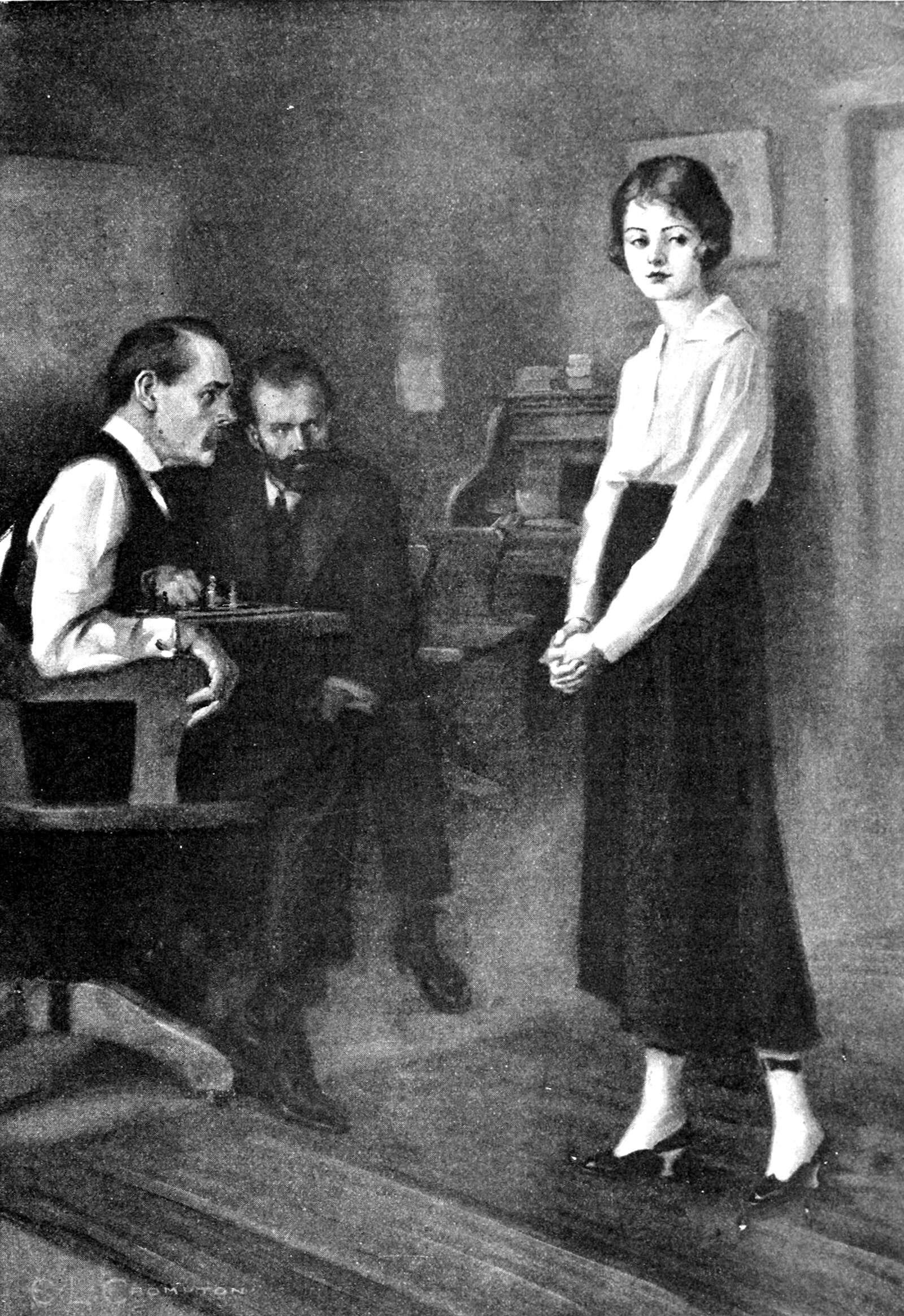
“‘YOU CAN’T TAKE ANY MORE PAINTING LESSONS. YOUR MOTHER DOESN’T WANT YOU GOING THERE ANY MORE’”
Title: The fire
Author: Helen R. Hull
Illustrator: Edna L. Crompton
Release date: July 27, 2026 [eBook #79192]
Language: English
Original publication: New York: The Century, 1917
Other information and formats: www.gutenberg.org/ebooks/79192
Credits: Jens Sadowski. This file was produced from images generously made available by The Internet Archive.
Helen R. Hull
Illustrations by Edna L. Crompton
The Century Magazine, vol. 95, Nov. 1917, pp. 105-114.
Cynthia blotted the entry in the old ledger and scowled across the empty office at the door. Mrs. Moriety had left it ajar when she departed with her receipt for the weekly fifty cents on her “lot.” If you supplied the missing gilt letters, you could read the sign on the glass of the upper half: “H. P. Bates. Real Estate. Notary Public.” Through the door at Cynthia’s elbow came the rumbling voice of old Fleming, the lawyer down the hall; he had come in for his Saturday night game of chess with her father.
Cynthia pushed the ledger away from her, and with her elbows on the spotted, green felt of the desk, her fingers burrowing into her cheeks, waited for two minutes by the nickel clock; then, with a quick, awkward movement, she pushed back her chair and plunged to the doorway, her young face twisted in a sort of fluttering resolution.
“Father—”
Her father jerked his head toward her, his fingers poised over a pawn. Old Fleming did not look up.
“Father, I don’t think anybody else will be in.”
“Well, go on home, then.” Her father bent again over the squares, the light shining strongly on the thin places about his temples.
“Father, please,”—Cynthia spoke hurriedly,—“you aren’t going for a while? I want to go down to Miss Egert’s for a minute.”
“Eh? What’s that?” He leaned back in his chair now, and Mr. Fleming lifted his severe, black beard to look at this intruder. “What for? You can’t take any more painting lessons. Your mother doesn’t want you going there any more.”
“I just want to get some things I left there. I can get back to go home with you.”
“But your mother said she didn’t like your hanging around down there in an empty house with an old maid. What did she tell you about it?”
“Couldn’t I just get my sketches, Father, and tell Miss Egert I’m not coming any more? She would think it was awfully funny if I didn’t. I won’t stay. But she—she’s been good to me—”
“What set your mother against her, then? What you been doing down there?”
Cynthia twisted her hands together, her eyes running from Fleming’s amused stare to her father’s indecision. Only an accumulated determination could have carried her on into speech.
“I’ve just gone down once a week for a lesson. I want to get my things. If I’m not going, I ought to tell her.”
“Why didn’t you tell her that last week?”
“I kept hoping I could go on.”
“Um.” Her father’s glance wavered toward his game. “Isn’t it too late?”
“Just eight, Father.” She stepped near her father, color flooding her cheeks. “If you’ll give me ten cents, I can take the car—”
“Well—” He dug into his pocket, nodding at Fleming’s grunt, “The women always want cash, eh, Bates?”
Then Cynthia, the dime pressed into her palm, tiptoed across to the nail where her hat and sweater hung, seized them, and still on tiptoe, lest she disturb the game again, ran out to the head of the stairs.
She was trembling as she pulled on her sweater; as she ran down the dark steps to the street the tremble changed to a quiver of excitement. Suppose her father had known just what her mother had said! That she could not see Miss Egert again; could never go hurrying down to the cluttered room they called the studio for more of those strange hours of eagerness and pain when she bent over the drawing-board, struggling with the mysteries of color. That last sketch—the little, purpling mint-leaves from the garden—Miss Egert had liked that. And they thought she could leave those sketches there! Leave Miss Egert, too, wondering why she never came again! She hurried to the corner, past the bright store-windows. In thought she could see Miss Egert setting out the jar of brushes, the dishes of water, pushing back the litter of magazines and books to make room for the drawing-board, waiting for her to come. Oh, she had to go once more, black as her disobedience was!
The half-past-eight car was just swinging round the curve. She settled herself behind two German housewives, shawls over their heads, market-baskets beside them. They lived out at the end of the street; one of them sometimes came to the office with payments on her son’s lot. Cynthia pressed against the dirty window, fearful lest she miss the corner. There it was, the new street light shining on the sedate old house! She ran to the platform, pushing against the arm the conductor extended.
“Wait a minute, there!” He released her as the car stopped, and she fled across the street.
In front of the house she could not see a light, up-stairs or down, except staring reflections in the windows from the white arc light. She walked past the dark line of box which led to the front door. At the side of the old square dwelling jutted a new, low wing; and there in two windows were soft slits of light along the curtain-edges. Cynthia walked along a little dirt path to a door at the side of the wing. Standing on the door-step, she felt in the shadow for the knocker. As she let it fall, from the garden behind her came a voice:
“I’m out here. Who is it?” There was a noise of feet hurrying through dead leaves, and as Cynthia turned to answer, out of the shadow moved a blur of face and white blouse.
“Cynthia! How nice!” The woman touched Cynthia’s shoulder as she pushed open the door. “There, come in.”
The candles on the table bent their flames in the draft; Cynthia followed Miss Egert into the room.
“You’re busy?” Miss Egert had stood up by the door an old wooden-toothed rake. “I don’t want to bother you.” Cynthia’s solemn, young eyes implored the woman and turned hastily away. The intensity of defiance which had brought her at such an hour left her confused.
“Bother? I was afraid I had to have my grand bonfire alone. Now we can have it a party. You’d like to?”
Miss Egert darted across to straighten one of the candles. The light caught in the folds of her crumpled blouse, in the soft, drab hair blown out around her face.
“I can’t stay very long.” Cynthia stared about the room, struggling to hide her turmoil under ordinary casualness. “You had the carpenter fix the bookshelves, didn’t you?”
“Isn’t it nice now! All white and gray and restful—just a spark of life in that mad rug. A good place to sit in and grow old.”
Cynthia looked at the rug, a bit of scarlet Indian weaving. She wouldn’t see it again! The thought poked a derisive finger into her heart.
“Shall we sit down just a minute and then go have the fire?”
Cynthia dropped into the wicker chair, wrenching her fingers through one another.
“My brother came in to-night, his last attempt to make me see reason,” said Miss Egert.
Cynthia lifted her eyes. Miss Egert wasn’t wondering why she had come; she could stay without trying to explain.
Miss Egert wound her arms about her knees as she went on talking. Her slight body was wrenched a little out of symmetry, as though from straining always for something uncaptured; there was the same lack of symmetry in her face, in her eyebrows, in the line of her mobile lips. But her eyes had nothing fugitive, nothing pursuing in their soft, gray depth. Their warm, steady eagerness shone out in her voice, too, in its swift inflections.
“‘YOU CAN’T TAKE ANY MORE PAINTING LESSONS. YOUR MOTHER DOESN’T WANT YOU GOING THERE ANY MORE’”
“I tried to show him it wasn’t a bit disgraceful for me to live here in a wing of my own instead of being a sort of nurse-maid adjunct in his house.” She laughed, a soft, throaty sound. “It’s my house. It’s all I have left to keep me a person, you see. I won’t get out and be respectable in his eyes.”
“He didn’t mind your staying here and taking care of—them!” cried Cynthia.
“It’s respectable, dear, for an old maid to care for her father and mother; but when they die she ought to be useful to some one else instead of renting her house and living on an edge of it.”
“Oh,”—Cynthia leaned forward,—“I should think you’d hate him! I think families are—terrible!”
“Hate him?” Miss Egert smiled. “He’s nice. He just doesn’t agree with me. As long as he lets the children come over—I told him I meant to have a beautiful time with them, with my real friends—with you.”
Cynthia shrank into her chair, her eyes tragic again.
“Come, let’s have our bonfire!” Miss Egert, with a quick movement, stood in front of Cynthia, one hand extended.
Cynthia crouched away from the hand.
“Miss Egert,”—her voice came out in a desperate little gasp,—“I can’t come down any more. I can’t take any more painting lessons.” She stopped. Miss Egert waited, her head tipped to one side. “Mother doesn’t think I better. I came down—after my things.”
“They’re all in the workroom.” Miss Egert spoke quietly. “Do you want them now?”
“Yes.” Cynthia pressed her knuckles against her lips. Over her hand her eyes cried out. “Yes, I better get them,” she said heavily.
Miss Egert, turning slowly, lifted a candle from the table.
“We’ll have to take this. The wiring isn’t done.” She crossed the room, her thin fingers, not quite steady, bending around the flame.
Cynthia followed through a narrow passage. Miss Egert pushed open a door, and the musty odor of the store-room floated out into a queer chord with the fresh plaster of the hall.
“Be careful of that box!” Miss Egert set the candle on a pile of trunks. “I’ve had to move all the truck from the attic and studio in here. Your sketches are in the portfolio, and that’s—somewhere!”
Cynthia stood in the doorway, watching Miss Egert bend over a pile of canvases, throwing up a grotesque, rounded shadow on the wall. Round the girl’s throat closed a ring of iron.
“Here they are, piled up—”
Cynthia edged between the boxes. Miss Egert was dragging the black portfolio from beneath a pile of books.
“And here’s the book I wanted you to see.” The pile slipped crashing to the floor as Miss Egert pulled out a magazine. “Never mind those. See here.” She dropped into the chair from which she had knocked the books, the portfolio under one arm, the free hand running through the pages of an old art magazine. The chair swung slightly; Cynthia, peering down between the boxes, gave a startled “Oh!”
“What is it?” Miss Egert followed Cynthia’s finger. “The chair?” She was silent a moment. “Do you think I keep my mother prisoner here in a wheel-chair now that she is free?” She ran her hand along the worn arm. “I tried to give it to an old ladies’ home, but it was too used up. They wanted more style.”
“But doesn’t it remind you—” Cynthia hesitated.
“It isn’t fair to remember the years she had to sit here waiting to die. You didn’t know her. I’ve been going back to the real years—” Miss Egert smiled at Cynthia’s bewildered eyes. “Here, let’s look at these.” She turned another page. “See, Cynthia. Aren’t they swift and glad? That’s what I was trying to tell you the other day. See that arm, and the drapery there! Just a line—” The girl bent over the page, frowning at the details the quick finger pointed out. “Don’t they catch you along with them?” She held the book out at arm’s-length, squinting at the figures. “Take it along. There are several more.” She tucked the book into the portfolio and rose. “Come on; we’ll have our fire.”
“But, Miss Egert,”—Cynthia’s voice hardened as she was swept back into her own misery,—“I can’t take it. I can’t come any more.”
“To return a book?” Miss Egert lowered her eyelids as if she were again sizing up a composition. “You needn’t come just for lessons.”
Cynthia shook her head.
“Mother thinks—” She fell into silence. She couldn’t say what her mother thought—dreadful things. If she could only swallow the hot pressure in her throat!
“Oh. I hadn’t understood.” Miss Egert’s fingers paused for a swift touch on Cynthia’s arm, and then reached for the candle. “You can go on working by yourself.”
“It isn’t that—” Cynthia struggled an instant, and dropped into silence again. She couldn’t say out loud any of the things she was feeling. There were too many walls between feeling and speech: loyalty to her mother, embarrassment that feelings should come so near words, a fear of hurting Miss Egert.
“Don’t mind so much, Cynthia.” Miss Egert led the way back to the living-room. “You can stay for the bonfire? That will be better than sitting here. Run into the kitchen and bring the matches and marshmallows—in a dish in the cupboard.”
Cynthia, in the doorway, stared at Miss Egert. Didn’t she care at all! Then the dumb ache in her throat stopped throbbing as Miss Egert’s gray eyes held her steadily a moment. She did care! She did! She was just helping her. Cynthia took the candle and went back through the passageway to the kitchen, down at the very end.
She made a place on the table in the litter of dishes and milk-bottles for the candle. The matches had been spilled on the shelf of the stove and into the sink. Cynthia gathered a handful of the driest. Shiftlessness was one of her mother’s counts against Miss Egert. Cynthia flushed as she recalled her stumbling defense: Miss Egert had more important things to do; dishes were kept in their proper place; and her mother’s: “Important! Mooning about!”
“Find them, Cynthia?” The clear, low voice came down the hall, and Cynthia hurried back.
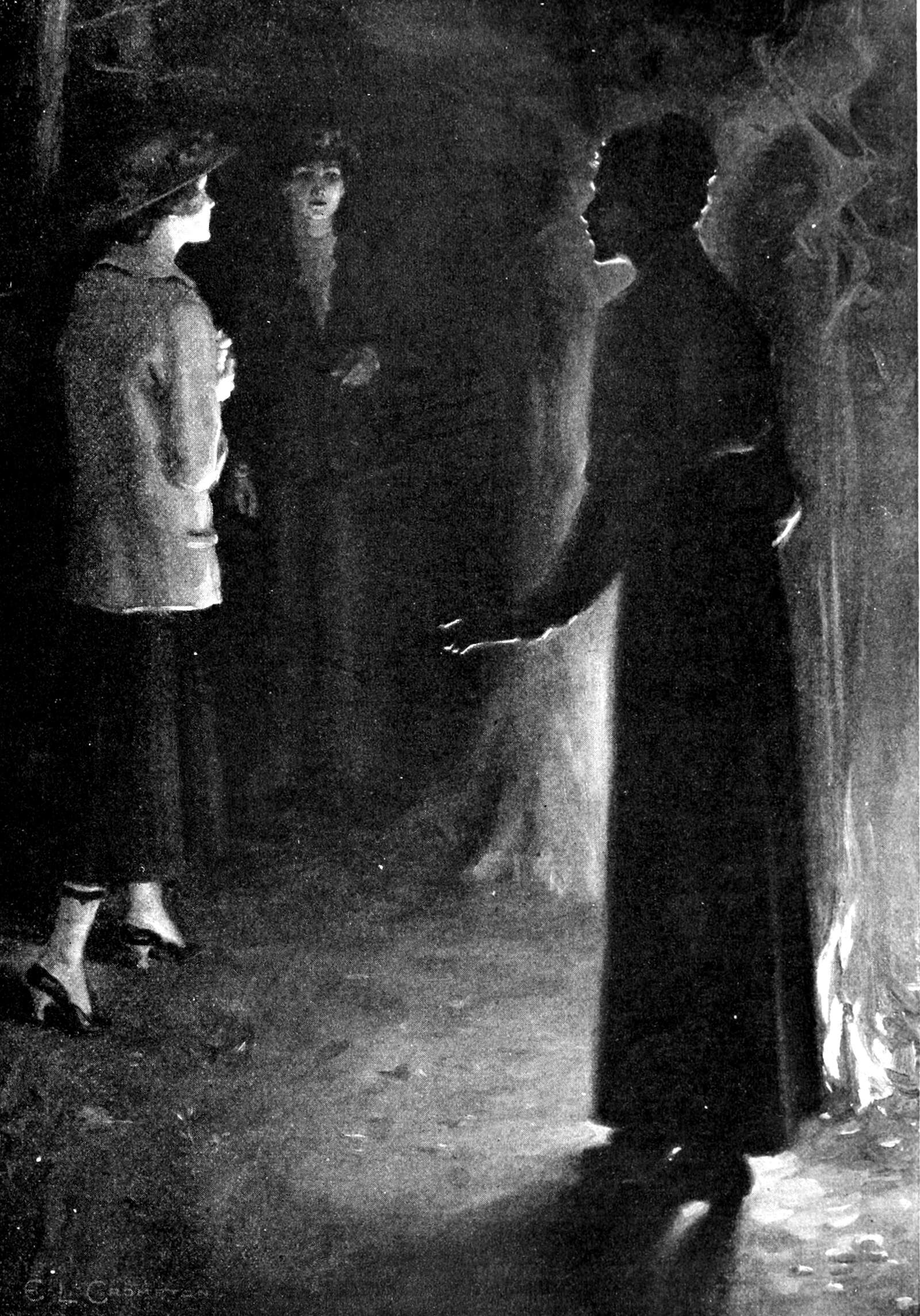
Out in the garden it was quite black. As they came to the far end, the old stone wall made a dark bank against the sky, with a sharp star over its edge. Miss Egert knelt; almost with the scratch of the match the garden leaped into yellow, with fantastic moving shadows from the trees and in the corner of the wall. She raked leaves over the blaze, pulled the great mound into firmer shape, and then drew Cynthia back under the wall to watch. The light ran over her face; the delighted gestures of her hands were like quick shadows.
“See the old apple-tree dance! He’s too old to move fast.”
Cynthia crouched by the wall, brushing away from her face the scratchy leaves of the dead hollyhocks. Excitement tingled through her; she felt the red and yellow flames seizing her, burning out the heavy rebellion, the choking weight. Miss Egert leaned back against the wall, her hands spread so that her thin fingers were fire-edged.
“See the smoke curl up through those branches! Isn’t it lovely, Cynthia?” She darted around the pile to push more leaves into the flames.
Cynthia strained forward, hugging her arms to her body. Never had there been such a fire! It burned through her awkwardness, her self-consciousness. It ate into the thick, murky veils which hung always between her and the things she struggled to find out. She took a long breath, and the crisp scent of smoke from the dead leaves tingled down through her body.
Miss Egert was at her side again. Cynthia looked up; the slight, asymmetrical figure was like the apple-tree, still, yet dancing!
“Why don’t you paint it?” demanded Cynthia, abruptly, and then was frightened as Miss Egert’s body stiffened, lost its suggestion of motion.
“I can’t.” The woman dropped to the ground beside Cynthia, crumpling a handful of leaves. “It’s too late.” She looked straight at the fire. “I must be content to see it.” She blew the pieces of leaves from the palm of her hand and smiled at Cynthia. “Perhaps some day you’ll paint it—or write it.”
“I can’t paint.” Cynthia’s voice quivered. “I want to do something. I can’t even see things except what you point out. And now—”
Miss Egert laid one hand over Cynthia’s clenched fingers. The girl trembled at the cold touch.
“You must go on looking.” The glow, as the flames died lower, flushed her face. “Cynthia, you’re just beginning. You mustn’t stop just because you aren’t to come here any more. I don’t know whether you can say things with your brush; but you must find them out. You mustn’t shut your eyes again.”
“It’s hard alone.”
“That doesn’t matter.”
Cynthia’s fingers unclasped, and one hand closed desperately around Miss Egert’s. Her heart fluttered in her temples, her throat, her breast. She clung to the fingers, pulling herself slowly up from an inarticulate abyss.
“Miss Egert,”—she stumbled into words,—“I can’t bear it, not coming here! Nobody else cares except about sensible things. You do, beautiful, wonderful things.”
“You’d have to find them for yourself, Cynthia.” Miss Egert’s fingers moved under the girl’s grasp. Then she bent toward Cynthia, and kissed her with soft, pale lips that trembled against the girl’s mouth. “Cynthia, don’t let any one stop you! Keep searching!” She drew back, poised for a moment in the shadow before she rose. Through Cynthia ran the swift feet of white ecstasy. She was pledging herself to some tremendous mystery, which trembled all about her.
“Come, Cynthia, we’re wasting our coals.”
Miss Egert held out her hands. Cynthia, laying hers in them, was drawn to her feet. As she stood there, inarticulate, full of a strange, excited, shouting hope, behind them the path crunched. Miss Egert turned, and Cynthia shrank back.
Her mother stood in the path, making no response to Miss Egert’s “Good evening, Mrs. Bates.”
The fire had burned too low to lift the shadow from the mother’s face. Cynthia could see the hem of her skirt swaying where it dipped up in front. Above that two rigid hands in gray cotton gloves; above that the suggestion of a white, strained face.
Cynthia took a little step toward her.
“I came to get my sketches,” she implored her. Her throat was dry. What if her mother began to say cruel things—the things she had already said at home.
“I hope I haven’t kept Cynthia too late,” Miss Egert said. “We were going to toast marshmallows. Won’t you have one, Mrs. Bates?” She pushed the glowing leaf-ashes together. The little spurt of flame showed Cynthia her mother’s eyes, hard, angry, resting an instant on Miss Egert and then assailing her.
“Cynthia knows she should not be here. She is not permitted to run about the streets alone at night.”
“Oh, I’m sorry.” Miss Egert made a deprecating little gesture. “But no harm has come to her.”
“She has disobeyed me.”
At the tone of her mother’s voice Cynthia felt something within her breast curl up like a leaf caught in flame.
“I’ll get the things I came for.” She started toward the house, running past her mother. She must hurry, before her mother said anything to hurt Miss Egert.
She stumbled on the door-step, and flung herself against the door. The portfolio was across the room, on the little, old piano. The candle beside it had guttered down over the cover. Cynthia pressed out the wobbly flame, and, hugging the portfolio, ran back across the room. On the threshold she turned for a last glimpse. The row of Botticelli details over the bookcases were blurred into gray in the light of the one remaining candle; the Indian rug had a wavering glow. Then she heard Miss Egert just outside.
“I’m sorry Cynthia isn’t to come any more,” she was saying.
Cynthia stepped forward. The two women stood in the dim light, her mother’s thickened, settled body stiff and hostile, Miss Egert’s slight figure swaying toward her gently.
“Cynthia has a good deal to do,” her mother answered. “We can’t afford to give her painting lessons, especially—” Cynthia moved down between the women—“especially,” her mother continued, “as she doesn’t seem to get much of anywhere. You’d think she’d have some pictures to show after so many lessons.”
“Perhaps I’m not a good teacher. Of course she’s just beginning.”
“She’d better put her time on her studies.”
“I’ll miss her. We’ve had some pleasant times together.”
Cynthia held out her hand toward Miss Egert, with a fearful little glance at her mother.
“Good-by, Miss Egert.”
Miss Egert’s cold fingers pressed it an instant.
“Good night, Cynthia,” she said slowly.
Then Cynthia followed her mother’s silent figure along the path; she turned her head as they reached the sidewalk. Back in the garden winked the red eye of the fire.
They waited under the arc light for the car, Cynthia stealing fleeting glances at her mother’s averted face. On the car she drooped against the window-edge, away from her mother’s heavy silence. She was frightened now, a panicky child caught in disobedience. Once, as the car turned at the corner below her father’s office, she spoke:
“Father will expect me—”
“He knows I went after you,” was her mother’s grim answer.
Cynthia followed her mother into the house. Her small brother was in the sitting-room, reading. He looked up from his book with wide, knowing eyes. Rebellious humiliation washed over Cynthia; setting her lips against their quivering, she pulled off her sweater.
“Go on to bed, Robert,” called her mother from the entry, where she was hanging her coat. “You’ve sat up too late as it is.”
He yawned, and dragged his feet with provoking slowness past Cynthia.
“Was she down there, Mama?” He stopped on the bottom step to grin at his sister.
“Go on, Robert. Start your bath. Mother’ll be up in a minute.”
“Aw, it’s too late for a bath.” He leaned over the rail.
“It’s Saturday. I couldn’t get back sooner.”
Cynthia swung away from the round, grinning face. Her mother went past her into the dining-room. Robert shuffled up-stairs; she heard the water splashing into the tub.
Her mother was very angry with her. Presently she would come back, would begin to speak. Cynthia shivered. The familiar room seemed full of hostile, accusing silence, like that of her mother. If only she had come straight home from the office, she would be sitting by the table in the old Morris chair, reading, with her mother across from her sewing, or glancing through the evening paper. She gazed about the room at the neat scrolls of the brown wall-paper, at a picture above the couch, cows by a stream. The dull, ordinary comfort of life there hung about her, a reproaching shadow, within which she felt the heavy, silent discomfort her transgression dragged after it. It would be much easier to go on just as she was expected to do. Easier. The girl straightened her drooping body. That things were hard didn’t matter. Miss Egert had insisted upon that. She was forgetting the pledge she had given. The humiliation slipped away, and a cold exaltation trembled through her, a remote echo of the hope that had shouted within her back there in the garden. Here it was difficult to know what she had promised, to what she had pledged herself—something that the familiar, comfortable room had no part in.
She glanced toward the dining-room, and her breath quickened. Between the faded green portières stood her mother, watching her with hard, bright eyes. Cynthia’s glance faltered; she looked desperately about the room as if hurrying her thoughts to some shelter. Beside her on the couch lay the portfolio. She took a little step toward it, stopping at her mother’s voice.
“Well, Cynthia, have you anything to say?”
Cynthia lifted her eyes.
“Don’t you think I have trouble enough with your brothers? You, a grown girl, defying me! I can’t understand it.”
“I went down for this.” Cynthia touched the black case.
“Put that down! I don’t want to see it!” The mother’s voice rose, breaking down the terrifying silences. “You disobeyed me. I told you you weren’t to go there again. And then I telephoned your father to ask you to do an errand for me, and find you there—with that woman!”
“I’m not going again.” Cynthia twisted her hands together. “I had to go a last time. She was a friend. I could not tell her I wasn’t coming—”
“A friend! A sentimental old maid, older than your mother! Is that a friend for a young girl? What were you doing when I found you? Holding hands! Is that the right thing for you? She’s turned your head. You aren’t the same Cynthia, running off to her, complaining of your mother.”
“Oh, no!” Cynthia flung out her hand. “We were just talking.” Her misery confused her.
“Talking? About what?”
“About—” The recollection rushed through Cynthia—“about beauty.” She winced, a flush sweeping up to the edge of her fair hair, at her mother’s laugh.
“Beauty! You disobey your mother, hurt her, to talk about beauty at night with an old maid!”
There was a hot beating in Cynthia’s throat; she drew back against the couch.
“Pretending to be an artist,” her mother drove on, “to get young girls who are foolish enough to listen to her sentimentalizing.”
“She was an artist,” pleaded Cynthia. “She gave it up to take care of her father and mother. I told you all about that—”
“Talking about beauty doesn’t make artists.”
Cynthia stared at her mother. She had stepped near the table, and the light through the green shade of the reading-lamp made queer pools of color about her eyes, in the waves of her dark hair. She didn’t look real. Cynthia threw one hand up against her lips. She was sucked down and down in an eddy of despair. Her mother’s voice dragged her again to the surface.
“We let you go there because you wanted to paint, and you maunder and say things you’d be ashamed to have your mother hear. I’ve spent my life working for you, planning for you, and you go running off—” Her voice broke into a new note, a trembling, grieved tone. “I’ve always trusted you, depended on you; now I can’t even trust you.”
“I won’t go there again. I had to explain.”
“I can’t believe you. You don’t care how you make me feel.”
Cynthia was whirled again down the sides of the eddy.
“I can’t believe you care anything for me, your own mother.”
Cynthia plucked at the braid on her cuff.
“I didn’t do it to make you sorry,” she whispered. “I—it was—” The eddy closed about her, and with a little gasp she dropped down on the couch, burying her head in the sharp angle of her elbows.
The mother took another step toward the girl; her hand hovered above the bent head and then dropped.
“You know mother wants just what is best for you, don’t you? I can’t let you drift away from us, your head full of silly notions.”
Cynthia’s shoulders jerked. From the head of the stairs came Robert’s shout:
“Mama, tub’s full!”
“Yes; I’m coming.”
Cynthia looked up. She was not crying. About her eyes and nostrils strained the white intensity of hunger.
“You don’t think—” She stopped, struggling with her habit of inarticulateness. “There might be things—not silly—you might not see what—”
“Cynthia!” The softness snapped out of the mother’s voice.
Cynthia stumbled up to her feet; she was as tall as her mother. For an instant they faced each other, and then the mother turned away, her eyes tear-brightened. Cynthia put out an awkward hand.
“Mother,” she said piteously, “I’d like to tell you—I’m sorry—”
“You’ll have to show me you are by what you do.” The woman started wearily up the stairs. “Go to bed. It’s late.”
Cynthia waited until the bath-room door closed upon Robert’s splashings. She climbed the stairs slowly, and shut herself into her room. She laid the portfolio in the bottom drawer of her white bureau; then she stood by her window. Outside, the big elm-tree, in fine, leafless dignity, showed dimly against the sky, a few stars caught in the arch of its branches.
A swift, tearing current of rebellion swept away her unhappiness, her confused misery; they were bits of refuse in this new flood. She saw, with a fierce, young finality that she was pledged to a conflict as well as to a search. As she knelt by the window and pressed her cheek on the cool glass, she felt the house about her, with its pressure of useful, homely things, as a very prison. No more journeyings down to Miss Egert’s for glimpses of escape. She must find her own ways. Keep searching! At the phrase, excitement again glowed within her; she saw the last red wink of the fire in the garden.
Transcriber’s Notes
Transcribed from the first publication in: The Century Magazine, vol. 95, Nov. 1917, pp. 105-114.
The original spelling and punctuation were preserved.
New original cover art included with this eBook is granted to the public domain.