Title: A three-fold promise
Author: Marian Isabel Hurrell
Release date: July 30, 2026 [eBook #79226]
Language: English
Original publication: London: S. W. Partridge & Co., 1899
Other information and formats: www.gutenberg.org/ebooks/79226
Transcriber's note: Unusual and inconsistent spelling is as printed.
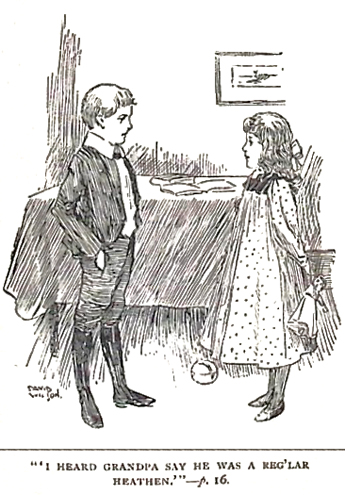
"I HEARD GRANDPA SAY HE WAS A
REG'LAR HEATHEN."
BY
MARIAN ISABEL HURRELL
AUTHOR OF "CECILY MORDAUNT."

LONDON
S. W. PARTRIDGE & CO.
8 & 9 PATERNOSTER ROW.
CONTENTS.

CHAP.
IV. "PROFESSOR" WRAGGS, THE SHOWMAN
A THREE-FOLD PROMISE.

"A REG'LAR HEATHEN."
THE carriage stood waiting at the door, the boxes carefully packed by a mother's loving hand were all ready to be shouldered by the stalwart "cabby," and in the shabby little sitting-room of a poor London home, the last few words of parting were being spoken.
Gerald Weston's heart was very heavy, for on that day, he and his mother were to be separated for the first time in his young life. And the boy's spirit failed him as he thought of the long months which must elapse ere he saw her face again.
"My laddie," said his mother, fondly, "I want you to promise to do three things whilst I am away from you: Never to forget your prayers, to speak the truth 'always,' and to remember that whatever may happen, God loves you and is watching over you."
"Yes, mother, I promise, but why must you leave me?" sobbed the boy, clinging to her as though he never meant to let go.
"Because, darling, it is for your good. You know, since your father's death we have been very, very poor, and your uncle has promised to provide for you if I give you up to him for two years. In the meantime, I must work hard, and perhaps you and I can have a cosy little home in the country in the days to come. The time will soon pass, and we shall be together again." But the mother's tear-filled eyes belied her brave words.
"Why can't you teach me 'stead of other little boys and girls?" said Gerald, half rebelliously.
"Come, my boy, you must be brave for my sake."
A tap at the door signified that the boxes were disposed of, and that the bitter moment of parting had arrived. A long, lingering clasp, a loving embrace, and the good-byes were over, and an entirely new life had commenced for Gerald Weston. He was but eight years old, and little wonder that the future looked dark and drear, with no mother at hand to comfort him.
Nothing but absolute poverty would have driven her to part with the child, and the conditions made by Sir Herbert Weston, his uncle, were hard to bear. Only in case of illness on either side, were mother and son to meet within the next two years, during which time Gerald would be entirely provided for, at Sir Herbert's expense. Had Mrs. Weston known more of the character of the man to whom she was entrusting her child, nothing would have persuaded her to part with him, but the inducements held out so dazzled her, that she agreed to Sir Herbert's proposals, believing him to be possessed of a kindly, albeit somewhat severe, disposition.
Sir Herbert Weston, and his friend Mr. Wilfrid Sharpe—the family lawyer—were engaged in an after-dinner chat, when a loud ring resounded through the house.
"H'm!" ejaculated the baronet, with a grim smile on his features. "That is my hopeful young nephew, I suppose."
Mr. Sharpe looked up inquiringly.
"I have not told you yet of my latest little—fad, I suppose you will call it. You remember poor Oliver? Well, his widow, a poverty-stricken descendant of some old Scotch Covenanter, is reduced to great straits, and I have undertaken to provide for the boy, on condition that his mother gives him up to me entirely for the space of two years. If I find out during that time he is a lad to my liking, I shall make him my heir; if not, well—" Here Sir Herbert snapped his thumb and finger as though he were quite indifferent to the matter in hand.
Mr. Sharpe, despite his keen professional manner, had a nature beneath which belied his name, and in his heart, he pitied the child who was thus given up to his uncle's tender mercies.
"Poor little chap!" he muttered.
"Why?" said the baronet, sharply.
"Well, I don't wish to hurt your feelings, Sir Herbert, but you don't seem exactly the kind of man to train a mother-sick laddie."
Sir Herbert was in no way offended, being accustomed to the lawyer's plain speech.
"We bachelors can't be expected to understand children's ways," added Mr. Sharpe, as though his first remark required toning down a little.
"I have no wish to understand children's ways," said the baronet, with a frown; "my nephew is going to understand mine, and I shall expect him to follow in them unquestioningly. You shall see the child for yourself, and give me your opinion of him afterwards." So saying, Sir Herbert rung the bell sharply.
"Send Master Weston in to me," he said to the maid who promptly answered the summons.
In a very short space of time the door opened, and a childish figure stood on the threshold.
Mr. Sharpe, who prided himself on being a keen judge of character, looked at the little fellow critically, and seeing in the straightforward blue eyes traces of recent tears, felt a rush of pity and tenderness, and made up his mind there and then to befriend, so far as it lay in his power, Sir Herbert's young nephew.
"How do you do, Uncle Herbert?" said the boy, coming forward half shyly, yet with a certain childish self-possession which amused the baronet.
"How do you do, Gerald?" answered Sir Herbert, after which he introduced his nephew to Mr. Sharpe.
Little notice was taken of Gerald for some time, until the lawyer with kindly interest in his tone said: "And how did you leave your mother, little man?"
With the memory of that bitter parting fresh in his mind, little wonder that the boy's eyes filled with tears, and that for a moment he was unable to answer.
One of his mother's counsels rung in his ears: "Be a brave laddie, Gerald." And with a mighty effort he pulled himself together, and tried to smile as he replied to the gentleman's polite inquiry.
Such a weak, watery smile it was, that it brought a sudden moisture to the glasses of the lawyer. Removing them from his eyes, he wiped them very deliberately before making any further remark.
Sir Herbert, who had also noticed the boy's brave effort at self-control, was secretly pleased, and with a desire to avoid any further upset, he bade Gerald say "Good night," and prepare for bed.
Once upstairs in the bedroom prepared for his use in Sir Herbert's town residence, the boy buried his face in the white counterpane and sobbed bitterly.
A brisk movement at the door, and the housekeeper, a comely woman, with cheeks like rosy apples, entered the room.
She stared aghast at the crying child, and then her womanliness getting the better of her, she dropped her quick business-like manner, and clasping her arms around the boy, drew him towards her, and let him sob to his heart's content.
"My mother! My mother! I want her so badly," he cried.
"Yes, yes, I know you do," said the good woman, "but you must cheer up; you'll feel ever so much better to-morrow."
Mrs. Webster, for the past twenty years, had been Sir Herbert's housekeeper, both in his town residence, and also at The Towers, his lovely home in one of the Eastern counties. She was well accustomed to his ways, and her presence in his household was a necessity to his comfort. Knowing her master as she did, she rather trembled for the effect he would have upon this sensitive and warm-hearted child.
"Hilda will be your maid in future, my dear, but to-night 'I' am going to put you to bed." And so saying, she undressed him, as she would a baby. As the child knelt in his little white night-shirt to say his prayers, her eyes overflowed.
"Not many prayers rise from this house I'm thinking," she murmured to herself; "maybe the child is sent to lift us out of the world a bit, and nearer to a better one."
All unknown to his little forlorn self, Gerald Weston had made two new friends, who in his unknown future would stand by him right well.
There was silence for a while in the library below, where the two gentlemen were sitting, whilst upstairs the boy slept the dreamless slumber of tired-out childhood.
"So you are going away to-morrow, Sir Herbert," said the lawyer after a long pause.
"Yes, but my business on the Continent will only last a few days, and then I shall return, and think what is best to be done concerning the boy."
"In the meantime, I wish you would grant me a favour."
"With pleasure, if I can do so."
"Let me have the boy whilst you are away. My sister's little girl is staying at my house, and needs a companion sorely. They would be capital playmates, I fancy."
At the word "playmates," Sir Herbert frowned, for he did not approve of recreation; life to him was all earnest. Nevertheless, he agreed to Mr. Sharpe's proposition, as the lawyer had been too good a friend to him in the past, for him to refuse to grant such a small favour.
Thus it was, that on the following day, Gerald found himself a guest at the pleasant suburban home of Mr. Sharpe, and his maiden sister, Rachel.
He was not at all sorry to leave the gloomy house of his uncle behind him, for already it seemed to him like a prison.
Miss Sharpe's welcome consisted of a peck on the cheek, intended for a kiss, and a limp handshake, but what was lacking on her part, her little niece supplied. Doris Maxwell, a child of about six years of age—and not at all troubled with shyness—came forward, and put her arms around his neck, as she would have done to one of her own little brothers.
Gerald was a little taken aback first of all, but he came to the conclusion that she was a very nice little girl.
The two children soon became great friends, and the merry games they played helped Gerald to forget his grief awhile.
"You 'are' a kind boy," said the little maid to him, after a friendship of twenty-four hours. "You don't tease me, nor poke my dollie's eyes in, nor nothing."
Gerald grew rosy with pleasure.
"Do your brothers tease you then?" he asked.
"Oh! Drefful. I can't 'tell' you all the naughty things they do," said Doris, opening wide her brown eyes with righteous indignation.
To further gain the little lady's approval, Gerald bethought himself of what he could give her for a present.
Feeling in his pocket, he drew forth one of his chief possessions, a little knife. It was a great sacrifice on Gerald's part, and he looked at it lingeringly before parting with it.
"I am going to give you a present, 'cause we're friends, you and me."
"What is it? Oh, a knife! How lovely, Gerald, but I 'spect I must hide it away from Aunt Rachel. She is a very 'culiar lady, and might take it from me; she isn't half so kind as Uncle Wilfrid. Is your uncle nice, Gerald?" inquired the child, with some curiosity in her tone.
Gerald scarcely knew at first how to answer this very communicative little girl. "I don't know, I hope he is," he said, with a deep sigh.
"Don't 'spect he is, for I heard my grandpa say he was a reg'lar heathen."
"Heathen?" repeated Gerald in surprise.
"Yes, p'raps you don't know what they are. Well, I'll tell you! Heathens is black, and they have little idols, which they says their prayers to. Mother told me, so I know it's true. Is your uncle black?"
"No," said Gerald, bursting into a merry laugh, which would have cheered his mother's heart could she have heard it.
Doris looked disappointed.
"Oh well, perhaps he'll turn black by-and-by; anyhow I know he's a heathen, 'cause grandpa says so, and he knows everything. He's so 'very' old, nearly a thousand years, I should think."
"What a funny old man he must be!" said Gerald, bubbling over with amusement.
"I shall come and see you one day, 'cause I love you very much," said Doris after a slight pause, for a brilliant idea had just occurred to her mind.
"Perhaps my uncle won't let you come," answered Gerald a little sadly.
"Oh, yes he will, I shall come with Uncle Wilfrid, see if I don't, and—" here the child lowered her voice mysteriously—"we will try and find the idol what he prays to."
Gerald began to think that Doris was the dearest and funniest little girl he had ever met, and he was quite comforted to think there might be a chance of meeting her again at his uncle's house.
The days spent at Mr. Sharpe's pretty suburban home, passed all too quickly away, and it was with regret he bade "good bye" to new friends.
Doris came to the gate to see the last of him, and called out in her childish treble, "I'll be sure to come and see you, Gerald, and the heathen as well. I wish he was black, though!"
"Gracious!" said Miss Rachel. "What 'does' the child mean?" But hearing at that moment from cook that the kitchen chimney was on fire, she puzzled her brains no more about the subject.
IN DISGRACE.
SIR HERBERT returned from the Continent, eager to commence the training which he considered advisable for his future heir. A competent tutor was engaged to give him lessons daily, and many were the restrictions imposed upon the child. After the freedom of his home life, the boy felt the change greatly, and pined like a bird in captivity.
No Scripture lessons were allowed, and but for good Mrs. Webster's influence, the child would have been discouraged to say his morning and evening prayers, for Sir Herbert believed in none of these things. He found the lad tolerably submissive, and was congratulating himself on the success of his system of education, little dreaming that the boy was chafing even as a prisoner in the house of bondage.
One day in the midst of Gerald's lessons, a tap was heard at the schoolroom door.
"Come in," said the tutor, and in walked a little figure, with merry brown eyes, and curly hair.
Gerald at once recognised her as his little friend Doris Maxwell, and sprung forward to greet her. In the presence of his tutor she only nodded and smiled, then turning to the tall, scholarly-looking young man, she addressed her remarks to him.
"Please what is your name?" she said, commencing her catechism at once.
"I am Marmaduke Trevor, little maid, this young gentleman's tutor," he answered pleasantly.
"What a funny name!" said the irrepressible Doris. "It 'minds me of marmalade."
Gerald laughed, but the tutor looked grave, as if he considered Doris rather an impudent little girl, though the child really meant no disrespect.
"Please I've come with a message, Mr. 'Marmaluke.' Gerald's uncle says he wishes him to have a little holiday, and come out in the garden with me."
Sir Herbert's slightest wish being a command, the tutor dismissed his pupil, and smiled to see what an utterly different boy he was in the companionship of this little girl, from the repressed, serious child who usually looked as though there was an ache in his heart for his absent mother.
Glad peals of laughter presently rang out in the garden below, and so merry were the children's voices, that they made quite a pleasant break in the business conversation which was going on in the library between Sir Herbert and the lawyer; at least, such was the opinion of the latter gentleman.
After lunch, of which the children partook with their elders, and behaved with the utmost propriety (although there were times when Sir Herbert found Doris's inquiring gaze almost embarrassing), the boy and girl went upstairs to the deserted schoolroom, as the little apartment in which Gerald did his studies was called. Here they amused themselves looking over a certain picture book, which Gerald's mother had given him on his eighth birthday.
"There's our uncles walking round the garden," said Doris, after a while, craning her neck to look out of the window on to the small patch of ground, which was all Sir Herbert's town residence could boast in the way of garden. "Now shall we go and look for the idol?" murmured Doris, mysteriously.
"What idol?" said Gerald, little dreaming of the importance the imaginative child had placed on her grandfather's words.
"The one your uncle bows down to," she answered; "surely you 'member what I told you."
"Doris, what a little goose you are!" laughed Gerald.
"I'm not a goose, and you're a rude boy," she said, with a pout, and a suggestion of tears in her voice. "If you don't come, I shall go all by myself," she added.
Now I fear Doris was a naughty spoilt child, for she certainly on this day led Gerald to be guilty of his first act of disobedience.
"I'll go with you, Doris," he said, anxious to appease the offended little lady, and the two children started off on a voyage of discovery, Doris leading the way.
Gerald followed until they came to the library, the door of which stood partly open.
"I'm going in here, Gerald; 'spect that's where he keeps it," said the child.
Now Gerald had been forbidden to enter the library at any time without his uncle's permission, and fearful of disregarding the stern order, he stood for a moment hesitatingly on the threshold.
A little scream of delight from Doris made him enter.
Before an Indian cabinet stood the little girl, her brown eyes wide open with wonder and surprise.
"I've found it! I've found it! There's the idol what your uncle worships. Oh, Gerald! What a hid'ous old thing."
There on the top of the cabinet, amongst other treasures, was placed a small heathen god, brought from India as a curiosity some years previously by Sir Herbert after a brief stay in that country.
"Don't touch it, Doris," cried Gerald in alarm; "uncle would be 'so' angry!"
"I shall just see what it's made of," said the child, taking the little image into her hands to examine it.
By this time Gerald was in a fever of fright, and snatching the treasure from Doris, was about to replace it, when Sir Herbert himself entered the room.
Every particle of colour forsook the cheeks of the boy, and he looked as though convicted of some terrible crime.
"Your uncle is ready for you, Doris," said Sir Herbert with great dignity, and feeling like a very naughty child—as indeed she was—Doris hastily left the library.
"I will speak to you later, Gerald, about this matter. Meanwhile you can go up to the schoolroom and remain there until Mr. Sharpe and his niece have left."
In a short space of time, Gerald heard the sound of carriage wheels departing, and then he knew that his hour of judgment was come.
A message was despatched to the schoolroom, summoning him to come at once to the library, and tremblingly the boy obeyed.
Sir Herbert stood facing the door, with a small cane in his hand, as Gerald entered the room.
"What excuse have you to offer, Gerald, for this disgraceful act of disobedience!" he demanded.
Deep down in his cold, worldly heart, he was becoming attached to the little fellow who submitted himself so patiently to his rule, though Sir Herbert little knew the depths of love and passion of which the sensitive, fragile boy was capable.
Gerald hesitated as to whether he might not justify himself by throwing the blame on to his little companion, but to his childish sense of honour, such a course of action was inexcusable, for was not Doris his chosen friend?
No, he would bear whatever punishment Sir Herbert might inflict, for he knew that if the blame were to fall upon Doris, never again would she be permitted to be his playmate and companion.
"I'm sorry," began the child.
"So am I, as I hoped and believed I could trust you. What would your mother say to such an act of disobedience?"
The boy's lip quivered, but Sir Herbert was merciless.
"I intend you shall obey me in everything whilst you are in my house. 'Implicit obedience,' remember! And for this act I shall punish you."
Now Gerald in all his young life had never once been beaten, and he had a babyish fear of the cane. His father had been too indolent to put himself out in any way, and his young loving mother had ruled him entirely by the law of kindness; therefore corporal punishment was to him a revelation, and a very unpleasant one too.
"Don't beat me, 'please,' Uncle Herbert, I'll never do it again!" pleaded the boy, with a deep sob in his voice.
"No, my lad, I don't think you will, but I shall whip you all the same."
It was not a cruel, merciless beating which Gerald had to endure, but the shame and humiliation of it all, entered like iron into his soul.
"He bore it like a man, ay and a gentleman," said Sir Herbert long afterwards, when remorse and sorrow had touched his heart, for the punishment he had so hastily bestowed.
Banishment for the rest of the day followed his chastisement, and by his uncle's desire, the culprit's meals were served in his bedroom.
"I can't eat anything, thank you, Hilda," he said, when the good-natured girl brought him up his supper.
"Do now, Master Gerald, dearie. Here's a lovely piece of sponge cake, which cook made on purpose, knowing as you was fond of it. Come, do try, you'll feel ever so much better when you've eaten it, and had a good drink of milk."
To please Hilda, the child made an effort to eat, and was really refreshed and comforted, both by the meal, and the girl's tender sympathy combined. Having said his prayers, which, faithful to the promise he had given his mother, were never forgotten, he laid his weary little head on the pillow, and very soon the deep sobs were hushed to the calm even breathing of childhood's peaceful slumber.
DORIS MAXWELL'S LETTER.
A MASS of correspondence awaited Sir Herbert's perusal, and amongst the heap of letters was one addressed to him in a round, childish hand.
Something unusual about the envelope caused him to open this letter first of all, and he was in the midst of reading it, when Gerald made his appearance in the breakfast room, on the morning which followed his disgrace.
A curt greeting was all that Sir Herbert bestowed on the child, but as he folded his letter, and put it back into the envelope, he looked at the boy with a softened expression in his eyes, and felt a slight pang of reproach, as he marked the pale cheeks and heavy eyes of the little lad.
Gerald proceeded with his breakfast in silence, for he knew better than to interrupt Sir Herbert during the reading of his correspondence, besides which he was too sore at heart for conversation.
The business letter having been disposed of, Sir Herbert once more took up the childish epistle, and read it through carefully. The spelling was somewhat quaint, but then so was the little writer, and cold and worldly as he was, he could not fail to be touched with the sincerity of the letter. It was as follows:—
"DEER SIR HERBET,—pleese do not be angery with gerild, it was all my
folt that we went into your libery and looked at the little idle what
you wership. gerild was afrade to disobey you, only I made him come.
Pleese let us be frends still, and we wont never do it again. Nurse is
helping me to spell the long words, as I cant rite a letter all alone.
Good bye sir herbet.—Yours truely, DORIS."
Somehow this letter pleased him, and he felt quite kindly disposed towards the little writer, although her reference to the "idle" somewhat puzzled him. He determined however to get to the root of the matter.
"What made Doris so anxious to go into my library yesterday?" he demanded of his nephew.
Sir Herbert required the truth, the whole truth, and nothing but the truth, and the least deviation from this path was ever a matter of the keenest annoyance to him.
Gerald hesitated a moment, thinking that were his uncle to know all that Doris had said, he would indeed be angry.
His mother's precepts again seemed to ring in his ears, and truth prevailed.
"Because, uncle, she wished to see the idol."
"How came she to know I possessed one?"
"She did not know, only 'spected it."
"But what made her suspect such an extraordinary thing?"
Sir Herbert felt that there was a mystery somehow, and he was more than ever determined to unravel it.
"Because—" and here the boy's voice trembled a little, for fear of the effect his words would have upon his questioner—"because her grandfather said—"
"Said what? Speak out."
"You were a heathen."
There was perfect silence, and at length Sir Herbert, finishing his breakfast somewhat abruptly, rose from the table; then turning to the child, he said quite gently, "There is an old French saying, my boy, which means, translated into English—'Do the right, come what may.' If you continue to go on as you have begun, I shall one day be proud of my nephew."
Gerald was utterly astounded. These were the first words of commendation he had yet received from his uncle, and the boy, who had expected nothing less than an outburst of wrath, in return for his candour, was immensely relieved.
Shortly after this event, preparations were made for Sir Herbert Weston's return to his country home, The Towers, which was situated in a picturesque village in the county of Suffolk.
With a childish love of variety, Gerald was quite looking forward to seeing the beautiful home, about which Mrs. Webster had told him.
His tutor was to accompany him, as Sir Herbert considered regularity in lessons a most important part in his system of education, and he had great faith in Mr. Marmaduke Trevor's abilities.
The first breath of autumn was in the air, and the leaves quivered on the branches, as though they knew their summer prime was over.
In the days which followed, Gerald saw but little of his uncle, as there were frequently large shooting parties at The Towers. Mr. Trevor employed much of his leisure time in studying up for an examination; thus, the boy felt his life to be somewhat of a lonely one.
His spirits, owing to the healthy life which he led, were higher than in other days. And occasionally, he resented even Mrs. Webster's control, although fear of his uncle made him most submissive when he was near.
Hilda was not at all satisfied with the change in her young charge.
"He's getting that masterful, I soon shan't be able to manage him at all," she complained to Mrs. Webster.
"Nonsense, Hilda, he is only growing a bit more 'spirity,' like other boys. He wants companions, only of course the master thinks, and rightly too, there are no children about here for him to associate with." Thus spoke Mrs. Webster who had grown to love the lonely child.
And Hilda was silenced, but not convinced.
"I wish I could go fishing, Hilda," said Gerald one sunny September morning.
"'Taint no use wishing, Master Gerald," answered the girl; "you know the master wouldn't let you go."
"Mother would let me go if she was here."
"Pity she ain't, Master Gerald; maybe you'd be a bit more easy to manage if she was."
"Do you think I am 'really' a naughty boy, Hilda?" inquired Gerald, rather anxiously.
"Not exactly naughty, Master Gerald, only you are a bit too fond of your own way."
Gerald was silent for a time, thinking out the matter. If his mother were but near, he thought, how he would fling his arms around her neck, and tell her he had tried to be good, only somehow it was so hard.
Never once had he forgotten his prayers, and it was a well-known fact in the household that "Master Gerald spoke the truth," but the little lad had yet to learn the fact that whatever might happen, God was watching over him.
The foregoing conversation took place in the orchard, under an old spreading tree, where a swing was placed. This was a very favourite spot of Gerald's, and he spent much of his leisure time there.
"Don't your little brothers go fishing?" he inquired, returning to the first subject of conversation.
"Yes, my brother Bob is a real good little fisherman."
"How does he manage it, Hilda?"
"Well, he has a rod and line and a little tin of worms. Ugh! Nasty things. He baits his hook with dough sometimes, but more often with them wriggling worms."
To the town-bred child, the idea of a rod and line and a day's fishing seemed the most perfect enjoyment possible, and his enthusiasm reached such a pitch that he determined to ask his uncle to let him go.
"No, certainly not," was the crushing reply when he proffered his request. "That's how your father fooled away his time, as a young man. Stick to your lessons, boy; they are better for you than fiddling with a rod and line."
Never dreaming but that he would be implicitly obeyed, Sir Herbert thought no more of the matter.
A week passed away, and to Gerald's delight, his old friend Mr. Wilfrid Sharpe came down to see his uncle, and lunched at The Towers.
The old lawyer complimented Sir Herbert on the appearance of the child, and indeed Gerald Weston looked a very different specimen from the pale-faced boy he had met only a few months previously.
"He looks well, certainly," said Sir Herbert, with a pleased expression on his face.
It was Saturday afternoon, and therefore a half-holiday, and Gerald, thinking that his uncle and Mr. Sharpe would be engaged in business matters, considered his opportunity had arrived at last for a fishing expedition.
Already, without saying a word to anyone, he had bought himself a little rod and line with his pocket money.
The worms, however, had been a more difficult matter, but Jones the gardener had managed this, after a little persuasion. Thus equipped with all the necessaries for juvenile fishing, Gerald crept by stealth out of the garden gate, and making his way through the meadows, he soon reached the stream where the fish were swimming merrily, unconscious of their fate.
Several other lads, whose ages varied from eight to twelve, were there already, and Gerald, joining the little party, soon commenced operations.
To his intense delight, he caught several perch and gudgeon, during the happy hours-which followed.
At length, feeling both tired and hungry, he began to think of tea-time.
Sir Herbert and Mr. Sharpe were wending their way across the meadows deep in conversation.
"Yes, Sharpe," Sir Herbert was saying, in a smoothly complacent tone of voice, "the boy will do; he has the making of a man in him. He has more 'grit' than his father ever had, and I have fully decided to make him my heir."
"I'm right glad, Sir Herbert," answered the lawyer. "I took to the child from the first. He has grown into a noble-looking boy, and certainly does you infinite credit."
"Yes," said the baronet, with a smile of self-satisfaction. "I am quite satisfied with my method of training; he is ever most obedient and submissive to my will."
At this moment, turning a corner of the meadow, Sir Herbert and Mr. Sharpe came suddenly upon the little group of fishermen.
"I've caught another!" cried a clear young voice, in a tone of ecstasy.
Alas! In a moment Sir Herbert recognised it to be that of his young nephew.
Suddenly catching sight of the two gentlemen, Gerald let fall his rod and line (from which dangled a poor helpless little gudgeon), and grew white to the lips, convicted of an act of wilful disobedience.
"PROFESSOR" WRAGGS, THE SHOWMAN.
"MY orders, Mrs. Webster, are to be obeyed."
"But, sir, doesn't it seem a little hard?"
"Hard, or otherwise, my will is law; till my return, Master Weston is to remain a prisoner in his room. His meals may be served in the dining-room as usual, but I forbid one member of my household to hold conversation with him, save yourself." And with a haughty expression on his face, Sir. Herbert abruptly turned away.
The carriage which was to convey him to the station already stood at the gate. It was the evening of the same day on which Gerald had so grievously offended, and Sir Herbert was on the point of returning to town with Mr. Sharpe on an important matter of business. The lawyer saw that it was of little use to plead for the lad, but Gerald, now bitterly repentant, begged to be forgiven.
"I cannot forgive you yet, Gerald," he said, as he coldly repulsed him, "neither shall I be able to trust you again. When I return on Monday, I shall decide on what punishment to inflict."
"I don't want to be shut up alone, uncle. I can't bear it," half sobbed the child. "Won't you forgive me this once?"
As though scorning the boy's distress, he utterly ignored his plea, and Gerald's heart grew hard within him.
Mr. Sharpe, who was a witness of the scene, forbore to make any remark, but his heart was sore for the unhappy child.
*****
The Punch and Judy Showman and his wife were at tea, and right well were they enjoying the meal.
"Season pretty well over now," said the man, "Professor" Wraggs, as he styled himself; "guess we'll have to make a move soon."
"Bless you, Bob! There are plenty of people down at the sea yet. We made a tidy little sum yesterday; you ain't content with your mercies."
"Well, old gal, I daresay you're right. Here, Toby!—" This was addressed to the show dog—"You must have your share."
And so saying, he threw a choice morsel to the clever little animal, whose daily performance at a certain sea-side town on the Suffolk coast, was the delight of a crowd of children.
"Hullo! Little chap, what do you want?" said the "Professor" to a tired-looking boy of about nine years of age, who stood for a moment watching them.
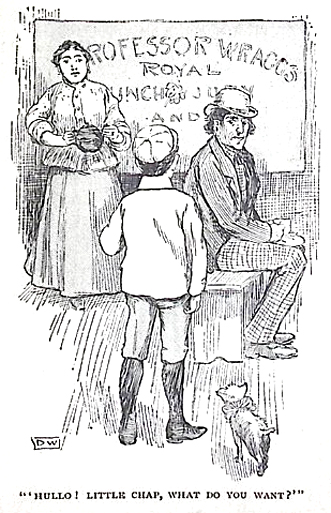
"HULLO! LITTLE CHAP, WHAT DO YOU WANT?"
"I'm hungry, that's all," answered the lad, rather wearily.
"Hungry! What, with them nice clothes on yer!" said the man in surprise.
"Lo! Bob, he can't eat his clothes. Come here, little chap," added the woman, addressing the child, "I'll give you a slice of bread and butter; after that, you can run home to your ma."
"I can't, she's too far away, and I've nobody to care for me now."
The boy, who was none other than Gerald Weston, munched his bread and butter as if it were the choicest delicacy he had ever eaten, and well he might, for it was many hours since he had tasted a good meal.
The woman gazed at the boy with an expression almost amounting to tenderness. Only the week before, the worthy couple had followed their only son, a lad of about Gerald's age, to the quiet cemetery, and something about his face reminded her of the child she had lost. A whispered consultation then followed between the husband and wife.
"Just the very thing!" murmured the showman, eyeing the boy up and down, as he sat there enjoying his bread and butter.
Presently the woman said aloud, "How would you like to stay with us, my boy; we'll give you a home and shelter."
Gerald's eyes sparkled, and without waiting to think a second time, he accepted the offer.
"But what about mother?" thought the child a minute later. "I will write her a letter, to tell her where I am. And perhaps when she knows all, she will come and fetch me."
And in due time the letter was written, but his mother, an English governess in a continental city, never received that childish effusion, for Mrs. Wraggs, to whom it was given to post, forgot all about doing so, and the unfortunate missive was lost amongst the stage properties of the Punch and Judy Show.
THE MISSING CHILD.
"WHAT is the matter, Sir Herbert? I fear you've had bad news."
"Good heavens! Sharpe, it's appalling."
The baronet stood with an open telegram in his trembling hand, with a look of fear and dread in his eyes.
"The west wing of The Towers was partially destroyed by fire last night, and Gerald is missing. And I left him in anger!" said Sir Herbert in acute distress.
Mr. Sharpe was greatly shocked, but equal to the occasion. He rung the bell imperatively, and gave orders for a cab to be brought round at once. A few hours later, and the two gentlemen were on the scene, where the conflagration had taken place.
"What has become of my nephew?" sternly demanded Sir Herbert of the housekeeper.
"Heaven only knows, sir," said the woman, with the tears streaming down her face. "We made every effort to save him. At the first outbreak of fire, I went to his room, which, as you know, sir, was in the west wing. Already it was filling with smoke, and I feared he must be suffocated. But he was nowhere to be seen, search as we might—for we all did our utmost, sir, indeed, we did, when we knew his little life was in danger. It is feared that he was overcome by the smoke on the landing, and—"
Good Mrs. Webster's sobs checked her further utterance, but Sir Herbert had heard enough to fear the worst, and he groaned in his despair. For though he knew it not, the child had grown into his heart and life.
The overheating of a flue was said to be the cause of the fire, which but for its comparatively early discovery, would have wrought even greater damage to the ancestral home of Sir Herbert Weston. The shock proved to be more than he knew how to bear, and for some days the baronet was too seriously indisposed to do more than lie passive in the doctor's hands.
The terrible fate which he feared had overtaken the child, and remorse for the hardness with which he had treated him, weighed upon Sir Herbert so terribly that for a time the good doctor was afraid lest his brain should be affected, and he advised a complete change for his patient, as soon as he should be well enough to travel.
To account for Gerald's disappearance, we must return to the Sunday which followed the day whereon he had so grievously displeased his uncle. The lad's high spirit chafed against the punishment accorded to him, and upon thinking the matter over, he made up his mind that when opportunity occurred, he would leave The Towers secretly, and for ever.
Mrs. Webster, who sincerely pitied the child, despite his disobedience, kissed him that night with more tenderness than usual, and the kindness touched his heart. Leaning his head on her shoulder, he broke into a passion of sobs.
"I can't be good here, without mother; I'm growing worser every day. Oh! If only Uncle Herbert would send me back to her again."
"Come, Master Weston, my dear, this won't do; you must be a good boy, for your mother's sake. You know it was really very naughty of you to disobey the master; wasn't it now?"
"I suppose it was, only I don't seem to care," said the boy, in reckless abandonment of grief.
"Yes, yes, my laddie, you 'do' care," answered the good woman gently.
"If Uncle Herbert was only as kind to me as you are, I would always be a good boy, but—"
Mrs. Webster, fearful of another outburst of tears, softly interrupted him,—
"It is time now for you to say your prayers, my dear, and then you must go to sleep. When your uncle comes home on Monday, you will be able to tell him how sorry you are, and he will forgive you right enough."
With a more cheerful tone than her convictions warranted, Mrs. Webster left her young charge, settled as she thought for the night.
But Gerald had other plans, for an hour or two later, he slipped quietly out of bed. And hastily dressing himself, he made his simple preparations for departure.
Taking his little purse, which contained just one half-crown, he managed with great caution to leave the house unobserved. It was moonlight, therefore the night to the solitary child was robbed of its terrors. He made his way across the meadows, tramping on and on till he was both footsore and weary. The plans which he had formed in his childish mind were these: To make his way to the station about three miles distant, and take a ticket there for the sea-side town of A. which was the nearest watering-place to the village where The Towers was situated.
In his ignorance, he imagined that once by the sea-side, he would have no difficulty in finding a steamer which would bear him across the Channel. As regarded the payment of his passage, he fondly hoped that by referring the captain to his mother's address, which he carried in his pocket, all would be well.
"Mother will pay him all right," thought he.
Alas! Poor Gerald had much to learn in worldly wisdom.
How silent it all was in the peaceful September moonlight. The birds long ago were hushed to sleep, and only the winds whispered in the leafy branches. The stars gleamed faintly in the cloud-flecked sky, overcome by the brilliance of the great round moon.
Gerald at length, becoming too tired to proceed on his journey, sat down beneath an old tree, and leaned his head against the trunk.
The heavy eyelids would fain have closed in sleep, but with an effort, he roused himself. It seemed to his overwrought imagination that the twinkling stars looked down upon him with reproving gaze, and this, added to the feeling of utter desolation, brought the bitter tears to his eyes. How dreary his young life seemed to him now that his mother was so far away; he almost cherished reproachful thoughts of her—no one cared, no one was near to love and protect him.
"Remember that God loves you, and is watching over you!"
With a mysterious power, his mother's words again seemed to ring in his ears.
"God was watching over him! Could it be possible that He, whose Throne was in Heaven, amid the holy angels, was looking down upon him in love and pity? Surely not in 'love,' for he had been so naughty." Thus reasoned the desolate child.
Then feeling his utter need of 'some' one to care for him, his cry went up beyond the shadows of earthly night, to Him who is the Friend of little children.
"O God!" he pleaded. "I am afraid to go back. I know I've been wicked,
but please forgive me, and take care of me, for Jesus' sake. Amen."
It seemed to him that after his prayer, the stars looked at him more kindly. And in a very few minutes, the tired child was fast asleep.
When he awoke, the sun had already mounted the heavens, and at first Gerald wondered what had happened, and how he came to be out of doors, with a green field for his resting-place.
Then it all flashed upon him, and vigorously rubbing his eyes, he arose from his mossy couch, feeling slightly stiff but considerably refreshed by his long sleep. Then he trudged on, making his way to the nearest station. On his arrival there, he was conscious of feeling very hungry, and spent part of his small store in buying himself a roll and a cup of coffee at a stall close by the station, which was opened early for the benefit of workmen.
After breakfast, he took his ticket for A., and a train being due for that place, in a very short time the boy was on his way thither.
Gerald had never known the delights of a sea-side holiday, and the glorious expanse of water sparkling in the sunshine was a revelation to him. Once there, he very soon made his way down to the beach, where the sight of the children at play with spade and pail amused him so much that for a while he forgot his troubles. Towards mid-day he began to feel hungry again, and remembering he had but one solitary half-penny left in his purse, after paying his fare, he pondered in his mind the best method of spending it.
He arrived at the conclusion that a bun would be his best purchase, so seeking out a baker's shop, he bought himself the necessary article.
The afternoon was a dreary one for him; his penniless condition made him feel for the first time how foolish as well as wrong he had been in running away from the home his uncle had provided for him. He would gladly have gone on to the pier, to watch for the steam-boats, but he had not the wherewithal to do so, and neither had he the courage to face any captain with his request.
Feeling both sad and forlorn, Gerald walked aimlessly to the farther end of the beach, where, as we already know, he was soon befriended by the Punch and Judy Showman and his wife.
DISCOVERY.
"HOW do-do, do-do, do-do?" shrieked out the unmusical voice of Mr. Punch, who came proudly to the front, decked in his gold and spangled attire. "Don't yer know me, my little dog Toby?"
Toby, befrilled and unmuzzled, gazed upon Punch with seeming indifference, and then upon the assembled crowd, as much as to say: "Did you ever see such a silly old thing in your life?"
"Shake hands, Toby!" echoed the shrill voice again.
Toby's paw was held out obediently. "Now the other one, Toby! Beautiful! Beautiful!" cried Mr. Punch in rapture, winking one of his great eyes, and forthwith embracing the clever little doggie.
To Gerald, the Punch and Judy Show was most enthralling, and the kindness he received from the hands of the good proprietor and his wife, justified all the golden opinions he had formed of them.
Finding the boy's manner and appearance a great source of profit to their coffers—for few could resist the lad as he came round with the little collecting bag—they tried to make the life as attractive as possible to him. But try as they would, there was much in it that jarred against Gerald's sensibilities, and he occasionally longed for the refined surroundings of his uncle's home.
The novelty of his existence very soon wore off, and though he did not care to show his reluctance, he grew at last to hate the task of collecting the money.
After he had been about ten days with "Professor" Wraggs and his wife, a delightful event took place. He was going round as usual, during the performance, with his bag, when a clear young voice fell upon his ear.
"Uncle Wilfrid," said a child, on the verge of the crowd, "dear Uncle Wilfrid, do stop and see the Punch and Judy Show!"
"'You' may, little one, if you like. Nurse will take care of you, while I go to buy a paper. I'll soon be with you again," answered Uncle Wilfrid.
And Doris Maxwell, to whom the sad story of Gerald's supposed fate had never been told, for fear of the shock it would give the tender little heart, watched the performance, with her merry brown eyes twinkling with fun.
Gerald saw with great surprise that his little friend Doris was amongst the audience, but not caring to be recognised in his new position, turned his back upon the pretty child and her nurse.
"May I give that boy with the bag my fripenny-piece, Nurse?"
"A penny is quite enough, dearie," said Nurse, with an air of wisdom.
Not waiting for the boy's approach, she slipped away from her nurse, and was about to drop the silver coin—for Doris was self-willed as ever—into the bag, when glancing up, she saw the face of her friend and former playmate, Gerald Weston.
"Gerald, oh, Gerald!" she cried in surprised delight.
The boy turned crimson with shame at the recognition, although he felt a keen sense of pleasure in again seeing his little friend.
But business was business, and Mrs. Wraggs noticed that something unusual had taken place, and that the attention of some of the bystanders was diverted from the Show. This could not be allowed to go on, and calling the boy to her side, she took the collecting bag out of his hand and bade him remain at the back of the Show, whilst she undertook his duties. With a lingering look at Doris, he obeyed.
A few minutes later, Mr. Sharpe appeared upon the scene, and to him Doris told her story.
"Impossible, my dear, impossible!" he said, though wherefore he dared not tell her.
"But, uncle, I know it was Gerald." And in distress at his unbelief, the child's eyes filled with tears.
At the conclusion of the Show, Mr. Sharpe, at his little niece's urgent request, made the acquaintance of the "Professor," desiring to see the lad whose business it was to collect the money. And feeling it was useless to deny the wish of such an important looking gentleman, the man gave Gerald a call.
"Gerry, my lad, you're wanted!"
The similarity of the names gave Mr. Sharpe a slight shock. Could it be possible that Doris was right after all? The boy, who was standing at some little distance, obeyed the call. Upon seeing Mr. Sharpe, he gave a glad look of recognition, but the eyes, instead of looking at him in the old genial manner, had an expression of sternness therein, although deep down in his heart the lawyer was conscious of a feeling of great relief and thankfulness.
"You must come home with me, Gerald, at once," he said.
"Yes, yes, I will, only 'please' don't send me back to Uncle Herbert."
"We don't want to part with him, sir; he's a very good lad to us," said Mrs. Wraggs, who had joined the little group.
"How came he to be under your care?" demanded the lawyer.
Then the whole story was truthfully told.
And Mr. Sharpe, feeling that the showman and his wife had acted the part of Good Samaritans, acquitted them of all blame; nay more, he amply rewarded them out of his own pocket for the care they had bestowed upon Sir Herbert Weston's runaway heir.
MADAME FAIVRE.
THE Towers was in the hands of workmen, who were busy repairing the damage wrought by the fire. In the meantime, Sir Herbert was in town, making preparations for a foreign tour. It was already growing autumnal; the golden September days had given place to chill October, and Sir Herbert, feeling still somewhat of an invalid, sat by the fire, after his solitary breakfast was over, reading a letter which, to judge by his expression, caused him considerable agitation.
It was at this moment when a tap was heard at the door, and Mr. Sharpe entered the room.
"You are an early visitor this morning, but none the less welcome, Sharpe," said the baronet, with an effort at cheerfulness.
"My business was urgent, Sir Herbert, which is my only apology for coming at this hour. You're not looking the thing—no fresh trouble, I hope?"
"Well, perhaps not a trouble in one sense, but I have had a letter from my sister-in-law this morning about the boy. She wants to see him. God help me! What shall I do?"
The man in his extremity called upon the Name he had for so many long years disregarded.
"I've never had the courage to write and tell her of her loss. I know it was wrong, but believe me, Sharpe, I have felt too wretchedly ill, both in mind and body, to undertake the task. I have meant to do it each morning, but my strength has failed me. I am as weak and nerveless as a child."
"What does his mother say?" inquired Mr. Sharpe, as he pondered in his mind how to break the good news he had to tell.
"She says that she is able to provide a home for him now; a relative has recently died and left her all his property—read the letter for yourself," added Sir Herbert, as he gave the epistle into the lawyer's hand.
"So she is coming for him at Christmas," said Mr. Sharpe, after reading it through.
"Coming! Man, yes! But what shall I say to her? These words seem burnt upon my brain—'Whoso shall offend one of these little ones . . . it were better for him that a millstone were hanged about his neck, and that he were drowned in the depth of the sea'—"
"But Gerald was greatly to blame," said Mr. Sharp, interrupting.
"I suppose in a sense he was, but what is that child's sin in comparison with mine?"
"Would you forgive him 'fully' and 'freely' if he were here to ask you?"
"Forgive him! Would God he were here to put me to the test."
"Sir Herbert, Gerald 'is' here, and is only waiting to ask your pardon. I left him in the hall, whilst I prepared you for his coming."
"Gerald here!" cried the man, unconsciously raising his voice.
And the little lad outside the door, thinking he was called, entered, and Mr. Sharpe went out, and left the two together.
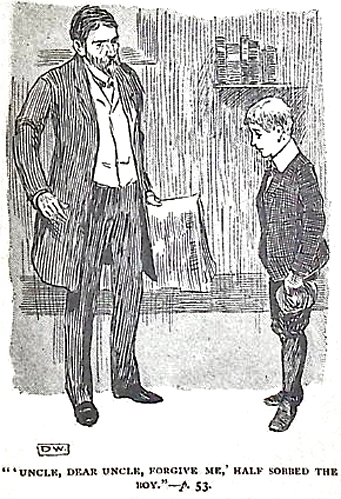
"UNCLE, DEAR UNCLE, FORGIVE ME,"
HALF SOBBED THE BOY.
"Uncle, dear uncle, forgive me. I've been 'very,' 'very' naughty," half sobbed the boy. And this time he did not plead in vain.
Words failed the baronet at that moment, but opening his arms, he drew the agitated child closely into them, and kissed him gently, as a tender mother might have done. From that time, the heart of Sir Herbert Weston became soft, even as the heart of a little child.
*****
"So you really mean to leave us at Christmas, Mrs. Weston? Well, I'm sure I don't know what Marie and Louise will say, when they hear of it!"
"You are very good, Madame, and I shall never forget the kindness received from your hands, when I came a stranger into a foreign land."
Madame Faivre shook her head, and tears gathered in her kindly eyes.
"It is 'you' who have been good to us, dear Mrs. Weston, and may God reward you for the wise and gentle influence you have exerted over our unruly household—mere money can never repay you."
Poor Madame Faivre was in dire distress at the idea of parting with her valued governess, to whom both she and her daughters had become sincerely attached. Being herself of English birth, her affection and sympathies were readily bestowed upon the lonely woman who had been thus thrown upon her own resources for her daily bread.
At this moment, Marie Faivre, a bright, high-spirited girl, of about twelve years of age, entered the room. Owing to the fact that Marie and Louise possessed an English mother, they spoke the language fluently.
"Maman!" ejaculated Marie, seeing Madame Faivre in tears. "What 'is' the matter?"
Then for the first time, the tidings of Mrs. Weston's intended departure was mentioned, and Marie's blank look of dismay testified to her feelings.
Louise, who followed Marie into the room shortly afterwards, was also told the sad news, and she in her grief burst into sudden tears.
"Come, come, girls, we must not be selfish. Your dear Madame has no longer any need to earn her living, and we must think of her happiness in once more seeing her little son, and having him to live with her again."
And Madame Faivre, as she thus spoke, briskly wiped her tears away.
Mrs. Weston, touched with their affection and kindness of heart, felt her cup of happiness well-nigh full.
"Ah, your petit Gerald 'will' be rejoiced," said Marie gently.
"He will be just as glad as we are sorry," said poor Louise with a deep sob.
"My 'dear' Gerald! Oh! How I long to see him," said Mrs. Weston, forgetful for the moment of the present, as her thoughts roamed backward to their bitter parting.
"You'll wait till Christmas, won't you?" cried Louise in selfish affright.
"Yes, I promise you that," said Mrs. Weston, feeling that the weeks would soon pass, and that in justice to her friends, she must give them time to find another governess to take her place.
But alas! For the promise she had bestowed—"L'homme propose, Dieu dispose."
The day following was a bright October morning, and Mrs. Weston (or Madame as she was usually called), after despatching a letter to Sir Herbert Weston to inform him of the change in her fortunes, and her proposed return to England, sat contentedly in the cheerful schoolroom preparing lessons.
For some weeks she had had no news of her child, but still no anxiety concerning this fact troubled her, for her brother-in-law was a very occasional correspondent, and seemed to desire as little communication as possible between mother and son.
Presently upon lifting her eyes from the book she was studying, her attention was attracted by an untidy mass of papers near the fireplace—for Madame Faivre would have no stove in the schoolroom, but a bright fire blazed away in true English fashion, when the chilly days rendered it necessary.
"Rosine must have forgotten these, when she lit the fire," she said, as she rose to ring the bell.
But ere doing so, she noticed that one was a part of an old copy of an English daily paper. In some curiosity she glanced over the columns, for it was a long time since it had been her lot to see a London newspaper.
A few minutes later, when Marie entered the schoolroom, what was her grief and consternation to see her beloved Madame in a dead faint on the floor, still clutching in her hand the portion of newspaper.
"Maman! Maman!" cried out poor Marie. "Madame has fainted."
Louise, who was following close at hand, found it even as her sister had said, and hastily fetching her mother, together they endeavoured to restore the poor lady to consciousness.
Taking the paper from her hands, Madame Faivre read the paragraph which had caused such bitter distress. It was an account of the fire at The Towers, Sir Herbert's residence, and the supposed death of poor little Gerald. Gradually, Mrs. Weston recovered her powers of thought, and moaned pitifully in her distress:
"My boy! My little Gerald! Oh, God help me!" cried the unhappy mother.
"Pauvre Madame!" sobbed the girls in sympathetic grief.
"What is it, maman, that has made her so ill?" inquired Marie.
"Read the paper, mes chères, and then run away and leave me alone with Madame."
The girls read the ill-fated paragraph with blanched faces.
"However did such a paper come into the schoolroom?" said little Louise.
"I can guess," answered Marie; "you know Rosine has an English friend, and he must have given it to her. Oh! If only poor Madame had never seen it."
Ere the day was out, Mrs. Weston had started on her homeward journey, leaving behind her sad and anxious hearts.
"A telegram, maman, and for Madame," said Marie excitedly, a few hours after Mrs. Weston's departure.
"We must open it for her, Marie, as she is not here." And so saying, Madame Faivre with considerable anxiety read the words contained therein.
"Come to England at once. Good news."
"We must praise the good God for this," said the lady, while tears of joy and thankfulness rained down her cheeks. "Run and tell Louise the glad news," added she. "Oh, if Madame could only know!"
Ah! Could Mrs. Weston but have known, much anguish of heart would have been spared her. Meanwhile, she was making her way in bitter grief to England, little recking of how soon her sorrow would be turned into joy.
Upon arriving in London, she telegraphed to Sir Herbert Weston at The Towers, but the reply came to the effect that the baronet's whereabouts were not known, and referred the sender to Mr. Wilfrid Sharpe, 18 Hope Gardens, Sydenham.
And thither, without taking any rest, hastened the poor mother, each step bringing her nearer—could she but have realised it—to happiness and Gerald.
REUNION.
"I HAVE despatched the telegram, Sir Herbert, and we shall very soon have the lady in England, I fancy."
"You're a good friend Sharpe—you'll see me through this, won't you?"
"Yes, yes, Sir Herbert, only it seems to me your troubles are over now."
"No, they're not. I have to face the boy's mother, and I don't know what she'll say to me."
"Come, come, Sir Herbert, keep up your spirit," said the lawyer, cheerfully. "What is she like—this mother whom Gerald thinks so much about?"
"I only remember her as a fragile looking girl of about two or three and twenty—I haven't seen her now for some years. All our business concerning the boy was done in writing. She was pretty, too, I fancy."
"Well, this doesn't sound very alarming. I wish you would come and lunch with me to-day, and bring Gerald with you. Doris is staying with me again, and is just crazy to see her Punch and Judy hero, for such she considers the boy now."
"Perhaps the child won't appreciate lunching with 'the heathen,'" said the baronet with a smile.
Mr. Sharpe reddened a little. "I am afraid you must have thought her very impertinent, but believe me, she never meant it," said the lawyer anxiously.
"Impertinent! Oh dear no, she only spoke the truth. I 'was' a heathen, but since the boy's coming, somehow I've felt different. Yet he doesn't look much like a missionary, does he?"
A recollection of Gerald, as he dangled the hapless little fish on his line upon that memorable Saturday flashed across Mr. Sharpe's mind.
"No, certainly the child bore no resemblance to a missionary, and yet—" the lawyer's face softened as he recalled a passage from Holy Writ—"'A little child shall lead them.'"
There was a pause, which was broken by the baronet.
"Yes, Sharpe, I 'will' accept your invitation, and bring the boy with me."
The above conversation took place in Mr. Sharpe's London office, Gerald in the meanwhile amusing himself very contentedly talking to the chief clerk about the fish he meant to catch when he was grown up, whilst his elders were discussing matters of more serious moment in the little sanctum beyond.
*****
Miss Sharpe was in quite a flutter of excitement, for the baronet was an honoured, though somewhat unusual guest at her brother's table. And in the pretty Sydenham villa residence, grand preparations were speedily made for the illustrious visitor and his little nephew, Mr. Sharpe with great worldly wisdom and forethought, having despatched a telegram to his sister, to inform her of the expected arrivals.
Doris, looking the very pink of propriety, sat next Sir Herbert, for whom she had conceived quite a respectful affection. Gerald, brimming over with joy—for was not his mother coming home very soon—was in a state of mind which bordered on transport.
Presently a loud ring was heard at the door bell, and a maid shortly afterwards tapped at the dining-room door and informed Mr. Sharpe that a lady desired to see him immediately.
"What name, Henderson?" inquired he.
"Mrs. Weston, please sir."
There was a sudden rush—the sound of a falling chair, and the maid was pushed unceremoniously aside.
Then followed a cry of "Mother, mother."
And Mr. Sharpe knew that for a little while at least, his presence was not required in the drawing-room.
Joy seldom kills, and the sight of the boy whom she believed never to behold again with earthly eyes, was in itself such a rapture to Mrs. Weston that she could do nothing but clasp him in her arms, asking not the why or wherefore, whilst tears and smiles followed each other in April-like succession. The bitter resentment she had been cherishing against Sir Herbert for withholding the fateful news all faded away at the sight of the little lad in his sailor suit.
The baronet presently entered the room, his calm self-possession well-nigh deserting him.
Instead of the reproaches she had prepared herself to utter, she grasped his hand, saying brokenly, "God bless you."
Ah, mothers are not always quite reasonable, and such sweet inconsistency was very welcome to Sir Herbert Weston's broken and contrite spirit.
*****
Months and years have passed away since Mrs. Weston's return to England. It is the season of Christmas, the time of peace and goodwill.
Gerald and his mother now live together in a charming little residence called "The Lindens," situated in close proximity to The Towers, a fact which is largely owing to Sir Herbert's generosity. It is well-known to those around how deeply attached the baronet is to his young nephew and heir. And in the lad's eyes, there are few to compare with his uncle, whom, next to his mother, he regards with deepest affection.
On the morrow, being Christmas day, there are to be great festivities at The Towers, and amongst the invited guests, to Gerald's delight, are Mr. Wilfrid Sharpe and little Doris Maxwell.
"Mother," said Gerald, as they sat together in the firelight listening to the Yule-tide bells ringing out their message of peace and goodwill, "I sometimes wonder how little boys get on without any mother to keep them right."
Mrs. Weston rightly conjectured that his mind was reverting to the days of the past, when he felt his need of her so sorely.
"You must not forget, my boy, that there is a Love which far exceeds that of a mother," she answered gently.
"Oh, yes! That reminds me of what you said to me a long while ago—at the time we bade 'good bye.'"
"I remember, Gerald—a time when you gave me a 'three-fold promise.'"
THE END.
————————————————————————————————
LORIMER AND GILLIES, PRINTERS, EDINBURGH.