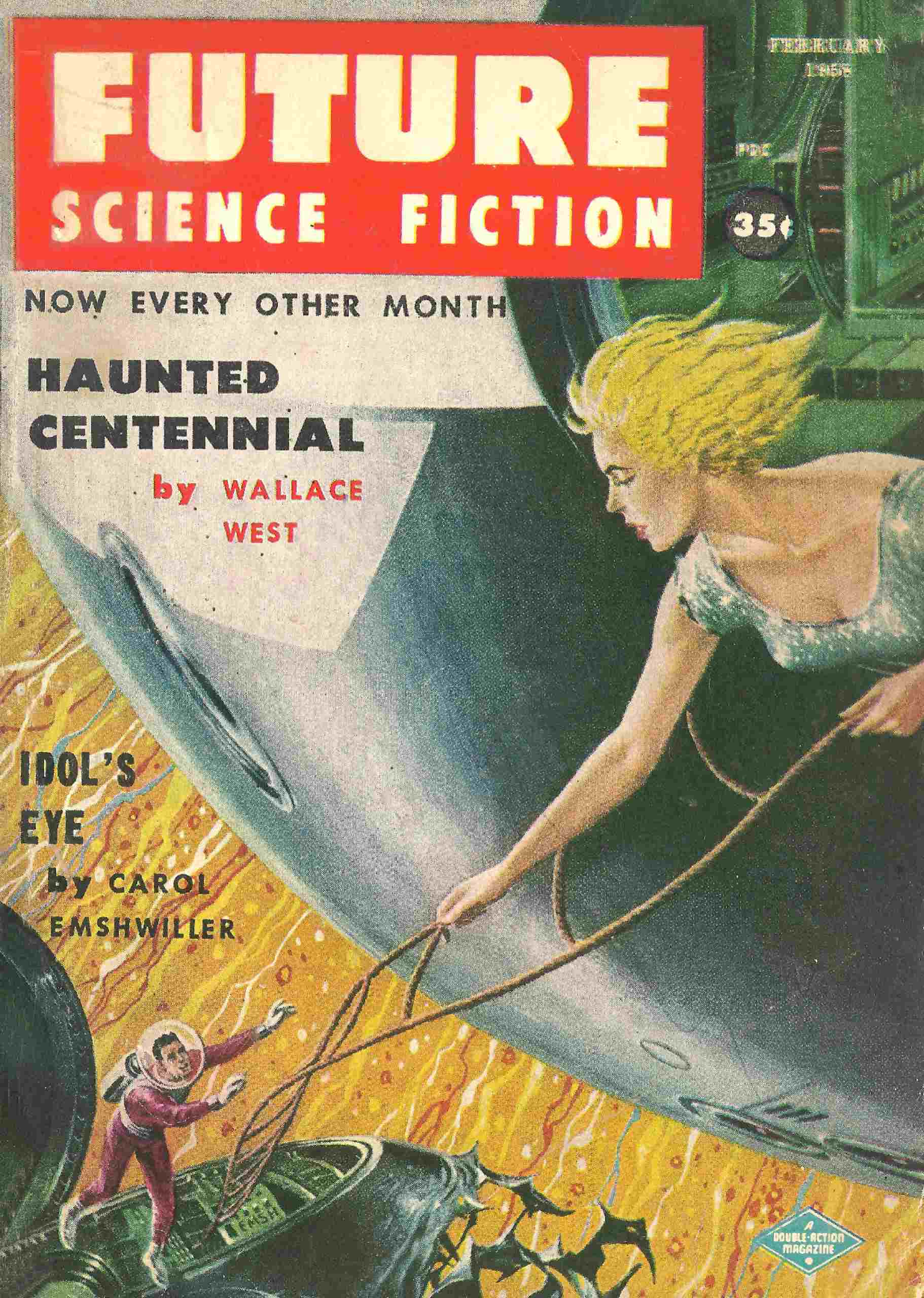
Transcribed from Future Science Fiction #35, February 1958
Title: Idol's eye
Author: Carol Emshwiller
Illustrator: Ed Emshwiller
Release date: August 4, 2026 [eBook #79264]
Language: English
Original publication: Holyoke, Mass.: Columbia Publications, Inc., 1957
Other information and formats: www.gutenberg.org/ebooks/79264
Credits: Tom Trussel (This file was produced from images generously made available by The Luminist Archive)
Transcribed from Future Science Fiction #35, February 1958
by Carol Emshwiller
Barely two years ago, in the February 1956 issue of Science Fiction Quarterly, to be exact, we ran a short-short story entitled “Love Me Again”, by one Carol Emshwiller. Some readers knew at once that the lady was the spouse of Artist Ed Emshwiller; others wondered. But the response was positive in either instance. While some have found her stories obscure, the majority feeling is somewhat exaggerated in the words of a reader who urges us never to let her appear elsewhere, stating that, so far, not a single story from her typewriter rates as low as merely “first class”. Yes—to say this is to exaggerate, but, apparently, not to give a false impression!
Who’d have dreamed the destiny awaiting Phillipa?
Philippa was on the back steps shelling peas when she heard the sound of footsteps. They didn’t make much noise on the dry earth, but Phillipa heard them; and because of the heaviness of them, and the time of day, and the way they came around to the back of the house, she knew who it was.
Her fine black hair already hung down, hiding each cheek, but she shook her head to bring it farther over her eyes in a protective screen. She peered out through the thick lenses of her ill-fitting glasses, but the only thing in focus, as usual, was the comfortable, familiar, black hair before her eyes.
There was the blurred shape of the grey barn, and the hazy, rolling line where the hills stopped and the sky began, and a new, dark shape under the green umbrella of the elm tree looking like every other blurred shape of a man or a woman. About the most Philippa saw of any of them. She knew who it was, though, and her hands tensed and she shelled peas more rapidly than before.
The shape neared and stood before her. “Hello,” he said. “You’re looking pretty.”
She was used to being the way she was, and she didn’t mind any more, not really. It was only the mockery she always felt in him that hurt her, not the words he said. When she answered, she spoke slowly and almost in a whisper. She wanted to say that if he loved her, and really wanted to marry her, he should say that she was what she was; but she didn’t think there was really any love for her in him. He would rather see her something different. “I may not see very well,” she said, “but I know I’m not pretty.”
“You are to me.” But she knew these were just words, the kind of words people always said without thinking if they meant anything.
He sat down beside her and leaned over her. He was so close she could see his uneven teeth and the bristled mustache above them almost as clearly as she saw her own hair.
“How about a kiss?”
“No,” she said, “not now.” She knew he was only saying it to tease her, but still the thought made her turn her head away.
“You’ve got to sometime, you know.”
“Maybe after we’re married.”
“Maybe! I guess you’d better. Anyway, I’ll be the boss then.” He laughed a laugh that made her shrink inside and then he got up and went on into the kitchen. She heard him call out to her mother, laugh again and say, “Philippa.”
She heard the tail end of her mother’s answer ... “doesn’t know when she’s well off”, and “...a strange one, Philippa.”
During the conversation with him, Philippa had not stopped shelling peas, but now she did.
She looked off to where the green went the highest into the blue of the sky, to Old Hump Back Mountain—no mountain at all, but the biggest hill around—and she thought about being up there on the top, and the breeze there, and the smell of pine and the rustling animal sounds. She thought about it so she would forget about her mother and him inside.
Then she saw it, clearer than she had ever seen anything before. It was almost as if she saw it with the mind’s eye as well as with her real eyes. A cloud, but a clear cloud with the billowing shapes within it concisely outlined. It was purple, with a reddish tinge around the edges; it billowed upwards in a funnel shape for almost a full minute before it shrank and faded.
I saw it, she thought. I saw it as clearly as I see my own hair before my eyes. She shook the hair back, for once impatient with it, and stared at Hump Back Mountain. It was as blurry as ever.
That was seeing, she thought. That was the way everybody sees, and it’s wonderful. Or perhaps it’s a special way of seeing—my way.
And she thought that this was a nice thing to remember and think about; she shelled the peas again and felt happy.
They had come. This was the place and there must be one somewhere, a special one that was just right. The crystal would tell them.
They came out of the folded loop, Par and Til and Gib.
“We’re doing it for the idol,” said Par. The others didn’t answer, but Par knew.
They set the crystal down on the pine needles, and Gib curled around it to give it what it needed. “This is a nice place in it’s way,” Gib said before he went “out”.
“Were we seen?” Til asked.
“They can’t,” Par said. “It takes more than eyes sometimes.”
“So, it is a nice place, in its way, to be calm and sure in,” said Til. They sat and felt the breeze, smelled the pine smell, listened to the rustle of small animals, and waited.
When night came Gib uncurled from the crystal and came “to” again. “One is found,” he said, “with what is needed. Shall I call?”
The others didn’t answer, because there was no reason, but Gib looked into himself and knew the answer then; he called a slow call that would wait for the right time.
“This is a nice place in its way,” Par said. It had been said, but not by Par. And then they all waited again.
He and Phillippa and her father and mother all sat down to supper at the round table. Philippa said nothing, because she was thinking about how it was to see clearly all the way to the top of Hump Back Mountain. She shook her head till her hair was a curtain from the light above the table and the shining white dishes and the glitter from the knives and forks. All the others talked, but Philippa was lost into herself.
“You were rude tonight,” her mother said afterwards, as they washed the dishes together. “You’re always rude to him, and he’s the only one you’ll ever have a chance with. He needs a wife and he’s not particular, Lord knows, but maybe he won’t even have you if you’re this way all the time, and then what will you do?”
“I didn’t mean to be rude,” Philippa said.
“Well I’m warning you, he may not be much but he’s your only chance. I don’t understand you, Philippa, that you can throw away your only chance. Try to be better when we go out to the front room again. Wake up and don’t be so dreamy-like. Men like a girl who notices.”
“I’ll try.”
And she did try, later in the front room, but there was something about him that shut her like a box inside, something about him that made her want to make him fuzzy not only to her eyes, but to her inner eye.
She tried though. She was noticing and kind and because of it he grew bold.
They were on the porch and her mother and father had gone to bed. “I’m going to have that kiss,” he said. “I’ve waited as long as an engaged man can.”
“Please not now.”
“Look, Philippa, I need a woman, like you can’t even think how I need one. Look,” he leaned close and held her arm in a bruising grip, “they brought Lucky Lady over to the Prince today. Did you hear him bellow down to the pasture?”
Philippa tried to lean away, but he held her arm tightly just below the shoulder. “I’m like the Prince,” he said, “just like the Prince, I could bellow.”
His hand pulled at her other shoulder in a kind of clumsy caress, coaxing her to turn to him. “We’re going to be married, you know. It doesn’t matter now. We can do anything.” Then he pulled her hard against him. “For God’s sake push back that hair,” he said.
A few minutes later, Philippa managed to twist from his grip. She ran rapidly through the dark front room to the hall and the stairs. She had no need of sight, here in her home, and the dark was comfortable. He stumbled after, bumping into the small table by the door and cursing the noise he made. He dared go no farther than the stairs and by that time, Philippa was in her room. She heard his heavy steps on the porch as he left, and she waited by her window until the crunching sounds on the stony earth of the driveway were gone.
She lay on her bed, and she could neither think nor sleep; but she knew that she could not marry him, in spite of her mother and father. Now she had decided that.
The hours went by rapidly for her because she had so much confusion in her mind, but finally she dozed.
She was in an orchard in a valley and the fruits on the trees were pink and ripe, because it was a holy time. There were creatures around her, unclear creatures that she saw more clearly even than she had seen the purple cloud that evening over Hump Back. The creatures came to the orchard because they loved. They loved to eat the pink fruit and they loved, in this holy season, to worship the idol here where he lived.
Then she saw him and she loved him, too, because she could see more than him.
One shoulder was higher than the other and one arm was shriveled. He had lost both feet at the ankles, and a scar lumped across his forehead. Philippa saw all this, but mostly she saw his strange, blind eyes and what lay behind them. She saw him, inner eye to inner eye.
Then one of the creatures handed her a pink fruit. It had a strange taste, neither sweet nor bitter. The sweetness was more sweet because of this, and she ate it.
She woke and remembered the grasping hands and the brutal kiss of the night before, but it was like a memory of a long time ago that didn’t matter any more. A lot of things didn’t matter now, for something new was inside her.
She came down to the kitchen. No one else was yet up. She made the coffee and drank some and ate an orange. She savored the sweetness of the orange and the bitterness of the coffee. These are the tastes of my home, she thought, my home and my land, and she loved the tasting. But she had a strange new taste in her mind that had a new meaning.
Her father came down and they went out to the morning milking, not speaking. Father and daughter, a disappointing, ugly, half-blind daughter; but still, in the early morning going to milk the cows, they were father and daughter.
Later in the morning, she took the garden claw and weeded the vegetable patch; then she squatted down to pick green beans for lunch. The hot sun made sweat bead along her upper lip and dampen the back of her blouse. This is the hot sun of my land, she thought, and loved her sweating.
After lunch she asked her mother, “Can I go for a while?” for now was the time.
“There’s a lot to be done,” her mother said, and then she thought that this was her daughter, who had so little. “But go on; there’s nothing that won’t wait.”
“Goodby,” Philippa said.
She went out and a half an hour later she stood just where Hump Back Mountain started from the valley floor. She took off her glasses and laid them on the ground. She pushed her hair back, showing her large, staring eyes and broad nose and then she started walking through the pines towards the top of the hill.
Once the generals and the politicians and the scientific experts had searched the Earth and found six strong, healthy men—trained and intelligent men—and one of them was also a truly kind and good man with some said, a way of seeing into people. And they had sent him with the others, out in one of the six new ships built to leave the solar system. “Most of you won’t come back,” they said.
Some of the ships crashed, and some never got to any place that was a place, and they never heard of the men again, nor of him.
And because of what he was inside, the creatures of a strange world had planted an orchard and built a holy gate; they had seen the answer to the question he never asked, and had come where they would never venture before to find him a worthy wife.
This etext was produced from Future Science Fiction #35, February 1958. Extensive research did not uncover any evidence that the U.S. copyright on this publication was renewed.
Obvious errors have been silently corrected in this version.