The Telling of the Bees
A haunting tale of human hearts, and the tragic trail of a woman’s outlawed love
Helen R. Hull
Liberty, vol. 18, Jan. 4, 1941, pp. 22-27.
Title: The telling of the bees
Author: Helen R. Hull
Release date: August 7, 2026 [eBook #79297]
Language: English
Original publication: New York: Macfadden Publications, 1940
Other information and formats: www.gutenberg.org/ebooks/79297
Credits: Jens Sadowski. This file was produced from images generously made available by The Internet Archive.
A haunting tale of human hearts, and the tragic trail of a woman’s outlawed love
Helen R. Hull
Liberty, vol. 18, Jan. 4, 1941, pp. 22-27.
When Marcia woke, she thought at first that the week-long spring rain still beat against the roof. But her eyes opened to brilliant sunlight on the unpainted wooden partition which divided the cabin into two rooms. It was wind she had heard, a gay wind out of the north, running a rough hand over the new green of larches and birches, making a fragrant snowstorm of petals from the apple trees. She drew a deep breath of delight, shaking back dark hair from her full throat, straining the cotton nightdress over her firm deep breasts. She was in haste to be out, watching the wind dry the sodden furrows of the garden.
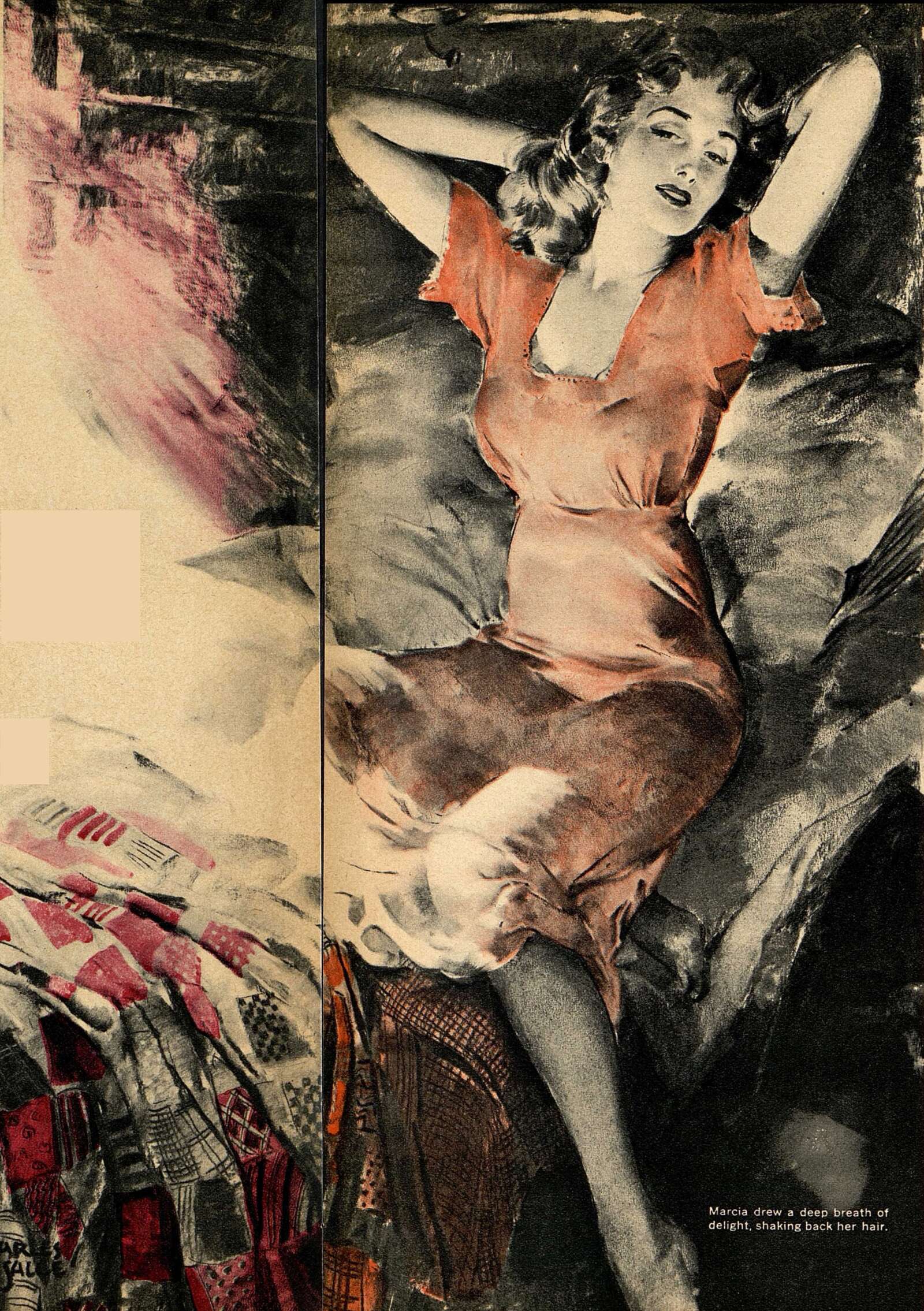
Marcia drew a deep breath of delight, shaking back her hair.
She laid a fire in the kitchen stove; she drew a bucket of water from the well just outside the door, her toes curling against the cool granite well curb. She was dressed before the kettle boiled, in a man’s shirt, the sleeves rolled above her elbows, and faded denim overalls, above which her heavy-lashed eyes looked almost purple. Standing in the doorway she ate her breakfast, coffee with condensed milk, a thick slice of bread.
Spring had been late this year, when her longing for it had been toxic in her blood, so that time was a barred window against which she bruised herself in vain. In spring, Stan had said. When the blueberries are in flower again. It wouldn’t be decent sooner. That much I owe Dolly. That was the day after Dolly had been buried.
Sitting in her kitchen that night, forgetting to build up the fire, so that the cold crept up to her knees, to her heart, she had gone over his words. Had he meant anything, about the blueberries? Oh, only that he remembered, as she did, last spring! And now, standing in her doorway, the north wind lifting her hair, the sun tingling at its roots, she remembered last spring as she had remembered it since then, invoking it deliberately, drifting into it in dreams, drinking it like wine.
She had gone up to the blueberry fields—it was in May, last year—to try to spray the blossoms. She wanted to sell the fruit to the canning factory, and the inspector condemned all unsprayed fruit. She had not known how to work the blower. Bill, her husband, had been lazy enough, but he had taken care of the berries. Only, Bill wasn’t taking care of anything any more, having driven his truck into a ditch and smashed his drunken skull on the way home from a New Year’s spree.
Marcia had sat down on a rock with the can between her knees, struggling to free the pump, when she felt a shadow between her and the sun. There was Stanley Douglas, grinning down at her, his long lean body relaxed, his eyes amused. Had she been cursing out loud? She jumped to her feet, indignant.
Stan was their neighbor. When Bill had moved her out here, into the shack he had built on the site of the burned homestead, Stan had been friendly. But Bill had resented him, feeling the contempt which a mean man feels for an upright man, and Stan had stopped coming over. As his wife, Dolly, never went out anywhere—Marcia didn’t know what ailed her—the two families might have had an ocean between them instead of only a mile of pasture and woods.
Marcia had thought about Stan, his easy graceful stride, his body with its broad shoulders and slim flat thighs; his proud steady eyes, very blue in his tanned thin face. What did a man like that do with a sick wife, anyway? Bill was flabby and white like a mushroom. What had seemed strength when he courted her had turned out to be pure meanness. Marcia was bored, restless. (The night they brought Bill home, that doctor from the town had said, “Well, are you satisfied now?” Had Bill lived long enough to say anything? What could he say, anyway? She had told him he was too drunk to drive. Bill wasn’t smart enough to guess she had known that would send him off! The doctor, for all he was so smart, couldn’t guess.)
After Bill’s death, Stan had come over a few times. He had offered to do the spring plowing. Marcia had driven, Stan following, guiding the plowshare, easy deft strength in every movement of his body, the smell of the damp earth strong in her nostrils. It was a rite binding them together, sweat, fatigue, the earth, the rhythm of the work. At the end of the morning Stan had thrown the plow into the wagon, had backed the horse into the shafts, adjusted a buckle or two, smiling at her as he vaulted into the seat. Marcia had leaned against the wheel, her heart beating urgently.
“Stan!” she had said, and reached a hand to his knee. He had looked at it and lifted the reins.
“That’s nothing,” he said. “Glad to help you out.” He had driven off with a great clatter.
He hadn’t come again, until that last spring morning when he laughed at her ineptness with the blower. “Here, let me show you.”
“You needn’t laugh!” she had cried. “I can fix it myself!” Then they were wrestling over the pump; he pried her arms apart, bent back her fingers, the can rattled over the stones, and Marcia was in his arms, her breasts pressed close under the strong arch of his chest, her mouth on his, the earth whirling, her blood humming loud—or was it the steady, monotonously sweet vibrations of the bees? He pulled away from her, and when she moved toward him, made a barrier of his hands.
“No!” he had said. “No more of that.”
“Oh, love me, Stan! Love me!”
“I won’t. Dolly—”
“She needn’t know.”
“I would know.” His face had an ashy hue under its tan. “No more of that. You hear?” He strode away, not once looking back.
* * *
That had been last spring. A year ago. Summer, fall, winter, and now another spring. Today, tomorrow, Stan would come! The summer would be rich in delight and fulfillment. He had done his duty to the thin sharp woman he had married; he could forget her now, and Marcia need no longer dull her hunger for him with a dream. She, too, could forget the past year; she need never think of it again. And yet, as she walked toward the cleared slopes above the house, fragments of it darted across her mind.
That day in November, for instance, when Stan’s housekeeper had come to her door. (His wife never lifted a hand, so people said.) Her daughter was sick, the housekeeper said, and she must go to town. Mis’ Douglas thought maybe Mrs. Barrows, being a widow and having no one to do for, she might be willing to come in for a few hours in the middle of the day, when Mr. Douglas was away. Chopping pulpwood, he was. Mr. Douglas thought she wouldn’t have time, the woman went on, but Mis’ Douglas said just till they found some one else, maybe.
Marcia’s eyes grew bright. A way to see Stan! To learn things about him! To see this ailing wife who held him away from her! “I’ll be glad to help out,” she had said. “I don’t mind a few hours a day.”
If Dolly had been a different kind of woman—Marcia stopped, hands inert at her sides, her nostrils pinched, her body caught in a web of recollection so intricate, so intense that movement, except into the past, was impossible. If she would walk, she might escape Dolly’s sallow face, with the large hazel eyes, the petulant mouth; her voice, with its queer overemphasis, its reiterations; her odor, perfume, orris root she brushed into her hair, warm woolen smell from huddling near the stove, heated rubber of the water bag she held always to an ache in her side or her stomach or her shoulder.
Marcia drew a long shuddering breath. How had she held her tongue all those days and weeks, simulating sympathy, listening to symptoms, scalding her fingers as she filled the water bag, stifling as she piled more wood into the stove? At first she had thought Dolly must have wind of something, she boasted so of Stan’s devotion.
“You must always go home before he comes,” Dolly had said that first day. “He doesn’t like any one in the house except me. He’s that way. Mrs. Peasley always stayed in the kitchen.”
Presently Marcia had understood that Dolly had a consuming jealousy of Stanley which included even the livestock on the place, and that her boasting about his devotion covered her fear, and that Marcia was just any female under eighty to be kept out of his sight.
Dolly’s bedroom was on the ground floor, opening from the dining room. The door into the parlor was kept shut. Marcia moved from kitchen through the dining room, into Dolly’s room, carrying wood for the stoves, seeing tokens of Stan. Felt slippers under the range. The way he whittled curls on sticks of kindling. The way he rinsed and stacked the breakfast dishes. She began to leave tokens. A spray of orange bittersweet berries over the kitchen clock. Scarlet-black alder branches in a blue glass vase on the dining-room mantel above the sealed-up fireplace. Even a clumsy darn in the thumb of a woolen glove dropped in the woodshed.
The first week Dolly had talked incessantly about her people, her childhood. Showing off, thought Marcia. How fine she is! She’d never been strong; her father always said, “Some one must always take care of my little Doll.” Why, she’d never even washed a dish until she married!
* * *
Dolly had been inquisitive about Marcia. “Where’d you live before you came here? You aren’t from these parts, are you?” Farther down east, was all Marcia would say. (She was through with her past; she’d run away and left it. Dolly’s prying drew it close for a moment, herself ragged, dirty, taking care of babies, one a year, spindly, rickety little brats with diapers hanging down. “Be grateful you’ve got a home,” her mother would say. “Not all men would have done it, but when I married him, I said, ‘Now here’s Marcia.’ And he said, ‘Bring her along.’” Her mother’d been just seventeen when she had Marcia, it’d been a year before she got herself a husband, and Marcia had paid in hard labor for whatever fun her mother may have once had. Until she was old enough to go out to work. Then she didn’t go back.)
“I used to be awful pretty,” Dolly was saying fretfully. “The whitest skin. And now look at me!”
Marcia, looking, felt her own vitality rise on a tide of exultance. You haven’t got much now, she thought. You think you’ve got Stan? Wait and see!
Dolly went on to talk about her lack of health. Stan was really to blame, and he knew it; that was why he tried to make things easy for her. She’d told him she wasn’t strong enough to have a baby, but you know how men are. She’d been terribly sick, they’d had to operate, she’d never had a well day since. She had grown animated and flushed as she described the operation. Only now it was her stomach. Stan had taken her to the hospital in October—last month—and they’d taken X-rays and everything, and the doctor said there was nothing wrong, only her nerves. She didn’t like the doctor. He sided with Stan, pretending nothing was wrong with her.
To all this Marcia had listened, keeping her face humble and attentive, moving about the house with her step leashed and quiet. And within her, her passion had crouched, dark, feral, alert.
On some days Dolly would not get out of bed. Even then she would eat greedily whatever Marcia brought on the varnished black tray and set beside her. She craved sweets, frosted cakes, prunes in syrup, a bag of cheap bright candy from the meat-and-grocery cart which came each week. That she hid under her pillow, nibbling when she thought no one was looking.
On other days she would get up when Marcia came, would choose one of the warm gay bathrobes—the pink blanket robe or the red corduroy—mail-order purchases, and then would sit for hours in front of the mirror at the walnut dresser with the marble top, curling her hair, the room close with the brash odor of scorched hair, with the sooty smell of the kerosene lamp, smoking as Dolly held the curling tongs in the chimney.
“I’d like to try a henna rinse,” she would say. “My hair used to be like gold, real bright. But Stan won’t let me send for anything more.” She combed out curls, softening them over her finger. “That’s the doctor’s fault, too. He wants I should use just his medicine, so he can get a rake-off. Some of the medicines you see advertised are certainly wonderful.”
* * *
At the time Marcia scarcely listened to Dolly’s chatter; later it repeated itself against her inner ear. “I used to send for some of them, and they made me feel better, but I didn’t say anything about them, because I knew the doctor would be mad. There was one, an Elixir of Youth it was called. Glands, you know.” She primmed her mouth. “It makes your skin white, your eyes bright, it gives you back allure. It said that on the bottle. I took almost two bottles and I could see a big difference. Only then I was sick and Stan found the bottles in the closet, and the doctor just raved! He said it was pure poison, arsenic. He couldn’t find out what’s the matter with me, and so he blamed that.” She turned her head, her large eyes vindictive. “I sent for another bottle, but it never came. If I thought Stan took it—”
One day, later, Dolly had said, “Stan wants to get a regular housekeeper. He says you never meant to stay all winter; it was just a favor as a stopgap.”
Marcia was sweeping the dining room. She stopped, her hands closing hard over the broom handle, her heart swelling. He couldn’t stand it, the thought of her in his house all day! Last night she had left on the kitchen table the red handkerchief she tied over her hair. He had seen it; perhaps he had touched it.
He is afraid, thought Marcia, if the fullness of her throat, the swift running of her blood could be called thought. He knows we are coming together! When he comes in at night, the house feels different because I have been here loving him.
Was it that night, or later, that she had known what she would do? Or had the knowledge lain coiled, waiting, in the dark center of her being from the moment she had first walked into the house, and had that dark self acted without a moment of conscious decision, of choice? And having acted, had thrust back into darkness all thought of what she had done, as if in achieving oblivion she achieved safety? For she was safe now, and Stan was free, and spring had come. The blueberries were in bloom.
No one would ever know how clever she had been. That was a pity. It would be fine, years from now, when all danger was outlawed, a worthless debt, to jeer at Dr. Kirk; to say, “I outsmarted you, for all your smug sureness!”
“Are you quite sure, Mrs. Barrows, that you didn’t send for this patent medicine for Mrs. Douglas? You say she spoke about it. Did you ever see her taking it?” His suave voice angered her, for all she knew just how she must widen her eyes and let her lips part, meek, puzzled, ingenuous.
“Dolly told me about it,” she had said. “She said she had sent for it and it hadn’t come. Weeks ago. Before Christmas. She told me you said it was bad for her. Why would I send for it?”
“Why, indeed? And if she did take it, where’s the bottle?” Dr. Kirk had stared at her, and she had met, had endured his probing eyes with no movement except a little troubled sigh.
* * *
Marcia heard a car, the sound of the motor irregular as the machine slowed in spring ruts, climbed a rough hill, approached. She stepped back into a growth of alders, and as the car passed, peered out. A black coupé, and behind the wheel, slouched in the seat, the doctor, his profile grim under the brim of a gray hat. Where had he been? To see Stan? Marcia folded her arms under her breasts, lifting them, trying to still the great jump her heart gave. Why should he want to see Stan after all these months? He had signed the death certificate. Acute indigestion.
Marcia walked on to the blueberry slopes. Long hillsides arched gently against the brilliant blue of the June sky, a close cover of tawny, rose-hued, green leaves, lustrous, with huge gray boulders, and lines of darker gray ledges. She chose the boulder where she had sat last year, and sank down, hugging her knees, her back turned to the road, not to tear herself to pieces watching, straining her eyes for the glimpse of Stan.
And again, as if she must finish the story before she could be rid of it forever, she thought she heard Dolly’s thin voice, complaining of pains in her stomach. That was in January, after a sleet storm, and the trees about the house were brittle glass, cracking in the wind; the roads were sheer ice. Marcia had telephoned the doctor, at Dolly’s urgency. “Take her temperature,” he had said, in an exasperated voice. “She’s been overeating again, that’s all. Call me back if she has any fever; otherwise give her a good dose of castor oil. Keep her off sweets, if you can. I can’t get out there unless it’s serious.”
Dolly had anxiously taken her own temperature, but she couldn’t coax any fever reading no matter how she tried. So she had taken the tonic Dr. Kirk had left, and after a few days stopped complaining.
In February Dolly had died, picking a blizzard to make things as bad as possible for everybody. Stan had been at home, stormbound, for almost a week, and Marcia had not been near the house. “I’ll send for you by the stage when I want you again,” Dolly had said. She had smirked. “Stan and I have just the cosiest time together.” That had been the afternoon the storm began.
Marcia did not know how long the storm had lasted. The brief dim day blurred into night; night, with its whirling snow catching lamplight beyond the window, was almost as light as day. She had not gone to bed. She had slept on a chair, her head down on the kitchen table, waiting, waiting. She had been sitting there, unable any longer to sleep even for a few minutes, when Stan’s fist beat against the door.
“Dolly’s sick.” He looked like an old man, the snow frosting his eyebrows, his chin. “She’s awful sick. Can you get over? I’m driving out to the end of the road to pick up the doctor. He can come along the highway that far in his car—the plow’s coming through ahead of him. You got a lantern? It’s drifting.”
Stan had gone on at once, not waiting. She plowed through drifts, some of them deep enough to throw her, so that she squirmed along on her belly until she could get a foot down to earth again. She found wind-blown stretches where she could run, the lantern swinging crazily.
* * *
When she finally reached the Douglas house she had to dig away snow with her hands before she could get up the steps to the kitchen door. Dolly was dead, her eyes peering under discolored half-closed lids with an opaque maliciousness. Marcia had stood looking down at her, and the fire in the round black stove made a cackling sound. “Cosy,” said Marcia.
She had gone back to the kitchen, to strip off mackinaw and boots, to wipe sweat from throat and face, to lay birch sticks on the coals in the range, to set a kettle of water forward where it would heat. She tried, now, to stop her recollection at that moment, but for all she lifted her head to look across at the sunlit varicolored slope, she saw instead that supper table, with dishes on the red-checked cloth, she felt in her muscles the wary haste with which she had cleared the table, she felt on her cheeks the heat from the fire as she scraped remnants of food from the plates into the blaze. She could feel the knot, a kind of concentrated nausea, at the pit of her stomach when, as she dropped the lid into place, the door opened, and the doctor and Stan came stamping in.
“She—is she—” Stan had cried out. Marcia had nodded. “Oh, my poor Dolly! I shouldn’t have left her. I didn’t know what to do!”
The men had hurried into the bedroom, and Marcia had gone stolidly on clearing up the kitchen, not even trying to overhear. It wasn’t till the next morning that Dr. Kirk had asked her that question about the patent medicine. “Are you quite sure, Mrs. Barrows?” Some symptoms of arsenic poisoning, he had said. “She had an idiosyncrasy for arsenic,” he had added, to Stan not to Marcia. “I tried it in her tonic and discovered she couldn’t take it. I thought I’d made it clear about that damned nostrum.”
Marcia lifted her head again, she pressed the palms of her hands against the warm granite, her throat swelled in a deep breath of the sweet air. She had heard a twig snap underfoot. She listened. He was coming at last! She moved to her feet, a swift supple upflowing of her body, shaking off the past, and turned.
She had thought, in all her dreaming of this day, that he would come striding toward her with an ardor to match her own, with the swift rush of wind and water and high spring tides. Her first glimpse of him, as he emerged from the shadow of the pines, altered the rhythm of her body; her nostrils widened, she lifted her head apprehensively. He walked as if he dragged a weight, no resilience in his step, no eager searching for her in the angle of his head. He was sick, or overtired, or—had Dr. Kirk said something? What was there to say? Oh, it must be only her fancy, because she had let herself brood over what was dead and done with. Not any feeling of guilt. Whatever she had done was justified.
Now he stood beside Marcia, beautiful, looking at her, and Marcia clenched her fingers into her palms because she was weak with longing to lay her hand against his chest, there where the fair hair curled crisp in the V of his open shirt.
“Well,” he said deliberately, looking away from her over the blueberry land. “Fine day, isn’t it?”
“Did you come out here to tell me that?”
“No.” He was frowning, brows drawn down. “Let’s sit here, on this rock.” He sat beside her, not touching her. He leaned forward to pick a sprig of blueberry, small creamy bells of blossoms hanging along the stem between new coppery leaves.
“They’re in bloom,” said Marcia. “Oh, what is it, Stan?”
“All winter I’ve been waiting for today. It might be I was too eager. Your skin’s like that blossom, smooth and creamy, your eyes are the color of a ripe blueberry.”
* * *
Marcia made a quick movement, sliding nearer to him, reaching for his lean brown hand.
“No!” He did not move, but she drew back, holding her breath, every sense alert. “When I woke up, I said today’s the day! I was r’aring to come! I went rushing through the chores. I’d ’a’ been here hours ago, waiting for you, but the doctor drove in just as I was starting.”
“Oh, him!” Marcia’s fear lashed out as scorn.
“I hadn’t seen him since Dolly went.” Stan spoke slowly, as if the words, or the thoughts behind them, were so strange to him that he could only fumble over them, wondering at their possible use. “He said he wasn’t ever satisfied about her dying. He’d got in touch with the firm that makes that patent medicine, that elixir poor Dolly sent for. He threatened trouble for them. They wrote him Dolly never ordered any more, not after that bottle I kept from her last fall, and I busted that. And they said they never had any order from Marcia Barrows.”
“He suspected I’d sent for it?” cried Marcia.
“He said somebody gave her that—or something else with arsenic. He said he had no proof. He wouldn’t make a scandal of it. He knows I’d have died before I’d let Dolly be hurt.”
“He’s trying to turn you against me! Don’t you see? Filling your head—”
“But why should he?”
“Why?” Marcia’s thoughts whirled on padded feet, swift, fugitive, seeking escape. “Because he’s jealous, that’s why! I never told you—Do you think he liked it when I wouldn’t have him? He thinks he can get any woman he wants. It was after Bill died—”
Stan turned his face toward Marcia, the vein swelling on his forehead, the cords of his throat taut. “Is that it?” he asked hoarsely.
Marcia nodded, teeth set in her lower lip, tears brimming her eyes.
“‘Keep your hands off me,’ I said. He tried to frighten me. You’d never suspect the kind of man he is, Stan. You’re good. He said he’d spread it around that I goaded Bill into starting off that night with the truck when he was drunk. Maybe he told you that, too!” She let the tears roll down her flushed cheeks, she was innocence and helplessness.
“He said you were unscrupulous,” said Stan slowly. Marcia could see the way his anger washed against the foundations of an old loyalty. “He’s done so much for me all these years Dolly’s been sick. If he—even if he couldn’t have you, why should he try to do this to us? He was my friend.”
“What else did he say? Tell me,” urged Marcia.
“I said to him that I meant to marry you. And he said, ‘Ask her first why she was in such a hurry to clear away the supper table. Ask her what she burned up in the stove that night.’”
Marcia pressed her knees together, tight; under them, in the hollows of the sockets, the skin crawled. But her voice was clear, almost mocking. “Was he hinting I put poison in the tea, maybe? I hope you told him I hadn’t been near your place for days.”
“I told him. I told him what we had for supper, pancakes and sausages and Dolly wanted something sweet, and the syrup jug was empty, so I got her a comb of honey from the cellar. A fresh comb; it hadn’t been broken, I was sure of that.”
“Did he think I should have saved a cold pancake?” asked Marcia boldly.
“He said didn’t you keep bees, and I said yes, I guessed so, but I didn’t know as the honey was yours, and anyway it was a fresh comb.” Stanley stared at her, his face contorted in a queer despairing rage. “Why would he do this, trying to come between us? He has his own wife—My head will burst, trying to—” He twisted his long body suddenly, flinging himself to his knees beside her, thrusting his head down on her lap.
Marcia bent over him, drawing him up a little so that his face pressed her breast, laying her hand strongly against his neck, and her eyes were wide and brilliant with triumph.
“There,” she murmured. “There!”
* * *
He shivered once, and then was quiet. Very quiet. The wind had dropped as the sun rose, and all about them was quiet. Not a sound, not even a bird’s call. Marcia felt a change in the pressure of his body against her knees, a slight lifting of his head, a tension, a listening, and then he pushed away from her, his face white and strained.
“A year ago,” he said, “when I kissed you, the air sang with bees, there was a humming like a thousand violin strings in the air around us, and now it is as still—as still as death.” His face was level with hers, his eyes had a premonition of horror. “All last summer,” he said, “I’d sworn I wouldn’t think of you, I’d get you out of my blood. And then—bees in the clover as I worked the garden, bees in the syringa bush outside the bedroom window, in the hollyhocks at the door, and before I knew I’d heard them, I’d be sick with longing. I came to dread the sound, it stirred me up just when I’d got hold—This spring, when I heard the bees first in the apple trees, I wanted to shout! I had been faithful, I had given Dolly a few months extra.” He got to his feet, retreating. “And now—as still as death!”
“Must you have bees buzzing before you can kiss me?” Marcia stumbled up from the rock. She wanted to throw herself against him, to warm his hard cold mouth; but her body was pinned to the earth with the bright lance of fear. “Are you crazy?” she shrilled.
“I’m troubled. What makes you look so scared?”
“All these months I’ve waited for you, not complaining. And when you come, instead of loving me, you talk about dreadful hints the doctor spoke, you talk about Dolly, and now bees! What woman could stand it?”
“A woman could wait till I figure out what’s troubling me,” Stan answered, his face set in stubbornness. “It’s not natural, the stillness. Marcia, where are your bees?”
(She should not have met him here. Ah, if he could hear the blood roar in her ears he would not miss the bees! If she was careful—there was no proof, no way for him to know!)
“Why, I guess they’re all dead,” she said, and made her voice plaintive. “Bill always took care of them. I didn’t know what to do. Most of the swarms died that winter after Bill was killed. I had just one hive left. That was winter-killed.” She smiled at him, her hands pulled the overall away from her aching breast. “You—you don’t hold that against me, do you?”
“Bees—and honey—and death,” said Stan slowly. “It begins to fit together, like a puzzle in a nightmare, only I don’t know how. Let’s look at the hives. Maybe I could find out—”
“I burned them,” said Marcia hurriedly. “The bees were dead. I didn’t want the hives around—”
“You burned them? ‘Ask her what she burned up in the stove that night.’ What was it? The frame of the honeycomb Dolly had eaten? Was that it?”
“The doctor has pois—has turned you against me! Oh, don’t let him! You’re free now, free to love me—”
“Were you afraid to speak that word aloud? Poisoned?”
“It was a fresh comb, untouched, unbroken. You said so!”
“You had emptied the syrup jug, hadn’t you? So I’d give it to her. The bees died, Dolly died. It’s monstrous! I can’t believe it! Marcia, what have you done?”
“I didn’t know the honey was poisoned.” Marcia was babbling now, trying with frantic words to draw him back from irrevocable knowledge. “How could I know? I took it out early—to give Dolly—she liked sweets. Later, when the bees died, I was frightened.” (No one could prove she had known. No one had heard Bill say, two years ago, when they lost the first hives, “Damn the law! The honey’s not fit to use. It’s that arsenate we dust the blossoms with—the bees die as they eat. Arsenic honey, a fine note! The law, interfering with a man so his honey’s ruined, or he can’t sell his berries.” No one could prove she had known. She hadn’t planned it when she went out to blow the poison over the blueberry fields. She didn’t know just when she had seen what she could do so cleverly, so surely.) “Stan, you can’t think—” Her hands were restless, not daring to touch him. “Who would have dreamed that bees could carry home enough of the powder with the pollen—”
“My heaven, so that’s it! Why, you sprayed these barrens last spring yourself! You knew!”
“You can’t prove anything!” For a moment Marcia hated him, hated him for the dreadful revulsion in his face, for the fear which so shook her.
He was silent. When at last his lips moved stiffly, he said, “My poor Dolly! I ought to give you over to the law.”
“Give me over?” Marcia’s lips drew back from her strong teeth. “Who fed her the honey? I wasn’t even in the house! I’ll tell them we were lovers, you wanted to get her out of the way. They’d believe me!”
“If they hanged us both,” said Stan grimly, “I might be better off than I will be, knowing what I know.”
“What’s done was done for love of you.” Marcia was desperate now. “To set you free. You wanted her dead, but you wouldn’t admit it. You wouldn’t dare do anything.”
“I wouldn’t dare murder,” said Stan. “If I would, I might choke you now, for being what you are. I never wished for Dolly to die. You couldn’t understand how I felt about Dolly. I—I wanted to take care of her.”
“But you loved me! And you fought it down! That’s why—”
“That’s why you murdered Dolly. The crime is mine, too. There must be evil in me that would hunger for your touch! But you look like a woman, living, beautiful, warm—”
“No one will ever know, Stan! We can forget it!” Marcia flung her arms wide, swaying toward him, her face flushed.
“Don’t touch me,” said Stan sharply. He ground a fist against a wry mouth and went stumbling away from her, back toward the road.
Marcia watched him go, her face sagging into blankness. Around her in the sunlit blueberry barrens was the stillness of death.
THE END
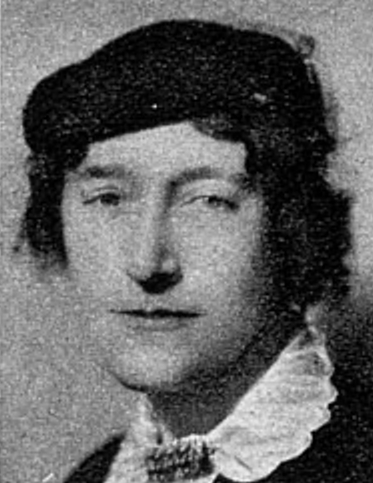
HELEN HULL
lives in New York in winter and in her old Maine farmhouse in summer. Most of her time is spent in writing and in helping others to write in short-story classes at Columbia. She likes cooking, motorboating, gardening, bicycling, and owning a wire-haired terrier.
Transcriber’s Notes
Transcribed from Liberty, vol. 18, Jan. 4, 1941, pp. 22-27.
The unabridged latest version of this text was published in: Octave. Coward-McCann, New York, 1947, pp. 259-278.
New original cover art included with this eBook is granted to the public domain.
The original spelling and punctuation were mostly preserved. Minor typesetting mistakes were silently corrected.