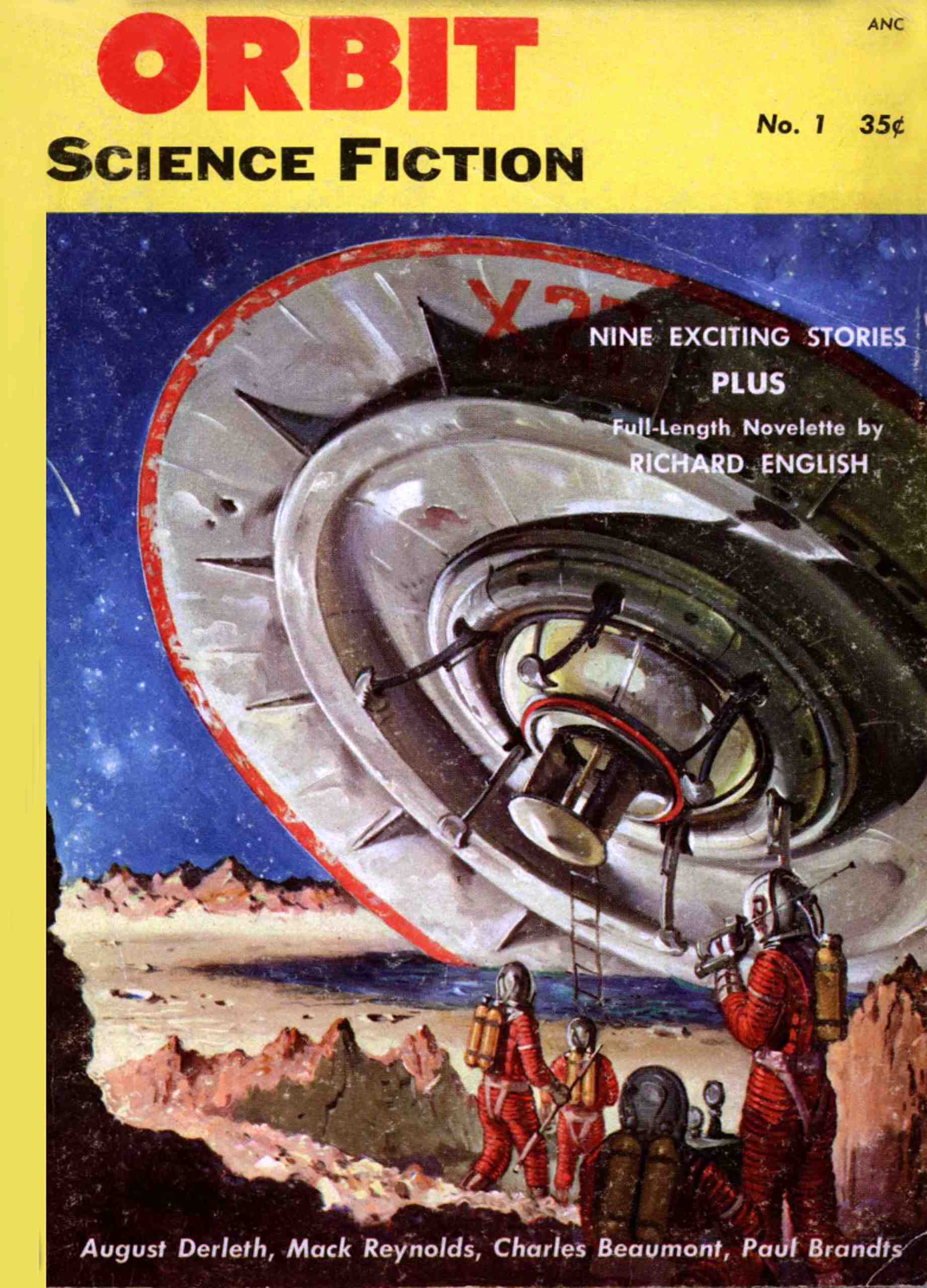
Transcribed from Orbit Science Fiction, September 1953 (Vol. 1, No. 1).
Title: D. P. from tomorrow
Author: Mack Reynolds
Illustrator: Rudolph Belarski
Dick Shelton
Release date: August 11, 2026 [eBook #79340]
Language: English
Original publication: New York: Hanro Corp., 1953
Other information and formats: www.gutenberg.org/ebooks/79340
Credits: Tom Trussel (This file was produced from images generously made available by The Internet Archive)
Transcribed from Orbit Science Fiction, September 1953 (Vol. 1, No. 1).
by Mack Reynolds
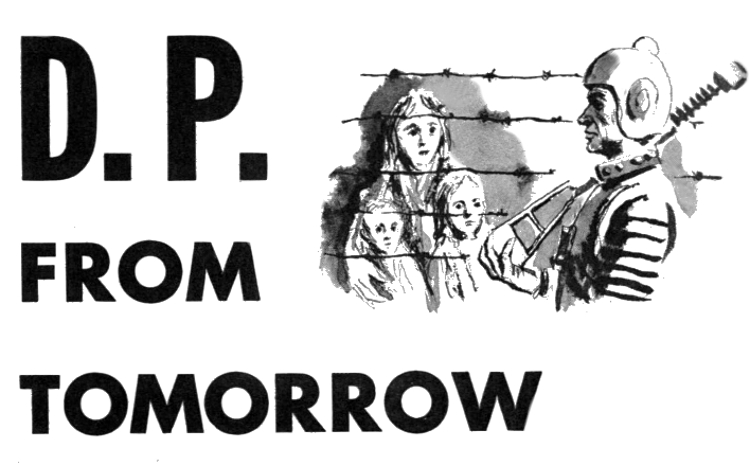
The little man was very sincere, very ... but then so many of these guys are!
The phone rang and Ed Kerry picked it up and said, “Daily Star.”
He listened for a moment and said, “Yeah,” and then, “Hold on a minute.” He stuck a hand over the mouthpiece and said to the city room at large, “It’s one of these drunks settling some bet. He wants to know when Lord Byron died.”
Sam, over on the rewrite desk, said, “He died on April 19th, 1824.”
Kerry said into the phone, “He died April 19th, 1824,” and hung up.
Jake, the city editor, had been leaning back in his swivel chair, his feet up on the desk. He said to Sam, “How do you know?”
Sam shrugged and said, “Just happened to.”
Jake said idly, “Offhand, I can’t think of any information that makes less difference than when Byron died.”
Ed Kerry said, “It’s the queerest thing in this business. Some jerk phones in and wants to know what caliber gun it was that killed Lincoln, or maybe how many molecules there are in a drop of water. And what happens? Somebody in the city room always knows the answer. It’s the same on every paper I ever worked for.”
Jake growled, “You can’t tell them to go get lost. These characters who phone into newspapers at the drop of a hat might stumble on the biggest story of the year ten minutes later. You don’t want them phoning some other paper because they’re sore at you for not telling them who got in the first punch in the Dempsey-Firpo fight.”
Kerry said, “Yeah, but what gets me is that when these jerks ask their screwy questions, somehow or other they always get the right answer.”
Somebody on rewrite said, “I remember once some drunk phoned in about four o’clock in the morning and wanted to know how tall Jumbo, Barnum’s elephant, used to be. The guy who was working next to me says, ‘Eleven feet, six inches,’ without even looking up from the story he was on.”
Jake said, “It’s because on a newspaper you got a whole room full of guys with a lot of general knowledge. Remember back in the 1940s or 1950s or whenever it was, they had this ‘Information Please’ program on the television?”
Sam said, “It was radio back then.”
Jake growled, “What difference does it make? Anyway, these guys knew all the answers and there were only maybe three or four of them, mostly newspapermen. In a city room you’ve got a dozen or more men who’ve read so much that it starts....”
The phone rang again and, since nobody else stirred, Ed Kerry sighed and picked it up again. He said, “Yeah?” He repeated that a few more times and then, “Hold it, Ted. I’ll ask Jake.”
He looked over at Jake and said, “It’s Ted Ruhling. He’s over at Leo’s....”
“This is Ted’s night off,” Jake grunted.
“...He says he’s got a refugee over there with a story,” Ed Kerry finished. The phone was still squeaking and he put the receiver back to his ear.
“A refugee, yet,” Jake snorted. “What’s Ted got in mind? He must be sober; when he’s drunk he’s got more story sense. We’ve had so many Martian refugee stories....”
“This isn’t a Martian,” Kerry said. “It’s a guy claims he’s from another space-time continuum.”
Somebody on rewrite said, “That does it. Now I’ve heard it all.”
Jake began to say, “Tell Ted Ruhling to have himself a few more drinks and forget about.... No, hold it. Tell him to bring the guy over here and we’ll get the story. Maybe it’ll be good for a humorous piece; besides, there’s nothing going on anyway, we’ll get some laughs.”
Ed Kerry said into the phone, “It sounds like a real story, Ted. Jake says to rush the guy over here.” He hung up.
Sam, over on rewrite, scratched himself reflectively. “I’ve seen a lot of stories in my thirty years in this racket, and I’ve seen a lot of stories about refugees. Refugees from Asia, refugees from Europe, refugees from South America and from Texas; even refugees from Luna and Mars. But I’ll be a makron if I ever heard of a refugee from another space-time continuum.”
Kitty Kildare bustled from her tiny office and hurried breathlessly toward Jake’s desk.
Ed Kerry said softly, “Kitty looks like she’s got another world beater. Tear down the front page, Jake.”
Kitty gushed, “Jake, I really have something for tomorrow’s column. Actually, I mean. Jake, this....”
Jake held up a weary hand to stem the tide. “Kitty,” he said, “listen. That column is yours; you can put anything in it you want. It’s none of my business. For some reason or other, people even read it. Don’t ask me why.”
Kitty Kildare simpered. “Now, Jake, you’re always pulling my leg.”
Jake shuddered.
Kitty went on, “But you’ll see tomorrow. Actually, I mean.” She bustled out of the city room and off to whatever story she had found to cover for her column.
Ed Kerry said wonderingly, “Kitty can get breathless over any story hotter than a basketball score.”
Jake said, “What’s another space-time continuum? Seems to me I read about it somewhere, or....”
Sam laughed. “Now we know Jake’s secret vice. He hides in his room, locks the door, and reads science fiction.”
The city editor scowled. “I don’t get it.”
Sam said, “Another space-time continuum is one of the favorite standbys of these science-fiction writers. You know. The general idea is that there are other, well, call them universes, existing side by side with ours. We aren’t the only space-time continuum; we’re only one of them.”
“One theory is that there are an infinite number of continuums,” Ed Kerry put in. “That means that somewhere everything is happening, has happened, and will happen.”
Jake growled, “Shut up, Ed. Sam’s explanation was getting bad enough, but....”
Sam said, “No. Ed’s right. According to one theory, there are an infinite number of alternative universes, some of them almost identical to this one. For instance, in an infinite number of universes, Hitler won the second world war. In an infinite number of others, Hitler was never born. In still others, he spent his whole life as a paperhanger.”
“Wait a minute, now,” Jake said. “You mean to tell me that somewhere, in some other space-time whatever-y’call-it....”
“Continuum,” Ed Kerry supplied.
“All right. Anyway, everything possible has happened, will happen, and is happening? Everything, no matter how unlikely?”
“That’s the theory,” Sam told him. “Consider, for instance, how improbable this space-time continuum in which we live really is.”
Jake snorted, “Holy Wodo. Ted Ruhling has brought in some screwy stories in his time, but a refugee from....”
“Here he comes,” somebody whispered.
“Okay, boys,” Jake said softly. “The works. Somebody tell Jim to bring his camera.”
Ted Ruhling wavered unsteadily toward the city desk, ushering along a little, wistful-looking character dressed in clothes that looked oddly out of style. The stranger’s hair was going grey and his small face was much lined; he looked to be about forty.
Ruhling blinked at Jake and said, with considerable dignity, “This story is beyond the call of duty, y’realize, Jake. Oughta getta bonus. Wanta introduce Martin Cantine; refugee from another space-time continuum. Met him by accident in Leo’s Bar.” He slumped into a chair as though the effort of the introduction had exhausted him.
Jake got up and held out a hand to the little man. “Welcome to ... uh, that is, welcome to our universe, Mr. Cantine.”
Ed Kerry and Jim the photographer and several others crowded up with notebook and camera.
“Mr. Cantine,” Kerry said excitedly, “what do you think of our space-time continuum’s girls?”
“Shut up, Ed,” Jake said from the side of his mouth.
But the little fellow answered seriously. “The same as I think of those in my own, of course.”
Kerry said, as though disappointed, “You mean there’s no difference?”
Martin Cantine found himself a chair, sat down, and said, earnestly, “I see that there must be some misunderstanding here. You gentlemen must realize that the continuum from which I fled was almost exactly like this one. Almost exactly. I note, for instance, that this city has identical buildings and in other ways is precisely like my own, except, of cause, for the time element.”
“Oh, oh,” Sam said. “Here we go. The time element.”
“What’s different about the time element?” Jake asked cautiously.
The little fellow frowned worriedly. “I hope I can explain it to you. You see, the device which was constructed by my friends to enable us to flee our own period was designed to remove a living person from one space-time continuum and to place him in another. But it must be realized that in transporting ourselves to another space we at the same time, of necessity, transport ourselves also to another time. In all, we transport ourselves from another space, another time, and another space-time continuum. Actually, of course, the three are really one. Is that clear?”
“No.” Ed Kerry said.
“Shut up, Ed,” Jake growled. “Go on, Mr. Cantine.”
Mr. Cantine was pleased that at least one person was following him.
“Our device was set to remove me only slightly in space, and, consequently, only slightly in time. If I am correct, my time was about ten years after yours.”
Jake closed his eyes for a long moment. Finally he opened them again and said, “Let’s have that last again.”
“In my space-time continuum,” the little man said, “I lived about ten years in your future. In other words, in 2030.”
“I get it,” Sam said. “Ten years from now our space-time continuum will be like yours when you left—in most respects; that is. What you did was travel backward in time for ten years and to a slightly different continuum.”
Ted Ruhling had managed to stay awake thus far. But now that he saw everything was under control he muttered, “Bonus,” and slumped forward on the desk at which he was sitting.
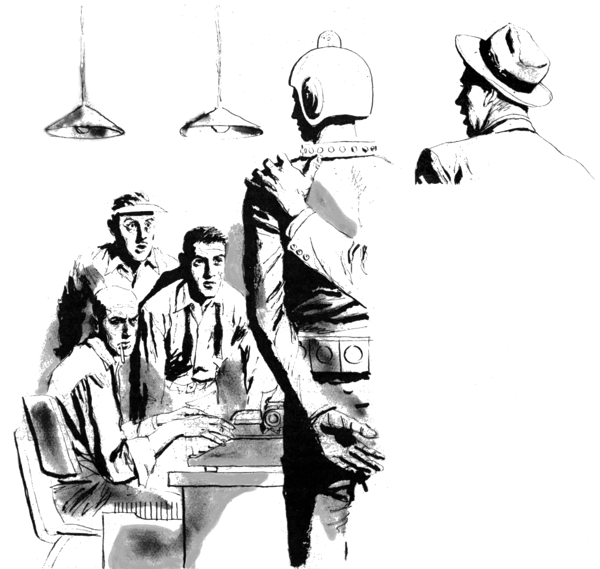
Jake looked at him and grunted bitterly.
Ed Kerry said, “Well, let’s get the rest of the story. Why did you leave home and come to our fair continuum?”
Martin Cantine frowned. “I thought you realized that I was a refugee. Didn’t Mr. Ruhling explain on the phone?”
“Of course,” Jake told him. “Now just what were you a refugee from, Mr. Cantine?”
The little man took a deep, dramatic breath. “From Gerald Twombly, the most vicious despot the world has ever seen!”
Ed Kerry choked on that. “Twombly!” he said, trying to hold his laughter. He swallowed hard, then said, very seriously, “How do you spell that?”
“Gerald Twombly. T-W-O-M-B-L-Y,” Martin Cantine told him. “And now that you have been warned, you’ll be able to defend yourself against this scourge.”
“I missed something there,” Jake said.
The little refugee explained, “As I pointed out, this continuum is almost exactly like mine. The principal difference is that you are ten years earlier in time; Gerald Twombly is not as yet in power. You have time to fight him, expose his nefarious schemes.”
“Twombly,” Ed Kerry said. “I love that name. Hitler, Mussolini, Caesar, Napoleon—none of them quite have the ring of Twombly.”
Jake looked up at the clock on the wall. They were going to have to start work on the bulldog edition. Besides, he was getting tired of this nut. He nodded his head to Bunny Davis, down at the other end of the room, and she surreptitiously took up a phone and called the city hospital.
Ed Kerry was asking, “Just what form will this despotism take?”
Martin Cantine leaned forward earnestly. “The most vicious and bloody the world has ever known. People have forgotten, it has been so long since dictatorship has existed, how ruthless persons in power can become to maintain themselves. We’ve also forgotten that many of the devices that have been invented in the past one hundred years can be turned to horrible use by a police state. Truth serums, for instance, used ordinarily for psychiatry, but a terrible weapon in the hands of a secret police. Cybernetic-controlled wire and radio tapping devices that can listen to every conversation that takes place over instruments throughout the whole planet and immediately flash a report whenever anything the slightest degree removed from what is permissible is said. Radar....”
Jake yawned. “And just how did you manage to escape this guy ... er, Twombly?”
Cantine frowned. “I am not the inventor of the S-T Invertor, but one of several who have been secretly removed to another continuum to escape Twombly’s secret police. I am not exactly clear on the workings of the device.”
“Shucks,” Ed Kerry said. “I was afraid of that. Tell us what you do know about it.” He was beginning to give up the pretense of taking notes.
Martin Cantine looked from one to the other, frowning. He was beginning to suspect the truth of the situation, and a red flush was creeping up his neck.
“I am afraid you gentlemen think I am exaggerating,” he said tensely.
“I wouldn’t exactly put it that way,” Jake told him, stifling another yawn. “But part of it seems....”
The little man came to his feet, his expression tight. “I see,” he said. He took a deep breath, then went on slowly, and very sincerely. “Even though you think me a charlatan, I beseech you, for your own sakes and for this continuums’s—investigate this Gerald Twombly. You must. Or your space-time continuum will....”
Two white-coated interns came through the door and looked about questionably. Jake motioned to them and they advanced.
Jake said, a touch of unwonted kindliness in his gruff voice, “Here are two friends of yours, Mr. Cantine.”
The little man looked about him unbelievingly. “But ... but ... you think I’m insane. You don’t realize....” He shook off the hands of the interns, and spun about desperately to confront the city editor again. He began to shout, “But you must ... Gerald Twombly! ... You must ... !”
They led him out, struggling.
There was an embarrassed silence in the city room. The gag had not been as amusing as they had expected.
“Well, let’s get to work,” Jake said. “Kerry, you see if you can do up a stick or so on this Cantine. Gag it up a little, but don’t go overboard. Jim, did you get a decent shot of the little guy? Those phony clothes he’d had made up for himself might make a....”
Sam, over on rewrite, said, “You know, the funny thing was that his story made a certain amount of sense.”
Jake snorted. “Every nut’s story makes a certain amount of sense. The only trouble is that, when you check it, it doesn’t hold up.”
“What’d’ya mean, check it?” Sam said argumentatively. “What part of Cantine’s story were you able to check?”
Jake growled, “For one thing, this guy Twombly. What a name for a dictator. Anyway, who ever heard of a Gerald Twombly? Did you Kerry ... Jim ... Bunny ... Sam?”
They shook their heads. So did everyone else in the city room.
Jake shrugged. “Okay. There you are. This character says that in ten years Twombly’s dictatorship is going to be so rugged that we’ll all be wanting to take a powder out of here to another what’d’ya call it?”
“Space-time continuum,” Sam said grudgingly.
“Yeah. Well, none of us have ever heard of him. Remember what I said earlier about all the general knowledge you find on a newspaper’s staff? Okay, where’s somebody that’s even heard of this guy?”
“I guess you’re right,” Sam admitted. “But he seemed to be kind of a nice little duck.”
“The nut factories are full of nice little ducks,” Jake grunted. He tossed a story over to the rewrite man. “Here, shut up and get to work or you’ll be getting as screwy as he is.”
Sam grinned and took up a pencil. “Okay, Jake.”
Kitty Kildare hustled into the room, brandishing a sheaf of paper. “Jake,” she said breathlessly, “wait until you see my column tomorrow. I’ll have them dying, dying. Actually, I mean.”
Jake shuddered. “Okay, what is it this time?”
She closed her eyes and breathed ecstatically. “A wonderful man; actually, I mean. I have the first interview he’s ever given. He has a new political system he’s advocating.”
Ed Kerry said sarcastically, “I’ll bet his name’s Twombly.”
Kitty turned and stared at him. “How in the world did you know?” she said.
This etext was produced from Orbit Science Fiction, September 1953 (Vol. 1, No. 1). Extensive research did not uncover any evidence that the U.S. copyright on this publication was renewed.
Obvious errors have been silently corrected in this version, but minor inconsistencies have been retained as printed.