The Project Gutenberg eBook of The eternal laughter and other poems
This eBook is for the use of anyone anywhere in the United States and
most other parts of the world at no cost and with almost no restrictions
whatsoever. You may copy it, give it away or re-use it under the terms
of the Project Gutenberg License included with this eBook or online
at www.gutenberg.org. If you are not located in the United States,
you will have to check the laws of the country where you are located
before using this eBook.
Title: The eternal laughter and other poems
Author: W. Starling Burgess
Contributor: Julian Hawthorne
Illustrator: Edmund H. Garrett
Edward Lyne
Release date: August 12, 2026 [eBook #79344]
Language: English
Original publication: Boston: W. B. Clarke Company, 1903
Credits: Mairi, Paul Fatula and the Online Distributed Proofreading Team at https://www.pgdp.net (This file was produced from images generously made available by The Internet Archive)
*** START OF THE PROJECT GUTENBERG EBOOK THE ETERNAL LAUGHTER AND OTHER POEMS ***
THE ETERNAL LAUGHTER
AND OTHER POEMS
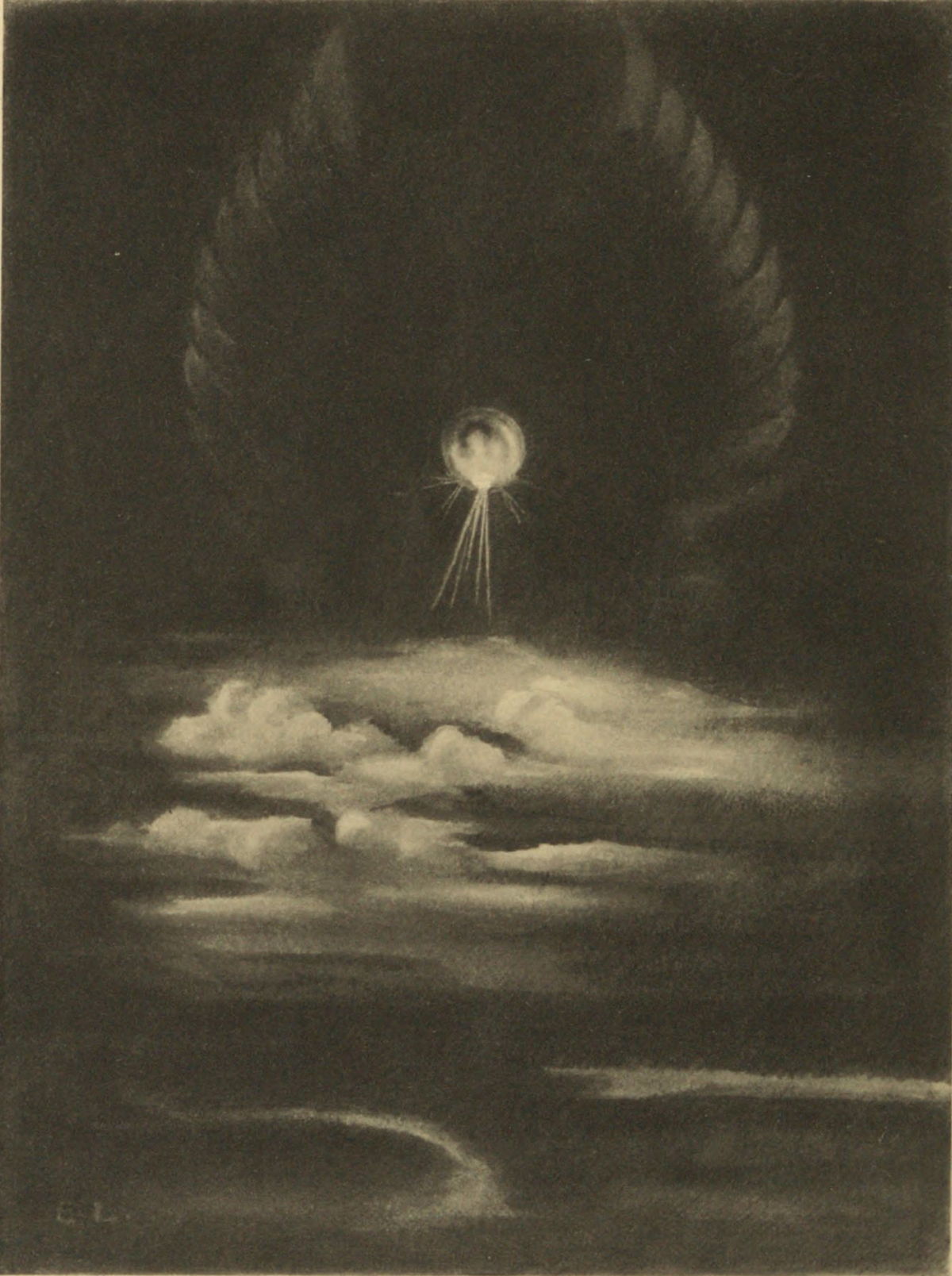
“Lo, there came a dream of wonder”
THE ETERNAL
LAUGHTER AND OTHER POEMS
AND OTHER POEMS BY
W STARLING BURGESS
WITH AN INTRODUCTION
BY JULIAN HAWTHORNE
With drawings by
Edward Lyne &
Edmund H Garrett
BOSTON—W B CLARKE COMPANY
LONDON—C D CAZENOVE & SON
MCMIII
Copyright, 1903 by
W. STARLING BURGESS
Entered at Stationers’ Hall
The University Press, Cambridge, U.S.A.
INTRODUCTION
INTRODUCTION
Most of our contemporary
poetry is first seen in our
magazines; and this may be
one reason why it is so uniformly
meritorious (as regards
form and intelligence), and why almost
every line of it might have been written
by the same person. For the magazine
editor is compelled to restrict his criticisms
of the product submitted to him
to the body of it rather than to its soul;
since, however desirable it may be that
the latter should be right, it is indispensable
that, for magazine purposes, the
former should be correct. The natural
consequence has been that the soul has
gradually disappeared from the common
run of magazine poetry, while the body
has attained a perfection of form and
adornment which the great poets might
equal, but could not surpass. And, inasmuch
as fashion rules in the outward
accoutrements of verse, as well as of
society on parade, it has followed that the
great majority of magazine verses bear so
strong a resemblance one to another that,
as aforesaid, nearly all of them might
have been composed and indited by the
self-same poet. They are very nice, but
they are very monotonous; and their most
cordial admirer can hardly hope that they
will much outlast the physical substance
of the medium in which they appear.
Real poetry belongs to another category.
It is always the product of real
emotion felt by the individual who writes
it. It is the record of his personal and
independent discoveries in the realm of
feeling and thought. In so far, therefore,
it creates a new world; nothing just like
it was ever before seen, for the same reason
that no two persons are just alike.
Nevertheless, if the new poet’s mission is
authentic and lasting, this new world
which he reveals must recommend itself
to the reader by proving itself to be a
discovery in the consciousness of that
reader himself; it must not be alien; in
telling the writer’s secrets, it must tell the
reader’s as well. Its charm, its grasp,
and its permanent value lie in the fact that
the new writer, in admitting us to his intimacy,
endows us with a fresh insight into
ourselves; these emotions of his, his passions,
truths, and moods, have ever been
our own, but only at his instance did we
fully awake to their significance, relation,
and value.
Another quality the real poet must needs
have—the instinct of beauty. For that
(as distinct from mere prettiness and the
musical jingle) he must go deep. The
enduring harmonies are elemental; they
abide at the root of things. They instil
a joy which thrills from the very heart of
nature to our own. They make us rich
and happy. We say of them that they
are the flower and fragrance of truth.
They refine us and exalt us. They set
our feet again on the true path, and give
us delicious glimpses of unimaginable
good. They are the warrant of human
integrity. They make orthodox conceptions
of Heaven appear cold and barren
in comparison. There is a vital fire in
them which arms us against fate.
The authentic poet, too, must trust, at
any cost, to his inspiration. When he is
vibrating to the impulses of the god, he
must ask no questions, but obey. Things
will be told to him which are above the
height and below the sounding of his common
understanding. When he has been
let down once more to his normal level, he
questions these revelations as another
might; but he must yield to them. He
will be charged with obscurity; but he
must content himself with the assurance
that certain heights of feeling and perception
do not lend themselves to mortal language,
except in hints and allusions; they
will not be explicit. The reader who has
a soul for these things will understand;
the others must wait, and, if they will,
complain. There is a Fourth Dimension
in these matters, which we must compound
with as best we may. Such
obscurities may be the upper rungs of the
ladder which stretches from earth to
Heaven.
But I will not longer dwell on these
general considerations; my function is to
speak for a new poet, who here, for the
first time, addresses his contemporaries.
Poet I call him, advisedly. He has much
to learn in the way of fashionable tailoring;
but for those able to care, in this
age, for the naked beauty of nymphs and
demigods, he can say something. I must
not be coarsely misunderstood; the delicacy
and refinement of his inspiration are
extreme. But the soul of his theme has
so commanded him that he has often been
heedless of the technique of form. The
divine pressure of the message has often
caused his mortal tongue to stammer in
its delivery. It would be easy to correct
these lapses or negligencies; but at the
risk of compromising their individuality—of
lowering their spirit to the conventional.
Rather, I rejoice in them, as one rejoices
in the awkwardness and naïveté of virginity.
Growth will adjust these surface
inharmonies. Meanwhile, they are the
warrant that here is one who writes in
response to an intensity of vision and emotion,
pressing intolerably from within for
expression. Truth and beauty, genuinely
perceived, will not stay in the heart, but
demand to be released, because they
belong to the greater heart of humanity.
It is only the brain that can keep its own
counsels. The poet knows that what is
given to him is far too precious for personal
ownership. It must out.
The substance of the book is the love
of a lover for his beloved. No story is
told. In one short piece after another
the moods of the lover are reflected; and
all of them wear the shadowy vestments
of night, twilight, and dawn; the sun has
not yet risen, or he has set. Love in
eclipse: love waiting: love remembering:—these
states of emotion, and the
insight they inspire into life, nature, and
the Creative purposes, are the features of
the theme. The phases are briefly
treated; but they are not to be briefly
dismissed by the reader; the thoughts and
feelings embodied are long and deep, and
sometimes, in their simplicity, abstruse
and subtle. Ever and anon, they are
imperfectly conveyed. But, constantly,
the right word blooms out with no more
effort than a flower blooms, with satisfying
felicity. In this respect, and in a rich
beauty of imagery, the writer brings
Keats to mind; and the conception of
others of his verses suggests a fellowship
with William Blake. Yet he is far from
being a poet of echoes; he stands on his
own feet, and his head brushes his own
stars. It is poetry that stirs within him,
not the poets.
It is to poets, therefore, rather than to
the general public, that his book will
make its first appeal. They can appreciate
and extenuate; welcome what is
given, and wait hopefully for what may
be to come. That which is to come will
doubtless reach a far wider audience.
The essentials of poetry are already
here; if, now, the writer, without forfeiting
his individual voice and impulse, can
achieve greater perfection of expression,
he can add a new page to the Golden
Book of time.
Should roam, and shield thee from the envious beasts
Of land and sea, made wild and desperate
With thine enchantment and dear ways of thee.
So, sweet, if in the night, whilst gazing up,
Enchanting with thine eyes some envied star,
That star is of a sudden lost to thee,
And shadows from dark, sweeping wings pass by,—
Or if again thou hearest footfalls dim,
And crushing sounds within the forest black,
Be not afraid, my fairest, close thine eyes,
’Tis but the passing of thy guarding host.
SHE HEARS STRANGE SOUND AND KNOWS NOT WHAT IT IS
Sweetheart, amid the forest, in the night,
Didst thou once hear a sound—some branches break?
And didst thou question then what might be there?
Know, dear, that thou art unattended never.
When all thy beauty once was made, and passed
From heaven to earth, then wert thou far too fair
And exquisite to wander through this world
Alone, a prey to all the things that live.
So God, thy father, sent with thee to earth
A troop of spirits and kind creatures strange,
[Pg 11]
To guard all paths on which thy fairy feet
Should roam, and shield thee from the envious beasts
Of land and sea, made wild and desperate
With thine enchantment and dear ways of thee.
So, sweet, if in the night, whilst gazing up,
Enchanting with thine eyes some envied star,
That star is of a sudden lost to thee,
And shadows from dark, sweeping wings pass by,—
Or if again thou hearest footfalls dim,
And crushing sounds within the forest black,
Be not afraid, my fairest, close thine eyes,
’Tis but the passing of thy guarding host.
[Pg 12]
GOOD-NIGHT
Good-night, sweetheart,
I’ll dream I am
Some airy spirit of the dark,
That within thy chamber, dear,
May float as the breath of a flower;
Or like some passing bird of night,
Rest on black wings to gaze at thee
In starlight sleeping on thy bed,
Thine eyelids closed upon thine eyes
Of glory, and thy hair in floods
Of dark and changing gold, at rest
About thy sad and fairest face,
And on thy breast, so holy white.
Beside thee exquisitely stealing,
One trusting hand, whose tender touch
Would turn the blinding pain from Hell,
And from the hollow eyes of Death
Would verily draw tears.
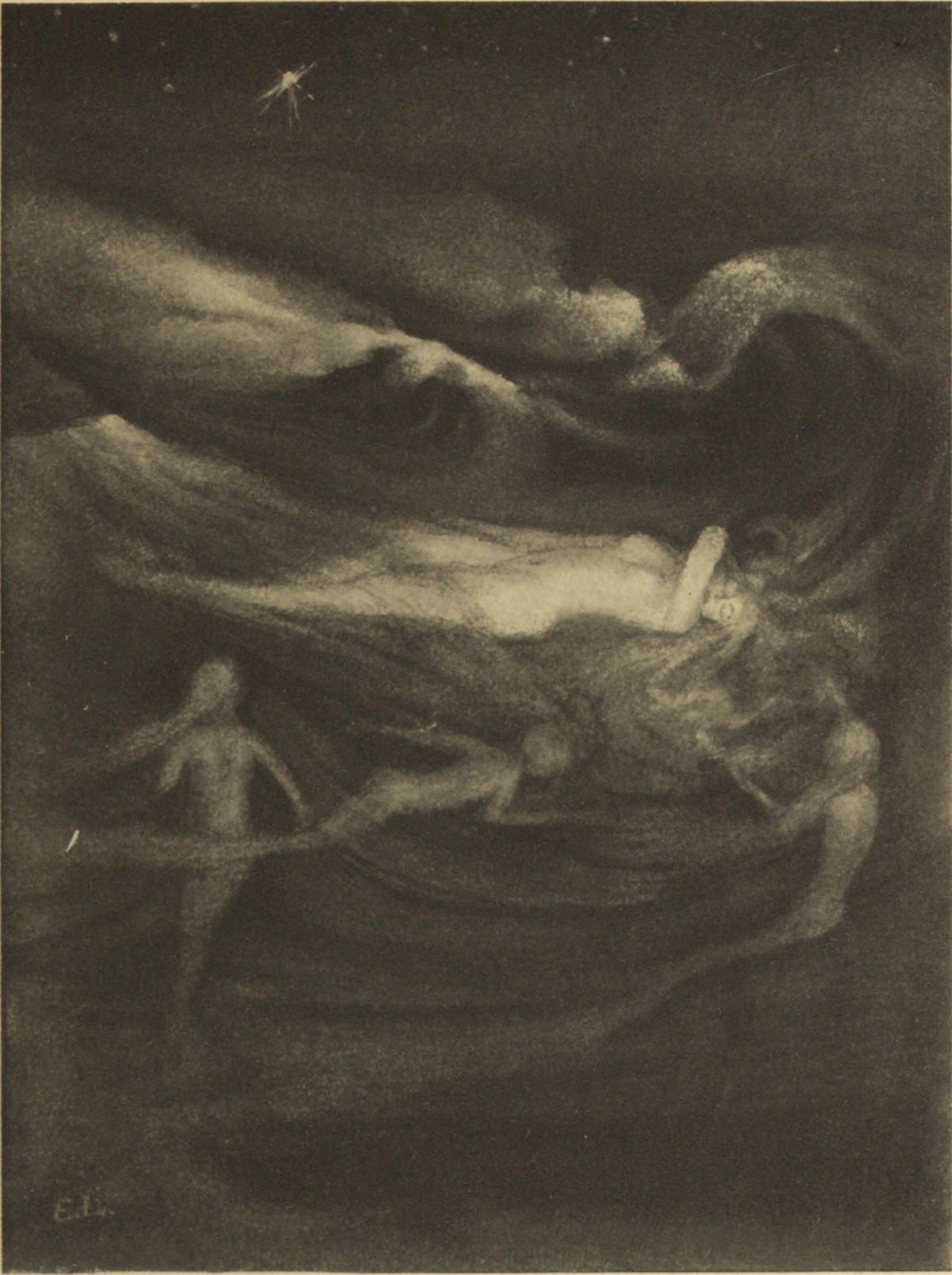
“Shall glide sea-children then to thee”
[Pg 13]
SHE SLEEPS UPON THE SEA
In climbing shadows of the sea,
To-night, sweetheart, shall be thy bed,
And through the green, dark waters led
Shall glide sea-children then to thee.
The cheek of roaring wind and sea
Shall be thy pillow, and the waves,
With voices gleaned from surging caves
Through lips of foam shall sing to thee.
The stars of night shall serve thee for thy candle’s spark,
And, sweet, the hull of night shall be thy cradle dark.
[Pg 14]
NIGHT AND SLEEP
The shades of the night, from that region
Beyond the red sunset of flame,
Bear in their deep fringes a legion
Of ghosts without name;
Of ghosts, yea, an infinite number,
Strange beings that know not the day,
Sowing love or tares into slumber,
Then fading away.
O welcome, Night! breathe from thy lips
Thy breath, on whose wings I am free,
That fans not the sail of tall ships,
Nor stirs the deep sea;
The vapor dissolving the hardness
Of all which we meet in the light;
The potion instilled with thy sweetness
And magic, dark Night.
[Pg 15]
TO A FLOWER ONCE WORN
UPON HER BREAST
Flower, where art thou now, that once
Lay on her breast? Had not her glory
Sunk me in deep forgetfulness
Of all, I should have prayed her then
For thee, happy flower. But with
Thy mother earth, and all the air
That with thy breathing fragrant was;
With the mighty sun that gave thee
Life, and the night that gave thee rest,
With these miracles—little flower,
Yea, thou also, faded from my thought
When she drew near, and filled mine eyes.
[Pg 16]
HER BEING
There is truth within thine eyes
The world hath never taught;
All doth tell of thee within
That is about thee wrought:
The glory of a star,
The beauty of a flower wild,
The mercy of God,
The sweetness of a little child.
[Pg 17]
THOU ART THE MIRACLE
Ah, sweet,—
Than holding all His thundrous sea,
More glory were it for God’s Hand
To hold thy feet.
[Pg 18]
THE VISION OF THE ANT
It was not light discordant
Of waves with untunéd crests;
Nor light of moon, nor stars,
But that of all infinity,
Glided athwart the leaflet bars,—
The dawn-beam of eternity.
A vision ne’er by living seen,
Nor e’en by the good in death,
Of form most like a fairy queen,
Of substance of the rose’s breath.
Far in the starry sky
Waved ringlets, all of golden brown,
Within whose silken frame did lie
Her face, in a rose-leaf gown.
[Pg 19]
EARTH’S INSUFFICIENCY
Wrapt in the falling veil of night,
Worlds unknown sweep about me;
The shadow lands of ghostly light
Deep in mystery greet me.
Swiftly grow sight and hearing faint,
As the forms of earthly things,
Passing confused without restraint,
Waver as borne forth by wings.
Time is no more, nor place;
Dark regions all, with spectres rife,—
Gray worlds that fill not space,
That pass beyond this bounded life!
Life, the slave of the hour long,
Can it give the deed unwrought,
Cancel the memory of wrong,
Or ever reach the end we sought?
One little hour of joy and hope,—
[Pg 20]
’Tis gone. Canst thou, Earth Spirit,
In all thy power’s scope,
From time’s unturning tide recall it?
Or at thy will the end require
Of all that guides the falling rain,
And propels the stars of fire
Through the ethereal domain?
EARTH’S INSUFFICIENCY
Wrapt in the falling veil of night,
Worlds unknown sweep about me;
The shadow lands of ghostly light
Deep in mystery greet me.
Swiftly grow sight and hearing faint,
As the forms of earthly things,
Passing confused without restraint,
Waver as borne forth by wings.
Time is no more, nor place;
Dark regions all, with spectres rife,—
Gray worlds that fill not space,
That pass beyond this bounded life!
Life, the slave of the hour long,
Can it give the deed unwrought,
Cancel the memory of wrong,
Or ever reach the end we sought?
One little hour of joy and hope,—
[Pg 20]
’Tis gone. Canst thou, Earth Spirit,
In all thy power’s scope,
From time’s unturning tide recall it?
Or at thy will the end require
Of all that guides the falling rain,
And propels the stars of fire
Through the ethereal domain?
[Pg 21]
WHAT ART THOU?
What art thou?
None can the answer lend—
That answer without end.
The sea and the silent forest,
All the world, can but suggest;
For thy shadows are the night skies,
And the stars of night thine eyes.
[Pg 22]
BLINDED WITH THINE EYES
Sweetheart, I love thee, I can say no more,
For I am blinded with thine eyes, and with
Thy voice am dumb, and lulled beyond all sleep,
All death beyond, with thy strange fragrance, sweet;
And though it seemed the glory could not last,
Yet, in each moment, dear, some new sweet thing
I learned of thee,—some message from thine eyes
Of wonder, some ecstacy in the form of thee,
Which is more fair than all of loveliness.
[Pg 23]
THE FLOWER AND THE
SEA-SHELL
In a dream I found a flower
Growing in a woodland bower;
In the dream I plucked the flower
From the fading, darksome bower.
Then I, dreaming, from the woodland
Journeyed stilly to the sealand,
And upon a girted headland
Found a sea-shell in the dreamland.
Sweet, the flower was thy breath,
And the sea-shell was thy voice.
[Pg 24]
THE NIGHT
O’er the threshold of the West
Hath closed the gate of night.
O wondrous night, where hast thou gone,
Ne’er more to sing thy fair, sweet song?
Or art thou dead, O fairest night,
And laid within the tombéd past,
Thy light alone in dreams to last?
Ah, no, thou art within a fortress,
Hidden in the mist of time,
Whose towers o’er the clouds I’ll see,
When the hill of Death I climb.
[Pg 25]
EVERYWHERE
Through the dark-walled wood I wander,
By the leaf that lisps in the night-breath tender,
And songs that listless wings of insects render,—
Thou art here!
Where, thundering from ocean’s flume,
Far flies the foaming spume,
And the waters of the crest seethe to the hollow’s gloom,
Thy spirit dwells.
Still, in the soundless space of stars,
Where comets glide with golden bars,
All unrivalled, all beloved, in those stars
Thou livest.
[Pg 26]
THE WISH
There may I forever dwell,
In the cloud-breath of thy lips;
In the starlight of thine eyes;
For thou art the life eternal,
And thy brow is the moonlit skies.
[Pg 27]
THE SNOWSTORM
So majestical and wondrous,
All silent fell the snow;
It seemed the bearded Face of God
Did bend o’er those below.
[Pg 28]
A PRAYER
Thou comest, fairer than the night
That heals the wound of day;
Breathing from thy spirit sleep,
Dreamlike and fair and free,
Lending to my doubting heart
Dear hope of life with thee.
O had I words from angel mouths,
Thou might my prayer receive;
For naught of earth, sweet love, can tell
The smallest part of thee.
[Pg 29]
BEFORE THE DAWN
Mystic hour of the day and night,
Ere death of dark, ere yet is light,
Night’s dying breath, and birth of day,
Ere dreams and sleep have passed away:
The time when the gray wind, along
The edge of night, sings human song;
And the deep chill is clearest felt,
That Death in awful march has dealt:
The hour ere sounds of day begin,
What time Death walks most widely in:
When o’er the pale and ashen land,
In the dim day, upon the sand,
The fan-like tracings of the feet
Of Death on earth we yet may meet:
When the last stars, the tired eyes
Of night, fade ’neath the morning skies,
And closed by eyelids of dawn’s fire,
[Pg 30]
Before the breaking day retire:
Then from the far, faint heaven’s blue,
The first bird wakes creation new.
[Pg 31]
THY COMING IN THE NIGHT
Awaking from some dream of thee,
Unwillingly torn from a far
And unremembered life with thee,
I saw the forests of the night
In her low hours unbar. Borne up
Reluctant from the pool of sleep,
I gazed on the uncolored dark,
Till, like the bursting of the sky
Of Hell,—behold, the wall of night
Was of a sudden shattered, and
I saw the black wings of darkness
Uplifted by thy fair white hands;
And o’er my bed, stealing unheard
Through the mist of night, I felt thee bend.
Ah, sweet, thy coming gave me then
Long-lost and curious knowledge;
Once more those magic sounds I knew,
Of things first heard, which fall but to
[Pg 32]
The child upon his mother’s breast,—
Those fading sounds beyond the world of now,
Which, always to the agéd ear,
Are but the footfalls striking fire
Of a lone horseman of the night,
Yet to the child are infinite.
Hearing such sounds, then to my nostrils
Came the odor of strange flowers,
Far sweeter than violets born
In the deep forests of the world.
Drenched in thy scattered hair, which is
Fairer than all the rain of God,
O’er me I felt thy glory pour;
And as a parchéd weed drinks in
The miracle of rain,
So from thy falling hair I drank,
To give my blinded eyes the strength
Of opening, and beholding thee.
THY COMING IN THE NIGHT
Awaking from some dream of thee,
Unwillingly torn from a far
And unremembered life with thee,
I saw the forests of the night
In her low hours unbar. Borne up
Reluctant from the pool of sleep,
I gazed on the uncolored dark,
Till, like the bursting of the sky
Of Hell,—behold, the wall of night
Was of a sudden shattered, and
I saw the black wings of darkness
Uplifted by thy fair white hands;
And o’er my bed, stealing unheard
Through the mist of night, I felt thee bend.
Ah, sweet, thy coming gave me then
Long-lost and curious knowledge;
Once more those magic sounds I knew,
Of things first heard, which fall but to
[Pg 32]
The child upon his mother’s breast,—
Those fading sounds beyond the world of now,
Which, always to the agéd ear,
Are but the footfalls striking fire
Of a lone horseman of the night,
Yet to the child are infinite.
Hearing such sounds, then to my nostrils
Came the odor of strange flowers,
Far sweeter than violets born
In the deep forests of the world.
Drenched in thy scattered hair, which is
Fairer than all the rain of God,
O’er me I felt thy glory pour;
And as a parchéd weed drinks in
The miracle of rain,
So from thy falling hair I drank,
To give my blinded eyes the strength
Of opening, and beholding thee.
[Pg 33]
A NIGHTMARE
Kiss me, dear, ere now I die,
For, my love, I thought thee dead.
I dreamed I fought
The moaning wind
Far out upon a plain,
Amid low trees and stones;
And found thee white
And still upon the ground,
Thy fair feet lapped
By all the waters of the world,
Which, serving for the tears of God,
Made their obeisance to thee,
And, gently flowing by thy side,
Drank in with myriad liquid mouths
Thy warm, sweet blood.
[Pg 34]
AVE COMETA
Glorious is thy pathway
Through the stars of fire,
For a port that hath no reaching,
With a speed that cannot tire.
Tell me, Comet, He who launched thee,—
Doth He love a man in pain,
Smaller than the glowing dust
In thy wake of flaming mane?
Comet fearful, will He save me,—
He who plays with such as thee?
[Pg 35]
LET THERE BE NO CHANGE
Through the postern
All must enter,
And alone the ghost return,
Oft have I wondered
Shall I find thee
In that mystery of the dead?
Will each hand so tender,
And thine eyes of glory,
Thee to me unchangéd render?
For every difference in thee,
No matter how very small it be,
Would make a hell for me.
[Pg 36]
THE WINDOW OF SLEEP
Not e’en with the flash of the lightning
May’st thou the dream depth scan;
For a barrier lofty and deep
Are the bars of awaking that span
The window of sleep.
[Pg 37]
THOU ART MY LIGHT
As from the boundless space, the light of stars,
In mystery, falls upon this earth of ours;
So, from thy soul, thine eyes’ deep, tender light
Descends to me, enwrapt in darkest night.
[Pg 38]
VAIN SPEECH
Sweet, how can I express
Or give of love to thee?
For, bounded with thy glory,
Naught of my soul is free.
Nor golden of the sunset,
Nor red of dawn at sea,
Nor all the stars in heaven
Can paint the form of thee.
[Pg 39]
THE WIND SPEAKS TO HER
Under the stars she lay,
And unto her, softly,
The night wind whispered:—
“O, thou, so fair, so pure, so good;
Thou, so stately, yet so tender,
And so queenly, yet so elfin,
Wilt thou to me thy secret render,
And to me thine eyes surrender,
Of thy world beyond the sky wall,
What thou seest beyond the stars?”
[Pg 40]
CHANGE
I awoke upon the ocean,
On the patient, toiling sea,
And all alone without thee,
With the waters round me dripping,
With the waves about me lapping,
In the wasteness of the sea.
And the moon did build a pathway
O’er the rolling wall of sea.
By that silver path I sought thee,
With the waters round me dripping,
And the waves about me lapping,
In the thunder of the sea.
Nor path need build the moonbeam,
Nor wall can make the sea;
For now thou art beside me,
With the waters round us dripping,
With the waves about us lapping,
In the glory of the sea.
[Pg 41]
THE MYSTIC
Deeper than thought or sleep,
This, this alone, I know:
Though the great stars be shattered,
And wide all the world be scattered,
In me the kingdom is;
Within I live
Eternity and time.
No deed of wrong,
Nor path ill taken,
Nor fate can blast
What is the all.
And love, though brief,
And falling
Like the withered leaf,
Dies not beyond recalling;
And in my coiling
Flight
Through life to death,
[Pg 42]
Then far beyond,
Must yet return again,
And be renewed.
Not as the fading
Life in dreams,
Which is deep-barred
And gray—like ashes
Is ever blasted
By the cloud awaking;
But lived once more
All glowing warm,
As the unknown to-morrow
Here flames from the life of now.
Though knowing
Nothing,
This I know:
Whate’er befall,
My lifetime but swift lightning is;
Beyond is all.
THE MYSTIC
Deeper than thought or sleep,
This, this alone, I know:
Though the great stars be shattered,
And wide all the world be scattered,
In me the kingdom is;
Within I live
Eternity and time.
No deed of wrong,
Nor path ill taken,
Nor fate can blast
What is the all.
And love, though brief,
And falling
Like the withered leaf,
Dies not beyond recalling;
And in my coiling
Flight
Through life to death,
[Pg 42]
Then far beyond,
Must yet return again,
And be renewed.
Not as the fading
Life in dreams,
Which is deep-barred
And gray—like ashes
Is ever blasted
By the cloud awaking;
But lived once more
All glowing warm,
As the unknown to-morrow
Here flames from the life of now.
Though knowing
Nothing,
This I know:
Whate’er befall,
My lifetime but swift lightning is;
Beyond is all.
[Pg 43]
MY LITTLE GIRL
Thou art the spirit,
The angel of life.
Thou art the being
That leadest through death.
I love thee, dear,
As God in life;
I love thee, still,
As hope in death,
And more than all—
My little girl.
[Pg 44]
WHITHER?
Whither, whither, from the world,
If I fly, will lead to thee,—
Where the stars of fire wander
In the ether’s boundless sea?
Or in lands that have existence
Like the fading coast of dreams,
Where no law of nature trammels,
And but spirit starlight gleams?
[Pg 45]
WHERE ART THOU?
Sweetheart, whither hast thou entered
That in vain I seek to find thee?
In that shadow—more than dreamland—
Tell me of the spells that bind thee.
Sadly through the night I listen
For some wind to waft thy voice
Where enchanted moonbeams glisten,
Ere the morrow balk my choice
With a dagger swift to sever
All that chains me to this shore;
Beyond in sleep to dream forever,
Or in life to love thee more.
[Pg 46]
THE WIND
Like the cry of one in sorrow,
Hark, the wind is calling
O’er the dark forest fringe,
Where the pale starlight’s falling:
“Sweet, I loved thee,”—hear it say;
“And now thou’rt gone,”—’tis wailing.
[Pg 47]
AUTUMN
Bare rock of gray,
Cold autumn air,
And silent scudding cloud,
And leaves in the sunset raiment of your death,
Fair red and yellow gold,
Thou givest me wondrous knowledge,—
A knowledge deeper than the ways of men,
Fast fleeting at their touch,
And vanishing as soon must thou, white cloud;
A knowledge glorious as thy color, dying leaves,
Vaster than all lands and seas
That thou enfoldest, fading air,
And deeper than the earth
That bears thee,—rock of gray!
[Pg 48]
THE SONG OF NATURE
Canst thou hear the song of Nature
Sung by every tiny creature?
How they vie among each other
That the one surpass the other
That he may perfection be,
And so, blessed, become like thee!
[Pg 49]
PARTED
O why hast thou left me
To sink in the night?
The gray wind hath called me,
And gathered me quite,
And the great world is cold and bereft of thy light.
Dear, what gateway unbars
That thou com’st not at all?
Hast thou fled to the stars
That thou hear’st not my call?
For the earth is all silent and black like a pall.
Sweet, of thy glory
I drank in the dawning.
Sweetest, thy memory
Slays me with longing.
May not a word of thee lessen my mourning?
[Pg 50]
The air, which erewhile
Breathed low with thy voice,
Now fans me with subtle
Rank poisonous choice—
To live in thine absence, or in death to rejoice.
PARTED
O why hast thou left me
To sink in the night?
The gray wind hath called me,
And gathered me quite,
And the great world is cold and bereft of thy light.
Dear, what gateway unbars
That thou com’st not at all?
Hast thou fled to the stars
That thou hear’st not my call?
For the earth is all silent and black like a pall.
Sweet, of thy glory
I drank in the dawning.
Sweetest, thy memory
Slays me with longing.
May not a word of thee lessen my mourning?
[Pg 50]
The air, which erewhile
Breathed low with thy voice,
Now fans me with subtle
Rank poisonous choice—
To live in thine absence, or in death to rejoice.
[Pg 51]
THE SLEEP OF DEATH
Strange Sleep of Death,
What are thy dreams?
I feel thy breath,
Thy dagger gleams
The light grows dim,
As slowing blood
Through chilling limb
Doth end its flood.
[Pg 52]
REGRET
Ah, would that from this night, sweet,
My voice could lift to thee,
For the night doth bring regret, sweet,
Of some small thing unsaid,—
Some finger-touch forgotten,
A kiss that ne’er was real,
A lost glance of thine eyes, sweet,
Some odor of thy hair;
The whisper of thy breath, sweet,
The heaven of thy lips,
And all the thrilling whiteness
Of thy two perfect feet;
The harbor of thy arms, dear,
The healing of thy hands,—
Yea, all that mystic firmament
Of miracle of thee.
[Pg 53]
IS IT WELL WITH HER?
Angel child, so far away,
Free from Nature’s changeful sway,
Tell me, art thou warm to-night?
Whisper, burns thy candle bright,
By thy bed, of cumber free,
Holy in the joy of thee?
Sweet, my darling, hearest thou
Steps of Him who guards thee now,
Crowned and armed before thy door,
Sentinel of Death’s far shore?
Child, His face is kind, I know,
Though His deeds in mystery flow.
[Pg 54]
THY HAIR
It is a forest
Of shadows
And golden vines:
Even a crown—
More gloried than
The piteous thorns
That wreathed in pain
The Head of Christ:
A whispering wood,
A magic veil,
Wherein all pale
World-wearied eyes
Would flee the dust
Of hurried earth
More utterly
Than in the deep
And flawless
Sleep of death.
It is thy chapel,
Whose fretted shutters
[Pg 55]
Fall and outbar
The faintest gleam
Of mortal day,—
That within its
Curiously
Woven walls
Thou mayst thine own
Pure light create.
[Pg 56]
SHADOW LAND
There is a world where noon is night,
Where from dark leaves the slanted light
Turns, with cold o’erwhelming might,
The heart to fear and dread.
There the twigs and branches break,
The sods with lifeless footfalls quake,
And, gliding by the leaflets, rake
The garments of the dead.
[Pg 57]
SUNRISE AT SEA
When the first flaming limb
Of the great star of day
Is born in the East,
It is the signal
For the channels of the sea
To open most widely;
The hour for the ghosts
Of those once drowned
To wander on the sea:
And when all seaworn things
Rise from cool wells of flame,
And bathe in the wind of dawn:
It is the time of all
The day and night
When songs are heard
From other worlds;
For then the feet of sound
Most subtly run.
Angel, though then I have thee not,
It is the hour when I am nearest thee.
[Pg 58]
FAIR EARTH, FAREWELL
Fair Earth, farewell,
Kiss me good-bye,
Ere yet, beyond thy breath,
To Heaven or Hell I fly.
If Heaven my harborage be,
May it not prove too unlike thee.
Or, if Hell be the place,
Let not the fury
Of its fires quite efface,
Dear Earth, thy memory.
[Pg 59]
DEATH?
O the racing sea!
“What is death?” he cried.
“It goes and comes like me,”
Answered the throbbing tide.
O the mysterious night!
“What is death?” he asked;
And a voice in the dark spoke:
“’Tis life unmasked.”
“Is death like thee?”
O the fallen snow!
“Yea, cold and still like me,”
Breathed the whitened floe.
Then, O, of the earth
He did solution crave;
And the earth answered:
“It is the grave.”
[Pg 60]
“Death, art thou sleep?” he cried,
O the voice of Death afar:
“Yea, I am sleep,” replied,
“Yet love shall my gate unbar.”
Transcriber’s Notes
Illustration captions have been moved to beneath the illustration.
(Descriptive/Alt text) has been added for the uncaptioned image following p. 22.
In all versions of this ebook except HTML, decorative drop-caps have been changed to typed characters and decorative frames surrounding some poems have been removed.