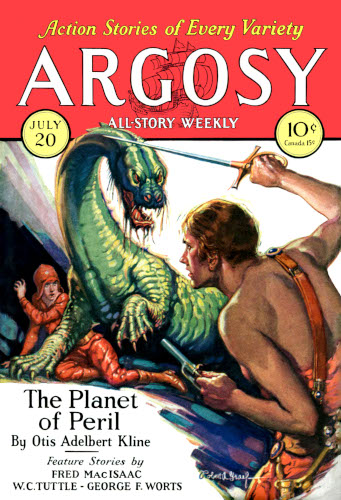
Title: The planet of peril
Author: Otis Adelbert Kline
Release date: August 13, 2026 [eBook #79360]
Language: English
Original publication: New York, NY: The Frank A. Munsey Company, 1929
Other information and formats: www.gutenberg.org/ebooks/79360
Credits: Greg Weeks and Mary Meehan
By OTIS ADELBERT KLINE
A mystery to men of Earth was the cloud-wrapped
neighbor world of Venus—till Robert Grandon found
himself transported to the dangerous and astounding
adventures of life on that weird planet.
[Transcriber's Note: This etext was produced from
Argosy All-Story Weekly July 20, 27, August 3, 10, 17, 1929]
| I. | THE ABDUCTION |
| II. | A MAN OF MYSTERY |
| III. | A SLAVE ON VENUS |
| IV. | ON THE TRAIL |
| V. | AN AIRSHIP OF OLBA |
| VI. | THE CONSPIRACY |
| VII. | THE FIGHTING TRAVEKS |
| VIII. | SURROUNDED |
| IX. | A SWORD AND A PLEDGE |
| X. | LOST AT SEA |
| XI. | A MYSTERIOUS DISAPPEARANCE |
| XII. | THE FLYING GRAMPITES |
| XIII. | THE FIGHT IN THE CRATER |
| XIV. | A MONSTER IN ARMOR |
| XV. | THE VALLEY OF THE SABITS |
| XVI. | SLAVE OF THE SABITS |
| XVII. | IN THE MATING PENS |
| XVIII. | AN UNDERGROUND CITY |
| XIX. | THE REVOLT |
| XX. | THE MAN-EATER |
| XXI. | AN IMPORTANT DISCOVERY |
| XXII. | TREACHERY |
| XXIII. | PURSUIT AND DISASTER |
| XXIV. | MEN WITHOUT EYES |
| XXV. | IN THE POWER OF DESTHO |
| XXVI. | A DIABOLICAL TORTURE CHAMBER |
| XXVII. | THE ATTACK |
| XXVIII. | OUT OF THE SKY |
| XXIX. | THE NEW EMPEROR |
Robert Ellsmore Grandon stifled a yawn with difficulty, as the curtain went down on the first act of "La Tosca." Opera bored him utterly. He silently wished that his well-meaning aunt would not drag him with such clocklike regularity to these monotonous matinées. She had taken a box in the Chicago Auditorium for the season, and so far he had not escaped a single performance.
Not that there was anything wrong with the opera. The trouble was with Grandon himself. He was tired of the indolent, luxurious life he led with his doting aunt, tired of endless matinées, dinners, receptions and halls, tired of the pretentious mansion on Sheridan Road, the numerous servants it housed, and the dawdling idle rich who frequented its spacious halls and gardens. He longed for action, adventure, romance—for the opportunity to think and act for himself, for a chance to accomplish something worth while.
Between the acts, he leisurely made his way to the smoking room. He was a handsome, well-built youth, just turned twenty-two, and not a few pairs of admiring feminine eyes were covertly turned to glance at his broad shoulders and curly black hair as he passed through the lobby. Nor was he regarded solely by feminine eyes, for a man who had apparently been awaiting his coming, stepped across the lobby as he appeared, and entered the smoking room immediately behind him.
Grandon was reaching for his cigarette case, when a pleasant voice at his right, said: "Try one of mine, won't you?"
He turned and looked into the smiling eyes of a man of about his own age. Evidently the young man wanted some one to talk to.
Grandon accepted with thanks.
"Excellent show, don't you think?" volunteered the smiling one, lighting a cigarette which he had, unnoticed by Grandon, taken from the side of the case opposite the one which he had extended a moment before.
"I suppose so—ah—why, yes, of course—"
Grandon was beginning to feel unaccountably drowsy.
Suddenly he slumped forward, and would have fallen on his face, but for the quick assistance of the friendly young man. A moment later he lost consciousness.
An attendant came running up, and a small knot of men gathered about.
"What's the matter with your friend?" asked the attendant.
"Fainted dead away," replied the young man. "It's his heart. Has spells like this quite often lately. Help me get him outdoors."
The two of them carried Grandon outside, followed by the more curious of the bystanders. When he reached the sidewalk, the young man signaled the driver of a powerful limousine which was parked on the other side of the street. It immediately swung across and drew up to the curb.
"Let's put him in the car," said the young man. "I'll take him for a little spin on Michigan Boulevard. The fresh air will revive him."
They lifted him into the tonneau, the young man handed a crisp bill to the attendant, and the limousine disappeared around the corner.
When Grandon regained consciousness he was lying on a cot in a dimly lighted room. He looked about him in bewilderment, for instead of the tasteful bedroom with its costly furnishings, in which he had been accustomed to awaken, he saw four bare concrete walls, a heavy oak door studded with many large bolts, and a small window fitted with powerful iron bars more than an inch in diameter.
He arose and tottered unsteadily toward the door. It was evidently locked from the outside, for he could not even rattle it. He went to the window and peered out. Night had fallen, and a myriad twinkling stars looked down at him from a clear sky. Not a tree, house, or earthly object of any kind was visible. There were only the starry sky above and the black void below.
He heard the sound of talking, and wheeled about as a bolt slid back and the door opened. Two men entered. The foremost was of gigantic stature, but well proportioned and athletic in appearance. His forehead was high, and bulged outward, so that his shaggy eyebrows, which grew completely together above the bridge of his aquiline nose, half concealed his small, glittering, beady eyes. He wore a closely-cropped, sharply-pointed beard, in which a few gray hairs showed here and there, proclaiming him as probably well past middle age. Grandon had never before seen a face so powerful, so masterful, and yet so forbidding. Behind this striking visitor came the young man who had been so anxious to scrape an acquaintance in the theater.
The young man advanced and extended his hand.
"How are you feeling by now, Mr. Grandon?" he asked. "Ah, you seem surprised that I know your name. That will be explained to you presently. I should have introduced myself sooner. My name is Harry Thorne. Allow me to present Dr. Morgan."
The big man held out his hand and said in a booming bass voice:
"This is a pleasure I have long anticipated, Mr. Grandon."
The bewildered Grandon clasped the muscular hand of the doctor and muttered an acknowledgment.
"No doubt you are anxious to learn why you are here, and what we propose to do with you," proceeded the doctor. "First tell me. Do you know anything about telepathy?"
"I know that it exists in fact, and have seen a few parlor demonstrations of it," replied Grandon.
"And have you ever heard of what some writers call astral projection?"
"I have read of it, but it sounds very fishy."
"Of course. That is because you have never had it proved to you as you have telepathy. Astral projection is commonly practiced by Hindu ascetics, but it is practically unknown in the Occident. Only a few cases have come to light in Europe and America. Several of these have been recorded by the London Society for Psychical Research in a book called 'Phantasms of the Living.' Before we proceed further, I will give you a slight demonstration of this phenomenon, in order that your doubts may be put at rest. Give me your hand."
As Grandon placed his hand in that of the doctor, a queer sensation came over him. He felt light, ethereal, unsubstantial. Could it be that he had left his body?
He found himself in a brilliantly lighted room, the drawing-room of his aunt's home. She was talking hysterically to a blue coated policeman who made notes of what she said in a small memorandum book. Her eyes were red with weeping, and she dabbed at them from time to time with a small lace handkerchief while she told of her nephew's strange disappearance. Grandon approached and spoke to her, but she did not appear to hear or see him. He stepped directly between her and the policeman, but neither took any notice of him whatever.
Suddenly the room faded from his vision, and he was again standing before Dr. Morgan. The latter released his hand.
"You now see that it is possible for you to leave your body, and travel almost instantly, a distance of a thousand miles. It took more than ten hours for an airplane to bring you here at the speed of one hundred miles an hour. You can travel millions of miles as easily and as quickly, for the power of the subjective mind, or ego, is unlimited by time, space or matter, once it has escaped from that frail, clumsy shell which you call your body. Years ago I dreamed that such powers as these might be interplanetary as well as terrestrial, and that dream has been made to come true.
"I suppose you have heard of the numerous attempts to establish communication with the people of Mars through wireless telegraphy. Futile. Telegraphy is a physical, a material thing. It is surrounded by those limitations which are ever present where matter is concerned. Ten years have elapsed since I first communicated with the Martians—through telepathy. In those ten years I learned as much about Mars as I know about the Earth. It was difficult at first, because there was no language on that planet similar to our own, I could only send and receive the simplest of impressions in picture form. For instance, the Martian with whom I at first communicated, projected a picture of himself and his surroundings. I returned to him a picture of myself and my surroundings. For two years we exchanged these concrete mental images, but I was not satisfied. I desired an exchange of abstract ideas as well.
"One night he projected to me a picture of two men on his own planet, and succeeded in conveying the idea that they were willing to exchange bodies with two men on Earth. He stipulated that the earthly bodies must be exact duplicates of those which he pictured to me, or the exchange could not be made. I searched the world over for two such men. One I found in British East Africa, the other in Alaska. Each man, when located, was kidnaped, and offered the alternative of death or the exchange suggested. To-day the two Martians are associated with me, while the men who exchanged bodies with them communicate knowledge of the latest events on Mars to me at regular intervals. One of the men, formerly Mr. Harry Thorne, has become so attached to his new home that he does not wish to return. The present Mr. Harry Thorne, whose Martian name was Borgen Takkor, is looking for new worlds to conquer. The other two men will, no doubt, return to their respective bodies sometime within the next ten years. Mr. Thorne, here, has lived on two planets—Mars and this Earth—and now wishes to try life on a third."
Thorne smiled in anticipation, as the doctor proceeded.
"Two years ago, I succeeded in establishing mental rapport with a being on Venus. To-day, I have arrived at the point where two inhabitants of that planet—Zarovia, they call it—have been persuaded to exchange bodies with two terrestrial men. One of these inhabitants of Venus is the exact physical counterpart of Mr. Thorne, while your body is identical with that of the other.
"Many times at your club, Mr. Grandon, you have voiced the wish that you might get away from Chicago, away from your life of ease and idleness, and find adventure and romance. Do not be surprised at my knowledge of this, for I have had your every movement watched for months. I now offer you the opportunity to gratify that desire in the fullest measure. I can promise you, on Zarovia, a life fraught with dangers of which you have never dreamed, with excitement to which ordinary earthly adventures would be tame in comparison.
"Your physical counterpart is a nobleman who has been enslaved by a cruel Amazon ruler, a princess with no thought save of her own pleasure. He finds it impossible to escape from bondage, and is therefore willing to make the exchange. Mr. Thorne's bodily duplicate is a prince of a realm on the opposite side of the planet from that occupied by the slave. The prince, like yourself, has been petted, pampered and shielded from all danger, and longs for adventure. As it is denied him on his own planet, he is willing to exchange bodies for a time with Mr. Thorne. Well, what do you say? Are you willing to make the trip?"
Grandon looked puzzled.
"I don't know," he replied. "No doubt you realize that the whole thing sounds like a wild dream to me. I have never been cognizant of the fact that any one on Earth had succeeded in communicating with Mars, let alone Venus, and as for this idea of interchanging bodies, it doesn't seem natural or human. I have always felt that my body was a part of myself, peculiar to myself, and inseparable from the me that is called a soul, except by death. The question arises, what would become of my body when inhabited by this Zarovian? I presume that if he should be careless with it and die, it would be impossible for me to return."
"You need have no fear regarding the care of your body while you are absent," answered the doctor. "It will not only be under constant surveillance during your absence, but will have careful medical attention as well. Then, too, the man who comes to inhabit it will naturally be careful of it, for if he loses it there will be no return for him, either to this world or his own. Now, Mr. Grandon, are you game?"
"Yes! I will make the trip."
"Good for you, my boy. I can see that you are of the stuff from which heroes are made."
"If you will not consider the question impertinent," remarked Grandon, "I should like to know why it is that you have never taken any of these trips yourself."
"Ah, would that I could," replied the doctor. "As far as I can learn, unhappily, there is no man either on Mars or Venus who has a body like mine."
Grandon could very well believe that there was no man like Dr. Morgan on Venus or Mars. At least, he was quite sure he had never seen any one resembling him on Earth. He was an extraordinary combination of mental and physical power—a veritable superman.
"What do you, personally, expect to gain by sending me on this trip?" Grandon queried.
"A thorough knowledge of the planet Venus as seen by earthly eyes, to satisfy my own curiosity, and to be passed on to the people of the Earth at my death. I will, at regular intervals, establish telepathic rapport with you and Thorne while you are asleep. You will know nothing of these telepathic communications unless I see fit to convey a message to you which will probably come in the form of a dream, so vivid that you will remember every detail. If you wish to communicate with me for any reason whatever, I will learn the fact the first time I establish rapport with you, for this will naturally come, along with the other knowledge obtained from your subjective mind while you sleep."
"What do we have to do in order that this exchange of bodies can be made?"
"You will simply lie down and go to sleep when the time comes. I will attend to the rest. When you awaken you will be in Zarovia. Come with me and I will show you around the place. You are on the peak of a high mountain, more than a thousand miles from Chicago. This is my observatory."
They were now in a huge, glass-domed room, in which stood the largest telescope Grandon had ever seen.
"Perhaps you would like to have a look at the world to which you will soon journey," said the doctor, leading the way up iron stairs to the telescope platform. For several minutes Grandon gazed in awed silence at the silvery sphere.
The professor touched his sleeve.
"Come," he said, "it is time for your journey."
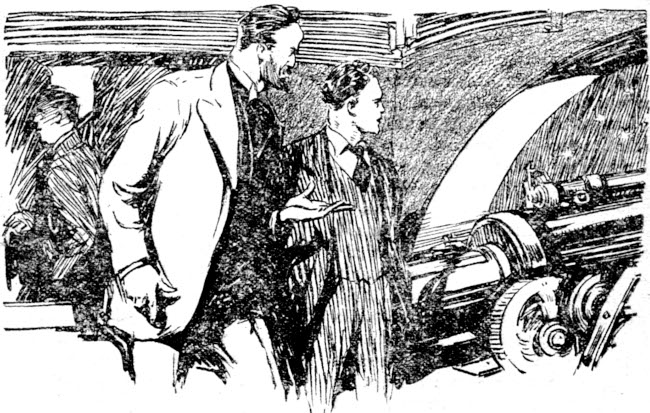
"Come," he said. "It is time for your journey."
Two cots stood ready in an adjoining room. Grandon lay down on one and Thorne on the other. The doctor sat on a chair between them with a hand on the forehead of each. As he was passing into unconsciousness, Grandon heard the doctor say:
"Good-by, men, and good luck to you."
Robert Ellsmore Grandon, ex-clubman, ex-idler, ex-social lion, was awakened from a sound sleep by a shaft of brilliant sunlight which shone through the mica-paneled window of the quarry-slaves' sleeping quarters. He blinked, turned uneasily, then sat up and stretched himself. To his surprise he felt numerous twinges of pain as he did so. His muscles appeared stiff and bruised and his back smarted and burned. He noticed that his sole articles of apparel consisted of a scarlet breech-cloth and a pair of sandals of strange design. His skin was browned, as if by constant exposure to the sun, and his hands were rough and calloused. His face was covered with a thick, black beard, and his hair was matted and unkempt.
He rose stiffly and walked to the window. The brilliance and size of the sun, visible for a moment through a rift in the clouds, astonished him. Never had he seen that orb appear so large. Then the explanation dawned on him, Venus was only three-fourths as far from the sun as was the Earth. Naturally the sun would appear larger as one approached it. Here was incontrovertible evidence that he was indeed on the planet Venus. He stared quickly about him, in eager curiosity.
Grandon had hoped for a clear view of a Zarovian landscape, but he was disappointed, for in front of his window there stretched a solid wall of black marble cliffs. The only visible vegetation consisted of a few pink toadstool-like growths which grew from niches in the rock. They were far larger than any he had ever seen, some of them being over twelve feet in height.
He turned and glanced at his roommates. Fifty men were quartered in the sleeping shed, which was built of black marble, thatched with the broad leaves of a species of tree-fern which reminded him of imaginative pictures of prehistoric swamps.
The bedding consisted of a coarse, dried moss, which made an exceptionally resilient couch, but would undoubtedly have caused considerable discomfort to one not accustomed to it, because of the scratchy stems which protruded here and there. The men, who were attired like Grandon, with the exception that their breechclouts were gray instead of scarlet, seemed to be thoroughly enjoying their morning sleep. Their skins were sunburned like his own, and marked with scars and open wounds that mutely attested the brutality of their drivers.
Grandon was startled by a hollow booming sound, and some one on the outside opened a large door at the center of the shed. Instantly every man sprang to his feet, and he saw that they were forming in single file to march through the door. He joined the procession, which was heading for a large building in the midst of a group of sheds similar to the one he had occupied, and saw that the sound emanated from a large cylinder of iron suspended from a steel beam in front of the building, and beaten by a man who wielded a large club wrapped with thongs.
Heavily armed guards stood at intervals of about fifty feet on either side of their pathway. Each guard carried a tall spear with a broad blade about four feet long, while a scarbo, a sword with a basket hilt and a blade rather like that of a scimitar, hung from the left side of the belt.
From the right depended a weapon which was utterly strange to Grandon. It was about two feet long, oblong like a carpenter's level, and apparently composed of blued steel. A rivet passed completely through it about four inches from the end, holding it firmly to the belt, although it could be tilted at any angle, and its wearer could point it in any direction by turning his body.
Grandon had yet to learn the efficiency of this terrible Zarovian weapon, the tork, which fired needlelike glass projectiles filled with a potent poison that paralyzed man and beast alike almost as soon as it penetrated, and had a range as great as the most powerful of modern rifles. These tiny bullets were propelled by a highly explosive gas ignited by an electric spark at the touch of a button.
The gas was compressed in a chamber at the rear of the tork, while the glass missiles were held in a magazine near the muzzle. After a shot was fired the weapon would automatically reload, a bullet sliding into place in front while just the right charge of gas was released in the chamber behind it. Each gun, or tork, held a thousand rounds of ammunition.
The slaves passed through the building where each man had his ration doled out to him: a bowl of stewed mushrooms and a steaming cup of a colorless aromatic beverage which Grandon found to be very much like a strong wine.
As he followed his companions through the building, Grandon noticed that each man stopped before a small shrine and stood for a moment with head bowed low and hand extended toward it, palm downward. When he reached the shrine, he stopped as the others had done, then gave a gasp of amazement, for there before him, illuminated by the brilliant rays of the morning sun, was a life-size painting of the most beautiful woman he had ever seen.
She wore a robe of scarlet, ornamented with gold and precious stones, and a jeweled band of platinum imprisoned a mass of golden curls which were piled on top of her head after a style different from anything he had ever seen. She was seated on a massive golden throne with cushions of scarlet, across the arms of which rested a scarbo, similar in shape to those carried by the guards, but with a hilt of gold studded with rubies.
Could this be the heartless Amazon ruler of whom Dr. Morgan had spoken? As he looked into that lovely, girlish face, Grandon did not think it possible that she could be otherwise than noble, kind and generous.
A sharp exclamation brought him to his senses none too soon, for as he turned he saw an overseer advancing with cruel whip upraised. Quickly bowing as the others had done, he ran forward to join his fellow slaves.
Once outside the building, the men seated themselves on the ground in little scattered groups, for their morning meal. Grandon joined a company of these who had occupied the same dormitory with him, and attacked his food with gusto, for he was ravenously hungry.
He could not take part in the general conversation because the language was unintelligible to him, yet the words sounded strangely familiar. A recollection of their meaning was stored in the brain cells of the body which had become his, but the true mind, or ego, which was Grandon, being the only mind which really remembers, could not interpret them because it had never heard them. He could, and later did, however, learn with great rapidity because of the subconsciously stored reflections. Meanwhile, he kept silent and listened.
The meal finished, the slaves were herded to the quarries by their drivers. Each driver, who had charge of ten slaves, wore both tork and scarbo in his belt and carried a whip, the five lashes of which were woven from some coarse fiber and interwoven with short pieces of a brittle, nettlelike moss, which broke off in the skin of the victim, inflicting a pain like that of a thousand bee stings. A man struck with one of these whips not only felt the momentary blow, but suffered excruciating agony for hours afterward.
For the first time in his hitherto petted and pampered existence, Grandon learned what it was to labor. Sweating, toiling, straining every weary muscle, he managed to keep pace with his fellow slaves. The intense heat of the sun would have made labor in the open impossible, had it not been almost constantly tempered by the floating clouds of vapor which are ever present in the dense, moist Zarovian atmosphere. Such a thing as a clear sky is almost unknown on any Zarovian landscape, and it is, indeed, this very fact which enables man to exist on this planet with any degree of comfort in other than the polar regions. At those rare intervals when the disk of the sun is fully revealed, the heat is almost unbearable.
The marble was being removed from the hillside in large rectangular blocks, by thousands of slaves working on a series of terraces, each of which was the height of one of the blocks. The crews were so distributed that the terraced hillside constantly retained the same general contour, for while the bottom terrace was being removed, the next one above it was also cut away in the same proportion, and so on to the very top.
Grandon's crew worked on the bottom terrace all morning, but were ordered to the top in the afternoon to reënforce the laborers in that section who, for some reason, had not kept up with their quota. He and a fellow slave were removing one of the heavy blocks by means of levers when his end slipped and fell on another block, breaking off a large fragment. The quick-tempered driver, who was standing behind Grandon when the accident happened, raised his whip and struck him a stinging blow across the shoulders.
The result was almost as much of a surprise to Grandon as it was to the driver, for quickly wheeling, Grandon landed a tremendous right hook on the point of the man's jaw. It was a clean knock-out. Another driver, seeing his fellow go down, came running with whip upraised, but Grandon bowled him over with a marble fragment and ran through the group of startled slaves toward the brow of the hill. Some one raised the alarm and a half dozen torks were immediately pointed toward the fugitive. Several slaves fell, struck by the missiles intended for him, and a hail of projectiles battered the rocks around him as he disappeared over the hilltop.
Before him stretched a dense, waving forest of tree-ferns into which he plunged without slackening his speed, for his pursuers were close behind him. As he dodged in and out among the tree-trunks he could hear their halloos growing fainter and fainter, and finally no sound was audible except the rustling of the countless, wind-shaken fern leaves.
Wearied by his exertions, he slackened his pace and, after proceeding about a mile farther, stopped and looked about him. The fern forest was, to the Earth-man, a most strange and impressive sight.
Huge tree-ferns with rough trunks and foliage growing out of the tops like that of palm trees, some of them ever seventy feet in height, towered above the shorter, more bushy varieties which were themselves giants compared to the largest ferns of earthly jungles. Then there were climbing ferns hanging in tangled masses, creeping ferns, and dwarf, low-growing kinds, barely raising their fronds above the thick carpet of moss which everywhere covered the forest floor.
Grandon was puzzled where to go or what to do. Behind him were the cruel slave drivers who would probably inflict horrible tortures and even death itself if they could get their hands on him. Ahead was—-he knew not what.
Would the direction he had taken carry him to safety, or into still greater dangers? He was weary, hungry, and thirsty, and had no idea which way to go for water or food. As for marking his course by the sun, this was impossible, first because he knew nothing whatever of the geography of Zarovia, and second because he did not even know whether he was in the northern or southern hemisphere.
He noticed that the ground slanted slightly toward his right, and intuition told him that this might lead to a valley and water. He changed his course accordingly. He hoped also to find some fruits, berries or nuts with which to satisfy his hunger, but he hoped in vain, for there is no such thing in all the forests of Zarovia.
As he trudged wearily forward, sunset was succeeded by twilight, and before he realized it, the black, moonless Zarovian night had spread its impenetrable mantle about him.
Suddenly, from out the darkness behind him, came a peal of horrible, demoniac laughter.
As he wheeled, Grandon unconsciously emitted a peculiar sound, half roar, half growl, and every hair on his body bristled. For the moment he had reverted to the primitive. Reason was unseated and instinct held sway.
Two glowing phosphorescent orbs were slowly advancing as if something were creeping or slinking toward him. Then, without warning, the hideous noise was repeated at his left.
He turned to face another pair of menacing eyes, then leaped for the trunk of the nearest tree-fern and climbed it as rapidly as if he had been used to that sort of thing all his life. As it was, he was barely in time to escape the snapping jaws that yawned beneath him.
Not until he had reached the leaf-crown, fifty feet above the ground, did he pause or look downward. Then he saw, not two, but a dozen pairs of eyes glancing toward him, while peal after peal of the nerve-racking laughter smote his ears.
Time dragged along. What manner of things were these that sought his life, he wondered? Evidently they were unable to climb, or they would have followed him ere this. The fact that they did not leave, even after several more hours had elapsed, made it evident that they expected to get him.
He had been hearing a peculiar crunching sound some time before he located it and guessed the terrible truth.
They were gnawing through the base of the tree-trunk!
As the night wore on, and the gnawing of the invisible brutes below him continued, Grandon tried to formulate some plan of escape. He was without a weapon of any kind, and could not hope, barehanded, to withstand the attack of a dozen furious beasts, even though he should alight unhurt, when the tree should fall.
A rift in the clouds overhead gave him his first glimpse of the starry firmament as seen by the Zarovians. For a minute he was puzzled by the unfamiliar presence of an exceptionally brilliant heavenly body, attended by a smaller one, very faint. Then the significance of what he saw dawned on him. It was the planet Earth with her satellite, the moon. There, above him, across millions of miles of trackless ether, were his home, his loving aunt, his friends. Below him awaited a horrible death.
A cracking sound and an inclination of the tree warmed him that the end was near, as it told that hungry horde below, who redoubled their hideous cries in anticipation of the feast which had long been patiently awaited. Then the tree crashed to the ground. As he felt his perch going from under him, Grandon made a wild leap in the opposite direction from that in which it fell.
He hoped to alight on the ground, and, if his legs were not broken by the fall, climb another tree-fern before the beasts apprehended him. To his surprise and delight, however, he landed in the middle of a leaf crown similar to the one he had just vacated, but about ten feet nearer the ground.
The cries of the baffled brutes were terrible to hear when they learned that their intended victim was not among the branches of the fallen tree. In a few minutes, however, they located him again, by scent, no doubt, and the sounds which floated up told him they were once more cutting a tree from under him. If there were only a little moonlight so he could see the trees about him, he felt that he might make another leap with a reasonable chance of safety, but he knew he could not expect to find a leaf crown under him every time he leaped blindly into the darkness, for it was by sheer good luck that he had alighted on this one, and luck often changes unexpectedly.
A quick gust of wind came up, shaking the branches violently, and Grandon almost fell from his perch. As he recovered his balance something struck him sharply in the face. He reached up and grasped an object that felt like a coarse, thick rope, but which he recognized as the stem of one of the large climbing ferns he had seen that day.
He eased his weight onto it, found it firm, and then began silently to ascend, hand over hand. After climbing a distance of what he judged to be about thirty feet, he came to a leaf crown which was apparently twice as large as the one he had just vacated. He smiled grimly as he thought of the beasts gnawing futilely at the base of the smaller tree. Feeling secure for the time being, he fell asleep, exhausted.
Some time during the night he was partially awakened by the crash of the second tree-fern and the howls of rage that followed it, but full consciousness did not come to him until morning. For a moment he could not realize where he was. Then he remembered, and looked downward.
On the ground beneath his leafy dormitory he beheld twelve of the most fearsome creatures he had ever seen. In form they were something like hyenas, but twice as large as any hyena that ever walked the earth, and much more hideous. In lieu of hair, their bodies were covered with thick scales, and were black mottled with spots of deep, golden orange. Each beast had three horns, one projecting from either temple and one sprouting out between the eyes.
Six of them were tearing at the base of the tree with their sharp teeth while the other six lay on the ground, their tongues lolling from their mouths much after the manner of a pack of hounds that has just returned from the chase. No doubt they were working shifts, he thought, and to some purpose, too, for the tree was already deeply incised on all sides.
While looking about for the most likely tree for his next leap, which he knew must come soon, Grandon was surprised to see a man about two hundred yards away, walking with his eyes on the ground as if following a trail. The newcomer was armed with a scarbo, tork and knife, and carried a long bundle strapped to his back.
"I suppose he was sent to bring me back, dead or alive," thought Grandon. "He's a good trailer, all right, but I am afraid he will bump up against something he doesn't expect and soon, too. Wait until he mixes it with those horned hyenas."
He had not long to wait, for the next minute one of the beasts scented the stranger and gave vent to one of the unearthly laughs with which Grandon had now become familiar. Immediately the animals at the base of the tree ceased their gnawing, and the pack charged the stranger.
He did not seem alarmed in the least, although he stopped and awaited the oncoming beasts with the muzzle of his tork in position.
Grandon had expected to witness a bloody, hand-to-hand fight, but what he actually did see was a demonstration of the efficacy of a tork, in skilled hands.
The leader of the pack fell a full fifty feet from its intended victim, seven more met a similar fate in as many seconds, and the rest turned and fled. The man then drew his knife and coolly and deliberately cut the throat of each animal. He glanced at the two fallen trees, then walked over to the one in which Grandon was perched.
"Come down, Robert Grandon," he said, in English.
Grandon was so surprised he nearly fell out of the tree.
"Who are you," he asked, "and where did you learn my language?"
"Come down and I will explain."
"You might come up," suggested Grandon. "I don't fancy the climate down there—too damp and muggy. I suppose you have instructions to bring me back dead or alive. I am frank in telling you that I won't go back alive."
"You are mistaken, Robert Grandon. I am not of Reabon or of Uxpo. I am friendly to you and have come to your aid. To prove this, I need only mention that I have communicated with Dr. Morgan of your planet for several years. Now will you come?"
Grandon slid down the rough tree-trunk. When he reached the ground, the stranger advanced.
"Permit me to introduce myself," he said, pleasantly, "I am Vorn Vangal, and my home is in the distant country of Olba."
"How do you do, Mr. Vangal," replied Grandon, extending his hand.
Vorn Vangal looked puzzled.
"What is it you wish?" he asked, indicating Grandon's extended hand.
"Why—nothing at all. I forgot that our earthly custom of shaking hands might be unknown here."
"I have never heard of it," said Vangal. "I hope you will pardon the ignorance which kept me from returning your proffered salute. Show me how you do it, please."
Grandon explained, and for the first time in the history of that planet, two men shook hands on Zarovia.
"A very pretty custom," Vangal said. "I shall introduce it in Olba on my return. I will explain the various forms of salutes used on Zarovia. When one is presented to a stranger he merely bows slightly and acknowledges with words. Two intimate friends on meeting sometimes press their foreheads together. Then there are the military salutes, the salutes to royalty, et cetera. For instance, the reigning Torrogina of Reabon, or princess as you would call her, would be saluted thus." He made a low bow and extended his hand as Grandon had seen the slaves do the day before in front of the shrine.
"In company with my fellow slaves, I bowed thus before a picture of a beautiful young woman yesterday," said Grandon. "Can it be that this is the Amazon princess of whom Dr. Morgan spoke?"
"She can be none other than the beautiful and terrible Vernia, Princess of Reabon, who has ruled that country since the death of her father, Emperor Margo, greatest of all rulers, and the leader who made Reabon the largest and mightiest empire in all Zarovia."
"I should like to meet her," said Grandon.
"To say that you should like to meet her is equivalent to saying that you should like to die; for if you are apprehended by the Reabonians, you will most certainly be executed. Thaddor, Prince of Uxpo, whose body you now inhabit on Zarovia, was under the displeasure of her imperial majesty because he had the temerity to make violent love to her, and narrowly escaped death in consequence. She sentenced him to work in the quarries for life; and to run away after such sentence has been passed is equivalent to signing your own death warrant, in Reabon."
"Nevertheless," persisted Grandon, "I hope some day to meet her. By the way, friend Vangal, I suspect that you have food and drink in that long bundle you are carrying, and I have tasted neither since yesterday morning."
"Can it be possible?" ejaculated the surprised Vangal. "But of course! You are not familiar with the fern forests of Zarovia. No one carries food or drink in these forests, for both are about him in abundance."
He drew his knife and cut a branch from the bush-fern under which they were standing.
"Here. Taste water as pure and delicious as may be found in all Zarovia."
Grandon put the end of the branch to his lips and drank greedily, while Vangal gathered several large spore-pods and split them open with his knife. After he had partaken of this nourishing food he felt greatly refreshed.
"I shall have to teach you the woodcraft of Zarovia before I leave you," said Vangal. "But come, we must go as far as possible from this vicinity at once, or the soldiers of the Torrogina—Princess Vernia—may find us."
"I am puzzled to know how it happened that you found me before the Reabonians," said Grandon.
"Because I followed your trail, while they merely ran about in the forest, guessing at what direction you had taken. The men of Reabon know nothing of following a trail, which is as an open book to my people of Olba. But here, I have brought you weapons and trappings." Vangal unrolled the long bundle which he had been carrying. "Fasten this belt about your waist and cross the straps over your shoulders, so. Now let us be off."
The two swung away through the forest glades, Grandon armed like his companion with tork, scarbo and knife. As they walked side by side, Vangal explained the use of the tork, and showed Grandon how to insert the extra clips of bullets and gas which were in his belt. In all, each man carried five thousand rounds of ammunition.
"What do you call those strange creatures that treed me last night, and why did you cut their throats after you had already dispatched them with bullets?" inquired Grandon.
"They are called hahoes, so named because of their peculiar cries, and are mostly eaters of carrion, although they will seek and bring down fresh meat when driven to do so by hunger," Vangal explained. "I cut their throats because the poison in the tork bullets which I used is effective only for a few hours. It paralyzes temporarily, but does not kill. I prefer to use this kind rather than those bullets which carry deadly poison, so that, if I desire to do so, I can overcome my enemies without killing them."
The sun was high in the heavens when they reached the bank of a small stream. Here the character of the vegetation changed considerably, for while large tree-ferns were still in evidence here and there, as well as the smaller varieties, there were huge fungus growths unlike anything Grandon had previously encountered. Colossal toadstools, some of which reared their heads for fifty feet in the air, grew all about in an endless variety of forms and colors.
"We are now more than twenty miles from the marble quarries and in an excellent place for a camp," said Vangal. "I will help you build a shelter and remain with you for a week to teach you Zarovian woodcraft, and patoa. At the end of that time I must journey to the other side of the planet, in order to assist your friend, Harry Thorne."
"What is patoa?" asked Grandon.
"It is the universal language of Zarovia," replied Vangal. "While every nation has its own language, we have, in addition, patoa, which is taught to the children of every country from infancy. When you have mastered this tongue, you will have the means of conversing with any intelligent being you may meet."
The rest of the day was spent in building Grandon's new abode. Vangal found four tree-ferns standing in a square about ten feet on each side, and they commenced operations by felling another tree-fern which stood near by and cutting it into twelve-foot lengths. By means of a rope made from the stem of a climbing fern, Vangal pulled these lengths up, one at a time, to a distance of thirty feet, and fastened them in notches he had made in the four tree trunks by wrapping them with the tough, fibrous roots of the bush-fern. They now had a square framework on which to lay their floor, which was made from poles cut from the trunks of smaller tree-ferns and tied in place at the ends.
When the floor was ready another square of fern logs was fastened about seven feet above it, and the walls were built of the stems of toadstools, piled one on another and tied in place. An opening for a door was left on one side and there were two holes about six inches in diameter on each side for ventilation.
This work completed, Vangal felled a huge toadstool, the cap of which was nearly thirteen feet in diameter. He cut the stem completely from it, and they dragged it to the base of one of the tree-ferns which formed a corner of their house. A fern rope was passed about it, and the two men climbed to the platform. It was quite heavy, and Grandon breathed a sigh of relief when they finally had it resting on the cross-pieces. They cut four grooves in it for the tree trunks and soon had this solid, rainproof roof in place.
After covering the floor with a layer of moss of the resilient kind used by the Zarovians for couches, and chinking the walls with handfuls of another, softer variety, they cut a toadstool with which to close the doorway at night, and the house was finished.
After they had eaten on the following morning, Vorn Vangal said:
"No doubt you are anxious to know something about this country, and the person you represent on Zarovia. The wild, mountainous kingdom of Uxpo, of which these forests are a part, is situated at the extreme southern limit of the empire of Reabon. Uxpo, together with seven other kingdoms, was originally conquered by the famous emperor, Margo, and its fierce, previously unbeaten mountaineer people reduced to slavery.
"Upon Margo's death, three years ago, the people of Uxpo entertained high hopes of freedom. They had learned that the emperor's daughter, Vernia, a mere slip of a girl, had succeeded to the throne, and felt that it was the logical moment to strike off the shackles that held them. Accordingly they revolted and, almost over-night, slew every soldier, officer and agent of the empire. Their old king had been executed at Margo at the time of the invasion, but his elder son, Lugi, was placed on the throne.
"Two days afterward a courier brought news that the princess Vernia was coming at the head of a hundred thousand soldiers. He assembled his pitifully inadequate little army of five thousand mountaineers and went forth to do battle for the honor and liberty of Uxpo. The army of Uxpo was annihilated, and Lugi was executed for treason. Once more the fierce Uxponians bowed their necks to the yoke of the conqueror.
"Lugi had a younger brother named Thaddor—your astral double. This youth was of a mild and gentle disposition, and it was for this reason, perhaps, that Vernia spared his life and allowed him the privilege of her court.
"Prince Thaddor, however, mistook the kindly motive of the princess and fell madly in love with her. He had always found women susceptible to him, and did not doubt that this slip of a girl would yield; so, when one evening he attempted to make love to her, he was little prepared for the storm of anger which followed.
"'Prince Thaddor,' she said, 'for such presumptuous conduct as this I should have you beheaded. You are the son of a king, and I have permitted you to live in idle luxury because you appeared gentle and courteous, and not because of any personal feeling I had for you. Had my father been living at the time of the revolt, there would have been but one alternative to instant death, namely: slavery in the marble quarries. A slave, I brought you from Uxpo, and a slave I return you thence, to labor in the quarries for life.'
"For some time I had been searching for a man dissatisfied with life on this planet, to accompany our Prince of Olba on the journey to your world. I heard of Prince Thaddor's predicament, and experienced little difficulty in persuading him to make the journey. Some weeks after I telepathed the news to Dr. Morgan, he advised me that he had found the prince's physical counterpart. When he reported that you were about to make the journey I immediately came hither in order to be of assistance to you. On learning of your escape, I trailed you to the tree in which you had been driven by the hahoes. The rest you know."
Vangal stayed with Grandon for a week, teaching him patoa and woodcraft, and the use of the tork, and scarbo. On the evening of the seventh day he stated that the time had arrived for him to return to his people.
"No doubt you are anxious to be back among your friends," remarked Grandon. "Is the journey a long one?"
"Olba is on the opposite side of the planet; roughly, about twelve thousand of your Earth miles from here."
"And you will go all that distance afoot?"
"Hardly. My airship is concealed in a ravine only a short distance from here. In one day's time I shall be home. By leaving here in the evening I shall arrive there in the morning, for it is morning in Olba when it is evening in Reabon."
"You must have speedy airships on this planet," said Grandon. "According to your statement, you will travel at the rate of five hundred miles an hour, or almost half as fast as the planet itself revolves on its axis."
"Exactly; yet my little one-man craft is not so swift when compared to some of the larger airships, many of which travel twice as fast."
"Marvelous!" exclaimed Grandon. "What motive power do you use?"
"Ah, my friend, I regret that I am not at liberty to divulge that, for Olba is the only country on the planet in which airships are made or used. The factories and the secrets of manufacture are the exclusive property of the government, and have been since the first airship was invented, nearly four centuries ago.
"My people are peace-loving and not given to conquest. In the airship they have a potent means of defense from their warlike neighbors. If the Reabonians, for example, knew the secret of airship manufacture, they would long ago have subjugated most of the other Zarovian nations, all of which, with the exception of Olba, are as warlike as themselves."
Together the men walked to the ravine where the airship was concealed. Grandon expected to see a craft equipped with wings or planes of some sort, and a propeller. To his surprise he beheld what looked like a small metal duck-boat with a curved glass dome over the tiny cockpit. The airship was about ten feet long and three wide, and without planes, wings, propeller, or rudder.
Vangal noted the look of surprise on the face of his companion.
"You seem puzzled by the appearance of my little craft," he said, smiling slightly. "It will do no harm for me to explain something of the general principles on which it operates, so long as I do not betray the actual secret of motive power, with which I am familiar as an officer of my government.
"Immediately in front of the glass dome you will notice a small, round bulge in the deck. Under that bulge is a delicate mechanism which it is impossible to remove or take apart without breaking a small vial of acid that will instantly destroy it. This mechanism is the motive power of the craft, so you can readily see that it would be quite impossible for an enemy to learn our secret by capturing one of our ships.
"You are, no doubt, familiar with that power of the subconscious mind which your Dr. Morgan calls telekinesis—the power with which your terrestrial mediums sometimes cause tables and other ponderable objects to rise and hang suspended, or move about in the air without physical aid. My people have been familiar with this wonderful power of the mind for many centuries, but never, until the invention of this mechanism, were they able to put it to any practical use. It responds to, and amplifies the power of telekinesis to a remarkable degree, so that by mind power I am able to cause the craft to rise and hang suspended at almost any attitude, or to move in any direction, backward, forward, or sidewise. For emergency use, in the event of the failure of the motive power, there are two parachutes, one under the small round lid at either end of the craft. By pressing a button I cause the lids to fly back and the parachutes to project from the holes and open almost instantly."
"A most astounding and wonderful invention," exclaimed Grandon.
"Perhaps some day you will visit Olba, and when you do, Vorn Vangal will see that you are provided with a suitable craft as long as you stay in the country—for none but a government official or employee may take one of these airships over the border. It is growing late, and I must begin my journey," Vangal continued, opening the door in the rear of the dome and stepping inside. "Farewell, my friend. I admonish you to hurry home at once, for night will fall in a few minutes, and those beasts of prey of which I warned you will be lurking in the shadows. I see you have not brought your tork or scarbo with you. That is unwise. From now on, never travel without them. On Zarovia you are in constant danger from attack by man or beast. Farewell, and may you soon be firmly seated on the throne of Uxpo."
Grandon warmly clasped the hand of his departing friend, and a feeling of indefinable sadness came over him as he watched the tiny craft rise noiselessly and smoothly to a height of perhaps a thousand feet, then dart away, to be lost to view in a few seconds.
As he stood looking in the direction Vangal had taken, he was startled by the sound of a stealthy footfall behind him. He wheeled, but his eyes could not penetrate the shadows, for night had come on with its characteristic suddenness. At the sound of a second footfall he turned and dashed off through the forest, only to find himself amid a group of warriors with leveled torks. The men, attracted by the sound of his farewell to Vangal, must have crept up and surrounded him.
Despite the fact that the audience chamber of the imperial palace of Reabon was crowded with people, the silence was so intense that the buzzing of a fly would have been audible from one end of the room to the other. Whereas, only a moment before, the people had laughed and chatted in little groups, they now stood in straight, rigid lines along the marble walls, arranged according to their respective ranks and stations in life, for the scarlet curtains which surrounded the massive throne had been drawn back, signifying the approach of the princess, the Torrogina.
Those who stood at the lower end of the hall and farthest from the throne were the slaves, the prevailing color of whose garments was gray. Next to the slaves stood the common people, the tradesmen, farmers, merchants, mechanics, and the like, who were attired in blue. Then came the nobles and their families, who might be recognized anywhere by their purple garments, and finally members of the royal families of Reabon and her many rogats, who were privileged to wear scarlet, the universal Zarovian color of royalty, and to stand next to the throne during audiences.
All eyes were turned toward the door as four men entered, carrying a great golden palanquin with curtains of scarlet. The litter-bearers all wore heavy beards, cut off square below the chin. On their heads were jeweled golden crowns, and their scarlet garments proclaimed their royal birth. They were kings of four of the sixteen kingdoms which comprised the empire of Reabon, and were serving their allotted time in attendance on the Torrogina Vernia, as was required by law.
Behind the palanquin walked the illustrious Orthad, commander of all the armies of Reabon, and responsible only to the princess herself. He was armed with tork and scarbo, and resplendent in his magnificent uniform, which was of purple, denoting his noble birth, and decorated with no inconsiderable quantity of gold fringe, gold braid and jewels. On a scarlet cushion held before him he carried the great jeweled scarbo, the scepter of Reabonian authority.
A hundred members of the Imperial Guard marched behind in double file, and ranged themselves at regular intervals alone the wall. Their uniforms were of an olive green color, decorated with silver in lieu of the gold which adorned that of their commander.
When the four palanquin-bearers arrived at the foot of the throne which was reached by four broad steps, they gently lowered their burden to the floor, and each stepped forward and lay, face downward, on one of the steps. No sooner had they taken their places than the scarlet curtains parted, and the beautiful ruler of the greatest empire in all Zarovia, Vernia of Reabon, emerged and ascended the four human steps to the throne.
As she took her seat with quiet dignity, every one in the room bowed low with right hand extended palm downward. She made a picture of dazzling loveliness, as she sat there attired in a clinging garment of scarlet material that left her white arms and shoulders bare—her jeweled crown resting lightly on her fluffy golden curls, a dainty, alluringly feminine ruler who had succeeded a thousand mighty emperors and was, herself, mightier and more ambitious than them all.
The first person to seek audience before the throne was a gayly uniformed ambassador from the great western empire of Mernerum, laden with costly presents from its mighty emperor, and bringing a proposal of marriage, despite the fact that this same suitor had been refused no less than a score of times before.
When Bonal, her prime minister in earthly courts, advised her that the ambassador from Mernerum sought audience, Vernia looked a trifle bored.
"Are there not several other ambassadors with presents and similar messages waiting without?" she asked.
"Yes, your majesty, there are ten in all from as many empires."
"Send them all in at once. I can say 'No' to all collectively and thus save time, otherwise our entire day will be taken up in listening to their pleas, and the more important business of the empire will have to be postponed."
The ten ambassadors traversed the length of the hall with much pomp and ceremony, each followed by a concourse of slaves laden with the most costly presents a great emperor could procure, and humbly bowed before the throne. Bonal announced their ten proposals as one, Vernia promptly and courteously declined, and they sadly took their departure, reflecting, no doubt, on the stormy receptions which awaited them when they should announce the failure of their missions to their several imperial masters.
Her matrimonial offers disposed of, the Torrogina listened to the reports of the rulers of her various provinces. Last on the list came Uxpo, as it was the last kingdom conquered. Though the other provinces were ruled by princes, this one was temporarily under the control of a military commander, for its fierce, warlike people had not been completely subjugated. A stalwart young captain bore tidings from his commander. He humbly approached the foot of the throne and waited for permission to speak, then announced:
"Prince Thaddor has escaped from the quarries. He nearly killed two of his guards and ran away into the fern-forest."
Vernia was greatly surprised. That Prince Thaddor had found courage to escape seemed incredible to her, for she was well aware of his gentle, studious ways and unresisting disposition; but that he had nearly killed two of his guards in the process seemed little short of miraculous.
"You have sent soldiers after him, I presume."
"Men are scouring the forests and mountains in search of him, but up to the time of my departure, no trace had been found of the fugitive. There is another matter of which my commander bids me speak. It has been prophesied by some unknown soothsayer that a great fighter is coming from another world to lead Uxpo to victory and independence. This ridiculous prediction has spread throughout the kingdom, and as result it is a seething caldron of unrest. The Fighting Traveks of Uxpo make nightly raids on our soldiers, and even the women and children have grown rebellious."
Vernia frowned slightly.
"This mutiny must be put down, once and for all," she said. "Orthad: assemble an army of ten thousand men at once—I will lead them in person. Bonal: my palanquin-bearers. Postpone all further hearings until my return from Uxpo."
Half hour later two men stood on one of the smaller balconies of the imperial palace in whispered conversation. One wore the scarlet of royalty, the other the purple of the nobility and the trappings and insignia of an imperial commander.
The one in scarlet, a youth of twenty, with furtive, shifty eyes and a full sensuous mouth that was only partly concealed by a thin growth of beard, whispered hoarsely:
"Have a care, my worthy Zueppa. It is not necessary to shout. I hear quite well, you know, and some one might be loitering in the corridor. Are you sure the four men who are to constitute her personal bodyguard will not fail us?"
"Their loyalty to your highness, Prince Destho, is beyond question. If they fail they will die, rather than betray us."
"They must not fail. There is too much at stake. After all, the task is not too difficult. They have only to hide her in the northern mountains for a year—a short year, mind you—then none will dare to question my title to the throne. And you, my faithful Zueppa. I will make you supreme commander of Reabon. The wealth of a king shall be yours, even though you may not wear the color of royalty. Second only to myself, you will hold the greatest office in Zarovia."
"May I not again remind your highness that there is a much easier and simpler way to attain our ends? A deadly bullet, a quick thrust of the knife or scarbo in the confusion of battle—"
"Stop, fool! Do you take me for an assassin? My ambition is great, but my desire for this woman is greater. You must detain her for a year. Then return her to me unharmed. She has spurned me, ridiculed me, mocked me, but as Emperor of Reabon I can dictate terms. She will come to my arms with willingness when she finds me ruling in her stead, for law is law, and no ruler may remain outside the capital for a year and retain the throne. If she remains obdurate, then will I have the power and, believe me, the will, to bend her to my wishes."
"Your highness's plans shall be carried out to the letter. Farewell, your highness—your imperial majesty that is to be."
In the great outer court, Vernia reviewed her army of ten thousand picked soldiers. She was clad from head to foot in a suit of shining scarlet leather, and wore a chain-belt which supported a small golden tork on the right side, and a short, light scarbo with jeweled hilt on the left.
Beside her stood the armored car which was to conduct her to the field of battle. It could not be said to bear any resemblance to a terrestrial car unless the fact that it had a wheel might be called a resemblance. This great wheel, which was a full twenty feet in diameter, supported the car, not above but inside it. The tire was a trifle over a foot in width and covered with a resilient material that was both tough and springy.
The entire vehicle was kept erect by a rapidly revolving gyroscope in the center of the boxlike car, while the box itself was kept from revolving by an inner idling wheel on which it was supported. Four small gears which extended from the car at right angles from each other, connected with the great inner gear wheel and with the power mechanism. This was driven by the same kind of highly-explosive gas as that used in the torks, and was capable of a speed of more than two hundred miles an hour on a level road.
The machine was impractical for use in the forests and mountains but would serve to convey the princess across the level plains to the borders of Uxpo. From then on she would have to walk like her soldiers, or ride in a litter. The driver sat just in front of the gyroscope, the cushioned seat of the princess was immediately behind it, and an armed guard stood in a small inclosure at each of the four corners of the car.
She mounted to the door on a small metal stairway, gave the command to march, and stepped within and the guard raised the stairway and fastened it in place, then resumed his position as the heavy vehicle lumbered away at the head of the army.
Grandon halted. There was nothing else for him to do. As he did so, the leader ordered his men to lower their torks, for it was plain to be seen that he was unarmed. The leader advanced toward him.
"Who are you?" he demanded. "Are you friend or foe of Uxpo, and what do you in these woods at this hour, unarmed and alone?"
The Earth-man first thought of giving the name of Prince Thaddor, and was on the point of doing so, but checked himself in time when he remembered that these men apparently did not know him, and replied:
"I am Grandon of Earth."
"Grandon of—Erg?" said the leader. "I have never heard of that country. It must be a great way from here. You wear the color of royalty, yet you travel alone and unarmed. It is strange."
He turned and held a whispered council with his men for a few minutes. Then he swung on Grandon.
"My men are of the same opinion as I," he snapped. "You have not told us the truth, and you masquerade in the color of royalty. However, that is not what principally concerns us. We wish to know if you are friend or foe of Uxpo."
Grandon thought quickly before he replied,
"Since I know nothing of Uxpo or its people, I cannot truthfully say that I am either."
"Very well. You may go your way in peace if you so desire, or you may remain with us by demonstrating your fitness to associate with the Fighting Traveks. We have no weaklings in our ranks. No doubt you are aware that, in the shadows about us, lurk the hahoes, and hundreds of other man-eating monsters for which, unarmed, you would be a most tempting and easily dispatched morsel. Make your decision quickly.
"In what way may I prove my fitness to bivouac with the Fighting Traveks?" asked Grandon.
The leader seemed surprised.
"Indeed you must hail from a far country," he said. "There is only one way and that is by demonstrating your ability with the scarbo. You may choose which one of us you shall fight. All are expert scarbomen, with many dead warriors to their credit."
"In that case, I choose the scarbo, and shall feel honored if you will consent to be my opponent," said Grandon boldly.
If the leader was either pleased or displeased by this decision he gave no sign. One of the men handed a scarbo to Grandon and a circle was formed.
As he grasped the hilt of his weapon and stood facing his opponent, Grandon tried to recall the various tricks of Zarovian swordsmanship that had been taught him by Vorn Vangal, but it seemed that they had been totally obliterated from his memory. Instead, he beheld a vision of Le Blanc, his old fencing master, who had instructed him in his early youth.
Fencing, as it is practiced on Earth, was an unknown art in Zarovia. The scarbo, as its shape indicated, was primarily a cutting weapon, and the point was seldom used in combat.
How the Earth-man was enabled to parry the bewildering rain of blows that followed the first clash of metal, he never knew. For several minutes he fought as one in a trance, often escaping the death blow by the merest fraction of a second. It seemed that some alert, subconscious force from within directed his sword-arm.
Gradually, however, he regained complete control of his faculties. He found himself combining the sword-play of Vorn Vangal with the fencing technique of Le Blanc. A look of bewilderment came over the face of his opponent as Grandon made several quick thrusts, any one of which would have terminated the duel had he held a straight-bladed sword. It was this change in the style of fighting that turned the tide of battle in Grandon's favor. He was not slow to follow up his advantage, and shortly after, a well directed lunge stretched the leader of the Fighting Traveks at his feet.
Two men picked up their fallen commander and carried him to a couch of moss which had been prepared near by. He was breathing faintly, and one of the band, evidently a surgeon, stated that while the wound was not necessarily a mortal one, the man would not wield a scarbo for many days to come, if ever.
Then, to Grandon's surprise, a personage who was apparently an officer of rank, came before him and saluted, while every man in the band stood at attention.
"What is the will of our new mojak?" he asked.
"I'm afraid I don't quite get your meaning," answered Grandon.
"You have overcome our mojak—our leader—in single combat. By so doing you have won the right to command in his place. I am the second in command. I await your orders."
"Let each man go about his camp duties as before. We will remain here for the night. See that your former captain has the best of medical attention."
The lieutenant saluted. "Did you say your name was Grandon of—Urgg? I cannot pronounce it!"
Grandon thought quickly, remembering, for some reason or other, a few tag-ends of Latin. Earth—terra. "Well, you may call me Grandon of Terra," he suggested. There was no use in making his leadership needlessly difficult for the Fighting Traveks, simply because of their habits of speech. Besides, Grandon of Terra had a ring to it—it could, he reflected as he looked about this band of fighters, become a resounding war-cry.
"Grandon of Terra!" the lieutenant repeated. "We salute you."
In a moment the band was busily preparing for the bivouac as if nothing of consequence had happened. The men were divided into three groups, one to prepare a shelter, one to bring moss for couches, and a third to build fires and cook the evening meal.
It was some time before Grandon could compose himself for slumber, and it seemed to him that he had slept but a minute or two when a deafening din assailed his ears. He sat up, bewildered for an instant, while a hail of tork bullets pattered against the tree-trunk. All about him men were fighting, shouting, cursing, groaning.
"What is up?" he asked the man nearest him.
"It's the Reabonians," replied the man, stanching the blood from a cut in his shoulder. "We are surrounded by the soldiers of the princess."
The instant Grandon learned they were being attacked by Reabonians, he was on his feet directing the fighting. First at one point, then another, his blade drank blood as he momentarily filled a gap where a man had been cut down. The little circle of Traveks was narrowing swiftly. They fought bravely, but the odds were in favor of the Reabonians.
The battle cry of the attackers was "For Vernia, for Vernia!"
"For Grandon of Terra!" answered the Traveks, defiantly.
Suddenly a cry came from one of the leaders of the Reabonians. "Truce!"
Instantly the fighting ceased. Grandon's men lowered their weapons as the soldiers of Vernia withdrew a little way.
"Where is your captain?" shouted the Reabonian commander.
"Here," replied Grandon.
"I offer you the alternative of surrender or complete annihilation, Grandon of Terra," said the officer. "Two-thirds of your command lie bleeding on the ground. You can save the others from a like fate by laying down your arms."
"What say you, men?" asked Grandon, looking around.
"We are Fighting Traveks!" was the proud reply from a score of throats.
A surge of pride swept over him at these gallant words, and with it came a wave of pity as he reflected that they must soon be butchered like sheep in a slaughter pen. If there were only some way—he racked his brain for a feasible plan. Like a flash there came to his mind a vision of old football days. He lowered his voice and issued a few swift orders. The men formed a circle once more, and Grandon shouted defiance to the Reabonian commander.
The fighting had all taken place by the flickering light of the camp fires. Each Travek, as he took up his position, pushed a quantity of loose moss before him with his feet. The soldiers of the princess were closing in on them when Grandon issued a sharp command. Simultaneously every fire was smothered under a heap of moss.
Another command, and the men had formed a flying wedge with Grandon at the apex. Straight through the circle of attackers they smashed in compact formation, cutting right and left. As they ran through the forest lanes they could hear the Reabonians fighting each other in the darkness. When they had attained some little distance from the scene of battle the smoldering fires flared up once more, and they heard a shout of baffled rage go up from the Torrogina's men.
Grandon had lain down to sleep with a command of sixty-five men. They numbered now but nineteen, and the lieutenant was missing, Grandon turned to the man nearest him.
"Are there other bands of Fighting Traveks near by?" he asked.
"A number of them rove these woods, but as none tarry long in one place we might hope to find them only by accident. Bordeen, the great commander of all the bands, is encamped with three hundred men in a valley only twelve miles from here."
"Can you find the place to-night?"
"Unless we run into Reabonians."
"Then lead the way, and let us he off at once."
The four-hour march held much of fascination for the Earth-man, wandering through the primeval forest of another world with fierce, untamed fighting men whom he had won the right to command by the dexterity of his blade.
The guide was a talkative fellow, and explained much to Grandon about the customs and traditions of the Fighting Traveks.
"When Uxpo was free," he said, "the Fighting Traveks constituted the largest and most powerful unit of her armies. Bordeen, our present commander, was at that time in command of the king's bodyguard. Margo, emperor of Reabon, and his blood-thirsty horde of plunderers, outnumbered our armies a hundred to one. Our king died fighting side by side with his brave soldiers, and Margo, on learning of this, ordered his head cut off, placed on a pole and carried through the town, believing that by so doing he would overawe the people.
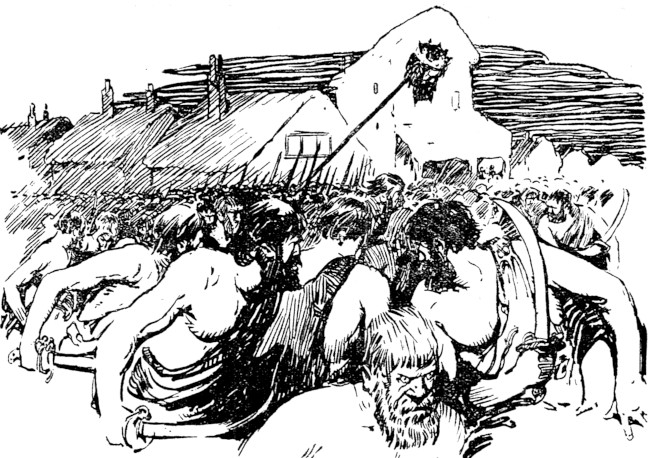
Margo ordered his head cut off, placed on a pole and carried through town.
"The effect was quite the contrary. Those who had been on the point of surrender before, fought with redoubled fury, and he found it impossible to restore order until every fighting male had either been killed, captured or driven into the mountains. On Margo's death, Bordeen led a revolt which placed the elder son, Lugi, on the throne. He thought that, with a woman ruler in Reabon, our independence might easily be maintained, but he was mistaken in the woman. Though but a slip of a girl, she proved to be an even greater general than her illustrious sire.
"Once more our army was annihilated and our ruler beheaded. His brother, Prince Thaddor, is now in the marble quarries, along with his father's former soldiers. He was ever a gentle youth, a student and a dreamer, unskilled with tork or scarbo or the command of fighting men, and never caring to learn the art of warfare.
"Bordeen is growing old, and though a great warrior still, deems himself unfit to administer the affairs of a kingdom. His fondest hope is that Providence may raise up among us a virile young leader of royal blood who can reorganize our scattered armies and wrest our beautiful Uxpo once more from the cruel conquerors."
The guide lapsed into pensive silence as he finished his narrative, and Grandon, stumbling along behind him, was filled with an intense hatred for the Reabonians, and a desire to restore to his comrades and their countrymen, the kingdom which was rightfully theirs. Then, in a flash, there came to him the significance of the parting words of Vorn Vangal, which had puzzled him greatly at the time: "Farewell, and may you soon be firmly seated on the throne of Uxpo."
So this was what had been planned for him by Vorn Vangal of Olba and Dr. Morgan on that distant twin-planet to Venus. The magnitude of the undertaking appalled him for the moment. It was more than a man-sized job—a herculean task that even a superman might not hope to accomplish. But he would try. He would go in to win, and nothing short of death itself should defeat him.
He was aroused from his reverie by an exclamation from the guide, and looking up, saw many lights twinkling ahead.
"We near Bordeen's camp," said his guide excitedly. "Those are the watch fires of our comrades."
They were halted by a sentry at some distance from the camp, but at a secret sign from the guide, were allowed to proceed without interruption.
The camp consisted of a half dozen circular huts similar to the one Grandon's men had constructed, surrounding a much larger hut which he took to be the headquarters of the commander. Huba led him straight to this structure and, before he realized it, he found himself in the presence of Bordeen.
There was no light within the inclosure except the flickering rays cast by the campfires surrounding the camp, and Grandon could only imperfectly discern the features of Bordeen and those who stood about him.
The guide saluted with drawn scarbo held pointing at an angle of forty-five degrees, and the Earth-man did like-wise.
"Mightiest of commanders," the Travek said, "if it is your pleasure, our new captain, Grandon of Terra, will make his report."
"A new captain!" exclaimed Bordeen. "This is indeed strange. Thelpo was a mighty fighter. Report, Grandon of Terra."
Grandon modestly described the duel that followed his chance meeting with the Fighting Traveks, how they had been surrounded by a large body of Reabon soldiers and all but annihilated. He expected a reprimand for losing two-thirds of his command, but to his surprise, Bordeen commended his generalship for so ably effecting an escape when escape seemed hopeless.
His report concluded, he was conducted to the hut where his men were quartered, and was soon asleep on his mossy couch. The guide, however, remained by order of the commander, who asked:
"What know you of this Grandon of Terra?"
"Nothing he has not told you for himself, other than that he is from a far distant country which he calls Terra, and is a most extraordinary fighter with the scarbo as well as an exceedingly able commander. No doubt you noticed that he wore the color of royalty."
"Hardly. In this dim light I cannot tell scarlet from any other color. I fear my eyes are failing me. However, it seemed to me as he stood there, that there was something strangely familiar about his figure. He reminded me of some one I have known in the past, and have been vainly trying to recall."
A man at Bordeen's right spoke up.
"Was it not of Prince Thaddor that he reminded you?" he asked. "It seemed to me that he bore considerable resemblance to our prince."
"Now that you mention it, he did remind me of Prince Thaddor. But of course he could not possibly be our gentle prince. And yet—stranger things have happened. Cruelty sometimes changes the nature of the mildest of men, and the slave-drivers of the empire are cruelty personified. Bring me a flash light. Let us have a good look at him as he sleeps."
Grandon had thrown his accouterments in a heap and kicked off his sandals before he retired.
He slept so soundly from fatigue that he did not even stir as the bright rays of the flash light was turned on his features.
"It is Prince Thaddor or his double!" exclaimed Bordeen. "His right foot! Quickly! Flash the light on his right foot."
Gurda did as directed, then uttered a low cry of surprise and delight, for there, tattooed on the sole, was the emblem of the royal house of Uxpo.
Bordeen bent low and examined the tattoo marks for a moment in silence. Then he arose and said:
"It is indeed Prince Thaddor, for men are not born with such marks on their right feet, and this mark has undoubtedly been there since infancy. The miracle of miracles has happened. Our gentle prince has suddenly become a mighty fighter. Why did he not tell me who he was? See that he is suitably barbered and attired when he awakens, and that every provision is made for his comfort. Runners must be dispatched at once to bring in all of those scattered bands we can locate, for to-morrow we will hold a great feast in honor of this momentous event."
While he was speaking, a sinister figure crouched on the roof above, drinking in every word. No sooner had they left, than the creature gave a cunning leer that boded no good for the Earth-man or his companions, and clambering up the rough trunk that formed the central pole of the hut, made off across the tangled mass of vines and creepers which draped the tree-tops.
It was a monkey-man, one of that odd tribe of creatures which inhabit the equatorial regions of Zarovia. Their bodies are covered with short, reddish-brown hair, with the exception of the faces, palms of the hands and soles of the feet. They have short, stubby tails averaging about four inches in length, which project upward, curling slightly at the tips. They are dwarfs in stature, the largest males averaging perhaps four feet in height while the females are much shorter.
Despite their simian appearance they are surprisingly intelligent, almost on a par with the Bushmen of Africa. When in their native arboreal haunts they converse in a queer, chattering tongue, but learn the Zarovian tongue readily when captured and enslaved.
A monkey-man, if treated kindly, becomes a most faithful and devoted slave, ever on the alert to guard the person or property of his master or mistress with his very life, if need arise. Previous to the accession of Vernia to the throne of Reabon, they had been enslaved only by private individuals. She it was who first conceived the brilliant idea of enlisting their talents in the interests of the empire, and to this end had ordered the capture of great droves of them which were trained to act as scouts and spies.
Grandon slept tranquilly on, little realizing the deadly peril in store for himself and his comrades, as the cunning monkey-man sped swiftly through the tree-tops to a camp only ten miles distant, whither Vernia had swiftly brought her army of ten thousand men for the purpose of hunting down and capturing or exterminating the wandering bands of Fighting Traveks.
Grandon's awakening on the following morning, was perhaps as much of a surprise as was that memorable morning when he first opened his eyes in the quarry-slaves' sleeping quarters.
The rude hut in which he slept had been draped with curtains of shimmering scarlet cloth, and the interior hung with wreaths, festoons and shields on which were emblazoned the coat of arms of the royal house of Uxpo. The men of his command, who had occupied the hut with him, had been removed to other quarters, and he beheld, bowing obsequiously before him with the right hand extended palm downward, two who introduced themselves respectively as his valet and his armorer.
At first he thought some joke was being perpetrated by the commander, but was assured that this was not the case. He permitted his hair to be cut after the prevailing fashion of Uxpo, but when his valet commenced to trim his beard, which was cut off square below the chin, in accordance with the custom of the land, he demurred and ordered a clean shave.
The astonished valet did as he was bidden without comment, but wondered at this strange whim of his royal master in a land where no man went beardless after he had reached the age of maturity, and the beard, for the young man, was a symbol of the attainment of man's estate.
As the armorer buckled a broad belt about him, from which descended a tork embossed with silver and a scarbo whose hilt was gold set with jewels, he said:
"As it is your duty to supply me with weapons, I am going to ask you to procure a sword for me. I like not these scarbos with their curved, ungainly blades."
"I will procure such a weapon for your highness if it be humanly possible, but I have never heard of one. If I might have a description, perhaps—"
"Of course you have never heard of it. It is a weapon used on another planet. Have your metal workers fashion for me a weapon with a hilt like a scarbo, but with a long, straight, two-edged blade, slender and pliable, and of the strongest tempered steel."
The armorer bowed with hand extended palm downward, and backed through the doorway.
He had scarcely departed, ere Bordeen entered, followed by a concourse of Uxponian nobles and officers. All bowed low before Grandon in the customary salute to royalty.
Accepting their homage courteously, he permitted himself to be conducted to the head of a huge banquet table on which a sumptuous feast was spread, amid the ringing cheers of a thousand Fighting Traveks.
Bordeen made the formal speech of welcome, addressing Grandon as Prince Thaddor. Then the latter arose.
"Comrades," he began, "your mighty commander has just addressed me as Prince Thaddor, I have come among you to do the work of your prince, not to assume his name, for I am not Thaddor, nor is he any longer an inhabitant of this world. While he lives my life on the planet Earth—or Terra—it shall be my endeavor to lead you to victory against the tyrannous Reabonians who have enslaved the proud people of Uxpo. I therefore assume leadership of your armies, men of Uxpo, not as Prince Thaddor, but as Grandon of Terra."
This unexpected speech spread consternation in the ranks of the Fighting Traveks. As he resumed his seat there was no applause—only an ominous silence. Looks of amazement and incredulity were written on the faces of those about him, while men whispered to one another, some saying that he was not Prince Thaddor, others maintaining that he was their prince, but had been bereft of his reason.
Upon seeing this, Grandon resolved to tender his resignation, when Bordeen stood up, flushed with the fever of inspiration.
"My countrymen, a prophecy has been fulfilled. Some time ago I learned that a wise man, a prophet and seer from the distant land of Olba, was in this vicinity. In my extremity and worry I sought him out. This is what he told me:
"'Go back to your people and tell them to be of good cheer, for your royal leader will soon be with you. He will be young and strong, and expert with the scarbo, but his first request will be for a weapon which he calls a sword. He will resemble a prince of Uxpo who will have, by that time, journeyed to another world. Reject him and you will see him no more. Accept him, and he will lead you to victory. To the people of Uxpo, deeds have ever been more important than words, and men more important than names. Make your decision now, and remember the prophecy.'"
There was a brief instant of awed silence as Bordeen finished his discourse. Then, as if by a prearranged signal, a thousand scarbos flashed on high and a thousand voices thundered: "Long live Grandon of Terra, prince of Uxpo!"
Ere the tumult had ceased, the armorer threaded his way through the crowd, holding before him a scarlet cushion on which reposed a weapon new and strange to all Zarovians. He deposited it before Grandon, just as the tumult was subsiding.
Grandon drew it from its scabbard and held it aloft, saying:
"This is the sword of which your prophet spoke. I pledge it with my life to the cause of Uxpo."
Grandon, exalted as he was, found time to marvel at the clever planning of Vorn Vangal, or whatever agent of Dr. Morgan's had put across this prophecy.
Scarcely had Grandon pledged himself to the cause of Uxpo, when a courier dashed breathlessly into the hall.
"The Reabonians!" he gasped. "They are coming, a great army of them, led by the princess herself! We are hemmed in on three sides!"
By this time more runners were arriving from different directions, all with descriptions of a mighty army encircling the camp.
Thus it was that Grandon had the first opportunity to make good his pledge, almost as soon as it was uttered.
He quickly marshalled his men for a retreat toward the north, the only direction left open to them, urging the utmost speed, for to have those converging wings meet ahead of them meant almost certain defeat.
As it was, they were barely in time for a swift charge between them under a heavy fire of tork bullets which exacted a heavy toll from their ranks. They were still far from safety, however, for the Reabonians, maddened at seeing their quarry thus elude their carefully-laid trap, followed in swift pursuit, bent on exterminating them.
Grandon held council with Bordeen and they decided to make for a narrow mountain pass nearly four miles distant, which led to a valley beyond.
After a running fight lasting more than two hours, they reached their objective with their numbers sadly depleted. They had reckoned, however, without the military genius of Princess Vernia, for she had anticipated this move on their part and filled the narrow pass with armed men.
The Uxpo troops were in a trap from which escape seemed utterly impossible. The pass was out of the question, for with even a small body of men defending it, it was practically invulnerable. On either side of the entrance rose sheer precipices, which even a monkey-man could not have scaled, while in front of them there was an army of between eight and nine thousand men.
Grandon kept to the front ranks, shouting encouragement to his men, and using his sword to such good advantage that at times the Reabonians fell away from him in sheer wonder at his prowess.
But the Traveks were fighting a hopeless battle. Already their number was reduced to less than five hundred, and although perhaps a thousand of the princess's men had been accounted for, and a thousand more would be ere the last Fighting Travek dropped in his tracks, the commanders and the very framework of the Uxponian army would be gone, and with them, all hope of emancipation.
At this juncture a force intervened on which neither of the contestants had counted. Grandon's first inkling of what was to take place was the sight of a mass of black clouds, apparently hanging midway between the tree-tops and those fleecy, silver-gray mists which are ever present in the upper Zarovian atmosphere, and moving swiftly toward them.
He had expected a storm, but when it burst in all its fury he was ill-prepared for such a violent demonstration of the power of the elements. The first torrent of rain was followed by inky darkness, punctuated at intervals by brilliant flashes of lightning. The thunder roared incessantly, reverberating through the mountains, and fighting, either by sight or sound, was made exceedingly difficult.
It was Grandon's opportunity to save what remained of his little army, and he was not slow to take advantage of it. He called Bordeen to his side.
"Make haste and divide the command into small parties of not more than twenty men each," he said. "In the confusion of the storm, small bodies of men can escape with little or no fighting, whereas a charge by the entire company would be sure to be detected and opposed every foot of the way. To-night each band must shift for itself. To-morrow we will reunite. The place of rendezvous will be the base of those great twin mountains which mark the northernmost end of this valley."
As Bordeen hastened away to carry out the plans of his young commander, the latter once more took his place in the line of battle. At each flash of lightning he marked a new enemy, stretching him on the sodden field with his swiftly-moving blade, and forging steadily ahead in the process.
It was some time before he discovered that his comrades were no longer with him. Then a particularly brilliant flash of lightning revealed the fact that he was completely surrounded by enemy soldiers. They saw his plight at the same instant, and rushed at him in the darkness that followed. Acting on a sudden thought, he turned swiftly about, and facing in an opposite direction, walked slowly backward.
The ruse worked, for the men behind him believing him to be one of their comrades who was a little timid about approaching the great swordsman, surged around and ahead of him. When the last man had passed he turned once more, and ran for the forest. His absence was betrayed by another flash of lightning, but this caused him no anxiety, for he had broken completely through the line of attackers, and the long intervals of darkness should make escape comparatively easy.
What troubled him most was how to gauge his course through the dense, dripping labyrinth that engulfed him. What if he should become confused and walk in a circle?
At this juncture he heard a noise as of a small body of men running ahead of him. Undoubtedly it was one of the bands of Fighting Traveks, he thought. His first impulse was to call out to them, but on second thought, he decided to follow them as swiftly and silently as possible, and make sure they were not Reabonians before divulging his presence.
As the minutes wore on, he could tell by the sounds ahead that he was gaining. Suddenly he emerged from the forest and found himself on a flat, sandy beach. A flash of lightning revealed the fact that he was not following a body of men, but a huge reptile, a gigantic amphibian with a monstrous lizardlike body to which was attached a serpentine head and neck of immense proportions.
He marveled that the creature had not sensed his presence until the next flash revealed the reason. It was pursuing some one else with an agility little short of marvelous for so ponderous a body, and had almost come up with its quarry.
The victim, who appeared little more than a slender boy, was making frantic efforts to escape, but it appeared that his doom was inevitable.
Another lightning flash showed the reptile with neck arched and jaws distended, ready to strike. A cry of mortal terror came to him from the darkness. Grandon unsheathed his sword. He would save this fellow being, avenge him, or die with him.
As Grandon rushed forward to do battle with the monster, there came a swift lull in the storm. The light filtering through the thin layer of clouds showed him that he was on the bank of a mighty stream, into which the huge amphibian reptile plunged. It swam directly for the opposite shore, its body completely immersed. Above the raging black torrent projected the serpentine neck and head, and drooping from those horrible jaws was the limp body of its victim.
Without a moment's hesitation, Grandon gripped his sword between his teeth and plunged into the water. He was a strong swimmer, but he quickly saw that he was losing ground. Swiftly and silently the huge amphibian glided forward, steadily lengthening the distance between them.
When it neared the opposite shore it suddenly sank from view and the Earth-man, arriving at the spot a moment later, saw only a string of bubbles leading toward the overhanging bank. Filling his lungs with air, he dived straight for the point from which the last black bubble had apparently emerged. A moment later his hands came in contact with a slanting, muddy bottom and working his way carefully forward he came up in a dimly lighted subterranean cave.
The air reeked with the odor of putrid flesh, fragments of which were mingled with the gnawed bones scattered about on the slimy mud floor. The big reptile crouched with its back toward him and its body half out of the water.
On the floor lay its victim, apparently stone dead, but the creature seemed in no hurry to devour him. Instead, it was swaying its head back and forth with neck arched, and from time to time nosing its prey as if waiting for him to show signs of life, much as a cat worries a mouse.
Presently, much to Grandon's surprise, the victim did sit up, rubbing his eyes as if he half expected to awaken and find that the thing before him was only a horrible nightmare. The reptile continued moving its head to and fro, no doubt waiting for an attempt to run away on the part of its prey.
The Earth-man raised the muzzle of his tork above the water, pointing it at the swaying head, and touched the button. At the sound and impact of the bullet, the creature turned and spied him. Six bullets struck that ugly head with apparently no more effect than as many fly-bites.
Then, to his amazed horror, Grandon was dealt a crushing blow from behind that hurled him into a far corner of the cave.
He rose, and leaped just in time to elude the snap of those fearful jaws. As he dodged about in the cave he learned what it was that had floored him, for the monster struck at him again with its huge, scaly tail whenever he stood near its back or sides.
Grandon used his sword at every opportunity and, in one instance, succeeded in cutting off a portion of the horny snout. Another time he thought to sever the head from the body by a dexterous blow, but his weapon glanced off those tough scales as from armor plate.
At length he was driven into a corner from which there was no escape. The jaws opened to seize him and he lunged out wildly with his sword. The weapon was jerked from his hand, but the cruel teeth he expected to feel crushing the life out of him did not materialize. Then he saw the reason. He had driven his blade through the reptile's left eye and deep into its brain. After a few convulsive shudders, it keeled over on its side and lay still.
Bracing his foot against the massive head, he wrenched his sword free, and turned to face the youth who was timidly approaching him from a far corner. The latter was evidently bent on thanking him for saving his life, but Grandon was not in a mood for ceremony.
"Come," he said, "we must get out of here quickly. More of these monsters may appear any minute, and it was only by a lucky thrust that I succeeded in dispatching this one."
They moved toward the point from which the dim light emanated, and found it to be a small hole in the top of the bank. By widening this with his sword he made it large enough to admit the body of a man, then boosted his companion through, the latter, in turn, extending a helping hand to him. Grandon experienced a strange thrill as that hand touched his. Never had he thrilled at the touch of a human being before, and it puzzled him greatly.
He looked curiously at his companion, who, he noticed for the first time, was clad from head to foot in shining scarlet leather. The head and face were covered by a pointed hood of the same material, so he could not see the features distinctly.
Acting more from impulse than reason, he reached forward and pulled back the concealing headpiece, then gasped in rapturous wonder at the glorious vision he beheld. A radiantly beautiful girl stood before him, a girl with eyes that were limpid pools of blue, a wealth of shimmering golden hair and lips whose scarlet vied with that of her brilliant raiment. Moreover, she was blushing like a bashful schoolgirl under his ardent gaze, and the blush was most becoming.
For a moment they stood thus—then suddenly she regained her poise, and glanced up at him with a look of regal hauteur that was most disconcerting.
"Why did you do that?" she asked icily.
It was Grandon's turn to blush.
"Frankly, I do not know," he replied. "If I have offended I crave your pardon."
For answer she adjusted the hood once more and, whirling about, strode off into the forest.
Grandon was at a loss whether to follow, or leave her to go her way alone as she evidently preferred to do. From his previous experience in these forests, he was convinced that dangers lay ahead of which she did not dream. Thus, torn between pride and duty, he stood irresolute until he heard a faint scream from the direction she had taken.
Galvanized into action by that cry of terror, he rushed madly forward, cursing his indecision at every step. The thought of that beautiful, frail creature in the clutches of any of the horrible inhabitants of the fern forests was awful to contemplate.
To his incalculable relief he saw a moment later that she was alive, though in grave danger. She was running toward him pursued by a gigantic brute, new and strange to the Earth-man. In form it somewhat resembled a grizzly bear, but compared to it in size, a grizzly shrank into insignificance. It was hairless, and its scaly hide was a brilliant chlorophyll green above, fading to a greenish yellow below. Huge saber tusks projected from the upper jaw, adding to the formidable appearance of the ferocious carnivore.
Grandon aimed his tork carefully and poured forth a stream of projectiles, fervently praying that they might penetrate that thick hide. Instead of stopping the brute, they appeared only to accelerate his speed and increase his ferocity. The panting jaws were scarcely two feet behind the girl when the beast gave a sudden lurch, turned a complete somersault and lay motionless on its back, almost at Grandon's feet. He plunged his sword into the huge carcass again and again in a mad fury, until the girl laid a hand on his arm.
"Come," she said, "the ramph is dead. He cannot harm us now."
He turned without a word and, together, they walked back among the lengthening shadows toward the river's edge. Owing to the recent cloud-burst the current was abnormally swift, carrying the floating storm débris past them at express train speed. There were great, uprooted trees by the hundreds, detached branches and leaves of various sizes and kinds, and a number of huge toadstools, some of which had been uprooted, but a majority of which had broken off where stem and cap joined.
As they stood there on the brink the cap of a great orange-colored toadstool was caught in an eddy and whirled against the shore. The stem had been broken off completely, and it formed a water-tight basin about twelve feet in diameter. Grandon leaped forward and hauled it in.
"What are you going to do with that?" asked the girl.
"If I can cut a suitable paddle," replied Grandon, "I believe I can make it serve as a boat to convey us across the river, where I have reason to suspect your friends, as well as mine, are located."
He looked about until he found a strong branch that suited his purpose, then made a most serviceable paddle by using the limb for the handle and the base of the broad leaf for the blade.
"Come," said Grandon. "We must start quickly if we would gain the other shore before dark."
The girl shuddered.
"Would you prefer to stay here?" he asked. "Perhaps I was too hasty in assuming that you wished to return to your friends."
"No. It is not that. I wish to return, but for the moment I dreaded crossing that river full of monsters in such a frail craft. Why, there are enormous reptiles in that stream that would destroy it in an instant."
"In that case," replied Grandon, "we will stay here."
"What? Do you also fear them?" There was a note of surprise in her voice, and it seemed to be slightly tinged with disdain.
"Not for my own sake, but for yours," he answered. "If you wish to go I will take you. If not, we will remain. You shall decide."
"Then let us at least make the endeavor," she said. "After all, there may be greater dangers behind us than those which lie ahead. When I think of the ferocious night-roaming beasts that will soon fill the forest at our back, I believe that the flood and the reptiles are to be preferred."
She stepped aboard, and Grandon pushed off, wading out to where the water was breast-deep before climbing up beside her in order to clear the eddy which might again carry the craft shoreward.
The Earth-man had taken many canoe trips, and anticipated trouble in crossing the stream, but he had not considered the difference in shape between a canoe and the inverted cap of a Zarovian toadstool. Instead of making the headway he anticipated, he found himself merely going around in a circle.
It was some time before he found a way simultaneously to guide and propel his awkward craft, which he accomplished by standing on the side toward which he wished to go and scooping the water toward him. They laboriously reached midstream after about an hour's hard paddling, but in the interim the swift current had carried them many miles from their starting point. Then, to Grandon's consternation, the paddle broke.
"I guess we're in for it now," he said dejectedly. "Fool that I was to risk your life in this overgrown bowl."
"What of your own life?" she replied. "You are running no less risk than I."
As she spoke darkness descended, the black, moonless darkness of Venus; nor could they see aught around them, save a faint shimmer here and there on the surface of the water, when the light of some distant star, for a moment visible through a break in the ever-present cloud envelope, was faintly reflected on its raging bosom.
Grandon sat in moody silence, straining his eyes in his effort to penetrate the surrounding gloom, his ears on the alert for any sound which might indicate the presence of some dangerous reptilian.
Presently a soft hand sought his, and clung there. Again he felt that delicious, mysterious thrill that sent the blood coursing madly through his veins.
"What is it?" he asked, hoarsely, endeavoring to still the quiver of emotion that suddenly took possession of his vocal cords.
"I am tired—or, so tired. And—yes, frightened. To think that I should be frightened!"
"Here," he said, stripping off his cloak and rolling it into a pillow. "I have been inexcusably thoughtless. Now lie with your head on this pillow, so, and try to get some sleep. I will keep watch."
He withdrew a little way and once more sat quietly with senses alert for the slightest sound or sign of hostile attack. The girl seemed unable to sleep. He heard her moving restlessly from time to time, but some twenty minutes passed before she spoke.
"When I was a little girl," she said, "I was afraid of one thing only—the dark. My memory of that period is divided, not by months and years, but by the times when my father was campaigning in distant countries, and those when he was not, for when he was home he used always to sit at my bedside and hold my hand until I slept. Somehow, I feel to-night as I did when a little girl. If you will sit here beside me and take my hand in yours I shall not feel afraid."
"How like a little child she is," thought Grandon as he moved closer and took her hand. Aloud he said: "Now, go to sleep. You must rest, for we know not what is before us, and the opportunity may not come again very soon."
It was some time before her regular breathing, scarcely audible above the sound of the rushing waters, told him that she slept.
The long, dark night was one of mixed emotions for Grandon. There was pleasure for him in the nearness of the girl and the feel of her small hand, but with this there was the awful suspense of waiting—listening for the expected attack by one or more of the fearful creatures he could hear disporting themselves in the water around their fragile craft.
Toward morning the noises made by these amphibians ceased, and Grandon grew drowsy. His head nodded forward on his breast. Suddenly their craft gave a terrific lurch that rolled the girl into his lap. It was only his clutching the gills of the toadstool with both hands that kept them from being pitched into the water.
"What was that?" asked the girl, breathlessly, awake in an instant.
Another lurch followed.
"Hold on and I will try to find out," he said.
Drawing his sword, he crept near the edge while the lurching continued. He clung to the rim with one hand and prodded the water about him with his sword, completely circling the craft without encountering anything other than the rushing waters. It was not until a dash of spray struck him in the face and he tasted salt that he realized the truth. They were on a body of salt water, possibly a large lake or an ocean. He made his way back to where the girl clung, and related his discovery.
"The river on which we were floating," she explained, "empties into the great Azpok Ocean, the ocean of mysteries, of man-eating monsters and of terrible storms that destroy the mightiest of ships as easily as the smallest boats. To navigate the ocean is to court death in many sudden and appalling forms."
An hour passed before morning dawned. In the meantime the roughness of the sea had abated a little, making it less difficult to keep their places. They were riding long, rolling swells that elevated and lowered their craft with very little lurching. There was no land in sight, only the blue-green waves and the drifting gray clouds through which the sunlight filtered, extending to the horizon in all directions. Several large white birds with red-tipped wings and sharply hooked bills soared lazily about them, dipping now and again to the surface of the ocean from which they usually arose with fish in their talons.
All through that long, sultry day and the following night they drifted, without sighting aught save the birds and a few leaping fish. Grandon had not slept a wink, and the girl could only compose herself for slumber for very short intervals. Both suffered intensely from the pangs of hunger and thirst.
Just before dawn they were rudely startled by a violent tilting of their craft, followed by a roaring and swirling of the water about them. Grandon barely had time to seize the girl ere they were engulfed by a huge wave which capsized the craft and precipitated them into a seething maelstrom of black water.
Down—down, they went into the dark depths. It seemed to Grandon, as he struggled to reach the surface, dragging the girl with him, that his lungs would burst. At last a breath of air; then another enormous wave that left them gasping and choking, followed by another and another in rapid succession. The Earth-man fought gamely, but as the minutes passed the violence of the waves increased and he felt his strength waning. He realized that, barring the intervention of some unforeseen aid, the battle against death would soon end in defeat.
With body numbed and hope gone, he suddenly felt the sandy beach below his feet. He staggered forward, was knocked flat by a mighty breaker, rose, gained a few steps, and was floored by another. Crawling painfully onward, driving his flagging muscles by a supreme effort of will, he finally collapsed unconscious on the dry sand, just beyond reach of the waves.
When Grandon regained consciousness it was daylight. His first thought was for the girl who lay face downward beside him. As he lifted her tenderly in his arms he gave silent thanks, for she was breathing, though ever so slightly.
Presently she opened her eyes and, for a moment, there was a startled expression in them as she glimpsed her strange surroundings.
"Where are we?" she asked.
"I haven't the slightest idea," replied Grandon. "I have no knowledge of Zarovian geography."
"A prince, and you know naught of geography? That is indeed strange. Do they not teach it in your country?"
"I am fairly well acquainted with the geography of the planet Earth—Terra—on which I was born, but the inhabitants of that world know practically nothing regarding the geography of this one because of your cloud-filled atmosphere."
She looked up at him in amazement.
"But you wear the garments and insignia of the royal house of Uxpo. Moreover, you very closely resemble a prince of that house. Tell me, quickly, who are you?"
"Tam Robert Grandon, of Terra."
His disclosure seemed to startle her.
"Grandon, of Terra?" she cried. "Ah, I recall the name. A Grandon, of Terra, was recently acclaimed Prince of Uxpo. It was said that he came in fulfillment of a prophecy from another world. And you are he. Truly the pranks of fortune are most amazing! Yesterday I made war on you; to-day I look to you for protection."
"You made war on me?" he exclaimed, startled in his turn. "May I ask who you are?"
"Can it be that you do not recognize me?"
Grandon was puzzled. There was something strangely familiar about that girlish face.
"I am Vernia, of Reabon," she said simply.
It all came to him in a flash. The lifelike painting in the shrine at the marble quarries, the kowtowing slaves, his own narrow escape from the lash after lingering too long in contemplation of that beautiful vision.
"How did you happen to be wandering alone and unarmed in the fern forest?" he asked.
"I did not set out alone. When I started away from the camp I was accompanied by my four guards, and was armed with a tork and scarbo. Zueppa sent a messenger from the front to inform me that your men had broken through our lines and were headed for the camp. He advised me to leave at once, saying that the guards would conduct me to a safe place until your army had been overcome. I followed Zueppa's counsel, but had gone only a short distance when the traitorous guards disarmed me, and informed me that I was their prisoner.
"The varlets were about to bind my hands when the giant reptile appeared on the scene. Though the guards were traitors they were brave men, for they stood their ground to do battle with the monster. He killed the foremost man with a single snap of his jaws. A second man met a like fate, almost before I could realize what had happened. I believe he killed and devoured all four of them, although I am not certain, as I turned and ran through the forest. Soon I heard the monster following me, and tried to make my way to the pass, where I knew the battle was raging, but the storm came, I lost my bearings completely, and at length brought up at the river's edge, where I fainted when I saw those terrible jaws poised above me. I presume that I should have been devoured then and there had the reptile not already eaten my guards."
"Who is Zueppa?"
"He is one of my officers—a good commander and an excellent strategist."
"He may be a good soldier, but he is unquestionably a first class liar."
"I don't understand."
"My men did not break through your lines at all until after the storm had struck, and then only in small, scattered groups."
"Then Zueppa was implicated in the plot. But who could have planned it, and for what purpose?"
"That, I am unable to tell you."
He looked at her so long and so searchingly that she grew uneasy.
"Of what are you thinking?" she asked.
"I was wondering what fate you would have meted out to me had your men captured me yesterday."
She smiled, dimpling adorably.
"I should probably have had you beheaded."
"And now—"
"If we reach Reabon in safety I shall make you supreme commander over all my armies."
"Why?"
"As your reward for saving the life of the princess."
"I ask no reward for that, nor could I accept it, much as I appreciate the honor."
"It is the second highest office in the greatest nation of Zarovia, an office second only to my own. Why, any emperor on the globe would be glad to exchange his position for it."
"I have been made Prince of Uxpo," replied Grandon, "under my own name and because of my deeds in behalf of that kingdom. I should rather be the tiniest twinkling star in the heavens than the most beautiful and brilliant planet."
"I'm afraid I don't quite understand."
"Planets shine by reflected light—stars by virtue of their own brilliancy. As your general I should merely reflect the greatness that is yours."
His answer seemed to displease her, for her manner became icy.
"Perhaps you should prefer to continue the war."
"Infinitely. But pray, let us hold to our truce for the present. Until we can reach the safety of our own countries we are allies, you know."
"Rather, I am your prisoner of war, for I am wholly in your power. You place me under obligation to you, then spurn my offer of reward. Pray, tell me why you risked your life to save mine."
"It was an impulse that I cannot explain, even to myself. I must admit that when I swam to your assistance I did not even know you were a woman. I thought you a boy soldier of the Reabonian army."
Could this man do naught save rouse her resentment? Womanlike, she had been angling for a statement that might serve to placate her hurt pride. Truly, she thought, this Grandon of Terra lacked courtliness of manner and smoothness of speech. After all, he was only a rough soldier who had won the crown of Uxpo with his keen blade. A rough soldier and plain spoken, yet gentle and thoughtful of her every comfort as he was careless of the effect of his words on her vanity. To this girl who had received naught but adulation from the men of her world, he was an inexplicable enigma.
"We talk much and get nowhere," she said wearily, "I am both hungry and thirsty. Do you not feed your prisoners of war?"
They walked inland through barren country to the foot of a lofty perpendicular cliff. Through a narrow fissure they caught a glimpse of greenery beyond, so they hurried between the frowning rock walls and at last emerged on level ground.
They were on the border of a small inland lake, the water of which was as clear as crystal. Ferns, mosses and fungi grew all about its borders in luxurious profusion, but what aroused Grandon's interest and curiosity most was the appearance of the bottom of the lake, which was plainly visible.
It was covered with hundreds of odd, grotesque growths—upright fluted columns with thick branches of the same pattern curving upward from the trunks like the arms of candelabra. On the tips of the branches were great clusters of brilliantly-hued fruitlike globes in an endless variety of form and color. The effect of the entire lake bottom was like that of a thousand rainbows fused into one.
A look of terror came into the eyes of the girl.
"Now I know only too well where we are," she said. "This must be one of the submarine gardens of the terrible flying grampites. I have heard some of our hardiest mariners tell of these gardens and the horrible creatures who guard them."
"Let us eat and drink, first, then talk of the grampites afterward," said Grandon. "They may be dangerous creatures, but they will have to go some to outclass that reptile."
A clear, cold spring, bubbling from the rock wall satisfied their thirst, after which Grandon cut some spore-pods from a near-by fern and split them with his knife. They were in prime condition, and made a most pleasing meal for the famished wayfarers.
"It must be," Grandon remarked, "that these underwater fruits are especially delectable morsels, if men risk their lives for them."
"They are, and of a flavor that excels anything else that grows on Zarovia."
"I will gather some for you," said Grandon, removing his heavy trappings. "They should be easily plucked."
"No, no!" she cried. "Please don't go. You may be seen and killed by the grampites."
He laughed at her fears, and stripped down to his loin cloth. Then, taking his long knife between his teeth, he plunged into the clear water. Swimming from cluster to cluster, he found one that suited his fancy, and cut the thick stem.
As he did so, he saw a black shadow move swiftly across the surface of the lake above him. It puzzled him not a little, for he had seen no living creature other than his companion when he entered the water. He reached the surface with a few powerful strokes, and made for the point where he had left the girl, but the spot was deserted.
An awful fear gripped him. Was it the shadow of a flying grampite he had seen, and was the girl now in the clutches of one of these dreaded creatures? She could not have walked far away in those few seconds. He called loudly, again and again, but there was no answering cry.
Vernia had disappeared as completely and mysteriously as if the earth had opened and swallowed her up.
Cursing the foolhardiness that led him to leave the girl unguarded, even for an instant, Grandon hurled the fatal cluster of fruit far out into the lake. He found his clothing and weapons intact and dressed rapidly. He had no sooner buckled on his sword and tork than a creature that surpassed in hideousness anything he had ever seen, swooped down on him.
Elevating the muzzle of his tork, he sent a stream of bullets at his assailant, and had the satisfaction of seeing it fall to the ground, where it fluttered feebly for a moment, then lay still.
He examined it minutely and shuddered as he thought of the beautiful Vernia in the clutches of so loathsome a thing. The specimen he had brought down was about eight feet long from head to toe, and covered with a soft, mouse-colored fur.
Its head was shaped like that of a gorilla, but the ears were set high and were pointed like those of a fox. The nose was nothing more than a pair of flat, broad nostrils, set almost on a level with the eyes, and the mouth at the apex of the projecting muzzle resembled the mouth of a leech, being merely a round, puckered hole, whose sucker lips were furnished with tiny, razor-sharp protuberances that were not exactly teeth, although they served that purpose to the extent of instantly opening a wound through which the arteries of a victim might be easily drained.
The arms were fully as long as the body, and formed the framework for the membranous wings, the web of which stretched to the center of the back above and the rear of the legs below, ending just above the heels. The trunk and lower limbs were shaped much like those of a man, the feet being most manlike in form, except that the five toes on each foot were armed with strong, up-curling claws.
Drawing his knife, he bent to cut the furry throat with the resolve that this grampite, at least, should nevermore feast on human blood. Then something landed on his back with considerable force, two long, bony arms wound tightly about him, and he felt a sharp pain at the back of his neck as a sucker mouth gripped and lacerated his flesh.
He could not, in this position, use his sword or tork, but he gripped his knife firmly and plunged it again and again into the thing on his back, though with no apparent effect, for it hung on like the fabled old man of the sea. At last he found a vital spot, and just in time, for his strength was fast passing from the terrific loss of blood. The iron grip of the arms relaxed, and as the creature fell away from him the lips tore loose with a pop like that of a champagne cork.
For a moment he imagined the attack was over, but in reality it had just begun. Five of the monsters now came hurtling at him from all directions. He fired his tork as they approached, and one fell in the lake, where it floated, looking at a distance much like an old, broken umbrella. The foremost grampite did not alight on him as the other had done, but used new and unexpected tactics. It swooped straight toward him, head on, then rose slightly and raked him with its sharp upcurved claws.
His shoulder was bleeding profusely from the onslaught when the second attacker arrived, but this time Grandon was prepared. Leaping lightly to one side he plunged his sword into the furry body, and another enemy was hors de combat. The last two, made wary by the unexpected demise of their companions, wheeled and joined the leader, now circling high above Grandon. Evidently they decided to go for reënforcements, for they turned suddenly and flew straight across the lake in the direction from which they had come.
Grandon marked their course, and noted that they flew straight toward a distant mountain peak, from which a wisp of smoke lazily ascended. He decided that if Vernia had been carried off by grampites, this was the direction in which they had taken her. He would follow, and do his utmost to save her or avenge her.
With the smoking mountain as his objective, he walked around the rim of the lake, cut through the surrounding tree ferns and emerged on a broad, rolling plain that was covered with a carpet of resilient moss. Several hours were consumed in crossing the plain, then he came to another fern forest.
A short walk brought him abruptly to the edge of a small, crystalline lake, similar to the one he had just left. Instantly he leaped back in the shadow of the trees, for the place was literally alive with grampites. They were apparently engaged in harvesting the underwater fruit, and he watched the process with interest.
Skirting the lake with great care, in order that he might not be discovered, he again pressed forward toward his smoking guide post. He dodged and circled several more grampite-infested lakes. Then he came to a chain of low-lying, rocky hills that were without vegetation of any kind.
As he clambered over the jagged rocks, he noted a pungent odor in the air like that of sulphur, or perhaps some sulphurous compound. The atmosphere grew warmer and warmer until the heat was almost unbearable, and the acrid odor stung his nostrils and smarted his lungs. The rocks over which he scrambled now took on a uniform greenish-yellow hue.
Several times Grandon had wondered why these flying monsters which guarded the desirable subaqueous gardens had not been exterminated by the soldiers of the princess. He learned the reason as he brought up at the edge of a natural barrier which no man could hope to cross. It was a body of boiling water more than half a mile in width, and stretching in a broad, sweeping curve to his right and left. From this gigantic, seething caldron rose a poisonous greenish-yellow vapor, the stifling sulphur fumes, of which would have asphyxiated any one attempting to cross in a boat.
The huge mountain was in plain view now, its peak less than a mile from where Grandon stood. Countless myriads of grampites swarmed about the summit.
Some of the incoming messengers were laden with fruit, others with the bodies of animals, and one, which flew low over Grandon's head, carried the limp form of some venturesome sailor, its talons hooked through his belt. Filled with rage, he aimed his tork and was about to press the button, when the thought came that perhaps the man still lived, and a shot would precipitate both victim and captor into the bubbling, hissing sulphur lake.
Evidently the grampites had not sighted Grandon as yet, although he took no pains to conceal himself after reaching the rocky margin of the lake.
As it was evident that he could not possibly cross the fuming barrier before him, he decided to follow the margin in the hope that he might find some means of ingress. Accordingly, he turned to the right, keeping just out of reach of the deadly vapors, and traveled as swiftly as the rugged character of the rocky formation would permit.
He had covered a distance of more than six miles before he realized the ghastly hopelessness of his quest, for he brought up at the very point from which he had started. The mountain was completely surrounded by boiling, fuming sulphurous water!
Disheartened by his discovery, and fatigued to the point of exhaustion, Grandon sat down on a bowlder to plan his next move. Obviously, he could not hope to rescue the girl now. No doubt she was already dead, or would be, soon. As he pictured her lovely body lying, limp and bloodless, in some corpse-littered, stinking den, a great rage obsessed him.
No, he could not save her, but he would die avenging her. He would show himself to the grampites, then fight—fight until death should claim him—not with the temporarily paralyzing tork, but with sword and knife. He hoped the whole colony would attack him at once. As he bathed in grampite blood, his battle cry would be the one his enemies had used two days before: "For Vernia! For Vernia!"
As he rose to carry out his foolhardy purpose, his attention was attracted by an airship, similar in shape to Vorn Vangal's, but considerably larger, flying low over the rocky hills. While he watched, it made a landing less than a quarter of a mile from him, and two men stepped from the cab. Without a moment's hesitation, Grandon ran toward them. Undoubtedly they were men of Olba, a nation at peace with all Zarovia. If he could but prevail on them to land him on the mountainside—
One of the men raised a cylindrical object to his eyes, evidently a telescope, and pointed it toward the mountain. He gazed for some time, then handed it to his companion. Both were so engrossed by the strange sight before them that they did not see two menacing forms swooping down on them from behind.
Grandon saw, and shouted a warning, but too late. The curved talons hooked their quarry with unerring precision, and both men were carried struggling, out over the boiling water.
The man with the telescope turned and beat his assailant with the instrument. The grampite struck him, first with one wing, then the other, but he kept manfully at it, gripping the furry belly with one hand as he swung his weapon with the other. Apparently he succeeded in breaking a wing, for captor and captive plunged to a terrible death a moment later. The other Olban was carried, still struggling, to a fate that was perhaps more awful.
Grandon, saddened and infuriated by this new atrocity, walked to where the airship lay. Just as he reached the side of the craft, darkness descended.
When Vernia failed to dissuade Grandon from diving in the crystal lake for the tempting fruit, she leaned far over and watched him with breathless interest as he swam from plant to plant. Suddenly something struck her between the shoulders, knocking the breath from her body, and she felt herself lifted into the air and carried out over the lake. As she was whirled along, she caught a last fleeting glimpse of him, deep under water, cutting a cluster of fruit.
Her captor flew with amazing speed, high above moss-covered plains, fern forests, and crystal lakes, where the fruit-gathering grampites far below them took on the appearance of swarms of mosquitoes. When they came to the boiling lake, the grampite rose high in the air before crossing, but even at an altitude of more than two thousand feet, the stifling fumes made breathing most difficult.
Straight up the mountainside he flew, passing more and more of his companions as he ascended, until, when the summit was reached, the sky was black with grisly swarms of his fellows, wheeling, circling, darting hither and thither, and uttering hoarse, croaking cries, the weird sound of which added to the horror of the frightened girl.
Suddenly the grampite dipped over the edge of the crater and Vernia beheld the creatures' great stronghold. The walls slanted in a series of ledges, perhaps twenty feet wide, downward and in toward the great central pit, whence issued the smoke and gases, and occasional flashes of lurid light from the glowing lava.
At regular intervals around the ledges were holes in the solid rock, which led to the dark caves that honey-combed the entire mountaintop. In front of each entrance was a circular pit about ten feet in diameter and twelve feet deep. As they passed above these pits she noticed that they contained captive animals of various kinds.
Her captor hovered for a moment above the ledge near one of the caves, then lowered her gently to her feet. She was so weak from fear that she could scarcely stand, but he seized her roughly by the arm with a bony hand-like claw, and dragged her through the entrance.
The sight that greeted her within sickened her with horror. In the center of the cave sat a huge female grampite in the act of draining the last remaining blood from the body of a sailor whose uniform she recognized as that of the navy of a neighboring empire. Her long, claw-like fingers gripped the corpse just under the armpits, and her leech-lipped mouth was fastened to the back of the neck.
Vernia's captor stood humbly awaiting the pleasure of his hideous mate, who at length cast the body from her with a grunt of satisfaction, and lay down on her side with her belly distended to a drum-like tightness by the blood of her victim.
The male grampite now dragged the shrinking girl close to the huge female, who seized her eagerly and felt her over from head to foot as a butcher might inspect a prime young heifer. Evidently the she-grampite had been surfeited by her ghoulish repast, for she made no move to fasten her sucker-mouth to the girl's neck.
Her mate had retired to a corner of the cave where he was industriously absorbing the juice from a large specimen of the underwater fruit, but he rose at a croaking call from his mate and seized the girl by the wrist, stooping also to pick up the bloodless corpse of the sailor, which he heaved far out into the great lake of molten lava when they reached the ledge.
He then lowered the girl into the deep, smooth-sided pit in front of the cave and threw down some fruit and spore-pods. Evidently she was to be kept alive until the blood-bloated she-grampite was ready for her next meal. Huddled against the wall of the pit were three frightened frellas, small animals somewhat resembling terrestrial sheep, but absolutely without hair or wool of any kind. Apparently the female grampites drank the blood of these creatures when their human quarry was lacking.
All through the rest of the day Vernia sweltered in the pit, awaiting the inevitable end. Soon the loathsome creature in the cave would become hungry and she would be dragged from her prison, clutched in those bony hands, and—She shuddered at the thought of feeling her life-blood slowly ebb away in that filthy den with no human being to see, to pity, or to rescue.
Night fell, but in the crater its blackness was partly dispelled by the red glow from the molten lava, punctuated at times by brilliant flashes of light as gas explosions or other disturbances occurred in the fiery lake.
The shadow of her captor loomed at the edge of the pit. The she-grampite was ready for her victim. As she felt the grip of that bony hand on her arm, Vernia screamed again and again.
Grandon groped his way to the Olban airship in the pitchy darkness. While it was yet light, he had noticed that the side door of the domelike cab stood open, and he made up his mind to enter and explore the interior, although he had small hope of being able to run it.
A brilliant flash from the volcano, reflected by the clouds, the boiling water, and the crystal dome, showed him his objective. He entered the cab and closed the door.
Moving his hands carefully about the interior, he felt two cushioned seats and a number of handles, levers and buttons. At random, he pressed a small button, whereupon a tiny light cast its radiance down on him from the top of the dome.
For a moment he was bewildered by the imposing array of levers, handles and buttons. Then, to his delight, he saw that each was marked in the simple phonetic characters of the universal language which had been taught him by Vorn Vangal.
He seized a lever marked "Cab Control" and moved it to the left. Immediately the cab revolved to the right, sliding smoothly and noiselessly. He pressed downward on the lever and the cab slanted backward. Being in the form of a perfect sphere it could not only be turned from side to side, but could be tilted forward or backward in its socket. Upon his straightening the lever, the cab resumed its original position.
The advantage of such an arrangement was obvious. From the front of the craft, to right and left, projected two guns labeled "mattork." The mattorks were weapons similar in construction to torks, but much larger, and firing projectiles of far heavier caliber. Another projected through the keel. By a touch of the cab control lever these mattorks could be trained on an enemy in any position.
Grandon loaded one mattork with explosive metal bullets and the other with deadly glass bullets. The keel-mattork was already loaded with explosive metal bullets. What a battle he would give the accursed grampites in the morning! If he could only solve the secret of flying the strange craft, he would make a night raid, but he had nothing to guide him except the parting meager explanation of Vorn Vangal that Olban airships were moved by a mechanism which amplified telekinesis, the force inherent in will-power.
Constant thoughts of Vernia dominated his mind. His reason told him that she must be dead, that she had probably been killed many hours before, but despite this, hope persisted—a slender hope born of an overpowering desire—a hope that no amount of reason could overcome without irrefutable confirmation.
As he hoped, he wished intensely—earnestly. Then suddenly his wish bore fruit, for the airship began slowly to rise from the ground.
He had once listened, with scant attention, to a lecture by a noted psychologist. He recalled dimly the assertion that every living human being is endowed at birth with all the potential powers of the subjective mind, but that few develop such powers to any appreciable extent.
So it was with Grandon. He had unconsciously mastered the power of telekinesis after a fashion, but he needed practice to develop and perfect it. Before making for the mountain he sailed about in the air for a considerable time, practicing the turning, elevating, and lowering of his craft by purely mental control. At length, feeling that he was master of the airship, he made for the mountain peak.
Very cautiously he made a landing on the outer rim of the crater, then crept to the top to reconnoiter. As he peered over the brink a sight greeted his eyes which, prepared though he was for something of the sort, caused him to gasp in horror.
It was as if the most terrifying dreams of Milton and Dante had been fused into one to form the fearful reality before him, for there in the blood-red glow of the molten lava, swarmed countless thousands of the demoniac inhabitants of this planetary inferno, croaking hoarsely to each other as they moved about on the ledges or fluttered from place to place. Mingled with the noises made by the grampites in the bedlam of sounds that came up to him, were the piteous bleating and cries of countless animals in the pits.
Directly beneath him, a huge grampite emerged from a cave and heaved a human body far out into the fiery lake. He recognized the uniform of the Olban officer who had been captured at the side of the airship a few hours before.
Horrified and enraged, Grandon walked stealthily around the edge of the pit, hoping to find some path by which he might make his way, unnoticed, to the ledges beneath. Were it not for that faint ray of hope that Vernia might still be alive, he would have returned to his craft and raked the ledges with the deadly fire of the mattorks, but as it was, he would have chosen to explore every cave unarmed, rather than imperil her life by gunfire.
He had gone perhaps a third of the way around the mountain top when he heard a scream of terror, followed by another and another. It was the voice he had heard on the river bank two nights before, the voice of Vernia.
Startled to instant action, Grandon scrambled and slid precipitately down to the top ledge, leaped the ten feet to the second and a like distance to the third, and ran directly to the pit from which the sounds emanated. Twelve feet down he saw Vernia struggling in the clutches of her captor, while the two terrified little animals hugged the wall. In an instant he was at her side. A stroke of his keen blade severed the bony arm that gripped her, and another sent the gory head of the monster rolling on the floor.
"Come," he said, "we must get out of here at once."
"But how?" she asked. "The walls are as smooth as glass. I'm afraid escape from this pit is impossible. If we could fly—"
Her words were cut short by a terrific onslaught from above. Grandon had been seen descending the terraces and a general alarm had been sounded. The first attacker was the ugly she-grampite whose mate had just been slain. As the keen blade ripped her belly she fell to the floor.
With his back to the wall and the girl crouching at his side, Grandon fought desperately with sword and knife. Again and again his blade drank blood, as his hideous adversaries swooped down upon him. The pile of carcasses before him grew breast high before he realized that they were likely to be smothered beneath them. Calling to the girl to follow, he leaped atop the pile of his dead enemies, and fought from that position. After that he constantly shifted from side to side, while the pit continued to fill with his slain assailants, who came on in increasing numbers, recklessly disregarding the fate of their companions.
Again and again his blade drank dark blood.
Torn and bleeding from many wounds, he at length stood with head and shoulders above the edge of the pit. This left him open to attack from the rear, and forced him to adopt new tactics. Bringing his tork into play, he sent a spray of bullets about him in a circle, temporarily demoralizing the attackers. The slight respite gave him time to assist Vernia from the pit, and together they ran into the cave where she had been appraised by the ghoulish mate of her captor.
They found a narrow passageway at the back of the cave, and groped their way in the pitchy blackness for some distance before they came to another narrow gallery crossing it at right angles. Soon they were in a veritable labyrinth of caves and galleries, leading farther and farther into the mountain. All about them sounded the croaks of the pursuing grampites, and it was only by the utmost strategy that they avoided detection.
They had wandered for more than an hour in the subterranean maze when a narrow-lighted opening appeared ahead. Very cautiously Grandon led the way toward this opening, hoping it would offer an avenue of escape. When they were within a short distance of it, he went ahead alone to reconnoiter. A moment later he returned, enjoining the utmost silence to his companion, and together they tiptoed forward.
They were at the rear door of a cave similar to the one through which they had entered the mountain, but considerably larger. For the first time Vernia saw a grampite family in repose. There were twelve individuals in the family group, the huge male, his mate, six tiny specimens on which the down had just begun to appear, and four about half grown, all hanging upside down by their sharp, curved toenails, which were hooked in crevices in the wall. The father of the family hung near the cave mouth, the mother depended from one side with the six members of her latest litter beside her, and the half grown offsprings occupied positions on the opposite wall.
It was a most singular sight, even in this land of weird creatures, but Grandon and Vernia had no time for leisurely sight-seeing. Already the sounds of pursuit were growing louder behind them.
"Come," he whispered. "I believe we can get out without disturbing them. If they waken I will use the tork."
Very quietly, they made their way toward the cave mouth. When they reached the center of the floor the male grampite stirred uneasily, and Grandon held his weapon in readiness, but the creature merely stretched one wing a bit, then folded it and resumed his slumber. A moment later they stood on the topmost ledge with fifteen feet of steep crater wall to negotiate before they could reach the rim.
They succeeded in clambering to the top, unobserved, and to his inestimable relief, Grandon sighted the glistening dome of the Olban airship only a hundred yards from where they emerged.
Vernia's eyes were wide with amazement as he opened the door of the cab and seated her on the cushions.
"An Olban airship!" she gasped. "Where did you get it? Why, I thought only trained Olban officers could run them."
While she spoke they were mounting high in the air. She turned and looked him squarely in the eyes.
"Grandon of Terra," she exclaimed, "have you deceived me? Are you of Olba?"
He related how he had acquired the airship, and she shuddered as he told of the death of the two officers who had brought it thither.
"As for deceiving you, my princess," he concluded, "I should sooner tear out my right eye."
She laid her hand gently on his arm.
"It makes me very happy to hear you say that," she whispered.
He thrilled at her touch and words, but did not turn his head. Had he seen her eyes at that moment—But he didn't. There was grim purpose in his glance as he examined the mattorks. The craft was now poised far above the glowing crater.
"What are you going to do?" she asked.
"I'm going to teach those devils a lesson they will not soon forget," he replied. "The ship of the two men they murdered will now wreak vengeance on them."
They descended swiftly until the airship was on a level with the topmost ledge. Grandon pulled the cab control lever, until both mattorks were trained over the side, then circled the crater and poured a deadly fusillade among the bewildered grampites. Soon the air was black with the creatures, dozens of whom attacked the craft, but without success. They struck at it again and again with their sharp claws and, finding this attempt unavailing, a number of them swarmed on the deck and endeavored to get at the inmates of the cab.
"Give me your tork," said Vernia.
He unbuckled his belt and handed her the weapon. She opened the door a little way and soon cleared the deck of enemies. Then, while Grandon raked ledge after ledge with the death-dealing fire of the mattorks, she shot down those of the flying attackers who came within range. Most of them fell into the fiery lake, and soon the air was filled with the sickening stench of scorched flesh and hair.
For more than an hour they circled the crater, at the end of which time not a living grampite was in sight. The ledges were strewn with thousands of carcasses, and the lake of lava was sending up black clouds of nauseating smoke as it consumed those brought down by the tork. Grandon estimated that at least two-thirds of the hideous population of that crater had been exterminated. The others had been driven to cover, and would probably not emerge while the airship was in sight.
The avenging craft again rose high above the mountain.
"Now to return you to Reabon," said Grandon. "Can you tell me which way it lies from here?"
"As I recall it, this place lies across the Azpok ocean, directly south of Reabon. If you will steer due north, we should be able to arrive on ground that will be familiar to me, and we can then easily make our way to the capital."
Grandon examined the Olban compass, which hung suspended by a tiny wire in the front of the cab.
"I presume that, as in my own world, the compass always points toward the north," he said.
"It should," replied Vernia, "unless deflected by some counter magnetic attraction."
Grandon set his course accordingly, traveling swiftly at a height of approximately two thousand feet.
They would probably have landed safely in Reabon had it not been for one fact, of which neither was cognizant. In his haste to be off, Grandon did not notice that the compass pointed continually toward the front of the craft. The counter-attraction of which Vernia had hinted was an actuality, for the mechanism which moved the airship was highly magnetic. A powerful magnet had been placed behind the cab to offset the pull of the mechanism in front, but this had been broken off during the battle with the grampites. As the ship happened to be pointed to the west when Grandon set his course, they were traveling in that direction in the belief that they should reach Reabon by morning, blissfully ignorant of the dangers which lay ahead of them.
The ship was amply stored with provisions and water, and they ate their first food in nearly twenty-four hours while hurtling through space at a terrific rate of speed.
"Try to go to sleep now," said Grandon, gently, when they had finished. "In a few hours you will be safely home in your imperial palace, and I will return to my faithful mountaineers. Then we can continue our war whenever it pleases you to move against Uxpo."
"What if I should not choose to move against Uxpo?"
"You would save the useless waste of thousands of human lives, and thereby place me eternally in your debt."
"You have already put me under an obligation to you for which my entire empire would not be sufficient recompense. Since you will not accept the second highest office in Zarovia, I have decided to free Uxpo. We shall be neighbors and, I hope, friends."
"In the name of the people of Uxpo I thank you for your generous decision, and—"
He was interrupted by a series of rude shocks and a rending crash as they came to a complete standstill. Both were thrown violently against the front of the cab. Grandon struck his head on the butt of a mattork and lost consciousness. Vernia was more fortunate, as she fell feet foremost, although her ankle received a bad wrench.
When she saw Grandon's face, pale as death, and the blood flowing from an ugly cut on his forehead, an agonized cry came from her lips. She flung herself down beside him and took his head in her lap. To her utter relief, she heard the beating of his heart when she placed her ear to his breast. Opening one of the provision drawers, she extracted a flask of water therefrom and bathed his face.
Presently he opened his eyes.
"What happened?" he asked. "What struck us?"
"I do not know," she replied. "Lie quietly while I dress your wound. Then we will investigate."
Grandon protested that the jagged wound in his forehead was a mere scratch, but Vernia insisted on binding it for him, and did so with adroitness.
When she had finished, he rose dizzily and opened the door of the cab, whereupon a pungent odor assailed their nostrils, an odor similar to that produced by pouring sulphuric acid on copper.
He switched on the forward searchlight, which revealed the shattered front of their craft jammed against an enormous tree-trunk. The keel rested in a forked branch, which kept them from falling. A thin column of vapor curled upward from the shattered hull, emitting the stifling odor that had greeted them when he opened the door.
"I guess we are done with flying," said Grandon, eying the wreck askance. "At least, we will fly no more with this airship."
"Is it so badly broken?"
"The power mechanism is destroyed. An Olban once told me that a phial of acid was placed within each mechanism in such fashion that it would instantly destroy it if tampered with. Evidently the shock of our encounter with the tree-trunk broke the phial, for the fumes are unmistakably those of acid on metal. We are fortunate in the fact that our velocity was retarded by the smaller limbs of this tree before we struck the trunk, as we were traveling at a tremendous speed, and would have been crushed to pulp but for the timely interposition of those branches."
Grandon flashed the searchlight about them in an effort to ascertain where they were, but above, below and around them on every side they could see only branches and leaves. And such leaves! They were spatulate in shape, and a dark glossy green in color, varying between fifteen and twenty feet in length, while the stems were from eight to twelve inches thick. Each twig would have made a good sized fern tree, while the trunk against which their craft had jammed was a full fifty feet in thickness, even at the great height they knew themselves to be from the ground.
"Not much use to do any exploring before morning, I guess," said Grandon. "This is a giant of a tree. In what part of Reabon do these trees grow, and what do you call them?"
"There are no trees like this in Reabon," replied Vernia, "nor was I aware that there were such trees anywhere on Zarovia. Are you positive that we have been traveling due north?"
Grandon glanced at the compass. He noted with surprise that it pointed to his right.
"Strange," he said. "Just a moment before we struck, the needle pointed in the direction in which we were traveling. Now it points at right angles to the keel. There must be something wrong with it. I'm afraid we'll have to wait until the sun rises to get our bearings."
"We can at least be positive of two things. That we are not in Reabon, and that we are in some unexplored part of Zarovia."
At dawn, Grandon made his way down the tree trunk, clinging to the rough, curling bark with fingers and toes. It was a long, perilous descent, a matter of at least a thousand feet, and he guessed half an hour must have elapsed before he stood on the ground.
The forest giant under which he stood was more than a hundred feet in diameter at the base. All about him, as far as he could see, were many more like it. He noticed that all of the trees were connected by broad surface roots, and this fact, together with the total absence of spores or seeds, apprised him of the reason why these trees were, in all probability, confined to a single locality.
They must have begun and evolved on this part of the planet without developing other means of propagation than that of sending out surface roots to form new plants at some distance from the parent trees. Consequently their spread would be regulated, not only by the number of new trees they could produce in this manner, but by the character of the surrounding country as well, for any barrier such as a body of water or a stretch of barren, rocky land would effectually check their progress in any given direction.
Marking his trail by slashing trees or surface roots with his knife as he passed along, Grandon started his journey of exploration. He felt insignificant, a veritable pygmy, as he walked beneath those mighty spires of wood, treading matted, molding leaves that were nearly as long as the airship, and climbing over surface roots so thick that often he could not see over them. After he had traveled thus for more than half an hour he saw a number of tall, conical mounds ahead of him, and judged, from the regularity of their construction, that they housed human beings. As he approached more closely he observed that they were all dotted here and there with round holes about four feet in diameter.
He arrived within fifty feet of the nearest mound without noting any signs of animate life, and, concluding that it must be deserted, stepped boldly forward.
Then, without the slightest hint of warning, one of the inhabitants appeared. Evidently the thing had been watching Grandon from the inside, for it darted out suddenly and ran toward him on its six horny legs with incredible swiftness.
The creature was about the size of a small Shetland pony, with eyes as big as dinner plates set in a head more than two feet across and surmounted by two long, jointed antennæ, with jaws not only armed with sharp, cutting mandibles, but with a huge pair of forceps large enough to encircle two men. Its entire body was covered with glistening ivory-white armor. It came at him with its antennæ laid back and forceps outspread.
Instinctively, his hand sought his tork. He pressed the button again and again, but the bullets seemed to have no effect whatever, so he drew his sword and awaited the onslaught.
For all the effect his blade had on that glistening white armor he might as well have used a willow wand. The forceps encircled him, crushing the breath from his body, and he was dragged, kicking and struggling, into the dark hole.
Back in Reabon's capital, Prince Destho, cousin of Vernia and heir to the throne of Reabon, paced restlessly back and forth on the roof of the imperial palace. His sensuous mouth twitched, and he nervously twirled his thin mustache, as he gazed far out over the housetops toward the point where the north road met the horizon.
"Blood of my ancestors!" he muttered. "Will that sneaking hahoe of a Zueppa never send me word? Six days since they set out, and no message."
He paused suddenly, and strained his eyes toward a thin streak of dust which appeared far down the road.
"The car of the princess!" he gasped. "He has failed and divulged the plot." His face went suddenly pale at the thought. "But, no. It flies not the standard of Vernia. He has succeeded."
Destho hurried jubilantly down the stairway.
In the great courtyard, Zueppa stepped from the car and dramatically announced the news that was to shock an entire world. Vernia had disappeared, together with her four guards. It was thought they had been killed by wild beasts, or captured and carried off by the Traveks.
Instantly the courtyard was in an uproar. People poured out from the palace and crowded through the gates to learn the cause of the disturbance. Loud lamentations were heard as the news passed from mouth to mouth, for Vernia was popular with her subjects.
The disappearance of the Torrogina automatically placed the regency in the hands of Destho. He was not especially well liked, and saw an opportunity to raise himself in the popular esteem. Mounting to the topmost palace step and clapping his hands for silence, he announced that he would immediately raise an army of a hundred thousand men and personally conduct the search for their beautiful young ruler. This statement was greeted with shouts of approval, and, for the first time in his life, the degenerate prince was cheered by the populace.
With a knowing leer at Zueppa, the new ruler of Reabon turned and entered the palace.
Vernia was greatly worried when Grandon did not return after a lapse of more than two hours, and decided to look around her. She accordingly stepped out of the airship and climbed the projecting bark of the tree trunk—rough as the rungs of a ladder or the steps of a stair—for the purpose of getting a better view of the surrounding country.
After slowly ascending for several hundred feet she was able to see through the thick curtains of leaves. As the tree in which she stood towered for some distance above those immediately around it, she had an unobstructed view in all directions. It stood in a narrow valley not more than five miles in width at the center and about fifteen miles in length. The encircling mountains were quite bare of vegetation, but the valley itself appeared completely filled with gigantic trees—a waving sea of green that totally concealed all else.
Thus baffled in her attempt to see the surrounding territory, she was about to descend when her attention was arrested by a most fearsome and grotesque apparition.
A great, white, six-legged monster was scuttling swiftly up the tree trunk, tenderly carrying a smaller creature of a bright green color in its brown forceps. It finally halted its ascent to turn out on the limb just below her and carefully deposited its burden on one of the large leaves.
The green thing had six legs, but in other respects bore no resemblance to the white one, for its plump body was oval in shape, with the head set at the narrow end and two short, sharp horns protruding just above the posterior extremity. As soon as it was put down it uncoiled a long, slender sucking tube which it inserted in the leaf.
Vernia was both mystified and frightened. She had never seen or even heard of such creatures on Zarovia, and their formidable appearance was anything but reassuring. She flattened out on the limb, and peered cautiously over the edge.
To her infinite terror she saw many more mounting the tree and depositing their burdens here and there until it literally swarmed with the white things and their green charges. Glancing across to the next tree, she saw that it was similarly infested, and shuddered at the thought that the monsters might soon climb to where she was concealed.
Then, to her surprise, she saw a number of naked, hairy men ascending the tree. Each man carried a sack slung over his shoulder and fastened in place by a strap. She noticed that there appeared to be no animosity between the men and the monsters, and concluded that the great antlike creatures must have been domesticated by these cavemen.
Her supposition was strengthened by the sight of one of the men obtaining a white, sticky substance from one of the green things, with the aid of a white one, which titillated the posterior horns of its smaller green charge, causing it to exude the material into the sack which the man carried. All the other men were engaged in the same task, going from leaf to leaf until their sacks were filled, then carrying them down the tree.
It was some time before she realized the true situation. A man who moved more slowly than his fellows was nipped sharply by one of the white creatures. He gave a cry of pain and hurried his steps. The horrible realization dawned on her that the men were the slaves and the monsters their masters!
She was reflecting on this ghastly paradox when one of the white things, which had mounted on the opposite side of the tree unobserved by her, took a notion to carry its green charge out on the limb she occupied. She rose hurriedly and ran toward the swaying tip, but the creature deposited its burden on a leaf and darted after her with amazing speed. She had only gone a few steps when the powerful forceps encircled her.
Her captor appeared able to travel on the rough tree trunk upside down or right side up with equal facility, and carried her down to the ground at a terrific rate of speed. When it reached the ground it made off under the giant trees, climbing over the thick surface roots with great ease, and at length brought up at the entrance of a conical dwelling about a hundred feet in height.
It paused there for a moment, touched its antennæ to those of a similar creature which appeared to be guarding the doorway, then carried her through a maze of dark runways to a dimly-lighted underground chamber. It laid her on the floor at the feet of an individual, apparently of the same species. This new monster had a white body and similar brown forceps and mandibles, and, in addition, a large pair of transparent wings. Its abdomen was distended to more than ten times the size of that of her captor.
Although the girl was nearly paralyzed with fright, she pluckily rose to her feet and faced the thing before her, momentarily expecting to be seized and devoured. It looked at her searchingly for a moment, then vibrated its antennæ noiselessly. Another white creature, similar to her captor in shape, but smaller, and lacking the huge forceps, appeared as if in answer to a summons.
Each vibrated its antennæ in turn, then the newcomer pushed Vernia toward one of the runways. She could not mistake the meaning of this movement nor had she any other recourse than to comply. Stooping to avoid the low ceiling, she entered and walked forward in the darkness. When she had traveled a short distance her conductor pushed her into a cross-runway that ended in a large, round chamber with a domelike roof.
This room was lighted by a great central opening, and contained more than a hundred girls and women, who were busily engaged in separating round white balls about an inch in diameter, which cohered in glutinous masses, and placing them in small holes that honey-combed the walls on all sides.
Her guide turned her over to a woman who seemed to be a sort of superintendent or overseer, and departed.
The woman looked at her curiously, and, to her surprise, addressed her in patoa, the universal tongue of Zarovia.
"Who are you, girl, and how came you here?"
"I am Vernia of Reabon, and was just now captured by one of those fierce white creatures with the huge forceps."
"You were captured by a soldier sabit, but it is evident that you are from some distant part of the world, for here people do not go about wrapped in brightly colored skins, such as you wear."
Judging from those representatives of the human race which she had seen so far in the valley, Vernia could well believe this statement, for neither the men she had seen in the tree nor the women who now surrounded her were clothed. The women, like the men, were quite hairy. They were also big-boned, low-browed and coarse-featured, and though superbly muscled were evidently quite low in the human scale from an intellectual standpoint.
"I presume my country is far from here," Vernia said, "for I have never heard either of trees or creatures such as you have in this locality, although I know all that is known by our people about Zarovian geography. I have not the slightest idea where I am, or why I have just now been brought to this room."
"You are in the Valley of the Sabits, which is in the center of the great salt marshes where my people live. When but a young girl I was captured by a slaving party and brought hither, even as you were captured and brought just now, to spend the rest of your life serving the masters of men. Enough of this talk for the present. There are no idlers here, and you must work with the others. Here, Rotha," calling a young girl who toiled near by, "a new slave who calls herself Vernia of Reabon. Acquaint her with the nature of our work."
The girl flashed a friendly smile at Vernia, and showed her how to separate the white balls, which she explained were sabit eggs, and stow them in their cells. She was much better-looking than those around her, appearing more like the women of the civilized races.
Vernia shuddered at the feel of the sticky, plasmic mass of eggs that was handed her, but nevertheless went to work with a will, and soon became nearly as adept as those about her.
She had heard of the great salt marshes that covered a considerable expanse of territory far to the south-west of Mernerum, and of the wild, nomadic peoples who inhabited them. Also had she heard their stories of six-legged creatures called sabits who made slaves of men and women, and sometimes devoured them, but her people, in common with those of other civilized nations, always laughed at these wild tales of the marsh-men, considering them purely as myths engendered by superstition and ignorance, and not worthy of investigation.
Now, confronted with objective evidence of their verity, she wondered why it was that exploring parties had never been sent out to ascertain the truth of these rumors.
Rotha was communicative, and talked incessantly as she worked. After questioning Vernia about her country and the ways of her people, she replied in turn to many questions regarding herself, her fellow slaves and the creatures who were their masters. She had been born in captivity, so knew of the ways of her ancestors, the marsh people, only through the lips of others. She was, however, the granddaughter of a soldier of Mernerum who had married a marsh woman, which accounted for her superior intelligence and beauty.
The sabits, she said, were divided into many communities, and the inhabitants of any given community might be recognized by their markings. Those of their own community were known by their brown forceps and mandibles, there were others with black forceps and mandibles, others with green, red, et cetera. The largest and greatest community of all was that of the sabits who were pure white.
In each community there were four kinds of individuals. The greatest and most powerful was the single queen sabit, or female ruler, who had ordered Vernia sent hither. She was winged, and, when fertile, swelled to many times the size of the others.
Next to her in importance was the king sabit, her mate. He was the only male permitted to live in the community, and was winged like the queen, but much smaller. The other two kinds were known as the workers and soldiers. The former were comparatively diminutive in size and inefficient in battle, while the soldier sabits were large, powerful, and armed with huge forceps. Both workers and soldiers were wingless and sexless.
The queen sabit did little else than eat, sleep and lay thousands upon thousands of these white, sticky eggs. Her mate was active in administering the affairs of the community, subject always to her approval and consent.
"But why is it," asked Vernia, "that these men submit to the domination of creatures of a lower order? Why, my soldiers kill and drive off creatures a thousand times more terrible than these."
"They may be more terrible physically," said Rotha, "as are also, I am told, many of the great beasts killed by the marsh people; but mentally the sabits are superior to all other beasts. True, they all think in the same way, along the same lines, and all the sabits will react to any situation in the same way, but this only makes them the more formidable, for they thus act in perfect unison in case of emergencies. They seem to think and act in masses—not as individuals. A sabit community may be likened to a single animal, with the queen as the head, directing all operations, the king as the eyes looking here and there and everywhere to see that the directions are properly carried out, and the soldiers and workers, as the arms and legs, supplying every want of the body and protecting it from all dangers."
"But, even so, may not men, with their superior weapons, their torks, scarbos, spears and knives, slay them as easily as they do the great beasts?"
"I know nothing of the weapons you call torks, nor have I ever heard that the marsh people use them. Spears, scarbos, knives and clubs they have, but these avail them little against the armored sabits. I have heard that a very powerful man may subdue a sabit by striking him between the eyes with a heavy club, but this is a most difficult feat, as they move with exceeding swiftness, and blows on any other spot are to no effect. It is said that these creatures have three brains, one in the head, one in the thorax and one in the abdomen, so that even if one is destroyed the other two may function for days afterward. I myself once saw a warrior sabit that had fought a duel with another of a neighboring community. Its abdomen had been sheared completely off, yet it lived and moved about for two days."
"How horrible!" exclaimed Vernia. "Then, in order to kill one sabit a warrior must virtually kill three! But tell me now of yourself, and of the marsh people."
"About myself—" Rotha began, then checked her speech to stare at an approaching procession of worker sabits. "It is time for eating."
The sabits carried pouches from which they distributed a sticky mixture composed of a white, mucilaginous substance in which small edible fungi had been stirred. The girls and women instantly ceased work at their approach, and eagerly devoured their portions of the proffered food. Although Vernia was exceedingly hungry, she could not bring herself to touch the sticky mess, but divided it among those about her.
When they had finished, Rotha said:
"I must leave you now, Vernia of Reabon, for to-night is my mating night, and there comes the soldier sabit who will take me away. To-morrow night I will be with you, and from then on for some time, but for a full day and a night I will be absent."
"What mean you by the mating night, and why, if you are to be mated, will you be absent for but one night?"
Rotha sighed. "It is the custom here," she replied. "In this valley men and women who are mated do not live together as in the outer world, nor have they even the privilege of choosing their own mates."
"You mean that they are mated against their wishes?"
"In this valley it is useless to wish. There is no law but the will of our masters, and they dominate us in everything, even in this, the most sacred of human relations. There is method in their actions, however, for it is their purpose to produce a stronger and more beautiful race of slaves. As a herdsman in the outer world selects his strongest, largest and best-formed male frellas for sires so the king sabit selects a few from among the male slaves who are kept for this purpose only, and are not put at menial tasks as are the others. Having just come of age, I have been selected, as have countless others before me, to do my part in providing the sabits with future generations of slaves."
"But know you naught of love here? Do you willingly submit to the treatment usually accorded domestic animals?"
"Speak not of love. Vernia of Reabon, for even now my heart lies crushed and bleeding within me. There is one man for whose caresses I would relinquish even life itself. Oro the Mighty he is called, and not without reason, for he is large and strong and beautiful, oh, so beautiful, my Vernia, and excels the others in all things. But I know it will not—it cannot be Oro, as the king sabit will not choose him for the mating pens. A slight blemish, a birth mark on his left shoulder, disqualifies him. Because of his great strength, however, he has been chosen chief keeper, or guard, of the pens, to maintain peace among the others, and see that things are conducted in an orderly fashion. Oro, my beloved, will perhaps be the one to receive me at the gate, the one to take me to that awful room; but even he, with all his mighty strength, will be unable to save me, for the sabits are all-powerful, and may not be disobeyed."
Her voice broke, and the tears which she could no longer restrain, welled from her eyes and dropped down on her heaving bosom. Vernia sought to comfort her, but the relentless soldier sabit came, and Rotha was hurried away to her fate.
There were tears in the eyes of Vernia as she turned to her work.
She was startled by a cackling laugh at her elbow. A wrinkled hag who labored slowly, grinned toothlessly at her as she turned.
"Waste not your pity on Rotha," she mouthed. "Her fate is but the fate of all of us, as you will soon learn. The king sabit has not seen you yet, but he will surely come, and on the day after his visit you will depart, just as she has done, for the mating pens."
Too stunned with horror to reply, Vernia resumed her task.
Grandon fought desperately but unavailingly as he was dragged into the dark burrow. Stabbing again and again with his sword, he at length found a crevice in the armor of his captor, whereupon it stopped and shook him until his head reeled and the weapon dropped from his hand. Then the sabit carried him, limp and only half conscious, to the great central room, in which were the king and queen sabits of the white community.
As soon as he was dropped to the floor, the king sabit leaped on him and, cutting his belt with sharp mandibles, removed his tork and knife. Thus, stripped of his weapons, bruised and bleeding, he sat up weakly and looked at the three repulsive creatures.
That they possessed no inconsiderable degree of intelligence he did not doubt. The removal of his weapons proved that. But whether or not the quality of mercy was an attribute of that intelligence he could not even guess, nor could he yet guess the fact that they looked down on him as an inferior creature, lower in the scale of creation than themselves.
After looking at him fixedly for some time the queen sabit summoned two workers by vibrating her antennæ, and he was conducted through a series of runways and tunnels to a great, light chamber, where hundreds of naked, hairy men were engaged in the task of receiving sacks filled with a sticky white mixture from men who brought them to the doorway. They then fed the contents to thousands of fat, white, grublike creatures that varied in size from two to eight feet in length. He saw one of the larger grubs near him bite a mouthful of flesh from the shoulder of its screaming tender, and a little farther away two men held a huge grub while a third endeavored to reach its swaying head with a sacksful of sticky food.
His conductors piloted him among the swaying, wriggling grubs and scurrying men to where a single individual taller than his fellows and much more ferocious of mien than most stood with folded arms, apparently supervising the work. One of the sabits vibrated its antennæ, this time creating a series of musical tones. The man turned, replied with three musical notes, and took Grandon by the arm, whereupon the two sabits left him.
"A new slave, eh?" he said gruffly. "Don't stand there staring like a stupid ptang. You have eyes to see the nature of the task before you. Begin it quickly, before you have painful cause to regret your slowness."
Grandon coolly surveyed the great brute before him. Without doubt he would make a formidable and merciless antagonist. His abnormally low forehead was crossed by a livid scar just above the beetling brows, from beneath which his small, beady eyes glared malevolently. His right ear had been completely torn away, and with it a portion of the surrounding scalp.
As he stood with arms folded over his hairy chest and feet wide apart, a bulging, menacing mountain of muscle and bone, the Earth-man did not wonder that slaves cringed at his glance, and that he apparently expected this new arrival to do like-wise.
"I have eyes to see and ears to hear that which pleases me not," Grandon replied boldly. "You accuse me of the stupidity of a ptang, but I must needs have the stupidity of a thousand ptangs to obey this thing miscalled a man which stands before me."
The overseer's thick lips drew back in a brutelike snarl, revealing huge yellow teeth. With lightninglike quickness he directed a blow at Grandon's head. By ducking swiftly the Earth-man avoided the full force of the blow which would have crushed in the side of his face had it landed squarely and which, glancing though it was, sent him reeling to the floor a full twenty feet away.
"You would insult Od, would you?" the overseer snarled. "You would refuse to feed the fantas. Miserable, misbegotten offspring of misguided parents, then shall your torn body feed them, and that speedily."
He sprang to the side of the prostrate man and lifted his heavy foot for a vicious kick, but it never landed, for Grandon executed a quick scissors movement with his legs, an old wrestling trick, and his assailant fell sprawling.
Both men leaped to their feet in an instant. As they faced each other, the slaves abandoned their wriggling fanta charges and formed an excited ring about the pair. They saw that which they had never previously beheld—brute strength pitted against the science of the trained boxer.
The giant Od was first annoyed, then amazed, at his inability to strike his opponent, while blows rained incessantly against his unguarded chin and solar plexus. At length, weakened by the drubbing he was receiving, he abandoned all thought of striking his elusive antagonist and leaped blindly forward to clutch him in his mighty arms.
It was the opening for which Grandon had been waiting. Stepping lightly to one side, he planted a terrific blow behind the ragged ear. Od reeled blindly for a moment, then fell prone upon his hideous face, where he lay limp and still.
A shout of approval went up from the group of spectators, for Od was a hated bully, and many of them had felt the weight of his heavy hand or seen comrades go down before his blows, never to rise again. A warning cry from a man near the door checked their cheering.
"To your tasks, quickly! The sabits are coming!"
They scattered in an instant, and when four soldier sabits arrived all but Grandon and Od were busily tending their fractious charges. The sabits spied Grandon, standing with heaving breast beside his prostrate foe, and ran quickly to where he stood. One of them looked inquiringly at him, and vibrated its antennæ, producing a confusing series of tones. When it received no reply it brought a slave from near by and repeated the vibrations. The slave replied, using his voice to produce various tones, and Grandon judged from his gestures that he was describing the combat.
Immediately one of the sabits made for the door, and shortly returned with the winged king. Then there was a further vibratory conversation, this time among the sabits. Grandon noticed that when they communicated with each other the vibrations were noiseless, and that the sounds were produced only when they conversed with men.
Momentarily expecting to be punished with death for his rash deed, Grandon was amazed when the four soldier sabits suddenly leaped to the prostrate man and tore him to pieces. These pieces were distributed among the near-by sabit grubs, or fantas, as they were called.
Then the king sabit again vibrated his antennæ, this time producing musical tones, and the slave who had described the duel translated for Grandon.
"By order of the king sabit you are to assume immediately the duties of the man you just defeated. Only the strongest and bravest of the slaves may become feeders of the fantas, and by vanquishing Od, greatest of all of us in the community, you have demonstrated your eligibility for the office."
"But I know nothing of these duties," remonstrated Grandon.
"It does not matter. The men know what is to be done. You are simply to maintain order and see that there is no idling. A soldier sabit will remain with you for a few days to teach you the tone language so that thereafter you may receive your orders direct from the sabits and not through an interpreter."
As Grandon took up the work of the dead Od, his thoughts reverted to Vernia, awaiting his coming in the airship. He resolved to escape at the first opportunity and return to her, but at that moment escape was out of the question and resistance was suicidal.
The working day of the sabits and their slaves began at dawn and continued until darkness. The slaves were fed twice daily, once upon rising and once when the day's work was completed. The diet was always the same—a mixture of the sweet, sticky stuff and edible fungi.
With the coming of darkness all members of the community were herded within the conical clay houses and the burrows which connected them. A sleeping room with bare dirt floors was set aside for the men and carefully guarded by soldier sabits. A separate dormitory for the women and children was similarly guarded. Men and women were not allowed to mingle during the day, but were kept at separate tasks, and though they might see each other from a distance seldom had opportunities even for conversation.
Grandon watched carefully for an opportunity to escape and return to Vernia, but it seemed that his every movement was anticipated by the watchful sabits. Again and again he tried, growing more reckless and desperate as the days passed, but all in vain.
He learned the tone language readily, and after several weeks had elapsed, became fairly familiar with his surroundings and the mode of life of the strange creatures who had captured him. His instructor told him how the little sabits or fantas were hatched from the eggs laid by the roga. They were tended and fed by women and girls until they reached a size that made it necessary for the men to take charge of them. When they had, while still in the fanta stage, grown larger than adults, they were taken to a dark room deep under the ground, where they spun great, tough cocoons that completely surrounded them, and lay dormant in these for a long period, finally emerging as full-fledged adult sabits.
Many days passed before Grandon was even permitted out of doors. Then, one morning, he was placed in charge of a crew of food carriers, and the white soldier sabits taking their "cattle," the green creatures to their leafy pastures, led the way directly to the tree in which the airship was jammed.
With wildly beating heart, Grandon climbed the tree soon after his men had mounted to gather the sweet torlage. After a tedious climb he saw the craft directly above him. Slaves, sabits and the green "cattle" swarmed all about it without paying it the slightest attention. Apparently it was a familiar object to them.
Grandon moved cautiously toward the forked limb on which it rested in order that he might not betray his interest, and peered cautiously within the cab. It was empty, and apparently undisturbed. One of the drawers stood open, and he selected a knife and a small flash light from the miscellaneous articles it contained, secreting them beneath his clothing.
As there were no signs of a struggle he assumed that Vernia had left voluntarily, but he was equally certain that she could not have gone far without being captured and enslaved by the sabits.
Having by this time become familiar with the fate of female slaves of marriageable age, Grandon resolved that she must be rescued speedily, if at all, for he knew that she would take her own life rather than submit to the dictates of such a system.
There were hundreds of sabit communities in the valley, in any one of which she might be a prisoner, and he was not without realization of the stupendous task before him, for he must first find a way to escape from his own community, then spy on all the others in turn until he found her.
That night when the men had been quartered in their dormitory he thought of a plan, and set about at once to put it into execution.
On the evening following her capture, Vernia, driven by the pangs of hunger to taste the sticky mess which formed the sole ration of the slaves, was choking down a small portion when she saw Rotha entering the women's quarters.
The girl ran toward her and buried her face in her bosom, weeping softly. Vernia noticed several bruises on her shoulders and arms, and the bluish prints of huge fingers on her neck.
"Poor child." Vernia murmured, stroking the soft, black hair. "They have abused you shamefully."
The girl looked up into her eyes, and there was a smile on her quivering lips.
"I weep not with sorrow, Vernia of Reabon," she whispered. "It is because of my great joy that I cannot control myself. I tremble with rapture and thrill with the memory of a wonderful experience."
"But you have been choked and beaten. The marks of brutal mistreatment are on your throat and arms. Can it be that you take kindly to such—"
"You do not understand, Vernia of Reabon. The man who made those marks is dead."
"Then you were rescued. Tell me of it."
"When I entered the mating pens, Oro, whom I love, met me at the gate and conducted me to the man for whom I had been destined by the king sabit. On the way I besought him to take me to an empty room and leave me there until to-night, but he was inexorable. He said such tactics would be useless—that we would surely be found out and the sabits would put us both to death with horrible tortures. When we arrived at the doorway I made a last appeal, but he only smiled grimly and remained obdurate.
"When he led me into the room, a great, hairy man leaped up from the corner and seized me by the arms. I cried out in pain and struggled to escape him, but he gripped my throat with his huge fingers so that I could make no sound. Oro had left, but he must have heard my cry, for I saw him enter the room just as the hairy giant hurled me to the floor. There was a look of rage on his face that made me tremble with fear, for I at first thought he was displeased with me for screaming.
"Would that you could have seen my beloved at that moment, my Vernia! He was magnificent. With blazing eyes and set lips he grasped my assailant, held him for a moment aloft, and then threw him to the floor with such violence that I could hear the snapping of his bones. He stood glowering down at the lifeless form for a moment, then lifted me tenderly in his arms, and whispered words of comfort, cuddling me as one would a little child. Presently he set me on my feet and would have gone away, but I seized his hand and clung to it and pressed it to my lips, begging him not to leave me.
"He turned with a new look in his eyes—a look that women may see for the first time yet never misunderstand.
"'Tempt me not, he said, 'lest I further transgress the laws of our masters, the sabits. Think you that I am fashioned of stone?'
"Then he swept me in his arms, and pressed his lips to mine, while I trembled and grew weak with the joy of that first kiss of love. And so it came about that Oro the Mighty made me his mate, and swore that as there had been no women before me, so should there be none after me. That I was his, and he was mine, forever and ever. Is it not wonderful?"
"It is wonderful," said Vernia, "to have known your true love, though for only a day. But will Oro not be punished by the sabits?"
"If he is found out. But we hope that they will never know. During the night he took the body to the river which fronts the mating pens and, after weighting it with stones, sank it in deep water. The natural supposition will be that the man escaped and is either wandering in the forest or captured by the sabits of some other community."
Vernia and Rotha worked side by side for many days, first in the incubator room, and later tending and feeding small fantas. It was due to this change in occupation that Vernia twice avoided the inspection tours of the king sabit, though she knew he would come eventually and she could scarcely hope to escape his scrutiny.
She was feeding the sticky stuff to a voracious young fanta one day when Rotha touched her arm.
"The king sabit comes," she whispered. "Stoop over that he may not observe you."
Vernia bent low over the wriggling fanta, meanwhile watching the king sabit from the corner of her eye. He advanced slowly, pausing now and then to indicate a woman for the pens. At length he came in front of Vernia, stopped for a moment, then started on. It was her hungry charge that proved her undoing, for in her preoccupation she held her wrist too close to the keen mandibles and received a sharp nip.
With a cry of pain she stood erect. The king sabit stopped, turned back, looked at her fixedly for a moment, then vibrated his antennæ noiselessly. An accompanying soldier sabit gave the royal edict to Vernia through an interpreter in the tone-language. She would be conducted to the mating pens the following evening!
A familiar cackling laugh sounded behind her, and turning she beheld the wrinkled face and grinning gums of the hag who had previously taunted her.
"It has come to pass," she rasped, gloatingly. "The proud one will now bear slave-children for our mighty masters."
Vernia buried her face in her hands with a feeling of despair that she had never experienced before, even in the pit of the grampites. Her forgotten charge, having succeeded in smearing itself with food from end to end, left a white, sticky trail on the floor as it wriggled away. Rotha came and put her arm about her shoulders.
"Do not give up hope, Vernia of Reabon," she said. "You have a whole day in which to plan an escape. Remember how miraculously I was rescued, and take courage."
"Your case was different, Rotha," replied Vernia. "Think you that my lover will be waiting to rescue me in the mating pens? And what other recourse have I? I cannot even take my own life, which I would rather do than obey the order of the king sabit, for I have no weapons—not even a knife. As for escape, even though I might succeed in getting into the open, what chance would I have to outdistance the fleet soldier sabits?"
"Then you, too, have a lover. I might have known it, for one so beautiful might have a thousand lovers to command. Tell me of him, Vernia of Reabon."
A most becoming blush crimsoned the face of Vernia.
"I spoke without thought," she said hastily. "There is one who might have some day been my lover—a brave man from another world who has rescued me from many terrible creatures. But, alas! I have not seen him these many days, and though I have hoped against hope, he has not appeared."
"Oh, but he will come, even as my Oro came, at the moment when all seemed lost."
"I wish I might have your optimism, but I feel that this time I am doomed."
A group of powerful hairy men stood conversing in the entrance chamber of the mating pens on the following day. One great muscular brute, who towered several inches above the tallest of the others, leered gloatingly at the surrounding circle.
"And know you, men," he was saying, "that Tholto has received further recognition from the king sabit, for to-day he has chosen me to mate with the most beautiful slave-woman ever captured by our masters. In her own land she was a princess, ruler of the greatest empire in all Zarovia, yet for a day and a night must she bow to the will of Tholto the slave."
A short, broad-shouldered man with thick neck and bulging muscles answered him.
"As usual, our braggart ignores the rights of his fellows. Think you, Tholto, that there will be none to take advantage of the ancient custom of the sabits—none to dispute your claim by combat?"
"If there be a man present who dares dispute this woman with Tholto, let him come now to his death, for the fool will surely die."
"Think not to frighten us with vain boasting, Tholto. We are indolent now, not from fear, but because we have not seen the woman. If she proves but half as beautiful as reported, you will not lack contestants."
A sudden stir in the front of the mating pens followed these words. Two soldier sabits rushed in, knocking slaves right and left, while a third carried the limp form of a woman clad in red leather, and deposited its burden on the floor in front of Tholto.
The sabits left as suddenly as they had come, and a circle of men formed to look down at the beautiful girl. She had fainted, and as she lay there, the oval of her perfect features half hidden in the glory of her disheveled hair, each curve of her slender body eloquent with the lure of newly-ripened womanhood, small wonder that in the breasts of those great, hairy savages arose primitive passions that found expression in low muttering, and dark, challenging looks at the king sabit's favorite!
Grandon's plan of escape entailed no inconsiderable degree of caution, as well as an immense amount of physical labor.
The room adjoining the dormitory in which he and his men were quartered was used for storing the dried fungi which, when mixed with the sticky milk of the green creatures, constituted the food of the slaves. These fungi were dumped in great heaps about the room without any semblance of order, and as one of the heaps effectually concealed a corner, one side of which was formed by the outer wall, it was Grandon's purpose to dig a tunnel from this point to a spot he had marked about fifty feet from the hut, where he could emerge under a large surface root. The entrance to his tunnel would thus be hidden by the pile of fungi, while the exit might easily be covered with one of the huge leaves, a profusion of which lay everywhere about the hut.
Night after night he labored, digging with bare hands and the knife he had brought from the airship, for he had no tools of any kind. His fingernails wore down to the quick, his hands were raw and bleeding and his arms ached. Nevertheless he went doggedly to his task each night after the others had retired.
After many nights of arduous toil he had completed a slanting tunnel about eight feet deep, and was digging in a horizontal direction toward the point where he had calculated the root would be, when his labor was brought to a sudden, and somewhat painful termination. The floor of his burrow gave way with startling abruptness. He fell, first striking some object that gave off a metallic clang, then alighting on a hard, smooth surface with considerable force.
Dazed for a moment by the violence of his fall, Grandon lay there in the pitchy darkness with no inkling of what had happened. At length he essayed to sit up and, meeting with success, arose stiffly to his feet, for he was badly bruised though fortunately no bones were broken. He bethought himself now of the flash light which he had kept concealed in his clothing since the day he had examined the abandoned airship.
The beating of his heart was momentarily stilled by the sight which greeted his eyes when he turned on the light, for directly in front of him stood what appeared to be a huge warrior, attired in armor from head to foot. Closer scrutiny, however, revealed the fact that he faced an empty suit of armor, for a mailed gauntlet clutching a heavy ax had fallen from one of the arms, disclosing the empty sleeve. It was this which had caused the clanging sound he had heard when he struck the extended arm in falling.
The armor was skillfully wrought of a brownish metal which he at first took for bronze on account of its appearance, but later discovered could not be bronze on account of its exceeding hardness. It was of a pattern unlike anything he had ever seen or heard of, and strikingly decorated with designs of inlaid gold set with brilliant jewels.
Sharp metal spines projected from the top and back of the grotesque headpiece, while two large green jewels sparkled just above the movable visor like the eyes of some multi-horned reptile. In the visor itself, the true eyeholes were of a hard, thick crystal, and below them were small perforations to admit air. A huge broadsword hung from one side of the belt and a short club with a heavy spiked knob dangled from the other.
On the floor before the figure lay a quantity of loose earth which had been carried with Grandon in his fall. He flashed the light upward and its rays revealed a ceiling nearly ten feet above his head, supported by heavy timbers. He had broken through between two of the large timbers at a point where the cross pieces were completely rotted away.
Upon examining his surroundings he found that he was in a corridor about thirty feet in width, and extending in both directions as far as he could see. A double row of hexagonal columns supported the heavy ceiling-beams, and before each column stood a figure similar to the one he had examined, with the exception that every alternate figure held a long, broad-bladed spear instead of an ax in the extended right gauntlet.
The Earth-man was in a quandary. He could not return via the opening through which he had fallen, nor had he any idea into what dangers the corridor might lead him. From his fellow slaves he had heard legends of an ancient race of men called Albines, who were said to have at one time been masters of the sabits.
These Albines, so the legend ran, wore suits of mail which effectually protected them from the creatures, and made slaves of whole colonies by raiding them and making prisoners of the queen and king sabits, for the soldiers and workers, being ever subject to the commands of their rulers, immediately became docile when the lives of their superiors were threatened. The Albines had vanished many years before, no one knew how or why, and the sabits had thenceforth turned the tables on man by enslaving the marsh-people.
That he had fallen into a structure once used by these people, Grandon could not doubt, but the question that most concerned him was whether or not the underground chambers were known to and frequented by the sabits.
With this contingency in mind, Grandon selected a suit of armor which appeared to be his size, and after a considerable struggle with the unfamiliar fastenings, succeeded in donning it. He had expected to feel stiff and awkward in his metal suit, and was therefore agreeably surprised when he found it both light and pliable, for though exceedingly hard and strong, the metal was as light as aluminum and so fashioned that the interlocking plates easily adjusted themselves to every movement of his body.
He felt both wonder at, and admiration for the skill of the ancient craftsmen who had wrought so cunningly. Armed with sword, ax and club, he set out to explore the subterranean passageway, walking between the two rows of pillars that were guarded by the silent sentinels of a vanished race, and flashing his light in a semicircle before him.
As he passed along, he noticed that the stone walls on both sides of him were carved at intervals with scenes and hieroglyphics. The scenes, for the most part, represented men attired in armor such as he wore, battling with sabits. He noticed, also, that in nearly every instance, the figures were pictured as striking the sabits between the eyes with spiked clubs, although a few used axes, and one was represented as severing a soldier sabit's head from its body with a broadsword.
One scene that particularly interested him depicted a group of Albines in the act of capturing a queen sabit while their comrades fought off her guards. They were fastening huge manacles on her neck and legs while she struggled desperately.
It seemed that he had walked for more than a mile along the corridor, and passed several thousand armored figures, when he arrived at a great circular chamber that, for elegance and richness of decoration, surpassed anything he had ever seen.
From the base of the walls to the peak of the domelike ceiling, it was a mass of grotesque bas-reliefs and mural paintings in bright pigments, while gracefully sculptured statues of men and women occupied niches set at intervals of about fifteen feet all about the room. The floor was of varicolored blocks of clearest crystal, fitted together so skillfully that they presented a surface as smooth as that of a mirror, while forming beautiful tesselated patterns of exquisite design.
When he turned his light on the floor it sent forth a myriad reflections that lit up the entire room. He was amazed by this phenomenon until he discovered that the base of each block had been cut and silvered so each beam of light was multiplied a thousandfold.
In the center of the room a fountain babbled musically, evidently fed by an artesian well, for it could not otherwise have continued in operation for hundreds of years without attention. As he walked toward the fountain he saw a round bulk, which he had at first mistaken for a shadow, suddenly leap back and then scamper for a broad doorway at the left.
The thing had short legs armed with huge claws that rattled on the polished floor, and a barrel-shaped body covered with tiny, fishlike scales. It had been drinking at the fountain when frightened by the sudden appearance of man and light. Grandon recognized it as one of those large, burrowing rodents which the omnivorous sabits prized so highly as an article of food.
Several times he had seen them feeding on fungi and grasses in the woods, and the thought came that if this creature were herbivorous it must needs have access to the outer world to live, consequently there must undoubtedly be a means of egress near by which he himself could use, for where so thick-bodied a rodent could go, he could easily follow.
He entered the doorway in quick pursuit and found himself in a passageway similar to the one he had just vacated. The circular chamber was evidently a sort of hub from which these passageways radiated as spokes in all directions.
The rodent had disappeared, but its trail was not hard to follow, for it had left thousands of muddy footprints during its many excursions to the fountain. The trail terminated at a gaping black hole in the wall where a portion of the sculptured stone had broken away. Drawing his sword and pointing the light before him, he entered the dark, winding burrow, crawling on knees and elbows. It led upward in a slanting, irregular spiral which he thought would never come to an end. There were many cross burrows and chambers, in one of which he saw an abandoned nest, but he kept to the upward path, breathing as lightly as possible because of the sickening musklike stench of the rodents.
At length the welcome scent of fresh air came to his nostrils and he emerged from the burrow at the base of a huge tree. He shut off his light and, standing erect, inhaled breath after breath of the invigorating night air.
As he paused there in the darkness, Grandon fancied he heard the distant murmur of human voices. He listened intently for a moment, then clambered up on a large surface root. Several hundred yards distant he saw two torches flickering before the gateway of a circular wall about ten feet high which surrounded a tall, conical structure.
Leaping down from the root he approached the place cautiously, keeping under cover as much as possible. As he drew nearer the sounds grew more plain, and he could distinguish the voices of men raised in altercation. He also heard the sound of blows, and thought he detected the faint cry of a woman.
The torch-lit gateway was guarded by two powerful soldier sabits with brown forceps, so he circled, keeping well out of sight, and brought up at the base of the wall at a point that was not visible from the gate. He leaped, hooked his fingers over the edge of the wall, and drew himself up on its broad top. Then flattening his body on its surface, he peered cautiously within.
The space inside the wall was illuminated by four torches, the sharpened butts of which had been driven in the ground. Some twenty-odd slaves, all big strapping fellows, were ranged in an irregular circle about two of their comrades who were engaged in primitive combat. They alternately clawed, bit and struck at each other, bellowing the while like angry bulls.
Beneath one of the torches lay two other hairy men, stone dead; one with his throat torn out and the other with his head twisted and bent back in such a fashion as to indicate a broken neck.
Suddenly the taller of the two combatants leaped forward and locked his arms about the head of the other, bearing him to the ground. Just as they struck the earth he whirled, twisting the tightly gripped head—there was a sickening snap, and the duel was ended.
The big fellow arose, panting heavily from his exertions, and faced the others.
"You have seen the fate of those three fools," he growled. "Are there any others who would match their strength with Tholto for this slave woman?"
There was no response. Evidently his comrades were convinced of Tholto's prowess.
"Bring me the woman, Oro," continued the victor. "Many precious moments have I wasted in silencing these braggarts."
A great, hairy man, larger even than Tholto and superbly muscled, went into a low door at his back, and emerged a moment later dragging the half fainted Vernia by the wrist. He pushed her toward Tholto, who seized her roughly and drew her to his side. There was a look of infinite horror in the eyes of the girl as she struggled desperately for release. A songbird might escape as easily from the jaws of a serpent.
The slaves were startled by a clanking noise behind them, and upon looking around beheld that which filled them with superstitious awe—a man clad from head to foot in brown armor on which many jewels glistened, his terrifying appearance enhanced by a spine-crested helmet in which two emerald eyes sparkled, and by the businesslike weapons that dangled from his belt.
Straight for the startled Tholto he rushed, and there were none to block his path, for though no living marsh-man had ever seen an Albine, they had been described in detail to all through the familiar legends which held them to be a race of supermen; for were not the sabits mightier than the marsh-men, and were not the Albines immeasurably more mighty than the sabits?
"Release the girl," said a clear, commanding voice from the depths of the helmet.
Tholto, though startled, was apparently unafraid.
"She belongs to me," he replied. "I will not release her, nor lives there man or demon who can force me to do so."
"Release the girl or take the consequences, slave! I would not harm you, for your actions are only what might be expected of one with your intelligence and training."
For answer Tholto laughed a low, snarling laugh.
His mirth was suddenly cut short by the impact of a mailed fist with the point of his jaw. A look of surprise came to his face, his arms dropped, his knees sagged, and he sank limply to the ground.
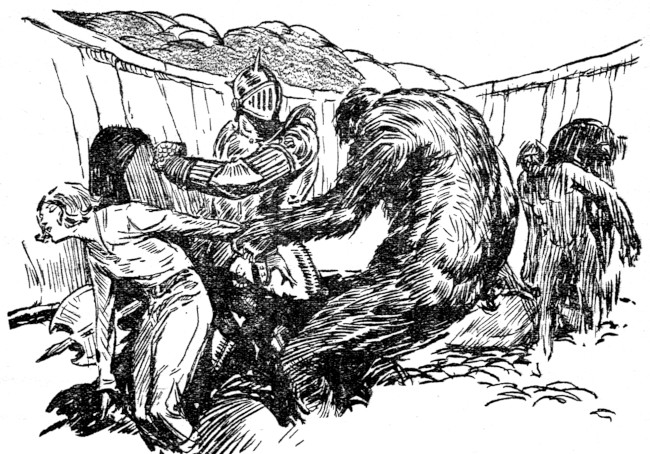
His mirth was suddenly cut short by the impact of a mailed fist on the point of his jaw.
Vernia reeled, and would have fallen had not Grandon caught her in his arms. He raised his visor and, looking into the melting depths of twin pools of flame, saw the soul of a woman.
"How I wished that you would come," she whispered, her arms about his neck, her upturned face so close that the fragrance of her breath intoxicated him, "wished without hope."
For answer he bent low over the yielding, tremulous lips to take that tribute a woman gladly gives to the man who has stormed the portals of her heart and won. But their moment of rapture was rudely broken into by a shout from one of the slaves.
"The sabits! Run for your lives! The sabits come!"
Grandon wheeled and beheld two soldier sabits rushing toward them. The slaves scattered, diving into the various doorways at the base of the conelike structure. He pushed the girl into one of these and, lowering his visor, tore the heavy spiked club from his belt and awaited the onslaught.
As the first soldier sabit opened its huge forceps to encircle Grandon's waist, he raised his spiked club and crashed it down with all his might between the two enormous eyes. His tactics were derived from the pictures he had seen of Albines battling with sabits, and he staked his hopes on the belief that what an Albine could do he could do also.
The creature paused, its head drooped, and it began walking aimlessly in a circle. Not so its mate, however, which leaped forward and swept Grandon from his feet before he could swing the club a second time. It shook him and crunched him with its powerful mandibles, but the armor-plates held, and though giddy from the shaking, he was unhurt.
Grandon lost his spiked club, but his sword and ax remained in his belt. He drew the latter and struck at the creature's foreleg. To his surprise the weapon severed it completely. Where an ax of steel would have failed to make an impression, the razorlike edge of this marvelous metal cut cleanly and with comparative ease. Though the ax-head, like the club, was weighted with a ball of black metal, probably lead, the blade itself as well as the handle were of the wondrously hard brown metal.
Encouraged by his success with the ax, Grandon hacked desperately at the ugly head. At length the powerful forceps released their grip and the sabit followed the staggering tactics of its companion, walking about on its five good legs and moving the stump of the sixth as though the member were still there.
The Earth-man rose to his feet and struck off the heads of the two creatures with his ax. To his surprise and horror, the bodies continued their purposeless wandering!
Vernia came forth from the hut as he was recovering his club, and one by one the marsh-men appeared from their hiding places. Astonishment and awe were plainly written on their faces. They seemed ready to fall down and worship the hero who had, single-handed, overcome two ferocious soldier sabits.
Tholto, who had lain like a log where Grandon felled him, now sat up and gazed on the proceedings in blank amazement, tenderly feeling his injured jaw the while as if fearful that it would come off completely with other than gentle handling.
"Slaves," said Grandon suddenly, taking the hand of Vernia, "you have offered unspeakable insults to the greatest, the noblest and the most beautiful princess in all Zarovia. Ask her pardon now, for your lives are in her hands."
To a man they groveled before her.
Vernia looked up into the flashing eye of her champion.
"I would pardon them all, Robert Grandon," she said, "for they know nothing of the ethics of men, but have rather been bred and trained like domestic animals."
"You have heard her generous verdict, slaves," said Grandon. "Rise, now, and attend what I have to say to you. I take it that you would prefer freedom to slavery."
"We desire freedom above all things, mighty Albine," replied Oro, who had taken a place at the head of the men, "but the sabits are all-powerful and may not be overcome by ordinary mortals."
"I am no Albine," continued the Earth-man. "Call me Grandon of Terra. What I have done to yonder sabits, you can do to others of their kind. All you need is weapons and armor. These I will provide if you will follow me and acknowledge my leadership."
"I am called Oro the Mighty," the huge marsh-man answered, "yet do I consider myself weak and puny in comparison to you. I gladly acknowledge your leadership."
"And I! And I! And I!" echoed the others with enthusiasm.
"Then follow me and I will make sabit killers of you all."
Grandon led the way toward the gate when he heard a cry behind them. Turning, he beheld Tholto striving weakly to rise.
"Mercy," he cried. "Have mercy, noble Grandon of Terra. Leave me not here to be torn to pieces by sabits and fed to the fantas."
Grandon turned inquiring eyes to Vernia.
"He is the most grievous offender of them all," she said, "yet will I pardon him because of his ignorance."
Motioning two of the men to assist Tholto, Grandon ordered the others to bring as many torches as they could find, but carried only one lighted, and hooded it with a food sack in order that it might not be seen by the sabits.
When all was ready he led them to the mouth of the rodent burrow, enjoining absolute silence on the way. He was the first to enter, with flash light and sword in his hands as before. Vernia came next, clutching his ankle, and after her came Oro and the others. When they had concluded the tortuous descent and all were standing in the long corridor he ordered that three more torches be lighted and immediately set about the work of outfitting his men with armor and weapons.
No suit of Albine armor small enough for Vernia could be found, but the smallest one available was made to serve the purpose by telescoping it at the waist and fastening it with strips torn from the sack. These sacks were made from the exceedingly tough cocoons spun and eventually discarded by the fantas, and were not only strong and durable, but waterproof as well.
The little army, marching on into the great central room, torchlight glinting from jeweled plates and spears and axes held aloft, looked like reincarnated Albine warriors returned to their ancient haunts.
Grandon assembled his small command near the bubbling fountain and addressed them:
"I brought you here with the agreement that I'd free you from the sabits. I had a further plan—to start a movement to free every human slave and make slaves of the sabits that survive! First we will conquer the white sabits, for they are the most powerful. We can attack them from within their own stronghold. On the wall here is a picture of the way the Albines captured sabit rulers, and enslaved their followers. Five men search the passageways and chambers for fetters and chains like those illustrated. Five men will remain here under the command of the princess. The rest will go with me. We must act quickly, for the night is three-fourths gone, and with daylight the sabits will be astir and our difficulties will be great."
Oro and four other men were detailed to search the passageways and, after five men had been selected for Vernia, Grandon led the others along the passageway through which he had first entered the subterranean chambers. On the way he collected a number of spears from the silent guardsmen.
With the assistance of his men he cut notches in the handles of four spears, chopped several others into shorter pieces, and with strips of the food sack for fastenings, constructed a serviceable ladder to reach the hole through which he had fallen.
He stationed three men at the foot of the ladder, instructing them as to their duties, and led the others up into the fungi storage room where he found things as he had left them. Very quietly they made their way to the dormitories where two hundred slaves were quartered, one man being left at the top of the ladder and another stationed at the entrance to the storage room.
Two soldiers sabits were on guard without the main entrance to the dormitories. Grandon quietly stationed four of his men within and then began the business of awakening the slaves and sending them into the chamber below where three men waited to outfit them with armor and weapons and instruct them as to the correct method for dispatching sabits.
At dawn, just as the last of the men had been sent below, the sabit guards entered for the purpose of arousing the slaves. One was cut down and literally hacked to pieces as he came in the doorway, but the other, seeing the fate of its companion, made a lucky escape, and warned the community.
Grandon now had an army of two hundred and twenty-three men, more than enough to guard the doorways of the structure. Though the sabits attacked desperately all morning long, he succeeded in keeping them at bay.
It was nearly mid-day before Oro reported to his commander. He did not arrive empty-handed, however, as his men staggered under the weight of four sets of sabit fetters. They had found many new wonders in their explorations of the subterranean passageways; great dining halls, barracks for soldiers, kitchens with cooking utensils and fireplaces, treasure vaults filled with jewels and precious metals, armories with weapons, armor and strange engines of war, bedrooms with grotesque but artistically constructed sleeping shelves and furniture, and a great throne room decorated in barbaric magnificence.
Grandon was greatly interested by Oro's account of their discoveries and anxious to see them himself, but he had stern business at hand that would brook no waiting.
The structure in which the king and queen sabits of the white community were quartered had but one entrance on the ground floor; there were, however, four runways connecting with its underground level which branched out at right angles, leading to other buildings of the community. His first problem, therefore, was to block these runways with warriors, thus cutting off the sabit rulers from these avenues of escape.
One of the four runways led directly under the dormitory and storeroom building occupied by Grandon and his men. This was already blocked with armed guards who had seen considerable desultory fighting as the sabits made intermittent attacks.
Another runway led to the sleeping quarters of the women and children in connection with which there was another storeroom. The third led to the building in which the women sorted sabit eggs and cared for the young fantas, while the fourth connected with the building in which the men looked after the larger fantas.
Sabit soldiers and workers used the last-named building for sleeping quarters, as well as the central structure. The green creatures were kept in the upper levels of the great central building, for the sabits had learned by experience that they died in great numbers when quartered on the ground or under it. The mating pens, as in other sabit communities, were kept entirely separate from the rest of the buildings.
Leaving fifty men to guard the building which was in their possession, Grandon sallied forth at the head of his army. With Oro the Mighty on his right, and Tholto on his left, he fought at the head of his men for more than an hour before the attacking sabits gave way. These retreated to the central building, but Grandon was not ready to attack this. The women's quarters were stormed and captured in a relatively short time.
Leaving a guard of twenty-five armored men here, they attacked the building in which the women worked. Here they met with desperate resistance, and when finally they broke into it, found that the sabits had transported all eggs and young fantas to the central building.
After leaving twenty-five men to guard this building, they attacked the one in which the larger fantas were kept, but found it deserted. Evidently the sabits had anticipated this attack and removed their young.
Another guard of twenty-five was posted at this point, and now, with all avenues of escape blocked, they were ready to lay siege to the main structure. After posting guards at the various points the army numbered only ninety-eight men. With these he surrounded the structure, and attempted to battle his way through the narrow doorway.
This, he soon found, would be a well-nigh endless task, for two soldier sabits could hold back a regiment in this narrow place, and although they were cut down time and again, others rushed in to take their places so that if the process were kept up indefinitely several weeks or a month might elapse before they could even set foot in the place.
"If we only had a cannon of some sort," thought Grandon. Then he remembered the airship and the mattorks. Leaving Oro in charge of the besiegers with instructions to keep up the attack on the entrance, he took a dozen men and made for the tree in which the craft was jammed. While six of the men stood guard at the foot of the tree, he and the other six removed their armor and climbed up the rough bark.
They found the craft apparently undisturbed. With the aid of tools which he took from one of the drawers in the cab, he removed the three mattorks and, binding each to a man with a strip of sacking, he bade them convey them to the ground. He and the others followed with the ammunition, tools, searchlights, and whatever else looked useful. After donning their armor they returned to the attack.
As his men were unskilled in the use of the mattork, Grandon mounted only one weapon. Then he recalled his men from the doorway and began the bombardment, using explosive metal bullets. So great was the power of these missiles that only a few shots were required to enlarge the opening to the size of a dozen doorways and at the same time clear the surrounding space of sabits.
Grandon knew that the quarters of the queen and king sabits were in a central chamber on the ground floor, and that four walls intervened between this chamber which was reached by winding passageways, and the outer opening. Moving his mattork closer, he shot down the second, third and fourth walls, while his warriors kept the sabits back on both sides.
Then he led a swift charge on the rulers of the white sabits, followed by Oro and the men who carried the manacles.
It was here that he learned a peculiar characteristic of the king and queen sabits, for though the soldier and worker sabits retreated when hard-pressed, the sabit rulers showed no disposition to do so. They appeared to have a certain standard of royal dignity which they punctiliously observed, and for which they seemed willing to sacrifice their lives if need be. They struggled desperately but unavailingly until the manacles were clamped in place. Then the white sabits became the slaves of men, for as soon as their rulers were made prisoners, all surrendered docilely.
Placing a guard of twenty-five men around the royal prisoners the Earth-man ordered that the community life of the former masters of men be resumed. The fantas and eggs were returned to their respective buildings and the green creatures were conveyed to their leafy pastures—but this time the work was done entirely by sabits.
The soldier sabits who had formerly acted as guards and slave-drivers were now forced to do the work previously done by men. Worker sabits divided and stored the eggs and cared for the young fantas. Later, when the community of marsh-people was organized, it was Grandon's plan that the sabits should fetch and carry for those who once served them.
When he returned to the dormitories, Grandon found Vernia in earnest and animated conversation with a young slave girl. Oro, who entered behind him, raised his visor at sight of the girl and the two embraced in a transport of joyous recognition.
"The girl is Rotha, a former slave of the brown-mouthed sabits," explained Vernia. "She has just escaped, and brings terrible tidings. This is Grandon of Terra, Rotha—the man of whom I told you. Let him hear your message at once, for night is almost here and if anything is to be done it must be done quickly."
"To-day while working with the others," said Rotha, "I heard the rumor that the eighteen girls whom you left in the mating pens would be tortured to death before the other slaves to-night. The sabits believe these girls assisted in the escape of the men and intend to make an example of them."
"But I saw no girls in the mating pens," said Grandon.
"Nor did I," answered Vernia. "Rotha says they had been taken to the inner rooms before I arrived."
Grandon swung on Oro.
"Why didn't you tell me of this?" he demanded. "I've could have brought them with us."
The big marsh-man hung his head.
"I thought you knew," he said. "You were in command, and I did not doubt that if you wished them brought with us you would say so. Every evening there are girls in the mating pens."
"Where are they to be punished, and what will be the manner of their punishment?" asked Grandon.
"All the slaves will be herded before the hut of the queen sabit."
"Yes."
"Then each girl will be fed, feet first, to a large fanta."
"Can nothing be done to save them?" asked Vernia.
"We will do our best," Grandon replied. "Oro, assemble a hundred men at once."
From among the hundred warriors marshaled by Oro, Grandon selected five who appeared above the average in intelligence, to act as officers, each to command nineteen men.
Absolute silence was observed as they marched toward the community of the brown-mouthed sabits, for if they were to be successful these creatures must be taken by surprise.
The Earth-man led the column, followed by Oro with twenty men with two sets of sabit-fetters. After this group came the next officer whose crew carried a mattork, a rough tripod that Grandon had made for it, and ammunition. The others brought up the rear.
It was not until they arrived at a point near the mating pens that they saw the torches which had been planted before the central building of the community in order that the slaves might witness the torture of the young women. The doomed girls were huddled in a little group near the doorway, guarded by a dozen soldier sabits.
The king sabit stood in the glare of the torchlight, but his mate was not in sight. Evidently she would not be present at the ceremonies. The female slaves and their children sat on the ground facing the entrance. Behind them stood the men, while soldier sabits formed a great circle about the whole scene.
Grandon saw two worker sabits pilot a huge fanta through the doorway. This lusty infant was larger even than the soldier sabits, almost ready to spin its cocoon. It gnashed its huge mandibles continuously, and wiggled from side to side, nearly upsetting its pilots with each jerk.
At sight of the voracious monster, the unfortunate girls drew back in horror, and a woman in the audience screamed and became hysterical.
"We must work fast," said Grandon, "if we would be in time. The plan is as follows. Oro will take twenty men and the larger set of fetters and circle, coming up behind the building. When he hears the report of the mattork, he is to cut a door in the rear of the building, go immediately to the chamber of the queen sabit and make her prisoner.
"You two will take your details and go with Oro's men to the rear of the building. Upon the second report of the mattork, one detail will charge around the right side of the building and fetter the king sabit while the other charges around the left side and rescues the girls, placing a guard around them.
"The fourth detail will go to a place behind that large surface root to the north of the sabits, while the last one will hide behind the mating pens on the south. At the third report of the mattork they will rush in and surround the slaves who are assembled before the building."
"But you thus will be left alone," remonstrated Oro. "The sabits will overpower and kill you, for you cannot resist an army single-handed."
"Have no fear for me," replied Grandon. "Only do as you are bidden. Go now, swiftly and silently as possible. There is no time to lose."
In a moment Grandon was left entirely alone. He quickly mounted the mattork, meanwhile watching the ceremonies of the sabits from time to time. The king sabit had come out in front of the hungry fanta and was haranguing the slaves in the tone-language, no doubt warning them that if any of their number should ever attempt to escape, a fate similar to that which was to be meted out to the girls awaited them.
After droning out his warnings for a full ten minutes the king sabit stepped to one side, whereupon four worker sabits seized a girl, two on a side, and carried her before the fanta.
Grandon quickly withdrew the clip of explosive bullets he had in the mattork and inserted one of solid missiles instead. The girl was being pushed feet foremost toward those great gaping jaws, and although he knew Oro would not be ready for the signal he took careful aim at the hideous head.
Just as he was ready to press the button the form of a man appeared on a direct line between mattork and target. Cursing this unforeseen interference, which might mean the death or mutilation of the girl, Grandon lifted his tripod, intending to try a shot from another position, when he saw the man who had momentarily saved the fanta's life hurl a huge rock fragment straight for its ugly head. The missile struck the mark squarely, and the great soft-bodied monster, after a convulsive shudder, sank over on its side, stone-dead.
Once more Grandon put his clip of explosive bullets in the mattork. He saw the man turn and dodge hither and thither among the snapping sabits. That he was an excellent runner and an extraordinary athlete became apparent, for he succeeded in breaking through the line and in keeping a short distance ahead of his pursuers.
Training his weapon on those sabits immediately behind the fugitive, the Earth-man opened fire. The exploding missile tore a great gap in the ranks of the monsters, killing a half dozen and disabling as many more, whereupon the others paused, running this way and that in their endeavor to locate the unseen attacker.
Suddenly Grandon leaped up on the surface root behind him and, turning his pocket flash light on himself, shouted defiance to the sabits in the tone-language. The king sabit saw him almost immediately, and vibrated his antennæ excitedly, whereupon all but a dozen soldier sabits who remained to guard the slaves charged down on Grandon. As he leaped back to the ground and made his mattork ready, the man who had broken through the sabit guards arrived, panting heavily.
"Give me a weapon," cried the stranger, "and I will fight with you."
Grandon handed him the spiked club.
"Hit them between the eyes," he said. "It is the only vulnerable spot. If you are as skillful with a club as you are at hurling stones, I am sure you will account for a few of them."
The newcomer smiled slightly. He was evidently not a marsh-man, for his features were clean-cut, almost classical in outline, his hair was a light golden yellow in contrast to their dark locks, and his every movement bespoke careful training. While most of the marsh-men moved with the clumsy, stooping gait of gorillas, this man walked with the carriage of a soldier.
"It was a lucky hit," he replied. "Throwing stones is not my specialty. I could do much better with that weapon you are aiming at the sabits."
Grandon fired the signal for the second attack.
"Where did you learn to use the mattork?" Grandon asked his ally.
"I was a captain in the armies of Mernerum for several years, and was credited with being a fairly good marksman."
"Here, then, take the weapon. Let me see what you can do with it. The next shot will be the final signal for my men. See if you can stop the charge of these soldier sabits."
The newcomer grasped the weapon with the assurance of a master musician taking up his instrument, handling it with a skill that told of long practice. The first shot was a direct hit in the foremost ranks of the sabits, and thereafter he fired with unerring accuracy, pivoting the mattork on the rough tripod rapidly. It was but one weapon against an army, however, and both men knew that in a few seconds they would be overwhelmed.
Grandon saw one crew of armored men struggling to fetter the king sabit, while another group struck down the guards surrounding the girls. Before the last two details had come to blows with the other guards, the mattork-tripod was knocked over by the charging monsters, and both men were fighting with their backs against the thick surface root, Grandon swinging his heavy ax, while his new-found ally used the spiked club almost as skillfully as he had used the mattork.
Closer and closer pressed the sabits, snapping their mighty forceps which were easily capable of cutting the unarmored man in two at one nip. The newcomer knew this, yet he laughed as he fought, and at times taunted the furious attackers in the tone-language, for they were not able to comprehend Zarovian speech.
"You jest with death, yet fight with the fury of a cornered lion," said Grandon. "It strikes me that you are a man worth knowing. What is your name?"
"I am called Joto, which in the language of Mernerum means The Merry One. Take that!" crushing the skull of a huge sabit, "thou self-styled master of men! Names matter but little now, for we have not long to live; yet I would not die without knowing the name of the mighty fighter to whom I owe the few moments of life I have remaining."
"I am Grandon of Terra," replied the Earth-man, cleaving the head of an antagonist and leaping back to avoid the snap of another. He tried to wrench the ax free, but it stuck, and the next moment powerful forceps encircled him.
With a final tug at the handle of his weapon, he was jerked from the side of his companion and mauled about by a dozen sabits who alternately shook him, crunched him with their mandibles, and tried to pull him to pieces. The armor held, but the man inside it was swiftly lapsing into unconsciousness.
As the numbness of death came over him Grandon thought of many things. With a wave of pity he pictured the brave Joto being torn to pieces and devoured by the sabits. He thought of Vernia, left to the mercies of the marsh-men, who, even though they might treat her with consideration because of her part in their rescue from the sabits, would not have the ability to take her to Reabon in time to defeat the purpose of her scheming abductor.
A powerful sabit, more cunning than its comrades, seized Grandon by the ankles and beat him against the hard surface root. At the second terrific shock the thread of consciousness mercifully snapped asunder.
Returning consciousness brought numerous twinges of pain to Grandon. His head ached, his arms ached, in fact it seemed that his whole body was one solid, throbbing mass of bruises. He stirred uneasily. A soft hand pressed his fevered brow, and a sweet voice said:
"Speak not so loudly, Rotha. You will awaken him and he needs rest—much rest and quiet."
Slowly he opened his eyes. He was lying on a sleeping shelf that projected in a half-moon shape from the wall like the nest of a cave-swallow. At the foot of his couch, which was of stone but lined with soft moss, Rotha, the slave girl, held a golden vessel in which was a pasty compound of aromatic herbs, while Vernia occupied a place at the head. His armor had been removed and his bruises covered with the sweet smelling ointment.
In the center of the room a guard stood stiffly erect, holding a sputtering torch, by the light of which he could see grotesquely carved figures on the walls, a queer table shaped like a great tortoise, and chairs that were human figures seated on round pedestals, the body forming the back, the lap the seat, and outstretched arms with hands bent downward and finger-tips touching the thighs forming the arm rests.
The furniture was all cut from hard wood of a reddish purple color and highly polished. The floor was of hexagonal blocks of varicolored stone and presented a smooth, glossy surface.
He saw all these things at a glance, then his eyes sought those of the girl at his bedside.
"It is indeed an honor to be nursed by the greatest ruler in all Zarovia," he said, smiling feebly.
"I'm afraid it is but small recompense for your services," she replied. "Besides, I am a ruler no longer, nor is it probable that I ever will be again. Within fifty-eight days my cousin, Prince Destho will assume the crown. I am sure he must have been the instigator of my abduction. My legal right to the throne will have been forever forfeited. I will have been away from the capital for a year, and such is the inexorable law!"
"Surely you must be mistaken in your calculations," said Grandon. "I am positive you have not been away from Reabon for over half a year at most."
"You forget that you are on Zarovia, where the years are much shorter than on your planet. Our world is closer to the sun than yours, consequently our year is only two hundred and twenty-five days in length."
"That's true. Then we must start for Reabon at once."
"But how? The marsh-men say there is no way out of this valley but a secret tunnel, known only to the sabits, and this is said to be guarded night and day by a huge army of soldier sabits recruited from all the communities in the valley."
"But does not the river cut through the surrounding cliffs on its way to the sea?"
"I am told that the river ends in a great whirlpool a few miles from here. The marsh-men believe that it falls into a bottomless pit. In the light of their learning the belief is reasonable enough, for the pit has never been known to fill up or the river to overflow its banks."
"The river being out of the question, we have the alternative of scaling the cliffs, or finding the secret passageway of the sabits and fighting our way through," said Grandon. "In either event we must start quickly, for the time is short and there is much to be done if we would defeat your scheming cousin Destho, and save your throne."
Despite her protests Grandon arose, gritting his teeth as the pains shot through his bruised body. While he donned his armor with the assistance of the two girls he asked many questions regarding the outcome of the battle with the brown-mouthed sabits. All of the slaves had been rescued and the king and queen sabits were prisoners.
Joto had, by his wonderful agility, escaped his pursuers and personally led a party to the rescue of Grandon. They took him, stunned and apparently lifeless, to Vernia, who ascertained that his heart was still beating and had him conveyed to this bedchamber of an ancient Albine ruler, where she and Rotha, whose mother had taught her to compound healing salves and potions from herbs and fungi of the valley, nursed him all through the night.
Grandon was drawing on his gauntlets when Oro entered. At sight of his commander, Oro saluted smartly, after the style of soldiers of Zarovian empires.
"Where did you learn the military salute, and why are you here instead of guarding the roga-sabit as instructed?" asked Grandon.
"We have been taught many things by Joto, who has assumed temporary command of your army," replied Oro. "He has set the other captains you appointed to the tasks of guarding the king and queen sabits of the two communities, drilling, and learning the meaning of military orders. In addition he has been training a crew of thirty men to handle the mattorks. We are in grave danger, for the sabits of all the communities, realizing that we menace their safety, have united with the common purpose of annihilating us. Our scouts report the marshaling of a mighty force in the red-mouthed community which they have made their base of operations. They are pouring in by thousands from all over the valley, and Joto thinks they will attack us before nightfall."
"Joto has commendable initiative and ability to match it," said Grandon. "Let us go and see what he has accomplished."
Accompanied by the two girls, they made their way to the place where Grandon had fallen into the passageway while attempting to tunnel his way to freedom. Here they encountered the first sign of Joto's activities, for the hole had been widened and a broad stairway constructed. Two guards saluted stiffly as they passed.
They found Joto outside the structure, supervising the practice of the mattork crew, who used empty bullet and gas clips but went through the motions of loading, aiming and firing with surprising speed and precision, while four units of a hundred men each were being drilled by their officers. He turned and raised his visor with a welcoming smile as Grandon and the others approached.
"I see that you are not without considerable military genius," said Grandon.
"Having trained men in the art of warfare for some time I should be reasonably proficient," replied Joto. "However, I bow to you as a superior strategist. The attack you planned against the brown-mouthed sabits was marvelously conceived and executed. If the reports of our scouts are to be credited we will shortly have a battle to fight which will require infinitely more cunning. We await your orders."
"How many sabits do you expect will attack us?"
"Twenty thousand, at the very least. Every community in the valley is sending no less than a hundred, and there are more than two hundred communities. There will soon be a fight that will decide whether this valley is to be ruled by men or monsters."
"Twenty thousand sabits," mused Grandon. "Enough to sweep us away bodily, and these buildings with us."
"Easily."
"With four hundred and fifty men it will be impossible to guard both communities, or even all the buildings of one community against so powerful a force. Have the brown-mouthed sabit rulers brought to the central building of this community, and there kept with the rulers of the white community. Withdraw our guards from all other buildings, and block all the runways with stones except the one which leads here from the central building."
"Then we may as well kill all of our sabit slaves at once," said Joto, "for the attackers will surely kill them."
"Why should they war on their own kind," asked Grandon, "when it is their purpose to rescue them?"
"Their purpose is not altruistic, but protective only. There is no such thing as love, mercy or charity in a sabit mind. As our slaves, the brown-mouthed and the white sabits are outlaws and enemies of their kind. Moreover, they will fight to protect their rulers, their eggs and their fantas."
"Why not let them fight?" asked Vernia. "They should account for a few of the attackers."
"Right," exclaimed Grandon, "Leave them to guard the brown-mouthed community and the three outer structures of this one. No doubt they will all be killed in the first charge, but it is probable they will account for an equal number of enemies."
Joto sent a messenger to order the brown-mouthed rulers brought to new quarters, as directed by Grandon. It was decided that a hundred men should be posted in the central building, with one mattork placed on the roof. The other two mattorks would command the battlefield from a place on the roof of the men's sleeping quarters.
The stores of dried fungi from both communities were removed from their storage rooms and carried to the subterranean chambers, as were also hundreds of sacks of the sticky food. While Joto supervised this work, Grandon took Oro and a crew of twenty-five men to examine the engines of war in the ancient armory of the Albines, which Oro had discovered while exploring the underground passageways.
They traveled underground for more than a mile before they arrived at the huge subterranean armory which, next to the throne room, was the largest excavation in the entire system. Its floor level was considerably below that of the passageways and its ceiling was higher and dome-shaped. Though the floor was of hard granite, the walls and ceilings were as elaborately decorated as those of the fountain room, the reliefs being almost exclusively battle scenes between Albines and sabits, and in many cases showing in operation engines of war similar to those which stood about on the floor.
Grandon examined these heavy, death-dealing instruments of a vanished race with more than ordinary interest. Most of them were better adapted to the purpose of attack on the sabit dwellings than for defense.
There were catapults that hurled huge stones or fired long, heavy, metal-tipped missiles which acted as battering rams. There were instruments apparently adapted to the spraying of poisonous liquids, though no ammunition for them could be found.
Among the devices which required considerable mechanical ingenuity were queer three-wheeled carts built in the shape of hollow triangles, the outside edges of which were protected by curved blades and spiked clubs that whirled rapidly when the machines were pushed forward by men running inside. A small group of men operating on level ground might cut a path through an entire sabit army with one of these machines.
Having sent Oro and his men to Joto with six of the carts, Grandon was examining the brown metal spring of one of the catapults when his attention was attracted by a curiously wrought cabinet standing against the wall. What he at first took to be narrow sliding drawers proved to be thin flat slabs of stone on which designs had been scratched with some sharp instrument. The topmost slab was covered with a carefully drafted design of an Albine catapult. The next illustrated the construction and working principles of the spraying machines.
As he pulled out slab after slab he found plans for the construction of practically all the machines he had seen, but the bottom slab particularly interested him, for he saw that it consisted of two maps side by side, the general shape of both being identical, but the details different.
He recognized one as a map of the valley surface, the other as a plan of the underground passageways and chambers of the Albines. Holding the flickering torch nearer, he eagerly examined his find in the hope that it might contain information regarding the location of the secret way out of the valley.
A careful scrutiny of the surface map revealed only the solid, unbroken cliffs in oval formation, so he concluded that the tunnel mentioned by the marsh-men must not have been known to the Albines. Turning from this to the underground map, he noticed a discrepancy that had previously escaped his observation, for in the first map the river began at the western end of the valley and wound its way south of the center to the point where it ended in a whirlpool; while in the second it began in the northwest and flowed for some distance north of the center, apparently going directly through the point where the other map showed the whirlpool, and flowing thence on through the cliffs to the east.
Grandon was puzzled by this seeming paradox, for he had seen enough of the valley to know that but one river flowed through it. Then the significance of the thing dawned on him. This river was drawn on an underground map. Obviously it was an underground river! Furthermore, it could not have been mapped unless navigable, in which case it offered a means of escape from the valley providing he could locate it.
He noticed that at one point the river appeared to touch the end of the chamber he was in, but there seemed to be no mode of exit other than the door which led to the passageway through which he had entered. His curiosity aroused to a fever pitch, he walked back and forth along the walls searching for a concealed door, but without success.
When about to give up his seemingly hopeless quest he arrived at a certain point where his attention was attracted by a gentle murmuring as of distant waters. Pausing, he listened breathlessly, and noticed that the sound seemed to emanate from the figure of an armed warrior which was chiseled in bold relief on the wall before him.
A careful search revealed a small lever behind the right elbow, and on pulling this a section of the wall four feet wide and higher than a man moved toward him, revealing a flat platform and a flight of steps beyond. The unmistakable sound of roaring water was now plainly audible.
Grandon stepped on the platform and, finding it firm, held his torch aloft and descended the steps. After traveling for a considerable distance he reached a level floor of stone and a moment later came upon a sight that amazed and startled him, inured though he was to strange and awesome spectacles.
Before him lay a great stone dock on which, as far as his torchlight carried in both directions, reposed a fleet of metal boats, each about fifty feet in length and built in the form of those huge amphibious reptiles such as he had rescued Vernia from, back in Reabon. The prow ended in the arched serpentine neck and head, while the stern terminated in the flat, pointed tail. Behind these grotesque craft he could see the black, foam-flecked water rushing headlong beneath stalactite-festooned subterranean arches.
He examined one of the boats with intense interest. It was constructed of brown metal similar to that from which the Albines made their weapons and armor, and appeared quite strong and seaworthy. The deck was completely arched over with the same material, fashioned in imitation of reptilian scales, except at the front and rear where there were oval holes provided with hinged metal lids.
Upon entering the forward hole he found a roomy interior all of metal, and saw that the hull was rigidly ribbed and braced. Twenty large metal paddies lay on the floor and there were twenty seats for paddlers, ten on each side, while metal hoods projected outward almost to the water line, in such a manner that they would completely hide the paddlers and protect them from the missiles of an enemy. The steering device and helmsman's seat were immediately behind the top of the rear entrance hole, and were also protected by movable metal plates.
Upon his moving the tiller the entire tail turned, and he learned later, as he had surmised, that the rudder was fastened beneath this tail.
Grandon made his way back to the armory and carefully closed the secret doorway. He started along the passageway, reflecting on the importance of the discoveries he had made, when he noticed a soldier running toward him.
The man stopped suddenly when he saw Grandon and saluted stiffly.
"Joto bade me tell you that the sabits are beginning the attack," he announced breathlessly.
"Attacking already?" Grandon was dumfounded. He hurried swiftly forward to join in the momentous conflict which was to decide, once and for all, whether men or monsters should rule the Valley of the Sabits.
As soon as he had left the room a tall, bulky figure in armor stepped from behind a large catapult and went directly to the hidden door, wrenching one of the torches from its fastening as he passed. The soldier fumbled with the hidden lever for a moment, then managed to swing the door back and disappeared in the dark interior.
Some twenty minutes later he reappeared, carefully fastened the door and replaced the torch. His visor was raised, and an expression of malicious cunning overspread the face beneath it. The face was that of Tholto, the brutal marsh-man of the mating pits.
"A way out of the valley," he muttered. "This farce of pretended friendship will soon be over. I have only to gather a few provisions and to get her."
He lowered his visor and slunk out of the door and down the passageway.
The pandemonium of battle was punctuated by the staccato reports of the men's cannonlike mattorks as Grandon reached the interior of the men's sleeping quarters. He mounted to the topmost chamber from which Joto directed the activities of the two mattork crews while he shouted orders to the defenders.
Here he found Vernia and Rotha, and could not but notice the difference in the expressions of the two girls as they viewed the attack. While Vernia, daughter of a thousand fighting emperors, maintained a calm demeanor in the face of that oncoming horde, Rotha, pale and trembling, looked this way and that, like a hunted wild thing.
"See," the marsh-girl cried, "they come by thousands and tens of thousands. They cover the entire landscape. Our defenses will be crushed."
"You forget that they are only brutes, Rotha," replied Vernia, "and as such may be overcome by creatures of superior intellect. Men are the lords of creation, not sabits."
"But they are wiser than all other animals—"
"Except men." She turned to Grandon smiling. "We are going to win this battle, are we not, Robert Grandon?"
"Most assuredly," he replied. "However, I am not so positive that we will be able to hold this building. This is hardly a safe place."
"You forget," said Vernia, "that I, too, am a soldier. I prefer to remain here, and if necessary, take part in the fighting."
"I am sure you are too good a soldier to disobey orders, and I am in command. You are ordered below."
A quick flash of resentment came to her eyes at his tone and words.
"You presume to command me? To dictate to the Princess of Reabon? I only command. Others obey."
In outraged dignity she turned her back on him and walked toward the ramparts—that is she started toward them, but a strong pair of arms picked her up, armor and all, and carried her struggling and kicking down the runways and to the foot of the stairway, while Rotha, passive and thoroughly frightened, trailed behind. Grandon set Vernia gently on her feet and, taking her by the shoulders, turned her so she looked up at him with flaming eyes and heaving bosom.
"That is a man's fight out there," he said softly, apparently unperturbed by the storm of anger he was creating. "You would only be in the way, and would more than likely be carried off by the sabits. Now will you go forward peaceably or must I carry you the rest of the way?"
A slight flush suffused her cheeks. When she raised her eyes to his there was a new look in them—a soft, melting look that gave him his answer even before she spoke. The woman had conquered the princess, and the man had conquered the woman.
She saluted stiffly, and there was a slight catch in her voice as she replied:
"I will go, my commander."
"Spoken like a true soldier," he said, and paused for a moment to admire her, walking gracefully with Rotha down the passageway. Then he turned and took the steps three at a time, to join in the fighting.
In one of the more remote underground chambers, Tholto, the mighty man of the mating pens, was haranguing a group of twenty followers recruited from the army of marsh-men. His first plan had been the overthrow of Grandon and Joto and the establishing of himself as ruler of the new community. Later, when he had discovered the way out of the valley, he decided on flight and the establishing of a community of his own. He felt it was the wiser course, not only because his following was inadequate to cope with the guards of Grandon and Joto, but because it was his belief that the sabits would eventually win the battle for domination of this valley.
Since the night when Grandon rescued Vernia from his clutches in the mating pens, he had secretly harbored a hatred that was none the less violent because of his apparent passivity.
Fate played into his hands when he discovered the secret way out of the valley, and he was not slow to take advantage of the opportunity offered. His co-plotters had been hastily summoned from their various posts, and now awaited his orders.
He instructed the men to place provisions and water aboard the boat at once, then await his coming in the passageway which led to the armory. When all had departed he lowered his visor and started down the passageway when he saw Vernia and Rotha approaching.
Quickly leaping to a vacant position in front of one of the hexagonal columns, he assumed the pose of the empty suits of armor that were similarly placed in front of the other columns, and stood in breathless silence until they passed—then followed with the patient stealth of a tiger stalking its prey.
He saw the two girls enter the fountain room and seat themselves on the edge of the fountain where they bathed their hands and faces in the clear, cold water. As he stood immobile before a column he could hear the ring of their silvery laughter mingled with the soft, splashing murmur of the fountain.
As the minutes passed he fidgeted uneasily. What if some one should come? What if Grandon should discover his absence, or Joto should notice that there were twenty men missing?
As the time wore on, and no one put in an appearance from the direction of the men's sleeping quarters, he regained confidence. The boat would be provisioned by now and the men waiting his coming. He chose a moment when neither of the girls was looking his way—then stepped boldly into the room and approached them.
Vernia looked up inquiringly.
"I bring orders from Grandon of Terra," he said, bowing low.
"What are his orders, soldier?" she asked.
"We cannot resist the sabits much longer. Many of our soldiers have been slain, Joto among others. There is a secret way out of this valley which all the survivors must take. I have been ordered to convey you and Rotha thither and await his coming."
"A secret way out of the valley from here? Surely you jest, soldier! By what miraculous means may we escape from the very center of the valley, surrounded by thousands of sabits?"
"There is an underground stream which will carry us safely under the cliffs. A boat of the ancient Albines is provisioned and ready. But come. Explanations can wait until later. We must hurry, for it is the order of our commander."
All unsuspecting the two girls followed Tholto down the long passageway that led to the armory. Before the hexagonal columns to the right and left of them stood the figures of warriors, though here and there a suit had been removed to do service in Grandon's army. As the three entered the doorway of that great storehouse of weapons and engines of war, twenty silent figures stepped from before as many columns and closed in behind them.
There was the sound of many mailed footsteps followed by the screams of two frightened girls. Then the rough gutturals of the men, the voice of Tholto issuing commands, the scraping of a metal keel on the stone dock followed by a splash, more commands, the dip of the paddles in the water which quickly died away in the distance, and once more the great, empty walls of the armory echoed only the roar of tumbling black waters that came through the ancient Albine door which Tholto and his men had not troubled to close.
Grandon found the lower floor of the men's sleeping quarters well defended, so climbed once more to the top of the structure where Joto was directing the battle. As far as he could see in every direction the ground swarmed with sabits. In a comparatively short time the brown-mouthed sabit community was overwhelmed and its buildings where razed to the ground, as were three of the outer structures of the white sabit community.
The men in the central building held their own for a considerable time, but their outer ring of sabit guards were killed and torn to pieces almost instantly. At length it appeared inevitable that this building must fall. Sabits were gnawing their way through the walls and more and more soldiers were required to hold them back.
"I will take a force to help them," said Joto.
"No. You are doing very well here. I will go to their assistance," replied Grandon.
Taking fifty men from the reserve force in the storeroom Grandon led them through the low underground runway. As they arrived the guards were being driven to the inner chambers, but they rallied with the aid of the new reénforcements and once more drove the sabits from the building.
Sheb, the captain in command here, was on the roof directing the mattork crew, so Grandon climbed thither after assuring himself that the first floor was well defended. He found the crew standing idle while Sheb, fuming and cursing, was attempting to dislodge a jammed gas clip from the breech of the weapon.
"Are you all so witless that you insert a clip backward after having been told the proper way a thousand times?" he roared. "For the price of a bowl of wine I would have you stripped of your armor and thrown to the sabits."
"Let me try," said Grandon coolly. "I believe I can get that clip out for you."
Surprised at the sudden appearance of his commander, Sheb stood up and saluted hurriedly. With the point of his sword Grandon gently pried the recalcitrant clip, turned it, and closed the breech. Once more the crew sprayed bullets into the ranks of the attackers.
A soldier rushed up from below.
"The outer walls are nearly gone," he gasped. "In a few minutes the building will cave in."
"Order a retreat," said Grandon. "There is no use in defending this shell."
"The king and queen sabit prisoners—shall we take them with us?"
"Leave them behind. I fancy the attackers will take care of them. Their followers are all dead, anyway, and I don't believe any of our people will care to nurse their fantas."
"If we leave them we will have no sabit slaves," said Sheb.
"Plenty more can be captured if we successfully withstand this attack," replied Grandon.
Another messenger arrived from below.
"The sabits have burrowed into the runway," he cried. "We will not be able to return to the other building."
"Every one below at once," shouted Grandon. "Bring the mattork and ammunition. Hurry!"
The building trembled and one of the walls collapsed as they rushed to the ground floor.
"Into the runway, every man of you," he commanded. "Let the mattork crew go first and clear the way."
Soon the men were all crowded into the narrow runway while Grandon and Sheb, standing abreast, fought off the sabits that attempted to follow. The entire structure collapsed a few minutes later, crushing not only the imprisoned ruler sabits and their green cattle, but many of the attackers as well. The entrance to the runway was completely bottled up by fallen débris.
Shouldering his way through his crowded soldiers, Grandon at length arrived at the point where the sabits had burrowed into the runway. Here the mattork crew worked desperately, flanked by a half dozen soldiers. The cut in the runway was more than twenty feet across, and swarmed with sabits. Across this breach he could see Oro and his men fighting to keep the attackers from entering on the other side.
Meanwhile the sabits on the ground above the runways were burrowing in a hundred places. Something had to be done quickly or their place of refuge would first be turned into a trench, then a shambles. Already a third of the men who guarded the central building had been dragged away by the attackers. It could not be long before the others, including Grandon, must share their fate.
Some men lose their wits completely in moments of extreme stress. Others do their keenest thinking at such times. This was the case with Grandon. After a short conversation with the captain Sheb he suddenly ran across the twenty-foot breach the sabits had made in their defenses, leaping this way and that to avoid the snapping forceps.
Oro and the others welcomed him with enthusiasm.
He ran swiftly through the passageway and, upon coming up, quickly placed crews in the ancient Albine fighting chariots he had sent from the armory some time before. Taking a place with the men in the foremost machine, he led them through the door straight into the army of sabits, the guards standing aside to let them pass. They formed a flying wedge with Grandon's machine at the apex, cutting a wide swath in the ranks of the attackers.
The efficacy of the machines was surprising, even to Grandon, who had formed some idea of their possibilities. The whirling knives and clubs literally cut the opposing sabits to ribbons.
Arriving at the mouth of the runway which held the imprisoned men, they quickly drove back the attackers, then kept them at bay by running in a circle about the breach while Sheb led his followers to safety. When the last man had crossed they formed a wedge once more and cut their way back to their comrades, entering the door amid shouts of acclamation from the defenders.
Night fell, and the fighting continued by torchlight, while Grandon made further plans. There were more than a hundred of the machines in the armory, and he planned to press them all into service as soon as possible. Taking the entire force of reserves with him, he hurried thither, not noticing the absence of Vernia and Rotha who he supposed had retired to their bedchambers in the women's quarters.
He was surprised at sight of the open exit door, as he remembered having closed it on his departure, but decided that he must not have pushed it far enough for the lock to catch, so he closed it once more.
The machines were quickly dragged from their ancient resting places and provided with crews. Within a half hour they were assembled in the building, ready for the charge. One by one they emerged from the doorway, spreading out in a great line six hundred feet long, then "Forward!" shouted Grandon, while Joto on the roof withheld the mattork fire.
The charge was irresistible. With every fifty feet of progress a thousand sabits perished. They cut completely through the sabit army, turned their machines and charged again, breaking down the resistance of those who had instinctively filled in the lines. Back and forth they drove through the thinning ranks of the attackers until the survivors, seeing that further resistance was futile, turned and fled.
Thus was the power of the sabits forever broken in the valley. Thenceforth, though there would be desultory fighting for some time to come, men should rule its fertile slopes in place of monsters.
When Grandon entered the building with his victorious machine-crews, the people cheered until they were hoarse. Posting a guard at the entrance, he called them to attend what he had to say to them in the great audience chamber of the ancient Albines.
When the people were assembled in the audience chamber, Grandon mounted the steps of the throne and faced them.
"My friends," he began, "I have called you together, not merely to congratulate you on your momentous victory over those monsters who have, for centuries, oppressed you and your fore-fathers, but also to make a few suggestions for your coming nation. For countless ages you have been ruled by the sabits. From now on you will need a government of your own. As you have no royal family you must choose your king. Let him be one who has your interests at heart, one who has the ability and the will to carry forward the great work which has only begun to-night. Who will you have for king?"
"Grandon of Terra!" shouted a burly soldier, waving his sword aloft. Immediately the cry was reechoed throughout the audience. Cheer after cheer rolled up from the sea of brandished weapons.
He held up his hand for silence, but many minutes elapsed before the tumult subsided.
"I appreciate the honor," he said, "and regret that I must decline it. It is of vital importance that the Princess of Reabon be returned to her country and friends at once. It will be my task, and my pleasure to see that she arrives there safely. Moreover, my own kingdom of Uxpo awaits its ruler.
"If you will permit me to make a suggestion, I will name one who is admirably suited for the place. One who, by his military genius, and training, his bravery and prowess as a soldier, has already won a place at the head of your army. Let Joto, your commander, be your first king."
Joto was not without considerable popularity, and so when Grandon led him up the steps to the throne, there was a burst of cheering almost equal to that which had followed the nomination of Grandon. As there were no dissenting voices, Grandon took the crown of the ancient Albine rulers, blew the dust of centuries from it, and placed it on the bared head of the young commander.
"You have elected me king," said Joto with his inevitable smile, "but king of what? Just as truly as we were people without a country before our deliverance, so now are we a country without a name. We are small in numbers, but we should be smaller in courtesy did we not in some way express our gratitude to the man who is responsible for our freedom from the oppression of those monsters whose carcasses at this moment, litter the ground above our heads. My first official act, therefore, will be to name this nation Granterra, in grateful tribute to the man who has made it possible."
There was more cheering for Grandon, for Joto and for the newly-named nation. Then Joto, after making Oro commander, appointed the five councilors who were to assist him, asking them to step forward as their names were called. He named the four other captains and Tholto in order, but Tholto failed to appear.
One of the latter's lieutenants, on being questioned, stated that Tholto had left him in command during the hottest fighting, and had departed with twenty men. About this time Grandon recalled that he had not seen either Vernia or Rotha since he left them at the foot of the stairway, and hastily sent a girl to the women's quarters to ascertain if they were safe. Joto dispatched soldiers to search all the underground passageways and rooms for the missing mojak and his men.
While they were out the girl Grandon had sent returned with the news that neither Vernia nor Rotha had been in the women's quarters since morning.
In a flash Grandon thought of the open door he had noticed while getting the fighting machines. An awful fear gripped his heart as he rushed out of the audience chamber and along the passageway which led to the armory. Joto, Oro and the more swift-footed among the soldiers followed closely.
Quickly springing the hidden catch, he ran down the steps and out on the docks where he saw at a glance that one of the boats was missing.
"You may as well call in your searchers, Joto," he said sadly. "They are gone."
"But where—how?"
"This stream leads out of the valley. They have disappeared. One of the boats is missing. The conclusion is obvious. I must have twenty picked fighting men at once, provisions, water, torches, and a mattork-cannon. See how fast you can work, men. And Oro, get me one of those large searchlights we took from the airship. We will need it in these caverns. Hurry!"
While Grandon carefully examined the nearest boat to determine its seaworthiness, Joto rushed his men as they had never been rushed before. Within a half hour the craft was provisioned and fitted with searchlight and mattork, while twenty of Granterra's brawniest fighting men stood ready to man her.
Grandon said good-by to Joto and turning to Oro, was surprised to find him in an attitude of supplication.
"A boon, mighty Grandon of Terra," he pleaded.
"Gladly, Oro, if within my power, but speak quickly. We are wasting precious moments."
"Take me with you."
"I have twenty men already, and don't want to weight the boat unnecessarily. Besides you are now commander-in-chief of Granterra's armies, and your duty lies here. Why do you wish to leave?"
"The villainous Tholto has stolen one who means more than life to me. I would rescue her or avenge her."
"You mean Rotha?"
Oro nodded.
"Ask King Joto. You are subject to his orders, not mine. If you have his consent, you may come."
"You have my consent, Oro, and both of you my heartfelt wishes for your success," said Joto. "I will appoint a substitute for Oro while he is gone, and will see that he is reinstated on his return."
The soldiers took their places at the paddle holes, Oro was placed at the tiller, and Grandon manned the searchlight on the forward deck. A hundred willing hands pushed them off, and the shouts of farewell from those on the dock gradually gave place to the roar of the black waters, as they forged swiftly ahead beneath the eroded archways hung with glistening stalactites.
Grandon found Oro a skillful navigator and his soldiers adept with the paddles. Joto had wisely selected them, not only for their fighting prowess, but also because they had previously lived with their people in the great salt marsh where boats were a necessity and every man proficient in their use. Had he chosen men raised in the valley they would have made awkward sailors.
The stream gradually widened as they progressed, and often forked in numerous ramifications, flowing through a labyrinth of arched caves for a distance, then uniting in a common channel farther on. The waters and the banks on either side of them teemed with weird subterranean life. Reptiles and animals of a thousand sizes and kinds swarmed the banks, and glided through the water about the boat.
Once they struck a huge saurian that nearly capsized their craft, but the creature sank out of sight and did not offer to molest them. Grandon noticed one peculiarity common to all, namely, that they were sightless, and paid no attention to the searchlight. In fact, practically all of them were without even rudimentary eyes, though a few had eye-sockets, and one or two boasted antennælike feelers sprouting from the head.
Upon rounding a sharp bend in the river they suddenly heard a terrific roaring sound that totally obliterated the noise made by the stream. Grandon flashed his light ahead to learn the cause, then quickly ordered the paddlers to reverse, for directly ahead was a solid wall of falling water that churned the stream into foam and sent clouds of spray whirling toward them.
The momentum of the boat carried them dangerously close before they could stop, but Oro veered to one side, ramming the prow against the bank until the paddlers could make headway against the current. When at a safe distance they turned and made for the first fork, through which they found a safe passage around the falls.
That the wall of water they had so narrowly escaped was the bottom of the whirlpool in which the surface-stream ended, Grandon could not doubt. He was therefore able to determine their distance from the cliffs with reasonable certainty, and calculated that within two hours at the most, they should be outside the valley.
All unsuspecting, he stood on the deck of the swiftly-gliding boat, turning his light this way and that and watching the blind monsters disporting themselves in the water or crawling and wriggling about on the banks.
He did not see the hideous, crouching thing on the top of the great overhanging shelf under which they must shortly pass—a thing without eyes, but with nose and ears abnormally developed, a thing with great cavernous jaws armed with a double row of razor-sharp teeth and with powerful claws that could rend and tear the toughest saurians limb from limb.
It was all over in an instant. Oro, looking ahead as they came under the overhanging bank, saw a great, sinuous bulk shoot downward, sweeping Grandon from the narrow deck and into the dark depths below.
They stopped the boat and hung near the spot for more than an hour, hoping that Grandon might have broken away from the monster, but saw only a few bubbles and something that looked like blood, both of which quickly disappeared in the foaming current. Frantically they sought him, making reckless but vain efforts to surmount the shelf and rescue their beloved young commander. At last, with grief-stricken faces, they sadly resumed their journey.
For several hours after she was seized and bound by Tholto's men Vernia lay with Rotha in darkness in the bottom of the boat. She could not see the members of the crew on either side, though she heard the rhythmic strokes of the paddles and caught scraps of the conversation.
Tholto acted as helmsman, holding his torch aloft with one hand while he swung the tiller with the other. From time to time she caught the glint of torchlight as he stooped to issue hoarse commands.
It was by sheer good luck that they happened on the channel which led them around the column of falling water, for in the dim light it is probable that the helmsman would not have seen it and reversed the boat in time to avoid it. Vernia, of course, knew nothing of the danger they had so narrowly escaped, though she heard the distant roar and wondered what caused it.
Several hours after they passed the falls the interior of the boat was suddenly illuminated by daylight streaming through the front and rear entrance holes. After another hour of paddling Tholto placed one of his men at the helm and, untying the bonds of the two girls, put food and water before them.
He watched them silently while they drank; neither ate anything; then tied them once more and resumed his place on deck. The man who had acted as steersman distributed food and water to the others at their posts, half of the men paddling while the other half ate and drank.
Some time later—Vernia judged it to be about mid-day—the boat lurched violently, then settled down to a familiar, rolling motion that vividly reminded her of her trip with Grandon in the fragile toadstool craft on the treacherous Azpok Ocean.
The two girls conversed in whispers, speculating on the fate that was in store for them and wondering if Grandon and Oro had learned of their abduction. At length both became violently ill from the tossing of the craft and lapsed into silence.
Toward evening Tholto ordered half of the men on deck while the others redoubled their efforts at the paddles. In a few moments the keel grated sharply on gravel and the lurching ceased. Tholto threw Vernia over his shoulder as if she had been a sack of sabit food and carried her up on the bank while another of the men followed with Rotha.
The crew speedily unloaded all provisions and supplies, then dragged the lightened craft high on the bank. A fire was started in the lee of the rocky cliffs, and two of the men who had gone in search of meat returned with a large pink lizard which was cut up and roasted over the flames.
The cliff behind them was honey-combed with natural caves. Tholto chose the largest and best situated of these for himself; the next best for his men.
While the evening meal was being prepared moss was gathered for couches by some, while others went in search of roots to make Zarovian wine. A large supply of the latter was secured and placed in a food sack with water which was brought to a boil by the primitive method of dropping hot stones in it.
When the men had eaten their fill Tholto undid the bonds of both girls and ordered them to serve the kova. For cups they were provided with the shells of large bivalves. Rotha complied meekly, but Vernia refused with flashing eyes, whereupon Tholto seized her wrists and twisted them cruelly.
"You are my woman," he growled. "Do my bidding, and do it quickly, or you will be punished. I would not hurt that beautiful body of yours, but you must learn now to obey."
There was a blazing fire in her glance as she suddenly wrenched her arms free.
"Your woman indeed! I should much prefer to mate with a monkey-man."
Tholto laughed sneeringly.
"I will tame you. Your lessons will start to-night."
Binding her hands and feet once more, despite her struggles, he carried her into the dark cave and threw her on the floor.
"Now lie there and reflect on the folly of resistance. Much good wine is being consumed, and I would not miss it. I will return presently, and if you so much as utter a whisper of protest you will learn why strong men fear the wrath of Tholto."
Many of the marsh-men had not tasted liquor for years, each man's abstinence dating from the time he had been captured by sabits. Small wonder, then, that they called for more and more until Rotha, exhausted by running from one to the other with the brimming shells, sipped a small quantity herself to stimulate her flagging muscles. The effects of the wine were very strong. The men were first mildly stimulated, then exhilarated, and finally stupefied.
Tholto might have drunk to excess with the rest, had not other pleasures beckoned. As it was, he took only enough to intoxicate him slightly, then, with the bestiality of his savage nature aroused to the uttermost by what he had drunk, walked unsteadily into the cave where he had left Vernia bound and helpless.
Grandon was momentarily bewildered by the sudden attack of the monster that dragged him beneath the black water, but the instinct of self-preservation came to the rescue even before reason made him aware of what had happened. His left arm was pinned to his body in the grip of powerful jaws that would have cut him in two had it not been for his armor, but the right arm was free; and drawing his sword, he plunged it again and again into the leathery throat.
He held his breath until it seemed that his lungs would burst, but the pressure of those jaws did not relax, and he prayed that his blade might find a vital spot before it was too late.
To his surprise, the water suddenly drained from his helmet and he tasted air. It was dank, foul air, charged with the offensive odor of putrefied flesh, but at that moment as welcome to his bursting lungs as a balmy, sweet-scented zephyr from a fern forest.
The monster ground its teeth ineffectually against Grandon's armor for a moment, then dropped him on a slimy floor and, putting its huge claw on his chest, gave vent to a horrible, gurgling roar. He was convinced that the beast weighed at least a ton, and gave silent thanks to the skillful armorer who had fashioned that strong breastplate.
The creature continued its disconsolate roaring, which was intensified a hundredfold by ringing, cavernous echoes, and Grandon noticed that with each roar the gurgling sound seemed more pronounced and the vocal tones grew weaker. Slowly the weight on his chest relaxed—slowly the creature sunk over on its side.
With a quick jerk he rolled from under the mighty claw in time to avoid the convulsive death struggles of the monster. His sword had not drunk blood in vain.
Taking his small flash light from its pouch, Grandon surveyed the scene about him. The reptile lay on its back, its great clutching feet moving slightly. A thick stream of blue-black blood spurted from a score of wounds on its neck. The source of the sickening odor was a number of partly devoured bodies of the lesser reptilians and something which, horror of horrors, looked like a human foot and shinbone, though the toes were long, webbed, and armed with sharp claws.
The lair of the great sightless carnivore was an arched cavern which ended at the water's edge in front of him and appeared to connect with a series of other caverns behind. As it was impossible for him to return under water the way he had come, Grandon turned his footsteps toward the caverns in the rear, hoping that they might open into the upper passageways where he would have a possible chance of rejoining his men.
As he journeyed on and on through that intricate maze of dark, damp, dismal caves, it seemed that they only led him deeper into the bowels of the earth. Moisture dripped constantly from a thousand pendent, crystalline points overhead, forming little puddles and tiny streamlets in the hollows and crevices of the uneven floor. Presently, however, the floor slanted upward, the dripping ceased, and the puddles disappeared. His hopes rose.
Quite suddenly and unexpectedly he emerged on the bank of a large stream. It looked like the one in which he had been plunged some time before, but he could not be certain, for the surroundings were different from any he had seen.
What was that? Could it be that he saw a human being moving slowly along the bank, apparently plucking and eating small fungus growths? And there, farther on, was another, and yet another, until only a short distance from where he stood the bank literally swarmed with them. What could it mean? Did a race of men or anthropoid apes inhabit this region of eternal darkness?
The creatures paid no attention whatever to his flash light. He turned it directly on the one nearest him and gasped in amazement. It was manlike in form, but what a horrible, misshapen, unbelievably grotesque caricature of the genus homo! It had long, bony, webbed fingers and toes armed with sharp claws. The smooth, hairless skin was a mottled silver gray in color, like that of a mackerel. But the face—Grandon was positive he had never seen anything so hideous in all his Zarovian wanderings.
It consisted, in front, of a broad, flat nose, and a mouth filled with huge ratlike teeth, and was minus chin, eyes or forehead. The hairless pate slanted straight back from the root of the nose and up from the base of the neck, ending in a conical point at the back. The ears were human in form, but easily four times as large as the aural appendages of any man Grandon had ever seen, and the creature kept them constantly in motion, presumably for the purpose of guarding against prowling enemies, or locating prey which it obviously could not see.
A stealthy sound behind him caused Grandon to wheel suddenly. There, not three feet from him, stood a creature similar to the one he had been watching. It sniffed the air in his direction for a moment with ears cocked sharply forward, then raised its head and uttered a long, mournful, wailing shriek.
Before he could sense the import of that cry he was surrounded by a chattering, excited group of creatures, seemingly materialized from the darkness around him. Thinking he was about to be attacked, Grandon drew his sword and awaited the first act of hostility from that narrowing circle.
To his surprise, they made no move to attack him, but seemed only curious. One, a trifle bolder than the rest, reached out long bony fingers and touched his armor, then made a queer, cackling noise. It reminded him of a sound he had once heard when a boy: a sound which had haunted his dreams for years afterward—the terrible, mirthless laugh of an idiot. Others, emboldened by the successful experiment of their comrade, pawed him over in turn, while the caverns rang with the echoes of their horrid cackling.
Grandon grew, tired of being man-handled, and attempted to push the things away from him with outstretched arms. They were apparently harmless, and he had not the heart to use his sword on them. He learned his mistake too late, for they took this movement as a sign of hostility, and a dozen of them pounced on him, bearing him to the floor, where pinned beneath their combined weight, he could scarcely lift a finger.
Then, above the shrieking and chattering of his captors, he heard the familiar click of paddles against the metal sides of a boat. A bright beam of light flashed over him.
"Oro!" he shouted at the top of his voice. "To the rescue, Oro!"
Would they see him or hear his cry? He listened intently, then shouted again and again. Once more the rays of the searchlight played on the struggling mass of creatures that swarmed over him. It hung there. A hoarse command sounded simultaneously with the noise of hollow metal scraping on stone. Then there was the clank of armored men running, followed by the sound of blows and unearthly shrieks of anguish. Two stalwart marsh-men helped Grandon to his feet as the last of his captors fled off, howling in dismay.
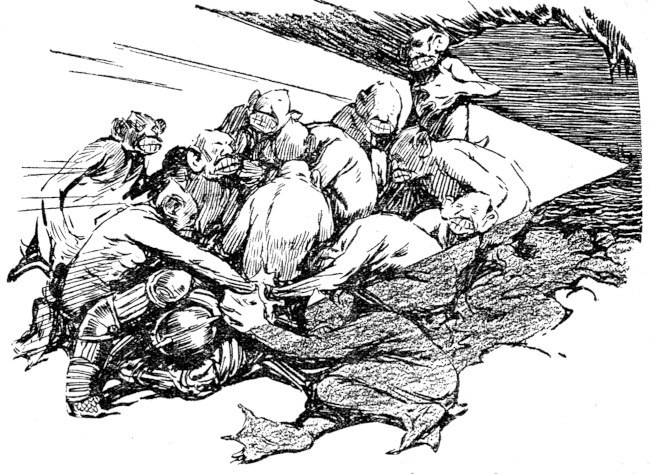
The ray of the searchlight played on the struggling mass of creatures that swarmed over him.
There was a brief but joyous reunion of commander and men on the bank, which was rudely broken into by a shower of missiles from out the darkness. Evidently the eyeless beings knew something about throwing stones, for they were hurled with uncanny accuracy. Nearly every man in the company was struck, and several were bowled over, though their armor protected them from serious injury.
Grandon ordered every one aboard, as he had no stomach for useless slaughter, and felt pity rather than animosity toward the sightless, feeble-minded creatures that had attacked him. To him they represented, not an evolution toward a human type, but rather a reversion from it.
In all probability they had sprung from the same prehistoric anthropomorphous ancestors as man, but as is always the case, environment had gradually stamped its mark on them during countless thousands of generations. Because they had lived in Stygian darkness with no use for eyes, the organs of sight had disappeared. The brain, the organ of objective reason, was correspondingly dwarfed. Other peculiar characteristics, such as the webbed feet and hands and the froglike skin, would be the natural result of living like amphibious reptiles.
For some time after they pushed away from the shore, stones continued to rattle against the boat and splash in the water about it, but on rounding a curve in the stream the shower of missiles ceased and they saw no more of the strange creatures who hurled them.
An hour later they emerged from beneath a perpendicular cliff into broad daylight, shot a swift rapids, and proceeded on a beautiful, sparkling stream, dotted with verdant islets and flanked on either side by the great salt marshes. He noticed that these marshes, in all but the spots that were continually above the sea water, had a type of vegetation peculiarly their own, for the reason that only those plants and fungi which could withstand the action of salt would grow in them. The predominant plant was a rank-growing, jointed cane which seemed to attain a height of about twenty feet at maturity.
The ocean breeze kept the cane brakes constantly in motion, producing an odd, rattling sound that had a peculiar, depressing effect on Grandon. It seemed that these weeds were conspiring against him as other forces had conspired, to keep Vernia from him, bending their heads together and whispering their fearful secrets in a language he could not understand. It was a relief when, toward evening, they reached the ocean coast and landed for a short time to give the men a chance to stretch their cramped muscles and steep some liquor.
While they built a fire of dried reeds and prepared the roots, Grandon and Oro explored the coast for some distance southward without finding any sign of those whom they sought. They accordingly had four of the men paddle them across the mouth of the river and traversed the coast line to the north for several miles. Both were hurrying along, looking for signs of a camp or a cooking fire, when the sharp-eyed Oro suddenly uttered an exclamation of surprise and ran down to the water's edge. Lying on the sand where it had been deposited by the breakers was an empty food sack.
"They came this way in the boat," he exclaimed. "This sack could have come from nowhere but the valley of the sabits, and there are no tracks on the shore."
They hurried back to the camp, and, after a hasty meal, embarked northward. The sudden, inky darkness of moonless Venus descended before they had gone far, and the wind rose, making coastwise travel exceedingly difficult. Toward midnight they sighted a flickering light ahead. On coming closer they saw a large camp fire surrounded by recumbent figures and, in silhouette, the curved, serpentine prow of an Albine boat.
After silently beaching their craft a little way from the camp, they deployed in a semicircle, then charged. To their infinite surprise they met with no resistance. The twenty sleeping men on the ground about the fire did not move a muscle, though they had made enough noise to waken an army.
Oro comprehended the situation at a glance. The sleeping men, the empty shells and the food sack, half filled with the now luke-warm beverage.
"Too much kova," he said.
"But the girls," asked Grandon, "where are they? And where is Tholto?"
His question was partly answered by the sudden appearance of Rotha from the entrance of a near-by cave. With a smothered cry of thanksgiving she flung herself into the strong arms of Oro, who swung her off her feet in his exuberance of joy.
"Where is Vernia?" Grandon asked her. "Tell me quickly—is she safe?"
Rotha hesitated as if fearful that he would strike her for her answer. "She is in that cave—with Tholto."
The cave she indicated was a short distance from the one she had just vacated. Grandon swung his spiked club free and, snatching a blazing brand from the fire, entered, followed by Oro and several others.
A solitary figure sat, cross-legged in the middle of the floor. It was Tholto. He waited their coming with bowed head.
"What have you done with her, false friend?" demanded Grandon.
Tholto removed his helmet and cast it to the floor.
"Kill me, Grandon of Terra," he said sadly, in a tone totally unlike that of Tholto the braggart. "I bare my head to a just executioner. I am not fit to live."
"Answer my question, accursed slave. Where is our Torrogina?"
"I do not know. I left her here for a short time while I went for a drink or two of wine. When I returned she was gone. My head was reeling from the drink when I entered. Many years have passed since I tasted liquor and I overestimated my capacity. I sank to the floor and dreamed a horrible dream in which I saw her torn to pieces by a huge animal. She is dead—dead, and I am the cause."
"The fool is drunk," said Oro. "Pay no attention to his ravings. She is probably concealed somewhere near by."
After binding Tholto and setting a man to guard him, they searched the cave, calling loudly to Vernia, but there was no reply. Rotha was positive that she had not left the cave previous to Tholto's entrance, as the mouth was only a few steps from the place where she had served drinks to the men, and she could not have missed seeing her.
Grandon's attention was attracted by a yawning hole about three feet in diameter, which had previously escaped his observation, as it was partly concealed by a section of jutting rock. He substituted a torch for the nearly consumed fire brand and entered on hands and knees followed by Oro. The opening grew larger as they progressed, until they could stand erect.
Presently they emerged in the open air. They were in a fern forest, not more than a hundred feet from the camp, having come completely through the hill that screened it from the coast.
Oro stooped and, with a muttered exclamation, picked up some strips which had been torn from a sack and knotted together.
"She came this way," he said, excitedly, "for here are the strips with which Tholto bound her."
His words were followed by a cry of horror from Grandon which brought Oro to his side.
"The dream of Tholto," he said, brokenly. "It is a reality. Look!"
On the ground before them was a pool of freshly congealed blood. Beside it lay a small Albine gauntlet—the gauntlet of Vernia!
As Grandon sorrowfully retraced his steps followed by the horrified Oro, he pressed the little Albine gauntlet to his lips and a great lump rose in his throat. Vernia dead! It was unbelievable, yet he had seen the evidence with his own eyes. He passed through the cave with the feeling of one walking in a dream, trying to persuade himself that it was all a fearful nightmare from which he should presently awaken.
With a dazed feeling of unreality he sat down before the fire, obsessed by horrid visions of a slender young body, mangled and bleeding in the cruel jaws of some jungle beast. All night long he sat there, staring at the licking flames, unmindful of what went on around him.
Tholto and his stupefied companions, disarmed and bound by Grandon's men, lay in a long row under the watchful eyes of four guards. The others slept, with the exception of Oro, who sat across the fire with Rotha, replenishing it from time to time. The two conversed in awed whispers, speculating on the possible fate of the culprits and wondering what their young commander would do or whither he would lead them since Vernia was dead.
The dawn found Grandon gazing at a heap of smoking embers. His four weary guards wakened their slumbering companions and lay down for a well-earned rest. The stupefied drinkers slept on, oblivious of the sounds that went on about them, as the awakened men prepared the simple breakfast of hot roots and stewed mushrooms.
Marsh-men are expert fishermen, and four of them rigged some crude but efficient tackle by tearing up several food sacks for line, using thorns for hooks and stones for sinkers. They fished along the shore only a few yards from the camp and soon had caught more than the entire company could possibly eat. The fish were boiled in the same manner as the roots and mushrooms, and made a most pleasing addition to the morning meal.
When all was ready, Oro fearfully approached his young commander with a shell of steaming roots, another of mushrooms, and a toothsome fish. Mechanically, Grandon took the food and tried to eat, but it seemed that every morsel choked him. He rose unsteadily to his feet, as his legs were cramped and numb.
As he made his way among the men, some of them cringed as if afraid he might vent his wrath and disappointment on them. They could not fully understand the working of a mind which, being furious, discriminated as to who should suffer. Among their own people an enraged chief was a man to be shunned, for he would be likely to attack the person nearest him.
Grandon walked straight to where Tholto lay, bound and helpless. He called two of the men.
"Remove his armor," he said curtly.
The command was obeyed with celerity, while the soldiers crowded around to see how the culprit was to be punished. All were positive that he would be tortured to death, as would have been the case had he deserted a commander among his own people or stolen the affianced of a chief.
"He is going to broil him alive," whispered one.
"No. He will hang him by his great toes head downward and stick him full of thorns," said another. "It is much more slow and painful, and he richly deserves it."
When his armor was removed the prisoner stood silently, almost impassively, waiting his death sentence.
"I should kill you, Tholto," said Grandon, "yet I cannot bring myself to slay a helpless prisoner. You have proved yourself a man without a sense of honor or gratitude. As such, you are not fit to wear the armor or bear the weapons of a soldier of Granterra. I found you a naked, primitive savage, and return you thus to your native jungle. You will have a fighting chance for life. It is a slender one, but must be preferable to immediate death from your point of view. Go!"
Tholto, no less amazed than those about him at this unexpected reprieve, climbed the rugged hillside and disappeared over the brow.
Meanwhile, most of the sleeping deserters had awakened. They looked about them in astonishment, and several tried unsuccessfully to rise, but the bonds held them.
"Are we to let them go, also?" asked Oro.
"Cut their bonds," said Grandon, "And see that all are thoroughly awakened."
The men were forthwith released, and the more drowsy were shaken until completely awake, after which they all stood before him, the deserters unarmed, surrounded by the others.
"I extend complete amnesty to you who forsook your country in its hour of need, foolishly following the leadership of Tholto, on one condition. That is, that you promise to return at once to Granterra, tell Joto all that has happened, and enlist your services with those who are fighting for the supremacy of man in the valley of the sabits. Do you promise?"
To a man they assented eagerly.
"Give them their weapons and provisions," ordered Grandon. "Let them begin their journey now."
The craft was quickly loaded and pushed out to sea. When it had departed Grandon called his men around him once more.
"The quest that we began with some scant hope of success has ended in complete failure," he said sadly. "Last night when I learned of the death of our beloved princess I was ready and willing to die. I wanted to end my existence, as it has grown empty and unattractive for me. One thought alone restrained me. I have a duty to perform. Far to the north of us live a people who have been enslaved and driven from their homes without just cause. They made me prince of their country, which they call Uxpo, and I fought in their behalf until Providence intervened and carried me away through a series of strange adventures. I cannot command you to accompany me on the journey I will begin to-day. Neither will I entreat you. If there be those among you who love adventure for its own sake, I extend the invitation to come with me and share the fortunes, or mayhap, the misfortunes of war. I make no promises, nor do I offer any rewards, though if Uxpo should win to freedom those who assisted in her deliverance will not go unremembered."
Oro was the first to speak.
"Where Grandon of Terra leads, Oro follows," he said warmly.
"He fought for the freedom of our country," said another. "It is only fair that we should fight for his. I am at your service, Grandon of Terra."
"And I—and I—-" shouted the others in a chorus. "Lead us to Uxpo."
"Load the boat and make ready to push off," said Grandon. "We will start at once. Some three or four days journey from here a great river empties into the Azpok. By following it we will come to Uxpo."
The boat was soon loaded and ready. They pushed off, and with Oro at the helm, began their coastwise cruise in search of the mouth of that mighty stream on whose waters they hoped to travel to the captive kingdom of their adored young commander.
Prince Destho, now provisional emperor of Reabon, moved his slender, leonine form to a more comfortable position on the scarlet cushions of his throne and turned his pleasure-bloated countenance in the direction of Zueppa, his scheming commander, as he smiled a twisted, doubting smile.
"Do you expect me to believe such a wild tale as this, knave?" he growled. "Authentic reports had it that she and her four guards were devoured by a reptile nearly a year ago. You must have drunk overmuch and befuddled your vision. You have taken some homely marsh-woman for the beautiful princess."
"I swear by the sacred bones of Thorth that it is she and none other. Having seen her daily at the Imperial Court of Reabon, how could I forget her? And is it possible that, in all Zarovia, there could be another with beauty such as hers?"
"Granted that the woman you found resembles the Princess of Reabon, how could it be possible that if lost in the mountains of Uxpo she would be discovered wandering on the edge of the great salt marsh along the Azpok Ocean?"
"I can only recount the facts, your majesty, and let your own eyes bear me witness when you see her. We were just preparing for our evening meal when this girl suddenly appeared from the mouth of a near-by cave. At sight of the men and torches she turned and attempted to escape, but tripped over a creeper and two of our men caught her before she could rise. As she was clad from head to foot in shining brown armor, I at first took her for a youth, but upon removing her helmet, discovered her identity, while concealing my own. After ordering the captain to bring her here unharmed, I hurried ahead to apprise your majesty of the good news."
"Do any of the men know who she is?"
"None recognized her, and I was careful not to betray her identity until I had learned your majesty's intentions."
"You have done well, Zueppa, and if she proves to be Vernia of Reabon you shall be richly rewarded. She must not, however, be brought here to the capital. The risk would be too great. Take her, instead, to my castle in my own kingdom, where every man is loyal to me, and where escape will be impossible. Matters of state delay me here, but I will be able to visit my castle in a few days. Meanwhile, I leave my fair cousin, if it indeed be her, in your charge. Take one of my swiftest motor vehicles and change the guard at the international bridge before her arrival, posting only men from my own kingdom."
That evening, while Zueppa sipped his wine in the guard house at the international bridge, a small party of huntsmen arrived and presented their passports. With them were two prisoners, a beautiful girl clad in brown armor, and a huge, hairy marsh-man, whose sole article of attire was a loin cloth.
The young captain, after examining the passports of the huntsmen, looked at the prisoners.
"And who are these?" he asked.
Vernia threw back her visor.
"The soldiers of Reabon do not question her rulers," she said.
The captain stared in open-mouthed amazement, then turned to a soldier who came up behind him.
"A striking resemblance to our princess," he muttered.
"She is an impostor," said the soldier. "Were we not warned of her coming?"
Vernia glanced imperiously at the two men before her.
"Have you forgotten the homage due your princess?" she asked. "Procure me a fast motor vehicle at once and have done with your insolence if you would see the light of another day."
Both men quickly bowed, with right hand extended, palm downward. Then a figure darted swiftly up behind them and kicked the bowing captain over on his face. In a flush Vernia recognized the traitor, Zueppa.
"How now, idiots?" he shouted. "You were warned by our worthy sovereign, Destho, yet you make obeisance before this impostor. Seize and bind her as you were ordered."
With a growl of fury, the hairy marsh-man leaped for the wily commander, but a score of soldiers rushed in and soon had him bound and helpless.
"Where did you get this brute, huntsmen?" asked Zueppa, looking at the still struggling marsh-man.
"We captured him in the woods as he tried to steal our prisoner from us," replied the captain of the huntsmen.
"Bring him to the castle of Prince Destho," he commanded. Then he lifted Vernia into his swift motor vehicle and sped away.
Some hours later the vehicle drew up before a massive gate. Zueppa answered the challenge of the guard and the lifting motors hummed sonorously. Vernia, half fainting, was taken from the vehicle and carried through a low arched doorway and along a dimly lighted corridor to a sparsely furnished suite of rooms where she was given over to the none too tender care of a tall, gaunt female slave.
The slave carefully locked the steel door and put the key in her belt pouch. For the first time in history, a ruler of Reabon was a prisoner within the borders of the empire.
Vernia spent five days and nights of lonely terror behind the steel door of her prison. The tall, gaunt female slave was her sole attendant, bringing her meals and caring for her physical wants. Her armor and hunting suit were taken from her on the first night and replaced with the scarlet apparel of a royal princess.
She tried, day and night, to think of some plan of escape, but none presented itself. Her case seemed utterly hopeless, there in the castle of the degenerate Prince Destho, surrounded by slaves and menials to whom his word was absolute law.
On the evening of the sixth day she lay, face downward, on her couch when footsteps sounded in the corridor. It was the hour when she was accustomed to receive her tray of food from the slave woman, and she did not move as the key turned in the lock and the door swung open. The unexpected sound of a masculine voice at her side sent a thrill of fear through her and she sat up hastily to face the author of all her troubles—Prince Destho.
"Greetings, fair cousin," he said with a smirk, placing the tray before her and hastily locking the door.
Destho was handsome in a flashy sort of way. He had matured considerably in the year that intervened since Vernia's departure. His square-cut beard had filled out, partly hiding the sensuous mouth, his jet black eyes had lost some of their shiftiness which was, at that moment, supplanted by a glitter of triumph and unconcealed admiration, and he had grown tall and broad of shoulder.
As he stood there in the gold and scarlet raiment of a rogi of Reabon, Vernia marveled at the change in his appearance and bearing. She had left a weak, callow boy and had returned to face a crafty, unscrupulous man.
Yet for all his dark beauty, his presence sent a feeling of revulsion through her—a feeling that might have been caused by some creeping, crawling thing of the slimy river caverns, for she saw, behind the polished exterior, the hideous, warped monstrosity which was his soul. She drew back haughtily, paling under his ardent gaze.
"Your insolence is in keeping with your traitorous conduct, Prince Destho," she said, mustering a show of dignity to cloak her feeling of apprehension.
Destho's glittering gaze wavered, but for a moment.
"A thousand pardons if I have offended you, fair cousin," he replied, "put I could not properly make obeisance in your presence, since our positions are reversed. Last year you ruled supreme in Reabon. To-day I rule. From now, henceforth, I shall expect from you the deference due your sovereign."
"Expectation is far from realization."
The brow of Destho darkened.
"We shall see," he answered. "There are ways of breaking a proud spirit which may not have occurred to you.
"Pray do not force me to mention them. I have come to you with the most benevolent intention, to offer you a pleasant and honorable way out of your difficulty. I could have compassed your death, long since, had I been so minded. I had, however, an ambition greater even than the attainment of the throne of Reabon. That was, to wed the most beautiful woman in all Zarovia. In ten days I will be Emperor of Reabon, while you will be an expatriate—an outcast, and, in accordance with the laws of Reabon, subject to seizure as a slave by the first free citizen who discovers you. You cannot deny these facts, for they are the immutable, unchanging laws of the empire to which even its mightiest sovereigns must bow."
"And this pleasant and honorable way out of the difficulty?" inquired Vernia. "What is it?"
"A marriage to your future emperor before the ten days are up. I will make you my empress, and together we will rule the mightiest empire in all Zarovia."
"So you would return the half of my birthright in exchange for my hand in marriage. It is a most magnanimous offer," she said scornfully.
"It is far from being the worst I could make you. Where, on all Zarovia, could you find a man better suited to be your mate? My royal blood is on a par with yours. My bravery has been proved by the very coup that has placed you in my power. As for my looks, I assure you there are a thousand beautiful damsels who do not think me unhandsome and would jump at the offer I am making you."
"Your royal blood is an accident of birth, and your bravery is that of a man who seeks combat with those weaker than himself. As for your manly beauty, it attracts me as the bright orange and black of the hahoe attract the wounded creature that is about to be devoured. I spurn your offer, traitor Destho. Pray, leave me now. Spare me the further insult of your insufferable presence."
She turned away from his glowing eyes with a shudder.
The face of Destho flushed with rage. At one bound he cleared the space between them and seized her roughly by the shoulders, forcing her back on the scarlet couch with all the brutal strength at his command. Panting and struggling in her efforts at release, she looked up in wide-eyed horror as the leering, bearded face drew close to hers.
"Take heed," he hissed between clenched teeth, "lest the insult of my presence become a reality. I could—"
His words were cut short by the thunder of a heavy fist on the steel door. Furiously, he released the half fainting girl and answered the summons, opening the door but a little way.
"Now, now, Zueppa?" he demanded angrily. "What is the meaning of this intrusion? Did I not give you explicit orders not to disturb me for other than the most urgent business?"
"It is because of your highness's command that I have come," responded Zueppa calmly. "A messenger has just arrived with startling news of a revolt in the kingdom of Uxpo. He awaits your presence in the audience chamber."
"Another revolt in Uxpo? By the bones of Thorth! Will that kingdom never cease to trouble us?"
He turned to Vernia.
"I regret that I must leave you thus hastily, fair cousin, but I will return presently to continue our interesting discussion."
He bowed sardonically from the doorway, then closed and locked the door after him. Vernia heard the retreating footsteps of the two men grow fainter in the corridor, finally dying away in the distance. She sank back on the couch, chilled with horror at thought of what might have occurred had it not been for the timely intervention of Zueppa.
She had heard the conversation of the two men, but, at first, placed no significance on the fact that there had been another revolution in Uxpo. Gradually, however, it came to her that there could be but one man with the ability to lead the Uxponians to a successful revolt—the man whose army she defeated but failed to capture nearly a year before—the man who now thought her dead and would therefore naturally return to the succor of the people whose cause he had espoused. With a woman's intuition she sensed the fact that Grandon of Terra was in Uxpo.
Some time later the gaunt slave woman came in to remove the dishes containing her untouched meal. Though she had always been sullenly taciturn in the past, Vernia resolved to question her.
"Have you heard aught of a revolt in Uxpo, Marsa?" she asked.
The sour features of the woman brightened perceptibly.
"It is the talk of the castle," she replied. "The capital has fallen into the hands of the Fighting Traveks and every Reabonian soldier has been killed, captured or driven from the kingdom."
"You seem elated at the news," said Vernia, noting the unusually cheerful demeanor of her custodian.
"And well I may be," she answered, "for I am of Uxpo, I was captured and brought here a slave by the armies of your father, Emperor Margo. These are the most glorious tidings I have heard in years."
"No doubt the revolt was led by Bordeen, commander of the Fighting Traveks," said Vernia in as casual a manner as she could assume.
"By Bordeen, say you? Hardly, though no doubt he took part in it. Prince Thaddor, who now calls himself Grandon of Terra, reappeared as suddenly and mysteriously as he disappeared nearly a year ago. It is said that he wears a suit of brown armor that will turn even a mattork projectile and carries weapons of the same strange metal, which cuts steel as easily as a scarbo's blade cuts wood. Report has it, also, that he brought with him a bodyguard of twenty men from a far country, similarly garbed and armed. And I understand that yesterday he was formally crowned King of Uxpo."
Vernia's heart leaped to her throat at the mention of Grandon's name, and she sought to repress the tremor in her voice as she asked:
"Would you be willing, Marsa, to do a favor for Grandon of Terra, the savior of Uxpo, if the opportunity offered?"
"I would willingly risk my life for him, even as he has risked his for my beloved country," replied Marsa fervently.
"And would you be averse to performing the task if it favored me as well?"
The brow of Marsa clouded.
"You have always been the most bitter enemy of Uxpo," she answered, with a touch of her former surliness. "My husband was slain by your father's soldiers and I was enslaved by them. You, in turn, twice led your armies into Uxpo for conquest and pillage. You ordered the execution of our valiant King Lugi and sent Prince Thaddor himself to wear his life away in the marble quarries. A favor to you could not possibly be a favor to the King of Uxpo."
She took up the tray and turned to go.
"One moment, Marsa," entreated Vernia. "There is reason and justice in what you say, nevertheless, I am sure I can convince you, if you will listen to my story, that you will favor Grandon of Terra by assisting me."
Marsa paused for a moment undecided. At length she said:
"I must go now, but I will return presently. There can be no harm in listening."
"Return as soon as possible," replied Vernia as the slave inserted the key in the lock, "or you may be too late."
Vernia awaited the return of Marsa with considerable anxiety. "What if she should decide not to return after all?" she thought. "Or if she should tell Prince Destho?"
The dreary minutes dragged into hours, and hope was fast fading when footsteps sounded in the corridor and a key rattled in the lock. Vernia rose and moved toward the door with hope renewed—then paused in alarm—for the doorway framed the burly figure of Zueppa. To her surprise, he bowed low with right hand extended palm-downward, then paused respectfully, waiting for her to speak.
"What spirit of irony brings you to make mock-obeisance at this unseemly hour?" asked Vernia.
"I come not in irony, your majesty," replied Zueppa, "but in all humility to crave forgiveness for the great wrong I have done my sovereign, and to offer my services."
"You could not choose a more fitting time for such an offer, and if it be genuine, for full forgiveness and perhaps an additional reward, should it be merited."
Zueppa softly closed the door.
"I betray a secret that would forfeit my life if divulged in this castle, when I tell you that I am in sympathy with Uxpo. Though my father was a Reabonian noble, my mother was from Uxpo, and it was with her and with her country that my sympathies always lay. One in this castle who is loyal to Uxpo has enlisted me in your cause. When you were my country's most bitter enemy, I plotted your downfall. My fellow conspirator, Prince Destho, has become even a worse enemy to Uxpo than you were, and now that the conditions are reversed I am willing to change my position for a royal promise—the sole conditions to be, first, a proclamation freeing my downtrodden countrymen, and second, a pardon for myself."
"I have already promised another to free Uxpo," replied Vernia, "and I willingly add to it the promise of complete and unconditional pardon for you if you can do one of two things—either arrange my escape to Reabon before my year is up, or immediately send a message to Grandon of Terra, in order that he may come to my rescue."
"I had already thought of the former plan," said Zueppa, "and made some preparations for it. I will leave now and send Marsa to you with clothing in which you will pass for a castle slave. When all is quiet I will return and conduct you through a secret passageway to a place outside the castle where I keep a swift motor vehicle. We will thus be able to reach the capital by morning."
"And Tholto, the marsh-man. I would have him released also," said Vernia.
"Too late," replied Zueppa. "Tholto escaped from our guards as they were bringing him to the castle. No doubt he is back in his native haunts by now."
As he bowed low and departed, hope rose in the bosom of Vernia, though her heart beat wildly at thought of the adventure before her.
After Zueppa closed and carefully locked the door of her chamber, he made straight for the quarters of the slaves, but his way was blocked by a castle guard before he had gone a dozen steps.
"Out of my way, fellow," he roared, expecting cringing obedience.
The soldier met his frown calmly.
"His Highness, Prince Destho, commands your immediate presence in the audience chamber," he said.
Zueppa turned, without a word, and followed the guard. "It is the end," he thought. "Our plot has been discovered." In spite of his misgiving, however, he proceeded serenely to the foot of the throne and made obeisance. To his surprise, Destho received him kindly, even cordially, descending from the dais to take him by the hand. His first words allayed all suspicion.
"Come, let us walk in the garden, my faithful commander," he said. "I would confer with you about our plans for the recapture of Uxpo. The stuffy air of the castle fogs my brain."
"I should be happy to learn," said Zueppa, after they stepped into the garden, "that your highness favorably considers my admonition to abandon the reconquest of Uxpo until established firmly on the throne. Much can happen in a short time, and it is possible—"
His words ended in a gasp of pain. Moaning feebly, he slumped to the ground, as a sharp dagger sank to the hilt in his back. Destho had been walking slightly behind him, waiting for a favorable opportunity to strike. He tore the weapon from the wound with a vicious twist and calmly wiped it on the clothing of the prostrate man.
"Thus should all traitors die," he snarled. "I have been lenient with you, after all, for you are a double traitor: first to your princess, then to me."
He spurned the stricken man with his foot so that he rolled half over and bloody bubbles issued from his mouth. Then, with a sardonic grin on his sensuous lips, turned and entered the castle. On reaching the audience chamber he summoned the captain of the castle guards.
"Has Marsa been confined in the dungeon?" he asked.
"She has, your highness, with heavy manacles and the spiked collar about her neck as directed."
He dismissed the captain with a nod, then picked up a long, flexible tube, one end of which passed into the floor behind the throne. On the free end was a bell-shaped contrivance which he held to his ear. He listened intently for some time, then smiled grimly, as he heard the sound of subdued sobbing—the sobbing of a girl who had given up all hope of rescue.
The tube connected with a sound amplifier which was concealed behind a grating in the room where Vernia was imprisoned.
The plans of Prince Destho for the reconquest of Uxpo were materializing rapidly, as he breakfasted leisurely in the throne room of his castle several days later. He had sent no less than fifty hired assassins to slay Grandon, and, if this failed, had a huge army of thirty thousand men assembled in and around his stronghold, ready to march on the rebellious kingdom.
Daintily selecting small tidbits from a huge tray containing an immense assortment of choice viands which four slaves held for him beside the scarlet-cushioned throne, he conversed condescendingly with a group of his officers who stood on either side of him in an attitude of respectful attention.
A courier, dusty and bedraggled was hurried before the throne.
"How now, Torbo?" asked Destho, glancing down at the courier. "What tidings from Uxpo?"
"Grandon of Terra has been slain and his body lies in state at the royal palace!"
"Great news, if true. Who slew him?"
"I do not know, but it is rumored that the men who succeeded in the attempt were, themselves, slain."
"Did you see the body?"
"I did, your majesty, and the features were so horribly mutilated as to be unrecognizable. I also regret to inform your majesty that your chief assassin, Malcabar was slain yesterday morning."
Destho turned to his councillors. "We will not disband our army yet," he said. "I must have a further confirmation of this."
A few minutes later, two of the castle guards entered, ushering between them a tall, bearded man in the uniform of a soldier of Reabon. All three made the customary salute before the throne, then they rose, and the two guards stepped back, leaving the tall soldier in the center of the floor.
"Whom have we here?" asked Destho, addressing one of the guards.
"His papers proclaim him one Xantol of Uxpo, resident helper of the spy, Malcabar, and a bearer of tidings for your highness."
Destho looked long and appraisingly at the soldier. It seemed that those black eyes were searching the usurper's very soul.
"Your tidings, Xantol," snapped Destho.
"I have been sent to inform your highness of a rumor being circulated in Uxpo, to the effect that Grandon of Terra has been slain."
"A rumor, say you? You bring us stale news, fellow. We have already been apprised that the villainous impostor is dead and that his mutilated body lies in state in the palace."
Destho turned to the guard.
"Who signed this man's papers?" he asked.
"They are signed by Malcabar."
Destho elevated his eyebrows ever so slightly.
"By Malcabar? Let me see them."
He examined the papers carefully.
"The writing and signature seem genuine," he said: "Send for that courier again!"
As Torbo reëntered, bowing low, Destho snarled:
"So! You found it expedient to lie to me, Torbo!"
"I—lie to your highness?" exclaimed Torbo in surprise. "Surely it pleases your highness to jest with his humble servant."
"You told me that Malcabar was slain yesterday morning. I have here a letter, written and signed by him last evening. Can the dead write letters?"
"If you have a letter from Malcabar, then indeed can the dead write letters, for I swear by the bones of Thorth that I saw him lead the attack on the usurper yesterday morning and a huge armored guard clove him from crown to chin."
Destho looked searchingly from Torbo to the soldier, and from the soldier back to Torbo.
"One of you lies, that is certain," he said, "and you may rest assured, both of you, that the guilty man will be discovered and dealt with for his perfidy."
"May I ask who brought the letter?" asked Torbo.
"I brought the letter," replied the soldier.
"And who are you?"
"Xantol of Uxpo, resident helper of Malcabar."
Torbo flushed angrily.
"This man lies," he said. "Malcabar had no Uxponian helpers. All were men of Reabon, and all died with him yesterday morning."
"You were acquainted with Malcabar's assistants?" asked Destho.
"Every one of them."
"And you have never seen this man before?"
"I have seen him somewhere," replied Torbo, knitting his brows. "His face is familiar yet unfamiliar." He approached the soldier and scanned his features carefully. Then he burst into a loud laugh.
"Shoot me for a hahoe if this man wears not a false beard," he said, and to prove his statement he suddenly reached forward and plucked a handful of hair from the man's face.
The Uxponian whipped out his scarbo, but strong arms pinioned his own from behind, and, in a moment, he was deprived of his blade and stood helpless in the grip of the two burly guards.
"Pluck a few more feathers from this bird and see if you can identify him," said Destho.
"That is unnecessary," replied Torbo, "for I have recognized him already. He is Grandon of Terra!"
Had a thunderbolt crashed through the arched ceiling at that moment it could hardly have created more surprise. Destho was dumfounded.
"Grandon of Terra?" he exclaimed. "But you told me that he was dead."
"I did not tell you that I saw him die," replied Torbo, "and this man here is unquestionably Grandon of Terra."
A gleam of triumph shone in the eyes of Destho at these words.
"You are more of a fool than I took you to be, Grandon of Terra," he said. "Perhaps even more of a fool than you took me for."
"It is possible," replied Grandon, "that I surpass you in folly. You have, however, two other qualities on which I must yield you all honors."
"And those are—"
"Treachery and cowardice!"
Destho's brows contracted and his face flamed with rage.
"Away with him," he roared. "Let him meditate on his folly in the darkness of the dungeon until we have use for him."
The burly guards hustled Grandon out of a side door and along a narrow passage to a winding stairway which seemed to lead into the very bowels of the earth, so long were they in descending. After manacling his wrists and ankles they pushed him into a dark, foul-smelling hole and slammed and fastened a heavy metal door which fitted so snugly that not the tiniest ray of light was admitted.
As he lay on the damp, slimy floor, Grandon pondered the words of Destho. The phrase "until we have use for him" was puzzling. Of what possible use could he be to his captor, other than to afford him pleasure by his death throes?
Grandon was not to be kept in suspense as to what the usurper Destho planned to do with his captive. After a short interval, two guards entered Grandon's dungeon, removed the manacles from his ankles, and led him up the spiral stairway.
They did not go all the way to the top, but turned off through a narrow doorway which Grandon judged to be about halfway to the ground level.
A short walk along a dimly-lighted passage brought them to an underground chamber which looked to Grandon like a workshop or laboratory of some sort, for it contained several unusual appearing contrivances.
In one corner was a raised circular platform covered with a resilient material greatly resembling rubber. He noticed that there was a hole in the center of the platform, and that a pipe, evidently connected with the hole, led from under it to a small motor which stood near by. A huge glass bell was suspended by a pulley above the platform and a steel chair stood beside it. The only other articles of furniture in the room were a wooden chair and table on which were writing materials.
The two guards chained Grandon to the steel chair and, lifting him between them, placed him on the raised platform directly above the hole.
A moment later Destho entered. He looked at Grandon with a grim smile. Then he turned to the nearest guard.
"I see you have things in readiness. Now bring her imperial majesty and see that her face be veiled so that none may recognize her on the way."
Scarce had the guard left to do the bidding of his master ere Bopo, captain of Destho's private guards, entered.
"Where is the document, dolt?" demanded Destho. "Have you failed to prepare it?"
"Here," replied Bopo, hastily drawing a scroll from beneath his garments. "I kept it hid, as your majesty commanded secrecy in the matter."
"Good. Let me have it."
Destho read the document hastily. Then he read it again more slowly.
"Are you sure this is the correct legal form?" he asked.
"I am positive, your majesty."
Destho placed the scroll on the table, then crossed the room and bowed politely as the guard returned, leading a woman whose face was heavily veiled.
Suddenly she flung back her veil and rushed forward with a little smothered cry, paying no attention whatever to Destho. Grandon's heart leaped to his throat at sight of her pale face and golden tresses.
"Vernia!" he exclaimed, and would have risen, but the chains held him.
"My Grandon—my hero!" she cried as her lips found his and clung there, and her arms went about his neck. He tried to lift his manacled hands to smooth her hair as she buried her face on his shoulder, sobbing incoherently.
"But why did you come here alone—to certain death?" she cried.
Grandon whispered his answer in her ear. "Zueppa, though fearfully wounded, managed to reach me with tidings of your whereabouts. It would have been futile to bring my small army, so I came alone, disguised as the helper of an assassin who attempted my life."
"Enough of this whispering!" cried Destho, smiling maliciously, as he tore her from her lover and led her to the chair beside the table.
"A pleasant surprise I prepared for you, fair cousin, was it not?" Destho said. "You have had your little emotional outburst. Now let us get down to business. I have a document here which needs only your signature to make it legal. Read it aloud, Bopo, that all may hear and bear witness."
Bopo took the scroll and advanced pompously to the center of the floor. He unrolled it with a flourish, cleared his throat, and read aloud:
"'A proclamation by her imperial majesty, Vernia, Princess of Reabon:
"'On the twenty-fourth day of the eighth Endir in the four thousand and tenth year of Thorth, I, Vernia of Reabon, hereby proclaim and declare to all my subjects throughout the length and breadth of the empire that I have taken for my husband, and raised to the office of emperor, to rule over me and my people, the brave and illustrious Prince Destho.
"'It is my command that copies of this proclamation be made and distributed to all parts of the empire without delay, and that the fifth day of the ninth Endir be set aside as a day for feasting and suitable celebration in honor of this momentous event.'"
He finished and handed the scroll to Destho, who spread it on the table before Vernia.
She looked up with flashing eyes.
"Surely you do not expect me to sign such a ridiculous document?" she said.
"You refuse?"
For answer she seized it and flung it from her.
"More temperament," said Destho, coolly, picking up the scroll. "You compel me to use persuasion."
He made a sign to the guard, who grinned broadly and, losing the chain by which the glass bell was suspended, lowered it until it rested firmly on the elastic edges of the platform where Grandon sat, calm and immobile in the iron chair.
"It is plainly evident," said Destho, "that you have some regard for yonder doomed man."
Vernia started at his words.
"Though he is a rebel and a traitor and richly deserves death, you could have saved his life, merely by signing your name. As it is, you shall have the pleasure of witnessing his death struggles. Start the motor."
The burly guard crossed to the motor with a grin more broad than before, and pressed a button.
Vernia, peering intently through the glass, saw Grandon flinch slightly when the thing started. Then he compressed his lips and settled back as if resolved to meet his fate calmly. Presently she noticed that he was breathing convulsively with nostrils distended.
"Stop! You are killing him!" she screamed. "Stop that terrible thing. I will sign. I will do anything."
Destho made a sign to the guard, who pressed another button and opened a valve, but not before Grandon's head had sunk limply forward. There was a loud hissing sound and he raised his head, gasping weakly.
"I thought you might be brought to reason, stubborn and headstrong though you are," said Destho with a smile of triumph.
He placed the scroll before her and she paused for a moment, for Grandon was looking at her through the glass and shaking his head emphatically.
"I cannot do it," she said weakly.
"Very well," replied Destho. He turned to the guard. "Start the motor. There will be no stopping it this time."
"No, no!" cried Vernia. "Do not start it. I will sign."
Again Destho motioned for the guard to desist. Vernia held the scroll, half rolled, before her. She looked at Grandon for a moment as if in silent farewell. Then she tore her eyes from his with a visible effort and resolutely affixed her name to the document.
Destho seized it eagerly and examined the signature. Then he rolled it up, stuffed it in his bosom, and with a diabolical laugh, walked to the motor, closed the valve and pressed the button.
Vernia, sensing his purpose, screamed frantically and ran to shut the thing off, but he intercepted her and forced her back in the chair.
"I am legal emperor of Reabon now," he said. "There is no more need for force, for my word is law. I now decree that this traitor shall die, and you, in company with your beloved husband, will have the pleasure of watching his death struggles."
When the glass bell was lowered around him, Grandon rightly guessed that the thing was intended either to torture or kill him—perhaps both.
He gritted his teeth, and determined to show no sign either of fear or pain, though he flinched when the leering guard started the motor. A horrible roaring sounded in his ears. Were they pumping some sort of deadly gas into the bell? He could detect no unusual odor of any kind. Breathing, however, was rapidly growing more and more difficult. His body seemed to be swelling—growing larger and larger until he felt as though distended to twice his normal size.
It was then that he guessed the truth. They were pumping the air out of the bell! Already he was surrounded by a partial vacuum and every cell and fiber of his body, accustomed to withstand normal atmospheric pressure, was swelling, almost to the bursting point. Fearful pains shot through his body as he gasped and struggled for breath. It seemed that his eyes were popping from their sockets. Suddenly all went black before him and his head drooped forward.
A moment later, he was revived by the sibilant inrush of air. He saw Vernia, apparently ready to sign the proclamation which would make her the lawful wife of the villainous Destho, and shook his head vigorously.
Though he could not hear what was said, he saw her refusal, the subsequent threat of Destho, and her final acquiescence.
"Don't sign!" he shouted, but she was looking away from him and his voice did not reach beyond the thick wall of glass.
It was this and the final treachery of Destho in again starting the motor that filled him with a consuming rage and aroused him from his passivity. With a burst of mighty strength of which he had not known himself capable, he strained at his shackles. A chain parted—then another. His arms were free. He reached down and wrenched at the fetters which held his legs. Again the roaring sounded in his ears. He must break those chains—now or never. A quick jerk freed his right leg. He twisted the chair from his left and swung it against the glass with all his might. A thousand tiny checks radiated from the point where it struck. He swung again. There was a crash and a hollow report like the crack of a tork as the air surged inward.
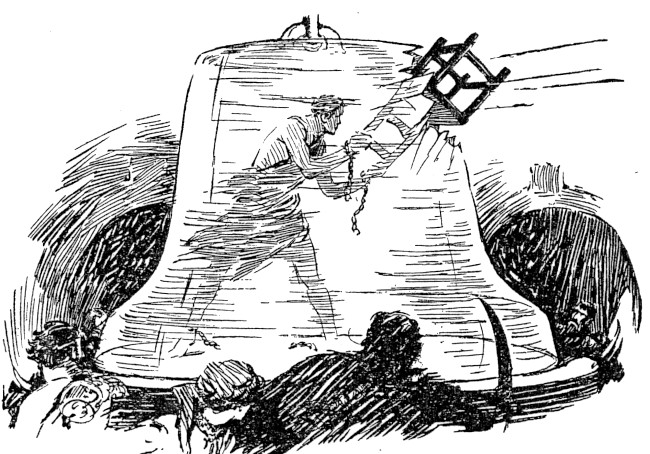
There was a crash and a hollow report like the crack of a tork as the air surged inward.
The guard stood ready to receive him with drawn scarbo as Grandon leaped out. Swinging the iron chair, he crushed the man's skull like an eggshell, and his scarbo clattered to the floor. The other guard, rushing to the assistance of his companion, met a similar fate.
Destho was dragging Vernia from the room. Bopo still faced Grandon, scarbo in hand. He hurled the chair, which caught the surprised captain amidships. Grandon picked up the scimitar-bladed scarbo of the guard and ran forward to intercept Destho.
With Grandon's blade threatening him, the usurper was forced to release Vernia and draw his weapon. The man was no mean swordsman and, for a time, the outcome was uncertain.
The Earth-man fought in a blind, fury. Gradually, however, his brain cleared and his stroke became more certain. He forced his antagonist to the wall and, with a dexterous twist, sent his scarbo clattering to a far corner.
A look of alarm shone in the eyes of the amazed Reabonian prince.
"Would you kill an unarmed man?" Destho wailed.
"Surrender or—"
Before Grandon could finish the sentence the wily Destho dodged under his arm and ran through the door, calling loudly for help.
Grandon started after him—then paused hopelessly.
"Come," he said, taking Vernia's hand. "The coward will have a swarm of soldiers here in a few moments. We must try to find a hiding place."
They sped down the dim passageway, hand in hand. Ahead of them they heard footsteps and the clank of arms. A doorway on their left offered temporary haven, and into this they darted. Grandon held the door slightly ajar and watched. In a moment a dozen of the castle guards rushed past, followed by Destho.
"Now," he whispered. "We must go quietly."
Again they darted along the passageway until they arrived at the spiral stair. They had barely ascended to the ground level when a guard appeared. Grandon ran him through the throat, but not before he let out a shriek that brought a score of his comrades running.
There was nothing for it but to climb the stairway, and this they did, only to be spied by the foremost guard. He dashed after them, calling his companions to follow, and paid for his temerity with a split skull when he came up with them at the fourth level. His comrades, finding his body a moment later, set up an angry shout and redoubled their speed.
Before they reached the seventh level, Grandon was forced to turn and engage the foremost guard. The man proved a poor swordsman, and a quick thrust through the heart sent him back on his fellows, momentarily impeding their progress.
Taking advantage of this opportunity, Grandon turned and again fled up the stairs with Vernia. They passed the eighth level before noticing that they were in a narrow tower overlooking the sloping roof. The tenth level was the last, and Grandon thrust Vernia into the tower room before turning to face their pursuers. They were fairly trapped.
The first foeman, a huge coarse-featured giant, felt the weight of Grandon's steel and toppled back with a groan. Another leaped over his body and took his place, only to go down before the bewildering sword-play of the Earth-man. Then they tried rushing him, two at a time, but as two men could not wield their scarbos simultaneously in the narrow passage, they quickly shared the fate of the others.
They were brave men, these Reabonian guardsmen, and though it appeared that sure death awaited each of them at the head of the stairs, each man came forward in his turn until the stairway was choked with bodies and slippery with gore.
When they could no longer mount over their fallen comrades, they withdrew a little way and Grandon judged from the murmur of their voices that they were formulating a new plan of attack. He took advantage of the lull in the fighting to strip a tork and belt from the nearest man. Then he lay down at the head of the stair with tork leveled and waited.
Suddenly he heard a familiar whining sound, followed by a terrific explosion that shook the floor. A mattork projectile! Could it be that they were shelling the tower? There followed another and another in quick succession—then a continuous roar, as though a hundred mattork-cannon had gone into action.
Vernia called excitedly from the tower room.
"An army approaches through the forest. I can see their uniforms through the trees and they look like Fighting Traveks. Ah, they are Fighting Traveks! A company of them is charging through the camp while their mattorks shell the castle. A small band of men in Albine armor fight with them in the front ranks. Destho's troops were momentarily thrown into confusion, but now they are rallying! Oh, they will kill all the Traveks, for they outnumber them ten to one."
"Can you see who leads the Traveks?" asked Grandon, not daring to leave his post.
"He is a big man with a gray beard. He towers above his men, urging them on to battle with a voice that roars deep and strong!"
"Bordeen!" exclaimed Grandon. So the doughty commander had disobeyed orders and led his pitifully small army in a hopeless attempt to rescue their sovereign. Evidently Oro and his twenty marsh-men fought with them.
"The army of Destho has rallied," continued Vernia. "They are closing in on the Traveks from two sides. They are butchering them—it is terrible. Now the Traveks are retreating. They are cutting their way back to their comrades, but already half of their number has fallen. Now a new company charges to their rescue while the mattorks sweep the lines on both sides of them. The survivors have succeeded in reaching their comrades, but the army of Destho is surrounding them."
"The fools—the utter fools," moaned Grandon. He was angry with Bordeen for having made this hopeless attempt at rescue, yet the loyalty of his fierce mountaineer subjects thrilled him.
Again Vernia cried out in amazement.
"A new army approaches from the south. The camp is deserted on that side, all having gone to surround the Traveks on the north. A host of warriors in Albine armor is charging across the clearing. The army of Destho is rushing back to engage them and the men on the walls shower bullets on them without effect. They have clashed with Destho's men and cut them down like reeds. Not a single warrior in brown armor has fallen. Now the men on the wall are training mattorks on them. The mattork projectiles tear great holes in their ranks, yet they forge steadily onward. I can see their banners now. They are inscribed with the word 'Granterra!'"
"It must be Joto," said Grandon. "Yet how could he have learned of our presence here?"
"It is Joto," cried Vernia, joyously. "He is fighting in the front ranks with his visor raised, cheering his men between blows and laughing as he fights."
"There is not another leader like him," said Grandon with a warm thrill of pride.
"Now the Traveks have rallied. They are shelling the batteries on the walls. Once more they are cutting their way through the army of Destho."
"Would that I could help them!" cried Grandon.
"More warriors in brown armor are approaching," continued Vernia. "They are accompanied by an army of sabits. The men have mounted on the backs of the sabits and are charging the castle. The sabits are carrying them up and over the walls which they could not have scaled unaided. They are swarming everywhere. The sabits crush the defenders in their forceps and the mounted men cut them down with their swords. Now the walls and the courtyard have been cleared of defenders! The gate has been thrown open and they are storming the castle itself, the Traveks fighting side by side with the armored warriors."
Grandon was so engrossed in Vernia's description of the battle that he momentarily relaxed his vigil. He nearly paid for his carelessness with his life, for a tork bullet sang uncomfortably close to his ear, and a new company of guardsmen charged up the stairs. As he quickly returned the fire he heard a voice—the voice of Destho—on the level below.
"Remember. Ten thousand aires of choice land to the man who slays him, but harm not the woman."
"Go back, fools," shouted Grandon. "Dead men have no use for land."
But neither his threat nor his bullets could stay them. The men who surged up the steps fired their torks as they came and carried long-bladed spears. He was compelled to retreat to the tower room where he found momentary safety by barring the steel door.
There was a shout of baffled rage, and a rain of blows sounded on the door.
"It will hold them off for awhile—a very short while, I fear," said Grandon.
He was startled by a scream from Vernia. Turning, he beheld the ugly head of a red-mouthed sabit, peering in at the window. Behind it appeared the spiny crest of an Albine-armored warrior. Both squeezed through the narrow window and the warrior threw back his visor.
"Tholto!" exclaimed Grandon and Vernia simultaneously.
Leaping from his savage mount, the marsh-man prostrated himself before them, right hand extended palm downward.
"Tholto, your slave," he said simply.
Grandon, noting that the steel door was sagging from the terrific blows of those without, leaped forward with scarbo ready. Tholto followed, drawing his sword, and, as he did so, speaking a few words to the sabit in the tone language. The creature responded by vibrating its antennæ and took a place between them, directly in front of the door, where it waited expectantly with its head cocked to one side, much as a terrier waits for the leap of a cornered rat.
The door fell inward with a rending crash, and a shout of triumph went up from the attackers. Then the sabit leaped, snapping to right and left with its powerful forceps and sheering a man in twain with each snap. With Grandon swinging his scarbo on one side and Tholto his sharp Albine sword on the other, the landing was cleared in a twinkling.
The blood-thirsty sabit plowed on down the stairway, and the death shrieks of the fleeing guards were terrible to hear as it caught up with them one by one.
Grandon searched for Destho among the corpses that littered the landing, but he was not among them. Evidently he had escaped or was numbered among the sabit's victims, whose shrieks still sounded from below at intermittent intervals.
A ringing cheer floated up from the courtyard, and Grandon looked down from the tower window. Far below him he saw a straggling line of Destho's soldiers filing out from the castle, weaponless, and with their hands held out before them in token of submission. A detachment of Traveks escorted them on one side, while a company of the brown-armored soldiers of Granterra marched on the other.
"The castle has fallen," said Grandon. "Let us descend."
They picked their way down the blood-soaked steps while Tholto ran ahead, calling his ferocious steed in the tone language of the sabits. The mangled bodies that strewed the entire stairway mutely attested the terrible efficiency of the fighting monster.
Upon reaching the ground level they made their way toward the audience chamber, whence came the unmistakable sounds of heated argument.
Shouts of "Kill the traitor!" and "Behead the assassin!" were distinguishable above the clamor.
"Oh, what are they doing?" cried Vernia. "Let us hurry."
When they entered the audience chamber they found it jammed with a crowd of Fighting Traveks and Granterrites, mingled indiscriminately. As they weaved their swords and scarbos aloft, Destho, the object of their hatred, stood trembling with fright before the throne in the grip of two brawny Traveks. Bordeen, on one side, and Joto on the other, were attempting to quiet the angry mob.
"Wait, fools," roared Bordeen. "He has not told us where we may find Grandon of Terra and the princess. A dead man discloses no secrets."
"Torture him!" shouted a brawny Travek.
"The secret is out," cried Joto, "for Grandon of Terra approaches, and with him is the princess!"
At sight of Grandon and his fair companion the assembled fighting men sent up a shout that dwarfed their previous clamor to insignificance. A path was speedily cleared for the pair as they made their way toward the throne. Bordeen and Joto rushed forward to greet them, followed by Oro, Rotha and Tholto.
"I thought the Hahoe of Reabon had killed you," said Bordeen huskily, tears of joy gleaming in his eyes. "We searched every dungeon and cell without a trace."
"A hahoe slays not a warrior so easily," said Joto, smiling broadly.
"The warrior was fairly cornered by the hahoes when you came so gallantly to the rescue," responded Grandon. "How did you learn of our plight and how could you bring such a large army here without imperiling your people? The sabits may attack them during your absence."
"It was Tholto told us of the plight of the princess," said Joto. "We did not know that you had come here on the same mission as our own until informed by the Traveks. Tholto traveled unarmed and alone through the forests and the great salt marsh. There he built himself a crude raft with which he navigated the underground river. I came near beheading him before he convinced me that he was telling the truth. As for the safety of our people, there is no more danger in the Valley of the Sabits. Every sabit community has been subjugated and man rules supreme. We lead indolent lives in Granterra, for our sabit slaves work for us, hunt for us, and even fight for us. My only fear is that we may degenerate through inactivity."
"And you," said Grandon, turning to Bordeen. "How came you to disobey orders?"
The mighty commander flushed and stood for a moment at a loss for words.
"As soon as you had gone," Bordeen said, "I thought of the odds against you and realized that your quest was hopeless. I called all the captains in council and explained the situation. To a man they voted to come to your rescue. We felt that, though we might not be able to reach you, we might at least disconcert those within the castle sufficiently to give you an opportunity for escape."
"You did nobly," said Grandon, his voice shaking with emotion, "yet my heart bleeds for the gallant soldiers who have sacrificed their lives to-day."
There was a sudden outcry from the direction of the throne. The wily Destho, taking advantage of the fact that all eyes were riveted on Grandon and Vernia, had broken from his guards and bolted for the door.
A dozen soldiers ran to intercept him, but to no purpose. He ran down the hallway and disappeared from view around a corner.
Grandon, Bordeen and Tholto, in hot pursuit, were only a few seconds behind him, yet when they turned the corner no one was in sight. The hall was lined with doorways, and Grandon plunged into one while his comrades entered the others. He found himself in an empty room, lighted by a small window which stood open. Suddenly he heard the roar of a motor vehicle in the yard outside and ran to the window. He shouted a warning to the soldiers outside, but too late. The vehicle, gathering momentum with every revolution of its huge single wheel, shot through the gate and down the road before the astonished soldiers realized what it was all about. They sent a volley of tork bullets and curses after it as it disappeared around a curve in the road.
Calling his comrades, Grandon returned to where Vernia awaited them in the throne room.
"We must hurry to Reabon at once," he said. "Destho has escaped."
"Did he take the proclamation with him?" asked Vernia.
Bordeen spoke up.
"He could not have taken the proclamation with him," he said, "because we deprived him of all papers in his possession when he was made prisoner. I have them with me now."
He produced a bundle of papers which Grandon scanned eagerly. They were all letters from his spies and fellow conspirators. The proclamation was not among them.
"Your searchers must have over-looked it," said Grandon, "for it is not among these papers."
"That is possible, of course, but not probable," replied Bordeen. "He was searched thoroughly."
"Perhaps he disposed of it in some other way," suggested Joto.
"We may be able to find out from some of his officers, if any of them have been captured alive," said Grandon.
"Most of those left in the castle surrendered," Bordeen said. "Let us see what they have to say."
A dozen of them were produced forthwith and questioned. All declared that Destho had dispatched a messenger to the capital in a swift motor vehicle shortly before the attack by the Traveks. It was understood that the messenger was conveying an important document to Bonal, Prime Minister of Reabon.
"Copies will have been made and distributed broadcast through the empire by this time," said Bordeen. "What was the nature of the proclamation? No doubt it favored Destho in some way or he would not have rushed it to the capital."
Grandon ground his teeth.
"It favored Destho all right," he groaned, "for it made him Emperor of Reabon and the husband of Vernia."
Joto laid his arm across Grandon's shoulders.
"My friend," he said gravely, "be not so downcast, I beg of you. Your enemy has the proclamation, but you still have Vernia of Reabon, and an army that is all but invincible. Let us march to Reabon at once."
Grandon turned to Vernia.
"With your permission," he said.
A smile overspread her face as she calmly replied:
"I will go with you. Let us start at once."
It was a picturesque procession that started for Reabon shortly after midnight. Destho's two-score motor vehicles and a number of carts had been pressed into use. All were equipped with bright searchlights, fore and aft, that lighted the road and reflected brilliantly from the armor and weapons of the marching men.
Grandon rode in the lead with Bordeen and Joto, commanders of the two armies that had won a bloody victory only to have it turned to apparent defeat by the laws of the empire. Princess Vernia and Rotha followed in the car immediately behind them.
The Earth-man rode in moody silence, nor did his two companions interrupt his thoughts. Bordeen, rough warrior though he was, understood and was silent, while Joto had lost his customary smile.
As the motors were throttled down to conform to the speed of the marching men, their progress was quite slow. Morning found them a good half day's march from the capital.
Grandon was startled by a sudden cry from the driver. At the same time their vehicle came to a full stop, and shouts of wonder and alarm echoed from without.
Believing they had been attacked, he drew his scarbo, and leaped from the car. To his surprise he beheld a huge ball, more than fifty feet in diameter, blocking the road. Many of the soldiers as well as occupants of the other cars were running toward it.
"What is that thing?" he asked a young Travek.
"I do not know, your majesty," the man replied. "They who first saw it say it fell from the sky."
Grandon approached the globe and examined it curiously. It appeared to be constructed of a material similar to asbestos, held in place by a network of steel wires. Near the center of the side he faced was a circle of metal, apparently aluminum, studded with bolts. Suddenly the circle began to turn. A murmur of surprise went up from the watchers. The thing revolved quite slowly at first, gradually gaining momentum. Grandon noticed that with each revolution it projected farther from the sphere than before.
Vernia came up behind him, followed by Rotha.
"What is it?" she asked.
"I don't know," replied Grandon. "It may be some new implement of war. You had best go back in your car until we find out."
She complied quite meekly, he thought. He turned to the assembled soldiers.
"Back. Stand back," Grandon warned them. "This thing may explode and blow you all up."
After ordering men and vehicles back a distance of a hundred yards, he approached the thing alone. A screwlike cylinder now projected from the globe for more than five feet.
He could plainly see the threaded sides as it hung there, twenty-five feet above his head. Suddenly it fell forward with a loud click and hung suspended by a thick hinge, disclosing a dark hole. From this hole a ladder of flexible steel cable suddenly dropped, one end nearly touching the ground.
The figure of a man appeared in the opening, a figure incased from head to foot in a suit of rubber similar to that worn by deep sea divers. The headpiece was of metal with glass eyeholes, and a square box was fastened on the back like a knapsack.
Grandon was mystified. Everything about the sphere, from the craftsmanship of the metal cylinder to the diving suit, reminded him of Earth. Could this be a creature from his own planet?
The man above him appeared to survey him for a moment through the glass eyeholes—then turned and descended the swaying ladder. When he reached the ground he turned once more and looked at Grandon. Then he reached up and unscrewed the globular headpiece.
It was when he removed it that the Earth-man had a bigger surprise than at any time since his sojourn in Zarovia. He recognized the bulging forehead, the thick, shaggy brows, and the bearded features of the terrestrial scientist, Dr. Morgan!
The man of science advanced smiling, with his right hand extended and his helmet tucked under his left arm.
"How are you, my boy?" he asked cordially, in English. The familiar tongue sounded welcome in Robert Grandon's ears.
Grandon took the extended hand, and there was no doubt of its reality as the sinewy fingers gripped his.
"Dr. Morgan," he gasped. "How in blazes did you get here?"
A gleam of triumph shone in the eyes of the doctor.
"I have solved the problem of physical interplanetary navigation, and have come to keep my promise to take you back to Earth," he said. "Suppose we climb into that vehicle of yours and I'll tell you about it while we ride to Reabon."
"We'll have to get your sphere out of the way first," replied Grandon. "The road is blocked."
"Don't worry about that," answered the doctor. "Watch."
Even as he spoke the huge globe moved upward from its resting place and hovered a hundred feet above their heads.
"Ah. So you have a chauffeur for the thing."
"Positively not. I came alone."
"Then how—"
Grandon was interrupted by a cry from several of the men and saw that they were looking to the westward. Following the direction of their startled glances, he was surprised to behold a huge fleet of Olban airships bearing down on them. The ships were many times larger than the little one-man craft in which he had last seen Vorn Vangal, or even the two-man ship Grandon had used against the flying grampites; but these airships were constructed on the same general principles. Each airship had ten shining glass cabs and bristled with the burnished barrels of mattorks, projecting fore and aft, on both sides and below.
The formidable-looking fleet, traveling almost with the speed of mattork projectiles, came to a dead stop above them. Then one airship descended to the spot where the globe of Dr. Morgan had rested a moment before, and a set of aluminum stairs which had been telescoped on the deck was elongated and flung over the side, reaching to the ground.
Two men descended: The foremost was clad in scarlet apparel, trimmed with gold and glittering with precious jewels. His feet were incased in sandals of the softest frella hide, and he wore a turbanlike headpiece, also of scarlet ornamented with gold fringe, and set with an enormous glittering ruby that blazed from the middle of his forehead. His companion was more soberly garbed in purple trimmed with silver and also ornamented with jewels.
Grandon recognized the handsome, smooth-shaven youth in scarlet as Harry Thorne, the Martian whom Dr. Morgan had dispatched to Venus with Grandon. The man in purple was Vorn Vangal. At the same moment Thorne saw the doctor and ran forward, embracing him with a glad cry of recognition. He greeted Grandon with a warm hand-clasp.
It was not necessary to introduce Dr. Morgan and Vorn Vangal. The two men, each the greatest scientist of his planet and times, had communicated and projected their images across the trackless ether so many times that recognition was instantaneous.
"Where is this beautiful princess of yours, Grandon?" asked Dr. Morgan. "I am anxious to meet her."
"And I also," supplemented Thorne, "though there is a certain princess waiting for me back in Olba whose beauty I have not seen matched on three planets."
"I think," smiled Vorn Vangal, "you will find that opinions are quite likely to vary on such things as the beauty of a woman."
Grandon could not find the heart to reply to their good-natured badinage.
"What ails you, man?" asked Thorne. "You look as if Vangal here had just pronounced sentence of death on you."
"Buck up, my boy," said Dr. Morgan. "You haven't lost her yet."
"Haven't lost her?" Grandon almost snarled as he spoke. "Didn't she sign a marriage decree making Destho her husband and Emperor of Reabon?"
He led them to Vernia's vehicle. She received them graciously, with all the dignity and poise of a born princess.
"And now," said the doctor when the presentation was concluded, "where are Bordeen and Joto?"
"What do you know about Bordeen and Joto?" asked Grandon in surprise.
"You forget that I have been in telepathic rapport with you up to the moment I landed," replied the doctor. "I have broken rapport now because it is unnecessary."
They found Bordeen and Joto with several of the captains, examining the Olban airship, while members of the crew eyed them rather suspiciously from the deck above.
Introductions over, Harry Thorne invited them aboard.
"Ride with me to Reabon," he said. "We have every comfort and convenience and plenty of room for all."
He led them up the aluminum steps and along the deck to the foremost glass cab. Bordeen called down to his captains to resume the march, and the ship rose majestically as they entered the snug, glass-inclosed room, with its luxurious cushioned seats and thickly carpeted floor.
When all were seated a slave brought them steaming liquor in golden cups.
"And now that we are all assembled," said Harry Thorne, "I should like to ask Grandon why we are going to Reabon and what we are supposed to do when we get there."
Grandon drained his cup and handed it to a waiting servant.
"The Princess of Reabon has been compelled to sign away her fortune and her hand. Speaking for myself and my Fighting Traveks, we go as her escort, to do her bidding no matter what may arise. To me it is almost inconceivable that she will meekly submit to Destho, yet if that be her intention, neither I nor any of my men will raise a hand to stay her. If, on the other hand, she should, at the last moment, decide to free herself from Destho and regain her lost throne, we will be ready to fight for her to the last man."
"You have spoken for the warriors of Granterra and their commander as well," said Joto.
"And for the Imperial Air Patrol of Olba, if I and my men may be included," declared Harry Thorne.
"It seems," said the doctor smiling, "that the princess does not lack allies. As to whether she will call on any of you or not—who can say? A woman's mind—"
"Is past understanding for any mere man, on this-planet or another," interrupted Vorn Vangal. "However, I do not believe she will call on any of us for assistance. The princess has issued a proclamation. That proclamation, once signed, is binding alike on herself and her subjects. She might nullify any ordinary proclamation by issuing another, but in this case such a proceeding is quite impossible. She has named another to rule over her and her subjects. He, and he alone, can now nullify the proclamation."
"In that case," said Joto, "there might be ways of persuading him."
"A worthy suggestion, Joto," proceeded Bordeen, "but hardly practical. It is true that, allied as we are, we constitute considerable military power, but we cannot cope with the mighty armies of Reabon for any long period of time. They would wipe us out eventually by sheer force of numbers if in no other way. The army of Reabon is the largest and best equipped in all Zarovia, and her soldiers know not the meaning of fear. Should Vernia decide on a revolt against the new emperor we could undoubtedly get her out of the country alive, but we could scarcely reconquer her empire for her. A revolt against the emperor would make her a traitor and an outcast, and, under the existing constitution of Reabon, which has prevailed for ages, she could never hope to regain her throne and scepter. As I see it, the thing rests squarely with her. When we reach Reabon she must choose between freedom as an outcast from her country forever, or the half of her throne which the proclamation still allows her, and virtual slavery to her emperor."
"Vorn Vangal speaks the truth," said Bordeen slowly, "for well do I know the unchanging laws of Reabon and the regard in which they are held by every subject of the empire."
"In that case," said Dr. Morgan, "it seems that further discussion of the problem is futile. It rests with her majesty to choose, and with us to act only when she has made her decision."
"Quite right," agreed Thorne. "And now that the subject has been dispensed with for the present, doctor, suppose you tell us a few things I have been itching to find out ever since I received your telepathic summons to meet you here, through Vorn Vangal. You have had quite an advantage over Grandon and me, you know, being cognizant of our every moment since we left the Earth, while we know nothing of what you have done since we last saw you—not even how you managed to bridge the gap that divides Venus and the Earth."
"As we are nearing Reabon I will only touch on a few points that may be of interest to you," said the doctor. "Both of you will be surprised to know that the Zarovian men who exchanged bodies with you have committed suicide, destroying your earthly bodies by leaping from a precipice. I did not communicate the reason to you, but it will become apparent from what I am about to relate.
"The Olban prince whom you represent, Thorne, knew the secret of aërial navigation through amplifying the power of telekinesis. I persuaded him to share this secret with me in the interests of science, after pointing out the fact that we were on another world and that, in consequence, I could not possibly work evil against his country, which was the reason for his having been sworn to secrecy.
"Both this prince and Prince Thaddor knew something of the exploits of both of you on this planet. The former became despondent because of his betrayal of the Olban secret, while the latter grew insanely jealous of Grandon. They formed a suicide pact, and stole away together one moonlight night to carry it out. Their—or more exactly, your—mangled bodies were found the next morning at the foot of the cliff.
"As soon as I learned how to construct the mechanism which amplifies the power of telekinesis I set to work to improve and strengthen it until at last I had a mechanism capable of carrying me with the speed of thought when once freed from atmospheric friction. The mechanism complete, I constructed the spherical vehicle now floating above us, using steel and asbestos throughout and insulating against the cold of absolute zero through which I knew I must pass by using six vacuum spaces, one within the other, with walls of reënforced pressed cork between them. The screwlike door was similarly constructed with six vacuum spaces and when it was in place, completed an air-tight, water-tight sphere, impervious alike to extraordinarily high or low temperatures.
"My personal equipment consisted of an ordinary diver's suit and oxygen tank. The oxygen tank was necessary only at the beginning or end of a journey, for, once on the way, I had no need of it. This statement may seem strange to those of you who do not fully understand the powers of the subjective mind, but I will explain to the best of my ability." The doctor paused to allow them to assimilate these amazing facts, then resumed:
"You, Grandon, have undoubtedly read of men permitting themselves to be hypnotized and buried alive. Perhaps you thought such articles pure buncombe. They were, however, in most cases founded on facts. There was, for example, the case of the Fakir of Lahore who, after going into the cataleptic state, was buried alive in an air-tight vault for a period of six weeks. His nostrils and ears were first filled with wax; he was then placed in a linen bag, then in a wooden box which was securely locked, and the box was deposited in a brick vault which was carefully plastered up with mortar and sealed with the rajah's seal. A guard of British soldiers was detailed to watch the vault day and night. At the end of the prescribed period the vault was opened in the presence of Sir Claude Wade, the then British Resident at the court of Loodhiana, and of Runjeet Singh. The fakir was restored to consciousness.
"I mention this to illustrate rather than to prove my statements, for the fact that I am here is proof enough. In a state of complete catalepsy or suspended animation, man has no need for air, water or food. All bodily functions—breathing, digestion, assimilation, even circulation—are arrested. The brain itself, the organ of the objective mind, ceases to function. Only the subjective mind, the ego, the soul of man, which has assumed complete control of the body, remains active. It is conscious of what goes on about it, not through the use of physical organs, but by intuitive perception. Some people have named this power of intuitive perception clairvoyance or clairaudience. Wonderful as it is, we will not discuss it further here, as we are chiefly concerned with the more wonderful power of telekinesis.
"It is a well known fact that subjective powers become stronger as the cataleptic state is approached, and strongest when it is reached. You will thus see that, while I made the interplanetary trip in a state of suspended animation, my telepathic rapport with both of you was strengthened, my power of intuitive perception was abnormally strong, and my telekinetic powers, enhanced as they were by this factor and by that wonderful mechanism which the Olbans have invented, exceeded my wildest dreams. I was thus enabled to steer straight for the spot where I might find Grandon of Terra, and at the same time to guide the Olban fleet unerringly to the same place with the assistance of Vorn Vangal, who was employing the same powers in a slightly lesser degree.
"My vehicle is large enough and strong enough to house three men. In it are two extra diving suits. It is the fulfillment of my promise to you. In a few days I start my return journey to Earth. I will be happy to have either or both of you join me if you care to do so, though I fancy that Harry Thorne will not care to leave, and that Grandon's decision to go or stay will depend on what takes place in Reabon to-day. I assure you that the trip will be no more dangerous than the one we are now taking in this Olban airship. I do not ask for your decisions now. When I am ready to start I will let you know, and you will have until then to make up your minds."
"Mine is made up right now," said Thorne. "You couldn't drive me away from this planet with a pack of man-eating hahoes. There's a little girl back in Olba—"
"Tell us about her, old man, and some of your adventures," said Grandon.
They were interrupted by a call from the lookout. Thorne stepped out for a moment—then returned.
"My story will have to wait," he said, "for we have arrived in Reabon."
Grandon and his companions, peering over the rail of the airship, saw that they had indeed arrived at the capital. Immediately below them was the procession consisting of a string of vehicles and carts now led by the one carrying Vernia, and accompanied by the two small armies of Uxpo and Granterra, the latter with its strange, fierce sabit cavalry, the like of which had never been seen before in Reabon.
From their point of vantage they could see that the city walls were lined with spectators, as were both sides of the main thoroughfare leading to the palace. The gates were slowly lifted, their powerful motors humming sonorously, as the vehicle of the princess approached.
When it passed beneath the gates a mighty cheer went up from the assemblage and the colors of Vernia flashed out suddenly, waved by a hundred thousand hands. Then, as if in obedience to a single word of command, every man, woman and child in that vast multitude bowed low, with right hand extended palm downward.
The crowd that lined the broad avenue, soldiers and civilians alike, remained on bended knees until the vehicle of the princess passed them, then rose and waved her colors once more.
As the triumphal procession approached the palace gates the throngs rose, and the inmates, from the highest to the most lowly, did homage.
A golden palanquin carried by four kings greeted the vehicle as it arrived at the palace steps. Two slaves parted its scarlet curtains and Vernia stepped within, motioning Rotha to follow. The curtains fell back in place and the multitude rose and cheered vociferously as the palanquin with its imperial burden was carried through the palace doors.
The air fleet, which had been hovering above the palace grounds, slowly descended. As Grandon and his companions reached the foot of the aluminum stairs, one at a time, they were met by a palace guard who inquired their names and titles and assigned a slave to each man to conduct him to his quarters.
Grandon had been amazed by the size and beauty of the imperial palace as viewed from without, but even that marvelous sight did not prepare him for the glory and magnificence he beheld within. As he followed his guide, a beardless youth clad in the purple of nobility and evidently serving as a sort of page while learning the customs of the court, Grandon gazed in wonder and admiration at the rich decorations and furnishings. Even the corridors through which they passed were paved with blocks of agate and jasper, polished like glass and faultlessly fitted together, while the sides and ceiling were of alabaster inlaid with designs in pure gold and set with mural panels done in oil and rimmed with platinum, each one a priceless work of art.
At length they came before a door of highly polished wood of a reddish hue, studded with bolts of gold. On each side of this door stood a soldier attired in the brilliant raiment of the imperial guard and armed with tork, scarbo and broad-bladed spear.
Both bowed low with right hand extended palm downward, as Grandon came before them. Then one rose and flung the door wide and the other drew back a heavy scarlet curtain behind it.
Grandon entered, followed by the page. The curtain fell behind them and the door was softly closed. The room they were in had evidently belonged to a huntsman and warrior of no mean accomplishments. Its paneled walls were hung with weapons and trophies of the chase and battlefield, and skins of marmelots and ramphs, magnificent specimens, were flung on the floor. A ramph, carved from the red wood and supporting a round top of polished crystal formed a huge table in the center of the room.
Two chairs, one on each side of the table, were cut from the same red wood to represent kneeling giants holding the curved scarlet cushions that formed the seats and backs.
The room was lighted by two large windows that reached from floor to ceiling, and opened on a private balcony overlooking the palace garden.
Immediately adjoining this room, and separated only by an arched doorway with scarlet hangings, was another, even more luxuriously furnished and elaborately decorated. It was lighted, as was the first, by two enormous windows reaching from floor to ceiling. Between them was a massive sleeping shelf over which hung a scarlet canopy with a golden fringe at its edge. Two chairs, a table smaller than the first, and three huge chests or wardrobes completed its furnishings.
Grandon's guide led them directly through this room to a magnificent bath which formed the third and last unit of the suite.
The ablutions over, the page provided him with a suit of scarlet apparel from one of the huge wardrobes, and a slave brought a tray containing a pot of fresh-brewed kova and an endless variety of choice viands.
Grandon invited the page to participate in the feast, but he declined with thanks, saying it was not seemly that he should eat at the same table with royalty.
"You have been employed in the palace for sometime, have you not?" inquired Grandon.
"For nearly two years, your majesty."
"Ah. Then perhaps you can tell me who formerly occupied this suite. It must have been some one of consequence politically, as well as a mighty hunter and warrior."
The page looked at him in amazement.
"Can it be possible that you do not know whose rooms these were?" he exclaimed. "This is the private suite of Emperor Margo, the mightiest of all emperors of Reabon and sire of our beloved Princess Vernia."
Grandon was dumfounded. That he, a mere king of Uxpo, should be entertained in the imperial suite was amazing—incredible.
"Where is the new emperor named by the proclamation of the princess?" he asked. "Where is Prince Destho, and why has the suite not been turned over to him?"
"The Imperial Proclamation will not be read until high noon to-day. Prince Destho is in the palace in his own suite. I do not understand why this one should be turned over to him—it is for her majesty to say who shall occupy it, at least until after the reading of the proclamation."
There was a rap at the door and the page hastened to answer it. In a moment he admitted Bonal, Vernia's pompous prime minister. That portly individual bowed low with right hand extended palm downward, then stood stiffly erect and delivered his message.
"It is the command of her Imperial Majesty, Vernia, Princess of Reabon, that Grandon of Terra, King of Uxpo, attend her at once in the audience chamber."
Grandon followed the officer through a maze of corridors and passageways, then through an arched doorway between two guards who saluted stiffly as he passed, and found himself in the audience chamber.
The door through which he had entered was at the right of the throne—a door which royalty alone was privileged to use. He was escorted to a position among the scarlet-clad members of Reabonian royalty, from which he had an excellent view of the entire hall.
He could see Bordeen, Vorn Vangal and Dr. Morgan standing with the purple-clad nobles. As the doctor wore a purple uniform it was apparent that he had been created a noble of Reabon.
Below them in lines of the blue-clad commoners he could make out Oro and Rotha, and the uniforms of many Fighting Traveks as well as the glistening armor of the Granterrites. Across from him, clad in the scarlet of royalty, he saw Harry Thorne, Joto, and, somewhat apart from them, the triumphantly grinning Prince Destho.
The buzz of conversation ceased abruptly as the scarlet curtains that surrounded the throne slowly parted and slid majestically back to the wall in shimmering folds, announcing the coming of the Princess.
Then the massive doors at the end of the hall swung open and the imperial procession entered, headed by the four kings who bore the palanquin, and followed by Orthad, Supreme Commander of Reabon, who carried on a scarlet cushion the huge jeweled scarbo that was the scepter of Reabonian authority.
After him came a hundred members of the Imperial Guard with gorgeous uniforms and shining weapons, who ranged themselves in two straight lines reaching from the foot of the throne to the end of the hall.
Then, for the first time, Grandon saw how a ruler of Reabon mounted to the throne. As Vernia stepped from the palanquin her eyes swept the assemblage and paused for a moment as they found his. That they conveyed some unspoken message was apparent—a message of farewell, he thought, and his heart grew icy within him.
As the four kings prostrated themselves and she mounted the human steps and took her seat with graceful dignity, there flashed over him a feeling of utter despair. So this was the end—this his farewell and his reward.
Orthad presented the imperial scarbo which she took from the cushion and rested across the arms of the throne. Again her gaze swept the assemblage and her eyes rested for a moment on Grandon. If she would only give him some encouragement, some sign, before the reading of that accursed proclamation, he and his allies could sweep the rabble from the palace and grounds in a twinkling. With the aid of the Olban air fleet they could easily reach Uxpo and in a few months set up such defenses as would make it practically impregnable.
It became plainly apparent in a moment that Vernia had no intention of asking assistance, for she summoned Bonal, her prime minister, and ordered him to read the proclamation.
As Bonal faced the crowd and unrolled the document with an exaggerated flourish, Grandon looked across at Prince Destho, and noting the look of triumph in his dark eyes and the sneering grin on his sensuous lips, with difficulty restrained himself from leaping across that narrow space and throttling the man whose cunning had thwarted his hope of happiness forever.
The prime minister stepped to the edge of the dais and read:
"A Proclamation by Her Imperial Majesty, Vernia, Princess of Reabon.
"On the twenty-fourth day of the eighth Endir in the four thousand and tenth year of Thorth, I, Vernia of Reabon, hereby proclaim and declare to all my subjects throughout the length and breadth of the empire that I have taken for my husband, and raised to the office of emperor, to rule over me and my people, the brave and illustrious Grandon of Terra.
"It is my command that copies of this proclamation be made and distributed to all parts of the empire without delay, and that the fifth day of the ninth Endir be set aside as a day for feasting and suitable celebration my honor of this momentous event.
"Vernia, Princess of Reabon."
Grandon could scarcely believe the testimony of his ears when he heard his name pronounced. For him, the rest of the proclamation was a meaningless blur of words. A glance at Prince Destho showed that he was no less amazed, for his face paled, then took on a livid hue and an expression truly demoniac in character. His thick lips drew back in a snarl like that of a cornered hahoe, then twitched convulsively.
A ringing cheer broke from the throats of the vast multitude:
"Long life to Grandon of Terra, Emperor of Reabon!"
Not knowing what was expected of him, Grandon stood still until a young prince plucked at his elbow and whispered:
"Step before the throne."
He followed this sound advice and waited, stiffly erect, while Vernia descended and gave the imperial scarbo into his keeping.
"Mount to the throne," she bade him in a whisper, "and place the scarbo across the arms as you saw me—" Suddenly she paused with a scream of terror. "Look behind you—quickly!"
He whirled in time to see Destho, his face contorted with rage and his scarbo descending in a shimmering arc. There was no time to parry the blow, but Grandon leaped aside with catlike quickness, then caught the blade with the imperial scarbo, twirled it with a rapidity that the eyes of the astonished witnesses could not follow, and sent it clattering to the floor.
His weapon gone, the wily Destho turned and sprinted desperately for a side door. Soldiers ran to intercept him, but before he reached them a man attired in a bloody, tattered uniform leaped out from the ranks of the commoners and caught him by the beard.
"Thus should all traitors die!"
As the words rang clear above the tumult, a knife flashed aloft for a moment in the hand of the soldier, then plunged into the breast of Destho.
Grandon arrived on the scene in time to see the plotter lying on the floor with bloody froth issuing from his mouth and trickling down on his wiry beard. His assailant had fallen across his prostrate body, and Grandon, in surprise, recognized Zueppa. The wound inflicted on Zueppa by the man he had just slain had been reopened by his exertion. In a moment both were dead.
Four soldiers removed the bodies and order was restored with surprising celerity. Again Grandon moved to the foot of the throne where Vernia awaited him, wide-eyed and trembling. He took her hands in his for a moment, then she resolutely bade him proceed.
Upon his return the four kings had prostrated themselves on the steps leading to the throne in accordance with the customs of their ancestors. Grandon hesitated to mount those four human steps. He turned to Vernia.
"I am emperor now, am I not?"
"Assuredly, my lord."
"And my word is law?"
"So long as it does not conflict with the written constitution of Reabon."
"Is this matter of mounting to the throne on the backs of one's vassal kings written into the constitution?"
"No. It is traditional custom that has been observed for generations and signifies the complete submission of the heads of the various kingdoms."
"Then it shall be abolished. I expect loyalty from my subjects, but not abject servility."
Then, to the surprise of the four kings, he bade them rise and stand, each man on the step he occupied, two to the right and two to the left. Thus attended, Grandon mounted to the throne while the spectators looked on in amazement.
When he had taken his seat with quiet dignity and rested the scarbo across the arms of the throne, Vernia mounted and bowed before him with right hand extended palm downward—an example which was followed by the entire assemblage. It was indeed a day of surprise for the good people of Reabon, for no sooner had she knelt before him than he, in violation of an age-old custom which decreed that the empress should sit at the feet of her lord, swung the scarbo to one side and lifted her up beside him on the throne.
"You shouldn't have done this," she gasped. "It is not the custom. My place is—"
"Custom be hanged!" he responded, and there, in full view of that vast multitude, he kissed his bride full upon the lips.
The crowd responded with a resounding cheer.
"A long and happy reign to our brave emperor and his beautiful empress!"
Then the shimmering scarlet curtains crept around the throne, and Grandon forgot all else when two soft arms stole around his neck and the fluffy head of the most glorious woman of two planets nestled on his shoulder.
"I don't understand about the proclamation yet," he said, at length. "How and when did you manage to change it?"
"It was changed before I affixed my signature," she said, "else I should sooner have died than sign it. While Destho's attention was momentarily drawn to you I crossed out his name and substituted yours. I then allowed the scroll to roll half downward, as if by accident, and when he turned he saw that I was signing and, happily, never bothered to unroll it again!"
At a loss for suitable words to express his admiration and adoration, Grandon sought refuge in banality.
"You wonderful little woman," he said.
And the "wonderful little woman," being, after all, more of a woman than a princess—which was as it should be—flushed happily at his words of praise, and with eyes half veiled as though to hide the wondrous promise they revealed, tremulously surrendered her lips to her chosen lord.
At midnight, two weeks later, Grandon and Vernia stood on the roof of their palace watching the movement of a metal cylinder that was slowly screwing itself into place in a huge sphere of asbestos and steel.
Bordeen had left that day for Uxpo with the Fighting Traveks. Oro, Rotha, and Tholto had accompanied Joto and his Granterrites back to their people in the Valley of the Sabits, and Harry Thorne and Vorn Vangal had flown for Olba, as the former Martian was anxious to be with a certain beautiful princess who awaited him.
They had bidden Dr. Morgan good-by after helping him into his ponderous diving suit, had watched him clamber aboard, draw up the ladder and close the cylindrical door, and now waited to see his remarkable interplanetary vehicle begin its long journey back to Earth.
At length the cylinder clicked into place, and Grandon signaled two attendants, who flashed a powerful searchlight on the sphere.
Slowly it rose, rocking gently at first like a toy balloon on a flexible wand. Then, with a suddenness that was appalling, it shot swiftly skyward. The searchlight swung upward, groped about for a moment, making a flashing spot of light on the fleecy clouds, and then found its objective. In that incredibly short time the sphere had traveled so far as to have the diminutive appearance of an orange. A moment later it was but a tiny pin-point of white. Then it disappeared.
Grandon ordered the light shut off and turned to go, when Vernia laid her hand on his arm.
"Look," she said. "Your world and your moon."
He looked, and for a brief moment was vouchsafed the glorious spectacle of the Earth and her satellite, through a break in the clouds—the most brilliant and beautiful sight in the night-time heavens of Zarovia.
Then he turned to the infinitely more lovely vision beside him, and together they descended the stairs.
THE END.