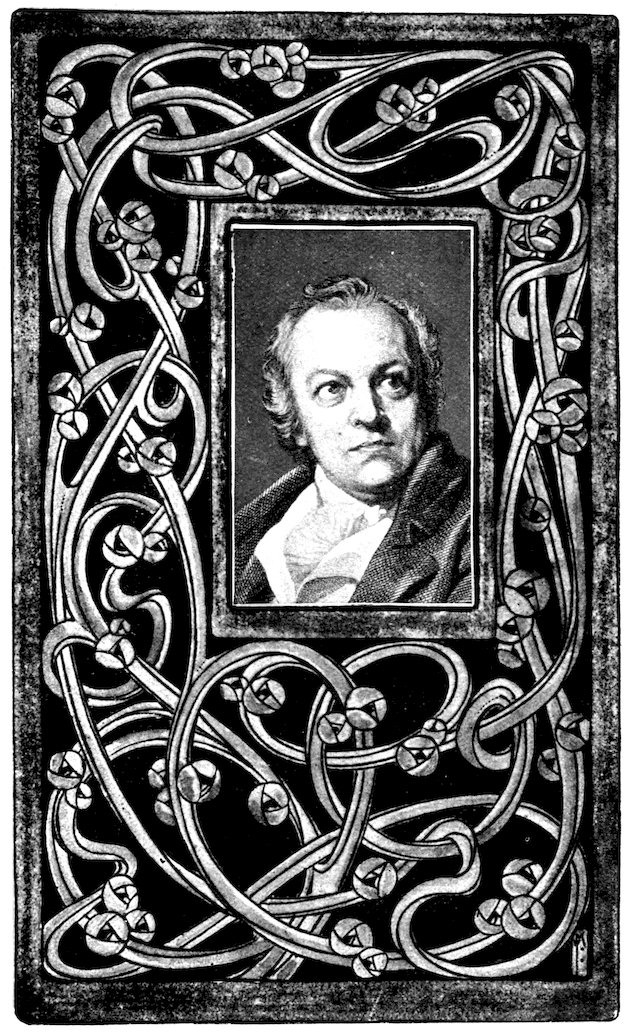
The Project Gutenberg eBook of Poems.

This eBook is for the use of anyone anywhere in the United States and most other parts of the world at no cost and with almost no restrictions whatsoever. You may copy it, give it away or re-use it under the terms of the Project Gutenberg License included with this eBook or online at www.gutenberg.org. If you are not located in the United States, you will have to check the laws of the country where you are located before using this eBook.

Title: Poems.

Selected with an introd. by Alice Meynell

Author: William Blake

Commentator: Alice Meynell


Release date: August 13, 2026 [eBook #79363]

Language: English

Original publication: London: Blackie, 1911

Other information and formats: www.gutenberg.org/ebooks/79363

Credits: Richard Tonsing and the Online Distributed Proofreading Team at https://www.pgdp.net (This file was produced from images generously made available by The Internet Archive)

*** START OF THE PROJECT GUTENBERG EBOOK POEMS. ***

Transcriber’s Note:

New original cover art included with this eBook is granted to the public domain.

Red Letter Library

POEMS BY
WILLIAM BLAKE
First printed, September, 1911
William Blake

POEMS

BY
WILLIAM
BLAKE
SELECTED WITH
AN INTRODUCTION BY
ALICE MEYNELL
BLACKIE AND SON LD LONDON

iii“I amused myself this spring”, writes Henry Crabb Robinson in 1810, “by writing an account of the insane poet, painter, and engraver, Blake.” To-day a man of letters who should roundly call Blake a madman would be thought to have cast away his literary reputation. Not for this, however, should such a one be condemned, but for having thus “amused himself”. Blake’s intellect did, terribly and portentously, overpass the limits of normal sanity; but we must watch its distractions gravely, with a serious thought askance upon our arbitrary or merely habitual definitions of normal sanity—our delimitations which serve well enough for every day, but which we might distrust in the case of Blake’s day, a day more than naturally luminous with a more than natural sun. It is a grave question for Blake, but a graver one for humanity, this question whether Blake was sane. Nor is it possible to solve it, for we have at the outset a difficulty of which his readers never can and never will be quit: I mean the difficulty of his terms. His vocabulary has never ivbeen interpreted for us—there is no interpreter. Or, to speak more precisely, there are many “interpreters”, but there is no translator. There is no one to authorize its equivalent in the speech of other Englishmen. When Blake tells us of his great friendship with an Angel who had become a Devil, or promises us an infernal Bible if we will deserve it, and again tells us he has “the Bible of Hell which the world shall have whether they will or no”, he uses substantives for which no man has a key. When, on the other hand, he says that the Prophets Isaiah and Ezekiel dined with him, we have the terms definite enough, but are little the wiser.

Blake’s genius, in fact, is entangled with his insanity. A sign and proof of the purity and singleness of that genius is precisely that it is entangled with his high insanity, and with nothing else: with none of the adulterations wherewith other men of name have mingled their fancy. No slight or suspicion is cast upon the poetry of Blake by those who have to confess that he was, in unknown measure, at undated times, in transcendent moods, a madman; but who have not to confess that he was a man of the world, a secondary man, a waiter upon literary fashions, a weakling trusting to the strength of numbers vof a literary company, a wearer of other men’s passions, or so much as capable of an insincerity. All these have been characters of poets who did not believe that they saw Ezekiel sitting in a field, and of painters who never thought St. Joseph had taught them how to dilute glue for water-colour drawing.

All “interpreters” of Blake—and they have been many, and most eager, most able—are constrained to make their own use of his terms, and therefore in some measure to think for Blake instead of fulfilling the harder duty of suffering Blake to think for them.

As a philosopher, therefore—and Blake seems to be much more important as a philosopher than as the “poet, painter, and engraver” of Crabb Robinson’s phrase—he seized the scheme of “things entire”, not, like the intellectual sensualist, to make the days of mortality more pleasant, but to invert, to shatter, to re-conceive. (“Seems to be”, I have written, because it is not for any mind, seeking to reflect his, to do more than conjecture.) Blake recast the whole of morality, he laid his hand upon the very inner and innermost sacred centre of right and wrong—with what more than Satanic purpose, or to what more than archangelic viend? We know not, who know not what he meant when he wrote “evil”, nor what he meant when he wrote “good.” We need not be among those who have pressed their conjectures so urgently upon the reader. Are they sincere—and, if so, is their sincerity valuable—who proclaim themselves convinced students, thorough approvers, deliberate defenders, of Blake’s theism and Blake’s ethics? Can there be convinced study, or thorough discipleship, or deliberate defence? The only man who took Blake’s theology with a seriousness worthy of Blake, and the only man who took Blake’s terms with a sureness worthy of Blake and of the English language, was the honest, loving, and admiring man, Tatham—who burnt a great mass of manuscripts of Blake’s revelations. His act seems—is—horrible; but we can imagine Blake striking a hand into his hand rather than into that of any later man who has praised him. One thing may be added in connexion with the poetry and the philosophy of Blake. His greatest admirers are apt to guard themselves, to parry the most difficult questions of the simple, by averring that his speculative thought was “nebulous”. Now, however little or however much we may attain to comprehend of that speculative thought, one fact insists upon itself, asserts itself, through all viiour doubts, and this fact is the absolute definition, distinctness, and certainty of Blake’s sight, insight, thought, and speculation. No hesitation ever shakes that loud, emphatic voice, claiming, proclaiming, announcing.

The magic of Blake’s lyrical poems is greater than that of his prophetical books. It is perceptible to every reader and definable by no critic. What we cannot define, however, we may in part describe. And one important description of his lovely song presents it as walking (as, according to Victor Hugo, the beloved woman walks, to a man’s vision) in light. The sun that he saw when he looked not with, but through, the eye lights the landscape, the rivers, the forests of his dreams, the babes and angels of his vision. Not only through the eye did he see, but through the sun also. Not without pain do we learn that he hated and contemned the Nature he thus transcended.

Light, then, is Blake’s divine character, and next to light, simplicity. With him this latter all-precious quality is a positive thing, and no mere negation. When other poets have attempted it—poets neither mean nor foolish, but too ambitious in aspiring to this humble thing—we protest that simplicity cannot stand alone, and that to attain to mere simplicity, without an implicit, or excluded, viiinumerous company of qualities, is to share the distinction of the village idiot. But of Blake’s simplicity the one indescribable companion is genius; we need give it no multitudinous names. “The Tiger” is a Sunday-school poem for children, and it is in the crown of English literature. Nor is there any kind of paradox in this union of lowly use and high renown.

With regard to the choice of poems for the present collection, it may be added that care has been given to make it generally representative, so that the reader need not expect to find every lyric intelligible. The dramatic poem, and a few with it, are the work of Blake’s boyhood and early youth—“the production”, he says, “of untutored youth”; but we might rather call it “tutored youth”. It was his manhood that was untutored and went alone. These early poems prove the usual reading of a boy. That Blake was well read in Swedenborg (whom he first followed and then renounced), Boehm, Paracelsus, and a few more mystics, is the only sign of “literature” to be found in what is more properly the work of his life.

William Blake was born in London in 1757, the year for which Swedenborg had foretold the beginning of the new age of thought and vision. To this coincidence an ixinfluence of suggestion has been assigned; but Blake’s first vision was given to him when he was four years old, and obviously unaware of Swedenborg: “God put his forehead to the window”. Somewhat later he came, in Peckham Rye, upon a tree full of angels. And when he told his mother that he had seen Ezekiel sitting in a field, he was chastised for untruthfulness. He was not sent to school, chiefly because he would not brook rough handling; and in the leisure of home life his reading in the mystics began betimes. His father, a shopkeeper in Broad Street, Golden Square, was so well and liberally inspired as to send William to art studies. He worked for a few years at a drawing-school, and then for two years with a good engraver, Basire. Next came a course of drawing from the monuments and architectural detail of Westminster Abbey. Here he learnt to love Gothic, and here he had a vision of the Apostles. While still young he had the friendship of Fuseli and Flaxman, and underwent the grief of a first love despised. She who rejected him, and she who consoled him with her pity and whom, when he was twenty-five years of age, he married, are the only women who had any part in his life. Catherine Boucher, his wife, is believed to have been, at her xmarriage, entirely illiterate. But she learnt to copy his writings, to help him in engraving, to see visions with him, and to be in all ways his efficient and invaluable companion. They had no children. Blake’s visions had been withdrawn for twenty years when they were granted again, and his career as “prophet” and mystical poet began. His brother Robert, whom he had nursed in a last illness, and whose spirit he saw at the moment of death “clapping his hands for joy”, visited him from Heaven, and taught him how to engrave his poems and to print the wonderfully beautiful decorations of the page. “The Songs of Innocence” appeared in 1789, followed by “The Book of Thel”, “The Marriage of Heaven and Hell”, “The Vision of the Daughters of Albion”, “America”, “Europe”, “Gates of Paradise”, “The Book of Urizen”, “The Songs of Experience”, “The Song of Los”, “Abania”, “Jerusalem”, “Milton”, and “Vala”. This brings us well into the nineteenth century. By the kindness of his friend Hayley, Blake and his wife had taken possession, in 1800, of a cottage at Felpham, in Sussex, to which he was welcomed by angelic visions, but in which he spent “the darkest years that ever mortal suffered”. The incident of a scuffle with a soldier which befell there would not xibe worth mentioning but that Blake took it as a symbol: the soldier was Adam, for Blake turned him out of his Felpham garden. But for this country interlude Blake lived his life in London, and walked in suburban fields. His last poem was “The Ghost of Abel”, a fragment. Thenceforward he devoted himself to design. A publisher named Cromek commissioned him to illustrate Blair’s “Grave”; and out of a subsequent enterprise, “The Canterbury Pilgrims”, rose one of Blake’s numerous quarrels. He was a most quarrelsome man. A saint (and Blake’s experiences of ecstasy and contest resemble those of innumerable saints) would suspect all Blake’s spiritual history to be evil, delusive, and infernal because of the unchastened violence of his passion of anger. For the saint does not enter upon the mystical life except by the hard and humble way of long and unrelaxing self-conquest.

Of his wonderful pictorial works we need not here make a list, nor do his immoderate revilings of the painters whose works or persons displeased him concern the present purpose.

Blake died at the age of seventy. “On the day of his death”, writes one who reported Catherine Blake’s narrative, “he xiicomposed songs to his Maker, so sweetly to the ear of Catherine that, when she stood to hear him, he, looking upon her most affectionately, said, ‘My beloved, they are not mine. No! they are not mine!’ He expressed himself happy, hoping for salvation through Jesus Christ.... He burst out into singing of the things he saw in Heaven.” “He made the rafters ring,” says the Irvingite minister Tatham, he who burnt a hundred volumes of his works. It should be added that Blake had thought of burning these manuscripts with his own hand.

We must not close with the light of fire and burning. It was another light that Blake kindled in England. The light of our great poetry, that was clear and white in the sixteenth century, golden and ripe in the seventeenth, extinct in the chief part of the eighteenth, rose again upon the cloud and peak of Blake, before it made the valley, also, illustrious with Wordsworth.

ALICE MEYNELL.
xiii

Contents

Section I
Page
To Spring 3
To Summer 5
To Autumn 7
To Winter 9
To the Evening Star 11
To Morning 12
Song 13
Song 14
Song 15
Mad Song 16
Song 18
To the Muses 20
Blind-Man’s Buff 21
King Edward the Third 24
   
Section II
Songs of Innocence
Introduction 69
The Shepherd 70
The Echoing Green 71
xivThe Lamb 73
The Little Black Boy 74
The Happy Blossom 76
The Chimney Sweeper 77
The Little Boy Lost 79
The Little Boy Found 80
Laughing Song 81
A Cradle Song 82
The Divine Image 84
Holy Thursday 85
Night 86
Spring 88
Nurse’s Song 90
Infant Joy 91
A Dream 92
Another’s Sorrow 93
   
Section III
Songs of Experience
Introduction 97
The Clod and the Pebble 98
Holy Thursday 99
The Little Girl Lost 100
The Little Girl Found 103
Nurse’s Song 106
The Sick Rose 107
The Fly 108
xvThe Angel 109
The Tiger 110
My Rose Tree 112
The Sunflower 113
The Lily 114
London 115
The Human Abstract 116
Infant Sorrow 118
Wrath 119
A Divine Image 120
A Cradle Song 121
The Schoolboy 122
To Tirzah 124
The Voice of the Ancient Bard 125
   
Section IV
Daybreak 129
The Wild Flower’s Song 130
The Birds 131
The Land of Dreams 133
To Mr. Butts 135
To Mrs. Butts 138
To My Dear Friend, Mrs. Anna Flaxman 139
The Keys of the Gates of Paradise 141
Night and Day 143
Auguries of Innocence 144
xviThe Two Songs 149
The Throne of Mammon 150
The World 152
Smile and Frown 153
My Spectre 154
The Defiled Sanctuary 157
Barren Blossom 158
Opportunity 159
Love’s Secret 160
Fragment for “Jerusalem” 161
Cupid 163
The Golden Net 164
The Cabinet 166
William Bond 168
Los 171
Dedication of the Designs to Blair’s “Grave” 175
For a Picture of the Last Judgment 177
Scoffers 178
Fragments and Epigrams 179
   
Section V.—Extracts from the Prophetical Books
From “Jerusalem” 183
Tiriel 189
The Book of Thel 216
1

Section I

3

To Spring

O thou with dewy locks, who lookest down
Through the clear windows of the morning, turn
Thine angel eyes upon our western isle,
Which in full choir hails thy approach, O Spring!
The hills tell each other, and the listening
Valleys hear; all our longing eyes are turned
Up to thy bright pavilions: issue forth,
And let thy holy feet visit our clime!
Come o’er the eastern hills, and let our winds
Kiss thy perfumed garments; let us taste
Thy morn and evening breath; scatter thy pearls
Upon our lovesick land that mourns for thee.
4O deck her forth with thy fair fingers; pour
Thy soft kisses on her bosom; and put
Thy golden crown upon her languished head,
Whose modest tresses were bound up for thee!
5

To Summer

O thou who passest through our valleys in
Thy strength, curb thy fierce steeds, allay the heat
That flames from their large nostrils! Thou, O Summer,
Oft pitchedst here thy golden tent, and oft
Beneath our oaks hast slept, while we beheld
With joy thy ruddy limbs and flourishing hair.
Beneath our thickest shades we oft have heard
Thy voice, when Noon upon his fervid car
Rode o’er the deep of heaven. Beside our springs
Sit down, and in our mossy valleys, on
Some bank beside a river clear, throw thy
Silk draperies off, and rush into the stream!
Our valleys love the Summer in his pride.
6Our bards are famed who strike the silver wire:
Our youth are bolder than the southern swains,
Our maidens fairer in the sprightly dance.
We lack not songs, nor instruments of joy,
Nor echoes sweet, nor waters clear as heaven,
Nor laurel wreaths against the sultry heat.
7

To Autumn

O Autumn, laden with fruit, and stained
With the blood of the grape, pass not, but sit
Beneath my shady roof; there thou mayst rest,
And tune thy jolly voice to my fresh pipe,
And all the daughters of the year shall dance!
Sing now the lusty song of fruits and flowers.
“The narrow bud opens her beauties to
The sun, and love runs in her thrilling veins;
Blossoms hang round the brows of Morning, and
Flourish down the bright cheek of modest Eve,
Till clustering Summer breaks forth into singing,
And feathered clouds strew flowers round her head.
8“The Spirits of the Air live on the smells
Of fruit; and Joy, with pinions light, roves round
The gardens, or sits singing in the trees.”
Thus sang the jolly Autumn as he sat;
Then rose, girded himself, and o’er the bleak
Hills fled from our sight; but left his golden load.
9

To Winter

O Winter! bar thine adamantine doors:
The North is thine; there hast thou built thy dark
Deep-founded habitation. Shake not thy roofs,
Nor bend thy pillars with thine iron car.
He hears me not, but o’er the yawning deep
Rides heavy; his storms are unchained, sheathed
In ribbed steel; I dare not lift mine eyes;
For he hath reared his sceptre o’er the world.
Lo! now the direful monster, whose skin clings
To his strong bones, strides o’er the groaning rocks:
He withers all in silence, and in his hand
Unclothes the earth, and freezes up frail life.
10He takes his seat upon the cliffs,—the mariner
Cries in vain. Poor little wretch, that deal’st
With storms!—till heaven smiles, and the monster
Is driv’n yelling to his caves beneath Mount Hecla.
11

To the Evening Star

Thou fair-haired Angel of the Evening,
Now, whilst the sun rests on the mountains, light
Thy bright torch of love: thy radiant crown
Put on, and smile upon our evening bed!
Smile on our loves; and, while thou drawest the
Blue curtains of the sky, scatter thy silver dew
On every flower that shuts its sweet eyes
In timely sleep. Let thy west wind sleep on
The lake; speak silence with thy glimmering eyes,
And wash the dusk with silver.—Soon, full soon,
Dost thou withdraw; then the wolf rages wide,
And the lion glares through the dun forest.
The fleeces of our flocks are covered with
Thy sacred dew: protect them with thine
influence!
12

To Morning

O holy virgin, clad in purest white,
Unlock heaven’s golden gates, and issue forth;
Awake the dawn that sleeps in heaven; let light
Rise from the chambers of the east, and bring
The honeyed dew that cometh on waking day.
O radiant Morning, salute the Sun,
Roused like a huntsman to the chase, and with
Thy buskined feet appear upon our hills.
13

Song

WRITTEN AT FOURTEEN
How sweet I roamed from field to field,
And tasted all the summer’s pride,
Till I the Prince of Love beheld
Who in the sunny beams did glide.
He showed me lilies for my hair,
And blushing roses for my brow;
He led me through his gardens fair
Where all his golden pleasures grow.
With sweet May-dews my wings were wet,
And Phœbus fired my vocal rage;
He caught me in his silken net,
And shut me in his golden cage.
He loves to sit and hear me sing,
Then, laughing, sports and plays with me;
Then stretches out my golden wing,
And mocks my loss of liberty.
14

Song

Love and harmony combine,
And around our souls entwine,
While thy branches mix with mine,
And our roots together join.
Joys upon our branches sit,
Chirping loud and singing sweet;
Like gentle streams beneath our feet,
Innocence and virtue meet.
Thou the golden fruit dost bear,
I am clad in flowers fair;
Thy sweet boughs perfume the air,
And the turtle buildeth there.
There she sits and feeds her young;
Sweet I hear her mournful song;
And thy lovely leaves among
There is Love; I hear his tongue.
There his charming nest doth lay,
There he sleeps the night away;
There he sports along the day,
And doth among our branches play.
15

Song

Memory, hither come,
And tune your merry notes:
And, while upon the wind
Your music floats,
I’ll pore upon the stream
Where sighing lovers dream,
And fish for fancies as they pass
Within the watery glass.
I’ll drink of the clear stream,
And hear the linnet’s song,
And there I’ll lie and dream
The day along:
And, when night comes, I’ll go
To places fit for woe,
Walking along the darkened valley
With silent Melancholy.
16

Mad Song

The wild winds weep,
And the night is a-cold;
Come hither, Sleep,
And my griefs enfold!...
But lo! the morning peeps
Over the eastern steeps,
And the rustling birds of dawn
The earth do scorn.
Lo! to the vault
Of paved heaven,
With sorrow fraught,
My notes are driven;
They strike the ear of Night,
Make weep the eyes of Day;
They make mad the roaring winds,
And with tempests play.
Like a fiend in a cloud,
With howling woe
17After night I do crowd
And with night will go;
I turn my back to the east,
From whence comforts have increased;
For light doth seize my brain
With frantic pain.
18

Song

Fresh from the dewy hill, the merry Year
Smiles on my head, and mounts his flaming car:
Round my young brows the laurel wreathes a shade,
And rising glories beam around my head.
My feet are winged, while o’er the dewy lawn
I meet my maiden risen like the morn.
O bless those holy feet, like angel’s feet;
O bless those limbs, beaming with heavenly light!
Like as an angel glittering in the sky
In times of innocence and holy joy;
The joyful shepherd stops his grateful song
To hear the music of an angel’s tongue.
So, when she speaks, the voice of Heaven I hear;
So, when we walk, nothing impure comes near;
19Each field seems Eden, and each calm retreat;
Each village seems the haunt of holy feet.
But that sweet village where my black-eyed maid
Closes her eyes in sleep beneath night’s shade
Whene’er I enter, more than mortal fire
Burns in my soul, and does my song inspire.
20

To the Muses

Whether on Ida’s shady brow,
Or in the chambers of the East,
The chambers of the Sun, that now
From ancient melody have ceased;
Whether in heaven ye wander fair,
Or the green corners of the earth,
Or the blue regions of the air
Where the melodious winds have birth;
Whether on crystal rocks ye rove,
Beneath the bosom of the sea,
Wandering in many a coral grove;
Fair Nine, forsaking Poetry;
How have you left the ancient love
That bards of old enjoyed in you!
The languid strings do scarcely move,
The sound is forced, the notes are few!
21

Blind-Man’s Buff

When silver snow decks Susan’s clothes,
And jewel hangs at th’ shepherd’s nose,
The blushing bank is all my care,
With hearth so red, and walls so fair.
“Heap the sea-coal, come, heap it higher;
The oaken log lay on the fire.”
The well-washed stools, a circling row,
With lad and lass, how fair the show!
The merry can of nut-brown ale,
The laughing jest, the love-sick tale,—
Till, tired of chat, the game begins.
The lasses prick the lads with pins.
Roger from Dolly twitched the stool;
She, falling, kissed the ground, poor fool!
She blushed so red, with sidelong glance
At hobnail Dick, who grieved the chance.
But now for Blind-man’s Buff they call;
Of each incumbrance clear the hall.
Jenny her silken kerchief folds,
And blear-eyed Will the black lot holds.
22Now laughing stops, with “Silence, hush!”
And Peggy Pout gives Sam a push.
The Blind-man’s arms, extended wide,
Sam slips between:—“Oh, woe betide
Thee, clumsy Will!”—But tittering Kate
Is penned up in the corner strait!
And now Will’s eyes beheld the play;
He thought his face was t’other way.
“Now, Kitty, now! what chance hast thou?
Roger so near thee trips, I vow!”
She catches him—then Roger ties
His own head up—but not his eyes;
For through the slender cloth he sees,
And runs at Sam, who slips with ease
His clumsy hold; and, dodging round,
Sukey is tumbled on the ground.—
“See what it is to play unfair!
Where cheating is, there’s mischief there.”
But Roger still pursues the chase,—
“He sees! he sees!” cries softly Grace;
“O Roger, thou, unskilled in art,
Must, surer bound, go through thy part!”
Now Kitty, pert, repeats the rhymes,
And Roger turns him round three times.
Then pauses ere he starts. But Dick
Was mischief-bent upon a trick:
Down on his hands and knees he lay
Directly in the Blind-man’s way,
23Then cries out “Hem!”—Hodge heard, and ran
With hoodwinked chance—sure of his man;
But down he came.—Alas, how frail
Our best of hopes, how soon they fail!
With crimson drops he stains the ground;
Confusion startles all around.
Poor piteous Dick supports his head,
And fain would cure the hurt he made.
But Kitty hasted with a key,
And down his back they straight convey
The cold relief; the blood is stayed,
And Hodge again holds up his head.
Such are the fortunes of the game;
And those who play should stop the same
By wholesome laws, such as—All those
Who on the blinded man impose
Stand in his stead; as, long agone
When men were first a nation grown,
Lawless they lived, till wantonness
And liberty began to increase,
And one man lay in another’s way;
Then laws were made to keep fair play.
24

King Edward the Third

PERSONS

King Edward
Sir Thomas Dagworth
The Black Prince
Sir Walter Manny
Queen Philippa
Lord Audley
Duke of Clarence
Lord Percy
Sir John Chandos
Bishop
William, Dagworth’s man
Peter Blunt, a common soldier

SceneThe Coast of France

King Edward and Nobles before it
The Army
KING
O thou to whose fury the nations are
But as dust! maintain thy servant’s right.
Without thine aid, the twisted mail, and spear,
And forged helm, and shield of seven times beaten brass,
Are idle trophies of the vanquisher.
25When confusion rages, when the field is in a flame,
When the cries of blood tear horror from heaven,
And yelling Death runs up and down the ranks,
Let Liberty, the chartered right of Englishmen,
Won by our fathers in many a glorious field,
Enerve my soldiers; let Liberty
Blaze in each countenance, and fire the battle.
The enemy fight in chains, invisible chains, but heavy;
Their minds are fettered; then how can they be free?
While, like the mounting flame,
We spring to battle o’er the floods of death!
And these fair youths, the flower of England,
Venturing their lives in my most righteous cause,
Oh, sheathe their hearts with triple steel, that they
May emulate their fathers’ virtues!
And thou, my son, be strong; thou fightest for a crown
That death can never ravish from thy brow,
26A crown of glory—but from thy very dust
Shall beam a radiance, to fire the breasts
Of youth unborn! Our names are written equal
In Fame’s wide-trophied hall; ’tis ours to gild
The letters, and to make them shine with gold
That never tarnishes: whether Third Edward,
Or the Prince of Wales, or Montacute, or Mortimer,
Or ev’n the least by birth, shall gain the brightest fame,
Is in His hand to Whom all men are equal.
The world of men are like the numerous stars
That beam and twinkle in the depth of night,
Each clad in glory according to his sphere;
But we, that wander from our native seats
And beam forth lustre on a darkling world,
Grow large as we advance: and some, perhaps
The most obscure at home, that scarce were seen
To twinkle in their sphere, may so advance
That the astonished world, with upturned eyes,
27Regardless of the moon, and those that once were bright,
Stand only for to gaze upon their splendour.
[He here knights the Prince and other young Nobles
Now let us take a just revenge for those
Brave lords who fell beneath the bloody axe
At Paris. Thanks, noble Harcourt, for it was
By your advice we landed here in Brittany,
A country not yet sown with destruction,
And where the fiery whirlwind of swift war
Has not yet swept its desolating wing.—
Into three parties we divide by day,
And separate march, but join again at night:
Each knows his rank, and Heaven marshal all.      [Exeunt

SceneEnglish Court

Lionel, Duke of Clarence, Queen Philippa, Lords, Bishop, &c.
CLARENCE
My Lords, I have by the advice of her
Whom I am doubly bound to obey, my parent
And my sovereign, called you together.
28My task is great, my burden heavier
Than my unfledged years;
Yet with your kind assistance, Lords, I hope
England shall dwell in peace; that, while my father
Toils in his wars, and turns his eyes on this
His native shore, and sees Commerce fly round
With his white wings, and sees his golden London
And her silver Thames thronged with shining spires
And corded ships, her merchants buzzing round
Like summer bees, and all the golden cities
In his land overflowing with honey,
Glory may not be dimmed with clouds of care.
Say, Lords, should not our thoughts be first to Commerce?
My Lord Bishop, you would recommend us Agriculture?
BISHOP
Sweet Prince, the arts of peace are great,
And no less glorious than those of war,
Perhaps more glorious, in the philosophic
mind.
29When I sit at my home, a private man,
My thoughts are on my gardens and my fields,
How to employ the hand that lacketh bread.
If Industry is in my diocese,
Religion will flourish; each man’s heart
Is cultivated and will bring forth fruit:
This is my private duty and my pleasure.
But, as I sit in council with my prince,
My thoughts take in the general good of the whole,
And England is the land favoured by Commerce;
For Commerce, though the child of Agriculture,
Fosters his parent, who else must sweat and toil,
And gain but scanty fare. Then, my dear Lord,
Be England’s trade our care; and we as tradesmen,
Looking to the gain of this our native land.
CLARENCE
O my good Lord, true wisdom drops like honey
From your tongue, as from a worshipped oak!
30Forgive, my Lords, my talkative youth, that speaks
Not merely what my narrow observation has
Pick’d up, but what I have concluded from your lessons.
Now, by the Queen’s advice, I ask your leave
To dine to-morrow with the Mayor of London;
If I obtain your leave, I have another boon
To ask, which is the favour of your company.
I fear Lord Percy will not give me leave.
PERCY
Dear Sir, a prince should always keep his state,
And grant his favours with a sparing hand,
Or they are never rightly valued.
These are my thoughts: yet it were best to go:
But keep a proper dignity, for now
You represent the sacred person of
Your father; ’tis with princes as ’tis with the sun;
If not sometimes o’erclouded, we grow weary
Of his officious glory.
31CLARENCE
Then you will give me leave to shine sometimes,
My Lord?
LORD (aside)
Thou hast a gallant spirit, which I fear
Will be imposed on by the closer sort.
CLARENCE
Well, I’ll endeavour to take
Lord Percy’s advice; I have been used so much
To dignity that I’m sick on’t.
QUEEN PHILIPPA
Fie, fie, Lord Clarence! you proceed not to business,
But speak of your own pleasures.
I hope their lordships will excuse your giddiness.
CLARENCE
My Lords, the French have fitted out many
Small ships of war that, like to ravening wolves,
Infest our English seas, devouring all
Our burdened vessels, spoiling our naval flocks.
The merchants do complain, and beg our aid.
32PERCY
The merchants are rich enough;
Can they not help themselves?
BISHOP
They can, and may; but how to gain their will
Requires our countenance and help.
PERCY
When that they find they must, my Lord, they will:
Let them but suffer awhile, and you shall see
They will bestir themselves.
BISHOP
Lord Percy cannot mean that we should suffer
This disgrace. If so, we are not sovereigns
Of the sea,—our right, that Heaven gave
To England, when at the birth of Nature
She was seated in the deep; the Ocean ceased
His mighty roar, and, fawning, played around
Her snowy feet, and owned his awful Queen.
33Lord Percy, if the heart is sick, the head
Must be aggrieved; if but one member suffer,
The heart doth fail. You say, my Lord, the merchants
Can, if they will, defend themselves against
These rovers: this is a noble scheme,
Worthy the brave Lord Percy, and as worthy
His generous aid to put it into practice.
PERCY
Lord Bishop, what was rash in me is wise
In you; I dare not own the plan. ’Tis not
Mine. Yet will I, if you please,
Quickly to the Lord Mayor, and work him onward
To this most glorious voyage; on which cast
I’ll set my whole estate,
But we will bring these Gallic rovers under.
QUEEN PHILIPPA
Thanks, brave Lord Percy; you have the thanks
Of England’s Queen, and will, ere long, of England.      [Exeunt
34

SceneAt Cressy

Sir Thomas Dagworth and Lord Audley meeting
AUDLEY
Good morrow, brave Sir Thomas; the bright morn
Smiles on our army, and the gallant sun
Springs from the hills like a young hero
Into the battle, shaking his golden locks
Exultingly: this is a promising day.
DAGWORTH
Why, my Lord Audley, I don’t know.
Give me your hand, and now I’ll tell you what
I think you do not know. Edward’s afraid of Philip.
AUDLEY
Ha, ha! Sir Thomas! you but joke;
Did you e’er see him fear? At Blanchetaque,
When almost singly he drove six thousand
French from the ford, did he fear then?
DAGWORTH
Yes, fear. That made him fight so.
35AUDLEY
By the same reason I might say ’tis fear
That makes you fight.
DAGWORTH
Mayhap you may. Look upon Edward’s face,
No one can say he fears; but, when he turns
His back, then I will say it to his face;
He is afraid: he makes us all afraid.
I cannot bear the enemy at my back.
Now here we are at Cressy; where to-morrow,
To-morrow we shall know. I say, Lord Audley,
That Edward runs away from Philip.
AUDLEY
Perhaps you think the Prince too is afraid?
DAGWORTH
No; God forbid! I am sure he is not.
He is a young lion. Oh, I have seen him fight
And give command, and lightning has flashed
From his eyes across the field: I have seen him
36Shake hands with Death, and strike a bargain for
The enemy; he has danced in the field
Of battle, like the youth at morris-play.
I’m sure he’s not afraid, nor Warwick, nor none,
None of us but me, and I am very much afraid.
AUDLEY
Are you afraid, too, Sir Thomas?
I believe that as much as I believe
The King’s afraid; but what are you afraid of?
DAGWORTH
Of having my back laid open; we turn
Our backs to the fire, till we shall burn our skirts.
AUDLEY
And this, Sir Thomas, you call fear? Your fear
Is of a different kind then from the King’s;
He fears to turn his face, and you to turn your back.
I do not think, Sir Thomas, you know what fear is.
37Enter Sir John Chandos
CHANDOS
Good morrow, Generals; I give you joy:
Welcome to the fields of Cressy. Here we stop,
And wait for Philip.
DAGWORTH
I hope so.
AUDLEY
There, Sir Thomas; do you call that fear?
DAGWORTH
I don’t know; perhaps he takes it by fits.
Why, noble Chandos, look you here—
One rotten sheep spoils the whole flock;
And if the bell-wether is tainted, I wish
The Prince may not catch the distemper too.
CHANDOS
Distemper, Sir Thomas! what distemper?
I have not heard.
DAGWORTH
Why, Chandos, you are a wise man,
I know you understand me; a distemper
38The King caught here in France of running away.
AUDLEY
Sir Thomas, you say you have caught it too.
DAGWORTH
And so will the whole army; ’tis very catching,
For, when the coward runs, the brave man totters.
Perhaps the air of the country is the cause.
I feel it coming upon me, so I strive against it;
You yet are whole; but, after a few more
Retreats, we all shall know how to retreat
Better than fight.—To be plain, I think retreating
Too often takes away a soldier’s courage.
CHANDOS
Here comes the King himself; tell him your thoughts
Plainly, Sir Thomas.
DAGWORTH
I’ve told him before, but his disorder
Has made him deaf.
39Enter King Edward and Black Prince
KING
Good morrow, Generals; when English courage fails
Down goes our right to France.
But we are conquerors everywhere; nothing
Can stand our soldiers; each man is worthy
Of a triumph. Such an army of heroes
Ne’er shouted to the heavens, nor shook the field.
Edward, my son, thou art
Most happy, having such command: the man
Were base who were not fired to deeds
Above heroic, having such examples.
PRINCE
Sire, with respect and deference I look
Upon such noble souls, and wish myself
Worthy the high command that Heaven and you
Have given me. When I have seen the field glow,
And in each countenance the soul of war
Curbed by the manliest reason, I have been winged
With certain victory; and ’tis my boast,
40And shall be still my glory, I was inspired
By these brave troops.
DAGWORTH
Your Grace had better make
Them all Generals.
KING
Sir Thomas Dagworth, you must have your joke,
And shall, while you can fight as you did at
The Ford.
DAGWORTH
I have a small petition to your Majesty.
KING
What can Sir Thomas Dagworth ask that Edward
Can refuse?
DAGWORTH
I hope your Majesty cannot refuse so great
A trifle; I’ve gilt your cause with my best blood,
And would again, were I not forbid
By him whom I am bound to obey: my hands
41Are tied up, my courage shrunk and withered,
My sinews slackened, and my voice scarce heard;
Therefore I beg I may return to England.
KING
I know not what you could have asked, Sir Thomas,
That I would not have sooner parted with
Than such a soldier as you have been, and such a friend:
Nay, I will know the most remote particulars
Of this your strange petition; that, if I can,
I still may keep you here.
DAGWORTH
Here on the fields of Cressy we are settled
Till Philip springs the timorous covey again.
The wolf is hunted down by causeless fear;
The lion flees, and fear usurps his heart,
Startled, astonished at the clamorous cock;
The eagle, that doth gaze upon the sun,
Fears the small fire that plays about the fen.
If, at this moment of their idle fear,
42The dog doth seize the wolf, the forester the lion,
The negro in the crevice of the rock
Doth seize the soaring eagle; undone by flight,
They tame submit: such the effect flight has
On noble souls. Now hear its opposite:
The timorous stag starts from the thicket wild,
The fearful crane springs from the splashy fen,
The shining snake glides o’er the bending grass,
The stag turns head, and bays the crying hounds;
The crane o’ertaken fighteth with the hawk;
The snake doth turn, and bite the padding foot.
And if your Majesty’s afraid of Philip,
You are more like a lion than a crane;
Therefore I beg I may return to England.
KING
Sir Thomas, now I understand your mirth,
Which often plays with wisdom for its pastime,
And brings good counsel from the breast of laughter.
43I hope you’ll stay and see us fight this battle,
And reap rich harvest in the fields of Cressy;
Then go to England, tell them how we fight,
And set all hearts on fire to be with us.
Philip is plumed, and thinks we flee from him,
Else he would never dare to attack us. Now,
Now the quarry’s set! and Death doth sport
In the bright sunshine of this fatal day.
DAGWORTH
Now my heart dances, and I am as light
As the young bridegroom going to be married.
Now must I to my soldiers, get them ready,
Furbish our armours bright, new-plume our helms;
And we will sing like the young housewives busied
In the dairy. Now my feet are wing’d, but not
For flight, an please your Grace.
44KING
If all my soldiers are as pleased as you,
’Twill be a gallant thing to fight or die;
Then I can never be afraid of Philip.
DAGWORTH
A raw-boned fellow t’other day passed by me;
I told him to put off his hungry looks—
He answered me, “I hunger for another battle”.
I saw a little Welshman with a fiery face;
I told him he looked like a candle half
Burned out; he answered, he was “pig enough
To light another pattle”. Last night, beneath
The moon I walked abroad, when all had pitched
Their tents, and all were still;
I heard a blooming youth singing a song
He had composed, and at each pause he wiped
His dropping eyes. The ditty was, “If he
Returned victorious, he should wed a maiden
Fairer than snow, and rich as midsummer”.
Another wept, and wished health to his father.
45I chid them both, but gave them noble hopes.
These are the minds that glory in the battle,
And leap and dance to hear the trumpet sound.
KING
Sir Thomas Dagworth, be thou near our person;
Thy heart is richer than the vales of France:
I will not part with such a man as thee.
If Philip came armed in the ribs of death,
And shook his mortal dart against my head,
Thou’dst laugh his fury into nerveless shame!
Go now, for thou art suited to the work,
Throughout the camp; inflame the timorous,
Blow up the sluggish into ardour, and
Confirm the strong with strength, the weak inspire,
And wing their brows with hope and expectation;
Then to our tent return, and meet to council.      [Exit Dagworth
CHANDOS
That man’s a hero in his closet, and more
A hero to the servants of his house
Than to the gaping world; he carries windows
46In that enlargèd breast of his, that all
May see what’s done within.
PRINCE
He is a genuine Englishman, my Chandos,
And hath the spirit of Liberty within him.
Forgive my prejudice, Sir John; I think
My Englishmen the bravest people on
The face of the earth.
CHANDOS
Courage, my Lord, proceeds from self-dependence;
Teach man to think he’s a free agent,
Give but a slave his liberty, he’ll shake
Off sloth, and build himself a hut, and hedge
A spot of ground; this he’ll defend; ’tis his
By right of nature. Thus set in action,
He will still move onward to plan conveniences,
Till glory fires his breast to enlarge his castle;
While the poor slave drudges all day, in hope
To rest at night.
47KING
O Liberty, how glorious art thou!
I see thee hovering o’er my army, with
Thy wide-stretched plumes; I see thee
Lead them on to battle;
I see thee blow thy golden trumpet while
Thy sons shout the strong shout of victory!
O noble Chandos, think thyself a gardener,
My son a vine, which I commit unto
Thy care. Prune all extravagant shoots, and guide
The ambitious tendrils in the path of wisdom;
Water him with thy advice, and Heaven
Rain freshening dew upon his branches! And,
O Edward, my dear son! learn to think lowly of
Thyself, as we may all each prefer other—
’Tis the best policy, and ’tis our duty.
[Exit King Edward
PRINCE
And may our duty, Chandos, be our pleasure.—
Now we are alone, Sir John, I will unburden
And breathe my hopes into the burning air,
48Where thousand Deaths are posting up and down,
Commissioned to this fatal field of Cressy.
Methinks I see them arm my gallant soldiers,
And gird the sword upon each thigh, and fit
Each shining helm, and string each stubborn bow,
And dance to the neighing of our steeds.
Methinks the shout begins, the battle burns;
Methinks I see them perch on English crests,
And roar the wild flame of fierce war upon
The throngèd enemy! In truth, I am too full;
It is my sin to love the noise of war.
Chandos, thou seest my weakness; strong Nature
Will bend or break us: my blood, like a springtide
Does rise so high to overflow all bounds
Of moderation; while Reason, in her
Frail bark, can see no shore or bound for vast
Ambition. Come, take the helm, my Chandos,
That my full-blown sails overset me not
49In the wild tempest. Condemn my venturous youth
That plays with danger, as the innocent child,
Unthinking, plays upon the viper’s den:
I am a coward in my reason, Chandos.
CHANDOS
You are a man, my prince, and a brave man,
If I can judge of actions; but your heat
Is the effect of youth, and want of use:
Use makes the armed field and noisy war
Pass over as a summer cloud, unregarded,
Or but expected as a thing of course.
Age is contemplative; each rolling year
Brings forth fruit to the mind’s treasure-house:—
While vacant youth doth crave and seek about
Within itself, and findeth discontent,
Then, tired of thought, impatient takes the wing,
Seizes the fruits of time, attacks experience,
Roams round vast Nature’s forest, where no bounds
Are set, the swiftest may have room, the strongest
Find prey; till, tired at length, sated and tired
50With the changing sameness, old variety,
We sit us down, and view our former joys
With distaste and dislike.
PRINCE
Then if we must tug for experience,
Let us not fear to beat round Nature’s wilds,
And rouse the strongest prey: then if we fall,
We fall with glory. I know the wolf
Is dangerous to fight, not good for food,
Nor is the hide a comely vestment; so
We have our battle for our pains. I know
That youth has need of age to point fit prey,
And oft the stander-by shall steal the fruit
Of th’other’s labour. This is philosophy;
These are the tricks of the world; but the pure soul
Shall mount on native wings, disdaining
Little sport, and cut a path into the heaven of glory,
Leaving a track of light for men to wonder at.
I’m glad my father does not hear me talk;
You can find friendly excuses for me, Chandos.
But do you not think, Sir John, that, if it please
51Th’ Almighty to stretch out my span of life,
I shall with pleasure view a glorious action
Which my youth mastered?
CHANDOS
Considerate age, my Lord, views motives,
And not acts; when neither warbling voice
Nor trilling pipe is heard, nor pleasure sits
With trembling age, the voice of Conscience then,
Sweeter than music in a summer’s eve,
Shall warble round the snowy head, and keep
Sweet symphony to feathered angels, sitting
As guardians round your chair; then shall the pulse
Beat slow, and taste and touch, and sight, and sound, and smell,
That sing and dance round Reason’s fine-wrought throne,
Shall flee away, and leave them all forlorn;
Yet not forlorn if Conscience is his friend.
[Exeunt
52

SceneIn Sir Thomas Dagworth’s Tent

Dagworth and William, his man
DAGWORTH
Bring hither my armour, William.
Ambition is the growth of every clime.
WILLIAM
Does it grow in England, sir?
DAGWORTH
Ay, it grows most in lands most cultivated.
WILLIAM
Then it grows most in France; the vines here
Are finer than any we have in England.
DAGWORTH
Ay, but the oaks are not.
WILLIAM
What is the tree you mentioned? I don’t think
I ever saw it.
DAGWORTH
Ambition.
53WILLIAM
Is it a little creeping root that grows in ditches?
DAGWORTH
Thou dost not understand me, William.
It is a root that grows in every breast;
Ambition is the desire or passion that one man
Has to get before another, in any pursuit after glory;
But I don’t think you have any of it.
WILLIAM

Yes, I have; I have a great ambition to know everything, sir.

DAGWORTH

But, when our first ideas are wrong, what follows must all be wrong, of course; ’tis best to know a little, and to know that little aright.

WILLIAM

Then, sir, I should be glad to know if it was not ambition that brought over our king to France to fight for his right.

54 DAGWORTH

Though the knowledge of that will not profit thee much, yet I will tell you that it was ambition.

WILLIAM

Then, if ambition is a sin, we are all guilty in coming with him, and in fighting for him.

DAGWORTH

Now, William, thou dost thrust the question home; but I must tell you that, guilt being an act of the mind, none are guilty but those whose minds are prompted by that same ambition.

WILLIAM

Now, I always thought that a man might be guilty of doing wrong without knowing it was wrong.

DAGWORTH

Thou art a natural philosopher, and knowest truth by instinct; while reason runs aground, as we have run our argument. Only remember, William, all have it in their power to know the motives of their own actions, and ’tis a sin to act without some reason.

55WILLIAM

And whoever acts without reason may do a great deal of harm without knowing it.

DAGWORTH

Thou art an endless moralist.

WILLIAM

Now there’s a story come into my head, that I will tell your honour, if you’ll give me leave.

DAGWORTH

No, William, save it till another time; this is no time for story-telling. But here comes one who is as entertaining as a good story.

Enter PETER BLUNT
PETER

Yonder’s a musician going to play before the King; it’s a new song about the French and English. And the Prince has made the minstrel a squire, and given him I don’t know what, and I can’t tell whether he don’t mention us all one by one; and he is to write another about all us that are to die, that we may be remembered in Old England, 56for all our blood and bones are in France; and a great deal more that we shall all hear by and by. And I came to tell your honour, because you love to hear war-songs.

DAGWORTH

And who is this minstrel, Peter, dost know?

PETER

Oh, ay, I forgot to tell that; he has got the same name as Sir John Chandos that the Prince is always with—the wise man that knows us all as well as your honour, only ain’t so good-natured.

DAGWORTH

I thank you, Peter, for your information, but not for your compliment, which is not true. There’s as much difference between him and me as between glittering sand and fruitful mould; or shining glass and a wrought diamond, set in rich gold, and fitted to the finger of an Emperor; such is that worthy Chandos.

PETER

I know your honour does not think anything of yourself, but everybody else does.

57 DAGWORTH

Go, Peter, get you gone; flattery is delicious, even from the lips of a babbler.

[Exit Peter
WILLIAM

I never flatter your honour.

DAGWORTH

I don’t know that.

WILLIAM

Why, you know, sir, when we were in England, at the tournament at Windsor, and the Earl of Warwick was tumbled over, you asked me if he did not look well when he fell; and I said no, he looked very foolish; and you was very angry with me for not flattering you.

DAGWORTH

You mean that I was angry with you for not flattering the Earl of Warwick.

[Exeunt
58

SceneSir Thomas Dagworth’s Tent

Sir Thomas Dagworth. To him enter Sir Walter Manny
SIR WALTER
Sir Thomas Dagworth, I have been weeping
Over the men that are to die to-day.
DAGWORTH
Why, brave Sir Walter, you or I may fall.
SIR WALTER
I know this breathing flesh must lie and rot,
Covered with silence and forgetfulness.
Death roams in cities’ smoke, and in still night,
When men sleep in their beds, walketh about.
How many in walled cities lie and groan,
Turning themselves upon their beds,
Talking with Death, answering his hard demands!
How many walk in darkness, terrors are round
The curtains of their beds, destruction is
Ready at the door! How many sleep
59In earth, covered with stones and deathy dust,
Resting in quietness, whose spirits walk
Upon the clouds of heaven, to die no more!
Yet death is terrible, though borne on angels’ wings.
How terrible then is the field of Death,
Where he doth rend the vault of heaven,
And shake the gates of hell!
O Dagworth, France is sick! the very sky,
Though sunshine light it, seems to me as pale
As the pale fainting man on his death-bed,
Whose face is shown by light of sickly taper.
It makes me sad and sick at very heart;
Thousands must fall to-day.
DAGWORTH
Thousands of souls must leave this prison-house,
To be exalted to those heavenly fields
Where songs of triumph, palms of victory,
Where peace and joy and love and calm content,
Sit singing in the azure clouds, and strew
Flowers of heaven’s growth over the banquet-table.
Bind ardent hope upon your feet like shoes,
Put on the robe of preparation!
60The table is prepared in shining heaven,
The flowers of immortality are blown;
Let those that fight fight in good steadfastness,
And those that fall shall rise in victory.
SIR WALTER
I’ve often seen the burning field of war,
And often heard the dismal clang of arms;
But never, till this fatal day of Cressy,
Has my soul fainted with these views of death.
I seem to be in one great charnel-house,
And seem to scent the rotten carcasses;
I seem to hear the dismal yells of Death,
While the black gore drops from his horrid jaws:
Yet I not fear the monster in his pride—
But O! the souls that are to die to-day!
DAGWORTH
Stop, brave Sir Walter; let me drop a tear,
Then let the clarion of war begin;
I’ll fight and weep, ’tis in my country’s cause;
I’ll weep and shout for glorious liberty.
Grim war shall laugh and shout, decked in tears,
61And blood shall flow like streams across the meadows,
That murmur down their pebbly channels, and
Spend their sweet lives to do their country service:
Then shall England’s verdure shoot, her fields shall smile,
Her ships shall sing across the foaming sea,
Her mariners shall use the flute and viol,
And rattling guns, and black and dreary war,
Shall be no more.
SIR WALTER
Well, let the trumpet sound, and the drum beat;
Let war stain the blue heavens with bloody banners;
I’ll draw my sword, nor ever sheathe it up
Till England blow the trump of victory,
Or I lie stretched upon the field of death.
[Exeunt
62

SceneIn the Camp

Several of the Warriors met at the King’s Tent with a Minstrel who sings the following Song:

O sons of Trojan Brutus, clothed in war,
Whose voices are the thunder of the field,
Rolling dark clouds o’er France, muffling the sun
In sickly darkness like a dim eclipse,
Threatening as the red brow of storms, as fire
Burning up nations in your wrath and fury!
Your ancestors came from the fires of Troy
(Like lions roused by lightning from their dens,
Whose eyes do glare against the stormy fires),
Heated with war, filled with the blood of Greeks,
With helmets hewn, and shields covered with gore,
In navies black, broken with wind and tide:
63They landed in firm array upon the rocks
Of Albion; they kissed the rocky shore;
“Be thou our mother and our nurse,” they said,
“Our children’s mother, and thou shalt be our grave,
The sepulchre of ancient Troy, from whence
Shall rise cities, and thrones, and arms, and awful powers”.
Our fathers swarm from the ships. Giant voices
Are heard from the hills, the enormous sons
Of Ocean run from rocks and caves; wild men,
Naked and roaring like lions, hurling rocks,
And wielding knotty clubs, like oaks entangled
Thick as a forest, ready for the axe.
Our fathers move in firm array to battle;
The savage monsters rush like roaring fire;
Like as a forest roars with crackling flames,
When the red lightning, borne by furious storms,
64Lights on some woody shore; the parched heavens
Rain fire into the molten raging sea.
The smoking trees are strewn upon the shore,
Spoiled of their verdure. Oh, how oft have they
Defied the storm that howled o’er their heads!
Our fathers, sweating, lean on their spears, and view
The mighty dead: giant bodies streaming blood,
Dread visages frowning in silent death.
Then Brutus spoke, inspired; our fathers sit
Attentive on the melancholy shore:
Hear ye the voice of Brutus—“The flowing waves
Of time come rolling o’er my breast,” he said;
“And my heart labours with futurity.
Our sons shall rule the empire of the sea.
“Their mighty wings shall stretch from east to west.
Their nest is in the sea, but they shall roam
65Like eagles for the prey; nor shall the young
Crave or be heard; for plenty shall bring forth,
Cities shall sing, and vales in rich array
Shall laugh, whose fruitful laps bend down with fulness.
“Our sons shall rise from thrones in joy,
Each one buckling on his armour; Morning
Shall be prevented by their swords gleaming,
And Evening hear their song of victory:
Their towers shall be built upon the rocks,
Their daughters shall sing, surrounded with shining spears.
“Liberty shall stand upon the cliffs of Albion,
Casting her blue eyes over the green ocean;
Or towering stand upon the roaring waves,
Stretching her mighty spear o’er distant lands;
While with her eagle wings she covereth
Fair Albion’s shore, and all her families.”
67

Section II
SONGS OF INNOCENCE

69

Introduction

Piping down the valleys wild,
Piping songs of pleasant glee,
On a cloud I saw a child,
And he laughing said to me:
“Pipe a song about a Lamb!”
So I piped with merry cheer.
“Piper, pipe that song again;”
So I piped: he wept to hear.
“Drop thy pipe, thy happy pipe;
Sing thy songs of happy cheer!”
So I sang the same again,
While he wept with joy to hear.
“Piper, sit thee down and write
In a book, that all may read.”
So he vanished from my sight;
And I plucked a hollow reed,
And I made a rural pen,
And I stained the water clear,
And I wrote my happy songs
Every child may joy to hear.
70

The Shepherd

How sweet is the shepherd’s sweet lot!
From the morn to the evening he strays;
He shall follow his sheep all the day,
And his tongue shall be filled with praise.
For he hears the lambs’ innocent call,
And he hears the ewes’ tender reply;
He is watchful while they are in peace,
For they know when their shepherd is nigh.
71

The Echoing Green

The sun does arise,
And make happy the skies;
The merry bells ring,
To welcome the Spring;
The skylark and thrush,
The birds of the bush,
Sing louder around
To the bells’ cheerful sound;
While our sports shall be seen
On the echoing green.
Old John, with white hair,
Does laugh away care,
Sitting under the oak,
Among the old folk.
They laugh at our play,
And soon they all say,
“Such, such were the joys
When we all—girls and boys—
In our youth-time were seen
On the echoing green.”
72Till the little ones, weary,
No more can be merry:
The sun does descend,
And our sports have an end.
Round the laps of their mothers
Many sisters and brothers,
Like birds in their nest,
Are ready for rest,
And sport no more seen
On the darkening green.
73

The Lamb

Little lamb, who made thee?
Dost thou know who made thee,
Gave thee life, and bid thee feed
By the stream and o’er the mead;
Gave thee clothing of delight,
Softest clothing, woolly, bright;
Gave thee such a tender voice,
Making all the vales rejoice?
Little lamb, who made thee?
Dost thou know who made thee?
Little lamb, I’ll tell thee;
Little lamb, I’ll tell thee:
He is called by thy name,
For He calls Himself a Lamb.
He is meek, and He is mild,
He became a little child.
I a child, and thou a lamb,
We are called by His name.
Little lamb, God bless thee!
74

The Little Black Boy

My mother bore me in the southern wild,
And I am black, but O, my soul is white!
White as an angel is the English child,
But I am black, as if bereaved of light.
My mother taught me underneath a tree,
And, sitting down before the heat of day,
She took me on her lap and kissed me,
And, pointing to the East, began to say:
“Look on the rising sun: there God does live,
And gives His light, and gives His heat away,
And flowers and trees and beasts and men receive
Comfort in morning, joy in the noon-day.
75“And we are put on earth a little space,
That we may learn to bear the beams of love;
And these black bodies and this sunburnt face
Are but a cloud, and like a shady grove.
“For, when our souls have learned the heat to bear,
The cloud will vanish, we shall hear His voice,
Saying, ‘Come out from the grove, my love and care,
And round my golden tent like lambs rejoice’.”
Thus did my mother say, and kissed me,
And thus I say to little English boy.
When I from black, and he from white cloud free,
And round the tent of God like lambs we joy,
I’ll shade him from the heat till he can bear
To lean in joy upon our Father’s knee;
And then I’ll stand and stroke his silver hair,
And be like him, and he will then love me.
76

The Happy Blossom

Merry, merry sparrow!
Under leaves so green
A happy blossom
Sees you, swift as arrow,
Seek your cradle narrow,
Near my bosom.
Pretty, pretty robin!
Under leaves so green
A happy blossom
Hears you sobbing, sobbing,
Pretty, pretty robin,
Near my bosom.
77

The Chimney Sweeper

When my mother died I was very young,
And my father sold me while yet my tongue
Could scarcely cry, “Weep! weep! weep! weep!”
So your chimneys I sweep, and in soot I sleep.
There’s little Tom Dacre, who cried when his head,
That curled like a lamb’s back, was shaved; so I said,
“Hush, Tom! never mind it, for, when your head’s bare,
You know that the soot cannot spoil your white hair”.
And so he was quiet, and that very night,
As Tom was a-sleeping, he had such a sight!—
78That thousands of sweepers, Dick, Joe, Ned, and Jack,
Were all of them locked up in coffins of black.
And by came an angel, who had a bright key,
And he opened the coffins, and set them all free;
Then down a green plain, leaping, laughing, they run,
And wash in a river, and shine in the sun.
Then naked and white, all their bags left behind,
They rise upon clouds, and sport in the wind;
And the Angel told Tom, if he’d be a good boy,
He’d have God for his father, and never want joy.
And so Tom awoke, and we rose in the dark,
And got with our bags and our brushes to work.
Though the morning was cold, Tom was happy and warm:
So, if all do their duty, they need not fear harm.
79

The Little Boy Lost

“Father, father, where are you going?
Oh, do not walk so fast!
Speak, father, speak to your little boy,
Or else I shall be lost.”
The night was dark, no father was there,
The child was wet with dew;
The mire was deep, and the child did weep,
And away the vapour flew.
80

The Little Boy Found

The little boy lost in the lonely fen,
Led by the wandering light,
Began to cry, but God, ever nigh,
Appeared like his father, in white.
He kissed the child, and by the hand led,
And to his mother brought,
Who in sorrow pale, through the lonely dale,
The little boy weeping sought.
81

Laughing Song

When the green woods laugh with the voice of joy,
And the dimpling stream runs laughing by;
When the air does laugh with our merry wit,
And the green hill laughs with the noise of it;
When the meadows laugh with lively green,
And the grasshopper laughs in the merry scene;
When Mary and Susan and Emily
With their sweet round mouths sing, “Ha ha he!”
When the painted birds laugh in the shade,
Where our table with cherries and nuts is spread:
Come live, and be merry, and join with me,
To sing the sweet chorus of “Ha ha he!”
82

A Cradle Song

Sweet dreams, form a shade
O’er my lovely infant’s head!
Sweet dreams of pleasant streams
By happy, silent, moony beams!
Sweet Sleep, with soft down
Weave thy brows an infant crown!
Sweet Sleep, angel mild,
Hover o’er my happy child!
Sweet smiles, in the night
Hover over my delight!
Sweet smiles, mother’s smiles,
All the livelong night beguiles.
Sweet moans, dovelike sighs,
Chase not slumber from thine eyes
Sweet moans, sweeter smiles,
All the dovelike moans beguiles.
Sleep, sleep, happy child!
All creation slept and smiled.
83Sleep, sleep, happy sleep,
While o’er thee thy mother weep.
Sweet babe, in thy face
Holy image I can trace;
Sweet babe, once like thee
Thy Maker lay, and wept for me:
Wept for me, for thee, for all,
When He was an infant small.
Thou His image ever see,
Heavenly face that smiles on thee!
Smiles on thee, on me, on all,
Who became an infant small;
Infant smiles are His own smiles;
Heaven and earth to peace beguiles.
84

The Divine Image

To Mercy, Pity, Peace, and Love,
All pray in their distress,
And to these virtues of delight
Return their thankfulness.
For Mercy, Pity, Peace, and Love,
Is God our Father dear;
And Mercy, Pity, Peace, and Love,
Is man, His child and care.
For Mercy has a human heart;
Pity, a human face;
And Love, the human form divine:
And Peace, the human dress.
Then every man, of every clime,
That prays in his distress,
Prays to the human form divine:
Love, Mercy, Pity, Peace.
And all must love the human form,
In heathen, Turk, or Jew.
Where Mercy, Love, and Pity dwell,
There God is dwelling too.
85

Holy Thursday

’Twas on a holy Thursday, their innocent faces clean,
The children walking two and two, in red, and blue, and green:
Grey-headed beadles walked before, with wands as white as snow,
Till into the high dome of Paul’s they like Thames waters flow.
O what a multitude they seemed, these flowers of London town!
Seated in companies they sit, with radiance all their own.
The hum of multitudes was there, but multitudes of lambs,
Thousands of little boys and girls raising their innocent hands.
Now like a mighty wind they raise to heaven the voice of song,
Or like harmonious thunderings the seats of heaven among:
Beneath them sit the aged men, wise guardians of the poor.
Then cherish pity, lest you drive an angel from your door.
86

Night

The sun descending in the west,
The evening star does shine;
The birds are silent in their nest,
And I must seek for mine.
The moon, like a flower
In heaven’s high bower,
With silent delight,
Sits and smiles on the night.
Farewell, green fields and happy grove,
Where flocks have ta’en delight.
Where lambs have nibbled, silent move
The feet of angels bright;
Unseen, they pour blessing,
And joy without ceasing,
On each bud and blossom,
And each sleeping bosom.
They look in every thoughtless nest
Where birds are covered warm;
They visit caves of every beast,
To keep them all from harm:
87If they see any weeping
That should have been sleeping,
They pour sleep on their head,
And sit down by their bed.
When wolves and tigers howl for prey,
They pitying stand and weep;
Seeking to drive their thirst away,
And keep them from the sheep.
But, if they rush dreadful,
The angels, most heedful,
Receive each mild spirit,
New worlds to inherit.
And there the lion’s ruddy eyes
Shall flow with tears of gold:
And pitying the tender cries,
And walking round the fold:
Saying: “Wrath by His meekness,
And, by His health, sickness,
Is driven away
From our immortal day.
“And now beside thee, bleating lamb,
I can lie down and sleep,
Or think on Him who bore thy name,
Graze after thee, and weep.
For, washed in life’s river,
My bright mane for ever
Shall shine like the gold,
As I guard o’er the fold.”
88

Spring

Sound the flute!
Now ’tis mute;
Birds delight,
Day and night,
Nightingale
In the dale,
Lark in sky,—
Merrily,
Merrily, merrily to welcome in the year.
Little boy,
Full of joy;
Little girl,
Sweet and small;
Cock does crow,
So do you;
Merry voice,
Infant noise;
Merrily, merrily to welcome in the year.
Little lamb,
Here I am;
89Come and lick
My white neck;
Let me pull
Your soft wool;
Let me kiss
Your soft face;
Merrily, merrily we welcome in the year.
90

Nurse’s Song

When the voices of children are heard on the green,
And laughing is heard on the hill,
My heart is at rest within my breast,
And everything else is still.
“Then come home, my children, the sun is gone down,
And the dews of night arise;
Come, come, leave off play, and let us away,
Till the morning appears in the skies.”
“No, no, let us play, for it is yet day,
And we cannot go to sleep;
Besides, in the sky the little birds fly,
And the hills are all covered with sheep.”
“Well, well, go and play till the light fades away,
And then go home to bed.”
The little ones leaped, and shouted, and laughed,
And all the hills echoèd.
91

Infant Joy

“I have no name;
I am but two days old.”
What shall I call thee?
“I happy am,
Joy is my name.”
Sweet joy befall thee!
Pretty joy!
Sweet joy, but two days old.
Sweet joy I call thee:
Thou dost smile,
I sing the while;
Sweet joy befall thee!
92

A Dream

Once a dream did weave a shade
O’er my angel-guarded bed,
That an emmet lost its way
Where on grass methought I lay.
Troubled, wildered, and forlorn,
Dark, benighted, travel-worn,
Over many a tangled spray,
All heart-broke, I heard her say:
“Oh, my children! do they cry,
Do they hear their father sigh?
Now they look abroad to see,
Now return and weep for me.”
Pitying, I dropped a tear:
But I saw a glow-worm near,
Who replied, “What wailing wight
Calls the watchman of the night?
“I am set to light the ground,
While the beetle goes his round:
Follow now the beetle’s hum;
Little wanderer, hie thee home!”
93

Another’s Sorrow

Can I see another’s woe,
And not be in sorrow too?
Can I see another’s grief,
And not seek for kind relief?
Can I see a falling tear,
And not feel my sorrow’s share?
Can a father see his child
Weep, nor be with sorrow filled?
Can a mother sit and hear
An infant groan, an infant fear?
No, no! never can it be!
Never, never can it be!
And can He who smiles on all
Hear the wren with sorrows small,
Hear the small bird’s grief and care,
Hear the woes that infants bear—
And not sit beside the nest,
Pouring pity in their breast,
94And not sit the cradle near,
Weeping tear on infant’s tear?
And not sit both night and day,
Wiping all our tears away?
O no! never can it be!
Never, never can it be!
He doth give His joy to all:
He becomes an infant small,
He becomes a man of woe,
He doth feel the sorrow too.
Think not thou canst sigh a sigh,
And thy Maker is not by:
Think not thou canst weep a tear,
And thy Maker is not near.
O, He gives to us His joy,
That our grief He may destroy:
Till our grief is fled and gone
He doth sit by us and moan.
95

Section III
SONGS OF EXPERIENCE

97

Introduction

Hear the voice of the Bard,
Who present, past, and future, sees;
Whose ears have heard
The Holy Word
That walked among the ancient trees;
Calling the lapsed soul,
And weeping in the evening dew;
That might control
The starry pole,
And fallen, fallen light renew!
“O Earth, O Earth, return!
Arise from out the dewy grass!
Night is worn,
And the morn
Rises from the slumbrous mass.
“Turn away no more;
Why wilt thou turn away?
The starry floor,
The watery shore,
Is given thee till the break of day.”
98

The Clod and the Pebble

“Love seeketh not itself to please,
Nor for itself hath any care,
But for another gives its ease,
And builds a heaven in hell’s despair.”
So sung a little clod of clay,
Trodden with the cattle’s feet,
But a pebble of the brook
Warbled out these metres meet:
“Love seeketh only Self to please,
To bind another to its delight,
Joys in another’s loss of ease,
And builds a hell in heaven’s despite.”
99

Holy Thursday

Is this a holy thing to see
In a rich and fruitful land,—
Babes reduced to misery,
Fed with cold and usurous hand?
Is that trembling cry a song?
Can it be a song of joy?
And so many children poor?
It is a land of poverty!
And their sun does never shine,
And their fields are bleak and bare,
And their ways are filled with thorns,
It is eternal winter there.
For where’er the sun does shine,
And where’er the rain does fall,
Babes should never hunger there,
Nor poverty the mind appal.
100

The Little Girl Lost

In futurity
I prophesy
That the earth from sleep
(Grave the sentence deep)
Shall arise, and seek
For her maker meek;
And the desert wild
Become a garden mild.
In the southern clime,
Where the summer’s prime
Never fades away,
Lovely Lyca lay.
Seven summers old
Lovely Lyca told.
She had wandered long,
Hearing wild birds’ song.
“Sweet sleep, come to me,
Underneath this tree;
101Do father, mother weep?
Where can Lyca sleep?
“Lost in desert wild
Is your little child.
How can Lyca sleep
If her mother weep?
“If her heart does ache,
Then let Lyca wake;
If my mother sleep,
Lyca shall not weep.
“Frowning, frowning night,
O’er this desert bright
Let thy moon arise,
While I close my eyes.”
Sleeping Lyca lay
While the beasts of prey,
Come from caverns deep,
Viewed the maid asleep.
The kingly lion stood,
And the virgin viewed:
Then he gambolled round
O’er the hallowed ground.
Leopards, tigers, play
Round her as she lay;
102While the lion old
Bowed his mane of gold,
And her bosom lick,
And upon her neck,
From his eyes of flame,
Ruby tears there came;
While the lioness
Loosed her slender dress,
And naked they conveyed
To caves the sleeping maid.
103

The Little Girl Found

All the night in woe
Lyca’s parents go
Over valleys deep,
While the deserts weep.
Tired and woe-begone,
Hoarse with making moan,
Arm in arm, seven days
They traced the desert ways.
Seven nights they sleep
Among shadows deep,
And dream they see their child
Starved in desert wild.
Pale through pathless ways
The fancied image strays,
Famished, weeping, weak,
With hollow piteous shriek.
Rising from unrest,
The trembling woman pressed
104With feet of weary woe;
She could no further go.
In his arms he bore
Her, armed with sorrow sore;
Till before their way
A couching lion lay.
Turning back was vain:
Soon his heavy mane
Bore them to the ground.
Then he stalked around,
Smelling to his prey;
But their fears allay
When he licks their hands,
And silent by them stands.
They look upon his eyes,
Filled with deep surprise;
And wondering behold
A spirit armed in gold.
On his head a crown,
On his shoulders down
Flowed his golden hair.
Gone was all their care.
“Follow me,” he said;
“Weep not for the maid;
105In my palace deep,
Lyca lies asleep.”
Then they followed
Where the vision led,
And saw their sleeping child
Among tigers wild.
To this day they dwell
In a lonely dell,
Nor fear the wolvish howl
Nor the lion’s growl.
106

Nurse’s Song

When the voices of children are heard on the green,
And whisperings are in the dale,
The days of my youth rise fresh in my mind,
My face turns green and pale.
Then come home, my children, the sun is gone down,
And the dews of night arise;
Your spring and your day are wasted in play,
And your winter and night in disguise.
107

The Sick Rose

O Rose, thou art sick!
The invisible worm
That flies in the night,
In the howling storm,
Has found out thy bed
Of crimson joy,
And his dark secret love
Does thy life destroy.
108

The Fly

Little Fly,
Thy summer’s play
My thoughtless hand
Has brushed away.
Am not I
A fly like thee?
Or art not thou
A man like me?
For I dance,
And drink, and sing,
Till some blind hand
Shall brush my wing.
If thought is life
And strength and breath,
And the want
Of thought is death;
Then am I
A happy fly.
If I live,
Or if I die.
109

The Angel

I dreamt a dream! What can it mean?
And that I was a maiden Queen
Guarded by an Angel mild:
Witless woe was ne’er beguiled!
And I wept both night and day,
And he wiped my tears away;
And I wept both day and night,
And hid from him my heart’s delight.
So he took his wings, and fled;
Then the morn blushed rosy red.
I dried my tears, and armed my fears
With ten-thousand shields and spears.
Soon my Angel came again;
I was armed, he came in vain;
For the time of youth was fled,
And grey hairs were on my head.
110

The Tiger

Tiger, tiger, burning bright
In the forests of the night,
What immortal hand or eye
Could frame thy fearful symmetry?
In what distant deeps or skies
Burnt the fire of thine eyes?
On what wings dare he aspire?
What the hand dare seize the fire?
And what shoulder and what art
Could twist the sinews of thy heart?
And, when thy heart began to beat,
What dread hand and what dread feet?
What the hammer? what the chain?
In what furnace was thy brain?
What the anvil? what dread grasp
Dare its deadly terrors clasp?
When the stars threw down their spears,
And watered heaven with their tears,
111Did He smile his work to see?
Did He who made the lamb make thee?
Tiger, tiger, burning bright
In the forests of the night,
What immortal hand or eye
Dare frame thy fearful symmetry?
112

My Rose Tree

A flower was offered to me,
Such a flower as May never bore;
But I said, “I’ve a pretty rose tree,”
And I passed the sweet flower o’er.
Then I went to my pretty rose tree,
To tend her by day and by night;
But my rose turned away with jealousy,
And her thorns were my only delight.
113

The Sunflower

Ah, Sunflower, weary of time,
Who countest the steps of the sun;
Seeking after that sweet golden clime
Where the traveller’s journey is done;
Where the Youth, pined away with desire,
And the pale virgin, shrouded in snow,
Arise from their graves, and aspire
Where my Sunflower wishes to go!
114

The Lily

The modest Rose puts forth a thorn,
The humble sheep a threat’ning horn:
While the Lily white shall in love delight,
Nor a thorn nor a threat stain her beauty bright.
115

London

I wander through each chartered street,
Near where the chartered Thames does flow,
And mark in every face I meet
Marks of weakness, marks of woe.
In every cry of every man,
In every infant’s cry of fear,
In every voice, in every ban,
The mind-forged manacles I hear:
How the chimney-sweeper’s cry
Every blackening church appals,
And the hapless soldier’s sigh
Runs in blood down palace-walls.
But most, through midnight streets I hear
How the youthful harlot’s curse
Blasts the new-born infant’s tear,
And blights with plagues the marriage-hearse.
116

The Human Abstract

Pity would be no more
If we did not make somebody poor,
And Mercy no more could be
If all were as happy as we.
And mutual fear brings Peace,
Till the selfish loves increase;
Then Cruelty knits a snare,
And spreads his baits with care.
He sits down with holy fears,
And waters the ground with tears;
Then Humility takes its root
Underneath his foot.
Soon spreads the dismal shade
Of Mystery over his head,
And the caterpillar and fly
Feed on the Mystery.
And it bears the fruit of Deceit,
Ruddy and sweet to eat,
117And the raven his nest has made
In its thickest shade.
The gods of the earth and sea
Sought through nature to find this tree,
But their search was all in vain:
There grows one in the human Brain.
118

Infant Sorrow

My mother groaned, my father wept:
Into the dangerous world I leapt,
Helpless, naked, piping loud,
Like a fiend hid in a cloud.
Struggling in my father’s hands,
Striving against my swaddling bands,
Bound and weary, I thought best
To sulk upon my mother’s breast.
119

Wrath

I was angry with my friend:
I told my wrath, my wrath did end.
I was angry with my foe:
I told it not, my wrath did grow.
And I watered it in fears
Night and morning with my tears,
And I sunned it with smiles
And with soft deceitful wiles.
And it grew both day and night,
Till it bore an apple bright,
And my foe beheld it shine,
And he knew that it was mine,—
And into my garden stole
When the night had veiled the pole;
In the morning, glad, I see
My foe outstretched beneath the tree.
120

A Divine Image

Cruelty has a human heart,
And Jealousy a human face;
Terror the human form divine,
And Secrecy the human dress.
The human dress is forged iron,
The human form a fiery forge,
The human face a furnace sealed,
The human heart its hungry gorge.
121

A Cradle Song

Sleep, sleep, beauty bright,
Dreaming in the joys of night;
Sleep, sleep; in thy sleep
Little sorrows sit and weep.
Sweet babe, in thy face
Soft desires I can trace,
Secret joys and secret smiles,
Little pretty infant wiles.
As thy softest limbs I feel,
Smiles as of the morning steal
O’er thy cheek, and o’er thy breast
Where thy little heart doth rest.
O, the cunning wiles that creep
In thy little heart asleep!
When thy little heart doth wake,
Then the dreadful light shall break.
122

The Schoolboy

I love to rise in a summer morn,
When the birds sing on every tree;
The distant huntsman winds his horn,
And the skylark sings with me;
O, what sweet company!
But to go to school in a summer morn,—
O, it drives all joy away!
Under a cruel eye outworn,
The little ones spend the day
In sighing and dismay.
Ah, then at times I drooping sit,
And spend many an anxious hour;
Nor in my book can I take delight,
Nor sit in learning’s bower,
Worn through with the dreary shower.
How can the bird that is born for joy
Sit in a cage and sing?
How can a child when fears annoy,
123But droop his tender wing,
And forget his youthful spring?
O father and mother, if buds are nipped,
And blossoms blown away;
And if the tender plants are stripped
Of their joy in the springing day,
By sorrow and care’s dismay,—
How shall the summer arise in joy,
Or the summer fruits appear?
Or how shall we gather what griefs destroy,
Or bless the mellowing year,
When the blasts of winter appear?
124

To Tirzah

Whate’er is born of mortal birth
Must be consumed with the earth,
To rise from generation free:
Then what have I to do with thee?
The sexes sprung from shame and pride,
Blowed in the morn, in evening died;
But mercy changed death into sleep;
The sexes rose to work and weep.
Thou, mother of my mortal part,
With cruelty didst mould my heart,
And with false self-deceiving tears
Didst blind my nostrils, eyes, and ears,
Didst close my tongue in senseless clay,
And me to mortal life betray.
The death of Jesus set me free:
Then what have I to do with thee?
125

The Voice of the Ancient

Bard

Youth of delight! come hither
And see the opening morn,
Image of Truth new-born.
Doubt is fled, and clouds of reason,
Dark disputes and artful teazing.
Folly is an endless maze;
Tangled roots perplex her ways;
How many have fallen there!
They stumble all night over bones of the dead;
And feel—they know not what but care;
And wish to lead others, when they should be led.
127

Section IV

129

Daybreak

To find the western path,
Right through the gates of wrath
I urge my way;
Sweet morning leads me on;
With soft repentant moan
I see the break of day.
The war of swords and spears,
Melted by dewy tears,
Exhales on high;
The sun is freed from fears,
And with soft grateful tears
Ascends the sky.
130

The Wild Flower’s Song

As I wandered in the forest
The green leaves among,
I heard a wild flower
Singing a song.
“I slept in the earth
In the silent night;
I murmured my thoughts,
And I felt delight.
“In the morning I went,
As rosy as morn,
To seek for new joy,
But I met with scorn.”
131

The Birds

HE
Where thou dwellest, in what grove,
Tell me, fair one, tell me, love;
Where thou thy charming nest dost build,
O thou pride of every field!
SHE
Yonder stands a lonely tree:
There I live and mourn for thee.
Morning drinks my silent tear,
And evening winds my sorrow bear.
HE
O thou summer’s harmony,
I have lived and mourned for thee;
Each day I moan along the wood,
And night hath heard my sorrows loud.
SHE
Dost thou truly long for me?
And am I thus sweet to thee?
132Sorrow now is at an end,
O my lover and my friend!
HE
Come! on wings of joy we’ll fly
To where my bower is hung on high;
Come, and make thy calm retreat
Among green leaves and blossoms sweet.
133

The Land of Dreams

Awake, awake, my little boy!
Thou wast thy mother’s only joy.
Why dost thou weep in thy gentle sleep?
Awake! thy father doth thee keep.
“O, what land is the land of dreams?
What are its mountains and what are its streams?
O father! I saw my mother there,
Among the lilies by waters fair.
“Among the lambs clothed in white,
She walked with her Thomas in sweet delight.
I wept for joy, like a dove I mourn—
O, when shall I again return?”
Dear child! I also by pleasant streams
Have wandered all night in the land of dreams;
134But, though calm and warm the waters wide,
I could not get to the other side.
“Father, O father! what do we here,
In this land of unbelief and fear?
The land of dreams is better far,
Above the light of the morning star.”
135

To Mr. Butts

To my friend Butts I write
My first vision of light,
On the yellow sands sitting.
The sun was emitting
His glorious beams
From heaven’s high streams.
Over sea, over land,
My eyes did expand
Into regions of air,
Away from all care;
Into regions of fire,
Remote from desire;
The light of the morning
Heaven’s mountains adorning.
In particles bright,
The jewels of light
Distinct shone and clear.
Amazed and in fear
I each particle gazed,
Astonished, amazed;
For each was a man
Human-formed. Swift I ran,
136For they beckoned to me,
Remote by the sea,
Saying: “Each grain of sand,
Every stone on the land,
Each rock and each hill,
Each fountain and rill,
Each herb and each tree,
Mountain, hill, earth, and sea,
Cloud, meteor, and star,
Are men seen afar.”
I stood in the streams
Of heaven’s bright beams,
And saw Felpham sweet
Beneath my bright feet,
In soft female charms;
And in her fair arms
My shadow I knew,
And my wife’s shadow too,
And my sister and friend.
We like infants descend
In our shadows on earth,
Like a weak mortal birth.
My eyes more and more,
Like a sea without shore,
Continue expanding,
The heavens commanding,
Till the jewels of light,
Heavenly men beaming bright,
Appeared as one man,
Who complacent began
137My limbs to infold
In his beams of bright gold;
Like dross purged away
All my mire and my clay.
Soft consumed in delight,
In his bosom sun-bright
I remained. Soft he smiled,
And I heard his voice mild,
Saying: “This is my fold,
O thou ram horned with gold,
Who awakest from sleep
On the sides of the deep.
On the mountains around
The roarings resound
Of the lion and wolf,
The loud sea and deep gulph.
These are guards of my fold,
O thou ram horned with gold!”
And the voice faded mild,—
I remained as a child;
All I ever had known
Before me bright shone:
I saw you and your wife
By the fountains of life.
Such the vision to me
Appeared on the sea.
138

To Mrs. Butts

Wife of the friend of those I most revere,
Receive this tribute from a heart sincere;
Go on in virtuous seed-sowing on mould
Of human vegetation, and behold
Your harvest springing to eternal life,
Parent of youthful minds, and happy wife.
139

To My Dear Friend, Mrs.

Anna Flaxman

This song to the flower of Flaxman’s joy;
To the blossom of hope, for a sweet decoy;
Do all that you can, or all that you may,
To entice him to Felpham and far away.
Away to sweet Felpham, for heaven is there,
The ladder of angels descends through the air;
On the turret its spiral does softly descend,
Through the village then winds, at my cot it does end.
You stand in the village and look up to heaven;
The precious stones glitter on flight seventy-seven;
140And my brother is there; and my friend and thine
Descend and ascend with the bread and the wine.
The bread of sweet thought and the wine of delight
Feed the village of Felpham by day and by night;
And at his own door the bless’d hermit does stand,
Dispensing, unceasing, to all the wide land.
141

The Keys of the Gates of Paradise

The caterpillar on the leaf
Reminds thee of thy mother’s grief.
My Eternal Man set in repose,
The Female from his darkness rose;
And she found me beneath a tree,
A mandrake, and in her veil hid me.
Serpent reasonings us entice
Of good and evil, virtue, vice.
Doubt self-jealous, watery folly,
Struggling through Earth’s melancholy.
Naked in air, in shame and fear,
Blind in fire, with shield and spear,
Two horrid reasoning cloven fictions,
In doubt which is self-contradiction,
A dark hermaphrodite I stood,—
Rational truth, root of evil and good.
Round me, flew the flaming sword;
Round her, snowy whirlwinds roared,
Freezing her veil, the mundane shell.
I rent the veil where the dead dwell:
142When weary man enters his cave,
He meets his Saviour in the grave.
Some find a female garment there,
And some a male, woven with care,
Lest the sexual garments sweet
Should grow a devouring winding-sheet.
One dies! alas! the living and dead!
One is slain, and one is fled!
In vain-glory hatched and nursed,
By double spectres, self-accursed.
My son! my son! thou treatest me
But as I have instructed thee.
On the shadows of the moon,
Climbing through night’s highest noon:
In Time’s ocean falling, drowned:
In aged ignorance profound,
Holy and cold, I clipped the wings
Of all sublunary things:
And in depths of icy dungeons
Closed the father and the sons;
But, when once I did descry
The Immortal Man that cannot die,
Through evening shades I haste away
To close the labours of the day.
The door of death I open found,
And the worm weaving in the ground:
Thou’rt my mother, from the womb,
Wife, sister, daughter, to the tomb;
Weaving to dreams the sexual strife,
And weeping over the web of life.
143

Night and Day

Silent, silent Night,
Quench the holy light
Of thy torches bright;
For, possessed of Day,
Thousand spirits stray
That sweet joys betray.
Why should joys be sweet
Used with deceit,
Nor with sorrows meet?
But an honest joy
Doth itself destroy
For a harlot coy.
144

Auguries of Innocence

To see the world in a grain of sand,
And a heaven in a wild flower;
Hold infinity in the palm of your hand,
And eternity in an hour.
A Robin Redbreast in a cage
Puts all Heaven in a rage;
A dove-house filled with doves and pigeons
Shudders hell through all its regions.
A dog starved at his master’s gate
Predicts the ruin of the state;
A game-cock clipped and armed for fight
Doth the rising sun affright;
A horse misused upon the road
Calls to Heaven for human blood.
Every wolf’s and lion’s howl
Raises from hell a human soul;
Each outcry of the hunted hare
A fibre from the brain doth tear;
A skylark wounded on the wing
Doth make a cherub cease to sing.
145He who shall hurt the little wren
Shall never be beloved by men;
He who the ox to wrath has moved
Shall never be by woman loved;
He who shall train the horse to war
Shall never pass the Polar Bar.
The wanton boy that kills the fly
Shall feel the spider’s enmity;
He who torments the chafer’s sprite
Weaves a bower in endless night.
The caterpillar on the leaf
Repeats to thee thy mother’s grief;
The wild deer wandering here and there
Keep the human soul from care;
The lamb misused breeds public strife,
And yet forgives the butcher’s knife.
Kill not the moth nor butterfly,
For the last judgment draweth nigh;
The beggar’s dog and widow’s cat,
Feed them and thou shalt grow fat.
Every tear from every eye
Becomes a babe in eternity;
The bleat, the bark, bellow, and roar,
Are waves that beat on heaven’s shore.
The bat that flits at close of eve
Has left the brain that won’t believe;
The owl that calls upon the night
Speaks the unbeliever’s fright.
The gnat that sings his summer’s song
146Poison gets from Slander’s tongue;
The poison of the snake and newt
Is the sweat of Envy’s foot;
The poison of the honey-bee
Is the artist’s jealousy;
The strongest poison ever known
Came from Cæsar’s laurel-crown.
Nought can deform the human race
Like to the armourer’s iron brace;
The soldier armed with sword and gun
Palsied strikes the summer’s sun.
When gold and gems adorn the plough,
To peaceful arts shall Envy bow.
The beggar’s rags fluttering in air
Do to rags the heavens tear;
The prince’s robes and beggar’s rags
Are toadstools on the miser’s bags.
One mite wrung from the labourer’s hands
Shall buy and sell the miser’s lands,
Or, if protected from on high,
Shall that whole nation sell and buy;
The poor man’s farthing is worth more
Than all the gold on Afric’s shore.
The whore and gambler, by the state
Licensed, build that nation’s fate;
The harlot’s cry from street to street
Shall weave Old England’s winding sheet;
147The winner’s shout, the loser’s curse,
Shall dance before dead England’s hearse.
He who mocks the infant’s faith
Shall be mocked in age and death;
He who shall teach the child to doubt
The rotting grave shall ne’er get out;
He who respects the infant’s faith
Triumphs over hell and death.
The babe that weeps the rod beneath
Writes revenge in realms of death.
The babe is more than swaddling-bands
Throughout all these human lands;
Tools were made, and born were hands,
Every farmer understands.
The questioner who sits so sly
Shall never know how to reply;
He who replies to words of doubt
Doth put the light of knowledge out;
A riddle, or the cricket’s cry,
Is to doubt a fit reply.
The child’s toys and the old man’s reasons
Are the fruits of the two seasons.
The emmet’s inch and eagle’s mile
Make lame philosophy to smile.
A truth that’s told with bad intent
Beats all the lies you can invent.
He who doubts from what he sees
Will ne’er believe, do what you please;
148If the sun and moon should doubt,
They’d immediately go out.
Every night and every morn
Some to misery are born;
Every morn and every night
Some are born to sweet delight;
Some are born to sweet delight,
Some are born to endless night.
Joy and woe are woven fine,
A clothing for the soul divine;
Under every grief and pine
Runs a joy with silken twine.
It is right it should be so;
Man was made for joy and woe;
And, when this we rightly know,
Safely through the world we go.
We are led to believe a lie
When we see with not through the eye,
Which was born in a night to perish in a night
When the soul slept in beams of light.
God appears and God is light
To those poor souls who dwell in night;
But doth a human form display
To those who dwell in realms of day.
149

The Two Songs

I heard an angel singing
When the day was springing:
“Mercy, pity, and peace,
Are the world’s release”.
Thus he sang all day
Over the new-mown hay,
Till the sun went down,
And haycocks looked brown.
I heard a devil curse
Over the heath and the furze:
“Mercy could be no more
If there were nobody poor,
And pity no more could be
If all were happy as ye:
And mutual fear brings peace
Misery’s increase
Are mercy, pity, peace.”
At his curse the sun went down,
And the heavens gave a frown.
150

The Throne of Mammon

I rose up at the dawn of day.
“Get thee away! get thee away!
Pray’st thou for riches? Away! away!
This is the throne of Mammon grey.”
I said, “This sure is very odd,
I took it to be the throne of God.
Everything else besides I have,
It’s only riches I can crave.
“I have mental joys and mental health,
Mental friends and mental wealth.
I’ve a wife that I love and that loves me,
I’ve all but riches bodily.
“I am in God’s presence night and day,
He never turns His face away.
The Accuser of Sins by my side does stand,
And he holds my money-bags in his hand.
151“For my worldly things God makes him pay,
And he’d pay for more if to him I would pray.
And you may do the worst you can do;
Be assured, Mr. Devil, I won’t pray to you.
“Then if for riches I must not pray,
God knows, I little of prayers need say.
So, as a church is known by its steeple,
If I pray, it must be for other people.
“He says, if I don’t worship him for a god,
I shall eat coarser food and go worse shod;
But as I don’t value such things as these,
You must do, Mr. Devil, just as God please.”
152

The World

Since all the riches of all this world
May be gifts from the devil and earthly kings,
I should suspect that I worshipped the devil
If I thanked God for worldly things.
The countless gold of a merry heart,
The rubies and pearls of a loving eye,
The idle man never can bring to the mart,
Nor the cunning hoard up in his treasury.
153

Smile and Frown

There is a smile of Love,
And there is a smile of Deceit,
And there is a smile of smiles
In which these two smiles meet.
And there is a frown of Hate,
And there is a frown of Disdain,
And there is a frown of frowns
Which you strive to forget in vain;
For it sticks in the heart’s deep core,
And it sticks in the deep backbone.
And no smile ever was smiled
But only one smile alone,—
And betwixt the cradle and grave
It only once smiled can be;
And when it once is smiled,
There’s an end to all misery.
154

My Spectre

My Spectre before me night and day
Like a wild beast guards my way.
My Emanation far within
Weeps incessantly for my sin.
A fathomless and boundless deep;
There we wonder, there we weep.
On the hungry craving wind
My Spectre follows thee behind.
He scents thy footsteps in the snow,
Wheresoever thou dost go,
Through the wintry hail and rain.
When wilt thou return again?
Dost thou not in pride and scorn
Fill with tempests all my morn,
And with jealousies and fears,
Fill my pleasant nights with tears?
Seven of my sweet loves thy knife
Has bereaved of their life.
Their marble tombs I build with fears,
And with cold and shadowy tears.
155Seven more loves weep night and day
Round the tombs where my loves lay,
And seven more loves attend at night
Around my couch with torches bright.
And seven more loves in my bed
Crown with vine my mournful head,
Pitying and forgiving all
My transgressions, great and small.
When wilt thou return and view
My loves, and them to life renew?
When wilt thou return and live?
When wilt thou pity as I forgive?
“Never, never I return.
Still for victory I burn.
Living, thee alone I’ll have,
And when dead I’ll be thy grave.
“Through the Heaven and Earth and Hell—
Thou shalt never, never quell,—
I will fly and thou pursue,
Night and morn the flight renew.”
Till I turn from female love
And root up the infernal grove
I shall never worthy be
To step into Eternity.
156And I to end thy cruel mocks
Annihilate thee on the rocks,
And another form create
To be subservient to my fate.
Let us agree to give up love
And root up the infernal grove,
Then shall we return and see
The worlds of happy Eternity.
And throughout all Eternity
I forgive you, you forgive me.
As our dear Redeemer said:
This the wine and this the bread.
157

The Defiled Sanctuary

I saw a chapel all of gold
That none did dare to enter in,
And many weeping stood without,
Weeping, mourning, worshipping.
I saw a serpent rise between
The white pillars of the door,
And he forced and forced and forced
Till he the golden hinges tore:
And along the pavement sweet,
Set with pearls and rubies bright,
All his shining length he drew,—
Till upon the altar white
He vomited his poison out
On the bread and on the wine.
So I turned into a sty,
And laid me down among the swine.
158

Barren Blossom

I feared the fury of my wind
Would blight all blossoms fair and true,
And my sun it shined and shined,
And my wind it never blew.
But a blossom fair or true
Was not found on any tree;
For all blossoms grew and grew
Fruitless, false, though fair to see.
159

Opportunity

He who bends to himself a joy
Does the winged life destroy;
But he who kisses the joy as it flies
Lives in eternity’s sunrise.
If you trap the moment before it’s ripe,
The tears of repentance you’ll certainly wipe;
But, if once you let the ripe moment go,
You can never wipe off the tears of woe.
160

Love’s Secret

Never seek to tell thy love,
Love that never told shall be;
For the gentle wind does move
Silently, invisibly.
I told my love, I told my love,
I told her all my heart,
Trembling, cold, in ghastly fears.
Ah! she did depart!
Soon after she has gone from me,
A traveller came by,
Silently, invisibly:
He took her with a sigh.
161

Fragment for “Jerusalem”

“I see, I see”, the Mother said,
“My children shall die for lack of bread!
What more has the merciless tyrant said?”
The Monk sat down on her stony bed.
His eye was dry, no tears could flow,
A hollow groan bespoke his woe.
       ·       ·       ·       ·       ·
“When God commanded this hand to write
In the shadowy hours of deep midnight,
He told me that all I wrote should prove
The bane of all that on earth I love.
“My brother starved between two walls;
Thy children’s cry my soul appals.
I mock at the rack and the grinding chain;
My bent body mocks at their torturing pain.
“Thy father drew his sword in the North,
With his thousands strong he is marched forth.
162Thy brother has armed himself in steel,
To avenge the wrongs thy children feel.
“But vain the sword and vain the bow,
They never can work war’s overthrow.
The hermit’s prayer and the widow’s tear
Alone can free the world from fear.”
The hand of vengeance sought the bed
To which the purple tyrant fled;
The iron hand crushed the tyrant’s head,
And became a tyrant in his stead.
Until the tyrant himself relent,
The tyrant who the first black bow bent,
Slaughter shall heap the bloody plain;
Resistance and war is the tyrant’s gain.
But the tear of love and forgiveness sweet,
And submission to death beneath his feet;
The tear shall melt the sword of steel,
And every wound it has made shall heal.
For the tear is an intellectual thing,
And a sigh is the sword of an Angel King;
And the bitter groan of a martyr’s woe
Is an arrow from the Almighty’s bow.
163

Cupid

Why was Cupid a boy,
And why a boy was he?
He should have been a girl,
For aught that I can see.
For he shoots with his bow,
And the girl shoots with her eye;
And they both are merry and glad,
And laugh when we do cry.
Then to make Cupid a boy
Was surely a woman’s plan,
For a boy never learns so much
Till he has become a man:
And then he’s so pierced with cares,
And wounded with arrowy smarts,
That the whole business of his life
Is to pick out the heads of the darts.
’Twas the Greeks’ love of war
Turned Cupid into a boy,
And woman into a statue of stone:
Away flew every joy.
164

The Golden Net

Beneath the white-thorn’s lovely may,
Three virgins at the break of day.—
“Whither, young man, whither away?
Alas for woe! alas for woe!”
They cry, and tears for ever flow.
The one was clothed in flames of fire,
The other clothed in iron wire;
The other clothed in tears and sighs.
Dazzling bright before my eyes,
They bore a net of golden twine
To hang upon the branches fine.
Pitying, I wept to see the woe
That love and beauty undergo—
To be consumed in flames of fire
And in unsatisfied desire,
And in tears clothed night and day
It melted all my soul away.
When they saw my tears, a smile
That did heaven itself beguile
Bore the golden net aloft,
As by downy pinions soft,
Over the morning of my day.
Underneath the net I stray,
165Now entreating Flaming-fire,
Now entreating Iron Wire,
Now entreating Tears and Sighs.—
O, when will the morning rise?
166

The Cabinet

The maiden caught me in the wild,
Where I was dancing merrily;
She put me into her cabinet,
And locked me up with a golden key.
This cabinet is formed of gold,
And pearl and crystal shining bright,
And within it opens into a world
And a little lovely moony night.
Another England there I saw,
Another London with its Tower,
Another Thames and other hills,
And another pleasant Surrey bower.
Another maiden like herself,
Translucent, lovely, shining clear,
Threefold, each in the other closed—
O, what a pleasant trembling fear!
O, what a smile! A threefold smile
Filled me that like a flame I burned;
167I bent to kiss the lovely maid,
And found a threefold kiss returned.
I strove to seize the inmost form
With ardour fierce and hands of flame,
But burst the crystal cabinet,
And like a weeping babe became:
A weeping babe upon the wild,
And weeping woman pale reclined,
And in the outward air again,
I filled with woes the passing wind.
168

William Bond

I wonder whether the girls are mad,
And I wonder whether they mean to kill,
And I wonder if William Bond will die,
For assuredly he is very ill.
He went to church on a May morning,
Attended by fairies one, two, and three,
But the angels of Providence drove them away,
And he returned home in misery.
He went not out to the field nor fold,
He went not out to the village nor town,
But he came home in a black, black cloud,
And took to his bed, and there lay down.
And an angel of Providence at his feet,
And an angel of Providence at his head,
And in the midst a black, black cloud,
And in the midst the sick man on his bed.
169And on his right hand was Mary Green,
And on his left hand was his sister Jane,
And their tears fell through the black, black cloud
To drive away the sick man’s pain.
“O William, if thou dost another love,
Dost another love better than poor Mary,
Go and take that other to be thy wife,
And Mary Green shall her servant be.”
“Yes, Mary, I do another love,
Another I love far better than thee,
And another I will have for my wife:
Then what have I to do with thee?
“For thou art melancholy pale,
And on thy head is the cold moon’s shine,
But she is ruddy and bright as day,
And the sunbeams dazzle from her eyne.”
Mary trembled, and Mary chilled,
And Mary fell down on the right-hand floor,
That William Bond and his sister Jane
Scarce could recover Mary more.
When Mary woke and found her laid
On the right hand of her William dear,
170On the right hand of his loved bed,
And saw her William Bond so near;
The fairies that fled from William Bond
Danced around her shining head;
They danced over the pillow white,
And the angels of Providence left the bed.
“I thought Love lived in the hot sunshine,
But O, he lives in the moony light!
I thought to find Love in the heat of day,
But sweet Love is the comforter of night.
“Seek Love in the pity of others’ woe,
In the gentle relief of another’s care,
In the darkness of night and the winter’s snow,
With the naked and outcast,—seek Love there.”
171

Los

VERSES FROM A LETTER TO MR. BUTTS, 1802
With happiness stretched across the hills
In a cloud that dewy sweetness distils,
With a blue sky spread over with wings,
And a mild sun that mounts and sings;
With trees and fields full of fairy elves,
And little devils who fight for themselves,
Remembering the verses that Hayley sung
When my heart knocked against the root of my tongue,
With angels planted in hawthorn bowers,
And God himself in the passing Hours;
With silver angels across my way,
And golden demons that none can stay;
With my father hovering upon the wind,
And my brother Robert just behind,
And my brother John, the evil one,
In a black cloud making his moan;
(Though dead, they appear upon my path,
Notwithstanding my terrible wrath;
172They beg, they entreat, they drop their tears,
Filled full of hopes, filled full of fears;)
With a thousand angels upon the wind,
Pouring disconsolate from behind
To drive them off,—and before my way
A frowning Thistle implores my stay.
What to others a trifle appears,
Fills me full of smiles or tears;
For double the vision my eyes do see,
And a double vision is always with me.
With my inward eye, ’tis an old man grey;
With my outward, a thistle across my way.
“If thou goest back,” the Thistle said,
“Thou art to endless woe betrayed;
For here does Theotormon lour,
And here is Enitharmon’s bower,
And Los the terrible thus hath sworn,
Because thou backward dost return,
Poverty, envy, old age, and fear,
Shall bring thy wife upon a bier;
And Butts shall give what Fuseli gave,
A dark black rock and a gloomy cave.”
I struck the thistle with my foot,
And broke him up from his delving root.
“Must the duties of life each other cross?
Must every joy be dung and dross?
Must my dear Butts feel cold neglect
Because I give Hayley his due respect?
173Must Flaxman look upon me as wild,
And all my friends be with doubts beguiled?
Must my wife live in my sister’s bane,
Or my sister survive on my Love’s pain?
The curses of Los, the terrible shade,
And his dismal terrors, make me afraid.”
So I spoke, and struck in my wrath
The old man weltering upon my path.
Then Los appeared in all his power:
In the sun he appeared, descending before
My face in fierce flames; in my double sight,
’Twas outward a sun,—inward, Los in his might.
“My hands are laboured day and night,
And ease comes never in my sight.
My wife has no indulgence given,
Except what comes to her from heaven.
We eat little, we drink less;
This earth breeds not our happiness.
Another sun feeds our life’s streams;
We are not warmed with thy beams.
Thou measurest not the time to me,
Nor yet the space that I do see:
My mind is not with thy light arrayed;
Thy terrors shall not make me afraid.”
When I had my defiance given,
The sun stood trembling in heaven;
174The moon, that glowed remote below,
Became leprous and white as snow;
And every soul of man on the earth
Felt affliction and sorrow and sickness and dearth.
Los flamed in my path, and the sun was hot
With the bows of my mind and the arrows of thought:
My bowstring fierce with ardour breathes,
My arrows glow in their golden sheaves.
My brother and father march before;
The heavens drop with human gore.
Now I a fourfold vision see,
And a fourfold vision is given to me.
’Tis fourfold in my supreme delight,
And threefold in soft Beulah’s night,
And twofold always. May God us keep
From single vision, and Newton’s sleep!
175

Dedication of the Designs to Blair’s “Grave”

TO QUEEN CHARLOTTE
The door of Death is made of gold,
That mortal eyes cannot behold:
But, when the mortal eyes are closed,
And cold and pale the limbs reposed,
The soul awakes, and, wondering, sees
In her mild hand the golden keys.
The grave is heaven’s golden gate,
And rich and poor around it wait:
O Shepherdess of England’s fold,
Behold this gate of pearl and gold!
To dedicate to England’s Queen
The visions that my soul has seen,
And by her kind permission bring
What I have borne on solemn wing
From the vast regions of the grave;
Before her throne my wings I wave,
176Bowing before my sovereign’s feet.
The Grave produced these blossoms sweet,
In mild repose from earthly strife;
The blossoms of eternal life.
177

For a Picture of the Last

Judgment

DEDICATION
The caverns of the Grave I’ve seen,
And these I showed to England’s Queen,
But now the caves of Hell I view,—
Whom shall I dare to show them to?
What mighty soul in beauty’s form
Shall dauntless view the infernal storm?
Egremont’s Countess can control
The flames of hell that round me roll.
If she refuse, I still go on,
Till the heavens and earth are gone;
Still admired by noble minds,
Followed by Envy on the winds.
Re-engraved time after time,
Ever in their youthful prime,
My designs unchanged remain;
Time may rage, but rage in vain;
For above Time’s troubled fountains,
On the great Atlantic mountains,
In my golden house on high,
There they hide eternally.
178

Scoffers

Mock on, mock on, Voltaire, Rousseau,
Mock on, mock on; ’tis all in vain;
You throw the sand against the wind,
And the wind blows it back again.
And every sand becomes a gem,
Reflected in the beams divine;
Blown back, they blind the mocking eye,
But still in Israel’s paths they shine.
The atoms of Democritus
And Newton’s particles of light
Are sands upon the Red Sea shore
Where Israel’s tents do shine so bright.
179

Fragments and Epigrams

The Sword sang on the barren heath,
The Sickle in the fruitful field:
The Sword he sang a song of death,
But could not make the Sickle yield.
Great things are done when men and mountains meet;
These are not done by jostling in the street.
The errors of a wise man make your rule,
Rather than the perfections of a fool.
Some people admire the work of a fool,
For it’s sure to keep your judgment cool:
It does not reproach you with want of wit;
It is not like a lawyer serving a writ.
He’s a blockhead who wants a proof of what he can’t perceive,
And he’s a fool who tries to make such a blockhead believe.
180The Angel that presided at my birth
Said: “Little creature, formed of joy and mirth,
Go, live without the help of any thing on earth.”
At a friend’s errors anger show,
Mirth at the errors of a foe.
Anger and wrath my bosom rends:
I thought them the errors of friends.
But all my limbs with warmth glow,
I find them the errors of the foe.
181

Section V
EXTRACTS FROM THE PROPHETICAL BOOKS

183

From “Jerusalem”

TO THE JEWS

The fields from Islington to Marylebone,
To Primrose Hill and Saint John’s Wood,
Were builded over with pillars of gold;
And there Jerusalem’s pillars stood.
Her little ones ran on the fields,
The Lamb of God among them seen;
And fair Jerusalem, His Bride,
Among the little meadows green.
Pancras and Kentish Town repose
Among her golden pillars high,
Among her golden arches which
Shine upon the starry sky.
The Jews’-Harp House and the Green Man,
The ponds where boys to bathe delight,
The fields of cows by Welling’s Farm,
Shine in Jerusalem’s pleasant sight.
184She walks upon our meadows green,
The Lamb of God walks by her side,
And every English child is seen,
Children of Jesus and His Bride.
Forgiving trespasses and sins,
Lest Babylon, with cruel Og,
With moral and self-righteous law,
Should crucify in Satan’s synagogue.
What are those golden builders doing
Near mournful ever-weeping Paddington—
Standing above that mighty ruin
Where Satan the first victory won?
Where Albion slept beneath the fatal tree?
And the Druid’s golden knife
Rioted in human gore,
In offerings of human life?
They groaned aloud on London Stone,
They groaned aloud on Tyburn’s brook;
Albion gave his deadly groan,
And all the Atlantic mountains shook.
Albion’s spectre from his loins
Tore forth in all the pomp of war,
Satan his name: in flames of fire,
He stretched his Druid pillars far.
185Jerusalem fell from Lambeth’s vale
Down through Poplar and Old Bow.
Through Malden, and across the sea,
In war and howling, death and woe.
The Rhine was red with human blood,
The Danube rolled a purple tide;
On the Euphrates Satan stood,
And over Asia stretched his pride.
He withered up sweet Zion’s hill
From every nation of the earth;
He withered up Jerusalem’s gates,
And in a dark land gave her birth.
He withered up the human form
By laws of sacrifice for sin,
Till it became a mortal worm,
But O, translucent all within!
The Divine Vision still was seen,
Still was the human form divine;
Weeping, in weak and mortal clay,
O Jesus! still the form was thine!
And thine the human face; and thine
The human hands, and feet, and breath
Entering through the gates of birth,
And passing through the gates of death.
186And O thou Lamb of God! whom I
Slew in my dark self-righteous pride,
Art thou returned to Albion’s land?
And is Jerusalem thy Bride?
Come to my arms, and never more
Depart, but dwell for ever here;
Create my spirit to thy Love,
Subdue my spectre to thy fear.
Spectre of Albion! warlike fiend!
In clouds of blood and ruin rolled,
I here reclaim thee as my own,
My selfhood; Satan armed in gold.
Is this thy soft family love?
Thy cruel patriarchal pride?
Planting thy family alone,
Destroying all the world beside?
A man’s worst enemies are those
Of his own house and family:
And he who makes his law a curse,
By his own law shall surely die.
In my exchanges every land
Shall walk; and mine in every land,
Mutual, shall build Jerusalem,
Both heart in heart and hand in hand.
187

TO THE DEISTS

I saw a monk of Charlemagne
Arise before my sight:
I talked with the grey monk as he stood
In the beams of infernal light.
Gibbon arose with a lash of steel,
And Voltaire with a racking wheel;
The Schools, in clouds of learning rolled,
Arose with War in iron and gold.
“Thou lazy monk”, they sound afar,
“In vain condemning glorious war;
And in your cell you shall ever dwell.
Rise, War, and bind him in his cell.”
The blood ran red from the Grey Monk’s side,
His hands and feet were wounded wide;
His body bent, his arms and knees
Like to the roots of ancient trees.
When Satan first the black bow bent,
And moral law from the Gospel rent,
He forged the law into a sword,
And spilled the blood of mercy’s Lord.
Titus, Constantine, Charlemagne,
O Voltaire, Rousseau, Gibbon; vain
188Your Grecian mocks and Roman sword
Against the image of his Lord.
For a tear is an intellectual thing,
And a sigh is the sword of an angel king,
And the bitter groan of a martyr’s woe
Is an arrow from the Almighty’s bow.
189

Tiriel

And aged Tiriel stood before the gates of his beautiful palace,
With Myratana, once the Queen of all the western plains;
But now his eyes were darkened, and his wife fading in death.
They stood before their once delightful palace; and thus the voice
Of aged Tiriel arose, that his sons might hear in their gates.
“Accursed race of Tiriel! behold your father;
Come forth and look on her that bore you. Come, you accursed sons.
In my weak arms I here have borne your dying mother;
Come forth, sons of the curse, come forth! see the death of Myratana.”
His sons ran from their gates, and saw their aged parents stand;
And thus the eldest son of Tiriel raised his mighty voice:—
190“Old man! unworthy to be called the father of Tiriel’s race!
For every one of those thy wrinkles, each of those grey hairs,
Are cruel as death, and as obdurate as the devouring pit!
Why should thy sons care for thy curses, thou accursed man?
Were we not slaves till we rebelled? Who cares for Tiriel’s curse?
His blessing was a cruel curse; his curse may be a blessing.”
He ceased. The aged man raised up his right hand to the heavens;
His left supported Myratana, shrinking in pangs of death.
The orbs of his large eyes he opened, and thus his voice went forth:—
“Serpents, not sons, wreathing around the bones of Tiriel!
Ye worms of death, feasting upon your aged parent’s flesh,
Listen, and hear your mother’s groans. No more accursed sons
She bears; she groans not at the birth of Heuxos or Yuva.
These are the groans of death, ye serpents! these are the groans of death!
191Nourished with milk, ye serpents, nourished with mother’s tears and cares!
Look at my eyes, blind as the orbless skull among the stones;
Look at my bald head. Hark, listen, ye serpents, listen!...
What, Myratana! What, my wife! O soul! O spirit! O fire!
What, Myratana, art thou dead? Look here, ye serpents, look!
The serpents sprung from her own bowels have drained her dry as this.
Curse on your ruthless heads, for I will bury her even here!”
So saying, he began to dig a grave with his aged hands:
But Heuxos called a son of Zazel to dig their mother a grave.
“Old cruelty, desist, and let us dig a grave for thee.
Thou hast refused our charity, thou hast refused our food,
Thou hast refused our clothes, our beds, our houses for thy dwelling,
Choosing to wander like a son of Zazel in the rocks.
Why dost thou curse? Is not the curse now come upon thine head?
192Was it not thou enslaved the sons of Zazel? and they have cursed,
And now thou feel’st it! Dig a grave, and let us bury our mother.”
“There, take the body, cursed sons! and may the heavens rain wrath,
As thick as northern fogs, around your gates, to choke you up!
That you may lie as now your mother lies—like dogs, cast out;
The stink of your dead carcases annoying man and beast,
Till your white bones are bleached with age for a memorial.
No! your remembrance shall perish; for, when your carcases
Lie stinking on the earth, the buriers shall arise from the East,
And not a bone of all the sons of Tiriel remain.
Bury your mother, but you cannot bury the curse of Tiriel.”
He ceased, and darkling o’er the mountains sought his pathless way.
He wandered day and night. To him both day and night were dark:
193The sun he felt, but the bright moon was now a useless globe.
O’er mountains and through vales of woe the blind and aged man
Wandered, till he that leadeth all led him to the vales of Har.
And Har and Heva, like two children, sat beneath the oak.
Mnetha, now aged, waited on them, and brought them food and clothing.
But they were as the shadow of Har, and as the years forgotten;
Playing with flowers and running after birds they spent the day,
And in the night like infants slept, delighted with infant dreams.
Soon as the blind wanderer entered the pleasant gardens of Har,
They ran weeping, like frighted infants, for refuge in Mnetha’s arms.
The blind man felt his way, and cried: “Peace to these open doors!
Let no one fear, for poor blind Tiriel hurts none but himself.
Tell me, O friends, where am I now, and in what pleasant place?”
194“This is the valley of Har,” said Mnetha, “and this the tent of Har.
Who art thou, poor blind man, that takest the name of Tiriel on thee?
Tiriel is King of all the West. Who art thou? I am Mnetha;
And this is Har and Heva, trembling like infants by my side.”
“I know Tiriel is King of the West, and there he lives in joy.
No matter who I am, O Mnetha! If thou hast any food,
Give it me, for I cannot stay,—my journey is far from hence.”
Then Har said: “O my mother Mnetha, venture not so near him,
For he is the king of rotten wood, and of the bones of death;
He wanders without eyes, and passes through thick walls and doors.
Thou shalt not smite my mother Mnetha, O thou eyeless man.”
“A wanderer, I beg for food. You see I cannot weep.
I cast away my staff, the kind companion of my travel,
195And I kneel down that you may see I am a harmless man.”
He kneeled down. And Mnetha said: “Come, Har and Heva, rise:
He is an innocent old man, and hungry with his travel.”
Then Har arose, and laid his hand upon old Tiriel’s head.
“God bless thy poor bald pate, God bless thy hollow winking eyes,
God bless thy shrivelled beard, God bless thy many-wrinkled forehead!
Thou hast no teeth, old man! and thus I kiss thy sleek bald head.
Heva, come kiss his bald head, for he will not hurt us, Heva.”
Then Heva came, and took old Tiriel in her mother’s arms.
“Bless thy poor eyes, old man, and bless the old father of Tiriel!
Thou art my Tiriel’s old father; I know thee through thy wrinkles,
Because thou smellest like the fig-tree, thou smellest like ripe figs.
How didst thou lose thy eyes, old Tiriel? Bless thy wrinkled face!”
196Mnetha said: “Come in, aged wanderer; tell us of thy name.
Why shouldst thou conceal thyself from those of thine own flesh?”
“I am not of this region,” said Tiriel dissemblingly.
“I am an aged wanderer, once father of a race
Far in the North; but they were wicked, and were all destroyed,
And I their father sent an outcast. I have told you all:
Ask me no more, I pray, for grief hath sealed my precious sight.”
“O Lord!” said Mnetha, “how I tremble! Are there then more people,
More human creatures on this earth, beside the sons of Har?”
“No more,” said Tiriel, “but I, remain on all this globe;
And I remain an outcast. Hast thou anything to drink?”
Then Mnetha gave him milk and fruits, and they sat down together.
They sat and ate, and Har and Heva smiled on Tiriel.
197“Thou art a very old old man, but I am older than thou.
How came thine hair to leave thy forehead, how came thy face so brown?
My hair is very long, my beard doth cover all my breast.
God bless thy piteous face! To count the wrinkles in thy face
Would puzzle Mnetha. Bless thy face, for thou art Tiriel!”
“Tiriel I never saw but once. I sat with him and ate;
He was as cheerful as a prince, and gave me entertainment.
But long I stayed not at his palace, for I am forced to wander.”
“What! wilt thou leave us too?” said Heva. “Thou shalt not leave us too,
For we have many sports to show thee, and many songs to sing;
And after dinner we will walk into the cage of Har,
And thou shalt help us to catch birds, and gather them ripe cherries;
Then let thy name be Tiriel, and never leave us more.”
198“If thou dost go,” said Har, “I wish thine eyes may see thy folly.
My sons have left me.—Did thine leave thee? O, ’twas very cruel!”
“No, venerable man,” said Tiriel, “ask me not such things,
For thou dost make my heart to bleed. My sons were not like thine,
But worse. O, never ask me more, or I must flee away.”
“Thou shalt not go,” said Heva, “till thou hast seen our singing-birds,
And heard Har sing in the great cage, and slept upon our fleeces.
“Go not, for thou art so like Tiriel that I love thine head,
Though it is wrinkled like the earth parched with the summer heat.”
Then Tiriel rose up from the seat, and said: “God bless these tents!
My journey is o’er rocks and mountains, not in pleasant vales;
I must not sleep nor rest, because of madness and dismay.”
199And Mnetha said: “Thou must not go to wander dark alone,
But dwell with us, and let us be to thee instead of eyes,
And I will bring thee food, old man, till death shall call thee hence.”
Then Tiriel frowned, and answered: “Did I not command you saying,
Madness and deep dismay possess the heart of the blind man,
The wanderer who seeks the woods, leaning upon his staff?”
Then Mnetha, trembling at his frowns, led him to the tent-door,
And gave to him his staff, and blessed him. He went on his way.
But Har and Heva stood and watched him till he entered the wood;
And then they went and wept to Mnetha, but they soon forgot their tears.
Over the weary hills the blind man took his lonely way;
To him the day and night alike was dark and desolate.
200But far he had not gone when Ijim from his woods came down,
Met him at entrance of the forest, in a dark and lonely way.
“Who art thou, eyeless wretch, that thus obstructest the lion’s path?
Ijim shall rend thy feeble joints, thou tempter of dark Ijim!
Thou hast the form of Tiriel, but I know thee well enough!
Stand from my path, foul fiend! Is this the last of thy deceits—
To be a hypocrite, and stand in shape of a blind beggar?”
The blind man heard his brother’s voice, and kneeled down on his knee.
“O brother Ijim, if it is thy voice that speaks to me,—
Smite not thy brother Tiriel, though weary of his life.
My sons have smitten me already; and, if thou smitest me,
The curse that rolls over their heads will rest itself on thine.
’Tis now seven years since in my palace I beheld thy face.”
201“Come, thou dark fiend, I dare thy cunning! know that Ijim scorns
To smite thee in the form of helpless age and eyeless policy;
Rise up, for I discern thee, and I dare thy eloquent tongue.
Come, I will lead thee on thy way, and use thee as a scoff.”
“O, brother Ijim, thou beholdest wretched Tiriel:
Kiss me, my brother, and then leave me to wander desolate!”
“No, artful fiend, but I will lead thee; dost thou want to go?
Reply not, lest I bind thee with the green flags of the brook;
Ay, now thou art discovered, I will use thee like a slave.”
When Tiriel heard the words of Ijim, he sought not to reply:
He knew ’twas vain, for Ijim’s words were as the voice of Fate.
And they went on together, over hills, through woody dales,
Blind to the pleasures of the sight, and deaf to warbling birds.
202All day they walked, and all the night beneath the pleasant moon,
Westwardly journeying, till Tiriel grew weary with his travel.
“O Ijim, I am faint and weary, for my knees forbid
To bear me further. Urge me not, lest I should die with travel.
A little rest I crave, a little water from a brook,
Or I shall soon discover that I am a mortal man,
And thou wilt lose thy once-loved Tiriel. Alas! how faint I am!”
“Impudent fiend!” said Ijim, “hold thy glib and eloquent tongue;—
Tiriel is a king, and thou the tempter of dark Ijim.
Drink of this running brook, and I will bear thee on my shoulders.”
He drank; and Ijim raised him up, and bore him on his shoulders.
All day he bore him; and, when evening drew her solemn curtain,
Entered the gates of Tiriel’s palace, and stood and called aloud.
203“Heuxos, come forth! I here have brought the fiend that troubles Ijim.
Look! know’st thou aught of this grey beard, or of these blinded eyes?”
Heuxos and Lotho ran forth at the sound of Ijim’s voice,
And saw their aged father borne upon his mighty shoulders.
Their eloquent tongues were dumb, and sweat stood on their trembling limbs;
They knew ’twas vain to strive with Ijim. They bowed and silent stood.
“What, Heuxos! call thy father, for I mean to sport to-night.
This is the hypocrite that sometimes roars a dreadful lion;
Then I have rent his limbs, and left him rotting in the forest
For birds to eat. But I have scarce departed from the place
But like a tiger he would come, and so I rent him too.
Then like a river he would seek to drown me in his waves,
But soon I buffeted the torrent; anon like to a cloud
Fraught with the swords of lightning, but I braved the vengeance too.
204Then he would creep like a bright serpent, till around my neck
While I was sleeping he would twine: I squeezed his poisonous soul.
Then like a toad or like a newt would whisper in my ears;
Or like a rock stood in my way, or like a poisonous shrub.
At last I caught him in the form of Tiriel blind and old,
And so I’ll keep him. Fetch your father, fetch forth Myratana.”
They stood confounded, and thus Tiriel raised his silver voice.
“Serpents, not sons, why do you stand? Fetch hither Tiriel,
Fetch hither Myratana, and delight yourselves with scoffs;
For poor blind Tiriel is returned, and this much-injured head
Is ready for your bitter taunts. Come forth, sons of the curse!”
Meantime the other sons of Tiriel ran around their father,
Confounded at the terrible strength of Ijim. They knew ’twas vain,
205Both spear and shield were useless, and the coat of iron mail,
When Ijim stretched his mighty arm; the arrow from his limbs
Rebounded, and the piercing sword broke on his naked flesh.
“Then it is true, Heuxos, that thou hast turned thy aged parent
To be the sport of wintry winds,” said Ijim: “is this true?
It is a lie, and I am like the tree torn by the wind.
Thou eyeless fiend and you dissemblers! Is this Tiriel’s house?
It is as false as Matha, and as dark as vacant Orcus.
Escape, ye fiends, for Ijim will not lift his hand against ye.”
So saying, Ijim gloomy turned his back, and silent sought
The secret forests, and all night wandered in desolate ways.
And aged Tiriel stood and said: “Where does the thunder sleep?
Where doth he hide his terrible head? and his swift and fiery daughters,
206Where do they shroud their fiery wings, and the terrors of their hair?
Earth, thus I stamp thy bosom! rouse the earthquake from his den,
To raise his dark and burning visage through the cleaving ground,
To thrust these towers with his shoulders! Let his fiery dogs
Rise from the centre, belching flames and roaring dark smoke!
Where art thou, Pestilence, that bathest in fogs and standing lakes?
Raise up thy sluggish limbs, and let the loathsomest of poisons
Drop from thy garments as thou walkest, wrapped in yellow clouds!
Here take thy seat in this wide court; let it be strewn with dead;
And sit and smile upon these cursed sons of Tiriel!
Thunder, and fire, and pestilence, hear you not Tiriel’s curse?”
He ceased. The heavy clouds confused rolled round the lofty towers,
Discharging their enormous voices at the father’s curse.
The earth trembled, fires belched from the yawning clefts,
207And, when the shaking ceased, a fog possessed the accursed clime.
The cry was great in Tiriel’s palace. His five daughters ran,
And caught him by the garments, weeping with cries of bitter woe.
“Ay, now you feel the curse, you cry! but may all ears be deaf
As Tiriel’s, and all eyes as blind as Tiriel’s, to your woes!
May never stars shine on your roofs, may never sun nor moon
Visit you, but eternal fogs hover around your walls!—
Hela, my youngest daughter, thou shalt lead me from this place;
And let the curse fall on the rest, and wrap them up together!”
He ceased, and Hela led her father from the noisome place.
In haste they fled, while all the sons and daughters of Tiriel,
Chained in thick darkness, uttered cries of mourning all the night.
And in the morning, lo! an hundred men in ghastly death,
208The four daughters, stretched on the marble pavement, silent, all
Fallen by the pestilence,—the rest moped round in guilty fears;
And all the children in their beds were cut off in one night.
Thirty of Tiriel’s sons remained, to wither in the palace—
Desolate, loathed, dumb, astonished—waiting for black death.
And Hela led her father through the silence of the night,
Astonished, silent, till the morning beams began to spring.
“Now, Hela, I can go with pleasure, and dwell with Har and Heva,
Now that the curse shall clean devour all those guilty sons.
This is the right and ready way; I know it by the sound
That our feet make. Remember, Hela, I have saved thee from death;
Then be obedient to thy father, for the curse is taken off thee.
I dwelt with Myratana five years in the desolate rock;
And all that time we waited for the fire to fall from heaven,
209Or for the torrents of the sea to overwhelm you all.
But now my wife is dead, and all the time of grace is past.
You see the parent’s curse. Now lead me where I have commanded.”
“O leagued with evil spirits, thou accursed man of sin,—
True, I was born thy slave. Who asked thee to save me from death?
’Twas for thyself, thou cruel man, because thou wantest eyes.”
“True, Hela, this is the desert of all those cruel ones.
Is Tiriel cruel? Look! his daughter—and his youngest daughter—
Laughs at affection, glories in rebellion, scoffs at love.
I have not ate these two days; lead me to Har and Heva’s tent,
Or I will wrap thee up in such a terrible father’s curse
That thou shalt feel worms in thy marrow creeping through thy bones;
Yet thou shalt lead me. Lead me, I command, to Har and Heva.”
210“O cruel! O destroyer! O consumer! O avenger!
To Har and Heva I will lead thee; then would that they would curse,—
Then would they curse as thou hast cursed! But they are not like thee!
O, they are holy and forgiving, filled with loving mercy,
Forgetting the offences of their most rebellious children,
Or else thou wouldest not have lived to curse thy helpless children.”
“Look on my eyes, Hela, and see (for thou hast eyes to see)
The tears swell from my stony fountains; wherefore do I weep?
Wherefore from my blind orbs art thou not seized with poisonous stings?
Laugh, serpent, youngest venomous reptile of the flesh of Tiriel!
Laugh, for thy father Tiriel shall give thee cause to laugh,
Unless thou lead me to the tent of Har, child of the curse!”
“Silence thy evil tongue, thou murderer of thy helpless children,
I lead thee to the tent of Har: not that I mind thy curse,
211But that I feel they will curse thee, and hang upon thy bones
Fell shaking agonies, and in each wrinkle of that face
Plant worms of death to feast upon the tongue of terrible curses!”
“Hela, my daughter, listen! Thou art the daughter of Tiriel.
Thy father calls. Thy father lifts his hand unto the heavens,
For thou hast laughed at my tears, and cursed thy aged father:
Let snakes rise from thy bedded locks, and laugh among thy curls!”
He ceased. Her dark hair upright stood, while snakes infolded round
Her madding brows: her shrieks appalled the soul of Tiriel.
“What have I done, Hela, my daughter? Fear’st thou now the curse,
Or wherefore dost thou cry? Ah, wretch, to curse thy aged father!
Lead me to Har and Heva, and the curse of Tiriel
Shall fail. If thou refuse, howl in the desolate mountains.”
212She, howling, led him over mountains and through frighted vales,
Till to the caves of Zazel they approached at eventide.
Forth from their caves old Zazel and his sons ran, when they saw
Their tyrant prince blind, and his daughter howling and leading him.
They laughed and mocked; some threw dirt and stones as they passed by.
But, when Tiriel turned around and raised his awful voice,
Some fled away; but Zazel stood still, and thus began:—
“Bald tyrant, wrinkled cunning, listen to Zazel’s chains;
’Twas thou that chained thy brother Zazel! Where are now thine eyes?
Shout, beautiful daughter of Tiriel; thou singest a sweet song!
Where are you going? Come and eat some roots, and drink some water.
Thy crown is bald, old man; the sun will dry thy brains away,
And thou wilt be as foolish as thy foolish brother Zazel.”
213The blind man heard, and smote his breast, and trembling passed on.
They threw dirt after them, till to the covert of a wood
The howling maiden led her father, where wild beasts resort,
Hoping to end her woes; but from her cries the tigers fled.
All night they wandered through the wood; and, when the sun arose,
They entered on the mountains of Har. At noon the happy tents
Were frighted by the dismal cries of Hela on the mountains.
But Har and Heva slept fearless as babes on loving breasts.
Mnetha awoke; she ran and stood at the tent-door, and saw
The aged wanderer led towards the tents. She took her bow,
And chose her arrows, then advanced to meet the terrible pair.
And Mnetha hasted, and met them at the gate of the lower garden.
“Stand still, or from my bow receive a sharp and winged death!”
Then Tiriel stood, saying: “What soft voice threatens such bitter things?
214Lead me to Har and Heva; I am Tiriel, King of the West.”
And Mnetha led them to the tent of Har; and Har and Heva
Ran to the door. When Tiriel felt the ankles of aged Har,
He said: “O weak mistaken father of a lawless race,
Thy laws, O Har, and Tiriel’s wisdom, end together in a curse.
Why is one law given to the lion and the patient ox,
And why men bound beneath the heavens in a reptile form,
A worm of sixty winters creeping on the dusty ground?
The child springs from the womb; the father ready stands to form
The infant head, while the mother idly plays with her dog on her couch.
The young bosom is cold for lack of mother’s nourishment, and milk
Is cut off from the weeping mouth with difficulty and pain.
The little lids are lifted, and the little nostrils opened;
The father forms a whip to rouse the sluggish senses to act,
215And scourges off all youthful fancies from the new-born man.
Then walks the weak infant in sorrow, compelled to number footsteps
Upon the sand. And, when the drone has reached his crawling length,
Black berries appear that poison all round him. Such was Tiriel,—
Compelled to pray repugnant and to humble the immortal spirit,
Till I am subtle as a serpent in a paradise,
Consuming all—both flowers and fruits, insects and warbling birds.
And now my paradise is fallen, and a drear sandy plain
Returns my thirsty hissings in a curse on thee, O Har.
Mistaken father of a lawless race!—My voice is past.”
He ceased, outstretched at Har and Heva’s feet in awful death.
216

The Book of Thel

THEL’S MOTTO

Does the Eagle know what is in the pit,
Or wilt thou go ask the Mole?
Can wisdom be put in a silver rod,
Or love in a golden bowl?
I
The Daughters of [the] Seraphim led round their sunny flocks—
All but the youngest: she in paleness sought the secret air,
To fade away like morning beauty from her mortal day.
Down by the river of Adona her soft voice is heard,
And thus her gentle lamentation falls like morning dew:
“O life of this our Spring! why fades the lotus of the water?
Why fade these children of the Spring, born but to smile and fall?
217Ah! Thel is like a watery bow, and like a parting cloud,
Like a reflection in a glass, like shadows in the water,
Like dreams of infants, like a smile upon an infant’s face,
Like the dove’s voice, like transient day, like music in the air.
Ah! gentle may I lay me down, and gentle rest my head,
And gentle sleep the sleep of death, and gentle hear the voice
Of Him that walketh in the garden in the evening time!”
The Lily of the Valley, breathing in the humble grass,
Answered the lovely maid, and said: “I am a watery weed,
And I am very small, and love to dwell in lowly vale;
So weak, the gilded butterfly scarce perches on my head.
Yet I am visited from heaven; and He that smiles on all
Walks in the valley, and each morn over me spreads His hand,
Saying, ‘Rejoice, thou humble grass, thou new-born lily-flower,
218Thou gentle maid of silent valleys and of modest brooks;
For thou shalt be clothed in light and fed with morning manna,
Till summer’s heat melts thee beside the fountains and the springs,
To flourish in eternal vales.’ Then why should Thel complain?
Why should the mistress of the vales of Har utter a sigh?”
She ceased, and smiled in tears, then sat down in her silver shrine.
Thel answered: “O thou little virgin of the peaceful valley,
Giving to those that cannot crave, the voiceless, the o’ertired:
Thy breath doth nourish the innocent lamb; he smells thy milky garments,
He crops thy flowers, while thou sittest smiling in his face,
Wiping his mild and meekin mouth from all contagious taints.
Thy wine doth purify the golden honey; thy perfume,
Which thou dost scatter on every little blade of grass that springs,
Revives the milked cow, and tames the fire-breathing steed.
219But Thel is like a faint cloud kindled at the rising sun:
I vanish from my pearly throne, and who shall find my place?”
“Queen of the vales,” the Lily answered, “ask the tender Cloud,
And it shall tell thee why it glitters in the morning sky,
And why it scatters its bright beauty through the humid air.
Descend, O little Cloud, and hover before the eyes of Thel.”
The Cloud descended; and the Lily bowed her modest head,
And went to mind her numerous charge among the verdant grass.
II
“O little Cloud,” the virgin said, “I charge thee tell to me
Why thou complainest not, when in one hour thou fad’st away:
Then we shall seek thee, but not find. Ah! Thel is like to thee—
I pass away; yet I complain, and no one hears my voice.”
220The Cloud then showed his golden head, and his bright form emerged
Hovering and glittering on the air, before the face of Thel.
“O virgin, know’st thou not our steeds drink of the golden springs
Where Luvah doth renew his horses? Look’st thou on my youth,
And fearest thou because I vanish and am seen no more
Nothing remains? O maid, I tell thee; when I pass away,
It is to tenfold life, to love, to peace, and raptures holy.
Unseen descending weigh my light wings upon balmy flowers,
And court the fair-eyed Dew to take me to her shining tent:
The weeping virgin trembling kneels before the risen sun,
Till we arise, linked in a golden band, and never part,
But walk united, bearing food to all our tender flowers.”
“Dost thou, O little Cloud? I fear that I am not like thee;
For I walk through the vales of Har, and smell the sweetest flowers,
221But I feed not the little flowers: I hear the warbling birds,
But I feed not the warbling birds, they fly and seek their food.
But Thel delights in these no more! because I fade away,
And all shall say, ‘Without a use this shining woman lived;
Or did she only live to be at death the food of worms?’”
The Cloud reclined upon his airy throne, and answered thus:
“Then if thou art the food of worms, O virgin of the skies,
How great thy use, how great thy blessing! Every thing that lives
Lives not alone nor for itself. Fear not, and I will call
The weak Worm from its lowly bed, and thou shalt hear its voice.
Come forth, Worm of the silent valley, to thy pensive queen.”
The helpless Worm arose, and sat upon the Lily’s leaf,
And the bright Cloud sailed on to find his partner in the vale.
222III
Then Thel, astonished, viewed the Worm upon its dewy bed.
“Art thou a worm, image of weakness? art thou but a worm?
I see thee, like an infant, wrapped in the Lily’s leaf.
Ah! weep not, little voice; thou canst not speak, but thou canst weep.
Is this a worm? I see thee lay helpless and naked, weeping,
And none to answer, none to cherish thee with mother’s smiles.”
The Clod of Clay heard the Worm’s voice, and raised her pitying head:
She bowed over the weeping infant, and her life exhaled
In milky fondness: then on Thel she fixed her humble eyes.
“O beauty of the vales of Har! we live not for ourselves.
Thou seest me, the meanest thing, and so I am indeed.
My bosom of itself is cold, and of itself is dark;
But He that loves the lowly pours His oil upon my head,
223And kisses me, and binds His nuptial bands around my breast,
And says: ‘Thou mother of my children, I have loved thee,
And I have given thee a crown that none can take away.’
But how this is, sweet maid, I know not, and I cannot know;
I ponder, and I cannot ponder: yet I live and love!”
The Daughter of Beauty wiped her pitying tears with her white veil,
And said: “Alas! I knew not this, and therefore did I weep.
That God would love a worm I knew, and punish the evil foot
That wilful bruised its helpless form; but that He cherished it
With milk and oil I never knew, and therefore did I weep.
And I complained in the mild air, because I fade away,
And lay me down in thy cold bed, and leave my shining lot.”
“Queen of the vales,” the matron Clay answered, “I heard thy sighs,
And all thy moans flew o’er my roof, but I have called them down.
224Wilt thou, O queen, enter my house? ’Tis given thee to enter,
And to return: fear nothing, enter with thy virgin feet.”
IV
The eternal gates’ terrific Porter lifted the northern bar;
Thel entered in, and saw the secrets of the land unknown.
She saw the couches of the dead, and where the fibrous root
Of every heart on earth infixes deep its restless twists:
A land of sorrows and of tears, where never smile was seen.
She wandered in the land of clouds, through valleys dark, listening
Dolours and lamentations: waiting oft beside a dewy grave,
She stood in silence, listening to the voices of the ground,
Till to her own grave-plot she came, and there she sat down,
And heard this voice of sorrow breathed from the hollow pit:
225“Why cannot the ear be closed to its own destruction?
Or the glistening eye to the poison of a smile?
Why are eyelids stored with arrows ready drawn,
Where a thousand fighting-men in ambush lie,
Or an eye of gifts and graces showering fruits and coined gold?
Why a tongue impressed with honey from every wind?
Why an ear, a whirlpool fierce to draw creations in?
Why a nostril wide inhaling terror, trembling, and affright?”
       ·       ·       ·       ·       ·
The Virgin started from her seat, and with a shriek
Fled back unhindered till she came into the vales of Har.

TRANSCRIBER’S NOTES