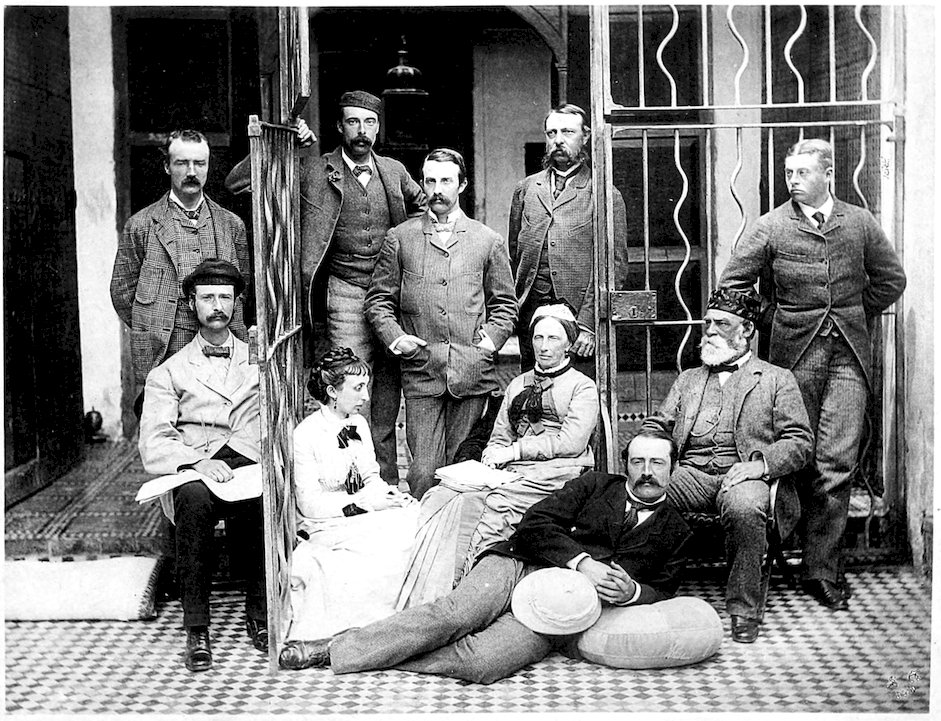
MEMBERS OF MISSION.
Title: Our mission to the court of Marocco
Author: Philip Durham Trotter
Release date: August 28, 2026 [eBook #79468]
Language: English
Original publication: Edinburgh: David Douglas, 1881
Other information and formats: www.gutenberg.org/ebooks/79468
Credits: Richard Tonsing, Peter Becker, and the Online Distributed Proofreading Team at https://www.pgdp.net (This file was produced from images generously made available by The Internet Archive)
Transcriber’s Note:
New original cover art included with this eBook is granted to the public domain.
MEMBERS OF MISSION.
Whatever weight I might have been inclined to attach to the fluctuating expressions of friendly opinion contained in the above lines, there is at all events one ground on which I have been nearly tempted to allow the “noes to have it,” and that is the length of time which has elapsed since the return of the Mission.
The delay has been a matter of great regret to me; and its cause—viz. the long continuance of a severe fever, contracted either amid the scenes of which I write, or in that valuable but pestilential possession of Her Majesty, the Rock of Gibraltar—must also be my excuse for any imperfection of style or composition which may be found in this volume.
The work itself is merely an elaboration of my diary viiikept from day to day during my residence in the Sultan’s “happy realms;” and though the interest of the events recorded is not of a sensational or startling character, I think I may safely assert that truth—if nothing else—is to be found in the following pages.
I may mention that Leo Africanus, whose work on Marocco I have several times quoted, was a Moor of Granada, who fled to Fez when that city was besieged in 1492. He was patronised by Mulai Ahmed, founder of the present dynasty, and later in his career was captured by Christian corsairs, and taken to Rome. Here he was well received by Pope Leo X., who is said to have induced him to embrace Christianity, and to have baptized him under his own name. His book was translated into Latin and Italian, and was published in Venice in 1563 by Ramusio in his famous work, “Delle Navigationi e Viaggi.” In this form it found its way to England, and was, in 1600, rendered by Master John Pory into the quaint English of his time.
I obtained the outline of my map by enlarging that of the “Carte de l’Empire de Maroc,” executed in 1848 for the French War Department. The filling in of the interior on either side of the route we followed is from observations of my own, supplemented by information taken from a map by M. Tissot, lately French Minister ixat Tangier, and now Ambassador at Constantinople, to the extreme accuracy of whose work, as far as I could judge of it, I am able to testify. Upon the latter source, also, I am chiefly dependent for the geography of that part of the country, remote from our route, which I have not visited, but which is doubtless as correct as that which I was able to verify for myself. It is possible that my rendering of Arabic spelling into English may be thought pedantic or incorrect; but allowing for the corrupt form of Arabic spoken in Marocco, I have approached, as nearly as was feasible, to the now authorised Anglo-Oriental system. For the benefit of those who may be unacquainted with the “spelling of the future,” I may mention that
| á | sounds | like | a | in | harm, |
| ú | „ | „ | oo | „ | goose. |
| í | „ | „ | ee | „ | seed. |
| î | „ | „ | i | „ | smile. |
| a | „ | „ | u | „ | but. |
| u | „ | „ | u | „ | full. |
| i | „ | „ | i | „ | bit. |
My sincere thanks are due to the Hon. D. Lawless, Rifle Brigade, for placing at my disposal the negatives of photographs he took during our tour. Of the very successful results obtained from them by Mr. Alexander Rivington, Lansdowne Road, Tottenham, readers of this xbook will judge. The peculiar appearance of the arch opposite page 242 is due to some photographic eccentricity; but as the details of the building are clearly brought out, and the crookedness of the picture does not lessen its architectural value, I have thought it best to retain it among the illustrations.
I am further much indebted to Sir Joseph Hooker, C.B., K.C.S.I., for his kindness in furnishing me with a list of the plants collected for him by Miss Drummond Hay during our wanderings, and which will be found in the Appendix. To others, also, who have tendered their advice or assistance in matters about which I was doubtful, I beg to offer my grateful acknowledgments.
Decision of Government to send an Envoy Extraordinary—Preliminary arrangements—Presents for Sultan—Account of Tangier—Landing there—Dance at Italian Legation—Departure of Mission—Market at Hadd el Gharbía—Ad Mercuri—Wild flowers.
The British Government having, early in the year, decided to send an Envoy Extraordinary to the Court of Marocco, the Mission was appointed to start in the beginning of April for Fez, where, at that season, the Sultan, Mulai Hassan, and his Court, were residing.
The convenience of the Envoy and of the members of the Mission was not, however, the only thing which had to be taken into account, for the forms of Moorish etiquette on such occasions are stringent, and much correspondence and many couriers had to pass between Tangier and Fez from the time when the subject was first mooted until the final receipt of the Sultan’s permission for Sir John Hay to present himself, with his suite, at the Sharífian Court.
A descriptive list had also to be furnished to His Majesty of the individuals His Excellency proposed 2bringing with him, together with the approximate number of camp followers and baggage animals which were to form part of the invading force, all and sundry of whom would, according to the custom in Marocco, be entertained at the expense of the State during the whole period of their absence from Tangier.
Preliminaries were at last all arranged, and the ten Government tents required to supplement those belonging to Sir John and those provided by the Sultan, were sent across from Gibraltar on the 31st March, in order that all might start together on the following day, and the camp be pitched at the first halting-place out of Tangier, ready for the Mission to occupy it on Saturday, 3d of April.
I had for some time enjoyed the acquaintance and friendship of our minister at Tangier, and he, knowing my desire to visit the interior of Marocco, had kindly invited me to accompany him in the approaching Mission to Fez.
Sir John, having suggested to the Foreign Office that a telephone and set of heliographic instruments would be a suitable present to the Sultan from our Government, was anxious to know if I could undertake the task of explaining their use at the Court; and though I had to confess to only a limited knowledge of the former, I was glad that my services should be utilised in regard to the latter instruments.
The contingent from Gibraltar who were fortunate enough to be taken in His Excellency’s suite, were Surgeon-Major Will, medical officer to the Mission, and 3Lieutenant Haynes, R.E., sent in charge of the instruments; while the Hon. D. Lawless, R.B., and I accompanied Sir John in a private capacity. Though we were only four in number, exclusive of my servant, the Gibraltar authorities had the discernment to recognize our individual merits, and H.M.S. “Express” was accordingly placed at our disposal to take us across the Straits. At 10 A.M. on Friday, the 2d of April, we weighed anchor, and, after a pleasant crossing, brought up off Tangier about 2 P.M. Having a considerable amount of private baggage, to say nothing of the large boxes containing the scientific instruments destined to electrify Marocco, the convenience of having the gunboat to convey us and our chattels was not to be despised.
Probably many people have a personal acquaintance with the bay and town of Tangier, while most of those who only know it by name are aware of the position it occupies in English history; but for the sake of the few who are not included under either of those heads, I may mention that in the year 1662 the town became an English possession, being, as were also the town and island of Bombay, part of the dowry of Catharine of Braganza on her marriage with Charles II. Tangier had been in possession of the Portuguese for nearly two hundred years, and the national feeling of a certain party in Portugal was much against this part of the transaction, which, for all the benefit derived by our own country, might just as well have been left alone. After twenty-two years of misfortunes and mismanagement, during which time we got rather the worst of it at the 4hands of the Moors, the place was given up, and the magnificent mole—the only useful relic of English occupation—destroyed. Since that date Tangier has been in possession of its rightful owners; at first it was merely a refuge for pirates, a community who flourished in Marocco till 1817, but subsequently, owing to its being the only port with decent anchorage for vessels, it has become the chief outlet for the produce of the country, and is blessed, or the reverse, by the presence of all the foreign representatives. As soon as the farce, which, under the name of “Conference,” is about to be enacted at Madrid comes to a conclusion, the affairs of Marocco will not be long in appearing prominently before the world; and the foreign powers who sit like vultures, expectant, over the last throes of the victim, will take counsel together as to who is to possess the dainty portion of the carcase represented by the town, of which a brief historical sketch has here been given.
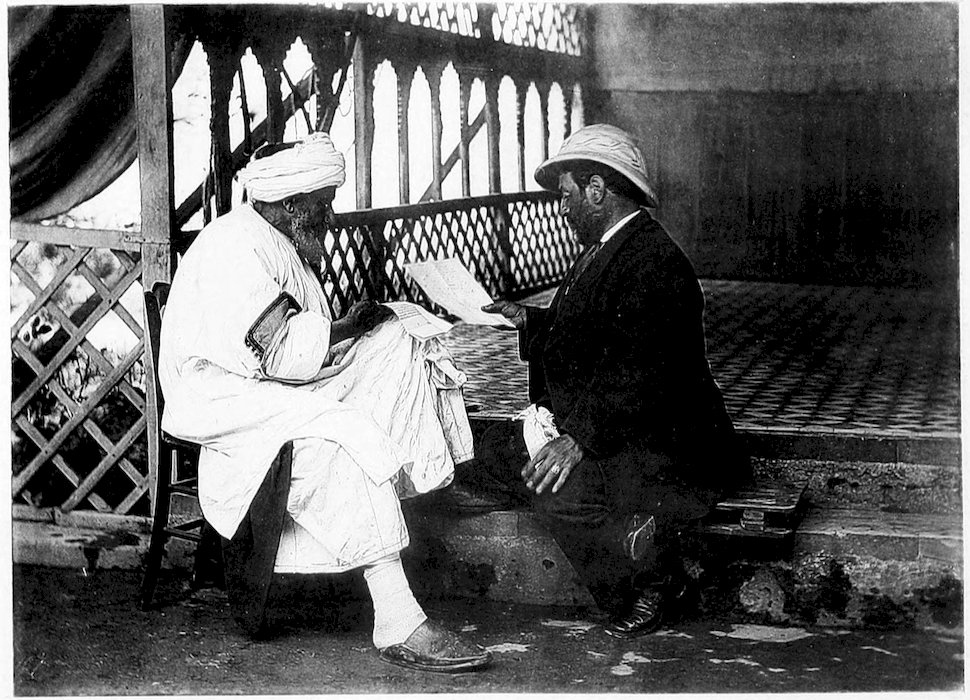
ARAB SCRIBE AND HAIM SECSU.
Apart from the official dignity of our approach to Tangier in a Government ship, there was a practical advantage, which will be readily admitted by any one who has arrived there in the ill-found and uncomfortable steamers from Gibraltar. The only substitute for the long-vanished mole is a rickety wooden pier running some 150 feet into the sea; on this it is possible to land at high-water, though even then it is a risky operation with an east wind and sea coming in upon the shore; at low-water, however, the boats can only get within a certain distance of the beach, and thither a crowd of 5lightly clad and yelling natives run out to meet the passengers. After a free fight has taken place over the person of their trembling burthen, the latter finds him or her self hoisted on to a pair of bare and slippery shoulders, to preserve equilibrium on which it is necessary to cling to the smooth shaven head which appertains to them. Cutaneous diseases being, however, rife in Marocco, it is only the absolute certainty of a ducking which overcomes the squeamishness of the traveller in availing himself of such a scorbutic point d’appui, which he is glad to relinquish, and to jump upon the sandy shore as soon as the trajet is accomplished. Fortunately, none of these trials awaited us, as a large lifeboat belonging to the Custom-house came alongside and took both us and our goods ashore; the interpreter of the Legation, Haïm Secsú, being ready with a number of mules to carry up the luggage to its different destinations.
It is a favourite pastime of certain European Powers, whose dealings with Marocco will hardly bear a close inspection, but who hope to increase their influence by a display of force, to anchor large vessels of war off the town of Tangier, a nautical manœuvre[1] which will, they fondly imagine, strike terror into the heart of the Moor. At present there are two Italian ironclads in the bay, the aggregate tonnage of which is doubtless expected to add weight to the counsels of Italy in the approaching Conference. Properly speaking, the Italians should have about the smallest voice in these negotiations; 6their trade with Marocco is almost nil, and the number of Moorish subjects legally under their protection does not exceed ten; upon their “list,” however, and off it, there will be found an army of not less than one hundred, all of them ready to prostrate themselves before the representative of Italy, and to hail his presence with the adulation and servility so gratifying to the senses of some functionaries.
Rooms having been taken in various hotels for the members of the Mission, their baggage was conveyed there on the backs of Moors and other animals. With the scientific instruments and my own personal effects (the latter a by no means contemptible pile, His Excellency’s remarks on which I rather dreaded), I came to the Legation, where a room had been kept for me, and where I met another passenger for Fez, Lord Zouche, who had just come out from England to swell the Envoy’s train.
Before sunset we tried from the roof of the house to communicate with the signal station at Gibraltar by means of the heliograph, but a slight haze rested upon the rock, and there were, unfortunately, no means of replying to us.[2] It is expected that after the Sultan has seen the apparatus, and been convinced of its harmlessness, he will allow one to be put up here, so that a system of signalling may be established with Gibraltar.
In the evening some of us went to a ball to which 7the Italian minister had kindly invited us; the warriors of the ironclads had also been bidden to meet the beauty and fashion of Tangier, and poured, to the number of about forty, into a small and already overcrowded room. Dancing was rather a muscular effort, but what struck us strangers with astonishment was the extraordinary action of one of the sailors, who officiated as master of the ceremonies during a kind of country dance, and who certainly took care that no want of vocal power should be allowed to mar his part in the entertainment. Gliding about among the couples, he shouted his orders to them in a voice he would have used in hailing a man at the main-truck, and which, coming up with considerable exertion from the region of his boots, found an exit at the corner of his mouth, whence it issued in a continuous stream, drowning music, conversation, and all other sounds in one mighty roar. What rendered a naturally discordant voice even more disagreeable was the harsh and infamous accent of the French in which his directions were given; and it must have been a relief to all when the last order was pumped up to the surface, and the shout of “Messieurs, saluez vos dames,” proclaimed that for the time, at all events, the functions of Boanerges might be laid aside. Zouche and I made our escape home as soon as we decently could, but my feeling about that son of Italy is such that I felt bound to note down the above remarks in my diary before turning in, with impressions fresh on my mind, and his terrible voice still ringing in my ears.
8Camp, Kaa er Remel, Saturday, 3d April 1880.
Sleep in my room at the Legation became a matter of difficulty at an unconscionably early hour this morning, owing to the lane in front of the house being filled with camels and mules, each remonstrating after its kind against the loads which were being imposed; while the equally intelligible yells of the Moors inside the courtyard, where each of them shouted separate orders at the top of his voice, kept up a chorus of sound that was deafening and continuous. All lesser noises, however, were eclipsed about 9 A.M. by His Excellency, who, appearing on the scene like Jupiter Tonans, desired, in choicest Arabic, to know why some order relating to the luncheon-tent had been neglected. My knowledge of other Oriental languages enables me to testify to the great facility they afford for the powerful expression of thought, and the dead silence which followed the fluently delivered utterances of the Envoy, leads me to believe that Arabic is no exception to the rule. Breakfast in the quiet dining-room at the back of the Legation was a relief after the Babel that was going on in front, and a certain interest attached to the last meal we were likely to have for some time under a solid roof, accompanied by the luxuries of real china and silver forks; electro-plate, and metal cups and saucers lined with white enamel, being the fashion for camp work.
Everything at last was got under way, and a rendezvous for the scattered members of the Mission having been appointed in the market-place outside the town, they assembled there and waited for His Excellency.
9The military escort, which had arrived from Fez about three days before, was drawn up in an open space at the foot of the principal street, and as close as practicable to the door of the Legation. It consisted of fifty men, wild-looking fellows, mounted on stout serviceable little horses, under command of their kaïd,[3] and included a standard-bearer, who rode a grey horse and carried in his hand the red banner of Marocco. I saw several well-known faces in the square—Mr. Benatár, the Jew dealer, who only expects 100 per cent on his Fez wares, now offering them at a slightly lower figure, as we were en route to that city ourselves; and Hadj Kadór, the popular and, I believe, excellent guide to travellers, offering to “personally conduct” us all, escort and Envoy included, into the interior and back again, then wishing us, in his sepulchral voice, “Good-bye, gentlemens; hope you enjine (enjoy) yourselves at Fez, gentlemens.” One day this same Kadór was showing Colonel Macpherson of my regiment and me the 30-ton guns recently bought by the Sultan, and on our remarking, “What on earth is the good of these guns to you? you can’t even mount them!” he rather aptly replied—“English gentlemens buys Moorish curiosities; our Sultan he buy English curiosities—all fair, all fair.”
The main street was crowded with people, and the hill on which the market-place stands presented an unusually animated appearance. Not only were the natives assembled there in large numbers, but all the foreign legations and consulates had put in an appearance, 10and with the English visitors from “Bruzeaud’s,” the “French,” and other hotels, had taken up their position on the road to see the sight, and bid God-speed to the “Bashador” and suite. His Excellency was not long in making his appearance, with the red flag borne a few yards in front of him, and the escort, led by the kaïd, about the same distance behind. The members of the Mission, and a few friends who were to ride out to luncheon with us, tailed in as well as the crowding of the mob and the fighting of the horses would permit; and amid the buzzing of the Moors, and a hearty English cheer from the few throats which were capable of giving one, the cortége moved on “majestueusement fermé,” as a French newspaper afterwards described it, “par une litière,” which was carried on poles like a sedan chair between two mules, one in front and one behind, and in which Lady Hay was to accomplish the long and tedious journey to Fez.
Among other attentions on his part, the Sultan had sent four horses for Sir John’s use, upon which he mounted the Gibraltar contingent. One of these, a large white horse, as we got to a narrow bit of road a little way on, “went for” the horse nearest to him, and being pulled in, reared straight on end, falling backwards, with his rider, Haynes, apparently under him. It was as ugly a fall as could be seen, and no one could get near to help him on account of the fighting propensities of the horses. However, much to our surprise and gratification, both horse and rider picked themselves up, apparently none the worse, though how the latter escaped was one of those 11things no fellow can understand. I think some of us were a little saddened by the accident, as, being on strange mounts, no one knew whose turn might come next.
About five miles along the road we came to the luncheon-tent pitched on a small hill to the right, where, after an excellent repast, we said good-bye to our friends, who had come to see us so far, and after a further march of an hour and a half arrived at this our first camping place. The name Kaa er Remel, or Sandy Bottom, describes the nature of the soil. The camp is pitched on a high plateau, presenting, with its thirty-five tents, an imposing appearance. The flag of Marocco is furled on arrival, its place being taken by a large Union Jack planted in front of the Bashador’s tent. We were all much gratified, before turning in to-night, to hear that the gun—the signal for us to get up in the morning—is to be fired at seven A.M. to-morrow instead of six; and long, we hope, may this modification of arrangements remain in force. We crossed the Mharhar at Meshráa[4] el Sejra, just before getting into camp, and the distance marched was about twelve miles.
The camp at Kaa er Remel was too noisy after six A.M. to allow of any sleep; horses neighing for their breakfast (absolutely yelling for it, some of them), and Moors shouting at the top of their voices, in tones which make one think they are about to cut one another’s throats on the spot, were enough to banish the dull god. 12But apart from all this was the disturbing idea that His Excellency would not hesitate to carry out his threat of striking the tent over the head of any member of the Mission who did not show some signs of vitality and movement very soon after seven A.M. The “photographer,” too, had declared himself ready to do a picture by the instantaneous process of any one whose tent being thus summarily removed might be discovered in his bath, or in any other delicate position in which it would be equally unsuitable to be perpetuated. We breakfasted comfortably at 8.15, mounted, and left camp about nine, in advance of most of the baggage animals. The road for some time passed over level ground and fertile plains, where wheeled vehicles, were there such things in the country, could travel in safety, till, at the end of four miles, we came to the foot of a pretty steep hill, where a halt of a few minutes was called to get the escort together, and to allow of Lady Hay mounting her mule—a more secure method of progression, over rough and broken ground, than the litter. Up the winding, stony path, sometimes two abreast, and sometimes in Indian file, the party slowly advanced, the deep red of the ensign of the standard-bearer hardly showing in contrast with the rich colour of the sandstone track which glowed warmly in the light of the morning sun. A very impassive functionary is this same advanced trooper, never varying his pace, and never stopping save at the desire of His Excellency, conveyed through the venerable kaïd; his flag, always about twenty yards ahead, looks like a red phantom, the pursuit of which, for about five hours, has 13been allotted to us all for our daily task. From the top of this hill, which we are told is almost our last before reaching Fez,[5] the view was as beautiful as it was extensive. Below and behind us was the fertile valley of the Wad el Mharhar, which we crossed yesterday; away to the east towered the mountains which separate the Province of Tangier from the Rif country—that mysterious district, peopled by a handsome and warlike race, whose homicidal propensities render it impossible for any strangers, especially Europeans, to set foot therein with any chance of return. On the west were the woods which skirt the Awára territory, kept sacred to the wild boar and his pursuers, foremost among whom ranks the veteran sportsman under whose auspices we are about to enter the (to us) unknown tracts between here and the sacred city. Beyond Awára, again, was the wide Atlantic, whose waters, though apparently smooth as a mill-pond, were rolling in their waves of “perpetual surf” upon the sandy shore.[6]
At 10.30 we arrived at Nzala el Gharbía, where our luncheon tent had been pitched; el Gharbía is the name of the district we are in, and Nzala signifies a “guard” or “guardhouse.” There are many of these enclosures in the country for the use of people with droves of cattle or caravans of merchandise, who, on payment of a small sum to the custodians, are allowed to camp in 14them at night in comparative safety from the attacks of any neighbouring robbers. A small detachment of stalwart Arabs, armed with long guns, was drawn up to receive us, but no further demonstration in our honour was made. While strolling round the village later on I heard, proceeding from one of the tents, a low, wailing sound, with occasional hysterical sobs at regular intervals; and though, of course, I could not satisfy my curiosity at the time, I learned afterwards that there had been a death in the house, and the relatives were holding a kind of wake over the departed. We resumed our march about two o’clock, but our standard-bearer took us a long round, having missed the shortest road in consequence of no deputation having been sent out to show us where the camp was pitched. The Sheikh of the village, on being sent for to explain this apparent neglect, and also to account for some rough usage one of the grooms had received at the hands of a villager, protested his innocence, saying that since nearly all the people of the place were under the protection of one foreign consul or another, it was out of his power either to provide an escort or to execute justice on evil-doers. Though the Sheikh no doubt slightly exaggerated the facts, his statement was in the main true enough, and is only one instance among many of the evils which this system produces, ending, as it must inevitably do, in the total stagnation of the native administration of law and justice.
A large “sôk” or fair was being held in the neighbourhood, the chief object of interest to strangers being a 15professional bleeder, who sat outside his ragged little tent with a semicircle of patients in front of him waiting their turn to be operated upon in the following manner:—A small incision having been made somewhere behind the ear, a cupping-glass, or rather tin, was applied, filled and emptied three or four times, and the contents poured into a rapidly filling pool by the doctor’s side. The patient then deposited a small coin with the operator, and his place was taken by another. This practice of blood-letting is almost universal among the country people, who imagine that the removal of an ounce or two of extra blood before the hot season commences will render them less liable to be affected by the heat of the sun; as most of them go about not only bare-headed, but with their crowns closely shaven, no doubt some cooling process of this sort is necessary. The little scars caused by the above process, and which many of our servants bear on the back of the neck, had always been a puzzle to me; for though the Moor’s head is generally a mass of cicatrices, there is a certain form and regularity about these others which attracts one’s attention, and I am glad to have discovered their cause.
This camping ground is beautifully situated—sandy soil, high ground, and a magnificent view from it. There is a spring, too, with excellent water, not very far off, but the hard and fast rule that all our drinking water should be boiled first and filtered afterwards, is always kept in force, however attractive the outward appearance of the element may be.
16Our “photographer,” who galloped into camp before us, took a view of the cortége, as it appeared coming to a halt before we dismounted; but owing to the escort not being properly closed into focus—the whole affair only occupying a few seconds—the effect is not as imposing as it might have been. On the right of the picture are the figures of two curious-looking people, who, like all the other natives, were quite ignorant of what was going on; the one on the mule, wholly enveloped in his haïk, or flowing white robe, with his head-gear twisted into the shape of an old wife’s mutch, is Sir John’s Arab scribe, a most intelligent and hard-working old gentleman. Every evening after our arrival in camp he may be seen, through the open door of His Excellency’s tent, squatted on the ground, absorbed in writing to his master’s dictation. He has been this road before, and is, I am sure, full of information which I would gladly extract, could he speak anything but his own barbarous tongue. The other figure of the old man in a skull-cap, seated on a pony, is that of one Ben Shittim, a Moorish Jew, and the headman of the village of Azîla, who, with his son, an extraordinary specimen of humanity in European costume, and who could speak Spanish, had ridden over to pay his respects to the Bashador.
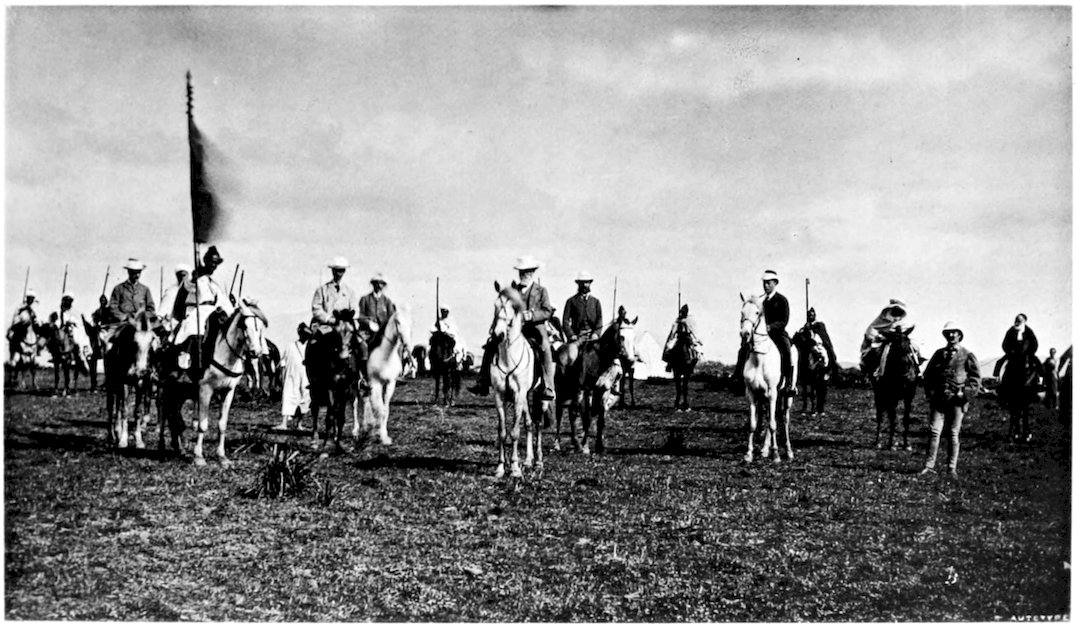
ARRIVAL AT HADD EL GHARBÍA.
A line of tents, seven in number, a quarter of a mile off, attracted my attention, and, hearing it was Colonel Gordon-Cumming’s party, I walked over there before dinner with Zouche. They are en route to Rbat, having halted here for Sunday, an ensample of godliness of 17which we have not been guilty; His Excellency, however, put his veto on the use of the gun to-day, though he stood his ground under fire from the photographer, and would not have objected to the heliographers taking shots at each other from opposite hills, had those officers possessed sufficient energy to unpack their instruments for a little practice. Science, however, like cleanliness, is a nearer approach to godliness than is quail shooting.
We all visited the site of the ancient Roman town of Ad Mercuri—at least what we were encouraged to believe was such—but which would have been more interesting had the outlines not been wholly concealed by a heavy crop of barley. I am sorry, however, that we had no time to prosecute our researches, for I believe that on the eastern and western extremities of the plateau on which we stood, the enceinte of the town and a wall in good preservation are clearly marked; whereas the huts and gardens of the Dshar[7] Jedid entirely hid the line of the ramparts in this direction. The beautifully clear spring above mentioned, which is partly surmounted by a massive stone arch, said to be the work of the Portuguese, was another object of interest we visited. Our archæological studies were, however, interrupted by signs of approaching night (we have no twilight to speak of in these latitudes), warning us that dinner-time was near. This same hour of dinner bids fair to be a not unimportant part of the day’s programme, for the 18Israelitish chef, Judico, is a master hand at field-cookery, so that his endeavours, and our appetites together, form a pleasing and successful combination.
His Holiness, the Sharíf of Wazan, High Priest of Marocco and all Northern Africa, who, with his attendants, has come out here to join in a boar-hunt we hope to have on Wednesday, is camped close by.
Wild flowers seem to be more abundant the farther we get into the interior, my tent being carpeted to-night with a luxuriant crop of wild mignonette, which, I suppose, is the ordinary “Reseda odorata,” though the scent is not so strong as the garden species at home. This plant is indigenous to Marocco, and was taken long ago from here to France, where it was christened “Mignonette,” and in 1742 made its first appearance in England. The weather is still charming, but the sun is, of course, daily gaining power, and our complexions are beginning to suffer proportionately. A nightly application of glycerine, which I have already begun, will, I hope, mitigate my sufferings, though, as former experience teaches me, it is not a becoming cosmetic, but induces, in time, a complexion like that of the Bengali Bábú. Beasts and creeping things, too, are on the increase; and, as I write, I hear enormous beetles, attracted by the light in my tent, hurling themselves with suicidal force against the walls.
The distance we marched to-day was about ten miles.
SID AHMED BEN ALI.
Tomb of Síd Ahmed ben Ali—Megalithic remains at Mzorah—“Lab el barôd”—“Mona”—Extortion by Europeans—“Matamors”—Sharíf of Wazan—Boar-hunt—Camp servants.
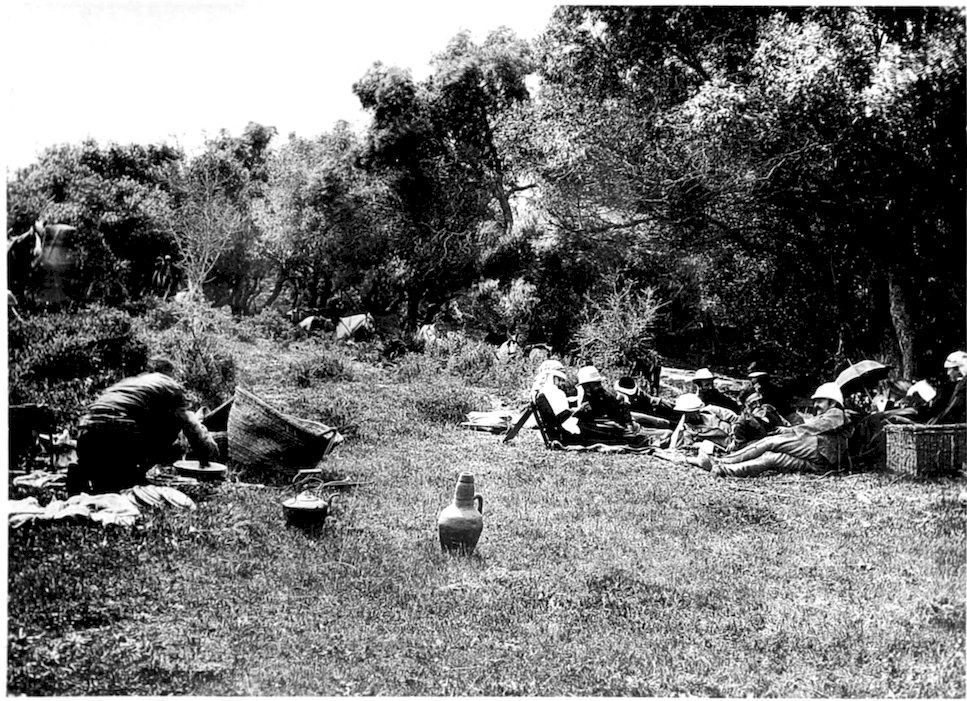
The morning clouds at Hadd el Gharbía, though low and threatening, luckily did not develop into rain, but served rather to intensify the rays of the sun, which for the first time “nipped” one uncomfortably. The camp was in motion at 8.30, and after traversing a beautiful plain, many miles in extent, rich in pasture and barley crops, we crossed the River Aïsha, and ascending a slight incline halted near the tomb of a saint, Síd Ahmed ben Ali. The tomb, in passing which the standard-bearer reverently lowered his flag, is said to be tended with great care, and to be highly finished inside; it is in a thick grove of olive trees, but into those sacred precincts of the holy man’s last resting place, we were, of course, not allowed to penetrate. The luncheon-tent had been pitched half a mile farther on, on the top of a bare hill, the only good point in the situation selected being a glorious view; as, however, this would not have compensated for the discomfort of remaining three or four 20hours under a blazing sun, with nothing but a sheet of canvas between us and it, we had the carpets and cushions brought back to a clump of trees near the olive grove, where, with the aid of books, papers, &c., we made a pleasant and cool halt. The photographer had, in the meantime, unperceived by us, stolen off and taken a picture of the scene, in which we, unconsciously, formed the foreground. It is difficult to get a Moor to sit for his portrait, the laws of the Koran strictly forbidding it; but in this picture poor Hamído, the Moorish boy, is caught with his back towards the camera, washing up dishes in an attitude, the ungracefulness of which will, I fear, be displeasing to the Prophet. At three P.M. the word “To horse” was given, and we continued the march. A short way on we made a slight détour from the track to visit some remains attributed to ancient sun-worshippers. The style of these extraordinary monoliths is somewhat similar to those of Stonehenge, and they belong, possibly, to the same period. Only one large stone remains standing, the others lie around like fallen giants—strange and inexplicable remnants of a prehistoric age. I did not count the number of those on the ground, but in 1831 Sir Arthur Brooke tells us he found ninety of various sizes.[8] Of course since then many of the smaller have been removed for building, and the rapid growth of the underwood may have concealed others. The upright one is of great height—over twenty feet, I should say—as may be seen by comparison with the figure of the Moor who is innocently standing at the base. A much larger block than this is lying on the ground, where, to judge by appearance, it must have rested a long time. The natives do not attempt any explanation of the presence of these marvellous relics of an early creed, but they look upon the place with a kind of religious awe—as a sort of “burning bush”—and for the second or third time to-day our flag was reverently lowered as we approached the spot. Rohlfs, the plucky German renegade who made such an extraordinary tour through the country, erroneously describes the place as two leagues from Wazan, instead of about ten, as it really is; though this error would be lessened if it is German leagues that are meant. He states, too, that the villagers made considerable objections to his going near the spot at all. In our inspection we found no difficulty, but doubtless a strong party of six or eight Europeans with an escort of fifty cavalry would go far to allay their religious prejudices. The native name of the place is El Úted, or Mzorah, the former word signifying a peg or column, the latter a place of worship.
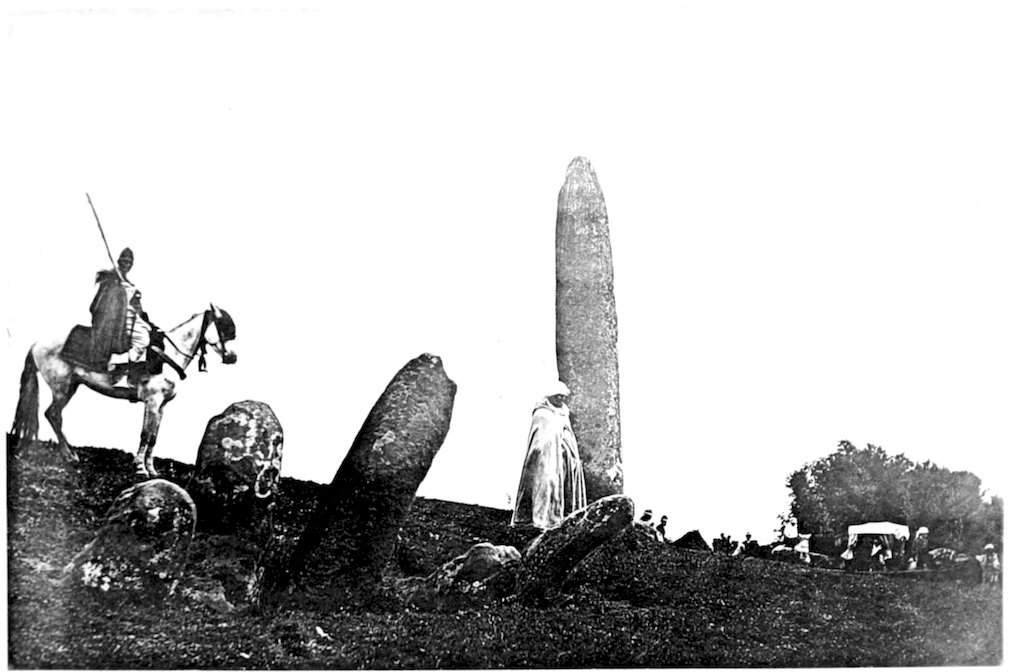
MONOLITHIC REMAINS AT MZORAH.
21Yesterday, for the first time since we started, we were received with military honours[9]—lab el barôd, &c.; and aided by the nature of the ground, the scene was striking and picturesque in the extreme. On the top of a hill, a few miles from here, we found the brother of the Governor of Azîla awaiting us with a body of about sixty horsemen. They were drawn up in two ranks on our left hand, armed with long guns, which, in the distance, had all the 22appearance of lances. After the Governor had exchanged courteous greetings with Sir John and our kaïd the two escorts mingled together in our rear, and we rode on till the ground in front opened out into a valley with smooth turf at the bottom and low hills on either side. Here the “powder play” began; the spectators, consisting of ourselves and part of the escorts, rode slowly along one side of the slope; while the remainder, together with a number of villagers who had come out to see the fun, moved parallel with us on the opposite side. Over the flat ground between us thunder the five or six horsemen who take part in the performance; in perfect line they move, twirling their long guns in graceful movements round their heads, often throwing them high in the air and catching them again as they come down. Usually the rider in the centre holds his up horizontally, as if for the others, to use a military term, to “dress by.” At a given signal the guns are all discharged, or ought to be, as the riders dash past the individual they specially wish to honour. On this occasion, for some reason or other, most of them missed fire, so to those of us to whom the performance was new it was less effective than it might have been. The most striking part of the “lab el barôd,” however, is the utter recklessness and abandon which the riders display. With their loose and graceful robes flowing far behind them in the breeze, they tear along at the fullest speed they can extract from their unfortunate horses, whose gory sides betoken the means taken to urge them to it. Allowing the reins to lie perfectly loose upon the animals’ 23necks, they pick them up when the charge is over, and wheel round to join their comrades again. There is often some delay in the start, and the final signal is never given till the starter has got them away well together. A single horseman is sometimes left behind, but this, it seems, is not the result of accident, but because his horse is either too fast or too slow for his comrades, and would consequently spoil the order of advance; this cavalier, however, makes up for his tardy start by following at full speed, and going through the wildest contortions as he tears along in rear of the others; now he is aiming his long gun at a foe in front; now he turns right round in his saddle, and points it at one behind; lastly, with a loud yell of “Allah,” he discharges it into the ground, and reining up his panting steed, rejoins the others, while another set take their place, and the sport is continued.
Just in front of our tents there is a flat piece of ground, and on it the performance was carried on till dusk, much to the delight of the camp-followers and natives, and to the extreme delectation of my own and Sir John’s English servants.
About five P.M. a deputation of the inhabitants of the village waited on His Excellency, bringing with them the “mona,” or supply of food, &c., which the inhabitants of each district through which we pass are bound to provide daily for the camp. The word “mona” is given in the dictionary as “provision,” but is almost solely used to express this involuntary offering of the villagers, which has to be made not only to magnates like ourselves, 24but to every native official travelling through the country.
Yesterday it consisted of eight sheep, about one hundred eggs, a lot of poultry, candles, sugar, and sundries.
In the case, too, of private individuals, or foreigners travelling with the authority and under the protection of the Sultan, this custom is always observed. It is a heavy tax on the wretched people, and on the present occasion His Excellency fought hard against it, asking to be allowed to frank himself and the members of his party by paying for the supplies provided. This proposal, however, the Moorish authorities would not entertain, the utmost concession they would make being that only what was absolutely required for consumption should be furnished, and that the cost of the amount to the natives should be deducted from the taxes levied this year upon the districts in question—a liberal decree, which, though it may no doubt be issued by the Sultan, is not likely to benefit any of his subjects except the heads of districts whose business it is to levy the taxes. Strict measures have been taken by Sir John to prevent oppression and peculation on the part of his own native headmen and servants, and he has therefore reduced to a minimum the usual plundering of the villagers en route by these worthies, who would render the march through the country of so large a party more like the advance of a horde of licensed robbers than the peaceable progress of the Mission of a friendly power. Well would it be for European prestige in this Empire of Marocco if such humane and thoughtful precautions were enforced by 25representatives of other nations who visit the court of the Sultan; our ears would not then be made to tingle by tales of violence and extortion, consonant enough with Moorish ideas, but hardly to be expected from the delegate of a nation which boasts a high rank in the civilised world. On a late occasion, between this and Tangier, not only was a “mona” of much larger amount than necessary extorted from the people, the surplus being sold or sent back to Tangier to stock the larder of those left behind, but money also was demanded from the poor villagers by these pioneers of European civilisation, under the threat of reporting the headmen unfavourably to the Marocco Government. Such, at all events, are the stories,[10] supported by evidence which seems disagreeably strong, told us about our fellow Christians; so one can hardly complain that the people hate the sight even of a European, or that the term Nasráni (Christian) continues to be the vilest word of abuse in the Moorish vocabulary.
I wish I had been actively inclined last night, and had sat down to write before turning in to bed, an operation performed with extra gusto through knowing that this article of furniture would still be in the same place to-night owing to our two days’ halt. Having got as far as this, however, I may as well record how we spent our “day of rest” here, though my nerves are at this moment a good deal shaken by the chorus of dogs outside, who, by the row they are making, seem determined to take the camp by storm.
26In the first place, we were threatened with a 6.30 A.M. breakfast, which mercifully resolved itself into a pretty liberal 7.30 ditto; and secondly, the hunting-ground, within two miles of which our camp ought to have been pitched, turned out to be a good twelve. This mistake of Hadj Hamed’s, the man in charge of our camping arrangements, seemed inexplicable to the authorities, to whom it did not occur that the gentle Moor might have friends in the village of Síd el Yemáni, whereas he could have none among the unclean animals near to whose haunts we had hoped to find ourselves located. However, there was very little sun, the ride was a pretty one, and as our breakfasts began to shake down, our tempers improved. Before we had got very far, by-the-bye, both my temper and breakfast narrowly escaped two most severe shakings. The first was on this wise:—I had lagged behind, and got a little way off the track for the purpose of botanising (we are trying to assist Miss Hay in collecting for Sir Joseph Hooker),[11] when suddenly, on the hillside, I found myself among some mysterious holes of apparently great depth, and cut in a regular manner. The diameter of the orifices was only about two feet; but, on looking down into them, they seemed of considerable depth and extent below the surface, and there was water at the bottom. They were cut too near each other to admit of turning with safety, so I had to push on. My horse was rather frightened, as was also his rider; but, threading our way between the pitfalls, we emerged safe on the farther side. Shortly 27after this delivery from the danger of being buried alive with my horse in the hollowed hillside, I was riding along a path overhanging a watercourse about twenty feet below, when, the ground being rotten, it gave way under the animal’s hind-feet, and he was left clinging, like a bat to a wall, by his forelegs. Before, however, I had had time to consider how to extricate myself from this fresh peril, he recovered himself, climbing up in an agile and cat-like manner, and for the next few hours death ceased to stare me in the face.
On enquiry into the use of the holes which cost me such a mauvais quart d’heure, I learned that they were granaries, or “matamors,” where these unsophisticated people store their grain, covering over the top with grass, &c., so as to conceal its whereabouts from robbers, or from too great curiosity on the part of the State collectors. In the meantime it invariably rots or throws out sprouts, in either case becoming unserviceable—a clear case of wrapping their talent in a napkin, and, in this instance, in a style of napkin wholly unsuited to the preservation of such a talent. Of course the unsettled state of the country, and the cost of carriage, throw difficulties in the way of selling large quantities of grain; but their indolence of disposition, and the fact of their ancestors having carried on this practice for the last thousand years, are in reality at the bottom of the continuance of this custom. The advantage which would accrue to the State from the establishment of a proper system of communication between the chief towns was practically, but vainly, exemplified during 28the late famine; for while barley in Tangier was selling at 85 “ounces” per mond (about equal to one and three-fifths of an English bushel), and in Marocco at 50, the cost in Fez was only 15 “ounces;” if, then, roads and wheeled vehicles had existed, prices throughout the country would have been equalized.
The hunting-ground, where we arrived at last, was a very promising-looking covert, quite rideable for those of us who were provided with spears, and was covered with low myrtle and lentisk bushes. The latter, soaked with dew, and then scorched with the heat of the morning sun, seemed to give out even more than their usual strong aromatic scent, which resembles that of a bruised leaf of the true pistachio, and which resemblance has probably procured for its congener, the lentiscus, the appellation of “wild pistachio.”
The Sharíf of Wazan, who passed us at our last camp, had come out in two marches from Tangier to join the hunt, and was already on the ground. In Marocco, and all along the north coast of Africa, this personage is as well known as is the Pope in Rome; but as at home his very existence is almost unknown, I may as well mention a few facts concerning him.
He is one of the true Sharífs, or direct descendants of the Prophet, and the position he occupies here is second only to that of the Sultan. Some years ago he married an Englishwoman resident in Tangier, by whom he has two pretty little boys, one of whom will probably succeed him in office. This heretical alliance, which at first rather startled the weak nerves of the 29faithful, has, wonderful to say, done little or nothing to shake permanently the allegiance of his flock, over whom his influence and power are paramount. His father, the late Sharíf of Wazan, was a remarkable old man in his way, and enjoyed a great reputation for sanctity. On one occasion, when water was very scarce in the district, and the land, dried up and parched, threatened the people with a failure of their crops, he is said to have been equally fortunate with Moses of old in producing water from a rock, and the stream that he evoked flows to this day “to witness if I lie.” He had, among other wives, a dusky consort from the interior, gifted with all the cunning of her race, who was mother of the present Sharíf. When the old man on his death-bed was asked, as is the custom, to nominate his successor, he replied, “That son of mine who, at my death, which is close at hand, shall be found in possession of my stick.” This remark, being overheard by the above-mentioned lady, she secreted the stick among her son’s things, where it was found on his father’s demise the following morning. As the present Sharíf is in the enjoyment of excellent health, and as his memoir hereafter will probably be written by an abler pen than mine, it would be impertinent in me to dilate upon his virtues, or to dwell at any length upon the characteristics of so eminent a person.
There were rather more than the usual number of Moors armed with long guns, and at the first beat, on a boar being set on foot, the discharge of firearms and whistling of bullets was alarming; the next beat was 30tedious and badly arranged, so I dismounted and composed myself to sleep under a lentisk bush. After this came luncheon—by far the best part of the day’s sport—then two more uninteresting beats on the side of a precipice where one could neither ride nor walk, and so home, about ten weary miles, all of us more or less tired and out of humour. The natives make capital beaters, which helps to keep up the excitement even on a blank day. The “halúf,” or wild boar, is their hereditary foe; and Addison, writing in 1671, tells us how the “Morocco gentry, when disposed to sport, ... hunt and kill the wild boars, who are no rarity in this diocese, the land affording habitations most suitable to such unsociable beings.” I think these Moorish horses have some malformation of the stomach, as my girths are always slipping out of place, rendering the tenure of one’s saddle and one’s seat alike uncertain. Unfortunately, too, I have no breastplate, and climbing up a steep bank to-day the saddle slipped back over the animal’s hind-quarters, landing me on my head. The horse bolted into the wood, and by the time they caught him had kicked off a stirrup and my waterproof coat, which was strapped on the saddle in front of me. The former was picked up, but the latter is, alas! a thing of the past; unless, indeed, it is being utilised to protect some native from the rain, which is at present pouring in torrents.
We are likely to be well served during our pilgrimage, a circumstance which adds greatly to one’s comfort on these occasions, and from Hadj Hamed the “Quarter-Master-General” of the camp down to the “boy Hamído,” 31who washes up the dishes, they all seem a willing and obliging lot. Most of them belong to His Excellency’s private establishment, but one or two outsiders have been hired for the occasion; among these is one “Boomgheis,” who is a historical character, having accompanied Captain and Mrs. Colvile in their adventurous tour, and having obtained “honourable mention” from that gallant author. Some months ago, at the British Legation, Tangier, Boomgheis had been called in as an extra hand, the house being full, and one of His Excellency’s guests asked me if I knew his antecedents, as the face seemed so familiar to him. I was ignorant then of Boomgheis’s history, but, as we were passing the jail one day, the shaggy head of a prisoner was thrust through the grating to beg for money. “Now,” exclaimed my companion, “I remember where I made Boomgheis’s acquaintance first;” and, sure enough, it was during his incarceration there, on a charge of murder,[12] that the striking features of his protruding head had fixed themselves on my friend’s recollection. On occasions of emergency, masters and servants alike shout for him, as he is always to the fore. He speaks an extraordinary dialect intended for English, in which he carries on long conversations with my servant, though the talk is all on his own side. I notice that in calling to a Moor, it is usual to insert the interjection “Oh” or “Wah” before his name; while, if he is a stranger, instead of “answering to ‘Hi!’ or any loud cry,” as in 32England, he will always attend to you if addressed as “Muhammed;” in fact, it stands a good chance of actually being his name, as one child in each family, generally the eldest, is called after the Prophet. Allarbi and Hadj Ali, both brothers of Hadj Hamed, are important functionaries in camp, the former being a sort of aide-de-camp to his brother, and the latter, a murderous-looking ruffian, is, with his son, Abd er Rahman, a handsome youth, the personal superintendent of Lady Hay’s litter. There are also two “scorpions,” or natives of Gibraltar, among our retinue, one of them filling the important post of valet to Sir John’s khalífa.[13] When not employed in cursing each other, they are usually singing Spanish songs of a questionable character, or making night hideous with quaint oaths and other expletives learned by contact with the British soldier. I at first thought the title of khalífa more distinguished than it is; but finding that the assistants of Judico, the cook, and Muhammed, the kaïd of the muleteers, are both styled khalífa, I feel less respect for the appellation.
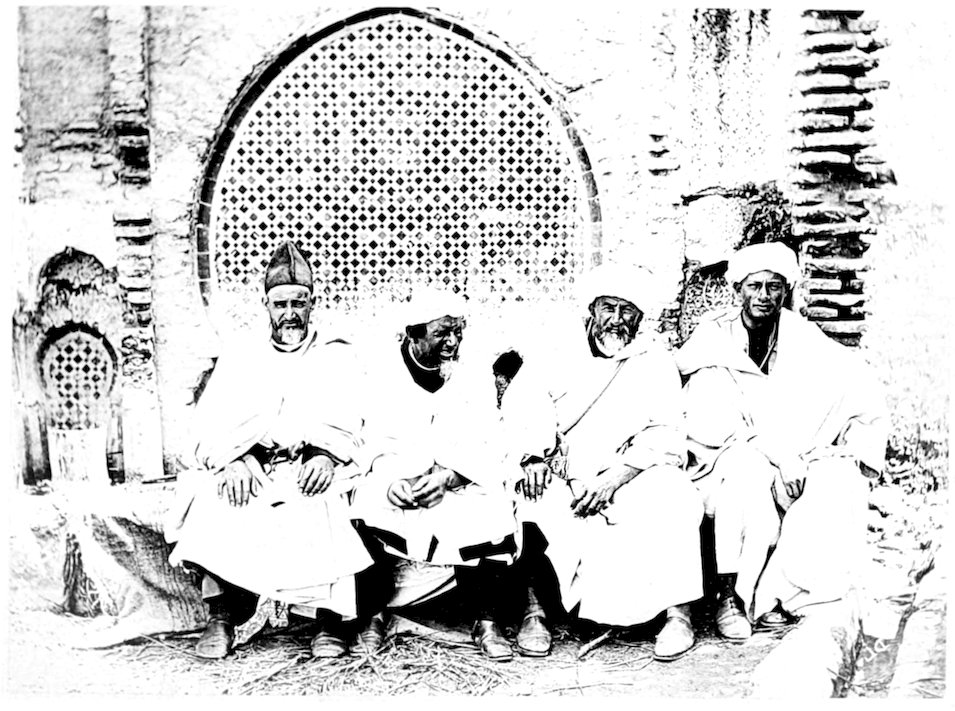
ALLARBI, HADJ-ALI, HADJ-HAMED, AND ABD-ER-RAHMAN.
My servant, Norton, who has a friend and companion in Sir John’s English attendant, George, seems favourably impressed with the country, though a little nervous at the prospect of falling in with lions, which Boomgheis assures him we shall hear roaring a march or two farther inland. I only hope the king of beasts will not be of the proportions described in the account of this district in the sixteenth century by Leo Africanus, to whom a friend writes that he “brought 33out of Barbarie a lyon’s skin, which, from the snowte to the top of the taile, contayned one and twentie feete in length.”[14] In addition to the above staff are Selám Hajút, the butler, and the “boy Hamído,” who washes the dishes, and rides on the camel that carries the luncheon. He does not hit it off well with Boomgheis, and when we hear more yelling than usual at night, we are told it is “Boomgheis flogging Hamído.” Lastly, I must mention Miss Hay’s groom, Muhammed, an extraordinarily active youth, whom, from his zeal in bringing in botanical specimens, we have honoured with the patronymic of “Dr. Hooker.”
Flat country—Practice at Heliographing—Cold nights—Roadside sacrifice—View of El Araish—Saints and lunatics—Reception at Alcazar—Musicians—Town of Alcazar—“Kohl”—Sultan el Mansor—Battles of Alarcos and Alcazar—Compounding a felony.
We seem to be leaving the pretty country behind us the farther inland we get, and our road after leaving Síd el Yemáni, through the Fahs er Rihán, or Plain of Myrtles, was flat and monotonous. If, however, not so much to our taste as the hills and woods near the coast, it was fully appreciated by our provincial escort as affording endless opportunity for the exercise of lab el barôd, with which we have been indulged ad nauseam for two days.
Yesterday one of them nearly suffered in an unexpected manner from his devotion to this pastime. He was the soldier in charge of the luncheon-tent, and, instead of pitching it in a pretty little wood about eight miles on the road, as he was specially ordered, went on four miles farther into the flat sandy plain, at a place called Ghadda. We were all furious, as there was neither shade nor water, and the old kaïd, sharing our feelings, 35ordered him out for instant bastinado, which would have been carried into effect but for Sir John’s interference in his behalf. I think, in secret, however, we all regretted this reprieve, being anxious to see the performance of the operation. After lunch on that day I left the main body early, and cantered on into the next camp—El Hamáya—unpacked the heliographs, which had just come in with the tents, and sent one back on a mule to meet the column, getting mine, in the meantime, to bear on the luncheon-tent, and flashing to my colleague there what I had done. My messenger met the whole procession coming along, and they halted with much solemnity to watch the proceedings. As soon as we got the instruments aligned on each other, a message came from the kaïd to “tell his servant to prepare hot water for his tea on arrival.” I gave the message at once, and it made a great impression on the kaïd when he rode into camp two hours later; but he evidently suspects that through my instrumentality his servant has become leagued with Satan, from whom he is convinced—so he told Sir John at the time—that all these inventions emanate.
The camp at El Hamáya was prettily situated on a small sandy hill, with the River Machassen, muddy, but full of excellent fish, flowing round its base; the cold there at night seemed intense, and most of the party wore their greatcoats at dinner. In the drawing-room tent in the evening I sat playing chess in a big ulster and a rug over my knees, and even then could not keep warm. One advantage of this severity of the weather 36at night is that the Moors’ tongues seem to get frozen up, and consequently the camp enjoys perfect quiet from after dark till the gun fires in the morning.
His Excellency’s progress through the country is a great opportunity for unfortunate victims of native tyranny to bring their complaints before him, and one of their methods of attracting attention, which we noticed to-day, is very singular. In the earlier part of the march we came across the newly slaughtered body of a sheep with its throat cut, and the blood flowing across the path. About twenty yards off sat its owner, watching if any notice would be taken. Unfortunately, in this instance, nothing could be done; we were approaching a large town, and had attention or redress been extended to the poor man, the whole road to-morrow might have been strewn with petitions and sacrifices, their innocent blood pleading for inquiry.
The early morning sun shining on some white minarets and towers about twelve miles off to the north-west, caused a dispute among the authorities as to what town it was; eventually it was decided to be El Araish; and as we think of returning home by the sea-coast, I daresay I shall be able by and bye to describe the place.
The vast plain we rode across after leaving El Hamáya this morning was beautifully green with barley and long rich grass, a pleasant thing for scorched and aching eyes to rest upon. We seem now to have entered upon a succession of enormous plains, bounded at a distance of six or seven miles by moderately high mountains, but open on the west towards the sea, which is 37about fifteen miles distant. At the foot of the hill, and just off our track as we left camp, sat a holy man, half saint and half madman, most scantily clad, and very dirty. He had a bit of sacking spread in front of him, upon which most of the escort chucked a coin en passant. In this country lunacy is regarded as a manifestation of divine favour, God having taken the fortunate person’s reason into His own keeping, to be restored to him hereafter in better case than had the original proprietor been in continual possession of it; the Prophet, too, specially commends the person of the lunatic to the good offices of the faithful.
Our El Araish escort leave us to-morrow. When first they joined us at Síd el Yemáni, they mustered about a hundred strong, but have now dwindled down to fifty, His Excellency having dispensed with the attendance of those to whom absence from home may be inconvenient. These men are a kind of landwehr, or rather yeomanry, fine-looking fellows, with well-appointed horses, and are bound to turn out on the shortest notice from the chief of the district. Among those who are left is one very picturesque youth with a dark bronze-coloured face set off by a bright purple jeláb, or cloak, the hood of which, usually drawn up over his head, gets blown back as he dashes past on his dark gray horse in the lab el barôd, in which exercise he is a proficient. We shall miss him to-morrow when the escort is changed on the frontier of this province, as the bright colours he affects, and the striking expression of his face, render him a distinguishing feature of the troop.
38As we approached Alcazar this afternoon, after surveying it all the morning from our luncheon-tent on a hill three miles off, preparations for our reception became apparent. A small line of horsemen under the acting kaïd of the place, and behind them a motley crowd of townspeople, with last, but not least, in point of noise, the most indefatigable band I ever heard, were assembled about half a mile from our camping-ground, and accompanied us thither. As we proceeded the powder-play became fast and furious; the riders rushing past us ventre à terre, with a yell discharging their guns almost into our faces, while improvised crackers were let off among our horses’ legs; all this, combined with the noise of the music (save the mark!), contributed greatly in the eyes and ears of the populace to our successful entry. Arrived here, we took refuge in our tents, while the spectators formed a large semicircle in front, at one corner of which the musicians, prominent among whom were two trumpeters, continued their performance with ever-increasing vigour. Never shall I forget the faces of those two minstrels as, seated on their thin, scraggy ponies, they blew an almost uninterrupted blast to the delight of the crowd, and to our great and increasing wonderment; their very souls seemed to go out into their instruments, while their cheeks on either side were distended to such a degree, that they resembled, both in size and appearance, ordinary bladders. We were beginning, like the natives, to grow fascinated with the sight and sound, when an order emanated from the tent of His Excellency, who was busy writing despatches, for 39the concert to cease, and the performers having been remunerated for their pains, the band moved off, the trumpets braying loudly to the last.
As soon as our minds were sufficiently composed after the above musical treat, we sallied forth to inspect the town about a quarter-of-a-mile off; the party was “personally conducted” by our head interpreter, an obese Israelite, whose good-nature is only equalled by his obtuseness, and whom we have christened Tweedledum, while his colleague, who is his counterpart in every way, is named Tweedledee. They are both Moorish Jews, and the former seemed to have a large circle of acquaintance among his fellow-believers in this town. He took us into the house of a wealthy Jewess, who, after taking us up to the roof—from whence we had an excellent view of Alcazar and its environs—regaled us with sweetmeats, washed down by a thick luscious sort of wine, which, though strong and heavy, was not unpleasant. The house was large and airy, the top being open to the sky, but it was dirty and untidy, and the whole quarter where the Jews lived filthy to the last degree. We took rather a fancy to the town of Alcazar, with its quaint old Sôk or market-place, and its winding main street roofed in by a trellis-work of vines. Here we were followed by an eager and inquisitive, though quite civil and good-humoured crowd, who manifested the keenest interest in the few purchases made by the infidels. Among these were some mysterious-looking little bits of cane, hollowed out, and containing a fine black powder called kohl, a preparation of 40antimony, which is highly recommended by the natives as a cure for inflamed eyes. Whether its fame is justly acquired or not I shall know better hereafter, having submitted to a plentiful application of it myself this evening at the hands of one of the Moors, my eyes having bothered me considerably for the last day or two in consequence of a couple of hours’ practice at too short a distance with the heliographs. Their manner of applying the kohl is with a stick the size of a knitting-needle, which, being damped, is dipped into the powder, then drawn gently along between the eyelids, which are closed upon it.
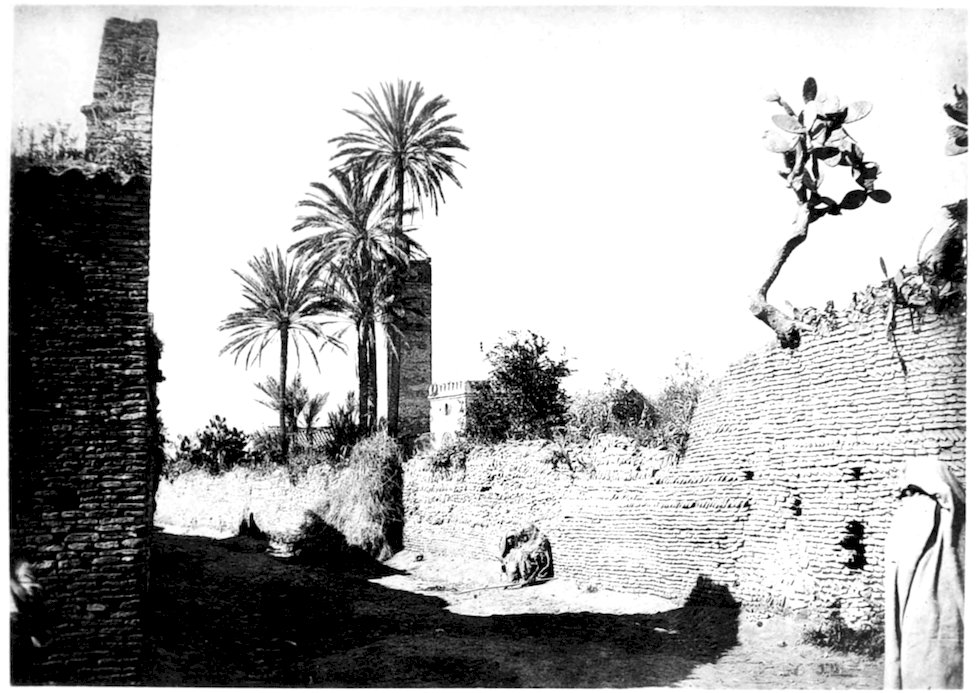
OUTER WALL OF ALCAZAR.
As we are not accustomed yet to wading through miry and narrow streets with an escort of soldiers keeping off the crowds by a free application of their sticks, we were glad once more to get out of the good town of Alcazar, beyond the gates of which none of the people followed us. It is difficult to estimate the population of a town of this sort, and travellers have variously put it at from 5000 to 30,000. In a conversation I had with a rather intelligent Jew, who could talk a little French, and who attached himself to us in the town, I learnt that his estimate was 12,000, including 1700 Jews, which numbers I should think were pretty near the mark. It has evidently been a place of considerable importance in bygone ages, and the open ground to the north, where we are encamped, shows many traces of ancient walls and large buildings. The place is said to have been founded by Yakúb el Mansor (the Victorious) in the twelfth century, in gratitude for shelter accorded 41to him by a poor fisherman, when he had lost his way and got benighted out hunting. This romance, however, falls to the ground before the evidence of Edrisi and El Bekri, the latter of whom, living before El Mansor’s time, speaks of the place, under the name of Sôk Kotáma, as a “large and magnificent town.”[15] It was in the reign of this Sultan that the giralda and mosque in Seville were built, as a record of his victory over Alonzo of Castile at Alarcos, where a fabulous number of Christians are said to have been killed, A.D. 1109. We passed to-day, near the Wad el Machassen, the site of another and more recent battle disastrous to the Nazarenes—that, namely, of Alcazar—where the King of Portugal, coming from Azîla, a small village on the coast, was totally defeated by the Moorish monarch, just three hundred years ago, and, together with many adventurous spirits who had come from all parts of Christendom to share his triumph, perished on the field of battle. Windhus,[16] who passed through this country in 1721, writes that the “Portuguese dispersed in the battle could not believe their king was slain, but ran up and down crying ‘Onde este el Rey?’ The Moors often hearing the word rey, which in Arabick signifies ‘good sense,’ told them that if they had any rey they had never come thither.” For many years they believed Don Sebastian was still alive, and over his tomb near Lisbon may be read the doubting epitaph, “Hic jacet in tumulo, si fama est vera, Sebastes.”
42This afternoon, as we were sitting at tea in the drawing-room tent, a deputation of three of the headmen of the district waited on His Excellency on behalf of a robber chief who was in jail in the town, and in whose release they were interested. Some six months ago he and his band had seized on a camel laden with grain, belonging to one Allarbi, a servant of Sir John’s, and chief of the boar-hunters, whom he employs; and in addition to the loss of the grain, the camel had died, the robbers having over-driven it in their anxiety to escape from Allarbi and some of his fellow-hunters, who had speedily put themselves on the track. The robbery had taken place in a wood through which we passed to-day, and the delinquents had been closely followed and overtaken, but the grain was gone and the camel dead. The total loss to Allarbi was one hundred and twenty dollars, but he had agreed to take ninety. The robber had been in confinement ever since, but, owing to his interest with the authorities of Alcazar, his case had not been sent up for the decision of the Sultan, who would probably have inflicted a heavy fine, and imprisonment till it was paid, to say nothing of a little flogging and torture by way of expediting matters. He now offered seventy dollars if he might be released, which sum the deputation had with them; and it was curious to watch the eager argument of the three men, handsome and intelligent-looking old fellows, as they pressed His Excellency to accept the compensation, their expressive gestures and significant looks enabling one almost to understand their pleadings. Allarbi was not present, 43but at the door of the tent stood his brother Hadj Hamed, also a retainer of Sir John’s, and in chief charge of all our camp establishment. He being pretty well acquainted with the administration of justice in the country, and knowing that if the case went up to the Sultan his brother’s pecuniary satisfaction would be small, added his word of advice to the arguments that were going on inside the tent; so that eventually the compromise was accepted, and, the money having been counted out, the deputation withdrew, evidently much delighted with the success of their negotiation.
Romans and Portuguese—Fording the Wad el Kús—El Ma Bared—Chess-playing—Land tortoises—Changing escorts—Kaïd of Ben Aouda—Quail shooting—Entertainment at Habassi—Poison—Kuskussú—Solitude of plains—Thunder-storm—Irregular protection.
We left Alcazar on Friday morning, halting a night at Kariya ben Aouda, and arriving yesterday at this place, where we have been detained by the heavy rains.
The immediate neighbourhood of Alcazar must be the last resting-place of many holy men, judging from the fact that the standard of Marocco never once raised its head till we were well away from the precincts of the city. One síd house or Kúbba[17] in particular, at the foot of the slope where we encamped, was noticeable both for its unusual size and the care bestowed upon its exterior. From the town to the place where we forded the Wad el Kús, about one mile, there is a broad paved road, the only one I have seen in the country. It is said to have been made by the Portuguese; but, as the Moors aver that Alcazar never fell into their hands, I do not see how this could be, 45unless it was the work of Portuguese prisoners, who may have been captured by Moors during some of the incursions made by the former while in possession of Azîla. This theory, too (“a poor thing, but mine own”), would account for many of the ruins near Alcazar, which have the appearance of Roman remains, but are in too good repair to have formed part of the Oppidum Novum of the ancients. M. Tissot, whose small but useful pamphlet[18] is never out of our hands, says the town itself is partly built by stones which had been used by the Romans, and this opinion also tends to confirm my theory.
Half an hour’s ride brought us to the banks of the Wad el Kús, the Lixus of the ancients, a stream which the survivors of the expedition will meet again at El Araish on the return journey. It is a wide, sluggish river, and reached about up to our horses’ girths in fording it. The banks on either side were high and steep, and the scene afforded by the procession crossing was bright and picturesque in the extreme. The narrow line of horsemen, preceded by the dark-red ensign, descended the bank one by one, till, on reaching the river, they scattered out and widened to six or eight abreast, then narrowed again into single file in their ascent of the other bank, each one a perfect picture by himself, forming a mass of colour, the contrast of which against the dusky banks and sombre waters of the river was in a high degree striking and unique.
El Ma Bared (Anglicé, Cool Spring) was the name of the place at which we halted for luncheon on Friday. 46The tent was pitched at the top of a hill, the El Araish escort being picketed below, while our kaïd and his troopers came up with us. I used to dislike these long mid-day halts; but their convenience is manifest, as while we are resting, the whole camp passes on, and, barring accidents, we find it ready pitched and settled at about 4 P.M., when we arrive on the new ground. At first, too, we had not got into the swing of the thing, and could devise no method but food and sleep by which to while away the time; now, with the assistance of “books, and work, and healthful play,” the hours pass pleasantly by. Old Kaïd Ali, the commander of our permanent Fez escort, often comes in to play chess with Haynes, and though unable to speak a word of anything but Arabic, is an adept at the game. During our halt at El Ma Bared he dropped in, attended by his son, who belongs to the troop, and, I fancy, is a sort of aide-de-camp to his father. He was exceedingly friendly and prévenant, going the round of every one in the tent, and insisting on shaking hands; he then sat down beside his military superior, to whom he offered advice at intervals during the game. There seem to be one or two differences between the kaïd’s play and ours, but I am not clear that he did not try a little sleight-of-hand occasionally, and when detected attribute it to the eccentricities of the Moorish method.[19] His arrival was shortly followed by that of his servant, bearing a dish of hot meat and some bread intended for our consumption. Although it wanted only 47an hour to our own mid-day meal, His Excellency sternly insisted on our all partaking of it, which operation was effected by the simple process of dipping in our finger and thumb, and with the aid of a piece of bread extracting a morsel of the savoury mess. As soon as the Envoy thought we had taken sufficient to strengthen the friendly relations between England and Marocco, the rest was sent out to the servants (native), and a few cups of the kaïd’s Moorish tea washed down what we had taken, and prepared our interiors for our own luncheon.
While strolling about to get up an appetite for the latter meal I came upon a tortoise, of which there are a great many about, and intending to present it to Judico, the cook, to try his art upon, turned it on its back to await my return. In this, however, I was disappointed, as when I came back it had decamped, thereby depriving us of a dish of terrapin, and upsetting at the same time my ideas on the customs and habits of the tortoise. I fancy, however, that the ones we see in such quantities are of the genus Testudo, and not of that of the edible Emydæ, which latter are found chiefly in North America, and are there considered a great dainty.
An hour’s ride, still over gently undulating country, brought us to the confines of the province of El Araish, a fact which was brought to our notice by hearing a gun fired some little distance ahead and out of sight. At this signal our provincial escort formed themselves in order of battle, throwing out flank files, and advancing to meet an imaginary foe. When the two tribes providing the escorts are not on good terms, this mimic warfare 48is dispensed with, the old escort retiring before coming in contact with the new. As soon as the two troops sighted each other the lab el barôd began, small parties galloping out from either side, discharging their guns into each other’s faces, and then retiring to rejoin their own side. As soon as the red standard hove in sight with the Envoy on his white Arab close behind, the two escorts formed into a long line in two ranks on the left of the road, the old one nearest us on the right, the new one supplied by the Province of Seffian on the left. The kaïd of the latter then rode out and saluted Sir John, shaking hands cordially, and repeating over and over again the words, “Marhaba bík, marhaba bík, Bashador” (Welcome, welcome, Ambassador). His Excellency then turning round to the El Araish escort, bade their kaïd and his officers farewell, and we continued our march under the wing of our new protectors, who wheeled up out of line and fell in behind us. As we stopped to look at some of the new-comers beginning the usual lab el barôd, I happened to turn round to see whether the old escort were going away; but lo and behold! not a man of them was to be seen. As I understand this habit of mysteriously disappearing into the earth is peculiar to these people, I shall keep my eyes open on the next occasion of our changing escort; and if this manœuvre is repeated, shall inform the kaïd, through the medium of Tweedledee, that I consider such practices far more closely connected with the Evil One[20] than the science of Heliography, which I am about to assist in introducing into Marocco.
49Our encampment at Ben Aouda was a very picturesque one, on a rising ground near a small village, with a curious grass plot, about an acre in extent, closely hedged in by the highest prickly pears I ever saw. Below us, to our front, lay the immense plain we had been traversing, the part nearest to us being sown with rice and barley, the chirping of the quail amongst which induced some of us to take a stroll after them with our guns, but our exertions were poorly rewarded.
It seems that the kaïd of the escort which met us between Alcazar and Ben Aouda was not the governor of Ben Aouda himself, as that potentate is away fighting near Wazan; and I am sorry not to have seen him, as he is said to be par excellence the greatest tyrant and scoundrel amongst all the governors in these parts. He extorts more money from his people than any of them, and by crueller means; and it is whispered that a hundred prisoners are rotting in some disused matamors in the side of the hill not two miles from where we were encamped.
The rain pattering down on the tent within a foot of my nose awoke me yesterday in our Ben Aouda camp, where, as the spot was a pretty one and promised sport, we had hoped for a halt on account of the change of weather. Beyond, however, giving us half an hour’s law for breakfast, no advantage accrued therefrom. Even had the rain not delayed us here a second night, a halt would have been necessary before we got to Fez; because, at our present rate of travelling, we should have reached that city on Friday, which the Sultan would not have 50allowed, as that day is kept, to a certain extent, holy, as the Mussulman Sabbath.
It was so cool and pleasant as we left Ben Aouda that White and I took our guns and pursued quail and duck on foot, while the rest of the cavalcade proceeded on their way here. Two little boys from a hut close by accompanied us part of the way, and were very useful in picking up our dead birds, which they did with as much accuracy as a well-trained retriever, being amply rewarded for their labours by the gift of our empty cartridge cases. Part of the forenoon we followed the course of a tributary of the Méda, the water of which was deep, with overhanging banks. Our horses were led behind us by the grooms, and W.’s man taking his too near the edge, the ground gave way, and the horse, falling on his back in the river, had to swim some distance before he could get out. A few minutes after this episode one of us shot a duck, which fell on the opposite bank. We were rather at a loss how to get him; but my groom, quietly removing his only garment, swam across, retrieved the duck, and brought it to us. Just as we had expended our last cartridges, the rain, which had held off till then, came down in torrents, accompanied by such blasts of wind, that we could hardly stand against it. We got on our horses, but mine positively declined to advance till the storm had somewhat abated, turning his back to the weather, from which position neither whip nor spur would move him.
Eventually we got on the track, and, passing through a collection of wretched huts, where the inhabitants turned 51out and pelted us with mud, arrived wet and cold at the luncheon-tent, which the rest of the party had reached just before the rain commenced, and, dry and comfortable, remonstrated in vain at the introduction of our dripping persons among them. The people of the village near brought us an offering of milk and honey—a large jar of each—also a great dish of steaming hot cakes, large round confections of flour and water, like “scones,” but covered with grease of some description. If eaten hot, with the addition of some honey, they are excessively good. The milk, which forms part of the daily mona, is excellent, and the butter fresh and good, but rather tasteless; the latter quality is a great fault in the eyes of native epicures, who like a strong flavour in all articles of food, and for this purpose place the butter in earthen pots and bury it for months, and even years, by which process it becomes “fit for use.”
Kariya el Habassi, near to which we are encamped, is the only collection of habitations we have yet seen worthy the name of village. I give, as is due, the title of town to Alcazar; it consists of several windowless houses of the usual staring white Moorish style, besides a considerable number of tents and huts. Among the former is the kaïd’s house, to which we were all bidden yesterday afternoon to tea. The kaïd himself is away fighting, and as his son is too young and too shy to assume the government, a nephew of the great man reigns in his stead. By this functionary we were received in the village and conducted through his garden gate, which was then closed to keep out the 52little crowd which had gathered round and followed us. Our host led us through some whitewashed courts, up a few steps, on to the terrace on which the house was built, and into an airy apartment looking on to a grove of orange-trees in full blossom. The side through which we entered was almost wholly taken up by a large Moorish archway of the invariable horseshoe form, without doors, but with a thick curtain, or portière, which could be drawn across in cold weather. Opposite the entrance was a retired alcove, raised a step above the floor, and reaching to the ceiling; in it was spread a mattress covered with some light-coloured material, and the floor of the room all round the sides was similarly furnished. Here the members of the Mission reclined, not in the graceful cross-legged fashion of our entertainers, but in the more constrained and undignified positions in which Europeans are wont to take their ease. On a chair in the centre sat His Excellency, and at his feet the nephew and representative of the absentee governor. He is an immensely stout youth, with a massive though not unintelligent face, and a loud and rather harsh voice, which became a little fatiguing in the two hours’ conversation which he had with Sir John, and not a word of which we could understand. The monotony of the séance was, however, broken by the appearance of a slave with a brass tray, on which were a pretty set of French teacups, and a few small tumblers to supplement their number. He was followed by another, bringing in two silver teapots, some enormous lumps of sugar, and a box of tea. This apparatus being 53placed in front of the young kaïd, he proceeded to brew the national beverage as follows:—Of the tea—a fine green kind, for which they pay up to four dollars a pound—he put a large handful into each teapot, then added, for the purpose of washing it, a little hot water, which was immediately poured out and thrown away; several of the big lumps of sugar were then put in, the teapot filled up with boiling water, and the mixture was ready. Our host, having tasted a little himself (to show it was not poisoned), filled all the cups, which were handed round by slaves, while others brought trays of biscuits and sweetmeats, which they offered us between their finger and thumb. The second and third brews were varied, respectively, by freshly gathered leaves of wild thyme and verbena. The flavour is rather pleasant, and grows upon one—a merciful dispensation of Providence, as the operation is one which will have to be frequently undergone before we set foot again in Europe. Neither milk nor cream is ever used, and, in fact, would form a very nasty addition, as I found out by experiment. It is not thought good manners to strike work before the third cup is disposed of, after which the wretched Christian may relapse into a spectator, the Moors continuing ad libitum. The custom of putting poison in tea, and so getting rid of an enemy, has been and is said to be still so common in Marocco, that this practice of tasting to which I alluded is never by any chance omitted—at all events, in the higher circles of society. The idea of poison seems, in fact, always present to their mind. The late Grand 54Vizier, Síd Músa, who died last year, carried his scruples even farther, and when any guest of eminence took tea with him, he not only tasted it, as usual, beforehand, but only allowed his guest to drink half a cup at a time, finishing the rest himself.
A far more trying form of hospitality than tea-drinking is having to partake to excess of the native dish called kuskussú, which is made up of very coarse-grained flour, boiled, underneath which is some stewed or roasted meat. It has been in vogue here for centuries, and is described by Leo, about A.D. 1500, as “made of a lump of Dow, first set upon the fire in a vessel full of holes, and afterwards tempered with butter and Pottage.” The preparation is by no means a bad one, though embarrassing when it has to be eaten with fingers instead of forks, and is all very well if one is hungry; but as it forms an inevitable accompaniment to a visit of ceremony at any Moorish house, it is difficult sometimes to get up an appetite equal to the occasion. Yesterday, at the kaïd’s, we flattered ourselves we had escaped, but just as we got up to go away, in came the attendants with a large wooden tray in the form of a sieve, upon which, hot and savoury, and covered by a tall conical erection, like a bee-hive, was the dish of kuskussú. His Excellency, reading the looks of despair depicted on our faces, came generously to the rescue. He saw that we were unequal to the task, and, bringing into play that talent for diplomacy for which he is justly renowned, explained to the kaïd that British stomachs were not as Moorish ones, and that having largely partaken of the 55hospitality of the villagers where we halted for luncheon, not to mention that our evening meal awaited us in camp, we could not, without much personal inconvenience, and even absolute risk, do justice to the good things set before us. To our great relief the kaïd accepted the apology like a true gentleman, and the dish being removed, was placed, at His Excellency’s request, before the guests in the verandah, who, though comprising the headmen of the village, and old Kaïd Ali, the commander of our permanent escort, were not considered eligible, unless at the special request of the ambassador, to sit in the same room with Her Majesty’s representative.
Throughout the whole interview I was specially struck with the perfectly natural and unembarrassed demeanour of our host, who dispensed his hospitalities, and kept up a lively conversation with Sir John, as if the entertainment of a party of Europeans—of whom he admitted he had seen very few before—was an everyday occurrence. It was the first time I had been brought into close contact with any of the upper ten of Marocco; but on all subsequent occasions—and they have been many—the above peculiarity was always brought pleasantly before one; and uncivilised as doubtless they are, according to our acceptation of the term, I will always maintain that a Moor of the higher ranks is as good a specimen of one of “nature’s gentlemen” as one can wish to see.
Before we took leave of our host, he asked Sir John if the doctor would mind seeing and prescribing for an old friend of his, who had some affection of the eyes, 56from which he had been suffering for some years; our good-natured Esculapius having expressed his willingness to do what he could, the patient was brought in, and the doctor, after looking at him, conveyed to the kaïd—His Excellency acting as interpreter—his opinion of the case. It was painful to observe the keen and anxious expression of the old man’s face, as, fixing his almost sightless eyes on the ambassador, he leant eagerly forward, waiting for the doctor’s verdict. “Can the Nazarene cure me? When shall I be well?” he asked, with querulous and shaking voice. “If you follow the doctor’s advice,” said Sir John, “after some months your sight may improve.” The old man was by no means satisfied, and feeling sure, as they all do, that the doctor could cure him then and there if he chose, complained bitterly of the hardship of his case, to which His Excellency replied, “Our religion teaches us that it is the wisdom of God which deprives us one by one of our senses and enjoyments as we get on in years, so that at last we hail the approach of death as the advent of a friend.”
I do not know if the individual to whom this discourse was addressed, and who must have touched the threescore-and-ten period, though he seemed tough for his years, much liked His Excellency’s logic; but it entirely commended itself to the young kaïd, who looks as if he enjoyed life, and who told Sir John that the precepts he had been advocating were entirely in accordance with the maxims of the Prophet as laid down in the Koran.
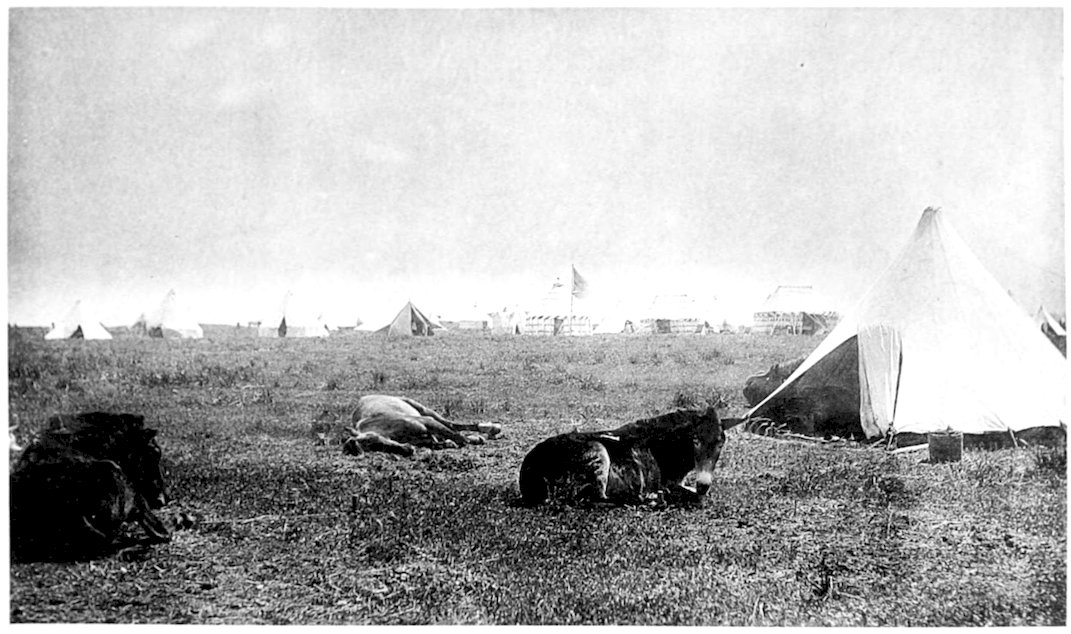
CAMP AT HABASSI. A “DAY OF REST.”
57The clouds had come very low down over our camp by the time we got back, and distant claps of thunder and violent gusts of wind betokened the coming storm; a heavy shower was falling as our impromptu gong—a frying-pan belaboured with an iron spoon—summoned us to dinner, causing us to bolt from our own to the dining-room tent like rabbits into a warren. Trenches were dug round all the tents in the evening, pegs and ropes looked to, and every preparation made for the deluge which came down on us later on.
We were all glad of the two days’ halt we have had here, though it might have been made in a livelier spot than the middle of this dreary plain, which, with the rain pouring down on it, more resembles the sea than dry land. There is a small lake about three miles off, round which some of us wandered with our guns to-day. The solitude of these vast tracts of country is very impressive; we ride for miles and miles without seeing a living soul, or any human habitation, except sometimes on the horizon a brown mushroom-like excrescence, betokening the presence of an Arab tent. There is a general absence, also, of animal life; for, owing to the late famine and consequent destitution, the country-people have either parted with or eaten all their stock. The absence of large game, too, is surprising, and that it existed here formerly there is no doubt, for we are told that “diuers noble romanes in Morisco used, in the vacation season from warres, to hunt lions, liberdes, and such other bestis fierce and sauage;” but, quaintly continues this writer, “All myghty God be 58thanked in this realme (England) be no suche cruel bestis to be pursued.”[21]
The night’s rest of some of the party was disturbed a good deal by the thunder and lightning, the flashes illuminating one’s tent through the wet canvas in a fitful, unpleasant manner, while the gale of wind which accompanied them tried our tent-gear to the utmost, and made us congratulate ourselves on the extra precautions we had taken overnight. The morning was dark and gloomy, and the sheets of water descending at 9 A.M. made some of us late for breakfast. While standing in the tent door watching the dismal prospect before us, the air suddenly became darkened in a curious degree, and while we waited wonderingly to see what was going to happen, a flash of fire which dazzled our eyes was accompanied by so terrible a clap of thunder bursting over the camp, that we all felt for the moment literally stunned. The sensation was of a heavily shotted gun being discharged inside the tent behind us, both as regards the sharpness and intensity of the report, and also on account of a kind of concussion of the air and vibration of the ground which accompanied the explosion. It was not only ourselves who were startled, for the Moors who were squatting on the lee side of the tents for shelter came running out, and the horses lying down where they were picketed jumped to their feet with as puzzled an expression as their masters. It turned out that neither man nor beast throughout the camp had suffered, except from fright, but we all agreed that a few more such shocks would be the ruin of our nervous systems.
59It is lucky that the soil of this part of the plain of the Sebú is sandy, or we should have suffered far greater discomfort from the two days’ rain; as it is, we are well out of the picturesque but low-lying camping-ground of last Friday at Ben Aouda, where we were anxious to make a halt. The unfortunate night sentries are the most to be pitied; huddled up in their white jelábs, and posted all round the camp, they appeared, under the vivid flashes of lightning, like sacks deposited here and there, from which emanated some monotonous song, by which they strove to keep themselves awake through their weary watch. The sentries were more numerous than usual, the people of the village knowing that if any depredations should be made by the lawless tribe of Beni Hassan, whose territory is just on the other side of the Sebú river, they would be held responsible in purse and person for any loss we might sustain.
We have not passed any more roadside sacrifices since the one I mentioned between El Hamáya and Alcazar, their absence being probably due to the last one having remained unnoticed. The case to which it was meant to draw attention was as follows, and seems another instance of the evil of foreign protection, to which I before alluded:—A French-protected Moor and an inhabitant of Alcazar were partners in sheep-breeding. Their stock having increased to 600 head, the Sheikh of the district ordered a tithe to be paid as taxes. This the protected Moor declined to do, saying the whole of the sheep were his, and he was not answerable to the Moorish authorities (whether his partner connived or not at this arrangement did not appear); however, as 60the French, on account of their high-handed tyranny, are held in great dread by the Moors, no further action was taken; but when the Alcazári came to claim his 300 sheep, of which he was willing to pay his tithe, the other, denying the deed of partnership, refused to give them up. The Moorish subject in vain applied for redress; his all had been taken from him, and besides having nothing with which to propitiate the authorities, he found them far too much afraid of the false representations which the other threatened to make to his own Government to be inclined to take up the case. Hence his silent appeal to the English Minister, who, even had he taken up the matter, would hardly have been able to help the man in a dispute with a subject of another power.
Lawless took a photograph of the camp, and also of the entrance to the village. A number of children who gathered round the camera at once fled when they heard from a soldier what was the nature of the instrument, but Tweedledee, who was acting interpreter, having, with much composure, told them the Christian was only making a picture of the sun, and that if they sat very still they might watch the operation, they were reassured, the result of which finesse on Tweedledee’s part was that, as they sat in a row, rapt in wonder, a very successful group was executed.
The depressing effect of the wet we have undergone here was a little dispelled by His Excellency producing some very good Chartreuse as a chasse café to-night after dinner, and under its cheering influence finer weather is prognosticated for to-morrow.
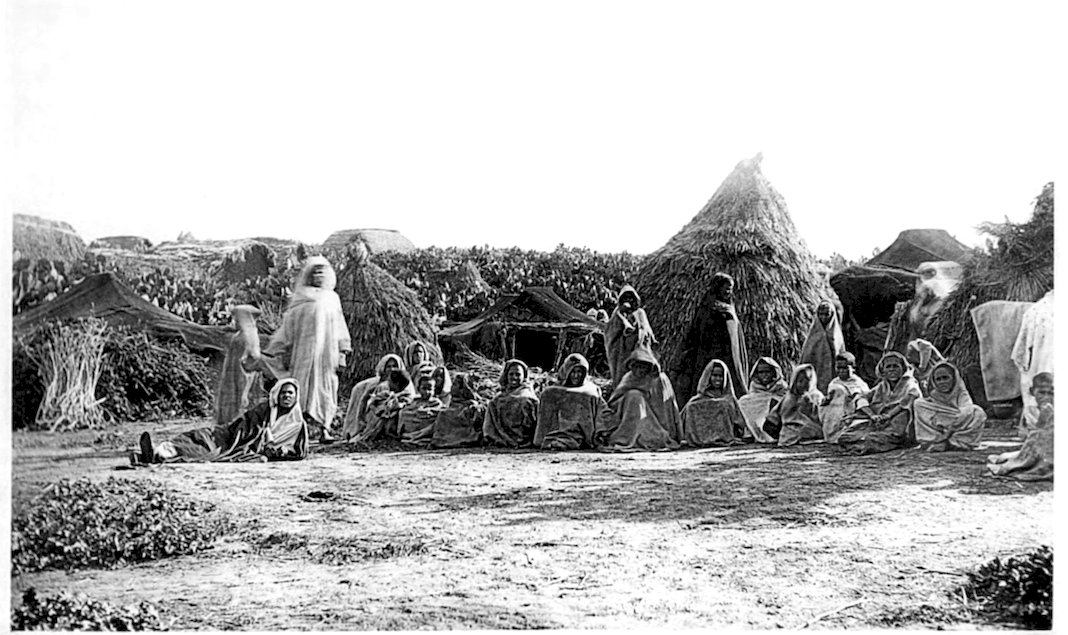
GROUP OF ARABS AT HABASSI.
Kaïd of Habassi—Passage of Wad el Sebú—Arab women—Pigs and evil spirits—Beni Hassan—Curiosity of villagers—Sick and blind—Sentries at night—Illness or accident—Rain—Missing the road—Quitting the plains—Síd Búbakr—Geographical difficulties—“Kúbbe”—Nomenclature of villages—Famine—Foreign tyranny.
Before the camp was struck at Habassi on Monday the tents had the advantage of an hour’s hot sun, which, luckily for the poor mules, effectually dried the canvas and lightened the loads. We had to start punctually at 8.30, as the River Sebú (the Subur of Ptolemy) lay between us and our next camp at Jum’a el Hawáfi, and we were warned that the heavy rains might have made it difficult to cross. The kaïd of Habassi accompanied us to the river, which forms the boundary of his territory. He is the youth at whose house we had tea on the day of our arrival near his village, and when the rain set in, he sent us a hospitable invitation to consider ourselves his guests as long as we were detained there. It seems that all expense incurred by our making extra halts, or departing from the itinerary laid down by the 62Sultan, falls upon the chief under whose protection we happen to be; so we were glad to get on the march again and cease to be a burden to our host. He was mounted the morning we left on a dun-coloured horse, with the ordinary high saddle covered with green silk, the saddle-cloth being made of the same material, and the reins and headstall of silk cord to match. He talked on a variety of topics as he rode beside the Envoy, and France coming on the tapis, was much surprised to hear that though England was the smaller country of the two, the Queen had more Mohammedan subjects than the Sultan of Marocco. He spoke about Napoleon, of whose fame he had heard from the French, and his rather loose ideas on the subject of Waterloo were probably derived from the same source. He was interested at hearing now that we had been victors there, inquiring what was our loss on that occasion. The pay and amount of rations given to our soldiers he was very curious about, and I was glad to be able, through the medium of His Excellency, to furnish him with accurate statistics.
An hour’s ride across the plain brought us to the river bank; the Wad el Sebú at that point is a deep, muddy stream, more than a hundred yards wide, flowing between clayey banks about thirty feet high, with a considerable strip of mud between their base and the water. It looks as if it could rise considerably in the rainy season; the current was pretty strong, about three miles an hour, but not sufficiently so to prevent the construction of a bridge of boats or pontoons, while its 63whole course from the point where we crossed to its mouth at Mehdía could quite well be navigated by steam barges with a small draught of water; in fact, from what I can learn from the natives, the river must be more or less navigable as far as Fas (Fez).
Our luncheon-tent had been sent across early, and on his own side of the Sebú the kaïd had pitched his tent so as to superintend the transport of ourselves and camp out of his district—an operation which occupied about two hours. The largest of three rickety, flat-bottomed boats was ready to take us across, and having said good-bye to the kaïd of Habassi, who dismounted and accompanied His Excellency to the water’s edge, we embarked. Our servants had done what they could, by covering the bottom with straw and rushes, to dam up the water which surged from side to side with every motion of the boat, and had concealed the wet planks we sat on with rugs. Notwithstanding these precautions, a more casual and apparently perilous means of conveyance for a personage of such importance as the Envoy Extraordinary of Her Majesty, to say nothing of his suite, can hardly be imagined. However, with a pious “bismillah,”[22] His Excellency took his seat, and by the favour of the Prophet and the strong arms of the half-naked savages who worked the boat, we reached the other side in safety. The permanent escort and all the camp were yet to follow, and from the top of the bank where our tent was pitched we had a good view of the curious scene below us. Moors yelling and shouting 64from the bank, from the boats, and even from the river, across which many of them swam, and horses screaming after their kind, formed the usual vocal accompaniment to any labour required of them. How any of the latter animals emerged from the ordeal with unbroken legs was a marvel. There being no gangway of any sort to enable them to walk on board, the only alternative was to leap from the shore into the bottom of the boat; some of them, after getting their forelegs in, resolutely refused to follow up with the hind ones till they were forcibly lifted off the ground and hustled into their place. Each boat held about eight, and though they are inveterate fighters when on shore, community of danger seemed to keep them quiet while afloat. The officers of the escort, with their chief and the standard-bearer, came over separately, the red flag being held aloft in the bow, while in the stern sat the old kaïd, rapidly muttering prayers, as is his wont when not engaged in conversation. We found the luncheon-tent pitched near a group of half a dozen Arab tents, and though they were of a dirtier and more wretched appearance than usual, the few inhabitants seemed to be prosperous enough; some of the women, too, who came to stare at the Christian who was strolling past their doors, wore very pretty silver ornaments. As the owners seemed peaceably disposed, and there were no men of the village near, I tried to make a bid for a small necklace which adorned the person of a rather pretty girl, taking it up in my hand and offering a couple of dollars to the owner. My intentions, however, were misconstrued, and though their manner 65and gestures were friendly in the extreme, I judged it advisable not to prosecute acquaintance any farther. In the same village I was surprised to see a couple of little black pigs disporting themselves, as I always imagined the unclean animal was tabooed from the company of the true believer. On enquiry, I find that the Moors, who are superstitious to the last degree, imagine that the evil spirits who are busy among them prefer making a tabernacle in the carcase of a pig to taking up their abode in the bodies of the faithful. Of the two evils, therefore, they choose the least, and suffer pigs gladly till they think they are full of devils, when they drive them out into the woods, and replace them with a fresh lot. Such, at all events, was the explanation of the little pigs’ presence as afforded me, through the interpreter, by a venerable Moor, and on my remonstrating with him on his credulity, he not inaptly remarked—“I am surprised at your disputing the possibility of such things, as I have been told that one of the prodigies performed by your prophet Aissa (Jesus) was causing evil spirits to leave the afflicted ones, and live in swine.” The age of miracles, though past with us, still continues in Marocco, and the simple-minded Moor fails to see why such a state of things should have altered since the days of Christ, any more than have his own style of dress or manner of life, which remain precisely the same.
We left our halting place at 1.30, the last we saw of El Gharb, or the Western Land, being the white tent of the kaïd of Habassi shining in the sun, with his green-caparisoned 66horse and well-appointed escort waiting to take him back to his little sovereignty, while the English Mission moved onward into the robber land of the Beni Hassan.
This district has only lately been brought under a sort of quasi subjection to the Sultan, and has long enjoyed an evil reputation for being the hotbed of murder, theft, and other misdemeanours.
M. Tissot, who is now ambassador at Constantinople, lately visited this province, and as he is an observant traveller, and concise in narrative, I quote from his description of the people:—“Les Beni Ah’sen ont la réputation meritée d’être d’incorrigibles pillards.... Sauvages et inhospitaliers, ils ne laissent pénétrer personne sur leur territoire.... Il y a trois mois à peine que, malgré la présence du Sultan à R’ Bat, le harem du premier ministre a été pillé et égorgé par les Beni Ah’sen, et que sept cents hommes, envoyés pour punir cet attentat, ont été anéantis. L’Empereur lui-même n’a pu se frayer un passage, à cette même époque, qu’en mitraillant ses indociles sujets.”[23] His Excellency had read us this paragraph at luncheon, omitting none of the horrid details, so it is not to be wondered at if we cast back a longing eye to the friendly Habassi already disappearing on the horizon, or if our hearts beat high at the prospect of meeting the murderous hordes so graphically described by M. Tissot. And here I must pay a humble tribute of thanks to that eminent diplomatist for the valuable information contained in his pamphlet. It is always in somebody’s hands, and has been our vade mecum 67throughout our wanderings. Curiously enough we had no other work on the country among us, to which omission the thumbed and tattered condition of Tissot bears ample testimony. “Poor Tissot! What would he say if he saw the condition of his little book?” remarked a member of the Mission, not considering that the said Tissot would take this evidence of appreciation as the highest compliment we could pay him. It was therefore resolved to have the pamphlet handsomely bound in its mean condition, and presented, when our wanderings were over, to the talented author as a mark of our gratitude for information derived therefrom.
The country seemed to change a little after leaving the Sebú, the Arab encampments becoming more frequent, and cattle and cultivation a little on the increase. After an hour’s ride we heard some firing ahead of us, and presently came in sight of our new escort. They were, as usual, drawn up in line, and their kaïd, advancing, welcomed the Envoy, but with more constraint and less cordiality than the previous governors had shown. A more wild and strange-looking lot than these Beni Hassan I had never seen; and it was noticeable that, as they formed up in our rear, the permanent escort did not mingle with them in the familiar manner in which they treated other irregulars, having possibly formed part of the force which the Sultan lately employed against this tribe. As they defiled past us on either side to take up their position behind our party, the thought forced itself upon me that, under any other circumstances than the present, I should—and probably with 68the greatest reason—have felt extremely ill at ease in such company. The sullen expression, too, of these bronzed and bearded bandits, as they either stared one in the face or kept their eyes fixed on the ground, seemed to show that the wholesome restraint under which they temporarily found themselves sat uneasily upon them. Till the warriors of Beni Hassan performed it, we had never seen justice done to the game of lab el barôd; their horses were better, and the gaudy but ragged riders were more dexterous and reckless than any that had preceded them. By way of showing us the uncertainty of human life, there was one, at least, among the guns that had something in it more solid than powder only, as one could easily tell by the report. Such accidents, however, might happen from the method of keeping their powder, viz. loose in a leather bag at their side, into which foreign substances of all sorts may easily find their way. Into this bag they plunge their hands, then pour the contents down the barrel, and ram the bullet home with an ill-fitting rod. To extract the latter is often the work of four men, who pull and jerk at either end quite unconscious of any danger of explosion. When we got near our night’s camping ground at Jum’a el Hawáfi, these independent yeomanry wheeled off to their own ground, where their kaïd’s tent and two or three others were pitched, without, as is usual, accompanying the Bashador to where he and his suite dismounted.
In the afternoon some hundreds of half-starved and miserable-looking people from the district assembled close by to look on at the powder play to which some of 69the Beni Hassan people treated them. I walked over with Zouche, with two or three soldiers as escort, to see the battle, and we were much amused at the sensation we created. Though more or less civil and respectful, their undisguised curiosity and astonishment were very funny to witness. They would look us all over from head to foot, as if we were statues or stuffed specimens, and then turn away, many of them covering up their faces to hide their amusement at our outlandish appearance.
The civilian population are not half such fine-looking fellows as either the ’askár,[24] or the militia, out of whom our escorts are taken, and disease of every form seems rife among them. A poor fellow at that camp was brought to the doctor blind of one eye (as more than half the population seem to be), and with little or no sight in the other. It was a case which could have been successfully treated by a surgeon in a hospital; but here, of course, without proper appliances, it was out of the question to do anything, and the man went sadly away. The number of halt and sick who come in hopes of treatment, and, as they all do, of certain cure, is getting large. Their hesitating manner of coming, and their dress—especially that of the Jews,—remind one of the people in old Bible pictures, while their simple faith in the little that can be done for them must be very like that of the multitudes who crowded round a greater Physician eighteen centuries ago.
Our camp on the Sebú at Jum’a el Hawáfi was well 70protected with sentries, the Beni Hassan kaïd’s son placing them himself at 9 P.M. at intervals of about ten yards. So many were there that it seemed as though almost every robber in Beni Hassan must have been employed, an arrangement to which the camp, perhaps, owed its safety. A mounted patrol rode round continuously, whacking the head of any unfortunate sentry who did not show satisfactory symptoms of watchfulness, which caused the poor wretches to keep up a regular chorus to keep themselves awake; while a short way off, in the lines of the Beni Hassan escort, the sound of music and revelry was heard till nearly daylight. We gave some of them a treat about 11 P.M. The night was wet and dark, and just as the mounted patrol were passing my tent Lawless and I emerged with pieces of magnesium wire flaring in each hand. The effect was magical, and flight instantaneous; gradually, however, they came back, and one or two of the more courageous even took a bit in their hand and held it while burning.
It has often been present to my mind what a serious matter it would be if illness or accident of a severe nature overtook any Christian of the party; the whole camp could not be delayed on one man’s account, and in fact, in many places we have stopped at, supplies would not be procurable, while the risk of remaining alone would be too great to be contemplated. Yesterday morning I thought I was about to see the problem of what was to be done with any such impotent Nazarene solved in my own person, as I woke at 5 A.M. in great pain and hardly able to breathe; the distemper, however, 71passed away in a few hours, and was pronounced by the medico, whose aid I solicited at 7 A.M., to have been muscular rheumatism. English servants are people who, under such circumstances as ours, usually manage to get themselves laid up; I have warned mine (who, with the exception of Sir John’s man, George, is the only one in camp) of the futility of any such proceeding, and up to the present moment, at all events, he has developed no threatening symptoms. It was raining so hard that after striking the camp, and sending it on, we remained behind in the drawing-room tent,—which, though leaky, was better than nothing,—till after luncheon, when we rode straight through to our destination, a place called Sbenats, near a Síd house[25] which marks the boundary between the Provinces of Sherarda and Beni Hassan. It was our last ride through those weary plains, whose alluvial soil makes them bad camping ground during this wet weather. Since following the course of the Sebú, the Arab dúars have been much more numerous, and at Sbenats there were four or five of them, with as many as thirty or forty tents in each, within a radius of two miles of us. The country on this, the left side of the Sebú, is far more backward in crops than what we have travelled through hitherto; and it is gratifying to learn that the heavy rains we have had the last three days have been anxiously wished for, and are now attributed to our interest and goodwill. After all the usual methods of praying for rain have been exhausted, a curious and characteristic plan is adopted. 72The Moors, wrapped up in their conceit, imagine that all their prayers are pleasing to the Deity, and as music in His ear; consequently, when these fail they “turn the Jews out of the town, and bid them not return without rain, for they say though God would not give them rain for their prayers, He will give the Jews rain to be rid of their importunity, * * * * *”[26] Such, at all events, is still the belief of the true Mussulman of Marocco, and you could as easily shake that as you could the foundation of the mountain of F’ilfal, which we see to-night towering in the distance.
It is curious how easily one misses the road on those flat trackless plains we have left behind, and several of us having galloped on a long way ahead yesterday, with the intention of getting into camp early, found ourselves entirely at fault. The whole place seemed a dead level, but no tents could be seen, or living being to act as guide. Far away behind us we could just make out a dark shadow on the plain, moving slowly along, and this we knew to be His Excellency, with the rest of the party and escort. Looking at them from this distance the powder play had a very pretty effect; every now and then one saw, detaching themselves from the main body, little dark spots, from which, after they had gone a short way, a small white cloud shot forth, but of course the report which accompanied the smoke was inaudible. We had to wait about ignominiously till they came up and put us again in the right direction, and to bear as patiently as we might the taunts of our friends. In vain we declared we had gone off in an easterly direction in pursuit of a bustard; our wrong direction had been noticed, our hesitation remarked, and our character as pioneers is gone.
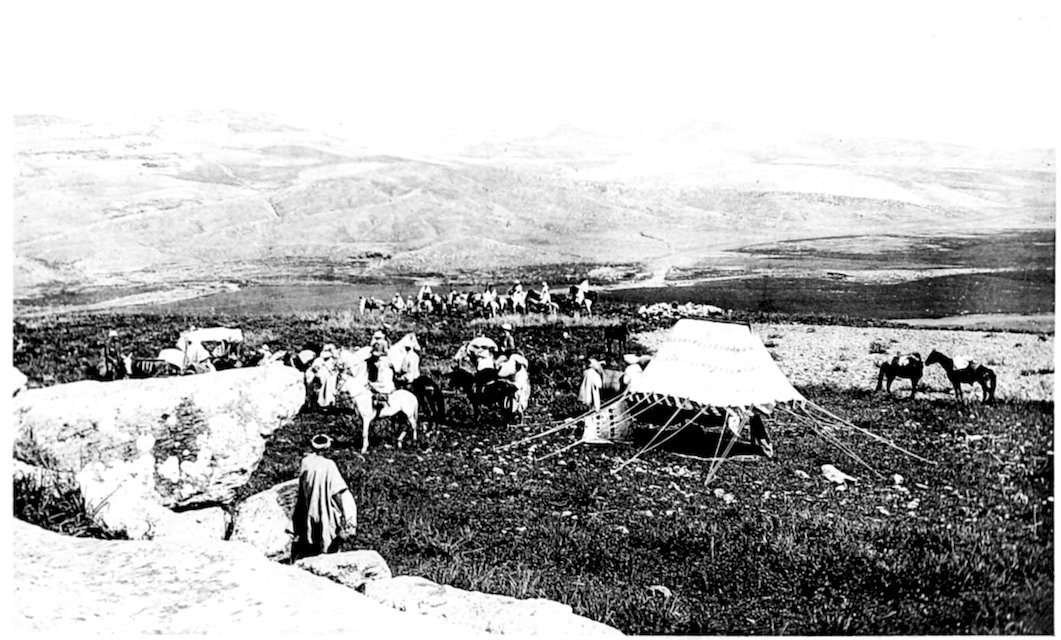
A MID-DAY HALT. ON THE ROAD TO FEZ.
73It was a relief to quit the region of the plains this morning, and to enter, after an hour’s ride, a narrow gorge which led us in to the mountain range of Mulai Edris. Before leaving the plains we passed a road which branched off to the right, and which Kaïd Ali told us led to Mequinez, from which place and from Fez we are about equidistant. We had luncheon to-day a little way off the track, or road as it may now almost be called, the tent being pitched under a low cliff, among the shelving rocks of which we found the most delightful shade. In the hillside were several caves, so possibly this may be one of the districts mentioned in the Periplus of Hanno as inhabited by Troglodytes or dwellers in caves. A mysterious race they must have been, living more like beasts than men, with no articulate language, but fierce, active, and “swifter than horses.” Their treatment of the dead was far from reverent, for they “bound the corpse neck and heel together, fixing it to a stake, and pelting it amid shouts of laughter.” The only stirring events during our halt were the chastisement, by the kaïd’s order, of one of the soldiers—a very ill-looking fellow—for refusing to clear away stones from the place where the tent was being pitched, and the other was the arrival in camp of one Síd Búbakr, from Fez, an ally of Sir John’s, and an office-bearer at the Court of Marocco. Destined as he is 74to be the medium of communication between the ambassador and the Sultan, no one fitter for the work could have been chosen; he is a man about fifty or sixty, without a hair on his face, and is accounted here a person of great intelligence. Having a large business of his own in the town of Marocco, he has had in the course of his professional travels a good deal of intercourse with Europeans, and has visited Spain and Gibraltar. Report says he is in private a great smoker, and that he does not, secretly, despise the juice of the grape. I could forgive both these transgressions were he only able to express himself in anything but his own barbarous tongue.
Our road after luncheon led through a succession of round grassy hills, which reminded me of some parts of Peeblesshire, till after about an hour and a half’s riding we turned off to the left, and, ascending a hill, saw from the top our present camp on the other side, and about one hundred feet below us. It was rather bad going for the horses crossing the ridge, as the track passed over ledges of slippery rock which the recent rains had left in a greasy state, and the animals had to hop from one to the other after the manner of goats—a mode of progression which was, fortunately, accomplished without accident.
Between 4 and 5 P.M. we got to the top; the sun was getting low in the horizon behind us, and the view in front was varied and very beautiful. At our feet lay an undulating and grassy plain, bounded on our left and front, i.e. to the north and east, by range upon range 75of hills; on our right hand the Jebel Silfat, in the Zarhún district, is high enough to shut out any more distant hills, while on its slopes, and picturesquely situated, were two villages, distant respectively about seven and four miles. They appear to be built of gypsum, and without the aid of a glass might, even at this short distance, easily be taken for part of the rocky surface of the hillside. M. Tissot calls them in his map Kheira and Beni Aamer; but after interrogating several natives on the subject, I could not make out that they rejoiced in any other name than that of the tribe which inhabits them, viz. the Beni Aamer. To make a map of this country with any attempt at correct nomenclature would be a thankless and heart-breaking task, as in many cases the inhabitants, intelligent apparently otherwise, have no idea of the name of the village in which they live. Often the name of a place, e.g. Kariya ben Aouda, Kariya el Habassi, &c., is synonymous with the name of the family in whose hands the governorship has been for one or two generations; but should the kaïd’s family become extinct, or the office for any reason pass out of their hands, the name of the village is changed, thus forming a continual obstacle to the labours of the geographer. The number of names, apparently of towns, which one sees in any map of Marocco, make it appear to the uninitiated a thickly populated country, the fact being that you may travel for days and even weeks together without seeing anything in the shape of a town, the only symptom of habitation being the dúars, or small collection of Arab tents, or 76possibly a dshar, i.e. a group of huts or rough stone buildings; the former denote the presence of the wandering Arabs, the latter that of the Berbers, or original inhabitants of the country. The names, however, which catch one’s eye in the map appertain to the Síd houses or tombs of Saints, small white cupola-like buildings, called by the natives “kúbba.” There are many of these kúbbe dotted about the country, and they give their name to any village near them. Information of any sort is hard to be obtained in this land of lies and subterfuges, but as regards dates, their ignorance is bonâ fide, most of their calculations being made relative to the date of the famine, or of the last war with Spain or Portugal. If you ask a man his age, his answer is probably, “I was such and such an age when the Spaniards took Tetuan from us,” and so on. Hence it is difficult to know when any of the kúbbe were built, especially as for neither love nor money could one get inside to look for dates or inscriptions. The buildings seem made of stone or plaster, and are square, with a small dome at the top, the whole coated thickly with whitewash. Close round them are a few trees, the only ones of any size in the country, and the place is looked after and kept in repair by some descendants of the deceased occupant, who receive contributions for the purpose from every right-minded traveller. If in want of more funds, they stroll the country with a banner and one or two instruments (I was nearly inserting the adjective musical), with which they soon raise sufficient for their own and their deceased relative’s requirements.
77Besides the plans I mentioned for naming villages, there is another which struck me as ingenious, viz. that of calling them after the day of the week on which the market nearest to them is held, a practice which prevails, I think, in Syria and parts of Egypt; e.g. the place where we encamped some days ago near the Sebú was called Jum’a el Hawáfi, the former word signifying Friday, the latter the name of the district; so with Hadd el Gharbía, one of our first camps,—Hadd signifies Sunday, or the “first day,” and El Gharbía the province. As the market day never changes—at Alcazar, e.g., it has been held on a Monday since the time of Leo Africanus, the Moorish historian of the fifteenth century—this method has more of permanence in it than any other.
These markets are largely attended; besides live stock of various kinds, grain and butcher meat, stuffs of native manufacture, &c., are sold in great quantities.
The evening was stormy, and just before the sun went down below the hill on the side of which our camp is pitched, the colouring and effect were fine beyond description. A strange lurid light lit up the valley below us, and the surrounding hills, while overhead masses of dark clouds drove quickly past before the strong south-west wind. The two villages I mentioned shone out exactly like patches of red fire against the dark hillside, and the half of a rainbow which spanned the plain was changed into the same colour, and reflected back the glory of the setting sun. The scene was very impressive, and now that the sun had disappeared behind the hill, the strong reflected light, striking 78upwards from between the drifting clouds, made the distant ranges appear quite close for a moment; then, as the sun sank lower, they again grew dim and far away, the loftier tops shining out to the last against the darkening background, and finally disappearing altogether, as the gloom of the approaching night, which follows so close upon the daylight, came down upon the landscape. The heat of the day had been excessive, and it hardly needed the sound of distant thunder to warn us of the deluge that was coming. About dinner-time it began with one or two brilliant flashes, which lighted up our dining-tent unpleasantly, completely eclipsing the three or four candles and tent lantern, and showing off our complexions—sun-burned as we are—in a ghastly hue. Trenches had been dug round the upper side of our tents, which are on a considerable slope, so our chances of being washed away during the night are lessened; while it is pleasant again to feel, if any reliance can be placed on what these people say, that a whole district will commend us in their orisons to-night to the holy keeping of the Prophet for our goodwill towards them in bringing down the rain.
Traces of the late severe famine seem more apparent on this side the Sebú river than farther north. Disease, too, the sure consequence of famine, has made great ravages, not only among the poorer class, but to a great extent among the richer people, who never can have known what hunger is. In a small district we passed through two days ago, the kaïd, in apologising for the smallness of the retinue brought to meet us, said it was 79not only because a number were away fighting, but that during the last eighteen months no fewer than sixty of his followers had died of a sort of low typhus which had been devastating the country. Even now the very poor class have nothing to eat, and no money to buy food. “Give us meat!” some of them cried this evening. “In God’s name, we have nothing to eat but grass!” and they look as if they spoke only the bare truth. To-day, as Hadj Hamed was distributing the carcases of two sheep, by order of His Excellency, to a lot of poor wretches at the last camp, they snatched the meat from him, and, tearing it up, began to eat it raw. Just beyond, too, where our horses were picketed, the body of a man was found dead, apparently of starvation, and was buried by our grooms. His body was noticed in the early morning; so the poor man had probably wandered round the camp till, unable to go any farther, he had lain down and died within a stone’s throw of the tent in which we were dining. It is horrible to think how little one can do to alleviate suffering of this sort, while at the same time it is gratifying to hear from educated natives that they are still mindful of the large amount of help that came from England during the famine, and also are aware from whence it came. Making allowance for the flattery and compliments which they naturally pay to a Mission like ours, there is no doubt that the English are held in much higher esteem here than are any of the Continental powers. Next to ourselves the French have most intercourse with Marocco; but though they have succeeded in making themselves dreaded, they 80have neither sought for nor obtained the goodwill of the people.
In this province, Sherarda, an act of tyranny and extortion has lately been committed by a foreign official, which is, I hope, without parallel in these latter days of diplomacy and civilisation. The story is unique, and having made notes of it as I heard it related through the medium of an interpreter, I think it worth a place in my diary. It seems that the official in question, some months ago, was sent from his embassy with a message or letter to the Sultan. When at a convenient distance from his chief he gave himself out as an ambassador, and demanded to be treated as such. Passing through this place his number of servants and animals was six and fourteen respectively. The usual mona for this number was brought, but he returned it, and demanded corn for two hundred animals, also two sheep, six loaves of sugar, 6 lbs. candles, chickens, eggs, tea, &c. Eventually he accepted half the amount of corn, but all the rest was insisted upon. He sold the sheep, the chickens, and part of the barley to a Moor of the place, the rest he carried away; the load being too much for his animals, his people seized a mule from its owner and placed on it two boxes and a mattress belonging to their master. The mule, however, bolted, leaving the load upon the ground; and the muleteer, in a fright at being left alone with the foreigner’s chattels, got the kaïd of the village, who, in the presence of a British subject and two adúls,[27] opened one of the boxes, and after taking 81an inventory of its contents, which consisted solely of cooking utensils, put it and the other box, which was locked, on a camel, with the mattress, and sent them all into Fez. Mr. ——, however, refused to receive them, stating that the box which had been opened contained jewellery and orders to the amount of several thousand dollars, and sent in a formal complaint about the robbery. Four soldiers were then sent to demand the robbers. The poor kaïd, who knew that no robbery had been committed, yet dreading his lord the Sultan, sent up eight innocent men to Fez. These were put in prison and flogged, without success, to make them confess—one man for certain, and it was rumoured two, dying under the lash. Still the soi-disant legate pressed his demands, and hints of active interference on the part of his Government helped to influence the Sultan’s advisers. A body of twenty-five ’askár were accordingly sent to the village to say that the money must be paid. The kaïd then sent for the headmen and sheikhs of villages, and said,—“My friends, it has pleased God to heavily afflict our province, and by the mouth of a lying Christian to incense the ear of our lord the Sultan against us; but we must bow to fate. What is to be done?” It was then agreed to ask for a fortnight’s respite, during which time they sold their crops and raised, first one half, and then the remainder of the required sum. With the latter instalment the kaïd, accompanied by the British subject, went to Fez, told the Vizier the facts, and that he had a man with him to substantiate them. It was all of no avail; the money was paid, and the foreigner returned home 82much pleased with the private results, at all events, of his mission.
In detailing this disreputable story I make no insinuations against the Government which has thus been disgraced, and which is doubtless as honest and upright as our own; but the rogue in question was a bold and subtle one, and though other Governments were probably informed by their representatives of the above facts, his own immediate superior is presumably still unaware of them. At the same time, if their prestige in this country suffers, ours derives but little benefit thereby, for as the Moors think that the devil has tarred all Christians with the same brush (they credit Sir John, perhaps, with a lighter coat), we are thought capable of acting similarly, should occasion offer. The incident, at all events, serves to prove how great is the necessity for a foreign Government to employ as its representative among a people like these a man whose own moral instincts render him incapable of employing as his subordinate any one who could be guilty of such glaring malpractices. With specimens, too, such as these to damn his endeavours, the attempts of any well-intentioned foreign representative to gain by example and moderation the goodwill and favourable opinion of this unfortunate race are rendered almost futile.
Leaky Tents—Beni Aamer—Hospitality of villagers—Sea of mud—Storm—Camp attacked by robbers—Perils of darkness—Curious rocks—First view of Fez.
Rain fell very heavily on Wednesday night at Zeggota, but the trench round my tent did its work well, and no water flowed in under the walls, notwithstanding the slope upon which they were pitched. These double-roofed tents, several of which we brought over from Gibraltar, are, although issued by Government, really perfect in their way, and the rain, the effect of which we at first rather dreaded, has now quite a soothing sound as it patters down at night close to one’s face. With the Sultan’s tents, of which we have several, the case is different; their large size and dark handsome linings are a great protection against the sun, but they leak hopelessly, and the big single-pole one occupied by Lady and Miss Hay is no exception to the rule. This serious inconvenience is, however, only one of the many great discomforts borne uncomplainingly by the two fair members of the Mission—discomforts 84which would have driven most English ladies back to Tangier before they had got two marches out of it.
Close to our camp at Zeggota was a beautiful spring of cold water, which came bubbling up bright and pure out of the hillside. The medico and I walked there after breakfast, as he wanted to fill some bottles with it for the purpose of mixing drugs and potions for the relief of suffering Marocco. Our road lay in a southeasterly direction, and a ride of an hour and a half brought us to the foot of a gorge on the right-hand side of the road, nearly at the head of which, and about two miles from where we halted for luncheon, was perched the village of Beni Aamer before mentioned. Directly opposite it, and on the same level, was another village, a sort of counterpart of Beni Aamer, but which had not been visible from Zeggota, being situated a little below the crest of the intervening hill. The whole ravine was filled with the most luxuriant olive groves, a welcome sight for people who had not seen a tree, with the exception of those round the Saint houses, since leaving the neighbourhood of Tangier. A little below our halting place, and at the point where a stream crosses the road, stood a solitary palm tree, which, from its rarity, has found a place as a landmark in Tissot’s map. While luncheon was getting ready some of us started, with two soldiers as escort, Miss Hay as interpreter, and Síd Búbakr as cicerone, to visit the village of Beni Aamer. It was a really pretty road up to it through the olive grove, with gardens here and there on either side, and a small vineyard, the grapes of which find their way to the markets of Fez. The people of these two villages, who come of an aboriginal (or brebber)[28] stock which has intermarried with Arabs, are—so the Síd told us—a prosperous and well-to-do set, making a considerable revenue out of the oil they extract from the olives; but since the Governor of Fez, under whose jurisdiction they come, found out that they were raising their heads above their neighbours, he has caused a heavy sum of money to be levied upon them, or, as they expressed it themselves, “came and ate them up.”
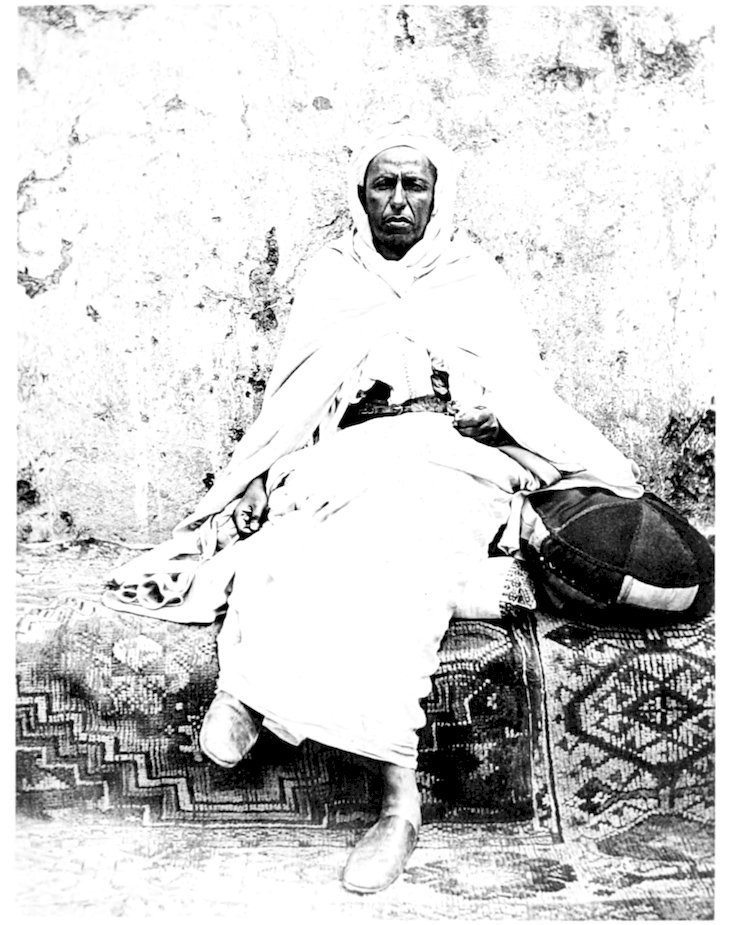
SID-BUBAKR.
85The immediate approach to the village lay over a slippery ledge of rocks, upon which several of the horses nearly, and one (Herbert White’s) quite came to grief; so we had to dismount and lead them. On arrival at the gate we found assembled a good many people, who had been watching our ascent; and Síd Búbakr, on asking if we might ride in, was told that the headman had been sent for, and that we must wait for him. The view from the plateau on which the village stands was magnificent; below and around us lay the olive groves, while ranges of sloping hills extended, line upon line, as far as the eye could reach, the background of all in the far distance being the snow-capped tops of the Atlas mountains. After waiting a few minutes the sheikhs of the village came out; tall, stalwart-looking sons of the mountain they were, fair as Europeans, and very little trace of the Arab about them.
86The Síd having explained who we were, and also who he was, the Sheikhs made us welcome to the village, and following in their wake we rode in single file under the massive archway. The street, if such it could be called, in which we found ourselves, led from this gate to another entrance farther up the hill at the top of the village. The houses on either side were mostly in ruins, though the mosque which we passed (but did not even look into, not feeling at the time very sure of our position) seemed in good repair, as were also one or two smaller buildings. The place, however, was in such an indescribable state of filth that we had difficulty in picking our way, and little time, moreover, to look about us. The centre of the road was too deep in mud and other abominations even to ride through, so we followed our guides along a sort of path on the extreme edge; this, however, was not particularly good going, and having just avoided a small but suspicious-looking hole at the foot of the wall, I heard a spluttering and noise behind me, and saw one of our party standing in the mud pulling at his horse’s head, which was the only part of the animal visible above ground. He soon managed to struggle out again, having changed his white coat for a dirty brown one; the hole into which he had slipped being an eccentricity of Moorish architecture, or some sunken vault of a ruined house. Arrived outside the other end of the town, we held a sort of council of war, our chief object being to get home without partaking of the hospitality which was now being pressed upon us. We even took the Síd into our confidence, but he decided 87against us, so we saw there was no escape. We could not, in any case, return outside the town, as we wished, there being a lion in the path in the shape of a Saint house, past which our unhallowed persons could not be allowed to go. We therefore returned through the gateway, and bearing away to the right, passed along a rather cleaner part, with one or two shops on either side. Arrived at a gloomy archway in a covered passage, we dismounted one by one, and, entering, found ourselves in an almost totally dark court, the odours in which were not of sanctity; our guides then took us by the hand and led us to a corner where there was a hole in the wall, through which having crept with difficulty, we came to the foot of a very steep and dismal narrow stair, up which in Indian file we were invited to climb. It was, in truth, a strange entrance to a gentleman’s house, and augured badly for the style of visitors our host was in the habit of receiving, or rather of protecting himself against. Was it an ambuscade for us unfortunate infidels, and did the hearts of some of us beat loud as the thought of the Jew burned in the market-place of Fez a few months back occurred to us, besides many another tale of Mussulman fanaticism and cruelty? But no, the cheery voice of the Sheikh at the head of the stair reassured us, and certain silvery tones sounding just over our heads stimulated our curiosity. As soon as we reached the upper story we were led through a kind of patio to an inner chamber opening on to it, and through a door on the left, leading to the top of the house, we saw disappearing 88hastily the houris whose voices we had heard from below. The room we found ourselves in was provided with cushions placed on the encaustic tiles of the floor; and as soon as we were seated our host besprinkled us plentifully with rose water, then, after burning some incense in a silver dish, brought it round to each of us. The Síd had assured us we would get off with tea, but until its arrival we were much afraid that something more solid was in course of preparation. Accompanying it, however, was a large basket of bread with a pile of fresh butter, weighing at a guess about six pounds. The Moors have a peculiar, albeit simple, method of serving out such delicacies; breaking off about a quarter of one of the flat scones or rounds of bread, they plunge their right hand into the mass of butter and clap a piece about twice the size of a hen’s egg on to the bread, which is then given to you to get through as best you may; if you are at all slow or backward in doing so, another edition of the same proportions is forced upon you, and so on ad nauseam. It was past twelve o’clock when we arrived at our third cup of tea and second hunch of bread and butter, and, lusting as we were after the flesh pots of the camp—we had intended returning there to luncheon—it was hard to feel ourselves becoming momentarily, though involuntarily, less and less able to contemplate that meal. Just as our forbearance (to say nothing of our stomachs) was tried to the uttermost, and as we were rising to depart, a dish of steaming hot meat was brought in; but against this we stoutly took our stand, protesting with our hands upon 89our hearts, or a little below that organ, that the limit to our power of consumption had been reached. The astute Síd Búbakr bearing us out in this assertion, the dish was taken outside to our two soldiers, whom we saw doing ample justice to it, and fully appreciating our want of appetite. We now stated our wish to return to the halting-ground, urging the anxiety the Bashador would be feeling on our account, and other cogent reasons. A new difficulty arose, however, out of which even Síd Búbakr could not help us; it seemed that there were two kings of Brentford, and that, having honoured the house of one of them, the other would be humbled to the dust if we did not visit him too. Seeing there was no help for it, we acquiesced with what cheerfulness we might, and, passing out, were rewarded with another glimpse of some of the ladies of the establishment, whose curiosity to see us overcoming their shyness, they pressed forward to the head of the stair, their faces—one a very pretty one—peering over each other’s shoulders to take a parting glance. The lane outside was densely crowded by the villagers, who were much excited at the news of a party of Christians being in their Sheikh’s house; but we managed to get on foot to the next stopping-place, which was pretty close. Here much the same ordeal was gone through, except that the bread, freshly baked for us and steaming hot, formed a slippery foundation for the inevitable lump of butter crammed on to it, thereby increasing the difficulty of graceful manipulation not a little. The room in which we were seated for this second tea-party was in the 90centre of the house on the ground floor, a rather gloomy apartment, round the sides of which were placed gigantic clay jars; they were used, as far as I could make out, for keeping olive oil or corn, though from their size and shape the suggestion of one of the party that they contained the bodies of our host’s deceased wives seemed not improbable. We were allowed to decamp from here as soon as we had got outside the regulation third cup of tea; and the amount of bread and butter we had disposed of having effectually put luncheon out of the question, we rode quietly and resignedly back to the halting-place, where our lengthened absence had created some uneasiness.
This visit of ours to Beni Aamer was really very interesting, bringing us, as it did, into contact with the Moor where he shows to the greatest advantage, viz. in his own house. The more one sees of these people, the more one appreciates their charm of manner and the entire absence of anything approaching to awkwardness or mauvaise honte. Our hosts here, for instance, were as perfect gentlemen in their way as one could meet with anywhere; and certainly, had they exhibited either vulgar astonishment or any like sign of ill-breeding, one could readily have excused them. With the exception of ourselves no Christian had ever entered the village before, and the populace showed their astonishment by pouring into the streets and covering the tops of the houses that lined our route. The Sheikh of the village, however, presided over his tea-tray with as much composure as if he had been entertaining half-a-dozen Arabs 91instead of the five Christian men, and, what must have been much more trying, the one Christian lady of our party. In the streets, too, though the most unmixed surprise,—and, in the case of a few women and children, terror,—was manifested at our appearance, there was no rudeness or jostling; those who disapproved of our presence merely keeping in the background, scowling at us, and muttering curses as we passed. The men are, in most instances, much better mannered than the women, and Miss Hay experienced rather rough treatment at the hands of the ladies in the first house we went to. They had invited her on to the roof to see the view, and after nearly tearing her clothes to pieces to see what they were made of, one young lady of twelve or fourteen called out, “Let us throw the Nazarene down from the roof, and see what will become of her!” which suggestion, however, was fortunately not carried out. At the other house, on the contrary, a pretty attention was shown her by the head of our host’s harem, who came into the room to receive her, and led her to the upper end of it, where there was a door opening into another room. She then seated herself behind the door, and remained during the séance, saying, “I thought you would feel strange among so many men alone, so I came to meet you, and will not leave you all the time.” The full value of this can only be appreciated by those who know the stringent regulations by which the discipline of the harem is conducted, and from which this was, of course, a decided departure. By the time we started, the fact of our presence had 92been noised abroad, and the crowds round our horses and along the roofs had much increased; the Sheikh and his friends accompanied us to the gate, and Síd Búbakr thus expressed to them our thanks:—“I am asked to convey to you the thanks of the Christians for your hospitality; they rode up here merely to see your village, but you have shown them the hospitality of the Arab, and they will always bear the memory of your kindness written upon their foreheads.”
I was a little surprised at Síd Búbakr making use of the word “Arab,” as our entertainers were evidently of Berber, or aboriginal, extraction; however, as the term “hospitable as an Arab” is proverbial here, I hope they took it for a compliment.
We got into camp at Mikkès that afternoon at four, an escort of seventy regular cavalry, the first besides our permanent escort that we have seen, being stationed some miles out on the road to meet us. They are a fine body of men, and their movements, and manner of performing the lab el barôd, are very different from those of their provincial brethren. The ground on which the tents were pitched was as muddy and ill-chosen as it could possibly be. It is at the bottom of the chain of hills through which we have been marching, and is composed of a glutinous sort of clay. This substance, after taking a few steps in it, attached itself in such quantities to our boots, that one’s gait resembled that of a cripple whose lower extremities are paralysed, or of a fly just emerged from the treacle-pot. The ladies were carried into the dining-room tent 93on chairs, and Sir John waded proudly in with goloshes on; but, except for the purpose of proving the excellence of these expedients, I can conceive no other reason for the choice of this ground, especially as the adhesive nature of the soil had been proved on a former occasion.
I shall not soon forget the night we spent there. First of all we experienced the most violent storm of wind and rain we have had during the march, and while this was at its height the robber tribe of the Beni Mtír came down from the hills to attack the camp and carry off the horses. Altogether, we had reason to congratulate ourselves on a twofold escape from death,—first by drowning, then from the bullets which whistled about the camp, for the sentries, kept awake by the rain, were on the qui vive, and fired upon the robbers; while the escort, called to horse, scoured the neighbourhood, but, owing to the darkness, without effect. What concerned me more nearly was, that just before composing myself to sleep I noticed, by the light of a flickering candle which was out of my reach, and which was going to be allowed to die a natural death, that my tent-pole was considerably off the perpendicular. Taking into consideration the hurricane that was blowing outside, and the consistency of the soil into which the tent-pegs were driven, this phenomenon was alarming, to say the least of it. I jumped out of bed, and by the expiring light of the candle anxiously surveyed the pole from every point of view, but from none would it appear otherwise than as a miniature edition of the leaning tower of Pisa. The water, however, was at this time 94descending in sheets, and mindful of the Slough of Despond with which we were surrounded I adopted the tactics of the ostrich, and going back to bed blew out the candle, so that the offending pole should no longer warn me of a fate I shuddered to contemplate.
Notwithstanding all these perils of darkness, the night passed away without accident, except that at 2 A.M. the servants’ tent was blown down. I deeply sympathised in my valet’s melancholy recital of their sufferings, but hope the accident may serve to make him more careful in looking to the safe pitching of mine, as I must have narrowly escaped a similar catastrophe.
The little plain of Mikkès presented a humid and sad appearance in the morning; the tents were soaked and almost black with rain, and a sheet of water overspread the foundation of mud below. A high hill overhung the camp on the south-west side, the rocks on which, apparently of a tertiary limestone formation, seemed to have been subjected, at a not very distant period, to volcanic action, which had caused them to assume the most fantastic appearance. Large circular patches, like the filled-up craters of extinct volcanoes, dotted the hillside, and these, shiny but sombre in the rain, all helped to form a gloomy background to the scene, as our horses, sliding and struggling along, bore us away from this sea of mud.
To-day’s march we were told was to be only two hours, and Fez would not be visible till the following day. The march, however, turned out to be nearly five hours, and just as we turned off the road to gain 95our camping-ground, the walls and minarets of the Sacred City came into view, shining out clearly, about five miles off, in the strong light of the afternoon sun.
The camp to-night is pitched close to the Wad el Fas, a tributary of the Sebú, and is about as well-chosen a site for malaria as yesterday’s was for discomfort and wet clay. What with the rain, which has been harassing us of late, and the stupidity of Hadj Hamed (or whoever is responsible) in pitching the camps in such ill-favoured spots, I think most of us are pleased to be nearly at our journey’s end for the present. Our native servants and camp-followers seem to more than share our feelings in this respect, and as soon as they came in sight of the hills round Fez called loudly on the patron saint of the city—“O Mulai Edris, bring us soon to Fas! O Mulai Edris, help us with forage for our mules! O Mulai Edris, we are near home again!” with other and similar ejaculations.
Entry into Fez—Compulsory welcome—Grandees of Fez—Kaïd Maclean—Violence of soldiers—Merchants of Fez—Jews—Our garden in Fez—Kaïd El Meshwa—Moorish etiquette—Grand Vizier—Streets and shops.
The excitement of the Moors on getting to their journey’s end was great last night in camp, and rather communicated itself to us more matter-of-fact Nazarenes. Many were the questions His Excellency had to answer relative to the Sacred City. Some of us wanted to know if there was any hair-cutter in the town—a tradesman of whose professional aid most of us stand in need—forgetting that the razor, and not the scissors, is the only instrument employed by coiffeurs of the faithful. Altogether, our ignorance of what we were to find was great; but this only added to the interest with which we looked forward to enlightenment.
Our camp was not more than five miles from the gates, but wonderfully few people came out to look at it; etiquette prevents the officials showing their curiosity, and the people, we heard, had been forbidden to come. This morning, the only person of note to make his 97appearance was Síd Búbakr; he had left us the day before yesterday to precede us into Fez, and hear what were the latest arrangements for our reception, which he rode out this morning to communicate. Fortunately the day was bright and sunny, and the clean white sulhams[29] which most of the servants had donned for the occasion, shone to advantage. They had all done something in the way of brushing themselves up. Boomgheis in virgin white looked the personification of innocence and chastity,—a character to which he is perhaps barely entitled, while green silk handkerchiefs adorned the smooth shaven and scarred heads of Abd-er-Rahman and “Dr. Hooker.”[30]
We had rather expected that His Excellency would request us to appear in uniform on the occasion, as one quite felt it to be a day on which either that or a frock coat and tall hat—had we such things in our kit—should be produced; but on reflection one recognised the fact that no costume could appear more striking and thoroughly outlandish to the eye of the Fasi[31] than that of everyday life! During breakfast Síd Búbakr, sitting at Sir John’s feet, conversed eagerly with him about, as we were told, the excitement in the city regarding our entry, the temper of the populace, and the orders the Sultan had given. It seemed that a certain class, instigated probably by the Grand Vizier, who is a fanatic of the worst type, viz. an ignorant one, had determined to take 98no notice of us, but to treat us with the contempt to which our creed entitled us. To obviate this, however, the Sultan this morning gave orders that all shops were to be closed and business suspended during the forenoon, and the outpouring of the inhabitants caused by this measure was a sight which none of us will readily forget. We got on our horses about 8.30, all curiously eager to see what was to be seen, and equally ignorant of the extraordinary nature of the spectacle that awaited us. For the first three miles there were only a few isolated groups of people come out to see us; but when within two miles of the gate the crowd had greatly increased, and it became necessary for the escort to close in a little for our protection, and for us to form ourselves into two ranks to enable them to encircle us more completely. I think from here to the gate the whole thing rather suggested scenes in a circus of impossibly gigantic dimensions, than anything else, but so constantly changing and varying as almost to baffle description, unless one had noted down all as it occurred. The first military party to meet us was a small body of horsemen, so gaudily and brilliantly attired, that in the far distance, as they came galloping ventre à terre towards us through the lanes of people, they looked like a handful of precious stones thrown by a powerful and unseen hand, and glittering in the sun; with one funny exception, they were almost the only piece of colouring in the whole scene. Next we were met by the Governor of Fez, with a party of more soberly clad riders, attended 99by a strong guard. This official—an old and striking-looking man—greeted His Excellency with much emotion, but as he is the individual who has been squeezing our friends of Beni Aamer, we looked upon him with no loving eye, and would much like to give a quiet hint to the Sultan regarding his malpractices. When within a mile and a half of the entrance, our following was augmented by several of the notables of the place, among the most conspicuous of whom was the Kaïd el Meshwa, or Lord High Chamberlain of the Court. He is a man of great presence, about 6 feet 2 inches in height, and broad in proportion; and being mounted on a large white horse of about 16 hands, with a huge saddle covered with green silk, formed a striking figure in the procession. His complexion is almost black, as he belongs to the Bokháris[32] or hereditary bondsmen of the Sultan, but his voice and features are by no means unpleasing. He is one of the many instances in this country of “promotion by merit.” Born a slave, his father having filled the office of “washerwoman” to the royal household, he is now a rich man, and one of the highest Court officials.
Each of these grandees, as he came up, shook hands cordially with His Excellency, and then ranged their horses alongside his; while their guards, mingling with our escort, helped to keep off the mob. At this point the line of troops commenced; at least bodies of them were formed up at intervals on our right hand, while on the left were drawn up, about four deep, a motley line 100composed of many thousand Fasi, all armed with the long gun of the country,—a plentiful stock, apparently, from which to draw recruits for the regular army. The latter force took up the line on our left as soon as we arrived at the end of the armed populace. They were under command of Kaïd Maclean, lately an officer in the English army, but who has been in the service of the Sultan for about two years in the capacity of Instructor of Infantry, and to whose untiring exertions His Majesty is indebted for whatever efficiency is to be found in the dismounted branch of the forces in Marocco. Each regiment got the command to “present arms” as we passed, and executed it somewhat independently, according to their interpretation of the order. Bands of musicians at stated intervals played salutes, and groups of trumpeters sounded a flourish as we went by; while outside this lane of soldiers was a surging, seething mass of people, old and young, clothed and unclothed, mounted and on foot, pressing on and tumbling over one another in their anxiety to lose nothing of the sight, their eyes being constantly fixed on the strange-looking people whom their sovereign was so anxious to honour. Among these were grand-looking old men on mules, grave and reverend signors on large ambling horses, and occasionally on a donkey were seated two and even three half-clad and grotesque-looking creatures. Sometimes, when this moving crowd pressed too hard on the line of soldiers, some half-dozen of the cavalry in rear of us would break through the line, upsetting the soldiers, and charging promiscuously among the people, 101knock them off their feet, or their donkeys, as the case might be. The populace, though evidently holding them in much awe, seemed to take this species of practical rebuke very good-humouredly, and picking themselves up again, pushed forward as vigorously as ever. A line of about twelve wonderfully-clad people, with banners, posted inside the living street along which we rode, attracted our attention, and these, we were told, represented the chief merchants’ houses in Fez. A funnier and more bizarre-looking group could not be imagined; the first was a tall black-looking savage, who held his flag up and scowled at us, as though this mark of attention was sorely against his principles; the next to him, an aged-looking little dwarf, with a sandy beard, a complexion almost white, and a look of infinite cunning in his small red eyes as he squinted upwards at us; beside him, a fat, unwholesome, and nondescript sort of youth, with a flabby face about the same yellow hue as his banner, and so on,—no two of them alike, but each one calculated to haunt you in your dreams, were it not for the constantly changing supply of singular or revolting spectacles, each of which served to obliterate the last from one’s mind. The merchants are, of course, the class most interested in keeping up a connection with Europe, and they owe much to His Excellency’s influence with the Sultan on their behalf. Long ago, on a former occasion of Sir John’s entry into this town, some of them who were under a special obligation to him engaged several thousand women to go out and meet the procession; they took up their position on some 102rising ground, and as the cavalcade passed gave utterance to their peculiar shrill cry (something like a Swiss jodel), a sound they always make when wishing to express their satisfaction at or admiration of anything. The effect produced, as I have heard it, from only a few people, is curious enough, but coming from such a multitude of throats was very beautiful and striking. Shaw, who writes in 1732, describes the sound I allude to, spelling it phonetically, “Loo, loo, loo,” and says it is a corruption of the Hebrew “Hallelujah.”[33]
No ladies, however, came out en masse to-day to meet us, but as we got closer to the city walls the moving panorama on either side became wedged among the dense crowd who had collected just outside the gates, and amongst whom were many veiled figures struggling for places where they could get a good sight of us. Groups of Jews, too, were to be seen—strange and weird-looking people; most of them in their small black caps and dark flowing robes. A few were mounted, and all had their slippers on, in neither of which luxuries may they indulge till outside the walls of any of the sacred cities. A long-suffering race truly are they, content to suffer these and all other indignities, provided only they can make a usurious profit out of their oppressors. But contemptible and despised as they so often are, they are not without great title to our respect when one considers how through good and evil report they stick together, always ready to help their weaker brethren, even at the sacrifice of—what they value more than their blood—money. This characteristic they have, to their honour, always possessed, and to the last they will be found “united by the close moral affinity of habits and feelings, treasuring in their hearts the same reliance on their national privileges, the same trust in the promises of their God, the same conscientious attachment to the institutions of their fathers.”[34]
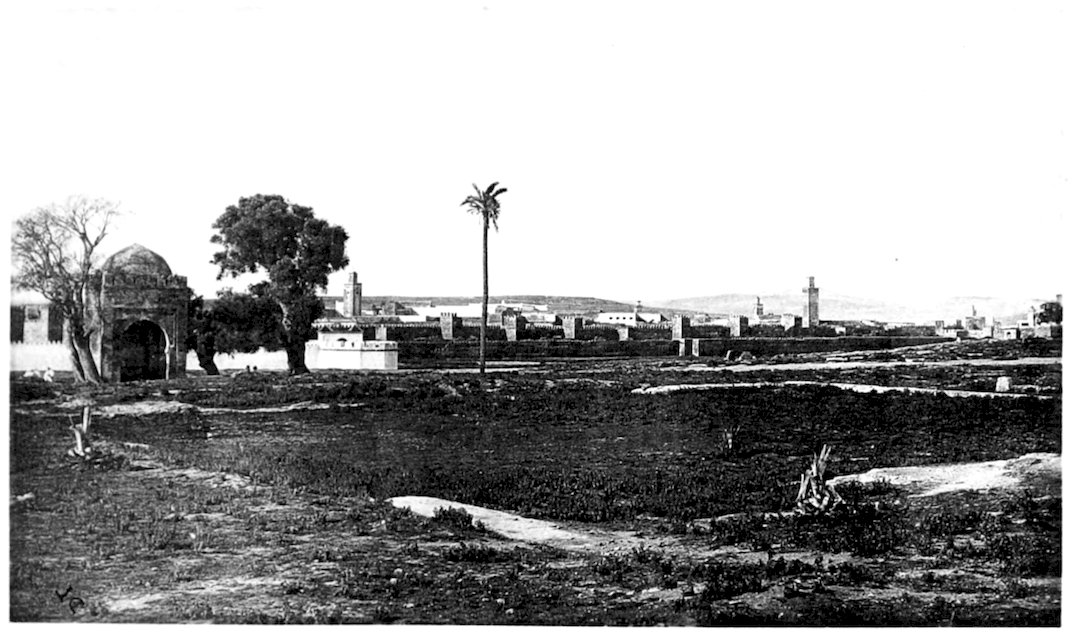
VIEW OF FEZ ENTERING FROM NORTH WEST.
103The ground rises on either side of the road just before one enters the town, and this position was occupied by civilians of apparently a better class than the yelling crowd who had hitherto surrounded us. These people all wore prodigious white turbans, which, with spotless robes of the same colour, formed a curious contrast to their dark faces, directed towards and slowly following the movements of the strangers. Some half-dozen brass guns were drawn up near here; the officer in charge, a handsome man in a gorgeous dress, with a big white turban, rode up alongside of me, and rather startled me by asking in excellent French if I spoke that language. On my replying in the affirmative, he introduced himself as Monsieur Erckmann, captain in the French Artillery, and commandant of that branch of the Sultan’s army. Funnily enough he cannot speak a word of English, and as Kaïd Maclean does not understand French, they talk to each other in Arabic, in which language they both seem proficient.
Leaving on our right the high walls of the royal palace with its green towers and minarets, from one of 104which His Majesty, with his favourite wives, was said to be watching us, we passed under a gateway into the city, and a ride of less than an hour brought us through the most extraordinary labyrinths to the head of a steep and narrow lane, down which our horses slid till they deposited us at the gate of our present quarters. Macadam and his art of road-making are unknown in Fez, and there are not two consecutive yards in any part of our passage through the streets to-day where an English horse would not be in danger of breaking its knees and its rider’s head. The quarter of the town through which we first passed was open and partly ruinous; afterwards we got into a network of bazaars, but owing to the royal mandate closing the shops and hunting the people out to welcome us, there was no crowd of any sort. Fortunate it was that they were kept out, for nothing short of a charge of cavalry could have cleared the approach to this place. A good many, of course, squeezed in with us at the city gate, mostly Moors, for the Jews were delayed by having to dismount from their mules, or to take off their slippers. One eager youth who had omitted the latter precaution was detected soon after, and levelled to the ground by a blow from the butt end of a gun. With the singular vitality, however, possessed by these people, he picked himself up, and with his shoes in his hand, I saw him presently running along parallel with us again, a large scar on his head bearing witness to the ungentle treatment he had received.
Dismounting at the gateway here, a guard of soldiers 105in red coats and knickerbockers, but no stockings, received us with a salute, and passing them, we found ourselves in a pretty orange grove about one hundred and fifty yards long by fifty across, with raised paths traversing it and several ducts of water running through in all directions; about the centre a walk paved with mosaics crosses it, at each end of which is a sort of house or kiosk. A few steps lead up to the level of the one on the west side, and in front of it there is a tank of water of considerable depth, with fountains playing in it. The house opposite consists of an entrance hall or public room about twenty feet square, lofty and lighted by a skylight; off it are three oblong-shaped rooms, all of which have glass windows to them—an unusual luxury in Marocco; the walls are covered half-way to the ceiling with pretty velvet hangings; one or two tables and chairs, specially made for us, and bedsteads, being the only articles of furniture. At the south end of the grove the space between the trees is a little more open, and there we have had our tents pitched, so as to keep the house on the east side entirely for dining and sitting-rooms. The bedsteads, &c., with which the side-rooms were provided have consequently been ousted, and owing to the magic presence of an Englishwoman, the place has already assumed an air of luxury and comfort about one quarter European and three-quarters Oriental. In the other house, in front of which the fountains play, Lady and Miss Hay have taken up their abode; while on the platform over the gateway, in solitary grandeur, is pitched the tent of the Bashador. The ground is 106very damp, but, with the aid of many donkey loads of fine sand and a number of planks, we have managed to lay down pretty good flooring to our tents; from the door of mine I have a capital view of the town below and hills in the distance. Another garden, also made over to us, is just below this, and here our horses and mules are picketed; behind us rises a high wall shutting out all view of our neighbours; in fact, unless one looks towards the east over the roofs and white terraces visible in that quarter, one would not know there was a town within ten miles, so thick is the foliage of the grove, and so distant sounds the hum of the city.
Among the notables who called to pay visits of ceremony to Sir John to-day were the kaïd of the Meshwa, or chamberlain, and the Sultan’s private secretary, an amiable-looking old man with a pleasant, and, what is uncommon here, a friendly expression of face. Both these visitors remained long in earnest conversation with His Excellency, the chief subject under discussion being the rather awkward announcement by the Grand Vizier (of which Sir John had got notice privately some time before), that it was quite incompatible with his position as Prime Minister, and his rank as maternal uncle of the Sultan, to call upon or even return the visit of any one. Under these circumstances the Envoy distinctly declined to pay the visit of ceremony which was due to the Vizier, without a guarantee of its being returned, with which rather hard nut to crack, his auditors, who were inclined to agree with him, took their leave. Among the governing class of Moors 107etiquette and prerogatives are of vital import; and as this fanatical Minister is most unwilling in all his correspondence, and now apparently in his personal dealings, to extend to Sir John the courtesies which the latter considers are due to the representative of Her Majesty, grave complications might have ensued. All negotiations with the Sultan are usually conducted through the Vizier; the political objects of the Mission might therefore have been frustrated, and our journey, which a French paper describes as “lointaine et périlleuse,” have been taken in vain. Great cordiality existed between His Excellency and Síd Músa, the talented predecessor of the present Vizier; and Sir John was naturally much disgusted at the turn affairs had now taken. Fortunately, however, at 6 P.M., a message came from the “maternal uncle” guaranteeing a return of the Envoy’s visit, upon which that able diplomatist, desirous of striking while the iron was hot, at once donned his official garb and proceeded to the house of the Minister, from which he returned, tired but triumphant, at 9 P.M.
As soon as we had got our tents pitched and had luncheon, some of us went for a walk in the town, accompanied by the interpreters, and escorted by six or eight soldiers. As long as we were in the narrow lanes with walls and windowless houses ever so high on each side, we did not come across many people to stare at us; but once in the regular thoroughfares, where the bazaars are situated, the astonishment and interest taken in us were unbounded. People left their work, customers their bargaining, to turn round and look at 108us, most of them following in our wake, while, along the streets parallel to the one we happened to be in, we saw scores of people hurrying to take up a good place at any corner we were likely to pass. Most of the streets in which there are shops are roofed over, when the houses do not meet at the top, with wicker-work or hurdles stretched across as a protection from the sun. They are roughly paved with slippery stones, and are not ankle deep in mud, as are the lanes by which we approached them.
Although one rather loses caste by being seen on foot, it is more convenient than riding, owing to the crowds of people and narrowness of the streets; also, in the places where the best shops are to be found one is obliged to walk, wooden bars being placed across the entrance of the street to prevent the ingress of mules and horses. The busy and commercial quarter is a maze of these narrow thoroughfares, from which the shops, or rather stalls, are retired a little way, and raised about three feet from the ground, forming a kind of alcove in the wall. The merchant sits cross-legged in this recess with his wares in front of and round about him, perfectly indifferent, as becomes a true believer, as to whether you deal or not; above his head, in the centre of his den, hangs a cord by which he lazily pulls himself up to stretch across for any article out of his reach which the customer may want to see. Each time, however, that we stopped to look at anything, the crowd pressed so uncomfortably upon us that it was all the soldiers could do to keep them off, and their activity in clearing the 109road increased to such a degree that, being uncertain how much knocking about the populace would stand, we cut short our visit, and must delay our purchases to some future date, when the sight of the Christians will have lost a little of its novelty.
The quarter where we are is divided into gardens like our own, each containing one house, and surrounded for the sake of privacy by high walls. These enclosures are intersected by lanes from which all view is excluded on either hand, and so narrow that two horsemen can with difficulty pass one another. The sanctity of the harem and of the mosque is much more carefully guarded here than in Mussulman countries farther east; and there is one street, at all events, in this city, where neither Christian nor Jew may enter, lest the taint of their presence should reach the mosque situated at the farther end. It contains the shrine of the son of Mulai Edris, the patron saint and founder of Fez, whose name is on the lips of every beggar in the street, and without invoking whom no bargain is made or business concluded.
We seem to have been wandering in the wilds for months instead of weeks, and dinner to-night under a solid roof, seated on chairs with backs to them, and at a table “on an even keel,” seemed to us a luxury carrying us back to a long-forgotten era of civilisation.
Visit to the Chamberlain—Our Host’s sons—French officers at dinner—Reception of Mission by Sultan—Kilts and equestrianism—Palace enclosure—Homage of soldiers—Dialogue between Sultan and Envoy—Delivery of the Queen’s letter—Presentation of Mission.
Our round of dissipations in Fez commenced this morning by a breakfast at the house of the Kaïd el Meshwa, the portly Chamberlain whose figure impressed us all in yesterday’s procession. Fortified by an early cup of coffee, we proceeded to his house in state, the military members of the Mission in uniform, and the others in diplomatic garb. The distance was said to be a quarter of a mile, and we were recommended to walk, but turning, fortunately, a deaf ear to the evil counsels of, I regret to say, His Excellency, we mounted our horses and rode for a mile through as dirty roads as can well be conceived, their narrowness necessitating our riding in single file most of the way, with mounted guards in front, and soldiers on foot bringing up the rear. Arrived at our destination, we dismounted under an archway, and traversing a dark and winding passage, came to a doorway where 111we were met and welcomed by our host. He led us into a spacious patio, prettily decorated after the Moorish style, having a fountain in the centre, and three comfortably-sized rooms opening into the court; these rooms were carpeted with handsome rugs from Rabât, stupidly covered in part by pieces of Brussels carpet. In each room were one or two French bedsteads, which, with the usual cushions round the walls, were the only articles of furniture. The inevitable three cups of green tea, without which prefix no business or pleasure can be undertaken, were served to us in one room, after which we were led across the patio to another, where a table, groaning with sweetmeats of all sorts, was laid out, a course of cold fish being first handed round as a kind of foundation.
The kaïd has a pleasant grave face, albeit a black one, and talked continually with His Excellency all the time we were jeopardising our constitutions with his light refection, which we were warned was not to count in our favour, but was only to serve as a preliminary to something more solid on another occasion. The square patio was all open at the top, and round the edge of it, peeping over the parapet, were a lot of white veiled faces (at which we occasionally stole furtive glances), looking eagerly on at the unusual scene below. A jolly little boy about three years old trotted in and out of the room, and I utilised him occasionally by making him eat some unctuous confection which was put on my plate, and which I was wholly unable to tackle. 112Another son of our host’s, a man about twenty-four years old, sat outside; his looks were not prepossessing, but it seems he has been suffering for over a month from a bullet wound in the leg, just above the ankle, which has almost crippled him. The manner of his receiving it is typical of Moorish customs, and of the ready and frank way they have of expressing the feeling of the moment. It seems that the youth is a good hand at lab el barôd; and a friend of his who was engaged with him at this pastime, annoyed at the superior dexterity he evinced, loaded his own gun with ball and fired, intending, so he said, “only to kill the horse,” instead of which the ball entered his rival’s leg, and is apparently there still. The doctor to-day, at the kaïd’s request, made a superficial examination of the wound, and is to search with a probe for the foreign body on another occasion.
The kaïd was interested in our various uniforms, and the differences between them were explained to him by Sir John. As the Highland dress is unsuited for equestrianism, I had indulged myself to-day in mounted officer’s attire, long boots, &c., but had been obliged to promise to appear in full dress in the presence of Majesty to-morrow, the Sultan having intimated his intention of receiving the Mission at 9 A.M. His Excellency, in describing the dress to the Kaïd el Meshwa at breakfast, alluded with delicacy to the nature of the inconvenience which would be experienced by the wearer in the saddle, upon which the Chamberlain promptly suggested the use of a pair 113of large Moorish continuations into which kilt and all could be tucked, and the cuticle of the rider be thereby secured from injury; he also offered for my use a small room in the palace to-morrow, in which I might disencumber myself of the extra garment before His Majesty’s arrival on the scene. This ingenious proposal so commended itself to Sir John that he at once accepted on my behalf, and this evening a huge pair of white linen drawers from the wardrobe of Síd Búbakr have made their appearance in my tent.
Returning from the Chamberlain’s house, some of us paid a visit to Kaïd Maclean, who did the honours of his establishment, and took us to the roof of his house, from whence there is a capital view of the town. He has got a large and very good garden, in which, among other edibles, he grows potatoes. This vegetable is unknown here, but although he has given them to several Moors to try, they, curiously enough, have not accepted his offer of seed for themselves. After luncheon he went with us for a ride outside the town. While galloping along, the horse of one of our escort, of whom we had six, put his foot into a hole, and coming down gave his rider a heavy fall upon the stony ground; the man picked himself up, bleeding profusely from the head, and said he was “La bás”—Anglicè, all right,—but he had to be taken home, and to-night we hear he is very ill.
The two French officers dined with us. M. Erckmann is a nephew of the author of “Le Conscrit,” &c.; he does not seem to care about the Moors, nor does 114he very much rely upon their professions of friendship for us. They have been here about two years, their services having been forced upon the Sultan by the French Government, whose jealousy was roused by Kaïd Maclean’s appointment to command His Majesty’s infantry. M. Erckmann is well educated and rather amusing; the other, we found upon enquiry, holds the rank of sous officier. He said little, devoting himself chiefly to the pleasures of the table, and laughing hoarsely at the jokes of his superior.
I think it will be long before the spectacle we saw to-day is forgotten by any of us, gorgeous as it was in its barbaric magnificence, and important in the political bearing it had upon the relations between Marocco and England. The Sultan had signified his intention of receiving His Excellency and suite at 9 A.M. So, shortly after 8 o’clock, we left our quarters, and rode towards the palace of His Sharífian Majesty.
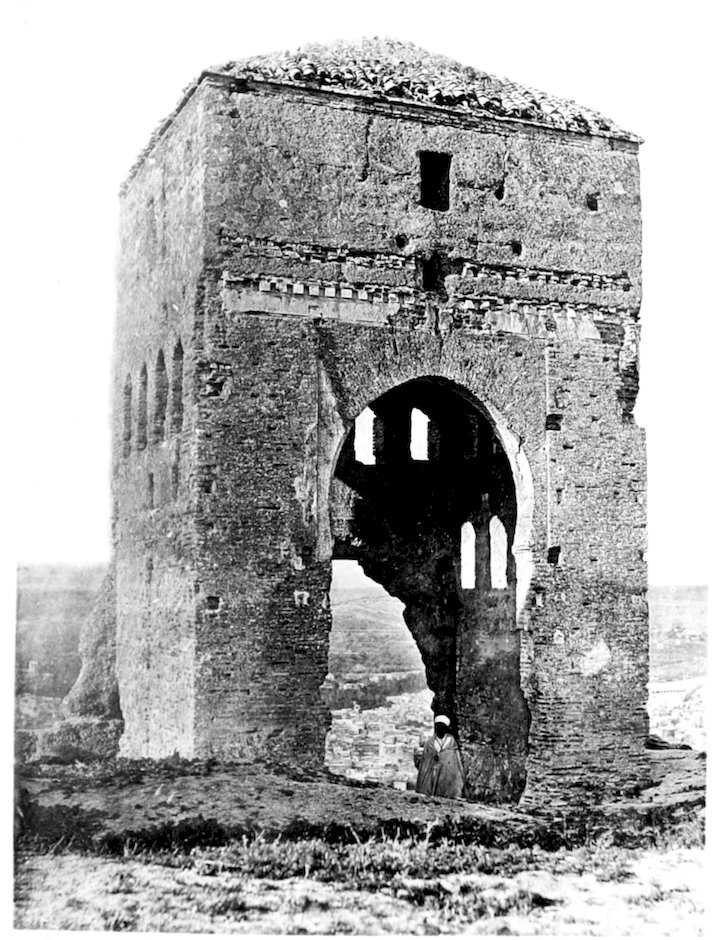
TOMB OF SULTAN, NEAR FEZ
Disdaining the pantaloons which the Kaïd el Meshwa had, through Síd Búbakr, so kindly provided me with, and turning a deaf ear to the vulgar suggestions of sidesaddles and riding habits, made by members of the Mission, I mounted my gray, and, as we went at a foot’s pace all the way, experienced at all events a minimum of inconvenience. We rode out at the gate of the town by which we entered on Saturday, and were taken through another doorway, a little distance on, into a large rectangular enclosure, with high walls on every 115side, the gate being immediately closed behind us to prevent the ingress of the mob who followed. At the farther corner from where we came in is the entrance to the palace, and opposite this, at about 400 yards’ distance, we dismounted, and, being marshalled in two ranks, with Sir John in front, awaited the arrival of His Majesty. A slight discussion at this moment arose as to whether the four military members of the Mission should remove their hats or not in the Royal Presence. Fortunately, as the African sun was beating down on us in all its glory, it was settled we were to remain covered, and, at the moment the Envoy advanced to make his obeisance, and again, of course, when we were separately presented, to salute in the ordinary fashion. We heard afterwards that the Sultan enquired why the hats of those in diplomatic uniforms were removed and ours kept on, but that he was quite satisfied at hearing (from Kaïd Maclean) that officers on duty never uncovered their heads.
Between us and the gateway by which the Sultan was to approach was a broad lane, formed by troops; and though in some of the regiments there was not much uniformity of dress and colour, the various tints seemed all to blend into one harmonious whole, which was quite indescribable, but upon which the eye never grew wearied of gazing. Half-way up the line of soldiers, on our left hand, stood a row of musicians, about thirty in number, each dressed in a long robe of uniform colour, but no two alike, every conceivable tint being represented, from the brightest orange to the 116darkest blue, the entire line shining like a rainbow in the bright morning sun. Opposite this painted group were assembled, clad in folds of snow-white muslin, about a hundred Court officials, who, in virtue of office or position, had a right to take part in the ceremonial. The infantry were under Kaïd Maclean, and near the gate were posted the artillery, commanded by our guest of last night. Of mounted men, or even officers, there were none, for on State occasions like this all must appear on foot before a Sultan of Marocco, “whose throne is his saddle, whose pavilion is the sky.” Other bodies of troops were drawn up in different parts of the enclosure; and round the whole, shutting out the scene from the gaze of the crowd, rose the high white walls, the glaring sameness of which formed a striking contrast to the gaudily-painted assembly they enclosed.
Punctuality is the politeness of princes, and in this respect, at all events, the Moorish monarch can vie with more civilised sovereigns; for before five minutes had elapsed a murmur of expectation and a flourish of trumpets announced His Majesty’s approach.
Mounted on a pure white horse of gigantic size, and preceded by two spearmen, with the High Chamberlain a little in advance of them, Mulai Hassan rode slowly in. Four led horses, magnificently caparisoned, pranced along, two on either side of him; and above his head was borne a large flat umbrella of some red material on a pole twelve feet high; while the rear was brought up by a small number of his black, or Bokhári, bodyguard, in front of whom marched the headsman or executioner, 117whose office, however, is almost a sinecure in Marocco. An air of solemnity and grandeur pervaded them all, from the imposing figure of the Sultan, towering above every one, to the tall attendants who, one on either side, slowly and with great regularity shot forth long white cloths towards His Majesty’s head to keep away the flies. The view of this singular procession, slowly advancing towards us, was most impressive; and though there might be in it all a spice of the theatrical element, any disagreeable effect of this was removed by the vastness of the scale on which it was conducted. As they came abreast of the musicians, who were making the place re-echo with their trombones to the strains of the Moorish National Anthem, the white-robed assembly opposite to them bowed reverently to the ground, the troops—most of them falling on their knees!—presented arms, and from every throat there rose simultaneously the shout of “Our Lord and Master, Our Lord and Master.” At about six paces from the Envoy, His Majesty stopped, and the Kaïd el Meshwa, or Chamberlain, advancing to Sir John, led him up to the Sultan, and in stentorian tones proclaimed his titles to the crowd. His Excellency then, bowing low, awaited, hat in hand, the pleasure of the Sultan, who addressed him as follows:—
“We are pleased to see you again at our Court, for you have always been an elect friend and counsellor. We are glad to learn you have been promoted to the rank of Envoy. We entertain high feelings of friendship towards the Queen and the British Nation, for we 118have never ceased to receive proofs of their friendship and regard. You are most welcome, as also are all the persons that accompany you.”
Here His Majesty paused, while the Chamberlain thundered out to the assemblage the last sentence of his master’s speech.
The Envoy then replied,—
“I thank Your Majesty for the gratifying expression of your friendship towards my gracious Sovereign and the British nation, and I feel highly honoured by the sentiments Your Majesty has been pleased to express with regard to myself.”
His Excellency now handed the Queen’s letter to the Sultan, and continued,—
“I have the honour to deliver the royal letter which Her Majesty the Queen has addressed to Your Sharífian Majesty. Her Majesty desires your welfare and prosperity, and that of your subjects. I shall regard myself as most fortunate if I continue to enjoy Your Majesty’s confidence, and should be enabled through Your Majesty’s support and goodwill to draw closer the ties of friendship by the promotion of the mutual interests of the nations of England and Marocco. I thank Your Majesty for the honourable reception granted me the day of my entry into this city, and for your munificent hospitality. It affords me much pleasure to inform Your Majesty that the Governors and other officers in the provinces through which I passed, received me with hospitality and marks of honour and goodwill.”
119To which the Sultan replied,—
“You deserve every mark of honour and goodwill from us and our officers: present me the members of your Mission.”
The Sultan spoke at first in a low and very tremulous voice, and was so nervous I was afraid he would break down. He soon recovered himself, however, and the dignity of his manner was enhanced by the silence and reverential awe of the thousands of soldiers and courtiers who hung upon his words and actions. The conversation, too, was disturbed occasionally by the restlessness of His Majesty’s charger, which equine eccentricities will—so it is whispered—bring dire vengeance on the Master of the Horse; but this opinion, I hope, is a calumny, as there is a lurking expression of kindness in the Sultan’s grave and handsome face; and the way in which he manœuvred his steed, to bring under the shade of the huge red umbrella His Excellency’s wholly unprotected head, earned at once our admiration and the gratitude of that statesman.
Sir John now beckoned to each of us in turn to come and be presented, briefly mentioning to His Majesty what were our professions and designations. The Sultan, at the conclusion of each presentation, said a few words of welcome, which were translated to us by His Excellency, and shouted out pro bono publico at the top of the Chamberlain’s voice. His Majesty asked several questions relating to my uniform, and was interested in hearing from the Envoy that it is a dress worn by the Jebelis, or mountaineers, who live to the north 120of England—a tribe which never retreats in battle, and from which the Queen gets her best soldiers. “I also, your Majesty,” somewhat pertinently added His Excellency, “am a native of those parts.” The ceremony being now concluded, the Sultan retired under a salute from his artillery, the noise of which caused the great white horse to caper about, much to the discomfiture of the umbrella-bearer and other attendants.
This ancient custom, above described, for the ruler of Marocco, himself mounted on horseback, to receive foreign ambassadors on foot, has given considerable offence to some of the representatives of our Continental neighbours, who have remonstrated, fortunately without success, on the smallness of the figure they have had to cut on these occasions. It may be that, with the march of civilisation, this usage will cease, and that Sultans, in common with their peers, will admit ambassadors into the more sacred precincts of the palace, in which case those who have witnessed the rude splendour of these out-of-door receptions may consider themselves fortunate. What is more probable is that, unless the reforms so urgently needed, and which the Sultan himself is anxious to inaugurate, be not speedily undertaken, the state of Marocco will go from bad to worse, until, having bid farewell to even the residue of its ancient grandeur, European powers will no longer deem it necessary to send officers of rank and distinction to represent them at the Moorish Court.
There seemed to be no hitch whatever in the conduct and arrangements of to-day’s ceremonial, though it can 121seldom have fallen to the lot of the present Sultan to receive a visitor of such importance as the English Envoy Extraordinary; neither can the Chamberlain, whose voice is still ringing in my ears, have often to perform his duties on such a scale and in so august a presence. One incident that rather tried our gravity occurred just before the conclusion of the scene, and was this: On our left during the ceremony stood the old Arab scribe and the two interpreters, and His Majesty’s attention having been drawn to the fact of their presence, he condescendingly muttered a few words, which were repeated by the Chamberlain—“The servants, too, are welcomed by our Lord.” This they acknowledged by bowing to the ground, and then retired to their original places in rear, except old Haïm, whom we irreverently call Tweedledum. This worthy Israelite, overcome by the novelty of the situation and the Sultan’s condescension, stood rooted to the ground, and in a voice that emulated the Chamberlain’s poured forth a loud and incessant stream of blessings on His Majesty’s head. As his lungs are powerful, and there seemed no symptoms of cessation, he was gently removed by the attendants, still calling upon the God of Abraham to maintain the line of Mulai Hassan on the throne of their fathers.
As soon as the Sultan and his attendants had passed through the gateway into the palace, the Vizier and other officials came up to welcome Sir John, and to enquire into the nature of the presents contained in the two large boxes bound up in white cloth which had been brought along with us on the backs of mules. As it was 122not a convenient moment for the delivery of a lecture on the principle of the telephone or heliograph, His Excellency replied that it would be necessary to open and see the instruments before explaining their use, and this, of course, must not be done till the Sultan’s pleasure respecting them was known. In the meantime he exacted a promise from His Majesty’s “Eyebrow,” or head of the household, that the boxes should be put in a safe place, and not opened or tampered with in any way.
Position of Fez—Water supply—Breakfast at Grand Vizier’s—Hidden treasure—Sultan’s garden—Laying down telephone—Royal stud—Dinner at Kaïd Hadj Hamed’s—Surgery.
Some of the views one gets of the town from the neighbouring heights are very pretty, and quite unlike any style of landscape I have seen before. The plain at the extremity of which the city is built extends for many miles in a south-west direction, and is almost a dead level, with an average width of some six miles. It is watered by the Wad el Fas (River of Fez), which falls into the Sebú about four miles below the town. Fez itself, though placed completely in a hollow, is certainly a very beautiful town when viewed from a short distance off; and apart from its fine surroundings, the plentiful mixture of bright green foliage, which peeps out from the otherwise glaring white of the houses, forms a vivid and agreeable contrast. The ground it stands on is by no means level, while close to it and all round, except towards the south-west, the land is undulating and rises to a considerable height, with many admirable and far more healthy sites on which to have built a town. The attraction of having more building material close at hand, 124and also an unlimited water supply, are the cause of the choice, this element, though in a very undrinkable state, being obtainable in almost every street. The river, which flows through part of the town, is led off in ducts in every direction, all private houses of any pretension having it let in to supply the fountains, &c., of which there is one in every patio. The stream is a good deal used for working corn-mills, some of which, by the noise one hears, seem to be grinding all night; the old circular stone, with a hole in the middle, is still in vogue, and broken and disused specimens are to be seen lying all about the town. The water is of a dull slate colour, with a considerable deposit on being left to stand for a short time, and is not without a large proportion of visible animal life. Rich people have theirs brought in from a distance, but for the poorer classes the ordinary supply must be a ready means of laying the foundation of disease, and is none the more palatable from the fact that into it flows, at the head of the stream, the Sultan’s private aqueduct, in which the 300 or 400 fair denizens of the palace have previously performed their ablutions.
The Moors of the present day seem to think Fez as near an approach to Paradise as can be found on earth; this opinion, too, has been shared to a certain extent by early English travellers, one of whom, in the sixteenth century, gives us the following fantastic description of the features of the town to which I have more prosaically alluded:—“Nature and art have played the wantons, and have brought forth this city, the fruit of their dalliance.... So doth the earth seem to dance in little Hillocks and pretie vallies, diversifying the Soyle.” Of the river and its subdivisions, too, he says, “He is divided into two armes, embracing this lovely nymphe; and he finds meanes of secret intelligence with his love ... which, still enjoying, he wooeth, and ever wooing enjoyeth!”[35]
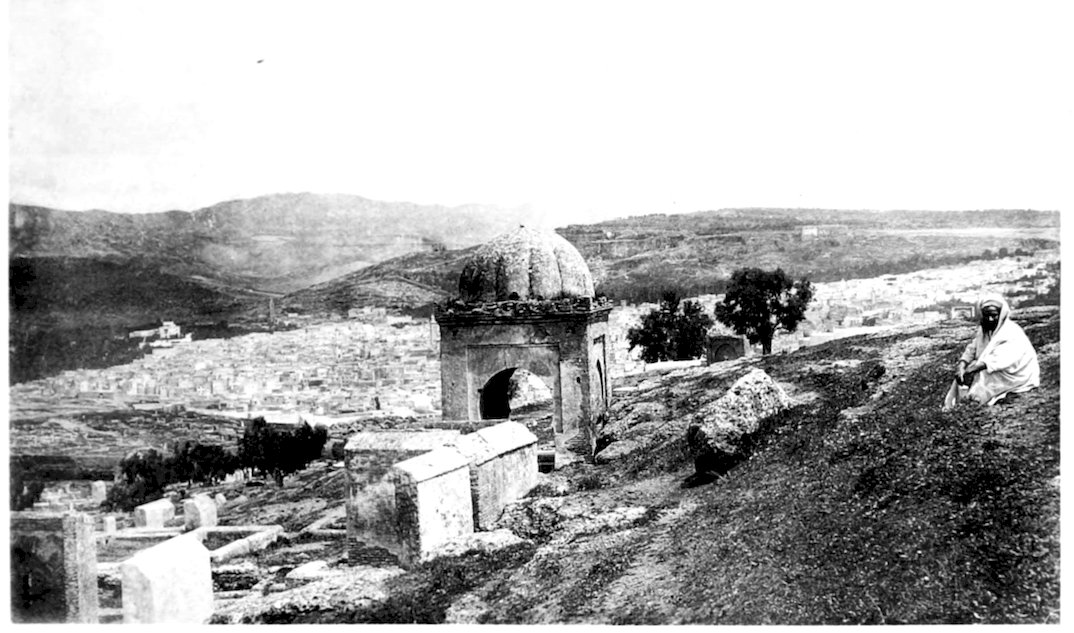
VIEW OF FEZ ENTERING FROM SOUTH WEST.
125The canals I have mentioned as permeating the town, while cooling the air in summer, must make the place damp and unhealthy, and with the narrow sunless streets and infinity of smells account for the pale, unwholesome looks of the Fasi. Sad, insouciant, and wrapped in melancholy and rags, as most of them are, they form a sorry contrast to the bold, cheery inhabitants of the provinces. The soldiers and black population, including slaves, are the only exceptions; but the former pass a great portion of the year out in camp, and the latter are bound to present a uniformly shining appearance, at all events as regards their outer man.
It is difficult to explain why disease is not more rife here than it is, as there is every facility both for propagating and engendering it, while of medical aid there is next to none. Almost the only remedy used by native physicians is bleeding, or rather cupping, which is considered a panacea; while for wounds or fractures small slips of paper, with verses of the Koran written on them, are bound over the part affected. Of surgery and anatomy they are quite ignorant, and, in fact, such science is forbidden by the Koran; while the idea of 126medicine is distasteful, especially to the rich, who are always suspicious of poisoning; so the few drugs known are seldom administered.
It is whispered that though some of the high Court officials are willing enough to entertain us, either from motives of hospitality or for the purpose of affording a treat to their womenkind, yet some are most reluctant to show us any civility. Among the former are the Kaïd el Meshwa (or the Mouchoir, as we have christened him—a by no means inappropriate name, considering his father was a “washerwoman”) and the cheery little Hájeb, or “Eyebrow,” while the others comprise the Governor of Fez and the Grand Vizier. The latter functionary, however, acting from pressure put upon him by the Sultan, invited us to his house to breakfast, and there we repaired shortly after nine o’clock. The house is prettily situated on sloping ground at the outskirts of the town, and the entrance at which the Vizier’s secretary received us is at the bottom of a beautiful garden, laid out in terraces up towards the house. Walking up through here we passed our host’s harem, or rather their abode, on our left hand, and mounting some steps came to an open court paved with mosaics, on the other side of which was the entrance, where the minister himself was standing to welcome us. “Marhaba bík! marhaba bík!”[36] is a phrase one soon masters in this country; 127and our host, addressing it to each of us, led us into the house. I do not know whether the owner or his mansion claims the first description, but leaving the better-looking to the last, I will begin with the Prime Minister, Síd Muhammed ben Moktsar. He is the individual who refused at first to call on His Excellency, and has only been in office a short time. Connected by marriage with the Sultan, he gives himself considerable airs, and is said to combine in a rare degree the properties of fool and fanatic. He is a short and very stout man of between thirty-five and forty, with a perpetual forced smile on his face, and, sitting cross-legged on a sofa, with his mouth always wide open, beside Sir John, reminded one irresistibly of a large toad. However, commencing from very little, he is now second man in the Empire, and in the few months he has been in office has amassed enough money to spend, at all events, £10,000 or £15,000 on his beautiful house. As his actual salary is nil, or almost nominal, this shows the extent to which he has squeezed the unfortunate people whose affairs he manages. The system is the same throughout,—none of the officials are paid; and some of them, such as the Governor of Fez, are expected to make payments to the Sultan of several thousand pounds per annum. Besides what he has laid out on his house, the Grand Vizier has a quantity of ready money, and he told Kaïd Maclean—of whom he professes to be very fond, and whom he calls “his son”—how he had disposed of it. “It is all in gold doubloons,” he said, “and I have got it locked in a chest, and buried in one of my gardens at 128Mequinez; the slaves have ‘gone away’ (Anglicè, are dead or in prison for life) who buried it, and no one but myself knows the place.” “Well, now,” said M., “I am your ‘son,’ so you may as well tell me where it is, and give me the key.” “Ah!” said the Vizier, with a leer of infinite cunning, “I went for a long ride lately alone, took the key with me, and threw it into the Sebú.” It seems very strange that men in a position like his, and to a certain extent educated, should do such things; but as investments are unknown, and it is illegal for a Moor to set up a bank, it is not so much to be wondered at. The amount of treasure so deposited in gardens, walls, &c., is said to be incredible; a will is very rarely made, as there is no security for its being carried out, and a man buries all he has for safety’s sake, intending, probably, on his death-bed to acquaint his friends with its whereabouts; but either he dies a violent death, or else, hoping always that an illness may not be his last, he hesitates to unburthen his mind in case he may recover and then be murdered for his money. Thus the secret dies with him, and he departs elsewhere to account, among other irregularities, for the talent he has so successfully wrapped up.
On another occasion this intelligent statesman, feeling unwell, sent for Kaïd Maclean, who hurried down to him, and finding his liver was affected, went home for a box of blue pills. Returning with them himself to the Vizier, he gave him a couple. The patient, taking them in one hand, drew M. towards him with the other, and, forcing the pills into his mouth, obliged him to swallow 129them. “Now,” he said, with an air of triumph, “I will take two myself in a little time;” this he accordingly did, and derived considerable benefit. On being expostulated with afterwards on his unworthy suspicion, he tried to excuse himself, saying, “Well, you see, I thought some of the servants might have tampered with the box and poisoned the medicine.” “In which case, don’t you see, you would have poisoned me?” suggested his benefactor. “Ah, God is great!” was the reply, and the matter dropped.
This worthy’s house is very perfect in its way, and a good specimen of modern Moorish architecture. The entrance hall and all the rooms are paved with fine mosaics, the patio and some of the terraces in the same style, but of coarser material. Two or three large sofas fill up the front of the hall, while the back part, which is raised a little, is covered with cushions and rugs. From this open off two rooms (in one of which we had breakfast), both in the same style, with arched ceilings of richly coloured wood and stucco. Up the stairs, which are very steep and narrow, as in all Moorish houses, are a variety of rooms of all sizes—bath-rooms, bed-rooms, and little bijou sort of apartments, highly ornamented, like the courts of the Alhambra, but the gold-work fresh and bright, and the colours of every imaginable hue. As the house stands considerably above the level of the town, and there are no neighbours to overlook it, it is provided with numerous windows—an unusual innovation among these privacy-loving people. Some had glass in them, others none, 130and from them all there was a magnificent view of the town, with its dark background of lofty hills; while from the garden below there came the perfume of roses and orange blossoms, which seem here to be in perpetual bloom.
The Vizier had prepared a table for us, with chairs, knives and forks; the latter implements were unpacked in our presence from a large plate-chest specially procured from Paris for this and similar occasions hereafter, and their use was explained by our servants to the slaves of our host, who had never seen anything of the sort before. On these occasions we are always requested to bring with us our own Moorish attendants, who are accustomed to our outlandish manner of feeding, and can minister to our wants more readily than the slaves of the Faithful.
In this instance we had the worthy Boomgheis and Selám Hajút, Sir John’s butler, to wait on us—a duty which commends itself to them, as, after we finish, the débris du festin, and more should they require it, fall to their share.
The table was covered with a snow-white cloth, on which were china dishes containing every imaginable and unimaginable kind of sweetmeat and confectionery, more like the preparations for a marriage-feast than an ordinary breakfast. We surveyed these edibles not without some anxiety; it was to be our first experience of a real Moorish “feed,” and as we had accidentally heard that the comestibles had been prepared and on the table for the last three weeks, for the inspection 131of the minister’s friends, we were a little uneasy as to the effect that they might have upon us after so long keeping. The number and variety of hot dishes which came in presently was astonishing, and our own servants seem to have been put up to insisting on our trying them all. Nothing, however, was very nasty, though everything was unlike anything we had ever seen before, and some of the sauces were oleaginous to the last degree. The last of the solid courses was a huge dish of kuskussú,[37] which, however, we hailed with delight, as its arrival usually betokens the beginning of the end. In the matter of freedom of action, we unbelievers scored considerably off His Excellency, who was given a place of honour in the hall, and fed at a small table with our host, Síd Búbakr, and the Sultan’s treasurer, which latter gentleman I had remarked taking notes in pencil of the Bashador’s conversation while breakfast was preparing. His companions, of course, disdained the use of knives and forks, and argued with Sir John in favour of their plan of eating with their fingers. To keep him in countenance, however, they were seated on chairs and sofas, which they managed to do pretty comfortably, though usually with one leg furtively tucked up on the seat beneath them. Their natural cross-legged position is by no means ungraceful, though in the case of the fat Vizier it brought his great toe, which he caressed continually as he sat toad-like on the sofa, into closer proximity with his food than was pleasing to a European eye.
132The number of dishes of kuskussú we saw put before the servants outside and returning empty, to say nothing of the substantial fragments from our table, was simply incredible; but eating, like all other enjoyments in this country, is carried to excess, and the Prophet never showed a greater knowledge of his followers than when he laid an embargo on alcohol.
The feast over and a visit paid to the stables, where there was nothing much worth seeing, Haynes and I rode to the palace to see about fixing the telephone, &c., with Síd Búbakr as guide and Mr. Náhum as interpreter. We kept outside the town till we arrived near the palace at the large enclosure where the reception of last Monday had taken place. On the way there I had some conversation with Síd Búbakr through the medium of the interpreter, and found that his travels in Europe had extended only to Gibraltar and Algeçiraz; he had seen the bull fights at the latter place, and thought them “bad and cruel.” I asked about the slave-market here, which I am anxious to see. It seems they are not sold at the public “Sôk” or market, which is held on Mondays and Thursdays, but at a different place altogether, any evening in the week, as occasion demands. When we arrived at the entrance into the palace grounds the guards there made us dismount, and after some delay the Chief of the Household, Síd Hamed ben Músa, came out and took us into an inner courtyard. Here he thought would be a good place for laying down the telephone; but as we were not of the same opinion, and wanted to have it in the garden next 133the palace, he said he would go, and “if the Sultan were awake,” ask leave for us to go in. After keeping us waiting a very long time,—which we heard he did through being annoyed at our determination to invade the sacred precincts,—he returned with the Sultan’s permission, and the boxes containing the telephone and heliographs carried on the backs of slaves. The inner gate was then opened, and, going across a courtyard and through another enormous door, we found ourselves in His Majesty’s garden. To our right and left was a broad walk paved in mosaic; a high arched colonnade on the left extended along this walk for about forty yards, and the continuation of this building was the palace, raised a few steps above the walk, and having a more private and cared-for-looking garden in front of it. The grove or garden we were in was so thick with orange-trees and shrubs, that one could get no view of the palace, though we were not many yards off. The roof only—a green tiled structure like those on the mosques—was visible, the building itself, as far as I could judge, not being very large, though the interior, where no Christian has ever set foot, is said to be of exquisite workmanship. The orange-grove was intersected by straight grass walks at right angles to each other, and from the end to half-way along one of these we decided to lay down the telephone. The kaïd of the Freigíahs (chief of the tent-pitchers) having been summoned, we were told we “only had to command and our slaves would obey;” so we instructed him to pitch a tent at one end of the walk, and another half-way down, so as to keep the ends of the 134telephone under cover, which order was speedily executed. It took a long time putting the instrument up, and when completed neither of the bells would work, and the voice sounded dim and indistinct. As I knew nothing about it, and my colleague confessed himself at fault, we decided to leave it for to-day, and to-morrow to bring to bear on it the scientific attainments of the “photographer.” A little before we left, the attendants implored us not to delay, as the “ladies were coming out.” Feeling sure the ladies could not wish to hurry us, we completed our work, but were unfortunately not favoured with a glimpse of any of them.
The following morning I returned to the palace with Lawless. While he was busy with the telephone I occupied myself in cutting out a circular piece of thin black paper with which to cover the glass of the heliograph for use at short distances, when the extreme brilliancy of the flash renders it impossible to read the signals. I found my plan answer very well, the disk I left in the centre of the glass being about the size of a crown-piece. We took a look at His Majesty’s horses while we were there, about thirty of them all picketed in one of the grass walks. They looked a pretty strong and serviceable lot, but we were told on enquiry the “best were kept elsewhere.” As I did not recognise the one the Sultan rode on Monday, this may be true. Most of them seem to have a touch of the dray in their composition, which I fancy is accounted for by George III. having sent a present of some stallions of that breed to the then Emperor of Marocco.
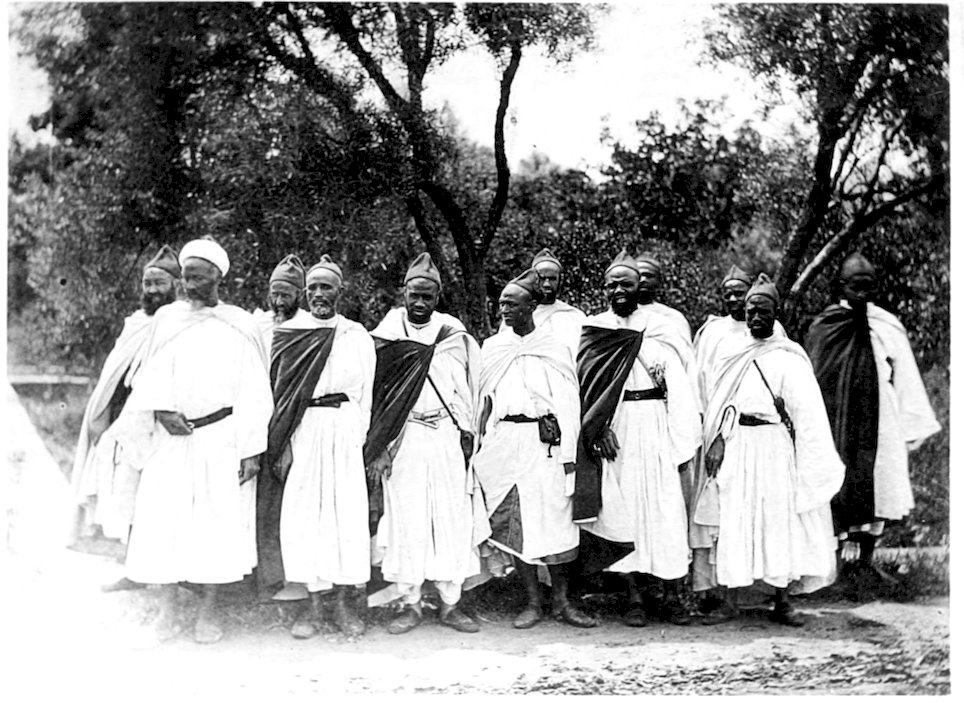
KAID OF THE “FREIGÍAHS” & SOLDIERS IN PALACE GARDEN.
135Some slaves are at work all day in building a high wall round the palace garden. The material is mud and gravel, which they beat down between parallel boards into a mass called “tapia,” which soon hardens into a substance like concrete. They sing a wild monotonous air the while, swinging their rammers or mallets in time to the music, and at the last word of the couplet bring them all down together. There is consequently a good deal more singing than hammering, but unless allowed their own way I am told they cannot work at all. I turned the flash of the heliograph full among them, which made them lie down and yell with terror; so, being afraid they might roll off the top of the wall in their fright, I did not repeat the experiment.
In the afternoon Kaïd Maclean rode with some of us to the house of Kaïd Hadj Hamed, to whom we had long promised a visit. He commands a regiment here, and is much more intelligent and civilised than his peers. On a late occasion he accompanied Kaïd Maclean to Gibraltar, and dined at our mess, where, with the exception of being unable to speak, he comported himself like anybody else, using his knife and fork with much ease and dexterity. These implements, however, do not seem to have sufficiently commended themselves to him to induce him to adopt their use in his own house, and the ample dinner he provided for us had to be discussed with our fingers. Hadj Hamed received us at the door of his house, and took us through a passage to the patio in the centre, where a number of his friends were assembled. In a kind of 136chambered recess off it, cushions were spread for us, and behind us were a lot of mattresses piled up and covered with very handsome stuffs of native manufacture. The entertainment began, as usual, with tea, after which the large circular table, like a sieve, appeared, and was placed in our midst as we squatted on the floor. Some very good soup made its appearance first,—in fact, all the courses were edible, and some really good; the soup we discussed in small basins with much ease; but roast mutton, which followed, without the aid of knives and forks, was more difficult. Chickens were easily managed, as with two people pulling at a leg or wing in opposite directions the question settled itself. Our host, however, when he saw us in difficulties, would neatly tear off a few shreds of meat from the joint, and present them to us. The repast, though unenlivened by the cup that cheers, was rather a festive one; a band played and sang without ceasing in the patio, and our host’s endeavours to make himself agreeable were quite successful. Dinner over, a brass kettle and basin were brought in, and the very necessary ablutions took place; after which a number of silver bottles of rose water appeared, the contents of which were liberally applied by Hadj Hamed over our heads, down our backs, and everywhere about us. Lastly, the incense-burner was brought, with which, after incensing us all round, he smoked all our hats in turn, and Maclean’s turban. So ended Hadj Hamed’s feast, during the whole of which a gallery of veiled ladies looked down upon us, one or two, presumably the best-looking, occasionally discovering 137their charms. Our host has only lately been married—on Saturday last—and a continual round of feasting has been going on ever since; but the occasion of our honouring him has, so he says, been the “consummation of his marriage.” Our servants had great feastings while we were at dinner, and much regret was expressed by our host that the English servants were not of the number; he begged, in fact, to be allowed to send for them. Considering, however, the close propinquity of Hadj Hamed’s numerous harem, and the possibility of its not being regarded by the two valets de chambre in the same sacred light with which we have brought ourselves to view these establishments, we thought it better not to lead into such temptation those for whose morals we should be held responsible. We took a short ride round on our way home, but the amount of kuskussú our grooms had consumed made it a matter of expediency to send them straight home to digest.
The number of sick and maimed brought to our Esculapius for treatment seems to increase daily. Doubtless many more would like to come, and probably the preference is given to the one who can afford the highest tip to the soldier on duty at the gate. The medico’s tent, though well adapted for consulting patients, is pitched a little too near the Kiosk where we feed to admit of much practical surgery being carried on in secret, and to-day, immediately after breakfast, the moans of a poor miserable-looking creature, who was being operated on for tumour in the neck, attracted my attention. The doctor’s Moorish servant, “Máho,” was 138holding the lad’s head, the operating theatre being the garden walk, and the doctor was wiping his instrument on a geranium leaf! Notwithstanding this necessarily rough-and-ready system, the amount of relief afforded to the applicants is great. The doctor did not, naturally, anticipate the numbers who would come for help, so the instruments he has with him are merely those for field surgery, while the supply of medicine at his disposal is wholly unequal to the demand; the latter, moreover, has to be economised in case of dysentery, cholera, or other epidemic attacking the Mission. Eye diseases are the commonest form of ailment which are brought for treatment, and would afford rare practice for an oculist. Walking in the town, the number of people with only one eye that one sees is incredible; even in little children it seems as common as with adults, the only people with usually the full complement being the women. Of this style of affliction, smallpox, ophthalmia, &c., are the chief causes.[38]
Exhibition of Heliographs, &c.—Breach of etiquette—Sultan Mulai Hassan—Refusal to be photographed—Phonograph—Ancestry of Sultan—Exclusiveness—Business of State—Breakfast at the Kaïd el Meshwa’s—Moorish architecture—Dinner with Bashaw of Fez—His harem—The Prophet on women.
To-day had been appointed for the exhibition of the scientific instruments to His Majesty. The telephone had been got into pretty good working order between the two tents on the grass walk of the garden, and one heliograph was to be sent out to a hill overlooking the palace, while the other was to be worked from the wall of the palace enclosure. As the hill was my destination, I dressed in plain clothes (the others whose presence was required at the palace being in uniform), much to my servant’s surprise, who “thought I had to go before the king.” Accompanied by the khalífa, and attended by an escort, and a man carrying one of the heliographic instruments on horseback in front of him, we rode out through the gate of the town, and up the slopes of the Jebel Zalag on the north side of the city. We took up a good position, and were shortly joined by Kaïd Maclean 140and M. Erckmann. Haynes in the meantime had placed his instrument on the battlements of the palace wall; but whether from the day being very cloudy, or from some branches of a tree having got in front of his mirror, the signalling was difficult to read. The first message which I got, “The Sultan is just coming,” obliged me to ask the French officer kindly to postpone an address on the working of their code, which he was delivering close to my ear for the khalífa’s and my benefit, and also to make the circle of soldiers keep their heads away from the front of the instrument. One of them, more inquisitive than his comrades, would continue to get in the light, so I turned the full flash, without warning, into his eyes, upon which he fled howling and terror-stricken from the spot, and did not turn up again during the séance. The first question the Sultan asked, after the system had been explained to him, was, “How many horses are there with you?” which question was at once followed by a mounted soldier galloping up to see if the “instrument” had spoken the truth. The sun behaved as was to be expected in a strict Mussulman country with infidels taking such liberties with it, and was frequently obscured by dark clouds hurrying past with a low flight on the strong westerly breeze. Sometimes my instrument was obscured, and sometimes my colleague’s, so signalling was tiresome and unsatisfactory, and I was glad of His Majesty’s final message, “The Sultan wishes you to come at once,” upon which I got on my horse and galloped down to the palace gate. An official had been sent to the entrance to frank me through, so I met with no opposition, and joined the other members of the Mission in the garden. They had finished with the telephone, and His Majesty, whose brain was fatigued by its unwonted exertion, had retired for a little to rest. In the meantime L. was busy putting into order the phonograph,—an instrument of his own construction, which he brought here to astonish the Moor, and which has procured him the title of the “kaïd with the devil in a box.” It had been taken into one of the rooms off the corridor which leads to the palace, and having only this morning undergone its journey thither, took some time to get into working order, and its performance even then was indifferent. The room we were waiting in had a piano, and some musical boxes—one with figures of performing animals—and was scantily furnished with, among other things, a large old-fashioned sofa; upon this Zouche and the doctor, thinking no evil, quietly seated themselves, but were quickly brought to their bearings by Síd Hamed ben Músa, the minister in attendance, and Síd Búbakr, who, rushing towards them, raised them up hurriedly but respectfully, saying, through Sir John, that it was a grave breach of etiquette for any one “to make use of His Majesty’s seat.”
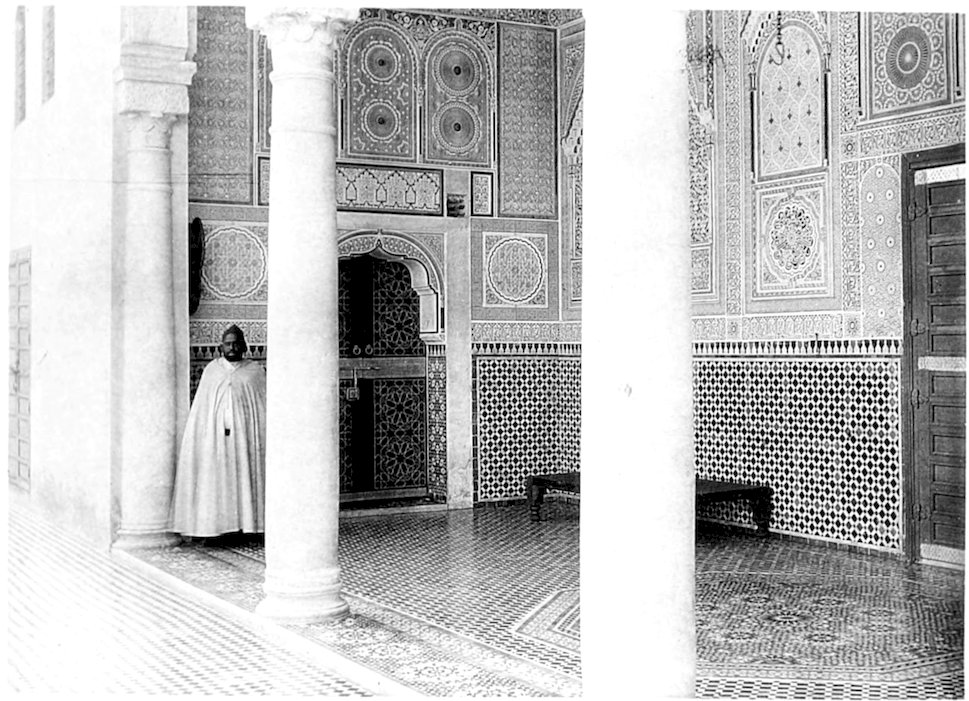
VERANDA OF PALACE, WITH THE “EYEBROW” IN BACKGROUND.
141Presently the approach of the monarch was announced, and quite unattended he walked in from the direction of the palace steps. Considerably over six feet in height, and broad in proportion, the Sultan, Mulai Hassan, has a fine and commanding appearance; 142his face, which is of a rich hazel colour, with slight black whiskers, moustache and beard, is decidedly handsome; his eyes, which are large and of a dark brown colour, have an expression of sadness, while his whole face has an anxious and hunted look. His dress was quite simple, being almost entirely white, and his whole figure, including his head, was enveloped in a pure white haïk of beautifully fine texture. We are, of course, very anxious to obtain a photograph of His Majesty, and with a view to accomplishing this design the camera had been placed in a corner of the room all ready for the “assistant,” as we call Herbert White, to take a portrait while the Sultan was listening to Sir John’s description of the phonograph. On this little ruse, however, His Excellency put his veto, so the attempt had to be abandoned. His Majesty, as he entered, moved round to the farther side of the table on which the “box with the devil” was placed, facing the terrace; but before he bestowed a glance on the instrument, the camera in the corner caught his eye, and, divining its use, the look he gave it was one of anger and fear combined. He listened courteously, however, to His Excellency’s explanations of the phonograph, but turned his eyes every now and then uneasily towards the photographic apparatus, of which he clearly had heard the use. To illustrate the properties of the phonograph, His Excellency asked that a bugler might be sent for; but owing to some previous arrangement by the commander-in-chief, who heard that one would be wanted by the Nazarenes in connection 143with their experiments, none were forthcoming. The commander-in-chief is brother of the Grand Vizier, and like him a cordial hater of Christianity and its abominations. The musical capabilities of the instrument were therefore not brought into play except by a simple air its exhibitor favoured us with. A slave, too, who was in attendance outside was called, and ordered to “sing into it;” but whether from fear of the instrument, or awe in the presence of Majesty, his voice was so faint that hardly any sound came back.
Photography was next brought on the tapis, and a picture lately taken of Síd Búbakr was shown to the Sultan, who recognised it at once. He positively declined, however, to allow himself to be taken; but as he wished to see the process, the camera was taken out on the terrace, and the assistant took up a position in front of it to illustrate the effect. The royal head being put under the black velvet cloth, of course saw W. standing upside down, so was withdrawn at once to see if such were really the case. He seemed, however, to be only partially convinced by seeing the object standing in his natural position, and I think the apparition in the camera so startled him as to render abortive any further endeavours to get him to stand fire. Considering, however, that the process of portraiture is forbidden by the laws of the religion of which he is supreme head, one cannot really blame him for not violating them in his own person, though, according to the Koran, it seems to be the artist who will suffer, and not the subject; for the dictum of the Prophet is that “any 144one making a picture will be asked at the day of judgment to endow his creation with life and soul, and if unable, shall endure the punishment of Hell.” A plate was presently got ready, and Sir John having inveigled the Eyebrow and Síd Búbakr to stand up beside him, they were photographed in a row, with some of us in the background, His Majesty being much tickled at the Chief of his Household being thus practised upon. After they were polished off, the camera was turned accidentally to where Sir John was engaged in conversation with His Majesty; but the latter seeing how instantaneously the others had been taken, became alarmed for himself, and communicated his fears to the Envoy. His Excellency, though the chief promoter of the plot, so heartily vented his righteous indignation on the artists for the liberty they were taking, that His Majesty’s suspicions were allayed, the photographers disclaiming at the same time the sinister intentions attributed to them. The Sultan, then, having graciously thanked us through Sir John for all our trouble, and having been promised copies of the photographs taken in his “happy dominions,”[39] withdrew; and shortly afterwards we also took our departure.
The present Sultan only came to the throne seven years ago, having succeeded his father, Sídi Muhammed, in 1873. Their family have sat on the throne for about 240 years, and are of the race of Sharífs, or direct descendants of the Prophet (hence their title of “Sharífian” 145Majesty, which sometimes puzzles strangers), and this religious title and connection establishes their authority over some of their subjects much more firmly than any temporal sovereignty could do. Mulai Hassan looks about thirty-five years of age, and though very tall and powerfully built, has a curious shuffling way of walking, as if he was rather gone about the knees. He seems to shrink from publicity, and has only once been seen outside the palace by any of the Mission since our arrival. Having, however, some four hundred ladies in his establishment, his domestic duties probably confine him a good deal to the house, and, anyhow, one can scarcely be surprised at his not choosing the streets of his capital to ride about in. In his dress he eschews all show and colour, the only exception to this being a light blue silk cord, from which a leather bag or a dagger is suspended; of jewellery he has none, except a plain diamond ring set in silver—gold and other finery being forbidden by the Koran, the laws of which he has the credit of observing very strictly. The Envoy has already had several audiences of His Majesty, who always lends a ready ear to his counsels, as indeed have his father and grandfather before him. The latter monarch, Mulai Abd-er-Rahman, ruled Marocco for forty years, dying in 1860, when he was succeeded by Sídi Muhammed. In Mulai Abd-er-Rahman’s time a foreign envoy had to stand during the entire time of even a private interview with the Sultan; now he is accommodated with a chair, but he never enters beyond the threshold of the palace, and upon no occasion has 146the Sultan ever condescended to shake hands with a foreign ambassador.
As we left the palace to-day I noticed in the enclosure where our horses were waiting for us a number of people sitting down on carpets ranged along the foot of the wall, with canvas stretched over them as a protection from the sun. I had paid no attention to them as I passed an hour before on my return from signalling, but seeing the Grand Vizier and Kaïd Maclean among the number, I asked the latter, who joined us, who they all were. It seems this is the rendezvous for all ministers and members of the Court; in fact, every department of the State is here represented, and in this primitive council chamber is transacted the business of the empire. They meet every morning at six, and remain at their work or waiting the Sultan’s orders till half-past ten, when they are allowed to go. To-day, on our account, they had been kept till after twelve, which explained the black looks with which they favoured us; and I hear that seeing me ride up unattended, and being admitted without delay into the palace—an operation which takes them many hours and even days—had made me a special object of aversion.
We rode in a downpour of rain to breakfast with the Kaïd el Meshwa, to whose house we had paid a preliminary visit some days ago.
If it were not for the ghastly cups of green tea on 147an empty stomach, which form a prelude to all these entertainments, they would be more endurable and less deleterious; but with such a preliminary shock to one’s nerves, it is trying to sit down to some fifteen courses of curiously compounded dishes, with the cold gray eye of the host, to say nothing of His Excellency’s, watching whether you do sufficient justice to the viands, and injustice to your interior. Another great drawback is being unable to say anything, except through an interpreter, who is rarely brought with us; consequently, the only conversation that takes place is between Sir John and our hosts; the latter always enquire minutely into the capabilities and antecedents of each member of the Mission—information which His Excellency is always ready to afford, and which he apparently accompanies by personal anecdotes of a piquant character, judging from the smiles he elicits from the enquirer.
The kaïd’s unfortunate son with the wounded leg was limping about the patio while we were at breakfast, and looking very unhappy. As he has steadily refused to allow the doctor to examine the wound, of course nothing could be done except to pretend to believe his foolish excuses. “Why do you not let the English doctor examine your leg?” asked His Excellency. “Well, curiously enough, as soon as the tabíb spoke to me about probing it, the leg began to get better, and next morning the bullet fell out.” “Ah,” replied Sir John, “you are like the man with the toothache, who, just as the doctor was going to pull out the tooth, 148said all the pain was gone.” “Yes,” replied the youth innocently, “I am just like that man.”
Besides patients who came to our camp for advice, the doctor has a considerable practice in the town, and may often be seen going out on his errands of mercy attended by Tweedledee as interpreter and general assistant. The latter has a keen eye for the fair sex, and is as much disappointed as any of us in the strictness of the regulations, which prevent one seeing anything of a woman’s face, beyond two large and generally very beautiful eyes.
The other day he came to me, his simple and expressive countenance radiant with joy; “The doctor, thir, go to thee the thtomach of a merchant’s wife, who is ill; perhapth I thee more of her than the eye.” In the evening I said, “Well Mr. Náhum, and how about the merchant’s wife?” “Ah, thir, thee what bruth’s these Moors are; I go in with the doctor, then they put me behind the curtain, and make me tranthlate with my back! and I thee nothing.”
It had been arranged that some of us were to start in a day or two for Mequinez, joining His Excellency and the remainder of the party, who were to leave a few days later, at Rabât. Now, however, the Sultan has decreed that we must be entertained by his Hájeb[40] and by the governor of Fez, before leaving; so our start is delayed. In the meantime it has occurred to the heads of departments, including Síd Búbakr, that Mequinez being a very little off the road to Rabât, we had better, for the sake of comfort and safety, as the neighbourhood is one of extremely evil repute, all start together on Tuesday week—a plan of which we all approve.
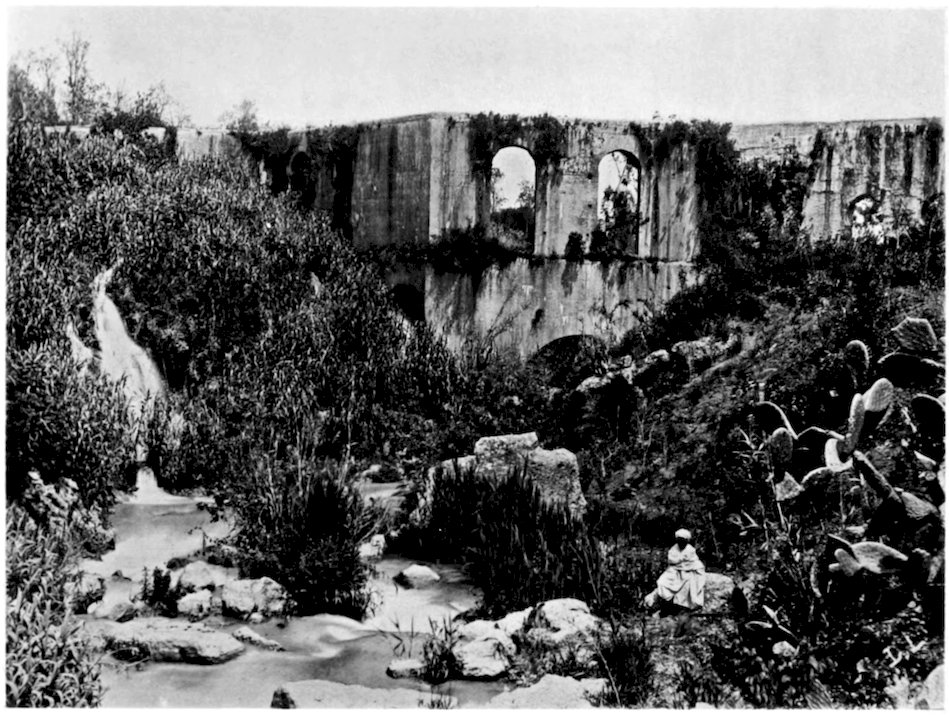
RUIN NEAR FEZ.
149Riding this afternoon in the neighbourhood of the town, we came upon a most enormous fig-tree, a specimen which would certainly “whip creation” in that department, and must be, as the Moors call it, “the father of fig-trees.” We also discovered a less inviting object in the shape of a huge mound outside one of the gates redolent with putrid bodies—camels, dogs, horses, donkeys—all thrown out there promiscuously, and left to rot. The stench was appalling, and we galloped past with our handkerchiefs to our noses, much to the astonishment of our escort, who seemed to notice nothing disagreeable in this golgotha.
We came back by the north side of the town, past an old quarry, from which most of the building material must have come; now it is disused, and laid out in little gardens. The old wall of the town seems a fine piece of work, and if it is four or five hundred years old, as they affirm, has lasted well. There must be about five miles of it in circumference, and the old Moorish arch which appears in all the numerous gateways is pretty and unique. Where repairs have been executed in any of these, the arch is replaced by a modern and ordinary one; but I notice the reproduction of the old form in most of their modern architecture, and even the wickets of the big doors of rooms, and the pattern of the velvet dados, perpetuate the ancient horseshoe shape.
150To-night we were invited to dine with the Bashaw, or Governor of Fez. It is he who has been grinding down and squeezing our unfortunate friends at Beni Aamer, besides having been guilty of countless other acts of despotic cruelty and injustice. To some of these the Sultan’s eyes have apparently been opened, and a further tenure of two months of office is all the old villain is to have. What else may be in store for him, and whether ruin and imprisonment await him, it would be hard to say. Already the Sultan has made him pay large extra sums into the Treasury out of what he has extorted from the people; but he is fortunately unaware of the satisfaction we feel in his approaching downfall. Were he cognisant of it, something stronger than tea might have been provided for our benefit to-night! We were late in starting—about a quarter to eight; the night was dark and rainy, and our ride to the house took nearly an hour. Preceded by a guard of soldiers on foot and horseback, all carrying torches or lanterns, we rode for a long time through an intricate maze of streets, up and down hill, our horses sliding about in all directions. It was a curious and weird procession through the dark and deserted town, the silence of which was only broken by the yells of the Moors in attendance, and the curses, not loud but deep, of the Christians, as our heads came into too close proximity with the top of some dark subterranean passage, under which we had scarcely room to ride. At last we arrived at the gate of the Bashaw’s garden, which is situated some way out of the town, and must 151be large and well worth seeing, judging from what we could make of it by the light of the lamps which hung in clusters on the orange-trees. A stream ran through the grounds, working a huge Persian wheel which creaked and groaned ominously, as if protesting against this nocturnal incursion of Nazarenes. Two lines of soldiers and picturesquely dressed slaves, of whom he has about 800, were drawn up at the doorway at which we alighted, and after being led through a long passage, we were received by our host at the foot of a staircase, and taken up to a large room, along one side of which was arranged a row of chairs for us. The Governor having placed the Envoy on his right hand, pointed to the chair on his left, saying, “I suppose another of the principal guests will sit here;” but was a little discomposed at Sir John placing Miss Hay—who had been persuaded to accompany us—in it, and explaining that it was “the custom in Europe to give ladies a place of honour.” The Bashaw is an old man of nearly eighty, I should say, and, full of years and wickedness, is of course aware of the penalty which usually attaches to men in Government employ who have amassed large sums of money from the people, and which renders it a matter of wonder how any one can be got to take office under such a régime. His appearance is by no means against him, and there was something benevolent and venerable in his face, which bore the sad expression of one who is not only near his death, but knows he must give an account of his stewardship both before and after that event. Poor old man! I shall 152never see him again, but quite pitied him, notwithstanding his iniquities, when I thought how soon this lordly pleasure-house he had raised would become the property of another and more favoured retainer of the Sultan.
The centre of the room was occupied by a large table covered with sweetmeats, which within half an hour was twice cleared and laid again, owing probably to some mistake in the programme. Round two sides of the room there ran a broad and lofty passage supported on massive square pillars as high as the ceiling, and along this passage was seated a band of musicians, who kept up the most intolerable clangour; the worst property of their airs being a sort of barbarous harmony, which runs in one’s head for a long time afterwards. A number of Moors, too, guests of the Governor, were seated cross-legged against the wall, having been bidden to assist at the strange scene which was being enacted by order of their sovereign. In an adjoining room, which opened into and almost formed part of the one we were in, there were seated about thirty more natives, all in faultless costume and evidently belonging to the élite of Fez. While the music, vocal and instrumental, was making the place re-echo with its barbaric strains, I noticed that all these gentlemen, in the intervals of tea-drinking and conversation, were occupied in telling their beads—a custom which I have remarked prevails only among believers of the upper class. His Excellency meanwhile discoursed pleasantly with our host on the subject of railways and telegraphs, to which remarks 153the Bashaw courteously listened, while in secret he was doubtless laughing at the improbable falsehoods with which he imagined he was being entertained. At the end of the room by which we came in there was a continual bustle and passing to and fro of slaves; occasionally one would bring a folded note to the Governor, or Síd Búbakr, who, it is unnecessary to say, was of the party, would cross the room and say a few words to him in a low, mysterious tone. Standing against the pillar directly opposite the Bashaw were two very handsome slaves, whose anxiety to anticipate any sign, and nervousness when speaking or listening to their master, were painful to witness, as indicating the style of discipline the old tyrant keeps up in his establishment. They always approached him with the lowest reverence, and the one to whom he addressed himself would kneel or stoop down in front of him, throwing back the corner of his flowing cloak over his shoulder, which manœuvre is considered a sign of the most abject submission. After being deafened for nearly an hour by the din of the musicians, we were relieved from the apprehension of having to eat our dinner with such a numerous gallery looking on, by our host leading the way upstairs to a most elaborately decorated room, the vaulted ceiling and arched doorways of which were the prettiest workmanship of the kind I have yet seen. The servants of the legation were there with our own knives and forks, and it was a sore trial to our gravity to watch our host, who sat at the head of his table between His Excellency and me, trying to make use of 154these unknown implements. He looked just like an old baboon unsuccessfully imitating the manners of a human being, as he raised a piece of meat between the point of the knife and fork—using both of them at once to shovel the morsel into his mouth. Apprehensive of an accident, Sir John entreated him to use his fingers, saying, “After all, Bashaw, our manner of feeding ourselves is a modern invention, and there can be no shame in using the means God gave us;” then, suiting the action to the words, His Excellency so vigorously applied these same means in dissecting a piece of fowl in front of him, that the Bashaw took courage by his example, and discontinued his hazardous experiments.
At this dinner, Sir John having previously asked permission of our host, Síd Búbakr was invited to sit at the foot of the table, and the Governor addressing him, said, “It is a great pleasure to me to obey my sovereign’s commands by asking the representative of a great and friendly power to dinner at my house; but all that I can do for him does not show half the regard my master has for the ambassador.” To this speech Sir John replied, “I have heard with pleasure the kind sentiments of His Majesty expressed by the Bashaw, and am glad to think they express the feelings the Moorish Government entertains towards the British, of which I am the humble representative.”
I fancied that as our host, who is a man of some culture and experience, endeavoured to make himself agreeable, and as dish after dish of really very edible viands made their appearance, we must have all felt 155a certain inward pity for the doomed man whose downfall we had lately heard was very near. His courteous manners and his high position made us for the time forget his misdeeds; and as our hearts warmed over his good cheer, we could not help thinking in how short a time all these evidences of wealth and luxury would be gone, and how the poor Bashaw, who did not see as clearly as we did the writing on the wall, would go forth unfriended and alone, to spend the few years left him more miserably perhaps than even some of those who had been the victims of his cruelty and oppression.
There were six glazed doors in the room we dined in, with curtains drawn down over them on the farther side. Noticing a slight movement at the foot of one of them, I observed a young lady lying at full length behind it, with her face against the glass, rapt in wonder at the strange sight she saw. I caught her eye—a very pretty one—and wholly unabashed she returned my gaze, seeming, in fact, to enjoy it rather; but afraid of getting her into disgrace with her owner, should he detect her levity, I only indulged in an occasional glance. It is distracting to live in the midst of so much beauty, and never to be able to enjoy it, and, with the Ancient Mariner, one feels inclined to cry, “Water, water everywhere, but not a drop to drink.” Apropos of that element, some of us brought flasks of brandy in our pockets to-night, with which we liberally seasoned the water provided by our host, till at last, as His Excellency remarked, the room “smelt like the bar of a public-house.” It, however, served a double 156purpose in washing down the dinner and helping to soften our hearts towards the Governor.
Accompanied by the Bashaw and Síd Búbakr, who has a daughter married to the old reprobate, Miss Hay was taken to visit the harem, where one lively young lady, unaware that her lord and master was sitting behind a curtain near the door, said to her, “Now, suppose your father ordered you to marry a horrid old black man like the Bashaw, would you have to do it?”—a question which, under the circumstances, was rather embarrassing to answer. That the position of a lady in this old potentate’s establishment is by no means an enviable one, may be imagined from the fact of his having a habit, when out of temper and in want of amusement, of rushing about his harem on all fours, snarling at and even biting the inmates like a wild animal. But, besides being subject to such vagaries on the part of their owners, with whom love is a thing of the past, the life of many of these wretched girls, if they have any more ideas than an oyster or a cabbage, must be, according to our notions of existence, sad in the extreme. Given away at a very early age to some one they perhaps have never seen,—possibly for family reasons to a wretched old creature like our host of to-night,—they spend their best years as victims to his caprice, and at his death are disposed of like so many animals, as the Sultan or their immediate superior may think fit. It seems strange that among the many wise maxims of the Prophet there are so few which entail the showing of respect or honour to women, the more so 157as he was a devoted admirer of the sex, whom he holds forth as the chief reward hereafter of the orthodox believer. In one part of the Koran, however, he does, though rather doubtingly, assign to our female friends a place in heaven, where “it is not impossible we may meet them hereafter.”
Breakfast at the “Eyebrow’s”—The late Síd Músa—Second sight—Death of Grand Vizier—Moorish customs—Marocco at Chatham—Cursed by a saint—Professional Story-teller—Shallow graves—Slave-market—Treatment of slaves.
We had breakfast this morning at the house of Síd Hamed ben Músa, the lively and bustling little courtier whose title is Hájeb, or “Eyebrow,” of the Sultan. Our guide led us a long way round, apparently for the sole purpose of making us pass the very unsavoury heap, outside the town, that I described before, the smell of which, under the action of the hot morning sun, was pleasant and appétissant to an empty stomach. Dismounting at the gate of the Eyebrow’s garden, we heard that he had just been sent for by the Sultan, so we sat down and awaited his return. The room into which we were shown was curiously furnished—French four-posters, Buhl cabinets, artificial flowers, and last, but not least, no fewer than thirteen clocks! Till our host came we were entertained by an elderly man with a long grey beard and finely cut features, who, we were told, had spent some time in England, having 159returned from there six years ago. He had also travelled all over Europe. Now, I thought, is an opportunity of getting some ideas first hand, without the medium of an interpreter. But I was disappointed in my man, whose reasons for not speaking in any language but his own were decidedly Moorish. “I used to understand English and to talk it,” he explained through Sir John; “but since I came home I noticed the ugly accent with which Moors at Tangier speak that language, so gave it up at once, and shall never express myself in anything but Arabic again;” and certainly no entreaty would make him break through his singular resolve. The little Hájeb presently arrived, and made his excuses in the most touching manner. “I am glad I am late,” he said to the Envoy, “as now I find you all at home in my house; so I will be your guest, and you shall be my hosts.” Síd Hamed ben Músa is the son of the late Grand Vizier, Síd Músa, who died about a year ago, and who, besides being a man of commanding appearance and advanced views, was respected by the Sultan as one of his ablest advisers. A curious story is told about him, which I noted down at the time it was translated to me. It appears Síd Músa, like many Moors, had a firm belief in what we in Scotland call second sight, and shortly before his death sent to a hill tribe for a man who was reputed to possess this gift. The sage having been brought in fear and trembling before the great man, was asked if he could tell him what the future had in store for him. “Do you want to hear the truth, and will you pardon me, whatever it is?” 160“Yes,” replied the minister; “I want to hear all you can tell me.” It was some time before the answer came, hesitatingly, but as pleasantly worded as the circumstances would allow. “Within three weeks you will be embracing the houris in paradise.” Soon after this Síd Músa was taken ill with a sort of low fever, and whether the words of the hill-man affected him, so that he could not shake it off, it is difficult to say, but at all events he soon felt that his end was at hand. Therefore, being a hereditary bondsman of the Sultan, and knowing that the enormous property he had amassed would pass to him at his death, he sent for his favourite women, and giving them each a parcel containing jewels and money, took leave of them. Being too ill to move, the Sultan at his earnest request came at night to see him, and to bid farewell to one who had been his best friend and counsellor. “I hope at my death,” said the Vizier, “your Majesty will not appoint my son successor in the office; he is clever and intelligent, but unfit to govern.” “It shall be as you wish,” replied the Sultan, who at the minister’s death made the son “chief of the household,” in which capacity he entertained us to-day. The dying statesman then continued, “I am your Majesty’s bondsman, and all I have is yours. I have amassed one and a half million dollars and a quantity of jewels, besides much property, of which here is a list I have made out.” “The money and jewels,” said his master, “having been gathered from my governors and people, will, as is the custom, revert to my treasury, but all your other property shall go to your son.” This was an act, in this 161country, of great liberality on His Majesty’s part, as besides houses and land, Síd Músa had over a thousand slaves in his establishment at the time of his death. He died the day following this interview with his lord, and within a month of the time he had consulted the man with second sight. He was succeeded by the present Vizier, a man far inferior to him in talent; but as it is unbecoming to speak evil of dignities, especially during their tenure of power, I will let my former description of him suffice. There was nothing unusual about our breakfast at the “Eyebrow’s,” except that Sir John, being out of sorts, ate nothing, and Síd Hamed, to keep him in countenance, or because he felt nervous about tackling a knife and fork, did the same. This is probably our last Moorish feast, and I can confidently say that from a careful study of their mode of eating and of living generally, there is no comfort to be found in any of the habits of these people, so far at least as I am acquainted with them; nor does their great divergence from the principles of what we call civilisation procure for them greater pleasure in life than is enjoyed by less barbarous nations. They get up at unearthly hours, and associate, except when in their harems, with no one but their own sex, of whom they must get very tired, and whose converse with each other must be robbed of almost all interest and reality by the national and inbred practice of lying and deceit. Then, even the society of their womenkind, though they know that, as far as human precautions go, they must be sole possessors of their hands if not of their hearts, must be very wearisome after a little, 162utterly ignorant as the women are, except through the gossip of slaves and eunuchs, of what is passing in the outer world. Unable in almost every case to read and write, they spend their whole time in eating, sleeping, and quarrelling with each other—uninteresting companions for a man of any intellect or culture to associate with; and in point of fact, no such companionship is ever expected from them. The way of eating, too, to which I alluded, and about which they are very conservative, is the acme of discomfort. They even argue on the excellence of their own system as opposed to ours, as I noticed at breakfast lately at the Grand Vizier’s. “See,” said the Vizier, with an idiotic grin of superiority, “all of us three eat with our fingers, while the Bashador is obliged by English custom to use a knife and fork; we have the advantage of you.” “Well,” replied the Envoy, “the superior cleanliness of my way of eating is manifest; here am I ready to shake hands with any one who may come in, write a note if necessary, or open one, while you are all up to your wrists in mutton fat.” “At all events, you have a ready answer for us,” interposed His Majesty’s chief treasurer, who was of the party; and as a matter of fact His Excellency generally has.
One of the three officers who has gone through a course at Chatham came to me to-day for a lesson on the heliograph. I must say the result of their two years’ studies there does them great credit, as they not only had to master English thoroughly as a preliminary, but made such good use of the time that remained that they 163seem a fair imitation, at all events to one who has not the advantage of belonging to that scientific corps, of the ordinary article turned out at Chatham. It would be unjust, however, to include the attainments of all three in the same category; two are moderately intelligent, plodding sort of men, who, by their own account, worked hard and lived very quietly when in England; the third, though more highly gifted by nature, abandoning the precepts of the Prophet and allying himself with Satan and the British officer, seems to have had an idle though pleasant time of it. The first part of his name, Síd Drís, is followed by a high-sounding and sonorous affix, “Ben Abd el Wáhad,” which being interpreted signifies “son of the slave of the one (God),” hardly applicable to the individual in question, whose chief topic of conversation relates to “les femmes, le jeu, et le vin,” in which he indulged in the Modern Babylon. Síd Muhammed Gavass, another of them, is a painstaking, quiet individual, but has some obliquity of vision (physical, not moral like his friend’s), which makes him a bad pupil in the art of heliography. He seems anxious to know our opinion of Marocco, and is glad to hear we like the country. He quite appreciates the misfortune of so much of it lying waste, though I hardly credit the reason he assigns for this, viz. that the soil will not bear crops two years running. He cannot account for their not using manure in the fields, as he says they always do in their gardens—a fact to which the good vegetables we get testify. A “patent-point-protected pencil,” with which I was making out a Morse-Arabic 164alphabet for him, excited his admiration, and as he said “the Sultan was anxious for one,” I gave it him for the purpose of presentation to His Majesty, perfectly aware, as was he, that it would not get nearer that destination than his own pocket.
They are all forgetting their English very rapidly, and I am afraid their other accomplishments will, in time, follow suit. I never can grasp the name of the best linguist of the three, it is something between a cough and a sneeze; he answers among us, however, to the patronymic of “Skirritch,”[41] which he may or may not have received from his godfathers and godmother, and has been wonderfully quick in learning the adjustment of the heliograph.
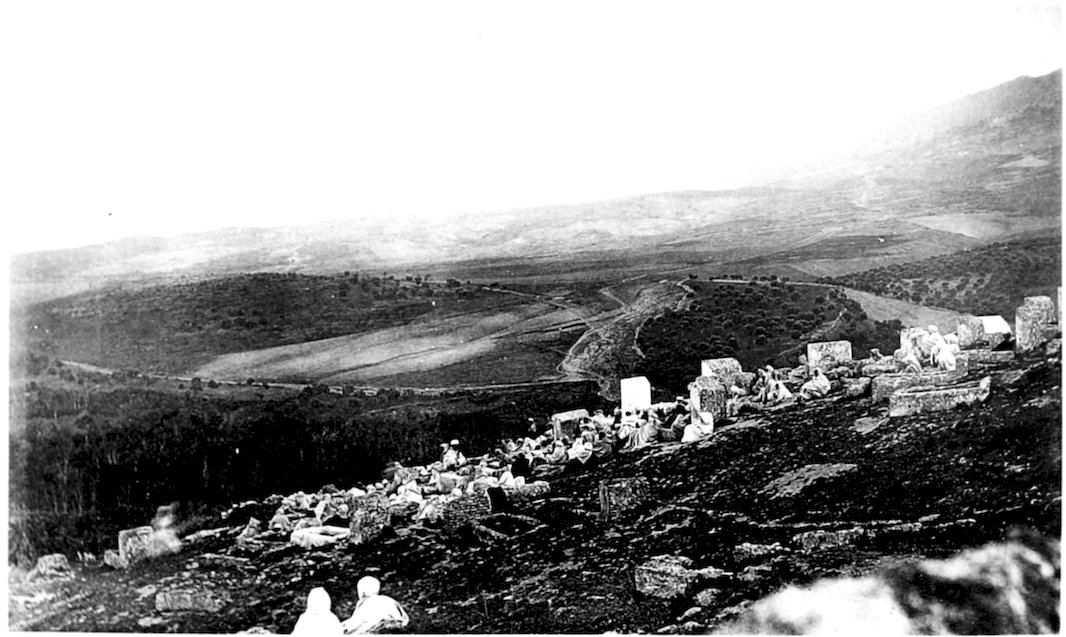
STORY TELLER AND AUDIENCE
In an afternoon ride with Miss Hay, the khalífa, and Zouche, we came upon a bridge which crosses the Sebú, about four miles below the town. The river there is about 70 yards across, with a swift current; and the bridge is well built, and of solid masonry. It is not of Roman work, so must have been built by a Sultan of some bygone age, when the use of stone in building was better understood than now; it is in good repair, and on the track of the caravans going and returning from Tafilet and Timbuctoo. Near the river we met a beggar man, who turned round and cursed us so volubly that even the ire of the khalífa, who is slow to wrath, was roused; and two of our escort, seeing that the compliments were understood and appreciated by him, galloped 165after the man, with a view to chastisement. Presently they came back and reported that the offender had got away among some rocks, and eluded them; but I am inclined to think there was an odour of sanctity about him which made the soldiers lax in their pursuit. We kept outside the town as much as possible on our way back, to avoid the Scylla of narrow streets and nauseous smells, but encountered a Charybdis in the shape of numerous graves, dug very shallow, and from which emanated a most sickening odour. This was being thoroughly enjoyed by a crowd of people who were listening to a professional story-teller, who holds forth every evening to a large audience seated among the graves. There must certainly be something intrinsically healthy in this place to counteract the effect of the awful nuisances, chiefly in the way of neglected carcases and scantily-buried bodies, which surround us everywhere, and which would otherwise sow disease more broadcast than they do. One advantage in the system of shallow graves in a country where burial follows very quickly on death, is the facility for disinterring yourself, should your friends have been a little premature in their final arrangements. As they only wrap their dead in a white cloth, with no restriction in the way of coffins; and as the grave is barely two feet deep, in loose sandy soil, there is little to prevent a person of ordinary energy from rejoining his friends, should he find himself a victim of too precipitate sepulture. Our native servants have got a story just now of a man who was buried “accidentally” a few Sundays ago, reappearing 166unexpectedly at the public sôk the following Monday. I cannot vouch for the truth of it; but se non è vero è ben trovato.
I have paid two visits to the slave market, the first time accompanied by Zouche and the medico, with Tweedledee as guide, interpreter, and friend, as usual; on the second occasion, with only the latter worthy and a couple of soldiers. There is less twaddle talked about slavery in Marocco than is the case elsewhere, by the Exeter Hall community, possibly because it is known that the only petitions sent by slaves here to British representatives have been, so I am told, to request that the institution may not be done away with; and certainly, judging by the well-fed and cheerful appearance of all the slaves one sees here, there can be little hardship in their lot.[42] Notwithstanding our being aware of this fact, I fancy that we three Christians (Tweedledee is an Israelite), as we rode along through the miserable alleys to the spot where the “abominable traffic” was carried on, were not quite free from the idea—I was on the point of writing hope—that, on turning the corner into the yard where the market was held, we should see a batch of victims fastened by the neck to an iron bar, while savage “drivers” with long cowhide whips, Kúbba la Uncle Tom’s Cabin, would be keeping them in order. This, of course, is what ought, according to sensational ideas on the subject, to have met our view. What we did see was half a dozen people selling grain, about fifty idlers loafing about, or looking at a few mules which 167were for sale; while, in a corner, under a sort of shed, sat a couple of black women chatting together and with the bystanders; while in front of them squatted a negro, with a surly expression of countenance, but well clad, and in excellent condition. These three individuals were the only slaves there for sale; but as we were a little early, and trade in Fez, as elsewhere, is dull, we determined to stay a short time, and see what happened. Although there was nothing in the appearance of the parties chiefly concerned to denote any dislike to the system, it gave us strangers rather a turn to see one’s fellow-creatures—one of them in this case young and pretty—put there for sale, exactly the same as the mules in the opposite corner, though at a lower figure. Nor was it pleasant to watch intending purchasers eyeing them over like cattle, and drawing down the veil from the face of one of the girls to examine her teeth, in much the same way as a man was doing to one of the said mules on the other side. The loss or badness of teeth is considered not only as a blemish, but as likely to interfere with the digestion, and in consequence, the general health of the “article.” Slaves are, for the most part, as black and ugly as all other negroes from the interior, though some of the women have pretty brown complexions and pleasing features. They are brought from the Soudan by Moorish traders, a common mode of catching them being by scattering sweetmeats, or, in hard times, corn, outside the villages. This is continued in a line to some covert close by, just as a poacher at home entices pheasants with raisins, 168when the children (they are mostly young when abstracted) are pounced upon and carried off by the trader. One of the ladies—I think a wife—of the Grand Vizier, owes her present position to this ingenious device; and many men have risen to lucrative and honourable posts who commenced life in Marocco as slaves, and subsequently obtained their freedom. Not many cases of ill-usage occur; if they do, the victim can complain, and claim redress. He has to bring his case before the Kádi, who, if he finds real cause for complaint, orders the slave to be sold by auction, the former master being in no case allowed to buy him in. Another regulation which tends to mitigate the misfortune of their condition is that, if they wish to do so, they may save money earned by extra work, and purchase their freedom. An acquaintance of mine was once asked for a contribution towards this end, and he gave it; but I question if the act was any more legal for a British subject than that of buying a slave for the purpose of setting him free; which latter proceeding, as calculated to encourage slavery, is severely punishable by law. The Koran contains very strict rules regarding masters and slaves, with their powers and rights respectively. One of the most important is, that if a female slave bear a child to her master, both mother and child are ipso facto freed; though, as my informant, who is the possessor of many slaves, told me, a man may have a child by his friend’s slave without any such penalties attaching, the child in fact becoming the property of its mother’s owner.
Owing to some suspicion on the part of the authorities, 169either of us or of the soldiers with us, they would not put a slave up to auction while we were there. Some people I asked said it was “harámi”[43] to sell a slave to a Christian, and that they were afraid I should outbid them, and insist on removing my purchase; others, that the superintendent of the market knew that the English disliked slavery, and thought we were there for the purpose of getting their Government into trouble. Whatever might be the reason—and we knew it was improbable they had given us a true one—we saw they were determined our curiosity should not be gratified; and one might as easily move a mountain as a Moor who has made up his mind. When unaccompanied by cruelty, and properly looked after, as the sale of slaves here seems to be, the system is not so very unlike that which prevailed till recently in Scotland at “Feeing Fares,”[44] where farm labourers, male and female, used to be exposed for hire by people looking for servants.
My second visit to the market was equally fruitless as regards seeing the actual auction, and the way the people mobbed one was very trying. As we rode in there were not twenty people there, but in five minutes the place was full, and we the lonely centre of a gaping crowd. If our persecutors had only been of the buying class, we should have felt we were benefiting trade by attracting them to the market; but they were chiefly boys and idlers, who contented themselves with execrating us as we rode away. “The brute-th that they 170are!” said Tweedledee; “why to thtare tho at us?” and although, as regards myself, I am quite of Tweedledee’s opinion, I cannot help feeling I should turn and take a second look at him if seeing him for the first time in the street.
The slavery of Christians was abolished in Marocco by treaty in 1814, but in the year 1721 there were no fewer than eleven hundred Christian slaves in Mequinez, the property of the aged Sultan Mulai Ismael. Of these about three hundred were English, who had been in confinement there many years, and subjected to the most revolting cruelties. An interesting account of their ransom and release is to be found in Windhus’s “Journey to Mequinez,” the author having accompanied Commodore Stewart’s embassy to Marocco, which sailed from England in September 1720, for the redemption of the captives.
The price of negro slaves in Fez at present is, for a girl of sixteen or eighteen, from 100 to 150 dollars, and for a lad of the same age, from 70 to 120 dollars. They seem to make capital servants.
Silver ornaments—Mosques—Market—Snake-charmers—Jews—Police arrangements—Frequency of murders—Army reform—Good intentions of Sultan—Unpaid officials—Lex talionis—Mock Sultan—Two remarkable events.
Most of the silver ornaments one sees in the jewellers’ shops seem of considerable age; and the ancient Moorish device of the horseshoe arch, which is to be seen in all their architecture, is often reproduced in brooches and earrings. Among other things I bought from an old Jew called Yakúb, who occasionally visits the Legation, is an antique silver snuff-box, apparently of Chinese manufacture; but how it came into Yakúb’s possession he either could not or would not explain. Another purchase was one of the silver brooches or clasps with which the ladies fasten their haïks, and which bears a curious resemblance to the old Scotch Lorne brooch. The price they all charge is the weight of the article in Spanish dollars or French five-franc pieces, often charging nothing extra for the work; so, if the silver is good—as we are assured it is—I do not see where the profit comes from. They will always, if you insist on it, allow the metal to be examined by the kaïd of the silver-market before purchase; 172and as little short of his head would atone for a Jew’s endeavour to swindle a Mussulman, I expect there is no doubt as to the purity of the material.
In one of my walks through the town I tried to get a glimpse of the Mulai Edris mosque, but was prevented going down the street in which it is situated. From the little that one can see of the interior en passant, it must be very beautiful and well cared for. The entrance is supported on pillars of white marble, and the whole façade is richly coloured and ornamented. This same Mulai Edris is a great gun here, and seems to have a finger in every pie. He is said to have lived about one thousand years ago, and his father, who came from Mecca and acquired a great character for sanctity, is buried in a sacred town, which is named after him, on Mount Zarhún.[45] Of real descendants they have none, though the men who look after the shrine here in which the son, who was founder of the city, is entombed, are said to represent them in some way. There are other mosques larger than this, but none of such special virtue. Among these is one called Kaa Ermiyel,or sometimes El Karuin, which was founded long ago by a female saint; it is richly endowed, and of immense extent, covering, apparently, almost an entire quarter of the town. Its doors open into a succession of streets, and through each one there are to be seen in every direction long vistas of white columns vanishing away into space. The interior, in point of size at least, must be magnificent; but the view is fleeting, for the Nazarene may not stop to gaze on it, lest something 173should be hurled on his unbelieving head, harder even than the curses of the moribund-looking wretches that lie around the door.
Leo Africanus calls this mosque “Caruuen,” and describes it “of so incredible a bignesse that the circuit thereof is a good mile and a halfe about.... The turret from which they cry amayne to assemble people is exceeding hie, the breadth whereof is supported with twentie, the length with thirtie, pillars.”[46]
I heard Mulai Edris invoked this morning in a curious way at the bi-weekly sôk, to which I rode at 7 A.M., with Mr. Náhum as interpreter. It was just beginning, and the kaïd of the market, an active old man in a blue uniform, came up and said that if we wanted to buy anything—horses, mules, &c.—he would be glad to help us. After that he got on his mule, and calling together all the men (about twenty) who had mules for sale, he arranged them in a line with an open space in front of them, round which a large crowd of people formed a circle; then, half standing, half kneeling on the broad pack-saddle on his mule’s back, with his slippers off, and amid the profound silence of the people, he recited a prayer to Mulai Edris; then followed one for the Sultan, another for the people and the mules, and in fact for every one except the abandoned infidel and his Jewish companion who stood respectfully looking on. At certain pauses he made, his hearers bowed their heads, and, touching their hearts and foreheads with their hands, muttered some responses, the only words I could make 174out being “Súltán” and “Mulai Edris.” The old kaïd seemed really eloquent in his exhortation, and his hearers were profoundly attentive. At the end of it the mules with their riders started off at racing speed to the end of the open space in front of them, then began to trot round in a circle, the owners vociferating forth the price and excellent qualities of the animals; and then—the “proceedings having been duly opened with prayer”—commenced vigorously the chicanery and swindling which are their normal avocation. The market was on a smaller scale than I expected, there being very few horses, and not many cattle or sheep; both the latter stock, however, were of a better quality than one usually sees in this country.
Passing back again into the town, we came upon a circle of people, with some snake-charmers in their midst. One of the performers, seeing me looking on, came up with a large snake in his hand, and opening its mouth with a stick, showed me its fangs, about a quarter of an inch long. I mentioned at breakfast having seen these people, so His Excellency, by way of a treat, sent for them here, much to the delight of the servants. The performance is not a pretty one to witness. The snakes, four or five in number—one of them the Boomraiah (Father of Beauty), about six feet long and beautifully marked—are kept in two cylinder-shaped baskets, into which the charmer put his hand and pulled out the Boomraiah. He then put it on the ground, and after chasing it about till it was in a rage he allowed it to bite his bare arm, which it did with much apparent enjoyment, and to the 175effusion of blood. He then took out a shorter and very thick one, of a deadly order, called the “Eftah,” which, after twisting about in every direction, he put inside his clothes next his breast; he then seized hold of the Boomraiah again about a foot from the neck, and as it twirled its head wildly round, he put out his tongue, on to which it promptly fastened itself, driving in its two long fangs, and making the blood flow freely. All the time this was going on an incessant accompaniment on two native drums was kept up; but whether to strike terror into the snakes, or embolden the principal performers, I do not know. Lawless tried to take a picture of the scene, but, owing to the ceaseless movement of the man who was manipulating the snake, it was rather a failure; the best part being the rapt faces of the servants and other bystanders, who came out well. Sir John tells me that some years ago, when he first saw this or a similar troop, he believed that the poison must have been extracted from the snake’s fangs, and wanted to let the reptile bite his hand. The snake-charmer, however, who always affirms that the poison is not removed, recommended him to try the effect on some animal first; so a fowl was sent for, and the snake made to bite it. It soon got into a comatose state, and died within the hour, and on being cut open the flesh was found to be black and discoloured. It is needless to say the impulsive diplomatist retracted his proposed experimentum in (suo) corpore vili. Another part of the man’s exhibition to-day was swallowing a long snake to within a foot of its head. The unengulphed portion of it presently began to wriggle about violently 176as the gastric juices of the performer’s stomach operated on its latter end, and with its teeth it inflicted deep wounds on the man’s face.
A funny incident occurred in connection with these men, which shows how lightly the liberty of the subject is regarded in Fez. It seems that when His Excellency sent for them, the messenger found them all in jail, having been sent there, it appeared, for the crime of “holding up to the Christian kaïd a venomous snake, which, if it had bitten him and he had died, would have involved the Government in great trouble.” I was sorry at the swift judgment which had overtaken the poor people on my account; but as we gave them a liberal present, and His Excellency arranged they should not be re-committed to jail on the former indictment, they went away quite happy.
There are said to be over ten thousand Jews in Fez, all of whom are obliged to live in the Melha, or Jews’ quarter—the Ghetto, in fact, of Fez. They are particularly odious to the Moor, being held in greater contempt even than Christians; and the interest taken in them by foreign societies tends to make them insolent and independent, increasing thereby the Mussulman aversion to them. A few days ago a deputation of Israelites, with a grave and reverend rabbi at their head, waited upon His Excellency to thank him for past favours (he is one of the committee for their protection), and to beg for more. Among other things was a request that he would interest himself in their behalf to get permission from the Sultan for them to wear their shoes in the town. “We are old, Bashador,” 177they said, “and our limbs are weak; our women, too, are delicately nurtured, and this law presses heavily upon us.” Though I can quite sympathise with the poor Hebrew in his non-appreciation of having to walk over such streets as these barefooted, yet I was glad they were dissuaded from pressing their request, the granting of which would exasperate the populace, and might lead to consequences too terrible to contemplate. This argument has already been put forward by His Majesty, when pressed on a former occasion to remove the disabilities of the Jews, together with the pertinent one that the admission of their ancestors into Marocco as refugees was made conditional on the observance of this practice; so, if the contract is broken on one side, it might with equal justice be annulled on the other. I do not know what other suggestions they made, as the conversation was all in Arabic; but their excited gestures, and their bending forward across each other’s backs to get as near as possible, and not lose a word of the Envoy’s advice to them, looked as if they put great faith in His Excellency’s power of pleading their cause with the Sultan. This chosen people are at present the subject of much discussion, as at the Madrid Conference one of the chief topics under consideration is that of their protection by foreign powers. No doubt some change in the treatment they now meet with is desirable, but that their account of the hardships and injustice under which they labour is exaggerated, is also beyond dispute. The story of the slaying and burning of a Jew here, a few months ago, though an act of undoubted barbarism and 178ferocity, was much garbled and made capital of by the societies for their protection; and it would be well for such associations to inculcate, among their protégés, principles of chastity towards women, it having been an attempt on the part of an inebriated Jew to outrage a Moorish woman which excited the feelings of the mob on this occasion. Melh’, or Melha, signifies “salt,” and the place is so called from the old custom of giving the heads of criminals, when executed, to the Jews, who were compelled to salt them before they were distributed over the gates of cities as a warning to others. Very queer specimens of humanity are those one sees in this same Melha. Hebrews of every type are there; some sitting cross-legged, working away at silver ornaments, or making the long guns used by the Moors; others cutting out clothes, either for themselves or their oppressors, as it is immaterial to the Jew for whom he labours, provided the payment is punctual and sufficient. In their own quarter they may do as they like (except ride on horses, these animals being considered too noble for such a base use); but once the gateway is passed leading into the town itself, they must dismount from their mules, and walk barefoot in all weathers. Some of the women and children are pretty, but good looks among the men are very rare, while some are most forbidding in expression. Their clothes, in shape, resemble those of the Moors, but the law restricts them to wearing only black, which, with their shaggy beards and long hair—generally dark, but sometimes of a carrotty red—gives the bad-looking ones a wild and evil expression, much 179resembling the portraits by some of the old masters, of their ancestors who assisted at the crucifixion.
Three cases of murder of Jews have occurred during the last few years, for which the compensation money has not been settled, and of which the perpetrators remain undiscovered; but our own annals of crime, especially in the sister isle, will hardly allow of our casting the first stone at the Moors.
In many respects the Jews in Marocco are better off than the Mahommedans, especially in this matter of enquiry into acts of violence against them; for whereas one Moor may kill another, and very little be said, if a Jew is the victim, there are a dozen advocates to take up his cause. They are exempt, too, from military service, which in a country like this is no small boon; and though their evidence is not accepted before any tribunal, neither is that of a Christian. They seem to excel the Moors in ornamental work of most sorts—guns, swords, &c.—and in what we should call cabinetmaking; but in masonry, gardening, and out-door work, I do not see them often employed. The great object of most of them is to become the protected subjects of some European power, and it is a pretty widely known fact that considerable sums of money change hands to facilitate such arrangements.
One of the snake-charmers of yesterday came here this morning to thank His Excellency for his good offices, and to say that their money, which had been taken from them at the prison, had been returned, while the soldier who had lodged them there had been detained 180and flogged. Alas for his excess of zeal! but it probably served him right, and it was refreshing to see the thankfulness of the other, whose conduct, though the appearance of the outward man was against him, recalled to our minds the grateful leper in the parable.
There is not such a thing as a “policeman” in Fez, which seems curious in a town of 50,000 not very peace-loving inhabitants. A writer[47] in the sixteenth century tells us that in his time four sergeants and officers were appointed to patrol the town from midnight till 2 A.M. “These,” he says, “have no stipend, but are freely permitted to sell wine * * *” and to deal in other even more questionable commodities—a mode of increasing the emoluments of the British officer which has hitherto escaped the attention of their well-wishers. To a certain extent, the plan now-a-days of preserving order is by setting every man’s hand against his neighbour’s, as any one, soldier or otherwise—though it is par excellence the former’s business—can lodge a person in jail whom he detects in any crime, receiving for his trouble a fee which is paid by the offender. At night the facility for crime is lessened, and its locality determined, by the device of closing the gates of every quarter a little after sunset. The districts being numerous but small, and the gates pretty strong, detection of evil-doers is rendered easy, as escape, with the gates shut, is a matter of difficulty. At the same time, the total darkness of the town, and the proximity of the river, which 181can be seen foaming below the streets through many a cavity, makes the commission of crimes of violence much too simple. Punishment for such offences seems very slight, and payment of a certain sum of money, or, I am told, the providing of a substitute to take their place in prison, procures the release of almost any criminal. During the last few weeks, I hear, undetected murders have been frequent, and the kádi[48] is rather on his mettle to find out the perpetrators. The gardener of a place close to this saw, a few days ago, something floating down the stream which runs between the two gardens, and on picking it out, found it was a woman’s arm. The man took it to the kádi, who, determined to find out the murderer, showed considerable judgment in the steps he took. Noticing the arm was a good deal tattooed, he sent for the women who do this work, and handing them the limb, asked if any of them could recognise it. This one of them shortly did, saying it must have belonged to so and so, wife of a merchant in the town. This individual being summoned, the judge said to him, “I wish to see your wife; let her be brought before me.” “That is impossible,” said the husband. “Why?” “Because she went three days ago on a visit to her mother.” This was too much for the kádi, who ordered the man to be put in jail. It turned out, however, that his story was true, and that the woman having an intrigue on hand with another man, gave the above excuse for leaving home. The lover has been arrested, and it appears that he murdered the woman, either from jealousy or to possess himself 182of her jewels. So the husband, who learned in the same day of his wife’s dishonour and her death, has been released, while the lover is detained during His Majesty’s pleasure, the length of which term depends a good deal on the amount of money which can be squeezed out of the offender.
I have lately, at the request of the commander of the Sultan’s infantry, adopted the rôle of Cardwell of the army of Fez, and, assisted by Kaïd Maclean, have been busy for some days in drawing up a scheme of army reform, one of the conclusions I have come to on the subject being that, if the interior economy of the State is at all on a par with that of the army, the condition of the empire must be rotten indeed. But in speaking in this way, I refer only to the organisation of the regular infantry, for this is the only branch of the service which has come under my special notice. Of the irregular cavalry, under whose protection we travelled in the provinces, and who are a species of militia or landwehr, I have a higher opinion, as I believe them to be a force specially adapted for the protection of a country like Marocco.
We were all to have followed Sir John to the palace this morning, and had attired ourselves for the presence of Majesty accordingly; but His Excellency’s audience was so lengthy that it was settled to-morrow would do better for us.
The dignity and patience with which the Sultan 183listens to all the unpleasant truths it is the Envoy’s duty to lay before him, inspire one with a certain respect, and, at all events, a profound sympathy with him; and although, like a true Oriental, he always has a ready answer of the most soothing character for all disagreeable suggestions, I believe he has the interest of his country at heart, and is a sound centre in the midst of rotten surroundings. Considering also the terrible cruelty and tyranny exercised by many of his ancestors, his own comparatively milder rule cannot but be regarded as creditable; for, in the case of a semi-civilised autocrat, with the absolute control in his hand of the lives of his subjects, and with boundless other facilities for doing evil, the non-exercise of such power becomes a virtue. Viewing his character in this light, one does not grudge the tiresome work of instilling heliographic principles into the Moorish brain, or even flinch from the more delicate task of disclosing to His Majesty the utter inefficacy and swindling of his army administration. His Excellency seems to have been trying to-day to impress upon the Sultan the advantages of agriculture, to which, he explained, France chiefly owes her great wealth. Against some mining speculations which had been recommended by foreigners, and in starting which he has already been done out of a large sum of money, the Envoy warned His Majesty:—“Mines are risky things, and I would not recommend Your Majesty to put much trust in what speculators tell you; but agriculture should constitute the riches of a country like this.” “It shall be looked to at once,” replied his 184hearer; “I will order corn to be given to the people in time for next sowing, and they shall pay me a tithe of the crops.” Great part of the Sultan’s treasure consists in granaries stored with corn, and during the famine of 1778 the Emperor Sídi Muhammed (ancestor of the late Sultan of that name) “generously opened his store of corn and distributed it among his subjects,” every person possessing stores being obliged to follow his example.[49]
“The state of Your Majesty’s army is very unsatisfactory—a few disciplined troops, the rest a mere rabble.” “Yes, I believe they are not very efficient, and are, I am told, great robbers.” His Excellency, who sometimes puts forth parables as being more acceptable to a Moor than the plain truth, continued:—“If Your Majesty had a dog, and never fed him, would you be surprised at his stealing meat? Your troops only require to be well fed and clothed, and they will cease to disgrace you; the three hundred men you sent to Gibraltar were two years there, and no complaint was made against them, for they were properly disciplined and paid.”
By way of seeing if the scheme of army reform was likely to be well received, His Excellency said, “The kaïds of the English army who are with me have made a great many comments on your troops, and one of them has embodied his ideas on paper; would it please Your Majesty to see it before I leave Fez?” To which His Majesty graciously assented.[50]
185Speaking of the pleasure we felt at having been so well received, Sir John remarked, “The officers of my Mission are highly pleased with your reception of them, and at the favourable eye with which Your Majesty has looked upon them.” “I am very glad of it,” said the Sultan, “and am surprised at officers so young being masters of so many scientific attainments.” In inculcating these practical and moral precepts His Excellency often introduces the remark, “If anything I say is displeasing to Your Majesty, I trust you will at once stop me;” but the Sultan always bears with him to the bitter end, concurring sadly but silently in what he hears.
Some characteristic remarks of two of the ministers were repeated to me the other day. “What do you think of the English Bashador?” said one. “If a doctor,” replied his friend, “comes to look at a bad boil on your leg, and smoothing it over puts a plaister on to ease it for a little, is he as good a surgeon as the man who ‘burns it out from the root’?” Though the faculty might deride such heroic treatment, it must be remembered that here phlebotomy or cautery is considered as a remède à tous les maux, and at any rate, the metaphor shows that some of the ministers endorse their sovereign’s high opinion of His Excellency. It is curious that with lots of thinking and reasoning men among them, the chief officers of the State should be allowed to cheat and swindle as they do, obstructing all reform, but seeing far enough ahead to line their pockets while they may. The mistaken system of never paying the officials, but, on the contrary, obliging them to make large payments to the Sultan for 186the favour of continuing in office, does more to hinder the progress of good government, and to maintain oppression and injustice, than almost anything else. Shortly before the death of Sídi Muhammed, father of the present Emperor, there seemed every chance of this abuse being rectified; for when each new Governor of a province was appointed, he received a fixed salary, and two public notaries (adúls) were attached to his suite to render an account to the Sultan of all fines and punishments inflicted. On Sídi Muhammed’s death, however, in 1873, things fell back into the old groove, the advisers of the present Sultan assuring him that unpaid servants were a clear gain to the country over paid ones. Now-a-days, therefore, if any crime, such as murder, is committed, the accused is put into jail, and if willing or able to pay, is only detained there till the amount of blood-money is determined upon; this, if he pays it, procures his release, a short absence from the district being at the same time recommended. Of course he has to take his chance of the murder being avenged by some kinsman of the victim, the lex talionis being sanctioned by the Prophet, who stipulates there is not to be “too much cruelty” perpetrated in its execution. A liberal amount of blood-money, however, generally obviates such danger. The offender is also fined at the option of the Governor, into whose pocket the amount mulcted goes, as also does a considerable portion of the indemnity paid to the relatives. The same plan is resorted to in the case of other crimes, the rich man coming well out of his troubles, especially in the case of lawsuits about property, where, 187as there is no appeal but to the Sultan, the decision of the Governor is almost invariably in favour of the man who pays.
Rode out a few miles towards Mequinez with White to meet the Gordon Cumming party,[51] who were marching in from that direction; found them all—it was raining hard—sitting in a row, with their backs to the weather, discussing some luncheon, and reading their home letters, which had just arrived. We brought them the news that the house of one Ben Aouda had been prepared for them through Síd Búbakr’s influence with the town authorities; and the intelligence was welcome, as their tents and everything else were wet through. Leaving them to follow, we rode back to the town, and were just in time to see the performance of a curious annual ceremony. It seems that once every year the “students” (a party whose composition no one can exactly define) elect one of their number for a Sultan, under whose rule they all go out into camp on the first of May for a fortnight’s feasting and debauchery, and we met the procession en route to their encampment. It consisted of the mock Sultan and his train, and is such a counterpart of the original, as we witnessed it in the pageant of the 19th ult., that we thought at first it was His real Majesty out for an airing. The party were escorted by a four-deep square of infantry, under Hadj Hamed, in the centre of which they moved slowly along. Occasionally they halted to allow some parties of hillmen, who preceded the troop, to perform a sort of war dance peculiar to 188themselves. Six or eight of them, armed with their long guns, advance and retire towards each other like the first figure of a quadrille, stooping down each time they cross, as if taking aim at their vis à vis; presently they begin to circle round and round, singing a wild monotonous air; and when the leader arrives at a certain high falsetto note, they all leap in the air, and before their feet touch the ground again discharge their guns, muzzle downwards, into the earth. The first time I saw this dance was at Tangier, during the festivals on the anniversary of the birth and circumcision of Muhammed, when I was much struck by the graceful motions and well-disciplined movements of the wild-looking performers. We were joined presently by some others of our party with a few mounted soldiers, who assisted in keeping off the crowd; and Kaïd Hamed sending some men to help, we managed to keep a space clear for the Gordon Cummings, who appeared at this moment, and who halted till the crowd had passed on with their newly-elected Sultan. This dignitary’s appointment is put up to auction, and this year was bought for one hundred dollars. The presents he gets, and some tribute which he receives from his royal confrère, soon reimburse him, and he is allowed to rob a little on his own account; the present one, too, being a merchant, is probably accorded some monopoly or contract by the Sultan.
To-night was remarkable for two events which can never have happened before; one was the fact of His Excellency’s having completed forty years in Her Majesty’s service; the other, that no fewer than eighteen 189Christians were collected in Fez, and sat down to dinner together. The first came to pass in the fulness of time and in the natural course of events; the second by Colonel Gordon Cumming’s party being unfortunately disappointed in getting into Ben Aouda’s house, from which he positively declines to move; and consequently, as the rain was falling in torrents, being detained to dinner here. Síd Búbakr, being put on his mettle by the falling through of his arrangements, rode down to the city gate, and having collected the animals, baggage, &c., had the camp pitched in the only available space inside the town; having accomplished which he returned here to guide the travellers through the darkness and the rain to their uninviting resting-place.
Visit to the palace—Failure to photograph Sultan—Set up telephone—Panthers—Beauty of palace—Sultan’s entertainment—Jugglers—Native drama—Dance of the Aissowieh—A saint of Fez—Visit to the “Melha”—Inspection of infantry—Inns of Fez—Pharaoh hardens his heart.
Yesterday’s rain having caused our visit to the palace to be postponed, we were hunted out of our beds at an early hour this morning by His Excellency; risked an attack of indigestion over our breakfasts, still under the same influence, and, after waiting some time admiring each other’s go-to-meeting clothes, finally received a command that His Majesty would receive us at ten o’clock. It having been whispered by Síd Búbakr that, if it could be done quietly, the Sultan would allow himself to be photographed, His Excellency was in high spirits; and already, I believe, in his mind’s eye the portrait was on its road to Windsor. But the mood of a Moorish autocrat is variable as the wind, and I doubt if the artist is yet fledged who will hand down to posterity a likeness of His Sharífian Majesty. We rode up to the palace through lanes which last night’s rain has converted into alternate torrents and seas of mud, splashing our 191pretty clothes and making us generally uncomfortable. The Ministers and Court were just leaving their small tents of office in the palace enclosure, and the fat Vizier, puffing and flushed with the exertion of hurriedly climbing on his mule, rather scored off Sir John, who had dismounted, it being de rigueur here for a person of inferior rank always to dismount before addressing his superior. They had none of them heard we were coming—a great slight to the Grand Vizier, who, together with his colleagues, looked as black as thunder. We waited some time at the gate of the inner court, which want of attention drew down some Moorish blessings on the head of the officer in charge of it from the Envoy’s varied vocabulary; and after getting through, and into the garden, we were kept standing in the walk for upwards of an hour. We tried in vain to excite His Excellency’s indignation again, and presently the “Eyebrow” arrived with some excuse about the Sultan not knowing we were coming, as the soldier who brought the message made a mistake about the hour, &c., and consequently His Majesty was still at breakfast. At the real reason of the delay we of course never arrived; but as at that moment another messenger came, summoning Sir John and the “photographer” to the royal presence, our spirits rose at this apparent fulfilment of our wish to obtain the desired likeness. In the meantime, the rest of us were left to the tender mercies of the “Gentleman of the Eyebrow,” Síd Múhammed Gavass, and Síd Drís ben Abd el Wáhad, the “idle apprentice” of the Moorish engineers.[52] 192I improved the occasion by unpacking the heliograph (which they had brought along with the telephone, and which they think forms an integral part of it), and giving the latter youth, who had not yet seen the instrument, a lesson in its adjustment. Having discoursed on the subject in well-selected phrases for some time, I was disappointed at his asking with apparent interest, “And does it work well at night?” and again, after some further explanation, “How much wire do you have to use?” However, I must say, as soon as I got him to give his attention to the matter, and to leave off lusting after the fleshpots of Chatham and London, which we were the innocent means of recalling to his memory, he mastered the rudiments very quickly. In about half an hour His Excellency and the artists returned rather crestfallen, though at first they declared they had been taken to the Harem, and photographed His Majesty and all his wives. It turned out, however, that the Sultan, changeable as a school-girl, refused, as soon as he saw the camera again, to be taken, and even insisted on Sir John’s promising that no such attempt should be made. He sent, however, for three female slaves—one an enormously stout black lady, the other two of a more graceful build, brown complexion, and rather pretty; these victims he allowed to be sacrificed on the altar of art, retiring a little for fear of being included in the group, and laughing quietly at the scene.
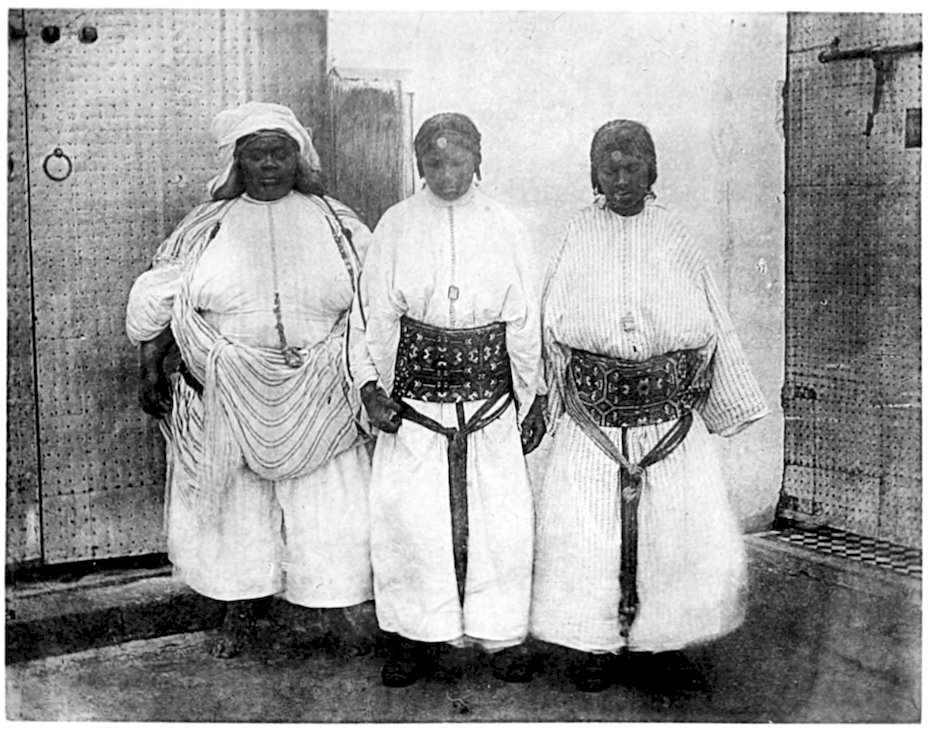
THE SULTAN’S “SUBSTITUTES.”
Rode home past the “Eyebrow’s” house, where they told us that if we “waited for a little we might be shown some of the rooms of the palace.” Disappointed, however, 193with the result of our morning’s visit, we stoutly declined to alight again, were the Sultan and his entire harem on view. After luncheon, however, I rode back to Ben Músa’s house, and spent a couple of hours in putting up the telephone between it and an apartment in the palace. The Eyebrow’s end of the wire we set up in a sort of lumber-room, full of every sort of toy, presents, &c. discarded by His Majesty—French china, some of it very pretty, clocks of every kind, boxes full of clothes, feathers, mirrors, artificial flowers, enough to furnish half a dozen fancy bazaars; and among this collection probably ere long both batteries and the connecting wire of the telephone, together with the heliographic instruments, will find a home. The other end we took along the wall, under an archway and through a long passage, into the Sultan’s private garden, then up a flight of steps to a broad and beautifully paved terrace, on which a wing of the upper story of the palace looks out. The room in which we fixed the end for His Majesty’s use was a perfect gem in its way; no furniture but two arm-chairs and a bed, underneath which a young but full-grown panther was rolling about, who came and sniffed unpleasantly at the calves of the Christian intruders. The work in the ceiling of the recess in which the bed was placed was really exquisite, and round the walls were inscriptions and verses from the Koran, executed in gold and colours of the richest and brightest kind. Half a dozen horrid-looking black eunuchs were there to watch that we did not stray farther than necessary for our 194work; and though I looked carefully round and into the garden, which was stretched out below us, for any other signs of life, I could see nothing but a lot of gaudily-dressed black boys, whose chief amusement seemed to be rolling over and fighting with the panthers (there are two of them), whose bites and scratches they returned with interest. We got the telephone arranged satisfactorily at last, and left the Eyebrow yelling into his end of it, much to the delight of two of the eunuchs, who were screaming in high falsetto into the other end. How long it may bear this severe test, which Mr. Bell can never have contemplated when constructing it, time alone can determine.
Our last public entertainment here took place to-day, with accompaniments which will engrave it for long on our memories. Our host on this occasion was no less a person than His Sharífian Majesty, who, though he did not appear in person, provided a most ample assortment of food for both body and mind. The summer palace where the picnic took place is about two miles to the south-west of the town, and is enclosed in an extensive grove of orange-trees, among which some tents had been pitched for the party. Before luncheon we were taken to have a look at the building, in which there is not much to see. It consists of a very large courtyard, open at the top, and paved with marble, into which a number of good-sized suites of rooms open. The chief interest which attaches to the place is a melancholy 195one, it having been built by Christian slaves, of whom most were English, during the reign of Mulai Ismael, in the beginning of last century.
We were rather surprised that some great officer of State, such as one of the chamberlains or the Sultan’s secretary, was not present to represent their master; and to a suspicious mind it looked not unlike intentional neglect on the part of some one. His Excellency at once repudiated this idea, and pointing to a Moor who happened to be shouting rather louder than the others, explained that he was “an official of high position called the Kaïd of the Freigíahs, and had the arrangement of everything.” Now, seeing that this same “kaïd” is merely the chief tent-pitcher, of whose services in this capacity I availed myself a few days ago in the palace garden, I am not wholly convinced by His Excellency’s ready repartee.
We had brought with us not only our own servants with knives and forks, but also a goodly supply of the fluid prohibited by the Prophet, which substitute for the dirty water one usually gets at Moorish feasts helped to wash down pleasantly the sumptuous meal provided by His Majesty’s chef.
Síd Búbakr and the two Chatham officers being either too shy to feed with us, or being unwilling so to commit themselves in public, went to another tent, where countless dishes of all kinds were brought to them and a select few of the palace people by the Sultan’s slaves, who had lighted fires in the wood to keep the viands hot. As there was not room in their 196tent for half the dishes provided, Síd Búbakr had them arranged in rows outside, and then distributed to the various lots of servants, soldiers, slaves, &c.—a most popular arrangement, which went straight to the hearts and stomachs of all present. After we had finished our luncheon, and Colonel Gordon Cumming’s party, who joined us later, had had theirs, some jugglers came and performed. Their tricks were good, but what they excelled in were feats of strength, one man supporting seven others on his shoulders, and many other things of the sort, all on the wet, muddy ground. It was a curious scene; on one side were the party of Christians in the shelter of the tent, of which a side had been left open, while opposite stood the bystanders, whose interests were divided between us and the performers; behind these were about fifty or sixty people who had filed quietly into the grove just before the performances commenced, and of whose identity we were shortly made aware. In the background were the horses, picketed, and several tents which had been pitched to shelter the officers of our numerous guard from the rain, which was falling heavily. The jugglers and athletes having withdrawn, a contortionist, who must be quite at the head of his profession, appeared, and imitated an ape to perfection, the way he changed his face—naturally not an unpleasant one—being horrible and yet ludicrous to a degree. The ape having retired, a comical-looking man, with a sort of fool’s cap on his head, made a stump oration, imitating various characters, his jokes making the people roar with laughter, in which His Excellency and the khalífa, 197who are both perfect Arabic scholars, joined; but whether from the jokes being purely on local topics, or from some other cause, they did not think fit to translate them for our benefit into English. The speech concluded, the jester, assisted by a small black boy and a fair, effeminate-looking youth, proceeded to enact in dumb show certain scenes and tableaux taken from native domestic life and manners; but as these began to assume features which would hardly have failed to come under the censure of the Lord Chamberlain at home, Síd Búbakr with infinite good taste stopped the music (without which nothing can be got through), and the performers went their way, wondering, doubtless, at the want of curiosity we evinced in not waiting for the development of their highly seasoned drama. Now came the last of the varied entertainments provided for us by our royal host, and it was certainly as unexpected by those who were best acquainted with Moorish customs as it was horrifying to all, and especially to those who had never witnessed it before. It seems that some days ago, when this picnic at the summer palace was first mooted, and Sir John was asked what style of amusement we should like best, he begged that the “Aissowieh” might be sent to amuse us. Now by that term is usually meant the snake-charmers, who belong to the great sect of Aissowa, and it was, of course, only the snake-charmers to whom His Excellency referred. His suggestion was, however, interpreted otherwise, and the Sultan imagined that our unaccountable taste made us anxious to see the performance of the ghastly and horrible rites of the real Aissowieh.
198The founder of this sect was a poor Arab, Muhammed ben Aissa, who lived in Mequinez about three hundred years ago, in the most abject poverty. As a reward for his unwavering faith in the mercy of God, and in the good offices of the Prophet, a miraculous supply of food was sent him, with which he was enabled to supply all the poor of the town, and was thenceforth regarded as a saint, multitudes coming to him and imploring to be received as disciples. With these followers he travelled through the empire, barefoot, and “without scrip or purse,” trusting implicitly to the Prophet to provide the necessaries of life. When they were hungry their leader gave them poisonous plants to eat, which not only proved innocuous, but satisfied the cravings of their appetite. Very soon they attained the power of receiving without hurt the bites of poisonous snakes; while burnings of the most terrible description, wounds, and contusions, were impotent against them. Tradition asserts that Ben Aissa, as a reward for his virtues and faith, was caught up into heaven, like the Prophet Elijah, in a chariot and horses of fire—a team which his previous training would enable him to handle with ease.
The sect is at this day very numerous, and twice a year—at the feast of Bairám, and at the end of Ramadán—they assemble from all the sacred towns, and commence a kind of triumphal march through the country. The provinces through which they pass are—or at all events used to be—thought specially favoured by Providence, the inhabitants vying with one another to minister to their wants, and according to them “the best of the 199cheer and the seat by the fire,”—once “the undenied right of the barefooted Friar.”
The name “Aissa” (Jesus) is that by which our Lord is always mentioned in the Koran, so Aissowa becomes the equivalent of Jesuit, or follower of Jesus, and, in fact, the fundamental principles of the two orders are identical—faith and obedience.[53]
The preliminary rite of these people consists in working themselves into a state of religious frenzy, in which, when reason has entirely lost her sway, they think to propitiate the Deity by cutting themselves with knives and stones, and sometimes giving themselves up to the commission of the most brutal crimes and horrible excesses. When in this condition, which by the law of the land renders them more or less irresponsible for their actions, neither man, woman, nor beast is safe who happens to cross their path, and God help the unfortunate Christian or Jew who may fall into their clutches! Among them, however, are certain high priests or elders, who, like the leaders of religious revivals elsewhere, exercise a sort of magnetic influence over their flock, even when they are at their worst.
Considerable opposition was made to His Excellency’s supposed request by the town authorities, who declined to be responsible for the safety of the Christian spectators when brought into close contact with the fanatical Aissowieh. The fiat of the Sultan had, however, gone forth; so nothing could be done but to choose 200from among the known followers of the sect the least extravagant and dangerous members. These then were the crowd of people who, having hitherto kept in the background, were now brought forward by their Emkaddemín or high priests—three old men of great height and commanding appearance, with dark flowing robes and long white beards. At first they were formed up in double rows, facing each other, with the Emkaddemín between them, and began their dance to a monotonous tune kept up on drums and horns. Gradually they kept working towards our tent, stamping their feet to the time of the drums, and throwing their heads backwards and forwards with a corresponding and rapidly increasing motion. It is an acknowledged fact that since the days when David danced before the ark, dancing has been regarded as a religious exercise by many fanatical sects, who affirm that, by subjecting their bodies for some time to such action, a state of mental derangement is attained which renders them callous to all pain, and wholly irresponsible for their actions. Such apparently was the effect on the Aissowieh, who were now reduced to about twenty, those to whom the spirit had not communicated this state of religious ecstasy having had the good taste to withdraw from their more favoured brethren. Those who remained presented a horrid appearance; their clothes hung loosely on them; in most cases their turbans had fallen off, exposing sometimes a bare and shiny skull, sometimes long dishevelled hair, which, by the constant motion of their heads, now hung in clusters 201down their backs, now in matted locks concealing their faces. Occasionally three or four would break away from the ring and indulge in a pas seul outside it, or else run full tilt with their heads against a tree, and beat the stem with their hands till the blood flowed freely down. The eyes of all of them had now become fixed and glassy, their tongues lolled out of their mouths, and their faces assumed a livid hue, while from the entire circle rose the ceaseless cry of “Allah, Allah, Allah,” as the wretched maniacs invoked their God, of whose character they must take a strange view if they think He enjoys the ghastly scene! The chief method observable in their madness was that they seldom did each other any injury, though occasionally one or two at a time would fall on their faces and commence tearing up the grass, which, with handfuls of mud, they would force down their throats, and digest with apparent satisfaction. On these occasions, if two of them came in contact, one would seize the leg or head of the other, and commence gnawing it in an abstracted manner, inflicting horrible wounds, to which operation his fellow enthusiast would make no objection. The Emkaddemín would now interfere, and by kneeling on their heads and other gentle measures, quiet them; then, by some mysterious exorcism, they would recall the men to reason, keeping their eye on them till they sheepishly left the spot and got away behind the spectators. By this means all but four of the Aissowieh were disposed of; those that were left, however, seemed beyond even the influence of their priests, who would 202occasionally make an attempt to subdue them; but failing to do so, contented themselves with closely watching, and when necessary, placing themselves between us and the wretched men, who now looked more like beasts than human beings. In fact, through some freak of their disordered brains, these men had assumed the rôle of wild animals, and were prowling about on all fours, uttering unearthly cries, like hungry beasts in quest of prey. It was not a pleasant moment when one of them neared the tent, peering among us with brutish eyes, and I could not help thinking a live Christian among those four would have had a sorry chance. Nor would such an accident be wholly unpleasing to the spectators. The Emkaddemín, however, had a peculiar method of satisfying the appetites of their remaining disciples, and when they suddenly paused in front of us, adopted the following plan. Among our servants were several followers of the sect, who, forbidden to join in the saturnalia, had been looking with sympathetic eyes at their co-religionists. One young boy, however, of about twelve, also an Aissowa, who has lately been taken into the service of the khalífa, not being able to resist the fascination of the scene, joined in it, and having given himself wholly over to the Evil One, was now lying in a state of exhaustion on the ground, his stomach full of mud and grass, and his nice new clothes, provided by an indulgent master, reduced to rags. Towards young Hassan, for so is the youth yclept, one of the priests now moved, and taking him up by the waist, threw him as a bait to allure away the 203fanatics from us. The device succeeded better than we had hoped for, and with a horrid roar they threw themselves upon the boy. He remained where he had been thrown without moving or uttering a sound, and while the horrid crew were howling and struggling over the morsel before proceeding to tear it to pieces, he sprang from among them into the arms of the nearest Emkaddem, who, secreting him in his ample robes, moved away from the spot. The vacant despair and then rage of the Aissowieh, when they saw their victim was gone, was indescribable; they tore up the ground with their nails and teeth, and then separating, apparently in search of their prey, were set on by their leaders, who by moral suasion and by physical force, requisitioned from their now sobered followers, removed the still raving madmen from the scene. It was a relief when it was all over, as the performance, though shocking and repulsive, had an element of fascination in it which prevented one from taking one’s eyes for a moment off the principals.[54]
I had seen it once before, when, among other eccentricities, they tore a live sheep to pieces and ate it—a fate I had fully expected to see young Hassan undergo; but then I was safely ensconced on the roof of the Belgian Consul’s house at Tangier, and offered no such temptation to the performers as we did to-day. Never before, however, have the Aissowieh been called upon to gratify 204the curiosity of private individuals, more especially of people holding infidel doctrines like ours; and even among themselves I do not think these rites ever take place except at their two great festivals above mentioned.
The ghastly but interesting performances of yesterday made me forget to note down a curious sight I saw in the city in the forenoon—viz. that while walking through the streets I was fortunate enough to meet a real saint in the body—in fact in nothing else—who is much respected in that quarter of the town. He was a fat, elderly person, of middle height, with a restless and dissatisfied expression of countenance, and not a stitch of clothing on of any sort or kind. He passed me with a kind of ambling, shuffling gait, and had a dazed and puzzled look, like a nocturnal rover driven out of his cave into the garish light of day. On enquiry through Mr. Náhum of some of the crowd attendant as usual upon us, I was told he had affected this negligé style of dress from infancy, but was a man of renowned sanctity, and “did a great deal of good.” No one seemed to notice him, and looking back I saw his broad brown shoulders disappearing among the people, none of whom even turned round to look at him. Gentlemen of his cloth, if one may so speak of an unclothed man, have from time immemorial been allowed great latitude in Marocco. An author, writing in the beginning of last century on the subject, says, “All 205things are lawful for the saints,” and describes how “there was a naked one at Lally some years ago seized a young wench in the streets, who, not well understanding sanctification, began to be turbulent.” The remainder of the anecdote will be found by any reader curious in the matter in Windhus’s “Journey to Mequinez” (London, 1725).
I rode again through the Melha with Zouche. It seems to consist of a long, filthily dirty street, with lanes, too narrow for a horse, leading off it. We walked up one of these, and looked into one or two of the houses, which seem very clean inside. The Israelites always look glad to see one, and in a country where, with a few exceptions, one meets with only hostile looks and forbidding faces, even such lowly recognition is not without its value. Mr. Náhum, who accompanied us as interpreter, was of course quite at home in the quarter, and took us into a house belonging to a friend of his. The lady of the house was a good-looking woman of about thirty, with a pretty little girl of seven. The latter had a handsome bracelet, which I was told was a mark showing the owner to be a married “woman.” This early union is common among the Moorish Jews, the husband and wife living under her parents’ roof, but separate from the rest of the family, as becomes the dignity of their estate. In this instance the bridegroom was nine years old, but was away at school, so we did not see him. We passed a distillery in the Melha, where any one having raisins, &c., which he wants to “dethtyle,” as Tweedledee explained it, pays so much, according to quantity. Both spirits 206(má hia)[55] and native wine are made by the Jews; but it is considered “harámi” for Mussulmans to drink it. The má hia is not pleasant, and tastes of aniseed; but I can imagine getting to like the wine—it has little or no strength. On our way back we saw the “Hotel de Ville” where the Bashaw administers (?) justice. There was a strong escort of uncommonly wild-looking but well-mounted soldiers in attendance, who refused to allow us even to look into the courtyard. It is here that all rich criminals and well-to-do persons with grievances are brought before the governor, his khalífa being deputed to hear “the short but simple annals of the poor.” Outside the town we met a cavalcade going to visit the camp of the student-sultan. A younger brother of the real Sultan was in it, attended by both Chamberlains and the Grand Vizier; but though we drew up out of the way and bowed as they passed, none of them took the slightest notice of us.
A letter has come for Sir John from the Sultan’s private secretary, saying that His Majesty intends adopting the suggestions contained in my memorandum, and requesting that I would go and inspect his infantry and their arms, &c., so as to draw up a further report for his information. I accordingly rode off to the palace square, where I found the infantry, to the number of about three thousand, formed up in mass of columns. Kaïd Maclean was there, and the Commander-in-Chief, with the Kaïd of the Artillery (both of whom are civilians), presently joining us, I commenced 207my inspection, accompanied by them. The Colonels of regiments, as we came to each, shouldered arms in English fashion, and followed us round their several commands. It was the most curious parade I ever attended; for, apart from the novelty of the sensation of having a Commander-in-Chief and a General of Artillery trotting in my wake, I had the disagreeable feeling of knowing that the former had expressed himself so strongly about my suggestions to the Sultan as to leave but little hope in the minds of my friends that I should get out of Fez alive. The system by which the head of the army has hitherto been chiefly paid is by his receiving so much a head for each human being he causes to defile before the Sultan one day in each month; it is, therefore, naturally galling to him that a Christian and a stranger, how exalted soever his position, should take the bread out of his mouth by recommending the dismissal of one-third of the people by whose appearance on a certain day he gains his livelihood. He is own brother, too, to the fanatical Vizier, who deprecates and abhors the interference of any foreigner in the working of the interior economy of the State. It seemed to me, at first, a mistake having the whole force out at once for inspection; but on consideration I reflected that if it had been done by regiments or brigades, the same men, arms, and clothing would have been made to do duty a second and even a third time. I think the chief among defects innumerable was the diversity of the patterns of the rifles, which were of every class and make, from the newest Martini-Henry to the oldest flint lock of the date of 1815. On 208some of the latter, in fact, I looked with interest, wondering if they had played a part at Waterloo! The commonest pattern was an old United States rifle, of which I forget the date, but an objection to which was that the powder ran out of the breech almost as quickly as they poured it into the muzzle. I tried hard to impress upon the Commander-in-Chief the convenience of having all rifles of one pattern, on account of the ammunition, and that breech-loaders were cheaper than muzzle-loaders. He replied that the exclusive use of the breech-loader was impossible, as they could not make cartridges for themselves. I quoted the Turkish army, with their Peabody-Martini and ammunition from America, to which he objected, “But suppose Marocco went to war with America?” I did not reply that in that case Marocco would only need a very limited supply, but suggested their making their own. “Lá bás,”[56] was the answer to this and many similar remarks. The finest regiment of any was that of the “Bokhári,”[57] or bodyguard of the Sultan. The physique of the men was superb, and they were better armed and clothed than their fellows. There were seven companies of them, about two hundred and thirty-two in all, exclusive of supernumeraries. It appears the Commander-in-Chief, on noticing that I was counting the men as I went along, was annoyed beyond measure; and Tweedledee, who was acting aide-de-camp, remarked to me, “Why to count their thilly tholdier? the brute-th that they are; perhapth they kill uth.” On being asked 209what my motive for counting them was, I replied, “Curiosity,” and at once desisted; but Haynes, who was with me, continued, unseen, to note down the numbers. It appears the Sultan had ordered a parade of the whole force, nominally 6000, but the Commander-in-Chief, being unable to muster at so short a notice more than one-half, was much alarmed lest it should come to His Majesty’s ears.
The rear ranks of many companies, as we got farther down, were filled up with boys of ten and twelve, and on my pointing any out as unfit to bear arms, they were at once packed off, merely to appear again to-morrow. In short, every question had its ready answer, every suggestion its promised adoption. The clothes of nearly each man being different, I recommended regiments, or even companies, being kept uniform. “Oh, these are only put on to-day because it was raining, and there are 30,000 suits ready to be fitted on to-morrow.” “Send for one.” In a little time a jacket and trousers were brought, apparently run up in view of such an emergency. They were of coarse red baize, which looked bright enough when new, but would never wear. “The rifles are hardly any of them fit for use.” “No, but there are 25,000 in the armoury all new.” I had my doubts about the 30,000 suits, but as regarded the rifles I knew it to be false, as the few they have, which have not been issued, were condemned as useless lately by their own authorities.
The last regiments I came to were, like Falstaff’s army, “exceeding beggarly;” old men alongside young boys, both equally unfit for service, diseased, semi-blind, 210halt, all mixed up together. I was glad when, after about two hours’ work, the job was completed, and there remained nothing but to thank the Commander-in-Chief and his staff for their enforced courtesy, in doing which I took a leaf out of his own book. “Your army, Amín,[58] as regards material, is first-rate, and, if well clothed, equipped, and drilled, would be second to none in Europe,”—provided, I mentally add, you send three-fourths of them to the right about! To some of the kaïds, who were really smart, soldier-like fellows, and were anxious for one’s real opinion, I explained that on an average one hundred serviceable men might be picked out of each regiment, and the whole made into two or even three respectable corps. As this plan would entail the reduction of many colonels and supernumeraries to a lower grade, they did not see the arrangement in the same light. Among the several English innovations I recommended was the free application of pipeclay and blacking, as used in our army, but, from personal experience, I drew the line at red-tape. As the Sultan’s secretary was waiting for my report, I returned here to draw it up and hand it over to the interpreter, assisted by Síd Muhammed Gavass. The shortness of time at my disposal prevented my touching on several points to which I would otherwise have alluded, and it is to be hoped the crudeness of the document will gain polish at the hands of its manipulators in their translation of the original into Arabic.[59] The diseased appearance 211of so many of the soldiers led me to ask if there was any hospital for them in Fez, but I could not make out that there was, and, in fact, I do not think such an institution exists even for the civil population. Lunatics, too, are allowed to roam about, and are kindly treated by the people, unless they develop very violent symptoms, when they are confined in the common jails, chained to the ground by a ring round their waist. In the fifteenth century things seem to have been better managed, there having been several hospitals then in Fez. Leo Africanus, in describing one of them, tells us there was a ward in it “for franticke and distracted persons, whose Governoure, when he bringeth them any sustenance, hath a whip of purpose to chastise those that offer to bite, strike, or play any mad part.” There was also at that period a “Hospitall for diseased strangers, which have their dyet, but no phisicke allowed them.” The same writer mentions the inns of Fez as badly conducted establishments, which he cannot conscientiously recommend, for “none resort to them but most lewd and wicked people, to the end they may more boldly commit vilanie.” At present there are no inns here in our sense of the word, though resting-houses (fondaks) exist, where travellers, provided with food and all other necessaries, can procure shelter.
For the last three days we have been ready to leave, and actually packed up many of our things ready for a start, but on each evening an order has come from the Sultan, as from Pharaoh of old, delaying us on some pretext or other.
Farewell audience—The Sultan’s thanks—Discourtesy of Vizier—Claiming protection—Designing foreigners—Precautions against them—Artillery practice—Presents from Sultan—News from home—Books in Fez—Political results of Mission.
For the fourth and last time Fez was to-day enlivened by the spectacle of His Excellency, attended by three British officers in full uniform, riding to the palace, and for the fourth and last time I entered a solemn protest against the combination of kilts and equestrianism.
The Envoy had been summoned to a farewell audience, and the “photographer,” Haynes, and I, attended to receive His Majesty’s thanks for our labours in his behalf. Sir John left us in an anteroom off the corridor leading to the palace, and after half an hour’s waiting we were summoned by the Eyebrow, who took us through the private garden to a walk, at the end of which was an entrance to the palace, and just inside the door were seated the Sultan and His Excellency. Here the Hájeb[60] left us, but the Envoy beckoning us forward, we advanced, hat in hand, to 213the royal threshold, and made our bow. His Majesty then addressed us as follows, Sir John interpreting after each sentence:—“I have sent for you to thank you for the trouble you have taken in explaining and setting up the instruments your Government has presented to me. I am also glad to see you here (designating me) to thank you for the reports made upon my ‘Askár[61] by you. I hope you have all enjoyed yourselves, and been comfortable here.” To these very gracious words we replied that “it has been a great pleasure to us to have been of any service to Your Majesty, and we are most sensible of the kindness and hospitality you have shown us in Fez, and for which we beg to thank you.” “The English are my best friends,” said the Sultan, “and I am always glad to see their officers at my Court. I have caused a mark of my favour to be sent you, which you will receive before leaving my capital.” We then withdrew and awaited His Excellency’s return in the room to which we had first been shown, Haynes and I playing a game of chess in the meanwhile with some elaborately cut ivory men and a board we found there. It is a favourite game in Marocco; the king and queen they call Súltán and Súltána respectively, the castle, “Rook,” but I forget the other pieces. As soon as His Excellency joined us we left the palace. The Deputy-Chamberlain had brought us there and conducted us home again, riding in front each way. He is the tall, fat youth who covets my dirk so much, and is always giving me hints that he wants it in a present. 214After we had left the presence of Majesty, Sir John said, in answer to some enquiries by the Sultan as to the composition of the British army, “The officers who have just gone away are all gentlemen, and sons of people of position in England.” “Then what makes them serve in the ’Askár if they can afford to live out of it?” was the somewhat pertinent query of His Majesty. “Well,” said His Excellency, “the English ’Askár is different from Your Majesty’s, and men with means of their own enter it for the sake of occupation.” “Yes,” remarked the Sultan, “that certainly seems a different state of things from ours.”
His Excellency and the Grand Vizier have had another difference, the latter refusing to address the Envoy in despatches as “Sir John,” &c. &c., but only terming him “Caballero,” or “Chevalier,” both of which titles His Excellency declines, affirming that if Her Majesty describes him in her letter to the Sultan as Sir John, that is enough for anybody. “Tell the Vizier,” he said to the all-arranging Síd Búbakr, “I have a brother called ‘Tom’ who calls me ‘John;’ in future I shall simply address the Vizier as ‘Muhammed,’ and he may call me ‘John!’” Such apparent trivialities may seem absurd to a European mind, but here there is much more in them than meets the eye. In this case I fancy the ignorance of the Vizier connects the term “Sir” with “Síd,” a title he is loath to confer on a Christian. It seems this liberal statesman has remonstrated with the Sultan about having given the English Envoy five audiences, as he will “thereby establish a precedent;” but 215the Sultan replied that he would “do as he liked.” “But it is unusual for a minister to transact business direct with Sídna,[62] and not through me.” “Sir John comes to explain matters in which I take an interest, besides business, and I should act in the same way with other Bashadors if they spoke Arabic like the English Envoy.” This kicking against the pricks is a healthy sign in His Sharífian Majesty, but it is to be feared the leading strings will be resumed on the departure of the Mission.
In a former audience, when hinting to His Majesty how much better it would be to have a soldier at the head of the army, His Excellency spoke as usual in parables, and said—“Suppose Your Majesty bought a frigate and wanted some one to sail it, would you employ the Amín of the market as captain?” “Certainly not,” said the Sultan; “I should employ some sailor.” “Well, Your Majesty, it is much the same in the case of the army, and your present Commander-in-Chief, though an able administrator, knows nothing of the interior discipline.” This simile sank into the royal mind; for in a letter from the Eyebrow, telling Sir John that my suggestions were to be adopted forthwith, he wrote,—“His Majesty is about to appoint Síd Muhammed Gavass as khalífa to the Commander-in-Chief, being persuaded of the evils resulting from a system which employs a market official to sail a frigate.”
I described in an early part of my diary (p. 36) one of the methods of claiming the protection of a superior. To-day I was witness of another plan often adopted by 216an injured or oppressed person. I was riding with Kaïd Maclean to the Court he has to attend daily at 6 A.M. and 5 P.M.; and as we were jogging along at a foot’s pace, a Jewish woman ran forward, and tearing off her cloak, threw it on the ground in front of Maclean’s horse. Having thus established her right to be heard by “throwing all her griefs in front of” the kaïd, she explained how some of the soldiers had burnt down her house because she refused to supply them with cakes[63] without payment, and she could get no redress. My companion told her at what hour he would be at the Grand Vizier’s in the morning, and gave instructions to his orderly to see that she was allowed access at that time. As, however, she looked very poor, it is probable that the minister, who is as expectant of a reward in this world as he is certain of one in the next, will turn a deaf ear to her complaint.
A similar thing happened the other day to White, who, while taking a ride outside the town, passed a man with a rope round his neck being led along by two others. Breaking away from them, the unfortunate man threw himself on the ground, and caught hold of the horse’s leg; but his captors, in pulling him off, made the animal plunge and jump about so much that White, not knowing what to do, took advantage of the confusion and rode off. At the same time, according to the unwritten law of the land, the men had no right to touch their victim after he had claimed protection, and the Sultan himself is bound to enquire into the case of any 217one who calls upon him by name, in public, for that purpose. As His Majesty does not often ride far from home, his transit from the palace to the mosque on Fridays is almost the only chance of thus waylaying him, in connection with which custom a curious story was told us on our arrival here. It appears that some time prior to the entry of the Mission into Fez, a person having the appearance of a Portuguese renegado, but describing himself as a Christian and a “British officer,”[64] arrived in the town. He was desirous of obtaining an audience of His Majesty, but having no letters of recommendation, was of course unable to do so, nor would the Vizier, or any official to whom he addressed himself, grant him even an interview. Adopting, therefore, Moorish tactics, he met the Sultan returning from the mosque, and with loud cries of “Mulai Hassan, Mulai Hassan,” prostrated himself upon the ground before the Emperor. His Majesty, though startled, was about to make enquiries, but his attendants, who had been warned of the man’s design, affirming that the abject creature at his horse’s feet was merely a lunatic (which class of unfortunates are treated here with kindness and even respect), the procession proceeded on its way. The oddest part of the story is that our informants declared he was dressed in a similar costume to that in which I appeared at Court, and, à propos of the resemblance in dress, they wanted to know if any other of the “tribe” could have passed this way? I disclaimed all connection with my 218brother “Jebeli,”[65] who, when a lunacy commission is established in Marocco, will some day be found chained by the waist to a wall of one of the prisons, or stumping the country in the capacity of saint.
It is probable that this spurious Highlander was neither a Christian nor an Englishman, and it is satisfactory to learn that the conduct of the very few Christians who do find their way to Fez and the other sacred cities, is happily better than the usual behaviour of the advance guard of their brethren in barbarous countries. The Moors, however, who are suspicious to the last degree of the visits of foreigners to the interior, take stringent measures for their own protection. Thus the introduction of foreign drink, too often associated in their minds with the tenets of Christianity, is strictly forbidden under a heavy penalty in Fez, and even the wines and spirits made by the Jews in their own quarter cannot be taken into any part of the Mussulman city.
The Amín of the army is very sore at the holes which have been picked in his military system, and has refused me permission to see a parade which was held to-day for the purpose of drafting off boys and men unfit for service. Emanating, too, from the same source, or rather from his brother the Grand Vizier, is the following letter I received from the French artillery officer in answer to one I wrote him, asking if I could come and see his gun-practice to-morrow, and which I quote as showing how eager are the authorities to prevent one seeing farther into the nakedness of the land:—“Mon cher 219Monsieur, on ne tient pas à ce que vous veniez à la séance demain parce que vous avez pris congé, et vous étés considéré comme étant en route. Comme le Sultan assiste au tir votre présence serait en quelque sorte irrégulière. Demain, ‘inshállah,’[66] je viendrai vous serrer la main en sortant du tir.”
In the morning he had written to say, “Il n’y aura aucune difficulté à ce que vous puissiez voir cette séance,” &c.; but an interview at the “Court” altered the matter entirely. I do not despair, however, of being able, from some rising-ground near the palace, to see with a pair of field glasses as much of the “séance” as I require.
Our hours in Fez seem to be numbered at last, and unless Pharaoh hardens his heart again, and sends another order to stop us, we turn our backs upon the “sacred city” to-morrow. We have, however, been so often stopped on the eve of departure, that I shall not be surprised if we find ourselves this day week no farther advanced on our road home; and as the sedative effects of the climate begin to operate, one feels more or less indifferent on that as on other subjects. In fact, sitting lazily at the doorway of my tent, with the setting sun shining warm and red upon the white minarets and lovely landscape beyond, it occurs to me in a misty way that there might be worse places to live in than Fez, and that the monotonous existence of the Moor is not without its charm. The air, too, this evening, is heavy with the scent of orange blossoms and roses, while the hum of the distant town, mingling with the splash of the fountains 220in the garden, sounds drowsily in the ear, not tending to rouse one to action, or to throw off the lethargy inspired by the surroundings.
My quiescent state of feeling was roughly disturbed by my servant, who having apparently had some private message from His Majesty that he intends letting us go, insisted on packing up the chair in which I was musing, as also the few remaining objets de luxe et de vertu upon which he had not already laid violent hands.
Before dinner I took a farewell stroll in the merchants’ quarter, with the obliging Mr. Náhum as cicerone, and made a few final purchases of some of the coarse blue pottery for which the place is famous, and also some very pretty silk material for dresses. I happened to take off my dog-skin glove while examining the texture of some of the stuffs, and was startled by a young child, who was sitting at the merchant’s feet, setting up a yell of fear, and getting as far away from me as possible. Her father, for such he was, presently reassured her, gently explaining it was the duty of a Nazarene to remove the outer skin of his hand (for so she deemed my glove to be) when touching any article belonging to a true believer.
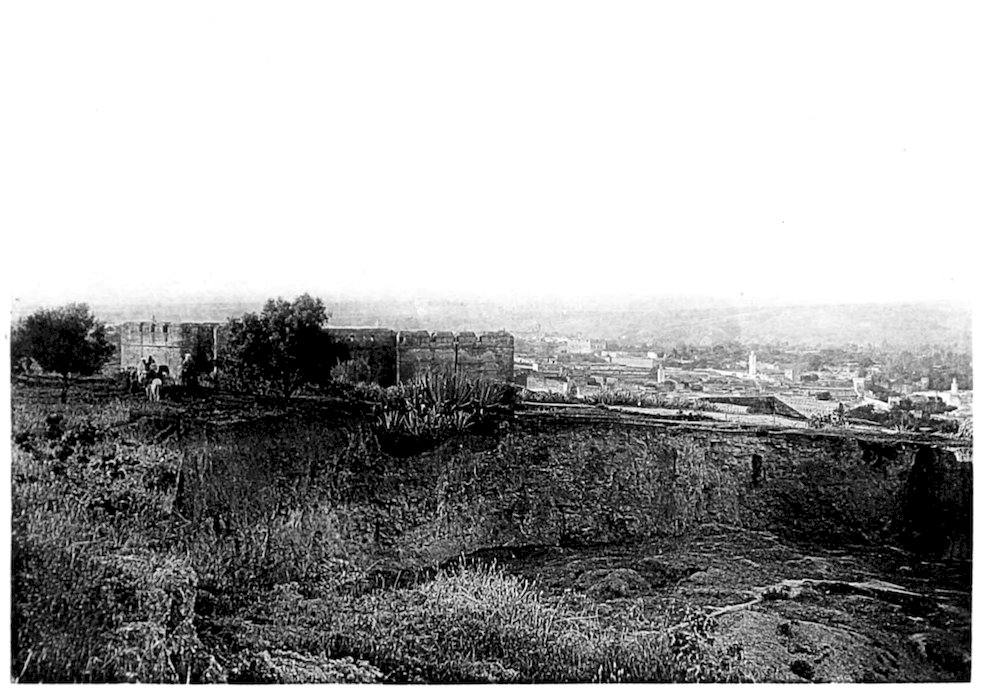
FORT NEAR FEZ.
The “marks of honour” which the Sultan mentioned in the audience of this morning were just passing through the guard as I returned to the Legation. Sir John and the khalífa each received a present of a horse, the gift to the former being supplemented by a most magnificently worked Moorish saddle. Messrs. Secsú and Náhum, the indefatigable interpreters, were each presented 221with a mule, as also was the old Arab scribe. Each member of the Mission received a “sword of honour,” the scabbards, &c., of some being worked in gold, others in silver; mine was elaborately embellished with the precious metal, the hilt being made of ivory; and in connection with this mark of His Majesty’s regard I received a letter of thanks[67] for my labours in his behalf. Síd Búbakr, who presided at the distribution of Sídna’s largesse, held a paper in his hand in which we were each named or described in some way, and on each sword was a ticket corresponding. This concluding ceremony having taken place, there is every reason to believe we shall be allowed to depart to-morrow, unless His Majesty intends detaining us as hostages for the good faith of the representative of England in the Madrid Conference.
We have not been without news from home during our stay in Fez, though the swollen state of the rivers has made the journeys of the special couriers from Tangier a dangerous undertaking. The last batch of papers we received contained an account of the extraordinary Liberal victories in England. That these topics were vehemently discussed by us it is unnecessary to state, though His Excellency, as a public servant, of course held aloof from polemics, and indeed severely censured the suggestion of a member of the Mission, that an exchange of Prime Ministers between England and Marocco would, under the new régime, be decidedly beneficial to the former country. It is certain, however, that the lawless condition of this land is not yet sufficiently developed to 222admit of the idea that murder and assassination would be the best means of bringing the distressed state of the empire within the “range of practical politics;” nor, up to the present time, does “our Lord the Sultan” allow of the open advocacy of such questionable mediums.
Besides special couriers, there are weekly runners between this and Tangier, who are paid so much—or rather so little—for each journey. To these men are entrusted most of the Government despatches to the Moorish Minister at Tangier, but, as far as I can learn, most of the merchants, and the few other private individuals who can write, send their letters for the coast with the caravans which are perpetually marching through the country. There is no postal system whatever in Marocco, and though the adoption of such a simple means of revenue was recommended to the Sultan on a former occasion, I do not think the measure has been again urged on him by His Excellency. The assurances which His Majesty has given to the Envoy of his intention to introduce certain reforms advocated by him, make one hope that some of the political ends of the Mission may be attained. This seems the more hopeful, too, from the Sultan’s partiality for the English, whose disinterested interference in his affairs, compared with the action of some of the other foreign representatives, must commend itself to the Sharífian mind. The natives, however, look upon things in general from such an entirely different point of view to ours, that it is often hard to explain to them our motives of action, and the explanations are none the more satisfactory to either party from the fact that the one 223does not believe a word the other is saying! “Will you tell me privately what brings your countrymen here to Marocco?” an old Moor asked me confidentially. “Merely to see the country and study the habits of the people,” I replied. A shrug of utter disbelief was his only comment, and hence it is not to be wondered at that their suspicions are aroused, and every obstacle placed in the way of admitting strangers to the interior. Besides this distrust of foreigners, another great difficulty presents itself in the way of picking up information, and that is, our very limited knowledge of the language. I had hoped that Spanish, at all events, would serve me with educated Moors, but except at the seaport towns it is of no use. On one subject in particular I tried vainly to inform myself—viz. as to the existence of any ancient MSS. in the city, but it seems probable that any which may have existed have been lost or destroyed. Among other literary treasures, the MS. of the lost books of Livy is said to be here; but an enquiry, backed by the offer of a large sum of money, instituted some years ago by Sir John, failed to throw any light on the matter. I am told that in each of the large mosques there used to be a collection of books, but these having been converted into a sort of circulating library, have gone astray, the people who borrowed them being in too high a position for the men in charge of the mosques to insist on their being returned. Dr. Rohlfs, however, whose means of information were much more reliable than mine, writing in 1861,[68] says there were at least 5000 MS. volumes in the mosque 224of El Karubin, so what the truth may be in this case, as in many others, it is hard to say. The subject is, curiously enough, one on which they dislike being questioned, and as the very few books for sale in the town are only of a religious character, the owners would not part with them to a Christian for either love or money. Even a belt which one of the Mission wanted to buy at a shop was withheld on account of its having a verse of the Koran worked on it. The art of printing is, of course, unknown, and, with few exceptions, no one can read or write.
Owing to the dilatory manner in which the business of the State is conducted here, the formal ratification of the reforms I alluded to has not been obtained from the Sultan; but it appears he will guarantee that, though for the present the restrictions upon corn will remain in force, those on the export of other grain, seed, &c., shall be removed. Considering that even the portion of the country through which we have passed could, if properly cultivated, supply corn to a great part of Europe, the policy of the Sultan’s advisers in keeping up prohibitory export duties seems wholly unaccountable. Negotiations are, however, to be entered into at Tangier for the improvement of trade, for which purpose a port on the coast, south of Mogador, is to be opened. Another point on which the Sultan is anxious to meet the wishes of our Government is in regard to the settlement of claims by British subjects, to which end “Sharífian letters”[69] have already been issued by His Majesty. 225In view of the near approach of the Madrid Conference, the Sultan is evidently anxious to take the bull by the horns in the matter of improving the condition of his Jewish subjects, and, moved also by the representations of His Excellency, has decreed that whenever cases arise in which Jews are denied justice at the hands of local governors, an appeal may be made by the plaintiffs direct to His Majesty. This to be done through his minister at Tangier, Síd Mohammed Bargash, a statesman of known probity of character, whose opinion, unlike that of most officials in Marocco, is not to be influenced by bribes. The whole of the question, however, of Jewish persecution will come before this assembly of European delegates; but if each of these will cast his eye back upon the annals of his own country as they touch upon the treatment of the Jews for the past one hundred or even fifty years, it is difficult to say which of them will come into court with clean hands; and I am inclined to endorse the opinion of a French writer in 1859, who says—“Le Maroc a été moins dur pour les Juifs que bien des nations Chrétiennes; il a donné asile à ces infortunés que proscrivirent en divers temps l’Italie, l’Espagne, le Portugal, la France même.” He might have included England, though at a much more remote period, with equal justice in the same category.
In Camp again—Departure from Fez—Consular agents—Infantry drill—Closing of gates—Source of Wad el Fas—Defences of Marocco—Chances of invasion.
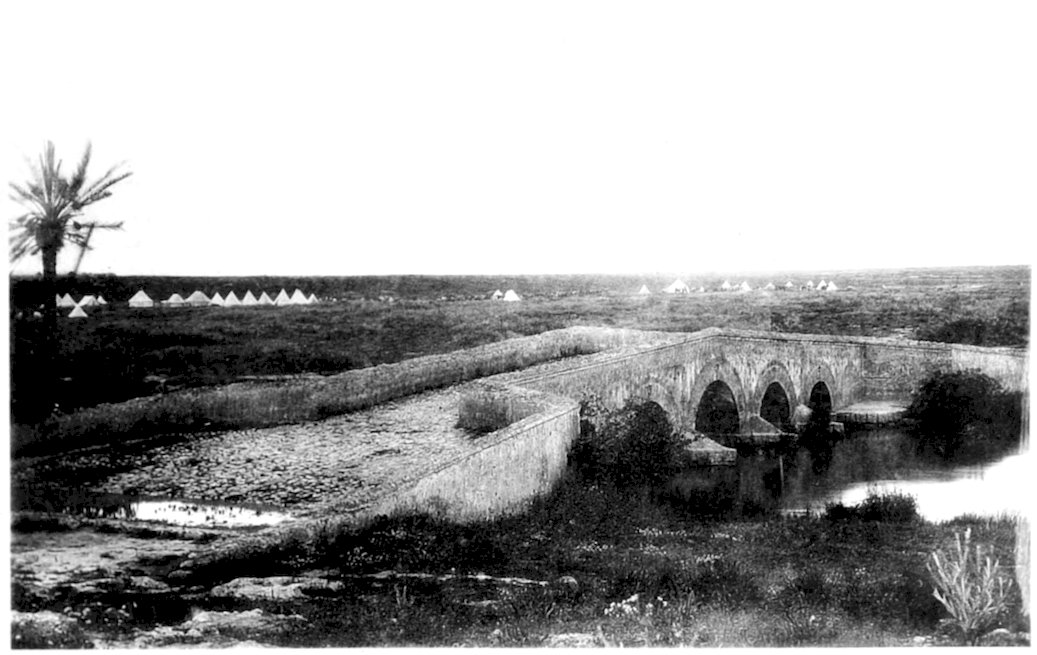
CAMP BETWEEN FEZ AND MEQUINEZ.
Here we are once more on the march, all of us feeling as if our life at the Moorish capital had been a dream, and that only the usual twenty-four hours had elapsed since last the tents were pitched. The camp is on precisely the old plan, and this, combined with the familiar but unearthly shrieks of the Moors, and other well-known sounds, seems to bridge over the time between our former wanderings and the present. On my right, at the end of the front line, is the Doctor’s tent, from which issues, as usual, his melodious cry of “Máho,” by which he essays to attract the attention of his servant, a native of Sús. On the left, next me, is Zouche, calling in a minor key for George; and farther off the Bashador, having run up the gamut of servants’ names, arrives at that of Boomgheis, which is at once echoed by all the other ruffians who have lain perdus the while, and which is a sort of trump card played by us all when in 227difficulties, and unable to get the man we want. Síd Búbakr alone is absent; but he is only a town acquaintance, so his spasmodic cry (like a peacock’s in pain) of “Náam, Sídi,”[70] with which he always, in our garden at Fez, responded to His Excellency’s very frequent summons, is not associated with camp life. We expect, however, to see him again, as he is to overtake us in a day or two with some papers of importance, which the Vizier explained “Sídna[71] had not had time to sign.” It is to be hoped they will follow all right, but with His Excellency’s departure the good resolves of His Majesty grow weak; and as the personal influence of the English minister’s presence is withdrawn the old state of things is apt to return, and tyranny and injustice to resume the even tenour of their way. A good many years ago, Sir John proposed that a British resident should always live at Fez, and himself volunteered to be the first, but the proposal fell flat with the representatives of the other powers, and the then Sultan, Mulai Abd-er-Rahman, was most unwilling to be responsible for his safety. In our treaty with him, however, in 1856, it was stipulated that the English might have agents in any town, while the other powers were limited to ports—a distinction which was by no means appreciated by our Continental neighbours. Rohlfs states this arrangement was made by treaty in 1861, but I think his date in this instance is inaccurate. A propos of this treaty, M. Duval, writing three years later, urges the appointment of Consuls in 228the interior—a measure which, he affirms, was adopted by his country in bygone days, when “Le roi de France, Henri III., avait, sur l’invitation même du chérif régnant en 1577, nommé un Consul et institué une agence consulaire à Fez.”[72] The present Sultan might not be averse from following the precedent of his ancestors, but without the hearty co-operation of the Grand Vizier and others, it could not be adopted; and as the present holder of that office cordially detests all Christians, he is not likely to counsel such a proceeding. From this minister downwards, the whole governing staff of the country is an Augean stable of corruption and iniquity, which nothing but the increase of trade and consequent march of civilisation is likely to sweep away.
As we did not leave Fez till noon, I got up at six o’clock, and rode to a parade of some 1500 of the troops outside the town. There were two complete regiments with six companies of thirty files each; the remainder were all boys and recruits at “company drill,” the favourite movement of their instructors being to wheel them round and round in a single rank of about 150 strong. Last but not least was an enormous band of about 100, marching round and playing tunes which were calculated to strike terror into the heart of any ordinary foe. All commands were in English, even to the numbering and some of the “cautions,” as, “Dress back on the left,” “Steady,” and so on. Kaïd Ali (not the old gentleman of that name who commands our escort), with whom I had tea the other day at the barrack, was in 229command of the better drilled of the two regiments, and seemed thoroughly at home and to enjoy his work, deploying, forming squares, &c., with much success. The drill was carried on at the top of the rising-ground overlooking the palace square, so, if I had been a little earlier, I should have seen the artillery practice they are so anxious to keep dark. As it was, I made out with my glasses the commanding figure of the Sultan, sitting in the bathing-machine-like vehicle which attracted our attention before in the outer court of the palace, and in which he was now receiving his ministers. He looks on at the practice on Mondays and Thursdays, sometimes laying the guns himself. A wooden post is the mark they fire at, the projectile being stopped by the wall of the enclosure about 500 yards or less from the guns. The Sultan is much taken up at present with entrenching tools—a subject I had touched on in my report—and has ordered Kaïd Maclean to have a “battery built at once,” with some double-headed picks, which have made their appearance lately out of a neglected store. I had a talk with Síd Drís ben Abd-el-Wáhad, who was very anxious to accompany us to Mequinez, but who at that hour had been unable to get the Sultan’s leave; he turned up, however, in camp here at seven, having ridden out with Sir John, who did not leave Fez till five, having been closeted with Síd Búbakr and some other notables all day. I rode back from the parade through the Gordon Cummings’ camp to say good-bye. They, too, left to-day for Tangier; so Fez is rid of all her obnoxious visitors at once. I then passed on through 230the market, where, the Amín[73] having finished his prayer, the jugglers, hill-tribe dancers, and the ape-like individual who makes faces, were all hard at work; and on the outside of all was the comical-looking man, whose histrionic treat was so heartlessly cut short the other day at the Summer Palace, amid an enthusiastic audience, who did not scruple to hear him to the end. The streets were crammed with our tents and baggage, and the garden of the Legation, where we have spent three such pleasant weeks, was swept and garnished; while among the walks wandered the old gardener who is in charge, eyeing sadly some of his best orange-trees, from which the accursed Nazarenes had cut sticks as a memento of their visit.
With the exception of His Excellency and the khalífa, we had all cleared out of the place by twelve o’clock; not with flourish of trumpet and beat of drum as we entered, but sneaking quietly away with a very limited escort, the greater part having remained as a guard to the Envoy. The populace, who had been coerced into welcoming the coming, did not trouble themselves to speed the parting guest, and, except at the gates of the town, where a few of the more religious had assembled to bestow on us a parting curse, the streets presented their usual appearance. A propos of the gates, I have always forgotten to come and see the ceremony of closing them, which takes place every Friday during the hours of prayer from ten to twelve, in consequence of an ancient Mussulman prophecy, that all kingdoms 231lost once by Christians to the Turks and Saracens will be restored to the former on that day, and between the above hours. The custom is also observed in Mequinez and Marocco.
About eight miles from Fez on the left or south side of the track, and two miles off it, we noticed a large fort-like building, and hearing that the source of the Wad el Fas was there, I rode over to it with Miss Hay and Zouche. The fort, which in former times must have been a building of great strength, was built on rising ground, below which, in a rocky amphitheatre, was a pool of water not very deep, but clear as crystal, with a gravel and sandy bottom. Into the reservoir the spring gushed, in two streams or jets, out of the side of the rock below the building. To me it looked as if the whole mound and one side of the basin were artificial, though dating from some very ancient period. Lower down, in the middle of the river, which, on leaving the pool, assumes its normal width, was some solid mason-work like the ruins of an old bridge. We rode up the hill to the house or fort, which is a large, square, high-walled enclosure, covering all the level part of the mound; but whether it was roofed in or not we were unable to see, as the inhabitants of a few huts at the back would not even let us go near the gate. They were a most ill-looking lot, and at first I thought we had got among a small colony of lunatics, as they kept making queer faces and odd signs of silence if we attempted a closer inspection. The soldier who was with us gave us no assistance, but tried to make us come away, saying it was “harámi[74] for us to be there;” so there was 232nothing for it but to get back to the track and come on here. I questioned him through the interpreter afterwards, but it appeared he had “forgotten the circumstance,” and also “did not know anything about the place.” I have never seen any mention made of this singular spring or the adjacent fortress by other travellers, but I cannot help thinking that a competent observer might here discover some trace of Roman or other occupation of the country, and that the place deserves the attention of the archæologist, for whom, indeed, this land of Marocco is one vast field.
Our camp is on the bank of the Wad el Nedja, a small stream which we crossed by a stone bridge—an accommodation one rarely meets with here. The village opposite us on the right bank merely consists of a guardhouse, this being a bad neighbourhood, and subject to visits from the Beni Mtír, the same tribe who attacked our camp at Mikkès just before we reached Fez. I watched the guards for the camp being told off, about a hundred of them, armed with guns and posted a few yards apart. They chant in unison every few minutes to keep themselves awake, and the mounted patrol who visits them always has some excellent joke at which they laugh loudly, probably for the same purpose. His Excellency and escort came galloping into camp just at dinner-time, having ridden out fast in a downpour of rain. In his suite were Síd Muhammed Gavass and the “son of the slave of the one God.” Both of them are putting up in old Kaïd Ali’s tent. I am glad to have seen the parade of troops this morning outside Fez, as on other 233occasions of my trying to do so the Commander-in-Chief, who always attends, has either stopped the parade or marched the men off as soon as I came on the ground. Owing to his detention to-day at the “Court,” I saw all I wanted, and was much struck with the bearing of the men and their knowledge of drill, which fully equalled that of our native regiments in India. What kind of show they would make, if properly armed, against a European foe, it is hard to say, and during the present reign there has been no opportunity of judging; but the constant guerilla warfare which the levying of tribute from disaffected tribes entails should keep them in practice. The isolated position of Marocco, which prevents its serving as a highway to other lands, makes it comparatively valueless as a possession for any power unconnected with this part of Africa; and protected as it is on two sides by a rocky and surf-bound coast, in which are no harbours worthy of the name, it is not from that quarter the Moors need look for an attack. On the east, however, they have awkward neighbours in the conquerors of Algeria; and the tendency of the French to transgress their frontier line, as fixed by the treaty of 1845, makes the approach of an enemy in that direction possible. Frenchmen I have met do not scruple to talk openly of the advantages of an occupation of Marocco, and, having settled on the expulsion of the present dynasty, are only in doubt as to whether the country should be “divided among the Powers, or annexed to Algeria.” It is probable that certain of the Powers might dissent from the latter alternative, or indeed from 234either, and should matters come to an issue, and a European army ever find itself face to face with France, with Marocco as a battlefield, the assistance they would derive from the native cavalry and infantry in this land of soldiers would be no mean factor in the contest. It would be difficult to calculate what number of allies could thus be raised, as there are no available means of information, though a French writer boldly asserts that “le Maroc pourrait lever plus de 500,000 soldats ou cavaliers, tant bien que mal équipés.” Though this is a high figure, representing, as it does, about one-twelfth of the population, it is possibly not above the mark, when one considers the fact that almost every adult in Marocco possesses a gun and a knife, with a fair knowledge of the use—or abuse—of both.
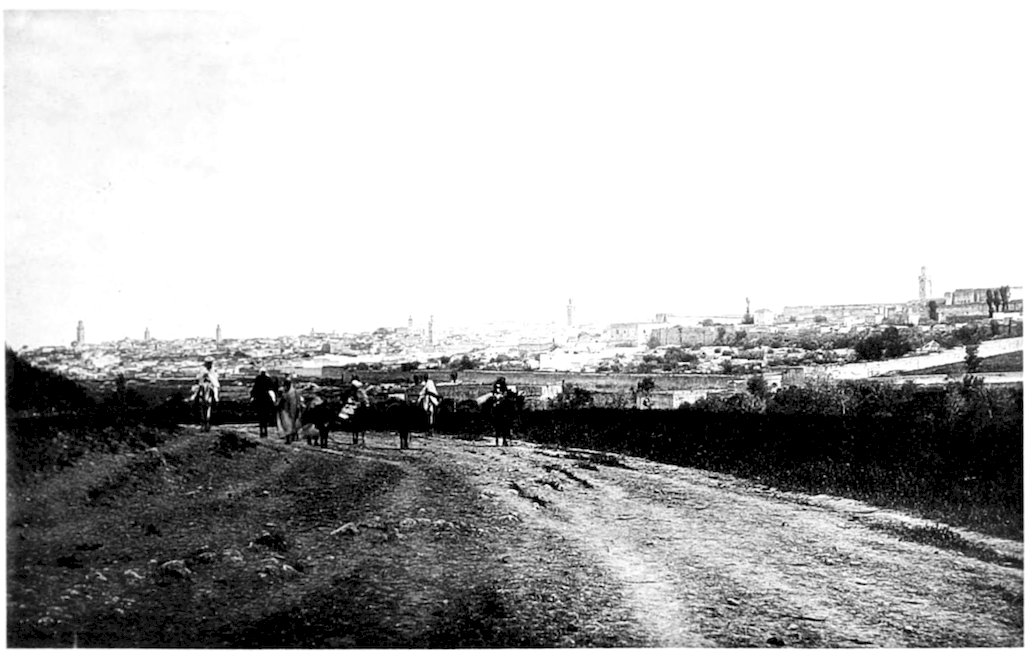
VIEW OF MEQUINEZ ENTERING FROM THE EAST.
Heavy rain—Hill of Kanúfa—Telegraph versus heliograph—Ladies of Mequinez—Selection of heliograph station—Bokháris—Final instruction in heliography—Sultan Mulai Ismael—His cruelties and sanctity—Visit to prison.
The march in here from our camp at Nedja was a long one, about twenty-two miles, and the heavy squalls of rain which beat in our faces continually made it most unpleasant. Such weather at this time of the year is perfectly unknown here, and is, as I noticed before, attributed by the natives entirely to the presence of the English Bashador. Besides the drawback of the weather, the conduct of the “son of the slave of the one God,” who insisted on riding with us, was far from satisfactory. Some of us had pushed on ahead of the main body to arrange about where the luncheon-tent should be pitched, and, instead of conforming to our steady trot, Síd Drís would lag behind, and then tear past us in lab-el-barôd fashion, loudly calling on his God the while. It was in vain we represented to him that at each manœuvre he bespattered us with mud, and 236begged of him to regulate his pace by ours; it was of no avail, his only answer being that Christians and Mussulmans had different ways of riding, and that Marocco “was a very savage country.” The plain of Fez seems to end, about twenty miles from that town, in a high ridge of ground, on the west side of which is a deep ravine crossed by a partially ruined bridge. The hills here closed in a little, widening out again as we crossed a second gully and came to another and higher table-land, which forms the plateau on which Mequinez is situated. On the edge of this the luncheon-tent was pitched, and Síd Drís and Gavass partook of that meal with us, enduring with composure His Excellency’s pressing offers of wine, bacon, and other unclean edibles. We rode forward in the same order as before, and came upon a large body of cavalry, under the Bashaw of Mequinez, waiting for Sir John at the head of a deep and rugged glen, the descent into, and ascent from which, was very bad going for the horses. To this official we sent as a herald the “son of the slave”—who was too glad of the excuse for a gallop—to inform him that His Excellency was coming on later, and to ask for a guide to the house we were to occupy. The range of hills to the north of the road was of a considerable height, and one called the Jebel el Kanúfa would, I at once perceived, make a good intermediate heliograph station, supposing it obscured the view of Mequinez from Fez, which, however, I found from observations on arrival here, would not be the case. I suggested to Síd Drís that a telegraph wire would answer His Majesty’s purpose better, and would 237be available for night work, for which he still has a hazy idea the heliograph would come in handy; but he says it would require guards every few hundred yards, as the people of the villages would never stand the sight of such a mysterious-looking apparatus, which, being set up by Christians, they might fear would accomplish the downfall of the sacred cities it connected. There is a vast olive grove, walled in like a park, through which we passed before arriving at the gate of the city. At the entrance of this enclosure was a ruined fort, to the top of which I climbed, at considerable risk, to see if I could make out the hill near Fez which we had suggested as the site for the heliograph at that end.
The approach to Mequinez from this side is very pretty. Near the entrance is an extensive and well-kept park, in the garden of which stands a large house, the property of some relative of the Sultan, and a steep paved road leads up from the valley in which these grounds are situated to the gate by which we entered. There were a good many people collected on our route, and the crowd round this house was so great we had regularly to fight our way through it; though, of course, the excitement of the people was nothing like that on our arrival at Fez, as we have sunk from our high estate to that of private individuals. This house, which the Sultan has had put at our disposal, is a handsome building, all the four rooms opening on the patio in the centre being lofty, and beautifully clean. In one of these Zouche and I had our beds, &c., placed, our chief and his family occupying the others; while in a house next door are located 238the remainder of the party. The roofs of the surrounding houses were crowded in the afternoon with ladies, mostly unveiled, who, I am sure, would, if allowed, accord us a hearty welcome, notwithstanding our objectionable nationality and religious tenets. All the people here seem more cheerful and healthy than the Fasi, possibly owing to the streets being wider and more airy, and the odours less varied and potent than those of Fez. The best shops are all in covered squares, which one has to visit on foot; but shopping presents the usual difficulties, caused by the curiosity of the populace. The children, too, seem positively in dread of us, rushing off after one look of terror, yelling “Nasráni! Nasráni!” as if the devil was after them, which they not improbably think may be the case. It is a tiresome practice, as the rest of the people are thereby unnecessarily warned of our approach. There is a remarkably fine gateway in the wall of the town near the Melha, and of this a good view was taken by Lawless. A smaller arch leading into the Jews’ quarter is interesting from its being the place where heads of rebels and murderers, and hands and feet of minor offenders, are nailed up as a warning to evil-doers. As there are no fresh warnings hoisted at present, I conclude the people of this district have been on their good behaviour of late. The cold at dinner in the evening seemed intense, though I do not know what the temperature really was.
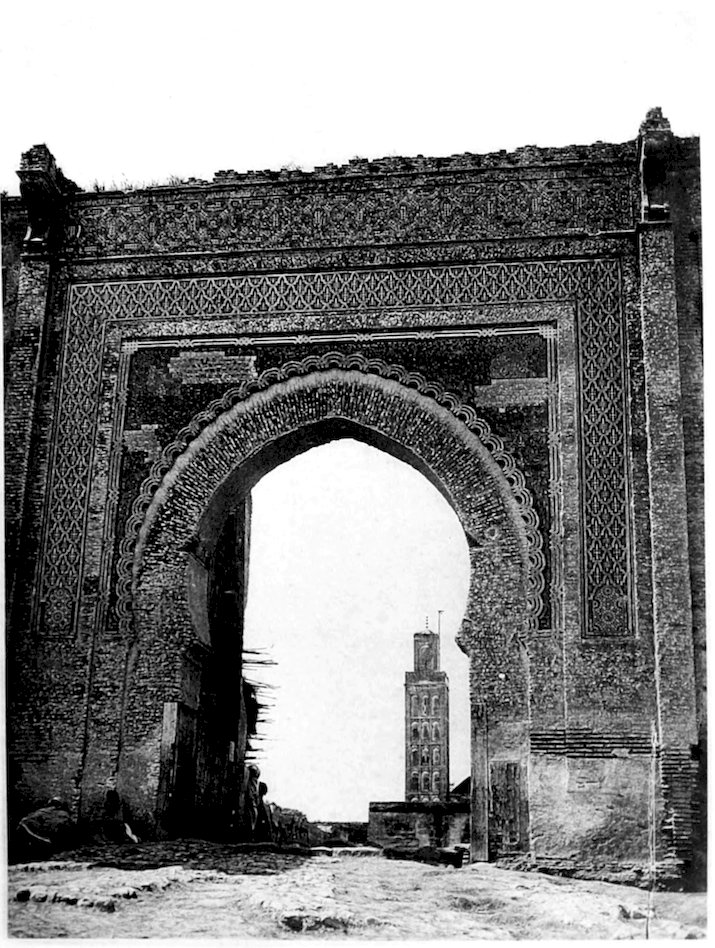
GATEWAY IN MEQUINEZ. (SEE PAGE 238)
My suggestion that the verandah round the top of the highest mosque should be utilised as a heliograph station being indignantly rejected, I started after breakfast 239with Síd Drís, Gavass, and one or two soldiers, to a place they told me was half a mile off, but which turned out to be about four. “Why did you say it was half a mile when you knew it was about ten times as much?” I asked. “You have a long march in the afternoon to make, and we did not think you would come if you knew how far it was,” was the candid reply. The place they wanted me to see was, except for its distance from the town, well chosen, being at the angle of a high battlemented wall which encloses a kind of settlement of the families of the Bokhári, or hereditary slaves of the Sultan. I was told these men are the descendants of a number of captives brought by a former Sultan, five hundred years ago, from the Soudan; but I am more inclined to agree with Dr. Lemprière, who, writing in 1793, says that the Emperor Mulai Ismael[75] introduced large numbers of negroes from Guinea and Soudan as colonists, and formed out of them a bodyguard for himself; these, I take it, were the ancestors of the present Bokháris. We got up with considerable difficulty to the top of the wall, and at the corner I mentioned was a large flat space, which will do excellently for my purpose. Not one of the men with me (two of them natives of Mequinez) could, or would, point out which was the Jebel Zalag, or hill above Fez. As, however, I had determined this point to my own satisfaction, I explained for the last time to my two intelligent pupils how they were to align their instrument on the Jebel Zalag at some fixed hour when their colleague 240would be there with his, and how to put themselves into communication with him.
The elevated plateau of enclosed land which lies between the Bokhári village and the town has at one time been laid out in elaborate pleasure grounds and gardens, among which the many buildings of massive construction—most of them, however, in ruins—are evidence of greater grandeur and extent than anything to be seen near Fez. All these must have been the work of Mulai Ismael only two hundred years ago; so the complete ruin which has overtaken many of the buildings is strange, except that everything in this country seems to develop a faculty for decay as soon as created; and of the Sultans of Marocco it may be said, as truly as of the Venetian Doges, “their palaces are crumbling to the shore.” This one on the south side of the town, built in 1680 by Mulai Ismael, was much damaged by an earthquake in 1755, and has since gone from bad to worse. The terrible cruelties practised upon his Christian slaves and others by this comparatively modern Nero have been the theme of one or two writers in the last century.[76] He was always attended by several hundred Bokhári youths, who delighted to act as his executioners, though they as often played the rôle of victims, and were obliged to carry with them a “change of cloaths to shift when bloody,” as their patron was in the habit of beating and torturing them so that “sometimes you shall see forty or fifty of them sprawling in their blood, none of them daring to rise” till he left the place. Another disagreeable 241practice of this monarch was “tossing” his retainers. This operation consisted in four strong negroes seizing a man by the hams; they then threw him up with all their strength, and at the same time turning him round, pitched him down, head foremost. An Englishman who was witness of many of his barbarities, says,—“His wrath is terrible, which the Christians have sometimes felt; for one day, passing a high wall on which they were at work, he made his guards go up and throw them all off the wall, breaking their legs and arms;” and no doubt, in the walls past which I rode to-day are many skeletons of those whom he would order their fellow slaves to “bury alive and beat down along with the mortar of the wall.” His Majesty, however, was impartial in his cruelties, for he would frequently order his Moorish subjects “to be burnt, crucified, sawed in two, or dragged at a mule’s tail through the streets till they are torn to pieces.” Notwithstanding, and indeed chiefly by reason of his enormities, he was regarded as inspired by his subjects, and particularly his women, who numbered about two thousand, and of whom he would sometimes “despatch” as many as thirty in a day, “by what they call geesing,” which seems to have been some refinement of the art of hanging. The head of the eunuchs who looked after them was a man of immense power and wealth, who “keeps a seraglio of his own, which he maintains purely out of ostentation.” In Mulai Ismael’s reign this town became a flourishing city, and by the frightful severity of his punishments law and order seem to have been established throughout the empire, which 242for the first time was consolidated into one kingdom. The largest mosque in the place is named after him, and is considered as of almost equal sanctity with that of Mulai Edris at Fez.
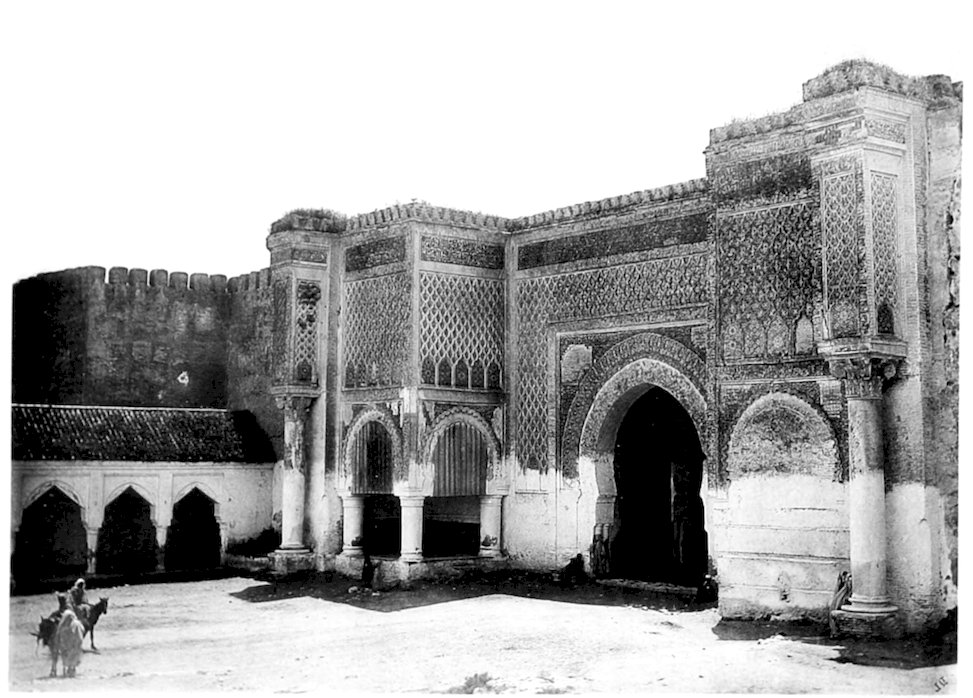
GATEWAY IN MEQUINEZ.
On the way back from our reconnoitring expedition I mentioned to one of the party my wish to see the inside of a prison, every attempt to do so at Fez having failed, even when I applied to Síd Búbakr for assistance in the matter. He at once said he knew the kaïd of the jail here, and if we let the others go on in front, he would take me to it, which he accordingly did. Prisoners in this country are allowed to make baskets and do other work in the jails, that part of the profits which arises from the sale of the articles, and is not pocketed by the jailor, going to purchase food for the prisoners. If a man is unable to work, and has no friends outside to support him, the amount he gets is very little indeed—in many cases not enough to support life, and deaths from starvation in time of famine, when prices are high, are numerous. The casual visitor to a jail only gets as far as a strong door, with a hole cut in it, from which there issues an insufferable stench, and through which small lean arms are thrust, holding out wicker and grass bags, &c., for sale. I never heard of anyone getting beyond this door, but leaving it on our right, we came to a small court where several evil-looking officials were sitting. After some remonstrance my friend and I were taken to a doorway strongly barred, and so low that I had to bend almost double to get under; having accomplished which we found ourselves in an open yard with fifty or sixty 243occupants. Some looked as if they thoroughly deserved to be there; others, utterly hopeless and dejected, as though the irons most of them wore round their legs were eating into their soul; others, again, were fighting and tearing at each other over some food, while the remainder sat stolidly expectant of whatever might befall them, and apparently quite indifferent as to what that might be. All, however, joined in a murmur of astonishment at the unexpected apparition, and as they crowded round to get a nearer sight of the Nazarene, I thought I should take away many a lively souvenir of my visit. Suddenly, the heavy lash of their gentle guardian descending on their bare shoulders caused a general stampede, and gave me an opportunity of looking round. In a room off the open court were three or four men decently dressed, and of a different class from the wretches in the yard. One was a middle-aged man in a dark blue sulham, or native cloak; he had an angry yet unhappy expression, and seemed known to my cicerone, who told me he was, till lately, colonel of one of His Majesty’s regiments. “And why is he here?” I asked. “The order of our lord,” with a shrug of the shoulders, was the reply. A young, rather good-looking fellow, lying in the opposite corner, I was told had been Bashaw of a province in the south. “And for what crime is he here?” The same answer and another shrug was all the information I received. On my way out my attention was attracted by a man so emaciated as to be hardly human, round whose bony limbs the irons had made a horrid festering sore. As he lay on the ground, he stretched out a hand to touch me 244as I passed, and on enquiry into his case I heard he had been an inmate of that filthy den for eighteen years on a charge of murder, for which he had been unable to pay the blood-money. “But I never committed it,” he kept on saying, as he overheard the conversation between the jailor and my guide; and certainly, whether he did or not, I think in his case the punishment exceeds the offence. I expect a moderate sum of money would have procured the release of any of these prisoners, except, perhaps, the Colonel and the Bashaw, who were being detained and periodically tortured till they had disgorged the treasure they were supposed to have amassed during their respective commands. This is a not unfrequent ending to the tenure of a high governorship. The gang followed us to the grating through which we made our exit, with cries which seemed to be of entreaty and expostulation, and from another quarter of the jail came some piercing yells, into the meaning of which I enquired. “It is a madman who is sick,” they answered; and on my wanting to see him I was told he was a saint, who, during his periods of indisposition, gave utterance to things it would be “harámi” for a Christian to hear. I hope the story was true, but the thickness of the leather bastinado-cords which the jailors carried, and the fact that at least one man in that prison during the last six months has died under the lash, made me doubtful on the subject. We found, on getting outside again, that the rest of the party, having noticed our horses being led about at the foot of the lane, had divined our whereabouts, and were exceedingly indignant 245with my friend for his indiscretion in admitting me to the jail. He seemed much perturbed at the disapproval of his fellows, and begged me never to mention his name as having acted as my cicerone on the occasion, hinting that from the way the others spoke he may have endangered his own liberty, if nothing worse, by his good nature.
Departure from Mequinez—Volubilis and Zarhún—Mulai Ismael and the devil—Quintus Cæcilius Domitianus—Description of ruins—Horse-stealers—Hondius his map—Ptolemy—Failure to enter Mulai Edris—Fate of impostor—Arab tents—Dangerous route—Berbers and Jews.
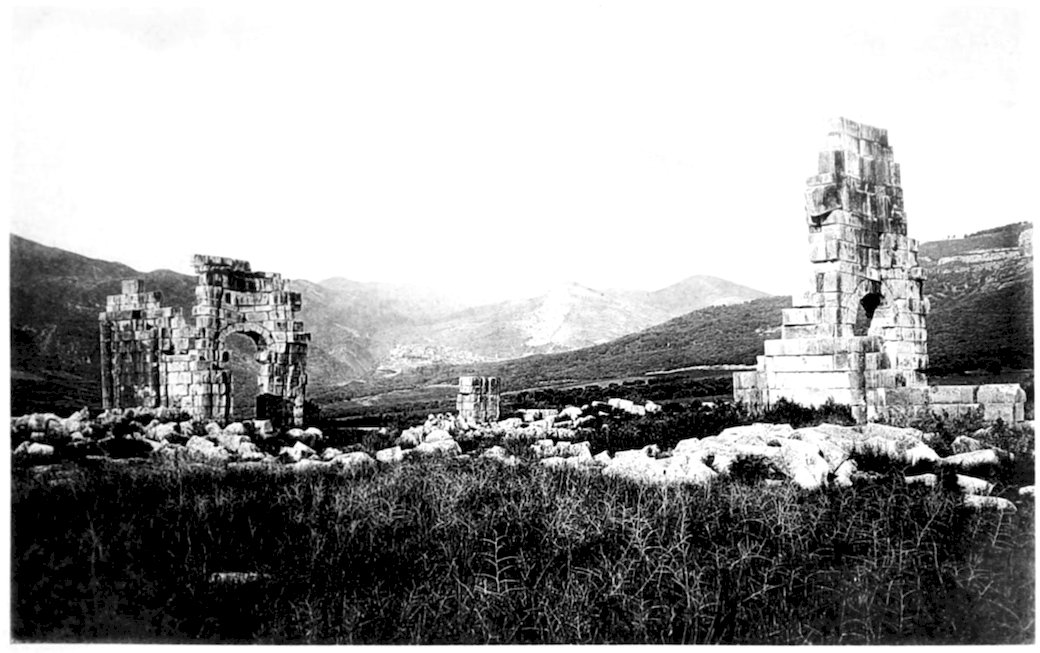
RUINS OF VOLUBILIS.
We left Mequinez by a gate on the north side of the town, and rode through a quantity of arable and waste land, which seems to form almost an entire circle round the place, and was possibly a suburb of the city in former days, being enclosed, like the town, by a high wall. About a mile from the town we crossed by a bridge a deep but dry watercourse, and four miles on forded a river, and continued our march along its right bank. Another and smaller one we crossed about half-way here, after which we climbed up a steep hill, a spur of the Zarhún range, from the other side of which we saw our camp, and a little beyond it the magnificent remains of what is now generally admitted to be the ancient Roman town of Volubilis. About a couple of miles to the east of these, and prettily situated in a sort of angle between two hills, is the sacred town of Zarhún, or Mulai Edris, where the original saint of that name, father of the 247founder of Fez, is buried, and to whose shrine all Sultans of Morocco, before their coronation, must come and pay their vows. The latter part of the road is strewn, at long and irregular intervals, with enormous blocks of the gray limestone of which the ruins are built. How they can have been taken from the place at all without the aid of machinery to lift, and wheeled vehicles to transport them, it is difficult to say. They are said to have been removed in the time of Mulai Ismael (seventeenth century), whose taste for building could never be satisfied, and who boasted he would make a road from Mequinez to Marocco “on which a blind man could find his way,” i.e. by feeling it along the wall. This charitable work was cut short by the monarch’s demise. He is said by his enemies to have employed the devil to carry the stones, but having had some misunderstanding with the Evil One regarding the compact, his Sharífian Majesty was carried off by his Satanic brother before his time. Our camp had been pitched on the left back of the Wad el Khúman—Tissot calls it the Faraom—across which I rode, and then walked up through a sort of prickly scrub to the ruins, where I found Lawless and White, who had preceded the column, at work with the camera. About twenty of the villagers who followed us round appeared much interested in our proceedings, and one of them took us to a large stone lying on the ground in a slanting position, with a long inscription on it, which we transcribed as well as we could. This must be the one overlooked by Windhus in 1721, but copied by 248Leared and Tissot a few years ago, and which is incontestably proved to be the epitaph of Cæcilius Domitianus, decurion of Volubilis. There is a big longitudinal crack or rather gap in it, which made it hard to decipher many of the words. Distinct remains of houses and walls are to be seen all over the rising ground on which the town must have stood, and on a level plateau at the top are the ruins of two buildings, one of them especially of a considerable size. Of the smaller of the two there remains a fine triumphal arch, and contiguous to it a massive square keep or outwork, with immensely thick walls. In one of its faces there is a small doorway so singularly out of keeping with the rest of the building as to suggest the work of a later age; but the fact of the stones being neatly cut to fit the bend of the arch is against that theory, as such work would have been beyond the skill of the Goths and Arabs who succeeded the Libyans here. A little to the east of this is the larger building, of which the two arches, standing east and west, are in good preservation, though the centre stone which supports one of them is considerably displaced. It measured about forty yards by thirty, the superstructure over the arches and a part of the south wall which remains intact being about 40 feet high. The blocks of stone used in the building are well cut, massive, and rectangular, and, lying about, are fragments of round pillars over eight feet in length. The stones used in the south wall are so fashioned as, when placed one above the other, to give the appearance of a split column applied to and supporting the wall. In 1721 this ruin is described as 249“good part of the front of a large square building 140 feet long and about 60 high,”[77] of which part of the four corners was still standing. It is interesting to notice what have been the ravages of time since then, for none of the corners are standing, and the walls are certainly not, if they ever were, sixty feet high. It probably received a severe shake in 1755 from the earthquake which affected Mequinez so severely.
The inhabitants of Mulai Edris, or Zarhún, the adjacent town, are all descendants of the Prophet; and in the afternoon two of them obtained access to the camp on pretence of bringing a young fawn as a present to Miss Hay. At 9 P.M. there was a great uproar among the swarms of guards supplied by the town, and it appeared these two men had been caught trying to steal our horses. They were securely bound, and handed over to old Kaïd Ali, who commands the escort. After this the chief men of the town pitched a tent close to us, from whence they sallied out periodically to visit the sentries. Taking a stroll before turning in at night, I passed by it and was loudly challenged, “Skôn hada” (Who is this?), while guns were ominously handled till they made out who I was.
On revisiting the ruins this morning I was shown another and smaller tombstone, almost hidden in the coarse vegetation which covers all the hill. I copied its inscription[78] on a bit of paper as accurately as I could, much to the amusement of the men who had 250pointed it out, and who seemed quite pleased at the interest shown in the ruins, of which they are very proud. The concluding words, Filio piissimo pos., were as clear as if cut yesterday—an effect attributable, probably, to the climate, which is, however, not so indulgent in regard to Moorish workmanship. Several writers have treated of the questio vexata, whether these ruins are those of Volubilis or no, and to their arguments, which are most of them more worthy of notice than mine, there is little to add. Ancient historians speak of it as a flourishing town, and if one could trust to the distances given by the writer of the “Antonini Itinerarium,” there is no question but that Volubilis and modern Fez are identical. He says Volubilis is “Mill. pass. xvi.” from Aquæ Dacicæ, which is rather under the distance of Fez from the hot sulphur springs of Ain Sí Yúsuf, or, as Tissot calls them, Ain el Kibrit, and which are certainly synonymous with the above. Leo Africanus—a great authority on all affairs Morescan—gives little or no assistance in solving the problem, and concludes his arguments by the incontestable theory that “by the Latine letters which are graven on the walls I am rather of opinion that the Romans built this towne.” He also mentions a town in this neighbourhood called Gualili, in which was the tomb of the saint Idris, and that some distance from it were the ruins of “Cassar Pharaon.” The name of Gualili seems now unknown, but in “Hondius his map of Fez” (1600) I find a town “Gualila” just about in the position of the modern Zarhún, or Mulai Edris. To the east of this town is placed Pharaonis Palatium, which is clearly wrong, as the ruins are and always must have been to the west of it. The name of Kasr Fara’ún tells us nothing, as there are fifty other ruins in Egypt and elsewhere to which the natives have given this appellation; and it is improbable that the Pharaohs are responsible for anything so far west as this. Considering what must have been the scale of the original buildings, and the almost superhuman labour involved in their construction, it is strange that the classical writers at the commencement of the Christian era, who treat of these parts, should not have given us more certain information about this most conspicuous and, except Shella, most westerly monument of the great Roman Empire.
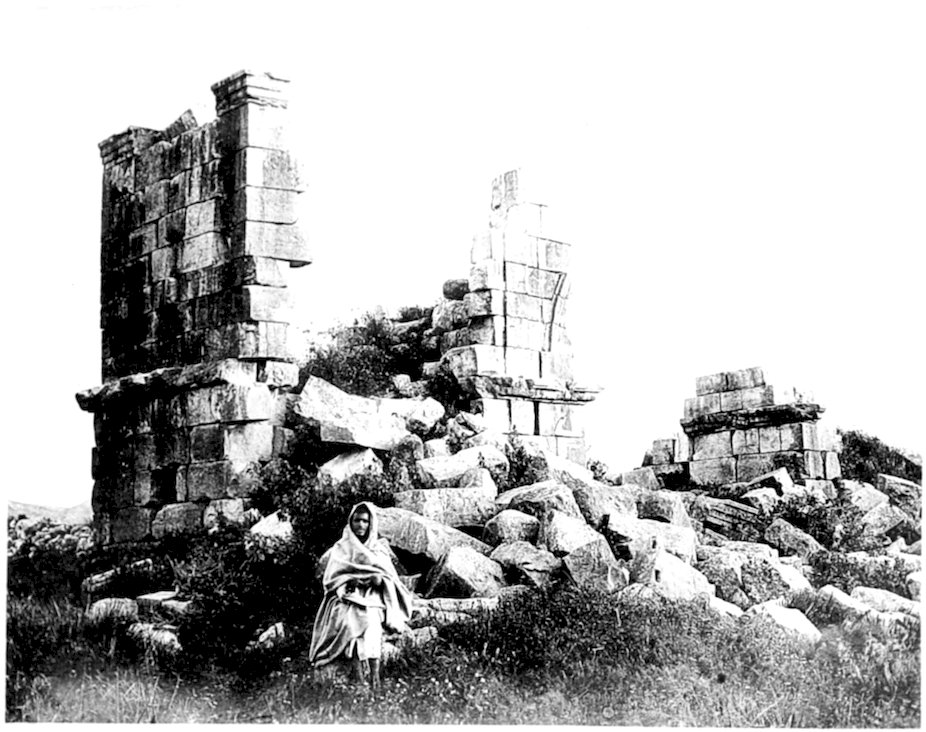
VOLUBILIS.
251Ptolemy, from whose writings savants have extracted many geographical facts about Marocco, tells us that Volubilis was on the Subur, four miles from Tocolosida, and on the road from thence to Tangier. Now, though there are some Roman remains three or four miles south of Kasr Fara’ún, which might do duty for Tocolosida, the Subur (Sebú) does not pass within fifteen or twenty miles of either place; so his testimony, generally so useful, fails us in this instance. Speaking under correction, I am of opinion that the large tombstone in memory of a citizen of the place ought to go far towards proving its position; while the imposing aspect of the grand old ruins—nobler in their decay than the newest palace in this land of mud and concrete—combined with the admirably chosen site, show that an important town 252must once have stood here; the weight of evidence seems, therefore, in favour of its having been Volubilis.
Whilst “meditating amidst decay,” and wondering if it would be possible to get nearer to the sacred town of Mulai Edris—about two miles off—into which no Christian has ever penetrated, a benign-looking old gentleman rode up on his mule, and to him I explained in rather faltering Arabic my wishes. He seemed to make no objection, so I went on, accompanied by Haynes, and followed by our mounted soldier, who had expressed his unmistakable horror at our intentions. Looking round presently we saw our smiling old friend had disappeared, and only the soldier, muttering and sulky, remained. A little way on we came on two men who were loading their guns and took no notice of us: but when within about three-quarters of a mile from the gate we were met by five or six men, all armed, who barred the road and insisted on our turning back. From the soldier we got no assistance, and the excitement and clamour of the others prevented our getting in a word edgeways, which was of less importance, as it would certainly not have been understood. We therefore turned our backs on the holy city, after I had taken a good look at it through my glasses, and Haynes had made a hurried sketch. The town, which is on a slope, is small, but compact, containing, I should say, from 1500 to 2000 inhabitants. A massive-looking building is on the south side, and the centre seems laid out in gardens; to the north, and extending outside the wall, is an edifice with a large mosque attached, possibly 253containing the tomb, which is said to be very beautiful, and ornamented with marble columns from Volubilis. Above us, on our left hand, was an olive grove reaching to the city walls, and below us, to our right, were gardens and orange groves along the banks of the stream. On either side and at the back of the town rose the dark hills of the Zarhún range, shutting out the country beyond. If I am not mistaken in my geography, there must be a short cut from here across the hills to the more hospitable and less bigoted town of Beni Aamer, which we visited a month ago.
A curious story connected with the shrine of Mulai Edris was told me to-day. It seems that some years ago a claimant to the throne of Marocco, who gave himself out as a Saint and the Elected of God, caused a considerable stir in the north-west portion of the empire, several large tribes having become his adherents. Marching south he came to Ben Aouda—a place we camped at on our road to Fez—and, in an engagement with some troops the Sultan had sent against him, slew the father of the present kaïd. Going on to Habassi, the father of our friend there temporised with him, giving him a horse and showing him other attentions. He was now at the head of a considerable force, and came here to pay his vows at the shrine, as is customary, before being proclaimed as Sultan. He had hitherto got the best of the troops sent to oppose him, and having risked his person on every occasion, and never having received a scratch, his followers fully believed in his sanctity. The two Sharífs here in 254charge of the tomb, when they heard who was coming, debated together, saying,—“If he is a holy man, as he declares, and the Elect of God, our knives while he is praying at the shrine will have no effect on him; otherwise he is an impostor, and an enemy to our Lord and grand Sharíf.” Consequently, when he came to prostrate himself in their presence at the tomb, one of them, plunging his knife into him, literally disembowelled him; so he died, and the Sultan, thus rid of a very troublesome foe, handsomely rewarded the holy man who had wrought him this deliverance.
Though there would have been no possibility of effecting an entry into Mulai Edris, we were all sorry to have had so short a time in the neighbourhood, for we resumed our march towards Rabât after the usual night’s halt. The high and gently undulating plateau above Volubilis is about on a level with the town of Mequinez thirteen miles to the south-west, and for miles round was literally carpeted with wild flowers, whose varied colours, and the partiality with which each species confined itself to certain ground, gave to the landscape a brilliant and most unique appearance. Dark blue, yellow, and red were represented by iris, marigold, and poppy, all of the brightest hues, which covered the country in artificial-looking patches of about an acre in size; while farther on, the delicate blue tint of whole hills and valleys clothed with convolvulus and borage made a pleasant object for the eye to rest upon.
255Riding a little distance from the track I came on an Arab dúar, which had just been shifted from its original position, about thirty yards off. It was circular in form, with a strong prickly hedge built up round it, the chief’s tent being by itself in the centre of the ring. I have noticed that in neighbourhoods infested by robbers, as is the case here, they always adopt this plan for the sake of protection, while in peaceful districts the tents are dotted about anyhow. They had not quite completed their move—an operation which takes place at certain periods to get rid of the parasites which at last become too active for even these thick-skinned Bedouin to endure. The tents are always of an oval shape, in keeping to which pattern they are very conservative, for Shaw, writing in 1732, alludes to their oblong form, like a ship’s bottom turned upside down. This simile, however, the talented writer has borrowed from an earlier author than himself.[79] From the dúar I mentioned a man came running out, and showed me his arm, which had apparently sustained a compound fracture, the bone protruding beyond the skin, and which was roughly bound up in a sort of wicker splint. I explained by signs that I could do nothing, but told him, in what I flatter myself was comprehensible Arabic, that he would find a doctor in the Bashador’s camp at Kariya el Abd-er-rahman Shlíah, where we remained that night. He followed me some distance, but I am sorry to say never turned up in camp, and is probably cursing me now for not curing 256him, all Christians—so they think—being skilled in medicine and surgery. From the end of the high table-land, along which our road for the first ten miles took us, there was a magnificent view of our old friend the Plain of the Sebú, which lay stretched out before us in a northerly and westerly direction, and which we met, after descending the hillside, at a point about three miles from the gorge by which we quitted it on our way to Fez a month ago. Here we were to have found our luncheon-tent, but the “boy Hamído” in charge had been led astray; and had it not been for Kaïd Ali providing us with rugs to sit on, Moorish tea, and some excellent mutton, which we were not ashamed to eat with our fingers, we should have fared badly. The olive grove we halted in was cool and shady, and a supply of oranges and milk brought by some villagers formed an excellent dessert, making us forget our loss, and take a less keen pleasure than we otherwise should have done in the kaïd’s assurance of vengeance to be wreaked on the soldier who led Hamído wrong. A river, the Wad el Rdem, flowed past this olive grove, and we followed its course the remainder of that, and part of the following day. At night there were very few guards round the camp, and a beggar, or saint, roamed among the tents all night, calling on the Deity by every attribute applied to Him, and they are many, in the Arabic language. I walked round the village before dinner. Its inhabitants seemed friendly, especially the gentler sex, a number of whom ran out in great excitement to look at us. One was exceedingly 257pretty, but more modest than her elders—and ugliers.
From Zarhún (Volubilis) to Rabât there is a short cut through the country inhabited by the Zemmúr tribe—a lawless set, who are at present, as indeed they usually are, in a state of rebellion against the Sultan. By this route, which would have taken about three days, we had been anxious to come; but the authorities at Fez, being afraid of what might happen, declined to sanction it. Consequently, our first march out of Volubilis was due north, and in the opposite direction to Rabât; but after leaving Shlíah, we turned westward, fording, in the course of a wearisome twenty-three-mile march, the Wad el Rdem and the Wad el Beht, either of which would, I should say, be impassable in the rainy season. The plain through which we passed was wholly waste; no crop of any sort but thistles, of which there was an abundant supply. At the borders of Sherarda and Beni Hassan we were met by a kaïd of the latter province, his son, and six attendants, who rode with us to the banks of the Wad el Beht, where his district ended. He was a dark, rather ill-looking man, of few words; his son, a lively youth of sixteen, was well mounted, and had a handsome saddle and koumia,[80] of which he seemed very proud. One of his men, with whom, through the interpreter, I got into conversation, asked how I liked Moorish saddles, and remarked on the strength of my bit—an ordinary pelham. His horse’s mouth was, as usual, full of blood from the 258severity of the one he was using, and with which I hope he will himself be ridden hereafter. We had luncheon under the biggest palm-tree I have yet seen, which sheltered us all. It was on the banks of the Wad el Beht, which we forded afterwards. The river there was swift and muddy, with high banks. The soldiers told us it “disappears into a hole” some way farther on, and this turned out to be so far true, that the river never does reach the sea, but loses itself in a big swamp, through the outskirts of which we passed with difficulty later on. If it only persevered a little longer, it might discharge itself into the Sebú, which runs near the marsh in question. During the great drought of 1878 the Wad el Beht dried up altogether—a thing which had never happened before; the cattle died, and the people, after much suffering, fled to the hills, where they were well received and kindly entreated by the Jebelis. In fact, these wild men of the mountains seem to possess some remnant of ancient chivalry, and though much given to robbery and murder, seldom if ever violate a safe-conduct given to any one who penetrates into their fastnesses. I am told, too, that even the unfortunate Jews, weary of persecution by the Moors, find an asylum here, and this is confirmed by the statement of a French writer, who says that among the mountains are to be found “certaines tribus Juives intimement mêlées aux Berbères, dont elles portent le costume, partageant toutes leurs habitudes, guerrières même.” I think, however, his concluding clause must be accepted with caution, as, from what I have seen, the Israelites 259of Marocco are not imbued with that warlike spirit which once animated their ancestors.
A few miles on this side of the Beht we were met by an escort of fifty Beni Hassan, and at our camp here (Sídi Adab) by seventy more. Their get-up is not so gaudy as that of their countrymen who escorted us through the eastern part of the province en route to Fez; but their powder-play was as reckless, and their appearance wilder and more unkempt. As they closed in behind us, and the parties of seven or eight who trotted ahead came thundering back with loud yells, discharging their guns almost into our faces, I could not help thinking I should fight shy of their society if I ever travelled back this way “on private affairs” without the sheltering standard of Marocco, and the odour of sanctity which even here attaches to the person of an Envoy.
Since getting once more into the plains, the beauty of the flora is less conspicuous, all the Beni Hassan country being covered with squills, whose onion-like root the people pound up with water, using the fibre for making the covering of their tents when goats’ and camels’ hair is not available.
The country we have been travelling through for the last three days is by far the most disturbed and dangerous we have yet visited, and at night the noise of the guards, sitting in a continuous circle and singing their monotonous songs close to our tents, was more than we could stand. We all, therefore, tendered a vote of thanks to Lawless, who, his patience being exhausted first, sallied out from his tent at 3 A.M., and with a 260volley of abuse and a crack of his hunting whip, sent the offending villagers to the winds. At 8 A.M. we emerged from our tents on to the almost trackless plain, the rain falling so that we could not see a hundred yards in advance, while behind us rose a dense, black bank of clouds. Some of us tried for bustard, but only put up the smaller kind, which were very wild, and out of sight in a moment. The people in the dúars we passed were a most ill-looking lot, though as strongly built and hardy as were their ancestors of Beni “Chessen,” of whose territory Leo writes, “Incolas habet validissimos.”[81] Their only recommendation to us is that they are sworn enemies of the Zemmúr, from whom Kaïd Ali seems apprehensive of an attack.
Threatened attack by Zemmúr—Direction of march changed—Fight with Zemmúr—Sport spoiled—Forest of Mamora—View of Rabât—Camp at Sla—Sallee rovers—Ruins of Shella—Female saints—Tower of Hassan—Auction of rugs.
About two hours’ march from Sídi Adab there was suddenly great excitement among our escort, who dashed off with cries of “Zíd, Zíd!”[82] in the direction of a body of horsemen who had just come into sight, while Kaïd Ali’s guards closed round the party. As the Beni Hassan galloped across the plain, they insensibly separated into three bodies—a few in advance, then the main body, followed by a small rear guard. Before the two parties came into contact, the Zemmúr—for so they proved to be—turned tail and disappeared into the Mamora forest, to which we had now got near. A short way on we came upon a small body of Beni Hassan cavalry, who said it would be impossible for us to proceed, as the Zemmúr were in force ahead of us, and having heard of our approach, intended to have a try at our 262baggage. The horrible vision of Boomgheis and Norton, each with a Zemmúr at his throat, rose to view, so I was glad when the order was given to send back a part of our escort to save our followers—and portmanteaux—from the fate which awaited them. We then struck off in the new direction, and got into camp at Kontra, after a march of twenty-six miles, instead of about eighteen, as it ought to have been. The rain had been falling nearly all day, and at luncheon it blew such a hurricane that we had to hold on to the poles of the tent to keep it from being blown down. During the latter part of the march we rode through a plain covered with long rich grass, which they never cut or make into hay, parallel to which, and three quarters of a mile off, was the Mamora forest, along the edge of which we saw small bodies of the Zemmúr occasionally peeping out to reconnoitre us. Kaïd Ali, noticing two of the party riding too near the wood, at once sent off some of his troopers to bring them in. He says the place is swarming with these robbers, and it would take a whole regiment of cavalry to conduct us through the way we wanted to go. At the same time, we are told that if we had put ourselves under the protection of these gentlemen, they would have seen us safely through this district. In that case we might have been subject to an attack from our present protectors, the Beni Hassan! These Zemmúr are a brebber, i.e. aboriginal tribe, inhabiting a vast tract of land south of the Beni Hassan country. Most of it is covered by the forest of Mamora, into the recesses of which they retreat when the Sultan 263sends a force against them to levy tribute, which they never pay without some such gentle pressure.
Outside the dúars were many fine cattle of a larger breed than I had yet seen. The men who had charge of them were all mounted and armed, and the beasts were driven inside the dúar at night. The camp at Kontra was close to the Sebú, a small tributary of which we crossed at the end of our day’s march by a stone bridge, with two large palm-trees near it. I had a long talk with the Beni Hassan kaïd, who camped close to us. He says his last fight with the Zemmúr was four days ago, when two of their men were killed. He and his troop only came a short way with us next day, a messenger having arrived in hot haste to tell him that his village was being attacked, and that the cattle, about which I had complimented him yesterday, had been carried off.
The tide comes up the Sebú as far as Kontra, where it is about a hundred and fifty yards wide, justifying the praise of it by Pliny, who writes of the “Subur amnis ... magnificus et navigabilis.” From thence it winds north towards the outlet through which it flows into the sea at Mehdía. We left it on our right hand, and presently came on a large body of Udaiah, or regular cavalry, who are out in camp for the purpose of punishing the Zemmúr, and whose commandant sent forty men as an additional escort for the ladies, while we, with our guns and thirty men of a neighbouring tribe who had joined us, went into the forest in search of the Great Bustard. This bird is the Otis tarda, of which we saw several between Fez and Mequinez, and it 264is still to be found in many parts of South Europe, though the species is extinct in Great Britain. The trees were chiefly cork, under which the long grass and tall chamomile grow in great luxuriance. Our guides were queer-looking fellows on small wiry horses, and all had guns; they had a remarkable kind of coiffure, their heads being adorned with small red caps, sticking out from which, on either side, were tufts or rather bushes of black shaggy hair. Their chief was an intelligent fellow, on a good-looking gray, which he told me had lately belonged to a Zemmúr. His former owner, however, had wandered too far from the forest to reconnoitre a village, and while being pursued by this chief and his men, the gray put his foot in a rabbit-hole, and coming down, was annexed by my friend. “And what did you do with the robber?” I asked. “Oh, he was hurt a good deal, and we killed him, as we always do with the Zemmúr,” was the reply.
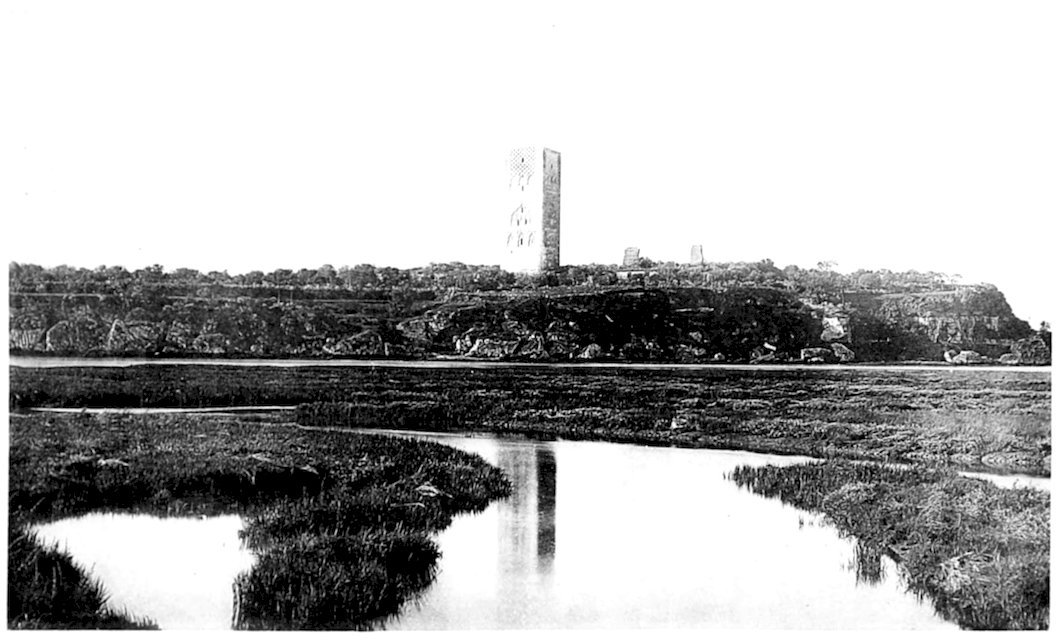
TOWER OF HASSAN NEAR RABAT.
The pursuit of bustard proved a failure. Our plan had been to go ahead some way, and dismounting from our horses, wait for the birds to be driven to us by the horsemen in line. This their chief would not hear of, saying that not only should we run great risk for ourselves and horses, but that his men being scattered would fall an easy prey to the robbers, who he knew for certain were moving parallel to us in great numbers through the wood. Seeing they were determined, and would not even spread out to drive the wood, we gave it up as a bad job,—the more courageous of the party, when well out of the forest, being as disappointed at not having a brush 265with the enemy as with the failure of the bustard-shooting. We got on the track again near the sea, and about eight miles from Rabât, the view of which, as we rode along the top of the cliffs, was very fine. Its white walls and minarets, bright and shining with the rain that glistened on them, had quite a dazzling appearance in the light of the sun, which now began to show itself. The effect of this also was heightened by the contrast with the dark and stormy Atlantic, whose waves rolled in with a loud booming sound against the iron-bound coast beneath us; while on our left, and looking, from its enormous size, close to us, rose the gigantic Tower of Hassan, like a huge sentinel guarding the eastern approaches to the city. Half a mile from the town we were overtaken by a tremendous blast of wind and rain, from which we took shelter under an arch of the old Roman aqueduct, which as late as 1790 supplied the town of Sla with excellent water.[83]
The river Búraghrag, on the bank of which we are encamped, divides Rabât from Sla. It flows through a large expanse of sand before emptying itself into the sea, and on this plain our tents are pitched—a rather insecure holding-ground for tent-pegs during the fierce squalls which sweep across it.
Some of us took a walk through Sla before dinner. There is nothing very remarkable about the place, except the intense dislike of the inhabitants to Christians, which is the more to be wondered at, considering that across the river, in Rabât, this unfortunate class 266has long been tolerated. Possibly the feeling is inherited from their ancestors, the far-famed Sallee Rovers, who, up to the middle of last century, used to commit much havoc among the English mercantile marine, robbing and destroying the ships, and sending the unfortunate crews as slaves into the interior. It was not until quite the beginning of this century that any effectual measures were taken to disperse this nest of pirates, though as far back as 1648 the place was stormed and destroyed by the combined forces of the Sultan Mulai Zidan and Charles I. of England,—the latter monarch receiving the following year, in a present from the Sultan, a number of Barbary horses and three hundred Christian slaves!
Sla (Sallee) seems more given up to shoemaking now-a-days than piracy, whole streets being occupied with nothing but slipper shops. The Melha, which we also visited, was full of excited Jews all in gala attire for their Feast of Pentecost, and many in an advanced stage of intoxication, in which we were pained to see one or two true believers joining.
In Pliny’s time, 23 A.D., “Sala” was the southernmost Roman settlement in Marocco. He calls the river “Sala” also, and Polybius, two hundred years before him, mentions it as “Salat,” in which spelling he is borne out by inscriptions on coins found here. Pliny, in writing of the town, says it was “solitudinibus vicinum”—a description which still applies, but the elephants which he mentions as infesting the neighbourhood are a thing of the past. The savage tribe of the Autololes, however, 267who in those primitive days held in terror the whole neighbourhood of Sala, have their representatives now in the Zemmúr, who are proved to be their direct descendants. The few foreign consuls who live in Rabât came over to pay their respects to His Excellency, and Mr. Frost, the English representative, to whom we are indebted for much attention and civility, dined with us in camp. We have now reached the farthest point of our pilgrimage, and to-morrow our horses’ heads will be turned northwards for the homeward march,—rather to the regret, I think, of most of the party.
The view from our camp, across the Búraghrag, of the town of Rabât is exceedingly picturesque, and a good photograph of it was obtained. The town stands high on a red sandstone cliff, against the ruddy sides of which the white houses form a striking contrast. The ancient fortifications on the extreme west of the rock are built of this sandstone, and mingle their warm colouring with the luxurious vegetation, by which in parts they are almost concealed. This fortress, and indeed most of the town, was built by Yakúb el Mansor (the Victorious), the reputed founder, too, of Alcazar, in the twelfth century. A part of it was rebuilt and made into batteries by a renegade Englishman in 1772. These seem still in pretty good repair, as also are some immensely strong bomb-proof magazines close by, but the guns in the batteries are not fit for much.
The rain began falling in torrents as usual about twelve yesterday, from which hour till 2 P.M. we occupied ourselves pleasantly in rowing up the river, in an open 268boat half full of water, to opposite the ruins of Shella, an ancient and very sacred town, in which are curiously combined the traces of Roman and old Moorish occupation. Until lately, all access to this spot for Jews or Christians has been forbidden, so very little is known about the ruins; and from the extensive repairs effected by El Mansor about the year 1190, it is sometimes difficult for an unskilled eye to distinguish between the different styles. The traces of Roman work which were most apparent was a row of vaulted arches, about four yards across their opening, but which were more than one-half filled in by stones and débris, and a narrow stone aqueduct, which still conveys the waters of a spring through the ruins. The arches do not appear in the photograph, but are just beyond and below the square tower on the right hand, while the watercourse was farther away still to the south-east.
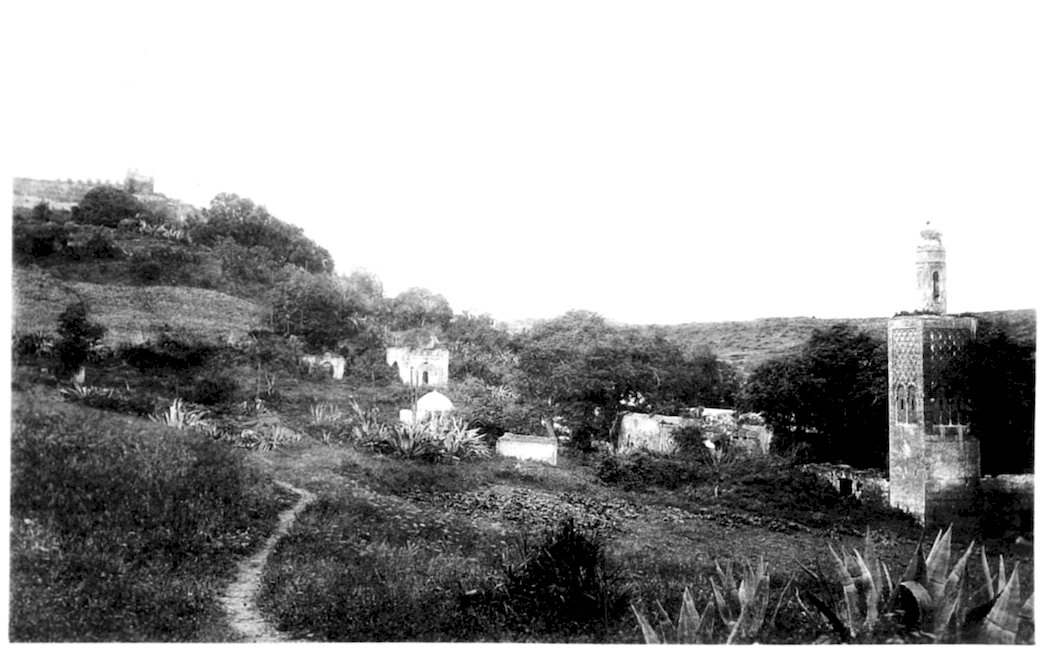
RUINS OF SHELLA.
From remains which have been found at Rabât, including the head of an ancient statue, life-size, which was discovered a few years ago in the foundations of the French Consul’s house, it is evident that Shella increased gradually towards Rabât, and that these two towns are the “exact equivalent of the Sala Colonia of the Itinerary.”[84] There are some very perfect Arabic inscriptions on tombstones in the ruined mosque, one of which is descriptive of the piety and virtues of a lady saint; the date of this is 750 of the Hegira (about A.D. 1370), and it tells us how the deceased lady “died in the night of Saturday the 4th of the month Rajab, and 269was buried after the prayer of Friday beside the tomb of our lord, El Mansor. May God perpetuate her magnificent works and brilliant actions,” &c. &c. I am quite of opinion that “de mortuis nil nisi bonum” should be said, but some of the anecdotes relating to Latter-Day Saints of the feminine gender in Marocco would hardly tally with the virtues inscribed on the Shella tombstone. About half-way between Shella and Rabât stands the tower of Hassan, and adjacent to it a ruined mosque. These also were built in the twelfth century in El Mansor’s reign. We landed on our way up the river to look at them, and admired the enormous proportions of the minaret, which is square, of the same thickness all the way up, and said to be 180 feet in height. The same architect built the tower of El Kutubia in Marocco, and the Giralda in Seville, which latter is ascended by the same means as the one here, viz. an inclined plane.
The tower of Hassan has lasted well, and shows the superiority of the Moorish workmen in former days, but about two-thirds up it bears signs of having been struck by lightning. The mosque close by must have been a building of great extent, its roof having been supported—so Jackson (1809) and others tell us—by 360 columns of marble. Many of these are to be seen lying about the place, partly buried in the ground, and none apparently in their original positions. From Shella we walked back to Rabât, being anxious to buy some of the famous rugs made there, and arrived in time for the afternoon sale from four to six, which takes place whenever they 270have any for disposal. The sellers run up and down the streets, with the rug on their arm, shouting the price, and noting the offers of intending purchasers as they pass. We stood in the hall of the Vice-Consul’s house, which is at the end of a passage connecting it with the street, and every now and then a carpet-seller would rush down the lane and into the hall, shout out to what figure the price had risen, then taking our bid, would run out again to the street, being followed in quick succession by one or two more. Whether or not they may have received some imaginary offers in the street to raise the price before returning, I cannot say; but we had no reason to complain of what we paid for the few very pretty rugs we purchased. We leave here to-morrow, the 18th, for Mehdía, our two days’ halt having been acceptable alike to man and beast.
Return of Síd Búbakr—His house in Marocco—Precautions when from home—Mehdía—Portuguese defeat—Râs ed Dúra—Whited sepulchres—Arab girl—Chamomile and Borage—Cork woods—El Araish—Well-to-do Jews—Passage of Wad el Kús—Remains of Moorish fleet—Insect life—Azîla—Irregular protection—Fording tidal rivers—Lex talionis.
“Síd Búbakr arrived; Sultan d—d if he will reform.” Such, I see, is the concluding note of my diary of Tuesday night, which was brought to a sudden termination by my candle being extinguished and knocked over by an errant beetle. But the words, though terse, express the situation admirably, as the faithful Síd did in fact turn up that afternoon from Fez, but without the Sultan’s much-hoped-for signature to certain papers. His Excellency is greatly annoyed, but a special courier has been sent off to the Court, and the documents may yet be forwarded straight to Tangier. In the meantime Síd Búbakr has left for Marocco, where he lives, and where his wife and her attendants await him, securely locked into the house during his absence, the key being in his own 272possession. His house is large and commodious, but the top of the patio is grated with iron bars, and no one can get at the fair prisoners, with whom, however, he leaves a sufficient supply of food, &c. This habit of the Síd’s was once nearly proving awkward to Mrs. B., for having been detained by floods some days longer than he expected, he found his wife, who is enormously fat, had been improvident in her management, and was reduced to a skeleton. On this occasion, too, the door was not only locked, but built up with bricks and mortar.
Our march from Sla to Mehdía, where we hit off the Sebú again, was a pleasant one, the road taking us along the top of the cliffs overlooking the sea. Far away on our right lay the Mamora forest, and close to our camp at Mehdía were two small lakes, with palm-trees between them. In maps of the last century the place is generally given as Mahmora, a name by which it is now unknown, while that of Mehdiya appears as far back as 1154 in the book of El-Bekri, and was doubtless given to the town by the Sultan Abd-el-Moumen “en souvenir de son maitre Ibn Toumert el Mehdi.” By Hanno and Scylax it is called Thymiateria, though it obtains little mention from ancient writers, standing as it does at some distance from the road from Tingis (Tangier) to the Sala Colonia. It is now almost entirely in ruins, but must once have been a place of great strength, having been built, according to some writers, in the twelfth century, as a defence to the mouth of the Sebú, since when it has changed hands many times. In the “yeere of the Hegira 921,” i.e. about A.D. 1540, it was made famous by the “slaughter of the Portugals, whose bloud dyed the sea three days, blushing to see the barbarous barbarian shed so much Christian bloud.” A historian of that period, who was a witness of this battle, estimates the slain Christians at ten thousand. The quantity of storks, young and old, to be seen in Mehdía is astonishing, and their being held sacred by the Moors renders them very tame.
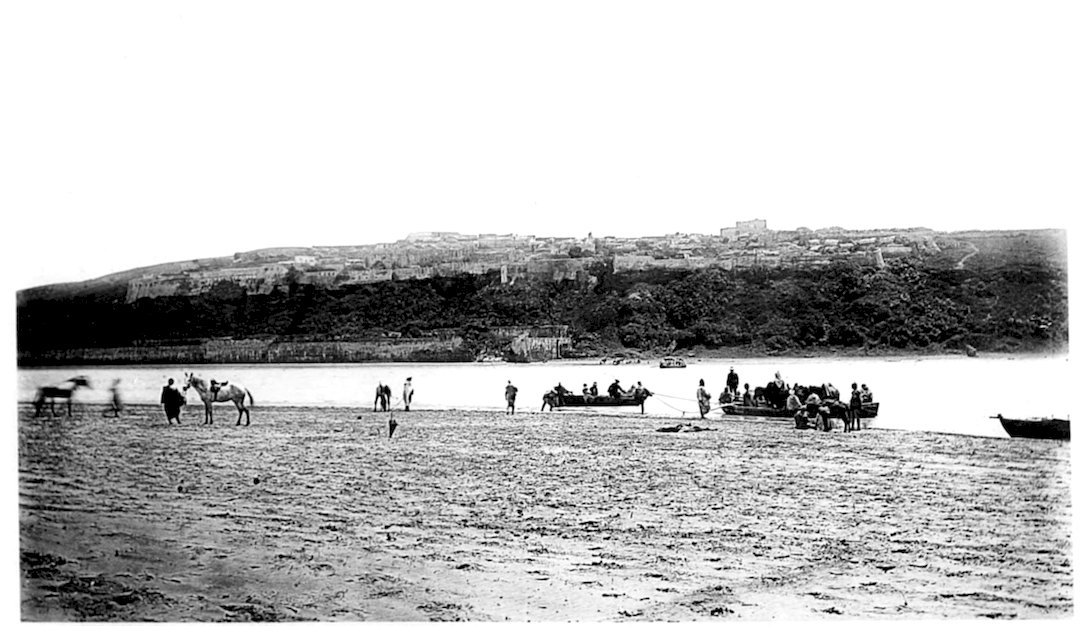
PASSAGE OF THE WAD EL SEBU AT MEHDIA.
273The crossing of the Sebú lasted from 5 A.M. till 10 A.M. It is about a quarter of a mile wide where we crossed, and twice that distance from the sea. From the hill, about 400 feet high, on which the town stands, we had a good view of Rabât and the camp of the Udaiah, near the Mamora forest. From the north side of the Sebú Mehdía has a most imposing aspect, as its ruined state is not apparent; and the strong sea-wall, about 300 yards in length, finished off by a small circular fort at the extremity, gives the place a look of great strength and solidity. In the fort were a lot of copper guns, and two long iron ones, half-buried, lay longitudinally across the entrance to the town. It is said that large granaries once existed behind the sea-wall, and that great quantities of corn were exported. We marched in an easterly direction along the right bank of the Sebú, and from our mid-day halting-place saw Kontra about five miles off. Lying about in the grass there were a number of rusty cannon-balls—about nine to sixteen pounds—probably relics of Portuguese and Spanish invasions in the sixteenth and seventeenth centuries. At Síd Muhammed ben el Kheir, where we camped yesterday, we got into 274the district of Habassi once more, and an escort under the shy youth, whose acquaintance we made en route to Fez, arrived to protect us.
Our road now lies parallel to the sea, and about a mile and a half from it. Between us and the shore is a low range of hills, and on our right hand a large marsh, which occasionally develops into a succession of lakes, known by the general name of Râs ed Dúra, and in winter forming one big sheet of water. This appears to have been laid down by Pliny as the original mouth of the Sebú, but the configuration of the land is incompatible with such a hypothesis, and his arguments, though adopted by some geographers, are successfully refuted by Tissot.[85] The Saint houses—or kúbbe—are thickly dotted over this country; occasionally they are built of red brick, but are usually the regulation “whited sepulchre.” One of each pattern was near where we halted for luncheon to-day; the white one had three domes in good repair, and is erected to the memory of one Síd Hamed ben Mansor. I always try to make out the names of these buildings, as they would be one’s chief landmark and guide if revisiting the country, but oftener than not I hear different names for the same place, and Tweedledee, who is always willing to cater for information, cannot find out whether the red brick kúbba is “Síd Muhammed ben el Kheir” or “Síd Abd-er-Rahman ben Drís.” The labours of a geographer here must certainly resemble those of Sisyphus.
275While strolling near the luncheon tent I found Lady and Miss Hay talking to a pretty little Arab girl about twelve years old. We brought her to the tent, but her dread of the soldiers was intense, and she clung to Miss Hay for protection, looking round every moment as if she would escape. Her awe of the Bashador was great, and she knelt down before him very reverently, but soon gained confidence, and was delighted with his watch, and still more with a whistle which he gave her. She was evidently the belle of the little camp where she lived, and was covered with pretty jewellery. I rather coveted a necklace and brooch she wore, which she said I might have if her mother would allow it. That lady appeared presently with some milk and other offerings, and Hadj Abdullah, a servant of Sir John’s, having valued the article, I paid the mother for it, and it was handed to me by little Rahmah, who carried off a silk handkerchief of Miss Hay’s, a knife of mine, and several other souvenirs of her visit.
The weather is much improved, and to-night is still and warm. No habitation of any kind is within miles of us, except two or three Arab tents, near which the young kaïd of Habassi has pitched his. The lake of the Râs ed Dúra, calm and beautiful, lies stretched out before us, and from its shores comes the roaring of myriads of frogs, whose conversation becomes more boisterous as night advances. A Saint house on the borders of the lake bears the ponderous title of Dár Síd Abd-el-Káder ben bú Kaïb,—at least so Mr. Náhum informs me; but I believe he invented the name to check further enquiry.
276The lake is full of eels, which the Moors catch in traps very like what are used in England for that purpose. They have canoes (ma’día), or rather rafts, made of rushes, upon which they punt themselves about to different parts of the lake; the prow sticks straight out of the water like that of an ancient trireme, and helps to counteract the weight of the occupant, who uses his long pole standing on the stern. About a mile from this lake is a smaller one, El Zerga. They are said by some geographers to communicate, but from the lie of the land I should say this was impossible, even during heavy floods. The smaller and more northerly of the two seems to have a narrow channel through into the sea; at least this was my impression, but there was not time to ride round and make a close inspection. This channel, if existing, must interrupt the coast line, which would otherwise be the best route, though Rohlfs, who travelled that way in 1861, mentions no such obstacle. It is curious how partial the distribution of flowers and shrubs has again become in these plains; for two days they were white with chamomile flowers, which, with wild oats ten feet high, entirely obliterated the path; at other times, the whole country round is covered with borage, giving one the impression that the earth was reflecting the deep blue colour of the sky. If these two plants could be utilised, the prosperity of Marocco would be ensured; but as the cattle will not eat chamomile, and the Koran forbids the use of claret cup or other mediums for the consumption of borage, His Majesty’s treasury is no way enriched by either.
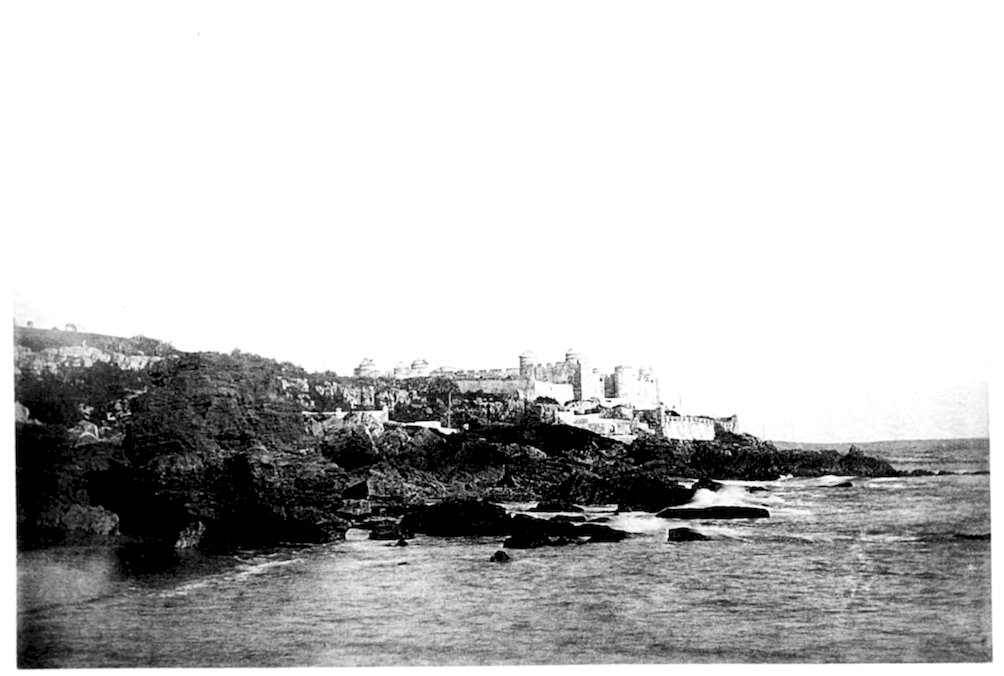
EL ARAISH.
Yesterday we crossed a river, the Wad el Dráder, at a ford called Meshráa el Háder, where there was also a bad marsh to be encountered, and close to our camp at Soueir, last night, another stream, the Wad el Soueir. We have been travelling since we left Rabât as if the avenger of blood were behind,—no time to take notes, photographs, or collect one’s ideas in any way,—and the state at which the unfortunate mules and ponies with sore backs have arrived is horrible.
We have now come into the country of cork woods once more, and halted to-day for some hours in one near here, arriving outside this town at 4 P.M. We are camped on the side of a hill, from which, if the rain comes on again, we shall be inevitably washed into the Atlantic, over which we have a glorious view. The shore below is strewn with huge boulders rounded off by the action of the waves, and looking like projectiles on a battlefield of giants. The market-place in the town is worth seeing, being surrounded by an arcade prettily supported on red sandstone pillars, the work, probably, of Christian, not of Moorish hands; for, like most other Morescan ports, this one has had a chequered career, and served many masters in its time. It was for long a Spanish possession, and still savours more of an Andalusian than a Moorish town, but was recovered from them by the famous—and infamous—Mulai Ismael in 1689.
In 1765 the French fleet advanced too far up the 278Wad el Kús, on which the town is situated, when “they were surrounded by superior numbers, and fell victims to their own impetuosity.” At the mouth of this river—the Lixus of the Romans—is said to have been the site of the island which contained the beautiful gardens of the Hesperides; but there is no trace now of any such place, except a small sandbank visible at low tide, and the configuration of the coast must have greatly changed since those times.
The Jews, of whom the place is full, are all in their Saturday’s best, and, luxuriating in the twofold comfort of wearing shoes and riding mules, present a great contrast to their barefooted and black-robed compatriots in Fez and Mequinez. One or two Moors who have taken advantage of our escort to travel this way for the first time, are much astonished at this license, and young Hassan, the khalífa’s new valet, has already assaulted two Israelitish boys, to the effusion of blood, for presuming to appear in coloured garments and slippers near our camp.
We were ferried across the Wad el Kús at 9 A.M. yesterday, a large concourse of the people of El Araish assembling to witness the operation. While waiting on the bank, a woman burst through the crowd, and rushing up to Lady Hay, implored her intercession for her son, who was in prison. One of the soldiers seizing hold of her, said, “Are you mad to speak to the Señora?” “Yes,” replied the poor woman, still kneeling beside the litter, 279“I am mad because my son is chained in the prison, and I cannot see him.” His Excellency enquired into the case, and the Italian Vice-Consul, who had himself been robbed by the youth in question, promised to ask the authorities to deal gently with him.
There was a strong flood-tide running up as we and old Kaïd Ali, who always prays without ceasing on these occasions—and probably not without reason—crossed in a big flat-bottomed boat, from the bow of which waved the red flag of Marocco. The kaïd of the harbour—a fine-looking old fellow, dressed completely in red—superintended the crossing, and had provided rugs to sit on, and an awning, now become very necessary to keep the sun off. From the north side we had a good view of the town and its strong fort, which is built on the extremity of the rock at the river’s mouth. In addition to this are several stone batteries and other defences, all of which, however, would be useless against an attack by ironclads, which, in good weather, could bring up outside the bar and knock the place to pieces. From the fact, however, of the town standing high, and not being commanded by hills within range, a better defence might be made on the land side. We saw the last remnants of the fleet of Marocco, which was destroyed by the Austrians in 1829, in the form of some ribs of sunken ships sticking out from among the sand on the river bank,—a ghastly relic of a more prosperous and enterprising period. The country immediately to the north of El Araish was so flat that the Wad el Kús almost forms a figure of 8 as it winds away to the east. Leaving 280it behind us, our path took us across a succession of low sandy hills, among which the heat of the sun was excessive, and made us look with longing eyes at the snow-capped mountains far away towards the Rif country. Some of the party went off in search of the site of the ancient Phœnician colony of Lixus; but whether from the great heat overcoming them, or from some other cause, I have my doubts if they ever found the ruins in question; at all events, the addition they brought back to our store of archæological information was infinitesimal. Before getting to Sebt, our road lay through a wood of small cork trees, half-way up the stems of which there was a thick undergrowth of yellow cistus. This lasted some miles, after which we descended through a dense grove of lentisk into the valley below; it was difficult work making our way along, and some miles from camp we came on one of my mules which had tumbled down, with Norton waiting beside it for assistance to get it up. This was rendered by the standard-bearer and some soldiers; but some of the other baggage did not arrive till seven o’clock, and the mona having been sent by mistake to Síd el Yemáni, some miles off, there was no food for the horses, though fortunately, except bread, we had enough for ourselves. Our camp at Sebt was a really lovely spot—a small plain shut in by hills covered with lentisk and other shrubs, and the whole of the level ground, on which our tents had been pitched, thickly carpeted with a deep purple bugloss (Echium angustifolium), the wonderful richness of the colouring being varied and intensified by the red glow of the sun, which 281was just setting behind the hills as we arrived. We have got rather to dread that orb in these latter days of our wanderings, not so much on account of our complexions, which, indeed, are a thing of the past, but from the fact that the intense heat after the rain has called into existence all manner of insect life, and creeping things innumerable. This morning when I awoke there was a huge grasshopper, couchant, regarding me with curious eyes from the side of the tent just above my head; while a spider of fabulous dimensions sat on the ground close by, as if ready to catch him should he miss his spring. The caterpillars, too, are of a size and colour which augur well for the beauty and proportions of the butterflies which follow.
A little way from this place we were met by the Governor’s brother—the same man whose striking appearance attracted my attention at Síd el Yemáni six weeks ago. The two Beni Shittim also, père et fils, came out to welcome us back again. Some of us paid a visit to their house, and had a look at the town, the ancient Zilia of the Carthaginians, which, in its fortifications and the curious windows of its ruined buildings, shows many traces of Christian occupation. About 1000 years ago it is said to have been an English possession!—after which the Moors and Portuguese alternately held it till the middle of the sixteenth century, when it passed finally into the keeping of its rightful owners. Throughout the length of the little town runs a broad “Calle réal;” no Melha is to be found in it, Jew and Gentile all pigging it together; but the Christian element is not represented. 282Outside the gate and close to our camp is a small kúbba, quite a gem of its sort, of which a successful photograph was taken. We are now within twenty-five miles of Tangier, the light of Cape Spartel is once more visible from my tent door, and civilisation stares us in the face.
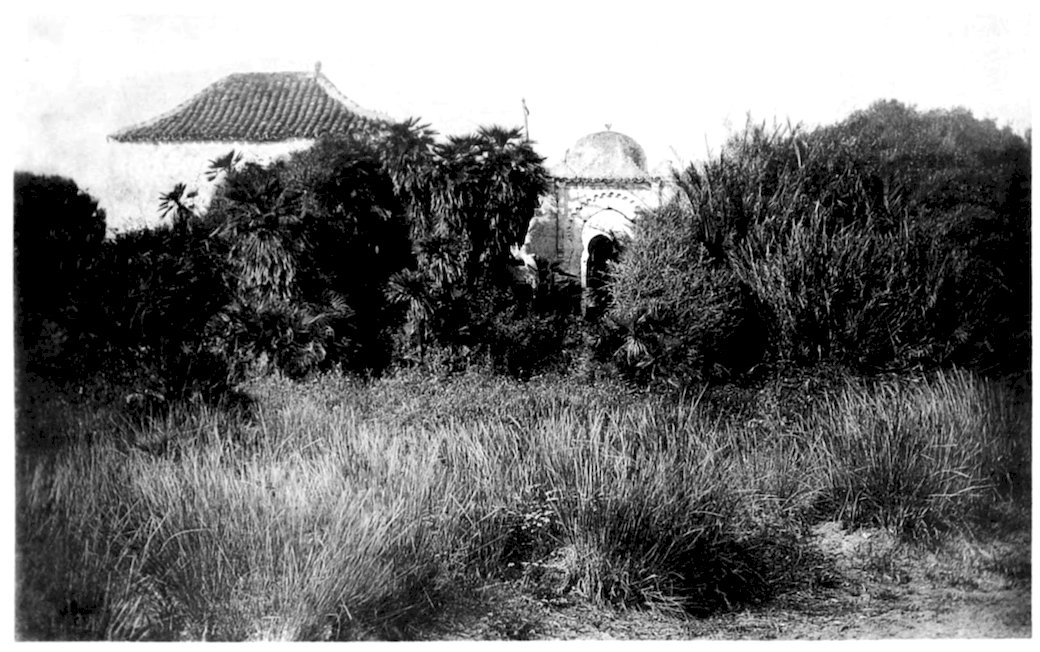
KÚBBA NEAR AGILA.
Returning as we have done by the sea-coast, I have been often struck by the difference in the comportment of the Jews in the seaports from what is observable in the sacred cities of the interior. Here in these towns the Moorish Jew may carry his head as high as he likes, and clothe his feet in whatever chaussure suits him best. The protection extended to him in these parts by the foreign representatives is unlimited, and, if not restricted, the Government of the Sultan in these towns will lapse into the hands of a few foreigners representing the different European Powers. What the Sultan very justly complains of is that the treaty rights, which restrict protection to the persons and families of people in the actual service of ministers and consuls, are altogether perverted from their original intention. Now, trading agents are appointed in the interior, who again enter into partnership with others, whether Jews or Moors; and thus a numerous class is formed of intriguing and too often unprincipled persons, who, scorning all native authority, rob, pillage, and oppress in the name and under the protection of the Government whose adopted children they are. It is absurd to urge in defence of this system that these offenders will be dealt with and punished by the consul of the Power which happens to 283protect them; for, living as some of them do far in the interior, they are entirely beyond the ken or control of the consular authorities on the coast, and except in the seaport towns such authorities do not exist. Suppose, for instance, that a protected subject in the interior, agent of some firm, commits a murder or a robbery, the mere distance between the scene of the crime and the court by which it has to be investigated makes justice difficult of attainment, and the consul obviously cannot leave his duties to hunt up outlying cases of crime and injustice. No doubt, cases occur of cruelty and tyranny exercised upon the Jews in the interior by their Moorish fellow-subjects. It must be remembered, however, that the spirit of ill-will and hostility which manifests itself against the Jewish population is partly caused, and much increased, by the unfair and irregular character of the protection accorded. The fact is, that only some eighteen hundred of them are under the protection of Christian Governments, and these eighteen hundred do not consist of the poor and the oppressed, but of the more wealthy members of the community, who are willing to pay—and without doubt in many cases do pay—for the accommodation. It is from the reports furnished by these persons that the various societies for the protection of the Jews in London and elsewhere are instructed, and it needs but little perception to see what powerful motives they must have to give a pretty strong colouring to their reports. The question now before the Conference at Madrid is not the “Abolition of Protection,” as the cry of the Hebrew states it to 284be, but the restriction of protection within its legitimate and treaty dimensions. The 200,000 odd Jews in Marocco gain nothing by the protection of the favoured few, but, as shown above, rather lose by it, as they bear the burthen of the unpopularity of their more favoured co-religionists. The Sultan of Marocco is willing enough to introduce reforms in this matter, but he can hardly be expected to take the initiative until the present abuse of irregular protection is redressed. In any united European action it is also highly desirable to bear in mind the primitive and backward condition of the country, and the necessity of proceeding with caution in coercing Mussulmans in any matter which even distantly affects their religion. Are we not also somewhat too apt to judge of these people by our English nineteenth century standard, and, à propos of the murder and burning of the Jew lately in Fez, to forget that it was not so very long ago that innocent people were burned alive on charges of witchcraft in England?—while up to within eighty years ago I should have been sorry to guarantee the life of a Jew who had been caught in the act of outraging an Englishwoman.[86] Better than any coercive measures to improve the condition of these people will be the steady encouragement of trade and civilisation generally in Marocco; and that these influences will surely be felt in the fulness of time there can be no doubt.[87]
There being two tidal rivers to cross to-day, an early start was necessary, and we were all roused shortly after 6 A.M. by the powerful exhortations of His Excellency, who, aided in his designs by Hadj Hamed, got us all up in time. With my servant’s assistance I am usually able to keep that functionary and his freigíahs[88] at bay; but Zouche having a less able auxiliary, they began striking the tent to-day over his very lightly attired person, greatly exasperating that nobleman, but affording us much gratification as we sat at breakfast, al fresco, on the plain. The Wad el Aïsha, which we came to first, had a muddy bank, and a shifting bottom of big stones, with water up to our horses’ girths, and here several mules and ponies came to grief; the second one, the Wad el Kharrúb, was deeper, but we crossed it in a diagonal direction with much success. The poor old Tálib,[89] on his brand new mule, presented by the Sultan, tried a shorter cut, and both mule and scribe were speedily engulphed. I came on him later in the day, standing in buff behind some bushes, on which he was drying his kit.
We were joined two days ago by a son of Hadj Hamed, whose antecedents interested me much. It seems that some time ago a French-protected Moor quarrelled with and killed an uncle of this lad. The French authorities being applied to, took no notice of the crime, so the nephew, in company with a cousin of 286his, waited for and slew the man just inside the gate of Tangier; they then fled to a sanctuary at the foot of the hills, thirty miles off, and remained there till the two bereaved families agreed to cry quits over the matter. Hadj Hamed then sent his son on a pilgrimage to Mecca, from whence he has just returned purged from all offence. He seems a cheery youth, with the same hearty laugh as his father and two uncles, who have been with us during the expedition.
The place at which we are halting to-night is close to Kaa er Remel, our first camp out of Tangier some seven weeks ago, and to-morrow will see us back in sight of Europe once again. Our dinner party is already reduced by one, the medico having taken his departure along with Mr. Haïm Secsú, the interpreter, whose anxiety of late to clasp Mrs. H. S. to his bosom once more has been most affecting to behold. Tweedledee, however, still remains to us, and has just told me a touching story of how he was “thleeping in a catele enclosure,” which is close by, “and a littel foal come to me in the dark and thuck my ear; the foolish thing think I am her mother.” I am sorry not to have preserved more of the simple sayings of this Israelite, in whom, during all our intercourse with him, we have failed to discover the least symptom of guile,—and the more sorry as, to his shame be it spoken, the photographer has failed in placing his portrait before the public.
Return to Tangier—Difficult task of English Representative—Obstacles to collecting information—Photographs—Ethnology—Berbers and Arabs—Bokhári—Moors—Further results of Mission—Conclusion.
His Excellency, unlike some of his colleagues, does not care to herald his return by the pomp and circumstance which attended his departure, so sent in the escort with its red standard, which has been carried in front of the column during all our wanderings, by a different route from the one we took. On the road we met some officers of the Sultan’s army on their way to the fighting near Wazan. We had seen their encampment of five bell tents about two miles from our own last night, but had thought they were tourists from Gibraltar being “personally conducted” into the desert by Hadj Kadór, the handsome Muhammed, or one of the numerous caterers to the untiring energy of English travellers. A few of the residents of Tangier had ridden out some distance to meet us, and many were the respectful salutations and cries of “Marhaba bík, Bashador,” which greeted the Envoy before we arrived once more at the door of the Legation. And now, though our Mission to the Court 288of Mulai Hassan has become a thing of the past, I think it will be long before all the strange sights we saw in this almost unknown land of Western Islam, and in its sacred towns, pass away from our recollections; nor shall we lightly forget the pleasant companionship which has existed among us for the last eight weeks. Our chief,—to whom the expedition has been by no means a holiday,—now returns to his former labour of Hercules in the way of watching over the affairs of Marocco in connection with England, and guarding the interests here of this unhappy empire, so highly favoured by God, and so cursed and depreciated by man. In no part of the world where England is represented is this task harder of accomplishment, nowhere are there more obstacles, in the way of jealousy, ignorance, and fanaticism, to be overcome. At the same time, it must be a satisfaction to the Government at home, and to the public interested in this country, to feel that, in the judgment of all who are competent to form an opinion, the duty could not have been placed in abler or more skilful hands.
Besides having had exceptional opportunities of seeing the interior of the empire, and studying the social and political condition of the people, we have performed our journey with a degree of comfort and safety which does not fall to the lot of the ordinary traveller. I do not know that we can boast of having added many archæological or geographical facts to those already collected by former travellers; but it must be remembered we were a formidable party in point of numbers, and our itinerary having been strictly laid 289down by the Sultan, we could not strike off into a new line for the sake of exploring the many places which lay about a day’s march from our route, even though they possessed exceptional historical interest. This was more especially to be regretted in the latter half of our journey, viz. from Rabât here, as the district is singularly rich in monuments of early Greek and Roman occupation. The most unexplored part of the country through which we passed was between Volubilis and Rabât; and though the blinding rain which then fell almost incessantly prevented our noting more than the actual direction of the march, while the close proximity of the Zemmúr and other dangerous tribes rendered it difficult to carry on investigations which took one at all off the track, I am not without hope that the modicum of information collected about this unknown region may prove of service to geographers.
The collection of photographs taken by “our artist” are in themselves most interesting, and but for the tiresome scruples of the natives against allowing themselves to be taken, some useful contribution towards the ethnology of the various tribes through which we passed might have been thus procured. To the ethnologist, indeed, a study of the different races settled in Marocco would be extremely interesting, as they would seem to be more clearly marked and separate here than in almost any country which has been subjected to so many invasions in former ages. The two most distinctive types seem to me to be those of the Brebbers or Berbers (whence the name Barbary), and the Arabs—distinct not 290only in appearance but in their habits and manner of life. We came upon the Berbers at Beni Aamer, Mikkès, the forest of Mamora, and in various villages along the coast; and there is said to be no doubt but that they are direct descendants of the people whom the Phœnicians, and later on the Romans, found in Marocco. The word Brebber or Berber signifies anything indigenous, and the race which bears the name seems to have intermarried very little with the Roman invaders, or with the Goths who followed them, and possesses to this day a more strongly-marked individuality than probably any other people in existence. Of their language, sometimes called “Shellah,” little is known. It is unlike Arabic, but is remotely allied to Coptic, which, with it, is classed by philologists among the languages called “Hamitic.” The group of servants opposite page 32 are of pure Berber extraction, while the villagers who appear in the photograph of Habassi opposite page 60 are all Arabs. Rohlfs tells us the Berbers are more civilisable and less bigoted than the Arabs, and that their women have more domestic influence, and are sometimes even allowed to inherit. Our experience of the race was not fortunate, as the Beni Mtír robbers who attacked our camp at Mikkès, and the Zemmúr who hunted us out of their country, were essentially of aboriginal or Berber extraction.
The history of the Arabs in Marocco, who are par excellence dwellers in the plains, living in tents which they shift about at will, is of more recent date. When the great wave of Mussulman invasion came rolling 291westward in the end of the seventh century, the whole of this country was quickly overrun, and only that part of the aboriginal inhabitants which lived in the mountains remained unconquered; flying to their fastnesses in the hills, their pursuers were unable to follow them, and they now represent the remnant of the above-mentioned Brebber people. The Christianity introduced by the Romans at the close of their first occupation (about A.D. 430) was stamped out by the Arabs, since which time the country—correctly described as “the most religious in the world”—has remained, and is likely to remain, purely Mussulman. I fancy, however, that a Moor of the present day would as soon believe that Christianity was the religion of his country fourteen hundred years ago, as that the balloons and trains of Europe are really existent facts. Another great influx of Arabs occurred on their expulsion from Spain at the conquest of Granada in 1492. For seven centuries they had governed that vast province with vigour and success; and it is a known fact that in many families here are preserved the title-deeds of their Spanish possessions, to which the owners hope that some day they or their descendants may possibly return.
Another distinctive family is that of the Bokhári,[90] or black bondsmen of the Sultan, who, though only introduced two hundred years ago, form with their families a by no means unimportant part of the population. Some good specimens of these colonists are to be seen in the picture of the group of soldiers in the Sultan’s garden at Fez (opp. p. 103). The term Moor, 292though, of course, derived from the Maurusii and Mauri mentioned by Strabo and Pliny, seems to be generally applied now-a-days to all the three races above described, with perhaps a more special reference to the fusion of the three, which is found chiefly among the inhabitants of the towns. It is curious that, besides being able to trace the word Moor to such an early source, distinct equivalents exist in the Arabic of to-day for the names of several tribes mentioned by writers at the beginning of the Christian era. Of all these various ingredients of the population of Marocco, I think the Berber element the fairest-complexioned and best-looking, the Bokhári, the biggest-limbed and most powerful, while the Arab of the plain—of whom the Beni Hassan are an excellent type—is the most wiry and enduring-looking of the lot.
Of the Jew, as a factor in the population of this country, it is unnecessary to treat, as intermarriage between them and their Mussulman fellow-subjects is too rare to admit of its affecting in any way the national type. To the goodwill and sterling qualities of the two excellent representatives of this chosen people with whom we have been daily brought in contact, I have already borne a willing testimony, and I trust that, should my diary ever come into their hands, they will not take umbrage at the occasional substitution of their actual names for those of their prototypes in modern English literature.
In addition to the measures mentioned on p. 224 as about to be put in force, the other political results of 293the Mission (as I learned from a garrulous Court official at Fez), are the Revision of the Convention of Commerce and Navigation of 1856 between Great Britain and Marocco, and the establishment of diplomatic relations between the Sultans of Turkey and of this country; though how the conflicting claims of each of these potentates to be the head of the Mussulman religion are to be got over is not at present apparent. As soon, too, as sufficient money is forthcoming, the mole at Mogador is to be extended, and the ruins of the one here put in sufficient repair to facilitate the passage of boats to and from the ships. A better supply of water also is guaranteed for the town of Tangier, between which place and Gibraltar heliographic communication (under the auspices, I hope, on this side, of Síd Drís ben Abd-el-Wáhad) is to be established.
My task is done, my last note made; and it is with no little regret that I bid farewell to the scenes I have endeavoured to describe, and to those who have been my companions for the last two months. A feeling of uneasiness also arises that individual merits may have been overlooked, and that those most worthy of praise have found but little in these pages. With what especial satisfaction above all would I have attempted, if words did not fail me, the grateful task of recording how much our pleasure and comfort were enhanced by the presence 294of those fair members of the Mission, who not only faced uncomplainingly the discomforts, and sometimes dangers, we had to encounter, but through wet and weary marches set us the example of cheerfulness and good humour, helping us to pass pleasantly many a tedious hour when time would otherwise have hung heavy on our hands. To them, and to our distinguished chief, our cordial thanks are due; and by the rest of my fellow-pilgrims, if I have left unsaid aught that should have found place here, I hope to be held excused, for in the case of a party amongst whom virtue so greatly abounded, it would be difficult to do justice to all, so the mens conscia recti must be their reward for the present.
Note.—Species not hitherto published as Moroccan marked * (12 in number).
This list contains 168 species, besides 18 uncertain or indeterminable.
To our well-beloved, the excellent Chief, the distinguished Officer of the Royal Engineers.
After wishing you a complete salaam. There has reached us your letter, and with it a set of chess men, a present from you. May God bless you for it, and increase your welfare.
But we are in want of a good board which will be worthy of those beautiful chess men. When you arrive at London, send it to us.
May God bless you for it, and cause to continue your munificence.
May God be with you.
Fevers, smallpox, eye diseases of every kind seem to be the chief complaints, always excepting syphilis, which has a deeper hold on the people of this country than, I should think, on those of almost any other; but were the land sufficiently civilised for such action, a Contagious Diseases Act of some kind might still be the salvation of the people. The misguided opponents of such a measure at home could hardly in Christian charity refuse their countenance to it here, in face of the suffering and misery which absence of legislative restrictions has brought upon this country. The Moors have little or no shame in the matter, and ignore entirely the iniquity of propagating their species under such conditions. They, however, entirely exonerate themselves and their country from all responsibility or blame, declaring the disease was brought into Marocco by the Jews who were driven out of Spain by Ferdinand of Castile. Leo Africanus, however, after asserting that it was unknown in Africa before, explains that, on the return of these Jews, “cœperunt miseri quidam ac sceleratissimi Œthiopes cum illorum mulieribus habere commercium, ac sic tandem velut per 303manus pestis hæc per totam so sparsit regionem; ita ut vix sit familia, quæ ab hoc malo remansit libera. Id autem sibi firmissimè atque indubitatè persuaserunt, ex Hispaniâ ad illos transmigrasse, quamobrem et illi morbo ab Hispaniâ, malum Hispanicum (ne nomine destitueretur) indiderunt.”[91] Considering that such was the case in his day—400 years ago—it is wonderful that, with nothing worthy the name of treatment to arrest its progress (the best remedy, according to Leo, is change of air to Numidia or the Nigritarum regio!), the disease has not created more havoc even than it has.
4. ... No official connected with army to enter into contracts for supplies, &c.
5. Draws up and recommends a system of schooling and training boys and soldiers, enabling latter after three years to return to their trades, provided efficient substitutes from school of boys be forthcoming.
7. Office of Commander-in-Chief, while held by a civilian, to be considered separate from Kaïd Maclean’s.
8. Points out the disadvantage of employing French infantry officers at Rabât, recommending at all events English words of command being adopted all through infantry.
... I have been requested by the Sultan to convey to you His Majesty’s thanks for the able reports you have prepared at His Majesty’s desire regarding the body of ’Askár you inspected.... The Sultan has given orders that the regulations you have presented should be adopted.... His Majesty requests me to say that he trusts you will preserve the sword of honour which has been presented to you as a mark of His Majesty’s sense of the service you have rendered on this occasion, and of your visit to his Court.
Praise to the one God!
Complaints have been addressed to the Sharífian Court, exalted of God, by the Jews of Mazagan, that thou dost ill-treat them, imprison, flog, and impose penalties on them in an unjust manner.
306Governors who act thus do not follow the precepts of our religion.
Dost thou not know that on the day of the resurrection the unjust will have to answer before God for the acts of injustice they may have committed?
This is the word of God accepted by all creeds.
The Prophet—may God make our prayers acceptable through him—said, “Whosoever acts unjustly towards the Jew will be called to account on the day of resurrection.”
The Jews are our tributary subjects. We, therefore, order thee to cease from further persecution of the Jews, and to act with leniency and kindness towards them. May God assist thee in doing so.
Copied on the spot, 13th May 1880. First line rather doubtful; dotted letters doubtful.
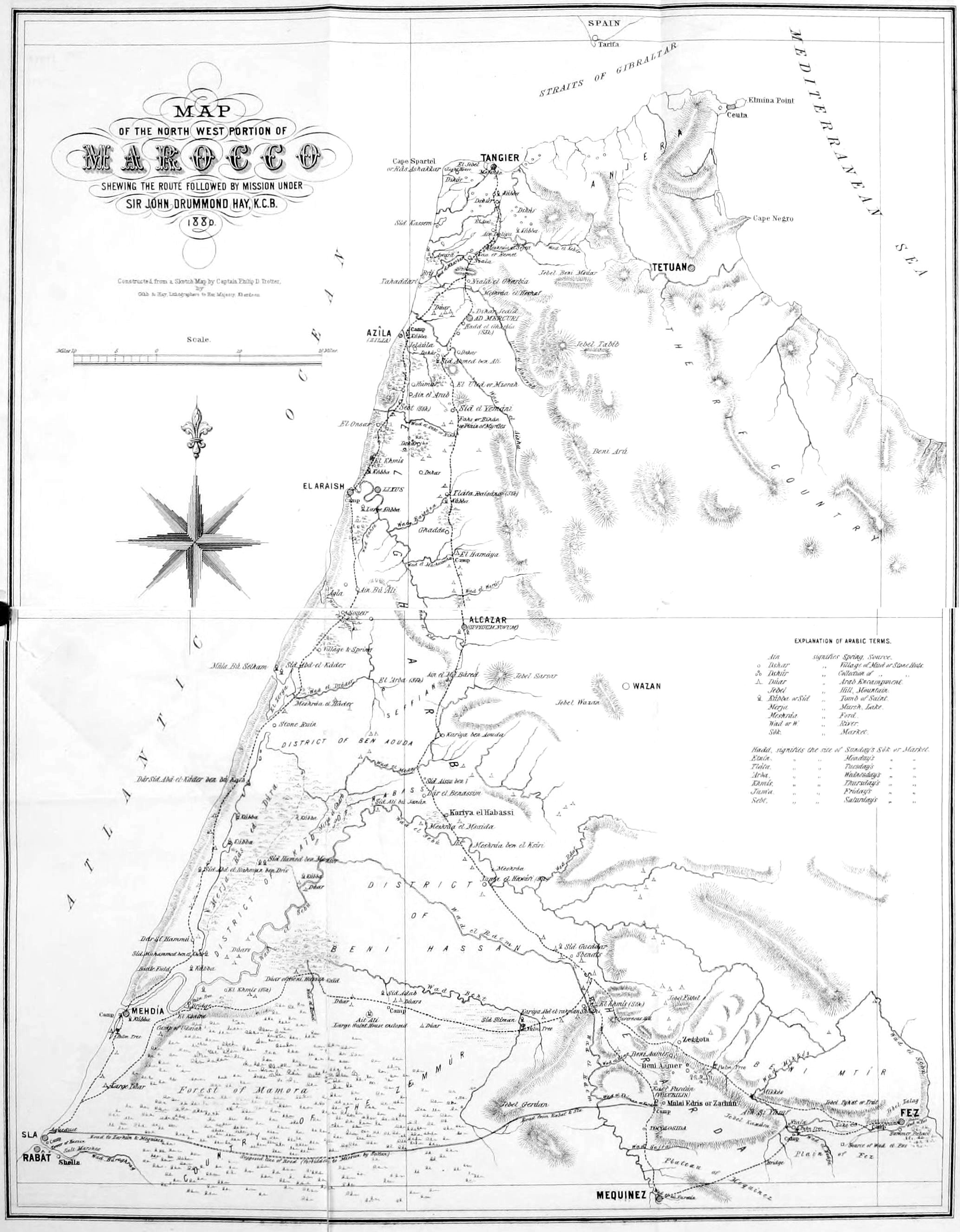
Captain St. John’s Wild Shores of Japan and China. 8vo, 12s.
“One of the most charming books of travel that has been published for some time.”—Scotsman.
Mr. Williamson’s Gun and Camera on the Rocky Mountains. In fol., 42s.
“A book that should be a favourite in every shooting-lodge from the Lews to Braemar.”—Saturday Review.
Mr. Bishop’s Canoe Voyage from Quebec to the Gulf of Mexico. 8vo, 12s. 6d.
“Most instructive and amusing. The maps of the eastern coasts are for their size the most perfect in detail which we have ever met with.”—Land and Water.
Mr. Ober’s Camps in the Caribees. In 8vo, 12s.
“Varied his experiences, hairbreadth his escapes, wonderful his gleanings in the way of securing rare birds.”—Literary World.
Colonel Gordon Cumming’s Wild Men and Wild Beasts. Adventures in Camp and Jungle. With Colonel Baigrie’s Illustrations. In 8vo, 12s.
Colonel Walter Campbell’s (“The Old Forest Ranger”) Indian Journal. In 8vo, 16s. Containing Descriptions of the principal Field Sports of India, with Notes on the Natural History and Habits of the Wild Animals of the Country.
Colonel Gordon’s Roof of the World. In Imp. 8vo, 31s. 6d. A Narrative of a Journey over the High Plateau of Tibet to the Russian Frontier and the Oxus Sources on Pamir.
Lord Southesk’s Saskatchewan and the Rocky Mountains. Demy 8vo, 18s. A Diary and Narrative of Travel, Sport, and Adventure during a Journey through part of the Hudson’s Bay Company’s Territories in 1859 and 1860.
A Memorial Sketch of Lieut. John Irving, R.N., of H.M.S. “Terror,” in Sir John Franklin’s last Expedition to the Arctic Regions. Edited by Benjamin Bell, F.R.C.S.E.