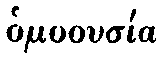
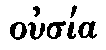
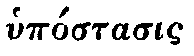
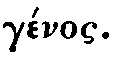
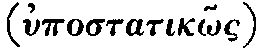
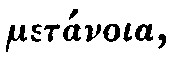
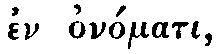
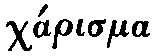
Coleridge's Literary Remains
volume 3
collected and edited by
Henry Nelson Coleridge
1838
Table of Contents
Extended Contents, or Index
For a statement of the circumstances under which the collection of Mr.
Coleridge's Literary Remains was undertaken, the Reader is referred to
the Preface to the two preceding Volumes published in 1836. But the
graver character of the general contents of this Volume and of that
which will immediately follow it, seems to justify the Editor in
soliciting particular attention to a few additional remarks.
Although the Author in his will contemplated the publication of some at
least of the numerous notes left by him on the margins and blank spaces
of books and pamphlets, he most certainly wrote the notes themselves
without any purpose beyond that of delivering his mind of the thoughts
and aspirations suggested by the text under perusal. His books, that is,
any person's books — even those from a circulating library — were to him,
whilst reading them, as dear friends; he conversed with them as with
their authors, praising, or censuring, or qualifying, as the open page
seemed to give him cause; little solicitous in so doing to draw
summaries or to strike balances of literary merit, but seeking rather to
detect and appreciate the moving principle or moral life, ever one and
single, of the work in reference to absolute truth. Thus employed he had
few reserves, but in general poured forth, as in a confessional, all his
mind upon every subject, — not keeping back any doubt or conjecture which
at the time and for the purpose seemed worthy of consideration. In
probing another's heart he laid his hand upon his own. He thought pious
frauds the worst of all frauds, and the system of economizing truth too
near akin to the corruption of it to be generally compatible with the
Job-like integrity of a true Christian's conscience.
, he
distinguished so strongly between that internal faith which lies at the
base of, and supports, the whole moral and religious being of man, and
the belief, as historically true, of several incidents and relations
found or supposed to be found in the text of the Scriptures, that he
habitually exercised a liberty of criticism with respect to the latter,
which will probably seem objectionable to many of his readers in this
country
.
His friends have always known this to be the fact; and he vindicated
this so openly that it would be folly to attempt to conceal it: nay, he
pleaded for it so earnestly — as the only middle path of safety and peace
between a godless disregard of the unique and transcendant character of
the Bible taken generally, and that scheme of interpretation, scarcely
less adverse to the pure spirit of Christian wisdom, which wildly arrays
our faith in opposition to our reason, and inculcates the sacrifice of
the latter to the former, — that to suppress this important part of his
solemn convictions would be to misrepresent and betray him. For he threw
up his hands in dismay at the language of some of our modern divinity on
this point; — as if a faith not founded on insight were aught else than a
specious name for wilful positiveness; — as if the Father of Lights could
require, or would accept, from the only one of his creatures whom he had
endowed with reason the sacrifice of fools! Did Coleridge, therefore,
mean that the doctrines revealed in the Scriptures were to be judged
according to their supposed harmony or discrepancy with the evidence of
the senses, or the deductions of the mere understanding from that
evidence? Exactly the reverse: he disdained to argue even against
Transubstantiation on such a ground, well knowing and loudly proclaiming
its utter weakness and instability. But it was a leading principle in
all his moral and intellectual views to assert the existence in all men
equally of a power or faculty superior to, and independent of, the
external senses: in this power or faculty he recognized that image of
God in which man was made; and he could as little understand how faith,
the indivisibly joint act or efflux of our reason and our will, should
be at variance with one of its factors or elements, as how the Author
and Upholder of all truth should be in contradiction to himself. He
trembled at the dreadful dogma which rests God's right to man's
obedience on the fact of his almighty power, — a position falsely
inferred from a misconceived illustration of St. Paul's, and which is
less humbling to the creature than blasphemous of the Creator; and of
the awless doctrine that God might, if he had so pleased, have given to
man a religion which to human intelligence should not be rational, and
exacted his faith in it — Coleridge's whole middle and later life was one
deep and solemn denial. He believed in no God in the very idea of whose
existence absolute truth, perfect goodness, and infinite wisdom, were
not elements essentially necessary and everlastingly copresent.
Thus minded, he sought to justify the ways of God to man in the only way
in which they can be justified to any one who deals honestly with his
conscience, namely, by showing, where possible, their consequence from,
and in all cases their consistency with, the ideas or truths of the pure
reason which is the same in all men. With what success he laboured for
thirty years in this mighty cause of Christian philosophy, the readers
of his other works, especially the Aids to Reflection, will judge: if
measured by the number of resolved points of detail his progress may
seem small; but if tested by the weight and grasp of the principles
which he has established, it may be confidently said that since
Christianity had a name few men have gone so far. If ever we are to find
firm footing in Biblical criticism between the extremes (how often
meeting!) of Socinianism and Popery; — if the indisputable facts of
physical science are not for ever to be left in a sort of admitted
antagonism to the supposed assertions of Scripture; — if ever the
Christian duty of faith in God through Christ is to be reconciled with
the religious service of a being gifted by the same God with reason and
a will, and subjected to a conscience, — it must be effected by the aid,
and in the light, of those truths of deepest philosophy which in all Mr.
Coleridge's works, published or unpublished, present themselves to the
reader with an almost affecting reiteration. But to do justice to those
works and adequately to appreciate the Author's total mind upon any
given point, a cursory perusal is insufficient; study and comprehension
are requisite to an accurate estimate of the relative value of any
particular denial or assertion; and the apparently desultory and
discontinuous form of the observations now presented to the Reader more
especially calls for the exercise of his patience and thoughtful
circumspection.
With this view the Reader is requested to observe the dates which, in
some instances, the Editor has been able to affix to the notes with
certainty. Most of those on Jeremy Taylor belong to the year 1810, and
were especially designed for the perusal of Charles Lamb. Those on Field
were written about 1814; on Racket in 1818; on Donne in 1812 and 1829;
on The Pilgrim's Progress in 1833; and on Hooker and the Book of Common
Prayer between 1820 and 1830. Coleridge's mind was a growing and
accumulating mind to the last, his whole life one of inquiry and
progressive insight, and the dates of his opinions are therefore in some
cases important, and in all interesting.
The Editor is deeply sensible of his responsibility in publishing this
Volume; as to which he can only say, in addition to a reference to the
general authority given by the Author, that to the best of his knowledge
and judgment he has not permitted any thing to appear before the public
which Mr. Coleridge saw reason to retract; and further express his hope
and belief that, with such allowance for defects inherent in the nature
of the work as may rightfully be expected from every really liberal
mind, nothing contained in the following pages can fairly be a ground of
offence to any one.
It only remains to be added that the materials used in the compilation
of this Volume were for the greatest part communicated by Mr. Gillman;
and that the rest were furnished by Mr. Wordsworth, the Rev. Derwent
Coleridge, the Rev. Edward Coleridge, and the Editor.
Lincoln's Inn, March 26, 1838
See
Table Talk
, p. 178, 2nd edit.
1830
The Identity
The absolute subjectivity, whose only attribute is the Good; whose only
definition is — that which is essentially causative of all possible true
being; the ground; the absolute will; the adorable
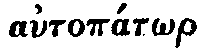
,
which, whatever is assumed as the first, must be presumed as its
antecedent;
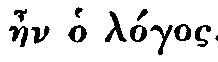
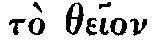
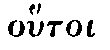
, without an article, and yet not as an
adjective. See John i. 18.
as
differenced from
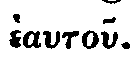
Ib.
1,
But that which is essentially causative of all being must be causative
of its own, —
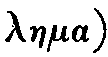
causa sui
,
. Thence
The Ipseity
The eternally self-affirmant self-affirmed; the "I Am in that I Am," or
the "I shall be that I will to be;" the Father; the relatively
subjective, whose attribute is, the Holy One; whose definition is, the
essential finific in the form of the infinite;
dat sibi fines
.
But the absolute will, the absolute good, in the eternal act of
self-affirmation, the Good as the Holy One, co-eternally begets
The Alterity
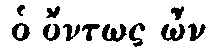
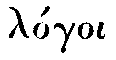
The supreme being;
; the supreme reason; the
Jehovah; the Son; the Word; whose attribute is the True (the truth, the
light, the
fiat
); and whose definition is, the
pleroma
of being,
whose essential poles are unity and distinctity; or the essential
infinite in the form of the finite; — lastly, the relatively objective,
deitas objectiva
in relation to the I Am as the
deitas subjectiva
;
the divine objectivity.
N.B. The distinctities in the
pleroma
are the eternal ideas, the
subsistential truths; each considered in itself, an infinite in the form
of the finite; but all considered as one with the unity, the eternal
Son, they are the energies of the finific;
John
i. 3 and 16.
But with the relatively subjective and the relatively objective, the
great idea needs only for its completion a co-eternal which is both,
that is, relatively objective to the subjective, relatively subjective
to the objective. Hence
The Community
The eternal life, which is love; the Spirit; relatively to the Father,
the Spirit of Holiness, the Holy Spirit; relatively to the Son, the
Spirit of truth, whose attribute is Wisdom;
sancta sophia
; the
Good in the reality of the True, in the form of actual Life. Holy! Holy!
Holy!
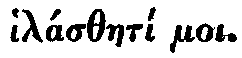
.
1831
Almighty God, by thy eternal Word my Creator, Redeemer and Preserver!
who hast in thy free communicative goodness glorified me with the
capability of knowing thee, the one only absolute Good, the eternal I
Am, as the author of my being, and of desiring and seeking thee as its
ultimate end; — who, when I fell from thee into the mystery of the false
and evil will, didst not abandon me, poor self-lost creature, but in thy
condescending mercy didst provide an access and a return to thyself,
even to thee the Holy One, in thine only begotten Son, the way and the
truth from everlasting, and who took on himself humanity, yea, became
flesh, even the man Christ Jesus, that for man he might be the life and
the resurrection! — O Giver of all good gifts, who art thyself the one
only absolute Good, from whom I have received whatever good I have,
whatever capability of good there is in me, and from thee good
alone, — from myself and my own corrupted will all evil and the
consequents of evil, — with inward prostration of will, mind, and
affections I adore thy infinite majesty; I aspire to love thy
transcendant goodness! — In a deep sense of my unworthiness, and my
unfitness to present myself before thee, of eyes too pure to behold
iniquity, and whose light, the beatitude of spirits conformed to thy
will, is a consuming fire to all vanity and corruption; — but in the name
of the Lord Jesus, of the dear Son of thy love, in whose perfect
obedience thou deignest to behold as many as have received the seed of
Christ into the body of this death; — I offer this my bounden nightly
sacrifice of praise and thanksgiving, in humble trust, that the
fragrance of my Saviour's righteousness may remove from it the taint of
my mortal corruption. Thy mercies have followed me through all the hours
and moments of my life; and now I lift up my heart in awe and
thankfulness for the preservation of my life through the past day, for
the alleviation of my bodily sufferings and languors, for the manifold
comforts which thou hast reserved for me, yea, in thy fatherly
compassion hast rescued from the wreck of my own sins or sinful
infirmities; — for the kind and affectionate friends thou hast raised up
for me, especially for those of this household, for the mother and
mistress of this family whose love to me hath been great and faithful,
and for the dear friend, the supporter and sharer of my studies and
researches; but above all, for the heavenly Friend, the crucified
Saviour, the glorified Mediator, Christ Jesus, and for the heavenly
Comforter, source of all abiding comforts, thy Holy Spirit! O grant me
the aid of thy Spirit, that I may with a deeper faith, a more enkindled
love, bless thee, who through thy Son hast privileged me to call thee
Abba, Father! O, thou who hast revealed thyself in thy holy word as a
God that hearest prayer; before whose infinitude all differences cease
of great and small; who like a tender parent foreknowest all our wants,
yet listenest well-pleased to the humble petitions of thy children; who
hast not alone permitted, but taught us, to call on thee in all our
needs, — earnestly I implore the continuance of thy free mercy, of thy
protecting providence, through the coming night. Thou hearest every
prayer offered to thee believingly with a penitent and sincere heart.
For thou in withholding grantest, healest in inflicting the wound, yea,
turnest all to good for as many as truly seek thee through Christ, the
Mediator! Thy will be done! But if it be according to thy wise and
righteous ordinances, O shield me this night from the assaults of
disease, grant me refreshment of sleep unvexed by evil and distempered
dreams; and if the purpose and aspiration of my heart be upright before
thee who alone knowest the heart of man, O in thy mercy vouchsafe me yet
in this my decay of life an interval of ease and strength; if so (thy
grace disposing and assisting) I may make compensation to thy church for
the unused talents thou hast entrusted to me, for the neglected
opportunities, which thy loving-kindness had provided. O let me be found
a labourer in the vineyard, though of the late hour, when the Lord and
Heir of the vintage, Christ Jesus, calleth for his servant.
Our Father
, &c.
To thee, great omnipresent Spirit, whose mercy is over all thy works,
who now beholdest me, who hearest me, who hast framed my heart to seek
and to trust in thee, in the name of my Lord and Saviour Christ Jesus, I
humbly commit and commend my body, soul, and spirit.
Glory be to thee, O God!
A man may pray night and day, and yet deceive himself; but no man can be
assured of his sincerity, who does not pray. Prayer is faith passing
into act; a union of the will and the intellect realizing in an
intellectual act. It is the whole man that prays. Less than this is
wishing, or lip-work; a charm or a mummery.
Pray always
, says the
Apostle; — that is, have the habit of prayer, turning your thoughts into
acts by connecting them with the idea of the redeeming God, and even so
reconverting your actions into thoughts.
Index
The best preparation for taking this sacrament, better than any or all
of the books or tracts composed for this end, is, to read over and over
again, and often on your knees — at all events, with a kneeling and
praying heart — the Gospel according to St. John, till your mind is
familiarized to the contemplation of Christ, the Redeemer and Mediator
of mankind, yea, and of every creature, as the living and
self-subsisting Word, the very truth of all true being, and the very
being of all enduring truth; the reality, which is the substance and
unity of all reality;
the light which lighteth every man
, so that
what we call reason, is itself a light from that light,
lumen a
luce
, as the Latin more distinctly expresses this fact. But it is
not merely light, but therein is life; and it is the life of Christ, the
co-eternal son of God, that is the only true life-giving light of men.
We are assured, and we believe that Christ is God; God manifested in the
flesh. As God, he must be present entire in every creature; — (for how
can God, or indeed any spirit, exist in parts?) — but he is said to dwell
in the regenerate, to come to them who receive him by faith in his name,
that is, in his power and influence; for this is the meaning of the word
'name' in Scripture when applied to God or his Christ. Where true belief
exists, Christ is not only present with or among us; — for so he is in
every man, even the most wicked; — but to us and for us.
That was the
true light, which lighteth every man that cometh into the world. He was
in the world, and the world was made by him, and the world knew him not.
But as many as received him, to them gave he power to become the sons of
God, even to them that believe in his name; which were born, not of
blood, nor of the will of the flesh, nor of the will of man, but of God.
And the Word was made flesh, and dwelt among us.
John i. 9-14.
Again
We will come unto him, and make our abode with him.
John xiv. 23.
As truly and as really as your soul resides constitutively in
your living body, so truly, really, personally, and substantially does
Christ dwell in every regenerate man.
After this course of study, you may then take up and peruse sentence by
sentence the communion service, the best of all comments on the
Scriptures appertaining to this mystery. And this is the preparation
which will prove, with God's grace, the surest preventive of, or
antidote against, the freezing poison, the lethargizing hemlock, of the
doctrine of the Sacramentaries, according to whom the Eucharist is a
mere practical metaphor, in which things are employed instead of
articulated sounds for the exclusive purpose of recalling to our minds
the historical fact of our Lord's crucifixion; in short — (the
profaneness is with them, not with me) — just the same as when
Protestants drink a glass of wine to the glorious memory of William III!
True it is, that the remembrance is one end of the sacrament; but it is,
Do this in remembrance of me
, — of all that Christ was and is,
hath done and is still doing for fallen mankind, and of course of his
crucifixion inclusively, but not of his crucifixion alone.
14 December, 1827.
Index
First then, that we may come to this heavenly feast holy, and adorned
with the wedding garment, Matt. xxii. 11, we must search our hearts,
and examine our consciences, not only till we see our sins, but until
we hate them.
But what if a man, seeing his sin, earnestly desire to hate it? Shall he
not at the altar offer up at once his desire, and the yet lingering sin,
and seek for strength? Is not this sacrament medicine as well as food?
Is it an end only, and not likewise the means? Is it merely the
triumphal feast; or is it not even more truly a blessed refreshment for
and during the conflict?
This confession of sins must not be in general terms only, that we are
sinners with the rest of mankind, but it must be a special declaration
to God of all our most heinous sins in thought, word, and deed.
Luther was of a different judgment. He would have us feel and groan
under our sinfulness and utter incapability of redeeming ourselves from
the bondage, rather than hazard the pollution of our imaginations by a
recapitulation and renewing of sins and their images in detail. Do not,
he says, stand picking the flaws out one by one, but plunge into the
river, and drown them! — I venture to be of Luther's doctrine.
Index
In the first Exhortation, before the words
'meritorious Cross and
Passion,'
I should propose to insert
'his assumption of humanity, his
incarnation, and.'
Likewise a little lower down, after the word
'sustenance,'
I would insert
'as.'
For not in that sacrament
exclusively, but in all the acts of assimilative faith, of which the
Eucharist is a solemn, eminent, and representative instance, an instance
and the symbol, Christ is our spiritual food and sustenance.
Index
Marriage, simply as marriage, is not the means
'for the procreation of
children,'
but for the humanization of the offspring procreated.
Therefore in the Declaration at the beginning, after the words,
'procreation of children,'
I would insert,
'and as the means for
securing to the children procreated enduring care, and that they may be'
&c.
Index
Third rubric at the end.
But if a man, either by reason of extremity of sickness, &c.
I think this rubric, in what I conceive to be its true meaning, a
precious document, as fully acquitting our Church of all Romish
superstition, respecting the nature of the Eucharist, in relation to the
whole scheme of man's redemption. But the latter part of it
'he doth
eat and drink the Body and Blood of our Saviour Christ profitably to his
soul's health, although he do not receive the Sacrament with his
mouth'
seems to me very incautiously expressed, and scarcely to be
reconciled with the Church's own definition of a sacrament in general.
For in such a case, where is
'the outward and visible sign of the inward
and spiritual grace given?'1
'Should it occur to any one that the doctrine blamed in the
text, is but in accordance with that of the Church of England, in her
rubric concerning spiritual communion, annexed to the Office for
Communion of the Sick: he may consider, whether that rubric, explained
(as if possible it must be) in consistency with the definition of a
sacrament in the Catechism, can be meant for any but rare and
extraordinary cases: cases as strong in regard of the Eucharist, as that
of martyrdom, or the premature death of a well-disposed catechumen, in
regard of Baptism.'
Keble's Pref. to Hooker, p. 85, n. 70. Ed.
Index
Epistle. — 1 Cor. xv. 1.
Brethren, I declare unto you the Gospel which I preached unto you.
Why should the obsolete, though faithful, Saxon translation of
be retained? Why not
'good tidings?'
Why thus change a most
appropriate and intelligible designation of the matter into a mere
conventional name of a particular book?
Ib.
how that Christ died for our sins.
But the meaning of
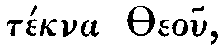
is, that Christ
died through the sins, and for the sinners. He died through our sins,
and we live through his righteousness.
Gospel, Luke xviii. 14.
This man went down to his house justified rather than the other.
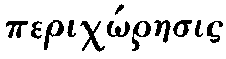
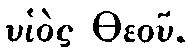
Not simply justified, observe; but justified rather than the other,
, — that is, less remote from salvation.
Index
Collect.
— that they, plenteously bringing forth the fruit of good works, may
of thee be plenteously rewarded. ...
Rather — "that with that enlarged capacity, which without thee we cannot
acquire, there may likewise be an increase of the gift, which from thee
alone we can wholly receive."
Index
v. 2.
Out of the mouth of very babes and sucklings hast thou ordained
strength, because of thine enemies; that thou mightest still the enemy
and the avenger.
To the dispensations of the twilight dawn, to the first messengers of
the redeeming word, the yet lisping utterers of light and life, a
strength and a power were given
because of the enemies
, greater
and of more immediate influence, than to the seers and proclaimers of a
clearer day: — even as the first re-appearing crescent of the eclipsed
moon shines for men with a keener brilliance, than the following larger
segments, previously to its total emersion.
Ib.
v. 5.
Thou madest him lower than the angels, to crown him with glory and
worship.
Power + idea = angel.
Idea - power = man, or Prometheus.
Index
v. 34.
Ascribe ye the power to God over Israel: his worship and strength
is in the clouds.
The 'clouds' in the symbolical language of the Scriptures mean the
events and course of things, seemingly effects of human will or chance,
but overruled by Providence.
Index
This Psalm admits no other interpretation but of Christ, as the Jehovah
incarnate. In any other sense, it would be a specimen of more than
Persian or Moghul hyperbole and bombast, of which there is no other
instance in Scripture, and which no Christian would dare to attribute to
an inspired writer. We know, too, that the elder Jewish Church ranked it
among the Messianic Psalms. N.B. The Word in St. John, and the Name of
the Most High in the Psalms, are equivalent terms.
v. 1.
Give the king thy judgments, O God; and thy righteousness unto the
king's son.
God of God, Light of Light, very God of very God, the only begotten, the
Son of God and God, King of Kings, and the Son of the King of Kings!
Index
v. 2.
O think upon thy congregation, whom thou hast purchased and
redeemed of old.
The Lamb sacrificed from the beginning of the world, the God-Man, the
Judge, the self-promised Redeemer to Adam in the garden!
v. 15.
Thou smotest the heads of Leviathan in pieces; and gavest him to be
meat for the people in the wilderness.
Does this allude to any real tradition?
The Psalm appears to have
been composed shortly before the captivity of Judah.
According to Bishop Horne, the allusion is to the
destruction of Pharaoh and his host in the Red Sea. — Ed.
Index
The reference which our Lord made to these mysterious verses, gives them
an especial interest. The first apostasy, the fall of the angels, is,
perhaps, intimated.
Index
I would fain understand this Psalm; but first I must collate it word by
word with the original Hebrew. It seems clearly Messianic.
Index
vv. 10 — 12.
Dost than shew wonders among the dead, or shall the dead rise up
again and praise thee? &c.
Compare Ezekiel xxxvii.
Index
I think the Bible version might with advantage be substituted for this,
which in some parts is scarcely intelligible.
v. 6.
the waters stand in the hills.
No;
stood above the mountains
. The reference is to the Deluge.
Index
v. 3.
Let the heart of them rejoice that seek the Lord.
If even to seek the Lord be joy, what will it be to find him? Seek me, O
Lord, that I may be found by thee!
Index
v. 2.
The Lord shall send the rod of thy power out of Sion; (saying)
Rule, &c.
v. 3. Understand:
'Thy people shall offer themselves willingly in the day of conflict in
holy clothing, in their best array, in their best arms and
accoutrements. As the dew from the womb of the morning, in number and
brightness like dew-drops; so shall be thy youth, or the youth of
thee, the young volunteer warriors.'
v. 5.
'He shall shake,'
concuss,
concutiet reges die iræ suæ,
v. 6. For
'smite in sunder, or wound, the heads;'
some word answering to the Latin
conquassare
.
v. 7. For 'therefore,' translate 'then shall he lift up his head again;'
that is, as a man languid and sinking from thirst and fatigue after
refreshment.
N.B. I see no poetic discrepancy between vv. 1 and 5.
Index
To be interpreted of Christ's church.
Index
v. 5.
As the rivers in the south.
Does this allude to the periodical rains?
As a transparency on some night of public rejoicing, seen by common day,
with the lamps from within removed — even such would the Psalms be to me
uninterpreted by the Gospel. O honored Mr. Hurwitz! Could I but make you
feel what grandeur, what magnificence, what an everlasting significance
and import Christianity gives to every fact of your national history — to
every page of your sacred records!
See Horne in loc. note. — Ed.
Index
It is mournful to think how many recent writers have criminated our
Church in consequence of their own ignorance and inadvertence in not
knowing, or not noticing, the contra-distinction here meant between
power and authority. Rites and ceremonies the Church may ordain
jure
proprio:
on matters of faith her judgment is to be received with
reverence, and not gainsaid but after repeated inquiries, and on weighty
grounds.
Index
It is lawful for Christian men, at the commandment of the magistrate,
to wear weapons, and to serve in the wars.
This is a very good instance of an unseemly matter neatly wrapped up.
The good men recoiled from the plain words:
'It is lawful for Christian men at the command of a king to slaughter
as many Christians as they can!'
Well! I could most sincerely subscribe to all these articles.
September, 1831.
Notes on Hooker1
p. 67.
Mr. Travers excepted against Mr. Hooker, for that in one of his
sermons he declared, 'That the assurance of what we believe by the
word of God, is not to us so certain as that which we perceive by
sense.' And Mr. Hooker confesseth he said so, and endeavours to
justify it by the reasons following.
There is, I confess, a shade of doubt on my mind as to this position of
Hooker's. Yet I do not deny that it expresses a truth. The question in
my mind is, only, whether it adequately expresses the whole truth. The
ground of my doubt lies in my inability to compare two things that
differ in kind. It is impossible that any conviction of the reason, even
where no act of the will advenes as a co-efficient, should possess the
vividness of an immediate object of the senses; for the vividness is
given by sensation. Equally impossible is it that any truth of the
super-sensuous reason should possess the evidence of the pure sense.
Even the mathematician does not find the same evidence in the results of
transcendental algebra as in the demonstrations of simple geometry. But
has he less assurance? In answer to Hooker's argument I say, — that God
refers to our sensible experience to aid our will by the vividness of
sensible impressions, and also to aid our understanding of the truths
revealed, — not to increase the conviction of their certainty where they
have been understood.
Index p. 2
Ib.
p. 116.
It is a strange blind story this of the last three books, and of
Hooker's live relict, the Beast without Beauty. But Saravia? — If honest
Isaac's account of the tender, confidential, even confessional,
friendship of Hooker and Saravia be accurate, how chanced it that Hooker
did not entrust the manuscripts to his friend who stood beside him in
his last moments? At all events, Saravia must have known whether they
had or had not received the author's last hand. Why were not Mr. Charke
and the other Canterbury parson called to account, or questioned at
least as to the truth of Mrs. Joan's story? Verily, I cannot help
suspecting that the doubt cast on the authenticity of the latter books
by the high church party originated in their dislike of portions of the
contents. —
short, it is a blind story, a true Canterbury tale, dear
Isaac!
Index p. 2
Pref. c. iii. 7. p. 182.
The next thing hereunto is, to impute all faults and corruptions,
wherewith the world aboundeth, unto the kind of ecclesiastical
government established.
readily would this, and indeed all the disputes respecting the
powers and constitution of Church government have been settled, or
perhaps prevented, had there been an insight into the distinct nature
and origin of the National Church and the Church under Christ!
To
the ignorance of this, all the fierce contentions between the Puritans
and the Episcopalians under Elizabeth and the Stuarts, all the errors
and exorbitant pretensions of the Church of Scotland, and the heats and
antipathies of our present Dissenters, may be demonstrably traced.
Ib.
9. p. 183.
Pythagoras, by bringing up his scholars in the speculative knowledge
of numbers, made their conceits therein so strong, that when they came
to the contemplation of things natural, they imagined that in every
particular thing they even beheld as it were with their eyes, how the
elements of number gave essence and being to the works of nature: a
thing in reason impossible; which notwithstanding, through their
mis-fashioned pre-conceit, appeared unto them no less certain, than if
nature had written it in the very foreheads of all the creatures of
God.
I am not so conversant with the volumes of Duns Scotus as to be able to
pronounce positively whether he is an exception, but I can think of no
other instance of high metaphysical genius in an Englishman. Judgment,
solid sense, invention in specialties, fortunate anticipations and
instructive foretact of truth, — in these we can shew giants. It is
evident from this example from the Pythagorean school that not even our
incomparable Hooker could raise himself to the idea, so rich in truth,
which is contained in the words
numero, pondere, et mensura
generantur cœli et terra.
, that Hooker had ever asked himself concerning will, absolute will,

,
numerus omues numeros ponens, nunquam positus!4
Ib.
p. 183.
When they of the 'Family of Love' have it once in their heads, that
Christ doth not signify any one person, but a quality whereof many are
partakers, &c.
If the Familists thought of Christ as a quality, it was a grievous error
indeed. But I have my doubts whether this was not rather an inference
drawn by their persecutors.
Ib.
15. p. 191.
When instruction doth them no good, let them feel but the least degree
of most mercifully-tempered severity, they fasten on the head of the
Lord's vicegerents here on earth, whatsoever they any where find
uttered against the cruelty of blood-thirsty men, and to themselves
they draw all the sentences which Scripture hath in favor of innocency
persecuted for the truth.
How great the influence of the age on the strongest minds, when so
eminently wise a man as Richard Hooker could overlook the obvious
impolicy of inflicting punishments which the sufferer himself will
regard as merits, and all who have any need to be deterred will extol as
martyrdom! Even where the necessity could be plausibly pretended, it is
war, not punitive law; — and then Augustine's argument for Sarah!
Ib.
c. iv. 1. p. 194.
We require you to find out but one church upon the face of the whole
earth, that hath been ordered by your discipline, or hath not been
ordered by ours, that is to say, by episcopal regiment, sithence the
time that the blessed apostles were here conversant.
Hooker was so good a man that it would be wicked to suspect him of
knowingly playing the sophist. And yet strange it is, that he should not
have been aware that it was prelacy, not primitive episcopacy, the
thing, not the name, that the reformers contended against, and, if the
Catholic Church and the national Clerisy were (as both parties unhappily
took for granted) one and the same, contended against with good reason.
Knox's ecclesiastical polity (worthy of Lycurgus), adopted bishops under
a different name, or rather under a translation instead of corruption of
the name
He would have had superintendents.
Ib.
c. v. 2. p. 204.
A law is the deed of the whole body politic, whereof if ye judge
yourselves to be any part, then is the law even your deed also.
This is a fiction of law for the purpose of giving to that, which is
necessarily empirical, the form and consequence of a science, to the
reality of which a code of laws can only approximate by compressing all
liberty and individuality into a despotism. As Justinian to Alfred, and
Constantinople, the Consuls and Senate of Rome to the Lord Mayor,
Aldermen, and Common Council of London; so is the imperial Roman code to
the common and statute law of England. The advocates of the discipline
would, according to our present notions of civil rights, have been
justified in putting fact against fiction, and might have challenged
Hooker to shew, first, that the constitution of the Church in Christ was
a congruous subject of parliamentary legislation; that the legislators
were
bona fide
determined by spiritual views, and that the
jealousy and arbitrary principles of the Queen, aided by motives of
worldly state policy, — for example, the desire of conciliating the Roman
Catholic potentates by retaining all she could of the exterior of the
Romish Church, its hierarchy, its ornaments, and its ceremonies, — were
not the substitutes for the Holy Spirit in influencing the majorities in
the two Houses of Parliament.
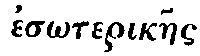
is my own belief that the Puritans and
the Prelatists divided the truth between them; and, as half-truths are
whole errors, were both equally in the wrong; — the Prelatists in
contending for that as incident to the Church in Christ, that is, the
collective number
or
ecclesia
, which
only belonged, but which rightfully did belong, to the National Church
as a component estate of the realm, the
enclesia
; — the Puritans
in requiring of the
enclesia
what was only requisite or possible
for the
ecclesia
. Archbishop Grindal is an illustrious
exception. He saw the whole truth, and that the functions of the
enclesiastic and those of the ecclesiastic were not the less distinct,
because both were capable of being exercised by the same person; and
vice versa
, not the less compatible in the same subject because
distinct in themselves. The Lord Chief Justice of the King's Bench is a
Fellow of the Royal Society.
It is difficult to say, which most shines through this whole passage,
the spirit of wisdom or the spirit of meekness. The fatal error of the
Romish Church did not consist in the inappellability of the Councils, or
that an acquiescence in their decisions and decree was a duty binding on
the conscience of the dissentients, — not I say in contending for a
practical infallibility of Council or Pope; but in laying claim to an
actual and absolute immunity from error, and consequently for the
unrepealability of their decisions by any succeeding Council or Pope.
Hence, even wise decisions — wise under the particular circumstances and
times — degenerated into mischievous follies, by having the privilege of
immortality without any exemption from the dotage of superannuation.
Hence errors became like
glaciers
, or ice-bergs in the frozen
ocean, unthawed by summer, and growing from the fresh deposits of each
returning winter.
Ib.
6. p. 212.
An argument necessary and demonstrative is such, as being proposed
unto any man, and understood, the mind cannot choose but inwardly
assent. Any one such reason dischargeth, I grant, the conscience, and
setteth it at full liberty.
I would not concede even so much as this. It may well chance that even
an argument demonstrative, if understood, may be adducible against some
one sentence of a whole liturgy; and yet the means of removing it
without a palpable overbalance of evil may not exist for a time; and
either there is no command against schism, or we are bound in such small
matters to offer the sacrifice of willing silence to the public peace of
the Church. This would not, however, prevent a minister from pointing
out the defect in his character as a doctor or learned theologian.
Ib.
c. viii. 1. p. 2-20.
For adventuring to erect the discipline of Christ without the leave of
the Christian magistrate, haply ye may condemn us as fools, in that we
hazard thereby our estates and persons further than you which are that
way more wise think necessary: but of any offence or sin therein
committed against God, with what conscience can you accuse us, when
your own positions are, that the things we observe should every of
them be dearer unto us than ten thousand lives; that they are the
peremptory commandments of God; that no mortal man can dispense with
them, and that the magistrate grievously sinneth in not constraining
thereunto?
Hoc argumentum ad invidiam nimis sycophanticum est quam ut mihi
placeat a tanto viro
. Besides, it contradicts Hooker's own very
judicious rule, that to discuss and represent is the office of the
learned, as individuals, because the truth may be entire in any one
mind; but to do belongs to the supreme power as the will of the whole
body politic, and in effective action individuals are mere fractions
without any legitimate referee to add them together. Hooker's objection
from the nobility and gentry of the realm is unanswerable and within
half a century afterwards proved insurmountable. Imagine a sun
containing within its proper atmosphere a multitude of transparent
satellites, lost in the glory, or all joining to form the visible
phasis
or disk; and then beyond the precincts of this sun a
number of opake bodies at various distances, and having a common center
of their own round which they revolve, and each more or less according
to the lesser or greater distance partaking of the light and natural
warmth of the sun, which I have been supposing; but not sharing in its
peculiar influences, or in the solar life sustainable only by the vital
air of the solar atmosphere. The opake bodies constitute the national
churches, the sun the churches spiritual.
The defect of the simile, arising necessarily out of the
incompossibility of spiritual prerogatives with material bodies under
the proprieties and necessities of space, is, that it does not, as no
concrete or visual image can, represent the possible duplicity of the
individuals, the aggregate of whom constitutes the national church, so
that any one individual, or any number of such individuals, may at the
same time be, by an act of their own, members of the church spiritual,
and in every congregation may form an
ecclesia
or Christian
community; and how to facilitate and favor this without any schism from
the
enclesia
, and without any disturbance of the body politic,
was the problem which Grindal and the bishops of the first generation of
the Reformed Church sought to solve, and it is the problem which every
earnest Christian endued with competent gifts, and who is at the same
time a patriot and a philanthropist, ought to propose to himself, as the
ingens desiderium proborum
.
8th Sept, 1826.
Ib.
c. viii. 7. p. 232.
Baptizing of infants, although confessed by themselves, to have been
continued ever sithence the very apostles' own times, yet they
altogether condemned.
Quære
. I cannot say what the fanatic Anabaptists, of whom Hooker
is speaking, may have admitted; but the more sober and learned
Antipaedobaptists, who differed in this point only from the reformed
churches, have all, I believe, denied the practice of infant baptism
during the first century.
B.J. c. ii. 1. p. 249.
That which doth assign unto each thing the kind, that which doth
moderate the force and power, that which doth appoint the form and
measure, of working, the same we term a law.
the essays on method, in the
Friend
. Hooker's words literally
and grammatically interpreted seem to assert the antecedence of the
thing to its kind, that is, to its essential characters; — and to its
force together with its form and measure of working, that is, to its
specific and distinctive characters; in short, the words assert the
pre-existence of the thing to all its constituent powers, qualities, and
properties.
this is either — first, equivalent to the assertion of a
prima et nuda materia
, so happily ridiculed by the author of
Hudibras
, and which under any scheme of cosmogony is a mere phantom,
having its whole and sole substance in an impotent effort of the
imagination or sensuous fancy, but which is utterly precluded by the
doctrine of creation which it in like manner negatives: — or secondly,
the words assert a self-destroying absurdity, namely, the antecedence
of a thing to itself; as if having asserted that water consisted of
hydrogen = 77, and oxygen = 23, I should talk of water as existing before
the creation of hydrogen and oxygen. All laws, indeed, are constitutive;
and it would require a longer train of argument than a note can contain,
to shew what a thing is; but this at least is quite certain, that in the
order of thought it must be posterior to the law that constitutes it.
But such in fact was Hooker's meaning, and the word, thing, is used
proleptice
in favour of the imagination, as appears from the
sentences that follow, in which the creative idea is declared to be the
law of the things thereby created. A productive idea, manifesting itself
and its reality in the product is a law; and when the product is
phænomenal, (that is, an object of the outward senses) it is a law of
nature.
law is
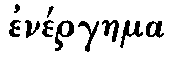
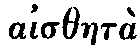
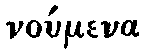
res noumenon
; the thing is
res
phenomenon
A physical law, in the right sense of the term, is the
sufficient cause of the appearance, —
causa sub-faciens
.
P.S. What a deeply interesting volume might be written on the symbolic
import of the primary relations and dimensions of space — long, broad,
deep, or depth; surface; upper, under, above and below, right, left,
horizontal, perpendicular, oblique: — and then the order of causation, or
that which gives intelligibility, and the reverse order of effects, or
that which gives the conditions of actual existence! Without the higher
the lower would want its intelligibility: without the lower the higher
could not have existed. The infant is a riddle of which the man is the
solution; but the man could not exist but with the infant as his
antecedent.
Ib.
2. p. 250.
In which essential Unity of God, a Trinity personal nevertheless
subsisteth, after a manner far exceeding the possibility of man's
conceit.
If 'conceit' here means conception, the remark is most true; for the
Trinity is an idea, and no idea can be rendered by a conception. An idea
is essentially inconceivable. But if it be meant that the Trinity is
otherwise inconceivable than as the divine eternity and every attribute
of God is and must be, then neither the commonness of the language here
used, nor the high authority of the user, can deter me from denouncing
it as untrue and dangerous. So far is it from being true, that on the
contrary, the Trinity is the only form in which an idea of God is
possible, unless indeed it be a Spinosistic or World-God.
Ib.
c. iv. 1. p. 264.
But now that we may lift up our eyes (as it were) from the footstool
to the throne of God, and leaving these natural, consider a little the
state of heavenly and divine, creatures: touching angels which are
spirits immaterial and intellectual, &c.
All this disquisition on the angels confirms my remark that our
admirable Hooker was a giant of the race Aristotle
versus
Plato.
Hooker was truly judicious, — the consummate
synthesis
of
understanding and sense. An ample and most ordonnant conceptionist, to
the tranquil empyrean of ideas he had not ascended. Of the passages
cited from Scripture how few would bear a strict scrutiny; being either,
- divine appearances, Jehovah in human form; or
- the imagery of visions and all symbolic; or
- names of honor given to prophets,
apostles, or bishops; or lastly,
- mere accommodations to popular notions!
Ib.
3. p. 267.
Since their fall, their practices have been the clean contrary unto
those before mentioned. For being dispersed, some in the air, some on
the earth, some in the water, some among the minerals, dens, and
caves, that are under the earth; they have, by all means laboured to
effect a universal rebellion against the laws, and as far as in them
lieth, utter destruction of the works of God.
Childish; but the childishness of the age, without which neither Hooker
nor Luther could have acted on their contemporaries with the intense and
beneficent energy with which, they (God be praised!) did act.
Ib.
p. 268.
Thus much therefore may suffice for angels, the next unto whom in
degree are men.
St. Augustine well remarks that only three distinct
genera
of
living beings are conceivable:
- the infinite rational:
- the finite rational:
- the finite irrational:
that is, God, man, brute animal.
Ergo
, angels can only be with
wings on their shoulders. Were our bodies transparent to our souls, we
should be angels.
Ib.
c. x. 4. p. 303.
It is no improbable opinion therefore which the arch-philosopher was
of.
There are, and can be, only two schools of philosophy, differing in kind
and in source. Differences in degree and in accident, there may be many;
but these constitute schools kept by different teachers with different
degrees of genius, talent, and learning; — auditories of philosophizers,
not different philosophies. Schools of psilology (the love of empty
noise) and misosophy are here out of the question. Schools of real
philosophy there are but two, — best named by the arch-philosopher of
each, namely, Plato and Aristotle.
man capable of philosophy at
all (and there are not many such) is a born Platonist or a born
Aristotelian
. Hooker, as may be discerned from the epithet of
arch-philosopher applied to the Stagyrite,
sensu monarchico
, was
of the latter family, — a comprehensive, vigorous, discreet, and
discretive conceptualist, — but not an ideist.
Ib.
8. p. 308.
Of this point therefore we are to note, that sith men naturally have
no free and perfect power to command whole politic multitudes of men,
therefore utterly without our consent, we could in such sort be at no
man's commandment living. And to be commanded we do consent, when that
society whereof we are part hath at any time before consented, without
revoking the same after by the like universal agreement. Wherefore as
any man's deed past is good as long as himself continueth; so the act
of a public society of men done five hundred years sithence standeth
as theirs who presently are of the same societies, because
corporations are immortal; we were then alive in our predecessors, and
they in their successors do live still. Laws therefore human, of what
kind soever, are available by consent.
No nobler or clearer example than this could be given of what an idea is
as contra-distinguished from a conception of the understanding,
correspondent to some fact or facts,
quorum notæ communes
concapiuntur
, — the common characters of which are taken together
under one distinct exponent, hence named a conception; and conceptions
are internal subjective words. Reflect on an original social contract,
as an event or historical fact; and its gross improbability, not to say
impossibility, will stare you in the face.
an ever originating
social contract as an idea, which exists and works continually and
efficaciously in the moral being of every free citizen, though in the
greater number unconsciously, or with a dim and confused
consciousness, — what a power it is!
As the vital power
compared with the mechanic; as a father compared with a moulder in wax
or clay, such is the power of ideas compared with the influence of
conceptions and notions.
Ib.
15. p. 316.
I nothing doubt but that Christian men should much better frame
themselves to those heavenly precepts, which our Lord and Saviour with
so great instancy gave us concerning peace and unity, if we did all
concur in desire to have the use of ancient Councils again renewed,
rather than these proceedings continued, which either make all
contentions endless, or bring them to one only determination, and that
of all other the worst, which is by sword.
This is indeed a subject that deserves a serious consideration: and it
may be said in favour of Hooker's proposal, namely, that the use of
ancient Councils be renewed, that a deep and universal sense of the
abuse of Councils progressively from the Nicene to that of Trent, and
our knowledge of the causes, occasions, and mode of such abuse, are so
far presumptive for its non-recurrency as to render it less probable
that honest men will pervert them from ignorance, and more difficult for
unprincipled men to do so designedly. Something too must be allowed for
an honourable ambition on the part of the persons so assembled, to
disappoint the general expectation, and win for themselves the unique
title of the honest Council. But still comes the argument, the blow of
which I might more easily blunt than parry, that if Roman Catholic and
Protestant, or even Protestant Episcopalian and Protestant Presbyterian
divines were generally wise and charitable enough to form a Christian
General Council, there would be no need of one.
N.B. The reasoning in this note, as far as it is in discouragement of a
recurrence to general Councils, does not,
me saltem judice
,
conclude against the suffering our Convocation to meet. The virtual
abrogation of this branch of our constitution I have long regarded as
one of three or four Whig patriotisms, that have succeeded in
de-anglicizing the mind of England.
Ib.
c. xi. 4. p. 323.
So that nature even in this life doth plainly claim and call for a
more divine perfection than either of these two that have been
mentioned.
Whenever I meet with an ambiguous or multivocal word, without its
meaning being shown and fixed, I stand on my guard against a sophism. I
dislike this term, 'nature,' in this place. If it mean the
light that
lighteth every man that cometh into the world
, it is an inapt term;
for reason is supernatural. Now that reason in man must have been first
actuated by a direct revelation from God, I have myself proved, and do
not therefore deny that faith as the means of salvation was first made
known by revelation; but that reason is incapable of seeing into the
fitness and superiority of these means, or that it is a mystery in any
other sense than as all spiritual truths are mysterious, I do deny and
deem it both a false and a dangerous doctrine.
15 Sept. 1826.
Ib.
6. p. 327.
Concerning that faith, hope and charity, without which there can be no
salvation; was there ever any mention made saving only in that law
which God himself hath from heaven revealed? There is not in the world
a syllable muttered with certain truth concerning any of these three,
more than hath, been supernaturally received from the mouth of the
eternal God.
That reason could have discovered these divine truths is one thing; that
when discovered by revelation, it is capable of apprehending the beauty
and excellence of the things revealed is another. I may believe the
latter, while I utterly reject the former. That all these cognitions,
together with the fealty or faithfulness in the will whereby the mind of
the flesh is brought under captivity to the mind of the spirit (the
sensous understanding to the reason) are supernatural, I not only freely
grant, but fervently contend. But why the very perfection of reason,
namely, those ideas or truth-powers, in which both the spiritual light
and the spiritual life are co-inherent and one, should be called
super-rational, I do not see. For reason is practical as well as
theoretical; or even though I should exclude the practical reason, and
confine the term reason to the highest intellective power, — still I
should think it more correct to describe the mysteries of faith as
plusquam rationalia
than super-rational. But the assertions that
provoke the remark arose for the greater part, and still arise, out of
the confounding of the reason with the understanding. In Hooker, and the
great divines of his age, it was merely an occasional carelessness in
the use of the terms that reason is ever put where they meant the
understanding; for, from other parts of their writings, it is evident
that they knew and asserted the distinction, nay, the diversity of the
things themselves; to wit, that there was in man another and higher
light than that of the faculty judging according to sense, that is our
understandings. But, alas! since the Revolution, it has ceased to be a
mere error of language, and in too many it now amounts to a denial of
reason!
B. ii. c. v. 3. p. 379.
To urge any thing as part of that supernatural and celestially
revealed truth which God hath taught, and not to shew it in Scripture;
this did the ancient Fathers evermore think unlawful, impious,
execrable.
Even this must be received
cum grano salis.
To be sure, with the
licences of interpretation, which the Fathers of the first three or four
centuries allowed themselves, and with the
arcana
of evolution by
word, letter, allegory, yea, punning, which they applied to detached
sentences or single phrases of Holy Writ, it would not be easy to
imagine a position which they could not 'shew in Scripture.' Let this be
elucidated by the texts even now cited by the Romish priests for the
truth of purgatory, indulgence, image-worship, invocation of dead men,
and the like. The assertion therefore must be thus qualified. The
ancient Fathers anathematized any doctrine not consentaneous with
Scripture and deducible from it, either
pari ratione
or by
consequence; as when Scripture clearly commands an end, but leaves the
means to be determined according to the circumstances, as for example,
the frequent assembly of Christians. The appointment of a Sunday or
Lord's day is evidently the fittest and most effectual mean to this end;
but yet it was not practicable, that is the mean did not exist till the
Roman government became Christian. But as soon as this event took place,
the duty of keeping the Sunday holy is truly, though implicitly,
contained in the Apostolic text.
Ib.
vi. 3. p. 392.
Again, with a negative argument, David is pressed concerning the
purpose he had to build a temple unto the Lord: Thus saith the
Lord, Thou shalt not build me a house to dwelt in. Wheresoever I have
walked with all Israel, spake I one word to any of the judges of
Israel, whom I commanded to feed my people, saying, Why have ye not
built me a house?
The wisdom of the divine goodness both in the negative, the not having
authorized any of the preceding Judges from Moses downwards to build a
temple — and in the positive, in having commanded David to prepare for
it, and Solomon to build it — I have not seen put in the full light in
which it so well deserves to be. The former or negative, or the evils of
a splendid temple-worship and its effects on the character of the
priesthood, — evils, when not changed to good by becoming the antidote
and preventive of far greater evils, — would require much thought both to
set forth and to comprehend. But to give any reflecting reader a sense
of the providential foresight evinced in the latter, and this foresight
beyond the reach of any but the Omniscient, it will be only necessary to
remind him of the separation of the ten tribes and the breaking up of
the realm into the two kingdoms of Judah and Israel in the very next
reign. Without the continuity of succession provided for by this vast
and splendid temple, built and arranged under the divine sanction
attested by miracles — what criterion would there have existed for the
purity of this law and worship? what security for the preservation and
incorruption of the inspired writings?
Ib.
vii. 3. p. 403.
That there is a city of Rome, that Pius Quintus and Gregory the
Thirteenth, and others, have been Popes of Rome, I suppose we are
certainly enough persuaded. The ground of our persuasion, who never
saw the place nor persons before named, can be nothing but man's
testimony. Will any man here notwithstanding allege those mentioned
human infirmities as reasons why these things should be mistrusted or
doubted of? Yea, that which is more, utterly to infringe the force and
strength of man's testimony, were to shake the very fortress of God's
truth.
a note on a passage in Skelton's
Deism Revealed
, I have detected
the subtle sophism that lurks in this argument, as applied by later
divines in vindication of proof by testimony, in relation to the
miracles of the Old and New Testament. As thus applied, it is a
though so unobvious, that a very acute and
candid reasoner might use the argument without suspecting the
paralogism. It is not testimony, as testimony, that necessitates us to
conclude that there is such a city as Rome — but a reasoning, that forms
a branch of mathematical science. So far is our conviction from being
grounded on our confidence in human testimony that it proceeds on our
knowledge of its fallible character, and therefore can find no
sufficient reason for its coincidence on so vast a scale, but in the
real existence of the object. That a thousand lies told by as many
several and unconnected individuals should all be one and the same, is a
possibility expressible only by a fraction that is already, to all
intents and purposes, equal to nought.
B. iii. c. iii. 1. p. 447.
The mixture of those things by speech, which by nature are divided, is
the mother of all error.
'The division in thought of those things which in nature are distinct,
yet one, that is, distinguished without breach of unity, is the
mother,' — so I should have framed the position. Will, reason,
life, — ideas in relation to the mind, are instances;
entiæ indivise
interdistinctæ;
and the main arguments of the atheists,
materialists, deniers of our Lord's divinity and the like, all rest on
the asserting of division as a necessary consequence of distinction.
B. v. c. xix. 3. vol. ii. p. 87.
Of both translations the better I willingly acknowledge that which
cometh nearer to the very letter of the original verity; yet so that
the other may likewise safely enough be read, without any peril at all
of gainsaying as much as the least jot or syllable of God's most
sacred and precious truth.
Hooker had far better have rested on the impossibility and the
uselessness, if possible, of a faultless translation; and admitting
certain mistakes, and oversights, have recommended them for notice at
the next revision; and then asked, what objection such harmless trifles
could be to a Church that never pretended to infallibility! But in fact
the age was not ripe enough even for a Hooker to feel, much less with
safety to expose, the Protestants' idol, that is, their Bibliolatry.
Ib.
c. xxii. 10. p. 125.
Their only proper and direct proof of the thing in question had been
to shew, in what sort and how far man's salvation doth necessarily
depend upon the knowledge of the word of God; what conditions,
properties, and qualities there are, whereby sermons are distinguished
from other kinds of administering the word unto that purpose; and what
special property or quality that is, which being no where found but in
sermons, maketh them effectual to save souls, and leaveth all other
doctrinal means besides destitute of vital efficacy.
Doubtless, Hooker was a theological Talus, with a club of iron against,
opponents with pasteboard helmets, and armed only with crabsticks! But
yet, I too, too often find occasion to complain of him as abusing his
superior strength. For in a good man it is an abuse of his intellectual
superiority, not to use a portion of it in stating his Christian
opponents' cause, his brethren's (though dissentient, and perhaps
erring, yet still brethren's,) side of the question, not as they had
stated and argued it, but as he himself with his higher gifts of logic
and foresight could have set it forth. But Hooker flies off to the
general, in which he is unassailable; and does not, as in candour he
should have done, inquire whether the question would not admit of, nay,
demand, a different answer, when applied solely or principally to the
circumstances, the condition and the needs of the English parishes, and
the population at large, at the particular time when the Puritan divines
wrote, and he, Hooker, replied to them. Now let the cause be tried in
this way, and I should not be afraid to attempt the proof of the
paramount efficacy of preaching on the scheme, and in the line of
argument laid down by himself in this section. In short, Hooker
frequently finds it convenient to forget the homely proverb; 'the proof
of the pudding is in the eating.' Whose parishes were the best
disciplined, whose flocks the best fed, the soberest livers, and the
most awakened and best informed Christians, those of the zealous
preaching divines, or those of the prelatic clergy with their readers?
In whose churches and parishes were all the other pastoral duties,
catechizing, visiting the poor and the like, most strictly practised?
Ib.
11.
The people which have no way to come to the knowledge of God, no
prophesying, no teaching, perish. But that they should of necessity
perish, where any one way of knowledge lacketh, is more than the words
of Solomon import.
But what was the fact? Were those congregations that had those readers
of whom the Puritans were speaking — were they, I say, equally well
acquainted with, and practically impressed by, the saving truths of the
Gospel? Were they not rather perishing for lack of knowledge? To
reply, — It was their own fault; they ought to have been more regular in
their attendance at church, and more attentive, when there, to what was
there read, — is to my mind too shocking, nay, antichristian.
Ib.
16. p.137.
Now all these things being well considered, it shall be no intricate
matter for any man to judge with indifferency, on which part the good
of the church is most conveniently sought; whether on ours, whose
opinion is such as hath been shewed, or else on theirs, who leaving no
ordinary way of salvation for them unto whom the word of God is but
only read, do seldom name them but with great disdain and contempt,
who execute that service in the church of Christ.
If so, they were much to be blamed. But surely this was not the case
with the better and wiser part of those who, clinging to the tenets and
feelings of the first Reformers, and honouring Archbishop Grindal as
much as they dreaded his Arminian successors, were denominated Puritans!
They limited their censures to exclusive reading, — to reading as the
substitute for, and too often for the purpose of doing away with,
preaching.
Ib.
lxv. 8. p. 415.
Thus was the memory of that sign which they had in baptism a kind of
bar or prevention to keep them even from apostasy, whereinto the
frailty of flesh and blood, overmuch fearing to endure shame, might
peradventure the more easily otherwise have drawn them.
I begin to fear that Hooker is not suited to my nature. I cannot bear
round-abouts for the purpose of evading the short cut straight before my
eyes.
Exempli gratia;
I find myself tempted in this place to
ejaculate Psha! somewhat abruptly, and ask, 'How many in twenty millions
of Christian men and women ever reverted to the make-believe impression
of the Cross on their forehead in unconscious infancy, by the wetted tip
of the clergyman's finger as a preservative against anger and
resentment? 'The whole church of God!' Was it not the same church which,
neglecting and concealing the Scriptures of God, introduced the
adoration of the Cross, the worshipping of relics, holy water, and all
the other countless mummeries of Popery? Something might be pretended
for the material images of the Cross worn at the bosom or hung up in the
bed-chamber. These may, and doubtless often do, serve as silent
monitors; but this eye-falsehood or pretence of making a mark that is
not made, is a gratuitous superstition, that cannot be practised without
serious danger of leading the vulgar to regard it as a charm. Hooker
should have asked — Has it hitherto had this effect on Christians
generally? Is it likely to produce this effect and this principally? In
common honesty he must have answered, No! — Do I then blame the Church of
England for retaining this ceremony? By no means. I justify it as a wise
and pious condescension to the inveterate habits of a people newly
dragged, rather than drawn, out of Papistry; and as a pledge that the
founders and fathers of the Reformation in England regarded innovation
as
per se
an evil, and therefore requiring for its justification
not only a cause, but a weighty cause. They did well and piously in
deferring the removal of minor spots and stains to the time when the
good effects of the more important reforms had begun to shew themselves
in the minds and hearts of the laity. — But they do not act either wisely
or charitably who would eulogize these
maculæ
as beauty-spots and
vindicate as good what their predecessors only tolerated as the lesser
evil.
12th Aug. 1826.
Ib.
15. p. 424.
For in actions of this kind we are more to respect what the greatest
part of men is commonly prone to conceive, than what some few men's
wits may devise in construction of their own particular meanings.
Plain it is, that a false opinion of some personal divine excellency
to be in those things which either nature or art hath framed causeth
always religious adoration.
How strongly might this most judicious remark be turned against Hooker's
own mode of vindicating this ceremony!
Ib.
lxvi. 2. p. 432.
The Church had received from Christ a promise that such as have
believed in him these signs and tokens should follow them.
'To cast
out devils, to speak with tongues, to drive away serpents, to be free
from the harm which any deadly poison could work, and to cure diseases
by imposition of hands.'
Mark xvi.
The man who verily and sincerely believes the narrative in St. John's
Gospel of the feeding of five thousand persons with a few loaves and
small fishes, and of the raising of Lazarus, in the plain and literal
sense, cannot be reasonably suspected of rejecting, or doubting, any
narrative concerning Christ and his Apostles, simply as miraculous. I
trust, therefore, that no disbelief of, or prejudice against, miraculous
events and powers will be attributed to me, as the ground or cause of my
strong persuasion that the latter verses of the last chapter of St.
Mark's Gospel were an additament of a later age, for which St. Luke's
Acts of the Apostles misunderstood supplied the hints.
Ib.
lxxii. 15 & 16. p.539.
If Richard Hooker had written only these two precious paragraphs, I
should hold myself bound to thank the Father of lights and Giver of all
good gifts for his existence and the preservation of his writings.
B. viii. c. ix. 2. vol. iii. p. 537.
As there could be in natural bodies no motion of anything, unless
there were some which moveth all things, and continueth immoveable;
even so in politic societies, there must be some unpunishable, or else
no man shall suffer punishment.
It is most painful to connect the venerable, almost sacred, name of
Richard Hooker with such a specimen of puerile sophistry, scarcely
worthy of a court bishop's trencher chaplain in the slavering times of
our Scotch Solomon. It is, however, of some value, some interest at
least, as a striking example of the confusion of an idea with a
conception. Every conception has its sole reality in its being referable
to a thing or class of things, of which, or of the common characters of
which, it is a reflection. An idea is a power,
which constitutes its own reality, and is in order of thought
necessarily antecedent to the things in which it is more or less
adequately realized, while a conception is as necessarily posterior.
Index p. 2
Vol. iii. p. 583.
The following truly admirable discourse is, I think, the concluding
sermon of a series unhappily not preserved.
Ib.
p.584.
If it were so in matters of faith, then, as all men have equal
certainty of this, so no believer should be more scrupulous and
doubtful than another. But we find the contrary. The angels and
spirits of the righteous in heaven have certainty most evident of
things spiritual: but this they have by the light of glory. That which
we see by the light of grace, though it be indeed more certain; yet it
is not to us so evidently certain, as that which sense or the light of
nature will not suffer a man to doubt of.
Hooker's meaning is right; but he falls into a sad confusion of words,
blending the thing and the relation of the mind to the thing. The fourth
moon of Jupiter is certain in itself; but evident only to the astronomer
with his telescope.
Ib.
p. 585-588.
The other, which we call the certainty of adherence, is when the heart
doth cleave and stick unto that which it doth believe. This certainty
is greater in us than the other ... (down to) the fourth
question resteth, and so an end of this point.
These paragraphs should be written in gold. O! may these precious words
be written on my heart!
- That we all need to be redeemed, and that therefore we are all in
captivity to an evil:
- That there is a Redeemer:
- That the redemption relatively to each individual captive is, if not
effected under certain conditions, yet manifestable as far as is fitting
for the soul by certain signs and consequents: — and
- That these signs are in myself; that the conditions under which the
redemption offered to all men is promised to the individual, are
fulfilled in myself;
these are the four great points of faith, in which the humble Christian
finds and feels a gradation from trembling hope to full assurance; yet
the will, the act of trust, is the same in all. Might I not almost say,
that it rather increases with the decrease of the consciously discerned
evidence? To assert that I have the same assurance of mind that I am
saved as that I need a Saviour, would be a contradiction to my own
feelings, and yet I may have an equal, that is, an equivalent assurance.
How is it possible that a sick man should have the same certainty of his
convalescence as of his sickness? Yet he may be assured of it. So again,
my faith in the skill and integrity of my physician may be complete, but
the application of it to my own case may be troubled by the sense of my
own imperfect obedience to his prescriptions. The sort of our beliefs
and assurances is necessarily modified by their different subjects. It
argues no want of saving faith on the whole, that I cannot have the same
trust in myself as I have in my God. That Christ's righteousness can
save me, — that Christ's righteousness alone can save — these are simple
positions, all the terms of which are steady and copresent to my mind.
But that I shall be so saved, — that of the many called I have been one
of the chosen, — this is no mere conclusion of mind on known or assured
premisses. I can remember no other discourse that sinks into and draws
up comfort from the depths of our being below our own distinct
consciousness, with the clearness and godly loving-kindness of this
truly evangelical God-to-be-thanked-for sermon. But how large, how
important a part of our spiritual life goes on like the circulation,
absorptions, and secretions of our bodily life, unrepresented by any
specific sensation, and yet the ground and condition of our total sense
of existence!
While I feel, acknowledge, and revere the almost measureless superiority
of the sermons of the divines, who labored in the first, and even the
first two centuries of the Reformation, from Luther to Leighton, over
the prudential morals and apologizing theology that have characterized
the unfanatical clergy since the Revolution in 1688, I cannot but regret,
especially while I am listening to a Hooker, that they withheld all
light from the truths contained in the words 'Satan', 'the Serpent', 'the
Evil Spirit', and this last used plurally.
Index p. 2
Ib.
s. 31. p. 659-661.
But we say, our salvation is by Christ alone; therefore howsoever, or
whatsoever, we add unto Christ in the matter of salvation, we
overthrow Christ. Our case were very hard, if this argument, so
universally meant as it is proposed, were sound and good. We ourselves
do not teach Christ alone, excluding our own faith, unto
justification; Christ alone, excluding our own work, unto
sanctification; Christ alone, excluding the one or the other as
unnecessary unto salvation. ... As we have received, so we teach that
besides the bare and naked work, wherein Christ, without any other
associate, finished all the parts of our redemption and purchased
salvation himself alone; for conveyance of this eminent blessing unto
us, many things are required, as, to be known and chosen of God
before the foundations of the world; in the world to be
called, justified, sanctified; after we have left the world to
be received into glory; Christ in every of these hath somewhat which
he worketh alone. &c. &c.
No where out of the Holy Scripture have I found the root and pith of
Christian faith so clearly and purely propounded as in this section.
God, whose thoughts are eternal, beholdeth the end, and in the completed
work seeth and accepteth every stage of the process. I dislike only the
word 'purchased;' — not that it is not Scriptural, but because a metaphor
well and wisely used in the enforcement and varied elucidation of a
truth, is not therefore properly employed in its exact enunciation. I
will illustrate, amplify and
divide
the word with Paul; but I
will propound it collectively with John. If in this admirable passage
aught else dare be wished otherwise, it is the division and yet
confusion of time and eternity, by giving an anteriority to the latter.
I am persuaded, that the practice of the Romish church tendeth to make
vain the doctrine of salvation by faith in Christ alone; but judging by
her most eminent divines, I can find nothing dissonant from the truth in
her express decisions on this article. Perhaps it would be safer to
say: — Christ alone saves us, working in us by the faith which includes
hope and love.
Ib.
s. 34. p. 671.
If it were not a strong deluding spirit which hath possession of their
hearts; were it possible but that they should see how plainly they do
herein gainsay the very ground of apostolic faith?... The Apostle, as
if he had foreseen how the Church of Rome would abuse the world in
time by ambiguous terms, to declare in what sense the name of grace
must be taken, when we make it the cause of our salvation, saith,
He saved us according to his mercy, &c.
In all Christian communities there have been and ever will be too many
Christians in name only; — too many in belief and notion only: but
likewise, I trust, in every acknowledged Church, Eastern or Western,
Greek, Roman, Protestant, many of those in belief, more or less
erroneous, who are Christians in faith and in spirit.
I neither do
nor can think, that any pious member of the Church of Rome did ever in
his heart attribute any merit to any work as being his work.
A
grievous error and a mischievous error there was practically in mooting
the question at all of the condignity of works and their rewards. In
short, to attribute merit to any agent but God in Christ, our faith as
Christians forbids us; and to dispute about the merit of works
abstracted from the agent, common sense ought to forbid us.
Index p. 2
Ib.
p. 698.
I said directly and plainly to all men's understanding, that it was
not indeed to be doubted, but many of the Fathers were saved; but the
means, said I, was not their ignorance, which excuseth no man with
God, but their knowledge and faith of the truth, which, it appeareth,
God vouchsafed them, by many notable monuments and records extant of
it in all ages.
certainly, if the ignorance proceeded directly or indirectly from a
defect or sinful propensity of the will; but where no such cause is
imaginable, in such cases this position of Master Travers is little less
than blasphemous to the divine goodness, and in direct contradiction to
an assertion of St. Paul's
, and to an evident consequence from our
Saviour's own words on the polygamy of the fathers.
Index p. 2
Ib.
p. 719.
The next thing discovered, is an opinion about the assurance of men's
persuasion in matters of faith. I have taught, he saith, 'That the
assurance of things which we believe by the word, is not so certain as
of that we perceive by sense.'
A useful instance to illustrate the importance of distinct, and the
mischief of equivocal or multivocal, terms. Had Hooker said that the
fundamental truths of religion, though perhaps even more certain, are
less evident than the facts of sense, there could have been no
misunderstanding. Thus the demonstrations of algebra possess equal
certainty with those of geometry, but cannot lay claim to the same
evidence. Certainty is positive, evidence relative; the former, strictly
taken, insusceptible of more or less, the latter capable of existing in
many different degrees.
Writing a year or more after the preceding note, I am sorry to say that
Hooker's reasoning on this point seems to me sophistical throughout.
That a man must see what he sees is no persuasion at all, nor bears the
remotest analogy to any judgment of the mind. The question is, whether
men have a clearer conception and a more stedfast conviction of the
objective reality to which the image moving their eye appertains, than
of the objective reality of the things and states spiritually discovered
by faith. And this Travers had a right to question wherever a saving
faith existed.
August, 1826.
Index p. 2
Ib.
p. 801.
In spirit I am with you to the world's end.
O how grateful should I be to be made intuitive of the truth intended in
the words —
In spirit I am with you!
Ib.
p. 808.
Touching the latter affection of fear, which respecteth evils to come,
as the other which we have spoken of doth present evils; first, in the
nature thereof it is plain that we are not every future evil afraid.
Perceive we not how they, whose tenderness shrinketh at the least rase
of a needle's point, do kiss the sword that pierceth their souls quite
thorow?
In this and in sundry similar passages of this venerable writer there is
a very plausible, but even therefore the
more dangerous, sophism; but the due detection and exposure of which
would exceed the scanty space of a marginal comment. Briefly, what does
Hooker comprehend in the term 'pain?' Whatsoever the soul finds adverse
to her well being, or incompatible with her free action? In this sense
Hooker's position is a mere truism. But if pain be applied exclusively
to the soul finding itself as life, then it is an error.
Ib.
p. 811.
Fear then in itself being mere nature cannot in itself be sin, which
sin is not nature, but therefore an accessary deprivation.
I suspect a misprint, and that it should be
depravation
. But if
not nature, then it must be a super-induced and incidental depravation
of nature. The principal, namely fear, is nature; but the sin, that is,
that it is a sinful fear, is but an accessary
The references are to Mr. Keble's edition (1836.) — Ed.
But see Mr. Keble's statement (Pref. xxix.), and the
argument founded on discoveries and collation of MSS. since the note in
the text was written. — Ed.
See Mr. Coleridge's work
On the constitution of the Church
and State according to the idea of each.
— Ed.
See E. P. I. ii. 3. p. 252. — Ed.
See the
Church and State,
in which the
ecclesia
or
Church in Christ, is distinguished from the
enclesia
, or national
Church. — Ed.
See the essays generally from the fourth to the ninth, both
inclusively, in Vol. III 3rd edition, more especially, the fifth
essay. — Ed.
Part. I. c. i. vv. 151 — 6. — Ed.
See the essay on the idea of the Prometheus of Æschylus.
Literary Remains
, Vol. II p. 323. — Ed.
'Every man is born an Aristotelian, or a Platonist. I do not think it
possible that any one born an Aristotelian can become a Platonist; and
I am sure no born Platonist can ever change into an Aristotelian. They
are the two classes of men, beside which it is next to impossible to
conceive a third. The one considers reason a quality, or attribute;
the other considers it a power. I believe that Aristotle never could
get to understand what Plato meant by an idea. ... Aristotle was, and
still is, the sovereign lord of the understanding; the faculty judging
by the senses. He was a conceptualist, and never could raise himself
into that higher state, which was natural to Plato, and has been so to
others, in which the understanding is distinctly contemplated, and, as
it were, looked down upon, from the throne of actual ideas, or living,
inborn, essential truths.'
Table Talk
, 2d Edit. p. 95. — Ed.
See the
Church and State,
c. i. — Ed.
See
post
. — Ed.
But see the language of the Council of Trent:
Si quis dixerit justitiam acceptam non conservari atque etiam
augeri coram. Deo per bona opera; sed opera ipsa fructus solummodo
et signa esse justificationis adeptæ, non autem ipsius augendæ
causam; anathema sit.
Sess
. VI.
Can
. 24.
... Si quis dixerit hominis justificati bona opera ita esse
dona Dei, ut non sint etiam bona ipsius justificati merita; aut
ipsum justificatum bonis operibus, quæ ab eo per Dei gratiam,
et Jesu Christi meritum, cujus vivum membrum est, fiunt, non vere
mereri augmentum gratiæ, vitam æternam, et ipsius vitæ æternæ, si
tamen in gratia decesserit, conscecutionem atque etiam gloriæ
augmentum, anathema sit.
Ib. Can.
32. — Ed.
Rom. ii. 12. — Ed.
Matt. xix. 8. — Ed.
Notes on Field on the Church1
Fly-leaf. — Hannah Scollock, her book, February 10, 1787.
This, Hannah Scollock! may have been the case;
Your writing therefore I will not erase.
But now this book, once yours, belongs to me,
The Morning Post's and Courier's S. T. C.; —
Elsewhere in College, knowledge, wit and scholerage
To friends and public known, as S. T. Coleridge.
Witness hereto my hand, on Ashly Green,
One thousand, twice four hundred, and fourteen
Year of our Lord — and of the month November,
The fifteenth day, if right I do remember.
March,
1819.
My Dear Derwent
,
This one volume, thoroughly understood and appropriated, will place you
in the highest ranks of doctrinal Church of England divines (of such as
now are), and in no mean rank as a true doctrinal Church historian.
Next
to this I recommend Baxter's own
Life
, edited by Sylvester, with my
marginal notes. Here, more than in any of the prelatical and Arminian
divines from Laud to the death of Charles II, you will see the strength
and beauty of the Church of England, that is, its liturgy, homilies, and
articles. By contrasting, too, its present state with that which such
excellent men as Baxter, Calamy, and the so called Presbyterian or
Puritan divines, would have made it, you will bless it as the bulwark of
toleration.
Thirdly, you must read Eichorn's
Introduction to the Old and New
Testament
, and the
Apocrypha
, and his comment on the
Apocalypse
; to all
which my notes and your own previous studies will supply whatever
antidote is wanting; — these will suffice for your Biblical learning, and
teach you to attach no more than the supportable weight to these and
such like outward evidences of our holy and spiritual religion.
So having done, you will be in point of professional knowledge such a
clergyman as will make glad the heart of your loving father,
S. T .Coleridge.
N. B
. — See Book iv Chap. 7, p. 351, both for a masterly confutation of
the Paleyo-Grotian evidences of the Gospel, and a decisive proof in what
light that system was regarded by the Church of England in its best age.
Like Grotius himself, it is half way between Popery and Socinianism.
B. i. c. 3. p. 5.
But men desired only to be like unto God in omniscience and the
general knowledge of all things which may be communicated to a
creature, as in Christ it is to his human soul.
Surely this is more than doubtful; and even the instance given is
irreconcilable with Christ's own assertion concerning the last day,
which must be understood of his human soul, by all who hold the faith
delivered from the foundation, namely, his deity. Field seems to have
excerpted this incautiously from the Schoolmen, who on this premiss
could justify the communicability of adoration, as in the case of the
saints. Omniscience, it may be proved, implies omnipotence. The fourth
of the arguments in this section, and, as closely connected with it, the
first (only somewhat differently stated) seem the strongest, or rather
the only ones. For the second is a mere anticipation of the fourth, and
all that is true in the third is involved in it.
Ib.
c. 5. p. 9.
And began to speak with other tongues, as the Spirit gave them
utterance.
That is, I humbly apprehend, in other than the Hebrew and Syrochaldaic
languages, which (with rare and reluctant exceptions in favor of the
Greek) were appropriated to public prayer and exhortation, just as the
Latin in the Romish Church. The new converts preached and prayed, each
to his companions in his and their dialect; — they were all Jews, but had
assembled from all the different provinces of the Roman and Parthian
empires, as the Quakers among us to the yearly meeting in London; this
was a sign, not a miracle. The miracle consisted in the visible and
audible descent of the Holy Ghost, and in the fulfilment of the prophecy
of Joel, as explained by St. Peter himself.
Acts
ii. 15.
Ib.
p. 10.
Aliud est etymologia nominis et aliud significatio nominis.
Etymologia attenditur secundum id it quo imponitur nomen ad
significandum: nominis vero significatio secundum id ad quod
significandum imponitur.
This passage from Aquinas would be an apt motto for a critique on Horne
Tooke's Diversions of Purley. The best service of etymology is, when the
sense of a word is still unsettled, and especially when two words have
each two meanings; A=a-b, and B=a-b, instead of A=a and B=b. Thus reason
and understanding as at present popularly confounded. Here the
etyma, — ratio,
the relative proportion of thoughts and
things, — and understanding, as the power which substantiates
phænomena (substat eis)
— determine the proper sense. But most
often the
etyma
being equivalent, we must proceed
ex
arbitrio,
as 'law compels,' 'religion obliges;' or take up what had
been begun in some one derivative. Thus 'fanciful' and 'imaginative,'
are discriminated; — and this supplies the ground of choice for giving to
fancy and imagination, each its own sense. Cowley is a fanciful writer,
Milton an imaginative poet.
I proceed with the distinction, how ill
fancy assorts with imagination, as instanced in Milton's Limbo.
Ib.
I should rather express the difference between the faithful of the
Synagogue and those of the Church, thus: — That the former hoped
generally by an implicit faith; — "It shall in all things be well with
all that love the Lord; therefore it cannot but be good for us and well
with us to rest with our forefathers." But the Christian hath an assured
hope by an explicit and particular faith, a hope because its object is
future, not because it is uncertain. The one was on the road journeying
toward a friend of his father's, who had promised he would be kind to
him even to the third and fourth generation. He comforts himself on the
road, first, by means of the various places of refreshment, which that
friend had built for travellers and continued to supply; and secondly,
by anticipation of a kind reception at the friend's own mansion-house.
But the other has received an express invitation to a banquet, beholds
the preparations, and has only to wash and put on the proper robes, in
order to sit down.
Ib.
p. 11.
The reason why our translators, in the beginning, did choose rather to
use the word 'congregation' than 'Church,' was not, as the adversary
maliciously imagineth, for that they feared the very name of the
Church; but because as by the name of religion and religious men,
ordinarily in former times, men understood nothing but factitias
religiones, as Gerson out of Anselme calleth them, that is, the
professions of monks and friars, so, &c.
the same reason the word
religion
for
in St.
James
ought now to be altered to ceremony or ritual. The whole
version has by change of language become a dangerous mistranslation, and
furnishes a favorite text to our moral preachers, Church Socinians and
other christened pagans now so rife amongst us. What was the substance
of the ceremonial law is but the ceremonial part of the Christian
religion; but it is its solemn ceremonial law, and though not the same,
yet one with it and inseparable, even as form and substance. Such is St.
James's doctrine, destroying at one blow Antinomianism and the Popish
popular doctrine of good works.
Ib.
c. 18. p. 27.
But if the Church of God remains in Corinth, where there were
divisions, sects, emulations, &c. ... who dare deny those societies
to be the Churches of God, wherein the tenth part of these horrible
evils and abuses is not to be found?
It is rare to meet with sophistry in this sound divine; but here he
seems to border on it. For first the Corinthian Church upon admonition
repented of its negligence; and secondly, the objection of the Puritans
was, that the constitution of the Church precluded discipline.
B. II. c. 2. p. 31.
'Miscreant' is twice used in this page in its original sense of
misbeliever.
Ib
. c. 4. p. 35.
'
' is here used for the discursive acts of the understanding,
even as 'discursive, is opposed to 'intuitive' by Milton
and
others. Thus understand Shakspeare's "discourse of reason" for those
discursions of mind which are peculiar to rational beings.
B. III. c. 1.p. 53.
The first publishers of the Gospel of Christ delivered a rule of faith
to the Christian Churches which they founded, comprehending all those
articles that are found in that epitome of Christian religion, which
we call the Apostles' Creed.
This needs proof. I rather believe that the so called Apostles' Creed
was really the Creed of the Roman or Western church, (and possibly in
its present form, the catechismal rather than the baptismal creed), — and
that other churches in the East had Creeds equally ancient, and, from
their being earlier troubled with Anti Trinitarian heresies, more
express on the divinity of Christ than the Roman.
Ib.
p. 58.
Fourthly, that it is no less absurd to say, as the Papists do, that
our satisfaction is required as a condition, without which Christ's
satisfaction is not appliable unto us, than to say, Peter hath paid
the debt of John, and he to whom it was due accepteth of the same
payment, conditionally if he pay it himself also.
This
propriation of a
, namely, forgiveness of sin and
abolition of guilt through the redemptive power of Christ's love and of
his perfect obedience during his voluntary assumption of humanity,
expressed, on account of the sameness of the consequences in both cases,
by the payment of a debt for another, which debt the payer had not
himself incurred, — the propriation of this, I say, by transferring the
sameness from the consequents to the antecedents is the one point of
orthodoxy (so called, I mean) in which I still remain at issue. It seems
to me so evidently a

A metaphor is an
illustration of something less known by a more or less partial
identification of it with something better understood. Thus St. Paul
illustrates the consequences of the act of redemption by four different
metaphors drawn from things most familiar to those, for whom it was to
be illustrated, namely, sin-offerings or sacrificial expiation;
reconciliation; ransom from slavery; satisfaction of a just creditor by
vicarious payment of the debt. These all refer to the consequences of
redemption.
Now, St. John without any metaphor declares the mode by and
in which it is effected; for he identifies it with a fact, not with a
consequence, and a fact too not better understood in the one case than
in the other, namely, by generation and birth. There remains, therefore,
only the redemptive act itself, and this is transcendant, ineffable, and
a fortiori
, therefore, inexplicable. Like the act of primal apostasy,
it is in its own nature a mystery, known only through faith in the
spirit.
James owes John £100, which (to prevent James's being sent to
prison) Henry pays for him; and John has no longer any claim. But James
is cruel and ungrateful to Mary, his tender mother. Henry, though no
relation, acts the part of a loving and dutiful son to Mary. But will
this satisfy the mother's claims on James, or entitle him to her esteem,
approbation, and blessing? If, indeed, by force of Henry's example or
persuasion, or any more mysterious influence, James repents and becomes
himself a good and dutiful child, then, indeed, Mary is wholly
satisfied; but then the case is no longer a question of debt in that
sense in which it can be paid by another, though the effect, of which
alone St. Paul was speaking, is the same in both cases to James as the
debtor, and to James as the undutiful son. He is in both cases liberated
from the burthen, and in both cases he has to attribute his exoneration
to the act of another; as cause simply in the payment of the debt, or as
likewise
causa causæ
in James's reformation. Such is my present
opinion: God grant me increase of light either to renounce or confirm it.
Perhaps the different terms of the above position may be more clearly
stated thus:
- agens causator
- actus causativus:
- effectus causatus:
- consequentia ab effecto.
- The co-eternal Son of the living God, incarnate, tempted, crucified,
resurgent, communicant of his spirit, ascendant, and obtaining for his
church the descent of the Holy Ghost.
- A spiritual and transcendant mystery.
- The being born anew, as before in the flesh to the world, so now in
the spirit to Christ: where the differences are, the spirit opposed to
the flesh, and Christ to the world; the punctum indifferens, or
combining term, remaining the same in both, namely, a birth.
- Sanctification from sin and liberation from the consequences of sin,
with all the means and process of sanctification, being the same for the
sinner relatively to God and his own soul, as the satisfaction of a
creditor for a debt, or as the offering of an atoning sacrifice for a
transgressor of the law; as a reconciliation for a rebellious son or a
subject to his alienated parent or offended sovereign; and as a ransom
is for a slave in a heavy captivity.
Now my complaint is that our systematic divines transfer the paragraph 4
to the paragraphs 2 and 3, interpreting
proprio sensu et ad totum
what is affirmed
sensu metaphorico et ad partem
, that is,
ad consequentia a regeneratione effecta per actum causativum primi
agentis, uempe 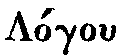 redemptoris
 , and by this
interpretation substituting an identification absolute for an equation
proportional.
4th May, 1819.
Ib.
p. 62.
Personality is nothing but the existence of nature itself.
God alone had his nature in himself; that is, God alone contains in
himself the ground of his own existence. But were this definition of
Field's right, we might predicate personality of a worm, or wherever we
find life. Better say, — personality is individuality existing in itself,
but with a nature as its ground.
Ib.
p.66.
Accursing Eutyches as a heretic.
It puzzles me to understand what sense Field gave to the word, heresy.
Surely every slight error, even though persevered in, is not to be held
a heresy, or its asserters accursed. The error ought at least to respect
some point of faith essential to the great ends of the Gospel. Thus the
phrase 'cursing Eutyches,' is to me shockingly unchristian. I could not
dare call even the opinion cursed, till I saw how it injured the faith
in Christ, weakened our confidence in him, or lessened our love and
gratitude.
Ib.
p.71.
If ye be circumcised ye are fallen from grace, and Christ
can profit you nothing.
It seems impossible but that these words had a relation to the
particular state of feeling and belief, out of which the anxiety to be
circumcised did in those particular persons proceed, and not absolutely,
and at all times to the act itself, seeing that St. Paul himself
circumcised Timothy from motives of charity and prudence.
Ib.
c.3. p.76.
The things that pertain to the Christian faith and religion are of two
sorts; for there are some things explicite, some things
implicite credenda; that is, there are some things that must be
particularly and expressly known and believed, as that the Father is
God, the Son is God and the Holy Ghost God, and yet they are not three
Gods but one God; and some other, which though all men, at all times,
be not bound upon the peril of damnation to know and believe
expressly, yet whosoever will be saved must believe them at least
implicite, and in generality, as that Joseph, Mary, and Jesus
fled into Egypt.
Merciful Heaven! Eternal misery and the immitigable wrath of God, and
the inextinguishable fire of hell amid devils, parricides, and haters of
God and all goodness — this is the verdict which a Protestant divine
passes against the man, who though sincerely believing the whole Nicene
creed and every doctrine and precept taught in the New Testament, and
living accordingly, should yet have convinced himself that the first
chapters of St. Matthew and St. Luke were not parts of the original
Gospels!
Ib.
p.77.
So in the beginning, Nestorius did not err, touching the unity of
Christ's person in the diversity of the natures of God and man; but
only disliked that Mary should be called the mother of God: which form
of speaking when some demonstrated to be very fitting and unavoidable,
if Christ were God and man in the unity of the same person, he chose
rather to deny the unity of Christ's person than to acknowledge his
temerity and rashness in reproving that form of speech, which the use
of the church had anciently received and allowed.
A false charge grounded on a misconception of the Syriac terms.
Nestorius was perfectly justifiable in his rejection of the epithet
as applied to the mother of Jesus. The Church was
even then only too ripe for the idolatrous
hyper-dulia
of the
Virgin. Not less weak is Field's defence of the propriety of the term.
Set aside all reference to this holy mystery, and let me ask, I trust
without offence, whether by the same logic a mule's dam might not be
called
because the horse and ass were united in one
and the same subject. The difference in the perfect God and perfect man
does not remove the objection: for an epithet, which conceals half of a
truth, the power and special concerningness of which, relatively to our
redemption by Christ, depends on our knowledge of the whole, is a
deceptive and a dangerously deceptive epithet.
Ib.
c.20. p.110.
Thus, then, the Fathers did sometimes, when they had particular
occasions to remember the Saints, and to speak of them, by way of
apostrophe, turn themselves unto them, and use words of
doubtful compellation, praying them, if they have any sense of these
inferior things, to be remembrancers to God for them.
The distinct gradations of the process, by which commemoration and
rhetorical apostrophes passed finally into idolatry, supply an analogy
of mighty force against the heretical
hypothesis
of the modern
Unitarians. Were it true, they would have been able to have traced the
progress of the Christolatry from the lowest sort of
Christodulia
with the same historical distinctness against the universal Church, that
the Protestants have that of hierolatry against the Romanists. The
gentle and soft censures which our divines during the reign of the
Stuarts pass on the Roman Saint worship, or hieroduly, as an
inconvenient superstition, must needs have alarmed the faithful
adherents to the Protestantism of Edward VI and the surviving exiles of
bloody Queen Mary's times, and their disciples.
Ib.
p.111.
The miracles that God wrought in times past by them made many to
attribute more to them than was fit, as if they had a generality of
presence, knowledge, and working; but the wisest and best advised
never durst attribute any such thing unto them.
To a truly pious mind awfully impressed with the surpassing excellency
of God's ineffable love to fallen man, in the revelation of himself to
the inner man through the reason and conscience by the spiritual light
and substantiality — (for the conscience is to the spirit or reason what
the understanding is to the sense, a substantiative power); this
consequence of miracles is so fearful, that it cannot but redouble his
zeal against that fashion of modern theologists which would convert
miracles from a motive to attention and solicitous examination, and at
best from a negative condition of revelation, into the positive
foundation of Christian faith.
Ib.
c.22. p.116.
But if this be as vile a slander as ever Satanist devised, the Lord
reward them that have been the authors and advisers of it according
to their works.
O no! no! this the good man did not utter from his heart, but from his
passion. A vile and wicked slander it was and is. O may God have turned
the hearts of those who uttered it, or may it be among their unknown
sins done in ignorance, for which the infinite merits of Christ may
satisfy! I am most assured that if Dr. Field were now alive, or if any
one had but said this to him, he would have replied — "I thank thee,
brother, for thy Christian admonition. Add thy prayer, and pray God to
forgive me my inconsiderate zeal!"
Ib.
c. 23. p. 119.
For what rectitude is due to the specifical act of hating God? or what
rectitude is it capable of?
Is this a possible act to any man understanding by the word God what we
mean by God?
Ib.
p. 129.
It is this complicated dispute, as to the origin and permission of evil,
which supplies to atheism its most plausible, because its only moral,
arguments; but more especially to that species of atheism which existed
in Greece in the form of polytheism, admitting moral and intelligent
shapers and governors of the world, but denying an intelligent ground,
or self-conscious Creator of the universe; their gods being themselves
the offspring of chaos and necessity, that is, of matter and its
essential laws or properties. The Leibnitzian distinction of the Eternal
Reason, or nature of God,
(the
of Timæus Locrus) from the will or personal attributes of God
—
— planted the germ of the only possible solution, or rather perhaps, in
words less exceptionable and more likely to be endured in the schools of
modern theology, brought forward the truth involved in Behmen's too bold
distinction of God and the ground of God; — who yet in this is to be
excused, not only for his good aim and his ignorance of scholastic
terms, but likewise because some of the Fathers expressed themselves no
less crudely in the other extreme; though it is not improbable that the
meaning was the same in both. At least Behmen constantly makes
self-existence a positive act, so as that by an eternal
or mysterious intercirculation God wills himself out of
the
ground
), —
indifferentia
absoluta realitatis infinitæ et infinitæ potentialitatis
) — and
again by his will, as God existing, gives being to the ground,
.
Solus Deus est; — itaque
principium, qui ex seipso dedit sibi ipse principium. Deus ipse sui
origo est, suæque causa substantiæ, id quod est, ex se et in se
continens. Ex seipso procreatus ipse se fecit
, &c., of Synesius,
Jerome, Hilary, and Lactantius and others involve the same conception.
Ib.
c.27. p.140.
The seventh is the heresy of Sabellius, which he saith was revived by
Servetus. So it was indeed, that Servetus revived in our time the
damnable heresy of Sabellius, long since condemned in the first ages
of the Church. But what is that to us? How little approbation he found
amongst us, the just and honourable proceeding against him at Geneva
will witness to all posterity.
as this act must and ought to be to all Christians at present;
yet this passage and a hundred still stronger from divines and Church
letters contemporary with Calvin, prove Servetus' death not to be
Calvin's guilt especially, but the common
opprobrium
of all
European Christendom, — of the Romanists whose laws the Senate of Geneva
followed, and from fear of whose reproaches (as if Protestants favoured
heresy) they executed them, — and of the Protestant churches who
applauded the act and returned thanks to Calvin and the Senate for
it.
Ib.
c. 30. p. 143.
The twelfth heresy imputed to us is the heresy of Jovinian, concerning
whom we must observe, that Augustine ascribeth unto him two opinions
which Hierome mentioneth not; who yet was not likely to spare him, if
he might truly have been charged with them. The first, that Mary
ceased to be a virgin when she had borne Christ; the second, that all
sins are equal.
Neither this nor that is worthy the name of opinion; it is mere
unscriptural, nay, anti-scriptural gossiping. Are we to blame, or not
rather to praise, the anxiety manifested by the great divines of the
church of England under the Stuarts not to remove further than necessary
from the Romish doctrines? Yet one wishes a bolder method; for example,
as to Mary's private history after the conception and birth of Christ,
we neither know nor care about it.
Ib.
c. 31. p. 146.
For the opinions wherewith Hierome chargeth him, this we briefly
answer. First, if he absolutely denied that the Saints departed do
pray for us, as it seemeth he did by Hierome's reprehension, we think
he erred.
Yet not heretically; and if he meant only that we being wholly ignorant,
whether they do or no, ought to act as if we knew they did not, he is
perfectly right; for whatever ye do, do it in faith. As to the ubiquity
of saints, it is Jerome who is the heretic, nay, idolater, if he reduced
his opinion to practice. It perplexes me, that Field speaks so
doubtingly on a matter so plain as the incommunicability of
omnipresence.
Ib.
c. 32. p. 147.
Touching the second objection, that Bucer and Calvin deny original
sin, though not generally, as did Zuinglius, yet at least in the
children of the faithful. If he had said that these men affirm the
earth doth move, and the heavens stand still, he might have as soon
justified it against them, as this he now saith.
Very noticeable.
similar passage occurs even so late as in Sir Thomas
Brown, just at the dawn of the Newtonian system, and after Kepler. What
a lesson of diffidence!
Ib.
p. 148.
For we do not deny the distinction of venial and mortal sins; but do
think, that some sins are rightly said to be mortal and some venial;
not for that some are worthy of eternal punishment and therefore named
mortal, others of temporal only, and therefore judged venial as the
Papists imagine: but for that some exclude grace out of that man in
which they are found and so leave him in a state wherein he hath
nothing in himself that can or will procure him pardon: and other,
which though in themselves considered, and never remitted, they be
worthy of eternal punishment, yet do not so far prevail as to banish
grace, the fountain of remission of all misdoings.
Would not the necessary consequence of this be, that there are no
actions that can be pronounced mortal sins by mortals; and that what we
might fancy venial might in individual cases be mortal and
vice
versa
.
Ib.
First, because every offence against God may justly be punished by him
in the strictness of his righteous judgments with eternal death, yea,
with annihilation; which appeareth to be most true, for that there is
no punishment so evil, and so much to be avoided, as the least sin
that may be imagined. So that a man should rather choose eternal
death, yea, utter annihilation, than commit the least offence in the
world.
I admit this to be Scriptural; but what is wanted is, clearly to state
the difference between eternal death and annihilation. For who would not
prefer the latter, if the former mean everlasting misery?
Ib
. c. 41. p. 62.
But he will say, Cyprian calleth the Roman Church the principal Church
whence sacerdotal unity hath her spring; hereunto we answer, that the
Roman Church, not in power of overruling all, but in order is the
first and principal; and that therefore while she continueth to hold
the truth, and encroacheth not upon the right of other Churches, she
is to have the priority; but that in either of these cases she may be
forsaken without breach of that unity, which is essentially required
in the parts of the Church.
This is too large a concession. The real ground of the priority of the
Roman see was that Rome, for the first three or perhaps four centuries,
was the metropolis of the Christian world. Afterwards for the very same
reason the Patriarch of New Rome or Constantinople claimed it; and never
ceased to assert at least a co-equality. Had the Apostolic foundation
been the cause, Jerusalem and Antioch must have had priority; not to add
that the Roman Church was not founded by either Paul or Peter as is
evident from the epistle to the Romans.
Append. B. III. p. 205.
I do not think the attack on Transubstantiation the most successful
point of the orthodox Protestant controversialists. The question is,
what is meant in Scripture, as in
John
vi. by Christ's body or
flesh and blood. Surely not the visible, tangible, accidental body, that
is, a cycle of images and sensations in the imagination of the
beholders; but his supersensual body, the
noumenon
of his human
nature which was united to his divine nature. In this sense I understand
the Lutheran ubiquity. But may not the "oblations" referred to by Field
in the old canon of the Mass, have meant the alms, offerings always
given at the Eucharist? If by "substance" in the enunciation of the
article be meant
id quod vere est
, and if the divine nature be
the sole
ens vere ens
, then it is possible to give a
philosophically intelligible sense to Luther's doctrine of
consubstantiation; at least to a doctrine that might bear the same
name; — at all events the mystery is not greater than, if it be not
rather the same as, the assumption of the human by the divine nature.
Now for the possible conception of this we must accurately discriminate
the
incompossibile negativum
from the
incompatibile
privativum
. Of the latter are all positive imperfections, as error,
vice, and evil passions; of the former simple limitation. Thus if
(per impossible)
human nature could make itself sinless and
perfect, it would become or pass into God; and if God should abstract
from human nature all imperfection, it might without impropriety be
affirmed, even as Scripture doth affirm, that God assumed or took up
into himself the human nature. Thus, to use a dim similitude and merely
as a faint illustration, all materiality abstracted from a circle, it
would become space, and though not infinite, yet one with infinite
space. The mystery of omnipresence greatly aids this conception;
totus in omni parte
: and in truth this is the divine character of
all the Christian mysteries, that they aid each other, and many
incomprehensibles render each of them, in a certain qualified sense,
less incomprehensible.
Ib.
p. 208.
But first, it is impious to think of destroying Christ in any sort.
For though it be true, that in sacrificing of Christ on the altar of
the cross, the destroying and killing of him was implied, and this his
death was the life of the world, yet all that concurred to the killing
of him, as the Jews, the Roman soldiers, Pilate, and Judas sinned
damnably, and so had done, though they had shed his blood with an
intention and desire, that by it the world might be redeemed.
Is not this going too far? Would it not imply almost that Christ himself
could not righteously sacrifice himself, especially when we consider
that the Romanists would have a right to say, that Christ himself had
commanded it?
Bellarmine's conceit
is so absurd that
it scarce deserves the compliment of a serious confutation. For if
sacramental being be opposed to natural or material, as
noumenon
to
phænomenon
, place is no attribute or possible accident of it
in se
; consequently, no alteration of place relatively to us can
affect, much less destroy, it; and even were it otherwise, yet
translocation is not destruction; for the body of Christ, according to
themselves, doth indeed nourish our souls, even as a fish eaten sustains
another fish, but yet with this essential difference, that it ceases not
to be and remain itself, and instead of being converted converts; so
that truly the only things sacrificed in the strict sense are all the
evil qualities or deficiencies which divide our souls from Christ.
Ib.
p. 218.
That which we do is done in remembrance of that which was then done;
for he saith, Do this in remembrance of me.
This is a
metastasis
of Scripture.
Do this in remembrance of
me
, that is, that which Christ was then doing. But Christ was not
then suffering, or dying on the cross.
Ib.
p. 223.
That the Saints do pray for us in genere, desiring God to be
merciful to us, and to do unto us whatsoever in any kind he knoweth
needful for our good, there is no question made by us.
To have placed this question in its true light, so as to have allowed
the full force to the Scriptures asserting the communion of Saints and
the efficacy of their intercession without undue concessions to the
hierolatria
of the Romish church, would have implied an
acquaintance with the science of transcendental analysis, and an insight
into the philosophy of ideas not to be expected in Field, and which was
then only dawning in the mind of Lord Bacon. The proper reply to Brerely
would be this: the communion and intercession of Saints is an idea, and
must be kept such. But the Romish church has changed it away into the
detail of particular and individual conceptions, and imaginations, into
names and fancies.
N. B. Instead of the 'Roman Catholic' read throughout in this and all
other works, and everywhere and on all occasions, unless where the
duties of formal courtesy forbid, say, the 'Romish anti-Catholic
Church;' Romish — to mark that the corruptions in discipline, doctrine
and practice do for the worst and far larger part owe both their origin
and their perpetuation to the court and local tribunals of the city of
Rome, and are not and never have been the catholic, that is, universal
faith of the Roman empire, or even of the whole Latin or Western church;
and anti-Catholic, — because no other Church acts on so narrow and
excommunicative a principle, or is characterized by such a jealous
spirit of monopoly and particularism, counterfeiting catholicity by a
negative totality and heretical self-circumscription, cutting off, or
cutting herself off from, all the other members of Christ's Body.
12th March, 1824.
It is of the utmost importance, wherever clear and distinct conceptions
are required, to make out in the first instance whether the term in
question, or the main terms of the question in dispute, represents or
represent a fact or class of facts simply, or some self-established and
previously known idea or principle, of which the facts are instances and
realizations, or which is introduced in order to explain and account for
the facts. Now the term 'merits,' as applied to Abraham and the saints,
belongs to the former. It is a mere
nomen appellativum
of the
facts.
Ib.
c. 5. p. 252.
The Papists and we agree that original sin is the privation of
original righteousness; but they suppose there was in nature without
that addition of grace, a power to do good, &c.
Nothing seems wanting to this argument but a previous definition and
explanation of the term, 'nature.' Field appears to have seen the truth,
namely, that nature itself is a peccant (I had almost said an unnatural)
state, or rather no State at all,
.
Ib.
c. 6. p. 269.
And surely the words of Augustine do not import that she had no sin,
but that she overcame it, which argueth a conflict; neither doth he
say he will acknowledge she was without sin, but that he will not move
any question touching her, in this dispute of sins and sinners.
Why not say at once, that this anti-Scriptural superstition had already
begun? I scarcely know whether to be pleased or grieved with that edging
on toward the Roman creed, that exceeding, almost Scriptural, tenderness
for the divines of the fourth, fifth, and sixth centuries, which
distinguishes the Church of England dignitaries, from Elizabeth
inclusively to our Revolution in 1688, from other Protestants.
Ib.
c. 10. p. 279.
Derwent! should this page chance to fall under your eye, for my sake
read, fag, subdue, and take up into your proper mind this chapter 10 of
Free Will.
Ib.
p. 281.
Of these five kinds of liberty, the two first agree only to God, so
that in the highest degree

, that is, freedom
of will is proper to God only; and in this sense Calvin and Luther
rightly deny that the will of any creature is or ever was free.
I add, except as in God, and God in us. Now the latter alone is will;
for it alone is
ens super ens
. And here lies the mystery, which I
dare not openly and promiscuously reveal.
Ib.
Yet doth not God's working upon the will take from it the power of
dissenting, and doing the contrary; but so inclineth it, that having
liberty to do otherwise, yet she will actually determine so.
This will not do. Were it true, then my understanding would be free in a
mathematical proportion; or the whole position amounts only to this,
that the will, though compelled, is still the will. Be it so; yet not a
free will. In short, Luther and Calvin are right so far. A creaturely
will cannot be free; but the will in a rational creature may cease to be
creaturely, and the creature,
finally cease in
consequence; and this neither Luther nor Calvin seem to have seen. In
short, where omnipotence is on one side, what but utter impotence can
remain for the other? To make freedom possible, the
antithesis
must be removed. The removal of this
antithesis
of the creature
to God is the object of the Redemption, and forms the glorious liberty
of the Gospel. More than this I am not permitted to expose.
Ib.
p. 283.
It is not given, nor is it wanting, to all men to have an insight into
the mystery of the human will and its mode of inherence on the will
which is God, as the ineffable
causa sui
; but this chapter will
suffice to convince you that the doctrines of Calvin were those of
Luther in this point; — that they are intensely metaphysical, and that
they are diverse
toto genere
from the merely moral and
psychological — tenets of the modern Calvinists. Calvin would have
exclaimed, 'fire and fagots!' before he had gotten through a hundred
pages of Dr. Williams's Modern Calvinism.
Ib.
c. 11. p. 296.
Neither can Vega avoid the evidence of the testimonies of the Fathers,
and the decree of the Council of Trent, so that he must be forced to
confess that no man can so collectively fulfil the law as not to sin,
and consequently, that no man can perform that the law requireth.
The paralogism of Vega as to this perplexing question seems to lurk in
the position that God gives a law which it is impossible we should obey
collectively. But the truth is, that the law which God gave, and which
from the essential holiness of his nature it is impossible he should not
have given, man deprived himself of the ability to obey. And was the law
of God therefore to be annulled? Must the sun cease to shine because the
earth has become a morass, so that even that very glory of the sun hath
become a new cause of its steaming up clouds and vapors that strangle
the rays? God forbid!
But for the law I had not sinned
. But had I
not been sinful the law would not have occasioned me to sin, but would
have clothed me with righteousness, by the transmission of its
splendour.
Let God be just, and every man a liar
.
B. iv. c. 4. p. 346.
The Church of God is named the 'Pillar of Truth;' not as if truth did
depend on the Church, &c.
Field might have strengthened his argument, by mention of the custom of
not only affixing records and testimonials to the pillars, but books, &c.
Ib.
c. 7. p. 353.
Others therefore, to avoid this absurdity, run into that other before
mentioned, that we believe the things that are divine by the mere and
absolute command of our will, not finding any sufficient motives and
reasons of persuasion.
Field, nor Count Mirandula have penetrated to the heart of this most
fundamental question. In all proper faith the will is the prime agent,
but not therefore the choice. You may call it reason if you will, but
then carefully distinguish the speculative from the practical reason,
and the reason itself from the understanding.
Ib.
c. 8. p. 356.
Illius virtute (saith he) illuminati, jam non aut nostro, aut
aliorum judicio credimus a Deo esse Scripturam, sed supra humanum
judicium certo certius constituimus, non secus ac si ipsius Dei numen
illic intueremur, hominum ministerio ab ipsissimo Dei ore
fluxisse.
Greatly doth this fine passage need explanation, that knowing what it
doth mean, the reader may understand what it doth not mean, nor of
necessity imply. Without this insight, our faith may be terribly shaken
by difficulties and objections. For example; If all the Scripture, then
each component part; thence every faithful Christian infallible, and so
on.
Ib.
p. 357.
In the second the light of divine reason causeth approbation of that
they believe: in the third sort, the purity of divine understanding
apprehendeth most certainly the things believed, and causeth a
foretasting of those things that hereafter more fully shall be enjoyed.
Here too Field distinguishes the understanding from the reason, as
experience following perception of sense. But as perception through the
mere presence of the object perceived, whether to the outward or inner
sense, is not insight which belongs to the 'light of reason,' therefore
Field marks it by 'purity' that is unmixed with fleshly sensations or
the
idola
of the bodily eye. Though Field is by no means
consistent in his
epitheta
of the understanding, he seldom
confounds the word itself. In theological Latin, the understanding, as
influenced and combined with the affections and desires, is most
frequently expressed by
cor
, the heart. Doubtless the most
convenient form of appropriating the terms would be to consider the
understanding as man's intelligential faculty, whatever be its object,
the sensible or the intelligible world; while reason is the tri-unity,
as it were, of the spiritual eye, light, and object.
Ib.
c. 10. p. 358.
Of the Papists preferring the Church's authority before the Scripture.
Field, from the nature and special purpose of his controversy, is
reluctant to admit any error in the Fathers, — too much so indeed; and
this is an instance. We all know what we mean by the Scriptures, but how
know we what they mean by the Church, which is neither thing nor person?
But this is a very difficult subject.
Ib.
p. 359.
First, so as if the Church might define contrary to the Scriptures, as
she may contrary to the writings of particular men, how great soever.
Verbally, the more sober divines of the Church of Rome do not assert
this; but practically and by consequence they do.
if the Church
assign a sense contradictory to the true sense of the Scripture, none
dare gainsay it.
Ib.
This we deny, and will in due place improve their error herein.
That is, prove against, detect, or confute.
Ib.
c. 11. p. 360.
If the comparison be made between the Church consisting of all the
believers that are and have been since Christ appeared in the flesh,
so including the Apostles, and their blessed assistants the
Evangelists, we deny not but that the Church is of greater authority,
antiquity, and excellency than the Scriptures of the New Testament, as
the witness is better than his testimony, and the law-giver greater
than the laws made by him, as Stapleton allegeth.
The Scriptures may be and are an intelligible and real one, but the
Church on earth can in no sense be such in and through itself, that is,
its component parts, but only by their common adherence to the body of
truth made present in the Scripture. Surely you would not distinguish
the Scripture from its contents?
Ib
. c. 12. p. 361.
For the better understanding whereof we must observe, as Occam fitly
noteth, that an article of faith is sometimes strictly taken only for
one of those divine verities, which are contained in the Creed of the
Apostles: sometimes generally for any catholic verity.
I am persuaded, that this division will not bear to be expanded into all
its legitimate consequences
sine periculo vel fidei vel
charitatis
. I should substitute the following:
- The essentials of that saving faith, which having its root and its
proper and primary seat in the moral will, that is, in the heart and
affections, is necessary for each and every individual member of the
church of Christ:
- Those truths which are essential and necessary in order to the
logical and rational possibility of the former, and the belief and
assertion of which are indispensable to the Church at large, as those
truths without which the body of believers, the Christian world, could
not have been and cannot be continued, though it be possible that in
this body this or that individual may be saved without the conscious
knowledge of, or an explicit belief in, them.
Ib.
And therefore before and without such determination, men seeing
clearly the deduction of things of this nature from the former, and
refusing to believe them, are condemned of heretical pertinacy.
Rather, I should think, of a nondescript lunacy than of heretical
pravity. A child may explicitly know that 5 + 5 = 10, yet not see that
therefore 10 - 5 = 5; but when he has seen it how he can refrain from
believing the latter as much as the former, I have no conception.
Ib.
c. 16. p. 367.
And the third of jurisdiction; and so they that have supreme power,
that is, the Bishops assembled in a general Council, may interpret the
Scriptures, and by their authority suppress all them that shall
gainsay such interpretations, and subject every man that shall disobey
such determinations as they consent upon, to excommunication and
censures of like nature.
This would be satisfactory, if only Field had cleared the point of the
communion in the Lord's Supper; whether taken spiritually, though in
consequence of excommunication not ritually, it yet sufficeth to
salvation. If so, excommunication is merely declarative, and the evil
follows not the declaration but that which is truly declared, as when
Richard says that Francis deserves the gallows, as a robber. The gallows
depends on the fact of the robbery, not on Richard's saying.
Ib.
c. 29. p. 391.
In the 1 Cor. 15. the Greek, that now is, hath in all copies; the
first man was of the earth, earthly; the second man is the Lord from
heaven. The latter part of this sentence Tertullian supposeth to
have been corrupted, and altered by the Marcionites. Instead of that
the Latin text hath; the second man was from heaven, heavenly,
as Ambrose, Hierome, and many of the Fathers read also.
There ought to be, and with any man of taste there can be, no doubt that
our version is the true one.
of Ambrose and Jerome is worthy of
mere rhetoricians; a flat formal play of
antithesis
instead of
the weight and solemnity of the other.
According to the former the
scales are even, in the latter the scale of Christ drops down at once,
and the other flies to the beam like a feather weighed against a mass of
gold.
Append. Part. I. s. 4. p. 752.
And again he saith, that every soul, immediately upon the departure
hence, is in this appointed invisible place, having there either pain,
or ease and refreshing; that there the rich man is in pain, and the
poor in a comfortable estate. For, saith he, why should we not think,
that the souls are tormented, or refreshed in this invisible place,
appointed for them in expectation of the future judgment?
This may be adduced as an instance, specially, of the evil consequences
of introducing the
idolon
of time as an
ens reale
into
spiritual doctrines, thus understanding literally what St. Paul had
expressed by figure and adaptation. Hence the doctrine of a middle
state, and hence Purgatory with all its abominations; and an instance,
generally, of the incalculable possible importance of speculative errors
on the happiness and virtue of man-kind.
Folio 1628. — Ed.
The following letter was written on, and addressed with,
the book to the Rev. Derwent Coleridge. — Ed.
P. L.
III. 487. — Ed.
i. 27. See
Aids to Reflection
. 3d
edit
. p. 17. n. — Ed.
— — whence the soul
Reason receives, and reason is her being,
Discursive or intuitive.
P. L.
v. 426. — Ed.
The reader of the
Aids to Reflection
will recognize in
this note the rough original of the passages p. 313, &c. of the 3d
edition of that work. — Ed.
See
Table Talk
, 2d edit. p. 283. Melancthon's words
to Calvin are:
Tuo judicio prorsus assentior. Affirmu etiam vestros
magistratus juste fecisse, quod hominem blasphemum, re ordine judicata,
interfecerunt.
14th Oct. 1554. — Ed.
'But to circle the earth, as the heavenly bodies do,' &c.
'So we may see that the opinion of Copernicus touching the rotation of
the earth, which astronomy itself cannot correct, because it is not
repugnant to any of the phænomena, yet natural history may
correct.'
Advancement of Learning
, B. II. — Ed.
That Christ had a twofold being, natural and sacramental;
that the Jews destroyed and sacrificed his natural being, and that
Christian priests destroy and sacrifice in the Mass his sacramental
being. — Ed.
Fides catholica, says Bellarmine, docet omnem
virtutem esse bonam, omne vitium esse malum. Si autem erraret Papa
præcipiendo vitia vel prohibendo virtutes, teneretur Ecclesia credere
vitia esse bona et virtutes malas, nisi vellet contra conscientiam
peccare.
De Pont. Roman
. IV. 5. — Ed.
The ordinary Greek text is:
The Vulgate is:
primus homo de terra,
terrenus; secundus homo de cœlis, cœlestis.
Ed.
Notes on Donne1
There have been many, and those illustrious, divines in our Church from
Elizabeth to the present day, who, overvaluing the accident of
antiquity, and arbitrarily determining the appropriation of the words
'ancient,' 'primitive,' and the like to a certain date, as for example,
to all before the fourth, fifth, or sixth century, were resolute
protesters against the corruptions and tyranny of the Romish hierarch,
and yet lagged behind Luther and the Reformers of the first generation.
Hence I have long seen the necessity or expedience of a threefold
division of divines. There are many, whom God forbid that I should call
Papistic, or, like Laud, Montague, Heylyn, and others, longing for a
Pope at Lambeth, whom yet I dare not name Apostolic. Therefore I divide
our theologians into,
- Apostolic or Pauline:
- Patristic:
- Papal.
Even in Donne, and still more in Bishops Andrews and Hackett, there is a
strong Patristic leaven. In Jeremy Taylor this taste for the Fathers and
all the Saints and Schoolmen before the Reformation amounted to a
dislike of the divines of the continental Protestant Churches, Lutheran
or Calvinistic. But this must, in part at least, be attributed to
Taylor's keen feelings as a Carlist, and a sufferer by the Puritan
anti-prelatic party.
I would thus class the pentad of operative Christianity: —
|
Prothesis
Christ the Word |
|
Thesis
The Scriptures |
Mesothesis
The Holy Spirit |
Antithesis
The Church |
|
Synthesis
The Preacher |
|
The Papacy elevated the Church to the virtual exclusion or suppression
of the Scriptures: the modern Church of England, since Chillingworth,
has so raised up the Scriptures as to annul the Church; both alike have
quenched the Holy Spirit, as the
mesothesis
of the two, and
substituted an alien compound for the genuine Preacher, who should be
the
synthesis
of the Scriptures and the Church, and the sensible
voice of the Holy Spirit.
Serm. I. Coloss. i. 19, 20. p. 1.
Ib.
E.
What could God pay for me? What could God suffer? God himself could
not; and therefore God hath taken a body that could.
God forgive me, — or those who first set abroad this strange
this debtor and creditor scheme of expounding
the mystery of Redemption, or both! But I never can read the words, 'God
himself could not; and therefore took a body that could' — without being
reminded of the monkey that took the cat's paw to take the chestnuts out
of the fire, and claimed the merit of puss's sufferings. I am sure,
however, that the ludicrous images, under which this gloss of the
Calvinists embodies itself to my fancy, never disturb my recollections
of the adorable mystery itself. It is clear that a body, remaining a
body, can only suffer as a body: for no faith can enable us to believe
that the same thing can be at once A. and not A. Now that the body of
our Lord was not transelemented or transnatured by the
pleroma
indwelling, we are positively assured by Scripture. Therefore it would
follow from this most unscriptural doctrine, that the divine justice had
satisfaction made to it by the suffering of a body which had been
brought into existence for this special purpose, in lieu of the debt of
eternal misery due from, and leviable on, the bodies and souls of all
mankind! It is to this gross perversion of the sublime idea of the
Redemption by the cross, that we must attribute the rejection of the
doctrine of redemption by the Unitarian, and of the Gospel
in
toto
by the more consequent Deist.
Ib.
p. 2. C.
And yet, even this dwelling fullness, even in this person Christ
Jesus, by no title of merit in himself, but only quia
complacuit, because it pleased the Father it should be so.
This, in the intention of the preacher, may have been sound, but was it
safe, divinity? In order to the latter, methinks, a less equivocal word
than 'person' ought to have been adopted; as 'the body and soul of the
man Jesus, considered abstractedly from the divine Logos, who in it took
up humanity into deity, and was Christ Jesus.' Dare we say that there
was no self-subsistent, though we admit no self-originated, merit in the
Christ? It seems plain to me, that in this and sundry other passages of
St. Paul,
the Father
means the total triune Godhead.
It appears to me, that dividing the Church of England into two æras — the
first from Ridley to Field, or from Edward VI to the commencement of
the latter third of the reign of James I, and the second ending with
Bull and Stillingfleet, we might characterize their comparative
excellences thus: That the divines of the first æra had a deeper, more
genial, and a more practical insight into the mystery of Redemption, in
the relation of man toward both the act and the author, namely, in all
the inchoative states, the regeneration and the operations of saving
grace generally; — while those of the second æra possessed clearer and
distincter views concerning the nature and necessity of Redemption, in
the relation of God toward man, and concerning the connection of
Redemption with the article of Tri-unity; and above all, that they
surpassed their predecessors in a more safe and determinate scheme of
the divine economy of the three persons in the one undivided Godhead.
indeed, was mainly owing to Bishop Bull's masterly work
De Fide
Nicæna
,
which in the next generation Waterland so admirably
maintained, on the one hand, against the philosophy of the Arians, — the
combat ending in the death and burial of Arianism, and its descent and
metempsychosis
into Socinianism, and thence again into modern
Unitarianism, — and on the other extreme, against the oscillatory creed
of Sherlock, now swinging to Tritheism in the recoil from Sabellianism,
and again to Sabellianism in the recoil from Tritheism.
Ib.
First, we are to consider this fullness to have been in Christ, and
then, from this fullness arose his merits; we can consider no merit in
Christ himself before, whereby he should merit this fullness; for this
fullness was in him before he merited any thing; and but for this
fullness he had not so merited. Ille homo, ut in unitatem filii Dei
assumeretur, unde meruit? How did that man (says St. Augustine,
speaking of Christ, as of the son of man), how did that man merit to
be united in one person with the eternal Son of God? Quid egit
ante? Quid credidit? What had he done? Nay, what had he believed?
Had he either faith or works before that union of both natures?
Dr. Donne and St. Augustine said this without offence; but I much
question whether the same would be endured now. That it is, however, in
the spirit of Paul and of the Gospel, I doubt not to affirm, and that
this great truth is obscured by what in my judgment is the
post-Apostolic
Christopœdia
, I am inclined to think.
Ib.
What canst thou imagine he could foresee in thee? a propensness, a
disposition to goodness, when his grace should come? Either there is
no such propensness, no such disposition in thee, or, if there be,
even that propensness and disposition to the good use of grace, is
grace; it is an effect of former grace, and his grace wrought before
he saw any such propensness, any such disposition; grace was first,
and his grace is his, it is none of thine.
One of many instances in dogmatic theology, in which the half of a
divine truth has passed into a fearful error by being mistaken for the
whole truth.
Ib.
p. 6. D.
God's justice required blood, but that blood is not spilt, but poured
from that head to our hearts, into the veins and wounds of our own
souls: there was blood shed, but no blood lost.
It is affecting to observe how this great man's mind sways and
oscillates between his reason, which demands in the word 'blood' a
symbolic meaning, a spiritual interpretation, and the habitual awe for
the letter; so that he himself seems uncertain whether he means the
physical lymph,
serum,
and globules that trickled from the wounds
of the nails and thorns down the sides and face of Jesus, or the blood
of the Son of Man, which he who drinketh not cannot live. Yea, it is
most affecting to see the struggles of so great a mind to preserve its
inborn fealty to the reason under the servitude to an accepted article
of belief, which was, alas! confounded with the high obligations of
faith; — faith the co-adunation of the finite individual will with the
universal reason, by the submission of the former to the latter. To
reconcile redemption by the material blood of Jesus with the mind of the
spirit, he seeks to spiritualize the material blood itself in all men!
And a deep truth lies hidden even in this.
the whole is a
profound subject, the true solution of which may best, God's grace
assisting, be sought for in the collation of Paul with John, and
specially in St. Paul's assertion that we are baptized into the death of
Christ, that we may be partakers of his resurrection and
life
. It was not on the visible cross, it was not directing
attention to the blood-drops on his temples and sides, that our blessed
Redeemer said,
This is my body
, and
this is my blood
!
Ib.
p. 9. A.
But if we consider those who are in heaven, and have been so from the
first minute of their creation, angels, why have they, or how have
they any reconciliation? &c.
The history and successive meanings of the term 'angels' in the Old and
New Testaments, and the idea that shall reconcile all as so many several
forms, and as it were perspectives, of one and the same truth — this is
still a
desideratum
in Christian theology.
Ib.
C.
For, at the general resurrection, (which is rooted in the resurrection
of Christ, and so hath relation to him) the creature shall be
delivered from the bondage of corruption into the glorious liberty of
the children of God; for which the whole creation groans, and travails
in pain yet. (Rom. viii. 21.) This deliverance then from this
bondage the whole creature hath by Christ, and that is their
reconciliation. And then are we reconciled by the blood of his cross,
when having crucified ourselves by a true repentance, we receive the
real reconciliation in his blood in the sacrament. But the most proper
and most literal sense of these words, is, that all things in heaven
and earth be reconciled to God (that is, to his glory, to a fitter
disposition to glorify him) by being reconciled to another in Christ;
that in him, as head of the church, they in heaven, and we upon earth,
be united together as one body in the communion of saints.
A very meagre and inadequate interpretation of this sublime text. The
philosophy of life, which will be the
corona et finis coronans
of
the sciences of comparative anatomy and zoology, will hereafter supply a
fuller and nobler comment.
Ib.
p. 9. A. and B.
The blood of the sacrifices was brought by the high priest in
sanctum sanctorum, into the place of greatest holiness; but it was
brought but once, in festo expiationis, in the feast of
expiation; but in the other parts of the temple it was sprinkled every
day. The blood of the cross of Christ Jesus hath had this effect in
sancto sanctorum, &c. ... (to) Christ Jesus.
A truly excellent and beautiful paragraph.
Ib.
C.
If you will mingle a true religion, and a false religion, there is no
reconciling of God and Belial in this text. For the adhering of
persons born within the Church of Rome to the Church of Rome, our law
says nothing to them if they come; but for reconciling to the Church
of Rome, for persons born within the allegiance of the king, or for
persuading of men to be so reconciled, our law hath called by an
infamous and capital name of treason, and yet every tavern and
ordinary is full of such traitors, &c.
A strange transition from the Gospel to the English statute-book! But I
may observe, that if this statement could be truly made under James I,
there was abundantly ampler ground for it in the following reign. And
yet with what bitter spleen does Heylyn, Laud's creature, arraign the
Parliamentarians for making the same complaint!
Serm. II. Isaiah vii. 14. p. 11.
The fear of giving offence, especially to good men, of whose faith in
all essential points we are partakers, may reasonably induce us to be
slow and cautious in making up our minds finally on a religious
question, and may, and ought to, influence us to submit our conviction
to repeated revisals and rehearings. But there may arrive a time of such
perfect clearness of view respecting the particular point, as to
supersede all fear of man by the higher duty of declaring the whole
truth in Jesus. Therefore, having now overpassed six-sevenths of the
ordinary period allotted to human life, — resting my whole and sole hope
of salvation and immortality on the divinity of Christ, and the
redemption by his cross and passion, and holding the doctrine of the
Triune God as the very ground and foundation of the Gospel faith, — I
feel myself enforced by conscience to declare and avow, that, in my
deliberate judgment, the
Christopædia
prefixed to the third
Gospel and concorporated with the first, but, according to my belief, in
its present form the latest of the four, was unknown to, or not
recognized by, the Apostles Paul and John; and that, instead of
supporting the doctrine of the Trinity, and the Filial Godhead of the
Incarnate Word, as set forth by John i 1, and by Paul, it, if not
altogether irreconcilable with this faith, doth yet greatly weaken and
bedim its evidence; and that, by the too palpable contradictions between
the narrative in the first Gospel and that in the third, it has been a
fruitful magazine of doubts respecting the historic character of the
Gospels themselves. I have read most of the criticisms on this text, and
my impression is, that no learned Jew can be expected to receive the
common interpretation as the true primary sense of the words. The
severely literal Aquila renders the Hebrew word

. But
were it asked of me: Do you then believe our Lord to have been the Son
of Mary by Joseph? I reply: It is a point of religion with me to have no
belief one way or the other.
am in this way like St. Paul, more than
content not to know Christ himself
. It is enough for
me to know that the Son of God
became flesh
,
and more than this, it appears to me, was
unknown to the Apostles, or, if known, not taught by them as
appertaining to a saving faith in Christ.
October 1831.
Note the affinity in sound of
son
and
sun
,
Sohn
and
Sonne
, which is not confined to the Saxon and German, or the
Gothic dialects generally. And observe
conciliare
versöhnen=confiliare, facere esse cum filio
, one with the Son.
Ib.
p. 17. B.
It is a singular testimony, how acceptable to God that state of
virginity is. He does not dishonor physic that magnifies health; nor
does he dishonor marriage, that praises virginity; let them embrace
that state that can, &c.
One of the sad relics of Patristic super-moralization, aggravated by
Papal ambition, which clung to too many divines, especially to those of
the second or third generation after Luther. Luther himself was too
spiritual, of too heroic faith, to be thus blinded by the declamations
of the Fathers, whom, with the exception of Augustine, he held in very
low esteem.
Ib.
D.
And Helvidius said, she had children after.
Annon Scriptura ipsa
? And a 'heresy,' too! I think I might safely
put the question to any serious, spiritual-minded, Christian: What one
inference tending to edification, in the discipline of will, mind, or
affections, he can draw from the speculations of the last two or three
pages of this Sermon respecting Mary's pregnancy and parturition?
Can
— I write it emphatically —
can
such points appertain to
our faith as Christians, which every parent would decline speaking of
before a family, and which, if the questions were propounded by another
in the presence of my daughter, aye, or even of my, no less, in mind and
imagination, innocent wife, I should resent as an indecency?
Serm. III. Gal. iv. 4, 5. p. 20.
God sent forth his Son made of a woman.
I never can admit that
and
in St.
Paul and St. John are adequately, or even rightly, rendered by the
English 'made.'
Ib.
p. 21, A.
What miserable revolutions and changes, what downfalls, what
break-necks and precipitations may we justly think ourselves ordained
to, if we consider, that in our coming into this world out of our
mothers' womb, we do not make account that a child comes right, except
it come with the head forward, and thereby prefigure that headlong
falling into calamities which it must suffer after?
The taste for these forced and fantastic analogies, Donne, with the
greater number of the learned prelatic divines from James I. to the
Restoration, acquired from that too great partiality for the Fathers,
from Irenæus to Bernard, by which they sought to distinguish themselves
from the Puritans.
Ib.
C.
That now they (the Jews,) express a kind of conditional acknowledgment
of it, by this barbarous and inhuman custom of theirs, that they
always keep in readiness the blood of some Christian, with which they
anoint the body of any that dies amongst them, with these words; "If
Jesus Christ were the Messias, then may the blood of this Christian
avail thee to salvation!"
Is it possible that Donne could have given credit to this absurd legend!
It was, I am aware, not an age of critical
acumen
; grit, bran,
and flour, were swallowed in the unsifted mass of their erudition. Still
that a man like Donne should have imposed on himself such a set of idle
tales, as he has collected in the next paragraph for facts of history,
is scarcely credible; that he should have attempted to impose them on
others, is most melancholy.
Ib.
p. 22. D. E.
He takes the name of the son of a woman, and wanes the
miraculous name of the son of a virgin. — Christ waned the
glorious name of Son of God, and the miraculous name of Son of a
virgin too; which is not omitted to draw into doubt the perpetual
virginity of the blessed virgin, the mother of Christ, &c.
Very ingenious; but likewise very presumptuous, this arbitrary
attribution of St. Paul's silence, and presumable ignorance of the
virginity of Mary, to Christ's own determination to have the fact passed
over.
N. B. Is 'wane' a misprint for 'wave' or 'waive?' It occurs so often, as
to render its being an
erratum
improbable; yet I do not remember
to have met elsewhere 'wane' used for 'decline' as a verb active.
Ib.
p. 23. A.
If there were reason for it, it were no miracle.
The announcement of the first comet, that had ever been observed, might
excite doubt in the mind of an astronomer, to whom, from the place where
he lived, it had not been visible. But his reason could have been no
objection to it. Had God pleased, all women might have conceived,
as many of the
polypi
and
planariæ
do.
Not on any such ground do I suspend myself on this as an article of
faith; but because I doubt the evidence.
Ib.
p. 25. A — E.
Though we may think thus in the law of reason, yet, &c.
It is, and has been, a misfortune, a grievous and manifold loss and
hindrance for the interests of moral and spiritual truth, that even our
best and most vigorous theologians and philosophers of the age from
Edward VI to James II so generally confound the terms, and so too
often confound the subjects themselves, reason and understanding; yet
the diversity, the difference in kind, was known to, and clearly
admitted by, many of them, — by Hooker for instance, and it is implied in
the whole of Bacon's
Novum Organum
. Instead of the 'law of reason,'
Donne meant, and ought to have said, 'judging according to the ordinary
presumptions of the understanding,' that is, the faculty which,
generalizing particular experiences, judges of the future by analogy to
the past.
Taking the words, however, in their vulgar sense, I most deliberately
protest against all the paragraphs in this page, from A to E, and should
cite them, with a host of others, as sad effects of the confusion of the
reason and the understanding, and of the consequent abdication of the
former, instead of the bounden submission of the latter to a higher
light. Faith itself is but an act of the will, assenting to the reason
on its own evidence without, and even against, the understanding.
indeed is, I fully agree, to be brought into captivity to the faith.
Ib.
p. 26. A. B.
And therefore to be under the Law, signifies here thus much; to
be a debtor to the law of nature, to have a testimony in our hearts
and consciences, that there lies a law upon us, which we have no power
in ourselves to perform, &c.
This exposition of the term
law
in the epistles of St. Paul is
most just and important. The whole should be adopted among the notes to
the epistle to the Romans, in every Bible printed with notes.
I
b.
p. 27. A.
And this was his first work, to redeem, to vindicate them from
the usurper, to deliver them from the intruder, to emancipate them
from the tyrant, to cancel the covenant between hell and them, and
restore them so far to their liberty, as that they might come to their
first master, if they would; this was redeeming.
There is an absurdity in the notion of a finite divided from, and
superaddible to, the infinite, — of a particular
quantum
of power
separated from, not included in, omnipotence, or all-power. But, alas!
we too generally use the terms that are meant to express the absolute,
as mere comparatives taken superlatively. In one thing only are we
permitted and bound to assert a diversity, namely, in God and
Hades
,
the good and the evil will. This awful mystery, this truth, at once
certain and incomprehensible, is at the bottom of all religion; and to
exhibit this truth free from the dark phantom of the Manicheans, or the
two co-eternal and co-ordinate principles of good and evil, is the glory
of the Christian religion.
But this mysterious dividuity of the good and the evil will, the will of
the spirit and the will of the flesh, must not be carried beyond the
terms 'good' and 'evil.' There can be but one good will — the spirit in
all; — and even so, all evil wills are one evil will, the devil or evil
spirit. But then the One exists for us as finite intelligences,
necessarily in a two-fold relation, universal and particular. The same
Spirit within us pleads to the Spirit as without us; and in like manner
is every evil mind in communion with the evil spirit. But, O comfort!
the good alone is the actual, the evil essentially potential. Hence the
devil is most appropriately named the 'tempter,' and the evil hath its
essence in the will: it cannot pass out of it. Deeds are called evil in
reference to the individual will expressed in them; but in the great
scheme of Providence they are, only as far as they are good, coerced
under the conditions of all true being; and the devil is the drudge of
the All-good.
Serm. IV Luke ii. 29, 30. p. 29.
Ib.
p. 30. B.
We shall consider that that preparation, and disposition, and
acquiescence, which Simeon had in his epiphany, in his visible seeing
of Christ then, is offered to us in this epiphany, in this
manifestation and application of Christ in the sacrament; and that
therefore every penitent, and devout, and reverent, and worthy
receiver hath had in that holy action his now; there are all things
accomplished to him; and his for, for his eyes have seen his
salvation; and so may be content, nay glad, to depart in peace.
O! would that Donne, or rather that Luther before him, had carried out
this just conception to its legitimate consequences; — that as the
sacrament of the Eucharist is the epiphany for as many as receive it in
faith, so the crucifixion, resurrection, and ascension of Christ himself
in the flesh, were the epiphanies, the sacramental acts and
phænomena
of the
Deus patiens
, the visible words of the invisible Word that was
in the beginning, symbols in time and historic fact of the redemptive
functions, passions, and procedures of the Lamb crucified from the
foundation of the world; — the incarnation, cross, and passion, — in
short, the whole life of Christ in the flesh, dwelling a man among men,
being essential and substantive parts of the process, the total of which
they represented; and on this account proper symbols of the acts and
passions of the Christ dwelling in man, as the Spirit of truth, and for
as many as in faith have received him, in Seth and Abraham no less
effectually than in John and Paul! For this is the true definition of a
symbol, as distinguished from the thing, on the one hand, and from a
mere metaphor, or conventional exponent of a thing, on the other. Had
Luther mastered this great idea, this master-truth, he would never have
entangled himself in that most mischievous Sacramentary controversy, or
had to seek a murky hiding-hole in the figment of Consubstantiation.
Ib.
B. C.
In the first part, then ... More he asks not, less he takes not for
any man, upon any pretence of any unconditional decree.
A beautiful paragraph, well worth extracting, aye, and re-preaching.
Ib.
p. 34. E.
When thou comest to this seal of thy peace, the sacrament, pray that
God will give thee that light that may direct and establish thee in
necessary and fundamental things; that is, the light of faith to see
that the Body and Blood of Christ is applied to thee in that action;
but for the manner, how the Body and Blood of Christ is there, wait
his leisure, if he have not yet manifested that to thee: grieve not at
that, wonder not at that, press not for that; for he hath not
manifested that, not the way, not the manner of his presence in the
Sacrament to the Church.
O! I have ever felt, and for many years thought that this
rem
credimus, modum nescimus,
is but a poor evasion. It seems to me an
attempt so to admit an irrational proposition as to have the credit of
denying it, or to separate an irrational proposition from its
irrationality. I admit 2 + 2 = 5; how I do not pretend to know, but in
some way not in contradiction to the multiplication table. To spiritual
operations the very term 'mode' is perhaps inapplicable, for these are
immediate. To the linking of this with that, of A. with Z. by
intermedia,
the term 'mode,' — the question 'how?' is properly
applied. The assimilation of the spirit of a man to the Son of God, to
God as the Divine Humanity, — this spiritual transubstantiation, like
every other process of operative grace, is necessarily modeless. The
whole question is concerning the transmutation of the sensible elements.
Deny this, and to what does the
modum nescimus
refer? We cannot
ask how that is done, which we declare not done at all. Admit this
transmutation, and you necessarily admit by implication the Romish
dogma, of the separation of a sensible thing from the sensible accidents
which constitute all we ever meant by the thing. To rationalize this
figment of his church, Bossuet has recourse to Spinosism, and dares make
God the substance and sole
ens reale
of all body, and by this
very
hypothesis
baffles his own end, and does away all miracle in
the particular instance.
Ib.
p. 35. B.
When I pray in my chamber, I build a temple there that hour; and that
minute, when I cast out a prayer in the street, I build a temple
there; and when my soul prays without any voice, my very body is then
a temple.
Good; but it would be better to regard solitary, family, and templar
devotion as distinctions in sort, rather than differences in degree. All
three are necessary.
Ib.
E.
And that more fearful occasion of coming, when they came only to elude
the law, and proceeding in their treacherous and traitorous religion
in their heart, and yet communicating with us, draw God himself into
their conspiracies; and to mock us, make a mock of God, and his
religion too.
What, then, was their guilt, who by terror and legal penalties tempted
their fellow Christians to this treacherous mockery? Donne should have
asked himself that question.
Serm. V. Exod. iv. 13. p. 39.
Ib.
p. 39. C. D.
It hath been doubted, and disputed, and denied too, that this text,
O my Lord, send I pray thee by the hand of him whom thou wilt
send, hath any relation to the sending of the Messiah, to the
coming of Christ, to Christmas day; yet we forbear not to wait upon
the ancient Fathers, and as they said, to say, that Moses at
last determines all in this, O my Lord, &c. It is a work,
next to the great work of the redemption of the whole world, to redeem
Israel out of Egypt; and therefore do both works at once, put both
into one hand, and mitte quem missurus es, Send him whom I know
thou wilt send; him, whom, pursuing thine own decree, thou
shouldest send; send Christ, send him now, to redeem Israel from
Egypt.
This is one of the happier accommodations of the
gnosis
, that is,
the science of detecting the mysteries of faith in the simplest texts of
the Old Testament history, to the contempt or neglect of the literal and
contextual sense. It was, I conceive, in part at least, this
gnosis
, and not knowledge, as our translation has it, that St.
Paul warns against, and most wisely, as puffing up, inflating the heart
with self-conceit, and the head with idle fancies.
Ib.
E.
But as a thoughtful man, a pensive, a considerative man, that stands
still for a while with his eyes fixed upon the ground before his feet,
when he casts up his head, hath presently, instantly the sun or the
heavens for his object; he sees not a tree, nor a house, nor a steeple
by the way, but as soon as his eye is departed from the earth where it
was long fixed, the next thing he sees is the sun or the heavens; — so
when Moses had fixed himself long upon the consideration of his own
insufficiency for this service, when he took his eye from that low
piece of ground, himself, considered as he was then, he fell upon no
tree, no house, no steeple, no such consideration as this — God may
endow me, improve me, exalt me, enable me, qualify me with faculties
fit for this service, but his first object was that which presented an
infallibility with it, Christ Jesus himself, the Messias himself, &c.
Beautifully imagined, and happily applied.
Ib.
p. 40. B.
That germen Jehovæ, as the prophet Esay calls Christ, that
offspring of Jehova, that bud, that blossom, that fruit of God
himself, the Son of God, the Messiah, the Redeemer, Christ Jesus,
grows upon every tree in this paradise, the Scripture; for Christ was
the occasion before, and is the consummation after, of all Scripture.
If this were meant to the exclusion or neglect of the primary sense, — if
we are required to believe that the sacred writers themselves had such
thoughts present to their minds, — it would, doubtless, throw the doors
wide open to every variety of folly and fanaticism. But it may admit of
a safe, sound, and profitable use, if we consider the Bible as one work,
intended by the Holy Spirit for the edification of the Church in all
ages, and having, as such, all its parts synoptically interpreted, the
eldest by the latest, the last by the first, and the middle by both.
Moses, or David, or Jeremiah (we might in this view affirm) meant so and
so, according to the context, and the light under which, and the
immediate or proximate purposes for which, he wrote: but we, who command the whole scheme of the great dispensation, may see a higher and
deeper sense, of which the literal meaning was a symbol or type; and
this we may justifiably call the sense of the spirit.
Ib.
p. 41. B.
So in our liturgy we stand up at the profession of the creed
thereby to declare to God and his Church our readiness to stand to,
and our readiness to proceed in, that profession.
Another Church might sit down, thereby denoting a resolve to abide in
this profession. These things are indifferent; but charity, love of
peace, and on indifferent points to prefer another's liking to our own,
and to observe an order once established for order's sake, — these are
not indifferent.
Ib.
p. 42. C.
This paragraph is excellent. Alas! how painfully applicable it is to
some of our day!
Ib.
p. 46. C.
Howsoever all intend that this is a name that denotes essence,
being: Being is the name of God, and of God only.
Rather, I should say, 'the eternal antecedent of being;'
I that shall
be in that I will to be
; the absolute will; the ground of being; the
self-affirming
actus purissimus
.
Serm. VI Isaiah liii. 1. p. 52.
A noble sermon in thought and diction.
Ib.
p. 59. E.
Therefore we have a clearer light than this; firmiorem propheticum
sermonem, says St. Peter; we have a more sure word of the
prophets; that is, as St. Augustine reads that place,
clariorem, a more manifest, a more evident, declaration in the
prophets, than in nature, of the will of God towards man, &c.
The sense of this text, as explained by the context, seems to me
this; — that, in consequence of the fulfilment of so large a proportion
of the oracles, the Christian Church has not only the additional light
given by the teaching and miracles of Christ, but even the light
vouchsafed to the old Church (the prophetic) stronger and clearer.
Ib.
p. 60. A.
He spake personally, and he spake aloud, in the declaration of
miracles; but quis credidit auditui Filii? Who believed even
his report? Did they not call his preaching sedition, and call his
miracles conjuring? Therefore, we have a clearer, that is, a nearer
light than the written Gospel, that is, the Church.
True; yet he who should now venture to assert this truth, or even
contend for a co-ordinateness of the Church and the Written Word, must
bear to be thought a semi-Papist, an
ultra
high-Churchman. Still
the truth is the truth.
Serm. VII. John x. 10. p. 62.
Since the Revolution in 1688 our Church has been chilled and starved too
generally by preachers and reasoners Stoic or Epicurean; — first, a sort
of pagan morality was substituted for the righteousness by faith, and
latterly, prudence or Paleyanism has been substituted even for morality.
A Christian preacher ought to preach Christ alone, and all things in him
and by him. If he find a dearth in this, if it seem to him a
circumscription, he does not know Christ, as the
pleroma
, the
fullness. It is not possible that there should be aught true, or seemly,
or beautiful, in thought, will, or deed, speculative or practical, which
may not, and which ought not to, be evolved out of Christ and the faith
in Christ; — no folly, no error, no evil to be exposed, or warred
against, which may not, and should not, be convicted and denounced from
its contrariancy and enmity to Christ. To the Christian preacher Christ
should be in all things, and all things in Christ: he should abjure
every argument that is not a link in the chain, of which Christ is the
staple and staple ring.
Ib.
p. 64.
In this page Donne passes into rhetorical extravagance, after the manner
of too many of the Fathers from Tertullian to Bernard.
Ib.
p. 66. A.
Some of the later authors in the Roman Church ... have noted (in
several of the Fathers) some inclinations towards that opinion,
that the devil retaining still his faculty of free-will, is therefore
capable of repentance, and so of benefit by this coming of Christ.
If this be assumed, — namely, the free-will of the devil, — as a
consequence would indeed follow his capability of repenting, and the
possibility that he may repent. But then he is no longer what we mean by
the devil; he is no longer the evil spirit, but simply a wicked soul.
Ib.
p. 68. C.
As though God had said Qui sum, my name is I am; yet in
truth it is Qui ero, my name is I shall be.
Nay,
I will or shall be in that I will to be
. I am that only one
who is self-originant,
causa sui
, whose will must be contemplated
as antecedent in idea to or deeper than his own co-eternal being. But
'antecedent,' 'deeper,' &c. are mere
vocabula impropria
, words of
accommodation, that may suggest the idea to a mind purified from the
intrusive phantoms of space and time, but falsify and extinguish the
truth, if taken as adequate exponents.
Ib.
p. 69. C.
We affirm that it is not only as impious and irreligious a thing, but
as senseless and as absurd a thing, to deny that the Son of God hath
redeemed the world, as to deny that God hath created the world.
A bold but a true saying. The man who, cannot see the redemptive agency
in the creation has but a dim apprehension of the creative power.
Ib.
D. E. p. 70. A.
These paragraphs exhibit a noble instance of giving importance to the
single words of a text, each word by itself a pregnant text. Here, too,
lies the excellence, the imitable, but alas! unimitated, excellence of
our divines from Elizabeth to William III.
Ib.
D.
, that our clergy did but know and see that their tithes and glebes
belong to them as officers and functionaries of the nationalty, — as
clerks, and not exclusively as theologians, and not at all as ministers
of the Gospel; — but that they are likewise ministers of the Church of
Christ, and that their claims and the powers of that Church are no more
alienated or affected by their being at the same time the established
clergy, than they are by the common coincidence of being justices of the
peace, or heirs to an estate, or stockholders!
The Romish divines
placed the Church above the Scriptures; our present divines give it no
place at all.
But Donne and his great contemporaries had not yet learnt to be afraid
of announcing and enforcing the claims of the Church, distinct from, and
coordinate with, the Scriptures. This is one evil consequence, though
most un-necessarily so, of the union of the Church of Christ with the
national Church, and of the claims of the Christian pastor and preacher
with the legal and constitutional rights and revenues of the officers of
the national clerisy. Our clergymen in thinking of their legal rights,
forget those rights of theirs which depend on no human law at all.
Ib.
p. 71. A.
This is the difference between God's mercy and his judgments, that
sometimes his judgments may he plural, complicated, enwrapped in one
another; but his mercies are always so, and cannot be otherwise.
A just sentiment beautifully expressed.
Ib.
C.
Whereas the Christian religion is, as Gregory Nazianzen says,
simplex et nuda, nisi prave in artem difficillimam
converteretur: it is a plain, an easy, a perspicuous truth.
A religion of ideas, spiritual truths, or truth-powers, — not of notions
and conceptions, the manufacture of the understanding, — is therefore
simplex et nuda
, that is, immediate; like the clear blue heaven
of Italy, deep and transparent, an ocean unfathomable in its depth, and
yet ground all the way. Still as meditation soars upwards, it meets the
arched firmament with all its suspended lamps of light. O, let not the
simplex et nuda
of Gregory be perverted to the Socinian, 'plain
and easy for the meanest understandings!' The truth in Christ, like the
peace of Christ, passeth all understanding. If ever there was a
mischievous misuse of words, the confusion of the terms, 'reason' and
'understanding,' 'ideas' and 'notions,' or 'conceptions,' is most
mischievous; a Surinam toad with a swarm of toadlings sprouting out of
its back and sides.
Serm. VIII. Mat. v. 16. p. 77.
Ib.
C.
Either of the names of this day were text enough for a sermon,
Purification or Candlemas. Join we them together, and raise we only
this one note from both, that all true purification is in the light,
&c.
The illustration of the name of the day contained in the first two or
three paragraphs of this sermon would be censured as quaint by our
modern critics. Would to heaven we had but even a few preachers capable
of such quaintnesses!
Ib.
D.
Every good work hath faith for the root; but every faith hath not good
works for the fruit thereof.
Faith, that is, fidelity — the fealty of the finite will and
understanding to the reason,
the light that lighteth every man that
cometh into the world
, as one with, and representative of, the
absolute will, and to the ideas or truths of the pure reason, the
supersensuous truths, which in relation to the finite will, and as meant
to determine the will, are moral laws, the voice and dictates of the
conscience; — this faith is properly a state and disposition of the will,
or rather of the whole man, the I, or finite will, self-affirmed. It is
therefore the ground, the root, of which the actions, the works, the
believings, as acts of the will in the understanding, are the trunk and
the branches. But these must be in the light. The disposition to see
must have organs, objects, direction, and an outward light. The three
latter of these our Lord gives to his disciples in this blessed sermon
on the Mount, preparatorily, and, as Donne rightly goes on to observe,
presupposing faith as the ground and root. Indeed the whole of this and
the next page affords a noble specimen, how a minister of the Church of
England should preach the doctrine of good works, purified from the
poison of the practical Romish doctrine of works, as the mandioc is
evenomated by fire, and rendered safe, nutritious, a bread of life. To
Donne's exposition the heroic Solifidian, Martin Luther himself, would
have subscribed, hand and heart.
Ib.
p. 78. C.
And therefore our latter men of the Reformation are not to be blamed,
who for the most, pursuing St. Cyril's interpretation, interpret this
universal light that lighteneth every man to be the light of
nature.
The error here, and it is a grievous error, consists in the word
'nature.' There is, there can be, no light of nature: there may be a
light in or upon nature; but this is the light that shineth down into
the darkness, that is, the nature, and the darkness comprehendeth it
not. All ideas, or spiritual truths, are supernatural.
Ib.
p. 79.
Throughout this page, Donne rather too much plays the rhetorician. If
the faith worketh the works, what is true of the former must be equally
affirmed of the latter; —
causa causæ causa causati
. Besides, he
falls into something like a confusion of faith with belief, taken as a
conviction or assent of the judgment. The faith and the righteousness of
a Christian are both alike his, and not his — the faith of Christ in him,
the righteousness in and for him.
I am crucified with Christ:
nevertheless I live; yet, not I, but Christ liveth in me: and the life
which I now live in the flesh I live by the faith of the Son of God, who
loved me, and gave himself for me .
Donne was a truly great man; but, after all, he did not possess that
full, steady, deep, and yet comprehensive, insight into the nature of
faith and works which was vouchsafed to Martin Luther. Donne had not
attained to the reconciling of distinctity with unity, — ours, yet God's;
God's, yet ours.
Ib.
D.
Velle et nolle nostrum est, to assent, or to dis-assent, is our
own.
Is not this, even with the saving afterwards, too nakedly expressed?
Ib.
And certainly our works are more ours than our faith is; and man
concurs otherwise in the acting and perpetration of a good work, than
he doth in the reception and admission of faith.
Why? Because Donne confounds the act of faith with the assent of the
fancy and understanding to certain words and conceptions. Indeed, with
all my reverence for Dr. Donne, I must warn against the contents of this
page, as scarcely tenable in logic, unsound in metaphysics, and unsafe,
slippery divinity; and principally in that he confounds
faith — essentially an act, the fundamental work of the Spirit — with
belief, which is then only good when it is the effect and accompaniment
of faith.
Ib.
p. 80. D.
Because things good in their institution may he depraved in their
practice — ergone nihil ceremoniarum rudioribus dabitur, ad juvandam
eorum imperitiam?
Some ceremonies may be for the conservation of order and civility, or to
prevent confusion and unseemliness; others are the natural or
conventional language of our feelings, as bending the knees, or bowing
the head; and to neither of these two sorts do I object. But as to the
adjuvandam rudiorum imperitiam
, I protest against all such
ceremonies, and the pretexts for them,
in toto
. What? Can any
ceremony be more instructive than the words required to explain the
ceremony? I make but two exceptions, and those where the truths
signified are so vital, so momentous, that the very occasion and
necessity of explaining the sign are of the highest spiritual value.
Yet, alas! to what gross and calamitous superstitions have not even the
visible signs in Baptism and the Eucharist given occasion!
Ib.
p. 81. E.
Blessed St. Augustine reports, (if that epistle be St. Augustine's)
that when himself was writing to St. Hierome, to know his opinion of
the measure and quality of the joy and glory of heaven, suddenly in
his chamber there appeared ineffabile lumen, says he, an
unspeakable, an unexpressible light, ... and out of that light issued
this voice, Hieronymi anima sum, &c.
The grave recital of this ridiculous legend is one instance of what I
have called the Patristic leaven in Donne, who assuredly had no belief
himself in the authenticity of this letter. But yet it served a purpose.
As to Master Conradus, just above, who could read at night by the light
at his fingers' ends, he must of course have very recently been shaking
hands with Lucifer.
Ib.
p. 83. D.
Eve's recognition upon the birth of her first son, Cain I have
gotten, I possess a man from the Lord.
I have gotten the Jehovah-man
, is, I believe, the true rendering
and sense of the Hebrew words. Eve, full of the promise, supposed her
first-born, the first-born on earth, to be the promised deliverer.
|
Ib. p. 84. D. E. |
|
Serm. IX. Rom. xiii. 7. p. 86, |
Admirable passages.
(side-note) |
Ib. p. 90. A.
That soul that is accustomed, &c.
|
|
Ib. p. 94. A. B. |
Serm. XII. Mat. v. 2. p. 112.
Ib.
B. C. D.
The disposition of our Church divines, under James I, to bring back the
stream of the Reformation to the channel and within the banks formed in
the first six centuries of the Church, and their alienation from the
great patriarchs of Protestantism, Luther, Calvin, Zuinglius, and
others, who held the Fathers of the
ante
-Papal Church, with
exception of Augustine, in light esteem, this disposition betrays itself
here and in many other parts of Donne. For here Donne plays the Jesuit,
disguising the truth, that even as early as the third century the Church
had begun to Paganize Christianity, under the pretext, and no doubt in
the hope, of Christianizing Paganism. The mountain would not go to
Mahomet, and therefore Mahomet went to the mountain.
Ib.
p. 115. A.
An excellent passage.
Ib.
p. 117. E.
And therefore when the prophet says, Quis sapiens, et intelliget hæc?
Who is so wise as to find out this way? he places this cleanness
which we inquire after in wisdom. What is wisdom?
The primitive Church appropriated the name to the third
hypostasis
of
the Trinity; hence
Sancta Sophia
became the distinctive name of the
Holy Ghost; and the temple at Constantinople, dedicated by Justinian to
the Holy Ghost, is called the Church — alas! now the mosque — of Santa
Sophia. Now this suggests, or rather implies, a far better and more
precise definition of wisdom than Donne's. The distinctive title of the
Father, as the Supreme Will, is the Good; that of the only-begotten
Word, as the Supreme Reason, (
Ens Realissimum
,
the
Being) is the True; and the Spirit proceeding from the Good through the
True is the Wisdom. Goodness in the form of truth is wisdom. Wisdom is
the pure will, realizing itself intelligently, or the good manifesting
itself as the truth, and realized in the act. Wisdom, life, love,
beauty, the beauty of holiness, are all
synonyma
of the Holy Spirit.
6, December, 1831.
Ib.
p. 121. A.
The Arians' opinion, that God the Father only was invisible, but the
Son and the Holy Ghost might be seen.
Here we have an instance, one of many, of the inconveniences and
contradictions that arise out of the assumed contrary essences of body
and soul; both substances, and independent of each other, yet so
absolutely diverse as that the one is to be defined by the negation of
the other.
Serm. XIII. Job xvi. 17, 18, 19. p. 127.
Ib.
p. 129. A. B. C.
Ib.
pp. 134. 135.
Truly excellent.
Serm. XV. 1 Cor. xv. 26. p. 144.
Ib.
D.
Who, then, is this enemy? an enemy that may thus far think himself
equal to God, that as no man ever saw God, and lived; so no man ever
saw this enemy, and lived; for it is death.
This borders rather too closely on the Irish Franciscan's conclusion to
his sermon of thanksgiving: "Above all, brethren, let us thankfully laud
and extol God's transcendant mercy in putting death at the end of life,
and thereby giving us all time for repentance!"
Dr. Donne was an eminently witty man in a very witty age; but to the
honour of his judgment let it be said, that though his great wit is
evinced in numberless passages, in a few only is it shown off. This
paragraph is one of those rare exceptions.
N. B. Nothing in Scripture, nothing in reason, commands or authorizes us
to assume or suppose any bodiless creature. It is the incommunicable
attribute of God. But all bodies are not flesh, nor need we suppose that
all bodies are corruptible.
There are bodies celestial
. In the
three following paragraphs of this sermon, we trace wild fantastic
positions grounded on the arbitrary notion of man as a mixture of
heterogeneous components, which Des Cartes shortly afterwards carried
into its extremes. On this doctrine the man is a mere phenomenal result,
a sort of brandy-sop or toddy-punch. It is a doctrine unsanctioned by,
and indeed inconsistent with, the Scriptures. It is not true that body
plus
soul makes man. Man is not the
syntheton
or
composition of body and soul, as the two component units. No; man is the
unit, the
prothesis
, and body and soul are the two poles, the
positive and negative, the
thesis
and
antithesis
of the
man; even as attraction and repulsion are the two poles in and by which
one and the same magnet manifests itself.
Ib.
p. 146. B.
For it is not so great a depopulation to translate a city from
merchants to husbandmen, from shops to ploughs, as it is from many
husbandmen to one shepherd; and yet that hath been often done.
For example, in the Highlands of Scotland in our own day.
Ib.
p. 148. A.
The ashes of an oak in the chimney are no epitaph of that oak, to tell
me how high or how large that was. It tells me not what flocks it
sheltered while it stood, nor what men it hurt when it fell. The dust
of great persons' graves is speechless too, it says nothing, it
distinguishes nothing.
As soon the dust of a wretch whom thou wouldst
not, as of a prince whom thou couldst not, look upon, will trouble
thine eyes, if the wind blow it thither; and when a whirlwind hath
blown the dust of the churchyard unto the church, and the man sweeps
out the dust of the church into the church-yard, who will undertake to
sift those dusts again, and to pronounce; — this is the patrician, this
is the noble, flour, and this the yeomanly, this the plebeian, bran.
8
Very beautiful indeed.
Ib.
p. 149. C.
But when I lie under the hands of that enemy, that hath reserved
himself to the last, to my last bed; then when I shall be able to stir
no limb in any other measure than a fever or a palsy shall shake them;
when everlasting darkness shall have an inchoation in the present
dimness of mine eyes, and the everlasting gnashing in the present
chattering of my teeth, and the everlasting worm in the present
gnawing of the agonies of my body and anguishes of my mind; when the
last enemy shall watch my remediless body, and my disconsolate soul
there, — there, where not the physician in his way, perchance not the
priest in his, shall be able to give any assistance; and when he hath
sported himself with my misery, &c.
is powerful; but is too much in the style of the monkish preachers:
Papam redolet
. Contrast with this Job's description of death,
and St. Paul's
sleep in the Lord
.
Ib.
p. 150. A.
Neither doth Calvin carry those emphatical words which are so often
cited for a proof of the last resurrection, — that he knows his
Redeemer lives, that he knows he shall stand the last man upon earth,
that though his body be destroyed, yet in his flesh and with his eyes
shall he see God — to any higher sense than so, that how low soever
he be brought, to what desperate state soever he be reduced in the
eyes of the world, yet he assures himself of a resurrection, a
reparation, a restitution to his former bodily health, and worldly
fortune which he had before. And such a resurrection we all know Job
had.
I incline to Calvin's opinion, but am not decided.
After my skin
,
must be rendered 'according to, or as far as my skin is concerned.'
Though the flies and maggots in my ulcers have destroyed my skin, yet
still, and in my flesh, I shall see God as my Redeemer
. Now St. Paul
says, that flesh and blood cannot
)
inherit the kingdom of heaven, that is, the spiritual world.
how
is the passage, as commonly interpreted, consistent with the numerous
expressions of doubt and even of despondency in Job's speeches?
Ib.
B. C. (Ezekiel's vision xxxvii.)
I cannot but think that Dr. Donne, by thus antedating the distinct
belief of the Jews in the resurrection, "which you all know already,"
destroys in great measure the force and sublimity of this vision.
Besides, it does not seem, in the common people at least, to have been
much more than a mongrel Egyptian-catacomb sort of faith, or rather
superstition.
In fine
. This is one of Donne's least estimable discourses; the worst
sermon on the best text. Yet what a Donne-like passage is this that
follows!
P. 146. A.
Let the whole world be in thy consideration as one house; and then
consider in that, in the peaceful harmony of creatures, in the
peaceful succession, and connexion of causes and effects, the peace of
nature. Let this kingdom, where God hath blessed thee with a being, be
the gallery, the best room of that house, and consider in the two
walls of that gallery, the Church and the state, the peace of a royal
and religious wisdom. Let thine own family be a cabinet in this
gallery, and find in all the boxes thereof, in the several duties of
wife and children, and servants, the peace of virtue, and of the
father and mother of all virtues, active discretion, passive
obedience; and then lastly, let thine own bosom be the secret box and
reserve in this cabinet, and then the gallery of the best home that
can be had, peace with the creature, peace in the Church, peace in the
state, peace in thy house, peace in thy heart, is a fair model, and a
lovely design even of the heavenly Jerusalem, which is visio pacis,
where there is no object but peace.
Serm. XVI. John xi. 35. p. 153.
Ib.
C.
The Masorites (the Masorites are the critics upon the Hebrew Bible,
the Old Testament) cannot tell us, who divided the chapters of the Old
Testament into verses: neither can any other tell, who did it in the
New Testament.
11
How should the Masorites, when the Hebrew
Scriptures were not as far as we know divided
into verses at all in their time? The Jews
seem to have adopted the invention from the
Christians, who were led to it in the construction
of Concordances.
Ib.
p. 154. E.
If they killed Lazarus, had not Christ done enough to let them see
that he could raise him again?
Malice, above all party-malice, is indeed a blind passion, but one can
scarcely conceive the chief priests such dolts as to think that Christ
could raise Lazarus again. Their malice blinded them as to the nature of
the incident, made them suppose a conspiracy between Jesus and the
family of Lazarus, a mock burial, in short; and this may be one, though
it is not, I think, the principal, reason for this greatest miracle
being omitted in the other Gospels.
Ib.
p. 155. B.
Christ might ungirt himself, and give more scope and liberty to his
passions than any other man; both because he had no original sin
within to drive him, &c.
How then is he said to have _condemned sin in the flesh?_ Without guilt,
without actual sin, assuredly he was; but
, and
what can we mean by original sin relatively to the flesh, but that man
is born with an animal life and a material organism that render him
temptible to evil, and which tends to dispose the life of the will to
contradict the light of the reason?
St. Paul by
mean a deceptive resemblance?
Ib.
D.
I can see no possible edification that can arise from these
ultra-Scriptural speculations respecting our Lord.
Ib.
p. 157. A.
Though the Godhead never departed from the carcase ... yet because the
human soul was departed from it, he was no man.
Donne was a poor metaphysician; that is, he never closely questioned
himself as to the absolute meaning of his words.
did he mean by the
'soul?' what by the ' body?'
Ib.
D.
And I know that there are authors of a middle nature, above the
philosophers, and below the Scriptures, the Apocryphal books.
A whimsical instance of the disposition in the mind for every pair of
opposites to find an intermediate, — a
mesothesis
for every
thesis
and
antithesis
. Thus Scripture may be opposed to
philosophy; and then the Apocryphal books will be philosophy relatively
to Scripture, and Scripture relatively to philosophy.
Ib.
p. 159. B.
And therefore the same author (Epiphanius) says, that because they
thought it an uncomely thing for Christ to weep for any temporal
thing, some men have expunged and removed that verse out of St. Luke's
Gospel, that
Jesus, when he saw that city, wept.
14
This, by the by, rather indiscreetly lets out the liberties, which the
early Christians took with their sacred writings. Origen, who, in answer
to Celsus's reproach on this ground, confines the practice to the
heretics, furnishes proofs of the contrary himself in his own comments.
Ib.
p. 161. D.
That world, which finds itself in an authumn in itself, finds itself
in a spring in our imaginations.
Worthy almost of Shakspeare!
Serm. XVII. Matt. xix. 17. p. 163.
Ib.
E.
The words are part of a dialogue, of a conference, between Christ and
a man who proposed a question to him; to whom Christ makes an answer
by way of another question, Why callest thou me good? &c. In
the words, and by occasion of them, we consider the text, the context,
and the pretext; not as three equal parts of the building; but the
context, as the situation and prospect of the house, the pretext, as
the access and entrance into the house, and then the text itself, as
the house itself, as the body of the building: in a word, in the text
the words; in the context the occasion of the words; in the pretext
the purpose, the disposition of him who gave the occasion.
What a happy example of elegant division of a subject! And so also the
compendium
of Christianity in the preceding paragraph (D). Our great
divines were not ashamed of the learned discipline to which they had
submitted their minds under Aristotle and Tully, but brought the
purified products as sacrificial gifts to Christ. They baptized the
logic and manly rhetoric of ancient Greece.
Ib.
p. 164. A. B.
Excellent illustration of fragmentary morality, in which each man takes
his choice of his virtues and vices.
Ib.
D.
Men perish with whispering sins, nay, with silent sins, sins that
never tell the conscience they are sins, as often as with crying sins.
Yea, I almost doubt whether the truth here so boldly asserted is not of
more general necessity for ordinary congregations, than the denunciation
of the large sins that cannot remain
in incognito
.
Ib.
p. 165. A.
Venit procurrens, he came running. Nicodemus came not so, Nicodemus
durst not avow his coming, and therefore he came creeping, and he came
softly, and he came seldom, and he came by night.
Ah! but we trust in God that he did in fact come. The adhesion, the
thankfulness, the love which arise and live after the having come,
whether from spontaneous liking, or from a beckoning hope, or from a
compelling good, are the truest
criteria
of the man's Christianity.
Ib.
B.
When I have just reason to think my superiors would have it thus, this
is music to my soul; when I hear them say they would have it thus,
this is rhetoric to my soul; when I see their laws enjoin it to be
thus, this is logic to my soul; but when I see them actually, really,
clearly, constantly do thus, this is a demonstration to my soul, and
demonstration is the powerfullest proof. The eloquence of inferiors is
in words, the eloquence of superiors is in action.
A just representation, I doubt not, of the general feeling and principle
at the time Donne wrote. Men regarded the gradations of society as God's
ordinances, and had the elevation of a self-approving conscience in
every feeling and exhibition of respect for those of ranks superior to
their own. What a contrast with the present times! Is not the last
sentence beautiful? "The eloquence of inferiors is in words, the
eloquence of superiors is in action."
Ib.
B. and C.
He came to Christ, he ran to him; and when he was come, as St. Mark
relates it, he fell upon his knees to Christ. He stood not then
Pharisaically upon his own legs, his own merits, though he had been a
diligent observer of the commandments before, &c.
All this paragraph is an independent truth; but I doubt whether in his
desire to make every particle exemplary, to draw some Christian moral
from it, Donne has not injudiciously attributed,
quasi per prolepsin
,
merits inconsistent with the finale of a wealthy would-be proselyte. At
all events, a more natural and, perhaps, not less instructive
interpretation might be made of the sundry movements of this religiously
earnest and zealous admirer of Christ, and worshipper of Mammon. O, I
have myself known such!
Ib.
D.
He was no ignorant man, and yet he acknowledged that he had somewhat
more to learn of Christ than he knew yet. Blessed are they that
inanimate all their knowledge, consummate all in Christ Jesus, &c.
The whole paragraph is pure gold.
being aware of this passage in
Donne, I expressed the same conviction, or rather declared the same
experience, in the appendix
to the Statesman's Manual. O! if only one
day in a week, Christians would consent to have the Bible as the only
book, and their minister's labour to make them find all substantial good
of all other books in their Bibles!
Ib.
E.
I remember one of the Panegyrics celebrates and magnifies one of the
Roman emperors for this, that he would marry when he was young; that
he would so soon confine and limit his pleasures, so soon determine
his affections in one person.
It is surely some proof of the moral effect which Christianity has
produced, that in all Protestant countries, at least, a writer would be
ashamed to assign this as a ground of panegyric; as if promiscuous
intercourse with those of the other sex had been a natural good, a
privilege, which there was a great merit in foregoing! O! what do not
women owe to Christianity! As Christians only it is that they do, or
ordinarily can, cease to be things for men, instead of co-persons in one
spiritual union.
Ib.
p. 166. A.
But such is often the corrupt inordinateness of greatness, that it
only carries them so much beyond other men, but not so much nearer to
God.
Like a balloon, away from earth, but not a whit nearer the arch of
heaven. There is a praiseworthy relativeness and life in the morality of
our best old divines. It is not a cold law in brass or stone; but "this
I may and should think of my neighbour, this of a great man," &c.
Ib.
p. 167. A.
Christ was pleased to redeem this man from this error, and bring him
to know truly what he was, that he was God. Christ therefore doth not
rebuke this man, by any denying that he himself was good; for Christ
doth assume that addition to himself, I am the good shepherd.
Neither doth God forbid that those good parts which are in men should
be celebrated with condign praise. We see that God, as soon as he saw
that any thing was good, he said so, he uttered it, he declared it,
first of the light, and then of other creatures. God would be no
author, no example of smothering the due praise of good actions. For
surely that man hath no zeal to goodness in himself, that affords no
praise to goodness in other men.
Very fine. But I think another — not, however, a different — view might be
taken respecting our Lord's intention in these words. The young noble,
who came to him, had many praiseworthy traits of character; but he
failed in the ultimate end and aim. What ought only to have been valued
by him as means, was loved, and had a worth given to it, as an end in
itself. Our Lord, who knew the hearts of men, instantly in the first
words applies himself to this, and takes the occasion of an ordinary
phrase of courtesy addressed to himself, to make the young man aware of
the difference between a mere relative good and that which is absolutely
good; that which may be called good, when regarded as a mean to good,
but which must not be mistaken for, or confounded with, that which is
good, and itself the end.
Ib.
B. C. D.
All excellent, and D. most so. Thus, thus our old divines showed the
depth of their love and appreciation of the Scriptures, and thus led
their congregations to feel and see the same. Here is Donne's authority
(
Deus non est ens
, &c.) for what I have so earnestly endeavored to
show, that
Deus est ens super ens
, the ground of all being, but
therein likewise absolute Being, in that he is the eternal
self-affirmant, the I Am in that I Am; and that the key of this mystery
is given to us in the pure idea of the will, as the alone
Causa Sui
.
O! compare this manhood of our Church divinity with the feeble dotage of
the Paleyan school, the 'natural' theology, or watchmaking scheme, that
knows nothing of the maker but what can be proved out of the watch, the
unknown nominative case of the verb impersonal
fit — et natura est
; the
'it,' in short, in 'it rains,' 'it snows,' 'it is cold,' and the
like. When, after reading the biographies of Walton and his
contemporaries, I reflect on the crowded congregations, on the
thousands, who with intense interest came to their hour and two hour
long sermons, I cannot but doubt the fact of any true progression, moral
or intellectual, in the mind of the many. The tone, the matter, the
anticipated sympathies in the sermons of an age form the best moral
criterion of the character of that age.
Ib.
E.
His name of Jehova we admire with a reverence.
Say, rather, Jehova, his name. It is not so properly a name of God, as
God the Name, — God's name and God.
Ib.
p. 169. A.
Land, and money, and honour must be called goods, though but of
fortune, &c.
We should distinguish between the conditions of our possessing goods and
the goods themselves. Health, for instance, is ordinarily a condition of
that working and rejoicing for and in God, which are goods in the end,
and of themselves. Health, competent fortune, and the like are good as
the negations of the preventives of good; as clear glass is good in
relation to the light, which it does not exclude. Health and ease
without the love of God are plate glass in the darkness.
Ib.
p. 170.
Much of this page consists of play on words; as, that which is useful as
rain, and that which is of use as rain on a garden after drouth. There
is also much sophistry in it. Pain is not necessarily an ultimate evil.
As the mean of ultimate good, it may be a relative good; but surely that
which makes pain, anguish, heaviness necessary in order to good, must be
evil. And so the Scripture determines. They are the
wages of sin
; but
God's infinite mercy raises them into sacraments, means of grace. Sin is
the only absolute evil; God the only absolute good. But as myriads of
things are good relatively through participation of God, so are many
things evil as the fruits of evil. What is the apostasy, or fall of
spirits? That that which from the essential perfection of the Absolute
Good could not but be possible, that is, have a potential being, but
never ought to have been actual, did nevertheless strive to be
actual? — But this involved an impossibility; and it actualized only its
own potentiality.
What is the consequence of the apostasy? That no philosophy is possible
of man and nature but by assuming at once a zenith and a nadir, God and
Hades
; and an ascension from the one through and with a condescension
from the other; that is, redemption by prevenient and then auxiliary
grace.
Ib.
p. 171. B.
So says St. Augustine, Audeo dicere, though it be boldly said, yet I
must say it, utile esse cadere in aliquod manifestum peccatum, &c.
No doubt, a sound sense may be forced into these words: but why use
words, into which a sound sense must be forced? Besides, the subject is
too deep and too subtle for a sermon. In the two following paragraphs,
especially, Dr. Donne is too deep, and not deep enough. He treads
waters, and dangerous waters. N.B. The Familists.
Serm. XVIII. Acts, ii. 36. p. 175.
Ib.
B.
I would paraphrase, or rather lead the way to this text, something as
follows:
Truth is a common interest; it is every man's duty to convey it to his
brother, if only it be a truth that concerns or may profit him, and he
be competent to receive it. For we are not bound to say the truth, where
we know that we cannot convey it, but very probably may impart a
falsehood instead; no falsehoods being more dangerous than truths
misunderstood, nay, the most mischievous errors on record having been
half-truths taken as the whole.
But let it be supposed that the matter to be communicated is a fact of
general concernment, a truth of deep and universal interest, a momentous
truth involved in a most awe-striking fact, which all responsible
creatures are competent to understand, and of which no man can safely
remain in ignorance. Now this is the case with the matter, on which I am
about to speak;
therefore let all the house of Israel know assuredly,
that God hath made that same Jesus, whom ye have crucified, both Lord
and Christ!
Ib.
p. 176. A. B. C.
True Christian love not only permits, but enjoins, courtesy. God
himself, says Donne, gave us the example.
Ib.
p. 177. A. C. E.
All excellent, and E. of deeper worth. All that is wanting here is to
determine the true sense of 'knowing God,' — that sense in which it is
revealed that to know God is life ever-lasting.
Ib p. 178. A.
Now the universality of this mercy hath God enlarged and extended very
far, in that he proposes it even to our knowledge; sciant, let
all know it. It is not only credant, let all believe it; for
the infusing of faith is not in our power; but God hath put it in our
power to satisfy their reason, &c.
A question is here affirmatively started of highest importance and of
deepest interest, that is, faith so distinguished from reason,
credat
from
sciat
, that the former is an infused grace
'not in our power;' the latter an inherent quality or faculty, on which
we are able to calculate as man with man. I know not what to say to
this. Faith seems to me the coadunation of the individual will with the
reason, enforcing adherence alike of thought, act, and affection to the
Universal Will, whether revealed in the conscience, or by the light of
reason, however the same may contravene, or apparently contradict, the
will and mind of the flesh, the presumed experience of the senses and of
the understanding, as the faculty, or intelligential yet animal
instinct, by which we generalize the notices of the senses, and
substantiate their
spectra
or
phænomena
. In this sense,
therefore, and in this only, I agree with Donne.
No man cometh to
Christ unless the
Father lead him
. The corrupt will cannot,
without prevenient as well as auxiliary grace, be unitively subordinated
to the reason, and again, without this union of the moral will, the
reason itself is latent. Nevertheless, I see no advantage in not saying
the 'will,' or in substituting the term 'faith' for it. But the sad
non-distinction of the reason and the understanding throughout Donne,
and the confusion of ideas and conceptions under the same term,
painfully inturbidates his theology. Till this distinction of the
and the
be seen, nothing can be
seen aright. Till this great truth be mastered, and with the sight that
is insight, other truths may casually take possession of the mind, but
the mind cannot possess them. If you know not this, you know nothing;
for if you know not the diversity of reason from the understanding, you
know not reason; and reason alone is knowledge.
All that follows in B. is admirable, worthy of a divine of the Church of
England, the National and the Christian, and indeed proves that Donne
was at least possessed by the truth which I have always labored to
enforce, namely, that faith is the
apotheosis
of the reason in
man, the complement of reason, the will in the form of the reason. As
the basin-water to the fountain shaft, such is will to reason in faith.
The whole will shapes itself in the image of God wherein it had been
created, and shoots on high toward, and in the glories of, Heaven!
Ib.
D.
If we could have been in Paradise, and seen God take a clod of red
earth, and make that wretched clod of contemptible earth such a body
as should be fit to receive his breath, &c.
A sort of pun on the Hebrew word
Adam
or red earth, common in Donne's
age, but unworthy of Donne, who was worthy to have seen deeper into
the Scriptural sense of the 'ground,' the Hades, the multeity, the many
absque numero el infra numerum
, that which is below, as God is
that which transcends, intellect.
Ib.
p. 179. B.
We place in the School, for the most part, the infinite merit of
Christ Jesus ... rather in pacto than in persona, rather
that this contract was thus made between the Father and the Son, than
that whatsoever that person, thus consisting of God and Man, should
do, should, only in respect of the person, be of an infinite value and
extension to that purpose, &c.
O, this is sad misty divinity! far too scholastical for the pulpit, far
too vague and unphilosophic for the study.
Ib.
p. 180. A.
Quis nisi infidelis negaverit apud inferos fuisse Christum?
says St. Augustine.
Where?
Pearson expressly asserts and
that the clause was in
none of the ancient creeds or confessions. And even now the sense of
these words,
He descended into hell
, is in no Reformed Church
determined as an article of faith.
Ib.p.182. D.
Audacter dicam, says St. Hierome, cum omnia posset Deus,
suscitare virginem post ruinam non potest.
One instance among hundreds of the wantonness of phrase and fancy in the
Fathers. What did Jerome mean?
quod Deus membranam hymenis luniformem
reproducere nequit?
No; that were too absurd. What then? — that God
cannot make what has been not to have been? Well then, why not say that,
since that is all you can mean?
Serm. XIX. Rev. xx.6.p.183.
The exposition of the text in this sermon is a lively instance how much
excellent good sense a wise man, like Donne, can bring forth on a
passage which he does not understand. For to say that it may mean either
X, or Y, or Z, is to confess he knows not what it means; but that if it
be X. then, &c.; if Y. then, &c.; and lastly if it be Z. then, &c.; that
is to say, that he understands X, Y, and Z; but does not understand
the text itself.
Ib.
p. 185. B.
Seas of blood and yet but brooks, tuns of blood and yet but basons,
compared with the sacrifices, the sacrifices of the blood of men, in
the persecutions of the primitive Church. For every ox of the Jew, the
Christian spent a man; and for every sheep and lamb, a mother and her
child, &c.
Whoo! Had the other nine so called persecutions been equal to the
tenth, that of Diocletian, Donne's assertion here would be extravagant.
Serra. XXXIV. Rom. viii.16.p.332.
Ib.
p. 335. A.
But by what manner comes He from them? By proceeding.
If this mystery be considered as words, or rather sounds vibrating on
some certain ears, to which the belief of the hearers assigned a
supernatural cause, well and good! What else can be said? Such were the
sounds: what their meaning is, we know not; but such sounds not being in
the ordinary course of nature, we of course attribute them to something
extra-natural. But if God made man in his own image, therein as in a
mirror, misty no doubt at best, and now cracked by peculiar and
in-herited defects — yet still our only mirror — to contemplate all we can
of God, this word 'proceeding' may admit of an easy sense.
For if a man
first used it to express as well as he could a notion found in himself
as man
in genere
, we have to look into ourselves, and there we
shall find that two facts of vital intelligence may be conceived; the
first, a necessary and eternal outgoing of intelligence (
)
from being
, with the will as an accompaniment, but not
from it as a cause, — in order, though not necessarily in time,
precedent. This is true filiation. The second is an act of the will and
the reason, in their purity strict identities, and therefore not
begotten or filiated, but proceeding from intelligent essence and
essential intelligence combining in the act, necessarily and
coeternally.
For the coexistence of absolute spontaneity with absolute
necessity is involved in the very idea of God, one of whose intellectual
definitions is, the
synthesis, generative ad extra, et annihilative,
etsi inclusive, quoad se,
of all conceivable
antitheses;
even
as the best moral definition — (and, O! how much more godlike to us in
this state of antithetic intellect is the moral beyond the
intellectual!) — is, God is love. This is to us the high prerogative of
the moral, that all its dictates immediately reveal the truths of
intelligence, whereas the strictly intellectual only by more distant and
cold deductions carries us towards the moral. For what is love? Union
with the desire of union. God therefore is the cohesion and the oneness
of all things; and dark and dim is that system of ethics, which does not
take oneness as the root of all virtue. Being, Mind, Love in action, are
ideas distinguishable though not divisible; but Will is incapable of
distinction or division: it is equally implied in vital action, in
essential intelligence, and in effluent love or holy action.
Now will is
the true principle of identity, of selfness, even in our common
language. The will, therefore, being indistinguishably one, but the
possessive powers triply distinguishable, do perforce involve the notion
expressed by a Trinity of three Persons and one God. There are three
Persons eternally coexisting, in whom the one Will is totally all in
each; the truth of which mystery we may know in our own minds, but can
understand by no analogy. For "the wind ministrant to divers at the same
moment" — thence, to aid the fancy — borrows or rather steals from the
mind the idea of 'total
in omni parte
,' which alone furnishes the
analogy; but that both it and by it a myriad of other material images do
enwrap themselves
in hac veste non sua,
and would be even no
objects of conception if they did not; yea, that even the very words,
'conception,' 'comprehension,' and all in all languages that answer to
them, suppose this trans-impression from the mind, is an argument better
than all analogy.
Serm. XXXV. Mat. xii. 31. p. 341.
Ib.
p. 342. B.
First then, for the first term, sin, we use to ask in the
school, whether any action of man's can have rationem demeriti;
whether it can be said to offend God, or to deserve ill of God? for
whatsoever does so, must have some proportion with God.
This appears to me to furnish an interesting example of the bad
consequences in reasoning, as well as in morals, of the
cui bono? cui
malo?
system of ethics, — that system which places the good and evil
of actions in their painful or pleasurable effects on the sensuous or
passive nature of sentient beings, not in the will, the pure act itself.
For, according to this system, God must be either a passible and
dependent being, — that is, not God, — or else he must have no interest,
arid therefore no motive or impulse, to reward virtue or punish vice.
The veil which the Epicureans threw over their atheism was itself an
implicit atheism. Nay, the world itself could not have existed; and as
it does exist, the origin of evil (for if evil means no more than pain
in genere
, evil has a true being in the order of things) is not
only a difficulty of impossible solution, but is a fact necessarily
implying the non-existence of an omnipotent and infinite goodness, — that
is, of God. For to say that I believe in a God, but not that he is
omnipotent, omniscient, and all-good, is as mere a contradiction in
terms as to say, I believe in a circle, but not that all the rays from
its centre to its circumference are equal.
I cannot read the profound truth so clearly expressed by Donne in the
next paragraph — "it does not only want that rectitude, but it should
have that rectitude, and therefore hath a sinful want" — without an
uneasy wonder at its incongruity with the preceding dogmas.
Serm. LXXI. Mat. iv. 18, 19, 20. p. 717.
Ib.
p.725. A.
But still consider, that they did but leave their nets, they did not
burn them. And consider, too, that they left but nets, those things
which might entangle them, and retard them in their following of
Christ, &c.
An excellent paragraph grounded on a mere pun. Such was the taste of the
age; and it is an awful joy to observe, that not great learning, great
wit, great talent, not even (as far as without great virtue that can be)
great genius, were effectual to preserve the man from the contagion, but
only the deep and wise enthusiasm of moral feeling. Compare in this
light Donne's theological prose even with that of the honest Knox; and,
above all, compare Cowley with Milton.
Serm. LXXII. Mat. iv. 18, 19, 20. p. 726.
Ib.
p.727. A.-E.
It is amusing to see the use which the Christian divines make of the
very facts in favour of their own religion, with which they triumphantly
battered that of the heathens; namely, the gross and sinful
anthropomorphitism of their representations of the Deity; and yet the
heathen philosophers and priests — Plutarch for instance — tell us as
plainly as Donne or Aquinas can do, that these are only accommodations
to human modes of conception, — the divine nature being in itself
impassible; — how otherwise could it be the prime agent?
Paganism needs a true philosophical judge. Condemned it will be,
perhaps, more heavily than by the present judges, but not from the same
statutes, nor on the same evidence.
In fine.
If our old divines, in their homiletic expositions of Scripture,
wire-drew their text, in the anxiety to evolve out of the words the
fulness of the meaning expressed, implied, or suggested, our modern
preachers have erred more dangerously in the opposite extreme, by making
their text a mere theme, or
motto,
for their discourse. Both err
in degree; the old divines, especially the Puritans, by excess, the
modern by defect. But there is this difference to the disfavor of the
latter, that the defect in degree alters the kind. It was on God's holy
word that our Hookers, Donnes, Andrewses preached; it was Scripture
bread that they divided, according to the needs and seasons. The
preacher of our days expounds, or appears to expound, his own sentiments
and conclusions, and thinks himself evangelic enough if he can make the
Scripture seem in conformity with them.
Above all, there is something to my mind at once elevating and soothing
in the idea of an order of learned men reading the many works of the
wise and great, in many languages, for the purpose of making one book
contain the life and virtue of all others, for their brethren's use who
have but that one to read. What, then, if that one book be such, that
the increase of learning is shown by more and more enabling the mind to
find them all in it! But such, according to my experience — hard as I am
on threescore — the Bible is, as far as all moral, spiritual, and
prudential, — all private, domestic, yea, even political, truths arid
interests are concerned. The astronomer, chemist, mineralogist, must go
elsewhere; but the Bible is the book for the man.
The LXXX Sermons, fol. 1640. — Ed.
"Mr. Coleridge's admiration of Bull and Waterland as high theologians
was very great. Bull he used to read in the Latin Defensio Fidei
Nicoenoe, using the Jesuit Zola's edition of 1784, which, I think,
he bought at Rome. He told me once, that when he was reading a
Protestant English Bishop's work on the Trinity, in a copy edited by
an Italian Jesuit in Italy, he felt proud of the Church of England,
and in good humour with the Church of Rome."
Table Talk,
2d edit. p. 41. — Ed.
Rom.
vi.3, 4, 5. — Ed.
John
i 14.
Gal
. iv 4. Ed.
See the whole argument on the difference of the reason and
the understanding, in the
Aids to Reflection
, 3d edit. pp. 206-227.
Ed.
See the author's entire argument upon this subject in the
Church and State
. — Ed.
Galat
. ii 20. — Ed.
Compare
Hamlet
, Act V. sc. 1. This sermon was preached,
March 8, 1628-9. — Ed.
C. iii. 13, &c. — Ed.
See, however, the author's expressions at, I believe, a
rather later period.
"I now think, after many doubts, that the passage; I know that my
Redeemer liveth, &c. may fairly be taken as a burst of
determination, a quasi prophecy. I know not how this can be;
but in spite of all my difficulties, this I do know, that I shall be
recompensed!"
Table Talk
, 2d edit. p. 80. — Ed.
How so? Is it not admitted that Robert Stephens first
divided the New Testament into verses in 1551? See the testimony to that
effect of Henry Stephens, his son, in the Preface to his
Concordance
. — Ed.
Rom
. viii. 3. Mr. C. afterwards expressed himself to the
same effect:
"Christ's body, as mere body, or rather carcase (for body is an
associated word), was no more capable of sin or righteousness than
mine or yours; that his humanity had a capacity of sin, follows from
its own essence. He was of like passions as we, and was tempted. How
could he be tempted, if he had no formal capacity of being seduced?"
Table Talk
, 2d edit. p. 261. — Ed.
See Hooker's admirable declaration of the doctrine: —
"These natures from the moment of their first combination have been
and are for ever inseparable. For even when his soul forsook the
tabernacle of his body, his Deity forsook neither body nor soul. If
it had, then could we not truly hold either that the person of Christ
was buried, or that the person of Christ did raise up itself from the
dead. For the body separated from the Word can in no true sense be
termed the person of Christ; nor is it true to say that the Son of God
in raising up that body did raise up himself, if the body were not
both with him and of him even during the time it lay in the sepulchre.
The like is also to be said of the soul, otherwise we are plainly and
inevitably Nestorians. The very person of Christ therefore for ever
one and the self-same, was only touching bodily substance concluded
within the grave, his soul only from thence severed, but by personal
union his Deity still unseparably joined with both."
E. P. V. 52. 4. —
Keble's edit
. Ed.
xix. 41. — Ed.
(C.) which should be (B.)
"The object of the preceding
discourse was to recommend the Bible as the end and centre
of our reading and meditation. I can truly affirm of myself,
that my studies have been profitable and availing to me only so
far, as I have endeavored to use all my other knowledge as a
glass enabling me to receive more light in a wider field of
vision from the Word of God."
Ed.
Ep
. 99. See Pearson,
Art
. v. — Ed.
Henry More's Theological Works1
There are three principal causes to which the imperfections and errors
in the theological schemes and works of our elder divines, the glories
of our Church, — men of almost unparalleled learning and genius, the rich
and robust intellects from the reign of Elizabeth to the death of
Charles II, — may, I think, be reasonably attributed. And striking,
unusually striking, instances of all three abound in this volume; and in
the works of no other divine are they more worthy of being regretted:
for hence has arisen a depreciation of Henry More's theological
writings, which yet contain more original, enlarged, and elevating views
of the Christian dispensation than I have met with in any other single
volume. For More had both the philosophic and the poetic genius,
supported by immense erudition. But unfortunately the two did not
amalgamate. It was not his good fortune to discover, as in the preceding
generation William Shakspeare discovered, a
mordaunt
or common
base of both, and in which both the poetic and the philosophical power
blended in one.
These causes are, —
First
, and foremost, — the want of that logical
, that critique of the human intellect, which, previously
to the weighing and measuring of this or that, begins by assaying the
weights, measures, and scales themselves; that fulfilment of the
heaven-descended
nosce teipsum
, in respect to the intellective
part of man, which was commenced in a sort of tentative broadcast way by
Lord Bacon in his
Novum Organum
, and brought to a systematic
completion by Immanuel Kant in his
Kritik der reinen Vernunft, der
Urtheilskrajt, und der metaphysiche Anfangsgründe der
Naturwissenschaft
.
From the want of this searching logic, there is a perpetual confusion of
the subjective with the objective in the arguments of our divines,
together with a childish or anile overrating of human testimony, and an
ignorance in the art of sifting it, which necessarily engendered
credulity.
Second
, — the ignorance of natural science, their physiography scant in
fact, and stuffed out with fables; their physiology imbrangled with an
inapplicable logic and a misgrowth of
entia rationalia
, that is,
substantiated abstractions; and their physiogony a blank or dreams of
tradition, and such "intentional colours" as occupy space but cannot
fill it. Yet if Christianity is to be the religion of the world, if
Christ be that Logos or Word that
was in the beginning
, by whom
all things
became
; if it was the same Christ who said,
Let
there be light
; who in and by the creation commenced that great
redemptive process, the history of life which begins in its detachment
from nature, and is to end in its union with God; — if this be true, so
true must it be that the book of nature and the book of revelation, with
the whole history of man as the intermediate link, must be the integral
and coherent parts of one great work: and the conclusion is, that a
scheme of the Christian faith which does not arise out of, and shoot its
beams downward into, the scheme of nature, but stands aloof as an
insulated afterthought, must be false or distorted in all its
particulars. In confirmation of this position, I may challenge any
opponent to adduce a single instance in which the now exploded falsities
of physical science, through all its revolutions from the second to the
seventeenth century of the Christian æra, did not produce some
corresponding warps in the theological systems and dogmas of the several
periods.
The
third
and last cause, and especially operative in the writings of
this author, is the presence and regnancy of a false and fantastic
philosophy, yet shot through with refracted light from the not risen but
rising truth, — a scheme of physics and physiology compounded of
Cartesian mechanics and empiricism (for it was the credulous childhood
of experimentalism), and a corrupt, mystical, theurgical,
pseudo-Platonism, which infected the rarest minds under the Stuart
dynasty. The only not universal belief in witchcraft and apparitions,
and the vindication of such monster follies by such men as Sir M.Hale,
Glanville, Baxter, Henry More, and a host of others, are melancholy
proofs of my position. Hence, in the first chapters of this volume, the
most idle inventions of the ancients are sought to be made credible by
the most fantastic hypotheses and analogies.
To the man who has habitually contemplated Christianity as interesting
all rational finite beings, as the very
spirit of truth
, the
application of the prophecies as so many fortune-tellings and
soothsayings to particular events and persons, must needs be felt as
childish — like faces seen in the moon, or the sediments of a teacup. But
reverse this, and a Pope and a Buonaparte can never be wanting, — the
molehill becomes an Andes. On the other hand, there are few writers
whose works could be so easily defecated as More's. Mere omission would
suffice; and perhaps one half (an unusually large proportion) would come
forth from the furnace pure gold; if but a fourth, how great a gain!
Index p. 2
Dedication.
Servorum illius omnium indignissimus.
Servus indignissimus,
or
omnino indignus
, or any other
positive self-abasement before God, I can understand; but how an express
avowal of unworthiness, comparatively superlative, can consist with the
Job-like integrity and sincerity of profession especially required in a
solemn address to Him, to whom all hearts are open, this I do not
understand in the case of such men as Henry More, Jeremy Taylor, Richard
Baxter were, and by comparison at least with the multitude of evil
doers, must have believed themselves to be.
Ib.
V. c. 14. s. 3.
This makes me not so much wonder at that passage of Providence, which
allowed so much virtue to the bones of the martyr Babylas, once bishop
of Antioch, as to stop the mouth of Apollo Daphneus when Julian would
have enticed him to open it by many a fat sacrifice. To say nothing of
several other memorable miracles that were done by the reliques of
saints and martyrs in those times.
Strange lingering of childish credulity in the most learned and in many
respects enlightened divines of the Protestant episcopal church even to
the time of James II! The Popish controversy at that time made a great
clearance.
Ib.
s. 9.
At one time Professor Eichorn had persuaded me that the Apocalypse was
authentic; that is, a Danielitic dramatic poem written by the Apostle
and Evangelist John, and not merely under his name. But the repeated
perusal of the vision has sadly unsettled my conclusion. The entire
absence of all spirituality perplexes me, as forming so strong a
contrast with the Gospel and Epistles of John; and then the too great
appearance of an allusion to the fable of Nero's return to life and
empire, to Simon Magus and Apollonius of Tyana on the one hand (that is
the Eichornian hypothesis), and the insurmountable difficulties of
Joseph Mede and others on to Bicheno and Faber on the other. In short, I
feel just as both Luther and Calvin felt, — that is, I know not what to
make of it, and so leave it alone.
It is much to be regretted that we have no contemporary history of
Apollonius, or of the reports concerning him, and the popular notions in
his own time. For from the romance of Philostratus we cannot be sure as
to the fact of the lies themselves. It may be a lie, that there ever was
such or such a lie in circulation.
Ib.
c. 15. s. 2.
Fourthly. The little horn, Dan. vii, that rules for a time
and times and half a time, it is evident that it is not Antiochus
Epiphanes, because this little horn is part of the fourth
beast — namely, the Roman.
Is it quite clear that the Macedonian was not the fourth empire;
- the Assyrian;
- the Median;
- the Persian;
- the Macedonian?
However, what a strange prophecy, that,
e confesso
having been
fulfilled, remains as obscure as before!
Ib.
s. 6
And ye shall have the tribulation of ten days, — that is, the
utmost extent of tribulation; beyond which there is nothing further,
as there is no number beyond ten.
means, I think, the very contrary.
Decent dierum
is used even
in Terence for a very short time
. In the same way we say, a nine
days' wonder.
Ib.
c. 16. s. 1.
But for further conviction of the excellency of Mr. Mede's way above
that of Grotius, I shall compare some of their main interpretations.
Hard to say which of the two, Mede's or Grotius', is the more
improbable. Beyond doubt, however, the Cherubim are meant as the scenic
ornature borrowed from the Temple.
Ib.
s. 2.
That this rider of the white horse is Christ, they both agree
in.
The
white horse
is, I conceive, Victory or Triumph — that is, of
the Roman power — followed by Slaughter, Famine, and Pestilence. All this
is plain enough. The difficulty commences after the writer is deserted
by his historical facts, that is, after the sacking of Jerusalem.
Ib.
s. 5.
It would be no easy matter to decide, whether Mede plus More was at a
greater distance from the meaning, or Grotius from the poetry, of this
eleventh chapter of the Revelations; whether Mede was more wild, or
Grotius more tame, flat, and prosaic.
Ib.
c. 17. s. 8.
The Old and New Testament, which by a prosopopœia are here
called the two witnesses.
Where is the probability of this so long before the existence of the
collection since called the New Testament?
Ib.
vi. c. l. s. 2.
We may draw from this passage (1
Thess
. iv. 16, 17.) the strongest
support of the fact of the ascension of Christ, or at least of St.
Paul's (and of course of the first generation of Christians') belief of
it. For had they not believed his ascent, whence could they have derived
the universal expectation of his descent, — his bodily, personal descent?
The only scruple is, that all these circumstances were parts of the
Jewish
cabala
or idea of the Messiah by the spiritualists before
the Christian æra, and therefore taken for granted with respect to Jesus
as soon as he was admitted to be the Messiah.
Ib.
s. 6.
But light-minded men, whose hearts are made dark with infidelity, care
not what antic distortions they make in interpreting Scripture, so
they bring it to any show of compliance with their own fancy and
incredulity.
Why so very harsh a censure? What moral or spiritual, or even what
physical, difference can be inferred from all men's dying, this of one
thing, that of another, a third, like the martyrs, burnt alive, or all
in the same way? In any case they all die, and all pass to judgment.
Ib.
c. 15.
With his
semi
-Cartesian,
semi
-Platonic,
semi
-Christian notions, Henry More makes a sad jumble in his
assertion of chronochorhistorical Christianity.
decisive reference
to the ascension of the visible and tangible Jesus from the surface of
the earth upward through the clouds, pointed out in the writings of St.
Paul or in the Gospel, beginning as it certainly did, and as in the copy
according to Mark it now does, with the baptism of John, or in the
writings of the Apostle John, would have been more effective in flooring
Old Nic of Amsterdam
and his familiars, than volumes of such
"maybe's," "perhapses," and "should be rendered," as these.
Ib.
viii. c. 2. c. 6.
I must confess our Saviour compiled no books, it being a piece of
pedantry below so noble and divine a person, &c.
Alas! all this is woefully beneath the dignity of Henry More, and
shockingly against the majesty of the High and Holy One, so very
unnecessarily compared with Hendrick Nicholas, of Amsterdam, mercer!
Ib.
x. c. 13. s. 5, 6.
A new sect naturally attracts to itself a portion of the madmen of the
time, and sets another portion into activity as alarmists and
oppugnants. I cannot therefore pretend to say what More might not have
found in the writings, or heard from the mouth, of some lunatic who
called himself a Quaker. But I do not recollect, in any work of an
acknowledged Friend, a denial of the facts narrated by the Evangelists,
as having really taken place in the same sense as any other facts of
history. If they were symbols of spiritual acts and processes, as Fox
and Penn contended, they must have been, or happened; — else how could
they be symbols?
It is too true, however, that the positive creed of the Quakers is and
ever has been extremely vague and misty. The deification of the
conscience, under the name of the Spirit, seems the main article of
their faith; and of the rest they form no opinion at all, considering it
neither necessary nor desirable. I speak of Quakers in general. But what
a lesson of experience does not this thirteenth chapter of so great and
good a man as H. More afford to us, who know what the Quakers really
are! Had the followers of George Fox, or any number of them
collectively, acknowledged the mad notions of this Hendrick Nicholas? If
not — —
Index p. 2
Part II. ii. c. 2.
Confutation of Grotius on the 17th chapter of the Apocalypse.
Has or has not Grotius been overrated? If Grotius applied these words
(
magnus testis et historiarum diligentissimus inquisitor
) to
Epiphanius in honest earnest, and not ironically, he must have been
greatly inferior in sound sense and critical tact both to Joseph
Scaliger and to Rhenferd. Strange, that to Henry More, a poet and a man
of fine imagination, it should never have occurred to ask himself,
whether this scene, Patmos, with which the drama commences, was not a
part of the poem, and, like all other parts, to be interpreted
symbolically? That the poetic — and I see no reason for doubting the
real — date of the Apocalypse is under Vespasian, is so evidently implied
in the five kings preceding (for Galba, Otho, and Vitellius, were
abortive emperors) that it seems to me quite lawless to deny it. That
[Greek: Lateinos] is the meaning of the 666, (c. xiii. 18.) and the
treasonable character of this, are both shown by Irenæus's pretended
rejection, and his proposal of the perfectly senseless
Teitan
instead.
Folio. 1708. — Ed.
Decem dierum vix mihi est familia
. Heaut. v. i. — Ed.
Hendrick Nicholas and the Family of Love. — Ed.
Heinrichs Commentary on the Apocalypse1
P. 245.
It seems clear that Irenæus invented the unmeaning
Teitan
, in
order to save himself from the charge of treason, to which the
Lateinos
might have exposed him. See Rabelais
passim
.
P.246.
Nec magis blandiri poterit alterum illud nomen, Teitan, quod
studiose commendavit Irenœus.
No!
non studiose, sed ironice commendavit Irenæus
. Indeed it is
ridiculous to suppose that Irenæus was in earnest with
Teitan
.
His meaning evidently is: — if not
Lateinos
, which has a meaning,
it is some one of the many names having the same numeral power, to which
a meaning is to be found by the fulfillment of the prophecy. My own
conviction is, that the whole is an ill-concerted conundrum, the secret
of which died with the author. The general purpose only can be
ascertained, namely, some test, partaking of religious obligation, of
allegiance to the sovereignty of the Roman Emperor.
If I granted for a moment the truth of Heinrichs's supposition, namely,
that, according to the belief of the Apocalypt, the line of the Emperors
would cease in Titus the seventh or complete number (Galba, Otho, and
Vitellius, being omitted) by the advent of the Messiah; — if I found my
judgment more coerced by his arguments than it is, — then I should use
this book as evidence of the great and early discrepance between the
Jewish-Christian Church and the Pauline; and my present very serious
doubts respecting the identity of John the Theologian and John the
Evangelist would become fixed convictions of the contrary.
P. 91. Rev. xvii. 11.
Among other grounds for doubting this interpretation (that
the
eighth
in v.11. is Satan), I object,
- that it almost necessitates
the substitution of the Coptic
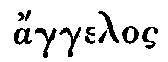 for
for 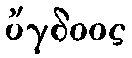 against all the MSS., and without any Patristic hint. For it seems a
play with words unworthy the writer, to make Satan, who possessed all
the seven, himself an eighth, and still worse if the
eighth:
against all the MSS., and without any Patristic hint. For it seems a
play with words unworthy the writer, to make Satan, who possessed all
the seven, himself an eighth, and still worse if the
eighth:
- that it is not only a great and causeless inconcinnity in
style, but a wanton adding of obscurity to the obscure to have, first,
so carefully distinguished (c. xiii. 1-11.) the
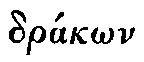 from
the two
from
the two 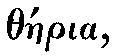 and the one
 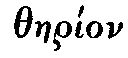 from the other,
and then to make the appellative of the : as if having in one place told of Nicholas senior, Dick
and another Dick his cousin, I should soon after talk of Dick, meaning
old Nicholas by that name; that is, having discriminated Nicholas from
Dick, then to say Dick, meaning Nicholas!
from the other,
and then to make the appellative of the : as if having in one place told of Nicholas senior, Dick
and another Dick his cousin, I should soon after talk of Dick, meaning
old Nicholas by that name; that is, having discriminated Nicholas from
Dick, then to say Dick, meaning Nicholas!
Rev
. xix. 9.
These words might well bear a more recondite interpretation; that is,
(these blessed ones) are the true
or
as the Logos is the
.
Ib.
10.
According to the law of symbolic poetry this sociable angel (the
Beatrice of the Hebrew Dante) ought to be, and I doubt not is,
sensu
symbolico
, an angel; that is, the angel of the Church of Ephesus,
John the Evangelist, according to the opinion of Eusebius.
P. 294. Rev. xx.
Millennium
.
Die vorzüglichsten Bekenner Jesu sollen auferstehen, die übrigen
Menschen sollen es nicht. Hiesse jenes, sie sollen noch nach ihrem
Tode fortwürken, so wäre das letztere falsch: denn auch die übrigen
würken nach ihrem Tode durch ihre schriften, ihre Andenken, ihre
Beispiel.
Euge! Heinrichi
. O, the sublime bathos of thy prosaism — the muddy
eddy of thy logic! Thou art the only man to understand a poet!
I have too clearly before me the idea of a poet's genius to deem myself
other than a very humble poet; but in the very possession of the idea, I
know myself so far a poet as to feel assured that I can understand and
interpret a poem in the spirit of poetry, and with the poet's spirit.
Like the ostrich, I cannot fly, yet have I wings that give me the
feeling of flight; and as I sweep along the plain, can look up toward
the bird of Jove, and can follow him and say:
"Sovereign of the
air, — who descendest on thy nest in the cleft of the inaccessible rock,
who makest the mountain pinnacle thy perch and halting-place, and,
scanning with steady eye the orb of glory right above thee, imprintest
thy lordly talons in the stainless snows, that shoot back and scatter
round his glittering shafts, — I pay thee homage. Thou art my king. I
give honor due to the vulture, the falcon, and all thy noble baronage;
and no less to the lowly bird, the sky-lark, whom thou permittest to
visit thy court, and chant her matin song within its cloudy curtains;
yea the linnet, the thrush, the swallow, are my brethren: — but still I
am a bird, though but a bird of the earth.
"Monarch of our kind, I am a bird, even as thou; and I have shed
plumes, which have added beauty to the beautiful, and grace to terror,
waving over the maiden's brow and on the helmed head of the war-chief;
and majesty to grief, drooping o'er the car of death!"
Göttingen, 1821. The few following notes are, something out
of order, inserted here in consequence of their connection with the
immediately preceding remarks in the text. — Ed.
Life of Bishop Hacket1
Ib.
p. 8.
Yet he would often dispute the necessity of a country living for a
London minister to retire to in hot summer time, out of the sepulchral
air of a churchyard, where most of them are housed in the city, and
found for his own part that by Whitsuntide he did rus anhelare,
and unless he took fresh air in the vacation, he was stopt in his
lungs and could not speak clear after Michaelmas.
A plausible reason certainly why A. and B. should occasionally change
posts, but a very weak one, methinks, for A.'s having both livings all
the year through.
Ib.
p. 42-3.
The Bishop was an enemy to all separation from the Church of England;
but their hypocrisy he thought superlative that allowed the doctrine,
and yet would separate for mislike of the discipline. ... And
therefore he wished that as of old all kings and other Christians
subscribed to the Conciliary Decrees, so now a law might pass that all
justices of peace should do so in England, and then they would be more
careful to punish the depravers of Church Orders.
The little or no effect of recent experience and sufferings still more
recent, in curing the mania of persecution! How was it possible that a
man like Bishop Hacket should not have seen that if separation on
account of the imposition of things by himself admitted to be
indifferent, and as such justified, was criminal in those who did not
think them indifferent, — how doubly criminal must the imposition have
been, and how tenfold criminal the perseverance in occasioning
separation; how guilty the imprisoning, impoverishing, driving into
wildernesses their Christian brethren for admitted indifferentials in
direct contempt of St. Paul's positive command to the contrary!
Index p. 2
Serm. I. Luke ii. 7.
Moreover as the woman Mary did bring forth the son who bruised the
serpent's head, which brought sin into the world by the woman Eve, so
the Virgin Mary was the occasion of grace as the Virgin Eve was the
cause of damnation. Eve had not known Adam as yet when she was
beguiled and seduced the man; so Mary, &c.
A Rabbinical fable or gloss on Gen. iii. 1. Hacket is offensively fond
of these worse than silly vanities.
Ib.
p. 5.
The more to illustrate this, you must know that there was a twofold
root or foundation of the children of Israel for their temporal being:
Abraham was the root of the people; the kingdom was rent from Saul,
and therefore David was the root of the kingdom; among all the kings
in the pedigree none but he hath the name; and Jesse begat David the
king, and David the king begat Solomon; and therefore so often as God
did profess to spare the people, though he were angry, he says he
would do it for Abraham's sake: so often as he professeth to spare the
kingdom of Judah, he says he would do it for his servant David's sake;
so that ratione radicis, as Abraham and David are roots of the
people and kingdom, especially Christ is called the Son of David, the
Son of Abraham.
A valuable remark, and confirmative of my convictions respecting the
conversion of the Jews, namely, that whatever was ordained for them as
Abrahamidæ
is not repealed by Christianity, but only what
appertained to the republic, kingdom, or state. The modern conversions
are, as it seems to me, in the face of God's commands.
Ib.
I come to the third strange condition of the birth; it was without
travel, or the pangs of woman, as I will shew you out of these words;
fasciis involvit, that she wrapt him in swaddling clouts,
and laid him in a manger. Ipsa genitrix fuit obstetrix, says St.
Cyprian. Mary was both the mother and the midwife of the child; far be
it from us to think that the weak hand of the woman could facilitate
the work which was guided only by the miraculous hand of God. The
Virgin conceived our Lord without the lusts of the flesh, and
therefore she had not the pangs and travel of woman upon her, she
brought him forth without the curse of the flesh. These be the
Fathers' comparisons. As bees draw honey from the flower without
offending it, as Eve was taken out of Adam's side without any grief to
him, as a sprig issues out of the bark of a tree, as the sparkling
light from the brightness of the star, such ease was it to Mary to
bring forth her first born son; and therefore having no weakness in
her body, feeling no want of vigor, she did not deliver him to any
profane hand to be drest, but by a special ability, above all that are
newly delivered, she wrapt him in swaddling clouts. Gravida, sed
non gravabatur; she had a burden in her womb, before she was
delivered, and yet she was not burdened for her journey which she took
so instantly before the time of the child's birth. From Nazareth to
Bethlem was above forty miles, and yet she suffered it without
weariness or complaint, for such was the power of the Babe, that
rather he did support the Mother's weakness than was supported; and as
he lighted his Mother's travel by the way from Nazareth to Bethlem
that it was not tedious to her tender age, so he took away all her
dolour and imbecility from her travel in child-birth, and therefore
she wrapt him in swaddling clouts.
A very different paragraph indeed, and quite on the cross road to Rome!
It really makes me melancholy; but it is one of a thousand instances of
the influence of Patristic learning, by which the Reformers of the Latin
Church were distinguished from the renovators of the Christian religion.
Can we wonder that the strict Protestants were jealous of the
backsliding of the Arminian prelatical clergy and of Laud their leader,
when so strict a Calvinist as Bishop Hacket could trick himself up in
such fantastic rags and lappets of Popish monkery! — could skewer such
frippery patches, cribbed from the tyring room of Romish Parthenolatry,
on the sober gown and cassock of a Reformed and Scriptural Church!
Ib.
p. 7.
But to say the truth, was he not safer among the beasts than he could
be elsewhere in all the town of Bethlem? His enemies perchance would
say unto him, as Jael did to Sisera, Turn in, turn in, my Lord,
when she purposed to kill him; as the men of Keilah made a fair shew
to give David all courteous hospitality, but the issue would prove, if
God had not blessed him, that they meant to deliver him into the hands
of Saul that sought his blood. So there was no trusting of the
Bethlemites. Who knows, but that they would have prevented Judas, and
betrayed him for thirty pieces of silver unto Herod? More humanity is
to be expected from the beasts than from some men, and therefore she
laid him in a manger.
Did not the life of Archbishop Williams prove otherwise, I should have
inferred from these Sermons that Hacket from his first boyhood had been
used to make themes, epigrams, copies of verses, and the like, on all
the Sunday feasts and festivals of the Church; had found abundant
nourishment for this humour of points, quirks, and quiddities in the
study of the Fathers and glossers; and remained a
junior soph
all
his life long. I scarcely know what to say: on the one hand, there is a
triflingness, a shewman's or relique-hawker's gossip that stands in
offensive contrast with the momentous nature of the subject, and the
dignity of the ministerial office; as if a preacher having chosen the
Prophets for his theme should entertain his congregation by exhibiting a
traditional shaving rag of Isaiah's with the Prophet's stubble hair on
the dried soap-sud. And yet, on the other hand, there is an innocency in
it, a security of faith, a fulness evinced in the play and plash of its
overflowing, that at other times give one the same sort of pleasure as
the sight of blackberry bushes and children's handkerchief-gardens on
the slopes of a rampart, the promenade of some peaceful old town, that
stood the last siege in the Thirty Years' war!
Ib.
Serm. II. Luke ii. 8.
Tiberius propounded his mind to the senate of Rome, that Christ, the
great prophet in Jewry, should be had in the same honour with the
other gods which they worshipped in the Capitol. The motion did not
please them, says Eusebius; and this was all the fault, because he was
a god not of their own, but of Tiberius' invention.
, I own, the negative evidence of the silence of Seneca and
Suetonius — above all, of Tacitus and Pliny — outweigh in my mind the
positive testimony of Eusebius, which rested, I suspect, on the same
ground with the letters of Pontius Pilate, so boldly appealed to by
Tertullian
.
Ib.
Serm. III. Luke ii. 9.
But our bodies shall revive out of that dust into which they were
dissolved, and live for ever in the resurrection of the righteous.
I never could satisfy myself as to the continuance and catholicity of
this strange Egyptian tenet in the very face of St. Paul's indignant,
Thou fool! not that, &c
. I have at times almost been tempted to
conjecture that Paul taught a different doctrine from the Palestine
disciples on this point, and that the Church preferred the sensuous and
therefore more popular belief of the Evangelists'
to
the more intelligible faith of the spiritual sage of the other Athens;
for so Tarsus was called.
And was there no symptom of a commencing relapse to the errors of that
Church which had equalled the traditions of men, yea, the dreams of
phantasts with the revelations of God, when a chosen elder with the law
of truth before him, and professing to divide and distribute the bread
of life, could, paragraph after paragraph, place such unwholesome
vanities as these before his flock, without even a hint which might
apprize them that the gew-gaw comfits were not part of the manna from
heaven? All this superstitious trash about angels, which the Jews
learned from the Persian legends, asserted as confidently as if Hacket
had translated it word for word from one of the four Gospels! Salmasius,
if I mistake not, supposes the original word to have been bachelors,
young unmarried men. Others interpret angels as meaning the bishop and
elders of the Church. More probably it was a proverbial expression
derived from the Cherubim in the Temple: something as the country folks
used to say to children, Take care, the Fairies will hear you! It was a
common notion among the Jews, in the time of St. Paul, that their angels
were employed in carrying up their prayers to the throne of God. Of
course they must have been in special attendance in a house of prayer.
After much search and much thought on the subject of angels as a diverse
kind of finite beings, I find no sufficing reason to hold it for a
revealed doctrine, and if not revealed it is assuredly no truth of
philosophy, which, as I have elsewhere remarked, can conceive but three
kinds:
- the infinite reason;
- the finite rational; and
- the finite
irrational — that is, God, man, and beast.
What indeed, even for the
vulgar, is or can an archangel be but a man with wings, better or worse
than the wingless species according as the feathers are white or black?
I would that the word had been translated instead of Anglicised in our
English Bible.
The following paragraph is one of Hacket's sweetest passages. It is
really a beautiful little hymn.
By this it appears how suitably a beam of admirable light did concur
in the angels' message to set out the majesty of the Son of God: and I
beseech you observe, — all you that would keep a good Christmas as you
ought, — that the glory of God is the best celebration of his Son's
nativity; and all your pastimes and mirth (which I disallow not, but
rather commend in moderate use) must so be managed, without riot,
without surfeiting, without excessive gaming, without pride and vain
pomp, in harmlessness, in sobriety, as if the glory of the Lord were
round about us. Christ was born to save them that were lost; but
frequently you abuse his nativity with so many vices, such disordered
outrages, that you make this happy time an occasion for your loss
rather than for your salvation. Praise him in the congregation of the
people! praise him in your inward heart! praise him with the sanctity
of your life! praise him in your charity to them that need and are in
want! This is the glory of God shining round, and the most Christian
solemnizing of the birth of Jesus.
Index p. 2
As the Temptation is found in the three Gospels of Matthew, Mark, and
Luke, it must have formed part of the
Prot-evangelion
, or
original Gospel; — from the Apostles, therefore, it must have come, and
from some or all who had heard the account from our Lord himself. How,
then, are we to understand it? To confute the whims and superstitious
nugacities of these Sermons, and the hundred other comments and
interpretations
ejusdem farinæ
, would be a sad waste of time. Yet
some meaning, and that worthy of Christ, it must have had. The struggle
with the suggestions of the evil principle, first, to force his way and
compel belief by a succession of miracles, disjoined from moral and
spiritual purpose, — miracles for miracles' sake; — second, doubts of his
Messianic character and divinity, and temptations to try it by some
ordeal at the risk of certain death; — third, to interpret his mission,
as his countrymen generally did, to be one of conquest and
royalty; — these perhaps — but I am lost in doubt.
Index p. 2
Luke IX. 33.
I could wish that myself were accursed from Christ for my brethren,
my kinsmen according to the flesh.
Rom. ix. 3.
St. Paul does not say, "I would desire to be accursed," nor does he
speak of any deliberated result of his consideration; but represents a
transient passion of his soul, an actual but undetermined impulse, — an
impulse existing in and for itself in the moment of its ebullience, and
not completed by an act and confirmation of the will, — as a striking
proof of the exceeding interest which he continued to feel in the
welfare of his countrymen, His heart so swelled with love and compassion
for them, that if it were possible, if reason and conscience permitted
it, 'Methinks,' says he, 'I could wish that myself were accursed, if so
they might be saved.' Might not a mother, figuring to herself as
possible and existing an impossible or not existing remedy for a dying
child, exclaim, 'Oh, I could fly to the end of the earth to procure it!'
Let it not be irreverent, if I refer to the fine passage in
Shakspeare — Hotspur's rapture-like reverie — so often ridiculed by
shallow wits. In great passion, the crust opake of present and existing
weakness and boundedness is, as it were, fused and vitrified for the
moment, and through the transparency the soul, catching a gleam of the
infinity of the potential in the will of man, reads the future for the
present. Percy is wrapt in the contemplation of the physical might
inherent in the concentrated will; the inspired Apostle in the sudden
sense of the depth of its moral strength.
Index p. 2
Acts II. 4.
Thirdly, the necessity of it: for it was not possible that he
should be holden of death.
One great error of textual divines is their inadvertence to the dates,
occasion, object and circumstances, at and under which the words were
written or spoken. Thus the simple assertion of one or two facts
introductory to the teaching of the Christian religion is taken as
comprising or constituting the Christian religion itself. Hence the
disproportionate weight laid on the simple fact of the resurrection of
Jesus, detached from the mysteries of the Incarnation and Redemption.
Ib.
St. Austin says, that Tully, in his 3 lib. de Republica,
disputed against the reuniting of soul and body. His argument was, To
what end? Where should they remain together? For a body cannot be
assumed into heaven. I believe God caused those famous monuments of
his wit to perish, because of such impious opinions wherewith they
were farced.
believe, however, that these books have recently themselves enjoyed a
resurrection by the labor of Angelo Mai
.
Ib.
And let any equal auditor judge if Job were not an Anti-Socinian; Job
xix. 26. Though after my skin worms destroy this body, yet in my
flesh shall I see God, whom I shall behold for myself, and mine eyes
shall see, and not another.
This text rightly rendered is perhaps nothing to the purpose, but may
refer to the dire cutaneous disease with which Job was afflicted.
may
be merely an expression of Job's confidence of his being justified in
the eyes of men, and in this life
.
In the whole wide range of theological
mirabilia
, I know none
stranger than the general agreement of orthodox divines to forget to ask
themselves what they precisely meant by the word 'body.' Our Lord's and
St. Paul's meaning is evident enough, that is, the personality.
Ib.
St. Chrysostom's judgment upon it (
having loosed the pains of
death) is, that when Christ came out of the grave, death itself
was delivered from pain and anxiety —


. Death knew it held him captive whom
it ought not to have seized upon, and therefore it suffered torments
like a woman in travail till it had given him up again. Thus he. But
the Scripture elsewhere testifies, that death was put to sorrow
because it had lost its sting, rather than released from sorrow by our
Saviour's resurrection.
Most noticeable! See the influence of the surrounding myriotheism in the
dea Mors!
Ib.
Let any competent judge read Hacket's Life of Archbishop Williams, and
then these Sermons, and so measure the stultifying, nugifying effect of
a blind and uncritical study of the Fathers, and the exclusive
prepossession in favor of their authority in the minds of many of our
Church dignitaries in the reign of Charles I.
Index p. 2
Hacket's Life of Lord Keeper Williams5
Prudence installed as virtue, instead of being employed as one of her
indispensable handmaids, and the products of this exemplified and
illustrated in the life of Archbishop Williams, as a work, I could
warmly recommend to my dearest Hartley. Williams was a man bred up to
the determination of being righteous, both honorably striving and
selfishly ambitious, but all within the bounds and permission of the
law, the reigning system of casuistry; in short, an egotist in morals,
and a worldling in impulses and motives. And yet by pride and by innate
nobleness of nature munificent and benevolent, with all the negative
virtues of temperance, chastity, and the like, — take this man on his
road to his own worldly aggrandizement. Winding his way through a grove
of powerful rogues, by flattery, professions of devoted attachment, and
by actual and zealous as well as able services, and at length becoming
in fact nearly as great a knave as the knaves (Duke of Buckingham for
example) whose favor and support he had been conciliating, — till at last
in some dilemma, some strait between conscience and fear, and increased
confidence in his own political strength, he opposes or hesitates to
further some too foolish or wicked project of his patron knave, or
affronts his pride by counselling a different course (not a less wicked,
but one more profitable and conducive to his Grace's elevation);-and
then is
floored
or crushed by him, and falls unknown and
unpitied. Such was that truly wonderful scholar and statesman,
Archbishop Williams.
Part 1. s. 61.
'And God forbid that any other course, should be attempted. For this
liberty was settled on the subject, with such imprecations upon the
infringers, that if they should remove these great landmarks, they
must look for vengeance, as if entailed by public vows on them and
their posterity.' These were the Dean's instructions, &c.
He deserves great credit for them. They put him in strong contrast with
Laud.
Ib.
s. 80.
Thus for them both together he solicits: — My most noble lord, what
true applause and admiration the King and your Honor have gained, &c.
All this we, in the year 1833, should call abject and base; but was it
so in Bishop Williams? In the history of the morality of a people,
prudence, yea cunning, is the earliest form of virtue. This is expressed
in Jacob, and in Ulysses and all the most ancient fables. It will
require the true philosophic calm and serenity to distinguish and
appreciate the character of the morality of our great men from Henry
VIII to the close of James I, —
nullum numen abest, si sit
prudentia
, — and of those of Charles I to the Restoration. The
difference almost amounts to contrast.
Ib.
s. 81-2.
How is it that any deeply-read historian should not see how imperfect
and precarious the rights of personal liberty were during this period;
or, seeing it, refuse to do justice to the patriots under Charles I? The
truth is, that from the reign of Edward I, (to go no farther backward),
there was a spirit of freedom in the people at large, which all our
kings in their senses were cautious not to awaken by too rudely treading
on it; but for individuals, as such, there was none till the conflict
with the Stuarts.
Ib.
s. 84.
Of such a conclusion of state, quæ aliquando incognita, semper
justa, &c.
This perversion of words respecting the decrees of Providence to the
caprices of James and his beslobbered minion the Duke of Buckingham, is
somewhat nearer to blasphemy than even the euphuism of the age can
excuse.
Ib.
s. 85.
— — tuus, O Jacobe, quod optas
Explorare labor, mihi jussa capessere fas est.
In our times this would be pedantic wit: in the days of James I, and in
the mouth of Archbishop Williams it was witty pedantry.
Ib.
s. 89.
He that doth much in a short life products his mortality.
'Products' for 'produces;' that is, lengthens out,
ut apud
geometros
. But why Hacket did not say 'prolongs,' I know not.
Ib.
See what a globe of light there is in natural reason, which is the
same in every man: but when it takes well, and riseth to perfection,
it is called wisdom in a few.
The good affirming itself — (the will, I am) — begetteth the true, and
wisdom is the spirit proceeding. But in the popular acceptation, common
sense in an uncommon degree is what the world calls wisdom.
Ib.
s. 92.
A well-spirited clause, and agreeable to holy assurance, that truth is
more like to win than love. Could the light of such a Gospel as we
profess be eclipsed with the interposition of a single marriage?
And yet Hacket must have lived to see the practical confutation of this
shallow Gnathonism in the result of the marriage with the Papist
Henrietta of France!
Ib.
s. 96.
"Floud," says the Lord Keeper, "since I am no Bishop in your opinion,
I will be no Bishop to you."
I see the wit of this speech; but the wisdom, the Christianity, the
beseemingness of it in a Judge and a Bishop, — what am I to say of that?
Ib.
And after the period of his presidency (of the Star Chamber), it is
too well known how far the enhancements were stretched. But the
wringing of the nose bringeth forth blood. Prov. 30-33.
We may learn from this and fifty other passages, that it did not require
the factious prejudices of Prynne or Burton to look with aversion on the
proceedings of Laud. Bishop Hacket was as hot a royalist as a loyal
Englishman could be, yet Laud was
allii nimis
.
Ib.
s. 97.
New stars have appeared and vanished: the ancient asterisms remain;
there's not an old star missing.
If they had been, they would not have been old. This therefore, like
many of Lord Bacon's illustrations, has more wit than meaning. But it is
a good trick of rhetoric. The vividness of the image,
per se
,
makes men overlook the imperfection of the simile. "You see my hand, the
hand of a poor, puny fellow-mortal; and will you pretend not to see the
hand of Providence in this business? He who sees a mouse must be
wilfully blind if he does not see an elephant!"
Ib.
s. 100.
The error of the first James, — an ever well-intending, well-resolving,
but, alas! ill-performing monarch, a kind-hearted, affectionate, and
fondling old man, really and extensively learned, yea, and as far as
quick wit and a shrewd judgment go to the making up of wisdom, wise in
his generation, and a pedant by the right of pedantry, conceded at that
time to all men of learning (Bacon for example), — his error, I say,
consisted in the notion, that because the stalk and foliage were
originally contained in the seed, and were derived from it, therefore
they remained so in point of right after their evolution. The kingly
power was the seed; the House of Commons and the municipal charters and
privileges the stock of foliage; the unity of the realm, or what we mean
by the constitution, is the root. Meanwhile the seed is gone, and
reappears as the crown and glorious flower of the plant. But James, in
my honest judgment, was an angel compared with his son and grandsons. As
Williams to Laud, so James I was to Charles I.
Ib.
Restraint is not a medicine to cure epidemical diseases.
A most judicious remark.
Ib.
s. 103.
The least connivance in the world towards the person of a Papist.
It is clear to us that this illegal or
præter
-legal and desultory
toleration by connivance at particular cases, — this precarious depending
on the momentary mood of the King, and this in a stretch of a questioned
prerogative, — could neither satisfy nor conciliate the Roman-Catholic
potentates abroad, but was sure to offend and alarm the Protestants at
home. Yet on the other hand, it is unfair as well as unwise to censure
the men of an age for want of that which was above their age. The true
principle, much more the practicable rules, of toleration were in
James's time obscure to the wisest; but by the many, laity no less than
clergy, would have been denounced as soul-murder and disguised atheism.
In fact — and a melancholy fact it is, — toleration then first becomes
practicable when indifference has deprived it of all merit. In the same
spirit I excuse the opposite party, the Puritans and Papaphobists.
Ib.
s. 104.
It was scarcely to be expected that the passions of James's age would
allow of this wise distinction between Papists, the intriguing restless
partizans of a foreign potentate, and simple Roman-Catholics, who
preferred the
mumpsimus
of their grandsires to the corrected
sumpsimus
of the Reformation. But that in our age this distinction
should have been neglected in the Roman-Catholic Emancipation Bill!
Ib.
s. 105.
But this invisible consistory shall be confusedly diffused over all
the kingdom, that many of the subjects shall, to the intolerable
exhausting of the wealth of the realm, pay double tithes, double
offerings, double fees, in regard of their double consistory. And if
Ireland be so poor as it is suggested, I hold, under correction, that
this invisible consistory is the principal cause of the exhausting
thereof.
A memorable remark on the evil of the double priesthood in Ireland.
Ib.
Dr. Bishop, the new Bishop of Chalcedon, is to come to London
privately, and I am much troubled at it, not knowing what to advise
his majesty as things stand at this present. If you were shipped with
the Infanta, the only counsel were to let the judges proceed with him
presently; hang him out of the way, and the King to blame my lord of
Canterbury or myself for it.
Striking instance and illustration of the tricksy policy which in the
seventeenth century passed for state wisdom even with the comparatively
wise. But there must be a Ulysses before there can be an Aristides and
Phocion.
Poor King James's main errors arose out of his superstitious notions of
a sovereignty inherent in the person of the king. Hence he would be a
sacred person, though in all other respects he might be a very devil.
Hence his yearning for the Spanish match; and the ill effects of his
toleration became rightly attributed by his subjects to foreign
influence, as being against his own acknowledged principle, not on a
principle.
Ib.
s. 107.
I have at times played with the thought, that our bishoprics, like most
of our college fellowships, might advantageously be confined to single
men, if only it were openly declared to be on ground of public
expediency, and on no supposed moral superiority of the single state.
Ib.
s. 108.
That a rector or vicar had not only an office in the church, but a
freehold for life, by the common law, in his benefice.
! if Archbishop Williams had but seen in a clear point of view what he
indistinctly aims at, — the essential distinction between the nationalty
and its trustees and holders, and the Christian Church and its
ministers
.
Ib.
s. 111.
I will represent him (the archbishop of Spalato) in a line or two,
that he was as indifferent, or rather dissolute, in practice as in
opinion. For in the same chapter, art. 35, this is his Nicolaitan
doctrine: — A pluralitate uxorum natura humana non abhorret, imo
fortasse neque ab earum communitate.
How so? The words mean only that the human animal is not withholden by
any natural instinct from plurality or even community of females. It is
not asserted, that reason and revelation do not forbid both the one and
the other, or that man unwithholden would not be a Yahoo, morally
inferior to the swallow. The emphasis is to be laid on
natura
,
not on
humana
. Humanity forbids plural and promiscuous
intercourse, not however by the animal nature of man, but by the reason
and religion that constitute his moral and spiritual nature.
Ib.
s. 112.
But being thrown out into banishment, and hunted to be destroyed as a
partridge in the mountain, he subscribed against his own hand, which
yet did not prejudice Athanasius his innocency: —

I have ever said this of Sir John Cheke. I regret his recantation as one
of the cruelties suffered by him, and always see the guilt flying off
from him and settling on his persecutors.
Ib.
s. 151.
I conclude, therefore, that his Highness having admitted nothing in
these oaths or articles, either to the prejudice of the true, or the
equalizing or authorizing of the other, religion, but contained
himself wholly within the limits of penal statutes and connivances,
wherein the state hath ever challenged and usurped a directing power,
&c.
Three points seem wanting to render the Lord Keeper's argument
air-tight; —
- the proof that a king of England even then had a right to dispense,
not with the execution in individual cases of the laws, but with the
laws themselves in omne futurum; that is, to repeal laws by his
own act;
- the proof that such a tooth-and-talon drawing of the laws did not
endanger the equalizing and final mastery of the unlawful religion;
- the utter want of all reciprocity on the part of the Spanish monarch.
In short, it is pardonable in Hacket, but would be contemptible in any
other person, not to see this advice of the Lord Keeper's as a black
blotch in his character, both as a Protestant Bishop and as a councillor
of state in a free and Protestant country.
Ib.
s. 152.
Yet opinions were so various, that some spread it for a fame, that, &c.
Was it not required of — at all events usual for — all present at a
Council to subscribe their names to the act of the majority? There is a
modern case in point, I think, that of Sir Arthur Wellesley's signature
to the Convention of Cintra.
Ib.
s. 164.
For to forbid judges against their oath, and justices of peace (sworn
likewise), not to execute the law of the land, is a thing
unprecedented in this kingdom. Durus sermo, a harsh and bitter
pill to be digested upon a sudden, and without some preparation.
What a fine India-rubber conscience Hacket, as well as his patron, must
have had! Policy with innocency,' 'cunning with conscience,' lead up the
dance to the tune of '
Tantara
rogues all!'
Upon my word, I can scarcely conceive a greater difficulty than for an
honest, warm-hearted man of principle of the present day so to
discipline his mind by reflection on the circumstances and received
moral system of the Stuarts' age (from Elizabeth to the death of Charles
I), and its proper place in the spiral line of ascension, as to be able
to regard the Duke of Buckingham as not a villain, and to resolve many
of the acts of those Princes into passions, conscience-warped and
hardened by half-truths and the secular creed of prudence, as being
itself virtue instead of one of her handmaids, when interpreted by minds
constitutionally and by their accidental circumstances imprudent and
rash, yet fearful and suspicious; and with casuists and codes of
casuistry as their conscience-leaders! One of the favorite works of
Charles I was Sanderson
de Juramento
.
Ib.
s. 200.
Wherefore he waives the strong and full defence he had made upon
stopping of an original writ, and deprecates all offence by that maxim
of the law which admits of a mischief rather than an inconvenience:
which was as much as to say, that he thought it a far less evil to do
the lady the probability of an injury (in her own name) than to suffer
those two courts to clash together again.
All this is a tangle of sophisms. The assumption is, it is better to
inflict a private wrong than a public one: we ought to wrong one rather
than many. But even then, it is badly stated. The principle is true only
where the tolerating of the private wrong is the only means of
preventing a greater public wrong. But in this case it was the certainty
of the wrong of one to avoid the chance of an inconvenience that might
perchance be the occasion of wrong to many, and which inconvenience both
easily might and should have been remedied by rightful measures, by
mutual agreement between the Bishop and Chancellor, and by the King, or
by an act of Parliament.
Ib.
s. 203.
'Truly, Sir, this is my dark lantern, and I am not ashamed to inquire
of a Dalilah to resolve a riddle; for in my studies of divinity I have
gleaned up this maxim, licet uti alieno peccato; — though the
Devil make her a sinner, I may make good use of her sin.' Prince,
merrily, 'Do you deal in such ware?' 'In good faith, Sir,' says the
Keeper, 'I never saw her face.'
And Hacket's evident admiration, and not merely approbation, of this
base Jesuitry, — this divinity which had taught the Archbishop
licere
uti alieno peccato
! But Charles himself was a student of such
divinity, and yet (as rogues of higher rank comfort the pride of their
conscience by despising inferior knaves) I suspect that the 'merrily'
was the Sardonic mirth of bitter contempt; only, however, because he
disliked Williams, who was simply a man of his age, his baseness being
for us, not for his contemporaries, or even for his own mind. But the
worst of all is the Archbishop's heartless disingenuousness and
moon-like nodes towards his kind old master the King. How much of truth
was there in the Spaniard's information respecting the intrigues of the
Prince and the Duke of Buckingham? If none, if they were mere slanders,
if the Prince had acted the filial part toward his father and King, and
the Duke the faithful part towards his master and only too fond and
affectionate benefactor, what more was needed than to expose the
falsehoods? But if Williams knew that there was too great a mixture of
truth in the charges, what a cowardly ingrate to his old friend to have
thus curried favor with the rising sun by this base jugglery!
Ib.
s. 209.
He was the topsail of the nobility, and in power and trust of offices
far above all the nobility.
James I was no fool, and though through weakness of character an unwise
master, yet not an unthinking statesman; and I still want a satisfactory
solution of the accumulation of offices on Buckingham.
Ib.
s. 212.
Prudent men will continue the oblations of their forefathers' piety.
The danger and mischief of going far back, and yet not half far enough!
Thus Hacket refers to the piety of individuals our forefathers as the
origin of Church property. Had he gone further back, and traced to the
source, he would have found these partial benefactions to have been mere
restitutions of rights co-original with their own property, and as a
national reserve for the purposes of national existence — the condition
sine qua non
of the equity of their proprieties; for without
civilization a people cannot be, or continue to be, a nation. But, alas!
the ignorance of the essential distinction of a national clerisy, the
Ecclesia
, from the Christian Church. The
Ecclesia
has been
an eclipse to the intellect of both Churchmen and Sectarians, even from
Elizabeth to the present day, 1833.
Ib.
s. 214.
And being threatened, his best mitigation was, that perhaps it was not
safe for him to deny so great a lord; yet it was safest for his
lordship to be denied. ... The king heard the noise of these crashes,
and was so pleased, that he thanked God, before many witnesses, that
he had put the Keeper into that place: 'For,' says he, 'he that will
not wrest justice for Buckingham's sake, whom I know he loves, will
never be corrupted with money, which he never loved.'
Strange it must seem to us; yet it is evident that Hacket thought it
necessary to make a mid something, half apology and half eulogy, for the
Lord Keeper's timid half resistance to the insolence and iniquitous
interference of the minion Duke. What a portrait of the times! But the
dotage of the King in the maintenance of the man, whose insolence in
wresting justice he himself admits! Yet how many points, both of the
times and of the King's personal character, must be brought together
before we can fairly solve the intensity of James's minionism, his
kingly egotism, his weak kindheartedness, his vulgar coarseness of
temper, his systematic jealousy of the ancient nobles, his timidity, and
the like!
Ib.
'Sir,' says the Lord Keeper, 'will you be pleased to listen to me,
taking in the Prince's consent, of which I make no doubt, and I will
shew how you shall furnish the second and third brothers with
preferments sufficient to maintain them, that shall cost you nothing.
... If they fall to their studies, design them to the bishoprics of
Durham and Winchester, when they become void. If that happen in their
nonage, which is probable, appoint commendatories to discharge the
duty for them for a laudable allowance, but gathering the fruits for
the support of your grandchildren, till they come to virility to be
consecrated,' &c.
Williams could not have been in earnest in this villanous counsel, but
he knew his man. This conceit of dignifying dignities by the Simoniacal
prostitution of them to blood-royal was just suited to James's
fool-cunningness.
Part II. s. 74.
... To yield not only passive obedience (which is due) but active
also, &c.
'Which is due.' What in the name of common sense can this mean, that is,
speculatively? Practically, the meaning is clear enough, namely, that we
should do what we can to escape hanging; but the distinction is for
decorum, and so let it pass.
Ib.
s. 75.
This is the venom of this new doctrine, that by making us the King's
creatures, and in the state of minors or children, to take away all
our property; which would leave us nothing of our own, and lead us
(but that God hath given us just and gracious Princes) into slavery.
And yet this just and gracious Prince prompts, sanctions, supports, and
openly rewards this envenomer, in flat contempt of both Houses of
Parliament, — protects and prefers him and others of the same principles
and professions on account of these professions! And the Parliament and
nation were inexcusable, forsooth, in not trusting to Charles's
assurances, or rather the assurances put in his mouth by Hyde, Falkland,
and others, that he had always abhorred these principles.
Ib.
s. 136.
When they saw he was not selfish (it is a word of their own new
mint), &c.
Singular! From this passage it would seem that our so very common word
'selfish' is no older than the latter part of the reign of Charles I.
Ib.
s. 137.
Their political aphorisms are far more dangerous, that His Majesty is
not the highest power in his realms; that he hath not absolute
sovereignty; and that a Parliament sitting is co-ordinate with him in
it.
Hacket himself repeatedly implies as much; for would he deny that the
King with the Lords and Commons is not more than the King without them?
or that an act of Parliament is not more than a proclamation?
Ib.
s.154.
What a venomous spirit is in that serpent Milton, that black-mouthed
Zoilus, that blows his viper's breath upon those immortal devotions
from the beginning to the end! This is he that wrote with all
irreverence against the Fathers of our Church, and showed as little
duty to the father that begat him: the same that wrote for the
Pharisees, that it was lawful for a man to put away his wife for every
cause, — and against Christ, for not allowing divorces: the same, O
horrid! that defended the lawfulness of the greatest crime that ever
was committed, to put our thrice-excellent King to death: a petty
schoolboy scribbler, that durst grapple in such a cause with the
prince of the learned men of his age, Salmasius,
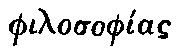

, as Eunapius says of Ammonius, Plutarch's
scholar in Egypt, the delight, the music of all knowledge, who would
have scorned to drop a pen-full of ink against so base an adversary,
but to maintain the honor of so good a King ... Get thee behind me,
Milton! Thou savourest not the things that be of truth and loyalty,
but of pride, bitterness, and falsehood. There will be a time, though
such a Shimei, a dead dog in Abishai's phrase, escape for a while ...
It is no marvel if this canker-worm Milton, &c.
A contemporary of Bishop Racket's designates Milton as the author of a
profane and lascivious poem entitled Paradise Lost. The biographer of
our divine bard ought to have made a collection of all such passages. A
German writer of a Life of Salmasius acknowledges that Milton had the
better in the conflict in these words: 'Hans (Jack) von Milton — not to
be compared in learning and genius with the incomparable Salmasius, yet
a shrewd and cunning lawyer,' &c.
O sana posteritas!
Ib.
s. 178.
Dare they not trust him that never broke with them? And I have heard
his nearest servants say, that no man could ever challenge him of the
least lie.
What! this after the publication of Charles's letters to the Queen! Did
he not within a few months before his death enter into correspondence
with, and sign contradictory offers to, three different parties, not
meaning to keep any one of them; and at length did he not die with
something very like a falsehood in his mouth in allowing himself to be
represented as the author of the Icon Basilike?
Ib.
s. 180.
If an under-sheriff had arrested Harry Martin for debt, and pleaded
that he did not imprison his membership, but his Martinship, would the
Committee for privileges be fobbed off with that distinction?
To make this good in analogy, we must suppose that Harry Martin had
notoriously neglected all the duties, while he perverted and abused all
the privileges, of membership: and then I answer, that the Committee of
privileges would have done well and wisely in accepting the
under-sheriff's distinction, and, out of respect for the membership,
consigning the Martinship to the due course of law.
Ib.
That every soul should be subject to the higher powers. The
higher power under which they lived was the mere power and will of
Cæsar, bridled in by no law.
False, if meant
de jure
; and if
de facto
, the plural
powers
would
apply to the Parliament far better than to the King, and to Cromwell as
well as to Nero. Every even decently good Emperor professed himself the
servant of the Roman Senate. The very term
Imperator
, as Gravina
observes, implies it; for it expresses a delegated and instrumental
power. Before the assumption of the Tribunitial character by Augustus,
by which he became the representative of the majority of the
people, —
majestatem indutus est, — Senatus consulit, Populus jubet,
imperent Consules
, was the constitutional language.
Ib.
s. 190.
Yet so much dissonancy there was between his tongue and his heart,
that he triumphed in the murder of Cæsar, the only Roman that exceeded
all their race in nobleness, and was next to Tully in eloquence.
There is something so shameless in this self-contradiction as of itself
almost to extinguish the belief that the prelatic royalists were
conscientious in their conclusions. For if the Senate of Rome were not a
lawful power, what could be? And if Cæsar, the thrice perjured traitor,
was neither perjured nor traitor, only because he by his Gaulish troops
turned a republic into a monarchy, — with what face, under what pretext,
could Hacket abuse 'Sultan Cromwell?'
By Thomas Plume. Folio, 1676. — Ed.
Ea omnia super Christo Pilatus, et ipse jam pro sua
conscientia Christianus, Cæsari tum Tiberio nuntiavit.
Apologet, ii.
624. See the account in Eusebius. Hist. Eccl. ii.2. — Ed.
See
M. T. Ciceronis de Republica quæ supersunt. Zell.
Stuttgardt
. 1827. — Ed.
See
supra
. — Ed.
Folio. 1693. — Ed.
See
The Church and State
. — Ed.
I have not seen the late Bishop Heber's edition of Jeremy Taylor's
Works
; but I have been informed that he did little more than contribute
the
Life
, and that in all else it is a mere London booksellers' job.
This, if true, is greatly to be regretted. I know no writer whose works
more require, I need not say deserve, the annotations, aye, and
occasional animadversions, of a sound and learned divine. One thing is
especially desirable in reference to that most important, because (with
the exception perhaps of the
Holy Living and Dying)
the most popular, of
Taylor's works,
The Liberty of Prophesying
; and this is a careful
collation of the different editions, particularly of the first printed
before the Restoration, and the last published in Taylor's lifetime, and
after his promotion to the episcopal bench. Indeed, I regard this as so
nearly concerning Taylor's character as a man, that if I find that it
has not been done in Heber's edition, and if I find a first edition in
the British Museum, or Sion College, or Dr. Williams's library, I will,
God permitting, do it myself. There seems something cruel in giving the
name, Anabaptist, to the English Anti-pædo-baptists; but still worse in
connecting this most innocent opinion with the mad Jacobin ravings of
the poor wretches who were called Anabaptists, in Munster, as if the
latter had ever formed part of the Baptists' creeds. In short
The
Liberty of Prophesying
is an admirable work, in many respects, and
calculated to produce a much greater effect on the many than Milton's
treatise on the same subject: on the other hand, Milton's is throughout
unmixed truth; and the man who in reading the two does not feel the
contrast between the single-mindedness of the one, and the
strabismus
in the other, is — in the road of preferment.
Index p. 2
General Dedication of the Polemical Discourses1
Vol. vii. p. ix.
And the breath of the people is like the voice of an exterminating
angel, not so killing but so secret.
That is, in such wise. It would be well to note, after what time 'as'
became the requisite correlative to 'so,' and even, as in this instance,
the preferable substitute. We should have written 'as' in both places
probably, but at all events in the latter, transplacing the sentences
'as secret though not so killing;' or 'not so killing, but quite as
secret.' It is not generally true that Taylor's punctuation is
arbitrary, or his periods reducible to the post-Revolutionary standard
of length by turning some of his colons or semi-colons into full stops.
There is a subtle yet just and systematic logic followed in his
pointing, as often as it is permitted by the higher principle, because
the proper and primary purpose, of our stops, and to which alone from
their paucity they are adequate, — that I mean of enabling the reader to
prepare and manage the proportions of his voice and breath.
for the
true scheme of punctuation,
see the blank
page over leaf which I will try to disblank into a prize of more worth
than can be got at the E.O.'s and little goes of Lindley Murray
.
Ib.
p. xv.
But the most complained that, in my ways to persuade a toleration, I
helped some men too far, and that I armed the Anabaptists with swords
instead of shields, with a power to offend us, besides the proper
defensitives of their own ... But wise men understand the thing and
are satisfied. But because all men are not of equal strength; I did
not only in a discourse on purpose demonstrate the true doctrine in
that question, but I have now in this edition of that book answered
all their pretensions, &c.
No; in the might of his genius he called up a spirit which he has in
vain endeavored to lay, or exorcise from the conviction.
Ib.
p. xvii.
For episcopacy relies not upon the authority of Fathers and Councils,
but upon Scripture, upon the institution of Christ, or the institution
of the Apostles, upon a universal tradition, and a universal practice,
not upon the words and opinions of the doctors: it hath as great a
testimony as Scripture itself hath, &c.
We must make allowance for the intoxication of recent triumph and final
victory over a triumphing and victorious enemy; or who but would start
back at the aweless temerity of this assertion? Not to mention the
evasion; for who ever denied the historical fact, or the Scriptural
occurrence of the word expressing the fact, namely,
episcopi,
episcopatus?
? What was questioned by the opponents was,
- Who and what these episcopi were; whether essentially
different from the presbyter, or a presbyter by kind in his own
ecclesia, and a president or chairman by accident in a synod of
presbyters:
- That whatever the episcopi of the Apostolic times were, yet
were they prelates, lordly diocesans; were they such as the Bishops of
the Church of England? Was there Scripture authority for Archbishops?
- That the establishment of Bishops by the Apostle Paul being granted
(as who can deny it?) — yet was this done jure Apostolico for the
universal Church in all places and ages; or only as expedient for that
time and under those circumstances; by Paul not as an Apostle, but as
the head and founder of those particular churches, and so entitled to
determine their bye laws?
Index p. 2
Ib.
p. xxiii.
But the interest of the Bishops is conjunct with the prosperity of the
King, besides the interest of their own security, by the obligation of
secular advantages. For they who have their livelihood from the King,
and are in expectance of their fortune from him, are more likely to
pay a tribute of exacter duty, than others, whose fortunes are not in
such immediate dependency on His Majesty.
The cat out of the bag! Consult the whole reigns of Charles I and II
and the beginning of James II. Jeremy Taylor was at this time
(blamelessly for himself and most honourably for his patrons) ambling on
the high road of preferment; and to men so situated, however sagacious
in other respects, it is not given to read the signs of the times.
Little did Taylor foresee that to indiscreet avowals, like these, on the
part of the court clergy, the exauctorations of the Bishops and the
temporary overthrow of the Church itself would be in no small portion
attributable. But the scanty measure and obscurity (if not rather, for
so bright a luminary, the occultation) of his preferment after the
Restoration is a problem, of which perhaps his virtues present the most
probable solution.
Ib.
p. xxv.
A second return that episcopacy makes to royalty, is that which is the
duty of all Christians, the paying tributes and impositions.
This is true; and it was an evil hour for the Church, — and led to the
loss of its Convocation, the greatest and, in an enlarged state-policy,
the most impolitic affront ever offered by a government to its own
established Church, — in which the clergy surrendered their right of
taxing themselves.
Ib.
p. xxvii.
I mean the conversion of the kingdom from Paganism by St. Augustine,
Archbishop of Canterbury; and the Reformation begun and promoted by
Bishops.
From Paganism in part; but in part from primitive Christianity to
Popery. But neither this nor the following boast will bear narrow
looking into, I suspect.
In fine.
Like all Taylor's dedications and dedicatory epistles, this is easy,
dignified, and pregnant. The happiest
synthesis
of the divine,
the scholar, and the gentleman was perhaps exhibited in him and Bishop
Berkeley.
Introd. p.3.
In all those accursed machinations, which the device and artifice of
hell hath invented for the supplanting of the Church, inimicus
homo, that old superseminator of heresies and crude mischiefs,
hath endeavoured to be curiously compendious, and, with Tarquin's
device, putare summa papaverum.
Quœre-spiritualiter papaveratorurn?
Ib.
His next onset was by Julian, and occidere presbyterium, that
was his province. To shut up public schools, to force Christians to
ignorance, to impoverish and disgrace the clergy, to make them vile
and dishonorable, these are his arts; and he did the devil more
service in this fineness of undermining, than all the open battery of
ten great rams of persecution.
What felicity, what vivacity of expression! Many years ago Mr. Mackintosh
gave it as an instance of my perverted taste, that I had seriously
contended that in order to form a style worthy of Englishmen, Milton and
Taylor must be studied instead of Johnson, Gibbon, and Junius; and now I
see by his introductory Lecture given at Lincoln's Inn, and just
published, he is himself imitating Jeremy Taylor, or rather copying his
semi-colon punctuation, as closely as he can. Amusing it is to observe,
how by the time the modern imitators are at the half-way of the long
breathed period, the asthmatic thoughts drop down, and the rest
is, — words! I have always been an obstinate hoper: and even this is a
datum
and a symptom of hope to me, that a better, an ancestral,
spirit is forming and will appear in the rising generation.
Ib.
p. 5.
First, because here is a concourse of times; for now after that these
times have been called the last times for 1600 years together, our
expectation of the great revelation is very near accomplishing.
Rather a whimsical consequence, that because a certain party had been
deceiving themselves for sixteen centuries they were likely to be in the
right at the beginning of the seventeenth. But indeed I question whether
in all Taylor's voluminous writings there are to be found three other
paragraphs so vague and misty-magnific as this is. It almost reminds me
of the "very cloudy and mighty alarming" in Foote.
S. i. p. 4.
If there be such a thing as the power of the keys, by Christ
concredited to his Church, for the binding and loosing delinquents and
penitents respectively on earth, then there is clearly a court erected
by Christ in his Church.
We may, without any heretical division of person, economically
distinguish our Lord's character as Jesus, and as Christ, so far that
during his sojourn on earth, from his baptism at least to his
crucifixion, he was in some respects his own Elias, bringing back the
then existing Church to the point at which the Prophets had placed it;
that is, distinguishing the
ethica
from the
politica,
what
was binding on the Jews as descendants of Abraham and inheritors of the
patriarchal faith from the statutes obligatory on them as members of the
Jewish state.
Jesus fulfilled the Law, which culminated in a pure
religious morality in principles, affections, and acts; and this he
consolidated and levelled into the ground-stead on which the new temple
not made with hands,
wherein Himself, even Christ the Lord, is
the Shechinah, was to rise and be raised.
Thus he taught the spirit of
the Mosaic Law, while by his acts, sufferings, death, resurrection,
ascension, and demission of the Comforter, he created and realized the
contents, objects, and materials of that redemptive faith, the
everlasting Gospel, which from the day of Pentecost his elect disciples,
Were Sent forth to disperse and
promulgate with suitable gifts, powers, and evidences.
In this view, I
interpret our Lord's sayings concerning the Church, as applying wholly
to the Synagogue or established Church then existing, while the binding
and loosing refers, immediately and primarily as I conceive, to the
miraculous gifts of healing diseases communicated to the Apostles; and I
am not afraid to avow the conviction, that the first three Gospels are
not the books of the New Testament, in which we should expect to find
the peculiar doctrines of the Christian faith explicitly delivered, or
forming the predominant subject or contents of the writing.
S. viii. p. 25.
Imposition of hands for Ordination does indeed give the Holy Ghost,
but not as he is that promise which is called
the promise of the
truth
.
Alas! but in what sense that does not imply some infusion of power or
light, something given and inwardly received, which would not have
existed in and for the recipient without this immission by the means or
act of the imposition of the hands? What sense that does not amount to
more and other than a mere delegation of office, a mere legitimating
acceptance and acknowledgment, with respect to the person, of that which
already is in him, can be attached to the words,
Receive the Holy
Ghost
, without shocking a pious and single-minded candidate? The
miraculous nature of the giving does not depend on the particular kind
or quality of the gift received, much less demand that it should be
confined to the power of working miracles.
For "miraculous nature" read "supernatural character;" and I can
subscribe this pencil note written so many years ago, even at this
present time, 2d March, 1824.
S. xxi. p. 91.
Postquam unusquisque eos quos baptizabat suos putabat esse, non
Christi, et diceretur in populis, Ego sum Pauli, Ego Apollo, Ego autem
Cephæ, in toto orbe decretum est ut unus de presbyteris electus
superponeretur cateris, ut schismatum semina tollerentur.
The natural inference would, methinks, be the contrary. There would be
more persons inclined and more likely to attach an ambition to their
belonging to a single eminent leader and head than to a body, — rather to
Cæsar, Marius, or Pompey, than to the Senate. But I have ever thought
that the best, safest, and at the same time sufficient, argument is,
that by the nature of human affairs and the appointments of God's
ordinary providence every assembly of functionaries will and must have a
president; that the same qualities which recommended the individual to
this dignity would naturally recommend him to the chief executive power
during the intervals of legislation, and at all times in all points
already ruled; that the most solemn acts, Confirmation and Ordination,
would as naturally be confined to the head of the executive in the state
ecclesiastic, as the sign manual and the like to the king in all limited
monarchies; and that in course of time when many presbyteries would
exist in the same district, Archbishops and Patriarchs would arise
pari
ratione
as Bishops did in the first instance. Now it is admitted that
God's extraordinary appointments never repeal but rather perfect the
laws of his ordinary providence: and it is enough that all we find in
the New Testament tends to confirm and no where forbids, contradicts, or
invalidates the course of government, which the Church, we are certain,
did in fact pursue.
Ib.
s. xxxvi. p. 171.
But those things which Christianity, as it prescinds from the interest
of the republic, hath introduced, all them, and all the causes
emergent from them, the Bishop is judge of.... Receiving and disposing
the patrimony of the Church, and whatsoever is of the same
consideration according to the fortyfirst canon of the Apostles.
Præcipimus ut in potestate sua episcopus ecclesice res habeat. Let
the Bishops have the disposing of the goods of the Church; adding this
reason: si enim animte hominum pretiosæ illi sint creditæ, multo
magis eum oportet curam pecuniarum gerere. He that is intrusted with
our precious souls may much more be intrusted with the offertories of
faithful people.
Let all these belong to the overseer of the Church: to whom else so
properly? but what is the nature of the power by which he is to enforce
his orders? By secular power? Then the Bishop's power is no derivative
from Christ's royalty; for his kingdom is not of the world; but the
monies are Cæsar's; and the
cura pecuniarum
must be vested where the
donors direct, the law of the land permitting.
Ib.
Such are the delinquencies of clergymen, who are both clergy and
subjects too; clerus Domini, and regis subditi: and for their
delinquencies, which are in materia justiæ, the secular tribunal
punishes, as being a violation of that right which the state must
defend; but because done by a person who is a member of the sacred
hierarchy, and hath also an obligation of special duty to his Bishop,
therefore the Bishop also may punish him; and when the commonwealth
hath inflicted a penalty, the Bishop also may impose a censure, for
every sin of a clergyman is two.
But why of a clergyman only? Is not every sheep of his flock a part of
the Bishop's charge, and of course the possible object of his censure?
The clergy, you say, take the oath of obedience. Aye! but this is the
point in dispute.
Ib.
p. 172.
So that ever since then episcopal jurisdiction hath a double part, an
external and an internal: this is derived from Christ, that from the
king, which because it is concurrent in all acts of jurisdiction,
therefore it is that the king is supreme of the jurisdiction, namely,
that part of it which is the external compulsory.
If Christ delegated no external compulsory power to the Bishops, how
came it the duty of princes to God to do so? It has been so since — -yes!
since the first grand apostasy from Christ to Constantine.
Ib.
s. xlviii. p. 248.
Bishops ut sic are not secular princes, must not seek for it;
but some secular princes may be Bishops, as in Germany and in other
places to this day they are. For it is as unlawful for a Bishop to
have any land, as to have a country; and a single acre is no more due
to the order than a province; but both these may be conjunct in the
same person, though still, by virtue of Christ's precept, the
functions and capacities must be distinguished.
True; but who with more indignant scorn attacked this very distinction
when applied by the Presbyterians to the kingship, when they professed
to fight for the King against Charles? And yet they had on their side
both the spirit of the English constitution and the language of the law.
The King never dies; the King can do no wrong. Elsewhere, too, Taylor
could ridicule the Romish prelate, who fought and slew men as a captain
at the head of his vassals, and then in the character of a Bishop
absolved his other homicidal self. However, whatever St. Peter might
understand by Christ's words, St. Peter's three-crowned successors have
been quite of Taylor's opinion that they are to be paraphrased
thus:
"Simon Peter, as my Apostle, you are to make converts only by
humility, voluntary poverty, and the words of truth and meekness; but if
by your spiritual influence you can induce the Emperor Tiberius to make
you Tetrarch of Galilee or Prefect of Judaea, then
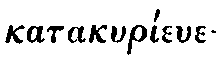
— you may lord it as loftily as you will, and
deliver as Tetrarch or Prefect those stiff-necked miscreants to the
flames for not having been converted by you as an Apostle."
Ib.
p. 276.
I end with the golden rule of Vincentius Lirinensis: — magnopere
curandum est ut id teneamus, quod ubique, quod semper, quod ab omnibus
creditum est.
Alas! this golden rule comes full and round from the mouth; nor do I
deny that it is pure gold: but like too many other golden rules, in
order to make it cover the facts which the orthodox asserter of
episcopacy at least, and the chaplain of Archbishop Laud and King
Charles the Martyr must have held himself bound to bring under it, it
must be made to display another property of the sovereign metal, its
malleableness to wit; and must be beaten out so thin, that the weight of
truth in the portion appertaining to each several article in the
orthodox systems of theology will be so small, that it may better be
called gilt than gold; and if worth having at all, it will be for its
show, not for its substance. For instance, the
aranea theologica
may draw out the whole web of the Westminster Catechism from the simple
creed of the beloved Disciple, —
whoever believeth with his heart, and
professeth with his mouth, that Jesus is Lord and Christ,
— shall be
saved. If implicit faith only be required, doubtless certain doctrines,
from which all other articles of faith imposed by the Lutheran, Scotch,
or English Churches, may be deduced, have been believed
ubique,
semper, et ab omnibus.
But if explicit and conscious belief be
intended, I would rather that the Bishop than I should defend the golden
rule against Semler.
Index p. 2
Preface, s. vi. p. 286.
Not like women or children when they are affrighted with fire in their
clothes. We shaked off the coal indeed, but not our garments, lest we
should have exposed our Churches to that nakedness which the excellent
men of our sister Churches complained to be among themselves.
O, what convenient things metaphors and similes are, so charmingly
indeterminate! On the general reader the literal sense operates: he
shivers in sympathy with the poor shift-less matron, the Church of
Geneva. To the objector the answer is ready — it was speaking
metaphorically, and only meant that she had no shift on the outside of
her gown, that she made a shift without an over-all. Compare this sixth
section with the manful, senseful, irrebuttable fourth section — a folio
volume in a single paragraph! But Jeremy Taylor would have been too
great for man, had he not occasionally fallen below himself.
Ib.
s. x. p. 288.
And since all that cast off the Roman yoke thought they had title
enough to be called Reformed, it was hard to have pleased all the
private interests and peevishness of men that called themselves
friends; and therefore that only in which the Church of Rome had
prevaricated against the word of God, or innovated against Apostolical
tradition, all that was pared away.
Aye! here is the
ovum,
as Sir Everard Home would say, the
proto
-parent of the whole race of controversies between
Protestant and Protestant; and each had Gospel on their side. Whatever
is not against the word of God is for it, — thought the founders of the
Church of England. Whatever is not in the word of God is a word of man,
a will-worship presumptuous and usurping, — thought the founders of the
Church of Scotland and Geneva. The one proposed to themselves to be
reformers of the Latin Church, that is, to bring it back to the form
which it had during the first four centuries; the latter to be the
renovators of the Christian religion as it was preached and instituted
by the Apostles and immediate followers of Christ thereunto specially
inspired. Where the premisses are so different, who can wonder at the
difference in the conclusions?
Ib.
s. xii. ib.
It began early to discover its inconvenience; for when certain zealous
persons fled to Frankfort to avoid the funeral piles kindled by the
Roman Bishops in Queen Mary's time, as if they had not enemies enough
abroad, they fell foul with one another, and the quarrel was about the
Common Prayer Book.
But who began the quarrel? Knox and his recent biographer lay it to
Dr. Cox and the Liturgists.
Ib.
s. xiii. p. 289.
Here therefore it became law, was established by an act of Parliament,
was made solemn by an appendant penalty against all that on either
hand did prevaricate a sanction of so long and so prudent
consideration.
Truly evangelical way of solemnizing a party measure, and sapientizing
Calvin's
tolerabiles ineptias
by making them
ineptias usque ad
carcerem et verbera intolerantes!
Ib.
s. xiv. ib.
But the Common Prayer Book had the fate of St. Paul; for when it had
scaped the storms of the Roman See, yet a viper sprung out of Queen
Mary's fires, &c.
As Knox and his friends confined themselves to the inspired word,
whether vipers or no, they were not adders at all events.
Ib.
xxvi. p. 296.
For, if we deny to the people a liberty of reading the Scriptures, may
they not complain, as Isaac did against the inhabitants of the land,
that the Philistines had spoiled his well and the fountains of living
water? If a free use to all of them and of all Scriptures were
permitted, should not the Church herself have more cause to complain
of the infinite licentiousness and looseness of interpretations, and
of the commencement of ten thousand errors, which would certainly be
consequent to such permission? Reason and religion will chide us in
the first, reason and experience in the latter ... The Church with
great wisdom hath first held this torch out; and though for great
reasons intervening and hindering, it cannot be reduced to practice,
yet the Church hath shewn her desire to avoid the evil that is on both
hands, and she hath shewn the way also, if it could have been insisted
in.
If there were not, at the time this Preface, or this paragraph at least,
was written or published, some design on foot or
sub lingua
of making
advances to the continental catholicism for the purpose of conciliating
the courts of Austria, France and Spain, in favor of the Cavalier and
Royalist party at home and abroad, this must be considered as a useless
and worse than useless avowal. The Papacy at the height of its influence
never asserted a higher or more anti-Protestant right than this of
dividing the Scriptures into permitted and forbidden portions. If there
be a functionary of divine institution, synodical or unipersonal, who
with the name of the 'Church' has the right, under circumstances of its
own determination, to forbid all but such and such parts of the Bible,
it must possess potentially, and under other circumstances, a right of
withdrawing the whole book from the unlearned, who yet cannot be
altogether unlearned; for the very prohibition supposes them able to do
what, a few centuries before, the majority of the clergy themselves were
not qualified to do, that is, read their Bible throughout. Surely it
would have been politic in the writer to have left out this sentence,
which his Puritan adversaries could not fail to translate into the
Church shewing her teeth though she dared not bite. I bitterly regret
these passages; neither our incomparable Liturgy, nor this full,
masterly, and unanswerable defence of it, requiring them.
Ib.
s. xlv, p. 308.
So that the Church of England, in these manners of dispensing the
power of the keys, does cut off all disputings and impertinent
wranglings, whether the priest's power were judicial or declarative;
for possibly it is both, and it is optative too, and something else
yet; for it is an emanation from all the parts of his ministry, and he
never absolves, but he preaches or prays, or administers a sacrament;
for this power of remission is a transcendent, passing through all the
parts of the priestly offices. For the keys of the kingdom of heaven
are the promises and the threatenings of the Scripture, and the
prayers of the Church, and the Word, and the Sacraments, and all these
are to be dispensed by the priest, and these keys are committed to his
ministry, and by the operation of them all he opens and shuts heaven's
gates ministerially.
No more ingenious way of making nothing of a thing than by making it
every thing. Omnify the disputed point into a transcendant, and you may
defy the opponent to lay hold of it. He might as well attempt to grasp
an
aura electrica
.
Apology, &c. s. ii. p. 320.
And it may be when I am a little more used to it, I shall not wonder
at a synod, in which not one Bishop sits in the capacity of a Bishop,
though I am most certain this is the first example in England since it
was first christened.
Is this quite fair? Is it not, at least logically considered and at the
commencement of an argument, too like a _petitio principii_ or
_presumptio rei litigatae_? The Westminster divines were confessedly not
prelates, but many in that assembly were, in all other points, orthodox
and affectionate members of the Establishment, who with Bedell,
Lightfoot, and Usher, held them to be Bishops in the primitive sense of
the term, and who yet had no wish to make any other change in the
hierarchy than that of denominating the existing English prelates
Archbishops. They thought that what at the bottom was little more than a
question of names among Episcopalians, ought not to have occasioned such
a dispute; but yet the evil having taken place, they held a change of
names not too great a sacrifice, if thus the things themselves could be
preserved, and Episcopacy maintained against the Independents and
Presbyterians.
Ib.
s. v. p. 321.
It is a thing of no present importance, but as a point of history, it is
worth a question whether there were any divines in the Westminster
Assembly who adopted by anticipation the notions of the Seekers, Quakers
and others
ejusdem farinoe.
Baxter denies it. I understand the
controversy to have been, whether the examinations at the admission to
the ministry did or not supersede the necessity of any directive models
besides those found in the sacred volumes: — if not necessary, whether
there was any greater expedience in providing by authority forms of
prayer for the minister than forms of sermons. Reading, whether of
prayers or sermons, might be discouraged without encouraging
unpremeditated praying and preaching. But the whole question as between
the prelatists and the Assembly divines has like many others been best
solved by the trial. A vast majority among the Dissenters themselves
consider the antecedents to the sermon, with exception of their
congregational hymns, as the defective part of their public service, and
admit the superiority of our Liturgy.
P.S. — It seems to me, I confess, that the controversy could never have
risen to the height it did, if all the parties had not thrown too far
into the back ground the distinction in nature and object between the
three equally necessary species of worship, that is, public, family, and
private or solitary, devotion. Though the very far larger proportion of
the blame falls on the anti-Liturgists, yet on the other hand, too many
of our Church divines — among others that
exemplar
of a Churchman
and a Christian, the every way excellent George Herbert — were scared by
the growing fanaticism of the Geneva malcontents into the neighbourhood
of the opposite extreme; and in their dread of enthusiasm, will-worship,
insubordination, indecency, carried their preference of the established
public forms of prayer almost to superstition by exclusively both using
and requiring them even on their own sick-beds. This most assuredly was
neither the intention nor the wish of the first compilers. However, if
they erred in this, it was an error of filial love excused, and only not
sanctioned, by the love of peace and unity, and their keen sense of
the beauty of holiness
displayed in their mother Church. I
mention this the rather, because our Church, having in so incomparable a
way provided for our public devotions, and Taylor having himself
enriched us with such and so many models of private prayer and
devotional exercise — (from which, by the by, it is most desirable that a
well arranged collection should be made; a selection is requisite rather
from the opulence, than the inequality, of the store;) — we have nothing
to wish for but a collection of family and domestic prayers and
thanksgivings equally (if that be not too bold a wish) appropriate to
the special object, as the Common Prayer Book is for a Christian
community, and the collection from Taylor for the Christian in his
closet or at his bed side. Here would our author himself again furnish
abundant materials for the work. For surely, since the Apostolic age,
never did the spirit of supplication move on the deeps of a human soul
with a more genial life, or more profoundly impregnate the rich gifts of
a happy nature, than in the person of Jeremy Taylor! To render the
fruits available for all, we need only a combination of Christian
experience with that finer sense of propriety which we may venture to
call devotional taste in the individual choosing, or chosen, to select,
arrange and methodize; and no less in the dignitaries appointed to
revise and sanction the collections.
Perhaps another want is a scheme of Christian psalmody fit for all our
congregations, and which should not exceed 150 or 200 psalms and hymns.
Surely if the Church does not hesitate in the titles of the Psalms and
of the chapters of the Prophets to give the Christian sense and
application, there can be no consistent objection to do the same in its
spiritual songs. The effect on the morals, feelings, and information of
the people at large is not to be calculated. It is this more than any
other single cause that has saved the peasantry of Protestant Germany
from the contagion of infidelity.
Ib.
s. xvii. p. 325.
Thus the Holy Ghost brought to their memory all things which Jesus
spake and did, and, by that means, we come to know all that the Spirit
knew to be necessary for us.
Alas! it is one of the sad effects or results of the enslaving Old
Bailey fashion of defending, or, as we may well call it, apologizing
for, Christianity, — introduced by Grotius and followed up by the
modern
Alogi
, whose wordless, lifeless, spiritless, scheme of
belief it alone suits, — that we dare not ask, whether the passage here
referred to must necessarily be understood as asserting a miraculous
remembrancing, distinctly sensible by the Apostles; whether the gift had
any especial reference to the composition of the Gospels; whether the
assumption is indispensable to a well grounded and adequate confidence
in the veracity of the narrators or the verity of the narration; if not,
whether it does not unnecessarily entangle the faith of the acute and
learned inquirer in difficulties, which do not affect the credibility of
history in its common meaning — rather indeed confirm our reliance on its
authority in all the points of agreement, that is, in every point which
we are in the least concerned to know, — and expose the simple and
unlearned Christian to objections best fitted to perplex, because
easiest to be understood, and within the capacity of the shallowest
infidel to bring forward and exaggerate; and lastly, whether the
Scriptures must not be read in that faith which comes from higher
sources than history, that is, if they are read to any good and
Christian purpose. God forbid that I should become the advocate of
mechanical infusions and possessions, superseding the reason and
responsible will. The light
a priori
, in which, according to my
conviction, the Scriptures must be read and tried, is no other than the
earnest,
What shall I do to be saved?
with the inward
consciousness, — the gleam or flash let into the inner man through the
rent or cranny of the prison of sense, however produced by earthquake,
or by decay, — as the ground and antecedent of the question; and with a
predisposition towards, and an insight into, the
a priori
probability of the Christian dispensation as the necessary consequents.
This is the holy spirit in us praying to the Spirit, without which
no
man can say that Jesus is the Lord:
a text which of itself seems to
me sufficient to cover the whole scheme of modern Unitarianism with
confusion, when compared with that other, —
I am the Lord (Jehovah):
that is my name; and my glory will I not give to another
. But in the
Unitarian's sense of 'Lord,' and on his scheme of evidence, it might
with equal justice be affirmed, that no man can say that Tiberius was
the Emperor but by the Holy Ghost.
Ib.
s. xxix. p. 331.
And that this is for this reason called a gift and grace, or
issue of the Spirit, is so evident and notorious, that the speaking of
an ordinary revealed truth, is called in Scripture, a speaking by
the spirit, 1 Cor. xii. 8. No man can say that Jesus is the
Lord but by the Holy Ghost. For, though the world could not
acknowledge Jesus for the Lord without a revelation, yet now that we
are taught this truth by Scripture, and by the preaching of the
Apostles, to which they were enabled by the Holy Ghost, we need no
revelation or enthusiasm to confess this truth, which we are taught in
our creeds and catechisms, &c.
I do not, nay I dare not, hesitate to denounce this assertion as false
in fact and the paralysis of all effective Christianity. A greater
violence offered to Scripture words is scarcely conceivable. St. Paul
asserts that
no man can.
Nay, says Taylor, every man that knows
his catechism can; but unless some six or seven individuals had said it
by the Holy Ghost some seventeen or eighteen hundred years ago, no man
could say so.
Ib.
s. xxxii. p. 334.
And yet, because the Holy Ghost renewed their memory, improved their
understanding, supplied to some their want of human learning, and so
assisted them that they should not commit an error in fact or opinion,
neither in the narrative nor dogmatical parts, therefore they wrote by
the spirit.
And where is the proof? — and to what purpose, unless a distinct and
plain diagnostic were given of the divinities and the humanities which
Taylor himself expressly admits in the text of the Scriptures? And even
then what would it avail unless the interpreters and translators, not to
speak of the copyists in the first and second centuries, were likewise
assisted by inspiration? As to the larger part of the Prophetic books,
and the whole of the Apocalypse, we must receive them as inspired
truths, or reject them as simple inventions or enthusiastic delusions.
But in what other book of Scripture does the writer assign his own work
to a miraculous dictation or infusion? Surely the contrary is implied in
St. Luke's preface. Does the hypothesis rest on one possible
construction of a single passage in St. Paul, 2
Tim
. iii. 16.?
And that construction resting materially on a
not found in the oldest MSS., when the context would
rather lead us to understand the words as parallel with the other
assertion of the Apostle, that all good works are given from God, — that
is,
Every divinely inspired writing is profitable, &c
. Finally,
will not the certainty of the competence and single mindedness of the
writers suffice; this too confirmed by the high probability, bordering
on certainty, that God's especial grace worked in them; and that an
especial providence watched over the preservation of writings, which, we
know, both are and have been of such pre-eminent importance to
Christianity, and yet by natural means? But alas! any thing will be
pretended, rather than admit the necessity of internal evidence, or than
acknowledge, among the external proofs, the convictions and spiritual
experiences of believers, though they should be common to all the
faithful in all ages of the Church! But in all superstition there is a
heart of unbelief, and,
vice versa
, where an individual's belief
is but a superficial acquiescence, credulity is the natural result and
accompaniment, if only he be not required to sink into the depths of his
being, where the sensual man can no longer draw breath. It is not the
profession of Socinian tenets, but the spirit of Socinianism in the
Church itself that alarms me. This, this, is the dry rot in the beams
and timbers of the Temple!
Ib.
s. li. p. 348.
So that let the devotion be ever so great, set forms of prayer will be
expressive enough of any desire, though importunate as extremity
itself.
This, and much of the same import in this treatise, is far more than
Taylor, mature in experience and softened by afflictions, would have
written. Besides, it is in effect, though not in logic, a deserting of
his own strong and unshaken ground of the means and ends of public
worship.
Ib.
s. s. lxix. lxx. pp. 359-60.
These two sections are too much in the vague mythical style of the
Italian and Jesuit divines, and the argument gives to these a greater
advantage against our Church than it gains over the Sectarians in its
support. We well know who and how many the compilers of our Liturgy were
under Edward VI, and know too well what the weather-cock Parliaments
were, both then and under Elizabeth, by which the compilation was made
law. The argument therefore should be inverted; — not that the Church (A.
B., C. D., F. L., &c.) compiled it;
ergo
, it is unobjectionable;
but (and truly we may say it) it is so unobjectionable, so far
transcending all we were entitled to expect from a few men in that state
of information and such difficulties, that we are justified in
concluding that the compilers were under the guidance of the Holy
Spirit. But the same order holds good even with regard to the
Scriptures. We cannot rightly affirm they were inspired, and therefore
they must be believed; but they are worthy of belief, because excellent
in so universal a sense to ends commensurate with the whole moral, and
therefore the whole actual, world, that as sure as there is a moral
Governor of the world, they must have been in some sense or other, and
that too an efficient sense, inspired. Those who deny this, must be
prepared to assert, that if they had what appeared to them good historic
evidence of a miracle, in the world of the senses, they would receive
the hideous immoral doctrines of Mahomet or Brahma, and thus disobey the
express commands both of the Old and New Testament. Though an angel
should come from heaven and work all miracles, yet preach another
doctrine, we are to hold him accursed.
Gal.
i. 8.
Ib.
s. lxxv. p. 356.
When Christ was upon the Mount, he gave it for a pattern, &c.
I cannot thoroughly agree with Taylor in all he says on this point. The
Lord's Prayer is an encyclopedia of prayer, and of all moral and
religious philosophy under the form of prayer. Besides this, that
nothing shall be wanting to its perfection, it is itself singly the best
and most divine of prayers. But had this been the main and primary
purpose, it must have been thenceforward the only prayer permitted to
Christians; and surely some distinct references to it would have been
found in the Apostolic writings.
Ib.
s. lxxx. p. 358.
Now then I demand, whether the prayer of Manasses be so good a prayer
as the Lord's prayer? Or is the prayer of Judith, or of Tobias, or of
Judas Maccabeus, or of the son of Sirach, is any of these so good?
Certainly no man will say they are; and the reason is, because we are
not sure they are inspired by the Holy Spirit of God.
How inconsistent Taylor often is, the result of the system of
economizing truth! The true reason is the inverse. The prayers of Judith
and the rest are not worthy to be compared with the Lord's Prayer;
therefore neither is the spirit in which they were conceived worthy to
be compared with the spirit from which the Lord's Prayer proceeded: and
therefore with all fulness of satisfaction we receive the latter, as
indeed and in fact our Lord's dictation.
In all men and in all works of great genius the characteristic fault
will be found in the characteristic excellence. Thus in Taylor, fulness,
overflow, superfluity. His arguments are a procession of all the nobles
and magnates of the land in their grandest, richest, and most splendid
paraphernalia
: but the total impression is weakened by the
multitudes of lacqueys and ragged intruders running in and out between
the ranks. As far as the Westminster divines were the antagonists to be
answered — and with the exception of these, and those who like Baxter,
Calamy, and Bishop Reynolds, contended for a reformation or correction
only of the Church Liturgy, there were none worth answering, — the
question was, not whether the use of one and the same set of prayers on
all days in all churches was innocent, but whether the exclusive
imposition of the same was comparatively expedient and conducive to
edification?
Let us not too severely arraign the judgment or the
intentions of the good men who determined for the negative. If indeed we
confined ourselves to the comparison between our Liturgy, and any and
all of the proposed substitutes for it, we could not hesitate: but those
good men, in addition to their prejudices, had to compare the lives, the
conversation, and the religious affections and principles of the
prelatic and anti-prelatic parties in general.
And do not we ourselves
now do the like? Are we not, and with abundant reason, thankful that
Jacobinism is rendered comparatively feeble and its deadly venom
neutralized, by the profligacy and open irreligion of the majority of
its adherents? Add the recent cruelties of the Star Chamber under
Laud; — (I do not say the intolerance; for that which was common to both
parties, must be construed as an error in both, rather than a crime in
either); — and do not forget the one great inconvenience to which the
prelatic divines were exposed from the very position which it was the
peculiar honor of the Church of England to have taken and maintained,
namely, the golden mean; — (for in consequence of this their arguments as
Churchmen would often have the appearance of contrasting with their
grounds of controversy as Protestants,) — and we shall find enough to
sanction our charity as brethren, without detracting a tittle from our
loyalty as members of the established Church.
As to this Apology, the
victory doubtless remains with Taylor on the whole; but to have rendered
it full and triumphant, it would have been necessary to do what perhaps
could not at that time, and by Jeremy Taylor, have been done with
prudence; namely, not only to disprove in part, but likewise in part to
explain, the alleged difference of the spiritual fruits in the
ministerial labors of the high and low party in the Church, — (for
remember that at this period both parties were in the Church, even as
the Evangelical, Reformed and Pontifical parties before the
establishment of a schism by the actually schismatical Council of
Trent,) — and thus to demonstrate that the differences to the
disadvantage of the established Church, as far as they were real, were
as little attributable to the Liturgy, as the wound in the heel of
Achilles to the shield and breast-plate which his immortal mother had
provided for him from the forge divine.
Ib.
s. lxxxvi. p. 361.
That the Apostles did use the prayer their Lord taught them, I think
needs not much be questioned.
Ad contra
, see above. But that they did not till the siege of
Jerusalem deviate unnecessarily from the established usage of the
Synagogue is beyond rational doubt. We may therefore safely maintain
that a set form was sanctioned by Apostolic practice; though the form
was probably settled after the converts from Paganism began to be the
majority of Christians.
Ib.
s. lxxxvii. p. 361.
Now that they tied themselves to recitation of the very words of
Christ's prayer pro loco et tempore, I am therefore easy to
believe, because I find they were strict to a scruple in retaining the
sacramental words which Christ spake when he instituted the blessed
Sacrament.
Not a case in point. Besides it assumes the controverted sense of
as "in these words"
versus
"to this purport."
Grotius and Lightfoot, however, have settled this dispute by proving
that the Lord's prayer is a selection of prayers from the Jewish ritual:
and a most happy and valuable inference against novelties obtruded for
novelty's sake does Grotius draw from this fact. When I consider the
manner in which the Jews usually quoted or referred to particular
passages of Scripture, it does not seem altogether improbable that the
several articles of the
Oratio Dominica
might have been the
initial sentences of several prayers; but I have not the least doubt
that by the loud utterance of the
My God! my God! why hast thou
forsaken me?
our blessed Redeemer referred to and recalled to John
and Mary that most wonderful and prophetic twenty-second Psalm. And what
a glorious light does not this throw on the whole scene of the
crucifixion, and in what additional loveliness does it not present the
god-like character of the crucified Son of Man! With the very facts
before them, of which the former and larger portion of the Psalm
referred to resembles a detailed history rather than a prophecy, — with
what force, and with what lively consolation and infusion of stedfast
hope and faith, when all human grounds of hope had sunk from under them,
must not the obvious and inevitable inference have flashed on the
convictions of the holy mother and the beloved disciple! "If all we now
behold was pre-ordained and so distinctly predicted; if the one mournful
half of the prophecy has been so entirely and minutely fulfilled, after
so great a lapse of ages, dare we, can we, doubt for a moment that the
glorious remainder will with equal fidelity be accomplished?" Thus to
his very last moments did our Lord (setting as it beseemed the sun of
righteousness to set) manifest with a wider and wider face of glory his
self-oblivious love. In the act he was offering, he himself was a
sacrifice of love for the whole creation; and yet the cup overflowed
into particular streams; first, for his enemies, his persecutors, and
murderers; then for his friends and humanly nearest relative;
Woman,
behold thy son!
O what a transfer! Nor does the proposed
interpretation preclude any inward and mysterious sense of the words
My God! my God!
— though I confess I have never yet met with a
single plausible resolution of the words into any one of the mysteries
of the Trinity, or the Incarnation, or the Passion. Nay, were there any
necessity for supposing such an allusion, which there is not, the
obvious interpretation would, I fear, too dangerously favor the heresy
of those who divided and severed the divinity from the humanity; so that
not the incarnate God, very God of very God, would have atoned for us on
the cross, but the incarnating man; a heresy which either denies or
reduces to an absurdity the whole doctrine of redemption, that is,
Christianity itself, which rests on the two articles of faith; first,
the necessity, and secondly, the reality of a Redeemer — both articles
alike incompatible with redemption by a mere man.
Ib.
s. lxxxviii. p. 362.
And I the rather make the inference from the preceding argument
because of the cognation one hath with the other; for the Apostles did
also in the consecration of the Eucharist use the Lord's Prayer; and
that together with the words of institution was the only form of
consecration, saith St. Gregory; and St. Jerome affirms, that the
Apostles, by the command of their Lord, used this prayer in the
benediction of the elements.
This section is an instance of impolitic management of a cause, into
which Jeremy Taylor was so often seduced by the fertility of his
intellect and the opulence of his erudition. An antagonist by exposing
the improbability of the tradition, (and most improbable it surely is),
and the little credit due to Saint Gregory and Saint Jerome (not
forgetting a Miltonic sneer at their saintship), might draw off the
attention from the unanswerable parts of Taylor's reasoning and leave
an impression of his having been confuted.
Ib.
s. lxxxix. p. 362.
But besides this, when the Apostles had received great measures of
the spirit, and by their gift of prayer composed more forms for the
help and comfort of the Church, &c.
Who would not suppose, that the first two lines were an admitted point
of history, instead of a bare conjecture in the form of a bold assertion? O, dearest man! so excellent a cause did not need such
Bellarminisms.
Ib.
p. 363.
And the Fathers of the Council of Antioch complain against Paulus
Samosatenus, quod Psalmos et cantus, qui ad Domini nostri Jesu
Christi honorem decantari solent, tanquam recentiores, et a viris
recentioris memorioe editos, exploserit.
This Sam-in-satin-hose, or Paul, the same-as-Satan-is, might, I think,
have found his confutation in Pliny's Letter to Trajan.
Carmen
Christo, quasi Deo, dicere secum invicem.
Ib.
s. xc. p. 364.
Which together with the

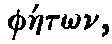
the
lectionarium of the Church, the books of the Apostles and
Prophets spoken of by Justin Martyr, and said to be used in the
Christian congregations, are the constituent parts of liturgy.
An ingenious but not tenable solution of Justin Martyr's
which were presumably a Gospel
not the same, and yet so nearly the same, as our Matthew, that its
history and character involve one of the hardest problems of Christian
antiquity. By the by, one cause of the small impression — (small in
proportion to their vast superiority in knowledge and genius) — which
Jeremy Taylor and his compeers made on the religious part of the
community by their controversial writings during the life of Charles I
is to be found in their undue predilection for Patristic learning and
authority. This originated in the wish to baffle the Papists at their
own weapons; but it could not escape notice, that the latter, though
regularly beaten, were yet not so beaten, but that they always kept the
field: and when the same mode of warfare was employed against the
Puritans, it was suspected as Papistical.
Ib.
s. xci. pp. 364-5.
For the offices of prose we find but small mention of them in the very
first time, save only in general terms, and that such there were, and
that St. James, St. Mark, St. Peter, and others of the Apostles and
Apostolical men, made Liturgies; and if these which we have at this
day were not theirs, yet they make probation that these Apostles left
others, or else they were impudent people that prefixed their names
so early, and the Churches were very incurious to swallow such a bole,
if no pretension could have been reasonably made for their justification.
A rash and dangerous argument. 1810.
A many-edged weapon, which might too readily be turned against the
common faith by the common enemy. For if these Liturgies were rightly
attributed to St. James, St. Mark, St. Peter, and others of the Apostles
and Apostolical men, how could they have been superseded? How could the
Church have excluded them from the Canon? But if falsely, and yet for a
time and at so early an age generally believed to have been composed by
St. James and the rest, it is to be feared that the difference will not
stop at the point to which Paul of Samosata carried it; — a fearful
consideration for a Christian of the Grotian and Paleyan school. It
would not, however, shake my nerves, I confess. The Epistles of St.
Paul, and the Gospel, Epistles, and Apocalypse of St. John, contain an
evidence of their authenticity, which no uncertainty of ecclesiastic
history, no proof of the frequency and success of forgery or ornamental
titles (as the Wisdom of Solomon) mistaken for matter of fact, can wrest
from me; and with these for my guides and sanctions, what one article of
Christian faith could be taken from me, or even unsettled? It seems to
me, as it did to Luther, incomparably more probable that the eloquent
treatise, entitled an Epistle to the Hebrews, was written by Apollos
than by Paul; and what though it was written by neither? It is
demonstrable that it was composed before the siege of Jerusalem and the
destruction of the Temple; and scarcely less satisfactory is the
internal evidence that it was composed by an Alexandrian. These two
data
are sufficient to establish the fact, that the Pauline
doctrine at large was common to all Christians at that early period, and
therefore the faith delivered by Christ. And this is all I want; nor
this for my own assurance, but as arming me with irrefragable arguments
against those psilanthropists who as falsely, as arrogantly, call
themselves Unitarians, on the one hand; and against the infidel fiction,
that Christianity owes its present shape to the genius and rabbinical
cabala
of Paul on the other: while at the same time it weakens
the more important half of the objection to, or doubt concerning, the
authenticity of St. Peter's Epistles. To this too I attach a high
controversial value (for the beauty and excellence of the Epistles
themselves are not affected by the question); and I receive them as
authentic, for they have all the circumstantial evidence that I have any
right to expect. But I feel how much more genial my conviction would
become, should I discover, or have pointed out to me, any positive
internal evidence equivalent to that which determines the date of the
Epistle to the Hebrews, or even to that which leaves no doubt on my mind
that the writer was an Alexandrian Jew. This, my dear Lamb, is one of
the advantages which the previous evidence supplied by the reason and
the conscience secures for us. We learn what in its nature
passes all
understanding
, and what belongs to the understanding, and on which,
therefore, the understanding may and ought to act freely and fearlessly:
while those who will admit nothing above the understanding
which in its nature has no legitimate object
but history and outward
phœnomena
, stand in slavish dread like a
child at its house of cards, lest a single card removed may endanger the
whole foundationless edifice. 1819.
Ib.
s. xcii. p. 365.
Now here dear Jeremy Taylor begins to be himself again; for with all his
astonishing complexity, yet versatile agility, of powers, he was too
good and of too catholic a spirit to be a good polemic. Hence he so
continually is now breaking, now varying, the thread of the argument:
and hence he is so again and again forgetting that he is reasoning
against an antagonist, and falls into conversation with him as a
friend, — I might almost say, into the literary chit-chat and un with
holding frankness of a rich genius whose sands are seed-pearl. Of his
controversies, those against Popery are the most powerful, because there
he had subtleties and obscure reading to contend against; and his wit,
acuteness, and omnifarious learning found stuff to work on. Those on
Original Sin are the most eloquent. But in all alike it is the
digressions, overgrowths, parenthetic
obiter et in transitu
sentences, and, above all, his anthropological reflections and
experiences — (for example, the inimitable account of a religious
dispute, from the first collision to the spark, and from the spark to
the world in flames, in his
Dissuasive from Popery
), — these are the
costly gems which glitter, loosely set, on the chain armour of his
polemic Pegasus, that expands his wings chiefly to fly off from the
field of battle, the stroke of whose hoof the very rock cannot resist,
but beneath the stroke of which the opening rock sends forth a
Hippocrene. The work in which all his powers are confluent, in which
deep, yet gentle, the full stream of his genius winds onward, and still
forming peninsulas in its winding course — distinct parts that are only
not each a perfect whole — or in less figurative style — (yet what
language that does not partake of poetic eloquence can convey the
characteristics of a poet and an orator?) — the work which I read with
most admiration, but likewise with most apprehension and regret, is the
Liberty of Prophesying
.
If indeed, like some Thessalian drug, or the strong herb of Anticyra,
— — that helps and harms,
Which life and death have sealed with counter charms —
it could be administered by special prescription, it might do good
service as a narcotic for zealotry, or a solvent for bigotry.
The substance of the preceding tract may be comprised as follows:
- During the period immediately following our Lord's Ascension, or the
so called Apostolic age, all the gifts of the Spirit, and of course the
gift of prayer, as graces bestowed, not merely or principally for the
benefit of the Apostles and their contemporaries, but likewise and
eminently for the advantage of all after-ages, and as means of
establishing the foundations of Christianity, differed in kind, degree,
mode, and object, from those ordinary graces promised to all true
believers of all times; and possessed a character of extraordinary
partaking of the nature of miracles, to which no believer under the
present and regular dispensations of the Spirit can make pretence
without folly and presumption.
- Yet it is certain that even the first miraculous gifts and graces
bestowed on the Apostles themselves supervened on, but did not
supersede, their natural faculties and acquired knowledge, nor enable
them to dispense with the ordinary means and instruments of cultivating
the one, and applying the other, by study, reading, past experience, and
whatever else Providence has appointed for all men as the conditions and
efficients of moral and intellectual progression. The capabilities of
deliberating, selecting, and aptly disposing of our thoughts and works
are God's good gifts to man, which the superadded graces of the Spirit,
vouchsafed to Christians, work on and with, call forth and perfect.
Therefore deliberation, selection, and method become duties, inasmuch as
they are the bases and recipients of the Spirit, even as the polished
crystal is of the light. But if the Prophets and Apostles did not (as
Taylor demonstrates that they did not) find in miraculous aids any such
infusions of light as precluded or rendered superfluous the exertion of
their natural faculties and personal attainments, then a fortiori
not the possessors or legatees of the ordinary graces bequeathed by
Christ to his Church as the usufructuary property of all its members;
and he who wilfully lays aside all premeditation, selection, and
ordonnance, that he may enter unprepared on the highest and most awful
function of the soul, — that of public prayer, — is guilty of no less
indecency and irreverence than if, having to present a petition as the
representative of a community before the throne, he purposely put off
his seemly garments in order to enter into the presence of the monarch
naked or in rags: and expects no less an absurdity than to become a
passive automaton, in which the Holy Spirit is to play the
ventriloquist.
- If, then, each congregation is to receive a prepared form of prayer
from its head or minister, why not rather from the collective wisdom of
the Church represented in the assembled heads and spiritual Fathers?
- This is admitted by implication by the Westminster Assembly. But they
are not contented with the existing form, and therefore substitute for
it a Directory as the fruits of their meditations and counsels. The
whole question, then, is now reduced to the comparative merits and
fitness of the Directory and the book of Common Prayer; and how complete
the victory of the latter, how glaring the defects, how many the
deficiencies, of the former, Jeremy Taylor evinces unanswerably.
Such is the substance of this Tract. What the author proposed to prove
he has satisfactorily proved.
The faults of the work are:
- The intermixture of weak and strong arguments, and the frequent
interruption of the stream of his logic by doubtful, trifling, and
impolitic interruptions; arguments resting in premisses denied by the
antagonists, and yet taken for granted; in short, appendages that
cumber, accessions that subtract, and confirmations that weaken: —
- That he commences with a proper division of the subject into two
distinct branches, that is, extempore prayer as opposed to set forms,
and, The Directory, as prescribing a form opposed to the existing
Liturgy; but that in the sequel he blends and confuses and intermingles
one with the other, and presses most and most frequently on the first
point, which a vast majority of the party he is opposing had disowned
and reprobated no less than himself, and which, though easiest to
confute, scarcely required confutation.
Index p. 2
Epistle Dedicatory, p. cccciii.
And first I answer, that whatsoever is against the foundation of faith
is out of the limits of my question, and does not pretend to
compliance or toleration.
But as all truths hang together, what error is there which may not be
proved to be against the foundation of faith? An inquisitor might make
the same code of toleration, and in the next moment light the faggots
around a man who had denied the infallibility of Pope and Council.
Ib.
p. ccccxxix.
Indeed if by a heresy we mean that which is against an article of
creed, and breaks part of the covenant made between God and man by the
mediation of Jesus Christ, I grant it to be a very grievous crime, a
calling God's veracity into question, &c.
How can he be said to question God's veracity, whose belief is that God
never declared it, — who perhaps disbelieves it, because he thinks it
opposite to God's honor? For example: — Original sin, in the literal
sense of the article, was held by both Papists and Protestants (with
exception of the Socinians) as the fundamental article of Christianity;
and yet our Jeremy Taylor himself attacked and reprobated it. Why?
because he thought it dishonored God. Why may not another man believe
the same of the Incarnation, and affirm that it is equal to a circle
assuming the essence of a square, and yet remaining a circle? But so it
is; we spoil our cause, because we dare not plead it
in toto
; and
a half truth serves for a proof of the opposite falsehood. Jeremy Taylor
dared not carry his argument into all its consequences.
index p. 2
S. i. p. 443.
Of the nature of faith, and that its duty is completed in believing
the articles of the Apostle's creed.
This section is for the most part as beautifully written as it was
charitably conceived; yet how vain the attempt! Jeremy Taylor ought to
have denied that Christian faith is at all intellectual primarily, but
only probably; as,
cœcteris paribus
, it is probable that a man
with a pure heart will believe an intelligent Creator. But the faith
resides in the predisposing purity of heart, that is, in the obedience
of the will to the uncorrupted conscience. For take Taylor's instances;
and I ask whether the words or the sense be meant? Surely the latter.
Well then, I understand, and so did the dear Bishop, by these texts the
doctrine of a Redeemer, who by his agonies of death actually altered the
relations of the spirits of all men to their Maker, redeemed them from
sin and death eternal, and brought life and immortality into the world.
But the Socinian uses the same texts; and means only that a good and
gifted teacher of pure morality died a martyr to his opinions, and by
his resurrection proved the possibility of all men rising from the dead.
He did nothing; — he only taught and afforded evidence. Can two more
diverse opinions be conceived? God here; mere man there. Here a redeemer
from guilt and corruption, and a satisfaction for offended holiness;
there a mere declarer that God imputed no guilt wherever, with or
without Christ, the person had repented of it. What could Jeremy Taylor
say for the necessity of his sense (which is mine) but what might be
said for the necessity of the Nicene Creed? And then as to Rom. x. 9,
how can the text mean any thing, unless we know what St. Paul implied in
the words
the Lord Jesus
. From other parts of his writings we
know that he meant by the word
Lord
his divinity or at least
essential superhumanity. But the Socinian will not allow this; or,
allowing it, denies St. Paul's authority in matters of speculative
faith. As well then might I say, it is sufficient for you to believe and
repeat the words
forte miles reddens
; and though one of you mean
by it "Perhaps I may be balloted for the militia," and the other
understands it to mean, that "Reading is forty miles from London," you
are still co-symbolists and believers! While a third person may say, I
believe, but do not comprehend, the words; that is, I believe that the
person who first used them meant something that is true, — what I do not
know; that is, I believe his veracity.
O! had this work been published when Charles I, Archbishop Laud, whose
chaplain Taylor was, and the other Star Chamber inquisitors, were
sentencing Prynne, Bastwick, Leighton, and others, to punishments that
have left a brand-mark on the Church of England, the sophistry might
have been forgiven for the sake of the motive, which would then have
been unquestionable. Or if Jeremy Taylor had not in effect retracted
after the Restoration; — if he had not, as soon as the Church had gained
its power, most basely disclaimed and disavowed the principle of
toleration, and apologized for the publication by declaring it to have
been a
ruse de guerre
, currying pardon for his past liberalism by
charging, and most probably slandering, himself with the guilt of
falsehood, treachery, and hypocrisy, his character as a man would at
least have been stainless. Alas, alas, most dearly do I love Jeremy
Taylor; most religiously do I venerate his memory! But this is too foul
a blotch of leprosy to be forgiven. He who pardons such an act in such a
man partakes of its guilt.
Ib.
s. vii. p. 346-7.
In the pursuance of this great truth, the Apostles, or the holy men,
their contemporaries and disciples, composed a creed to be a rule of
faith to all Christians; as appears in Irenæus, Tertullian, St.
Cyprian, St. Austin, Ruffinus, and divers others; which creed, unless
it had contained all the entire object of faith, and the foundation of
religion, &c.
Jeremy Taylor does not appear to have been a critical scholar. His
reading had been oceanic; but he read rather to bring out the growths of
his own fertile and teeming mind than to inform himself respecting the
products of those of other men. Hence his reliance on the broad
assertions of the Fathers; yet it is strange that he should have been
ignorant that the Apostles' Creed was growing piecemeal for several
centuries.
Ib.
p. 447.
All catechumens in the Latin Church coming to baptism were
interrogated concerning their faith, and gave satisfaction on the
recitation of this Creed.
I very much doubt this, and rather believe that our present Apostles'
Creed was no more than the first instruction of the catechumens prior to
baptism; and (as I conclude from Eusebius) that at baptism they
professed a more mysterious faith; — the one being the milk, the other
the strong meat. Where is the proof that Tertullian was speaking of this
Creed? Eusebius speaks in as high terms of the
Symbolum Fidei
,
and, defending himself against charges of heresy, says, "Did I not at my
baptism, in the
Symbolum Fidei
, declare my belief in Christ as
God and the co-eternal Word?" The true Creed it was impiety to write
down; but such was never the case with the present or initiating Creed.
Strange, too, that Jeremy Taylor, who has in this very work written so
divinely of tradition, should assume as a certainty that this Creed was
in a proper sense Apostolic. Is then the Creed of greater authority than
the inspired Scriptures? And can words in the Creed be more express than
those of St. Paul to the Colossians, speaking of Christ as the creative
mind of his Father, before all worlds,
begotten before all things
created?
Ib.
s. x. p. 449.
This paragraph is indeed a complexion, as Taylor might call it, of
sophisms. Thus; — unbelief from want of information or capacity, though
with the disposition of faith, is confounded with disbelief. The
question is not, whether it may not be safe for a man to believe simply
that Christ is his Saviour, but whether it be safe for a man to
disbelieve the article in any sense which supposes an essential
supra-humanity in Christ, — any sense that would not have been equally
applicable to John, had God chosen to raise him instead of his cousin?
Ib.
s. xi. p. 450.
Neither are we obliged to make these Articles more particular and
minute than the Creed. For since the Apostles, and indeed our blessed
Lord himself, promised heaven to them who believed him to be the
Christ that was to come into the world, and that he who believes in
him should be partaker of the resurrection and life eternal, he will
be as good as his word. Yet because this article was very general, and
a complexion rather than a single proposition, the Apostles and others
our Fathers in Christ did make it more explicit: and though they have
said no more than what lay entire and ready formed in the bosom of the
great Article, yet they made their extracts to great purpose and
absolute sufficiency; and therefore there needs no more deductions or
remoter consequences from the first great Article than the Creed of
the Apostles.
Most true; but still the question returns, what was meant by the phrase
the
Christ? Contraries cannot both be true.
The Christ
could not be both mere man and incarnate God. One or the other must
believe falsely on this great key-stone of all the intellectual faith in
Christianity. For so it is; alter it, and everything alters; as is
proved in Trinitarianism and Socinianism. No two religions can be more
different; — I know of no two equally so.
Ib.
s. xii. p. 451.
The Church hath power to intend our faith, but not to extend it; to
make our belief more evident, but not more large and comprehensive.
This and the preceding pages are scarcely honest. For Jeremy Taylor
begins with admitting that the Creed might have been composed by others.
He has no proof of that most absurd fable of the twelve Apostles
clubbing to make it; yet here all he says assumes its inspiration as a
certain fact.
Ib.
p. 454.
But for the present there is no insecurity in ending there where the
Apostles ended, in building where they built, in resting where they
left us, unless the same infallibility which they had had still
continued, which I think I shall hereafter make evident it did not.
What a tangle of contradictions Taylor thrusts himself into by the
attempt to support a true system, a full third of which he was afraid to
mention, and another third was by the same fear induced to deny — at
least to take for granted the contrary: for example, the absolute
plenary inspiration and infallibility of the Apostles and Evangelists;
and yet that their whole function, as far as the consciences of their
followers were concerned, was to repeat the two or three sentences, that
Jesus was Christ
(so says one of the Evangelists),
the Christ
of God
(so says another),
the Christ the Son of the living
God
(so says a third), that he rose from the dead, and for the
remission of sins, to as many as believed and professed that he was the
Christ or the Lord, and died and rose for the remission of sins. Surely
no miraculous communication of God's infallibility was necessary for
this. But if this infallibility was stamped on all they said and wrote,
is it credible that any part should not be equally binding? I declare I
can make nothing out of this section, but that it is necessary for men
to believe the Apostles' Creed; but what they believe by it is of no
consequence. For instance; what if I chose to understand by the word
'dead' a state of trance or suspended animation; — language furnishing
plenty of analogies — dead in a swoon — dead drunk — and so on; — should I
still be a Christian? 'Born of the Virgin Mary.' What if, as Priestley
and others, I interpreted it as if we should say, 'the former Miss
Vincent was his mother.' I need not say that I disagree with Taylor's
premisses only because they are not broad enough, and with his aim and
principal conclusion only because it does not go far enough. I would
have the law grounded wholly in the present life, religion only on the
life to come. Religion is debased by temporal motives, and law rendered
the drudge of prejudice and passion by pretending to spiritual aims. But
putting this aside, and judging of this work solely as a chain of
reasoning, I seem to find one leading error in it; namely, that Taylor
takes the condition of a first admission into the Church of Christ for
the fullness of faith which was to be gradually there acquired. The
simple acknowledgment, that they accepted Christ as their Lord and King
was the first lisping of the infant believer at which the doors were
opened, and he began the process of growth in the faith.
Ib.
s. ii. p. 457.
The great heresy that troubled them was the doctrine of the necessity
of keeping the law of Moses, the necessity of circumcision, against
which doctrine they were therefore zealous, because it was a direct
overthrow to the very end and excellency of Christ's coming.
The Jewish converts were still bound to the rite of circumcision, not
indeed as under the Law, or by the covenant of works, but as the
descendants of Abraham, and by that especial covenant which St. Paul
rightly contends was a covenant of grace and faith. But the heresy
consisted wholly in the attempt to impose this obligation on the Gentile
converts, in the infatuation of some of the Galatians, who, having no
pretension to be descendants of Abraham, could, as the Apostle urges,
only adopt the rite as binding themselves under the law of works, and
thereby apostatizing from the covenant of faith by free grace. And this
was the decision of the Apostolic Council at Jerusalem.
Acts
xv.
Rhenferd, in his Treatise on the Ebionites and other pretended heretics
in Palestine, so grossly and so ignorantly calumniated by Epiphanius,
has written excellently well on this subject. Jeremy Taylor is mistaken
throughout.
Ib.
s. iv. p. 459.
And so it was in this great question of circumcision.
It is really wonderful that a man like Bishop Taylor could have read the
New Testament, and have entertained a doubt as to the decided opinion of
all the Apostles, that every born Jew was bound to be circumcised.
Opinion? The very doubt never suggested itself. When something like this
opinion was slanderously attributed to Paul, observe the almost
ostentatious practical contradiction of the calumny which was adopted by
him at the request and by the advice of the other Apostles.
(
Acts
, xxi. 21-26.) The rite of circumcision, I say, was binding
on all the descendants of Abraham through Isaac for all time even to the
end of the world; but the whole law of Moses was binding on the Jewish
Christians till the heaven and the earth — that is, the Jewish priesthood
and the state — had passed away in the destruction of the temple and
city; and the Apostles observed every tittle of the Law.
Ib.
s. vi. p. 460.
The heresy of the Nicolaitans.
Heresy is not a proper term for a plainly anti-Christian sect.
Nicolaitans is the literal Greek translation of Balaamites; destroyers
of the people.
Rev
. ii. 14, 15.
Ib.
s. viii. p. 461.
For heresy is not an error of the understanding, but an error of the
will.
Most excellent. To this Taylor should have adhered, and to its converse.
Faith is not an accuracy of logic, but a rectitude of heart.
Ib.
p. 462.
It was the heresy of the Gnostics, that it was no matter how men
lived, so they did but believe aright.
I regard the extinction of all the writings of the Gnostics among the
heaviest losses of Ecclesiastical literature. We have only the account
of their inveterate enemies. Individual madmen there have been in all
ages, but I do not believe that any sect of Gnostics ever held this
opinion in the sense here supposed.
Ib.
And, indeed, if we remember that St. Paul reckons heresy amongst the
works of the flesh, and ranks it with all manner of practical
impieties, we shall easily perceive that if a man mingles not a vice
with his opinion, — if he be innocent in his life, though deceived in
his doctrine, — his error is his misery not his crime; it makes him an
argument of weakness and an object of pity, but not a person sealed up
to ruin and reprobation.
O admirable! How could Taylor, after this, preach and publish his Sermon
in defence of persecution, at least against toleration!
Ib.
s. xxii. p. 479.
Ebion, Manes.
such man as Ebion ever, as I can see, existed
; and Manes is
rather a doubtful
ens
.
Ib.
s. xxxi. p. 487.
But I shall observe this, that although the Nicene Fathers in that
case, at that time, and in that conjuncture of circumstances, did
well, &c.
What Bull and Waterland have urged in defence of the Nicene Fathers is
(like every thing else from such men) most worthy of all attention. They
contend that no other term but
could secure the
Christian faith against both the two contrary errors, Tritheism with
subversion of the unity of the Godhead on the one hand, and
creature-worship on the other.
, to use Waterland's mode of argument
, either Eusebius of Nicomedia with the four other dissenters at Nice
were right or wrong in their assertion, that Christ could not be of the
of the self-originated First by derivation, as a son from
a father: — if they were right, they either must have discovered some
third distinct and intelligible form of origination in addition to
begotten
and
created
, or they had not and could not. Now the latter
was notoriously the fact. Therefore to deny the
was
implicitly to deny the generation of the second Person, and thus to
assert his creation. But if he was a creature, he could not be adorable
without idolatry. Nor did the chain of inevitable consequences stop
here. His characteristic functions of Redeemer, Mediator, King, and
final Judge, must all cease to be attributable to Christ; and the
conclusion is, that between the Homoousian scheme and mere
Psilanthropism there is no intelligible
medium
. If this, then, be
not a fundamental article of faith, what can be?
To this reasoning I really can discern no fair reply within the sphere
of conceptual logic, if it can be made evident that the term
is really capable of achieving the end here set forth. One
objection to the term is, that it was not translatable into the language
of the Western Church. Consubstantial is not the translation:
substantia
answers to
, not to
; and
hence, when
was used by the Nicene Fathers in
distinction from
, the Latin Church was obliged to render
it by some other word, and thus introduced that most unhappy and
improper term
persona
. Would you know my own inward judgment on
this question, it is this: first, that this pregnant idea, the root and
form of all ideas, is not within the sphere of conceptual logic, — that
is, of the understanding, — and is therefore of necessity inexpressible;
for no idea can be adequately represented in words: — secondly, that I
agree with Bull and Waterland against Bishop Taylor, that there was need
of a public and solemn decision on this point: — but, lastly, that I am
more than doubtful respecting the fitness or expediency of the term
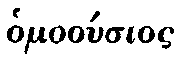
, and hold that the decision ought to have been
negative. For at first all parties agreed in the positive point, namely,
that Christ was the Son of God, and that the Son of God was truly God,
"or very God of very God." All that was necessary to be added was, that
the only begotten Son of God was not created nor begotten in time. More
than this might be possible, and subject of insight; but it was not
determinable by words, and was therefore to be left among the rewards of
the Spirit to the pure in heart in inward vision and silent
contemplation.
Ib.
s. xl. p. 495.
All that is necessary to give a full and satisfactory import to this
excellent paragraph, and to secure it from all inconvenient
consequences, is to understand the distinction between the objective and
general revelation, by which the whole Church is walled around and kept
together (
principium totalitatis et cohæsionis
), and the
subjective revelation, the light from the life (
John
i. 4.), by
which the individual believers, each according to the grace given, grow
in faith. For the former, the Apostles' Creed, in its present form, is
more than enough; for the latter, it might be truly said in the words of
the fourth Gospel, that all the books which the world could contain
would not suffice to set forth explicitly that mystery in which all
treasures of knowledge are hidden,
reconduntur
.
From the Apostles' Creed, nevertheless, if regarded in the former point
of view, several clauses must be struck out, not as false, but as not
necessary. "I believe that Jesus of Nazareth, who was crucified under
Pontius Pilate, rose from the dead on the third day; and I receive him
as the Christ, the Son of the living God, who died for the remission of
the sins of as many as believe in the Father through him, in whom we
have the promise of life everlasting." This is the sufficient creed.
More than this belongs to the Catechism, and then to the study of the
Scriptures.
Ib.
s. vi. p. 506.
So did the ancient Papias understand Christ's millenary reign upon
earth, and so depressed the hopes of Christianity and their desires to
the longing and expectation of temporal pleasures and satisfactions.
And he was followed by Justin Martyr, Irenæus, Tertullian, Lactantius,
and indeed, the whole Church generally, till St. Austin and St.
Jerome's time, who, first of any whose works are extant, did reprove
the error.
Bishop Taylor is, I think, mistaken in two points; first, that the
Catholic Millenaries looked forward to carnal pleasures in the kingdom
of Christ; — for even the Jewish Rabbis of any note represented the
Millenium
as the preparative and transitional state to perfect
spiritualization: — second, that the doctrine of Christ's reign upon
earth rested wholly or principally on the twentieth chapter of the
Revelations, which actually, in my judgment, opposes it.
I more than suspect that Austin's and Jerome's strongest ground for
rejecting the second coming of our Lord in his kingly character, was,
that they were tired of waiting for it. How can we otherwise interpret
the third and fourth clauses of the Lord's Prayer, or, perhaps, the
,
in hoc seculo
, (x. 30) of St. Mark?
If the first three Gospels, joined with the unbroken faith and tradition
of the Church for nearly three centuries, can decide the question, the
Millenarians have the best of the argument.
Vol. viii. s. ix. p. 22.
One thing only I observe (and we shall find it true in most writings,
whose authority is urged in questions of theology), that the authority
of the tradition is not it which moves the assent, but the nature of
the thing; and because such a canon is delivered, they do not
therefore believe the sanction or proposition so delivered, but
disbelieve the tradition if they do not like the matter, and so do not
judge of the matter by the tradition, but of the tradition by the
matter.
This just and acute remark is, in fact, no less applicable to Scripture
in all doctrinal points, and if infidelity is not to overspread England
as well as France, the same criterion (that is, the internal evidence)
must be extended to all points, to the narratives no less than to the
precept. The written words must be tried by the Word from the beginning,
in which is life, and that life the light of men.
it to the
noetic pentad, or universal form of contemplation, except where all the
terms are absolute, and consequently there is no
punctum indifferens,
— in divinis tetras, in omnibus aliis pentas,
and the form stands
thus
.
Ib.
s. iii. p. 36.
So that it cannot make it divine and necessary to be heartily
believed. It may make it lawful, not make it true; that is, it may
possibly, by such means, become a law, but not a truth.
This is a sophism which so evident a truth did not need. Apply the
reasoning to an act of Parliament previously to the royal sanction. Will
it hold good to say, if it was law after the sanction, it was law
before? The assertion of the Papal theologians is, that the divine
providence may possibly permit even the majority of a legally convened
Council to err; but by force of a divine promise cannot permit both a
majority and the Pope to err on the same point. The flaw in this is,
that the Romish divines rely on a conditional promise unconditionally.
To Taylor's next argument the Romish respondent would say, that an
exception, grounded on a specific evident necessity, does not invalidate
the rule in the absence of any equally evident necessity.
Taylor's argument is a
It is not the
truth, but the sign or mark, by which the Church at large may know that
it is truth, which is here provided for; that is, not the truth simply,
but the obligation of receiving it as such. Ten thousand may apprehend
the latter, only ten of whom might be capable of determining the former.
Ib.
5.
So that now (that we may apply this) there are seven general Councils,
which by the Church of Rome are condemned of error ... The council of
Ariminum, consisting of six hundred Bishops.
It is the mark of a faction that it never hesitates to sacrifice a
greater good common to them and to their opponents to a lesser advantage
obtained over those opponents. Never was there a stranger instance of
imprudence, at least, than the act of the Athanasian party in condemning
so roundly the great Council of Ariminum as heretical, and for little
more than the charitable wish of the many hundred Bishops there
assembled to avoid a word that had set all Christendom by the ears. They
declared that
were substantially
distinct, but nevertheless, one God; and though there might be some
incautious phrases used by them, the good Bishops declared that if their
decree was indeed Arian, or introduced aught to the derogation of the
Son's absolute divinity, it was against their knowledge and intention,
and that they renounced it.
Ib.
s. x. p. 46.
Gratian says, that the Council means by a concubine a wife married
sine dote et solennitate; but this is daubing with untempered
mortar.
Here I think Taylor wrong and Gratian right; for not a hundred years ago
the very same decree was passed by the Lutheran clergy in Prussia,
determining that left-hand marriages were to be discouraged, but did not
exclude from communion. These marriages were invented for the sake of
poor nobles: they could have but that one wife, and the children
followed the rank and title of the mother, not of the father.
Ib.
s. vii. p. 56.
Thirdly; for pasce oves, there is little in that allegation
besides the boldness of the objectors.
I have ever thought that the derivation of the Papal monarchy from the
thrice repeated command,
pasce oves
, the most brazen of all the
Pope's bulls. It was because Peter had given too good proof that he was
more disposed to draw the sword for Christ than to perform the humble
duties of a shepherd, that our Lord here strongly, though tenderly,
reminds him of his besetting temptation. The words are most manifestly a
reproof and a warning, not a commission. In like manner the very letter
of the famous paronomastic text proves that Peter's confession, not
Peter himself, was the rock. His name was, perhaps, not so much stone as
stoner; not so much rock as rockman; and Jesus hearing this unexpected
confession of his mysterious Sonship (for this is one of the very few
cases in which the internal evidence decides for the superior fidelity
of the first Gospel), and recognizing in it an immediate revelation from
heaven, exclaims, "Well, art thou the man of the rock;
and upon this
rock will I build my church,
" not on this man. Add too, that the law
revealed to Moses and the confession of the divine attributes, are named
the rock, both in the Pentateuch and in the Psalms.
has simply,
Thou art the Christ
; Luke,
The Christ of
God
; but that Jesus was the Messiah had long been known by the
Apostles, at all events conjectured. Had not John so declared him at the
baptism? Besides, it was included among the opinions concerning our Lord
which led to his question, the aim of which was not simply as to the
Messiahship, but that the Messiah, instead of a mere descendant of
David, destined to reestablish and possess David's throne, was the
Jehovah himself,
the Son of the living God; God manifested in the
flesh
. 1
Tim
. iii. 16.
Ib.
s. viii. p. 62.
And yet again, another degree of uncertainty is, to whom the Bishops
of Rome do succeed. For St. Paul was as much Bishop of Rome as St.
Peter was; there he presided, there he preached, and he it was that
was the doctor of the uncircumcision and of the Gentiles, St. Peter of
the circumcision and of the Jews only; and therefore the converted
Jews at Rome might with better reason claim the privilege of St.
Peter, than the Romans and the Churches in her communion, who do not
derive from Jewish parents.
I wonder that Taylor should have introduced so very strong an argument
merely
obiter
. If St. Peter ever was at Rome, it must have been
for the Jewish converts or
convertendi
exclusively, and on what do the
earliest Fathers rest the fact of Peter's being at Rome? Do they appeal
to any document?
; but to their own arbitrary and most improbable
interpretation of the word Babylon in St. Peter's first epistle
. I
am too deeply impressed with the general difficulty arising out of the
strange eclipse of all historic documents, of all particular events,
from the arrival of St. Paul at Rome as related by St. Luke and the time
when Justin Martyr begins to shed a scanty light, to press any
particular instance of it. Yet, if Peter really did arrive at Rome, and
was among those destroyed by Nero, it is strange that the Bishop and
Church of Rome should have preserved no record of the particulars.
Ib.
s. xv. p. 71.
But what shall we think of that decretal of Gregory the Third, who
wrote to Boniface his legate in Germany, quod illi, quorum uxores
infirmitate aliqua morbida debitum reddere noluerunt, aliis poterant
nubere.
Supposing the
noluerunt
to mean
nequeunt
, or at least any state of
mind and feeling that does not exclude moral attachment, I, as a
Protestant, abominate this decree of Gregory III; for I place the moral,
social, and spiritual helps and comforts as the proper and essential
ends of Christian marriage, and regard the begetting of children as a
contingent consequence. But on the contrary tenet of the Romish Church,
I do not see how Gregory could consistently decree otherwise.
Ib.
s. iii. p. 82.
Nor that Origen taught the pains of hell not to have an eternal
duration.
And yet there can be no doubt that Taylor himself held with Origen on
this point. But,
non licebat dogmatizare oppositum, quia determinatum
fuerat.
Ib.
p. 84.
And except it be in the Apostles' Creed and articles of such nature,
there is nothing which may with any color be called a consent, much
less tradition universal.
It may be well to remember, whenever Taylor speaks of the Apostles'
Creed, that Pearson's work on that Creed was not then published. Nothing
is more suspicious than copies of creeds in the early Fathers; it was so
notoriously the custom of the transcribers to make them square with
those in use in their own time.
Ib.
s. iv.
Such as makes no invasion upon their great reputation, which I desire
should be preserved as sacred as it ought.
The vision of the mitre dawned on Taylor; and his recollection of Laud
came to the assistance of the Fathers; of many of whom in his heart
Taylor, I think, entertained a very mean opinion. How could such a man
do otherwise? I could forgive them their nonsense and even their
economical falsehoods; but their insatiable appetite for making
heresies, and thus occasioning the neglect or destruction of so many
valuable works, Origen's for instance, this I cannot forgive or forget.
Ib.
s. i. p. 88.
Of the incompetency of the Church, in its diffusive capacity, to be
judge of controversies; and the impertinency of that pretence of the
Spirit.
Now here begin my serious differences with Jeremy Taylor, which may be
characterized in one sentence; ideas
versus
conceptions and images. I
contend that the Church in the Christian sense is an idea; — not
therefore a chimera, or a fancy, but a real being and a most powerful
reality. Suppose the present state of science in this country, with this
only difference that the Royal and other scientific societies were not
founded: might I not speak of a scientific public, and its influence on
the community at large? Or should I be talking of a chimera, a shadow,
or a non-entity? Or when we speak with honest pride of the public spirit
of this country as the power which supported the nation through the
gigantic conflict with France, do we speak of nothing, because we cannot
say, — "It is in this place or in that catalogue of names?" At the same
time I most readily admit that no rule can be grounded formally on the
supposed assent of this ideal Church, the members of which are recorded
only in the book of life at any one moment. In Taylor's use and
application of the term, Church, the visible Christendom, and in reply
to the Romish divines, his arguments are irrefragable.
Ib.
s. ii. p. 93,
So that if they read, study, pray, search records, and use all the
means of art and industry in the pursuit of truth, it is not with a
resolution to follow that which shall seem truth to them, but to
confirm what before they did believe.
Alas, if Protestant and Papist were named by individuals answering or
not answering to this description, what a vast accession would not the
Pope's muster-roll receive! In the instance of the Council of Trent, the
iniquity of the Emperor and the Kings of France and Spain consisted in
their knowledge that the assembly at Trent had no pretence to be a
general Council, that is, a body representative of the Catholic or even
of the Latin Church. It may be, and in fact it is, very questionable
whether any Council, however large and fairly chosen, is not an
absurdity except under the universal faith that the Holy Ghost
miraculously dictates all the decrees: and this is irrational, where the
same superseding Spirit does not afford evidence of its presence by
producing unanimity. I know nothing, if I may so say, more ludicrous
than the supposition of the Holy Ghost contenting himself with a
majority, in questions respecting faith, or decrees binding men to
inward belief, which again binds a Christian to outward profession.
Matters of discipline and ceremony, having peace and temporal order for
their objects, are proper enough for a Council; but these do not need
any miraculous interference. Still if any Council is admitted in matters
of doctrine, those who have appealed to it must abide by the
determination of the majority, however they might prefer the opinion of
the minority, just as in acts of Parliament.
Ib.
s. xi. p. 98.
Of some causes of error in the exercise of reason, which are inculpate
in themselves.
It is a lamentable misuse of the term, reason, — thus to call by that
name the mere faculty of guessing and babbling. The making reason a
faculty, instead of a light, and using the term as a mere synonyme of
the understanding, and the consequent ignorance of the true nature of
ideas, and that none but ideas are objects of faith — are the grounds of
all Jeremy Taylor's important errors.
Ib.
But men may understand what they please, especially when they are to
expound oracles.
If this sentence had occurred in Hume or Voltaire!
Ib.
s. iii. p. 103.
And then if ever truth be afflicted, she shall also be destroyed.
Here and in many other passages of his other works Jeremy Taylor very
unfairly states this argument of the anti-prelatic party. It was not
that the Church of England was afflicted (the Puritans themselves had
been much more afflicted by the prelates); but that having appealed to
the decision of the sword, the cause was determined against it. But in
fact it is false that the Puritans ever did argue as Taylor represents
them. Laud and his confederates had begun by incarcerating, scourging,
and inhumanly mutilating their fellow Christians for not acceding to
their fancies, and proceeded to goad and drive the King to levy or at
least maintain war against his Parliament: and the Parliamentary party
very naturally cited their defeat and the overthrow of the prelacy as a
judgment on their blood-thirstiness, not as a proof of their error in
questions of theology.
Ib.
s. iv. p. 105.
All that I shall say, &c. ad finem.
An admirable paragraph. Taylor is never more himself, never appears
greater, or wiser, than when he enters on this topic, namely, the many
and various causes beside truth which occasion men to hold an opinion
for truth.
Ib.
s. vii. p. 111.
Of such men as these it was said by St. Austin: Cæteram turbam non
intelligendi vivacitas, sed credendi simplicitas tutissimam facit.
Such charity is indeed notable policy: salvation made easy for the
benefit of obedient dupes.
Ib.
s. ii. p. 119.
I deny not but certain and known idolatry, or any other sort of
practical impiety with its principiant doctrine, may be punished
corporally, because it is no other but matter of fact.
In the Jewish theocracy, I admit; because the fact of idolatry was a
crime, namely,
crimen læsæ majestatis
, an overt act subversive of
the fundamental law of the state, and breaking asunder the
vinculum
et copulam unitatis et cohæsionis
. But in making the position
general, Taylor commits the
sophisma omissi essentialis
; he omits
the essential of the predicate, namely, criminal; — not its being a fact
rendering it punishable, but its being a criminal fact.
Ib.
s. iii.
Oh that this great and good man, who saw and has expressed so large a
portion of the truth, — (if by the Creed I might understand the true
Apostles', that is, the Baptismal Creed, free from the additions of the
first five centuries, I might indeed say the whole truth), — had but
brought it back to the great original end and purpose of historical
Christianity, and of the Church visible, as its exponent, not as a
hortus siccus
of past revelations, — but an ever enlarging inclosed
area
of the opportunity of individual conversion to, and reception of,
the spirit of truth! Then, instead of using this one truth to inspire a
despair of all truth, a reckless scepticism within, and a boundless
compliance without, he would have directed the believer to seek for
light where there was a certainty of finding it, as far as it was
profitable for him, that is, as far as it actually was light for him.
The visible Church would be a walled Academy, a pleasure garden, in
which the intrants having presented their
symbolum portae
, or
admission-contract, walk at large, each seeking private audience of the
invisible teacher, — alone now, now in groups, — meditating or
conversing, — gladly listening to some elder disciple, through whom (as
ascertained by his intelligibility to me) I feel that the common Master
is speaking to me, — or lovingly communing with a class-fellow, who, I
have discovered, has received the same lesson from the inward teaching
with myself, — while the only public concerns in which all, as a common
weal, exercised control and vigilance over each, are order, peace,
mutual courtesy and reverence, kindness, charity, love, and the fealty
and devotion of all and each to the common Master and Benefactor!
Ib.
s. viii. p. 124.
It is characteristic of the man and the age, Taylor's high-strained
reverential epithets to the names of the Fathers, and as rare and naked
mention of Luther, Melancthon, Calvin — the least of whom was not
inferior to St. Augustin, and worth a brigade of the Cyprians,
Firmilians, and the like. And observe, always
Saint
Cyprian!
Ib.
s. xii. p. 128-9.
Gibbon's enumeration of the causes, not miraculous, of the spread of
Christianity during the first three centuries is far from complete.
This, however, is not the greatest defect of this celebrated chapter.
The proportions of importance are not truly assigned; nay, the most
effective causes are only not omitted — mentioned, indeed, but
quasi
in transitu
, not developed or distinctly brought out: for example,
the zealous despotism of the Cæsars, with the consequent exclusion of
men of all ranks from the great interests of the public weal, otherwise
than as servile instruments; in short, the direct contrary of that state
and character of men's minds, feelings, hopes and fancies, which
elections, Parliaments, Parliamentary reports, and newspapers produce in
England; and this extinction of patriotism aided by the melting down of
states and nations in the one vast yet heterogeneous Empire; — the number
and variety of the parts acting only to make each insignificant in its
own eyes, and yet sufficient to preclude all living interest in the
peculiar institutions and religious forms of Rome; which beginning in a
petty district, had, no less than the Greek republics, its mythology and
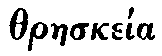
intimately connected with localities and local
events. The mere habit of staring or laughing at nine religions must
necessarily end in laughing at the tenth, that is, the religion of the
man's own birth-place. The first of these causes, that is, the
detachment of all love and hope from the things of the visible world,
and from temporal objects not merely selfish, must have produced in
thousands a tendency to, and a craving after, an internal religion,
while the latter occasioned an absolute necessity of a mundane as
opposed to a national or local religion. I am far from denying or
doubting the influence of the excellence of the Christian faith in the
propagation of the Christian Church or the power of its evidences; but
still I am persuaded that the necessity of some religion, and the
untenable nature and obsolete superannuated character of all the others,
occasioned the conversion of the largest though not the worthiest part
of the new-made Christians. Here, though exploded in physics, we have
recourse to the
horror vacui
as an efficient cause. This view of the
subject can offend or startle those only who, in their passion for
wonderment, virtually exclude the agency of Providence from any share in
the realizing of its own benignant scheme; as if the disposition of
events by which the whole world of human history, from north and south,
east and west, directed their march to one central point, the
establishment of Christendom, were not the most stupendous of miracles!
It is a yet sadder consideration, that the same men who can find God's
presence and agency only in sensuous miracles, wholly misconceive the
characteristic purpose and proper objects of historic Christianity and
of the outward and visible Church, of which historic Christianity is the
ground and the indispensable condition; but this is a subject delicate
and dangerous, at all events requiring a less scanty space than the
margins of these honestly printed pages.
Ib.
s. iv. p. 133.
The death of Ananias and Sapphira, and the blindness of Elymas the
sorcerer, amount not to this, for they were miraculous inflictions.
One great difficulty respecting, not the historic truth (of which there
can be no rational doubt), but the miraculous nature, of the sudden
deaths of Ananias and Sapphira is derived from the measure which gave
occasion to it, namely, the sale of their property by the new converts
of Palestine, in order to establish that community of goods, which,
according to a Rabbinical tradition, existed before the Deluge, and was
to be restored by the children of Seth (one of the names which the
Jewish Christians assumed) before the coming of the Son of Man. Now this
was a very gross and carnal, not to say fanatical, misunderstanding of
our Lord's words, and had the effect of reducing the Churches of the
Circumcision to beggary, and of making them an unnecessary burthen on
the new Churches in Greece and elsewhere. See Rhenferd as to this.
The fact of Elymas, however, concludes the miraculous nature of the
deaths of Ananias and Sapphira, which, taken of themselves, would indeed
have always been supposed, but could scarcely have been proved, the
result of a miraculous or superhuman power. There are for me, I
confess, great difficulties in this incident, especially when it is
compared with our Lord's reply to the Apostles' proposal of calling down
fire from heaven.
The Son of Man is not come to destroy
, &c. At all
events it is a subject that demands and deserves deep consideration.
Ib.
s. i. p. 141.
The religion of Jesus Christ is the form of sound doctrine and
wholesome words, which is set down in Scripture indefinitely,
actually conveyed to us by plain places, and separated as for the
question of necessary or not necessary by the Symbol of the Apostles.
I cannot refrain from again expressing my surprise at the frequency and
the undoubting positiveness of this assertion in so great a scholar, so
profound a Patrician, as Jeremy Taylor was. He appears
bona fide
to
have believed the absurd fable of this Creed having been a pic-nic to
which each of the twelve Apostles contributed his
symbolum
. Had Jeremy
Taylor taken it for granted so completely and at so early an age, that
he read without attending to the various passages in the Fathers and
ecclesiastical historians, which shew the gradual formation of this
Creed? It is certainly possible, and I see no other solution of the
problem.
Ib.
s. ix. p. 153.
Judge not, that ye be not judged
. The dread of these words is, I fear,
more influential on my spirit than either the duty of charity or my
sense of Taylor's high merits, in enabling me to struggle against the
strong inclination to pass the sentence of dishonesty on the reasoning
in this paragraph. Had I met the passage in Richard Baxter or in Bishop
Hall, it would have made no such unfavourable impression. But Taylor was
so acute a logician, and had made himself so completely master of the
subject, that it is hard to conceive him blind to sophistry so glaring.
I am myself friendly to Infant Baptism, but for that reason feel more
impatience of any unfairness in its defenders.
Ib.
Ad. iii. and xiii. p. 178.
But then, that God is not as much before hand with Christian as with
Jewish infants is a thing which can never be believed by them who
understand that in the Gospel God opened all his treasures of mercies,
and unsealed the fountain itself; whereas, before, he poured forth
only rivulets of mercy and comfort.
This is mere sophistry; and I doubt whether Taylor himself believed it a
sufficient reply to his own argument. There is no doubt that the primary
purpose of Circumcision was to peculiarize the Jews by an indelible
visible sign; and it was as necessary that Jewish infants should be
known to be Jews as Jewish men. Then humanity and mere safety determined
that the bloody rite should be performed in earliest infancy, as soon as
the babe might be supposed to have gotten over the fever of his birth.
This is clear; for women had no correspondent rite, but the same result
was obtained by the various severe laws concerning their marriage with
aliens and other actions.
Ib.
p. 180.
And as those persons who could not be circumcised (I mean the
females), yet were baptized, as is notorious in the Jews' books and
story.
Yes, but by no command of God, but only their own fancies.
Ib.
Ad. iv. p. 181.
Whosoever shall not receive the kingdom of God as a little child,
shall not enter therein: receive it as a little child receives it,
that is, with innocence, and without any let or hinderance.
Is it not evident that Christ here converted negatives into positives?
As a babe is without malice negatively, so you must be positively and by
actuation, that is, full of love and meekness; as the babe is
unresisting, so must you be docile, and so on.
Ib.
Ad. v.
And yet, notwithstanding this terrible paragraph, Taylor believed that
infants were not a whit the worse off for not being baptized. Strange
contradiction! They are born in sin, and Baptism is the only way of
deliverance; and yet it is not. For the infant is
de se
of the kingdom
of heaven. Christ blessed them, not in order to make them so, but
because they already were so. So that this argument seems more than all
others demonstrative for the Anabaptist, and to prove that Baptism
derives all its force if it be celestial magic, or all its meaning if it
be only a sacrament and symbol, from the presumption of actual sin in
the person baptized.
Ib.
Ad. xv. p. 186.
And he that hath without difference commanded that all nations should
be baptized, hath without difference commanded all sorts of persons.
so our Lord commanded all men to repent, did he therefore include
babes of a month old
? Yes, when they became capable of repentance.
And even so babes are included in the general command of Baptism, that
is, as soon as they are baptizable. But Baptism supposed both repentance
and a promise; babes are not capable of either, and therefore not of
Baptism. For the physical element was surely only the sign and seal of a
promise by a counter promise and covenant. The rite of Circumcision is
wholly inapplicable; for there a covenant was between Abraham and God,
not between God and the infant. "Do so and so to all your male children,
and I will favor them. Mark them before the world as a peculiar and
separate race, and I will then consider them as my chosen people." But
Baptism is personal, and the baptized a subject not an object; not a
thing, but a person; that is, having reason, or actually and not merely
potentially. Besides, Jeremy Taylor was too sound a student of Erasmus
and Grotius not to know the danger of screwing up St. Paul's
accommodations of Jewish rites, meant doubtless as inducements of
rhetoric and innocent compliances with innocent and invincible
prejudices, into articles of faith. The conclusions are always true; but
all the arguments are not and were never intended to be reducible into
syllogisms demonstrative.
Ib.
Ad. xviii. p. 191.
But let us hear the answer. First, it is said, that Baptism and the
Spirit signify the same thing; for by water is meant the effect of the
Spirit.
By the 'effect,' the Anabaptist clearly means the
causa causans
,
the 'act of the Spirit.' As well might Taylor say that a thought is not
thinking, because it is the effect of thinking. Had Taylor been right,
the water to be an apt sign ought to have been dirty water; for that
would be the
res effecta
. But it is pure water, therefore
res
agens
.
Ib.
p. 192.
For it is certain and evident, that regeneration or new birth is here
enjoined to all as of absolute and indispensable necessity.
Yet Taylor himself has denied it over and over again in his tracts on
Original Sin; and how is it in harmony with the words of Christ —
Of
such are the kingdom of heaven
? Are we not regenerated back to a
state of spiritual infancy? Yet for such Anti-pædobaptists as hold the
dogma of original guilt it is doubtless a fair argument; but Taylor
ought not to have used it as certain and evident in itself, and not
merely
ad hominem et per accidens
. As making a bow is in England
the understood conventional mark or visible language of reverence, so in
the East was Baptism the understood outward and visible mark of
conversion and initiation. So much for the visible act: then for the
particular meaning affixed to it by Christ. This was
an adoption of a new principle of action and consequent reform of
conduct; a cleansing, but especially a cleansing away of the carnal film
from the mind's eye. Hence the primitive Church called baptism
light, and the Eucharist
life. Baptism,
therefore, was properly the sign, the
precursor
, or rather the
first act, the
initium
, of that regeneration of which the whole
spiritual life of a Christian is the complete process; the Eucharist
indicating the means, namely, the continued assimilation of and to the
Divine Humanity. Hence the Eucharist was called the continuation of the
Incarnation.
Ib.
And yet it does not follow that they should all be baptized with the
Holy Ghost and with fire. But it is meant only that that glorious
effect should be to them a sign of Christ's eminency above him; they
should see from him a Baptism greater than that of John.
This is exactly of a piece with that gloss of the Socinians in evasion
of St. Paul's words concerning Christ's emptying himself of the form of
God, and becoming a servant, which all the world of Christians had
interpreted of the Incarnation. But no! it only referred to the miracle
of his transfiguration!
— — credat Judæus Apella!
Non ego.
St. John could not mean this, unless he denied the distinct personality
of the Holy Ghost. For it was the Holy Ghost that then descended
as
the substitute of Christ
; nor does St. Luke even hint that it was
understood to be a Baptism, even if we suppose the
tongues of
fire
to be anything visual, and not as we say, Victory sate on his
helmet like an eagle. The spirit of eloquence descended into them like a
tongue of fire, and that they spoke different languages is, I conceive,
no where said; but only that being rustic Galileans they yet spake a
dialect intelligible to all the Jews from the most different provinces.
For it is clear they were all Jews, and, as Jews, had doubtless a
lingua communis
which all understood when spoken, though persons
of education only could speak it. Even so a German boor understands, but
yet cannot talk in, High German, that is, the language of his Bible and
Hymn-book. So it is with the Scotch of Aberdeen with regard to pure
English. In short Taylor's arguments press on the Anabaptists, only as
far as the Anabaptists baptize at all; they are in fact attacks on
Baptism; and it would only follow from them that the Baptist is more
rational than the Pædobaptist, but that the Quaker is more consistent
than either. To pull off your hat is in Europe a mark of respect. What,
if a parent in his last will should command his children and posterity
to pull off their hats to their superiors, — and in course of time these
children or descendants emigrated to China, or some place, where the
same ceremony either meant nothing, or an insult. Should we not laugh at
them if they did not interpret the words into, Pay reverence to your
superiors. Even so Baptism was the Jewish custom, and natural to those
countries; but with us it would be a more significant rite if applied as
penance for excess of zeal and acts of bigotry, especially as
sprinkling.
Ib.
p. 196.
But farther yet I demand, can infants receive Christ in the Eucharist?
Surely the wafer and the tea-spoonful of wine might be swallowed by an
infant, as well as water be sprinkled upon him. But if the former is not
the Eucharist because without faith and repentance, so cannot the
latter, it would seem, be Baptism. For they are declared equal adjuncts
of both Sacraments. The argument therefore is a mere
petitio
principii sub lite
.
Ib.
Ad. ix. p. 197.
The promise of the Holy Ghost is made to all, to us and to our
children: and if the Holy Ghost belongs to them, then Baptism belongs
to them also.
If this be not rank enthusiasm I know not what is. The Spirit is
promised to them, first, as protection and providence, and as internal
operation when those faculties are developed, in and by which the Spirit
co-operates. Can Taylor shew an instance in Scripture in which the Holy
Spirit is said to operate simply, and without the co-operation of the
subject?
Ib.
Ad. xix. p. 199.
And when the boys in the street sang Hosanna to the Son of David, our
blessed Lord said that if they had held their peace, the stones of the
street would have cried out Hosanna.
By the same argument I could defend the sprinkling of mules and asses
with holy water, as is done yearly at Rome on St. Antony's day, I
believe. For they are capable of health and sickness, of restiveness and
of good temper, and these are all emanations from their Creator. Besides
in the great form of Baptism the words are not
but
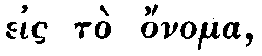
and many learned men have shewn that they may
mean 'into the power or influence' of the Father, the Son, and the
Spirit. But spiritual influences suppose capability in act of receiving
them; and we must either pretend to believe that the soul of the babe,
that is, his consciousness, is acted on without his consciousness, or
that the instrumental cause is antecedent by years to its effect, which
would be a conjunction disjunctive with a vengeance. Again, Baptism is
nothing except as followed by the Spirit; but it is irrational to say,
that the Spirit acts on the mere potentialities of an infant. For
wherein is the Spirit, as used in Scripture in appropriation to
Christians, different from God's universal providence and goodness, but
that the latter like the sun may shine on the wicked and on the good, on
the passive and on those who by exercise increase its effect; whereas
the former always implies a co-operant subject, that is, a developed
reason. When God gave his Spirit miraculously to the young child,
Daniel, he at the same time miraculously hastened the development of his
understanding.
Ib.
Ad. xxviii. p. 205.
But we see also that although Christ required faith of them who came
to be healed, yet when any were brought, or came in behalf of others,
he only required faith of them who came, and their faith did benefit
to others....
But this instance is so certain a reproof of this objection of theirs,
which is their principal, which is their all, that it is a wonder to
me they should not all be convinced at the reading and observing of
it.
So far from certainty, I find no strength at all in this reproof.
Doubtless Christ at a believer's request might heal his child's or his
servant's bodily sickness; for this was an act of power, requiring only
an object. But is it any where said, that at a believer's request he
gave the Spirit and the graces of faith to an unbeliever without any
mental act, or moral co-operation of the latter? This would have been a
proof indeed; but Taylor's instance is a mere
ad aliud
.
Ib.
Ad. xxxi. p. 207.
And although there are some effects of the Holy Spirit which require
natural capacities to be their foundation; yet those are the
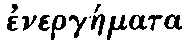
or powers of working: but the
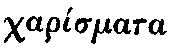
and the
inheritance and the title to the promises require nothing on our part,
but that we can receive them.
The Bishop flutters about and about, but never fairly answers the
question, What does Baptism do? The Baptist says it attests forgiveness
of sins, as the reward of faith and repentance. This is intelligible;
but as to the
— the children of believers, if so
taught and educated, are surely entitled to the promises; and what
analogy is there in this to any one act of power and gift of powers
mentioned as
when the word is really used in
contradistinction from
Baptism is spoken of many
times by St. Paul properly as well as metaphorically, and in the former
sense it is never described as a
on a passive
recipient, while in the latter sense it always respects an
of the Spirit of God, and a
in the spirit
of the recipient. All that Taylor can make out is, that Baptism effects
a potentiality in a potentiality, or a chalking of chalk to make white
white.
Ib.
p. 210.
And if it be questioned by wise men whether the want of it do not
occasion their eternal loss, and it is not questioned whether Baptism
does them any hurt or no, then certainly to baptize them is the surer
way without all peradventure.
Now this is the strongest argument of all against Infant Baptism, and
that which alone weighed at one time with me, namely, that it supposes
and most certainly encourages a belief concerning God, the most
blasphemous and intolerable; and no human wit can express this more
forcibly and affectingly than Taylor himself has done in his Letter to a
Lady on Original Sin. It is too plain to be denied that the belief of
the strict necessity of Infant Baptism, and the absolute universality of
the practice did not commence till the dogma of original guilt had begun
to despotize in the Church: while that remained uncertain and sporadic,
Infant Baptism was so too; some did it, many did not.
as soon as
Original Sin in the sense of actual guilt became the popular creed, then
all did it
.
Ib.
s. xvi. p. 224.
And although they have done violence to all philosophy and the reason
of man, and undone and cancelled the principles of two or three
sciences, to bring in this article; yet they have a divine revelation,
whose literal and grammatical sense, if that sense were intended,
would warrant them to do violence to all the sciences in the circle.
And indeed that Transubstantiation is openly and violently against
natural reason is no argument to make them disbelieve it, who believe
the mystery of the Trinity in all those niceties of explication which
are in the School (and which now-a-days pass for the doctrine of the
Church), with as much violence to the principles of natural and
supernatural philosophy as can be imagined to be in the point of
Transubstantiation.
This is one of the many passages in Taylor's works which lead me to
think that his private opinions were favorable to Socinianism. Observe,
to the views of Socinus, not to modern Unitarianism, as taught by
Priestley and Belsham. And doubtless Socinianism would much more easily
bear a doubt, whether the difference between it and the orthodox faith
was not more in words than in the things meant, than the Arian
hypothesis. A mere conceptualist, at least, might plausibly ask whether
either party, the Athanasian or the Socinian, had a sufficiently
distinct conception of what the one meant by the hypostatical union of
the Divine Logos with the man Jesus; or the other of his plenary, total,
perpetual, and continuous inspiration, to have any well-grounded
assurance, that they do not mean the same thing.
Moreover, no one knew better than Jeremy Taylor that this apparent soar
of the hooded falcon, faith, to the very empyrean of bibliolatry
amounted in fact to a truism of which the following syllogism is a fair
illustration. All stones are men: all men think:
ergo
, all stones
think. The
major
is taken for granted, the minor no one denies; and
then the conclusion is good logic, though a very foolish untruth. Or, if
an oval were demonstrated by Euclid to be a circle, it would be a
circle; and if it were a demonstrable circle, it would be a circle,
though the strait lines drawable from the centre to the circumference
are unequal. If we were quite certain that an omniscient Being,
incapable of deceiving, or being deceived, had assured us that 5 X 5 = 6
X 3, and that the two sides of a certain triangle were together less
than the third, then we should be warranted in setting at nought the
science of arithmetic and geometry. On another occasion, as when it was
the good Bishop's object to expose the impudent assertions of the Romish
Church since the eleventh century, he would have been the first to have
replied by a counter syllogism.
If we are quite certain that any writing pretending to divine origin
contains gross contradictions to demonstrable truths
in eodem
genere
, or commands that outrage the clearest principles of right
and wrong; then we may be equally certain that the pretence is a
blasphemous falsehood, inasmuch as the compatibility of a document with
the conclusions of self-evident reason, and with the laws of conscience,
is a condition
a priori
of any evidence adequate to the proof of
its having been revealed by God.
This principle is clearly laid down both by Moses and by St. Paul. If a
man pretended to be a prophet, he was to predict some definite event
that should take place at some definite time, at no unreasonable
distance: and if it were not fulfilled, he was to be punished as an
impostor.
if he accompanied his prophecy with any doctrine
subversive of the exclusive Deity and adorability of the one God of
heaven and earth, or any seduction to a breach of God's commandments, he
was to be put to death at once, all other proof of his guilt and
imposture being superfluous.
So St. Paul. If any man preach another
Gospel, though he should work all miracles, though he had the appearance
and evinced the superhuman powers of an angel from heaven — he was at
once, in contempt of all imaginable sensuous miracles, to be holden
accursed.
Ib.
s. xviii. p. 225.
And now for any danger to men's persons for suffering such a doctrine,
this I shall say, that if they who do it are not formally guilty of
idolatry, there is no danger that they whom they persuade to it,
should be guilty ... When they believe it to be no idolatry, then
their so believing it is sufficient security from that crime, which
hath so great a tincture and residency in the will, that from thence
only it hath its being criminal.
Will not this argument justify all idolaters? For surely they believe
themselves worshippers either of the Supreme Being under a permitted
form, or of some son of God (as Apollo) to whom he has delegated such
and such powers. If this be the case, there is no such crime as
idolatry: yet the second commandment expressly makes the worshipping of
God in or before a visual image of him not only idolatry, but the most
hateful species of it. Now do they not worship God in the visible form
of bread, and prostrate themselves before pictures of the Trinity? Are
we so mad as to suppose that the pious heathens thought the statue of
Jupiter, Jove himself? No; and yet these heathens were idolaters. But
there was no such being as Jupiter. No! Was there no King of Kings and
Lord of Lords; and does the name Jove instead of Jehovah (perhaps the
same word too) make the difference? Were Marcus Antoninus and Epictetus
idolaters?
index p. 2
- The first great divines among the Reformers, Luther, Calvin, and
their compeers and successors, had thrown the darkness of storms on an
awful fact of human nature, which in itself had only the darkness of
negations. What was certain, but incomprehensible, they rendered
contradictory and absurd by a vain attempt at explication. It was a
fundamental fact, and of course could not be comprehended; for to
comprehend, and thence to explain, is the same as to perceive, and
thence to point out, a something before the given fact, and Standing to
it in the relation of cause to effect. Thus they perverted original sin
into hereditary guilt, and made God act in the spirit of the cruellest
laws of jealous governments towards their enemies, upon the principle of
treason in the blood. This was brought in to explain their own
explanation of God's ways, and then too often God's alleged way in this
case was adduced to justify the cruel state law of treason in the blood.
- In process of time, good men and of active minds were shocked at
this; but, instead of passing back to the incomprehensible fact, with a
vault over the unhappy idol forged for its comprehension, they
identified the two in name; and while in truth their arguments applied
only to a false theory, they rejected the fact for the sake of the
mis-solution, and fell into far worse errors. For the mistaken theorist
had built upon a foundation, though but a superstructure of chaff and
straw; but the opponents built on nothing. Aghast at the superstructure,
these latter ran away from that which is the sole foundation of all
human religion.
- Then came the persecutions of the Arminians in Holland; then the
struggle in England against the Arminian Laud and all his
party — terrible persecutors in their turn of the Calvinists and
systematic divines; then the Civil War and the persecutions of the
Church by the Puritans in their turn; and just in this state of heated
feelings did Taylor write these Works, which contain dogmas subversive
of true Christian faith, namely, his Unum Necessarium, or
Doctrine and Practice of Repentance, which reduces the cross of Christ
to nothing, especially in the seventh chapter of the same, and the after
defences of it in his Letters on Original Sin to a Lady, and to the
Bishop of Rochester; and the Liberty of Prophesying, which, putting
toleration on a false ground, has left no ground at all for right or
wrong in matters of Christian faith.
In the marginal notes, which I have written in these several treatises
on Repentance, I appear to myself to have demonstrated that Taylor's
system has no one advantage over the Lutheran in respect of God's
attributes; that it is
bona fide
Pelagianism (though he denies
it; for let him define that grace which Pelagius would not accept,
because incompatible with free will and merit, and profess his belief in
it thus defined, and every one of his arguments against absolute decrees
tell against himself); and lastly, that its inevitable logical
consequences are Socinianism and
quæ sequuntur
. In Tillotson the
face of Arminianism looked out fuller, and Christianity is represented
as a mere arbitrary contrivance of God, yet one without reason. Let not
the surpassing eloquence of Taylor dazzle you, nor his scholastic
retiary versatility of logic illaqueate your good sense. Above all do
not dwell too much on the apparent absurdity or horror of the dogma he
opposes, but examine what he puts in its place, and receive candidly the
few hints which I have admarginated for your assistance, being in the
love of truth and of Christ,
Your Brother.
I have omitted one remark, probably from over fullness of intention to
have inserted it.
- The good man and eloquent expresses his conjectural belief that, if
Adam had not fallen, Christ would still have been necessary, though not
perhaps by Incarnation. Now, in the first place, this is only a play
thought of himself, and Scotus, and perhaps two or three others in the
Schools; no article of faith or of general presumption; consequently it
has little serious effect even on the guessers themselves. In the next
place, if it were granted, yet it would be a necessity wholly ex
parte Dei, not at all ex parte Hominis: — for what does it
amount to but this — that God having destined a creature for two states,
the earthly rational, and the heavenly spiritual, and having chosen to
give him, in the first instance, faculties sufficient only for the first
state, must afterwards superinduce those sufficient for the second
state, or else God would at once and the same time destine and not
destine. This therefore is a mere fancy, a theory, but not a binding
religion; no covenant.
- But the Incarnation, even after the fall of Adam, he clearly makes to
be specifically of no necessity. It was only not to take away peevishly
the estate of grace from the poor innocent children, because of the
father, — according to the good Bishop, a poor ignorant, who before he
ate the apple of knowledge did not know what right and wrong was; and
Christ's Incarnation would have been no more necessary then than it was
before, according to Taylor's belief. Here again the Incarnation is
wholly a contrivance ex parte Dei, and no way resulting from any
default of man.
- Consequently Taylor neither saw nor admitted any a priori
necessity of the Incarnation from the nature of man, and which, being
felt by man in his own nature, is itself the greatest of proofs for the
admission of it, and the strongest pre-disposing cause of the admission
of all proof positive. Not having this, he was to seek ab extra
for proofs in facts, in historical evidence in the world of sense. The
same causes produce the same effects. Hence Grotius, Taylor, and Baxter
(then, as appears in his Life, in a state of uneasy doubt), were the
first three writers of evidences of the Christian religion, such as have
been since followed up by hundreds, — nine-tenths of them Socinians or
Semi-Socinians, and which, taking head and tail, I call the
Grotio-Paleyan way.
- Hence the good man was ever craving for some morsel out of the
almsbasket of all external events, in order to prove to himself his own
immortality; and, with grief and shame I tell it, became evidence and
authority in Irish stories of ghosts, and apparitions, and witches. Let
those who are astonished refer to Glanville on Witches, and they will be
more astonished still. The fact now stated at once explains and
justifies my anxiety in detecting the errors of this great and excellent
genius at their fountain head, — the question of Original Sin: for how
important must that error be which ended in bringing Bishop Jeremy
Taylor forward as an examiner, judge, and witness in an Irish apparition
case!
Ib.
s. xxxviii. p. 278.
Although God exacts not an impossible law under eternal and
insufferable pains, yet he imposes great holiness in unlimited and
indefinite measures, with a design to give excellent proportions of
reward answerable to the greatness of our endeavour. Hell is not the
end of them that fail in the greatest measures of perfection; but
great degrees of heaven shall be their portion who do all that they
can always, and offend in the fewest instances.
It is not to be denied that one if not more of the parables appears to
sanction this, but the same parables would by consequence seem to favour
a state of Purgatory. From John, Paul, and the philosophy of the
doctrine, I should gather a different faith, and find a sanction for
this too in one of the parables, namely, that of the labourer at the
eleventh hour. Heaven, bliss, union with God through Christ, do not seem
to me comparative terms, or conceptions susceptible of degree. But it is
a difficult question. The first Fathers of the Reformation, and the
early Fathers of the primitive Church, present different systems, and in
a very different spirit.
Ib.
p. 324-328.
Descriptions of repentance taken from the Holy Scriptures.
This is a beautiful collection of texts. Still the pious but unconverted
Jew (a Moses Mendelsohn, for instance), has a right to ask, What then
did Christ teach or do, such and of such additional moment as to be
rightfully entitled the founder of a new law, instead of being, like
Isaiah and others, an enforcer and explainer of the old? If
Christianity, or the
opus operans
of Redemption, was synchronous with
the Fall of man, then the same answer must be returned to the passages
here given from the Old Testament as to those from the New; namely, that
Sanctification is the result of Redemption, not its efficient cause or
previous condition. Assuredly
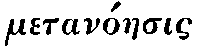
and Sanctification
differ only as the plant and the growth or growing of the plant. But the
words of the Apostle (it will be said) are exhortative and dehortative.
Doubtless! and so would be the words of a wise physician addressed to a
convalescent. Would this prove that the patient's revalescence had been
independent of the medicines given him? The texts are addressed to the
free will, and therefore concerning possible objects of free will. No
doubt! Should that process, the end and virtue of which is to free the
will, destroy the free will? But I cannot make it out to my
understanding, how the two are compatible. — Answer; the spirit knows the
things of the spirit. Here lies the sole true ground of
Latitudinarianism, Arminian, or Socinian; and this is the sole and
sufficient confutation;
spiritualia spiritus cognoscit
. Would you
understand with your ears instead of hearing with your understanding?
Now, as the ears to the understanding, so is the understanding to the
spirit. This Plato knew; and art thou a master in Israel, and knowest it
not?
Ib.
p. 330.
Who hath trodden under foot the Son of God, and hath counted the
blood of the covenant, wherewith he was sanctified, an unholy thing,
and hath done despite unto the Spirit of grace.
By this passage we must interpret the words "sin wilfully," in reference
to an unpardonable sin, in the preceding sentence.
Of the moral capacity of sinful habits.
Ib.
s. ii. p. 432.
Probably from the holiness of his own life, Taylor has but just
fluttered about a bad habit, not fully described it. He has omitted, or
rather described contradictorily, the case of those with whom the
objections to sin are all strengthened, the dismal consequences more
glaring and always present to them as an avenging fury, the sin loathed,
detested, hated; and yet, spite of all this, nay, the more for all this,
perpetrated. Both lust and intemperance would furnish too many instances
of these most miserable victims.
Ib.
s. xxxix. p. 456.
For every vicious habit being radicated in the will, and being a
strong love, inclination and adhesion to sin, unless the natural being
of this love be taken off, the enmity against God remains.
But the most important question is as to those vicious habits in which
there is no love to sin, but only a dread and recoiling from intolerable
pain, as in the case of the miserable drunkard! I trust that these
epileptic agonies are rather the punishments than the augumenters of his
guilt. The annihilation of the wicked is a fearful thought, yet it would
solve many difficulties both in natural religion and in Scripture. And
Taylor in his Arminian dread of Calvinism is always too shy of this
"grace of God:" he never denies, yet never admits, it any separate
operancy
per se
. And this, I fancy, is the true distinction of
Arminianisrn and Calvinism in their moral effects. Arminianism is cruel
to individuals, for fear of damaging the race by false hopes and
improper confidences; while Calvinism is horrible for the race, but full
of consolation to the suffering individual.
The next section is, taken together, one of the many instances that
confirm my opinion that Calvinism (Archbishop Leighton's for example),
compared with Taylor's Arminianism, is as the lamb in the wolf's skin to
the wolf in the lamb's skin: the one is cruel in the phrases, the other
in the doctrine.
Ib.
s. lvi. p. 469.
But if a single act of contrition cannot procure pardon of sins that
are habitual, then a wicked man that returns not till it be too late
to root out vicious habits, must despair of salvation. I answer, &c.
Would not Taylor's purposes have been sufficiently attained by pressing
the contrast between attrition and contrition with faith, and the utter
improbability that the latter (which alone can be efficient), shall be
vouchsafed to a sinner who has continued in his sins in the flattery of
a death-bed repentance; a blasphemy that seems too near that against the
Holy Ghost? My objection to Taylor is, that he seems to reduce the death
of Christ almost to a cypher; a contrivance rather to reconcile the
attributes of God, than an act of infinite love to save sinners. But the
truth is, that this is the peccant part of Arminianism, and Tillotson is
yet more open than Taylor. Forbid me, common goodness, that I should
think Tillotson conscious of Socinianism! but that his tenets involved
it, I more than suspect. See his Discourses on Transubstantiation, and
those near it in the same volume.
Ib.
lxiv. p. 478.
Now there is no peradventure, but new-converted persons, heathens
newly giving up their names to Christ and being baptized, if they die
in an hour, and were baptized half an hour after they believe in
Christ, are heirs of salvation.
This granted, I should little doubt of confuting all the foregoing, as
far as I object to it. I would rather be
durus pater infantum
,
like Austin, than
durus pater ægrotantium
. Taylor considers all
Christians who are so called.
Ib.
s. lxvi. p. 481.
All this paragraph is as just as it is fine and lively, but far from
confirming Taylor's doctrine. The case is as between one individual and
a general rule. I know God's mercy and Christ's merits; but whether your
heart has true faith in them, I cannot know.
Be it unto thee
according to thy faith
, said Christ: so should his ministers say.
All these passages, however, are utterly irreconcilable with the Roman
doctrine, that the priest's absolution is operant, and not simply
declarative. As to the decisions of Paulinus and Asterius, it is to be
feared that they had the mortmain bequests and compensations in view
more than the words of St. Paul, or the manifest purposes of redemption
by faith. Yea, Taylor himself has his
redime peccata eleemosynis
.
By the by, I know of few subjects that have been more handled and less
rationally treated than this of alms-giving. Every thing a rich man
purchases beyond absolute necessaries, ought to be purchased in the
spirit of alms, that is, as the most truly beneficial way of disparsing
that wealth, of which he is the steward, not owner.
Ib.
St. Paul taught us this secret, that sins are properly made habitual
upon the stock of impunity.
Sin taking occasion by the law wrought in
me all concupiscence;

'apprehending
impunity,'

'by occasion of the
commandment,' that is, so expressed and established as it was; because
in the commandment forbidding to lust or covet, there was no penalty
annexed or threatened in the sanction or in the explication. Murder
was death, and so was adultery and rebellion. Theft was punished
severely too; and so other things in their proportion; but the desires
God left under a bare restraint, and affixed no penalty in the law.
Now sin, that is, men that had a mind to sin, taking occasion hence,
&c.
This is a very ingenious and very plausible exposition of St. Paul's
words; but surely, surely, it is not the right one. I find both the
meaning and the truth of the Apostle's words in the vividness and
consequently attractive and ad-(or in-)sorbent power given to an image
or thought by the sense of its danger, by the consciousness of its being
forbidden, — which, in an unregenerate and unassisted will, struggling
with, or even exciting, the ever ready inclination of corrupted nature,
produces a perplexity and confusion which again increase the person's
susceptibility of the soliciting image or fancy so intensified. Guilt
and despair add a stimulus and sting to lust. See Iago in Shakspeare.
Ib.
s. xi. p. 500.
It was not well with thee when thou didst first enter into the suburbs
of hell by single actions of sin, &c.
Aye! this is excellent indeed, and worthy of a guardian angel of the
Church. When Jeremy Taylor escapes from the Mononomian Romaism, which
netted him in his too eager recoil from the Antinomian boar, brought
forth and foddered (as he imagined) in Calvin's stye; when from this
wiry net he escapes into the devotional and the dietetic, as into a
green meadow-land, with springs, and rivulets, and sheltering groves,
where he leads his flock like a shepherd; — then it is that he is most
himself, — then only he is all himself, the whole Jeremy Taylor; or if
there be one other subject graced by the same total heautophany, it is
in the pouring forth of his profound common sense on the ways and
weaknesses of men and conflicting sects, as for instance, in the
admirable birth, parentage, growth, and consummation of a religious
controversy in his
Dissuasive from Popery
.
Ib.
s. xiii. p. 502.
Let every old man that repents of the sins of his evil life be very
diligent in the search of the particulars; that by drawing them into a
heap, and spreading them before his eyes, he may be mightily ashamed
at their number and burthen.
I dare not condemn, but I am doubtful of this as a universal rule. If
there be a true hatred of sin, the precious time and the spiritual
nisus
will, I think, be more profitably employed in enkindling
meditation on holiness, and thirstings after the mind of Christ.
Ib.
ss. xxxi-xxxv. pp..517, 518.
Scarce a word in all this but for form's sake concerning the merits and
sacrifice of the Incarnate God! Surely Luther would not have given this
advice to a dying penitent, but have directed him rather to employ his
little time in agony of prayer to Christ, or in earnest meditations on
the astounding mystery of his death. In Taylor man is to do every thing.
Vol. IX. s. xi. p. 5.
For God was so exasperated with mankind, that being angry he would
still continue that punishment even to the lesser sins and sinners,
which he only had first threatened to Adam; and so Adam brought it
upon them.
And such a phrase as this used by a man in a refutation of Original Sin,
on the ground of its incompatibility with God's attributes!
"Exasperated" with those whom Taylor declares to have been innocent and
most unfortunate, the two things that most conciliate love and pity!
Ib.
p. 6.
If the sequel of the paragraph, comparing God to David in one of his
worst actions, be not blasphemy, the reason is that the good man meant
it not as such.
In facto est, sed non
in agents.
Ib.
ss. xvi. xvii. pp. 8, 9.
For the further explication of which it is observable that the word
'sinner' and 'sin' in Scripture is used for any person, that hath a
fault or a legal impurky, a debt, a vitiosity, defect, or imposition,
&c.
These facts, instead of explaining away Original Sin, are
unintelligible, nay, absurd and immoral, except as shadows, types, and
symbols of it, and of the Redemption from it. Observe, too, that Taylor
never dares explain what he means by "Adam was mortal of himself and we
are mortal from him:" he did not dare affirm that soul and body are
alike material and perishable, even as the lute and the potentiality of
music in the lute. And yet if he believed the contrary, then, in his
construction of the doctrine of Original Sin, what has Christ done? St.
John died in the same sense as Abel died: and in the sense of the Church
of England neither died, but only slept in the Lord.
This same system forced Taylor into the same error which Warburton
afterwards dressed up with such trappings and trammels of erudition, in
direct contempt of the plain meaning of the Church's article; and he
takes it for granted, in many places, that the Jews under Moses knew
only of temporal life and the death of the body. Lastly, he greatly
degrades the mind of man by causelessly representing death as an evil in
itself, which, if it be considered as a crisis, or phenomenal change,
incident to a progressive being, ought as little to be thought so, as
the casting of the caterpillar's skin to make room for the wings of the
butterfly. It is the unveiling of the Psyche.
I do not affirm this as an article of Christian faith; but I say that no
candid writer ought to hide himself in double meanings. Either he should
have used the term 'death' (
ex Adamo
) as loss of body, or as
change of mode of being and of its circumstances; and again this latter
as either evil for all, or as evil or good according to the moral habits
of each individual.
Observe, however, once for all, that I do not pretend to account for
Original Sin. I declare it to be an unaccountable fact. How can we
explain a
species
, when we are wholly in the dark as to the
genus
? Now guilt itself, as well as all other immediate facts of
free will, is absolutely inexplicable; of course original guilt. If we
will perversely confound the intelligible with the sensible world,
misapply the logic appropriate to
phænomena
and the categories, or
forms, which are empty except as substantialized in facts of experience,
in order to use them as the Procrustes' bed of faith respecting noumena:
if in short, we will strive to understand that of which we can only know
we may and must make as wild work with reason, will,
conscience, guilt, and virtue, as with Original Sin and Redemption. On
every subject first ask, Is it among the
or the
?
Ib.
s. xxiii. p. 12.
It could not make us heirs of damnation. This I shall the less need to
insist upon, because, of itself, it seems so horrid to impute to the
goodness and justice of God to be author of so great calamity to
innocents, &c.
Never was there a more hazardous way of reasoning, or rather of placing
human ignorance in the judgment seat over God's wisdom. The whole might
be closely parodied in support of Atheism: rather, this is but a
paraphrase of the old atheistic arguments. Either God could not, or
would not, prevent the moral and physical evils of the universe,
including the everlasting anguish of myriads of millions: therefore he
is either not all-powerful or not all-good: but a being deficient in
power or goodness is not God: —
Ergo, &c.
Ib.
s. xxv. p. 13.
I deny not but all persons naturally are so, that they cannot arrive
at heaven; but unless some other principle be put into them, or some
great grace done for them, must for ever stand separate from seeing
the face of God.
But this is but accidentally occasioned by the sin of Adam. Just so
might I say, that without the great grace of air done for them no living
beings could live. If it mean more, pray where was the grace in creating
a being, who without an especial grace must pass into utter misery? If
Taylor reply; but the grace was added in Christ: why so say the
Calvinists. According to Taylor there is no fall of man; but only an act
and punishment of a man, which punishment consisted in his living in the
kitchen garden, instead of the flower garden and orchard: and Cain was
as likely to have murdered Abel before, as after, the eating of the
forbidden fruit. But the very name of the fruit confutes Taylor. Adam
altered his nature by it. Cain did not. What Adam did, I doubt not, we
all do. Time is not with things of spirit.
Ib.
s. xxvii. p. 14.
Is hell so easy a pain, or are the souls of children of so cheap, so
contemptible a price, that God should so easily throw them into hell?
This is an argument against the
sine qua non
of Baptism, not
against Original Sin.
Ib.
s. lxvii. p. 49.
Origen said enough to be mistaken in the question.
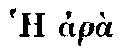


'Adam's curse is common to all. And there is not a woman
on earth, to whom may not be said those things which were spoken to
this woman.'
Origen's words ought to have prevented all mistake, for he plainly
enough overthrows the phantom of hereditary guilt; and as to guilt from
a corruption of nature, it is just such guilt as the carnivorous
appetites of a weaned lion, or the instinct of a brood of ducklings to
run to water. What then is it? It is an evil, and therefore seated in
the will; common to all men, the beginning of which no man can determine
in himself or in others. How comes this? It is a mystery, as the will
itself. Deeds are in time and space, therefore have a beginning. Pure
action, that is, the will, is a
noumenon
, and irreferable to
time. Thus Origen calls it neither hereditary nor original, but
universal sin. The curse of Adam is common to all men, because what Adam
did, we all do: and thus of Eve. You may substitute any woman in her
place, and the same words apply. This is the true solution of this
unfortunate question. The
is in the dividing
the will from the acts of the will. The will is
ego-agens
.
Ib.
s. lxxxii. p. 52.
This paragraph, though very characteristic of the Author, is fitter for
a comedy than for a grave discourse. It puts one in mind of the
play — "More sacks in the mill! Heap, boys, heap!"
Ib.
s. lxxxiv. p. 56.
Præposterum est (said Paulus the lawyer) ante nos locupletes dici
quam acquisiverimus. We cannot be said to lose what we never had; and
our fathers' goods were not to descend upon us, unless they were his
at his death.
Take away from me the knowledge that he was my father, dear Bishop, and
this will be true. But as it stands, the whole is, "says Paulus the
Lawyer;" and, "Well said, Lawyer!" say I.
Ib.
p. 57.
Which though it was natural, yet from Adam it began to be a curse;
just as the motion of a serpent upon his belly, which was concreated
with him, yet upon this story was changed into a malediction and an
evil adjunct.
How? I should really like to understand this.
Ib.
ch. vii. p. 73
in initio
.
In this most eloquent treatise we may detect sundry logical lapses,
sometimes in the statement, sometimes in the instances, and once or
twice in the conclusions. But the main and pervading error lies in the
treatment of the subject
in genere
by the forms and rules of
conceptual logic; which deriving all its material from the senses, and
borrowing its forms from the sense
or
intuitive faculty, is necessarily inapplicable to spiritual mysteries,
the very definition or contra-distinguishing character of which is that
they transcend the sense, and therefore the understanding, the faculty,
as Archbishop Leighton and Immanuel Kant excellently define it, which
judges according to sense.
the
Aids to Reflection
,
I have shewn
that the proper function of the understanding or mediate faculty is to
collect individual or sensible concretes into kinds and sorts (
genera
et species
) by means of their common characters (
notæ
communes
); and to fix and distinguish these conceptions (that is,
generalized perceptions) by words. Words are the only immediate objects
of the understanding. Spiritual verities, or truths of reason
respective ad realia
, and herein distinguished from the merely
formal, or so called universal truths, are differenced from the
conceptions of the understanding by the immediatcy of the knowledge, and
from the immediate truths of sense, — that is, from both pure and mixed
intuitions, — by not being sensible, that is, not representable by
figure, measurement or weight; nor connected with any affection of our
sensibility, such as color, taste, odors, and the like. And such
knowledges we, when we speak correctly, name ideas.
Now Original Sin, that is, sin that has its origin in itself, or in the
will of the sinner, but yet in a state or condition of the will not
peculiar to the individual agent, but common to the human race, is an
idea: and one diagnostic or contra-distinguishing mark appertaining to
all ideas, is, that they are not adequately expressible by words. An
idea can only be expressed (more correctly suggested) by two
contradictory positions; as for example; the soul is all in every
part; — nature is a sphere, the centre of which is everywhere, and its
circumference no where, and the like.
Hence many of Bishop Taylor's objections, grounded on his expositions of
the doctrine, prove nothing more than that the doctrine concerns an
idea. But besides this, Taylor everywhere assumes the consequences of
Original Sin as superinduced on a pre-existing nature, in no essential
respect differing from our present nature; — for instance, on a material
body, with its inherent appetites and its passivity to material
agents; — in short, on an animal nature in man. But this very nature, as
the antagonist of the spirit or supernatural principle in man, is in
fact the Original Sin, — the product of the will indivisible from the act
producing it; just as in pure geometry the mental construction is
indivisible from the constructive act of the intuitive faculty. Original
Sin, as the product, is a fact concerning which we know by the light of
the idea itself, that it must originate in a self-determination of a
will. That which we do not know is how it originates, and this we cannot
explain; first, from the necessity of the subject, namely, the will; and
secondly, because it is an idea, and all ideas are inconceivable. It is
an idea, because it is not a conception.
Ib.
s. ii. p. 74, 75.
And they are injurious to Christ, who think that from Adam we might
have inherited immortality. Christ was the giver and preacher of it;
he brought life and immortality to light through the gospel. It
is a singular benefit given by God to mankind through Jesus Christ.
And none inherit it but those who are born of Christ;
ergo
, bad
men and infidels are not immortal. Immortality is one thing, a happy
immortality another. St. Paul meant the latter: Taylor either the
former, or his words have no meaning at all; for no man ever thought or
dreamed that we inherited heaven from Adam, but that as sons of Adam,
that is, as men, we have souls that do not perish with the body. I often
suspect that Taylor, in
abditis fidei
inclined to the belief that there is no other immortality but heaven,
and that hell is a
pæna damni negativa, haud privativa
. I own
myself strongly inclined to it; — but so many texts against it! I am
confident that the doctrine would be a far stronger motive than the
present; for no man will believe eternal misery of himself, but millions
would admit, that if they did not amend their lives they would be
undeserving of living for ever.
Ib.
s. vi. p. 77.
"Lest the tumultuous crowd throw the reason within us over bridge into
the gulf of sin." What a vivid figure! It is enough to make any man set
to work to read Chrysostom.
Ib.
— — peccantes mente sub una.
Note Prudentius's use of
mente sub una
for 'in one person.'
Ib.
p. 78.
For even now we see, by a sad experience, that the afflicted and the
miserable are not only apt to anger and envy, but have many more
desires and more weaknesses, and consequently more aptnesses to sin in
many instances than those who are less troubled. And this is that
which was said by Arnobius; proni ad culpas, et ad libidinis varios
appetitos vitio sumus infirmitatis ingenitæ.
No. Arnobius never said so good and wise a thing in his lifetime. His
quoted words have no such profound meaning.
Ib.
s. vii. p. 78.
That which remained was a reasonable soul, fitted for the actions of
life and reason, but not of anything that was supernatural.
What Taylor calls reason I call understanding, and give the name reason
to that which Taylor would have called spirit.
Ib.
s. xii. p. 84.
And all that evil which is upon us, being not by any positive
infliction, but by privative, or the taking away gifts, and blessings,
and graces from us, which God, not having promised to give, was
neither naturally, nor by covenant, obliged to give, — it is certain he
could not be obliged to continue that to the sons of a sinning father,
which to an innocent father he was not obliged to give.
Oh! certainly not, if hell were not attached to acts and omissions,
which without these very graces it is morally impossible for men to
avoid. Why will not Taylor speak out?
Ib.
s. xiv. p. 85.
The doctrine of the ancient Fathers was that free will remained in us
after the Fall.
Yea! as the locomotive faculty in a man in a strait waistcoat. Neither
St. Augustine nor Calvin denied the remanence of the will in the fallen
spirit; but they, and Luther as well as they, objected to the flattering
epithet 'free' will. In the only Scriptural sense, as concerning the
unregenerate, it is implied in the word will, and in this sense,
therefore, it is superfluous and tautologic; and, in any other sense, it
is the fruit and final end of Redemption, — the glorious liberty of the
Gospel.
Ib.
s. xvi. p. 92.
For my part I believe this only as certain, that nature alone cannot
bring them to heaven, and that Adam left us in a state in which we
could not hope for it.
This is likewise my belief, and that man must have had a Christ, even if
Adam had continued in Paradise — if indeed the history of Adam be not a
mythos
; as, but for passages in St. Paul, we should most of us
believe; the serpent speaking, the names of the trees, and so on; and
the whole account of the creation in the first chapter of Genesis seems
to me clearly to say: — "The literal fact you could not comprehend if it
were related to you; but you may conceive of it as if it had taken place
thus and thus."
Ib.
s. 1. p. 166.
That in some things our nature is cross to the divine commandment, is
not always imputable to us, because our natures were before the
commandment.
This is what I most complain of in Jeremy Taylor's ethics; namely, that
he constantly refers us to the deeds or
phenomena
in time, the
effluents from the source, or like the
species
of Epicurus; while
the corrupt nature is declared guiltless and irresponsible; and this too
on the pretext that it was prior in time to the commandment, and
therefore not against it. But time is no more predicable of eternal
reason than of will; but not of will; for if a will be at all, it must
be
ens spirituale
; and this is the first negative definition of
spiritual — whatever having true being is not contemplable in the forms
of time and space. Now the necessary consequence of Taylor's scheme is a
conscience-worrying, casuistical, monkish work-holiness. Deeply do I
feel the difficulty and danger that besets the opposite scheme; and
never would I preach it, except under such provisos as would render it
perfectly compatible with the positions previously established by Taylor
in this chapter, s. xliv. p. 158. 'Lastly; the regenerate not only hath
received the Spirit of God, but is wholly led by him,' &c.
Ib.
If this Treatise of Repentance contain Bishop Taylor's habitual and
final convictions, I am persuaded that in some form or other he believed
in a Purgatory. In fact, dreams and apparitions may have been the
pretexts, and the immense addition of power and wealth which the belief
entailed on the priesthood, may have been their motives for patronizing
it; but the efficient cause of its reception by the churches is to be
found in the preceding Judaic legality and monk-moral of the Church,
according to which the fewer only could hope for the peace of heaven as
their next immediate state. The holiness that sufficed for this would
evince itself (it was believed) by the power of working miracles.
Ib.
s. lii. p. 208.
It shall not be pardoned in this world nor in the world to
come; that is, neither to the Jews nor to the Gentiles. For
sæculum hoc, this world, in Scripture, is the period of the
Jews' synagogue, and
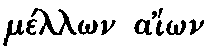
the world to come, is taken
for the Gospel, or the age of the Messias, frequently among the Jews.
This is, I think, a great and grievous mistake. The Rabbis of best name
divide into two or three periods, the difference being wholly in the
words; for the dividers by three meant the same as those by two.
The
first was the
dies expectationis
, or
hoc sæculum,
: the second
dies Messiæ
, the time of the
Messiah, that is, the
millenium
: the third the
sæculum
futurum
, or future state, which last was absolutely spiritual and
celestial.
But many Rabbis made the
dies Messiæ
part, that is,
the consummation of this world, the conclusive Sabbath of the great
week, in which they supposed the duration of the earth or world of the
senses to be comprised; but all agreed that the
dies
, or thousand
years, of the Messiah was a transitional state, during which the elect
were gradually defecated of body, and ripened for the final or spiritual
state.
During the
millenium
the will of God will be done on
earth, no less, though in a lower glory, than it will be done hereafter
in heaven.
Now it is to be carefully observed that the Jewish doctors or
Rabbis (all such at least as remained unconverted) had no conception or
belief of a suffering Messiah, or of a period after the birth of the
Messiah, previous to the kingdom, and of course included in the time of
expectation.
The appearance of the Messiah and his assumption of the
throne of David were to be contemporaneous. The Christian doctrine of a
suffering Messiah, or of Christ as the high priest and intercessor, has
of course introduced a modification of the Jewish scheme.
But though
there is a seeming discrepance in different texts in the first three
Gospels, yet the Lord's Prayer appears to determine the question in
favour of the elder and present Rabbinical belief; that is, it does not
date the
dies Messiae,
or kingdom of the Lord, from his
Incarnation, but from a second coming in power and glory, and hence we
are taught to pray for it as an event yet future.
Nay, our Lord himself
repeatedly speaks of the Son of Man in the third person, as yet to come.
Assuredly our Lord ascended the throne and became a King on his final
departure from his disciples. But it was the throne of his Father, and
he an invisible King, the sovereign Providence to whom all power was
committed.
And this celestial kingdom cannot be identified with that
under which the divine will will be done on earth as it is in heaven;
that is, when on this earth the Church militant shall be one in holiness
with the triumphant Church.
The difficulties, I confess, are great; and
for those who believe the first Gospel (and this in its present state)
to have been composed by the Apostle Matthew, or at worst to be a
literal and faithful translation from a Hebrew (Syro-Chaldaic) Gospel
written by him, and who furthermore contend for its having been word by
word dictated by an infallible Spirit, the necessary duty of reconciling
the different passages in the first Gospel with each other, and with
others in St. Luke's, is,
me saltern judice
, a most Herculean
one.
The most consistent and rational scheme is, I am persuaded, that
which is adopted in the Apocalypse. The new creation, commencing with
our Lord's resurrection, and measured as the creation of this world
(
hujus sæculi
,
) was by the doctors of the
Jewish church — namely, as a week — divided into two principal
epochs, — the six sevenths or working days, during which the Gospel was
gradually to be preached in all the world, and the number of the elect
filled up, — and the seventh, the Sabbath of the Messiah, or the kingdom
of Christ on earth in a new Jerusalem.
But as the Jewish doctors made
the day (or one thousand years) of Messiah, a part, because the
consummation, of this world,
so
the first Christians reversely made the kingdom commence on the first
(symbolical) day of the sacred week, the last or seventh day of which
was to be the complete and glorious manifestation of this kingdom. If
any one contends that the kingdom of the Son of Man, and the re-descent
of our Lord with his angels in the clouds, are to be interpreted
spiritually,
I have no objection; only you cannot pretend that this was
the interpretation of the disciples. It may be the right, but it was not
the Apostolic belief.
Ib.
s. 1. p. 257.
For this was giving them pardon, by virtue of those words of Christ,
Whose sins ye remit, they are remitted; that is, if ye, who are
the stewards of my family, shall admit any one to the kingdom of
Christ on earth, they shall be admitted to the participation of
Christ's kingdom in heaven; and what ye bind here shall be bound
there; that is, if they be unworthy to partake of Christ here, they
shall be accounted unworthy to partake of Christ hereafter.
Then without such a gift of reading the hearts of men, as priests do not
now pretend to, this text means almost nothing. A wicked shall not, but
a good man shall, be admitted to heaven; for if you have with good
reason rejected any one here, I will reject him hereafter, amounts to no
more than the rejection or admission of men according to their moral
fitness or unfitness, the truth or unsoundness of their faith and
repentance. I rather think that the promise, like the miraculous insight
which it implies, was given to the Apostles and first disciples
exclusively, and that it referred almost wholly to the admission of
professed converts to the Church of Christ.
In fine
.
I have written but few marginal notes to this long Treatise, for the
whole is to my feeling and apprehension so Romish, so anti-Pauline, so
unctionless, that it makes my very heart as dry as the desert sands,
when I read it.
of partial animadversions, I prescribe the
chapter on the Law and the Gospel, in Luther's
Table Talk
, as the
general antidote.
index p. 2
Ib.
Obj. iv. p. 346.
But if Original Sin be not a sin properly, why are children baptized?
And what benefit comes to them by Baptism? I answer, as much as they
need, and are capable of.
The eloquent man has plucked just prickles enough out of the dogma of
Original Sin to make a thick and ample crown of thorns for his
opponents; and yet left enough to tear his own clothes off his back, and
pierce through the leather jerkin of his closeliest wrought logic. In
this answer to this objection he reminds me of the renowned squire, who
first scratched out his eyes in a quickset hedge, and then leaped back
and scratched them in again. So Jeremy Taylor first pulls out the very
eyes of the doctrine, leaves it blind and blank, and then leaps back
into it and scratches them in again, but with a most opulent squint that
looks a hundred ways at once, and no one can tell which it really looks
at.
Ib.
By Baptism children are made partakers of the Holy Ghost and of the
grace of God; which I desire to be observed in opposition to the
Pelagian heresy, who did suppose nature to be so perfect, that the
grace of God was not necessary, and that by nature alone, they could
go to heaven; which because I affirm to be impossible, and that
Baptism is therefore necessary, because nature is insufficient and
Baptism is the great channel of grace, &c.
What then of the poor heathens, that is, of five-sixths of all mankind.
Would more go to hell by nature alone? If so: where is God's justice in
Taylor's plan more than in Calvin's?
Ib.
Obj. v. p. 355.
Although I have shewn the great excess and abundance of grace by
Christ over the evil that did descend by Adam; yet the proportion and
comparison lies in the main emanation of death from one, and life from
the other.
Does Jeremy Taylor then believe that the sentence of death on Adam and
his sons extended to the soul; that death was to be absolute cessation
of being! Scarcely I hope. But if bodily only, where is the difference
between
ante
and
post Christum?
Ib.
p. 356.
Not that God could be the author of a sin to any, but that he
appointed the evil which is the consequent of sin, to be upon their
heads who descended from the sinner.
Rare justice! and this too in a tract written to rescue God's justice
from the Supra- and Sub-lapsarians! How quickly would Taylor have
detected in an adversary the absurd realization contained in this and
the following passages of the abstract notion, sin, from the sinner: as
if sin were any thing but a man sinning, or a man who has sinned! As
well might a sin committed in Sirius or the planet Saturn justify the
infliction of conflagration on the earth and hell-fire on all its
rational inhabitants. Sin! the word sin! for abstracted from the sinner
it is no more: and if not abstracted from him, it remains separate from
all others.
Ib.
p. 358.
The consequent of this discourse must needs at least be this; that it
is impossible that the greatest part of mankind should be left in the
eternal bonds of hell by Adam; for then quite contrary to the
discourse of the Apostle, there had been abundance of sin, but a
scarcity of grace.
And yet Jeremy Taylor will not be called a Pelagian. Why? Because
without grace superadded by Christ no man could be saved: that is, all
men must go to hell, and this not for any sin, but from a calamity, the
consequences of another man's sin, of which they were even ignorant. God
would not condemn them the sons of Adam for sin, but only inflicted on
them an evil, the necessary effect of which was that they should all
troop to the devil! And this is Jeremy Taylor's defence of God's
justice! The truth is Taylor was a Pelagian, believed that without
Christ thousands, Jews and heathens, lived wisely and holily, and went
to heaven; but this he did not dare say out, probably not even to
himself; and hence it is that he flounders backward and forward, now
upping and now downing.
truth, this eloquent Treatise may be compared to a statue of Janus,
with one face fixed on certain opponents, full of life and force, a
witty scorn on the lip, a brow at once bright and weighty with
satisfying reason: the other looking at the something instead of that
which had been confuted, maimed, noseless, and weather-bitten into a
sort of visionary confusion and indistinctness.
It looks like
this — aye and very like that — but how like it is, too, such another
thing!
index p. 3
Ib.
p. 367.
And they who are born eunuchs should be less infected by Adam's
pollution, by having less of concupiscence in the great instance of
desires.
The fact happens to be false: and then the vulgarity, most unworthy of
our dear Jeremy Taylor, of taking the mode of the manifestation of the
disobedience of the will to the reason, for the disobedience itself. St.
James would have taught him that he who offendeth against one, offendeth
against all; and that there is some truth in the Stoic paradox that all
crimes are equal. Equal is indeed a false phrase; and therein consists
the paradox, which in ninety-nine cases out of a hundred is the same as
the falsehood. The truth is they are all the same in kind; but unequal
in degree. They are all alike, though not equally, against the
conscience.
Ib.
p. 369.
So that there is no necessity of a third place; but it concludes only
that in the state of separation from God's presence there is great
variety of degrees and kinds of evil, and every one is not the
extreme.
What is this? If hell be a state, and not a mere place, and a particular
state, its meaning must in common sense be a state of the worst sort. If
then there be a mere
pæna damni
, that is, the not being so blest
as some others may be; this is a different state
in genere
from
the
pæna sensus
:
ergo
, not hell;
ergo
rather a
third state; or else heaven. For every angel must be in it, than whom
another angel is happier; that is negatively damned, though positively
very happy.
Ib.
p. 370-1.
Just so it is in infants: hell was not made for man, but for devils;
and therefore it must be something besides mere nature that can bear
any man thither: mere nature goes neither to heaven or hell.
And how came the devils there? If it be hard to explain how Adam fell;
how much more hard to solve how purely spiritual beings could fall? And
nature! What? so much of nature, and no kind of attempt at a definition
of the word? Pray what is nature?
Ib.
p. 371.
I do not say that we, by that sin (original) deserved that death,
neither can death be properly a punishment of us, till we superadd
some evil of our own; yet Adam's sin deserved it, so that it was
justly left to fall upon us, we, as a consequent and punishment of his
sin, being reduced to our natural portion.
How? What is this but flying to the old Supra-lapsarian blasphemy of a
right of property in God over all his creatures, and destroying that
sacred distinction between person and thing which is the light and the
life of all law human and divine? Mercy on us! Is not agony, is not the
stone, is not blindness, is not ignorance, are not headstrong, inherent,
innate, and connate, passions driving us to sin when reason is least
able to withhold us, — are not all these punishments, grievous
punishments, and are they not inflicted on the innocent babe?
not
this the result infused into the
milk not mingled
of St. Peter;
spotting the immaculate begotten, souring and curdling the
innocence
without sin or malice
?
And if this be just, and
compatible with God's goodness, why all this outcry against St. Austin
and the Calvinists and the Lutherans, whose whole addition is a lame
attempt to believe guilt, where they cannot find it, in order to justify
a punishment which they do find?
Ib.
p. 379.
But then for the evil of punishment, that may pass further than the
action. If it passes upon the innocent, it is not a punishment to
them, but an evil inflicted by right of dominion; but yet by reason of
the relation of the afflicted to him that sinned, to him it is a
punishment.
Here the snake peeps out, and now takes its tail into its mouth. Right
of dominion! Nonsense! Things are not objects of right or wrong. Power
of dominion I understand, and right of judgment I understand; but right
of dominion can have no immediate, but only a relative, sense. I have a
right of dominion over this estate, that is, relatively to all other
persons. But if there be a
jus dominandi
over rational and free
agents, then why blame Calvin? For all attributes are then merged in
blind power: and God and fate are the same:
Strange Trinity! God, Necessity, and the Devil. But Taylor's scheme has
far worse consequences than Calvin's: for it makes the whole scheme of
Redemption a theatrical scenery. Just restore our bodies and corporeal
passions to a perfect
equilibrium
and fortunate instinct, and,
there being no guilt or defect in the soul, the Son of God, the Logos,
and Supreme Reason, might have remained unincarnate, uncrucified. In
short, Socinianism is as inevitable a deduction from Taylor's scheme as
Deism or Atheism is from Socinianism.
In fine
.
The whole of Taylor's confusion originated in this; — first, that he and
his adversaries confound original with hereditary sin; but chiefly that
neither he nor his adversaries had considered that guilt must be a
noumenon
; but that our images, remembrances, and consciousnesses
of our actions are
phænomena
. Now the
phænomenon
is in
time, and an effect: but the
noumenon
is not in time any more
than it is in space. The guilt has been before we are even conscious of
the action; therefore an original sin (that is, a sin universal and
essential to man as man, and yet guilt, and yet choice, and yet amenable
to punishment), may be at once true and yet in direct contradiction to
all our reasonings derived from
phænomena
, that is, facts of time
and space. But we ought not to apply the categories of appearance to the
of the intelligible or causative world. This (I
should say of Original Sin) is mystery! We do not so properly believe
it, as we know it. What is actual must be possible. But if we will
confound actuals with reals, and apply the rules of the latter to cases
of the former, we must blame ourselves for the clouds and darkness and
storms of opposing winds, which the error will not fail to raise. By the
same process an Atheist may demonstrate the contradictory nature of
eternity, of a being at once infinite and of resistless causality, and
yet intelligent. Jeremy Taylor additionally puzzled himself with Adam,
instead of looking into the fact in himself.
How came it that Taylor did not apply the same process to the congeneric
question of the freedom of the will? In half a dozen syllogisms he must
have gyved and hand-cuffed himself into blank necessity and mechanic
motions. All hangs together. Deny Original Sin, and you will soon deny
free will; — then virtue and vice; — and God becomes
Abracadabra
; a
sound, nothing else.
index p. 3
Ib.
p. 390-1.
To this it is answered as you see, there is a double guilt; a guilt of
person, and of nature. That is taken away, this is not: for sacraments
are given to persons, not to natures.
I need no other passage but this to convince me that Jeremy Taylor, the
angle in which the two
apices
of logic and rhetoric meet,
consummate in both, was yet no metaphysician. Learning, fancy,
discursive intellect,
tria juncta in uno
, and of each enough to
have alone immortalized a man, he had; but yet
. Images, conceptions, notions, such as leave him but one rival,
Shakspeare, there were; but no ideas. Taylor was a Gassendist. O! that
he had but meditated in the silence of his spirit on the mystery of an
I AM
! He would have seen that a person,
quoad
person, can
have nothing common or generic; and that where this finds place, the
person is corrupted by introsusception of a nature, which becomes evil
thereby, and on this relation only is an evil nature. The nature itself,
like all other works of God, is good, and so is the person in a yet
higher sense of the word, good, like all offsprings of the Most High.
But the combination is evil, and this not the work of God; and one of
the main ends and results of the doctrine of Original Sin is to silence
and confute the blasphemy that makes God the author of sin, without
avoiding it by fleeing to the almost equal blasphemy against the
conscience, that sin in the sense of guilt does not exist.
index p. 3
Perhaps the most wonderful of all Taylor's works. He seems, if I may so
say, to have transubstantiated his vast imagination and fancy into
subtlety not to be evaded, acuteness to which nothing remains
unpierceable, and indefatigable agility of argumentation. Add to these
an exhaustive erudition, and that all these are employed in the service
of reason and common sense; whereas in some of his Tracts he seems to
wield all sorts of wisdom and wit in defence of all sorts of folly and
stupidity. But these were
ad popellum
, and by virtue of the
falsitas dispensativa
, which he allowed himself.
Epist. dedicatory.
The question of transubstantiation.
I have no doubt that if the Pythagorean bond had successfully
established itself, and become a powerful secular hierarchy, there would
have been no lack of furious partizans to assert, yea, and to damn and
burn such as dared deny, that one was the same as two; two being two in
the same sense as one is one; that consequently 2 + 2 = 2 and 1 + 1 = 4. But I
should most vehemently doubt that this was the intention of Pythagoras,
or the sense in which the mysterious dogma was understood by the
thinking part of his disciples, who nevertheless were its professed
believers. I should be prepared to find that the true import and purport
of the article was no more than this; — that the one in order to its
manifestation must appear in and as two; that the act of re-union was
simultaneous with that of the self-production, (in the geometrical use
of the word 'produce,' as when a point produces, or evolves, itself on
each side into a bipolar line), and that the Triad is therefore the
necessary form of the Monad.
Even so is the dispute concerning Transubstantiation. I can easily
believe that a thousand monks and friars would pretend, as Taylor says, to 'disbelieve their eyes and ears, and defy their own reason,'
and to receive the dogma in the sense, or rather in the nonsense, here
ascribed to it by him, namely, that the phenomenal bread and wine were
the phenomenal flesh and blood. But I likewise know that the respectable
Roman Catholic theologians state the article free from a contradiction
in terms at least; namely, that in the consecrated elements the
noumena
of the phenomenal bread and wine are the same with that which
was the
noumenon
of the phenomenal flesh and blood of Christ when on
earth.
Let
M
represent a slab or plane of mahogany,
and
m
its ordinary supporter or under-prop; and
let
S
represent a slab or plane of silver,
and
s
its supporter.
Now to affirm that
M
=
S
is a contradiction,
or that
m
=
s
but it is no contradiction to say, that on certain occasions
(
S
having been removed)
s
is substituted for
m
and that what was
M
/
m
is by the command of the common master changed into
M
/
s
It may be false in fact, but it is not a self-contradiction in the
terms.
The mode in which
s
subsists in
M
/
s
may be inconceivable,
but not more so than the mode in which
m
subsists in
M
/
m
,
or that in which
s
subsisted in
S
/
s
I honestly confess that I should confine my grounds of opposition to the
article thus stated to its unnecessariness, to the want of sufficient
proofs from Scripture that I am bound to believe or trouble my head with
it. I am sure that Bishop Bull, who really did believe the Trinity,
without either Tritheism or Sabellianism, could not consistently have
used the argument of Taylor or of Tillotson in proof of the absurdity of
Transubstantiation.
Ib.
p. ccccxvi.
But for our dear afflicted mother, she is under the portion of a child
in the state of discipline, her government indeed hindered, but her
worshippings the same, the articles as true, and those of the church
of Rome as false as ever.
O how much there is in these few words, — the sweet and comely
sophistry, not of Taylor, but of human nature. Mother! child! state of
discipline! government hindered! that is to say, in how many instances,
scourgings hindered, dungeoning in dens foul as those of hell,
mutilation of ears and noses, and flattering the King mad with
assertions of his divine right to govern without a Parliament, hindered.
The best apology for Laud, Sheldon, and their fellows will ever be that
those whom they persecuted were as great persecutors as themselves, and
much less excusable.
Ib.
s. ii. p. 422.
In Synaxi Transubstantiationem sero definivit Ecclesia; diu satis
erat credere, sive sub pane consecrate, sive quocunque modo adesse
verum corpus Christi; so said the great Erasmus.
Verum corpus,
that is,
res ipsissima,
or the thing in its
actual self, opposed
.
Ib.
s. vi. p. 425.
Now that the spiritual is also a real presence, and that they are
hugely consistent, is easily credible to them that believe the gifts
of the Holy Ghost are real graces, and a spirit is a proper substance.
But how the body of Christ, as opposed to his Spirit and to his Godhead,
can be taken spiritually,
hic labor, hoc opus est.
Plotinus says,
; so we must say here
.
Ib.
s. vii. p. 426.
So we may say of the blessed Sacrament; Christ is more truly and
really present in spiritual presence than in corporal; in the heavenly
effect than in the natural being.
But the presence of Christ is not in question, but the presence of
Christ's body and blood. Now that Christ effected much for us by coming
in the body, which could not or would not have been effected had he not
assumed the body, we all, Socinians excepted, believe; but that his body
effected it, other than as Christ in the body, where shall we find? how
can we understand?
Ib.
p. 427.
So when it is said, Flesh and blood shall not inherit the kingdom
of God, that is, corruption shall not inherit; and in the
resurrection, our bodies are said to be spiritual, that is, not in
substance, but in effect and operation.
This is, in the first place, a wilful interpretation, and secondly, it
is absurd; for what sort of flesh and blood would incorruptible flesh
and blood be? As well might we speak of marble flesh and blood. But in
Taylor's mind, as seen throughout, the logician was predominant over the
philosopher, and the fancy outbustled the pure intuitive imagination. In
the sense of St. Paul, as of Plato and all other dynamic philosophers,
flesh and blood is
ipso facto
corruption, that is, the spirit of
life in the mid or balancing state between fixation and reviviscence.
Who shall deliver me from the body of this death?
is a Hebraism
for 'this death which the body is.' For matter itself is but
spiritus
in coagulo,
and organized matter the coagulum in the act of being
restored; it is then repotentiating. Stop its self-destruction as
matter, and you stop its self-reproduction as a vital organ. In short,
Taylor seems to fall into the very fault he reproves in Bellarmine, and
with this additional evil, that his reasoning looks more like tricking
or explaining away a mystery. For wherein does the Sacrament of the
Eucharist differ from that of Baptism, nay, even of grace before meat,
when performed fervently and in faith? Here too Christ is present in the
hearts of the faithful by blessing and grace. I see at present no other
way of interpreting the text so as not to make the Sacrament a mere
arbitrary
memento,
but by an implied negative. In propriety, the
word is confined to no portion of corporality in particular. "This (the
bread and wine) are as truly my flesh and blood as the
phænomena
which you now behold and name as such."
Ib.
s. ix. p. 429.
From this paragraph I conclude, though not without some perplexity, that
by 'the body and blood verily and indeed taken,' we are not to
understand body and blood in their limited sense, as contradistinguished
from the soul or Godhead of Christ, but as a
periphrasis
for
Christ himself, or at least Christ's humanity. Taylor, however, has
misconstrued Phavorinus' meaning though not his words.
Spiritualia
eterna quoad spiritum.
But this is the very depth of the purified
Platonic philosophy.
Ib.
s. x. p. 430.
But because the words do perfectly declare our sense, and are owned
publicly in our doctrine and manner of speaking, it will be in vain to
object against us those words of the Fathers, which use the same
expressions: for if by virtue of those words 'really,'
'substantially,' 'corporally,' 'verily and indeed,' and 'Christ's body
and blood,' the Fathers shall be supposed to speak for
Transubstantiation, they may as well suppose it to be our doctrine
too; for we use the same words, and therefore those authorities must
signify nothing against us, unless these words can be proved in them
to signify more than our sense of them does import; and by this truth,
many, very many of their pretences are evacuated.
A sophism, dearest Jeremy. We use the words because these early Fathers
used them, and have forced our own definitions on them. But should we
have chosen these words to express our opinion by, if there had been no
controversy on the subject? But the Fathers chose and selected these
words as the most obvious and natural.
Ib.
s. xi. p. 431.
It is much insisted upou that it be inquired whether, when we say we
believe Christ's body to be really in the Sacrament, we mean 'that
body, that flesh, that was born of the Virgin Mary, that was
crucified, dead, and buried?' I answer, that I know none else that he
had or hath: there is but one body of Christ natural and glorified.
This may be true, or at least intelligible, of Christ's humanity or
personal identity as
, but applied to the phenomenal
flesh and blood, it is nonsense. For if every atom of the human frame be
changed by succession in eleven or twelve years, the body born of the
Virgin could not be the body crucified, much less the body crucified be
the body glorified, spiritual and incorruptible.
construe the words of
Clement of Alexandria, quoted by Taylor below,
literally, and they
perfectly express my opinion; namely, that Christ, both in the
institution of the Eucharist and in the sixth chapter of John, spoke of
his humanity as a
noumenon,
not of the specific flesh and blood
which were its
phænomena
at the last supper and on the cross. But
Jeremy Taylor was a semi-materialist, and though no man better managed
the logic of substance and accidents, he seems to have formed no clear
metaphysical notion of their actual meaning. Taken notionally, they are
mere interchangeable relations, as in concentric circles the outmost
circumference is the substance, the other circles its accidents; but if
I begin with the second and exclude the first from my thoughts, then
this is substance and the interior ones accidents, and so on; but taken
really, we mean the complex action of co-agents on our senses, and
accident as only an agent acting on us. Thus we say, the beer has turned
sour: sour is the accident of the substance beer. But, in fact, a new
agent, oxygen, has united itself with other agents in the joint
composition, the essence of which new comer is to be sour: at all
events, Taylor's construction is a mere assertion, meaning no more than
'in this sense only can I subscribe to the words of Bertram, Jerome, and
Clement.'
If a re-union of the Lutheran and English Churches with the Roman were
desirable and practicable, the best way,
would be, that any remarkable number should offer union on a given
profession of faith chiefly negative, as we protest against the
authority of the Church in temporals; that the words agreed to by Beza
and Espencœus, on the part of the Reformers and Romanists respectively,
at Poissy, used with implicit faith, shall suffice.
Credimus in usu
cœntæ Dominicæ vere, reipsa, substantialiter, seu in substantia, verum
corpus et sanguinem Christi spirituali et ineffabili modo esse,
exhiberi, sumi a fidelibus communicantibus.
Ib.
s. in. p. 434.
The other Schoolman I am to reckon in this account, is Gabriel Biel.
Taylor should have informed the reader that Gabriel Biel is but the echo
of Occam, and that both were ante-Lutheran Protestants in heart, and as
far as they dared, in word likewise.
Ib.
s. vi. p. 436.
So that if, according to the Casuists, especially of the Jesuits'
order, it be lawful to follow the opinion of any one probable doctor,
here we have five good men and true, besides Occam, Bassolis, and
Mechior Camus, to acquit us from our search after this question in
Scripture.
Taylor might have added Erasmus, who, in one of his letters, speaking of
Œcolampadius's writings on the Eucharist, says
"ut seduci posse
videantur etiam electi,"
and adds, that he should have embraced his
interpretations,
"nisi obstaret consensus Ecclesiæ;"
that is,
Œcolampadius has convinced me, and I should avow my conviction, but for
motives of personal prudence and regard for the public peace.
index p. 3
Ib.
p. 436.
cannot but think that the same mysterious truth, whatever it be, is
referred to in the Eucharist and in this chapter of St. John; and I
wonder that Taylor, who makes the Eucharist a spiritual sumption of
Christ, should object to it. A = C and B = C, therefore A = B.
Ib.
s. iv. p. 440.
The error on both sides, Roman and Protestant, originates in the
confusion of sign or figure with symbol, which latter is always an
essential part of that, of the whole of which it is the representative.
Not seeing this, and therefore seeing no
medium
between the whole
thing and the mere metaphor of the thing, the Romanists took the former
or positive pole of the error, the Protestants the latter or negative
pole. The Eucharist is a symbolic, or solemnizing and
totum in
parte
acting of an act, which in a true member of Christ's body is
supposed to be perpetual. Thus the husband and wife exercise the duties
of their marriage contract of love, protection, obedience, and the like,
all the year long, and yet solemnize it by a more deliberate and
reflecting act of the same love on the anniversary of their marriage.
Ib.
s. ix p. 447-8.
That which neither can feel or be felt, see or be seen, move or be
moved, change or be changed, neither do or suffer corporally, cannot
certainly be eaten corporally; but so they affirm concerning the body
of our blessed Lord; it cannot do or suffer corporally in the
Sacrament, therefore it cannot be eaten corporally, any more than a
man can chew a spirit, or eat a meditation, or swallow a syllogism
into his belly.
Absurd as the doctrine of Transubstantiation may thus be made, yet
Taylor here evidently confounds a spirit,
ens realissimum,
with a
mere notion or
ens logicum.
On this ground of the spirituality of
all powers
it would not be difficult to evade many of
Taylor's most plausible arguments. Enough, however, and more than enough
would be left in their full force.
Ib.
p. 448.
Besides this, I say this corporal union of our bodies to the body of
God incarnate, which these great and witty dreamers dream of, would
make man to be God.
But yet not God, nor absolutely.
I am in my Father, even so ye are in
me.
Ib.
s. xxii. p. 456.
By this time I hope I may conclude, that Transubstantiation is not
taught by our blessed Lord in the sixth chapter of St. John:
Johannes de tertia et Eucharistica cæna nihil quidem scribit, eo
quod cæteri tres Evangelistæ ante ilium eam plene descripsissent.
They are the words of Stapleton and are good evidence against them.
I cannot satisfy my mind with this reason, though the one commonly
assigned both before and since Stapleton: and yet ignorant, when, why,
and for whom John wrote his Gospel, I cannot substitute a better or more
probable one. That John believed the command of the Eucharist to have
ceased with the destruction of the Jewish state, and the obligation of
the cup of blessing among the Jews, — or that he wrote it for the Greeks,
unacquainted with the Jewish custom, — would be not improbable, did we
not know that the Eastern Church, that of Ephesus included, not only
continued this Sacrament, but rivalled the Western Church in the
superstition thereof.
Ib.
s. i. p. 503.
Now I argue thus: if we eat Christ's natural body, we eat it either
naturally or spiritually: if it be eaten only spiritually, then it is
spiritually digested, &c.
What an absurdity in the word 'it' in this passage and throughout!
Vol. X. s. iii. p. 3.
The accidents, proper to a substance, are for the manifestation, a
notice of the substance, not of themselves; for as the man feels, but
the means by which he feels is the sensitive faculty, so that which is
felt, is the substance, and the means by which it is felt is the
accident.
This is the language of common sense, rightly so called, that is, truth
without regard or reference to error; thus only differing from the
language of genuine philosophy, which is truth intentionally guarded
against error. But then in order to have supported it against an acute
antagonist, Taylor must, I suspect, have renounced his Gassendis and
other Christian
Epicuri.
His antagonist would tell him; when a
man strikes me with a stick, I feel the stick, and infer the man; but
pari ratione,
I feel the blow, and infer the stick; and this is
tantamount to, — I feel, and by a mechanism of my thinking organ
attribute causation to precedent or co-existent images; and this no less
in states in which you call the images unreal, that is, in dreams, than
when they are asserted by you to have an outward reality.
Ib.
p. 4.
But when a man, by the ministry of the senses, is led into the
apprehension of a wrong object, or the belief of a false proposition,
then he is made to believe a lie, &c.
There are no means by which a man without chemical knowledge could
distinguish two similarly shaped lumps, one of sugar and another of
sugar of lead. Well! a lump of sugar of lead lies among other artefacts
on the shelf of a collector; and with it a label, "Take care! this is
not sugar, though it looks so, but crystallized oxide of lead, and it is
a deadly poison." A man reads this label, and yet takes and swallows the
lump. Would Taylor assert that the man was made to swallow a poison? Now
this (would the Romanist say) is precisely the case of the consecrated
elements, only putting food and antidote for poison; that is, as far as
this argument of Jeremy Taylor is concerned.
Ib.
p. 5.
Just upon this account it is, that St. John's argument had been just
nothing in behalf of the whole religion: for that God was incarnate,
that Jesus Christ did such miracles, that he was crucified, that he
arose again, and ascended into heaven, that he preached these sermons,
that he gave such commandments, he was made to believe by sounds, by
shapes, by figures, by motions, by likenesses, and appearances, of all
the proper accidents.
A Socinian might turn this argument with equal force at least, but I
think with far greater, against the Incarnation. But it is a sophism,
that actually did lead, to Socinianism: for surely bread and wine are
less disparate from flesh and blood, than a human body from the
Omnipresent Spirit. The disciples would, according to Taylor, Tillotson,
and the other Latitudinarian common sense divines, have been justified
in answering: "All our senses tell us you are only a man: how should, we
believe you when you say the contrary? If we are not to believe all our
senses, much less can we believe that we actually hear you."
And Taylor in my humble judgment gives a force and extension to the
words of St. John, quoted before, —
That which was from the beginning,
which we have seen with our eyes, which we have beheld, and our hands
have handled of the word of life
(1 Ep.1.), — far greater than they
either can, or were meant to, bear. It is beyond all doubt, that the
words refer to, and were intended to confute, the heresy which was soon
after a prominent doctrine of the Gnostics; namely, that the body of
Christ was a phantom. To this St. John replies: I have myself had every
proof to the contrary: first, the proof of the senses; secondly,
Christ's own assurance. Now this was unanswerable by the Gnostics,
without one or the other of two pretences; either that St. John and the
other known and appointed Apostles and delegates of the Word were liars;
or that the Epistle was spurious. The first was too intolerable:
therefore they adopted the second. Observe, the heretics, whom St. John
confutes, did not deny the actual presence of the Word with the
appearance of a human body, much less the truth of the wonders performed
by the Word in this super-human and unearthly
vice-corpus,
or
quasi corpus:
least of all, would they assert either that the
assurances of the Word were false in themselves, or that the sense of
hearing might have been permitted to deceive the beloved Apostle, (which
would have been virtual falsehood and a subornation of falsehood),
however liable to deception the senses might be generally, and as sole
and primary proofs unsupported by antecedent grounds,
præcognitis vel
preconcessis.
And that St. John never thought of advancing the
senses to any such dignity and self-sufficiency as proofs, it would be
easy to shew from twenty passages of his Gospel. I say, again and again,
that I myself greatly prefer the general doctrine of our own Church
respecting the Eucharist, —
rem credimus, modum nescimus,
— to
either Tran- (or Con-) substantiation, on the one hand, or to the mere
signum memoriæ causa
of the Sacramentaries. But nevertheless, I
think that the Protestant divines laid too much stress on the abjuration
of the metaphysical part of the Roman article; as if, even with the
admission of Transubstantiation, the adoration was not forbidden and
made idolatrous by the second commandment.
Ib.
s. vi. p. 9.
And yet no sense can be deceived in that which it always perceives
alike: 'The touch can never be deceived.'
Every common juggler falsifies this assertion when he makes the pressure
from a shilling seem the shilling itself. "Are you sure you feel it?"
"Yes." "Then open your hand. Presto! 'Tis gone." From this I gather that
neither Taylor nor Aristotle ever had the nightmare.
Ib.
p.10.
The purpose of which discourse is this: that no notices are more
evident and more certain than the notices of sense; but if we conclude
contrary to the true dictate of senses, the fault is in the
understanding, collecting false conclusions from right premises. It
follows, therefore, that in the matter of the Eucharist we ought to
judge that which our senses tell us.
Very unusually lax reasoning for Jeremy Taylor, whose logic is commonly
legitimate even where his metaphysic is unsatisfactory. What Romanist
ever asserted that a communicant's palate deceived him, when it reported
the taste of bread or of wine in the elements?
Ib.
s. i. p. 16.
When we discourse of mysteries of faith and articles of religion, it
is certain that the greatest reason in the world, to which all other
reasons must yield, is this — 'God hath said it, therefore it is true.'
Doubtless: it is a syllogism demonstrative. All that God says is truth,
is necessarily true. But God hath said this;
ergo,
&c. But how is
the
minor
to be proved, that God hath said this? By reason? But
it is against reason. By the senses? But it is against the senses.
Ib.
s. xii. p. 27.
First; for Christ's body, his natural body, is changed into a
spiritual body, and it is not now a natural body, but a spiritual, and
therefore cannot be now in the Sacrament after a natural manner,
because it is so no where, and therefore not there: It is sown a
natural body, it is raised a spiritual body.
But mercy on me! was this said of the resurgent body of Jesus? a
spiritual body, of which Jesus said it was not a spirit. If tangible by
Thomas's fingers, why not by his teeth, that is, manducable?
Ib.
s. xxviii. p. 44.
So that if there were a plain revelation of Transubstantiation, then
this argument were good when there are so many seeming
impossibilities brought against the Holy Trinity ... And therefore we
have found difficulties, and shall for ever, till, in this article,
the Church returns to her ancient simplicity of expression.
Taylor should have said, it would have very greatly increased the
difficulty of proving that it was really revealed, but supposing that
certain, then doubtless it must be believed as far as nonsense can be
believed, that is, negatively. From the Apostles' Creed it may be
possible to deduce the Catholic doctrine of the Trinity; but assuredly
it is not fully expressed therein: and what can Taylor mean by the
Church returning to her first simplicity in this article? What less
could she say if she taught the doctrine at all, than that the Word and
the Spirit are spoken of every where in Scripture as individuals, each
distinct from the other, and both from the Father: that of both all the
divine attributes are predicated, except self-origination; that the
Spirit is God, and the Word is God, and that they with the Father are
the one God? And what more does she say now? But Taylor, like Swift, had
a strong tendency to Sabellianism.
It is most dangerous, and, in its distant consequences, subversive of
all Christianity to admit, as Taylor does, that the doctrine of the
Trinity is at all against, or even above, human reason in any other
sense, than as eternity and Deity itself are above it. In the former, as
well as the latter, we can prove that so it must be, and form clear
notions by negatives and oppositions.
Ib.
s. xxix. p. 45.
Now concerning this, it is certain it implies a contradiction, that
two bodies should be in one place, or possess the place of another,
till that be cast forth.
So far from it that I believe the contrary; and it would puzzle Taylor
to explain a thousand
phænomena
in chemistry on his certainty.
But Taylor assumed matter to be wholly quantitative, which granted, his
opinion would become certain.
Ib.
s. xxxii. p. 49.
The door might be made to yield to his Creator as easily as water,
which is fluid, be made firm under his feet; for consistence or
lability are not essential to wood and water.
Here the common basis of water, ice, vapour, steam,
aqua
crystallina,
and (possibly) water-gas is called water, and
confounded with the species water, that is, the common base
plus
a given proportion of caloric. To the species water continuity and
lability are essential.
Ib.
p. 50.
The words in the text are

in the
past tense, the gates or doors having been shut; but that they were
shut in the instant of Christ's entry, it says not: they might of
course, if Christ had so pleased, have been insensibly opened, and
shut in like manner again; and, if the words be observed, it will
appear that St. John mentioned the shutting the doors in relation to
the Apostles' fear, not to Christ's entering: he intended not (so far
as appears) to declare a miracle.
Thank God! Here comes common sense.
Ib.
ss. xvi-xvii. pp. 71-73.
All most excellent; but O! that Taylor's stupendous wit, subtlety,
acuteness, learning and inexhaustible copiousness of argumentation would
but tell us what he himself, Dr. Jeremy Taylor, means by eating Christ's
body by faith: his body, not his soul or Godhead. Eat a body by faith!
index p. 3
Part I.
Ib.
s. ii. p. 137.
The sentence of the Fathers in the third general Council, that at
Ephesus; — 'that it should not be lawful for any man to publish or
compose another faith or creed than that which was defined by the
Nicene Council.'
Upon what ground then does the Church of England reconcile with this
decree its reception of the so called Athanasian creed?
Ib.
s. iv. p. 145.
We consider that the doctrines upon which it (Purgatory) is pretended
reasonable, are all dubious, and disputable at the very best. Such are
... that the taking away the guilt of sins does not suppose the taking
away the obligation to punishment; that is, that when a man's sin is
pardoned, he may be punished without the guilt of that sin as justly
as with it.
The taking away the guilt does not, however, imply of necessity the
natural removal of the consequences of sin. And in this sense, I
suppose, the subtler Romanists would defend this accursed doctrine. A
man may have bitterly repented and thoroughly reformed the sin of
drunkenness, and by this genuine
metanoia
and faith in Christ
crucified have obtained forgiveness of the guilt, and yet continue to
suffer a heavy punishment in a schirrous liver or incurable dyspepsy.
But who authorized the Popes to extend this to the soul?
Ib.
p. 153.
St. Ambrose saith that 'death is a haven of rest.'
Consider the strange and oftentimes awful dreams accompanying the
presence of irritating matter in the lower abdomen, and the seeming
appropriation of particular sorts of dream images and incidents to
affections of particular organs and
viscera.
Do the material
causes act positively, so that with the removal of the body by death
the total cause is removed, and of course the effects? Or only
negatively and indirectly, by lessening and suspending that continuous
texture of organic sensation, which, by drawing outward the attention
of the soul, sheaths her from her own state and its corresponding
activities? — A fearful question, which I too often agitate, and which
agitates me even in my dreams, when most commonly I am in one of
Swedenborg's hells, doubtful whether I am once more to be awaked, and
thinking our dreams to be the true state of the soul disembodied when
not united with Christ. On awaking from such dreams, I never fail to
find some local pain,
circa-
or
infra-
umbilical, with
kidney affections, and at the base of the bladder.
Part II. Introduction.
P. 227.
But yet because I will humour J.S. for this once; even here also 'The
Dissuasive' relies upon a first and self-evident principle as any is
in Christianity, and that is,
Quod primum verum.
I am surprised to meet such an assertion in so acute a logician and so
prudent an advocate as Jeremy Taylor. If the
quod primum verum
mean the first preaching or first institution of Christianity by its
divine Founder, it is doubtless an evident inference from the assumed
truth of Christianity, or, if you please, evidently implied therein; but
surely the truth of the Christian system, composed of historical
narrations, doctrines, precepts, and arguments, is no self-evident
position, still less, if there be any tenable distinction between the
words, a primary truth. How then can an inference from a particular, a
variously proveable and proof-requiring, position be itself a universal
and self-evident one?
But if
quod primum verum
means
quod
prius verius,
this again is far from being of universal application,
much less self-evident. Astrology was prior to astronomy; the Ptolemaic
to the Newtonian scheme. It must therefore be confined to history: yet
even thus, it is not for any practicable purpose necessarily or always
true. Increase in other knowledge, physical, anthropological, and
psychological, may enable an historian of A.D. 1800 to give a much truer
account of certain events and characters than the contemporary
chroniclers had given, who lived in an age of ignorance and
superstition.
But confine the position within yet narrower bounds,
namely, to Christian antiquity. In addition to all other objections, it
has this great defect; that it takes for granted the very point in
dispute, whether Christianity was an
opus simul et in toto
perfectum,
or whether the great foundations only were laid by Christ
while on earth, and by the Apostles, and the superstructure or
progression of the work entrusted to the successors of the Apostles; and
whether for that purpose Christ had not promised that his Spirit should
be always with the Church.
Now this growth of truth, not only in each
individual Christian who is indeed a Christian, but likewise in the
Church of Christ, from age to age, has been affirmed and defended by
sundry Latitudinarian, Grotian and Sociman divines even among
Protestants: the contrary, therefore, and an inference from the
supposition of the contrary, can never be pronounced self-evident or
primary.
Jeremy Taylor had nothing to do with these mock axioms, but to
ridicule them, as in other instances he has so effectually done. It was
sufficient and easy to shew, that, true or false, the position was
utterly inapplicable to the facts of the Roman Church; that, instead of
passing, like the science of the material heaven, from dim to clear,
from guess to demonstration, from mischievous fancies to guiding,
profitable and powerful truths, it had overbuilt the divinest truths by
the silliest and not seldom wicked forgeries, usurpations and
superstitions. J.S.'s very notion of proving a mass of histories by
simple logic, he would have found exposed to his hand with exquisite
truth and humour by Lucian.
1810.
In the preceding note I think I took Taylor's words in too literal a
sense; the remarks, however, on the common maxim,
In rebus fidei,
quod prius verius,
seem to me just and valuable.
2. March, 1824.
Ib.
p. 297.
When he talks of being infallible, if the notion be applied to his
Church, then he means an infallibility antecedent, absolute,
unconditionate, such as will not permit the Church ever to err.
Taylor himself was infected with the spirit of casuistry, by which
saving faith is placed in the understanding, and the moral act in the
outward deed. How infinitely safer the true Lutheran doctrine: God
cannot be mocked; neither will truth, as a mere conviction of the
understanding, save, nor error condemn; — to love truth sincerely is
spiritually to have truth; and an error becomes a personal error, not by
its aberration from logic or history, but so far as the causes of such
error are in the heart, or may be traced back to some antecedent
un-Christian wish or habit; — to watch over the secret movements of the
heart, remembering ever how deceitful a thing it is, and that God cannot
be mocked, though we may easily dupe ourselves: these, as the
ground-work with prayer, study of the Scriptures, and tenderness to all
around us, as the consequents, are the Christian's rule, and supersede
all books of casuistry, which latter serve only to harden our feelings
and pollute the imagination. To judge from the Roman casuists, nay, I
ought to say, from Taylor's own
Ductor Dubitantium,
one would
suppose that a man's points of belief and smallest determinations of
outward conduct, — however pure and charitable his intentions, and
however holy or blameless the inward source of those intentions or
convictions in his past and present state of moral being, — were like the
performance of an electrical experiment, and would blow a man's
salvation into atoms from a mere unconscious mistake in the arrangement
and management of the apparatus.
See Livy's account of Tullus Hostilius's unfortunate experiment with one
of Numa's sacrificial ceremonies.
trick not being performed
secundum artem,
Jupiter enraged shot him dead.
Before God our
deeds, which for him can have no value, gain acceptance in proportion as
they are evolutions of our spiritual life. He beholds our deeds in our
principles. For men our deeds have value as efficient causes, worth as
symptoms. They infer our principles from our deeds. Now, as religion or
the love of God cannot subsist apart from charity or the love of our
neighbour, our conduct must be conformable to both.
Ib.
p. 305.
Only for their comfort this they might have also observed in that
book, — that there is not half so much excuse for the Papists as there
is for the Anabaptists; and yet it was but an excuse at the best, as
appears in those full answers I have given to all their arguments, in
the last edition of that book, among the polemical discourses in
folio.
Nay, dear Bishop! but such an excuse, as compared with your after
attempt to evacuate it, resembles a coat of mail of your own forging,
which you boil, in order to melt it away into invisibility. You only
hide it by foam and bubbles, by wavelets and steam-clouds, of ebullient
rhetoric: I speak of the Anabaptists as Anti-pædobaptists.
Ib.
s. i. p. 337.
Henceforth I call you not servants, for the servant knoweth not
what his Lord doth; but I have called you friends, for all things I
have heard from the Father I have made known to you.
I never thought of this text before, but it seems to me a stronger
passage in favour of Psilanthropism, or modern Socinianism, — a doctrine
which of all heresies I deem the most fundamental and the worst (the
impurities of madmen out of the question), — than I have ever seen, and
far stronger than that concerning the day of judgment, which in its
apparent sense is clearly high Arianism, or teaching the
super-angelical, yet infra-divine, nature of Christ. We must interpret
it
not as
all things
absolutely,
but as
all things
concerning your interests,
all things
that it behoves you to know. Else it would contradict Christ's words,
None knoweth the Father but the Son,
that is, truly and totally.
For Christ does not promise in this life to give us the same degree of
knowledge as he himself possessed, but only a
quantum sufficit
of
the kind. This is clear by St. John's
all things,
which assuredly
did not include either the discoveries of Newton or of Davy.
14 August, 1811.
Ib.
s. iii. p. 348.
The Churches have troubled themselves with infinite variety of
questions, and divided their precious unity, and destroyed charity,
and instead of contending against the devil and all his crafty
methods, they have contended against one another, and excommunicated
one another, and anathematized and damned one another; and no man is
the better after all, but most men are very much the worse; and the
Churches are in the world still divided about questions that commenced
twelve or thirteen ages since, and they are like to be so for ever,
till Elias come, &c.
I remember no passages of the Fathers nearer to inspired Scripture than
this and similar ones of Jeremy Taylor, in which, quitting the acute
logician, he combines his heart with his head, and utters general, and
inclusive, and reconciling truths of charity and of common sense. All
amounts but to this: — what is binding on all must be possible to all.
But conformity of intellectual conclusions is not possible. Faith
therefore cannot reside totally in the understanding. But to do what we
believe we ought to do is possible to all, therefore binding on all;
therefore the
unum necessarium
of Christian faith. Talk not of
bad conscience; it is like bad sense, that is, no sense; and we all know
that we may wilfully lie till we involuntarily believe the lie as truth;
but
causa causæ est causa vera causati.
Ib.
p. 347.
But if you mean the Catholic Church, then, if you mean her, an
abstracted separate being from all particulars, you pursue a cloud,
and fall in love with an idea and a child of fancy.
Here Taylor uses 'idea' as opposed to image or distinct phantasm; and
this is with few exceptions his general sense, and even the exceptions
are only metaphors from the general sense, that is, images so faint,
indefinite and fluctuating as to be almost no images, that is, ideas; as
we say of a very thin body, it is a ghost or spirit, the lowest degree
of one kind being expressed by the opposite kind.
Ib.
p. 380.
'Miracles' were, in the beginning of Christianity, a note of true
believers: Christ told us so. And he also taught us that Anti-Christ
should be revealed in lying signs and wonders, and commanded us, by
that token, to take heed of them.
An excellent distinction between a note or mark by which a thing already
proved may be known, and the proofs of the thing. Thus the poisonous
qualities of the nightshade are established by the proper proofs, and
the marks by which a plant may be known to be the nightshade, are the
number, position, colour, and so on, of its filaments, petals, and the
rest.
Ib.
The 'spirit of prophecy' is also a pretty sure note of the true
Church, and yet...I deny not but there have been some prophets in the
Church of Rome: Johannes de Rupe Scissa, Anselmus, Marsicanus, Robert
Grosthead, Bishop of Lincoln, St. Hildegardis, Abbot Joachim, whose
prophecies and pictures prophetical were published by Theophrastus
Paracelsus, and John Adrasder, and by Paschalinus Regiselmus, at
Venice, 1589; but (as Ahab said concerning Micaiah) these do not
prophesy good concerning Rome, but evil, &c.
This paragraph is an exquisite specimen of grave and dignified irony,
telum quod cedere simulat retorquentis
. In contrast with this
stands the paragraph on note 15, (p. 381.) which is a coarse though not
unmerited sneer, or, as a German would have expressed himself, 'an
of-Jeremy-Taylor-unworthy, though a-not-of-the-Roman-Catholic-Papicolar-polemics-unmerited, sneer.'
Ib.
p. 381.
... excepting only some Popes have been remarked by their own
histories for funest and direful deaths.
In the adoption of this word 'funest' into the English language by
apocope
of the final
us
, Taylor is supported by 'honest'
and 'modest;' but then the necessity of pronouncing funest should have
excluded it, the superlative final being an objection to all of them,
though outweighed in the others. A common reader would pronounce it
'funest,' and perhaps mistake it for 'funniest.'
Ib.
p. 382.
... sacraments, which to be seven, is with them an article of
faith.
The fastidious exclusion of this and similar idioms in modern writing
occasions unnecessary embarrassment for the writer, both in narration
and argumenting, and contributes to the monotony of our style.
Ib.
The Fathers and Schoolmen differ greatly in the definition of a
Sacrament.
Had it been in other respects advisable, it would, I think, have been
theologically convenient, if our Reformers had contra-distinguished
Baptism and the Lord's Supper by the term Mysteries, and allowed the
name of Sacrament to Ordination, Confirmation, and Marriage.
Ib.
s. iii. p. 388.
And he did so to the Jews ... tradition was not relied upon; it was
not trusted with any law of faith or manners.
This all the later Jews deny, affirming an oral communication from Moses
to the Seventy, on as lame pretences as the Roman Catholics, and for the
same vile purposes as reproved by Christ, who, if he had believed the
story, would not have condemned traditions of men generally without
exception, and would not have proved the immortality of the Patriarchs
by a text which seems to have had no such primary intention, though it
may contain the deduction
potentialiter
.
But Taylor's 1st and 7th arguments following are, the former weak and
incorrect, the latter
dictum et vulgatum, sed non probatum, ne dicam
improbatum
. Who doubts that all that is indispensable to the
salvation of each and every one is contained in the New Testament?
But is it not contained in the first chapter of St. John's Gospel? Is it
not contained in the eleventh of the Acts, and in a score other
separable portions? Necessary, indispensable, and the like, are
multivocal terms. Dogs have survived (and without any noticeable injury)
the excision of the spleen.
Dare we conclude from this fact that the spleen is not necessary to the
continuance of the canine race? What is not indispensable for even the
majority of individual believers may be necessary for the Church.
Instead, therefore, of these terms, put 'true,' 'important,' and
'constitutive,' that is, appertaining to the chain (
ad catenam
auream
) of truths interdependent and rendered mutually intelligible,
which constitute the system of the Christian religion, including not
alone the faith and morals of individuals, but the
organismus
likewise of the Church, as a body spiritual, yet outward and historical;
and this again not as an aggregate or sum total, like a corn-sheaf, but
a unity.
Let the question, I say, be thus restated, and then let the cause come
to trial between the Romish and the Protestant divines.
N. B. As a running comment on all these marginal notes, let it be
understood that I hold the far greater part — the only not all of what
our great Author urges, to apply with irrefutable force against the
doctrine and practice of the Romish Church, as it in fact exists, and no
less against the Familists and
istius farinæ enthusiastas
.
I contend only, that he himself, in several assertions, lies open to
attack from the supporters of a scheme of faith, as unlike either the
Romish or the Fanatical, as Taylor's own, and which scheme, namely, the
co-ordinate authority of the Word, the Spirit and the Church, I believe
to be the true Apostolic and Catholic doctrine, and that to this scheme
his objections do not apply.
When I can bring myself to believe that from the mere perusal of the New
Testament a man might have sketched out by anticipation the
constitution, discipline, creeds, and sacramental ritual of the
Episcopal Reformed Church of England; or that it is not a true and
orthodox Church, because this is incredible; then I may perhaps be
inclined to echo Chillingworth.
As I cannot think that it detracts from a dial that in order to tell the
time the sun must shine upon it; so neither does it detract from the
Scriptures, that though the best and holiest they are yet Scripture, and
require a pure heart and the consequent assistances of God's
enlightening grace in order to understand them to edification.
1812.
I still agree with the preceding note, and add that Jeremy Taylor should
have cited the Arians and Socinians on the other side. But the Romish
Papal hierarchy cannot for shame say, or only from want of shame can
pretend to say, what a Catholic would be entitled to urge on the triple
link of the Scripture, the Spirit, and the Church.
27 April, 1826.
Ib.
s. vi. p. 392.
From this principle, as it is promoted by the Fanatics, they derive a
wandering, unsettled, and a dissolute religion, &c.
The evils of the Fanatic persuasion here so powerfully, so exquisitely,
stated and enforced by our all-eloquent Bishop, supply no proof or even
presumption against the tenet of the Spirit rightly expressed. For
catholicity is the distinctive mark, the
conditio sine qua non
,
of a spiritual teaching; and if men that dream with their eyes open
mistake for this the very contrary, that is, their own particular
fancies, or perhaps sensations, who can help it?
Ib.
s. vii. p. 394.
They affirm that the Scriptures are full, that they are a perfect
rule, that they contain all things necessary to salvation; and from
hence they confuted all heresies.
Yes, the heretics were so confuted, I grant; because these would not
acknowledge any other authority but that of the Scriptures, and these
too forged or corrupted by themselves; but by the Scriptures that
remained unaltered the early Fathers of the Church both demonstrated the
omissions and interpolations of the heretical canons and the false
doctrines of the heresy itself. But so far from following the same rule
to the members of the true Church, they made the applicability of this
way of proof the criterion of a heretic.
Ib.
p. 394.
'Which truly they then preached, but afterwards by the will of God
delivered to us in the Scriptures, which was to be the pillar and
ground to our faith.'
Lessing has shown this to be a false and even ungrammatical rendering of
Irenæus's words. The
columen et fundamentum fidei
, are the Creed,
or economy of salvation.
Ib.
vii. p. 395. Extracts from Clement's
Stromata
.
It would require a volume to shew the qualifications with which these
excerpta
must be read. There is no one source of error and
endless controversy more fruitful than this custom of quoting detached
sentences. I would pledge myself in the course of a single morning to
bring an equal number of passages from the same (Ante-Nicene) Fathers in
proof of the Roman Catholic theory. One palpable cheat in these
transcripts is the neglect of appreciating the words, 'inspired,'
a
'Spiritu dicta'
, and the like, in the Patristic use; as if the
Fathers did not frequently apply the same terms to the discourses of the
Bishops, their contemporaries, and to writings not canonical. It is
wonderful how so acute and learned a man as Taylor could have read
Tertullian, Irenæus and Clemens Alexandrinus, and not have seen that
the passages are all against him so far as they all make the Scriptures
subsidiary only to the Spirit in the Church and the Baptismal creed, the
regula fidei
, or
æconomia
salutis
.
Ib.
p. 396.
... that the tradition ecclesiastical, that is, the whole doctrine
taught by the Church of God, and preached to all men, is in the
Scripture.
It is only by the whole context and purpose of the work, and this too
interpreted by the known doctrine of the age, that the intent of the
sentences here quoted can be determined, relatively to the point in
question. But even as they stand here, they do not assert that the
Traditio Ecclesiastica
was grounded on, or had been deduced from,
the Scriptures; nor that by Scripture Clemens meant principally the New
Testament; and that the Scriptures contain the Tradition Ecclesiastical
or Catholic Faith the Romish divines admit and contend.
Ib.
p. 399. Extract from Origen.
As our Saviour imposed silence upon the Sadducees by the word of his
doctrine, and faithfully convinced that false opinion which they
thought to be truth; so also shall the followers of Christ do, by the
examples of Scripture, by which according to sound doctrine every
voice of Pharaoh ought to be silent.
Does not this prove too much; namely, that nothing exists in the New
which does not likewise exist in the Old Testament?
One objection to Jeremy Taylor's argument here must, I think, strike
every reflecting mind; namely, that in order to a fair and full view of
the sentiments of the Fathers of the first four centuries, all they
declare of the Church, and her powers and prerogatives, ought to have
been likewise given.
As soon as I receive any writing as inspired by the Spirit of Truth, of
course I must believe it on its own authority. But how am I assured that
it is an inspired work? Now do not these Fathers reply, By the Church?
To the Church it belongs to declare what books are Holy Scriptures, and
to interpret their right sense. Is not this the common doctrine among
the Fathers? And how was the Church to judge?
First, by the same spirit surviving in her; and secondly by the
accordance of the Book itself with the canon of faith, that is the
Baptismal Creed. And what was this?
Traditio Ecclesiastica
. As to
myself, I agree with Taylor against the Romanists, that the Bible is for
us the only rule of faith; but I do not adopt his mode of proving it.
In the earliest period of Christianity the Scriptures of the New
Testament and the Ecclesiastical Tradition were reciprocally tests of
each other; but for the Christians of the second century the Scriptures
were tried by the Ecclesiastical Tradition, while for us the order is
reversed, and we must try the Ecclesiastical Tradition by the
Scriptures. Therefore I do not expect to find the proofs of the
supremacy of Scripture in the early Fathers, nor do we need their
authority. Our proofs are stronger without it.
Ib.
p. 403.
Which words I the rather remark, because this article of the
consubstantiality of Christ with the Father is brought as an instance
(by the Romanists) of the necessity of tradition, to make up the
insufficiency of Scripture.
shall I make this rhyme to Taylor's own assertion, in the last
paragraph of sect. xix. of his Episcopacy Asserted,
in which he
clearly refers to this very question as relying on tradition for its
clearness? Jeremy Taylor was a true Father of the Church, and would
furnish as fine a subject for a
concordantia discordantiarum
as
St. Austin himself. For the exoteric and esoteric he was a very
Pythagoras.
Ib.
p. 406.
... for one or two of them say, Theophilus spake against Origen, for
broaching fopperies of his own, and particularly, that Christ's flesh
was consubstantial with the Godhead.
Origen doubtless meant the
caro noumenon
, and was quite right.
But never was a great man so misunderstood as Origen.
Ib.
p. 408. n.
Sed et alia, quoe absque auctoritate et testimoniis Scripturarum,
quasi traditione Apostolica, sponte reperiunt atque contingunt,
percutit gladius Dei.
"Those things which they make and find, as it were, by Apostolical
tradition, without the authority and testimonies of Scripture, the
word of God smites."
Is it clear that
Scripturarum
depends on
auctoritate
? It may well
mean they who without the authority of the Church, or Scriptural
testimony pretend to an Apostolical Tradition.
Ib.
p. 411.
But lastly, if in the plain words of Scripture be contained all that
is simply necessary to all, then it is clear, by Bellarmine's
confession, that St. Austin affirmed that the plain places of
Scripture are sufficient to all laics and all idiots, or private
persons, and then it is very ill done to keep them from the knowledge
and use of the Scriptures, which contain all their duty both of faith
and good life; so it is very unnecessary to trouble them with any
thing else, there being in the world no such treasure and repository
of faith and manners, and that so plain, that it was intended for all
men, and for all such men is sufficient. "Read the Holy Scriptures
wherein you shall find some things to be holden, and some to be
avoided."
yet in the preface to his
Apology for authorized and set forms of
Liturgy
,
Taylor regrets that the Church of England was not able to
confine the laity to such selections of Holy Writ as are in her Liturgy.
But Laud was then alive: and Taylor partook of his
trepidatiunculæ
towards the Church of Rome.
Ib.
p. 412.
And all these are nothing else, but a full subscription to, and an
excellent commentary upon, those words of St. Paul, Let no man
pretend to be wise above what is written.
Had St. Paul anything beyond the Law and the Prophets in his mind?
Ib.
p. 416.
St. Paul's way of teaching us to expound Scripture is, that he that
prophesies should do it

according to
the analogy of faith.
in his
Liberty of Prophesying
Taylor turns this way into mere
ridicule. I love thee, Jeremy! but an arrant theological barrister that
thou wast, though thy only fees were thy desires of doing good in
questionibus singulis
.
Ib.
s. iii. p. 419.
Only, because we are sure there was some false dealing in this matter,
and we know there might be much more than we have discovered, we have
no reason to rely upon any tradition for any part of our faith, any
more than we could do upon Scripture, if one book or chapter of it
should be detected to be imposture.
What says Jeremy Taylor then to the story of the woman taken in
adultery, (
John, c. viii. 3-11
.) which Chrysostom disdains to comment
on? If true, how could it be omitted in so many, and these the most
authentic, copies? And if this for fear of scandal, why not others? And
who does not know that falsehood may be effected as well by omissions as
by interpolations? But if false, — then — but Taylor draws the consequence
himself.
Ib.
p. 427.
So that the tradition concerning the Scriptures being extrinsical to
Scripture is also extrinsical to the question: this tradition cannot
be an objection against the sufficiency of Scripture to salvation, but
must go before this question. For no man inquires whether the
Scriptures contain all things necessary to salvation, unless he
believe that there are Scriptures, that these are they, and that they
are the word of God. All this comes to us by tradition, that is, by
universal undeniable testimony.
Very just, and yet this idle argument is the favourite, both shield and
sword, of the Romanists: as if I should pretend to learn the Roman
history from tradition, because by tradition I know such histories to
have been written by Livy, Sallust, and Tacitus!
Ib.
p. 435.
The more natural consequence is that their proposition is either
mistaken or uncertain, or not an article of faith (which is rather to
be hoped, lest we condemn all the Greek Churches as infidels or
perverse heretics), or else that it can be derived from Scripture,
which last is indeed the most probable, and pursuant to the doctrine
of those wiser Latins who examined things by reason and not by
prejudice.
It is remarkable that both Stillingfleet and Taylor favoured the Greek
opinion. But Bull's
Defensio Fidei Nicænæ
was not yet published. It is
to me evident that if the Holy Ghost does not proceed through and from
the Son as well as from the Father, then the Son is not the adequate
substantial idea of the Father. But according to St. Paul, he is —
ergo,
&c
. N.B. These "
ergos, &c
." in legitimate syllogisms, where the
major
and
minor
have been conceded, are binding on all human beings,
with the single anomaly of the Quakers. For with them nothing is more
common than to admit both
major
and
minor
, and, when you add the
inevitable consequence, to say "Nay! I do not think so, Friend! Thou art
worldly wise, Friend!"
For example:
major
, it is agreed on both sides
that we ought not to withhold from a man what he has a just right to:
minor
, property in land being the creature of law, a just right in
respect of landed property is determined by the law of the
land: — "agreed, such is the fact:"
ergo:
the clergyman has a just
right to the tithe. "Nay, nay; this is vanity, and tithes an abomination
of Judaism!"
Ib.
s. v. p. 492.
And since that villain of a man, Pope Hildebrand, as Cardinal Beno
relates in his Life, could, by shaking of his sleeve make sparks of
fire fly from it.
If this was fact, was it an idiosyncrasy, as I have known those who by
combing their hair can elicit sparks with a crackling as from a cat's
back rubbed. It is very possible that the sleeve might be silk,
tightened either on a very hairy arm, or else on woollen, and by shaking
it might be meant stripping the silk suddenly off, which would doubtless
produce flashes and sparks.
Vol. XI. s. x. p. 1.
As a general remark suggested indeed by this section, but applicable to
very many parts of Taylor's controversial writings, both against the
anti-Prelatic and the Romish divines, especially to those in which our
incomparable Church-aspist attempts, not always successfully, to
demonstrate the difference between the dogmas and discipline of the
ancient Church, and those which the Romish doctors vindicate by them, — I
would say once for all, that it was the fashion of the Arminian court
divines of Taylor's age, that is, of the High Church party, headed by
Archbishop Laud, to extol, and (in my humble judgment) egregiously to
overrate, the example and authority of the first four, nay, of the first
six centuries; and at all events to take for granted the Evangelical and
Apostolical character of the Church to the death of Athanasius.
Now so far am I from conceding this, that before the first Council of
Nicaea, I believe myself to find the seeds and seedlings of all the
worst corruptions of the Latin Church of the thirteenth century, and not
a few of these even before the close of the second.
One pernicious error of the primitive Church was the conversion of the
ethical ideas, indispensable to the science of morals and religion, into
fixed practical laws and rules for all Christians, in all stages of
spiritual growth, and under all circumstances; and with this the
degradation of free and individual acts into corporate Church
obligations.
Another not less pernicious was the gradual concentration of the Church
into a priesthood, and the consequent rendering of the reciprocal
functions of love and redemption and counsel between Christian and
Christian exclusively official, and between disparates, namely, the
priest and the layman.
Ib.
B. II. s. ii. p. 58.
Often have I welcomed, and often have I wrestled with, the thought of
writing an essay on the day of judgment. Are the passages in St. Peter's
Epistle respecting the circumstances of the last day and the final
conflagration, and even St. Paul's, to be regarded as apocalyptic and a
part of the revelation by Christ, or are they, like the dogma of a
personal Satan, accommodations of the current popular creed which they
continued to believe?
Ib.
s. iii. p. 105.
And therefore St. Paul left an excellent precept to the Church to
avoid profanas vocum novitates, 'the prophane newness of words;'
that is, it is fit that the mysteries revealed in Scripture should be
preached and taught in the words of the Scripture, and with that
simplicity, openness, easiness, and candor, and not with new and
unhallowed words, such as that of Transubstantiation.
Are not then Trinity, Tri-unity,
hypostasis, perichoresis, diphysis
,
and others, excluded? Yet Waterland very ingeniously, nay more, very
honestly and sensibly, shews the necessity of these terms
per
accidens
. The
profanum
fell back on the heretics who had occasioned
the necessity.
Ib.
p. 106.
"The oblation of a cake was a figure of the Eucharistical bread which
the Lord commanded to do in remembrance of his passion." These are
Justin's words in that place.
Justin Martyr could have meant no more, and the Greek construction means
no more, than that the cake we offer is the representative, substitute,
and
fac-simile
of the bread which Christ broke and delivered.
I find no necessary absurdity in Transubstantiation. For substance is
but a notion
thought on
to the aggregate of
accidents —
hinzugedacht
— conceived, not perceived, and conceived
always in universals, never in
concreto
.
Therefore, X. Y. Z. being
unknown quantities, Y. may be as well annexed by the choice of the mind
as the imagined
substratum
as X. For we cannot distinguish substance
from substance any more than X. from X.
The substrate or
causa
invisibilis
may be the
noumenon
or actuality,
das Ding in sich
, of
Christ's humanity, as well as the
Ding in sich
of which the sensation,
bread, is the appearance.
But then, on the other hand, there is not a
word of sense possible to prove that it is really so; and from the not
impossible to the real is a strange
ultra
-Rhodian leap.
And it is
opposite both to the simplicity of Evangelical meaning, and anomalous
from the interpretation of all analogous phrases which all men expound
as figures, —
I am the gate, I am the way, I am the vine
, and the
like, — and to Christ's own declarations that his words were to be
understood spiritually, that is, figuratively.
Ib.
s. vi. p. 164.
However, if you will not commit downright idolatry, as some of their
saints teach you, then you must be careful to observe these plain
distinctions; and first be sure to remember that when you worship an
image, you do it not materially but formally; not as it is of such a
substance, but as it is a sign; next take care that you observe what
sort of image it is, and then proportion your right kind to it, that
you do not give latria to that where hyperdulia is only
due; and be careful that if dulia only be due, that your
worship be not hyperdulical, &c.
A masterly specimen of grave dignified irony. Indeed, Jeremy Taylor's
Works
would be of more service to an English barrister than those of
Demosthenes, Æschines, and Cicero taken together.
Ib.
s. vii. p. 168.
A man cannot well understand an essence, and hath no idea of it in his
mind, much less can a painter's pencil do it.
Noticeable, that this is the only instance I have met in any English
classic before the Revolution of the word 'idea' used as synonymous
with a mental image. Taylor himself has repeatedly placed the two in
opposition; and even here I doubt whether he has done otherwise. I
rather think he meant by the word 'idea' a notion under an indefinite
and confused form, such as Kant calls a
schema
or vague outline,
an imperfect embryo of a concrete, to the individuation of which the
mind gives no conscious attention; just as when I say — "any thing," I
may imagine a poker or a plate; but I pay no attention to its being this
rather than that; and the very image itself is so wandering and unstable
that at this moment it may be a dim shadow of the one, and in the next
of some other thing. In this sense, idea is opposed to image in degree
instead of kind; yet still contra-distinguished, as is evident by the
sequel, "much less can a painter's pencil do it:" for were it an image,
individui et concreti
, then the painter's pencil could do it as
well as his fancy or better.
index p. 3
Of all Taylor's works, the Discourse of Confirmation seems to me the
least judicious; and yet that is not the right word either. I mean,
however, that one is puzzled to know for what class of readers or
auditors it was intended.
He announces his subject as one of such lofty claims; he begins with
positions taken on such high ground, no less than the superior dignity
and spiritual importance of Confirmation above Baptism itself — whether
considered as a sacramental rite and mystery distinct from Baptism, or
as its completory and crowning part (the
finis coronans
opus
) — that we are eager to hear the proof.
But proofs differ in their value according to our previous valuation of
authorities. What would pass for a very sufficient proof, because
grounded on a reverend authority, with a Romanist, would be a mere
fancy-medal and of no currency with a Bible Protestant.
And yet for Protestants, and those too laymen (for we can hardly suppose
that Taylor thought his Episcopal brethren in need of it), must this
Discourse have been intended; and in this point of view, surely never
did so wise a man adopt means so unsuitable to his end, or frame a
discourse so inappropriate to his audience.
The authorities of the Fathers are, indeed, as strong and decisive in
favour of the Bishop's position as the warmest advocate of Confirmation
could wish; but this very circumstance was calculated to create a
prejudice against the doctrine in the mind of a zealous Protestant, from
the contrast in which the unequivocal and explicit declarations of the
Fathers stand with the remote, arbitrary, and fine-drawn inferences from
the few passages of the New Testament which can be forced into an
implied sanction of a rite no where mentioned, and as a distinct and
separate ministration, utterly, as I conceive, unknown in the Apostolic
age.
How much more rational and convincing (as to me it seems) would it
have been to have shewn, that when from various causes the practice of
Infant Baptism became general in the Church, Confirmation or the
acknowledgment
in propria persona
of the obligations that had
been incurred by proxy was introduced; and needed no other justification
than its own evident necessity, as substantiating the preceding form as
to the intended effects of Baptism on the believer himself, and then to
have shewn the great uses and spiritual benefits of the institution.
But this would not do. Such was the spirit of the age that nothing less
than the assertion of a divine origin, — of a formal and positive
institution by Christ himself, or by the Apostles in their Apostolic
capacity as legislators for the universal Church in all ages, could
serve; and accordingly Bishops, liturgies, tithes, monarchy, and what
not, were,
de jure divino
, with celestial patents, wrapped up in
the womb of this or that text of Scripture to be exforcipated by the
logico-obstetric skill of High Church doctors and ultra-loyal court
chaplains.
index p. 3
Ib.
p. ccxvii.
This very poor church.
With the exception of Spain, the Church establishment in Ireland is now,
I conceive, the richest in Europe; though by the most iniquitous measure
of the Irish Parliament, most iniquitously permitted to acquire the
force of law at the Union, the Irish Church was robbed of the tithes
from all pasture lands. What occasioned so great a change in its favour
since the time of Charles II?
1810.
Ib.
p. ccxviii.
And amidst these and very many more inconveniences it was greatly
necessary that God should send us such a king.
Such a king! O sorrow and shame! Why, why, O Genius! didst thou suffer
thy darling son to crush the fairest flower of thy garland beneath a
mitre of Charles's putting on!
Ib.
p. ccxix.
For besides that the great usefulness of this ministry will greatly
endear the Episcopal order, to which (that I may use St. Hierom's
words) "if there be not attributed a more than common power and
authority, there will be as many schisms as priests," &c.
On this ground the Romish divines justify the Papacy. The fact of the
Scottish Church is the sufficient answer to both. Episcopacy needs not
rash assertions for its support.
Ib.
p. ccxx.
For it is a sure rule in our religion, and is of an eternal truth,
that "they who keep not the unity of the Church, have not the Spirit
of God."
Contrast with this our xixth and xxth Articles on the Church. The Irish
Roman Catholic Bishops, methinks, must have read this with delight. What
an over hasty simpleton that James II was! Had he waited and caressed
the Bishops, they would have taken the work off his hands.
Ib.
p. 229. Introduction.
It has been my conviction that in respect of the theory of the Faith,
(though God be praised! not in the practical result,) the Papal and the
Protestant communions are equi-distant from the true idea of the Gospel
Institute, though erring from opposite directions.
The Romanists sacrifice the Scripture to the Church virtually annulling
the former: the Protestants reversed this practically, and even in
theory, (see the above-mentioned Articles,) annulling the latter.
The consequence has been, as might have been predicted, the extinction
of the Spirit (the indifference or
mesothesis
) in both considered
as bodies: for I doubt not that numerous individuals in both Churches
live in communion with the Spirit.
Towards the close of the reign of our first James, and during the period
from the accession of Charles I to the restoration of his profligate
son, there arose a party of divines, Arminians (and many of them
Latitudinarians) in their creed, but devotees of the throne and the
altar, soaring High Churchmen and ultra royalists.
Much as I dislike their scheme of doctrine and detest their principles
of government both in Church and State, I cannot but allow that they
formed a galaxy of learning and talent, and that among them the Church
of England finds her stars of the first magnitude.
Instead of regarding the Reformation established under Edward VI as
imperfect, they accused the Reformers, some of them openly, but all in
their private opinions, of having gone too far; and while they were
willing to keep down (and if they could not reduce him to a primacy of
honor to keep out) the Pope, and to prune away the innovations in
doctrine brought in under the Papal domination, they were zealous to
restore the hierarchy, and to substitute the authority of the Fathers,
Canonists and Councils of the first six or seven centuries, and the
least Papistic of the later Doctors and Schoolmen, for the names of
Luther, Melancthon, Bucer, Calvin and the systematic theologians who
rejected all testimony but that of their Bible.
As far as the principle, on which Archbishop Laud and his followers
acted, went to re-actuate the idea of the Church, as a co-ordinate and
living Power by right of Christ's institution and express promise, I go
along with them; but I soon discover that by the Church they meant the
Clergy, the hierarchy exclusively, and then I fly off from them in a
tangent.
For it is this very interpretation of the Church that, according to my
conviction, constituted the first and fundamental apostasy; and I hold
it for one of the greatest mistakes of our polemic divines in their
controversies with the Romanists, that they trace all the corruptions of
the Gospel faith to the Papacy.
Meantime can we be surprised that our forefathers under the Stuarts were
alarmed, and imagined that the Bishops and court preachers were marching
in quick time with their faces towards Rome, when, to take one instance
of a thousand, a great and famous divine, like Bishop Taylor, asserts
the inferiority, in rank and efficacy, of Baptism to Confirmation, and
grounds this assertion so strange to all Scriptural Protestants on a
text of Cabasilas — a saying of Rupertus — a phrase of St. Denis — and a
sentence of Saint Bernard in a Life of Saint Malachias! — for no
Benedictine can be more liberal in his attribution of saintship than
Jeremy Taylor, or more reverently observant of the beatifications and
canonizations of the Old Lady of the scarlet petticoat.
P. S. If the reader need other illustrations, I refer him to Bishop
Hackett's
Sermons on the Advent and Nativity
, which might almost pass
for the orations of a Franciscan brother, whose reading had been
confined to the
Aurea Legenda
. It would be uncandid not to add
that this indiscreet traffickery with Romish wares was in part owing to
the immense reading of these divines.
Ib.
s. i. p. 247. Acts viii. 14-17.
This is an argument indeed, and one that of itself would suffice to
decide the question, if only it could be proved, or even made probable,
that by the Holy Ghost in this place was meant that receiving of the
Spirit to which Confirmation is by our Church declared to be the means
and vehicle.
But this I suspect cannot be done. The whole passage to which sundry
chapters in St. Paul's Epistles seem to supply the comment, inclines and
almost compels me to understand by the Holy Ghost in this narrative the
miraculous gifts,
collectively.
And in no other sense can I understand the sentence
the Holy Ghost was
not yet fallen upon any of them
. But the subject is beset with
difficulties from the paucity of particular instances recorded by the
inspired historian, and from the multitude and character of these
instances found in the Fathers and Ecclesiastical historians.
Ib.
s. ii. p. 254.
Still they are all
exhibitable powers, faculties.
Were it otherwise what strange and fearful consequences would follow
from the assertion,
the Holy Spirit was not yet fallen upon any of
them
.
That we misunderstand the gift of tongues, and that it did not mean the
power of speaking foreign languages unlearnt, I am strongly persuaded.
Yea, but this is not the question. If my heart, bears me witness that I
love my brother, that I love my merciful Saviour, and call Jesus Lord
and the Anointed of God with joy of heart, I am encouraged by Scripture
to infer that the Spirit abideth in me; besides that I know that of
myself, and estranged from the Holy Spirit, I cannot even think a
thought acceptable before God.
But how will this help me to believe that I received this Spirit through
the Bishop's hands laid on my head at Confirmation: when perhaps I am
distinctly conscious, that I loved my Saviour, freely forgave, nay,
tenderly yearned for the weal of, them that hated me before my
Confirmation, — when, indeed, I must have been the most uncharitable of
men if I did not admit instances of the most exemplary faith, charity,
and devotion in Christians who do not practise the imposition of hands
in their Churches. What! did those Christians, of whom St. Luke speaks,
not love their brethren?
In fine.
I have had too frequent experience of professional divines, and how they
identify themselves with the theological scheme to which they have been
articled, and I understand too well the nature and the power, the effect
and the consequences, of a wilful faith, — where the sensation of
positiveness is substituted for the sense of certainty, and the stubborn
clutch for quiet insight, — to wonder at any degree of hardihood in
matters of belief.
Therefore the instant and deep-toned affirmative to
the question
"And do you actually believe the presence of the material water in the
baptizing of infants or adults is essential to their salvation, so
indispensably so that the omission of the water in the Baptism of an
infant who should die the day after would exclude that infant from the
kingdom of heaven, and whatever else is implied in the loss of
salvation?"
I should not be surprised, I say, to hear this question answered with an
emphatic,
"Yes, Sir! I do actually believe this, for thus I find it written, and
herein begins my right to the name of a Christian, that I have
exchanged my reason for the Holy Scriptures: I acknowledge no reason
but the Bible."
But as this intrepid respondent, though he may dispense with reason,
cannot quite so easily free himself from the obligations of common sense
and the canons of logic, — both of which demand consistency, and like
consequences from like premisses
in rebus ejusdem generis
, in subjects
of the same class, — I do find myself tempted to wonder, some small deal,
at the unscrupulous substitution of a few drops of water sprinkled on
the face for the Baptism, that is, immersion or dipping, of the whole
person, even if the rivers or running waters had been thought
non-essential.
And yet where every word in any and in all the four narratives is so
placed under the logical press as it is in this
Discourse
by Jeremy
Taylor, and each and every incident pronounced exemplary, and for the
purpose of being imitated, I should hold even this hazardous.
But I must wonder a very great deal, and in downright earnest, at the
contemptuous language which the same men employ in their controversies
with the Romish Church, respecting the corporal presence in the
consecrated bread and wine, and the efficacy of extreme unction.
For my own part, the assertion that what is phenomenally bread and wine
is substantially the Body and Blood of Christ, does not shock my common
sense more than that a few drops of water sprinkled on the face should
produce a momentous change, even a regeneration, in the soul; and does
not outrage my moral feelings half as much.
P. S. There is one error of very ill consequence to the reputation of
the Christian community, which Taylor shares with the Romish divines,
namely, the quoting of opinions, and even of rhetorical flights, from
the writings of this and that individual, with 'Saint' prefixed to his
name, as expressing the faith of the Church during the first five or six
centuries.
Whereas it would not, perhaps, be very difficult to convince
an unprejudiced man and a sincere Christian of the impossibility that
even the decrees of the General Councils should represent the Catholic
faith, that is, the belief essential to, or necessarily consequent on,
the faith in Christ common to all the elect.
The references are here given to Heber's edition, 1822. Ed.
The page however remains a blank. But a little essay on
punctuation by the Author is in the Editor's possession, and will be
published hereafter. — Ed.
See Euseb.
Hist
. iii. 27. — Ed.
'Vindication, &c. Quer.' 13, 14, 15. — Ed.
See the form previously exhibited in this volume, p. 93. Ed.
Mark
viii. 29.
Luke
ix. 20. Ed.
1
Pet
. v. 13. Ed.
Lightfoot and Wall use this strong argument for the
lawfulness and implied duty of Infant Baptism in the Christian Church.
It was the universal practice of the Jews to baptize the infant children
of proselytes as well as their parents. Instead, therefore, of Christ's
silence as to infants by name in his commission to baptize all nations
being an argument that he meant to exclude them, it is a sign that he
meant to include them. For it was natural that the precedent custom
should prevail, unless it were expressly forbidden. The force of this,
however, is limited to the ceremony; — its character and efficacy are not
established by it. Ed.
The Author's views of Baptism are stated more fully and
methodically in the
Aids to Reflection
; but even that statement is
imperfect, and consequently open to objection, as was frequently
admitted by Mr. C. himself. The Editor is unable to say what precise
spiritual efficacy the Author ultimately ascribed to Infant Baptism; but
he was certainly an advocate for the practice, and appeared as sponsor
at the font for more than one of his friends' children. See his
Letter
to a Godchild
, printed, for this purpose, at the end of this volume; his
Sonnet on his Baptismal Birthday
, (
Poet. Works
, ii. p. 151.) in the
tenth line of which, in many copies, there was a misprint of 'heart' for
'front;' and the
Table Talk
, 2nd edit. p. 183. Ed.
Deut.
xiii. 1-5. xviii. 22. Ed.
Galat.
i. 8, 9. Ed.
Pp. 206-227. Ed.
With reference to all these notes on Original Sin, see
Aids to Reflection
, p. 250-286. — Ed.
Aids to Reflection
, p. 274. — Ed.
Ante. 'Vindication, &c.' p. 357-8.
Ibid.
Dupliciter vero sanguis Christi et caro intelligitur,
spiritualis ilia atque divina, de qua ipse dixit, Caro mea vere est
cibus, &c., vel caro et sanguis, quæ crucifixa est, et qui militis
effusus est lancea.
In
Epist. Ephes.
c. i.
See
Table Talk
, p. 72, second edit. Ed.
Ipsum regem tradunt, volventem commentaries Numæ, quum
ibi occulta solennia sacrificia Jovi Elicio facta invenisset, operatum
his sacris se abdidisse; sed non rite initum aut curatum id sacrum esse;
nee solum nullam ei oblatam Cælestium speciem, sed ira Jovis,
sollicitati prava religione, fulmine ictum cum domo conflagrasse.
L. i. c. xxxi. Ed.
"This also rests upon the practice apostolical and traditive
interpretation of holy Church, and yet cannot be denied that so it
ought to be, by any man that would not have his Christendom suspected.
To these I add the communion of women, the distinction of books
apocryphal from canonical, that such books were written by such
Evangelists and Apostles, the whole tradition of Scripture itself, the
Apostles' Creed, &c. ... These and divers others of greater
consequence, (which I dare not specify for fear of being
misunderstood,) rely but upon equal faith with this of Episcopacy,"
&c. Ed.
S. xxvi.
S. iv. 4. Ed.
I know of no book, the Bible excepted, as above all comparison, which I,
according to my judgment and experience, could so safely recommend as
teaching and enforcing the whole saving truth according to the mind that
was in Christ Jesus, as the
Pilgrim's Progress
. It is, in my conviction,
incomparably the best
Summa Theologiæ Evangelicæ
ever produced by
a writer not miraculously inspired.
June 14, 1830.
It disappointed, nay surprised me, to find Robert Southey express
himself so coldly respecting the style and diction of the
Pilgrim's
Progress
.
can find nothing homely in it but a few phrases and single
words. The conversation between Faithful and Talkative
is a model of
unaffected dignity and rhythmical flow.
index p. 3
P. xiv.
"We intended not," says Baxter, "to dig down the banks, or pull up the
hedge, and lay all waste and common, when we desired the Prelates'
tyranny might cease."
No; for the intention had been under the pretext
of abating one tyranny to establish a far severer and more galling in
its stead: in doing this the banks had been thrown down, and the hedge
destroyed; and while the bestial herd who broke in rejoiced in the
havoc, Baxter, and other such erring though good men, stood marvelling
at the mischief, which never could have been effected, if they had not
mainly assisted in it.
But the question is, would these 'erring good' men have been either
willing or able to assist in this work, if the more erring Lauds and
Sheldons had not run riot in the opposite direction? And as for the
'bestial herd,' — compare the whole body of Parliamentarians, all the
fanatical sects included, with the royal and prelatical party in the
reign of Charles II. These were, indeed, a bestial herd. See Baxter's
unwilling and Burnet's honest description of the moral discipline
throughout the realm under Cromwell.
Ib.
p. xv.
They passed with equal facility from strict Puritanism to the utmost
license of practical and theoretical impiety, as Antinomians or as
Atheists, and from extreme profligacy to extreme superstition in any
of its forms.
'They!' How many? and of these how many that would not have been in
Bedlam, or fit for it, under some other form? A madman falls into love
or religion, and then, forsooth! it is love or religion that drove him
mad.
Ib.
p. xxi.
In an evil hour were the doctrines of the Gospel sophisticated with
questions which should have been left in the Schools for those who are
unwise enough to employ themselves in excogitations of useless
subtlety.
But what, at any rate, had Bunyan to do with the Schools? His
perplexities clearly rose out of the operations of his own active but
unarmed mind on the words of the Apostle. If anything is to be
arraigned, it must be the Bible in English, the reading of which is
imposed (and, in my judgment, well and wisely imposed) as a duty on all
who can read. Though Protestants, we are not ignorant of the occasional
and partial evils of promiscuous Bible-reading; but we see them vanish
when we place them beside the good.
Ib.
p. xxiv.
False notions of that corruption of our nature which it is almost as
perilous to exaggerate as to dissemble.
I would have said "which it is almost as perilous to misunderstand as to
deny."
Ib.
p. xli. &c.
But the wickedness of the tinker has been greatly over-charged; and it
is taking the language of self-accusation too literally, to pronounce
of John Bunyan that he was at any time depraved. The worst of what he
was in his worst days is to be expressed in a single word ... he had
been a blackguard, &c.
All this narrative, with the reflections on the facts, is admirable and
worthy of Robert Southey: full of good sense and kind feeling — the
wisdom of love.
Ib.
p. lxi.
But the Sectaries had kept their countrymen from it (the Common Prayer
Book), while they had the power, and Bunyan himself in his sphere
laboured to dissuade them from it.
Surely the fault lay in the want, or in the feeble and inconsistent
manner, of determining and supporting the proper powers of the Church.
In fact, the Prelates and leading divines of the Church were not only at
variance with each other, but each with himself.
One party, the more faithful and less modified disciples of the first
Reformers, were afraid of bringing anything into even a semblance of a
co-ordination with the Scriptures; and, with the
terriculum
of Popery
ever before their eyes, timidly and sparingly allowed to the Church any
even subordinate power beyond that of interpreting the Scriptures; that
is, of finding the ordinances of the Church implicitly contained in the
ordinances of the inspired writers.
But as they did not assume infallibility in their interpretations, it
amounted to nothing for the consciences of such men as Bunyan and a
thousand others.
The opposite party, Laud, Taylor, and the rest, with a sufficient
dislike of the Pope (that is, at Rome) and of the grosser theological
corruptions of the Romish Church, yet in their hearts as much averse to
the sentiments and proceedings of Luther, Calvin, John Knox, Zuinglius,
and their fellows, and proudly conscious of their superior learning,
sought to maintain their ordinances by appeals to the Fathers, to the
recorded traditions and doctrine of the Catholic priesthood during the
first five or six centuries, and contended for so much that virtually
the Scriptures were subordinated to the Church, which yet they did not
dare distinctly to say out.
The result was that the Anti-Prelatists answered them in the gross by
setting at nought their foundation, that is, the worth, authority and
value of the Fathers.
So much for their variance with each other. But each vindicator of our
established Liturgy and Discipline was divided in himself: he minced
this out of fear of being charged with Popery, and that he dared not
affirm for fear of being charged with disloyalty to the King as the head
of the Church.
The distinction between the Church of which the king is the rightful
head, and the Church which hath no head but Christ, never occurred
either to them or to their antagonists; and as little did they succeed
in appropriating to Scripture what belonged to Scripture, and to the
Church what belonged to the Church.
All things in which the temporal is concerned may be reduced to a
pentad, namely, prothesis, thesis, antithesis, mesothesis and synthesis.
So here —
|
Prothesis
Christ the Word |
|
Thesis
The Scriptures |
Mesothesis
The Holy Spirit |
Antithesis
The Church |
|
Synthesis
The Preacher2 |
|
Ib.
p. lxiii.
"But there are two ways of obeying," he observed; "the one to do that
which I in my conscience do believe that I am bound to do, actively;
and where I cannot obey actively, there I am willing to lie down, and
to suffer what they shall do unto me."
Genuine Christianity worthy of John and Paul!
Ib.
p. lxv.
I am not conscious of any warping power that could have acted for so
very long a period; but from sixteen to now, sixty years of age, I have
retained the very same convictions respecting the Stuarts and their
adherents. Even to Lord Clarendon I never could quite reconcile myself.
How often the pen becomes the tongue of a systematic dream, — a
somniloquist! The sunshine, that is, the comparative power, the distinct
contra-distinguishing judgment of realities as other than mere thoughts,
is suspended. During this state of continuous, not single-mindedness,
but one-side-mindedness, writing is manual somnambulism; the somnial
magic superinduced on, without suspending, the active powers of the mind.
Ib.
p. lxxix.
"They that will have heaven, they must run for it, because the devil,
the law, sin, death and hell, follow them. There is never a poor soul
that is going to heaven, but the devil, the law, sin, death and hell
make after that soul. The devil, your adversary, as a roaring lion,
goeth about seeking whom he may devour. And I will assure you the
devil is nimble; he can run apace; he is light of foot; he hath
overtaken many; he hath turned up their heels, and hath given them an
everlasting fall. Also the law! that can shoot a great way: have a
care thou keep out of the reach of those great guns the Ten
Commandments! Hell also hath a wide mouth," &c.
It is the fashion of the day to call every man, who in his writings or
discourses gives a prominence to the doctrines on which, beyond all
others, the first Reformers separated from the Romish communion, a
Calvinist. Bunyan may have been one, but I have met with nothing in his
writings (except his Anti-pædobaptism, to which too he assigns no saving
importance) that is not much more characteristically Lutheran; for
instance, this passage is the very echo of the chapter on the Law and
Gospel, in Luther's
Table Talk
.
It would be interesting, and I doubt not, instructive, to know the
distinction in Bunyan's mind between the devil and hell.
Ib.
p. xcvii.
Bunyan concludes with something like a promise of a third part. There
appeared one after his death, and it has had the fortune to be
included in many editions of the original work.
It is remarkable that Southey should not have seen, or having seen, have
forgotten to notice, that this third part is evidently written by some
Romish priest or missionary in disguise.
index p. 3
Life of Bunyan3
The early part of his life was an open course of wickedness.
Southey, in the
Life
prefixed to his edition of the
Pilgrim's Progress
,
has, in a manner worthy of his head and heart, reduced this oft repeated
charge to its proper value. Bunyan was never, in our received sense of
the word, wicked. He was chaste, sober, honest; but he was a bitter
blackguard; that is, damned his own and his neighbour's eyes on slight
or no occasion, and was fond of a row. In this our excellent Laureate
has performed an important service to morality. For the transmutation of
actual reprobates into saints is doubtless possible; but like the many
recorded facts of corporeal alchemy, it is not supported by modern
experiments.
index p. 3
Part i. p. II.
As I walked through the wilderness of this world.
That in the Apocalypse the wilderness is the symbol of the world, or
rather of the worldly life, Bunyan discovered by the instinct of a
similar genius. The whole Jewish history, indeed, in all its details is
so admirably adapted to, and suggestive of, symbolical use, as to
justify the belief that the spiritual application, the interior and
permanent sense, was in the original intention of the inspiring Spirit,
though it might not have been present, as an object of distinct
consciousness, to the inspired writers.
Ib.
... where was a den.
The jail. Mr. Bunyan wrote this precious book in Bedford
jail, where he was confined on account of his religion. The
following anecdote is related of him. A Quaker came to the
jail, and thus addressed him:
"Friend Bunyan, the Lord sent me to seek for thee, and I have been
through several counties in search of thee, and now I am glad I have
found thee."
To which Mr. Bunyan replied,
"Friend, thou dost not speak the truth in saying the Lord sent thee to
seek me; for the Lord well knows that I have been in this jail for
some years; and if he had sent thee, he would have sent thee here
directly."
Note in Edwards
.
This is a valuable anecdote, for it proves, what might have been
concluded
a priori
, that Bunyan was a man of too much genius to
be a fanatic. No two qualities are more contrary than genius and
fanaticism. Enthusiasm, indeed,
is almost a
synonyme of genius; the moral life in the intellectual light, the will
in the reason; and without it, says Seneca, nothing truly great was ever
achieved by man.
Ib.
p. 12.
And not being able longer to contain, he brake out with a lamentable
cry, saying, "What shall I do?"
Reader, was this ever your case? Did you ever see your sins, and feel
the burden of them, so as to cry out in the anguish of your soul, What
must I do to be saved? If not, you will look on this precious book as
a romance or history, which no way concerns you; you can no more
understand the meaning of it than if it were wrote in an unknown
tongue, for you are yet carnal, dead in your sins, lying in the arms
of the wicked one in false security. But this book is spiritual; it
can only be understood by spiritually quickened souls who have
experienced that salvation in the heart, which begins with a sight of
sin, a sense of sin, a fear of destruction and dread of damnation.
Such and such only commence Pilgrims from the City of Destruction to
the heavenly kingdom.
Note in Edwards
.
Most true. It is one thing to perceive and acknowledge this and that
particular deed to be sinful, that is, contrary to the law of reason or
the commandment of God in Scripture, and another thing to feel sin
within us independent of particular actions, except as the common ground
of them. And it is this latter without which no man can become a
Christian.
Ib.
p. 39.
Now whereas thou sawest that as soon as the first began to sweep, the
dust did so fly about that the room by him could not be cleansed, but
that thou wast almost choked therewith; this is to show thee, that the
Law, instead of cleansing the heart (by its working) from sin, doth
revive, put strength into, and increase it in the soul, even as it
doth discover and forbid it; for it doth not give power to subdue.
See Luther's
Table Talk
. The chapters in that work named "Law and
Gospel," contain the very marrow of divinity. Still, however, there
remains much to be done on this subject; namely, to show how the
discovery of sin by the Law tends to strengthen the sin; and why it must
necessarily have this effect, the mode of its action on the appetites
and impetites through the imagination and understanding; and to
exemplify all this in our actual experience.
Ib.
p. 40.
Then I saw that one came to Passion, and brought him a bag of
treasure, and poured it down at his feet; the which he took up, and
rejoiced therein, and withal laughed Patience to scorn; but I beheld
but awhile, and he had lavished all away, and had nothing left him but
rags.
One of the not many instances of faulty allegory in
The Pilgrim's
Progress
; that is, it is no allegory. The beholding "but awhile," and
the change into "nothing but rags," is not legitimately imaginable. A
longer time and more interlinks are requisite. It is a hybrid compost of
usual images and generalized words, like the Nile-born nondescript, with
a head or tail of organized flesh, and a lump of semi-mud for the body.
Yet, perhaps, these very defects are practically excellencies in
relation to the intended readers of
The Pilgrim's Progress
.
Ib.
p. 43.
The Interpreter answered, "This is Christ, who continually, with the
oil of his grace, maintains the work already begun in the heart; by
the means of which, notwithstanding what the Devil can do, the souls
of his people prove gracious still. And in that thou sawest that the
man stood behind the wall to maintain the fire, this is to teach thee,
that it is hard for the tempted to see how this work of grace is
maintained in the soul."
This is beautiful; yet I cannot but think it would have been still more
appropriate, if the waterpourer had been a Mr. Legality, a prudentialist
offering his calculation of consequences as the moral antidote to guilt
and crime; and if the oil-instillator, out of sight and from within, had
represented the corrupt nature of man, that is, the spiritual will
corrupted by taking up a nature into itself.
Ib.
What, then, has the sinner who is the subject of grace no hand in
keeping up the work of grace in the heart? No! It is plain Mr. Bunyan
was not an Arminian.
Note in Edwards
.
If by metaphysics we mean those truths of the pure reason which always
transcend, and not seldom appear to contradict, the understanding, or
(in the words of the great Apostle) spiritual verities which can only be
spiritually discerned — and this is the true and legitimate meaning of
metaphysics, [Greek: metà tà physikà] — then I affirm, that this very
controversy between the Arminians and the Calvinists, in which both are
partially right in what they affirm, and both wholly wrong in what they
deny, is a proof that without metaphysics there can be no light of
faith.
Ib.
p. 45.
I left off to watch and be sober; I laid the reins upon the neck of my
lusts
This single paragraph proves, in opposition to the assertion in the
preceding note in Edwards, that in Bunyan's judgment there must be at
least a negative co-operation of the will of man with the divine grace,
an energy of non-resistance to the workings of the Holy Spirit. But the
error of the Calvinists is, that they divide the regenerate will in man
from the will of God, instead of including it.
Ib.
p. 49.
" So I saw in my dream, that just as Christian came up with the Cross,
his burden loosed from off his shoulders, and fell from off his back,
and began to tumble; and so continued to do, till it came to the mouth
of the sepulchre, where it fell in, and I saw it no more."
We know that the Son of God is come, and hath given us an
understanding (or discernment of reason) that we may know him
that is true, and we are in him that is true, even in his son Jesus
Christ. This is the true God and eternal life. Little children, keep
yourselves from idols.
1. John, v. 20, 21.
Alas! how many Protestants make a mental idol of the Cross, scarcely
less injurious to the true faith in the Son of God than the wooden
crosses and crucifixes of the Romanists! — and this, because they have
not been taught that Jesus was both the Christ and the great symbol of
Christ.
Strange, that we can explain spiritually, what to take up the cross of
Christ, to be crucified with Christ, means; — yet never ask what the
Crucifixion itself signifies, but rest satisfied in the historic image.
That one declaration of the Apostle, that by wilful sin we
crucify
the Son of God afresh
, might have roused us to nobler thoughts.
Ib.
p. 52.
And besides, say they, if we get into the way, what matters which way
we get in? If we are in, we are in. Thou art but in the way, who, as
we perceive, came in at the gate: and we are also in the way, that
came tumbling over the wall: wherein now is thy condition better than
ours?
The allegory is clearly defective, inasmuch as 'the way' represents two
diverse meanings;
- the outward profession of Christianity, and
- the inward and spiritual grace.
But it would be very difficult to mend it.
1830.
In this instance (and it is, I believe, the only one in the work,) the
allegory degenerates into a sort of pun, that is, in the two senses of
the word 'way,' and thus supplies Formal and Hypocrite with an argument
which Christian cannot fairly answer, or rather one to which Bunyan
could not make his Christian return the proper answer without
contradicting the allegoric image.
For the obvious and only proper answer is: No! you are not in the same
'way' with me, though you are walking on the same 'road.'
But it has a worse defect, namely, that it leaves the reader uncertain
as to what the writer precisely meant, or wished to be understood, by
the allegory.
Did Bunyan refer to the Quakers as rejecting the outward Sacraments of
Baptism and the Lord's Supper?
If so, it is the only unspiritual passage in the whole beautiful
allegory, the only trait of sectarian narrow-mindedness, and, in
Bunyan's own language, of legality.
But I do not think that this was Bunyan's intention. I rather suppose
that he refers to the Arminians and other Pelagians, who rely on the
coincidence of their actions with the Gospel precepts for their
salvation, whatever the ground or root of their conduct may be; who
place, in short, the saving virtue in the stream, with little or no
reference to the source.
But it is the faith acting in our poor imperfect deeds that alone saves
us; and even this faith is not ours, but the faith of the Son of God in
us.
I am crucified with Christ: nevertheless I live; yet not I, but
Christ liveth in me; and the life which I now live in the flesh I live
by the faith of the Son of God, who loved me and gave himself for me.
Gal. ii. 20.
Illustrate this by a simile. Labouring under chronic
bronchitis
, I am
told to inhale chlorine as a specific remedy; but I can do this only by
dissolving a saturated solution of the gas in warm water, and then
breathing the vapour. Now what the aqueous vapour or steam is to the
chlorine, that our deeds, our outward life,
is to faith.
Ib.
p. 55.
And the other took directly up the way to Destruction, which led him
into a wide field, full of dark mountains, where he stumbled and fell,
and rose no more.
This requires a comment. A wide field full of mountains and of dark
mountains, where Hypocrite stumbled and fell! The images here are
unusually obscure.
Ib.
p. 70.
They showed him Moses' rod, the hammer and nail with which Jael slew
Sisera.
I question whether it would be possible to instance more strikingly the
power of a predominant idea (that true mental kaleidoscope with
richly-coloured glass) on every object brought before the eye of the
mind through its medium, than this conjunction of Moses' rod with the
hammer of the treacherous assassin Jael, and similar encomiastic
references to the same detestable murder, by Bunyan and men like Bunyan,
good, pious, purely-affectioned disciples of the meek and holy Jesus;
yet the erroneous preconception that whatever is uttered by a Scripture
personage is, in fact, uttered by the infallible Spirit of God, makes
Deborahs of them all.
But what besides ought we to infer from this and similar facts? Surely,
that the faith in the heart overpowers and renders innocent the errors
of the understanding and the delusions of the imagination, and that
sincerely pious men purchase, by inconsistency, exemption from the
practical consequences of particular errors.
Ib.
p. 76.
All this is true, and much more which thou hast left out, &c. This is
the best way; to own Satan's charges, if they be true; yea, to
exaggerate them also, to exalt the riches of the grace of Christ above
all, in pardoning all of them freely.
Note in Edwards
.
That is, to say what we do not believe to be true!
Will ye speak
wickedly for God, and talk deceitfully for him?
said righteous Job.
Ib.
p. 83.
One thing I would not let slip: I took notice that now poor Christian
was so confounded, that he did not know his own voice; and thus I
perceived it: just when he was come over against the mouth of the
burning pit, one of the wicked ones got behind him, and stepped up
softly to him, and whisperingly suggested many grievous blasphemies to
him, which he verily thought had proceeded from his own mind.
is a very beautiful letter of Archbishop Leighton's to a lady
under a similar distemperature of the imagination
. In fact, it can
scarcely not happen under any weakness and consequent irritability of
the nerves to persons continually occupied with spiritual
self-examination. No part of the pastoral duties requires more
discretion, a greater practical psychological science. In this, as in
what not?
Luther is the great model; ever reminding the individual that not he,
but Christ, is to redeem him; and that the way to be redeemed is to
think with will, mind, and affections on Christ, and not on himself. I
am a sin-laden being, and Christ has promised to loose the whole burden
if I but entirely trust in him.
To torment myself with the detail of the noisome contents of the fardel
will but make it stick the closer, first to my imagination and then to
my unwilling will.
Ib.
For that he perceived God was with them, though in that dark and
dismal state; and why not, thought he, with me, though by reason of
the impediment that attends this place, I cannot perceive it? But it
may be asked, Why doth the Lord suffer his children to walk in such
darkness? It is for his glory: it tries their faith in him, and
excites prayer to him: but his love abates not in the least towards
them, since he lovingly inquires after them, Who is there among you
that feareth the Lord and walketh in darkness, and hath no light?
Then he gives most precious advice to them: Let him trust in the
Lord, and stay himself upon his God.
Yes! even in the sincerest believers, being men of reflecting and
inquiring minds, there will sometimes come a wintry season, when the
vital sap of faith retires to the root, that is, to atheism of the will.
But though he slay me, yet will I cling to him.
Ib.
p. 85.
And as for the other (Pope), though he be yet alive, he is, by reason
of age, and also of the many shrewd brushes that he met with in his
younger days, grown so crazy and stiff in his joints, that he can now
do little more than sit in his cave's mouth, grinning at pilgrims as
they go by, and biting his nails because he cannot come at them.
O that Blanco White would write in Spanish the progress of a pilgrim
from the Pope's cave to the Evangelist's wicket-gate and the
Interpreter's house!
1836.
Ib.
p. 104.
And let us assure ourselves that, at the day of doom, men shall be
judged according to their fruit. It will not be said then, "Did you
believe?" but "Were you doers or talkers only?" and accordingly shall
be judged.
All the doctors of the Sorbonne could not have better stated the Gospel
medium
between Pelagianism and Antinomian-Solifidianism, more
properly named Sterilifidianism. It is, indeed, faith alone that saves
us; but it is such a faith as cannot be alone. Purity and beneficence
are the
epidermis,
faith and love the
cutis vera
of
Christianity. Morality is the outward cloth, faith the lining; both
together form the wedding-garment given to the true believer in Christ,
even his own garment of righteousness, which, like the loaves and
fishes, he mysteriously multiplies. The images of the sun in the earthly
dew-drops are unsubstantial phantoms; but God's thoughts are things: the
images of God, of the Sun of Righteousness, in the spiritual dew-drops
are substances, imperishable substances.
Ib.
p. 154.
Fine-spun speculations and curious reasonings lead men from simple
truth and implicit faith into many dangerous and destructive errors.
The Word records many instances of such for our caution. Be warned to
study simplicity and godly sincerity.
Note in Edwards on Doubting Castle.
And pray what does implicit faith lead men into? Transubstantiation and
all the abominations of priest-worship. And where is the Scriptural
authority for this implicit faith? Assuredly not in St. John, who tells
us that Christ's life is and manifests itself in us as the light of man;
that he came to bring light as well as immortality. Assuredly not in St.
Paul, who declares all faith imperfect and perilous without insight and
understanding; who prays for us that we may comprehend the deep things
even of God himself. For the Spirit discerned, and the Spirit by which
we discern, are both God; the Spirit of truth through and in Christ from
the Father.
Mournful are the errors into which the zealous but unlearned preachers
among the dissenting Calvinists have fallen respecting absolute
election, and discriminative, yet reasonless, grace: — fearful this
divorcement of the Holy Will, the one only Absolute Good, that,
eternally affirming itself as the I AM, eternally generateth the Word,
the absolute Being, the Supreme Reason, the Being of all Truth, the
Truth of all Being: — fearful the divorcement from the reason; fearful
the doctrine which maketh God a power of darkness, instead of the God of
light, the Father of the light which lighteth every man that cometh into
the world!
This we know and this we are taught by the holy Apostle Paul; that
without will there is no ground or base of sin; that without the law
this ground or base cannot become sin; (hence we do not impute sin to
the wolf or the tiger, as being without or below the law;) but that with
the law cometh light into the will; and by this light the will becometh
a free, and therefore a responsible, will.
Yea! the law is itself light, and the divine light becomes law by its
relation and opposition to the darkness; the will of God revealed in its
opposition to the dark and alien will of the fallen Spirit. This
freedom, then, is the free gift of God; but does it therefore cease to
be freedom?
All the sophistry of the Predestinarians rests on the false notion of
eternity as a sort of time antecedent to time. It is timeless, present
with and in all times.
is an excellent discourse of the great Hooker's, affixed with two
or three others to his
Ecclesiastical Polity
, on the final perseverance
of Saints
; but yet I am very desirous to meet with some judicious
experimental treatise, in which the doctrine, with the Scriptures on
which it is grounded, is set forth more at large; as likewise the rules
by which it may be applied to the purposes of support and comfort,
without danger of causing presumption and without diminishing the dread
of sin.
Above all, I am anxious to see the subject treated with as little
reference as possible to the divine predestination and foresight; the
argument from the latter being a mere identical proposition followed by
an assertion of God's prescience.
Those who will persevere, will persevere, and God foresees; and as to
the proof from predestination, that is, that he who predestines the end
necessarily predestines the adequate means, I can more readily imagine
logical consequences adverse to the sense of responsibility than
Christian consequences, such as an individual may apply for his own
edification.
And I am persuaded that the doctrine does not need these supports,
according, I mean, to the ordinary notion of predestination. The
predestinative force of a free agent's own will in certain absolute
acts, determinations, or elections, and in respect of which acts it is
one either with the divine or the devilish will; and if the former, the
conclusions to be drawn from God's goodness, faithfulness, and spiritual
presence; these supply grounds of argument of a very different
character, especially where the mind has been prepared by an insight
into the error and hollowness of the antithesis between liberty and
necessity.
Ib.
p. 178.
But how contrary to this is the walk and conduct of some who profess
to be pilgrims, and yet can wilfully and deliberately go upon the
Devil's ground, and indulge themselves in carnal pleasures and sinful
diversions.
Note in Edwards on the Enchanted Ground.
But what pleasures are carnal, — what are sinful diversions, — so I mean
as that I may be able to determine what are not? Shew us the criterion,
the general principle; at least explain whether each individual case is
to be decided for the individual by his own experience of the effects of
the pleasure or the diversion, in dulling or distracting his religious
feelings; or can a list, a complete list, of all such pleasures be made
beforehand?
index p. 3
In initio
.
I strongly suspect that this third part, which ought not to have been
thus conjoined with Bunyan's work, was written by a Roman Catholic
priest, for the very purpose of counteracting the doctrine of faith so
strongly enforced in the genuine Progress.
Ib.
p. 443, in Edwards.
Against all which evils fasting is the proper remedy.
It would have been well if the writer had explained exactly what he
meant by the fasting, here so strongly recommended; during what period
of time abstinence from food is to continue and so on. The effects, I
imagine, must in good measure depend on the health of the individual. In
some constitutions, fasting so disorders the stomach as to produce the
very contrary of good; — confusion of mind, loose imaginations against
the man's own will, and the like.
In fine
.
One of the most influential arguments, one of those the force of which I
feel even more than I see, for the divinity of the New Testament, and
with especial weight in the writings of John and Paul, is the
unspeakable difference between them and all other the earliest extant
writings of the Christian Church, even those of the same age (as, for
example, the Epistle of Barnabas,) or of the next following, — a
difference that transcends all degree, and is truly a difference in
kind. Nay, the catalogue of the works written by the Reformers and in
the two centuries after the Reformation, contain many many volumes far
superior in Christian light and unction to the best of the Fathers. How
poor and unevangelic is Hermas in comparison with our Pilgrim's
Progress!
P. 98, &c. of the edition by Murray and Major, 1830 Ed.
See
ante
. Ed.
Prefixed to an edition of the
Pilgrim's Progress
, by R.
Edwards, 1820. — Ed.
The second of two 'Letters written to persons under trouble
of mind.' Ed.
Sermon of the certainty and perpetuity of faith in the
elect. Vol. iii. p. 583. Keale's edit. — Ed.
Notes on Select Discourses by John Smith1
It would make a delightful and instructive essay, to draw up a critical
and (where possible) biographical account of the Latitudinarian party at
Cambridge, from the close of the reign of James I to the latter half of
Charles II.
The greater number were Platonists, so called at least, and such they
believed themselves to be, but more truly Plotinists. Thus Cudworth, Dr.
Jackson (chaplain of Charles I, and vicar of Newcastle-on-Tyne), Henry
More, this John Smith, and some others. Taylor was a Gassendist, or
inter Epicureos evangelizantes
, and, as far as I know, he is the
only exception.
They were all alike admirers of Grotius, which in Jeremy Taylor was
consistent with the tone of his philosophy. The whole party, however,
and a more amiable never existed, were scared and disgusted into this by
the catachrestic language and skeleton half-truths of the systematic
divines of the Synod of Dort on the one hand, and by the sickly
broodings of the Pietists and Solomon's-Song preachers on the other.
What they all wanted was a pre-inquisition into the mind, as part organ,
part constituent, of all knowledge, an examination of the scales,
weights and measures themselves abstracted from the objects to be
weighed or measured by them; in short, a transcendental æsthetic, logic,
and noetic. Lord Herbert was at the entrance of, nay, already some paces
within, the shaft and adit of the mine, but he turned abruptly back, and
the honour of establishing a complete
of philosophy
was reserved for Immanuel Kant, a century or more afterwards.
From the confounding of Plotinism with Platonism, the Latitudinarian
divines fell into the mistake of finding in the Greek philosophy many
anticipations of the Christian Faith, which in fact were but its echoes.
The inference is as perilous as inevitable, namely, that even the
mysteries of Christianity needed no revelation, having been previously
discovered and set forth by unaided reason.
...
The argument from the mere universality of the belief, appears to me far
stronger in favour of a surviving soul and a state after death, than for
the existence of the Supreme Being. In the former, it is one doctrine in
the Englishman and in the Hottentot; the differences are accidents not
affecting the subject, otherwise than as different seals would affect
the same wax, though Molly, the maid, used her thimble, and Lady
Virtuosa
an
intaglio
of the most exquisite workmanship.
Far otherwise in the latter.
Mumbo Jumbo
, or the
cercocheronychous Nick-Senior
, or whatever score or score
thousand invisible huge men fear and fancy engender in the brain of
ignorance to be hatched by the nightmare of defenceless and
self-conscious weakness — these are not the same as, but are
toto
genere
diverse from, the
una et unica substantia
of Spinosa,
or the World-God of the Stoics.
And each of these again is as diverse from the living Lord God, the
creator of heaven and earth. Nay, this equivoque on God is as
mischievous as it is illogical: it is the sword and buckler of Deism.
index p. 3
Besides, when we review our own immortal souls and their dependency
upon some Almighty mind, we know that we neither did nor could produce
ourselves, and withal know that all that power which lies within the
compass of ourselves will serve for no other purpose than to apply
several pre-existent things one to another, from whence all
generations and mutations arise, which are nothing else but the events
of different applications and complications of bodies that were
existent before; and therefore that which produced that substantial
life and mind by which we know ourselves, must be something much more
mighty than we are, and can be no less indeed than omnipotent, and
must also be the first architect and
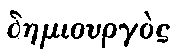
of all other
beings, and the perpetual supporter of them.
A Rhodian leap! Where our knowledge of a cause is derived from our
knowledge of the effect, which is falsely (I think) here supposed,
nothing can be logically, that is, apodeictically, inferred, but the
adequacy of the former to the latter. The mistake, common to Smith, with
a hundred other writers, arises out of an equivocal use of the word
'know.' In the scientific sense, as implying insight, and which ought to
be the sense of the word in this place, we might be more truly said to
know the soul by God, than to know God by the soul.
...
So the Sibyl was noted by Heraclitus as


'as one speaking ridiculous
and unseemly speeches with her furious mouth.'
This fragment is misquoted and misunderstood: for —
it
should be
unperfumed, inornate lays, not redolent of
art. — Render it thus:
— — — Not her's
To win the sense by words of rhetoric,
Lip-blossoms breathing perishable sweets;
But by the power of the informing Word
Roll sounding onward through a thousand years
Her deep prophetic bodements.
is with ecstatic mouth.
...
If the ascetic virtues, or disciplinary exercises, derived from the
schools of philosophy (Pythagorean, Platonic and Stoic) were carried to
an extreme in the middle ages, it is most certain that they are at
present in a far more grievous disproportion underrated and neglected.
The
regula maxima
of the ancient
was to conquer the
body by abstracting the attention from it. Our maxim is to conciliate
the body by attending to it, and counteracting or precluding one set of
sensations by another, the servile dependence of the mind on the body
remaining the same. Instead of the due subservience of the body to the
mind (the favorite language of our Sidneys and Miltons) we hear nothing
at present but of health, good digestion, pleasurable state of general
feeling, and the like.
Of Queen's College, Cambridge, 1660.
To Adam Steinmetz K
My Dear Godchild
I offer up the same fervent prayer for you now, as I did kneeling before
the altar, when you were baptized into Christ, and solemnly received as
a living member of His spiritual body, the Church.
Years must pass before you will be able to read with an understanding
heart what I now write; but I trust that the all-gracious God, the
Father of our Lord Jesus Christ, the Father of mercies, who, by his only
begotten Son, (all mercies in one sovereign mercy!) has redeemed you
from the evil ground, and willed you to be born out of darkness, but
into light — out of death, but into life — out of sin, but into
righteousness, even into the
Lord our Righteousness
; I trust that He
will graciously hear the prayers of your dear parents, and be with you
as the spirit of health and growth in body and mind.
My dear Godchild! — You received from Christ's minister at the baptismal
font, as your Christian name, the name of a most dear friend of your
father's, and who was to me even as a son, the late Adam Steinmetz,
whose fervent aspiration and ever-paramount aim, even from early youth,
was to be a Christian in thought, word, and deed — in will, mind, and
affections.
I too, your Godfather, have known what the enjoyments and advantages of
this life are, and what the more refined pleasures which learning and
intellectual power can bestow; and with all the experience which more
than threescore years can give, I now, on the eve of my departure,
declare to you (and earnestly pray that you may hereafter live and act
on the conviction) that health is a great blessing, — competence obtained
by honorable industry a great blessing, — and a great blessing it is to
have kind, faithful, and loving friends and relatives; but that the
greatest of all blessings, as it is the most ennobling of all
privileges, is to be indeed a Christian. But I have been likewise,
through a large portion of my later life, a sufferer, sorely afflicted
with bodily pains, languors, and bodily infirmities; and, for the last
three or four years, have, with few and brief intervals, been confined
to a sick-room, and at this moment, in great weakness and heaviness,
write from a sick-bed, hopeless of a recovery, yet without prospect of a
speedy recovery; and I, thus on the very brink of the grave, solemnly
bear witness to you that the Almighty Redeemer, most gracious in His
promises to them that truly seek Him, is faithful to perform what He
hath promised, and has preserved, under all my pains and infirmities,
the inward peace that passeth all understanding, with the supporting
assurance of a reconciled God, who will not withdraw His Spirit from me
in the conflict, and in His own time will deliver me from the Evil One!
O, my dear Godchild! eminently blessed are those who begin early to
seek, fear, and love their God, trusting wholly in the righteousness and
mediation of their Lord, Redeemer, Saviour, and everlasting High Priest,
Jesus Christ!
, preserve this as a legacy and bequest from your unseen Godfather and
friend,
S. T. Coleridge.
July 13, 1834
.
See
ante
, p. 291. Ed.
He died on the 25th day of the same month.
end of volume three