Project Gutenberg's A Day with Browning, by Anonymous and Robert Browning

This eBook is for the use of anyone anywhere at no cost and with
almost no restrictions whatsoever.  You may copy it, give it away or
re-use it under the terms of the Project Gutenberg License included
with this eBook or online at www.gutenberg.org


Title: A Day with Browning

Author: Anonymous
        Robert Browning

Release Date: August 8, 2012 [EBook #40440]

Language: English

Character set encoding: ISO-8859-1

*** START OF THIS PROJECT GUTENBERG EBOOK A DAY WITH BROWNING ***


Produced by Delphine Lettau, Matthew Wheaton and the Online
Distributed Proofreading Team at http://www.pgdp.net
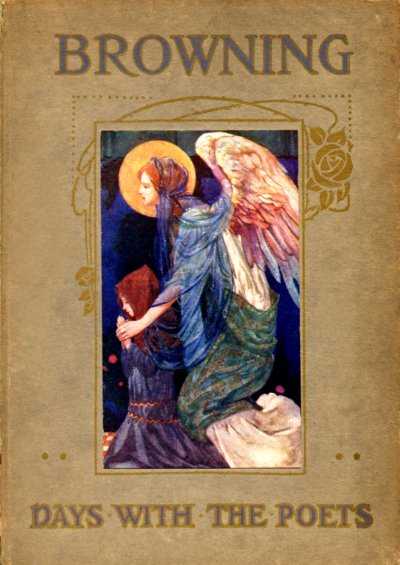
BROWNING
DAYS WITH POETS
A Day with Browning
"The Palazzo Giustiniani Recanati was a place of historical association and fifteenth-century traditions.... At three o'clock regularly, a friend's gondola, which was always at hand to convey him, came and carried him, usually, to the Lido,—his favourite spot."
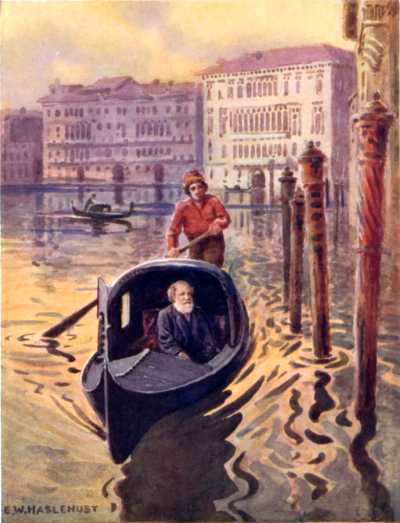
Painting by E. W. Haslehust.
BROWNING'S HOUSE IN VENICE.
NEW YORK
HODDER & STOUGHTON
In the same Series.
Longfellow.
Tennyson.
Keats.
Wordsworth.
Burns.
Scott.
Byron.
Shelley.

FROM his bed-room window in the Palazzo Giustiniani Recanati, every
morning in 1885, Robert Browning watched the sunrise. "My window
commands a perfect view," he wrote, "the still, grey lagoon, the few
seagulls flying, the islet of San Giorgio in deep shadow, and the
clouds in a long purple rack, from behind which a sort of spirit of
rose burns up, till presently all the rims are on fire with gold....
So my day begins."
The Palazzo, in which a suite of rooms had been placed by Mrs. Bronson at the disposal of the poet and his sister, was a place of historical association and fifteenth-century traditions. And no more appropriate abiding-place than Venice could have been selected for a man of Browning's temperament. The Venetian colouring was a perpetual feast to his eye: its mediæval glories were a source of continual inspiration. And if much of his heart[Pg 6] still remained with his native land, so that the London daily papers were a necessity of existence, and a certain sense of exile occasionally obtruded itself, we must needs be grateful to that fact for its result in certain immortal lines:
But there had always been a frankly cosmopolitan spirit in Browning,—no touch of parochialism or insularity. In the magnificent gallery of portrait studies, no two alike, which his poems present to us, the nationalities are legion. Yet Italian scenes predominate; for Browning could gauge, with the unerring instinct of genius, all the subtleties of the Italian temperament. So we come, at every turn, across some ardent vision of the South,—here, Waring sailing out of Trieste under the furled lateen-sail; and there, Fra Lippo Lippi tracking "lutestrings, laughs, and whifts of song" down the darkling streets of Florence. The "Patriot," riding into Brescia, "roses, roses all the way," and the Duke of Ferrara,—that "typical representative of a whole phase of civilisation," discussing My Last Duchess and her foolishness.
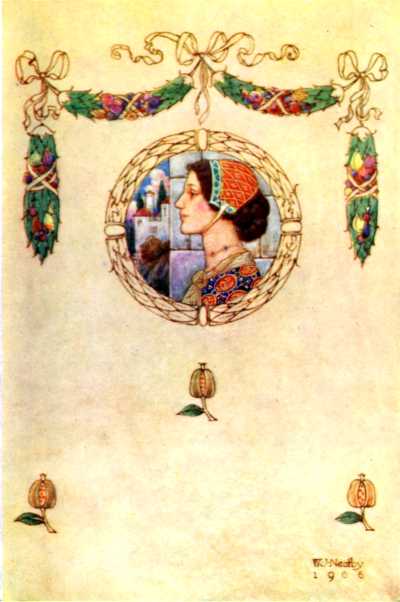
Painting by W. J. Neatby. MY LAST DUCHESS.
After a light and early breakfast—the poet, when abroad, lived almost entirely on milk, fruit, etc., abjuring animal food—Browning would follow his invariable custom, a stroll along the Riva to the public gardens. He never failed to leave the house at the same hour of the day: he was a man of singularly methodical habits in many ways. "Good sense," it has been said, "was his foible, if not his habit": and an orderly method of life was one of the strongest proofs of this fact: another evidence lay in his care to avoid being labelled. The disorderly locks and careless appearance of the typical poet were quite alien to this well-groomed, cleanly-looking Englishman, with his "sweet, grave face," silvery hair, and smooth,[Pg 12] healthy skin. Singularly wholesome in body as well as in mind, until past seventy he could take the longest walks without fatigue; the splendid eyesight of his clear grey eyes remained untarnished to the last. These keen grey eyes of his never failed to notice anything worth seeing in his walks: an extraordinary minuteness of observation is perceptible in all his poems dealing with out-door life,—little touches of detail such as few men are masters of:
And again, those lines of poignant, passionate reserve, which sum up May and Death:
Arrived at the public gardens, Browning was careful to visit his "friends" there and to feed them—the elephant, baboon, kangaroo, ostrich, pelican, and marmosets. He had that particular camaraderie with wild animals which is almost akin to a hypnotic influence over them: and when in the country, he would "whistle softly to the lizards basking on the low walls which border the roads, to try his old power of attracting them." Flowers he enjoyed as a colour-feast for the eye; scenery he revelled in. In that perpetual contemplation of Nature, which with Wordsworth became an[Pg 14] all-absorbent passion, Browning had but little share: his chief interest was in man. But "now and again external nature was for him ... pierced and shot through with spiritual fire."
Three times punctually he would walk round the gardens, and then walk home. Upon these daily strolls he was accompanied by his sister Sarianna: in whose love and companionship he was singularly fortunate. Sarianna Browning had always been the best of sisters to the poet and his wife,—a kindred spirit in every sense of the word; and she was now intent to supply, so far as in her lay, the place of that "soul of fire enclosed in a shell of pearl"—Elizabeth Barrett Browning. Of the dead wife, who had been all-in-all to him, Browning seldom spoke in words: but his burning need of her and hope of reunion with her gleamed continually through his writings:
And in all his poems which deal with the love of man and woman, "he regarded the union of[Pg 15] soul with soul as the capital achievement of life." He thought of love "as a supreme possession in itself, and as a revelation of infinite things which lie beyond it: as a test of character, and even as a pledge of perpetual advance in the life of the spirit." Hence, even where the shadow of death broods over a poem, as we see it In a Gondola, that shadow "glows with colour like the shadows of a Venetian painter." Love, to the very last, is infinitely stronger than death.
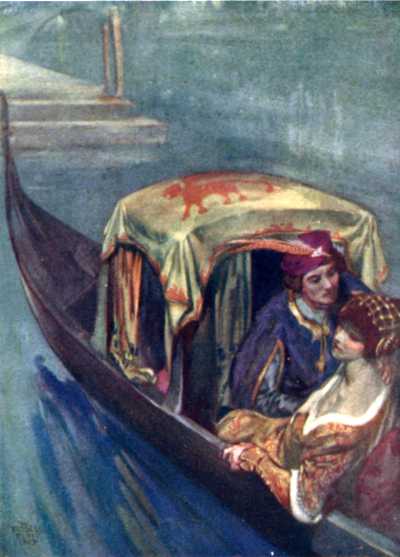
Painting by W. Russell Flint. IN A GONDOLA.
The latter hours of the morning were devoted by the poet to work, proof-sheets, and correspondence. He would complain bitterly of the quantity of "ephemeral correspondence" which took up so much of his time: yet, with the rarest exceptions, he answered every letter he received. He counted that day lost in which he had not written at least a little. In earlier life he had worked fast and copiously, but now he was satisfied with twenty or thirty lines as the result of a morning's work. And upon these lines he expended infinite trouble; for, despite all suppositions to the contrary, he finished his work with great care. "People accuse me of not taking pains!" he grumbled, "I take nothing but pains!"
His subject-matter fell naturally into three groups of poems: those interpreting love in its various phases, those occupied with art and artists, those treating of religious ideas and emotions. And these again may be subdivided into poems of failure and attainment: it is hard to say which are which, for Browning was the singer of heroic failures, and they, to him, were spiritual triumphs. He held that "we fall to rise—are baffled to fight better,—sleep, to wake." No such moral tonic has ever been proffered to the weary and dispirited as the invulnerable optimism of Browning. He regarded this present life as a state of probation and preparation; therefore, "his faith in the unseen order of things created a hope which persists through all apparent failure." The Miltonic ideal, "and what is else, not to be overcome," is the core and centre of Browning's teaching. Sometimes it refers to hopeless love, as in The Last Ride Together.
Sometimes death, to all seeming, has shut the doors of hope for ever:
Or, again, the tragedy of ingratitude and crumbled aspirations ends—as the world might say—upon the scaffold.
In all these, as in Childe Roland, that forlorn romance of dreary and depressed heroism, "the trumpet-note of the soul's victory rings through the darkness of terrestrial defeat":
... At noon, Browning would make a second and more substantial breakfast on Italian dishes; and at three o'clock regularly, a friend's gondola, which was always at hand to convey him, came and carried him, usually, to the Lido,—his favourite spot. "I walk, even in wind or rain," he wrote, "for a couple of hours on Lido, and enjoy the break of sea on the strip of sand, as much as Shelley did in those old days.... Go there,—if only to be[Pg 26] blown about by the sea-wind!" The sea-wind, indeed, was the very utterance of his own robust and vigorous nature, his keen alertness of sense, and his impetuous, impulsive spirit.
In the course of the afternoon, he would explore Venice in all directions, studying her multitudinous points of interest and beauty. The daughter of his hostess, Mrs. Bronson, sometimes companioned him on these excursions, guiding him through the narrow by-streets, or examining, with him, the monuments, sculptures and frescoes of the churches.
Art, in its various manifestations, had been a life-long study with Browning. He took great delight in modelling in clay, and had for some while studied sculpture under Story. He possessed the artistic temperament—fiery, nervous, susceptible—in its sanest form: and not only was he able to express all an artist's aims, ambitions, and despairs, but to arrive in all his poems, at one point or other, at a superb pictorial moment. Some of his lines are penetrated from end to end with this remarkable pictorial quality: perhaps the most notable example is Love Among the Ruins, with its triple contrast,—the infinite calm of the pasture-lands prolonging themselves into the sunset, the noise[Pg 27] and vital movement which had filled the now-vanished city,—and the lover, endeavouring to curb his impatience for the one beloved face by dwelling on these outward things:
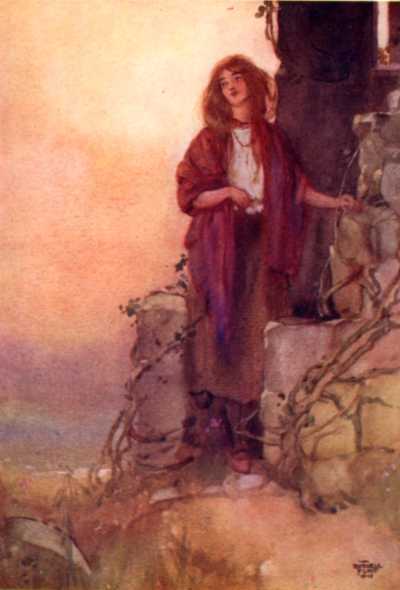
Painting by W. Russell Flint. LOVE AMONG THE RUINS.
Another characteristic of Browning was his consummate comprehension of artistic ideals, those of temperaments so opposite as Fra Lippo Lippi, Pictor Ignotus, and that too-perfect painter Andrea del Sarto. His poem on the last-named was written and forwarded to a friend, who had begged him to procure a copy of the Pitti portrait of Del Sarto and his wife. It tells far more than any portrait could: and expresses the writer's doctrine that in art, as in life, the aspiration toward the higher is greater than the achievement of the lower: "A man's reach should exceed his grasp, or what's heaven for?" According to Browning's belief, a soul's probation, its growth, its ultimate value, lie mainly if not wholly in this choice between the high and the less high.
Social intercourse occupied a large portion of the day. Browning identified himself with the daily life of Venice, and, besides this, English and American acquaintances were frequently in Venice: the poet, his reputation now firmly established and extending, was sought after by innumerable admirers. He was a man of great social charm,—a brilliant talker, full of amusing anecdotes,—his memory for historical incident was only paralleled by his immense literary knowledge, upon which he drew for apt illustration. Yet he was naturally a reticent man, of painfully nervous excitability; "nervous[Pg 34] to such a degree," as he said of himself, "that I might fancy I could not enter a drawing-room, did I not know from my experience that I could do it." This very nervousness, however, often induced an almost abnormal vivacity of speech: and Browning was warmly welcomed amongst the notable and even royal folk whose names were included in Mrs. Bronson's circle; they recognised in him, as Frederick Tennyson had done, "a man of infinite learning, jest, and bonhomie, and moreover a sterling heart that reveals no hollowness." To women he was specially attracted, and vice-versâ; "that golden-hearted Robert," as his wife had termed him, had an intimate understanding of the woman's mind. But towards children, he was, so to speak, almost numb. Devoted though he was to his only son, "the essential quality of early childhood was not that which appealed to him:" and the fervour of parental instinct finds practically no expression in his poems.
In the course of the day the poet would lose no opportunity of hearing any important concert: an accomplished musician himself, his love for the tone-art amounted to a passion: and in many of his greatest poems, he had voiced the most secret meanings of music, and[Pg 35] the yearning aspirations of a composer. We "sit alone in the loft" with the organist, Master Hughes of Saxe-Gotha, and his "huge house of the sounds," to listen and wonder while his fugue "broadens and thickens, greatens and deepens and lengthens," and the intricacy of constructive technique forms, as someone has said, "an interposing web spun by the brain between art and things divine." Or we stand with Abt Vogler in his "palace of music" as it falls to pieces, and the magic of inspiration over-rides the mastery of construction. The void of the silence is filled with "the substance of things hoped for; the evidence of things not seen," and faith is born of the composer's very impotence to realize the heights of his own ambition—yet one more rendering of that triumphant failure, of which Browning was the prophet:
And, as a final contrast, drawn out of that shoreless sea of contrasts which music can[Pg 37] reveal, we have A Toccata of Galuppi's, suffused with the melancholy of mundane pleasure, steeped in the ephemeral voluptuousness of eighteenth-century Venice. In these lines, it has been pointed out, "Browning's self-restraint is admirable.... The poet will not say a word more than the musician has said in his Toccata."
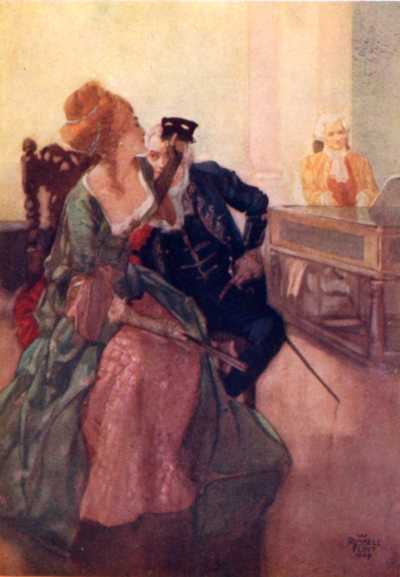
Painting by W. Russell Flint. A TOCCATA OF GALUPPI'S.
The afternoon wore by quickly, and it was soon time to dress for dinner: for Browning was precise in adhering to the customs of civilised life: and he liked to see his sister seated opposite him, clad in beautiful gowns of sombre richness, and wearing quaint old jewelry. Browning accepted his meals with frank pleasure; he was no ascetic, and "his optimism and his belief in direct Providence led him to make a direct virtue of happiness," and to welcome it in its simplest form. Any guest who might be present was privileged to enjoy that sparkling and many-faceted eloquence to which reference has been made already. But the host was always careful to avoid deep or solemn topics—doubtless because he felt them far too keenly, to use them as mere texts for dinner-table discussion. "If such were broached[Pg 42] in his presence, he dismissed them with one strong convincing sentence, and adroitly turned the current of conversation into a shallower channel."
Later on, he would probably visit the Goldoni Theatre, where he had a large box: or, if remaining at home, he was often prevailed upon to read aloud. His delivery was forcible and dramatic,—he would strongly emphasise all the light and shade of a poem, and the touches of character in the dialogue. Especially was this the case when reading his own compositions. But often he would say with a smile, "No R. B. to-night!—let us have some real poetry," and would take down a volume of Shelley, Keats or Coleridge.
At last, another of the "divine sunsets" which Browning adored had faded over the Lido; the "quiet-coloured end of evening" had darkened into dusk and stars. Even that alert and indefatigable frame grew weary with the day's long doings, and a natural desire for rest descended upon "the brain which too much thought expands." The vision of Guercino's picture, "fraught with a pathos so magnificent," returned upon him from that sultry day in which he had beheld the "Guardian Angel" at[Pg 43] Fano, "my angel with me, too," and he longed for the touch of those divinely-healing hands.
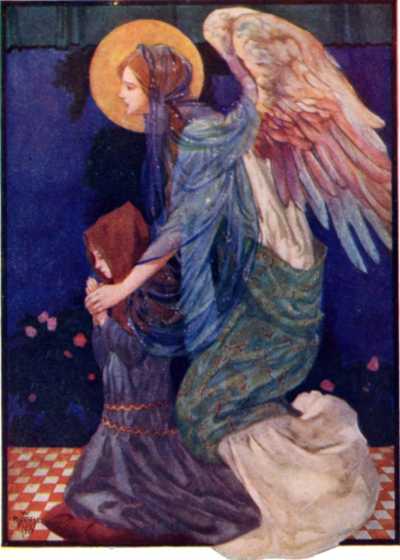
Painting by W. Russell Flint. THE GUARDIAN ANGEL.
Yet it was not to a celestial visitant that Browning's thoughts turned most, now or at any other time. It was towards the one love of his life,—towards that re-union, that restoration, that infrangible joy of retrieval, which was the goal of his whole desire. And, characteristically of the man who was "ever a fighter," he did not expect to reach his haven by a calm and prosperous passage. It had to be fought for—struggled for from strength to strength,—attained through incessant and arduous combat.[Pg 47] For those do not "mount, and that hardly, to eternal life," who remain content upon terrestrial planes;
Therefore, as sleep, "Death's twin-brother," came slowly through the darkness, the fighter faced his last hour in imagination, and made haste to "greet the future with a cheer." For Prospice is an "act of the faith which comes through love.... No lonely adventure is here to reward the victor o'er death: the transcendant joy is human love recovered":
Printed by Percy Lund, Humphries & Co., Ltd., Bradford and London.
End of the Project Gutenberg EBook of A Day with Browning, by
Anonymous and Robert Browning

*** END OF THIS PROJECT GUTENBERG EBOOK A DAY WITH BROWNING ***

***** This file should be named 40440-h.htm or 40440-h.zip *****
This and all associated files of various formats will be found in:
        http://www.gutenberg.org/4/0/4/4/40440/

Produced by Delphine Lettau, Matthew Wheaton and the Online
Distributed Proofreading Team at http://www.pgdp.net


Updated editions will replace the previous one--the old editions
will be renamed.

Creating the works from public domain print editions means that no
one owns a United States copyright in these works, so the Foundation
(and you!) can copy and distribute it in the United States without
permission and without paying copyright royalties.  Special rules,
set forth in the General Terms of Use part of this license, apply to
copying and distributing Project Gutenberg-tm electronic works to
protect the PROJECT GUTENBERG-tm concept and trademark.  Project
Gutenberg is a registered trademark, and may not be used if you
charge for the eBooks, unless you receive specific permission.  If you
do not charge anything for copies of this eBook, complying with the
rules is very easy.  You may use this eBook for nearly any purpose
such as creation of derivative works, reports, performances and
research.  They may be modified and printed and given away--you may do
practically ANYTHING with public domain eBooks.  Redistribution is
subject to the trademark license, especially commercial
redistribution.


*** START: FULL LICENSE ***

THE FULL PROJECT GUTENBERG LICENSE
PLEASE READ THIS BEFORE YOU DISTRIBUTE OR USE THIS WORK

To protect the Project Gutenberg-tm mission of promoting the free
distribution of electronic works, by using or distributing this work
(or any other work associated in any way with the phrase "Project
Gutenberg"), you agree to comply with all the terms of the Full Project
Gutenberg-tm License available with this file or online at
  www.gutenberg.org/license.


Section 1.  General Terms of Use and Redistributing Project Gutenberg-tm
electronic works

1.A.  By reading or using any part of this Project Gutenberg-tm
electronic work, you indicate that you have read, understand, agree to
and accept all the terms of this license and intellectual property
(trademark/copyright) agreement.  If you do not agree to abide by all
the terms of this agreement, you must cease using and return or destroy
all copies of Project Gutenberg-tm electronic works in your possession.
If you paid a fee for obtaining a copy of or access to a Project
Gutenberg-tm electronic work and you do not agree to be bound by the
terms of this agreement, you may obtain a refund from the person or
entity to whom you paid the fee as set forth in paragraph 1.E.8.

1.B.  "Project Gutenberg" is a registered trademark.  It may only be
used on or associated in any way with an electronic work by people who
agree to be bound by the terms of this agreement.  There are a few
things that you can do with most Project Gutenberg-tm electronic works
even without complying with the full terms of this agreement.  See
paragraph 1.C below.  There are a lot of things you can do with Project
Gutenberg-tm electronic works if you follow the terms of this agreement
and help preserve free future access to Project Gutenberg-tm electronic
works.  See paragraph 1.E below.

1.C.  The Project Gutenberg Literary Archive Foundation ("the Foundation"
or PGLAF), owns a compilation copyright in the collection of Project
Gutenberg-tm electronic works.  Nearly all the individual works in the
collection are in the public domain in the United States.  If an
individual work is in the public domain in the United States and you are
located in the United States, we do not claim a right to prevent you from
copying, distributing, performing, displaying or creating derivative
works based on the work as long as all references to Project Gutenberg
are removed.  Of course, we hope that you will support the Project
Gutenberg-tm mission of promoting free access to electronic works by
freely sharing Project Gutenberg-tm works in compliance with the terms of
this agreement for keeping the Project Gutenberg-tm name associated with
the work.  You can easily comply with the terms of this agreement by
keeping this work in the same format with its attached full Project
Gutenberg-tm License when you share it without charge with others.

1.D.  The copyright laws of the place where you are located also govern
what you can do with this work.  Copyright laws in most countries are in
a constant state of change.  If you are outside the United States, check
the laws of your country in addition to the terms of this agreement
before downloading, copying, displaying, performing, distributing or
creating derivative works based on this work or any other Project
Gutenberg-tm work.  The Foundation makes no representations concerning
the copyright status of any work in any country outside the United
States.

1.E.  Unless you have removed all references to Project Gutenberg:

1.E.1.  The following sentence, with active links to, or other immediate
access to, the full Project Gutenberg-tm License must appear prominently
whenever any copy of a Project Gutenberg-tm work (any work on which the
phrase "Project Gutenberg" appears, or with which the phrase "Project
Gutenberg" is associated) is accessed, displayed, performed, viewed,
copied or distributed:

This eBook is for the use of anyone anywhere at no cost and with
almost no restrictions whatsoever.  You may copy it, give it away or
re-use it under the terms of the Project Gutenberg License included
with this eBook or online at www.gutenberg.org

1.E.2.  If an individual Project Gutenberg-tm electronic work is derived
from the public domain (does not contain a notice indicating that it is
posted with permission of the copyright holder), the work can be copied
and distributed to anyone in the United States without paying any fees
or charges.  If you are redistributing or providing access to a work
with the phrase "Project Gutenberg" associated with or appearing on the
work, you must comply either with the requirements of paragraphs 1.E.1
through 1.E.7 or obtain permission for the use of the work and the
Project Gutenberg-tm trademark as set forth in paragraphs 1.E.8 or
1.E.9.

1.E.3.  If an individual Project Gutenberg-tm electronic work is posted
with the permission of the copyright holder, your use and distribution
must comply with both paragraphs 1.E.1 through 1.E.7 and any additional
terms imposed by the copyright holder.  Additional terms will be linked
to the Project Gutenberg-tm License for all works posted with the
permission of the copyright holder found at the beginning of this work.

1.E.4.  Do not unlink or detach or remove the full Project Gutenberg-tm
License terms from this work, or any files containing a part of this
work or any other work associated with Project Gutenberg-tm.

1.E.5.  Do not copy, display, perform, distribute or redistribute this
electronic work, or any part of this electronic work, without
prominently displaying the sentence set forth in paragraph 1.E.1 with
active links or immediate access to the full terms of the Project
Gutenberg-tm License.

1.E.6.  You may convert to and distribute this work in any binary,
compressed, marked up, nonproprietary or proprietary form, including any
word processing or hypertext form.  However, if you provide access to or
distribute copies of a Project Gutenberg-tm work in a format other than
"Plain Vanilla ASCII" or other format used in the official version
posted on the official Project Gutenberg-tm web site (www.gutenberg.org),
you must, at no additional cost, fee or expense to the user, provide a
copy, a means of exporting a copy, or a means of obtaining a copy upon
request, of the work in its original "Plain Vanilla ASCII" or other
form.  Any alternate format must include the full Project Gutenberg-tm
License as specified in paragraph 1.E.1.

1.E.7.  Do not charge a fee for access to, viewing, displaying,
performing, copying or distributing any Project Gutenberg-tm works
unless you comply with paragraph 1.E.8 or 1.E.9.

1.E.8.  You may charge a reasonable fee for copies of or providing
access to or distributing Project Gutenberg-tm electronic works provided
that

- You pay a royalty fee of 20% of the gross profits you derive from
     the use of Project Gutenberg-tm works calculated using the method
     you already use to calculate your applicable taxes.  The fee is
     owed to the owner of the Project Gutenberg-tm trademark, but he
     has agreed to donate royalties under this paragraph to the
     Project Gutenberg Literary Archive Foundation.  Royalty payments
     must be paid within 60 days following each date on which you
     prepare (or are legally required to prepare) your periodic tax
     returns.  Royalty payments should be clearly marked as such and
     sent to the Project Gutenberg Literary Archive Foundation at the
     address specified in Section 4, "Information about donations to
     the Project Gutenberg Literary Archive Foundation."

- You provide a full refund of any money paid by a user who notifies
     you in writing (or by e-mail) within 30 days of receipt that s/he
     does not agree to the terms of the full Project Gutenberg-tm
     License.  You must require such a user to return or
     destroy all copies of the works possessed in a physical medium
     and discontinue all use of and all access to other copies of
     Project Gutenberg-tm works.

- You provide, in accordance with paragraph 1.F.3, a full refund of any
     money paid for a work or a replacement copy, if a defect in the
     electronic work is discovered and reported to you within 90 days
     of receipt of the work.

- You comply with all other terms of this agreement for free
     distribution of Project Gutenberg-tm works.

1.E.9.  If you wish to charge a fee or distribute a Project Gutenberg-tm
electronic work or group of works on different terms than are set
forth in this agreement, you must obtain permission in writing from
both the Project Gutenberg Literary Archive Foundation and Michael
Hart, the owner of the Project Gutenberg-tm trademark.  Contact the
Foundation as set forth in Section 3 below.

1.F.

1.F.1.  Project Gutenberg volunteers and employees expend considerable
effort to identify, do copyright research on, transcribe and proofread
public domain works in creating the Project Gutenberg-tm
collection.  Despite these efforts, Project Gutenberg-tm electronic
works, and the medium on which they may be stored, may contain
"Defects," such as, but not limited to, incomplete, inaccurate or
corrupt data, transcription errors, a copyright or other intellectual
property infringement, a defective or damaged disk or other medium, a
computer virus, or computer codes that damage or cannot be read by
your equipment.

1.F.2.  LIMITED WARRANTY, DISCLAIMER OF DAMAGES - Except for the "Right
of Replacement or Refund" described in paragraph 1.F.3, the Project
Gutenberg Literary Archive Foundation, the owner of the Project
Gutenberg-tm trademark, and any other party distributing a Project
Gutenberg-tm electronic work under this agreement, disclaim all
liability to you for damages, costs and expenses, including legal
fees.  YOU AGREE THAT YOU HAVE NO REMEDIES FOR NEGLIGENCE, STRICT
LIABILITY, BREACH OF WARRANTY OR BREACH OF CONTRACT EXCEPT THOSE
PROVIDED IN PARAGRAPH 1.F.3.  YOU AGREE THAT THE FOUNDATION, THE
TRADEMARK OWNER, AND ANY DISTRIBUTOR UNDER THIS AGREEMENT WILL NOT BE
LIABLE TO YOU FOR ACTUAL, DIRECT, INDIRECT, CONSEQUENTIAL, PUNITIVE OR
INCIDENTAL DAMAGES EVEN IF YOU GIVE NOTICE OF THE POSSIBILITY OF SUCH
DAMAGE.

1.F.3.  LIMITED RIGHT OF REPLACEMENT OR REFUND - If you discover a
defect in this electronic work within 90 days of receiving it, you can
receive a refund of the money (if any) you paid for it by sending a
written explanation to the person you received the work from.  If you
received the work on a physical medium, you must return the medium with
your written explanation.  The person or entity that provided you with
the defective work may elect to provide a replacement copy in lieu of a
refund.  If you received the work electronically, the person or entity
providing it to you may choose to give you a second opportunity to
receive the work electronically in lieu of a refund.  If the second copy
is also defective, you may demand a refund in writing without further
opportunities to fix the problem.

1.F.4.  Except for the limited right of replacement or refund set forth
in paragraph 1.F.3, this work is provided to you 'AS-IS', WITH NO OTHER
WARRANTIES OF ANY KIND, EXPRESS OR IMPLIED, INCLUDING BUT NOT LIMITED TO
WARRANTIES OF MERCHANTABILITY OR FITNESS FOR ANY PURPOSE.

1.F.5.  Some states do not allow disclaimers of certain implied
warranties or the exclusion or limitation of certain types of damages.
If any disclaimer or limitation set forth in this agreement violates the
law of the state applicable to this agreement, the agreement shall be
interpreted to make the maximum disclaimer or limitation permitted by
the applicable state law.  The invalidity or unenforceability of any
provision of this agreement shall not void the remaining provisions.

1.F.6.  INDEMNITY - You agree to indemnify and hold the Foundation, the
trademark owner, any agent or employee of the Foundation, anyone
providing copies of Project Gutenberg-tm electronic works in accordance
with this agreement, and any volunteers associated with the production,
promotion and distribution of Project Gutenberg-tm electronic works,
harmless from all liability, costs and expenses, including legal fees,
that arise directly or indirectly from any of the following which you do
or cause to occur: (a) distribution of this or any Project Gutenberg-tm
work, (b) alteration, modification, or additions or deletions to any
Project Gutenberg-tm work, and (c) any Defect you cause.


Section  2.  Information about the Mission of Project Gutenberg-tm

Project Gutenberg-tm is synonymous with the free distribution of
electronic works in formats readable by the widest variety of computers
including obsolete, old, middle-aged and new computers.  It exists
because of the efforts of hundreds of volunteers and donations from
people in all walks of life.

Volunteers and financial support to provide volunteers with the
assistance they need are critical to reaching Project Gutenberg-tm's
goals and ensuring that the Project Gutenberg-tm collection will
remain freely available for generations to come.  In 2001, the Project
Gutenberg Literary Archive Foundation was created to provide a secure
and permanent future for Project Gutenberg-tm and future generations.
To learn more about the Project Gutenberg Literary Archive Foundation
and how your efforts and donations can help, see Sections 3 and 4
and the Foundation information page at www.gutenberg.org


Section 3.  Information about the Project Gutenberg Literary Archive
Foundation

The Project Gutenberg Literary Archive Foundation is a non profit
501(c)(3) educational corporation organized under the laws of the
state of Mississippi and granted tax exempt status by the Internal
Revenue Service.  The Foundation's EIN or federal tax identification
number is 64-6221541.  Contributions to the Project Gutenberg
Literary Archive Foundation are tax deductible to the full extent
permitted by U.S. federal laws and your state's laws.

The Foundation's principal office is located at 4557 Melan Dr. S.
Fairbanks, AK, 99712., but its volunteers and employees are scattered
throughout numerous locations.  Its business office is located at 809
North 1500 West, Salt Lake City, UT 84116, (801) 596-1887.  Email
contact links and up to date contact information can be found at the
Foundation's web site and official page at www.gutenberg.org/contact

For additional contact information:
     Dr. Gregory B. Newby
     Chief Executive and Director
     gbnewby@pglaf.org

Section 4.  Information about Donations to the Project Gutenberg
Literary Archive Foundation

Project Gutenberg-tm depends upon and cannot survive without wide
spread public support and donations to carry out its mission of
increasing the number of public domain and licensed works that can be
freely distributed in machine readable form accessible by the widest
array of equipment including outdated equipment.  Many small donations
($1 to $5,000) are particularly important to maintaining tax exempt
status with the IRS.

The Foundation is committed to complying with the laws regulating
charities and charitable donations in all 50 states of the United
States.  Compliance requirements are not uniform and it takes a
considerable effort, much paperwork and many fees to meet and keep up
with these requirements.  We do not solicit donations in locations
where we have not received written confirmation of compliance.  To
SEND DONATIONS or determine the status of compliance for any
particular state visit www.gutenberg.org/donate

While we cannot and do not solicit contributions from states where we
have not met the solicitation requirements, we know of no prohibition
against accepting unsolicited donations from donors in such states who
approach us with offers to donate.

International donations are gratefully accepted, but we cannot make
any statements concerning tax treatment of donations received from
outside the United States.  U.S. laws alone swamp our small staff.

Please check the Project Gutenberg Web pages for current donation
methods and addresses.  Donations are accepted in a number of other
ways including checks, online payments and credit card donations.
To donate, please visit:  www.gutenberg.org/donate


Section 5.  General Information About Project Gutenberg-tm electronic
works.

Professor Michael S. Hart was the originator of the Project Gutenberg-tm
concept of a library of electronic works that could be freely shared
with anyone.  For forty years, he produced and distributed Project
Gutenberg-tm eBooks with only a loose network of volunteer support.

Project Gutenberg-tm eBooks are often created from several printed
editions, all of which are confirmed as Public Domain in the U.S.
unless a copyright notice is included.  Thus, we do not necessarily
keep eBooks in compliance with any particular paper edition.

Most people start at our Web site which has the main PG search facility:

     www.gutenberg.org

This Web site includes information about Project Gutenberg-tm,
including how to make donations to the Project Gutenberg Literary
Archive Foundation, how to help produce our new eBooks, and how to
subscribe to our email newsletter to hear about new eBooks.