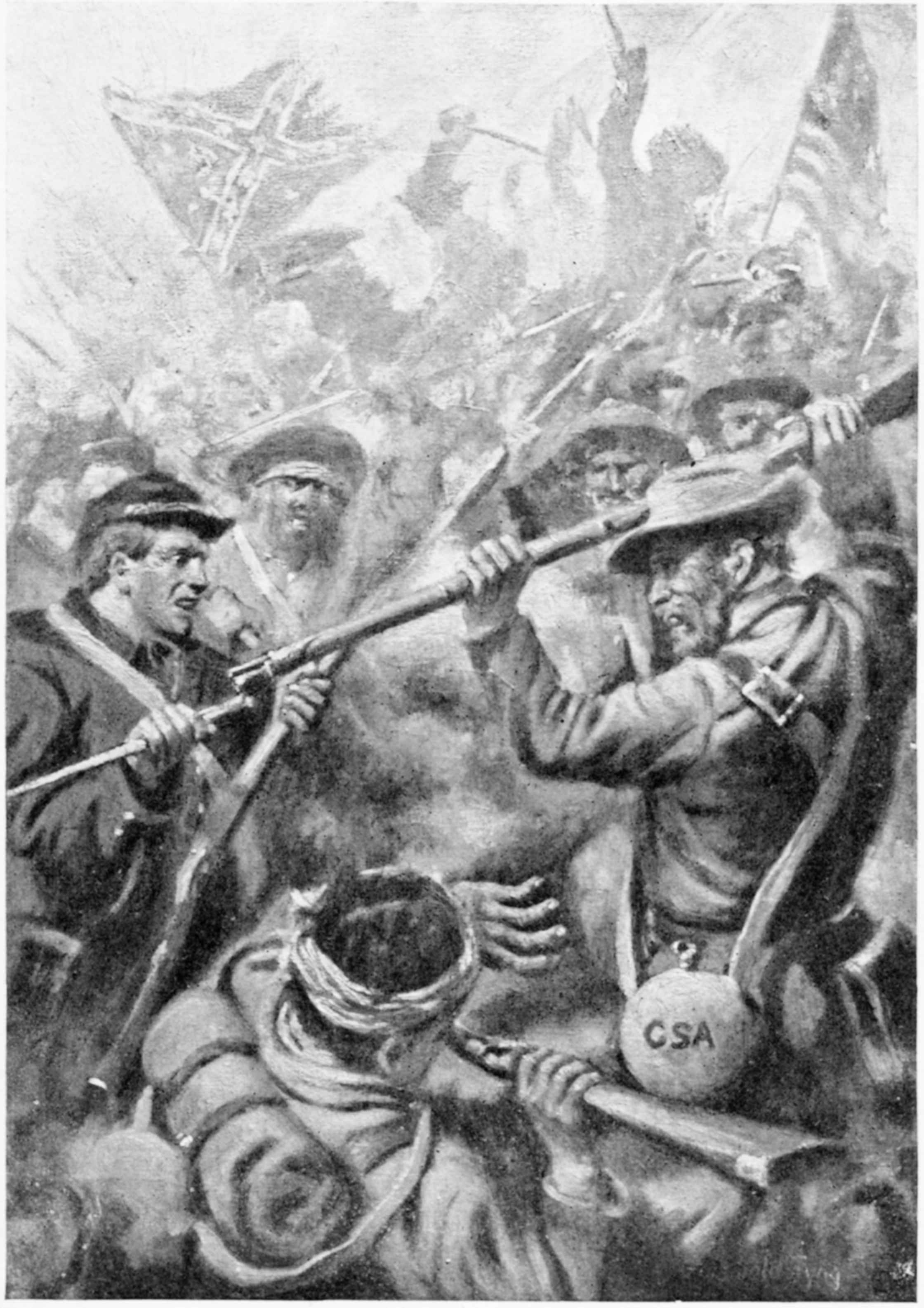
Then he saw Louis catch hold of the bayonet and thrust it aside.—Page 133.
Old Glory Series
Six Volumes. Cloth. Illustrated. Price per volume $1.25.
UNDER DEWEY AT MANILA.
A YOUNG VOLUNTEER IN CUBA.
FIGHTING IN CUBAN WATERS.
UNDER OTIS IN THE PHILIPPINES.
THE CAMPAIGN OF THE JUNGLE.
UNDER MacARTHUR IN LUZON.
Stratemeyer Popular Series
Twelve Volumes. Cloth. Illustrated. Price per volume $0.75.
THE LAST CRUISE OF THE SPITFIRE.
REUBEN STONE’S DISCOVERY.
TRUE TO HIMSELF.
RICHARD DARE’S VENTURE.
OLIVER BRIGHT’S SEARCH.
JOE, THE SURVEYOR.
TO ALASKA FOR GOLD.
THE YOUNG AUCTIONEER.
BOUND TO BE AN ELECTRICIAN.
SHORTHAND TOM, THE REPORTER.
FIGHTING FOR HIS OWN.
LARRY, THE WANDERER.
Soldiers of Fortune Series
Cloth. Illustrated. Price per volume $1.25.
ON TO PEKIN.
UNDER THE MIKADO’S FLAG.
AT THE FALL OF PORT ARTHUR.
WITH TOGO FOR JAPAN.
American Boys’ Biographical Series
Cloth. Illustrated. Price per volume $1.25.
AMERICAN BOYS’ LIFE OF WILLIAM McKINLEY.
AMERICAN BOYS’ LIFE OF THEODORE ROOSEVELT.
Colonial Series
Cloth. Illustrated. Price per volume $1.25.
WITH WASHINGTON IN THE WEST.
MARCHING ON NIAGARA.
AT THE FALL OF MONTREAL.
THE FORT IN THE WILDERNESS.
ON THE TRAIL OF PONTIAC.
TRAIL AND TRADING POST.
Pan-American Series
Cloth, Illustrated. Price per volume $1.25.
LOST ON THE ORINOCO.
THE YOUNG VOLCANO EXPLORERS.
YOUNG EXPLORERS OF THE ISTHMUS.
YOUNG EXPLORERS OF THE AMAZON.
TREASURE SEEKERS OF THE ANDES.
Dave Porter Series
Cloth. Illustrated. Price per volume $1.25.
DAVE PORTER AT OAK HALL.
DAVE PORTER IN THE SOUTH SEAS.
DAVE PORTER’S RETURN TO SCHOOL.
TWO YOUNG LUMBERMEN. Price $1.25.
BETWEEN BOER AND BRITON. Price $1.25.
Then he saw Louis catch hold of the bayonet and thrust it aside.—Page 133.
OR
A BOY IN BLUE AND A BOY IN GRAY
BY
EDWARD STRATEMEYER
Author of “Old Glory Series,” “Colonial Series,” “American Boys’ Life of William McKinley,” “Dave Porter at Oak Hall,” etc.
ILLUSTRATED BY GRISWOLD TYNG
BOSTON
LOTHROP, LEE & SHEPARD CO.
[Pg iv]
Published, August, 1907
Copyright, 1906 and 1907, by Edward Stratemeyer, as a
Serial, under the Title of “In Defence of His Flag”
Copyright, 1907, by Lothrop, Lee & Shepard Co.
All rights reserved
Defending His Flag
Norwood Press
Berwick & Smith Co.
Norwood, Mass., U.S.A.
[Pg v]
“Defending His Flag” relates the adventures of two boys, or rather young men, during the first campaign of our great Civil War. At the call to arms, one enlists in the infantry of the North while the other throws in his fortunes with the cavalry of the South. Personally the two are warm friends, yet they become bitter foes on the battlefield. One marches to Washington, to defend the Capitol, and the other rides to Manassas, where the Confederates were gathering. Both fight at the bloody battle of Bull Run, and then take part in that stirring Campaign of the Peninsula and before Richmond.
[Pg vi]
In writing this work I have had but one object in view, and that was to give a faithful picture of a part of the Civil War as seen from both sides of that never-to-be-forgotten conflict. During the war, and for years afterward, grown folk and young people were treated to innumerable books on the conflict, all written either from the Northern or the Southern point of view, thoroughly biased, and calculated to do more harm than good. In some of these bits of ill-advised literature the enemy never gained a victory, the other side simply “falling back to a better point from which to make another attack.”
I think the time has come when the truth, and the whole truth at that, can be told, and when it will do positive good. Since the Spanish-American War, when some of the gallant Southern officers and men made such records for themselves under Old Glory, the old lines have been practically wiped out. The reconstructed South is as firm a part of our Nation as was the old South during the first half of the last century, and it has a perfect right to honor the memories of those who, while wearing the gray and marching under the stars and bars, fought so gallantly for what they considered was right and true.
[Pgs vii-viii]
This story ran as a serial under the title, “In Defence of His Flag,” in that popular monthly, The American Boy. As a serial it created a demand for its publication in book form, hence the present volume. The story has been somewhat revised but not materially altered. The purely historical portions are based on the United States records and the records of the Confederacy.
Once again I thank the thousands and thousands of boys, not only in this country but also in other lands, who take so much interest in what I have written for them. May the present volume please you in every way and do you good.
Edward Stratemeyer.
May 15, 1907.
[Pg xi]
SIGNS OF WAR
“Hello, Louis! Want to ride to the depot with me? I am going to bring father home.”
“Certainly, Andy, I’ll go along. Do you expect your father on the eleven o’clock train?”
“He wrote he would most likely be back on that, if he could get away from Washington. He said everything was in such a state of excitement it was impossible to talk business.”
[Pg 2]
“I suppose that is true,” returned Louis Rockford, as he hopped up on the seat of the wagon, beside his chum. “My father wrote me that it looked as if war must come after all. What a shame Congress can’t settle this matter peaceably.”
“It could, if the Northerners would give us Southerners a chance,” burst out Andy Arlington, as he gave the horse a flick with the whip and sent the animal down the rocky road on a gallop. “The whole trouble is the Northern States want to interfere with our rights, and we won’t have it.”
“I thought the trouble was about the slaves.”
“Well, you can put it that way if you want to. The Southern States own their slaves and have a right to do with them as they please.”
“I don’t think the negroes ought to be slaves, Andy.”
“I don’t know about that. We have got to have help to run the cotton and tobacco plantations, and I reckon most of the colored people are better off now than they would be if they were free. Just look at the free negroes idling about. They are not worth their salt.”
“That may be true. Still, I don’t believe any human being ought to be a slave—it’s barbarous!”
[Pg 3]
“There’s another thing,” added Andy, with a second flick of the whip. “Years ago—and not so many, either—the Northern States had slaves, and when they got rid of ’em, what did they do? Sold most of ’em to the planters down South. Now those same people want to stop us from using those slaves as we please.”
“I don’t believe they want to do that, exactly, Andy. They want to stop the extension of slavery.”
“It amounts to the same thing.”
“No, it doesn’t.”
“I say it does. The Northern States want to dictate to us—and we won’t have it—father says so, and Mr. Carroll, and Doctor Barnsby, and all of them—and they ought to know.”
The words were spoken with great emphasis, and as he spoke the Southern lad, with his ruddy-brown face and coal-black hair, glanced half-defiantly at his companion. Louis Rockford’s face fell and then a half-amused look crossed it.
“How hot-headed you do get, Andy! I trust you’re not going to fight over this thing.”
[Pg 4]
“I’ll fight if I’m called on to fight. I believe in sticking up for my rights. Wouldn’t you fight for your rights?”
“Certainly. But the politicians and the other big men on both sides ought to do their best to prevent bloodshed.”
Andy Arlington drew a long breath, and urged forward his horse again. “This thing has been a-brewing a long time—ever since old John Brown seized the arsenal at Harper’s Ferry and tried to get the negroes to arm themselves. Jefferson Davis and the others have tried their best to straighten matters out and the Northerners won’t listen to them, and I say if it comes to fighting, it will be the fault of the North, and not of the South.”
“And I think you are greatly mistaken,” was the quiet but firm answer. “However,” went on Louis Rockford, as he saw his chum’s face darken, “whatever happens, Andy, let us remain friends.”
“Oh, I’m not making this a personal affair, Louis,” was the hasty response. “I wouldn’t want to count you my enemy for a good deal. But—but—hang it all, I wish you would look at this matter as I, and father, and the rest do.”
[Pg 5]
“And I wish you would look at it as I and my father do,” laughed Louis. “We’re as bad as the politicians, aren’t we? But I’ll tell you one thing,” went on Louis, gravely. “I’ll never stand for having our glorious United States broken up into separate republics. Our forefathers fought too hard for our colonies to allow anything like that to happen.”
“Well, it is a kind of a shame, in one way, Louis. But the Northern States must learn to keep their hands out of our business—must learn to leave us alone,” said Andy Arlington, with as much spirit as before; and now the mountain-road became so rough that the rattle of the farm wagon over the rough stones made further conversation just then impossible.
As has been mentioned, Louis Rockford and Andy Arlington were chums. Both were nearly seventeen years of age, tall, well-built, and muscular. Andy was dark, while Louis was fair, and each had been brought up upon a large farm or plantation.
[Pg 6]
The Rockford homestead lay in a valley near the southern boundary of Pennsylvania, at a point where the State of Maryland divided it from Virginia by a stretch of less than twenty miles. It was a well-kept, although rather rocky, farm of a hundred acres, and to it was attached a dairy of no mean proportions.
The Rockford family consisted of five persons—Mr. and Mrs. Rockford, Louis, the only son, and Lucy and Martha, two daughters, one older and the other younger than their brother.
Mr. Rockford had emigrated to Pennsylvania from New York State some fifteen years before and he was, in consequence, a thorough Northern man at heart, and had but little sympathy for those of the South who intended to make slavery and State rights a basis for war. Louis followed his father’s views closely, but both parent and son were of a quiet, peaceful nature, and the idea of possible bloodshed filled them with dismay.
[Pg 7]
The Arlingtons belonged to one of the oldest families in upper Virginia. Clarence Arlington, the grandfather of Andy, had fought with Washington during the Revolution, and Hugo Arlington, Andy’s father, had followed General Scott to Mexico and lost a leg at the memorable battle of Chapultepec. Father and son were full of the war spirit, and it was plain to see that, as the father, being crippled, could not go, Andy would take up a musket at the first call to arms.
The plantation of the Arlingtons was extensive, but as the ground was not of the best, the tobacco, which was planted from year to year, did only fairly well, and four years before the opening of this story Mr. Arlington had become interested in dairy matters. His first herd of cows had been purchased from Mr. Rockford, and this transfer of property had led to the two families becoming warm friends. Later on, both men had purchased a drove of cattle from the West, and in the work of dividing up this herd Louis and Andy had assisted, and soon the two boys were the warmest kind of chums, and when either took a vacation it was only to spend the time at the house of the other.
[Pg 8]
Louis had now been stopping at the Arlington homestead for over a week. It was just before Christmas time, and there was but little for him to do at home. Early that morning he had gone off alone to see what he could bag in the way of game in the woods along the highway. He had wanted Andy to go with him, but some of the cows were sick, and Andy had to remain behind to give advice concerning the cattle. Louis had shot several rabbits, which now rested in his game pouch. He had been standing near the highway, reloading his shotgun, when Andy came along and invited him to take the ride to the depot at Lee Run, three miles away.
That war was threatened, there could be no doubt. For over two years the North and the South had wrangled over the slave question and over the equally important question of State rights, and a settlement was now further off than ever. More than this, the leaders in South Carolina had actually called a convention for the purpose of deciding whether or not that State should withdraw from the Union. The convention was to have met at Columbia, but as that city was largely infested with smallpox, the convention was removed to Charleston, to deliberate there behind closed doors. And while this was going on the Southern statesmen and politicians at Washington, and elsewhere, were plotting to throw down the gauntlet of war whenever the favorable opportunity arrived.
[Pg 9]
“Look, Andy, something is up!” cried Louis, as they drove up to the main street of Lee Run. “See what an excited crowd there is at the railroad station.”
“Hurrah! Hurrah for South Carolina!” was the sudden cry which reached their ears. “She’s the State! Hurrah! and may gallant Virginia soon follow her!”
“What is it, Mr. Deems?” cried Andy, as he drew rein in front of the general store fronting the depot. “What’s the shouting about?”
“Didn’t you hear the news, Arlington? South Carolina has seceded from the Union. They are having the greatest jubilication ever heard of down there. ’T won’t be long afore we follow ’em, I reckon,” added the store-keeper.
“Seceded from the Union!” repeated Louis. “Oh, that’s too bad!”
“Bad? Didn’t ye say ‘bad’?” interrupted a tall mountaineer, who stood by, whittling a plug of tobacco with his jack-knife. “I reckon ye don’t know much, boy. Why, it’s jess the best all-fired news I heard tell on fer ten years.”
[Pg 10]
“That is where our opinions differ,” answered Louis, coldly. “In fact, I don’t see how a State can leave the Union, unless all the other States agree to it.”
“Don’t ye? Say, ain’t ye just a bit Northern-like now?” and the mountaineer squinted one eye suggestively.
“I am from Pennsylvania, if that is what you mean.”
“Thought so. An’ ye don’t agree with us? Think our ideas about slavery an’ sech ain’t o’ no account.”
“I think this present difficulty ought to be settled without breaking up our Union and shedding blood.”
“Waal—” the mountaineer paused long enough to transfer a whittling of hard tobacco to his mouth,—“all I’ve got to say is, we ain’t gettin’ on our knees to save this infernal Union, nohow, so thar!”
“You ought to be ashamed to speak of our Union as an infernal one,” burst out Louis. “Our Union is the greatest and grandest on this globe, and I for one will help uphold it to the last.”
[Pg 11]
“Oh, don’t talk so much, Louis!” put in Andy, with a swift rush of blood to his face. “The crowd around here is excited and may not like what you say.”
“But he called our Union an infernal one—”
“Don’t pay any attention to him. I know him. His name is Sam Jacks, and he never did an honest stroke of work in his life. Here comes the train. Let us go over and meet my father and see what he has to say.”
Leaving the horse tied to a near-by tree, the two lads made their way through the crowd to the edge of the depot platform. Soon the train rolled in and the first man to hop down, upon his cork leg, was Hugo Arlington.
“What’s the latest from Washington, Arlington?” cried half a dozen voices, and in a twinkling the veteran was surrounded, so that Andy and Louis could scarcely reach him.
“South Carolina has seceded, that’s the main news—” began Mr. Arlington.
“Yes, yes, we know that. But what do they say at the Capitol?”
[Pg 12]
“Most of the people can’t believe it. The crowds around the telegraph and newspaper offices are tremendous, and there is a regular mob around the Capitol and the White House.”
“What does President Buchanan say?”
“Hasn’t said anything yet. But there is a rumor that General Scott is to be sent for,” and Mr. Arlington shook his head gravely, for the hero of Mexico was still dear to his heart.
“General Scott! Then they are going to fight it?”
“It looks that way, neighbors.”
A deep murmur arose, and half a dozen began to ask as many different questions. In the meantime the train had rolled away. Mr. Arlington answered the questions as best he could, shook hands with his son and with Louis; and ten minutes later moved over to where the farm wagon had been left standing.
“I must get some groceries before we go home,” said Andy, and hurried into the store.
“Mr. Arlington, do you really think we’ll have war?” asked Louis, when he was left alone with the Southern veteran.
“It looks so, Louis; although I allow I don’t think it will last long if it does come. I think the South will split from the North, and that will be the end of it.”
“But that will be too bad.”
[Pg 13]
“That’s as how you look at it. The South will be better off alone than under the thumb of Northern dictators. One thing is certain, we’ll do as we please with our slaves.”
At this Louis said no more, for he saw that an agreement with his chum’s father was out of the question. Finding Andy did not return, Mr. Arlington presently leaped from the wagon to learn what had become of him. As Louis sat alone he noticed half a dozen men gathered across the way and talking earnestly. In the crowd was the mountaineer, Sam Jacks, and presently the boy saw this man point toward him.
“We ought to teach thet kind a lesson,” were the words which drifted to his ears, and at once Louis became alert, for he felt he was the subject of the talk that was taking place.
Five minutes more passed, and Louis wished Andy and his father would reappear. Then the crowd stalked over to the farm wagon. The men were all mountaineers and of the roughest class to be found in that vicinity.
“Say, you’re a Northern lad, ain’t ye?” drawled one.
[Pg 14]
“I am from Goreville, Pennsylvania,” answered Louis.
“Got a big head on ye, ’bout wot the Northerners are goin’ to do to us,” added a second of the group.
To this Louis made no reply. His silence seemed to anger the entire crowd.
“Get down from thet seat!” suddenly roared Jacks, catching Louis by the arm and jerking him forward.
“Let go! What do you mean?” cried the youth, trying to draw away.
“We are goin’ to teach you-uns a lesson!” cried another of the mountaineers. “Come down!” and he, too, caught hold of Louis.
But now the youth was fairly aroused, and leaping to his feet managed to wrest himself free from his second assailant. Then, as quick as a flash, he caught up the horsewhip.
“Let go!” he commanded, to Jacks. “Let go, or I’ll let you have this across the face!”
“I’ll let go—I will!” roared the mountaineer, and pulled Louis to the ground. Yet, as the youth went down, the whip swung around, and the lash took Jacks across the nose, leaving an ugly ridge behind.
The next moment Louis found himself surrounded. In vain he tried to beat off his captors. With a savage cry, Jacks felled him to the ground, and ere he could recover the mountaineers caught him up by the arms and legs and bore him off in triumph towards the town pump and watering-trough.
IN A HOSTILE NEIGHBORHOOD
It was the intention of the mountaineers to duck Louis in the icy water of the horse trough. Sam Jacks had dilated upon what the Northern youth had said, and all hands had agreed that a “coolin’ off” would do the Northern mud-sill good. The spirit of rebellion had already reached the quiet town of Lee Run, and Louis was to be the first victim of the over-zealous inhabitants.
[Pg 17]
As the little crowd made its way around the depot to where the pump and trough were situated it attracted immediate attention, and folks came running from all directions, wanting to know what was the matter. To all of these Jacks explained the case in his own peculiar way, until half of those assembled felt certain that Louis was about the worst traitor that neighborhood had ever held.
“Duck him good, Jacks!” was the cry. “Let him cool off thoroughly.”
“Trust me for it!” puffed Jacks, as he felt of the ridge on his nose. “I’ll duck him once on our country’s account and twice on my own account!”
It must not be imagined that Louis submitted tamely to the proceedings. As soon as he was able, he began to struggle with might and main to free himself, and so vigorously did he haul and kick that soon one of the men holding his feet received a blow in the stomach which made him falter and lose his grip. But the others closed in, and in a moment more the place where the icy bath was to be administered was reached.
In the meantime, Andy and his father had come from the store. Seeing the wagon empty, they looked around for Louis.
“They took him over to the pump, Mr. Arlington,” piped up a child standing near.
“Dey is dun gwine ter duck him,” explained a darky, who sat on the edge of the store stoop, too lazy to get up and witness proceedings.
[Pg 18]
“To duck him!” gasped Andy. “What for?”
“Take de Northern starch outer him, I dun racken, sah.”
“The—the brutes!” murmured the Southern youth, and away he sped for the square, with his father stumping after him as rapidly as the cork leg would allow.
“Here, you let my friend alone!” cried Andy, bursting into the crowd. “What’s the meaning of this?”
“You stand back, Andy Arlington!” growled Jacks. “We’re goin’ ter give him a duckin’, as he deserves.”
“Not much! He is my friend and guest, and you must let him alone.”
“Yes, yes; let him alone,” put in Mr. Arlington.
“He’s a Northerner an’ is talkin’ ag’in we-uns!” burst out one of the mountaineers.
“We don’t know but what he’s a spy,” added Jacks, determined, on account of the blow received, to make out the worst possible case against Louis.
[Pg 19]
“A spy! you are crazy!” answered Andy. “He came down from Goreville just on a friendly visit. Let go of him, or I’ll knock you down, Sam Jacks!”
And Andy squared off in such a determined fashion that Jacks fell back, and seeing this his companions did the same; and Louis struggled to his feet.
“There is certainly a mistake here,” said Mr. Arlington, with a deliberateness which instantly commanded attention. “This boy is a friend of our family and I can vouch for him that he means no harm in this neighborhood. I am as loyal to Virginia as any of you, but we have not yet reached the point where we must be on the lookout for spies. Come, Louis, we’ll drive home, and you can depend upon it that you shall be safe as long as you remain with me.”
He ranged upon one side of the boy, and, taking the hint, Andy ranged up on the other side. There were half a dozen murmurs, but the temper of the veteran was well known, and it was likewise known, and this was even more important, that he carried an effective side weapon with him upon all occasions.
[Pg 20]
Having reached the wagon unmolested, Louis clambered in and the others followed. There was the snap of the whip, and soon Lee Run and the discontented ones were left behind. When the town had disappeared from view, Louis drew a long breath.
“It looks as if affairs were getting too hot down here for my safety,” he said, with a faint smile. “I never dreamed of being attacked in this fashion.”
“You will find hot-heads wherever you go, Louis,” answered Mr. Arlington. Then, after a moment’s reflection, he continued: “But, all told, I don’t know but that it will be as well for you to get home before long, not but that I would like you to spend Christmas with us.”
“I promised mother to be home on Christmas. I think I’ll start to-morrow morning. It was very kind of you and Andy to come to my aid. I don’t want you to get into trouble with your neighbors on my account.”
“Those rough mountaineers are hardly neighbors,” said Mr. Arlington. “They are very impulsive and generally aching for a chance to quarrel with some one, especially a newcomer. This talk of war has stirred them so that some of them have lost their heads completely and they’ll want to go shooting at something by to-morrow.”
[Pg 21]
“Well, they needn’t shoot at me,” answered Louis, but in a light tone, for he did not dream of the perils so close at hand.
The drive to the plantation was quickly at an end, and Mr. Arlington stumped into the house, to be warmly embraced by his wife and by pretty Grace Arlington, Andy’s only sister, a girl of fifteen. In the meantime Louis took the rabbits he had shot around to the kitchen and handed them over to the colored cook. Then he joined Andy down in the stable yard, to see that his horse was being cared for properly.
“I think I’ll leave directly after breakfast,” he said to his chum. “Father will most likely hear of what is up, and he’ll be anxious about me.”
“I would rather have you stay,” answered Andy, his face flushing. “Northern or not, I want folks around here to understand that they sha’n’t mistreat my guest.”
“You’re a chum worth having,” laughed Louis, and they returned to the house arm in arm, never, alas, thinking of how soon the cruel war was to separate them and make them, to a certain degree, enemies!
[Pg 22]
Grace Arlington had been questioning her father eagerly about the course of public events, and when Louis appeared she lost no time in pouncing down upon him.
“Oh, Louis, is it true, are we going to fight you Northern people?” she burst out.
“Well, I trust you won’t fight me,” he replied, with a smile, for deep down in his heart the youth thought Grace Arlington just the best and most lovable girl he had ever known.
“I don’t know about that—if you join the Northerners,” she pouted. “If you fight against us I’ll think you real mean.”
“You would want a fellow to stick up for what he considered his duty, wouldn’t you, Grace?”
“I suppose I would, but—but—how can you think of fighting us when we are so entirely in the right?” and she bent a reproachful pair of brown eyes on him in such a manner that his heart gave a big jump, and he was forced to turn away.
[Pg 23]
Luckily Andy interrupted the brief tête-à-tête at this point, and in a little while the conversation became general. Soon dinner was announced and once again Louis found Grace at his side. But now he was on his guard, and not to wound her feelings talked about everything else he could think of but the threatened war.
The evening which followed, full of songs and music from Grace, who could both play on the piano and sing very well, and filled in with war anecdotes by Mr. Arlington, was one Louis never forgot. What a happy and good-natured family they were, and what a truly jolly girl Grace was! Many were the times he remembered every detail of the scene, as he lay in the trenches in the rain and darkness, in front of the enemy and, for all he knew to the contrary, in front of Andy!
But the best of times must come to an end, and at eleven o’clock the gathering broke up, and Louis went off, to sleep his last sleep by Andy’s side for many a weary, perilous month to come.
Six o’clock found the two boys stirring. Both walked to the dairy and then to the barn, where Louis saw to it that his horse would be ready for him immediately after breakfast.
[Pg 24]
The morning meal, in honor of the departing guest, was more elaborate than usual, and during the progress of the breakfast Mr. Arlington expressed the hope that Louis would have no trouble in getting home.
“Pomp tells me that the news that South Carolina has seceded has travelled everywhere during the night, and in consequence, the country folks are growing suspicious of all strangers. You had better go straight on through Maryland without stopping.”
“I wonder if Maryland will join us if it comes to war?” said Andy.
“Of course she will join,” answered Mr. Arlington. But in this the veteran was mistaken. Although a slave State and with strong Southern tendencies, Maryland, when the all-important test came, remained in the Union. And, as a matter of fact, even a portion of Mr. Arlington’s home State also remained, forming what has since been known as West Virginia.
[Pg 25]
The breakfast over, Louis felt that he must be on his way. It was a raw winter’s day and the distance to be covered was nearer forty miles than thirty. There was a winding turnpike leading to the Potomac River, and, this crossed, there remained a choice of two roads, one almost direct, but very hilly and stony, and the other a serpentine way several miles longer but much more easily travelled.
“Well, good-bye and good luck to you!” were Andy’s parting words, and the two shook hands, and Louis expressed the wish that when they met again all inter-State difficulties would be settled once and forever.
Louis found the parting from Grace harder than ever. There were tears in the eyes of the little Virginian, and the boy could scarcely speak to her because of the lump which arose in his throat.
But at last it was all over, and he had mounted his horse, which one of the slaves had brought up to the door. He was just about to tip his hat in a parting adieu when, on glancing towards a side road skirting the plantation on the left, his eyes caught sight of half a dozen men galloping swiftly towards him. A closer inspection revealed the fact that the men were mountaineers and at their head rode Sam Jacks!
[Pg 26]
“They are after me!” he thought. He was about to turn to his friends, when he as quickly changed his mind. There was a good chance to escape those approaching, and why should he cause the Arlingtons further trouble on his behalf? He tipped his hat, urged forward his horse, and in five seconds was galloping towards the main road at high speed.
“He certainly means to get home before nightfall,” cried Andy, as he watched Louis disappear in a cloud of dust. “I wish he believed as we do and could stay here.”
He had scarcely spoken when Mr. Arlington discovered Sam Jacks and his followers. The men rode straight for the house, cutting into a lane leading up from the dairy.
“Well, Jacks, what brings you this morning?” demanded the veteran, as the mountaineer came to a halt.
“We came to have a talk with that boy,” was the gruff answer. The mountaineers had talked matters over and had decided to put on a bold front.
“So you came here to insult our guest, did you?”
“We came here to find out what he’s up to in these parts, Colonel,” put in a second of the newcomers.
[Pg 27]
“I told you yesterday he was here only on a friendly visit.”
“Jacks thinks he is a spy.”
“Jacks is too forward entirely in his thinking. Take my word for it, men, there are no spies as yet around Lee Run. The time is not yet ripe for that sort of thing.”
“Where’s the boy?”
“He has left.”
“Gone away!” came in a chorus.
“Yes.”
“Gone away for good?” demanded Jacks, sourly.
“Yes; he left for his home in Pennsylvania directly after breakfast, fearing his folks would grow anxious about him.”
The face of the leader of the mountaineers fell. He had not forgotten the blow Louis had given him across the face and he was longing, with the aid of his followers, to “square accounts.”
“Which way did he go?”
“Went on horseback,” put in Andy, before his father could speak. He understood very well that Jacks wanted to know what road had been taken, but purposely pretended to misunderstand the fellow.
[Pg 28]
“There is no use in trying to catch him—now.” said Mr. Arlington, taking up the cue. “He has gone, and as he is a perfectly innocent young fellow I trust he reaches home in safety. Come, Grace, come, wife,” and he turned into the house, and Andy followed. From the parlor windows they saw Jacks and his men consult together for several minutes and then ride slowly away.
“It’s a good thing they didn’t get here half an hour ago,” said Andy, with a sigh of relief, in which Grace readily joined. “Even if we had prevented them from getting at Louis here they would have waylaid him when he did start off. They are fooled now—and serves ’em right.”
[Pg 29]
But were Jacks and his men fooled? Let us wait and see.
A DISCOVERY AND A SURPRISE
As Andy Arlington—whose full name, by the way, was, Andrew Jackson Arlington—had said, the trouble between the Northern and the Southern States had been brewing for a long time, and the gathering trouble had brought to the surface many men upon both sides, who were hot-tempered and hasty and the last persons in the world to settle a difficulty of this sort, although in many cases these men thought they were the very persons to settle the difficulty.
[Pg 30]
In the North these ill-advised persons gathered on the street corners and elsewhere, shouting to liberate the slaves and demanding that war be declared, that they might go south and in a few short weeks put to an end forever the rebel boasting. They were perfectly certain that no war could last more than two or three months at the most, and were equally certain that they could “lick the rebs out of their boots!” When the war with all of its horrors did come these ranting fellows were, in nine cases out of ten, scared out of their wits, and the bloody battle of Bull Run was a nightmare from which they never recovered.
The South also had its share of hot-heads, fellows who were equally certain of immediate victory, and who thought that our great government at Washington could be turned upside down in an equally short space of time. How much of a task they cut out for themselves history has shown.
[Pg 31]
But there were others in the South who were cooler and more far-seeing, and, feeling that war was slowly but surely approaching, they began to prepare for it, at first in secret and then more and more openly as the time for action drew near. At first Northern business connections were severed, and this accomplished, the leaders began to form military and cavalry companies in their local districts, fitting the men out on the sly and drilling them in unfrequented and out of the way places. Some reports of these doings reached the North, but never, until the actual opening of the war, was it suspected how thorough these preparations had been.
In the district about Lee Run, which, I may as well admit here, is not the real name of the country town with which our opening chapters have had to do, several military companies and one troop of cavalry had thus far been formed, organizations having nothing in common with the regular State militia. Of these companies Mr. Arlington was cognizant, but because of his cork leg and his generally shattered health, he had taken no active part in the work, although joining with the leaders in heart and spirit.
He understood Jacks when spy work was spoken of, but he was satisfied that Louis during his stay at the plantation had discovered nothing of importance. Yet he was now glad the boy was gone, for there was no telling what a day would bring forth.
[Pg 32]
On and on along the winding turnpike galloped Louis’s faithful steed, named Jess, after a cherished aunt in New York State. The day was cloudy, and on rising the lad had felt that a shower was not far off. He was yet three miles from the next town, situated in Maryland, when it began to rain. At first the drops came down scatteringly, then followed a perfect deluge, and he was glad enough to seek the shelter of a deserted tobacco house, standing on the edge of a large clearing.
He had occupied the shelter for less than three minutes, when, on looking forth from the wide open doors, he saw something which filled him with astonishment not unmixed with dismay. A band of soldiers were approaching, an odd-looking set of men, wearing their ordinary clothing, but each with a gun and bayonet, and a belt with a cartridge box. At the head of the crowd, which numbered probably forty, rode a man named Pickering, the postmaster of Lee Run.
“Left wheel!” came the command, and leaving the roadway the company set out for the tobacco house. Then followed the order: “Double quick!” and on came the men at increased speed.
[Pg 33]
“They must be some rebel recruits!” was the thought which flashed through Louis’s mind. For a moment he allowed his horse to stand still. Then he wheeled about, dashed out of the rear doors of the tobacco house, and entered a small thicket five hundred feet away.
By the time he had tethered Jess and come down to the edge of the thicket once more, the company of strange soldiers had entered the tobacco house, and having broken ranks, were stamping around shaking off the rain. He wondered if he had been seen, but as no effort was made to trace him, he concluded that he had gotten away without being noticed.
The rain was now coming down more furiously than ever and Louis was quite content to keep off the exposed highway until the storm should abate. As he waited his curiosity arose concerning the strange body of men, and at length, at the risk of being discovered and subjected to harsh criticism, if not to rough handling, he left the thicket and approached the tobacco house from the south side. Here there was no regular opening, but several boards were loose, and through the cracks he could plainly hear and see all that was taking place within.
[Pg 34]
“Drillin’ to-day didn’t last long,” he heard a soldier close to him remark. “But I reckon it doesn’t matter much—we’ve got the movements down pretty fine.”
“You’re right, Higwin,” came from a comrade. “Captain Pickering knows how to put the fellows through and no mistake.”
“I wonder how long it will be before we’re called on to go to war,” said a third soldier. “I’m tired of this drilling in secret. I wish we could get at the dirty Yankees—we’ll teach ’em a lesson.”
“It won’t be long now, Gosby—with South Carolina seceded. Virginia and North Carolina and the rest will follow in short order, and then the North will have to fight, or give up the reins at Washington.”
“I understand our leaders intend to seize all the forts along the coast,” added another man. “’Twill be a good job done, to my way of thinking.”
“We ought to seize the arsenals, too,” put in the first soldier who had spoken. “If we—Hi, what’s up outside?”
[Pg 35]
He broke off short, and in company with his companions made a rush for the open doorway, there to behold two of the company in full pursuit of Louis, who was making his way back to the thicket with a speed which would have done credit to a professional runner.
The youth had been somewhat surprised by the sudden appearance of the men. But he had had time enough to back away and run, and he was still thirty yards in advance when the first belt of timber was gained.
“Halt, or I’ll fire!” called out one of the men. His gun was not loaded, but he thought the threat would be sufficient to bring the youth to a stop. But Louis kept on; and in a moment the thicket hid him from view.
Once behind the shelter of the trees, the boy did not diminish his speed, but crashing along through the small brush, soon gained his horse’s side. The tether was untied, he flung himself on the mare’s back, and off they went in a circuitous route for the turnpike. Ere the men who had followed cleared the wood again he was out of sight and hearing.
[Pg 36]
What he had seen and heard filled his mind with strange thoughts. “They are a newly formed rebel company,” he said to himself. “A rebel company sworn in, no doubt, to fight our government the minute the leaders in the South give the order. I wonder how many more such companies there are down here? No doubt hundreds—and perhaps thousands!”
Feeling that he would have an interesting story to tell when he arrived home, Louis urged forward his horse as rapidly as the muddy road would permit. He soon reached the hamlet of Deems, but the rain had driven every one indoors and he passed on unquestioned. Half a mile outside of the hamlet Jess began to limp, and he alighted to find out the cause of the trouble. A shoe was loose and in such a condition that it must be tightened before the journey could be continued. Under such conditions there was nothing to do but to turn back to Deems and call in the aid of the local blacksmith.
The smithy was soon found, a low, smoke-begrimed place at the lower end of the hamlet. The door was swung open and Louis rode in, to find himself in the presence of the blacksmith and half a dozen boon companions, all of whom had been discussing the war question with all the warmth of their Southern natures.
[Pg 37]
“I would like to have that shoe fastened,” said Louis, as the blacksmith strode forward to greet him.
“Yes, sir,” was the reply, and the man set to work without delay. Having nothing to do, the youth strode up to one side of the fire at the forge and tried to dry his clothing.
While he stood there the others in the smithy eyed him curiously and the talk lagged and was turned into other channels. Louis had seen one of the men at Lee Run some days before, and this man now whispered something to the others and all eyed the youth sharply. It was evident that they knew he was a Northerner and would treat him accordingly. No effort, however, was made to molest him, but he was made to feel that he was no longer a friend but an enemy. Such was the spirit in the South just before the war, a spirit which speedily found its counterpart in the North.
In a quarter of an hour the shoe was readjusted and Louis handed over the twenty cents asked in payment. He was glad to think he had not been detained longer, and lost no further time in getting on his way. But the halt, brief as it was, was sufficient to bring him into serious trouble, as we shall soon learn.
[Pg 38]
The trouble came from Sam Jacks and his followers. Chagrined at the failure to find Louis at Mr. Arlington’s plantation, the mountaineer had set off for Deems, to learn if the youth had passed in that direction. Jacks was of the class of men who never forget or forgive a blow, no matter how much deserved, and he was determined to “square accounts” or know the reason why. The men with him were a rough, dissolute set, willing to enter into anything which promised excitement and sport—men who afterwards became unauthorized guerrillas, to prey upon any helpless band of soldiers they ran across, and who cared nothing about who won on the battlefield so long as they could add to their plunder. Jacks and his followers arrived in Deems less than five minutes after Louis had left the hamlet, and at the smithy received full particulars concerning the youth.
“Forward, boys,” he cried to the other mountaineers. “We’ll soon be up to the Yankee lick-spittle!” And away they went down the hill beyond Deems and up the next, where they beheld Louis just crossing the ridge. In a few minutes more the youth found himself surrounded.
[Pg 39]
Although not actually frightened, he was much disturbed, for the mountaineers were a wild-looking set and he knew from the look upon Jacks’s face that the fellow meant him no good. As the others rode directly in front of him he was compelled to draw rein.
“So, I’ve caught you, have I?” sneered Jacks, as he ranged up beside Louis. “Didn’t reckon I’d make it, did you?”
“You have no right to detain me, Jacks,” replied Louis, as calmly as he could.
“Hain’t we? Wall, all I kin say is, we’re a-takin’ the right; eh, boys?”
“Thet’s so, Sam.”
“And what is your object, gentlemen?”
“Oh, you needn’t git on no high horse,” returned Jacks. “Yer know well enough what our object is.”
“You-uns ain’t gwine ter spy on us,” put in another of the horsemen, a fellow horribly pitted with smallpox marks. “Jacks, I reckon it’s best to search him.”
“Of course we’ll search him,” came from several of the others.
[Pg 40]
“You have no authority to touch me,” answered Louis, with all the dignity he could command.
“You march along with us,” returned Jacks, and caught hold of Jess’s bridle. “Hogwell, git on one side of him and Ross, you git on the other. The rest go behind. He sha’n’t git away this trip. Forward!”
“Where are you going to take me?” asked Louis, in alarm.
“Shut up! You’ll find out soon enough. Git along!”
There was no help for it, and much against his will, the youth rode off in the midst of the mountaineers. The road taken was along the ridge of the hill, at right angles to the turnpike. An eighth of a mile was covered, and they descended into a thickly wooded hollow and presently halted in front of what had once been a sawmill, on the south bank of a half-frozen stream.
Here Louis was compelled to dismount, while his horse was led away with those of the mountaineers. With Jacks on one side of him and Hogwell on the other he was forced to enter the deserted and half-tumbled-down mill. The rain, which had let up for a bit, now came down as hard as ever.
[Pg 41]
“Fetch a rope, boys, and we’ll bind him,” were Jacks’s next words, and this order was speedily obeyed, and in spite of a desperate struggle Louis was made a prisoner.
He was then searched, and four dollars and his silver watch were taken from him—“as payment on thet insult at Lee Run”—so Jacks put it. Then the mountaineer began to question him closely about what he had seen and heard while in and about the town mentioned. But Louis was on his guard and revealed nothing, and this so angered the mountaineers they abused him roundly.
“I’ll tell you what we’ll do, boys,” said Jacks, suddenly. “We’ll leave him bound up here until to-morrow morning. A night of cold and hunger will bring him to terms.”
[Pg 42]
This was agreed to, and, as they did not wish to take along the extra horse, Jess was tied up in the mill beside Louis. Then with mocking adieus the rascals withdrew, leaving the lad to his fate.
THE PROGRESS OF THE UPRISING
It would be hard to put Louis’s feelings into words when he found himself alone once more. Here he was bound hands and feet to a corner post of the old mill, robbed of his valuables, and with the prospect of even harsher treatment in the morning.
“They are thorough rascals, if ever there were any,” he thought, bitterly. “I believe they would murder me if they thought they could get anything more out of me by doing it. I’m in a scrape and no mistake. What’s to be done, Jess?”
[Pg 43]
For reply the faithful mare bent her soft eyes on him and gave an unsatisfactory whinny. Evidently she felt something was wrong. On her back rested a rusty brown saddle, which one of the mountaineers had “swapped” for Louis’s new trappings.
“It’s a shame the way they treated us,” went on the youth. “But never mind, only let us get away and some day we’ll get square, won’t we? I wonder how strong this confounded rope is?”
Louis found it much stronger than expected—far too strong to be either stretched or broken—and a half-hour’s work upon it only sufficed to chafe his wrists and ankles to the blood-drawing point. He stopped his struggles and drew a long breath.
“They understand tying a fellow up,” he murmured. “Is it possible I must remain in this dismal place all night?”
It was not long before Louis was shivering, for he was wet to the skin, and the wind that was rising swept through every opening in the old mill. Jess, too, began to grow impatient, wanting her blanket and her noonday meal. Slowly the hours dragged by until nightfall.
Louis had about given up all hope of getting free when through the wind he heard a broad, negro voice singing loudly:
“Oh, my Sue, my Sue, I lub you!
Oh, my Sue, my Sue, be mine!
An’ de possum, an’——”
[Pg 44]
The negro voice came to a sudden stop as Louis cried loudly for help. A period of silence followed.
“Wot’s dat?”
“Help me! I am tied up in the mill!”
“Golly, who is yo’?” There was a crashing through the woods and presently a tall darky, weighing all of two hundred pounds, blocked up the entrance to the mill. “Golly, yere’s a bit ob work!”
“Release me, will you?” asked Louis, eagerly.
“Who tied yo’ up like dat, massa?”
“Some rascals who robbed me of my watch and money. Cut that rope. I am almost perished with cold.”
The negro at once complied with Louis’s request, and once free the youth drew a long sigh of relief.
“Who war dem fellows, massa?” questioned the negro, eagerly.
“One of them is named Sam Jacks. He is the leader. Two of the others were named Hogwell and Ross. Do you know them?”
[Pg 45]
“I dun heered tell of dem, massa. Dey cum from de mountains over yonder—a mighty bad crowd dem.”
“I am much obliged to you for coming to my assistance. I am sorry I can’t reward you, but they took all my money, as well as my watch and my new saddle.”
“Dat’s all right, massa—glad to do yo’ a good turn, sah. Yere, let me help yo’ fasten dat old saddle, sah—seein’ it’s de best yo’ got left, sah,” and the ponderous black friend went to work with a will. In two minutes more Louis was on Jess’s back, and, bidding his friend good-bye, made off up the hill in the direction of the turnpike. The negro watched him out of sight and then went on his way, singing as before, as though to forget the discomforts of the storm in melody.
[Pg 46]
Once on the highway again, Louis put spurs to his mare and in less than an hour gained a good-sized town in Maryland. Here he put up at the hotel for two hours, in the meantime getting dinner and having Jess fed. He told the hotel-keeper how he had been robbed, and as the man happened to know the youth’s father, he readily trusted Louis for the accommodations furnished.
It was growing well towards night when Maryland soil was left behind and Louis turned up the well known road leading to Goreville. His hard riding had tired him greatly, and he was not sorry when towards midnight the home acres were gained, and he was permitted to place faithful Jess in the stable, silence the watch-dog, and enter the house.
“Louis! And in all this rain!” exclaimed his father, as he descended from his bedroom to greet his son. “I’ve been looking for you for the past two days, but I didn’t think you would start out in such weather as this.”
The son’s story was soon related, and then it had to be repeated for the benefit of Mrs. Rockford, Lucy, and Martha. All listened with close attention to what was told.
“I have suspected as much,” declared Mr. Rockford. “The South is bound to bring on a war. They won’t argue the point or listen to reason. The seceding of South Carolina has started a flame which will take hard work to quench.”
[Pg 47]
“Never mind the war just now, father. What am I to do about my watch and money?”
“Better let them go, Louis. You can prove nothing against Jacks and his companions, for if brought into court they would deny everything, and as matters stand down there, their word would be taken in preference to yours.”
“I don’t believe any fair-minded men, even if they are so-called rebels, will uphold such actions. Mr. Arlington is a rebel, and so is Andy, but they are honest and square for all that. They are merely sticking up for what they believe is right.”
“Gracious, Lou, you are not going to turn rebel, are you?” exclaimed Lucy, half in horror.
“I’ll wager pretty Grace Arlington has been trying to convert him to slavery,” asserted Martha, who was the tease of the family.
“No, I’m not going to turn rebel,” answered the boy, blushing at the mention of Grace. “But I want you to understand that there are a great many gentlemen and men of honor down South, and some mighty nice people, too, for all of their notions about slavery and State rights.”
[Pg 48]
“Of course there are, my son,” said Mr. Rockford. “And, as you say, they think they are in the right, and they are willing to fight for what they think. But, for all that, they are wrong, and sooner or later they must acknowledge it.”
“Mr. Arlington told me, one day, that there used to be nearly as many slaves in the North as there were in the South, and when we gave up slavery here we sold our slaves to the South.”
“There is something of truth in that, Louis—we certainly had slaves, and some were sent South—how many I do not know.”
“And he said that now we want to free those same slaves or their children—after taking Southern money for them,” went on the boy, earnestly.
“What I object to, Louis, is the extension of slavery. I think it ought to be allowed to die out. I am sure the matter could be arranged if the real statesmen could get together, without the interference of the hot-heads on both sides. It would be much better to arrange things peaceably than to plunge the whole nation into civil war.”
[Pg 49]
Soon after this the conversation was interrupted by Mrs. Rockford, who had prepared a hasty but hot midnight meal for her son. Louis partook of this with avidity, and on retiring rolled himself in a flannel blanket, to sweat out any cold he might have caught when out in the wintry rain.
For several days after Louis returned home matters moved along quietly at the dairy farm. Then came Christmas, and among the boy’s gifts was a new silver watch and chain from his mother and father, and knit mittens and a neck muffler from Lucy and Martha. Of course Louis made gifts in return, things bought with some money left at home when he had started on his visit to Andy; and the holiday passed with a pleasantness long to be remembered.
[Pg 50]
A few days later came news from Charleston which set everybody to talking. It was to the effect that Major Anderson, in command of Fort Moultrie, had abandoned that stronghold, spiked his guns and burned their carriages, and moved to Fort Sumter. The fort where this United States officer had been stopping was a low-walled place, hard to defend, and on the coast; the place to which he had withdrawn was on an island in the harbor, and was as strong as a fort could well be.
The South Carolinians had for a long while thought they could swoop down upon Major Anderson and his force and secure an easy surrender. Now, when they saw the plucky commander entrenched behind the frowning walls of Fort Sumter they grew furious, and at once made preparations to occupy not only the works which the Union men had abandoned but also a number of other places, including ancient Fort Johnson, which had been abandoned since the Revolution. “We’ll drive the Yankees out in fine style,” they told each other. And then came a wait of several months, as winter set in throughout the North, and other matters claimed attention in the South.
[Pg 51]
South Carolina had seceded from the Union on the twentieth of December, 1860. On the ninth of January following, Mississippi joined her Southern sister, and then Florida, Alabama, Georgia, Louisiana, and Texas did likewise by the first of February. There followed a lull, and then came the shot which, as some writers have said, was heard around the world, a shot which threw our great and glorious nation into a war that lasted four years and cost thousands upon thousands of lives, and millions upon millions of dollars.
Fort Sumter was fired upon by the Confederates. Major Anderson had been called upon to evacuate and had refused. On Friday morning, April 12, 1861, at exactly half-past four o’clock, a shell was thrown from Fort Johnson and burst directly over Sumter. It was a signal-gun, and directly afterwards came a shot from an ironclad battery on Morris Island; and then began a fierce bombardment which lasted all day and all night, and the greater part of the next day. Fort Sumter was fairly riddled with cannon-balls and torn up by shells, and was set on fire a score of times. Such a fierce onslaught could not long be endured, and feeling the uselessness of fighting further, and being nearly out of provisions, a flag of truce was displayed, and arrangements were made to evacuate the next day.
[Pg 52]
When word came to Washington that Fort Sumter had fallen, the excitement was intense. Everybody looked to President Lincoln, who had succeeded Buchanan in March, for he was the head of the nation, and must decide in a crisis like this. This was on Sunday. On Monday came a proclamation, calling for seventy-five thousand men to go to the war.
The proclamation aroused the nation as never before. It was published in the newspapers and scattered broadcast, and inside of three days companies were forming in all of the Northern States and getting ready to march to Washington. Old uniforms were brushed up, old guns cleaned and oiled, old drums re-headed, and nearly every man and boy began to study Hardee’s Tactics, a soldier’s manual. What the effects of this proclamation were in the South we will see later on, when we follow the daring career of Andy Arlington.
It was Mr. Rockford who brought home the news to Louis and the others that the President wanted seventy-five thousand men, and wanted them immediately. He had been down to Goreville and came back stating that the citizens were going half-crazy.
[Pg 53]
“Paulding has already issued an address, calling on the men of this neighborhood to join a company he is forming,” said Mr. Rockford. “Harley, the miller, is going, and so is that young Bingham, the clerk in the grocery store, and Umbleton and Dilks. You never heard such spouting and shouting in your life.”
“Will you join, father?” asked Louis, quickly, and his usually grave face lit up with sudden earnestness.
“I don’t know. Paulding urged me, but I said I wouldn’t commit myself until I had talked matters over at home.”
“Oh, John!” cried Mrs. Rockford, and then stopped short. She did not want her husband to leave her, and yet she wanted to see him do his duty as a citizen.
“If you don’t go, father, I’ll go—if they’ll take me,” went on the son, but in rather a low tone.
“You, Louis!” burst from mother and both sisters.
“Yes. Why not, mother? I am as tall and strong as some of the men. I really think one or the other of us ought to go.”
“If either of us go it will be I,” said Mr. Rockford, decidedly. “But we will talk it over in the morning,” he went on, as he saw his wife was on the verge of tears.
[Pg 54]
Fate decided for Mr. Rockford before he had a chance to decide for himself, although secretly he was much in favor of going, if matters around the dairy could be arranged. That evening, when passing among the cows, one particularly vicious animal turned upon him and jammed him into a corner of the barn, breaking his collar bone and otherwise injuring him.
The accident frightened the others of the family very much, and a hired man was sent post-haste for the village doctor. It was after midnight before Mr. Rockford was pronounced out of danger, and then the doctor announced that he would not be able to leave his bed for many weeks and perhaps months to come.
Ordinarily such an accident would have brought in many neighbors to sympathize and offer aid, but now the war was the one subject on everybody’s mind, and the family was passed by, excepting by a few of the most intimate friends.
[Pg 55]
It was two days later, when Louis was down in the village at the general store, that he was addressed about going to Washington with Captain Paulding’s company. Robert Paulding had been nothing but a plain lawyer a few days previous, yet now everybody called him captain, and many of the men touched their hats unconsciously whenever he passed.
It was Harry Bingham, the grocer’s clerk, who addressed Louis, as he measured out some cotton goods Mrs. Rockford needed for bandages. “Now your father can’t go, Louis, you ought to take his place,” he said. “Your family ought to be represented, you know; and there are lots of young fellows going besides me—Dick Coombs, Jerry Rowe, Mart Wilkins, and a lot more.”
“I’ve been thinking of it, Harry,” answered Louis. “I’ll go if mother can spare me.”
“Well, you want to make up your mind pretty soon. Captain Paulding is going to start us off for Washington by the middle of next week if he can.”
Just then another young fellow came into the grocery. It was Jerry Rowe, the son of a local horse doctor. He was an overbearing fellow, and Louis did not like him.
“Hello, Rockford!” he cried. “They tell me you haven’t joined the company yet. What’s the matter, are you afraid?”
[Pg 56]
“No, I am not afraid,” replied Louis, his face flushing. “I—”
[Pg 57]
“It looks as if you were afraid; doesn’t it, Harry? All the fellows who are not afraid are going,” went on Jerry Rowe, and then he moved on to another part of the store, before Louis could say another word. But those cruel, thoughtless words of Rowe decided Louis. Come what might, he must obtain permission to enlist inside of the next twenty-four hours.
OFF FOR WASHINGTON
“Now, then, who is the next volunteer? Come, gentlemen and fellow citizens, you have read our worthy President’s proclamation; you know how urgent is the call; you know that the rebels are collecting a great force to capture our noble Capitol at Washington; you know how those same rebels have taunted us, saying the North could not be kicked into a war; and you know also what the cities and towns and villages around us are doing—enrolling their patriots as fast as the names can be put down. Shall it be said that Goreville stood back when called upon to do her duty? Never! Come, who is the next volunteer?”
[Pg 58]
Captain Paulding stood upon the stoop of the grocery store, addressing the crowd which had collected at the roll of the drum in the hands of young Benny Bruce, who had also enlisted, although less than fifteen years old. The captain had been “spouting” earnestly for half an hour, but no new volunteers had appeared. The muster roll numbered thirty-four names, and Captain Paulding wanted forty before starting on the long march for Washington.
Behind the captain sat a clerk with the list in hand and a table with pens and ink beside him, for the captain knew that many volunteers had to be “caught on the fly,” or their enthusiasm would wane and they would not sign the enlistment paper. Beside the clerk sat Josiah Bruce, the father of Benny, a veteran who had lost a hand in the Mexican war, and who was much crippled by rheumatism.
“Come, boys; come and sign!” cried Josiah Bruce, waving his stump of an arm over his head. “I went to Mexico, and my son there is goin’ to beat the drum fer ye. Sign, I say, an’ be patriots! Hurrah for the Stars and Stripes! Oh, if I wasn’t doubled up with this ’ere rheumatism, I’d show ye! Benny, beat the drum ag’in. Perhaps some o’ the men standin’ around hain’t heard it yet!”
[Pg 59]
And Benny beat the drum so vigorously that a larger crowd than ever began to collect. Again Captain Paulding addressed those before him.
“Shall it be said that the majority of the men of Goreville were cowards; that they would not march forth to uphold the hand of their President? No, never! Come now and sign; place your names on the golden roll of honor ere it is too late. Ha! Here is another, our worthy citizen, Moses Blackwell. Moses is a blacksmith, as we all know, and creation help the rebel that gets in front of him in a hand-to-hand fight. Soldiers, three cheers for our new member, Moses Blackwell.”
And as Moses, a tall, thin, but, nevertheless, powerful fellow, put down the rough scrawl which went for his signature, the cheers were given with a will. As the blacksmith stepped back, two others came to the front, one a man who had just hopped from a farm wagon, and who came forward with his pants tucked in his boots and his whip in his hand.
[Pg 60]
“Bart Callings and Nathan Hornsby!” announced Captain Paulding. “Keep the ball a-rolling, boys. Now is the time, remember, ere it is too late. Soldiers, three cheers for Callings and Hornsby! That makes thirty-seven. We want at least three more. Come, now! Come! Everybody join in, please.”
“‘My country, ’tis of thee,
Sweet land of liberty;
Of thee I sing!’”
Loud and clear arose the song on the bracing April air, and ere the refrain had died away two more names had been added to the list. The echo of the final word yet rang over the distant hills when Louis Rockford slipped shyly from his horse and mounted the store porch from the side.
“I want to sign, please,” he almost whispered to the clerk.
“Hello, Rockford! Then you are really going, after all!” cried the clerk. “I’m glad to hear it. Rowe put you down as too cowardly, but I knew better and said so. Captain, Louis Rockford will sign.”
[Pg 61]
“Another! The fortieth!” shouted Captain Paulding. He shook Louis by the hand. “Going in place of your poor father, I suppose. Soldiers, three cheers for our fortieth man, Louis Rockford.”
And once more the cheers rang out, this time with an extra will, for Louis had many friends among the younger members of the company. But during the cheering Louis’s quick eye detected that Jerry Rowe’s lips did not move. Almost instinctively he felt that, though he had many friends in the company, he had also one enemy.
Louis had had an easier time than he anticipated getting his parents to consent to his enlistment. The reason for this was that, now Mr. Rockford could not go, he felt the family should be in some way represented and had whispered as much to his wife during the moments when not in pain. And Mrs. Rockford had agreed, but with tears in her eyes, for her only son was sorely needed about the dairy, and the thought that he must go forth to meet great danger filled her with alarm. A deeply religious woman, she spent a night in prayer, then called Louis to her side, and kissing him fondly, told him to do his duty to his country.
[Pg 62]
The days which followed the enlistment flew on wings, so much was there to do. Louis was called on each day to drill for three hours, from four o’clock to seven in the afternoon and evening—this time being chosen that the men might do a fair day’s work at home before commencing. At first he was put in the “awkward squad,” drilled by old Josiah Bruce, and rapidly taught how to stand at “attention,” how to “right face,” “left face,” “about face,” “mark time,” and “march.” This learned, he was given a gun and put through the manual of arms until he could handle the weapon as well as any of them.
Louis’s earnestness was warmly approved by the old Mexican veteran. “You’re a born soldier, Louis,” he said one day when the drilling was over. “Keep on as you have begun and my word on it, you’ll come out of the war with shoulder-straps.”
“Now I’ve started, I mean to do my best,” was the quiet answer, and those words told the whole story, as the chapters which follow will testify.
At last came the day when the company was to start for Washington, that being then the objective point of all the Union troops. It was felt that if the South struck any blow at all it would be at our Capitol.
[Pg 63]
Louis had taken an affectionate farewell of his father and his mother at home, and now Lucy and Martha took him down to Goreville Square in a dairy wagon, not only to see him off, but to witness the celebration given in honor of the departure of the Goreville Volunteers. Big bonfires were blazing, a flag flew from the front of every house and place of business, and the small boys were shooting off all the powder and crackers they could lay hands on, while in the midst of all little Benny Bruce was rolling his drum as never before, calling the men together for their first march of a hundred and fifty miles or more.
“Fall in, men!” cried Captain Paulding. There was a hasty handshaking and a kissing all around, and the men hurried to the center of the square. “Company, attention! Shoulder arms! Forward march!”
[Pg 64]
Rap! Rap! Rap-rap-rap! went Benny Bruce’s big drum, and off the company started in two rather irregular lines. Old Bruce gave a rousing cheer and this was taken up on all sides, while the ladies waved their handkerchiefs and some of the boys set off the cannon they had borrowed from somewhere. The Goreville Volunteers were off at last.
Each man was provided with a gun of some kind, finding the weapon for himself, and each had likewise furnished himself with a belt and ammunition-box, a haversack, and a blanket. None of the privates had uniforms outside of caps, which the general store-keeper at Goreville had donated. The officers wore uniforms of their own selecting, while Benny Bruce had been tricked out with uniform and drum by his enthusiastic father. The flag the company carried had been presented by the ladies of the district, who had held a large “donation” party for the purpose of raising the necessary funds. Each man’s haversack was stocked to overflowing with rations, and behind the company drove a wagon packed with other necessities of camp life.
The course of the company lay directly southeast through the State of Maryland. At that time it was known that Maryland was “on the fence” so far as joining the North or the South was concerned, and hardly had the boundary-line of the State been crossed than Captain Paulding halted the company and made a brief address.
[Pg 65]
“Men, we have now entered the State of Maryland,” he began. “We trust this State will remain true to the Union, but we are not sure that she will do so. I know personally that there are many people living here who are rebels at heart, and some of these people may try to make us trouble. If—”
“Let ’em try it on, that’s all,” came in a growl from the rear line.
“Silence in the ranks. I feel as you do about this matter, but at the same time if we can reach Washington without open trouble, we had best do so. Of course, we will maintain our rights, but to seek a quarrel will only delay us.”
Having spoken thus, Captain Paulding paused for a moment and then commanded Privates Rockford and Bingham to step forward. Wondering what was up, Louis did as ordered, and Harry Bingham followed.
“You will go on ahead,” said the captain. “Take the road to Frederick and keep on until about four o’clock this afternoon, when you can look around for a good halting-place. If you see anything alarming report to me as quickly as you can.”
[Pg 66]
Louis and Bingham replied that they would. Then they saluted the captain in true military style and hurried off side by side.
“I’m glad he detailed us for this work,” said Louis, a few minutes later. “It’s much pleasanter to have a friend along.”
“Rather have me than Jerry Rowe, eh?” replied Harry Bingham. “Well, I don’t blame you. Rowe is very overbearing. But I reckon he’ll have the starch taken out of him before the war is over.”
Knowing what was expected of them, they hurried off at a rapid pace, and soon the company was lost to sight behind a turn in the road. It was a clear and by no means cold day and both felt in capital spirits, and Louis would have started to whistle, but suddenly thought better of it. Their course lay along a low hill, and this passed, they came within sight of several farmhouses. As they passed the first of these, two farmers came out to meet them.
“Hullo, sodgers; whar ye goin’?” questioned one.
“Down the road,” answered Louis, pleasantly.
[Pg 67]
“Goin’ to Washington, I allow,” put in the second farmer.
“Perhaps we are,” said Harry, with spirit. “Any objections?”
“Objections? Not at all, young man. Only—”
“Only what?”
“Reckon ye’ll wish ye hadn’t gone afore long—when Jeff Davis takes hold o’ things at the Capitol.”
Both farmers laughed meaningly; in the midst of which Louis and his friend proceeded on their way.
“Captain Paulding was right; Maryland is full of rebels,” said Louis, when they were out of hearing. “We must be on our guard and not let the company run into trouble.”
On and on they went, over one hill after another; past open fields and through heavy woods. At the noon hour they halted beside a brook and partook of a portion of the rations contained in their haversacks.
“I’ll tell you one thing,” remarked Harry, as he munched a sandwich. “We are not going to live as well as we did at home—not by a good deal.”
[Pg 68]
“Fortunes of war,” laughed Louis. “Think of what the old Revolutionary heroes had to put up with.”
“Yes, and the heroes of the War of 1812 and the Mexican War. Do you know what made me enlist? It was old Bruce’s stories of how General Scott took Mexico.”
“I am glad President Lincoln has called General Scott to take charge in Washington. I want to see the old fellow. Who knows but that—Hist! Who is that coming?”
Louis broke off short as three horsemen appeared at the ridge of the hill just beyond the brook. The three horsemen wore the uniforms and trappings of cavalrymen. In a moment more they were leading their animals down to the brook for a drink. Feeling they might be a detachment of the enemy, the two Union boys started to withdraw from sight. But the movement came too late.
[Pg 69]
“Halt, there!” came the command, and in a moment more the three cavalrymen were upon them.
THE VOLUNTEERS AT THE CAPITOL
The men who had come so unexpectedly upon Louis and Harry Bingham were noble-looking fellows, all well-built and past middle age. Their trappings were of the finest, and by his shoulder-straps Louis saw that one of the number was a captain.
“Well, young men, where are you bound?” demanded the captain of the trio.
“Bound for Frederick,” answered Harry, having taken his cue from Louis’s former speech.
“Frederick, eh? Do you intend to remain in that city?”
“That depends.”
“Don’t you think you are bound for Washington?” put in a second of the cavalrymen.
[Pg 70]
“What if we were?” asked Louis, cautiously.
“Well, if I were in your place I wouldn’t be ashamed to own it.”
“Neither we are,” burst out Harry, without stopping to think twice.
“Are you alone?” was the next question put.
“Can’t you see that we are?” was Louis’s counter query.
“But by your caps you belong to some company, I take it,” went on the cavalry captain. “Where is the rest of that company?”
“On the road somewhere.”
“Humph!” There was a moment of silence. “Come, boys, it is useless to waste time here,” and having watered his horse the captain of the strangers rode off, followed by his two companions.
“Now, what does that mean?” demanded Harry Bingham, as soon as they were left alone.
“That is what I would like to know,” said Louis, much disturbed. “I wonder if those fellows belong to a cavalry troop close at hand?”
[Pg 71]
“More than likely.”
“Then they may hunt up our boys and cause trouble.”
“Shall we go back?”
“I think one of us might. The other can go ahead, as Captain Paulding directed.”
This was agreed to, and by tossing up a cent it was decided that Harry Bingham should return to the Goreville Volunteers, while Louis went on as originally intended, but with increased vigilance.
In five minutes more they had separated, and Louis was stalking sturdily along towards Frederick. The road now led beside a number of plantation fields where numerous colored hands were hard at work getting the ground into shape for the coming summer. Many of the slaves eyed Louis curiously, but none asked him questions. Several, noting his cap, haversack, and gun, grinned broadly, but that was all.
[Pg 72]
Towards four o’clock the young soldier, remembering his captain’s words, began to cast about for a good spot for the night’s camp. He soon came to a patch of woods, in the midst of which was a clearing backed up by rocks, and this he concluded would be as good a place as any, having both wood and water handy. Marking the spot on the roadway, so it could not be missed, he started back to join his company.
He had proceeded less than a quarter of a mile on the back track when a loud shouting reached his ears and made him quicken his pace. The shouting came from familiar voices, and loudest of all was the voice of Jerry Rowe.
“Help! Help! Save me! Shoot the critter, somebody!” came the cry from Rowe, and then there burst into view half a dozen of the Goreville Volunteers, with Jerry Rowe bringing up the rear. Behind the flying squad, in deadly pursuit, was—a bull.
“Save me! Save me! Shoot him, somebody!” shrieked Jerry Rowe again. “Don’t let the savage critter horn me!”
“Shoot him yourself!” cried several of his companions. “You are the nearest,” added one.
[Pg 73]
But Jerry Rowe was too scared to fire his weapon, and when, at last, he did manage to pull the trigger, the ball passed about six feet over the beast’s head. Having fired, Jerry threw away his gun and ran harder than ever.
There was no doubt but that the bull was a bad one, for his eyes were bloodshot and the foam was flying from his jaws as he lumbered on with wonderful rapidity. Yet with it all Louis could not help but laugh at the scene. Here were soldiers enlisted to fight the enemy flying from a barnyard beast! What would these volunteers do in the face of an armed battery?
Bang! Coming to a halt by the roadside, he waited until the bull was almost even with him, then aimed at a bloodshot eye and fired. The aim was true, and with a roar of pain the beast staggered, pitched forward upon his knees, and then rolled over in a cloud of dust with a thud that shook the earth.
“Hurrah! Louis Rockford has killed him!” came from one of the young fellows in front. “That was a dandy shot, Louis.”
“I hit him, too,” panted Jerry Rowe. “See, my shot struck him directly in the eye.”
“It was I who hit him in the eye!” answered Louis, indignantly. “You didn’t come within a mile of him.”
[Pg 74]
“Go on with you; I know I hit him,” blustered Jerry. “Do you think you are the only marksman in the company?”
“Louis hit him in the eye,” put in another of the crowd. “I fired, too, but the bullet passed under him, I think.”
“How on earth did you start him up?” questioned Louis, coolly, as he proceeded to load up again.
“We didn’t start him up. He broke out of a field that we were passing and came for us red hot before we realized what was up.”
By this time the bull had breathed his last, and the little crowd gathered around and waited for the others of the company to come up. When they did, Captain Paulding’s face was as red as a beet.
“To run from a cow!” he burst out. “Boys, I am ashamed of you. What would the rebels say to this if they heard of it?”
“But he came upon us so unexpectedly, captain,” pleaded one.
“Soldiers should never be taken unawares. Didn’t I warn you we might be passing through a hostile country, and all must be on guard?”
[Pg 75]
“But we weren’t looking for a bull rebel, cap’n,” returned Jack Melburn, the joker of the company.
The captain made no reply to this. Learning that Louis had shot the beast, he praised the youth for his alertness and good aim, and then re-formed his company and marched on.
Nothing more had been seen of the strange cavalrymen, but as soon as the volunteers went into camp a strict guard was set, that there might be no surprise during the night. Several old tents had been brought along, and these and the blankets were all the protection at hand, but even these were better than some of the accommodations experienced by the volunteers later.
Morning was just about to dawn, and Louis was still fast asleep, with his head upon a pine branch pillow, when a sudden shot from the direction of the roadway set the camp in immediate commotion. Two farmers had tried to pass the guard and the soldier had fired as a signal for assistance.
[Pg 76]
When Captain Paulding went out to meet the intruders, with his company drawn up behind him, the farmers looked rather disconcerted. Yet one of them plucked up courage enough to state that he was the owner of the bull that had been slain, and he wanted to know what the “sodgers was a-gwine ter do about the deestruction o’ his val’able property.”
“The bull attacked my men while they were on the public highway,” returned the captain. “They had to kill him in self-defense. We propose to do nothing.”
“Thet bull was wuth a heap o’ money,” growled the farmer.
“I am sorry for you, but I can do nothing,” went on Captain Paulding.
“I reckon you air some of them cussed Yankees.”
“We are Union men, sir,” and the captain looked so stern that the farmer’s jaw dropped. Seeing he could do nothing by intimidation, he finally offered to sell the meat at a reasonable price. This offer was accepted, and for the remainder of the trip to the Capitol the Goreville Volunteers lived on roast beef and beefsteaks galore.
[Pg 77]
“It was an easy way out of the trouble,” said the captain when in camp the next noon. “Had we not bought the meat the farmer might have spread the report that we were confiscating his goods and the whole neighborhood would have been aroused.”
Frederick had been passed by a circuitous route, and now the company took the most direct road to Rockville and Washington. Everybody still felt fresh and none complained of the long marches. Once they encountered a slight shower, but otherwise the weather remained perfect.
It was towards the close of the fourth day out that word reached the company, through several Union sympathizers, that trouble had occurred at Baltimore between the citizens and some Massachusetts troops that were passing through the city from one railroad station to another. A mob had collected, sticks and stones had been used, and a sharp skirmish had ensued, ending in the death of a number on both sides. This trouble at Baltimore was kept up until some time later, when General Butler took possession of the city and placed it under military rule. By this it will be seen how near Maryland was at one time to joining her Southern sisters in the great rebellion.
[Pg 78]
The news from Baltimore made Captain Paulding more vigilant than ever, and four advance guards or skirmishers were sent out whenever the volunteers moved. At a little place called Bowker’s the company was attacked by two men and half a dozen big boys, who threw stones and clods of dirt, but these Southern sympathizers fled at the first order from Captain Paulding to halt and take aim.
When the order came to point his gun, Louis’s heart leaped into his throat. Was he really to fire upon a fellow human being? he asked himself. It is not to be wondered at that his aim was high. Very few men in their first encounter on the battlefield shoot to kill. One must be nerved up by the course of events to do this deliberately.
Bowker’s passed, the little band struck out through a fertile country for Rockville. Up to this time nothing had been heard of the cavalrymen Louis and Harry Bingham had met. But now, about four o’clock in the afternoon, Jerry Rowe, one of the advance guards sent out, came running back, his face as white as a sheet.
[Pg 79]
“The Southern cavalry!” he gasped. “They are on the road, a hundred or more strong, and are coming this way! Run for your lives!”
“Rowe!” ejaculated Captain Paulding so fiercely that Jerry nearly sank in new terror.
“But, captain, they are a hundred strong, and all armed—and—”
“Enough. They are riding this way?”
“Yes, sir.”
“Very well; that is sufficient. Take your place in the ranks. Company, halt!”
“But, captain—”
“Silence, or I’ll place you under arrest. You are positively the worst coward I ever met.”
Without a word more Jerry sneaked to his place, glad that it was in the second and not the first division of the command. He trembled from head to foot.
[Pg 80]
Another of the guards now came back. It was Moses Blackwell, the blacksmith. He had remained long enough to ascertain that the cavalry numbered less than sixty men, but all well armed and mounted. That they were Confederates he was certain, for, although they wore the United States uniform, every U. S. had been stripped from their clothing, as well as from their horses’ trappings.
“I left Dunham and Wells behind,” said Blackwell. “They are going to watch and see if any more of the enemy are on the way.”
“How far off are the cavalry?”
“No more’n half a mile, sir.”
“Very good. Return to the ranks. Company, attention! Forward march! Left wheel! Forward march! Left wheel! Forward march!” came the various commands, and in half a minute the volunteers were moving in the direction from whence they had come.
Louis wondered if they were really going to retreat, but he did not have to wonder long. In five minutes they reached a spot where the road widened and where at one side was a patch of rocky woodland, fringed by a strip of heavy but low brush. Here Captain Paulding halted his command and drew them up in a single line just in front of the brush.
[Pg 81]
“Men, we will wait here until the enemy appears,” he said, quietly but firmly. “If they show a disposition to pass us without trouble, well and good. If they want to fight, leap behind the brush and wait for the command to fire. If we can’t hold the brush, we will take to the woods, where, if they want to follow us, they’ll have to do it on foot.”
Having thus shown his military sagacity, Captain Paulding set the command at rest and went among “his boys” to encourage them to keep calm. The drummer boy was sent to the rear and every gun and pistol was examined to see that it was properly loaded.
A cloud of dust soon indicated the approach of the cavalry, and in a minute more they rode into sight. As they came closer Louis noted that the captain he had spoken to at the brook was at their head.
[Pg 82]
The volunteers were not discovered until the two commands were less than three hundred feet apart, for the cavalry had not expected trouble in that vicinity and had no guard in advance. The instant the volunteers were sighted the captain called a halt. There was a few seconds of consultation, then the cavalry leader rode forward holding up a white handkerchief. With his own handkerchief over his shoulder, Captain Paulding went forward to meet him. The two saluted in true military style.
“What company is that?” demanded the Confederate.
“The Goreville Volunteers, United States Army, from Pennsylvania, unattached. What cavalry is that?”
“Nelson’s Potomac Chargers, unattached, of the South,” the last words with peculiar emphasis. “Where are you going?”
“To Washington. And you?”
“To Frederick.”
Then came a pause. Both leaders looked each other squarely in the eyes.
“Do you anticipate trouble on the road, captain?” asked the Confederate, with a faint smile.
“I’m not looking for trouble, captain; but I am ready to meet it if it comes.”
“Are you holding this road?”
“Oh, no.”
“Then I reckon I’ll bid you good day and go on.”
“Good day, captain.”
[Pg 83]
Again the two saluted, and each went back to his command. In a minute more the cavalrymen rode by, their sabers clanking loudly. They were certainly a fine body of men. A few scowled at the volunteers, a few smiled, and the majority, including the officers, looked straight ahead, as though the company along the roadside had never existed. Five minutes more, and the dust again swallowed them from view.
Before they had disappeared the volunteers were again in motion, and the wagon came forth from its place of concealment in the woods. Now the danger was past, Jerry Rowe began to murmur and wanted to know “why they hadn’t been permitted to blow the heads off of every pesky rebel.” But Moses, the blacksmith, soon silenced him.
“Jerry, you make me weary,” he said. “If we ever git to shootin’, you’ll be the fust to run. Shut up!” and Jerry did so.
[Pg 84]
The encounter with the cavalry was the last incident of importance in the march to the Capitol. One Sunday was spent on the road, and the following Tuesday night saw them in Washington. They found some other commands from Pennsylvania, Massachusetts, and New York already there, in camp on the large parade ground near the White House and in the Capitol buildings. Some of the men who had come in were unarmed, but these were speedily furnished weapons by the United States authorities, and the veteran General Scott took command of the troops.
[Pg 85]
Throughout the South the cry was “On to Washington!” and it was feared that the Capitol might be attacked at any time. But General Scott was alive to the situation, and, as more and more troops came in, the city was well fortified against an attack and that danger was, for the time being, averted.
ANDY OFF FOR MANASSAS
“Hurrah! hurrah, father, the Yankees are whipped! Fort Sumter is taken! Didn’t I tell you they couldn’t stand up against our fellows? My, but don’t I just wish I had been in Charleston to see the bombardment!”
And Andy Arlington rushed into the sitting-room pell-mell, throwing his cap into the air, and giving his sister Grace a hug in his delight.
“Fort Sumter taken!” repeated his father. “Is it really true, my son? Then the war has opened at last.”
[Pg 86]
The old Mexican veteran took the newspaper his son had brought in from the post-office. Yes, it was true, as the great black scare lines proved; the fort had been taken, Major Anderson had departed for the North on the Baltic, and all of Charleston was mad with joy.
“I wonder what Louis will say to that when he reads it,” said Andy, as he turned again to Grace. “I told him right along we’d whip if it came to fighting.”
“Well, one battle doesn’t constitute a whole war, Andy,” replied Grace, instinctively standing up for the enemy who was yet her dearest friend. “And Louis knows that as well as we do.”
“It’s not such a tremendous victory, either,” observed Mrs. Arlington. “The fort was surrounded by the other forts and floating batteries, and the garrison must have been about starved out, being cut off from shore for three months. I wonder what the North will do next?”
“They won’t do much,” said the husband. “I believe the saying is true, they can’t be kicked into a fight. Even at Fort Sumter they stood only on the defensive.”
Grace listened and her face grew red. She could not get Louis out of her mind. “Maybe it will take a long while to arouse the North, but when they are aroused—” She did not finish.
[Pg 87]
“Oh, pshaw! We’ll lick ’em out of their boots; see if we don’t!” ejaculated Andy. “Why, you ought to hear the talk down at the post-office and over to the tavern. Half the district is fairly wild over the news, and Frederick Mason is going to organize a company of volunteers if they’ll have ’em, and Captain Montgomery is going to try to fit out some cavalry. I’d like to join Captain Montgomery—he’s such a good fellow,” and Andy’s eyes beamed at the prospect. Mrs. Arlington said nothing, but as she thought of her only son riding to battle her eyes filled with tears and she had to turn away.
The proclamation calling for Union troops was speedily followed by a similar call for men in the South. The call was an urgent one, and aroused the warm Southern blood to its highest pitch. Military companies and troops of cavalry were formed everywhere, and young and old went forth to fight against those who threatened their plantations, their industries and their firesides. The enthusiasm of the South was equal to that of the North in every particular.
[Pg 88]
It was understood that Mr. Arlington could not take part in this conflict. When, even with his cork leg, he might have joined the cavalry, his general condition was such that his wife would not for one moment entertain the idea of his leaving home.
“You have fought enough, father,” she would say. “Let the younger men carry this war through.”
“But I feel as if I ought to go,” he would plead, but she would shake her head, and then he would remain silent.
As the days went by and news came of how the South was gaining a little here and there, attacking this fort and that arsenal and capturing them, Andy grew more and more impatient. Captain Montgomery had begun to form his cavalry troop and the youth watched them wistfully as they went through their drill on Lee Run Square.
“Father, I’m going to join; that’s all there is to it,” he said at last. “If I don’t go they’ll call me a coward, and I want to go awfully bad. I’ve got a horse and money enough to buy trappings and a sword, and there’s no reason why I should stay home.”
[Pg 89]
At this the eyes of the veteran glistened. “I know the feeling, Andy,” he said. “I’ve been thinking it over a good deal, too. Since I cannot go I don’t know but that you might—if you can get your mother to consent.”
At first Mrs. Arlington could not think of it. But then came a short letter from the Rockfords, telling of the accident which had happened to Mr. Rockford and that Louis had joined a volunteer company. The letter was written by Lucy, who said Louis was too busy to do more than ask to be remembered to Andy and Grace, and Lucy added that she supposed Andy would soon be on his way to fight against her brother. The letter was very friendly and closed by hoping that the present difficulty would soon be settled. This was the last letter which passed between the families for a long while to come.
“You see how it is,” said Andy, as he handed the letter to his mother after perusing it. “Even the Rockfords think I will go. How can you make me stand back in the face of that? Why don’t you let me show that I am at least as brave as Louis?”
[Pg 90]
This was Andy’s clinching argument. Mrs. Arlington’s Southern pride would not permit her to keep her son at home when the son of her Northern friend was already off to the seat of war. She consented that night, and Andy enrolled under Captain Montgomery the next day.
The cavalry was called Montgomery’s Grays, and each trooper was required to clothe himself in gray suit of a certain design, with a plumed hat to match. At first it was thought to seat every man on a gray horse, but this was found impossible in the short space of time allowed for equipment, and the cavalrymen rode such animals as they possessed.
The seat of government for the States which had seceded was soon to be at Richmond, but the Confederate forces were gathering at Manassas Junction, a place about thirty-five miles west of Washington, and an important point from the fact that two of the principal Southern railroads met there. It was this gathering at Manassas that made Northern people think an attack on Washington was close at hand.
[Pg 91]
Soon came the day for Andy to leave home. Lee Run was gaily decorated—as much so as Goreville had been when Louis left. There were flags and bunting in abundance, but the glorious stars and stripes were missing. Instead the State flag was unfurled, for the stars and bars and other emblems of the Confederacy had not yet come into use.
The cavalry made an imposing appearance as they moved off four abreast, the horses prancing gaily to the trumpet notes of the bugler. Shout after shout went up, which continued until the Montgomery Grays were lost to sight in a cloud of dust half a mile from the town center.
“I’m glad we’re off,” remarked one of the young men to Andy as they cantered along. “I’ve been itching to get at the Yankees ever since the trouble began.”
The young man’s name was Leroy Wellington. His father’s plantation adjoined that of the Arlingtons, and both youths were on the best of terms. Leroy had traveled much, and a rough, outdoor life just suited him.
“So am I glad we are off,” answered Andy, as he patted Firefly, his horse, affectionately upon the neck. “I wonder how soon we’ll fight our first battle?”
[Pg 92]
“That will depend altogether upon our leaders. I understand Harper’s Ferry has been taken. That will give us a lot of guns and ammunition from the arsenal.”
“Yes, and a victory at Norfolk Navy Yard will be still more important.”
“By the way, how about that Pennsylvania friend of yours?” went on Leroy Wellington. “What does he think of things now?”
“Oh, he has already joined the volunteers called for by Lincoln.”
“Humph! Then we may meet on the field of battle?”
“I trust I don’t have to fight Louis face to face,” answered Andy, very seriously. “War is one thing, and shooting or cutting down your friend is another.”
“I suppose that is so, Andy; but if my friend chooses to become my enemy that is his lookout, not mine,” concluded Leroy Wellington.
[Pg 93]
On went the cavalry until about six o’clock in the evening. They had now arrived at a small village called Parker’s Mills, and it was decided to put up there for the night. Accommodations were found for the horses in the various stables in the neighborhood, and as patriots the cavalrymen were entertained at the various homes in the vicinity.
Parker’s Mills was full of slaves, and it had been whispered about that there was fear of an uprising among the colored folks. For this reason every slave was watched closely, and if any were found to be at all rebellious, they were chained up and subjected to severe lashings.
It was about eleven o’clock that Andy was aroused from a light sleep into which he had fallen by the sounds of a violent struggle in the sitting-room below the bed-chamber he was occupying. Slipping into a portion of his clothing, he hurried below, to find the master of the house, a Mr. Rockleigh, struggling valiantly in the grasp of two burly negroes who were his slaves. The negroes had contemplated flight, but before going had sneaked into the house in an attempt to steal some money which had been left in an old-fashioned secretary in the room.
“Let go, Pomp,” gasped Mr. Rockleigh. “Let go, or sure as I live I’ll flay you alive for this.”
[Pg 94]
“Dun yo’ let go, Pomp,” put in one of the burly negroes. “We is in dis to de end, remember!”
“I ain’t a-lettin’ go, Cuffy,” replied Pomp. “Now, Massa Rockleigh, yo’ quit yo’ noise, or I’ll knock yo’ ober de head wid dis yere club. We knows well enough yo’ wife is away an’ de young ladies, too, an’ we is bound to hab our own way.”
“You—you scoundrels!” cried the master, but even as he spoke the club descended and the man of the house fell back partly unconscious from a blow upon the head.
It was at this moment that Andy leaped into the sitting-room. On coming down he had caught up his sword, and taking in the situation at a glance, he advanced upon the two slaves.
“Stop where you are!” he commanded; “stop, unless you want your heads cut open!”
[Pg 95]
His words nearly dumbfounded the negroes, who had supposed Mr. Rockleigh in the house alone, save for an old woman who was more than half deaf, and who had not up to this time heard the commotion. Both stared hard and fell back a few steps.
“Who—who is yo’?” finally demanded Pomp, with an ugly scowl.
“Never mind who I am,” replied Andy. “Drop your clubs at once.”
“But see yere, sah—”
“I won’t argue with you. Drop your clubs.”
Instead of doing this, however, both negroes made for the doorway leading into the kitchen. By this time Mr. Rockleigh had partly recovered and was trying to stagger to his feet.
“Don’t let them get away,” he cried. “They are my slaves and have robbed me of several hundred dollars in gold.”
“Stand where you are or I will fire at you!” said Andy. And now he exhibited a pistol he had also brought along.
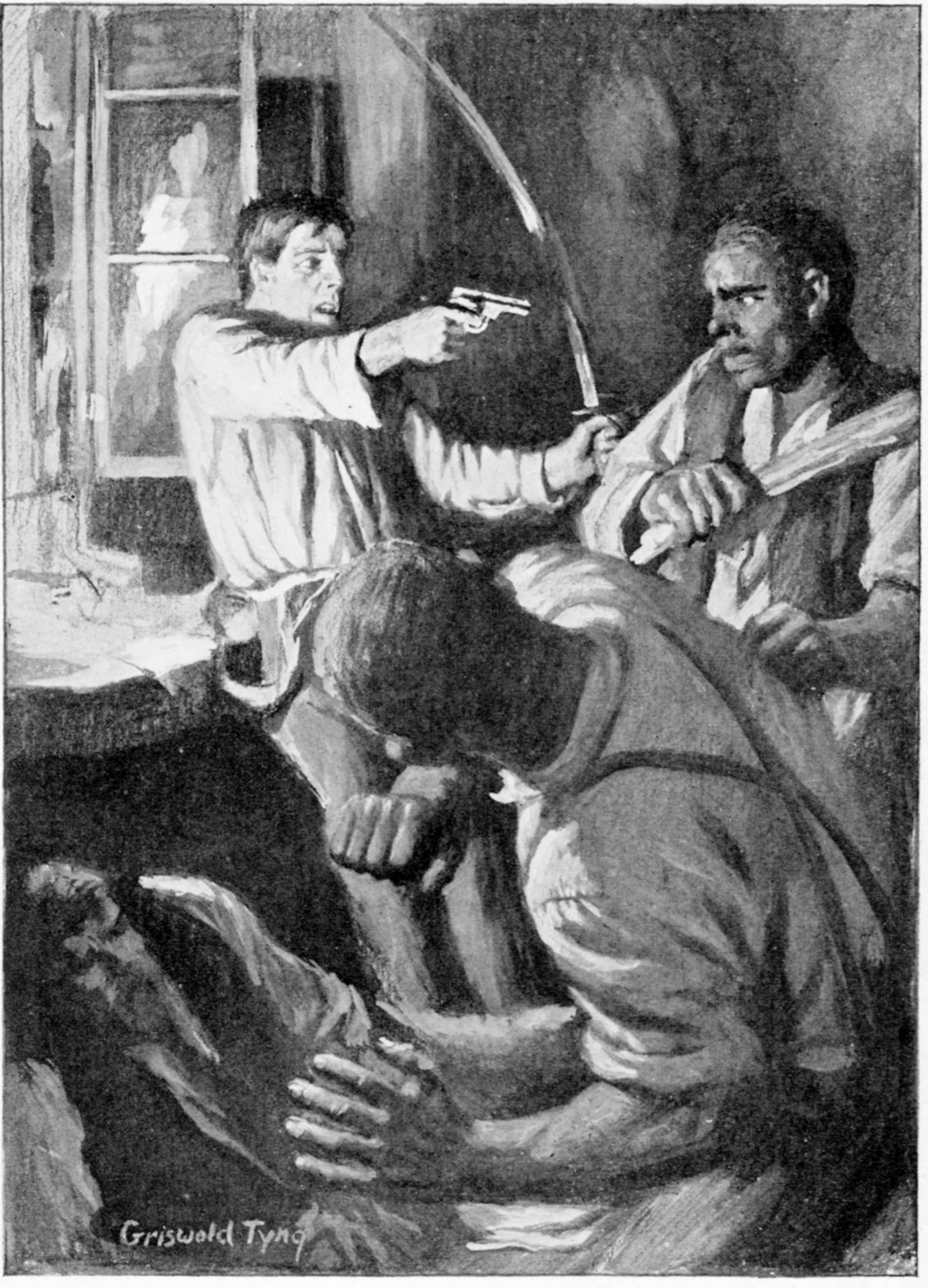
“Stand where you are or I will fire at you!” said Andy.—Page 95.
“Don’t—don’t shoot me!” yelled Cuffy, in abject terror. “Please, massa sodger, don’t shoot!” and he dropped upon his knees. He could stand almost anything but a display of firearms.
[Pg 96]
“Cuffy, yo’ is a fool!” howled Pomp. “Come on, if yo’ is gwine wid me. Remember, if we is cotched now we’ll be more dan half-killed wid de lash. Take dat.”
As the last words were uttered Pomp launched forth the heavy club he carried. His aim was for Andy’s head and had the young cavalryman not dodged in a hurry, he might have suffered from a cracked skull. As it was, the club grazed his ear and then went crashing through a closed window, carrying away part of the frame and several lights of glass.
[Pg 97]
“Fire at him!” ordered Mr. Rockleigh, and the words were yet on his lips when Andy pulled the trigger of his pistol. Pomp was hit in the shoulder, but not seriously injured, and the next moment both slaves fled forth from the kitchen of the house into the darkness of the night.
ANDY ON THE BREASTWORKS
At home Andy had never experienced any difficulty with his father’s slaves, for the colored people were well cared for and were too happy to create any disturbances. To be sure, minor difficulties arose from time to time, but these had been readily adjusted, and there was not a man or woman on the Arlington plantation who would not have been willing to lay down his or her life for any member of the family. These slaves were true to the Arlingtons all through the war, and when liberated by President Lincoln’s proclamation, made no effort to take advantage of their liberty. As attachés of that plantation and dairy, they felt they were being better taken care of than they would be if they tried to do for themselves.
[Pg 98]
To come in contact, then, with such rascals as Pomp and Cuffy was to the youth much of a surprise, and having seen the slaves dash away, he stood still, not knowing what to do, until Mr. Rockleigh caught him by the arm.
“Come, we must stop them. They have my gold and they will try to reach the North if they can,” burst from the plantation owner.
Out he sped, and Andy came upon his heels. The report of the pistol and the smashing of the glass had aroused a number of inhabitants living on the other side of the main road upon which the house stood, and now windows were thrown up and anxious faces appeared, and voices demanded to know what was the trouble. Matters were quickly explained, and soon a dozen men were in the saddle and on foot in pursuit of the runaway thieves.
One man living a distance up the road had seen Pomp and Cuffy taking a side path leading due northward, and it was in this direction the pursuing party headed, spreading out over several open fields, that the negroes might not double on their trail and escape in that manner. Mr. Rockleigh wanted to follow them with bloodhounds, but not a dog of that breed was handy.
[Pg 99]
“Just let me catch them,” he cried, in a fearful rage. “I’ll skin them both alive. I’ll cut out their black hearts with my whip.” He was naturally a passionate man, and this was one reason why his slaves had revolted.
The pursuit was kept up until six o’clock in the morning. It was then discovered that the two runaways had separated. One party, including Andy, continued after Pomp, while the second followed up the trail of Cuffy. By ten o’clock Andy dropped out of the search to ride post-haste back to his command. Sometime later he learned that Pomp had not been captured.
Cuffy was taken while in hiding in a brook in a patch of woods. He was dragged out of the water by his heels and at once searched. A hundred dollars in gold was found in his shirt bosom. The remainder of the money he insisted was in Pomp’s possession. He was marched back to the Rockleigh plantation, where he was chained up in one of the barns and flogged until he dropped like one dead, from exhaustion and loss of blood.
[Pg 100]
This was the only incident of note which occurred on the trip from Lee Run to Manassas Junction. Arriving at the Junction the Montgomery Grays selected a camping spot in the vicinity of a number of other Virginia troops, and immediately went into quarters in true military style.
Their camp was in an orchard of trees which had borne their best fruit years before, and which were consequently good for little else than firewood. The Montgomery Grays occupied one “street” about a hundred and fifty feet long. At the upper end of the “street” were the officers’ tents, at the center the horses’ quarters, and at the lower end the cook’s quarters. The cook was a fat darky known as Mungo, a jolly fellow who sang from morning to night, and who could play a banjo to perfection. Mungo had brought his banjo with him, a home-made instrument, the head of which was almost as black as his own, and this banjo he declared must go along whenever they moved, no matter what else had to be left behind.
“I would jess mope away an’ die ef I didn’t hab dat dere instrument, cap’n,” he explained to Captain Montgomery. “It’s been my pet fo’ ten yahs an’ mo’. Ef I’se killed in dis yere wah, bury de banjo wid me.”
[Pg 101]
“All right, Mungo, I’ll remember that,” answered the captain. “But don’t forget, if you get the chance, to smash that banjo over some Yankee’s head. Do that, and I’ll buy you the best instrument to be found in Richmond.”
“De Yankee ain’t born whose head am good enuf to hab dis yere banjo smashed ober it,” murmured Mungo; and there the subject was dropped.
The main body of the Confederate army was stationed in and about Manassas Junction and along a little stream known as Bull Run; but there were also bodies of troops at Centerville and Fairfax Court House, situated between Manassas and Washington, and also detachments at Alexandria on the Potomac and at Arlington Heights, just across the river from the Capitol.
[Pg 102]
Andy had been in camp less than a week when he received his first real taste of war life, if not of war itself. In order to strengthen the position of the army at Bull Run, it was decided to throw up breastworks, and this was done under the orders of General Beauregard, who now had under him a force of nearly twenty thousand men.
Bull Run is a sluggish stream of water, flowing between steep banks and through a well-timbered country. Its winding course contained many fords and several bridges. The Confederate army occupied about eight miles of the southern bank of this stream, and at once began the work of defending seven of the fords and one of the bridges by throwing up breastworks of dirt and brushwood.
With the others in his company, Andy was given first a pick and then a shovel and set to work like any common day laborer. The youth was not used to this, and when night came his back ached as it never had before. The work took the best part of a week, and then Andy found his hands blistered.
“Call this fighting?” he grumbled. “It wouldn’t be so bad if a fellow was out in California digging gold, but to work like a nigger on the streets of a town—” He did not finish but heaved a big sigh. That night it rained “pitchforks;” the tent Andy occupied with Leroy was blown down, and he felt utterly discouraged.
[Pg 103]
“Never mind, Andy,” said Leroy, trying to cheer him. “We’ll be fighting before long, and then you can show your mettle to better advantage. I heard some of the officers saying that the soldiers over in Washington would be out this way before the month was up. If they come we ought to give it to ’em red hot.”
“They can’t come any too quick for me,” growled Andy.
Even with the work on the defenses the drilling went on daily without interruption. First they would drill in company, then with other detached cavalry troops, and finally would come the grand drill of the division. The drilling was not always done in an open field, but among the trees and on rough ground, and often fences had to be jumped and streams forded. It was not play but hard work; yet Andy liked it a good deal better than handling a pick and a shovel, something he thought altogether beneath him.
[Pg 104]
“It’s life to be on horseback, dashing here and there,” he observed to Leroy Wellington. “If only the Yankees would appear and give us a little more of this sort to do. I wonder if they are going to wait for us to attack them?”
The breastworks along Bull Run completed, advance guards were sent out along the Potomac just above Washington. Then the Confederates sent their engineers along Arlington Heights to survey the territory and report on the advisability of planting a battery there. Some of the Southern leaders were certain that such a battery could successfully shell Washington and compel President Lincoln and the members of Congress to flee for their lives. The only trouble was, could they hold such a position? Might not the Union forces come down upon them from the upper Potomac and cut them off from their base of supplies and from Richmond?
[Pg 105]
The question was answered before the Southern generals had time to act upon their idea. One day a Union officer, while in a boat near the foot of Arlington Heights, discovered a number of men walking about among the rocks and brush. The officer happened to have a powerful spy-glass with him, and using this, discovered that one of the men was Robert E. Lee, who was then the military adviser of President Davis of the Confederacy, and who afterwards became the general-in-chief of the Southern army. Lee was laying out fortifications, and the Union officer lost no time in reporting to General Scott to that effect.
General Scott saw at once that this work must be stopped instantly, or Washington would be at the enemy’s mercy. Orders were accordingly given for certain detachments of the Union troops to cross the river without delay, and take possession of the opposite shore.
The advance from Washington was made at two o’clock at night. Two bridges crossed the Potomac at this point, and a column of the army passed over by each, while a third division embarked on vessels for Alexandria, a short distance below Arlington Heights. As soon as the Confederates heard of the approach of the Union men they retreated, and the shore of the Potomac opposite Washington was occupied without great difficulty.
[Pg 106]
Louis was just about to retire for the night when the sudden roll of the drum made him leap to his feet. In a few seconds Harry Bingham came rushing into the tent.
“We are off, Louis!” he ejaculated. “The war has begun.”
“Off! Where to?” burst from Louis’s lips.
“I don’t know. Across the river to somewhere I believe. Come on!” and off Harry ran, with Louis at his heels. The parade ground was filled with men, on foot and on horseback, scurrying in all directions.
From their captain the youths soon learned that the Union army, or a portion of it, was to take possession of the other shore of the river. The various commands had been divided into three parts and the Goreville Volunteers were to be attached to the Ellsworth Zouaves and some other companies, bound by boat for Alexandria. In less than two hours all was ready for embarkation.
[Pg 107]
The trip down the stream to one of the main docks in Alexandria did not take long. Company after company came ashore unmolested, although mutterings could be heard on every side. Having landed all of his troops, Colonel Ellsworth marched up the main street, called upon the city authorities to surrender the town, and then started for the telegraph office, with the intention of cutting off all communications with the South—certainly a very clever movement.
The Goreville Volunteers soon found themselves not far from the telegraph office for which Colonel Ellsworth was bound. They had become detached from the main body of the soldiers and now, without warning, were surrounded by a mob of two hundred people, armed with pistols, clubs, and stones.
“Down with the Yankees! Down with the Northern mud-sills!” was the cry, and in a moment the air became thick with flying stones and lumps of dirt. Captain Paulding at once halted his men in two lines, and gave the rear line the order to “about face.” Next came the order to take aim, but by this time the mob saw that the soldiers “meant business,” and it melted away as quickly as it had gathered.
“A bloodless victory,” said Harry, who stood next to Louis.
Louis smiled and then he nodded his head in the direction where Jerry Rowe stood. Poor Jerry was shaking so that he could scarcely hold his gun.
[Pg 108]
“He’ll collapse when he gets into a regular battle,” said Harry, and then the command came for silence in the ranks and nothing further was said.
A little later the command marched past the Marshall House, one of the leading hotels of Alexandria. From the top waved a Confederate flag—a flag which President Lincoln and others had often seen from a window in the White House.
“That flag ought to come down,” whispered Louis. He had scarcely spoken when down the street came Colonel Ellsworth, accompanied by only two or three of his command. Ellsworth had noted the flag and now he ran into the hotel to tear it down with his own hands.
“Whose flag is that?” he demanded of the first man he met.
“I don’t know,” was the surly reply.
“I want it lowered at once.”
“Do you? All right, go take it down yourself.”
[Pg 109]
“I will,” answered the Union officer, and ran up one pair of stairs after another to the roof of the hotel. Here the halliards of the flag-staff were cut and the flag brought down on a run. With the colors wound over his arm, Ellsworth began to descend to the street. He had just reached the second floor of the building when the proprietor of the hotel, a man named Jackson, appeared in the hallway armed with a double-barrel shotgun.
“Will haul it down, will you?” he muttered and pointing his weapon at Ellsworth’s breast, fired. The gallant leader of the Ellsworth Zouaves was killed instantly, and sank down without a moan.
“Ellsworth is shot! Help!” came the cry from the Union officer’s companions, and then one fired at Jackson with fatal effect. As the hotel man went down in a pool of blood the others leaped upon his body and thrust it through with their sabers.
[Pg 110]
“Spare him!” came in a woman’s voice, and the secessionist’s wife came rushing forth from a bedroom. Thinking her husband might still breathe, she threw herself on his corpse, while the Union men, knowing he was dead, picked up their lifeless leader and carried him away.
THE ADVANCE TO BULL RUN
The excitement around the hotel was for a time intense, and not only the Zouaves, but also the Goreville Volunteers had all they could do to restore order and thus prevent further bloodshed. Many of the Union men were in favor of burning the Marshall House to the ground, but other counsel prevailed and the building was spared.
It may be added here that later on Colonel Ellsworth’s body was sent on to New York, where the funeral services were among the largest and most imposing ever witnessed in that city. The funeral of Jackson was also well attended, and each man was looked upon as a martyr by those whose side he happened to represent.
[Pg 111]
The death of Ellsworth was a shock to Louis. It was the first soldier he had heard of being slain, and he shuddered when, later on, he gazed at the cold, set face of the dashing Zouave, whose striking uniform of red, blue, and yellow had made him more dashing than ever. It was the lad’s first taste of grim war—and there was much still in store.
The Zouaves having taken complete possession of Alexandria, the Goreville Volunteers were sent back to their old quarters at Washington, to remain there for a possible call from the upper Potomac. It was during this wait that Louis one day came almost face to face with President Lincoln, who was inspecting the remnant of the army, in company with General Scott. The sad, earnest face of the President impressed him greatly, and he could not help but think of what a tremendous responsibility now rested on the shoulders of the nation’s chief executive.
“He’s got more of a load than I would like to carry,” said he to Harry Bingham. “With so many thousands of eyes upon him, he can’t afford to make a mismove.”
“You are right, Louis. I would rather be a private in the ranks.”
[Pg 112]
“If I was President I would soon end this war,” blustered Jerry Rowe, who had heard the remarks.
“Would you, indeed, Jerry?” answered Louis, curiously. “How could you do it?”
“Never mind—I’d do it, and that’s enough for you to know,” and Jerry stalked off, fearful of being pinned down to some plan of campaign.
“Jerry is a cooler,” murmured Harry. “He is a coward at heart, yet how he does love to brag!”
“Benny Bruce was complaining to me about him,” said Louis. “He says Jerry is picking at him whenever the chance offers. Jerry always did love to tease the little fellows.”
“He ought to have his head punched for it,” concluded Harry.
[Pg 113]
Having taken possession of Arlington Heights, the Union troops at once began to build fortifications there and soon the danger that had threatened Washington was past. Close at hand were the beautiful grounds of Mount Vernon, where Washington had lived, but these were not touched during the entire war, both North and South considering the ground as sacred.
The Goreville Volunteers were not left in Washington long. More troops from New York, New Jersey and Down East had arrived, and on one bright day in May the brigade moved across the river and went into camp in an orchard near Arlington Heights. Not far away was Arlington House, the homestead of the Lee family. The Lees had deserted the beautiful abode, and it was now the headquarters of General Sanford, commander of the Army in Virginia.
“It seems a shame to destroy all these beautiful places,” remarked Louis one day, when he and Harry Bingham were off duty and were strolling around in the confines of the camp. “Just look at this orchard. It looks as if a cyclone had struck it.”
“This is bad enough,” replied Harry. “But supposing the rebs had come up and shelled Washington, wouldn’t it have been worse to have the Capitol and the White House and other buildings laid in ruins?”
[Pg 114]
“Oh, I’m not comparing the two, Harry. But think how long it took to get this orchard growing like this. If we stay here another month every tree will be ruined—if not cut up for firewood.”
“We won’t stay here much longer. The authorities in Washington are growing too impatient to do something,” concluded Harry Bingham.
Late in May, Brigadier-General Irwin McDowell, of the regular army, took command, General Sanford being transferred. The coming of this hero of the Mexican War was an event, and the inspection and drill which followed was not soon forgotten by the boys in blue. From henceforth strict military discipline prevailed, and every soldier had to “toe the mark” in earnest.
Yet week after week went by and the army did not move. It was known the Confederates were growing stronger and stronger in their position at Manassas Junction and along Bull Run, and many of the soldiers wondered why something was not done.
[Pg 115]
“Boys, don’t you know it takes a lot of time to get everything in readiness for such an immense army as this?” said Captain Paulding one day, by way of explanation. “Think of the thousands of horses required for the wagons and batteries, the immense stock of rations, and hundreds of other things. Why, you must remember that the moving of such a body of men as we have here is like an exodus. But we’ll march before long, never fear.”
Fourth of July was spent in camp in a lusty manner, the soldiers celebrating as much as their means allowed. In the evening bonfires blazed forth on every hand, making the vast camping-field as bright as day. There were orations, sham battles, and some of the boys in blue got up a minstrel show and an amateur circus, at both of which the fun was uproarious. It was like the comedy which precedes the tragic in a melodrama.
[Pg 116]
At last, on the sixteenth of July, came the orders to break camp. The army had been divided into five grand divisions, each division moving forward by a different route. Soon every highway leading towards Fairfax Court House, Centerville, and Manassas Junction was filled with tramping soldiers, dashing cavalry, fifers and drummers and bands of music, with hundreds upon hundreds of heavy batteries plowing their way along through the dirt, and followed by thousands of provision and sutlers’ wagons, and ambulances; and last of all the carriages of politicians and others who were curious to see what was going to take place now the North was about to strike her first regular blow at the Confederacy.
“My gracious, I had no idea that there were so many of us!” murmured Louis to Harry, as they stood in the ranks, waiting for their turn to move, and watching regiment after regiment of their comrades march by, with colors flying and every face full of hope and determination. “We ought to conquer by sheer force of numbers, if nothing else.”
“They’ll have just as many men,” declared Moses Blackwell. “It’s a bloody struggle we have afore us, mark the words.”
[Pg 117]
Louis had expected a fatiguing advance of fifteen or twenty miles, and he was rather surprised when, early in the afternoon, their company entered Fairfax Court House and they were ordered into camp for the night. The advance along the road had been made with caution, and although it was known the Confederates had outposts located along the routes these advance guards had fallen back as the boys in blue marched forward.
Fairfax Court House was but a small town, and the majority of the inhabitants were thoroughly scared at the arrival of so many troops.
Many of the men were away, in the service of the enemy, and the women viewed the appearance of each new soldier with much misgivings.
“Spare me and you can take all I have!” wailed one old lady to Louis, as he appeared at her kitchen door for a pail of water. “Oh, do not kill me!”
“Madam, I’m not going to touch you,” answered the youth, more than half-amused. “I came in to see if you would be kind enough to give me a bucket of water.”
At this the old lady stared, thinking she had not heard aright.
“You—you only want some water?” she faltered, trying vainly to recover.
“That is all, madam—unless you have some cookies you are keeping for our boys. We never refuse those, you know,” and Louis smiled.
[Pg 118]
“I declare, I reckon you ain’t so fierce as I took you to be.”
“I’m only a soldier boy, trying to do my duty. Can I have the water?”
“Certainly! certainly! Take all you want. I haven’t any cookies, as you call ’em. But I’ve got some eggs, just laid—you can have them if you want ’em.”
“Thank you, madam, I’ll take them with pleasure. But remember, I don’t demand them. We have strict orders to demand nothing.”
“Oh, it’s all right. You can have ’em, even if you are a Northerner. I see you’re nothing but a boy, and I have a boy in the army—on our side—and I reckon he’d like a fresh-laid egg now an’ then,” and she ran off to bring back eight large, white eggs tied up in a bit of cotton cloth. That evening Louis, Harry and several of the others of their “crowd” enjoyed the freshest omelet they had had since leaving home.
[Pg 119]
But some of the soldiers, be it said to their discredit, were not as considerate as Louis had been. Thinking themselves in the enemy’s country, they plundered a number of houses, threatened the inmates, and in two cases buildings were set on fire and destroyed. During the evening a number of the thoughtless ones arrayed themselves in some stolen female wearing apparel, and thus masqueraded, paraded about until stopped by the officers.
From Fairfax Court House the army moved slowly the next day towards Centerville. They were now but a few miles from Bull Run, and although the Goreville Volunteers were not yet called into action, yet the distant sounds of firearms told that no longer was everything “quiet along the line.” On the day following a fierce fight took place between a portion of General Tyler’s division and the enemy entrenched at a spot called Blackburn’s Ford, and in this encounter nineteen of the boys in blue were killed and twice as many wounded. This was really the opening of the great battle of Bull Run. The Union soldiers found they could make no advance, and accordingly it was decided to wait several days until the entire army could be brought into position for a simultaneous attack. Additional supplies were also needed, and these did not arrive when expected. At last came the orders to go forward.
[Pg 120]
“Now for bloody war, my boy!” cried Moses Blackwell to Louis. “Ye’ll git enough of it now, see if ye don’t.”
It was early Sunday morning. The soldiers were to have moved at two o’clock, but it was nearly sunrise before the Goreville Volunteers were in motion; and the day promised to be a scorcher.
Little Benny Bruce beat his drum loudly, his eyes glistening brightly, for the spirit of war seemed to be a part of his very nature. Seeing Benny so brave, Louis could not help but look at Jerry Rowe. The boaster was pale and his fishy eyes were full of uncertainty. The next twenty-four hours were well calculated to sift the cowards from those who were truly brave.
[Pg 121]
To go into all of the details of the great battle of Bull Run would be both impossible and apart from my purpose in writing this story of personal adventures on both sides of the great conflict. Suffice it, then, to say that the attack on the Confederate forces was begun between six and seven in the morning at a place known as the Stone Bridge, and from that hour the battle kept on steadily until the middle of the afternoon. By this time both sides had sustained heavy losses and were worn out, but the arrival of a large body of fresh Confederate troops under General Johnston put new life into those who marched under the Stars and Bars, and they attacked the Union men with such increased vigor that nothing could stand before them. By sundown the Union men were in full retreat for Washington, and thinking the fresh Confederate force much larger than it really was the retreat degenerated into what was practically a panic.
But Louis thought of none of these things as he marched forward mile after mile in the blazing sun. The dust on the road was several inches deep, and a heavy battery traveling just in front of the Goreville Volunteers kicked up such a dust that the lad was all but blinded. He was glad enough when the orders came to turn to the left and enter a by-road leading through a heavy woods.
[Pg 122]
“Halt!” The command came full and clear along the line of soldiers stretched out among the trees and brush. A clearing was just ahead and on the opposite side of this could be seen a number of hastily constructed breastworks, and the glitter of two brass cannons. The order to halt had hardly come when the cannons boomed forth, and a mass of grapeshot came tearing through the thickets, clipping off branches of trees and tops of brush and sending half a dozen dead and dying to earth.
“Oh, I’m killed!” yelled Jerry Rowe, falling back. But it was only a cut-away branch which had struck him. Somebody laughed, and then every gun was clutched closer, as the order came to charge. Louis was in battle at last!
There is no denying the fact that his heart was in his throat. To move forward under fire for the first time in one’s life is no light thing. He looked at Harry on one side of him and saw the pale, set face. Then he got a dig in the ribs from Moses Blackwell, who was on the other side.
“Can’t die but once, Louis. Hurrah fer the Stars and Stripes! Down with the rebels!”
[Pg 123]
The cry was taken up on all sides. An answering call came back: “Here they come! Down with the Yankees!” And then came a blaze from a long line of rifles, and two of the Goreville Volunteers went down to their deaths before being permitted to strike even one blow in the cause for which they had enlisted.
“Take aim! Fire!” came the command from Captain Paulding, and steadying himself, Louis aimed his gun straight at one of the enemy and pulled the trigger. The death of two men he knew well had nerved him for the deed, and he saw the Confederate throw up his hands and fall back, shot through the shoulder.
“Forward again, boys! Forward! We must gain those breastworks!” came the cries. Away they went, out of the woods, to confront that deadly fire again. Three went down, wounded, and the men were ordered to “close up.” The smoke now became thick and in the midst of this the brass cannons spoke again, but the shots were too high and did no damage.
[Pg 124]
Louis now found himself at the edge of the breastworks, with Harry and Moses Blackwell still beside him. Close at hand was Nathan Hornsby, and with a quick leap the Pennsylvania farmer was on the mound of dirt and brush, and Louis scrambled after him. Others followed in rapid succession and the breastworks were taken.
[Pg 125]
But not for long. With a wild yell the Confederates rallied and bore down upon their enemy. The brass cannons had been hauled away and the open field became the ground for a fierce hand-to-hand conflict. Louis tried to keep close to his friends, but in the mêlée this was impossible, and in a minute more he found himself alone and in the very midst of the enemy!
A MEETING AND A RETREAT
The forces under General Beauregard at the battle of Bull Run consisted of some twenty regiments of infantry and a number of cavalry companies and sections of light artillery. It was a regiment of South Carolina men that had defended the earthworks attacked by the Goreville Volunteers and others, and they fought bravely for many hours after the scene recorded in the last chapter. The battery was one from North Carolina and retreated from its first position only to take a second half-way up the side of a hill, at the top of which stood a single house. It was around the vicinity of this house that the main onslaughts of the day occurred.
[Pg 126]
In the meantime, however, what of the cavalry to which Andy was attached? The Montgomery Grays were located along the Warrenton turnpike, and it was their honor to capture one of the first cannons taken from the Union army. The capture took place at a bend in the road, and was followed by a fierce attack by the boys in blue, which nearly demoralized the Montgomery Grays.
“Forward! Forward!” cried Captain Montgomery again and again, but when Andy and the others attempted to move on they found they were literally urging their steeds upon a bed of bayonets. They fired their pistols and slashed with their sabers, and the din and shock were terrific.
“Down you come, grayback!” Andy heard yelled in his ear, and a bayonet was thrust up against his side. He pulled back, escaping the steel point by only a few inches and cut his assailant heavily on the arm. The next moment other cavalrymen pushed on behind, and then there was nothing to do but to go on, cutting a path right and left as the Montgomery Grays advanced.
[Pg 127]
Yet when the Confederate cavalry had thus hewn a path for itself along the turnpike for a distance of several hundred feet, it found the advantage of position a doubtful one. From the woods poured a regiment of New York militia, and the fire was so hot from these well-trained soldiers that the cavalry was forced to move rapidly towards another defense of the Confederates, dragging the captured cannon with them. As they were ploughing on, in the dust and dirt, a volley of Minie balls whistled around them and one clipped Andy on the leg, leaving a stinging pain behind it.
“Are you struck, Andy?” cried Leroy Wellington, who rode near to his friend.
“Yes, in the leg; but I reckon it’s not much,” was Andy’s reply, as he brushed the perspiration and dirt from his face with his coat sleeve. “Phew! but this is more than warm work!”
“Never mind; we have one of their cannons!” returned Leroy. It filled his heart with martial joy to think that he had been one of the first to lay hands on the piece after cutting down the gunner.
“Don’t crow until we are out of the woods, Leroy. Here come more of the Yankee boys.”
[Pg 128]
“Pennsylvania men!” cried somebody in advance. “Load, boys, and be quick about it!”
“Pennsylvania men!” repeated Andy. “What if it should be Louis’s company? I couldn’t fire on him!” he thought. Then he began to load with all possible speed.
The Pennyslvania company, however, belonged to the regular militia. They were an excellently drilled body of men, and came forward in a solid mass that nothing could stay. They had heard about the capture of the cannon and were determined, if possible, to regain the piece. They fired at close range, then began to use their bayonets, and soon the cannon was reached, and here cutting, thrusting, and clubbing became the order of the day.
[Pg 129]
Never had Andy thought to be in such a stubborn conflict. He cut, thrust, and charged on all sides of him. Once the butt of a musket hit him in the back and unseated him. There was a yell of triumph as he went down. Before the yell came to an end he was up again and charged straight for his adversary, a tall militiaman, who dodged out of the way in double-quick order. Andy wanted to fire at him, but before he could bring his pistol into play the tide of battle had swept man and boy fifty feet apart.
And so the fray went on, until, Confederate reinforcements coming on, the Union soldiers were forced to retreat, and the Montgomery Grays returned in triumph to their own division, dragging the cannon after them. As they moved on General Longstreet swept by them on his charger.
“Good, boys; good!” he cried, waving his sword. “Keep it up and the day is ours!”
“Carry the news to Jefferson Davis!” yelled Leroy, after him, and the Confederate general turned in his saddle and smiled. An instant later the smoke of battle swallowed him up.
But now even the horses were beginning to show signs of fatigue, and the greater part of the company were compelled to fall back several hundred feet farther, where there was a small stream flowing into Bull Run. Here men and beasts procured much-needed drink and stopped to get their “second wind.”
[Pg 130]
Hardly was Andy again in the saddle when the bugle called him and his fellow-cavalrymen to a new position along the side of the hill before mentioned. To gain this new position the Montgomery Grays had to cross an open space probably three hundred feet in diameter—a clearing well covered by the batteries of the Union army.
“Forward, and lose no time!” cried Captain Montgomery, and led the way, followed almost immediately by a score of his men, with Andy and Leroy in the number. The captain had scarcely covered a quarter of the distance when, suddenly, his horse, a powerful gray stallion, was seen to rear up viciously and take the bit between his teeth.
“Whoa!” roared the Confederate commander, but instead of obeying the stallion reared again, then dropped like a flash and shot off on a mad gallop, directly for the Union lines!
“The captain’s horse is running away!” cried Leroy. “Whoa! Whoa!”
“He’ll be carried into the enemy’s lines!” yelled another of the men. “Turn him to yer right, cap’n! To the right!”
[Pg 131]
“Whoa, Harry!” cried the captain, tugging in vain at the reins. Harry would not whoa, but with blazing eyes kept straight on, until the ranks of the enemy could be plainly seen.
But now came rapid hoof-strokes from behind. From the start Andy had realized his captain’s danger and wondered how it could be averted. He knew that trying to stop Harry by pulling on the reins or calling to him was out of the question. The horse had lost his head and would not obey until exhausted.
“Forward, Firefly!” he called to his own animal, and, trained to obey on the moment, brave Firefly flew out of the line and in full pursuit of the runaway.
“Come back! It’s certain death!” yelled Leroy, in horror; but if Andy heard he paid no attention. On and on he went, until the very side of the runaway was gained. The advance line of the enemy was now less than a hundred feet away. Several rifles rang out and the bullets whistled on every side.
[Pg 132]
As Andy ranged up alongside he crowded Harry on the left. The stallion did not like this and turned to bite Firefly. But Andy was ready for him and struck the runaway on the nose. At once Harry sheered off as desired, and away went both horses at right angles to the course previously pursued. Again the rifles from the Union side rang out and Captain Montgomery was slightly wounded in the arm, and Andy had his plumed hat ventilated much against his desires.
“I owe you one for that, Arlington,” said the captain, when both were safe for the time being. “I’ll not forget you.”
“I think you had better get a more manageable horse after this, captain,” returned the youth, with a smile. “He’s too willing to go over to the enemy.”
“I’ll give him another trial. If he runs away again I’ll shoot him,” replied Captain Montgomery, and having once more gotten his stallion under control, he galloped off to obtain further orders from the general in charge.
[Pg 133]
“We are ordered to the breastworks below here,” said the officer, a few minutes later. “A South Carolina regiment has been holding the defense, but matters are getting too hot for them. Forward, boys, and show them what our Grays can do. Hurrah for the Stars and Bars!” and away went the troop of cavalry, flinging up the sod of the cut up field behind them. In two minutes more they were again in the thick of the fray.
“The cavalry is coming!” Andy heard one of the Union soldiers ejaculate. “Never mind, Blackwell. Show ’em what sort of stuff the Goreville Volunteers are made of,” added another. “Now we have this ground, let us hold it. Hurrah for McDowell and General Scott!”
“The Goreville Volunteers,” thought Andy, and the hot blood rushed to his face. It was Louis’s company! Supposing he should—
“Andy!” It was a yell from his left. He turned swiftly. Sure enough, there was Louis, battling bravely in the midst of half a dozen of the South Carolina men, one of whom was about to stick his bayonet into the Union boy’s breast. “Don’t kill him! Don’t, please!” were the words which rose to his lips, but in the din of battle no one heard him. Then he saw Louis catch hold of the bayonet and thrust it aside. In another moment the two chums found themselves face to face.
[Pg 134]
“Louis! To think we should meet like this!” came from Andy’s white lips. “You must go back! You will be killed, or captured!”
“I am fighting as I was told to fight, Andy,” was the determined reply. “Good-bye, and take care of yourself!” and away sped Louis, knocking headlong a Confederate soldier who sought to detain him. Andy had now all he could do to look out for his own welfare; and thus the former chums parted, not to meet again until the Army of the Potomac marched against Richmond, the Confederate capital.
We will follow for the time being the fortunes of Andy. With Louis’s disappearance the Southern youth discovered that a fresh body of Union soldiers had come up to reinforce the Goreville Volunteers, who were now all but exhausted to a man. He was pleased to note this, as the idea of fighting even against the company to which his chum belonged was distasteful to him.
[Pg 135]
The Grays were ordered to charge the men who were holding the defense, and away they dashed, with two other cavalry companies beside them. This charge was bravely met, and once again Andy found himself in a hand-to-hand fight. This did not last more than five minutes, when the Union soldiers were seen to part, to let through a battery of two cannons, both twelve-pounders. As quickly as possible the battery was placed in position, the rear guard of the Union men meanwhile protecting the pieces. Then away went the Northern troops to the right and left, and the order was given for the Grays to retreat. The order came none too soon, for when the cannons blazed forth the aims of the gunners were found so correct that eight horsemen and six animals were laid low. The Union battery remained where it was for over an hour, when the general retreat of the Union troops began.
[Pg 136]
The line of battle had originally been nearly eight miles long, but now it was so broken and disorganized that the fighting became general upon all sides, although the heaviest attacks were still made in the vicinity of the hill before mentioned. The exhaustion in the hot sun was terrible, and many of the soldiers had not had time to eat a mouthful since early morning. Some of the poor fellows, unable to carry the load, had thrown away their knapsacks, and they now ran around begging for a mouthful of something with which to brace themselves up. It was their first awakening to the stern reality of grim war.
“If ever I git back to old New York ag’in,” wailed a Bowery boy, who had enlisted for three months with the idea that going down South to whip the “rebs” would be “nothin’ but sport, boys, nothin’ but sport.” He wanted to see no more of the war,—and he had his counterpart everywhere, on both sides. One dandy from Richmond who had enlisted also for “sport” was heard to exclaim that henceforth “the big guns can fight for themselves. I’ll be jiggered if I’ll do it for them,” meaning that, as far as he was concerned, the politicians and others who had precipitated the conflict could end it among themselves.
[Pg 137]
But there were others, and they numbered thousands upon both sides, who fought bravely to the very last, realizing that the eyes of the whole world were upon them in this initial conflict. They were fighting to uphold a principle, not fighting against a Northern or a Southern brother. To these the horrors of carnage were as appalling as they could well be, but they had steeled their hearts for the inevitable, and they went on, to live or die in the defense of what they thought right. These, and these only, are the true heroes of the great war, and there is no dividing line, and there never could be, to separate them.
The booming of cannons and the shrieking of shells still went on as the Goreville Volunteers gathered together in a little clump of trees and snatched a hasty biscuit and a drink of water. Each man and boy was begrimed with sweat, dirt, and powder, and each was more than half-exhausted from his exertions.
“Oh, but ain’t this simply dreadful!” moaned Jerry Rowe, for at least the fiftieth time. “Captain Paulding never told me of it when he got me to enlist.”
“The captain wanted to make a man of you, Jerry,” replied Nathan Hornsby. “What are you kicking about? See, I’m clipped with a bullet wound in my left fore-arm, but I’m not complaining.”
[Pg 138]
“The cap’n will make a man of Jerry if his knees hold out,” put in another of the men. “But, Jerry, don’t shake so bad or your knees will cut through your trousers,” and a short laugh went up, even in that perilous position—a laugh which was cut short by the passage of a cannon ball through the trees. Everybody ducked, and Jerry fell flat, although the ball was ten feet up in the air.
General McDowell, now seeing the tide of battle turning against his troops, sought by every means in his power to recuperate his forces. But when several attacks had been led forward without avail, it was determined to fall back, in the hope of taking a fresh stand in the vicinity of Centerville. In the meantime, however, the troops of General Johnson, which had escaped from the Union General Patterson at Charlestown, in West Virginia, miles away, had come in on railroad trains to Manassas Junction, and these fresh Confederate soldiers, appearing suddenly on the field, started a panic among the Northern companies, a panic which it was impossible, in the mixed-up condition of affairs, to stay.
[Pg 139]
“General Johnson has come on with twenty thousand fresh troops! We must fly for it!” was the cry which was taken up from company to company. Johnson had come up with no such magnificent number of men, but he had come up with enough to make a good showing, and, utterly worn out from marching and fighting in the hot sun, the Union troops commenced the retreat in the direction of Washington.
The blow to all was a bitter one, but now was no time to think about it. “We can weep afterwards,” said one of the older men of the Goreville Volunteers. “Now it is use your legs or go to a rebel prison,” and off he stalked, with Captain Paulding, Louis, Harry Bingham, Moses Blackwell, and a dozen others beside him. The captain tried to preserve order, but this was impossible, for men on foot and men on horseback were rushing hither and thither, trying to find their commands or, at least, a friend or two.
Less than half a mile had been covered, when a firing upon the road caused the volunteers to halt. Then came a rush, and a band of the Confederate cavalry swept by. As they did so the volunteers stepped into the shelter of the woods beside the turnpike. They were about to emerge when Louis felt himself jerked violently to the ground. He had been pulled down by a fellow concealed in the long grass. As he tumbled headlong he caught sight of the man’s face. It was Sam Jacks!
LOUIS’S PERILOUS ESCAPE
To be pulled down in such an unceremonious fashion was a surprise in itself, but to find himself face to face with his enemy, the mountaineer, astonished Louis beyond measure. For the instant he could do nothing but stare at his assailant.
Then came the realization of his position—that Jacks was not only his personal enemy, but that the man likewise belonged to the Confederate forces, and as Captain Paulding and the others moved off on the double-quick he endeavored to pull himself away to go with them.
“No, yer don’t!” hissed rather than exclaimed the mountaineer. “I’ve got yer an’ I’m goin’ ter hold yer!”
[Pg 142]
His face, generally far from clean, was now covered with thick dirt, and over one cheek flowed a small stream of blood, for he had been wounded, not by a shot from the enemy, but from a tumble in the woods in which he had been hiding. As he spoke so vindictively he hauled Louis closely to him.
“Let me go!” panted the young Union soldier, and struggled to free himself. “Captain Paulding! Harry! Hel—”
The words died upon his lips as Sam Jacks clapped a dirty hand over his mouth. Then commenced a fierce struggle, and both rolled over and over in the tall grass, until, coming to the edge of a gully, both dropped a distance of six or eight feet, to bring up on a pile of damp leaves and dead tree branches.
Louis came down on top, and with such force that the mountaineer’s wind was for the moment knocked completely out of him. He uttered a grunt and a gasp, and ere he could recover Louis was on his feet and making for a spot where the side of the gully sloped upward.
[Pg 143]
“Stop him, Hogwell!” roared Jacks, and as he spoke another form loomed up before the young soldier. The man was the same who had assisted at making him a prisoner at the old mill, before the opening of the war. Hogwell had been in hiding with Sam Jacks for several hours, their intention being to see what they could steal after the battle should come to an end. Unfortunately, throughout the war both sides were afflicted with such terrible criminals, who had no respect for either dead or dying, their sole object being plunder.
“Who is it?” queried Hogwell, as he blocked Louis’s passage.
“Can’t yer see—it’s the rat we had the trouble with up near Deems,” growled Jacks. “Stop him. I allers calkerlated ter git squar with him.”
Hogwell grabbed Louis by the collar. Had the young soldier had his gun with him he would have either fired or used the bayonet. But the weapon had been lost at the first moment of Sam Jacks’s attack and now he had only his hands.
[Pg 144]
“Let go!” he commanded, and hauling back, he hit Hogwell squarely in the lower jaw. It was a heavy blow, delivered with all of Louis’s youthful strength and determination, and Hogwell went back as though struck with a club. Ere he could recover the young Union soldier was past him and speeding up the gully side with the speed of lightning.
“Stop, or I’ll fire!” he heard Hogwell yell, a moment later. But he kept on. Then came the report of the mountaineer’s long pistol and a bullet whizzed close to his head. Soon the shelter of the trees took him out of range.
The tussle in the gully had somewhat upset Louis’s mind, and when he started in search of the turnpike again he turned in exactly the opposite direction to that which he should have taken. On and on he went, through the brush and over trunks of decaying trees. More than once he stumbled, but picked himself up hastily and continued on his way, until suddenly he found himself ascending a hill where the thickness of the trees made further progress almost impossible.
“I’ve made a mistake,” he thought, much dismayed. “There is no road in this direction.”
[Pg 145]
Forced to halt, he listened intently. From several points around him came the distant sounds of musketry and occasionally the booming of a cannon. But to locate any of the sounds in particular was impossible. Indeed, the firing of the day had half deafened him.
“I’m in a pickle, with all the others gone,” he thought, dismally. “Even if I do find the road I’ll not know where to look for our company. However, I won’t be any worse off than lots more of our poor fellows. If only I can get among friends somebody in command will set me right. Perhaps this defeat will only be temporary.”
It was deliciously cool in the depths of the woods and this refreshed him. Having regained his breath, he retraced his steps as well as he was able. Ten minutes later he recrossed the gully, but at a point some distance above where the encounter with Jacks had occurred. He had gone on but a few feet farther when he almost stumbled over the body of a dead Union soldier. A little startled, he was about to go on, when a sudden thought seized him and he retraced his steps.
[Pg 146]
The poor fellow had belonged to a volunteer command. He was past middle age and cold, showing that he had been dead several hours. Beside him lay his gun and cap, and his cartridge box was still strapped around his waist.
“He’ll never want his gun again, poor fellow,” thought Louis, and kneeling down he unfastened the flap of the cartridge box and took out the supplies. This done, he picked up the gun and hurried on as before. Having a weapon made him feel much more like himself.
[Pg 147]
A short while later the road was gained. Here a scene of indescribable confusion met his gaze. Union troops of all kinds were rushing along, many of the men capless and gunless, having thrown all away in their anxiety to escape. On the ground lay the guns, with here and there a knapsack, and over all tramped men and horses. Cannon after cannon followed, the drivers of the horses beating their animals mercilessly in their endeavor to escape capture by the pursuing enemy; and mixed-up with these were the provision turnouts and occasionally the carriage of some politician or member of Congress, whose curiosity had brought him hither from Washington to see how this fight with the Confederates would end. It was a most humiliating spectacle; yet such was needed at that time to awaken the North to the true condition of affairs.
Presently a Pennsylvania company swept by, not over twenty-five strong. Louis ran to join them.
“Where from?” he asked of one of the soldiers, a young fellow scarcely older than himself.
“Harrisburg,” was the puffing reply. “Lost your company?”
“Yes—the Goreville Volunteers. Have you seen anything of them?”
“No; haven’t seen anything but a lot of rebs at our heels. Better come along if you want to save your skin. They’ve got a large reinforcement after us.”
On went the Harrisburg soldier, and Louis concluded he could do nothing better than keep at his side. Several miles were covered, and the few houses which composed Centerville were passed, when the road became blocked up in front. Presently half a dozen generals and their aides came dashing from one side and another.
[Pg 148]
“Face about, boys! We can whip them yet! Face about and form the line! Face about!”
The cry, well meant, was utterly useless. The soldiers were exhausted, having been on their feet since two o’clock that morning, and it was now after sundown. All but a few scattered regiments were thrown in hopeless confusion. Colonels could not find their companies, captains and lieutenants looked in vain for their men. Nine out of ten had still to learn what war and military organization really meant.
“This is Andy’s day and no mistake,” Louis half-murmured to himself. He could imagine Andy, in his lusty, Southern way, throwing up his plumed cavalry hat and shouting for the Confederacy. Well, there was one consolation—the war was not yet over.
Finding the men could not be organized for a stand at Centerville Ridge, General McDowell allowed them to continue toward Washington and at the same time sent Blenker’s brigade to cover the retreat. The troops which reached Fairfax Court House immediately took cars for Washington, and they carried with them as much of the arms and stores as was possible.
[Pg 149]
But it was only a small portion that got away thus easily. The vast majority of the Union soldiers, worn-out, heart-sick, and hungry enough to eat almost anything, had to tramp the remaining distance to the Capitol. They took various roads, and most of them did not come in until the next day, when it began to rain in torrents, causing the dusty roads to turn into rivers of mud. With the rain came a heavy fog from the bay, as if to add to the already accumulated misery, and in this fog and downpour those who had gone forth so full of hope, dragged back, to find a shelter wherever they could lay their heads, devour what was given them, and drop asleep before swallowing the last mouthful. Such is an actual picture of those days of awful gloom, when the fate of the nation hung in the balance. Had the Confederates followed up the victory gained at Bull Run, or rather, had their troops been in a condition to do so, it is more than likely Washington would have fallen. But the majority of the Southern soldiers were no better off than their Northern antagonists, and so, with the heavy rain coming on, nothing further was done.
[Pg 150]
It was not until twenty-four hours later that Louis found himself again in Washington. He had tramped in a roundabout way from Centerville, became lost, along with several thousands of other soldiers, and in all that time had had nothing to eat but three or four hardtacks he had picked up on the road beside a half-smashed haversack. He and the young soldier from Harrisburg, named Clarence Woolley, had kept together, and now they approached the grounds around the Capitol side by side, both limping painfully, for their feet were more than sore.
The generous ladies of Washington had arisen to the emergency. Tented booths had been erected, and hot coffee and sandwiches could be had for the asking. Louis was standing up against a tent pole, with a cup in one hand and a corned-beef sandwich in the other, when he was tapped on the shoulder, and turning saw Harry Bingham.
“Harry!” he exclaimed, joyfully. “Well, I’m glad to see somebody of our company. Where are the rest?”
[Pg 151]
“Captain Paulding and a dozen others are over in a corner of the White House grounds. I don’t know where the rest are. I was much worried about you. Are you O. K.?”
“Yes, excepting that I am dead for sleep. Here’s a fellow who lost his command, too,” and Louis introduced Woolley. The meal finished, the three walked over to the spot Harry Bingham had mentioned. Pennsylvania troops were gathering there, and soon Woolley found several men he knew and went off with them.
The meeting between the Goreville volunteers was rather a silent one. Captain Paulding and the other officers did what they could to cheer the men up, but all were too tired to listen; and quarters having been secured in a warehouse on a back street, the little band marched there and “turned in,” to sleep the sleep of the over-weary for many hours to come. Of the company, three had been killed outright, four were slightly wounded and two were still missing. The missing ones turned up the next day.
Such, in brief, were the experiences of the young soldiers at the memorable battle of Bull Run, called by Confederate historians the battles of Bull Run and Manassas. To Louis it was decidedly depressing, to Andy it was full of hope for the future. Many of those in the South imagined that the end of the conflict was now close at hand and that it would not be long before the North would call a truce and recognize the new Confederacy. But these people were sadly mistaken; the North had not yet been fairly aroused, and the Civil War, instead of being nearly ended, had but begun.
ANDY IS TAKEN PRISONER
“We’re done for, and we might as well go straight home.”
It was Jerry Rowe who spoke. The youth sat on the top of a nail keg in the warehouse. He had been sleeping for a matter of ten hours, and his dreams, resulting from the shocks of the battle and an unusually large supper of pork and beans, had been far from lulling to his senses. He had groaned so dismally that Benny Bruce, already awake and as chipper as ever, had playfully poked him in the ribs with a drumstick and thus aroused him.
“Yes, sir, we’re done for. The Union is licked for good, and I’m for going home.”
“Jerry Rowe, you’re a croaker and a rebel!” burst from Benny’s lips. “Done for? Not much! Why, we’ve only been through the first round of this fight.”
[Pg 154]
“I don’t care—I don’t want any more such fighting. Why, I—I got near shot a hundred times!”
“And what did you come for, if not to be shot at?” went on Benny, witheringly, only Jerry did not wither. “Of all the cowards I ever saw, I think you’re the worst.”
“Hi! don’t you call me no coward!” snorted Jerry, and leaping from the nail keg he made after Benny. Catching the drummer by the collar, he was on the point of bumping Benny’s head against the warehouse wall, when Louis sprang up from his corner and interfered.
“Let Benny alone, Jerry,” cried the young soldier. “Let him alone, I say, or you’ll have me to deal with,” and he advanced with clenched fists and flashing eyes.
“He called me a coward,” muttered Jerry, but the look in Louis’s eyes caused him to drop his hold and Benny retreated.
[Pg 155]
“I heard what you said about being done for, and only a coward would talk in that fashion. We are not done for, and I’ll wager that the next time we meet the Confederates we’ll not show ’em our heels in such a lively fashion.”
“Right you are, Louis,” came from Moses Blackwell, who had just arisen and was stretching himself. “We went in without knowing what war was, that’s all. We’ll know better next time.”
“It wouldn’t be a bad idea for the captain to send Jerry home,” added another of the company. “He’s of no earthly use to anybody.”
At this Jerry grew very red. He wanted to “talk back,” but feeling himself too well known, muttered something under his breath, and a moment later strode out of hearing.
The immediate days which followed the return to Washington were gloomy enough, in spite of all that was done to put a bright face on the matter. A good many felt as Jerry did, that they were “done for” and might as well go home, and they walked dismally around in the rain, trying to communicate this feeling to others. Some thought Washington might be captured by the enemy before the week was out.
[Pg 156]
But those in authority did not remain idle long. As soon as possible after the disaster at Bull Run, Congress met and passed resolutions authorizing the President to call upon volunteers to enlist to the number of five hundred thousand, if so many were necessary. The call for additional troops was telegraphed to all of the Northern States. Four days after Bull Run, ten full regiments of infantry from Pennsylvania arrived at Washington to guard the capital from possible invasion. As at the time of the attack upon Fort Sumter, volunteer companies sprang up everywhere, faster than ever before, while many of the old commands were greatly reinforced. Nor was this all. General George B. McClellan, who had been highly successful in putting down the spirit of rebellion in West Virginia, was sent for to take command of the army in and about Washington, and he came on immediately and settled down to restore order and bring up the command to the high order of military excellence for which he was famous.
[Pg 157]
The Goreville Volunteers now found themselves supplied again with tents and camping in true military style near the banks of the Potomac. As soon as everything was in running order, Captain Paulding made a four days’ trip to Goreville, returning with twenty-two new volunteers and several packing cases filled with articles sent to the soldiers from home. Louis received an extra supply of clothing from his father and a small box of dainties from his mother and sisters. There was also a small pocket Bible, to replace one which had been lost on the field of Bull Run, and on the fly-leaf of this his mother had written a loving dedication, admonishing him to peruse the good Book daily and to live according to its precepts.
Month after month went by after this and the army in and about the capital lay inactive. There were small fights here and there along the river and some miles in the interior of Virginia, but they did not amount to much. In the meantime operations in the West went on spiritedly. In Tennessee, Grant had taken Fort Henry and Fort Donelson, and this cheering news caused much enthusiasm throughout the Union.
[Pg 158]
Louis had hoped to go home on furlough throughout Christmas week, but the permit could not be obtained, and he made the most of the holidays in camp, in company with Harry and the rest of his friends. Again the ladies of Washington showed their goodness of heart by sending out Christmas pies and other goodies, and never were gifts more appreciated by the waiting boys in blue.
In the meantime, Andy was far from idle. From Manassas the Montgomery Grays moved to Centerville and went into temporary camp. Every one was in the best of spirits throughout the Confederate army, and Andy and the others thought the orders to advance upon Washington might come at any moment. Recruits were coming in rapidly, and soon over fifty thousand men lay scattered within two days’ march of our capital.
“We ought to do something,” said Andy to Leroy Wellington, on a crisp, cool day in October. “It’s a shame to keep us idle when all the fellows are so anxious to fight.”
“I am with you, Andy; I’d be willing to risk almost anything for some sort of an encounter.”
[Pg 159]
The wishes of the pair were gratified a few days later. General McClellan, in order to learn how close the Confederates were, and what their actual numbers might be, ordered several thousands of the Union troops to Drainesville. This done, others were ordered to Ball’s Bluff, a rocky plateau overlooking the Potomac. Word of this was received by the Confederate leaders, and a counter demonstration ensued, with the result that the Union forces were caught on the Bluff to the number of nearly two thousand, one-half of whom were either killed or wounded.
The Montgomery Grays participated in this fight, and during this Andy had an experience which he was not likely to forget for many long days to come. The cavalry were moving slowly through the woods when the command came to turn to the right and take a narrow path leading close up to the river bank.
“Be careful, men,” cautioned Captain Montgomery. “This would be a hard road on foot, and on horseback it is ten times worse. Look out that you don’t have a tumble into the river.”
[Pg 160]
The command was still an eighth of a mile from the bluff, and the horsemen were moving along silently, when suddenly from the opposite shore there rang out half a dozen rifle shots in quick succession. Two of the cavalrymen were wounded and the horse immediately in front of Andy’s animal fell headlong, shot through the knee.
The fall of this horse caused Firefly to balk and rear. Andy caught him tightly by the reins, but this was useless, and a second later boy and animal were plunging through the brush to the river below!
“Andy Arlington has fallen overboard!” sang out Leroy, in consternation. There followed a great splash and two more rifle shots, and boy and horse disappeared from view.
But not for long. In a moment Firefly reappeared, snorting and blowing the water from his mouth and nostrils, and Andy came up shaking his head like a water spaniel. Both struck out for the shore, but the current was too strong for each, and they were swept onward and out of sight of those above.
“They are lost!” groaned Leroy, and the others thought he must be right, for going forward meant to move into the very teeth of the enemy.
[Pg 161]
Crack! Another rifle rang out, followed by the puff of smoke from a screen of green leaves. A Union sharpshooter had taken close aim and the bullet clipped one of Andy’s wet locks. But now he had gained Firefly’s side and he crouched down beside the faithful steed for protection.
Here and there in the stream were spots where the bottom could be touched. But the current would not let them stand still, even had they been so inclined, and Andy certainly was not. They were hurled forward until under the very edge of the bluff.
At that time the fighting upon Ball’s Bluff was at its highest pitch. Colonel Baker of the Union forces was making a desperate endeavor to retreat to the flatboats which had brought him across the river and the Confederate forces, posted in the woods surrounding the bluff, were pouring in their deadly fire with fearful effect. The cracking of firearms was incessant and reached Andy’s ears plainly, yet he hardly paid attention, for his one thought was to save himself and his faithful Firefly from drowning.
[Pg 162]
Opposite to Ball’s Bluff is a place called Conrad’s Ferry, and in the middle of the river between these two points lies a long, low, rocky bit of soil called Harrison’s Island. Some of the Federal troops were stationed on this island and it was to this Andy found himself drifting.
He had just waded out of the water and Firefly had done the same when he heard the sounds of voices just ahead of him. Then he saw the gleam of several rifle barrels.
“Halt! Throw up your hands!” came the command, and taken completely by surprise, and being in no condition, with water-soaked firearms, to defend himself, Andy complied.
“I guess you’re our prisoner, Grayback,” muttered a tall Union soldier as he strode forward. “What do you think about it?”
“It certainly looks that way,” replied Andy, trying to smile, although deeply chagrined over the turn affairs had taken.
“Do you take it quietly, Reb?”
“I reckon I’ll have to, Yank.”
“There’s where you show your sense. How did you get in the river?”
“My horse tumbled over the bank.”
“And like lots of you Southerners you couldn’t think of separating from your hoss-flesh, eh? All right, if you’re shot we’ll see to it that the hoss is buried with you. March!”
[Pg 163]
“Where to?”
“Straight ahead.”
“What place is this?”
“We ain’t in school now, Grayback. March!”
And as there was no help for it, Andy marched forward, with a soldier at each side of him and one in the rear, while a fourth led the dripping Firefly.
The march did not last over two minutes, when Andy found himself in the middle of a growth of trees. Here was stationed a detachment of Union soldiers, to cover any retreat from the bluff, should such a thing become necessary. Most of the soldiers were on the alert, watching the battle above them and guarding the flatboats, and they paid but scant attention to the arrival.
[Pg 164]
“It’s going tough with somebody,” Andy heard an under officer say, and then he was taken to one side and bound fast to a tree, while Firefly was tethered but a few feet away.
THE STORY OF A STOLEN HORSE
For a quarter of an hour Andy listened to the shooting in the distance and worked upon his bonds at the same time. No one had remained to watch him, and if there was any way by which he could liberate himself he meant to do it. He had no desire to languish in a Northern prison. He knew well enough how Union soldiers were treated down South and he imagined that Confederates up North fared no better.
“I must get away—that’s all there is to it; eh, Firefly?” he muttered between his set teeth, and Firefly shook his wet mane vigorously as if to agree with his master.
[Pg 165]
The soldier who had bound Andy had done his work in a hurry and in a bungling manner, and soon the young soldier found himself free. But he was still “in the woods,” physically and mentally, and to get out was likely to prove a dangerous if not impossible bit of work. He was nearly in the center of the island and surrounded by a guard that was more than ever on the alert.
But there was one thing in his favor: the soldiers who had made him their prisoner were looking away from the island instead of towards the interior. Consequently, no matter how he turned, he was sure to come upon the guards from the rear.
His mind was soon made up as to what course to pursue. He would move to the lower end of the island with Firefly and trust to good luck to reach the water, where the swift current might carry him and his animal out of the reach of the enemy’s firearms.
Had it been quiet he would never have proposed to take Firefly along, much as he would have regretted leaving the beast behind. But the rattle of the musketry drowned out all ordinary sounds, so the hoof-strokes through the brush and over the rocks counted for nothing.
[Pg 166]
In a few minutes he found himself within sight of the rushing and rolling river. Down near the water’s edge was a fringe of bushes, and here he saw two soldiers at one point and a single soldier at another. He had picked up a stout club as he moved along, and with this ready for use, he made a short detour and came close to the shore of the island and less than a dozen feet from where the single guard was standing, his body bent forward and his eyes taking in the doings on the bluff beyond.
At that moment Firefly, with his nostrils still trickling from his bath, let out a warlike snort, as though ready to do battle. Instantly the guard straightened up, to see what had caused the disturbance. But before he could turn Andy was upon him. There was a quick shove, the start of an exclamation, and then a heavy splash, as the Union soldier fell headlong into the stream. As he went down he let fall his gun and this the young Confederate saved and appropriated.
[Pg 167]
Having disposed of the guard thus readily, Andy did not lose a fraction of time. Long before the Union soldier had regained the surface of the river, the young Confederate was in the saddle and urging Firefly again into the stream. The brave horse shied at first and Andy’s heart leaped into his throat. “Go, Firefly, go!” he cried, and Firefly went with a leap and a splurge which carried him twenty feet from the shore.
As they descended into the water Andy remembered the other guards he had seen and instinctively withdrew behind Firefly that they might not discover him. He heard two shouts.
“What’s up, Markham?”
“Hang me if the horse hasn’t run away!” came in reply.
“But I heard two splashes.”
“So did I, come to think of it. Hello, Graves!”
To this there was no answer, for Graves was floundering in the water, too bewildered to save himself. He came up with a great splutter.
“Save me!” he gasped, as soon as he could speak. “Save me! I can’t swim!”
“Can’t you wade ashore?” queried one of his companions.
“No, it’s too deep. Save me, Markham! Don’t let me drown!”
[Pg 168]
“I will,” was the ready answer, and without hesitation the Union soldier plunged into the cold water and started after his companion.
In the meantime the third soldier had made an important discovery. Andy was trying to swim beside Firefly and keep the gun above water at the same time, and now he exposed his hand and a portion of the stock of the firearm. Instantly the soldier took aim and fired, and the bullet struck the gun squarely, knocking the weapon from the young Confederate’s grasp and nearly paralyzing his hand and arm for the time being.
There was now nothing left to do but to get out of range with all possible speed. Andy felt that the guard would reload and would then either fire at himself or the horse. If Firefly was killed he would have to swim along alone, thus exposing himself to an open attack.
“On, Firefly, on!” he cried, and the noble beast seemed to understand. Fortunately, he was used to the water and could swim fully as well as his master. On they went, the swollen stream sending them first towards one shore and then the other.
[Pg 169]
By this time the battle upon Ball’s Bluff was drawing to a close. The gallant but imprudent Colonel Baker had been shot and killed, and this, added to the galling fire poured in by the Confederates stationed in the woods upon three sides of the clearing, threw the Union men into confusion. With fearful loss they came tearing down the uneven path leading to the water and shoved off in their flatboats for Harrison Island. The enemy followed them up, and many a poor soul was sent to eternity before the island or the opposite shore could be gained.
The turn of the tide of battle took the attention of all of the guards left on Harrison Island, and from that moment Andy was forgotten by those left behind. But the Confederates on the bluff saw him and thinking him a Union man fired at him several times—shots that did no damage, but which made him feel very uncomfortable.
In a few minutes more the feet of the horse struck upon a sandy and rocky bar and instinctively Firefly followed the high bottom shoreward. It led to the northern bank of the Potomac to a spot thickly covered with hickory trees.
[Pg 170]
Feeling himself safe for the time being, Andy dropped upon a rock utterly exhausted. He was chilled to the bone and more than wet, for his cavalry boots were filled with muddy water. Taking off the boots, he emptied them, and then wrung out his coat and cape, and dashed the water from his hat.
“Well, Firefly, what next?” he asked, half-aloud, when a crashing in the brush behind him caused him to start. He turned quickly, to find himself face to face with a short, broad-faced, and not unpleasant-looking negro. The darky wore a suit of cast-off army clothing of gray, from which every C. S. A. had been carefully stripped.
“Wh—what—how de do, massa,” he stammered, as he came to a sudden halt.
“Are you alone?” queried Andy, quickly.
“Yes, massa.”
“What are you doing here, running away?”
“Oh, no, massa,” was the quick reply; but by the way the negro’s eyes dropped before Andy’s sharp gaze the youth knew he was lying.
“Are there any soldiers near here?” was the young Confederate’s next question.
[Pg 171]
“No, massa; leas’wise, I ain’t seed none.”
“Any house close by?”
At this question the negro hesitated.
“Da is a cabin over yander, massa. But da ain’t nobody dar ’cusin’ an ole woman most unable ter do anyt’ing.”
“Show me the way and I’ll make it right with you. What is your name?”
“Tom, sah, Tom Crosby.”
“And where do you belong?”
“About ten miles north o’ yere, massa.”
“Well, Tom, take me to the cabin at once. And mind, we are not to be surprised by any Union soldiers, do you understand?”
“Yes, massa; ain’t no sodgers in dese parts, massa.”
[Pg 172]
The negro moved back, along a well-defined trail, and Andy followed on foot, leading Firefly by the bridle. The young Confederate knew only too well that he was upon the enemy’s soil and upon dangerous ground, but for this there was no help. Crossing the river was impossible just now, and he was chilled to the marrow and felt he must have a chance to warm himself and dry his clothing if he wished to avoid a dangerous spell of sickness.
A distance of two hundred yards was covered, and they emerged upon a small clearing, in the center of which stood a log cabin built of wood with the bark left on, and having at one end a broad stone chimney. Smoke was curling from the latter, a most welcome sight to the shivering youth.
Without waiting, the negro led the way inside of the cabin, where a woman who looked to be at least seventy years of age was huddled before the open fireplace, smoking a black-looking clay pipe, filled with “tar-heel” tobacco. She looked in amazement at the intruders.
“Thought you wasn’t comin’ back?” she cried, to the negro.
“Dis gem’man made me come,” was the answer.
“What do you want?”
“My horse and I fell into the river, madam,” answered Andy. “I wish to warm myself and dry my clothing, that is all. And if you can furnish me with a bowl of hot coffee or something like that, I’ll pay you for it.”
[Pg 173]
“Humph!” The old woman took several long puffs at her pipe. “Ain’t got no coffee in the house.”
“You have tea, then?”
“I reckon I have, but—”
“I’ll take a bowl of tea. Anything so long as it’s warm. Tom?”
“Yes, massa.”
“Will you rub down my horse and see if you can stir up something for him to eat?”
“Yes, massa.”
“I see there is a shed over to the left. Put him in there.”
“Yes, massa.”
The negro hurried out, and watching him, Andy saw him do as directed. The old woman had meanwhile bestirred herself and set her kettle to boiling. She saw that he was a Confederate soldier, but this caused her no anxiety, for she was too old, and lived too near the border line, to take a stand in the great controversy.
[Pg 174]
It was now growing dark, and the distant firing had almost ceased. Deeming it improbable that any of the Union force would come to that immediate neighborhood, Andy proceeded to make himself as comfortable as possible before the fire, which soon blazed up red hot from the extra chunks of hickory thrown upon it. In an hour he was fairly dry, and by that time he was served with tea, corn dodgers and some baked sweet potatoes. The old woman also offered him a drink of whisky, probably of the “moonshine” variety, but this he declined.
“Tom is a Virginia nigger, isn’t he?” asked Andy, during the process of the meal.
“I reckon he is—” began the old woman, and suddenly stopped. Andy waited for her to go on, but she would say no more. The young Confederate, however, felt that his surmise was correct. Tom was a runaway slave, bound North.
[Pg 175]
Andy had taken a position near a window overlooking the shed in which Firefly had been placed, that he might make sure his horse was not tampered with, for he did not intend to trust the negro too far. He saw Tom working away vigorously, with the shed door open. Presently he turned away for a moment, and when he looked again the shed door was closed. He thought nothing of this just then, but soon a dim suspicion that all was not as it should be crossed his mind.
[Pg 176]
He had just been counting out some money for the old woman. Throwing the scrip upon the table, he caught up his hat and darted out of the house. In a minute more he was at the shed door and kicked it open. A groan of dismay escaped him. There was another door on the opposite side of the shed. This door stood wide open, and Firefly and the negro were gone!
A CHASE AND A CAPTURE
“That negro has outwitted me!”
Such were the bitter words which arose to Andy’s lips as he burst into the shed. He did not remain in the rickety building long. A single bound took him to the opposite doorway, and looking along the woody trail beyond, he discerned the shadowy forms of horse and rider not a hundred yards distant.
Andy was a fair runner, and feeling that he must regain his steed at any cost, he ran forth at the top of his speed along the trail, which sloped gradually upward into the State of Maryland. He forgot all about being in the enemy’s territory. He was going to have Firefly back, or know the reason why.
[Pg 177]
At first he had thought to yell to the negro to halt, but prudently remained silent, feeling the thief would only endeavor to increase his speed on discovering that he was being followed. On he went over sticks and stones, until, his foot catching in the exposed root of a pine-tree, he fell headlong, with a crash.
The noise reached the negro’s ears and he swung around in the saddle. Catching sight of Andy, he began to urge Firefly on by words and blows, new to the horse, and which the gentle beast hardly comprehended. In the meantime, Andy scrambled up as quickly as possible.
“Stop!” he called. “Stop, you thief!”
“Yo’ go on back!” returned the negro. “Doan yo’ know de Yankees is jest above dis yere trail?”
“I don’t care—you’re not going to steal my mount in this fashion,” returned Andy, determinedly. “You’re a runaway nigger, and if you don’t stop I’ll put a bullet through you.”
And as he spoke the young Confederate drew his pistol, which he had taken from the holster on turning Firefly over to be fed and rubbed down.
[Pg 178]
“If yo’ shoot de Yankees will be down on yo’ afo’ yo’ kin turn yo’self,” answered the negro, but his tones showed that he was much disturbed. Again he urged Firefly forward, and bent low, to escape the expected shot.
The pistol was indeed ready for use, freshly loaded, and Andy would certainly have fired had the chance of hitting his mark been a good one. But the light was uncertain, the rough road made Firefly bob up and down continually, and he was afraid he might wound the very animal he had come to save.
At last a bright idea struck him. Stopping short, he took a deep breath.
“Whoa, Firefly! Whoa, old boy!” he called, with all the strength at his command.
The faithful horse heard and pricked up his ears. Then, when Andy called again, he suddenly came to a dead stop.
“Git on, yo’ lazy hoss, git on!” screamed the negro, but in spite of a beating, Firefly refused to budge, for Andy kept calling to him to whoa, and ran up closer and closer. At last, seeing he was beaten in his attempt to steal the animal, the negro slipped from the saddle and darted off among the trees.
[Pg 179]
“I’ll git dem Union sodgers after yo’ in no time!” he sang out as he disappeared. “I dun racken yo’ won’t nebber see Virginy no mo’!” and then off he crashed; and that was the last Andy saw of him.
Once again in the saddle, Andy did not deem it advisable to remain in the vicinity long. The Union soldiers, if not close at hand, were certainly not far off, and it was barely possible the negro might keep his word and send them down upon him. He turned Firefly on the back trail and urged the faithful beast on as rapidly as the nature of the uncertain ground permitted.
Reaching the cabin again, he found the old woman at the doorway, still smoking her pipe.
“Got back your hoss, eh?” she said. “That nigger is a sly one.”
“I want to cross the river,” returned the young cavalryman. “If you can furnish me with a flatboat I’ll pay you well for its use.”
“I ain’t got no flatboat. But I’ll tell you where to git one—up to Lemming’s. There’s a flatboat there—up in the creek.”
[Pg 180]
Further conversation revealed the fact that Lemming’s was nearly an eighth of a mile down the Potomac. Lemming was a plantation owner, and used the flatboat to ferry hay and other commodities from one shore to the other—or at least he had used it before the war put an end to such traffic. The old woman was certain that Lemming was off to the war and nobody was at home but his wife and her two daughters.
Rewarding the elderly female handsomely for her information, Andy continued on his way, feeling that the darkness of the night would greatly aid him in escaping from the enemy’s country. A well-defined trail led along the Potomac, and in a short while he found himself at the bank of the creek or inlet where the flatboat was supposed to lie.
For some time he could learn nothing of the craft, and he was thinking seriously of venturing to the distant farmhouse for information, when he caught sight of the flatboat, drawn up among a number of tall bushes. To get the craft afloat was no mean task, but finally it was accomplished, and he moored her where Firefly might readily step on board. The horse was at first unwilling to do this, and it took loud and repeated urging to make the animal budge.
[Pg 181]
To guide the boat across the stream there was a broad oar to be used as a rudder. Andy had just taken up this oar and was preparing to shove off from the bank of the inlet when the sharp click of a rifle trigger caught his ear.
“Halt there!” came the command, and a short, stout Union soldier stepped into full view from behind a tree. He had a very red face, red hair, and a red beard, and his tone of voice was unmistakably that of an Irishman.
“Sthand where yez are,” he went on, as Andy looked at him crestfallenly. “Have yez the countersign?”
“Potomac,” said Andy, on a venture.
“Wrong, me laddybuck, it’s not Potomac, nor President, nor potatoes, nor nuthin’ loike it. Yez are my prisoner. Oi was after watchin’ yez fer tin minutes an’ wondherin’ what yez was up to. Sthep ashure now an’ kape quoit till Oi call the guard.”
“But I’m not an enemy, I’m a friend,” began Andy.
[Pg 182]
“Yez is a Johnny Reb an’ nuthin’ else; Oi kin see it stickin’ out all over yez—not to spake of the uniform yez is afther wearin’. Sthep out, Oi say!” and the rifle was pointed at Andy’s head.
There was nothing to do but to obey. As Andy stepped ashore Firefly started to follow, but the young Confederate shoved him back. This caused the flat-bottom boat to wobble, and in a second more she was adrift and heading for the river.
“Sthop that boat!” roared the Irish picket, but when Andy started to obey the Union soldier caught him by the shoulder.
“No, yez don’t!” he cried. “You sthay roight here. Corporal of the guard, it’s Tim Moriarity wants yez! Picket numbher sivin!”
The last words were delivered with all the strength of the Irishman’s lungs. He was a new recruit, having been mustered in but a week previous, and he felt he had made a most important capture. He continued to hold Andy, meanwhile letting his musket fall to the ground.
[Pg 183]
As soon as the weapon went down, the young Confederate planted his foot upon it. This accomplished, he pulled out his pistol and aimed it at the picket’s head.
“Let go—unless you want me to fire,” he said, in a low but earnest tone.
“Saints preserve us!” howled Tim Moriarity. “Don’t yez shoot me! don’t!” and releasing Andy he leaped behind the nearest tree for protection.
The alarm had now sounded, and from across the plantation clearing the young Confederate saw half a dozen Union soldiers approaching on a run. They were all armed and one called to the picket to know what was up.
“It’s a Johnny Reb!” yelled the Irishman. “He was afther thryin’ to murdher me, so he was!”
“There he is; I see him!” cried the under officer, who accompanied the squad. “Halt, or we fire!” he commanded.
[Pg 184]
By this time Andy was in the water of the inlet, wading as rapidly as possible after the fast receding flatboat. He had just clutched the rudder-lock when several reports rang out and he felt himself struck in the shoulder: A pain like that of a thousand needles shot through his body, his grasp relaxed, and then he knew no more.
It was not until several hours later that he came to himself. At first he knew nothing, but that he was lying on a soft and warm couch in a dimly-lit room, and that there was a faint murmur of voices around him. Then he saw the faces of a kindly-looking woman and an elderly man, as both bent over him.
“Will he live, surgeon?” asked the woman.
“I think so. But the poor fellow has had a narrow escape,” was the reply of the medical man.
“A narrow escape, indeed, to be shot and then half drowned. And he is so young, too; why nothing but a boy, one might say.”
“Certainly young for a cavalryman, Mrs. Lemming. But then, you see, these Southerners are all crazy to fight, boys as well as men. Can I leave him here for the present, or shall I send down a stretcher and have him removed?”
“No, no; leave him here for the present. It might prove fatal to move him. I will do my best for the poor boy.”
[Pg 185]
“I don’t doubt but that you will, madam. To be sure, he is an enemy, but in such cases no one with a heart can make any distinction.”
“True, sir, and one must remember also, that, at the end, we are all God’s creatures,” concluded the woman, solemnly. “On the Day of Judgment He will judge us by His rule of conduct, and not by our own.”
Andy scarcely heard the last words. But in a dim manner he realized that he was among friends, even though they were of the enemy, and then consciousness again forsook him.
It was morning when he opened his eyes once more, and the sunshine was streaming across the plantation fields and into the window of the room he occupied. Feeling a trifle stronger he essayed to sit up. Instantly there was a stir and a girl of fifteen came to him.
“You must remain quiet,” she said sweetly, then turned and called out: “Mamma, he is awake.”
Mrs. Lemming came instantly into the room. “You must remain quiet, Mr. Arlington,” she said. “It is the doctor’s order. You are badly wounded in the shoulder. We will take good care of you.”
[Pg 186]
“Thank you, madam.” Andy was surprised how weak his voice was. He tried to say more, but the words would not come, and he felt compelled to close his eyes again. Later in the day he managed to swallow a little nourishment, and from that time on he grew stronger, although his progress was so slow that it was scarcely perceptible.
“I suppose you wonder how we know your name,” said the daughter, who was assisting her mother in caring for Andy. “I saw it written on a number of letters which were in your pocket. My name is Viola Lemming. Mamma and I and my younger sister Flossie are living here, for papa is off to the war.”
“Your father is a Union man, I suppose?” said Andy.
“Yes. We are all Unionists around here. But you mustn’t mind that. We will take good care of you.”
“You are more than kind. Will you tell me what happened after I was shot?”
“There is not much to tell. You fell back into the water and two of the soldiers fished you out and brought you here, for the nearest hospital service is five miles away.”
“And did they catch my horse?”
[Pg 187]
“No. They tried to stop the flatboat, but it got away in the darkness, and what became of it and the horse none of the men know.”
“I hope he got back into Virginia,” said Andy, with a little sigh; and then Mrs. Lemming came in and said it would be best for him to remain quiet.
Day after day went by and Andy remained on the couch. The Lemmings were as kind and patient with him as though they were his best friends, and he could not help but reach the conclusion that there were other good people on the side of the North besides the Rockfords. Viola, especially, did all she possibly could for his comfort, and one day he told her about his home and his sister Grace.
“I would like to meet her,” said Viola Lemming. “Who knows but that we will when this cruel war is over.”
“That when will prove a long one, I am afraid,” answered the young Confederate. “We are bound to fight to the last, and I presume folks up North think the same way.”
[Pg 188]
Once or twice, when Andy was well enough to be moved, it was suggested by the surgeon who visited him that he be taken to the regular army quarters. The youth shuddered at this, knowing he would not receive half the care he was now getting.
“If you will have me, I will stay here, Mrs. Lemming,” he said. “I know I am a good deal of a burden, but some day I and my family will try to make it up to you.”
“I shall be glad to have you remain,” said the lady of the house. “But you must give me one promise—that you will not try to escape so long as the Union authorities leave you in our care?”
[Pg 189]
“I’ll promise that,” answered the young Confederate, seriously. “You have my word of honor as a Virginian.”
OFF FOR THE PENINSULA
As previously mentioned, General McClellan, on taking charge of the Army of the Potomac and, later on, charge of the whole Federal forces, found affairs in Washington in a truly deplorable condition. The infantry numbered less than fifty thousand, the cavalry about a thousand, and the artillery less than seven hundred, with only thirty field pieces, many of them hardly fit for use. Added to these facts was the still more important one that officers and men were alike slack in military discipline, coming and going very much as suited their convenience.
[Pg 190]
This was all changed as rapidly as such a huge work could be performed. Officers were made to pass a regular examination to determine their fitness for their positions, men were drilled every day and had regular hours for doing things assigned to them, and each new command as it came in was made to feel that it must live up to the spirit as well as the letter of the military law. Whatever else may be said of General McClellan’s fitness for the absolute leadership in a great campaign, the fact must forever remain that he was one of the best army organizers this country, or any other, has ever produced. Firm almost to the point of harshness, he was still a friend to all, and his men understood this so well that they would have followed him anywhere. To thousands he was “Little Mac,” and for a long while the very idol of the army.
[Pg 191]
By February, 1862, General McClellan’s forces were ready for an advance upon the Confederates. Over fifty thousand soldiers were stationed in and around Washington, below the city at Alexandria, above upon the Potomac, and at several places to watch the valley of the Shenandoah. Outside of these the great army numbered 158,000 men, of which not quite five thousand were regulars and all of the rest volunteers. By this it will be seen that in less than ten months the Northern States had converted into trained soldiers over two hundred thousand men who had previously been clerks, farmers, mechanics and followers of kindred occupations. During the same time the seceded States had turned out about half that number of soldiers from somewhat similar sources. This work was a wonder in itself and is well worth a moment’s contemplation.
[Pg 192]
It had taken much valuable time to organize the Army of the Potomac, and now more time was lost in perfecting the details of the coming campaign. It was General McClellan’s desire to strike “all along the line” at the same time, thus giving the Confederates no opportunity to rally from one point to another. The enemy was to be attacked not only in Virginia, but also in North and South Carolina, in Kentucky and Tennessee. Had this plan been executed without delay, it is possible the war would have been of short duration. But delay after delay occurred at Washington, and meanwhile battle after battle took place elsewhere. At last, after numerous changes in the plan of campaign, it was decided between the administration and the general-in-chief that the army should be transported by boats to Fortress Monroe, at the extreme point of the peninsula formed by the York and James Rivers, and then march up past Yorktown, and lay siege to Richmond, if the Confederate Capital could not be taken in any other way. It was argued that, as the route from the water to Richmond was less than ninety-five miles in length, and as the troops would be perfectly fresh after their sea voyage, they ought to be able to make a steady movement forward, in which case Richmond might be taken with but little trouble.
The anticipated movement of the army was, of course, kept a secret from the public and the privates until the last moment. It was not until the middle of March that word came into camp that the Goreville Volunteers, now regularly attached to a regiment of Pennsylvania Volunteers, were to move two days later.
“Where are we going to move to?” questioned Louis, of Harry Bingham, who had brought the word from Captain Paulding’s headquarters.
[Pg 193]
“We are to cross the Potomac, that’s all I know,” answered Harry.
“Perhaps we are to follow the rebels from Centerville,” said Louis, for he heard how the Confederate forces had left that vicinity.
“Maybe. We’re going somewhere, that’s certain.”
It was a cool but clear day when the volunteers broke camp and struck out on a march which lasted the best part of ten hours. They went into camp in a sweet potato field, and by sunrise the day following were again on the tramp.
“I guess we are marching around for fun,” laughed Harry Bingham. But he soon found out his mistake. That afternoon they reached Alexandria and here were waiting a whole host of vessels to receive them. The regiment to which the Goreville boys belonged was taken on a boat named the Boston Queen.
“Sure and they are going to send us south on a voyage of discovery,” said one of the men. “I wonder if they’ll land us at Charleston?”
“Charleston!” shrieked Jerry Rowe. “If they do that, we’ll all be killed. Why, that is where they bombarded Fort Sumter.”
[Pg 194]
“Never mind, Jerry, if you are killed, remember you died for your country when you didn’t want to,” said Moses Blackwell, and a laugh went up, while Jerry groaned dismally.
The harbor was “a sight for to see,” as one of the men said. Transports were there without number, big and small, some filled to overflowing with soldiers, others waiting for their loads of human freight. Here and there a band of music was playing and the Stars and Stripes were everywhere to be seen. The sight was an inspiring one, and Louis and Harry enjoyed it thoroughly.
“Creation, what a lot of us!” cried Harry Bingham. “Hang me if I don’t believe half the men in the country have taken up arms.”
“We are bound for Fortress Monroe,” came the word a bit later. “The rebels are congregating around Richmond, and we are to wipe ’em out!”
“Hurrah!” went up the cry. “On to Richmond, boys, and no turning back this time. Hurrah for Little Mac!”
[Pg 195]
“Besser ve valk to Richmond,” said Hans Roddmann, one of the new members of the Goreville company. “Ven I come me ofer from Chermany I bes sick more as dree-quarters der dime. I ton’t vonts me no more sickness like dot.”
“Oh, this is only a little coast trip,” said Harry Bingham, lightly—too lightly altogether, as he remembered later on. “We sha’n’t hardly be out of sight of land.”
“Vell, I ton’t know.” Hans Roddmann shook his head meditatively. “Put I vould besser been sick anyhow as let von of dem repel gunpoats come along und plow us up, hey?”
“You’re right there, Hans,” laughed Louis. “We’ll have to keep a sharp watch out for the enemy. Although we are nearly a thousand strong, our rifles would prove a poor defense against a number of ten or twenty-pounders.”
[Pg 196]
“Maybe de got some twenty ouder dirty pounders on board dis ship,” concluded Hans. The man had been the village cobbler at Goreville and it had taken a good bit of talking upon Captain Paulding’s part to get him to volunteer, and even then it had taken still more talking to get Mrs. Roddmann to consent to the enlistment. The woman was alone in the world, excepting for her husband, and it was only when Mr. Rockford had consented to take her in the house and give her work that she had granted her husband permission to leave at his country’s call.
At last the time came to cast off the lines and start on the voyage down the Potomac River and Chesapeake Bay. A final hurrah went up as the Boston Queen swung clear of the dock.
“Good-bye, boys; meet me on the peninsula.”
“What’s the matter with meeting you at Richmond?” came back the reply.
“Just the thing. I’ll make a date of it.”
“All right; April first suit?”
“You klown, dot vos Abril fool’s tay!” shouted Hans Roddmann, and then those on the boat and those left on the dock passed out of hearing of each other. Soon the voyage southward had begun.
[Pg 197]
The day, which had promised fair, now turned cloudy, and soon the Boston Queen was enveloped in one of the dense fogs for which this section of our sea coast is famous. Louis had thought to remain on deck, but now he was glad enough to seek the shelter of the cabin, already crowded to suffocation.
“Not much of a chance to bunk, boys,” said Captain Paulding, as he passed among his men. “We’ll have to make the best of it. One consolation, the trip won’t last forever.”
“How long will it last, captain?” queried Blackwell.
“Well, the trip is less than a hundred and fifty miles. We might make it in four days, if we had clear sailing. But we have two enemies to contend with—fog and rebel gunboats;” and the captain passed on.
[Pg 198]
By night the space on board of the transport had been divided among the different companies as evenly as possible, while the staterooms were reserved for the commanders from second lieutenants up. The Goreville Volunteers found themselves located in the front cabin, where there were six long benches and, as Blackwell declared, “as soft a floor of Georgia pine as could be found anywhere.” Louis slept on that floor that same night, with his knapsack for a pillow, and found it anything but soft. Yet even that couch was in infinitely better than some of those which he was glad enough to make his own later on.
“Ve vos all chickens in der chicken-coop, hey?” was the way Hans Roddmann expressed himself in the morning. “Blease somepotty fall oferpoard bis I stretch mineselluf!” And the room he required for the stretching process really made it look as if somebody would have to clear the deck.
“This is worse than the camp in Washington,” began Jerry Rowe, but just then a shoe, thrown from the other end of the cabin, took him in the back of the neck and caused him to subside with a howl. The owner of the shoe came limping along with the other on a moment later, and when Jerry tried to argue with him, there was a regular pitched battle, in which a number of others joined, in the best of humor, although Jerry, who was at the bottom of the heap during a “pile on,” did not see it exactly that way.
[Pg 199]
“Never mind, Jerry, have a cup of fresh chocolate,” exclaimed Harry, a minute later, as the cook passed around with his wash-boiler, “all steaming hot,” and again Jerry was disappointed for, as usual, it was black coffee, and particularly bitter at that. Louis was getting used to “hardtack” and coffee, but Jerry grumbled every time it was placed before him.
“I’m sick, tired, and disgusted with pork and beans and strong coffee and pilot bread,” he would growl. “Why in the name of creation don’t the government give us something else?”
“Never mind, Jerry; there’s a sutler along and you can buy what you please from him,” said one of the soldiers.
“Barker is a thief!” burst out the discontented one. “Why, he wanted to charge me a quarter for a measly four-cent pie and forty cents for a tiny pot of jam. If I patronized him, he’d draw every cent of my pay when the quartermaster turned up.”
[Pg 200]
The following morning found the Boston Queen well down towards Chesapeake Bay. The fog was as thick as ever, but a wind had sprung up and this caused the ship to roll lazily from side to side as she moved southward. About noon Louis saw Harry drop upon a bench and catch his face in his hands.
“What’s the matter, Harry, home-sick?” he asked, lightly.
“No, I’m not home-sick,” was the short reply, and then Harry added, with a peculiar twitching of his mouth, “but I’m getting awfully sick otherwise.”
“He vos sea-sick, py chiminatty!” roared out Hans Roddmann. “Now you vos see how you likes him, hey?”
“Oh, it’s awful!” was all Harry could answer, and then he made a rush for the outer deck, closely followed by Jerry Rowe, who had been similarly attacked. An hour later Hans Roddmann had joined the pair, and during the remainder of the voyage the trio had plenty of company, for overloaded with men and baggage, the Boston Queen rolled dreadfully as she worked her way slowly along.
[Pg 201]
Twenty-four hours before they came in sight of Fortress Monroe the fog lifted, and soon after that came a good deal of a scare. Two strange vessels were seen approaching from the eastward and were instantly put down as rebel cruisers or gunboats. At once the guns on board of the transport were gotten into readiness for firing and the soldiers were called to arms. In the meantime, the Boston Queen did all possible to increase her speed, in the hope of getting within the protection of the guns of the fortress before she could be run down or sunk.
The excitement lasted for two hours, and more than once the heart of many a soldier was in his throat. Many of the men could not swim and they knew that a single round shot, properly delivered, could put the Boston Queen at the bottom of the Atlantic.
[Pg 202]
Then came a hurrah from the mast-head, as those on the watch made out that the approaching vessels were friends and not enemies. The boats proved to be two transports which had in some way strayed from the fleet in the fog. They were flying signals to that effect, and soon after they joined in the rear of the vessels behind the Boston Queen, and again the passage to Fortress Monroe was resumed.
THE LANDING—ON TO YORKTOWN
“Well, here we are at last, Harry. Now for Richmond and the capturing of the Confederate Capital.”
It was Louis who spoke. The Goreville Volunteers, after landing at the government wharf at Fortress Monroe, had crossed the bridge leading to Hampton, marched through that semi-deserted and forlorn-looking town, and came to a halt on the highway leading to Yorktown.
“We are on land, that’s a fact,” returned Harry Bingham. “But where is another question. What a desolate country!” he added, as his eyes swept a wide range of half-ploughed and neglected corn and tobacco fields. “Is this what we have come to conquer?”
[Pg 203]
“I was told we were only about eighteen miles from Yorktown,” said Moses Blackwell. “I am very curious to see that place, for, if you will remember, it was there that Lord Cornwallis of the British forces surrendered to Washington eighty years ago.”
“That’s so!” cried Louis, much interested. “My grandfather was in that war. And come to think of it, they say the breastworks Washington’s troops threw up at that siege are still to be seen. I hope we catch sight of them,” he added, after a pause, but never dreamt how useful some of those same old breastworks were to become to the Union troops during those stirring battles which made the Peninsular Campaign so famous in history.
Regiments of infantry, bands of cavalry, and divisions of artillery were everywhere as far as eye could reach, covering not only the roadway, but the fields beyond. The volunteers had fancied they had moved on far enough for that first day, but presently the orders came to move on and another half-mile was covered, when the larger portion of their corps and another went into regular camp.
[Pg 204]
All of the boys in blue were in heavy marching order, that is, carrying with them everything that belonged to each soldier, his gun, cartridge box, canteen, haversack, knapsack, great coat, blanket and private property, and a march of five or six miles under such conditions is exceedingly fatiguing. To be sure, the route step was given, and everybody marched very much as he pleased in consequence, but even so, when the order to halt came everybody was glad enough to throw down his load and rest himself upon it.
“Ven I march like dis I vos feel me like von pack-mule,” remarked Hans Roddmann. “Dot load gits heavier und heavier bis it veighs apout a ton.”
“I’m getting used to the load,” answered Louis. “But it’s no fun, Hans, that’s a fact. But you must remember, we didn’t enlist for the fun of the thing.”
“Oh, no; put too much ist too much,” and Hans went off shaking his head. He was extra tired, and suffering from a bunion, and the fact that it was his duty to play cook for the next week did not tend to put him into good humor.
[Pg 205]
“To the field on the right, boys,” came the order from Captain Paulding, and the Goreville Volunteers hopped over a worm-fence located along the roadway. Two days later the fence had disappeared—chopped up for firewood. Firewood was not plentiful in the vicinity, and everything—fences, sheds and trees had to go for fuel. Only the log cabins and houses of the inhabitants were spared.
[Pg 206]
In going into camp, Louis soon learned that a regular rule was adopted. The four regiments forming a division were first placed in a large square, one regiment to each corner, or quarter, with the tent of the brigadier-general commanding in front of the whole. The grand square thus divided, each regiment was divided into divisions of two companies each, one company placed in a line behind the second company, the two about ten or fifteen yards apart, with each company divided from that next to it by about the same distance. When thus stationed, the soldiers were ordered to stack arms and unsling knapsacks, and then began the work of building up the tents in long rows behind the stacked guns, the officers’ quarters being placed on a line with the others, but either on the outside of all or in the “cross streets” between companies.
[Pg 207]
Before starting out on the campaign each soldier had been supplied with a bit of strong canvas about five feet square, having on the edges rows of strong buttons and button-holes. Usually four of these pieces of canvas were buttoned together, making a sheet ten feet square. This square was now thrown over a ridgepole, sometimes a straight branch of a tree, sometimes a fence-rail and then again nothing but a musket with bayonet attached, the ridgepole held up at each end by a short post driven into the ground. Thus “hoisted,” the canvas was stretched out as far as possible upon either side and pinned to the ground with sharpened sticks, after which a fifth patch of cloth was buttoned fast over the back end, when the “dog tent,” as all the soldiers called them, was ready for occupancy. Under such a covering would sleep, closely huddled together, the five men who had contributed their patches of cloth. Sometimes a sixth man would join the crowd or mess, when the weather was cold, and then the “dog” would have a “front door.”
“Gosh, this ain’t no palace, is it?” queried Nathan Hornsby, who was one of the members of the mess to which Louis belonged. “It’s all right enough in good weather, but creation help us if it storms.”
“I wonder how long we’ll stay here?” queried Louis.
“We’ll have to stay until all of the troops come down from Alexandria, I suppose,” said Harry, who also belonged to the mess, and who now sat on his knapsack in the shelter. “I heard somebody say that the last of the transports wouldn’t be in for a week yet.”
“If we stay here long the rebs will steal a march on us,” put in Moses Blackwell, who was vainly trying to light some green tobacco picked up at a ruined storehouse on the route hither. “Of course, it’s only natural they should fight like wildcats to keep us out of Richmond.”
[Pg 208]
“I think myself some of the troops ought to be sent ahead, at least as far as Yorktown,” said Louis. “That place ought to make a splendid base for supplies, being right along the York River, where our ships of war could cover it all the time.”
“I reckon we’re going to have lots o’ fightin’ afore we see the streets o’ Richmond,” ventured Bart Callings, who stood by. “We’ve got Yorktown to pass, an’ it’s full of rebels, an’ Williamsburg, an’ the Chickahominy River, where they’ll make a stand as sure as eggs is eggs, and then comes a lot of swamp woods, an’ I don’t know what all—an’ they’ll have every hole an’ corner o’ it fortified, mark my words!”
“Oh, we’ll get fighting enough,” answered another. “The rebs are just as brave as we are, every bit, and we might as well understand it so, first as last.”
“I go in for a dash,” was the comment of a little wiry man named Fleck. “Start the army on a run for Richmond and let it stop at nothing, and the day will be ours in less than a week.”
How long the discussion might have lasted, there is no telling, but just then came the cry: “Company B fall in for supper!” and every man sprang for his cup and dinner plate, for Company B in that regiment meant the Goreville Volunteers.
[Pg 209]
The cooking was done under a large tent at the end of the division grounds. Here, over a long fire built up of fence rails, tree branches or any other fuel which came handy, hung a row of smoky kettles, one containing coffee, another soup, another fresh or salt meat, and so on, the diet varying but little from meal to meal and day-to-day. The men marched up in a row, from kettle to kettle, each getting his cup and plate filled and also his supply of pilot crackers, or “hard tack.” This ended, the soldiers would return to their quarters, each crowd of five occupying a tent usually forming a mess of their own.
For over a week the Goreville Volunteers lay in the camp on the road not far from Big Bethel. During that time the weather remained fairly fine and, consequently, all were in the best of spirits, and even Jerry Rowe brightened up, although still grumbling because the fare was so plain and the war was not pushed so “it could be got done with and they could go home.”
[Pg 210]
At last, early in April, came the order to move, “in heavy marching order,” and once more the boys in that division found themselves on the way to Yorktown. In the meanwhile, another corps of the Army of the Potomac was pushing forward from Newport News Point, intending to clear the road up past a settlement called Lee’s Mills, for it must be remembered that in advancing upon Richmond it was the intention of General McClellan to make a general advance from the York to the James up the peninsula. A glance at a map of this territory will aid my readers greatly in following the movements which ensued.
“Forward, march!” came the command, about the middle of the forenoon, a band ahead struck up the then popular Washington March, and off the columns moved, the men four abreast, every uniform carefully brushed up, each button polished, the bright red blankets carefully rolled, and each musket and bayonet glistening brightly in the morning light. It was a sight to inspire the most listless and Louis felt almost like singing, as he moved away on the long, swinging route step.
[Pg 211]
Twelve miles were covered that day, and early in the morning the march was again resumed. But now the sun failed to shine and soon there started a light rain which by noon settled into a steady downpour. Louis threw his cape over his head, and shielded himself as much as possible, but the elements could not be fought off, and an hour later he was wet almost to the skin.
“An umbrella wouldn’t be a bad thing to have,” Harry Bingham started in to say, when the report of a number of firearms cut him short. The rattle of the musketry sounded from ahead, and a moment later came the command to halt.
The army was still some two miles and a half from Yorktown when the advanced guard had come upon some formidable earthworks stretched across the road and well into the woods beyond. As a matter of fact, the Confederate defences were afterwards found to stretch directly across the peninsula, from in front of Yorktown, as described, to Southall’s Landing. A sharp skirmish ensued between the advanced guard of the Union army and the Confederate outposts, and then the former fell back.
[Pg 212]
“Something is up,” said Louis, when the orders finally came to go into camp. “And it’s not a battle, either.”
He was right. Instead of making another demonstration, all became quiet, saving from the direction of Lee’s Mills, where the corps on the road from Newport News Point had also received a check. A regular camp was laid out, and the boys in blue proceeded to make themselves as comfortable as the state of the weather permitted.
Early in the morning Benny Bruce, as bright and eager as ever, sounded the reveille, and the soldiers came tumbling out of their tents to listen to a few words from Captain Paulding.
“This regiment is to march to the front, to do picket duty for twenty-four hours, from sunset to sunset. I wish all the men to remember that we are now in the very heart of the enemy’s country, and that each man must do his full duty. There must be no shirking from work, no nodding on post. Remember, a picket found asleep on his post is liable to be shot for his offense. Company will get ready to march in fifteen minutes.”
[Pg 213]
“Hurrah, we’re going to the front at last!” cried Louis. “I’m glad of it,” and he started to pack up with all possible haste. Soon they were on the march, Benny beating his drum louder than ever, until stopped by a general order to keep quiet, as they were now within easy hearing distance of the Confederates.
At the time the sun set, although there was no telling when that was by looking at the sky, for it still rained, Louis found himself on picket duty for almost the first time in his life. He had often stood guard, but picket duty was different, for now it was positively known that the enemy was just ahead. He had been stationed close to the edge of a woods and was given a beat of twenty feet, ending on the right at a big oak and on the left at a sideroad running into the Yorktown highway. Next to him, at the other side of the oak, Harry was stationed, while Callings covered the road. The reserves, or companies sent forward to aid the pickets, if needed, lay in a hollow some distance back, and with these were several cavalrymen detailed for any messenger service which might be deemed necessary.
[Pg 214]
Up and down his short walk tramped the young Union soldier, his gun loaded and his eyes and ears on the alert for anything which might appear in the least suspicious in the uneven field beyond the woods. He felt that he was now placed upon his mettle, and resolved that nothing should happen which might be put down to the enemy’s credit.
Two hours went by, long hours to the youth, for the short beat soon became a wearisome one, and the pickets had been cautioned not to speak to one another unless it became necessary. Stopping now and then, he could hear Harry tramping up and down, and occasionally came a murmur from the roadway, as Callings forgot himself and started to hum some well known tune.
[Pg 215]
And then, Louis stopped short again and clutched his musket tighter. What was that out in the field, moving slowly along beside a large, rough rock? With his heart standing fairly still, he dashed the rain from his eyebrows and took a step forward. Beyond a doubt it was the form of a man.
THE CAPTURE OF A SPY
For the instant, after making his important discovery, Louis knew not what to do. That the fellow who was advancing so cautiously was an enemy there could be no doubt. That being so, why was the Confederate taking so much pains in the rain and darkness to enter the Union lines?
There could be but one answer to this question. He must be a spy, bent upon some secret and important mission.
[Pg 216]
As the truth forced itself home to the young Union soldier’s mind, he took a step in the direction of the roadway, feeling that the eyes of the man by the rock were upon him and that if he knew he was discovered it might prove a case of “who shot first” as to who remained alive to tell the story afterward. He must not show his hand until in a position to use his gun with quickness and accuracy.
Turning from the roadway, he walked slowly back toward the big oak. As he did this he noted that the man had shifted his position and was now some six feet closer to the woods, where a low fringe of brush stuck up, and where the rain had formed a pool of shallow water extending a distance of several yards.
Unionist and Confederate were now less than fifty feet apart, and the rain was coming down furiously upon both. Two steps more and Louis was close to the shelter of the tree. He listened intently. The man by the bushes made no sound; Harry’s footsteps were some distance away. Something had attracted his attention at the other end of his beat and he remained there.
[Pg 217]
It must be acknowledged that Louis’s heart now beat like a trip-hammer. He felt it his duty to challenge the man, and, if his answer was not satisfactory, and he tried to escape, to shoot him on the spot. On the other hand, he knew that a single word from his lips might be the signal for a shot from the unknown, who would then make a rush for the woods on the opposite side of the little clearing. He was not certain, but he imagined he saw the gleam of a pistol in the right hand of the fellow as he turned from the rock.
Stepping behind the tree for an instant, Louis examined his gun, to see that all was in perfect order for firing. He shuddered as he tried the trigger. In a moment more he might be taking a human life.
Again he stepped forth, but partly behind a bush in front of the oak. He opened his lips to shout out the word halt when he made a most startling discovery.
The man had disappeared.
In vain he strained his eyes, in this direction, that direction, and beyond. It was useless. The fellow was not at the rock, nor on the ground near the pool, nor was he at the fringe of brush to which he had turned. He was as completely gone as though the earth had opened and swallowed him up.
[Pg 218]
Louis was dumbstruck. What in the world had become of the man? He clutched his gun in nervous perplexity. Had the man made a silent but rapid rush and passed the line? No, such a thing was impossible. He must still be in front.
The young soldier heard Harry returning now and resolved on a new course of action. Waiting for his friend to reach the oak, he caught him by the arm and clapped his hand over his mouth.
“Harry, listen, but don’t make any noise,” he whispered into the other’s ear. “There is a man out there, near the pool. I saw him crawling along a moment ago, but he has now disappeared. Tell the guard next to you, and I’ll tell Callings, and we’ll round him up.”
Harry understood and nodded. Then struck by a sudden idea, he exclaimed aloud: “I ain’t got any tobacco. Ask Callings for his plug.”
“And you ask Risby,” answered Louis, catching the cue, and speaking just as loudly, and then they separated, but each kept an eye on the vicinity of the oak, that the man who had disappeared might not try to break through the picket guard at that point.
[Pg 219]
“A reb, eh?” whispered Callings, when Louis had called him up. “All right, I’ll help you. Wait till I’ve called the next man to overlook the road. Send the word back, too, Louis; it’s ag’in orders to try to do too much without letting the officer of the guard know.”
In a moment Louis had glided back and given the necessary order. Then he, Harry, Callings, and Risby moved forward in a semi-circle. They had scarcely advanced five yards, when Callings found himself sinking into a half choked-up rifle-pit.
“Hi! hi! here’s the rascal!” he yelled. “Down with that pistol, you rebel, or I’ll finish you in short order.”
“Hang the luck!” came in a growl from the bottom of the hole. “Git off of my back, you confounded Yank!”
“I will, when you surrender, Grayback! Throw up that pistol.”
[Pg 220]
By this time not only Louis and Harry, but also some others were at the edge of the hole, which was several feet in diameter and over-grown with grass and weeds. Down at the bottom the water was over a foot deep, and in this a man was crouching, wet to the skin and covered with mud. Callings had landed directly upon the fellow’s back with his heavy boots, and it was small wonder that the victim yelled with pain.
“This yere is the wust luck I ever struck,” muttered the captured one, as with very bad grace he surrendered his pistol, of the old-fashion “hoss” variety and nearly two feet long. “Let me git outer the hole before I sink clear outer sight.”
Callings sprang up and a few feet back. Then he and Louis covered the man with their guns, but this was not necessary, for the chap was thoroughly cowed. It was soon found that the clay at the bottom of the hole held him fast, and Harry and Risby had to haul him forth by main strength.
By this time the cry, “Corporal of the guard! Number seven! A prisoner!” had gone down the line, and the corporal was hurrying forward to picket number seven, which was Louis. He was followed by a detachment of others, who marched the prisoner to the guard tent, Louis, relieved from duty by another soldier, following on behind.
[Pg 221]
When surveyed by the lantern hanging to the rear post of the guard tent, the captured one presented anything but a prepossessing appearance. He was a tall, lank individual, with sallow complexion, high cheek bones, and tangled beard and hair. His tattered clothing hung upon him as garments hang upon a scarecrow. In his left cheek was a large quid of tobacco, which he chewed upon with great vigor, as if to thereby keep up his fading courage. Long and earnestly Louis gazed at the face, wondering if he had not seen the man before.
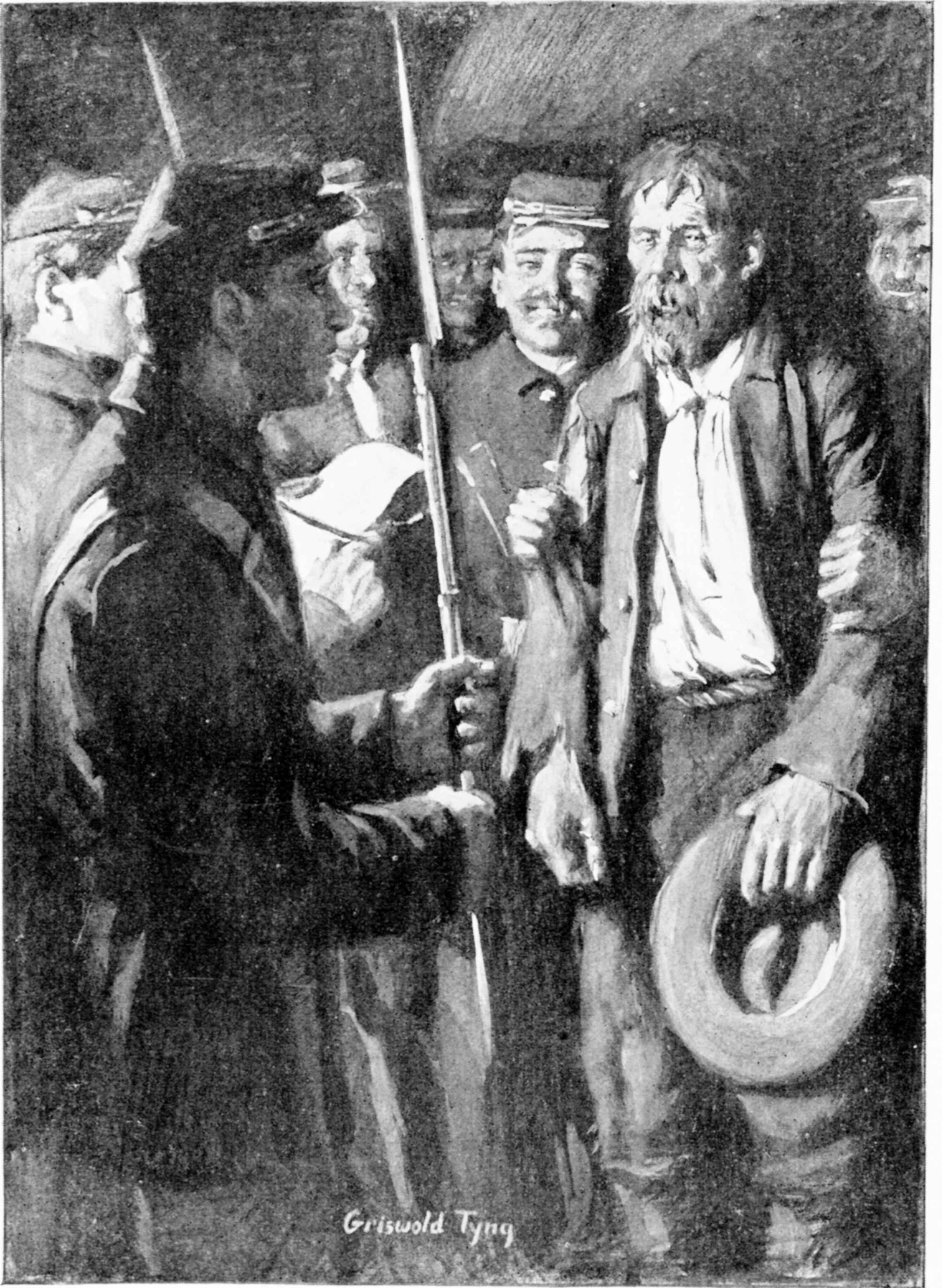
Louis gazed at the face, wondering if he had not seen the man before.—Page 221.
“Your name?” was the first question put to the stranger.
“My name?” answered the prisoner, slowly. “Er—Tom Johnson.”
“Brother to General Johnson, I suppose?” sneered the corporal, satisfied the man was not telling the truth.
“No, sir; I ain’t no relation to that measly rebel.”
“Well, Johnson, where do you belong?”
“Belong to the Second Maryland Volunteers, Company B.”
“Captain’s name, please?”
“Captain—er Thompson.”
“First cousin to Johnson, I suppose?”
“No, sir; no relation.”
[Pg 222]
“That’s too bad. When did you leave your regiment?”
“Right after leaving Fortress Monroe. I wanted to call on an uncle of mine living up around yere, an’ the cap’n let me go.”
“Why did you try to crawl through the lines?”
“Didn’t have no countersign.”
“What was the countersign the day you left?”
“It was—” the prisoner pretended to think. “Hang the luck! I’ve forgot wot it wuz, corporal, upon my honah.”
“When you were off did you see anything of the rebels?”
“Not much, I didn’t. I give ’em the biggest go-by I could.”
“Supposing we search you? Have you any objections?”
“’Tain’t gentlemanly, corporal.”
“Oh, yes, it is; under certain circumstances.”
“But I’ve gin yer my name an’ regiment,” pleaded the prisoner, who seemed to be alarmed over the possibility of a search. “Yer might ez well let me find my quarters.”
[Pg 223]
“You’ve put your foot into it, my man. The regiment you mentioned is not with us, but is stationed somewhere up in Maryland, in the vicinity of Baltimore.”
At this announcement the lower jaw of the prisoner dropped visibly, and he forgot to go on with the chewing process.
“Well—er—we cum down—our company, I mean,” he stammered. “It was a mistake, but our company is yere—I’ll take my oath to that.”
“I’ll give you the benefit of the doubt—after I’ve searched you. Stivers, take off his coat and vest and make him remove his boots. Number Seven, what is it?”
“Can I speak to the prisoner, sir?” asked Louis, who felt he was on the verge of a discovery. “I think I know him and can make him reveal himself,” he added, in a whisper.
“Go ahead,” answered the corporal, briefly. The other officers had been called away to general headquarters and he was, consequently, in sole charge.
“I want to ask you how you left Sam Jacks, and Hogwell, and the rest,” said Louis, aloud, and as he spoke he eyed the prisoner narrowly.
[Pg 224]
“By thunder!” was the ejaculation, and the man fell back a step. Then, by the light of the smoking lantern he surveyed Louis closer. “Ef it hain’t the chap we wuz arfter at Lee Run!” he continued, before considering his words.
“Exactly!” burst from the young soldier’s lips. “I thought I knew you. Corporal, he is a rebel, and worse.”
“What do you mean by worse?”
“He is a thief. He and a gang of others once robbed me of my watch and money. It was up near Deems, and I was trying to get through Maryland to my home in Pennsylvania. Before that I met some of the same crowd at Lee Run, and they tried to injure me there.”
“It ain’t so!” roared the prisoner. “I don’t know Sam Jacks, nor Hogwell, nor Ross, nor none of ’em.”
“You remember the names right enough,” returned Louis, coldly. “And you will note that you add Ross’s name, which I didn’t mention.” He turned to the corporal. “Ross was another of the crowd.”
[Pg 225]
“We’ll search him,” was the short answer. The work commenced at once. Slipped into one of the man’s boots was a slip of paper, which, on being unfolded, was found to be a Confederate pass, signed by General Longstreet. There was also another paper, which the corporal perused with even deeper interest.
“A spy!” he murmured. He turned to Louis. “Your name?”
“Louis Rockford, sir.”
The corporal made a note of it. Then Louis was sent back to his regiment, and the spy was taken to general headquarters. Here it was at last ascertained that his name was Caleb Fox. It was surmised that he had been sent over to learn whether the Unionists contemplated an attack, or if they thought of settling down to a siege. He would speak but little, and was placed under heavy guard until some of the higher officers could question him further.
“That’s a feather in your cap, Louis!” cried Harry, as they were eating breakfast the next morning. “You’ll hear from headquarters about it sooner or later, see if you don’t.”
“It’s odd that we should capture one of Sam Jacks’s crowd,” mused Louis. “Doesn’t it seem to prove that a good part of the rebels who were up around Manassas have moved down here?”
[Pg 226]
“If they ain’t down here now they will be pretty soon,” put in Moses Blackwell. “You can bet they won’t give up their main stronghold without the toughest kind of a struggle.”
“One thing is certain,” continued Harry. “This man won’t bother you any more.”
“Do you think they’ll shoot him?” said Louis, with a shudder.
“Of course they’ll shoot him. It’s the fate of any spy that is captured.”
“I shouldn’t like to have his blood on my head, Harry.”
“He brought his fate on himself, Louis—you had nothing to do with that. He knew just what to expect when he left the rebel breastworks in the rain and darkness and tried to worm his way over here. And more than that, the fact that he had his big pistol ready for use, shows he was prepared to sell his liberty dearly, if given half a chance. If you had advanced upon him openly and alone he would have shot you down and run for it, as sure as fate.”
[Pg 227]
That afternoon Louis was called up before the general of the corps, who questioned him closely. Then the prisoner was brought in, and Louis for the first time learned his name. As Louis went out, he passed close to Caleb Fox, who scowled at him viciously and whispered into his ear:
“You skunk! I’ll git squar—ef I live.”
[Pg 228]
To this Louis made no answer. But the words haunted his mind for a long time. The day was destined to come when he would remember them even more vividly.
ACROSS THE POTOMAC ONCE MORE
To go back to Andy at the time he was slowly recovering from a bullet wound in his shoulder, inflicted by a Union soldier at the time of his capture during the battle of Ball’s Bluff.
The pain had now left him entirely, and although he was still weak from what he had experienced, yet he was able to sit up, and that was a great comfort. Every warm day a chair was placed for him upon the piazza of the Lemming homestead and here he would read, or watch the river, or play checkers and dominoes with Viola Lemming.
[Pg 229]
So the golden Virginia summer passed. In the meantime Andy heard how the great army of the North was assembling at Washington, and of what that patriotic body was expected to do. But from home, from his parents, his company, or the rebel cause, he heard nothing.
The late autumn found him walking about the plantation. Viola Lemming often accompanied him. She noticed how strong he was getting.
“I presume you will want to leave us soon,” she said, with half a smile.
“I was thinking I would go away next week,” he answered. “I have ventured on your hospitality too long already.”
“You are welcome to stay as long as you please,” she returned, quickly. “You—you seem like one of the family.”
His thin face flushed with pleasure at this. “You are very, very kind—you and your mother and your little sister,” he said, taking her hand. “As long as I live I shall never forget you, and I do trust that some day I shall be able to repay you, at least in part.” And then he turned away as he saw how red in the face Viola became. The two young folks had grown to think a great deal of each other.
[Pg 230]
That night he told Mrs. Lemming of his intention. “I will not outstay my welcome, warm as it has been,” he said. “To-morrow you can notify the army authorities, if you will. As soon as they come for me, you will no longer be responsible for my keeping.”
“But they will put you in prison!” said Viola, shuddering. “I didn’t think of that when you spoke. I thought—” she did not finish.
“Did you think I would break my word of honor?” he questioned, seriously.
“No—but—but—Oh, to go to prison! It is horrible!” She tried to speak on, but the words stuck in her throat and she rushed from the room. Her mother was scarcely less affected.
“It is terrible, this change you think of making,” said Mrs. Lemming. “Better stay here, while you can. Perhaps the war will soon be over, and then you can cross the river to your folks.”
But he was obdurate. He did not intend to go to a Union prison if it could be avoided, but at the same time he would not break his word to them and get them into trouble with the army authorities.
[Pg 231]
That afternoon a slave carried a note from Mrs. Lemming to the nearest Union camp. In this she stated that the prisoner left at her house was now almost well and had desired to be turned over to the proper authorities. She added that he was not much more than a boy, and she trusted that the commandant would treat him with as little harshness as possible, and that if he could have him exchanged for a Union prisoner in the near future, she would consider it a special favor, for the prisoner had acted so gentlemanly during his illness that he had quite won her heart.
On receiving this note the captain in charge smiled grimly. “All woman’s bosh,” he muttered. “We’ll soon have the young rebel behind the bars and give him a taste of how Union men are treated in their own foul prisons.”
It was not yet sundown when he detailed a guard of three soldiers to bring Andy to the camp. The soldiers started off on foot, and having to tramp a distance of three miles over rather rough roads, reached Mrs. Lemming’s place an hour later.
“So this is the young rebel, eh,” said the sergeant in charge. “All right, we have a description of him on file. Come on.”
[Pg 232]
“In a moment,” answered Andy, and shook hands with Mrs. Lemming, Viola, and the younger girl. “Good-by, and remember, I shall never forget your kindness. You’ll have a little more ease, I fancy, now you are no longer responsible for my safe-keeping,” he added, with peculiar emphasis, which, however, no one but Viola noticed.
“I shall regret having you go,” answered Mrs. Lemming. Viola said nothing more just then, but turned and re-entered the house. In a second more Andy was off, with the sergeant ahead and a soldier upon each side of him.
“I guess you’ll remember the sweet time you had there when you’re in a regular prison,” remarked one of the soldiers, in an effort to twit the lad. “You won’t have no sech soft bits of calico to look after you, I’ll warrant you that!”
The end of the plantation grounds had hardly been reached when Viola came rushing along the path, calling to Andy to stop. He halted, turned and took several steps toward her.
“Here is a silk neckerchief for you,” she said, handing over the gift, and then she added in a whisper, while her face was crimson: “You are no longer responsible to us—the neckerchief contains a pistol—escape if you can!” Before the astonished young Confederate could reply, she was speeding back to the house.
[Pg 233]
Although nearly dumbfounded, Andy did not lose his wits. He turned his back to the soldiers, slipped the little silver-mounted weapon, which had belonged to Mrs. Lemming, into his bosom, and waved the silk cloth in the air. “Thank you, and good-bye for the last time!” he cried, and gave himself up once more, and the march forward proceeded. One of the soldiers would have taken the neckerchief away from him, but the sergeant, though rough, was too fair-minded to allow anything of such a nature to take place.
On they went along a road bounded on one side by an open tobacco-field and on the other by a spare growth of wood, with here and there a patch of brush. Andy noted with satisfaction that it was growing dark rapidly and that the timber was between himself and the river.
[Pg 234]
He understood thoroughly what a risk he would run in trying to escape—that his captors would first try to catch him, and failing in this, would do their best to shoot him down. But, on the other hand, what was he to expect? A journey to a Northern prison, where perhaps he would be made to pass months, and it might be years, in some loathsome cell, crowded in with others, poorly fed, and made to suffer all sorts of indignities. He imagined things worse than they were, but the effect upon his actions was the same as though it were all true.
A mile had been covered, when they reached a bend in the road, which now turned away from the Potomac. Here stood a deserted farmhouse, set in a wilderness of pear-trees.
“Great smoke, look!” yelled Andy, shoving the soldiers away from him and pointing towards the house. “Look out, they are going to shoot us! Look out!” And with a quick dash he gained the side of the highway and leaped the worm-fence. As was natural, all three of the Union soldiers ducked their heads and strove in vain to ascertain what Andy meant. By the time they had recovered and comprehended the trick that had been played, the young Confederate was out of sight behind the trees.
[Pg 235]
“Fools! After him!” shrieked the sergeant, and clambered over the fence as rapidly as his somewhat dumpy form would permit. At the same time one of the soldiers, seeing a quiver among the trees, fired, but the bullet did not touch Andy. In a moment more all three of the Union soldiers were in full pursuit.
In the meantime, the young Confederate was making his way through the tangled undergrowth and over jagged rocks and exposed tree-roots with all the speed at his command. There was no mistaking the location of the river, for the whole neighborhood sloped in that direction, so all he had to do was to keep on going downhill until the water was gained.
It was perilous moving, too, for the undergrowth was thick with briar bushes, which scratched his face and his hands, and caught his clothing so tightly that often it was impossible to move until the offending branch had been torn completely from its bush.
“I’m bound to get away somehow,” he muttered, as he flung aside a briar which left a scratch from nose to ear. “There is one consolation, they are all larger than me, especially that sergeant, and traveling down here will be just that much more difficult for them. If only they don’t send word along the river front to watch out for me.”
[Pg 236]
The last thought gave him a chill. But he did not waste time upon it. He heard his pursuers crashing along, a hundred feet behind him. They seemed to be getting closer, or else it was only his imagination. Coming to a clear spot, he crossed it like a deer chased by dogs and hunters.
Bang! bang! He was seen, and the sergeant and one of the privates had fired. He felt one bullet clip his shoulder, directly over the spot where he had been wounded before. It was agony to think of this. What if he had to suffer the awful pain of being shot again? He was almost tempted to give up.
But before he could reach such a conclusion he was safe among the trees again. He was now descending into a hollow, thick with undergrowth, and here it was as dark as though the time was midnight instead of eight o’clock of a summer evening.
At the bottom of the hollow he paused, and at a spring that was handy, procured a drink. On the opposite side of the hollow was another clearing. Should he attempt to cross it at once, or wait until a more favorable opportunity presented itself? While he pondered the situation, the voices of the three soldiers broke upon his ear.
“See anything of him, sergeant?”
[Pg 237]
“No, Fosdick, do you?”
“Nary a hair.”
“How about it, Cramer?”
“He came down into the hollow, I’m sure of it,” replied the third soldier. “But I guess he’s up the other side now.”
“We’ll go around and see.”
The trio moved off, one to one side, the remaining two to the other. Andy, fairly holding his breath, crouched low behind a bush overhanging the spring. What if they should surround him and call upon him to give himself up.
“I’ll sell my life as dearly as I can,” he thought, and drew forth the silver-mounted pistol Viola Lemming had given him. It was a six-barrelled affair, in those days something quite up to date, and every barrel was loaded. With great caution he raised the hammer.
An anxious ten minutes passed. The men had gone beyond sight and hearing, and he was beginning to think they would not return, when he again heard the voice of the sergeant.
[Pg 238]
“Fosdick! Cramer! Where are you?” was the cry. “Confound the luck, where can that young fellow be? I’ll take a look into the hollow on my own account.” And the sergeant began to descend.
He was almost upon the young Confederate when Andy thought it time to act. Leaping to his feet with marvelous swiftness, he thrust his pistol into the sergeant’s face.
“Throw down your gun, quick!” he commanded, in a whisper. “Down—or I fire!”
The words and the flash of the silver-mounted pistol took the Union soldier by surprise and he started back with lowered gun. Then Andy sprang upon him, and with a shove and a twist of the foot sent the dumpy figure headfirst into the spring.
“Wough!” came in a splutter from the sergeant, but the youth did not hear him. With nimble steps he made his way up the hollow’s side, and once more began the race for the river bank.
[Pg 239]
Andy now felt that he must be alert for the enemy in front as well as behind, for the two soldiers not having come back, must have gone forward. He strained his eyes to their utmost and clutched his pistol tighter. A half-articulated prayer for deliverance arose to his lips. Oh, if only he could get safely into Virginia again!
Presently a welcome sound broke upon his ears. It was the murmur of the swollen river, as it rushed over the rocks in the shallows and made a bend southward. Soon he parted the final line of brush and saw the dancing water before him. Catching the hammer of the pistol in his hat, so as to hold the weapon dry, he jammed the headgear down tightly and waded into the stream.
He advanced with extreme caution, knowing how treacherous the Potomac is at certain times of the year, and aware that the whole northern side was picketed by Union soldiers, while the southern shore was guarded by men of his own stamp. To be shot by one or the other of the military guards would be equally unpleasant and, perhaps, equally fatal.
[Pg 240]
“If I only had some way of letting our men know that I am all right,” he thought, as he paused when about one-fourth of the stream had been passed. He knew they could not see his uniform in the gloom, and, having lost his cavalry hat, he was now wearing one which had formerly belonged to Mr. Lemming, and which Mrs. Lemming had kindly given him.
A few steps farther and he suddenly went down almost to his armpits. The current now took him off his feet and sent a shiver over him. He felt very cold, and realized that he was not yet half as strong as he had imagined. But turning back was out of the question, and he struck out boldly for the opposite bank, a distance of over a hundred and fifty feet.
The middle of the stream had been gained and he was congratulating himself on the fine progress made, when suddenly a challenge rang out from a point some distance below him.
“Hullo, there, in the river! Who are you?”
“A friend!” cried Andy, but instead of halting, he swam on faster than ever.
“If you are a friend, turn in here and give the countersign.”
“I can’t turn in—I’m bound for the other shore,” answered Andy, but the last words were so low the picket did not hear them—nor did the young Confederate intend that he should.
“Can’t turn in?” queried the guard. “Yes, you can. Come now, or I’ll fire.”
[Pg 241]
“Don’t fire!” yelled back Andy, and then having swam a few more strokes he clutched his pistol and dove out of sight.
He was none too soon, for feeling he was being duped, the Union picket brought his gun into range and pulled the trigger. From under the surface of the stream Andy heard a muffled report, but the bullet passed wide of its mark.
The young Confederate remained under as long as possible, at the same time reaching out with desperate efforts for the southern shore. He felt himself carried downward by the current and this in itself tended to bring him closer to the picket than ever. At last, unable to hold his breath a second longer, he came up and gave a gasp.
The firing of the gun had aroused the picket line for several hundreds of feet up and down the river and on both sides. A rush was made on the Union side, and the picket was asked to explain matters, which he did as well as he could.
“We’ll have him yet,” cried the officer in command. “Bring out the flatboat, Carriwell, quick!”
[Pg 242]
His order was obeyed, and the officer and two men entered. But all this had taken time and now Andy was once more where he could touch bottom. He looked back and saw the boat put out.
“Save me, brother Confederates!” he cried. “Save me! Shoot the Yankees!”
“We will!” came an answer from almost in front of him, and then two guns spoke up spitefully. A groan came from the flatboat, which was immediately turned back. The pursuit was over. Several shots were fired, but in the gloom they went wild, and then the shooting came to an end.
Not until it was all over did Andy fully realize what a tremendous strain he had been under. He waded out of the water and up the muddy bank, to find himself confronted by half a dozen anxious men in gray.
“What does this mean? Who are you?” demanded one of the number.
“I am a Confederate, like yourselves. I have been a prisoner and I just escaped,” answered Andy. “My name is Andy Arlington, and I belong to the Montgomery Grays, cavalry, of Lee Run. If some of you will help—”
[Pg 243]
He could get no further. Everything danced before his eyes, trees, soldiers, and guns, and he fell back into a pair of outstretched arms, utterly exhausted.
[Pg 244]
“A brave youngster, I’ll wager a fortune,” was the comment of the Confederate who held him. “Come, men, let us take him to camp and do the best we can for him.”
ANDY GOES TO YORKTOWN
When Andy came to his senses, he found himself lying on a cot in a farmhouse, quarter of a mile from where he had crossed the Potomac. The farmhouse was being used as a rebel headquarters, and half a dozen Confederate officers were present, making out various reports and attending to other duties of a military nature.
As soon as he felt strong enough, he told his story in detail, to which those present listened with lively interest. An officer knew of the advance to Ball’s Bluff of the Montgomery Grays and what the youth had to say was readily believed.
[Pg 245]
“I suppose you would like to go home as soon as possible,” said one of the officers. “We are going to send some army wagons southward to-morrow, and one of them can go down by the Lee Run road and you can ride with the teamster, if you wish.”
Andy gladly accepted the offer, and six o’clock in the morning found him homeward bound at the rate of four miles an hour, for the canvas-covered vehicle was loaded to the ash bows and the recent rains had rendered the roads almost impassable. Ordinarily the time would have dragged heavily, but the teamster was a jolly fellow, full of jokes and war stories, and he made Andy forget his troubles in spite of himself. They had their army rations with them and only stopped long enough to feed the horses. The teamster intimated several times that they might stop at a roadhouse, “to become better acquainted,” but as neither he nor Andy had money to spend this was not done.
Andy’s heart beat quickly as they approached the familiar surroundings of Lee Run. What a long while it seemed since he had gone away! He wondered how his father and the rest of the family were.
[Pg 246]
“Andy, my son! God be praised!” came from the stoop of the country store, and the next minute the young soldier was in his mother’s arms, while Grace was bobbing around, this side and that, looking for a chance to get at him.
“You have been shot and a prisoner!” gasped Grace. “Oh, Andy!”
“We thought you had been killed,” said the mother, with her eyes full of tears. “Captain Montgomery sent us word of how you had gone over the bluff while on horseback, and when Firefly came back alone—”
“Firefly!” burst out Andy, his face beaming more brightly than ever. “Is he really back?”
“Why, yes, he came back the next day. A man caught him who knew him and turned him over to Captain Montgomery. He is at home in the stable now.”
“I’m awfully glad, mother. I was afraid I would never see the dear old fellow again. And how is father?”
“As well as he can be expected. The war has upset him completely, and he cannot settle down to work as he used to do. But how pale and thin you are!”
[Pg 247]
“He’s only a ghost of himself,” added Grace. “But never mind, Andy,” she went on, warmly, “we’ll fatten you up again, and make you strong, and I’m proud to know what a hero I have for a brother!” and then he gave her such a hug and a kiss as only Andy could give—he was so whole-souled in everything he did.
Mrs. Arlington and Grace had been down to the store to do some trading and to hear the latest news from the seat of war. Around Washington, as we know, all was quiet, but in the west, especially in Missouri, matters were getting livelier every day. The news from this district did not arrive until three or four days old, there being no telegraph lines in use south of Cairo, but when it did come, how eagerly every line was perused, and what a running fire of comment ensued!
Soon the three were on their way to the dairy farm. As the old horse jogged along over the stony road, Andy related the particulars of his experience at Ball’s Bluff.
“I don’t mind telling you that I was scared,” he said to mother and sister, frankly, “but I wouldn’t have let the enemy know that for the world!”
[Pg 248]
“You’re your father over again,” said Mrs. Arlington, with a smile. “He was captured by the Mexicans at the time he was wounded, and they took off his leg very roughly, but he never winced—so some other soldiers told me.”
“Oh, I hope Andy never loses a leg,” cried Grace.
“If I do I’ll try to be as heroic as father was,” said the youth, gravely.
Mr. Arlington was as well pleased as the others had been to see his son once more. “I was afraid you had been shot and your body had drifted down into Chesapeake Bay,” he said, as he took both of Andy’s hands. “Tell me all about it,” and again the tale was told, the others as eager to hear as though not a word had been said before.
Christmas came and went and by that time Andy felt as well and strong as ever. Sometimes, when the weather was particularly raw, the place where the bullet wound had left a scar hurt him, “itched,” he said—a feeling plenty of veterans know only too well. But he never complained, being fearful it might hinder him from going to the front again.
[Pg 249]
In the meantime he had written to Captain Montgomery. The Grays were in winter quarters several miles back of the bank of the Potomac, and an equal distance south of Alexandria. To join them at this time would have been useless, and Andy received word that he might stay home and “get braced up” until the army moved again in the spring.
Now that he felt able to do so, the youth worked around the dairy as before, superintending the women and men and giving his father a much-needed holiday. But Andy’s heart was not in the task—it was with the Grays. He was impatient to rejoin them.
“A letter fo’ you, Massa Andrew,” said one of the slaves, one day in the spring.
Andy took the communication quickly. It was from the army, as the stamp in the corner of the envelope showed. He tore it open hastily, then rushed off to find his folks.
[Pg 250]
“I’ve got an order to join our cavalry at once! The Federals are getting ready for a move from Washington!” he cried, and then followed two hours of hustling, as he arranged his clothing, packed his saddlebags and had Firefly groomed his very best. The horse seemed to understand the order, too, for his brown eyes brightened and he snorted in approval.
“Take care of yourself, my boy,” said the fond mother. “Write as often as you can,” added the father. “Don’t let the Yankees catch you again,” chimed in Grace, and then all kissed him affectionately and followed him out on the verandah. Soon he was in the saddle, and with a last wave of the hand he galloped off and was lost to view among the trees.
The day was bright and warm. Andy was in the finest of spirits, so was Firefly, and mile after mile was paced off in the charger’s best style. At noon Andy stopped at a little tavern at a cross-roads for dinner, and here two other cavalrymen joined him, neither belonging to the Grays, but both bound southward. For the rest of the day the trio remained together, and this made the journey even more pleasant than before.
“The Yankees are going to give us a shake-up at Richmond, to my way of thinking,” said one of the cavalrymen. “I received a letter from a friend who lives down there last week, and he says the authorities are certain that Yankee spies are around sizing up the defenses.”
[Pg 251]
“Well, I reckon we have spies in Washington, too,” said Andy, and in this he was right. Long afterwards it was found that a spy occupying a confidential government position had given to the Confederates the first intimation that the Army of the Potomac was about leaving for an attack upon Richmond by way of the peninsula. It was such spy work which gave the Confederates time to throw up their defenses at Yorktown and elsewhere and thus hold General McClellan’s forces in check until further re-enforcements for the Confederate Capital could arrive.
“They won’t gain a thing by another attack out here,” put in the second cavalryman. “Why, companies of soldiers and bands of cavalry are springing up like mushrooms. We’re bound to wipe ’em out by mere force of numbers.”
“That may be true—just now,” returned Andy, seriously. “But what worries me is, sooner or later, they’ll be able to put more men in the field than ourselves. Why, the northern States have four times as many citizens as we have.”
[Pg 252]
“Yes, but they won’t fight like our boys will, Arlington. We are fighting not only for State rights but for our homes. A man can stay at home and fight for it better than he can go off and fight.”
“Another thing to remember,” added the other horseman. “They are blockading our ports so that we can’t send our cotton to the foreign countries that want it. It won’t be long before these foreign countries begin to kick, and if we put up our cotton they’ll furnish us with both money and men to show the Yankees their places. Cotton is king in America, and don’t you forget it.”
And so the talk went on. The remark about cotton was one heard everywhere, having even been mentioned in Congress before the Southern representatives and senators took leave of the Capitol. Cotton and tobacco did play a prominent part in the war, but they were not as powerful as some of the Confederate leaders imagined.
[Pg 253]
On the third day of his journey, Andy reached Camp Lee, as the spot where the Grays had gone into quarters was designated, out of honor to the illustrious line of Lees that have ever been prominent in Virginia chronicles from Revolutionary days on. The first person to rush up and shake him by the hand was Leroy Wellington, and Captain Montgomery and a dozen others followed.
“By jinks! but I thought you were done for when I saw you fall into the Potomac and float down to Harrison Island!” exclaimed Leroy. “You are a sight for sore eyes!” and he fairly hugged his friend. Andy had to tell his story twice, once to the officers and again to the mess he had joined.
The winter quarters of the Grays had been close to the shelter of a belt of timber land. Here the cavalrymen had built up houses of logs and mud, covered over in many cases with bits of canvas and whatever of boards came handy. The floors were strewn with pine brush, some brush, covered with rubber cloths, serving also for beds. Some of the houses had little ovens built of sun-dried bricks, and two had sheet-iron wood stoves. All told, the boys in gray had passed a fairly comfortable winter.
[Pg 254]
“The worst part was when we went out with the pickets,” said Leroy. “That week was a corker, and I was detailed up at the top of yonder hill, to carry the news back in case there was an alarm. It rained and snowed nearly all the time, and one night I was nearly blown away, and an old tree came down within ten yards of me and the horse. That was a close call, I can tell you, and I didn’t get over it for hours. You can thank your stars and bars you were at home in a warm bed.”
The orders to move came that night, at nine o’clock. “Roll call at five o’clock, boys; half an hour for breakfast, and the column moves at six sharp. Heavy marching orders. We are not coming back, but the general’s order is not to carry any more than necessary.”
“Heavy marching order, but don’t carry more than what is necessary,” mused Andy. “That looks as if we were going to get along as fast as possible. Where are we going, Bosdell?”
“Don’t know, but I heard something said about crossing the Rappahannock. My opinion is the Yankees are going to leave Washington by boat and land at Urbanna, and then try to march overland to Richmond.”
“We can get to Urbanna in one day, if we ride hard,” said Leroy. “But can enough of our troops get there?”
[Pg 255]
“We might stop them at the York River,” said Andy, “that is, if we could hurry and steal a march around their right flank.”
History has shown how near Bosdell’s guess was to being right. One of the first plans of the campaign was to land at Urbanna, situated some fifty miles above Fortress Monroe, but delays and military operations in the interior of Virginia made a change necessary, and the Union forces went down to the end of the peninsula, as previously described.
[Pg 256]
By five o’clock in the morning the camp was astir. The cavalrymen were having their horses and trappings looked after, the artillerymen were testing wheels, carriages, and harnesses, everybody was packing knapsacks and saddlebags and rolling up blankets. The day was foggy and cold, more than half the soldiers were out of humor, and grumblings were frequent. It was, “Where’s that strap?” “Who took my cake of soap?” “Did you see anything of my gun?” “Have I got to leave this folding chair behind, or can I tote it along?” “Have we got to move before the mail comes in?” Then came the call to fall in for breakfast; hot coffee, really fresh bread, and some fresh meat and beans were served out, and everyone felt better. It was the best meal Andy saw for many a weary day. The news had spread throughout the district that the “sodgers” were to move, and crowds came down to see them off, many bringing with them some dainties, in the shape of chicken, jam, hoecakes, and the like.
Promptly at six o’clock the bugles sounded, and the head of the column moved off. First came the advance guard, then the pioneers—men with heavy axes to clear the way—then a detachment of cavalry, and then the regular troops. After the troops and artillery came a small detachment of cavalry, detailed to “whip up” the stragglers, who, if they would not obey orders to “march on, and get where you belong,” were pitched into one of the guard wagons which followed for such purposes. Last of all came the wagon train, covered by another band of cavalry and by a small battery. On each side of this long column moved a line of skirmishers, keeping from two to five hundred feet from the road, to prevent any possible surprise from the right or the left, although, just then, no surprise was anticipated.
[Pg 257]
By a quarter to seven the Montgomery Grays fell into their proper place, and then ensued a long march lasting until nightfall, with half an hour’s rest at one o’clock for dinner. Three days’ rations had been served out to be eaten directly from the knapsack, with possibly a chance to kindle a brush fire and heat some coffee. The food was hardtack, coffee, pork and beans, nothing else. Regular army fare had again begun.
On the following day, in the middle of the afternoon, it began to rain. At first many thought it would be but a shower, but by the time a camp was selected, it was pouring down in torrents. The Grays found themselves booked for an eighth section of an open field, a portion of which had already been ploughed for spring planting.
“Here’s a picnic!” grumbled Leroy, as he dismounted, to find himself in water several inches deep. “How under the sun are we to pitch tents out here?”
[Pg 258]
“We are not going to do it under the sun, Leroy; we’re going to do it under the dripping clouds. Come on, pitch in. Ask Groman for a spade and we’ll soon have a trench dug in which the water can run off.”
Leroy went off, and Andy took charge of his horse. By the time he had seen that animal and Firefly cared for, Leroy was back and digging a trench about six inches deep. He cut it in the form of a square just a trifle larger than what the tent would cover. The others of the mess had gone foraging for tent poles. These were easily procured, and fifteen minutes later the canvas was up. It shed the rain into the trenches, and soon the water inside also found its way down into the hollow, and then the ground became fairly dry. But a night there, even with a rubber cloth and blankets, was far from home-like, and many a poor chap caught his death of cold. Andy was glad when morning came and the sun shone brightly through the flying clouds.
[Pg 259]
Four days later found the Montgomery Grays detached from the main body of the troops and on their way to Yorktown. Everything was bustle and excitement, and the youth felt that something was up. Soon the news came that the Union troops had landed at Fortress Monroe and were on their way up the peninsula. By the time Yorktown was reached the Confederates there had already thrown up a long line of breastworks which practically extended across the whole peninsula.
On the second day in camp on the outskirts of Yorktown, Captain Montgomery came to Andy with a folded paper.
“Arlington, here is an order I wish carried to General Magruder or his representative in the field. The orderlies are all away on other business. You will find Magruder’s command somewhere near Lee’s Mill. Make the most of your time,” and off Captain Montgomery dashed again.
[Pg 260]
Without losing a moment Andy placed the folded paper in his pocket and urged Firefly down the muddy road leading along the rear line of the Confederate forces. His progress was soon barred by a breakdown on the highway and he was compelled to make a détour through a woods. Thinking sooner to gain the point he was seeking, he kept on along the woods until he reached a small clearing, not far from the Warwick River and at a point known as Garrow’s Chimneys, because of three tall, burnt-out chimneys standing there. Just below him were located a long line of rifle pits belonging to the Confederate troops.
As he approached the spot, half a dozen rifle shots sounded out from the river, and then came the sudden booming of a cannon.
“The Yankees are fording the river!” was the cry. “They are just below Dam No. 1. They are going to break through the line if they can! We’re going to have hot work now!”
[Pg 261]
The remainder of the talk was cut short by a volley from the Warwick. The Union troops were coming true enough. Unable to restrain his curiosity, Andy rode forward to where a slight hill overlooked the stream. Hardly had he shown himself, when spat! a minie ball hit the tree beside him and clipped off a bit of bark. The young Confederate lost no time in returning to cover.
THE EVACUATION OF YORKTOWN
Having found the enemy strongly entrenched at, or rather before, Yorktown, General McClellan determined to lay siege to the place, and in the meantime endeavor to obtain more troops, so that when the proper time arrived he could make a grand assault all along the line, drive the enemy from its position and perhaps scatter it and thus open an easy way to Richmond. It was at one time thought that the great battle of the peninsula campaign would be fought here, but affairs proved otherwise.
[Pg 262]
But the Union soldiers did not lie quietly on their arms. Skirmishes took place almost daily, first at one spot and then at another, and presently General William F. Smith was ordered by McClellan to “feel” the enemy at Garrow’s Chimneys, which was directly opposite to the Confederate reserve force under General Smith. A Vermont regiment made the attack, and soon silenced the Confederate battery, and the officers in command made an extensive examination of the ground, which, however, later on proved valueless, for the information was not used. It was this skirmish which Andy witnessed. In the excitement he almost forgot about the order he was carrying, and when it was delivered and he returned to camp he was roundly censured for his neglect.
“Never delay while on military duty, my lad,” said Captain Montgomery. “A delay may prove fatal to the best laid plan.” Andy never forgot those words.
The young Confederate wondered during the days which followed if Louis was within the lines of the enemy. He would have been somewhat surprised had he known that his former chum was less than a mile away; yet such was the fact, and it was not to be long ere the two should meet again, and under very trying circumstances to each.
[Pg 263]
Louis’s time at the picket line had expired, the regiment to which the Goreville Volunteers belonged had given place to another, and now the boys were back in their regular quarters, on the edge of a dense woods. Louis had tried to learn what had become of Caleb Fox, the spy, but not a word could be gotten out of those in command. The answer to this was very simple, although the boy could not guess it. Caleb Fox had escaped.
The Confederate spy had taken a desperate chance, considered in one way, although not so desperate when considered in another. He had taken his life in his hands by stabbing one guard in the breast with an eating knife and hitting another with a rock, and he had been fired at four times before he could gain the shelter of a woods. But all this was done with the knowledge that if he did not get away he would sooner or later be hanged for a spy.
“Might ez well die now ez later,” was the way he had argued, and had sped as never before. Once in the woods he drew a deep sigh of relief. They were thick and dark and would afford him ample shelter until an extra black night would make it fairly easy to regain the Confederate lines. He made up his mind that no picket should spot him again.
[Pg 264]
“An’ ez fer that boy ez collared me before, let him look out fer himself, thet’s all!” he fairly hissed, between his snaggy, yellow teeth. He was not likely to forget Louis.
The weather now was worse than had been expected. Nearly every other day it rained, and the camp was something fearful to contemplate, cut up as it was by the feet of thousands of soldiers and hundreds of horses. Louis and his mess had carpeted their tent with brush thickly matted together and filled in with chips, but still it was damp and unwholesome. The hospital tent soon overflowed with typhus and typhoid fever cases. The siege was doing more harm by sickness than it was by bullet and shell.
“Your turn to gather firewood,” announced Moses Blackwell one afternoon, after inspection drill. “Get a good supply, Louis, and we’ll try to dry the air in the tent somehow.”
“I’ll get all I can bundle and carry,” answered the young soldier, and started off, axe and strap in hand. All the small brush had been cut down long before, and not wishing to tackle a big tree he had to walk a good way into the timber before he reached something of the size he had in mind to cut down.
[Pg 265]
He was just about to start work near the edge of a ravine when the sounds of two voices broke upon his ear. He listened intently.
“What’s the news, Yank?”
“Ain’t much, Reb. What’s the news your way?”
“General Johnson has just come down with a hundred thousand men to wipe you out.”
“A hundred thousand, eh? Any of the little boys left to hum to mind the baby?”
“It’s a fact. What’s Little Mac doing, going to sleep?”
“No, he’s thinking where he’s going to bury you rebs when the next fight is over.”
Then came a brief silence. Louis had listened to the talk with a smile. He knew the pickets on both sides sometimes became friendly and arranged not to shoot at each other. Sometimes they even made an exchange of some kind. Soon the talk was resumed.
“Grayback, got any terbacker?”
“A half plug.”
“What will you take for it?”
“What will yer give?”
“A canteen of fresh coffee.”
[Pg 266]
“I’ll take yer up, ’though I know the coffee’s more’n half chicory.”
“Better coffee nor you’ll ever git over there, Grayback.”
A rustle through the brush and grass followed, and peering forth from the trees Louis saw the Union and the Confederate soldiers meet in the hollow and exchange goods. Then each hurried back to his post. A second later the Confederate sang out:
“Corporal’s coming, Yank; look out fer yourself,” meaning that the truce was, for the time being, at an end, and that shooting on sight was now the order of the day. After that both pickets remained securely hidden.
Louis was particularly fortunate in getting some dry brushwood, and that night the boys of the mess sat around the camp fire in a more comfortable frame of mind than usual.
“Mail! Letters!” was the cry, at a late hour. The sacks had come in by way of Fortress Monroe, and soon Louis had two letters from home, both of which he perused eagerly. He learned that his father was better and around as usual. Agents of the government had called, trying to buy beef, but, so far, none of the cows had been sold.
[Pg 267]
“I have had one thing to worry me considerably,” wrote Mr. Rockford. “If you will remember, when I purchased this place, a party named Faily had an interest in it. There has appeared a man named Samuel Hammer who now claims that the Faily interest was really his—that Faily sold out to him. This Hammer threatens to make trouble for me unless I buy him off. I am now doing my best to locate Theodore Faily, to get him to explain, or make a settlement which will clear me, but so far I can get no trace of him. One man told me Faily had moved south, but could not say where to. Hammer wants me to pay him three thousand dollars. If I have to do that in these times it will almost ruin me.”
Louis was very sober after reading this communication. He could well understand how worried the folks at home must be. He drew a long sigh as he put the letter away.
[Pg 268]
“Poor father!” he murmured. “I hope he finds Theodore Faily and gets the matter straightened out without further trouble. Three thousand dollars would be a terribly big sum to pay out in these war times. I suppose they are all about worried to death over this.” That very night before retiring, he wrote a long letter in return, telling of the various things that had happened to him.
The next day was Sunday, cloudy but without rain. The day was kept, as nearly as possible, as a day of rest. At ten in the morning came inspection drill, when the regimental commanders inspected the arms and accoutrements. The drill over, the chaplain held divine service, which all the Goreville Volunteers attended as regularly as they could. Then came a late dinner, after which the men did as they pleased. Some would talk and walk around, some sat and read, and others would mend their clothing. Some would try to play cards, but this was frowned down. There was also a good deal less of drinking on the Lord’s day than on any other.
This Sunday turned off cold towards night, and Louis was glad enough when tattoo sounded that he was not out on picket duty, but could go to sleep in his tent, close to the blazing fire.
“A dent don’t vos so goot as a house,” was the way in which Hans Roddmann expressed himself, “but it vos besser as noddings den dimes ofer!”
[Pg 269]
“I think they might put up some sheds, at least,” grumbled Jerry Rowe, “seeing as how we seem to be booked to stay here all summer.”
“You’d like carpet on the floor, too, wouldn’t you, Jerry?” laughed Callings. “Never mind—we won’t stay here long, mark my word.”
Callings was right, they were not to stay there much longer. General McClellan had laid his plans for the siege too well. Every battery was in position, the line of defense or attack perfect, and there must come a “break” ere long.
It did come, but so silently that the Union troops did not know of it until some time later. Knowing the strength of the enemy, and having kept him at bay for exactly a month, and thus given themselves time to be handsomely re-enforced in the neighborhood of Richmond, the Confederate forces abandoned Yorktown and drew back up the peninsula through Williamsburg.
[Pg 270]
It was on Sunday, May 4th, 1862, that General McClellan and his vast army entered Yorktown and planted the Stars and Stripes upon every breastwork and upon every public building. Bands of music played and cheer after cheer rent the air. But not for long. The Confederates must be pursued, they must not be allowed to escape so easily. At once all of the cavalry and horse artillery were sent in pursuit. It was learned that the Confederates had from six to ten hours’ start of their eager pursuers.
“They’re whipped! they’re whipped!” yelled Jerry Rowe, as he marched into Yorktown with the others of the volunteers. “I knew they wouldn’t dare to show fight.”
“Look out, there comes a rebel!” shouted Moses Blackwell, in seeming earnestness. He took a hasty step aside, and Jerry ran like mad for the nearest cover. A laugh went up, and the bragging youth did not appear again until the regiment got orders to start for Williamsburg on the double-quick.
[Pg 271]
As usual it was wet—foggy one hour and raining the next, far from an ideal battle day—but this was not ideal, this was real, and so thought Louis as they plunged along over the road swimming in mud—a peculiar, sticky soil, which at times clung to one’s feet like so much glue. The artillery that had gone on ahead was having a fearful time, with horses up to their bodies in the road, cannon nearly out of sight, and teamsters frantic, yelling, cursing, whipping, and then falling back in dumb despair, until extra horses came up to pull all out of the rut. It was as if “the bottom had dropped out of everything,” as Harry Bingham put it.
“One consolation, though,” said Nathan Hornsby. “The rebs ain’t got no better road.”
“They are ploughing it up for us to wade through,” grumbled Blackwell. “Hang me if I don’t hope we have an engagement soon.”
His wish was fulfilled. The Confederates had gone on to where the road from Yorktown joined another running from Lee’s Mill. Here at the fork they had erected a bastioned earth-work, flanked north and south by redoubts, running to the swamps on each side of the dry (or rather, supposed to be dry) ground. A large force was collected behind this shelter, and the cavalry in advance of the Union infantry received a severe fire, which reached plainly to the ears of the Goreville Volunteers.
“Hurrah! we’re going to have some warm work at last!” cried Harry Bingham.
[Pg 272]
It was General Smith’s division, with the gallant Hancock’s brigade in advance, which met the Confederates first, late in the afternoon. A charge was at once ordered, but the woods through which the soldiers sought to make their way was so thick but little progress could be made.
The Goreville Volunteers rested that night upon their arms, ready at a moment’s notice to jump into battle should the call come. But General Smith’s division having fallen back a short distance, also took it easy in the darkness, and all remained, for the time being, comparatively quiet. In the meantime, large reinforcements of the remaining Union troops arrived.
The following day the battle of Williamsburg started. The rain came down in a steady stream; it was so muddy and slippery men could scarcely stand upon their feet, as they moved forward, while only one battery in three could move at a time, so many extra horses being required for each piece. First shots were exchanged at half-past seven o’clock, and half an hour later the Goreville Volunteers moved forward in light marching order, each soldier furnished with forty rounds of ammunition.
[Pg 273]
Once more Louis’s heart beat fast. He felt he was going into a bloody contest, such as had been experienced at Bull Run. He gripped his gun tightly, and advanced with the others on the double-quick. They were forcing their way through a thick patch of brush, but now they came upon a small clearing. Directly opposite was a Confederate battery, backed up by one or two regiments of militia and a troop of cavalry.
“Boys, we must take that battery!” cried the general in charge, as he galloped along the line. “Forward now, and keep the line closed up!”
Scarcely had the order been given than the battery in question blazed forth, seemingly in their very faces. Every man dropped, and the aims of the gunners being unusually high, the grape and canister flew above them, clipping the brush off cleaner than it would have been cut by a monstrous scythe.
[Pg 274]
There was a yell—from Jerry Rowe, who felt sure he was hit—and then the company moved forward, each gun pointed straight ahead, the rain running in streams from the row of glistening bayonets. It was a strange, thrilling sight, as that solid mass of boys in blue came on. Nearer and nearer they swept, and now the battle cry rang out, growing louder and louder, a strong, determined cry, from men who meant to do or die.
Again the battery belched forth, and now the aim was true and half a score of soldiers went down, some dead, some dying, a few slightly wounded. For a second the terrific shock caused a pause. Then Jerry Rowe tried to take to his heels.
“Close up, boys, close up! Forward!” came the command, and the ranks of the regiment closed up the gaps made by those shot down, and again they moved forward on the double-quick. Jerry suddenly found himself running straight into the point of an extended sword.
“You coward, go forward!” came the command, and worse scared than ever, Jerry turned again, but took good care not to get anywhere near the front line.
[Pg 275]
Fearful of the onslaught, the Confederate battery now ceased its fire and allowed the cavalry and infantry to come forward. There was a thunder of hoofs in the wet grass and the Goreville Volunteers found themselves face to face with a band of cavalry numbering at least sixty men. One glance showed Louis that they were not the Montgomery Grays, then he felt a saber swish over his head and his cap was taken off and half cut in two. Bang! went his gun, and the man who had attacked him toppled over, shot in the sword arm.
The dash of the Confederate cavalry was a resolute one and for the minute it looked as if the Goreville Volunteers would be annihilated. But they stood firm, another regiment close by poured in their earnest fire upon the figures in the saddle, and slowly the Confederates were driven back, only, however, to make place for the long line of gray-coated infantry.
[Pg 276]
“Forward again!” shouted the Union general in command, and again they went on, within fifty feet of the guns they had set out to capture. The firing was incessant and the bullets whistled in every direction. Louis could scarcely stand and went down once on both knees in the mud, while Hornsby pitched over him on his own broad back. But both were up in a jiffy, before the Confederates around them could pin them down with their bayonets. The smoke of battle, added to the rain and mist, was speedily cutting off the view upon all sides, and the battery they had started to capture was no longer in view. Although they did not know it until some time later, the enemy had taken time by the forelock and removed it to a safer position.
The third charge of their regiment was the fiercest of all, and Louis was almost taken off his feet by the rush. He was caught between half a dozen struggling soldiers, some friends, some enemies, and tried in vain to get out of the scrimmage. Then a bayonet flashed before his face, the Union soldier just beside him was pierced through the shoulder, and the crowd opened and he ran forth to join the advancing line.
[Pg 277]
“Look out! Drop!” somebody shouted. Louis tried to obey. Before he could do so, a bellowing roar sounded just ahead, something rushed directly past his face, and he felt his breath leave his body. He tried to get back his wind, but it seemed impossible, and off he dashed wildly, like one choking, until, falling over a mass of brush, he went headlong, and for the time being knew no more.
AT THE BATTLE OF WILLIAMSBURG
All of the Confederates, upon withdrawing from Yorktown, did not go up the peninsula towards Richmond. Many of them took to the York River, and following this and the Pamunkey River, landed at White House, already a place of considerable importance to them, and fortified it for an attack.
Nor did all of the Union troops under General McClellan engage in the battle at Williamsburg. Many of the soldiers remained on the river, in transports, and these, afterwards sailing up the York, fought the battle of West Point, Virginia, and assisted in rendering White House the Union base of supplies.
[Pg 278]
Taken as a whole, the battle of Williamsburg was rather a mixed-up although stubbornly fought contest. Through a confusion of orders, nearly every general fought as he thought best. At the main road, Hooker’s division, aided by a few other troops, soon silenced the Confederate guns of Fort Magruder, and the impetuous General Kearney, coming to his aid when he was almost exhausted, made a glorious dash and secured the rifle pits, thus causing a retreat.
[Pg 279]
While this was going on, it was reported that another spot along the line of Confederate defenses seemed to be weak. The place was one called Cub Dam Creek, and General Hancock, with his own and additional troops, was sent forward to cross the stream and secure the strongholds on the other side. With Hancock was a Lieutenant Custer, the same who in later years became General Custer, the great Indian fighter of the West. There was nothing but a narrow bridge over the mill stream, but Custer led his band of soldiers over this, a foothold was secured under a most galling fire, and at last Hancock was able to report the stronghold taken. Soon after this he advanced again and was warmly received by the Confederate Generals Hill and Early. A hard fight followed, and Early and many other officers were wounded, and many soldiers were killed upon both sides. At first it looked as if the Southerners would be victorious, but at last they were forced to withdraw to a distance. Here they rested on their arms all night, during a cold, pitiless rain, which gave many a Union and Confederate soldier his death of sickness—a rain that increased the sufferings of the wounded tenfold.
But of all this Louis knew nothing. As he rushed away from the scene of carnage his mind was a total blank. He could not get his breath, everything was black before his eyes, and he felt as though the end of the world had come, so far as he was concerned. He felt himself go down in the wet, and there he lay, not unconscious, but unable to move, unable to think, with a roaring in his ears, a flash of lights before his eyes, and a pain in his lungs which no pen could describe. What had happened to him?
[Pg 280]
The answer is very simple. A cannon ball had rushed close past his mouth just at the second of time when his lungs were heaving out air. The vacuum thus caused had drawn forth more air than was healthful—in other words, had collapsed his breathing apparatus and left him almost powerless. If my young reader wants something of the sensation experienced by Louis let him blow out all the breath he can from his lungs and then stand without air for half a minute, or more—if he can.
Slowly and painfully he came to a realization of his condition. His head now ached as it had never ached before, and there was a pain like that of a cutting knife in his chest every time he drew his breath. With a groan he could not suppress he sat up and tried to look about him.
The effort was a failure. On all sides was darkness, while the rain, splashing down upon his bared head, formed a good-sized pool at his feet. He scooped up some of the water in the hollow of his hand and drank it.
“I don’t seem to be shot,” he thought, as he felt himself all over, “and yet what a queer sensation that was when the cannon went off! I believe it took away my wind, and that’s all.”
It was some time before he felt strong enough to stand up, and even then he was decidedly shaky. Slowly and painfully he limped to the shelter of a clump of trees.
[Pg 281]
A groan startled him. It was followed by another, and then another. He walked to the other side of the tree and saw three soldiers lying there, two Confederates and one Union man. All were badly wounded, and were huddling together in their misery.
The sight made Louis more downhearted than ever, especially as he could do but little for any of the trio. One of the Confederates asked to be propped up against a tree and Louis made him as comfortable as possible. The other simply glared wildly at the youth.
“Don’t yer tech me,” he growled, with a strong mountainous accent. “You-uns is responsible fer this—may the Old Nick himself burn yer all!” and he turned his begrimed and muddy face away, that his enemy might not see all he was suffering.
“If you’ll please bind up my head,” sighed the Union victim, a New Jersey boy who had been fighting under Kearney for hours. “A fellow clubbed me badly with his musket stock.” The head was bound up with two handkerchiefs tied together, and the New Jersey soldier said it was a great relief.
[Pg 282]
“If I can find any help I’ll try to get you to the hospital,” said Louis, as he moved away. “I’m suffering myself, but I’m not half as badly off as you three are.”
He had scarcely spoken when there came a flare of torches, and six rough-looking men burst into view from the brush back of the trees. At first Louis wondered who they were, but was not kept long in doubt as to the identity of two of the number.
“Ha! so we meet again!” came a hoarse chuckle, and in another moment Caleb Fox was beside the Union lad. “I was jess wishin’ I could run across yer, hang me ef I wasn’t!” And rushing up he caught Louis strongly by the collar.
“Who is he?” asked a stranger in the crowd.
“Ef it ain’t thet Rockford fellow,” came from another, and Louis now recognized Sam Jacks. “Don’t let him git away, Caleb. We have too many scores ter settle.”
“He ain’t gitting away, don’t ye fear,” growled Caleb Fox. “Fer two pins I’d run him through with my bayonet!”
[Pg 283]
“Let me alone!” cried Louis, and endeavored to break away, but he was no match for the crowd, that speedily pounced upon him and beat him mercilessly until he was glad enough to remain quiet.
From the start Louis had suspected what the mission of the men was. The whole crowd were battlefield thieves, and now without ceremony they proceeded to rob the Union and the two Confederate soldiers, who were helpless, of all they possessed that was in the least valuable. Two watches, some silver, and twenty-four dollars in United States and Confederate scrip rewarded their heinous work, and then they were ready to withdraw, threatening to come back and kill the victims if they made any outcry over what had been accomplished.
“An’ now you march along, an’ be quick!” growled Caleb Fox to Louis, and Sam Jacks caught the lad by the opposite arm and gave him a violent shove. The men were heavily armed and in an ugly temper, and not daring to oppose them just then, Louis did as directed.
The sextet of rascals had evidently been out on their marauding expedition for some time, for their pockets were overflowing with booty—watches, rings, pocket-knives, money, and a miscellaneous collection of other articles.
[Pg 284]
“Old Hooked-nose ought to pony up handsomely fer this lot,” remarked one of the men, as they pushed ahead, towards the Confederate lines. He referred to a certain unscrupulous Jew in Richmond who was not above buying stolen goods, whether taken from Union or Confederate soldiers.
“Wot’s the boy got with him?” asked another of the crowd, and all halted, while Louis’s pockets were searched and emptied. As a protest would have been followed only by abuse, Louis said nothing to this, although, as he afterwards remarked, “he did a powerful lot of thinking.”
A quarter of an hour’s walking brought all to a hollow beside a small stream. Here, close to a shelving bank, was situated a narrow dugout, sheltered in front by an overshot of rough boards. Before the dugout a bright fire was burning, and two elderly men were cooking coffee and a pot of beans and bacon.
“Wot in thunder did yer want ter bring thet kid here for?” demanded one of the campers. “We don’t want no outsiders here, yer know thet well enough, don’t ye?”
[Pg 285]
“He’s a special,” grinned Caleb Fox. “Me an’ Sam Jacks is got an account ter settle with him. Ain’t no use fer to alarm yerself—he’ll never squeal on nobody.” By which he probably meant that Louis should never leave that camp alive.
The young Union soldier could not help but shudder at the words. He was not among the regular enemy, he was among a band of thieves, and worse. He made up his mind to break for liberty at the first opportunity which presented itself, even if he had to run the risk of being shot in so doing.
It is likely Sam Jacks guessed what was passing in his mind, for he called to Caleb Fox to get a rope and bind the “mud-sill” securely. The rope was soon forthcoming and Louis was made a close prisoner, being tied up in a manner similar to that he had experienced at the deserted mill near Deems.
“I’ll settle with you jess as soon as we’ve had a mouthful ter eat,” remarked Fox, and Sam Jacks nodded approvingly. Both walked towards the fire, leaving the young soldier alone inside of the dugout.
[Pg 286]
From the position he occupied Louis could see but little of what was going on around the camp fire. The most frequent words which reached his ears were ones requesting that the flask be passed this way or that, indicating that the party was doing more drinking than eating, and that the liquid refreshments did not come entirely from the coffee pot.
As his captors ate and drank, the young soldier worked bravely at his bonds, but as when similarly situated, he was unable to release himself. At last he gave himself up to whatever might come, silently praying to God that he might be delivered in safety from his enemies. A quarter of an hour had passed, and the eight men still hung under the overshot roofing of the dugout when several rifle shots rang out a short distance up the ravine. A small detachment of the Union troops had come forward to ascertain if the Confederates were retreating. Soon half a dozen men in gray came running along close to the water’s edge.
“The Yankees are coming!” two of them shouted. “Better make tracks if you want to save your hides!”
[Pg 287]
Instantly there was a commotion, as the eight men leaped up and reached for their guns. They had no relish for a skirmish, only fighting when there was no help for it.
“Wot will we do with the prisoner?” asked Sam Jacks.
“Kill him,” was Caleb Fox’s cold reply. “Come on.”
Both started to enter the dugout. As they did so, half a score of Union men appeared on the opposite side of the stream. The Confederates were plainly visible by the glare of the camp fire, and a volley rang out. Two of the strangers to Louis were hit, one fatally, and Caleb Fox received an ugly wound in the left arm.
“I’m shot!” he groaned, as the arm dropped limply by his side.
“We can’t wait for the boy!” answered Sam Jacks. “If we do we’ll be either killed or captured. Come on!” And away he darted, after those who had gone before. Caleb Fox hesitated for an instant. Then with a savage kick of his boot he sent the firebrands flying into the dugout.
“Burn, you Yank you, burn!” he yelled, and bounded after Sam Jacks, just as a second volley rang out.
The fiendish act of Fox nearly took away Louis’s breath. The burning brands flew in all directions around him, one large bit of brush landing directly at his feet. He watched this anxiously and saw it blaze with renewed vigor, throwing up a cloud of smoke and flame almost into his face. At the same time another volley of musketry sounded out and he heard the ping of two bullets as they landed on the woodwork of the dugout. Certainly he was in a most perilous situation.
IN CAMP AT WHITE HOUSE
“We’ve stirred up the Johnnies, boys, come on!”
It was one of the boys in blue who uttered the cry. He had forded the little stream and now his friends came after him. Rifle shots were sounding out up and down the water-course for a distance of several hundred feet, and the Union soldiers pushed their way through the hollow with care.
A minute after another detachment of Northern soldiers appeared. They were from the Goreville Volunteers, and were headed by Nathan Hornsby. In some manner the Goreville boys had become detached from the remainder of their command and were “bunking” with a New Jersey company, also detached.
[Pg 290]
Hornsby had noted the skirmish and had led forth ten men, including Harry Bingham and Callings. He had asked Jerry Rowe to come, but Jerry had declined, saying he was suffering from a lame foot. Jerry’s lame foot was very much in evidence from that time on, whenever a fight was close at hand, although it was noted he could retreat about as fast as any sprinter present.
“Here’s a camp,” cried Hornsby, as they came in sight of the place. “If they haven’t set fire to their hut,” he added.
“We’ll force them back,” put in Callings. “If—listen!”
He stopped short, and every man listened, his hand on the trigger of his weapon.
“It’s a cry for help!” put in Harry. “I believe it comes from the dugout!”
“Some poor, wounded fellow has been left behind,” said Hornsby. “Let us rescue him. It’s awful to let anybody burn up.”
“I’m with you,” answered Harry. “But look out, it may be only a trick of the enemy.”
[Pg 291]
Cautiously but rapidly they advanced. In the meantime the firing down the stream became louder, showing the Confederates were massing at that point. Soon Harry Bingham gained the dugout and kicking aside several of the firebrands, he entered and Hornsby followed.
“Louis! Is it possible!”
“Harry! Oh, how thankful I am that you have come! Kick those firebrands away. I am almost suffocated,” and the last word fairly choked in Louis’s throat. His eyes were bulging from their sockets and he could not have held out much longer. Harry did as directed, while Hornsby drew out his jack-knife and cut the rope. Between them they took the released one out into the fresh air, where the rain and coolness soon revived him.
“So the Confederates captured you,” said Harry, as he continued to support Louis.
“Do you know who it was, Harry? Sam Jacks, Caleb Fox, and their followers.”
“Really!”
“Yes, and that’s not all. The whole crowd are nothing but common thieves,” and in a few brief words Louis related what had occurred. “I’m mighty glad they don’t belong to our side,” he concluded.
[Pg 292]
“Such rascals don’t belong to either side, Louis,” answered Harry, gravely. “Why General Johnson, or Longstreet, or Hill, or any of those Confederate leaders would shoot ’em on sight, you know that as well as I do.”
There was no time to say more, for some of the Union men were coming back, shouting that the rebel force were too much for them. Limping painfully, Louis followed his friends back to the camp of the Goreville Volunteers, and was not long in getting to bed. A desultory firing was kept up all night, but no further raids upon either side were attempted.
[Pg 293]
On the following morning a discovery awaited the Union leaders. During the blackness of the night and the noise of the storm the greater part of the Confederate forces had withdrawn from Williamsburg, thus continuing their retreat towards Richmond. The way was now once more clear to the Union forces. On the 8th of May the onward march was resumed, not directly for Richmond, but towards White House, which was to be the base of supplies during the final advance upon the Confederate capital. The march to the great plain before White House occupied, in one way and another, a week, and during that time a branch of the army, as before stated, fought and sent the Confederates flying from West Point, not many miles distant.
The march, on account of the miserable weather and the wretched condition of the roads, was a weary one and was not totally devoid of peril. On the way the baggage train sought to take a side road, thinking to find a better bottom for horses and wagons. The train was barely out of sight of the regular troops when some Confederate cavalry and soldiers dashed down upon it, sending all in confusion. Andy took part in this raid, and it is but proper that we should tell here of what happened to him.
He was resting flat on his back on a bed made of brush when the order came, “To horse—we move in five minutes!” Weary still from a long, stubborn fight on the road north of Williamsburg, where the Montgomery Grays had handsomely repulsed a regiment of Union soldiers in their fierce struggle to outflank them, Andy leaped up and made ready to leave. Leroy had warned him, although Andy had heard the bugle, in a half-dreamy way, being on the verge of dropping to sleep.
[Pg 294]
“Where are we going, Leroy?”
“After the Yankees’ baggage train, Andy. The general got wind of it somehow that we may be able to steal some of their wagons. That will be sport—if we can get hold of anything good to eat.”
“I reckon they haven’t anything much better than ourselves,” said Andy, as he buckled on his saber and saw to it that his trappings were secure and Firefly was in proper fettle.
The Montgomery Grays were soon on the road, splashing through the mud at the rate of eight miles an hour. They had to make a detour, past a little hut where several women folks were busy dressing chickens.
“They don’t dare to leave them running around any more,” laughed Leroy. “I declare, I believe some of the boys would rather capture a chicken than a Yankee.”
“I’m one of that sort—sometimes,” Andy laughed in return. “Um! how good a nice broiled chicken would taste,” and he smacked his lips.
[Pg 295]
The Union baggage train had passed New Kent when it was sighted on the road by the Montgomery Grays. A battery of the Confederates had also come up, and this opened fire immediately, throwing the train into great confusion.
“Forward, boys!” shouted Captain Montgomery, and away went the Grays, down a slight slope at terrific speed. The teamsters in the wagons nearest to them yelled in alarm, and four of them forsook the two wagons they were driving and ran for their lives.
“Hurrah! Here are two wagons, Leroy!” shouted Andy; then as Captain Montgomery dashed by he continued, “Captain, can I drive one of the wagons off before they can recapture it?”
“Yes,” was the short answer, for now some Union regulars were seen in the distance. “Take another man with you, and don’t lose your own horses.”
“We won’t, sir. Come on, Leroy, here’s a lark!” and hopping from Firefly, Andy leaped up on the seat of the nearest turnout and whipped up the team. Leroy caught hold of Firefly and rode close alongside, looking back occasionally in order to cover the rear.
[Pg 296]
Up along a side road Andy lashed the animals, over sticks and stumps and through mud a foot and more deep. Once he glanced into the wagon and saw that it was well filled with some articles carefully covered with an oiled canvas. “Something worth having in there, I’ll wager a fortune,” he said to himself. “I hope it’s food. Won’t the Grays have a feast, if it is!”
The thought was so pleasant it made him smile and he urged forward the horses again while he shouted out on the side of the covering:
“Anybody coming, Leroy?”
“Some infantry over to the left,” answered his friend. “I can’t make out if they are Yankees or our own fellows.”
“We won’t run any chances. Phew! won’t those Yanks be mad when they find we have run off with one of their wagons.”
“I see a box sticking out labeled canned peaches,” went on Leroy. “And there is another labeled catsup. We’ve struck it rich and no mistake, Andy.”
[Pg 297]
“We’ll divide with the boys to-night, Leroy—it will help ’em to remember this capture so much longer,” concluded Andy, and a vision of a heaped-up plate of canned peaches loomed up most appetizingly before his mind. The catsup he did not care so much about, although it would go very well with pork and beans.
On and on they went until a down grade was gained. By this time the firing which had begun in the distance had ceased, and they heard the tramp of cavalry behind them. A quarter of an hour later the Montgomery Grays came up. Some United States regulars had appeared to protect the wagon train and the object of the Confederate raid was very largely defeated. But they had one wagon, and of this Andy felt very proud.
“Canned peaches and catsup and lots of other good things, boys!” he sang out, as they continued on their way, and he promised to share and share alike all around as soon as camp was reached, providing Captain Montgomery was willing, and the captain was.
Sundown found them safe within the Confederate lines again. A motley collection of infantry, cavalrymen, and artillerists gathered around.
[Pg 298]
“Now for some of them canned peaches and some catsup!” cried somebody, and the oiled canvas was hauled aside and the boxes were lifted carefully to the ground. The covers were partly loose and were speedily wrenched off.
“Great gumboils!”
“It ain’t canned peaches at all; it’s only axle-grease!”
“Axle-grease and wagon hardware! Well, I swan!”
What a howl went up! Then the crowd turned to poor Andy and Leroy. But that pair had nothing to say. They sneaked out of sight with all possible speed. It was a long while before either heard the last of that “canned peaches and catsup.”
The passing of the cannon ball and the peril endured in the dugout had weakened Louis a good deal, and the march through Williamsburg and New Kent Court House proved a wearisome one to him.
“I’m glad we are to rest at last,” he remarked to Harry, when they came into sight of the camp on the plain previously mentioned. “Another day on the road would do me up.”
[Pg 299]
“I never saw so much mud in my life, Louis; but see, I think we are going to have a fairly good camping place, well up the side of yonder slope. That will mean a whole lot in this beastly weather.”
By noon guns had been stacked, lines formed, and tents had been pitched. It took the army two days to enter and take possession of the plain, and this vast body of men occupied a territory about four miles square. When all were settled it was a most imposing sight. There were miles after miles of “dog” tents, with here and there a high marquee for the officers, standing up like church steeples in a big city. There were line after line of cannon and ammunition carriages, a vast collection of wagons, and thousands upon thousands of horses, while the blue uniformed soldiers filled every “street” and crossway. Back on the river loomed up the gunboats of the navy and hundreds of transports, and everything was alive, bustling and “chock full of business,” as Harry declared. It was a scene worthy of the greatest painter in the world. If this great and superb army could not conquer, it was only because they met, not enemies, but brothers worthy of their steel.
[Pg 300]
Nearly a week was spent in the Cumberland camp, as it has been called by many, and that week, despite the fact that the army was doing no fighting, was a busy one, although now all of the soldiers got their proper time to rest. The sun came out once more, the ground began to dry up, and as Louis said, “life was once more worth living.”
Near to where the Goreville Volunteers were situated flowed a small stream, and in this the soldiers went bathing and washed their clothing. It was rather a comical sight to see hundreds of men squatting down by the water’s edge, or sitting upon flat rocks, rubbing and soaping and rinsing away like so many washer-women. Even the soldiers had to laugh at themselves, and many were the jokes passed about getting a job in a laundry when the war was over. Some few were too lazy to do much work of this sort, but the majority would go a long way to be clean and comfortable. Of course mending went with the washing, and even Louis sat for hours, threading a needle that seldom would thread, and sewing on buttons and mending socks.
[Pg 301]
Mail day was an event, and the soldier who did not get at least one letter from home was the object of genuine sympathy. After the communications were delivered there were always a certain number left, mute reminders of war’s terrors, for those letters were addressed to those who had died on the field of battle.
There was other reading, too, for the newspapers from New York, Boston, and Philadelphia could be had, if one wanted to pay the price, which was from ten cents to “two shillings” apiece, and these and the big pictorial weeklies were read by one and another until the pages would no longer hold together. There were also many religious books and tracts, supplied by the various religious societies of the North, reading that brought many a poor sinner to the realization of his condition.
Among the letters was one from home for Louis, stating his last had been received. Mr. Rockford mentioned the fact that he had had another call from Samuel Hammer and the fellow had threatened him with a suit at law to gain possession of the farm unless he was paid the three thousand dollars he demanded.
[Pg 302]
“I have put him off as best I could,” wrote Mr. Rockford. “And in the meantime I have learned that when Theodore Faily left this neighborhood he went to Richmond, Virginia, to live. Were it not for the war I should communicate with Faily at once and see if I could not get him to settle this Hammer claim. But, as matters now stand, my hands seem to be tied. I wish the war was over and we could get this matter straightened out. It worries your mother greatly.”
“This is certainly too bad!” murmured Louis. “If Faily went to Richmond we won’t be able to get at him, no matter how hard we try—at least for the present. I wish I could help father out of this trouble.”
Thus far during the campaign the Goreville Volunteers had lost six men. Besides this, nine were in the hospital, four wounded, and five down with the swamp fever and other sickness. For the sick ones, the boys did all they possibly could, buying them delicacies and the like, and sitting by them and reading the news in a low tone, so as not to disturb others.
[Pg 303]
So one day after another went by until the time mentioned had passed. Then came the orders to strike tents, and once more the army was set in motion, with its face turned towards Richmond, about ten miles distant. The great crisis of the peninsula campaign was at hand.
THE LIVING WALL AT FAIR OAKS
“We’re off for Richmond, now!” cried Harry, enthusiastically, as they stood at parade rest, while waiting for their turn to fall in with the advancing column. “If everything goes right, I’ll wager we’ll be walking the streets of the town inside of another week.”
“I trust you speak the truth, Harry,” answered Louis. “The question is, will everything go right? The roads are still about as bad as ever and they say the Chickahominy River is terribly swollen and the bridges far from safe.”
[Pg 304]
“If we can’t use the old bridges the rebels built, we’ll build new ones,” went on Harry Bingham, in an off-handed way, as though bridge-building were of small importance. “The only trouble ahead that I can see is, that this confounded rain may increase and wash us all off the peninsula. Creation, but I never saw such a wet season in my life! Why, ever since we started it has rained two days out of three!”
[Pg 305]
Harry was right about the rain. Perhaps some of my young readers may grow tired of these oft-repeated statements concerning the weather, but they are necessary, in order to explain why it was the army moved so slowly and why battle after battle was delayed. Old soldiers upon both sides have declared over and over again that they never saw or heard of a campaign in which rain and mud played such a large and important part, and even many war reports, usually supposed to be the briefest of communications, speak of this. In many places corduroy roads had to be constructed or the cannon would have sunk out of sight and beyond rescue, and many a faithful horse went down so deeply that he was stepped upon by others and smothered in the mire. When a company of soldiers moved every man chose his own path, hopping from one safe place to the next. Thus it took more time and endurance to cover one mile here than it would otherwise have taken to cover twenty.
Before the troops had been out a day it was rumored that more bridges would have to be built across the Chickahominy, with long approaches of logs. The next morning the Goreville Volunteers were sent out to do a part of this work.
“I didn’t enlist for a wood-chopper!” grumbled Jerry Rowe, as he joined the crowd at the river. “I’m not going to do any more of this work than I have to.”
“Why not make the best of it, Jerry?” said Louis. “The quicker the work is done, the more rapid will be our advance, and I’m sure we all want to see the campaign come to a quick as well as a successful ending.”
But Jerry did not see it that way. He had to go out, but the amount of work he did was small and he was often reprimanded for his laziness.
[Pg 306]
The labor had been going on for several hours, and Louis was beginning to wonder if it was not about time for dinner, when a shriek from the river sounded out. At first it was thought somebody had been shot, but this was not so. Jerry Rowe had tumbled overboard, and the swollen and swiftly flowing current was carrying him rapidly out of sight and hearing of his companions.
“Help! help!” he shrieked. “I can’t swim! Help!”
“It’s Jerry!” burst from Harry Bingham’s lips. “What shall we do?”
“Isn’t there a rope handy?” asked Louis, and then, as he saw Jerry sink, he added, “Get one somewhere and follow me.”
With the agility of a cat he left the half-constructed bridge and darted along the overflowed bank of the river. Once he went down, but quickly picked himself up again and continued on his run, which was with the current. “Where are you going?” asked somebody, but he did not answer.
A hundred feet farther on a gnarled oak stood, its twisted branches spreading in every direction. One branch swept the river, its outer end at least twenty-five feet from shore. Up into this tree sprang Louis, to crawl along the branch mentioned until the middle of the Chickahominy was gained. Then he swung himself downward, under the leaves.
[Pg 307]
The soldiers standing near saw his plan and cheered him. But Louis still paid no attention to them. His face was scanning the swollen stream at a point where he had seen Jerry’s white face bobbing up and down. That face was coming nearer. It was yet twenty feet from the tree when it disappeared.
Splash! with the vanishing of the face Louis had let go his hold on the oak and now he was swimming lustily forward. “Keep up, Jerry, I’ll save you!” were his words, but if Jerry heard when he reappeared he was too scared to reply.
“Help! Save me!” Those were the only words the frightened boy uttered, until he was ready to sink again. Then Louis clutched him by the arm.
“Jerry!” Before he could say another word Jerry felt his grasp, and swinging around clutched him with the strength found only in those who are drowning. The clutch was around Louis’s neck, and instantly the young Union soldier was in danger of being choked.
[Pg 308]
“Don’t—hold—on—so—tight,” he managed to gasp, but Jerry would not listen and tried to wind his long, slim legs around Louis’s body in his endeavor to hold himself above the current.
At that dangerous moment Harry arrived with a long rope, picked up close to the spot where he had been standing when the alarm rang out. He knotted one end and threw it out to the struggling pair.
Louis made a clutch for it, but missed it through Jerry’s wild endeavors. The line was thrown a second time and the youth in midstream caught the knot just as it was floating out of his reach.
“Jerry—let—go, do!” he pleaded, but Jerry was deaf to all appeals. Seeing this, Louis held his breath as well as he was able, while Harry and a dozen others who had followed to the scene of the trouble pulled in with might and main.
Louis felt the bottom with a sigh of relief. “You can walk ashore now,” he cried, wrenching himself free at last.
“Is—is it safe?” spluttered Jerry.
“Yes; try it for yourself.”
[Pg 309]
With great caution Jerry did as told. Striking bottom in water which was hardly up to his waist, he made a dash for dry land. Having reached this, he did not even look back to see if Louis was safe, but struck out for camp, five hundred feet away.
“By gosh!” muttered Harry, as Louis gave him a certain glance. “If there is a meaner fellow in our camp than Jerry Rowe I have still to find him.”
“He didn’t waste breath in thanking you, did he?” put in Hornsby, who was in the crowd.
“The chances are that Jerry won’t believe I did anything for him,” answered Louis, when he had recovered his breath. “He may even say that he could have saved himself if he had been left alone.” And this is what Jerry actually did, much to his discredit and to the disgust of all who heard him. But the others did not forget Louis, and he was spoken of as a brave boy in blue for a long while to come.
[Pg 310]
The building of the bridge occupied two days more, and then the Goreville Volunteers struck camp again and moved forward another mile nearer the Confederate capital. Serious fighting was now “in the air” and the men were kept under strict discipline. The rival armies, each over a hundred thousand strong, were about to engage in the first of the great battles of the campaign, a battle called by the Unionists Fair Oaks, and by the Confederates Seven Pines, both names belonging to certain territories of the battlefield, which was many miles in extent.
To go into the details of this battle, great and important as it was, would be beyond the scope of this tale, so we will only take a brief review ere we return, to follow the fortunes of Louis on one side and Andy upon the other.
The battle was fought mostly upon very low and level ground, abounding in swamps and small streams, and covered nearly everywhere with heavy woods. The railroad to Richmond ran nearly east and west, and parallel to it, half a mile southward, ran the Williamsburg road. There was also a cross road called the Nine Mile Road. The woods were thickest near to Richmond and here many trees had been laid low, to serve as a shelter to the Confederate troops and to obstruct the advance of the Union army.
[Pg 311]
After hard work upon bridges and roads the leading troops under General McClellan had advanced to a position which was within five miles of Richmond. The body of men in advance were well supported by others and there were strong divisions also scattered to the north and south.
In the meantime General Johnston had become afraid that another part of the Union army, under General McDowell, a part that had been watching Washington, would join General McClellan in the attack upon Richmond. He had called upon General Jackson, who had been confronting McDowell in the Shenandoah Valley, and was assured that Jackson would keep McDowell “very much interested” where he was—and he did. General McDowell’s command had been promised to General McClellan and to have it held back was a great blow to the Union commander-in-chief. Had McDowell’s troops been sent down to the peninsula it is certain that Richmond would have been in far more danger of being taken than it was.
[Pg 312]
So, assured that McDowell would be held in check, and receiving reinforcements of his own, the Confederate commander-in-chief resolved to force the fighting instead of holding back as before. He knew that the right and left wings of the Union forces were divided by the Chickahominy River, and he chose for the conflict a time when the elements might help him. The battle started upon Saturday, the 31st of May. On Friday, the day before, one of the heaviest thunder storms yet experienced upon the peninsula broke forth, and the Chickahominy, already much swollen, became a raging torrent, which swept away some of the bridges and put swimming or further bridge-building just then out of the question. In this fearful storm the Confederate troops were brought forward, some from Richmond on the railroad cars, to confront the enemy at daybreak, General Johnston feeling assured that he could defeat one wing of the Union troops before the other could come to the relief.
The attack was not wholly expected, yet something was “in the air,” and the troops were held in readiness for action. Louis spent six hours in a rifle-pit, with Harry next to him. The rain beat upon them pitilessly and soon they were in water up to their knees.
[Pg 313]
“By ginger, but this is worse than fighting,” grumbled Harry, when crash! bang! came a thunder clap and a stroke of lightning, and a giant oak not a hundred feet away was split in twain and toppled over. The oak was over in the direction of the Confederate picket line, and a scrambling in the bushes followed, showing that some of the boys in gray were hustling to get out of further danger of that sort. Half an hour later the water rushed into the rifle pits in such a stream that the defenses had to be abandoned.
At eight o’clock the Goreville Volunteers were ready for the march. Dirty and wet, they yet presented a determined appearance as they drew up in two lines, each man in light marching order, with a day’s rations in his haversack and forty rounds of ammunition in his cartridge box. Each gun had been cleaned and oiled, and every bayonet was as bright as when it left the arsenal—for the terror of a bayonet lies in its brightness as well as its pointedness.
“Forward, march!” the word of command did not come until nearly eleven o’clock, and even then the volunteers moved only a few hundred feet.
[Pg 314]
“It’s going to be another fizzle,” growled Jerry Rowe, under his breath, when a sharp rattle of musketry ahead caused him to jump and turn pale. The savage battle of Fair Oaks, Jerry never forgot and he never said “fizzle” again.
The attack proved to be nothing but a skirmish, but not long after noon the battle began in earnest and was kept up until sundown, when both sides lay down almost exhausted, but knowing that the fray must be continued at dawn, despite the fact that it was God’s day of rest.
The real battle had been in progress in front about an hour when there came a sudden panic, brought on by the retreat of a portion of a division which had been almost cut in two by the mad attack of a great body of Confederates. “They are coming upon us a hundred thousand strong! We’ll have to fall back!” was the cry, which made Louis’s heart leap into his throat. Was the scene at Bull Run to be repeated?
[Pg 315]
“Halt, men! About face!” came the command. “Don’t be cowards! We can whip them yet!” And a fresh division was advanced, and those who were retreating took heart. Now the Goreville Volunteers were going to the front, the second company in the regiment. Along the muddy road they went, leaping over fallen trees and over the dirt embankments which had been thrown up.
Bang! crack! bang! The enemy was in sight and the front line of the Confederates had opened fire upon them. Down the Union boys dropped to their knees, and a part of the deadly fire spent itself over their heads. Then a Confederate battery, situated in a woods to the right, opened its thunder, with grape and canister.
“Forward!” came down the line again, and on the boys in blue went for twenty yards more. “Fire!” was the next cry, and from the long line came a spurt of pure white smoke, and scores of Confederates were seen to throw up their hands and fall. But their forces did not waver. Constantly reinforced, they came on, blazing away as rapidly as the men could load, while their battery spoke out more spitefully than ever. Slowly the Union troops were forced back, foot by foot over the torn up and swampy ground. There was a mist in the air, and now this and the thick smoke for a time hid all from view.
[Pg 316]
“If only we could capture that battery!” This was the thought in the mind of many a Union commander and private. A desperate attempt was made, a whole regiment advancing upon it in one solid mass. Twice the battery belched forth, tearing great holes in the Union ranks, but these were closed up and soon the boys in blue stood at the very muzzles of the cannons.
But now came a ringing shout from the Confederate rear. A troop of cavalry was coming up, and in the fore were the gallant Montgomery Grays, with Andy in the saddle, looking as brave and wildly daring as any of them. Ever since the defeat at Williamsburg they had been spoiling for a fight, and now they rode in and surrounded the battery.
[Pg 317]
“Charge!” came the cry from Captain Montgomery, and the Grays charged as never before, riding fairly on top of the bayonets of the gallant Union men. Down went many a poor foot-soldier on his back, while half a dozen saddles were emptied of owners who would never ride again. The shock was fearful, and it was instantly followed by a hand-to-hand conflict upon every side. For ten minutes this continued, and during that time Captain Montgomery received a severe bayonet thrust through his left arm. He might have been killed had not one of his men seen the act and shot dead the Union soldier who did the deed. Then an additional force of Confederate cavalry dashed up, and the Union regiment was compelled to retreat, leaving two hundred dead and wounded upon the field.
“Arlington!”
It was a call from Captain Montgomery, who still sat upon his horse, although pale and weak from loss of blood.
“Yes, captain,” and Andy touched his plumed hat.
“Ride down into yonder woods and ask General Parkhurst, if you can find him, if we can cross the new road at that point. I imagine the enemy is trying to plant a battery up there somewhere.”
“I will, sir. But, captain, hadn’t you better go to the rear and have your wound dressed?”
“I’ll go later on. Hurry now, for every moment is precious.”
[Pg 318]
Saluting, Andy dashed away upon his mission. The woods mentioned were low and thick, and the Confederates had cut two roads through them to transport supplies from one part of the vast battlefield to another. Never dreaming of danger in that territory, Andy dashed along among the trees until a turn in the path was gained.
[Pg 319]
Suddenly a shout went up. “A Johnny Reb, boys, and on horseback! Capture him!” Instantly Andy halted. But it was too late. From the woods upon either side of the path appeared at least a dozen Union skirmishers, and the young Confederate was instantly surrounded, while several rifle barrels were pointed directly at his head.
WHEN RICHMOND WAS BESIEGED
In the meantime, Louis was fighting as he had never fought before. The Goreville Volunteers were posted, after the first attack, at a point an eighth of a mile south of the battery the Montgomery Grays had so gallantly defended. They were backed up by a fringe of brush and trees, and to their left were planted two Union guns, to cover a hollow some distance to the front. Beyond, the hills and thickets were filled with boys in gray, who poured in a perfect hailstorm of bullets upon the Union forces and sent shell after shell shrieking over their heads. The din was something frightful, while the smoke became so thick that when held down to the ground by the heavy atmosphere it nearly choked everybody.
[Pg 320]
“I’m sick! I’m sick! I can’t stand this any more!” blurted out Jerry Rowe, as a shell went whining and shrieking directly over his head, and throwing away his musket, he made a wild rush for the rear. But the stragglers’ guard saw him coming, and one of them tripped him up.
“Go forward, you coward!” were the words which rang into Jerry’s unwilling ears.
“I’m sick! I’ve got a stomach-ache—I can’t stand up, really I can’t!” he whined.
“You’re shamming, young fellow. Go forward, or we’ll bayonet you!” and the steel was thrust under Jerry’s very nose. With a howl of terror Jerry turned back and went searching for his musket. After that he remained where he had been, but only because the peril at the rear seemed, to him, to be as great as that to the front.
[Pg 321]
“Cherry vos got der shakes,” observed Hans Roddmann to Louis. “Vy dot feller vonted to enlist vos a riddle to me, py chimminy! Of he—Forvards, und may ve chase does repels into der Chames Rifer!” and forward they went, at Captain Paulding’s command. The hollow had been crossed under a fierce fire, and they were ascending the hill beyond, when the Confederates appeared not only in front, but also to the right and left.
“Forward, boys, we must cut our way out!” came the cry, as the Confederates rushed into the hollow and the Goreville Volunteers appeared almost surrounded. The men had fired twice. There was no time to load again, and on they went, guns to their breasts and the line of polished bayonets sending a brief chill to the hearts of those before them. But the Confederates stood firm and fired when that line of bayonets was scarcely fifty feet away. As the volley rang out, Louis felt a quiver in his arms. His gun had been struck and the barrel rendered useless. Callings, who stood beside him, was hit and went down on the battlefield with a groan which rang in the youth’s ears for many hours after.
[Pg 322]
In another second the two forces came together. But now the Confederates retreated, hoping to cut off the Volunteers from the main body of the Union army. In this they were partly successful, for the one regiment which had gone forward was not properly reinforced. The fighting went on in much disorder, and a portion of the Goreville Volunteers found themselves isolated from the rest of the command.
“We’re in for it!” cried Harry Bingham, who remained close to Louis. “Look, the rebs are on every side of us!”
“Surrender!” came the cry of a Confederate commander. “Down you go, Yank!” Louis heard poured into his ear, and then he was sent to earth. By the time he could arise he was a prisoner, and was being hurried to the rear of the Confederate lines.
“Hurrah! we’re bagging the Northern mud-sills!” came the victorious yell, as Louis and a score of others, all strangers to him but Nathan Hornsby, were being pushed along. “We’ll have ’em all by night!”
“Say, Yank, don’t McClellan wish he had stayed at home? He’ll get more than his fill before we are done with him!”
To none of these taunts did Louis reply, and, indeed, it was not safe to do so, for some hot-head would have gloried in shooting down the prisoner where he stood.
[Pg 323]
As Louis went on he noted with a sinking heart how thickly the Confederate troops were massed, tens of thousands of them standing upon every hand.
“Hornsby, what do you think of this?” he whispered.
“I think we are done for, unless Sumner arrives to help Couch out,” was the low reply. “But that ain’t our affair just now. Louis, it looks like we was in a bad fix.”
“I think so myself. Perhaps we’ll see the inside of Libby Prison before the end comes.”
“Heaven keep us out of that foul hole,” murmured Hornsby, and then the order came for silence, and no more was said.
The prisoners had been passed along, from one guard to the next, until a strong fortification just upon the northeastern outskirts of Richmond was gained. Here they were searched and everything of value was taken from them. They were then tied up in pairs, Louis and Hornsby together, and made to squat down upon the ground, and here they remained for the balance of that day and all night, under sentinels who were cautioned to shoot them down at the least sign of an outbreak.
[Pg 324]
During this time the Union soldiers were driven steadily back until the reinforcements mentioned by Hornsby arrived, when General Sumner put an end to the Confederate advance, and all rested upon their arms until morning. For this portion of the contest the Confederates claimed a victory.
[Pg 325]
Early in the morning the battle was renewed with increased vigor, the Union general, Sickles, leading the attack at one point and General Meagher at another. The charge was bravely met by the Confederates, but at last they could hold their ground no longer, and the simultaneous attack of the whole Federal line gained the day. The remainder of the day was spent in gathering up and burying the dead, and caring for the wounded, and then began the siege of Richmond by the Union army entrenching itself upon every side. During this contest the Confederate commander-in-chief, General Johnston, was first hit by a bullet and then knocked from his horse by a piece of shell. The command in the field was thereupon assumed by General Smith, who gave place, two days later, to General Robert E. Lee, the greatest of all Southern commanders, who remained at the head of the Confederate forces until the close of the war.
On Monday, Louis was marched into Richmond in company with a large number of other prisoners. It was learned that Libby Prison, which had formerly been a large warehouse, was full to overflowing, and the prisoners were divided, Louis, Hornsby, and thirty others being sent to what before the outbreak of the war had been a pork-packing establishment.
The march to this prison was one Louis never forgot. The streets of the Confederate capital were lined with a motley collection of people, who had come to cheer their own soldiers and sneer at the captives. Some on the sidewalks were very vindictive and had to be restrained from doing the Union men bodily harm.
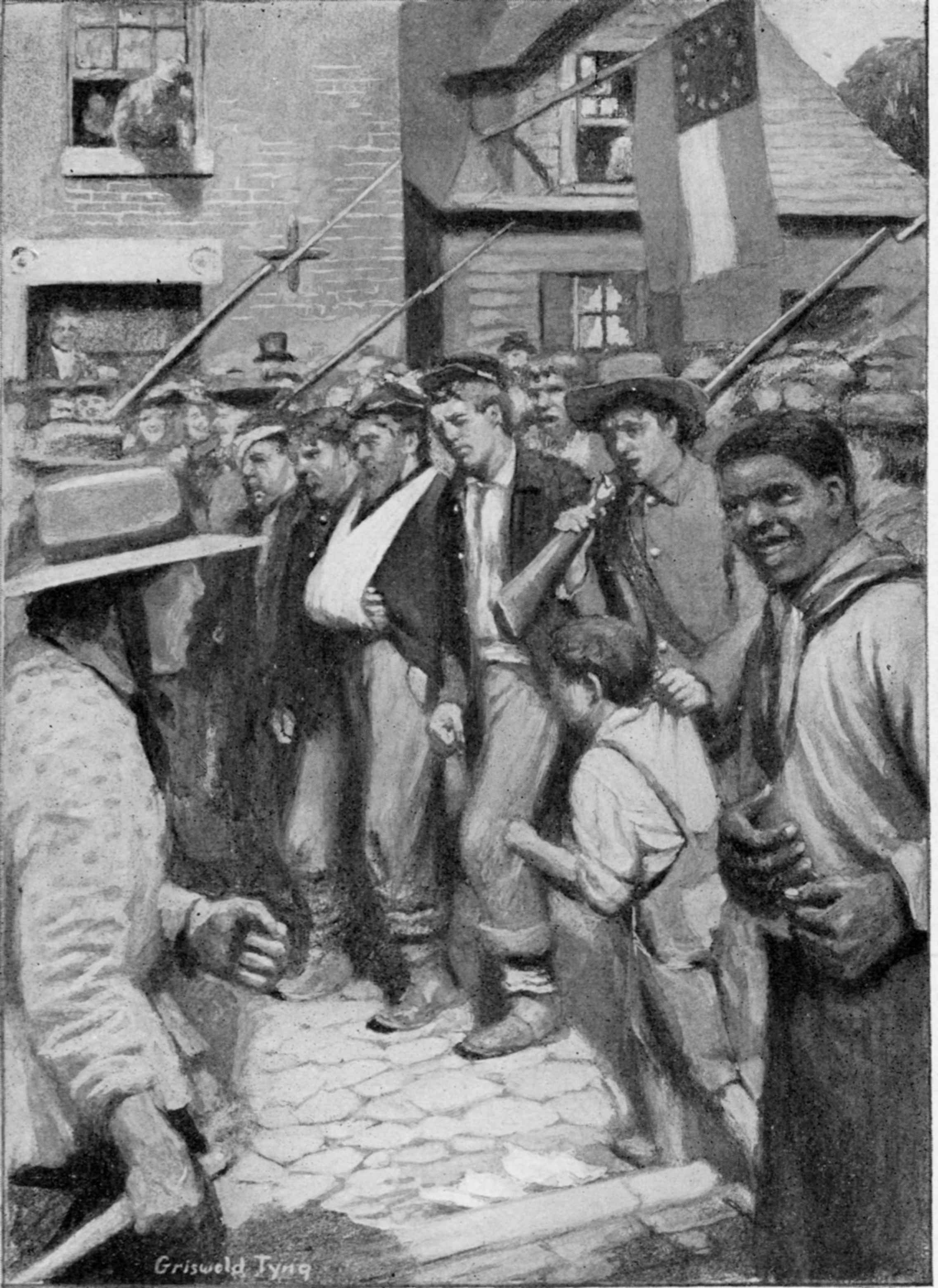
The march to this prison was one Louis never forgot. Page 325.
[Pg 326]
“They killed my son!” shrieked one woman, as she ran directly in front of Louis. “I will be avenged!” and she drew a long knife. Louis caught her upraised arm, gently but firmly, and held her until a Confederate soldier disarmed her and pushed her away. The boy’s heart was in his throat; nevertheless, he felt sorry for the dame, for he saw that the loss of her boy had almost deprived her of her reason. After that both he and Hornsby, sticking close together, kept a sharp lookout for an attack.
The temporary prison having been gained, the captured ones were again examined, to see that none of them had obtained any weapons on the march, and then thrust into the gloomy-looking building, which still smelt of pig’s meat and salt brine. Louis and Hornsby were placed, with ten others, in an apartment on the second floor, a gloomy place, fifteen by eighteen feet in size, and lit by three small windows. The windows had once held sashes of glass, but these were broken away, and each opening was barred by several pieces of thick joist, spiked fast, top and bottom.
“We’re in a pickle, ain’t we?” sniffed Hornsby, as he took a survey of the situation. “Gosh! wot an all-fired bad smell!”
“Wonder how long we’ll have to remain here?” put in another of the prisoners. “Sergeant, what do you think about it?” and he turned to the Confederate officer who was posting two guards at the doorway.
[Pg 327]
“I reckon you’ll stay here until McClellan surrenders,” was the answer, with a grin, and then the prisoner muttered something far from fit for our pages.
It was nearly dark and that night the prisoners were left without supper after a march of six miles, to make themselves as comfortable as they could. There was nothing to lie upon but the hard and greasy floor, with one’s cap for a pillow, and no blankets but such as a few had brought along. The smell made Louis sick at his stomach and he hung at one of the windows for fresh air until one of the guards ordered him away.
In the morning a negro appeared with a basket, a kettle, and a number of tin cups. The basket contained stale bread cut into chunks, and the kettle black coffee. For breakfast every prisoner was given a cup of coffee and two chunks of bread. Later on the whole rations for one day were served at once, half a pound of bread and a bowl of soup with meat, or beans and bacon—all of the plainest and, at times, not overly wholesome. On such a diet a “square meal” was entirely out of the question.
[Pg 328]
From one of the windows the prisoners could see a side street of the city; the other openings looked down upon a yard littered with casks and barrels and surrounded by business structures of wood and stone. The street always presented a lively appearance, not on account of the business transacted, for that was very little, but because the soldiers were moving to and fro constantly and the crowds of curious ones followed them.
“If only we could get free,” whispered Louis to Hornsby. He had no desire to remain a prisoner, in such a place and on such rations, and while he felt sure the Union army needed the services of every man who was enrolled.
“Hush!” murmured Hornsby. “I was thinking the same thing, lad; but don’t let the guard dream of what’s in your mind, or he’ll shoot you down like a dog.”
“Will you go with me if any chance to run for it happens?”
“Yes—if it ain’t too risky.”
[Pg 329]
No more could be said that day. But late in the afternoon Louis, while walking around the lower end of the room, saw something projecting from a shelf three feet above his head. He drew Hornsby to one side, and when the guard was not looking, got the man to hoist him up.
The object proved to be a chisel, two inches broad, eighteen inches long, and very thick and heavy. Louis secreted it in his clothes. One other prisoner, a man named Ray, saw the movements, but merely grinned.
After this Louis examined one after another of the fastenings across the windows. Most of the bits of joist were too well spiked on for him to think of loosening them without considerable noise. But there was one which was shaky, and by inserting the chisel under it the lower end became detached from the window sill.
“Hi, there, what are you doin’ by that thar window?” called out the guard.
“Trying to get some fresh air,” answered Louis, as coolly as he could. “This place is worse than a pig pen.”
“It’s better nor you Yanks deserve,” growled the Confederate, and went on smoking his briar-root pipe filled with tar-heel tobacco.
“The joist is loose,” whispered Louis to Hornsby a few minutes later. “I am going to risk a drop to the ground if I can get half a chance.”
[Pg 330]
Hornsby shook his head. “They’ll shoot you, lad, if they see you. And if you do git away, where are ye going, tell me that? There are thousands of troops between us and our boys.”
“Spies manage to come and go on both sides, Hornsby. If a spy can take care of himself, I guess I can—at least, I am going to try.”
“And git ketched like thet air Caleb Fox.”
“Well, he got away again,” went on Louis, but Hornsby would not listen. He would rather put up with ill-treatment than run too much risk, much as he desired his liberty.
Louis lay down in a corner close to the window, but not to sleep. His mind was in a tumult. Should he try what was in his heart? He knew he could wrench the joist aside and drop from the window into the yard below with comparative ease. But after that? Ah, that was the all-important question. He might drop right into the hands of a guard below, and that would mean close confinement and possibly death. Or the guards might see him only to fire upon and kill him.
[Pg 331]
Hour after hour went by and Louis heard a distant clock strike eleven, twelve, and then one. It was pitch dark outside, for another storm was brewing. The dim lantern in the hallway, where the guard stood, far from lit up the room. The guard, half asleep, leaned heavily against a wooden partition, while his companion, a few feet farther down the hallway, rested on an empty box.
As slyly and quietly as a cat, Louis moved forward until he rested directly under the window he had worked upon. The end of the joist was within reach, and softly but firmly he pushed it aside, so slowly that it scarcely seemed to move.
“Are ye really going?” It was the voice of Hornsby, in the youth’s ear. He had been watching the window in silence for three hours.
“Yes,” was the soft answer. “I’ll try it, no matter what comes.”
“Then I’ll go with you, lad, and God be with us in the undertaking,” concluded Hornsby. “Good-bye, if we’re both killed,” and he gave Louis’s hand a tight squeeze.
[Pg 332]
An instant later Louis was up on the window sill. Turning about like a flash, he lowered himself to the full length of his arms. A second he hung there, then he let himself drop.
ANDY AND THE UNION PICKETS
We will now go back to Andy, at the time he found himself so unexpectedly surrounded by Union skirmishers.
The young Confederate realized without much thought that he was in a perilous position. Six rifles were pointed at him, and the owner of each weapon seemed both willing to bring him to a speedy military death, and capable of doing so.
“Do you surrender?” demanded one of the men, after an instant’s pause.
“I don’t see that there is anything else to do, gentlemen,” replied Andy, with a smile, which, however, was rather forced.
[Pg 333]
“You’re a sensible boy,” put in another. “Say, that’s a fine nag he rides, fellows. Let’s present it to Captain Mellick. He had his horse killed an hour ago.”
“All right, Wombolt; you take the horse and the prisoner back. We can’t stop here.”
“Are you going to rob me of my horse?” demanded Andy, his eyes flashing.
“Oh, you can help ride him back to camp,” was the cool response of Wombolt. “I’ll sit with you. But first hand over that saber and your pistols.”
There was no help for it, and Andy turned over the bright blade and the single weapon in the holster. He had another pistol in the pocket of his cavalry coat, but of this he said nothing.
Having relieved him of the weapons mentioned, the Union soldier leaped up behind him. He held Andy’s pistol and cocking the weapon, placed it close to the youth’s neck.
“Now, no funny work or you are a dead reb,” he said. “Move on straight ahead until I tell you to turn to the left.”
“It’s a pretty bad road,” remarked Andy, trying to gain time in which to form some plan of escape.
[Pg 334]
“I’ll have it paved for you as soon as the war is over, reb. Move now, or my finger may get nervous on this trigger.”
Seeing there was no help for it, Andy spoke to Firefly, who instantly set off on a trot. This did not suit the Union soldier and he began to kick Firefly in the sides with the heels of his boots.
“Git alang there, you lazy beast!” he cried. “Git now, or I’ll stave in your ribs!”
“Look out, my horse won’t stand that!” came in a warning from Andy, and at the same time he gave Firefly a most cruel dig with his spurs. He would never have done this under ordinary circumstances, but a sudden idea had struck him and he acted on it on the impulse of the moment.
[Pg 335]
The kicking and spurring did just what the young Confederate expected. Unused to such treatment, Firefly jerked viciously to one side, made a wild leap forward and started off on a run. As he made the leap Andy gave him the reins, held fast to the saddle with one hand and shoved the soldier violently with the other. There was a yell of alarm, a clutch into empty air, as Andy leaned far forward, and away went the Union soldier, tumbling over backward into the muddy road. The pistol was discharged, but the shot merely whistled through the trees.
Andy did not stop to look back upon the catastrophe. Tightening the reins again, he spoke to Firefly, who understood his young master, and horse and rider turned to the right and entered a thin belt of timber running off in the direction of the Chickahominy. At first those left behind tried to pursue him, but soon their footsteps faded away in the distance, and he found himself utterly alone.
To get back to his own lines was now the one consideration. He had a fair idea where the Confederate troops could be found, but how many of the enemy lay between, there was no telling. He resolved to go forward slowly and with great caution, and retreat out of sight at the first intimation of danger.
“Perhaps it might be best to wait until darkness sets in,” he mused, but continued to go on until the edge of a swamp was reached. Soon Firefly sank up to his knees in the mud and ooze. Andy tried to turn him out, only to sink the horse still deeper.
[Pg 336]
“Here’s a go!” he muttered. “Firefly, old boy, we must get out of this somehow. Back, boy, back!” Firefly backed, and gradually withdrew to a fringe of brush and more solid ground.
“Well done, boy!” sang out a voice, close by. “Where are you bound?” and a tall down-east fellow not much older than himself appeared directly in front of the young Confederate. The tall Unionist was speedily followed by another, and both soldiers, who were raw recruits just from their New Hampshire farms, gaped openly at the enemy.
“Gracious, I’m glad to meet somebody,” answered Andy. “Say, you are true blue, aren’t you?” he went on, in almost a whisper.
“Air we?” cried the second recruit. “O’ cos we be. Ain’t thet so, Josiah?”
“Thet’s so, Hiram.”
“Then I am sure you will befriend me,” went on Andy. “I—”
“You’re a rebel, ain’t you?” asked Hiram, cutting Andy short.
[Pg 337]
“A rebel? Goodness gracious, no! I am a—don’t tell anybody”—he leaned forward with a show of great secrecy—“I am Paul Hammer, General McClellan’s secret service spy. The general wants me to get some information for him from Richmond at once. I thought I could get through the lines here without trouble. Have you seen any rebs about?” Andy added suddenly, before the others had time to think twice.
“Ain’t no rebels nigh here, Mister Hammer,” and Josiah touched his cap, thinking it a great honor to be taken into the confidence of the commander-in-chief’s private spy.
“You’re on the picket line, aren’t you?”
“We be,” came promptly from both recruits.
“Then show me the nearest way to the rebel line. Of course, I don’t want them to see me go over on their side, for that would give me away. And I don’t want any of our men to see me and mistake me for a reb, for that would mean a shot sure.”
“We’ll take care o’ yeou, Mister Hammer,” answered Hiram, and led the way along the edge of the swamp, with Josiah beside him and Andy bringing up closely in the rear. The young Confederate felt he had fooled the pickets nicely, but he was not yet “out of the woods” and consequently he did not crow.
[Pg 338]
“Whar did yeou git thet uniform?” asked Josiah, as they progressed, rather slowly, to Andy’s notion.
“Oh, the authorities furnished that,” answered the young Confederate, with assumed carelessness. “You see, there is a cavalry troop wearing this uniform in the rebel army, so if I once get past their picket line I can go where I please. Great scheme, eh?”
“Fine,” answered Josiah.
“I’d like tew do spy work,” commented Hiram.
“Would you?” answered Andy. “All right, I’ll remember that, and if I get the chance I’ll speak to General McClellan about it.”
“Will yeou? Much erbliged, I’m sure.”
“Speak fer me, tew,” put in Josiah. “I’m sick o’ regular fightin’, I am.”
“I’ll remember you both,” answered Andy, and he kept his word. Indeed, it would have been impossible to forget these two rustics, who were simple-hearted to the core and had still to get their war as well as their eye teeth cut.
[Pg 339]
The swamp was now left behind and the men, who had strayed from their posts during a little excitement farther on, led the way up a small hill. Here the woods divided, with an open space between, of grass and low brush.
“Thare yeou air, Mister Hammer,” said Josiah. “This is our line, an’ the rebels hed a line over yonder, but I guess it’s gone neow.”
“Good,” replied Andy. “Good-bye to both of you, and I wish you luck.”
“Don’t forget tew mention us tew General McClellan when yeou git back!” called out Josiah.
“All right,” came back, and away Andy trotted at a brisk pace, while the two rustics watched him out of sight with keen interest.
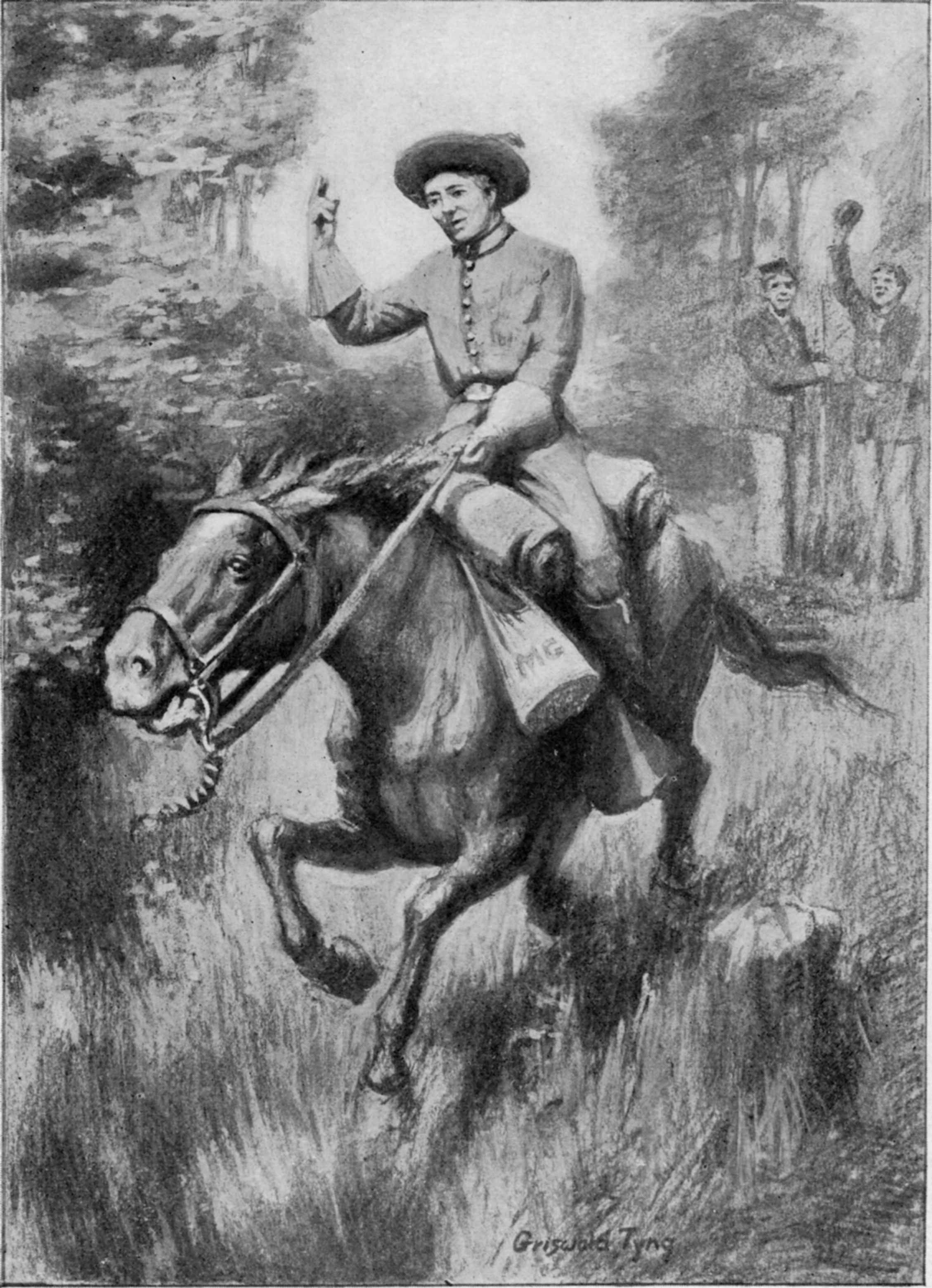
Away Andy trotted at a brisk pace.—Page 339.
“Of all the pumpkin heads!” was what Andy muttered to himself and so tickled was he that he was compelled to laugh outright. He had passed a distance of several hundred feet into the woods when he heard the command to halt, and a South Carolina soldier blocked his way.
[Pg 340]
“It’s all right,” answered Andy. “I have just escaped from the Yankees,” and he gave the countersign. A minute later he was asked a few questions by an officer in command, and then allowed to go. He inquired for the Montgomery Grays, and was told they had withdrawn to another part of the field.
“That’s twice they have caught me,” said Andy to himself, as he galloped down the main road towards Richmond. “I hope they don’t catch me again. Heigho! I wonder how Louis is getting along?” He never dreamed that Louis was now a prisoner in a fortification but a mile away.
It was nightfall before Andy found the Grays, encamped on the edge of a patch of woods near the Nine Mile Road. Captain Montgomery had gone to the hospital tent to have his wound taken care of, and the first lieutenant was in charge. To this officer and several others Andy told his story, to which all listened with keen interest.
“Gracious! what a couple of hayseeds,” said Leroy Wellington. “Won’t they feel cheap when they learn how they have been sold?”
“Most likely they never will find out,” answered Andy.
[Pg 341]
Fortunately, Andy had no picket duty to do that night, and, huddled up close to Leroy, he slept “like a rock,” despite the fact that fighting still kept up at a distance and the battle was to be renewed early in the morning.
“To horse! To horse!” This was the cry which awoke the young Confederate cavalryman at daybreak. Leroy had already crawled from the shelter of the tent. Soon the Montgomery Grays were mounted and eating their breakfast in the saddle.
To relate all of Andy’s varied experiences that day would fill a volume in itself. Between eight o’clock and noon the Grays made three terrific charges, capturing one Union battery and holding it for over an hour. But the Union forces now attacked along the whole line, as previously described, and slowly but surely the Confederates were driven back up the road towards Richmond. By two o’clock the firing ceased, and the battle of Fair Oaks, or Seven Pines, was at an end, and then began the harrowing work of caring for the dead and the dying.
[Pg 342]
Andy took part in this work and never were the true horrors of war brought closer to his young heart. The scenes were pitiable beyond description and his eyes refused to keep dry, as he moved here and there, looking for comrades and giving aid and comfort to the unknown sufferers. He had just found one of the Grays’ men, down with a bullet through his thigh, and was looking around for a stretcher, when a groan almost at his feet made him turn. There, in the brush and mud, rested a Union soldier, shot through the shoulder.
“Give me a drink, for the love of heaven!” came the murmur, and having his canteen handy, Andy poured forth the desired water and held the cup to the sufferer’s lips.
“Thank you, Grayback,” came in a short gasp. “Now, you’ve been so kind, won’t you prop me up ag’in that tree? I can’t stand it down here in the cold mud.”
“Certainly I’ll prop you up,” answered Andy, and lifted the wounded soldier as carefully as he could. As he worked he caught sight of the man’s uniform and markings.
“You’re a Pennsylvania man,” he said. “Know anything about the Goreville Volunteers?”
“I’m a Goreville Volunteer,” came the surprising reply.
[Pg 343]
“Indeed? Do you know Louis Rockford? He used to be a friend of mine—in fact, he’s a friend still, personally—a close friend.”
“O’ course I know Louis—everybody does. I owned a farm near his place. My name is Coomber.”
“And how is Louis?”
“He’s missing—somebody said he was shot,” answered Coomber. “Who are you?”
Andy told him.
“I’ve heard him mention you—and heard Mr. Rockford speak about your father’s place. Strange we should meet here. Ah, here come some fellows with a stretcher, to take me to the hospital tent, I expect,” concluded Coomber. No more could be said, and soon the Union soldier was carried off, and five minutes later Andy’s comrade followed. The wounded men had lain between the picket lines of both armies and a truce had been established while the dead and wounded belonging to each side were removed.
[Pg 344]
What he had heard concerning Louis made Andy feel much downcast. To fight the enemy was one thing; to have his chum killed or wounded was quite another.
[Pg 345]
“I trust the report is false and he is safe,” he thought. “War isn’t such a glorious thing after all, when a fellow comes to look at it.”
AN ADVENTURE IN THE CONFEDERATE CAPITAL
After the battle of Fair Oaks, the Union army moved forward from a quarter to three-quarters of a mile and there entrenched itself in the position it occupied very nearly during the whole of the siege of Richmond. The army was divided into five corps, three upon the Richmond side of the Chickahominy River and two upon the other—one of the latter afterwards crossing to join the other three. The entrenchments were very strong, the nearest being within five miles of the heart of the Confederate capital, and the line of the besiegers was about four miles long, with guards at either end reaching out still farther.
[Pg 346]
But if the entrenchments of the Union army were strong, so were those of the Southerners, who had gathered nearly a hundred and fifty thousand men to prevent their principal city from being taken. For many months the Confederates had been afraid of an attack upon Richmond, and they had spent all the time to be spared in building fortification after fortification, reaching from the city itself to from three to six miles in all directions. A Richmond newspaper of that time enumerates twenty-eight of these strongholds, each well manned and each with its guns placed in the most commanding positions. Small wonder was it, therefore, that General McClellan sent out his calls for extra troops, troops which he never received, for reasons which have never to this day been satisfactorily explained.
[Pg 347]
The ground which the Union army now occupied was in a fearful condition. Mud and swamps were everywhere, bushes lay torn up by the roots, and thousands of trees, half cut through about five feet from the ground, so that the trunk falling over might block the passage of artillery and wagons, made even the regular roads all but impassable. As many as could be got at of the dead had been buried, but the swamps were still full of bodies, awful to contemplate. Added to all, the soldiers were exposed to swamp fevers, and soon out of less than a hundred thousand men nearly twenty thousand were on the wounded or sick list.
The scene in Richmond was scarcely a more happy one. Emergency hospitals were opened by the score, and all day long on Sunday and Monday the ambulances rumbled along through the streets. Business of all kinds was practically at a standstill, and the citizens gathered in groups to discuss the situation. The wounding of Johnston was looked upon as a great calamity and everybody wondered if General Lee would prove equal to the emergency into which he had been thrown. On Monday a rumor started that McClellan’s army had been vastly reinforced, and this nearly caused a panic. Many began packing up their household goods and valuables, in order to flee southward as soon as the Union army should move forward.
[Pg 348]
But no immediate movement upon either side took place. Worn out by the fierce fighting at Fair Oaks, each army was now trying to reconstruct itself, while the great generals were looking over the ground and making their plans for the future. Thus about three weeks slipped by with only a few encounters, which were of no great importance. But those three weeks were full of interest to both Louis and Andy, as we shall now see.
We left Louis at the time he allowed himself to drop from the second-story window of the temporary Confederate prison in Richmond. It must be acknowledged that the young Union soldier’s heart was in his throat as he let go of the window sill. There was no telling where he was going to land and what sort of a reception he would meet. All was dark, only a few dim street lights here and there brightening up the blackness of the night.
Crash! He had landed upon a number of packing cases, thrown together in a rough-and-tumble way. Down he went through several thin boards and rolled over on his back. He had just leaped to his feet when Hornsby came after him, making a greater racket than before.
“Louis, are you safe?”
[Pg 349]
“Yes. Come on!” And the young soldier extended his hand. Hornsby took it, and side by side they sped forward to where a board fence separated the yard from the street. As they reached the fence they heard a commotion inside of the pork-packing establishment. Their escape had been discovered!
“Up ye go, lad!” whispered Hornsby, and gave Louis a boost. The youth gave one glance over the fence and dropped back into the yard in a hurry. Clapping his hand over Hornsby’s mouth he drew his companion back.
“Two guards out there,” he whispered into the old soldier’s ear. “We must find some other way. Let us try the back.”
“But there are nothin’ but buildings there,” cried Hornsby. “I’m going to try the street and trust to my legs,” and ere Louis could stop him, the old soldier had disappeared in the deep shadows of the cluttered-up yard.
Louis stood motionless, his heart almost at a standstill. He was left alone. The alarm was growing more general. “Two prisoners have escaped!” he heard somebody call out. Which way should he turn?
[Pg 350]
There were many boxes and barrels in the yard and he might readily have secreted himself in one of them. But such a course, he reflected, would be foolhardy. Sooner or later every box and barrel was sure to be examined. Besides, to remain in the yard, a prisoner without food, was out of the question.
Noiselessly but swiftly he moved to the extreme rear of the yard. Here was located a two-story building, probably facing the next street. The lower windows of this building were shuttered and barred, but an upper window was partly raised and the room beyond was totally dark. From the window of his late prison Louis had seen that this building was not a dwelling, but a store or warehouse of some kind.
Close to the open window ran an iron pipe, connecting with the roof to carry off the water when it rained. The pipe was held to the building by metal clasps, and catching hold of these Louis raised himself up until he was on a level with the opening. Without hesitation he entered the window, just as several Confederate guards, with lanterns, entered the yard below.
“Sure both of ’em didn’t jump the fence?” Louis heard one of the Confederates ask.
“Yes. Griffith saw him. The other must be around here.”
[Pg 351]
Louis waited to hear no more, satisfied that before the search was over the open window would be noted and an examination in that direction would ensue. Leading from the window was a passageway between a great number of boxes and loose piles of clothing, and down this he moved cautiously, for it was so dark he could not see a foot in front of him. Presently his hand struck a railing leading to a pair of stairs. At the bottom of the stairs was a door, and from the crack above this streamed a dim light, showing that the store below was partly lit up, even at that unseasonable hour of the night.
Wondering if he could escape to the next street before the alarm was given in that neighborhood, the young Union soldier slipped down the stairs and entered the store, which he found filled with a miscellaneous collection of articles, including clothing, firearms, jewelry, crockery and woodenware, and farming implements. There was a counter near by and on this lay some business cards showing the place belonged to one Simon Davidstein.
[Pg 352]
As Louis was advancing towards the front door he heard several men come up to it from the other side, and then a key was inserted in the lock and the door was thrown back. Louis had barely time to secrete himself behind a counter when three men entered.
“It vos lucky you vos found me at der hotel,” said one of the newcomers, in a high-pitched German voice. “I ain’t dare all der dime, no more.”
“If we hadn’t found you, Davidstein, you’d ’a’ lost a good bargain,” came the reply, in a voice which sounded strangely familiar to Louis. At the risk of being discovered he peered out from his hiding place and saw that the man who had spoken was Caleb Fox! With him was Sam Jacks, while the third party was the owner of the establishment.
Louis was both astonished and mystified. What had brought Fox and Jacks to that place at this hour of the night? Fox carried a heavy flour-sack and the mission of the two thieving guerrillas was soon explained.
“We’ve got a fine collection of watches and jewelry fer ye this trip, Davidstein,” said Sam Jacks. “Must be at least five hundred dollars’ worth in the bag.”
[Pg 353]
“Fife hundred dollars—in dese dimes!” cried Davidstein. “You must pe crazy! Of you dinks I gif fife hundred dollars you ton’t petter open der pag at all, ain’t it. Maybe you vos mean baber money?” he added suddenly.
“No, we ain’t takin’ nothin’ but gold,” said Caleb Fox. “Just you look at the rings and watches, and we’ve got a fine pin or two; ain’t thet so, Sam?”
“Best Davidstein ever saw,” joined in the second guerrilla.
“I ton’t vos got no fife hundred in gold to bay out dis night,” said Davidstein, stoutly.
“Well, you handle the stuff an’ make an offer,” concluded Caleb Fox. “Remember, we have got to divide with the rest o’ the boys.”
The trio moved to the center of the store, and here the single light that was burning was turned up. At the same time there was a clatter from the rear and a sleepy but somewhat excited young Jew appeared, pistol in hand.
“I dink it dime you voke up, Jacob,” cried Davidstein, sarcastically. “Der mop could rob der blace und you schleep on like von rock, hey?”
[Pg 354]
“I heard you come in,” was the abashed answer. “I vos listening py der shudders on der pack window. Dere vos droubles py der brison, I dink.”
“Dot ain’t our bees’ness, so long dey ton’t come here,” concluded Davidstein. “You can lay down again,” and Jacob retreated to his cot behind a pile of packing boxes.
By this time Fox and Jacks had the flour bag open and a miscellaneous collection of articles stolen upon the battlefield were spread out on the counter. With a well-trained eye Davidstein ran over the lot in a careful but apparently careless manner. Some talk followed, and he finally offered a hundred dollars in gold for what was there. To this Fox and Jacks demurred. They would take three hundred and not a cent less. Davidstein told them to pack the articles up again. This brought on another talk, and finally a purchasing price of two hundred dollars in gold was settled upon, and Davidstein proceeded to get the cash out of a secret hiding place in the cellar.
[Pg 355]
Louis listened to the talk with keen interest. He understood that Davidstein was a receiver of stolen goods, and he felt sure that his own things must be among those Jacks and Fox had come to sell. “If I get the chance I’ll have them back again, see if I don’t,” he thought, and continued to keep as quiet as a mouse.
Davidstein had hardly disappeared into the cellar when there came a sharp rapping on the front door. At once the Jew came running up again.
“Who is dot?” he questioned, and went forward. An officer and two guards from the prison presented themselves.
“I haven’t seen or heard noddings about any escaped brisoner,” answered Davidstein, in reply to the officer’s questions. “Jacob, haf you seen anypotty?”
“Not a soul,” answered the sleepy clerk. “I heard somedings going on ofer by der brison, put dot’s all.”
“Your window upstairs is open,” said the officer. “We think he may have climbed up to it. We want to make a search.”
At first Davidstein demurred, but at last he consented to have the officer and guards take a look around. He went upstairs with the soldiers, and Jacks and Fox followed, while the sleepy clerk stood watch below.
Louis scarcely dared to breathe. The clerk moved forward to the front door and looked out upon the street. Then he came behind the counter and walked slowly towards the spot where the young Union soldier was in hiding. Louis felt that a crisis was at hand.
LOUIS AS A CONFEDERATE SOLDIER
Moving along as if in deep thought, the clerk of the store reached the very spot where Louis was in hiding, behind a number of loose shelving boards standing upright under the counter. His legs were within easy reach of the young Union soldier, and had he leaned down less than a foot he could have seen the hidden one without trouble.
“Jacob!” It was a call from above, and at once the clerk moved away. A moment later Louis heard him ascend the stairs, and an earnest talk on the next floor followed.
[Pg 358]
Louis felt that now was the time to make his escape. Even if the others should go away, the clerk would remain in the store until it was time to open for business in the morning. Without making any noise Louis arose from his cramped position. As he did this he saw close at hand a pistol and a box of cartridges, evidently set aside for some customer. He slipped both into his pocket as things which might become exceedingly useful later on.
Less than ten feet away were the articles Jacks and Fox had brought in. Over these Davidstein had hastily thrown some paper, to conceal them from the Confederate officer, who, had he seen them, might have asked some troublesome questions. Louis could not resist the temptation to take a look at the goods. He speedily recognized his watch and several other things belonging to himself, and stowed them away. This done he placed the paper in its former position and ran lightly for the front door.
A look outside told him that the coast in the immediate vicinity of the store was clear. But how would it be farther on? That question could not be answered. Those upstairs were coming down. He moved outside, closed the door noiselessly behind him, and made a dash across the street to an alley between a store and a private dwelling.
[Pg 359]
“Hi, there!” It was the call of a private citizen, who had seen him running. Louis did not reply, but kept on his course, and reaching the end of the alley leaped over a fence, crossed another street and finally found himself in the rear of a mansion surrounded by a well-kept garden. A barn was close at hand and he entered this, thinking the hay-loft would surely offer a safe hiding place.
An hour was spent in the barn without disturbance, and the young Union soldier was wondering what he had best do next, when he heard the clatter of hoofs, and a man on horseback entered the garden and rode straight for the barn. From the hay-loft Louis saw him dismount and take some papers from a secret pocket in his saddle. Then came the banging of a house door, the rush of feet, and a middle-aged woman rushed up.
“Oh, Robert, are you safe?” Louis heard the lady exclaim, in anxious tones.
“Perfectly safe, Lucy; although I’ve had a tight squeeze of it.”
“And did you get to General McClel—”
[Pg 360]
“Hush, my dear—” The man put up his hand warningly. “No, I didn’t see the general, but I saw General Keyes and that was just as well. The plans of the fortifications will help along the cause a good deal. Has anybody been here since I was away?”
“Captain Andrews. He wanted to know where you were. I told him somewhere about town. Robert, I am afraid they are beginning to suspect everything is not right.”
“Perhaps. But as long as they can’t prove anything, Lucy, we are safe. I hope you have something ready for me to eat, I’m as hungry as a bear. Whoa, Clipper, there you are, old boy. Lucy, Clipper is a marvel to travel through such swamps and muck holes.”
So the talk ran on, while the man lit a lantern and cared for his horse. That he was a Union sympathizer there was no doubt. He had just made a visit to General Keyes’s headquarters with the plans of the Confederate fortifications in and about Richmond.
Louis felt his heart bound within him. Here were friends who would surely assist him. He came to the edge of the loft.
“Below there,” he whispered.
“Ha! who is there?” ejaculated the man, leaping back and snatching up his pistol, which lay on a feed box.
[Pg 361]
“Don’t fire, sir. I heard you talk and I throw myself upon your sympathy. I am a Union soldier, just escaped from the prison two blocks over from here—a place that used to be a pork-packing establishment—and the guards are searching everywhere for me. So far they have no clew to my whereabouts, and—”
“Come down here and let me look at you,” was the interruption, and Louis ran down the ladder. The man held up his lantern.
“Pennsylvania Volunteers, eh?” he said, briefly. “Humph! How long were you up in the loft?”
“An hour. You will assist me, won’t you? I don’t want to go back to that awful hole.” Louis looked at the woman.
“Bring him into the house, Robert,” she said, turning to her husband. “I am sure he speaks the truth, for when I was at the window waiting for you I heard some men go by who were talking about two prisoners having just escaped.”
“They were myself and a friend, madam. I don’t know what has become of my friend, but I trust he is safe.”
[Pg 362]
“Come along, young man,” said the man. “And if you heard anything of importance the quicker you forget it the better it will be for you,” and taking Louis by the arm he led the way through the garden into the house.
Once inside of the house Louis was conducted to a large sitting-room, well furnished. Here he was invited to take a seat, while his host looked to it that every curtain was carefully drawn down and the outer doors locked.
“Now I will listen to your story,” said the man, dropping into an easy chair.
“Won’t you have your supper first, Robert?” interposed his wife. “Perhaps you are hungry, too?” she added, turning to the young soldier.
“I am—but I want to know that I’m safe from the rebels before I begin to eat,” was the quick reply.
“You are safe here, my lad—only don’t speak of rebels so loudly, for even walls have ears, you know.” The man drew two chairs up to the center table. “We’ll eat here, Lucy; it will be safer, in case there is an interruption from the outside.”
[Pg 363]
In a few minutes a smoking hot supper was brought in from the kitchen. The lady had cooked it herself, all of her servants having been discharged, that they might not pry into the affairs of the household. Never had a meal tasted better to Louis, and he said so, after he had eaten and related his tale at the same time.
“You were lucky to get away, Rockford,” said Robert Dowling, for such was the man’s name. “And you were lucky to strike this place, don’t you think so?”
“I do, Mr. Dowling—especially after such a spread.” Louis smiled at the lady of the house, who smiled back. “This beats rations on the peninsula.”
“I dare say it does. But now the question is, Having escaped from prison, what are you going to do?”
“Get back to camp—if I can.”
“Precisely—if you can. It is going to be difficult, Rockford, tremendously difficult. Getting through the lines is no light work.”
“I believe you, sir. But I don’t want to remain here, so I’ll make the attempt, if you’ll give me a little aid.”
[Pg 364]
“I’ll give you all the aid I can. You had better not try to start now. It will be daylight soon. Wait until four o’clock this afternoon. Then you can go down near the picket lines and break through—if you can—when it grows dark.”
“The trouble is, this uniform is against me.”
“Not so much as you may think. Some of the boys down here are wearing cast-off Union suits of clothing. All you must do is to rip off your numbers and letters and dirty the suit a little more and it will pass, combined with a Confederate cap of gray which I will furnish to you.”
“And what will be my best route out of Richmond?”
“That must lie with yourself, since what is best is difficult to state. During the day I will take you to the top of the house and through my field glass you can get some idea of how the land lies.”
[Pg 365]
After this the talk became general. But Robert Dowling was sleepy and soon he excused himself and retired, leaving Louis to be entertained by his wife. The young soldier learned that the family had moved to Richmond from Boston ten years before, the head of the house being in business in both places. The war had ruined Mr. Dowling’s trade, and being a Northern sympathizer he was using his leisure in giving the Federalists all the aid within his power.
Having taken a wash after eating, Louis was conducted to an upper chamber, where he lay down, but not to sleep, for his mind was in too much of a tumult for that. He was about to start on a dangerous mission. Would he succeed or fail? Then his mind traveled back to the parting with Hornsby. Was the old soldier safe, or had he been retaken? And then Louis thought of Andy. Where was the daring young cavalryman now?
From the window of the bed-chamber he could look down two of the streets of Richmond. Occasionally he saw an ambulance pass along, and in the middle of the afternoon a regiment of Confederate infantry passed with colors flying and drums beating gaily, on their way to the front. “Maybe I’ll have to fight my way through those fellows to-night,” he thought, as he turned away to avoid even the possibility of being seen.
[Pg 366]
It was three o’clock when Robert Dowling called him, and both went up to the roof of the house, but did not step outside. The man had brought a pair of powerful field glasses with him, and through these he pointed out to Louis the various roads leading to the north and east.
It was a grand sight to Louis. On all sides of him lay the Confederate capital, hemmed in with fortifications and swarming with soldiers like ants around some gigantic ant-hill. Here was a single company, there a regiment, and over yonder an entire division, with tents and wagons innumerable. From the fortifications frowned the batteries, and Louis could distinctly see the gunners standing ready for immediate service and the officers moving around, giving orders and inspecting the various headquarters. In one section of the great field a regiment was out on drill, its men marching and counter-marching in splendid order, with bayonets sparkling in the light of the fading sun.
“Tough job to get in here, eh?” said Robert Dowling, briefly.
Louis drew a long breath. “Indeed it will be. Do you really think General McClellan can do it?”
“If General McDowell’s troops come down, yes. If they don’t—” The man did not finish. “Come down, if you have seen enough.”
[Pg 367]
“In a minute.” Louis turned the field glass to the northeast. “Our troops have their balloon up,” he cried. “They are taking observations.”
“That balloon makes the Southerners awfully mad,” said Robert Dowling, with a laugh. “Time and again they have tried to shoot it full of holes. But come, or somebody on another roof may see you and grow suspicious.”
They went below again, and now the man brought forth the faded Confederate cap he had promised Louis. It made the youth feel queer to put it on. “Seems like I was insulting myself,” he explained, at which his host smiled broadly.
[Pg 368]
“You’ll get used to it. Now, remember, if you are asked any questions, that you belong to Company A, Second North Carolina Troops, Brigadier-General Anderson commanding, under General Hill, and that you are looking for your company somewhere down the Williamsburg road, and that you lost your regular army clothing during a skirmish in the swamps. That will carry you outside of Richmond and when you get near the picket lines you must take care of yourself as seems best. My advice is, don’t move until it’s dark.”
“Just what I was thinking,” answered Louis, and repeated the name of the organization to which he was supposed to belong, that he might get it right. Soon after this he was bidding his kind host and hostess good-bye, having previously given his word that come what might, he would not reveal what he had heard in the barn during the night previous.
He left the garden by a back gate, and with a heart that beat rapidly hurried along the street to where one of the main thoroughfares led out of Richmond to the Williamsburg turnpike. At first he imagined everybody was looking at him and suspecting him, but this soon wore away and he continued on with greater confidence. He had no gun, but in his pocket was the pistol which he had picked up in the store, now fully loaded.
Coming to a corner of the thoroughfare, he paused for a minute, to avoid some soldiers who were marching past. As he lingered, he chanced to glance at a door upon which was a brass plate bearing the name:
THEODORE FAILY
[Pg 369]
“The very man father wants to hear from!” Louis murmured to himself. “Shall I venture to call on him, or had I better move on?”
His first inclination was to go on, but then he remembered the letters from home, and how afraid his folks were that they might lose the farm. He advanced to the door and knocked sharply.
In answer to his summons an aged negro appeared, and when the youth asked for Mr. Faily, ushered him into a dimly-lit parlor. A minute later Theodore Faily appeared. He did not know Louis and gazed inquiringly at the young soldier in his tattered uniform.
“Excuse me, sir, but I am in great haste,” said Louis, speaking rapidly. “Will you tell me if you are the Theodore Faily who used to live in Pennsylvania and sold a farm to Mr. Rockford?”
“I am the man, yes.”
“I am an—an agent for Mr. Rockford, Mr. Faily. I have reached you under difficulties. Let me ask, do you know a man named Samuel Hammer?”
“I do—to my sorrow.”
[Pg 370]
“Did he have a claim on that farm?”
“Not in the least. He once claimed to have, but his claim was worthless.”
“He has been bothering Mr. Rockford a great deal lately,” continued the young soldier. “He wants three thousand dollars, or he is going to law—”
“The rascal! But it is just like Sam Hammer. Mr. Rockford had better pay no attention to him.”
“Can you give me some paper, showing the truth of this matter? I will manage to get it to Mr. Rockford by some means. I have risked a great deal to reach you.”
Theodore Faily mused for a moment and gazed keenly at Louis.
“This is—er—a rather unusual proceeding,” he observed. “But in these times many things are unusual. I think I understand you—since you must come from the North.” He closed one eye suggestively. “Yes, I will give you a paper, duly signed and witnessed. I hate Sam Hammer and would like nothing better than to put a spoke in his wheel.”
[Pg 371]
The gentleman went out—to be gone over a quarter of an hour. When he came back he handed Louis an envelope.
“There, take that. You will find it will stop Hammer, I reckon. And when you see Mr. Rockford, give him my best respects.” He leaned forward. “My sympathies are still at the North,” he whispered.
“Thank you a thousand times, sir,” said Louis, as he slipped the document into an inner pocket. Then, after a few words more, he left the house.
The sun was beginning to set when Louis found himself out of the city. He had been stopped twice, but his answers in each instance had enabled him to proceed without molestation. One man gave him minute directions as to where he could find “his company,” and for this Louis thanked him profusely, inwardly shivering for fear the fellow might chance to know some of the North Carolinians and ask after them.
[Pg 372]
The young Unionist reckoned that he was about a mile from the picket line when he came to a turn in the road he was pursuing. He had just passed a small encampment of Confederate troops who were breaking up to march to the rear. He now heard the thunder of cavalry on the road and stepped into the brush at hand to let them pass by. They soon came into view and he recognized the Montgomery Grays.
“Andy’s troop,” he muttered, and strained his eyes to catch sight of his friend, but failed to do so, at which he was much disappointed.
The cavalry having passed, he resumed his journey, but with greater caution, feeling he must ere long go into hiding until nightfall. A short tramp brought him to the top of a rise. From this he made out Confederate troops to his right and his left, while the road ahead was alive with them.
“That settles it. I can’t go much farther in this direction. I’ll strike out through the woods.”
Leaving the road, he pursued a course in the center of the rising ground, thus avoiding the swamps upon either side. There was a beaten trail here, showing that others had taken the same course.
[Pg 373]
A few minutes of walking and Louis suddenly stood still. A horse was coming towards him, walking slowly. The animal was riderless and was bleeding from a bullet wound in the foreleg. As the beast came closer Louis recognized it. The horse was Firefly.
LOUIS AND ANDY MEET AGAIN
“Firefly!” burst from the lips of the young Union soldier. “Whoa, old fellow! Where is your master?”
At this question Firefly halted and looked at Louis as though he would like very much to talk. The bullet wound made the beast quiver with pain, and the youth stroked him affectionately.
“Been in a scrimmage, I’ll wager a pilot cracker,” the boy went on. “Was Andy killed? Oh, I sincerely trust not!” And something like a lump came up in his throat.
Firefly whinnied and shook his mane vigorously. Then he turned, as if to lead Louis down a narrow path branching off from that on the ridge. At once the boy understood and followed the animal.
[Pg 374]
Scarcely three hundred feet had been passed when Louis heard the murmur of voices, coming from a little clearing, backed up by a treacherous swamp. As he drew closer, he recognized Andy’s voice:
“Let me alone, Jacks, or it will be the worse for you,” the young Confederate cavalryman was saying. “You are nothing but a thief, I know, but you shall not rob me.”
“We are two to one, Arlington,” came from Sam Jacks. “And I ain’t forgot how yer interfered with me an’ my pards up ter Lee Run. I’m a-goin’ ter git squar’, I am.”
“It’s a mighty fine gold watch the kid’s got,” put in another, and now Louis recognized the vicious face of Caleb Fox through the brush. “It ought ter be wuth fifty dollars an’ more.”
“You wounded my horse and made him run away,” went on Andy. “I ought to shoot you both for that.”
“Ye can’t frighten us, Arlington,” chuckled Sam Jacks. “Don’t we know neither of yer pistols is loaded? An’ if yer try to draw thet saber—” Jacks finished by suggestively tapping his own pistol.
[Pg 375]
An instant later there came a savage howl from Caleb Fox, who had come close to Andy with the intention of searching him. The young Confederate had whipped out his saber and the point had caught Fox in the fleshy part of his left lower limb.
“Back, I say!” cried Andy, as he took a stand near a tree. Wild with rage Caleb Fox drew a long horse-pistol from his belt.
“I’ll fix yer!” he fairly hissed, and aimed the weapon at Andy’s head. Before, however, he could pull the trigger, if such was really his intention, there came a sharp crack from the brush and the pistol fell to the ground while Fox began to dance around in pain, a bullet wound directly through his wrist.
“Louis!” burst from Andy’s lips, as the young Union soldier rushed forward. “Was it you shot him?”
“It was, Andy; and I’ll shoot him again if he attempts another such attack. Rascals like these are a disgrace to any army. Up with your hands, Sam Jacks!”
[Pg 376]
For Jacks had made a motion towards his belt. Louis’s pistol was now on a level with the mountaineer’s head, his eyes shone with cool determination—and the hands went up as requested.
“This ain’t fair an’ squar’,” muttered Sam Jacks. “Put thet gun down—it might go off.” And he endeavored to step out of range.
“Stand still, Jacks,” commanded Louis, “or my pistol will go off, and Fox can testify to what sort of a bead I can draw.”
“My wrist is broke!” moaned Fox, still dancing about. “You young villain! If ever I git a chance—”
“No threats, Fox. The best thing you can do is to wet your handkerchief, if you have one, in yonder pool and bind the wound up. Stop—that pistol can remain where it is—or Andy, perhaps you had better pick it up.”
“I will, seeing that my own is unloaded,” answered Andy. “But what brought you here, and in that outfit?”
“I’ll explain later. At present—Hi, Jacks, stop!”
[Pg 377]
But Sam Jacks was not stopping just then. Watching his chance, he had leaped for the shelter of the nearest bushes. Now he went tearing along at a breakneck speed. Louis tried to follow him, but soon stopped the pursuit, thinking it would be useless to catch the rascal. Presently the sounds of his footsteps died away in the distance.
“He’s gone,” he announced, upon returning to the clearing. “You may as well let Fox go, too. I reckon he has learned a lesson he won’t forget in a hurry.”
“Won’t you let me have my pistol?” demanded the guerrilla.
“No,” was the short reply. “Go, and be thankful you have saved your life,” answered Andy. “If ever I catch sight of you near our camp I’ll report you and have you both put under arrest as battlefield thieves.”
Muttering under his breath, Caleb Fox slunk off, one hand holding the wounded wrist. He pursued the direction Jacks had taken—a path leading to the rendezvous of the guerrillas.
The pair of rascals gone, Louis and Andy shook hands. “I owe you one for this,” said Andy, with a warm smile. “If you hadn’t appeared there is no telling what those two would have done to me. Perhaps they might have killed me and pitched me into the swamp.” And he shuddered at the thought.
[Pg 378]
“It was Firefly brought me here,” answered Louis, and patted the animal affectionately. “But why are you out here alone?”
“I am carrying a message to General Longstreet, and I reckon I got on the wrong road. But what have you got to say for yourself? I heard you were either shot or a prisoner.”
“I was a prisoner, Andy; but I managed to get away, and now I’m trying to return to my own camp—if I can find it.”
“Don’t you know you are in our lines?” and Andy looked deeply concerned.
“Oh, yes, I know that only too well. I suppose I’ll have no picnic running the picket line.”
“Hang me if I don’t wish I could help you, Louis. I know it’s all wrong, according to the rules of war, but—but—well, you know what they say, ‘Blood is thicker than water,’ and such a friendship as ours—”
“Can’t be shattered by the bullets and shells of war,” finished Louis, with a short laugh. “I should trust not, Andy. Come what may, I shall always look upon you as a brother, even though I’ll do my level best to help the North win in this great struggle.”
[Pg 379]
“And I shall always hold you as my best and only chum, Louis,” was the warm reply, “and of course I’ll fight just as hard as I can for our side. How are your folks?”
“Father is quite well again, and mother is, too,” answered Louis, and told of the trouble at the farm and how he now hoped to clear it. “In the last letter written by Lucy, she and Martha wanted to know if I ever heard of you. What of your people?”
“Father is not so well. Mother has a good deal of trouble taking care of him. Grace writes to me every week, and last week she wanted to know if she could get a letter through to you,” and Andy closed one eye, at which Louis blushed furiously.
“You are making that up, Andy—don’t tell me you are not. However, remember me to Grace, and tell her I am doing nicely in spite of fights and bad weather. If you— Hark! Some soldiers are coming! They must be some of your troops, and if that is so, I must be going. Good-bye, Andy, and may we meet again soon!”
[Pg 380]
“Good-bye, Louis. Oh, if I could only see you safe to your camp! Yes, you must hurry, for the soldiers are coming on the double-quick! Hark! there are rifle shots! There must be a skirmish of some kind over to the left!”
“If there is, it will help me through, Andy. Good-bye!” And with a last fervid hand-clasp the two chums parted, not to meet again until the memorable battle of Malvern Hill.
As Andy had said, the sounds of firing came from the left. Running along the ridge trail, Louis kept on until he reckoned he was about midway between the two lines of shots, although still to the right of the scene of the contest. He then slowed up and proceeded through the bushes with great caution, his pistol cocked and ready for instant use.
Less than a hundred and fifty feet had been covered in this fashion, when he reached another clearing which marked, east and west, the picket lines of the two armies. The firing was now close at hand, and presently, from the cover of the woods, came scampering a company of boys in blue closely followed by twice their number of boys in gray. The former were reloading their guns as they came on, the Confederates opening fire meanwhile and causing several to drop in their tracks.
[Pg 381]
Throwing away his gray cap, Louis darted into the clearing and joined the flying Union men. As he went on he picked up a gun one of the wounded soldiers had cast away.
“Union or reb?” came the question, as the company halted behind some bushes.
“Union, captain,” was the prompt answer. “I’ve been a rebel prisoner.”
There was no time to say more, for the company was now ordered to about face, and the advancing Confederates received a reception which caused a hasty retreat; and the skirmish was over. During the siege such skirmishes were of almost daily occurrence. The picket lines were re-established, the dead and wounded cared for, and that was the end of the matter, save for the great “blowing” done afterwards upon both sides.
[Pg 382]
The excitement over, Louis was conducted to the rear, where he had to give a strict account of himself to the general in charge of the regiment stationed in the woods. This was done in order to ascertain beyond all doubt that he was not a Confederate spy. He was informed where his own regiment was located, nearly a mile away, and a corporal was detailed to conduct him hither and learn if his story was a true one.
“Louis! We had given you up for lost!” cried Harry Bingham, when he appeared, and the youth was soon surrounded by friends. He lost no time in reporting to his commander. When Captain Paulding learned that he had really been in Richmond and had had a chance of overlooking the fortifications there with a field glass, he sent word to headquarters to that effect.
[Pg 383]
The next day came an important order for Louis. It was from General McClellan, to the effect that he should present himself at the headquarters of the commander-in-chief without delay.
LOUIS VISITS GENERAL McCLELLAN
Louis’s heart gave a bound. He was to visit the great commander-in-chief of the Army of the Potomac! He had seen General McClellan before, of course, for the general was very popular with his men and loved to roam about among them, but he had never had the chance of speaking with so distinguished an officer.
The day was a quiet one through the great camp as Louis walked from the quarters of the Goreville Volunteers, a distance of nearly two miles, to where General McClellan had stationed himself and his staff. The troops had not yet recovered from the shock experienced at Fair Oaks and lay resting here, there, and everywhere, although the picket line was ever on the alert.
[Pg 384]
For this occasion Louis had donned an almost new uniform, every particular button of which shone its brightest. He had, moreover, had his hair trimmed by a fellow-soldier who was a barber, and altogether he presented a prepossessing appearance as he came up, saluted, and told the orderly the object of his mission.
General McClellan was just then busy dictating reports to his secretary and conversing with several of his officers, and Louis had to wait nearly an hour before he was admitted to the presence of the commander. When he was told to enter, General McClellan received him with a kindly smile.
“Private Rockford, General Heintzelman reports that you were taken prisoner by the rebels, carried off to Richmond, and that you had a fair chance to look around the city before you escaped and got back into camp. Is that true?”
“I did not have much of a chance to look around while I was a prisoner, general. But I did look around a bit after I escaped and before I started in this direction.”
[Pg 385]
“Did you take note of any of their fortifications, or the number and disposition of their troops?”
“I took note of all I possibly could, sir—feeling that it was knowledge worth getting for our side,” answered Louis, with pardonable pride.
“Tell me your story. But be brief, for I am busy to-day. Never mind how you were captured or who took you to Richmond.”
“I’ll tell you all I know in as few words as I can, sir,” and being motioned to a camp chair, Louis sat down and related how he and the others had been imprisoned in the pork-packing establishment, how he and Hornsby had escaped and separated, and of his doings at the home of Robert Dowling. At the mention of the spy’s name General McClellan elevated his eyebrows for an instant, but did not otherwise betray his surprise.
“Here is something of a plan I have drawn of the rebel fortifications as I remember them,” the youth went on, and drew a roll of paper from his pocket. “You can see I am no artist, sir. Those crosses represent woods and those lines of dots are rebel troops. The little bars on the fortifications are batteries.”
[Pg 386]
“Hum!” General McClellan spread the paper out on his camp table and pored over it earnestly. “This line is the outskirts of Richmond?”
“Yes, sir. That box marked L. P. is Libby Prison, and that is the Williamsburg road. That fortification is near the Mechanicsville bridge, directly in front of these headquarters.”
“And what is that?” and General McClellan pointed upon the map with the point of a pen.
“That is a fortification commanding the Chickahominy to the northeast of the city. I heard that General Johnston used to stay there, and I also heard the rebels have a large magazine there. And, sir, I heard General Johnston is severely wounded and that General Lee will take his place, and the rebels think Jackson will soon come down to Richmond from the valley.”
[Pg 387]
At this General McClellan smiled again. “You have had your ears wide open for one of your age,” he said. “This map will perhaps prove of value, although it merely corroborates what our regular spies have already furnished us with.” He looked at the paper again and continued to ask questions, all of which Louis answered as well as he was able. In fifteen minutes the interview was over. “One thing I wish to caution you about, Rockford,” were the general’s final words. “Do not mention Robert Dowling by name. The word may get back to Richmond and cause the man who befriended you much trouble.”
“I will remember, general.”
“For a young man of your age you have done remarkably well. Keep on as you have started and who knows but that you will one day be wearing a general’s shoulder-straps?” and then the general bowed pleasantly and turned away, while Louis saluted in his best manner and walked out. The cordial reception had made Louis the general’s friend for life.
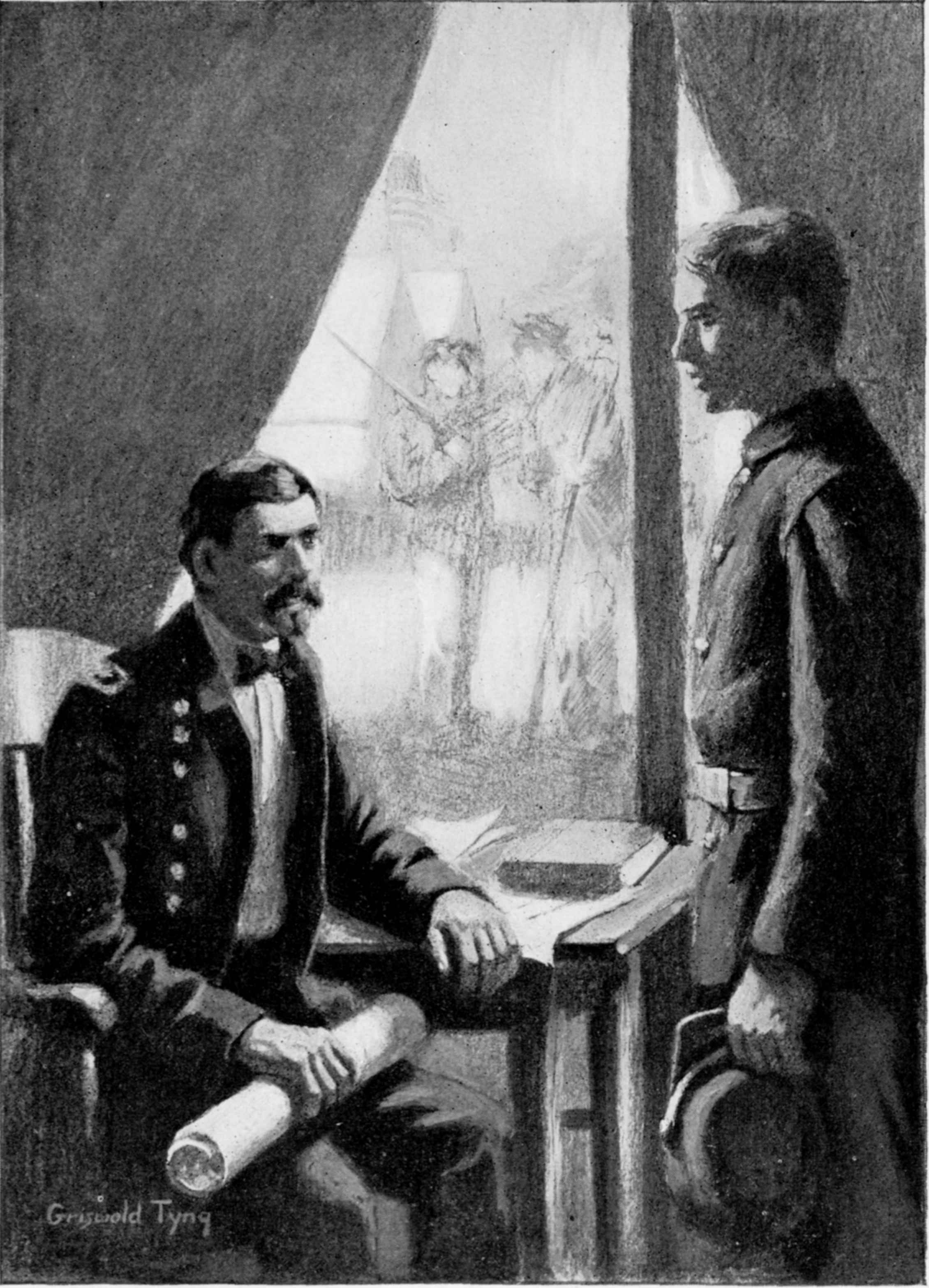
“Keep on as you have started and who knows but that you will one day be wearing a general’s shoulder-straps?”—Page 387.
[Pg 388]
It must not be imagined that Louis had forgotten Hornsby. His first words on getting into camp had been concerning his fellow-prisoner. Nothing had been heard of the old soldier. As a matter of fact, the man was recaptured not six hours after dropping from the prison window, and it was only by good luck that he was not shot. Two days later he was removed to Libby Prison, where he remained until the first exchange of prisoners after the termination of the peninsula campaign.
Louis received an ovation when he returned to the ranks of the Goreville Volunteers.
“He’s been a-dining with General McClellan,” said Callings. “Louis, what did you have, quail on toast or stuffed turkey? Did he treat to Havana cigars or Pittsburg stogies?”
“I pet you der cheneral vos calls him a pully poy,” put in Hans Roddmann. “Und dot’s vot he vos—der pulliest poy in der camp, hey?” And he slapped Louis so heartily upon the back that the young soldier had the breath knocked out of him. Jerry Rowe said nothing, but stood by, looking as sour as possible.
“The airs Louis Rockford puts on make me sick,” he grumbled to Benny Bruce, later on.
“Don’t talk to me, Jerry Rowe,” answered Benny, with flashing eyes. “You’re the biggest coward in the camp and I don’t care to recognize you.”
[Pg 389]
“Call me a coward,” cried Jerry, in a rage. He went at Benny with his fists, expecting the drummer boy to retreat. But Benny had heard enough about Jerry and he determined to make a stand if it cost him his life. He dodged Jerry’s first rush and then planted a blow on the big boy’s neck which sent Jerry headlong to the grass.
“Hurrah!” called out a soldier, who saw the row. “Benny Bruce is giving Jerry Rowe a long-deserved licking!” and the cry soon drew a crowd. Mad with rage and mortification, Jerry leaped up and made another rush, only to have the first dose repeated. Benny’s eyes burned like two live coals.
“You’ve taunted me enough, Jerry Rowe,” he panted. “After this you leave me alone, understand?”
“I’ll—I’ll kill you!” howled Jerry, again scrambling up. This time he managed to hit Benny on the cheek, but in return came a smashing blow on the nose, “a regular sockdolager,” so Harry Bingham said, and Jerry staggered back with his face covered with blood. Benny followed him up, when lo and behold, Jerry’s cowardly nature asserted itself and he actually ran away from the aggressive little drummer boy! What a shout went up!
“Hurrah for Benny Bruce!”
[Pg 390]
“He’ll be a man yet. Shake hands, Benny. Jerry Rowe won’t bother you again, I’ll bet you a shilling.”
“Benny vos almost so much of a mans as Louis, py chiminatty!” said Hans Roddmann. “Mine poy, I vos broud of you. Der best dings Cherry can do is to desert und choin der enemy.”
“They won’t have him,” said Louis. “Benny, I’m glad to see you able to stick up for yourself. I don’t believe in fist-fighting, but I guess Jerry Rowe deserved all he got.”
“He’s been picking at me since we enlisted,” answered the drummer boy, who was still panting from his exertions. “All I ask of him is to leave me alone.”
None of the officers had witnessed the encounter, which took place behind some bushes to the side of the camp, and the matter was hushed up. After that Jerry Rowe took good care to leave Benny Bruce alone.
As soon as he could do so, Louis wrote a long letter to the folks at home and with this sent the document received from Theodore Faily.
[Pg 391]
“There, I hope that makes everything right,” he said to himself, as he dropped the communication into the mail bag. He was very happy to think he had met Mr. Faily, but his happiness was cut short the next day when word was brought in that there had been a fire on the docks and some mail matter had been destroyed.
“Oh, was our mail in the bunch destroyed?” he asked, of the under officer who brought the news.
“I don’t know, but I am afraid so,” was the answer, which made Louis’s heart sink like a lump of lead in his bosom.
On the following morning there was a slight commotion in camp. Some guerrillas had been captured, and Louis went to the spot to see them. To his surprise Caleb Fox and Sam Jacks were among the prisoners. Both were wounded, although not seriously.
“What are they going to do with those prisoners?” asked Louis, of one of the guards.
“Shoot ’em, I guess,” was the answer. “They deserve it.” But Fox and Jacks were not shot. Instead they were tried and sentenced to prison until the end of the war,—with a black mark against each,—which meant that they could not be exchanged.
“Well, I am glad they are out of the way,” was Louis’s comment, when he heard of this.
[Pg 392]
For over a week matters were quiet in the great camp so far as the Goreville Volunteers were concerned. On all sides the commands were strengthened so far as such a course was possible, and again General McClellan sent out his call for reinforcements and received less than a tenth of what he hoped for, and what he deemed absolutely necessary.
In the meantime the Confederates were not idle. General Lee was now in absolute control, and by his work the army of the South was equipped and disciplined far better than ever before. Lee also began to correspond with General Jackson and was assured that Jackson with his command of the Shenandoah would be ready to unite with Lee’s forces whenever wanted. Thus was extinguished the last hope the Union army had of entering Richmond as a conclusion to the great peninsula campaign.
[Pg 393]
Although the Goreville Volunteers were idle, the Montgomery Grays were decidedly active. About the middle of June a force of fifteen hundred Confederate cavalry under General Stuart moved from Richmond over to Hanover Court House, where they had a brush with a small body of Union soldiers, put them to flight, and destroyed many military stores from Hanover Court House to Tunstall’s Station, on the York River. From the York they moved to New Kent Court House and then to White Oak Swamp, thus taking a position directly in the rear of the Union army. Nearly two hundred prisoners were taken, and this cavalry raid was certainly the most daring of the whole campaign. Andy was in this raid and acquitted himself with great honor by helping to capture four Unionists, one supposed to be a spy, although the man never acknowledged it.
This raid, along with other happenings, made General McClellan decide to change his base of supplies from White House, on the York, to the James River on the southern side of the peninsula. With this change of base this story has nothing to do, although the happenings upon that occasion, how the army goods were transported by boat and by wagon, and how what was left behind was burned, would fill a volume. It was a tremendous change, but a necessary one, and was made none too soon.
[Pg 394]
The last week in June found the two armies ready for the final conflict—standing at bay, like two monsters, each measuring the strength of the other. They were on the verge of seven days of almost continual fighting. Everything that the two commanding generals could well do had been done. McClellan was vainly calling for the increase in troops he could not obtain, Lee was recruiting from every possible source, while Jackson, still maneuvering in the valley to deceive McDowell, was marching with all possible speed with the main body of his soldiers to help guard the Southern capital.
On June twenty-fifth the contest began by the advance of the Union forces in the neighborhood of Seven Pines. At the same time General Jackson descended from the Shenandoah Valley and prepared for an immediate and heavy attack upon the right wing of the Union army. This was done after a consultation with General Lee, and through this means General McClellan was forced to abandon his attack and henceforth act upon the defensive.
[Pg 395]
The Seven Days’ battles began properly at Mechanicsville on the twenty-sixth, and there followed in rapid succession the battles of Gaines’s Mill, Allen’s Farm, Savage Station, Glendale, and several others of lesser importance, topped by the terrific struggle at Malvern Hill, where the fierce advance of the Confederates was at last stayed by the Union forces, and General McClellan was allowed to withdraw to Harrison Landing without further molestation.
To go into the details of the battles enumerated above would take far more space than we have to spare for such purposes. If the advance of the Confederate forces was masterly, equally so was the skillful retreat of the Union troops. Every mile of the ground was contested, as both sides fought their way through woods and swamps, and along roads now heavy with mud and then again ankle deep with dust, the Confederates with their capital and its supplies behind them, the Union army carrying with it thousands of sick and wounded and all that it was trying to save.
[Pg 396]
But all these wonderfully interesting details must be left to the historians of the past and the future. We will pass on to the adventures Louis and Andy were to experience in those trying times, adventures more exciting than any they had yet encountered.
ADVENTURES DURING THE SEVEN DAYS’ BATTLES
“Harry, we are going to move at last!”
“Who said so?”
“Captain Paulding. I just heard him talking to the general. I fancy we are in for a bit of hard fighting now.”
“We have waited here too long, Louis, to my way of thinking. The rebels must have a tremendous reinforcement by this time.”
It was a clear, warm day. It had not rained now for more than ten days, and the high ground around the camp was beginning to show signs of dust. On every side activity prevailed. Yet it was not until the middle of the afternoon that orders reached the regiment to which the Goreville boys belonged to move forward, in heavy marching order.
[Pg 397]
“This does mean business,” Blackwell exclaimed. “We’re either going to march for Richmond or—”
“Or what, Blackwell?”
“Or we’re going to retreat.”
“Retreat!” came from half a dozen throats.
“Exactly, fellows. You see—”
The roll of Benny Bruce’s drum cut the remark short. Soon soldiers were hurrying in all directions as the call to arms sounded upon the afternoon air. Half an hour later the Goreville Volunteers were on the march, moving down a road in the direction of Mechanicsville.
Less than half a mile had been covered, when they heard the deep booming of cannon, followed by the sharp rattle of musketry. The shots came in quick succession, showing that not a mere skirmish but a genuine battle was in progress.
Louis’s heart began to beat fast. He had done no fighting since that advance at Fair Oaks. What did the immediate future hold in store? He breathed a silent prayer that all might go well with him.
[Pg 398]
A small hill was ascended and before the Volunteers was spread a moving panorama of soldiers, marching, retreating, and firing so fast that the clouds of dust almost hid the gallant fighters from view. On another hill a Confederate battery was dealing out death with every discharge of its four guns.
“That battery must be taken!” This was the cry that ran along the line, as the Goreville Volunteers swept into action. “Forward, men, and keep close. One gallant charge and the day is ours!”
Away went the men, each bayonet glistening brightly in the clear sunshine. On and on over the tramped-down grass, the soldiers so close together that nothing could go between them, Harry on one side of Louis, Blackwell upon the other—on and on, through the smoke and dust. Louis could fairly feel his heart thump against his cross-belts.
Boom! boom! boom! The Confederate battery had opened upon them in deadly earnest. The long flashes of fire, the whistling of grape and canister, was followed by yells and shrieks of agony never-to-be-forgotten. Men dropped by the score and for a moment the line staggered and halted.
[Pg 399]
“Close up! close up! forward!” came the command, and the men crowded together again. Now came the order to fire, and the first line did so. Then they dropped upon their knees and the second line fired over their heads. The rifles were pointed at the Confederate gunners and several were seen to tumble back. Then on swept the Union line, yelling with a voice that is never heard anywhere but on the battlefield where men are fighting for their very lives.
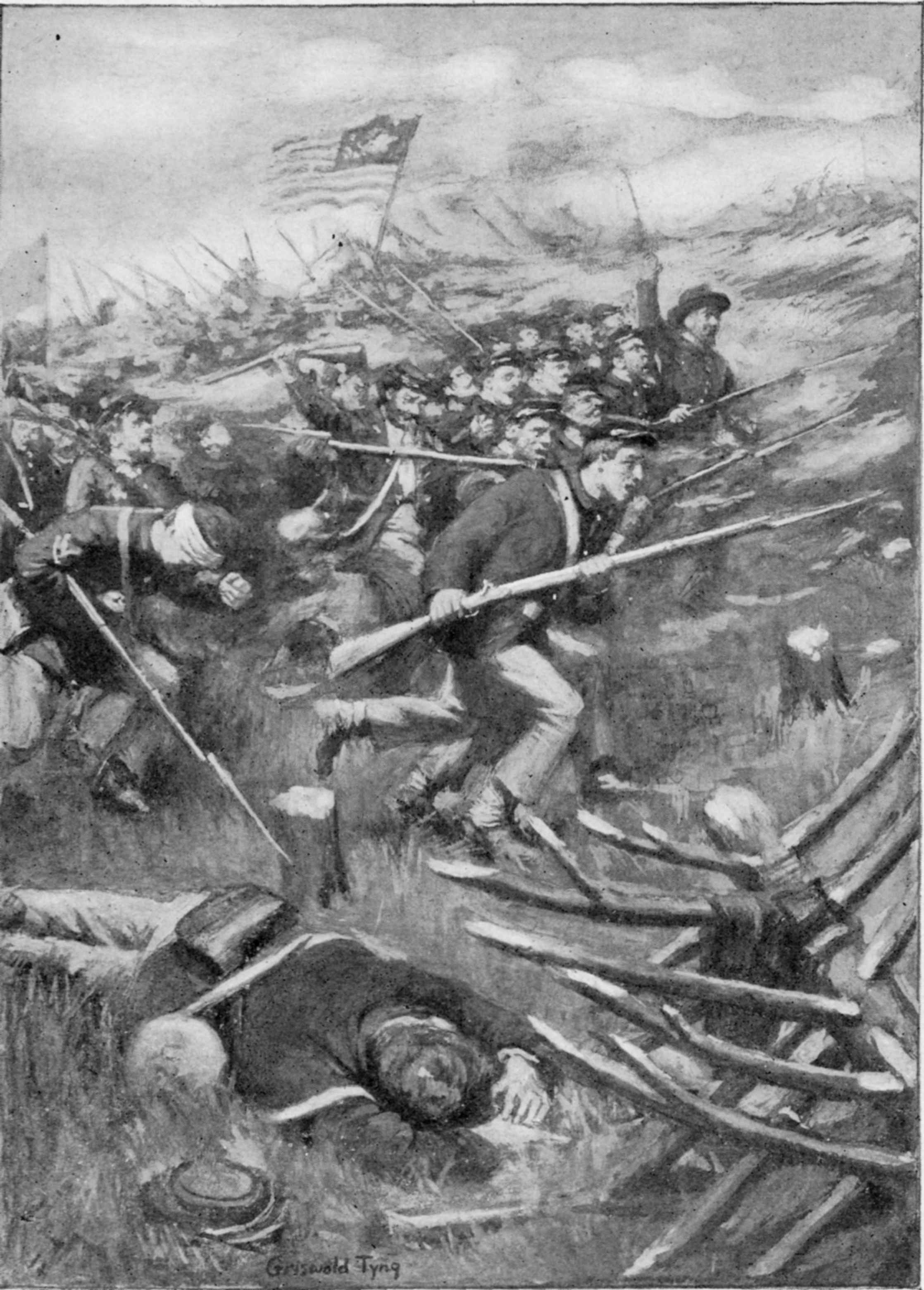
Then on swept the Union line, yelling with a voice that is never heard anywhere but on the battlefield. Page 399.
The guns were now in plain sight, and fearful of the attack, a regiment of Confederate infantry was hurled to the front to stay the progress of the long line of blue. It was bayonet to bayonet, with a clash and a crash that could have been heard for half a mile had not the general din swallowed it up. But the boys in blue were on the run and could not be stayed until the battery was gained and silenced.
[Pg 400]
The encounter nearly threw Louis off his feet. As the Confederates came closer, he suddenly saw before him a tall, thin man, with a browned, determined face. The bayonet of the man was thrust with a vicious lunge straight for his heart. With a desperate effort, Louis knocked the weapon aside. Then his own bayonet lunged forward and the tall, thin man went down, pierced through the side. Like a flash he was lost to view, as the first and then the second line of attack trampled over his body, and Louis found himself confronted by another foe.
“The battery is ours! Hurrah!” This was the cry which rang over the field. The Confederate infantry had been forced back, inch by inch, until the Union soldiers now held the entire top of the hill. It looked as if the day would remain their own.
But this was not yet to be. From the woods beyond there burst a fresh regiment of North Carolina troops, and close behind them came some Alabama reserves, and once again the men in gray made an onslaught, yelling like so many demons. Some artillery also came into place, dealing death at every discharge and cutting down those on the very apex of the hill as with a huge scythe.
[Pg 401]
“They’re too many for us!” Who started the cry will never be known. But it was enough to put the Union regiment upon the retreat. An effort was made to spike the Confederate battery which had just been taken, but there was not time enough, and in a twinkling blue and gray were fighting in the hollow beneath the hill, “like cats in a water butt,” to use Moses Blackwell’s words. Moses had had a shot through his ear lobe, from which the blood flowed freely, but the thought of retiring to the rear never once entered his head.
“If only a fellow had a drink of water!” panted Louis. The Goreville Volunteers had reached the shelter of some brush, and the Confederates had failed to follow them up. He looked around and found a pool close at hand. He was kneeling to get a drink when a cannon boomed forth, the ball ploughed into the pool and he found himself bespattered with water and mud! He forgot all about being thirsty, but rolled over and retreated on a run.
There was now a call to support another regiment in a different section of the field, and once again the Goreville boys set off on the double-quick, loading as they ran. They were now in the vicinity of the river, and blue and gray were fighting for the possession of a bridge.
[Pg 402]
“We will go below,” said Captain Paulding, who had received orders to that effect from the general of the regiment. “The Confederates have found a lodging on this bank behind some fallen trees and we must root them out.”
The march was through some swamp lands close to the river. The change from the sunshine and heat to the damp shade of the forest trees cooled the ardor of the soldiers, but still they went on with grim determination. Several hundred feet were passed, when there arose a wild yell from the right and from the left. They had fallen into a trap!
“Fire! Charge bayonets! Fall back!” These and half a dozen other orders rang out. But no one heard them. The Confederates were hemming them in. They must cut their way back to safety. A fierce fighting arose upon every side. Louis charged with the others. He had taken less than ten steps when a clubbed musket hit him alongside of the head and he was knocked almost senseless. He staggered off to a thicket, pitched upon a tuft of swamp grass; and knew no more.
[Pg 403]
When the young Union soldier came to his senses all was pitch dark around him. His head ached as if it would split open, and his ears still rang from the concussions of the battle. He endeavored to sit up, but fell back completely exhausted.
The first sound which claimed his attention was that of the swamp frogs. How calmly they croaked, as though such a thing as war was unknown. Then came the cry of a distant night-bird, returning, after a brief season of alarm, to its nest. He continued to rest and to listen, and thus gradually his headache became more endurable.
It was the cold which finally made him arouse himself. He reckoned it must be three or four o’clock in the morning. He listened attentively. Far, far away he fancied he could hear the tramping of horses and the rumbling of wagons. It was the retreat of the Union baggage trains. The Army of the Potomac, finding the enemy too numerous, had begun its withdrawal to the James River. A part were already at Gaines’s Mill, preparing for the battle which was bound to come at the break of day.
[Pg 404]
“I must get back to our regiment,” he thought, and arose to his feet. For the moment he could scarcely stand. He wondered if he had been shot. Then he remembered the savage blow from the gun-stock. He put his hand up to his head. There was a large and sore lump back of his ear.
Which way should he turn? It was a puzzling question. The enemy might be all around him, and he had no desire to be taken prisoner again. He thought of the river, close at hand. The Union army must be on or near that, perhaps five or ten miles below. He would follow the river, for want of a better path.
The task Louis had cut out for himself was no easy one. The swamps were treacherous and soon he found himself up to his knees in muck and water. He could scarcely move, and coming to a slight elevation threw himself down, panting for breath. He was near the main stream and now something caught his eye which gave him a new idea.
The something was a flat-bottom boat, resting half in and half out of the water, the oars sticking over the bow. Instantly his mind was made up. He would take to the boat and row, or rather guide himself, down the Chickahominy until an assured place of safety was gained.
[Pg 405]
A few steps forward, and he had just begun to shove upon the bow of the craft, when a slight movement at the bottom caused him to start. A man lay there, his forehead tied up with a bandage. The man was a Confederate captain.
“Who’s that?” asked the man, in rather a weak voice.
“A soldier,” answered Louis, and added quickly: “Are you alone here, captain?”
“Yes, worse luck. Where is my command? I was struck by a glancing bullet and knocked out.”
“I don’t know where your command is, captain. Can you get up? This is a bad resting-place.”
“Can I get up? Why—Heavens! a Union soldier, and I thought you a friend! What does this mean?”
“Keep still, captain,” answered Louis, and then as the wounded officer made a movement as if to draw his pistol, the youth leaned over him and snatched it from his belt.
“Hi! give me my pistol!” came in a weak but fierce tone. The Confederate officer tried to rise, but Louis shoved him back.
[Pg 406]
“Keep still now. As you discovered, I am a Union soldier, and I have no desire to be made a prisoner.”
“What do you intend to do?”
“Take this boat and row down the stream.”
“I don’t want to go down the stream.”
“In this case I am afraid you’ll have to go, captain. Lie still while I shove off.”
“But, see here—”
“Silence, if you value your life!” and Louis leveled the pistol at the man’s head. The threat had the desired effect. The Confederate captain fell back, and Louis shoved the boat into the stream. The youth soon found rowing out of the question and merely guided the craft as it drifted swiftly along the swollen river.
Half a mile had been covered and Louis was guiding the boat around a bend when the sounds of voices in a thicket ahead reached his ears. To slow up was impossible and he therefore guided the craft to the opposite shore from whence the voices came.
“Halt! In the boat, halt!” rang out the cry. “Who goes there?” and Louis saw the glint of a rifle barrel thrust through the leaves not twenty feet from him.
[Pg 407]
“It’s a Yank, sure ez you’re born,” came in another, but lower, voice. “Plug him, Bart, afore he gits the chance to git away!”
BETWEEN THE LINES
Louis felt he was in one of the most trying situations of his life. The Confederate picket had drawn a bead upon him, and unless he answered promptly he would undoubtedly be shot and killed.
“Stop! do yer hear?” came the voice again. Louis put down his oar and found the river less than a foot and a half deep. The blade was sunk into the mud and the headway of the craft checked.
“We are friends,” shouted the young Union soldier. “You have no right to detain us.”
“Who are yer?”
[Pg 408]
Louis leaned down. “Tell them who you are and say I am detailed to take you to a farmhouse below here,” he whispered to his prisoner. “If you don’t help me out of this scrape I’ll shoot you!” and he shoved the pistol forth suggestively.
“Don’t—don’t shoot me!” pleaded the wounded one.
“Then do as I ordered,” returned Louis, as cautiously as before, but his tone was cold and told that he meant what he said.
“Air yer goin’ ter answer?” came from the shore.
“It’s—it’s all right, men,” answered the prisoner, raising himself with an effort. “I’m Captain Garrison, of the Fourth Infantry. I’ve been wounded and my man is taking me down to a farmhouse below here, where I have friends.”
“Humph.” There was a pause. “Got the countersign, cap’n?”
“Alabama.”
“Thet’s all right, cap’n; pass on, ef yer want to.”
“Are we in danger from the Yanks?” asked Louis, as he pulled on the oar with all possible haste.
[Pg 409]
“Ain’t no Yanks inside o’ half a mile, to my way o’ reckonin’,” answered the Confederate picket, and then the boat drifted onward, and Louis breathed a great sigh of relief. The talking had almost exhausted the prisoner, and he lay motionless, with his eyes closed, in too much pain to even speculate over the outcome of his unfortunate adventure.
Another half-mile was covered without further interruption. It was now beginning to grow light in the east and Louis cast an anxious eye from shore to shore. Had the river at this point been deserted? It would certainly seem so.
[Pg 410]
Crash! The flat-bottom boat struck a half-submerged log, end on end. The shock was strong enough to rip open the bow, and the water poured in with great rapidity. The collision threw Louis, who was standing up with the oar, overboard, and so unexpected was the happening that he could do nothing but struggle to save himself. Down he went until his arms struck the soft bottom. Then he arose and struck out for the nearest shore. In the meantime, the boat swung around, cleared itself of the log that had done all the damage, and went on its way, half-submerged, with Captain Garrison clinging fast for his life. Soon wreck and prisoner were out of sight. Louis fancied the captain had been drowned, but such was not a fact. He survived, to fall, later on, into the hands of his friends.
Dripping with mud and water, Louis crawled up the bank of the Chickahominy and into a tangle of bushes. Was he any better off than he had been? was the question he asked himself.
“I ought to be nearer the Union lines,” he muttered. “If I could only climb some hill and then a tall tree I might—Ha! what’s that?”
A peculiar odor, as of cooking meat, had reached his nose. He sniffed it and found the odor coming stronger. Then he heard low negro voices.
“Ain’t dat fowl most done, Henry Harrison Dundell?”
“It am, Uncle Ike.”
“Den let us eat um up, afore some o’ dem sodgers cum fo’ to take it away from us.”
“De taters am dun, too, Uncle Ike.”
“Dat’s good, boy, dat’s good. Come an’ stow um away now.”
[Pg 411]
A rattle of tin plates and a couple of knives followed. Crawling forward, Louis soon beheld a wretched negro hut, half-tumbled-down, on the edge of a clearing. In front of the hut an aged negro and a darkey boy were enjoying a feast of chicken meat and baked potatoes.
Making certain that no others were around, Louis advanced, pistol in hand. At the sight of the young soldier, both colored ones started to run, the uncle with the chicken and the boy with his arms full of smoking hot potatoes, which burnt him and caused him to dance a lively jig.
“Stop, both of you!”
“Fo’ de lan’ sake, officer, doan you shoot us!” moaned the aged negro.
“I won’t uncle; but come back with that chicken. I want a drumstick, and I want a couple of those potatoes; they smell good.”
Much relieved in mind, the two colored ones returned and gladly divided their morning meal with Louis. As he ate, the young soldier questioned the aged darkey, as to the camp of the Army of the Potomac.
[Pg 412]
“Da is right ober yander, sah,” was the reply, and the colored man pointed with his long, bony hand. “But, bless you, sah, General Lee an’ General Jackson am all aroun’ yeah wid thousands an’ thousands ob troops ready fo’ to swallow yo’ up, moah de pity!”
“They won’t swallow us up so easily,” smiled Louis. He sat with his back to the fire, drying himself. In an hour he was ready to go on, and the aged colored man gave him minute directions as to the best trail to follow.
Morning had now come, and once again the sun shone hotly. Not a cannon boomed in the distance, for the battle of Gaines’s Mill did not really open in earnest until some time after noon. With the pistol of the Confederate captain stuck in his belt, Louis trudged on and on. At noon he stopped, wondering where he was. He had taken a wrong turn and now found himself in a thicket. He tried to take a cross cut, and became hopelessly lost, and thus the best part of the day slipped by.
He was lost in the swamps of the Chickahominy!
[Pg 413]
Only the old veterans who went through our great war can realize the full meaning of those words. “Lost in the swamps” was the fate of many a straggling soldier who never turned up to tell his story of starvation. With such a jungle about him that he could not see twenty feet ahead, and with mud and water up to his ankles, Louis stopped short, and a chill shot through him.
“I’m in for it,” he murmured, dismally. “I took the wrong road, or else that negro led me astray purposely. How in the world am I to get out?”
It would not do to remain long in one spot—he was sinking deeper and deeper in that ooze, which stuck like so much glue. He staggered forward until a low-branched tree was reached, and into this he climbed to rest.
From afar now came the sounds of battle, as the Confederate General A. P. Hill sent his corps to the attack, with Longstreet following. How bravely the small division of Porter’s troops resisted, history has told, and it has also told how the Union troops were finally forced back and two of their best regiments were taken prisoners.
[Pg 414]
But Louis thought of none of these things, as slowly and painfully he climbed to the top of the tree. The survey from this spot was disappointing. He was in a hollow and on every side the distant woods cut off a further view. Yet he managed to locate the sounds of battle, and that was one point gained.
By the time he descended to the lower branches of the tree it was dark. To think of going on was out of the question. He got down for a drink, then returned to the tree limbs, to pass an almost sleepless night among the birds and frogs.
Daybreak found him hungry and cold. He now felt he must go on or face starvation. He had noted the location of the nearest high ground, and struck out for this, leaping from one tuft of swamp grass to another, as best he could. The bushes scratched his hands and face and tore his clothing, but to this he paid no attention. He progressed until nearly noon, when he reached firm ground and a well-defined trail, and threw himself down to rest.
He was between his own line and that of the enemy, he felt tolerably certain of that. But how should he move to join the Union army? The trail might lead him directly into the Confederate camp.
[Pg 415]
“I don’t care—I’ll risk it,” he muttered at last. “I can keep my eyes open and I guess I can run as fast as any of them if it comes to the pinch.”
Yet his progress along the trail was slow, for fallen trees were numerous, and once he encountered a nest of snakes, just emerging after an unusually long winter’s nap. His scramble to get away from the reptiles was lively enough, for he imagined the snakes poisonous.
Nightfall brought him out upon a highway leading southward. The ground was cut up by many wheels, showing that artillery had passed that way but a short while before. Presently he came up to three soldiers wearing Union uniforms.
“Hello there, comrades!” he shouted, joyfully. “I’m lost. Can’t some of you find me?”
“We’re lost, too,” was the reply from the evident leader of the trio. The three men belonged to a New Jersey command which had been captured. They had had a tough struggle and each was wounded, although not seriously. With this trio Louis proceeded upon his way feeling much lighter at heart.
[Pg 416]
That night the four lost ones encamped in the woods close to the road. A haversack filled with two days’ rations had been picked up, and although the eatables were stale, the quartet fell to with avidity and did not allow a mouthful to escape them. The march forward was resumed before the sun came up and at nine o’clock the pickets of the Union army on guard near the railroad at Savage Station were encountered. Nobody had the password, but their story was soon told and they hurried to the rear.
The battles so far upon the withdrawal to the James River had not been particularly severe upon the Goreville Volunteers. Out of a total of seventy men, eight had been killed and twelve wounded. To be sure, many had been “scratched,” but in the grimness of war such trifles do not count.
[Pg 417]
Louis did not run across his command until the next day, for now the fighting was general along the whole line, the Union troops protecting not only their own retreat, but also the passage of the vast stores moving from White House across the peninsula to the James River. Finding him unemployed, he was asked to act as an orderly, and mounting a stray horse, he carried several orders from one part of the field to another for those in charge of the baggage train. Thus the day slipped by in work that was hard but not particularly dangerous.
“Louis!” cried Harry, when at last the Goreville boys were found. “By jinks! I ’most feel like hugging you! I thought you were dead sure!”
“I’m a long way from that,” laughed the youth. “But I’ve had a rough experience, nevertheless.”
[Pg 418]
And he told his friend of all he had gone through. There was no time to say much, for the regiment had been ordered to the rear, to protect the baggage wagons. Louis and Harry were both afraid they would not have much to do, but in this they were greatly mistaken. The train was attacked by a large company of Confederate cavalry, and a hot skirmish kept up until long after nightfall. And so the days slipped by until the great body of the army of the Potomac reached Malvern Hill. Hotly pursued by the Confederates, General McClellan here took a stand, resulting in the greatest battle of the peninsula campaign, and one that Louis and Andy will not forget if they each live to be a hundred years old.
MALVERN HILL—CONCLUSION
Malvern Hill was a small elevation, not over sixty feet high at its topmost point, on the north bank of the James River. The plateau above was nearly large enough for the entire army, and the approach from the north was rather abrupt, while on the south it was protected by Western River and heavy timber and brush.
The Army of the Potomac took its final stand around this hill in a huge semi-circle, the right and the left resting upon the river, where the gunboats could offer a good support. Back of the Hill was Harrison Landing, which was to be the last stopping place for the great army.
[Pg 419]
It was the intention of the Confederate leaders to force the fighting simultaneously all along the line, but when the time for action came this was impossible. Owing to the denseness of the forests and the lack of topographical knowledge of the country, some of the divisions went astray and at the important moment were a mile or more away from where they should have been. Nor were some of the Union troops better off. Having retreated in haste and dropped their guns, they, seeing the gunboats on the river ready to support them, ran forward again to find their weapons, and meeting some of the advancing Confederates produced a confusion which broke up all of the plans laid for that section of the battleground.
From early morning the artillery were engaged, but it was not until about one o’clock that the real attack of the Confederates began. From that time on until nine in the evening the battle waged with relentless fury at one spot or another, until, seeing they could not force the Federals from their chosen position, the army of the South withdrew, and McClellan was allowed to go his own way. The losses during the retreat from before Richmond were over fifteen thousand men upon each side.
[Pg 420]
Early in the morning the Goreville Volunteers found themselves resting upon their arms on a small elevation some distance from the main hill. Here was planted a strong battery which they had been called upon to support. So far this battery had not been into action, but now, at eleven o’clock, it began to belch forth at the Confederates who were advancing in a hollow of the woods below. Only a few shots were fired, the men in gray taking to cover as soon as possible.
“We’re out for hot work to-day,” said Louis, decidedly. “General Lee is going to do his level best to break our backbone.”
“Yah, und maybe it vos his own packbone vill got proke,” put in Hans Roddmann. “I been fightin’ so much der last week it seems like I can’t do noddings else.”
One man had disappeared from the ranks without being either killed or wounded. That was Jerry Rowe. Two days before Jerry had flung down his gun and started on a run for Harrison Landing, and there he was now, skulking among the wagons, waiting for the troops to embark for Washington. Fortunately, neither side had many such arrant cowards as this lad was.
[Pg 421]
“Attention!” came the cry. “Look to your guns, boys, and see if they are loaded and in good condition. No play to-day. The general expects every man to do his duty.”
“We will! We will! Down with the rebs! Let us drive ’em clear back to Richmond!”
“Hurrah for Little Mac!”
Two hours went by, and again the battery opened up, as a long line of men in gray were seen coming through the hollow at double-quick. The shots did good execution, but the line came on through the brush, over fallen trees and rocks, until it was advancing straight up the little hill.
“Company, attention! Charge bayonets! Forward!”
The battery had blazed away right in the faces of the men in gray, who were yelling at the top of their voices. But leaving their dead and dying behind they strove to reach the cannons. Now the boys in blue swung out to meet them. Crack! crack! went the rifle shots, like barrels of hail, as line after line swung into position, fired, and wheeled away to make room for the next. The execution was fearful and the men in gray faltered at the very mouths of the pieces they desired to capture.
[Pg 422]
But now reinforcements were coming—a large band of cavalry, with colors flying and the trumpeter blaring wildly. Down the hollow at breakneck speed and up the other side, the horses snorting and prancing as they smelt the smoke and the burnt powder—on and on, until the foot-soldiers had to leap aside to avoid being trodden upon. The Montgomery Grays led the van, and Louis saw Andy in the fore, with saber waving over his head. Andy was yelling and Louis almost imagined he heard his words, but that was impossible in the unearthly racket upon every side. The battle was opened in earnest now and sunset would not see it ended.
[Pg 423]
“Close up!” It was an order to the Union men, and they closed up around the battery, ready to defend every gun to the last. Still the Confederate cavalry came up, until the leading horse confronted that line of glistening bayonets, and then they paused. But only for an instant; there was a break, and the cavalry rushed through. The battery was lost and the Union men scattered in every direction, most of them flying to the woods on the west. The gunners lay dead at the wheels of their pieces, faithful to the last.
But the victory was a short-lived one. Word had been sent how the battery was being pressed, and a body of New York volunteers were hurried through the woods to the support of the Pennsylvania men. With a ringing cheer they burst into the clearing and the cavalry were shot down, horses and riders, in a fashion that made the leaders think a whole division of the enemy pressed them. The order was given to retreat and they scattered, just as did the Union men but a short quarter of an hour before, and some went into that same woods to the west.
Hatless, saberless, and shot through the left arm, Andy dashed into that thicket to avoid the rain of bullets pouring into what was left of the Montgomery Grays. Poor Firefly limped painfully, shot through the flank. It had been a daring charge, but a useless one, for the battery was again in the hands of Union gunners. He panted for breath and wiped the sweat and dirt from his face.
“Andy!”
“Louis! By all that’s wonderful! Where did you come from?”
[Pg 424]
“We were driven into this woods by your cavalry—or some cavalry that was with yours. How did you get here?”
“Some Union reserves came up and we had to scatter or be cut down to a man. Oh, but it’s a fearful day for both sides! I wish this war was over, Louis.”
“You don’t wish it any more than I do, Andy. It’s not all glory, is it?”
“Hardly. But, hark! Some troops are coming!”
“And I am not armed!”
“Nor I! Listen—they seem to be passing to our right. We had better separate.”
“You are badly wounded, and so is Firefly.”
“So are you wounded. Your cheek is covered with blood.”
“That’s only a scratch, Andy. But one of your horses stepped on my ankle and that’s not so nice. Hello, what’s the meaning of that?”
[Pg 425]
The conversation was broken off and both young soldiers stared through the thickets. A strange, heavy smoke was rolling their way. Firefly sniffed it and began to circle about uneasily.
“Andy, I think—”
“The woods are on fire!”
“You are right—and, see! the fire is behind us, too!”
They swung around. It was true, either by accident or design the forest had been ignited, and now the dry brush was burning like so much tinder. From here and there came a distant cry for help.
“It looks as if we were hemmed in, Louis. What shall we do?”
“Do? Get out—just as fast as we can. Come, there seems to be a clear space to our left.”
They hurried off. The wind now began to blow, carrying the burning embers close to each. Firefly snorted in alarm and could scarcely be controlled. As Andy passed under a low-branched tree the animal gave a sudden bound and threw his young master backward. The next instant he was out of sight.
[Pg 426]
Louis ran forward. Andy lay where he had fallen, motionless and with his eyes closed. His head had struck the root of a bush and he was senseless.
“Andy! Andy!” cried Louis, pleadingly, but there was no response.
The young Union soldier looked back. The fire was advancing with frightful rapidity. He must run with all his might if he would save himself from the devouring element.
But could he leave Andy, his enemy and yet his best friend? No, never! “I’ll die with him before I’ll do it!” he muttered between his set teeth, and caught up the motionless form and slung it over his shoulder. The burden was a heavy one, but he struggled on manfully.
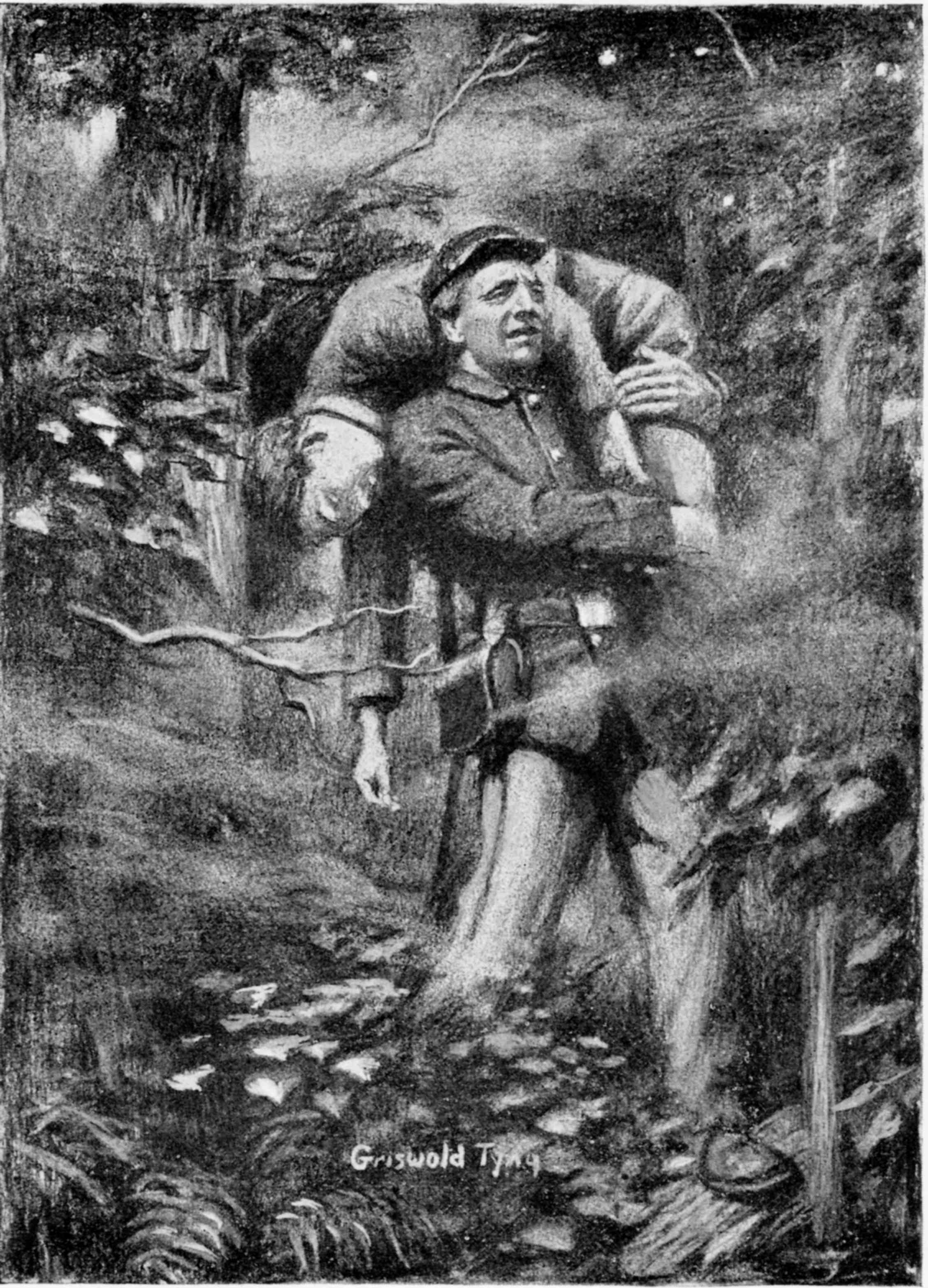
“I’ll die with him before I’ll do it!”—Page 426.
But now he could not go much farther. Every nerve had been strained to its utmost. He stumbled rather than ran a few steps more. Ah, what was this—a tiny stream! He plunged into the water and allowed his clothing to become saturated. He also threw some of the water into Andy’s face.
“Louis—what—what happened?” and Andy’s eyes opened widely.
“Firefly threw you and ran off, Andy. I carried you here. We are not yet safe.”
[Pg 427]
“You carried me, Louis? How good of you! And the fire is behind?” By a superhuman effort Andy started up. “We must go farther.”
“Yes. If you can walk give me your hand. See, there is a road and beyond is a clearing. Come!”
On they went, side by side, Louis supporting Andy, who was still dizzy. The clearing reached, they saw another road, and beyond was an open field where a regiment of Union men were battling bravely against a broken line of gray. Here both came to a halt and gazed into each other’s eyes.
“We must part, Andy! Good-bye!”
“Good-bye, Louis, and I’ll never forget you. May God spare your life!”
“And may He spare yours, also!”
They shook hands and turned in opposite directions. It was the last the chums saw of each other for many months to come.
[Pg 428]
The memorable day was drawing to a close when Louis found the Goreville Volunteers, or what was left of them, for the charge at Malvern Hill had cost the command dear. Brave Callings was dead and so were ten others, and six men were missing. But, cut up as it was, the company was joined to the remnants of several others and sent to the aid of the center of the line.
At nine o’clock the Volunteers lay down on their arms, worn out to such a degree that hardly a soldier could keep open his eyes. But the Confederates had been repulsed in handsome shape, and, as worn out as their enemy, they were perfectly willing to withdraw and leave the victory wherever it might rest—which was with the Union forces.
[Pg 429]
And here properly ends my story of a young soldier in blue and a young soldier in gray. A few days later found the Goreville Volunteers at Harrison Landing, ready to return by water to Washington or to go wherever they were sent. A slight attack was made by the Confederates, but it soon ceased, and the troops of General Lee marched back to the neighborhood of Richmond. From this point Andy, still suffering from his wounds, was allowed to return, for the time being, to his home. Firefly had again turned up, and youth and horse soon found themselves safe in Lee Run once more. Need I say anything of the warm greeting the young Confederate received from his parents and his sister?
“And Louis saved you from the fire, did he?” said Grace, when Andy’s story was told. “How noble of him! He is surely a real hero, even if he is a Unionist!” and her eyes beamed with pleasure. She was thoroughly glad to learn, later on, that Louis was safe.
“Now you are home, you must take it easy for a while,” said Andy’s parents. “You have done enough for the cause.” And the youth who had worn the gray was quite content to rest for the time being.
“I am coming home on furlough.” That was the message Lucy and Martha brought home from the Goreville post-office one day. There was a great bustle all over the house, and when the time came how all waited for the train to arrive!
“I see him! There is Louis!” cried Lucy, and then all rushed forward, to kiss the young soldier and to shake hands over and over again.
[Pg 430]
“My boy! My boy!” murmured Mrs. Rockford, straining him to her breast. “God be thanked for this day!” And the tears of joy streamed down her cheeks.
“I want to ask you one thing,” said Louis to his father, after the greeting was over. “Did you receive that document I sent—the one made out by Mr. Faily?”
“I did. It came yesterday morning. The edge of the envelope was burnt, and the address scorched, but the document and letter were intact. An hour after they came Mr. Hammer called. I showed him the document and he was thunderstruck. He got out as soon as he could, and by the way he acted I do not believe he will bother us any more.”
“Good!” cried the young soldier. And his heart was lighter than ever.
“Louis, you have done your duty, and more,” said his father, affectionately. “I am proud of such a son.”
“And we are all proud!” cried Martha. “Just as proud as we can be!”
[Pg 431]
The great rebellion is now only a matter of history. Many of those who wore the blue and the gray are sleeping side by side on the great battlefields. To those who laid down their lives, the Peninsular Campaign was the end of all, but to the great majority it was but the beginning of a conflict which was to wage fiercely for three years longer. Louis and Andy were destined to serve further, the one under the stars and stripes, the other under the stars and bars. But, come what might, neither was to forget those first battles, when each did so nobly Defending His Flag.
THE END.
Transcriber’s Notes
Perceived typographical errors have been silently corrected.
Illustrations have been moved nearer to the text to which they refer.