Mooney, Buffalo.
Transcriber’s Note:
New original cover art included with this eBook is granted to the public domain.
Mooney, Buffalo.
Many years have now passed away since we were presented with that very interesting and amusing book, the “Natural History of Selborne:” nor do I recollect any publication at all resembling it having since appeared. It early impressed on my mind an ardent love for all the ways and economy of nature, and I was thereby led to the constant observance of the rural objects around me. Accordingly, reflections have arisen, and notes been made, such as the reader will find them. The two works do not, I apprehend, interfere with each other. The meditations of separate naturalists in fields, in wilds, in woods, may yield a similarity of ideas; yet the different aspects under which the same vithings are viewed, and characters considered, afford infinite variety of description and narrative: mine, I confess, are but brief and slight sketches; plain observations of nature, the produce often of intervals of leisure and shattered health, affording no history of the country; a mere outline of rural things; the journal of a traveller through the inexhaustible regions of Nature.
| Residence of the Author—Extensive prospect on the banks of the Severn—Welsh mountains, and passages of the river—Roman encampment upon a British site—Remains of the Romans—Coins—Skeletons of men and horses—Traces of a forest—Soils of the parish—Limestone, its abundance and uses—origin—Rocks formed in the parish by the coral polypi—analysis of—Rocks of deposit—analysis of—Lead ore—Carbonate of strontian—Traveller’s foot burned off—Residences upon Limestone supposed healthy—Employment for laborers—Amount of stone disposed of—A worthy peasant—Analysis of soils considered as fallacious—Dairy processes—Grass lands, their nature—Wild plants—predominating plants in corn-fields—Soils will produce particular herbage—Mode of saving hay—Wheat—Culture of the potato—sorts—expense and profit—effect upon the soil—not considered as injurious—sketch of its history—its introduction—some soils not favorable for the root—introduced later than tobacco—value to mankind—Ignorance of the first habitants of the Cerealia—Tendency of plants to revert to their original creation—Original species of the potato cannot now be ascertained—Component parts of some varieties—Teasel crops—its introduction—culture—gathering—value—its cultivation not injurious to the soil—variety of names—application-consumption—Bad custom in farming—“clatters” | Page 9 to 41 |
| Study of natural history no subject of ridicule—to be made an object in youth—A beautiful Oak tree—magnitude of several trees—uncertain in producing acorns—a history of the oak might be written—all its products valuable—Wych elm—its character—uses—magnitude—name—suffers in early frosts—not beautiful in autumn—The buff-tip-moth—Trees condense moisture—Air under trees—verdure—Utility and agency of foliage—Prevalence of plants in soils—Fetid hellebore—uses—Village doctress—Blossoms of plants—use not manifest—Carpenter bee—What flowers most abundant—design of flowers—application of flowers—love of flowers—emblems—amusements of children—universal ornament—cultivation of flowers—bouquet—Poplar tree—formation of footstalks—its suckers | 41–58 |
| viiiDyers’ broom—gathering—dishonest practice—uses for the dyer—Conformation of flax and silk—Nature of color—Snapdragon—an insect trap—Dogsbane—very destructive—the object mysterious—Glaucous birthwort—Snapdragon vegetates in great drought—Evaporation from the earth—Ivy—its shelter and food for birds and insects—love of ivy—ornament to ruins—its effect—Foxglove—grows only in particular soils—medicinal uses—uncertain application—name—ancient names—Vindication of old epithets—Ancient and modern remedies—Snowdrop—a native plant—remains long in abandoned places—character of the snowdrop—Yellow oat-grass—affected by drought—Vervain—ancient estimation, and application—Druids of Gaul—Ancient and modern virtues—Dyers’ weed—value—uses—cultivation—yellow color—most permanent and common—Brimstone butterfly—Day’s eye—Dandelion—Singular appearance of a grass—Brambles—insect path on the leaves—uses of the bramble—Maple tree—an early autumn beau—fashion followed by others—maple wood a beautiful microscopic object—medicinal properties—leaves punctured by insects—Traveller’s joy—grows in limestone soils by preference—uses—pores of the wood in the microscope—Vessels of plants—uninjured by dry seasons—Seeds of the Clematis | 58–83 |
| Naturalist’s autumnal walk—beautiful, and full of variety—Agaric—beauty and variety—plentiful in Monmouthshire—Agaricus fimi putris—Verdigris agaric—Fungi very uncertain in their growth—Flower-formed hydnum—Mitred helvella—Gray puff ball—Fingered clavaria—Agarics, to be understood, observed in all stages of growth—Perishable nature of created things—Parasitic fungi—laurel—holly—two-fronted sphæria—elm leaves—sycamore leaves—bark of plants—the nut—beech—Odorous agaric—Fragment agaric—‘Stainer’ agaric—Stinking phallus—Mode of propagation—Turreted puff—Starry puff—Morell—Bell-shaped nidularia—Food for mice | 83–95 |
| Marten cat—his capture—well adapted for a predatory life—its skin—Hedgehog—mode of life—always destroyed—prejudices against—cruelty of man—an article of food—sensibility of the spines—Harvest mouse—where found—character—Increase and decrease of animals—Migration of rats—Water shrew—its residence and habits—common shrew mouse—Pale blue shrew—Mole—his actions—character—abundance of—easily discovers his food—structure of his body—fur and hair of animals—flesh of the moles—killed by weasels | 95–108 |
| ixBirds—admiration of—The hedge-sparrow—contingencies of its life—song—example of a domestic character—Willow wren—early appearance—and departure—nest—object of her migration—Difficulty of rearing young birds—Golden-crested wren—Linnet—their song—habits—Bull-finch—character—injurious to trees—preference of food—no destroyer of insects—Robin—character—always found—Song of birds—motives obscure—Chaffinch—beautifully feathered—female, her habits—country epithets—conduct in spring—moisten their eggs in hot weather—Parish rewards for vermin—Blue tom-tit—perishes in winter—mode of obtaining food—stratagems—Birds distinguished by voice—Cole mouse—variety of notes—Long-tailed tom-tit—nests—journeys—eggs—labor to feed their young—winter food—great variety of nests—Goldfinch—beautiful nests—Sufferings of the swallow—Maternal care of a little blue tom-tit—industry—Raven—scared from its nest—faculty of discovering its food—universally found—duration of life—reverence—superstitions wearing out—duration of animal life—aided or injured by man—an old horse—life of man—Crossbill—breeds in England—Rook—suffers in cold and dry seasons—his life in the year 1825—various habits of—detects grubs in the earth—his habits in the spring—associations—senses—Magpie—nests—habits—plunderers of the farm-yard—natural affection—Jay—conduct of the old birds—winter habits—feathers—shrike—nest—young—kills other birds—a sentinel—its mischievous disposition—Stormy petrel—habits—Wryneck—its habits—Birds annually diminishing—Swan pool, Lincoln—Nightingale—migrating birds—Rooks love long avenues—Starlings—great flights—social habits—breeding—a stray bird—actions before roosting—congregate—very attentive to their young—journeyings—Laborious life of birds—Red-start—Starling, brown—habits—a very dusky bird—Hawks capture by intimidation—single out individuals—Early seasons—bring rain—Blooming of the white thorn—Migrating birds—their conduct—Butcher-bird—Gray flycatcher—Thrush—instance of affection—motives of action—utility in a garden—Sparrows—domestic habits—manners—increase—destruction—great consumers of insects—accommodating appetite | 108–150 |
| Creatures associating with man—Common mouse—Rat—House fly—Utility of animals—Conduct of man—The dog—Wheatear—Country amusements often cruel—Supplication for pity—Eggs—their markings—Foolish superstition—Kite—his habits—great capture of—Blackcap—habits—song—nest—food—shyness—habits of our occasional visiting birds—Petty chaps—White throats—Willow wren—Fear of man in animals—Stratagem of a wren—Instinct—Awakening of birds—Early morning—Morning in autumn—Goldfinch—captured—die in the winter—soon reconciled to captivity—Tree-creeper—winters in England—not an increasing bird—Yellow wagtail—Rapacious birds—Passerine birds—Buntings—unthatching corn ricks—Old tokens and signs—White lily—Pimpernel—Mistlethrush—his note—breeds near the dwellings of man—Change of character in birds—Love of offspring—Divine appointments—Jack snipe—solitary habits—Christmas shooter—Association of birds—Peewit—habits—eggs—Prognostications—Hedge fruit—Fieldfares—Redwings—feeding in the lowlands—uplands—Egg of the fieldfare—Rural sounds—notes of birds—Plumage of birds—Song of birds—Woodlark—habits—voice—capture—Language of man—of birds—Note significant of danger—Singing a spontaneous effusion—Variety of note in same species—‘Lady-bird’ note of a song-thrush—Croaking of the nightingale—Admiration of birds—Cleanly and innocent creatures | 150–189 |
| xKnowledge slowly obtained—Entomology a difficult study—Wonders around us—The objects of many insects unknown—Chrysalis of a moth—Four-spotted dragon-fly—Ghost moth—soon destroyed—Specimens of plumage of butterflies—Argus butterfly—a pugnacious insect—combats—Azure butterfly—seldom seen—Hummingbird sphinx—habits—wildness—tamed by familiarity—feigns death—Painted lady butterfly—uncertain in appearing—Marble butterfly—Wasp—Meadow-brown butterfly—Yellow winged moth—Admirable butterfly—Gamma moth—Goat moth—their numbers—odor—power of destruction—Larvæ of phalæena cossus, where plentifully found—Designs of nature—Evening ramble—Insects abounding—ignorance of their objects—Glow-worms—curious contrivance about their eyes—light—migration—Snake eggs—destruction—harmless in England—antipathy of mankind to the race—Paucity of noxious creatures inhabiting with us—Small bombyx—Vigilance—animation—quarrels—Black ant—combats of strength—Red ants—mortality—Yellow ants—winter nests—millipedes—support great degree of cold—Stagnated water—abounding with insects—Newt—his voracity—Water-flea—an amusing insect—observed by boys—Dorr beetle—their numbers—feign death to avoid injury—Cleanliness of creatures in health—Recurrence to causes—Cockchafers—Changes in nature—Death’s-head moth—chrysalides—superstitions regarding the insect—voice—Great water-beetle—its habits and voracity—Hair worm—its object—Nests of a solitary wasp—Hornets—their abundance at times, and voracity—kill each other—Garden snail—its injuries—generally secure from destruction—faculties—small banded snails—their numbers—superstitions concerning them—Earth-worms—numbers of—the prey of all creatures—utility of—drain watery soils—Inattention to the works of Providence | 189–235 |
| Empiricism—Apple-tree blight—progress—injury—White moss rose—Testacellus halotideus—Cure of the American blight—Effect of season on the vegetation—Destruction of grass roots—Honey-dew—Injury to foliage by small moths—Salt winds—Leasing—its profits—an innocent occupation—ordained by the Almighty—Old customs—wearing out—Maypoles—Christmassing—Kitchen bushes—young holly-trees—Singular conceit—Influence of electric atmosphere on vegetation—Anecdote of the finding of a guinea—Hummings in the air—Fairy rings—Spring changes—Periodical winds—Whirly pits—Sinkings in the earth—Lichen fascicularis—Salt winds destructive of vegetation—Spottings on apples—spottings on strawberry leaves—curious agaric—Curious analogy between plants and animated beings | 235–259 |
| The year 1825—its peculiarities and influences—A speedy method of killing insects—Preserving of insects—Pollarding of trees—most injurious—Insects that destroy the ash—The willow rarely seen as a tree—a fine one near Gloucester—Foggy morning—Reeking of the earth—the cause—and utility—Winter of the year—Ice in pools—Law of nature—Winter called a dull season—Nature actively employed—Exhausting powers observed in the air—A minute vegetable product | 259–279 |
| CONTENTS OF APPENDIX. | |
| Notes—Names for Rural Dwellings—Wild Potato—Wych Elm—Carpenter Bee—Rose-Beetle—Dyers’ Broom—Carnivorous Plant—Ivy—Snowdrop—Vervain—Mistletoe—Dyers’ Weed—Brimstone Butterfly—Furze—Maple—Agarics—Marten—Hedgehog—Mole—Shrew. Birds of England; Rook—Linnet—Bull-finch—House-sparrow—Jay—Wood-dove—Kestrel—House-marten—Rock-pigeon—Magpie—Wryneck—Jackdaw—Thrush—Missel-thrush—Blackbird—Cuckoo—Wren—Halcyon—Wagtail—Swift—Goat-sucker—Bustard—Grous—Titmouse—Starling—Fieldfare—Raven—House Fly—Robin—Goldfinch—Sky-lark—Winter Gnat—Butterflies and Moths—Glow-worm—Slow-worm—Dorr, or Clock-beetle—Death’s-head Moth—American Blight—Holly—Provincialisms—Fairy Rings—Æcidium—Pollarding Trees—Ice Floating | 281–330 |
It is now nearly five-and-twenty years since the “Journal of a Naturalist” first appeared in England. The author, Mr. Knapp, has told us himself that the book owes its origin to the “Natural History of Selborne,” a work of the last century, which it is quite needless to say has become one of the standards of English literature; and the reader is probably also aware that the honors acceded to the disciple are, in this instance, scarcely less than those of his master—the Journal of a Naturalist, and Selborne, stand side by side, on the same shelf, in the better libraries of England.
Both volumes belong to a choice class; they are to be numbered among the books which have been written neither for fame nor for profit, but which have opened spontaneously, one might almost say unconsciously, from the author’s mind. The subjects on which they touch are such as must always prove interesting in themselves; like the grass of the field, and the trees of the wood, the xiigrowth of both works has been fostered by the showers and the sunshine of the open heavens; and in spite of so much that is artificial in our daily life and habits, there are hours when all our hearts gladly turn to the natural and unperverted gifts of our Maker.
The History of Selborne, and the Journal of a Naturalist, happen to have been both written in the southern counties of England. Selborne, the parish of which the Rev. Gilbert White was Rector, lies on the eastern borders of Hampshire. Mr. Knapp has not given us the name of his own village; but its position in Gloucestershire is minutely described. He tells us that it stands upon a high ridge of land commanding very beautiful views, including the broad estuary of the Severn, and the rich plains on its banks, while the fine mountains of southern Wales fill up the back-ground; a Roman ferry with the sites of ancient stations, and the lines of old roads of the same people, are visible, and the pretty though unimportant town of Thornbury, with its imposing church and castle, occupy the cliffs on the opposite bank of the river.
with its
xiiiis the only river of any size in England, running north and south. It rises in Wales, at the foot of Plinlimnon, and winding through some of the finest plains on the island, waters the town of Shrewsbury, Worcester, Tewksbury, and Gloucester. How familiar are all these names to American ears; how the scroll of history unfolds before the mind’s eye as we read their titles! During the last century the importance of the Severn, in a commercial sense, was very great indeed; the movement on the broad estuary by which it flows into the ocean, being perhaps greater, at that period, than that of any other European river, with the single exception of the Thames. Many have been the naval expeditions of importance which have sailed from the Severn; the Cabots when bound on the daring voyage which first threw the light of civilization upon the coast of North America, embarked from the wharves of Bristol. Perchance the scanty sails, and heavy hull of their craft, as it made its way sea-ward, may have been watched by some wondering peasant, toiling in the same fields to which the Naturalist has introduced us.
The mountains of Wales, filling the back-ground of the picture sketched in the author’s opening pages, are very different from those with which American eyes are familiar. Bare and bleak, they are usually wholly shorn xivof wood, and far bolder in their craggy outline than our own heights. Snowdon, the most important mountain in Wales, rises to a height of 3700 feet. Standing in a northern county of the Principality it is not, however, to be included in a view from the banks of the southern Severn. But the hills of Glamorgan, and Brecon, especially noticed by Mr. Knapp, are upward of 2000 feet in height, and stamped more or less with the same general character. It often happens indeed, from the boldness of position, and the abruptness of outline, which usually mark the mountains of Europe, that heights of no great elevation produce very striking effects in a view.
The fertile alluvial pastures in the immediate foreground of the picture, are those in which Milton’s rivernymph Sabrina, may be supposed to have strayed:
The little village, the immediate scene of the Naturalist’s xvobservations, appears to have had an uneventful existence. It lies, we are told, “on a very ancient road,” running between the cities of Gloucester and Bristol; doubtless the tide of war and adventure, must often have swept over the track on many occasions, when the interests of England were battled for in the western counties of the kingdom, but only scanty vestiges of its passage have been found in the little community. A few skeletons, accidentally dug up by the road-side, the bones of horses, the iron head of a single lance, are alone alluded to as memorials of some nameless conflict of the period of Cromwell, and his wars. No stern feudal towers, no ambitious monastic edifices appear to have been raised within the limits of the parish; and, in short, the position of the spot is one associated chiefly with simple rustic labors, and rural quiet, a field especially in harmony with the inquiries and pursuits of the lover of nature.
It is with the vegetation of this unambitious region, and with the living creatures by which it is peopled, that the Naturalist would make us acquainted. He tells us of the trees found in the groves and copses of that open country; of the grasses which grow in the meadows on the banks of the Severn; of the grains and plants cultivated in the hedged fields which line his ancient road. He has a great deal to say about the birds which fly to xviand fro, with the passing seasons; about the butterflies, and moths which come and go with the summer blossoms, and he is familiar with the lowliest of the creeping things found upon his path. Such simple lore is never without interest to those who delight in the face of the earth, to those who love to honor the Creator in the study of his works. It is pleasant to know familiarly the plants which spring up at our feet; we like to establish a sort of intimacy with the birds which, year after year, come singing about our homes; and, on the other hand, when told of the wonders of a foreign vegetation, differing essentially from our own, when hearing of the habits of strange creatures from other and distant climates, we listen eagerly as to a tale of novelty.
We Americans, indeed, are peculiarly placed in this respect. As a people, we are still, in some sense, half aliens to the country Providence has given us; there is much ignorance among us regarding the creatures which held the land as their own long before our forefathers trod the soil, and many of which are still moving about us, living accessories of our existence, at the present hour. On the other hand, again, English reading has made us very familiar with the names, at least, of those races which people the old world. From the nursery epic, relating the melancholy fate of “Cock Robin,” and the numerous xviifeathered dramatis personæ figuring in its verses; from the tragical histories of “Little Red Riding Hood,” and the “Babes in the Woods;” from the winged and four-footed company of Gay and Lafontaine, from these associates of our childhood to the larks and nightingales of Shakspeare and Milton, we all, as we move from the nursery to the library, gather notions more or less definite. We fancy that we know all these creatures by sight; and yet neither “Cock Robin,” nor his murderer the Sparrow, nor his parson the Rook, is to be found this side the salt sea; the cunning Wolf whose hypocritical personation of the old grandame, so wrung our little hearts once upon a time, is not the wolf which howled only a few years since in the forests our fathers felled; the wily Fox of Lafontaine,
is not the fox of Yankeeland—albeit we have our foxes too! Neither the Marten,
nor the nightingale who
nor the lark
flies within three thousand miles of our own haunts. Thus it is that knowing so little of the creatures in whose midst we live, and mentally familiar by our daily reading with the tribes of another hemisphere, the forms of one continent and the names and characters of another, are strangely blended in most American minds. And in this dream-like phantasmagoria, where fancy and reality are often so widely at variance, in which the objects we see, and those we read of are wholly different, and where bird and beast undergo metamorphoses so strange, most of us are content to pass through life.
But there is a pleasant task awaiting us. We may all, if we choose, open our eyes to the beautiful and wonderful realities of the world we live in. Why should we any longer walk blindfold through the fields? Americans, we repeat, are peculiarly placed in this respect; the nature of both hemispheres lies open before them, that of the old world having all the charm of traditional association to attract their attention, that of their native soil being endued with the still deeper interest of home affections. xixThe very comparison between the two is a subject full of the highest interest, a subject more than sufficing in itself to provide instruction and entertainment for a lifetime. And yet, how many of us are ignorant of the very striking, leading fact that the indigenous races of both hemispheres, whether vegetable or animal, while they are generally more or less nearly related to each other, are rarely indeed identical. The number of individual plants, or birds, or insects, which are precisely similar in both hemispheres, is surprisingly small.
It will probably be unnecessary to observe that the writer of these remarks must be understood as laying no claim to the honorable position of a teacher, on either of the many branches connected with Natural History; a mere learner herself, she can offer the reader no other guidance than that of companionship, in looking after the birds, or plants, or insects, mentioned by Mr. Knapp. It has indeed been a subject of regret with her, that the task of editing the “Journal of a Naturalist” should not have fallen into hands better able to render the author full justice in this respect. But it is the object of the present edition to prepare this English volume for the American public generally, and for that purpose simple explanations were alone necessary. Anxious, at least, to do all in her power, the editor has consulted the best printed authorities within her xxreach, and she has also availed herself of the valuable and most obliging assistance of Professor S. F. Baird, Major Le Conte, and Mr. M. A. Curtis, while preparing several of the notes, which will be found in the appendix.
August, 1852.
The village in which I reside is situated upon a very ancient road, connecting the city of Bristol with that of Gloucester, and thus with all the great towns in the North of England. This road runs for the chief part upon a high limestone ridge, from which we obtain a very beautiful and extensive prospect: the broad estuary of the river Severn, the mountains of Glamorgan, Monmouth, and Brecon, with their peaceful vales, and cheerful-looking white cottages, form the distant view: beneath it lies a vast extent of arable and pasture land, gained originally by the power of man from this great river, and preserved now from her incursions by a considerable annual expenditure, testifying his industry and perseverance, and exhibiting his reward. The Aust ferry, supposed to be the “trajectus,” or place where the Romans were accustomed to pass the Severn, is visible, with several stations of that people and the ancient British, being a part of that great chain of forts originally maintained to restrain the plundering inroads of the restless inhabitants of the other bank of the river: Thornbury, with its fine cathedral-like church and castle, the opposite red cliffs of the Severn, and the stream itself, are fine and interesting features.
An encampment of some people, probably Romans, occupies a rather elevated part of the parish, consisting of perhaps three acres of ground, surrounded by a high agger, with no ditch, or a very imperfect one, and probably was never designed for protracted resistance: it appears to form one of the above-mentioned series of forts erected by Ostorius, commencing at Weston, in Somersetshire, and terminating at Bredon in the county 10of Worcester—ours was probably a specula, or watchhill, of the larger kind. We can yet trace, though at places but obscurely, the roads that connected this encampment with other posts in adjoining villages. A few years sweep away commonly all traces of roads of later periods, and the testimony of some old man is often required to substantiate that one had ever been in existence within the memory of a life; yet these uniting roads, which, as works, must have been originally insignificant, little more than by-ways, after disuse for above fourteen hundred years, and encountering all the erasements of time, inclosures, and the plow, are yet manifest, and an evidence of that wonderful people, thieves and ruffians though they were, who constructed them. There is probably no region on the face of the globe ever colonized, or long possessed, by this nation, which does not yet afford some testimony of their having had a footing on it; this people, who, so long before their power existed, it was predicted, should be of “a fierce countenance, dreadful, terrible, strong exceedingly, with great iron teeth that devoured and broke in pieces,”
Almost every Roman road that I have observed appears to have been considerably elevated above the surrounding soil, and hence more likely to remain apparent for a length of time than any of those of modern construction, which are flat, or with a slight central convexity; the turf, that in time by disuse would be formed over them, would in one case present a grassy ridge, in the other be confounded with the adjoining land.
Coins of an ancient date, I think, have not been found here;[1] nor do we possess any remains of warlike edifices, or religious endowments. Our laborers have at 11various times dug up by the road-sides several skeletons of human beings, and of horses; they were in general but slightly covered with earth; and though the bones were much decayed, yet the teeth were sound, and appeared most commonly to have belonged to young persons, and probably had been deposited in their present situations at no very distant period of time. With the bones of a horse so found there remained the iron head of a lance, about a foot long, corroded, but not greatly decayed. Unable better to account for these skeletons, we suppose that they constituted, when alive, part of the forces of General Fairfax, and that they fell in some partial encounters with the peasantry when defending their property about to be plundered by the foragers of his army in 1645, at the time he was besieging the castle of Bristol. The siege lasted sixteen or seventeen days; many parties during that time must have been sent out by him to plunder us cavaliers, and contention would take place.
It is foreign to my plan to enumerate, and it might be difficult to discover, all the changes and revolutions which have taken place here; and I shall merely mention, that this district formerly constituted a regal forest, and we find Robert Fitzharding holding it by grant in the time of King John. We have a “lodge farm,” it is true, and the adjoining grange, the “conygar,” i. e. coneygard, the rabbit-keeper’s dwelling, may, perhaps, have been the situation of the sylvan warren; but there are no remains, or any other indications, of a forest ever having been in existence. Names and traditional tales are all that remain in most places now to remind us of the ancient state of England, or to make credible the narratives of our old historians, who lived when Britain was a forest. Where shall we look for the remnants of that mighty wood, filled with boars, bulls, and savage beasts, that surrounded London? Even in our own days, heaths, moors, and wilds, have disappeared, so as to leave no indications of their former state but the name. Woods and forests seem to be the original productions of most soils and countries favorable for the abode of mankind, as if inviting a settlement, and offering materials 12for its use. As colonies increase, wants are augmented; the woods are consumed; the plow is introduced, division of property follows; a total change and obliteration ensues, though the ancient appellation by which the district was known yet continues.
The parish consists in parts of a poor, shattery gray clay, beneath which we find, in some places, a coarse lias; in others a spongy, rough, impure limestone; in other parts a thin stratum of soil is spread over an immense and irregular rock of carbonate of lime, running to an unknown depth: this in many cases protrudes in great blocks through the thin skin of earth. The rock, though usually stratified, has no uniform dip, but trends to different directions; in some places it appears as if immense sheets of semifluid matter had been pushed out of the station it had settled in, by some other or later-formed heavy-moving mass, or met with an impediment, and so rolled up: that these sheets had not fully hardened at the time of being moved is yet made probable by the whole crystallization of the mass being interrupted; so that no part adheres firmly, but separates into small shattery fragments when struck. This substance we burn in very large quantities for building purposes, and for manure, which, by the facility which we have of obtaining small coal, is rendered at the low rate of three-pence a bushel at the kiln. Our farmers, availing themselves of this cheap article, use considerable quantities, composted with earth, for their different crops, at the rate of not less than a hundred bushels to the acre. This is a favorite substance for their potato land. The return in general is not so large as when grown in manure from the yard; but the root is said to be more mealy, and better flavored.
The utility of lime as manure consists in loosening the tenacious nature of some soils; rendering them more friable and receptive of vegetable fibres: it especially facilitates the dissolution and putrefaction of animal and vegetable substances, which are thus more readily received and circulated in the growing plant; and it has the power of acquiring and long retaining moisture; thus rendering a soil cool and nutritive to the 13plants that vegetate in it. The power that lime has of absorbing moisture will be better understood, when we say, that one hundred weight will, in five or six days, when fresh, absorb five pounds of water, and that it will retain in the shape of powder, when slackened, or loosened, as is commonly said, nearly one-fourth of its weight.[2]
That lime rehardens after being made soft, as in mortar, is owing to the power which it has of acquiring carbonic acid—the fixed air of Dr. Black—from the atmosphere; when the stone is burned, it loses this principle, but re-absorbs it, though slowly, yet in time, and it thus becomes as hard as stone again: we unite it with sand to promote the crystallization and hardening. The utility of lime in various arts, agriculture, manufactories, and medicine, is very extensive, and in many cases indispensable; and the abundance of it spread through the world seems designed as a particular provision of Providence for the various ends of creation. Lime, and siliceous substances, compose a very large portion of the dense matter of our earth; the shells of marine animals contain it abundantly; our bones have eighty parts in one hundred of it; the egg-shells of birds above nine parts in ten—during incubation, it is received by the embryo of the bird, indurating the cartilages, and forming the bones. But the existence and origin of limestone are pre-eminent amongst the wonders of creation; nor should we have been able, rationally, to account for the great diffusion of this substance throughout the globe, however we might have conjectured the formation, without the Mosaical revelation. It may startle, perhaps, the belief of some, who have never considered the subject, to assert what is apparently 14a fact, that a considerable portion of those prodigious cliffs of chalk and calcareous stone, that in many places control the advance of the ocean, protrude in rocks through its waters, or incrust such large portions of the globe, are of animal origin—the exuviæ of marine substances, or the labors of minute insects, which once inhabited the deep. In this conclusion now chemists and philosophers seem in great measure to coincide. Fourcroy observed, forty years ago, that “it could not be denied, that the strata of calcareous matter, which constitute, as it were, the bark or external covering of our globe, in a great part of its extent, are owing to the remains of the skeletons of sea animals, more or less broken down by the waters; that these beds have been deposited at the bottom of the sea, immense masses of chalk, deposited on its bottom, absorb or fix the waters, or convert into a solid substance part of the liquid which fills its vast basins.”—Supplement to Chemistry, p. 263. Such are the conclusions of philosophical investigation; and the discoveries of all our circumnavigators fully corroborate these decisions as to formation. Revelation in part accounts for the removal of these stupendous masses; though, probably, unrecorded concussions since the great subversion of our planet have, in remote periods, effected many of the removals of these deposits. We find the basement of many of the South Sea Islands, some of which are twenty miles long, formed of this matter. Captain Flinders, in the gulf of Carpentaria, held his course by the sides of limestone reefs, five hundred miles in extent, with a depth irregular and uncertain; and still more recently Captain King, seven hundred miles, almost a continent, of rock, increasing, and visibly forming:—all drawn from the waters of the ocean by a minute creature, that wonderful agent in the hands of Providence, the coral insect. This brief account of the origin of calcareous rocks was, perhaps, necessary before mentioning an extraordinary fact, that, after the lapse of so vast a portion of time since the basement of the mighty deep was heaved on high, existing proofs of this event should remain in our obscure village.
15The limestone rocks here are differently composed but are principally of four kinds—a pale gray, hard and compact; a pale cream-colored, fine-grained and sonorous: these form the upper stratum of stone on our down, a recent deposit, or more probably a mass heaved up from its original station. The whole of this mass, running nearly half a mile long, is obviously of animal formation, a coral rock; a compounded body of minute cylindrical columns, the cells of the animals which constructed the material, the mouths of which are all manifest by a magnifier. The stop in the progress of the work is even visible; soft, stony matter having arisen from some of the tubes, and become indurated there in a convex form; in others the creatures have perished, but their forms or moulds remain, though obscure, yet sufficiently perfect to manifest the fact: these tubes, by exposure to the air for any length of time, have the internal or softer parts decomposed, and the stone becomes cellular. This stone burns to a fine white lime, and is very free from impurities, containing in a hundred parts—
| Carbonate of lime | 88 |
| Magnesia | 8 |
| Silex | 1 |
| Alumine,[3] colored with iron | 3 |
| 100 |
Another quarry presents, likewise, unquestionable evidence of an animal origin, veins of it being composed of shattered parts of shells, and marine substances, greatly consumed and imperfect, embedded in a coarse, gray, sparry compound; an ocean deposit, not a fabrication, and consequently has more impurities in its substance than that of insect formation: it contains about
| Carbonate of lime | 73 |
| Magnesia | 11 |
| Clay | 14 |
| Silex | 2 |
| 100 |
16These two specimens so clearly prove that the original materials of their substance were derived from the deep, that no further arguments need be advanced to support this fact as to our limestone. The former is, perhaps, the mountain limestone of Werner; the latter a variety of dolomite. Our other quarries, as well as the lower strata of the above, present no such indications of animal formation, and they are probably sediment arising from a minute division of shelly bodies now indurated by time and superincumbent pressure and become a coarse-grained marble. Our limestone thus appearing not to be contaminated with any great portion of magnesian earth, it may be used for all agricultural purposes with advantage. Many detached blocks of limestone are found about us, having broken shelly remains; and the joints of the encrinite, greatly mutilated, embedded in them. Irregularly wandering near the lime-ridge is a vein of impure sandy soil, covering a coarse-grained siliceous stone; sand agglutinated, and colored by oxide of iron, resisting heat, and used in the construction of our lime-kilns: the laborers call it “fire-stone.”
We occasionally, though sparingly, find, in a few places on our downs, nodules of lead ore, which induced persons in years past to seek for mineral riches; but the trial being soon abandoned, the result, I suppose, afforded no reasonable ground for success. We likewise find thin veins of carbonate of strontian, but make no use of it; nor is it noted by us different from common rubbish; nor do I know any purpose to which it is peculiarly applicable, but in pyrotechnics. Spirit of wine, in which nitrate of strontian has been mixed, will burn with a beautiful bright red flame; barytes, which approaches near to strontia, affords a fine green; nitrates of both, compounded with other matters, are used in theatrical representations. Strontian exists in many places, and plentifully; some future wants or experiments will probably bring it into notice, and indicate the latent virtues of this mineral.
Perhaps I may here mention an incident, that occurred a few years past at one of our lime-kilns, because it 17manifests how perfectly insensible the human frame may be to pains and afflictions in peculiar circumstances; and that which would be torture if endured in general, may be experienced at other times without any sense of suffering. A travelling man one winter’s evening laid himself down upon the platform of a lime-kiln, placing his feet, probably numbed with cold, upon the heap of stones, newly put on to burn through the night. Sleep overcame him in this situation; the fire gradually rising and increasing until it ignited the stones upon which his feet were placed. Lulled by the warmth, the man slept on; the fire increased until it burned one foot (which probably was extended over a vent-hole) and part of the leg above the ankle entirely off; consuming that part so effectually, that a cinder-like fragment was alone remaining; and still the wretch slept on! and in this state was found by the kiln-man in the morning. Insensible to any pain, and ignorant of his misfortune, he attempted to rise and pursue his journey, but missing his shoe, requested to have it found; and when he was raised, putting his burnt limb to the ground to support his body, the extremity of his legbone, the tibia, crumbled into fragments, having been calcined into lime. Still he expressed no sense of pain, and probably experienced none, from the gradual operation of the fire, and his own torpidity, during the hours his foot was consuming. This poor drover survived his misfortunes in the hospital about a fortnight; but the fire having extended to other parts of his body, recovery was hopeless.
Residences upon limestone soils have generally been considered as less liable than other situations to infectious and epidemic disorders; and such places being usually more elevated, they become better ventilated, and freed from stagnated and unwholesome airs, and by the absorbing principle of the soil are kept constantly dry. All this seems to favor the supposition that they are healthy; but if exempted from ailments arising from mal-aria, inflammatory complaints do not seem excluded from such situations. When the typhus fever prevailed in the country, we were by no means exempted 18from its effects; the severe coughs attending the spring of 1826 afflicted grievously most individuals in every house; and the measles, which prevailed so greatly at the same season, visited every cottage, though built upon the very limestone rock.
This village and its neighboring parishes, by reason of the peculiar culture carried on in them, and the natural production of the district, afford the most ample employment for their laboring inhabitants; nor perhaps could any portion of the kingdom, neither possessing mineral riches, manufactories, or mills, nor situate in the immediate vicinity of a great town, be found to afford superior demand for the labor, healthy employment, and reasonable toil of its population. Our lime-kilns engage throughout the year several persons; this is, perhaps, our most laborious employ; though its returns are considered as fair. In our culture, after all the various business of the farms, comes the potato-setting; nor is this finished wholly before haymaking commences. Teaseling succeeds; the corn harvest comes on, followed shortly by the requirements of the potato again, and the digging out and securing this requires the labor of multitudes until the very verge of winter. Then comes our employment for this dark season of the year, the breaking of our limestone for the use of the roads, of which we afford a large supply to less favored districts. This material is not to be sought for in distant places, or of difficult attainment, but to be found almost at the very doors of the cottages; and old men, women, and children can obtain a comfortable maintenance by it without any great exertion of strength, or protraction of labor. The rough material costs nothing: a short pickax to detach the stone, and a hammer to break it, are all the tools required. A man or healthy woman can easily supply about a ton in the day; a child that goes on steadily, about one-third of this quantity; and as we give one shilling for a ton, a man, his wife, and two tolerable-sized children, can obtain from 2s. 8d. to 3s.[4] per day by this employ, the greater part of the winter; and should the weather be bad, they can work at intervals, and various broken hours, and 19obtain something—and there is a constant demand for the article. The winter accumulation is carted away as the frost occurs, or the spring repair comes on. Our laborers, their children and cottages, I think, present a testimony of their well-doing, by the orderly, decent conduct of the former, and the comforts of the latter. There are years when we have disposed of about 3000 tons of stone, chiefly broken up for use by a few of our village poor; if we say by twenty families, it will have produced perhaps seven pounds[5] to each, a most comfortable addition to their means, when we consider that this has been obtained by the weak and infirm, at intervals of time without more than the cost of labor, when employment elsewhere was in no request.
I may perhaps be pardoned in relating here the good conduct of a villager, deserving more approbation than my simple record will bestow; and it affords an eminent example of what may be accomplished by industry and economy, and a manifestation that high wages are not always essential, or solely contributive to the welfare of the laborer.—When I first knew A. B., he was in a state of poverty, possessing, it is true, a cottage of his own, with a very small garden; but his constitution being delicate, and health precarious, so that he was not a profitable laborer, the farmers were unwilling to employ him. In this condition he came into my service: his wife at that time having a young child contributed very little to the general maintenance of the family: his wages were ten shillings per week, dieting himself, and with little besides that could be considered as profitable. We soon perceived that the clothing of the family became more neat and improved; certain gradations of bodily health appeared; the cottage was whitewashed, and inclosed with a rough wall and gate; the rose and the corchorus began to blossom about it; the pig became two; and a few sheep marked A. B. were running about the lanes: then his wife had a little cow, which it was “hoped his honor would let eat some of the rough grass in the upper field;” but this was not entirely given: this cow, in spring, was joined by a better; but finding such cattle difficult to maintain 20through the winter, they were disposed of, and the sheep augmented. After about six years’ service, my honest, quiet, sober laborer died, leaving his wife and two children surviving: a third had recently died. We found him possessed of some money, though I know not the amount; two fine hogs, and a flock of forty-nine good sheep, many far advanced in lamb; and all this stock was acquired solely with the regular wages of ten shillings a week, in conjunction with the simple aids of rigid sobriety and economy, without a murmur, a complaint, or a grievance!
I report nothing concerning our variously constituted soil, thinking that no correct statement can be given by any detail of a local district under cultivation, beyond generally observing its tendency, as every soil under tillage must be factitious and changeable. As a mere matter of curiosity, I might easily find out the proportions of lime, sand, clay, and vegetable earth, &c., that a given quantity of a certain field contained; but the very next plowing would perhaps move a substratum, and alter the proportions; or a subsequent dressing change the analysis: the adjoining field would be differently treated, and yield a different result. I do not comprehend what general practical benefit can arise from chemical analysis of soils; but as eminent persons maintain the great advantages of it, I suppose they are right, and regret my ignorance. That the component parts of certain lands can easily be detected, and the virtues or deficiencies of them for particular crops be pointed out, I readily admit; but when known, how rarely can the remedy be applied! I have three correspondents, who send me samples of their several farms, and request to know by what means they can meliorate the soil. I find that B. is deficient in lime; but understand in reply, that this earth is distant from his residence, and too costly to be applied. D. wants clay; E. is too retentive and cold, and requires silex or sand; but both are so circumstanced, that they cannot afford to supply the article required. Indeed it is difficult to say what ought to be the component parts of a soil, unless the production of one article or grain is made the 21standard; for differently constituted soil will produce different crops advantageously: one farm produces fine wheat, another barley; others again the finest oats and beans in the parish. To compound a soil of exact chemical parts, so as to afford permanent fertility, is a mere theory. Nature and circumstances may produce a piece of land, that will yield unremitting crops of grass, and we call it a permanently good soil; but art cannot effect this upon a great scale. A small field in this parish always produces good crops; not in consequence of any treatment it receives, but by its natural composition; consisting principally of finely pulverized clay, stained with red oxide of iron, a considerable portion of sand, and vegetable earth: but though I know the probable cause of this field bearing such good wheat, I cannot bring the surrounding and inferior ones into a like constitution, the expense far exceeding any hope of remuneration. Rudolph Glauber obtained gold from common sand, but it was an expensive article! Temporary food for a crop may be found in animal, vegetable, or earthy manures, but these are exhaustible; and when aliment ceases, the crop proportionably diminishes. In one respect, chemical investigation may importantly aid the agriculturist, by pointing out the proportion of magnesian earth in certain limes used for manure, and thus indicate its beneficial or injurious effects on vegetation. I should not like lime containing 20 per cent. of this earth; but when it contains a much smaller proportion, I should not think it very deleterious. This earth acts as a caustic to vegetation, and, neither being soluble in water, nor possessing the other virtue of lime, diminishes the number of bushels used according to its existence, and thus deprives the crop of that portion of benefit: but after all, as Kirwan says, the secret processes of vegetation take place in the dark, exposed to the various and indeterminable influence of the atmosphere; and hence the difficulty of determining on what peculiar circumstance success or failure depends, for the diversified experience of years alone can afford a rational foundation for solid and specific conclusions.
22The real goodness of a soil consists principally, perhaps, in the power it possesses of maintaining a certain degree of moisture; for without this, the plant could have no power of deriving nutriment from any aliment: it might be planted on a dung-hill; but if this had no moisture in it, no nutriment would be yielded; but as long as the soil preserves a moisture, either by its own constituent parts, or by means of a retentive substratum, vegetation goes on. Continue the moisture, and increase the aliment, and the plant will flourish in proportion; but let the moisture be denied by soil, substratum, or manure, and vegetation ceases; for, though certain plants will long subsist by moisture obtained from the air, yet, generally speaking, without a supply by the root, they will languish and fade.
Our dairy processes, I believe, present nothing deserving of particular notice. From our milk, after being skimmed for butter, we make a thin, poor cheese, rendered at a low price, but for which there is a constant demand. Some of our cold lands, too, yield a kind greatly esteemed for toasting; and we likewise manufacture a thicker and better sort, though we do not contend in the market with the productions of north Wilts, or the deeper pastures of Cheshire or Huntingdon.
The agriculture of a small district like ours affords no great scope to expatiate upon: great deviations from general practice we do not aim at; experimental husbandry is beyond our means, perhaps our faculties. Local habits, though often the subject of censure, are frequently such as the “genius of the soil” and situation render necessary, and the experience of years has proved most advantageous.
Our grass in the pastures of the clay-lands, in the mowing season, which, from late feeding in the spring and coldness in the soil, is always late,[6] presents a 23curious appearance; and I should apprehend, that a truss of our hay from these districts, brought into the London market, or exhibited as a new article of provender at a Smithfield cattle-show, would occasion conversation and comment. The crop consists almost entirely of the common field scabious (scabiosa succisa), loggerheads (centauria nigra), and the great ox-eye daisy (chrysanthemum lucanthemum.) There is a scattering of bent (agrostis vulgaris), and here and there a specimen of the better grasses; but the predominant portion, the staple of the crop, is scabious—it is emphatically a promiscuous herbage; yet on this rubbish do the cattle thrive, and from their milk is produced a cheese greatly esteemed for toasting—melting, fat, and good flavored, and, perhaps, inferior to none used for this purpose. The best grasses, indeed, with the exception of the dogstail (cynosurus cristatus), do not delight in our soil: the meadow poa (p. pratensis), and the rough stalked poa (p. trivialis), when found, are dwarfish; and having once occasion for a few specimens of the foxtail (alopecurus pratensis), I found it a scarce and a local plant: but I am convinced, from much observation, that certain species of plants, and grasses in particular, are indigenous to some soils, and that they will vegetate and ultimately predominate over others that may be introduced. In my own very small practice, a field of exceedingly indifferent herbage was broken up, underwent many plowings, was exposed to the roastings of successive suns, and alternations of the year under various crops; amongst others that of potatoes; the requisite hackings, hoeings, and diggings of which alone were sufficient to eradicate any original fibrous, rooted herbage. This field was laid down with clean ray grass (lolium perenne), white trefoil, and hop clover, and did tolerably well for one year: and then the original soft-grass, (holcus lanatus) appeared, overpowered the crop, and repossessed the field; and yet the seed of this holcus could not have lain inert in the soil all this time, as it is a grass that rarely or never perfects its seed, but propagates by its root. The only grass that is purposely sown—trefoils are not grasses—is, I believe, the ray, or rye, no 24others being obtainable from the seedsman: this we consider as perennial; yet, let us lay down two pieces of land with seeds, from the same sack, the one a low, moist, deep soil, the other a dry upland, and in three or four years we shall find the natural herbage of the country spring up, dispute and acquire in part possession of the soil, in despite of the ray grass sown: in the deep soil, the predominant crop will probably consist of poæ, cockfoot, meadow-fescue, holcus, phleum, foxtail, &c.; in the dry soil it will be dogstail, quaking grass, agrostis, &c., not one species of which was ever sown by us. It appears that the herbage of our poor thin clay-lands is the natural produce of the soil, for every fixed soil will produce something, and would without care always exclude better herbage. Attention and manures, a kind of armed force, would certainly support other vegetation, alien introductions, for a time, but the profit would not always be adequate. In a piece of land of this nature I have suppressed the natural produce, by altering the soil with draining, sheep-feeding, stocking up, and composting: and scabious, carnation grass, mat grass, and their companions, no longer thrive; but if I should remit this treatment, they would again predominate, and constitute the crop.
Most counties seem to have some individual or species of wild plants predominating in their soil, which may be scarce, or only locally found in another; this is chiefly manifested in the corn-lands—for aquatic or alpine districts, and some other peculiarities, must form exceptions. This may be in some measure occasioned by treatment or manure, but commonly must be attributed to the chemical composition of the soil, as most plants have organs particularly adapted for imbibing certain substances from the earth, which may be rejected or not sought after by the fibrous or penetrating roots of another. Festuca sylvatica abounds in every soil without an apparent predilection for any one: F. uniglumis, only where it can imbibe marine salt: F. pinnata, is found vegetating upon calcareous soils alone, and I have known it appear immediately as the limestone inclined to the surface, as if all other soils were deficient 25in the requisite nutriment. Many of the maidenhairs and ferns, pellitory, cotyledon, &c. are attached in the crevices of old walls, seeking as it were for the calcareous nitrate found there, this saltpetre appearing essential to their vigor and health. The predominating plants in some corn-fields are the red-poppy,[7] cherlock (sinapis arvensis), mustard (sin. nigra.), wild oat, cornflower (cyanus); but in some adjoining parish we shall only sparingly find them. With us in our cold clay-lands we find the slender foxtail grass (alopecurus agr.) abounding like a cultivated plant: when growing in clover, or the ray grass, the whole are cut together, and though not a desirable addition, is not essentially injurious; but vegetating in the corn, it is a very pernicious weed, drawing nutriment from the crop, and overpowering it by its more early growth, at times so impoverishing the barley or the oats, as to render them comparatively of little value. The upright brome grass (bromus erectus) is a pest in our grass lands, giving the semblance of a crop in a most unproductive soil; hard and wiry, it possesses no virtue as food, and is useless as a grass: this bromus inclines to the limestone, the lias, or clay-stone, as if alumine was required, to effect some essential purpose in its nature; but this is a plant not found universally.
We have in use generally here a very prudential method of saving our crops in bad and catching seasons, by securing the hay in windcocks, and wheat in pooks. As soon as a portion of our grass becomes sufficiently dry, we do not wait for the whole crop being in the same state, but, collecting together about a good wagon load of it, we make a large cock in the field, and as soon as a like quantity is ready we stack that likewise, until the whole field is successively finished, and on the first fine day unite the whole in a mow. Some farmers, in very precarious seasons, only cut enough to make one of these cocks, and having secured this, cut again for another. Should we be necessitated, from the state of the weather, to let these parcels remain long on the ground, or be a little dilatory, which I believe we sometimes are, before they are carried, or, 26as we say, hawled (haled,) the cocks are apt to get a little warm, and only partially heat in the mow, the hay cutting out streaky, and not perhaps so bright or fragrant as when uniformly heated in body: but I am acquainted with no other disadvantage from this practice, and it is assuredly the least expensive, and most ready way of saving a crop in a moist and uncertain season. For wheat it is a very efficacious plan, as these stacks or pooks, (a corruption perhaps of packs,) when properly made, resist long and heavy rains, the sheaves not being simply piled together, but the heads gradually elevated to a certain degree in the centre, and the but-end then shoots off the water, the summit being lightly thatched. An objection has been raised to this custom, from the idea that the mice in the field take refuge in the pooks, and are thus carried home; but mice will resort to the sheaves as well when drying, and be conveyed in like manner to the barn: we have certainly no equally efficacious or speedy plan for securing a crop of wheat, and thousands of loads are thus commonly saved, which would otherwise be endangered, or lost by vegetating in the sheaf.
We will admit that grain, hardened by exposure to the sun and air in the sheaf, is sooner ready for the miller, and is generally a brighter article than that which has been hastily heaped up in the pook; but when the season does not allow of this exposure, but obliges us to prevent the germinating of the grain by any means, I know no practice, as an expedient, rather than a recommendation in all cases, more prompt and efficacious than this.
Two of our crops not being of universal culture are entitled to a brief mention. We grow the potato extensively in our fields, a root which must be considered, after bread corn and rice, the kindest vegetable gift of Providence to mankind. This root forms the chief support of our population as their food, and affords them a healthful employment for three months in the year, during the various stages of planting, hacking, hoeing, harvesting. Every laborer rents of the farmer some portion of his land, to the amount of a rood or more, 27for this culture, the profits of which enable him frequently to build a cottage, and, with the aid of a little bread, furnishes a regular, plentiful, nutritious food for himself, his wife, and children within, and his pig without doors; and they all grow fat and healthy upon this diet, and use has rendered it essential to their being. The population of England, Europe perhaps, would never have been numerous as it is, without this vegetable; and if the human race continue increasing, the cultivation of it may be extended to meet every demand, which no other earthly product could scarcely be found to admit of. The increase of mankind throughout Europe, within the last forty years, has been most remarkable, as every census informs us, notwithstanding the havoc and waste of continual warfare, and most extensive emigration; and as it seems to be an established maxim, that population will increase according to the means of supply, so, if a northern hive should swarm again, or
once more arise, future historians will probably attribute this excess of population, and the revolutions it may effect, to the introduction of vaccination on the one part, and the cultivation of the potato on the other.
The varieties of this tuber, like apples, seem annually extending, and every village has its own approved sorts and names, different soils being found preferable for particular kinds, and local treatment advantageous. We plant both by the dibble[8] and the spade: our chief sorts are pink eyes, prince’s beauty, magpies, and china oranges, for our first crop; blacks, roughs, and reds, for the latter crop; and horses’ legs, for cattle. We have a new sort under trial, with rather an extraordinary name, which I must here call “femora dominarum!” 28But we find here, as is usual with other vegetable varieties, that after a few years’ cultivation the sorts lose their original characters, or, as the men say, “the land gets sick of them,” and they cease to produce as at first, and new sets are resorted to. We have no vegetable under cultivation more probably remunerative than this, or more certain of being in demand sooner or later; it consequently becomes an article of speculation, but not to such an injurious extent as some others are: it gives a sufficient profit to the farmer and his sub renter. Our land is variously rented for this culture; but perhaps eight pounds per acre are a general standard: the farmer gives it two plowings, finds manure, and pays the tithe; the seed is found, and all the labor in and out is performed by the renter; or the farmer, in lieu of any rent, receives half the crop. The farmer’s expenses may be rated at—
| £. | s. | d. | |
|---|---|---|---|
| Rent to his landlord | 1 | 10 | 0 |
| Two plowings | 1 | 6 | 0 |
| Twelve loads of manure | 1 | 16 | 0 |
| Tithe | 0 | 10 | 0 |
| Rates | 0 | 3 | 0 |
| £5 | 5 | 0 |
leaving him a clear profit of 2l. 15s. per acre. The sub renter’s expenditure and profit will be—
| £. | s. | d. | |
|---|---|---|---|
| Rent | 8 | 0 | 0 |
| Labor in and out | 3 | 0 | 6 |
| £12 | 12 | 6 | |
| £. | s. | d. | |
| Produce 50 sacks, at 6s. 6d. | 16 | 5 | 0 |
| Trash, or small pigs | 1 | 0 | 0 |
| £17 | 5 | 0 |
leaving a profit of 4l. 12s. 6d. per acre. The produce will vary greatly at times, and then the price of the article varies too. The returns to the laborer are always ample, when conducted with any thing like discretion, and the emolument to the farmer is also quite sufficient 29as, beside the rent, he is paid for the manuring his land for a succeeding crop, be it wheat or barley; hence land is always to be obtained by the cotter, upon application. We have a marked instance in the year 1825 how little we can predict what the product of this crop will be, or the change that alteration of weather may effect; for after the drought of the summer, after our apprehensions, our dismay (for the loss of this root is a very serious calamity), the produce of potatoes was generally fair, in places abundant; many acres yielding full eighty sacks, which, at the digging out price of 6s. the sack, gave a clear profit to the laborer of 11l. 7s. 6d.[9] per acre! But at any rate it gives infinite comfort to the poor man, which no other article can equally do, and a plentiful subsistence, when grain would be poverty and want. The injudicious manner in which some farmers have let their land has certainly, under old acts of parliament, brought many families into a parish; but we have very few instances where a potato land renter to any extent is supported by the parish. In this village a very large portion of our peasantry inhabit their own cottages, the greater number of which have been obtained by their industry, and the successful culture of this root. The getting in and out of the crop is solely performed by the cotter and his family: a child drops a set in the dibble-hole or the trench made by the father, the wife with her hoe covering it up; and in harvesting all the family are in action; the baby is wrapped up when asleep in its mother’s cloak, and laid under the shelter of some hedge, and the digging, picking, and conveying to the great store-heap commences; a primitive occupation and community of labor, that I believe no other article admits of or affords.
It has been said that the culture of the potato is injurious to the farm in general, and I know landlords who restrict the growth of it; but perhaps the extent of injury has been greatly overrated. The potato, it is true, makes no return to the land in straw for manure, and a large portion of that which is made in the barton is occasionally required for its cultivation; and thus it is said to consume without any repayment what is 30equally due to other crops: but the cultivation of this tuber requires that the soil should be moved and turned repeatedly; it is generally twice at least plowed, trenched by the spade for sets, hacked when the plant is above ground, then hoed into ridges, and finally, the whole turned over again when the crop is got out: thus is the soil six times turned and exposed to the sun and air and it is kept perfectly free from weeds of all kinds—both of which circumstances are essentially beneficial to the soil. If the potato must have manure, it does not exhaust all the virtues of it, as the crop which succeeds it, be it wheat or barley, sufficiently manifests: there are, besides, exertions made by the renter to obtain this profitable crop, that greatly improve the farm, and which a less promising one would not always stimulate him to attempt—he will cut up his ditch banks, collect the waste soil of his fields, composting it with lime and other matters as a dressing for the potato crop, and it answers well: the usual returns from corn, and fluctuations in the price, will not often induce him to make such exertions. All this is no robbery of the farm-yard, but solely a profitable reward and premium to industry.
Much has been said and written about the potato; but as some erroneous ideas have been received concerning its early introduction into Europe, perhaps a slight sketch of the history of this extraordinary root may not be uninteresting,—a summary of the perusal of multitudes of volumes, papers, treatises!
The sweet Spanish potato (convolvulus batatus), a native of the East, was very early dispersed throughout the continent of Europe; and all the ancient accounts, in which the name of potato is mentioned, relate exclusively to this plant, a convolvulus: but our inquiry at present regards that root now in such extensive cultivation with us, which is an American plant[10] (solanum tuberosum). Perhaps the first mention that is known concerning the root is that of the great German botanist, Clusius, in 1588, who received a present of two of the tubers in that year from Flanders; and there is a plate of it among his rare plants. The first certain account 31which I know of by any English writer is in Gerard, who mentions, in his herbal, receiving some roots from Virginia, and planting them in his garden near London as a curiosity, in the year 1597. All the multiform tales which we have of its introduction by Hawkins, shipwrecked vessels, Raleigh, and his boiling the apples instead of the roots, are merely traditional fancies, or modern inventions, with little or no probability for support. There is some possibility that Sir Walter Raleigh might have introduced the potato into Ireland from America, when he returned in 1584, or rather after his last voyage, eleven years later; but if so, it was much confined in its culture, and slowly acquired estimation, even in that island; for Dr. Campbell does not admit that it was known there before the year 1610, fifteen years after Sir Walter’s final return. In England it seems to have been yet more tardy in obtaining notice; for the first mention which I can find, wherein this tuber is regarded as possessing any virtue, is by that great man Sir Francis Bacon, who investigated nature from the “cedar that is in Lebanon even unto the hyssop that springeth out of the wall: he spake also of beasts, and of fowls, and of fishes, and of creeping things,” in his history of “Life and Death,” written, probably, in retirement after his disgrace. He observes, that “if ale was brewed with one-fourth part of some fat root, such as the potado, to three-fourths of grain, it would be more conducive to longevity than with grain alone.” It was thus full twenty-four years after its being planted by Gerard, that the nutritive virtues of this root appear to have been understood: but with us there seems to have been almost an antipathy against this root as an article of food, which can scarcely excite surprise, when we consider what a wretched sort must have been grown, which one writer tells us was very near the nature of Jerusalem artichokes, but not so good or wholesome; and that they were to be roasted and sliced, and eaten with a sauce composed of wine and sugar! Even Philip Miller, who wrote his account not quite seventy years ago, says “they were despised by the rich, and deemed only proper food for the meaner 32sorts of persons;” and this at a time when that sorry root, the underground or Jerusalem artichoke (helianthus tuberosus) was in great esteem, and extensively cultivated. And we must bear in mind the disinclination, the prejudice I might almost call it, that this root manifests to particular soils. Most of our esculent vegetables thrive better—are better flavored, when growing in certain soils, and under different influences; but the potato becomes actually deteriorated in some land. And every cultivator knows from experience, that the much-admired product of some friend’s domain, or garden, becomes, when introduced into his own, a very inferior, or even an unpalatable root. Potatoes will grow in certain parishes and districts, and even remain unvitiated; but the product will be scanty, as if they tolerated the culture only, and produced by favor; whereas in an adjoining station, possessing some different admixture of soil, some change of aspect, the crop will be highly remunerative. These circumstances in earlier days, when their value, and the necessity of possessing them, were not felt, counteracted any attempt for extensive cultivation, or, probably, influenced the dislike to their use.
However locally this solanum might have been planted, yet it appears, after consulting a variety of agricultural reports, garden books, husbandmen’s directions, &c. down to the statements of Arthur Young, that the potato has not been grown in gardens in England more than one hundred and seventy years; or to any extent in the field above seventy-five. At length, however, as better sorts were introduced, and better modes of dressing found out, it became esteemed; and the value of this most inestimable root was so rapidly manifested, and the demand for it so great, that we find by a survey made about thirty years ago, that the county of Essex alone cultivated about seventeen hundred acres for the London market. I know not the extent of land now required for the supply of our metropolis, but it must be prodigious.
Amidst the numerous remarkable productions ushered into the old continent from the new world, there are 33two which stand pre-eminently conspicuous from their general adoption; unlike in their natures, both have been received as extensive blessings—the one by its nutritive powers tends to support, the other by its narcotic virtues to soothe and comfort the human frame—the potato and tobacco; but very different was the favor with which these plants were viewed: the one, long rejected, by the slow operation of time, and perhaps of necessity, was at length cherished, and has become the support of millions; but nearly one hundred and twenty years passed away before even a trial of its merits was attempted: whereas the tobacco from Yucatan, in less than seventy years after the discovery, appears to have been extensively cultivated in Portugal, and is, perhaps, the most generally adopted superfluous vegetable product known; for sugar and opium are not in such common use. Luxuries, usually, are expensive pleasures, and hence confined to few: but this sedative herb, from its cheapness, is accessible to almost every one, and is the favorite indulgence of a large portion of mankind. Food and rest are the great requirements of mortal life: the potato, by its starch, satisfies the demands of hunger; the tobacco, by its morphin, calms the turbulence of the mind: the former becomes a necessity required; the latter a gratification sought for.
Many as the uses are to which this root is applicable—and it will be annually applied to more; if we consider it merely as an article of food, though subject to occasional partial failures, yet exempted from the blights, the mildews, the wire-worms, the germinatings of corn, which have often filled our land with wailings and with death, we will hail the individual, whoever he might be, who brought it to us, as one of the greatest benefactors to the human race, and with grateful hearts thank the bountiful giver of all good things for this most extensive blessing.
It is a well-known fact, that we are perfectly ignorant of the native sites of nearly all those gramineous plants, distinguished by Linnæus as Cerealia, whose seeds have from the earliest periods of time served for the food of man, such as wheat, rye, barley, rice, maize, oats: perhaps 34we must except the two last, as the oat was discovered by Bruce growing under the culture of nature alone; and he was too good a botanist to have mistaken the identity of Avena sativa—and Indian corn may have been found. That some of them were produced in these regions first inhabited by mankind, we have every reason to believe, and the warrant of something like obscure tradition; but our ignorance of the first habitats of these plants is the less to be wondered at, when we consider that it is more than probable that culture and the arts of man have so infinitely changed the form, improved the nature, and obscured the original species, that it is no longer traceable in any existent state. There appears to be a permission from Nature to effect certain changes in vegetables, yet she retains an inherent propensity in the plant to revert to its original creation, which is very manifest in this particular race, for the sorts which we now make use of will not endure the thraldom of our perversion without the artifices, the restraints of man, but have a constant tendency to return to some other nature, or to run wild, as we call it. Man bears them with him in all his wanderings, by his treatment they remain obedient to his desires, and are identified with colonization, but as soon as he remits his attentions, the seeds perish in the soil, or their offspring dwindle in the earth, and are lost. Or we may say, that Nature, having created these things, permits him, in the sweat of his brow, to effect an improvement, and consigns the custody of them to his care, satisfied that he will preserve them for his own benefit as long as required; when his occasion for them ceases, or when by sloth he neglects them, they return to their original creation: the earth might be cursed to bring forth thorns and thistles, but an attendant blessing and mercy was reserved of permitting them to be cultivated, producing healthful recreation and grateful food. If these are plants of immemorial antiquity, the potato is yet of comparatively modern introduction, but the original species from whence all our endless varieties have emanated cannot probably now be ascertained, man having, as observed above, almost created an essential 35article of food; and it is not unimportant to note the great difference that subsists in the component parts of these varieties—for though, in common estimation, a potato may be a potato, yet we find them very differently compounded. The influence of different temperatures and years may cause these proportions to vary, but I give them as observed in 1828.
| Black or purple, | Fibre | 9¾ | Fecula | 9¾ | Water | 80½ | = 100 |
| Prince’s beauty | do. | 15 | Ditto | 11¾ | Ditto | 70¼ | do. |
| Horse’s legs | do. | 13 | Ditto | 15 | Ditto | 72 | do. |
The proportion of fecula varies greatly, and as the principle of nutriment is supposed to exist in this matter, the value of each sort, if mere nutriment is required, is indicated by this analysis.
The potato may be considered as the most valuable production that Europe has received from the continent of America, and is now, as Bishop Heber informs us, much esteemed in the East, and regarded as the greatest benefit the country ever received from its European masters. A plant that can so climatize and preserve its valuable properties in such different temperatures as northern Europe and Bengal, where the thermometer ranges up to 90 or 100 degrees of heat, must be particularly endowed, and in time will probably become naturalized to every region, and circulate its benefits round the globe. The strenuous manner in which I have lauded this root may, perhaps, excite a smile in some, who only know it as a table viand; but those who have witnessed the blessings which this tuber confers, by affording a sufficiency of food to man and beast, will not be disposed to regard lightly such comforts obtainable by their poorer neighbors.
Our second crop to which I alluded, and which some years we grow largely, is the teasel[11] (dipsacus fullonum), a plant which is probably no native of this country, but, like woad, canary-grass, &c., originally introduced by some of the numerous foreign artisans, who have at various times sought refuge here, or been encouraged to settle in England. Our woollen manufactory could hardly have made any progress without this plant: the constant continental wars in the earlier part of our monarchy, 36and the rival jealousies of foreign nations, would have impeded, or prohibited, the necessary supply of teasels, and thus rendered the domestic cultivation of this indispensable plant a primary object. The manufactory of cloth was certainly carried on in England during the reign of Richard I., perhaps in his father’s reign; but it was probably not until after the tenth of Edward III., that the teasel was cultivated to any extent with us; for about that time the exportation of English wool was prohibited, and the wearing of foreign cloth opposed by government. Flemish artisans were encouraged to settle in this country, and carry on their trade, with every liberty and protection; a regular mart was established; and the tuckers, or woollen weavers, became an incorporated body; particular towns began to furnish peculiar colors—Kendal, its green, Coventry, its blue, Bristol, its red, &c.; and from this period, I think, we may date the cultivation of the teasel in England.
Hudson, in considering this species as indigenous, directs us to hedges for our specimens; but, though the teasel is certainly found a wilding in some places astray from cultivation, yet it is singular that with us it does not wander from culture: though the seeds are scattered about and swept from the barns where the heads are dried into the yard, and vegetate in profusion on the dung-heaps and the by-ways where dropped, yet I have never observed it growing in the surrounding hedges.
Teasels are cultivated in some of the strong clay-lands of Wilts, Essex, Gloucester, and Somerset. The latter county is supposed to have grown them earliest. The manufacturers rather give the preference to those of Gloucester, as lands repeatedly cropped are thought not to produce them so good in some respects. Strong land, thrown up as for wheat, and kept dry, affords the best teasels. Weeding, draining, and other requisites, demand a constant labor through great part of the year; and hence a certain expense is incurred: but remuneration, loss, or great profit, circumstances must determine; nor, perhaps, is there any article grown more precarious or mutable in its returns.
37The teasel throws up its heads in July and August; and these are cut from the plant by hand, with a knife particularly formed, and then fastened to poles for drying: the terminating heads are ready first, and called “kings:” they are larger and coarser than the others, and fitted only for the strongest kinds of cloth, and are about half the value of the best. The collateral heads then succeed, and receive the name of “middlings,” and are the prime teasels. Should the season prove moist, great injury ensues; but exposure to wet for any length of time ruins the head, which, by its peculiar construction, retains the moisture, and it decays. We cannot stack them like corn, as pressure destroys the spines, and a free circulation of air is required to dry them thoroughly; and we seek for barns, sheds, and shelter of any kind, crowd the very bed-rooms of our cottages with them in dripping seasons, and bask them in every sunny gleam that breaks out: this is attended with infinite trouble; and as few farmers, who have so many other concerns on their hands, like to encounter it, they become the speculation of the most opulent class of cottagers. When dry, they are picked and sorted into bundles for sale, ten thousand best and small middlings making a pack; nine thousand constitute the pack of kings. If there be a stock on hand, and the season favorable, there is a sufficiency for the demand, and the price low: if adverse weather ensue, the price becomes greatly advanced, and we have known them in the course of a few months vary from 4l. to 22l. the pack! but from 5l. to 7l. is perhaps the average price of this article. This variation in value affords the growers a subject for constant speculation—a source of rapid wealth to some, and injury to others—and we most emphatically call teasels a “casualty crop.” Our manufacturers occasionally import teasels from Holland and France, when the price is high in England: this they can do when the home price exceeds 8l.
In letting teasel land, various agreements are made, not necessary to mention in a note like this; but it is usually taken for two years, it requiring much of this 38time from sowing the seed to cutting the heads for sale. In rating the expenses, we will say—
| £. | s. | d. | |
|---|---|---|---|
| One acre at 2l. per ann. (for two years) | 4 | 0 | 0 |
| Expense of culture, 3l. per ann per acre | 6 | 0 | 0 |
| Tithe | 0 | 8 | 0 |
| Cutting the heads, per acre | 0 | 6 | 0 |
| Sorting and packing at 6s. for seven packs, average crop | 2 | 2 | 0 |
| Miscellaneous expenses, polls, sticks, &c. | 1 | 0 | 0 |
| 13 | 16 | 0 | |
| Average crop brought to market, seven packs, at 6l. | 42 | 0 | 0 |
| Leaving a profit for the 2 years, upon an acre, of | £28 | 4 | 3 |
As the teasel man seldom rents less than four or six acres, which he can very well attend to, it may produce at the two years’ end a return upon the six acres of 169l., if all circumstances should be favorable—a tempting inducement to speculation, when a laborer, by regular daily pay, cannot earn above 32l. per annum. But it requires some ready money to support the family during this period of expectation—and if a bad season occur, all the labor is lost, the profit destroyed, the anxiety of months ends in disappointment, and debt only remains. This is most truly a casualty crop; and the manufacturers are so sensible of the risk and trouble attending the cultivation of this plant, that they prefer purchasing to growing it for their own use; and I know one who has declared his loss in the attempt to exceed 500l.
It has been thought that the cultivation of teasels exhausted the land, and some landlords in consequence have forbidden the growth of them in their agreements; perhaps I can be no sufficient judge of the accuracy of this idea, from our limited growth, but speaking locally, such land as we make use of for their culture is of so inferior a nature, that little deterioration can ensue from any crop. The teasel, having a tap root, does not exhaust the superficial soil as a fibrous-rooted plant would do; the ground on which they grow is hoed, and turned by the spade repeatedly, and up to a certain period kept free from weeds; but as the plant is forming heads, 39little attention seems given to the eradication of intrusive rubbish, and, consequently, after gathering the crop the soil is frequently in a very foul state, and from hence the chief injury to the land may arise, rather than from the teasel plant. Though this crop requires no manure, nor affords any to the soil, yet the removal of the earth so repeatedly by the hoe and spade becomes equivalent to a fallow: with us a wheat crop often succeeds the teasel, and I have observed in this case as good a return of that grain as is produced by the adjoining fields where teasels had not been grown.
This plant seems to be known in many countries by a name expressive of its use. Old Gerard has recorded several of these names. Its old English name was the carding teasel; the Latin name, carduus veneris; the French call it chardon de foullon; the Danes and Swedes, karde tidsel; the Flemings, karden distel; the Hollanders, kaarden; Italy and Portugal, cardo; the Spaniards, cardencha, &c.
I believe that the teasel affords a solitary instance of a natural production being applied to mechanical purposes in the state in which it is produced.[12] It appears, from many attempts, that the object designed to be effected by the teasel cannot be supplied by any contrivance—successive inventions having been abandoned as defective or injurious. The use of the teasel is to draw out the ends of the wool from the manufactured cloth, so as to bring a regular pile or nap upon the surface, free from twistings and knottings, and to comb off the coarse and loose parts of the wool. The head of the true teasel is composed of incorporated flowers, each separated by a long, rigid, chaffy substance, the terminating point of which is furnished with a fine hook. Many of these heads are fixed in a frame; and with this the surface of the cloth is teased, or brushed, until all the ends are drawn out, the loose parts combed off, and the cloth ceases to yield impediments to the free 40passage of the wheel, or frame, of teasels. Should the hook of the chaff, when in use, become fixed in a knot, or find sufficient resistance, it breaks without injuring or contending with the cloth, and care is taken by successive applications to draw the impediment out: but all mechanical inventions hitherto made use of offer resistance to the knot; and, instead of yielding and breaking as the teasel does, resist and tear it out, making a hole, or injuring the surface. The dressing of a piece of cloth consumes a great multitude of teasels—it requiring from 1500 to 2000 heads to accomplish the work properly. They are used repeatedly in the different stages of the process; but a piece of fine cloth generally breaks this number before it is finished, or we may say that there is a consumption answering to the proposed fineness—pieces of the best kinds requiring one hundred and fifty or two hundred runnings up, according to circumstances.
Our small farmers here have a vile practice of picking from their turf, in the spring of the year, all the droppings of their autumn and winter fed cattle to carry on their arable land for the potato, or some grain crop: this affords no great supply to plowed land, and is very injurious to their grazing grounds; but the answer generally is, “that the corn must have manure, and the beast can take care of itself;” and in many cases, I fear, from the starved appearance of the young cattle, that their best endeavors have afforded a very inadequate supply.
This picking of the field was formerly very generally resorted to in the midland counties; but the farmers at that time had a sufficient excuse in the scarcity of common fuel. The droppings of the cows were collected in heaps, and beaten into a mass with water; then pressed by the feet into moulds like bricks, by regular professional persons, called clatters (clodders); then dried in the sun, and stacked like peat, and a dry March for the clat-harvest was considered as very desirable. These answered very well for heating water for the dairy and uses of the farm back-kitchen, giving a steady, dull heat, without flame; but navigable canals, and other 41conveniences of a similar nature, have rendered the practice now unnecessary. With us this bad custom is declining, and probably in time will cease altogether.
It is rather a subject of surprise, that in our general associations and commixtures in life, in times so highly enlightened as the present, when many ancient prejudices are gradually flitting away, as reason and science dawn on mankind, we should meet with so few, comparatively speaking, who have any knowledge of, or take the least interest in natural history; or if the subject obtain a moment’s consideration, it has no abiding place in the mind, being dismissed as the fitting employ of children and inferior capacities. But the natural historian is required to attend to something more than the vagaries of butterflies, and the spinnings of caterpillars; his study, considered abstractedly from the various branches of science which it embraces, is one of the most delightful occupations that can employ the attention of reasoning beings: a beautiful landscape, grateful objects, pleasures received by the eye or the senses, become the common property of all who can enjoy them, being in some measure obvious to every one; but the naturalist must reflect upon hidden things, investigate by comparison, and testify by experience, and living amidst the wonders of creation, it becomes his occupation to note and proclaim such manifestations of wisdom or goodness as may be perceived by him. And perhaps none of the amusements of human life are more satisfactory and dignified, than the investigation and survey of the workings and ways of Providence in this created world of wonders, filled with his never-absent power: it occupies and elevates the mind, is inexhaustible in supply, and, while it furnishes meditation for the closet of the studious, gives to the reflections of the moralizing rambler admiration and delight, and is an engaging companion, that will communicate an interest to every rural walk. We need not live with the humble denizens of the air, the tenants of the woods and hedges, or the 42grasses of the field; but to pass them by in utter disregard, is to neglect a large portion of rational pleasure open to our view, which may edify and employ many a passing hour, and by easy gradations will often become the source whence flow contemplations of the highest orders. Young minds cannot, I should conceive, be too strongly impressed with the simple wonders of creation by which they are surrounded: in the race of life they may be passed by, the occupation of existence may not admit attention to them, or the unceasing cares of the world may smother early attainments—but they can never be injurious—will give a bias to a reasoning mind, and tend, in some after-thoughtful, sobered hour, to comfort and to soothe. The little insights that we have obtained into nature’s works are many of them the offspring of scientific research; and partial and uncertain as our labors are, yet a brief gleam will occasionally lighten the darksome path of the humble inquirer, and give him a momentary glimpse of hidden truths: let not then the idle and the ignorant scoff at him who devotes an unemployed hour,—
to investigate a moss, a fungus, a beetle, or a shell, in “ways of pleasantness, and in paths of peace.” They are all the formation of Supreme Intelligence, for a wise and a worthy end, and may lead us by gentle gradations to a faint conception of the powers of infinite wisdom. They have calmed and amused some of us worms and reptiles, and possibly bettered us for our change to a new and more perfect order of being.
We yet possess two forest trees, beautiful and unmutilated! An oak in Shellard’s lane has escaped the woodman’s ax, the hedger’s bill: it stands on the side of the waste, and has long afforded shade and shelter to an adjoining farm-house. These circumstances, and not being valuable as a timber tree, may have contributed to its preservation: its hamadryad is left alone in the land to mourn her lost companions. This tree is not mentioned as being at all comparable with the gigantic productions of the kind that we have accounts of, and 43perhaps by many would be passed by unnoticed; yet it is deserving of some regard, from the vegetable powers that have existed, and still continue in its trunk. The bole, at some very distant period, by accident or design, appears to have lost its leading shoot, and in consequence has thrown out several collateral branches: three remain, which have now grown into trees themselves existing in full vigor, and constituting a whole of much beauty. It is a characteristic specimen of an oak, with all the corrugations, twistings, furrows, and irregularities, which this tree with a free growth generally exhibits; expanding its three vigorous arms to the Sun of Heaven with a pendent, easy dignity, that seems like an enjoyment of unrestrained liberty. We have no good criterion to regulate our judgment with regard to the age of trees of considerable antiquity. In young ones the rings of the wood will often afford a reasonable ground for opinion; but in old trees these marks are absorbed, obscured, or uncertainly formed, so as to be no sufficient guide. In particular cases, such as inclosure of waste or other lands, formation of parks and plantations, the times of planting are sufficiently recorded; but generally speaking, neither oral tradition, nor written testimony, remains to indicate the period when a tree sprang up. This oak, however, from all the signs of age that it retains, must have existed as a sapling at some very distant day, and is the most undoubted relic of antiquity in the vegetable world that we possess.
The elm, and the beech, in age, frequently present very decided vestiges of a former day; but the oak of centuries has impressed upon it indelible characters of antiquity, and is a visible vetustum monumentum. The wreathings and contortions of its bark, even its once vigorous, but now sapless limbs, with their bare and bleached summits, stag-headed and erect, maintain a regality of character which perfectly indicates the monarch of the forest, and which no other tree assumes. We have many accounts in different authors of the prodigious size which the oak has attained in England; but most of the trees, that have arrived at any vast circumference, seem, like this our village oak, to have lost 44their leaders when young, and hence are short in the but: yet we have records of aspiring timber trees of this species of astonishing magnitude, though perhaps none of them exceed those mentioned by Evelyn, cut down near Newberry in Berkshire, one of which ran fifty feet clear without a knot, and cut clean timber five feet square at the base; its consort gave forty feet of clear, straight timber, squaring four feet at its base, and nearly a yard at the top. The “lady oak,” mentioned by Sir E. Harley, produced a but of forty feet, and squared five feet throughout its whole length, thus producing twenty tons of timber, a mass of surprising grandeur! But the most magnificent oak ever known to have grown in England was probably that dug out of Hatfield bog: it was a hundred and twenty five feet in length, twelve in diameter at the base, ten in the middle, and six at the smaller end, where broken off; so that the but for sixty feet squared seven feet of timber, and four its entire length. Twenty pounds were offered for this tree.[13] This extraordinary vegetable should have been preserved in some museum, as unequalled in ancient, unapproachable in modern days; exceeding in magnitude even that famous larch brought to Rome in the reign of Tiberius,[14] and reserved as a curiosity for many years, which was one hundred and twenty feet long, and two feet in diameter its whole length.
Indigenous, flourishing, and inured to all the caprices of our climate as the oak is, yet it produces its fruit very precariously, and at times sparingly, like a plant of exotic origin; which does not appear to have been the case formerly, when such herds of swine were maintained by the produce of our woods alone, and grants from manorial lords for permission thus to feed them were recorded with care as valuable obtainments.
The cause of infertility in indigenous trees can arise from no defect of construction in the organs of fructification, but from some obstruction, perversion, redundancy, or vitiation of the natural powers; which is particularly 45manifested by the faculty which they possess at one period of producing fruit, and their impotency at another. This imbecility from one cause or another probably influences at periods every tree or herb that springs from the earth; but in regard to the oak, the most general and probable cause of its sterility is suspended circulation. This is more immediately brought to notice from our custom of barking the timber of this tree in the spring. At times our barkers go on rapidly with their work; yet in a few hours a frost, or a sharp wind, will put an entire stop to their operations, in consequence of the cessation of the flow of sap, which is followed by the adhesion of the bark to the wood. Whenever this nutriment ceases to be supplied, the immature and tender germen must languish; and if the supply be long suspended, it must perish from deficiency of food. That such is the natural effect of spring frosts and sudden chills, more injurious probably to the fruit in this immature state, from its greater delicacy, than when it is more developed, is reasonable to suppose: how far a change of seasons may have taken place to accomplish the injury alluded to, more commonly now than in former periods, we have no criterion for proving; but if failures of the acorn crop took place as frequently in times when swine’s flesh was mostly the diet of the middle and lower classes of people as they do now, the privations of our forefathers were severe indeed.
An interesting volume might be formed, entitled the “History of the Oak.” The first mention that we know of this tree is that ancient of days, the “oak of Mamre,” under which Abraham sat in the heat of the day; and that it was an oak, one of the fathers, Eusebius, tells us, as it remained an object of veneration even in the time of Constantine. We would note all the celebrated querci of antiquity; the use, value, strength, duration, &c., of its timber; the infinite variety of purposes to which its various parts are applied by the mechanic, the dyer, the artisan; the insects, which amount to hundreds of species, that live and have their being on the oak; the vegetables it nourishes, ferns, lichens, mosses, agarics, boleti, &c.; the sawdust, apples, gallnuts, 46acorns, leaves, and innumerable et cetera of Britain’s guardian tree. However highly the Druids might venerate the oak, and make it the emblem and residence of their deity, yet the intrinsic value of this tree was unknown to our remote forefathers. All their knowledge of its virtues was probably included in its uses for building, its acorns for their swine, and, perhaps, its bark for preserving the skins which they used. Modern ingenuity and necessity have brought its various qualities into notice, or our oak would have received such honors, as in days of darkness were conferred upon inanimate things: Attica considered the olive as the gift of her tutelary goddess, and some benevolent saint would have been lauded and hymned, for having endowed the oak of Britain with such extensive virtues for the good of mankind.
The other tree, that I mentioned above as one of our boasts, is a wych or broad-leaved elm[15] (ulmus montana), standing near the turnpike road. This very fine and stately tree was saved, when the merciless ax levelled all its companions, at the solicitation of a lady now no more, and remains a testimony of her good taste, the civility of the agent, and the ornament of our village. When in youth, this species presents a character decidedly different from the common elm (ulmus campestris). Its branches at times are so strong as to be nearly equal in size with the main stem that supports them, and loaded with such a profusion of foliage, that the sprays become pendent, and give the idea of luxuriance with weakness, of a growth beyond strength; advancing in age, its arms and sprays become less pensile, as the leaves are smaller and less burdensome; yet they hang commonly in large heavy masses, like what we formerly were accustomed to see in the aquatintas of Jukes, and the prints of that period. It can however occasionally assume the appearance of elegance and lightness, and is usually less aspiring and more branching than the common elm; its dense foliage yields a fine shade for cattle, and it deserves even on this account, if it possessed no other merit, a more general cultivation. The wych elm, though a rare tree in some 47counties, seems more extensively spread over England than the other species, and adventures farther to the north. Ray tells us, on the authority of Aubrey, that the common elm, so called, is scarcely found indigenous northward of Lincolnshire, whereas this species is found even in Scotland. Our soil is very favorable to the growth of both species. The wych elm affords a tough and valuable wood for the wheeler and the mill-wright; the bark from the young limbs is stripped off in long ribands, and often used, especially in Wales, for securing thatch, and for various bindings and tyings, to which purpose its flexible and tough nature renders it well adapted. Gerard says, that arrows were made from the wood of this tree, and he lived at a period when he could well ascertain the fact, during the reign of Elizabeth and her predecessor, before fire-arms had superseded this truly British weapon: he was in the younger part of his life gardener to the great Lord Burleigh. That the wych elm, when permitted, will attain large dimensions, is manifest by the size of several we have observed in many places; but that gigantic one, which grew in Staffordshire, exceeds in magnitude any other of this species which we ever heard of. It required the labor of two men for five days to fell it; it was forty yards in length, with a diameter of seventeen feet at the but; yielding eight pair of naves, and eight thousand, six hundred, and sixty feet of boards, the sawing of which cost 10l. 17s. It contained ninety-seven tons of timber. As Evelyn says, “this was certainly a goodly tree!” The etymology of this tree seems to be unknown, and different authors, who mention it, spell it, accordingly, various ways: Evelyn calls it wich, and witch; Gilpin, wich; others, wych; Bacon, weech. The foliage of the young trees of this elm are the favorite food of the larvæ of the Buff-tip-moth, (Phal. Bucephala), for though they likewise feed upon the young leaves of the oak, and the lime, yet they give the preference to those of this tree; when so feeding, it will always be known by their rejectments on the earth beneath, which when the larvæ are in any number, may be noticed by very unattentive persons. This caterpillar, when 48nearly fed for its change, becomes heavy, and commonly falls to the earth from the spray, and we can see them crawling along the paths, or even upon the clothes of persons that have walked under the trees where they have fed: though this creature is very often found in considerable numbers throughout the summer and autumn, yet by reason of some fatality, the moth is by no means so common an insect as might be expected from the profusion of its larvæ.
We have no indigenous tree that suffers from the advance of the winter season so early as the wych elm. A few others may manifest its approach nearly as soon, but they become augmented in splendor by a touch of the frosty air, not ruined and denuded like our elm, which contributes no grandeur, no beauty, to our autumnal scenery, as its leaves curl up, become brown, and flutter from their sprays, when growing in exposed situations, as early often as the middle of September, by constitutional mechanism alone, even before the beech or the maple seems sensibly affected by the cold. This character of itself marks a difference from the common elm, which preserves its verdure, except from accidental causes, long after this period; and then, when its season arrives, the foliage becomes tinged with a fine, mellow, yellow hue, contributing a full share with other trees to the character and splendor of autumn. The wych elm may occasionally be desirable in the few days that our northern summer requires its deep shades, but will not otherwise afford pleasure or beauty in the shrubbery or the park as an ornamental tree, as its leafless sprays announce too early the unwelcome termination of our floral year, and its sober russet foliage is scattered at our feet without preparation or a parting smile.
Trees in full foliage have long been noted as great attractors of humidity, and a young wych elm in full leaf affords a good example of this supposed power; but in the winter of the year, when trees are perfectly denuded, this faculty of creating moisture about them is equally obvious, though not so profusely. A strongly marked instance of this was witnessed by me, when 49ascending a hill in the month of March. The weather had previously been very fine and dry, and the road in a dusty state; but a fog coming on, an ash tree hanging over the road was dripping with water so copiously, that the road beneath was in a puddle, when the other parts continued dry, and manifested no appearance of humidity. That leaves imbibe moisture by one set of vessels and discharge them by another, is well-known; but these imbibings are never discharged in falling drops: the real mystery was, the fog in its progress was impeded by the boughs of the tree, and gradually collected on the exposed side of them, until it became drops of water, whereas the surrounding country had only a mist flying over it. Thus in fact the tree was no attractor, but a condenser; the gate of a field will in the same manner run down with water on the one side, and be dry on the other; as will a stick, or a post, from the same cause. It is upon this principle that currents of air will be found under trees in summer, when little is perceived in open places; and the under leaves and sprays will be curled and scorched at times, when the parts above are uninjured. The air in its passage being stopped and condensed against the foliage of the tree, it accordingly descends along its surface or front, and escapes at the bottom, where there are no branches or leaves to interrupt its progress. In winter there is little to impede the breeze in its course, and it passes through; consequently at this season the air under a tree is scarcely more sensibly felt than in the adjoining field.
It may be observed, that in the spring of the year the herbage under trees is generally more vivid and luxuriant, than that which is beyond the spread of the branches: this may be occasioned, in some instances, by cattle having harbored there, and the ground becoming in consequence more manured; but it will be found likewise manifestly verdant and flourishing where no such accessory could have enriched it, and is, I apprehend, in general, chiefly owing to the effects of the driving fogs and mists, which cause a frequent drip beneath the tree, not experienced in other places, and 50thus in a manner keep up a perpetual irrigation and refreshment of the soil, and promote the decomposition of the foliage beneath, which being drawn into the earth by worms, contributes to the verdure by the nutriment they yield.
The foliage of trees and plants, by its amazing profusion, variety, and beauty, must ever have been, as it is now, a subject of admiration and delight, is perhaps full as deserving of notice, and at times even more to be regarded, than the blossoms which accompany it. Let us take only one yard square upon the first verdant ditch-bank in spring, and the variation of form and character which will there be presented may probably exceed general imagination; but the object of all this extraordinary diversity is concealed, with the many other mysteries of creation: yet we have such an ascendant thirst for information upon the causes and nature of the things about us, as to render it an apparent inherent principle of the mind, inducing it to gratitude and love. From information in all the works of Providence arises, as a necessary consequence, admiration, and an exalted sense of supreme intelligence and goodness. Without the desire of knowing the designs and processes of things, no investigation would be bestowed, and we should remain in ignorance of all but the bare facts, and gross perceptions of creation; nor can it be questioned but that the more extensive our acquaintance is with the objects of Providence, in such proportions must our convictions be of his justice, wisdom, and power.
The great utility of foliage, and its agency in accomplishing the requirements of the plant and its products, are well known; and we can form some comprehension of the vast supply that is required by a tree, when we view its foliage, each leaf being employed in receiving and transmitting gases from the air in certain proportions to the plant: these great operations having been effected during the summer months, and this agency of the leaves finished, they fall to the ground, not as a useless encumbrance, but to convey a large portion of fresh soil peculiarly fitted for the nutriment of vegetation. 51Should they remain in any quantity beneath the tree, they appear to be injurious to the smaller herbage, but they are more generally dispersed as they part from the sprays by the gales of autumn, which whirl them along in crowds to the hedges, trenches, and ditches around: here they accumulate and decay, furnishing, in conjunction with other vegetable decompositions, a very nutritive earth, as is manifest by the wild plants growing in those situations, for notwithstanding all the obstructions of shade, thorns, and briers, they are generally found in great luxuriance or health. This earth in time crumbled by frosts, and washed by rains into the ditches from the banks, becomes accumulated there, and we collect it, compost it with other matters, and use it as a beneficial dressing for our cultivated lands: many of these leaves, however, remain near the tree, and soon communicate their virtues to the herbage: some are consumed by natural consequences, others are attacked by small fungi, which break their surfaces, admit moisture, and facilitate decay; the worm now seizes them as his portion, and having fed upon a part, draws the remainder into the earth, where a rapid separation of the parts takes place, and they are received through the roots into vegetable circulation anew; and thus the beautiful foliage which has been so pleasing during our summer months, supplied the tree with sustenance to increase its magnitude, and all the requisites demanded by its fruits and products—has glowed perhaps with splendor, and been our admiration in the decline of the year, now returns to the soil, not to encumber it, but to administer health and vigor to a new series of vegetation, and circulate in combinations hidden from any human perception.
By a very wise appointment, peculiar propensities have been bestowed upon the vegetable world, greatly assimilating to the tastes and inclinations of the animated tribes. Beasts and insects feed on particular plants, and reject others, and the delight of one is disgusting to another. So, some plants, not having the power of locomotion, will thrive only in certain compounded soils, aspects, and situations, evincing a similar 52tendency to preference of nourishment as do the sensitive tribes; and some districts, that vary a little in their component parts or position from those adjoining, will present an individual or a race that is not found in another: the common product of the North or of the East is treasured in the Herbarium of the southern or western botanist; we can boast but few, yet we have some of these capricious children of the soil.
The fetid hellebore (helleborus fœtidus) is not a common plant with us, but we find it sparingly in one or two places; and though a plant indigenous to Britain, yet it is not improbable that it has strayed from cultivation, and become naturalized in many of the places in which we now find it. Its uses as an herb of celebrity for some complaints of cattle occasioned its being fostered in many a cottage garden long since erased, where the good wife was the simple doctress of the village, when perhaps mortality was not more extensive than in these days of greater pretension and display. Modern practice yet retains preparations of this herb, but it appears that, from the powerful manner in which they act, great discretion is necessary in their administration. This hellebore is one of our few plants that present us with a dull, unsightly, unpleasing blossom. We have many with a corolla so small as to be little noticed; but this plant, and the fetid iris (iris fœtidissima), produce blossoms, that would generally be considered as darksome and cheerless. There is no part of a vegetable which we usually admire more than its flowers, for that endless variety of colors, shades, forms, and odors, with which they are endowed; yet the utility of the blossom is by no means obvious. Linnæus calls the corolla the arras, the tapestry of the plant; and we are perfectly sensible that the blossom in very many instances is essential in various ways to securing and perfecting the germen; that it often contains the food of multitudes of insects, which feed on the pollen, the honey, or the germen; and that the odor emitted by it leads frequently various creatures to the object in request, and by their agency the fecundation and perfecting of the seeds are often effected: but we are astonished at the 53elaborate mechanism and splendor of some species, and see the whole race of creation, with the exception of man, utterly regardless of them. Butterflies and other insects will bask on expanded flowers, and frequent their disks, but it is in wantonness, or to feed on the sweet liquors they contain. The carpenter bee,[16] that every summer cuts its little circular patches in such quantities from my roses to line its nest in the old garden door, selects the green leaves only, chiefly from the China, Provence, and damask kinds,[17] passing over the petals of their blossoms as useless. That splendid insect the rose-beetle[18] (cetonia aurata), that beds and bathes in sweetness, will partially eat the flowers of some species of roses, and “lap the nectar they produce;” and a few others nibble a little; but the liliaceous tribes, and other glorious flowers, as far as we know, furnish to insects no supply, but expand, wither, and die, unnoticed but by the eye of man alone. Flowers that are grand, gay, cheerful or beautiful, predominate infinitely over those that are of a sombre hue or gloomy aspect. Employment and occupation were as much the design, as they are found to be essential to the happiness of human life: we are not all constituted to soar in the higher regions of scientific research; our dispositions are as various as our intellects. Horticulture was the first occupation instituted for man, and he cannot pursue a more innocent and harmless employ: we were given “every herb, and every tree upon the face of the earth.” For food, or raiment, the immediate necessities of man, a very few of them are applicable; but we can collect them for amusement, in admiration of their beauty. Without this beauty, they would be no object of research; and man, who is exclusively sensible of its existence, can alone find pleasure in viewing it. The mind that is delighted with such admiration, must be almost insensibly led to an attendant pleasure, the contemplation, the perception of infinite wisdom 54and power, manifested in the adornment, splendor, and formation, of even the simplest flower of the field. I would not arrogate for man an exclusive right, or make him generally the sole consideration of the beneficence of Providence; but there are influences, which his reason can alone perceive, incitements to good thoughts and worthy actions.
Flowers, in all ages, have been made the representatives of innocence and purity. We decorate the bride, and strew her path with flowers: we present the undefiled blossoms, as a similitude of her beauty and untainted mind; trusting that her destiny through life will be like theirs, grateful and pleasing to all. We scatter them over the shell, the bier, and the earth, when we consign our mortal blossoms to the dust, as emblems of transient joy, fading pleasures, withered hopes; yet rest in sure and certain trust that each in due season will be renewed again. All the writers of antiquity make mention of their uses and application in heathen and pagan ceremonies, whether of the temple, the banquet, or the tomb—the rites, the pleasures, or the sorrows of man; and in concord with the usages of the period, the author of the “Book of Wisdom” says, “Let us crown ourselves with rose-buds and flowers before they wither.” All orders of creation, “every form of creeping things and abominable beasts,” have been, perhaps, at one time or another, by some nation or sect, either the objects of direct worship, or emblems of an invisible sanctity; but though individuals of the vegetable world may have veiled the mysteries, and been rendered sacred to particular deities and purposes, yet in very few instances, we believe, were they made the representatives of a deified object, or been bowed down to with divine honors. The worship of the one true Being could never have been polluted by any symbol suggested by the open flowers and lily-work of the temple.
The love of flowers seems a naturally implanted passion, without any alloy or debasing object as a motive: the cottage has its pink, its rose, its polyanthus; the villa, its geranium, its dahlia, and its clematis: we cherish them in youth, we admire them in declining 55days; but, perhaps, it is the early flowers of spring that always bring with them the greatest degree of pleasure, and our affections seem immediately to expand at the sight of the first opening blossom under the sunny wall, or sheltered bank, however humble its race may be. In the long and sombre months of winter our love of nature, like the buds of vegetation, seems closed and torpid; but, like them, it unfolds and reanimates with the opening year, and we welcome our long-lost associates with a cordiality, that no other season can excite, as friends in a foreign clime. The violet of autumn is greeted with none of the love with which we hail the violet of spring; it is unseasonable, perhaps it brings with it rather a thought of melancholy than of joy; we view it with curiosity, not affection: and thus the late is not like the early rose. It is not intrinsic beauty or splendor that so charms us, for the fair maids of spring cannot compete with the grander matrons of the advanced year; they would be unheeded, perhaps lost, in the rosy bowers of summer and of autumn; no, it is our first meeting with a long-lost friend, the reviving glow of a natural affection, that so warms us at this season: to maturity they give pleasure, as a harbinger of the renewal of life, a signal of awakening nature, or of a higher promise; to youth, they are expanding being, opening years, hilarity and joy; and the child, let loose from the house, riots in the flowery mead, and is
There is not a prettier emblem of spring than an infant sporting in the sunny field, with its osier basket wreathed with butter-cups, orchises, and daisies. With summer flowers we seem to live as with our neighbors, in harmony and good-will: but spring flowers are cherished as private friendships.
The amusements and fancies of children, when connected with flowers, are always pleasing, being generally the conceptions of innocent minds unbiassed by artifice or pretence; and their love of them seems to spring from a genuine feeling and admiration, a kind of sympathy with objects as fair as their own untainted 56minds: and I think that it is early flowers which constitute their first natural playthings; though summer presents a greater number and variety, they are not so fondly selected. We have our daisies strung and wreathed about our dress; our coronals of orchises and primroses; our cowslip balls, &c.; and one application of flowers at this season I have noticed, which, though perhaps it is local, yet it has a remarkably pretty effect, forming for the time one of the gayest little shrubs that can be seen. A small branch or long spray of the white thorn, with all its spines uninjured, is selected; and on these its alternate thorns, a white and a blue violet, plucked from their stalks, are stuck upright in succession, until the thorns are covered, and when placed in a flower-pot of moss, has perfectly the appearance of a beautiful vernal flowering dwarf shrub, and as long as it remains fresh is an object of surprise and delight.
No portion of creation has been resorted to by mankind with more success for the ornament and decoration of their labors than the vegetable world. The rites, emblems, and mysteries of religion; national achievements, eccentric masks, and the capricious visions of fancy, have all been wrought by the hand of the sculptor, on the temple, the altar, or the tomb; but plants, their foliage, flowers, or fruits, as the most graceful, varied, and pleasing objects that meet our view, have been more universally the object of design, and have supplied the most beautiful, and perhaps the earliest, embellishments of art. The pomegranate, the almond, and flowers, were selected, even in the wilderness, by divine appointment, to give form to the sacred utensils; the rewards of merit, the wreath of the victor, were arboraceous; in later periods, the acanthus, the ivy, the lotus, the vine, the palm, and the oak, flourished under the chisel, or in the loom of the artist; and in modern days, the vegetable world affords the almost exclusive decorations of ingenuity and art. The cultivation of flowers is of all the amusements of mankind the one to be selected and approved as the most innocent in itself, and most perfectly devoid of injury or annoyance to 57others; the employment is not only conducive to health and peace of mind, but probably more good-will has arisen, and friendships been founded by the intercourse and communication connected with this pursuit than from any other whatsoever: the pleasures, the ecstasies of the horticulturist are harmless and pure; a streak, a tint, a shade, becomes his triumph, which though often obtained by chance, are secured alone by morning care, by evening caution, and the vigilance of days: an employ which, in its various grades, excludes neither the opulent nor the indigent, and teeming with boundless variety, affords an unceasing excitement to emulation without contempt or ill-will.
The bouquet may be an exile now; but the revolutions of fashion will surely return this beautiful ornament to favor again. With us the nosegay yet retains its station as a decoration to our Sunday beaux; but at our spring clubs and associations it becomes an essential, indispensable appointment; a little of the spirit of rivalry seeming to animate our youths in the choice and magnitude of this adornment. The superb spike of a Brompton, or a ten weeks’ stock, long cherished in some sheltered corner for the occasion, surrounded by all the gaiety the garden can afford, till it presents a very bush of flowers, forms the appendage of their bosoms, and, with the gay knots in their hats, their best garments, and the sprightly hilarity of their looks, constitutes a pleasing village scene, and gives an hour of unencumbered felicity to common man and rural life, not yet disturbed by refinement and taste.
And yet the shivering of the aspen, or poplar tree (populus tremula), in the breeze will give us the sensation of coldness, and communicate an involuntary shuddering. The construction of the foliage of this tree is peculiarly adapted for motion: a broad leaf placed upon a long footstalk, so flexile, as scarcely to be able to support the leaf in an upright posture: the upper part of this stalk, on which the play or action seems mainly to 58depend, is contrary to the nature of footstalks in general, being perfectly flattened, and, as an eminent botanist and esteemed gentleman, Dr. I. Stokes, observes, is placed at a right angle with the leaf, being thus peculiarly fitted to receive the impulse of every wind that blows. This stalk is furnished with three strong nerves, placed parallel, and acting in unison with each other; but towards the base the stalk becomes round, and then the nerves assume a triangular form, and constitute three distinct supports and counteractions to each other’s motions. I know no petiole with a similar conformation, or better calculated for the vibration of a leaf. The leaf-stalks of plants are very curious constructions; and the nerves and vessels contained in them, which are the vehicles of a large portion of that nourishment which plants receive through their foliage from the air, seem in general differently placed, and fitted for variety of operation. The poplar is a tree that occasions at times a great deal of trouble in our pasture lands, by the tendency which it has to extend its roots, and throw out suckers. Three or four of this species in a hedge-row, bounding a meadow in my occupation, oblige me every year that the field is mowed, by their prolificacy, to send a man with his stock-ax to remove their numerous offspringing; a mere temporary expedient, tending rather to increase the complaint, as eradication by trenching with the spade can alone effectually check the encroachments of runners so tenacious of life, and rapid in growth.
The dyer’s broom[19] (genista tinctoria) abounds with us, and becomes a perfect encumbrance in our clay-land pastures. It is seldom eaten by cattle, except in cases of great necessity, and remains untouched, if other food be obtainable, giving a deceitful appearance of verdure to a naked pasture. It yet retains a place in some of our dispensatories; but its medicinal virtues are probably never made trial of in modern practice, the lenient assuasives of our forefathers seeming unequal to contention with the constitutions of these days. I know not any use to which it is applicable but for the dyer. Our poorer people a few years ago used to collect it by cartloads, 59about the month of July; and the season of “woodwaxen” was a little harvest to them: but it interfered greatly with our haymaking. Women could gain each about two shillings a day, clear of all expenses, by gathering it; but they complained that it was a very hard and laborious occupation, the plant being drawn up by the roots, which are strongly interwoven in the soil. The dyer gave them eight-pence for a hundred weight; but I fear the amount was greatly enhanced by the dishonest practice of watering the load, for the specious purpose of keeping it green; and the old woodwaxers tell me, that, without the increase of weight which the water gave the article, they should have had but little reward for their labor. Greediness here, however, as in most other cases, ruined the trade, the plant becoming so injured and stinted by repeated pullings, as to be in these parts no longer an object worth seeking for; and our farmers rather discountenance the custom, as the “green-weed” preserves and shelters at its roots a considerable quantity of coarse herbage, which in the winter and spring months is of great importance to the young cattle browsing in the pastures. The use of this dyer’s broom is to prepare woollen cloths for the reception of another color. It communicates to the article a dull yellow, which will then, by being dipped in another liquor or composition, according to the shade required, receive a green hue. Vegetable filaments, cotton, flax, &c., are very differently formed from those threads afforded by animals, as silk and wool, and are differently disposed to receive colors. The dye that will give a fine color to the one, is perhaps rejected by the other; and this plant is rarely or never used by the dyer for cotton articles. That certain natural productions receive and retain, and others reject or soon part with artificial colorings, are in some cases in consequence of the nature of the substance, and in others by reason of the conformation of the fibre; but any examination of this kind would only occasion a tedious discussion and remain very obscure at last. We find certain effects produced and reason upon them, but so small are the parts operated upon, minute the agents, and equivocal 60the connexion, that we can do little more than theorize upon the subject; but perhaps I may slightly instance the difference existing in the fibre of flax and silk. The parts which compose the filaments of the former are generally considered as being flat and flaky, whereas those of the latter are tubular and round: this conformation renders silk so soft to the touch, and refracting more perfectly the rays of light, occasions much of its lustre, and the brilliancy of its hues. Perhaps we have no art or trade less confined within the trammels of formulæ than that of the dyer; every professor appearing to have his own methods of acquiring particular tints and shades, guided often in his proportions by that mutable sense, the taste, and regulating the temperature of his compositions, not by the thermometer, but by the feeling of the hand;—and so capricious are these tests, so different the sensations of the operator, or the variable influences of solar light, that success on one day does not insure a similar result on another.
Color is probably only reflected light; but by what means the absorption of oxygen increases the lustre is not quite obvious—yet the power of the sun’s rays, in augmenting the intensity of the hues of many things, is well known: there is an admirable green color for foliage, to be obtained by the union of the light Prussian blue with the dark gamboge; but I could never acquire this clear and lustrous, without compounding it in the light of the sun. As the young artist will find this a most useful pigment, I may in addition say, that a small bit of the light Prussian, with three or four times the quantity of gamboge, must be laid upon the pallet, or in the saucer, and with a drop or two of water, only enough to make it work easily, be most thoroughly united and incorporated by the finger, with the sun shining upon the mixture, adding more gamboge repeatedly during the operation, until the blue is subdued and a clear green produced; but if a tedious operation, yet perseverance will ultimately produce a very brilliant permanent green.
We have our walls in many places here decorated with most of the varieties of the great snapdragon (antirrhinum 61majus); the white, the pink, and the common: and that beautiful deviation, with a white tube and crimson termination, is slowly wandering from the garden, and mixing with its congeners. It has not, perhaps, been generally observed, that the flowers of this plant, “bull-dogs,” as the boys call them, are perfect insect traps; multitudes of small creatures seek an entrance into the corolla through the closed lips, which upon a slight pressure yield a passage, attracted by the sweet liquor that is found at the base of the germen; but when so admitted, there is no return, the lips are closed, and all advance to them is impeded by a dense thicket of woolly matter, which invests the mouth of the lower jaw—
But this snapdragon is more merciful than most of our insect traps. The creature receives no injury when in confinement; but, having consumed the nectareous liquor, and finding no egress, breaks from its dungeon by gnawing a hole at the base of the tube, and returns to liberty and light. The extraordinary manner in which the corolla of this plant is formed, the elastic force with which the lower limb closes and fits upon the projection of the upper, manifest the obvious design in the great Architect, “whose hands bended the rainbow;” and the insects are probably the destined agents whereby the germen is impregnated, for as soon as this is effected, the limbs become flaccid, lose their elasticity, are no longer a place of confinement, but open for the escape of any thing that might have entered. The little black pismire is a common plunderer of this honey.
It is a perplexing matter to reconcile our feelings to the rigor, and our reason to the necessity, of some plants being made the instrument of destruction to the insect world. Of British plants we have only a few so constructed, which, having clammy joints and calyxes, entangle them to death. The sun-dew (droseræ) destroys in a different manner, yet kills them without torture. 62But we have one plant in our gardens, a native of North America, than which none can be more cruelly destructive of animal life, the dogsbane (apocynum androsæmifolium),[20] which is generally conducive to the death of every fly that settles upon it. Allured by the honey on the nectary of the expanded blossom, the instant the trunk is protruded to feed on it, the filaments close, and, catching the fly by the extremity of its proboscis, detain the poor prisoner writhing in protracted struggles till released by death, a death apparently occasioned by exhaustion alone; the filaments then relax, and the body falls to the ground. The plant will at times be dusky from the numbers of imprisoned wretches. This elastic action of the filaments may be conducive to the fertilizing of the seed by scattering the pollen from the anthers, as is the case with the berberry; but we are not sensible that the destruction of the creatures which excite the action is in any way essential to the wants or perfection of the plant, and our ignorance favors the idea of a wanton cruelty in the herb; but how little of the causes and motives of action of created things do we know! and it must be unlimitable arrogance alone that could question the wisdom of the mechanism of him “that judgeth rightly;” the operations of a simple plant confound and humble us, and, like the hand-writing on the wall, though seen by many, can be explained but by ONE.[21]
The different manner in which vegetables exert their organic powers to effect the destruction of insects, is not perhaps unworthy of a brief notice; some, as those above mentioned, accomplish it by means of elastic or irritable actions, adhesive substances, and so forth; but we have another plant in our green-houses, the glaucous birthwort (aristol. glauca), that effects these purposes without any of these means, but principally by conformation. The whole internal surface of the tubular flower is beset with minute strong spines, pointing downwards; these present no impediment to the descent of the animal which may seek for the sweet liquor lodged upon the nectarium at the base of the blossom, nor is there any obstruction provided for its return by 63means of valves or contractions, the tube remaining open; but the creature cannot crawl up by reason of the inverted spines, and to prevent its escape by flying up the tube, the flower makes an extraordinary curve, bending up like a horn, so that any winged creature must be beaten back by striking against the roof of this neck as often as it attempts to mount, and falling back to the bulbous prison at the base of the flower, dies by confinement and starvation, and there we find them: a certain number of these perishing, the blossom fades and drops off.
All the varieties of this snapdragon have the power of maintaining a state of vegetation in great droughts, when most other plants yield to the influence of the weather; and it is the more remarkable in these plants, as the places in which they chiefly delight to vegetate are particularly exposed to the influence of the sun. In that hot dry summer of 1825, when vegetation was in general burned up and withered away, yet did this plant continue to exist on parched walls, and draw nutriment from sources apparently unable to afford it; not in full vigor certainly, but in a state of verdure beyond any of its associates. The common burnet (poterium sanguisorba) of our pastures, in a remarkable degree, likewise possesses this faculty of preserving its verdure, and flourishing amid surrounding aridity and exhaustion. It is probable that these plants, and some others, have the power of imbibing that insensible moisture, which arises from the earth even in the driest weather, or from the air which passes over them. The immense evaporation proceeding from the earth, even in the hottest season, supplies the air constantly with moisture; and as every square foot of this element can sustain eleven grains of water, an abundant provision is made for every demand. We can do little more than note these facts: to attempt to reason upon the causes, why particular plants are endowed with peculiar faculties, would be mere idleness; yet, in remarking this, we cannot pass over the conviction, that the continual escape of moisture from one body, and its imbibition by another, this unremitting motion and circulation of matter, are parts 64of that wonderful ordination, whereby the beneficence and wisdom of Providence are manifested: without the agency of evaporation, not dwelling on the infinitude of effects and results, no vegetation could exist, no animal life continue.
The ivy[22] (hedera helix), the dark-looking ivy, almost covers with its thick foliage the pollards in our hedge-rows; and, creeping up the sides of the old barn, and chimney of the cottage, nearly hides them from our sight; affording a sheltered roosting-place to many poor birds, and is almost their only refuge in the cold season of the year. But the ivy can boast of much more extensive service to the poor wayfaring beings of creation, than the merely affording them a covering from the winds of winter. Those two extreme quarters of our year, autumn and spring, yield to most animals but a very slender and precarious supply of food; but the ivy in those periods saves many from want and death; and the peculiar situations, in which it prefers to flourish, are essential to the preservation of this supply, as in less sheltered ones it would be destroyed. In the month of October the ivy blooms in profusion, and spreading over the warm side of some neglected wall, or the sunny bark of the broad ash on the bank, its flowers become a universal banquet to the insect race. The great black fly (musca grossa), and its numerous tribe, with multitudes of small winged creatures, resort to them; and there we see those beautiful animals, the latest birth of the year, the admiral (vanessa atalanta) and peacock (vanessa Io) butterflies, hanging with expanded wings like open flowers themselves, enjoying the sunny gleam, and feeding on the sweet liquor that distils from the nectary of this plant. As this honey is produced in succession by the early or later expansion of the bud, it yields a constant supply of food, till the frosts of November destroy the insects, or drive them to their winter retreats. Spring arrives; and in the bitter months of March, April, and even May, at times, when the wild products of the field are nearly consumed, the ivy ripens its berries, and then almost entirely constitutes the food of the missel-thrush, wood-pigeon, and some 65other birds; and now these shy and wary birds, that commonly avoid the haunts of man, constrained by hunger, will approach our dwellings, to feed upon the ripe berries of the ivy. Now too the blackbird and the thrush resort to its cover, to conceal their nests. These early-building birds find little foliage at this period sufficient to hide their habitations; and did not the ivy lend its aid to preserve them, and no great number are preserved, perhaps few nests would be hidden from the young eyes that seek them. The early expansion of the catkins of the sallow (salix caprea), and others of the willow tribe, whence the bee extracts its first food, and the late blooming of this ivy, are indispensable provisions for the existence of many of the insect race; the “young raven does not cry in vain,” nor is any thing abandoned by that power which called it into being.
We all seem to love the ivy,
more than any other uncultured evergreen that we possess; yet it is difficult satisfactorily to answer why we have this regard for it. As a lover of the lone, the ivy-mantled ruin, I have often questioned with myself the cause and basis of my regard for that, which was but a fragment of what might have been formerly splendid, and intrinsically possessed but little to engage admiration, yet wreathed in the verdure of the ivy, was admired; but was never satisfied, perhaps unwilling to admit the answer that my mind seemed to give. The ivy is a dependent plant, and delights in waste and ruin. We do not often tolerate its growth when the building is in repair and perfect; but, if time dilapidate the edifice, the ivy takes possession of the fragment, and we call it beautiful; it adorns the castle, but is an indispensable requisite to the remains of the monastic pile. There is an abbey in the North of England, which has been venerated by all its late possessors. It is trimmed, made neat, and looks, perhaps, much as it did formerly, except being in ruins. The situation is exquisite, the remains are splendid, yet with many it fails to excite 66such interest as it should do. It is a bare reality. A ruin in the West of England once interested me greatly. The design of revisiting and drawing it was expressed at the time. A few days only elapsed; but the inhabitant of a neighboring cottage had most kindly labored hard in the interval, and pulled down “all the nasty ivy, that the gentleman might see the ruin.” He did see it, but every charm had departed. These two instances, from many that might be advanced, manifest that ivy most frequently gives to these ancient edifices the idea of beauty, and contributes chiefly to influence our feelings when viewing them. The ruins of a fortress, or warlike tower, may often historically interest us from the renown of its founder or its possessor, some scene transacted, some villain punished, hero triumphant, or cause promoted, to which we wished success: but the quiet, secluded, monastic cell, or chapel, has no tale to tell; history hardly stays to note even its founder’s name; and all the rest is doubt and darkness; yet, shrouded in its ivied folds, we reverence the remains, we call it picturesque, we draw, we engrave, we lithograph the ruin. We do not regard this ivy as a relic of ancient days; as having shadowed the religious recluse, and with it often, doubtless, piety and faith; for it did not hang around the building in old time, but is comparatively a modern upstart, a sharer of monastic spoils, a usurper of that which has been abandoned by another. The tendril pendent from the orient window, lightly defined in the ray which it excludes, twining with graceful ease round some slender shaft, or woven amid the tracery of the florid arch, is elegantly ornamental, and gives embellishment to beauty; but the main body of the ivy is dark, sombre, massy; yet, strip it from the pile, and we call it sacrilege, the interest of the whole is at an end, the effect ceases,—
Yet what did the ivy effect? what has departed with it? This evanescent charm perhaps consists in the obscurity, in the sobriety of light it occasioned, in hiding the 67bare reality, and giving to fancy and imagination room to expand, a plaything to amuse them.
We still retain the name of this plant as given by Pliny, though we know no reason why it was so called; but the word “helix,” winding about, or twisting, is sufficiently apposite.
The foxglove (digitalis purpurea) is found with us in one or two places only, rather existing than flourishing manifesting, like many other plants, a marked partiality to particular soils. It produces an abundance of seed, yet seems to wander little from the station its progenitors had fixed on, as if that alone was congenial to its habits; but with us the soil varies greatly. In the West of England, it thrives and increases with particular luxuriance; but many counties may be searched in vain for a single specimen. It seems to prefer a sandy, gravelly, or loose drained soil; not I think vegetating in strong retentive earths. We have few indigenous plants, not one, perhaps, which we have so often summoned to aid us in our distresses as the foxglove: no plant, not even the colchicum, has been more the object of our fears, our hopes, our trust, and disappointment, than this: we have been grateful for the relief it has afforded, and we have mourned the insufficiency of its powers;—
As a mere flower, the digitalis is a very handsome plant; and could we rely upon its yielding the virtues it is considered to possess, or could we regulate or control its influence, it would exist unrivalled for beauty and worth amidst our island plants. Why such a name as “foxesgloves,” was bestowed upon this plant it is difficult to say, perhaps from the bare resemblance to 68finger-cases presented by its flowers: but I am not one of those who cavil or jeer at the common, or “vulgar names,” as we are in the habit of denominating the unscientific appellations of plants; for we must remember, that the culling of herbs and simples, and compounding preparations from them, to relieve the sufferings of nature, were the first rudiments of all our knowledge, the most grateful exertion of human talent, and, after food and clothing, the most necessary objects of life. In ages of simplicity, when every man was the usual dispenser of good or bad, benefit or injury, to his household or his cattle—ere the veterinary art was known, or the drugs of other regions introduced, necessity looked up to the products of our own clime, and the real or fanciful virtues of them were called to the trial, and manifests the reasonableness of bestowing upon plants and herbs such names as might immediately indicate their several uses, or fitness for application; when distinctive characters, had they been given, would have been little attended to; and hence, the numbers found favorable to the cure of particular complaints, the ailments of domestic creatures, or deemed injurious to them. Modern science may wrap up the meaning of its epithets in Greek and Latin terms; but in very many cases they are the mere translations of these despised, “old, vulgar names.” What pleasure it must have afforded the poor sufferer in body or in limb,—what confidence he must have felt for relief, when he knew that the good neighbor who came to bathe his wounds, or assuage his inward torments, brought with him such things as “all-heal, break-stone, bruise-wort, gout-weed, fever-few” (fugio), and twenty other such comfortable mitigators of his afflictions; why, their very names would almost charm away the sense of pain! The modern recipe contains no such terms of comfortable assurance: its meanings are all dark to the sufferer; its influence unknown. And then the good herbalist of old professed to have plants which were “all good:” they could assuage anger by their “loosestrife;” they had “honesty, truelove, and heartsease.” The cayennes, the soys, the ketchups, and extratropical condiments 69of these days, were not required, when the next thicket would produce “poor man’s pepper, sauce alone, and hedge-mustard;” and the woods and wilds around, when they yielded such delicate viands as “fat-hen, lambs-quarters, way-bread, butter and eggs, with codlins and cream,” afforded no despicable bill of fare. No one ever yet thought of accusing our old simplers of the vice of avarice, or love of lucre; yet their “thrift” is always to be seen: we have their humble “pennywort, herb two-pence, moneywort, silverweed, and gold.” We may smile, perhaps, at the cognomens, or the commemorations of friendships, or of worth, recorded by the old simplers, at their herbs, “Bennet, Robert, Christopher, Gerard, or Basil;” but do the names so bestowed by modern science read better, or sound better? it has “Lightfootia, Lapeyrousia, Hedwigia, Schkuhria, Scheuchzeria;” and surely we may admit, in common benevolence, such partialities as “good King Henry, sweet William, sweet Marjory, sweet Cicely, Lettuce, Mary Gold, and Rose.” There are epithets, however, so very extraordinary, that we must consider them as mere perversions, or at least incapable of explanation at this period. The terms of modern science waver daily; names undergo an annual change, fade with the leaf, and give place to others; but the ancient terms, which some may ridicule, have remained for centuries, and will yet remain, till nature is swallowed up by art. No: let our ancient herbalists, “a grave and whiskered race,” retain the honors due to their labors, which were most needful and important ones at those periods: by them were many of the casualties and sufferings of man and beast relieved; and by aid of perseverance, better constitutions to act upon, and faith to operate, than we possess, they probably effected cures, which we moderns should fail to accomplish if attempted.
Upon an old bank, tangled with bushes and rubbish, we find in abundance that very early translated, and perfectly domesticated flower, the cottage snowdrop (galanthus nivalis); a plant that is undoubtedly a native of our island, for I have seen it in situations where nature only could introduce it, where it was never planted 70by the hand of man, or strayed from any neighboring cultivation. Yet in most places where we find this flower, it is of manifest or suspicious origin; and with us it partakes of this latter character, though no remains of any ancient dwelling are observable near it. The damask rose, the daffodil, or the stock of an old bullace plum, will long remain, and point out where once a cottage existed; but all these, and most other tokens, in time waste away and decay; while the snowdrop will remain, increase, and become the only memorial of man and his labors.[23] Many flowers present strong distinctive characters, or will, at least often do, excite in us variable feelings: the primrose, and the daisy, if not intrinsically gay, call forth cheerful and pleasing sensations; and the aspect or glance of some others will awaken different affections. The snowdrop is a melancholy flower. The season in which the “fair maids of February” come out, is the most dreary and desolate of our year: they peep through the snow that often surrounds them, shivering and cheerless: they convey no idea of reviving nature, and are scarcely the harbingers of milder days, but rather the emblem of sleety storms, and icy gales, (snowdrop weather), and wrap their petals round the infant germ, fearing to admit the very air that blows; and, when found beyond the verge of cultivation, they most generally remind us of some deserted dwelling, a family gone, a hearth that smokes no more. A lover of cold, it maintains the beautiful ovate form of its flower only in a low temperature; warmth expanding the petals, vitiating its grace, and destroying its character. It seems to preserve its native purity free from every contamination; it will become double, but never wanders into varieties, is never streaked or tinged with the hues of other flowers.
One of our pasture grasses is particularly affected by dry weather. Several are injured frequently by drought acting upon the stalk, not molesting the root, but withering the succulent base of the straw, which arises from the upper joint; in consequence of which, the panicle, and connecting straw, dry away, while the foliage and lower leaves remain uninjured. None are so obnoxious 71to this injury as the yellow oat-grass (avena flavescens), and in some seasons almost the whole of its panicles will be withered in a field of surrounding verdure. Pastures that are grazed must from circumstances be drier than those covered with herbage fit for the scythe; yet, from some unknown cause, this oat-grass seems less injured in this respect in grazing grounds, than in those where the herbage is reserved for mowing.
The plain, simple, unadorned vervain[24] (verbena officinalis) is one of our most common, and decidedly waste-loving plants. Disinclined to all cultured places, it fixes its residence by way-sides, and old stone quarries, thriving under the feet of every passing creature. The celebrity that this plant obtained in very remote times, without its possessing one apparent quality, or presenting by its manner of growth, or form, any mysterious character to arrest the attention, or excite imagination is very extraordinary, and perhaps unaccountable: most nations venerated, esteemed, and used it; the ancients had their Verbenalia, at which period the temples and frequented places were strewed and sanctified with vervain; the beasts for sacrifice, and the altars, were verbenated, the one filleted, the other strewed, with the sacred herb; no incantation or lustration was perfect without the aid of this plant. That mistletoe[25] should have excited attention in days of darkness and ignorance, is not a subject of surprise, from the extraordinary and obscure manner of its growth and propagation, and the season of the year in which it flourishes; for even the great lord Bacon ridicules the idea of its being propagated by the operations of a bird as an “idle tradition,” saying, that the sap which produces this plant is such as the “tree doth excerne and cannot assimilate.” These circumstances, and its great dissimilarity from the plant on which it vegetates, all combine to render it a subject of superstitious wonder: but that a lowly, ineffective herb like our vervain should have stimulated the imaginations of the priests of Rome, of Gaul, and of Greece, the magi of India, and the Druids of Britain, is passing comprehension; and, as Pennant observes, “so general a consent proves that the custom arose before 72the different nations had lost all communication with each other.” We might with some appearance of reason, perhaps, name the Druids of Gaul as the point, whence certain mysteries and observances were conveyed to the priesthood of various nations; but it would be difficult to assign a motive for their fixing upon such plants as vervain, and some others, to give efficacy to their ceremonies and rites. In some of the Welsh counties, vervain is known by the name of “Ilyssiaur hudol,” the enchanter’s plant. It seems to have had ascribed to it the power of curing the bites of all rabid animals, arresting the progress of the venom of serpents, reconciling antipathies, conciliating friendships, &c. Gerard, after detailing some of its virtues from Pliny, observes, that “many odde old wives’ fables are written of vervaine tending to witchcraft and sorcerie, which you may read elsewhere, for I am not willing to trouble you with reporting such trifles as honest ears abhorre to hear.” To us moderns its real virtues are unknown; regular practice does not allow that it possesses any medicinal efficacy, and its fanciful peculiarities are in no repute; yet it seems to hanker after its lost fame, and lingers around the dwellings of man; for though not solely found about our habitations, as Miller thought, yet generally, when perceived, it is near some inhabited or ruined residence, not as a stray from cultivation, but from preference. Our village doctresses, an almost extinct race of useful, valuable women, the consolers, the comforters, and often mitigators of the ailments of the poor, still make use of vervain tea as a strengthener, and the dried powder of its leaves as a vermifuge; but probably in another generation all the venerated virtues of the vervain will be consigned to oblivion. This plant seems to be the native growth of many districts in Europe, Asia, and Africa.
The dyers’ weed, yellow weed, weld, or wold (reseda luteola),[26] thrives in all our abandoned stone quarries, upon the rejected rubbish of the lime-kiln, and waste places of the roads, apparently a perfectly indigenous plant. Unmindful of frost, or of drought, it preserves a degree of verdure, when nearly all other vegetation is 73seared up by these extremes in exposed situations. It was, and is yet, I believe, cultivated in England for the use of the dyer. We import it, however, into Bristol from France; and it sells in that city for ten shillings per cwt. in a dry state. It gives a fine, permanent, yellow color to cottons, silks, and woollens, in a variety of shades, by the aid of alum, &c. A blue tincture changes these to as fine a green. Injury has certainly been occasioned by writers on agricultural affairs recommending, without due inquiry, the culture of this or that crop; and I would not incur a censure that I blame in another; yet I cannot but suggest the possible profit that might arise from the culture of this plant. If foreigners derive sufficient encouragement to import it, notwithstanding the charges of freight, port duties, and various consequent expenses, why can it not be grown with us, and afford superior remuneration, not having such deductions to diminish the profits? The culture of it seems very simple, the manner of conducting the crop, and harvesting the product, attended with little trouble or risk. Marshal[27] prefers a good soil; others again say, that it becomes stalky in a rich soil. With us it grows luxuriantly, three or four feet high, on a thin, stony, undressed soil, apparently the very station it prefers; and we have about us much land of this kind, not intrinsically worth ten shillings an acre. It might be rash to predict the amount of a crop in such soils, but a ton to an acre is said to be but a small allowance; yet the produce of only this quantity, which would procure in the market a return of 10l. without any expenditure for manure, no more manual labor after the seed is sown, for nine months, than three thinnings, and cleanings with the hoe, and the crop harvested within the year, would be no trifling profit, and may be deserving of some consideration.[28] The bark, the wood, the flower, the leaves of many of our native trees and plants afford a yellow dye; we have no color so easily produced as this is; and it is equally remarkable, that, 74amidst all the varied hues of spring, yellow is the most predominant in our wild and cultured plants. The primrose, cowslip, pilewort, globe-flower, butter-cup, cherlock, crocus, all the cabbage tribe, the dandelions, appear in this dress. The very first butterfly, that will
is the sulphur butterfly (gonepteryx rhamni),[29] which in the bright sunny mornings of March we so often see under the warm hedge, or by the side of some sheltered copse, undulating, and vibrating like the petal of a primrose in the breeze. The blossoms of many of our plants afford for the decoration of the fair a vast variety of colors and intermediate tints; but they are all of them, or nearly so, inconstant or fugitive before the light of the sun, or mutable in the dampness of the air, except those obtained from yellow flowers: circumstances may vary the shade, but yet it is mostly permanent. Yellow is again the livery of autumn, in all the shades of ochre and of orange; the “sere and yellow leaf” becomes the general cast of the season, the sober brown comes next, and then decay.
Many impressions commonly fade away and become effaced as other objects create fresh sensations; but the love of nature, where the regard has been a settled principle, is more permanent, and influences the feelings as long as the occupations of life preserve any interest in our minds. As a child, I viewed the wild field flowers and cropped them with delight; as a young botanist, culled with rapture the various species, returning often and again to my almost exhaustless treasure in the copse; and even now, in the “sere and yellow leaf,” when, in some mild vernal evening, I stroll through the grove, see the same floral splendor which year after year has been spread before me, I mark it with admiration and surprise, find it enchanting still, and fancy the present loveliness superior to all that has been before. There we see that beautiful little brilliant of the earth, like the name it bears (day’s eye), cheerful and pleasing to all. The exquisite chasteness of mien, and form of 75this flower, the contrast of its colors, and simplicity of attitude which it displays when springing from out its grassy tuft, can hardly be surpassed by any from another region. By its side peeps out the bright gleeful blue eyes of the little germander speedwell, in joyful gaiety—a lowly domestic plant that loves and seeks alliance with its kind, and in small family associations, by united splendor, decorates the foliage around. And there we find the stitch-wort, mingling her snowy bloom immaculately pure, with pallid green: too delicate to vegetate alone, it seeks the shelter of the hedge or copse, trembles when the breeze goes by, and seems an emblem of innocence and grace. And there the bright-flowered lotus with its pealike bloom, in social union glows as burnished gold, animating and gilding with its lustre all the tribes that spring near it; and fifty others, too, we note, which, though common and disregarded by reason of our familiarity with them, or expelled from favor by the novelty of far-fetched fair ones, deserve more attention than we are disposed to afford them. There are few plants which we look upon with more perfect contempt than that common product of every soil, the ‘dandelion.’[30] Every child knows it, and the little village groups which perambulate the hedges for the first offspring of the year, amuse themselves by hanging circlets of its stalks linked like a chain round their necks: yet if we examine this in all the stages of its growth, we shall pronounce it a beautiful production; and its blossom, though often a solitary one, is perhaps the very first that enlivens the sunny bank of the hedge in the opening year, peeping out from withered leaves, dry stalks, and desolation, as a herald, telling us that nature is not dead, but reposing, and will awaken to life again. And some of us, perhaps, can remember the pleasure it afforded us in early days, when we first noticed its golden blossoms under the southern shelter of the cottage hedge, thinking that the ‘winter was past,’ and that ‘the time of the singing of birds was come;’ and yet, possibly, when seen, it may renew some of that childish delight, though the fervor of expectation is cooled by experience and time. The form 76of this flower, with its ligulate petals many times doubled is elegant and perfect; the brightness and liveliness of the yellow, like the warm rays of an evening sun, are not exceeded in any blossom, native or foreign, that I know of; and this, having faded away, is succeeded by a head of down, which loosened from its receptacle, and floating in the breeze, comes sailing calmly along before us, freighted with a seed at its base; but so accurately adjusted is its buoyant power to the burden it bears, that steadily passing on its way, it rests at last in some cleft or cranny in the earth, preparatory to its period of germination, appearing more like a flight of animated creatures than the seed of a plant. This is a very beautiful appointment! but so common an event as hardly to be noticed by us; yet it accomplishes effectually the designs of nature, and plants the species at distances and in places that no other contrivance could so easily and fitly effect. The seeds, it is true, might have fallen and germinated around the parent plant, but this was not the purpose of nature; yet may seem to some a very unnecessary contrivance for the propagation of a common dandelion, whose benefits to mankind as a medicine, though retained in our pharmacopœias, and occasionally resorted to, seem of no great importance. Nor are we sensible that its virtues are essential to any portion of the creation; but this very circumstance should abate our pride, our assumed pretensions of knowledge, as we may be assured that its existence, though hidden from us, is required in the great scheme of nature, or such elaborate and sufficient contrivances for its continuation and increase would never have been called into action by Nature, who is so remarkably simple in all her actions, economical in her ways, and frugal of her means.
Some very extraordinary vegetable productions are now on the table before me. Though not gathered in this neighborhood, I am induced to give them a place with our notables, because I believe that they have not been noticed, and afford a strong example of the persevering endeavors that plants exert at times to maintain existence. One of these is the tufted head and 77entire roots of a grass, gathered from a down fed by sheep from time immemorial. It is probably that of the hard fescue (festuca duriuscula), which, having been constantly eaten down by cattle, has never thrown up flowering stems, giving out only radical leaves. These appear to have been cropped short, as soon as they have sprung up, the less succulent and strawy portions only being left, like a ball upon the surface, as a bush constantly clipped by the gardener’s shears. The root appears to have annually increased, though the upper parts it was destined to nourish have been destroyed, until it became a lock of closely compacted fibres, like a tuft of hair, six or eight inches in length. Furze bushes,[31] growing upon many downs in Wales, Devon, and Cornwall, assume commonly the appearance of large, green, dense balls, every tender leaf being constantly shorn away by the sheep and rabbits that frequent those places, and present, upon a larger scale, the very appearance of these grass balls. Our specimens are rather local than general, and were the produce of the Malvern hills.
The common brambles (rubus cæsius and fruticosus) may almost be considered as evergreens. Hedgers to be sure they are: but we have few, perhaps no other shrubby plant, naturally deciduous, excepting the privet, that will retain its verdure through the year, preserving, by a peculiar construction of its vessels, a portion of foliage unseared by frosts, and contending with gales that destroy and strip away all the honors of its neighbors. This circumstance enables us to observe a curious, strongly defined line upon the leaves, like a glossy whitish film, meandering over the surface, becoming progressively larger, with a fine intestinal-like line running through the centre. What occasioned this sinuous path long puzzled me satisfactorily to ascertain, considering it entirely of vegetable origin; and all the various polymorphous parasitics were successively thought of. At one time I deemed it like puccinia, which vegetates beneath the cuticle of leaves: but this was rejected; and probably I might long have wandered in error, had not the Rev. Mr. Kirby dissipated all my 78conjectures by informing me that it was the pathway of a small caterpillar. There are several species of them which are placed by Reaumur in a tribe called “mineuses,” all of which live upon the parenchyma, or pulpy substance found between the cuticles or skins of leaves, gradually increasing in size until matured for transformation to the chrysalis, when they eat their way through the leaf, ultimately becoming moths, remarkable for the brilliant metallic lustre of their wings, the fine central line being the rejectments of the creature in the infant stages of its growth. Though several plants afford sustenance to these races, we have none on which this tortuous path is more strongly defined than the leaves of brambles, and the ever-blowing rose. Notices of such incidents may perhaps be considered as too trifling to record; but the naturalist, from the habit of observing, sees many things not obvious to all persons: his province is to investigate all the operations of nature, and if he record them truly, he has done his duty; prolix and dull as his remarks will be to some, yet to another they may afford information, or tend to elucidate a conjecture. The bramble is a sadly reprobated plant, and I cannot say much in its favor as an independent individual, nor would I introduce it, to incommode by its society a thriving mound of white thorn or of crab: but it generally introduces itself, and will flourish greatly, where other and better fences languish, and then, by intertwining its long flexile runners with the weakly products of the hedge-row, will compose a guard, where without it we could with difficulty have raised one. It will intrude, however, into many places where it is not required, originating probably from the rejectments of birds, and become a very unwelcome and tenacious inhabitant. Its long tendrils are much used by us as binders for thatching, being pegged down to prevent the straw coverings of ricks and such things being carried away by the winds, and we are satisfied with its performances. By the assistance of the bramble also, the new-placed turf is secured on the graves of our poorer neighbors, until it unites and forms a uniform sod; and during this service it will occasionally root 79itself, and become an inhabitant not easily ejected from our church-yards. Badgers are said to feed much upon the fruit of the bramble. They are certainly very fat and fleshy about the time that the blackberry is ripe; but it is probable that the acorns and crabs, which it finds at the same season, contribute most to its nourishment.
The maple[32] (acer campestre) is found growing in all our fences, generally reduced by the hedger’s bill to serve the same humble purposes as the thorns and sloes associated with it. Sometimes, however, it is permitted to assume the rank of a tree, when, if not possessing dignity, it is certainly beautiful, and becomes an ornament in the hedge-row. It is the earliest sylvan beau that is weary of its summer suit; first shifting its dress to ochery shades, then trying a deeper tint, and lastly assuming an orange vest; thus setting a fashion that ere long becomes the garb of all except the rustic oak, which looks regardlessly at the beau, and keeps its verdant robe unchanged. Soon tired of this, the maple takes a pattern from his sober neighbor ash, throws its gaudy trim away, and patiently awaits with all his peers the next new change. In spring the woodbine wreathes its knots of green around the rugged limbs of the maple; the rose beneath puts on its emerald gems, and then our gallant sir will wear such colors too, fluttering through all its summer’s day. When first the maple begins to autumnize the grove, the extremities of the boughs alone change their color, but all the internal and more sheltered parts still retain their verdure, which gives to the tree the effect of a great depth of shade, and displays advantageously the light, lively coloring of the sprays. We find the maple useful in our hedges, not from the opposition it affords, but by reason of its very quick growth from the stool after it has been cut, whence it makes a fence in a shorter time than most of its companions; and when firewood is an object, it soon becomes sufficiently large for this purpose. The singular ruggedness of the branches and shoots when they have attained a year’s growth, and the depth of the furrows, give it a strongly marked character among our shrubs. 80The under side of the leaves in autumn, when they become yellow, and dashed here and there with a few specks of red and brown, appear, when magnified, like a very beautiful and perfect mosaic pavement, with all its tesseræ arranged and fitted. If one of these rugged young shoots be cut through horizontally with a sharp knife, its cork-like bark presents the figure of a star with five or more rays, sometimes irregularly, but generally exactly defined. A thin slice from the surface is a beautiful and curious object in the microscope, exhibiting the different channels, and variously formed tubes, through which the sap flows, and the air circulates for the supply of all the diversified requirements of the plant; and it is good and delightful to contemplate the wonderful mechanism that has been devised by the Almighty Architect, for the sustenance and particular necessities of the simple maple, this “ditch trumpery,” as Gilpin calls it; which naturally leads one to consider that, if he have so regarded such humble objects, how much more has he accounted worthy of his beneficence the more highly destined orders of his creation! As Evelyn says, on another occasion, “I beg no pardon for this application, but deplore my no better use of it.” Modern practice records no medicinal virtues to be derived from the maple; but Pliny, in the quaint language of old Philemon Holland, tells us that a cataplasm made from the roots of this tree is “singular to be applied for the griefs of the liver, and worketh mightily.” In summer the leaves of the hedge-row maple often assume a whitish, mouldy look, which appears to be a mere exudation, as it neither presents any after-character, nor have I observed that any thing results from it. The young leaves, soon after their appearance in the spring, are beset with numerous fine spines of a bright red color, most probably occasioned by the puncture of some insect, though I have never been able to discover any of the larvæ inclosed in them. Some insects wound the leaves and sprays of plants for nutriment, though generally the object seems to be the formation of a nidus for their young, by the fluid that issues from the wound: but insects do something more 81than merely puncturing the parts to force a liquor to exude; a simple wound will not accomplish the desired object, as the sap not only hardens on the surface, but acquires a particular form and consistence, and even at times enlarges to a separate vegetable matter. The insect that wounds the leaf of the oak, and occasions the formation of the gall-nut, and those which are likewise the cause of the apple rising on the sprays of the same tree, and those flower-like leaves on the buds have performed very different operations, either by the instrument that inflicted the wound, or by the injection of some fluid to influence the action of the parts. That extraordinary hairy excrescence on the wild rose (cynips rosæ), likewise the result of an insect’s wounds, resembles no other nidus required for such creatures that we know of; and these red spines on the leaf of the maple are different again from others. It is useless to inquire into causes of which we probably can obtain no certain result, but, judging by the effects produced by different agents, we must conclude, that, as particular birds require and fabricate from age to age very different receptacles for their young, and make choice of dissimilar materials, though each species has the same instruments to effect it, where, generally speaking, no sufficient reasons for such variety of forms and texture is obvious, so it is fitting that insects should be furnished with a variety of powers and means to accomplish their requirements, having wants more urgent, their nests being at times to be so constructed as to resist the influence of seasons, to contain the young for much longer periods, even occasionally to furnish a supply of food, or be a storehouse to afford it when wanted by the infant brood.
The wild clematis, or traveller’s joy (clematis vitalba), thrives greatly in some of the dry stony parts of our parish, insinuating its roots into the clefts and passages of our limestone rocks, where those of many other plants could not find admission or support; and forms in our hedge-rows a heavy shapeless mass of runners and branches, encumbering and overpowering its neighbors; many of which it often destroys; and we see the 82clematis clinging round a few stinted, half-vegetating thorns, constituting the only fence, miserable as it is. The runners or branches are very strong and flexile, and are much used by our peasantry as a binding for hedge fagots. The tubes, lymph ducts, and air-vessels of this plant appear in a common magnifier beautifully arranged, being large, and admitting the air freely to circulate through them. Our village boys avail themselves of this circumstance, cut off a long joint from a dry branch, light it, and running about, use it as their seniors do the tobacco-pipe. They call it “smoke wood,” and the action of the breath constantly agitating the fire, it will long continue kindled. The pores are well seen by drawing some bright colored liquor into them. I have often observed the long feathered part of the seed at the entrance of holes made by mice on the banks, and probably in hard seasons the seed may yield these creatures part of their supply. The diversity of form and arrangement in the pores of the roots, stems, and branches of plants, and the nerves, air-vessels, and fibres of the leaves, are extremely wonderful and beautiful; and it is possible that all the genera, species, and varieties, have more or less a different conformation of some of these parts. It is from the agency of these vessels, imbibing both from the air and the earth, compounding, decomposing, and discharging, in a way we know little about, that the sweetness of our fruits, the oil, the bread, and wine to glad the heart of man, proceed; and grateful should we be for them. From the vegetable world man derives his chief enjoyments: much of his fuel, most of his food, and the chief of his clothing, have once circulated in the tubes of a plant. The clematis plant possesses the power of preserving its verdure, and even thriving, in situations and seasons, when most other shrubby vegetation fails or languishes. With us its roots run amid loose stones, and in rocky places, far from any spring or apparent moisture; and yet, in those uncommonly dry summers of 1825 and 1826, it seemed to flourish with more than usual vigor throwing out its long tendrils, of a fine healthy green color, adorned with a profusion of blossoms, itself and 83the bramble being in some places the only thriving vegetation in a fence. It is marvellous how fibrous-rooted vegetables, the roots of which penetrate no depth into the soil, are enabled in some seasons to preserve any appearance of verdure, the earth they are fixed in seeming divested of all moisture by the power of the sun, and being heated like a sand-bath. The warmth of the earth in 1825 I omitted to record; but in the following year, which was more dry, and nearly as hot, the thermometer buried in the earth to the depth of three inches, in a flower border where many plants were growing in that sort of languid state which they present in such exhausting seasons, indicated the heat of 110°.
Having said thus much of the clematis, the “withywind” of our peasantry, it must not be supposed that I advocate the advantages of this plant as a fence, but only tolerate it where we cannot induce much else to thrive, it making something of a boundary line; and perhaps that is all, for very frequently its numerous tendrils, and the downy clusters of its caudated seeds are so interwoven, that the snow accumulates upon the bush, and presses the whole to the earth, so that in the spring we commonly find a gap to be repaired where the clematis has thriven. About February, or towards the end of winter, this plant becomes stripped of its feathery seeds, which is accomplished by mice, I believe the harvest and the long-tailed one (mus sylvaticus) principally; with these they form nest-like beds in the upper and thickest part of the hedge, resorting to them in the day-time, where they enjoy in tolerable safety the air and warmth of the season, in preference to their cold and damp apartments in the earth, and I have occasionally disturbed them in their dormitories; but at this time it is not observed that the seeds are much fed upon by them, and probably are only collected as shelter in a temporary dwelling.
The little excursions of the naturalist, from habit and from acquirement, become a scene of constant observation and remark. The insect that crawls, the note of the bird, the plant that flowers, or the vernal green 84leaf that peeps out, engages his attention, is recognized as an intimate, or noted from some novelty that it presents in sound or aspect. Every season has its peculiar product, and is pleasing or admirable, from causes that variously affect our different temperaments or dispositions; but there are accompaniments in an autumnal morning’s woodland walk, that call for all our notice and admiration: the peculiar feeling of the air, and the solemn grandeur of the scene around us, dispose the mind to contemplation and remark; there is a silence in which we hear every thing, a beauty that will be observed. The stump of an old oak is a very landscape, with rugged alpine steeps bursting through forests of verdant mosses, with some pale, denuded, branchless lichen, like a scathed oak, creeping up the sides or crowning the summit. Rambling with unfettered grace, the tendrils of the briony (tamus communis) festoon with its brilliant berries, green, yellow, red, the slender sprigs of the hazel, or the thorn; it ornaments their plainness, and receives a support its own feebleness denies. The agaric, with all its hues, its shades, its elegant variety of forms, expands its cone sprinkled with the freshness of the morning; a transient fair, a child of decay, that “sprang up in a night, and will perish in a night.” The squirrel, agile with life and timidity, gamboling round the root of an ancient beech, its base overgrown with the dewberry (rubus cæsius), blue with unsullied fruit, impeded in his frolic sports, half angry, darts up the silvery bole again, to peep and wonder at the strange intruder on his haunts. The jay springs up, and, screaming, tells of danger to her brood; the noisy tribe repeat the call, are hushed, and leave us; the loud laugh of the woodpecker, joyous and vacant; the hammering of the nuthatch (sitta europæa), cleaving its prize in the chink of some dry bough; the humblebee, torpid on the disk of the purple thistle, just lifts a limb to pray forbearance of injury, to ask for peace, and bid us
The cinquefoil, or the vetch, with one lingering bloom 85yet appears, and we note it from its loneliness. Spreading on the light foliage of the fern, dry and mature, the spider has fixed her toils, and motionless in the midst watches her expected prey, every thread and mesh beaded with dew, trembling with the zephyr’s breath. Then falls the “sere and yellow leaf,” parting from its spray without a breeze tinkling in the boughs, and rustling scarce audibly along, rests at our feet, and tells us that we part too. All these are distinctive symbols of the season, marked in the silence and sobriety of the hour; and form, perhaps, a deeper impression on the mind, than any afforded by the verdant promises, the vivacities of spring, or the gay, profuse luxuriance of summer.
Such notes as these, such passing observations, are perhaps little fitted for, or deserving of, arrangement, yet, in a woodland autumnal ramble, we are naturally almost irresistibly, led to contemplate that beautiful and varied race of vegetation included under the name of fungi, so particularly fostered by this season, and which so greatly delight to spring up in sylvan moisture and decay: nor is there perhaps any country better constituted for the production of the whole of this family than England is, particularly that portion of them denominated agarics.[33] The various natures of our soil and pastures, the profusion of our woods and copses, the humidity of our climate, united with the general warmth of our autumn, accelerating rapid decay, and putrescence of vegetable matter, all combine to give existence to this race. No county is, I believe, more favored for the production of most of the kinds than Monmouth, with its deep dark woods, and alpine downs. A residence in that portion of the kingdom for some years introduced to my notice a larger portion of this singular race than every botanist is acquainted with. A sportsman then, but I fear I shall be called a recreant brother of the craft, when I own having more than once let my woodcock escape, to secure and bear away some of these fair but perishable children of the groves. Travellers tell us of the splendor of this race in the jungles of Madagascar, but nothing surely can exceed the beauty 86of some old copse in Monmouthshire, deep in the valley, calm, serene, shaded by the pensile, elegant, autumnal-tinted sprays of the birch, the ground enamelled with every colored agaric, from the deep scarlet to pallid white, the gentle gray, and sober brown, and all their intermediate shadings. Fungi must be considered as an appendage and ornament of autumn; they are not generally in healthy splendor until fostered by the evening damps and dews of September, and in this season no part of the vegetable world can exceed them in elegance of form, and gentleness of fabrication: but these fragile children of the earth are beauties of an hour:
and must be viewed before advancing age changes all their features. There is a pale gray fungus (agaricus fimiputris) that may very commonly be observed in September on the edges of heaps of manure, and in pasture grounds, most beautifully delicate, almost like colored water just congealed, trembling in the air from the slightness of its form, its sober tints softly blending with each other, lined and penciled with an exactitude and lightness that defy imitation. The verdigris agaric (agaricus æruginosus) is found under tall hedge-rows, and near shady banks, and few can exceed it in beauty when just risen from its mossy bed in all the freshness of morning and of youth, its pale green-blue head varnished with the moisture of an autumnal day; the veil, irregularly festooned around its margin, glittering like a circlet of emeralds and topazes from the reflected colors of the pileus. But it is by examination alone that the beauties of this despised race can be perceived, not by a partial and inadequate description.
The certain appearance of many of the fungi can by no means be relied upon, they being as irregular in their visits as some of the lepidopterous class of insects. It is probable that decayed vegetable matter is in most cases the source whence this race of plants arises, while a certain degree of moisture and temperature, acting in concord with a precise state of decay, appears necessary 87to influence the sprouting of the seminal or radical matter. The beautiful floriform hydnum (hydnum floriforme) is very irregular in its appearance, whence it is a species seldom found by the botanist. The mitred helvella (helvella mitra) will abound, and then years may intervene and not a specimen be discovered. In 1825, a little, gray puff ball (lycoperdon cinereum), about the size of a large pin’s head, abounded, covering patches of grass in all our fields, looking like froth, and in decay, when discharging its seed, like a spongy curd; though it had not been observed, not having vegetated, or very sparingly, for upwards of ten years. Others again, particularly the ligneous ones, remain permanently fixed for a long period. The fingered clavaria (clavaria hypoxylon) may be found vegetating on the stump of an old hazel in the orchard for twenty years in succession. That this elegant race has attracted so few votaries many reasons may be assigned. The agarics in particular are very versatile in their nature, and we frequently want an obvious, permanent character, to indicate the species, affording sufficient conviction of the individual. The rapid powers of vegetation in some will change the form and hues almost before a delineation can be made, or an examination take place, requiring nearly a residence with them to become acquainted with their various mutations; and we have no method of preserving them to answer the purpose of comparison. These are all serious impediments to the investigation of this class; yet, perhaps, I may with some confidence suggest, that any one, who is so circumstanced as to afford the time, so situated as to find a supply of these productions, and will bestow on them a patient examination, will find both pleasure and gratification in contemplating the beauty, the mechanism, the forms, the attitudes, of the whole order of fungi.
As far as we can observe, it appears to be an established ordinance of nature, that all created things must have a final period. This mandate is effected by various means, slow and nearly imperceptible in some cases, but operative in all. As in the animal world, after disease or violence has extinguished life, the dispersion is 88accomplished by the agency principally of other animals, or animated creatures; so, in the vegetable world, vegetating substances usually effect the entire decomposition: for though, in the larger kinds, the high and lofty ones of the forest, insects are often the primary agents, yet other minute substances are commonly found to accelerate or complete the dissolution. Fungi in general, particularly those arranged as sphæria, trichia, peziza, and boletus, appear as the principal and most numerous agents, and we find them almost universally on substances in a certain state of decay, or approximation to it; though there are a few genera of this class which are attached to, and flourish on, living vegetation. The primary decline is possibly occasioned by putrescence of the sap, or defective circulation, and this unhealthy state of the plant affording the suitable soil for the germination of the parasitic fungus; for there must be an original though inert seed, till these circumstances vivify its principle. By what means the parasite finishes the dissolution is not quite obvious; but of that insidious race the byssi, of which family is the dry-rot (byssus septica), the radicals penetrate like the finest hairs into the substance, and thus destroy the cohesion of the fibres. So do the nidulariæ, many of the agarics, the boleti, and others; and it is not unlikely that this operation is the general principle of action of the whole race, though not so obvious in the minuter kinds. These terminators, many of which present but little character to the naked eye, under the microscope we find to be of various forms, though not always so distinguishable from each other as the flowers of our garden. Some of the genera of plants appear to have distinct agents assigned to them, and the detection and enumeration of them have been carried to considerable extent by some of the foreign naturalists; but, to point out the variety and curious organization of these substances, we will only instance four, to be found on the common plants of the garden or the copse: the laurel, the elm, the sycamore, and the beech.
The laurel (prunus laurocerasus) is not, properly speaking, a deciduous plant, though it casts its leaves 89in considerable numbers during the spring and summer seasons. These long resist the common agents of dissolution, like those of the holly, by means of the impenetrable varnish that is spread over them. This, however, wears off, and they decay; but their destruction is at times accelerated by a small excrescent substance, which fixes on the leaf, breaks the surface, and admits humidity. It appears in the form of a small black speck, and, when ripe, discharges a yellow powder from the centre; but as soon as one speck, which is the vessel containing the capsules, has fixed itself on one side of the leaf, a similar one will be found immediately opposite on the other; and hence it is well named by Lamarck the two-fronted uredo (uredo bifrons).[34] This I believe to be peculiar to the laurel and the holly.
The leaf of the elm in autumn may commonly be observed marked with dark-colored blotches, which are the “plague spot” of its destruction. These leaves remain in large proportions uninjured through the winter months; but when spring arrives, the spots become matured, the surface cracks, and the capsules discharge their seeds. Lamarck names it sphæria xylomoides, but mentions another as a more early observer. At these spots the decay of the leaf generally commences.
Most persons must have observed that the upper surface of the leaves of the sycamore (acer pseudo-platanus) is blotched with dark-colored spots (xyloma acerinum) in autumn. This leaf is detached by the earliest frosts, and falling to the ground the spots commence their operations by corroding away the portions of the leaf that surrounds them, but continue attached themselves, appearing as raised, shining, vermicular lines. This has been mentioned by Lamarck and others, and is only now noticed to point out the variously 90constituted agents that accomplish the destruction of the foliage of plants.
The bark, the wood, have other deputed powers of destruction, many of which are very beautifully fabricated. To dwell on them would extend too much these remarks, designed rather as observations than details; yet I am tempted to introduce two. The sphæria coryli of Lamarck (peziza coryli) is occasionally to be found in the month of January, and through the winter until April, upon old hazel sticks, and engages our attention by the regularity of its tubercles. The seed, or first principle of production, whatever this may be, by means unknown to us, has been fixed upon the inner bark of the wood. Gently increasing, it bursts its way through the outer bark, which now hangs as a fringe about it; the seed vessels expand, and a dusty substance, being most probably the matter that continues the species, is dispersed around. A singular plant (sphæria faginea?) is found upon the decayed wood of the beech-tree,[35] in the earlier part of the spring. It appears on the surface of it in little nodules, which, gradually uniting and increasing, form a regular black crust. Upon examination we find, that little round bodies have forced a passage through the outer bark, and enlarged into small round tubes, which ultimately become the conductors of the seminal dust, discharged from round, beaked seed vessels, embedded beneath upon the inner bark. This plant presents us with a very remarkable instance of the attention of nature to the preservation of minute and little observed things; the protection of the seed vessel, and the dissemination, being most particularly and carefully provided for.
These specimens are only individuals among hundreds, which present us with a world of beauty, variety, and wonder. I would not wish it to be understood that it is maintained, by any thing here intimated, that the 91dissolution of vegetable matter is effected solely by the agency of insects or parasitic plants, Nature having various ways of accomplishing her purposes; but only mean to contend that, in numerous cases, these weak instruments are made use of to accelerate the decay and dispersion of it.
We are not favorably circumstanced for any great abundance of the race of fungi: the old fir grove—which produces such varieties, and the oak and birch copses, which have shed their leaves for ages, and given rise to many, are not found with us; yet we have a small scattering too, some of which are perhaps not undeserving of notice; and, though rather partial to a class which has afforded me many hours of gratification and delight, yet, sensible of the little interest they generally create, I must limit my mention to a very few.
The odorous agaric (agaricus odorus) may perhaps be locally found in plenty, but to me it has always been a plant of rare occurrence. Its colors are delicate and modest, rather than splendid, and a near acquaintance only makes us sensible of the justness of its name. We have another scented agaric (agaricus fragrans), much more commonly to be met with, which diffuses its fragrance to some distance: but the former species does not spread its fragrance until brought into a temperate apartment, when it fills the room with an odor like that proceeding from the heliotrope, or from fresh bitter almonds, and communicates it to our gloves, or whatever it touches. I have found it sparingly here among dry beech leaves in Wolf-ridge copse.
There is a rare, local, and I believe unnoticed agaric, trailing its long roots in October among the small decayed fragments of some old hedge, elegant in itself, but more remarkable from the colored fluid it contains, which upon being wounded it emits, not as a milky fluid, but like an orange-colored, tasteless, spirituous extract, long retaining its color upon paper, and tingeing the hand like the celandine, or blood-wort, (sanguinalis canadensis); and hence I have called it a “stainer.” Every part discharges this ichor, but it 92flows rather more copiously from the roots: in general appearance like A. varius. It may possibly be passed over as that species; but this is a race which being local, precarious, mutable, or fugacious, is seen by the wandering naturalist alone, and we must leave these mysterious but beautiful productions of nature to their solitudes and woods.[36]
As weeds will grow with flowers, the unsightly with the beautiful, so do we meet with here much more abundantly that extraordinary and offensive production the stinking phallus (phallus impudicus). They do not dwell near each other, however; this being found in the month of June on many of our hedge-banks. The smell it discharges has been thought to be like that arising from some decayed animal substance; but it is of a much more subtle kind, as if the animal fetor had been volatilized by carbonate of ammonia. Many persons in their country walks, at this period of the year, must have been occasionally surprised by a sudden disagreeable smell of this nature, and probably concluded that it proceeded from some dead animal, when most likely it was produced by this fungus: yet to find it is not always an easy matter; for the odor is so diffused on all sides, that it rather leads us astray from the object than aids our search, the plant being hidden frequently in the depth of the hedge. I have at times found it by watching the flight of the flies, which are attracted by its fetor. This strong smell is supposed to reside in the green gelatinous substance which is attached to the cell of the pileus; but the odor is at times discharged by this phallus, before the stem has arisen from the egglike wrapper by which it is inclosed. This is a very unpleasant plant to delineate, as its odor, when in a room, is so very offensive, that few persons would willingly tolerate its presence; and its growth is so rapid in an increased temperature, that the form and appearance 93soon become changed. The seed is supposed to reside in the cells of the pileus, and the gelatinous matter which we find on its summit; and on this, and every part of the plant, slugs of various kinds are commonly found feeding, which, retiring to their holes in the earth, from the contents of their stomachs probably propagate this phallus. That many of our agarics, and those boleti which have central stems, are so diffused around by the agency of these creatures, it is reasonable to conclude for it is a very usual thing to find the gills of these plants, in which the seed resides, so entirely eaten away by slugs as to have no remains perceptible, except a little of the flesh and the outer skin; and they prefer those plants which are somewhat advanced in age, and in which we suppose the seminal matter to be more perfected.
The various provisions which have been devised for the dispersion of the seeds of plants, and introducing them into proper situations for germination, are not the least admirable portion of the wonderful scheme of creation. Every class of beings appears appointed by collateral means to promote these designs; man, beasts, birds, and reptiles; and, for aught we know, the very fishes, by consuming, propagate the algæ in the depths of the ocean. Even insects, by the fecundation of plants, perform an office equivalent to dissemination; and the multiplied contrivances of hooks, awns, wings, &c., and the elastic and hygrometic powers with which seeds are furnished, manifest what infinite provision has been made for the dispersion of seeds, and successive production of the whole race of vegetation.
The turreted puff (lycoperdon fornicatum) is one of our rare cryptogamous plants. I have had one specimen, in which the volvæ or wrappers of seven or eight individuals grew together, each throwing out a head or capitulum, forming a cluster the size of a doubled fist. It appears, from a close examination of this plant, that the upper part bearing the head was originally the inner skin or lining of the wrapper, which inclosed and shut it in. Upon the bursting of the wrapper, this inner skin peeled up, or loosened itself from the bottom, and 94rising, became finally detached from the wrapper in every part excepting at the points of the clefts, where it remained fixed; in the same manner as a man might be supposed able to pull up the skin from the hollow of the hand, and let it remain attached at the tips of the fingers. This puff dries remarkably well, and even shows the general form more distinctly than when recent.
The starry puff (lycoperdon stellatum) is rather difficult to find, but is a much more common plant, delighting to grow amidst the herbage of some dry bank, and so is hidden from common observation; but the winds of autumn detach it from the banks, and it remains driving about the pastures, little altered until spring, when it decays.
We have the morell (morchella esculenta),[37] but to this I must subjoin “rarissimè.” Bolton and Micheli represent the pileus as cellular, like a honeycomb. All that I have seen are mesenterically puckered. In what part of this morell the seeds reside is obscure: not in the hollows of the pileus, I think. That part of our morell, which in an agaric would be flesh, is found by the microscope to consist of fine woolly fibres united in a mass: and probably the seed is contained in this part; for when the plant is mature, and begins to dry, the outer coating cracks, and tears these filaments asunder, and gives the seminal matter, if contained in this part, a free passage for escape.
The bell-shaped nidularia (nidularia campanulata) is common with us, the smooth (nidularia lævis) is much less so. I do not mention them on account of their rarity, but to notice the singular size of the seeds of this genus. The principle, by which nearly the whole of the fungi are continued, is in most instances obscure. A dust, considered as seminal, is observable in some of the genera; in others, even this is imperceptible; but in the nidularia the actual seeds, for they are not 95capsules, are visible at the bottom of the bell-shaped receptacle, of the size of a turnip seed, or of a large, flattened pin’s head; loose, but attached by a filament, which in the striated species (nidularia striata), in moist weather, I have drawn out to nearly three inches in length. This thread appears designed to secure the vegetation of the seed, by affording it the power of deriving nutriment from the parent plant, during the period it is exerting its strength to vegetate in the earth. Heavy rains, I apprehend, fill the bells, and float out the seeds in the spring months, the filaments then stretching to their full extent. In severe weather we often find these bells emptied of their contents; and from observing the excrement of mice about the places of their growth, I conclude they are eaten by these creatures. The long mandibles of the little shrew are well fitted for this operation. I have never found the plant in such quantities as to yield them any considerable supply; yet it is remarkable, that the seeds of one genus only, out of such a numerous class, should be so visible, and of such a size, as to become an article of food to an animal like a mouse.
But we must dismiss the vegetable tribes, and enter upon the world of sensitive nature. The quadrupeds naturally present themselves first to our notice, but with us they are few in number; our population scares them, our gamekeepers kill them, and inclosures extirpate their haunts. Yet the marten[38] (mustela martes) lingers with us still, and every winter’s snow becomes instrumental to its capture, betraying its footsteps to those who are acquainted with the peculiar trace which it leaves. Its excursions generally terminate at some hollow tree, whence it is driven into a bag; and we are surprised, that a predaceous animal, not protected by laws or arbitrary privileges, and of some value too, should still exist. Of all our animals called vermin, we have none more admirably fitted for a predatory life than the marten: it is endowed with strength of body; is remarkably quick and active in all its motions; has an eye so large, clear, perceptive, and movable in its orbit, that nothing can stir without its observation; and 96it is supplied apparently with a sense of smelling as perfect as its other faculties. Its feet are well adapted to its habits, not treading upright on the balls alone, but with the joint bending, the fleshy parts being embedded in a very soft and delicate hair, so that the tread of the animal, even upon decayed leaves, is scarcely audible; by which means it can steal upon its prey without any noise betraying its approach. The fur is fine, and the skin so thin and flexible, as to impede none of its agile movements. Thus every thing combines to render the marten a very destructive creature. It seems to have a great dislike to cold, residing in winter in the hollow of some tree, deeply embedded in dry foliage, and when in confinement, covering and hiding itself with all the warm materials it can find. In genial seasons it will sleep by day in the abandoned nest of the crow or buzzard, and its dormitory is often discovered by the chattering and mobbing of different birds on the tree. It is certainly not numerous in England, our woods being too small, and too easily penetrated, to afford it adequate quiet and shelter. Its skin is still in some little request, being worth about two shillings and sixpence in the market; but it is used only for inferior purposes, as the furs of colder regions than ours are better, and more easily obtained.
Notwithstanding all the persecutions from prejudice and wantonness to which the hedgehog[39] (erinaceus europæus) is exposed, it is yet common with us; sleeping by day in a bed of leaves and moss, under the cover of a very thick bramble or furze-bush, and at times in some hollow stump of a tree. It creeps out in the summer evenings; and, running about with more agility than its dull appearance promises, feeds on dew-worms and beetles, which it finds among the herbage, but retires with trepidation at the approach of man. In the autumn, crabs, haws, and the common fruits of the hedge, constitute its diet. In the winter, covering itself deeply in moss and leaves, it sleeps during the severe weather; and, when drawn out from its bed, scarcely any thing of the creature is to be observed, it exhibiting only a ball of leaves, which it seems to attach to its spines by 97repeatedly rolling itself round in its nest. Thus comfortably invested, it suffers little from the season. Some strong smell must proceed from this animal, as we find it frequently, with our sporting dogs, even in this state; and every village boy with his cur detects the haunts of the poor hedgehog, and as assuredly worries and kills him. Killing every thing, and cruelty, are the common vices of the ignorant; and unresisting innocence becomes a ready victim to prejudice or power. The snake, the blind-worm, and the toad, are all indiscriminately destroyed as venomous animals whenever found; and it is well for the last-mentioned poor animal, which, Boyle says, “lives on poison, and is all venom,” if prolonged sufferings do not finish its being: but even we, who should know better, yet give rewards for the wretched urchin’s head! that very ancient prejudice of its drawing milk from the udders of resting cows being still entertained, without any consideration of its impracticability from the smallness of the hedgehog’s mouth; and so deeply is this character associated with its name, that we believe no argument would persuade to the contrary, or remonstrance avail with our idle boys, to spare the life of this most harmless and least obtrusive creature in existence.
If we were to detail the worst propensities of man, disgusting as they might be, yet the one most eminently offensive would be, cruelty—a compound of tyranny, ingratitude, and pride; tyranny, because there is the power—ingratitude, for the most harmless and serviceable are usually the object—pride, to manifest a contempt of the weakness of humanity. There is no one creature, whose services Providence has assigned to man, that contributes more to his wants, is more conducive to his comforts, than the horse; nor is there one which is subjected to more afflictions than this his faithful servant. The ass, probably, and happily, is not a very sensitive animal, but the poor horse no sooner becomes the property of man in the lower walks of life, than he commonly has his ears shorn off; his knees are broken, his wind is broken, his body is starved, and his eyes——!! I fear, in these grades of society, mercy 98is only known by the name of cowardice, and compassion designated simplicity and effeminacy; and so we become cruel, and consider it as valiance and manliness. Cruelty is a vice repeatedly marked in Scripture as repugnant to the primest attributes of our Maker, “because he delighteth in mercy.” One of the three requisites necessary for man to obtain the favor of Heaven, and which was of more avail than sacrifice and oblation, was that of “showing mercy;” and He, who has left us so many examples in a life of compassion and pity, hath most strongly enforced this virtue, by assuring us, that the “merciful are blessed, for they will obtain mercy.”
Hedgehogs were formerly an article of food; but this diet was pronounced to be dry, and not nutritive, “because he putteth forth so many prickles.” All plants producing thorns, or tending to any roughness, were considered to be of a drying nature; and, upon this foundation, the ashes of the hedgehog were administered as a “great desiccative of fistulas.”
The spines of the hedgehog are movable, not fixed and resisting, but loose in the skin, and when dry, fall backward and forward upon being moved; yet, from the peculiar manner in which they are inserted, it requires more force to draw them out than may be at first sight expected. The hair of most creatures seems to arise from a bulbous root fixed in the skin; but the spines of the hedgehog have their lower ends fined down to a thin neck or thread, which, passing through a small orifice in the skin, is secured on the under side by a round head like that of a pin, or are riveted as it were, by the termination being enlarged and rounded, and these heads are all visible when the skin becomes dry, as if studded by small pins thrust through. Hence they are movable in all directions, and resting upon the muscle of the creature, must be the medium of a very sensible perception to the animal, and more so than hair could be, which does not seem to penetrate so far as the muscular fibre. Now this little quadruped, upon suspicion of harm, rolls itself up in a ball, hiding his nose and eyes in the hollow of his stomach, and 99thus the common organs of perception, hearing, seeing, smelling, are precluded from action: but by the sensibility of the spines, he seems fully acquainted with every danger that may threaten him; and upon any attempt to uncoil himself, if these spines be touched, he immediately retracts, assuming his globular form again, awaiting a more secure period for retreat:—
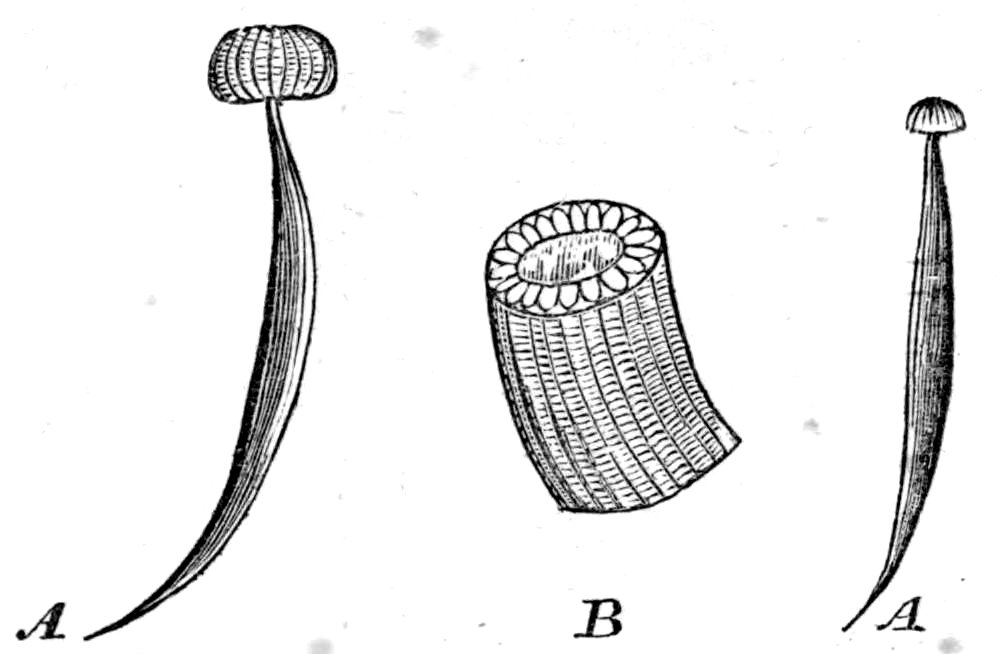
A, A, are spines of the hedgehog enlarged; B, a segment, to show the numerous tubes of communication.
The harvest mouse (mus messorius) in some seasons is common with us, but, like other species of mice, varies much in the numbers found. I have seen their nests as late as the middle of September, containing eight young ones entirely filling the little interior cavity. These nests vary in shape, being round, oval, or pearshaped, with a long neck, and are to be distinguished from those of any other mouse, by being generally suspended on some growing vegetable, a thistle, a beanstalk, or some adjoining stems of wheat, with which it rocks and waves in the wind; but to prevent the young from being dislodged by any violent agitation of the plant, the parent closes up the entrance so uniformly, with the whole fabric, that the real opening is with difficulty found.
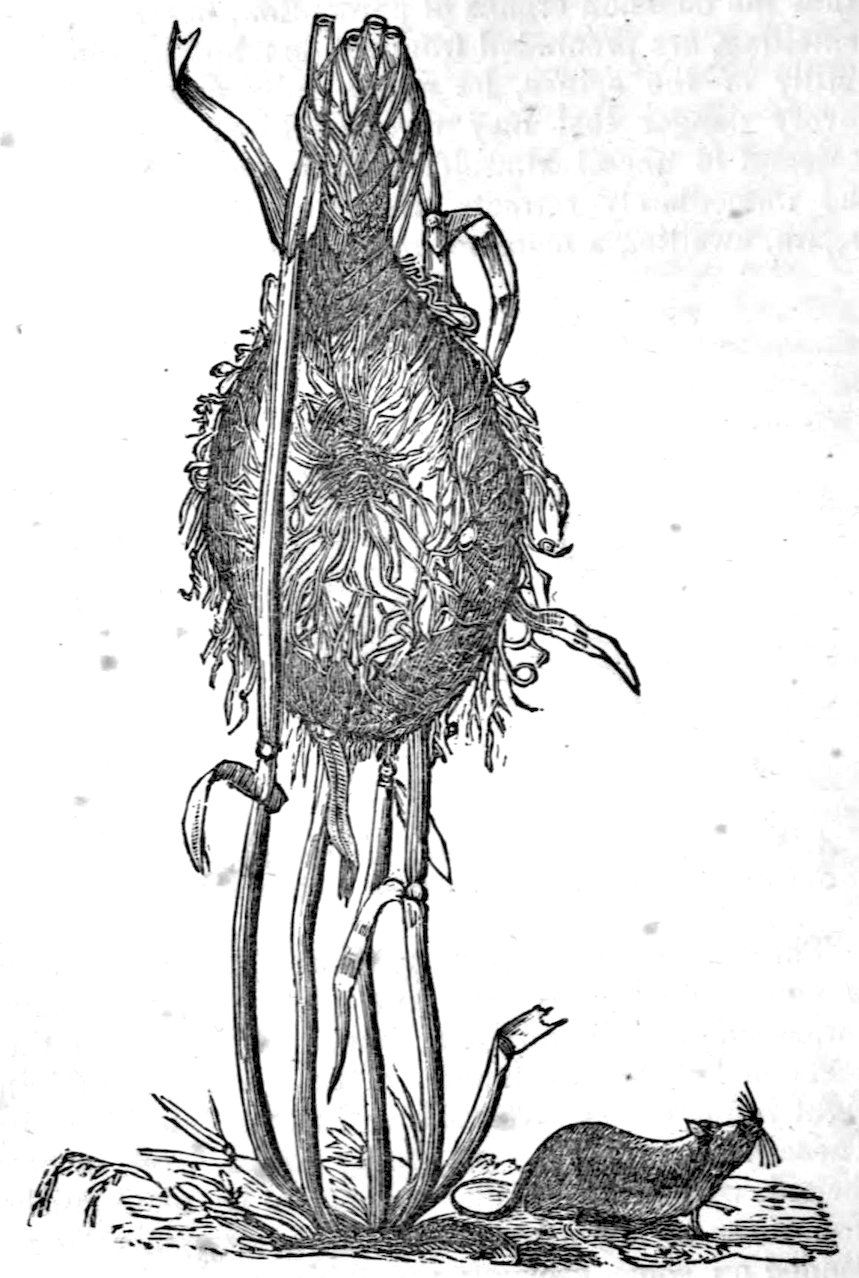
The Harvest Mouse and Nest.
They are the most tame and harmless of little creatures; and, taking shelter in the sheaves when in the field, are often brought home with the crop, and found in little shallow burrows on the ground after the removal of a bean-rick. Those that remain in the field form stores for the winter season, and congregate in 101small societies in holes under some sheltered ditch-bank. An old one, which I weighed, was only one dram and five grains in weight.
Mankind appear to be progressively increasing. It was an original command of his Creator, and the animals domesticated by him, and fostered for his use, are probably multiplied in proportion to his requirements; but we have no reason to suppose that this annual augmentation proceeds in a proportionate degree with the wild creatures upon the surface of the globe; and we know that many of them are yearly decreasing, and very many that once existed have even become extinct. That there are years of increase and decrease ordained for all the inferior orders of creation, common observation makes manifest. In the years 1819 and 1820, all the country about us was overrun with mice; they harbored under the hassocks of our coarse grasses (aira cæspitosa), perforated the banks of ditches, occasioned much damage by burrowing into our potato heaps, and coursed in our gardens from bed to bed even during daylight. The species were the short-tailed meadow-mouse, and the long-tailed garden mouse, and both kinds united in the spring to destroy our early-sown pease and beans. In the ensuing summer, however, they became so greatly reduced, that few were to be seen, and we have not had any thing like such an increase since that period. It is probable that some disease afflicted them, and that they perished in their holes, for we never found their bodies, and any emigration of such large companies would certainly have been observed; yet the appearance and disappearance of creatures of this kind leads us to conclude that they do occasionally change their habitations.
A large stagnant piece of water in an inland county, with which I was intimately acquainted, and which I very frequently visited for many years of my life, was one summer suddenly infested with an astonishing number of the short-tailed water rat, none of which had previously existed there. Its vegetation was the common products of such places, excepting that the larger portion of it was densely covered with its usual crop, 102the smooth horsetail (equisetum limosum). This constituted the food of the creatures, and the noise made by their champing it we could distinctly hear in the evening at many yards’ distance. They were shot by dozens daily; yet the survivors seemed quite regardless of the noise, the smoke, the deaths, around them. Before the winter, this great herd disappeared, and so entirely evacuated the place, that a few years after I could not obtain a single specimen. They did not disperse, for the animal is seldom found in the neighborhood, and no dead bodies were observed. They had certainly made this place a temporary station in their progress from some other; but how such large companies can change their situations unobserved in their transits, is astonishing. Birds can move in high regions and in obscurity, and are not commonly objects of notice; but quadrupeds can travel only on the ground, and would be regarded with wonder, when in great numbers, by the rudest peasant.[40]
That little animal the water shrew (sorex fodiens) appears to be but partially known, but is probably more generally diffused than we imagine. The common shrew in particular seasons gambols through our hedge-rows, squeaking and rustling about the dry foliage, and is observed by every one; but the water shrew inhabits places that secrete it from general notice, and appears to move only in the evenings, which occasions its being so seldom observed. That this creature was an occasional 103resident in our neighborhood was manifest from the dead bodies of two or three having occurred in my walks; but it was some time before I discovered a little colony of them quietly settled in one of my ponds, overshadowed with bushes and foliage. It is very amusing to observe the actions of these creatures, all life and animation in an element they could not be thought any way calculated for enjoying; but they swim admirably, frolicking over the floating leaves of the pondweed, and up the foliage of the flags, which, bending with their weight, will at times souse them in the pool, and away they scramble to another, searching apparently for the insects that frequent such places, and feeding on drowned moths (phalæna potamogeta) and similar insects. They run along the margin of the water, rooting amid the leaves and mud with their long noses for food, like little ducks, with great earnestness and perseverance. Their power of vision seems limited to a confined circumference. The smallness of their eyes, and the growth of the fur about them, are convenient for the habits of the animal, but impediments to extended vision; so that, with caution, we can approach them in their gambols, and observe all their actions. The general blackness of the body, and the triangular spot beneath the tail, as mentioned by Pennant, afford the best ready distinction of this mouse from the common shrew. Both our species of sorex seem to feed by preference on insects and worms; and thus, like the mole, their flesh is rank and offensive to most creatures, which reject them as food. The common shrew, in spring and summer, is ordinarily in motion even during the day from the sexual attachment, which occasions the destruction of numbers by cats, and other prowling animals; and thus we find them strewed in our paths, by gateways, and in our garden walks, dropped by these animals in their progress. It was once thought that some periodical disease occasioned this mortality of the species; but I think we may now conclude that violence alone is the cause of their destruction in these instances. The bite of this creature was considered by the ancients as peculiarly noxious, 104even to horses and large cattle, and a variety of the most extraordinary remedies for the wound, and preventives against it, are mentioned by Pliny and others. The prejudices of antiquity, long as they usually are in keeping possession of the mind, have not been remembered by us; and we only know the hardy shrew now as a perfectly harmless animal, though we still retain a name for it expressive of something malignant and spiteful.
I think we have reason for suspecting that a shrew new to Britain exists in this neighborhood. A pale blue shrew (sorex Daubentonii? Cuvier) has been seen about the margins of our reenes, and the deep marsh ditches cut for draining the water from the low lands of the Severn; and something of the same kind, in a half-digested state, has been found in the stomach of the heron. If it exist with us, a similar tract of land in more fenny countries may contain it plentifully, though it has as yet escaped detection.
The mole,[41] want, mouldwarper or mouldturner (talpa europea), is common with us, as it appears to be in most places; and no creature gives more certain indication of its presence, haunting, from preference, such places as its predecessors have done, though years may have intervened since they were frequented, and rains, and the treading of heavy cattle, have compressed to solid earth the ancient runs; and however assiduously we may destroy them, should they appear again, it will probably be in the same places that have been formerly perforated by others. The earth that these animals eject from their runs, being obtained from very near the surface, and finely pulverized, has tempted me more than once to have it collected for my green-house plants, but not with the success that I had conjectured. Some persons have advocated the cause of moles, as being beneficial to vegetation, by loosening the soil about the roots of plants. Evelyn and others, again, censure them as injurious creatures; and there is a strange narration in Buffon, accusing them of eating all the acorns of a newly-set soil.[42] I am not aware of any benefit occasioned by their presence; their warpings certainly give our 105pastures in the spring a very unsightly appearance, and in grounds designed to be mowed, occasion much trouble, by obliging us frequently to spread and remove them; and in newly-sown corn-lands, they disturb by their runnings the earth at the roots of the grain. But, perhaps, these trifling complaints, these almost imaginary grievances, are the only evils that can be attributed to them. In those wild creatures that are not immediately applicable to our use or amusement, we are more generally inclined to seek out their bad than their good qualities; and though I cannot produce any instance in which the utility of the mole is manifested, yet it is reasonable to conclude, that they are eminently so, either directly or collaterally, nature having provided in an especial manner for a constant supply,[43] and their increase is prodigious when they are not molested. I have killed for two years in succession, between forty and fifty each season, in a very few acres of ground; and notwithstanding all our stratagems for their destruction, and the ease with which they are entrapped, still plenty always remain to recruit our annual waste of them. These creatures are supposed to have a very imperfect vision, and, like insects, have not any external ear, or manifest organ through which sounds can be received; yet we can in no way for a moment suppose that they have been created with any deficiency of power to accomplish all the objects of their being, but that every possible exigency has been provided for. Perceptions may be conveyed in very many instances by intelligences unknown to us, and unquestionably are so. The defect of one power is frequently supplied by the increased activity of another; and the sense of smelling in the mole must be unusually acute, to enable it to pursue and capture its prey with the facility that it does. Its sole food, we believe, is worms; and these sensitive creatures retire immediately upon the smallest moving of the earth in which they reside. Now, as it follows them through all their meanderings, in which neither eyes nor ears would assist it, a fine 106sense of smelling seems necessary to enable it to catch them; and that its success is equal to its wants, and that it feeds plentifully, is manifest by the excellent condition in which the mole is at all seasons of the year. It will penetrate banks of earth after worms lodged in their interior, hunt for them in the richest parts of the field, or on the edges of dung-heaps: in all which pursuits some unknown faculties may direct it; but no sense, that we are acquainted with, could promote its objects so effectually as that of smell. My talparius, a very skilful capturer of these animals, is so sensible of the power that moles are gifted with of readily discriminating smells, that his constant practice is, to draw the body of a captured animal through his traps, and the adjoining runs, and passages, to remove all suspicious odors, which might arise from the touch of his fingers. Its feeling, too, must be acute; as, when casting up the earth, it is sensible of the pressure of a very gentle foot; and, unless our approaches are conducted with great caution, it ceases from its operation, and instantly retires. Should I be censured for needless prolixity in detailing these sensations of a common mole, and “telling of the mouldwarp and the ant,” I trust forgiveness may be granted me, as endeavoring to remove all conceptions, should they exist, that any thing, however vile and worthless it may seem to be, could be created with powers or means inadequate to supply its wants. Whoever will examine the structure of the body of a mole will, perhaps, find no creature more admirably adapted for all the purposes of its life. The very fur on the skin of this animal manifests what attention has been bestowed upon the creature, in providing for its necessities and comforts. This is singularly, most impalpably, fine, yielding in every direction, and offering no resistance to the touch. By this construction the mole is in no degree impeded in its retreat from danger while retiring backwards, as it always does upon suspicion of peril, not turning round, which the size of its runs does not permit, its tail foremost, until it arrives at some collateral gallery, when its flight is head foremost, as with other creatures. If this fur 107had been strong, as in the rat, or mouse, in these retreats for life it would have doubly retarded the progress of the creature; first by its resistance, and then acting as a brush, so as to choke up the galleries, by removing the loose earth from the sides and ceilings of the arched ways; thus impeding at least, if not absolutely preventing, retreat; but the softness of the fur obviates both these fatal effects.
The construction of the hair and fur of different creatures is very various and beautiful; and if we believe in the beneficence of the All-wise Creator, we must conclude that such peculiar fabrications were resorted to for the purpose of being immediately useful, or as necessary to the condition of the animal. In a mere sketch like this, it would conduct me infinitely beyond my intentions, to enumerate the many varieties of hair that are rendered manifest by the microscope; but three or four may be mentioned. The fur or clothing of the mole is internally composed of collateral bars. In man the hairs have at times a central tube, for the conveyance of medullary matter, as in bones, or some nutriment analogous to it; but in the mole there appears to be no communication with the body of the animal, unless the perspirable matter is conducted alternately from side to side along the bars. The fur of the bat has knots like the rudiments of branches. The hairs of the hamster mouse have a central perforation, apparently uninterrupted throughout their whole length. Some of the caterpillars (callimorpha caja) have spines proceeding from the hair that invests their bodies.[44] All these, and the other various contrivances so manifest in the coverings of animals, are probably designed to convey off the perspirable fluids conducive to health in an 108appropriate manner; to discharge the superabundant heat, and keep the body temperate in some cases: in others, again, to retard perspiration, and thus augment the warmth, by every possible gradation, or to increase the sensibility and perceptions of the animal. Many instances of these effects and modifications might be advanced, deserving a more extensive consideration.
The smell of the flesh of the mole is remarkably rank and offensive, as, from the nature of its food, might be expected; and it taints the fingers, which have touched it, with its peculiar odor, so that one washing does not remove it. It is reported of a late very eccentric nobleman, but with what truth I do not know, who essayed himself the flavor of every living thing, even to the eating of the large dew-worm, that the mole alone remained untasted by him, his stomach recoiling with disgust at the nauseous smell of the flesh of this creature. Foxes eat moles, and will at times dig out the traps containing them. The brown owl, too, feeds on them, when it can meet with them outside of their runs hunting after dew-worms; and probably the smaller vermin do the same: but the cat and the dog turn from them with manifest aversion as food; though they will hunt and kill them as objects of the chase.
These animals, we might suppose, while in their subterranean dwellings, would be secure from all injury by such as generally pursue their prey upon the surface of the earth; but I have several times known the weasel caught in the mole-traps, making it manifest, that it hunts after the mole for its food, and in doing so, according to our comprehensions, must encounter infinite danger from suffocation; but it is more probable that so active a creature as the weasel is endowed with powers to accomplish its object with impunity, which we are not acquainted with.
109During the course of a life passed much in the country, and perambulating the woods, the hedges, and the fields, I have contracted almost insensibly an acquaintance with the creatures that frequent them. Some have engaged my attention by their actions and manners; others have interested me by their innocency, and the harmlessness of their lives; and, perhaps, there is some little partial bearing toward others from long association, or from unknown, undefined causes. I tolerate, in despite of all their noise, and all their litter, a colony of rooks,[45] which have taken a liking to some tall elms near my dwelling. Not being ancient denizens there, they can claim no hereditary rights; but their contrivances, their regularity, and even their squabbles, are amusing; and, perhaps, there is mingled with this some little compassion for these dark, half-domesticated families of the grove, driven by the ax from an old abode, which may influence my forbearance.
The hedge-sparrow, or shufflewing, (motacilla modularis), is a prime favorite. Not influenced by season or caprice to desert us, it lives in our homesteads and our orchards through all the year, our most domestic bird. In the earliest spring it intimates to us by a low and plaintive chirp, and that peculiar shake of the wing, which at all times marks this bird, but then is particularly observable, the approach of the breeding season; for it appears always to live in pairs, feeding and moving in company with each other. It is nearly the first bird that forms a nest; and this being placed in an almost leafless hedge, with little art displayed in its concealment, generally becomes the booty of every prying boy, and the blue eggs of the hedge-sparrow are always found in such numbers on his string, that it is surprising how any of the race are remaining, especially when we consider the many casualties to which the old birds are obnoxious from their tameness, and the young that are hatched, from their situation. The plumage of this motacilla is remarkably sober and grave, and all its actions are quiet and comformable to its appearance. Its song is short, sweet, and gentle. Sometimes it is prolonged; but generally the bird perches on the summit 110of some bush, utters its brief modulation, and seeks retirement again. Its chief habitation is some hedge in the rick-yard, some cottage garden, or near society with man. Unobtrusive, it does not enter our dwellings like the redbreast, but picks minute insects from the edges of drains and ditches, or morsels from the door of the poorest dwelling in the village. As an example of a household or domestic bird, none can be found with better pretensions to such a character than the hedge-sparrow.
I always hear with delight the earliest chirpings of that pretty harbinger of spring, the willow wren (motacilla trochillus), trilling its wild and gleeful “chiffchaffs,” as it chases the insects round the branches of the old oak in the copse, or on the yellow catkins of the sallow, itself almost like a colored catkin too. But this elegant little bird is noticed only by the lovers and frequenters of the country; it animates the woods by its constant activity; the frequent repetition of its most cheerful modulation contributes essentially to the pleasing harmony of the grove; and its voice is most sprightly and frequent, when the morning is illumined with one of those mild, walk-enticing gleams, that render this short season the most delightful of our year. It builds its nest, and rears its young with us; visits our gardens, but is no plunderer there, living almost entirely upon insect food; and its whole life is passed in harmlessness and innocence. As it is the earliest that arrives, so it is the last, I believe, of our feathered choir that leaves us, except a few lingering, irresolute swallows; and we hear it piping its final autumnal farewell even in October at times, and sporting with hilarity and joy, when all its congeners are departed.
It is a difficult matter satisfactorily to comprehend the object of this bird in quitting another region, and passing into our island. The chief motives for migration seem to be food, a milder climate, and quiet during the period of incubation and rearing their young: but the willow wren, and some others of our insectivorous birds, appear to have other purposes to accomplish by their annual migrations. These little creatures, the 111food of which is solely insects, could assuredly find a sufficient supply of such diet during the summer months, in the woods and thickets of those mild regions, where they passed the season of winter, and every bank and unfrequented wild would furnish a secure asylum for them and their offspring during the period of incubation. The passage to our shores is a long and dangerous one, and some imperative motive for it must exist; and, until facts manifest the reason, we may perhaps, without injury to the cause of research, conjecture for what object these perilous transits are made. We know that all young creatures require particularly compounded nutriment during their infant state; and nature, as far as we are acquainted with it, has made in every instance provision for a supply of fitting aliment. In many instances, where the removal of station could not be conveniently accomplished, instinct has been given the parent to provide the fitting aliment for its new-born young. Thus insects, in some cases, store their cells with food ready for the animation of their progeny; in others, place their eggs in such situations, as will afford it when they are hatched. The mammalia, at least the quadrupeds belonging to this class, which could least conveniently move their station, have supplies given them of a milky secretion for this purpose. Birds have nothing of this nature, and make no provision for their young; but they of all creatures, except fishes, can seek what may be required in distant stations with most facility. A sufficiency of food for the adult parent may be found in every climate, yet the aliment necessary for its offspring may not. Countries and even counties produce insects that differ, if not in species, at least in numbers; and many young birds we cannot succeed in rearing, or do it very partially, by reason of our ignorance of the requisite food. Every one, who has made the attempt, well knows the various expedients he has resorted to, of boiled meats, bruised seeds, hard eggs, boiled rice, and twenty other substances, that nature never presents, in order to find a diet that will nourish them; but Mr. Montague’s failure in being able to 112raise the young of the cirl bunting,[46] until he discovered that they required grasshoppers, is a sufficient instance of the manifest necessity there is for a peculiar food in one period of the life of birds; and renders it probable that, to obtain a certain aliment, this willow wren, and others of the insect and fruit-feeding birds, direct their flight to distant regions, and is the principal cause of their migrations.
It is some stimulus like this, which urges that little creature, the golden-crested wren (motacilla regulus), that usually only flits from tree to tree, and never attempts upon common occasions a longer flight, to traverse the vast distance from the Orkneys to the Shetland Isles over stormy seas that admit no possible rest during its long passage of above fifty miles! There it breeds its young; but this one object accomplished, it leaves those isles, dares again this tedious flight, and seeks a milder clime. With us it never migrates, lives much in our fir groves during the winter, and breeds in our shrubberies in summer. Peculiar necessities, such as these, may incite the migration of many birds; but that certain species, which lead solitary lives, or associate only in very small parties, should at stated periods congregate from all parts to one spot, and there hold council on a removal, in which the very sexes occasionally separate, is one of the most extraordinary procedures that we meet with among animals.
If the sober, domestic attachments of the hedge-sparrow please us, we are not less charmed with the innocent, blithesome gaiety of the linnet (fringilla linota). But this songster is no solitary visiter of our dwellings: it delights and lives in society, frequenting open commons and gorsy fields, where several pairs, without the least rivalry or contention, will build their nests and rear their offspring in the same neighborhood, twittering and warbling all the day long. This duty over, the families unite, and form large associations, feeding and moving in company as one united household; and, resorting to the head of some sunny tree, 113they will pass hours in the enjoyment of the warmth, chattering with each other in a low and gentle note, and they will thus regularly assemble during any occasional bright gleam throughout all the winter season,—
which, heard at some little distance, forms a very pleasing concert, innocent and joyous. The linnet is the cleanliest of birds, delighting to dabble in the water and dress its plumage in every little rill that runs by. The extent of voice in a single bird is not remarkable, being more pleasing than powerful; yet a large field of furze, in a mild sunny April morning, animated with the actions and cheering music of these harmless little creatures, united with the bright glow and odor of this early blossom, is not visited without gratification and pleasure.
The bull-finch (loxia pyrrhula) has no claims to our regard. It is gifted with no voice to charm us; it communicates no harmony to the grove: all we hear from it is a low and plaintive call to its fellows in the hedge. It has no familiarity or association with us, but lives in retirement in some lonely thicket ten months in the year. At length, as spring approaches, it will visit our gardens, an insidious plunderer. Its delight is in the embryo blossoms wrapped up at this season in the bud of a tree; and it is very dainty and curious in its choice of this food, seldom feeding upon two kinds at the same time. It generally commences with the germs of our larger and most early gooseberry; and the bright red breasts of four or five cock-birds, quietly feeding on the leafless bush, are a very pretty sight, but the consequences are ruinous to the crop. When the cherry buds begin to come forward, they quit the gooseberry, and make tremendous havoc with these. I have an early wall cherry, a mayduke by reputation, that has for years been a great favorite with the bull-finch family, and its celebrity seems to be communicated to each successive generation. It buds profusely, but is annually so stripped of its promise by these feathered rogues, 114that its kind might almost be doubted. The orleans and green-gage plums next form a treat, and draw their attention from what remains of the cherry. Having banqueted here awhile, they leave our gardens entirely, resorting to the fields and hedges, where the sloe bush in April furnishes them with food. May brings other dainties, and the labors and business of incubation withdraw them from our observation.
The idea that has been occasionally entertained, that this bird selects only such buds as contain the embryo of an insect, to feed on it, and thus free us of a latent colony of caterpillars, is certainly not correct. It may confer this benefit accidentally, but not with intention. The mischief effected by bull-finches is greater than commonly imagined, and the ground beneath the bush or tree, on which they have been feeding, is commonly strewed with the shattered buds, the rejectments of their banquet; and we are thus deprived of a large portion of our best fruits by this assiduous pillager, this “pick-a-bud,” as the gardeners call it, without any redeeming virtues to compensate our loss. A snowy, severe winter makes great havoc with this bird. It feeds much in this season upon the fruit of the dog-rose, “hips,” as we call them. When they are gone, it seems to pine for food, and is starved, or perhaps frozen on its roost, as few are observed to survive a long inclement winter. But it is not the buds of our fruit-bearing trees only that these destructive birds seek out; yet in all instances I think it will be observed that such buds as produce leaves only are rejected, and those which contain the embryo of the future blossom selected: by this procedure, though the tree is prevented from producing fruit, yet the foliage is expanded as usual; but had the leaves, the lungs of the plant, been indiscriminately consumed, the tree would probably have died, or its summer growth been materially injured: we may thus lose our fruit this year, yet the tree survives, and hope lives, too, that we may be more fortunate the next. The Tartarian honeysuckle (lonicera Tart.) and corchorus Japonicus, when growing in the shrubbery, are very commonly stripped of their bloom by bull-finches: the first incloses many 115separated blossoms in its calyx before expansion, and in that particular is analogous to the buds of icosandrious trees in the garden; and the full-petalled swelling bloom of the latter affords a fine treat for their feasts; but we may permit these pretty birds to banquet here, though, if we expect a supply of summer fruit, we must unsparingly drive them away from the branches of our frugiferous trees. The blossoms of the peach, nectarine, and almond, I have never observed to be injured by these birds: the sparrow will pick away the buds of trees against walls when they frequent such places, but, with this exception, I know none but the bull-finch which resort to that food as a regular supply.
The robin (motacilla rubecola) associated with malignants is not, perhaps, in the place where it generally would be sought; but sad truths might be told of it too. It might be called pugnacious, jealous, selfish, quarrelsome, did I not respect ancient feelings, and long-established sentiments. A favorite by commiseration, it seeks an asylum with us; by supplication and importunity it becomes a partaker of our bounty in a season of severity and want; and its seeming humbleness and necessities obtain our pity: but it slights and forgets our kindnesses the moment it can provide for itself, and is away to its woods and its shades. Yet it has some little coaxing ways, and such fearless confidence, that it wins our regard; and its late autumnal song, in evening’s dusky hour, as a monologue is pleasing, and redeems much of its character. The universality of this bird in all places, and almost at all hours, is very remarkable; and perhaps there are few spots so lonely, in which it would not appear, did we commence digging up the ground. I have often been surprised in the midst of woods, where no suspicion of its presence existed, when watching some other creature, to see the robin inquisitively perched upon some naked spray near me; or, when digging up a plant in some very retired place, to observe its immediate descent upon some poor worm that I had moved. The robin loses nearly all the characteristic color from its breast in the summer, when it moults, and only recovers it on the approach of 116autumn; which in some measure accounts for the extraordinary assertion of Pliny, that the redbreast is only so in winter, but becomes a firetail in summer.
The object of the song of birds is not agreed upon by ornithologists, and we will not now think of it, but merely in passing note how singularly timed the song of the robin is. The blackbird, and the thrush, in mild seasons, will sing occasionally throughout the winter; but the robin, after having been absent all the summer, returns to us late in autumn, and then commences its song, when most others of our feathered choristers are silent. An apparent contention in harmony ensues among them; at length the rivals approach, menace, and fight, with a seeming vexation at each other’s prowess. The song of no one bird is, perhaps, more observed and remembered than the autumnal and, at times, melancholy sounding farewell of the robin.
The chaffinch (fringilla cœlebs) appears to be universally spread throughout the English counties, and the male bird is remarkable for the cleanliness and trimness of his plumage, which, without having any great variety or splendor of coloring, is so composed and arranged, and the white on his wings so brilliant, as to render him a very beautiful little creature. The female is as remarkable for the quiet, unobtrusive tintings of her dress; and, when she lies crouching on her nest, elegantly formed of lichens from the bark of the apple tree, and faded mosses, she would hardly be perceptible, but for her little bright eyes, that peep with suspicious vigilance from her covert. With us the sexes do not separate at any period of the year, the flocks frequenting our barn doors and homesteads in winter being composed of both. In the northern parts of Europe, however, the females are said to migrate to milder regions, which induced Linnæus to bestow the name of “cœlebs” upon this species. In Gloucestershire and some of the neighboring counties, they are little known by the name of chaffinches; but, from the constant repetition of one note, when alarmed or in danger, they have acquired the name of “twinks,” and “pinks;” yet during incubation the song of the male bird, though 117without any variation of tune, is very pleasing in the general concert, as most vernal notes, if not harsh and wearisome from monotony, are. These birds make sad havoc with some of our spring flowers; and the polyanthus, in March, in our sheltered borders, is very commonly stripped of all its blossoms by these little plunderers, I suppose to obtain the immature seeds at the base of their tubes. They will deflorate too the spikes or whorls of the little red archangel (lamium purpureum); and we see them feeding in the waste places where this plant is found in the spring, their little mouths being filled with the green seeds of this dead nettle. At this period too they are sad plunderers in our kitchen gardens, and most dexterously draw up our young turnips and radishes, as soon as they appear upon the surface of the soil; but after this all depredation ceases, the rest of their days being past in sportive innocence. I have observed these birds, in very hot seasons, to wet their eggs, by discharging moisture from their bills upon them, or at least perform an operation that appeared to be so.
We still continue here that very ancient custom of giving parish rewards for the destruction of various creatures included in the denomination of vermin. In former times it may have been found necessary to keep under or reduce the numbers of many predaceous animals, which in a thickly wooded country, with an inferior population, might have been productive of injury; and we even find parliamentary statutes enacted for this purpose: but now, however, our losses by such means have become a very petty grievance; our gamekeepers do their part in removing pests of this nature, and the plow and the ax leave little harbor for the few that escape; and thus we war on the smaller races of creation, and call them vermin. An item passed in one of our late church-wardens’ accounts was, “for seventeen dozen of tom-tits’ heads!” In what evil hour, and for what crime, this poor little bird (parus cæruleus) could have incurred the anathema of a parish, it is difficult to conjecture. I know hardly any small animal that lives a more precarious life than the little blue tom-tit. Indeed 118it is marvellous how any of the insectivorous birds, that pass their winter with us, are supplied with food during inclement seasons, unless they have greater powers of abstinence than we are aware of: but our small birds are generally much more active than those of a larger bulk; the common wren is all animation, its actions and movements bespeak hilarity and animal spirits; and that minute creature, too, the golden-crested wren, is always in motion, flitting from the yew hedge to the fir, or darting away to taller trees with a spring and a power we could not expect from its size. These muscular exertions must greatly counteract the effects of seasons, and enable these atoms of animals to support so cheerfully and gaily the winters of our climate. But in truth this tom-tit perishes in severe winters in great numbers. It roosts under the eaves of our haystacks, and in little holes of the mows, where we often find it dead, perished by cold or hunger, or conjointly by both; yet the race survives, and this annual waste is recruited by the prolificacy of the creature, the nest of which will frequently contain from seven to nine young ones. Its chief subsistence is insects, which it hunts out with unwearied perseverance. It peeps into the nail-holes of our walls, which, though closed by the cobweb, will not secrete the spider within; and draws out the chrysalis of the cabbage butterfly from the chinks in the barn: but a supply of such food is precarious, and becomes exhausted. It then resorts to our yards, and picks diminutive morsels from some rejected bone, or scraps from the butcher’s stall: yet this is the result of necessity, not choice; for no sooner is other food attainable, than it retires to its woods and thickets. In summer it certainly will regale itself with our garden pease, and shells a pod of marrowfats with great dexterity; but this, we believe, is the extent of its criminality. Yet for this venial indulgence do we proscribe it, rank it with vermin, and set a price upon its head, giving four-pence for the dozen, probably the ancient payment when the groat was a coin. However powerful the stimulus was then, we yet find it a sufficient inducement 119to our idle bat-fowling boys to bring baskets of poor toms’ heads to our church-warden’s door.
The wiles and stratagems of every creature are deserving of attention, because they are, for the most part, the impulse of the weak and feeble, instinctive efforts to preserve their own existence, or more generally to secure or defend that of their offspring. Few are able to effect these objects by bodily power; but all creatures probably exert a faculty of some kind, to ward off injury from their young, though not observed by, or manifested to us. This poor little blue tom-tit, which has neither beak, claws, nor any portion of strength to defend itself from the weakest assailant, will nevertheless make trial by menace to scare the intruder from its nest. It builds almost universally in the hole of a wall, or a tree; and its size enables it to creep through so small a crevice, that it is pretty well secured from all annoyances, but those of bird-nesting boys; and these little plunderers the sitting bird endeavors to scare away, by hissing and puffing in a very extraordinary manner from the bottom of the hole, as soon as a finger is introduced, and so perfectly unlike the usual voice of a bird, that many a young intruder is deterred from prosecuting any farther search, lest he should rouse the vengeance of some lurking snake or adder.
They who have seen much of birds, and attended to their actions, will in general be certain of the creature that flits past, by the manner of its flight; or that utters its note unseen by the peculiarity of voice; but the tribe of titmice[47] (parus), especially in the spring of the year, emit such a variety of sounds, that they will occasionally surprise and disappoint us. Hearing an unusual voice, and creeping with caution to observe the stranger from which it proceeds, we perceive only our old acquaintance, the large tom-tit (parus major), searching for food amid the lichens on the bough of an apple-tree. This bird, and that little dark species the “coal,” or “colemouse” (parus ater), in particular, will often acquire or compound a note, become delighted with it, and repeat it incessantly while sporting about the catkins 120of the alder, for an hour or so, then seem to forget or be weary of it, and we hear it no more.
Our tall hedge-rows and copses are frequented by a very amusing little bird, the long-tailed titmouse (parus caudatus). Our boys call it the long-tailed tom-tit, long tom, poke-pudding, and various other names. It seems the most restless of little creatures, and is all day long in a state of progression from tree to tree, from hedge to hedge, jerking through the air with its long tail like a ball of feathers, or threading the branches of a tree, several following each other in a little stream; the leading bird uttering a shrill cry of twĭt, twĭt, twĭt, and away they all scuttle to be first, stop for a second, and then are away again, observing the same order and precipitation the whole day long. The space travelled by these diminutive creatures in the course of their progresses from the first move till the evening roost must be considerable; yet, by their constant alacrity and animation, they appear fully equal to their daily task. We have no bird more remarkable for its family association than this parus. It is never seen alone, the young ones continuing to accompany each other from the period of their hatching until their pairing in spring. Its food is entirely insects, which it seeks among mosses and lichens, the very smallest being captured by the diminutive bill of this creature. Its nest is as singular in construction as the bird itself. Even in years long passed away, when, a nesting boy, I strung my plunder on the benty grass, it was my admiration; and I never see it now without secretly lauding the industry of these tiny architects. It is shaped like a bag, and externally fabricated of moss and different herbaceous lichens, collected chiefly from the sloe (lichen prunastri), and the maple (lichen farinaceus); but the inside contains such a profusion of feathers, that it seems rather filled than lined with them, a perfect feather-bed! I remember finding fourteen or sixteen pealike eggs within this downy covert, and many more were reported to have been found. The excessive labor of the parent birds in the construction and collection of this mass of materials is exceeded by none that I know of; and the 121exertions of two little creatures in providing for, and feeding, with all the incumbrances of feathers and tails, fourteen young ones, in such a situation, surpasses in diligence and ingenuity the efforts of any other birds, persevering as they are, that I am acquainted with.
We might naturally suppose that by the end of winter, all those little birds which are solely supported by insect food would find some difficulty in providing for their wants, having consumed by their numbers and exertions nearly all that store of provision which had been provided in the summer and deposited in safety; but I have found the stomachs of the tree-creeper, and this small titmouse, even in February, quite filled with parts of coleopterous creatures, which by their activity and perseverance they had been enabled to procure beneath the mosses on the branches, and from the chinks in the bark of trees, where they had retired in autumn. Such plenty being procurable after the supply of so many months, renders it apparent that there is no actual deficiency of food at any one period of the year. The small slugs, and some few insects, may perhaps be consumed by the severity of winter, but the larger portion of them are so constituted, as to derive no injury from the inclemency of that season, but afford during many months provender to other creatures, multitudes yet remaining to continue their races and animate the air, when the warm days of spring shall waken them to active life.
The construction and selected situations of the nests of birds are as remarkable, as the variety of materials employed in them; the same forms, places, and articles, being rarely, perhaps never, found united by the different species, which we should suppose similar necessities would direct to a uniform provision. Birds that build early in the spring seem to require warmth and shelter for their young, and the blackbird and the thrush line their nests with a plaster of loam, perfectly excluding, by these cottage-like walls, the keen icy gales of our opening year; yet should accident bereave the parents of their first hopes, they will construct another, even when summer is far advanced, upon the model 122of their first erection, and with the same precautions against severe weather, when all necessity for such provision has ceased, and the usual temperature of the season rather requiring coolness and a free circulation of air. The house-sparrow will commonly build four or five times in the year, and in a variety of situations, under the warm eaves of our houses and our sheds, the branch of the clustered fir, or the thick tall hedge that bounds our garden, &c.; in all which places, and without the least consideration of site or season, it will collect a great mass of straws and hay, and gather a profusion of feathers from the poultry-yard to line its nest. This cradle for its young, whether under our tiles in March or in July, when the parent bird is panting in the common heat of the atmosphere, has the same provision made to afford warmth to the brood; yet this is a bird that is little affected by any of the extremes of our climate. The wood-pigeon and the jay, though they erect their fabrics on the tall underwood in the open air, will construct them so slightly, and with such a scanty provision of materials, that they seem scarcely adequate to support their broods, and even their eggs may almost be seen through the loosely connected materials: but the goldfinch, that inimitable spinner, the Arachnè of the grove, forms its cradle of fine mosses and lichens, collected from the apple or the pear-tree, compact as a felt, lining it with the down of thistles besides, till it is as warm as any texture of the kind can be, and it becomes a model for beautiful construction. The golden-crested wren, a minute creature, perfectly unmindful of any severity in our winter, and which hatches its young in June, the warmer portion of our year, yet builds its most beautiful nest with the utmost attention to warmth; and, interweaving small branches of moss with the web of the spider, forms a closely compacted texture nearly an inch in thickness, lining it with such a profusion of feathers, that, sinking deep into this downy accumulation, it seems almost lost itself when sitting, and the young, when hatched, appear stifled with the warmth of their bedding and the heat of their apartment; while the whitethroat, the 123blackcap, and others, which will hatch their young nearly at the same period, or in July, will require nothing of the kind. A few loose bents and goose-grass, rudely entwined with perhaps the luxury of some scattered hairs, are perfectly sufficient for all the wants of these; yet they are birds that live only in genial temperatures, feel nothing of the icy gales that are natural to our pretty indigenous artists, but flit from sun to sun and we might suppose would require much warmth in our climate during the season of incubation; but it is not so. The green-finch places its nest in the hedge with little regard to concealment; its fabric is slovenly and rude, and the materials of the coarsest kinds: while the chaffinch, just above it in the elm, hides its nest with cautious care, and moulds it with the utmost attention to order, neatness, and form. One bird must have a hole in the ground; to another a crevice in a wall, or a chink in a tree, is indispensable. The bull-finch requires fine roots for its nest; the gray flycatcher will have cobwebs for the outworks of its shed. All the parus tribe, except the individual above-mentioned, select some hollow in a tree or cranny in a wall, and, sheltered as such places must be, yet will they collect abundance of feathers and warm materials for their infants’ beds. Endless examples might be found of the dissimilarity of requirements in these constructions among the several associates of our groves, our hedges, and our houses; and yet the supposition cannot be entertained for a moment that they are superfluous, or not essential for some purpose with which we are unacquainted.[48] By how many of the ordinations of supreme 124intelligence is our ignorance made manifest! Even the fabrication of the nests of these little animals exceeds our comprehension—we know none of the causes or motives of that unbodied mind that willed them thus.
One notice more of the parus tribe (the parus cæruleus), and these little creatures may retire to their leafy shades and be forgotten. I was lately exceedingly pleased in witnessing the maternal care and intelligence of this bird; for the poor thing had its young ones in the hole of a wall, and the nest had been nearly all drawn out of the crevice by the paw of a cat, and part of its brood devoured. In revisiting its family, the bird discovered a portion of it remaining, though wrapped up and hidden in the tangled moss and feathers of their bed, and it then drew the whole of the nest back into the place from whence it had been taken, unrolled and resettled the remaining little ones, fed them with the usual attentions, and finally succeeded in rearing them. The parents of even this reduced family labored with great perseverance to supply its wants, one or the other of them bringing a grub, caterpillar, or some insect, at intervals of less than a minute through the day, and probably in the earlier part of the morning more frequently; but if we allow that they brought food to the hole every minute for fourteen hours, and provided for their own wants also, it will admit of perhaps a thousand grubs a day for the requirements of one, and that a diminished brood; and give us some comprehension of the infinite number requisite for the summer nutriment of our soft-billed birds, and the great distances gone over by such as have young ones, in their numerous trips from hedge to tree in the hours specified, when they have full broods to support. A climate of moisture 125and temperature like ours is peculiarly favorable for the production of insect food, which would in some seasons be particularly injurious, were we not visited by such numbers of active little friends to consume it.
The raven (corvus corax) does not build with us. A pair indeed attempted to raise a brood in our wych elm; but they love retirement and quiet, and were soon scared away, and made no second trial. Ravens visit us, however, frequently, and always during the lambing season, watching for any weak and deserted creature, which, when perceived, is instantly deprived of its eyes; but they make no long stay in our pastures. They abide nowhere in fact, but move from place to place, where food may chance to be found. Should an animal die, or a limb of fresh carrion be on the hooks in the tree, the hoarse croak of the raven is sure immediately to be heard, calling his congeners to the banquet. We see it daily in its progress of inspection, or high in the air on a transit to other regions, hastening, we conjecture, to some distant prey. With the exception of the snipe, no bird seems more universally spread over the surface of our globe than the raven, inhabiting every zone, the hot, the temperate, the severe—feeding upon, and removing noxious substances from the earth, of which it obtains intimation by means of a faculty we have little conception of. Sight it cannot be; and we know not of any fetor escaping from an animal previous to putrescence, so subtile as to call these scavengers of nature from the extremity of one county to that of another; for it is manifest, from the height which they preserve in their flight, and the haste they are making, that their departure has been from some far distant station, having a remote and urgent object in contemplation.
In England the raven does not seem to abound; but it is most common on the shores of harbors, or near great rivers, where animal substances are more frequently to be met with than in inland places. In Greenland, and Iceland, where putrescent fishy substances abound, they appear to be almost domesticated. Horace calls the raven “annosa cornix;” and in a tame 126state it has attained a very long life. How long extended its existence may be, when roaming in an unrestricted state, we have no means of ascertaining. This liberty may be most favorable to longevity; yet, from the numerous contingencies attending the condition of these creatures, it is probable that few of them live out all their days, so as to become the “bird of ages.” However, the supposed longevity they have attained, their frequent mention and agency in holy writ, the obscure knowledge we possess of their powers and motives, with the gravity of their deportment, like an “all-knowing bird,” have acquired for them, from very remote periods, the veneration of mankind. The changes in our manners and ideas, in respect to many things, have certainly deprived them of much of this reverence; yet the almost supernatural information which they obtain of the decease, or approaching dissolution, of an animal, claims still some admiration for them. This supposed faculty of “smelling death” formerly rendered their presence, or even their voice, ominous to all, as
and the unusual sound of their harsh croak, still, when illness is in the house, with some timid and affectionate persons, brings old fancies to remembrance, savoring of terror and alarm. I am no friend to the superstition of converting natural transactions, or occasional events, into signs and indications of coming things; superstitions are wearing out, and shortly will waste away, and be no more heard of; but I fear, in their place, deism, infidelity, impiety, have started up, the offspring of intuitive wisdom: the first belief arises from weakness and ignorance; the latter disbelief is ingratitude, pride, wickedness.
Of the natural duration of animal life it is, from many circumstances, difficult to form an accurate statement, the wild creatures being in great measure removed from observation, and those in a condition of domestication being seldom permitted to live as long as their bodily strength would allow. It was formerly 127supposed that the length of animal life was in proportion to its duration in utero, or the space it remained in the parent from conception to birth, and the length of time it required to obtain maturity. This notion might have some support in reason and fact, occasionally, but in many cases was incorrect, and in regard to birds had no foundation. Herbivorous animals probably live longer than carnivorous ones, vegetable food being most easily obtainable in all seasons in a regular and requisite supply; whereas animals that subsist on flesh, or by the capture of prey, are necessitated at one period to pine without food, and at another are gorged with superfluity: and when the bodily powers of rapacious creatures become impaired, existence is difficult to support, and gradually ceases; but with herbivorous animals in the same condition, supply is not equally precarious, or wholly denied. Yet it is probable that few animals in a perfectly wild state live to a natural extinction of life. In a state of domestication, the small number of carnivorous creatures about us are sheltered and fed with care, seldom are in want of proper food, and at times are permitted to await a gradual decay, continuing as long as nature permits; and by such attentions many have attained to a great age; but this is rather an artificial than a natural existence. Our herbivorous animals, being kept mostly for profit, are seldom allowed to remain beyond approaching age; and when its advances trench upon our emoluments by diminishing the supply of utility, we remove them. The uses of the horse, though time may reduce them, are often protracted; and our gratitude for past services, or interest in what remains, prompts us to support his life by prepared food of easy digestion, or requiring little mastication, and he certainly by such means attains to a longevity probably beyond the contingencies of nature. I have still a favorite pony—for she has been a faithful and able performer of all the duties required of her in my service for upwards of two-and-twenty years—and, though now above five-and-twenty years of age, retains all her powers perfectly, without any diminution or symptom of decrepitude; the fineness of limb, brilliancy 128of eye, and ardor of spirit, are those of the colt and though treated with no remarkable care, she has never been disabled by the illness of a day, or sickened by the drench of the farrier. With birds it is probably the same as with other creatures, and the eagle, the raven, the parrot, &c., in a domestic state attain great longevity; and though we suppose them naturally tenacious of life, yet, in a really wild state, they would probably expire before the period which they attain when under our attention and care. And this is much the case with man who probably outlives most other creatures; for though excess may often shorten, and disease or misfortune terminate his days, yet naturally he is a long-lived animal. His “threescore years and ten” are often prolonged by constitutional strength, and by the cares, the loves, the charities, of human nature. As the decay of his powers awakens solicitude, duty and affection increase their attentions, and the spark of life only expires when the material is exhausted.
That rare bird the crossbill (loxia curvirostra) occasionally visits the orchards in our neighborhood, coming in little parties to feed upon the seeds of the apple; and, seldom as it appears, is always noticed by the mischief it does to the fruit, by cutting it asunder with its well-constructed mandibles, in order to obtain the kernels. A native of those extensive pine forests in the neighborhood of the Rhine, it makes excursions into various parts of Europe in search of change of food; and, though several instances are recorded of its visits to our island, I know but one mention of its having bred in England. A pair was brought to me very early in August, and the breast of the female being nearly bare of feathers, as is observable in sitting birds, it is very probable that she had a nest in the neighborhood.
Gesner has called the common rook (corvus frugilegus) a corn-eating bird. Linnæus has somewhat lightened this epithet by considering it only as a gatherer of corn; to neither of which names do I believe it entitled, as it appears to live solely upon grubs, various insects, and worms. It has at times great difficulty 129to support its life, for in a dry spring or summer most of these are hidden in the earth beyond its reach, except at those uncertain periods when the grub of the chaffer is to be found; and in a hot day we see the poor birds perambulating the fields, and wandering by the sides of the highways, seeking for, and feeding upon grasshoppers, or any casual nourishment that may be found. At those times, was it not for its breakfast of dew-worms, which it catches in the gray of the morning, as it is appointed the earliest of risers, it would commonly be famished. In the hot summer of 1825, many of the young brood of the season perished from want; the mornings were without dew, and consequently few or no worms were to be obtained; and we found them dead under the trees, having expired on their roostings. It was particularly distressing, for no relief could be given, to hear the constant clamor and importunity of the young for food. The old birds seemed to suffer without complaint; but the wants of their offspring were expressed by the unceasing cry of hunger, and pursuit of the parents for supply, and our fields were scenes of daily restlessness and lament. Yet, amid all this distress, it was pleasing to observe the perseverance of the old birds in the endeavor to relieve their famishing families, as many of them remained out searching for food quite in the dusk, and returned to their roosts long after the usual period for retiring. In this extremity it becomes a plunderer, to which by inclination it is not much addicted, and resorts to our newly-set potato-fields, digging out the cuttings. Ranks are seen sadly defective, the result of its labors, I fear; and the request of my neighbors now and then for a bird from my rookery, to hang up in terrorem in their fields, is confirmatory of its bad name. In autumn a ripe pear, or a walnut, becomes an irresistible temptation, and it will occasionally obtain a good share of these fruits. In hard frost, it is pinched again, visits for food the banks of streams, and in conjunction with its congener the “villain crow,” becomes a wayfaring bird, and seeks a dole from every passing steed. Its life, however, is not always dark and sombre: it has its 130periods of festivity also. When the waters retire from meadows and low lands, where they have remained any time, a luxurious banquet is provided for this corvus, in the multitude of worms which it finds drowned on them. But its jubilee is the season of the cockchaffer (melolantha vulgaris), when every little copse, every oak, becomes animated with it and all its noisy, joyful family feeding and scrambling for the insect food. The power or faculty, be it by the scent, or by other means, that rooks possess of discovering their food, is very remarkable. I have often observed them alight on a pasture of uniform verdure, and exhibiting no sensible appearance of withering or decay, and immediately commence stocking up the ground. Upon investigating the object of their operations, I have found many heads of plantains, the little autumnal dandelions, and other plants, drawn out of the ground and scattered about, their roots having been eaten off by a grub, leaving only a crown of leaves upon the surface. This grub beneath, in the earth, the rooks had detected in their flight, and descended to feed on it, first pulling up the plant which concealed it, and then drawing the larvæ from their holes. By what intimation this bird had discovered its hidden food we are at a loss to conjecture; but the rook has always been supposed to scent matters with great discrimination.
It is but simple justice to these often censured birds, to mention the service that they at times perform for us in our pasture lands. There is no plant that I endeavor to root out with more persistency in these places than the turfy hair-grass (aira cæspitosa). It abounds in all the colder parts of our grass lands, increasing greatly when undisturbed, and, worthless itself, overpowers its more valuable neighbors. The larger turfs we pretty well get rid of; but multitudes of small roots are so interwoven with the pasture herbage, that we cannot separate them without injury; and these our persevering rooks stock up for us in such quantities, that in some seasons the fields are strewed with the eradicated plants. The whole so torn up does not exclusively prove to be the hair-grass, but infinitely the larger 131portion consists of this injurious plant. The object of the bird in performing this service for us is to obtain the larvæ of several species of insects, underground feeders, that prey on the roots, as Linnæus long ago observed upon the subject of the little nard grass (nardus stricta). This benefit is partly a joint operation: the grub eats the root, but not often so effectually as to destroy the plant, which easily roots itself anew; but the rook finishes the affair by pulling it up to get at the larvæ, and thus prevents all vegetation; nor do I believe that the bird ever removes a specimen that has not already been eaten, or commenced upon, by the caterpillar.
The rook entices its young from the breeding trees, as soon as they can flutter to any other. These young, for a few evenings after their flight, will return with their parents, and roost where they were bred; but they soon quit their abode, and remain absent the whole of the summer months. As soon however as the heat of summer is subdued, and the air of autumn felt, they return and visit their forsaken habitations, and some few of them even commence the repair of their shattered nests; but this meeting is very differently conducted from that in the spring; their voices have now a mellowness approaching to musical, with little admixture of that harsh and noisy contention, so distracting at the former season, and seems more like a grave consultation upon future procedure; and as winter approaches they depart for some other place. The object of this meeting is unknown; nor are we aware that any other bird revisits the nest it has once forsaken. Domestic fowls, indeed, make use again of their old nests; but this is never, or only occasionally, done by birds in a wild state. The daw and rock-pigeon will build in society with their separate kindred: and the former even revisits in autumn the places it had nestled in. But such situations as these birds require, the ruined castle, abbey, or church tower, ledge in the rock, &c., are not universally found, and are apparently occupied from necessity. The rooks appear to associate from preference to society, as trees are common everywhere; but what motive they can have in view in lingering 132thus for a few autumnal mornings and counselling with each other around their abandoned and now useless nests, which before the return of spring are generally beaten from the trees, is by no means manifest to us.
The sense of smelling seems often to supply in animals the want of faculties they are not gifted with; and it is this power which directs them to their food with greater certainty, than the discernment of man could do. That we have every faculty given us necessary for the condition in which we are placed, is manifest; yet the mechanical talents and intuition of the insect, the powers that birds and beasts possess, and the superior acuteness of some of their senses, of which, perhaps, we have little conception, makes it evident that all created things were equally the objects of their Maker’s benevolence and care; the worm that creepeth, and the beast that perisheth, deserve our consideration, and claim from human reason mercy and compassion.
The tall tangled hedge-row, the fir grove, or the old, well-wooded inclosure, constitutes the delight of the magpie (corvus pica), as there alone its large and dark nest has any chance of escaping observation. We here annually deprive it of these asylums, and it leaves us; but it does not seem to be a bird that increases much anywhere. As it generally lays eight or ten eggs, and is a very wary and cunning creature, avoiding all appearance of danger, it might be supposed that it would yearly become more numerous. Upon particular occasions we see a few of them collect; but the general spread is diminished, and as population advances, the few that escape will retire from the haunts and persecutions of man. These birds will occasionally plunder the nests of some few others; and we find in early spring the eggs of our out-laying domestic fowls frequently dropped about, robbed of their contents. That the pie is a party concerned in these thefts, we cannot deny, but to the superior audacity of the crow we attribute our principal injury. However the magpie may feed on the eggs of others, it is particularly careful to guard its own nest from similar injuries by covering it with an impenetrable canopy of thorns, and is our 133only bird that uses such a precaution, securing it from all common depredation, though not from the hand of the bird-nesting boy. When a hatch is effected, the number of young demand a larger quantity of food than is easily obtained, and whole broods of our ducklings, whenever they stray from the yard, are conveyed to the nest. But still the “magot” is not an unuseful bird, as it frees our pastures of incredible numbers of grubs and slugs, which lodge themselves under the crusts formed by the dung of cattle. These the birds with their strong beaks turn over, and catch the lurking animals beneath, and then break them to search for more; by which means, during the winter they will spread the entire droppings in the fields; and by spring I have had, especially under the hedges, all this labor saved to me by these assiduous animals.
Natural affection, the love of offspring, is particularly manifested in birds; for in general they are timid and weak creatures, flying from apprehended dangers, and endowed with little or no power of defending themselves; but they will menace when injury is threatened to their brood, and incur dangers in order to obtain food for their young, that they will encounter in no other period of their lives.
The common jay (corvus glandarius) affords a good example of this temporary departure from general character. This bird is always extremely timid and cautious, when its own interest or safety is solely concerned; but no sooner does its hungry brood clamor for supply, than it loses all this wary character, and becomes a bold and impudent thief. At this period it will visit our gardens which it rarely approaches at other times, plunder them of every raspberry, cherry, or bean, that it can obtain; and will not cease from rapine as long as any of the brood or the crop remains. We see all the nestlings approach, and, settling near some meditated scene of plunder, quietly await a summons to commence. A parent bird from some tree surveys the ground, then descends upon the cherry, or into the rows, immediately announces a discovery by a low but particular call, and all the family flock in to the banquet, which having 134finished by repeated visits, the old birds return to the woods, with all their chattering children, and become the same wild, cautious creatures they were before. Some of our birds separate from their broods, as soon as they are able to provide for themselves; but the jay and its family associate during all the autumn and winter months, taking great delight in each other’s company, and only separate to become founders of new establishments. We see them in winter under the shelter of tall hedges, or on the sunny sides of woods and copses, seeking amid the dry leaves for acorns, or the crab, to pick out the seeds, or for the worms and grubs hidden under cowdung; feeding in perfect silence, yet so timid and watchful, that they seldom permit the sportsman to approach them. When disturbed, they take shelter in the depth of the thicket, calling to each other with a harsh and loud voice, that resounds through the covert. The Welsh call this creature “screch y coed,” the screamer of the wood. The jay is a very heavy, inelegant bird. Its general plumage is sober and plain, though its fine browns harmoniously blend with each other: but the beautiful blue-barred feathers, that form the greater coverts of the wings, distinguish it from every other bird, and, in the days when featherwork was in favor with our fair countrywomen, were in such request, that every gamekeeper, and schoolboy brother with his Christmas gun, persecuted the poor jay through all his retirements, to obtain his wings.
The great shrike, or butcher-bird (lanius excubitor), is not uncommon with us, and breeds annually near my dwelling. It is one of our late birds of passage, but its arrival is soon made known to us by its croaking, unmusical voice from the summit of some tree. Its nest is large and ill-concealed; and during the season of incubation the male bird is particularly vigilant and uneasy at any approach towards his sitting mate, though often by his clamorous anxiety he betrays it and her to every bird-nesting boy. The female, when the eggs are hatched, unites her vociferations with those of the male, and facilitates the detection of the brood. Both parents are very assiduous in their attentions to their offspring, 135feeding them long after they have left the nest; for the young appear to be heavy, inactive birds, and little able to capture the winged insects, that constitute their principal food. I could never observe that this bird destroyed others smaller than itself, or even fed upon flesh. I have hung up dead young birds, and even parts of them, near their nests; but never found that they were touched by the shrike. Yet it appears that it must be a butcher too; and that the name “lanius,” bestowed on it by Gesner two hundred and fifty years ago, was not lightly given. My neighbor’s gamekeeper kills it as a bird of prey; and tells me he has known it draw the weak young pheasants through the bars of the breeding coops; and others have assured me that they have killed them when banqueting on the carcass of some little bird they had captured. All small birds have an antipathy to the shrike, betray anger, and utter the moan of danger, when it approaches their nest. I have often heard this signal of distress, and, cautiously approaching to learn the cause, have frequently found that this butcher-bird occasioned it. They will mob, attack, and drive it away, as they do the owl, as if fully acquainted with its plundering propensities. Linnæus attached to it the trivial epithet “excubitor,” a sentinel; a very apposite appellation, as this bird seldom conceals itself in a bush, but sits perched upon some upper spray, or in an open situation, heedful of danger, or watching for its prey. This shrike must be most mischievously inclined, if not a predatory bird.—May 23d:—A pair of robins have young ones in a bank near my dwelling: the anxiety and vociferation of the poor things have three times this day called my attention to the cause of their distress, and each time have I seen this bird watching near the place, or stealing away upon my approach; and then the tumult of the parents subsided; but had they not experienced injury, or been aware that it was meditated, all this terror and outcry would not have been excited.
Many birds are arranged in our British ornithology not known as permanent inhabitants, but which have occasionally visited our shores during inclement seasons, 136or been driven from their general stations by tempestuous weather. An event like this, the violent gale of All-hallows eve, in 1824, brought to us the stormy petrel[49] (procellaria pelagica); a bird that resides far in the depths of the ocean, does not approach our shores, it is believed, except for the purposes of incubation, and we know only one place, the Isle of Sky, that it haunts even for this short period. It is a creature
It is a pretty good manifestation of the strength and extent of that hurricane, which could catch up a bird with a wing so powerful as to enable it to riot in the whirlwind and enjoy the storm, and bear it away irresistibly, perhaps, from the Atlantic waves, over such a space of land and ocean, and then dash it down on a rather elevated common in this parish, whence it was brought to me in a very perfect state. This little creature, scarcely as big again as a swallow, and the smallest of all our web-footed birds, has, like all the others of its genus, that extraordinary tube on its upper mandible, through which it spirts out an oily matter when irritated; but the real object of this singular provision seems unknown. Our seamen amuse themselves during the monotony of a voyage with the vagaries of “mother Carey’s chickens,” as they have from very early times called this bird. The petrels seem to repose in a common breeze, but upon the approach, or during the continuation, of a gale, they surround a ship, and catch up the small animals which the agitated ocean brings near the surface, or any food that may be dropped from the vessel. Whisking with the celerity of an arrow through the deep valleys of the abyss, and darting away over the foaming crest of some mountain wave, they attend the laboring bark in all her perilous course. When the storm subsides they retire to rest, and are no more seen. The presence of this petrel was thought in times past to predict a storm, and it was consequently looked upon as an unwelcome visitant.
137The wryneck (jynx torquilla) visits us annually, but in very uncertain numbers, and, from some unknown cause, or local changes, in yearly diminishing quantities. In one short season after its arrival we hear its singular monotonous note at intervals through half the day. This ceases, and we think no more about it, as it continues perfectly mute; not a twit or a chirp escapes to remind us of its presence during all the remainder of its sojourn with us, except the maternal note or hush of danger, which is a faint, low, protracted hissing, as the female sits clinging by the side or on the stump of a tree. Shy and unusually timid, as if all its life were spent in the deepest retirement away from man, it remains through the day on some ditch-bank, or basks with seeming enjoyment, in any sunny hour, on the ant-hills nearest to its retreat; and these it depopulates for food, by means of its long glutinous tongue, which with the insects collects much of the soil of the heaps, as we find a much larger portion of grit in its stomach than is usually met with in that of other birds. When disturbed it escapes by a flight precipitate and awkward, hides itself from our sight, and, were not its haunts and habits known, we should never conjecture that this bustling fugitive was our long-forgotten spring visitant the wryneck. The winter or spring of 1818 was, from some unknown cause, singularly unfavorable for this bird. It generally arrives before the middle of April; and its vernal note, so unlike that of any of its companions, announces its presence throughout all the mild mornings of this month, and part of the following; but during the spring of that year it was perfectly silent, or absent from us. The season, it is true, was unusually cheerless and ungenial.
Some of our birds are annually diminishing in numbers; others have been entirely destroyed, or no longer visit the shores of Britain. The increase of our population, inclosure, and clearage of rude and open places, and the drainage of marshy lands, added to the noise of our fire-arms, have driven them away, or rendered their former breeding and feeding stations no longer eligible to many, especially to the waders and aquatic 138birds. The great Swan Pool, near the city of Lincoln, on which I have seen at one time forty of these majestic creatures sailing in all their dignity, is, I am told, no longer a pool; the extensive marshes of Glastonbury, which have afforded me the finest snipe shooting, are now luxuriant corn farms; and multitudes of other cases of such subversions of harbor for birds are within memory. An ornithological list made no longer ago than the days of Elizabeth would present the names of multitudes now aliens to our shores. The nightingale was common with us here a few years past; the rival songs of many were heard every evening during the season, and in most of our shady lanes we were saluted by the harsh warning note of the parent to its young; but from the assiduity of bird-catchers, or some local change that we are not sensible of, a solitary vocalist or so now only delights our evening walk. The egg of this bird is rather singularly colored, and not commonly to be obtained. Our migrating small birds incur from natural causes great loss in their transits; birds of prey, adverse winds, and fatigue, probably reduce their numbers nearly as much as want, and the severity of the winter season, does those that remain; and in some summers the paucity of such birds is strikingly manifest. Even the hardy rook is probably not found in such numbers as formerly, its haunts having been destroyed or disturbed by the felling of trees, in consequence of the increased value of timber, and the changes in our manners and ideas. Rooks love to build near the habitation of man: but their delight, the long avenue, to caw as it were in perspective from end to end, is no longer the fashion; and the poor birds have been dispersed to settle on single distant trees, or in the copse, and are captured and persecuted.
a modern Zephalinda would scarcely find now to anticipate with dread. In many counties very few rookeries remain, where once they were considered as a necessary appendage, and regularly pointed out the abbey, the hall, the court-house, and the grange.
139The starling (sturnus vulgaris) breeds with us, as in most villages in England. Towards autumn the broods unite, and form large flocks; but those prodigious flights, with which, in some particular years, we are visited, especially in parts of those districts formerly called the “fen counties,” are probably an accumulation from foreign countries. We have seldom more than a pair, or two, which nestle under the tiling of an old house, in the tower of the church, the deserted hole of the woodpecker, or some such inaccessible place. The flights probably migrate to this country alone, as few birds could travel long, and continue such a rapid motion as the starling. The Royston crow, the only migrating bird with which it forms an intimate association, is infinitely too heavy of wing to have journeyed with the stare. The delight of these birds in society is a predominant character; and to feed they will associate with the rook, the pigeon, or the daw; and sometimes, but not cordially, with the fieldfare: but they chiefly roost with their own families, preferring some reedy, marshy situation. These social birds are rarely seen alone, and should any accident separate an individual from the companions of its flight, it will sit disconsolate on an eminence, piping and plaining, till some one of its congeners join it. Even in small parties they keep continually calling and inviting associates to them, with a fine clear note, that, in particular states of the air, may be heard at a considerable distance. This love of society seems to be innate; for I remember one poor bird, that had escaped from domestication, in which it had entirely lost, or probably never knew, the language or manners of its race, and acquired only the name of its mistress; disliked and avoided by its congeners, it would sit by the hour together, sunning on some tall elm, calling in a most plaintive strain, Nānny, Nānny, but no Nanny came; and our poor solitary either pined itself to death, or was killed, as its note ceased. They vastly delight, in a bright autumnal morning, to sit basking and preening themselves on the summit of a tree, chattering all together in a low song-like note. There is something singularly curious and mysterious 140in the conduct of these birds previous to their nightly retirement, by the variety and intricacy of the evolutions they execute at that time. They will form themselves perhaps into a triangle, then shoot into a long, pearshaped figure, expand like a sheet, wheel into a ball, as Pliny observes, each individual striving to get into the centre, &c., with a promptitude more like parade movements, than the actions of birds. As the breeding season advances, these prodigious flights divide, and finally separate into pairs, and form their summer settlements; but probably the vast body of them leaves the kingdom. Travellers tell us, that starlings abound in Persia and the regions of Caucasus.
No birds, except sparrows, congregate more densely than stares. They seem continually to be running into clusters, if ever so little scattered; and the stopping of one, to peck at a worm, immediately sets all its companions hastening to partake. This habit in the winter season brings on them death, and protracted sufferings, as every village popper notices these flocks, and fires at the poor starlings. Their flesh is bitter and rank, and thus useless when obtained; but the thickness of the flights, the possibility of killing numbers, and manifesting his skill, encourages the trial. The flight of these birds, whether from feeding to roost, or on their return to feed, is so rapid, that none with any impediment can keep company; and in consequence we see many, which have received slight wing or body wounds, lingering about the pastures long into spring, and pining after companions they cannot associate with.
These birds are very assiduous in their attentions to their young, and in continual progress to collect worms and insects for them. However strong parental affection may be in all creatures, yet the care which birds manifest in providing for their nestlings is more obvious than that of other animals. The young of beasts sleep much; some are hidden in lairs and thickets nearly all the day, others take food only at intervals or stated periods, the parent ruminating, feeding, or reposing too: but birds, the young of which remain in their nests, as most of them do, excepting the gallinaceous 141and aquatic tribes, have no cessation of labor from early morning till the close of eve, till the brood can provide for themselves. What unceasing toil and perseverance are manifest in the rooks, and what distances do they travel to obtain nourishment for their clamorous brood! It is a very amusing occupation for a short time, to attend to the actions of a pair of swallows, or martens, the family of which have left the nest, and settled upon some naked spray, or low bush in the field, the parents cruising around, and then returning with their captures to their young: the constant supply which they bring, the celerity with which it is given and received, and the activity and evolutions of the elder birds, present a pleasing example of industry and affection. I have observed a pair of starlings for several days in constant progress before me, having young ones in the hole of a neighboring poplar tree, and they have been probably this way in action from the opening of the morning—thus persisting in this labor of love for twelve or thirteen hours in the day! The space they pass over in their various transits and returns must be very great, and the calculation vague; yet, from some rude observations it appears probable that this pair in conjunction do not travel less than fifty miles in the day, visiting and feeding their young about a hundred and forty times, which consisting of five in number, and admitting only one to be fed each time, every bird must receive in this period eight-and-twenty portions of food or water! This excessive labor seems entailed upon most of the land birds, except the gallinaceous tribes, and some of the marine birds, which toil with infinite perseverance in fishing for their broods; but the very precarious supply of food to be obtained in dry seasons by the terrestrial birds renders theirs a labor of more unremitting hardship than that experienced by the piscivorous tribes, the food of which is probably little influenced by season, while our poor land birds find theirs to be nearly annihilated in some cases. The gallinaceous birds have nests on the ground; the young leave them as soon as they escape from the shell, are led immediately from the hatch to fitting 142situations for food and water, and all their wants are most admirably attended to; but the constant journeyings of those parent birds that have nestlings unable to move away, the speed with which they accomplish their trips, the anxiety they manifest, and the long labor in which they so gaily persevere, is most remarkable and pleasing, and a duty consigned but to a few.
We have no bird more assiduous in attentions to their young, than the red-start, (steort, Saxon, a tail,) one or other of the parents being in perpetual action, conveying food to the nest, or retiring in search of it; but as they are active, quick-sighted creatures, they seem to have constant success in their transits. They are the most restless and suspicious of birds during this season of hatching and rearing their young; for when the female is sitting, her mate attentively watches over her safety, giving immediate notice of the approach of any seemingly hostile thing, by a constant repetition of one or two querulous notes, monitory to her or menacing to the intruder: but when the young are hatched, the very appearance of any suspicious creature sets the parents into an agony of agitation, and perching upon some dead branch or a post, they persevere in one unceasing clamor till the object of their fears is removed; a magpie near their haunts, with some reason, excites their terror greatly, which is expressed with unremitting vociferation. All this parental anxiety, however, is no longer in operation than during the helpless state of their offspring, which, being enabled to provide their own requirements, gradually cease to be the objects of solicitude and care; they retire to some distant hedge, become shy and timid things, feeding in unobtrusive silence.
The brown starling, or solitary thrush (turdus solitarius), is not an uncommon bird with us. It breeds in the holes and hollows of old trees, and, hatching early, forms small flocks in our pastures, which are seen about before the arrival of the winter starling, for which bird, by its manners and habits, it is generally mistaken. It will occasionally, in very dry seasons, enter our gardens for food, which the common stares never do; and this 143year (1826) I had one caught in a trap, unable to resist the tempting plunder of a cherry tree, in conjunction with half the thrushes in the neighborhood. I have seen a few, small, thrushlike birds associate and feed with the missel-thrush in our summer pastures, which I suspect to be solitary starlings: but, wild and wary like them, they admit no approach to verify the species; and they appear likewise to follow and mix with this bird, when it visits us in autumn, to gather the berries of the yew and the mountain ash. I am not certain where it passes its winter season, but apprehend it mingles in the large flights of the common species. It returns to our pastures, however, for a short period in the spring, in small parties of six or ten individuals. The common stare, when disturbed, rises and alights again at some distance, most generally on the ground; but the brown starling settles frequently on some low bush, or small tree, before it returns to its food. I know of no description that accords so well with our bird as that in Bewick’s supplement, excepting that the legs of those which I have seen are of a red brown color, the bill black, and the lower mandible margined with white; but age and sex occasion many changes in tints and shades. This species possesses none of those beauties of plumage so observable in the common starling, and all those fine prismatic tintings that play and wander over the feathers of the latter are wanting in the former. Its whole appearance is like that of a thrush, but it presents even a plainer garb; its browns are more dusky and weather-beaten; and for the beautiful mottled breast of the throstle, it has a dirty white, and a dirtier brown. I scarcely know any bird less conspicuous for beauty than the solitary thrush: it seems like a bleached, wayworn traveller, even in its youth.
It was a very ancient observation, and modern investigation seems fully to confirm it, that many of the serpent race captured their prey by infatuation or intimidation; and there can be no doubt of the fact, that instinctive terror will subdue the powers of some creatures, rendering them stupefied and motionless at the 144sudden approach of danger. We have two kinds of petty hawks, the sparrow-hawk (falco nisus) and the kestrel (falco tinunculus), that seem fully to impress upon their destined prey this species of intimidation. A beautiful male bull-finch, that sat harmlessly pecking the buds from a blackthorn by my side, when overlooking the work of a laborer, suddenly uttered the instinctive moan of danger, but made no attempt to escape into the bush, seemingly deprived of the power of exertion. On looking round, a sparrow-hawk was observed on motionless wing gliding rapidly along the hedge, and, passing me, rushed on its prey with undeviating certainty. There was fully sufficient time from the moment of perception for the bull-finch to escape; but he sat still, waiting the approach of death, an unresisting victim. We have frequently observed these birds, when perched on an eminence, insidiously attentive to a flock of finches and yellow-hammers basking in a hedge, and after due consideration apparently single out an individual. Upon its moving for its prey, some wary bird has given the alarm, and most of the little troop scuttle immediately into the hedge; but the hawk holds on its course, and darts upon a selected object. If baffled, it seldom succeeds upon another; and so fixed are its eyes upon this one individual, that, as if unobservant of its own danger, it snatches up its morsel at our very sides. A pigeon on the roof of the dovecot seems selected from its fellows, the hawk rarely snatching at more than one terror-stricken bird. The larger species of hawks appear to employ no powers excepting those of wing, but pursue and capture by celerity and strength.
We converse annually upon early and late seasons; and such things there are. A mild winter, a warm February and March, will influence greatly the growth of vegetation: not that a primrose under that bank, or a violet under the shelter of this hedge, affords us any criterion of earliness; but a general shading of green, an expansion of buds, an incipient unfolding of leaves, gives notice of the spring’s advance. The principal blossoming of plants usually takes place at nearly stated 145periods; but particular mildness in the atmosphere and additional warmth in the soil, accelerate this season; and of all the evils which threaten the horticulturist, an early spring is most to be deprecated. An April breathing odors, wreathed in verdure and flowers, the willow wren sporting in the copse, the swallow skimming over the pool, lambs racing in the daisied mead, may be a beautiful sight to contemplate,—
but it is like the laugh of irony, the smile that lures to ruin,
Then comes a ruthless May, with Winter in her train, who, with his frosty edge, unpitying shears away all the expectancies, the beautiful promise of the year; and we have to await returning seasons, and patient hope for better things. A garden pining and prostrate from the effects of a churlish, frosty May, leaves crisp and blackened, flowers withered, torn, and scattered around, are a melancholy sight—the vernal hectic that consumes the fairest offspring of the nursery. There is a plant, however, the white thorn (mespilus oxycanthus), the May of our rustics, common in all places and situations, that affords a good example of general steadiness to time, uninfluenced by partial effects. An observation of above twenty years upon this plant has proved how little it deviates in its blossoming in one season from another; and, under all the importunities and blandishments of the most seductive Aprils, I have in all that period never but twice seen more than a partial blossom by the first of May. We hail our first-seen swallow as a harbinger of milder days and summer enjoyments; but the appearance of our birds of passage is not greatly to be depended upon, as I have reason to apprehend from much observation. They will be accelerated or retarded in the time of their departure by the state of the wind in the country whence they take their flight; they travel much by night, requiring in many instances the light of the moon to direct them; and the actual time of their arrival is difficult to ascertain, as they steal into 146our hedges and copses unperceived. If the weather be bright or warm, their voices are heard; if gloomy and cold, they will lie secreted till the call of hunger or of love intimates their presence. Though we rarely see these birds in their transits, yet I have at times, on a calm bright evening in November, heard high in the air the redwing and the fieldfare, on progress to a destined settlement, manifested by the signal-notes of some leading birds to their scattered followers. These conductors of their flocks are certainly birds acquainted with the country over which they travel, their settlements here being no promiscuous dispersion: it being obvious that many pairs of birds return to their ancient haunts, either old ones which had bred there, or their offspring. The butcher-bird successively returns to a hedge in one of my fields, influenced by some advantage it derives from that situation, or from a preference to the spot where hatched; but we have perhaps no bird more attached to peculiar situations than the gray flycatcher (muscicapa grisola), one pair, or their descendants, frequenting year after year the same hole in the wall, or the same branch on the vine or the plum. Being perfectly harmless, and hence never molested, they become
I once knew a pair of these birds bring off two broods in one season from the same nest. This flycatcher delights in eminences. The naked spray of a tree, or projecting stone in a building, or even a tall stick in the very middle of the grass-plot, is sure to attract its attention, as affording an uninterrupted view of its winged prey; and from this it will be in constant activity a whole summer’s day, capturing its food and returning to swallow it. The digestion of some birds must be remarkably rapid, to enable them to receive such constant replenishments of food. The swift and the swallow are feeding from the earliest light in the morning till the obscurity of evening; the quantities of cherries and raspberries that the blackcap and pettichaps 147will eat are surprising, as they are unremittingly consuming from morning till night; and this flycatcher seems to require a proportion of food equal to any bird, being in constant progress, capturing one moment, and resting the next. But fruit and insects are with us only for a short season; and their privations, when these no longer afford a supply, indicate, that they possess the power of abstinence, as well as that of consumption.
We observed this summer two common thrushes frequenting the shrubs on the green in our garden. From the slenderness of their forms, and the freshness of their plumage, we pronounced them to be birds of the preceding summer. There was an association and friendship between them, that called our attention to their actions: one of them seemed ailing, or feeble from some bodily accident; for though it hopped about, yet it appeared unable to obtain sufficiency of food; its companion, an active sprightly bird, would frequently bring it worms, or bruised snails, when they mutually partook of the banquet; and the ailing bird would wait patiently, understand the actions, expect the assistance of the other, and advance from his asylum upon its approach. This procedure was continued for some days, but after a time we missed the fostered bird, which probably died, or by reason of its weakness met with some fatal accident. We have many relations of the natural affection of animals; and whoever has attended to the actions of the various creatures we are accustomed to domesticate about us can probably add many other instances from their own observation. Actions which are in any way analogous to the above, when they are performed by mankind, arise most commonly from duty, affection, pity, interest, pride; but we are not generally disposed to allow the inferior orders of creation the possession of any of these feelings, except perhaps the last: yet when we have so many instances of attachment existing between creatures similar and dissimilar in their natures, which are obvious to all, and where no interest can possibly arise as a motive; when we mark the varieties of disposition which they manifest under uniform treatment, their 148various aptitudes and comprehensions, sensibility or inattention to sounds, &c., it seems but reasonable to consider them as gifted with latent passions; though being devoid of mind to stimulate or call them into action by any principle of volition or virtue, how excited to performance we know no more than we do the motives of many of their bodily actions! The kindnesses and attentions which the maternal creature manifests in rearing its young, and the assistance occasionally afforded by the paternal animal, during the same period, appears to be a natural inherent principle universally diffused throughout creation; but when we see a sick or maimed animal supplied and attended by another, which we suppose gifted with none of the stimuli to exertion that actuate our conduct, we endow them by this denial with motives with which we ourselves are unacquainted; and at last we can only relate the fact, without defining the cause.
The throstle is a bird of great utility in a garden where wall fruit is grown, by reason of the peculiar inclination which it has for feeding upon snails, and very many of them he does dislodge in the course of the day. When the female is sitting, the male bird seems to be particularly assiduous in searching them out, and I believe he feeds his mate during that period, having frequently seen him flying to the nest with food, long before the eggs were hatched; after this time the united labors of the pair destroy numbers of these injurious creatures. That he will regale himself frequently with a tempting gooseberry, or bunch of currants, is well known, but his services entitle him to a very ample reward. The blackbird associates with these thrushes in our gardens, but makes no compensation for our indulgences after his song ceases, as he does not feed upon the snail; but the thrush benefits us through the year by his propensities for this particular food, and every grove resounds with his harmony in the season; and probably if this race suffered less from the gun of the Christmas popper, the gardener might find much benefit in his ensuing crop of fruit, from the forbearance.
149We have no bird, I believe, more generally known, thought of, or mentioned with greater indifference, perhaps contempt, than the common sparrow (fringilla domestica), “that sitteth alone on the house-top;” yet it is an animal that nature seems to have endowed with peculiar characteristics, having ordained for it a very marked provision, manifested in its increase and maintenance, notwithstanding the hostile attacks to which it is exposed. A dispensation that exists throughout creation is brought more immediately to our notice by the domestic habits of this bird. The natural tendency that the sparrow has to increase will often enable one pair of birds to bring up fourteen or more young ones in the season. They build in places of perfect security from the plunder of larger birds and vermin. Their art and ingenuity in commonly attaching their nests beneath that of the rook, high in the elm, a bird whose habits are perfectly dissimilar, and with which they have no association whatever, making use of their structure only for a defence to which no other bird resorts, manifest their anxiety and contrivance for the safety of their broods. With peculiar perseverance and boldness, they forage and provide for themselves and their offspring; will filch grain from the trough of the pig, or contend for its food with the gigantic turkey; and, if scared away, their fears are those of a moment, as they quickly return to their plunder; and they roost protected from all the injuries of weather. These circumstances tend greatly to increase the race, and in some seasons their numbers in our corn-fields towards autumn are prodigious; and did not events counteract the increase of this army of plunderers, the larger portion of our bread corn would be consumed by them. But their reduction is as rapidly accomplished as their increase, their love of association bringing upon them a destruction, which a contrary habit would not tempt. They roost in troops in our ricks, in the ivy on the wall, &c., and are captured by the net: they cluster on the bush, or crowd on the chaff by the barn-door, and are shot by dozens at a time, or will rush in numbers, one following another, into the trap. These and various 150other engines of destruction so reduce them in the winter season, that the swarms of autumn gradually diminish, till their numbers in spring are in no way remarkable. I have called them plunderers, and they are so; they are benefactors likewise, seeming to be appointed by nature as one of the agents for keeping from undue increase another race of creatures, and by their prolificacy they accomplish it. In spring and the early part of the summer, before the corn becomes ripe, they are insectivorous, and their constantly increasing families require an unceasing supply of food. We see them every minute of the day in continual progress, flying from the nest for a supply, and returning on rapid wing with a grub, a caterpillar, or some reptile; and the numbers captured by them in the course of these travels are incredibly numerous, keeping under the increase of these races, and making ample restitution for their plunderings and thefts. When the insect race becomes scarce, the corn and seeds of various kinds are ready; their appetite changes, and they feed on these with undiminished enjoyment.
We have scarcely another bird, the appetite of which is so accommodating in all respects as that of the house-sparrow. It is, I believe, the only bird that is a voluntary inhabitant with man, lives in his society, and is his constant attendant, following him wherever he fixes his residence. It becomes immediately an inhabitant of the new farm-house, in a lonely place or recent inclosure, or even in an island, will accompany him into the crowded city, and build and feed there in content, unmindful of the noise, the smoke of the furnace, or the steam-engine, where even the swallow and the marten, that flock around him in the country, are scared by the tumult, and leave him: but the sparrow, though begrimed with soot, does not forsake him; feeds on his food, rice, potatoes, or almost any other extraneous substance he may find in the street; looks to him for his support, and is maintained almost entirely by the industry and providence of man. It is not known in a solitary and independent state.
Though I remember no bird so peculiarly associated 151with the human race as this is, yet there are other animals that seem dependent on man for support, or at least that find his means subservient to their comforts, and domesticate themselves with him. The meadow and the long-tailed mouse occasionally become foragers in our gardens and domains, when a natural supply of food becomes difficult of attainment, yet they are not wholly settlers with us; but the common mouse (mus domesticus) resorts entirely to our premises, and seems to exist wholly on food of our providing. In towns it accommodates its appetite to the variety of sustenance it finds there; and will enjoy the preserve in the pot, the cheese in the rack, or the pie in the pantry. In the country it will ransack the cupboard, live in the barn, or colonize in our ricks. Still, in all these cases, the store and provision of man are its delight, and its only resource; and it will even quit a residence which is abandoned by its provider. It is true it maintains the same love of liberty as its celebrated ancestor is reported to have done; but the simplicity of manners and taste of the sage, the “hollow tree, the oaten straw,” have been abandoned; it has become pleased with household comforts, and a luxurious citizen in its appetite.
The rat (mus rattus), too, perhaps, may be united with these companions of mankind. Not knowing it in an independent state, we cannot say what its resources might be, but so sagacious and powerfully endowed an animal could always provide for its own necessities; yet it prefers our provision to any precarious supply from its own industry. In summer it partially quits our dwellings, the heat and dryness of our buildings becoming irksome to it, and the occasional difficulty of obtaining water, in which it delights, prompts it to resort to hedges and banks for a certain period; but it always returns when our barns are filled, and ready for it.
The house fly (musca carnaria)[50] is another creature that appears domesticated with us; in some seasons a very numerous, and always a very dirty inmate. It associates in our windows at times with a similar insect 152(stomoxys calcitrans), that loves to bask on stones and posts, and which is now biting my legs with the most teasing perseverance. But this phlebotomist has not the same attachment to our habitations, is a more solitary insect, and does not unite in those little social parties, that circle for hours in a sober uniformity of flight below the ceilings of our chambers. Wherever man appears, this house fly is generally to be seen too: and instances are known, when islands have been taken possession of very far removed from the main land, that for a time no flies were visible, yet ere long these little domestic insects have made their appearance; neither natives of the isle, nor can we reasonably suppose them to have taken flight from a distant shore; but probably the offspring of parents that came with the stores in the vessel of the party.
We may have some few other instances of these apparent dependences of animals on man; yet, if we consider the relative situations of both, we shall find them existing, with very few exceptions, independent of him, and that he is more indebted to them for their services, than they are for his protection and support. Man from the earliest periods began to subject the animal world to his dominion, and avail himself of its properties and powers to improve his own condition. As his wants or propensities occurred, he compelled to his aid such animals as he could subdue, or were adapted to his purposes. The chief objects for which we require the aid of animals are for food, clothing, vigilance, and strength. Though the two former are highly essential to our comforts, they are not indispensable; the vegetable world supplies them in abundance to large portions of the inhabitants of the globe, and the companionable qualities, watchfulness, and swiftness of the dog might be dispensed with. It is the strength of animals that makes us sensible of our own weakness. By their power we build our dwellings, effect an intercourse with distant places, obtain much of our food, and the fuel of our hearths: a state of civilization requires, as an indispensable requisite, these things and others, rendering most manifest our obligations to the animal world. Animals 153were created before man; but some of them were apparently endowed with their useful and valuable properties for his comfort and assistance; for he had the dominion of them consigned to him, and was commissioned to subdue them. Having used their products for food and clothing, conjointly with the fruits and seeds of the vegetable world, and their bodies for the carriage of his burdens, after a long age of abstinence he began to feed on their flesh; and they have continued his faithful and assiduous servants, contented with their destiny, and submissive to his desires. He gives them food and shelter in payment of service, attending them with diligence and care: all this may be for his own emolument and pleasure, yet the well-being of the creature, had it continued wild, would not have required it: most of them live longer, and have more enjoyment in a wild and unreclaimed state, than when domesticated with him. By art, and for profit, he has in many instances altered the very nature of the animal, and created ailments, rendering his cares and attentions necessary, which in a state of nature are not required. The lives of many of them, even when subjected to the best of treatment, are consumed with labor and fatigue; and when their unhappy destiny consigns them to the power of poverty and evil passions, what an accumulation of misery and suffering do these wretched creatures undergo! If these arguments have any foundation in truth, it will appear, that animals are not necessarily dependent on man, and generally derive no benefit from their intercourse and association with him; but that, in conformity with original appointment, they aid him to acquire the enjoyments and accomplish the necessities of civilized life. Yet there is one creature, that seems designed by its natural habits to be the servant and dependant of man; and of all that fall under his dominion, not one receives an equal portion of his care, or is more exempt from a life of exhaustion in his service. The dog is fed with him, housed, and caressed; associates with him in his pleasures, is identified with and enjoys them with his master; living with him, he acquires the high bearing and freedom of his lord; feels he is the 154companion and the friend; deports himself as a partaker of the importance and superiority, we might almost say of the sorrows and pleasures of the man; is elated with praise, and abased by rebuke; submissive when corrected, and grateful when caressed: his anxiety and tremor when he has lost his master, and with him himself, is pitiable; when deserted by his lord, he becomes the most forlorn of animals, a never-failing victim to misery, famine, disease, and death. His ardor may excite him at times until overpowered by fatigue; but he is not generally stimulated by pain or menace to attempts beyond his natural powers: view him in all his progress, his life will be found to be an easy, and frequently an enjoyable one; and though not exempt from the afflictions of age, yet his death, if anticipated, becomes a momentary evil. When in a native state, he is a wretched creature, a common beast of the wild, with no innate magnanimity, no acquired virtues; has no elevation, no character to maintain, but passes his days in contention and want, is base in disposition, meager in body, a fugitive, and a coward.
The wheatear (sylvia œnanthe) frequents annually our open commons and stone quarries, and breeds there. I have seen it with nesting materials in its bill, and have had its eggs, though rarely, brought me. This bird visits England early in the spring, and continues with us till nearly the end of September, that is, during the entire breeding season. Yet it is remarkable, notwithstanding its numbers, and the little concealment which its haunts afford, how rarely its nests are found. Its principal place of resort is the South Downs in Sussex; and it appears from the accounts of the most experienced and credible persons of that county, from whom I have my information, that the females are performing their duties of incubation during the month of March; as at that time scarcely any but male birds are visible, of which hundreds are then flying about; while the females with their families appear early in May, and are captured afterwards in great numbers; yet the oldest shepherds have seldom seen their nest! When found, it has been concealed beneath a large stone, or some 155hollow of the rugged chalk hills, containing six pale blue eggs. With us the wheatear stays only to hatch her brood. When this is effected, and the young sufficiently matured, it leaves us entirely, and by the middle of September not a bird is found on their summer stations. They probably retire to the uplands on the seacoasts, as we hear of them as late as November in these places, where it is supposed they find some peculiar insect food, required by them in an adult state, and not found, or only sparingly, in their breeding stations, in which the appropriate food of their young is probably more abundant. Thus united on the coasts, they can take their flight, when the wind or other circumstances favor their passage, all of them departing upon the approach of winter.
Partial as I am to the habits and all the concerns of the country, I regret to say that rural amusements, connected as they commonly are with the creatures about us, are frequently cruel; and that we often most inconsiderately, in our sports, are the cause of misery and suffering to such as nestle around our dwellings, or frequent our fields, which, from some particular cause or motive, become the object of pursuit. I say nothing of the birds known as game, as perhaps we cannot obtain them by less painful means than we are accustomed to inflict, and the pursuit is frequently conducive to recreation and health; but the sportsman’s essaying his skill on the swallow race, that “skim the dimpled pool,” or harmless glide along the flowery mead, when, if successful, he consigns whole nests of infant broods to famine and to death, is pitiable indeed! No injury, no meditated crime, was ever imputed to these birds; they free our dwellings from multitudes of insects; their unsuspicious confidence and familiarity with men merit protection not punishment from him. The sufferings of their broods, when the parents are destroyed, should excite humanity, and demand our forbearance. But the wheatear, in an unfortunate hour, has been called the English ortolan, and is pursued as a delicate morsel through all its inland haunts, when hatching and feeding its young, the only period in which it frequents our 156heaths. I execrate the practice as most cruel: their death evinces no skill in the gunner; their wretched bodies, when obtained, are useless, being embittered by the bruises of the shot, and unskilful operations of the picker and dresser. No, let the parental duties cease, and when the bird retires to its maritime downs, if doomed to suffer, the individual dies alone, and no starving broods perish with it. I supplicate from the youthful sportsman his consideration for these most innocent creatures, the summer wheatear and the swallow.
The eggs produced by the wheatear are uniform in color and similar in shape; but the eggs of birds in general vary much, and are occasionally very puzzling to identify when detached from their nests, as the colorings and markings differ greatly in the same species, and even nest. Those of one color, like this wheatear’s, retain it, with only shades of variation; but when there are blotchings or spots, these are at times very dissimilar, occasioned in great measure probably by the age of the bird; though this cannot account for the difference of those in an individual nest. None vary more than the eggs of the common sparrow. Those of marine birds, especially the guillemot (colymbus troile), are often so unlike each other, that it requires considerable practice to arrange them. The plumage of birds has probably never varied, but remains at this hour what it originally was: but whether these markings on the eggs have any connexion with the shadings on the feathers, it is difficult to determine; as we know that eggs entirely white will produce birds with a variety of plumage. The shell of the egg appears to be designed for the accomplishment of two purposes. One of the offices of this calcareous coating, which consists of carbonate and phosphate of lime, is to unite with the white of the egg, and form, during incubation, the feathers and bone of the future young ones; but as a large portion of this covering remains after the young are produced, its other object is to guard from injury the parts within. As far as I have observed, in eggs of one hue, the coloring matter resides in the calcareous part; but 157where there are markings, these are rather extraneous to it than mixed with it. The elegant blue that distinguishes the eggs of the firetail and the hedge-sparrow, though corroded away, is not destroyed by the muriatic acid. The blue calcareous coating of the thrush’s egg is consumed; but the dark spots, like the markings upon the eggs of the yellow-hammer, house-sparrow, magpie, &c., still preserve their stations on the film, though loosened and rendered mucilaginous by this rough process. Though this calcareous matter is partly taken up during incubation, the markings upon these eggs remain little injured, even to the last, and are almost as strongly defined as when the eggs are first laid. These circumstances seem to imply, that the coloring matter on the shells of eggs does not contribute to the various hues of the plumage; but, it is reasonable to conclude, are designed to answer some particular object, not obvious to us: for though the marks are so variable, yet the shadings and spottings of one species never wander so as to become exactly figured like those of another family, but preserve, year after year, a certain characteristic figuring. Few animal substances, in a recent state, contain more hepatic gas than an eggshell, as is manifest from the very offensive smell that proceeds from it when burned. A little of this is caused by the gluten that cements the calcareous matter, but the overpowering fetor comes from the inner membrane that lines the shell.
The superstitions and fancies of persons, though we may often contemn them, are yet at times deserving of notice, being occasionally to be traced to some former received belief or national custom, and perhaps when charactered by emblems or ceremonies may be considered as certainly originating from the tenets of some sect or popular observance; the partiality manifested by the English in general for flowers and horticultural pursuits is recently, from a sentence in Pliny (Nat. Hist. XIV. chap. 4), supposed to have been acquired from their Roman conquerors; and probably many other attachments and practices, though obscured and perverted by time, have been retained from the example 158of some of the various nations who have ruled in our island. Bird-nesting boys, I suppose, are yet to be met with in many a rural village, being a habit from immemorial antiquity, pursued with eagerness in contention with their fellows for numbers and rarity, but that accomplished, like so many of our pursuits in after life, the pleasure ceases when rivalry is no more: but regarding these birds’ eggs we have a very foolish superstition here; the boys may take them unrestrained, but their mothers so dislike their being kept in the house, that they usually break them; their presence may be tolerated for a few days, but by the ensuing Sunday are frequently destroyed, under the idea that they bring bad luck, or prevent the coming of good fortune, as if in some way offensive to the domestic deity of the hearth: having occasionally inquired for these plunders of our small birds at the cottages, to supply some deficiencies in a collection, I have found so general a prepossession against retaining them, as in most cases to fail of success.
The kite (falco milvus) is one of our rarest birds. We see it occasionally, in its progress to other parts, sailing along sedately on its way; but it never visits us. Our copses present it with no enticing harborage, and our culture scares it. In former years I was intimately acquainted with this bird; but its numbers seem greatly on the decline, having been destroyed, or driven away to lonely places, or to the most extensive woodlands. In the breeding season it will at times approach near the outskirts of villages, seeking materials for its nest; but in general it avoids the haunts of man. It is the finest native bird that we possess, and all its deportment partakes of a dignity peculiar to itself, well becoming a denizen of the forest or the park; for though we see it sometimes in company with the buzzard, it is never to be mistaken for this clumsy bird, which will escape from the limb of some tree, with a confused and hurried flight, indicative of fear; while the kite moves steadily from the summit of the loftiest oak, the scathed crest of the highest poplar, or the most elevated ash—circles round and round, sedate and calm, and then leaves us. 159I can confusedly remember a very extraordinary capture of these birds, when I was a boy. Roosting one winter evening on some very lofty elms, a fog came on during the night, which froze early in the morning, and fastened the feet of the poor kites so firmly to the boughs, that some adventurous youths brought down, I think, fifteen of them so secured! Singular as the capture was, the assemblage of so large a number was no less so, it being in general a solitary bird, or associating only in pairs.
The blackcap (motacilla atracapilla) is our constant visitor, but very uncertain in its numbers, as it fully participates in all the casualties of our migratory tribes; not by any great diminution probably in its winter residence, but by loss in its transits of autumn or spring. We have years when every little copse resounds with harmony; at other periods, only a few solitary songsters are to be heard; and the blackcap is the principal performer in the band of our domestic vocalists. In the scale of music it is the third for mellowness, and the third perhaps too for execution and compass. As this melody, however, continues only during the period of incubation, we hear it but for a short time; for this bird wastes no time in amusements, appearing to be in great haste to accomplish the object of its visit, and to depart. Thus, immediately upon its arrival, we observe it surveying and inspecting places fitting for nidification, and commencing a nest; but so careful and suspicious is it, that several are often abandoned before finished, from some apprehension or caprice: any intrusion is jealously noticed; and during the whole period of sitting and rearing its young, it is timid and restless. I have observed that both birds will occasionally perform the office of incubation.
It seems to live entirely by choice on fruits; and as soon as the brood can remove, it visits our gardens, feeding with delight and almost insatiable appetite on the currant and the raspberry; and so much is it engaged when at this banquet, that it suffers itself to be looked at, and forgets for the moment its usual timidity: but its natural shyness never leaves it entirely; and 160though it remains in our gardens or orchards as long as any of its favorite fruits continue, it avoids observation as much as possible, and hides itself in the foliage from all familiarity or confidence. This exceeding dislike of man is very extraordinary. Larger or more important birds might have an instinctive fear of violence; but this creature is too small and insignificant to have ever experienced or to apprehend injuries from him. It may arise from a long residence in wilds and solitary places, seldom visited by human beings, during those eight or nine months when it is absent from us, so that man becomes an unknown creature, and injury is suspected. Our native small birds, that reside all the year with us, and see us often, though they may retire at our near approach, do not exhibit such shyness and avoidance as several of our migrating birds. The gray flycatcher, and the swallow tribe, which seek their food, we conclude, all the year near the dwellings of man, where most abundantly found, manifest familiarity with us rather than dislike, are accustomed to the sight of human beings, and do not fear them; but whatever may be the cause that influences the precipitate retreat of certain birds, we note the original mandate, and see that the “fear of us, and the dread of us,” are still in operation with many of these little “fowls of the air,” that would never receive harm from our hands. The blackcap finishes its feast here with the jargonel pear, when it can meet with it, then leaves us for other fruits and milder climes.
“And the fear of you, and the dread of you, shall be upon every beast of the earth, and upon every fowl of the air, and upon all that moveth upon the earth.” This vesture of universal dread, which was to envelop man, though appointed from the beginning of time, has never been removed, but most signally and remarkably attaches to him still. It was ordained to be so; and so it is. In some few instances only does this awe of man subside: in extreme cases of want, for individual preservation, or when protection is required. In such cases, the fear or sensibility of pain, love of life, or a paramount duty, becomes the stronger principle, annihilating 161the weaker; and the dread of man’s supremacy is no more. The weakest, the very insect, then assails him, and at times becomes the victor. Does any conceivable or visible cause exist from which this awe can proceed? Does “his sublime countenance, contemplative of the heavens,” the image that he bears, or his deportment, afford any ascendent influence productive of this impression? In bodily power he is more weak and obnoxious to injury than many that shrink from a contest with him; his natural arms and means of protection are inferior often to those of the beings which he subdues; yet from an undefinable cause he is omnipotent over all. Terror in man most commonly arises from a knowledge of power, apprehension of ills from accident, or fear of the evil inclinations of another. What the fowls of the air, or the beasts of the field perceive, or are impressed with, we know not; but none of these causes can exist in a brute mind without intelligence or experience. These are the reflections of a thoughtful hour. The cause, “though a man labor to seek out, yet shall he not find it; and though a man think to know it, yet shall he not be able.” But the contemplation is not wholly an unworthy occupation of time. All ages, all people, must have perceived the admitted power and universal dread occasioned by the presence of man, but no reason, no motive, could have been assigned for it; but in these days, by revelation, we know the cause, have impressed upon our minds the immutable truth of that Being which ordained, and of that volume which has proclaimed his mandate to us. But man has the power assigned him of calling to his aid a visible object of dread, confided to him from the earliest periods; and he alone of all created beings has the agency of this terror. All the inferior orders have a fear of it, and flee from it, even when its effects could never have been known or experienced, but which appears to be innate and inseparable from all. Man alone has the knowledge, the means of calling heat into action; and though warmth is the delight, and essential to the being of most, yet, rouse it into active operation producing fire, and terror and flight succeed enjoyment 162and rest: it deters the approach of the most ferocious, and man and his charge abide unharmed when surrounded by the terror he has raised. In addition to the many characters given as a definition of man, we might call him a fire-producing creature.
The end of our summer months, and the autumnal season, afford us frequently the best periods for observing some of our occasional visiting birds. Upon their first arrival, and for a time afterwards, their notes announce their presence; but they are not always to be seen with satisfaction, and scattered in retired places, or occupied in the business of incubation, when they are particularly wary and suspicious, they are but casually noticed: but in the times above stated, our gardens, shrubberies, and orchards, become their resort, seeking for the fruits usually produced in those places. And, first, the pettychaps, with all her matured brood, is certain to be found, feeding voraciously upon our cultivated berries, or mining a hole in the fig or jargonel pear; and so intent are they upon this occupation, that they will permit a reasonable examination of their form and actions, but at other periods it is difficult to approach them. The blackcap discontentedly flits about our inclosures and thickets all the summer through, building her nest or tending her young; the fine clear harmony of the male bird resounding in the morning from the brake, yet, timid and alarmed, he ceases and hides himself if we approach: but he now introduces all his progeny to our banquet; cautious still, we can yet observe his actions, and easily distinguish the black or brown heads of the sexes, as they are occupied beneath the foliage of an Antwerp raspberry. The white throats, now, too, leave their hedges, and all their insect food, which for months had been their only supply, and in the thick covert of the gooseberry extract with great dexterity the pulp of the fruit, or strip the currant of its berry. The elegant, slender form of the female, her snowy throat and silvery stomach, render her very conspicuous as she scuttles away to hide herself in the bush: her plain, brown-backed mate seems rather less timid, but yet carefully avoids all symptoms of familiarity. Other doubtful little 163birds likewise appear, and are gone, several of which, however, are probably the young of ascertained species. And here the little willow wren is often to be seen: he comes in company with his travelling friends, not as a partaker of their plunder, appearing never to abandon his appetite for insect food: the species may change with the season, but still it is animal: he glides about our rows of peas, peeps under the leaves of fruit trees for aphides and moths, continuing this harmless pursuit until the cold mornings of autumn drive him to milder regions. All these fruit-eating birds seem to have a very discriminating taste, and a decided preference for the richest sorts—the sweetest variety of the gooseberry or the currant always being selected; and when they are consumed, less saccharine dainties are submitted to: but the hedge blackberry of the season our little foreign connoisseurs disdain to feed on, leaving it for the humbler appetited natives—they are away to sunnier regions and more grateful food.
June 14.—I was much pleased this day by detecting the stratagems of a common wren to conceal its nest from observation. It had formed a hollow space in the thatch, on the inside of my cow-shed, in which it had placed its nest by the side of a rafter, and finished it with its usual neatness; but lest the orifice of its cell should engage attention, it had negligently hung a ragged piece of moss on the straw-work, concealing the entrance, and apparently proceeding from the rafter; and so perfect was the deception, that I should not have noticed it, though tolerably observant of such things, had not the bird betrayed her secret, and darted out. Now from what operative cause did this stratagem proceed? Habit it was not;—it seemed like an after-thought;—danger was perceived, and the contrivance which a contemplative being would have provided, was resorted to. The limits of instinct we cannot define:[51] 164it appeared the reflection of reason. This procedure may be judged, perhaps, a trifling event to notice; but the ways and motives of creatures are so little understood, that any evidence which may assist our research should not be rejected. Call their actions as we may, they have the effect of reason; and loving all the manners and operations of these directed beings, I have noted this, simple as it may be.
At one period of my life, being an early waker and riser, my attention was frequently drawn to “songs of earliest birds;” and I always observed that these creatures appeared abroad at very different periods as the light advanced. The rook is perhaps the first to salute the opening morn; but this bird seems rather to rest than to sleep. Always vigilant, the least alarm after retirement rouses instantly the whole assemblage, not successively, but collectively. It is appointed to be a ready mover. Its principal food is worms, which feed and crawl upon the humid surface of the ground in the dusk, and retire before the light of day; and, roosting higher than other birds, the first rays of the sun, as they peep from the horizon, become visible to it. The restless, inquisitive robin[52] now is seen too. This is the last bird that retires in the evening, being frequently flitting about when the owl and bat are visible, and awakes so soon in the morning, that little rest seems required by it. Its fine large eyes are fitted to receive all, even the weakest rays of light that appear. The worm is its food too, and few that move upon the surface escape its notice. The cheerful melody of the wren is the next we hear, as it bustles from its ivied roost; and we note its gratulation to the young-eyed day, when twilight almost hides the little minstrel from our sight. The sparrow roosts in holes, and under the eaves of the rick or shed, where the light does not so soon enter, and 165hence is rather a tardy mover; but it is always ready for food, and seems to listen to what is going forward. We see it now peeping from its penthouse, inquisitively surveying the land; and, should provision be obtainable, it immediately descends upon it without any scruple, and makes itself a welcome guest with all. It retires early to rest. The blackbird quits its leafy roost in the ivied ash; its “chink, chink” is heard in the hedge and, mounting on some neighboring oak, with mellow sober voice it gratulates the coming day. “The plainsong cuckoo gray” from some tall tree now tells its tale. The lark is in the air, the “marten twitters from her earth-built shed,” all the choristers are tuning in the grove; and amid such tokens of awakening pleasure it becomes difficult to note priority of voice. These are the matin voices of the summer season: in winter a cheerless chirp, or a hungry twit, is all we hear; the families of voice are away, or silent; we have little to note, and perhaps as little inclination to observe.
During no portion of the day can the general operations of nature be more satisfactorily observed than in the early morning. Rosy June—the very thoughts of an early summer’s morning in the country, like enchantment, gives action to the current of our blood, and seems to breathe through our veins a stream of health and enjoyment! All things appear fresh and unsoiled; the little birds, animated and gratulous, are frisking about the sprays; others, proceeding to their morning’s meal, or occupied in the callings of their nature, give utterance by every variety of voice to the pleasures that they feel: the world has not yet called us, and with faculties unworn, we unite with them, partake of this general hilarity and joy, feel disposed to be happy, and enjoy the blessings around us: the very air itself, as yet uninhaled by any, circulates about us replete with vitality, conveying more than its usual portion of sustenance and health, “and man goeth forth unto his labor.” Night-feeding creatures, feeling the freshness of light, and the coming day, are all upon the move retiring from danger and observation; and we can note them now unhidden in their lairs, unconcealed 166beneath the foliage in the hedge: the very vegetation, bathed in dew and moisture, full fed, partakes of this early morning joy and health, and every creeping thing is refreshed and satisfied. As day advances, it changes all; and of these happy beings of the early hour, part are away, and we must seek them; others are oppressed, silent, listless; the vegetable, no longer lucid with dew, and despoiled of all the little gems that glittered from every serrature of its leaf, seems pensive at the loss. When blessed with health, having peace, innocence, and content, as inmates of the mind, perhaps the most enjoyable hours of life may be found in an early summer’s morning.
Oct. 9.—A brilliant morning! warm, without oppression; exhilarating, without chilling. Imagination cannot surely conceive, or caprice wish for an atmospheric temperature more delightful than what this day affords; having mingled with it just that portion of vital air which brisks up animality, without consuming the sustenance of life; satisfying the body with health, and filling the heart with gratitude. Fine threads of gossamer float lazily along the air, marking by this peculiar feature the autumn of our year. On our commons, and about our thistly hedge-rows, flocks of goldfinches[53] (fringilla carduelis), the united produce of the summer months, are sporting and glistening in the sunny beam, scattering all over the turf the down of the thistle, as they pick out the seed for their food. But this beautiful native has only a few short weeks in which it will have liberty to enjoy society and life. Our bird-catchers will soon entrap it; and of those that escape his toils, few will survive to the spring, should our winter prove a severe one. Long as I have noticed this bird, it has appeared to me that it never makes any plants generally its food, except those of the syngenesia class, and on these it diets nearly the whole year. In the spring season it picks out the seeds from the fir cones. During the winter months it very frequently visits our gardens, feeding on the seeds of the groundsel (senecio vulgaris), which chiefly abounds in cultivated places, and vegetates there throughout the coldest seasons. This, 167however, is an humble plant; and when covered by the snow, the poor birds are half famished for want. We then see them striving to satisfy their hunger by picking some solitary green head of the plant remaining above the frozen snow, and so tame, that they will suffer a very near approach before they take flight. As the frost continues, our little garden visitors diminish daily, and by spring only a few pairs remain of all the flocks of autumn. Yet it is very remarkable, notwithstanding this natural predilection, how readily this bird conforms to a perfect change in its diet, and in all the habits of its life. Most of our little songsters, when captured as old birds, become in confinement sullen and dispirited; want of exercise, and of particular kinds of food, and their changes, alter the quality of the fluids: they become fattened, and indisposed to action by repletion; fits and ailments ensue, and they mope and die. But I have known our goldfinch, immediately after its capture, commence feeding on its canary or hemp-seed, food it could never have tasted before, nibble his sugar in the wires like an enjoyment it had been accustomed to, frisk round its cage, and dress its plumage, without manifesting the least apparent regret for the loss of companions or of liberty. Harmless to the labors or the prospects of us lords of the creation, as so many of our small birds are, we have none less chargeable with the commission of injury than the goldfinch; yet its blameless, innocent life does not exempt it from harm. Its beauty, its melody, and its early reconciliation to confinement, rendering it a desirable companion, it is captured to cheer us with its manners and its voice, in airs and regions very different from its native thistly downs, and apple-blossom bowers.
The tree-creeper (certhia familiaris) is as little observed as any common bird we possess. A retired inhabitant of woods and groves, and not in any manner conspicuous for voice or plumage, it passes its days with us, creating scarcely any notice or attention. Its small size, and the manner in which it procures its food, both tend to secrete him from sight. It feeds entirely on small insects, which it seeks between the crevices in 168the bark of trees, or under the mosses and lichens that invest their limbs. In these pursuits its actions are more like those of a mouse than of a bird, darting like a great moth from tree to tree, uttering a faint trilling sound as it fixes on their boles, running round them in a spiral direction, when with repeated wriggles having gained the summit, it darts to another, and commences again; and so intent is it on the object of pursuit, and unsuspicious of harm, that I have seen it swept from the tree with a stick. Mr. Pennant thinks that it retires into milder regions upon the advance of winter; but many certainly remain with us. In the early part of the spring, when food is comparatively scarce in the woods, it will frequent the mossy trees in our orchards and gardens; but after a very short examination of them, is away to its usual retirements, seeking no familiarity with us, notwithstanding the social epithet it has obtained. This little creature is observed in no great numbers; yet its actions and manners seem to be such as would tend to its increase. The female lays eight or nine eggs; it roosts securely in the holes of large trees; and from its manner of feeding, and the places it inhabits, it can scarcely be destroyed by birds of prey; yet, from some counteracting cause, our little certhia, instead of increasing, apparently becomes a scarcer bird. The limits that are appointed to the increase of all the inferior orders of creation are very worthy of remark. There may be periods when a great augmentation of individual species takes place; but this circumstance is local, or temporary, and future numbers do not result from it. Some motive for the increase, no doubt, existed; but, the object being accomplished, it ceases, and apparent events, or imperceptible causes, reduce the profusion of the race, so that certain numbers only continue. This little tree-creeper, though always active, seems to possess most animation and restlessness in the autumnal months.
The yellow wagtail (motacilla flava) is so regularly seen with us in his season, as to be quite a common bird, breeding in our fields; yet generally observed as he is, he always invites our attention, by his graceful 169form and brilliant plumage, either actively running in our path, or sporting in the pastures with that animation and ease so remarkable in all this family, that we may justly distinguish them as the gentles of our fields. With manners and habits similar to the common gray ones, yet there seems to be but little intimate association between the species; and though they are occasionally intermixed, we most commonly observe them feeding by themselves and frolicking with their own particular race. In autumn, when their broods are united with them, they assemble in large parties towards the evening preparatory to their nightly roost, selecting low spreading bushes hanging over the pool, or as near the water as they can, and thus become secured from capture by nocturnal vermin. Being in full beauty at this time, the fine yellow breasts of the male birds render them very conspicuous as they glance about the dry bents of the pasture. Autumn advancing, we lose these flights; but now and then a single bird will appear in one of those occasional bright sunny days that even winter will produce, looking like some deserted straggler who has lost its passage, or from some other cause remaining with us, chasing the gnat on the margin of the sheltered pool, and then, when the sunny ray passes away, he departs with it, is hidden we know not where, supported by means we are not acquainted with, till another partial gleam allures him from retirement. In April, the flights once more appear with all the fine feather and freshness of autumnal birds, running about the furrows in arable fields, and catching the insects disturbed by the plow in its progress. Soon building their nest, and attending their families, they become bleached by the sun and rain of the season, and remain shabby for weeks. Though they may follow the course of the swallow and other migrating birds, yet their peculiar manner of flight seems to preclude long-continued exertion; not sailing and poising in air like the hirundines and others, but proceeding by jerks, by risings and sinkings, which at every pause require muscular action to set them in progress anew, which for any length of time could hardly be continued. It is 170probable that their migrations are not very remote. The mode of life assigned to these creatures requires great activity of body; for living solely upon insects and winged animals, they are constantly capturing or pursuing; and their length of tail, which is perpetually in motion, seems to aid and balance the operations of the body. In the evening, when the winged creatures are at rest, or, from the state of the atmosphere, in repose, the wagtail resorts to the pastures, feeding under the very bodies and noses of the cattle, who now become the starters of his game, which, moving from the animal, are captured by the bird. Being drowsy, and settling almost as soon as disturbed, their prey would escape, was the wagtail less nimble in his actions—for he does not appear to perceive the insect, except when it moves. How differently formed is this bird and the gray flycatcher! Though both are solely insectivorous, yet they secure their prey by very distinct means, the latter seldom capturing on the ground or using his legs in pursuit; the other uses actively his slender legs and extended wings to aid him. The swallow race, again, feed unlike them both, and haunting the pool, the stream, the mead, or the higher regions of the air, which his fraternity possess as a peculiar domain, satisfy their wants in peace, without collision or contention for the object.
Admirably adapted to the requirements of each creature as their dispositions and institutions are known to be, yet their peculiar modes of dieting, or inclination for particular food, and formation of the organs that digest it, should not be utterly unheeded, because by these appointments of Omniscience, abundance is produced for every race of created things in all places, without variance or unfitting exertions to procure it. Could we unite into one district a human being from every square mile upon the surface of the globe, unshackled by bigotry or the tenets of any faith, they probably, without reluctance, having the means, might feed upon and be nourished by one natural diet—we will say the flesh of the ox, with potatoes or rice—but this is by no means the case with the inferior animals. 171Most of them, having different conformations and inclinations, are supported by variety of diet; by which means every station and place is made an abode, and maintains its inhabitants, for the “Creator hath opened his hand, and filled all things living with plenteousness.”
As a brief note, not a disquisition, upon the subject, is designed, we will pass over the habits and dispositions of beasts and insects, strongly charactered as they are, and only instance a few of our land birds, as affording the most familiar instances; and we shall find that it is not the genera only, but the individuals which compose them in many instances, that are supported by different aliment. And first, those birds which we denominate as Rapacious, such as falcons, hawks, owls, live upon animal food which they capture, kill, and devour; abstaining, unless stimulated by necessity, from creatures they may find dead. Then come the pies: of these, the raven and crow likewise eat animal food, but it is generally such as has been killed by violence or ceased to exist, only in cases of want[54] killing for themselves. The rook, the daw, the magpie, consume worms, grubs, and are not addicted, except from hunger, to eating other animal matters. The two first feed at times in society; the latter associates with neither, but feeds in places remote from such as are frequented by them. The jay too eats grubs and such things, but seeks them out under hedges, in coverts and places which others of his kind abandon to him. The cuckoo seems principally to live upon the eggs of birds with a few insects and larvæ occasionally; the wryneck upon emmets, from heaps under hedges near concealment—the woodpeckers upon insects found upon trees; and when they seek for the emmet, they prefer the antheaps 172of commons and open places;—the halcyon upon small fishes:—thus all these creatures, even when they require similar aliment, diet at their separate boards. Of the Gallinaceous birds, the wood-grouse is supported by the young shoots of the pine in his forests; but the black and red grouse live upon berries found on the moor, the seeds and tops of the heath; the partridge upon seeds in the field, blades of grass or of corn; the pheasant upon mast, acorns, berries from the hedge or the brake. The bustard is content to live upon worms alone, found in early morning upon downs and wide extended plains, where none dispute his right or compete with him, but one species of plover. The doves make their principal meals in open fields, upon green herbage and seeds. The stare again feeds upon worms and insects, but in places remote from the bustard, nor does he contend with the rook, or the daw, but takes his meat and is away.
The Passerine birds, indeed, are remarkably dissimilar in their manner of feeding. The missel-thrush will have berries from the mistletoe, or seeks for insects and slugs in wild and open places, the heath or the down. The song-thrush makes his meal from the snail on the bank, or worm from the paddock; but the blackbird, though associating with him, leaves the snails, contenting himself with worms from the hedge-side, or berries from the brier or the bush. The fieldfare consumes worms in the mead or haws from the hedge. The crossbill will have seeds from the apple, or cone of the fir—the green-finch, seeds from the uplands, or door of barn, or rick-yard. The bunting is peculiarly gifted with a bony knob in the roof of his bill, upon which he breaks down the hard seeds he is destined to feed upon. The bull-finch selects buds from trees and bushes. The goldfinch is nurtured by thistle seeds, or those of other syngenesious plants. Sparrows feed promiscuously. Linnets shell out seeds from the cherlock, or the rape, or the furze on the common. One lark will feed in the corn-fields, another in the mead, another in the woodlands—one titmouse upon insects frequenting the alder and willow; some upon those which are hidden 173under mosses, and lichens on large trees; a third upon coleopterous creatures, secreted in the hedge-row and the coppice. The gray wagtail finds food with us all the year; but the yellow one must seek it in other regions. The nightingale diets upon a peculiar grub, and when that is not found in the state he prefers, he departs. The domestic swallow feeds round our houses, or in the meadow; but the bank swallow never comes near us, chases his food beneath the crag, and along the stream. The swift prefers the higher ranges of the air, dieting upon the flies that mount into those regions. The goat-sucker does not notice the creatures of the day, capturing the moths and dorrs of the night. The wheatear feeds only upon such insects as he finds upon fallow lands, the down or the heath; and thus almost every individual might be characterized by some propensity of appetite, by some mode or place of feeding; and hence individuals are found as tenants of the homestead, the wild, the stream, the air, rock, down, and grove—in every place finding plenty, and fulfilling their destination without rivalry or contention: nor perhaps is there any race of creatures that associates more innocently, or passes their lives more free from bickering and strife, than these our land birds do, persevering, from period to period, with undeviating habits and propensities, manifesting an original appointment and fixed design of Providence, whose bounteous table, wherever we look around, is spread for all, and good things meted out to each by justice, weight, and measure.
I am neither inclined to seek after, nor desirous of detailing, the little annoyances that these wildings of nature, in their hard struggles for existence, may occasionally produce; being fully persuaded that the petty injuries we sometimes sustain from birds are at others fully compensated by their services. We too often, perhaps, notice the former, while the latter are remote, or not obtrusive. I was this day (Jan. 25) led to reflect upon the extensive injury that might be produced by the agency of a very insignificant instrument, in observing the operations of the common bunting (emberiza miliaris); a bird that seems to live principally, if not 174entirely, upon seeds, and has its mandibles constructed in a very peculiar manner, to aid this established appointment of its life. In the winter season it will frequent the stacks in the farm-yard, in company with others, to feed upon any corn that may be found scattered about; but, little inclined to any association with man, it prefers those situations which are most lonely and distant from the village. It could hardly be supposed that this bird, not larger than a lark, is capable of doing serious injury; yet I this morning witnessed a rick of barley, standing in a detached field, entirely stripped of its thatching, which this bunting effected by seizing the end of the straw, and deliberately drawing it out, to search for any grain the ear might yet contain; the base of the rick being entirely surrounded by the straw, one end resting on the ground, the other against the mow, as it slid down from the summit, and regularly placed as if by the hand; and so completely was the thatching pulled off, that the immediate removal of the corn became necessary. The sparrow and other birds burrow into the stack, and pilfer the corn; but the deliberate operation of unroofing the edifice appears to be the habit of this bunting alone.
Old simplicities, tokens of winds and weather, and the plain observances of rural life, are everywhere waning fast to decay. Some of them may have been fond conceits; but they accorded with the ordinary manners of the common people, and marked times, seasons, and things, with sufficient truth for those who had faith in them. Little as we retain of these obsolete fancies, we have not quite abandoned them all; and there are yet found among our peasants, a few who mark the blooming of the large white lily (lilium candidum), and think that the number of its blossoms on a stem will indicate the price of wheat by the bushel for the ensuing year, each blossom equivalent to a shilling. We expect a sunny day, too, when the pimpernel (anagallis arvensis) fully expands its blossoms; a dubious, or a moist one, when they are closed. In this belief, however, we have the sanction of some antiquity to support us; Sir F. Bacon records it; Gerarde notes it 175as a common opinion entertained by country people above two centuries ago; and I must not withhold my own faith in its veracity, but say that I believe this pretty little flower to afford more certain indication of dryness or moisture in the air, than any of our hygrometers do. But if these be fallible criterions, we will notice another, that seldom deceives us. The approach of a sleety snow-storm, following a deceitful gleam in spring, is always announced to us by the loud untuneful voice of the missel-thrush (turdus viscivorus), as it takes its stand on some tall tree, like an enchanter calling up the gale. It seems to have no song, no voice, but this harsh predictive note; and it in great measure ceases with the storms of spring. We hear it occasionally in autumn, but its voice is not then the prognostic of any change of weather. The missel-thrush is a wild and wary bird, keeping generally in open fields and commons, heaths, and unfrequented places, feeding upon worms and insects. In severe weather it approaches our plantations and shrubberies, to feed on the berry of the mistletoe, the ivy, or the scarlet fruit of the holly or the yew; and should the redwing or the fieldfare presume to partake of these with it, we are sure to hear its voice in clattering and contention with the intruders, until it drives them from the place, though it watches and attends, notwithstanding, to its own safety. In April it begins to prepare its nest. This is large and so openly placed, as would, if built in the copse, infallibly expose it to the plunder of the magpie and the crow, which at this season prey upon the eggs of every nest they can find. To avoid this evil, it resorts to our gardens and our orchards, seeking protection from man, near whose haunts those rapacious plunderers are careful of approaching; yet they will at times attempt to seize upon its eggs even there, when the thrush attacks them and drives them away with a hawklike fury; and the noisy warfare of the contending parties occasionally draws our attention to them. The call of the young birds to their parents for food is unusually disagreeable, and reminds us of the croak of a frog. The brood being reared, it becomes again a shy and wild creature, abandons 176our homesteads, and returns to its solitudes and heaths.
The extraordinary change of character which many creatures exhibit, from timidity to boldness and rage, from stupidity to art and stratagem, for the preservation of a helpless offspring, seems to be an established ordination of Providence, actuating in various degrees most of the races of animated beings; and we have few examples of this influencing principle more obvious than this of the missel bird, in which a creature addicted to solitude and shyness will abandon its haunts, and associate with those it fears, to preserve its offspring from an enemy more merciless and predaceous still. The love of offspring, one of the strongest impressions given to created beings, and inseparable from their nature, is ordained by the Almighty as the means of preservation under helplessness and want. Dependent, totally dependent as is the creature, for every thing that can contribute to existence and support, upon the great Creator of all things, so are new-born feebleness and blindness dependent upon the parent that produced them; and to the latter is given intensity of love, to overbalance the privations and sufferings required from it. This love, that changes the nature of the timid and gentle to boldness and fury, exposes the parent to injury and death, from which its wiles and cautions do not always secure it; and in man the avarice of possession will at times subdue his merciful and better feelings. Beautifully imbued with celestial justice and humanity as all the ordinations which the Israelites received in the wilderness were, there is nothing more impressive, nothing more accordant with the divinity of our nature, than the particular injunctions which were given in respect to showing mercy to the maternal creature cherishing its young, when by reason of its parental regard it might be placed in danger. The eggs, the offspring, were allowed to be taken; but “thou shalt in anywise let the dam go;” “thou shalt not, in one day, kill both an ewe and her young.” The ardent affection, the tenderness, with which I have filled the parent, is in no way to lead to its injury or destruction: and 177this is enforced, not by command only, not by the threat of punishment and privation, but by the assurance of temporal reward, by promise of the greatest blessings that can be found on earth, length of days and prosperity.
The jack snipe (scolopax gallinula) is with us here, as I have always known it, a transitory visitor in the winter only—a solitary, unsocial bird—an anchorite from choice. With the exception of our birds of prey, the manner of whose existing requires it, and a few others, all the feathered tribe seem to have a general tendency towards association, either in flocks, family parties, or pairs; but the individuals of this species pass a large portion of their lives retired and alone, two of them being rarely, or perhaps never, found in company, except in the breeding season. They are supposed to pair and raise their young in the deep marshy tracts or reedy districts of the fen counties, which afford concealment from every prying eye, and safety from all common injuries. Driven by the frosts of winter from these watery tracts, their summer’s covert, they separate, and seek for food in more favored situations, preferring a little, lonely, open spring, trickling from the side of a hill, tangled with grass and foliage, or some shallow, rushy streamlet in a retired valley. Having fixed on such a place, they seldom abandon it long, or quit it for another; and though roused from it, and fired at repeatedly through the day, neither the noise nor any sense of danger seems to alarm them; and, if we should seek for the little judcock on an ensuing morning, we find it at its spring again. The indifference with which it endures this daily persecution is amazing. It will afford amusement or vexation to the young sportsman throughout the whole Christmas vacation; and, from the smallness of its body, will finally often escape from all its diurnal dangers. The rail, and several other birds, confide for safety more in their legs than their wings, when disturbed; but this snipe makes little use of its feet, and takes to its wings with such reluctance, from an apparent indolence of disposition, that, could it be seen in the rushes, or tufts 178of herbage, where it hides, it might be captured by the hand. It leaves us early in the spring. Fond of concealment as this little bird usually is, yet there are times when it is infinitely less so than at others; and, I think, upon the relenting of a frost, or when there is a tendency to a thaw, it shows unusual alacrity, springs from its rushy drain almost as readily as the common snipe, and occasions, for the moment, a doubt of the species. The mandible of this species is of a weak and spongy nature.
The causes that influence this snipe to lead so solitary a life are particularly obscure, as well as those which stimulate some others to congregate, as we comprehend no individual benefit to arise from such habits. Wild fowl, the rook, and some other birds, derive security, perhaps, from feeding in society, as a sentinel appears to be placed by them at such times to give notice of danger; but our congregating small birds take no such precaution: security or mutual protection does not seem to be obtained by it, as the largeness of the flocks invites danger, and warmth in the winter season it does not afford. For the purposes of migration, such associations are in many respects serviceable and consistent; but in our resident species, considered in its various results, it becomes rather a subject of conjecture, than of explanation. Timid creatures associate commonly upon the apprehension of danger, and, without yielding any mutual support, become only the more obnoxious to evil; and this snipe, though its habits are the very reverse of connexion with its species, yet affords no clue to direct us to the causes of its unusual habits. These associations of some, and retirement of others, are not the capricious actions of an hour in a few individuals, but so regularly and annually observed in the several species, that they are manifestly appointed provisions of nature, though the object is unknown. This half-snipe, as our sportsmen call it, has rather generally been considered by our young shooters as the male of the larger species, or common snipe (scolopax gallinago); yet it is difficult to assign any reason for the prevalence of such an idea, with those who have had many opportunities 179of observing the dissimilarity in the mode of life, the manners, and plumage of the birds. I know not any bird that lays so large an egg, in proportion to its size, as the snipe.
A few pairs of the peewit (tringa vanellus) visit annually some of our larger plowed fields to breed; but they are so frequently disturbed by those necessary processes of husbandry, hoeing and weeding, that they seldom succeed in the object of their visit. On our adjoining heath they escape better, and bring off many of their young: but the larger portion of them keep their station on the banks and dikes of the great drains and sewers in the marsh lands; and the traveller, who happens, in the spring of the year, to pass along any of the roads bordering upon these haunts, where many pairs are settled, will long remember the wearying and incessant clamor of these birds, which, rising as he approaches, wheel about him in an awkward, tumbling flight, accompanied by the unremitting, querulous cry of “peewit, peewit,” continued by the perseverance of successive pairs, as long as he remains near their habitation; which generally being a flat, aguish, uninteresting country, where little is heard but the whispering of the wind in the reeds and sedges, the teasing monotony of this bird gives a very peculiarly dreary and melancholy character to parts of our lowland roads. In some counties these cold, wet districts go by the name of “peewit or pewety lands.” At this period of the year, the bird is bold and fearless, and menaces the intruder with all its vociferous powers, when he approaches its haunts; but the broods being fledged, the families unite, form large flocks, and retire to open meadows, uninclosed commons and downs, feeding on slugs and worms, and become wild and vigilant creatures. It is well known that the glareous liquor or white of the egg of this bird, upon being boiled, becomes gelatinous and translucent, not a thick opake substance like that of the hen; a circumstance that is likewise observable in the eggs of the rook, and of many of our small birds. The latter are not sufferers by it; but the eggs of the poor rook, though bearing little resemblance to those of this 180plover, are in some places not uncommonly taken and sold conjointly with them in the London market; and probably the habitual eater of them only can distinguish a sensible difference.
Prognostications and signs, a great amusement, and the ground-work of belief to our forefathers, have, in general, pretty much declined with us; the repeated falsity of most of them having destroyed their reputation. We know so little, if any thing, of the actuating causes of seasons and their change, or the combinations effecting results, that no safe conclusion can be formed of any present events influencing the future. Whatever our almanacs may do, few persons of credit will venture now to predict, from what we call natural causes, a hot summer, or a severe winter; yet that very ancient idea, amongst country people, that “years of store of haws and heps do commonly portend cold winters,” still lingers with us. However warmly we assent to the fundamental truth, the merciful consideration of Providence, in providing food for the necessities of the little fowls of the air, which, perhaps, piously gave rise to the observation, almost every year proves, that any conclusions drawn from these “stores of haws and heps” are perfectly fallacious. The birds that feed chiefly upon the fruit of the white thorn, and the wild rose, are the fieldfare (turdus pilaris), and the redwing (turdus iliacus); and that they do so, every sportsman has had the most manifest conviction: yet it has been said recently, that these creatures do not eat these fruits; and said too by an eminent and amiable man, with whom I have frequently had the honor of conversing, and always with profit.[55] Were he living, his love of science would encourage my observations, though not in unison with his opinion: my breath shall not agitate his ashes, nor will his spirit, I am certain, frown in anger at my lines. It must be premised, that these birds, generally speaking, give the preference to insect food and worms; and when flights of them have taken their station near 181the banks of large rivers, margined by lowlands, we shall find, that the bulk of them will remain there, and feed in those places; and, in the uplands, we shall observe small restless parties only. But in the midland and some other counties, the flocks that are resident have not always these meadows to resort to, and they then feed on the haws as long as they remain. In this county, the extensive lowlands of the river Severn in open weather are visited by prodigious flocks of these birds; but as soon as snow falls, or hard weather comes on, they leave these marshy lands, because their insect food is covered or become scarce, visit the uplands, to feed on the produce of the hedges, and we see them all day long passing over our heads in large flights on some distant progress, in the same manner as our larks, at the commencement of a snowy season, repair to the turnip fields of Somerset and Wiltshire. They remain absent during the continuance of those causes which incited their migration; but, as the frost breaks up, and even before the thaw has actually commenced, we see a large portion of these passengers returning to their worm and insect food in the meadows, attended probably by many that did not take flight with them—though a great number remain in the upland pastures, feeding promiscuously as they can. In my younger days, a keen, unwearied sportsman, it was always observable, that in hard weather these birds increased prodigiously in number in the counties far distant from the meadow lands, though we knew not the reason; and we usually against this time provided tempting bushes of haws, preserved in a barn, to place in frequented hedges, near our secret standings. When the fieldfare first arrives, its flesh is dark, thin, and scurfy; but, having fed a little time in the hedges, its rump and side veins are covered with fat. This is, in part, attributable to suppression of perspiration by the cold, and partly to a nutritive farinaceous food; its flesh at the time becoming bluish and clean. The upland birds are in this state, from perhaps the end of November till the end of January, according as the hedge fruit has held out; and at this period they are comparatively tame: afterward, though 182the flights may be large, they become wild; and the flesh, assuming its darkness, manifests that their food has not been farinaceous. The distant foreign migrations, which have been stated to take place from the meadows of the Severn, I believe to be only these inland trips; and that the supposed migrators returned to those stations fat and in good condition, owing to their having fed during their absence on the nutricious berry of the white thorn. I have several times seen the fruit on our hedges refused by these birds, and this too in no very temperate season; but in all these cases, the summer had been ungenial—the berries had not ripened well, they were nipped by the frosts of October, and hung on the sprays dark in color, small, and juiceless in substance. The summer of 1825 produced the finest and largest haws I ever remember. They were in general of a bright red hue, and filled with farinaceous pulp; and in consequence, though the season was uncommonly mild and open, long before Christmas, little wandering parties of these birds consumed the whole of them.
Perfectly gregarious as the fieldfare is, yet we observe every year, in some tall hedge-row, or little, quiet pasture, two or three of them that have withdrawn from the main flocks, and there associate with the blackbird and the thrush. They do not appear to be wounded birds, which from necessity have sought concealment and quiet, but to have retired from inclination; and I have reason to apprehend that these retreats are occasionally made for the purpose of forming nests, though they are afterwards abandoned without incubation; as I have now before me the egg of a bird, which I believe to be that of a fieldfare, taken from a nest somewhat like that formed by the song-thrush, in 1824. Its color is uniform—a rather pale blue; it is larger than that of the thrush, obtuse at both ends, and unlike any egg produced by our known British birds. These retiring birds linger with us late in the season, after all the main flights are departed, as if reluctant to leave us; but towards the middle or end of 183April these stragglers unite, form a small company, and take their flight.
Rural sounds, the voices, the language of the wild creatures, as heard by the naturalist, belong to, and are in concord with the country only. Our sight, our smell, may perhaps be deceived for an interval by conservatories, horticultural arts, and bowers of sweets; but our hearing can in no way be beguiled by any semblance of what is heard in the grove or the field. The hum, the murmur, the medley of the mead, is peculiarly its own, admits of no imitation, and the voices of our birds convey particular intimation, and distinctly notify the various periods of the year, with an accuracy as certain as they are detailed in our calendars. The season of spring is always announced as approaching by the notes of the rookery, by the jangle or wooing accents of the dark frequenters of its trees; and that time having passed away, these contentions and cadences are no longer heard. The cuckoo then comes, and informs us that spring has arrived; that he has journeyed to us, borne by gentle gales in sunny days; that fragrant flowers are in the copse and the mead, and all things telling of gratulation and of joy: the children mark this well-known sound, spring out, and cuckoo! cuckoo! as they gambol down the lane: the very plow-boy bids him welcome in the early morn. It is hardly spring without the cuckoo’s song; and having told his tale, he has voice for no more—is silent or away. Then comes the dark, swift-winged marten, glancing through the air, that seems afraid to visit our uncertain clime: he comes, though late, and hurries through his business here, eager again to depart, all day long in agitation and precipitate flight. The bland zephyrs of the spring have no charms with them; but basking and careering in the sultry gleams of June and July, they associate in throngs, and, screaming, dash round the steeple or the ruined tower, to serenade their nesting mates; and glare and heat are in their train. When the fervor of summer ceases, this bird of the sun will depart. The evening robin from the summit of some leafless bough, or projecting point, tells us that autumn is come, and 184brings matured fruits, chilly airs, and sober hours, and he, the lonely minstrel now that sings, is understood by all. These four birds thus indicate a separate season, have no interference with the intelligence of the other, nor could they be transposed without the loss of all the meaning they convey, which no contrivance of art could, supply; and, by long association, they have become identified with the period, and in peculiar accordance with the time.
We note birds in general more from their voices than their plumage; for the carols of spring may be heard involuntarily, but to observe the form and decoration of these creatures, requires an attention not always given. Yet we have some native birds beautifully and conspicuously feathered; the goldfinch, the chaffinch, the wagtails, are all eminently adorned, and the fine gradations of sober browns in several others are very pleasing. Those sweet sounds, called the song of birds, proceed only from the male; and, with a few exceptions, only during the season of incubation. Hence the comparative quietness of our summer months, when this care is over, except from accidental causes, where a second nest is formed; few of our birds bringing up more than one brood in the season. The redbreast, blackbird, and thrush, in mild winters will continually be heard, and form exceptions to the general procedure of our British birds; and we have one little bird, the woodlark (alunda arborea), that in the early parts of the autumnal months delights us with its harmony, and its carols may be heard in the air commonly during the calm sunny mornings of this season. They have a softness and quietness perfectly in unison with the sober, almost melancholy, stillness of the hour. The sky-lark[56] also sings now, and its song is very sweet, full of harmony, cheerful as the blue sky and gladdening beam in which it circles and sports, and known and admired by all; but the voice of the woodlark is local, not so generally heard, from its softness must almost be listened for, to be distinguished, and has not any pretensions to the hilarity of the former. This little bird sings likewise in the spring; but, at that season, the 185contending songsters of the grove, and the variety of sound proceeding from every thing that has utterance, confuse and almost render inaudible the placid voice of the woodlark. It delights to fix its residence near little groves and copses, or quiet pastures, and is a very unobtrusive bird, not uniting in companies, but associating in its own little family parties only, feeding in the woodlands on seeds and insects. Upon the approach of man it crouches close to the ground, then suddenly darts away, as if for a distant flight, but settles again almost immediately. This lark will often continue its song, circle in the air, a scarcely visible speck, by the hour together; and the vast distance from which its voice reaches us in a calm day is almost incredible. In the scale of comparison, it stands immediately below the nightingale in melody and plaintiveness; but compass of voice is given to the linnet, a bird of very inferior powers. The strength of the larynx and of the muscles of the throat in birds is infinitely greater than in the human race. The loudest shout of the peasant is but a feeble cry, compared with that of the golden-eyed duck, the wild goose, or even this lark. The sweet song of this poor little bird, with a fate like that of the nightingale, renders it an object of capture and confinement, which few of them comparatively survive. I have known our country bird-catchers take them by a very simple but effectual method. Watching them to the ground, the wings of a hawk, or of the brown owl, stretched out, are drawn against the current of air by a string as a paper kite, and made to flutter and librate like a kestrel over the place where the woodlark has lodged; which so intimidates the bird that it remains crouching and motionless as a stone on the ground; a hand-net is brought over it, and it is caught.
From various little scraps of intelligence scattered through the sacred and ancient writings, it appears certain, as it was reasonable to conclude, that the notes now used by birds, and the voices of animals, are the same as uttered by their earliest progenitors. The language of man, without any reference to the confusion accomplished at Babel, has been broken into innumerable 186dialects, created or compounded as his wants occurred, or his ideas prompted; or obtained by intercourse with others, as mental enlargement or novelty necessitated new words to express new sentiments. Could we find a people from Japan or the Pole, whose progress in mind has been stationary, without increase of idea, from national prejudice or impossibility of communication with others, we probably should find little or no alteration in the original language of that people; so, by analogy of reasoning, the animal having no idea to prompt, no new want to express, no converse with others, (for a note caught and uttered merely is like a boy mocking the cuckoo,) so no new language is acquired. With civilized man, every thing is progressive; with animals, where there is no mind, all is stationary. Even the voice of one species of birds, except in particular cases, seems not to be attended to by another species. That peculiar call of the female cuckoo, which assembles so many contending lovers, and all the various amatorial and caressing language of others, excites no influence generally, that I am aware of; with all but the individual species, it is a dialect unknown. I know but one note, which animals make use of, that seems of universal comprehension, and this is the signal of danger. The instant that it is uttered, we hear the whole flock, though composed of various species, repeat a separate moan, and away they all scuttle into the bushes for safety. The reiterated “twink, twink” of the chaffinch, is known by every little bird as information of some prowling cat or weasel. Some give the maternal hush to their young, and mount to inquire into the jeopardy announced. The wren, that tells of perils from the hedge, soon collects about her all the various inquisitive species within hearing, to survey and ascertain the object, and add their separate fears. The swallow, that shrieking darts in devious flight through the air when a hawk appears, not only calls up all the hirundines of the village, but is instantly understood by every finch and sparrow, and its warning attended to. As Nature, in all her ordinations, had a fixed design and foreknowledge, it may be that each species had a 187separate voice assigned it, that each might continue as created, distinct and unmixed: and the very few deviations and admixtures that have taken place, considering the lapse of time, association, and opportunity, united with the prohibition of continuing accidental deviations, are very remarkable, and indicate a cause and original motive. That some of the notes of birds are as language designed to convey a meaning, is obvious from the very different sounds uttered by these creatures at particular periods: the spring voices become changed as summer advances, and the requirements of the early season have ceased; the summer excitements, monitions, informations, are not needed in autumn, and the notes conveying such intelligences are no longer heard. The periodical calls of animals, croaking of frogs, &c., afford the same reasons for concluding that the sound of their voices by elevation, depression, or modulation, conveys intelligence equivalent to an uttered sentence. The voices of birds seem applicable in most instances to the immediate necessities of their condition; such as the sexual call, the invitation to unite when dispersed, the moan of danger, the shriek of alarm, the notice of food. But there are other notes, the designs and motives of which are not so obvious. One sex only is gifted with the power of singing, for the purpose, as Buffon supposed, of cheering his mate during the period of incubation; but this idea, gallant as it is, has such slight foundation in probability, that it needs no confutation: and after all, perhaps, we must conclude, that listened to, admired, and pleasing, as the voices of many birds are, either for their intrinsic melody, or from association, we are uncertain what they express, or the object of their song. The singing of most birds seems entirely a spontaneous effusion produced by no exertion, or occasioning no lassitude in muscle, or relaxation of the parts of action. In certain seasons and weather, the nightingale sings all day, and most part of the night; and we never observe that the powers of song are weaker, or that the notes become harsh and untunable, after all these hours of practice. The song-thrush, in a mild moist April, will commence his tune early in 188the morning, pipe unceasingly through the day, yet, at the close of eve, when he retires to rest, there is no obvious decay of his musical powers, or any sensible effort required to continue his harmony to the last. Birds of one species sing in general very like each other, with different degrees of execution. Some counties may produce finer songsters, but without great variation in the notes. In the thrush, however, it is remarkable, that there seem to be no regular notes, each individual piping a voluntary of his own. Their voices may always be distinguished amid the choristers of the copse, yet some one performer will more particularly engage attention by a peculiar modulation or tune; and should several stations of these birds be visited in the same morning, few or none probably will be found to preserve the same round of notes; whatever is uttered seeming the effusion of the moment. At times a strain will break out perfectly unlike any preceding utterance, and we may wait a long time without noticing any repetition of it. During one spring an individual song-thrush, frequenting a favorite copse, after a certain round of tune, trilled out most regularly some notes that conveyed so clearly the words, lady-bird! lady-bird! that every one remarked the resemblance. He survived the winter, and in the ensuing season the lady-bird! lady-bird! was still the burden of our evening song; it then ceased, and we never heard this pretty modulation more. Though merely an occasional strain, yet I have noticed it elsewhere—it thus appearing to be a favorite utterance. Harsh, strained, and tense, as the notes of this bird are, yet they are pleasing from their variety. The voice of the blackbird is infinitely more mellow, but has much less variety, compass, or execution; and he too commences his carols with the morning light, persevering from hour to hour without effort, or any sensible faltering of voice. The cuckoo wearies us throughout some long May morning with the unceasing monotony of its song; and, though there are others as vociferous, yet it is the only bird I know that seems to suffer from the use of the organs of voice. Little exertion as the few notes it 189makes use of seem to require, yet, by the middle or end of June, it loses its utterance, becomes hoarse, and ceases from any further essay of it. The croaking of the nightingale in June, or the end of May, is not apparently occasioned by the loss of voice, but a change of note, a change of object; his song ceases when his mate has hatched her brood; vigilance, anxiety, caution, now succeed to harmony, and his croak is the hush, the warning of danger or suspicion to the infant charge and the mother bird.
But here I must close my notes of birds, lest their actions and their ways, so various and so pleasing, should lure me on to protract
for I have always been an admirer of these elegant creatures, their notes, their nests, their eggs, and all the economy of their lives; nor have we, throughout the orders of creation, any beings that so continually engage our attention as these our feathered companions. Winter takes from us all the gay world of the meads, the sylphs that hover over our flowers, that steal our sweets, that creep, or gently wing their way in glittering splendor around us; and of all the miraculous creatures that sported their hour in the sunny beam, the winter gnat[57] (tipula hiemalis) alone remains to frolic in some rare and partial gleam. The myriads of the pool are dormant, or hidden from our sight; the quadrupeds, few and wary, veil their actions in the glooms of night, and we see little of them; but birds are with us always, they give a character to spring, and are identified with it; they enchant and amuse us all summer long with their sports, animation, hilarity, and glee; they cluster round us, suppliant in the winter of our year, and, unrepining through cold and want, seek their scanty meal amidst the refuse of the barn, the stalls of the cattle, or at the doors of our house; or, flitting hungry from one denuded and bare spray to another, excite our pity and regard; their lives are patterns of gaiety, cleanliness, alacrity, and joy.
190There are very many subjects and employments of mankind, which, if we would obtain a competent knowledge of them, will require an almost undivided attention; yet, after all our “rising early and late taking rest,” we shall know too little to be weighed in competition with what is beyond our attainment or comprehension. As in ascending mountainous regions we may reach the summit of one hill with comparative ease, that of a higher with more laborious efforts, and a still higher is attained by a gifted few, beyond which our breath fails us, our natural powers become inadequate; so a small number may ascend the Alps of science, but pant, unable to attain the Himmala ranges of their wishes. If proficiency be the object, all the branches of natural history require undivided attention; but amusement, admiration, and intelligence, may be obtained by even superficial observation; and of all these departments, perhaps entomology, or the investigation of the insect world, from the variety it embraces, the season, the subjects, and the vigilance necessary to catch every momentary action, requires from its followers an homage more absolute, an attention more devoted, than most others. Amid those few branches of science on which I have sought for blossoms, that of entomology I have least investigated; yet, perhaps it may be said, that such slight notices as the foregoing need not have usurped the time that the study of this department required. To this truth I cannot but assent, and say with the eminent man, whose “Centuries of Experiments” I have often quoted, that they are indeed more the suggestions of “light than of fruit;” proficiency was beyond my powers; I have sought for amusement, and gratefully record the many peaceful hours, and oblivion of pain, which the perusal of nature’s volume gave me, superficial as that perusal was.
On whatever side we turn our attention in this world of wonders by which we are surrounded, we constantly find some subject that calls forth our admiration; and, as far as our very imperfect vision is permitted to penetrate, we observe the same unremitting order and provision 191for a seemingly mean and worthless purpose, as is bestowed upon a higher and apparently more worthy object. We consider insects as one of the lower orders of creation, but are as perfectly unacquainted, generally speaking, with the objects of their being, though they have for ages crawled and winged their way around us, as the first man Adam was; yet there is a care manifested for the preservation and accommodation of these, which we often designate as contemptible creatures, that is most elaborate and wonderful. The forethought with which many of them have been furnished to deposit their eggs in safety from the contingencies of seasons and hostile incidents, and precisely in the situation most fitting, must call forth the admiration of all who have observed it. Some of these are lodged in summer and autumn deep in the earth, on that part of a plant which in due time is to be raised up, constituting a stalk or blade, bearing with it by gentle steps these eggs, to be vivified by the summer’s air and warmth. Others fix them on some portion of an herb hidden beneath the mud in the pool; and this being elevated by the warmth of spring, conveys them with its growth above the element that protected them, and they hatch, the infants feeding on the substance that has borne them to the air. In their chrysalis state, a cradle of preparation for a final change, the same wisdom and care are more particularly obvious from their size and frequent occurrence: but to enlarge sufficiently upon the contrivances and manifestations of regard brought to our observance in all the stages of an insect’s life, would almost require a detail of the race.
A particularly curious covering for a moth, or butterfly, (phalæna pavonia?) fell into my hands, which might be well known to a more experienced entomologist, but was new to me. The species I do not know, as it never arrived at perfection. This case was formed of the fine silky substance that wraps up so many of the race. The summit for some cause was less closed than usual; but to obviate any injury to the creature from this circumstance, a conical hood of similar materials was placed over the exposed part of the aurelia, through 192which it received air in perfect security. This veil being formed of elastic threads, and opening upon pressure, would constitute no impediment to the escape of the fly when perfected. More care and forethought than these contrivances manifest, we are not acquainted with for any order of beings. I conjecture it would have produced the emperor moth.
June 16.—I this day captured in a neighboring meadow a fine specimen of the four-spotted dragon-fly (libellula quadrimaculata), and note this for my entomological friends; being the first certain instance I am acquainted with of its being taken in England of late years, for Ray mentions it. Another, I believe, escaped by its shyness. It is a handsome creature, about three inches in breadth between the extremities of its wings. The two dark linear marks on the upper margin of each wing, and tapering downy body, distinguish this fly from any other. I can add nothing regarding its history or manners.
The ghost moth[58] (hepialus humuli) is commonly seen here, as I believe it to be in most other places, but is mentioned to point out to any young person unacquainted with this insect its singular habit when on the wing, which at once distinguishes it from any other moth. The larva which produces this creature is hidden in the ground during the season of winter; the fly being formed in the month of May, and soon rising from the soil, then commences its short career. At this time one or more of them may frequently be observed under some hedge in a mead, or some low place in a damp pasture, only a few feet from the ground, persevering for a length of time together in a very irregular flight, rising, and falling, and balancing about in a space not exceeding a few yards in circumference, an action not observable in any other, and fully indicating this moth. This procedure is not the meanless vagary of the hour, but a frolicsome dance, the wooing of its mate, which lies concealed in the herbage over which it sports. The two insects are something similar in their general form, but very differently marked. The male exhibitor is known by its four glossy, satiny, white wings, bordered with buff; the lady reposer has her upper wings of a tawny yellow, spotted and banded with deep brown. They are very inert creatures, easily captured, and their existence appears to be of very short duration, as we soon cease to observe them, either in action or at rest. The male probably becomes the prey of every bird that feeds by night; his color and his actions rendering him particularly obnoxious to dangers of this nature, and the frequency with which we find his wings scattered about, points out the cause of death to most of them. The bat pursues with great avidity all those creatures that fly in the evening; and by its actions it seems to meet with constant employment, and has greater probability of success, than some insectivorous birds that feed by day, as all the myriads which abound at this time are the sole prey of itself and a few nocturnal ramblers. From this singular flight in the twilight hour, haunting as it were one particular spot, the fancy of some collector, considering it as a spectrelike action, named it the “ghost moth.”
193The fern owl,[59] but chiefly, I conjecture, the larger bats, are the creatures that have caused me to experience at times both envy and regret, when I have observed scattered in some woodland path, amidst the fragments of their nightly banquet, the relics of such beautiful insects as the emperor of the woods, the verdigris moth, and twenty other rare insects, to be obtained only after the patience of years, or fortune of the hour; and yet our merciless birds devour these choice dainties without compunction or regard. This ghost moth discharges her eggs in a very singular manner, and frequently immediately upon capture, not deliberately protruding them, but dismissing them from the oviduct in rapid succession, until it is exhausted, with a slight elastic force, that conveys them clear from the abdomen. They are perfectly dry and unadhesive.
It requires more than usual delicate management to preserve an uninjured specimen of the male of this species, as the slightest touch robs the wings of the fine scaly plumage which is affixed to their film or substance 194by an extreme point, as is the case with most others of our moths, but in this instance so loosely, that a very gentle friction rubs it off. The plumage which covers the wings and bodies of many of our lepidopterous insects is variously colored, and like the feathers of birds, gives them their splendor: in the butterflies I have not observed it to vary greatly in form, but in the moths the same uniformity does not appear to be maintained, as a few specimens will manifest:—
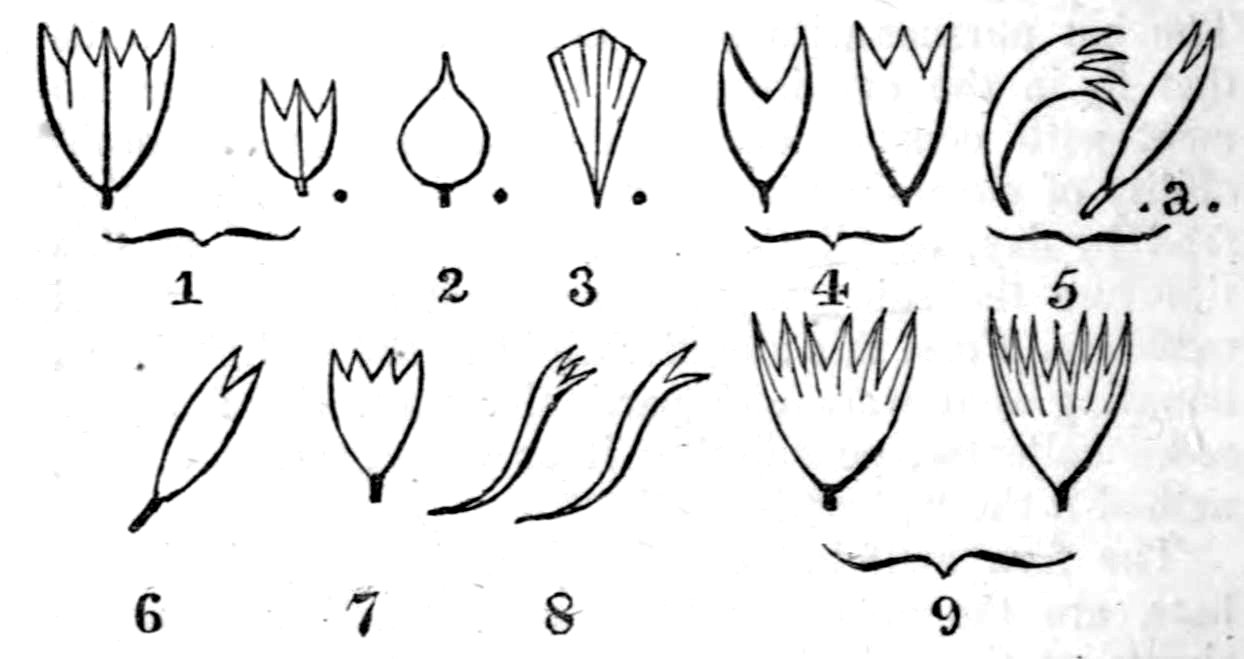
No. 1. Scales from wings of phalæna pronuba—yellow under-wing. 2. Ghost moth. 3. Phalæna bucephala—buff tip. 4. Ph. vinula—puss moth. 5. Ph. potatoria, a, the female—drinker moth. 6. Papilio brassicæ—great white. 7. Pap. Napi—green-veined butterflies. 8. Large brown moth (name omitted). 9. Acherontia atropos—death’s head.
But the variety of clothing with which insects are decorated, is most admirable and curious! The upper and the under vestiture of the wings, their fringes, that which covers the body in different parts, varies greatly; the bird, splendidly habited as he sometimes is, frequently will be found draped with less variety of form and color than the insect which escapes our notice by his actions, and the power of our eyes by the smallness of its parts. Our lepidopterous creatures seem to be most characteristically framed and constituted for the different hours and places in which they delight to move; so much so, that I think if we were to invert the order of their appearance, the singular unfitness of 195many of them for their stations would be immediately manifest to us. The butterfly, light, airy, joyous, replete with life, sports in the sunshine, wantons on the flower, and trips from bloom to bloom, gay as the brilliant morn, and cheerful as the splendor of heaven: heat and light appear to be the very principle of his being; in a cloudy or a chilly atmosphere his energies become suspended, and, closing his wings, reposes like a sickly thing upon some drooping flower: but let the cloud disperse, the sun break out, he springs again to active life; associating with the birds of day, and denizen of the same scenes, he only seems of a less elevated order. But the moth, though possessing at times sufficient activity for self-preservation, is less buoyant, less sprightly on the wing, avoids the heat and light, the higher ranges of the air, and seeks his mate or his food in the shelter of the hedge or the ditch, amidst foliage and shade, where we may see him hovering sedately around some flower, or passing on his way with quiet steady flight, accordant with the silence and twilight of the hour: companion of the owl and the bat, his grave actions are quite unsuitable to the gaiety, the flutter of a summer’s sun; the former is emblematic of levity and display, the latter of retirement and shade. And thus each, though but slightly seen, is in admirable harmony with the season in which it moves, manifesting the peculiar fitness of things to their several stations in this vast world of wisdom; an observation obvious to all, and a truth everywhere admitted, yet, as a Christian moralizer I could not pass by unheeded any evidence of foresight and of power.
Basking in the glare of an August or a July sun, in our pastures we see the little elegant blue argus butterfly (papilio argus), noted and admired by all, now warmed into active life. A few of our lepidopterous creatures, especially the common white butterflies of our gardens, are contentious animals, and drive away a rival from their haunts. We see them progressively ascending into the air, in ardent unheeding contest; and thus they are observed, captured, and consumed in a moment by some watchful bird: but we have few 196more jealous and pugnacious than this little argus. When fully animated, it will not suffer any of its tribe to cross its path, or approach the flower on which it sits, with impunity; even the large admiral (vanessa atalanta) at these times it will assail and drive away. There is another small butterfly (papilio phlæas), however, as handsome, and perhaps still more quarrelsome, frequenting too the same station and flowers; and a constant warfare exists between them. We shall see these diminutive creatures, whenever they come near each other, dart into action, and continue buffeting one another about till one retires from the contest; when the victor returns in triumph to the station he had left. Should the enemy again advance, the combat is renewed; but should a cloud obscure the sun, or a breeze chill the air, their ardor becomes abated, and contention ceases.
The papilio phlæas enjoys a combat even with its kindred. Two of them are seldom disturbed, when basking on a knot of asters in September, without mutual strife ensuing. Being less affected by cold and moisture than the argus, they remain with us longer, and these contentions are protracted till late in the autumn. The pugnacious disposition of the argus butterfly soon deprives it of much of its beauty; and, unless captured soon after its birth, we find the margins of its wings torn and jagged, the elegant blue plumage rubbed from the wings, and the creature become dark and shabby.
This spring, 1827, fostered into active life an insect unknown in our district, or at least unnoticed before by me; a pretty little blue butterfly, for which I know no common appellation, and so have named it the “spring azure,” (papilio argiolus). It appeared quite at the end of April, and in some numbers, but was yet a transient visitor with us, as after the first week in May only a lingering specimen or so was visible. Few wild flowers are then in bloom; but, leaving all herbaceous plants, it frequented chiefly the holly, the laurel, and the black currant, feeding on the honey secreted by the nectaries in their blossoms. If this butterfly be anywhere common, 197it may be mistaken by indifferent observers for the little blue argus of our pastures; but it appears some months earlier than that insect is accustomed to do; does not flit from blossom to blossom, and bask upon the disks of the lowly herbs; and, though a feebler creature on the wing, takes a much higher range in flight, and sports in altitudes which the argus, with all its animation, is very rarely inclined to attempt. When in captivity, the dark margins of the upper wings, the black specks, not eyes, and the pale blue of the reverse, without any other character, render it perfectly distinguishable from the papilio argus, corydon, or any other butterfly found with us. A small hatch again takes place about the end of July, and this pretty insect haunts anew our currant bushes; but, enlivened by the warmth of the season, it becomes more wild and wary, and avoids our approach.
The hummingbird hawk-moth (sphinx stellatarum) visits us annually, and occasionally in some numbers, frisking about all the summer long, and in very fine seasons continues with us as late as the second week in October. The vigilance and animation of this creature are surprising, and seem to equal those of its namesake, that splendid meteoric bird of the tropics, “that winged thought,” as some one has called it; though our plain and dusky insect can boast none of its glorious hues. Our little sphinx appears chiefly in the mornings and evenings of the day, rather avoiding the heat of the mid-day sun, possibly roused from its rest by the scent, that “aromatic soul of flowers,” which is principally exhaled at these periods; delighting in the jasmine, marvel of Peru, phlox, and such tubular flowers; and it will even insert its long, flexible tube into every petal of the carnation, to extract the honey-like liquor it contains. It will visit our geraniums and green-house plants, and, whisking over part of them with contemptuous celerity, select some composite flower that takes its fancy, and examine every tube with rapidity, hovering over its disk with quivering wings, while its fine hawklike eyes survey all surrounding dangers. The least movement alarms it, and it darts away with the 198speed of an arrow; yet returns, and with suspicious vigilance continues its employ, feeding always on the wing. Nature seems to have given this creature some essential requisites for its safety; its activity, when on the wing, renders its capture difficult; and when it rests, it is on a wall, the bark of a tree, or some dusky body, that assimilates so nearly to its own color, as to render it almost invisible, though watched to its settlement; and the larva is seldom found. We sometimes see it enter our rooms, attracted by flowers in the open windows; but it seems to be immediately aware of its danger, disappears in an instant, and is safe from capture. Wild and fearful as this creature is by nature, yet continued gentle treatment will remove much of its timidity, and render it familiar to our presence. Perfectly free from any annoyance as they are when ranging from sweet to sweet on my borders, and accustomed to a close inspection of all their operations, I have frequently touched their wings with my fingers, while hovering over a flower, and dipping their long tubes into the corolla of a geranium: they would retire a little, confused with such freedoms and interruptions, but, experiencing no harm, they would return and finish their meal, unmindful of such petty annoyances. I have known this creature, like some other insects, counterfeit death when apprehensive of danger, fall on its back, and appear in all respects devoid of life when in a box; and, as soon as a fit opportunity arrived, dart away with its usual celerity.
On the blue heads of the pasture scabious (scabiosa succisa) we occasionally see, toward the end of the summer, the painted lady butterfly (papilio cardui); but this is a creature that visits us at very uncertain periods, and is vivified by causes infinitely beyond the comprehension of the entomologist, seeming to require a succession and variety of seasons and their change, and then springing into life we know not how. This was particularly obvious in the summer of 1815, and the two following, which were almost unceasingly cold and rainy; scarcely a moth or butterfly appeared. And in the early part of 1818, the season was not less ungenial; 199a few half-animated creatures alone struggled into being; yet this “painted lady” was fostered into life, and became the commonest butterfly of the year: it has, however, but very partially visited us since that period. The keenest entomologist, perhaps, would not much lament the absence of this beauty, if such cheerless seasons were always requisite to bring it to perfection. Some years ago a quantity of earth was raised in cutting a canal in this county; and, in the ensuing summer, on the herbage that sprang up from this new soil on the bank, this butterfly was found in abundance, where it had not been observed for many years before.
The marble butterfly (papilio galathea) is an equally capricious visitant of our fields. I have known intervals of ten or twelve years when none could be found, and in some following seasons it would be a prevailing species.
The common wasp (vespa vulgaris) is infinitely uncertain in its numbers. A mild winter, and a dry spring or summer, we might conclude to be favorable circumstances for the increase of this creature; yet such is not always the case. Years productive of the plum are said to be congenial likewise to the wasp. A local rhyme will have it, that
Amid the tribes of insects so particularly influenced by seasons, there are a few which appear little affected by common events; the brown meadow butterfly (papilio janira), so well known to every one, I have never missed in any year; and in those damp and cheerless summers, when even the white cabbage butterfly is scarcely to be found, this creature may be seen in every transient gleam, drying its wings, and tripping from flower to flower with animation and life, nearly the sole possessor of the field and its sweets. Dry and exhausting as the summer may be, yet this dusky butterfly is uninjured by it, and we see it in profusion hovering about the sapless foliage. In that arid summer of 1826, the abundance of these creatures, and of the lady-bird 200(coccinella septem punctata), was so obvious, as to be remarked by very indifferent persons.
There is a large yellow under-wing moth (phalæna pronuba), too, which is generally abundant. It hides itself during the day in the thickest foliage, and screens itself from the light in the moist grass crops of the mead, where it is perpetually disturbed, and roused from its rest, by the scythe of the mower. That elegant little bird, the yellow wagtail, is a great destroyer of this insect. It is very soon apprized of these movements, and will often attend the steps of the mower, fearless of harm, to watch for its prey. As soon as the moth rises, it is chased; and its exertions and shiftings to escape, and the activity and perseverance of the bird to capture it, are very amusing.
Our lepidopterous insects feed upon various substances in their several states, and most of our butterflies, when perfected, appear to extract the sweet liquor from the tubes or nectaries of plants, and many of our moths obtain their nourishment by similar means: but one butterfly alone, the admirable (v. Atalanta), and at times the peacock (v. Io), feeds upon the juices of our autumnal fruits; and in the months of September and October we may frequently see these beautiful creatures basking and regaling themselves upon the rejected fragments of our wall fruit. They seldom prey upon the growing produce, like the hornet, wasp, and hive bee, but when it has fallen and advanced to a state of fermentation, it becomes the most grateful to them. Nothing can be less injurious than this propensity, and it seems that fruit in such a state is requisite for them by some constitutional formation, as they appear only at the termination of a season when the product of our trees is in a state of great ripeness and decay. The life of this creature appears to be remarkably short, and we have more certain means of ascertaining its duration, than are afforded us for others of the race. It very rarely appears until late in September, and then so perfect and fresh in its plumage as to manifest its recent production from the chrysalis. In some years they abound, and we may see twenty of these beautiful creatures 201expanding and closing their brilliant wings under the fruit trees on our walls, or basking upon the disk of some autumnal flower; and at another, perhaps, hardly a specimen is to be obtained: nor do they seem like the wasp to be scarce or abundant according to the deficiency or plenty of the season, but influenced by other causes. Many of our butterflies are produced by successive hatches, supplying the places of those which have been destroyed, and hence it is difficult to mark the duration of an individual; and others, as the nettle, peacock and wood tortoise, in many instances survive the winter, hidden in some recess or sheltered apartment, appearing in the spring time-worn and shabby. But van. atalanta appears only in the autumn, not as a preserved creature, but a recent production; and hence we can ascertain the period of its life to be comprised only between those few days that intervene from the end of September to the end of October, by which time its food in our gardens has pretty well disappeared. Some sheltered wall, garnished with the bloom of the ivy, may prolong its being a little longer, but the cold and dampness of the season soon destroy it; rendering the life of this creature, the most beautiful of our lepidopterous tribes, of very brief duration.
The gamma moth (phalæna gamma) is also another creature, that seems in no way affected by moist seasons, which retard the appearance, or apparently destroy so many others of its kind. This creature has imprinted on its dark wings a white character, something like the letter Y, but more like the small Greek gamma, and hence has received a pertinent name. Like Cain, it bears with it, in all its wanderings, a mark that distinguishes it from others of its race. Its habits also are quite unlike those of other moths, as it feeds principally in the day-time; and we see it late in the summer whisking about with all the activity and action of the hummingbird sphinx. Like the latter it keeps its wings, while feeding, in a constant state of vibration; haunts clover-fields, and the yellow blossoms of the wild mustard, and the heads of the pasture scabious. It seems little mindful of the common frosts of October, retiring 202from us with such reluctance, that, should the autumn be fine, we not uncommonly find it in some piece of aftergrass, enjoying there the few flowers which linger out the approaches of November.
In the autumn of the year 1827, the larvæ of the goat moth (phalæna cossus) abounded beyond any customary proportion, and we could commonly see the traces made by these creatures in the dust. They had apparently fed during the summer in the earth, and were now proceeding in search of a retreat during winter to some old hedge-row tree, a part to repose, and those which approached maturity, to abrade the softer wood, and form their cases, preparatory to changing to a final perfect state in the spring. At times we observed them coursing along our paths with great strength and activity; and when not seen, that peculiar subtle smell, which proceeds from them, and has been thought to resemble that of the goat, was perceptible in all our walks. The object and seat of this odor seem not well understood. Some have conjectured it to proceed from a fluid evacuated from the mouth, and discharged to soften the wood in which they burrow. But it seems inconsistent with any probability, that this creature, which is furnished with such very powerful mandibles, should be gifted with an auxiliary aid to accomplish its object; while of the many insects that perforate timber, most of them with inferior means, no other possesses an equivalent agent to facilitate its labors; for not one of them, as far as we know, is so supplied. Besides, if such were the purpose, the discharge would be made only when required, and thus this unpleasant odor not always perceptible. The microscope too does not manifest the exudation of any fluid. The larva is furnished with eight curious retractile processes on its under side, in the manner of what entomologists call the “prolegs.” These are encircled with little hooks, made use of probably to remove the fragments of the wood, when broken off by the mandibles above, and clear the passages. The strength of these jaws is so great, that they will very soon destroy any common chip box in which the animal may be placed, by abrading 203the edges, to effect its escape. With us they chiefly inhabit the ash; and we very commonly see at the roots of our aged trees the fragments removed by them in forming their passages. In breaking up the decayed pollards, we not unusually find the grub in all the stages of its growth; but more generally observe them without inhabitants, yet perforated with paths large enough to admit the finger. I suspect that these “augerworms” are the primary cause of the decay of the tree; having often observed their perforations, and found them, both large and small, in the solid spur or root of the tree, when the upper portion, having been bored and in a state of decline, is abandoned by them. Those that are full fed appear to form their cases in that part which has lost coherency, while the younger and imperfected creatures mine their way, and obtain nutriment in the solid timber, thus killing the tree by inches; when rain and moisture find lodgment, and complete the dissolution. One year’s preparation is the period usually assigned to the larvæ of most insects, before they arrive at their perfect state; but by the goat moth three years are required before it attains its winged state from the egg. Consequently, for the larger portion of its life it is occupied in these destructive operations; and thus this creature becomes a very powerful agent in reducing these Titans of the vegetable world, crumbling them away to their original dust: for what was decreed to be the termination and punishment of man is found in active operation throughout the whole chain of nature’s works, which are but dust, and unto dust return, continuing an endless series of production and decay, of restoration and of change. All these larvæ which I have observed in the colder portions of our year, were hard, stiff, and torpid, but soon became relaxed and animated by the warmth of the hand: thus they probably remain quiet during the winter months, but revive in spring, and recommence their ravage in the tree. The caterpillar of this moth I believe to be the largest of any of those of the British lepidopteræ; and when full fed exceeds in size that of the death’s-head sphinx. To those who dislike the appearance of things of this nature, 204it is particularly disgusting; not only from its magnitude and smell, but from its color, which is a lurid red, so compounded with a dingy yellow, as to give it a lividness of look, conveying the idea of something raw. Common as the grub is in some years, I have seldom been able to obtain the moth, without the often tedious process of feeding the larvæ, and waiting for its change.
Of those caterpillars which feed upon the foliage of vegetation, a considerable portion are picked off and consumed by the numerous little birds which are constantly hunting after them, as food for themselves or their young ones; and many of those which are supported by the roots of plants, and remain covered in the soil, are detected by the perception of rooks, and birds of that order; but those which feed upon the internal parts of trees seem exempted from any of these causes of destruction. This is possibly a reason that the larvæ of phalæna cossus is so plentifully found; but yet it is pretty certain that some other and equally fatal visitation assails them, and reduces their numbers during the long period which is required to perfect their state: for though, by feeding and care, (for they are very impatient of confinement,) we can obtain the moth in numbers, yet few seem to survive and become perfected by the common processes of nature, at least I have seldom found them in this state, though the larvæ is so plentifully seen.
The designs of supreme intelligence in the creation and preservation of the insect world, and the regulations and appointments whereby their increase or decrease is maintained, and periodical appearance prescribed, are among the most perplexing considerations of natural history. That insects are kept in reserve for stated seasons of action, we know, being commonly made the agents of Providence in his visitations of mankind. The locust, the caterpillar, the palmer-worm, the various family of blights, that poison in the spring all the promise of the year, are insects. Mildew, indeed, is a vegetable; but the wireworm destroys the root, the thrips the germ of the wheat, and hunger and famine ensue. Many of the coleopteræ remove nuisances, others 205again encumbrances, and worms manure the soil; but these are trite and isolated cases in the profusion of the animal world; and, left alone, as we are, in the desert of mere reason and conjecture, there is no probability that much satisfactory elucidation will be obtained. They are not perhaps important objects of inquiry; but when we see the extraordinary care and attention that has been bestowed upon this part of creation, our astonishment is excited, and forces into action that inherent desire in our minds to seek into hidden things. In some calm summer’s evening ramble, we see the air filled with sportive animated beings: the leaf, the branch, the bark of the tree, every mossy bank, the pool, the ditch, all teeming with animated life, with a profusion, an endless variety of existence; each creature pursuing its own separate purpose in a settled course of action, admitting of no deviation or substitution, to accomplish or promote some ordained object. Some appear occupied in seeking for the most appropriate stations for their own necessities, and exerting stratagems and wiles to secure the lives of themselves or their offspring against natural or possible injuries, with a forethought equivalent or superior to reason; the aim in some others we can little perceive, or, should some flash of light spring up, and give us a momentary glimpse of nature’s hidden ways, immediate darkness closes round, and renders our ignorance more manifest. We see a wonderfully fabricated creature struggling from the cradle of its being, just perfected by the elaboration of months or years, and decorated with a vest of glorious splendor; it spreads its wings to the light of heaven, and becomes the next moment, perhaps, with all its marvellous construction, instinct, and splendor, the prey of some wandering bird! and human wisdom and conjecture are humbled to the dust. That these events are ordinations of supreme intelligence, for wise and good purposes, we are convinced; but are blind, beyond thought, as to secondary causes; and admiration, that pure source of intellectual pleasure, is almost alone permitted to us. If we attempt to proceed beyond this, we are generally lost in the mystery with 206which the divine Architect has thought fit to surround his works; and perhaps our very aspirations after knowledge increase in us a sense of our ignorance: every deep investigator into the works of nature can scarcely possess other than an humble mind.
In all our pursuits we shall find in nature, wheresoever we can penetrate, a formation, a faculty adapted to all the wants and comforts of the creature, yet the objects of infinite wisdom in the creation of this world of matter, animate and inanimate, will probably never be made known to mankind; for though knowledge is in a constant progressive state, and the attainments of science in latter years have been comparatively prodigious, yet these acquirements are in fact but entanglements: they lead us deeper into surprise and perplexity, and the little perceptions of light which we obtain serve to show how hopeless any attempt must be to penetrate the secrets of infinity, a conviction, if we “dwell deep in the valley of humility,” that will in no manner discourage our pursuits, but rather incite our ardor to investigate so exhaustless a store, which will lead us, from contemplation, to admiration, to devotion.
That pretty sparkler of our summer evenings, so often made the plowboy’s prize, the only brilliant that glitters in the rustic’s hat, the glow-worm[60] (lampyris noctiluca), is not found in such numbers with us, as in many other places, where these signal tapers glimmer upon every grassy bank; yet, in some seasons, we have a reasonable sprinkling of them. Every body probably knows, that the male glow-worm is a winged, erratic animal, yet may not have seen him. He has ever been a scarce creature to me, meeting perhaps with one or two in a year; and, when found, always a subject of admiration. Most creatures have their eyes so placed as to be enabled to see about them; or, as Hook says of the house fly, to be “circumspect animals;” but this male glow-worm has a contrivance by which any upward or side vision is prevented. Viewed when at rest, no portion of his eyes is visible, but the head is margined with a horny band, or plate, being a character of one of the genera of the order coleoptera, under which the 207eyes are situate. This prevents all upward vision; and blinds, or winkers, are so fixed at the sides of his eyes as greatly to impede the view of all lateral objects. The chief end of this creature in his nightly peregrinations is to seek his mate, always beneath him on the earth; and hence this apparatus appears designed to facilitate his search, confining his view entirely to what is before or below him. The first serves to direct his flight, the other presents the object of his pursuit: and as we commonly, and with advantage, place our hand over the brow, to obstruct the rays of light falling from above, which enables us to see clearer an object on the ground, so must the projecting hood of this creature converge the visual rays to a point beneath. This is a very curious provision for the purposes of the insect, if my conception of its design be reasonable. Possibly the same ideas may have been brought forward by others; but, as I have not seen them, I am not guilty of any undue appropriation, and no injury can be done to the cause I wish to promote, by detailing again such beautiful and admirable contrivances.
Glow-worms emit light only for a short period in the year; and I have but partially observed it after the middle of July. I have collected many of these pretty creatures on a bank before my house, into which they retire during the winter, to shine out again when revived by the summer’s warmth; but in this latter season, I have frequently missed certain of my little protegés, and have reason to apprehend that they formed the banquet of a toad, that frequented the same situation.
Observing above, that the glow-worm does not emit light after the 14th of July, I mean thereby that clear, steady light, which has rendered this creature so remarkable to all persons; for I have repeatedly noticed, deep in the herbage, a faint evanescent light proceeding from these creatures, even as late as August and September. This was particularly manifested September the 28th, 1826. The evening was warm and dewy, and we observed on the house-bank multitudes of these small evanescent sparks in the grass. The light displayed 208was very different from that which they exhibit in the warm summer months. Instead of the permanent green glow that illumines all the blades of the surrounding herbage, it was a pale transient spot, visible for a moment or two, and then so speedily hidden that we were obliged, in order to capture the creature, to employ the light of a candle. The number of them, and their actions, creeping away from our sight, contrary to that half-lifeless dullness observed in summer, suggested the idea that the whole body had availed themselves of this warm, moist evening, to migrate to their winter station. A single spark or so was to be seen some evenings after this, but no such large moving parties were discovered again. If we conclude, that the summer light of the glow-worm is displayed as a signal taper, the appearance of this autumnal light can have no such object in view, nor can we rationally assign any use of it to the creature itself, unless, indeed, it serves as a point of union in these supposed migrations, like the leading call in the flight of night-moving birds. The activity and numbers of these insects, in the above-mentioned evening, enabled me to observe the frequent presence and disappearance of the light of an individual, which did not seem to be the result of will, but produced by situation. During the time the insect crawled along the ground, or upon the fine grass, the glow was hidden; but on its mounting any little blade, or sprig of moss, it turned round and presented the luminous caudal spot, which, on its falling or regaining its level, was hidden again.
My laborer this day, July the 18th, in turning over some manure, laid open a mass of snake’s eggs (coluber natrix), fifteen only, and they must have been recently deposited, the manure having very lately been placed where they were found. They were larger than the eggs of a sparrow, obtuse at each end, of a very pale yellow color, feeling tough and soft like little bags of some gelatinous substance. The interior part consisted of a glareous matter like that of the hen, enveloping the young snake, imperfect, yet the eyes and form sufficiently defined. Snakes must protrude their eggs singly, 209but probably all at one time, as they preserve no regular disposition of them, but place them in a promiscuous heap. At the time of protrusion they appear to be surrounded with a clammy substance, which, drying in the air, leaves the mass of eggs united wherever they touch each other. I have heard of forty eggs being found in these deposits; yet, notwithstanding such provision for multitudes, the snake, generally speaking, is not a very common animal. The kite, the buzzard, and the raven, which prey on it occasionally, are too seldom found greatly to reduce the race; and its deep retirement in the winter seems to secure it from fatal injuries by the severity of the weather: yet in the warm days of spring, when it awakens from its torpidity and basks upon our sunny banks, the numbers that appear are not proportionate to what might be expected from the number of eggs produced. Few creatures can assail it in its dormitory, yet its paucity proves that it is not exempt from mortality and loss. The mole may follow it in its retirement, but would hardly attempt to seize so large an animal. The polecat and the weasel too can enter its runs; are sufficiently bold and strong to attempt the conquest; and not improbably in the winter season resort to such food, the poor snake having no power of defending itself, or of avoiding the assault. The common snake of this country is a very harmless, unobtrusive creature; so timid, as to avoid the presence of man whenever he appears, hiding itself as much as possible in bushes and rugged places from his sight. At times a strong fetor proceeds from it; but this appears to be sexual, or made use of as the means of annoying its enemies. It possesses no power to commit injury, and has apparently no inclination to molest any thing beyond its requirements for food, as frogs and mice. When a young man, I have repeatedly handled it with impunity; and though often bitten, a temporary swelling, with slight inflammation, was the only result; but in these experiments the viper must not be mistaken for the common snake. Yet this poor creature, under the curse of ignorance and cruelty, never escapes unscathed from power and opportunity. All the snake tribe, innocuous 210and pernicious, seem to be viewed with horror and aversion by mankind. This horror, from the knowledge of their power of inflicting harm in countries where such kinds are found, is natural, and often preservative of life; but the aversion generally felt, and that shuddering occasionally noticed at the sight of our harmless snake, is like a deep-rooted principle. We imbibe in infancy, and long retain in remembrance the impression of injuries from the wiles of the serpent; and the “enmity between it and the seed of the woman” appears still in full operation, and is possibly more extensively and insensibly diffused among mankind than we are aware of. The harmless nature of our snake seems to be fully known to the little birds of the hedge, as they in no way give intimation of its presence by any warning of avoidance to their young, or that insulting vociferation so observable when any really injurious creature is perceived, but hop and sport about the basking snake without fear or notice.
All the human race seem to have inherited the original anathema against this creature; for though the capricious cruelty of man is very frequently exerted to the injury of many that his power enables him to tyrannize over, yet the serpent appears to be a peculiar object of his enmity, as if it was understood to be an absolute duty to “bruise his head,” whenever the opportunity should be afforded.
It is very remarkable how few noxious creatures, animals which annoy man, inhabit with us; beasts and birds we have none, for the petty depredations occasionally made on his property are undeserving of attention. The gnat, and perhaps a few insects, may at times puncture our skin, but the period of action is brief, the injury only temporary. The wasp and the hornet, I believe, very rarely use their weapons wantonly, only in self-defence and when persecuted; thus leaving the balance incalculably in favor of innocency and harmlessness. But of all the guiltless beings which are met with, we have none less chargeable with criminality than the poor slow-worm[61] (anguis fragilis), yet none are more frequently destroyed than it—included as it is in the 211general and deep-rooted prejudice attached to the serpent race. The viper and the snake, though they experience no mercy, escape often by activity of action; but this creature, from the slowness of his movements, falls a more frequent victim. We call it a ‘blind-worm,’ possibly from the supposition that as it makes little effort to escape, it sees badly; but its eyes, though rather small, are clear and lively, with no apparent defect of vision. The natural habits of the slow-worm are obscure; but living in the deepest foliage, and the roughest banks, he is generally secreted from observation; and loving warmth, like all his race, he creeps half torpid from his hole, to bask in spring time in the rays of the sun, and is, if seen, inevitably destroyed. Exquisitely formed as all these gliding creatures are, for rapid and uninterrupted transit through herbage and such impediments, it is yet impossible to examine a slow-worm without admiration at the peculiar neatness and fineness of the scales with which it is covered. All separate as they are, yet they lap over, and close upon each other with such exquisite exactitude, as to appear only as faint markings upon the skin, requiring a magnifier to ascertain their separations; and, to give him additional facility of proceeding through rough places, these are all highly polished, appearing lustrous in the sun, the animal looking like a thick piece of tarnished copper wire. When surprised in his transit from the hedge, contrary to the custom of the snake or viper, which writhe themselves away into the grass in the ditch, he stops, as if fearful of proceeding, or to escape observation by remaining motionless, but if touched he makes some effort to escape: this habit of the poor slow-worm becomes frequently the cause of his destruction.
Of all the active, vigilant creatures that animate our paths, we have none superior to the little, bee-like bombylius (bombylius medius); but this creature is to be seen only in the mornings of a few bright days in spring, seeming to delight in the hot, windy gleams of that season, presenting an emblem of that portion of our year, fugitive and violent. It is, I believe, plentiful 212nowhere. Particularly solicitous of warmth, it seeks the dry sunny reflection of some sheltered gravel-walk, or ditch-bank in a warm lane; and here it darts and whisks about, in seeming continual suspicion or danger; starting away with angry haste, yet returning immediately to the spot it had left; buffeting and contending with every winged fly that approaches, with a jealous, pugnacious fury, that keeps it in constant agitation. This action, its long projecting proboscis, and its pretty, spotted wings, placed at right angles with its body, distinguish our bombylius from every other creature. It appears singularly cautious of settling on the ground. After long hovering over and surveying some open spot, with due deliberation and the utmost gentleness it commits its long, delicate feet to the earth; but on the approach of any winged insect, or on the least alarm, is away again to combat or escape. Associates it has none: the approach even of its own race excites its ire, and, darting at them with the celerity of thought, it drives them from its haunts. When a captive it becomes tame and subdued, and loses all its characteristic bustling and activity, the inspiration of freedom.
The great black ant (formica fuliginosa) is commonly found in all little copses, animating by its numbers those large heaps of vegetable fragments, which it collects and is constantly increasing with unwearied industry and perseverance as a receptacle for its eggs. The game-fowl, the woodpecker, the wryneck, and all the birds that feed upon the little red ant, and soon depopulate the hillocks which they select, do not seem equally to annoy this larger species. These systematic creatures appear always to travel from and return to their nests in direct lines, from which no trifling obstacle will divert them; and any interruption on this public highway they resent, menacing the intruder with their vengeance. A neighbor related to me an instance of this unyielding disposition, which he witnessed in one of our lanes. Two parties of these black ants were proceeding from different nests upon a foraging expedition, when the separate bodies happened to meet each other. Neither would give way; and a violent contest 213for the passage ensued. After a time the combat ceased, and all animosity subsided, each party retiring to its nest, carrying with it its dead and maimed companions. This encounter seemed quite accidental, and the disposition to move in a uniform line, which their meeting prevented, the sole cause of their hostility, combat, and mutual injury. The strength of some creatures, especially insects, considering the smallness of their size, is in several instances prodigious. Man, by his reason and power, calls to his aid mechanical means, and other agents, to effect his objects; but unreasoning beings accomplish their purposes by contrivance and bodily powers. The strength of these black ants is manifested by the quantity and magnitude of the materials which they collect for their heaps; but the common little red ant (formica rubea), a much smaller creature, gives daily proofs of its abilities to remove heavy substances, equal to any that we meet with. One of these little creatures, thirty-six of which only weigh a single grain, I have seen bear away the great black fly as its prize, equal to a grain in weight, with considerable ease; and even the wasp, which exceeds forty times its own weight, will be dragged away by the labor and perseverance of an individual emmet. These little ants are occasionally and profusely deprived of their lives by some unknown visitation. In the year 1826, in particular, and again in the following year, I observed, in the month of August, a lane strewed with their bodies. They had bred during the summer in an adjoining bank; but some fatality had overwhelmed them when absent from their nests, and nearly annihilated the fraternity, as only a few scattered survivors were to be seen feebly inspecting the bodies of their associates. The task of removal, however, with all their industry, appeared beyond their powers to accomplish, as on the ensuing day few had been taken away. Had these creatures been destroyed in combat by rival contention, the animosity must have been excessive; but it is more probable that they met their death by some other infliction.
One year, on the 3d of March, my laborer being employed in cutting up ant-hills, or tumps, as we call 214them, exposed to view multitudes of the yellow species (formica flava) in their winter’s retirement. They were collected in numbers in little cells and compartments, communicating with others by means of narrow passages. In many of the cells they had deposited their larvæ, which they were surrounding and attending, but not brooding over or covering. Being disturbed by our rude operations, they removed them from our sight to more hidden compartments. The larvæ were small. Some of these ant-hills contained multitudes of the young of the woodlouse (oniscus armadillo), inhabiting with perfect familiarity the same compartments as the ants, crawling about with great activity with them, and perfectly domesticated with each other. They were small and white; but the constant vibration of their antennæ, and the alacrity of their motions, manifested a healthy vigor. The ants were in a somewhat torpid state; but on being removed into a temperate room, they assumed much of their summer animation. How these creatures are supported during the winter season it is difficult to comprehend, as in no one instance could we perceive any store or provision made for the supply of their wants. The minute size of the larvæ manifested that they had been recently deposited; and consequently that their parents had not remained during winter in a dormant state, and thus free from the calls of hunger. The preceding month of February, and part of January, had been remarkably severe; the frost had penetrated deep into the earth, and long held it frozen; the ants were in many cases not more than four inches beneath the surface, and must have been inclosed in a mass of frozen soil for a long period; yet they, their young, and the onisci, were perfectly uninjured by it; affording another proof of the fallacy of the commonly received opinion, that cold is universally destructive to insect life. Some creatures may be injured or destroyed by frost, but the larger portion of them nature has provided with constitutions to which it is innocuous, or furnished with instinct to prevent its harming them. These emmets had probably received no substance, or required any, from the time of their retirement in the autumn, a 215period of full six months; were inclosed during the space of thirty days in a mass of frozen earth, and yet remained perfectly uninjured by this long abstinence and frost.
Water, in a state of rest over decayed and putrescent vegetable matter, is peculiarly favorable for the residence of many of the insect world. The eggs that are lodged there remain undisturbed by the agitation of the element, and the young produced from them, or deposited there by viviparous creatures, remain in quiet, tolerably secure from accidental injuries; but there are natural causes which render these apparent asylums the fields of ravenousness and of death. To these places resort many of those voracious insects and other creatures, which prey upon the smaller and helpless; for all created things seem subordinate to some more powerful or irresistible agent, from the hardly visible atom that floats in the pool, to man, who claims and commands the earth as his own. But we have no animal that seems to commit greater destruction in these places than the common newt (lacertus aquaticus). In some of these well-stored magazines this reptile will grow to a large size, and become unusually warty, and bloated with repletion; feeding and fattening upon the unresisting beings that abound in those dark waters wherein it loves to reside. It will take a worm from the hook of those that angle in ponds; and in some places I have seen the boys in the spring of the year draw it up by their fishing-lines, a very extraordinary figure, having a small shell-fish (tellina cornea) attached to one or all of its feet; the toes of the newt having been accidentally introduced into the gaping shell, in its progress on the mud at the bottom of the pool, or designedly put in for the purpose of seizure, when the animal inhabitant closed the valves and entrapped the toes. But from whatever causes these shells became fixed, when the animal is drawn up hanging and wriggling with its toes fettered all round, it affords a very unusual and strange appearance.
Water, quiet, still water, affords a place of action to a very amusing little fellow (gyrinus natator), which 216about the month of April, if the weather be tolerably mild, we see gamboling upon the surface of the sheltered pool; and every schoolboy, who has angled for a minnow in the brook, is well acquainted with this merry swimmer in his shining black jacket. Retiring in the autumn, and reposing all the winter in the mud at the bottom of the pond, it awakens in the spring, rises to the surface, and commences its summer sports. They associate in small parties of ten or a dozen, near the bank, where some little projection forms a bay, or renders the water particularly tranquil; and here they will circle round each other without contention, each in his sphere, and with no apparent object, from morning until night, with great sprightliness and animation; and so lightly do they move on the fluid, as to form only some faint and transient circles on its surface. Very fond of society, we seldom see them alone, or, if parted by accident, they soon rejoin their busy companions. One pool commonly affords space for the amusement of several parties; yet they do not unite, or contend, but perform their cheerful circlings in separate family associations. If we interfere with their merriment they seem greatly alarmed, disperse, or dive to the bottom, where their fears shortly subside, as we soon again see our little merry friends gamboling as before.
This lively little animal, arising from its winter retreat shortly after the frog, at times in March, continues its gambols all the summer long, remaining visible generally until the middle of October, thus enjoying a full seven months of being; a long period of existence for insects, which are creatures subject to so many contingencies, that their lives appear to be commonly but brief, and the race continued by successive productions. All these water creatures must be endowed with much perception. Cold as this element is in early spring, when the ice of winter is hardly dissolved, and the fluid only 6 or 7 degrees above freezing, yet they become immediately sensible of this temperature, and are excited to animation and the vocations of their being. I have never observed the larvæ of this creature in any state. When they retire in the autumn, these insects 217appear of a uniform size, and emerging in the spring they are all apparently full grown, and during the summer none of smaller dimensions associate with the family parties. This plain, tiny, gliding water-flea seems a very unlikely creature to arrest our young attentions; but the boy with his angle has not often much to engage his notice; and the social, active parties of this nimble swimmer, presenting themselves at these periods of vacancy, become insensibly familiar to his sight, and by many of us are not observed in after life without recalling former hours, scenes of perhaps less anxious days: for trifles like these, by reason of some association, are often remembered, when things of greater moment pass off, and leave no trace upon our mind.
July 29.—We frequently notice in our evening walks the murmuring passage, and are often stricken by the heedless flight, of the great dorr beetle[63] (scarabæus stercorarius), clocks,[62] as the boys call them. But this evening my attention was called to them in particular by the constant passing of such a number as to constitute something like a little stream; and I was led to search into the object of their direct flight, as in general it is irregular and seemingly inquisitive. I soon found that they dropped on some recent nuisance: but what powers of perception must these creatures possess, drawn from all distances and directions by the very little fetor, which in such a calm evening could be diffused around! and by what inconceivable means could 218odors reach this beetle in such a manner as to rouse so inert an insect into action! But it is appointed one of the great scavengers of the earth, and marvellously endowed with powers of sensation, and means of effecting this purpose of its being. Exquisitely fabricated as it is to receive impressions, yet probably it is not more highly gifted than any of the other innumerable creatures, that wing their way around us, or creep about our path, though by this perceptible faculty, thus “dimly seen,” it excites our wonder and surprise. “How wondrous then the whole!”
This creature affords us a good example of that extraordinary artifice, to which some insects have recourse upon the apprehension of danger, the counterfeiting of death. The dorr, with a violent and noisy flight, proceeds on its way, or circles around with an apparent fearlessness of harm; yet the instant it is touched, or interrupted in its progress, though in no way injured, it will immediately fall to the ground, generally prostrate on its back, its limbs extended, stiff, and seemingly devoid of life, and suffering itself to be handled without manifesting any signs of animation. In time, finding no harm ensues, it resumes its former state. If our conjectures be correct, that the object of this stratagem is to preserve its life, it is difficult to comprehend how far it can be successful. Several birds feed on it, as we observed; and that others do so likewise is evident from their castings. Of these, the owl and the nightjar catch it when on the wing; and the crows, rooks, magpies, &c., seem to have no hesitation in picking it to pieces, as well as all the other beetles, that put on the semblance of death, in whatever state they find them. One or two beasts, it is said, when captured, feign death. With these exceptions, we remember none of the other orders of creation, that have recourse to such an expedient upon any emergency; but with insects it is by no means an uncommon procedure, most probably resorted to by them for a motive we are not fully acquainted with, and which is in all likelihood attended with the success it was designed to effect.
The perfect cleanliness of these creatures is a very 219notable circumstance, when we consider that nearly their whole lives are passed in burrowing in the earth, and removing nuisances; yet such is the admirable polish of their coating and limbs, that we very seldom find any soil adhering to them. The meloe, and some of the scarabæi, upon first emerging from their winter’s retreat, are commonly found with earth clinging to them; but the removal of this is one of the first operations of the creature; and all the beetle race, the chief occupation of which is crawling about the soil, and such dirty employs, are notwithstanding remarkable for the glossiness of their covering, and freedom from defilements of any kind. But purity of vesture seems to be a principal precept of nature, and observable throughout creation. Fishes, from the nature of the element in which they reside, can contract but little impurity. Birds are unceasingly attentive to neatness and lustration of their plumage. All the slug race, though covered with slimy matter calculated to collect extraneous things, and reptiles, are perfectly free from soil. The fur and hair of beasts in a state of liberty and health is never filthy, or sullied with dirt. Some birds roll themselves in dust, and occasionally, particularly beasts, cover themselves with mire; but this is not from any liking or inclination for such things, but to free themselves from annoyances, or to prevent the bites of insects. Whether birds in preening, and beasts in dressing themselves, be directed by any instinctive faculty, we know not; but they evidently derive pleasure from the operation, and thus this feeling of enjoyment, even if the sole motive, becomes to them an essential source of comfort and of health.
It may be noted probably by some, how frequently I recur to the causes and objects of the faculties, manners, and tendencies of animate and inanimate things. This recurrence springs from no cavil at the wisdom, no suspicion of the fitness of the appointment, nor, I trust, from any excitement to presumptuous pryings into paths which are in the great deep, and not to be searched out; but are humbly indulged, from the pleasure which the contemplation of perfect wisdom, even in a state 220of ignorance, affords; and if by any consideration we can advance one point nearer to the comprehension of what is hidden, we infinitely increase our satisfaction and delight.
May 24, 1827.—Abundance of cockchaffers (melolantha vulgaris) are flying about, yet by no means in the profusion of some years. How much at times the interest of man and the wild creatures about him are at variance! Those that are domesticated and precluded from obtaining food but by his permission, have their welfare in part identified with his—they may share in his abundance, or pine from his parsimony; but the independents of the field are differently circumstanced. The appearance of these chaffers, in any numbers, is very uncertain and partial, but in those summers when they abound, very extensive injuries frequently ensue. In the grub state, they will entirely destroy the pastures where they inhabit, by consuming the roots of the grasses; acres and fields are deprived of their produce, becoming brown as stubbles, with only a sprig or tuft of green useless vegetation observable in them; the grain crop likewise totally fails when the larvæ of this chaffer feeds in the field. Upon assuming their winged state, they devour the foliage of the oak and other trees so effectually, that entire copses may be seen early in June defoliated by their depredations. So much for their injury to man: but now the feast of the wilding commences—the plow in April dislodges multitudes of these long white grubs. Dogs then seek them eagerly to eat, but they seem to be surfeited by the food; for, though fattened at first, they afterwards become diseased, and lose their hair. Rooks and crows are running over the ridges, busily seeking for this larvæ; the swine find it out, and come in for their share, and having finished here, they commence grubbing in the grass lands. The insect now soon takes wing, and then every tree in the wood or the brake becomes a scene of plunder and delight to all the train from the rookery—the cats will eat him—every sparrow that flies by has a chaffer in its mouth, captured on the wing or snatched from the spray, and now to be pecked to pieces on the 221ground—the thrush feasts too, and all the poultry in the yard are running after chaffers, or chasing each other for the prize; and thus this insect supplies in one state or another a general feast to many.
Surrounded as we are by wonders of every kind, and existing only by a miraculous concurrence of events, admiration seems the natural avocation of our being; nor is it easy to pronounce amidst such a creation what is most wonderful. But few things appear more incomprehensible than the constant production and reabsorption of matter, impressed upon us even by these very dorrs. An animal falls to the ground and dies; myriads of creatures are now summoned by a call, by an impulse of which we have no perception, to remove it, and prepare it for a new combination; chemical agencies, fermentation, and solution, immediately commence their actions to separate the parts, and in a short time, of all this great body, nothing remains but the framework or bones, perhaps a little hair or some wool, and all the rest is departed we know not whither! Worms and insects have done their parts; the earth has received a portion, and the rest, converted into gases, and exhalable matters, has dispersed all over the region, which, received into vegetable circulation, is again separated and changed, becomes modified anew, and nourishes that which is to continue the future generations of life. The petal of the rose; the pulp of the peach; the azure and the gold on the wing of the insect; all the various productions of the animal and vegetable world; the very salts and compounds of the soil, are but the changes some other matters have undergone, which have circulated through innumerable channels since the first production of all things, and no particle been lost; bearing in mind this assured truth, that all these combinations have not been effected by chance or peculiarity of circumstances, but by the predetermination of an Almighty Intelligence, who sees the station, progress, and final destination of an atom, what an infinity of power and intellective spirit does this point out! an omnipotence, which the bodied minds of us poor creatures cannot 222conceive. Truly may we say, “who can find out the Almighty to perfection?”
Our extensive cultivation of the potato furnishes us annually with several specimens of that fine animal the death’s-head moth[64] (acherontia atropos), and in some years I have had as many as eight brought me in the larva or chrysalis state. Their changes are very uncertain. I have had the larva change to a chrysalis in July, and produce the moth in October; but generally the aurelia remains unchanged till the ensuing summer. The larvæ or caterpillars, “strange ungainly beasts,” as some of our peasantry call them, excite constant attention when seen, by their extraordinary size and uncommon mien, with horns and tail, being not unusually five inches in length, and as thick as a finger. This creature was formerly considered as one of our rarest insects, and doubtful if truly indigenous; but for the last twenty years, from the profuse cultivation of the potato, is become not very uncommon in divers places. Many insects are now certainly found in England, which former collectors, indefatigable as they were, did not know that we possessed; while others again have been lost to us moderns. Some probably might be introduced with the numerous exotic plants recently imported, or this particular food may have tended to favor the increase of rarely existent natives; but how such a creature as this could have been brought with any plant is quite beyond comprehension. We may import continental varieties of potatoes, but the death’s-head moth we have never observed to have any connexion with the tuber itself, or inclination for it. As certain soils will produce plants by exposure to the sun’s rays, or by aid of peculiar manures, when no pre-existent root or germ could rationally be supposed to exist; so will peculiar and long intervening seasons give birth to insects from causes not to be divined. We may perhaps conclude, that some concurrence produced this sphinx, and then its favorite food, the potato plant, nourished it, to the augmentation of its species.
Superstition has been particularly active in suggesting causes of alarm from the insect world; and where man 223should have seen only beauty and wisdom, he has often found terror and dismay. The yellow and brown tailed moths, the deathwatch, our snails, as mentioned in p. 231, and many others, have all been the subjects of his fears; but the dread excited in England by the appearance, noises, or increase of insects, are petty apprehensions, when compared with the horror that the presence of this acherontia occasions to some of the more fanciful and superstitious natives of northern Europe, maintainers of the wildest conceptions. A letter is now before me from a correspondent in German Poland, where this insect is a common creature, and so abounded in 1824, that my informer collected fifty of them in the potato-fields of his village, where they call them the “death’s-head phantom,” the “wandering death-bird,” &c. The markings on its back represent to these fertile imaginations the head of a perfect skeleton, with the limb bones crossed beneath; its cry becomes the voice of anguish, the moaning of a child, the signal of grief; it is regarded not as the creation of a benevolent being, but the device of evil spirits, spirits enemies to man, conceived and fabricated in the dark; and the very shining of its eyes is thought to represent the fiery element whence it is supposed to have proceeded. Flying into their apartments in the evening, it at times extinguishes the light, foretelling war, pestilence, hunger, death to man and beast. We pity, rather than ridicule these fears; their consequences being painful anxiety of mind and suffering of body. However, it seems these vain imaginations are flitting away before the light of reason and experience. In Germany as in England, they were first observed on the jasmine, but now exclusively upon the potato, though they will enter the bee-hives, to feed on the honey found in them. This insect has been thought to be peculiarly gifted in having a voice, and squeaking like a mouse, when handled or disturbed; but in truth no insect that we know of has the requisite organs to produce a genuine voice. They emit sounds by other means, probably all external. The grasshopper and the cricket race effect their well-known and often wearisome chirpings by grating their 224spiny thighs against their rigid wings; and this acherontia atropos appears to produce the noise it at times makes, which reminds us of the spring call of the rail or corncrake, by scratching its mandible, or the instrument that it perforates with, against its horny chest. The object of this noise is apparently a mere sexual call. Heavy and unwieldly creatures, they travel badly, and from the same cause fly badly and with labor; and as they commonly hide themselves deep in the foliage and obscurity, without some such signal of their presence a meeting of the parties would seldom be accomplished.
Another of the ravenous creatures that infest our pools is the great water-beetle (ditiscus marginalis); and perhaps it is the most ferocious of any of them, being adapted by every provision for a life of rapine, endued with great muscular power, armed with a thick and horny case over its body, and having its eyes large to observe all the creatures about it, and powerful mandibles to seize and reduce them to fragments. It riots on the polyphemus of the pool; and having thinned its herd in one place, is supplied with wings to effect a removal to a fold better furnished. It even eats the young of the frog; and its bite is so powerful, as to be painfully felt by the hand that holds it a captive, though defended by a glove. In the larvæ state it is almost equally destructive; it swims admirably; its hinder legs are long and brawny, beside being aided by a fringe of hairs, so that they are powerful oars to propel its body with celerity and ease. Nor must we omit a peculiarity attending the constitution of this beetle, which marks it as a creature especially endowed for the station in which it is placed. Multitudes of insects exist in the larva state for a certain space of time in water, and, having accomplished a given period in this state perfecting their forms, they take wings and become aërial creatures, after which a return to the element whence they sprang would be death to them. But this beetle, when it has passed from the larva state and obtained its wings, still lives in that water which nourished it to this state of perfection, without any inconvenience, 225as long as it suits its inclination; when weary of this place, or its food becoming scarce, it wings its way to another pool, into which it immediately plunges, and recommences its life of rapine. Having deposited its eggs in autumn, we suppose it to die in the winter; yet many may survive this season, and, arising from the mud in the spring, be undistinguished from the recently perfected larvæ. Such little notices and indications of the habits of these obscure creatures, though certainly unimportant, are not perhaps wholly unprofitable; for we so darkly see our way, and proceed so slowly in acquiring intelligence of the paths of nature, that nothing should be considered as beneath regard that we meet with in them, and every advancing step must elevate the mind, as it affords additional knowledge of the solicitude and provision of the great Architect of creation in the appointment and endowment of his creatures; since, though we are very rarely able to comprehend even the object of existence, we see sufficient to convince us, that such care and such powers were not bestowed except for some wise and good purpose. It seems hardly possible that mankind can ever obtain anything approaching to the comprehension of the motives of Providence, because they have not, as far as is apparent to us, individual and separate bearings, but are connecting and in concordance with a series of influences, and consequently the whole should be seen, fitly to understand a part; and this mighty mechanism what human mind can embrace? Heaven metes out to man by degrees something of its laws and ordinances; but no life, no period, can exhaust that store of hidden wisdom, by which these mandates have been decreed, every little transitory view that we obtain should be received with gratitude as an advance in knowledge, a progress in the wisdom of Him who hath ordained all things in truth.
The eye of the naturalist, prying about in places where those of indifferent persons are rarely fixed, sees many things, that others do not notice, or observe without interest, from forming no connexion with any previous subject of pursuit. Few perhaps would stay to 226inspect the clay hairworm (gordius argillaceus), yet it is a very curious creature. We find it at the bottoms of drains and ditches, chiefly in the spring of the year. Its color is a pale yellow; and it appears like some long vegetable fibre, or root, coiled up and twisted together. The whole body of the animal consists of numerous annulations, or rings, by means of which it has the power of contracting its substance, as it has likewise of extending it, until it becomes nearly a foot in length, and smooth as a wire. The extreme points are transparent and tapering, formed of apparently harder materials than the body. The designation of most of our small land and water creatures, in the economy of creation, is very obscure; and owing to the places they frequent, and the secrecy of their actions, amidst mud and vegetation, we have little opportunity of becoming acquainted with their habits. This hairworm, however, is rather less mysterious in its movements than some others; and there is cause to suppose that its chief occupation is that of forming perforations and openings in clayey soils, admitting by this means water to pervade the mass, and open it; the finer roots of vegetables then find entrance, and part it yet more, or decay in it, and meliorate and fertilize the substance.
Wonderful as all the appointments and endowments of insects are, there is no part of their economy more extraordinary than the infinite variety of forms and materials to which they have recourse in the fabrication of their nests; and, as far as we can comprehend, their expediency for the various purposes required. Among those, with which I am acquainted, none pleases me more than that of a solitary wasp (vespa campanaria), which occasionally visits us here. It is not a common insect; but I have met with their nests. One was fixed beneath a piece of oak bark, placed in a pile; another was pendent in the hollow of a bank of earth. The materials, which composed these abodes, seemed to be articles scraped or torn from the dry parts of the willow, sallow, or some such soft wood, and cemented again by animal glue, very similar in texture to that provided by the common wasp, which makes great use of the halfdecayed 227wood of the ash, and will penetrate through crevices in the bark, to abrade away the dry wood beneath. They seem to have but small families, ten or twelve cells only being provided. These are situate at the bottom of an egg-shaped cup, contracted at the lower end, where an orifice is left for the entrance. This again is covered, in the part where the cells are placed, by a loose hood, or shed, extending about halfway down the inner one. The pendent situation of the whole, and this external hood, round which the air has a free circulation, are admirably contrived for securing the cells from injury by water. The nest, when hanging in its proper situation, is like the commencement of some paper-work flower, and can never be observed but with admiration at the elegance of its structure; and the unusual appearance of the whole must excite the attention of the most incurious observer of such things.
Every-day events manifest to very superficial observation, that no created being, from the monster of the ocean, “that makes the deep boil like a pot of ointment,” to the insect that feebly creeps on the ground, exists free from the persecutions or annoyance of another. Some may be subject to fewer injuries than others, but none are wholly exempt: the strong assail by power, and become assaulted themselves by the minute or weak. This year (1826) the hornet (vespa crabro) abounded with us in unusual numbers, and afforded constant evidence of its power and voracity, that could not have been exceeded by any ravenous beast. In our gardens the imperious murmur of four or five of them at a time might be frequently heard about our fruit trees. They would occasionally extract the sweet liquor from the gage, or other rich plums; but the prime object of their visit was to seize the wasps, that frequented the same places. This they not only did when the creature was feeding on the fruit, but would hawk after them when on the wing; capture them with a facility, to which their heavy flight seemed unequal; bear them to some neighboring plant, and there feed on the insect, which seemed perfectly overpowered by the might of the 228hornet. The first operation was to snip off the head, then to cut away the lower part by the waist; and, when near, we could hear them shearing away the outer coat from the body, and crushing it with their strong mandibles; sometimes devouring it, but generally only sucking the juices it contained. Their avidity for this sort of food is very manifest when the grape ripens on the wall: being commonly the only remaining fruit, the wasp abounds there; the hornets flock to the prey, and we may see them in constant progress, bearing their victims from the bunches. The wasp itself seizes the house fly; but this seems rather the display of wanton power than for food, as it bears the fly about with it for a length of time, and drops it unconsumed. The fly, in its turn, is conducive after its manner to the death of many an animal. We know not any insect that destroys the hornet; but its power and being are terminated by some very effective agent, as in particular years it is almost unknown.[65] Though we may not often perceive the means by which certain races are reduced in number, more than their multiplication effected, yet we are frequently sensible that it is accomplished.
I do not recollect any creature less obnoxious to harm than the common snail (helix aspersa) of our gardens. A sad persevering depredator and mangler it is; and when we catch it at its banquet on our walls, it can expect no reprieve from our hands. But our captures are partial and temporary; and, secured in its strong shell, it seems safe from external dangers; yet its time comes and one weak bird destroys it in great numbers. In the winter season, the common song-thrush feeds sparingly upon the berries of the white thorn, and the hedge 229fruits, but passes a great portion of its time at the bottoms of ditches, seeking for the smaller species of snails (helix hortensis and hel. nemoralis), which it draws out from the old stumps of the fence with unwearied perseverance, dashing their shells to pieces on a stone; and we frequently see it escaping from the hedge bank with its prize, which no little intimidation induces it to relinquish. The larger kind at this season are beyond its power readily to obtain; for as the cold weather advances, they congregate in clusters behind some old tree, or against a sheltered wall, fixing the openings of their shells against each other, or on the substance beneath, and adhering so firmly in a mass, that the thrush cannot by any means draw them wholly, or singly, from their asylum. In the warmer portion of the year, they rest separate, and adhere but slightly; and should the summer be a dry one, the bird makes ample amends for the disappointment in winter, intrudes its bill under the margin of the opening, detaches them from their hold, and destroys them in great numbers. In the summers of 1825 and 1826, both hot and dry ones, necessity rendered the thrush unusually assiduous in its pursuits; and every large stone in the lane, or under the old hedge, was strewed with the fragments of its banquet. This has more than once reminded me of the fable of the “Four Bulls;” united invincible, when separated an easy prey; but, with the exception of this season, and this bird, I know no casualty to which the garden snail is exposed.
Ignorant as we are of the scope, limitation, and even existence, of certain faculties in animals, we can frequently do little more than conjecture the means whereby they perform many of the functions of life. This ignorance leads us naturally at times to refer these powers to the agency of senses like our own; but, in most instances, probably without any foundation in truth. No creature seems less qualified to commit the depredations which it does, than the garden snail. We grieve to see our fruit mangled and disfigured by these creatures, but cannot readily comprehend by what means they obtain the knowledge that its maturity is 230approaching—though we find that they must be endued with some faculty capable of accomplishing the purpose; for no sooner does a plum, a fig, a nectarine, or other fruit, begin to ripen on the wall, and long before any sensible odor can be diffused from it, even before an experienced eye can detect the approach to maturity, than those creatures, the slug and the snail, will advance from their asylums, though remotely situate, and proceed by very direct paths to the object. This cannot probably be by the guidance of any known faculty. Eyesight was once considered to be situate on the summit of their horns; but this is now known to be erroneous, and we do not know that they have any vision. The acoustic organ of worms and insects is unknown; and it is not by any means ascertained that these creatures ever hear.[66] If they possess the faculty of smelling, in them it must be a very exquisite sense, beyond any delicacy we can comprehend. Thus, excluding human means of comprehension, which appear inadequate, we more reasonably conclude them to be endowed with intelligences for effecting intentions, of which we have no perception, and which we have no capacity for defining. The contemplative man finds pleasure in viewing the ways and artifices of creatures to accomplish a purpose, though he knows not the directing means; and it fortifies the convictions of the believer, by giving him fresh evidences of the universal superintendence of his Maker, that even the slug and the snail, which are arranged so low in the scale of creation, are yet, equally with all, the object of his benevolence and care.
Connected with this subject of snails, a circumstance that took place in this neighborhood is brought to my remembrance, which discovered yet latent in a few of us, notwithstanding our boasted enlightenment, some leaven of the superstition of darker ages; and that any occurrence, not the event of every coming day, may be made a subject of wonder by the ignorant, and a means 231for the artful to deceive the credulous. A little banded snail (helix virgata) is a very common species on most of our arid, maritime pastures, and the sheep-downs of many inland places. It happened, from some unknown cause, that those inhabiting a dry field in an adjoining parish were in one season, a few years ago, greatly increased, so as to become an object of notice to a few, then to more, till at length this accumulation was noised about as a supernatural event. The field was visited by hundreds daily from neighboring villages and distant towns. People who could not attend purchased the snails at a half-penny each; and there were persons who made five shillings a day by the sale of them. As this increase of the creature was not certainly to be accounted for, some had the impudence to assert that they had witnessed their fall from the clouds; and many declared their belief that some great public or private misfortune was indicated by it. The proprietor of the field being supposed not to maintain the same sentiments as the commonalty upon a political circumstance, which at that moment greatly agitated the country, it was considered as a manifestation of heavenly displeasure, precursive of malady, misfortune, death. However, autumn came, these snails retired to their holes in the banks, and the worthy man lived on,—and long may he live, esteemed and respected by all, unscathed by snails or misfortunes.
Little obnoxious to injury as this garden snail appears to be, there is another creature, and that a very important one in the operations of nature, that is surrounded by dangers, harassed, pursued unceasingly, and becomes the prey of all: the common earth-worm (lumbricus terrestris). This animal, destined to be the natural manurer of the soil, and the ready indicator of an improved staple, consumes on the surface of the ground, where they soon would be injurious, the softer parts of decayed vegetable matters, and conveys into the soil the more woody fibres, where they moulder, and become reduced to a simple nutriment, fitting for living vegetation. The parts consumed by them are soon returned to the surface, 232whence, dissolved by frosts, and scattered by rains they circulate again in the plants of the soil,
Thus eminently serviceable as the worm is, it yet becomes the prey of various orders of the animal creation, and perhaps is a solitary example of an individual race being subjected to universal destruction. The very emmet seizes it when disabled, and bears it away as its prize: it constitutes throughout the year the food of many birds; fishes devour it greedily; the hedgehog eats it; the mole pursues it unceasingly in the pastures, along the moist bottoms of ditches, and burrows after it through the banks of hedges, to which it retires in dry seasons: secured as the worm appears to be by its residence in the earth from the capture of creatures inhabiting a different element, yet many aquatic animals seem well acquainted with it, and prey on it as a natural food, whenever it falls in their way; frogs eat it; and even the great water-beetle (ditiscus marginalis) I have known to seize it when the bait of the angler, and it has been drawn up by the hook. Yet notwithstanding this prodigious destruction of the animal, its increase is fully commensurate to its consumption, as if ordained the appointed food of all; and Reaumur computes, though from what data it is difficult to conjecture, that the number of worms lodged in the bosom of the earth exceeds that of the grains of all kinds of corn collected by man.
Worms, generally speaking, are tender creatures, and water remaining over their haunts for a few days drowns them; they easily become frozen, when a mortification commences at some part, which gradually consumes the whole substance, and we find them on the surface a mucilaginous mass: and their retiring deeper in the soil is no bad indication of approaching cold weather; but no sooner is the frost out of the earth, than they approach the surface to feed on decayed vegetable matter. Greatly beneficial as these creatures are, by drawing leaves and decayed matters into the earth, where their dissolution is accomplished, yet they are sad tormentors 233to us gardeners, and occasion the loss of more young plants than even the slug, by drawing in the leaf, which throws out the root; so that in the morning we find our nursling inverted. It is the same propensity, or ordination, for removing decayed matters, that influences them in these actions; as they are the faded leaves that are seized by them, such as newly removed plants present before the root draws nutriment from the earth. Even stones of some magnitude are at times drawn over their holes. The horticulturist perhaps encounters more mortification and disappointment than any other laborer upon the earth from insects, elementary severity, the slug, and the worm; yet, if the depredations of this last creature do at times excite a little of our irascibility, we must still remember the nightly labors, and extensive services, that are performed for the agriculturist by this scavenger of the earth, and manurer of the soil.
Besides, worms are essentially useful in draining our lands from superfluous moisture, which in many cases, without their agency, would be detained upon or near the surface of the earth, chilling and deteriorating our pastures. A few inches of soil, resting upon a substratum of clay, would commonly, without some natural or artificial drainage, be soaked with water after heavy rains, and thus become a bog, or produce coarse water herbage rather than good grasses; but these worms greatly facilitate the passage of the water by draining horizontally along the bed of clay, and aid the emission of the water by this means, as I have often observed in the trenches, which we cut in our retentive soils, numerous worm-casts on their sides a few days after they had been made, being the exits of the horizontal runs, and through these the water drains into the trenches, and runs off. I do not assert the water would not in any case be discharged without the agency of worms; but that the passages which they make expedite it, which, in situations where the operation would be subjected to delay from the position of the ground, or the under stratum, is of infinite advantage. Thus the soil is not only rendered firm, allowing the admission of 234cattle, but the good herbage, which the long residence of water would vitiate or destroy, is saved from injury, and the aquatic and useless plants starved or checked in their growth; but after great gluts of rain, when the supply of water is greater than can be speedily carried off, it becomes stagnant, and those worms, which cannot burrow beyond its influence, soon perish, and we lose the benefit of these very beneficial creatures. Drainage is therefore one of the most important operations in our agricultural concerns. As by irrigation we turn a quantity of nutritive water over our lands, or by reason of its higher temperature foster the growth of grasses; so, by draining cold and superfluous moisture off, we promote the growth of valuable vegetation. I would advocate the cause of all creatures, had I the privilege of knowing the excellency of them; not willingly assigning vague and fanciful claims to excite wonder, or manifest a base pride by any vaunt of superior observation; but when we see, blind as we are, that all things are formed in justice, mercy, truth, I would tell my tale as a man, glorying as a Christian, and bless the gracious power that permitted me to obtain this knowledge.
Residing, as I constantly do, in the country, and having been long observant of rural things, and the operations of Infinite Wisdom, through the very feeble organs with which I have been endowed, I have often thought, that we, who are daily made sensible of so many manifestations of creative power and mercy, should be more seriously disposed, more grateful for the beneficences of Providence, than those who live in societies removed from these evidences; but yet I neither know nor believe that we in any respect give greater proof of this disposition, or are more sensible of the benevolence of an overruling power, than others. The manufacturer by the combination of artful contrivances effects his purposes, and by aid of man’s wisdom brings his work to perfection; the artisan may eat his bread with all thankfulness and humility of heart, solace his labors and mitigate his fatigue by the grateful flavor and juices of fruits purchased at the stall; but he sees nothing of the machinery, the gradual elaborations of 235nature, nor can he be conversant with the multiplicity of influences and events, which are requisite to bring them to his hand. He who lives in the country knows that an omnipotent impulse must be constantly in action; he may till his land, and scatter his corn, but the early and latter rain must soften his furrows; the snow, as wool, must cover the soil; the hoar-frost, like ashes, lighten his glebe; the sunshine animate the sprouting shoot; and winds evaporate noxious moisture, insects and blights, that hover around, or circulate through the air, must be guided away, or our labors become abortive, or are consumed: we see the bud, the blossom, leaf, and germ, all progressively advance, to afford plenty or yield us enjoyment; we see these things accomplished by the influencing interpositions of a beneficent Providence, and in no way effected by the machinery or artifices of our own hands; and it should operate more powerfully, in disposing those who witness them to particular resignation and gratitude, than others who cannot behold them, but view the ingenuity of man as the agent and means of his prosperity; yet how it happens that this principle is not in more active operation within us, I cannot perceive.
Every age has been the dupe of empiricism; and the greater its darkness, the more impudent appear to have been the pretensions of knavery. We may even now, perhaps, swallow a few matters, the arcana of the needy or the daring, in the various compositions of powders, draughts and pills, which are not quite agreeable to our palates or our stomachs; but our forefathers had more to encounter, as they had more faith to support them, when they were subjected, for the cure of their maladies, to such medicines as album græcum, or the white bony excrement of dogs, bleached on the bank, for their heart-burns and acidities; the powder produced from burnt mice, as a dentifrice; millepedes, or wood-lice, for nephritic and other complaints; and the ashes of earth-worms, administered in nervous and epileptic cases.
Our apple-trees here are greatly injured, and some annually destroyed by the agency of what seems to be 236a very feeble insect. We call it, from habit, or from some unassigned cause, the “American blight” (aphis lanata);[67] this noxious creature being known in some orchards by the more significant name of “white blight.” In the spring of the year a slight hoariness is observed upon the branches of certain species of our orchard fruit. As the season advances this hoariness increases, it becomes cottony, and toward the middle or the end of summer the under sides of some of the branches are invested with a thick, downy substance, so long as at times to be sensibly agitated by the air. Upon examining this substance we find, that it conceals a multitude of small wingless creatures, which are busily employed in preying upon the limb of the tree beneath. This they are well enabled to do, by means of a beak terminating in a fine bristle: this, being insinuated through the bark, and the sappy part of the wood, enables the creature to extract, as with a syringe, the sweet, vital liquor that circulates in the plant. This terminating bristle is not observed in every individual: in those that possess it, it is of different lengths, and is usually, when not in use, so closely concealed under the breast of the animal, as to be invisible. In the younger insects it is often manifested by protruding like a fine termination to the anus; but as their bodies become lengthened the bristle is not in this way observable. The alburnum, or sap wood, being thus wounded, rises up in excrescences and nodes all over the branch, and deforms it; the limb, deprived of its nutriment, grows sickly; the leaves turn yellow, and the part perishes. Branch after branch is thus assailed until they all become leafless, and the tree dies.
Aphides in general attack the young and softer parts of plants; but this insect seems easily to wound the harder bark of the apple, and by no means makes choice of the most tender part of the branch. They give a preference to certain sorts, but not always the most rich fruits; as cider apples, and wildings, are greatly infested by them, and from some unknown cause other varieties seem to be exempted from their depredations. The Wheeler’s russet, and Crofton pippin, I have never observed 237to be injured by them. This insect is viviparous, or produces its young alive, forming a cradle for them by discharging from the extremities of its body a quantity of long cottony matter, which, becoming interwoven and entangled, prevents the young from falling to the earth, and completely envelops the parent and offspring. In this cottony substance we observe, as soon as the creature becomes animated in the spring, and as long as it remains in vigor, many round pellucid bodies, which, at the first sight, look like eggs, only that they are larger than we might suppose to be ejected by the animal. They consist of a sweet glutinous fluid, and are probably the discharges of the aphis, and the first food of its young. That it is thus consumed, I conjecture from its diminution, and its by no means increasing so fast as fæcal matter would do from such perpetually feeding creatures. I have not, in any instance, observed the young to proceed from these globular bodies, though they are found at various ages at all times during the season. This lanuginous vestiture seems to serve likewise as a vehicle for dispersing the animal; for though most of our species of aphis are furnished with wings, I have never seen any individual of this American blight so provided, but the winds wafting about small tufts of this downy matter, convey the creature with it from tree to tree throughout the whole orchard. In the autumn, when this substance is generally long, the winds and rains of the season effectually disperse these insects, and we observe them endeavoring to secrete themselves in the crannies of any neighboring substance. Should the savoy cabbage be near the trees whence they have been dislodged, the cavities of the under sides of its leaves are commonly favorite asylums for them. Multitudes perish by these rough removals, but numbers yet remain; and we may find them in the nodes and crevices, on the under sides of the branches, at any period of the year, the long, cottony vesture being removed, but still they are enveloped in a fine, short, downy clothing, to be seen by a magnifier, proceeding apparently from every suture, or pore of their bodies, and protecting them in their 238dormant state from the moisture and frosts of our climate. This aphis, in a natural state, usually awakens and commences its labors very early in the month of March; and the hoariness on its body may be observed increasing daily: but if an infected branch be cut in the winter, and kept in water in a warm room, these aphides will awaken speedily, spin their cottony vests, and feed, and discharge, as accustomed to do in a genial season.
It is often very difficult to ascertain the first appearance of many creatures not natives of our climate, though, from the progress of science, and more general observation, many things will be recorded. The first visit of the death’s-head moth is very obscure; an extraordinary snail (testacellus halotideus)[68] is now spreading by transplantation in many places, and may hereafter occasion inquiry. The first visit of this aphis to us is by no means clear. The epithet of American blight may be correctly applied; but we have no sufficient authority to conclude, that we derived this pest from that country. Normandy and the Netherlands, too, have each been supposed to have conferred this evil upon us; but extensively as this insect is spread around, and favorable as our climate appears to be to its increase, it bids fair to destroy in progression most of our oldest and long-esteemed fruit from our orchards. The same unknown decree, which regulates the increase and decrease of all created beings, influences this insect; yet wet seasons, upon the whole, seem ungenial to its constitution. In the hot dry summer of 1825, it was abundant everywhere; in the spring of 1826, which was unusually fine and dry, it abounded in such incredible luxuriance, 239that many trees seemed at a short distance as if they had been whitewashed; in the ensuing summer, which was a very dry and hot one, this cottony matter so entirely disappeared, that to superficial observation the malady was not in existence; and it did not become manifest again until September, when, after the rains of that season, it reissued in fine, cottony patches from the old nodes on the trees. Many remedies have been proposed for removing this evil, efficacious perhaps in some cases upon a small scale; but when the injury has existed for some time, and extended its influence over the parts of a large tree, I apprehend it will take its course, and the tree die. Upon young plants, and in places where a brush can be applied, any substance that can be used in a liquid state, to harden into a coat, insoluble by rain, will assuredly confine the ravages of the creature, and smother it. Hard rubbing with a dry brush crushes many, but there are crevices into which the bristle cannot enter: thus some escape, and the propagation continues. I have very successfully removed this blight from young trees, and from recently attacked places in those more advanced, by an easy application. Melt about three ounces of resin in an earthen pipkin, take it from the fire, and pour into it three ounces of fish oil; the ingredients perfectly unite, and, when cold, acquire the consistence of honey. A slight degree of heat will liquefy it, and in this state paint over every node or infected part in your tree, using a common painter’s brush. This I prefer doing in spring, or as soon as the hoariness appears. The substance soon sufficiently hardens, and forms a varnish, which prevents any escape, and stifles the individuals. After this first dressing, should any cottony matter appear round the margin of the varnish, a second application to these parts will, I think, be found to effect a perfect cure.
The prevalence of this insect gives some of our orchards here the appearance of numerous white posts in an extensive drying ground, being washed with lime from root to branch—a practice I apprehend attended with little benefit; a few creatures may be destroyed by accident, but as the animal does not retire to the 240earth, but winters in the clefts of the boughs far beyond the influence of this wash, it remains uninjured, to commence its ravages again when spring returns.
Seasons arrive and pass away, the general features alone remaining impressed upon our minds; but they often produce consequences not commonly expected, and a departed summer or winter has frequently been the cause of some event, which we consider as exclusively occasioned by atmospheric changes, or present temperature. A warm dry summer generally occasions a healthy spring blossom the ensuing year, the bearing wood being ripened and matured to produce in its most perfect state. A wet, damp one usually effects the reverse, by occasioning an abundant flow of sap, producing wood and foliage rather than blossom; and the following spring, in such cases, from the floral vigor being diverted, has generally its blossom weak, and, though perhaps not defective, incompetent to mature the germen. This is mere reasoning upon general consequences; but so imperfect are our theories, and so many circumstances counteract the calculations, the predictions of human wisdom, which can rarely even “discern the face of the sky,” that results must more often be looked for than known. The recording of events is the province of the naturalist; and perhaps occasionally by comparing existing circumstances with past events, something approximating to probability may be obtained. The two burning summers of 1825 and 1826 are remembered by all; but it was in the succeeding year only, that the result of this heat and drought was manifested to us, by effects upon our pasture lands, which we did not expect. Not only in those on the limestone substratum, but in many that were sandy, and in the clayey which were chapped by the heat, the roots of the grasses, which we have generally considered as not being subject to such injuries, were destroyed in some cases, and greatly injured in others; and in their places frequently sprang up crowfeet (ranunculus acris, and bulbosus), and dandelions, a mere useless vegetation, which, as long as the grasses flourished, were kept in subordination and obscurity by 241their superior growth; while bare patches in other places told us of aridity and failure: the meadow grass (poa) and ray grass (lolium perenne) were great sufferers; the dog’s tail (cynosurus) supported itself better; the cockfoot (dactylis), though not killed, was so much hurt, that its ensuing vegetation, instead of the coarse luxuriance it generally manifests, was dry, hard, and deficient in succulency, or, as our laborers emphatically say, was “stunned;” and bent-grass (agrostis vulgaris), that certain indicator of a dry soil, appeared more than it commonly does. But this destruction of the roots in very many places was not obvious, the turf, as it was, remaining; yet some injury was apparent in the succeeding summer and autumn. The crop cut for hay was unusually abundant, and seemed to have exhausted the roots by its growth, as no aftergrass sprang up; nor did the pastures which were fed afford more than a dry, hard, yellow provender, looking tanned, as if seared by severe frost; and in September, when in general we expect our fields to yield an abundance of grass, as food for months, they presented commonly the aspect of hard-fed lands in March, though so much rain had fallen, both in July and August, as to lead us to expect profusion. It did not appear that the roots had actually perished; which could not have been the case, by producing the mowing crops that they did; but this was a single effort: the injury was manifested by the deficiency of the autumnal vigor; this was the actual result, difficult as it is to assign a satisfactory reason. Perhaps these effects upon our pasture lands were unprecedented: but these things pass away, unless recorded; and though we may resort to the oldest memory for evidence, yet memory is oblivious, often exaggerative, and cannot safely be trusted.
June and July, 1825.—The quantity of that sweet clammy fluid, which we find upon certain leaves, and commonly call “honey-dew,” was more than usually abundant during these months. In the day-time, bees, wasps, and tribes of flies collected to feed upon it, and in the evenings, moths and insects of the night frequented the fruit trees on our walls, particularly the 242cherry and the plum, for the same purpose, and their presence brought the bat, so that some places were animated by the flitting about of these creatures. Aphides abounded upon all the young sprays.
June 17, 1828.—Abundance of rain has fallen during the preceding night, and in the morning of this day, about two o’clock, the sun broke out, the air becoming hot and heavy. I was soon surprised by observing multitudes of hive-bees buzzing and crawling about the foliage and young shoots of my laurel bushes (prunus laurocerasus), and feeding upon some sweet matter lodged on them; the blossoms had long before fallen off: no aphides frequent this plant, nor were there any trees near them from whence any sweet matter might have fallen; we have no honey-dew upon our fruit trees, and an aphis is scarcely to be found. Has any saccharine matter fallen, or been emitted by the plant to entice these insects to harbor about them? It clearly appears that honey-dews arise from two causes; that a large portion of it is the discharges from insects of the genus aphis, has long since been manifested by the Abbé Sauvages, Mr. Curtis, and others: insects discharge in all days and hours during the warm months of the year. But there is another kind which we find only at particular times, and in certain states of the atmosphere, lodged on certain plants during the night in such quantities as to hang occasionally in drops from the points of the leaves. The foliage of the oak is at times lucid with this sweet liquor, and this the bees are soon acquainted with, and eagerly collect it, which they only partially do when spread upon the leaves on the wall, the evident discharge of aphides. Some of my neighbors who have hives will occasionally observe, “A heavy honey-dew last night, and the bees are hard at work;” this cannot proceed from insect discharges. That some foliage may condense any matter that may fall upon it, is not improbable; or even excrete it from their pores by the impellent power of the air in certain states, is to be conceived; but all this is conjectural, and our knowledge of the causes which produce these partial honey-dews is yet to be acquired.
243In the years 1825 and 1826, the foliage of our hedges in the spring months was unusually mangled by the caterpillars of different moths; but in 1827 these creatures had increased so much, that the entire leaves of the sloe, and the white thorn, were consumed by them; the hedges, when consisting of these shrubs alone, presented for miles the appearance of winter sprays, covered with a cottony web. The other hedge plants were little injured. The larvæ of several species of small creatures were concerned in this annihilation of verdure; but the little ermine moths (phalæna evonymella, and ph. padella) were the chief performers in this denuding process. In July the perfected moths swarmed about the scene of their birth in vast numbers; yet such was the retrieving power of nature, that by the middle of August only a small portion of the injury occasioned by these creatures was to be observed, the summer shoot bursting out, and covering the sprays with the verdure of spring. The chief singularity in all this was the appearance of the sloe bush, all the foliage being consumed by insects, or crisped away by severe winds, leaving the sprays profusely covered with the small young fruit, perfectly uninjured, and proceeding in its growth; so that, by the time the foliage was renewed in August, it had obtained its usual size. This was the case too with the crab, and some of the orchard fruits, presenting the unusual sight of fruit growing alone on the boughs without leaves; so that in fact the offices of inspiration, transpiration, and all their consequences, usually accomplished by the leaves of plants, must have been suspended, or performed by other organs, as no deficiency of vegetative powers was apparent.
But insects alone were not the cause of all the denudation and unsightly appearance which our orchards and other trees so remarkably presented this year; for the destruction of the foliage was accomplished in part by some malignant influences, not well understood. Like the Egyptian king, we are accustomed to attribute all our evils of this nature to the “blasting of the east wind;” yet we find all aspects and places obnoxious to 244it; one situation may be exempted for a period of many years from such visitations, when others suffer; on a sudden, a partial or a local stream of hot, cold, salt, or what we denominate a pestilential wind, sweeps along, and it is destroyed.
Surrounded by and situate in the midst of an agricultural district, we are eager and persevering “leasers” here; and it becomes in a certain degree profitable to our poor, though they cannot hope, like the dutiful Ruth, to gather their three pecks and over in a day. It may be difficult to comprehend how the picking up a head of corn here, and another there, should be a remunerative employ; but in this case, like all other slow operations, a distant result, rather than an instant effect, must be looked for. I have found some little difficulty in obtaining intelligence sufficient to acquire a knowledge of the gain by this employ. The poor are often jealous and suspicious of the motives, when any attempts are made to procure information regarding their profits or improvements; and indeed the advantages of one year are uncertain in another. Catching, doubtful seasons, when the farmer collects in haste, and is unmindful of trifles, afford the best harvest to the gleaner. In fine, settled weather, the operation of reaping is conducted with more deliberation, and less corn is scattered about. When a woman with two or three active children lease in concert, it becomes a beneficial employ. I have heard of a family in the parish thus engaged, who have in one season obtained eight bushels of clear wheat; but this was excess. I know a single woman also, who has gleaned in the same period four bushels and a half; but this again was under very favorable and partial circumstances. In general, a good leaser is satisfied, if she can obtain, single-handed, a clear three bushels in the season, which gives her about a bushel in the week; and, if taken at seven shillings, is very reasonable, and far from being any great accession or profit—less perhaps than is generally supposed to be the emolument of the gleaner; and this may have been acquired by the active labor of eight or nine hours. Yet such is the ardor for this occupation, the 245enjoyment of this full association, with their neighbors, the prattle, the gossip, the glee, the excitement it occasions, that I am sure the allowance of fourteen pence a day, certain and constant, would hardly be accepted by my leasing neighbors in place of it. Indeed I would not offer it, believing that this gleaning season is looked forward to with anxiety and satisfaction; and is a season, too, in which the children of the family can contribute to its support without pain or undue exertion; and viewing with much approbation and pleasure this long-established custom as a relaxation from domestic refinement, when every cottage is locked up and abandoned by its inmates, to pursue this innocent, healthful, laudable employ, where every grain that is collected is saved from waste, and converted to the benefit of a needy and laborious community. From the result of the pauper leasing, no bad criterion may be obtained of the general product of the season; for, as the collection is made from many stations, and variety of culture, these samples of all afford a reasonable average of the quality. It has been thought, but I trust and believe only in the apprehension of evil, that leasing is injurious to the morals of the poor, affording them an opportunity and initiating them in petty pilfering; but if the disposition existed, it could be practicable but in very few instances; mutual jealousy would prevent individual success, and immediate detection would follow the filching of numbers. The commencement of many ceremonies and solemnities is lost by perversion, or in the obscurity of years; the stream of habit may trickle on from age to age, till it flows in time a steady current, yet the original source remain unknown: but this custom of gleaning the remnant of the field we know existed from the earliest periods, three thousand years and upwards for certain; for, if it were not then first instituted, it was secured and regulated by an especial ordinance of the Almighty to the Israelites in the wilderness, as a privilege to be fully enjoyed by the poor of the land, whenever their triumphant armies should enter into possession of Canaan. By this law, the leasing of three products was granted to the destitute inhabitants of the 246soil,—the olive, the grape-vine, and corn; the olive-tree was to be beaten but once; the scattered grape in the vintage was not to be gathered; and in the field where the corn grew, “clean riddance” was not to be made, the corners were to be left unreaped, and even the forgotten sheaf was not to be fetched away by the owner, but to be left for the “poor and the stranger the fatherless and the widow.” This was not simply declared once, as an act of mercy, but enjoined and confirmed by ordinances thrice repeated, and impressed with particular solemnity; “I am the Lord thy God,” I have given thee all, and I command unreserved obedience to this my appointment.
Revolving in our minds, as we old-mannered people often do, the forms, rites, and usages of earlier days, we occasionally regret that fashions by gradual neglect have passed away, and can never be revived, to give that feeling of pleasure which a natural growth seemed to have inspired. Some, though probably of pagan origin, were innocent and harmless practices; the maypole, with all its flowery wreaths, so often surrounded by the dance and the song, is now but seldom seen, where we have known it, especially in the lace-making counties, the evening and almost sole recreation, after long hours of unhealthy occupation, for happy groups of
and it gave these poor villagers a transient glow of health, seen then alone; but it is gone with the rest, and we grieve to think how little remains that poverty and innocence can partake of. Others were of monkish introduction, yet seemed to keep in remembrance the revolutions of seasons and events, which, though recorded elsewhere, had become the types of written things. Yet one of them in the irritation of the moment I have at times wished, selfishly enough perhaps, consigned to oblivion with monks and monkish deeds. “Christmassing,” as we call it, the decorating our churches, houses, and market meats with evergreens, is yet retained among us; and we growers of such things annually contribute more than we wish for the 247demand of the towns. Sprays and sprigs may be connived at, but this year I lost most of my beautiful young holly-trees, the cherished nurslings of my hedge-rows. The holly[69] though indigenous with us, is a very slow growing tree, and certainly the most ornamental of our native foresters. Its fine foliage shining in vigor and health, mingling with its brilliant coral beads, gives us the cheering aspect of a summer’s verdure when all besides is desolation and decay. It is not only grateful to the eye, but gives us pleasure, when we contemplate the food it will afford our poor hedgefaring birds, when all but its berries and those of the ivy are consumed; and we are careful to preserve these gay youths of promise, when we trim our fences: but no sooner do they become young trees, in splendid beauty, than the merciless hatchet, in some December’s night, lops off their heads, leaving a naked unsightly stake to point out our loss; and we grieve and are vexed, for they never acquire again comparative beauty. These young heads, that we have been robbed of, are in especial request to form a bush, dependent from the centre of the kitchen or the servants’ hall, which in this season of license and festivity becomes a station for extra liberty, as every female passing under it, becomes subject to the salutation of her male companion. This centre bush is often the object of particular decoration, being surrounded by the translucent berries of the mistletoe, and those of the ivy, dipped in blue and white starch. But at this season I have noticed one remarkable decoration among the natives of the principality. A large white turnip is stuck as full as possible of black oats, so as to hide almost the substance in which they are set, and sometimes having compartments of white oats; and being placed upon a candlestick, or some other elevation, on the mantle-tree, presents an extraordinary hedgehog-like appearance. The first adoption of this purely rural fancy, and its designation, I am perfectly unacquainted with; but, when it is well executed, it requires attentive examination to detect the device.
We are no votarists of fortune here, nor do we trouble ourselves concerning predestinate ordinations, or 248like subtilties; but when we notice passing events, we lament the ills and are pleased with the good luck of a neighbor: and a little turn happened lately to a parishioner, which in former times, when events were viewed under aspects different from those by which we now regard them, might have occasioned more wonderment and comment than it did. An industrious laboring man had been some time unemployed, and having sought an engagement at all those places most likely to have afforded it, but without success, sat himself down upon a bank in one of our potato-fields, carelessly twisting a straw, and ruminating what his next resource might be; when casting his eyes to the ground, he discovered, immediately between his feet, a guinea! a guinea perfect in all its requisites! The finding of such a coin, at such a time, was no common occurrence; but by what casualty did the money come there? The frequenters of our fields, breakers of stone, and delvers of the soil, inhabiters of the tenement and the cot, have no superfluous gold to drop unheeded in their progress, and one should have supposed that the various operations which the field had undergone in the potato culture, would have brought to view any coin of that size and lustre. Upon looking at the land, however, much of our perplexity was removed by observing that the ground had been in part manured by scrapings from our turnpike road, rendering it highly probable that this golden stranger had been dropped by some traveller, not missed by him, or lost in the mire, this mortar from the road possibly so coating it about, as to secrete it for a time some heavy rain dissolving the clod, and bringing it to view. This, I am sensible, is an incident little deserving of narration, but has been done from two motives: we village historians meet with but few important events to detail from the annals of our district; we have no gazettes, few public records or official documents to embellish our pages, and if we will write, must be content with such small matters as present themselves; and to point out how frequently very mysterious circumstances may be elucidated, and appear as consistent events by an unbiassed examination. We may not be 249able always satisfactorily to see why a tide of good fortune should flow at the desire of one, and ebb from the wishes of another; yet many of the occurrences of human life are perhaps not so extraordinary as they are made to appear by the suppression of facts, or our ignorance of circumstances.
The effects of atmospheric changes upon vegetation have been noticed in the rudest ages: even the simplest people have remarked their influence on the appetites of their cattle, so that to “eat like a rabbit before rain” has become proverbial, from the common observance of the fact: but the influence of the electric fluid upon the common herbage has not been, perhaps, so generally perceived. My men complain to-day that they cannot mow, that they “cannot any how make a hand of it,” as the grass hangs about the blade of the scythe, and is become tough and woolly; heavy rains are falling to the southward, and thunder rolls around us; this indicates the electric state of the air, and points out the influence that atmospheric temperature and condition have upon organized and unorganized bodies, though from their nature not always manifested, all terrestrial substances being replete with electric matter. In the case here mentioned, it appears probable that the state of the air induced a temporary degree of moisture to arise from the earth, or to be given out by the air, and that this moisture conducted the electric fluid to the vegetation of the field. Experiments prove that electric matter discharged into a vegetable withers and destroys it; and it appeared to me at the time, but I am no electrician, that an inferior or natural portion of this fluid, such as was then circulating around, had influenced my grass in a lower degree, so as not to wither, but to cause it to flag, and become tough, or, as they call it in some counties, to “wilt;”[70] the farina of the grass appeared damper than is usual, by its hanging about the blades of the scythes more than it commonly does; the stone removed it, as the men whetted them, just at the edge, but they were soon clogged again. As the thunder cleared away, the impediments became less obvious, and by degrees the difficulties ceased. The 250observance of local facts, though unimportant in themselves, may at times elucidate perplexities, or strengthen conclusions.
That purely rural, little noticed, and indeed local occurrence, called by the country people “hummings in the air,” is annually to be heard in one or two fields near my dwelling. About the middle of the day, perhaps from twelve o’clock till two, on a few calm, sultry days, in July, we occasionally hear, when in particular places, the humming of apparently a large swarm of bees. It is generally in some spacious, open spot, that this murmuring first arrests our attention. As we move onward the sound becomes fainter, and by degrees is no longer audible. That this sound proceeds from a collection of bees, or some such insects, high in the air, there can be no doubt; yet the musicians are invisible. At these times a solitary insect or so may be observed here and there, occupied in its usual employ, but this creature takes no part in our aërial orchestra. We investigators, who endeavor to find a reason and a cause for all things, are a little puzzled sometimes in our pursuits, like other people; and, perhaps, would have but little success in attempting an elucidation of this occurrence, which, with those circles in our pastures and on our lawns, that produce such crops of fungi (agaricus oreades), and are called by the common name, for want of a better or more significant one, of “fairy rings,”[71] we will leave as we find them, an odium physiologicum.
1827.—The winds of this autumn have been violent and distressing, but of all variable things, we know of none more so than our seasons and temperatures, produced probably by causes and combinations of which we have no comprehension, or power of foreseeing, “for these things come not by observation; we cannot say, Lo here! or Lo there!” What can be more extraordinary, or inexplicable by table or computation, than the sudden visitation, in the midst of storms and frosts, of such a day of brightness and warmth as we sometimes witness, cheering the aspect of all things,—a portrait of summer, brought from we know not what 251region, in a framework of winter. All these things assuredly have their effects upon the products of the earth, and by their means upon the creatures that are nourished by them, carrying on that imperceptible line of influences and intelligences that is maintained throughout nature. We know that vegetation and the atmosphere are in a constant state of barter and exchange, receiving and modifying; and possibly, from the unseen effects of a frosty morning, a fall of snow, or a few hours’ temperature of the air, a fruitful or an unproductive season may arise. We notice the effects of spring changes, because vegetation has so far advanced as to render influences manifest; but we cannot perceive the injuries of benefits accruing to a hidden circulation from particular events. Every person who has been conversant with cattle, must have remarked how uncertain their progress in improvement has been; that the abundant provision of one year did not prove equally nutritive with the scanty product of some other: this fact originates probably from the effects of atmospheric impulse, either directly upon vegetation, or upon the soil which produced the food collaterally, or upon both collectively. In a wet season, water appears to nourish plants, or to supply their requirements principally: in a dry one, nutriment must be obtained from the soil by means of the fibre of the root, and hence particles are imbibed chemically different; a dry or a drained soil, producing short and scanty herbage, will frequently improve the condition of cattle more than an adjoining meadow having a profusion of food, though probably no chemical analysis could indicate the difference. These periodical winds again, violent and distressing as they often prove, are yet unquestionably essential in the economy of nature: our two seasons, in which these commotions of the air most usually become manifest, are about the equinoxes of autumn and spring, periods which in many respects have a similarity with each other. In the autumn of our year, the foliage of trees and plants, &c., putrefy and decay; marshes and dull waters, clogged by their own products, stagnate, and discharge large portions of hydrogen, carbonic gas, 252&c., injurious and even fatal to animal existence: in summer all these baneful exhalations are neutralized and rendered wholesome by the vast quantities of oxygen, or vital air, discharged from vegetable foliage: but these agents of benefit, by the autumn, are no more—consequently the discharge of oxygen is suspended, but the production of unhealthy air increased by the additional decomposition of the season. To counteract this, is probably the business of the storms of wind and rain prevailing at this season, which, by agitating and dissipating the noxious airs, introduce fresh currents, and render the fluid we breathe salubrious. The same may be advanced in regard to spring: the whole decay of winter, having no neutralizing body to render it wholesome, requires some great influencing power to remove it. But all this is reasoning without actual evidence; a discursive license, from the fallibility of human judgment not often to be indulged in: yet we can so rarely perceive the purport of the movements of nature, that our conceptions, vague as they may be, are almost all that remain to us.
We have here so few operations of nature deserving mention, that I must not omit to notice a rather uncommon appearance in some of our clay-lands, which the surrounding parishes do not present. The soil of a few fields seems to cover for some depth a rock of coarse limestone, which we never burn for use. In a direction bearing nearly east and west, in a line pointing to the Severn, a number of sinkings and pits are observable, like abandoned shafts, or the commencement of mines. They are called by the country people “whirly pits.” In some instances the bottoms of them are not visible, owing to the tortuous irregularity of the passages; in other cases they are only deep hollows, covered with turf. These sinkings are evidently occasioned by the lowering of the surface in consequence of the removal of the support beneath. Where the under parts have been entirely displaced, the upper have fallen in, and formed a chasm; where only partially removed, deep, turfy hollows are formed. These removals have been occasioned, probably, by a stream of water running far 253beneath, and washing away the support; and in part by the superfluous water from the ditches and watercourses above draining into the fissures of the rock, and so gradually mining or wearing away a passage; for they are now frequently the receivers of all the running water from the land, which seems naturally to drain into them, and apparently has been so conducted for a long course of years. Some of them present dark and frightful chasms, and bushes and brambles are encouraged to grow about them, to prevent cattle from falling into the pits. Many a fox, when hard pressed, has been known to make for these “whirly pits,” as his last resource; and, secreting himself in some of the under cavities, has escaped from the pursuit of his enemies above. I once saw one of these animals dead at the bottom. Whether he perished from being unable to return up the crags after one of these retreats, or by any other means, I know not.
In particular years we are much troubled here by the luxuriant growth of a cryptogamous plant, which I believe to be the lichen fascicularis of Linnæus: it may always be found even in the dryest summers, but being in those seasons shrivelled up, is in no way troublesome, nor indeed noticed, unless sought for. This lichen covers the walks of shrubberies at times in shady places, and paths in the kitchen garden, appearing like a dull olivaceous crust, most observable about October or November, and the spring months; but in the summer of 1828, the unusual moisture of that season was so favorable to its growth, that even in August we could not walk in safety in those places where it abounded, our feet sliding along upon the gelatinous, slippery foliage and tubercles. Upon the walks of our culinary gardens we sprinkle coal ashes, and this enables us for some time to pass along with tolerable safety; but in the end it so fosters the growth of this lichen, and small mosses, which retain moisture as a sponge, that the evil we endeavor to remove is by the autumn increased: where gravel is not obtainable, paring off the crest of the walk is the only effectual remedy, and this ultimately we are necessitated to resort to. It is notable that such a very 254insignificant product, this hardly discernible plant, should endanger limb and life, and by circumstances become so formidable to us “lords of the creation,” as to force us to devise contrivances to counteract its injurious tendencies.
There are times when we suffer here greatly by the withering and searing up as it were of the leaves of our vegetation, which we attribute generally to an early morning’s frost. That late spring frosts do occasion such injuries, and that noxious blasts, from causes which we cannot divine, occasion infinite annual mischief, if not destruction, to our wall fruit, is most manifest; yet there is great reason to suspect that a large portion of the injuries which we ascribe to blights, blasts, and frosts, are occasioned by saline sprays brought by strong western or south-western gales from King-road in the Bristol Channel, eight or ten miles distant, or from even more remote waters, and swept over the adjoining country where the wind passes. This saline wind has often been suspected by me as the evil agent that accomplishes most of our blightings here; and on November the 3d, 1825, these suspicions were corroborated—for on this and the preceding days we had strong gales from the water, in consequence of which such windows as were situate to the west and south-west were skimmed over with a light saline scurf, the brass-work of the doors was corroded and turned green, painted works of all kinds were salt to the tongue, as was every thing that could condense the moisture; and the leaves of the shrubs in the hedge-rows, and of trees, all turned brown, and were crisped up. A row of large elms in particular, that fronted the gale, received its full influence; the whole of the windward side, then in full foliage, became perfectly brown and seared, and the leaves shortly afterwards parted from their sprays and left them bare, while the other and sheltered side of the trees preserved its green foliage very slightly influenced by the spray that burned up the other. No period of the leafy season is exempt from these pernicious effects, more or less, if the wind be sufficiently violent and blowing from the water. Portions of the country distant from 255the shores often seem more influenced by these salt sprays than others more near, the wind lifting up the saline moisture, bearing it aloft to remote parts, and dropping it as it travels over the land or meets with impediments.
Our apples in some years are more inclined to become spotted than in others, from causes not quite obvious, as moist summers do not occasion it more decidedly than dry. Particular sorts are more subject to these dark markings than others. The russet, though a rough-coated fruit, seems exempt from spots; whereas some of the smooth-rinded ones, especially the pearmain, are invariably disfigured with them. These marks appear to be an æcidium, which we frequently find to be perfectly matured, the centre occupied with minute, powdery capsules, having burst through their epidermis, or covering, which hangs in fragments round the margin. This æcidium[73] apparently derives its nutriment from the apple; for immediately round the verge of the spot the skin becomes wrinkled in consequence of the juices being drawn off by the fungus. In most cases the presence of plants of this nature is symptomatic of decay; but in this instance we find an exception to a pretty general effect, for the decay of the apple does not always commence at the spot, which does not even apparently contribute to it—for the whole fruit will shrivel up in time by the escape of its juices, without any decay by mortification. Though we are not able always to ascertain the purposes of nature, yet this little cryptogamous plant affords a strong example of her universal tendency to produce, and every vegetable substance seems to afford a soil for her productions. We have even an agaric, with a bulbous root and downy pileus,[72] that will spring from the smooth summit of 256another (agaricus caseus), which has a uniform footstalk, though not of common occurrence. Thus a plant, that itself arises from decay, is found to constitute a soil for another; and the termination of this chain of efficiency is hidden from us.
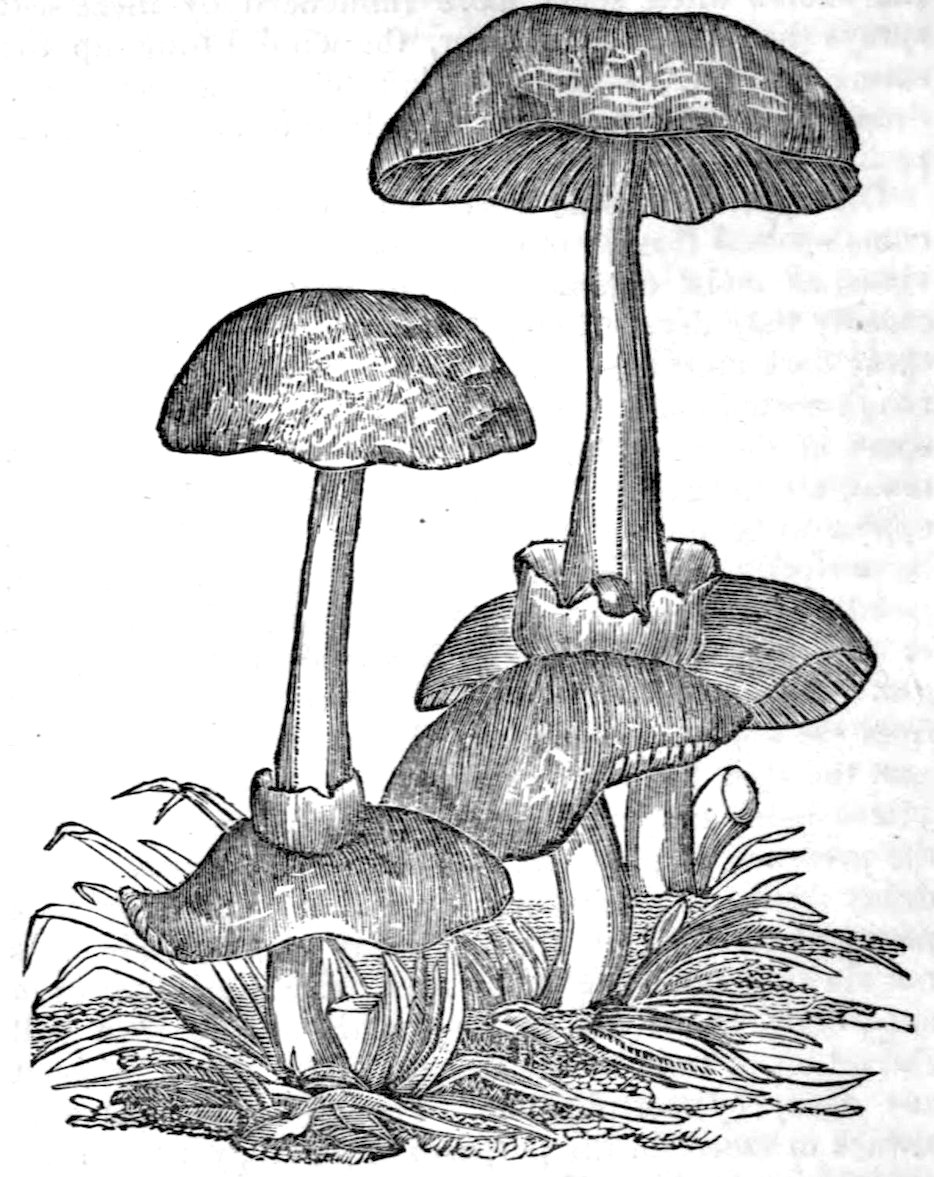
Agaricus Surrectus.
257But the leaves of many vegetables often become singularly spotted during some parts of the summer, and such spots have not certainly been effected by the growth of cryptogamous plants, natural decay, or the punctures of insects, the usual agents in these cases. A very indifferent observer of these things, in strolling round his garden, must have remarked how uniformly and singularly the foliage of some of the varieties of the strawberry are spotted, and corroded as it were into little holes; whereas other kinds have seldom any of these marks visible on them. I have fancied that these spottings were occasioned by the influence of solar heat, a shower of rain falls, small drops collect and remain upon the leaf of the plant; the sun then darts out, converting all these globules of rain into so many little lenses, converging the rays, and scorching or burning a hole at the focus. This conjecture has been rather strengthened by observing, that upon certain sorts, the hautboy, alpine, &c., the rain when it falls uniformly wets the leaves, yet they do not become spotted; but the smooth leaves of others, roseberry, caledonian, upon which it stands in drops, always become marked and perforated: but whatever may be the real cause of these spottings, if the foliage be touched, by way of an experiment, with the point of a heated wire, after a few days they will present an appearance very similar to what is naturally effected.
There seems to be a curious analogy in their functions between the roots of plants and the moving parent of animated beings, a similar obligation being required from them both of providing for those dependent on them, and both will exert their energies in fulfilment of this ordained mandate: the roots of plants wander up and down in every direction, seeking for sustenance; and we frequently see trees, growing on rocks, extending their roots like sensitive beings, searching for moisture; if this is not obtained sufficiently, a sickly foliage 258and impoverished growth point out the condition of the plant.
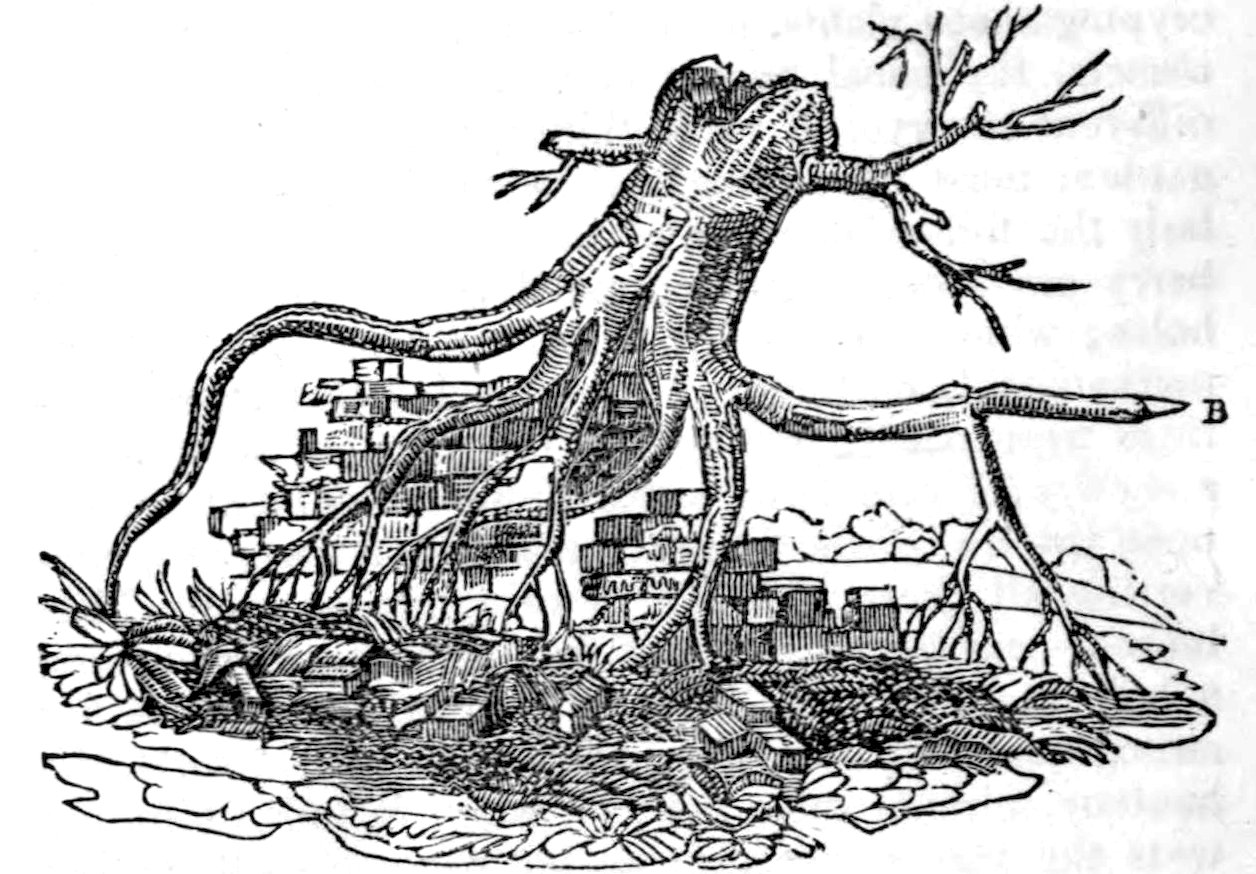
The notable exertions which vegetables occasionally make to obtain nutriment may be instanced by the following rude drawing of an ash,—a tree which, in consequence of the profusion of its seed, we find more often scattered in wild and singular places than any other not propagated by the agency of birds, or conveyed by the winds. This one had originally been rooted in the earth, upon the top of a wall, but nourishment being required beyond what was supplied by the precarious moisture of the scanty soil, its roots proceeded downwards, winding their way through the crevices of the stones into the earth beneath, and remained apparently incorporated with the masonry; the materials of this wall being wanted for an adjoining work, were so pulled out, as to leave the tree with all its roots detached, much as represented, with all its vegetative powers uninjured: the root B had stretched itself along the top of the wall, but how far it had extended in perfection, is uncertain, being broken away when I saw it first. The wood of the ash, when burned in a green state,
will emit a fragrance like that which proceeds from the violet or mezerion, and this it will diffuse in particular states of the air to a considerable distance, a property that, I believe, is not observable in any other British wood: it is in the country only that we can be sensible of this, and it is particularly to be perceived in passing through a village when the cottagers are lighting their fires, or by a farm-house, when this wood, fresh cloven or newly lopped off, is burning;—as the wood dries, this sweet smell is in a great measure exhaled with the moisture, for in this state we are not sensible of any odor arising from it different from other woods.
We are naturally solicitous to look back upon seasons remarkable for atmospheric phenomena, and compare their results with those passing before us, though we may be fully sensible that no conclusions can safely be drawn from them,—a variety of circumstances not known, or not comprehended, combining to produce results beyond our means of calculation. There have been times when such recollections brought no pleasure with them, by displaying the injuries and sufferings that hurricanes and floods have occasioned; and thus we who were witnesses of the distress occasioned by the lamentable rains of 1793, and the several successive years, when every wheat-sheaf presented a turf of verdant vegetation, cannot recollect it without sorrow, or ever forget that famine in our land. Yet it is amusing, on some occasions, to note the extremes of weather that our island has experienced; for though in general our seasons pass away without any very considerable dissimilitude, still we have known periods of great irregularity, drought or moisture, cold or heat. The freezing of great rivers, with the roasting of animals and passage of carriages upon the ice, our calendars and diaries relate; but instances of an opposite temperature, affording less striking events, are not so fully detailed as might be wished. The winter of 1661 appears to have 260been remarkable for its mildness; and it is rather curious that, in the century following, the winter of 1761 should have been equally notable for the mildness of its temperature. The winter of 1795 seems to have partaken of none of the severity usual to the season; and the summer of 1765 was remarkable for its heat and dryness, and all vegetation being influenced by their effects, brought forth fruits and flowers in unusual perfection.
But perhaps the year 1825, taking all its circumstances, is the most extraordinary to be found in our annals. The winter of 1824–5 had been mild and wet; the ensuing spring dry, but with keen winds and frosty mornings, which greatly injured the fine blossoms that appeared on our fruit trees; and the continued and profuse nightly fall of the honey-dew was quite unusual: the leaves of the oak, the cherry, and the plum, were constantly smeared and dropping with this clammy liquor, which, falling from the foliage on the ground, blackened it as if some dark fluid had been spilled upon it: the leaves of most of our stone fruits curled up, covered with aphides, and became deciduous; and their young shoots were destroyed by the punctures of these insects that clustered on them. This honey-dew continued to fall till about the middle of July, affording an abundant supply of food to multitudes of bees, moths, and other insects which swarmed about the trees. We rarely begin cutting our grass before the first week in July; but in consequence of the heat of June in this year, it was so drawn up, that much hay was made and carried by the 20th of June, which commonly is not accomplished till August. Our crops on good ground were considered as fair, though in general the chilling season of May had occasioned a deficiency; but all our clover crops and artificial grasses were harvested in the finest order, producing good-sized ricks and mows; yet their bulk was delusive, the provender cutting out light and strawy. The heat and drought continued, with very partial and slight showers of rain, all June and July; nor had we any thing like serviceable rain till the second of August. In consequence our grass lands 261were burned up, and our fields parched, presenting deep fissures in all parts. The heat was unusually distressing all day; and evening brought us little or no relief, as every wall radiated throughout the night the heat it had imbibed from the torrid sun of the day. Our bedroom windows were kept constantly open, all apprehension from damps and night airs, which at other times were of the first consideration, being disregarded; a cooler temperature, however obtained, was alone required; and we lingered below, unwilling to encounter the tossings and restlessness that our heated beds occasioned. Our wainscots cracked, furniture contracted and gaped with seams; a sandal-wood box, which had been in use for upwards of twenty years in dry rooms, shrunk and warped out of all form; a capsule of the sandbox tree (hura crepitans), which had remained in repose over a shelf above the fire-place for an unknown length of time, now first experienced an excess of dryness, and exploded in every direction; door frames contracted, window sashes became fixed and immovable. These are trifles to relate, but yet they mark the very unusual dryness of the atmosphere.
Monday and Tuesday, July 18th and 19th, will long be remembered as the acme of our suffering, the thermometer standing in the shade of a passage communicating immediately with the outer air, in an open situation, at 82° of Fahrenheit. A few yards nearer the air, on which the sun shone, it rose to 93°, without any influence from reflection or other causes. In towns, and more confined places, it is said, the heat was much greater. The current of air now felt like that near the mouth of an oven, heavy and oppressive, and occasioning more unpleasant sensations than such a temperature usually creates; animals became distressed, the young rooks of the season entered our gardens, and approached our doors, as in severe frosts, with open bills, panting for a cooler element; horses dropped exhausted on the roads; many of the public conveyances, which usually travelled by day, waited till night, to save the cattle from the overpowering influence of the sun. The leaves of our apple and filbert trees, in dry situations, withered 262up large forest trees, especially the elm, had their leaves so scorched by the sun, that they fell from their sprays as in autumn, rustling along the ground; the larch became perfectly deciduous. In our gardens, the havoc occasioned by the heat was very manifest. The fruit of the gooseberry, burnt up before maturity, hung shrivelled upon the leafless bushes; the strawberry and raspberry quite withered away; the stalk of the early potato was perfectly destroyed, and the tubers near the surface in many places became roasted and sodden by the heat, few obtaining their natural size, and sold at this period in the Bristol market at twenty-four shillings the sack. A few choice plants were saved by watering them daily; but in general the exhalation from the foliage, by reason of the heat of the earth, was greater than the root could supply, the green parts withering as if seared by a frost.
On the 20th of July, some farmers began to cut their wheat; and by the 25th reaping had generally commenced. Our bean crop presented, perhaps, an unprecedented instance of early ripeness, being usually mowed in September; but this year it was universally ripe, indeed more perfectly so than the wheat, by the 1st of August. The crop, however, proved a defective one: water became scarce, and the herbage of the fields afforded so little nutriment, that the cows nearly lost their milk, eight or ten being milked into a pail that four should have filled; and one week, from July the 18th to the 24th, butter could not be made to harden, but remained a soft oleaginous mass.
This extreme heat had a favorable influence on many of our exotic plants, enabling several to perfect their seed, which do not usually in our climate; such as nightstocks, erodiums, heliotrope, groundsels, cape-asters, and such green-house plants vegetating in the open air. With me all the polyanthus tribe, especially the double varieties, suffered greatly; lovers of the cold and moisture of a northern climate, in this tropic heat, they became so parched as never properly to recover their verdure, and in the ensuing spring I missed these gay and pleasing flowers in my borders.
263It was a sad destructive season for the poor butterflies, and no sooner did a specimen appear upon the wing, than the swallow and all the fly-catching tribe snapped them up, rendered eager and vigilant from the scarcity of insect food. Even that active and circumspect creature the hummingbird sphinx could not always, with every exertion of its agility, escape their pursuit.
Early in August rains fell, and continued seasonably until September; and their effect upon our scorched vegetation, from the general heat of the earth and the air, was extremely rapid. The larch, and other trees which had shed their leaves, now put forth their tender green foliage as in spring; and by the end of September the universal verdure of the country, and profusion of feed in the pastures, was so perfectly unlike what we had been accustomed to in common years, as to be astonishing. Even as low in the year as the 11th of October, there was no appearance of any change in the foliage, except a slight tinge upon the leaves of the maple; and this day was so brilliant, that the cattle were reposing in the shade, the thermometer varying from 66° to 68° F., and the general warmth to our feelings was greater than that indicated by the instrument. October the 20th, the weather changed, some sleety rain fell, and the hills were sprinkled with snow, the thermometer falling to 40°, and all our hirundines, which had been sporting about us up to this period, departed: yet still vegetation continued in all its vigor, and on the 1st of November dog-roses hung like little garlands in the hedges; the cornel bushes (cornus sanguinea) were in full bloom; and corn-roses (rosa arvensis) were decorating our hedges in a profusion equal to that of a common August. November 4th there were slight ice and partial snow, with various alternations undeserving of notice, but the weather was generally fair and mild until Christmas.
All these preceding heats and rapid changes had, I think, a manifest influence upon our constitutions. Violent catarrhs, and lingering, unremitting coughs, prevailed among all classes, both before and after 264Christmas, to a degree that I never remember; and children were afflicted with measles almost universally. Early in January a violent wind was succeeded by a severe frost, and in some places by a deep snow; but, after about ten days’ duration, a very gentle thaw removed all this, and the remainder of our winter was mild and agreeable, introducing what might be called an early spring, dry and propitious for every agricultural purpose. The trees that refoliaged so vigorously in autumn seemed in no way weakened by this unusual exertion, but produced their accustomed proportion of leaves, and the sprays of every bush and tree, ripened and matured by the last summer’s sun, displayed a profusion, an accumulation of blossom, that gave the fairest promise of abundance of fruit, and every product of the earth.
That the death of any creature should be required by the naturalist, to perfect his examination, or arrange it in his collection, (and without a collection the investigation of any branch of natural history can be but partially undertaken), may be regretted; but still the epithet of “cruel employ” must not be attached to this pursuit. We do not destroy in wantonness, or unnecessarily; and that life, of which it is expedient to deprive a creature, is taken by the most speedy, and in the least painful manner known. Some of our methods, if speedy, are at the same time injurious, such as hot water, the stifling-box, &c.; and some, that are not painful, such as stupefaction by spirits, ether, &c., and suffocation by carbonate of ammonia, are occasionally not effectual. But there is one process, which I believe to be neither painful nor injurious, yet decisive, and communicative with pleasure; I mean the prussic acid. This fluid may be imbibed by the insect without producing any particular effect; but, if brought to act upon the spinal cord, or what at least is analogous to that part of a vertebrate animal, whatever it may be called, and which seems to be the most vital part of the creation, instant 265death ensues. A crow-quill must be shaped into a point, like a rather long pen, this point dipped into the prussic acid, and an incision made with it immediately beneath the head into the middle of the shoulders of the creature, so as to permit the fluid it contains to enter into the body of the insect. Immediately after this, in every instance in which I have tried it, a privation of sensation appears to take place, the corporeal action of the creature ceasing, a feeble tremulous motion of the antennæ being alone perceptible; and these parts seem to be the last fortress that is abandoned by sensation, as they are the primary principle of sensibility when life is perfect: extinction of animation ensues, not a mere suspension, but an annihilation of every power, muscular and vital. As one example of the decisive effects of this fluid, I shall instance the common wasp, a creature so remarkably tenacious of sensation, or so long retaining a muscular power, that it may remain, as every one knows, for days crushed in the window, an apparently dead insect, yet upon pressing the head, the sting will be so protruded as to give a very sensible pain to the finger it should meet with; but upon the prussic acid being injected into this creature as above, when in full vigor, in the course of less than half a minute a loss of vitality ensues, the action of the muscular fibre ceases altogether, and no pressure can incite it again into action. The sudden effect of this liquor is not so generally known as from humanity and expediency might be wished. Who first devised the experiment I am ignorant; but any repetition of means whereby a necessary end can be obtained by the least painful and brief infliction, will hardly be considered as superfluous.
This subject naturally introduces the preservation of the creatures after their death, and the young entomologist is not perhaps sensible from experience of the injury some species of insects will effect in the selected specimens of others of this race, and may lament, when too late, the separation of the wings, limbs, and bodies of his collection by these tiny depredators (ptinus fur, acararus destructor). Mr. Waterton’s recipe for 266preventing this evil, I have used rather extensively and believe it to be a very effectual, and generally an innocuous preservative; but as this gentleman has not given us the exact proportions of his mixture, it may not be useless to observe, that if one part of corrosive sublimate be dissolved in eight parts of good spirit of wine, and the under side of the insect touched with a camel’s-hair pencil, dipped in the liquor, so as to let it lightly pervade every part of the creature, which it readily does, it will, I apprehend, prevent any future injury from insects. A larger portion of the sublimate will leave an unsightly whiteness upon the creature when the specimen becomes dry. The under side of the board, on which the insects are fixed, should be warmed a little by the fire after the application, that the superfluous moisture may fly off, before finally closing the case. If this be omitted, the inner surface of the glass will sometimes become partially obscured by the fume arising from the mixture. The experienced entomologist needs not a notice like this; but the young collector probably will not regard it as unnecessary information, and may be spared by it from both mortification and regret. I have known insects commence their serious operations before the collections of the summer could be arranged in their permanent cases.
In noticing above, that this solution is generally harmless, it is requisite that mention should be made of the few instances in which it has been observed to be injurious. I have applied it to many specimens of foreign and British insects, and commonly observed no indication of its having been used, when the creatures had become dry. But to confine our attentions to English specimens, when the solution is made stronger than recommended, it will, after a time, injure the fine yellow of the sulphur butterfly (papilio rhamni), by turning parts of it brown and dirty; but even in its reduced state it has a manifest effect upon the colors of two of our moths, the Dartford emerald (phalæna lucidata), and what is commonly called the green housewife moth (phalæna vernaria) changing their plumage, in several 267places, to a red buffy hue, when at the same time the beautiful green wings of the small oak-moth (phalæna viridana) are in no way altered by it. But notwithstanding these circumstances, it will, I apprehend, be considered as a very useful preservative, and save many specimens from destruction which other means usually fail of effecting.
There are not many of our rural practices, that deserve more the disapprobation of the landed proprietor than that of pollarding trees.[74] “It is an evil under the sun, and common among men.” Here it is universal. This system of cutting off the heads of the young trees in the hedge-rows is resorted to by the farmer for the purpose of forcing them, thus deprived of their leaders, to throw out collateral shoots, serving for stakes for the fences, and for firewood. The purposes are effected; but of all hopes of timber, or profit to the proprietor, there is an end. No trees suffer more in this respect than the ash. Prohibitions against mangling trees, in agreements, are usual; but, with some exceptions in regard to oak, little attention seems paid to the covenant, as is obvious on the most cursory view of the country in any direction; whereas the ash is not a less valuable tree, from its thriving more universally in all situations, and becoming saleable in a shorter period. One or two generations must pass before an oak should be felled; but the ash becomes useful wood while its more respected companion is but a sapling. These prohibitions should not simply be engrossed on the parchment, but the agent ought strictly to notice any infringement; and young ash trees should be more especially guarded because they are the most likely to suffer, from their producing the greatest quantity of lop in the shortest time. The injury done by this practice to the present landlord and his successors is beyond estimation, as the numbers destroyed, and the vigor of their growth, must be first known; but there is not a farm of any extent from which hundreds of ash trees might not have been felled, had their growth been permitted, making an annual return; whereas nothing can be obtained now or hereafter for the proprietor, and only a few stakes and bavins 268for the farmer.[75] It is by no means an uncommon thing, to observe every ash tree in a hedge reduced to stumps by successive pollardings. Many a landlord would shudder at the thought of breaking up an old productive sward, and not regard the topping of an ash; whereas this latter act is infinitely more injurious, ultimately, than the former. The land may, and will probably, recover, but the tree is lost for ever, as to any profitable purposes for the owner. The farmer might perhaps tell the agent when he remonstrated, that he must have firewood, and hedging stuff; but the wants of the former have decreased by the facility of obtaining other fuel, and neither is to be supplied by the landlord at such a ruinous subversion of present and future benefit. I am not so silly as to enlarge upon the beauty of what has been called “picturesque farming;” but when we cast our eyes over the country, and see such rows of dark, club-headed posts, we cannot but remark upon the unsightly character they present, and consider it neither laudable to deform our beautiful country by the connivance, nor proper attention to individual profit to allow the continuation of it. The ash, after this mutilation, in a few years become flattened at the summit, moisture lodges in it, and decay commences, the central parts gradually mouldering away, though for many years the sap wood will throw out vigorous shoots for the hatchet. The goat moth now too commences its mordications, and the end is not distant. But the wood of the ash appears in every stage subject to injury; when in a dry state the weevils mine holes through it; when covered by its bark, it gives harbor to an infinite variety of insects, which are the appointed agents for the removal of the timber: the ashen bar of a stile, or a post, we may generally observe to be regularly scored by rude 269lines diverging from a central stem, like a trained fruit-tree, by the meanderings of a little insect (ips niger, &c.), being the passages of the creatures feeding on the wood.
There is one race of trees, the willow, very common about us, that is so universally subject to this pollarding, for the purpose of providing stakes and hurdles for the farm, that probably few persons have ever seen a willow tree. At any rate a sight of one grown unmutilated from the root is a rare occurrence. The few that I have seen constituted trees of great beauty; but as the willow, from the nature of its wood, can never be valuable as a timber tree, perhaps by topping it we obtain its best services. In the county of Gloucester there are several remarkable trees of different species now growing, but I am not acquainted with any greater natural curiosity of this sort than an uncommonly fine willow tree in the meadows on the right of the Spa-house at Gloucester. There are two of them; the species I forget, but one tree is so healthy and finely grown, that it deserves every attention, and should be preserved as a unique specimen, an example of what magnitude this despised race may attain when suffered to proceed in its own unrestrained vigor.
Dec. 30.—A cold foggy morning, the ground covered with a white frost; about twelve o’clock the sun burst out with great brilliancy, and life and light succeeded to torpor and gloom; a steam immediately arose from our garden beds and plowed lands, giving us a very strong example of the rapid manner in which the matter of heat (caloric) will at times unite with water. Half an hour before, this water was frozen and inert; but the instant that the sun’s rays fell upon it, their heat was imbibed, and the icy matter converted into a body lighter than the atmosphere by which it was surrounded, and passed into it in the vapor we have just noticed. I was the more particular in observing this common event, as it afforded a forcible illustration of the invisible evaporation which is constantly going forward, the unremitting changes in operation, the action and reaction of the earth and its products with the atmosphere. 270During the night, and the earlier parts of the morning, water was falling on the earth in minute particles, constituting what we call fog; then out burst the sun, and reclaimed this moisture which had fallen, and we could see it obeying the mandate, and pass away in steam. In the evening it will probably return again in fog, or in rain, when the atmosphere cools; and thus a constant visible intelligence is going on. How much insensible intercourse takes place we know not, but we can comprehend its agency by the effects and events that manifest themselves. Our country people think these “rokings” (reekings) of the earth greatly favorable to the growth of vegetation, supposing it occasioned by the internal heat of the earth producing a vapor like that from fermenting soil, thus warming the roots; but if the theory be defective, the fact may be true, by the caloric in the sun’s rays promoting the decomposition of the water, or separating the component parts (oxygen and hydrogen), which uniting with other matters contained in the earth and atmosphere (carbon and carbonic acid) become by this means the basis of all our fruits, our sweets, our sours, resins, &c., in the vegetable world; and hence there is a constant decomposition of water going forward by these alternations, and a constant formation of matters beneficial and necessary for the various inhabitants of the earth. When we perceive that a shower of rain has revived or promoted the increase of vegetation, we must understand, that the mere wetting it has not accomplished this; but that the vegetable has by means of its foliage, aided by light and heat, decomposed or separated the combined matters of the water, and taken from it certain portions as essential to its vigor, or been revictualled, in a manner, by the nutriment contained in the water.
Jan. 10.—The ground covered with snow, the pools with ice, trees and hedges leafless, and patched here and there with a mantle of white, present a cheerless, dreary void; no insects are animating the air, and all our songsters are silent and away; a few miserable thrushes are hopping on the ditch-bank, swept bare by 271the wind; and the robin puffing out his feathers, and contracting his neck into his body, is peeping with his fine bright eyes into the windows from the cypress bough. A few evergreens are waving their sprays, and glittering in the light, yet making but poor compensation for the variety, the flutter, the verdure, of our summer. Though we have little natural beauty to note or to record, we are not left without a testimony of an overruling Power; and, however sad and melancholy things may appear at the first view, yet a more steady observation will manifest to us a presiding Providence and Mercy. Frost and snow are but cheerless subjects for contemplation, yet I would add a reflection in my Journal of our passing events, or rather recall from memory the truth, that science has made known to us, revived by the sight of that frozen pool. There is one universal body, inherent in every known substance in nature, latent heat, which chemists have agreed to call “caloric.” By artificial means bodies may be deprived of certain portions of it; and then the substance most usually contracts, and increases in weight. Water is an exception to this; for in losing a part of its heat, the cause of its fluidity, and becoming ice, it expands, and is rendered lighter, by inclosing, during the operation, more or less of atmospheric air: consequently it swims, covering the surface. To this very simple circumstance, ice floating and not sinking,[76] are the banks and vicinities of all the rivers, lakes, pools, or great bodies of water in northern Europe, Asia, and America, rendered habitable, and what are now the most fertile and peopled would be the most sterile and abandoned, were it not for this law of nature. Had ice been so heavy as to sink in water, the surface on freezing would have fallen to the bottom, and a fresh surface would be presented for congelation; this would then descend in its turn, and unite with the other; and thus during a hard frost successive surfaces would be presented, and fall to the bottom, as long as the frost or any fluid remained. By this means the whole body of the water would become a dense concretion of ice: its inhabitants would not only perish, but the indurated mass would 272resist the influence of the sun of any summer to thaw it, and continue congealed throughout the year, chilling the earth in its neighborhood, and the winds that passed over it, preventing the growth of vegetation in the former, or blighting and destroying it by the influence of the latter.
Winter is called a dull season; and to the sensations of some, the enjoyments of others, and, perhaps, to the vision of all, it is a most cheerless period. This is so universally felt, that we always associate the idea of pleasure with the return of spring: whatsoever our occupations or employments may be, though its sleety storms and piercing winds may at times chill the very current in our veins, yet we consider it as a harbinger of pleasurable hours and grateful pursuits. We commence our undertakings, or defer them till spring. The hopes or prospects of the coming year are principally established in spring; and we trust that the delicate health of the blossoms round our hearths, which has faded in the chilling airs of winter, may be restored by the mild influence of that season. Yet winter must be considered as the time in which Nature is most busily employed; silent in her secret mansions, she is now preparing and compounding the verdure, the flowers, the nutriment of spring; and all the fruits and glorious profusion of our summer year are only the advance of what has been ordained and fabricated in these dull months. All these advances require Omnipotent wisdom and power to perfect; but perhaps a more exalted degree of wisdom and power has been requisite to call them into a state of being from nothing. The branch of that old pear-tree now extended before me, is denuded and bare, presenting no object of curiosity or of pleasure; but, had we the faculty to detect, and power to observe, what was going forward in its secret vessels, beneath its rugged, unsightly covering, what wonder and admiration would it create!—the materials manufacturing there for its leaf, and its bark; for the petals and parts of its flowers; the tubes and machinery that concoct the juices, modify the fluids, and furnish the substance of the fruit, with multitudes of other unknown 273operations and contrivances, too delicate and mysterious to be seen, or even comprehended, by the blindness, the defectibility of our nature—things of which we have no information, being beyond the range of any of the works or the employments of mankind! We may gather our pear, be pleased with its form or its flavor; we may magnify its vessels, analyze its fluids, yet be no more sensible of its elaborate formation, and the multiplicity of influences and operations requisite to conduct it to our use, than a wandering native of a polar clime could be of the infinite number of processes that are necessary to furnish a loaf of bread, from plowing the soil to drawing from the oven. This is but an isolated instance, amidst thousands of others more complicated still. How utterly inconceivable then are the labors, the contrivances, the combinations, that are going forward, and accomplishing, in this our dull season of the year, in that host of nature’s productions with which, shortly, we shall everywhere be surrounded!
Jan. 20th.—A keen frost, and the ground covered with snow, present a scene of apparent suffering and want to many of our poor little birds; but the preservation of the fowls of the air, which sow not nor gather into barns, has been beautifully instanced to us, as a manifest evidence of a superintending Providence: the full force of this testimony is most strongly impressed upon us in a season like this, when winter rules with rigor, and we marvel how the life of these beings can be supported when the waters are bound up, and earth and all its products hidden by a dense covering of snow. Many of the small birds obtain subsistence by picking the refuse of our corn-stacks, by seeds scattered about our homestalls and cattle-yards, but multitudes of others are in no way dependent upon man for shelter or support, do not even approach his dwelling, but are maintained by the universal bounty of Providence; as the woodlark, the meadow-lark, the chats, and several others; but by what means they are maintained in a period like this is not quite manifest. The portion that they require is probably small, yet it must be insect 274food, and the chats, larks, and gray wagtails, seem busily engaged in providing for their wants upon the furze sprays, amidst frozen grass, or upon the banks of ditches and pools; and as no insect but the winter gnat is now found in such places, it is probable that this creature, which sports in numbers in every sunny gleam, yields them in this season much of their support. Some of the insectivorous birds have at such periods no apparent difficulty in supporting their existence, finding their food in a dormant state in mosses, lichens, and crevices of trees and buildings; but for those which require animated creatures, I am sensible of none that are to be procured but this gnat, and it possibly has been endowed with its peculiar habits and dispositions for a purport like this. We have many examples in nature of similar provisions, wherein one race supports the existence and requirements of another. The molusca and insects of the deep continue the life of some, the feeble races of the air and waters maintain the beings of others, and the beast of the wild seeks his food amidst those which inhabit with him; but where this chain ends, human faculties will probably never be able to ascertain. The remarkable fact which our microscopes make known to us, that all infusions of natural substances in water will produce life, however extraordinary the form may be, seems to denote a continuation of being beyond any possible comprehension, and probably subservient to the existence of each other: the minute creature that floats a hardly perceptible atom in the water of the ditch, and which subsists many of the animals which inhabit those places, feeds upon smaller than itself, and those again, possibly, upon more minute ones which the vegetable infusions of those places give existence to: here the investigation terminates, but the thread unbroken continues, probably through endless gradations, perceptible to infinity alone.
Having applauded the operations of Nature with so much cordiality, possibly I may be called her “enthusiastic adorer,” but the epithet must be disclaimed. None can respect the works of creation more, but ’tis not with an ecstasy that glows, fades, and expires, but 275with a calm deep-rooted conviction implanted in the boy, and increased by years of notice and experience. I have followed her footsteps, though far, very far distant, as an humble admirer of perfection, nor can my veneration cease whilst reason continues undisturbed.
Sept. 8th, 1828.—A remarkably dry and exhausting day, not from any peculiar influence of the solar heat, but from the arid state of the air, which was very distressing to our feelings, and all tender vegetation became languid and suffering under its influence. I endeavored to ascertain the power of absorption possessed by the air at the time by an experiment, rude enough to be sure, yet it tended in some measure to indicate the rapid manner in which fluids are exhaled in particular states of the atmosphere. A linen cloth twelve inches square, which had absorbed an ounce avoirdupois of water, was suspended in the shade in a free current of air, and in the course of ten minutes it had lost 436 grains, equal to one-sixteenth of its weight. This great evaporation was principally effected by the absorbent power of the air, and manifested in some degree the exhausting influence that was passing over the earth and the vegetation exposed to the current of air; and as the roots could not derive sufficient moisture from the soil to supply what was thus drawn from the leaves, the foliage became languid and flaccid in consequence. The linen, containing the same quantity of water, was then spread upon a short turf in the sun and in the space of ten minutes it lost 368 grains, and this was effected without any particular influencing current of air; accordingly, the evaporation from an acre of moist land covered with vegetation would exceed one hundred and twenty-two cwt. of water in an hour! As the quantity drawn from the vegetation on the soil may be equal to the shelter its foliage affords to the earth, no very accurate data can be drawn from this experiment; for different soils will give out their moisture more or less easily, and succulent vegetables be 276more influenced than those of a drier nature; but it served at the time to indicate the portion of moisture that was escaping from a given horizontal surface. From the invisible and insensible nature of evaporation, its influences are not always considered; but such an action on the surfaces of things as that related above, must put into operation all the inherent powers of matter susceptible of impulse, and probably would produce effects which we might suppose to be accomplished by the agency of other means.
Nov. 10.—Many effusions of the mind have been produced by the approach or existence of the seasons of our year, which seem naturally to actuate our bodily or mental feelings through the agency of the eye, or temperature of the air. The peculiar silence that prevails in autumn, like the repose of wearied nature, seems to mark the decline and termination of being in many things that animated our summer months; the singing of the bird is rare, feeble, and melancholy; the hum of the insect is not heard; the breeze passes by us like a sigh from nature: we hear it, and it is gone for ever. But it is the vegetable tribes, which at this season most particularly influence our feeling, and excite our attention. We see the fruits of the earth stored up for our use in that dull season “in which there will be neither earing nor harvest,” the termination and reward of the labors of man. But this day, November 10, presented such a scene of life and mortality, that it could not be passed by without viewing it as an admonition, a display of what has been, and is. There had occurred during the night a severe white frost; and, standing by a green-house filled with verdure, fragrance, and blossom, I was surrounded in every direction by the parents of all this gaiety, in blackness, dissolution, and decay. But the very day before, they had attracted the most merited admiration and delight by the splendor of their bloom and the vigor of their growth; but now just touched by the icy finger of the night, they had become a mass of unsightly ruins and confusion. Once the gay belles of the parterre, they fluttered their hour, a generation of existent loveliness; their youthful successors, 277unpermitted to mingle with them, peeped from their retreats above, seeming almost to repine at their confinement; they have bloomed their day, another race succeeds, and their hour will be accomplished too. This was so perfectly in unison with the shifting scenes of life, the many changes of the hour, that it seemed inseparably connected with a train of reflection, with the precepts which all nature points out—her still small whisperings for the ears of those that can hear them.
The extraordinary tendency that Nature has to produce, and the vigilant perseverance she maintains to occupy all substances as a soil for her productions, when they arrive at a state fitting for her purposes, is a well-known fact, and is perfectly in consistency with the uniform habit she preserves, of letting “no fragment be lost.” All things tend upwards, from some original, through an infinity of gradations, though the beginning and termination may not always be perceived, nor the links of this vast chain be found. The most obscure plants, agarics or mucor, as far as we know, perfect their seed, and give birth to other generations; but there is a fine green substance, observable upon the sprays of trees, stems of various shrubs in every hedge, upon old rails and exposed wood-work, leaving a powdery mark upon one’s coat that has rubbed against such places, which I have always considered as the very lowest rudiment of vegetation. This matter, submitted to examination in the microscope, presents no foliage or plant-like form, but appears a kind of pollen, a capsule, or a perfected seed, suspended on a fine fibre; but from the extreme smallness of it I speak with hesitation, not being able to define it satisfactorily with the most powerful lens. If it be, as I have conjectured, a perfected seed, it probably is the origin of many of those minute mosses, that become rooted, we know not by what means, upon banks, stones, barks, &c., in such profusion; but here all investigation ceases: by what agency this fine seed has been so profusely scattered, or from what source it sprang, is hidden from us, and we can no more satisfactorily conjecture, than we can account for those myriads of blighting insects, which so suddenly 278infest our grain, our fruits, and our plants. There is an inquisition, where all human knowledge terminates; the bounds of nature have never been defined.
Without considering the various sources of enjoyment and pleasure bestowed upon an intelligent creature, what a scene of glorious display might be opened to man through the agency of the eye alone! Motives we must abandon, as probably they are beyond our comprehensions; but were the powers of vision so enlarged or cleared as to bring to observation the now unknown fabrication of animate and inanimate things, what astonishment would be elicited! The seeds, the pollen of plants, the capillary vessels and channels of their several parts, with their concurrent actions, the clothing of various creatures, and all that host of unperceived wisdom around us! Yet probably the mind, constituted as it now is, would be disturbed by the constant excitement such wonders would create; but at present, though sparingly searched out by the patient investigator, and but obscurely seen, they solace and delight; “cheer, but not inebriate.”
And now I think I have pretty well run over my diary, the humble record of the birds, the reptiles, the plants, and inanimate things around me. They who have had the patience to read these my notes, will probably be surprised that I could take the trouble to register such accounts of such things; and I might think so too, did I not know how much occupation and healthful recreation the seeking out these trifles have afforded me, rendering, besides, all my rural rambles full of enjoyment and interest: companions and intimates 279were found in every hedge, on every bank, whose connexions I knew something of, and whose individual habits had become familiar by association; and thus this narrative of my contemporaries was formed. Few of us, perhaps, in reviewing our by-gone days, could the hours return again, but would wish many of them differently disposed of, and more profitably employed: but I gratefully say, that portion of my own passed in the contemplation of the works of nature is the part which I most approve—which has been most conducive to my happiness; and, perhaps, from the sensations excited by the wisdom and benevolence perceived, not wholly unprofitable to a final state, and which might be passed again, could I but obtain a clearer comprehension of the ways of Infinite Wisdom. If in my profound ignorance I received such gratification and pleasure; what would have been my enjoyment and satisfaction, “if the secrets of the Most High had been with me, and when by His light I had walked through darkness?”
It is one of the pleasing characteristics of an old and highly civilized country, that appropriate local names for the smaller hamlets, farms, and single rural dwellings, are in general and familiar use. Every thing which gives to the household home, whether of rich or poor, a pleasant distinctive character, an additional hold on the memory and the affections of its inmates, must always prove a merit; and many, assuredly, have been the instances in which the familiar name of the family roof has continued through life a hallowed sound to the wanderers of the household band it once sheltered. In England, this custom—so natural, so kindly, when undisturbed by pretension—is very general, and it is almost needless to say that wherever these names go back for half a century or more, they are always appropriate, and often peculiar, or it may be, interesting from historical or other associations. In very many instances, not only do the farm-house and the cottage bear suitable names, but even the different fields about them are all marked in the same way; this meadow, that grain-field, yonder copse, the knoll beyond, shall each be called by some simple term, familiar to the household of the farmer of the present day, as it was perhaps to his forefathers of past generations.
It has been clearly ascertained that the potato is indigenous to South America. Mr. Darwin, in his “Journal of Researches,” speaking of the Chonos Archipelago, on the coast of Chili, writes as follows:
“The wild potato grows on these islands in great abundance, in the sandy, shelly soil, near the sea beach. The tallest plant was four feet in height. The tubers were generally small, but I found one, of an oval shape, two inches in diameter; they resembled, in every respect, and had the same smell as English potatoes; but when boiled they shrunk much, and were watery and insipid, without any bitter taste. They were undoubtedly indigenous here: they grow as far south, according to Mr. Low, as lat. 50°, and are called Aquinas by the wild Indians of that part; the Chilotan Indians have a different name for them. Professor Henslow, who has examined the dried specimens which I brought home, says they are the same with those described by Mr. Sabine,[77] from Valparaiso, but that they form a variety, which by some botanists has been considered specifically distinct. It is remarkable that the same plant should be found on the sterile mountains of central Chili, where a drop of rain does not fall for more than six months, and within the damp forests of these southern islands.” Darwin’s “Journal of Researches,” Vol. II. p. 23, American edition.
The following account of the wych elm is given by Mr. Downing in his “Landscape Gardening:”
“The Scotch, or wych elm, (ulmus montana.) This is a tree of lower stature than the common European elm, its average height being about forty feet. The leaves are broad, rough, pointed, and the branches extend more horizontally, drooping at the extremities. The bark on the branches is comparatively smooth. It is a grand tree, ‘the head is so finely massed, and yet so well broken, as to render it one of the noblest of park trees; and where it grows wild amid the rocky scenery of its native Scotland, there is no tree which assumes so great, or so pleasing a variety of character.’ In general appearance the Scotch elm considerably resembles our white elm. Its most ornamental varieties are the spiry-topped elm, (U. m. fastigiata,) with singularly twisted leaves, and a very upright growth; the weeping Scotch elm, (u. m. pendula,) a very remarkable variety, the branches of which droop in a fan-like manner; and the smooth-leaved Scotch elm, (u. m. glabra.)”
The term carpenter bee is now usually confined, in England, to those insects of the bee tribe which chisel out or rasp their nests in posts, or palings, &c. Their cells “consist of a tunnel excavated in the wood, and divided by thin partitions of clay into five or six compartments, each with its supply of pollen for the single inhabitant who is to emerge from the egg deposited therein.”
284The bee referred to by Mr. Knapp, page 53, although inhabiting, at times, a wooden cell also, like the true “carpenter,” is more generally classed with the “upholsterer bees,” or those which line their nests with cuttings from leaves, and flowers. This leaf-cutter bee is thus alluded to in “Acheta Domestica:”
“Having excavated, or found her hole, (a cavity in ground, or wood, or wall, from six to ten inches deep,) she proceeds to construct within it, of the pieces of the leaf she cuts off, several cells, of the shape and about the size of a thimble, which she inserts successively, the bottom of one into the mouth of that below it. It takes from nine to twelve pieces of leaf to complete each cell, and as each is finished she stores it with a rose-colored conserve made chiefly of pollen and honey, collected from the flowers of the thistle. When to this magazine of sweets is superadded the egg from whence its future consumer is to spring, the provident provider of the store covers in the whole with three more pieces of leaf, cut in a circle, as truly accurate as compasses could describe. Room being left above the cover for the insertion of a succeeding cell, our “upholsterer” thus proceeds till her nursery tunnel is completely filled up.”
* * * “The leaves employed by the leaf-cutter, are materials of somewhat stubborn texture, those sometimes of the mountain ash, and birch, as well as the rose, herein enhancing the skill of their employer. It would seem, however, that pliability and thinness are qualities somewhat regarded, and most wonderfully discerned by the little artist in question; for we have noticed in more than one summer, the smooth, delicate, tender leaves of a dark variety of China rose, almost scolloped by the circles and ovals of her excision, while the foliage of the “cabbage” close by, has been left untouched, as if too coarse and common for her purpose.”—Acheta Domestica.
285Reaumur relates that a gardener at Rouen, once chancing to dig up the nest of a leaf-cutter bee, was so utterly amazed with the singular skill of the contrivance that he was terrified, and hastened with it to the priest of the parish, believing it to be nothing less than the work of witchcraft. Monsieur le Curé, it appears, had something of the same suspicions; he advised the man to carry the nest to Paris; the gardener, however, took it first to a distinguished Naturalist living at Rouen, who relieved the poor fellow’s mind by opening one of the cases and showing him the grub within.
We learn that there are several leaf-cutting or upholsterer bees, in the United States, although it is not probable that either is precisely similar to that alluded to by Mr. Knapp, and the author of Acheta Domestica.
The Rose-Chafer, or Rose-Beetle, the Cetonia aurata of entomologists, is a beautiful insect, very common in England but unknown in our own country. “On the back of the corslet burnished green and gold are the prevailing hues, on breast-plate, cuisse, and gauntlet the lustre of the precious metal is predominant, mingled with changeable reflections of purplish crimson,” says the writer of Acheta Domestica. “Like the rest of its tribe, this pretty beetle undergoes the usual triple metamorphosis of insect life. From an egg laid within the earth, he emerges a grub or larva, to feed on roots, most usually those of the rose. * * Thus, hermit-like, and upon this hermit’s fare, he lives in dark seclusion for four years, and when these are over, constructs for himself, about the month of March, a still more straitened cell—an earth-formed case, resembling a 286pigeon’s egg. He proceeds, under its cover, to the second stage of pupa—from thence to the third and last estate; and after remaining another fortnight under ground, for his enameled mail to acquire hardness, comes forth in all his splendor to meet the roses. The antennæ are of curious and very elegant formation. They each terminate in a knob composed of several laminæ or plates, opening or shutting like the leaves of a book, and which also like a book, can be put away at the pleasure of their insect owner, on a shelf or deep cavity on either side its head. They are always thus put carefully away when the chafer is inactive, or asleep. It has been noticed as a singular fact that the rose-beetle has been found not unfrequently, while in its two first stages, the tenant of an ant-hill, and that without being attacked by its carnivorous inhabitants. It is hence called, in some countries, “king of the ants;” and it is said also that German cattle dealers invest it with supernatural powers, and feed it carefully in beds as a means of insuring prosperity to their herds and fortunes.”—Acheta Domestica, second series, p. 72, English edition.
The true rose-chafer has not been found among our American beetles.
There are many species of Broom in the old world. The common Broom of England has large, yellow, butterfly-shaped blossoms, and growing, as it does, in large patches on waste lands, produces a vary brilliant effect when in bloom. But it is also very useful in its way. The twigs were probably the first besoms of the housewives of old, in days when witches were believed to ride on 287broom-sticks to their gatherings; certain it is, at least, that our brooms of the present hour derive their name from the early use of the twigs of the plant for similar purposes.
Cordage, matting, and even coarse cloth have been made of the fibres of the Broom. Houses are sometimes thatched with the twigs, which have been also used for tanning instead of oak bark.
It was a sprig of the Broom or Genet, as it is called in French, worn in the helmet of a count of Anjou, of olden time, which became at length a family badge, and gave the name of Plantagenet to the race of English kings, who for three centuries reigned over our forefathers.
Dyer’s Broom, woad-waxen, genista tinctoria, has become naturalized here and there in some parts of New York and New England.
That singular American plant the sarracenia, pitcher-plant, hunters-cup, or side-saddle flower, as it is variously called, is a striking instance of the peculiarity referred to in the text, by Mr. Knapp. It is well known to all who are familiar with our native plants, that the hollow leaves of the sarracenia are generally found to contain more or less water, with dead insects of various tribes which have been drowned in the liquid. One might have supposed that this was purely accidental, but it is not impossible that the plant may require for its sustenance a certain amount of animal nourishment. The experiment of an English gardener would lead one to believe that such is the case; taking a hint from the drowned flies usually found in the hollow leaves of the pitcher-plant he tried a 288singular experiment; he fed the vegetable on beef-steak, small pieces of the beef being laid within the hollow leaves. The superior beauty and size of the particular plant treated in this way, subsequently proved that the surmise was correct, and that the pitcher-plant is to a certain degree, carnivorous. Such may very possibly be the case with other flowers which are known to entrap insects of different kinds; they may need these as nourishment. Generally speaking, it is the blossom and not, as in the instance of the Sarracenia, the leaf which allures the insect and thus destroys it; in this sense the hunter’s-cup is more ogre-like than most of its companions possessing the same dangerous power, since it is not only during the season of flowering, but throughout the summer that unwary flies and gnats are drowned in its leafy reservoirs.
The Ivy is found throughout most of the countries of Europe, and also in parts of Asia and Africa. It was one of the sacred plants of the old Egyptians, and held the same character among the Greeks also. In our own western hemisphere the Ivy was unknown until introduced by the colonists from Europe; nor does it seem likely ever to become, like so many other contributions of the old countries, naturalized here; our dryer summers or colder winters, do not apparently agree with it. Possessing one qualification rare among climbing plants, that of being an evergreen, it may, on this account, be considered as the finest of the purely ornamental vines of temperate regions. It is believed to live to a very great age, as the 289parent stems of vines still attached to buildings some centuries old, are found nearly as large as the trunks of good-sized forest trees.
Mr. Knapp tells us in the text, that in England the Snowdrop will linger longer than any other plant on the site of a deserted garden, outlasting, in this way, as a memorial of human tillage even the rose-bush, the plumb-tree, or the daffodil. With us the pansy, heart’s-ease, or garden-violet appears to have something of the same character; we have found it opening its pretty, lowly blossoms among the grass, the only vestige of a flower-garden, ploughed up more than thirty years earlier.
We have in the United States several native Vervains, and one species of European origin; the nettle-leaved Vervain, Verbena urticifolia, has become one of our road-side weeds. We are told that verbena was a Latin name given to any sacred herb, and by no means confined to the single family of plants to which the term Vervain is now applied.
The Mistletoe has been sometimes asserted to be unknown in America; but this is an error. The yellow Mistletoe, Viscum flaviscens, is found on the trunks of old 290forest trees, the elm, the oak, and the hickory, in the middle, western, and southern states of the union. This singular parasitic plant has yellowish leaves, with white berries tinged with the same color. See Gray’s Botany.
Dyer’s Weed, Weld, Wold, Luteola reseda, has become partially naturalized, here and there, in western New York. It is a plant about three feet high, from whose leaf and stem a yellow coloring matter is obtained, which is preferred to all other substances for giving a brilliant greenish-lemon tint. It is also much used for dyeing silk a golden yellow.
The reader is probably aware that while many minerals and a certain number of animal substances are employed in coloring, the largest portion of our dyes are borrowed from the vegetable kingdom.
“This is the Brimstone Butterfly, which, gaily painted,
“It has been supposed by some that this early visitant, (also a late one,) is, like the above, a winter survivor; but from the trim of his yellow robes, usually so fresh and glossy, it would seem more likely that, instead of being laid up—not in lavender, but perhaps in ivy—they are of the newest spring fashion. Be this as it may, he is the 291very pink, or, as he has been more properly considered, the very primrose of Papillons, sometimes to be seen like a living shadow of the primrose’s self, fluttering beside it in the sunny hedge-row, or the sheltered copse. We may know him by the cut of his bright, sulphur-colored pinions—each, instead of being rounded, ending in a smooth tail-like angle.
“Of all the wings of the butterflies, these bear perhaps the closest similitude to floral productions, and on each, as if to perfect the resemblance of the delicate, flower-like coloring, is a reddish spot, an exact copy of that often produced by decay or accident on the surface of a yellow petal. In the beautiful raised bearing of their reverse, the pinions of the “Brimstone” are no less correspondent with the same; but those of the female, which, instead of yellow, are of a greenish white, resemble perhaps yet more nearly, the leaf of a poplar on its under side. The dye of the antennæ—that purplish pink so frequent upon tender leaf and flower-stems—also the clothing of the body, a soft satin down like that by which stalks and seed pods are so often covered, are all alike accordant with the floral character of this most elegant flutterer of the spring. This pretty butterfly comes of a pretty caterpillar, with a smooth green coat, dotted or shagreened with black, and marked by a whitish line along the back and sides. It is said to feed usually on the leaves of the hawthorn and alder.”—Acheta Domestica.
The Furze, Gorse or Whin, is a low, shrubby plant, common in barren soils throughout western Europe, and belonging to the natural order leguminosæ. The yellow 292flowers, covering broad tracts of untilled land, produce a brilliant and striking effect when in bloom. It is said that Linnæus, when he first saw them, fell on his knees with expressions of delight at their beauty, lamenting that the plant should be wanting in Sweden. It is occasionally cultivated in poor soils for fodder, as horses are fond of it, and the cattle are also fed with it in some parts of England, after it has been bruised in a sort of mill. In tracts of country where wood is scarce, it is frequently used by the cottagers for fuel. The pods of the Whin, or Furze, when ripe burst open with a loud crackling sound, which is described as pleasing, of a warm summer’s day. We Americans have no other acquaintance with the Furze than what is derived from books and prints.
The common English Maple, Acer campestre, is wholly different from our own various species. It is a tree found throughout the greater part of Europe south of Scotland and Sweden, and is observed as far east as the Caucasus. In England, however, it is little more than a bush, or small tree of no great beauty, and whose wood is chiefly used for turning cups and bowls, such as hermits used in days when ballads were written about them. Its leaves are heart-shaped, with either two or five segments which are not serrated; its flowers are erect, in branching corymbs.
In the southern Caucasus this maple is said to become a fine tree, the wood being in request for its hardness; and it is used for purposes less peaceful than the hermits bowl, being worked up into gun-stocks.
The Sycamore-maple, Acer pseudo-platanus, is a very different tree, of noble growth, indigenous to southern 293Europe. This has been transplanted to England where it is much cultivated, and has been called the Sycamore from an erroneous notion that it is the same as the Sycamore of the east. Neither of these Maples will compare, for autumnal coloring, with those of our American woods. The true English Maple alluded to in the text, is described as “shifting its dress to ochery shades, then trying a deeper tint, and lastly assuming an orange vest.” This is pale indeed compared with the Rubens-like coloring of our native trees of the same family.
The Maples are a very numerous and widely diffused tribe of trees. No less than thirty-four species are enumerated by botanists, belonging to different parts of the earth.
Scientific writers have examined no less than a thousand different species of Agarics, or those fungi belonging to the class of mushrooms, and probably there are many more than have yet been enumerated. Some few only of these plants are edible; a large proportion are highly poisonous to man, while the character of many more have never yet been ascertained. It is particularly remarkable that those which are found wholesome in one country often become very dangerous in a different soil; in England, for instance, only three kinds are eaten, the Agaricus campestris, or common mushroom, the A. pratensis, or fairy-ring mushroom, and the A. Georgii; but in southern Europe many more are used as food, and among these a number of the same species which in Great Britain have proved very dangerous. In Kamschatka again, the Agaricus muscarius, considered a deadly poison in 294England, is found quite harmless, and is regularly used as food.
The following directions have been given in avoiding poisonous mushrooms; all those possessing either of the characteristics mentioned being dangerous:
1. Such as have a cap very thin compared with the gills.
2. Such as have the stalk growing from one side of the cap.
3. Those in which the gills are of equal length.
4. Such as have a milky juice.
5. Those that readily produce a dark, watery liquid.
6. All those that have a thin, web-like substance wound about the superior portion, or collar of the stalk.
As yet little has been printed regarding our American Agarics, while those of Europe have been very closely studied by many scientific men, who have published the result of their investigations. The following is a list of those mentioned by Mr. Knapp in the volume before the reader: agaricus fimiputris; a. æruginosus; a. odorus; a. fragrans; a. varius; a. oreades; a. georgii or arvensis; a. surrectus; a. caseus, (or infundibuliformis;) a. campestrus; a. pratensis; a. muscarius; hydnum floriforme, or h. compactum; helvella mitra, (or h. crispa;) lycoperdon cinereum, or didynium cinereum; l. fornicatum, or geaster fornicatus; l. stellatum, or g. hygrometicus; morchella esculenta; phallus impudicus; clavaria hypoxylon.
These Agarics are all found in the United States, with the exception of two species, a. varius, and a. surrectus, considered as yet unrecognized. A. georgii, is regarded as a variety only of a. arvensis.
The esculent morell, morchella esculenta, noted by Mr. Knapp as very rare in his own neighborhood, is widely diffused throughout the United States. In some parts of 295the state of New York it is prized as a delicacy for the table, and in the old orchards of Westchester county, for instance, is by no means uncommon.
The American Sable, or Pine Marten, Mustela Martes, is believed by some Naturalists to differ decidedly from that of Europe. It is a very active, nocturnal animal, twenty or thirty inches in length, and found in old forests between forty and sixty-eight degrees of north latitude. Trees are exclusively the homes of these pretty little creatures, which are so perseveringly hunted for their beautiful furs. Their skins are sold for one or two dollars apiece, according to their condition, color, &c. As the Martens have litters of six or eight young at a time, they would probably be almost as common in our woods as squirrels, if it were not for the value man has attached to their fur.
This is a little animal very common indeed in England, and found in all parts of Europe, excepting the extreme northern countries, Norway, Lapland, &c. It is about nine or ten inches in length; the entire back, and part of the head are covered with sharp brown spines which form its sure defence against many enemies, for when surprised, or attacked, the little creature has the power of rolling itself up into a spiny ball, head, legs, and tail being completely concealed. In order to enable it to take this shape, it has cutaneous muscles of a peculiar 296mechanism, and the skin of the back is also capable of being drawn up like a hood, or pouch, covering the head and limbs. There is apparently no effort connected with this change of shape, for the little creature will roll itself up in the twinkling of an eye, and frequently, when desirous of descending a wall or abrupt bank, it will run to the edge, and without hesitation, turn itself into a ball and throw itself off, trusting entirely to the strength and elasticity of its spines, for protection in the fall.
The Hedgehog feeds chiefly upon insects, although it also eats fruits and eggs, and will even attack frogs and snakes. These little animals sleep away the winter, and do not awake until the warm weather has fairly set in.
The ignorant are ever making sad mistakes between their true friends and their enemies, and the poor little hedgehog, which is rather serviceable to man than otherwise, by devouring noxious insects, has long been cruelly persecuted by the peasantry of Europe. It has been accused of draining the udders of cows as they lie in the meadows at night, and otherwise injuring them; “all urchin blasts and ill-luck signs,” says the spirit in Cosmos, the urchin being another name for the hedgehog, which, in fact, if it creeps about the cattle, is only in pursuit of the flies that annoy them.
The Porcupine is sometimes called the hedgehog, but very erroneously, being a larger animal, of very different habits, and belonging to a different order.
The nest of the hedgehog is said to be very skillfully prepared, and the female is a particularly watchful mother. A touching incident is related which proves the strength of maternal instinct in these creatures; a nest of small hedgehogs lay in a garden, whence every evening the mother passed by a gate into an adjoining copse in search of food for her young. On one occasion the gate was 297accidentally closed at an earlier hour than usual, and the poor creature so exhausted herself with fruitless anxiety, and efforts to reach her little ones, that she died before morning, and was found lying lifeless close to the gate.
The flesh of the hedgehog is still eaten in some parts of Europe; it is roasted or baked in pies. In olden times not only the spines of this animal were used medicinally, but wise practitioners declared that “oil in which one of its eyes has been fried, if kept in a brass vessel, will endow the human eye with the faculty of seeing as well by night, as in the day.”
These little creatures, resembling mice in their general appearance, are yet entirely distinct from them, as the cat is well aware, if many human beings are not. Puss has never been known to eat a shrew. In Europe these singular little animals are very common in the fields, and about old walls, heaps of stone, &c. They feed on insects, worms, &c., while the true mice are not insectivorous, but are classed with the rodent order.
This animal, so very common in most countries of Europe, is said to have no existence in America. It is at least still a subject of dispute among naturalists whether the true mole of Europe be found on this continent or not.
This creature, with whose name, at least, we are all familiar, has been supposed to be blind; but the notion 298is erroneous. Eyes are not wanting in the mole, but they are small, buried in the fur, and by a peculiar muscular contrivance they can be pushed forward, or drawn within, so as to be protected from particles of earth. The hearing of the mole is particularly acute, although it has no external shell to the ear. Its sense of smell is also particularly good. It feeds chiefly upon earth-worms, but also eats mice, rats, frogs, lizards, and its appetite is voracious. The subterranean domains of these creatures are extensive and various in their character, their runs, or galleries, being generally about five or six inches below the surface, though often reaching to thrice that depth. They are nocturnal, like so many of the creatures which people the earth; and they are as active in winter as in summer.
The mole is not found in Ireland, or in the northern parts of Scotland. In America, if the true mole be actually wanting, we have other little creatures of the same family, common throughout the country. These are the shrew-moles. They differ widely, however, from the moles of Europe, although possessing the same burrowing habits. The common shrew-mole of America, Scalops Aquaticus, is about six inches in length, with a tail one inch long.
Another of this family is a very singular little creature and peculiar to North America. This is the Star-nose, Condylura Cristata, sometimes called the Button-nose mole by our farmers. It is common as far south as Virginia, is nocturnal in its habits, and partial to the banks of streams. It is rather larger than the common shrew-mole.
There are in Europe, some four hundred and sixty-two birds, and in Great Britain three hundred and ten species. In the state of New York alone, we have, according to Dr. De Kay, three hundred and seven species. Mr. Knapp mentions upward of sixty of the English species, and of these only three are generally admitted, we believe, to be common to both continents—the great butcher-bird, lanius excubiter, the petrel, and the guillemot, the two last being sea-birds. The tree-creepers, the goldcrests, the ravens, and the magpies, however, are considered very closely similar. We give the names of the birds mentioned by Mr. Knapp. The rook; hedge-sparrow; willow wren; cirl bunting; goldcrest; linnet, or great red-poll; bull-finch; robin; chaffinch; tom-tit; large tom-tit; colemouse; long-tailed tit; house-sparrow; wood-pigeon; jay; goldfinch; whitethroat; blackcap; green-finch; gray flycatcher; house-marten; raven; jackdaw; rock-pigeon; magpie; butcher-bird; petrel; wryneck; swan; nightingale; starling; red-start; solitary thrush; missel-thrush; sparrow-hawk; kestrel; yellow-hammer; swallow; thrush or throstle; wheatear; guillemot; kite; pettychaps; wren; blackbird; cuckoo; lark; tree-creeper; yellow wagtail; halcyon; wood-pigeon; black grous or heath cock; red grous or moor fowl; bustard; fieldfare; crossbill; bunting; gray wagtail; swift; goat-sucker; jacksnipe; common snipe; peewit or lapwing: redwing; wood lark.
The limits allotted to us, not permitting many details on this subject, we shall merely notice briefly some few of these birds, selecting those which are most likely to interest the reader:
The Rook, corvus frugilegus.—“Every body knows the 300rook; the dark, the noisy, and sometimes the nest-plundering, or, in the early fields, the contribution-levying rook; but still, notwithstanding, the cheerful, the orderly, the industrious, the discreet, the beneficent rook.” Such is Mr. Mudie’s character of this species of crow, unknown in America. It measures nineteen inches in length; and has a fine plumage of glossy black. Its partiality to old groves and ruins, near country-houses, must be well known to the reader; the “rookeries” of England, however, are said to be decidedly diminishing in their numbers. Many tales are also told of the kindness of rooks to the orphan broods and widowed birds of their flocks; but these have not been very clearly settled.
The Linnet, fr. linota.—The name of this common European bird is derived from its fondness for linseed. It is a charming singer, its song consisting of “many irregular notes, tastefully put together, in a clear, sonorous tone.” Its general plumage is brown, varied with gray and reddish black; but in the spring, the forehead and breast of the male bird are of a brilliant red coloring, whence one of its names as the greater red-poll. It is said to resemble our purple finch, which is also called the American linnet. Not found in the western hemisphere.
The Bull-finch, loxia pyrrhula.—A short, thick bird, whose general color is a dark, ashy gray, with carminecolored breast, and white rump. It is a fine singer, readily catching airs and melodies by ear. Like the linnet, it is a very favorite cage-bird in Europe. In its native woods it is a shy creature, partial to shady groves, and seen less frequently than many of its companions, though one of the common birds of Europe. In America, this species of bull-finch is unknown.
The House-sparrow, pyrgita domestica.—The sparrows of Europe differ essentially from those of America. They 301have no song, and are seldom seen in flocks. The plumage of the house-sparrow is gray; it frequently builds in the thatched roof of the English cottage, under eaves also, and in chinks in walls. These birds are useful in devouring house-flies; they also feed on some species of butterflies, more especially those whose caterpillars injure the cabbages so frequently, and one writer considers it doubtful if cabbages could be raised at all in England if it were not for the house-sparrow. In Persia, these birds, it is said, are trained to chase butterflies, as a royal sport, just as the hawk was taught to pursue the heron in olden times. The bird is unknown in America.
The Jay, garrulus glandarius.—Wholly different from our American jays, and much less beautiful in plumage, the jays of Europe do not flock together. They are great chatterers, however, and great mimics also. The color of the European bird is a dark, purplish brown, with blue on the forehead and wings.
The Wood-dove, columba palumbus.—This is the largest and the handsomest of the British pigeons. It is better known perhaps to the reader, as the ring-dove, and cushat; it is a general favorite in England.
The Kestrel, falco tinunculus.—One of the smaller falcons of Europe; of reddish brown and cream-colored plumage, marked with dusky spots. Its eye is peculiarly brilliant. It is popularly called “stannel” and “windhover,” the first word meaning “stand-gale,” the last, “hoverer in the wind,” from its remarkable power of poising itself over a particular spot in spite of high winds; at such moments the play of its wings is exceedingly rapid.
The House-marten, hirundo urbica.—With one exception, the bank swallow, hirundo riparia, the swallows of Europe and America are wholly different. The house-marten of 302England builds very frequently about windows; it is a small bird, black and white in its plumage. Its nest is often covered with a dome, the entrance being at the side, and it is a sort of house, large enough for both birds.
The Rock-pigeon, columba livia.—This is the stock whence come our domestic pigeons, in their wild state they build in clefts or holes in cliffs, and perch on the ledges and projections. They are never known to perch on trees. Indeed, it is said that the rustling of the wind among the foliage and branches, is annoying and unpleasant to these doves. They are gregarious, and especially partial to cliffs on the sea-shore. They are not found in a wild state in America.
The Magpie, corvus pica.—Is a common bird in England, about the size of a pigeon, with a plumage of variegated black and white. Its reputation for mimicry and for thievish habits, must be well known to the reader, although on this continent, especially east of the Mississippi, it is rare. In England it is considered a bird of ill-omen when seen alone, but the reverse when collecting in a merry company and an even number. The magpies of both continents are very similar.
The Wryneck, yunx torquilla.—This is a handsome migratory bird something like a woodpecker in form, and of a yellowish brown and black plumage, mottled with arrow-shaped black spots. It derives its name from a strange trick of lengthening its neck, and twisting its head. Unknown in America.
The Jackdaw.—Is a bird of the crow tribe; lively, noisy, and familiar. It is about fourteen inches long, and of a black and gray plumage.
The Thrush, Throstle, or Mavis, turdus musicus.—A very common bird in England, and a very sweet singer. The plumage is brown above, cream-color below, marked 303with triangular, dusky spots. Its length is about nine inches. They feed especially on the land-snails, so common in the old world. Unknown in America.
The Missel-thrush, turdus viscivorus.—This is the largest of the English thrushes, nearly a foot in length. Its plumage is gray and white. It derives its name from its marked partiality to the leaves of the misletoe, with the slimy juice of which, it soils, or missels, its feet. The plant again takes its name apparently from the missled toes of this thrush.
The Blackbird, turdus merula.—This is another of the English thrushes, and a great singer. It is entirely black in its plumage, shy, and solitary in its habits, differing entirely, as the reader will observe, from our American blackbirds, which are allied to the crows.
The Cuckoo, cuculus cauvus.—This bird, extremely common in England, has a grayish plumage varied with black and white. Mr. Mudie seems to doubt the assertion usually made that they never build nests of their own. In the northern states we have two cuckoos, very different in their appearance and habits from those of Europe, nor are they very common birds in this country.
The Wren, troglodytes urbica.—The winter wren of America is said to resemble the common wren of Europe, more than any other of our species. In England, this little bird is a great favorite, and is familiarly called Kitty Wren.
The Halcyon, alcedo ispida.—This is the kingfisher of Europe. It is a bird of much more brilliant plumage than our American kingfisher, almost as gaudy indeed as a parrot in its tints of red, blue, and green. The term “halcyon days,” is attributed to the transparent, calm weather, in which the kingfisher delights to skim over the glassy water, looking out for his prey.
304The Wagtails, motacilla.—These birds derive their name from the incessant, rapid motion of their tails; they are resident birds in England, frequenting the banks of streams and pools. There are several species; the pied, the gray, and the yellow wagtails. They run with great rapidity, and take wing with peculiar ease. Their conformation renders the movement of the tail necessary as a counterpoise, which is the cause of its constant play.
The Swift, cypselus apus.—This is the largest of the swallow tribe in Europe, and probably the strongest winged of all British birds. It lives in the air, building on the highest towers, and spires of churches and other edifices, or upon rocky pinnacles. The swifts are distinguished from the swallows by the shortness of their legs, unfitted for walking, and by the formation of their toes. Our American chimney swallow approaches very nearly to the swift of England in many particulars, though different in others.
The Goat-sucker, caprimulgus Europeus.—This is the fern owl, nightjar, or night-hawk, a bird, as an English writer has observed, particularly ill-named, its last title only being consistent with its character. When hawking for bats it flies within a few feet of the ground, but when in pursuit of moths it glides round and round the trunk of some tree, the haunt of its prey, with great perseverance. The term goat-sucker is derived from a strange notion very prevalent in olden times that this bird was in the habit of taking the milk of the goat for its own use. Our American night-hawk differs in some particulars from that of Europe.
The Bustard, otis tarda.—This is a large bird of the cursores or running tribe, four feet in length, and nine in breadth, weighing as much as thirty pounds in some instances. The plumage is reddish orange, spotted and 305barred with black, with the more conspicuous wing and tail feathers, brown and black. Under the neck there is a sort of skin pouch, capable of containing half a gallon. The flesh is much prized. The bustard is now a very rare bird in England, but in France they are less uncommon. They will probably soon become extinct in Great Britain, like the wood-grous, which, within the last eighty years, has disappeared from that country.
The Grous, tetrao.—There were, until recently, three well known species of grous in Great Britain. 1st. The Black Grous or heath cock, a bird of wholly black plumage, found in the heathy districts of the three kingdoms. 2d. The Red Grous, or moor fowl, very abundant in the Scotch moors, and found in no other part of Europe, being the only bird peculiar to Britain. 3d. The Wood-Grous, formerly by no means uncommon, but which has recently become quite extinct in Great Britain, although it is still found on the continent of Europe.
The Titmouse, parus.—The titmice are dispersed more or less over the whole world, excepting some portions of the southern hemisphere, as South America, and New Holland. In England, they have seven or eight different species: the great tit, p. major; colemouse, p. ater; marshtit, p. palustris; long-tailed tit, p. caudatus; blue tit, p. cæruleus; bearded tit, p. biarmicus; crested tit, p. cristatus. In the United States, we have three species: the common chicadee, p. atricapillus; the caroline titmouse, p. carolinensis; and the crested titmouse, p. bicolor. This last is found in Europe also, but in England it is very rare. All three species belong to the birds of New York.
The Nightingale, corruca luscinia.—The far-famed nightingale is a bird of a dusky brown, and gray plumage, about seven inches in length, being the largest of the warblers found in England. It is in one sense a shy bird, 306difficult to watch, heard more frequently than it is seen in the shady groves. The song of the nightingale has been described by one writer as “the most spirit-stirring and gleesome in nature.” The clearness of their note is said to vary much with the climate, or rather atmosphere, they chance to haunt, and as a general rule those that belong to more southern countries sing more sweetly than their brethren to the northward. The nightingales of Greece and Italy are thought to be much more exquisitely musical than those of the northern countries of Europe. In England, they only frequent particular counties, avoiding the northern and western districts; and it has been said that they have an especial partiality to those parts of the island where cowslips are most abundant.
The Starling, sturnus vulgaris.—This is a bird of the crow tribe, unknown in America. It is eight or nine inches in length, of a plumage whose general coloring is black, marked throughout, however, with triangular starlike spots of white, or cream-color, whence the name of starling. They are social, harmless birds; active, and chattering creatures, and excellent mimics.
The Fieldfare, turdus pilaris, is another bird unknown in America. It is one of the northern thrushes, visiting England in flocks, during the cold season. It is a large, meadow bird, with a grayish chestnut back, the breast and sides of a rufous yellow. The fieldfares feed on seeds, and on insects also, and are themselves considered a dainty morsel by the human epicure, the ancient Romans fattening them, it is said, on a paste made of figs and flour. They have no song, but utter a singular cry when flying.
The Raven, corvus corax.—The raven of Europe differs in some respects from that of America. In Great Britain it is not an uncommon bird. It is said if a man in England, at any moment, throw himself on the ground, in the 307fields, more especially if he lie motionless on his back in the position of a lifeless body, a raven will be found to draw near, and reconnoitre, though unseen a moment before. This fact would seem to confirm the opinions doubted by Mr. Knapp—that sight, and not smell, is the sense by which these birds are guided in descending on their prey, since the mere motionless feigning of death is sufficient to attract their attention. It is well known that Mr. Audubon held this opinion, confirming it by experiments with the American turkey-buzzards, which proved quite inattentive to carrion of the most offensive kind when placed immediately before them, so long as it was concealed from their sight by a cloth. Dr. James Johnson and other writers on the subject also doubt the sense of smell in birds of this habit, and other experiments like that of Mr. Audubon have had the same result.
Owing to the greater care bestowed on the health of cattle at the present day, and their less frequent deaths in the field under the modern system, ravens are said to be sensibly diminishing in England.
The speed of these familiar insects when on the wing, is very remarkable, being computed at a third of a mile in a minute. The peculiarity of their walking, apparently against the laws of gravitation, with such perfect ease, has been the subject of much investigation and controversy. Formerly it was believed that the fly walked by means of organs called suckers, which produced a vacuum at the extremity of each foot, by exhausting the air. Some lizards are known to climb walls in this way. But it is now more generally believed that the firm hold of 308the house fly is more simple, provided by fine, hairy appendages to the feet, by which they cling to the most minute inequalities of our walls and windows.
Flies feed chiefly on liquids, and the juice of solid substances; they are also enabled to dissolve certain solids, by means of a saliva, which they eject for the purpose, on sugar, &c. The familiar sound produced by flies, comes from their wings; but as many winged insects move silently, the air must act upon those of the fly in a peculiar manner.
The two birds bearing, in England and America, the same name of Robin redbreast, are in most respects very different. The English robin, motacilla rubecola, is much the smaller of the two, is stationary throughout the year, loses his red jacket in autumn, is little noticed for its song in spring, but sings more or less even in winter; and, very possibly, while gathering the autumn leaves over the “babes in the wood,” sang their dirge with the pleasing note so often alluded to, by English writers, as one of the charms of the season:
Our American robin is a portly thrush, turdus migratorius, wandering far and wide as soon as the cold weather sets in; it is one of our most chatty, loquacious birds in spring, his voice being heard morning and evening throughout April and May, above the notes of most of his feathered neighbors, but he becomes silent and taciturn toward autumn. In one sense, he deserves the name 309of redbreast in preference to the English bird, since his colors never change; and, should some mute straggler appear in the leafless groves of January or February, as occasionally happens as far north as the Mohawk, his jacket will be found still warmly dyed in red. In several particulars, however, the two birds resemble each other; both are partial to the neighborhood of man; both have the reputation of being somewhat pugnacious in temper as regards their fellows, and both are remarkable for their fine, large eyes. At page 164, the author alludes to this peculiarity of the English robin, and the reader will observe the size of the same feature in our American bird.
The goldfinch of Europe, is in some respects very like our own. “So much does the song of our goldfinch resemble that of the European species,” says Mr. Audubon, “that while in France and England, I have frequently thought, and with pleasure thought, that they were the notes of our own bird which I had heard.” The flight of both, in deep, curved lines, alternately rising and falling, their manner of gathering in flocks, their way of feeding, are also similar.
The goldfinch of Europe has a very varied plumage; in some parts of England, it is called the “Sheriff’s man,” from its gay livery, and also the “Seven Colored Linnet,” from the varied tints of scarlet, black, white, gray, brown, and gold color blended in its markings. It is widely diffused throughout Europe, where it is a favorite cage-bird. The docility of these finches, and their quickness at learning tricks, are remarkable; at an exhibition in London, 310some half a dozen birds,—all of the finch tribe—appeared standing on their heads, playing at sentinel, mounting guard, imitating milkmaids going to market with tiny pails on their shoulders, acting as cannoniers, armed cap-a-pie, firelock on the shoulder, match in the claw, actually discharging a small cannon!
“It is, in fact, more joyous in the sun, more inspirable by the life which the solar influence diffuses through the atmosphere, than almost any other creature: not a spring air can sport, not a breeze of morn can play, not an exhalation of freshness from opening bud or softening clod can ascend, without note of it being taken and proclaimed by this all-sufficient index to the progress of nature. The lark rises not like most birds, which climb the air upon one slope, by succession of leaps, as if a heavy body was raised by a succession of efforts, or steps, with pauses between; it towers upward like a vapor, borne lightly in the atmosphere, and yielding to the motion of that as vapors do. Its course is a spiral, gradually enlarging, * * * The accordance of the song with the mode of ascent and descent is also worthy of note. It gives a swelling song as it ascends, and a sinking one when it comes down; and even if it take but one wheel in the air, as that wheel always includes either an ascent or a descent, it varies the pitch of the song.”
“Every one in the least conversant with the structure of birds, must be aware that with them, the organs of intonation and modulation are inward, deriving little assistance from the tongue, and none, or next to none, from the mandibles of the bill. The windpipe is the 311musical organ, and it is often very curiously formed. Birds require that organ less for breathing than any other animals, because of the air-cells, and breathingtubes with which all parts of their body (even their bones) are furnished. But those diffused breathing organs must act with less freedom when the bird is making the greatest efforts in motion, that is, when ascending or descending, and in proportion as these cease to act the trachea is more required for the purpose of breathing. The sky-lark thus converts the atmosphere into a musical instrument of many stops, and so produces an exceedingly wild, and varied song—a song which is perhaps not equal either in power or compass, in the single stave, to that of many of the warblers, but one which is more varied in the whole succession.”
“Every body knows the sky-lark,” continues Mr. Mudie, but the American reader may like to be reminded that this celebrated bird is about seven inches long, with a brown plumage, tinged with reddish, yellowish, and dusky shading in places. These larks are abundant in Europe. They are brought to market in great numbers. In England, they are sold for the table at about a dollar the dozen. It is said that at Leipsic in Germany, a duty of twelve thousand crowns per annum was raised on the larks eaten in that city, at the rate of about five cents for every sixty larks, and if the English crown be meant this would give the number of birds eaten in the town at the incredible amount of nearly four millions.
They have a legend in Ireland, that the larks of the wild valley of Glandalough never sing, “having been miraculously silenced by St. Theresa, during the building of the Seven Churches, because they broke the morning sleep of the wearied masons, by their loud native warblings.”
Gnats are rarely indeed seen in our colder climate in winter, but in England they are common, often dancing gaily over the snow and ice of mid-winter. There are said to be no less than thirty species of gnats found in Great Britain, and they are all aquatic in their origin. The female launches her eggs on the water, in the form of a diminutive boat composed of two or three hundred eggs, each of which taken separately is heavy enough to sink, but so cleverly are they arranged in their skiff-like form, that when thus glued together, they not only float buoyantly, but it is next to impossible either to upset or sink them permanently. The grub or larva issues from the egg head downward, breathing through the tail. The second or pupa stage of existence is also passed in the water, whence it rises at length the winged insect with which we are familiar. Our musquitoes are members of the same culex family, and resemble very closely the winter gnat of England. The English gnats however are quite harmless, with the exception of an occasional bite from the females of the tribe.
Mr. Knapp mentions in his journal the following butterflies and moths: The sulphur or brimstone, gonepteryx rhamni, (see Note M;) ghost moth, hepialus humuli; blue argus, papilio argus; painted lady, papilio cardui; marble butterfly, p. galathea; humming bird hawk-moth, sphinx stellatarum; brown meadow butterfly, p. janira; the 313admirable vanessa atalanta; peacock, vanessa Io; gamma moth, phalæna gamma; goat moth, ph. cossus; blue argus butterfly, papilio argiolus.
This beautiful and highly interesting family of insects, with which we are all familiar by sight at least, has been thus far less studied in America, than in other countries. Very little has yet been printed among us regarding our native butterflies, and even European works on these subjects are rarely met with. It has long been the writer’s wish to become better acquainted with these interesting little creatures, and, doubtless, there are others who have the same inclination; but few of us have the good luck to meet with the necessary books and teachers. A few facts relating to the butterflies alluded to by Mr. Knapp, will be found below.
The Ghost Moth, hepialus humuli, p. 198.—There is a division of moths in England, called swifts, or ghost moths, having all the same habit of flight described by Mr. Knapp, as the origin of their name of “Ghosts.” The particular moth alluded to by the author, is very common in England; their white, satiny wings are easily seen in the twilight, and as fragments of these are frequently found in the morning scattered about, it is supposed that night-hawks and owls feed much on their bodies. The female lays a number of small, black eggs, resembling gunpowder. Mr. Gosse, in his “Canadian Naturalist,” mentions a moth or Bombyx, found in Canada, the Dragon Moth, hepialus argenteomaculatus, belonging to the same family; “I was surprised and pleased to observe the striking similarity, not only of shape and general appearance, but also of manners, to the English species of that family. They continue in one place, dancing from side to side on the wing, just over the herbage, within a space of a yard or two. A large female I caught, on being 314pinned, began to eject her small, white eggs with great rapidity, driving them to a considerable distance.”
The same moth is found in Massachusetts, and doubtless in other parts of the United States; it is included in Prof. Hitchcock’s “Catalogue of the Animals and Plants of Massachusetts,” p. 72.
Painted Lady, cynthia cardui.—This insect ranks with the largest and most beautiful of European butterflies, and is one of the few creatures of its race very widely diffused over the world, being found alike, it is said, in the western and eastern, the northern and the southern hemispheres. In North America they are more common than in England, where they are rather rare. They have been found in China and Western Asia, as well as in Africa, and travelers declare that they are to be met with in Otaheite and Australia. These pretty creatures are indeed great rovers; they will frequently, when on the coast, sail out straight to sea, and are usually very bold in their flight, which is higher than that of other species.
One of the most singular incidents on record, connected with entomology, is related of this species of butterfly. A migration of these insects occurred some years since in Switzerland, on the Lake of Neufchatel during the month of March; they flew with great rapidity from north to south, moving in a column from ten to fifteen feet in breadth, in compact order, and continued passing in this manner for upward of two hours. Although many flowers yielding honey were in bloom at the time, not a butterfly alighted, but all continued their strange flight. Other instances of the same kind have been noticed in Europe and South America, but we do not remember to have ever seen any allusion to migrations of this kind, among our native butterflies.
The caterpillar of the Painted Lady feeds on the spear 315thistle, whose thick leaves it nevertheless succeeds in rolling up as a cover for its chrysalis.
The Gamma Moth, noctua gamma, derives its name from having on its primary wings, a figure stamped in gold, precisely similar to that letter of the Greek alphabet. In England it is very common. In some countries of Europe this moth in its caterpillar stage of existence, has been a scourge to the vegetation. In 1735 these insects increased so rapidly in France, that they excited serious fears of famine by their ravages in the fields and gardens. The roads were covered with them traveling from one field to another. In the kitchen gardens, they left nothing but the stalks of the plants. Mr. Reaumur calculated that a single pair of these moths might produce in one season eighty thousand caterpillars!
Mr. Gosse found the gamma moth in Canada: “I have obtained several new species of noctua, among which is the dusia gamma so common in England.”
The Blue Argus, polyommatus argiolus.—This pretty little blue butterfly is found also in America; it is mentioned by Mr. Gosse, who saw it in Canada, and is included among the insects of Massachusetts also, and doubtless it belongs to other parts of the United States. Its caterpillar feeds on the buckthorn and on the holly.
The Goat Moth, cossus ligniperda.—“The great goat moth, while yet a caterpillar, occupies in solitary darkness the trunk of willow, oak, or poplar. For three successive summers it is employed in eating into the solid wooden barrier which divides it from the sunny world—for as many winters it sleeps within one of the dark tunnels thus excavated by its powerful jaws; but after this extended period of repletion and repose, it scarcely lives over the same complement of weeks to exercise its broad, dusky pinions in the summer moonlight.”
316“A large, smooth, unsightly crawler, of a livid red and salmon color, black-headed, and black-clawed, this caterpillar swallows the chippings and dust made in his tunneling progress through the wood. Throughout the summer he thus eats his way, but in autumn prepares himself a broader chamber, which he hangs with a fabric as thick as broadcloth, and equally warm, composed of the raspings of wood scooped out of his cell, and united with the strong silk, which every species of caterpillar can spin.” For three or four years he thus continues in the tree chosen by the parent moth for his abode, and then “with bulky body, and dusky wings, from three to four inches in expansion, he is wont, about July, to emerge from his wooden cell.”—Acheta Domestica.
The muscular strength, very remarkable in the insect tribes, is surprisingly great in the goat moth. The number of muscles in the human body is reckoned at 529; but in this caterpillar, not so large as a man’s finger, there are 4061! Mr. Rennie relates that he once put a goat moth caterpillar under a glass bell weighing nearly half a pound, “yet it raised it up with the utmost ease.” A book weighing four pounds was then placed over the bell, and still the creature made good his escape by raising both book and glass! The name of this insect is derived from its peculiar odor. It is not found in America, although we have several moths partially resembling it, and among others, “Cossus Macmurtri.”
Hummingbird Hawk-moth.—The reader is probably aware that the name of sphinx was given to one of the three divisions of insects of the butterfly tribe, from the singular habit of their caterpillars, which raise the upper portions of their bodies in an erect position, and continue thus motionless for hours at a time, resembling, as Linnæus fancied, the statues of the Egyptian Sphinx. These 317caterpillars produce moths of a peculiar form, not unlike birds in their shape and movement. In England, they are rather rare; but our American species are quite common in some parts of the country. This hawk-moth is one of those insects given to wandering; it has been frequently taken several miles from land in the English Channel, and is observed to take flight sea-ward of its own accord in calm, pleasant days, when there is no wind to compel a movement in that direction.
The Admirable, vanessa atalanta.—Here we have another beautiful butterfly, found on both continents. The caterpillar feeds on the stinging nettle; from the leaves of which it makes itself a little tent, or dwelling, where it leads a solitary life, until at the end of a month it passes into the chrysalis state.
Blue Argus, p. argus, is not, we believe, found in America, nor is it very common in England. It has a broad band of crimson on its lower wings, while the general color is azure blue.
Marbled Butterfly, p. galathea, is also, we understand, unknown in America. The wings are black, finely marked with spots of white and yellow. The caterpillar feeds on grass.
Brown Meadow Butterfly, p. janira.—Also unknown in America, it is said.
Peacock Butterfly, vanessa Io.—This is considered as one of the most beautiful of European insects, in form and coloring; black, and reddish brown, marked with eyelets of yellow and blue, being its usual tints. The caterpillars are produced from eggs laid on the leaves of nettles; they are black and spiny. They live in company, providing themselves with a common tent or web, where they seek shelter during the night, and from the rains, to which they are very sensitive. The peacock butterfly is found 318throughout Europe, but is rare in England. The reader is probably aware that Linnæus gave to the butterfly family, in its largest sense, the name of Lepidoptera, or scalywings, from the minute scales, resembling dust to the naked eye, with which their wings are covered. Diminutive as these scales are, they are yet perfect in their order and formation, when examined by a microscope. The wing of a peacock butterfly was submitted to this scrutiny, and the scales actually counted by a patient observer; a quarter of an inch square was cut from the wing and placed under the instrument, when seventy rows of scales were counted on it, ninety to each row, so that a single square inch must contain 100,936 of these minute scales!
The peacock butterfly is unknown in America.
“Our English glow-worm, as we presume most people are aware, is the wingless female of a winged beetle, which also carries a light, though one of much inferior lustre.”
“It is supposed by some, that the light of the wingless beetle is bestowed for her protection, to scare away her hungry foes, the nightingale and other birds of night; it is opined by others, that the insect’s gift of brilliancy, like many of the like bestowed upon mankind, is the very means of her destruction, the very lure and light by which her biped foes are assisted to discover and devour her.” So writes the author of Acheta Domestica when speaking of the glow-worm of England.
This little creature is farther described as having “a tiny head,” “a slate-colored, oblong, flat, and wingless body, all divided into rings, and bearing at its nether extremity, the lamp—by night, a lustrous emerald, by day, a dull 319pale spot, composed of the sulphur-colored substance which supplies the light.”
“The female,” says another writer, “deposits her eggs in June or July, among moss or grass. These are yellow in color, and emit a ray of light. In five or six weeks the larvæ appear; they are at first white and small, but become darker as they increase in size. The body is formed of eleven rings, has six feet, and a double row of reddish spots, emitting light in the dark, from the last ring; in this stage, the creature creeps about, and the light which accompanies it is of use in showing it the snails, dead insects, &c., on which it feeds.” They frequently cast their skins, and it is only at the end of twenty-one months that they attain their full size. They then cease to eat, and assume the pupa or second stage of insect life in which they remain two or three weeks, when, throwing off their skin covering, they appear in their complete state: the male a perfect beetle with wings, and wing covers; the female without these appendages, being larger, and emitting a brighter light than the larva, from the last three rings of the body.
It has been proved that the light of the glow-worm “is unsupported by chemical action; is not connected with animal life; the luminous matter is not adherent exteriorly, but included in a capsule; it seems connected with peculiar organization, and is suspended by cold. The only control which the insect shows over it, is evinced by withdrawing the luminous matter temporarily from the transparency through which it shines”—Murray’s Experimental Researches—Philosophical Magazine.
The glow-worm is seldom seen in Scotland, and is not common beyond the northern counties of England. The light which these insects emit, is of a dull bluish or greenish color, and altogether, the effect they produce 320is far inferior to that of our American fire-fly, Lampyris Corusca.
They have in England a singular reptile, resembling a snake in its appearance, but in reality, more of a lizard in character, and belonging to a group called Saurophidia, or lizard-snakes. This is the slow-worm, or blind-worm, alluded to in the text. It is a scaly creature, about twelve or fifteen inches in length, sluggish in its habits, and perfectly harmless: Although frequently called the blind-worm, it has small, but very brilliant eyes. Its food consists of worms, beetles, &c. It burrows in the earth, sleeping away most of the cold weather. A singular characteristic of this creature is its brittleness, whence the epithet of fragilis. When frightened or irritated, it forcibly contracts its muscles, and if the slightest attempt is made to bend it, or a trifling blow be given, it literally breaks asunder!
The slow-worm is common in Europe, and in the adjacent parts of Asia also.
In England this slow-worm, with two lizards, and two snakes, the common or ringed snake and the viper, make up the entire list of reptiles found in the country.
This insect, familiar to us Americans from our reading, is not found in our own country. It much resembles, however, our common rolling beetles in its appearance, and these are closely allied to the far-famed sacred Scarabæus of the old Egyptians.
321The clock, or dorr, “is broad, short, and clumsy”—“black in the upper parts, but with wing-cases tipped with violet, while the legs and under surface are steely blue, glossed with green and purple.”
“To look at the unsullied polish of his mail, one might suppose him risen, like the green gold-chafer, from a bed of roses; whereas, being a true Scarabæus in nature, if not in name, there is little doubt, when we see him in his waving flight, of his having left recently a bed of a very opposite description—a bed in short of dung—wherein through the live-long day he has been reposing, or whereat, like his Egyptian prototype, he has been hard at work, helping, perhaps, his partner to roll masses for the enclosure of her eggs, or to bore holes for their reception.”—Acheta Domestica.
The dorr is one of those creatures which seek safety in feigning death; when touched, it immediately drops to the earth, stiff and apparently lifeless, suffering itself to be handled without the least sign of animation; but when left to itself, it will in a moment resume its faculties, and take flight again.
It is possible that some American reader, familiar with the epithet “shard-borne beetle,” may not be aware that the word shard signifies a fragment of pottery, this insect being often found among rubbish of that kind, or about loose stones.
Such is the dorr, which, in the summer evenings of England, “wheels his droning flight.”
This noted moth is one of the most remarkable of European insects. It is the largest of its genus, measuring, when its wings are fully expanded, nearly five inches in breadth. The prevailing colors of its upper wings are dark but rich waves of brown and black, broken by lighter touches and marked with a single white spot. The lower wings are yellowish, barred with black. The head and throat are dark; upon the upper portions of the throat, and on the body, are stamped with singular distinctness, a death’s-head and collar bones, such as are usually represented in mortuary devices. It is in consequence of these markings that the Death’s-head Moth has become an object of terror to the superstitious. Reaumur mentions a whole convent of nuns being driven to their wits end by the sudden appearance of one of these strange insects flying in at a dormitory window, of a summer’s evening. They never showed themselves formerly without causing more or less alarm. In addition to the singular mark on their bodies, these moths are also endowed with a peculiar gift, held to be almost miraculous by the wondering vulgar; when at all disturbed or irritated, they utter a cry which has been compared to that of a bat. The cause of this sound uttered by an insect whose race is wholly silent, has been a subject of much doubt and controversy; the best opinion would seem that it is produced by the vibration of two horny scales fixed on the thorax and covering a small aperture. To add to the character of this ominous moth, another naturalist has observed that the chrysalis, unlike that of others, is always buried in the earth, and enwrapped in a shroud-like garment.
The caterpillar of the Death’s-head is large, and 323brilliantly colored; yellow, obliquely barred with green, and spotted at intervals with blue and black. It has the usual horn-like tail of the caterpillars of the hawk-moth family. It feeds by preference on the leaves of the potato, and those of the jessamine; and is also found on hemp and woody night-shade. The tea-tree is another of its favorites, but, of course, in Europe, this last fancy can not often be indulged. They generally lie concealed by day, among the herbage, or in the earth. In August, they assume the chrysalis state, being wrapped in their tissue shrouds; and in September or October, appears the perfect and ominous moth, which, in some countries, has been called the “wandering bird.” When they first emerge from their gauze-like shrouds, their wings are not more than a finger-nail in breadth, but in the course of an hour or two, they are stretched and dilated to their full size.
The Death’s-head Moth is a great enemy to the bees, being exceedingly fond of honey. Mr. Huber dwells at length upon the singular sagacity of the little hive people in defending their stores against this intruder. The bees, at a first night attack of the Death’s-head, appear quite paralyzed with fear, and make no attempts to meet the invader; but the creature has hardly filled himself, and taken flight again, before they begin to erect a waxen wall within their gates, merely leaving one little aperture just large enough to allow of the passage of a single bee at a time, and of course the baffled moth, on appearing again before their camp, is compelled to beat a retreat. The account given by Mr. Huber of the defences raised by the bees, on these occasions, is very interesting; he observes that these moths were so common in 1804, and committed their devastations on so large a scale, that it attracted general attention, and the owners of apiaries determined 324to defend the mouths of the hives; when preparing to carry out their plans, however, they discovered that in many instances the bees had already taken the same course, human reason, and insect instinct producing the same result. The variety of these bee fortifications was also very remarkable, as they differed in almost every hive; walls, or arcades, or masked gateways, of various constructions, were raised with great speed and singular skill. The fact that the bees did not make war upon the moths with their usual arm, the sting, has been conjectured by Mr. Huber, to proceed, possibly, from the resemblance between the cry of the Death’s-head, and that of their own queen bee when captured, which, it is well known, always throws the entire band of working bees into disorder and confusion.
The Death’s-head moth is not found in America. This is rather singular, as the favorite food of its caterpillar is the potato, an American vegetable, formerly unknown in Europe. The Sphinx Chionanthi, one of our American moths, resembles it in size; but the larvæ, and the markings of the moth itself, are wholly different.
Note FF.
“American Blight,” (aphis lanata) p. 236.
This blight has been a very great pest of the orchards, in some countries of Europe, especially in parts of France, England, and the Netherlands. In 1810, so many of the cider apples of Gloucestershire were infested with it, that it was feared cider-making would have to be abandoned in that region. Sir Joseph Banks appears to have given the insect the name of “American blight,” being led to believe it had not come from France, and supposing that it had been imported from America with some apple-trees, 325planted in a nursery at Chelsea. An English writer on orchards says, “I have from good authority heard that it was brought to this country from France, in the reign of Louis XIV., when a colony of refugees settled at Paddington, and there it was first observed to begin its depredations on apple-trees.” This last account is far more likely to be correct, since the insect has been very common in France, while in America, we hear so little of it, that it is scarcely known to any but entomologists, and nursery men.
Dr. Fitch, in the Annual Report on the State Cabinet of Natural History of New York, dated 1851, says of this aphis: “Commonly, only solitary individuals are found, and in but one instance have I met with it clustered, and covering a limb, as described by foreign writers.”
It is rather remarkable that as warm seasons are said to favor its increase, our warmer summers should not have rendered it more troublesome in this country; possibly our colder winters may have a counteracting effect, although, as a general rule, insects with their larvæ and eggs, will bear great extremes of cold.
We have in America two kinds of holly. One, Ilex montana, or Mountain Holly, is found on the Alleghanies, and the Catskills, and is seldom more than a straggling shrub, from eight to twenty feet in height. The Ilex opaca, or American Holly, strictly speaking, is a tree from twenty to fifty feet in height, found in most woodlands from Maine to the Southern States, where it is more common than in the northern parts of the country. It is far, however, from being a familiar tree to most Americans, whose acquaintance with the holly is apt to be more connected with their 326English reading, than with the reality. The foliage of the holly of this continent is less glossy, and the berries are less highly colored than those of the European tree.
The verb to “wilt” thus noticed by Mr. Knapp, as an English provincialism, is very generally used in America, and perhaps deserves a word of defence more than most terms of the kind preserved among us. It would seem to have a meaning of its own, scarcely expressed by any other synonym; it signifies neither to “wither,” to “blight,” to “die,” nor to “decay.” If we understand the word rightly, it means something of debility and drooping, akin to faintness in animal life, and implying the capability of restoration. There is thus a shade of distinction in the word, which at times may approach to poetical delicacy, and which redeems it from a place with others of the same class.
To “hawl,” or “haul,” is also placed among the provincialisms of his neighborhood by Mr. Knapp, p. 52; but this, assuredly, is a good English word. Johnson gives the derivation from the French haler, and the Dutch halen, to draw. It is a very common word among us, and, with Johnson for our authority, we need not give it up.
Let it not be supposed from the previous remarks, that as a general thing, the writer is in favor of keeping up the provincialisms of our language; far from this, it appears to us that as the English tongue spreads wider and wider over the earth, it becomes a more imperative duty among those who use it, to preserve their common speech in all its purity.
There are two sorts of circular marks on the turf bearing this name in England. “One kind about seven yards in diameter, containing a round, bare path, a foot broad, with green grass in the midst of it.” “The other varying in size, is marked by a circumference of grass, greener and fresher than the rest.” Some writers have attributed these rings to the fertilizing effects of a particular mushroom growing in circles; while others hold them to be produced by electricity.
It is well known that on the American prairies, there are broad rings, the origin of which has been disputed by different travelers, and to which the name of “fairy rings,” has also been given. One of the writers on that region, has accounted for them very naturally, and if his report be correct, we have not much ground for indulging in the poetical fancy that they are the tracks of the fairies dancing “their ringlets to the whistling wind.” Mr. Catlin believes them to be nothing more than the “wallows” of the buffalo.
“In the heat of summer these huge animals ... often graze on the low grounds of the prairies, where there is a little stagnant water lying amongst the grass, and the ground underneath, being saturated with it, is soft, into which the enormous bull, lowered down upon one knee, will plunge his horns and at last his head ... soon making an excavation in the ground, into which the water filters from among the grass, forming for him in a few moments, a cool and comfortable bath.... By this operation, which is done perhaps in the space of half an hour, a circular excavation of fifteen or twenty feet in diameter, and two feet in depth is completed, and left for the water to run 328into, which soon fills it to the level of the ground.... To these sinks, the waters lying on the surface of the prairies are continually draining and lodging in them their vegetable deposits, which, after a lapse of years, fill them up to the surface with a rich soil, which throws up an unusual growth of grass and herbage, forming conspicuous circles which arrest the eye of the traveler.” Mr. C. farther adds that “these strange circles often occur in groups, and of different sizes.”—Catlin’s N. A. Indians, Vol. I. p. 249.
Æcidium is a genus of minute parasitic plants, belonging to the order of Fungi. They are found upon the leaves, the bark, and even upon the flowers of living plants, but are altogether distinct from the cuticle of the vegetable on which they have their growth. They are always tubular in their form. On the weeds and trees of northern countries they are very common, and a great many species have attracted the attention of botanists, while to the careless eye, they often appear like the nests of some small insect. The common fancy among farmers that the barberry-bush is injurious to wheat, producing rust in the grain, is owing to an æcidium growing on the barberry, which covers its leaves with a bright, orange powder. The only resemblance, however, between the rust of wheat and the barberry blight lies in the color. The rust in wheat, is in fact another, and a wholly different species of this same genus æcidium; it is called by botanists, Puccinia graminis. Another common æcidium is that of the pear-tree, which has received the name of Peridia.
The word pollard is but little used in America; it is derived from the verb to poll, or lop, the heads of trees. With us, the custom so much condemned by the author, is unknown; but it is no just sense of the value of wood, no wise spirit of true economy, which causes the difference. On the contrary, if our timber is not mutilated in this way, it is simply owing to a custom still more culpable and wasteful—wherever a branch is needed, a whole tree will be felled. Often has the writer seen a fine chestnut hewn down by some careless lad, merely for the nuts of one season’s growth; frequently have we found oaks, or maples of good size, cut at the root in the same way, for the sake of the wild grapes which hung entwined among their higher branches; and on one occasion, we have seen a noble pine, a hundred and fifty feet in height, the growth perchance of several centuries, felled only to reach a hive of bees, which had taken refuge in a hollow branch.
Absurd as the notion is, that the ice in our lakes and rivers sinks in spring, yet there are not wanting people who firmly believe it. Not long since, the writer chanced to meet in print a traveler’s story, evidently credited by the individual who asserted it, that the ice in Lake Champlain invariably disappeared in this way, sinking to the bottom of the lake every spring. Whether to rise again the following winter, the reader was not informed. In fact, it would be quite as rational to expect the snow which lies so long on our frozen rivers and lakes most winters, 330to sink bodily into the ice, as to maintain that the ice sinks in the water.
There is a coating of ice, however, which is found not unfrequently beneath the water, and that in running streams. But this is ground ice, as it is called, and has been formed where it is found, adhering to the soil which forms the bed of the river, and has never sunk from the surface. On the contrary, once loosened from its hold, it not only rises itself, but brings with it pebbles, gravel, &c. The formation of this ground ice has attracted the attention of distinguished scientific men. The slower motion of water at the bottom than on the surface of a stream, connected with the fact that crystals of ice form naturally and very readily on pointed and rough bodies, such as the stones or vegetable substances at the bottom of streams, have been supposed to be the causes of this ground ice.
1. Some money was found in one of our fields a few years past, which fame, as in all such cases, without perhaps any foundation, enlarged to a considerable sum. The nature of the coin I know not. A few old guineas were admitted; but from fear of that spectre “tresor trove,” the whole was concealed, whatever it might be.
2. The weight of lime is very variable, differing in different places: but taking our lime at the average of eighty pounds to the bushel, some idea may be conceived of the cooling nature of this substance. Lime, to be used as manure, must be in a pulverized state; and by drawing on the land the quantity that we do, we convey to every acre so dressed equivalent to two hundred and fifty gallons of water, not to be evaporated, but retained in the soil as a refrigerant to the fibres of vegetation.
3. I have called this alumine, stained with oxide of iron; but it seems more like vegetable or animal remains, adhering to the filter like a fine peaty deposit, and is lost in combustion.
4. From sixty-four to seventy-two cents, American money.—Ed.
5. Thirty-three dollars and sixty cents.—Ed.
6. In 1826, the herbage on some of our clay-lands designed for growing was, by reason of its tardy growth, and the dryness of the season, in such small quantities, that the owners let it grow untouched until after the corn harvest, in order to obtain some bottom grass, and, in consequence, our haymaking, as it was called, was not over until the last week in September.
7. The field poppy, as the reader must be aware, is no regular attendant upon the grain-fields of America.—Ed.
8. But dibbling is not held in esteem by us: we think that in wet seasons the holes retain the moisture and the sets perish; and that in dry weather, being less covered than when planted by the spade, they are more obnoxious to injury by birds and mice, become affected by droughts, are longer in shooting out, and produce, in most cases, inferior crops. In a lighter soil these objections, perhaps, would not be found reasonable.
9. About fifty-four dollars, sixty cents.—Ed.
10. See note A, appendix.
11. Dipsacus sylvestris or wild teazel, is a naturalized weed in America; it differs from D. Fullonum or Fuller’s teazle, a cultivated plant.—Ed.
12. Equisetum hyemale, the Dutch rush, or shave grass, is yet used in its natural state for finishing fine models in wood, and in removing roughness in plaster casts.
13. Philosoph. Trans. as quoted in the Sylva.
14. Pliny’s Natural History.
15. See note C, appendix.
16. This bee does not exclusively make use of the leaves of rose for its purposes, as I have known it in some seasons cut away the young foliage of cytisus laburnum, even when growing in company with its favorite rose.
17. See note D, appendix.
18. See note E, appendix.
19. See note F, appendix.
20. The dogsbane, apocynum androsæmifolium, is called Indian hemp in some parts of America.—Ed.
21. See note G, appendix.
22. See note H, appendix.
23. See note I, appendix.
24. See note J, appendix.
25. See note K, appendix.
26. See note L, appendix.
27. Rural Economy of Norfolk.
28. Article Reseda, in Encyclopædia Britannica.
29. See note M, appendix.
30. The dandelion is considered by Mr. Torrey as a naturalized plant in America, although so very common.—Ed.
31. See note N, appendix.
32. See note O, appendix.
33. See note P, appendix.
34. Without close examination, this plant appears to be a uredo; but it is in fact a sphæria. Uredo differs from sphæria chiefly in the vessels not containing the capsules in cells, but loose. Hoffman observes, that both sphæria and uredo discharge pollen from an orifice; but, if the summit of this plant be cut off, the capsules are obvious.
35. I am uncertain whether this plant has been noticed. Sphæria granulosa of Sowerby, and sp. tentaculata of Batsch, may be it in a young stage of growth; sp. faginea of Lamarck does not accord well with it.
36. Pileus—conical, one inch occasionally in diameter—pale gray becoming ocherous, summit orange, flesh thin.
Lamellæ—fixed, white, four in a set, stained in places.
Stipes—fistular, long, chestnut at the base, upwards pale brown root long, trailing, woolly.
37. This is the phallus esculentus of some; but Jussieu, Persoon, and others, have removed it from that genus, on account of its having no volva, but seeds in cells, not contained in a glareous mucus.
38. See note Q, appendix.
39. See note R, appendix.
40. As an event connected with the subject of temporary augmentation and diminution of creatures, I may be pardoned for noting the predominant increase of sex in some years. The most remarkable instance, that I remember of late, was in 1825. How far it extended I do not know, but for many miles round us we had in that year scarcely any female calves born. Dairies of forty or fifty cows produced not more than five or six, those of inferior numbers, in the same proportion, and the price of female calves for rearing was greatly augmented. In the wild state, an event like this would have considerable influence upon the usual product of some future herd. In the ensuing spring, we had in the village an extraordinary instance of fecundity in the sheep afforded us, one farmer having an increase of sixteen lambs from five ewes, four of which produced three each, and one brought forth four; however, only a small portion of these little creatures lived to maturity.
41. See note S, appendix.
42. See note T, appendix.
43. See Ray’s Synopsis.
44. he organ, which inflicts the pain, or sting, when we incautiously handle the nettle, is well known to be connected with a little vessel containing an acrid fluid, which being compressed, rushes up the tube of the organ, and is thus conveyed into the wound; and it is rather singular, that the larvæ of the admirable butterfly, which feeds upon the large hedge nettle, has the spines which arise from its body branched, and each collateral hair arises from a little bulb, similar to that of the plant on which it is chiefly found.
45. See note U, appendix.
46. Linnean Transactions, vol. vii.
47. See note V, appendix.
48. I remember no bird that seems to suffer so frequently from the peculiar construction of its nest, and by reason of our common observance of its sufferings obtains more of our pity, than the house-marten. The rook will at times have its nest torn from its airy site, or have its eggs shaken from it by the gales of spring; but the poor marten, which places its earthy shed beneath the eave of the barn, the roof of the house, or in the corner of the window, is more generally injured. July and August are the months in which these birds usually bring out their young; but one rainy day at this period, attended with wind, will often moisten the earth that composes the nest; the cement then fails, and all the unfledged young ones are dashed upon the ground; and there are some places to which these poor birds are unfortunately partial, though their nests are annually washed down. The projecting thatch of the old farm-house appears to be their safest asylum. The parent birds at times seem aware of the misfortune that awaits them; as, before the calamity is completed, we may observe them with great anxiety hovering about their nests.
49. Petrels have been carried, by a storm, as far inland as the interior of Pennsylvania.—Ed.
50. See note W, appendix.
51. I know not any definition of what we term “animal instinct” more comprehensive and accordant with truth than the following, given in the Elements of Etymology by Messrs. Kirby and Spence. “Without pretending to give a logical definition of it, (instinct,) which, while we are ignorant of the essence of reason, is impossible, we may call the instincts of animals those unknown faculties implanted in their constitutions by the Creator, by which, independent of instruction, observation, or experience, and without a knowledge of the end in view, they are impelled to the performance of certain actions tending to the well-being of the individual, and preservation of the species.”
52. See note W, appendix.
53. See note X, appendix.
54. The crow in the spring, when food is difficult of attainment, will kill young pigeons; and the magpie having young ones, captures the new hatches of our domestic poultry: but these are cases of necessity rather than habit. The raven has a decided inclination for the eyes of creatures, and finding lambs in a weak state, immediately plucks them out, and when the animal is recently dead, commences his depredations upon these parts.
55. Substance of a paper read before the Royal Society, Nov. 27, 1824. See Zoological Magazine, vol. i.
56. See note Y, appendix.
57. See note Z, appendix.
58. See note AA, appendix.
59. The Night-Hawk.
60. See note BB, appendix.
61. See note CC, appendix.
62. Multitudes of words are retained in our language derived from very ancient dialects, and possibly the name “clock,” as given to this beetle, conveying no meaning to our present comprehensions, is a corruption of some syllable in former use. Its subterranean residence might have been signified by the old word “cloax,” a vault, a creature from below. Or, burrowing in filth and ordure, as it does, the epithet “clocca,” the offspring of a common shore, or jakes, would not have been insignificant of its origin and habits. Fancy, too, playing with trifles, amuses itself in bandying about even its more general appellative, dorr. In old times a “dorr” was a stupid, blundering fellow; and “to dorr,” was to din, or trouble with noise, both meanings applicable to the heedless flight, and loud noise, made in all the transits of this dung beetle.
63. See note DD, appendix.
64. See note EE, appendix.
65. The hornet is a very pugnacious animal. They will fight desperately with each other at times, when they meet in pursuit of prey, biting each other’s body, and trying to get their mandibles under the head of their opponents, to snip it off. I one day confined under a glass two of these creatures, which had been fighting. One had evidently the mastery; but both had been so injured in the contest that they soon died; and it is most probable that they fall victims to each other’s voracity, in the cold, damp season that usually terminates the autumn of our year.
66. That bees are attracted by the hiving-pan is generally considered as fallacious, and the practice useless.
67. See note FF, appendix.
68. This creature was first observed, I am told, about the year 1819, in the nursery garden of Messrs. Miller and Sweet near Bristol, introduced, as is supposed, on some imported plant. It increases readily in our climate. The white moss rose (rosa muscosa, var. alba): this beautiful variety was first produced about the year 1808, in the garden of Gabriel Goldney, Esq., at Clifton, near Bristol; a branch of the common red moss rose, becoming diseased, produced its flowers white. A neighboring nurseryman, being employed by that gentleman’s gardener to lay down the branch, from cuttings propagated the variety, and shortly after dispersed many plants.
69. See note GG, appendix.
70. See note HH, appendix.
71. See note II, appendix.
72. This agaric is, I believe, unnoticed. I have called it Agaricus surrectus.
Pileus—convex, expanding, covered with a pile of short, white hair; centre depressed; faintly tinted with yellow; from one to three inches in diameter.
Laminæ—loose, irregular, generally four in a set, rather numerous broad, white, changing to buff, and then pink.
73. See note JJ, appendix.
Stipes—solid, tapering upwards, rather thick immediately below the pileus, three inches high, thick as a reed, white, and often downy, wrapper at the base.
Many of this species of singular plant I found in October, 1819, springing from a confluent mass of a. caseus. Bolton’s a. pulvinatus is something like our plant; but he describes his under side as perfectly flat, and represents a singularity in the termination of his laminæ, which is not observable in our a. surrectus.
74. See note KK, appendix.
75. The ash, generally speaking, will arrive at a very serviceable age, in sixty years, producing at a low rate twenty-eight feet of timber, which, at 2s. 3d. the foot, its present value, would produce a sum equivalent to 3l. 3s., a silent unheeded profit of above a shilling a year. A hundred such might have been felled annually from many farms had they not been topped, which, in consequence of this practice have produced nothing.
76. See note LL, appendix.
77. “Mr. Caldcleugh sent home two tubers, which being well manured, even the first season produced numerous potatoes, and an abundance of leaves.” Hort. Transactions, Vol. V. p. 249. See Humboldt’s interesting discussion on this plant, which it appears was unknown in Mexico, in Political Essay on New Spain, book IV. chapter IX.
| Page | Changed from | Changed to |
|---|---|---|
| 22 | owing was, by reason of its tardy growth, and the dryness of the | growing was, by reason of its tardy growth, and the dryness of the |
| 243 | prays, covered with a cottony web. The other hedge | sprays, covered with a cottony web. The other hedge |