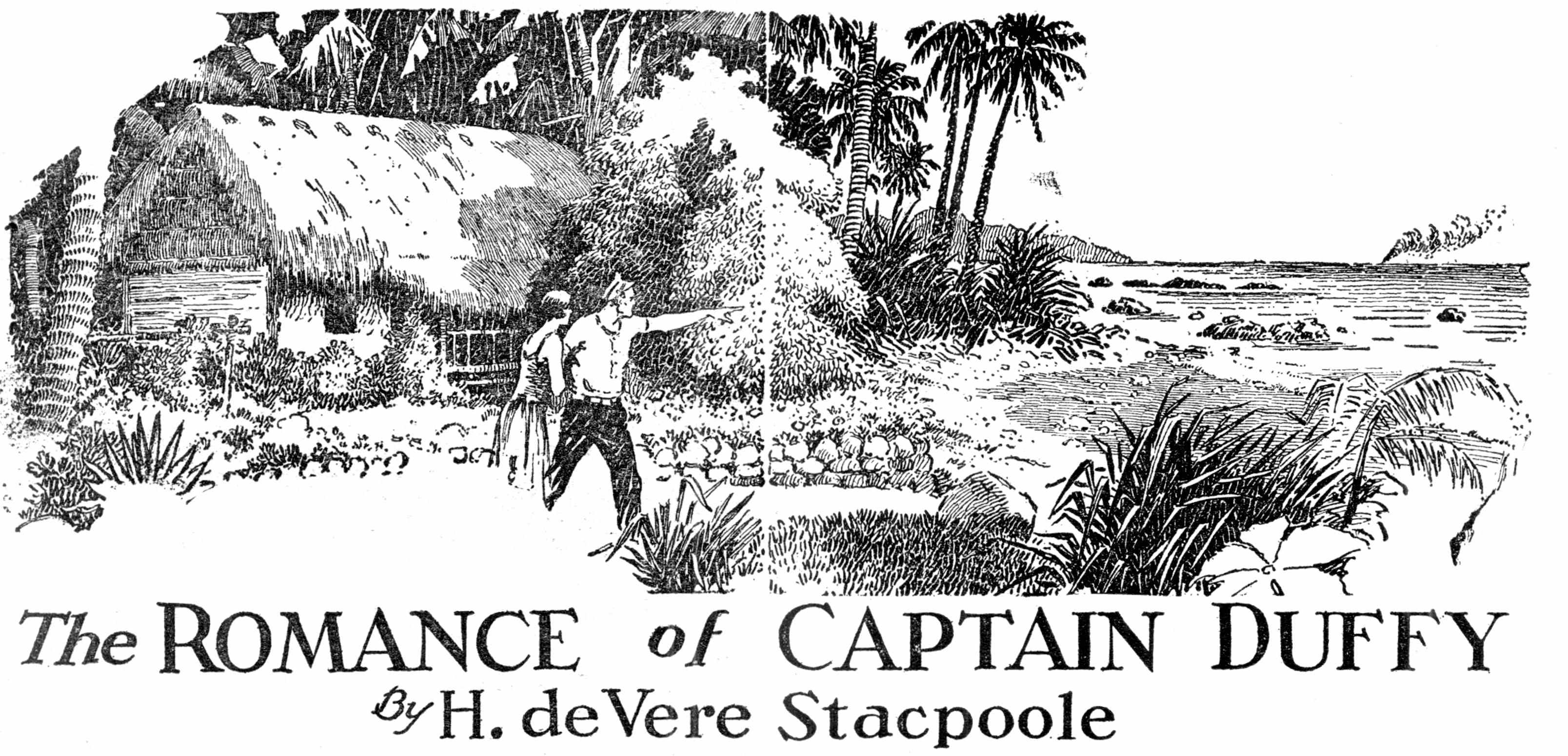
North of Natuna and nearly in the latitude of Laluan lies Fovea, a little, lost island inhabited mostly by butterflies, orchids, flying foxes and spirit crabs.
These white and spectral crabs are not found, I think, in the islands round about. The butterflies and moths also present remarkable specimens for the consideration of the collector—or would if a collector ever came.
“No one ever comes here.” That is what Fovea says to you after you have become acquainted. Words spoken by the wind in the mangroves and the beating of the blue and patient sea on the little beach facing eastward, from which you can see sometimes the smoke of the Malacca-Hongkong mail boats on the far horizon.
I was there only two days and the place struck me so much that I chanced to mention it to a man I met at Chale’s Hotel, Malacca.
A gentleman by the name of Duffy. Mr. Duffy was a very rough diamond. He had started in life as a cabin boy and was proud of the fact; sailing ship, steamship, cable, salvage work—he had been through the lot, emerging at the age of fifty or so with the honorary title of captain, an unquenchable thirst and a little fortune scraped together somehow out of tin—also a face forcibly carved and steadfast looking as the face of a figurehead.
The captain moved uneasily in his creaking basket chair, then, calling the native boy who was on the hotel veranda, he pointed to the empty glasses on the table by which we were sitting.
“Macham Taddy,” said he, which, translated means “the same again.” Then: “Fovea? Oh, yes, I know the place. Ought to.” He hung in irons for a minute till the drinks came along. “Funny, you talking of that place, and of being there two days. Well, I’ve stuck it there near three weeks; hove on the beach as you might say. It’s not more than a hundred yards before the trees begin north and south of that lump of rock above the tide marks, and I reckon I know every yard of that hundred. Remember that lump of rock near the middle standing there like a bollard? I’ve put in many an hour sitting on that rock, wishing for ships.
“You see, there’s no harbor, so the junks don’t come—though Saigon’s only a biscuit toss off; there’s no copra, there’s no rubber and there’s no tin. Against all that there’s no mosquitoes or Dutchmen; against that there’s no bars.
Remember that little trickle of water that comes down from the trees and makes a sink by the big tree fern? That’s the long bar of Fovea and many a drink I’ve had there, lying on my face like Nebuchadrezzar.
“What I’m saying happened only a few years ago. I was in Canton. I’d gone there to see a Chinaman over a tin proposition that turned out trumps, and I was full of buck and beans, at a loose end as you may say, and looking for fun. I went into Charlie Brent’s to look for it, and there at the bar was standing Captain Bill Travers.
“That chap ought to have been born a bishop; sure as death if he put foot on a ship he’d sink her or she’d catch alight or lose her sticks or start a butt or bust her boilers. But it was never, somehow or other, his fault, and the companies didn’t spot him for a hoodoo till he broke the back of the Ararat, seventeen-hundred-ton freighter, on the Paracels. Then they fired him and marked him ‘dangerous’ among themselves, and he went hunting for another ship—which was like hunting hell for violets—and here he was in Charlie Brent’s.
“‘Hullo, Bill,’ I says. ‘What are you doing now?’
“‘Pigs,’ says he. He was captain of a pig boat, chink owned and manned and running from Canton.
“And one hour after meeting him, I’d booked to come along with him as passenger, for fun—you can get a lot of drinks into an hour, with a chap like Bill to do the talking and Charlie to do the mixing. Also, you can hear a pig boat near as far as you can smell it. A cargo of grunters is better’n a siren and you’ve only got to twist one of their tails to set the whole lot off.
“I reckon they could have heard us at Hongkong as we put out of the Canton River and a rat got loose among them. Night it was, and when they weren’t ‘hrrumfing’ and snoring, off they’d go like half a million cartwheels wanting greasing.
“‘You’ll get used to it in time,’ says Travers. But the time never came, for next night the chinks rose and took the ship, knocked Travers on the head and hove him over—and they bottled me in the glory hole where paint and carpenters’ tools were kept; then they took the ship’s money and half a boatload of prog, opened the sea cocks and left her to scuttle.
“I didn’t cut my way out till morning, and there we were, down by the head, all the pigs drowned, and the water washing inside of her like the washing of a beach every time she moved to the swell.
“There were bulkheads that kept her still floating and Fovea showed right ahead to s’th’ard. Nothing to push off in but an old collapsible that the brutes had left by chance, and nothing to take off in her but half a ham we’d had for supper and was still on the table with biscuits and butter, though the floor of the cabin was six inches deep in water—lazaret flooded, of course.
“Well, sir, I got that collapsible together and got her over on the starboard side. The ship was listed so that there wasn’t more than four foot of free board, so, getting over the boat was easy. I waited while the drift took us along closer to the island, and then, all of a sudden, came a bang which was a bulkhead giving, and following that came a noise like an elephant gargling his throat.
“I didn’t wait—I pushed off in the old floating umbrella just in time to get clear of the suck of her, and then I watched her sink, funnel under, truck under—gone!
“Bad to look at, even though she was what she was—four hundred ton of rusted plates and an engine that an old flivver would have sneezed at. But a ship for all that. It’s bad to look at a ship going under. I’ve seen it three times and every time I’ve been near sick in my stomach.”
“How far were you from Fovea?” I asked.
“A matter of two miles nor’-nor’-east,” replied the captain. “Current with me, so I wasn’t long getting to the beach. The sight of that stream coming down eased me a lot. I was mostly fearing there wouldn’t be water. Trees don’t always spell free water, but there it was, and beyond in the wood I saw custard, apples and bananas—same as you may have seen them right back beyond that big tree fern.
“That’s how I was fixed with crabs and shellfish for grub—a blessed fruit shop with nothing to offset it but a few biscuits and half a ham. Lucky I had been able to bring off a boxful of matches so’s I could roast the crabs; but I’ve never wanted to look at a ham again.
“There I was, and you can imagine—nothing to do after I’d made a tour of the place and woods, nothing to do but sit and wait for a ship and wonder what sort of damn fool I was for signing articles as you may say with Travers. A free man linking on to a hoodoo like that, and I’d have felt worse in my mind if I’d known I hadn’t done with him yet.
“The only bright spot in the ointment was the fact that the chinks hadn’t searched me and taken my money. I’d managed to brain two of them with a clinker bar before they shoved me into the paint shop, and then I reckon they were too scared of me to let me out. Twenty-two hundred dollars I had on me in American notes, and I’d sit and count them and count them till common sense came along and clapped me on the shoulder and said, as plain as the parakeets screeching in the trees: ‘Bill Duffy, give over fooling like this or you’ll go bughouse and imagine yourself a bank teller. Go and build a shack for yourself among the trees—never mind if you don’t want it, it’s something to do and something to keep your mind busy.’
“So I did.
“I built a shack, cutting branches with my knife and twisting canes to make the walls, and thatching it with palm leaves. I built it in that little clearing by the water sink, and when I’d put the topknot on I laughed. Guess what that thing fetched up in my mind. Well, I’ll tell you. Did you ever see the house a bower bird builds? Well, that was it, same as if it had been photographed and made ten times bigger.
“I’ve seen the chap dancing before it to attract the hens. The chap I saw had laid out a little garden with shells and blossoms and such, and there he was dancing in it and the hens sitting round.
“‘Well, there’s the shack finished,’ I said to myself, ‘and nothing more to do.’ And right on that, common sense comes along again and claps me on the shoulder and says: ‘Bill Duffy, if you want to keep the madness off you, do what the A’mighty had in His mind for you to do when He showed you that bird away there in Borneo. He knew what was coming to you: He’s sent me to give you the hint. And you take it, and put your back into it and made a garden.’
“Pretty dangerous advice, mister, for if things hadn’t happened as they did, the next ship coming along might have found me imagining myself a bower bird instead of a bank teller. However I made the garden, fetching shells from the beach and laying them out, and getting blossoms and sticking them in the ground.
“I hadn’t no more notion of making a garden than you’d have of making an airplane. I just did what the bird had showed me what to do, which shows that birds may sometimes teach humans. And pretty it looked when I’d finished with it, notwithstanding that it came to me all of a sudden I’d nothing more to do—unless I started on another shack.
“‘Why,’ I says to myself, ‘if I go on making shacks and gardens all over the place, next ship that comes along will maybe find me imagining myself a house builder ’n’ decorator. What about that?’ I says to Common Sense, but she’d hove off. Not a word from her, and down I lay that night and dreamed I was a beaver—same as I’ve seen them by Moose Lake—and I was building and building, putting in hot-water pipes so that the bower birds mightn’t feel the cold—a man all the time, but a beaver—you know the sort of sludge—till all of a sudden I was woke up by a clap of thunder.
“I heard it rolling over the sea, and then I heard the crying of sea gulls. Then I lay waiting for the wind and rain which didn’t come.
“There are no sea birds round Fovea, as you know, but I didn’t think of that. Time wasn’t more than midnight, I reckoned, for the first thing Nature gives a chap on his lonesome like me is a watch which hasn’t got no second hands but can tell him noon and midnight pretty accurate.
“‘Funny,’ says I; then I was asleep again, solid.”
Captain Duffy reached for his glass, finished it and put up his thumb to the waiter who had appeared again on the veranda.
“Macham Taddy,” said I, indicating mine.
Then I waited for the story to go on.
But the captain seemed up against an obstacle.
Then I saw that it was not a kink in the story that was holding him, but some vision of memory. It was evident that the hotel veranda and the sunlight and the palms of the hotel garden and the table by which we were sitting and myself were, for him for the moment, nonexistent.
Then he came back to himself with a jolt.
“Solid—till I woke with the parakeets screeching in my face and it an hour after sunup, as innocent as a babe of all that had been happening in the night.
“What had been happening in the night began in China where the fighting was going on and where they wanted ammunition. Six cases of gelignite the French mail boat from Rangoon to Canton had aboard her in the forehold, labeled ‘chocolate,’ and some Frog must have gone smoking a cigarette there or something—though how he got there is beyond me, unless they’d taken the hatch cover off. Anyhow a fire must have started and she blew up and went down like an old tin can. It all came out afterward.
“That was the clap of thunder I’d heard, not knowing that the screeching of the sea gulls was the passengers clinging to spars and drowning—all but one.
“All but one—and when I came out on the beach that morning, there she was.
“A young female dressed for dancing same as you see them on board the liners. I didn’t know there’d been a dance on board the hooker; I didn’t know any damn ship had blown up. I just came out on the beach and there she was, and an elephant playing the fiddle wouldn’t have given me a greater setback. Then I saw a big spar half beached by the falling tide and I began to tumble to the situation.
“I came toward her, but she didn’t heed me. She was sitting there and seemed to be talking to the sea, all dithery and waving her hands for all the world like a girl I’d seen acting at Portsmouth in a play where a chap poisons his uncle pouring stuff in his ears and——”
“‘Hamlet’?”
“That’s her—and one shoe off, lying on the sand. She’d been drenched, but the sun had dried her, and there she was, wild as a coot, clean out of her mind for the moment and minding me no more than if I hadn’t been there.
“I picks up her shoe.
“‘Now, then,’ I says to her, same as if she’d been a child, ‘come, put it on,’ just as if we’d been shipmates. And at the sound of my voice she seemed to come together a bit and she looked at the shoe and then she looked at me and then back at the shoe; and then she gets up all tottery and holds out her hands like so, as if she was calling on the saints to see her and the fix she was in; and then something caught back in her throat and—off she went.
“It was like a dam bursting—laughing and crying, crying and laughing, and when I got a hold of her it was like holding an earthquake till she went limp so’s I could have hung her over one arm like an overcoat.
“I got her to the shack and laid her out with my coat under her head. She’d gone right bang asleep. I’ve seen a chap do that after he’d been beat up by a lot of chinks; I reckon Nature just steps in and pulls down the blinds.
“Anyhow, there she was, shut-eye for twenty-four hours, and she came to next morning bright and herself again.
“I tell you I’d had a night of it— afraid to wake her, afraid she wouldn’t wake up, crawling on my hands and knees to listen if she was alive and breathing; and when she woke up, maybe you’ll believe me or not, she had no more idea of what had happened than a child unborn.
“She remembered coming on deck after dinner to dance, but she was cut off from there at the waist, so to speak. I had to tell her I reckoned the ship she was on had blown up and she’d come ashore clinging to the spar. She gave me her own name and the name of the ship; she’d been traveling alone from Malacca to Canton there to meet her people. She was as sane and sensible as you or me, but she couldn’t remember the blow-up.
“Brains are queer things; a chap gets a belt on the head and he doesn’t remember getting it, nor he doesn’t remember anything from maybe half an hour before he got it—I’ve seen that myself. Same with her in a way.
“That girl must have seen things and heard them, too—enough to raise the hair on your head, but the A’mighty had just snuffed the recollection of them out.
“I didn’t grumble. She recollected enough of that ship to give me no end of trouble inventing lies. You see, naturally, being warm-hearted, she was anxious to know what had become of the captain and crew and the other passengers; and I said they were sure to have got off on a raft, what folks didn’t get off in the ship’s boats.
“She asked why they hadn’t come to the island; and I told her there was a big current that would make it easier for the boats to push west for the mainland. She took it all in, trusting as a kitten, settling down as you may say, in her basket and beginning to take notice of things.
“I gave her a custard apple and some bananas and then I went off into the woods to hunt for some avocados I’d seen the day before, telling her I wouldn’t be more than half an hour gone and reckoning she’d settle down better alone.
“Up on the high ground—if you took notice—there’s a bald patch where the trees don’t grow. I didn’t bother about the avocados; I just sat down there on an old stump to get my bearings and see what was best to be done.
“The thing had hit me in the eye, so to speak—you can imagine. A young girl in that rig-out and me alone with her and she as innocent as what you please, and the whole thing coming of a sudden.
“I fixed it in my mind that she’d keep the shack and I’d build myself another away at the other end of the beach, and when I’d got that straight there wasn’t much else to think about—except food.
“Well, I couldn’t do more for her than I was doing for myself, and what between crabs and custard apples and bananas and such, she’d have to make out—so she did, and never grumbled.”
Captain Duffy paused and seemed plunged in reverie for a moment—a dream happy yet unhappy.
“That next three days wasn’t like—well, it was like the biggest lie a man ever imagined. You’d know if you could have seen her—never a grumble, always smiling, happy as a child. And yet a woman all the time—and such a woman! A man doesn’t know what a woman is till he has to fend for her and get her food and be all alone with her.
“She’d come and watch me building my shack—and, ‘Aren’t you going to put a little garden to it?’ says she one day. She’d been greatly hit by the garden with the shells and truck. I hadn’t told her what had put it in my head and I didn’t want to, but it came to me as she said that, that things were shaping that way if I didn’t look out.
“But I needn’t have worried.
“The lease was up. If I’d been alone on that damn place I’d be there still, maybe, but being as I was, wanting nothing more in this world or kingdom come, the lease was up.
“That rent was owing, and the brokers coming in, and they came in a damn old trading schooner, the last of her kind and the worst, owned by McCallums of Singapore and bound for Canton. Water she wanted, and fruit.
“When I saw her standing in and sure to be full of gaping ballyhoos, the first instinct that came to me was to cover the girl.
“I told you how she was rigged—all right for a dance room on a ship, but even there pretty much wanting, especially under the arms, so I got her into my coat. It was Shantung silk; I’d bought the suit new at Canton, and you may judge by my size that it fitted her. And so I put her into it. She looked up into my eyes, raising her chin——
“Gosh!” He broke off and reached for his glass.
“Did you?” said I.
“Did I what? No, I didn’t—no, there was no kiss. I reckon hell’s full of chaps sitting round and wagging their heads and saying: ‘No, I didn’t—might have done, but didn’t!’” Then, after a pause:
“What stood between me and her all through was that rig-out she was in, I believe. If she’d been an ordinary female dressed as such, things might have been otherwise. You see it had put up a sort of bar between us—as it might have been saying: ‘Here’s a lady in distress.’ And not only that, but it seemed all the time to be punching in the fact of the difference between the likes of her and me. I’m not anything more than the A’mighty made me. A rope’s end taught me all the dancing I know, and I learned French swabbing decks on an old drifter out of Cherbourg. We weren’t the same brand of goods. She was a lady—all the same, things might have been different if it hadn’t been for that.”
I took it that he was speaking of the dance dress, which had evidently cranked up his inferiority complex in some curious way.
“Or maybe not,” he went on. “Anyhow, there was the schooner coming in and she dropped a boat and took us off. McRimmon, the captain, had his wife on board and the next thing was she and the girl were clacking and throwing their arms round one another, and Mac—he’d got a long white beard and so took advantage of it, as you may say—kissed her.”
“His wife?”
“No, the girl. Well, he wasn’t the chap to give something for nothing, and so he charged me ten dollars, he did, for the lift to Canton, and bunked me in the fo’c’s’le, seeing that the girl had the only spare place aft.
“She’d come up in that mail boat to meet her people at Canton.
“She’d told me all about herself at Fovea and how her father was in business at Shanghai. She’d left Shanghai and come down to visit her aunt or some one who was living at Malacca, and the arrangement was she was to be met on her return by her people at Hollyers Hotel, Canton.
“Well, sir, when we fetched Canton, and I’d paid McRimmon his ten dollars for the lift, and got her into a cab and took her to the hotel, there was no people to meet her, only a telegraph from Shanghai saying they were delayed and giving the date of their arrival—adding up which I found I’d have her two days to myself and no McRimmons to butt in.
“So I left her at the hotel, where I booked a room for myself as well, and bunked off and got a shave and haircut and a new suit from Silver’s, and a panama and a malacca cane; saw the shipping people and gave evidence about the blow-up—and back I gets to the hotel, only to find that the damn ball dress had fetched me in the eye again.
“She’d gone to bed.
“She’d landed in a mix-up of what she’d wore at Fovea and what Mrs. McRimmon had lent her. There wasn’t much to notice to my mind; but she thought different and she’d done a dive between the sheets till the milliners had time to fix her up. The hotel manageress told me they were working double shifts and reckoned to have her fitted by the day after to-morrow.
“Day after to-morrow!
“Well, what did it matter to me? I was saying we weren’t the same brand of goods—and that’s the truth. All the same, feelings have nothing to do with that. I wanted her—yes, sir, I’d have gone through hell ’n’ fire for that woman, and I’d have yanked her with me through a hedge of relations half a mile thick and her clinging to me and tellin’ them all to go to blazes. But I hadn’t a chance, so it seemed to me as I stood in the hall with the hotel manageress telling me that.
“I sent word up to her, hoping she was all right, and she sent word down to me saying she was, with kind regards. And I sat in the lounge waiting, hoping every time I saw a bell hop it might be another word from her, but nothing came but newspaper men—chaps from the Canton News and the Shanghai what’s-its-name, all wanting the story of how it happened.
“I tell you by next day the whole wide world was wanting to know how it happened, not meaning so much the blow-up of the mail boat, but the girl’s escape. It was going round and round the world like a squirrel in a cage, that yarn, how Captain Duffy had saved her and how they were on an island together. McRimmon and his crowd had been talking and the slosh journalists from hell to Hakodate had got the whisper—— Well, you can think!
“I was close as an oyster about myself; but McRimmon wasn’t. And next day, opening the Canton News, I found myself in print a yard long. I was Captain Duffy, a fine, good-looking, upstanding feller full of chivalry, but so modest that it was hard to get me to speak of my doings. It gave the lie to facts and the looking-glass, but I swallowed it. I reckon it fed some hungry spot.
“I said to myself that night—she was still in her room—I said to myself that when her people came, if she was not down before then, I’d run up the flag and tell ’em straight: ‘Duffy’s the man who’s going to have your girl. He’s got forty thousand dollars in the Hongkong-Shanghai Bank. He mayn’t be a scholar, but he’s a fine, good-looking, upstanding feller, full of chivalry but not too modest to claim the woman he wants.’
“That’s what I told myself not knowing I was still being trailed by that ball dress and those milliners and their delays.
“If I could have got that girl alone that night I could have done the trick and she’d have hauled down her colors; but the fitters and riggers held her, as I was saying, and when she come out of harbor next day—— Well, it was just like this:
“I was sitting in the lounge just at noon when the glass swing doors flung open and in came her people—dad, mother, and a young chap with pomatumed hair and an eyeglass, followed by chinks carrying their luggage. And at the selfsame minute, like a thing in a stage play, down the stairs comes she in a white dress looking like a snowdrop, as you might say. And that young feller with the eyeglass runs to her and gives her a kiss you could have heard all over the shop.
“And she hadn’t any brothers or sisters; she’d told me that when we were talking of her family.
“When a gun’s bust, you can’t fire it again. There’s things that can’t be done twict if you don’t do them once, and Captain Duffy he took his hat and went out on the hotel front to look at the weather—which was fine. He didn’t go back to that hotel. Didn’t bother about having his luggage sent for; took the Rangoon boat which was due out that afternoon, and left them to hunt for the fine, good-looking, upstanding feller that was too modest to wait for thanks.
“Do you believe in that yarn about Adam ’n’ Eve? I don’t. ’Pears to me if he’d been the same sort of mug as me and waiting for that girl till she was dressed, he’d have been waiting—anyhow, that’s my personal experience and opinion.”