Large-size versions of illustrations are available by clicking on them.
![[Cover]](images/cover.jpg)
THE LAST PUNIC WAR
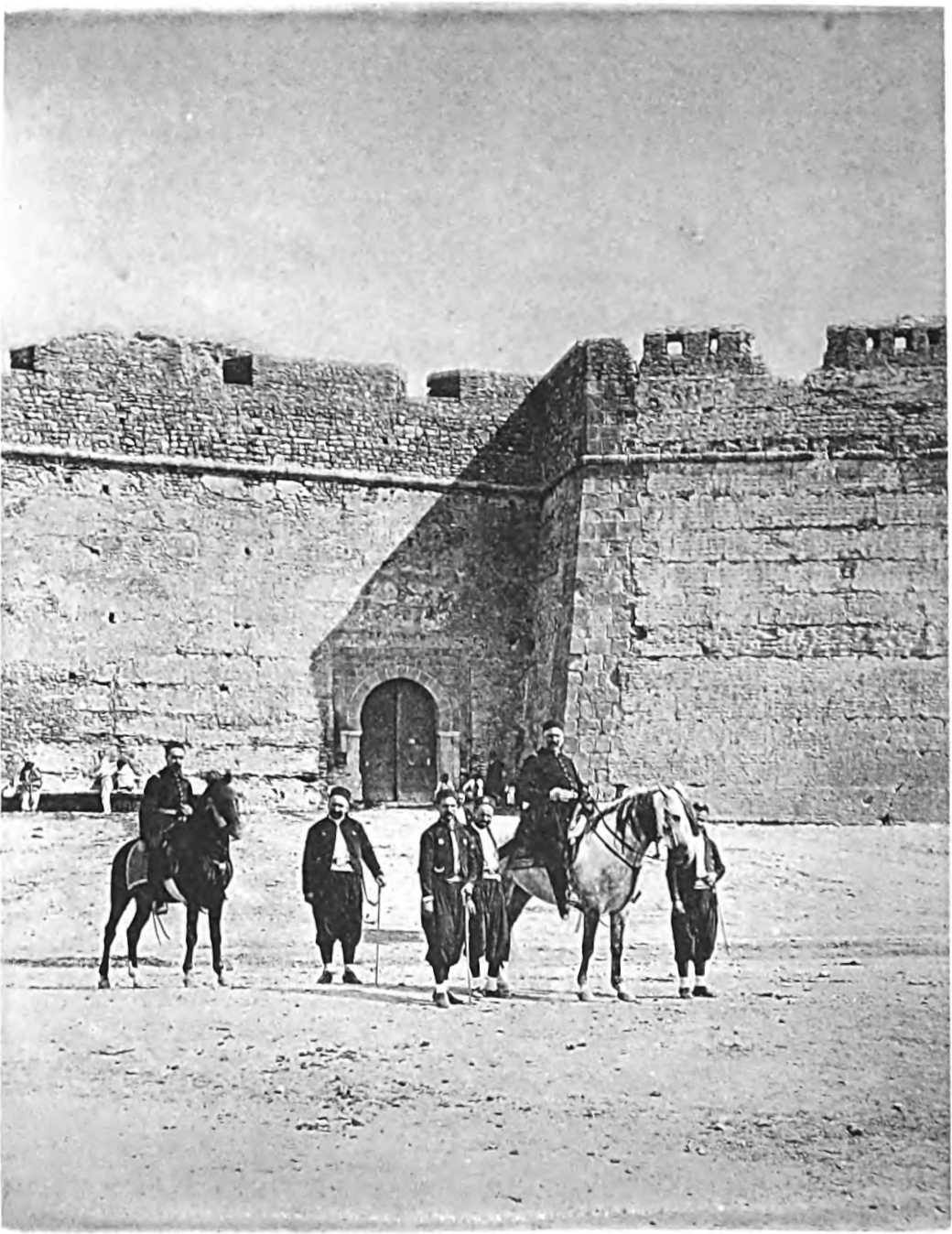
The Governor of the City Waiting the Arrival of the French Troops Outside the Bab-el-Ghadar.
Reproduction by Maclure & Macdonald.
THE LAST PUNIC WAR
TUNIS, PAST AND PRESENT
WITH A NARRATIVE OF THE FRENCH
CONQUEST OF THE REGENCY
BY
A. M. BROADLEY
BARRISTER-AT-LAW
CORRESPONDENT OF THE ‘TIMES’ DURING THE
WAR IN TUNIS
IN TWO VOLUMES.—VOL.
II.
WITH ILLUSTRATIONS
WILLIAM BLACKWOOD AND SONS
EDINBURGH AND LONDON
MDCCCLXXXII
All Rights reserved
[v]CONTENTS OF VOL. II.
![[Decoration]](images/decor1.jpg)
| CHAP. | PAGE | |
| XXV. | A REVOLT IN THE CITY OF CUCUMBERS | 1 |
| XXVI. | THE SHELLING OF SFAX | 23 |
| XXVII. | LOOT | 31 |
| XXVIII. | ALARMS AT THE CAPITAL | 48 |
| XXIX. | AUGUST 1881 | 57 |
| XXX. | THE COMING CAMPAIGN | 63 |
| XXXI. | THE MASSACRE OF THE GREY RIVER (OUED ZERGA) | 73 |
| XXXII. | THE FRENCH OCCUPATION OF THE CITY OF TUNIS | 86 |
| XXXIII. | AT SUSA IN THE SAHEL | 102 |
| XXXIV. | FIGHTING IN THE SOUTH | 110 |
| XXXV. | RECRIMINATIONS AND EXECUTIONS | 120 |
| XXXVI. | THE TAKING OF KAIRWÁN | 127 |
| XXXVII. | INSIDE KAIRWÁN | 142 |
| XXXVIII. | AFTER THE VICTORY | 187 |
| XXXIX. | A JOURNEY TO SOUTHERN TUNIS | 199 |
| XL. | TRIPOLI IN THE WEST | 219 |
| XLI. | GENERAL FORGEMOL’S RETURN FROM KAIRWÁN TO TEBESSA | 240 |
| XLII. | TUNIS BEFORE THE TRIBUNAL DE LA SEINE | 247 |
| XLIII. | MORT POUR LA PATRIE | 282 |
| XLIV. | A MONTH OF CHAOS | 306 |
| XLV. | 1882 AND THE FUTURE | 324 |
| [vi]APPENDIX. | |
| PAGE | |
| A.—Instructions issued by the Grand Master to the Knights taking part in the Expedition to Tunis (1835) | 339 |
| B.—The Carraca of Saint Anna, the Great Galley of the Maltese knights | 340 |
| C.—St. George’s Burial-ground near the Carthage Gate at Tunis | 340 |
| D.—The British Treaty with the Dey of Tunis in 1662 | 343 |
| E.—The Confirmatory Convention of 1686 | 344 |
| F.—The British Consulate-General and Political Agency at Tunis, (1640-1882) | 345 |
| G.—Tabarca and the Tabarcans | 346 |
| H.—An Arab Historian’s Account of the French war with Tunis in 1770 | 346 |
| I.—Secret Clause of the French Treaty with Tunis in 1830 | 351 |
| J.—Letter of Muhamed Bey demanding Investiture from the Sultan on his Accession (1855) | 352 |
| K.—Vizirial Letter to Muhamed-es-Sadek Bey concerning a Demand for an Imperial Firman in 1865 | 354 |
| L.—The Firman of 1871 | 357 |
| M.—Project of M. Léon Renaud for a Tunisian Crédit Foncier | 361 |
| N.—Important Notes about the Khamírs and the Invasion of their Province | 363 |
| O.—The Modest Gains of a Tunisian Premier | 370 |
| P.—Strength of the First Expeditionary Corps on the 8th June 1881 | 372 |
| Q.—Enumeration of the Troops sent from France to Tunis to take part in the First Expedition | 372 |
| R.—The movements of Algerian Troops in connection with the First Expedition | 373 |
| S.—Enumeration of the Troops sent from France to Tunis to form the Second Corps Expeditionnaire | 374 |
| T.—Note on the Formation of the Columns taking part in the Concentric Movement on Kairwán (October 1881) | 375 |
| U.—Position and Strength of the French Army of Occupation in the Regency of Tunis on the 1st April 1882 | 376 |
| V.—An American Prophecy about the Destiny of Tunis (1869) | 385 |
| W.—A Foreign Diplomatist’s Note about French Policy in Tunis | 388 |
| X.—Cardinal Lavigerie’s Allocution on receiving Investiture on the Site of Ancient Carthage (April 16th 1882) | 393 |
| Y.—An Intercepted Letter about the Practical and Political Utility of Border Raids | 394 |
| Z.—The Tunisian Export Trade | 397 |
[vii]ILLUSTRATIONS TO VOLUME II.
| Bombardment of Sfax, | To face page | 24 |
| Executions on the Railway, | „ „ | 126 |
| Plan of Kairwán, | „ „ | 142 |
| The Countess of Bective in an Arab Costume | „ „ | 152 |
| Plan of Great Mosque of Sidi Okhba, Kairwán | „ „ | 158 |
| Mosque of Sidi Okhba at Kairwán, from the Cloisters, | „ „ | 158 |
| Door of Prayer-Chamber, Great Mosque, Kairwán, | „ „ | 160 |
| Another View, „ „ „ | „ „ | 160 |
| Interior, Great Mosque, Kairwán, | „ „ | 160 |
| Another View, „ „ | „ „ | 161 |
| The Tomb of Sidi-es-Saheb Ennabi, | „ „ | 178 |
| Inscription on the Tomb of Johannes Antonius de Piscatoribus, | „ „ | 204 |
| Maintenant, il nous faudrait, pour bien Farre, un petit Commandement Militaire, | „ „ | 292 |
[1]TUNIS PAST AND PRESENT.
CHAPTER XXV.
A REVOLT IN THE CITY OF CUCUMBERS.
In the middle of June M. Roustan was at Tunis busily engaged in advancing the interests of his friends and assuring M. Barthélémy Saint-Hilaire that “perfect tranquillity everywhere prevailed,” and that the prospects were couleur de rose as regards the future. Mustapha was in Paris paving the way to his Grand Cordon by profuse assurances of friendship, and the President of the Republic was as pleased with his diamond ahad, as the Minister of Foreign Affairs was with his diamond nichán. One incident alone troubled the mind of the young Premier, and that was the obstinate refusal of M. Gambetta to enter in any shape the exalted ranks of Tunisian chivalry. Not even the[2] venerable emblem of the Hassanite family in brilliants could tempt the great Republican leader to bedeck himself with a Tunisian trophy.
Just as the proprietors of the Grand Hotel were getting somewhat weary of their Oriental guests, and just as M. Saint-Hilaire was furthering “the mission of civilisation” by making Mustapha, the ex-barber’s apprentice, the colleague of half the sovereigns of Europe in the highest rank of the Legion of Honour, and was rewarding General Musalli for his complacency towards France and her Minister Resident by the cross of a Knight Commander, the Tunisian bubble burst in a moment, and Europe learned that French domination in Tunis meant the possession of the ground her soldiers stood on—and nothing more.
I am now going to tell the history of the national rising in Southern Tunis, according to the journal kept by an eye-witness, Mr. William Galea, who holds the post of British Vice-Consul at Susa, but who happened to be at Sfax during the outbreak, and played an important part in the events of which he speaks. Mr. Galea begins his diary on the 23d June 1881, with an account of his journey by land from Susa to Sfax.
“On Saturday the 18th June I started by carriage to travel along the coast as far as Sfax[3] (‘the City of Cucumbers’). When between Susa and the Roman amphitheatre of El Djem I sat down under an olive-tree while my horses were resting. In a few minutes about thirty Arabs of the Mitelit tribe, accompanied by two Sheikhs, gathered round me. They first wanted to know to what nation I belonged, and when I told them, their spokesman answered that ‘Englishmen were friends of the Arabs,’ and began to talk unreservedly of their feelings and intentions. ‘We are all ready to fight against the French,’ he said, ‘though we know quite well they are more powerful than we are; but at any rate we shall die gloriously and enter Paradise!’ He added that a deputation from the Hamáma, Zlass, and Neffet tribes had already asked their (the Mitelits’) co-operation in case the French troops should enter Kairwán or interfere with that portion of the country. They said also that they had secured the cordial support of the Mourabats (Almoravides) at Kairwán, and would all take the field as soon as they fixed on a competent leader. One of the Sheikhs mentioned that Ali Ben Hlifa (Caid of Neffet) had already declared himself on the side of the Arabs, and that the Bey had sent a commission, or sengiak, to each clan, consisting of ten irregular soldiers under a sergeant-major, to ascertain their intentions. As the persons[4] forming these commissions undoubtedly sympathise with the Arabs, they will as a matter of course echo the hackneyed phrase that ‘tranquillity reigns everywhere,’ and conceal what is really going on, if they do not actually promote it.
“After leaving El Djem I was surprised to see a Mitelit encampment of 300 tents close to the road. This unprecedented fact convinced me of the growing restlessness of the Arabs. When I got to Sfax I found telegrams from my correspondents informing me of the general alarm felt at all points on the coast, and particularly at the menacing attitude now assumed by the most turbulent tribes in the vicinity of the Tripolitan frontier. In some places it appeared that the Arabs had already lost their respect for the Bey, and were determined in any case to assert their independence. All my esparto depôts were threatened, and the Arabs pretend they can now fix any price they like for the grass. So certain I am of a coming disaster that I am chartering as many ships as possible to save all the fibre I can. One of my ships at Gabes was in imminent danger of being fired at, under the mistaken notion that she was bringing French soldiers. The Bey has sent a proclamation to be read at Gabes, and one of my employers was present when this was done. As soon as the Sub-Governor had[5] finished reading it, all the people shouted out with one voice, ‘We will know nothing more of the Bey, for he has become a Christian; cursed be the Bey and his fathers, and the French and their fathers!’ Nevertheless he wrote to Tunis the same evening that peace prevailed. The telegraph to Mahres has been cut, the poles have been burned, and the wire taken, under the mistaken impression that it can be used to make bullets of. Nobody would accompany the surveyor to mend it, so he has come to Sfax with his family. Under pressure, even the peaceful villagers of Mahres have agreed to fight for the common cause. The Hamáma have already attacked the Algerian Arabs and carried off a quantity of their camels and cattle.
“June 24th.—This morning I learn that the revolution is determined upon. Ali Ben Hlifa has been elected the leader of the Arabs, but nobody knows if he acts thus from fear or of his own free will. It is impossible to tell in what direction the Arabs will make their first move, but they will certainly march on Sfax, Gabes, or Kairwán. There can be no doubt that the apparent calm is wholly deceptive, and that before long we shall be in the midst of massacre and bloodshed. The recent slight shocks of an earthquake which have been felt seem to confirm the Arabs as to their notions of French influence,[6] and they are said to have been produced by the incantations of M. Sicard, M. Roustan’s Consular Agent at Gabes, who is commonly reputed to be a wizard. This evening much alarm was occasioned by Giannino Mattei, the French Vice-Consul, sending all his family on board the Bey’s ship in the roadstead.”
I leave Mr. Galea’s journal for a moment to describe the town of Sfax, which is the most important seat of commerce on the Tunisian coast. Situated at the north-eastern extremity of the gulf once known as the Syrtis Minor, “the City of Cucumbers” is built on a plain almost imperceptibly sloping towards the sea, and is surrounded by a narrow zone of sand beyond which is a second zone of fertile land containing an almost countless number of gardens and groves. Sfax, unlike Susa and other places on the coast, is divided into two distinct quarters, one inhabited by the Moslems, and the other by Christians and Jews. The one is wholly, and the second partially, protected by the usual crenellated battlement flanked by towers. The native town possesses two gates, one leading to the open country, and the other opening directly into the European faubourg, at the extremity of which are the batteries and a landing-place. Ships of any burden lie about two miles from the shore,[7] close to which a picturesque flotilla of fishing boats is generally anchored in the shallow sea. Water often fails in Sfax, and two enormous cisterns, maintained by the public charitable trusts and constructed a little to the north of the town, protect it from the dangers of drought. Five mosques, eight sanctuaries, a college, and several schools are to be found in the Arab quarter. Sfax was formerly the starting-point and destination of one of the caravans travelling to and from Central Africa, but this business came to an end with the slave-markets, and its inland commerce is now exclusively confined to the date-producing district and the city of Gafsa. The import and export trade of Sfax has of late years greatly increased, and it is chiefly in the hands of British merchants. At the time when the events of which I am writing occurred, the traffic in the paper-making fibre, commonly known as halfa, or esparto grass, seemed to hold out the prospect of an important future for Sfax; but quite apart from this particular commodity, it receives large quantities of cloth, cotton goods, cutlery, iron, and planks, giving in return oil, almonds, pistaccio nuts, sponges, and wool.
The town and neighbourhood are singularly devoid of all archæological interest. Antiquities there are none, save and except a defaced cross of[8] the Maltese Order over a fountain. The religious buildings are mean, and only two of the mosques have lofty minarets. In the twelfth century Sfax was retaken by the Arabs from the Sicilians, who had conquered it under Roger the Norman, and four hundred years later it was occupied for a short time by the Spaniards. The population amounts to about 15,000 souls, of which 12,000 are Arabs, 1500 Tunisian Jews, 1000 Maltese, and 500 distributed amongst other European nationalities. Fewer Moors, perhaps, live in Sfax than in any other Tunisian seaport, and it is this predominance of Arab blood that accounts for the proverbially militant disposition of its Moslem inhabitants, where and whenever they believe their creed to be in danger.
This, then, was the place where Mr. Galea was writing his diary and shipping his esparto grass in June 1881, and so intelligently foresaw the events which were soon to occur.
On the evening of the 24th June Mr. Galea writes:—“I believe we are in a very serious position here. The French appear to imagine they have attained their object, and gone away triumphantly, leaving the Arabs peaceful and contented. The fire, however, is certainly smouldering under the surface. I cannot really blame the Arabs, when they ask me how we should like to see our country taken by[9] aliens without striking a blow to defend it? The deputation (sangiak) sent by the Government to the Mehedeba tribe has just returned. As soon as the soldiers arrived at the camping-ground the Sheikhs said that ‘the Bey of Tunis was dead to them,’ and after giving them a meal, ordered them to return from whence they came. Two other similar commissions have been turned back by fractions of the Mitelit clan.
“June 25th.—To-day the Governor of Sfax, Caid Hasouna Jelluli, summoned a meeting of the townsfolk, in which he told them that they must be prepared to defend both their own quarter and that of the Europeans against any invasion of the Arabs, observing that this had nothing to do with the French, who were to have no voice concerning Sfax, and that he would bring 200 Tunisian soldiers if they wished it. The citizens assured him that as long as the French kept away they would undertake the defence of the whole place.
“June 26th.—Matters do not seem to be mending. One of the Zlass Caids arrested a Sheikh for using seditious language, whereupon the prisoner’s relatives attacked the guards, using firearms. Two men were killed, and as soon as the Sheikh was liberated he and his party joined the insurgents, to use the term employed by the French to designate those Tunisians[10] who fight for their country. Both the Zlass and Mitelit tribes are, together with the Neffet, gradually approaching Sfax. I hear that our esparto yard at Grín has been plundered. Another of the Bey’s deputations has fared very badly. It was sent to Gabes to see that the broken telegraph was mended, but the villagers of Shinni gave them a sound beating and told them to go back to the Bey. To-day several Beylical decrees arrived for the principal tribes and one for Sfax, to be read publicly. In it the Bey said the French troops were leaving his territory, that the Khamír affair was amicably settled, and enjoined the Sfaxians to pay the taxes peaceably, under pain of severe punishment.
“June 27th.—The French gunboat ‘Chacal’ arrived this morning, and the commander landed to pay a visit to Caid Jelluli. All the Gabes Jews have now come here, and say that numbers of Arab horsemen have arrived there, and that the Bash Mufti has recommended a general union to attack the French. It is rumoured that Tunisian forces are coming here on board a French frigate, under the Bashhamba (General in command of the Bey’s irregular troops), who has been appointed Caid of the Mitelit.
“June 28th.—In the morning everything appeared as quiet as usual. I reached the esparto yard about eight A.M. After I had been there for a few minutes[11] my servant came running from the town, saying that a revolution had broken out. As he was speaking to me I noticed crowds of Arabs, armed with every conceivable kind of weapon, hurrying down to the seaside. Mr. Leonardi had just telegraphed the turn things had taken to Mr. Reade at Tunis, when the wires were cut near where I was standing. In spite of all my efforts, the Arabs who were working for me decamped en masse—some to join the insurgents, others to look after their families. To add to the scene of confusion, the Arab women came on to the housetops and walls of the native town, making the well-known trilling, bird-like sound (in Arabic called zahrit), to encourage their husbands, sons, and brothers in the revolt. Several Hamáma tribesmen who were delivering esparto grass in the yard ran off, leaving both merchandise and money, crying out, ‘Let us fight the French, and gain heaven!’ Just then all the Consular flags were hoisted, but the French colours were again lowered almost immediately. We gave the key of the safe to our head Arab watchman, and collecting the books of the firm,[1] and accompanied by my faithful workmen as a bodyguard, made for the boats. Our men kept shouting out Ingliz, Ingliz (Englishmen), and this was a talisman for us[12] till we got down to the water’s edge. Here an Arab rode at us with a drawn sword, but some of his co-religionists kept him back, declaring we were real Englishmen and should not be touched. At last we reached a boat, and got her off through the mud, for it was low water. All the Europeans were now busy putting their families on board the various small craft available; but on one of the ‘Chacal’s’ boats approaching the jetty ten shots were fired at her. It was only the extreme prudence of the officer in not returning this fire, which prevented a general massacre of the fugitive Christians not yet embarked.
“Meanwhile Giannino, the French Vice-Consul, had reached the ‘Chacal,’ but he had been wounded in the arm during his flight. We went to the ‘Genoese,’ a British steamer, upon which our esparto grass was then being loaded. Later in the afternoon a boat came alongside full of fugitives. I then learned that the French tricolor had been removed by the mob, who also cut down the flagstaff, and that several of the more respectable inhabitants had exerted themselves to facilitate the departure of the Europeans. Alfred Solal, the Swedish Vice-Consul, and his brother were both wounded. Mr. Leonardi, the English Consul, had used every exertion to maintain order amongst the[13] Maltese at this trying moment. When the excitement of the stampede had a little subsided, I began to inquire into the immediate causes of the sudden outbreak. It now appeared that the Governor Jelluli had spread the report that the Bey’s troops were coming, and as the Sfaxians considered the French and the Bey one and the same thing, they cried out, ‘A holy war in the name of God!’ and that they would allow none of the Tunisian soldiers to land. On seeing that all control of the mob was becoming impossible, the chief citizens warned the European colonists that it was time to be off. At the request of the captain of the ‘Chacal,’ I sent off the ‘Genoese’ to Susa with despatches and telegrams, stating what had happened, and we sought another asylum on board the Bey’s steamer the ‘Beshir,’ that had arrived at Sfax two years ago, and becoming unseaworthy was obliged to stay there. All the ships lying off the town were so crowded that there was barely standing room, and the discomfort may be well imagined. After a more careful inquiry the foolish or knavish conduct of Jelluli became apparent. On the 27th it had already oozed out that the Bashhamba was coming there with Tunisian troops. As soon as this was known the principal townsfolk took counsel with the Bimbashi, or Colonel of artillery in[14] charge of the forts, and they all agreed that this was a trick of the Bey to get the batteries out of the hands of the Bimbashi into those of the Bashhamba. Resistance was immediately agreed upon, but Jelluli either knew nothing, or acted as if he was in total ignorance of what was going on. The next morning (the 28th) the Governor called the chief citizens to his house, but a mob of the common people was also allowed to be present. Jelluli[2] then began reading in an almost ironical tone, an amra or decree of the Bey, stating that fifty artillerymen and a Bashhamba were being sent ‘to look after the forts.’ He must certainly have known how such an announcement would be received. The Sfaxians all answered that their old Bimbashi, Muhamed Shareef,[3] was quite able to defend the city, that they would not allow any troops to land, and that they would resist any such measure till death. They ran out into the street in a body calling out, ‘A holy war, a holy war!’ and seizing on all the arms they came across, rushed down to the jetty and seabeach. To make matters worse, messengers had been sent the previous evening to invite the Arabs of the interior to come to[15] Sfax; and as we were embarking, we saw them arriving, shouting, brandishing their weapons, and making all the disturbance they could. The revolution will now spread like wild-fire.
“June 29th.—We have passed an anxious night on the ‘Beshir,’ although the officers did what they could to make us comfortable, but now both water and provisions begin to run short. Several Arab servants we sent to procure them came back wounded, and the Maltese who went themselves did not fare better. Even the Moors who tried to protect any European were themselves at once severely handled. A Maltese boy was literally riddled with bullets and his remains afterwards kicked about the streets. At noon the ‘Mustapha,’ a French mail steamer, arrived in the roads, having placed on board a French frigate she met en route her freight of Tunisian soldiers. She is already overcrowded with passengers for Tunis. Mr. Leonardi has gone to the French ironclad which has just arrived, to ask the commander to serve out provisions and water to the distressed British subjects. Mr. Leonardi is behaving nobly, not only rendering every assistance to the fugitives, but going on shore to try and supply their wants, when each journey becomes more and more dangerous both to life and limb. With glasses we can distinguish the clouds[16] of dust raised by troops of mounted Arabs entering the town.
“June 30th.—In the night a great meeting of Sfaxians and tribesmen was held. Jelluli was dismissed, the Beylical authority declared at an end, and Muhamed Shareef Bimbashi, named Bey and Commander-in-chief. It was stipulated that no more provisions or water were to be furnished to the fugitives, and that no Christian was to be allowed to land under pain of death. We can see the people moving the cannon on the batteries, it is supposed under the direction of the Bimbashi, and making walls and barricades of all my iron-bound bales of esparto-grass. A revolt has now broken out at Mahres, but Gabes is quiet as yet. The Bimbashi has suddenly become more conciliatory, or is trying to lay a trap for us: this morning (nine A.M.) he sent messengers to say that we might all go on shore and buy provisions. In fact, a boat came off to sell bread and a small quantity of water. A green flag has now been hoisted on the Marina battery, but all our national flags are still flying just as we left them in the hurry of departure. Later on, the S.S. ‘Manoubia’ arrived with 1000 Tunisian soldiers, and at two o’clock P.M. a boat went on shore carrying decrees of the Bey addressed both to Jelluli and the ecclesiastical authorities, asking the people[17] to receive the troops in a cordial manner. ‘Yes,’ answered the ex-Bimbashi, ‘we will give them a warm welcome—with gunshot.’ The officer was ordered to leave the place at once, and there are reports that Jelluli himself is a refugee in a sanctuary, as a party is desirous of holding him as a hostage to be killed as soon as any attack commences. At seven P.M. the ‘Manoubia,’ in uncertainty as to the intentions of her crew of malcontent Tunisian soldiers, steamed out to anchor under the guns of the ‘Alma,’ a French frigate which had opportunely arrived during the crisis. The fugitives on board the ‘Chacal’ have been transferred to the ‘Alma,’ and the former boat has left for Susa with despatches. The Bimbashi’s authority is now complete, the green standard of the Prophet has been solemnly saluted, he is greeted everywhere with cries of ‘May God grant you victory!’ and has distributed flint-lock guns and ammunition amongst the people. We are much surprised at the French leaving us all wholly unprotected in case of a night attack, but we extemporised a signal with a red lamp, and later the Vice-Consul Giannino brought us some rockets. All this was very well, but if we had been assailed by the Arabs, we should have been killed or taken prisoners before any assistance could have reached us. My agent at Zarat has[18] escaped from that place on a barque and joined me. He says that a great meeting of tribes has just taken place at the Matmata mountain, twenty-five miles south of Gabes, and that the Ouerghama, Ouerdna, Hemerna, Aleia, Hzim, Hoiea, and Beni Zid, have unanimously agreed to form an army and march up the coast, to either attack the towns, or force the inhabitants to make common cause with them against the invaders. Gabes will be first occupied, and then Sfax and Kairwán. As regards Sfax; the revolution cannot certainly be made more complete than it is already. Zerzis is in the hands of the Arabs, and although Jerba is quiet as yet, it appears that the Ouerghama have ordered the Accara (spongefishers) of Zerzis to prepare boats that they might land in Jerba and pillage it.
“July 1st, 1881.—To-day the Bimbashi sent off messengers to say that all our houses were carefully guarded and to ask if we required anything from them. About noon the ex-Governor, Sy Hassuna Jelluli, came on board accompanied by his nephew and clerks, and said the insurgents had at last decided to allow him to withdraw in safety. He says the Neffet tribe will reach the neighbourhood of Sfax to-morrow. Messengers again came in the afternoon to press us to return on shore, and assuring us that the quarrel of the Arabs was with the[19] Bey and the French, and no one else. For prudential reasons the invitation was not accepted. The encampments of the revolted tribes now line the coast on either side of the town. Towards evening the various consular agents were called on board the ‘Alma,’ and it transpired that a night attack on the Bey’s two ships, upon which we had taken refuge, was meditated. The ‘Beshir’ and the ‘Asad’ were therefore taken in tow, and placed close to the frigate.
“July 2d.—Ali Ben Hlifa arrived to-day with 200 horsemen. A number of the refugees left us, having obtained a passage on board the ‘Italia’ for Malta. My Gabes agent joined me this afternoon, being the last European to quit the place, but he has been obliged to leave all the property of our firm in the hands of the rebels, who, when he left, were calling out ‘jihad, jihad,’ and threatening to kill any Frenchman who landed. M. Sicard, the supposed originator of the earthquakes, had a very narrow escape indeed.
“July 3d.—The Arabs have now formed a regular Medjlis, or tribunal of forty members, who are charged with the administration of justice and the maintenance of good order amongst the inhabitants in Sfax. I hear that the townspeople have sent their wives and children to the most[20] distant gardens, as they believe that the town will be destroyed in the inevitable bombardment, but nevertheless they are determined to fight to the last. Ali Ben Hlifa is now recognised as the leader of the revolted tribes. The Tunisian soldiers on the ‘Manoubia’ have almost openly revolted, and say they will not let the Sfaxians fight for their country alone. Many have jumped into the sea and tried to swim the four miles which intervene between the ships and the shore. Three were picked up by Moorish boats and safely landed. In the afternoon Jelluli sent a messenger to the Bimbashi, to urge on him to submit to the Bey, telling him that the Tunisian troops would otherwise be landed, and inviting him to hoist a white flag on the kasba in token of an affirmative answer. After sunset H.B.M.’s ships ‘Monarch’ and ‘Condor’ anchored in the roads, to the intense relief of the Maltese refugees.
“July 4th.—Early in the morning several Tunisian soldiers were detected swimming towards the shore, and a little later 100 of them were to our dismay placed on board the already-overcrowded Bey’s steamers. Their mutinous spirit is so apparent that we are almost more afraid of them than of the Arabs in the town. Captain Tryon, C.B., of the ‘Monarch,’ has humanely ordered the distribution of water[21] and provisions to the needy of all nations amongst the fugitives. Moorish boats with eatables for sale hovered round the ships for a great part of the day.
“July 5th.—Ali Ben Hlifa yesterday sent messengers to all the coast towns explaining the action he had taken, and asking for aid. The Arabs are working hard at a ditch and other defences, and the Council of Forty condemns people to death for the smallest offences against person or property. It has been arranged that if an attack takes place, Muhamed Khemoun[4] will be president of the tribunal. All the carpenters in the town are employed in making carriages for the cannon, and relays of workmen are engaged in erecting a barricade across the front of the town. The Mitelit, Neffet, Zlass, Hamáma, and Ouerghama tribes now entirely surround the place, and other clans and fractions of clans have promised to join them, and are not far off. The chiefs exhibit letters promising not only the aid of the Tripoli tribes, but of 10,000 Turkish troops. A fearful responsibility rests on the authors of such communications, for the existence of which I can vouch. There is something to admire in the order preserved by the Sfaxians, although they are now in the wild excitement of a religious war; notwithstanding[22] that the agents of the Financial Commission have abandoned entirely the collection of all local and custom-house dues, the townspeople have actually continued to enforce their payment, and have appointed suitable persons to see that no injustice is committed in this respect. A large French troop-ship arrived to-day, with soldiers on board, and another French gunboat—the ‘Pique.’ The ‘Chacal’ and the boat just arrived are approaching the shore, and the storm of a bombardment is now about to burst on the devoted heads of the brave but ignorant defenders of the City of Cucumbers.”
[23]CHAPTER XXVI.
THE SHELLING OF SFAX.
My readers must suppose Mr. Galea watching anxiously the operations of the French from the deck of the ‘Beshir,’ and recording what took place in the journal to which I now return.
“July 5th, 1881, 4.10 P.M.—The ‘Chacal’ first began to bombard the town from a distance of about 2000 yards from the jetty, and the ‘Pique’ commenced firing an hour later. The Bimbashi is replying gallantly enough, but all his shot are falling short. Shells are being chiefly directed against the forts between the European faubourg and the shore. At last a shot from the town actually passed between the masts of the ‘Pique,’ and shortly afterwards both ships withdrew to the outer anchorage. As far as I can see, the shore battery is nearly dismantled and the pier much damaged. At Captain Tryon’s suggestion a large number of the fugitives are leaving for Malta in the S.S. ‘Peninsulaire,’ for there is literally nothing[24] more for them to live on here. The French fired fifty-four shots and the Tunisians seventeen this evening.
“July 6th.—At daybreak the ‘Alma’ and the ‘Reine Blanche’ (which had also arrived) got as close to the shore as they could, and at 5.45 A.M. began throwing shells to the west of the Arab town from a distance of two miles. The town made no reply, and firing ceased at 9 A.M. At noon all four ships joined in the bombardment and a brisk fire was continued for three hours. Only six shots (all falling short) were fired from the batteries, which the gunboats endeavoured to silence. Although 141 shells were thrown into the place, the enceinte facing the sea does not seem to be visibly damaged. About 4.30 P.M. the ‘Léopard’ arrived and joined the other gunboats at the inner anchorage.
“July 7th.—A desultory fire was maintained in the morning, and the injuries to the buildings can be seen clearly enough through a telescope. Later on, some steam-launches with marines on board approached the shore, but they were at once fired at from the forts and were obliged to retire. The ships then recommenced the bombardment, and when it grew dusk the launches once more went close to the town, but being received with volleys[25] of musketry again withdrew. It turns out that very few French troops are really here, and there can be no doubt that the assault is being carried on in the most unsatisfactory manner. The failures to effect a landing will not only encourage the Sfaxian Arabs, but those in the other coast towns, where the proceedings are being most anxiously watched with a view to decide on the position to be assumed.
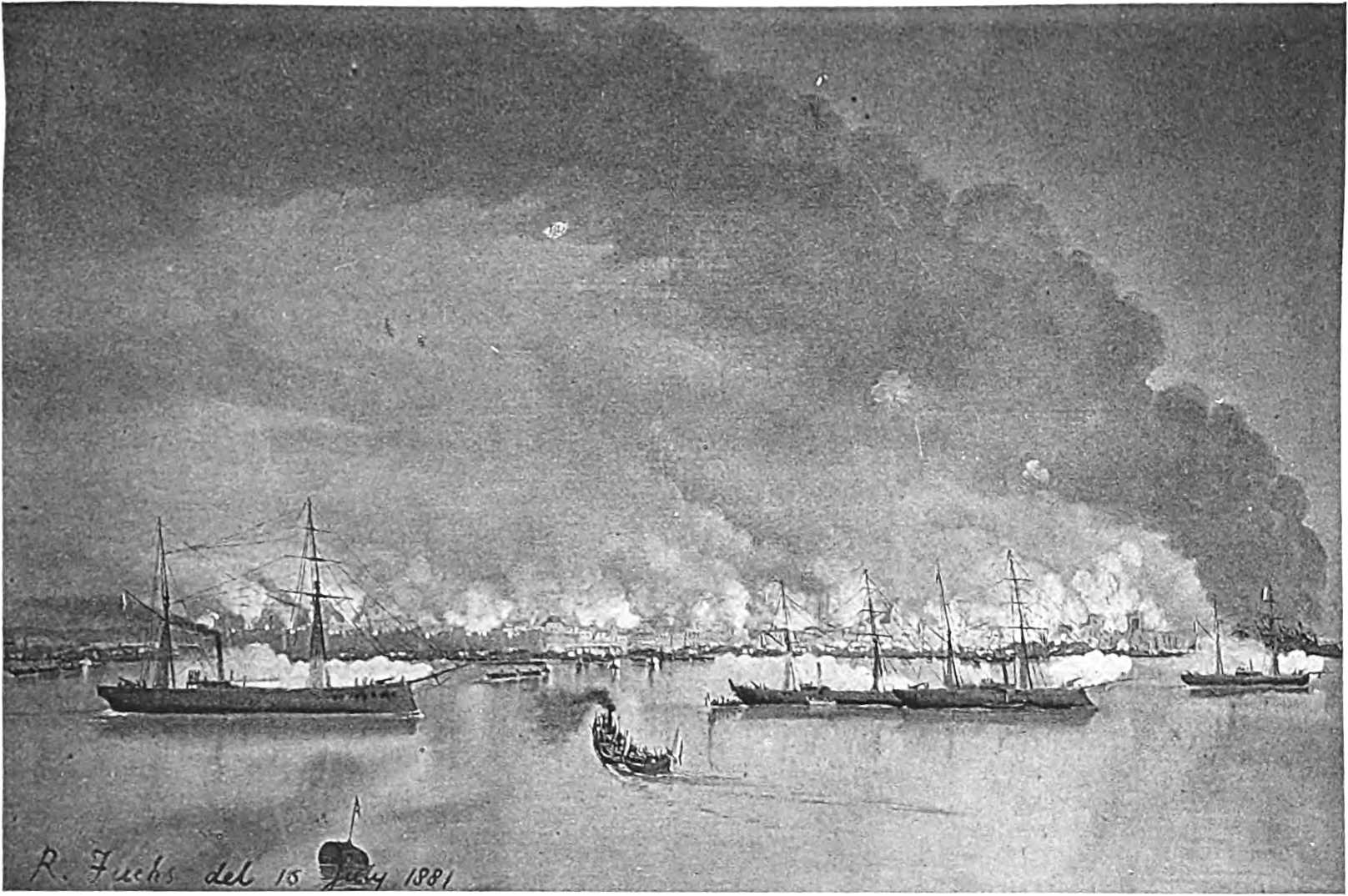
Bombardment of Sfax.
Reproduction by Maclure & Macdonald.
“July 8th.—The French are again reconnoitring near the shore. From time to time a shot is fired, and the townspeople answer at intervals, but in an apparently hopeless manner.
“July 9th.—Sfax is one of the few places in the Mediterranean where the tide ebbs and flows. When the tide was full shortly after midnight, some Maltese, on behalf of the French, went close to the shore and cut out and brought away some boats suitable for use in landing the troops. Although the watch-dogs barked loudly, no one took any notice of them, and it seems as if the town could be taken by assault, or at any rate the guns spiked with impunity. All day the French have been collecting empty boats round their men-of-war, varying this occupation by firing an occasional shell. In the afternoon all the Tunisian troops were crowded into the ‘Manoubia’ and taken back to Tunis, to swell in[26] all probability the ranks of the malcontents around the capital.
“July 10th.—Not a shot was fired all day. The Italian gunboat ‘Cariddi’ arrived to see if anything was needed by the Italian fugitives. Another small French gunboat also came in.
“July 11th.—Nothing done to-day. The inaction is evidently encouraging the Arabs, and I am sorry to see the fortifications and barricades being repaired and strengthened with my esparto bales.
“July 12th.—This day was also passed in inactivity. I received the news from Gabes that the Arab captain of one of my barques has been arrested and sent a prisoner to Ali Ben Hlifa, because he had some barrels in his boat which were supposed to indicate an intention of obtaining supplies of water for the French.
“July 13th.—At last we have some hopes that matters are to be pushed vigorously to a conclusion. This morning the man-of-war ‘Galissonnière’ and another transport arrived. The former, at 2 P.M., threw a dozen shells into the town. In the evening the quarter near the gate dividing the Moorish from the European faubourg was seen to be on fire, but it was soon extinguished, or burnt itself out.
“July 14th.—In the forenoon six French men-of-war (the ‘Colbert,’ ‘Trident,’ ‘Marengo,’ ‘Surveillante,’[27] ‘Révanche,’ and ‘Friedland,’ together with a despatch boat (the ‘Desaix’), anchored in the roads. Salutes were fired, and much bunting was displayed during the day, on account of the Fête de la République. In the afternoon all the ironclads came as close as the depth of water would permit to the shore; but the attack was still postponed.
“July 15th.—The gunboats (‘Chacal,’ ‘Pique,’ ‘Léopard,’ ‘Gladiateur,’ and ‘Hyène’) shifted their position a little at dawn, and shortly after sunrise the French fleet, including even the ironclads four nautical miles away, began to shell the city and neighbourhood. There does not, however, seem to be any sign of landing. The delay has not only encouraged the Arabs here, but it has promoted the interests of the revolutionary party throughout the Regency. If a prompt and decisive blow had been struck at Sfax, the whole movement might have been nipped in the bud. The siege should never have begun until the French forces were mustered in sufficient strength and numbers to win a rapid and brilliant victory. Before noon to-day, 300 shots had fallen in different parts of the town. All the needy Maltese refugees are being furnished with supplies from H.M.S. ‘Monarch,’ and the commanders of the French frigates are following the example set by Captain Tryon. The bombardment was resumed[28] towards evening, and continued nearly all night; sleep became impossible from the constant booming of the cannon, and the sky seemed fairly a-blaze.
“July 16th.—After this terrible work of destruction had continued for twenty-four hours, the French troops landed in great force at break of day this morning, under cover of a heavy fire from the fleet. It required two hours’ fighting to gain possession of the fortifications, and even then the struggle was indefinitely prolonged in outlying houses and hamlets. By mid-day all was comparatively quiet. At the time of the landing, the esparto yards of two or three merchants were in flames; but our stores do not appear to have taken fire. Various estimates as to the loss on both sides have been made, but no two agree. Over a dozen French soldiers and marines, including an officer, have been interred in the Christian burial-ground, but others have shared undoubtedly a common grave with the Arabs in the trenches before the town. The resistance was as brave as it was hopeless, but no amount of personal courage can compensate for the use of weapons fit only for old metal-dealers or curiosity shops. In the narrow streets of the native town, house after house was only occupied after a desperate hand-to-hand conflict.”
· · · · · · · · · ·
[29]The sequel to the fall of Sfax I shall tell in the next chapter. There can be little question but that the delay in effecting the capture of the city to a great extent destroyed the moral effect of the achievement when it really did take place; instead of being the end and extinction of the insurrection, it became, as it were, the beginning of a race contest, the termination of which is still apparently in the future.
A humble poet has already sung the siege of Sfax. An honest tar, by name John Root, united on board H.M.S. “Monarch” the functions of able seaman and poetaster. On returning to Malta he published his “Bombardment of Sfax” in a leaflet, entitled “Thoughts and Facts from a Sailor’s Pen,” and if John’s quantities are somewhat rough and eccentric, his appreciations of what he saw are almost as correct as Mr. Galea’s. I quote a few verses, which tell quaintly enough in a few words the tale of the sad fate of Sfax:—
[31]CHAPTER XXVII.
LOOT.
Mr. Galea once more comes to my assistance and lends me his journal to write the story of the sad sequel to the capitulation of Sfax. My readers must remember that he was an eye-witness of most of the facts to which he speaks, and in justice to him I must say that his narrative is fully borne out and corroborated, not only by Mr. Consular-Agent Leonardi’s official reports, but by a mass of evidence tendered before the International Commission appointed to investigate the circumstances on the spot. If this were not the case, I would willingly pass over in silence the disagreeable subject of the sacking which followed the shelling, and which has given rise to so much heart-burning on all sides. Loot in the hour of victory was not first invented at Sfax, its occurrence is the rule rather than the exception in the annals of warfare, and as few countries can fairly throw a stone in the matter, I fail to see that it in any way[32] involves the national honour of France, or affects the reputation of anybody beyond those immediately concerned in the incident I am about to speak of. There can be no doubt whatever that the French soldiers who drove the Arabs out of Sfax on the 16th July 1881, followed up their triumph by an almost indiscriminate pillage of both the European and Arab quarters of the town. What was done happened in the face of day, and can neither be gainsaid or denied, and the subsequent attempts to minimise the transaction were at once unworthy and useless. Still more so is it censurable, to have postponed the relief of the sufferers indefinitely, and to endeavour to wring the compensation from the Arabs, who are nearly all the debtors of the persons who have been more or less ruined by the events in question. To my mind, these things are a far greater blemish to the good name of France than the excesses committed by her troops in the flush of success or the intoxication of conquest. With those few observations I return to Mr. Galea’s diary:—
“July 17th.—This morning I went on shore, accompanied by my assistant, Mr. Leadbetter, and the master of the British ship ‘Agnes.’ My first visit (after attending the funeral of some of the French soldiers who had been killed) was paid, naturally[33] enough, to my own business establishment. Everything movable had disappeared, and the yard was occupied by the French troops. Leaving the place, we next entered the European faubourg. Most of the houses were much damaged and knocked about by the shells, but on the pretext that some Arabs had fired from the dwelling of Mr. Gili (a Maltese merchant), an order had been given to break open the doors of every habitation in the quarter, and as soon as this was done a general pillage ensued. I was the unwilling witness of all that happened. The soldiers took or spoiled everything they could carry away, and broke or defaced what they were unable to move. None of the officers seemed at all disposed to interfere, and the whole business was a sad contrast to the measures taken by the insurgents to preserve our property, and was the more unjustifiable, as the Moorish quarter afforded a sufficiency of butin. The loss will of course fall on the British colony, and is a sad and unexpected aggravation of our privations during the past fortnight. Several liquor stores were emptied of their contents, and all I can say is that it is fortunate the Arabs did not resume the contest.
“July 18th.—The loot continues unabated. An order has been issued forbidding soldiers to enter houses unauthorised, but nobody attends to it, nor[34] is any attempt made to enforce it. I am, however, taking careful note of all that happens connected with this ruinous business. Caid Jelluli has not left the ‘Alma,’ but he has sent a letter, telling the Cadi and Mufti to come on board, at the head of a deputation of forty preceded by a white flag, to treat for terms, and informing them that unless they do so, the French will march into the gardens and attack everybody they come across.
“July 19th.—This morning I went to visit the great mosque. Its minaret is disabled, and it is turned into a barrack. I saw the soldiers cooking in various parts of it. Throughout the Moorish town the traces of the sack were painful to witness. What was not carried away from the shops in the bazaars, was thrown out into the streets. I saw title-deeds, bonds, and valuable papers lying amidst heaps of groceries and piles of stuffs. Although the former could never be replaced, and their loss might injure Moors and Christians alike, several of these miscellaneous collections of litter were deliberately set on fire. Valuable Arabic MSS. were torn up and their pages distributed as souvenirs of the siege—and, I presume, the sacking—of Sfax.
“July 20th.—The deputation demanded by Jelluli went out to the ‘Alma,’ and I believe all the Moors[35] who will bring their families are to be allowed to return. At any rate in the evening several of the native residents perambulated the Arab town calling out in a loud voice that all persons concealed were to come out, and that those who did so would be safe. Some eighty men were collected by this means, and then conveyed as prisoners on board the men-of-war. Three houses, the inmates of which declined to comply with the invitation thus given, were mined and blown up. It is only now that one can gradually obtain details of what really happened on the eventful 16th July. In addition to the struggle in the town, it appears that there was a regular battle fought in the country outside it. Many well-known Arab chiefs died fighting bravely; Ghasim Ben Shirouda, lately Hlifa of the Mitelit, his brother Sheikh Salah, Ali Ben Ardorri, son of a Hlifa, Sheikh Sesi Ben Muhamed, Sheikh Seyd Ben Muhamed, and Muhamed Ben Hdir were all shot down. In this engagement the Neffet were commanded by Ali Ben Hlifa, and the Beni Zid by Sherif-ed-Din. The Mitelit were led by Ardorri Ben Amor. These tribes alone took an actual part in the engagement.
“July 22d.—The mosque has been restored to the townspeople, but they seem in no hurry to take it. It will require a great deal of cleansing, and there[36] is an unexploded shell still in the top of the damaged minaret, which indisposes the muezzin to make the usual calls to prayer.
“July 24th.—The French fleet (except the ‘Alma’) left for Gabes, and H.M.S. ‘Monarch’ for Susa.
“July 25th.—We received to-day news of the occupation of Gabes yesterday. The inhabitants of the two villages near the shore, Jára and Menzel, have always hated each other, and generally differed in politics. In the present instance the former declared for the French, and the latter for the Holy War and the Prophet. After throwing some shells into Menzel, the French landed and occupied it. There was only a faint resistance from the insurgents amongst the palm-trees. Before evacuating the place the Arabs killed five Jews who had remained there. Later in the day the French troops left Menzel and encamped on the sea-shore, as they were not in sufficient force to resist an attack which was apparently meditated. No sooner had the French quitted it, than the Arabs returned, and set fire to most of the houses in the place. Menzel was therefore twice occupied by the insurgents and once by the French in a single day. The Kisla or castle of Gabes, an isolated fort between Menzel and the sea, surrendered in the morning. The officer in charge and his prisoner, the well-known[37] Alela Bizzai,[5] were received on board the men-of-war. No sooner had the French left the Kisla, than the Arabs rushed into it to seize the guns and powder. A few minutes after they entered it, a terrific explosion took place, and 300 persons at least were buried beneath the ruins or blown to pieces. The causes of this disaster are not precisely known, but it is supposed that one of the shells, which had been thrown into it prior to the exhibition of a white flag, suddenly burst, and ignited the gunpowder contained in a store beneath the fort. At the very same time (July 24th), 1000 French soldiers landed in the island of Jerba without exciting any hostile demonstration. The fort was surrendered at once, and the French flag hoisted upon it. Several Maltese families, who have for some weeks been living afloat, were now enabled to return to their homes.
“July 29th.—News reached Sfax to-day that Sheikh Khemoun, with the Bimbashi and some other persons, who had taken a prominent part in the defence[38] of the town, were proceeding to Tripoli overland. Caid Jelluli has now returned to the post from which he was ejected by the Bimbashi, but under a salute from the forts, and through a lane of French soldiers. He says he is resting, and cannot attend to public business. I am sorry to say that even now both wanton destruction of property and pillaging are still going on. As I am sure that this matter must sooner or later become the subject of much controversy, I shall write down some observations about it. In the first place, the care taken by the Arabs to protect property, after our departure, was a matter of public notoriety, as well as the draconic justice done by the Council of Forty. All houses occupied immediately after the landing by conscientious and respectable French officers were restored to their owners undisturbed, so much so that in one of them some money and jewellery were actually found on the table. A French doctor, who, as soon as he heard the fatal order to pillage, ran to his house and hung out a tricolour flag from the window, escaped without any loss, and the protection given him was also extended to a warehouse which happened to form the ground-floor of the building. Again, the telegraph office was not even touched, which would certainly not have been the case if the Arabs had commenced to destroy property[39] in the European quarter, nor would many stores of grain and oil (favourite object of Arab raids) have remained intact. On the 17th July, when we first landed, we all saw the soldiers with our own eyes entering shops and stores, and either looting or destroying everything they came across. As in the case of the Arab town, the streets were littered with heavy merchandise and papers of all descriptions, including business books, obligations, &c., and on the following day, to make matters worse, these heaps were carried out of the gates and burnt. Two days later, the notice of the colonel against pillage was issued, but it only diminished the looting and made it more secret. On the 21st July, Mr. Montebello, accompanied by Mr. Leadbetter, went to visit a shop belonging to the former, and found that, the door having been forced, a number of soldiers were helping themselves to its contents. A sentinel looked in and said nothing. An officer was sent for, but he confined his action to telling the sentinel not to let any more soldiers enter the place. Mr. Cardona made similar complaints as to what had happened in his warehouse. When Mr. Leadbetter examined one of our own houses on the 17th July, he found the strong-box, his desk, and books untouched. Returning two days later, he was surprised to see the safe thrown down and[40] forced, his desk rifled, and two soldiers playing with a valuable sewing-machine. He then endeavoured to prevent further damage by getting the doors sealed up, but on the 22d July he again found the seal broken and many other objects, including his clothes, gone. On the 30th July, ten days after the landing, I saw Mr. Consular-Agent Leonardi’s house being rummaged by soldiers, while at the same time their comrades had turned the square in front of the half-demolished Christian church into a loot bazaar. This traffic was witnessed by me from the first day of the occupation. Tunisian money was exchanged for napoleons at a loss of 40 per cent.; and I saw the Austrian Consul’s uniform sold for a mere trifle. The head of the custom-house informed me that the building was deliberately looted, notwithstanding his appeals to obtain its immunity as a public institution. When I asked him about this some days after, he was prudently reticent. There were many refugees on board the ‘Alma’ who saw the French writing letters on the valuable stamped paper, and when the marines exhibited their spoils, there was a pretty general chorus of ‘There are my books,’ ‘There are my clothes,’ and ‘There are my pictures,’ on the part of the victims. I have already described the measures taken by the Arabs to preserve order and[41] respect for the rights of property, even to the extent of insuring the continued payment of the Government dues, and it seems to me that if they had once commenced to pillage, everything would have been carried away into the interior. Another wanton waste caused by the French garrison is the indiscriminate destruction of everything which can possibly be burned. The item fuel seems not even to enter into the calculations of the French commissariat, and anything handy is at once chopped up to supply the want. The damage thus done has been enormous, whereas supplies of firewood are obtainable in the gardens quite close to the town. A great deal has been made of the discovery of some boxes belonging to M. Mattei in the house of Sheikh Khemoun, but they were unopened, untouched, and evidently brought there for fear, lest the mob might not be over-scrupulous in the matter of French property. Besides scores of eye-witnesses, there is other testimony as to nothing having happened before the landing. A Moor, by name Hàj Hmed Maala, found that a Maltese gardener and his large family, who lived in an outlying garden belonging to Mr. Gili, were in imminent danger, so he dressed them in Arab clothes and concealed them in his own country-house till he was able, after the capture of the place, to deliver[42] them up to Mr. Leonardi. This man (the Maltese gardener) says, that when the Arabs wished to pillage the European suburb, they were prevented from doing so by the action of the townspeople. The old bell-ringer of the Christian church lived all through the siege in a hole beneath the staircase of the tower, and was fed by the Arabs, who, he says, treated him kindly, and did no harm to anything. Their stories are fully confirmed by a number of Jews who lived on shore the whole time, and who were injured as regards neither their persons nor their property. In short, the Maltese colonists of Sfax have been the chief sufferers by the pillage of the town, committed in the manner I have described. Some of them have indeed lost their all; hardly one has escaped unscathed. As an eye-witness I have recorded what really happened in broad daylight and in the sight of hundreds of people. The only hope of the half-ruined British community is in the support which they feel sure their claims must inevitably receive from the English Government, and in the justice and equity of the International Commission which we hear is to inquire into the whole matter.”
· · · · · · · · · ·
One of the most disinterested witnesses of the sacking of Sfax is the poet before-the-mast, John[43] Root. I am not aware whether he was examined by the commissioners, but he writes with an evident knowledge of what took place:—
As I said before, the stamp of truth in John Root’s writings amply atones for his rugged metre and peculiar rhyme.
· · · · · · · · · ·
The International Commission at Sfax is now also a matter of history. It was composed of[44] Captain Count Marquesac of the “Reine Blanche,” President; General Sy Muhamed Jelluli; Captain Tryon, C.B., of H.M.S. “Monarch;” and Captain Conti of the Italian frigate, “Maria Pia.” After sitting for several weeks it was abruptly dissolved in October, because apparently the English and Italian members were unable to avoid the inevitable conclusion as to the authors of all the mischief. At the beginning of the present year, the Arabs of Sfax were compelled to contribute to a heavy “war indemnity.” Most of them were already the debtors of the much impoverished Maltese merchants, and the levy in question effectually prevented their satisfying the creditors for an indefinite period. In the result the Maltese first lost their goods, and then the possibility of obtaining the payment of their just debts. It is almost incredible, but it is nevertheless true, that notwithstanding the numerous sittings of the Commission, and the fact that the sums since collected have been very considerable, up to the present time not a single farthing of compensation has been paid to the unfortunate persons, who, after watching the shelling of their houses and shops for a fortnight from a distance, only returned to find them pillaged by the very people who professed not only to protect them, but to be the pioneers of a sentimental mission of political civilisation.
[45]Before going back to Northern Tunis I wish to bring the history of events on the southern coast down to the time of my own visit there at the end of November 1881. The French now occupied the town of Sfax, a spot on the sea-coast at Gabes, and the island of Jerba, but this was all. Outside these places the Arabs held undisputed sway, and no peaceful citizen could go beyond the French camps with impunity. The interval between August and November was passed chiefly in fruitless reconnaissances on the part of the French, and daring raids and night attacks on the side of the Arabs. As early as the 31st July it became again necessary to engage the Arabs in force at the village of Menzel. General Logerot’s arrival did not mend matters. The villagers of Jára, who had done nothing at all, and had “received the French as brothers,” were fined 20,000 francs, and ordered to induce their co-religionists at Menzel to submit to the French, under pain of a fresh bombardment and the destruction of the great Kouba of Sidi Bulbeba ou the neighbouring hill. As there was nothing left to bombard in Menzel, and as everything valuable had been taken away from the shrine of Sidi Bulbeba except his bones, the insurgents only laughed at the menaces. There were now over 3000 troops at Gabes, and the weather was oppressively[46] hot, yet they were unable to establish communication with the freshwater springs three miles off, and were compelled to drink the ooze of the muddy river, which was impregnated with magnesia and soon engendered dysentery and fever. All stragglers from the French camps were pitilessly massacred, and the sentries were often shot on guard. “On the night of the 10th August,” writes Mr. Galea, “the Arabs surprised the French camp, cut down the sentries and began killing the soldiers as they lay asleep. Before anything could be done they had rapidly retreated. The French admit a loss of twenty killed, but I have been told privately that it really exceeded that number.” Sickness broke out both at Sfax and Jerba, decimating in a terrible manner the garrison in the last-named island. Raid after raid took place around Sfax, but beyond shooting two obscure individuals on the 27th August on an equivocal charge preferred by the Vice-Consul Giannino, of calling out jihad, jihad (Holy War), very little was done. At times the insurgents approached so near to the town that they could be fired upon from the walls, and as soon as any tribe made terms with the French, it was immediately attacked by the insurgents. The “friendly Arabs” used to bring their dead and wounded as far as the ramparts, and cry in vain for help and assistance.[47] If it was General Winter who defeated the first Napoleon in Russia, it was certainly General Summer who now came to the assistance of the Arabs in Southern Tunis, with dysentery and typhoid fever as his aides-de-camp. While MM. Ferry and Saint-Hilaire were prudently consulting bourgeois susceptibilities by hastening on the elections to the French Chambers, while M. Roustan was obtaining concessions for his friends, and telegraphing reassuring platitudes to the Foreign Office, and while the Agence Havas was informing the French public that “our troops found the village abandoned, and returned to Susa, bringing with them a few hens, five cows, and five prisoners.” “It was a splendid operation,” it is added, “perfectly well conducted, and one which does the greatest honour to our young troops” (“Daily News,” October 3d, 1881),—the whole of Southern Tunis was abandoned to the most appalling anarchy and disorder, while the greater part of the northern part of the Regency was quickly preparing to follow suit.
[48]CHAPTER XXVIII.
ALARMS AT THE CAPITAL.
In the early days of July, M. Roustan succeeded in bringing to a luxurious villa at the Marsa a powerful and zealous ally. At his suggestion, and through French influence, Monseigneur Charles Martial Allemand Lavigérie, Archbishop of Algiers, superseded Monsignore Fra Fedele Suter, Bishop of Rosalia in partibus, as Apostolic Administrator of Carthage and Tunis. Archbishop Lavigérie was essentially a prélat de combat, and his militant missionaries have been for several years gradually gaining influence in Algeria, Tunis, and even Tripoli. The French Government could not possibly have obtained more useful and uncompromising auxiliaries than these white-robed and red-capped frères d’Afrique, who, under the harmless garb of theology, pill-making, and tooth-drawing, are preparing the path for French conquests in the unexplored regions of the Sahara. The practical head of an eminently practical confraternity,[49] Archbishop Lavigérie had been initiated, by a prolonged residence at the Vatican, into the useful art of combining doctrine and politics, and came to Tunis fully determined to acquire a lion’s share in the powers of the Protectorate. Such was the enthusiasm with which he was endowed, that three years before, he had succeeded in reducing even the crown of martyrdom to the matter-of-fact condition of a marketable commodity. In the quarterly issue of the Bulletin de l’Œuvre de Saint-Augustin for January 1878, I find him publishing the following notice: “Adoptions of Missionaries.—Our associates are aware that by paying the sum of 800 francs, they can support for a year a missionary in Africa. They become in this manner partners in his works and meritorious actions, as well as in his crown of martyrdom, as happened in the case of the charitable benefactors, who adopted the three missionaries who died for the faith on their road to Timbuctoo.” While the Pope is sending a Cardinal’s hat to the pioneer of French influence and martyrdom-by-proxy in North Africa, the Pacha of Tripoli is threatened with an incursion of French cavalry (not indeed to punish the Khamírs), but to chastise the Towaregs on account of the untimely fate of three other missionaries, who, notwithstanding the[50] most explicit warnings, insisted on travelling from Ghadámes to Ghát. This peculiar feature of French policy was clearly foreshadowed and described in the correspondence of Sir Thomas Reade nearly forty years ago; and to such an extent has it been now carried that the Bey, the French Resident, and the Cardinal Archbishop may, at the present moment, be correctly described as the governing triumvirate of that portion of the Regency of Tunis which is not in the hands of the insurgents. Before the summer heat had fairly set in, M. Roustan had rewarded his friends, harassed his enemies, and reassured M. Saint-Hilaire; but the unexpected outbreak, in the early days of July, of a widespread revolution throughout the length and breadth of the Regency, entailed a very serious interruption in his plans, as well as in those of his political superiors.
First came the risings at Sfax, Gabes, and Jerba, of which I have already spoken at length. On the 4th July, information reached Tunis that the Arabs near Monastir had already defied the Bey’s authority, and had murdered three Europeans in a neighbouring village. The same evening the French Captain Mattei was assassinated close to the Bey’s palace and the Manouba camp. His murderer managed to escape, but an innocent Arab[51] paid the penalty of the crime. The unfortunate boy, who was shot by mistake, is buried in the ditch near which he fell, and his mother is a raving lunatic in the Arab madhouse. The complications, however, did not seem to disturb at once the unlimited power wielded by M. Roustan. It was just now that he interfered to prevent the sale of landed property by an English subject to French bankers, because his consent was not previously obtained to the transaction. The matter was denied at the time, but the fact rests on the testimony of M. Valensi, the representative of the legendary French colony, and the zealous framer of chronic addresses in favour of M. Roustan, and who himself telegraphed to this effect to the would-be purchaser.
Every day the news of some fresh accession to the ranks of the rebels reached the Bardo. On the 18th July, while the Bey was listening to the details of the capture of his “faithful town of Sfax,” a band of 800 men belonging to the Zlass tribe, carried off 2000 of the royal camels from their pasture-lands, not two miles from the Manouba camp and the Kasr-es-Said gardens. A posse of Arab cavalry entered Kairwán and collected vi et armis the public taxes, while another party invaded the Enfida and settled for themselves the[52] vexed question of Hanafee and Melaki, by driving everybody out of it. Raids on the farms surrounding Tunis now became of daily occurrence, and at this juncture the Prime Minister Mustapha hurried back to Tunis as fast as a despatch-boat could carry him. But the position grew daily more and more serious; the Tunisian soldiers who had cheered in the very presence of the French at each halting shot fired by the Bimbashi of Sfax, came back to their quarters at the capital only to desert. The Bey was now urged to adopt the very remedy which had been ridiculed by M. Roustan four months before. He was told to call out the native army and form “a camp,” but his power and influence were both hopelessly ruined, and he was regarded as a traitor and a coward by every honest man amongst his subjects. Even while M. Roustan and General Logerot were elaborating their plans of a Tunisian expedition, hundreds of the rough Arab soldiers were taking their road southwards, calling out to every one they met, “We will fight for Ali Ben Hlifa and the Sultan.” The truth could no longer be ignored; revolution and anarchy now prevailed both in Southern and Central Tunis. French troops were every day returning to the Regency, but the heat still favoured the Arabs. On the 24th July half the Bey’s bodyguard was[53] missing, and the farm of Mustapha between Mater and Bizerta in Northern Tunis was pillaged by Arab cavalry. Under these circumstances Sy Ali Bey, now civilised and friendly, found the task of organising a native force one of peculiar delicacy and difficulty. The soldiers, who had not as yet actually deserted, were far more likely to keep him as a hostage or convey him against his will to the tents of Ali Ben Hlifa, than to join him in attacking their comrades or co-religionists, for whose proceedings they entertained a lively sympathy.
On the 26th July a band of insurgents could be seen approaching Rades, which, as I have said before, is equally visible from Tunis and Goletta. A panic seized on the inhabitants of both places; business was suspended, shops closed, boats hired, and a general stampede prepared. The Bey ordered the bridge between Goletta and Rades to be broken down, and the passage to be guarded by artillery. A little later in the day the news came that a well-known Greek gentleman had been murdered in an outlying farm. The excitement then reached its culminating point, and an Arab attack was really apprehended. People in Tunis decided to fly to Goletta, and persons in Goletta determined to take refuge in Tunis. A crowd of Tunisian fugitives arrived by train at Goletta, but[54] only to meet another mob of refugees waiting impatiently to take the return train to Tunis. The meeting of the two crowds formed a very amusing tableau, and the more so because a moment’s reflection must show that any attempt to invade two walled towns by the Arabs of the interior would be wholly out of the question.
Up to the present time the Tunisian difficulty, as far as Europe was concerned, had only affected two platonic overthrows of the Italian Cabinet: in France everything had gone smoothly, and the Treaty of Kasr-es-Said had been ratified almost by acclamation. The tide, however, had now turned, and MM. Ferry and Saint-Hilaire knew it; the expedition, shorn of its tinsel and trappings, was becoming day by day more unpopular, and the opinion was fast gaining ground that the French Protectorate over Tunis was a white elephant of a very costly and unmanageable character. The time was at hand when Tunis was to become an unmistakable factor in the politics of France, and to make matters worse, Bou Amema was threatening simultaneously a very serious disturbance in Algeria. The general elections were already fixed for the 14th September, but if things meanwhile grew worse in Tunis and Algeria a disaster might pretty confidently be anticipated. It was therefore[55] decided to hasten the elections by a full month. “If in September,” wrote M. De Blowitz, now completely disenchanted, on the 27th July, “the country were confronted with a serious African campaign, the elections might be seriously compromised, and a formidable argument afforded to the Opposition. Consequently, notwithstanding all prior arrangements, it was decided that the elections should be held without delay, before any African troubles had time to break out.”
On the very same day, the town of Hammamet, fifty miles from Tunis, underwent an “African trouble” of a very disagreeable nature. It was attacked by Arab horsemen, who carried all the cattle belonging to its inhabitants away into the mountains, and pillaged a house belonging to the British Consular Agent, Mr. Cacchia, who was doomed to be one of the greatest losers by the insurrection. The fast of Ramadan now began, but the Bey reflected on the possibility of sharing the fate of his camels, and decided, for the first time in his reign, to spend the month in the comparative security of the pavilion on piles at Goletta. Up to this time only 400 irregular militia could be collected to form the nucleus of Sy Ali Bey’s contingent, and the regular army was reduced to about fourscore men. On the last day[56] of July things reached such a pitch, that twelve soldiers had to be sent from Tunis to replace those who had deserted from the guard which protected the pavilion on piles. A few hours after their arrival they also deserted, together with one of their officers.
[57]CHAPTER XXIX.
AUGUST 1881.
The position of affairs at the beginning of August was singularly unfortunate. Fever and dysentery now began to make sad havoc amongst the French troops, almost wholly unaccustomed to the tropical heat of a Tunisian autumn; raids on the homesteads almost in sight of the walls of Tunis increased and multiplied, and the Bey was making feeble efforts to raise a small force to send to Testour “to protect the French railway,” and to borrow the money wherewithal to pay the cost of it. On the 2d of August, an unbroken Moslem supremacy of three centuries terminated in the landing of two battalions of French troops at Goletta, and even the presence of the Bey’s band failed to attenuate the real state of the case in the minds of the Arabs. Just after the French had passed through the streets, the steamer from the coast arrived, bringing on it 300 of the Tunisian soldiers, who had lately deserted, and who had been[58] persuaded to return. As soon as they saw what had happened they became very excited, and openly said they would again desert, as they could not be wanted if the Bey called in French troops to “protect” him. From this time French troops began to land in great numbers at Goletta, and on the 6th August, 2000 men encamped at Hammam-el-Lif on the other side of the bay, to remain there till the arrangements for the great Kairwán expedition, which was to calm all parties, including the French electors, were completed. Meanwhile the insurrectionary movement in Northern Tunis grew apace. The insurgent Arabs made a night attack on Medjez-el-Bab, ill-treated the townspeople, carried away their cattle, destroyed a portion of the subsidised French railway, and tore down the telegraph wire and posts. More pressure was now put on the Bey to send his “army” towards Medjez and Testour, but his “protectors” would not come to his aid, and he only succeeded (in spite of the presence of several French financial houses in the country) in scraping together a loan of £37,000, at an annual interest of fourteen per cent.
At last 500 soldiers belonging to the irregular Tunisian militia were sent one march forward towards Testour, but over 200 deserted en route.[59] The 300 men who came back to Goletta from Susa likewise disappeared.
About the middle of the month the Arabs around Susa, and between Susa and Kairwán, assumed a menacing attitude, and many of the tribes between Tunis and Algeria prepared to rise. To add to the difficulties of the situation the telegraph wires were again and again cut. Although reinforcements continued to arrive, and General Saussier came on the 13th August to study the campaign, now become inevitable, no movement could be executed to check the depredations of the insurgents. Even the very day after the Commander-in-chief’s arrival, and almost in his presence, fifty of the heavily chained convicts, confined in a pestilential dungeon beneath the Goletta fort, contrived to break their fetters, and about dusk rushed into the street. A cry was at once raised that the Bedouins had entered the place; shops and houses were barricaded, and the panic palpably extended to the French officers and soldiers, who, in the cool of the evening, were discussing their absinthe or vermouth before the different cafés. The prisoners, although armed with guns, pistols, and bayonets, hurt no one, and quickly gained the open country. As soon as the alarm subsided, everybody was becomingly valorous after the event, but as the Bey did not wish any[60] French soldiers to join in the pursuit, only a few Arab irregulars, armed apparently with poles and sticks, made a vain and burlesque attempt to capture the fugitives.
The Austrian Consul-General, Herr Theodorovich, happened to meet the runaways outside Goletta, and fled precipitately to the French camp near Carthage, bringing the alarming news of the “taking of Goletta by the insurgents.” The soldiers had already been got under arms, when the true state of the case transpired, but it was thought necessary to provide the representative of Austria with a suitable guard to accompany him back to Goletta. This serio-comic incident indicates sufficiently the extent of the insurrectionary movement, even close to the capital itself.
The deserters from the Tunisian army seem to have nearly all joined the insurgents threatening Susa, and the Governor, General Bacouch, now acknowledged that his authority outside the town walls was gone. On the evening of the 14th August, a Tripolitan Arab appeared in the streets of Susa with a drawn sword, and with the ominous cry of “jihad! jihad!” stabbed to death an unoffending old Maltese tradesman in his own shop. The shouts of the murderer had been echoed by others, and there is no doubt but that the accidental[61] arrival of H.M.S. “Monarch” and the calm presence of mind of Captain Tryon, alone saved the European colony from some terrible disaster. Captain Tryon at once prepared to land his marines, but before this could be done, Sy Muhamed Bacouch had succeeded in restoring order. The assassin was sent to Tunis and subsequently hung.
Having arranged the plan of the Kairwán crusade, General Saussier returned to Algeria on the 19th August, leaving Arab anarchy rampant and unchecked, until cooler weather should allow the realisation of his projects. Urgent letters from the Governor of Kairwán, however, now rendered some kind of immediate movement necessary. About 2000 Tunisian irregulars were collected; and on the 20th August these started in the direction of Testour, commanded by Ali Bey and the Generals Ahmed Zerouck and Ali Ben Tourkia. Two French columns of 1500 each started about the same time for Hammamet and Zaghouán. Little progress could be made by the Tunisian force, as all the baggage camels had been stolen in the great razzia of the Zlass tribe in July.
The town of Susa was now practically in a state of siege. A Maltese, who went to his garden outside the walls, was at once shot dead, and as the[62] villagers and tribesmen had agreed to join in an attack on the town, the gates could only be opened at intervals. The Arabs speedily contrived to cut off communication between the Hammamet and Zaghouán columns and Tunis; several convoys of carts were intercepted and robbed, and the drivers escaped with the loss of their property and horses. A Maltese courier was killed close to Zaghouán, and a native guard who accompanied him was also shot. The relatives of the latter were carrying away the body, when some more carts, now escorted by French troops, appeared. Unluckily enough the mourners were mistaken for marauders, and shot by the soldiers before any explanation could be given.
The Hammamet column under Colonel Corréard now sustained a severe check, and was finally obliged to fall back towards Hamman-el-Lif. This was, perhaps, the only success gained by the Arabs in a fair fight during the whole campaign, and they certainly made the most of it. Ali Bey seemed to be unable to quit the vicinity of the capital, and to add to the perplexities occasioned by the equivocal attitude of his “irregulars,” he received a letter from Ali Ben Hlifa, saying that he would be attacked by the Arabs as an “infidel and a Frenchman” at the first opportunity.
[63]CHAPTER XXX.
THE COMING CAMPAIGN.
On the 1st September Colonel Corréard’s column was back again at Hamman-el-Lif, to “revictual and complete its munitions before recommencing its march.” Not being a French elector, and having already learned something of the significance of official verbiage, I thought it best to go to Hamman-el-Lif and see what had really happened. The very appearance of the soldiers betokened a sharp encounter at close quarters with the Arabs, and I found no difficulty in gleaning the details of the engagement. The French troops had already sighted Hammamet, when they found the surrounding olive groves alive with Arabs. While the latter checked their progress by a sharp fire, other bodies of insurgents collected in their rear, and threatened to cut off all communication with Tunis. In this predicament Colonel Corréard asked the co-operation of a troop of 500 Tunisian irregulars encamped in the neighbourhood, but as the commanding officer declined to comply with the[64] request in the absence of instructions, it was decided to fall back to “revictual and complete munitions.” During the retreat the Arabs made constant attacks on the column, notwithstanding that it was protected by artillery and mitrailleuses, and in spite of the heavy loss they necessarily sustained in each assault. The French at length regained their old camp, after a most harassing and perplexing march. In no country does news spread with more mysterious rapidity than amongst the Arabs, and the consequences of Colonel Corréard’s retrograde movement were soon felt; the position of the Zaghouán column became critical, and even the Bizerta road was now no longer safe for foot passengers. Troops were then sent to Hammamet by sea, and the French flag was hoisted on the old fort, but matters can hardly be said to have mended; the Arabs devastated the country up to the very walls of the town, and Colonel Corréard did not think it prudent even to attempt to effect a junction with the garrison. Ali Bey’s baggage trains now formed the constant object of attack, and he was finally obliged to halt at Medjez-el-Bab, in equal trepidation as to the attitude of the Arabs and the feelings of the troops he commanded. In the midst of this confusion, the Prime Minister announced a second summons to Paris.
[65]On the 9th September, 2000 troops arrived at Goletta from Toulon, and again started to effect on the following day the occupation of Susa, where no resistance was now apprehended, as the imprisoned townspeople were perhaps more afraid of the Arabs of the interior than they were of the French. The number of troops already in the country exceeded 20,000 men, yet it became increasingly difficult to maintain communication with the column, now intrenched in a strong position at Zaghouán. On the 10th September, two mounted Arabs were sent thither from Goletta with despatches. One of them returned the next day, and reported that when about half way they had met a small body of French soldiers pursued by a large number of Arabs. The man stated that he saw several Frenchmen killed, that his companion was shot down, and that he only escaped by the fleetness of his horse. The same day the inhabitants of Jedeida and Tabourba abandoned their houses in consequence of the approach of the Arabs in force.
On the 12th September, Mustapha Ben Ismail was requested or permitted to resign his Grand Viziership, to the satisfaction of everybody except the Bey, who refused to be comforted. The intrigues which preceded this event, and the causes[66] which directly led to it, are equally a mystery. From the 12th May Mustapha had apparently served France, and, what is more material, M. Roustan and his friends, with his whole heart; he had made a profession de foi to MM. Grévy and Saint-Hilaire face to face, and had been raised to the highest rank in the national order of chivalry; but notwithstanding all this he fell. Some say the fall was the leaving of a sinking ship in disguise. At any rate, it is certain the ex-Prime Minister had not neglected his opportunities; trading on the doting liberality of his master, he had, in twenty years, accumulated a princely fortune, after the manner of the heroes in the Arabian Nights. The spoils of disgraced favourites, the lands of the Hassanite family, and even the Tunisian crown jewels,[6] had found their way into the hands of the captivating but avaricious Mustapha. It was useless for the heirs to the throne to protest, for the splendid estates almost forced on the favourite by his indulgent sovereign were now being exchanged for other property in a fashionable quarter of the French metropolis, and he was preparing to leave an ungrateful country behind him. M. Roustan had gone to Paris for a few days at the end of August, and the order for Mustapha’s removal came[67] from thence. Everything beyond this bare fact was religiously kept secret, but by a strange coincidence, his departure was so timed as to enable him to meet the Pro-Bey at Marseilles. On the 21st September there was much weeping in the palace at Goletta. The Bey hung round Mustapha’s neck, and seemed to care far more for the loss of his favourite than he did for that of his crown. At parting he gave him an almost peerless black diamond, once in a Spanish monarch’s possession, and the great emerald which had adorned the breasts of the Hassanite Beys of Tunis for more than a century. Mustapha went to Paris, and some months later returned thence. As an active participator in Tunisian events he has disappeared from the scene; but in the privacy of the harem he still rules the Bey who still governs the country precisely to the extent the French Resident is pleased to permit. His constant dream is to become once more Tunisian Prime Minister; adventurers sometimes offer to help him by “moving public opinion in his favour through the press,” but he refuses to pay ready money or do anything but make promises. With all his faults Mustapha did his utmost to keep the French out of Tunis; and to counteract the policy of M. Roustan. His hate for France is doubtless as deep now as it was then, and[68] if any turn in the wheel of fortune weakened her influence or crippled her resources, the Republic would certainly not have a bitterer or more relentless enemy than Mustapha Ben Ismail, ex-Prime Minister of Tunis, and Grand Cordon of the Legion of Honour.
Mustapha was succeeded by his immediate predecessor, the octogenarian Muhamed Khaznadar, who in spite of his eighty years and a club foot, is almost as vigorous as when Sir Thomas Reade pulled his ear for “neglecting English interests” nearly fifty years ago. Muhamed, in accepting office, openly said that he knew the Tunisian Vizier was now a cypher, and that he should merely try to be an intelligent machine.
The state of affairs showed no signs of mending; communications with General Sabatier’s column grew more and more difficult, two entire convoys were plundered, an Italian camp-follower, a boy Odino, was roasted alive, and finally, in spite of the presence of the troops at Zaghouán, the aqueduct conveying water to Tunis was cut, and the metropolis threatened with one of the most appalling of privations. It was only four days later (September 16th), that workmen succeeded in repairing the damage, under the protection of a powerful escort.
The day after Mustapha, accompanied always by[69] Mascaro and Volterra, left for Paris, carrying with him the proceeds of most of his real estate, the first symptom of disturbances on the French railway was apparent. After devastating Tabourba and Jedeida, to the rear of Ali Bey’s column near Medjez, the Arabs forced the train to return, firing at the carriages and killing one of the Italian guards. The details of these raids and outrages now become monotonous; but, although troops continued to arrive almost daily, the moment for action was not yet come, and the Arabs under General “Summer” held almost undisputed sway in Tunis.
Towards the end of the month the weather became perceptibly cooler, and on the 24th September General Saussier, the Commander-in-Chief, once more reached Tunis. In spite of the warning conveyed by the fate of the ex-President of the Municipality, the ulema of the Regency had not been entirely indifferent to the fate of their country and the threatened desertion of Kairwán, the virgin shrine of North Africa. Important communications had been addressed to the Egyptian vernacular press, and the powerful confraternity of Sidi Abd-el-Kader el Chilani at Baghdad was, at the instance of its dependent Zaouia at Kairwán, using its exertion and great influence to prevent[70] the destruction of the sacred city. Its chief, I believe, addressed a remonstrance to the Sultan as Caliph, praying him to intercede with France on the subject, or, if necessary, to ask the mediation of the friendly Powers. The ulema of Tunis received ample proof that the matter excited great interest throughout the Moslem world. They openly said at the time that Colonel Negrier’s desecration of Sidi Sheikh’s tomb had already enabled Bou Amema to arrange his differences with the rival chiefs, and that the destruction of Kairwán would infallibly tend to consolidate the Moslem antipathy to Christian rule in North Africa, and produce a general revolt.
The French had now over 30,000 troops in Tunis; and on the 24th September I accompanied the late Commander Selby, R.N., of H.M.S. “Falcon,” to see General Logerot’s camp at Manouba. I find the following note in my journal:—“Yesterday I visited General Logerot’s camp at Manouba. The soldiers recently arrived are superior in appearance and physique to those who took part in the first expedition. A large barrack is filled with stores, artillery, and heavy ambulance waggons. As soon as the rains set in, the country between Tunis and Kairwán will become a marsh, and there are no roads. The large amount of baggage each soldier[71] is to carry, in addition to his portion of a tent, will prove as serious an obstacle to progress as it did in the Khamír country, and will place them at a disadvantage in the guerilla warfare the Arabs resort to.
“Close to the camp are the graves of seventy-four soldiers who have died since the middle of July, and who all appear to have been under twenty-four years of age.”
Ali Bey’s position at Testour, a few hours’ march from Medjez, now became a very difficult one. Ali Ben Amar, an old, one-armed Caid of the Ouled Ayar tribe, took the command of a large body of insurgents, and actually formed a regular camp at Ain Tonga, and sent a sort of ultimatum to the heir-apparent. General Ahmed Zerouck had recourse to a ruse which he had practised with much success in 1864; he invited some of Ben Amar’s followers to a meeting, and then tried to detain them as hostages. They had, however, arranged a preconcerted signal with their followers, and were promptly rescued. This led to an engagement between the Tunisian troops and the Arabs, which was represented on both sides as a victory, and gave rise to the most fantastic exaggerations. In reality, Ali Bey only defended his position, and succeeded in keeping the Arabs at bay, and nothing[72] more. He sent expresses to Tunis to ask for reinforcements and a further supply of ammunition, but before any assistance could be sent him he was still harder pressed in a second engagement on the following day. After the fighting had ceased, a portion of Ali Ben Amar’s forces was observed to move in a northerly direction, but Ali Bey was wholly powerless to control their movements. The consequences of this inability were of so unexpected and important a nature, that I reserve the continuation of the narrative for a separate chapter. On the 30th September, M. Roustan, accompanied by Generals Bréart and St. John, returned to Tunis, but the day will be always remembered as the date of the Oued Zerga massacre.
[73]CHAPTER XXXI.
THE MASSACRE OF THE GREY RIVER (OUED ZERGA).
While M. Roustan was conducting General St. John to the audience-chamber at Goletta, to receive, within twenty-four hours of his arrival in the country, the highest honours of the Nichán Iftikhar, very alarming news reached Tunis.
It appeared that on the previous day the Arabs who had attacked Ali Bey afterwards surrounded Oued Zerga, the sixth station on the French railway, some seventy miles from Tunis. Having torn up the railway line on either side of the station, and thrown the rails into the river, they attacked the station buildings, setting them on fire. The station-master, M. Raimbert, was burnt alive, and ten other employés, nearly all Maltese and Italians, were massacred. Having accomplished this terrible act of vengeance, the Arabs retired. All traffic between Tunis and Ghardimaou was immediately stopped. The Minister Resident invited the English[74] and Italian Consuls to assist at the official inquiry. Accordingly the English and Italian consular clerks, medical officers, and dragomans, proceeded to Oued Zerga by a special train, which conveyed the French authorities and a supply of coffins to the scene of the calamity. Six hundred French troops had already proceeded to the spot, but long before their arrival the Arabs had disappeared. The increased native ferment was undoubtedly caused to a great extent by the wholesale destruction of the olive forests, villages, and vineyards which General Sabatier considered necessary around Zaghouán, but this latest outrage was unexpected, and naturally caused intense excitement in Tunis itself.
The train which proceeded to the scene of the disaster did not return the same evening as was expected, thereby increasing the wide-spread anxiety of the European colonists. All that did come from Medjez was a small bag containing the supposed remains of M. Raimbert. They only consisted of some charred bones and a portion of burnt flesh, but they were, I believe, identified by the buttons of his uniform. Early the following morning they were interred in the Roman Catholic burial-ground of Saint Antonio. In the afternoon the English and Italian officials reached Tunis after[75] a narrow escape of a rencontre with the Arabs; and the prevalence of various alarming rumours, added to the impossibility of placing any longer much reliance on the official reports industriously circulated by the Tunisian Government, induced me to visit Medjez-el-Bab. Medjez is a small town some fifty-five miles east of Tunis, and is situated exactly seventeen miles due west of Oued Zerga and fifteen miles to the north-west of Ali Bey’s camp at Testour. Medjez-el-Bab is the fifth station from Tunis on the French railway, and forms the eastern extremity of the vast and fertile valley of the Medjerdah, which stretches inland from the Mediterranean, and is traversed about twenty miles from the coast by the ruins of the great Roman aqueduct which once united Carthage and Zaghouán. At Medjez-el-Bab (Medjez-of-the-Gate) commences a series of wild mountain gorges and picturesque ravines, through which the Medjerdah river finds its way from the comparatively narrow Beja valley into the broader Tunis plain; while a spur of the same rocky hills separates Medjez from the half-ruined city of Testour. It was this district which now unexpectedly bade fair to become the first battlefield of the Tunisian campaign.
The extraordinary events of the past week, the practical defeat of Sy Ali Bey, followed by the[76] daring raids of the insurgent Arabs on the French railway in the defiles of Oued Zerga, for a moment diverted public attention even from the coming march on Kairwán, and certainly taxed General Logerot’s military skill to the utmost. A month ago the plan for the expedition was simple enough. Ali Bey was to guard the French railway, and maintain order in the apparently pacified northern provinces of Tunis, while the French columns stamped out manu militari the spirit of rebellion in the south. It now turned out that Ali Bey was powerless to effect anything; that the tribes of the north were gathering in thousands to create a diversion in aid of their brethren of the south; and that notwithstanding the immediate presence of Ali Bey’s troops, and the knowledge that there were 40,000 French troops in the Regency, the insurgents had managed to obtain possession of the most important strategic point on the French railway. There were hardly any passengers by the afternoon train on Sunday, October 2d, and at Manouba we received a guard of thirty soldiers, commanded by a lieutenant of the 73d Regiment. On passing Jedeida and Testour, the two villages which were pillaged by the insurgents during the previous week, I noticed a small camp of Tunisian soldiers near the railway. After three hours’[77] travelling the train reached Medjez-el-Bab. The station formed the headquarters of Colonel De Bord, and a battalion of the 8th Regiment was encamped on one side of it, and one of the 73d on the other. Water had apparently run short, and the train brought a large supply from Tunis, with which the railway reservoir was speedily filled. The soldiers were nearly all young, but of good physique, and looked little the worse for the hard fighting many of them had seen during the previous night, the details of which I had no difficulty in ascertaining.
As soon as news of the Oued Zerga massacre reached Manouba, General Logerot despatched a battalion of the 8th Regiment and two companies of the 73d Regiment to Medjez and Oued Zerga. The line was repaired under the protection of the men of the 73d Regiment, and, having effected a junction, the troops proceeded by train to Beja. Later in the afternoon a company of the 73d Regiment, escorting a number of invalid soldiers, set out for Medjez. On quitting the first tunnel from Beja they found the summit of the defile covered by Arabs, who commenced firing into the train. The rails were now covered with stones, and the woodwork of all the bridges was in flames. The French soldiers steadily returned the Arab fire[78] till they arrived at kilomètre 95, when the train left the rails amid the shouts of the insurgents, who began rushing towards it. Colonel De Bord then ordered Commandant Guelfucci to attack the heights, and the Arabs were successfully dislodged from their position with some loss. With extraordinary courage, however, they charged to within 100 mètres of the French guns. One French soldier was mortally wounded, and two others injured. The Arabs ceased firing at dusk. An insurgent, who endeavoured to kill the engine-driver, was shot on the line itself. The young French troops, who were under fire for the first time, behaved well against terrible odds. A company of the 8th Regiment, who guarded a train sent in search of the missing soldiers, then arrived, and all the troops now retired to Medjez, being compelled to do so owing to their insufficient number, the presence of the invalids, and the want of provisions. They consequently abandoned Oued Zerga and the wrecked train, containing the bodies of the victims of last Friday’s massacre, and brought back the English and Italian Consular officers to Medjez.
The retreat to Medjez was undoubtedly a prudent measure, and it was probably owing to the Arabs’ ignorance of the exact number of the French troops[79] that Colonel De Bord’s little band escaped annihilation. The officers seemed anxious that what had happened should be understood in Europe, and gave the most detailed account of the incidents which occurred on their journey from Beja. The order in the two camps was excellent. The goods-shed was guarded by about twoscore of Tunisian soldiers, who were in charge of the powder and stores which Ali Bey officially certified to have arrived at Testour some days before; but as many of them were smoking under the powder-waggons, the ultimate safety of the Tunisian magazine seemed very problematical. The weapons of the Bey’s contingent afforded great amusement to the French soldiers. I noticed one ragged little Arab wearing a large cavalry sabre marked G. R. 1792; and hardly two men were armed alike. The misfortunes of poor Ali Bey, on the other side of the blue hills to the east, were no secret at Medjez, and a very general feeling of generous indignation seemed to prevail that French troops were not at once sent to his aid. Diplomacy at Tunis and Paris was very heartily anathematised by the honest soldiers at Medjez. “We believe,” they said, “Ali Bey has done his best to fight for France, and how can France leave him to a certain destruction?” For two days previous to my arrival no communication[80] had been received from him, although the frequent reports of his guns testified to a renewed attack, but to-day Colonel Allegro had arrived from Tunis with five Algerian horsemen, and early in the morning had left Medjez at full gallop in the direction of the Tunisian camp. During the afternoon I heard an interesting account of the Oued Zerga massacre from an eye-witness, Luigi Bisi, a foreman of platelayers, who himself had a very narrow escape. He was at work on Friday morning, September 30th, at kilomètre 98, and suddenly saw the cliffs near the line covered with Arab horsemen, one of whom was carrying a green standard. He first thought they were Ali Bey’s troops, but they descended to the railway, crossed the Medjerdah river, and attacked the workmen at kilomètre 97. Hearing several shots, he and his companions fled to Beja, being hotly pursued for four miles. Later on he proceeded, with a train guarded by soldiers, towards Oued Zerga. At kilomètre 99 he found the watchman’s house pillaged and destroyed; also the bodies of two Maltese brothers, named Farrugia, and of an Italian, burnt and horribly mutilated; in a cellar they found a wounded Italian, who has since died in the Tunis Hospital. At bridge No. 10 they discovered the foreman, Fiorali, an Italian, burnt to death. Sixty mètres[81] beyond, three Maltese were found burnt and indescribably disfigured at kilomètre 95. The bridge No. 14 was on fire, and two other corpses were on the line. The rails here were destroyed. Having repaired the line the train approached Oued Zerga. He saw the station and several carriages burning. Suddenly the train left the rails. They went forward on foot, preceded by soldiers. Close to the station Bisi saw two bodies burning on a pile of tarred sleepers, over which several cans of oil and grease had been apparently emptied. Leaving Oued Zerga, they walked to Medjez, arriving early on Saturday morning. Of eleven victims whose bodies were recovered by Bisi six are Maltese, three are Italian, and two are French.
The official report presented to the British Consul-General contains some additional details. Mr. Carbonaro writes:—
“While I was waiting on Saturday for the special train which was to convey us to Medjez, the ordinary afternoon mail arrived. I saw the guard deliver to the station-master a bag containing about ten pounds weight of charred flesh, which he said formed the remains of the late M. Emile Raimbert. We did not reach Oued Zerga till dusk. The station and one of the carriages were still burning. Among the ashes of a large pile of sleepers, which had burnt fiercely, some carbonised bones were collected, but it was impossible to say if they belonged to the body of M. Raimbert or an Arab servant who had shared his fate. I observed that some[82] tins of petroleum and grease had been used to facilitate the destruction of the buildings, and that the water-reservoir had been destroyed, apparently with a view of preventing any subsequent attempt to extinguish the fire. The only living being we found at Oued Zerga was a young negro, who had been employed at the station. He told me that while the Arabs were killing M. Raimbert, he succeeded in concealing himself in the cellar, but that another Mussulman, who had only been in the railway company’s service about fifteen days, discovered his hiding-place and shouted to the Arabs, ‘Here is another dog,’ whereupon he was seized and bound hand and foot. After a delay it was decided that the negro should remain a prisoner, and he was carried to a mountain near Beja, beyond Ain Tonga, where a large meeting of Arabs took place, and a discussion ensued as to whether they should join in an attack on Ali Bey or continue the destruction of the line. During the night he managed to escape, and returned to Oued Zerga, which he found deserted and in flames. He said that besides those known to have been killed, he saw several Maltese and Italians running before the Arabs, but of whom nothing had been heard since. After a long delay, we reached the waggon containing the bodies of the victims about midnight. The confusion that prevailed is beyond description; the French had been attacked during the evening, the Beja train had also gone off the rails, a fresh assault by the Arabs was momentarily expected, it was raining in torrents, and it was quite impossible to get the carriage containing the bodies across the broken lines. Within the waggon I distinctly saw eight bodies, three of them only superficially burnt, and still capable of being identified. They all bore marks of sword and gun-shot wounds. The following Maltese were recognised:—Giuseppe Farugia, of Cassal Zurrico; his brother, Vincenzo; one Pubblio, the son of Francesco; and Leonardo Scicluna.”
[83]Shortly after five P.M. we observed Colonel Allegro and his companions riding swiftly towards Medjez from the hills, and he presently reached the station. He had succeeded in eluding the vigilance of the insurgents and had seen Ali Bey. I had a long conversation with Colonel Allegro, who was dressed as an Arab chief, and his description of his adventurous ride was very interesting. Colonel Allegro has a strong opinion on two points—first, that Tunis must be at once occupied; and, secondly, that Ali Bey must be of necessity relieved by French troops. His opinion should certainly have some weight with the authorities, but as the campaign seems to be partly directed by General Farre, partly by M. Saint-Hilaire, partly by M. Roustan, and partly by General Logerot, and, as none of them can agree on any one course of action, it is impossible to tell what will happen. One thing only is certain, and that is that Ali Ben Amar, the one-armed chief of the Ouled Ben Ayar, has by his attack on Ali Bey and his well-planned diversion on the French railway, caused the usually accepted plan for the winter campaign to tumble to pieces like a house of playing-cards, and postponed for a short time the fate of holy Kairwán. Ali Bey undertook to protect the line of railway from Ghardimaou to Tunis, while General Logerot advanced[84] on Kairwán from Manouba, General Sabatier from Zaghouán, General Philibert from the Enfida, General Étienne from Susa, and General Saussier in person from Tebessa, but it now turns out that unless Ali Bey is himself protected, both he and his army are in danger of speedy destruction, and that unless Ali Ben Amar’s forces are defeated, three-fourths of the French railway will be hopelessly ruined. The Bone-Guelma Company ridicule as an absurdity the protection of Ali Bey and his mutinous followers, and declare that General Logerot’s plans will bring about the loss of their valuable line. The General is unwilling to change his original design, and everything has come to a temporary deadlock. Troops are hurrying in hot haste to Medjez; the railway authorities threaten to abandon their line unless General Logerot will efficiently protect it, and Ali Ben Amar is endeavouring to capture Ali Bey’s artillery. Before anything can be decided on, Ali Ben Amar and his army will have disappeared, but the necessity for a military demonstration in the north before one is attempted in the south will remain. Although the army of occupation will soon reach 50,000 men, the officers themselves believe that nothing can be done before the opening of the Chambers three weeks hence. The truth is, that nobody is[85] sure of his position, and nobody is willing to incur present responsibility and possible blame. Meanwhile, the Arabs secretly rejoice in the visible discomfiture of the French councils, and regard Ali Ben Amar as a hero worthy of their old traditions. The non-occupation of Tunis is pointed out as a glaring sign of weakness, the unfortunate consequences of which may at any moment become a still more unfortunate reality.
In the evening I left Medjez and returned to Tunis.
[86]CHAPTER XXXII.
THE FRENCH OCCUPATION OF THE CITY OF TUNIS.
The immediate consequence of the Oued Zerga disaster was a very natural agitation for the occupation of the metropolis by a French garrison. Sympathising as I did with the wrongs of the Tunisians, I saw unmistakable signs that an anti-Christian outbreak might at any moment occur. The general hostility which the Protectorate had given rise to all over the country was intensified by General Sabatier’s vigorous but destructive reconnaissances around Zaghouán, and might be reasonably expected to reach a culminating point at the fall and possible pollution of Kairwán. The discomfiture of Ali Bey and the atrocities of Oued Zerga were now notoriously the subject of ill-disguised public rejoicings amongst the Arabs, both at Tunis and the neighbouring “holy city” of Sidi Bou Said, and the averted faces and gloomy looks of the strangers, who now thronged the streets, told their own tale of hatred and dislike. M.[87] Roustan alone deprecated the occupation, as it always afforded him a useful diplomatic lever, to influence the mind of the Bey, who still seemed anxious, when all else was lost, to preserve at any cost uncontrolled possession of his capital. At this critical juncture, the brutal murder of an inoffending Maltese coachman within sight of the city walls decided the fate of Tunis, and with many fears the Bey wrote a letter to the Ferik or Governor, informing him “that his allies had consented to stay for a time in the forts and citadel, and were to be received and treated like brothers, and that if by chance they found it necessary to pitch any camps, they were in no way to be hindered.” Meanwhile the manager of the railway to the frontier issued notices suspending all traffic beyond Medjez-el-Bab. Still the French authorities seemed to hesitate; the Belvidere hill overlooking the city was occupied by a small camp and fortified with a battery of artillery, and regiments from Manouba on two or three occasions passed close to the town gates.
French troops now went to the rescue of Ali Bey, but the Arabs showed no signs of surrender. On the 5th October they were with difficulty beaten off in an attack on the Tunisian guns, and the French intimated to Ali Bey that a more vigorous action was necessary. An assault on the insurgents’[88] camp was consequently concerted for the following morning (October 6th). The headquarters of the heir-apparent were at this time situated half a mile south of Testour, the French occupying a position to their left, and the Arabs a very favourable one on a hill two miles distant. The insurgents numbered about 5000 men, and were nearly all mounted. Ali Bey marched at dawn, followed by the French troops, whose presence in the rear rendered any further resistance to the Bey’s orders impossible, for it now transpired that previous to the arrival of the French reinforcements his soldiers refused to attack their fellow-countrymen. The struggle lasted four hours. The insurgents, finding themselves hard pressed, suddenly set fire to their camp, and retreated from the neighbourhood. The French fired six projectiles on the fugitives at the end of the engagement, but otherwise took no active part in the fighting. Only three rebels were taken prisoners, and the loss on either side was not great. One French soldier was mortally wounded.
This engagement put an end to the dilemma in which Ali Bey had been placed for several weeks, and he was now directed to move his camp in the direction of Zaghouán. The news of the occupation of Tunis once more aroused the latent hostility of his followers, and he was again[89] threatened with a mutiny. It was in vain that General Ben Turkiya cleft the head of an imprudent soldier, who boldly anathematised the treason of Muhamed es Sadek; the troops would no longer offer the heir-apparent the usual honours. Most of the irregulars were at once disbanded, and a month later just enough men remained to furnish the necessary guards and do police duty in Tunis itself. The collapse of the Tunisian army was now complete, and it could scarcely have been more ignominious. Its present existence is entirely confined to the delusive statistics of the Tunisian almanac, and to the legion of generals and colonels, headed by General-of-Division Elias Musalli, whose exalted military rank General Japy obstinately refused to recognise.
On the 9th October workmen were busy in clearing out the heaps of rubbish which filled the habitable portion of the citadel, and masons were engaged in opening an unusual doorway in the bastion. It was clear, therefore, that the occupation would not be long delayed. The time has now come when I should describe the capital of the Regency, so soon to lose the charms of an Oriental metropolis.
The city of Tunis covers the eastern slope of a rocky hill which divides the less turbid lake El[90] Bahira (or “the little sea”) from the more turbid lake Sebka-es-Sedjoumi (or “the shallows of salt”). A narrow canal at Goletta, seven miles as the crow flies to the east of Tunis, separates “the little sea” from the Mediterranean. The configuration of Tunis is strictly after the manner of most Moslem cities; the Kasbah, or citadel, occupies the crest of a hill, and a labyrinth of tortuous streets finds its way thence to the plain at its foot. The whole is, or rather was, surrounded by a wall, which traversed in its circuit a distance of seven miles. Twenty years ago the town wall was perfect, but about half a mile of the bastion has since gradually and almost imperceptibly disappeared in the Frankish quarter, and now forms the site of a street called appropriately La Rue des Remparts. The great eastern gate of Tunis (the Bab-el-Bhar) has therefore no longer any practical utility, having lost the support of the wall on either side of it; but outside the European faubourg the mediæval defences of Tunis are still in a tolerable state of preservation. From one of the neighbouring hills an excellent bird’s-eye view of Tunis can be obtained. In the sun its essential feature is a dazzling and unrelieved whiteness, but its inhabitants perversely enough still call it El Háthra, or “the green.” Tunis[91] possesses seven chief gates, besides several posterns. Each of these gates is protected by a fort having its cannon sometimes en barbette, but oftener mounted in embrasures. The walls of the lower town have no defence but these batteries, but towards the north and west the ramparts are bisected at intervals by towers. The principal gates of Tunis are the Bab-el-Bhar, on the lake side; the Bab-el-Háthra, the Bab Abdu Selam, and the Bab-es-Sadum towards the Bardo Palace and the Manouba; the Bab Sidi Abdallah, under the shadow of the citadel; the Bab Sidi Alewa, on the road to Zaghouán and Kairwán; and the Bab-es-Zira, on that leading to Susa and the coast. The whole of these gates (with the single exception of the Bab-el-Bhar) are closed at sunset, and as the keys are commonly supposed to remain till dawn under the pillow of the Ferik, or Arab Governor, the benighted traveller has no other resource than to avail himself of the scanty accommodation afforded by the guard-houses outside the walls.
In addition to the enceinte, the somewhat abrupt descent on the north-western side of Tunis is defended by three large forts built three centuries ago by the soldiers of Charles V. and his son, and called respectively Borj Manoubia, Borj Filfla, and[92] Borj-el-Rebta. A lofty aqueduct constructed at the same time supplied them as well as the adjacent citadel with water from a distant spring, but it has now fallen into ruins, and is popularly described as of Roman origin. The Borj-el-Rebta is a splendid specimen of the science of fortification as understood by our forefathers. It is surrounded by a deep fosse, and bristles with useless cast-iron guns which serve to deceive the Tunisians since the Bey paid one of his loans ten years ago by the sale of all the brass and bronze cannon in the Regency.
The city of Tunis is commanded by two hills in its immediate vicinity—viz., Sidi Bil Hassan, properly called Borj Sidi Ali Rais, to the south, and the Belvedere to the north. The fortress which crowns the former belongs to a period far anterior to that in which the Borj-el-Rebta was built, but its position is unrivalled. It dominates all the roads to Southern Tunis, and its elevation is some hundreds of feet above that of the Kasbah, or town citadel. Beyond it are two imposing looking sanctuaries, one of which is every Friday crowded with Tunisian ladies, who profess to find a cure for sterility in sliding down a rock on the slope of the hill upon which the Zaouia in question is built. Belvedere was never fortified till the French[93] appeared before Tunis in the early days of October 1881. The guns of Sidi Bil Hassan and the Borj-el-Rebta were sufficient to prevent its heights being occupied by the troops of the Dey of Algiers or the supporters of some rival to the beylical throne, the only enemies which Tunis has seen from its walls since the Spaniards evacuated it in 1574, and the friendly expanse of the “little sea” efficiently protected it from the artillery of Blake and the bombardments of half the fleets of Europe, which have repeatedly razed Goletta to the ground. The Belvedere hill was, however, the very first point occupied by the French troops, and was made the site of a strongly-intrenched camp, and fortified by earthworks.
The Arabs occupy the upper portion of the town, the Jews a wholly distinct quarter below the Moorish city, and the Europeans the plain between the hill and the lake. Although the streets are tortuous beyond description, they all converge either on the citadel or the European Piazza. To lose your way in Tunis is difficult. If you ascend you ultimately arrive in the square before the Kasbah; if you descend you must eventually come to the Piazza, flanked on one side by the British Consulate and on the other by the old Bab-el-Bhar, or city gate. Under the auspices of the late British[94] representative, Sir Richard Wood, C.B., G.C.M.G., an extensive Maltese faubourg (Malta Sghira, or Little Malta) sprang up on the north side of the European quarter, and during the régime of M. Roustan, a French colony soon bid fair to fill up the entire space between the Bab-el-Bhar and the “little sea” with a miniature Algiers.
At dawn on the 10th October I traversed the narrow streets of the Arab town, and emerging from the Sidi Abdallah gate, stood on the crest of the hill overlooking the Bardo and Manouba plain. Barely a dozen yards from the entrance to the upper city, a gloomy looking portal, covered with rusty sheet iron, had been opened for the first time this century. This doorway, pierced in the rough sandstone of the old Spanish enceinte, led through some gloomy vaults into the very centre of the venerable citadel. Close by a Tunisian guard was drawn up, and a little in advance of the door and nearer the brow of a hill, were the Governor and Vice-Governor of the town, sitting on their horses, and patiently waiting to do Sidna’s behests, and “welcome the conquerors as brothers.” Their aides-de-camp carried huge umbrellas instead of arms, but abject shame was written on the face of every individual composing that little group. Since the days when Carthaginian captives graced[95] a Roman triumph, I doubt if history has known many greater humiliations, than that of these unfortunate Tunisian officers, compelled by political expediency to conduct their enemies with smiles and blandishments into the heart of the capital of their country.
I asked the Vice-Governor, Sy Hasan Emdelgi (one of the most magnificent men I ever saw, and at least 6 feet 5 inches in height), the name of the lately opened postern. He smiled, as only Moors can smile, and said significantly, “Bab-el-Ghadar,” which is, being interpreted, “the traitor’s door.” A few minutes later I saw the French troops winding up the hill towards the town. At eight o’clock precisely two battalions of infantry and a battery of artillery reached the Kasbah, and quietly entered it by the “Bab-el-Ghadar.” From the hill I could distinctly see the cavalry under General Maurand making for the “Bab-el-Háthra” or Gate of Verdure. In the course of the morning a French camp was pitched on the parade opposite the French Residency, and the forts Rebta and Ali Raïs were occupied by the troops. These movements had hardly begun when M. Roustan issued a circular to the Consular body, signed by him as French Minister Resident and delegate of the Bey, informing the foreign representatives of the occupation[96] of Tunis as a military and defensive measure. The acting Italian Consul-General refused even to acknowledge its receipt. At ten o’clock Signor Pestalozza, chief interpreter of the Italian Consulate, proceeded to Goletta to present to the Bey a lengthy protest drawn up by Signor Raybaudi Massiglia, acting Italian Consul-General and political agent, in the name of the Italian Government against the military occupation of Tunis as a violation of the Italian Convention of 1868, and holding the Bey responsible for the consequences.
It afterwards transpired that a regular convention had been agreed upon for the occupation of the town between the Bey and the Minister Resident, by which it was stipulated that the French should reach the citadel by an unused gate, that no triumphal demonstration should be made during the entry, that the mosques and sanctuaries should be respected, that native police officers should accompany any troops patrolling the Arab quarters, and that the French and Tunisian flags should be hoisted together at certain points on Fridays and Sundays. Later in the day I obtained an order to visit the Kasbah, or citadel, which has rarely, if ever, been seen by a European since the Spaniards evacuated it in 1574. The enceinte is about a mile in extent, and, excepting a stucco façade looking[97] towards the city, every building above ground within it is hopelessly ruined, but even the remains of the Spanish works of the sixteenth century are still magnificent. Its whole area is traversed by enormous vaults, which are yet tolerably perfect. Heaps of stone projectiles are to be seen in all directions; not a single gun on the ramparts is any longer serviceable; and in the centre of the ruins is an Arab tomb of exquisite beauty.
A week or so afterwards I had an opportunity of seeing the Dar-el-Bey, or Town Palace, which is undoubtedly one of the most remarkable buildings in the city, and occupies one side of the square facing the citadel, which, strangely enough, received the name of Souk-el-Islam three years ago, when Kheir-ed-Din Pacha was pleased to adorn it with two rows of shops, built in a bastard kind of Hispano-Moorish style, which were to be only tenanted by true believers. The exclusion of the Jews ensured the speedy failure of the Souk-el-Islam as a commercial speculation, and the shops and arcades became tenantless within a year of the brilliant fête which celebrated its inauguration; but its projector had become meanwhile Grand Vizier of the Ottoman Empire. The Dar-el-Bey contains a few rooms which the Alhambra might envy (especially an octagon chamber, surmounted[98] by a cupola lined with lace-like carving in cement), but all that is modern is in the worst possible taste of Southern Italy. The old suite of apartments was occupied by Caroline of Brunswick, who, as I have before mentioned, happened to be visiting Tunis when Lord Exmouth threatened to bombard Goletta a few days after his attack on Algiers. Three years ago the comparatively new and hideous portion of the palace was redecorated and refurnished for the accommodation of the brother of the Emperor of Germany and his daughter, who were entertained by the Bey for several days. In the Dar-el-Bey Muhamed es Sadek received the Grand Cross of the Bath at the hands of Admiral Yelverton, and there he has welcomed in succession three of our own royal princes within the last quarter of a century. All this is over now. One of the bitterest pangs the Bey has suffered since he became a French vassal last May, was occasioned him a fortnight ago, when M. Roustan demanded the surrender of the Dar-el-Bey, as a residence for General Lambert and a site for the new Tunisian Bureaux Arabes. The old man wept, and pleaded in vain his religious obligation to pass there the twenty-seventh day of each Ramadan fast. Of course he yielded at last, but he refused to be comforted, even when the Resident cynically remarked[99] that the French would take good care of him at Tunis, and consider him their guest during the next Ramadan. When I last visited the Dar-el-Bey, workmen were busy in cleaning and painting the rooms which had been occupied by the Prussian Red Prince, and which were being furbished up for General Lambert, Commander of the Republican Guard of Paris, whose nomination as Military Governor of Tunis was daily expected. A group of old Turkish guards were looking on dolefully enough at the proceedings of the French soldiers, and on the façade of the palace at least a dozen of General Saussier’s manifestoes were rudely pasted up. The general’s proclamation, in Arabic, ran thus:—
Notice from the General commanding the French Forces.
As Commander-in-Chief of the French Army in Tunis, it becomes my duty to inform the tribes of this country that the French Government, as an ally of his Highness the Bey of Tunis has sent me here to restore tranquillity. Those who till now are in peace have nothing to fear. The French soldiers will interfere with nobody; but at the same time, a signal punishment will await those who rebel against the authority of the Bey, or endeavour to induce others to revolt against him.
Given at the French Camp at Goletta, on this the 16th day of October 1881.
(Signed)
The Commander-in-Chief, Saussier.
The great door of the Kasbah looking into the[100] Souk-el-Islam was still closed, not to be opened until General Lambert came into residence at the Dar-el-Bey. The untenanted shops might also have been utilised for the French garrison, as the tents among the scorpions and other reptiles which frequent the ruins of Spanish magnificence inside the citadel, are hardly habitable during the autumn rains.
The transformation of the once Moslem city par excellence of Barbary into a French garrison town is going on slowly but surely. Its inhabitants are now awakened by French bugle-calls; gendarmes are stationed at all the principal points, both within and without the walls; one police post after another is quietly vacated by its ragged Tunisian occupants and unobtrusively occupied by French soldiers; the General Commandant des Troupes Françaises dans la Circonscription de Tunis has rented a large house adjoining the Residency for a year, and the Archbishop of Algeria and Tunis has taken a five years’ lease of an eligible palace, and is building a Cathedral. The cafés and hotels are full of French officers, both civil and military, and grandly dressed Algerian goums drink their absinthe at the innumerable buvettes which have sprung up in all directions as if by magic, and clank their swords on the pavement[101] as if the annexation of the Regency to Algeria was already a fait accompli. The Jews rejoice in the occupation as a source of security and profit, the Italians detest it as a death-blow to all their hopes, the French and Maltese regard it with a feeling very much akin to relief, and the Arabs speak of it with bated breath; and although their belief in kismet is strong, they still hope against hope that somehow or other the Sultan and Caliph will one day have his own again.
[102]CHAPTER XXXIII.
AT SUSA IN THE SAHEL.
The news of what at first seemed very like a French defeat under the walls of Susa, and a desire to witness the preparations for the coming Kairwán campaign, induced me to undertake a twelve hours’ journey thither by sea, a few days after the French tricolour floated over the Tunisian standard on the Tunis citadel. The white-walled town, which covers the side of a hill sloping gently towards the shores of the Mediterranean, can boast of an historical past of some importance. As the Roman Adrumetum, it was the capital of a rich and extensive province, and a great Roman road stretched from its walls across the site of Moslem Kairwán to Tebessa, in Algeria. During the past three centuries Susa certainly bore the brunt of the aggressive piracy of its Turkish masters, and was ten times bombarded by the French, Venetian, and Spanish fleets. But somehow or other it always managed to rise again from its ashes, and is still[103] the capital, not only of the small district immediately surrounding it, but of the whole of that fruitful and cultivated zone of land which borders on the sea for nearly 200 miles between Cape Bon and Sfax, and which is usually described as the Sahel. Five weeks before the native governor had surrendered the keys of Susa to Colonel Moulin, and the town, which had so often defied the fleets of France, and Spain, and Venice, passed without a blow into the possession of the French troops. Since then the garrison has been very materially strengthened, and the time has been spent in active preparation for the coming campaign, and in very frequent reconnaissances with the warlike Arabs of the interior, who seem determined to dispute the passage of the French across the hills covered with olive groves, which for a distance of ten or twelve miles separate the coast from the sandy plain, in the middle of which stands holy Kairwán.
Susa possesses a population of about 10,000 souls within its walls, and a sufficiency of mosques, religious colleges, and schools. The fortifications are certainly in better repair than those of any other town in the Regency, but ten years ago the present Bey sold all the brass and bronze cannons they contained to be broken up as old metal in Marseilles and London. The guns still there are useless.[104] Besides the enceinte, Susa is defended by a fort on the sea-shore, called the Kasr-el-Bahr, and the whole city is dominated by the Kasbah, the view from which, looking seawards, is of almost Neapolitan beauty. As we have seen in a previous chapter, Susa underwent a siege as late as 1864.
On my arrival General Étienne gave orders that I was to be permitted to visit the fortifications and the French camps, and Colonel Moulin was courteous enough to allow his aide-de-camp, Lieutenant Walewski (the son of the French Ambassador at St. James’s during the Empire), to act as my guide. Here, as at Medjez, the military authorities seemed to invite criticism, and the arrangements at Susa reflected much credit on the energy and zeal of Colonel Moulin, who made all the preparations necessary for the reception of the expeditionary column during the three weeks which intervened between the occupation of the town and the arrival of General Étienne. The stores already landed were calculated to be sufficient for 10,000 men during three months. Shortly after the occupation a building in the lower part of the town was used for an hospital, and acquired a very unfortunate reputation, but before I arrived there the great rooms of the citadel were made available for the sick soldiers. All was bustle and confusion now;[105] the little wharf was filled up with merchandise of every description, transports and steamers of the Compagnie Transatlantique arrived faster than they could be discharged, and soldiers and civilians hurrying to and fro jostled each other in the narrow streets. Susa had already its Café de la Victoire and Restaurant de la République, and everybody was putting up French sign-boards, and advertising French wares, in spite of the orders of a zealous Italian Vice-Consul, who held any such proceeding on the part of “his” subjects to be of a decidedly penal character. Preparations were being made to mount a battery of heavy siege guns on the Kasbah, the telegraph corps had already received the material necessary to lay a line as the troops advanced, and a M. De Cauville had already commenced a miniature railway, which was to get to Kairwán almost as soon as the columns, and be one of the most novel and striking features of the campaign. It was soon discovered, however, that the little engine, “le Kérouan,” could not be coaxed across the Susa hill, and when General Logerot’s tramcar went off the line seventeen times on the journey from Kairwán to Susa, he is said to have spoken unkindly of the new-fangled invention, most of the rails of which have now sunk deep into the Sidi-el-Hani marshes.
[106]The Susa column was constituted as follows:—One battalion of the 48th Regiment, one of the 66th, and one of the 116th, forming the 13th Régiment de Marche, commanded by Lieutenant-Colonel Moulin; one battalion of the 19th Regiment, one of the 62d, and one of the 138th, forming the 14th Regiment de Marche under Lieutenant-Colonel Lannes; the 23d Chasseurs à Pied; the 6th Regiment of Hussars, three batteries of mountain guns, the 17th Squadron of the Military Train, one company of Engineers, one railway company, one telegraph company, one complete service d’ambulance, and a military chaplain. These form the 7th Brigade, commanded by General Étienne. Among the various commissariat arrangements, I was particularly struck with a number of very large cast-iron ovens for baking bread. They are carried in pieces, can be easily put together, and will turn out 1000 rations per diem. During the march every officer and private was to forage and cook for himself.
The military occupation of Susa was complete, and the authority of the Tunisian Governor-General Bacouch had become quite as shadow-like as that of the Bey, and all he asked was to be allowed to go away in peace. The keys of the town gates were brought every day at sunset to Colonel Moulin, who returned them at dawn.
[107]When I was at Susa the sole topic of conversation seemed to be the fighting with the Arabs outside the town, and the prospects of the coming campaign. The order to march on Kairwán was expected from day to day with feverish anxiety. While still in the midst of the turmoil of this once tranquil and sleepy Tunisian coast town, I wrote the following note on the position of affairs, which was afterwards almost entirely verified:—
Kairwán is between forty and fifty miles as the crow flies from Susa, and the French calculate that it will be five days’ march, making due allowance for attacks by the Arabs en route. After leaving Susa the road to Kairwán for ten or twelve miles passes over hills covered with dense olive forests; after that succeeds a wide expanse of undulating, open country up to the very walls of the Tunisian Mecca. Water supply there is none; the few wells at Sidi-el-Hani have been damaged by the Arabs, and even at Susa the water obtainable is insufficient. In the Kasbah there is an enormous well 240 ft. deep, but its contents are unfit for drinking purposes. A large number of camels will accompany the column, each carrying two casks containing twenty-four gallons of water. During the march through the olive woods the French fully expect to be severely harassed by the Arabs after the manner of their recent reconnaissances, and, as they invariably elude pursuit, it is apprehended that they will take advantage of the French advance into the Kairwán plain to intercept if possible communication with the coast, or, at any rate, to pillage the whole of the province of the Sahel between Susa and Sfax. The district of Susa proper alone contains fifty-three populous villages, including Kala Grande and Mesaken, the latter being[108] larger than Susa itself, and the Sheikhs of these villages have informed the nominal governor of that place that as soon as the French column has passed westwards the insurgents will devastate their farms and carry off the remnant of their cattle. It must also be remembered that in a strategic point of view the seaports of Monastir and Mehdia are quite as important as Susa, and that neither of them has been occupied. This is quite as great a blunder as the undefended French railway turned out to be in Northern Tunis, and which, but for the massacre of Oued Zerga, would have been supplemented by the equally capital error of leaving the unoccupied city of Tunis in the rear of the columns advancing southwards on Kairwán. The expeditionary force from Tebessa will be utterly powerless to prevent the attack of the Arabs on the Sahel, and if this takes place (as it certainly will) and extends even to Sfax and Gabes, the garrisons at those places can effect nothing beyond their own walls, as they are masters of just the land they stand on, and nothing more.
The French will meet with no resistance at Kairwán itself. The townspeople have long since arranged this with their more courageous fellow-countrymen, who have agreed to attack the French simultaneously at distant points, and who are now fighting at Kef and Ghardimaou and in the valleys and defiles of Zaghouán, and who, after an obstinate resistance in the olive groves between Susa and Mesaken, will retreat only to carry the fire and sword along the Sahel from Susa to Gabes, and very probably to appear before Monastir and Mehdia.
Whatever may be the fate of Kairwán, the end will be as far off as ever. Several of the Susa Arabs remarked to me that they once thought only their coasts and fertile lands were wanted, but they are now convinced that their faith is to be assailed by the invaders. Up to the present time, no sort of disorder has occurred in Kairwán itself. The Arabs who had resolved to undertake the holy but hopeless task of[109] its defence, are believed to have retired to other parts of the country, and a white flag will be hoisted on the Great Mosque as a sign of unconditional submission as soon as the French columns appear before it. What will then happen it is difficult to foresee, but the French soldiers in Tunis have already made up their minds as to the practical inutility of the concentration of so much pomp of war on the taking of an undefended city, the fortifications of which belong to the Middle Ages, and which is only too anxious to surrender; and a very unfortunate comparison is generally made between the Treaty of Kasr-es-Said as preceding the opening of the French Chambers on the 14th of May, and the probable capture of Kairwán as happening just before the 28th of October.
[110]CHAPTER XXXIV.
FIGHTING IN THE SOUTH.
Colonel Moulin is perhaps one of the ablest officers who has taken part in the little real fighting of the Fourth Punic War. He had not been many hours in Susa before he understood the dangers and difficulties of the situation—his garrison masters of the town, the enemy masters of everything outside it. On the 13th September the “Galisonnière” frigate proceeded a few miles down the coast in the direction of Kala, where Caid Bilawar of the Enfida was supposed to be commanding the insurgents. When opposite the village ten shells were thrown into it, and its inhabitants fled. On the 15th September Colonel Moulin made his first reconnaissance, and at the head of 1200 infantry and a battery of artillery marched on Kala by land. When only two miles from Susa the first brush with the enemy took place, and the insurgents soon retreated and sought the cover of the olive groves. Here they rallied, and the sounds of musketry and[111] artillery were heard at Susa for more than an hour. The Arabs momentarily maintained their position, but were as a matter of course dislodged by artillery with a severe loss. The French afterwards entered Kala, and hoisted the tricolour. On their return to Susa, however, the place was once more occupied by the Arabs, who the same day devastated a tract of country in the vicinity.
These facts, added to repeated attempts to shoot the French sentries, convinced Colonel Moulin that very constant and very energetic demonstrations of force were necessary to keep the Arabs in check. Neither Colonel Moulin himself, nor General Étienne, who shortly afterwards assumed the chief command at Susa, had the smallest desire to hinder unlicensed writing “about their proceedings,” and by their courtesy a young English officer was attached to the column until I joined it myself at Kairwán, a few days after the occupation. Lieutenant Kane’s letters, therefore, form a chapter in the history of the war in Tunis, hardly less important that those based on the journals of Mr. Perkins or Mr. Galea. His first communication describes a second reconnaissance, executed by Colonel Moulin, four days later:—
Susa, September 25.
On Monday I heard that Colonel Moulin intended to march against the Arabs at Sehleen, a village nine miles east of Susa,[112] and I obtained leave to accompany him. We started on the 20th, at about four o’clock in the morning. After we had cleared the town a halt was made, and an advance guard sent out, which was at once formed into a long line of tirailleurs in single rank at about thirty paces’ interval on each side of the line of march. Three hundred yards behind was another line of exactly the same formation, only that the intervals were much closer; then came the main body, marching in columns of sections, followed by the mountain battery, with the guns strapped on the backs of mules, while the rear of the column was brought up by another smaller body of infantry. The column consisted of 1200 infantry and a battery of mountain guns. The infantry consisted of portions of the 48th, 66th, and 116th Regiments, and the battery belonged to the 33d Brigade of Artillery. Colonel Moulin’s staff consisted of a brigade-major, two aides-de-camp, two doctors, and six or seven mounted Arabs, who acted as guides and interpreters. After a march of two hours and a half without anything happening worthy of notice, we came in sight of the village of Sehleen, where we found a white flag in token of submission flying from the top of a tower. When we arrived the villagers were all grouped round the tower, and two chiefs were waiting with them. Colonel Moulin questioned them as to their arms, &c., and then orders were given to pitch the camp and breakfast; at the same time two strong picquets were posted on the north and east of the village, as by this time bodies of Arab horse were plainly seen on the hills about two miles away.
Sehleen is between two and three miles from the coast and is surrounded by olive gardens, fenced in by very thick prickly pear hedges. Before we had finished breakfast the rattle of musketry on the east side of Sehleen told us that the Arabs had begun the attack, so I mounted and followed M. Walewski, Colonel Moulin’s aide-de-camp, towards the[113] place where the firing was going on. We found the outposts keeping up a brisk fire with the Arabs from among a lot of olive-trees. The Arabs were protected by the same sort of cover, but were separated from us by a level piece of ground about 500 yards wide. I stayed at this point for about twenty minutes, when I observed that the guns had got into position on some high land to the right, and that the infantry under their cover were making a turning movement on the left flank of the Arab position. A few shrapnel shells soon sent the Arabs out of their cover, followed by the tirailleurs, and this sort of thing went on for more than two hours. The Arabs were present in great numbers, and showed great courage and endurance, sometimes galloping up, dismounting, firing at us, and then retreating like lightning. The French did the skirmishing work excellently, but their fire is not good, for we only found when we came up to their position six dead and one wounded. The Arabs kept retreating farther and farther with wonderful rapidity, and at last they were only just visible from the top of a hill. The guns were then brought up the hill, and at a range of 3000 metres six shells were fired into a crowd of Arabs in the plain beneath, who were endeavouring to gain the shelter of a very large olive wood beyond. This ended everything; the French had two soldiers wounded, but a great many fell out from fatigue and had to be brought in by Arab carts. That night we camped on the sea-shore. The French have all an idea that some Italian officers are with the Arabs, and it is to this they ascribe the Bedouins adopting more effective movements than they did six months ago. Be this as it may, they make no secret of their opinion on this subject. I should have estimated the total Arab loss at 40, but General Bacouch, the Tunisian Governor, says 95 were killed and 150 wounded.
The Arabs did not appear to be materially discouraged[114] by their defeat at Sehleen: they attacked Mesaken and some of the principal places near Susa, and it was extremely difficult to know to what extent the villagers themselves sympathised with the insurgents. Meanwhile General Étienne arrived, and an expedition in force started on the 8th October under his personal command, in the direction of Mesaken, of which Lieutenant Kane gives the following account:—
October 9.
Yesterday morning, at 5.30, I started with the French column for Mesaken, a village about twelve miles from Susa, in the direction of Kairwán. The column was 4500 strong, including 450 men of the 6th Hussars, who had just arrived here. Nothing of any moment occurred till we arrived there, when the camp was pitched about a mile from the village, which about a fortnight since sent in its submission. The cavalry made a reconnaissance the same evening, and had a slight brush with the Arabs. At night a strong cordon of outposts was made all round the camp, consisting of a number of guards broken up into what the French call petites postes. I myself accompanied one of these guards and slept out (or rather did not sleep) all the night. About ten P.M. it began to rain heavily, and as we were talking under some olive-trees one of the two sentries suddenly fired his rifle. Going out to see what had happened, we found an Arab about forty yards off quite dead. There had been two there, but one escaped in the darkness and confusion. On the other side of the camp the Arabs crept up close to our guard, and shot two of the 138th Regiment dead and wounded another. The next morning a reconnaissance in force was made, and one could see on the hills all round a great number of horsemen.[115] I went with a squadron of cavalry in the direction of a village due south of Mesaken. At the top of the hill we suddenly came on the Arabs in the olive forest, and a skirmish took place. The troopers dismounted, and fired their carbines like infantry, but we soon had to fall back. By this time the chasseurs-à-pied on all sides of the camp were sharply engaged with the enemy. I am sure they must have had rifles, as at 500 yards they sent a lot of bullets over our heads. Orders were now given to strike camp and fall back, as it was General Étienne’s intention merely to march out and encamp to exercise his men. All the way back to Susa a running fight took place, for by this time the Arabs had cut off communication with Susa and disputed every inch of the way. The artillery fired twenty shells into the insurgent villages. While we were marching home, the Arabs made a raid on Susa, and killed and carried away a lot of cattle quite close to the town. The Governor sent out some Guards and Hussars, but only two Arabs were caught. We reached the gates at five o’clock, being followed by the Arabs up to the walls. This evening one soldier was shot dead and another wounded, both near the town. It is quite unsafe now to leave Susa at all.
The news of this repulse created a very painful impression at Tunis, on its arrival there, a few hours after the occupation of the city, but it taught the French not altogether to despise their enemies, and served as a warning in future operations of the kind. Another week passed away, and the state of affairs around Susa became if possible worse than they were a month previously. On the 17th October, Lieutenant Kane writes:—
[116]The state of the country round Susa is still highly unsatisfactory. The garrison in the town consists of 1000 men, and the Kairwán expeditionary column, about 6000 strong, is encamped outside the walls on the land side. During the past week the Arabs have attacked the French outposts nightly, and sometimes with fatal results. Although cavalry reconnaissances take place every day, they have failed to come up with the insurgents. Yesterday I could distinctly see from the town walls large bodies of mounted Arabs moving rapidly from one olive grove to another. The French admit that the Arabs’ skirmishing attacks are now better executed, and that many of the insurgents are armed with rifles. Ali Hammara, one of the Arab chiefs, with a single companion, rode to within 300 yards of the French outposts, but, although his horse was shot, he contrived to elude pursuit. Two villages near Susa were pillaged on Thursday, the Arabs carrying off their booty successfully as usual. The previous day a French sergeant was fired at in the town itself.
Last night a very regrettable incident occurred here, which has intensified the ill-feeling already existing towards the French in the Italian colony. The Chancellor of the Italian Vice-Consulate, while proceeding to his home at night, was fired at by some French Hussars in a state of intoxication. The culprits, who subsequently shot a native butcher, are in custody. The Italian Consul has sent to-day a very strong protest to his superior at Tunis.
Two of the principal inhabitants of Kairwán have arrived here, and have had a prolonged interview with General Étienne. Within the last five days the insurgents have carried off about 4000 sheep from the Susa district alone.
This morning a Maltese and three Arabs were attacked by the insurgents about two miles from Susa, and deprived of everything they possessed, including several camels laden with valuable merchandise.
[117]A large body of insurgents have collected around Mehdia, and, as an attack seemed imminent, the French Consular Agent detained the gunboat “Chacal” for the defence of the European residents.
Two native vessels, laden with dates and bound for Susa, were boarded by Arab pirates, who ill-treated the crew and appropriated the cargo. The French have seized four native boats on suspicion of being implicated in this affair. At Gabes attempts are continually made to shoot the French sentinels. The garrison there is being decimated by an epidemic fever. Several Greeks have been arrested at Sfax on a charge of supplying the insurgents with arms and ammunition, and their shops have been confiscated.
On the following day, October 18th, Colonel Moulin marched out in force to Kala Sghira (“little Kala”), and attacked the Arabs, who fell back only after an obstinate and prolonged struggle. Some of the dead bodies of the insurgents were brought to Susa, and exposed at the town gate for the purpose of identification. After a time permission was given to the Susa Moors to bury them, and in spite of the presence of the garrison they received the honours of a semi-public funeral. The following letter contains an account of the last sortie of the Susa troops prior to their departure for Kairwán:—
With General Étienne’s Column,
near Susa, October 21.
For four days the Arabs have ceased their attacks on the French outposts. On Tuesday morning they began to harass[118] as usual, but the sharpshooters drove them back with a loss of forty killed and a great many more wounded. At eleven A.M. I went out with a small force commanded by a subaltern. No Arabs, however, were visible, with the exception of about a dozen who were hiding behind the olive-trees, and who were put to flight in a few minutes, after one of them had been killed. We then advanced for about three miles and occupied all the houses we passed, but as we came up with no insurgents we returned to Susa in the afternoon. Yesterday, to the relief of everybody, our marching orders arrived, and the column will finally move on Kairwán to-morrow. From the moment the contents of General Saussier’s despatch became known there has been no cessation of the bustle of preparation. Later in the day I accompanied an advance party, under Colonel Moulin, to choose a site for a railway depôt and camp about twelve miles west of Susa, on the direct road to Kairwán. We advanced through the olive forests which surround Susa in very nearly the same order as we marched on Sehleen a month ago, and preceded by a long line of skirmishers in single rank at an interval of thirty paces, covering quite a mile of front, supported by little knots of men about 200 yards in their rear, followed in their turn by larger bodies. Colonel Moulin believes his plan of advance will defeat all insidious attempts to surprise him on the part of the Arabs. Our recent experience led us to expect some kind of attack, but we arrived at one mile’s distance from Kala Piccola without meeting an enemy. Here an excellent site for a camp presented itself—a long valley, surrounded on nearly all its sides by a belt of rocky, high ground, with a large olive garden in its centre from end to end. The French troops set to work at once to surround the whole place with shelter trenches, which will render it practically impregnable to an Arab attack. Fortunately, a good well between Kala and the camp will afford us the necessary supply of water[119] for the march. The escort in charge of the stores will remain here, and the rest of the column will join us to-morrow. As yet no hitch has taken place in the arrangements, and a speedy arrival before Kairwán is confidently anticipated. As yet not a single shot has been fired.
In another chapter I shall take my readers in company with General Étienne’s column from Susa to Kairwán.
[120]CHAPTER XXXV.
RECRIMINATIONS AND EXECUTIONS.
The ten days which elapsed between the occupation of the city of Tunis and the start of the columns for Kairwán were peculiarly unhappy for all parties to the Tunisian Question. Public opinion in France became day by day more alive to the grim humour of the situation, and it was difficult to tell whether General Farre or M. Barthélémy Saint-Hilaire came in for the greater share of sarcasm and abuse. The Ministers were in constant trepidation as to whether the Arabs would allow them to serve up the taking of Kairwán as a second plat de la gloire at the opening of the Chambers, and M. Camille Pelletan was busy at Tunis laying bare the profligate corruption of the Roustan entourage for future use in the tribune and the witness-box. Typhoid fever and dysentery were decimating the French ranks at Manouba and the Goletta, and the pleasant palace of General Kheir-ed-Din on the shores of the Mediterranean, which the Société Marseillaise had gratefully[121] placed at the disposal of Madame Elias Musalli in the halcyon days of the Protectorate, was now converted into a fever hospital, and was affording the most damning statistics for the able pen and caustic criticism of M. Le Faure. The “Epoca” kept all Italy in continued merriment over French tribulation in Tunis, and the Italians began to see in the increasing perplexities of their neighbours in Africa the Nemesis of Marseilles. At Tunis itself matters were hardly less complicated than at Paris; the Bey had lost Mustapha and his capital, and would not be consoled, and the obstinacy of despair had taken the place of the complacency of the conquered. The demands of M. Roustan were now met with threats of abdication, and it became evident that unless Mustapha was restored to his arms, the machinery of the Protectorate would soon come to a deadlock. Meanwhile Taib Bey had declared war against M. Roustan, and was fast creating a powerful party in his own favour. The Minister Resident now learned the inexpediency of playing with the folly and vanity of a weak man: Frenchmen in Tunis were divided pretty evenly into the Sadekians and Taibians, and waged a relentless war against each other of invective and personality. While M. Roustan was employed in reassuring M. Saint-Hilaire, cajoling the Bey, and[122] fighting the Taibist faction, the real influence at the Bardo Palace fell into the hands of General Musalli, under whose auspices a channel of circumlocution was devised which beggars all description; and it will hardly be believed that in describing it, I am speaking in sober seriousness of a country enjoying the inestimable blessings of a mission of civilisation all to itself. To transact any sort of business with the Tunisian Government it was now necessary to apply in the first instance to a Jew china-dealer in the Tunis bazaar. If the preliminary arrangements were satisfactory, the crockery merchant placed the matter before his wife, who interested her brother the Tunisian Mint-Master, who in turn consulted his wife, who communicated on the subject with General Elias Musalli, who spoke to Madame Musalli, who finally explained the affair to M. Roustan. It must be remembered that all this was going on whilst the military cemeteries at Manouba and Goletta were growing apace; while French blood was being shed near Susa and in the defiles of Zaghouán, and while the lives of innocent Maltese and Italian labourers were being sacrificed to the fury of a wantonly provoked race hatred. I bring no charge of corruption against the Minister Resident; I am even told he is still “a very poor man.” If this is so, it[123] is singularly unfortunate that the French Republic ever trusted her destinies to one who, by his own showing, became the veriest dupe of designing men and women.
This, then, was the state of things at Tunis during the first three weeks of October 1881. The fast increasing camp at Manouba did not seem to overawe the Arabs in the interior, nor did the frequent reconnaissances of General Sabatier from Zaghouán effect any pacification beyond what he himself called the zone of his operations. On the very day the French entered Tunis, the British Consular Agent at Hammamet wrote as follows:—“As nearly all the soldiers composing the French garrison were disabled by fever, the place was evacuated. No sooner were the ships out of sight than the Arabs sacked the villages of Menzel and Suleiman, ravaged the country again up to the walls of the town itself, and forced our servants who went in search of fodder to return in haste to Hammamet. During two months I have lost all my camels, besides 800 goats and 500 sheep.”
A fortnight later an event occurred on the railway, which took me once more to Medjez-el-Bab, from which I wrote the following letter:—
Medjez-el-Bab, October 25.
To-day the partial interruption of the French Railway service[124] will cease, and to-morrow, for the first time since the ill-fated 30th of September, the trains will run along the whole length of the line from Tunis to Ghardimaou. A desire to learn something of the fate of the two Arabs who were shot yesterday at kilomètre 37 induced me to pay another visit to Medjez. Every station is now guarded by French soldiers, patrols of cavalry will pass continually from Tunis to Beja and from Beja to Ghardimaou, and the possibility of any further serious attack on the line will be thus avoided. The recriminations between the military authorities and the railway officials as to their respective share of blame for the calamity at Oued Zerga are exciting much attention. In the first flush of excitement General Logerot was very unanimously censured for failing to occupy the line, but it now appears that all the information possessed by the railway officials as to the disturbed state of the Arabs was intentionally withheld from him, and that when he proposed to garrison the stations, he was told that the soldiers could only travel as passengers. This objection gave rise to a prolonged discussion, and it is now clear that the sacrifice of life and property between Medjez and Beja was mainly occasioned by a miserable haggling between the civil and military authorities as to the expenditure of a few thousand francs. As to the part played in this matter by the manager of the line, the following document, which was found half burnt in the ruined station at Oued Zerga, speaks for itself:—
“General Circular 68.
“The station-masters on the line are forbidden to correspond telegraphically or by letter with the military authorities, or to furnish them with facts or rumours relating to the public safety. The station-masters must correspond directly with the manager, who will inform the competent authorities in case of necessity. The railway servants are requested only to communicate such facts as are previously verified by themselves,[125] and are recommended to attach no importance to false news and alarming rumours, which in most cases have no other object than to disturb the public peace.
(Signed) “Aubert, Engineer and Manager.
“Tunis, 13th September 1881.”
During the 28th and 29th of September the officers at Tunis were inundated with reports as to the hostile attitude of the Arabs around Zerga; M. Raimbert even demurred to remaining there the evening before his death, and when taunted with cowardice, answered, “Then I am going to my destruction;” and several employés quitted their posts rather than continue on the threatened portion of the line. M. Aubert made no communication to General Logerot; and everybody knows the result. As I have often pointed out, the apparently chronic disagreement between military and civil authorities has entailed some of the most calamitous mistakes and grossest blunders which have characterised the Tunisian campaign.
The Railway Company seems now anxious to atone for its former want of energy. On the morning of Sunday (October 23) some Arabs were observed placing a stone on the line in the vicinity of Tabourba. The train returned to that place, and having obtained a military escort, the railway officials promptly repaired to the spot in question. After a chase two Arabs were captured in the neighbourhood, who were identified by the engine-driver as being among the offenders. It seems unlikely that the Arabs who really committed the crime, and who must have learnt by the return of the train that they were detected, should have hung about the locality in order to be captured, and the Caid of Tabourba assured the French authorities that he personally knew the accused as unoffending and peaceable shepherds, but they were promptly conveyed to Tunis and brought before General Japy. They were at once sentenced to die on the[126] scene of their alleged offence. A special train was prepared, which brought the prisoners to Tabourba, where the respectable inhabitants of the town were ordered to be in attendance. They were imperatively invited to enter one of the carriages, and travel to kilomètre 37, where they would witness the execution of their co-religionists. Soon after their arrival, the two Arabs were shot by a platoon of French soldiers, the prisoners being secured in the middle of the permanent way, and the mufti, head-man, and other notables of Tabourba, being compelled to look on from the top of the cutting. The heads of the supposed culprits were then struck off and fixed on two poles on the side of the line pour encourager les autres. Just after the men had been shot, the train from Medjez was observed to be approaching. A guard was sent on to stop it. It happened to contain two companies of infantry, sent on the previous day from Manouba to Medjez, owing to a rumour of an impending Arab attack on that place. The guard who stopped the train could only speak French imperfectly, and all that was intelligible were the words “Arab attack.” The officer in command at once directed his soldiers to descend and advance in skirmishing order. They perceived the unfortunate notables of Tabourba on an eminence, and it was only just as they were about to fire on them that they perceived the French in the hollow, and a very sad sequel to the former tragedy was thus averted. I saw the two heads at kilomètre 37 as I passed on to Medjez yesterday. The impression produced by the occurrence is a very unfortunate one. The haste with which the proceedings were conducted greatly tends to confirm the assertion of the Arabs that the case in question was merely an example of the indiscriminate punishment which they allege is being dealt out to them all over the country, and makes them entertain very serious doubt as to the reality of the promises contained in the Saussier manifesto.
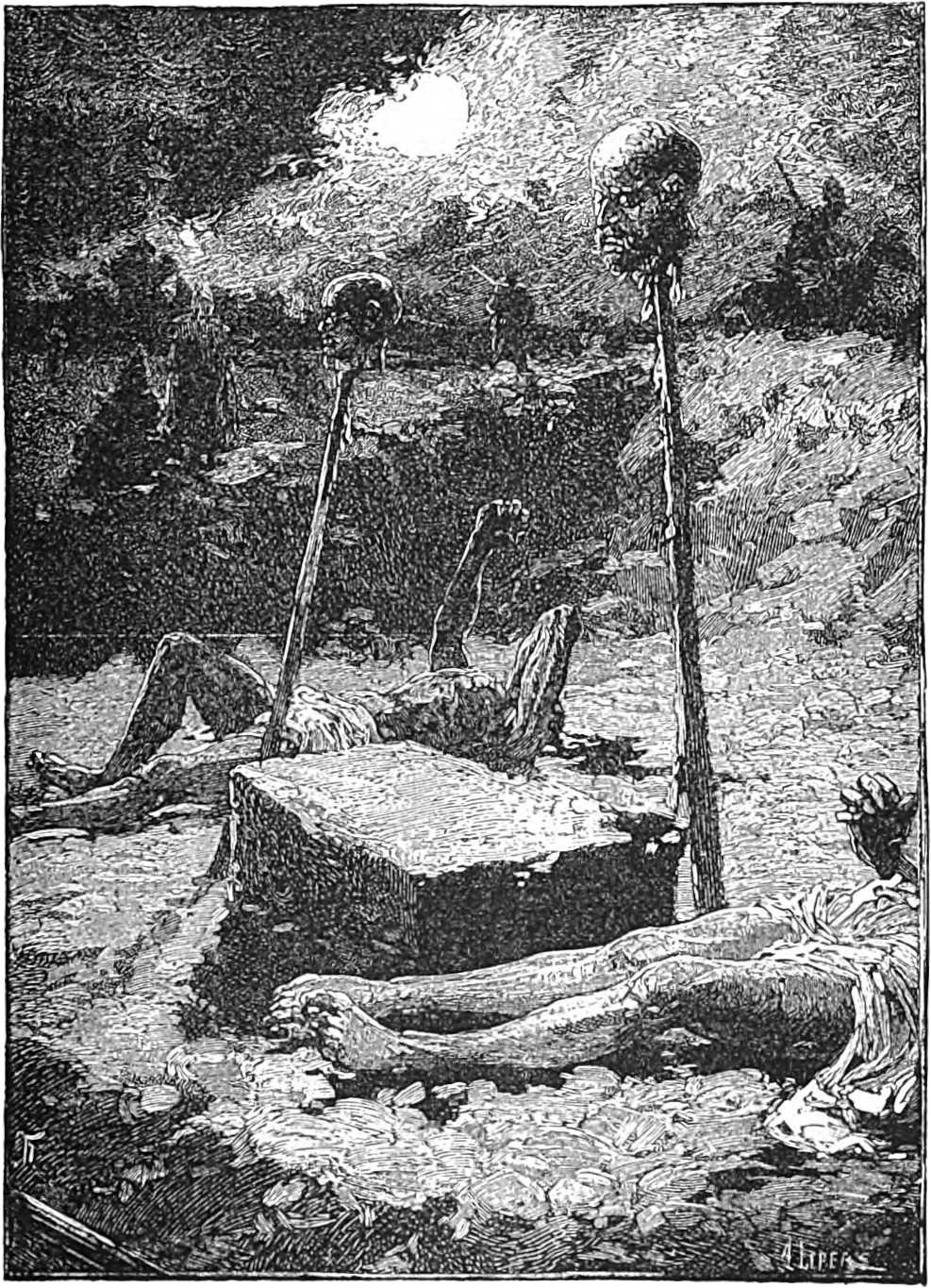
EN TUNISIE.—Châtiment infligé aux auteurs d’un
déraillement de chemin de fer.
(Dessin de M. de Haenen, d’après le croquis de M. Dick.)
[127]CHAPTER XXXVI.
THE TAKING OF KAIRWÁN.
Ever since the middle of August preparations had been in progress for the capture of the so-called focus of Moslem sedition in North Africa. Although everybody knew from the first, that Kairwán was built in the middle of a plain, with no other defence than dilapidated battlements and a few old cannon of uncertain age, all the refinements of modern warfare were brought to bear on the undertaking. This being the case, nearly two months elapsed before the various columns which were to encompass the Holy City could be made ready to commence the elaborate concentric movement, which, in the dreams of M. Saint-Hilaire, was to crush out rebellion from one end of the Regency to the other, and envelop at the same time in its meshes the authors and abettors of the insurrection. The coming campaign had cost Generals Saussier and Logerot a vast amount of trouble, and this was hardly to be wondered at, as[128] half the current maps of Tunis were drawn from imagination, and the only guide to Kairwán was a sketch plan made by Mr. Edward Rae some five years before. At last everything was agreed on; General Étienne was to advance on Kairwán from Susa, General Forgemol was to move from Tebessa, and General Saussier in person was to march with Generals Logerot, Sabatier, and Philibert from Tunis and Zaghouán. The movement was to be made simultaneously, but the palm of conquest was to be reserved for the Commander-in-Chief. Roughly speaking, the total force employed in the expedition amounted to at least 22,000 men. On the 22d October General Étienne received orders to set out, and as he became by waywardness or accident the captor of Kairwán, I shall first follow his advance, before describing that of the columns Saussier and Forgemol.
Lieutenant Kane thus writes of the setting out of the French army from Susa:—
Oued Lia, October 23d.
I returned to Susa from the advance guard late last night in order to witness the final departure of the French troops on the following morning. The sight which presented itself before the walls of Susa at dawn on Saturday was certainly a very curious one. The main feature of the scene was our enormous baggage train, which consisted of over 1000 laden camels, 700 horses and mules, and a multitude of carts of all[129] sorts and sizes driven by Maltese. This unwieldy caravan was put in motion before it was light, and huge fires kindled from the refuse on our old camping-ground added to the picturesqueness of the scene. We had also a miscellaneous collection of camp followers. An ordinary Tunisian cab drawn by three mules conveyed M. La Mothe, the correspondent of the Temps, in our rear, and I noticed a German cavalry officer following the march on foot. At my suggestion he asked General Étienne for a written permission to accompany the column, which was readily granted as soon as it was applied for. With a view to obviate the possibility of any of the insurgents attacking our convoys, the advance guard was made strong enough to clear completely the line of march, and consisted of the 6th Hussars, a mountain battery, and the 116th Regiment. Additional precautions were taken to prevent surprise by throwing out a line of flanking parties on either side of the column. After the advance guard came the carts and heavy guns and then the infantry. Much confusion ensued in consequence of many of the camels and bullocks falling down under their enormous burdens. I rode to the front with the Hussars. We arrived at Colonel Lannes’ camp at Kala Piccola (“little Kala”) without any interruption, but to the right of the camp we heard some rather heavy firing. On entering the camp I could see the Hussars under Colonel Lannes hotly engaged with the Arab cavalry. The ground there was covered with small plateaux, and the Arabs were firing from one plateau at the Hussars on another, and vice versâ. In about half an hour the Arabs were driven away, but it was impossible to ascertain their loss. The Hussars had a sous-officier wounded and a trooper killed. The cavalry of the advance guard were now extended in front and to the left of our line of march, and were engaged all along the front by small bodies of Arabs. We thus pushed on, driving the Arabs before us, until we arrived[130] within three miles of Oued Lia, which was to be our new camping-ground. With a field-glass I was able to see distinctly a body of about 400 Arab horsemen en masse. They, however, soon disappeared as the infantry, in skirmishing order, pushed right up to the lines of Hussars, and surrounded Oued Lia. To the left of the place, about two miles away, and on the crest of some rising ground, some Arabs were still in sight, but they were driven away by the French artillery. Oued Lia has been completely burnt out, but while the house of a Frenchman, M. Saccoman, was destroyed, that of the Caid of Susa was comparatively uninjured. Near the village I saw the corpse of a Maltese lying on a heap of stones and burnt to death. The unfortunate man started from Susa on Friday with a supply of wine for Colonel Lannes’ soldiers, and, having missed his way, met this terrible fate at the hands of the Arabs. We have water in abundance at Oued Lia (“the Spreading River”), and an open ground in our front slopes up to the crest of the hills about three miles distant. We expect to halt here for one day at least. I afterwards learned that in the engagement to the left of the column the daring Zlass chief Ali Ben Hammara had been killed, and that a good rifle was found close to his body. Seven wounded soldiers were conveyed back to Susa in ambulance waggons. The advance guard had also come up with the Arabs and defeated them with severe loss.
Oued Lia, October 24th.
Colonel Lannes’ column from Kala Piccola joined us to-day, together with the camels carrying water for our coming march. The allowance is to be five litres per diem for each horse and two for each man. It is feared that the Arabs have poisoned the wells at the next camping-ground, in which case it will be necessary to make a forced march on Kairwán. A report has reached us that the insurgents have already pillaged the city.
[131]Sidi-el-Hani, October 25th.
After leaving Oued Lia we soon reached the open plain. We are now at Sidi-el-Hani, and through a field-glass I can see a white streak of wall which I am told is Kairwán. We have not met a single Arab.
Kairwán, October 26th.
Kairwán surrendered to-day without a blow being struck. When we were within two miles of the town Colonel Moulin, escorted by some cavalry and his staff, galloped on, and in a few minutes came within easy firing distance. Flanking parties of cavalry were sent out on each side of the town, and I went on with one of them. We rode right up to the walls, and immediately after the inhabitants hoisted the white flag on the tower of the Great Mosque. The staff then advanced to within speaking distance of the walls, and in a few minutes we were met by the Governor-General Mourabet, who rode towards us on a mule, led by two grooms, and who wore an enormous pair of yellow slippers. Mourabet declared that he voluntarily surrendered the town. The order to march was then given. Just one hour after the advance guard had reached the walls, the troops began to defile into the city through the Bab-el-Khaukh. Each battalion was headed by its trumpeter playing a fanfare. All the column passed through the town and then came out by the Tunis Gate on the opposite side. We are now encamped under the walls. The 48th Regiment only is stationed in the citadel. The soldiers have been strictly forbidden to enter the town. This has caused much disappointment and a good deal of openly expressed grumbling. The men are very fatigued, and the weather has been exceedingly hot, and the dust almost insupportable. All the country round Kairwán is a dried-up marsh. The Zaghouán column is reported to be within a few miles’ march of us, but the Tebessa column will not arrive for two days at least. The[132] natives look sullen and dejected, and I have never seen one smile since we have been here. The French have confirmed the Tunisian General Mourabet in his appointment as Governor of Kairwán. The insurgents occupy the mountains near the city. They have not been subdued, and every one even here is laughing at the whole business. The arrangements of General Étienne and Colonel Moulin are excellent, and our supply of water is amply sufficient. It is rumoured that an expedition in Southern Tunis will be necessary.
General Saussier now appeared in the vicinity of Kairwán, and was very angry indeed because he was not there first of all. As France seems to consider the taking of Kairwán as little less heroic than the taking of Troy, the Commander-in-Chief had every reason to resent the laurel wreath being so unexpectedly snatched from his brow by one of his subordinates. Although the walk in and out of Kairwán seems to me a very commonplace occurrence, Frenchmen apparently think differently. Three months afterwards I happened to see the streets of Paris crowded with joyous conscripts, most of whom wore a brightly coloured picture in their hats. A closer inspection revealed my old friend, the “taking of Kairwán,” flanked by a “bombardment of Sfax.” In the former a cavalry officer was brandishing his sword at an open door, and in the latter a ferocious Zouave was to be seen in the act of cutting down an equally ferocious[133] Arab. In the middle was a colossal figure of the Republic holding out benignly wreaths of victory over Sfax and Kairwán. The inscription beneath was a modest one—la gloire et la patrie.
Lieutenant Kane did not share the veneration of the conscripts’ artist. He next wrote as follows:—
Kairwán, October 28th.
I have returned from a visit to General Saussier’s camp, which is now pitched four miles north-west of Kairwán. With his large brigade are no fewer than three Generals, and very great jealousy exists on account of General Étienne and his Susa column carrying off the honours of the surrender. We are, I believe, treated with the gloomy prospect of being perpetually quartered at Kairwán in consequence. The contrast between the facilities given to correspondents by General Étienne and the treatment they received with the Commander-in-Chief is a very marked one. We now hear of a fourth column coming from Gabes, but its approach will be delayed as well as that of the Tebessa column. The tricolour of the 23d Chasseurs has been hoisted on the Kasbah. To appease the men they are now allowed to go in bodies of six into the city.
Later in the day four Arab messengers came back in a wretched plight. One of them had taken a message for the Times, and they had been sent with despatches from Kairwán to Susa, but returned, declaring they had been pillaged en route. Money being found on them, and complicity with the insurgents being suspected, they were immediately tried by court-martial and shot. It appears that Ali Hammara, the celebrated Arab chief killed at Kala Piccola, was buried with great pomp at Kairwán before the French arrived here. Nearly all the Kairwán townspeople are of the same origin as[134] the Zlass tribe. Eight of the principal sheikhs of Kairwán have been arrested by the French authorities. The Tebessa column is now a day’s march from Kairwán.
On the 29th October General Forgemol’s column also arrived, and he was likewise allowed la gloire of a march in at one gate and out of another, preceded by his goumiers and martial music. Twenty-two thousand men were now around the devoted city, but it appeared that on the 25th October the whole of the insurgents had levied as much blackmail as they could, and then started off for more congenial battlefields in the far south. It soon became apparent that although the troops had got to Kairwán, nobody knew why they had ever come there, and what they were to do next.
Lieutenant Kane wrote thus on the 2d November:—
The march of General Forgemol’s African troops through the town has greatly impressed the inhabitants. Yesterday a conference took place in the camp between General Saussier and the Governor, the Cadi, and chief men of Kairwán. General Saussier intimated to the Governor that he required four things of him. First, that all insurgents belonging to the city should be brought back and surrendered unconditionally within two days; secondly, that prices of provisions in the town should be lowered; thirdly, that one hundred horsemen should be furnished for a postal service; fourthly, that the shops should be kept open all day. In the event of non-compliance, General Saussier said that very rigorous measures[135] would have to be adopted. Since yesterday a large number of horses, said to belong to the Zlass chiefs, have been given up to the French. The mosques have also been thrown open unreservedly to Christians and Jews. The Tunisian authorities are taking bribes not to denounce householders as belonging to the Zlass tribe. The prisons are full of political offenders, but several spies have been released after receiving a sound flogging. Large numbers of soldiers have visited the Great Mosque to-day. The guardians of other religious establishments are putting up French flags by the side of their distinctive banners. Preparations for the march on Gafsa have been recommenced.
This information induced me to visit Kairwán with a view of exploring its antiquities; but before describing the results of my journey, I should certainly complete my narrative of the other component marches of the concentric movement. General Saussier’s advance from Manouba by way of Zaghouán presents no feature of possible interest. The reconnaissances of General Sabatier had cleared a great portion of the route, and after a brush between the advanced guard and the Arabs in the defiles of Foum-el-Karouba, the way was clear and even deserted. The skirmish was unfortunate, as it caused just enough delay to prevent the name of General Saussier from being handed down to posterity as the captor of Kairwán, although it cannot deprive him of whatever fame is due to the originator of a campaign, the essential feature of which[136] was “much ado about nothing,” and in which wholesale cattle-lifting avowedly takes the place of hard fighting.
General Forgemol’s march from Tebessa was a very different feat from General Saussier’s march from Manouba. While at Kairwán I had access to the journal of the goumiers and other papers, and was able to write the following fairly correct account of an advance which awakens memories of Xenophon:—
One of the most notable features of the concentric movement of the French troops on Kairwán is undoubtedly General Forgemol’s thirteen days’ march from Beccaria, nine miles east of Tebessa. The Division Forgemol consists of 7000 combatants, escorting a convoy of 8800 camels and 1500 mules, which carried thirty days’ provisions. Its composition is as follows:—Ten battalions of infantry, including three battalions of the 3d and two of the 1st Zouaves, three battalions of the 23d and one of the 1st Turcos, two battalions from the 100th and 34th of the Line, six squadrons of cavalry, the 3d Chasseurs d’Afrique, and two squadrons of the 3d Hussars, one troop of Spahis, together with 800 Goumiers, or Arab irregular cavalry, one battery of mountain guns, and another of horse artillery. The brigadiers under General Forgemol were Generals[137] De la Sougéolle and De Jislain. The cavalry brigade was commanded by General Bonie. The order of march was adapted to the requirements of the enormous convoy, which even in close square covered a large extent of ground. The advance guard consisted of four squadrons of cavalry and two battalions of infantry. The main body of troops followed, headed by two battalions of infantry and one battery of artillery, flanked by a battalion of infantry on each side. The baggage train in close column of route was formed by an intervening battalion into two divisions, the first containing the baggage and the second the provisions. On either flank marched a troop of cavalry. The rear of the column was brought up by the mountain guns, three battalions of infantry, and one squadron of cavalry, while the whole force was covered by a cloud of irregular cavalry on every side. General Forgemol struck his camp at Beccaria early in the morning of the 16th of October, and in the afternoon of that day arrived at Ras-el-Aioun, on the Tunisian frontier. The next day a cavalry reconnaissance made a rapid movement to Hydra, some miles to the north-east of the boundary. Near the Roman ruins it was attacked by the warriors of the Ouled Maggers and the Frechich tribes, who had a few days before perpetrated a successful razzia[138] on Algerian territory between Ras-el-Aioun and Tebessa. The Goums suffered a loss of five killed and twenty-four wounded, and in the mêlée considerable confusion ensued owing to the similarity existing between their costume and that of their assailants. Two goumiers are even said to have been shot by mistake, and an order was subsequently issued that the Algerian irregulars should wear red, green, and yellow ribands on alternate days round their turbans, in order to distinguish them from their Tunisian co-religionists. The Arabs fought with great courage, and only retreated after a charge of French cavalry, in which fifteen of their horsemen were slain. The reconnaissance retired on Ras-el-Aioun in the evening, and the next day the division reached Hydra without further molestation. The heat was very oppressive, and the march lay across hills and valleys covered with brushwood. From Hydra a reconnaissance advanced some miles farther east to Hanout-el-Ajem, without encountering any resistance, and on the following day (the 20th of October) the whole column arrived there also. On the 21st General Forgemol reached Oudem-el-Ghanem, and some of the smaller tribes came in to demand the aman (pardon). After passing Henchir-Rohia a movement was made on the 23d of October towards Henchir-Sbeiba.[139] The camp had hardly been struck when the Goums reported the presence of 4000 Tunisian horsemen in the neighbouring ravines belonging to the tribes of the Ourten, Ouled Maggers, Ouled Ayar, and Hamáma. The Arabs commenced the attack, and were at length dislodged from their position by the infantry and artillery after an engagement which lasted till noon. During the action the column continued its advance, and after sunset reached Sbeiba. General Forgemol halted the following day at Sbeiba, and on the 25th of October commenced a march on Coudiat-el-Halfa. The assailants of the 23d resumed their attack simultaneously on the advance and rear guards. The Goums and infantry sustained some loss, and the Arabs finally yielded only to repeated charges of cavalry. From Coudiat-el-Halfa the column moved to Oued-el-Foul, and on the following day, before the march commenced, the Arabs in force assailed the camp on all sides except the east.
In spite of the attack, rendered more serious by the presence of contingents from the tribes of Zlass and Ouled Said, the troops advanced towards El Haouareb. The firing of the Arabs was silenced by the artillery about noon. Leaving El Haouareb next morning, the camp was pitched before sunset[140] at Biar Zlass, in sight of the Minár of Sidi Okhbah at Kairwán. Without meeting any further obstacle to the final advance, General Forgemol moved on next morning (October 29th) to Kairwán itself. Nearly all the effective strength of the column, with its bands playing the “Marseillaise,” defiled through the Tunis Gate, and, passing across the bazaars and principal streets, returned to their camping-ground outside the city by way of the Bab-el-Djelladín.
Nothing has impressed the Kairwánis more than the presence of the Algerian army with its Moslem soldiers, who seem to have lost none of their religious ardour by their loyalty to the present rulers of their country. When the Turcos reached the Bab-el-Tunis a rumour spread with wonderful rapidity that the much-longed-for troops of the Sultan were at hand, but this momentary ray of hope soon gave place to bitter disappointment. From that moment the Moslems of Kairwán have apparently resigned themselves to their fate, and green-turbaned Ulema, and venerable Sheikhs of still more venerable sanctuaries, spend their time in exhibiting to their unbidden guests those very buildings, the entry into which a fortnight before would have cost the intruder his life.
I had while at Kairwán many opportunities of[141] talking over the campaign with several of the officers of the Colonne Forgemol. I shall not easily forget one of them, who had seen over a quarter of a century’s service in Algeria, saying to me—“We came to Kairwán, but we have done nothing; we shall go to Gafsa, and we shall still do nothing, for we can never come up with the Arabs. In a single day they can march four times as far as we can, and as they have already removed their herds out of our reach we cannot starve them. In Tunis, as in Algeria, the conquest must be a matter of years. The Algerians have been tired out, the Tunisians must be tired out also.”
The one question asked a thousand times a day at Kairwán during my stay was, “What will the Chamber decide about Tunis?” That question has never been answered yet. My own impression is, that there was not one of those brave men around Kairwán who was not heartily tired of an expedition which as yet has done nothing but call forth misplaced energy and zeal, and the ultimate results of which are justly dreaded by every patriotic Frenchman.
[142]CHAPTER XXXVII.
INSIDE KAIRWÁN.
Although Kairwán is only six days’ journey from London, it was a month ago quite as much a terra incognita as many of the great towns of Central Africa. Few still existing cities have played so important a part in the world’s history, yet the world knew it not. Only a hundred miles south of Tunis itself, and but forty miles away from the great and busy highway of the Mediterranean, Kairwán, secure in its exclusiveness and its sanctity, has slumbered away the 1200 years of its existence, until it suddenly finds itself in the presence of a foe that it is powerless to resist, and discovers that even its most venerated shrines and sanctuaries can no longer be hidden from the gaze of unbelievers. It would be difficult to describe the precise offence which Kairwán has committed to merit the signal punishment it has received. For centuries it has been the centre of the great nomadic tribes which surround it, and in the early[143] days of the Tunisian insurrection the old spirit of its inhabitants may have momentarily revived. If such was indeed the case, the Kairwánis must have soon realised their own impotency. The bombardment of Sfax and Gabes conveyed to them a very practical lesson; and the religious authorities of Kairwán in council were not likely to rely on their own legend—that their crumbling ramparts and ruined bastions were shot and shell proof. In vain they begged their more courageous disciples to retire from the city: the latter refused to act contrary to the theoretical teaching of their Ulemas; and it was only when the French columns were actually visible, and the destruction of the city imminent, that the nonagenarian Bash-Mufti of Kairwán succeeded in persuading the Zlass chiefs to rapidly retire to the neighbouring mountains, and then saved the town from certain destruction by sending a frightened muezzin to wave a square yard of white calico from the crenellated minaret of the mosque of the conqueror of Africa.
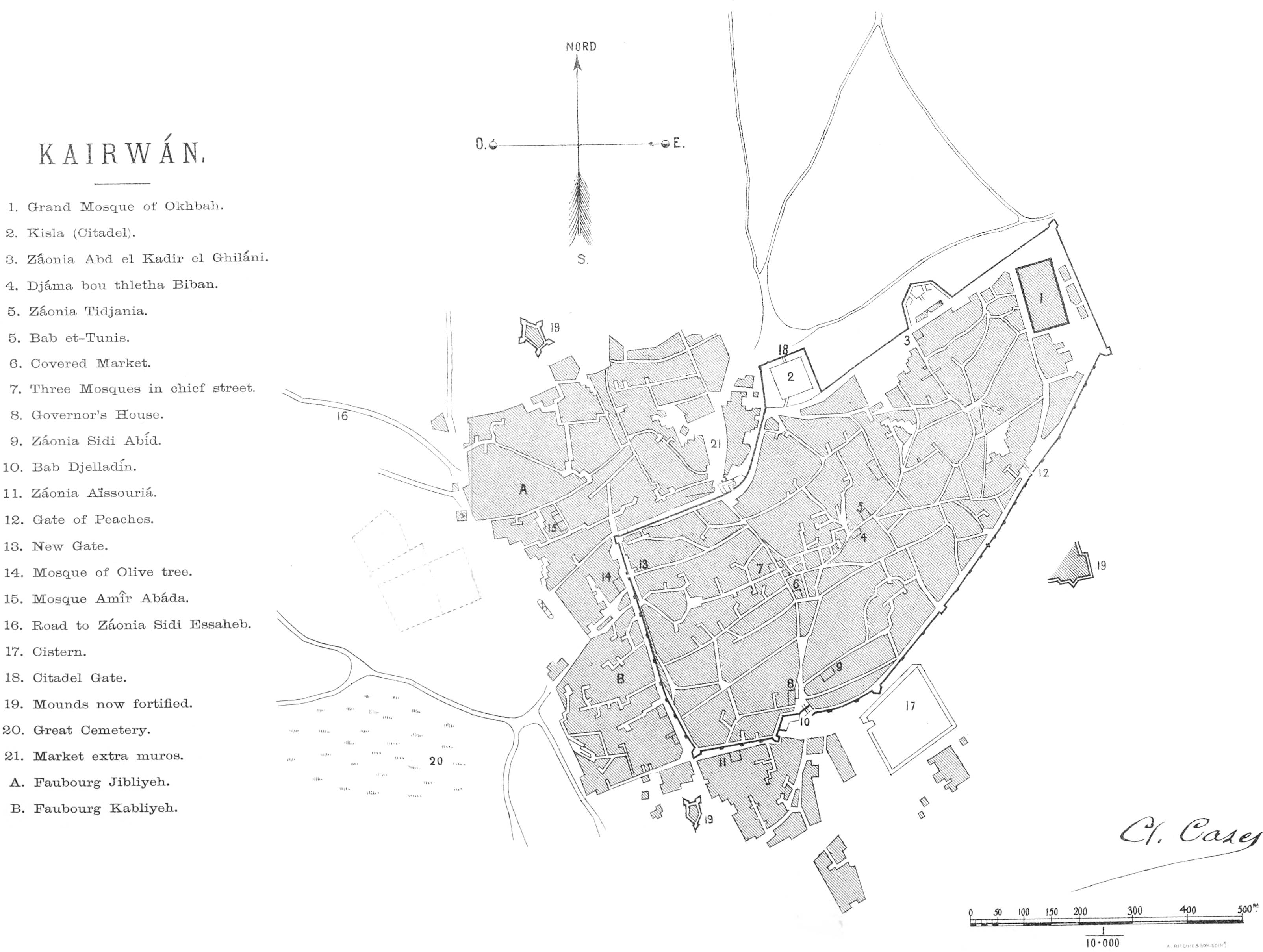
KAIRWÁN.
- 1. Grand Mosque of Okhbah.
- 2. Kisla (Citadel).
- 3. Záonia Abd el Kadir el Ghiláni.
- 4. Djáma bou thletha Biban.
- 5. Záonia Tidjania.
- 5. Bab et-Tunis.
- 6. Covered Market.
- 7. Three Mosques in chief street.
- 8. Governor’s House.
- 9. Záonia Sidi Abíd.
- 10. Bab Djelladín.
- 11. Záonia Aïssouriá.
- 12. Gate of Peaches.
- 13. New Gate.
- 14. Mosque of Olive tree.
- 15. Mosque Amîr Abáda.
- 16. Road to Záonia Sidi Essaheb.
- 17. Cistern.
- 18. Citadel Gate.
- 19. Mounds now fortified.
- 20. Great Cemetery.
- 21. Market extra muros.
- A. Faubourg Jibliyeh.
- B. Faubourg Kabliyeh.
Kairwán is built in the centre of a wide-stretching sandy plain, fringed on three sides by mountains, and towards the west by a low range of hills which separates it from the sea-coast. This plain is traversed on the same side by two streams, dry in summer, but strong enough in winter to surround[144] the city with a marsh. Excepting scanty tufts of esparto grass, no sort of verdure is to be seen in any direction. It was in such a spot as this that about the year A.D. 675 (A.H. 55), the Emir Okhbah Ben Nafi Ben Abdullah Ben Kaïs el Fahri laid the foundation of the Holy City of North Africa. For a thousand years, as far as can be ascertained, no Christian ever visited it. Since then a few travellers have been at intervals allowed to enter it on sufferance, the local authorities being entitled to reject the Bey’s order if so disposed. When once admitted, visitors were carefully allowed to see as little as possible. An entrance to any building was of course out of the question, and the traveller had to be generally contented with a rapid passage through the most unfrequented streets under a strong escort; and finding a prolonged stay useless, he generally seems to have taken his departure as speedily as possible. Dr. Shaw accordingly only devotes two pages of his book to his stay at Kairwán in 1730. He identifies it, however, on insufficient grounds, with the Roman Vicus Augusti, and says it contained 500 mosques. Sir Grenville Temple, just one century later, journeyed “to the present hotbed of all the bigotry of Muhammedanism in Africa.” He was, nevertheless, able to tell very[145] little about it beyond the names of its gates, for his “promenade through the town was managed with the greatest mystery;” and after rejecting a proposal of the Caid to take a walk in the dark, he was finally allowed to parade the streets, “observing a most dignified silence and a steady solemn pace.” When the Marquis of Waterford entered Kairwán ten years afterwards, a riot ensued, in which he very nearly lost his life from a well-directed brickbat. Dr. Davis added nothing whatever to the information given by Shaw and Temple. In 1861, Monsieur Victor Guérin devoted three sultry days in August to an attempt to explore the mysteries of Kairwán. He remarks, that “although Tunis has become for centuries the political metropolis of the Regency, Kairwán has always held in the minds of the masses of its population the position of its religious capital. Founded by the conqueror Okhbah at the time of the invasion of North Africa by the Arabs, it has preserved on account of its origin a prestige which no other place in the Regency even attempts to dispute. It is the Holy City par excellence, the capital of a belief, the metropolis where the Crescent rules with undisputed sway. There the muezzin, who calls the faithful to prayer from its many minarets, has never yet seen the symbol[146] of a creed which knows not Muhammed or a rival sanctuary. There, too, the Imám, interpreter and apostle of the Koran, has never found himself in the presence of a minister of the Gospel of Christ, Kairwán has been effectually closed against Christians from the time of its foundation.”
The existence of the city sprang originally from the necessities of conquest. The Berbers of the first century adopted towards their invaders the same tactics as the Bedouins of to-day: they either submitted to or fled before the armies of Islam, but revolted as soon as the troops of the Caliph withdrew. Okhbah himself describes the raison d’être of Kairwán: “When the Mussulman generals enter Africa, the inhabitants protect their lives and property by a profession of the faith of Islam. When our armies retire, they again fall into infidelity. We must therefore build a city which will serve as the camp and the ramparts of the faith of Muhammed.” Although the original site selected was abandoned for another two miles off during the temporary absence of its great founder, the first care of Okhbah on his return to Africa in A.D. 684, was to restore and enlarge his favourite city. Tradition associates with the original foundation of Kairwán a legend almost identical with those of St. Patrick and St. Hilda. At the word of[147] Okhbah wild beasts and reptiles alike withdrew from its neighbourhood. The etymology of its name has been a matter of dispute. According to Shaw, Kairwán is only the equivalent of Caravan, a place of meeting; while others contend it was so called after Käyrawán or Cyrene, the capital of Cyrenaïca. The most plausible explanation is, that the name signifies simply Kahira or victory. Kairwán is the Cairo of Tunis and its adjacent provinces. During the year of his return to power (A.D. 684), Okhbah carried the victorious banner of Islam to the shores of the Atlantic; but he never lived to return to the “camp and ramparts of the faith of the Prophet.” Slain in an ambush by a Berber king, he was buried thirty miles from Biskera in Algeria, where his tomb, covered by a comparatively humble kouba, is still the object of reverence and pilgrimage. Upon this subject Mr. Rae (the only European traveller who has even attempted anything like a complete survey of Kairwán) falls into a curious mistake. Speaking in his “Country of the Moors” (p. 237) of the Great Mosque of Kairwán, he describes it as “the shrine and tomb of its founder, Okhbah Ibn Aghlab—the spot chosen, from its sanctity, as the last resting-place of the kings of Tunis.” Mosques are rarely if ever used as places of interment. The kings of Tunis sleep[148] under the Green Cupola of the Turba, in the political capital of the Regency, and Okhbah the Victorious rests in the Algerian Sahara.
The history of Kairwán has been of sufficient importance to influence appreciably the history of Europe and Africa. On the untimely death of Okhbah, the Berber king, Kassila, succeeded in occupying it. Twenty years later he was slain by Zohair Ben Kaïs outside its walls. His successor, Hassan Ben Nouman, was defeated by a Berber queen, who endeavoured to render the country unattractive to the Arabs by converting it into a desert. This policy alienated her own subjects, and in A.D. 708, Musa Ibn Noseir obtained an easy victory. Then came the golden period of its existence: the gallant Tarik marched out of its gates to conquer Spain. Having “burned his ships” at Tarifa, Granada, Cordova, and Toledo fell in rapid succession. The aged Musa hurried westwards to participate in his glory before Seville, which, after a protracted resistance, shared the fate of its sister cities. His son, Abd el Aziz, laid the solid foundations of the Moorish empire in Spain, which lasted for well-nigh eight centuries. Before thirty years had elapsed since Tarik left Kairwán, the Caliph of Cordova had conquered Tours. But the time of Moslem conquest was now[149] soon destined to be stayed. The reflection of the glories of Kairwán, of Tarik, and Musa, is to be found in the ruins of Granada and Cordova. Vanquished in Europe, the Moors of Andalusia brought back at last the keys of their Spanish houses to the cradle of their faith in Africa.
To return to the chronicles of their holy city. During its earliest days its site had been, as it were, consecrated to Islam by the presence of Abdullah Ben Wádib el Belawi, or Abou el Awib—Saheb Ennabi, or Companion of the Prophet—who died and was buried at Kairwán. For years after its formation, its Emirs were engaged in continual conflicts with the Berber tribesmen. In A.D. 756, the Emir Abd el Rahman was strong enough to send an expedition against Sicily. In the Great Mosque of Okhbah he afterwards declared himself independent of the Caliph: his son, however, once more acknowledged his suzerainty. Nine years later the city fell under the cruel sway of the Werfadjoumah. Once more the Berbers seized Kairwán; but after enduring the horrors of a siege, they destroyed a large portion of the city, and finally withdrew to the Atlas. The Caliph sent Yezid Ibn Hatem to restore order; and after inflicting a second signal defeat on the Africans, he “rebuilt the Great Mosque, established numerous[150] bazaars, and assigned to each trade a distinct quarter—in fact, remodelled and half rebuilt the city.” At length the Caliph el Reschid appointed the Emir Ibrahim Ibn el Aghlab hereditary Emir of Kairwán. Ibrahim then became the founder of the Aghlabite dynasty. He constructed a sort of fortified palace on the west of the old town, called the Abassiyeh. Here Ibrahim proclaimed himself Caliph of the West, and here he received the ambassadors of Charlemagne, who asked for the surrender of the remains of St. Cyprian. His sons, the Caliphs of Kairwán, waged war on Italy and Sicily: one of them, Muhammed, captured Malta. In 877, Ibrahim Ibn Ahmed founded most of the towns on the Tunisian littoral. He also built the suburban city of Raccadah, and successfully besieged Tunis after it had been captured by some insurgents. His grandson, Ziadet Allah, was the last of his race; and a line of Green Caliphs, beginning with Obeid Allah, reigned in Kairwán. He “ravaged Lombardy, took Genoa, and ruled in Sicily.”
From the eleventh century the history of Kairwán has been one of gradual decay. The pleasant places of the Abassiyeh and Raccadah have become shapeless mounds; the power of its rulers has been gradually merged in that of the Beys of Tunis; and the halo of sanctity and exclusiveness which surrounds[151] it has alone saved it from actual effacement. Its story and traditions rendered Kairwán a Moslem Rome—revered throughout Western Islam, but the particular sanctuary of the tribes which encamp around it. Kairwán has had its theologians, historians, philosophers, and poets: they, however, have all passed away. The famous Schanoun died there towards the end of the ninth century; and Kairwán has its own annalist—the celebrated Sheikh Ben Naji.
For years Kairwán has lived on traditions and hopes. Thirty years ago Sheikh Amír Abádah fanned the expiring flame, and announced that Kairwán would one day receive the remains of the founder of the Moslem faith. In spite of its vicissitudes, Kairwán in its decline always remained the virgin Moslem town of Northern Africa.
“De là,” writes M. Guérin, “l’espèce de sainte et mystérieuse auréole dont la foi Musulmane l’entoure; les caravans qui s’y rendent constamment de tous les points de la Tunisie viennent s’y retremper en quelque sorte dans l’Islamisme; sa grande mosquée dont toutes les pierres, suivant une tradition populaire, que les Imáms ont soin de perpétuer dans les masses, seraient venues miraculeusement se poser d’elles-même à la place qu’elles occupent, et sans cesse visitée avec un profond[152] respect par les adeptes du Coran: les sanctuaires de ses santons sont également le but de pélerinages fréquents; tout cela entretient dans l’esprit des masses un fanatisme que rien jusqu’ici n’a pu affaiblir.”
Reasons such as these have rendered the past, present, and future of Kairwán a matter of deep interest wherever the faith of Islam exists; and it is hardly to be wondered at that the Moslem press of Turkey, Egypt, and India has dwelt with peculiar earnestness on the entry of a Christian army into this one remaining stronghold of their common creed in Africa.
As late as 1877, Mr. Rae was assailed with threats and abuse on somewhat rashly endeavouring to survey the circuit of the city walls; and when, in 1880, an Italian lady first appeared in their midst, the inhabitants told her in no measured language “to cover her face,” but these days of intolerance were soon to end. In April 1881, Lord and Lady Bective journeyed to Kairwán; and although they only saw the streets and exteriors of buildings, the remembrance of Lady Bective’s graceful and kindly sympathy still survives in the hearts of the Kairwánis, who about then for the first time began to hear the dark rumours of an approaching French invasion of their country.

The Countess of Bective,
in an Arab Costume.
Reproduction by Maclure & Macdonald.
[153]The chief men of Kairwán hastened to take Lord Bective into their confidence and entreated him to put the case of the Arabs before the Queen and “the justice of the English nation,” and even the Moorish ladies, in the deep recesses of their lattice-windowed cages, clung to Lady Bective and implored her to save them from the coming storm. “If you tell us to fight,” said one of the Zlass chiefs to Lord Bective, “we would only let the French come to the tomb of Sidi es Saheb over our bodies, but your English Consul says we are to be quiet and all will be well, we shall therefore trust to you and receive the French as brothers.” The old Governor did his best to entertain his guests with music and fantasia, but his heart and the heart of the people were far away with their brethren in Khamír-land. When at last Lord Bective and his wife left the Tanners’ Gate on their return to Susa, they were followed far on their road by a crowd of the citizens, who again and again asked them to remember their message to the Queen.
It was with feelings of no little enthusiasm that I left Susa to explore the hitherto hidden treasures of Kairwán, to see sights till now hidden from Christian eyes, and to tread where Christian had never dared to enter before. My sole guide was[154] the works of Messrs. Guérin, Pélissier, and Rae; and a strong recommendation from General Lambert to General Étienne led me to hope that my voyage of discovery would not be altogether fruitless. On the 5th of November I quitted the New Gate of Susa in early morning. It was as yet hardly light; but during our passage across two lines of low hills covered with olive-trees, the scenes of the combats of the past five weeks were just visible. As day dawned we emerged from the olive-groves on to a wide-spreading open plain. After two hours we began to skirt a shallow lake. This was the Sebkha Sidi el Hani—the Lake of Kairwán. Shortly afterwards we came in sight of two stunted cupolas on a mound. These were the tombs of Sidi el Hani and his son. A small French camp surrounded them. A convoy had miscarried, and the soldiers made loud complaints. The wooden sarcophagi of the Moslem saints (or perhaps, as M. Guérin terms them, santons) had served for firewood on the previous day. In the open plain below the tomb and the camp were nine wells, one of which at least contained drinkable water. We pressed forward and passed a sandy ridge. Kairwán became visible in the far west. The city seemed a mere streak of white; but the Minár of Sidi Okhbah stood out in conspicuous relief against a background[155] of purple hills. We came nearer, and countless smaller domes and minarets seemed to spring into existence. Crossing two dried-up water-courses (the principal of which is the Oued Beghla), we approached the city walls and then the Tanners’ Gate (Bab-el-Djelladín). The governor’s residence almost adjoins it. Within an hour of my arrival, Sy Amor Ben Yunes el Khaia offered me the hospitality of his house. Sy Amor was the Khaia or military governor of one of the divisions of the Zlass clan, which had joined in his defence of the country; and during my stay he was chiefly engaged in the evidently uncongenial task of persuading his tribesmen to return.
The Tunisian governor, whom I visited, seemed to feel acutely the humiliation of his position. His normal occupation gone, he was allowed the solace of a guard of Tunisian soldiers in receipt of French pay. Sidi Muhammed el Mourabet comes of ancient lineage. His great ancestor, Sidi Abíd el Khiryáni, died five centuries ago, and he was of the Almoravides. The Mourabets have been guardians of his shrine ever since. Sidi Muhammed’s father, Sidi Othmán, received Sir Grenville Temple in 1835. He told me, mournfully enough, that as the French had entered the mosques he could not forbid my doing so; but he seemed exceedingly depressed.[156] It afterwards transpired that the shrine of Sidi Abíd had been that morning taken possession of to serve as the quarters for the Commandant de la Place and his staff. During my six days’ stay in the city, the French authorities gave me every possible facility for the prosecution of my inquiries. Colonel Moulin (the occupant of the sanctuary of Sidi Abíd) procured me an authentic plan of Kairwán, just completed by the French engineering department; and both he and his aide-de-camp, Lieutenant Walewski, accompanied me in many of the visits I paid to the most noteworthy objects of interest in the last “intact Moslem town” in Africa.
The city of Kairwán has seven irregular sides, and is surrounded by a high brick wall intersected by towers and bastions, and pierced by five principal gates and four posterns (now closed). The rampart is composed of very small well-baked bricks, and terminates in round-headed crenellations, about a foot wide, with loopholes below for musketry. It varies in thickness from six to nine feet, and a terrace four or five feet from the top allows a line of combatants to pass along it. In some places the enceinte is ruinous, in others it is in fairly good repair, and its complete circuit measures 3125 French metres. Outside the walls are several[157] mounds, which consist probably of the remains of its ancient suburbs. Three of these are now being fortified with earthworks and artillery. On every side of the town except one, are large cisterns, in which a walled receptacle allows the rain-water to pass into covered vaults below. To the south of the town are its chief suburbs—Kubliyeh and Jebliyeh, the latter having two gates and portions of a wall still standing. The population of the town does not exceed 14,000 souls. Kairwán is technically divided into five quarters—an arrangement based apparently on a consideration of the Moslem confraternities to which their inhabitants belong. Around the Great Mosque is the Haoumah or Arbat Djama. Those who live there are generally followers of the religious school of Sidi Abd el Kádir el Ghiláni. In the quarters known as Chorfa, El Mahr, Jebliyeh, and Kubliyeh, the inhabitants nearly all belong to the religious brotherhood of the Aïssaouia, except in the latter, where many adherents of Sidi Abd es Selem are to be found. I shall have occasion to refer again to the powerful influence exercised by these great systems of semi-political, semi-religious Moslem freemasonry.
Inside the rampart runs a narrow street, but this is often traversed by the walls of enclosures[158] adjoining the houses below. The main feature in the public and private buildings of Kairwán is the wholesale appropriation of Roman materials,—Roman and Byzantine capitals, shafts, and friezes meet the eye in all directions. If you draw water, the well is reached by a perforated Roman column; the very stones of the corn-mills have a similar origin, and many of the slabs now bearing Arabic inscriptions are probably reversed Roman tablets. Most of these stones are believed to have come from the neighbouring ruins of Sabra, but the gorgeous pillars of the Great Mosque probably represent the architectural spoils of all North Africa. The streets of Kairwán are narrow, ill paved, and wholly devoid of any systematic arrangement. The main thoroughfare crosses the southern portion of the city from the Tanners’ Gate (Bab-el-Djelladín) to the Tunis Gate (Bab-el-Tunis), a distance of less than half a mile.
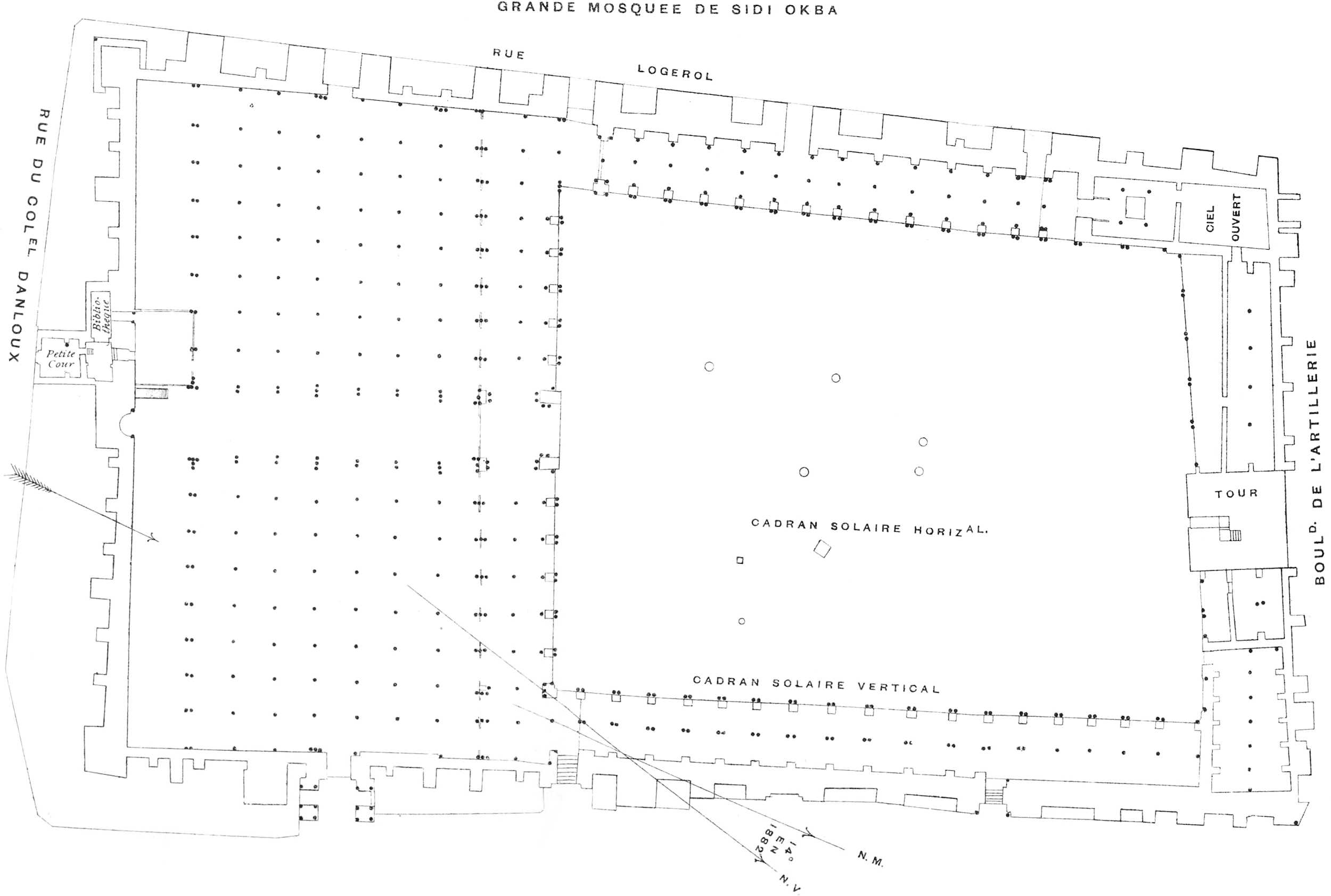
GREAT MOSQUE OF SIDI AKBA—KAIRWAN
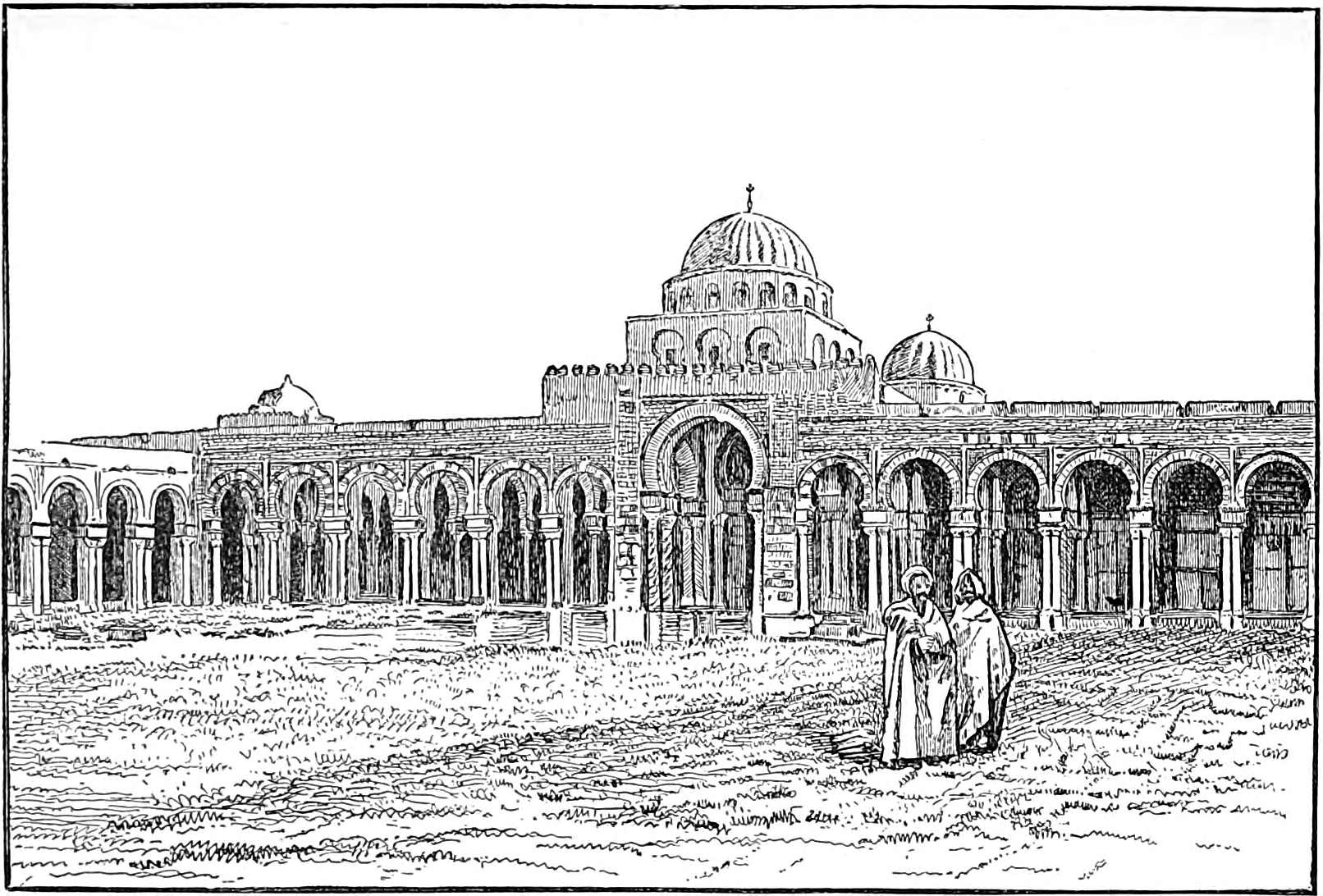
Mosque of Sidi Okhba at Kairwán, from the Cloisters.
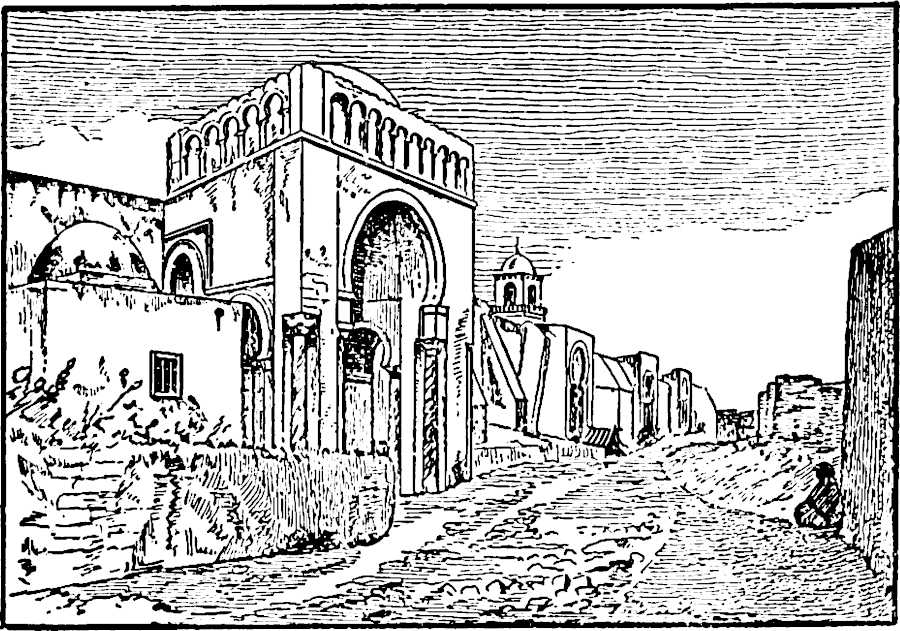
EXTERIOR OF GREAT MOSQUE, KAIRWÁN.
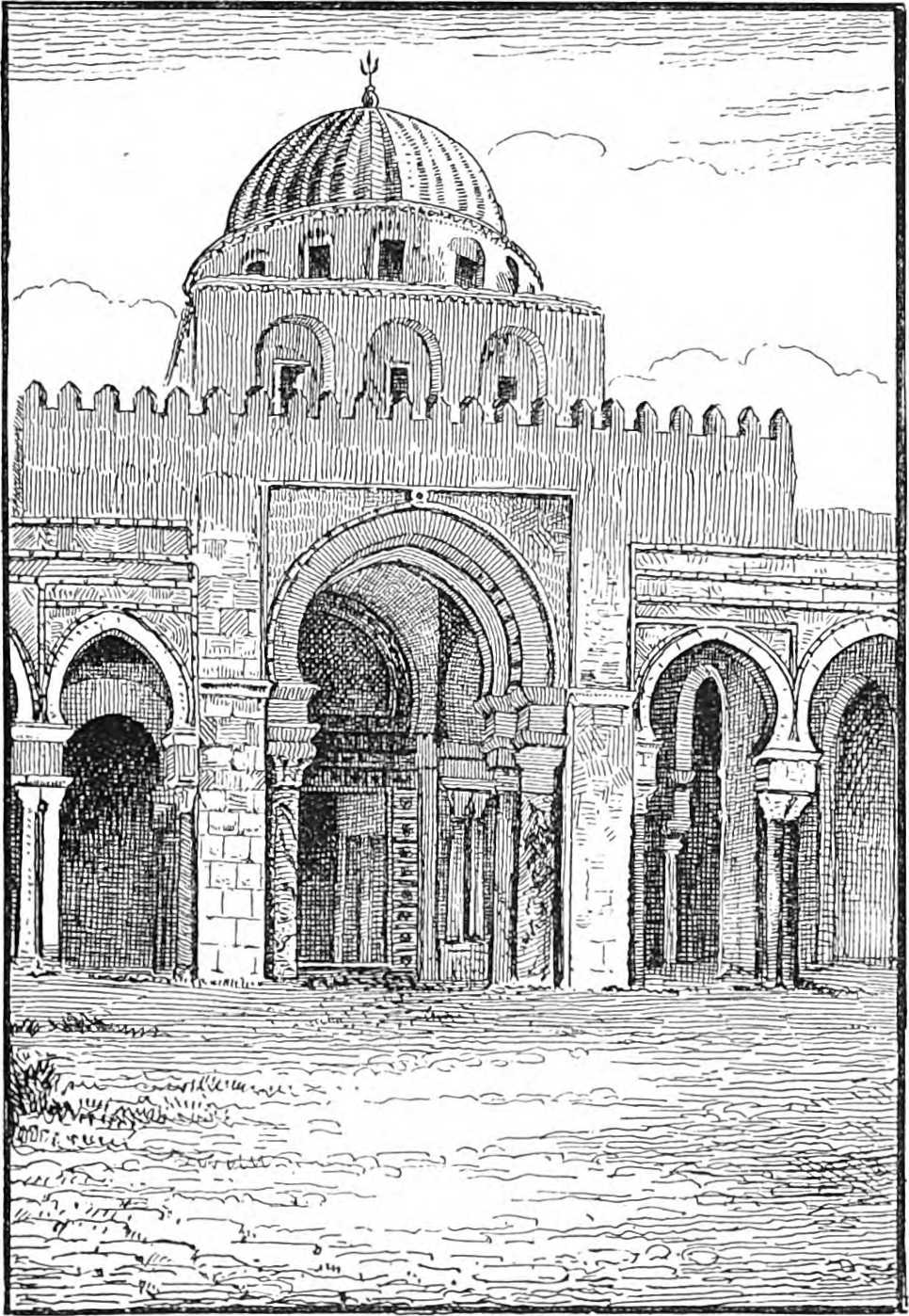
Door of Prayer-Chamber, Great Mosque, Kairwán.
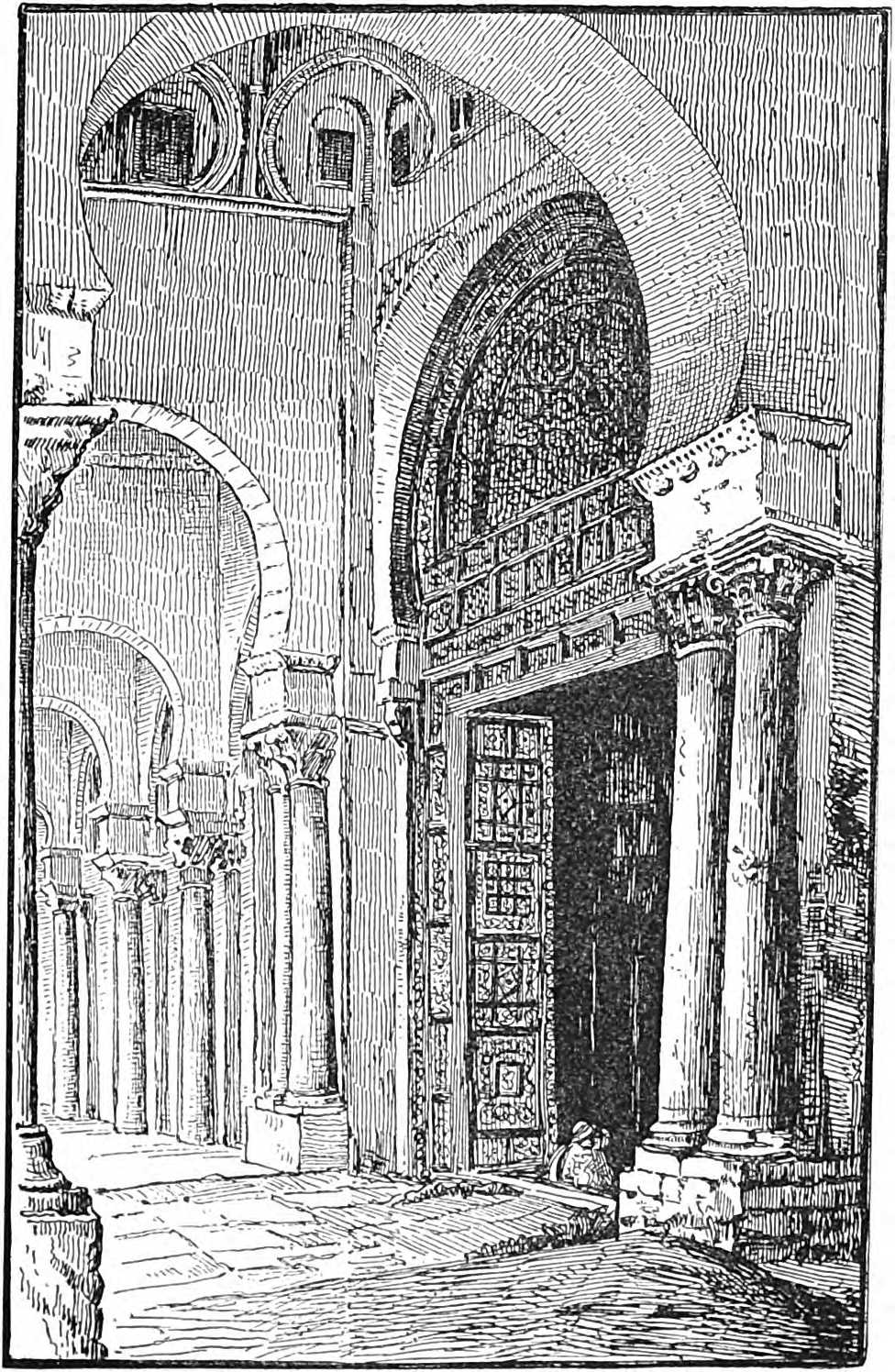
Door of Prayer-Chamber, Great Mosque, Kairwán.
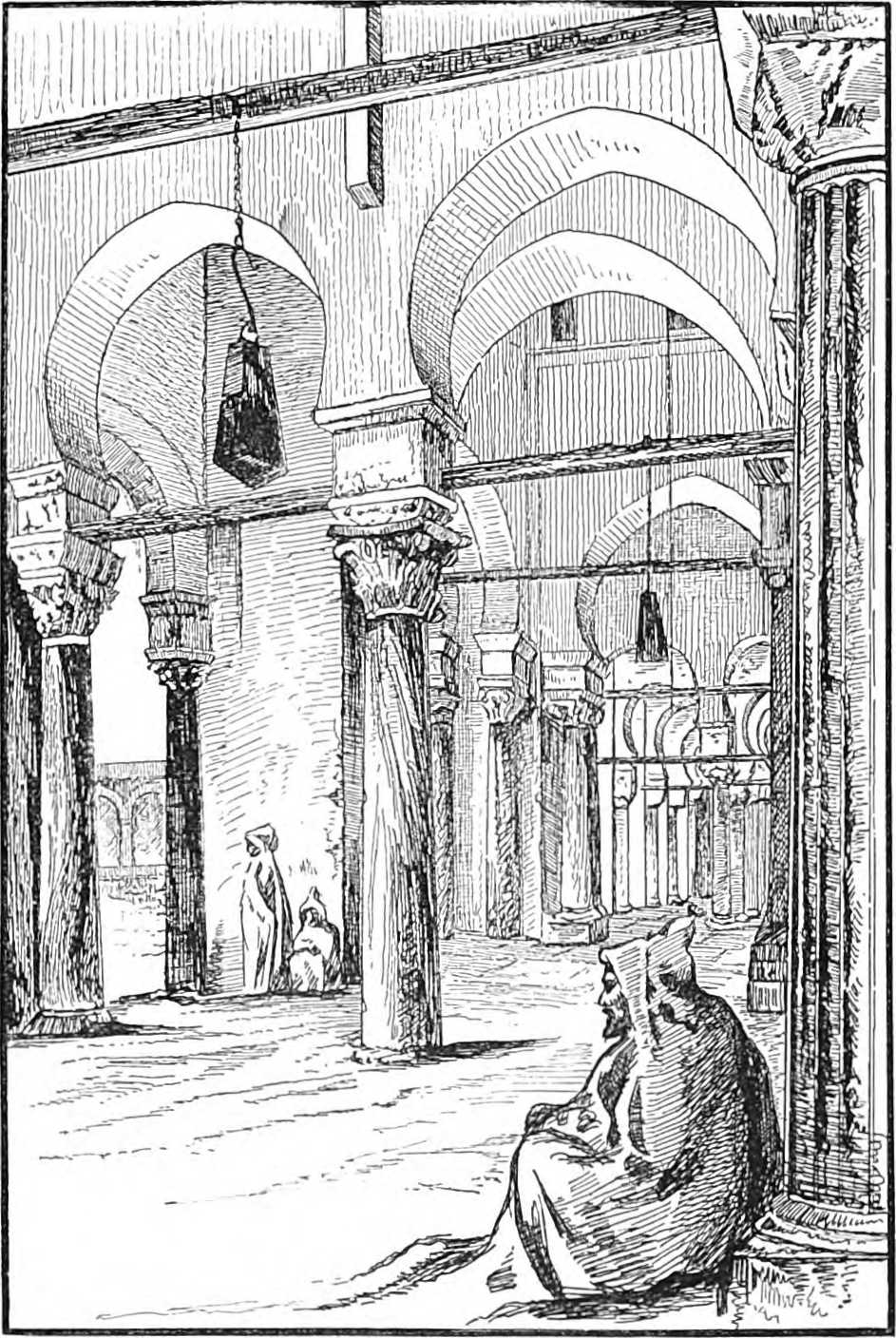
Interior, Great Mosque, Kairwán.
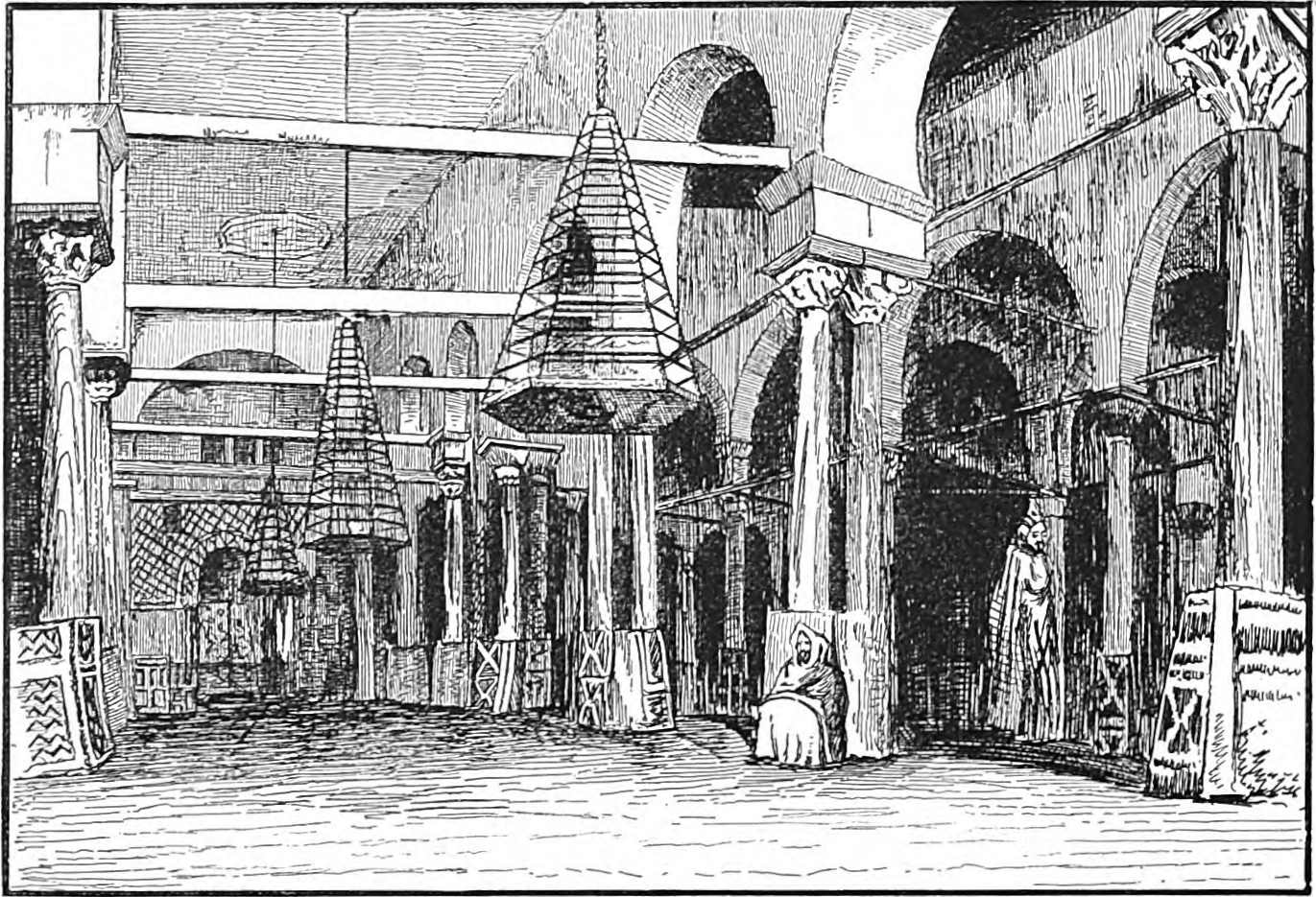
Interior, Great Mosque, Kairwán.
The northern quarter of Kairwán is almost wholly taken up by the Great Mosque, which is only approached by narrow lanes. The exterior has been well described by Mr. Rae, and can hardly be said to be particularly imposing. The south-east end of the Mosque measures 85 yards. A single porch in its centre is appropriated exclusively for the entrance of the Bash-Mufti. The sides of[159] the building are 143 yards in length, and each possesses four entrance porches, the finest of these facing the ramparts. Mr. Rae thus describes it: “It has an outer horse-shoe arch, and an inner one which contains the door opening direct into the prayer-chamber. The exterior is a finely proportioned piece of Saracenic work: it has a row of arched panels along the upper portion of its sides, and the dome and interior of its arches are in plaster fretwork.” Midway, on the same side, is the sacred well of Kefâyat (Plenty). It is fenced in by a low wall, its aperture is lined with different coloured marbles, and tradition asserts that it communicates directly with the spring of Zemzem at[160] Mecca. It has hardly ever failed to yield a plentiful supply of water. The north-west end is somewhat narrower than that facing the south-east. It measures only 75 yards across, and the Minár rises in its centre. The four porches on both sides of the building correspond, and they are divided by enormous buttresses of solid masonry. The interior of the Mosque may be divided into the prayer-chamber (40 yards in length by 85 in breadth), the vestibule adjoining it, and a great cloistered court. The roof of the prayer-chamber is loftier than that of the vestibule, and that of the vestibule higher than that of the court. The prayer-chamber is divided into a great central nave, with eight aisles on each side of it. These are formed by parallel rows of ten columns each, the two nearest to the eastern wall being close together. The pillars of the lesser aisles are of various-coloured marble, and are about fifteen feet in height. The capitals in many cases evidently do not belong to the columns on which they rest, but they are generally of white marble or stone. From the capitals spring semicircular arches supporting a flat ceiling of dark-coloured wood. In the south-west walls of the prayer-chamber, thirteen columns are embedded in the masonry, three close together on one side of the porch, and one on[161] the other. The latter evidently came from some Byzantine church, and its capital consists of a grotesque arrangement of birds and flowers. The columns of the central nave are at least twenty-two feet high. Their arches support a wall covered with tracery, and a lofty circular roof. The nave terminates in a dome lighted by small painted-glass windows. Two groups of four columns each mainly support the weight of the cupola. The mihráb niche in the east stands between two red porphyry pillars of great beauty, and is lined with delicate mosaic in marble and lapis-lazuli. On one side of it is a large square of white marble covered with emblems in mosaic, and surmounted by a slab of verde antique; on the other stands the ancient mimbar or pulpit of carved dark wood, some ten feet high, and having twelve steps, and a number of small receptacles with bronze hinges below them. The pillars of the nave are arranged in groups of two or three together, and one of these clusters is worn away by the faithful squeezing themselves between them to prove their “purity of soul.” The total number of columns in the prayer chamber is 296. The pavement consists of small slabs of white marble hopelessly broken. The vestibule is approached by seventeen elaborately carved and panelled wooden doors. When these are open, the[162] dim religious light which generally pervades the seventeen aisles disappears. The great central door is surmounted by a horse-shoe arch, the head of which is filled up by fine arabesque fretwork. In the vestibule are 34 pillars, those in the centre being much higher than the rest. This part of the building opens on to the cloister beyond—a vast quadrangle paved with white marble, and almost entirely surrounded by a covered arcade, only broken by the Minár. This arcade contains 86 columns on either side, and 27 at the end. The total number of the pillars in the interior of the Great Mosque is therefore 439, not far short of the 500 spoken of by El Bekiri—a statement usually looked on as fabulous.[7] In this court are several other Byzantine columns. On four of the pillars Arabic inscriptions are carved. One belongs[163] to the fourth century of the Hegira, and its design is extremely curious.
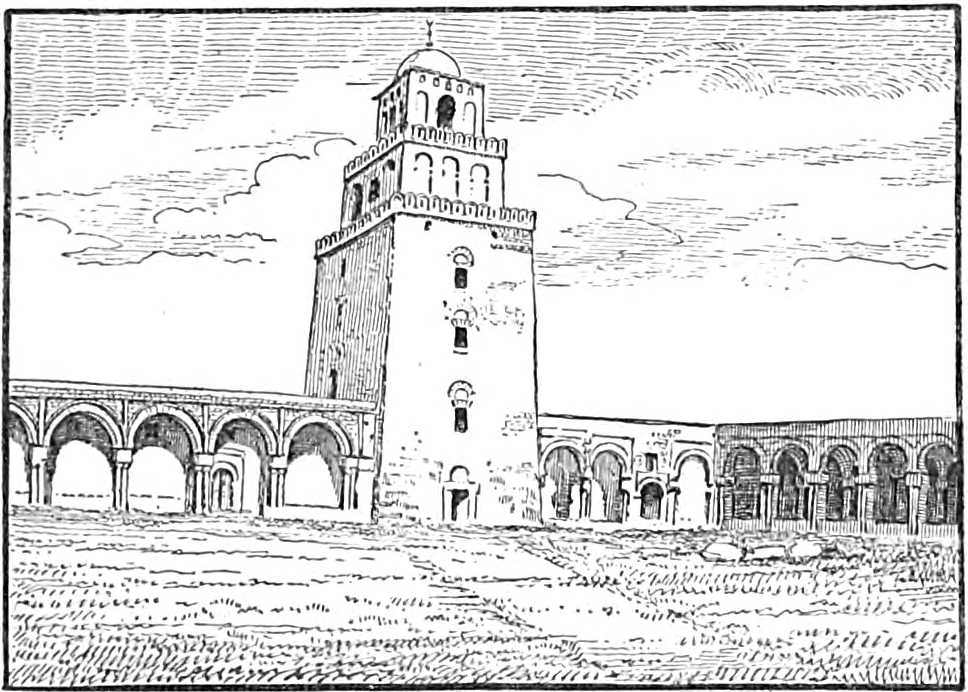
MINÁR OF GREAT MOSQUE, KAIRWÁN.
Below the court are enormous cisterns, and in the centre an ancient sun-dial. The Minár is a massive square building of stone, consisting of three storeys, one smaller than the other, and each having a battlement of round-headed crenellations. In the interior is a white marble staircase, composed of fragments of Roman pavement and ornamentation. It has 129 steps, and is about 100 feet high. The view from the summit was one never to be forgotten. Immediately below were the cupolas, terraces, tortuous streets, and battlements of Kairwán.[164] Farther on, its suburbs, with its border of koubas and tombs. To the west, the great camps of Generals Logerot and Forgemol, with their almost countless tents and vast convoys. Far away to the north, the mountains over which the French troops had marched on Kairwán: to the south, the hills over which the columns must now pass on their expedition towards Gabes and Gafsa. Descending from the tower, I observed two Roman inscriptions at the side of the entrance. One was reversed, but apparently read thus:—
A second was more easily decipherable:—
A few months ago, in executing some repairs outside the Mosque, a tablet was discovered and sent to Tunis. It is now in the possession of Mr. Reade, Her Britannic Majesty’s Agent and Consul-General, and bears the following inscription:—
During the days I spent at Kairwán, I visited nearly every public building in the place, as well as those extra muros; but only about six of these edifices merit particular description. Many of the lesser tombs and zaouias are absolutely in ruins. There are sixty-three mosques and over 100 sanctuaries in and around the city, including the three zaouias or college-monasteries of the Kádria, Tijánia, and Aïssaouia sects. Close to the Great Mosque is the headquarters of the brotherhood of Sidi Abd el Kádir el Ghiláni. It consists of a lofty cupola, and the usual entrance-hall and cloister of marble columns and arches leading to a number of conventual cells. The great door is covered with copper. The principal apartment is lighted by stained-glass windows. The chief inhabitants of Kairwán all belong to this association, which, having its headquarters at Baghdad, exercises considerable influence throughout Islam. The Kádria have always opposed French aggression; the Emir[166] Abd el Kádir himself was one of their most zealous sectaries; and it was in this zaouia that, after long and serious discussions, the hopelessness of a defence was fully realised, and the chiefs of the warlike tribes of the south, still true to the traditions of their faith, were entreated to depart to save the sacred monuments of Kairwán from inevitable destruction.
Leaving the Zaouia Kádria, a short walk brought us to a remarkable building in the centre of the town—the Djáma Bou Thetha Bou Bibán (the Mosque of the Three Doors). The exterior of this edifice is thus accurately described by Mr. Rae:—
It has a plain façade, with a triple gateway, the arches of which are supported by marble columns. . . . Its chief feature is the rare old carved stonework, which gives it the air of the front of a fine old Crusaders’ church. It runs above and about the arches, extending across the front in broad bands of successive text and ornament, in solid, deep, beautiful chiselling: first a line of running foliage two feet in depth; then a band of Kufic or early Arabic characters free and bold; then a row of alternate panels of carvings, each containing a single rose or a leaf pattern; then text and carvings alternately; and finally, the mouldings and corbels of the cornice.
The interior consists of one poor room, some thirty feet broad by twenty deep. Its roof is supported by sixteen columns, most of them having[167] richly sculptured Corinthian capitals. The Creed of Islam, in raised bricks, runs around the stunted Minár; and this feature is very general in nearly all the mosques of Kairwán. Almost opposite the Djáma Bou Thetha Bou Bibán is a college hardly less important than that of the Kádria—the zaouia of Sidi Hussein el Aláni, the headquarters at Kairwán of the followers of Sidi Ahmíd el Tidjáni. The principal seat of this powerful confraternity is at Temássin, in the Sahara of Constantine; the Bey of Tunis is one of its affiliated members; and its teachings seem calculated, according to M. Duveyrier, to allow of an understanding, or at least a modus vivendi, between Christian rulers and Moslem subjects. At the gate we were received by the guardian of the zaouia—Sy Amor el Aláni—who explained that he had studied in the college of Tidjáni in Temássin, and had subsequently become the representative of the association at Kairwán. He said that he considered, on this account, his college entitled to very especial protection on the part of the French. The tomb of Sidi Hussein is approached through a cloister: the apartment containing the catafalque which covers his remains is surmounted by a lofty melon-shaped cupola. In the four walls there are twelve stained-glass windows, and there are sixteen others in a[168] circular band of arabesque fretwork, from which the dome springs. The floor is paved with marble. Just beyond this building is the college of Sidi Abdullah Ben Khút Hami. In the court, shaded by a wide-spreading fig-tree, are three fine Byzantine columns. The cupola over Sidi Abdullah’s tomb and that of one of his relatives, has an inner lining of perforated carving in cement, which is singularly effective. Leaving this building, we regained the main thoroughfare just opposite the Tanners’ Gate and Tunisian governor’s house.
In a lane to the right is the finest specimen of Moorish architecture within the walls of the city—the sanctuary of the Almoravides, and the burying-place of the Mourabet family from the time of Sidi Abíd el Ghryáni in A.H. 805. The entrance-door is very striking. A broad horse-shoe arch, nearly forty feet high, rests on two marble pillars, each bearing a Kufic inscription; the interior of the arch is filled up by a doorway of pure white marble, and a window with a bronze grating. Between the two runs a broad band of different-coloured marbles; and the whole is framed, as it were, in a tasteful arrangement of black and white marble slabs. A vestibule leads to a finely proportioned court having two arcades one above the other; the centre is paved with black and white[169] marble in geometrical patterns. A white marble basin in the centre catches the rain-water, and attracts the birds. The columns are of marble, the arches above of stone. At either angle is a chamber: three of these contain tombs; that of Sidi el Abíd is enclosed by bronze grating, and the catafalque above it is covered by a pall of embroidered silk and velvet. Opposite the entrance is a small mosque (the family chapel of the Mourabets) having a door on either side of a niche, lined with arabesque tracery, flanked by porphyry pillars, and surmounted by the Moslem Confession of Faith boldly carved in relief in Kufic characters on a slab of the purest white marble. The interior of the mosque presents the usual features—a flat roof supported by sixteen Roman columns and arches, and a mihráb adorned with carving in hard stucco. A passage to the left of the doorway leads to a second arched cloister surrounded by conventual cells: many of its columns are fine specimens of Byzantine art. Beyond this is a small open burying-ground. The upper storey of the principal court also contains thirteen small rooms. On the day of my arrival this beautiful building was occupied by Colonel Moulin and his staff. About thirty of the smaller zaouias and mosques are now tenanted by French soldiers composing the garrison,[170] as well as all the houses belonging to the Zlass chieftains, who have gone to harass the French march towards the desert in the far south.
Returning to the Dar el Wazir, we passed along the great street. Nearly in the centre of the town is a covered grain-market, the roof of which rests on massive columns with large capitals. A little farther on there is a cluster of three mosques, built over shops and the bazaar. The Djáma el Melik, on the left, has a lofty minaret, with the usual band of Kufic inscription in brickwork on its exterior. The Mosque of the Bey, on the opposite side of the road, has a similar tower, and in its interior are galleries, after the manner of English churches at the commencement of this century. The Djáma el Barôta, almost adjoining it, has a spacious dome of green tiles. When we at last succeeded in obtaining an entrance to it, we found it had been converted into a mill, and a camel was turning the stones by making frequent circuits round the centre of the cupola. A relay of camels was comfortably stabled in another apartment. On either side of the street is a row of small shops. The makers of yellow-leather shoes work below the Mosque of the Bey; the coppersmiths ply a busy and noisy trade between the Djáma el Melik and the Bab-el-Tunis; but the carpet-makers are never seen. They are[171] the ladies of the old and historical families of the “intact Moslem city.” Passing the zaouia of Sidi Abd el Selam, we soon reached the Bab-el-Tunis, opposite which is another small mosque, possessing no feature of interest.
The five gates of Kairwán are called respectively the Bab-el-Tunis (Tunis Gate), the Bab-el-Khaukh (Gate of Peaches,—not Greengages, as Mr. Rae imagines), the Bab-el-Djelladín (Tanners’ Gate), the Bab-el-Kisla (Citadel Gate), and the Bab Jedíd (New Gate). The first three of these gates are almost precisely similar in form, possessing an outer and an inner doorway, with an intervening court. The Bab-el-Tunis is the most remarkable. The outer gate consists of two horse-shoe arches, resting on Roman columns. Within them is a doorway of white marble, the jambs consisting of slabs covered with exquisite inscriptions in relief, belonging either to the seventh or eighth century of the Hegira, and a tablet above recording the repair of the gate A.H. 1181. The Bab-el-Djelladín was rebuilt in the same year, and the Gate of Peaches in A.H. 1180. The most modern building in Kairwán is the Kisla, or Kasbah, only completed in A.H. 1283. It is on the same level as the rest of the town, and is nothing more than a large square enclosure, having crenellated walls somewhat higher[172] than the ramparts, and a series of vaulted rooms on each side to serve as barracks. Since the 26th October, the French flag has floated alone from its roof.
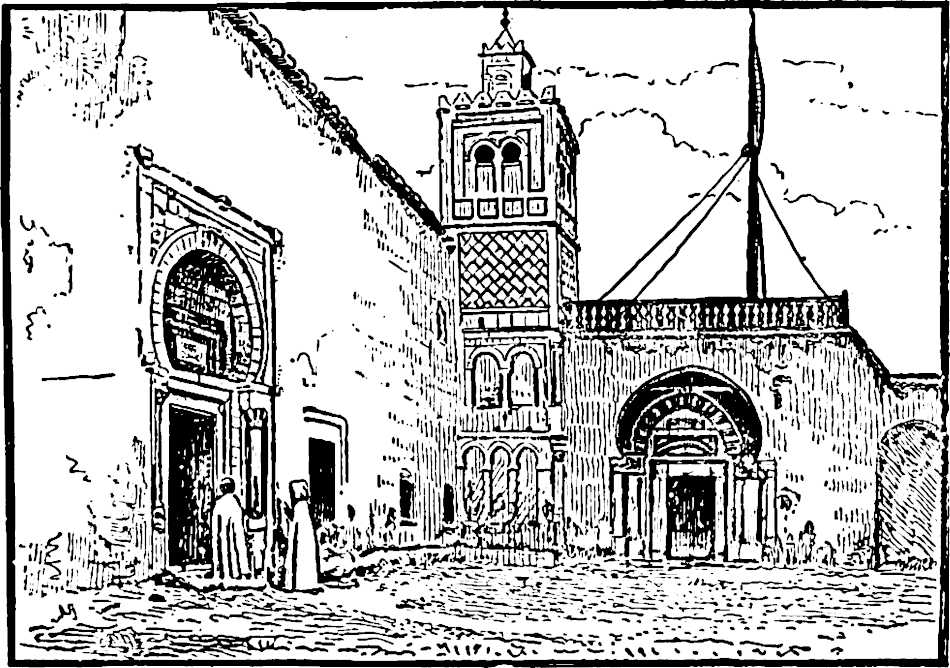
COURTYARD OF TOMB OF SIDI ES SAHIB, KAIRWÁN.
Emerging from the New Gate (either built or repaired in A.H. 1280), we entered the suburb of the Jebliyeh. Opposite the Bab Jedíd is a small mosque—the Djáma Zeitoun, evidently so called from a venerable olive-tree growing in its courtyard. This building is very ancient, and a band of ornamentation surrounding the Minár has been correctly copied by Mr. Rae. The question as to the nature of this decoration has yet to be solved. The columns in the interior evidently belong to the earliest period of Roman buildings in Africa. A narrow lane leads through the faubourg Jebliyeh to the conspicuous mosque of Sidi Amír Abádah, quite a modern, and certainly the most eccentric, building in Kairwán. Its founder, a celebrated dervish named Amír Bed Sád Ben Muftea, was at the zenith of his power at the time of the Russian war in 1854, and he possessed a complete ascendency over the mind of the reigning Bey of Tunis, Sidi Ahmed. The Bey had already defrayed the cost of the erection of six lofty, melon-shaped, fluted cupolas, opening one into the other, when the construction of a seventh was absolutely[173] stopped by the death of the saint and his patron. The dwelling-house of Amír Abádah, adjoining the mosque, was built just twenty-nine years ago. Beyond this, in a ford, lie four enormous anchors, measuring some sixteen feet by nine. Whether they originally belonged to a European ship-of-war or a galley of Malta, nobody knows. The people of Kairwán believe, on the word of Sheikh Amír Abádah, that they once attached the ark of Noah to Mount Ararat. Amír heard these anchors were at Porto Farina, near Tunis, and he ordered Ahmed Bey to send them to him forthwith. His request was complied with, and their transport across the sandy plain between Susa and Kairwán occupied some 500 Arabs during five months. During the siege of Sebastopol, Amír Abádah constructed two cannons with his own hands. He wrote to the Bey that the Prophet had appeared to him and announced that on their arrival before the beleaguered town the latter would at once surrender. They were expeditiously forwarded to Tunis, and, at the Bey’s pressing request, the Sultan sent a ship to convey them to Constantinople, and thence to the Turkish camp before Sebastopol. By an extraordinary coincidence, within a few hours of their being landed the town capitulated. The fame of the last of the saints of Kairwán spread far[174] and wide, and the building of the seven cupolas went on for a time rapidly enough. The Amír even asserted that his mosque was so holy that the faithful could only enter certain portions of it. Most of the domes have one or more broad bands of Arabic inscription, in raised brick, running round the interior. In the entrance-hall are several tables of wood, likewise covered with interminable Arabic inscriptions. The guardian of the sanctuary, Haj Mabruk Ben Saleh Kírwani (who is the husband of the great Sheikh’s only daughter), said they contained prophecies of the French occupation of the city. On inspection, however, they turned out to be an enumeration of French measures. The tomb of Amír Abádah is barely a yard long. At his head are three Russian cannon-balls, at his feet three large iron shells. Above the grave is a great carved and painted wooden case, supporting one of the famous inscribed tablets, at least twelve feet high, and a pipe of enormous dimensions, covered with writing, and having a bowl capable of containing many pounds of tobacco. Several stools around the tomb are curiously carved, and on racks against the walls are sixty enormous iron swords (weighing seventy or eighty pounds each), covered with mystical inscriptions. All these weapons were manufactured by order of Ahmed[175] Bey at Sheikh Amír Abádah’s request; and he assured that prince (the prophecy now discovered by his son-in-law notwithstanding), that as long as these swords remained in holy Kairwán, no Christian enemy could invade the Mecca of Tunis and Africa. From the Amír Abádah mosque a walk of half a mile brought us to the grandest and most important building in Kairwán—the tomb, zaouia, and mosque of Abdullah Ben Wádib el Belawi, Saheb Ennabi,—“the shrine of my Lord, the Companion of the Prophet.” The entrance to the interior of the sanctuary is through a doorway in the base of a minár, which is built in the angle of a spacious court. The exterior of the minár is almost[176] entirely coated with blue and green tiles, and on either side of its upper portion there is a double round-headed window divided by a marble pilaster in the centre. Its roof is formed of bright green tiles terminating in a gilded crescent. The lower storey of the tower forms the lobby or vestibule of the main building. Its interior is lined with the brilliant Tunisian faïence of the seventeenth century, surmounted by panels of arabesque fretwork. A second door opens from this apartment into an oblong cloister. The arcade running round it rests on white marble pillars and arches, and it covers a low marble seat on either side. The walls are decorated in the same fashion as the lobby. At the upper end are two windows and a door of pure white marble, highly decorated, and of Italian origin. This leads into a second vestibule crowned with a fluted cupola, each division of which is adorned with lace-like fretwork. The sides are covered with faïence and panels of finely chiselled carving in cement. A door at one side communicates with a mosque and two other cloisters surrounded by conventual cells. In each of the four walls of the apartment is a small window filled with old stained glass; and the circular band of arabesque design from which the melon-shaped dome springs, is pierced with eight other apertures filled with coloured glass,[177] which is nearly concealed by delicate tracery, throwing a thousand variegated reflections on the marble pavement beneath. Beyond this beautiful room is a broad court surrounded by an arcade of white marble pillars, and arches supporting a wooden roof beautifully painted in squares. In a corner of the court is a cell containing a tomb. Here lies Abdullah Ben Sharíf el Hindowi, an Indian pilgrim, who sought an asylum and found a grave in Kairwán a century ago. At the farther end of the cloister is a doorway and two windows from Rome or Florence. Their cornices are profusely adorned with fruit and flowers, and the jambs of the door are picked out in red porphyry. A massive grating of bronze fills each window. The door itself is of carved dark wood. It led to the tomb of “my Lord the Companion,” a more sacred spot, if possible, even than the mihráb of Okhbah himself; for here for nearly twelve hundred years has slumbered a personal friend of the founder of the faith of Islam, who lived, died, and was buried, wearing always as a symbol of devotion a portion of the Prophet’s beard on his breast. I was the first European who ever entered this Moslem sanctum sanctorum. The chamber is about twenty-one feet square, and lofty. Its walls are covered with a geometrical pattern worked out in black and white marble. Four[178] lengthy inscriptions are embedded in them, and the room is dimly lighted by four small windows of rose-coloured and blue glass. From the cupola of fretwork hangs a grand old chandelier of twisted Venetian glass. Below this is the tomb itself, surrounded by a high grating of bronze, shut in by four marble columns about seven feet high. From a rod, on a line with the grating, hung festoons of ostrich-eggs and golden balls. The catafalque above the grave is covered by two elaborately embroidered palls: the first of black and white velvet, adorned with Arabic inscriptions in silver, was the gift of the late Ahmed Bey; the second, of pink and blue brocade, was a votive offering from Muhammed es Sadek. Over these hung thirteen banners, rich in gold, silver, and needlework—the tribute of the successors of Heussein Ben Ali to the sanctuary of the Sidi Bou Awíb. Our visit was certainly unexpected, for at least a dozen fine Arabic MSS. rested on as many lecterns of mother-of-pearl and tortoise-shell in front of the screen. The guardian of the zaouia could hardly realise the fact of Christians desecrating by their presence such holy ground. Running his amber chaplet through his hands with feverish haste, he suddenly threw himself upon his face, and probably prayed to be forgiven. Some Algerian soldiers who had[179] followed us, prostrated themselves before the tomb, and eagerly kissed the edge of the palls through the metal lattice-work. Looking at the bright white marble pillars of the cloister, my eye fell on one remarkable capital: at either corner a bird supported a Greek cross in the centre. The spoils of some fair Byzantine church had evidently been brought to honour the resting-place of the “Friend of the Prophet.”
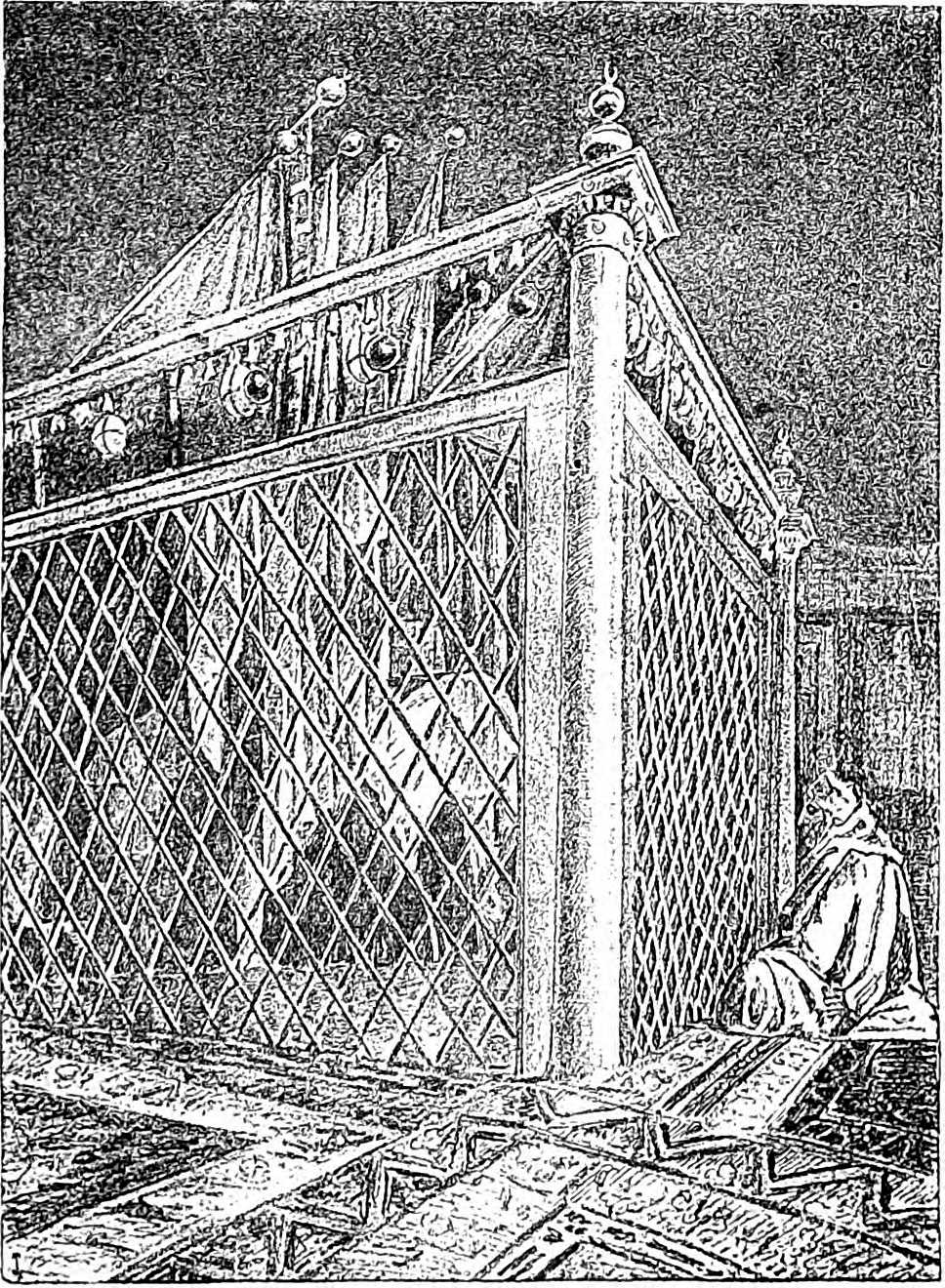
The Tomb of Sidi-ex-Saheb Ennabi.
Leaving this beautiful building with regret, a short walk brought us to the necropolis of the Holy City—two square miles of countless graves. Scattered about in all directions were memorials of every shape and form: pillars of marble covered with elaborate tracery, and crowned with a wide-spreading turban; white and grey slabs bearing long and ornate inscriptions in Kufic; and monuments of every century since Kairwán was founded,—lay piled one upon another in the confusion of decay. From these unequalled memorials of the past the history of Arab dominion in North Africa will probably be re-written.
Skirting the city walls and traversing the suburb of the Kubliyeh, passing en route a mosque with a minár almost as much out of the perpendicular as the Tower of Pisa, we come to a great zaouia near the Bab-el-Djelladín. Almost one-half of the[180] inhabitants of Kairwán are members of the Confraternity of the Aïssaouia. The Zaouia Sidi Bou Aïssa is their sanctuary, and scene of their mystic rites. Passing into a courtyard, we were welcomed by the local chief of the sect, Sy Hamuda Ben Aïssa, who led the way to the main building. The college of Sidi Bou Aïssa consists of a cupola some thirty feet high, flanked by two aisles containing six arches each, all of which rest on an irregular arrangement of fine old Roman shafts and capitals: both the dome and the arcade on either side of it were festooned with ostrich-eggs, gilt balls, and small lamps; and on the walls were suspended the tambourines, earthenware drums, swords, metal prongs, and banners, which constitute the stock-in-trade of the establishment. Nobody acquainted with the rites and practices of the Aïssaouia could ever believe that the slender, olive-complexioned, gentle-mannered, and courteous Sy Hamuda was the head and moving spirit of such a brotherhood as this. The Aïssaouia form one of those semi-religious orders which, as I have stated before, render modern Islamism, as far as the North African littoral is concerned, a sort of freemasonry. The followers of other associations are to be found in all parts of the Moslem world; but the Aïssaouia belong exclusively to the countries bordering on[181] the Mediterranean. Their founder was Muhammed Bou Aïssa of Mequinez, in Morocco. Next to their headquarters at Mequinez itself, Kairwán is the most important seat of their power. As far as can be ascertained, the Aïssaouia have no decided political sympathies. Visitors in Algeria are often admitted to their rites, and they have in some places become almost as much a matter of show as dancing-girls and Arab concerts. Not so at Kairwán. Here till the 7th November no Christian foot had ever passed the threshold of the Zaouia Sidi Bou Aïssa. Here its ceremonies and observances are carried out on a very imposing scale, and from Kairwán the minor congregations of Southern and Northern Tunis receive their instructions and commands. The guiding principle of the Aïssaouia seems to be the greatest possible measure of self-inflicted bodily torture, coupled with the greatest conceivable amount of religious frenzy. Practical Aïssaouia only exist in North Africa; theoretical Aïssaouia are to be found in all countries. During my visit I asked Sy Hamuda if he had any objection to Europeans witnessing one of his meetings. He replied that he would welcome them with pleasure, and even organise a special assembly for their reception. In accordance with his invitation, we repaired on the following evening[182] once more to the sanctuary of Sidi Bou Aïssa. The hall had been evidently decked and garnished; the lamps burned brightly in the cupola amidst the golden balls and ostrich-eggs; the sheikh was clothed in a rich silk robe of office and an awe-inspiring green turban; and a row of rush-seated cane-chairs was waiting to receive the expected visitors. In ten minutes six or seven hundred Arabs filled every inch of available space. The Sheikh Hamuda took his seat in the centre surrounded by the musicians, and an old blind Aïssaouí, guided by a little girl, came in gently from a side door and sat down beside him. The Aïssaouia themselves occupied the whole space covered by the cupola. The aisles contained the Moslem spectators of the first religious rite ever witnessed by Christian eyes in the holy city of Kairwán. Amongst the Aïssaouia I noticed grey-bearded and decrepit old men, many sedate-looking shopkeepers I had previously seen in the bazaars, half a score of the Bey’s soldiers, and a dozen children under twelve years of age. The sheikh struck a note on a drum; the musicians began to play a peculiar and monotonous tone, gradually increasing in intensity. After a pause several of the Aïssaouia rose, and swaying backwards and forwards shoulder to shoulder, shrieked a chorus[183] to the sound of the drums. The music quickened, and so did the chorus. Then one of the most wild-looking of the singers began to throw off his clothes, and passed down the line to urge the others to shout with renewed energy. Then one of the Tunisian soldiers (he wore the Bey’s brass badge on his red cap) seized a sword and began to lacerate his stomach. The blood flowed freely, and he imitated all the time the cries and movements of the camel. We soon had a wolf, a bear, a hyena, a jackal, a leopard, and a lion. One man knelt down before the sheikh, and holding two long prongs to his sides, insisted on their being driven into his flesh with blows of a mallet: this was done. A mere lad did the same thing. A burly Arab passed an iron skewer through the upper part of his nose and transfixed the skin of his face below the eyes. He rushed apparently towards us. Two or three powerful men knocked him down, and held him till the sheikh laid his hands on him and whispered some mysterious formula in his ear. Another man in quick succession swallowed more than twenty large iron nails, there being no mistake whatever as to his really doing so. A large bottle was broken up and eagerly devoured. The frenzy then became general. While one Aïssaouí plunged a knife through his[184] cheek, another transfixed his shoulder-blades with a prong, and a third pierced his hand. A brazier of cinders was speedily emptied. Twenty different tortures were now going on in twenty different parts of the hall. Three large bushes of the thorny Indian fig or prickly-pear were eaten up in almost as many minutes; and at last, before we had time to prevent it, a living sheep was thrown into the midst of the maddened Aïssaouia: it was in a trice torn into shreds by eager hands, and still more eager mouths, and its still quivering and bleeding flesh gnawed to the bones with apparent relish. We left the college of Sidi Aïssa as quickly as we could, and the orgies waxed more furious and more horrible in our absence. I believe that the disciples of Sidi Aïssa at Kairwán number nearly one thousand, but only about fifty are fully initiated into the performance of the rites; and these all assume the distinctive cries and habits of some animal. The rest are merely honorary members, but are bound to support the common brotherhood.
The Zaouia Sidi Bou Aïssa is the last of the public buildings of Kairwán which needs description. The institution it represents is certainly not one of the least curious features of the conquered city. The inhabitants themselves seem almost stupefied by the fate which has overtaken them.[185] Many of them asked me what England said of their misfortunes. “Tell us,” they said, “what your Queen will say to our brothers in India when they know that the sanctity of our mosques and our holy places has been violated.” It was useless to explain that our Ministers had been deceived. The Moslems of Kairwán, even in their hour of agony, still trust to God, the Sultan, and England. There is one word in every one’s mouth—Tripoli. One of the chief men of the place spoke thus: “Between our Bey and the French we have little to choose. Muhammed es Sadek’s recent conduct has rendered him an unbeliever, and one unbeliever is as bad as another; but we never forget our allegiance to the Sultan and Caliph: if he does his duty by us, we shall be faithful to him.” The action of the Sultan is watched with far more anxiety in North Africa than people in Constantinople either know or suspect. The Arabs feel that their very existence is now in peril. If the Sultan declines to protect that faith of which he is the head, the Moslems will find a chief and Caliph who will.
The Arabs who a month ago surrounded Kairwán are now on the very frontiers of Tripoli. Into that country they will ultimately retreat. Will the Sultan’s troops force back at the point of the bayonet from the Regency of Tripoli their co-religionists,[186] whose only crime has been to defend from invasion the Regency of Tunis? Will the French follow their swiftfooted foes across the boundary-line? Will Mr. Gladstone ask England to believe in sober seriousness that the Tripolitans have afforded good ground for French aggression, after the manner of his assurances about the Khamírs six months ago? Will the so-called European concert allow the absorption of Tripoli as well as Tunis into the colony of Algeria? These important questions will soon have to be answered. The Moslems of Africa await with impatience the verdict of Europe. The fall and occupation of Kairwán have raised a momentous issue. The interest excited by this old world city in the minds of the annalist and the archæologist is undoubtedly great, for within its walls a mine of unexplored wealth awaits them both; but, for the moment, this interest is completely eclipsed by that centred in the very grave political questions which must naturally arise from the presence of a hostile Christian force in what was once “the camp and ramparts of Islam.”
[187]CHAPTER XXXVIII.
AFTER THE VICTORY.
While the French troops were still around the walls of Kairwán, the Ministry of M. Ferry formally placed its resignation in the hands of the President of the Republic. Public opinion in France had of late been so severely exercised on the Tunisian Question, that even the dramatic announcement of the well-timed conquest of Kairwán failed to produce any other effect than ill-concealed hilarity. The unexpected surrender of the Government deprived the Tunisian debate of its natural interest, and its excessive dulness was only relieved by the credulous sentimentality of M. Ferry, the sarcasms of M. Clémenceau, and the unanswerable criticism of M. Le Faure.
Six months had brought about a remarkable change in French public opinion, and the very deputies who had cheered M. Ferry’s warlike utterances in May came only to gibe and jeer at his halting apologies in November. It was in vain[188] for M. Ferry to strike his breast and declare that there was “the most perfect accord” between the Bey and the French. This bold assertion was received with undisguised merriment, and even created what is technically known as “an incident.” An eye-witness gives an amusing account of M. Ferry’s perplexities:—
M. Ferry said—I do not see why you should laugh at that. If you were patriots you should rejoice at it.
Duc de Feltre—Certainly, if it were true; but it happens not to be true.
M. Ferry—I beg your pardon; it is absolutely true.
Duc de Feltre—Prove it.
M. Ferry—I am going to prove it. The Tunisians are so much the auxiliaries of our men, that we pay them, and supply them with rations (loud cries of “Oh, oh,” and peals of ironical laughter from the Right).
This scene continued for some time longer. M. George Perin, of the Extreme Left, seizing the opportunity, said the massacre of the station-master and employés at Oued Zerga, some of whom had been burnt alive, had been traced to those faithful allies the troops of the Bey. At this there was fresh uproar. In conclusion, M. Ferry denied that the Tunisian Expedition had interfered with the mobilisation of the army at home, and asserted that were it necessary to mobilise they would find the reserves, which formed the really defensive force of France, embodied in the cadres, which need not be numerous, without any difficulty or trouble. It had also been alleged that the Tunis Expedition had cost France her alliances. Why, only the previous day they had concluded a Commercial Treaty with Italy (cries of “Oh, oh,” on the Right). That treaty should be laid before the House; but[189] an accord had been established between the representatives of the two Governments, and surely the signature of a Commercial Treaty was not the sign of a misunderstanding between two neighbouring and friendly nations. The march to Kairwán had been a splendid achievement.
After three days of wrangle and recriminations M. Gambetta came to the rescue, by proposing an issue which nobody had ever raised or contested. On the 9th November the discussion was brought to a close by adopting the following resolution by 379 votes to 71:—“The Chamber, resolved on the integral execution of the treaty signed by the French nation on the 12th May 1881, passes to the order of the day.” M. Clémenceau’s motion for a Parliamentary Inquiry into the whole matter was rejected, but his bold indictment of the Tunisian Expedition is certainly entitled to a prominent place amongst the state papers connected with the latest Punic War. It ran thus:—
Whereas, on the 7th of April 1881, the Government asked of the Chambers the opening of two credits, amounting together to 5,695,276f., to repress acts committed on Algerian territory bordering on Tunis. Whereas, these credits were inserted in the Budget under the head of military operations on the Tunis frontier. Whereas, these credits were solicited by the Government and voted by the Chambers only for a special object—that of the repression of the Kroumírs. Whereas, the Minister of Foreign Affairs even told the Senate that it was almost one of those repressions with which the[190] gendarmerie could be intrusted, yet the Prime Minister declared, in the discussion of the 5th of November, that the aim of the Government was the submission of the Regency. Whereas, the Government had disclaimed all idea of conquest and annexation, yet the Prime Minister, on the 5th of November, spoke for the first time of our Protectorate over Tunis, an idea expressly repudiated by the Minister of Foreign Affairs in the Senate on the 25th of July. Whereas, the Prime Minister’s declarations show that the repression of the Kroumírs was only the pretext for French intervention in Tunis, and that consequently the Government deceived the Chambers. Whereas, the march of General Bréart on Tunis, the Treaty of Protectorate imposed on the Bey, the bombardment of the Tunisian towns, the occupation of the capital of the Regency, and the present military operations can in no wise be deemed simple measures of repression against the frontier tribes, and really amount to war. Whereas, the Chamber ratified the Treaty of Kasr-es-Said, and, on the 15th of June, the Chamber voted the sum of 14,226,000f., which, according to the declarations of the Minister of War, were to suffice for the expenses incurred, and even for the opening of means of communication, which are the most powerful means of pacification. Whereas, the Chamber believed it had an accomplished fact to deal with, and thought it was setting up an expedition which was terminated, while it was deceived by the Government, which submitted the treaty of Kasr-es-Said to it as the final pacification of the Regency; while, on the contrary, that treaty was the starting-point, for new expenses were incurred. Whereas, in these conditions it is not possible to regard the vote of the Chamber as even an implied authorisation to undertake and pursue the present military operations, which amount to a positive state of war. Whereas, it is impossible to allow the Government with impunity to embark France in a surreptitious manner in a military[191] enterprise invested with all the character of a war, and which might result in jeopardising the interests of our country. Whereas, this would be a dangerous precedent, and if the Government were not stopped in this path by Parliamentary action the security of France might be irremediably compromised without Parliament being able to enforce in time the will of the country. Whereas, therefore, it is proper to consider whether the article of the Constitutional Law of the 18th of July 1875, has not been violated, to ascertain the individual or collective responsibilities of any kind incurred, to see whether the Ministry is guilty only of incapacity, or whether there is ground for enforcing Ministerial responsibility in the way prescribed by the Constitution—viz., by impeaching the Ministers. Whereas, in present circumstances the origin of the expedition is not sufficiently known. Whereas, the declarations of the Government are conflicting, especially as to the Enfida affair. Whereas, as private speculations are mixed up with the Tunis Expedition, it is important to know whether one of the agents of the Government obeyed wittingly or unwittingly the pressure exerted on him by private interests. Whereas, it is important to know with precision what questions were pending at Tunis between France and the Bey’s Government at the date of the expedition, so as to ascertain the real grounds for the crisis which the expedition was designed to adjust. Whereas, there exist at the Ministry of Finance reports of financial inspectors on the management of the Financial Commission, which might be advantageously consulted on this point. Whereas, it ought to be known what use has been made of the French Protectorate at Tunis by the French Consul, and whether an examination of his acts would tend to enlighten Parliament on the causes and object of the expedition. Whereas, the Government has not met the necessities of the expedition, but, to avoid a mobilisation,[192] which would have disclosed the real bearing of its enterprise, recruited the expeditionary corps in a way jeopardising our military organisation and seriously impairing our means of defence. Whereas, after the Kasr-es-Said Treaty the troops were recalled to France at the very moment when their presence was about to become necessary, so that a fresh and larger army had immediately afterwards to be sent to Tunis, a signal proof of the incapacity of the Ministry. Whereas, the military administration has been notoriously unequal to its task, and a good medical service has been entirely wanting. Whereas, the information furnished by the military authorities on the mortality of the troops, as well as on the organisation of the medical service, has been positively contradicted by competent men, without a satisfactory reply to the grave accusations made having been given. Whereas, contrary to the declarations of the Minister of War, the last votes of credit have again turned out insufficient in consequence of the new military operations undertaken in Tunis. Whereas, the Government, having by the manœuvre of early elections caused two Chambers of Deputies to co-exist for nearly two months, did not deem it proper to convene Parliament, and did not hesitate to resort to a financial proceeding distinctly condemned by the law by carrying to the costs of the Tunis Expedition money provided for the support of the troops in time of peace. Whereas, the Government is the less excusable, seeing that it asserts that it foresaw an autumn campaign. Whereas, the Tunisian Expedition has been a source of disturbance and agitation in the Mussulman world. Whereas, it has not attained the object indicated by the Government, which was to ensure the tranquillity of our Algerian possessions, and has deeply modified the political situation of France in Europe in a sense unfavourable to our interests. Whereas, a Parliamentary debate, however extended, is powerless to throw complete light on all the above questions[193] on account of the documents which must be produced and closely examined, as well as verbal statements, the correctness of which it may be necessary to verify. Whereas, the country has a right to know the truth and the whole truth, both as to the real causes of the expedition and as to the circumstances which accompanied it, its results and consequences, as well as the manner in which it has been conducted. Whereas, it is the duty of Parliament to seek that truth, both in order to ensure the exercise of ministerial responsibility in the conditions in which it has been organised by the Constitution, and to prepare the elements of a good solution of the Tunisian question. The Chamber resolves that a committee of investigation of twenty-two members shall be nominated in the Bureaux, in order to present a report on the causes, results, and consequences of the Tunisian Expedition, as well as on the conduct of the military operations, and to make any proposals which may be suggested to it by the interests of the country and the maintenance of the rights of Parliament.
The deceptions and contradictions of MM. Ferry and Saint-Hilaire now brought their own reward; the Cabinet to which they belonged died of Tunis-on-the-brain. Its requiem was written appropriately enough by one who had been himself woefully deceived:—
As to the now defunct Ministry (telegraphed M. De Blowitz on the 10th November to the Times), it might be styled the Roustan Cabinet, or the “Cabinet des Naïfs.” M. Ferry was simple enough to believe that M. Gambetta would accept office on the eve of the session, and would be forced to retain him in his Cabinet. He was simple enough to credit M. Roustan’s assurances that the subjugation of Tunis would be[194] a military promenade. He is simple enough himself to believe, or expect the Chamber to believe, that the Marseilles financiers, from pure patriotism, rejected a bonus of half a million francs for the sale of the Enfida property, that France is stronger with Tunis on her hands than without it, and that expenditure has not been incurred without constitutional sanction, because the money has not yet been debited against any Parliamentary vote. M. Saint-Hilaire was simple enough to think Prince Bismarck egged on France in the Tunis Expedition out of pure friendliness, and he was simple enough to picture Tunis as about to become a perfect paradise under French patronage. General Farre is simple enough to believe, or at least to say, that soldiers do not get acclimatised in the field, and that the science of war consists in bringing back one set of raw levies and sending out another. The whole Cabinet were simple enough to think Parliament would regard the conclusion of the May Treaty on the eve of re-assembling after Easter, and the occupation of Kairwán on the eve of the meeting in October, as pure coincidences, not as theatrical strokes, analogous to an instalment of a novel, leaving off at a thrilling point. Nobody suspects the late Ministers of any dishonourable motives. Nobody imagines that they plunged into the Tunisian hornets’ nest from any complicity in Bourse speculations. Even their little artifices in accelerating the elections and meeting Parliament with a bulletin from Kairwán are matters for a smile rather than for grave reprehension. They have simply been the dupes of their own sanguineness, and perhaps of the craft of others.
· · · · · · · · · ·
At Tunis, however, M. Roustan was pleased to consider the result of the vote on M. Gambetta’s order of the day as a personal victory of his own. Early on the following morning the “approval of[195] the Tunisian Expedition” was placarded all over the city, and four days later, when the local Cleopatra returned to Tunis from a visit to Paris, the Bey’s gilded barge was made ready to convey her to the shore, while eager deputations represented both the legendary colony and the financial associations, and the Pro-Bey fondly believed that his position was now secure.
In the meantime Generals Saussier and Forgemol were conducting one of the Kairwán columns back to Tebessa, while General Logerot was hopelessly endeavouring to track the Arabs to their lairs in the south. The seaport of Mehdia had been occupied without resistance on the same day as Kairwán, but the insurgents still continued their raids and attacks. In addition to the march of the column southward, troops under General D’Aubigny and Colonel La Roque were operating in the north of the Regency, with the hope of surrounding the remaining followers of Ali Ben Amar.
Nothing of any particular moment occurred at Tunis during the weeks which immediately succeeded the occupation of Kairwán. On the 14th November, another Arab was accused of an attempt to endanger the safety of passengers on the French line, by putting a stone on the rails. I am unable[196] to enter into the merits of the case, but the man pretended he was merely running after his goat which had accidentally broken its tether. The poor fellow had only been married the day before, and still wore his wedding garment. He got a very short shrift, and was shot the same day in sight of the Bey’s palace-windows. The ladies of Kasr-es-Said were greatly alarmed, and were not reassured when a number of Arabs afterwards came close to the building, and shouted out uncomplimentary allusions to the diminished power and prestige of the descendants of Heussein Ben Ali.
Before General Logerot had fairly started on his road to Gabes, a band of the fugitives from Kairwán attacked the Arabs who refused to join them, near the El Djem ruins between Susa and Sfax. Two men were killed and thirty wounded in the melée, and the assailants made good their retreat with a rich booty. Renewed razzias were reported almost daily from Susa and Sfax, and the inhabitants of Mahres proved so refractory, that a French gunboat had to be sent to shell their village.
The French now began to exact a very heavy contribution from those tribes which were willing to submit—forty francs and a gun from every adult sometimes represented the whole wealth of[197] the possessor, and the payment often entailed misery if not absolute beggary. These proceedings interfered considerably with the progress of any attempt at pacification. Another great mistake was committed; the clans which asked and received aman were at once deprived of their arms; the result of this step was quickly felt, for the “submitted tribes” were soon defeated by their armed co-religionists, or again compelled to join in the rising. A third and more important blunder was the appointment of “Colonel” Joseph Allegro to the Caidat or Governorship of Southern Tunis. The part he had played in the Khamír rising, while ostensibly receiving the Bey’s pay (or as the Arabs have it, eating the Bey’s salt) at Bone, was now notorious, and its effect on the minds of the Tunisians could not be effaced, even by his ostentatiously embracing the Moslem faith, as he did shortly afterwards. Apart from personal courage, this man had no single qualification for a place of trust and responsibility, and his very presence amongst the Arabs afforded a continued provocation to fanaticism and resistance.
On the 21st November the news reached Tunis that the elaborate concentric movement of Generals Philibert and D’Aubigny and Colonel La Roque had ended in the escape of Ali Ben Amar, who with[198] a chosen band of followers evaded their pursuit, and after joining Ali Ben Hlifa, finally made good his retreat to Tripoli.
The doubtful wisdom of several of the steps taken by the French authorities during the marches into Southern Tunis, to which I have previously alluded, now seems to have culminated in a manifesto published by “Giannino,” the French Vice-Consul and Pro-Roustan of Sfax. On the 20th November he issued a circular “calling the attention of the consular agents to the approach of the French column from Kairwán, and to the razzias which it might be necessary for the French troops to execute against the Arabs during the march, and requesting the Europeans to withdraw all their property from the interior, in case it should otherwise be destroyed along with that of the natives!” As no European had been able to reach the districts in question during the past six months, this demand can only be qualified as a mauvaise plaisanterie.
As I was now anxious to meet the colonne Logerot on its arrival at Gabes, I left Tunis on the 26th November to journey along the Sahel to Susa, Sfax, Gabes, and afterwards to Tripoli, which had now, according to the Agence Havas, supplanted Kairwán as “a focus of Moslem intrigue and sedition.”
[199]CHAPTER XXXIX.
A JOURNEY TO SOUTHERN TUNIS.
Late on the evening of the 26th November I left Goletta in the steamer “Valette” belonging to the Compagnie Transatlantique, on a pilgrimage to the seat of war in the south. The hurry and bustle on board were naturally very great, as the “Valette” was chartered at the eleventh hour to carry provisions to Gabes, but Captain Cambernon, a good-humoured Breton, and as he often laughingly observed, “half an Englishman,” exerted himself under difficulties to do the honours of his ship, and maintain the proverbial good name of his employers for attending to the comforts of their passengers. We did not get under way till dusk, but shortly after daybreak the next morning the “Valette” anchored in the calm blue water off Susa, where the confusion and activity had, if possible, increased since I quitted it three weeks before.
We were now joined by several other travellers, amongst whom were Dr. Samuel Pozzi and his[200] charming wife, M. De la Mothe (the Tunisian special correspondent of the Temps), and several military and medical officers, on their way either to meet the column of General Logerot or to do garrison duty at Sfax or Jerba. The weather was delightful, the table unexceptionable, and everybody in the best of humours. I have had few better opportunities of becoming acquainted with almost every shade of French thought about Tunis than during the five days I spent on board the hospitable “Valette.” Dr. Pozzi had come to North Africa to probe the great sanitary question in the interests of the Red Cross Society, and could now talk perpetual ambulance with the army surgeons to his heart’s content, while M. De la Mothe, an ardent and eloquent Arabophile, fought over and over again the battle of the natives, with any Arabophobe warrior who had the temerity to accept his standing challenge.
After a short stoppage at Monastir, where we did not land, we arrived the same afternoon at Mehdia, the once famous “Africa” of the Spaniards, and of the annalist of the Knights of St. John. The town is built on a narrow tongue of land widening towards the centre, stretching out boldly for about a mile into the Mediterranean, and which may be pretty correctly described as a low oval-shaped hill.[201] The isthmus which connects with the coast is barely a quarter of a mile in width, and gives to Mehdia the essential characteristics of a peninsula. In its palmy days the old city evidently covered the whole of Cape Africa, and was surrounded by a thick wall intersected by towers, which protected the isthmus, on one side, and was washed on all others by the sea. Mehdia, according to the doctrines of barbaric warfare, must have been almost impregnable, and so strong were its fortifications that great masses of the enceinte have to this day survived the efforts of the Maltese Knights to entirely destroy them, when they evacuated the place three centuries and a quarter ago. The modern Mehdia immediately adjoins the mainland, and is entered by a gateway through a castellated building known as the Borj Lotani, or “lower fort.”
On either side of the Borj Lotani great pieces of the original bastions are still standing, and on the summit of the tower I saw several small cannons made of tarred rope and hoop iron which evidently belonged to the time of its Spanish occupation. The highest portion of the little peninsula is occupied by a quadrangular fortress known as the Borj Fukháni, or “upper fort,” and between these two buildings are the squalid streets of the Arab town, and a long straggling edifice on[202] the sea-shore known as the Jáma Kebira, or great mosque, a portion of which is said to have been once a Christian church. Towards the farther extremity of the cape, there are evident traces of a large basin for galleys or boats hollowed out in the rock, and approached by an opening in the outer bastion. The soil is everywhere catacombed by cisterns, nearly 300 in number, and many of which are of very considerable size. When Commandant Juffé of the 71st Regiment came to Mehdia with a single company of soldiers on the 26th October, he only found a score of half-starved Tunisian artillerymen in the forts, and about the same number of rusty guns resting on the crumbling battlements, which had survived the gradual decay of the wooden carriages that once supported them.
A few months ago a broken stone outside the door of the mosque on the sea-shore formed a still visible link between the Mehdia of the present and the Africa of the past. About twenty years before, an enthusiastic Moslem theologian had ordered the faithful in Mehdia to thrust from its place in the Jáma Kebira the tomb of an infidel, which by some mischance had remained undisturbed in the sanctuary of the true believers for over three hundred years. The holy man’s advice was religiously acted upon, and the marble slab[203] which once covered the remains of the good knight Giovanni Antonio Pescatore was soon half buried by the sand amongst which it had been thrown. To chip a morsel from the Roumi’s tomb became a pious pastime of the young Arabs of Mehdia, and the monument would long since have disappeared, if the care of Mr. Reade had not rescued it from its perilous position, and obtained permission from the Bey to remove it to Tunis.
The Moslem town of Mehdia rose on the site of some now forgotten Roman city under the fostering care of Obeidallah “El Mehdi,” and in 1550 fell into the hands of the great corsair Dragut, who afterwards died fighting with the Cavalieri della Religione on the ramparts of St. Elmo, and now sleeps at Tripoli in the West. Dragut snatched Mehdia from a small band of pirates, who bade defiance alike to Christian foes and to the Moslem rulers of Tunis and Kairwán. The success of Dragut appears to have caused equal alarm in the councils of Charles V. at Madrid, and of the Grand Master of the Order of St. John at Valetta, and a joint armament was despatched to the shores of Africa before the summer of 1550 had fairly set in. Bosio gives a detailed account of the fall of Mehdia, and Sutherland[8] states that[204] “the knights and other officers of distinction who fell in the assault, were honoured with interment in the principal mosque, which was first purified and consecrated as a Christian temple.” He adds also “that afterwards when the place was abandoned by the imperial troops, the ashes of these warriors were transported to Sicily and deposited in the cathedral at Monreale, where a stately monument was erected, bearing an inscription commemorative of their renown.” During a hot September day I clambered up to Monreale from Palermo to search for the “stately monument.” Not a trace of it remains, and I am afraid the only existing memorials of the capture of Africa in 1550 are the scattered fragments of masonry at Mehdia, and the broken tomb of Fra Giovanni Antonio at Tunis.
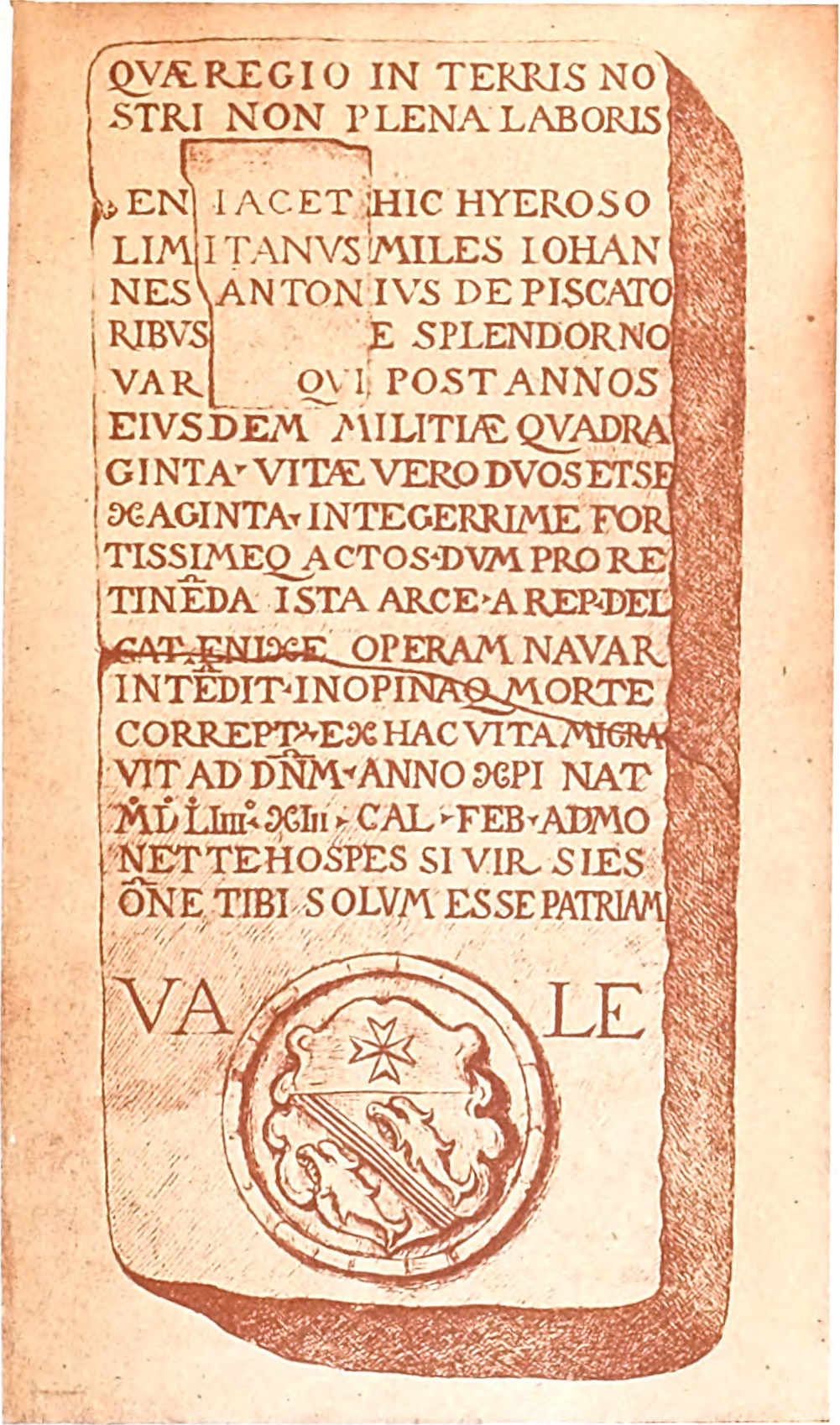
Inscription on the
Tomb of Johannes Antonius de Piscatoribus.
Reproduction by Maclure & Macdonald.
The rescued slab has also an interesting tale belonging to it, which must be my excuse for an unwarrantably tedious historical digression. The troops of the Emperor and the Hospital continued to occupy Mehdia during the years 1551, 1552, and 1553. In the latter year a very strong feeling of discontent appears to have arisen amongst the soldiers, which induced the Grand Master to send first Don Pietro Mendoza, and then Leone Strozzi, Prior of Capua, to arrange matters and restore[205] peace to the garrison. Strozzi appears to have been a man of great energy and boundless ambition, and no sooner had he arrived at Mehdia, than he conceived the project of obtaining a personal grant of it from the Emperor, and of colonising it, after making his peace with the rulers of the Ottoman Empire, through the good offices of Queen Mary of England. Before any answer arrived, he had calmed the irritation which existed amongst the Christian troops, and having captured several Moorish vessels, returned in triumph to Malta. At this juncture the Grand Master John d’Omedes died, and Strozzi became an eager candidate for the vacant post. The electing knights seemed to have entertained such a wholesome dread of his pride and tyranny, that their choice fell upon Claude de la Sengle, who had greatly distinguished himself three years before at the taking of Mehdia. De la Sengle proceeded forthwith to Rome, where he received an envoy of the Emperor, who brought with him a deed of gift, conferring the possession of Mehdia on the Order of St. John.
As soon as the Grand Master returned to Malta a council was assembled to deliberate as to the acceptance or refusal of the preferred possession. The Viceroy of Sicily appeared before it, and strongly urged the former course. These discussions[206] resulted in a commission being appointed to proceed to Mehdia, with orders to report in the greatest possible detail on its position, fortifications, and natural advantages. The Prior of Capua (still smarting under the vexation entailed by his signal failure as a candidate for the Grand Mastership, and very possibly not a little angry at the refusal of the Emperor to sanction his plan for a colony in North Africa) was named its chief, and the commissioners, after making a minute survey of the city, were directed to advise the Order as to its ultimate decision. So much importance was attached to the investigation that every Langue or Division of the Confraternity was represented in the commission. The delegate of England was Sir Usualdo Masimbert, that of Italy Giovanni Antonio Pescatore.
Everything else has been forgotten; the name of Pescatore alone survives amongst the ruins of “Africa.” He was probably a native of Novara in Italy, and arrived in Malta during the year 1545, as the bearer of a letter from the Pope requesting the then Grand Master of the Order to appoint his nephew Carlo Sforza (Prior of Lombardy) to the command of the fleet of the Hospital. He subsequently obtained high rank at Malta, and in September 1553 became Governor of Fort St. Elmo.
[207]Five months later (February 1554) he died at Mehdia,[9] “his friends declaring that he had been poisoned by a confidential servant (servitore intrinseco) of the Prior Strozzi, Biagio Pesce by name, who was in turn stabbed a few months afterwards by the Knight Aleramo Parpaglia, on account of a rumour and strong suspicion that he had caused in a similar manner the death of his brother, Knight Bernardone Parpaglia, as well as that of the Conventual-Conservator Knight George Vagnone, and this on account of certain opposition and contradiction offered to his master in the matter of the magistracy. The historian of the Order comments with pious indignation on such a scandal having happened amongst the knights while endeavouring to plant their banner in partibus infidelium. The commission at length reported adversely to the acceptance of Mehdia, and its concomitant responsibilities, and in the autumn of 1554 it was evacuated by the Christian troops, its walls and fortifications having being carefully destroyed.
· · · · · · · · · ·
We left Mehdia at sunset, and next morning were already in sight of the white walls and battered minár of the great mosque of Sfax. A background of green gardens and stately palm groves completed an almost perfect Oriental landscape, and it was[208] difficult to realise, in the placid scene before us, the ordeal of fire which Sfax had undergone during the past summer. Any illusion on this head was at once dissipated as soon as the shore was reached. The ruined batterie rasante, the half-dismantled forts, the damaged houses, the heaps of rusty cannon balls, and a row of black crosses in the little cemetery, all contributed to bring vividly before the mind’s eye the events of the memorable 16th July. The streets in the European faubourg had received highly sounding French names, and were all more or less crowded with soldiers and sailors. Repairs were going on in all directions, and ere this Sfax has in all probability resumed its wonted appearance, but even then (Nov. 28th) it was whispered in my ear that nobody could be sure of a sound skin three miles outside the gates, and matters do not appear to have greatly mended since. The one complaint at the time of my visit to Sfax was the petty tyranny of the French Vice-Consul “Giannino,” who was threatening everybody with “confidential reports to M. Roustan,” and making the best use of his opportunities. M. Freycinet has since dispensed with M. Mattei’s services, and only left him the consolation of descanting eloquently on unrequited patriotism and the ingratitude of the Republic.
[209]Great consternation was expressed at the abrupt termination of the Commission of Inquiry into the losses sustained by the Europeans during the bombardment and after the occupation, and I was compelled to undergo a series of ocular proofs as to the extent of damage suffered. The cupola of the Roman Catholic church was gone, and the house occupied by M. Leonardi, the British Consular-Agent, entirely destroyed; one Maltese had lost all his timber, and another the contents of his shop, but there was a deal of good-humoured patience mingled with much complaining, and a general belief that somehow or other the invitta Britannia would bring everything right. In spite of an unfortunate element of grotesque exaggeration, there can be no doubt that a great wrong has been committed by somebody. By all means let that somebody be nameless, but as France was not at war with Tunis, and was avowedly acting as her ally, she is certainly bound to see that wrong remedied.
Outside the town I observed two large marabouts. The dome of one was nearly all gone; the second was tolerably perfect. In the former, under a roof of sail-cloth, lived the Maltese family which had been saved by Haj Maala during the insurrection. The mother, with tears in her eyes,[210] described the kindness she had received from the Arabs, when she and her children were hiding in his garden disguised in Tunisian dress. The second tomb was inhabited by an officer, who was quietly eating his luncheon over the grave of holy Sidi Mazún. A little old Maltese woman was pointed out to me, whose solitary room had disappeared under a French shell. She preferred a very detailed claim to the commissioners, amounting altogether to something under three pounds. I was told they were so pleased with her honesty that her loss was assessed at more than she asked. Before evening I was a little tired of looking at calcined walls, hearing stories of real losses and bogus demands, and listening to the misdoings of “Giannino,” and was not sorry to return to the “Valette,” which sailed about midnight for the Syrtis Minor.
Early on the 30th November the “Valette” anchored about a mile from a sandy shore fringed with groves of palm-trees. Beyond a few wooden sheds no kind of habitation was visible, an indentation in the beach alone betokened the mouth of a river, and it was difficult to believe that this was Gabes. A French frigate and gunboat were lying off the coast, and two or three steamers were busily discharging their cargo into white-sailed Arab feluccas.[211] We were at once boarded by the French Consular-Agent, M. Sicard, who told us that General Logerot had arrived the previous day at Ras-el-Oued, a few miles from Gabes, where he had encamped. All the available barges were at once utilised for the landing of the officers and soldiers, and we were afraid that it would be impossible for us to reach the land. This was a great disappointment for all of us, and especially for Dr. Pozzi, who was naturally anxious to see the famous river Sel, the muddy waters of which, impregnated with magnesia, had laid so many of his brave fellow-countrymen to sleep for ever under the palm-trees which skirt its banks; and for the newspaper correspondents, who were thirsting for the latest news of the column. In the midst of our lamentations, Captain Arcadius Gosselin of the S.S. “Ville de Tanger” came to the rescue, and obligingly conveyed us on shore in his own boat, and I am sorry to say at some personal inconvenience.
We could now for the first time perceive some villages amongst the palm groves on either side of the half-dried water-course, called by courtesy the river Sel or the river Gabes. The name Gabes seems rather to denominate the whole neighbourhood than any particular locality. The little district of Gabes is as it were the connecting[212] link between the Great Sahara and the Mediterranean, and is really only separated from the desert by a range of low sandy hills, and a series of chotts or marsh-lakes, more than a hundred miles in length, and generally known as the Sebkas Fejej, El Djerid, and Gharsa. Gabes itself is nothing more than an oasis or cluster of oases, through which the stream Sel or Gabes finds its way sluggishly across the plain to the sea beyond. As the Tacape (hence Cabes or Gabes) of the Phœnicians, and afterwards of the Romans, this place was the emporium of one of the richest provinces of Northern Africa. The sands of the Oued Sel have long since buried Tacape out of sight, and the modern Gabes was entirely unknown to fame, when in 1874, M. Roudaire gave it an unexpected celebrity as the Port Said of the projected inland sea, which was to be formed by the junction of the Tunisian marsh-lakes with the waters of the Mediterranean. A year later, an Italian expedition under the Marquis O. Antinori pronounced against the feasibility of M. Roudaire’s scheme, and the scientific world seems to have accepted this verdict. Gabes was again almost forgotten, when, as I have described in a former chapter, it became one of the centres of the Arab rising in July 1881, and was finally occupied, after the merest show of resistance, by[213] the French troops. A French garrison has remained there ever since, under the shelter of the warehouses of an English firm, and intrenched behind a bulwark of iron-bound bales of esparto fibre. After the capture of Kairwán a march on Gabes was resolved on, with a view, if possible, of surrounding the Arabs, or of at any rate showing them enough pomp of war to convince them, that any further resistance to the French Protectorate was a useless kicking against the pricks. It was to this end that General Logerot set out from Kairwán on the 12th November, in company with Generals Sabatier and Saint-Jean, at the head of a force 6200 strong and with a large convoy of provisions.
From the shore the most conspicuous objects in the landscape are the great dome of Sidi Bulbeba’s kouba far away on the sand-hills, and the ruins of the kisla which still cover the bodies of those who perished in the explosion. The palm groves only permit the spectator to see a faint outline of the two rival villages, Jára and Menzel. As we arrived at the small French camp, a battalion of the 107th and another of the 137th Regiment were preparing to march out to Ras-el-Oued to join the column. A walk of half a mile inland brought us to the village of Jára, which stands on the outskirts of the first oasis and on the banks of the Oued Sel.[214] Its houses, mosques, and numerous marabouts are built of large and well-fashioned blocks of stone, which evidently had done service twenty centuries ago in Tacape. My readers will remember that the people of Jára made their peace with the French as soon as they arrived, and while the Arabs of Menzel were still fighting amidst the embers of their homes. The dwellers in Jára belong to the Soff or faction of the Shadid, while those in Menzel and in the adjoining village of Shinni are followers of Sidi Yusef, a saint, and not of the new French Caid. Ali Ben Hlifa, the leader of the national movement in Tunis, lived in Shinni, but party-feeling in Jára was stronger than their patriotism, and the destruction of the hated Menzel was an ample compensation for the triumph of the infidels. Although the French had been at Gabes five months when I visited it, the Arabs of Menzel and Shinni would never ask or accept aman. Two days before my arrival it had been decided to complete the destruction of both these places by gunpowder and dynamite. The Jáma Kabira, the Caid’s house, and all the public buildings of Menzel were soon reduced to shapeless heaps of ruins. Next morning Shinni and more particularly the great dwelling-house of the Hlifas shared the same fate. It was difficult to believe that the calcined rafters[215] and blackened walls I visited, were now all that remained of a town, which half a year before contained 4000 inhabitants, and was one of the most thriving and prosperous marts of the rich province of the Djerid. The story of Menzel and Jára illustrates the extraordinary violence of local party-feeling amongst the Arabs of North Africa, and the powerful influence of the institution of the Soff. The force of faction had stood the French in good stead in Algeria, and it now seems likely to help them in Tunis. They are quite aware of the weak spot in the Arab armour, and while at Gabes I plainly saw that no pains were being spared to take every advantage of it. In matters of this kind the Caid Sidi Yusef is said to be an adept, and the Beni Zid clan was almost persuaded by him to bar Ali Ben Hlifa’s retreat to the Tripolitan frontier.
At Gabes I was able to ascertain the particulars of General Logerot’s march from Kairwán. It was a fitting sequel to General Saussier’s advance from Tunis, both as regards its details and its consequences. The Arabs (with a single exception) eluded the pursuit of the advancing column, and hardly an enemy was ever visible. Shots were at times exchanged during the night, some of the irregular cavalry were killed, but nothing deserving[216] the name of an engagement took place. After leaving Kairwán on the 12th November, the camp was pitched successively at Enchir-el-Ouiba and Oued Mesour. This movement occupied three days. Halts were afterwards made at Bír Bu Habessa, Hoglet Ben Zallouck, and Hoglet El Ajela. On the 17th November the column reached Ali Ben Abda, where great inconvenience was experienced from want of water. The extraordinary inaccuracy of the topographical department was one of the worst features of the campaign in a military point of view. While I was at Kairwán, a reconnaissance under Colonel Moulin returned to the city by forced marches and in a pitiable condition, owing to having received totally erroneous official information about the water supply on his route. The ouiden or rivers of the chart turned out to be streaks of sand, and the biár or wells were in reality muddy pools of brine. If an Arab attack had taken place during the retreat, nothing could have saved the weary and thirsty troops from a disaster. The patience of the soldiers under these trying circumstances was admirable, and they enlivened their forced march by composing a song in honour of riz au lait as cooked with the water of a Tunisian bir. I heard it afterwards sung at Kairwán, and it was as witty as it was good-humoured. The same misfortune[217] was severely felt at the next halting-places (Taoul Sheikh and Oued Gran), but at El Founi several wells were found, and the column remained there for four days.
The presence in the vicinity of a large encampment of the Oued Khalifa (one of the many subdivisions of the great Zlass tribe) having been ascertained, a strong force left El Founi to attack it. It was, however, found to be tenanted almost entirely by women, children, and decrepit old men, for the combatants had already gone southwards, leaving their tents pitched in the Douarna mountains, well out of the line of march as they imagined. This bloodless victory resulted, however, in the confiscation of 7000 sheep, 368 young camels, and 1400 oxen. After quitting El Founi for Sidi Muhamed, heavy rains considerably impeded the march, but after halts at Sidi El Medoub, Oued El Akarit and Metouia, the troops, early on the 29th November, came in sight of the palm-covered oasis of Gabes and encamped at Ras-el-Oued. During the last seven days of the march not a single living soul was met with. Contrary to General Logerot’s anticipations, the health of the troops was not appreciably affected during their advance over the almost unknown deserts of Central Tunis, and only six deaths occurred en[218] route. Some weeks later an English merchant had an interview at Tripoli with Muhamed Ben Hlifa, the nephew of the Arab leader. Sidi Muhamed made merry over General Logerot’s laborious expedition. He said that whenever the French marched in compact masses, the Arabs could easily avoid them, and that often only a few miles separated the two camps. The insurgents were able to move in a day as far as the French could march in a week. This reminds me of one of the wittiest of the Epoca’s Tunisian caricatures, which depicts France contemplating an army of tortoises and snails on a plain, defied by a number of Arabs on the mountains.
Just before leaving Gabes I learned that an extension of the expedition in the direction of the Tripolitan frontier had been resolved upon. The wind had meanwhile shifted to another quarter, and we were carried to our boat in rather an undignified manner on the backs of some of the worldly wise Arabs of Jára, as the landing-place was no longer practicable. After sunset we anchored off the island abode of the “lotus-eaters,” but nothing could be seen of Jerba but a low coast-line, some palm-trees and a long white fort. Before we had awoke next morning we had already passed the frontier, and were skirting the barren hills of the most westerly province of the Ottoman Empire—Trabulus Gharb.
[219]CHAPTER XL.
TRIPOLI IN THE WEST.
The appearance of “Trabulus Gharb,” or “Tripoli of the West,” as viewed from the sea is scarcely more imposing than that presented by the principal towns on the Tunisian coast. The city is built on a rocky promontory stretching out into the Mediterranean, and forming a small bay on its eastern side, which is capable of being converted at any time into an important harbour by the filling up with masonry of the openings in a long line of rocks running from the south-west to the north-east, and commonly known to navigators as the Siboun Shinal. The Pashas of Tripoli, however, have not viewed the projects for carrying out any such scheme with much satisfaction; indeed, one of them told an enterprising contractor that the rocks were far too old to bear any additional weight upon them. Large steamers are able to enter the port even now; but the present state of the Siboun Shinal shoal renders it an unsafe place[220] of anchorage during the prevalence of certain winds. The city borders the shore, and has the form of an irregular pentagon, surrounded by a crenellated enceinte wall in a somewhat dilapidated condition. A line of small, half-ruined forts is supposed to protect one side of the harbour, and the Borj or castle of the Pasha the other. The desert almost touches the western side of the city; while on the east is the verdant oasis of Meshiya, where, amid luxuriant groves of palm-trees, are still to be seen the tombs of the Caramanlian sultanas, and the twelve-domed marabout of Sy Hamouda. In the town itself there are seven principal mosques, six of them possessing more or less lofty minarets built after a purely Turkish model. The streets are narrow, dirty, and unpaved. European quarter there is none. What Tunis was twenty years ago, Tripoli is now—a typical Moorish city. Still the capital of an important province, it can boast of an historical past of no small interest. After falling successively into the hands of the Phœnicians, Romans, Vandals, and Greeks, Tripoli was finally conquered by the Arabs twelve centuries ago, and has remained a Moslem State ever since. For many years it formed part of the dominions of the Caliphs of Kairwán. It finally became independent, but in 1510 it was taken by Ferdinand the Catholic, and[221] given by him thirteen years later to the Knights of St. John, who remained there for thirty years, until they were expelled from it in 1553 by the Turkish corsairs Dragut and Sinan. The former became its pasha and ruled Tripoli as the vassal or vali of the Sublime Ottoman Porte, till his death in Malta. Then came the days when the Tripolitan pirates grew to be the terror and scourge of the Mediterranean, and half the States of Europe sent their fleets to bombard the capital in vain. In 1714, while Heussein Ben Ali was founding the present line of the Beys of Tunis, Ahmed Pasha the Caramanli achieved practical independence, and his descendants governed Tripoli until 1835. On the 20th May of that year the Turks took advantage of the breaking out of a civil war to assert once more their authority, and Yusef, the last of the Caramanlis, died a state prisoner at Constantinople. Since 1835 Tripoli has been governed by a succession of pashas or valis sent there periodically by the Sultan.
It is difficult to overrate the commercial importance of the Tripolitan Pashalik. It is at the present time the undoubted centre of the caravan trade of Northern Africa. All efforts to divert the usual route followed by the traders of the desert have been wholly unavailing. The coast of Tripoli is at[222] least 250 miles nearer the great marts of the interior than either Tunis or Algeria, and it is there that the caravans from Ghadames, Murzouk, and Wadai will go. This vast system of inland trade extends even to Bornou and Timbuctoo. Three-fourths of the whole commerce of Tripoli is in the hands of British merchants or dealers in British goods, who send our cloth, cutlery, and cotton fabrics southwards, and export in return the esparto grass, ostrich feathers, and ivory of the Tripolitan market. The carefully prepared trade reports of the British Consul-General, Mr. Hay, may be read with advantage at the present moment.
The coast-line of Tripoli, which stretches from Biban, in Tunis, to Bomba, on the frontiers of Egypt, is considerably over 800 miles in length. Besides the ports of Tripoli, Khoms, and Ben Ghazi, it includes the almost unknown natural harbours of Bomba and Tobruk. Father Angelo di Sant’ Agata, the venerable chief of the Franciscan missionaries at Tripoli, has visited the latter. If his information is correct, Bizerta has a rival which needs neither expense nor dredging to bring it into immediate use. Two lines of hills run through the country from east to west—the Ghariyan range near the coast, and the Zuara chain farther inland. The interior of Tripoli may be said with tolerable[223] accuracy to consist of a somewhat unequal alternation of oases and desert. Along the sahel or coast is a border of rich and productive soil. The native population is made up of Arabs, Moors, and Turks, and is thin and scattered. Any attempt at an enumeration is a matter of pure conjecture. The city of Tripoli itself contains about 25,000 inhabitants—viz., 15,000 Moslems, 6000 Jews, 3000 Maltese British subjects, 900 Italians, and 100 other Europeans, including exactly 30 French. The southern boundary of the Pashalik is ill-defined; but Turkish troops now occupy both Ghadames and Ghat, the former sixteen and the latter forty days’ journey from the capital.
The constant change of Turkish pashas has been markedly unfavourable to the progress and even to the prosperity of the country. No one vali ever seems to have effectually transmitted his mantle to his successor, and most of their administrations have left no other trace than plans never executed, and good intentions never acted upon. Every governor who did anything at all seems to have possessed a hobby, but, as no two of them ever worked on the same lines, no practical result ever came of their individual energy and intermittent activity.
If possible, Tripoli, until very lately, presented[224] even more strongly than Tunis the spectacle of a house divided against itself. Not only were the Arab tribes perpetually at war with each other under the combined influence of hereditary feuds and the institution of the Soff, but as a body they hated their Turkish rulers and co-religionists, just as much as the Turkish adherents of the Caramanlis disliked the intruders from Stamboul. The events of the past year have, however, materially and perceptibly affected this state of things, and the French invasion of Tunis has undoubtedly caused all local strife to be temporarily or permanently merged in a league, the common object of which seems to be the defence of Islam in general and of Tripoli in particular. The Arabs, who a short time ago were wont to complain bitterly of their Turkish masters, greeted the arrival of Nasif Pasha last May with intense enthusiasm, the Turkish troops were received with shouts of triumph, and as soon as the great siege guns were landed they received a baptism of blood from the sacrifice upon them of numerous sheep and oxen brought down to the shore by the Tripolitan townsfolk. No longer do the Bedouins of the interior murmur at their camels being taken for transport service; all they say is, “Allah yunser es Sultan”—“May God grant victory to the Sultan.” Sixteen days before[225] Nasif Pasha’s arrival, M. Roustan had made the Bey of Tunis a French vassal by the Treaty of Kasr-es-Said. The feeling of Moslem antagonism, which was first roused by the French conquest of Algeria fifty years ago, was now re-awakened with renewed intensity, and the presence of Turkish troops in force was quite as necessary to prevent the extension of the movement among the Tunisian Arabs to their confrères of Tripoli, as to assure the Tripolitans that Turkey would oppose by force any attack by France on the Pashalik itself. To have ignored or even neglected the state of public feeling in North Africa might have cost Abdul Hamid the Caliphate. But this is not all. Within the confines of Tripoli itself an imperium in imperio has of late years been growing up, which will sooner or later attract the attention of Europe. In 1830, one Sidi Muhamed es Senoussi was living at Mustaghanem, in Algeria. He even then enjoyed a widespread reputation as a saint or marabout, and on the French invasion taking place he retired to Fez, in Morocco, where he was initiated into the confraternity of Moula-et-Taib. From Fez, Es Senoussi passed along the Algerian Sahara to Tunis and Tripoli, and finally reached Mecca by way of Alexandria. After a stay of two years in the holy places, he returned to[226] Alexandria, where he founded a zaouia, and commenced a crusade against the contamination of Islam by Christian contact, advocating at the same time an immediate return to the austerest principles of the faith, and vehemently assailing the Turkish Government for adopting European costume and copying European institutions. The doctrines of Es Senoussi were a refinement of Wahabiism. Excommunicated by the Sheikh-el-Islam at Cairo, an attempt was even made to poison him, but one of his followers, Muhamed Ben Abdallah, managed to convey him on a camel into the Libyan desert. Senoussi finally took up his abode at Djebel-el-Akhdar, or the Green Mountain, in the neighbourhood of Ben Ghazi, in Tripoli, where he married. Finding the locality too close to the Mediterranean for the execution of his projects, he removed to Djaghbub, or Djarbub, twenty-two days’ journey from the coast. Here he erected a magnificent zaouia, surrounded by palm groves and inhabited by nearly 1000 of his followers. His doctrines were soon received with enthusiasm in the Moslem kingdoms of Northern and Central Africa. He established no less than 300 subordinate convent-sanctuaries in every considerable place between Morocco and Mecca, and appointed mukaddemin, or vicars, in every part of Islam. In[227] 1850 his agent, Muhamed Ben Abdallah, the Senoussian mukaddem for Algeria, excited the revolts of Laghwat and Ouergla. He finally succeeded in escaping from Algeria, and returning to Djaghbub. In 1860 Muhamed es Senoussi died, leaving two sons, the eldest of whom bore the name of El Mehdi. Before his death, Senoussi the elder sent emissaries to all his zaouias to convey guarded hints to his followers that a glorious future was in store for his son. The prosperity of the zaouia at Djaghbub increased. The pilgrims to Mecca from North Africa, as well as those coming from Bornou and the Saharian provinces, were persuaded that the benediction of El Mehdi was necessary to complete the efficacy of their journey. They flocked in thousands with their offerings to Djaghbub, while the Sultans of the interior sent caravans laden with ivory and ostrich feathers and other costly presents to the great saint, while cargoes of arms and ammunition often arrived at the almost unknown harbours of the coast. El Mehdi now began to multiply the number of his subordinate zaouias, and the travellers Rohlfs, Nachtigal, and Duveyrier found their passage barred by Senoussian agents. Meanwhile, their tenets gained ground in countries far beyond the Libyan desert. “The Moslem’s object,” they said, “must be to combat Christian ideas[228] and Christian innovations; the Moslems must employ all possible means to check further Christian advances into the Dar-el-Islam.” Four years ago El Mehdi withdrew himself from his followers, and, becoming a hermit, sought to involve his very existence in mystery. This proceeding at once increased his fame. From zaouia to zaouia of the Senoussia, and consequently from Mecca to Morocco, the attention of the faithful was assiduously called to the following prophecy:—
“On the first of the month of Moharram in the year 1300 (12th November 1882) will appear the El Mehdi, or Messiah. He will be exactly forty years of age and of noble bearing. One arm will be longer than the other; his father’s name will be Muhammed, his mother’s Fatima, and he will be hidden for a time prior to his manifestation.”
The conclusion to be drawn from this is easy enough—El Mehdi of Djaghbub is none other than the Messiah of Islam. Persons who have seen Senoussi the younger now remember that his right hand reached as far as his knee. The Sultan sent emissaries to Ben Ghazi. The vali of that place (himself an affiliated Senoussia) managed to secure their return to Constantinople without effecting the object of their mission. Meanwhile, the power of this great confraternity continues to increase; the neighbouring tribes take the name of[229] maraboutin, and pay no tribute; the great zaouia in the Libyan desert is enlarged and adorned, and the Senoussia look anxiously for the day when El Mehdi shall fulfil a second prophecy of “reigning from a T to a T,” which they interpret as meaning from Tangier to Tripoli in Syria, the much-longed-for Arab Empire of the future. The French expedition to Tunis has raised the bitterest feelings of the Senoussia, who view with alarm this fresh attack on Islam, made on the very eve, as it were, of the fulfilment of their dream of power. Even these austere sectaries are now leaving the condemnation of Egypt and Turkey out of their catechism, and seek to conceal the severity of their ultra-Moslem puritanism under the cloak of a great Pan-Islamite union. After all that has taken place in Tunis one can hardly be surprised at the movement having many sympathisers throughout the Moslem world. The action of France has converted a passive dislike into an active and militant antagonism, and hastened and intensified a movement which would have been dangerous at any time and under any circumstances. Although the Turks are quite prepared to contest inch by inch the advance of any invader on Tripolitan soil, I have good reason to believe that the active encouragement which seems to have been given to the Tunisian Arabs[230] proceeded rather from the khouan, or religious confraternities, than from the Ottoman authorities. The Turks in Tripoli cannot, it appears to me, be accused, with any show of justice, of fomenting the discords in Tunis, nor can the steps they have taken to defend the province which is on all hands admitted to be theirs, be reasonably called in question.
The day after my arrival in Tripoli (December 2) happened to be the Moslem feast of the Asura, the anniversary of the death of the Prophet. Early in the morning I was present at a review of about 4000 Turkish troops by the Pasha and General of Division, which took place on the sands outside the Meshiyah Gate. Nearly all the troops now in Tripoli have arrived during the present year. With the exception of a single battalion, they have all seen service in the Russo-Turkish war. The men are of uniformly good calibre, well accoutred, and nearly all armed with the Martini-Henry rifle. One battalion of infantry still retains the Snider gun, and the cavalry carry the Winchester rifle, but they are all to be shortly provided with Martini-Henry rifles instead. Various movements were very fairly gone through, notwithstanding a visible want of dressing, but the most notable feature of the review was the passage of three batteries of[231] field artillery at full gallop before the saluting point. I observed that a black dervish, carrying a green flag and a sort of drum, marched at the head of the troops, and two large, red embroidered banners (after being solemnly saluted) were carried in charge of two military chaplains. The number of the Turkish troops now in Tripoli is about 9500. They all belong to the Turkish First Army Corps. So much misapprehension exists in Europe on this subject that the details of the composition of this force may be interesting. The Imperial Ottoman Division in Tripoli consists at the present moment of one battalion of the 1st Regiment of Rifles, of four battalions each of the 155th, 156th, 157th, and 158th Regiments of Infantry, the 8th Regiment of Field, and the 2d Regiment of Mountain Artillery, forming a total of 9521 combatants. The Ferik, or General of Division, is Hussein Wasfi. He has done a great deal of really good work in Tripoli, but has managed to acquire the reputation of having a leaning towards the French. From a long interview I had with him I formed a favourable opinion as to his energy and ability. He is a rigid disciplinarian, has put the city police in excellent order, and rendered the occurrence of any disturbances at this critical juncture almost impossible. Under these circumstances the existence of[232] a doubt as to his honesty of purpose is much to be regretted. He is a frank, outspoken soldier, was severely wounded at Plevna, and heartily despises the Bey of Tunis for forsaking the Sultan. Hussein Wasfi has trained a fine military band, but he offended deeply his co-religionists a week ago when the Marseillaise was played before the Pasha’s firman was publicly read, and the playing of “God save the Queen” afterwards hardly mended matters. Some time ago Ali Sharif Bimbashi, who defended Sfax against the French in July, reached Tripoli overland with four or five Tunisian soldiers from the camp of Ali Ben Hlifa. General Wasfi received him with great cordiality and enrolled him as a major in the Ottoman service forthwith. I noticed that Major Ali Sharif was treated with marked respect during the review, although his Tunisian uniform was sadly tattered and weather-beaten. The General said that if Tripolitan territory was crossed, he should fight as a matter of course. He was not equally clear as to how the Tunisian Arabs were to be treated if they took refuge on the Turkish side of the boundary line. I inferred, however, from his remarks that they would be treated as belligerents on neutral ground and interned. Public opinion here would never allow the Turkish troops to drive the Tunisians back to their[233] destruction across the frontier. General Wasfi was courteous enough to send his carriage to convey Signor D’Ancona, the Spanish Consul at Tripoli, and myself to the military hospital and barracks outside the town. The arrangements of both buildings were equally good. The hospital stands in the middle of the picturesque oasis of Meshiyah, and is surrounded by large gardens. The sick wards are spacious and well ventilated, the patients are well cared for, and only number about one per cent. of the total force. Only thirty deaths have occurred during three months, and there has been no case of either dysentery or typhoid fever. The whole establishment contrasted most favourably with the unfortunate ambulance arrangements of the French in Tunis, of which Europe has heard so much, and the whole truth about which will shortly be told in the official report of my fellow-traveller Dr. Pozzi. I also observed that a very large room was set apart for the use of the sick Arabs of the neighbourhood. The cavalry and artillery barracks were in excellent order, and the Turkish soldiers seemed to feed far better than in the Tripolitan hotels. A large reinforcement of cavalry at the time I was amongst them was daily expected.
At the office of the staff I saw Colonel Danisch Bey, who, as Military Attaché to Musurus Pasha,[234] was only a few months ago favourably known in London, and is now charged with the important task of fortifying Tripoli. He has just completed an excellent map of the whole Pashalik as well as a scheme for rendering the city almost impregnable. The old bastions are, as he says, entirely useless, and only about thirty of the 300 cannon already in Tripoli before the arrival of Nasif Pasha last May are still serviceable. No less than sixteen large steel breech-loading guns and four mortars have arrived here from the manufactories of Krupp and Armstrong since the 12th of July, and a total of fifty guns are available for the manning of the new fortifications, which, according to Danisch Bey’s plans, are to consist of three forts commanding the harbour, and a series of earthworks and batteries arranged in a semicircle ten miles from the town, rendering any approach to Tripoli from the land side very difficult. A range of small sandhills will materially facilitate the carrying out of the projected works, which will save the town in a measure from the perils of a bombardment. The forts on the shore are being quickly constructed, and as soon as the plans are fully approved at Constantinople, from 35,000 to 40,000 workmen are to be employed in completing them.
On the third day of my stay in the solitary[235] guest-chamber of the Hotel Minerva at Tripoli, I went to the Borj to pay my respects to the Pasha. Ahmed Rassim Pasha is a quiet, but apparently resolute old man of sixty, and did not attempt to conceal his contempt for Muhamed es Sadek and for the Tunisian general, not excepting even such an exalted personage as Kheir-ed-Din Pasha himself. He said nothing could ever justify the signing of the Kasr-es-Said Treaty by the Bey; and he spoke of the widespread effect of the French invasion of Tunis on the Arabs. Ahmed Passim confessed that his chief difficulty had been the internal dissensions of the tribes, especially on the frontiers, “where,” he observed smilingly, “a Khamír raid could be forthcoming at a moment’s notice,” but he said that he had now received a report that at a great meeting of the clans the chiefs had sworn on the Koran that in the face of the common danger, they would forsake all squabbles amongst themselves and cease from conflicts with their Tunisian neighbours. The castle of Tripoli resembles an enormous pigeon-house in shape and arrangement, and seems fast going to ruin and decay.
The presence of a very unusual number of Moslem marabouts in Tripoli while I was there is an undoubted fact. A great deal has been said by[236] the French about the arrival, with Nasif Pasha, of Sheikh Hamza, one of the leaders of the Madania, a Moslem confraternity having its principal seat at Masrata, in Tripoli, especially as Sidi Zafr, the brother of Sheikh Hamza, is the spiritual adviser of the Sultan. M. Duveyrier, in his latest work, says that, although a branch of the Wahabis, the Madania preach universal tolerance, and that France has nothing whatever to fear from the spread of the sect. When, however, the nephew of Sheikh Hamza visited the interior, he was accused of fomenting the excitement of the Arabs. So far as I can learn, the political influence of the lesser khouan is entirely eclipsed by the all-powerful Senoussia, who are apparently waiting their opportunity.
M. Féraud, the French Consul-General, has the reputation of being a consul de combat, but he says he has never aimed at emulating the now faded laurels of M. Roustan. At one time, however, both he and his Government seem to have been bent on what was called in this case “a revival of influence.” M. Féraud now professes the most pacific intentions, and complains of having been much misrepresented in Europe. He even demurs to the accusation of affixing a circular in the bazaars inviting the registration of Tunisian subjects, and, on examination,[237] it really appears that the document was only exhibited in the French and Tunisian Consulates, but then the Tunisian consulate was something between a shop and a café. As a matter of fact, the circular has become virtually a dead letter.
The most uncomfortable feature in French diplomacy in Tripoli is the undeniable fact that the shadow of zealous Archbishop Lavigérie has already fallen upon the country. His recent attempt to invest M. Roustan’s proceedings with the halo of ecclesiastical respectability gives a colour to the suspicion that he is willing and anxious to aid French views here as he has done elsewhere. Christianity in Tunis has been represented for three centuries by a Franciscan mission, now placed under French protection. In the past they have done an excellent work, and they maintain an hospital in which they dispense medical assistance gratis to sufferers of every creed. Archbishop Lavigérie is at this moment seeking to include Tripoli in his extensive diocese; he has sent a body of Marianists to establish a college in the old slave bagnio of St. Michael; a party of Jesuit Fathers have simultaneously taken up their quarters at Meshiyah, on the southern limits of the oasis, while missionaries have left for Ghat and Ghadames, and it is hinted that it is possible that Ghadames is soon to be[238] claimed as a part of Tunis. Since I left Tripoli two of these emissaries have been killed between Ghat and Ghadames; and although they were warned not to go there, M. Féraud seems anxious to turn the matter into another edition of the Khamír raids. It is unlikely he will be successful, as “burned cats dread the fire,” but be this as it may, after the experience of recent French tactics in the interior of Africa, the fate of these two great centres of Saharian trade must be carefully watched.
The archæological interest of Tripoli is also very great. Ahmed Rassim Pasha himself sent a guide to show me over all the mosques in the city, seven in number. The oldest is that of Dragut Pasha, the inscription over its door bearing the date of A.H. 1013. The body of the great corsair lies under an adjoining kouba, almost devoid of ornament. The Turkish Pashas of Tripoli have apparently monopolised for themselves and their families the privilege of being buried within its walls. With the exception of a good deal of exquisite carving on the doors of the older mosques, their decoration is very inferior to that found in Kairwán. From the minár of the modern Djama El Gourgi a striking bird’s-eye view of the city may be obtained. Near the Marine Gate is a four-sided[239] Roman triumphal arch, erected by one Orfilus, in honour of the Emperors Aurelius Antoninus and Aurelius Verus. Its interior is now filled up by a tobacco depot and a Maltese tavern.
At the present time England enjoys what the French are pleased to call prépondérance at Tripoli, but her influence is not exclusive, and is purely the consequence of successful commercial competition. To this satisfactory result her present Consul-General, Mr. Hay, has very materially contributed during the past sixteen years. The loss of the independence of the Pashalik might very seriously affect British trade, and we have certainly more than one reason to support its status quo. An invading army has reached Tripoli and Tunis from Egypt three times since the feat was first accomplished by Cato the younger, and the movement might at any time be reversed.
The “Valette” having gone from Malta to Sicily, I returned to Tunis three days later by the “Dragut,” another steamer belonging to the Compagnie Transatlantique. At Jerba we took on board a number of invalided soldiers, whose heart-rending accounts of what they had undergone it will be difficult to forget. Four days later the “Dragut” brought me safely back to Goletta.
[240]CHAPTER XLI.
GENERAL FORGEMOL’S RETURN FROM KAIRWÁN TO TEBESSA.
Early on the 10th of November, from the minár of the mosque of Sidi Okhbah at Kairwán, I watched the column of General Forgemol, with its enormous baggage-train, start on its journey to the south. The sight was one not easily to be forgotten. Two hours later the Commander-in-Chief, General Saussier, and his escort rode out of the Bab-el-Tunis to join General Forgemol. In the afternoon the camp was pitched at Biár-ez-Zlass, on the southern extremity of the Kairwán plain. The next day’s march brought the column, without meeting an Arab, to the banks of the Oued Marguellir. By the side of the road the advance guard found the half-consumed remains of a European. Some soldiers of the 100th Regiment identified the body as that of one of their comrades, who had committed suicide during the advance to Kairwán, and who was afterwards buried at[241] the foot of the mountains. The corpse had evidently been disinterred and mutilated. The following day the column arrived at Hadj-el-Aioun. At this place information reached the camp that a large body of Arabs from Northern Tunis were only a short distance ahead, and were journeying with their herds towards Gabes and the marsh lakes beyond it. A reconnaissance of cavalry in force, commanded by General Saussier in person, was promptly ordered. After a rapid march of two hours’ duration, the goumiers detected the presence of the enemy behind the thickets which covered the hills. Besides a number of Arabs on foot, there seemed to be about 300 horsemen in front, and the same number on the right. Two squadrons of the 4th Hussars dismounted and attacked the woods, while the 1st and 6th Companies of the Chasseurs d’Afrique executed a flank movement to the left. After a struggle the enemy abandoned their cover, and, together with their wives, children, and cattle, endeavoured to gain the mountains. General Bonie, with the 3d and 4th Companies of the 3d Chasseurs d’Afrique, then made a rapid movement in advance, with the object of preventing the Arab cavalry from harassing the French during the pursuit. When near the crest of the hills, the Arabs halted, and made a last effort at resistance. The[242] French cavalry dismounted, and opened a deadly fire on the living mass before them. The flight then recommenced, and the Arabs could be distinctly seen placing their dead and wounded on camels.
Night put an end to the pursuit, but about 3000 head of cattle fell into the hands of the French. At five o’clock the order to retreat was given. At this time it was nearly dark, and the camp was thirty kilomètres distant. The gorges and ravines, which here intersect the country in all directions, added to the difficulties, and to make matters worse, the Algerian goumiers had, as usual, gone off to pillage on their own account. The cavalry endeavoured to drive the cattle before them, but many of the beasts contrived to escape. At last the moon rose, and the General decided to leave the booty to the care of the Spahis and the few Algerian irregulars who had remained. Before dawn the camp at Oued-Djelma was reached. In twenty-one hours the soldiers had ridden eighty-six kilomètres over the very roughest possible country, the horses being heavily burdened all the time. During the pursuit the cavalry passed over thirty-one kilomètres of ground in two hours and a half. Next day the goumiers, with the assistance of the two battalions of the 3d Zouaves and 3d[243] Tirailleurs, brought in the loot, which, besides tents, grain, and provisions, consisted of 22,000 sheep, 89 camels, and many mules, cows, and horses, about 25,000 in all. It afterwards transpired that the same mahalla, or camp, which consisted of Arabs belonging to the tribes of Ouled Ayar, Ouled Magyar, and Ouled Drid, fell in with General Logerot on his march to Gabes, but the men had then escaped to the far south.
During the following day the column reached successively Oued-el-Adam, Oued Fekka, Ali Ben Aioun, Oued Souenia, and at last, on the 19th of November, Oued Miredba, in sight of Gafsa. In Arabic bir means a well, and oued a river, but never did names cover a more cruel deception. The oueds passed were generally waterless, and the birs contained undrinkable brine. During the march both the men and the horses suffered greatly from thirst, but although many of the beasts died, the health of the troops remained unexpectedly good. On the following day the camp was pitched among the 25,000 palm-trees which grow on the oasis upon which Gafsa is built. The town consists of some hundreds of small houses built of dried earth, and contains two mosques, besides a hot spring, the water of which has a warmth of 32° Réaumur, and around which are some Roman ruins.[244] At Gafsa no resistance was experienced. The troops of the Frechich tribes and the principal men of the city alike made their submission. The most remarkable thing to be seen at Gafsa (always excepting the luxuriant groves of palm-trees) is the tower of its principal mosque, which is far more out of the perpendicular than the celebrated “leaning tower” at Pisa. In the little citadel there were only nine very old cannons of no use whatever. The 3000 or 4000 inhabitants of the place are nearly all unhealthy, many of them covered with boils, and suffering from every form of eye disease. The presence of serpents and scorpions in numbers complete the list of the natural disadvantages of Gafsa. Among the palms are some olive groves and plantations of fruit trees. After a short rest at Gafsa, a strong flying column was formed, under the command of General De la Sougéolle, who arrived the same day at the oasis of Ain Guettar, nearly twenty miles farther to the south-east. On the 23d of November the camp was pitched near the height of Djebel Oun Ali. From this point the great salt marsh-lakes, or chotts, fifty miles away, were visible across an arid desert. No water was to be found, and as there was no prospect of meeting with any for two days, it was resolved to return at once to Gafsa. Even[245] then many of the animals remained without water, and the soldiers were obliged to drink from the holes in the rocks on the mountain side. On the 27th of November a second flying column was formed at Gafsa, under the command of General De Gislin. The object of his march was to occupy some villages the inhabitants of which had threatened to attack the oasis of Ain Guettar, where the Arabs had submitted to the terms imposed upon them. On the 28th of November a reconnaissance in force, under General Bonie, marched on Lakab, a large village eighteen miles from Ain Guettar. The arrival of the French was evidently a surprise, but the Arabs defended themselves for a time with admirable courage. They finally fled, with a loss of thirty-five killed and many disabled. In this attack two French Hussars were mortally wounded. The goumiers plundered everything that was portable, but the villagers had prudently sent away all their herds to the mountains a day or two before. General De Gislin carried out simultaneously a razzia on a second village, which yielded, after first returning the French fire. The following day the flying column marched back to Gafsa. The next morning the main body was reinforced by the arrival of Colonel Jacob and his column from Négrin. On the 3d of December it was announced[246] that the occupation of Gafsa was finally decided upon. The following troops were left behind to form its garrison—viz., four battalions of infantry, one squadron of the 4th Hussars, one squadron of the 3d Spahis, and a battery of mountain guns. The town will as soon as possible be properly fortified.
On the 4th of December the return march into Algeria commenced. Rain fell without ceasing for two days, and the troops suffered immensely, and so did a large convoy of invalids which accompanied the column. The cold was intense, and each day forty camels and mules were left to die on the line of march. Passing successively Bir Mukeder, Bir Sidi Aich, and Oued-el-Haguel, the division arrived, on the 7th of December, at Feriana, a large village built among some remarkable Roman ruins. At Feriana the Négrin column left the main body, and the sick were sent on by forced marches towards Tebessa. The column pushed on to Kesserine. Here the Frechich brought in 2000 very dilapidated guns, which were at once destroyed. From Kesserine, amid heavy rain, a forced march was made to Oued-el-Hattab, and on the 14th of December, the army finally reached Tebessa, by way of Frouget, where the column Forgemol was broken up.
[247]CHAPTER XLII.
TUNIS BEFORE THE TRIBUNAL DE LA SEINE.
The month of December was only three days old when M. Roustan set out for Paris to do battle with M. Henri Rochefort. M. Ferry had three weeks before fallen a victim to the growing unpopularity of the Tunisian Expedition, and M. Léon Gambetta now reigned in his stead. Like a mysterious Hindu divinity, the great republican leader had long lived and prospered on the credit of his much delayed ministerial incarnation, and nobody trusted more fondly in his apparent omnipotence than M. Roustan and his friends. Ever since his famous vote on a side issue, which cut the Gordian knot of official perplexities concerning Tunis, M. Gambetta was regarded by the “no surrender” party in the Regency as the saviour of the Protectorate. M. Roustan hoped great things from the new Premier, and now began to adroitly use his well-known name as a sort of moral scarecrow to frighten the almost tamed Bey. But M.[248] Barthélémy Saint-Hilaire had, in the simplicity of his heart, arranged a pitfall, which was not only destined to hopelessly trip up M. Roustan, but to materially aid the descensus Averni of the Premier himself. It was precisely this snare of M. Saint-Hilaire’s contriving which now occasioned M. Roustan’s somewhat unexpected departure, leaving the French Residency for the second time to the intelligent care of M. Lequeux.
Cheap glory was popular in France just as long as it remained cheap and no longer; when it cost something, its popularity vanished as if by magic. Ever since the almost simultaneous outbreak of Arab “fanaticism” and typhoid fever in July, everything savouring of Tunis seemed suddenly to become an object of hatred and ridicule. That ficklest of fickle goddesses, the French press, now boxed the compass in the most remarkable manner; and while the Télégraphe, the France, the Clairon, the Radical, the Intransigeant, the Justice, the Presse, the Napoléon, and the Henri IV. were bitterly attacking the more serious aspect of the new Punic War, and boldly denouncing it as a guerre d’affaires or a guerre de tripotages, such papers as the Comédie Politique were lashing its authors with the scourge of sarcasm and lampoon. The French are pre-eminently endowed with a keen[249] sense of humour; when a cause becomes ridiculous in France it is lost, and this was the fate which befell the expedition to Tunis. While poor M. Ferry was trusting to the saving virtue of a timely triumph at Kairwán, and pronouncing a touching panegyric on the man “who held high the banner of France for seven years at Tunis,” the Comédie Politique was sending broadcast over the country a cartoon, in which M. Rochefort as Bluebeard is represented in the act of killing the unfortunate President du Conseil, who cries piteously to the venerable M. Saint-Hilaire, looking anxiously through a telescope on a watch tower, “Sister Anne, sister Anne, cannot you see the capture of Kairwán?” and receives the answer, “All I can make out in the direction of Tunis is M. Roustan walking on the Marina parade with Madame Elias Musalli.” After this, one can hardly wonder that his passionate peroration “qui touche l’armée, touche la France,” failed even to excite the most passing enthusiasm. France now thoroughly understood the humour of the situation.
Amongst the foremost in the ranks of the anti-war politicians were several leading members of the party generally described as the extrême gauche. M. Pelletan had worked hard at Tunis for a fortnight taking notes on his own account in October;[250] and he afterwards published a scathing account of his experiences in the Justice. Although he may possibly have come across an occasional canard in the course of his investigations, no man ever laboured with greater honesty of purpose or in a more patriotic spirit than Camille Pelletan. He was the first to discover the legendary character of the so-called French colony at Tunis, and was naturally indignant at ascertaining that not a single Frenchman formed part of the entourage of M. Roustan. “France has been wofully deceived,” said M. Pelletan, “I will try to undeceive her;” and so he did. Some time before M. Pelletan’s visit to Tunis, Henri Rochefort had made the Tunisian question the subject of the most cutting invective. On the 27th September he published an article headed “Le Secret de l’Affaire Tunisienne,” which filled no less than five columns of the Intransigeant. The most striking passage ran as follows:—
We compared the Tunisian Expedition to an ordinary fraud. We were mistaken. Cheating is an offence punished by a police magistrate. Our readers, however, will see that the Tunis business is a robbery aggravated by murder, for which the authors are amenable to an assize court.
MM. Gambetta and Roustan formed an association, the object of which was, firstly, to make Tunisian bonds drop to the value of the paper they were printed upon, and then to buy them back for a few pence. But as the Bey would never[251] have had the 200,000,000f. necessary for their reimbursement, these two confederates impelled the French Government to intervene in the Regency, and to assume the task of paying the bonds, which would have been converted into Three per Cent. Rentes. M. Gambetta and M. Roustan would then have exchanged their pile of paper for Rentes to an amount of upwards of 100,000,000f., which the taxpayers would have had to pay. That is why 50,000 of our soldiers have gone yonder to die of sunstroke and starvation. We compared the Tunisian with the Mexican war. They have that resemblance which makes Opportunism so like Bonapartism. The Jecker Bonds also had been bought up at next to nothing by the sharpers of the Imperial entourage, and when they had sufficiently filled their pockets, they got Bonaparte to set up a sort of emperor in Mexico, who pledged himself to pay them 75,000,000f., representing the bonds they had got for 500f. . . . . M. Roustan acted as the Jecker of the Tunisian Expedition. He found his Morny.
This attack was followed by a second, directed against M. Challemel Lacour, the French Ambassador in England. M. Barthélémy Saint-Hilaire placed the whole matter in the hands of “son collègue de la justice,” who sanctioned the commencement of criminal proceedings against both M. Rochefort and his manager M. Delpierre. The charge as to M. Lacour was subsequently removed to an inferior tribunal, but the trial for the scandalum magnatum on M. Roustan was set down for hearing before the Assize Court of the Seine on the 14th December.
[252]According to English notions the issue raised was as clear as it is uninteresting:—“Did or did not MM. Gambetta and Roustan conspire to lower the price of Tunisian bonds, with a view to afterwards raising it for their profit by a military expedition against the Regency?” It appears, however, that French procedure ignores relevancy, and gives a premium to hearsay evidence, and that the propriety, good faith, and expediency of the Tunisian expedition and the disinterestedness or otherwise of its authors or reputed authors, could be with perfect propriety inquired into along with the accusation against M. Rochefort and his publisher. An hour after the case commenced it was clear to everybody that the Tunisian question was on its trial, and not M. Rochefort, and this fact alone at once invested the proceedings with all the dignity of a cause célèbre. The story of how Muhamed es Sadek unexpectedly found a Nemesis for his enemies in a Parisian jury forms one of the most curious episodes in the judicial annals of modern times. The battle of the Tribunal de la Seine was far more keenly contested, and had much more momentous consequences than either the chasse aux Khamírs or the occupation of Holy Kairwán. It is the conflict par excellence of the last Punic War.
[253]When M. Roustan left Tunis ten days before, he was in blissful ignorance of the anomalies of French jurisprudence, or he would certainly have provided himself with all the weapons which the attesting complaisance of the docile Bey or the accommodating adulation of the “French colony” could furnish. As it was, he had only obtained a certificate that he was a stranger to the exile of General Heussein, which in the confusion of the trial does not seem to have been made use of. M. Rochefort’s story of the “Truth about Tunis” may have been to a certain extent apocryphal and wide of the mark, but the latitude allowed to the judicial proceedings which it entailed, converted the trial of the case Roustan versus Rochefort into an impeachment of the originators of the war, and an examination of the raison d’être of the expedition itself.
To witness the last phase of M. Saint-Hilaire’s simplicity, my readers must imagine themselves to be in a dingy hall on the unfashionable side of the Seine, at eleven o’clock on a foggy morning in December. The carefully selected jury with difficulty find their way through the crowded audience to their box, when the President M. Lefebre de Viefville takes his seat on the bench. The chief dramatis personæ are if possible political rather than legal celebrities. M. Rochefort, the observed[254] of all observers at the bar, is the best dressed and most aristocratic-looking man in the court. The space assigned to the legal profession is filled to overflowing with black-robed and black-capped advocates, and the rest of the room is occupied by an attentive audience of ministers, diplomatists, journalists, and deputies. M. Rochefort’s counsel are two prominent members of the French Chamber—Maître Gatineau, who has lately declared war to the knife against M. Gambetta, and M. Delattré, himself a leader of the extrême gauche. M. Roustan, nervous and agitated, sat next his advocate, M. Cléry, who had been selected more on account of his pronounced Opportunism than his legal acumen, while that very indiscreet personage, M. le Procureur Général Dauphin, in all the glories of a scarlet gown, looked the majesty of the law itself in the chair of the public prosecutor. At mid-day precisely the jury are sworn in. The accused say nothing, M. Roustan tries to make a speech. He murmurs in a harsh, grating, unsympathetic voice that as an honest Frenchman he has come there to be white-washed by honest Frenchmen, and abruptly sits down. The President at once showed himself to be an adept at running with the hare and the hounds, or, as the French themselves have it, saving both “the goat and the cabbages.” He[255] tried throughout to please all parties, and consequently allowed both sides to do pretty much what they liked. M. De Viefville seemed also to feel no little satisfaction at presiding over so important a case, and even remarked at the outset that the cause “ne s’agissait pas d’un procès ordinaire, mais d’une affaire politique et nationale où la conscience publique était intéressée à ce que la lumière se fit par tous les moyens!” So impatient did he seem to get to the expected disclosures that he began by inverting the usual order of hearing the evidence, and at once called on the defence to produce their witnesses. The first person to enter the box was our old friend, the Baron Sigismund Robert de Billing. He has grown a little grey since he was the pioneer of a Sancy-Ronalds’ policy in Tunis, and now carries a red morocco portfolio, which he says contains his cyphered instructions, but which everybody seemed afraid to ask him to open. After declaring he had never before seen M. Rochefort, M. De Billing said there had been two well-known Stock Exchange jobs in relation to Tunis. The first concerned the guarantee on the Bone-Guelma line, which sent up the shares 200 francs in an hour, and the second, the Tunisian bonds themselves. He had heard that the Bey had been told that no expedition would take place if he gave in about[256] the Enfida and the Italian opposition to the Hammám el Lif railway, and that M. Roustan received pots de vin (no polite Frenchman could ever use such a coarse expression as bribes) through the medium of General Elias Musalli. The witness now descended for a moment to fact; he knew that Musalli had been dismissed from the Bey’s service for theft, and had heard that M. Roustan had procured for the broken Volterra, formerly accused of false coining, the inappropriate post of Master of the Tunisian Mint. M. De Billing added that he had been charged with a secret mission to Tunis by M. Saint-Hilaire, and said that he carried the cyphered documents which proved it about him, and would produce them if desirable. Here the red portfolio was flourished, but the President, in a fit of political discretion, interposed and gave a little evidence himself. “Your mission has been disclaimed,” said M. De Viefville, “and your papers are irrelevant to the case.” Nevertheless, M. Saint-Hilaire was afterwards called to contradict M. De Billing, and although a wrangle of an hour’s duration ensued about the “mission,” nobody ever suggested the opening of the red morocco despatch case. M. Cléry was indiscreet enough to ask leave of the Court for M. Roustan to make a speech in reply to the deposition of M. De Billing. “What!”[257] exclaimed M. Roustan, “have I heard aright that a Frenchman accuses me of pots de vin? Even my bitterest enemies the Italians never went so far as that! Every one knows I have got nothing. General Elias Musalli was the only Tunisian functionary upon whom I could count. I have, however, made no proposition en sa faveur. My relations with the family Elias are natural enough, as I want the General every moment.” Then followed in the same harsh unsympathetic voice more evasions about the new Master of the Mint who had not coined, but was concerned in importing base money.
Such patent tergiversation as this was enough to hopelessly ruin a much better case than M. Roustan’s. In the first place, “the General” had been out of office for four years when M. Roustan’s patronage began to retrieve his lost position. He had already sold his palace, and paid out with difficulty an execution for a petty debt on his furniture, when, at M. Roustan’s urgent and reiterated request, he was re-employed as a second interpreter at the Bardo, and rose to a higher post after the Sancy ultimatum in 1879. Since then fortune has shone in a remarkable manner on General Elias, and if M. Roustan “made no proposal in his favour,” it is very strange that the Bey, who notoriously hated him, never seemed tired of forcing costly presents upon him.[258] M. Roustan should have passed over M. De Billing’s on-dits in silence, but his explanation carried its own condemnation. Pecuniary pots de vin, like water poured on sand, leave no trace, but when they take the shape of landed property they are difficult to be concealed, especially when they are subsequently turned into cash. The following is a correct list of the real estate known to have been conveyed to the Musallis by the Tunisian Government since 1875. It affords a good illustration of the manner the pagoda tree has been shaken in this country, and shows that M. Roustan’s “constant want of Musalli’s services” was eminently beneficial to that much-abused individual.
Properties granted to the Musallis as a mark of the pure and disinterested sympathy of the Bey of Tunis.
1. Three estates known as Elreynin, Elzriga, and Harruri, in the district of the Dehlet Elmanin, and subsequently sold to General Hamida Ben Ayad for 200,000 piastres.
2. The domain of the Emghira at Mahemdia.
3. The enschir Eldaeb at Hammam el Lif.
4. Four houses in Goletta at a nominal ground-rent of £30, and now rented to the French military authorities at 10,000 francs per annum.
5. Eight thousand metres of land on the Marina at a rent of fourpence a metre, and resold at prices varying from 10 to 18 francs a metre.
6. Another 3000 metres obtained from the Bey as a second donation.
[259]7. One third of the enschir Elzin, in partnership with Dr. Mascaro and the Master of the Mint.
Before leaving the question of these remarkable proofs of generosity on the part of the conquered Tunisians towards their conquerors, I may mention that Dr. Mascaro, who, on the 8th May, was told curtly “to leave politics alone and mind his physic,” has since received very substantial proofs of the Bey’s favour. Two hundred thousand metres of land at Hammam el Lif (worth two millions of francs, at a ground rent of £5 per annum), 12,000 metres of land on the Marina under the same conditions as those obtained by the Musallis, and a third of the great domain of Elzin, will at any rate give Dr. Mascaro a considerable stake in the future of Tunis. Of course, all this was quite spontaneous on the part of the Bey, and M. Roustan never made any proposals in favour of Dr. Mascaro, any more than he did in behalf of General Musalli. Be this as it may, there can be no doubt that the Bey’s Physician Extraordinary was wise in his generation in being on the winning side of Tunisian politics, and very fortunate in reaping so handsome a reward for his services. After this unavoidable digression on pots de vin I must return to the Tribunal de la Seine.
The next witness called was M. Villet, the organiser of the International Financial Commission.[260] After a close questioning as to a supposed conversation with General Grévy, he was asked if he was aware of the relations between M. Roustan and the family Musalli. He replied in the affirmative, and added that his impression as to the moralité du ménage of Elias was unfavourable, and that “the General” had been dismissed from the Bardo for theft. M. Villet was followed by M. Gay de Tunis, who was allowed to open his evidence with an historical and geographical dissertation on the port of Carthage, which lasted for nearly an hour. This concluded, he continued, “I am unable to say whether M. Roustan has acted from ambition or pecuniary interest. I have no proof, but personally I have always endeavoured to protect Tunis. The private speculations supported by M. Roustan have afforded an excuse for our seizing her. Moi je l’aime la Tunisie (shouts of laughter). I once trusted General Musalli, but at last I found out he was a thief. He stole 12,000 francs from his wife.” Here he produced the now historical letter in which Madame Musalli complained of the unfair advantage taken by her husband in the division of the pot de vin given to M. Gay himself as compensation for not being allowed the privilege of restoring the city of Carthage, including the proposed cathedral in memory of the African martyrs. After the Baron[261] de Saint-Amand had been heard, M. Camille Pelletan entered the witness-box. He was allowed full scope to describe upon oath the impressions derived from his researches, in his own peculiar and fascinating style. “We had hardly been a week at Tunis,” said M. Camille Pelletan, “when a feeling of profound disgust took possession of our minds. I had occasion to converse with the officers and French civilians now in Tunis, and I recollect that the first time I was alone with poor Le Faure he said to me, ‘Our impresions are the same. We must make revelations when we return to Paris; I shall not mince matters, and mean to speak out.’ You all know why he can no longer speak to you. I am here alone to reveal the facts and explain the details of the Tunisian Question. I am forced to throw light on M. Roustan’s position, as it presented itself to me. This is the first circumstance which struck me painfully: I expected to come to a place where Frenchmen and Italians were at variance, and to find M. Roustan surrounded by the French colony. I was surprised to observe that M. Roustan saw very few French people, and was exclusively surrounded by Levantines, or Orientalised Italians who had become Levantines. I can name the whole entourage of M. Roustan: General Musalli, Volterra, an Italian Jew, and[262] Forti, a naturalised Frenchman. There is not a true Frenchman amongst them. We endeavoured to unravel the mystery, and this is the solution. M. Roustan is wholly under the domination of the Elias Musalli family, and his carriage is before their house for hours every day. Every one at Tunis knows that persons in need of French official support must address themselves to that house. Let me explain the character of M. Roustan’s habitual intermediaries. The first is General Musalli; he may be a General of interpreters, but he has nothing military about him. A decoration he wears alone gives him this title. Elias Musalli is a simple dragoman. He was a servant for ten years in the house of Sidi Mustapha Khaznadar, who married him to the Signora Traverso. General Elias did not by any means commence his career under M. Roustan. He was in favour with many persons, and especially with Kheir-ed-Din. He was dismissed from the Bey’s service by the Khaznadar himself on account of some accidents of a very Tunisian character (laughter), the most known of which was an abnormal manner of performing a commission involving the negotiation of some Tunisian bonds at Paris. There is also a story of a donation to a charitable fête. The Bey sent a certain contribution, but only half of it[263] found its way into the tronc. Be this as it may, Elias Musalli was disgraced, and Kheir-ed-Din would never reinstate him. Reduced to a pension of £150 per annum, he was miserably poor, when he got into the good graces of M. Roustan. Then a magnificent plot of ground was granted him to build a new palace, but Kheir-ed-Din still declined to re-employ him, saying that he would have nothing to do with a thief. Kheir-ed-Din compromised himself, by giving to France the concession for the line from Bone to Tunis. All the foreign consuls leagued themselves against him. He still refused to take back Elias. The French representative deserted him, and he fell. The rest we all know. This is the history of Elias Musalli, but there is a sub-Elias (loud laughter.) This man is the friend of Elias in precisely the same manner as Elias is the friend of M. Roustan. He is a Jew from Leghorn, and commenced life as a broker. He became so celebrated for bringing about the failure of his employers, that he acquired the pseudonym of the courtier de l’agonie. But he did something else; he introduced false money into Tunis. The coin was made in Switzerland, and brought to its destination by way of Genoa and La Calle. The bags containing it were consigned to Volterra by an employé of the Compagnie Valéry. The affair was[264] hushed up at the time, but one fine day the French flag floated over the Tunisian citadel. The first result obtained was the appointment of Elias Musalli as the Director of the Tunisian Foreign Office, and the second the nomination of Volterra as Master of the Mint. (M. Roustan here energetically denies this statement.[10]) The mint at Tunis is administered by somebody. It is Mustapha who has taken the contract in his name, and made Volterra his agent. The fact is so notorious that the International Financial Commission has made it the subject of a formal protest. I shall now proceed to show how business is done by the Levantine alliance, and shall speak first of Taib Bey. Taib has brought up his children in French fashion, and seems to be a friend of France. As early as in[265] 1879 M. Roustan established relations with Taib. At first Taib declined to accept the overtures made to him, but at last he seemed disposed to acquiesce in M. Roustan’s proposals. Taib tells me that four days before the Treaty of Kasr-es-Said, the brother of Madame Elias said, ‘We are going to put Taib upon the throne, but he must first sign in favour of Madame Elias a bond for 1,500,000 francs.’ Taib was intelligent enough to understand, that although he might easily pay the sum if he succeeded his brother, it would be his death-warrant if he did not, and therefore declined to act on the suggestion. Since then evil days have fallen on Taib, and he has been even obliged to borrow money to defray his household expenses. Everything at Tunis turns on pots de vin: at every turn one hears that ‘So-and-so, having got into a scrape, has got out of it by timely application to Madame Elias.’ The three great pots de vin seem to be the Enfida, the Crédit Foncier, and the Tunisian Bonds. I saw M. Roustan at Tunis, and told him that I was surprised he had given the monopoly of the railways in the Regency to one company; he answered that it was to the French generally that the exclusive privileges had been given. In the livre jaune, however, it clearly appears that the Compagnie Bone-Guelma has the monopoly. He[266] also denied that in M. Léon Renault’s concession there was any permission to advance money to the Bedouins, or that it had ever been contemplated to supplant Muhamed es Sadek by Taib. These two assertions were not borne out by the evidence I obtained.”
Although M. Roustan at intervals protested that all M. Pelletan said was untrue, he was not even cross-examined.
The interest in the debates somewhat waned after M. Pelletan’s address. M. Veil-Picard told the story of his purchase of the dossier of the Mostakel and the infamy of Bokhos, and a commission was appointed to overhaul it. M. Desfossés was next called, and denied M. Roustan’s knowledge of his anti-Kheir-ed-Din crusade in the République Française, as well as the allegations of his having represented M. Roustan in financial affairs. This witness has written a series of expanding pamphlets on the Tunisian question, in which he gradually rises from the status quo, through the Protectorate, to a coming annexation. M. Leblant, M. Villet’s successor, then took the place vacated by M. Desfossés. He was informed that M. Gambetta had absolved him from his official obligation to secrecy. M. De Viefville then asked him if he knew anything of M. Roustan being concerned in[267] financial speculations. “I have nothing to allege against M. Roustan personally,” answered M. Leblant, “but he has done wrong to merge his existence in that of persons of notorious bad repute, who were accustomed to trade in the affairs of the Tunisian Government.” He had heard that M. Roustan had assisted in inducing the Bey to pay a sum of 75,000 francs due by Madame Musalli’s brother; that patents of French protection had been sold. This deposition closed amidst a wrangle between M. Roustan and Rochefort about a case the former had decided against a M. Reddon. Here again M. Roustan lost both his head and his temper; he first said he had only detained Reddon in prison for forty-eight hours, and then added that M. Rochefort had better get some information from Madame Reddon’s lover (sic), M. Cassas, his former subordinate, who was at that moment in Paris. In the middle of the storm M. Barthélémy Saint-Hilaire, Senator of France, and ex-Minister for Foreign Affairs in the Cabinet des Naifs and a translator of Aristotle, calmly entered the witness-box. Silence was at once restored, and every spectator bent eagerly forward to hear the venerable statesman perform the somewhat novel task of expounding his policy on oath.
The testimony of M. Saint-Hilaire was undoubtedly[268] one of the most extraordinary features of this extraordinary case. He began by making a speech after the fashion of M. Pelletan: “M. Roustan,” said the witness, “has had no personal influence in the recent events. The causes of the war are more ancient. The security of our African colony was involved. Our frontiers were perpetually violated. The causes of this French enterprise are of old date. Of all the subordinates under my orders during my tenure of office, I have found few who possess as much zeal, intelligence, probity, devotion, energy, and docility as M. Roustan. Everything that has been said about his personal influence is false and calumnious. The treaty of Kasr-es-Said was signed on the 12th May, but the idea of it existed long before my accession to the portfolio of Foreign Affairs. I have collected the traditions, and put into execution the intention of my predecessors for a quarter of a century. . . . The treaty was sent from Paris, drawn up and ready for General Bréart to carry.”
If this is true, what becomes of M. Saint-Hilaire’s repeated assurances to Lord Lyons in a very different strain? On the 6th April, for instance, Lord Lyons thus writes to Lord Granville:—
M. Barthélémy Saint-Hilaire spoke to me this afternoon of the incursion of the Kroumírs from the Tunisian frontier into[269] Algeria, and of the measures taken in consequence by the French Government.
The French territory had, his Excellency said, for many years past suffered from the lawlessness of the tribes nominally under the sovereignty of the Bey of Tunis. More than 400 incursions of more or less gravity were on record, but this last had surpassed in atrocity those which had preceded it. French soldiers had been killed; the state of the frontier had become intolerable; and the French Government were determined to put a stop, once for all, to these attacks.
They were, he went on to say, about to send a corps of from 12,000 to 15,000 men to the Tunisian frontier to inflict a signal chastisement on the Kroumírs and other lawless tribes. This number of men would be sent from France, and they would either go themselves to the frontier or take the place of troops already in garrison in Algeria, who, being inured to the climate, might perhaps be better adapted for active service in the expedition.
The Bey of Tunis would be reminded of his responsibility as sovereign of the country whence the incursions proceeded, and would be invited to send troops of his own to co-operate with the French expedition. The French troops would be assembled on the French side of the frontier, and they would not cross the frontier without necessity; but they would be empowered to do so if their military operations required it. Should the necessity for entering the Tunisian territory arise, the French Commander would give the Bey notice.
M. Barthélémy Saint-Hilaire spoke of the operations as if they were to be confined to the neighbourhood of the frontier, and to be directed only to the punishment of the lawless frontier tribes.
Two days later he reports:—
M. Barthélémy Saint-Hilaire’s language implied that the expedition was undertaken solely with a view to chastise the[270] lawless tribes, and that it was not intended that it should enter farther into Tunisian territory than might be necessary for this purpose.
It may be that the present intentions of the French Government do not go much beyond this.
And also on the 12th April:—
Having finished the perusal of the despatch, M. Barthélémy Saint-Hilaire read out in French the passage stating that, should there be a prospect of further action on the part of France, it might be necessary to send vessels of war to Tunis to protect the life and property of British subjects against a possible outbreak of Mahommedan fanaticism.
M. Barthélémy Saint-Hilaire said that undoubtedly, in case there should be a probability that life and property would be in danger, every nation would feel bound to provide for the safety of its own people. In such a contingency the French Government also would send ships of war to Tunis, which it was not now their intention to do.
After contradicting everything he had ever said to the Ambassador of a friendly Power upon the subject of Tunis, he next proceeded to demolish M. De Billing. “The Baron said to me,” continued M. Saint-Hilaire, “that he wanted to go to Utica, and asked if I saw any objection to his doing so. ‘Not the least,’ I replied; ‘in an archæological point of view a monographie on Utica would be most interesting.’ M. De Billing had somehow or other conceived the idea of a treaty with the Bey. He managed to secure the approbation of Italy,[271] but we never said anything to him on the subject. When in Tunis, instead of addressing himself to M. Roustan, he paid his respects to the Bey directly. M. Roustan informed me, and I promptly ordered the traveller to return. M. De Billing had no mission from me. I emphatically deny all insinuations of this kind.” His version of M. De Billing’s visit to Tunis a few weeks before the Khamír campaign, is hardly less unsatisfactory than his statement on oath as to the causes of the expedition. At the time M. De Billing went to Tunis his “mission” was announced in every paper in France, Italy, and England. Why was it not repudiated then? Is it likely that M. De Billing could personally obtain the consent of the Italian Government to any scheme of a private character? If M. Saint-Hilaire did not send M. De Billing to Tunis, how could he order him to return therefrom on his not treating the Pro-Bey in embryo with sufficient deference? And, lastly, why did he not accept M. De Billing’s challenge to allow the inspection of the cyphered contents of the mysterious red portfolio? The French public, who could hardly digest the Khamírs, could not reasonably be expected to swallow submissively the beautiful idea of an archæological monographie about Utica. The third portion of M. Saint-Hilaire’s evidence was[272] devoted to the purchase of the dossier Bokhos. Of course the ex-minister had nothing to do with “an affair of this kind,” and supposed that M. Veil-Picard had acted from principles of pure patriotism, or with the intention of reselling the papers at a profit! This astounding declaration closed the first day of the trial, and terminated a statement, which seemed to be Aristotle, minus the logic, translated by Molière.
The second day’s proceedings opened with the examination of one of M. Saint-Hilaire’s predecessors, M. Waddington. After considerable fencing over the old ground of the Sancy indemnity, M. Gatineau asked the witness if he had heard of the ménage Elias Musalli, and was aware of its influence upon M. Roustan? M. Waddington’s reply was worthy of his venerable successor:—“I have been acquainted with the relations existing between M. Roustan and the Musalli family ever since they originated, and I have always approved of them, as Musalli was the only functionary at the Bardo who could be trusted.” He also gave M. Roustan an excellent character. M. Ferdinand Lesseps could only say that Madame Elias Musalli was a very beautiful woman, which nobody ever denied. M. Herbette stated that when he was Directeur du personnel des affaires étrangères he had no sort of[273] fault to find with M. Roustan and the Count de Sancy of Sidi Tabet, the hero of the ultimatum of 1879, blushed deeply at the very mention of a pot de vin, described the modest probity of the Minister-Resident, and supplemented M. Oscar Gay’s dissertation on Carthage with an essay on Tunisian cancans and canards.
M. De Billing was now recalled, apparently for the purpose of a personal encounter with M. Saint-Hilaire. The red portfolio was still under his arm. He recommenced by saying that if it had not been for M. Gambetta a war would have occurred two years previously, whereupon the President politely requested him “not to pose as the representative of M. Gambetta.” M. De Billing, unabashed by the interruption, continued his account of General Heussein’s visit to Paris in 1879. “I took the Tunisian envoy to M. Gambetta,” said the witness, “and he told both of us that M. Roustan never ceased to harass the Bey for the benefit of the Musallis, husband and wife. M. Gambetta then asked Heussein to state the details, and the latter declared that M. Roustan had asked for Elias Musalli a large plot of ground in one of the best quarters of Tunis, and that the Bey had replied, ‘I will not give an estate of that value to people of this description, but I present it to you, Consul of[274] France, to do whatever you like with.’ On this M. Gambetta said, ‘It is shameful: a Tunisian expedition after ten years of peace would be a great misfortune.’” M. De Billing and M. Saint-Hilaire having publicly given each other the lie in the most edifying manner, the former entered on some of the details of his visit to Tunis. “I saw M. Maccio,” he said, “who told me he had been M. Roustan’s intimate friend, and had sought the appointment at Tunis by his suggestion. He showed me several of M. Roustan’s letters to him, and declared that during the first week he was in Tunis M. Roustan came five or six times to see him. M. Maccio added that at M. Roustan’s last visit he had approached Madame Maccio, saying, ‘Je vous demande la permission de vous amener Madame Elias Musalli,’ but that his wife declined the honour, as, if she had received Madame Musalli, no other lady would have frequented her house. On her doing so, M. Roustan broke off relations with the Maccios and the Italians.” M. Roustan rose in a passion and flatly contradicted the witness, who retorted by saying that it was M. Roustan who had caused French blood to flow. In answer to a question by M. Gatineau, M. De Billing said that he had heard from Desfossés that the latter considered himself fortunate in being a personal friend of M. Roustan, as he thereby escaped paying[275] blackmail on his affairs at the rate of thirty per cent. to the Musalli family. M. Desfossés now gave M. De Billing the lie from the body of the hall, and a most undignified wrangle ensued.
M. Léon Renault next gave his version of the Crédit Foncier business, and denied having threatened the Bey. It is not clear to what extent he admitted the project published by MM. Rochefort and Pelletan. Be this as it may, it is certain that at the time he came to Tunis, he delivered a copy of his scheme to Mustapha, who at once communicated it to several persons interested in the matter. M. Camille Farcy, who had followed the troops during the expedition as the correspondent of the journal La France was then called, but he proved nothing, and the President strenuously opposed his saying if “he had ever met a Khamír,” on the ground of irrelevancy.
M. Cléry then addressed the jury on behalf of M. Roustan. He began by drawing a comparison between French interests in Tunis before and after M. Roustan’s arrival, and then went on to sketch his career and attack the defence presented by his adversaries. After reading the various complimentary addresses presented to M. Roustan by more or less legendary French colonies all over the[276] Levant, M. Cléry asked the jurors to believe that his client and the Musallis were the only righteous persons to be found in an otherwise universal sink of corruption. “My task is finished, gentlemen,” concluded M. Cléry, “but you must not deceive yourselves as to the consequences of the verdict you are about to render. If you say not guilty, as the defendants ask you to do, you will declare that M. Roustan has brought about the fall of Tunisian bonds; you will declare that he is a thief, you will heap mud upon him, and with the same blow censure the Government which employed him, and the vote of the people from which in turn that Government emanates. It will then be evident henceforth to everybody, that the reward of every man who does his duty and risks his life for his country, is to be assailed and disgraced by public opinion. They will learn that men like this might expect the fate assigned to M. Roustan by his enemies, viz., to be shot at the foot of a wall like a bandit or a dog!”
The Procureur-Général now asked M. Rochefort if he would redeem his promise of divulging the name of the author of the revelations he had published. The editor of the Intransigeant promptly answered, “Muhamed Arif Effendi, ex-Secretary of the Bey, at present commanding a troop of insurgents[277] at Kairwán.” Was this meant as harmless banter, or as a piece of adroit judicial fencing? I am unable to say. Poor Muhamed Arif died three years ago in a lunatic asylum in Stamboul, and how any one could be “commanding a troop of insurgents at Kairwán,” two months after its occupation by the French troops, I am unable to conceive. The answer, however, appeared to satisfy the Tribunal de la Seine.
The last day of the trial had now arrived, and M. le Procureur Dauphin rose in his magnificent robe of red woollen, faced with black silk and white fur, to address the jury. His tactics were somewhat different from those of M. Cléry; he at once dropped the entourage as hopelessly corrupt and dishonest, and held up M. Roustan as the one righteous man in Tunis. The Musallis came off second-best at the hands of M. Dauphin, but a diversion was made in favour of Mustapha, who was described in touching language as “donnant à son souverain le jour et la nuit le témoignage de son attachement.” After pooh-poohing the evidence adduced by M. Rochefort, the Procureur-Général concluded his speech with these words:—“If M. Roustan is guilty, by all means acquit M. Rochefort! The day when M. Roustan will be in his turn placed at the bar, I shall know how to do my duty, and I shall fulfil it[278] with all the more assiduity as the charge will concern an official. But if M. Roustan has been the victim of calumny, I conjure you to defend him by your verdict, and in saving the honour of an individual, you will at the same time protect the fair fame of an entire country.”
Before M. Gatineau commenced his reply, M. Desfossés was recalled, and another incident occurred. The witness was asked if he had been M. Roustan’s intermediary for the distribution of Tunisian decorations at Paris? He answered evasively, “It is possible,” adding in the same breath, “I know nothing about it.” Being pressed still further, he accused M. Delattré, one of the counsel for the defence, of having asked for a nichán himself. M. Delattré made a crushing rejoinder, and M. Gatineau commenced a vigorous speech on behalf of M. Rochefort. After he had finished his reply, a letter which had arrived that morning from Tunis was admitted as evidence. Its author was M. Pelletier, a man of considerable ability, who has for many years acted as a legal practitioner in that city. After giving an account of the past doings of the Musallis, he spoke of an affair which had lately happened as an illustration of what was going on. “A man named El Mennai came to Tunis as a candidate for the Khalifat of Gafsa. He at[279] once opened negotiations with Shatruk, a broker in the employ of Madame Musalli, and was promised the place for 30,000 francs. A portion was to be paid at once, and the remainder on his receiving the appointment. The first dragoman of the French Consulate was at once sent to ask for the nomination, but the Minister insisted on referring the matter to General Mourabet, the Governor of Kairwán. An unfavourable report having been received, the Minister endeavoured to shelve the question. El Mennai now began to clamour for the money he had paid, but he was quietly told to keep quiet and bring the remainder. He did so, and the next day received his amra as Khalifa of Gafsa. Who can say with truth that nobody profits by the Protectorate?” A mysterious list of the Musalli pots de vin was also produced. One of the items consisted of a sum of 2500 francs, which was represented as being carried on porters’ backs in silver five-franc pieces to the Musallis’ palace—a palpable exaggeration which was much commented on at the time. M. Roustan had hardly done protesting against these manœuvres de dernière heure, when the jury retired to consider their verdict. Judges in France are no longer required to sum up the evidence, or do anything more than present a list of questions to guide the jurors in their finding. In half-an-hour[280] they returned and acquitted M. Rochefort and Delpierre upon all the counts of the indictment, and the court ordered the prosecutor to pay the costs of the suit. An hour afterwards the Boulevards of Paris rung with the shrill cries of the news-boys selling la condamnation de Roustan.
The news was at once telegraphed to Tunis, and I shall ever remember the sensation it occasioned. For a moment even the 12th May was forgotten. The excitement was the greater, because the intelligence was wholly unexpected. The Havas as usual had gently prepared us for a very different result, and when the verdict was given, omitted to telegraph it for a whole day. The Bey gave a handsome gratuity to the man who brought him the tidings, and when the newspapers at length came, they fetched fabulous prices. Translations of the trial in Arabic were at a premium, and the satisfaction reached a culminating point when the Havas told us the Minister-Resident would be “promoted.” This, however, was not to be. Although, according to the speech of the Procureur-Général, the acquittal of M. Rochefort should have entailed the criminal prosecution of M. Roustan; although M. Cléry said that an adverse verdict would expose M. Roustan to the fate of being “shot like a dog or a bandit at the foot of a wall;” and notwithstanding[281] that everybody connected with the case was perfectly well aware that the result amounted to a distinct condemnation of the Tunisian expedition, its causes, its authors, and its consequences, M. Gambetta resolved to defy public opinion, and send M. Roustan back to his dominions. His will was law; but five weeks later, the great Minister, whose incarnation France had waited patiently for during one entire decade, sustained a far more crushing defeat than that suffered by his predecessors. If M. Ferry died of Tunis-on-the-brain, M. Gambetta expired from acute Roustanophobia. The procès Roustan-Rochefort had far more to do with the Ministerial crisis than the scrutin de liste. French Governments and French statesmen have often flown in the face of the vox populi, but they have almost invariably had to rue the consequences.
· · · · · · · · · ·
The trial of Henri Rochefort dissipated every remaining illusion as to the Tunisian expedition, and France realised at last the true nature of the bitter experience she had purchased, at the cost of so much treasure and so many priceless lives.
[282]CHAPTER XLIII.
MORT POUR LA PATRIE.
If the French forces were to quit the Regency of Tunis to-morrow, the most melancholy, and at the same time, almost the sole memorial of its military occupation would be a series of little wayside cemeteries, in which lie the real victims of the latest Punic War. At the entrance of the summer palace of Kheir-ed-Din at the Goletta, under the shade of a Moslem kouba near the Manouba road, in the silent plains around Ghardimaou, beneath the green palm-trees on the banks of the Gabes river, amidst the sandy coast of Jerba, and within the burying-ground of the Almoravides on the outskirts of holy Kairwan, groups of black wooden crosses and turf-covered mounds mark the resting-places of many hundreds of brave young soldiers, who left the smiling shores of France in all the joyousness of enthusiasm of a first campaign, only to find a grave in Africa.
If M. Roustan found his Nemesis in the Tribunal[283] de la Seine, it was the great sanitary controversy which hopelessly wrecked the fame and fortune of his employers. The subject is beyond all doubt the saddest phase of the Tunisian question, but its consideration cannot be omitted in any impartial history of the campaign. If the untimely death of these two thousand striplings amidst strangers in a foreign land, teaches statesmen of all nations the danger of substituting duplicity for diplomacy, they will not indeed have died in vain.
In the last chapter I have told the story of M. Saint-Hilaire’s account in the witness-box of the origin of the Tunisian Expedition, but unfortunately for himself and his country, and above all for the “brave young troops,” he held very different language in the Chambers seven months before. The following was the ministerial programme of the 12th May:—
Military operations in Tunis will follow their regular course. A circle has been closely drawn round the insurgent tribes. The sanitary condition of the troops is excellent, and testifies to the good working of the service. The troops have given solid proofs of their military qualities, and if the enemy flies before them or submits, the honour must be given to the discipline and energy of the soldier as much as to the foresight of the commander. We are to-day permitted to hope that military operations will be shortly concluded, the phase of negotiations having now commenced. In entering Tunis we pursued the double object of chastising the rebellious tribes[284] which had violated our frontier for ten years past, and of obtaining guarantees for the future. The present sacrifices of France, undergone for the purpose of securing her frontier, would not be sufficiently repaid by a seeming and precarious submission, or by speedily forgotten promises. Our safety requires durable pledges, and these we demand from the Bey of Tunis. We have no designs upon his territory or upon his throne. The Republic, in commencing the expedition, solemnly repudiated all idea of annexation or conquest, and it to-day renews the same declarations; but the Government of the Bey is bound to allow us to take in his territory, for the protection of our possessions, and to the extent which our interests demand, those measures of precaution which he is manifestly unable to take with his own unassisted force. Formal conventions will have to place our legitimate influence in the Regency beyond the reach of hostile designs or adventures. We trust that the Bey will himself recognise its necessity and advantage, and that we shall be able thus to terminate a difference which concerns France alone, which places French interests only at stake, and which France has the right to settle on her own account with the Bey in that spirit of justice, moderation, and scrupulous respect for European law which governs the policy of the French Republic.
It is in the essential difference between these two statements that we have to seek for the origin of the typhoid fever and dysentery which has deprived France of so many of her children. M. Saint-Hilaire deceived not only Lord Granville and Signor Cairoli,—he deceived France, he deceived the army, and he deceived himself. If he had said in April that he was going to “carry out the traditions[285] of his predecessors” and send the French forces to practically conquer Tunis, a corps d’armée would have been mobilised, a proper ambulance and hospital service organised, and care taken not to bring soldiers from infected stations. But he said nothing of the kind: all he spoke of then was “a military promenade of ten days—a fortnight at the most,” “a rapid march against the Khamírs and back into Algeria,” and “a week’s expedition for which no preparations were necessary.” The frontier was crossed with such ideas as these, and what were the consequences? To the entry into Khamír-land succeeded the capture of Kef; the fall of Kef was followed by the occupation of Bizerta; after Bizerta came the march to the Bardo; the sequel to the treaty of Kasr-es-Said was the bombardment of Sfax and the concentric movement on Kairwán. The “military promenade of ten days—a fortnight at the most,” became an expedition, and the expedition became an occupation, but no serious preparations were made either for one or the other—hinc illæ lacrimæ. This, however, is not all. M. Barthélémy Saint-Hilaire not only indulged in the utmost conceivable stretch of the elasticity of diplomatic language, but he adopted a baneful fiction and stuck to it. “Tunis,” said this Aristotelian politician, “is at peace with France;[286] Muhamed es Sadek is our ally: there can be no war between us, and the soldiers of the Republic must act accordingly. The persons and property of Tunisians must under all circumstances be respected.” It was these considerations which prevented houses and other buildings from being taken for hospital purposes; it was the attempt to solve the riddle of “when is a war not a war?” which condemned hundreds of sick soldiers to lie and die under the scant shelter of portable tents that afforded no adequate protection against either sun or rain. In short, it was this unhappy conjunction of falsehood and fiction, which set the ball of epidemic sickness rolling; and when it once began to roll, no amount of subsequent care and attention could possibly stop it. Add to the primary causes, a large admixture of red-tapeism, a fair amount of jealousy of any interference from a Red Cross Society, and no fellow-feeling between the medical officers and the Intendance, and we have the secret of the mortality amongst the French troops in Tunis, which even the Havas failed to explain, and official denials were powerless to conceal.
The three witnesses I propose to examine as to the merits of the sanitary controversy are, Dr. Lereboullet, M. Amadée Le Faure, and Dr. Samuel Pozzi. The first two have spoken at length elsewhere,[287] although the voice of one of them is now silent for ever. The criticisms of Dr. Pozzi I heard from his own lips during the time we were fellow passengers on the “Valette” between Susa and Tripoli. May the wisdom of those three patriotic Frenchmen profit France in the future! Amadée Le Faure consecrated and intensified his words of warning by a death from fever caught while exploring the typhoid-stricken hospitals which rose as the natural consequence of M. Barthélémy Saint-Hilaire’s “military promenade of ten days—a fortnight at the most, which required no sort of preparations,” and for which beds, bedding, and medicines seemed to be considered wholly superfluous.
Early in October M. Lereboullet published his examination of the sanitary condition of the troops in Tunis in the Gazette hebdomadaire de Médecine et de Chirurgie. The Télégraphe sent M. Amadée Le Faure, Deputy of La Creuse, to Tunis, for the purpose of verifying M. Lereboullet’s report. He did so, but at the cost of his life.
The following extracts from M. Lereboullet’s memoir sufficiently illustrate the immediate consequences of M. Saint-Hilaire’s inexplicable desire to deceive everybody:—
As far back as the 20th April, and even before we crossed the frontier, the bread actually ran short. Only a third of the normal[288] rations could be distributed. Means of transport for the sick failed, and matters got worse when we came to the Khamír country. On the 28th April, after a day’s fighting, and a march through a district abounding in natural difficulties, there was nothing but biscuit to eat. On the 8th May the misery endured by the troops on the march is indescribable. A convoy was then sent in search of provisions. On the 12th it had not yet returned, and the meat supply failed. During the following days only the third of a ration of mouldy bread was served out. On the 18th bread was wanting during two days. The commissariat has shown itself to be incapable of supplying an army of 12,000 men, and at a distance of less than forty miles from the Algerian frontier. Not a potato or a drop of wine has been sent to us. The water is undrinkable, and there is no tea. Since the 20th April I have had no opium, or bismuth, or ipecacuanha, although cases of dysentery are of daily occurrence. The debility of the men is incredible.
This note was forwarded to M. Lereboullet by a regimental surgeon. A second report from Kef was attested by several officers and medical men:—
Since Kef was occupied a garrison of 1200 men has been stationed there. During three months there was no ambulance there whatever. The officers opened a subscription amongst themselves to purchase medicines. Before they did this there were already three deaths and seventeen cases of fever. Subsequently an offer was made to reimburse the officers the money they had expended, but it was indignantly refused.
Here is another communication from an official source:—
When the Logerot column marched on Kef a serious resistance was expected. An hospital and a large provision depôt were accordingly organised on the frontier. On Kef falling without a blow, General Logerot descended rapidly the Medjerdah valley and occupied the railway line. The base of operations was consequently[289] changed. Ghardimaou, the railway terminus, became the connecting link with the frontier and the natural centre both for revictualling and hospital purposes. We came on direct from Sidi Yusef to Ghardimaou. When we arrived there we were told that as General Logerot got his supplies from Tunis, it was thought useless to provision Ghardimaou. But all the sick belonging to the Logerot column were there. The forty-six sick or wounded were left to the care of one doctor, with only a few grammes of medicine and three days’ provisions. In this manner they waited for ten days. The sick had hardly anything to eat, were sleeping on a rug spread over the floor, and with no other remedy than cocoa. The solitary doctor found his store of medicines reduced to a packet of glycerine and some solution of morphine. For three wounded soldiers it was necessary to gather herbs, and make a rough kind of poultice.
M. Lereboullet continues:—
The orders for departure were given so suddenly to the battalions selected in France, and they were subsequently embarked with such rapidity, that no one ever thought of asking if such and such a regiment, coming from a locality where epidemic sickness was rife, was likely to spread the infection amongst the over-crowded barracks of Algeria. This is precisely what occurred. Typhoid fever was prevalent at Perpignan, and the disease broke out amongst the soldiers of the 142d Regiment. A battalion of that regiment was sent to Bone and brought the infection there.
The malady communicated itself to the 27th battalion of the chasseurs-à-pied, and soon assumed alarming proportions. It could not well be otherwise with hospitals crowded to overflowing, and no temporary hospitals yet erected. Even as late as the 10th September I received the following letter:—“We are here in a terrible plight from a sanitary point of view. It is positively inhuman to treat the sick as we are forced to do. A few beds and mattresses have just arrived. We have utilised them for the worst cases. The others are lying on the ground between two rugs or in litters. They are all dressed, without sheets, and are placed side by side. I have two basins for the use of eighty[290] typhoid patients, and hardly any medicines. It is now three months that A—— has been garrisoned. Of 2500 men, 500 have gone into hospital, 300 are convalescent, 85 are dead, and 80 are still down with more or less severe typhoid fever. This is the sanitary condition at ——. It is the same thing everywhere.” Ten days later another of my colleagues wrote to me in a similar strain:—“I have 125 sick in my hospital. Nearly all of them are down with typhoid fever, and unfortunately of an aggravated form, for I have already lost twenty. It is like this all over the country. Medicines, comforts, and above all linen, are everywhere wanting. We cannot even attempt to put our poor typhoid patients on beds. If we only had a sufficient number of litters, or even some clean sheets and coverlids! But we have nothing of the kind. We are forced to leave the sick dressed and without sheets between two blankets. Any attempt to wash or disinfect them is out of the question, and we have been in the field already for six months!” A third writes:—“In three months I have treated 1200 sick, of which 80 died. In 78 of these cases the disease was typhoid fever. Like the rest of my colleagues I received orders to send to the Algerian hospitals all the sick who were not absolutely in a dying condition. How many of them will survive the journey performed while the disease is at its height?”
Now comes perhaps the gravest side of this sad story; another phase of the same policy of external and internal deception and duplicity:—
I am credibly informed (continues M. Lereboullet) that in order to avoid the sensation which the sending back to France of the sick belonging to the expeditionary corps would have occasioned, the Minister of War formally interdicted this very natural method of treating the invalids. From similar motives leave was even refused to convalescent medical men. In obedience to these orders the unfortunate typhoid patients were sent to the hospitals of Bone, Philippeville, &c. Proper means of transport did not exist. Then came the horrible spectacle of dying men being trotted about from one hospital to the other on the[291] backs of mules. It often happened that in consequence of the total want of litters and coverlids, the doctors refused to sign the certificates for the removal of the patients, in order to avoid condemning them to a certain death. I know one who protested in this manner during three days. At last he got a formal order to let the patients start; they were placed on the backs of mules, and afterwards conveyed by rail to the different hospitals, where they nearly all arrived in a dying state. Several, I have reason to believe, died on the road. In this manner the removal from the tropical climate of Algeria, of men already worn out by fever and fatigue, has been prevented, the hospitals unprovided with medicines, and stores have been overcrowded, and typhoid patients have been left in the delirium of fever under canvas tents, in which the temperature sometimes reached 59 degrees centigrade. In the face of all this some people profess to be astonished at the complaints made by every army doctor and every officer, both against the Commissariat and the War Office.
M. Lereboullet thus concludes his able report:—
To-day, in spite of the ministerial circulars which enjoin official silence, some light at least has been thrown on the events which are passing in Africa. The administration is endeavouring to attenuate the responsibility of its agents, and measures which were scouted six months ago are now being adopted. A sanitary camp has been now formed at Porquerolles, and another will perhaps be organised at Hyères or elsewhere. These steps are doubtless due to such reports as those I have quoted. . . . With the removal of the sick to France, the erection of temporary hospitals, approved means of transport, and abundance of every conceivable kind of medical appliance, the evils I have denounced will assuredly disappear.
At the time I am writing (April 1882) the French hospital service leaves probably little to desire. This wholesome reformation at the eleventh hour cannot, however, with any show of reason, be[292] pleaded as an excuse for gross mismanagement and crying abuses, which entailed a terrible and gratuitous loss of valuable lives, and which might easily have been avoided by the exercise of common sense and ordinary precautions on the part of General Farre, and common honesty and straightforwardness on the part of M. Barthélémy Saint-Hilaire. Public opinion has long since passed its judgment on both: M. Saint-Hilaire has returned to his cauliflowers and his Aristotle, while General Farre is represented in a popular cartoon as seated on a heap of skulls, and playing on the clarionet in the presence of the angel of death!
Nine short months before it was no other than General Farre who announced the coming expedition to the Chamber of Deputies in the following words:—
For three days past public opinion has been deeply moved by news from the Tunis frontier (applause). I will trace in few words from the official reports what has taken place. On March 30 the powerful tribe of Khamírs, which nominally belongs to the Regency, made an incursion into our territory, and attacked the Algerian tribes on the frontier. This incursion was repulsed, but on March 31, instead of coming 400 or 500 strong, they were far more numerous, and their aggression assumed a certain warlike importance. Two companies marched to succour the menaced tribes. The engagement lasted eleven hours. We had four killed and six wounded. The Algerian tribes who fought with us also suffered some loss. In presence of these events, which surpass any of the heretofore too frequent incursions, the Government has taken measures to prevent and repress such acts for the future[293] (loud cheers). As soon as a sufficient force shall be concentrated we shall act against these robbers with all the vigour called for by the situation (prolonged applause).
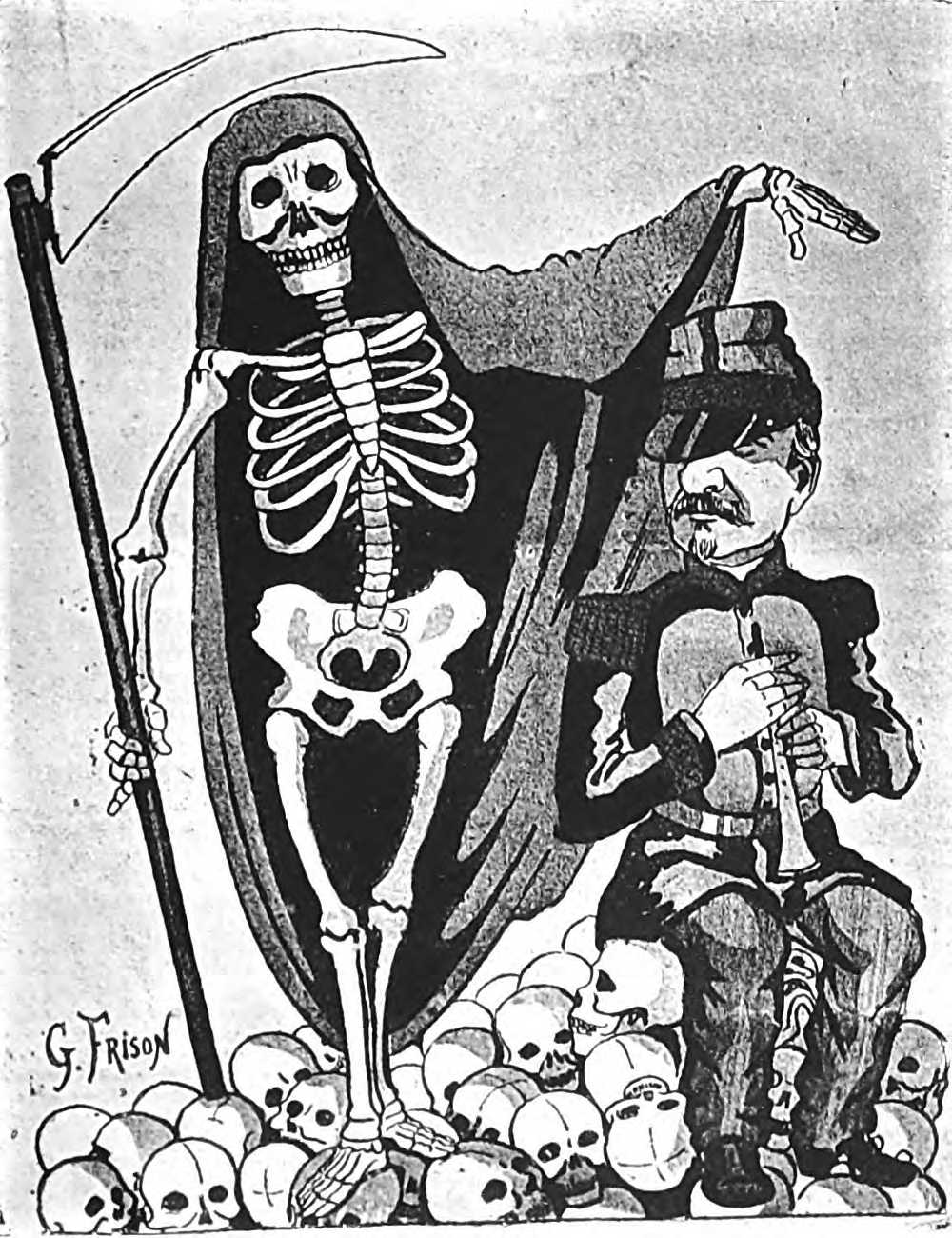
Maintenant, il nous faudrait, pour bien
Farre,
un petit Commandement Militaire.
Reproduction by Maclure & Macdonald.
The speaker has now probably learned a bitter lesson as to the fickleness of public opinion, and the inexpediency of attempting to gain the laurels of war by “a military promenade of ten days, or a fortnight at the most.”
M. Baudoin, the principal medical officer in Tunis, had drawn up a report on the sanitary condition of the army, which was now published in order to allay, if possible, the impression created by Dr. Lereboullet’s disclosures, but it had no other effect than that of provoking a detailed and circumstantial rejoinder. It was under these circumstances that the talented and conscientious Amadée Le Faure came to see things for himself at Tunis. After his death his valuable letters from that country to the Télégraphe were published in a collected form by M. L. Jezierski. In that dated the 18th October he first speaks of the result of his inquiries on the sanitary question. “At Jerba,” he writes, “the men are sleeping under small tents, and so are the sick. The heat has often reached 58 degrees centigrade. At one time everything was wanting;—water, medicines, provisions, and even tents. On the 20th June a demand was made for tents;[294] they arrived on the 10th September. Up to that time the only shelter was esparto grass. The mortality was terrible. On the 10th October the deaths had reached 73 out of 800, with 90 still on the sick list, and no hospital or ambulance.” Although an order from the Minister of War prevented M. Le Faure from having any further access to the hospitals, he had already gathered enough statistics to enable him to bear out generally the assertions of M. Lereboullet, and on the 7th November he delivered in the French Chambers a speech in condemnation alike of the military and sanitary measures of General Farre. A fortnight later he died of typhoid fever contracted during his visits to the Tunis hospitals. His words, however, still lived. Nobody any longer doubted that the formation of the Tunisian expeditionary corps out of stray battalions had more or less disorganised the whole French army, and that the sanitary arrangements during the first six months of the war were as defective as they were inadequate.
It was the accident of my bringing the news of poor Le Faure’s sad end to Susa, which introduced me to my fellow-traveller Dr. Pozzi. Our conversation naturally enough first turned on Susa. “Here,” said Dr. Pozzi, “everything began with a sanitary blunder. The troops, instead of being distributed in[295] different convenient places, were huddled together in the Kasbah, just as if the Arabs were going to assault the town. As we were at peace with the Bey of Tunis, no building could be taken for an hospital except an old grain store under the city walls, surrounded by the stagnant overflow of the neighbouring oil mills, and incapable of being ventilated. At most it could only contain fifty beds. The soldiers soon conceived a horror of this noisome den: they gave it the sobriquet of the dépôtoire, and concealed their sickness to avoid going to it. The crowding of 1200 men in the Kasbah soon engendered typhoid fever; the dépôtoire perpetuated it. Beds, dressers, &c., were wanting, but in a short time there were eighty sick soldiers in the grain store, and the cooking and medicine compounding had to go on in the midst of them. Later this was remedied, but the evil was already done.” Twelve deaths had taken place in a fortnight. From Susa Dr. Pozzi went on to speak of the question generally. In his opinion the excessive mortality amongst the French soldiers in Tunis has several distinct and palpable causes, viz., defect of transport, want of preparation owing to M. Saint-Hilaire’s first fiction of a military promenade, inability to obtain hospital accommodation on account of M. Saint-Hilaire’s second fiction of a Tunisian alliance,[296] obstinate refusal to accept any Red Cross aid, and the almost total absence of villages and isolated houses for the use of the ambulance in the interior. “The large number of deaths at the Manouba hospital,” observed Dr. Pozzi, “are to be accounted for by its being selected as one of the principal places for the receipt of the sick from the interior, and by the means used to transport them thither. Many died en route from the effects of travelling under a burning sun in an uncovered springless Maltese cart. It often happened that the patients were tied together to prevent them falling out, and a doctor told me that he had on one occasion cut a living soldier from a companion who had been dead several hours.” Dr. Pozzi considers Bizerta as an instance of the places in which typhoid fever was engendered by defective provisions, crowding, overfatigue, and too great weight of baggage. He thinks that the sanitary administration of the campaign falls into three epochs—April to August, inexcusably bad; September to November, improving; from November, good. Jerba, Gabes, and Fernána are, according to him, the scenes of the most fatal mistakes. As regards the first two localities, Dr. Pozzi’s information exactly confirms the details given by MM. Lereboullet and Le Faure. “Fernána,” he says, “was originally occupied[297] in May, owing to a mistaken notion of its strategic importance. The camp was pitched on a long mound surmounted by a ruined kouba, and having a slight depression generally filled with water on its summit. The whole neighbourhood turned out to be insufferably damp, and typhoid fever soon broke out there. Nearly all the garrison passed through the ambulance, death after death occurred, but, in spite of General Japy’s adverse report, the post was obstinately maintained.” I afterwards met the medical officer in charge of Fernána, and obtained from him some valuable information, which I shall allude to further on.
Dr. Pozzi thinks the calamities at Gabes admit of no excuse. The effects of the unwholesome water could have been obviated by the use of appareils de distillation, of which a warehouseful existed at Goletta but were forgotten. The water, as drunk by the soldiers, was nothing more or less than a purgative, and produced dysentery as a matter of course. Typhoid infection originally came to Goletta through the Perpignan battalion, and was fostered by the insufficient accommodation of the first military hospital in the old Tunisian arsenal. Here many deaths occurred before either beds or bedding were provided, the patients dying in their ordinary clothes, and under circumstances too painful to[298] relate. It was not until the 16th August that the Kheir-ed-Din Palace could be obtained for the ambulance.
Dr. Pozzi was the accredited representative of the Society for the Relief of Wounded Soldiers, of which the Duc de Nemours is President. From the very first the Society pressed its offers of assistance on the military authorities at Tunis and in France. It received a stereotyped answer, “We will apply to you for what we require.” Nothing was ever asked for, all other considerations being apparently sacrificed to false amour propre. The Society proposed to send a supply of flannel belts to Tunis. General Farre replied that every soldier had one, and declined the offer. The necessity for these belts in Africa is a matter of notoriety, but it was only after considerable delay that they were supplied to the infantry. Here red-tapeism came into play, and fresh demands and discussion were required before the cavalry could obtain them. In the early days of December the wants of the artillery, engineers, and other corps were still under consideration. General Japy at last allowed Dr. Pozzi to distribute 300 cholera belts sub rosâ amongst the artillerymen at Tunis.
Dr. Pozzi now fondly hoped that everything was[299] now going on well. Hardly a fortnight after we had parted at Tripoli a remarkable letter was written by Surgeon-Major Bailli from the Carthage or Kheir-ed-Din Palace Hospital to a friend at Paris:—
Hospital, Carthage, December 13.—I should have written to you sooner had I not fallen ill, being confined to bed, and generally weak. . . . It verily pains me to see what goes on every day in this hospital, which I selected for special observations. In the first place, the services, medical, pharmaceutical, and administrative, are perfectly independent of each other. The duties of the medical men are, of course, confined to writing prescriptions for food and drugs, and the druggists execute the orders as to the latter without the chief of the medical staff having the slightest wish to say a word to them. The administrative officer is the supreme manager of the nurses, and also supplies the provisions and superintends the materiel and distribution of food. Something may be contrary to the interests of the patients; the food may be badly cooked, the hours of the meals irregular; through negligence or incompetency, the steward may have omitted to make certain purchases prescribed by the doctor and indispensable to some patient; the attendants may neglect or not perform different little duties often of immense importance in particular circumstances; yet the doctor cannot make a reflection on the steward. This official is perfectly independent; he is generally a man of limited experience and education, who had hitherto been a petty military officer, as in the case of our large hospitals, and only enjoys the rank of captain, whereas the chief doctor is assimilated to that of colonel. The doctor’s only recourse, when the service is perfectly intolerable, is to the commissariat officer, who is placed above all three services. Here, at Carthage, as it happens, the administrative service is conducted in a deplorable manner. The attendants shamefully neglect their duties. Patients often remain for a whole day without receiving their medicine; they are often made to swallow it all at once. A convalescent from typhoid fever procured, nobody knows how, supplementary[300] victuals, which he concealed under his mattress, and died of indigestion. Another needed help to move from his bed; the attendant was away; he was obliged to go alone; he fell, and I found him lying on the sand, for most of the patients are under tents, without boards or mats, a point to which I shall revert. “Can the service in time of war be as good as in time of peace?” is the attendant’s reply to a remonstrance. At what a war; and at Carthage, too! The chief medical man complains, let us say to the commissariat officer. If the latter says anything to the steward, which does not necessarily follow, the latter is furious, and thenceforth he is at daggers drawn with the chief doctor. All the attendants of course side with the steward, as they are involved in the blame. Every opportunity is taken of giving annoyance to the doctor, and in the end the sufferer again is the unfortunate patient, whom the attendants, stewards, and commissariat officer all come to regard as a costly incumbrance, the source of all their trouble and ennui. The steward is closely interested in the economy of his management. The cheaper it is the higher is his premium, and the better note he gets from his superior, the commissariat officer, as being a careful manager of the public money. The regulations say “Best quality;” but he replies there was none, and he had to buy what he could. Sometimes there are neither eggs nor poultry in the market, so beef and haricot-beans are given to the patients. The economy is great, the premium substantial, the note of the superior good. You will say, why not get the food from Marseilles, whence there are three packets a week? But this would involve greater labour and expense, hence less premium. And as for cleanliness, which is also the business of the steward, the cesspools for the last four days have been running over (a pipe is said to be clogged), and if anything is necessary in an hospital filled with patients suffering from typhoid fever, dysentery, or diphtheria, it is the immediate repairing of such accidents. Another point of importance is the insufficient number of the medical staff. While the number of the regiments has been increased, and proportionally also the commissariat, our ranks have remained the same as before 1870, whence arises overwork for us at the expense, as usual, of the patients. At the commencement of the wet season the hospital had been five[301] months in existence, and the greater part of the patients were still under great single canvas tents, eighteen to a tent, and packed so close together that you could scarcely pass between them. When there was heavy rain the water dripped through the canvas at different spots, and the patients often woke up quite wet. The weather was very tempestuous, and the wind blew through the frail tents erected on the fine sand of the shore. An insufficient supply of necessaries obliged many to go outside in wind and rain, and there were no sandals or slippers to protect their feet from the wet sand. There was a simple preventive for all this—viz., the erection of wooden sheds. They were demanded by the chief doctor from the first, and required at the latest to be ready for the wet season. They are not yet ready. They were begun in October, then already late. Thus, the patients are still under tents which for months have not been changed or turned and are literally infected, thereby, of course, considerably augmenting the mortality. The wet season will probably be finished before these sheds are ready. Things would evidently be very different if the doctors, who, of course, have an interest and pride in the condition of their patients, had the management of the service of the hospitals. When one asks why things are organised as they are, one is positively amazed and shocked at the power of routine, and at the depth of the public indifference to the fate of the poor young French soldiers who happen to fall wounded or ill and who always and everywhere—in the Crimea, in Italy, in Mexico, in Tunis—are in an enormous and revolting proportion, sometimes ten times as great as necessity warrants, and always superior to that of other European soldiers. The English, in recognition of the services rendered by the sanitary corps in the Ashantee Expedition, have called it the doctors’ war. I will not pronounce the name ours deserves. Another fact that has passed under my eyes was this—a fortnight ago 70 of our patients were ordered to be conveyed to the province of Constantine by a packet, the hour of departure of which was fixed. They were taken in carriages to Goletta to embark. Not a sign was there of the boat, which arrived the next day. Only the commissariat and the stewards could neglect so simple a precaution as to wait till the boat was announced before ordering the patients to be[302] conveyed from the hospital. If such is the hospital at Carthage, 36 hours’ voyage from Marseilles, what must be the ambulances in the interior? The bulletins of the commissariat report that the hospital at Carthage is provided with everything, and is the most admirably conducted hospital in Tunis.
To this follows a postscript in which the writer reverts to the subject of the infection of the hospital at Carthage. The poison does not come from without, but is fabricated in the tents themselves, which are constantly full. The Kheir-ed-Din Palace holds scarcely 100 patients, and is already too full. There is no interval between the departure of the convalescent and the entry of the new patient, who takes his place after a change of sheets in the still warm bed. The result is that the place after four months’ use has become a perfect sink of infection. Diphtheria has become settled in it, and the only remedy is an immediate removal by steamers of all the patients not suffering from that disease, and able to be transported to France or Algeria. The letter concludes as follows:—
Last night a terrible tempest destroyed four large tents. You can imagine the scene, the broken poles falling on the beds, the canvas rent, the rain pouring upon the unhappy patients, and the bugle summoning the attendants to carry the poor fellows into the unfinished sheds.
A few days after the publication of this remarkable letter I happened to travel to Marseilles in an[303] hospital ship. The military authorities had chartered the passenger steamer “Martinique” to convey a number of convalescent soldiers to France, and on these subjects their will is law. With one or two exceptions my fellow-passengers were all doctors, some of them in charge of the patients, others going to recruit themselves. The day before we left Goletta, Dr. Bailli had been called to account for the publication of his letter, and sentenced to thirty days’ arrest as a preparatory step to being placed in non activité. The talk on board was chiefly of sanitary grievances and Dr. Bailli. More army doctors came on board at La Calle and Bone. Their conversation was still of hospitals and Dr. Bailli. Everybody endorsed his views, regretted his fate, and admired his courage. My next-door neighbour at table was one of the few real heroes of the last Punic War. Dr. Veillon had seen all the Khamír campaign, and for several months had been in charge of the pestilential camp at Fernána. Worn almost to a shadow with anxiety and fatigue, himself stricken and debilitated with fever, he was going back to his home in France with a hopelessly shattered constitution and a recommendation for the Cross of the Legion of Honour. He told me the same sad story of Fernána as I had previously heard from Dr. Pozzi. “I[304] joined the Fernána camp in June,” said Dr. Veillon; “it was on the borders of a marsh. I had no chemist to assist me. Typhoid fever almost immediately appeared, and from first to last we lost ten per cent. of our garrison. As far as I know not a single individual escaped without attack. Till October the soldiers died dressed and lying on rugs on the ground: then we got beds and bedding. For a time I was forced to perform my duties while disabled by fever myself. Thank God,” he added, visibly shuddering as if at some disagreeable memory of past horrors, “that terrible camp has at last been broken up.”
There is one subject upon which all the army surgeons I have met are particularly bitter. In the midst of all this death and misery, the military chaplains received a gratuity of five francs, in addition to their salary, for each decease. I can to some extent sympathise with the indignation of the doctors.
· · · · · · · · · ·
I have now told as shortly as possible the story of the French soldiers’ morts pour la patrie during the war in Tunis. Far be it from me, while blaming the authors of the expedition, to detract in the smallest degree from the glory of these young conscripts, many of whom died without a murmur[305] in their country’s service. The admirable patience generally displayed by the French troops amidst these trials and difficulties is beyond all praise. Once I was astonished at Medjez to see the walls of the station covered with the legend Vive la France, à bas le Général Farre. In the presence of the narratives of Drs. Lereboullet, Pozzi, and Bailli, I am surprised no longer. Impeachment is out of fashion and favour, but posterity in France and elsewhere will judge both General Farre and his colleague au Ministère des Affaires Etrangères.
[306]CHAPTER XLIV.
A MONTH OF CHAOS.
On the 19th July 1875, the twenty years’ labour of Sir Richard Wood in the Regency of Tunis was crowned with a new and elaborate treaty between the English and Tunisian Governments. The second and third articles of this convention ran as follows:—
Article II.
Every mark of honour and respect shall at all times be paid, and every privilege and immunity allowed, to Her Majesty’s Agent and Consul-General accredited to His Highness the Bey which is paid or allowed to the representative of any other nation whatsoever; and respect and honour shall be shown to the British Consuls, Vice-Consuls, and Consular Agents, who shall reside in the Regency of Tunis. Their houses and families shall be safe and protected. No one shall interfere with them, or commit any act of oppression or disrespect towards them, either by word or deed; and if any one should do so, the Tunisian authorities shall take immediate measures for the punishment of the offender. The British Consuls, Vice-Consuls, and Consular Agents shall, moreover, continue to enjoy, in the most ample sense, all the privileges and immunities which are now or may be hereafter accorded to[307] the Consuls, Vice-Consuls, and Consular Agents of the most favoured nation.
Article III.
The British Agent and Consul-General shall be at liberty to choose his own interpreters, brokers, guards, and servants, either from among the natives or others. His interpreters, brokers, guards, and servants shall be exempt from the conscription, and from payment of any poll-tax, forced contribution, or other similar or corresponding charge. In like manner, the Consuls, Vice-Consuls, and Consular Agents residing at the Tunisian ports, under the orders of the said Agent and Consul-General, shall be at liberty to choose, that is to say, the Consuls, each one interpreter, one broker, two guards, and three servants; the Vice-Consuls and Consular Agents, each one interpreter, one broker, and one guard, and two servants, not being in the military service, who shall likewise be exempt from the conscription, from the payment of any poll-tax, forced contribution, or other similar or corresponding charge.
Four days after the Treaty of Kasr-es-Said, M. Barthélémy Saint-Hilaire (May 16th, 1881) wrote thus to Lord Lyons:—
You wish first of all to place on record that I stated to you that the Conventions existing between Tunis and Foreign Powers would be maintained and respected. I repeat this assurance to you with greater pleasure because, by a special Article of our Treaty with the Bey, the French representative guarantees the execution of all the Conventions of this kind which now exist.
A week later Lord Granville promptly but[308] courteously took note of these assurances in the following guarded language:—
Her Majesty’s Government do not wish to lay too much stress on inconsistencies of language in conversation, or on the various reasons which have been given at Paris and at Tunis for French intervention, first as a protection against the alleged designs of the Sultan for the Bey’s deposition, and secondly for the punishment of the turbulent frontier tribes. But it can hardly be doubted that the Treaty with Tunis goes far beyond any question of the security of the frontier, and amounts practically to a Protectorate, which they understood to have been disclaimed.
Her Majesty’s Government, however, readily acknowledge the assurance repeated by M. Barthélémy Saint-Hilaire in his note of the 16th instant that all existing Conventions between Tunis and Foreign Powers will be maintained and respected, and this all the more readily because by the 4th Article of the Treaty with the Bey the French Republic guarantees their execution. Commercial and other rights and privileges will therefore remain undisturbed, in so far as they are guaranteed by Treaties, unless new Conventions, freely entered into, shall be substituted for the existing arrangements.
Her Majesty’s Government take note of this assurance, which they regard as an international engagement binding upon the French Government in the future.
Diplomacy in kid gloves was, however, no match for the diplomacy of duplicity. The history of the “month of chaos” at Tunis will sufficiently illustrate the practical results of M. Saint-Hilaire’s assurances.
Mr. Cacchia has the honour and misfortune to[309] be British Consular Agent at Hammamet. During Colonel Corréard’s unlucky advance from Hammám el Lif, and after the French troops had finally evacuated the place by sea as “hopelessly infected by typhoid,” the Arabs had avenged their grievances by carrying off all Mr. Cacchia’s flocks and herds, and his repeated protests were not even answered. His troubles were not destined to finish here. Towards the end of November another detachment of French troops was sent to Hammamet. The night of their arrival, a shot was said to have been fired in the direction of the French encampment, but nobody was hurt by it. Mr. Cacchia was then at Tunis making useless protests about his lost camels, sheep, and goats. He had left an Arab guard, who was also his gardener, in charge of his garden, which is situated about a mile from the town. On the morning after the shot had been heard, the French commanding officer imposed a daily fine of 1000 francs on the inhabitants, until such time as the culprit was detected and given up. Up to Sunday the 27th November this contribution was duly paid. On the evening of that day, the Arab khalifa or vice-governor entered Mr. Cacchia’s property, and caused his servant to be seized and bound on a charge of firing at the French camp. The man’s protestations of his innocence,[310] and those of Mr. Cacchia’s representative, were unavailing: he was shot at dawn next morning. His head was then cut off and hung up in the town gate, in sight of the house occupied by Mr. Cacchia’s family. Of course the man’s master made immediate application for redress, and invoked the British Convention of 1875 in support of his demand, but from that day to this four months have passed away and the Tunisian Government has made no sign. The matter has been under the consideration of no less a personage than General Elias Musalli, Commander of the Legion of Honour, Director of the Tunisian Foreign Office. Notwithstanding that he has as yet come to no conclusion on the subject, he makes no secret of his opinion that “although Mr. Cacchia may be right, and the English treaty presents an awkward difficulty, any kind of redress would be detrimental to the prestige of the Protectorate.” So Mr. Cacchia’s protest about his innocent servant’s death must perforce share the same fate as those concerning his camels, his sheep, and his goats.
· · · · · · · · · ·
While these events were taking place at Hammamet, Colonel Moulin was conducting a column from Kairwán through the Enfida estate, which had been almost forgotten in the excitement of the more[311] striking events of the two expeditions. My readers will remember that in a former chapter we left Mr. Levy in undisturbed possession of the property under a legal order of the Sheikh-el-Islam, who had been encouraged by the presence of the “Thunderer” and “Decoy” to resist the moral pressure gently conveyed to his judicial mind by the appearance of French ironclads in Tunisian waters. The time had now come to attain one of the avowed objects of the war, and place the coveted estate with some show of decency and legal procedure in the hands of M. Saint-Hilaire’s “honest and laborious Marseilles company.” Shortly after the signing of the Kasr-es-Said Treaty, the agents of the French claimants, accompanied by the French interpreter Sumaripa, paid a visit to the Sheikh-el-Islam, to judge of his present intentions. As the old man proved to be refractory, the Société Marseillaise next turned in its dilemma to the now docile Prime Minister Mustapha. The Meliki school of Moslem jurisprudence ignored, or regarded with disfavour, the exercise of pre-emption, and if the case could be transferred to the Meliki judges they would have no difficulty in conscientiously nonsuiting Mr. Levy. It was true that in the British Convention of 1863 the religious courts, and not the Bey himself, were declared to have jurisdiction in disputes relating[312] to real property, and it was unfortunate that the Meliki Court had already declared itself incompetent, but still under existing circumstances these were mere details. Mustapha explained matters to the Bey, who proprio motu issued a decree removing the suit from the Hanafee to the Meliki tribunal. The rest was now comparatively easy, but meanwhile the Arabs had cut matters short by driving every European out of the district. The legal manœuvres at Tunis went on, however, undisturbed by the anarchy which now reigned all over the Regency. On the 20th July the enlightened Meliki cadís published, as an evidence of their impartiality, an ex parte manifesto in the Tunisian Government Gazette, declaring that as Mr. Levy had no right of pre-emption, the Société Marseillaise must be regarded as the legal owner.
Four days later they cited Mr. Levy to appear before them to support his claim. Although the Société Marseillaise had for months ignored the authority of the Hanafee Court, Mr. Levy presented himself before the Meliki cadís on the 28th July, and respectfully stated that as he had legally constituted himself a defendant in the Hanafee tribunal, he was unable to acknowledge their jurisdiction. The chief cadi replied that he would report the matter to the Bey, and Mr. Levy took[313] refuge in a protest against the treatment to which he was being subjected. Ten days afterwards the Bey ordered the Meliki cadís to “take no heed of the Englishman Levy’s objections,” and to proceed with the trial. This at once elicited a fresh protest from Mr. Levy, but the Tunisian Government had long since ceased to trouble themselves with the reclamations of the British subjects. Towards the end of August the Meliki cadís, without calling any further on Mr. Levy, issued a decree annulling the attachment of rents made originally by the Sheikh-el-Islam in Mr. Levy’s favour, and ordered the tenants and inhabitants to consider the Société Marseillaise henceforward in the light of “the sole and lawful proprietors.” Soon after the taking of Kairwán (October 26th), Mr. Levy resumed his possession, and proceeded to till the land and sow his crops as usual. In spite of the complacency of the Meliki judges, the Société Marseillaise did not even yet feel strong enough to act on the decrees they had obtained, and eject Mr. Levy vi et armis. On the 20th November, Mr. Levy’s servants were working as usual; the next day Colonel Moulin’s column came to the Enfida in force on its errand of pacification. Scrupulous care was taken not to interfere with the property of Mr. Levy, but the march over the whole domain, the[314] disarmament of the Arabs, the imposition of a heavy war contribution, and last, but not least, the shelling of the insurgent Caid Bilawar’s fort after breakfast on the 26th November, most efficiently prepared the way for what was to follow. The very next day the agents of the Société Marseillaise and a posse of workmen arrived at the Enfida, bringing with them twenty carts filled with building material. In order to have a reliable witness as to the final steps taken by his “honest and laborious” opponents, and at the same time to prevent, if possible, any collision between their employés and his own, Mr. Levy had induced an English gentleman, Mr. Kane, to remain in his camp at the Enfida. I cannot better tell the story of the last scene in this cause célèbre than by borrowing Mr. Kane’s narrative, which has the merit of never having been impugned or contradicted.
“When I went to the Enfida last month (November),” writes Mr. Kane, “Mr. Levy’s workmen and tenants were in possession of the Enfida, and were carrying on the usual works of cultivation. At that time no person appeared to represent the French company. On the 20th of November a column of the French troops from Kairwán marched over the Enfida, and the Arabs made their submission as required. The day after they left a person arrived there, who said he was the agent of the Société Marseillaise,[315] now called the Société Franco-Africaine. He had several French and Italian subordinates, and the Tunisian Caid and Khalifa began to act under his orders.
“On the 4th December, about eight o’clock in the morning, the French agent sent a servant of the Caid of the Enfida to the ground on which Mr. Levy’s men were working, and ordered them to cease ploughing. They complied with the Caid’s orders and sent a messenger to me. I at once proceeded to the spot and ordered the workmen to continue to plough.
“About ten o’clock the French agent, attended by the Caid’s servant, rode over to the camp where Elnaser (Mr. Levy’s headman) lived, and gave in writing an order to an Arab guard he had sent there in the early morning, to prevent Elnaser and his men from taking any of the straw from the large stack close to the Arab encampment, and also from giving any water to their beasts. He then left for Dar-el-Bey, the house in which he had taken up his abode. Hearing this, I rode over to the encampment of Elnaser, and told Mr. Levy’s people to use the hay and straw as before, and to draw water. The Arab guard hearing this at once left the stacks of hay and straw, and reported what I had done to the French agent. An hour afterwards, the French[316] agent sent an Italian armed with a gun to guard the stacks. The French agent also told Elnaser and his men to leave their camp and threatened to send for some soldiers from the company stationed at Dar-el-Bey to burn their tents if they did not go away. This was of course said to frighten Mr. Levy’s Arabs into quitting his service.
“On the 10th December, by order of the French agent, his people commenced to dig a trench at a distance of six yards from the tent in which I lived, and all day long, notwithstanding my remonstrances, they threw earth against the sides of the tents and completely covered up the pickets for fastening the tent to the ground. The trench was evidently dug for the purpose of annoying me and blocking up the entrance of my tent. They continued to dig this trench up to the time when the final act of open violence took place.
“On the evening of the 11th of December I received intelligence that the Caid of the Enfida had enjoined all the Arabs living near Dar-el-Bey to place themselves and their camels and oxen at his disposal on the following morning for the purpose of ploughing up all the grain that had been sown in the Enfida by Mr. Levy’s employés.
“Early next morning Mr. Levy’s headman Elnaser arrived at my tent with the news that the Khalifa’s[317] (Hadj Mufta) brother had arrived at his camp, accompanied by about forty Arabs, and had commenced the work of destruction, but that he had desisted when opposed by the Maltese in Mr. Levy’s service.
“Accordingly I rode over to the Arab camp and found everything as described. I saw that the Khalifa’s brother had ranged about twenty ploughshares drawn by camels and oxen on the edge of the cultivated ground in a line ready at any given signal to commence turning up the ground.
“In about half-an-hour’s time a courier from the French agent arrived with orders to plough up Mr. Levy’s land at once, and by force if necessary. Upon this the Arab in charge ordered his men to advance, and notwithstanding that the Maltese resisted by holding the camels’ heads, the Arabs forced the camels and oxen into the cultivated ground, and Mr. Levy’s employés, in order to avoid being run over and attacked, were forced to retire. I then at once ordered the Maltese and Arabs working for Mr. Levy to abandon the Enfida and return to Tunis, being compelled to leave Mr. Levy’s oxen, camels, crops, and tents in the hands of our assailants.”
· · · · · · · · · ·
The statement of Mr. Kane was corroborated by[318] a dozen other declarations made by his Arab and Maltese servants. He at once presented a formal protest, but from that day to this, he has, like Mr. Cacchia, been waiting for a reply. Whatever may be the merits of his case, there can be no doubt that the manner in which M. Saint-Hilaire’s “honest and laborious” friends took the administration of justice into their own hands involved half-a-dozen violations of the treaty-right of Englishmen in the Regency of Tunis, and still further compromised the consoling assurances so liberally showered on Lord Granville. Eight months before to a day, M. Jules Ferry, in the French Chamber, had indignantly repelled the insinuation of M. Lenglé “that the Enfida affair was at the bottom of the expedition to Tunis, just as the Jecker affair had been at the bottom of the expedition to Mexico under the Empire.” “Je répète,” exclaimed the President of the Cabinet des Naifs, with virtuous indignation, “qu’entre cette opération militaire et l’affaire d’Enfida il n’y a aucune relation directe ou indirecte; que l’affaire de l’Enfida, comme le rappelait tout à l’heure, M. le Président, a donné lieu à un débat international, et que ce débat étant ouvert entre la France et ce grand et loyal pays de l’Angleterre, il n’y a lieu de faire intervenir entre ces deux grandes nations que les règles de la justice[319] et les considérations de l’équité pour arriver à une solution.”
It was a strange coincidence that while Mr. Levy’s servants were retreating to Tunis to escape from the ploughs and camels of their militant adversaries, the authors of the expedition were undergoing a hardly less disagreeable ordeal before the Tribunal de la Seine. Retributive justice overtook M. Roustan in the very moment of victory.
The month of December 1881 was signalised by both political and military chaos. The absence of M. Roustan at Paris necessarily brought all business to a dead lock. Mustapha returned to Tunis soon after the Resident’s departure, in order to avoid the awkward contingency of his being called as a witness by M. Rochefort, and at once set an intrigue on foot to secure his return to power. Taib Bey and his party were equally active in the prosecution of their designs to supplant both Mustapha and his master. Meanwhile torrential rains set in with unprecedented violence, and greatly helped Ali Ben Hlifa to hold his own against General Logerot. The hospitals at Susa and Jerba were inundated; the ambulance sheds at Manouba were destroyed, and several patients died in consequence; the tents at Carthage shared the same fate; a mud wall fell on the sleeping soldiers[320] near Oued Zerga and killed five of them; and several of the smaller columns were knee-deep in slush, and literally unable to either advance or retreat. Then came the excitement of the Rochefort case, the practical condemnation of M. Roustan, and an official announcement of M. Roustan’s departure, to be contradicted a week later by an equally official announcement of his return.
Affairs showed no signs of mending in the south. A war contribution of £250,000 was decreed against the inhabitants of Sfax, to their own ruin and that of their already half-beggared European creditors. No sooner had General Logerot’s column commenced its march northward, than the “pacified” Beni Zid tribe once more rose in revolt, and an eight days’ reconnaissance in force became necessary to bring them to reason. The Matmata mountain, the stronghold of the Beni Zid, was surrounded, and greatly to the surprise of the French, the courageous but infatuated Arabs were the first to begin the attack. For six hours they maintained a hopeless resistance, and only submitted after losing twenty-seven men, besides having a much greater number hors de combat. The Beni Zid now ceased their hostilities, but the Ouerdna and Ouerghama tribes prepared to resist any invasion of their territory. After the engagement at Matmata, another fight took place[321] near the village of Zeraon, which was subsequently bombarded. General Logerot then passed, amidst a continued fall of rain, through the defile of Djebel Ben Aïssa, but the Ouerghama named Ali Ben Hlifa Pasha Bey, and placed 5000 horsemen at his disposal. The fruitlessness of the great concentric movement on Kairwán was becoming more and more apparent: a successful razzia of cattle was executed within sight of Kairwán itself (December 20th), the tribes near Gabes were threatened with attack, and it was even considered necessary to hold the chief of the Beni Zid as a hostage for their good behaviour. General Logerot now prepared to attack the Ouerghama, but unexpectedly their sheikhs made a pretence of submission, and the troops gladly enough returned to Gabes (December 23d). On Christmas day General Logerot set out for Sfax, leaving only half a battalion of soldiers on the shore at Gabes, and a small garrison at Ras-el-Oued. The reality of this peacemaking was doubted at the time, and has since turned out to be entirely deceptive.
On the last day of 1881 M. Roustan returned to Tunis. A crowd of Algerian protegés hastened to Goletta to meet the conqueror, but all honest Frenchmen, and notably the military authorities, held aloof from so curious a demonstration. In this manner, the first year of the Protectorate closed[322] with a very melancholy prospect for the future of this once peaceful country. The Bey’s power over his subjects was now reduced to the merest shadow; his administration had fallen into a state of hopeless confusion, while his available army was reduced to a corps of titular generals and colonels, who did nothing but wear magnificent uniforms, and draw their pay when they could get it. The collection of taxes had proved inadequate for the payment of the interest due on the national debt, and the wholesale desertion of their usual camping-grounds by the Bedouin Arabs was an ominous portent of coming famine and the pestilence which usually follows in its wake. The notables of Sfax were still offering in vain an interest of twelve per cent. for a loan to pay their share of the war indemnity, the indiscriminate levy of which elsewhere had hopelessly ruined a large proportion of the Tunisian tribesmen. Suspicions were afloat that the peace in the south would be of short duration, and the heavy rains had augmented the natural difficulties which met the French troops at every turn, and increased the mortality in the military hospitals. While all unity of feeling amongst the European residents was at an end, the French colony, split up into Taibists and Roustanites, presented notoriously the spectacle of a house divided against itself. To[323] add to those troubles, the inopportune return of M. Roustan, in defiance of public opinion, now placed any attempt at a new departure beyond the range of possibilities. The very streets of the town seemed to share in the general chaos; they had become an impassable quagmire. Genuine trade was now at a standstill, and had been superseded by a brisk traffic in absinthe and vermouth. The Café du Cercle, frequented by generals and staff-officers, and the Café du Kroumír, the rendezvous of the honest troupiers, were doing a roaring business, but Ali Ben Saleh and Muhamed Ben Abdallah no longer came into Tunis to purchase their Manchester cloth and Nottingham calico. They had exchanged their cattle for guns and gunpowder, and were waiting on the frontier with Ali Ben Hlifa, for the long-expected advance of the Sultan and Caliph. This was the state of Tunisia when 1881 dropped into the years of history.
While these pages have been passing through the press the Enfida case has ended. The Société Marseillaise has at last purchased Mr. Levy’s adjacent property, and at the same time his contingent right to the Enfida estate. Ten days later (June 11th) Mr. Levy died.
[324]CHAPTER XLV.
1882 AND THE FUTURE.
On the morning of New Year’s Day the French residents as usual paid their official visit to M. Roustan, who addressed them in the following words:—
Gentlemen,—I am deeply touched by the expressions of sympathy I have received since yesterday from the French colony, and which you have just renewed. For my part, gentlemen, I was very anxious to see you at the commencement of this year, and to speak to you once again, as I have been in the habit of doing for the last seven years. Each of these seven years which we have spent together has marked a stage in the progress of French policy in Tunis by an increase of our influence in this country. On each of these anniversaries I came before you, you will remember, and spoke to you of the ground already got over, and of what yet remained to be traversed; and I continued my way, strong in your confidence and support, which I am happy to declare have never failed me in decisive hours and moments of crises. Indeed, crises have not been wanting; they have followed each step of our progress. Every step forwards has been greeted by an outcry against the policy which gave, or restored, something to France. I wish to recall to your minds the dates of these attacks; they are those of our successes. They commenced[325] after the concession of the railway, were repeated after its junction with Algeria, were renewed later on, after the concession of the 14th August 1880, and were had recourse to after the success of numerous other French enterprises. You have not forgotten the character of that malevolent policy. After this seventh year, which has marked the last stage, and which has led us to a result which is more complete than we claimed or even desired, I expected that those attacks would be renewed with redoubled vigour. Strong in my own conscience, sure of the support of Government and of yours, I prepared to meet them with the same contempt as on former occasions, without any idea of refusing our adversaries that sad consolation for so many disappointed hopes. But what I was not prepared for, what I could not foresee, was that, at that moment, our foreign adversaries would be joined by adversaries at home, who, more relentless, and, above all, more disloyal than the former, would unblushingly employ calumnies which foreigners in the heat of anger and in the midst of disappointments had shrunk from using. The trial has been severe; you know the result. It has not shaken the confidence which the Government of the Republic had placed in me, neither has it shaken yours, of which I have just received such precious testimony. That is why, surmounting very legitimate repugnance, I have returned to resume my place among you. I am come back, first, as the honest man who has the right and perhaps the duty to present himself again before honest people. I am come back also because my return is a sign of the firm intention of Government to maintain the result attained, because my name, by an honour dearly purchased, has become synonymous with the continuation of the French work in Tunisia. Gentlemen, you will permit me to speak of my good name. You are aware that calumnies of all sorts have been employed to damage it; but before you, who have seen me at work during seven years, before you who[326] judge me with full knowledge of the circumstances, I have the right to reassert that this good name has been placed by me sufficiently high to be out of the reach of all the filth that is flung at it. It is necessary that Frenchmen here and elsewhere should know that the agents of the Republic will not abandon the care of the interests of their fellow-countrymen, but will do their duty whatever it may cost them; in a word, that they will have the courage to surmount all their disgust and disregard all calumnies so long as they find themselves surrounded by worthy people like you, who encourage them, and find behind them a just and strong Government which supports them.
This extraordinary manifesto at once made M. Gambetta’s fatal mistake apparent to all the world; M. Roustan considered his return a purely personal triumph, and both he and his friends acted accordingly. Not a care was bestowed to the increasingly pressing difficulties of the situation; not an attempt was made to smooth down those international asperities which became every day more frequent, nobody thought of anything else but the best way of paying off old debts as regards M. Roustan’s real or fancied enemies. The news which reached Tunis on the afternoon of the 1st January, that no sooner was General Logerot’s back turned, than the Ouerghama and Ouerdna tribes had again revolted, and that a flying column consisting of 2000 infantry, one battery of artillery, and two squadrons of cavalry, had been sent against them, was almost[327] overlooked amongst the matters of more local interest which now occupied the Residency. Madame Musalli’s brother challenged the lawyer Pelletier to mortal combat; the French Consular Court solemnly disbarred him. Taib Bey’s medical adviser prudently put the Mediterranean between himself and M. Roustan, and Taib Bey himself was selected for signal vengeance. As early as the 5th January his arrest was asked for. His brother hesitated, and to please the French issued a notice that any one talking about the possible arrival of Turkish troops would be punished with the bastinado. The troubles in the south still continued. Ali Ben Hlifa now (January 9) sent a letter to the Jowaib by way of Tripoli in which he stated that thirteen of the Tunisian tribes would take the field in the spring, viz.: the Nefet, Zlass, Mitelit, Sondasen, Ouled Said, Ouled Ayar, Ouled Yacoob, Ouerghama, Ouerdna, and Beni Zid, and that as he could count on 170,000 fighting men, all he wanted from his friends abroad was arms. A sort of visible paralysis seemed now to fall over the French plans in Tunis; nobody appeared to know what would come next, and it became evident that the state of affairs in France prevented the adoption of any definite programme for the future. M. Gambetta became more and more unpopular. The same spirit which[328] in an evil hour prompted him to restore M. Roustan to Tunis, became evident in every act of his official life. The hero of 1870 was now denounced as “Cæsar,” “Vitellius,” “dictateur,” “tyran,” “le Louis XIV. de Cahors,” “le Coupeau de Cahors,” “bandit,” “dictateur dégommé,” “l’alcoholisé,” “le fou furieux,” and “le Napoléon d’opportunisme,” and all this in a single issue of the Parisian newspapers, on a single day in January 1882. M. Gambetta resolved to join issue with his foes. Meanwhile he told his friends that “he had other things to think of than Tunis and the Tunisians, and must postpone his African scheme until he knew his own fate and that of the grand ministry.” So the chaos was left undisturbed, and M. Roustan had nothing else to think of but his personal grievance.
Taib Bey’s fate was soon sealed. Although some of his true friends implored M. Roustan to hesitate before taking the final step, he still relentlessly pressed on Muhamed es Sadek the absolute necessity of his brother’s arrest. This demand was all the more impolitic, as M. Roustan admitted on the Rochefort trial that he had himself given Taib a French passport and helped his doctor to get a present of 30,000 francs as a broker in the transaction. The Bey refused to consent, in spite of the constant persuasions of Mustapha, until on[329] the 16th of January M. Roustan assured him, that the orders of the French Government on the subject were explicit and would brook of no delay. During the night his pleasant palace at the Marsa was surrounded by Tunisian soldiers commanded by the titular Minister of War, and on the following morning he was conveyed under a strong escort to the Bardo, in the very carriage in which he had hoped eight months before to come there as M. Roustan’s nominee to the Beylical throne. He was confined as a state prisoner in the lattice-windowed seraglio. The Bey, however, sent an aide-de-camp to assure his brother that he felt no personal ill-will towards him, and that his imprisonment was due to Kismet and M. Roustan. Taib answered, “I am as you say a prisoner by God’s will; but I hope that both my brother and myself will live to see justice done by the same God to the man who is responsible for our common misfortunes.” Three months have passed since then, and Taib Bey is still a prisoner. He has even been removed to a more secure locality than the old seraglio, and in case he might suffer from the cold several of the windows have considerately been walled up. A friend of mine happened to be at the Bardo when this was being done, and noticed the zealous M. Sumaripa benevolently engaged in superintending the task. Thanks to[330] the good offices of M. Paul Cambon, Taib Bey has now been released, and very probably will soon be one of the lions of the Parisian salons. He is not likely again to cast his eyes inopportunely on his brother’s honours.
The main body of General Logerot’s column now reached Susa after a short stay at Sfax. The action of the Arabs was now confined to raids and razzias, which inevitably occurred as soon as the French troops passed northwards. For the moment no energetic measures could be taken, as the worn-out soldiers required some rest after their two months’ weary march.
February opened with the fall of Gambetta amidst the triumphant acclamations of nine-tenths of the French press. The Tunisian question, and notably the return of M. Roustan, now aggravated by the universally reprobated arrest of Taib Bey, were appreciable elements in his unpopularity and discomfiture. Great things were hoped for from his successor. It was noticed that M. De Freycinet had not been called as a witness in the Rochefort trial, and it was asserted that he would recall M. Roustan at any cost. Under all circumstances it was evident that some time must elapse before M. De Freycinet could present a Tunisian programme, and so the chaos still remained unremedied. A very[331] strong anti-French feeling now showed itself amongst the Italian colonists, which materially added to the embarrassments of the situation. On the 18th February two French gendarmes arrested a Sicilian at Goletta and conveyed him to the military prison. The Italian Consul demanded his release, but before his request could be complied with, an angry and threatening mob assembled. Tunis now seemed to be entering on an era of Franco-Italian affrays in the capital and razzias in the interior.
The neighbourhood of Sfax now again became unsafe. On the 27th February a band of insurgents defeated the “submitted” tribes, who had been deprived of their arms, in the immediate vicinity of that town, and once more cut the Gabes telegraph line. Four days later they looted an esparto caravan, killing several persons and carrying off 100 camels. Two small columns were now ordered to enter the disturbed district from Susa and Kairwán, but they proved to be inadequate to crush out the mischief rife there.
On the 4th March, Tunis was en fête to receive General Forgemol. The streets were lined with soldiers, the military band played their most cheerful music, and salutes were fired from the forts. M. Saint-Hilaire’s fiction, however, still survived. The effect of General Forgemol’s triumphal procession[332] was somewhat marred by its being led by a Tunisian officer carrying a large umbrella, apparently for the purpose of denoting that everything was being done by the Bey’s invitation and consent. Two hours later M. Roustan quitted Tunis for ever. The icy coldness which signalised his exit contrasted strangely with the brilliant reception of General Forgemol. M. Roustan’s departure marks an era in the annals of the last Punic War. The Bey sent a special messenger to see that he was really gone, and when he at length learned that the matter no longer admitted of any doubt, gave way to almost childish transports of delight. A week previously M. Roustan had gone to the Bardo to take leave of him, and I afterwards received an account of what had passed at the audience from an eye-witness. It was the most amusing description I ever listened to, and I wrote an account of it at the time, which afterwards appeared in Vanity Fair. I cannot expect my readers to regard it in any other light than that of a burlesque, but those who understand the peculiarities of Arab character will at once understand how much of it is really serious:—
Scene: The Kasr-es-Said Palace at Tunis. Time: The 26th February. Dramatis Personæ: The Bey of Tunis and his Councillors. Both the Bey and his favourite, Mustapha, wear[333] their Grand Cordons of the Legion of Honour. An interpreter announces that M. Roustan is in attendance with General Musalli to take leave. Handkerchiefs are distributed. An order to weep is given.
Muhamed es Sadik loq.—We must be very careful. This is the third time he has gone away, but he always comes back. Roustan is a cat. Roustan has nine lives. (All begin to weep. Roustan enters with his friend.)
Bey loq.—Good-bye, my dearest friend. (Here he pauses from agitation, and both he and Mustapha repeatedly embrace the Minister to Washington after the Oriental usage. Bey continues, in a voice broken by sobs)—Allah has sent me many misfortunes, but your going is undoubtedly the greatest of them all. What shall I and poor Mustapha do without you? What will become of my country in your absence? Alas! alas! Tunis is undone! The Almighty is indeed too cruel when He deprives me of my friend and guide. (The Bey weeps on Roustan’s neck; Roustan and Musalli weep in chorus. Roustan is conveyed from the room deeply affected.)
Roustan (aside to Musalli on the staircase) loq.—Why, he has not even given me a parting present! At least I expected a diamond snuff-box, or another order. Can it be that even with me it is a case of le roi est mort, vive le roi?
(The Bey watches Roustan’s carriage disappear from the window. He turns to his courtiers. He laughs, he cries, at last he dances.)
Bey loq.—Now I am Bey again! Roustan is gone at last, and I breathe once more! No more frais de voyage for the woman Elias! No more estates for her husband! May Allah convey his soul expeditiously to the bottomless pit! May the Angels of Death be his guards and keepers! May the curses of a ruined and desolated country rest upon his head! May the Prophet cause the dark waves of the Atlantic to overwhelm him! May . . . . (curse, curse, curse). . . .
Two hours later General Musalli returns. He tenders to the Prime Minister the draft of an order for the sale of three Government estates. Old Muhamed Khaznadar, who has served five Beys and knew Tunis in its palmier days, plucks up courage and tears the paper up before his face.
[334]On the night of the 26th of February there was high festival held in the halls of Kasr-es-Said. The reign of the dynasty of Musalli-Roustan had ended for ever.
I am now reluctantly compelled to return to the dark and sad side of the Tunisian difficulty. On the 6th March a band of several hundred mounted Arabs passed in the early morning the gate of Kairwán, and it is even said they obtained a supply of bread there. Moving rapidly northwards to the Enfida they came across a convoy under the care of six unfortunate Italians. One only escaped wounded to Tunis to tell the tale: his companions were all murdered and mutilated. Their assailants pillaged their carts and then turned in the direction of Sidi el Háni. En route some Maltese cart drivers were also met with and killed, one man alone escaping, covered with sword cuts, to Kairwán. It was now raining hard and nearly dusk, but the Arabs had a sharp encounter with the French troops stationed round the marabout I myself had passed in November. Twenty-seven Arabs payed for their temerity with their life, but the rest made good their retreat with all their booty, and finally succeeded in traversing the chott and rejoining Ali Ben Hlifa. In addition to the plunder of the convoys, they had executed several razzias on their compatriots who had come to terms[335] with the French, and I believe their loot of camels, cattle, and goods was ultimately sold in Tripoli for at least £5000. This unhappy occurrence at length convinced the military authorities of the gravity of the situation. The acting Italian Consul-General again went through the now familiar form of protesting against the Tunisian Government, which was day by day becoming more powerless and disorganised. A plan for a forty days’ campaign was agreed upon, but its execution was somehow or other delayed to the end of the month. A column commanded by General Philibert was to leave Gafsa and cross the marsh-lakes in the direction of the Nefzaoua, while a second column under General Jamais marched from Gabes on Matmata and the Tripolitan frontier. This simultaneous movement was to be supported by a third column with Colonel Le Noble approaching the Tunisian frontier from Oued in Algeria, and preventing the insurgents retreating before the other forces from attacking the Algerian Arabs. At the present moment (April 10th) these three bodies of troops are carrying out the above plan, but unexpected and unprecedented rains have as yet proved a serious obstacle to their progress.
On the 2d April M. Paul Cambon, ex-Préfet du Nord, arrived in Tunis as M. Roustan’s successor,[336] and was greeted with the same military honours as General Forgemol. Two days later he received the official visit of the French residents, to whom, after a complimentary allusion to his predecessor, he spoke as follows:—“As regards the improvements which may be effected in the present state of things, I have come here to study them. I shall do this without having formed any preconceived ideas on the subject, with an earnest desire to assist the Beylical Government, and to prove that France has not lost her old fame as a civilising power. But this is not the work of a day. Nothing good or durable was ever done in a day. One must proceed methodically, patiently, and prudently. I shall hope to derive information from every available source. We have, I feel sure, all of us a common object—the good of the Regency and the honour of the French Republic.” These words are words of wisdom and promise well. M. Cambon has everything before him. As the reorganiser of the shattered Tunisian Executive, as the pioneer of financial and municipal reforms, as the healer of old wounds, and as the reconciler of conflicting interests, M. Paul Cambon may gain that fame and earn those laurels which the justice of posterity will assuredly deny to the contrivers and authors of the Last Punic War.
[337]APPENDIX.
[339]APPENDIX.
A.
Instructions issued by the Grand Master of the Order of St. John of Jerusalem, to the Knights who were to take part in the Expedition of the Emperor Charles V. against Tunis.
| Hospitalis | ||
| Mag | ✝ | Consilim |
| Hierlm |
Instructions to the venerated amongst his brethren of the Order, the Captain of our Galleys, Brother Aurelius Botigella, Prior of Pisa, and to the Captain of the reserve forces, Brother Anthony de Grolée, Bailiff of Lango, as to what you are to do in the sacred enterprise against the infidels (in which may God keep you, and from which may He bring you back in safety). First, having information that a portion of the army of his Imperial Majesty is already in the seas of Trapani either to expect or to join the rest at Cagliari, you will start in the name of God for the said places. If his Majesty by chance is there, you will hasten to kiss his hand on our behalf, and express our regret to be unable for want of men and means to send him greater assistance in his service, (tell him also) we have a well-armed galley which we are obliged to retain to convey stores to Tripoli and to protect our island if attacked. You will treat in the same manner Prince Doria and the other Generals of his Majesty, according to your discretion. If the Infante of Portugal, Don Luys, is there, you must regard him as a protector of our Order, offering him particular service according to our ancient usages, honouring and saluting him with the usual customs and ceremonies.
If one of you is wanting (which God forfend!), the other will do what is needful. You will do impartial justice if necessity arises. Supposing a landing is ordered you, Bailiff of Lango will[340] take the command of the soldiery and marines alike, for you, Prior of Pisa, must not quit the galleys. The soldiers must preserve order in going to land. If confusion ensues, call on the offenders to maintain discipline in the name of their holy vow.
If God gives you the desired victory, and the imperial fleet goes eastwards, you can follow it. Think of your own honour and that of the Order, and so thinking act accordingly! Given in Malta the 27th May 1535.
B.
The Carraca “St. Anne,” the great War-ship of the Knights of St. John.
In the conventual church of St. John is still to be seen a large wooden figure of St. Paul, which is now all that remains of the great carraca della Religione, once the terror of the Barbary pirates, and the most prominent object in Vermeyen’s picture of the siege of Goletta. Boyssat thus describes this famous ship:—
“Mouley Hasan came to the camp to pay his respects to the Emperor, and expressed his desire to see the carraca of the Order, which was much larger than the ‘Grimalda,’ although the latter could carry 14,000 Sicilian salmes of grain. She had four decks above the water-mark, and two below covered with lead. The ports were closed by bronze shutters, which did not injure the lead like iron, and they fitted so well that a whole army could not sink her. There was a chapel, an armoury for 500 men, a hall, chamber, and ante-chamber for the Grand Master and the Council, rooms for the knights and officers, and mills and ovens for each day’s cooking. There were galleries, a forge, and flowers in boxes all round the poop. She carried fifty cannons of large calibre and a large quantity of smaller ones. Her mast could be only encircled by six men. She was very light, and decorated throughout with carving and pictures.”
C.
The old cemetery of St. George, near the Carthage gate of Tunis (Bab-el-Carthagena), is the earliest existing Christian relic in Tunis. It was granted, as its name indicates, to England, at the beginning of the seventeenth century, but the original deed of gift has been lost. Once outside the battlements, it is now in the very heart of the city. In removing some rubbish three years ago a series of[341] narrow stone tombs, fashioned after the manner of the Arabs, was discovered. The inscriptions on them, carved in bold raised letters, are very curious and as clear as the day they were placed here. These are the most remarkable:—
| (1) | DEPOSITVM CONSVLIS |
| CAMPION OBIIT PRIMO | |
| OCTOBRIS MDCLXI | |
| (2) | HIC JACET RICARDVS LEAR |
| ANGLVS SVÆ NATIONIS CONSVLIS | |
| CANCELLARIVS QUI OBIIT XXIII APRILIS | |
| ANNO DOMINI MDCLXIII | |
| (3) | SAMVEL COBBE |
| MERCATOR ANGLICVS OBIIT | |
| SEXTO DIE OCTOBRIS | |
| ANNO DOMINI MDCXLVIII | |
| (4) | IN MEMORIAM MRI |
| GVLIELMI HAINES | |
| MERCATORIS ANGLICI | |
| QVI OBIIT XIX DIE NOVEMBRIS | |
| MDCXLIX. | |
| (5) | HIC JACET |
| BARNABAS HOL | |
| DIN DVX NAVIS | |
| AMITITIÆ OBIIT | |
| INPORTA VTICA | |
| XIII DECEMB | |
| RIS ANO DO MDCLXI | |
| (6) | GVLIELMI HVLL |
| DVCIS NAVIS MERCVRII | |
| HIC REQVIESCAT PVLVIS QVI | |
| EX HAC VITA MIGRAVIT | |
| XXII DIE JVLII ANNO VERBI | |
| INCARNATI MDCLXXIII. |
The seventh stone is the most remarkable of all. At the head is a shield thus:—

[342]Its sides are covered with exquisite Arabesque tracery; the letters are of lead, and it apparently tells a tale of some long-forgotten crime. The annals of the Barrington family may throw some light on its history. In the centre of the slab is this inscription—
Besides Consul Campion, several other British Political Agents and Consuls-General lie in the cemetery of St. George. The stones in memory of John Goddard and Charles Gordon can no longer be deciphered, but the memorials of Richard Lawrence (1750), James Traill (1787), and Sir Thomas Reade (1849), are still in good repair.
No American ever visits Tunis without making a pilgrimage to the tomb of the poet John Howard Payne, whose body lies under a luxuriant pepper-tree close to the grave of Consul-General Traill. The inscription on it runs thus:—
IN MEMORY OF
COL. JOHN HOWARD PAYNE,
Twice Consul of the United States of America for
the Kingdom of Tunis,
this stone is here placed by a grateful country.
He died at the American Consulate in this city after a tedious
illness, April 1st, 1852.
He was born at the city of Boston, State of Massachusetts, June 8,
1792.
His fame as a Poet and Dramatist
is well known wherever the English language is spoken through his
celebrated
ballad “Sweet Home,” and his popular tragedy
of “Brutus,” and other similar
productions.
[343]The monument is an oblong, thick slab of white (Italian) marble lying over the grave, and each edge of the slab is inscribed with a line of poetry, thus:
Several Danish and Norwegian Consuls are also buried in this quiet and picturesque graveyard.
D.
British Treaty with Tunis in 1662.
1. All past grievances shall be forgotten, and a perpetual peace on a firm basis, coupled with perfect liberty of commerce, shall exist henceforward between the subjects of His Majesty the King of Great Britain and the people of Tunis.
2. The vessels of the two nations shall have the right to enter the ports of both countries, paying the duty on what is sold, and carrying away the remainder of their cargoes without let or hindrance, and freely enjoying all customary privileges. The last duty fixed on the embarkation and disembarkation of merchandise at the Goletta shall be reduced to the old rate.
3. There shall be no seizure of vessels by either of the two parties, neither in port or on the high seas. They shall pass peacefully and without interruption after showing their flags. To prevent any inconveniences which may arise, Tunisian vessels shall in future carry a certificate signed by the British Consul at Tunis declaring that they belong to that place. On such document being produced, the English vessel shall allow two men to go on board in a friendly manner to ascertain if the ship is really English, and then, although they may have passengers belonging to other nations, their persons and property shall be respected.
4. If an English ship receives on board Tunisian subjects or their property, it shall be bound to defend them to the utmost and not to deliver them to the enemy.
5. If the ships of either of the parties be by accident wrecked on the coasts of the other, the crew shall be free and the goods found restored to the owner.
6. The English who actually inhabit Tunis shall be free to[344] transport wherever they desire, themselves, their wives, and children, although born in the country.
7. Neither Englishmen nor Tunisians shall speak rude words or use violence to each other. Whoever does so shall be severely punished.
8. The Consul or any other Englishman residing in Tunis, in case of a dispute, shall not be bound to address any other court than the Dey himself, who shall do justice.
9. The Consul or any other Englishman shall not be required to pay the debts of a third party unless there is an obligation in writing to do so.
10. The ships of war belonging to both parties can use reciprocally any port in the two countries for cleansing, repairs, and the purchase of all kinds of provisions and necessaries at the market price and without the payment of customs duty.
11. If the war vessels belonging to Tunis shall capture on an enemy’s ships English menial servants, they shall be made slaves, but if they are merchants or passengers, they shall enjoy perfect liberty both of person and property.
12. If a Tunisian ship-of-war shall engage an English ship not showing the English flag, and shall capture it, the said English vessel shall be considered a good prize notwithstanding the peace.
13. If a slave of the kingdom of Tunis or any other nation shall escape to or reach any vessel belonging to His Britannic Majesty, the Consul shall not be bound to pay the ransom, unless he has been duly warned to give an order not to receive the slave. If this has been done, he must refund to the owner the market price, and if such price was not fixed, he shall pay three hundred dollars.
These stipulations shall remain for ever without alteration, and for all details not mentioned in them the parties shall be guided by the general capitulations with the Grand Signor.
October 5th, 1662.
E.
British Treaty with Tunis in 1686.
As peace has subsisted between us for several years, &c. &c. &c. We, the very excellent Lords the Governor of the noble City and Kingdom of Tunis, Hadje Bectache Hogia Dey, Mahomet[345] Bey, and Ibrahim Agha, of the Divan and army of our City and Kingdom, have seen, considered, examined, and approved the said articles of peace, and do by these presents accept, approve, ratify, and confirm the same, in our own name as well as in that of our said army, &c., and do hereby formally promise to observe the same in every point with His Majesty James II., &c., and with all his subjects, and to see carefully henceforward that all our subjects shall scrupulously respect them, under the penalty of the severest punishment whenever the offender shall return to Tunis.
And as regards the money due by the Divan and divers our subjects to the English nation according to an account which we have received from Thomas Goodwin, Écuyer, Agent and Consul, &c., we engage to pay it within two months of this date. And as we have a short time ago made a diminution of seven per cent., in favour of the French merchants on import and export customs duty, and have reduced such duty from ten to three per cent., we sincerely promise either within six months to make this reduction also for the English merchants, or to oblige the French merchants to again pay the same rate as heretofore. We promise to observe each point inviolably, and to this end have affixed our seal in the presence of the Most High, and in our City of Tunis, on this the 2d day of October 1686.
F.
British Political Agents and Consuls-General at Tunis.
The following is a list of the British representatives at the Tunisian Court since the reign of Charles I.:—
- Campion died in 1661 (was appointed cir. 1640).
- Francis Baker, 1675-1683.
- Thomas Goodwyn, 1683-1700.
- John Goddard, 1700-1712.
- (John Waldeck, locum tenens, 1708-1712.)
- Richard Lawrence, 1712-1750.
- (Thomas Thomson acted in 1721.)
- Charles Gordon, 1750-1765.
- James Traill, 1766-1787.
- Robert Traill, (acting) 1787-1790.
- Perkins Magra, 1791-1804.
- [346]Richard Oglander, 1804-1824.
- Sir Thomas Reade, K.C.B., 1824-1849.
- Sir Edward Baynes, K.C.M.G., 1849-1855.
- Sir Richard Wood, C.B., G.C.M.G., 1855-1879.
- Thomas Fellowes Reade, 1879-1882.
G.
Tabarca and the Tabarchini.
The old fortress, which was demolished by the French fleet on the 26th April 1881, was an historical monument of no mean interest. Tabarca was the Tabraca of the Romans, and the little island on which the castle stands is just opposite the mouth of the Rubricatus river, now called the Oued el Berber. In the fourteenth century a galley of the Knights of St. John was wrecked there. The commander, a member of the Lomellino or Lomellini family of Genoa, managed to defend the place against the Arabs, and subsequently erected fortifications on the island. Charles V. granted it as a fief to the Lomellini, with the title of Marquis. This family held it till 1741. In the month of February in that year a monopoly of the Barbary trade was granted by the King of France to the Compagnie Royale d’Afrique, which very nearly succeeded in acquiring Tabarca. James Lomellino was anxious to dispose of it, but on Ali Pasha hearing of the proposed transaction, he resolved to himself seize the island rather than it should fall into the hands of the French. His son Heussein Ben Ali occupied Tabarca, and all its Christian inhabitants were brought to Tunis, where their descendants, the Tabarchini, still exist and form a little colony of their own.
H.
An Arab’s Account of the French Expedition to Tunis in 1770.
El Háj Hamouda Ben Abdel Aziz, secretary of Ali Pasha, has left a curious account of a former French invasion of the Regency. The following extracts are translated and somewhat abridged from the Arab text:—“The following were the causes of the war which happened in the year of the Flight 1183. Hostilities had commenced between Tunis and the island of Corsica, when France resolved on its conquest. One after another of the[347] Corsican towns fell into the hands of the invaders, and in order to ensure the safety of the provision transports, the French King asked our master to issue patents of protection for twelve ships. His request was granted. Shortly afterwards other Corsican ships were captured on the high seas, and the crews reduced to slavery. When the conquest of Corsica was completed, a high French functionary came to Goletta, and demanded that these captives should be released, and that the inhabitants of Corsica be treated as Frenchmen. Our master said, that as twelve patents were asked for, it was clear that all ships beyond that number had no claim to immunity. On the messenger confessing he had brought no letter from the King, the Pasha said, ‘Go and tell your master if he wants anything of me, let him write and I will send him an answer.’ The envoy went away, and this rupture became one of the causes of the war.
“Another motive was the dispute as to the coral fishery, which is very abundant on the Tunisian coasts. After the capture of Tabarca, La Calle became the principal seat of this industry. Our master desired to prevent the French vessels from entering Tunisian waters. An ambiguous convention was agreed upon, allowing a limited number of boats to fish during two years. When the term fixed therein expired, our master cut all discussion short by forbidding any further coral fishing on his coasts. This grievance furnished a second motive, but there was a third. Soleiman el Jerbi was the captain of a Tunisian corsair. Meeting a French merchant-ship at sea, he went on board according to custom to obtain provisions, but he exaggerated his wants, and took possession forcibly of a barrel of wine. When the Frenchman complained, he abused him and gave him a sound beating. These three things brought about the war. On the 23d May 1770, three French frigates appeared off Goletta, and took on board one of them the French Consul, De Saïrieu, who, on the plea of ill health, had removed to the Abdellia Palace at the Marsa. Our master at once made preparations for resistance; Hassan Kahia Boutaghane was charged with the defence of Bizerta, and Heussein Agha with that of Susa. Every town was strongly garrisoned, and reinforcements were sent to Tabarca. The whole community thirsted for the fray, and everybody purchased arms, which now rose to an exorbitant price. The sale of weapons paralysed all other commerce in the bazaars.
[348]“Goletta was now blockaded by three French ships, and a little Tunisian vessel, which endeavoured to enter the canal surreptitiously, was obliged to take refuge in going on shore under the Gamart hill. The French merchants now quitted the city, but our master placed guards over their dwellings to protect their property. He also humanely allowed the French merchant captains to join their ships. On the 16th June 1770, the whole French squadron anchored off Goletta. It consisted of sixteen ships-of-war, together with two corvettes and another vessel contributed by the Order of Malta. After two days a boat was sent on shore with a letter to the Pasha, threatening to bombard Goletta if seven conditions therein mentioned were not accepted in thirty hours. Our master sent an answer inviting the French admiral (Count de Broves) to come and read over the treaty, and judge for himself which party was in the wrong. Other correspondence followed, but the expected attack did not take place. An incident now happened, which proves that every event in our master’s life was predestined in the corner of felicity. He wanted beautiful slaves for his seraglio, and sent a French ship before the war began to bring a cargo of them from Constantinople. Every one became very anxious as to the fate of this priceless freight. The news now arrived that the vessel had put into Monastir. The Caid had already taken the precaution to land the slaves and put the captain and crew in irons. This circumstance was honoured with public rejoicings as a presage of good fortune, and on that very day by our master’s order the captives were employed in the gunpowder manufactory, that they might assist with their own hands in the production of the material which would afterwards deal death to their compatriots. About the same time it transpired that a second French ship laden with oil had arrived at Galippia in ignorance of the outbreak of hostilities. The ship and its cargo were confiscated, and the captain with his crew brought as slaves to Tunis to work in the powder mill.
“Towards the end of July the squadron sailed for Porto Farina, which was bombarded for two days. On the 1st August it arrived at Bizerta, the bombardment of which commenced at noon on the following day. When the fleet quitted Goletta, Ali Raïs, who happened to be there, took the command of a small force, and followed the enemy along the shore in order to resist[349] any attempt at landing. In this manner he came to Porto Farina, and superintended the fire directed from the batteries on the French fleet. When the fleet again set sail for Bizerta he pursued the same plan, and entered the place just as the ships were anchoring in the roadstead. A panic seized on the townsfolk of Bizerta; fire-ships sent towards the shore spread consternation everywhere, although the cannon from the batteries commanded by Ali Raïs answered vigorously those of the men-of-war. The bombardment lasted only one day and one night. More than 300 shells were thrown into the town. The inhabitants sought refuge from the projectiles, together with their wives and families, in the neighbouring gardens. Captain Ali Raïs defended the west, and Heussein Kahia the east of Bizerta. The news of the critical state of affairs then reached Tunis next morning, and our master at once ordered Redjeb Khaznadar to proceed thither with reinforcements. He also decreed the call to arms of all those whose names appeared in the registers of the divan, and the lowering of the flagstaff of the French Consulate.
“The reinforcements arrived at Bizerta on the evening of the same day. Although the French fire had ceased, Redjeb sought to encourage his soldiers by presents. A storm came on, and the French squadron was obliged to leave Bizerta and return to Goletta. Two days later French ships appeared before Galippia and Hammamet. Although the inhabitants were prepared to defend themselves, they were not molested. On Tuesday the 13th August the squadron anchored off Susa and commenced to bombard it the next day. The inhabitants deserted the town. By placing cannon on the beach the ships were kept at a distance, and of 1000 projectiles thrown, not more than 250 took effect. After remaining a week at Monastir, the fleet regained the Goletta roads.
“While the enemy was bombarding the different places on the coast, a khoja-bachi (envoy extraordinary) arrived at Tunis from Constantinople to ask our master for a contingent of troops and ships to assist the Sultan in continuing his war with Russia. Seeing that all our forces were absolutely required for the struggle with France, he asked leave to return, and so did an officer who had accompanied him. These persons embarked on the ship in which they had come, naturally believing, that their mission would be sufficient protection if they happened to meet the French[350] at sea. Just at this juncture the squadron appeared at Goletta, and its commander invited the Turkish envoys to go on board his vessel. They at once did so, and on the conversation turning upon the war, the khoja-bachi did not disguise the fact that it would be very displeasing to the Sultan, as the French forces had come to attack one of his provinces at the very time he was himself engaged in hostilities with his enemies. He added that what the squadron had done at Tunis constituted a breach of existing treaties, and was in itself sufficient to disturb the peace existing between two powerful states. He finally exhorted the Count de Broves to resume friendly relations between France and Tunis, being persuaded that the peace would be ratified by the two states. He asked earnestly to be allowed to undertake the negotiation. Having taken all this into consideration, the Admiral authorised the khoja-bachi to proceed to Tunis on this errand.
“The envoy found our master very much disposed to accept his proposals. He even ordered him to return to the French commander-in-chief, and ask that the French Consul and some other persons of position be deputed to treat the matter with him. The Consul soon disembarked with some officers to advise him, and renewed the seven demands already mentioned. Our master made the following answers: first, as to the participation of Corsica in the benefit of the French treaties:—‘We grant this demand, which is very just, for it is not possible that a government can be at peace with a power, as far as one part of its dominions is concerned, and not at peace as regards another. This reclamation is consequently admitted.’ In the matter of the slaves seized since the incorporation of the island with France:—‘We only seized these slaves because the Corsicans had no treaty with us; nevertheless as you insist on their surrender, and as their country has now become a part of France, we will consent to extend to them the benefits of the peace. Consequently we will give them up.’ As regards the liberation of Corsicans captured prior to the said incorporation:—‘This is a demand essentially different, which nothing justifies, and which we cannot admit.’ Concerning the punishment of the captain, Soleiman el Jerbi:—‘If he is guilty according to our laws he shall be punished when he is in our jurisdiction; at the present moment he has absconded.’ As to the coral fishery:—‘The treaty on the subject allows us to choose between putting an end to the agreement or renewing it.[351] This alternative is common to both parties. We desire to suppress the fishery. Upon what can you ground any valid objections to our resolution?’ About Tamekart (Cape Negre):—‘This is an establishment which you have lost, and which was closed by our predecessors. In a treaty which has been made since then, you have agreed not to reopen it. We are unable therefore to cede this point.’ As for the war indemnity:—‘We have done nothing to provoke the hostilities, which you commenced without any motive. We cannot, therefore, pay your expenses.’ After much discussion the following conditions were agreed to—(1) The island of Corsica shall enjoy the advantages conferred by the French Treaty. (2) The slaves captured since the annexation of Corsica to France shall be liberated. (3) The coral fishery shall last for five years more; twelve boats of La Calle may be employed in this enterprise. The Compagnie Royale d’Afrique may export 3000 cafis of wheat duty free. (4) Presents must be made by France to the Tunisian Government, as is the custom whenever peace is concluded. (5) As the demand of the French has been rejected, the Tamekart establishment is not to be reopened. These were the conditions of the treaty signed between the two nations. The French fleet set sail for France, and in this manner God put an end to the war waged against the true believers.”
I.
Secret Clause in the French Treaty of 1830.
In the name of God the Clement and Merciful! This treaty, which contains all conceivable promises, and by God’s aid will reconcile many different interests, has been concluded between the Marvel of the Princes of the nation of the Messiah, the Glory of the races adoring the Saviour, the Crown of Monarchs, the Shining Object of the admiration of his armies and ministers, Charles X., Emperor of France, and the Prince of peoples, the Chosen of the Great Ones, the descendant of royal blood, brilliant by the most conspicuous virtues, Heussein Pasha, master of the kingdom of Africa, &c. &c.[11]
· · · · · · · · · ·
1830, August 8th. Secret and additional article in the treaty[352] concluded between France and Tunis on the 17th of the month of Safr A.H. 1246. “Praise be to the one God to whom all things return!” “We cede for ever to His Majesty the King of France a site, in the Maalka, sufficient to erect a religious monument in honour of Louis IX. at the place where the prince died. We agree to respect and cause to be respected this monument consecrated by the Emperor of France in memory of one of his most illustrious ancestors.”
J.
Literal Translation of the Letter of Sidi Muhamed Bey to the Sultan of Turkey, asking for investiture as Bey of Tunis.
My God! I approach thy presence with prayers and due praises unto thy Prophet and his Caliphs in their order of succession; I require to be guided in the path of the Faithful, and with humble praises for thy favours, I knock at the Gates of thy Generosity,—the Gates of the Sublime Ottoman Government, the Monarchy of Glory, the Empire of Kháns, which is served with acts inspired by sincerity of purpose; which is sought for realising wishes; whose favours reach all parts of the world by every road;—The sun is superior to praises;—it being sufficient that it has raised supports to the Hanáfite sect, and produced balances for weighing truth; and added to the traditions of Divine assistance, a complete and meritorious evidence, whose sovereigns have inherited the earth. They were just; one Monarch after the other, from the one named “Dy-lanourin” (the one of the two lights, viz., the sun and the moon) until the one who has been chosen by the glorious god (“Elmedjiel,” an allusion to the Sultan’s name) to guide his creatures in order to maintain through him the symbols of obedience to his religion, the obligation of engaging in his war, and to whom he has granted his assistance and blessings for gladdening through his means the countries and towns belonging to him!
May every heart be ever associated in submission to him; may every sword and every pen be ever at his service; may all tongues be ever just in confessing their impotence to express all that is due to him! How shall I salute his lofty and exalted majesty, and the feet which are firmly set on every sort of grace! The means of expression found are but limited, and there only remains[353] the way of merely hinting at them, with a sense of respect to the Traditions of the Prophet, and of praises to those who are in Paradise! Salutations to the Prince of the Faithful and God’s mercy are invoked by the slave of his benefits, the assiduous one, who has grown in his service, Muhamed, son of the Servant of your Majesty’s Father of happy memory, Hassen Basha Bey.
It is now brought to your Majesty’s notice (whose attributes are long years and boundless power), that the pledge of your favours and the slave of your obedience, the tenth member of the family devoted to your interest, the cousin of your servant, whom he has considered as a brother, the Muchir Ahmed Bascia Bey has passed to God’s mercies; provided for his journey with the obedience in which he died towards the Caliphat, and with his actual as well as contemplated services. At that very moment the inhabitants of the Tunisian Dominions hastened, generally and individually, forward, and becoming solid foundation for your slave, offered to him the keys of their affairs, and the administration for guarding their private and public concerns.
Your servant has maintained the obligation imposed upon him by the unanimous vote of Islam with prayers from the pulpits for the sublime empire of Abdelmedjid, trusting that the government of the Caliph may approve of our having secured the tranquillity of the country, put an end to the terror of the inhabitants, and a stop to the roads of violence, and we have attached ourselves together in God’s compact. The servant of your majesty succeeded to his cousin, willingly and submissively, according to the customs observed by your servants his predecessors, towards the preceding holy and glorious Sultans. The circumstance which supports your slave is, that he has grown under the shade of your empire; he has been nourished with the milk of your benefits, and has experienced various and manifold kinds and modes of your generosity; your favour has caused him to shine with a light by which he is distinguished amongst people; and the noble-minded look on his inner services as a recommendation for augmenting the degree of favour; and your Majesty’s grace is hoped for, founding our trust on your Majesty’s kindness and invoking no other consideration. The usages of illustrious leaders are themselves the leaders of usages; and it is hoped that you will add the services of your servant to the services of his predecessors, in order that he may experience approbation under the Lord’s[354] shade;—may God deal with me according to my intentions (before paying the debt of nature) in the hopes I have expressed. Your servant has commenced his service by continuing what he had begun together with his predecessor, with hearts and bodies assisting each other, by sending some troops in aid of the small force that had been sent before, and which was favourably received; and the hope on which we repose our greatest confidence is that they may meet the favour formerly experienced. It is the result of the greatest efforts of the indigent, and the utmost possibility of the weak. The present is in proportion with the means of the donor as far as this military assistance is concerned. Your Majesty knows the state of things, and its mention is a subject of bitter regret. It will be presented by the servant of the writer, for whom it is sufficient to live in faithfulness, political wisdom, and nobleness of mind, one of the confidential persons belonging to your servant, who is considered like a son of his—General Muhamed, who will act as spokesman for your servant in asking for a favour which is based on a sense of hope and trust; and the favours of the noble-hearted are never suspended by a consideration of their acts. O God! aid us in the duty of submission which Thou hast imposed towards this empire, and the performance of justice according to the utmost of my faculties; and cause its outstretched and far-reaching hand to protect us from perdition; cause us to bear the fruits of its approbation, according to the rules of tradition and of the congregation. Great God! we look up to him; by his orders we proceed, and we are in anxious expectation of the performance of the promises that Thou wilt help those who assist Thy religion. They will never fail to find Thee out, nor err in their requests, amen! O Lord of Hosts! Salutations be on the Prophets, the Caliphs who are the guides to the right path, and on those who follow them till the day of judgment.
20th Shawal 1271.
K.
Literal Translation of the Grand Vizier’s Reply to His Highness the Bey of Tunis.
What has been forwarded through His Excellency Khair-ed-Din Pasha, viz.: your Highness’s letter conveying your thanks[355] for the marks of imperial regard with reference to the lamentable events which have occurred in the province of Tunis the well-protected, and reiterating the assurances of your Highness’s obedience and laudable devotion, as well as your letter to me, your Highness’s sincere and obliged friend, have been submitted by us to the High Imperial Gate, and have been taken into consideration by His Majesty the Sultan (may God perpetuate his existence upon his throne of glory, and render him an ornament to the seat of his justice and of his Caliphate, which is the real refuge of mankind and the asylum of Islam in honour of the Prophet, salutations be rendered unto him for ever and ever!)
His Majesty is by the grace of God endowed with virtues and qualifications that promote the welfare of the people depending upon his sublime government; and he therefore wishes and hopes that a prosperous state and unbroken peace of mind may perpetually and unceasingly attend you personally and those who belong to your high family, as well as the persons whose good administration is dependent upon your Highness.
May God assist him! Having felt sorry and grieved at the occurrence of the revolt, his Majesty was rejoiced at its early termination, achieved, thank God, in such a short time! He has felt great satisfaction at the expressions of devotion employed, but which are only commensurate with his Eminence, and the interest he has taken in the termination of those unhappy events.
His Majesty’s real desire and absolute wish is in accordance with the following written statement explanatory of what is required for the maintenance of tranquillity in Tunis and the promotion of its welfare, for the sure foundation of its peace, and uninterrupted security of its inhabitants and people. In order to attain the fulfilment of this desideratum which relates to and concerns the Regency, it will be a constant object of solicitude and assistance at all times.
The fresh and manifest proof of the above assertion will tend to remove and avert all possible apprehension, and strengthen the ancient privileges by way of official renewal.
These privileges are that the “Khatba,” or public prayers, and the coinage shall be respectively in the name of the Sultan as they have been from ancient time, being the public tie which unites the province of Tunis as forming an integral part of the Ottoman[356] dominions. This forms its legitimate connection by divine law with the Caliphate of Islam.
The flag actually used shall remain as it is both in regard to its peculiar shape and colour.
The connecting relations actually existing with the Sublime Porte to the present time shall be observed and continued as heretofore; and, upon condition of the maintenance and preservation of these things (the above conditions), the order of succession shall be as formerly exclusively vested in your high family.
You are to exercise independent power in the appointment of ecclesiastical, administrative, and military functionaries, and in their removal in accordance with the rules of justice; and you are likewise to exercise equal power in the internal administration of the said province agreeably to the divine law, as well as in conformity with such administrative enactments as are sufficiently efficacious to protect individual security, property, and honour, as circumstances and time may require.
Furthermore, you are to have the permission to continue as heretofore your customary relations with the friendly powers; and the inheriting Prince shall send and solicit the Imperial Firman (of investiture), which shall be granted to him according to custom.
Whenever your Highness shall request and demand the promulgating of the High Rescript and Imperial Firman on the whole of the above-recited points, it shall be issued to you in obedience to the commands of His Majesty on the subject; and pursuant to my instructions. I hasten to communicate the matter to your Highness, which I do with great satisfaction, that you may be apprized of the foregoing.
From a perusal of this letter which is a proof of singular regard, as well as from what Khair-ed-din Pasha will explain to you verbally, your Highness will perceive that the intention of the Sultan is only to promote the improvement and consolidation of the province of Tunis, and of your own person, and only seeks to preserve its old connection, and distinguished dependence upon the seat of the Sublime Caliphate; as well as to prevent whatever may create disturbance or estrangement, so that you may derive from it (the connection and honourable dependence) a fixed and a certain position.
We have no doubt but you will always endeavour to merit the[357] benevolent consideration of His Majesty the Sultan of Islam, the reward being both salvation in this and the next world, and an honourable mention at all times.
We have therefore deemed it sufficient to write the foregoing, and have laid at the foot of the throne the blessings you have invoked from the Almighty.
Let what we have written be a pledge to your mind; and everything belongs to the Disposer of events.
N.B.—Some of the expressions made use of in Arabic seem to have been literally translated from the Turkish, and are not very clear.
L.
The following is the text of the Imperial Firman promulgated in 1871 and regulating the future relation between the Sublime Porte as Suzerain and the Bey of Tunis as vassal:—
“To our Vizir Muhamed es Sadek Pasha, bearer of the imperial decorations of the Osmanli and the Medjidié in diamonds, Governor-General of the province of Tunis.
“We are aware of the laudable conduct you have pursued as well as the services you have rendered, and the loyalty and fidelity of which you have given proof, since the government of the province of Tunis, which forms part of our empire, has been confided to you, in the same manner as it was intrusted to your predecessors.
“The talents with which you are endowed induce us to hope that you will persevere in the same path, and by directing all your efforts to the prosperity, happiness, and tranquillity of this province and of our subjects, you will become more and more worthy of our favour and of the trust we place in you, of which you will appreciate the value.
“Our sincere desire and our deliberate intention is that this important province of our empire shall enjoy permanent security, and that a feeling of public confidence should exist on a solid basis amongst its inhabitants.
“It is evident that in virtue of our sovereign rights, we shall never refuse to accord our support or devote our care to the complete realisation of our desire.
“According to the demand contained in the petition addressed to us, we hereby confirm your appointment as Governor-General[358] of the said province of Tunis, the boundaries of which shall remain as they were ab antiquo, and according to you moreover the right of hereditary succession upon the following conditions:—
“With the object, as we have before stated, of augmenting the prosperity and wealth of the said imperial province and the people who inhabit it, and taking also into consideration the present diminished resources and the wants of the country, and animated besides by our feelings of generosity and interest towards our faithful Tunisian subjects:
“We renounce in their favour the payment of the sum which this province was heretofore required to furnish under the form of tribute.
“As an act of recognition of the ancient and legitimate ties which attach Tunis to our Caliphate and Government as an integral portion of our Empire, the Khatba (‘Friday’s prayer for princes and rulers’) must be said, and all money issued, coined in our imperial name.
“The flag shall preserve its form and colour.
“In case of a war arising between Turkey and a foreign country, the imperial province shall be bound to furnish a military contingent in proportion to its ability.
“All other ties up to this time existing with our Government shall be maintained.
“Under these conditions we order and decree as follows:—
“The hereditary government of our province of Tunis shall remain in your family.
“The Governor-General shall have full power to appoint and dismiss, according to the rules of justice and equity, all the judicial, military, civil, or financial officers of the province.
“The internal administration shall, however, be carried on in conformity with the sacred law and other ordinances of the empire, securing the life, honour, and property of our subjects, in accordance with the requirements of the epoch in which we live.
“The Governor-General of Tunis is authorised to maintain relations with Foreign Powers, but he is not entitled to conclude treaties or enter into international engagements with the said Powers, of a political nature or relating to declarations of war or rectification of frontiers. All these matters appertain exclusively to our sacred sovereign rights.
“Whenever the governor-generalship may become vacant, on a[359] petition being preferred to nominate a successor in the person of the eldest member of your family, an imperial rescript granting the rank of Vizir and Mouchir, together with a firman of investiture, shall be issued.
“The sovereign decree, which has been written by our Divan (council) and is sealed with an imperial seal, is promulgated.
“As has been said above, in our fatherly desire we have no other object than to improve the status of our important province of Tunis and consolidate the position of the reigning family; at the same time we are anxious to furnish fresh means for assuring the happiness, tranquillity, and protection of all classes of persons placed under our authority and domiciled in this province.
“Our sovereign will is therefore, that you direct all your energy to these objects, and as the preservation of our ancient and indisputable right over the province of Tunis, as well as the permanent security of the life, honour, property, and immunities of our subjects residing in this province, intrusted to your care, constitute the fundamental conditions and sine quâ non of the privilege of hereditary succession, you should be careful that these essential conditions are faithfully observed, and abstain from every act which may be at variance with them.
You, and all the members of your family, who may find themselves at the head of the government by the order of succession, will appreciate doubtless the value of this imperial favour, and will pay scrupulous attention to the fulfilment of the conditions thus established. By doing this our approbation will be secured.”
On the 8th November 1871 the Tunis published the following remarks on the foregoing Firman, which under existing circumstances deserve careful attention:—
“The Tunisian Regency is now de jure and de facto an integral part of the Ottoman Empire. Indeed, the Porte never alienated his sovereign right over that country, but practically the existence of such right had for many years been totally ignored by the Regency, and I may say, by all the Powers which dealt with it. Now it is different; the Tunisians having frankly avowed their dependence on the Sultan. This change is the more creditable and satisfactory to the Porte, as it has not been brought about by any encouragement or pressure on their part. It must, indeed, be acknowledged that they have not been in search of the sheep that has gone astray, but merely welcomed it[360] when, of its own accord, it returned to them. It is the population that has demanded the removal of the old ties between the Regency and the Empire. It is Mahommed Sadyk Pasha himself who, apologising for the past, has humbly besought the Imperial Throne to confirm him in the government of the province of Tunis, and to allow him to transmit it to the eldest member of his family after his death.
“The Tunisian ruler has been for several years alive to the dangers of his position. In 1864, after the insurrection of his Regency, he fully understood that he could neither consolidate his Government, nor protect his territory from external oppression, except by putting himself on a true footing with the Sovereign Court. He, therefore, hastened to send Keiredine Pasha to Constantinople ostensibly to thank the Porte for the moral support it had given him during the insurrection, but in reality to unite his country to the Empire, and to secure its government to his country. Keiredine Pasha has then been assured that the Porte was neither desirous nor willing to waive or diminish the privileges enjoyed by Tunis ab antiquo, and that a firman, conferring on Mahommed Sadyk Pasha’s family the hereditary government of his province, would be granted if he were to apply for it in writing. Keiredine returned to Tunis with a letter to this effect from Fuad Pasha, then Grand Vizier. Nothing more was heard of the matter until a month ago, when Keiredine Pasha arrived unexpectedly at Constantinople, and presenting a formal demand from Sadyk Pasha, together with a petition signed by all the chiefs of the Tunisian population, applied for the firman which had been promised to his master in 1864, and was accordingly issued on 3d October 1871.
“The firman thus granted is as liberal as it could be consistently with the sovereign rights of the Sultan, and does not much modify the status quo existing in Tunis. The integral administration of the province remains as heretofore, independent, the Government having full power to appoint and dismiss public officers of all ranks and description. He is, moreover, authorised to coin money in the name of the Sultan, and to continue to entertain direct relations with Foreign Powers, but, of course, he cannot treat with such Powers on political matters, make peace or war, dispose of the territory, or do any other act appertaining exclusively to the Sultan. In consideration of the poverty of the country, His[361] Imperial Majesty has been further pleased to dispense with the payment by its inhabitants of all tribute. The firman concludes by reminding His Highness Mahommed Sadyk Pasha that the maintenance of the privilege of the hereditary tenure of the Government of Tunis is essentially conditional on the observance of the Sultan’s rights over the Province, and the good government of its inhabitants.”
M.
Draft of a Concession for a Crédit Foncier presented to the Bey of Tunis for signature by M. Léon Renaud, Deputy, in December 1880:—
“It being our desire to ensure to our subjects the advantages of the institution of a bank, to which all persons may have recourse in years of scarcity, as well as to diminish as much as possible the sacrifices to which the possessors of land are exposed by being obliged to contract loans on their property at an exorbitant rate of interest, we have considered it desirable to accord a permission to establish a bank, for the purpose of making cash advances on real estate, and, to which the proprietors of such may address themselves to improve their lands, and to sow, plant, and irrigate them.
In consequence we have decreed as follows:—
1st. We authorise M—— to found at Tunis a bank with the above-mentioned object. He is empowered to open branches of the said bank in all parts of the Regency, when he shall deem it expedient. The establishment in Tunis shall begin its operations, at the latest within a year of the date of the present decree, and shall bear the title of the Banque de Crédit Foncier et Agricole.
2d. The operations of the said bank are the following:—
a. To lend money on the mortgage of real property and title-deeds. The latter will be restored on annual payments being made at long or short dates, and simultaneously with the repayment of the capital by instalments.
b. To advance funds on obligations to towns, villages, tribes of the interior, companies, and others, which shall have the power of contracting loans in virtue of a legal and formal authorisation, in accordance with the dispositions of the religious law.
c. To open accounts current on mortgage.
[362]d. To make advances on crops.
e. To undertake all financial operations with the scope of facilitating loans on real property, in order to improve roads, to improve and irrigate lands, to reclaim marshes, to plant forest trees, to develop industries and agriculture, to construct country houses, and dwellings in the towns.
f. To receive sums in deposit, both with and without interest.
3d. The said bank shall have the exclusive right of issuing bank-notes to an amount equivalent to the sums lent to proprietors of real estate, or employed in the different operations designated in Article 2, for which the authority of the Tunisian Government is necessary.
4th. The establishment of any other commercial institution, bearing the name of Crédit Foncier et Agricole Tunisien shall not be permitted, until after the expiry of 99 years after the date of the present decree.
5th. M—— is authorised to form a company to participate both in the advantages and responsibilities of the present decree.
6th. The capital of the company destined to guarantee the obligations thus incurred shall not be less than twenty millions of francs divided into shares. The company shall have the right to increase its capital without any further authorisation on our part.
7th. The administration of the Crédit Foncier et Agricole Tunisien shall be under the care of M——, or of the company, which shall succeed him, and that, during the whole term of the concession, and without restriction or exception.
8th. The Tunisian Government shall be entitled on its part, to name a delegate to watch the operations of the bank, and with the mission to bring to our notice any infractions which may be committed against the terms and spirit of the foregoing decree.
9th. The Crédit Foncier et Agricole Tunisien must conform to the local laws. It shall have the right to demand from us the promulgation of a special decree in which shall be specified the guarantee which shall be accorded to the company in order that it shall not lose what it has lent. Our Government is not responsible for the disputes which may arise concerning the title-deeds to property, and particularly as to the documents relating to the religious trust. For all the foregoing provisions, the Company agrees to conform to the religious law of the country, to recognise[363] no other regulation that the local law, and to have recourse to arbitrations.”
As soon as M. Renaud presented this draft, Mustapha asked time to consider it, and at once gave copies of it to his advisers. It was only when the Bey of Tunis refused to give the Regency to M. Léon Renaud that the Khamírs were invented, and the country invaded. M. Renaud “went away in a rage” on the 26th December. On the 26th April, the French troops crossed the frontier. Although M. Roustan saw no inconvenience in M. Léon Renaud inundating Tunis with his personal acceptances to a practically unlimited amount, his predecessor seven years before denounced a proposal to allow Messrs. Ranking of London to issue bank-notes (without any of the other privileges contained in M. Renaud’s draft), as “a menace to European commerce.” The Bey adroitly escaped from M. Renaud’s imperium in imperio by producing the following document:—
“Tunis, 28th May 1873.
“Highness,—The undersigned members of the corps consulaire have the honour to transmit to your Highness the subjoined memorandum, by which they take respectfully the liberty of calling your Highness’s attention to the consequences which may be entailed on his country by the authorisation accorded to the firm of Ranking to establish a bank with the power of issuing notes on conditions contrary, as they contend, to their several treaties of commerce and the interests of their subjects, &c.
(Signed) “A. de Botmiliau,
Chargé d’Affaires de France, &c. &c.”
N.
Notes about the Khamírs.
Since writing the text I have had access to a source of very valuable and authentic information about the people and country whose name became almost synonymous with the earlier phases of the Tunisian Expedition. Prior to the month of April 1881, the Khamír districts were totally a terra incognita to European travellers: all existing maps were based on the dubious authority of Arab description and native legends, and, as afterwards turned out, had no practical value. The very charts used during the[364] advance were but an illustration of the blind leading the blind, and proved to be wholly fallacious and misguiding. One of the most striking of the vulgar errors existing about the Khamírs relates to the question of population. They have been generally reckoned at about three times their real number, and other neighbouring tribes, such as the Ouchtetas, have been more or less confounded with the Khamírs proper. The only detail not overpainted and exaggerated seems to be the natural difficulties of the country itself. The essential features of Khamír-land are mountains with steep sides and razor-like ridges, dense forests of oak and impenetrable tangle, and an entire absence of roads or paths. Under these circumstances, wholly apart from the Khamírs themselves, the military movements were both arduous and remarkable, especially when we consider that they were to a great extent performed during the fall of torrential rain. One of the few results of the campaign has been a minute survey of the whole province, and a sufficient knowledge of the people who live there.
The Khamírs are grouped into three great tribes, containing many divisions and subdivisions. The following exhaustive table was drawn up by an able officer on the staff, who was one of the first French soldiers to enter, and the last to leave, the Khamír country:—
| Selloul. | |||
| Huts or Tents, | 208 | Nine divisions, one of them having three and another two subdivisions. | |
| Inhabitants, | 892 | ||
| Guns, | 384 | ||
| Slelma. | |||
| Huts or Tents, | 620 | Six divisions, two of them having three and one two subdivisions. | |
| Inhabitants, | 2751 | ||
| Guns, | 866 | ||
| Tedmaka. | |||
| Huts or tents, | 1007 | Six divisions, one having six, three having four, and two having three subdivisions. | |
| Inhabitants, | 3674 | ||
| Guns, | 1030 | ||
| Total, | Huts or tents, | 1835. |
| Inhabitants, | 7317. | |
| Guns, | 2270. |
[365]It is strange to notice that Commandant Villot, in his brochure, estimates the fighting men alone of these three tribes at 9900! (See ante.)
The same officer composed another table, showing the strength of the three columns invading Khamír-land, and the casualties which happened to each of them during their expedition of forty-nine days (24th April-10th June):—
| Brigade Caillot. |
Brigade Vincendon. |
Brigade Galland. |
|
|---|---|---|---|
| Officers, | 128 | 170 | 149 |
| Men, | 3725 | 4641 | 4024 |
| (In all 2120 mules and 628 horses.) | |||
| Entered hospital, | 767 | 222 | 311 |
| Wounded in action, | 177 | 14 | 26 |
| Killed in action, | 8 | 6 | 3 |
| Transfered to other hospitals (evacués), | 216 | 103 | 123 |
The following is a correct summary of the movements of the invading force during the same period:—
| “April 26th.— | Brigade Ritter at Demanet-Rebah. |
| Brigade Vincendon at El Aioun. | |
| Brigade Galland at Ain Smain. |
The Brigade Ritter ascended the Djebel Addeda as far as Baba Brik in two columns, setting out at 3 A.M. and arriving at 8.30. The column Vincendon advanced into the defile Fedj-Kahla in two divisions, with the 7th Battalion of Chasseurs as advance guard, and reached at 8 A.M. Hadgar Menkoura. General Galland’s brigade skirted the mountain with two cannons. The insurgents cut off the 2d company of the 22d Regiment, and killed five soldiers besides wounding seventeen. Position in the evening:—The Brigade Galland at Hadgar Menkoura, the Brigade Vincendon at Kef Cheraga, and the Brigade Ritter at Baba Brik. Tabarca is occupied by Colonel Delpech.
April 27th.—Ritter attacked with apoplexy, and removed to La Calle. His brigade at El Aioun. No other movement.
April 28th.—General Forgemol advances to Hadgar Menkoura, and brings back the wounded.
April 29th.—No other movement. Raids (razzias) executed in several directions.
April 30th.—Position maintained. Brigade Galland makes a[366] reconnaissance towards Babanet, and Sidi Abdallah. It was arranged that if the Khamírs asked terms, the conditions were to be—(1) Surrender of arms, (2) Hostages, (3) Requisition of mules, (4) Work on the roads, (5) Payment of a war indemnity.
May 1st and 2d.—No movement.
May 3d.—The brigades are concentrated at Djebalue. The ambulances are organised with 78 mules, each to convey 2 wounded and 7 litters.
May 4th.—Brigades Ritter and Galland move to Sidi Yusef.
May 5th.—The three brigades are concentrated at El Mana, where General Forgemol arrives.
May 6th and 7th.—Same camp. Torrential rains.
May 8th.—Reconnaissance of the three brigades on the Djebel and Marabout Sidi Abdallah.
May 9th.—Rain.
May 10th.—Three soldiers assassinated.
May 11th.—The Brigade Vincendon, followed by that of General Galland, ascends the Sidi Abdallah mountain. The Brigade Caillot moves to Dar-el-Abidi. Skirmishes all day long. General Forgemol starts for Fernána.
May 12th.—Rain. Dense fog.
May 13th.—The Brigade Vincendon goes to Ain Draham or Drahan. General Caillot makes a reconnaissance on the Kranget El Meridge, sighting the column Logerot. Brigade Galland remains at Sidi Abdallah.
May 14th.—The Brigade Caillot crosses the Kranget El Meridge and arrives at Ben Metir. The column Logerot engaged.
May 15th.—Reconnaissance in the valley of the Oued Lille.
May 16th.—The Brigade Caillot moves to Redir Tebeinia, General Vincendon to El Atatfa, and General Galland to Ain Drahan, occupying also Sidi Abdallah.
May 17th.—Same camps. Rain. Fog.
May 18th.—Reconnaissance towards El Guemaïr. Battalion attacked returning.
May 19th.—Brigade Caillot reaches El Guemaïr (advance guard of Tirailleurs attacked en route), and Brigade Vincendon Sattora and Ouldj Souk. The Mecknas incessantly attack the Brigade Caillot.
May 20th and 21st.—No further movements.
May 22d.—Same position.
[367]May 23d.—The Brigade Logerot at Souk el Temis.
May 24th.—Brigade Caillot reaches Faïd el Aïech. General Galland arrives at Glimett from Ain Drahan by way of Guemaïr. General Vincendon attacks the Mecknas.
May 25th.—Logerot advances to Seriou, Caillot to Sidi Kreider, Galland to Khradouma. Vincendon traverses the valley of the Oued Mellah in two columns, and attacks Djebel Abiat. His left is engaged by the enemy, but he reaches Sidi Asker.
May 26th.—A portion of the Brigade Caillot marches without knapsacks on Berzigue. General Vincendon makes a reconnaissance over the sand-hills, and a portion of his troops are attacked, but the enemy were repulsed. Only two soldiers were killed.
May 27th.—Early in the morning, General Forgemol with the 4th Hussars left Khradouma for Berzigue. Caillot makes a reconnaissance against the Mecknas amongst the sand-hills, conjointly with the Brigade Vincendon. General Forgemol decides to attack the Moggods thus:—
General Logerot from the south, Bréart from the east (Mater), and Caillot from the west.
May 28th.—No movement.
May 29th.—Galland advances to Berzigue.
May 30th and 31st.—No movement beyond reconnaissances.
June 1st.—Reconnaissance against the Ouled Yahya, Ouchteta, and Nefza.
June 2d.—Same camps.
June 3d.—Galland moves in the direction of Ben Metir.
June 4th.—Caillot marches towards Cape Négre.
June 5th.—Vincendon at Sidi Asker completes the road to Tabarca.
June 6th.—Caillot arrives at Fedj Recheder-Sekker. Roads ordered to be constructed from Tabarca to Fernána through Ain Drahan, and from El Aioun to Sidi Fatullah by way of Ain Drahan.
June 7th.—Caillot remains at Fedj Recheder Sekker. No other movement of importance. The “Vienne” arrives at Tabarca with 200,000 rations.
June 8th.—The three brigades shift their positions:—Vincendon to Kasr Tautia, Caillot to Dar el Melah, and Galland to El Guemaïr.
[368]June 9th.—No movement of importance.
June 10th.—Galland at El Guemaïr, Caillot and Vincendon at Berzigue.
June 11th.—The Brigade Caillot goes to Lag-Haf. The Brigade Galland at El Guemaïr works on the road from Ain Drahan to Ben Metir. The Brigade Vincendon completes the road from Ain Drahan to Tabarca.
June 12th.—No movement.
June 13th.—The Brigade Caillot goes to Oun el Ouch.
June 14th.—The Brigade Vincendon quits Kasr Tautia for Tabarca and commences embarkation. The Brigade Caillot moves to Ain Drahan.
June 15th.—The transports with the Brigade Vincendon quit Tabarca for Marseilles.
June 16th to 21st.—The portions of the other brigades not destined to garrison Tabarca, Fernána, and Ain Drahan, embarked for France. The staffs of General Forgemol and the other Generals broke up on the termination of the campaign. I reach Tunis by way of Fernána and Souk-el-Arba.”
The following is an exact copy of the report presented to the Bey of Tunis by General Younes El Dziri, Governor of Beja, and the Kahia Allela Jouini “on the subject of the recent events in the Khamír country:”—
“There was a sort of partnership established between some individuals of the Khamír tribes and others belonging to the neighbouring Algerian clan of the Nahads. The object of this association was the sale by the Khamírs of goods stolen by the Nahads, and the subsequent division of the proceeds, and vice versâ. On a dispute arising as to a division which the Khamírs had failed to make, a quarrel ensued in which a Khamír lost his life. This business was communicated to the ministry (of the Bey) by the Governor of Beja, who had conferred on the subject with the Commandant of the French troops at Roum-el-Souk. The affair was to all appearances arranged, when, on the 29th March, the French Commandant invited some of the Sheikhs of the Khamírs to meet him at Roum-el-Souk, for the purpose of a further discussion about it. They accordingly repaired thither in company with some Sheikhs of the Tunisian tribe of Beni-Mazens. The Commandant told them to give up, by way of hostage, the “tents” of the chiefs of the Ouled Cedra subdivision (“fraction”)[369] of the Khamírs, and to pay an indemnity of 4702 francs for two Nahad tents, which had been burned during the above-mentioned disturbance, telling them at the same time that if they did not comply with his orders they would be attacked on the following day. The Khamír Sheikhs answered that they could not give the required hostages without the consent of the Bey, and that they were not prepared to pay for the burned tents unless the ‘price of blood’ arising from the death of the Khamír in the same dispute was taken into consideration, and unless both parties were allowed to take an oath, as is usual in cases where no agreement can be come to. The Sheikhs added that this arrangement had been agreed to by both the Commandant and the Governor of Beja, subject to due confirmation by the superior authorities on both sides, and cited as a proof that one of the Khamírs had been detained as a hostage, for the due execution of the compromise. ‘To-day,’ they added, ‘you change the conditions; nevertheless we ask you to give us a delay to prepare what you seek from us and to fix the sum which we ourselves claim.’ The Commandant said that he had no delay to accord them or indemnity to pay them, that their demands were totally devoid of foundation, and that unless they carried out his orders promptly he should attack them the next day. The Khamír Sheikhs then withdrew.
“At the same moment the Commandant enjoined the Nahad people to collect their tribesmen on the frontier, and, in case the Khamírs did not give the satisfaction required, to invade their country and attack them. Persons not obeying the injunction were to be fined 500 francs each, without prejudice to other and more serious penalties. The day after this conference (Wednesday, March 30th), the Nahads came to the frontier, and attacked upon their own territory the Khamírs of the subdivision (fraction) of the Bechainas, while engaged in their lawful and peaceful pursuits. The Bechainas defended themselves with the help of their compatriots and killed a Nahad man. The officer in command of the troops at La Calle having heard of the business, at once repaired with a company of soldiers to the scene of the combat. Although the struggle was over, a troop of cows were fired at, and one killed and the others wounded. The owners of the cattle abstained from resistance to avoid a dispute. The officer went away, but returned next day (Thursday), with more Arabs, the Caid Ben Hamada, and[370] soldiers, and renewed the engagement. The Khamírs defended themselves. In the result the French lost 7 killed and 6 wounded; the Khamírs 15 killed and 13 wounded. This is the exact truth concerning the affair.”
O.
The Modest Gains of a Tunisian Premier.
I have told in the text the story of how the coffee-house drudge, Mustapha Ben Ismael, became Prime Minister of Tunis, and how his French friends first “delighted to honour him,” and then pitilessly but prudently relegated him to the seclusion of private life. It is almost incredible, but nevertheless true, that even now at the time I am writing (April 1882), a strong party is working and intriguing for his speedy restoration to place and power. A glance, therefore, at a list of Mustapha’s more notorious gains during the past ten years will be useful as a warning to those who have rendered themselves responsible before the world for the destinies of the Tunisian Regency, and to the ordinary reader it may perchance be interesting as showing the profits of a lucky favourite at even a petty Oriental court.
| Names of Estates. | Localities. | Notes. | |
|---|---|---|---|
| Ain Sciala. | Beja. | Sold to General Hamida Ben Ayad for 500,000 francs. | |
| Sidi Soltan. | „ | ||
| Elzrelli. | „ | ||
| Arbir. | „ | ||
| Sciauatt. | Tebourba. | ||
| Nahba. | Mater. | ||
| Elzriba. | „ | ||
| Ermil. | „ | ||
| Elmebtuh. | Bizerta road. | Sold to Signor Rivoltella and a syndicate for 975,000 francs. | |
| Buarada. | Elfahs. | ||
| Borj Elamri. | Tunis. | ||
| Elazib. | Bizerta. | ||
| Ghiran. | „ | ||
| Fritisa and Asciafir. | „ | Sold as in the last case for 200,000 francs. | |
| Beny Ata. | „ | ||
| Beny Meslem. | „ | ||
| Sidi Hassan. | „ | ||
| Gafur. | Teboursak. | Not sold, but worth 600,000 francs. | |
| [371]Elmornaghia. | Manouba. | Not sold, but worth 200,000 francs. | |
| Seltan. | Hamman-el-Lif. | Not sold, but worth 300,000 francs. | |
| Village of Grambalia. | Not sold, but worth 1,500,000 francs. | ||
| Mkada. | Bizerta. | Not sold, but worth 200,000 francs. | |
| Udai. | „ | ||
| Elzaina. | „ |
In addition to all these splendid properties:—
- 100,000 olive-trees at Menzel.
- Two caravanserais in the city of Tunis.
- Twenty shops.
- Jewels of the value of 3,000,000 francs belonging to Sy Mustapha Khaznadar, the disgraced favourite, and Sy Ismael Sunni and Sy Rescid, the strangled ministers.
- Furniture worth about 1,500,000 francs, belonging to the same persons.
N.B.—The greater part of the real estate absorbed by Mustapha were portions of the theoretically inalienable royal domain, belonging to the various princes and princesses of the Hassanite family—e.g., the village of Grambalia was the property of the late Muhamed Bey, of whose son Mustapha was appointed guardian. So complete has been the nest-feathering to which the Bey has been exposed on all sides, that the Financial Commission has been lately compelled to reduce his annual Civil List by £15,000 at one blow. The first reform which should occupy the attention of the French authorities is the dilapidation of the public or quasi-public State lands, and the bringing to justice of the persons concerned in it. The list of Mustapha’s “tokens of affection” from his sovereign was compiled by a person for some years in his confidence, after consulting the purchasers of his estates. Mustapha is now thinking of a rainy day; the proceeds of his Tunisian lands are being prudently expended in Parisian house-property. If the French Protectorate is to receive recognition at the hands of Europe, by all means let the Minister Resident be Prime Minister as well de facto as de jure. We have had enough of absorptive Grand Viziers.
[372]P.
Strength and Arrangement of the First Corps Expéditionnaire on the 8th June 1881.
Staff: 46 officers, 383 men, 171 horses, 198 mules.
Division Delebecque: Staff, 22 officers, 167 men, 143 horses, 57 mules.
| Brigade | Caillot: | 130 | officers, | 3771 | men, | 125 | horses, | 415 | mules. |
| „ | Vincendon: | 167 | officers, | 4681 | men, | 303 | horses, | 479 | mules. |
| „ | Galland: | 148 | officers, | 4092 | men, | 137 | horses, | 386 | mules. |
| „ | Logerot: | 151 | officers, | 3660 | men, | 465 | horses, | 689 | mules. |
| „ | Gaume: | 65 | officers, | 868 | men, | 937 | horses, | 34 | mules. |
| „ | De Brem: | 82 | officers, | 2130 | men, | 522 | horses, | 81 | mules. |
Fourth Brigade (General Bréart): 244 officers, 6669 men, 1247 horses, and 1209 mules.
Kef: 46 officers, 1274 men, 127 horses, 130 mules.
Ghardimaou: 20 officers, 496 men.
Beja: 9 officers, 325 men, 3 horses, 4 mules.
Souk-Erras (Algeria): 2 officers, 120 men, 82 horses, 60 mules.
Tabarca: 60 officers, 1516 men, 95 horses.
Total: 1202 officers, 30,152 men, 4357 horses, and 3742 mules.
Q.
Troops sent from France to take part in the First Tunisian Expedition.
| 1st Brigade | 202 | officers. | 4987 | men. |
| 2d „ | 191 | „ | 5245 | „ |
| 3d „ | 189 | „ | 5247 | „ |
| Brigade of Reserves | 258 | „ | 6587 | „ |
| Detachment at Tabarca | 54 | „ | 1550 | „ |
| Total | 23,616 | men. |
Of these the following were left in Tunis:—
| 1st Brigade | 44 | officers. | 1112 | men. |
| 2d „ | 91 | „ | 2772 | „ |
| 3d „ | 89 | „ | 2890 | „ |
| Brigade of Reserves | 80 | „ | 3477 | „ |
| Detachment at Tabarca | 34 | „ | 1109 | „ |
| Total | 11,360 | men. |
[373]The following were sent to Algeria:—
| 1st Brigade (one battery) | 4 | officers. | 177 | men. |
| 2d „ | 3 | „ | 695 | „ |
| 3d (Company Commissariat) | 3 | „ | 695 | „ |
| Reserves (Cavalry and transport service) | 27 | „ | 585 | „ |
| Total | 2152 | men. |
A round number of 10,000 were therefore sent back to France on the breaking up of the Corps Expéditionnaire.
R.
Troops sent to Algeria to take part in the First Tunisian Expedition.
- 6 Battalions of Zouaves.
- 5 „ Turcos.
- 1 „ Infantry.
- 3 Squadrons of Cavalry.
- 2 „ of Spahis.
- 5½ Batteries of Artillery.
- 5 Companies of Engineers.
- 4 „ Military Train.
Thus constituting a total force of 8200 men.
At the end of the expedition all the troops were sent back to Algeria, where their presence was necessitated by the affairs of Saïda, with the exception of one squadron of Spahis, one battery of Artillery, and two companies of Engineers, and left the Regency on the following dates:—
| June | 13. | — | Embarked | 2 | battalions of the | 1st | Tirailleurs | for Algiers. |
| „ | „ | „ | 2 | „ „ | 2d | „ | for Oran. | |
| „ | 19. | „ | 1 | „ „ | 2d | Zouaves | for Oran. | |
| „ | „ | „ | 1 | battery of Artillery | for Oran. | |||
| July | 1. | „ | ⅓ | „ „ | for Algiers. | |||
| „ | „ | „ | 4 | companies of Military Train | for Algiers. | |||
| „ | 4. | „ | 1 | company of Engineers | for Algiers. | |||
| „ | 8. | „ | 2 | battalions of Zouaves | for Algiers. | |||
| „ | „ | „ | 1 | company Engineers | for Algiers. | |||
| „ | 13. | „ | 1 | battery of Artillery | for Algiers. | |||
The rest, viz., 4 battalions, 4 squadrons, and 2 batteries, recrossed the frontier into the province of Constantine, with General Forgemol, on the 28th June.
[374]S.
Troops sent to Tunis to take part in the Second Campaign.
| July | 9. | — | Tunis, | 4 battalions (71st, 93d, 136th, and 137th) | 2000 | men. |
| (Afterwards sent to Sfax.) | ||||||
| „ | 13. | „ | 1 battalion (77th) | 450 | „ | |
| (Afterwards sent to Sfax.) | ||||||
| „ | 21. | „ | 2 battalions (107th and 114th) | 1000 | „ | |
| (Afterwards sent to Gabes.) | ||||||
| „ | „ | „ | 1 battalion (78th) | 500 | „ | |
| (Afterwards sent to Jerba.) | ||||||
| „ | „ | „ | 1 battery (35th) | 188 | „ | |
| (Afterwards divided between Sfax and Gabes.) | ||||||
| „ 24 & 26. | — | Tunis, | 2 companies of Military Train (6th brigade) | 180 | „ | |
| „ | 27. | — | Tunis, | 2 battalions (25th, 55th, 6th brigade) | 1030 | „ |
| „ | 28. | „ | 1 battalion 135th (6th brigade) | 500 | „ | |
| „ | 29. | „ | 1 company of Engineers | 141 | „ | |
| (Afterwards sent to Sfax, Jerba, and Gabez.) | ||||||
| „ | 31. | — | Bizerta, | 2 battalions (65th, 28th Chasseurs, 6th brigade) | 1000 | „ |
| „ | „ | Tunis, | 2 batteries (31st, 95th, 6th brigade) | 360 | „ | |
| „ | „ | „ | 1 battalion (125th, 6th brigade) | 515 | „ | |
| Aug. | 1. | „ | 1 battalion (6th, 6th brigade) | 500 | „ | |
| „ | 31. | — | Goletta, | 3 battalions (80th, 114th, 118th) | 1500 | „ |
| Sept. | 6. | — | Susa, | 3 battalions (66th, 116th, and 48th) | 1500 | „ |
| „ | 4. | „ | 1 battery (33d) | 185 | „ | |
| „ | 1. | — | Tunis, | 3 battalions (33d, 43d, 110th) | 1500 | „ |
| „ | „ | „ | workmen and hospital assistants | 125 | „ | |
| „ | 11. | „ | 3 battalions | 1500 | „ | |
| „ | 12. | „ | 2 squadrons (1st Hussars) | 360 | „ | |
| „ | „ | „ | 1 battalion of the 127th | 515 | „ | |
| „ | 14. | „ | 2 battalions (8th and 73d) | 1200 | „ | |
| „ | „ | „ | 2 batteries (31st and 33d) | 360 | „ | |
| „ | „ | „ | 1 squadron (1st Hussars) | 125 | „ | |
| „ | „ | „ | others | 150 | „ | |
| „ | 16. | „ | 1 company of Engineers (3d battalion) | 128 | „ | |
| „ | „ | „ | Telegraphists | 44 | „ | |
| „ | „ | „ | Hussars | 85 | „ | |
| „ | „ | „ | 1 battery (34th) | 188 | „ | |
| „ | „ | „ | ambulance of the 6th brigade | 128 | „ | |
| „ | „ | „ | Topographical service | 14 | „ | |
| „ | 20. | „ | 1 battery (34th) | 180 | „ | |
| „ | „ | „ | convoy of the 6th brigade | 234 | „ | |
| „ | 25. | — | Susa, | 2 battalions (10th and 138th) | 1040 | „ |
| [375]„ | „ | „ | 1 company of Engineers (11th battalion) | 124 | „ | |
| „ | 27. | „ | 1 battalion (23d Chasseurs) | 509 | „ | |
| „ | „ | „ | 1 squadron (6th Hussars) | 189 | „ | |
| „ | „ | „ | ½ battery (32d) | 90 | „ | |
| „ | „ | „ | staff of the 7th brigade | 17 | „ | |
| „ | 28. | — | Manouba, | 2 battalions (111th and 61st) | 1128 | „ |
| „ | „ | Susa, | 1 battalion (62d) | 534 | „ | |
| „ | „ | „ | 2 squadrons (6th Hussars) | 307 | „ | |
| „ | „ | „ | 1 battery (29th) | 187 | „ | |
| „ | „ | „ | staff and other services | 118 | „ | |
| „ | 30. | „ | 1 battalion (46th) | 549 | „ | |
| „ | „ | „ | 1 battery (10th) | 188 | „ | |
| „ | „ | „ | others | 9 | „ | |
| Oct. | 3. | — | Goletta, | gendarmerie | 99 | „ |
| „ | „ | „ | others | 25 | „ | |
| „ | 5. | „ | train and others | 127 | „ | |
| „ | „ | Susa, | ambulance and convoy | 300 | „ | |
| „ | 7. | — | Tunis, | Artillery | 97 | „ |
| „ | 9. | — | Susa, | ½ battery of Artillery (32d) | 118 | „ |
| „ | „ | „ | others | 97 | „ | |
| „ | 10. | — | Tunis, | 3 battalions (1st, 84th, 101st) | 1694 | „ |
| „ | „ | „ | section de munitions | 179 | „ | |
| „ | „ | „ | others | 28 | „ | |
| „ | „ | Susa, | military railway corps | 205 | „ | |
| „ | 12. | — | Tunis, | train and gendarmerie | 160 | „ |
| „ | „ | Susa, | train and telegraph | 60 | „ | |
| „ | 17. | — | Tunis, | 3 battalions (87th, 119th, and 128th) | 1698 | „ |
| „ | 19. | „ | train | 90 | „ | |
| „ | 21. | „ | „ | 89 | „ | |
| „ | 24. | „ | telegraphists | 30 | „ | |
| „ | „ | Susa, | ammunition train | 130 | „ | |
| „ | „ | „ | train | 10 | „ | |
| „ | 25. | — | Tunis, | 3 battalions (130th) | 1627 | „ |
| „ | „ | „ | 1 battery (27th) | 184 | „ | |
| 30,421 | men. | |||||
T.
Formation of the Columns employed in the Concentric Movement on Kairwán.
The troops forming part of the columns Forgemol and Étienne have been enumerated in the text. The following details explain the constitution of the column Saussier, Logerot, and Sabatier, which marched on Kairwán from Tunis and the Manouba:—
| [376]Infantry— | (1.) The battalions of the 65th, 125th, and 135th Regiments attached to the corps expéditionnaire, which formed the 1st Regiment de Marche. | |
| (2.) The 2d Regiment de Marche, composed of the battalions belonging to the 25th and 55th Regiments. | ||
| (3.) The 28th battalion of the Chasseurs à pied. | ||
| Cavalry— | (1.) 7th Regiment of the Chasseurs à cheval. | |
| (2.) One squadron of the 1st Regiment of chasseurs d’Afrique. | ||
| (In addition to these, there were one battalion of the 33d Regiment and one of the 46th Regiment detached from the Brigade Philibert.) | ||
| Artillery— | 10th battery of the 9th Regiment (field guns). | |
| 3d section de munitions of 36th Regiment of Artillery. | ||
| Engineers— | 3d company of the 3d battalion of the 3d Regiment. | |
| Transports | (Train des équipages)— | 5th company and 5 bis company of the 5th squadron. |
U.
Details of the Positions and Strength of the French Army of Occupation in the Regency of Tunis on April 1, 1882.
DIVISION DU NORD.
General Japy (now General Guyon Vernier).
Commandement des places de Tunis et la Goulette—Général Lambert, à Tunis.
La Goulette.
- 4e zouaves (1 bataillon et le depôt).
- 114 régiment de ligne (1 bataillon).
- 11 régiment de hussards (1 péleton).
- Parc d’artillerie No 3.
- 14e escadron du train (1 détachement).
- 11/4 génie (1 détachement).
Services administratifs.
- 21e section d’ouvriers.
- 21e id. d’infirmiers.
- Dépôt des convalescents.
- Ambulance.
[377]Tunis.
- 4e zouaves (2 bataillons).
- 1er de ligne (1 bataillon).
- 101e id. id.
- 118e id. id.
- 11 régiment de hussards (1 péleton).
- 1er batterie 19me d’artillerie 90 mm.
- 10e id. 34me id. 80 mm.
- 14e escadron du train (1 détachement).
- 15e id. id.
- 18e id. id.
- 20e id. id. (3 compagnies).
- 11/4 génie, portion principale.
- Gendarmerie.
- 21e section d’infirmiers.
Subdivision de Testour—Général d’Aubigny, à Tebourba.
Tebourba.
- 8e régiment de ligne (1 bataillon).
- 20e id. id.
- 11e régiment de hussards (1½ escadrons).
- Génie (1 section).
Medjez-el-Bab.
- 127e régiment de ligne (1 bataillon).
- 10e batterie 33e d’artillerie (1 section montagne).
- 12/2 génie.
Testour.
- 84e régiment de ligne (1 bataillon).
- 21e section d’ouvriers.
- 21e „ d’infirmiers.
Bordj Messaoudi.
- 128e régiment de ligne (2 compagnies).
Le Kef.
- 83e régiment de ligne (1 bataillon).
- 122e id. id.
- 128e id. (2 compagnies).
- 13e chasseurs à cheval (3 péletons).
- [378]3e batterie 26e d’artillerie 80 mm.
- 10e id. 13e id. (1 section montagne).
- 18/2 génie.
- 21e section d’ouvriers.
- 21e id. d’infirmiers.
- Ambulance.
Aïn Tunga.
- 73e régiment de ligne (1 bataillon).
- 11e régiment de hussards (1 péleton).
- 10e batterie 33e d’artillerie (section montagne).
Ellez.
- 80e régiment de ligne (1 bataillon).
- 13e chasseurs à cheval (1 péleton).
- 10e batterie 33e d’artillerie (section montagne).
Subdivision d’Aïn Draham—Général Guyon Vernier, Aïn Draham.
Aïn Draham.
- 29e bataillon de chasseurs.
- 18e régiment de ligne (1 bataillon).
- 22e id. id.
- 14e escadron du train, 5e compagnie bis.
- 13e batterie 16e d’artillerie (montagne).
- 16/3 genie, à El Aioun (1 section).
- 21e section d’ouvriers.
- 21e id. d’infirmiers.
- Ambulance.
Béja.
- 57e régiment de ligne (1 bataillon).
- 142e id. id.
- 10me batterie 13e régiment d’artillerie.
- 14e escadron du train (détachement).
- 11/4 génie (détachement).
Ghardimaou.
- 96e régiment de ligne (1 bataillon).
- 13e régiment de chasseurs à cheval (1 escadron).
- 18/2 génie (détachement).
[379]Tabarka.
- 143e régiment de ligne (1 bataillon).
- 13e régiment de chasseurs à cheval (1 escadron).
- 1er batterie 19e d’artillerie (1 section).
- 8e id. 12e id. id.
- 14e escadron du train.
- 15/2 génie à 16e Teboul (détachement).
Souk-el-Arba.
- 1re compagnie de fusilliers de discipline.
- 18/2 génie (détachement).
Subdivision de Tunis—Général Maurand, à Tunis.
Tunis.
- 115e régiment de ligne (1 bataillon).
Hammam-Lif.
- 88e régiment de ligne (1 bataillon).
- 119e id. (3 compagnies).
- 9e batterie du 27 d’artillerie (montagne).
- 9e id. id. id.
- 11/4 génie.
- Gendarmerie.
Zaghouán.
- 87e régiment de ligne (1 bataillon).
- 92e id. id.
- 11e regiment de hussards (un péleton).
- 16/3 génie (détachement).
Hammanet.
- 1 compagnie franche.
Bizerte.
- 38e régiment de ligne (1 bataillon).
- 1er batterie 19e d’artillerie (1 section, 80 mm.)
- 14e escadron du train (1 détachement).
- 11/4 génie.
- 21e sections (ouvriers et infirmiers).
[380]Mateur.
- 30e bataillon de chasseurs à pied.
- 14e escadron du train (détachement).
- 21e sections (ouvriers et infirmiers).
Manouba.
- 119e régiment de ligne (1 compagnie).
- 11e régiment de hussards (½ escadron).
- 14e escadron du train 5e compagnie pp.
- 18e id. id.
- 21e sections (ouvriers et infirmiers).
- Ambulance.
- Depôt de remonte.
Récapitulation.
Infanterie.
| 1er | régiment de ligne | Tunis. |
| 8e | id. | Tébourba. |
| 18e | id. | Aïn Draham. |
| 20e | id. | Tébourba. |
| 22e | id. | Aïn Draham. |
| 38e | id. | Bizerte. |
| 57e | id. | Béja. |
| 73e | id. | Aïn Tounga. |
| 80e | id. | Ellez. |
| 83e | id. | Le Kef. |
| 84e | id. | Testour. |
| 87e | id. | Zaghouán. |
| 88e | id. | Hammam-Lif. |
| 92e | id. | Zaghouán. |
| 96e | id. | Ghardimaou. |
| 101e | id. | Tunis. |
| 114e | id. | La Goulette. |
| 115e | id. | Tunis. |
| 118e | id. | id. |
| 119e | id. | Hammam-Lif. |
| 122e | id. | Le Kef. |
| 127e | id. | Medjez-el-Bab. |
| 128e | id. | Le Kef. |
| 143e | id. | Tabarka. |
| 142e | id. | Béja. |
| 29e | bataillon de chasseurs | Aïn Draham. |
| 30e | id. id. | Mateur. |
| [381]4e | zouaves (3 bataillon et depôt) | Tunis et La Goulette. |
| 1er | compagnie franche | Tunis. |
| 1re | compagnie de fusilliers de discipline | Souk-el-Arba. |
Cavalerie.
| 13e | chasseurs | Le Kef, Tabarka, Ghardimaou. |
| 11e | hussards | Tébourba, La Goulette, Manouba. |
| id. | Tunis, Aïn-Tounga, Zaghouán. | |
| 3e | Spahis | Aïn Draham. |
Artillerie.
| 12e | régiments, | 8e | batteries | Tabarka. |
| 13e | id. | 10e | id. | Béja, Kef. |
| 16e | id. | 13e | id. | Aïn Draham. |
| 19e | id. | 1re | id. | Tunis, Bizerte, Tabarka. |
| 26e | id. | 3e | id. | Le Kef. |
| 27e | id. | 9e | id. | Hammam-Lif. |
| 31e | id. | 9e | id. | id. |
| 33e | id. | 10e | id. | Medjez, Aïn Tunga, Ellez. |
| 34e | id. | 10e | id. | Tunis. |
| Parc | No. 3 | La Goulette. |
Train des Equipages.
| 14e | escadrons, | 5e | compagnies, | pp. | Manouba. |
| 14e | id. | 5e | id. | bis. | Aïn Draham. |
| 18e | id. | 5e | id. | pp. | Manouba. |
| 20e | id. | 3e | id. | Tunis. |
Génie.
| 11e | escadrons, | 4e | compagnies | Tunis, Bizerte. |
| 12e | id. | 2e | id. | Medjez-el-Bab. |
| 15e | id. | 2e | id. | Tabarka. |
| 16e | id. | 3e | id. | Aïn Draham, Tabarka. |
| 18e | id. | 2e | id. | Le Kef. |
Troupes d’administration.
| 21e | section, | ouvriers | Tunis, La Goulette. |
| id. | infirmiers | Manouba. | |
| 19e | section | de secretaires d’etat-major force publique, | Tunis. |
[382]DIVISION DU SUD.
Général Logerot.
5e Brigade—Général Sabatier.
Camp de Sousse.
- 65e régiment de ligne (2 compagnies).
- 28e bataillon de chasseurs à pied.
- 125e régiment de ligne (1 bataillon).
- 135e id. id.
- 6e id. id.
- 25e id. id.
- 7me régiment de chasseurs.
- 10e batterie du 9e d’artillerie (montée).
- 10e id. du 35e id. (montagne).
- 6e section de munitions (36e d’artillerie).
- Un péleton de génie (3e régt., 3e bon., 3e cie).
- Train des équipages (5e cie. pp. et 5e cie. bis)
Enfida.
- 65e régiment de ligne (2 compagnies).
El Djem.
- 125e régiment de ligne (1 bataillon).
6me Brigade—Général Philibert.
Gafsa.
- 27e bataillon de chasseurs.
- 46e régiment de ligne (1 bataillon).
- 61e id. id.
- 111e id. id.
- 1er régiment de hussards (1 escadron).
- 10e batterie du 31e régiment (2 sections montagne).
- Génie (1 section, 3e cie., 3e bon., 3e régt.)
- Train des équipages (5e cie. pp.)
Oued Gilma.
- 33e régiment de ligne (1 bataillon).
- 43e id. id.
- 110e id. id.
- 1er régiment de hussards (escadron).
- Détachement de la section de munitions (36e).
- Génie (1 section, 3e bon., 3e cie., 3e régt.)
- Train des équipages (5e cie. bis détachement).
[383]Raz-el-Oued Gabès.
- 1 regiment de hussards (1 escadron).
7me Brigade—Général Étienne.
El-Melah.
- 23e bataillon de chasseurs.
Kairwan.
- 48e régiment de ligne (1 bataillon).
- 66e id. id.
- 62e id. id.
- 138e id. id.
- 6e régiment de hussards (2 escadrons).
- 10e batterie (29e régiment d’artillerie).
- 9e id. du 10e id.
- Génie (2e cie. du 3e bon. du 3e regt).
- Train des équipages (5e cie. et 5e cie. bis détachement).
Sousse.
- 19e régiment de ligne (2 compagnies).
- 10e batterie du 32e d’artillerie.
- Parc No. 2.
- 3e cie. d’ouvriers mixte du chemins de fer.
- Train des équipages (5e cie. détachement).
Sidi-el-Hani.
- 6me hussards (½ escadron).
- 3e section des munitions (36e artillerie).
- Train des équipages (détachement de la 5e cie.)
Oued-Laya.
- 19e de ligne (2 compagnies).
- 6e hussards (½ escadron).
Brigade de la Côte—Général Jamais.
Raz-el-Oued Gabès.
- Un bataillon de zouaves.
- 14e régiment de ligne (1 bataillon).
- 77e id. id.
- 107e id. id.
- 137e id. id.
- 6e id. id.
- 25e id. id.
- 1er hussards (un escadron).
- 9e batterie du 35e d’artillerie (2 sections montagne).
- Génie (2 sections du 4e régt.)
[384]Sfax.
- 136e regiment de ligne.
- 55e id.
- 9e batterie du 13e régiment (montagne).
Mehdia.
- 71e régiment de ligne (2 compagnies).
Ile de Djerba.
Houmt-Souk.
- 73e régiment de ligne (2 compagnies).
Borj-Marsa.
- 73e régiment de ligne (2 compagnies).
- 10e batterie du 13 régiment (13e montagne).
El-Kantera.
- 71e régiment de ligne (2 compagnies).
- 9e batterie 35e d’artillerie (une section montagne).
Récapitulation.
Infanterie.
| 6e | régiment de ligne | Gabès. |
| 14e | id. | Ras-el-Oued Gabès. |
| 19e | id. | Sousse et Oued-Laya. |
| 25e | id. | Gabès. |
| 46e | id. | Gafsa. |
| 48e | id. | Kairwán. |
| 55e | id. | Sfax. |
| 61e | id. | Gafsa. |
| 62e | id. | Kairwán. |
| 65e | id. | Sousse et Enfida. |
| 66e | id. | Kairwán. |
| 71e | id. | (Djerba), Médra-el-Kantara. |
| 77e | id. | Ras-el-Oued Gabès. |
| 78e | id. | (Djerba), Bordj Marsa. |
| 107e | id. | Ras-el-Oued Gabès. |
| 111e | id. | Gafsa. |
| 125e | id. | Sousse-el-Djem. |
| 135e | id. | Sousse. |
| 136e | id. | Sfax. |
| 137e | id. | Ras-el-Oued Gabès. |
| 138e | id. | Kairwán. |
| 4e | zouaves (1 bataillon) | Gabès. |
| 23e | bataillon de chasseurs | El-Melah. |
| 27e | id. | Gafsa. |
| 28e | id. | Sousse. |
[385]Cavalerie.
| 7e | régiment de chasseurs | Sousse. |
| 1er | hussards | Gafsa, Ras-el-Oued, Gabès. |
| id. | Oueld Gilma. | |
| 6e | id. | Kairwán, Ouled-Laya. |
| 6e | id. | Sidi-el-Hami. |
Artillerie.
| 9e | régiments, | 10e | batteries | Sousse. |
| 10e | id. | 9e | id. | Kairwán. |
| 13e | id. | 9e | id. | Sfax. |
| 13e | id. | 10e | id. | Bordj-Marsa. |
| 29e | id. | 10e | id. | Kairwán. |
| 31e | id. | 10e | id. | Gafsa. |
| 32e | id. | 10e | id. | Sousse. |
| 35e | id. | 9e | id. | Ras-el-Oued, Randam. |
| 35e | id. | 10e | id. | Sousse. |
| Parc | No. 2 | id. |
Train des equipages.
| Escadrons. | compagnies. |
| ... | 5e 5me bis. |
| Sousse, Gafsa, Oued-Gilma, Kairwán, Sidi-el-Hami. | |
Génie.
Sousse, Gafsa, Oued-Gilma, Kairwán, Raz-el-Oued-Gabès.
V.
An American Prophecy about Tunis.
Mr. Amos Perry was, from July 1862 till September 1867, United States’ Consul at Tunis. On his return to America he published, in 1869, a book entitled, “Carthage and Tunis—Past and Present.” His note as to “the political future of the country” has been so curiously verified that it may be reproduced with advantage. He writes:—
“Just as I was leaving Tunis, after having endured the heat of the summer of 1867, and breathed a noxious air, that brought cholera and death to thousands around me, I received from an eminent diplomatic source a pointed inquiry, whose definite answer, which was then confidential, implied on my part some insight into the future. Though not a prophet, nor the son of a prophet, I embraced my privilege as a Yankee and guessed.
“Since then, I have seen no reason to change my views. As the[386] great ship canal across the isthmus of Suez progresses under French auspices, Tunis, centrally situated on the great highway between the canal and the ocean, acquires a new importance, which the French people and government are not slow to appreciate, and turn to their account. They see on the Tunisian coast better harbours, and a richer soil, than are to be found in their Algerian possessions, and they evidently mean to bring them under their control. Instead of being animated by a chivalrous spirit and a desire to diffuse the blessings of civilisation, they seem disposed to take advantage of the weakness of this government to extend their power and increase their territorial possessions. Despite his graceful air and comely looks, the French eagle is savagely rapacious; and now the British lion, which seeks the gratification of his own appetite, is powerless to restrain the soaring and plunging movements of this keen-eyed bird. The American eagle, distrustful of both the bird and beast that hovered and prowled around his western domains in the season of his exposure, contents himself with simply noting passing events. The inquiry and reply were as follows:—
“What is to be the Political Future of Tunis?
“This question is often put, and gives rise to a variety of speculations and answers. Frenchmen apparently regard Tunis as the supplement of Algeria. Englishmen see here an important source of supplies for Malta, and Italians claim special consideration on account of their language and customs, which have to some extent prevailed here from the Roman period to the present time. Italy has the largest colony here; England has the most pressing need of supplies for Malta; but France has the greatest force at hand to control the country.
“Politically, too, France has the most intimate relations with Tunis. From the beginning of the war against Algiers, the French have been near neighbours of the Bey, and much of the time have been patronised as his special friends. On one occasion they prevented the Ottoman fleet from an organised effort to get control of this government. They have employed the full range of diplomatic arts to introduce and keep up intimate relations between the two countries. The French consul at length acquired a leading, not to say controlling, influence with the Bey. He was consulted, and his aid was regarded as needful to the success of all important[387] enterprises. French subjects were invited to fill places of emolument and trust, and to them were given the most important contracts, such as establishing telegraphic communication between different parts of the regency, making loans to the government almost on their own terms, and introducing water into the city and its environs from the mountains of Zaghuán.
“With French influence thus strongly established and recognised, in the year 1864, a French consul, with little experience in the country, attempted to inaugurate a new line of policy, boldly treating the Bey as a French vassal by interrupting his vessels in his own waters, demanding the dismissal of some of his ministers, and recommending other important changes in the government. Not being able to execute this line of policy without resorting to force (from which measure the consul did not shrink), and giving serious offence to other nations, the French government withdrew this consul, and has since sent other officers who have pursued a more conciliatory course. Still, during their administration, the Bey has been made to feel the arbitrary power of the French government.
“When the Bey was relieved of the presence of the offensive consul, it was regarded as a victory on his part, and was so proclaimed abroad. But I believe France took this step, both because she did not wish to encounter the displeasure of other nations and especially because she was not disposed unnecessarily to have another religious war similar to that waged in Algeria. But her ultimate purposes in regard to this country are scarcely to be questioned. While she watches it with a vigilant eye lest it escape her irritating touch, she sees that gentleness is in general better than harshness. Feeling secure of her plunder, she can afford to await the maturity of plans of slow development.
“If the French were to take forcible possession of the regency, other nations might protest, and Mussulmans might massacre and plunder. The seizure could be made and the country held. Difficulties would, however, naturally arise in regulating many complicated affairs while encountering the hatred of Mussulmans and the ill-will of Europeans. In view of all the facts in this case France decides to await the progress of events. Her experience in Algeria and in Mexico probably serves as a warning. Her legitimate influence as a powerful neighbour of the Bey is great, and she has but to persist in the maintenance of apparently friendly[388] relations, and seize every petty occasion to assert her presumed authority, to secure present advantages and a final triumph.
“I am, then, persuaded that this country will at length come under the acknowledged protection and control of France, if not with the consent and approbation of other nations, probably without violent opposition. Such at least is the manifest tendency of affairs at the present time, notwithstanding a species of statecraft employed to produce a counter result. The malady is too deeply seated to be overcome by empirics in the name of diplomacy. The Gallic eagle, already scenting the prey, prepares to clutch it, despite the lion’s growl and all the shrieks and howls that may be raised as he enjoys his repast.”
W.
A Foreign Diplomatist’s Note on Tunis.
The following mémoire was sent to Lord De la Warr by a foreign diplomatist last May. It affords very valuable aid to the serious study of the Tunisian Question, if the reader has not already made up his mind, that political conventions and diplomatic assurances are not altogether subservient to the doctrine of expediency:—
“The jesuitical language employed by certain portions of the Russian and Austrian Press on the subject of the aggressive policy of France in the Mediterranean is the more remarkable, and at the same time the more immoral, because it was precisely the diplomatists of Austria and Russia who, at the Congress of Vienna, extorted from the representatives of France a declaration guaranteeing the integrity and independence of the Regency of Tunis. It is superfluous to point out now that the present policy of France, who seems to have entirely deserted the path of peace and honour, menaces the great and vital interests of England, commercially in Europe, and politically in the East. Very patent facts oblige British statesmen now-a-days to remember the traditions of George Canning, who by an energetic policy saved the prestige of his country and the interests of modern civilisation; then, as now, menaced by the struggle for supremacy carried on by a restless Power which is trying by all possible means to subject nations and races to the despotism of a so-called universal Republic.
[389]“‘The régime changes,’ says George Canning, speaking of France, ‘but the hereditary character of the French people never alters.’ The French are Chauvinists now as they were under Henry IV., Louis XIV., Charles X., Louis Philippe, and the Napoleons, who, to blind the English, invented as it suited them that now exploded fiction, ‘L’Empire c’est la paix.’ Let us glance for a moment at Protocol XIII. ‘of the Conference held at Vienna, April 26th, 1855.’
“Prince Gortschakoff: ‘A territorial stipulation being once guaranteed, should we not extend it to the most distant points, as, for instance, in the case of Tunis, and make a casus belli of all attacks on the outlying portions of the Empire?’
“M. Drouyn de Lhuys: ‘I would point out that France not only promises to respect the independence and integrity of the Ottoman Empire, but has engaged to cause the principle to be respected by others; as far as I am concerned, I see no difficulty in extending to that country (Tunis) the operation of the Treaty I am ready to subscribe.’
“The Baron de Bourquenet: ‘I am of entirely the same opinion as M. Drouyn de Lhuys.’
“This Protocol was communicated by Her Majesty’s Government to the Houses of Parliament on the 10th May 1855. It bears the signatures of the Plenipotentiaries of France, M. Drouyn de Lhuys, and the Baron de Bourquenet, as well as those of M. le Comte Buol Schauenstein, Baron Prokesch-Osten, Lord Westmorland, M. de Titoff, Prince Gortschakoff, Aali Pasha, and Aarif Effendi.
“By this international convention it is evident that France actually confirmed the obligations which she had already entered into by her adhesion to the Treaty of London in 1841—obligations which, in the eyes of every honest man in Europe, were solemnly ratified afterwards at Paris and Berlin.
“It results, therefore, that the admission of Sir Charles Dilke, as to the recognition by Europe of the Tunisian Firman of 1871, is actually based on great international engagements; but it merely confirmed a state of things existing ab antiquo. Is there any record of a Bey of Tunis not being invested by the Sultan? Did the Sultan obtain from his Tunisian vassal a contingent of 15,000 men during the war of 1854?
“An examination, however, of historical facts abundantly proves that the advance on Tunis is nothing more nor less than an incident in one long-continued and traditional policy of Chauvinistic[390] aggression. Before the dawn of the present century, Citizen Devoize played very effectively at Tunis the rôle of the Roustan of to-day, and let it be noted that M. Devoize’s proceedings were speedily followed by the invasion of Malta, Syria, and Egypt by the French troops. ‘La mission de civilisation’ is no new phrase; it is as old as the time of the First Napoleon. Let us pursue our inquiry into the traditional politics of France. In 1795, M. Devoize, under the veil of coral-fishing, did his best to enable France to annex the Regency, and even then the pretext was an old one, for a quarter of a century before, her consul had endeavoured to purchase Tabarca and Bizerta for the same purpose. France has always coveted Tunis as the political and strategic key of her vast plans for the foundation of a French Carthage.
“Hence Bonaparte’s expedition; hence the revolt of Mehemet Ali, the emissary of France in Egypt, Syria, and South Arabia. Did not France encourage Abdul Jelil to excite a rising in Tripoli? The most eloquent testimony as to the ultimate aims of France on the whole African littoral is afforded by the reports of the British Political Agents at Tunis and Tripoli for the past twenty years; but they appear to have been written only to be treated as a sealed book. The famous letter of M. Sabattier (then Consul-General for France in Egypt) addressed to the Parisian paper L’Union should just now be consulted. Lord Salisbury should have remembered at Berlin that the day after the Treaty of Paris Lord Palmerston, Mr. Gladstone, Lord Russell, Mr. Disraeli, and Lord Stratford de Redcliffe all said that now the possibility of a further French advance on Tunis was removed for ever. This opinion was also communicated by England to H.E. Nusret Pasha, Ottoman Commissioner to Tunis, then in Paris, and appeared in all the French newspapers of that date.
The memoirs of Captain Carette (vide ‘Bulletin de la Société de la Géographie,” 4ième série, vol. ii. No. 21, 1852), as quoted by M. de la Roquette, affirm that ‘the possession of Tunis would give France political frontiers, and enable her to annex a great Oriental empire, at the same time guaranteeing to her supremacy both in Europe and in the Mediterranean, and assuring her a monopoly of African trade.’ Strange to say, the letter of the ill-fated Colonel Flatters, of the 29th January 1881 (reproduced in the St. Petersburg papers two months later), contains the same ideas. This document speaks of positive instructions from the Minister, M. Freycinet, ‘to form a French party at Mourzouk (Fezzan)[391] amongst the Touaregs,’ and adding, ‘it is absolutely necessary to go to the Soudan.’
“On the 20th of June 1865, Napoleon III. wrote thus to Marshal MacMahon, Governor of Algeria:—‘When our manner of regenerating a vanquished nation becomes an object of envy to the fifteen millions of Arabs scattered over other parts of Africa and Asia; when our supremacy, established at the foot of Mount Atlas, appears to them an intervention of Providence, that day the glory of France will resound from Tunis to the Euphrates!’
“The Protectorate of France over Tunis will very shortly menace the freedom of trade at the great Saharian Fair of Berbera Zeilah (the Roman Avalites Emporium), which lasts six months, and up to the present time affords the most important means of commerce between England and Africa. By this Protectorate she also assures to herself not only a practical monopoly of commerce, but the possession of the Soudan as a recruiting ground, from which no less than four hundred thousand fighting men are obtainable (vide Report of M. Selve, afterwards Solyman Pasha, organiser of Mehemet Ali’s army, and Lieutenant of France under Louis Philippe Egalité).
“It is known that the Soudan furnished 300,000 men towards Louis Philippe’s levée de boucliers, but he was ultimately vanquished by the energetic policy of Lord Palmerston and the diplomacy of the Berlin Foreign Office.
“The political manifesto of France in Africa (from which Napoleon’s letter has been quoted) is now very studiously ignored by British opportunist statesmen. Article IV., which is particularly instructive, and is entitled ‘Les Turcos,’ says, ‘the most useful products which Africa can give to France are her soldiers.’ The same article speaks of bounties of 300 francs for each enlistment, &c.
“Messrs. Gladstone and Dilke should read carefully a once popular pamphlet in France, entitled ‘La Regénération Militaire Française.’ It was written by General Yusef, and is dedicated to Marshal Bugeaud (the Arab roaster). At page 1 he says: ‘Africa belongs to-day to France,’ and, later on, ‘by the aid of her camels and dromedaries, France is to go into the Soudan, and from Tunis up to the Euphrates.’ General Yusef extols the expedition of General Carbuccia, and his plan of alliances with the tribes and with the Kabyles, which is also glorified by the apostle of chauvinisme par excellence, M. Thiers, in the second volume of his ‘History of the French Revolution.’
[392]“The fatal error of England is, that she never understood this self-evident fact—that the political aim of France, both before and since her usurpation of Algeria, has been to found the Empire Carthage Gauloise, and so dictate the law to England in the East.
“This undoubted truth is shown in bold relief by M. Louis Blanc in his ‘Histoire de dix ans.’ Having described the annexation of Algeria, he speaks of the interviews at Paris between M. de Polignac and the English Ambassador, Lord Stuart. The quotation of one or two astounding passages is sufficient. Irritated by Lord Stuart’s tone, the French diplomatist allowed the following words to escape him: ‘If you require a diplomatic answer, the Resident or the Council will give it to you. As for me, I can only tell you in unofficial language, we can do without you.’ In volume ii., chapter iii., p. 82, we read:—‘In consequence of the embarrassments and complications of Europe, the prudent course to be adopted in Paris is to risk all, and the most daring diplomacy in appearance is in reality the wisest. Peace may be secured by either system, only in shaking the Treaties of Europe as exemplified in the Algerian expedition, France would be in a position to impose peace to Europe, whereas by adhering to those treaties she would have been forced to beg for peace. If she imposed it, she could dictate the conditions. If she had to beg for it, she would have had to submit to them.’
“In these words we have an explanation of the secret of the motive for France’s Protectorate over Tunis.
“The foregoing unpalatable truths are what Sir Charles Dilke must learn before he can attempt to baffle the strategy of the Quai d’Orsay. As it is, his more than equivocal answers in Parliament to the pertinent questions of Mr. Montague Guest, Lord Bective, Lord Randolph Churchill, Sir H. D. Wolff, and Mr. Otway, would to all appearances reveal a very decided predilection for a Franco-Arabian Republic.
“The language of the French Press, and the articles in the official Arabic journals published in Paris, remind one strangely of an almost forgotten pamphlet, entitled ‘Les temps sont venus.’ At page 7 we find these words:—
“‘If France had only followed one line and one policy since 1789, she would be now at the head, not only of Europe, but of the whole world, which would follow her footsteps in the glorious path of Peace and Universal ‘Fraternity!’
“George Canning, in a memorable speech delivered in December[393] 1802, fearlessly denounced the French policy in Europe and the East from the time of Louis XIV. He pointed out its characteristic feature—duplicity. Duplicity as regards other nations, duplicity towards the House of Savoy, and above all, duplicity against England. He exhorted his countrymen to mistrust the deceitful assurances of France, no matter from what Government they might emanate, and he implored them to save the legitimate prestige of England and of modern civilisation by that energetic resistance which alone could muzzle the supremacy-seeking vagaries of France and her rulers. ‘Providence,’ he said, ‘will do nothing for those who neglect their own interest, nor will Heaven itself help a country (England) which does nothing in its own defence.’”
· · · · · · · · · ·
X.
The last Episode in the History of Carthage.
On the 16th April Monseigneur Charles Martial Allemand Lavigérie received, in one of the halls of the college he has erected over the site of the temple of Esculapius on the Byrsa hill at Carthage, the first insignia of the Cardinalate from the hands of Count Cechini of the Papal guards. This imposing ceremony was performed in the presence of the French Minister Resident M. Cambon, the chiefs of the French naval and military services, and several of the foreign representatives. For some time past Monseigneur Lavigérie’s influence has been undoubtedly exercised with a view to promote a conciliation of conflicting interests in the Regency. After the investiture the Cardinal delivered the following short allocution:—“I am almost overwhelmed at receiving these honours in this place. The ruins of Carthage which surround us are at once emblems of human greatness and the vanity of earthly magnificence. It was from the spot on which we are now standing came the conquerors of Africa—the islands of the Mediterranean, and the shores of the distant oceans—the great captains, who for a moment caused the fate of Rome itself to tremble in the balance. What names are those of Mago, Hanno, Hamilcar, Hannibal, and Hasdrubal, who upon this very hill saw his father-land in flames and his children slaughtered in the temple, the remains of which at this moment surround us! What names are those of Regulus, Scipio, Marius, Cæsar, Justinian and Belisarius, and in more modern times those of Louis IX. and[394] Charles V.! Each of them left upon this spot the memorials of his deeds and his glory. But what a lesson as to the vanity of man presents itself! Not a trace of these memorials remains, and one must excavate even to know that it was here that Carthage existed!
“The name of Carthage is as famous in the history of the Church as it is in that of the world at large. The very earth we now tread on has been trodden by the feet of such eloquent divines as Tertullian, Augustine, and Fulgencius, by such admirable saints as Eugenia, Monica, Felicita, and Perpetua, and by such bishops as Cyprian, who in his person represented all the glories of Christian Carthage. Once more, after the lapse of centuries the cross crowns the summit of this famous hill, and I see before me European colonists of all the great nations of the South, who have come to exercise their art and industries in this country. To them I have a mission, and it is to preach to every one of them charity, union, and peace. I trust the day is not far distant when all contention will cease, and when every Christian inhabitant of this country, no matter to what nation he may belong, will work cheerfully and earnestly for the good and progress of the country of his adoption.”
Y.
An Intercepted Letter about Frontier Raids.
In August 1865 the Bey of Tunis managed, by some means or other, to obtain possession of a letter addressed by his then Consul at Bone to the French Chargé d’Affaires at Tunis on leave in Paris, through the medium of the French War Office. I am unable to ascertain how he contrived to intercept it, but it must be remembered that for two generations at least the Tunisian Government has been officially and unofficially represented in the French capital. The document in question shows sufficiently the utility of border raids in diplomacy, and runs as follows:—
“Monsieur le Consul Général,—
“Permit me to congratulate you on your nomination to the rank of Commander in the Legion of Honour. . . I regret I did not see you before your departure, as I had many things to communicate to you. . . I must admit that your mission is a most difficult one in presence of the eternal non possumus of the Khaznadar. Nevertheless, your exquisite courtesy and the great[395] benefits you have conferred on the Hassanite dynasty, by asserting the independence of Tunis as far as the Porte is concerned, should have compelled him (if he was really loyal to his sovereigns), to express his gratitude, and brought him into a proper line of thinking. Alas! the great achievement with which all European journals have rung, has been misrepresented to the Tunisian population by the Khaznadar; no paper in the country has ever mentioned it (!); and it is not difficult to detect the influence which has prompted this extraordinary behaviour.
“As a retired French officer I cannot but deplore the fatal conduct of the Khaznadar; I am persuaded that the Bey, who is a very worthy and honest Prince, would be displeased by it if he could only understand it, because his sheet anchor is clearly France and not England.
“The fall of the Khaznadar would save the Tunisian government; I am convinced that every one at the Tunisian Court desires it for the good of the country. But unfortunately an interested influence sustains this man: the influence in question is the more to be dreaded, because it commands pounds sterling, the chief moving force of the present century. France should arouse herself and cease to be the victim of her good faith. It must henceforth be with her a case of diamond cut diamond. The following project illustrates this maxim:—
“In the first place, be persuaded that this idea of mine is not suggested by personal interest (as appearances might wrongly indicate); it is prompted by a desire to see French influence consolidated at Tunis, and to thus have friends for neighbours instead of enemies.
“As you are aware, I am Consul of the Bey of Tunis at Bone, but I have not been accepted by the French government, because France has not yet officially recognised the independence of the Tunisian government. As, however, she has notified it to the Porte, she must, to be consistent, recognise the agents of the government. It is besides the interest of France, especially on the Algerian frontier, that these agents should be devoted to her, or in plain language that they should be Tunisians in name and Frenchmen in heart. With such materials as this, let us suppose that the frontier Arabs (who are generally very turbulent), declare in a moment of revolt that ‘they respect the Bey, but will no longer endure the Khaznadar,’ and that these simple words, said or not said, be embodied in the official reports of the Tunisian[396] Consular agents, and that by some indiscretion the French government becomes aware of the circumstances. France will then certainly have a right to say, that to secure the tranquillity of Algeria, she urgently demands the dismissal of the Khaznadar, who is the sole cause of agitation in the Regency. It would be pointed out that these troubles are all the more dangerous for Algeria, because they occur near the frontier, and one might add that this cannot be denied, because the Tunisian Consular agents themselves had said so in their telegrams announcing their detailed reports on the events.
“Yes, sir, by this means France will be fully justified, and will be only acting in self-defence, in causing her columns to enter the country, from which they will retire on the dismissal of the Khaznadar.
“In my humble opinion, I believe that in accordance with existing relations between France and the other powers, the means which I propose to-day are the only ones applicable, and the results will be satisfactory without causing unnecessary fiction. If you think the project feasible, count upon me. I repeat, I am a Frenchman above all: on my breast shines the emblem of honour and devotion to France. I speak openly to you, because I have detected in you that intelligence which enabled you to distinguish an able man in the crowd. You fascinated me in our first interview, and I think we understood each other: do you need an assistant, a man of activity to accomplish your political projects? I am your man. The influence which I exercise on the frontier ensures a successful result.
“It may be that the Khaznadar, who has in his pay a trusty secret police, may have learned with suspicion of our good relations, and that I have consequently offended him, but this can be easily diverted when once I am officially recognised as Consul. The French Consulate will simulate a certain coolness towards me, and might even prefer some complaint as to my partiality for the Tunisians. Then the Khaznadar, whose confidence I shall take care to gain, will assuredly accord me that influence which is useful to all of us in the present state of things.
“If by chance you are called elsewhere by promotion, and in case your successor possesses your qualities, I beg you to recommend me to him, and to answer for me, as far as regards the plans which I have now unfolded.”
[397]Z.
The Tunisian Esparto Trade.
Throughout the work I have often incidentally alluded to the trade in esparto fibre, which has of late years been almost exclusively carried on between Great Britain and Tunis. The wild mountainous districts in the south of the Regency produce vast quantities of this useful plant, only a small proportion of which has, however, as yet been brought to the European market. Esparto grass enters more and more into the manufacture of paper, and in the near future there is every probability of its being extensively used in many other materials. Three weeks after the signing of the treaty of Kasr-es-Said, M. Roustan induced the Bey to grant to M. Réné Duplessis, a retired cavalry officer, exclusive rights over five of the richest of these esparto-producing mountain ranges for a term of ninety-nine years. This all-important concession under ordinary circumstances would have done incalculable injury to English trade. Fortunately enough for all parties the strong good sense and straightforward conduct of M. Duplessis has prevented a disagreeable international conflict. He has now ceded the larger share in his rights to a well-known English firm, and under the joint auspices of Messrs. Hough, Surtees, Lawes & Co. and M. Duplessis, an Anglo-French Company will shortly commence operations amongst the grass covered hills of Southern Tunis. Esparto fibre is growing there in luxuriant abundance, and its quality, I am told, leaves little to be desired, but workmen and labourers are still wanting. The Arabs of Bühedma, Ben Aicha and Majura are away on the Tripolitan frontier with Ali Ben Hlifa. On leaving this Mr. Hough, with characteristic British energy, at once went to Tripoli and sought out the rebel chiefs. He offered them every inducement to return to their native mountains and pick esparto. “We are starving,” they answered; “we have no harvest, and many of us have died while waiting to march with our Caliph and Sultan’s troops against the French. How can we come back?” He proposed to exchange stores of corn and oil for gathered halfa. Here was at once a remedy for their troubles, and they gratefully agreed to his terms. If once Southern Tunis is thus re-peopled (and some of the tribes have already crossed the[398] frontier), the success of the enterprise is assured. Unless the Sultan speedily does something more than promise, it seems probable that English merchants may give once more to Southern Tunis that pacification which French columns and French bayonets have wholly failed to achieve. French diplomatists are apparently contented with this solution.
THE END.
PRINTED BY BALLANTYNE, HANSON AND CO.
EDINBURGH AND LONDON.
CORRIGENDA, VOL. II.
| Page | 36, | line | 8, | for “Giará” read “Jára.” |
| „ | 45, | line | 16, | for “Giará” read “Jára.” |
| „ | 48, | line | 5, | et passim, for “Lavigerie” read “Lavigérie.” |
| „ | 328, | line | 6, | for “alcoholise” read “alcoholisé.” |
FOOTNOTES:
[1]Messrs. Perry, Bury, & Co. of Liverpool.
[2]Since made an officer of the Legion of Honour as a pendent to Mustapha’s Grand Cordon and Musalli’s Knight Commandership.
[3]Now a Major or Colonel in the Imperial Ottoman army.
[4]Now a fugitive at Malta.
[5]This person was the confidential servant of the Prime Minister Mustapha down to a few days after the 12th May. It was the dinner given to the Foreign Representatives at this man’s house which furnished Signor Pestalozza with the material for the only amusing article in the ill-fated Mostakel. Although he had worked very hard in the French interest he managed to offend M. Roustan, and was degraded, deprived of all his possessions, and detained in a dungeon at Gabes, till he was liberated by the French shells.
[7]The counting of these columns is undoubtedly a puzzle. M. Dulhoit, the intelligent director of the department of Historical Monuments in Algeria, has made an elaborate plan of the Mosque. He says the following is an entirely correct computation of the pillars:—
| The court | 497 |
| Two minarets | 16 |
| Doors | 30 |
| Angles | 4 |
| 547 |
It is to be noted that some of the pillars are so placed as to be almost invisible to the casual spectator.
[8]Knights of Malta, vol ii. p. 100.
[9]Bosio, iii. p. 349.
[10]M. Roustan’s confusion of mind and defects of memory contributed very greatly to his ultimate discomfiture. He denied that Musalli was appointed as Director of the Tunisian Foreign Office. I find, however, the following entry in the Official Calendar for 1882.
QUATRIÈME SECTION.
Affaires Etrangères.
Le Commandeur, M. Théodore Roustan, Ministre résident de France, délégué du Gouvernement Tunisien pour les affaires Etrangères.
Le Général Elias Musalli, Directeur et 1ier Interprète de S. A. le Bey, G.O.If., Commandeur de la Legion d’Honneur.
He also professed to know nothing of Musalli’s advancement in the Legion of Honour, although he had twice recommended him for promotion, and only five months before obtained him the rank of commander.
[11]I cannot resist translating the preamble, which is a unique specimen of the most approved style of Oriental diplomatic writing.
Transcriber's note:
- Changes in the CORRIGENDA have been done.
- pg 47, changed: "suscept-tibilities by hastening" to: "susceptibilities"
- pg 80, changed: "an Italian, burnt to beath" to: "death"
- pg 163, changed: "expedition towards Gabes and Gassa" to: "Gafsa"
- pg 184, changed: "midst of the maddened Aíssaouia" to: "Aïssaouia"
- Ill. facing p. 262, changed: "il nous faudrait, pour bein Farre" to: "bien"
- pg 299, changed: "Tho doctor’s only recourse" to: "The"
- pg 314, changed: "Mr. Levy ha induced an English gentleman" to: "had induced"
- pg 340, changed: "the orginal deed of gift" to: "original"
- pg 381, changed: "Le Hef, Tabarka, Ghardimaou" to: "Le Kef"