Large-size versions of illustrations are available by clicking on them.
KHARTOUM,
AND
THE BLUE AND WHITE NILES.
VOL. II.
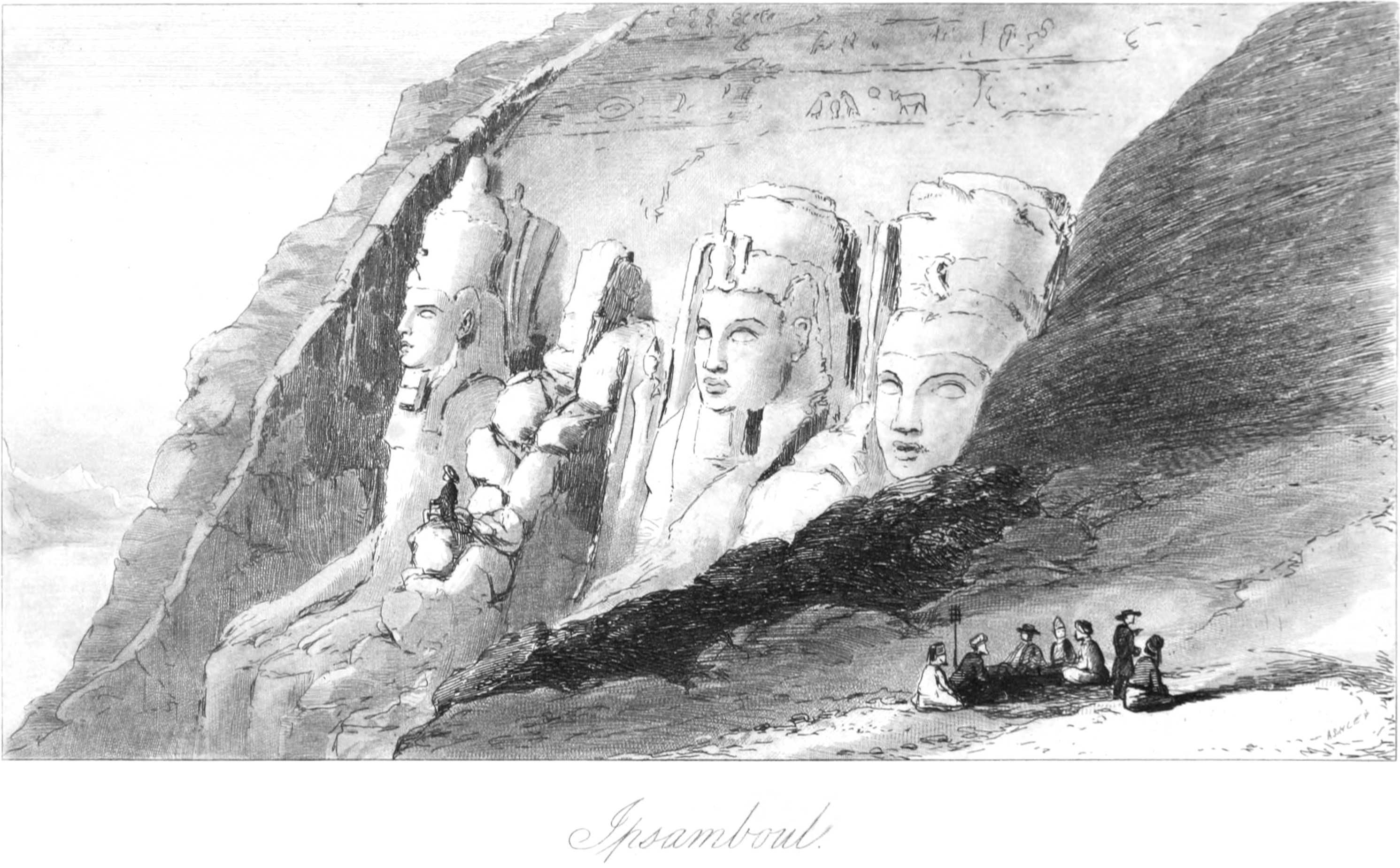
Ipsamboul.
London, Colburn & Co. 1851.
KHARTOUM,
AND
THE BLUE AND WHITE NILES.
BY GEORGE MELLY.
![[Illustration: the author]](images/i4.jpg)
Second Edition.
IN TWO
VOLUMES.
VOL. II.
LONDON:
COLBURN AND CO., PUBLISHERS,
GREAT MARLBOROUGH STREET.
1852.
LONDON:
Printed by Schulze and Co., 13, Poland
Street.
[v]CONTENTS
OF
THE SECOND
VOLUME.
| CHAPTER I. | |
| Preparations for a start — Camel-riding — Our encampment — Partridges — Temple at Samneh — A jackall hunt — Eagles — Picturesque country — Alkaline hot springs | 1 |
| CHAPTER II. | |
| Waking the Bedouins — Camels of the Nursery and Camels of the Desert — Travelling — Nubian children — Dinner | 18 |
| [vi]CHAPTER III. | |
| Sakkut — desert vegetation — Arab village — A one-eyed Venus — Dates at Derr Hamed — Nubian faith in European medicine — Ruined temple — Gazelles — Lost in the Desert — Flowers and birds — School | 28 |
| CHAPTER IV. | |
| Governor of Dongola — Embarkation of camels — Well in the desert — Camel drivers — Iron fragments — Effects of cold on the Bedouins — An Arab superstition — Verdure on the banks of the Nile — Pastoral scene | 42 |
| CHAPTER V. | |
| Gebel Berkel — Antiquities — Appearance of the country — Hawks — A pastoral scene — Illustrations of Holy Writ — Arab dwellings — Wady Bashana — Bedouin revels — Christmas Day in the desert | 59 |
| CHAPTER VI. | |
| Khartoum — Introduction to the Governor, Latiffe Pasha — His extreme civility — The Regent’s Park — Hippopotamus — Europeans settled at Khartoum —[vii] Interior of the desert — Collection of curiosities — The Governor of Berber — Bayoumi Effendi, and the School at Khartoum | 82 |
| CHAPTER VII. | |
| The illustrious strangers — Something about costume — Houses at Khartoum — Mahometans, Christians, and Jews — Trade and Commerce — Scheme for colonizing the White Nile, latitude 4° — Morals — The rainy season — Superstition — Military | 103 |
| CHAPTER VIII. | |
| Visit from the Governor — Catholic mission and school — A Colonel of Cavalry — Our grand banquet given to Latiffe Pasha, and Ali Bey Hassib — Turkish custom of dressing the table — The Governor’s statements — New dromedary saddles and bridles — An excursion — An interesting group — A Visit to Madame Latiffe Pasha — Farewells | 116 |
| CHAPTER IX. | |
| The Governor’s dahabeeyeh — A Bedouin feast — Tickling a crocodile — Pyramids at Meroe — A frightened Hippopotamus — Their manners — Arrival at Berber — A very pretty investment | 131 |
| [viii]CHAPTER X. | |
| Romance of Oriental life — Summary justice and Latiffe Pasha — His despotism — Hatred of Europeans — A box on the ear — Visit to the hareem of Ah Bey Hassib — Juvenile costume — Marabouts | 146 |
| CHAPTER XI. | |
| Prejudices of Nubian parents — Egyptian youths sent for education to Paris and London — Unsatisfactory result — Story of a Perversion — Its tragic end — Jealousy of the Egyptian Government — A grand prospect | 161 |
| CHAPTER XII. | |
| Mesmerism in Nubia — An Arab Seer — Awkward disclosures — Journey from Berber — Effects of taxation — Scenery of the desert — Gagee — The comfortable point of temperature — Intense heat — Giraffes | 175 |
| CHAPTER XIII. | |
| 192 | |
| [ix]CHAPTER XIV. | |
| Additions to our party — Skeleton guides — Lost in the desert — Surefootedness of the camel — The well — A horrible story — Nubian despotism — An Arab’s revenge | 203 |
| CHAPTER XV. | |
| Extreme cold — Milanese Refugees in the desert — A camel lost — An extraordinary day — Arab merchants — Making up a small parcel — Rain in the desert — The mirage — First rate calculators — English weather — In sight of the Nile — Arrival at Korosko | 215 |
| CHAPTER XVI. | |
| The Cataracts — Fogs — Keneh — A gang of convicts — Nile thieves — Domestic merchants — Shadoofs — Taxation — Ossioot — The Conscription — Female relations — Coffee shops | 228 |
| CHAPTER XVII. | |
| Tombs at Benihassan — Boat aground — Cairo — The Esbekya — Abbas Pasha and the Porte — The Census — Cairene ladies — Their evening parties — Palaces of the Pasha — The Overland Route — An American — Mehemet Ali’s Palace | 253 |
| [x]CHAPTER XVIII. | |
| Barrage — Cotton-boats on the Nile — The bazaars at Atfeh — Interior of a coffee shop — Villages on the banks of the Mahmoudieh Canal — Nile locomotion — Illuminations — An Eastern scene — A striking contrast | 277 |
| CHAPTER XIX. | |
| Sale by auction — Dinner and ball — Ride from Alexandria — Rain-water lakes — Effects of distance — Ancient house — A wonderful Englishwoman — A midnight serenade — A parting scene — Farewell to Egypt | 290 |
[1]KHARTOUM,
AND
THE BLUE AND WHITE NILES.
CHAPTER I.
Preparations for a start — Camel-riding — Our encampment — Partridges — Temple at Samneh — A jackall hunt — Eagles — Picturesque country — Alkaline hot springs.
The bargain for conveying us across the desert had already been struck, and we had arranged everything to start at day-break; but the camels had not arrived when it[2] wanted but an hour of noon, and then there was the process of loading to accomplish.
We were not allowed to have the scene entirely to ourselves. Every ferry-boat had brought at least a dozen gazers from Wadeh Halfea, and the bank could boast an unusual collection of picturesque objects, looking in the distance like bundles of white linen, surmounted by curly heads; while here and there a camel lay groaning, in apparent anticipation of the coming burthen. Prominent in the fore-ground, was the Camel Sheik, sedately smoking his tchibouque, while enduring our united abuse for having shown so little respect to the terms of his agreement. The space all around us that was not occupied by living packages, was strewn with baggage of every description.
At last, the camels having arrived, the men begin to display considerable activity in[3] removing our belongings, and a great deal of ingenuity in adjusting them in nicely-balanced heaps across the backs of the poor beasts that had been engaged for their transport, whose melancholy howls proclaimed their protest against the heaviness of their task. Happy, above all his fellows, must have been the poor wretch to whom had been assigned our respectable hen-coop, containing three turkeys, and fifty hens, which was balanced on the other side by a capacious bag of rice, and triumphantly surmounted by the kitchen-table: wretched beyond the whole wretched lot, must have been he who bore the huge boxes of culinary utensils swung on each side of him. But he did not seem an object of pity, for he was a magnificent fellow, quite white, and standing twelve hands high at the lower point of the shoulder; and though he kept up a tremendous uproar, while his[4] burthen was being adjusted to his back, no sooner was the process complete, than he stalked away to the Desert under eight hundred weight and a half, apparently as much at his ease as a London dray-horse with an empty barrel.
The noise increases, the more restive of the camels being assailed with terrible shouts, and sometimes with severe blows; but the whole eleven are at last accommodated, some with tents, some with water-casks and provisions, necessary to last our numerous party for two months; and all with a freight worthy of their well-deserved title, “Ships of the Desert.” And now the travellers must as quickly as possible reconcile themselves to their own mode of transit.
Our servant Mahomed, and our cook Abbas—the former sufficiently grotesque in his desert costume, the latter rendered formidable[5] by the addition of a pair of monstrous pistols—looked wonderfully picturesque, as they passed slowly along on the top of their dromedary; six others await our selection: a small brown one falls to my share. On him my immense saddle-bags are fastened, containing my wardrobe and bedding: upon these are fixed my mattrass and pillow, with my gun secured behind. The pummel is hung with a satchel, in which are deposited various travelling resources—a Shakspeare, powder and bullets, tobacco and biscuit, pipe, whip, and water-bottle. What I resembled I cannot pretend to say, but I thought my brother appeared very like a travelling pedlar; his rifle, double-barrelled gun, powder-horn, water-skin, and last not least in request, “Macaulay’s England,” constituting but a very small portion of his stock. The ladies,[6] mattrassed up, looked at least very cosy on their pillowy nest.
The process necessary towards obtaining that elevation must here be detailed, in deference to those of our readers who may be curious to know how a lady secures a seat on a steed so very different to those with whose backs she is expected to be more familiar. The pack-saddle is laid across the rump, and ought to be low enough to be steady, and long enough to afford a good seat; saddle-bags, carrying small-sized portmanteaus, in which were apparel, a few books, medicines, and instruments for observation, are then nicely balanced upon it; over this a light mattrass is either thrown across, or the ends turned up at each end, forming a sort of chair, the rider’s feet resting either on the animal’s neck, or in stirrups suspended from the pack-saddle. The camel[7] also carries the personality of his driver, which, however, did not greatly increase his load. With some animals, their walk or amble is tolerably easy, but the long trot and the slow walk of the larger species jolts awfully; and any other pace is intolerable.
All our preparations having been completed, our crew gave us a cheer—not quite an English one, but the best their Eastern lungs could produce. The Reises, and some others, offered us their hands to shake, and numerous were the parting salaams and adieux we received, as we stalked majestically away.
The high road to Dongola, is as broad as you can see on one side, and has the river on the other. During the first three miles, we beheld nothing more lively than the skeletons of some camels, who had died under their burthens—a common feature in[8] the landscape. At last, we met a caravan of twenty-five living camels, each bearing two packages of gum-arabic; they were accompanied by four Bedouins, naked to the waist, bearing a striking resemblance to those very imaginative portraits that adorn the wrappers—
Our first encampment had considerable pretensions to the picturesque. It was pitched beside a small lake with rocky banks—a portion of the Nile—where the date-trees looked luxuriantly verdant, and the refreshing aspect of the water suggested the bath I was very soon enjoying. The three white tents were arranged in a semi-circle, another being formed by the numerous boxes—a principal object was the fire, bearing four or five copper-pans, in which our dinner was cooking.[9] Standing by, were the swarthy Arabs, peeling onions and potatoes, like English kitchen-maids; a little further on, a group of camels were devouring fresh-cut grass, whilst their drivers, at a convenient distance in another group, were eating with equal relish dates and bread. On the other side, the rest of the camels, and their drivers, were similarly occupied; near me the fifty hens were proceeding to devour the beans, that had been scattered for them, displaying a most pugnacious spirit at every heap, and making a prodigious noise and fluttering, to show their enjoyment of their liberty. The turkeys had selected the top of the hen-coop for their own place of rest, but some of the hens appeared to entertain the same ideas of its comfort, and then the former took violent measures to dispossess the intruders.
The next morning we began our first[10] regular day’s journey during a beautiful sunrise, and with a deliciously cool atmosphere. We saw a covey of partridges, but they were out of shot—then another came flying overhead—we dismounted to hold acquaintance with a third, and managed to kill a brace; though they are so extremely difficult to approach, that we rarely got within forty yards of them. They were very like our friends of the same species in England, but smaller in size and stronger in flavour.
Our road led us across numberless hills interrupted by plains of sand, thickly strewn with white quartz, and granite of a very crumbly nature—the quartz resembling pieces of common soap. A small gum caravan, and the partridges, were the only living creatures we met. We found, however, many traces of hyenas, gazelles, jackalls, and of a large species of vulture, which had no doubt assisted in[11] preparing the numerous skeletons that lay far and wide over the hills.
On the third day, after passing over a succession of small hills divided by valleys of very deep sand, we arrived at Samneh, where there is a small temple, on the top of a hill overlooking the river, which is very narrow, and rushes between high black rocks with prodigious force. This temple consists of one oblong chamber about fifteen yards in length, built of large stones, covered with hieroglyphics inside and out; on both sides there is a species of covered balcony, supported by columns—three square ones on one side, and one fluted round one on the other—and pedestals remain for two more. The interior is in excellent preservation; the border round the side looking remarkably gay with its bright red, green, and yellow. There are numerous hieroglyphics still retaining[12] the sharpness of their original carving, particularly those with the gondola; the paddle, and other features reminding us strongly of our old acquaintances at Venice.
While our antiquarian enthusiasm was at its height, our attention was directed to a wounded jackall ascending the opposite hill pursued by a crow pecking at him as he ran. In a moment, Egypt and all her wonderful relics were forgotten—we pocketed our dilettanteism with the greatest possible dispatch, and followed by a Bedouin chief from the neighbouring village, my brother and I set off in pursuit. The chase was very severe, but the scent i.e. footsteps in the sand, was good, and we passed hill and dale at a clipping pace for about half an hour, when we ran our game to earth in a narrow valley among a heap of huge stones.
He gave chase again while I mounted a hill[13] to mark down a covey of partridges, and I saw him stealing along the opposite hill; but, though I followed at full speed, after ascending two of the hills, I found it such hard work that I was forced to give in, dead-beat. My brother, however, kept up the chase half an hour longer, being rewarded every now and then for his perseverance by a sight of his game. At last, he found himself on a rock, but of the whereabouts of the jackall he had not the most remote conception; when suddenly the fellow started up almost from under his feet, and was walking away apparently quite at his leisure, when the gun was levelled at his head. Three caps were exploded in succession—the rifle would not go off—and the jackall did. So we returned to the temple, very little satisfied with our experience of hunting in the desert.
Among the sculptures we found the names[14] of Wilkinson, Holroyd, Hanbury, Lessep, and Hyde. In such good company, I was proud to inscribe my own.
The Bedouins did not manifest much curiosity upon seeing European ladies, though they beheld them for the first time; but as they never exhibit any feelings whatever, this apparent indifference was not so surprising. We heard of ruins upon an island on the river which some travellers had recently visited; but the account of them that was related to us did not sufficiently excite our curiosity to induce us to dare the rays of the blazing sun on the dazzling waters of the river.
Soon after resuming our journey, we discovered three eagles making a repast on a camel; its demise had been more recent than that of his brethren whose bones lay bleaching on the sand. My brother killed[15] one of these birds. It was of a white and black colour, with a yellow beak and a handsome crest, and measured five feet five inches from tip to tip.
We passed a fine vein of quartz, and a considerable tract of country, covered with what very much resembled petrified forests; also a hill, having the appearance of an immense pile of slates, with vast quantities of the same useful material scattered about. The road was hard and stony all the way.
After arriving at the station of Dangour, our path was a continued ascent over very high hills. We noticed some fine veins of quartz, with red and white granite mixed. The country then became remarkably picturesque—a very broad river being seen rushing by numerous islands, and among bold black rocks, with the opposite shore singularly[16] verdant with date trees; whilst above towered a majestic mountain. The desert is covered for miles around with enormous boulders in striking positions, and of very irregular shape: sometimes like a colossal torso, sometimes like a wall, but always appearing as if the strange heap would fall at the first breadth of wind, notwithstanding that it had evidently retained its position for at least a thousand years.
In the middle of the day, we were agreeably surprised by the sight of a tent, from out of which, at our approach, came a rather handsome Frenchman, M. Y——, a gentleman-like and intelligent man, formerly in the service of Clot Bey. He had made a journey which had united pleasure with profit, from Cairo to the Obaid Kordofan, &c., taking manufactures and returning with gum. He was waiting for some of his[17] camels, of which he had three hundred en route. We were almost as glad as he was to meet Europeans, though he had not seen one for seven months.
There was a hot spring in the neighbourhood, composed of a series of small springs gushing from the ground round the remains of a Roman well, which in its fall has blocked up the principal spring. It produces fifty or sixty gallons a minute; possesses a temperature of 124°, is alkaline in flavour, and covers the surrounding plants and rocks with a white salt that tastes like potash.
[18]CHAPTER II.
Waking the Bedouins — Camels of the Nursery and Camels of the Desert — Travelling — Nubian children — Dinner.
Our mode of living in the desert possessed features that require to be given more in detail than has yet been attempted. At four o’clock in the morning a slight stir might be heard by any one who chanced to be awake at that early hour. Daireh, our invaluable dragoman, who was never known[19] to forget himself, any thing or any one, was getting up. This did not take him long to accomplish, as he had only to throw off his coverlet, composed of a mackintosh lined blanket, and he was ready. He then proceeded to rouse our other two servants, which was also a very easy affair. They went to wake the Bedouins—but this proved a very different thing. Poor fellows, what work it was; for tired, and awfully cold, the thermometer often standing at thirty degrees lower than during the day time, they shivered every time they were turned over and excited to rise.
Then followed the groaning of the camels as their pack saddles were secured—a music which was not rendered more agreeable for having become familiar.
They are considered the most patient of[20] all beasts of burthen. My earliest recollections of them are based on those veracious publications, in which elephants pick up young children and place them carefully on their backs, and camels gallop for days unrepiningly over sandy deserts, never halting, though without both food and water—such are the camels of our tender years, such are not the camels of our experience. Instead of this poetic patience, they growl savagely, making one of the most disagreeable noises I ever heard, and turn round striving to get up as you load them. But when once their burthen is properly adjusted they are perfectly quiet, and become tractable as soon as you have taken your seat.
I had a camel from Dongola to Gebel Berkel, who would not let me turn on my saddle, or put my hand in my pocket without[21] turning viciously round with a fierce growl. I had another, that by way of contrast would walk quietly to within shot of a covey of partridges; then stop, and allow me a good aim at them. All camels, however, stand fire.
The loading having been nearly completed, Mahomet pops his head into our tent and encourages us to get up, bringing in the very small quantum of water that can be spared for our ablutions; and the breakfast things. Toilet despatched, we retire to the back door of the tent to examine the condition of our desert steeds.
The rest of the party now join us, and we sit down to breakfast. By the time we have finished our meal the other tents begin to disappear, and our own is gradually being prepared to follow; and then we mount our ladies, and fill our short pipes of war in contradistinction[22] to our long pipes of peace left behind in our dahabeeyehs; and we are off.
What a scene we leave behind: the ground is covered with our baggage—the fire in which our omelette was prepared, is flickering out; a few Bedouins run from their work to warm their hands from time to time at its last embers. The camels are wandering forward—those that are ready, and those that are loading as usual groaning horridly. It is nearly dark—the first gleam of sunrise is just apparent over the distant mountains.
At about half-past six the sun rises; it then becomes deliciously cool, and of all atmospheres, the pleasantest I know. Presently our dragoman approached us, having stayed behind to give his last orders. He gallops merrily up with his usual good humour, for he always looks on the bright side of all[23] things. Our sheik rides in advance, the small tent for the servants swinging half on each side of him; and we are in fine marching order.
In a few hours our Shakspeare readings are over, we relapse into silence, as we ride along under the burning sun, my head protected by an enormous turban, and the ladies sheltering themselves under white-covered umbrellas. Thus we proceed till mid-day; perhaps without adventure or incident, till the word is given to ride forward, and prepare luncheon. Some palm-tree, favourable for our purpose is soon found, and in a few minutes we are seated in our little tent, on mattresses and rugs, while our unloaded camels are browsing about. Daireh brings out his meal of partridges, his biscuits, and all sorts of good things, not forgetting delicious lemonade,[24] and excellent ale, to which we do full justice.
After luncheon, we often had visits of Nubian children, if we were near the river, or a Bedouin encampment in the desert, accompanied by their timid mammas, in all the beauty of youth, and the elegance of nature; and the little creatures used to come and play with us, without the slightest shyness, notwithstanding that ours were the first European costumes they had ever beheld, and evinced as eager a disposition for Cairo biscuits and white sugar as the best educated English children could have displayed.
At about two o’clock, the caravan passes in front of our tent, Abbas sitting on his gay rug, smoking his pipe, advances for his orders respecting our next halt. These having been fully explained, we presently behold the procession crossing the mirage,[25] which, in the distance, makes the members of it appear to be walking on water.
Some of the Bedouins are sleeping on the camels with the lighter loads, and some hallooing with all their might to make the imperturbable beasts jog along quicker. Presently all assume the appearance of spots, as they disappear in the horizon.
At four o’clock, having had three or four hours’ rest, we are again on our way. The sun is hotter between three and four than at any other portion of the day. We are, of course, sufficiently delighted when, towards seven, we are in sight of our tents, probably on a bank near the river, with a beautiful prospect of blue rocks and luxuriant grass, which cannot fail of looking pleasant after the desert of all day. Possibly, however, the encampment may be in the midst of some arid plain, or under some sterile rocks; but[26] wherever we may be, there is our home. The Bedouins are walking about, or are lying here and there quietly smoking. Our servants are cooking our desert dinner—everlasting Irish stews, and never-ending soupe à la Julienne. Appetite, however, seasons the humblest meal; and, therefore, it was seldom that either soup or stew was neglected. Indeed, to say nothing more than the truth, on many occasions the novelty of the scene, the sense of adventure, and the fatigue of the day’s journey, lent such a relish to our unpretending cuisine, that we enjoyed ourselves a great deal more than it is probable we should have done, had we dined at the best-arranged table in Belgravia.
After dinner, appeared journals, books, and dried flowers; these, with stuffing birds, and a little social conversation, filled up the[27] hours till our early bed-time. Then the sleep, upon our mattresses on the hard ground, was sleep such as I have rarely enjoyed before or since.
[28]CHAPTER III.
Sakkut — Desert vegetation — Arab village — A one-eyed Venus — Dates at Derr Hamed — Nubian faith in European medicine — Ruined temple — Gazelles — Lost in the desert — Flowers and birds — School.
Our sixth day was the most cloudy we had had since leaving Cairo. On, however, we proceeded; on our way observing some fine scenery—a remarkable feature of which appeared in the shape of rocks, formed of grotesque masses of black stones, having[29] a bloom upon them like that of a ripe plum, which had a very curious effect.
We had entered the country Sakkut. After a march of about five hours, we came to a tract of desert of the most legitimate desert character, being a flat expanse of white sand, mixed with pebbles, some of which were pretty, dark-red and green stones, mixed with agates in abundance.
Nevertheless, there exists some vegetation. I noticed three sorts of herbage: a grass, apparently always dried up by heat; a solitary plant about five inches high, of a rich green, and bearing a small blue or yellow flower; and a dwarf creeper light as hair, yet easily distinguished by a good-sized yellow blossom. The camels can eat the first, do eat the second, but very much prefer the third, to which they hasten long before it becomes[30] visible to the keenest human sight.
Our encampment was in a grove of palms, through which the wind rather shouted than “whispered,” as it happened to be blowing something like a gale. A small village is between us and the river, consisting of three sheds made of straw and palm-leaves, interwoven with the trunks of the trees. The inhabitants consist of a tolerably large family, of whom one young lady was pretty for a Nubian girl, with beautifully rounded limbs, fine shape, and an intelligent face. Having sufficiently admired her, I was informed that she lacked an eye; a deficiency I had not been able to discover in the doubtful twilight. My estimate of her attractions fell prodigiously on gaining this intelligence, for, however great an enthusiast in the beautiful I may be—especially as regards the[31] female face divine—I agree with Captain Absolute in thinking that, though “one eye may be very agreeable, yet, as the prejudice has always run in favour of two, I should not like to affect a singularity in that article.”
Again over a sandy plain, and along the side of the river, passing the largest island in the Nile—Say Island. It is several miles in length, is covered with thick palm-groves, and boasts of considerable cultivation, which appears also on the banks; a sight we have seen for the first time since leaving Wady Halfa, the river having been too rapid, and the shore too rocky to admit of irrigation. Signs of an increasing population also made themselves manifest—a refreshing contrast to the solitude of the desert—every palm grove having given forth its dozen of swarthy gazers, its beautifully-shaped girls, its fine men, and its droll-looking children.
[32]At Derr Hamed, a large village, we bought some dates, which are famous here, and made a closer acquaintance with the people. One of the women entered our tent in their naturally graceful way, and presented my mother with a basket full of the best dates, like those that are sold in England, moist and sticky, but unlike those that are eaten in such numbers here, which are left to dry on the trees; they become hard and dry, yet, without being so sugary as the others, are better flavoured. The former, when ripe, are placed in jars, and when a friend or stranger enters the house of a Nubian, he is offered a dozen of them.
We wanted this woman to accept a knife, but she preferred piastres, which she afterwards got Daireh to change for copper. My father, having been seen securing a beetle with a pin, was soon surrounded with[33] petitioners for this small article of luxury, which he presently distributed in considerable numbers for the purpose, as was alleged, of fastening up innumerable rents.
As we mounted to pursue our journey, an old man brought his daughter for medicine. The faith of these people in the Cawaghi’s power is very great.
Our next encampment was in a large village, almost a town, called Sudrenzu, where we shot three dozen doves; they were flying about the place in swarms. Here an infant, in an almost hopeless state, was brought in to us, and some medicine having been given, the father presently presented himself with a basket of dates, as backsheesh for the doctor. This was declined, but we gladly purchased some milk of him—fresh bread and milk being our greatest luxuries in the desert.
[34]The camp is in a square field of sand, by the side of the village, with rice, cotton, wheat, and castor-oil fields between us and the grove of dates that border the river, which here is as smooth, as wide, and as monotonous as in Lower Egypt. If the least picturesque of our encampments, it is undoubtedly the most interesting. A crowd of notables, two of them wearing tarbooshes, came to see us; and then followed throngs of shiny, black children, some carrying younger ones, but all very graceful, except in their remarkable little bread-baskets, which are unnaturally distended with durra-corn. They were merry as crickets, followed us when we went shooting, and were never so happy as when they could make themselves of the slightest possible use to any of us.
Leaving our encampment at dawn, we soon reached a ruin consisting of the fragments[35] of a temple: one column alone remained standing among heaps of stone and disfigured sphinxes. We proceeded on for a couple of hours, and then came upon the remains of the very fine temple of Samneh the pylon half entire, the propylon only partly destroyed, and two or three fragments of marble sphinxes scattered about. Seven columns remain standing; others are lying imperfect on the ground. It must have been a very fine edifice—second only to Carnac.
The road from this temple led direct to the desert, over a large tract of country, resembling the gravel roads of a gentleman’s park in England.
We unsuccessfully followed a covey of partridges, and then observing something in motion, gave chase, and suddenly came upon ten gazelles, of which animals we had previously[36] been allowed to see nothing but their traces. They started off at a great pace, and we followed for about half an hour. My brother fired at two hundred yards. They scampered off, taking prodigious leaps, and were soon three miles off, leaving us planté là without ammunition, water, or compass. Eager sportsmen as we were, we found ourselves obliged to give up the chase, and endeavoured to return; but, not knowing the proper direction, shortly lost ourselves, and began to experience uncomfortable misgivings respecting the result of our adventure. Having a decided dislike to add to the collection of beautifully bleached skeletons the desert contained, we renewed our endeavours to recover our lost track, and by great good fortune at last succeeded in finding it, then gained sight of our encampment, and in a few minutes had the further satisfaction of[37] beholding our Bedouins—taking our alarming absence in a philosophical way, worthy of their race, by helping themselves to our pipes, tobacco, and water.
These gazelles were very beautiful, of a rich brown colour, with white streaks, and were quite as large as English deer. As some compensation for our disappointment in suffering them to escape, we afterwards shot six brace of partridges out of five coveys; this made the day decidedly the gamest day we had had.
We resumed our journey, the road leading between the river and the desert, on a smooth, gravelly soil. Now and then we discovered several new blossoms, some very large convolvuluses, and some exquisite creepers; we had not seen so many flowers before. We also met with various new and beautiful birds, among others a red[38] and a sky-blue one, many varieties of small flower-birds, finches, and a few of larger size. We only saw one covey of partridges, a brace of which I brought down.
Having arrived at our tents at Hafir, and dined, we sallied forth to witness a marriage-feast; the conviviality, the music and dancing, that formed part of it, having been heard in our encampment too distinctly to be resisted. It appeared, however, as if the revellers did not desire our company, for, before our lamp had well made itself visible, the sounds were hushed, and when we reached the place, all the party had fled.
We then proceeded to the school, where we heard passages from the Koran repeated in grand style. We visited the Dervish, who received us very hospitably, immediately preparing some coffee. He informed us that the inhabitants of Hafir were innumerable;[39] that he had two thousand under his charge, all of whom could read and write the Koran.
It was a curious scene—a mud-room, with one large window, filled with the faces of the pupils; the flickering light of the fire illumining in a singularly striking manner the fine face and long grey beard of the Patriarch, and crowds of natives were picturesquely grouped about. He told us that taxation had increased since Ibrahim’s time, as the Dongola Government taxed them as much as they could, aware that Cairo was too far off for complaints. The instant we left, the lessons were resumed; and I can almost fancy that I still hear the hum of the boys repeating their tasks.
The next morning, we suddenly came upon a large covey of partridges, basking in[40] one of the many deserted buildings, which, all along the road from Hafir and Dongola, direct attention to the wealth to civilization that existed in the country before the Government had driven away the most respectable inhabitants by the intolerable weight of its taxation.
A decided attack of opthalmia made it necessary that my eyes should be bandaged, and my camel led. Many new birds were seen by our party, singing on the trees; among the most beautiful, were one of sky-blue plumage, a bright-red one, with a white beak, and one that was dark-red and black. The flowers also became more numerous; among the novelties were a sweet-scented jasmine, and some more fine convolvuluses.
In my condition, the day seemed unusually long; my satisfaction may therefore be[41] imagined on at last arriving at our tents at Dongola. We had made a journey of eleven days across the desert, and had ridden eighty-one hours.
[42]CHAPTER IV.
Governor of Dongola — Embarkation of camels — Well in the desert — Camel drivers — Iron fragments — Effect of cold on the Bedouins — An Arab superstition — Verdure on the banks of the Nile — Pastoral scene.
During the first two days of the four we unwillingly passed at Dongola, my chief employment was lying on my back applying a lotion to my eyes. This treatment succeeded wonderfully, and I at length got rid of the inflammation.
[43]We visited the Governor, to whom we had letters of recommendation, and a firman, about three times a day. We found him polite, extremely obliging, and gentleman-like; he had travelled much in Europe, and was well acquainted by name with all the leading statesmen of England and France.
He at once sent a soldier to collect camels for us, and afterwards sent four more on the same errand, as there was some difficulty, the Camel Sheik being ill of the small-pox, and no one liking to interfere in his duties. Notwithstanding all the Governor’s exertions in our favour, only nine camels had made their appearance by the third day. An express was sent to order a fresh supply at Argo island, about twenty miles distant—and these were brought to a place near the river, where the banks were sufficiently low to embark them and the luggage, that[44] we might determine their different employments. It was not till between two and three o’clock of the following afternoon that we were able to effect a start.
We broke up our camp; had everything transported by camels to the water’s side, to be shipped in two crazy boats, for the purpose of crossing to the opposite bank. I watched the embarking of our unfortunate beasts, who, much to my disgust, were tormented with more than Smithfield cruelty. After having been dragged down the bank on their knees, they were hoisted into the boat by the aid of ropes.
The scene was further enlivened by the soldiers thrashing the Bedouins with whips, made of hippopotamus’s hide; and as each of the sufferers had a wife, and each possessed the power of screaming, their united concert in that way defies description.
[45]Dongola is a large mud town, with capacious streets, and pieces of ground without buildings. In one of these I counted sixteen large white and black eagles, moving about as unconcernedly as barn-door fowls. They are almost tame, and quite impudent, for some of them came swooping down upon our hen-coop with a rush that nearly made the inmates die of fright. We were obliged to shoot a couple of the most audacious.
The dogs too had to be ran after and stoned for being too inquisitive respecting our dinner. We found them great connoisseurs of soup, and possessed of a respectable taste for more solid cookery. A superstition prevails which prevents these curs from been destroyed; so they multiply at a considerable rate, and though perfectly harmless and cowardly, are an immense nuisance to strangers.
[46]Crowds of children visited our tents, and a few very pretty little girls, uncommonly unlike their mammas. One wore a girdle of agate, badly cut, from which hung a fringe of leather. Several necklaces were round her neck; from one a Spanish dollar was suspended.
My brother and I, well supplied with five-para pieces, went into the houses. We were soon surrounded by crowds of mothers and children; but the young girls, from seven to eighteen, were so shy, that they invariably ran away directly we made our appearance.
We killed about seven brace of partridges during our stay at this place; they were very wild, but exceedingly numerous. The only day I could go out, we saw at least two thousand, yet only succeeded in bagging a brace, and this was quite a chance, as we[47] were never allowed to approach within sixty yards.
The next morning we climbed the steep banks, then turning our backs on the river and its verdant shore, emerged on the desert. We had started for a journey—some said of three days, some said of six—with no track to guide us—nothing but hills and valleys of sand, and rocks half-covered with sand—occasionally a watercourse with its scanty herbage—occasionally heaps of stones. One placed on a point of rock betrayed, by its artificial character, an attempt to form a land-mark; but generally these heaps were so numerous as completely to confuse those who sought guidance from them—sometimes leading them hopelessly about till they became bewildered. To add to the comfort of our prospects, we were told that we should meet[48] with no water, except one well, at which in due time we arrived. We found it about six feet in diameter, and thirty deep; the water, though not very fresh, was clear, and of a good flavour; a skin and a rope were ready to pour a supply into a mud-basin for the camels. Here we lunched, under the shade of some thorny acacias that grew round the well, and formed a most acceptable promenade for our beasts.
All my interest about these animals is lessening fast. It is impossible to imagine how provoking they can make themselves, and did contrive to make themselves day after day. Some would run away—some, by way of contrast, not only would not run, they would not move. Some were always lying down—some could not be persuaded to kneel: but mine beat all the rest in camel-like amiability. On an average[49] he howled six hours a day—a kind of music such as no one can conceive who has not heard it. He would stand doggedly still, till forced by blows to lie down; and every time I turned round, he howled fiercer than ever.
Of these we again have eighteen, but our caravan is increased by a soldier, or cavass, whose appearance (armed as he is with one of the matchlocks sold by the English Government to Mehemet Ali, bearing the Tower mark) could affright only the most timid of Bedouins.
Our camel-drivers are the wildest-looking men I ever met with; with their dishevelled hair, and their only garb a blanket, that covered as much or as little of their persons as the temperature made desirable. One of these was especially conspicuous by his large square shoulders, his miserable blanket, too[50] scanty in its dimension to reach below the knee, whence it hung in a fringe of tatters; his hair hung about him like a brood of snakes, and his aspect was singularly wild, if not maniacal. Sometimes a kind of mirthful frenzy seized these fellows, and they would suddenly fling their limbs about in the strangest attitudes, as they danced around their camels, shouting, singing, and finally begging for backsheesh.
We have also in our train a young camel, a dog of the gazelle hunting species, and a Nubian who is returning to his home at Gebel Berkel. He was, by his own account, to have accomplished the distance—one hundred and twenty miles, as the crow flies—between sunrise and sunset, but as his camel ran away, and he was some hours in finding it, he is still with us, enjoying the reputation of being a humbug.
[51]The ground was everywhere strewn with fragments, as it were, of iron cups, vessels, and immense bowls, which had a very curious appearance; some pieces appeared, both in colour and weight, like the sediment at the bottom of iron boilers.
We passed three boundless plains of sand, with here and there gravel, covered with these ferruginous materials, mixed with innumerable cannon-balls and bullets. I could almost have fancied that we were approaching the forge of Vulcan, where he used, in the classic age, to manufacture thunderbolts.
The next day we had what, in England, would be called a bitter east wind, which brought us all the usual consequences of change of weather, such as colds, swelled lips, and sore faces: we were intensely cold all day on one side of our bodies, and[52] intolerably hot on the other, as if we stood by a bonfire at Christmas.
The Bedouins declared that they would not work: as fast as our servants fetched them, they slunk back again to the fire, swearing that we might kill them, but that they could not endure the cold. They did, however, move away at last, and we started before sunrise.
We have seen no game, except a hare; but have discovered some recent gazelle marks. Our last pursuit of this species of game has not cooled our sporting ardour, and we only wait to obtain something like a chance.
We have been told that ninety guides have been lost on this hazardous road; the number is, no doubt, a figure of speech, but the difficulties and uncertainties of the path are evidently sufficient to account for a[53] very considerable loss of life. After four days’ diligent travelling, from dawn to dusk, we arrived at the verge of these elevated regions, and welcomed the sight of the Nile, as the face of an old friend. To say the truth, we existed in a kind of dependence on the river, from the dread of having to endure the sufferings which we had heard often befel travellers wandering in the desert, looking in vain for water.
Our way had been, as usual, over vast plains, gravelly and sandy. We saw four or five petrified trees, like immense oaks, lying, some entire, some in fragments, on the ground.
Two women, and a few young calves, comprised all the living objects we met with at Merawah, our last stage, the men being absent with their herds. The females brought out large calabashes of excellent[54] butter-milk, which they presented to us, refusing all payment. They said that they never sold milk, as it was considered unlucky. We relished the draught extremely, expressed our gratitude, and made them a present at parting, which we had some difficulty in getting them to accept.
All bushes and trees here possess thorns; among them, one shrub, like a broom, which grows to a large size, seemed entirely without leaves. The euphorbia, or a plant closely resembling it, when broken in any part, exudes a thick white juice, of a sweet flavour, and of a poisonous quality, which, we were informed, was sometimes mixed in cakes, to give the unwary traveller, that he might be the more easily robbed.
Along the banks of the river lay a luxuriant belt of verdure of considerable breadth, edged by palm and other trees.[55] At a little distance, rose the singular-shaped mountain, Gebel Berkel, with a ruined temple at its base; a cluster of pyramids formed the background, and in the distance, a pile of hills, tinged by the last rays of the setting sun, bounded the prospect.
We were at first at a loss how to descend to the lovely garden at our feet; but, before attempting to proceed, lingered for our caravan, that we could observe winding its course along a narrow pathway of broken rocks, among the curiously-shaped calcareous banks, full of holes, rising like a wall from the lower plain. When we had reached the bottom, our eyes were regaled with a view of singularly pastoral beauty, perfectly Eastern in character: some hundreds of camels, of various ages and sizes, had been brought down to the banks to water, by their proprietors, whom[56] we found to consist of but eight individuals. The owner of numerous flocks lives very much like the humblest Arab, and dresses in a blanket, neither less greasy nor less dirty than that worn by his poorer brother. He rarely kills any of his flock, except on occasions of great festivity, nor will he sell any; therefore, they are sure to increase rapidly.
Flocks of goats and cattle succeeded the camels, to drink of the refreshing river, to which they make weekly expeditions—often from a considerable distance.
We were invited by the people we found here, to pitch our tents under a wide-spreading tree in the centre of the village; but this being too public for our taste, we requested to be led to the river side, whence we must embark on the morrow. A guide soon presented himself, and we followed, not[57] only with a feeling of weariness, but doubtful whither we were going, as we passed field after field, tired with striving to prevent our hungry camels from cropping the tempting heads of corn.
At length, we found a road to the river, and an open space in the stubble of durra corn, where the Governor, to whom we had sent a letter from the Governor of Dongola, by our cavass, joined us, followed by people bearing bedsteads—rude frames supporting leather mats—a luxury, however, with which we had long been unfamiliar. We had also a good supply of fresh bread and milk, that was quite as acceptable; and having got comfortably housed, passed a remarkably pleasant evening.
The Governor was very civil, obtained us thirty-three camels, and accompanied us while we remained in his district. The fact[58] was, Kirchid Pacha, our friend the Governor of Dongola, had, in his letter, promised him a bastinado, or as Daireh translated it, “five hundred stick,” when he next had the pleasure of meeting him, if anything unpleasant should happen to any of us; and the poor fellow, as Tony Lumpkin says, was “in a concatenation accordingly.”
[59]CHAPTER V.
Gebel Berkel — Antiquities — Appearance of the country — Hawks — A pastoral scene — Illustrations of Holy Writ — Arab dwellings — Wady Bashava — Bedouin revels — Christmas Day in the desert.
The next morning we were again in full march upon Gebel Berkel, which is a hill with a flat summit, rising perpendicularly from the plain on one side—with its upright face of bare rock facing the river.
The antiquities comprise the remains of[60] a small temple at the foot, built of the yellow stone common to all the temples, and two chambers inside the mountain that were full of nothing but dust and bats. The hieroglyphics are worthy of observation, and the sculpture is painted blue. These inscriptions appear to be of the same character as those we observed at Carnac and Aboosimbel, but the industry of mason bees is here throwing that of man a little in the background. There are two double rows of columns at the entrance under the rock, and fragments of many more; proving it to have been an important place. A very large slab of black marble, covered with hieroglyphics, was taken from these ruins.
On the south side of the mountain are seven stone pyramids, four of which are perfect; one of the small ones I found thirty-nine feet square at the base, and forty-three[61] feet high: and a large one was fifty-four feet at the base, and about sixty-two feet high. Almost all of them may be ascended within a short distance of the summit—the immense stones of which they are constructed, affording considerable assistance to the climber, till he reaches the top ones, which are polished. All the pyramids have doors; but access was impossible.
Some time since there was an eighth pyramid, but one was pulled down by Lepsius, who, there is no doubt, anticipated all sorts of grand discoveries. The Arabs watched him with immense interest, as they were fully satisfied that he was searching for treasures, which as soon as he had found, probably, they determined he should lose. Fortunately for him he found nothing, and, therefore, got away with a whole skin.
There is an extensive view from the top of[62] the mountain, like the plains of Lombardy from the Simplon in extent, though very unlike in general features: the principal objects in our prospect was plain after plain of sand stretched on every side, except where the broad river serpentined about, with a belt of cultivation on either bank of waving corn, date-trees, cotton, senna, and castor oil; sakeias innumerable, each watering seven acres of land: and the straggling village of Merowah, stretching from below, two miles off, with boats crossing the river, and our three white tents.
Our next halt was made at Gazelle, where are the remains of an extensive building of red burnt brick, probably Coptic. While looking for partridges, I came suddenly upon four gazelles in a small valley. I loaded one barrel with ball, lay down, and as one of the beautiful creatures passed within[63] fifteen yards I fired. Unfortunately the ball only grazed his back, close to the shoulder: he fell, but rose again immediately, and galloped up the hill. I consoled myself for my disappointment, by returning to the partridges, of which covey after covey rose on every side. They are of two kinds: yellow-necked and grey, and some are very prettily ringed on the wings with maroon. They fly very fast, and separate much.
We now met with extremely pleasant travelling, passing valley after valley full of verdure, with high mountains all around. The trees were of three or four kinds, some resembling large gooseberry-bushes, some thorny sycamores, some the cut trees in Dutch gardens, while others were the size of large apple-trees. The ground was covered with what some weeks ago was a luxuriant vegetation, but is now beginning to look much[64] scorched. Beautiful red creepers, a parasite resembling mistletoe, hang from the highest branches, where the ring-doves are flying from bough to bough, and among the roots are large yellow flowers, bearing a strong resemblance to gigantic asparagus. Numerous little birds of plumage unknown to us sing among the branches. Hares and partridges not unfrequently make their appearance, and sometimes, but very rarely, a gazelle trots quietly by.
We passed a well, where a prodigious hole had been dug, the earth being supported by branches. Herds of flocks and goats were gathered round it, and some very wild-looking Bedouins were drawing skins of water, and emptying them into large tanks dug in the sand. We meet these flocks more frequently, each belonging to one person, who wanders with them from desert[65] to desert, and from valley to valley, wherever there is a promise of food and water.
We had much desired to go straight from Merowah to Khartoum, but our Bedouins insisted during the first two days, in proceeding from the former place to Metamneh, a town on the river, sixty miles north of Khartoum. This is a considerable circuit, and occupies two additional days. They declared that the other road was full of grass and water, which brought there many bad Bedouins. In the summer season it is considered safe, but merchants have preferred the road to Metamneh, since a party were murdered there six years ago:—notwithstanding this statement, our fellows suddenly changed their minds, and were more anxious to go the shorter road than we had been.
Our way was through a chain of high[66] black mountains, very like an alpine pass. The scenery was remarkably wild, and we helped to make it more picturesque, as camel followed camel in the path which has been made by caravans constantly passing over the loose stones. The heat was intense. After four hours we arrived at a pool among some rocks, but the water was of a blackish-green colour, that would have suited an artist much better than a traveller. A few yards further, we came to a well into which the water slowly filtered through the sand. I tasted it, but found it very bad. The camels, however, drank freely, and then we proceeded though a chain of low hills, so covered by cinders and volcanic matter, that the track of our beasts was not perceptible.
While we were shooting, a wounded bird was pursued by three hawks: they made[67] swoop after swoop upon their intended prey with a prodigious rush of their wings, but he dodged with success till my brother shot him. As he fell, one of the hawks rushed upon him like lightning, but by a small distance only missed his prey: and then the whole party disappeared.
It is curious to observe the prevalence of the sandy colour of the soil in the creatures that have to exist upon it. Sandy coloured eagles devour sandy coloured vipers and lizards, which in their turn prey on grasshoppers and slugs of the same complexion: and partridges and sparrows, by means of their resemblance to the ground, avoid the prying eyes of the falcons and hawks.
One evening, remarking several parties of Arabs mounted on asses, or on foot, winding down the low mountains, that surrounded us, our guide assured us that they were in[68] search of water; and in the next turn of the road, we entered a wooded amphitheatre, in the centre of which was a well, and around it, various flocks with their shepherds, waiting their turn. A timid boy, with his little flock of black goats crowded close behind him, remained at a distance till the men had withdrawn.
The scene reminded us strongly of certain pastoral passages in the Bible; for we beheld the specked and ring-striped sheep of Jacob, with drooping ears, some marked brown and white, black or fawn-coloured, like cows. The more to enjoy this interesting spectacle, we turned aside, and rode across to the well. We found it very deep; the mouth at the bottom of a steep hollow, roofed with earth, so as to be entirely sheltered; the water being drawn in leathern buckets, and emptied into troughs formed on the ground.
[69]Nor did we wonder at Rachel’s fearing to approach such formidable-looking men, as were those we beheld watering the thirsty animals, that were clustered at the brink of the hollow. They were, however, very civil: brought us some of the water to taste, which was extremely good, and furnished us with a bottle of milk from their herds—an addition to our coffee and biscuits, we never missed an opportunity of securing.
We left this spot with reluctance, for we found it suggestive of the most sacred thoughts, realizing every inspired description of patriarchal times.
Travelling in this desert of Bayiouda, the pleasantest part of our desert journey, and, as Daireh informed us, the most like the deserts in Syria, we were continually struck with the resemblance to places described in the Bible, or to manners and anecdotes[70] related there. Every day brought some new scene, which explained some passage we had hardly understood, or gave force to some other one we had scarcely appreciated.
One day we met a Bedouin, rich in herds, who was pursuing a single sheep, or camel, across the sandy wastes, tracking the animal by its footsteps; the next, we came on the ninety and nine left without their shepherd. We have felt the disappointment of arriving at a well and finding the waters bitter. And the cup of cold water cannot be fully appreciated, except in a country like this, where the liquid, rare to get at any time, can hardly ever be obtained even tepid, and generally has a taste of the skin it is kept in, which would disgust any, but the most thirsty.
Our Lord’s command is still obeyed by[71] these people—indeed, throughout the East—and you may always drink any quantity of water, to whomever it may belong. I was surprised once at seeing a Bedouin walk up to my camel, and drink a whole bottlefull, my supply for the day; and I have often, when out shooting, gone into a hut or tent, and asked for water, which the poor people have had to carry a great distance. Not only have I never been refused, but my offer of a piastre or two was never accepted; they gave it me, as a Nubian woman once beautifully expressed it, for her “God’s sake.”
One of our guides once told us how he was ruined last year; for entrusting his flocks to a “hireling,”—they were all eaten by a wolf (hyena), and scattered over the desert, while he was away leading some merchants over the sandy plains.
[72]When, after a march of ten days over stony hills, and arid plains of deep sand, we came suddenly upon the broad river, winding through the rich green of the durra-covered banks, we could exclaim with the Psalmist, “He maketh me to lie down in green pastures; He leadeth me beside still waters;” and as a Bedouin in advance of us called his servant, who was walking before him with his sandals, that he might put them on before he reached the village, we remembered that John the Baptist did not deem himself worthy to unloose the latchet of our Saviour’s shoes.
These are but a few of the innumerable passages of the Bible, which desert travelling daily brought to our remembrance.
Further we observed some genuine Arab tents: and again we went out of our way to visit them. Though the desert is thickly[73] inhabited during this season, we had only on two occasions met with any dwellings. The fear of Turkish oppression, and the necessity of hospitality, makes the Arabs avoid all frequented routes; concealing themselves in the most retired valleys, wherever they can find pasture for their flocks.
Here there were three tents, if such they could be styled, being blankets stretched over some branches, and supported by bushes—open on one side.
In the course of our journey we were most agreeably surprised by the appearance of the country—which sometimes much more nearly resembled an English park than an African desert. Where the situation was low, the air was milder, and there was considerable vegetation; trees appeared occasionally of a large size, singly, and in groves. And where there were trees there were birds;[74] some of singular beauty, their plumage gaining additional brilliancy from the brightness of the sunlight. Among them a large humming bird floated rather than flew round the bushes, where it found its insect food; then there was the widow bird with its long black tail feathers, generally set almost upright; there were also doves in great numbers, and frequently pigeons.
At one time we passed some extensive prairies of grass of exquisite fineness, among which we found numbers of gazelle horns; and every now and then surprised numerous herds of these beautiful creatures. Then we beheld camels, that had been turned out by their owners to find their own subsistence where they could, returning once a week for a supply of water.
We passed large fields of rich land from which the Bedouins raise fine crops of maize[75] and millet after the rains: but they are obliged to drive their flocks and herds to a lake of rain-water in the hills every four days. Sometimes the road was over vast plains of sand thickly covered with grass and minute plants, full of briers that stuck to our clothes; with here and there small trees. Flocks of gazelles ran up the sand hills as we entered the valley: we saw also hares, partridges, and quails, with lizards; and serpents, three feet long.
We came upon the river at the town of Wady Bashava, which consists of about a hundred and thirty summer-house looking tents, made of durra corn-stacks and mud. We purchased two sheep at ten piastres (2s.) each—and a liberal quantity of weak beer, brewed from durra—that loses the little appreciation you are inclined, at your first trial to give it, on a second acquaintance: but[76] both beer and mutton were for the Bedouins, and as they contrived to make an immense jollification with them—devouring the meat cut into slices, before it could be thoroughly warm, and swallowing the liquid in awful gulps as soon as it got near enough to their throats, I do not consider myself called upon to criticize either very narrowly. After stuffing themselves to their hearts’ content, they danced round the fire, with tremendous shouts, apparently frantic with delight.
I have seen the Ojibbeways, but our friends beat them hollow in uncouthness, as with their spears in their hands, they whirled about, each performing his particular pas, as the others kept time, and every dance ending with an embrace, for myself and my brother. Such a ballet would be a monstrous novelty at her Majesty’s Theatre.
To-day being Christmas-day, we determined[77] on having a Christmas feast. It was certainly intolerably hot, the thermometer being at 93°. Yet, with this exception, we managed to enjoy ourselves very much after our good old English fashion. French champagne and Scotch ale, a plum-pudding surmounted by an acacia branch, and dashed with a liberal supply of brandy, and “last, not least, in our dear love,” a bowl of excellent punch, manufactured by Abbasis, helped us to get through the evening very comfortably. Of course we did not forget absent friends.
We had been travelling through groves of acacias swarming with doves, and beheld some high mountains rising out of an island nearly opposite Hafir. There is an immense quantity of gum trees in this neighbourhood.
I met a travelling family of wealthy Bedouins, the head man on horseback, having[78] with him three camels with water-skins, and one with tent and bed; two or three women on donkeys, besides a cow. I was alone, and at a considerable distance from our caravan; so as the man seemed civil, I readily entered into the same mood, and shook hands with him in the most cordial manner imaginable. After this, I walked off very jauntily, congratulating myself that I was still a free agent, for I might have been carried off to the mountains without any great degree of difficulty.
We passed some villages—the dwellings constructed in the usual fashion—a court-yard of mud-wall, or hedged with dry durra or acacia-boughs, containing either a horse, an ass, or a camel. In the side, or more commonly in the centre of this court-yard, stands the house of mud and interlaced boughs, roofed with durra corn[79] and leaves. The only one I entered contained a bed, several mats and stools, a lance and shield, camel-saddle, and similar furniture, and was inhabited by a Nubian, his wife and children, from the eldest of whom, an intelligent and pretty girl, I purchased some buttermilk and water.
The most curious thing I beheld was a large bag of hide, covered with cowries, which seemed to possess some mysterious value, for I could only persuade the owner to let me see it—selling it was evidently out of the question. It belonged to a noble and wealthy Bedouin chief, whose residence was made of three large blankets stretched on tent poles. He had a good-looking wife, and a young son. She gave us a considerable quantity of buttermilk, but would not accept a piastre, saying, she gave it for “charity.”
[80]At length, on the 26th December, the ninth day from Gebel Berkel, the fourteenth from Dongola, and the thirtieth from Wady Halfah, at five o’clock in the evening, we suddenly came down a hill in sight of the object of our journey.
On a boundless plain below lay the junction of the two Niles; next we observed the white government house and the minarets of Khartoum; and then the broad White Nile stretched as far as one could see, looking like an immense lake, as it merged into the horizon. Some of us longed to penetrate further into the interior, and thought it a pity that Khartoum should be the ultima thule of our journey, as a few days more would carry us to the goldmines of Fazokl, and half that distance to a country of elephants, lions and tigers; but the rest were glad that we had[81] proceeded in safety so far, and having, as they fancied, done so much, had not the least desire to do any more. It looked like the end of the world almost, as we gazed on the two rivers, sulkily flowing side by side, and obstinately refraining from fraternizing as they rolled along. Lastly, appeared the boundless deserts beyond the town, making it look like a bulwark against barbarism and an outpost of civilization.
An hour afterwards we pitched our tents on a greensward, between some tall trees, opposite the junction of the Blue and White Niles, on the banks of the latter.
[82]CHAPTER VI.
Khartoum — Introduction to the Governor, Latiffe Pacha — His extreme civility — The Regent’s Park Hippopotamus — Europeans settled at Khartoum — Interior of the desert — Collection of curiosities — The Governor of Berber — Bayoumi Effendi, and the School at Khartoum.
The next morning we went on board a crazy boat, and, impelled by a strong north wind, soon crossed to the confluence of the two rivers. The White Nile is not whiter than the Blue Nile is blue, yet there is a[83] difference of colour, and the former has the strongest current and twice the breadth of the other. For three-quarters of a mile, the two rivers can be distinctly traced running side by side. We sailed up, or rather down, the Blue Nile, as near Khartoum it takes a considerable bend. About three miles from the point of junction is the town; in the intermediate space are two villages, and in one of them the people are employed in ship-building.
Khartoum, seen from the river, is a long mud wall, with several houses just peering above it, among which, most conspicuous, is the residence of the Governor, with its offices, the old Government House, and the Catholic Chapel and Mission. We proceeded to the Governor’s offices, through a large open ground, in which two companies of troops, the best dressed and accoutred of any I have[84] seen since I left Europe, were changing guard, each company led by a soldier with a bedstead on his bayonet, he being the officer, and the only one allowed such a luxury, the rest always sleeping on the ground. We next arrived at a court, in which were several brass pieces, and then entered a large room fitted up with Turkish divans and European chairs. This was “the Divan.”
At one end sat Latiffe Pacha, General in the Army, Admiral of the Fleet, and Governor of the Soudan, from Philæ to the furthest possessions of the Pacha of Egypt. He looks like a man capable of being all this and more; as he possesses a fine figure, a good face, set off with a remarkably fair complexion, a beautifully trimmed moustache, and a beard as black as jet. These advantages were assisted by the handsomest Asiatic dress I have seen—a suit of dark blue cloth, richly embroidered,[85] red and gold tunic waistcoat, and full sleeves of pink silk and gold, silk stockings, a magnificent scarf round his waist, tarboosh, diamond star, and several gold chains.
On his right hand sat Ali Bey Hassib, the Governor of Berber, and a few other grandees sat near him, in full costume.
His reception of us was very courteous; for a few minutes he spoke to the Governor of Berber; he then gave his entire attention to us, reading our firman, passport, and letters of introduction. The conversation was in Italian, of which he possesses a limited knowledge; we had, however, been told that he was also familiar with English and French. We inquired where it would be agreeable to him that we should pitch our tents; he answered by presenting us with a capital house. On asking where we could[86] find a boat, he replied that his own would be ready for us in three days. On mentioning camels, he promised to have thirty ready to meet us at Berber. At a hint respecting the forwarding of our letters, he volunteered to send them by a special messenger from station to station on swift dromedaries to Assouan, whence men would run with them on foot to Cairo, and then they would proceed in the usual course. In short, he promised everything we wanted; gave us coffee and pipes, and then we took our leave.
There was a considerable crowd of janissaries, slaves, officers and cavasses, below the step, and the usual mob of officials in the hall; but like the birds, their costume is much brighter in these more southern latitudes; blue and yellow, with white coats and trousers, looked much more gay, I thought,[87] than the sober brown and mulberry colour, I had been used to at Cairo. His Excellency’s confidential pipe-bearer, a Frenchman, who had been in England with Ibrahim Pacha, showed us over the town. He first accompanied us to the house that had been provided for our accommodation: we found it most pleasantly situated among oranges, bananas, and pomegranates, in a garden, on a high bank of the river, next door to the Pacha’s hareem. Then we inspected the diabeheeh—a large three-masted boat, with a small cabin—but, as it was the only vessel here that could boast of a cabin, we were very glad to get it.
Afterwards we strolled into the bazaar, where we heard the Pacha had gone, and found him sitting inside the raised and railed-in floor of the principal shop, which was filled with Manchester goods. A species of court or “tail” attended his Excellency,[88] entirely blocking up the bazaar; but they readily made way for us, partly from some fearful misgivings about our origin, and partly because a somewhat awful-looking personage, clothed in red jacket and boots, and bearing many pistols, made way for us, in a manner not to be resisted.
Having assured the Governor that all he had done for us was taib kateer (very good), we proceeded to the head apothecary here, who entertained us most hospitably; one by one came dropping in all the Europeans of Khartoum, which now comprised a very respectable circle of Frenchmen and Italians, who were extremely civil. By the time we returned to the river, the Pacha’s boat, manned by ten sailors, was waiting to row us home, where we speedily arrived in great style, making comparisons between the Governor and some great people in England,[89] when a stranger appears amongst them,—very much to the advantage of his Excellency. We had some conversation about hippopotami, which may be met with in the neighbourhood. That very popular specimen, which created such a sensation among the fair sex, last season, in the Regent’s Park, was brought up here by hand for six months before it commenced its voyage to England. These animals are at a premium just now, for Mr. Walne, Her Majesty’s Consul, has offered £1,000 for two, and many hundred natives are on the look-out. The hippopotamus is extremely wild, is rarely seen except during the night, and is not to be found in great numbers here.
We were promised prodigious sport, and full of the great thoughts these excited, the next morning we went into the Pacha’s boat up the White Nile. We saw crowds of ducks, geese, ibis, pelicans, and plovers, and[90] four white crocodiles basking in the sun. On our return we found our things being removed into the house, as the Governor would not hear of our making a residence of the boat, and with the assistance he sent us, the place was soon made extremely comfortable. Our house was a good-sized edifice, though constructed of material no more durable than mud. It had been placed in a delightful orange-grove; but the position would have been more admired had it been further off a groaning sakeia, which was too close to it to be agreeable. It consists of a hall, entered by an ascent in the shape of a short staircase; this opens into three large chambers having mud divans and unsheltered windows, affording a refreshing prospect of orange-flowers, pomegranates, and sugar-canes. It was an agreeable contrast to our close tent dwelling in the desert.
We made acquaintance with all the Europeans,[91] as they came to see us. Among them were the apothecary and the head medical officer—an agreeable and handsome man from the neighbourhood of Geneva. Scarcely had they departed when we received a large basket of figs, bananas, pomegranates, and cream-fruit—the last most delicious to the taste, as might be expected from its name. With it came the following letter:
“My Lord,
“I hope you will accept a little fruits from the garden of your servants, minister of the Catholic Church, or rather from your garden in this cyty.
“Your servants,
“Emmanuel Pedemonte.
“Khartoum, December 28th.”
A few minutes afterwards, came Monsieur R——, a particularly quiet, gentlemanlike[92] Frenchman, the friend and partner of the gentleman whom we met in the desert of Dongola. He has been a great traveller, having twice been up as far as 4° N.L. His description of that part of the country was not very inviting; for, after passing twenty days through unwholesome marshes, he seems to have beheld nothing more interesting than a scorbutic and scrofulous population. At 10° N.L. the scene improves. The people are six feet high, beautifully formed, and intensely black. Tigers, lions, cameleopards, wolves, and hippopotami, besides innumerable smaller animals, are to be met with, with very little difficulty; the difficulty, I am inclined to believe, being sometimes to get out of their way. Tons of elephants’ teeth lie about the desert, where these huge animals die, or are killed by the natives for their flesh.
[93]Monsieur R—— thinks that a most advantageous trade could be established by a society of Europeans, by which the price of gum-arabic, ivory, &c., might be considerably diminished in Europe, and Egypt very much benefited. But Latiffe Pacha is narrow-minded, and being himself the most extensive merchant here, he discourages speculation by putting every obstacle in the way of European adventurers.
Another visitor followed Monsieur R——; then came a basket of parsley, lettuce, radishes, pomegranates, lemons, and sugar-canes from the apothecary; and finally, the Pacha’s head man, with a small quantity of milk, and many apologies for the cows not being more productive.
The next morning was passed in paying visits to our obliging friends. We first walked through a garden of vines, oranges,[94] pomegranates, and jessamine trees to the house of the apothecary; in an ante-room we met the doctor and one of the ministers of the Catholic Church. We then entered a large divanned room hung with Napoleon pictures, with its curtained windows looking particularly cool and comfortable. We sat round in solemn conclave, our friends in full Turkish costume, while lemonade gazeuse, coffee, and pipes were handed round, conversing of the climate, the rate of mortality, diseases, and other lively matters too numerous to mention. I ascertained that there is a great mortality in children from three to seventeen years. If they survive that age they live to their appointed time: but at thirty-five they look shrivelled and old; notwithstanding which, however, they manage to exist till eighty or ninety, and further south to a hundred.
[95]We next called on Monsieur R——, in whose yard we saw a young giraffe about nine or ten feet high, and quite tame; and an antelope as large as a donkey, with two horns at least a yard long. Our friend had the best garden in Khartoum, with trellis-covered walks, made of vines, which bear throughout the year. We were received in a large room, with the usual devoirs, and found Monsieur R—— transacting business with several native merchants in their white robes, turbans, and scarves. Afterwards came in a very intelligent Turk, handsomely dressed, and wearing a diamond star round his neck, who spoke French fluently. Like Latiffe Pacha, and many others here, he is in honourable banishment, deprived of the society of his wives and family.
Refreshments having been handed round, our host exhibited his curiosities, such as[96] rhinoceros’ horns, hippopotamus’ teeth, and the various implements of the natives. I admired a pair of tongs and a javelin, made of iron, with such primitive tools as a stone for a hammer, and a piece of rock for an anvil. Drums, musical horns, bows, spears, arrows, quivers, clubs, and curious iron truncheons, were amongst the collection, with pipes that would hold three pounds of tobacco, and tea-spoons like soup-ladles. He offered us the entire collection, and had already sent one to the Musée de Vienne.
We walked round the bazaars, and were mobbed a little by the natives staring at my mother and sister—an unusual outbreak of curiosity on their part. As I was passing a shop crowded on the outside by janissaries and attendants, I was sent for by the Governor of Berber, who very civilly offered to accompany us to Berber, and show us everything[97] worth seeing on the road. After the offer of his house, camels, &c., he promised to visit us in the course of the morning.
I called on another of our new friends. He has also a large establishment, seventeen slaves, goats, cows, and about five acres of land, which he obtained by buying ten tickets, at a hundred piastres each, in a lottery. He is, however, willing to sell his domain for £60. He was a clerk for fifteen years in Kordofan, at £70 a-year, with Mr. ——, a Parisian merchant, who, he said, never sold British goods under a hundred per cent. profit. He bought an estate for a trifle, at Kordofan, where he also has a large establishment.
Ali Bey Hassib, the Governor of Berber, paid his promised visit. We entertained him with pipes and coffee, and he kindly took charge of our orders for camels, eggs,[98] water-skins, and other requisites. Like all other high functionaries in these southern latitudes, he is here in honourable exile, with about £1000 a-year. Though his term of banishment is ended, he does not know when he shall be able to return to Cairo.
On our return from a walk in the bazaar, we found Bayoumi Effendi, a very distinguished man, who was one of the thirty sent to l’Ecole Polytechnique at Paris by Mehemet Ali, and came out seventh in his year. He remained in Paris thirteen years, and has translated two works into Arabic every year for many successive years. The Sultan offered him a post, and the rank of Colonel and Bey if he would settle at Constantinople, and the Pasha of Egypt, similar advantages if he would take service under him. For a long[99] time he hesitated, but at last, in an evil hour, sailed for Egypt, and has become, in all but in name, a slave.
At first he was appointed head-master of instruction at Boulac. Suddenly he was ordered, with twelve of his ablest professors, to form a school here in Khartoum. No school has been built for him, and it is absolutely impossible to form one, as the parents run away and live independently in the desert, rather than send their children to be taught. Even could schools be established, his assistance would not be called for for many years, as the children can neither read nor write, and he is one of the cleverest professors in Europe in mathematics and engineering, besides being the first Arabic scholar.
He bitterly complains of having been deprived of his wives and children, and forced[100] to leave Cairo in twelve hours; though he thinks the Pasha is less to blame than his advisers, for he never was allowed access to him, and is sure that he could not have offended him. Indeed, he feels so much confidence in his sense of justice, that, could he send his Highness a statement of his case, he thinks that redress would follow immediately. He attributes the mischief to malicious traducers—certain pupils of his.
The schools here are of course a humbug, and the whole thing designed to get rid of the professors, that their pupils might take their places. These are men whose education is very far from completed, and who doubtless interfere less with the acts of the Viceroy. It is the height of absurdity for any one travelling as we did, hurriedly across a country so new to them, to attempt to pass any judgments on its political state;[101] still one can hardly pass over without a word these prisoners—for such, all but in name, they are—who are governors of important towns and provinces in the south of Egypt, or presiding over imaginary schools at Khartoum.
There seems no doubt that they have made themselves disagreeable to the Pasha, partly perhaps from domineering over him, or offering unasked-for advice, or more probably from being really, or supposed to be, in the pay or in favour of the Porte.
The encroachments of the Sultan on the Egyptian prerogative are well known, and the reception he has given to such officers or employés of the government at Cairo as have absconded or been seduced to Constantinople, leaves no doubt of his sinister intentions.
Whatever may be said of Abbas Pasha’s[102] personal character, his government is more favourable to free trade, and more beneficial to his country than that of any preceding ruler; and as long as he follows the advice of his present friends, it is to be hoped that they will uphold the independence of Egypt, now becoming a most important country, and to no portion of the world more so than to England.
The result of these banishments is, that the provinces are very well governed: Khartoum, Berber, Dongola, Fazokl, &c., being all under the direction of intelligent men, who have travelled much, and been careful observers.
[103]CHAPTER VII.
The illustrious strangers — Something about costume — Houses at Khartoum — Mahometans, Christians, and Jews — Trade and Commerce — Scheme for colonizing the White Nile, latitude 4° — Morals — The rainy season — Superstition — Military.
It is evident that we are considered somebodies in this good town of Khartoum. We have astonished the natives more than can very well be conceived. What they think of us, we cannot exactly ascertain: but it is clear enough that they think a good deal[104] of us. They are a little puzzled when they speculate upon what brought us to their remote corner of the world; and to add to their mystification, they cannot for certain reasons avoid regarding us with a considerable amount of respect mingled with a slight addition of awe. The fact is, it has got abroad that our firman contained denunciations unusually stringent against all, and sundry, who wanted to eat dirt by exhibiting the slightest degree of neglect or remissness in looking after our safety, comfort, and pleasure. Every one argues that such commands from such a source mean something, and the upshot is that we were immediately set down as illustrious strangers of a most illustrious generation.
Long before our arrival, rumours were in circulation respecting us that increased in extravagance every hour. Among other[105] veracious statements, it was affirmed that a gentleman, with his hareem, was known to be on the road, who was a Pasha with three tails; that he was adorned with three diamond stars on each breast and neck, and prodigious gold epaulettes on each shoulder. One of our friends who knew something of us, was asked if the great man about to visit them, really was greater than any Pasha of their acquaintance. Our friend set the matter at rest, by assuring his eager questioner that all Pashas were as nothing to the least of us, for they were obliged to do the bidding of their master—but that we were our own masters, and did exactly as we pleased. There was a fervent exclamation respecting the goodness of Allah, and the querist walked away, as an Irishman would phrase it, “bothered intirely.”
I have never seen a country of such[106] extreme cleanliness. Though the drapery of the people is often of the scantiest—in this there is nothing offensive. The Bedouins are satisfied with only a cloth round their loins during the heat of the day—the girls and children often have not even this very small wardrobe to boast of—nevertheless, they are so perfectly modest that no one thinks of their deficiencies. The costume of the elder females often assumes a classical character—and is likely to afford immense satisfaction to sketchers, and those who fancy that they are gifted with a taste for the artistic.
But while I am discussing other people’s toilets, it may be thought scarcely fair that I have ventured to say nothing about my own. I have said nothing on this interesting subject, for the very simple reason—that I have nothing to say. But merely in compliance[107] with a principle of justice, I must beg to inform the reader—that I wore, when in the desert, a rusty pair of blue trowsers bought at Milan, elegantly fastened round my waist with an old rope, to remedy certain unavoidable deficiencies in the article buttons—above that a red shirt—that was. It is now beautifully varied, being partly purple and partly pink. A tie extremely unstudied, buck-skin boots, and a top coat containing something of everything in the sporting line; these with a tarboosh and a turban, constitute the sum total of my classical toggery.
As I had an opportunity of observing the tout ensemble, in our only mirror—a circular looking-glass just two and a quarter inches in diameter—there is no fear of my too greatly admiring it. If Mr. Narcissus had travelled in the desert with the thermometer 94° in the shade, till his complexion became[108] the colour of a brick-bat, and his nose and lips were in a state of intense inflammation—and got clothed after the elegant fashion I had adopted, there would have been no danger to the gentleman on the score of self-conceit. So much for my appearance in the desert. We were, however, at Khartoum dressed exactly as we should have been had we been travelling in Europe.
The town consists of about three thousand houses, resembling those already described. Architecture in these regions being in an extremely primitive condition, the arrangement of the streets is just what might be expected from the aspect of the houses. There are no spacious thoroughfares; here and there appears something like a square, or space—but the perspective generally is by no means such as would satisfy the humblest European judgment in the art of building. The[109] better class of houses are possessed either by the government officials, or by the European residents. In some there are approaches to luxury, in others to comfort; indeed, it is but fair to acknowledge that with the addition of delightful gardens, and a pleasant climate, it is not difficult to reconcile oneself to a residence within mud walls.
The inhabitants are thirty thousand in number, including the military—they are divided into Mahometans, Christians, and Jews; the former are an immense majority of the population, and worship in their mosques—they are particularly unenlightened, and their priests are not much better. The latter number about fifty. They comprise the entire community attached to the Roman Catholic missions, possess three priests, have a chapel for the performance of religious worship, as well as a school for[110] the preparation of converts, and the instruction of the rising generation of their co-religionists. The Jews are about a dozen.
The members of the three religions live together very amicably—the followers of the Prophet looking upon the supporters of the Pope with supreme indifference, and the professors of Christianity regarding the worshippers of the Koran with profound pity. The Jews, of course, abominating both. Sometimes one of those accidents that are said to happen in the best regulated families, varies this state of harmony with a little bigotry—and “the dogs of Christians,” and “the beasts of Jews,” are made to suffer as much persecution as may be thought good for them—and “the miserable Infidels” fall prodigiously in Christian and Jewish opinion. All parties are taxed with very little partiality; and the[111] government is equally indifferent to their interests.
Much activity prevails in the neighbourhood in boat-building; the vessels constructed being chiefly long, open boats for navigating the Nile. They are usually built of palm-wood, but are very clumsy contrivances.
The principal portion of their trade consists in the produce of their gardens and fields, which are extremely productive. The bazaars consist of four covered and four uncovered streets; the former are the finest shops, and are filled with articles of merchandize of very various character, among which figure Manchester prints, Sheffield knives and scissors on cards, and Staffordshire potteries: the uncovered streets are mostly booths, in which are sold senna, lichens, and various herbs and grasses. The[112] merchants here export gum-arabic, galls, senna, castor-oil, and large quantities of ivory on camels to Korosko, after conveying them down the Nile to Berber.
A much greater trade might be carried on with English goods than has yet been attempted; but this should be extended as far into the interior as possible, that we might profit by the immense stores of ivory and other valuable commodities, that are so easily procurable. I have had another conversation with Monsieur R—— on this subject. He is for colonizing the White River at latitude 4°; stating that the people there have already learnt to distinguish between the European and the Government expeditions. A steamer of ten or fifteen horse-power, flat-bottomed, would do admirably to tow up the diabeheehs. According to his account, monkeys swarm in the[113] trees at ten hours’ journey from here; at three days’ journey the traveller meets with flocks of guinea-fowls; and elephants, tigers, and lions in eight days.
The lower class of people content themselves with one wife, who usually rewards her faithful spouse with many children. The higher class are not so easily satisfied; and the grandees indulge in the permitted number of four.
The most unpleasant part of the year is the rainy season; and so heavy is the fall, that the streets are impassable. This comes on, too, so suddenly, that should any one call upon another a little before the commencement of the showers, he must remain at his friend’s house for three or four days, till the waters subside. No one attempts to quit his dwelling during the rains; and the town, therefore, must possess[114] much the appearance of having only just emerged from the Deluge.
Superstitious practices and prejudices are general. All Wednesdays are considered unfortunate, particularly the last Wednesday in the month: but the last Wednesday in the year is still more unfortunate, as on that day Moses made the waters blood. So the day previously, every one provides water for two days, as no one thinks of going to the river till after Asser—three o’clock in the afternoon. The Pasha is not free from these superstitions; and Riffa Bey, who has enjoyed the advantages of a Persian, as well as a Parisian education, and is thoroughly versed in magical lore, has daily to explain his Excellency’s dreams.
The military force here consists of ten thousand infantry, and two thousand cavalry. In the yard of the Governor’s house, I[115] noticed several pieces of brass cannon, four to ten pounders; he has also some howitzers and bombs. There are in the Soudan, twenty thousand infantry and twelve thousand cavalry, with thirty-six pieces of artillery, under the command of Latiffe Pasha, who is a general officer. Indeed, every one in the civil, as well as in the military service, possesses military rank. The doctor is a commander one grade below a lieutenant-colonel. Ali Bey Hassib is a full colonel; and this is so much a matter of course, that we are continually questioned as to our standing in our own army. The answer that had previously settled our superiority to the whole race of Pashas, always sufficed. Our independence of superior authority gave us very high military rank, indeed.
[116]CHAPTER VIII.
Visit from the Governor — Catholic mission and school — A Colonel of Cavalry — Our grand banquet given to Latiffe Pasha, and Ali Bey Hassib — Turkish custom of dressing the table — The Governor’s statements — New dromedary saddles and bridles — An excursion — An interesting group — A visit to Madame Latiffe Pasha — Farewells.
His Excellency paid us an early visit this morning. His costume was not so rich as that which had so well become him on our reception; but, as if to make[117] amends, he wore over it a magnificent cloth cloak trimmed with blue velvet. He was, as usual, very friendly; asked us to dinner; but as he could not ask our ladies, we of course refused on account of our approaching departure; but it was arranged that he should dine with us.
After luncheon, we visited the Catholic Mission—MM. Pedemonte, Angelo, and Zara. They received us most hospitably, and after the usual refreshments, were desirous that we should take with us about two camel-loads of White Nile curiosities. We examined their pretty little chapel, and their school with equal interest. The latter consisted of about twenty boys, in various costumes, and of almost as many different hues, from Frank white to inky native. Many of them are children of the European residents. Some can speak a little[118] French and Italian, and nearly all can read and write.
I was anxious to make acquaintance with a celebrated colonel of cavalry, quondam Governor of Assouan, sub-Governor of the Soudan, and lately Governor of Kordofan. M. Angelo took me to his house. We found him in a room furnished with rug-covered bedsteads, and hung round with beautiful sabres, several pairs of very handsomely-mounted pistols, besides an assortment of guns and fowling-pieces. He was shy, and entirely disclaimed the feats that had been attributed to him, such as dividing oxen, and severing cushions or silk-handkerchiefs with a single blow of his sabre. He, however, gave us a very animated account of the war in Kordofan, where he had commanded, and of the showers of clubs which fell from unknown[119] enemies while he was fighting in the woods and mountains.
Our grand dinner was now about to come off. We had invited Latiffe Pasha and Ali Bey Hassib; and already his Excellency’s head-cook and servant had made his appearance, bearing his master’s silver-spoon and fork, and a curious tray full of little dishes or saucers, containing condiments. There were sixteen of them; two of cucumbers, two of oranges divided, two of sugared pomegranate, two of parsley-salad, two of radishes, two of onion-salad, one of figs, one of eggs, and two little cups full of garlic and milk. This is a Turkish custom, and the little vessels looked pretty on the table.
In due time our distinguished guests arrived, and so did the dinner. The affair was rather heavy at first; but as the great[120] men found the use of their appetites, they found also the use of their tongues. They ate of everything offered to them, but in small quantities, leaving much on their plates, frequently helping themselves, with a fork to a taste of the small dishes. They particularly enjoyed the idea of eating at Khartoum the English salmon, we had carried there in the hermetically-sealed boxes purchased at Fortnum and Mason’s, which was excellent. They drank sparingly, Ali Bey Hassib taking nothing but lemonade: nevertheless it was evident that they enjoyed themselves; the conversation was carried on with great vivacity, and immense fun was excited when Mahomed, while putting a dish on the table, set fire to his beard.
After dinner we became extremely social, exhibiting our purses, seals, ladies’ work and[121] drawings, and they showing us their seals, which are signets, with their names cut on a stone. These they employ in the way of signatures as they never sign their names.
The Pasha became at last very communicative about the state of the country. His accounts, however, were startling. He said that the province pays the whole of its expenses, and enables him besides to remit eighteen to twenty thousand bourses per annum to Cairo (about ninety to one hundred thousand pounds). He placed the population of the Soudan at a figure too enormous to be credited, and spoke of naked Bedouins owning one hundred thousand oxen; not one of the vast stock ever being killed. We could not attempt to dispute such statements, and passed a most pleasant evening, our friends not taking their departure till ten o’clock.
[122]Whilst we were entertaining their Excellencies, Daireh entertained a select circle of eighteen, comprising the Pasha’s pipe-bearer, head-cook, and other attendants. Hospitality was ever the order of the day in the kitchen, and the outer court was always full of curiosity dealers and the servants of our visitors, who brought a pipe-bearer and sometimes as many as four servants.
The next morning we had arranged to start for an excursion, and at sunrise our party, consisting of the European residents, my brother and myself, and three servants with pipes, &c., were ready to mount our several dromedaries. The saddles are different from any we have yet seen; the grass hunches are superseded by leather cushions, and a comfortable leather seat is placed on the extreme points of the saddle, which is[123] covered with red or blue sheep-skin. It is fastened by four leather girths, which being very tight, never give even during the fastest trot. Were it otherwise, with the common dromedary saddles we have hitherto used, we could not have held on a quarter of an hour at the pace we went. The bridles are as superior as the saddles, and the dromedaries equally first-rate.
We proceeded to the White River, and thence to a village, where we sat under a tree on the people’s bedsteads, smoked, and drank some of their abominable beer. We beheld one of the prettiest groups we have yet noticed: a mother and four daughters under a shed; two of the latter, remarkably pretty little girls about seven or eight years old, were caressing a baby, whilst the eldest, a beautiful woman, was plaiting the hair of her younger sister, which[124] was very long and bushy, yet quite clean and combed out—in a very different condition to what it will be a few days hence, from the united operation of dust and castor-oil. A few cows and goats completed the picture.
One of the gentlemen had been very amusing, and now offered to marry one of the girls; but they unanimously declined, believing that he was a Turk. Assured that his embroidered jacket, white trowsers, and red top-boots had deceived them, they then refused, because he might take them away.
Though the Nubian women are not exactly what can be called beautiful, they are almost always of fine proportions; their height generally five feet six inches, with well-turned limbs, beautifully moulded neck and shoulders, and very good complexion.[125] By way of drawback to these advantages, they have large lips, tinged with blue, eyebrows dyed with henna, and hair falling in little plaits around their heads, often ignorant of comb and brush, and matted with grease.
Their eyes are large, sweet and soft in expression, generally black, though often blue. In every movement, they betray a native grace and elegance, which not all European belles attain, particularly the younger girls, who are frequently very attractive; the largeness of the lip not being fully developed, and their blue eyes possessing a brighter tint than that seen in their seniors. They marry before twelve and thirteen, and are already old at twenty. Their appearance is certainly not improved by the habit they have of gashing their faces, with seven or eight cuts on the upper[126] part of each cheek. This custom is followed by the men, who repeat the operation on their breasts.
On our return, we went to see the collection of Monsieur Nicola, a naturalist, now on the White Nile; the birds were numerous, and were very well stuffed; many of extreme beauty, were quite new to us. We saw a stuffed ant-eater of great size, a live eagle, and a cat from the upper country; and were extremely gratified with our visit.
My mother and sister called on Madame Latiffe Pasha, who received them very handsomely in her new residence adjoining our garden. She is lady-like and pretty; and was becomingly dressed in a tight Greek jacket, covered with gold-lace, and full blue silk trousers. She showed them over her house, which is the only well-built[127] one in the country, gave them coffee in the usual gold filigree cups, which shared their admiration with the embroidered napkins, table-covers, and velvet work, that had been executed by herself. She did not appear to be very young—about twenty—was tall, and remarkably playful. All accounts of these imprisoned beauties resemble each other, and tend to make one believe that even here, if the ladies were educated, and treated like their European sisters, they would maintain quite as respectable a position in society.
Bayoumi Effendi came to see us to-day, and indulged in a long grumble for the third time. I can always sympathize with any one who happens to be reduced to grumbling, and knowing what a relief it is, I encouraged our friend till he had exhausted his resources in this line; and[128] then he left us in a state of mind almost to be envied.
We were constantly employed in receiving and paying visits. Every one called to pay his parting compliments, and we could not be outdone in such civility. Sometimes we had little remembrances, and sometimes gave them—one trifle in this way created a sensation throughout the entire civilized community. The apothecary gave us two chairs, and we returned the gift with forty potatoes. The fame of this vegetable quickly brought us more applicants than we could supply. They are entirely unknown here, having but once penetrated to these remote regions, and then only in an unsatisfactory state. We were extremely glad to deprive ourselves of a few dishes, that our kind friends might have an opportunity of cultivating so rare a luxury in their gardens.
[129]Lastly we paid our respects to the Pasha, who, surrounded by the grandees of the place, received us with his usual kindliness. We thanked him for all favours—but before we parted he insisted on showing a horse of his, which a cavalry officer was exercising. It was a small well-made animal, beautifully trained. I much admired his changing feet when going rapidly round in a small circle—but could not appreciate the suddenness with which he was pulled up on his haunches, when galloping at the speed of from fifteen to twenty miles an hour. In Turkish ideas this is very clever—but is easy to do—requiring little more than a very strong bit; the use of which, however, must entirely spoil the poor creature’s mouth.
Daireh was sent round the town to tip all the functionaries, which necessitated an expenditure of many dollars of backsheesh.[130] The Governor sent us charcoal, and other things that were wanted. Afterwards his grooms and servants came to ask for boots, European trousers, &c., for all the world as though we had stocked ourselves with the contents of a London “Mart of Fashion.” One soldier, a deserter from the army now acting against the Abyssinians on the Atbarah, came to beg us to intercede for him; but we tried to explain the English law on desertion, and declined interfering. Lastly came Riffa Bey, with many letters; the ordinary post never troubling itself about the correspondence of persons like himself, labouring under the disgrace of banishment. Indeed, some of the Europeans remain several years without hearing from their friends.
[131]CHAPTER IX.
The Governor’s dahabeeyeh — A Bedouin feast — Tickling a crocodile — Pyramids at Meroe — A frightened hippopotamus — Their manners — Arrival at Berber — A very pretty investment.
On the first of January we sailed, or rather rowed from Khartoum, in the Governor’s dahabeeyeh with eighteen oars. We fired a salute of twelve guns on passing his Excellency’s house, which brought him out to the balcony, where he stood for some time waving his hand to us. We presently passed “the meeting of the[132] waters,” soon arrived on the broad Nile; indeed, made such way, that by eleven o’clock in the morning we anchored opposite Saiab.
Our dahabeeyeh is much larger than any of the boats at Khartoum: it is about ninety-one feet long, carried eighteen oars, and a crew of twenty-two men. It had two masts, besides the small sail behind; but they are taken down and arranged on the deck. It was built by Mehemet Ali at Cairo, by him brought up to Khartoum through the six cataracts—an unheard-of feat—where it came into the hands of Latiffe Pasha, who caused it to be thoroughly overhauled and made as good as new. The cabin is small—a portion having been devoted to a bath—but though somewhat pinched for room, we contrived to make it do, both by night and by day, without[133] suffering much inconvenience. The men were mostly Nubians, and they pulled us along with immense sweeps.
We continued to proceed slowly towards Berber, making but little progress against the very strong north winds, although the rowers exerted themselves manfully. They were encouraged with promises of money, and with what they much more appreciated, two or three sheep, and prodigious quantities of burra, which they drink with great zest. One day we walked out on the sand, where they were feasting, and watched them devour the stomach of a sheep raw, apparently with extraordinary relish, washing it down with beer, of which, in the course of the day, they contrived to swallow seventeen quarts among them.
We passed several high mountains before we entered the sixth cataract, which was[134] more like the second than the others, and continued for four or six hours among rocks, many of them concealed from sight, which made it dangerous proceeding at night. We shot one little fall of about four feet, nearly opposite Wady Bashava, where we slept on Christmas Eve. The affair was managed with remarkable skill.
We beheld many crocodiles, most of them white, or nearly so—sometimes four basking on a bank—and we shot at one. He rolled over in a great hurry; but being at a distance of a hundred yards, with only a charge of large shot in the gun, we could only have tickled him. These crocodiles, of which, during our passage from Khartoum to Berber, we saw immense quantities, are what are usually called white—grey would be a more exact expression. They are not so large as the black ones, generally speaking.[135] The largest we saw may have been twenty feet long; but they were usually from four to twelve feet only. To give some idea of how numerous these monsters are in this part of the river, I may mention that, on one occasion, looking out of a window of the boat, I counted twenty-seven on one side of the river. We saw also herds of many thousand head of cattle, drinking in various places from the banks—most probably they had come many miles from the interior. Their immense numbers corroborated one of the statements of Latiffe Pasha.
We have only as yet been met by two or three diabeheehs and a few boats of the country; the former hoisted their flags, thinking we were the Pasha, and were considerably mystified on observing our European costumes, with the further botheration of ladies staring at them with all their[136] might; but, borne along by the wind which delayed us, they shot past with their three sails, and were soon far away. The other vessels were large rowing-boats, propelled by three or four men, with paddles of a very small size.
I was called out to observe two crocodiles lying with their paws familiarly round each other’s necks, and their necks on each other’s shoulders. On the other side, I counted nearly three hundred and fifty camels refreshing themselves with a draught. We next observed something like a black rock, which was introduced to us as an hippopotamus; but before we had time to identify it with the telescope, it was gone.
We arrived at Meroe on the evening of the fifth of January, and after breakfast next morning mounted our asses and set[137] off to inspect the “eighty brick pyramids” marked on the map. We passed a considerable breadth of land covered with brick and stone—the ruins of the capital of Ethiopia, subsequently the kingdom of Meroe, while under the rule of Candace.
After proceeding over the remains of what might either have been her palace or her bath, we soon came in sight of what probably is her monument. We beheld in one place in the vast plain, about twenty-six pyramids. Of these not one was quite perfect, and twelve of the number were shapeless heaps of ruin. On an eminence, about two miles further in the desert, we observed a still greater number of these monuments standing[138] in the form of a semi-circle. Of these eighteen were perfect, except near the top, four a good deal injured, three quite broken down, and six in a straight line. We measured one, and found it forty-seven feet square, and thirty feet high—had been fifty perhaps when perfect. Twenty-one stones formed its elevation up to the broken part, each stone one foot five inches in thickness. The highest pyramid we measured was composed of thirty-six stones, equal to about fifty feet; but like almost all the others it had suffered at the top.
About a quarter of a mile towards the south, on another rising ground, there exist several other pyramids in a more perfect state—about thirteen in all. In the centre is a large and deep hole, whence exhales a strong smell of buried mummy—by no means of a refreshing character. Out of this[139] hole Lepsius has extracted, according to report, numerous sarcophagi of much value. One of our men had been with him, and assured us that the present ruinous state of many of these monuments was produced by his researches.
These pyramids are extremely interesting, as genuine remains of a very remote antiquity, and are as extensive as any of the kind I have seen since leaving Carnac. The map incorrectly designated them brick; they are built of the usual stone—grit sandstone. The summit of nearly all of them may be reached without any great difficulty, the ascent being step-like; but in the highest four stones, some are too smooth. At the top, the inside is solid, with large stones and gravel; and many of those that were pulled down, were solid all the way to the bottom. In front of several, there is a small porch,[140] which, from its lowness, has escaped the ravages of time better than those portions of the building that rear their heads a good deal nearer the skies.
Many very uncouth hieroglyphics are sculptured on the walls; but everything here is well worthy of observation; and not the least so is the prospect of the vast plain, the pink-tinted mountains, and the broad Nile, continually winding along and disappearing.
On the sixth of January, we began to make more progress, and about ten o’clock in the morning, arrived at the most northern tributary of the Nile—rather a small stream, when compared with the immense river into which it falls. The banks of the Atbarah are high, and far apart; but it was quite low water, and the channel appeared half-filled with lupins and beans, sprouting luxuriantly[141] from a bed of mud. To-day, for the first time, I saw a hippopotamus, though some of our party had already beheld two. He was frightened at a shot that had been fired at a crocodile, and rushed for a minute or so out of the water on to the bank, but speedily made a dive into his native mud and disappeared.
This was a very young one, about as large, perhaps, as a small Guernsey cow. Those seen on a former occasion by some of the party, were much more interesting. Two of these enormous beasts were floating unconcernedly, with their immense mouths wide open, and, being pink inside, they very much resembled a mass of butcher’s meat; our ladies voted them plain and even disgusting. They are here very numerous, and commit great ravages; not so much by eating as by trampling down whole fields of corn[142] and beans. They are hardly ever seen during the day; but at night they resort in numbers to the islands on the river, where they take the air unmolested, and roll themselves in fields of grass and lupins.
They are, accordingly, much hated by the natives, who hear them making their peculiar noise, while destroying and ravaging some unhappy Arab’s property. The sufferers do not seem to take very active measures to disperse them; probably as it is Allah’s will, and partly also from their aversion to going out in the dark.
The inhabitants of an island, a short distance below Berber, applied, while we were at Khartoum, for troops to drive away these midnight revellers, and a hundred soldiers were dispatched hippopotami-hunting. Troops are made of all sorts of use[143] in the East; a battalion of infantry was sent boar-hunting in the Delta last year, owing to the great devastation committed by these animals, by rooting up acres of cotton. I think this sporting must be more amusing than the frontier work against the Shellouk tribes, north of Kordofan.
By sunset we came in sight of Berber, on the sixth day of our voyage from Khartoum, which city it much resembled, though its banks sloped a great deal more to the river. Scarcely was the plank adjusted for our stepping ashore, when Mahamet Elmi, the sub-governor of Berber, a well-dressed and curious little Turk, apparently as quiet as a dormouse, came to the boat to pay his respects to us, accompanied by a good-looking cavalry officer, and by one of the handsomest men I had ever seen—he was[144] a priest, and quite a celebrity in the country; of him I shall say more presently. We ascertained that every preparation had been made for us that we could have desired, and that if we insisted we might start at once. We, however, resolved to await the arrival of Ali Bey Hassib, whom we expected hourly.
We here made the acquaintance of Monsieur L——, a gentleman from Bordeaux, who makes annual excursions up the White River. He prefers the climate and society of Berber, to existing in the continual sunshine enjoyed by his compatriots at Khartoum. He finds the air of Berber so healthy, that he has settled himself here—his first step in that direction being the selection of a wife, a beautiful white slave, whom he purchased. How dear she was to him, I really had not the means of[145] ascertaining; but I have no doubt that his capital found what in the city is called “a very pretty investment.” It would not do to sing here—
The heart finds a market every day, and the rest of her organization is thrown in by way of make-weight. I do not know but what this system has its advantages. The immortal direction of Mrs. Glasse, as to the dressing a hare, is not more to the purpose than would be the suggestions of a Berber bachelor as to the securing a wife: for nothing can be made so completely one’s own, as what we have bought and paid for.
[146]CHAPTER X.
Romance of Oriental life — Summary justice and Latiffe Pasha — His despotism — Hatred of Europeans — A box on the ear — Visit to the hareem of Ali Bey Hassib — Juvenile costume — Marabouts.
My mother and sister paid a visit to the hareem of Ali Bey Hassib, to the door of which we accompanied them, after passing through a yard tenanted by a giraffe and an ostrich, and defended by two brass cannon and fifteen very inferior looking soldiers—they, however, constitute the force armée[147] of Berber, capital of the province of that name; the rest being employed in the war.
This town much resembles all other towns in the East; it is, however, the largest in Nubia, and the inhabitants may number about eight thousand. It is very difficult to speak with any degree of accuracy about the population of these countries; as the people have an insurmountable objection to having their names down in the government lists, founded on an impression that only those whose names are so inscribed, will figure in more important documents—the taxation or the conscription lists.
The population, always on the decrease in these towns, continues to pay the same taxation as in the time of Mehemet Ali, though numbers have absconded into the desert, and absolutism is communist in one point, in making those who will pay for those[148] who do not; thus, if your neighbour is a bankrupt, you pay his taxes, as the Sheik of the village must forward the same amount annually to the Governor of the province.
The oppression under which the poor natives labour, proceeds chiefly from the head man of their village. The power these petty governors exercise is immense; for if they bear a particular dislike to any person under their rule, to put down his eldest son as a conscript, is a never-failing way of humbling him to the dust, and is often made the means of great extortion.
The Central Government is gradually dismissing the sheiks governing the villages in Upper Egypt, and has nearly all the government of Lower Egypt already in its hands: a step, the policy of which cannot be too much applauded. We believe that it proceeds[149] from more enlightened minds than those of the followers of Mahomet.
Traversing mounds of earth, which form the principal streets, you soon find yourself in the midst of the Nubian capital, and surrounded by all the interesting objects of a city in the East; children running here and there, or making the little mud pies, which form a staple amusement to the youth of all nations; or trotting under the weight of some little brother or sister, as yet unable to toddle along on its own account, and soothing it when some heap of dust occasions a rough fall; men loitering about pipe in hand, and graceful women carrying the large jars of water, the supply for the day; donkeys trotting gaily by under the weight of the richer Arabs, and camels with their wild-looking owners seated on the top of the high leathern[150] saddle, preparing for a long journey across the desert, or arriving at their houses after a weary march.
The bazaars, if such a street of open booths may be called so, are crowded with natives, selling or buying grain, cotton, or camel furniture, or productions of more northern latitudes. The dogs were, as usual, very numerous and very noisy, running between every one’s legs, and confident in the superstition which prevents their extirpation, make themselves as disagreeable as possible.
The houses are mostly built of mud and sun-dried bricks, though here and there a burnt brick house appeared, the mansion of some native grandee.
We noticed with pleasure some Nubians walking with their unveiled wives—an unusual sight in Egypt—and even caressing their funny little children, carrying them in the[151] peculiar Eastern fashion; which I can fancy must be more healthy to the children than that adopted by us. The infant, even at a very early age, learns to cling to his parent, sitting as it were astride on her hips, while one arm is placed round the child’s waist, by the careful mother, to prevent it from falling.
It is a most striking feature to observe the utter indifference of Egyptian mothers, and even of many fathers, to their young children; it was many weeks before I noticed any mark of tenderness passing between a parent and child; but probably this indifference is assumed in public.
While at the Governor’s divan we heard some extraordinary stories of our obliging friend, Latiffe Pasha; proving that Madame Scandal in this remote quarter is as busy as she often is in the most favoured spots of[152] our own dear land. One of these being particularly illustrative of the romance of Oriental life, as a faithful chronicler of the manners and customs of these people, I think I ought not to omit it.
When his Excellency left Cairo, he took with him a young Greek lady of respectable parents, who had been his wife’s intimate friend and companion, and was neither a slave, nor in any way related to him. He was also accompanied by a young man whom he had adopted, and who went by the name of Ibreem Latiffe. While passing through Berber, he took a fancy to one of Ali Bey Hassib’s wives, whom he asked for, and, as that gentleman had at the time a larger stock than he wanted, he at once offered to spare one for his friend. He carried her off to Khartoum, where he had been only a few weeks, when he married his adopted[153] son to the fair Greek, with more than usual ceremony: and all parties, as is the custom of the country, lived very comfortably in the same hareem.
About two months ago, two of the attendants of the hareem came to him with a long story about his Greek daughter-in-law and a purveyor in the army, whom they had seen together in the garden of the hareem. The instant he heard it, Latiffe Pasha ordered in six of his Janissaries and the male delinquent. The latter he charged with the offence, and without listening to his assertions of innocence, condemned him to be shot. At first the Janissaries refused to sacrifice the officer, but the Pasha, mad with rage, insisted on his immediate execution, and one of the men shot him in the neck. He fell wounded, and was then thrown into the Nile. Latiffe, accompanied[154] by this Janissary, now hurried into the garden of the hareem, and sent for the Greek lady, who was actually at that moment with her husband. The instant she came, she was shot, and her body cast into the river.
After this summary justice, his Excellency appeared satisfied, but evidently was not quite at his ease. His appetite fell off, and he could not sleep. He now thought, for the first time, of making some inquiries respecting the affair, and consulted a Turk at Khartoum, who was eminent for his sagacity. On hearing the whole of the case, the Turk assured him that he not only had been too hasty in forming his judgment, from the only testimony of the guilt of the parties that had been submitted to him, but that the lady, being neither his wife nor his slave, he had no right to take her life.
[155]The Pasha became extremely dissatisfied with himself, particularly when further inquiry assured him of the untrustworthiness of the accusers of his unfortunate victims. He recompensed the five Janissaries who had refused to execute his sanguinary commands: the other suddenly disappeared, and was never more heard of. But the husband—the reader will naturally ask—what became of the poor young man? how could he ever get over such a blow to his happiness as this atrocious murder of his lovely bride? It is supposed that he got over it with the usual indifference to emotion of a Turk, for very shortly afterwards he received another wife, and not a word was said about the poor Greek. The fact was officially notified to Ali Bey Hassib, so there seems no reason for doubting the story.
[156]No statement could more clearly show the absolute despotism that prevails here, the contempt of human life, and the small respect in which females are held: thrilling features also are the want of feeling in the husband, the hesitation in the Janissaries, (never remarkable for over-scrupulousness), the laxity of the government that passes over so atrocious a proceeding, and the curious state of the postal arrangements in a country, in which such an act can be perpetrated without exciting the slightest observation.
Notwithstanding Latiffe Pasha’s cordiality to us, we heard that his hatred to Europeans is intense. This arose out of the following circumstances: While employed in the navy, he contrived to strand a vessel of one hundred and twenty guns on the Alexandrian sands, by attempting to enter the[157] port without a pilot, in direct defiance of the rules of the service. For this he was condemned to death by a court-martial, of which a Frenchman was President; but Mehemet Ali thought proper to cancel the sentence, and made Latiffe Governor of the Alexandrian Arsenal. While there, a Maltese, who filled a high post in the service, came to him for some arrears of pay. Latiffe directed him to bring a receipt, and when it was brought the Pasha tore it and abused him in a way his half-English blood could not brook. The Maltese took his departure without a word; but when Latiffe went out, he found the man waiting for him at the door. He immediately demanded the reason of his having been so insulted, and astonished the Pasha extremely by giving him a box on the ear; immediately after which he decamped to Malta, where[158] he was under the protection of her Majesty’s Consul.
When he arrived at Khartoum, Latiffe Pasha found himself in the midst of a circle of enterprising Europeans, every one assuming the authority of a consul, and talking in a style as if he commanded a prodigious force composed of horse-guards, chasseurs à cheval, jägers, or Austrian hussars. This still further increased his distaste for the species, which he shows on every occasion.
In the midst of these characteristic anecdotes, one of the attendants of the hareem put his head into the very comfortable divan in which we were being entertained, and announced the return of the ladies. We left our pipes and joined them, and were speedily put in possession of the result of their observations.
[159]It appeared that they were not so very well pleased with their visit. The ladies of the hareem—Abyssinian slaves—were gaudily dressed, and not lady-like in person, while the room in which the strangers had been received had much the aspect of an untidy nursery. There were two very nice children there—Master and Miss Ali Bey Hassib. The boy was dressed in red cloth breeches, red coat, and black cloth cloak, which had a curious effect, as he was only two feet ten inches high. The young lady was pretty, and of a genteel appearance. The seniors of the party were not so interesting—certainly inferior to Madame Latiffe. As their visitors had no interpreter, they were obliged to carry on an imperfect correspondence by means of signs. This, however, did not prevent the ladies of the hareem from kissing and examining their[160] new acquaintances with immense zeal. Coffee and lemonade were served in the usual way, and then came the adieux.
On our return to the boats, we beheld a great number of marabouts stalking through the corn-fields, apparently as tame as chickens. This aggravated us into sending for our guns; but our first attempt at a nearer approach, decided the matter. They never allowed us to get near enough to have a shot, and we were obliged to abandon our purpose. Their feathers are extremely beautiful, and more valuable than those of the ostrich.
[161]CHAPTER XI.
Prejudices of Nubian parents — Egyptian youths sent for education to Paris and London — Unsatisfactory result — Story of a Perversion — Its tragic end — Jealousy of the Egyptian Government — A grand prospect.
The efforts recently made by the Government of Egypt to educate the children of the Arabs, has as yet been attended with very little success. This is owing to the intense prejudice of the parents, who will run away into the most remote corners[162] of the desert, rather than allow any one related to them, child or adult, to attend the schools.
To provide efficient masters, in many instances boys of good families have been sent to Europe; some to l’Ecole Polytechnique in Paris; some to the London University to qualify as professors; that when they had acquired the learning of civilization, on their return to Cairo they might become useful either in assisting to establish scholastic institutions over the country on the European model, or in preparing native scholars to undertake the duty of schoolmasters.
This portion of the scheme has produced several failures. In some instances, the young Egyptian has not only imbibed European learning, but European religion. He has been taught like a Frank, till he[163] has become a Frank; has abandoned the religion of his family, and, as a natural consequence, has either sought employment under the mild governments of England and France, or has been induced to return to Egypt—only to feel the severest effects of its despotism.
Those who ostensibly remained Mahometans—for in general their new acquirements brought perfectly new views, both as respects religion and politics—on their return to Cairo, were employed in putting others in the way of gaining those advances in knowledge they had themselves made; and it not unfrequently occurred that, long before the pupil had mastered the elementary branches of European learning, some intrigue ousted the master out of his post, and put the pupil in it; or his real opinions escaped him in some unguarded hour, and he was[164] sent away in disgrace to some distant province—perhaps disposed of in a still more arbitrary way, and his name never more mentioned.
He is sure of making plenty of enemies, for most of his countrymen look on the innovations he is producing with rooted aversion; and all the young men who happen to be placed under his charge, are merely preparing to become his rivals. They therefore are only too ready to assist in getting him out of the way, and the chances are a thousand to one against his escaping the various pit-falls that beset his path.
While in Egypt we were told the following story, which I may quote, without, however, vouching for its veracity.
Some time ago, a young man of a wealthy family, at Cairo, was sent to Paris for his[165] education, and became one of the best scholars of l’Ecole Polytechnique. Gifted with great natural talent, and possessed of an Eastern imagination, he had scarcely arrived at manhood, when he gave up his mind entirely to the political sentiments then prevailing in the French capital—sentiments as antagonistic as possible to those which existed in Egypt.
This, however, was far from being the extent of his imprudence. He thought proper to entertain a passion of the warmest nature, for the daughter of one of the professors, a rigid Catholic; and to secure the hand of the young lady, he abjured the faith of Mahomet, and was received with more parade than was necessary into the fold of the Romish Church.
This “perversion” created a greater sensation at Cairo, than it had done at Paris.[166] The family of the apostate were terribly indignant, and would hold no communication with him. The orthodox Mussulmen, who had never favoured the leanings of their ruler towards Christian enlightenment, now were loud in their denunciations of a system which brought scandal on “the true faith.”
The Government maintained an ominous silence. No notice whatever was taken of the affair—not a word was said respecting the offender. He fancied that the matter was not thought of sufficient importance, to require any particular attention from the authorities at Cairo; and though aware that his family and friends regarded his apostasy as an unpardonable offence, and as covering them with disgrace, he hoped that when time had in some degree softened their feelings, he might be suffered to return to his native city, and be received by his relatives with[167] scarcely any diminution of their affection.
For a time, the cultivation of his attachment absorbed all his feelings, and in a great measure diverted his attention from the state of his own affairs; but when he found his resources cut off, that he had no communication whatever from home, and that he was avoided by his compatriots at Paris, he began to feel the inconvenience of his position.
He tried to get employment, but without success—he was then made painfully aware that an outcast, without funds, could have no pretension to the hand of the young lady for whom he had so completely sacrificed himself. Finding his means of subsistence at last entirely fail, he thought of applying to one of his countrymen, till lately his warmest friend, who held a minor post in the Egyptian Embassy.
[168]His friend at first appeared reluctant to hold any communication with him; but when he ascertained that the young man was desirous to return to Cairo, in the hope of making his peace with his family, he encouraged him in that notion. The next day he advanced him funds that he might set off without delay.
During his homeward voyage, he thought only of the reception that awaited him at the hands of the dear friends, from whom he had been so long separated, and entertained himself by anticipating the delightful reunion he should be able to enjoy, after he had sufficiently expressed his contrition for the offence he had committed.
As to the light in which this offence was regarded by the Pasha, he never gave it a thought. He felt assured that the affair had been entirely forgotten by the officials,[169] and did not for a moment dream of any danger from that quarter, or from any other.
Under these impressions, he landed at Cairo, and with all the impatience of youth was making his way for that quarter of the city in which his family resided, fully convinced that not one of his countrymen could recognize him, or could entertain the slightest idea of his being on the soil of Egypt.
In this he was woefully deceived. Every portion of his homeward journey had been under the surveillance of a spy of the Egyptian Government, who had left Paris simultaneously with himself, and was close to him whenever he moved. Information of his expected arrival had been conveyed to the Government; and the moment that he quitted the steam-boat, certain men, for[170] whom the citizens of Cairo rapidly made way, were seen to take a direction which would intercept him on his way to his father’s house.
That house he never reached. A headless trunk floated the next day on the broad waters of the Nile. It was all that remained of the unfortunate youth.
His offence had created a feeling of terrible rage in the Pasha. It was represented that it might produce the most disastrous consequences, and that the punishment of the offender was imperative. He was, therefore, in the manner that has been described, enticed into putting himself in the power of his vindictive enemies.
The story of Bayoumi Effendi, related in a preceding chapter, conveys a lively idea of the obstacles that must present themselves in the career of the ablest of those able[171] men, whose minds have had the advantage of European culture. It has been said that the cause of his disgrace was his being known to hold correspondence with the Government of the Sultan—an offence of the blackest die at Cairo. And it is possible that Bayoumi Effendi, getting dissatisfied with his position under the Sovereign he had selected, had listened to the overtures, which the agents of the Ottoman Porte were constantly making, to draw away from its powerful vassal the most talented of his public servants; this had been observed by some of the thousand watchful eyes that surrounded him; and the expatriation to Khartoum on a pretended scholastic mission is easily understood.
Notwithstanding these “accidents,” I believe that the Egyptian Government is sincere in its efforts to effect an educational[172] reform throughout its dominions. Its experiments in that direction have been made regardless of cost, and with a liberality of licence regarding the amount of Frankish learning to be acquired, that cannot be too highly appreciated. For the ineffective manner in which the movement has worked, it is not exclusively to blame. In the way of obstacles, there were the prejudices of the orthodox, the intrigues of the heterodox, and the pig-headed ignorance and fanaticism of the large class, whose moral and social improvement the last two rulers of Egypt are generally believed to have had in view; and very powerful obstacles they have proved.
Whether Abbas Pasha will persevere, till he has established schools on the European model in every district of Nubia and Egypt; whether, through their agency,[173] the blessings of civilization shall become extended to the remotest nook of the burning desert, and the land of the Arab be restored to that intellectual reputation, which it enjoyed before the now enlightened West had emerged from the darkest depths of barbarism; whether, in this way, a great nation shall arise on the banks of the Nile, that shall produce evidences of intelligence and refinement, rivalling those memorials of a glorious past—Thebes Carnac, and Aboosimbel—form portions of a question that Time alone can properly answer.
I confess, however, to placing much confidence in the future; the small streaks of light, that herald the dawn in the East, are already visible in the horizon: a little patience, and we shall probably behold a sunrise that will shed over the glorious antiquities[174] of this interesting country, the same splendour that dwelt around them in the days of the voluptuous Sardanapalus, or in those of the wise and powerful Ptolemæus Philadelphus.
[175]CHAPTER XII.
Mesmerism in Nubia — An Arab Seer — Awkward disclosures — Journey from Berber — Effects of taxation — Scenery of the desert — Gagee — The comfortable point of temperature — Intense heat — Giraffes.
To have such a science as mesmerism flourishing anywhere, is a curious and somewhat perplexing thing, but to have it flourishing in Nubia, here, in the remote district of Berber, is, it must be confessed, a curiosity of the most ultra-curious character.
[176]Wonderful as this is, it is a fact that there is in this town a man—the priest who visited us on board—who has mesmeric trances, during which he discloses the most secret doings of any one who chooses to consult him. The difference between the Nubian and the European mesmerism is, that in the former there are no preliminary passes; none of those wonderful manipulations that are elsewhere found necessary to put the patient in rapport with the inquirer.
In this instance, by long fasting and solitude, the individual mesmerises himself; that is, he contrives without any outward operation to put himself into a trance or sleep, when he becomes in the proper condition to do all sorts of marvels, many of which are quite as startling as anything accomplished by the most successful operators in England, France, and Germany.
[177]We had already had some slight taste of his quality; for on our first arrival, we had stated that Ali Bey Hassib might be expected hourly, but he had predicted that that gentleman would not arrive till the day after the morrow; and he was right. I therefore felt sufficient interest to examine his modus operandi. He is an extraordinarily handsome man, with eyes so remarkably sweet in their expression, that they ought to have belonged to a woman; about six feet high, very well proportioned, and of a clean coppery complexion. He wears a cotton blanket, and a scarf gracefully disposed; and without a doubt is the most striking of the many striking figures I have seen in Nubia.
When asked a difficult question he retires, as it were, within himself, falls into[178] a kind of fit, and then gives his answer. Sometimes with a degree of correctness strangely surprising; at others, with a degree of blundering that surprises people a great deal less.
Ali Bey Hassib has put the Seer’s wonderful qualities to the test more than once. On the occasion of a Bey arriving at Berber, he shut the man up in a room, and then the stranger asked him questions respecting himself. The Seer first of all put himself into the mesmeric state, then began to relate the private history of his questioner, with a fidelity that much astonished that gentleman, and made his friend, the Governor of Berber, extremely uncomfortable.
He stated how the Bey had been banished, what was his offence, how he had left his wife and family, with various little matters[179] of detail, that however strange they may have been, were very far from edifying.
A Frenchman here consulted him under similar circumstances; he was informed that his brother was in the 6th Chasseurs, and that France was a beautiful country, well-cultivated, and well-governed. A description satisfactory, no doubt, to the poor exile, but open to doubts of its accuracy from every other quarter. The next subjects the Seer got upon, were railroads and steam-boats; and here he appeared to be much more at home, giving accounts that were wonderful to hear in so remote a corner of the globe.
He never drinks any intoxicating liquors, and, except when mentally excited, is remarkably effeminate-looking. “Take him for all in all,” I very much doubt that we shall look upon his like again.
[180]We were obliged at last to give up wondering, and dismiss the subject of mesmerism in Berber, for others that began to assume a vast deal more importance. The first of these was our departure, and having, with the assistance of Ali Bey Hassib, completed all our arrangements, we paid our parting compliments, and left Berber.
Our camels were not very good ones, except mine—a beautiful white Bashara (best quality), very small and light, but his best recommendation was, that he was a fool; that is to say wild, for which quality I selected him, and rode him very satisfactorily. He was extremely frisky the first few days, and not up to my weight the remaining time.
The Bashara camel is not confined to Nubia. It is a small species, generally[181] white, with two rings burnt under its ear. These rings are perfect, or only semi-circles according to the breeding of the animal. I may here remark, that the only difference I have been able to discover between a camel and a dromedary is, that the latter is a better description of camel. As the race-horse is to the dray-horse, so is the dromedary to the camel; and I have often heard the expressions, “It is nearly a camel,” or “only half a dromedary.”
We passed innumerable villages—at one time as many as five were visible; indeed the country seemed full of villages and cemeteries. For all which the population is very small, and half the houses are uninhabited. This is said to be caused by the immense taxation. Ali Bey has made the proper representations at Cairo, but[182] without the slightest effect. Out of the small province of Berber, the Government at Cairo receives annually six thousand purses. In this highly fertile district there are not more than five thousand persons who can pay anything, and they contribute six pounds a-piece annually, on an average. The consequence of this is, that the river banks for miles and miles are left uncultivated, while the desert swarms with Arabs, who prefer a wretched subsistence in those obscure and arid plains to remaining by the fertile land near the river. It must be added that in the taxation, only a quarter is ever paid in money—the rest in produce, which the Government takes at most favourable prices.
Our route from Berber was no road, scarcely a track, nothing but hard gravelly sand lying at some distance from the river; but we could see to our left, the line of doum[183] palm trees that marked its course, with occasionally some stunted mimosa shrubs, or a few small palms—a very different scene to the one we had been led to expect—which had been tinted up with rich vegetation, brilliant flowers, and birds and insects of the brightest dyes. There are, however, many places along the banks that are extremely picturesque; especially where the stream, apparently small and shallow, forces its way over large stones, here and there interrupted by a verdant island, overhung by fine mimosas, filling the air with the fragrance of their rich yellow blossoms—their delicate foliage finely set off by a dark background of doum palms. No sound interrupted the stillness of the desert but the murmuring of the water, which had a singularly soothing and tranquillizing effect.
A little further on our journey we came[184] again among date-trees which grow here in great numbers wild, without owners, and without taxation. I cannot understand why they are not made to grow at Khartoum, where they are an expensive luxury, and further south, where they are quite unknown.
The desert closely resembled that at Dongola; I beheld quartz of many colours—white, pink, blue, and red, here and there on the ground. The cataract lasted a great distance, about thirty miles; the river runs rapidly over the rocks, but hardly deserves the title of cataract. When we were not in the desert, we rode along the banks of the river, which frequently equalled the most beautiful lake scenery I had ever seen in Switzerland, or elsewhere. Wild palm-trees grew luxuriantly, and not poly like the palms in Lower Egypt.
[185]Towards noon on the 12th of January, our guide came to a halt, and informed us that our route here left the river for three hours, during which we should find neither shade nor water. We, therefore, decided on turning towards the thick groves we beheld at some distance, and selecting some high ground where we could catch the little air that blew from the river, and find repose after the fatigue and the heat. We pitched our tents under the shade of some of the trees on a semi-circular arena, that had in better times been cultivated, and which was still bordered along the edge of the river by crops of durra corn. At a short distance lay a small village, consisting of a few mud huts, separated one from the other by little yards wherein the children played. The heat was often intense—in the valley broiling, but the Nile ran swiftly by on the other side[186] of the village, and a bath there invariably brought down my temperature to the comfortable point.
This place was called Gagee, and is about twenty miles from Aboohamed. While here we had several visits: among others, the Sheik of the camels, hearing of our caravan, came to see what detained us—galloping on his camel in grand style out of the arena, followed by two attendants. He is a fine handsome man, owner of hundreds of camels, and levies a tribute of six piastres on every camel that crosses the desert of Korosko. He was travelling with several servants on capital dromedaries.
During our stay in the neighbourhood of some Bedouins, we, as was customary with us, contrived to establish very close relations with one of the children—a laughing, pretty, graceful, copper-coloured[187] little fellow, about two years old. The next day came his mamma, with face and eyes worthy of a princess; yet her residence was made of a mat, stretched on poles three or four feet high.
We visited some Bedouin huts, and by means of dates and tobacco, made ourselves agreeable to both old and young. One woman was extremely pretty, and her husband was also very good-looking. He was quite a young man, and arrived during our stay at Gagee, with his two camels. He took possession of his house—a quantity of mats stretched over crooked sticks stuck in the ground, not unlike a gipsy tent in appearance—but his young wife had made it both comfortable and picturesque inside, by hanging it round with bows, spears and calabashes, while preparing for his return—till[188] then spending her time with some friends, who lived close by in one of those summer-house kind of residences composed of four palm-trees with poles between, and durra stalks, which made walls that
they kept out the sun and let in the wind.
Three other ladies occupied this residence (only seven feet square), without counting husbands who were working at the durra-fields, or at the groaning sakeia, or riding over the desert after ostriches or gazelles, so they did not trouble us much. To say the truth, we did not miss them, for, as in more civilized countries, the women are far the most tractable of the sexes.
[189]Though Mungo Park was lamented by ladies, who were sorry that he had
This could hardly have been in Nubia, where the corn is, with water, their only food; where that corn is wretched durra, which is roasted in ashes which were durra fruit. The extreme poverty of these people is not more wonderful to me, than is the way in which they manage to flourish on their scanty fare. The women, like the men, are all sleek and fat; the children the same.
One day we were shewn a fox, quite English in character. It had been chained by his captors, and was brought to us to purchase; but we did not fancy it as a favourite.
[190]Three giraffes rested near us, under a shady out-house, through the ruined roof of which it was curious to see them poking their long heads. They were a present from Latiffe Pasha to Son Altesse, and were travellers in grand state, each having two she-camels to provide it with milk.
The heat was often scarcely to be endured, and the wind occasionally blew a hurricane, generally veering round with the sun, and then the dust was extremely troublesome. We tried to shelter the tent from the rays of the afternoon sun with palm-leaves, but they shrunk up so quickly that we were obliged to abandon the attempt. Then we prepared one of the deserted mud houses, on the edge of the cleared spot where we were encamped, and fresh thatched it with branches of euphorbia and palm.
On the fourth day of our stay, our dragoman[191] startled us a little with the announcement, that our provisions would not last more than a week or a fortnight; as we knew not how long we might remain, and had a desert before us of from eight to twenty days’ journey according to different accounts, we found it absolutely necessary to send for a fresh supply; and, with full reliance on his honesty and celerity, we dispatched the head guide to Berber.
[192]CHAPTER XIII.
Hitherto our journey had been one of the most agreeable that could be conceived. The novelty of the country, the purity of the air, the many striking objects that came under our observation, kept me in an intense state of enjoyment, and my spirits were often wild with excitement.
But there was a change coming, for which none of us were prepared, that completely[193] put an end to all our interest in the scenes through which we had still to pass before reaching our home.
My father had for some days been indisposed, but not sufficiently so as to alarm any of us. On reaching Gagee, he was unable to proceed further, grew rapidly worse, and, after five days varying illness, borne with unvarying serenity and resignation—breathed his last. Thus were we, before we were fully aware of his danger, bereaved of a parent on whose enlightened guidance and affectionate sympathy we all depended in every circumstance of our lives. But private griefs shrink from publicity, and I cannot dwell on them in these pages. We sent to the chiefs of the village to request a place in their cemetery. They expressed their sympathy with our sorrow, they[194] immediately desired us to take our choice, and then guided us to the spot, which was about two miles from the river.
It was indeed a dreary walk; the sky was dark, the wind blew the fine sand in clouds around us, and we could see only a few yards in advance. After selecting the ground, the inhabitants of the village prepared the tomb, and were found assembled near it in crowds of all ages, when we again approached to lay the loved form in the deep grave they had dug.
After reading the funeral service, according to our English customs, we distributed alms, in conformity to those of the Arab. With these people, charity is not confined to the moment of interment; but for months, and even years after, on Friday, (the Mahometan[195] Sabbath), the relations of the deceased attend at the grave to keep it in repair, and give food and money to the poor, who go there as the surest place to obtain assistance; and it is for the purpose of sheltering such persons, that the small mosques and buildings often found in these localities, are erected.
The cemeteries are always respected—indeed, are held as sacred among these wild, untutored people as among ourselves; so much so are they in public opinion, that when setting out on a journey, the Nubians frequently deposit near them their valuables. The place is not enclosed, and we often beheld in the cemeteries a collection of household goods, pitchers, &c., suspended from a tree, or laid near a grave, the vicinity of which was a sufficient protection during the absence of the owner.
[196]During our five days’ detention here, the guides had behaved very well, paying daily visits, and making kind inquiries at our tent; but now the second guide refused to proceed without his brother, whose return was not expected in less than seven days, and even threatened to take us back to Berber, alleging, as his reason, that his engagement no longer held good. Our servants expressed their indignation at his conduct in such unequivocal terms, that his resolution, if he ever entertained it, began to waver, and it presently became evident that he had changed his mind altogether. We showed a determined indifference to his opinion; the camels were collected and brought into the encampment before dark; the packages were prepared, the burthens adjusted, and when, at sunrise, everything was ready for a start, he, without further[197] demur, placed himself at the head of the caravan.
Slowly and sadly we climbed the steep bank, and wound our way through the thicket of doum palms which, a short time since, we had entered with feelings so very different. We made a circuit to behold once more the burying-ground. How desolate it looked in the grey of the morning, with its neat graves, with their dark headstones and mounds, sprinkled over with snow-white, quartz pebbles. Before us lay a flat plain, over which a few stunted mimosas were scattered, and here and there we observed that the sand was shaded grey and white by the débris of the quartz rocks, which in several places rose to a great height, in grotesque shapes, resembling ruins; one even was named to us as a temple. In the distance were two purple[198] hills, standing by themselves, so unlike in colour to anything else in the landscape, that they did not seem to belong to it.
The sun rose, covered for the first time with clouds; the wind was from the north, and so keen that, after a few hours’ ride, we were so benumbed with cold as to be glad to dismount and seek shelter behind some bushes, where we basked in the sun till we were warm enough to proceed. For these sudden variations of temperature, according as the wind blew from the south or north, we were quite unprepared, and found them very trying.
Nothing could exceed the considerate attention of our own Arab servants; to have lost a traveller, whilst under their care, was a great blow to them, and it was the first time they had been visited by such a misfortune. The dragoman[199] especially took the most tender care of all of us; sometimes, on the march, dropping behind out of hearing of our conversation, sometimes striving to counsel, often endeavouring to amuse. He told stories illustrative of Arab manners and traditions, and kept guard at night over our tent and water; in short, he did everything that could in any way promote the comfort of his charge.
Such attention was needed by some of us, and appreciated by all during our ten days’ march, which every day extended to the limits of our strength and daylight. Our only desire now being to reach home with as little delay as possible.
On the 21st, after proceeding some time along the river, we arrived at Aboohamed. From having heard the name coupled with Khartoum and Korosko, as stages in our[200] homeward journey, we expected at least to see a town. We beheld only a few houses, one half inhabited solely by rats and pigeons.
We proceeded to the Government House, and found it a room walled with mud, and roofed with loose straw. It had been cleaned out and brushed up a little for us; and had it been a little less liberal in the way of draughts, from an over-abundant supply of doors and windows, we should have taken Daireh’s advice, and slept there; it was greatly to be preferred to the dust and strong winds outside. As it was, we lived there in tolerable comfort during the day; at night left it to our servants, and retreated to our tents which were pitched outside, where we were not half so comfortable.
The water we obtained here comprised[201] two casks, six cow-skins, four sheep-skins, and eight goat-skins, which sufficed to load seven camels. We were disappointed in finding only two fowls and sixteen eggs, in return for the nine piastres we had forwarded to this village by the camel-sheik some days before. The people, however, brought us the change. It is not in all civilized countries you could send forward one shilling and sixpence with equal success.
The hand of death had visited Aboohamed, and we were edified by the sight of five or six girls dancing round the corpse of their relative, whom they lamented with shrieks, saltatory gestures, and by heaping ashes on their heads. As the deceased had been “a great man among the camels,” our fine dromedaries were saddled, and galloped about, racing with one another—a bad preparation for a long journey.
[202]We did all we could to persuade our men to get water-skins for themselves, offering to pay for them; but they started with only four skins for fifteen men, trusting to our humanity for a sufficient supply, which of course did not fail them.
Two donkeys were also purchased at this place, with poles to support a bed, in case of illness. As a further precaution, we had sent for a litter, or tack caravan, by the guide who went for provisions, &c., to Berber.
[203]CHAPTER XIV.
Additions to our party — Skeleton guides — Lost in the desert — Surefootedness of the camel — The well — A horrible story — Nubian despotism — An Arab’s revenge.
We started from Aboohamed at ten o’clock on the morning of the 22nd of January, for it was far too cold to have attempted it earlier.
We had some additions to our party. One was a man who had escaped from the jail at Fazokl—at least so said the Governor[204] of Aboohamed; though he retracted his assertion on being presented with a dollar. There was a suspicious coincidence, however, in the knowledge the man evidently had of the state of felon society in that Botany Bay of a place, which was not to be expected from one who visited it solely for pleasure. Perhaps he was not the most desirable acquaintance we could have selected, but as he made himself extremely handy in pitching tents, we were glad to have assisted in freeing him from his bonds.
Our other acquisition was a fat sheep, that was to walk as well, if not better than a camel. I did not believe a word of this; and was not at all surprised on finding that he did not answer his warranty in the quality of pedestrianism. He was therefore transformed into mutton with as little delay as possible.
[205]The first day our route lay over undulating plains, that were as firm and as smooth as a gravel road. There were twenty paths at least; but had we lost our way, the skeletons of the numerous camels which covered the road and tainted the air, would have shown us the right one.
Then we entered the chains of hills among which we wound, often through narrow passes, where the ground was marked by deep water-courses, and covered at this season by plants of three or four kinds, on which the camels fed with great relish.
After passing these, we came to a long tract of deep sand, where we wandered on for hours, without finding a place sufficiently firm to pitch a tent; and then entered another chain of hills, mostly of a conical shape, and very picturesquely grouped.
[206]Here we were nearly lost; for, after watching our caravan descending the plain beneath us, and apparently entering a defile, we discovered that the distance was much greater than we thought it had been; for it took two hours’ riding before we reached the defile, when it was quite dark, and there was no signs of the caravan, which we had ordered to stop at sunset. On we wandered, in some anxiety, when suddenly one of our party happening to cast a backward glance, discovered a light. For this we immediately made, and had the gratification to find that it proceeded from our people, who had wandered out of the direct road in search of forage for their camels, which they did not find.
After this adventure, we lingered very little in the rear, and found ourselves obliged to curtail our mid-day rests.
[207]We now entered the hilly district that crosses the line of desert, and ascended and descended passes along narrow rocky paths, better adapted to the light foot of the gazelles, than the broad and heavy tread of the camels; and it was wonderful how these large animals, with their cumbrous burthens, scrambled among the rocks, and along the edge of precipices, without the slightest hesitation.
A long descent through a narrow pass at last brought us to a circular plain, in the centre of which is the well. On approaching it, we found a large drove of camels mounted by a few wild-looking Arabs. Encamped too within the arena was a Turkish caravan, on one side, and an Arab phan with its round low tents established on the other. So we crossed the plain, and pitched our tents on the opposite side, where entirely exposed to[208] the sun, we found the heat most oppressive.
The well consists of two large and deep holes cut in the sand, and is situated in a valley so entirely surrounded by high hills, that on arriving there it was difficult to say whence we had come, or where we could go. The water was extremely salt, and even when made into soup was scarcely drinkable.
The camels were immediately driven away, to feed in the neighbouring pastures—they were not valleys, for they were all on the level plain; out of them, however, rose the hills, often perpendicularly.
We also despatched two water-carrying camels with ten small skins to a pool of capital rain-water to be found among the rocks at about half a day’s journey, which was reported to be sweet.
[209]Daireh told us a horrible story while we were here, which I will give in his own words.
“When Mahoh Bey, that some years ago was going to make Governess of that part of the country, wanted some camels from the head man of the road, the man could not stand what he wanted, because it was too hard what he wanted—because he would not allow his tribe to be pressed. I don’t know what you call it.
“So the Governess gave him much stick with large pole, called nabout; then he die a few days after. After the man die, this Mahoh Bey make government for some year in the country, and he died, after some year make Governor at Berber.
“When he died, his children and wife obliged to come back to Cairo, because they have no money to take care of them there. And they gather all their father’s money and[210] property, and take the road from Aboohamed to Korosko.
“They take the son of the murdered Sheik as guide, as they found he was a capital young man; so made him great Sheik as his father was, and give him fine dress and good backsheesh to console him.
“And when the Sheik had guided the Governess wife, and children, and brought them all very well from Berber to El Murat (the well), at this place they were obliged to stop one day to water the camel and to rest.
“Then one of the camel people who was clever young man, made singing, reminding the young guide how his father had been murdered by the father of this family under his care. Then it entered into the mind of this young man, to take his father’s blood back again.
[211]“So he guide them one day more, not in the road, but a little to the left of the pass, and he select the big son of Mohah Bey, which is quite a man, and he call him away from his mother in the middle of the night, and say to him:
“‘Come, and your father kill my father, I do the same to you, to pay for my father.’
“And the poor son try to prevent himself with as much money as he could, but he cannot, they won’t stand him. So they kill him. When they had cut his neck, they go back to his mother.
“His Bedouins which he had with him wished to kill all, so that no one know what come to the rest, but the son of the Sheik he only take one instead of his father, and then he rob all the rest, take every money they got, and all their jewels and clothes,[212] and he give them twenty men to take care of them, and send them back again to Aboohamed, and he send message with them to the Ababdee people to ruin Aboohamed and to join him in the desert near the well, and he do the same at Korosko.
“He broke the corn magazine at that place, and take all the corn, &c., to the desert with him; and he going to the desert and make very large encampment at Aboohamed, and at the well, with very large troops, armed with guns, and spears, and shields.
“And when the wife of the Governess arrive at Berber, she let all the Government know, and the Government pay her all her losses, even more than what she lost, and sent very big troops of Armenians, and also a lot of Bedouins, who were not friends to the Ababda people, and go to them in the[213] desert, and stop all their way from all sides of the mountains.
“And they begin to fight together very hard for one day. Twenty people of the Ababdee are killed, and sixteen people of the Government people killed, instead.
“When the Ababdee finished their powder, they pull up a very white flag and say they come to the Governor, and do whatever he wish. Then they take them all to Khartoum, and make them pay £50,000, instead of the money taken, and of the expenses of fight.
“Then the Ababdee stand it, and Ali Bey Hassib make his cousin Sheik, as unless one of the family are Sheik, the Ababdee will not keep quiet. So they keep the big Sheik at Khartoum, to answer for the behaviour of his tribe.”
So ends my tale.
[214]This disturbance took place while we were passing Korosko in our boats on our way to Wady Halfa. Our original intention was to start from Korosko and return by Dongola and Wady Halfa, but the desert being in such an unsettled state, we thought it wiser to change our plans, though we should have run no actual risk by travelling among the people, even while in a state of rebellion, as strangers are always respected.
[215]CHAPTER XV.
Extreme cold — Milanese Refugees in the desert — A camel lost — An extraordinary day — Arab merchants — Making up a small parcel — Rain in the desert — The mirage — First rate calculators — English weather — In sight of the Nile — Arrival at Korosko.
The wind was extremely cold, the thermometer in the morning falling below 55°, a difference of twenty degrees in two days. As yet we had not seen any grass in the desert.
[216]One morning we were agreeably surprised by meeting two European gentlemen; Messrs. Trotti and Dandolo, Milanese refugees, travelling on the Nile. At Assuan they had met Mr. V——, who told them of our adventurous journey, and encouraged them to follow our example.
On finding our boats at Korosko, they soon made up their minds on the subject, and without tents, or in short any proper requisites for such a journey, they started; not satisfied with the idea of proceeding to Khartoum, their intention was to go on to the El Obeid.
They had severely felt the cold, having been without sufficient clothing. We gave them all the information that was at our disposal in the way of route, distances, time, &c., and they went on their way. They had been seven days travelling from Korosko,[217] and rode on Bedouin saddles, without either saddle bags or mattresses. Some miles further on we met their luggage, on ten half-loaded camels.
We next passed a native caravan carrying Manchester goods, soap, sugar, and tea, and continued passing chains of mountains that had been in sight for nearly fifty miles.
The following day we met a caravan of forty-seven camels, followed by their proprietor, an Arab merchant. He informed us that some boats had started from Wady Halfa to meet us on our return from Korosko.
The sand was all day very heavy, and we proceeded in much the same course as during the preceding days. As we passed through a valley, we noticed chain after chain of blue mountains. They would have greatly resembled the Alps, if white snow[218] could have been changed into violet-bloom. The temperature was still extremely cold.
The next morning we could not start very early. We found, to our alarm, that our guide, after wasting half the night in talking—a common amusement among the Arabs—had disappeared. He had lost a camel, and was tracking it across the desert by its footsteps, which he knew perfectly, as all Bedouins do. About eight o’clock he returned with the fugitive, and off we started.
The way was most mountainous all along, with abundance of grass, and many large doum-trees, looking sad and desolate in the middle of the beds of different torrents that have long been dry, and which scarcely ever contain water, except during a few weeks in July and August.
[219]There was much herbage in the vales we passed through this day; but no more was seen afterwards, nor any living creature, except occasionally a sand-coloured bird.
Only one long valley was bordered by fine mimosa trees. How they flourished in such a desert it is scarcely possible to imagine.
The sky was very cloudy and lowering, and the aneroid barometer suddenly fell half an inch.
The following was the most extraordinary day we had had from the commencement of the journey. The wind changed from north to south, and the sky was so clouded that we did not see the sun nearly all day; yet the thermometer stood at 92°. The air felt like the atmosphere during a West India hurricane, and was scarcely endurable. Nevertheless, we travelled the usual[220] time, though every one felt exceedingly tired.
In the morning, we met our camels that had been sent in search of rain-water, and were much gratified to find that this proved as good as it had been reported. This timely supply lasted till we reached Korosko.
Near the camp we saw a hole in a rock, through which every merchant, not too stout, contrives to creep; indeed, there is sometimes a good deal of wriggling amongst some of them, as they strive to make themselves up in as small a parcel as possible, and work their way, snake-like, through the aperture. It is considered to have a lucky effect on their Manchester goods.
After descending a succession of reddish hills, broken by rocks of bright pink quartz,[221] jutting out some yards high, we crossed a chain of precipitous hills into a long, narrow, flat plain of sand, along which ran a line of doum palms, some flourishing, many dead—a truly African scene.
Crossing this, we passed through, as though it had been a door, a break in a straight line of blue slate rocks, that ran parallel with the opposite line of hills—occasional hills rising from the plains—the rocks often very grotesque in form.
An hour or two after sunset, we had a few drops of rain—a thing quite unheard-of at this season. We afterwards were told that the same phenomenon visited Assuan.
The mirage was very frequently distinct, and one day we were watching it changing the bare plain into a lake, in which we beheld the trees reflected; as we were gazing we noticed a camel quickly[222] disappearing along its borders. An Arab soon after ran across the plain in pursuit.
Not having seen a living thing for a day or two, our curiosity was very much excited as to the fate of the Arab, and we were glad when we overtook him. Seeing our party, be waited our approach, wanting the assistance of one of our men to recover his camel, which had made its escape whilst he dismounted to rest and eat.
In passing through some deep sand, we observed a place where the government had been trying to find water. They met with the success that might have been expected from such a locality.
The following day our road was “the river”—so called by the Bedouins from its resemblance to a stream rolling along through narrow valleys and high hills, and always on the descent.
[223]A man came to us to ask for water. He was tracking three camels that had been from Aboohamed almost to Korosko on their own account. He had no doubt been mounted, but fearing lest we might force him, à la Turque, to lend us his camel, he had left it carefully concealed out of sight.
We noticed several ostrich traces on the sand, the first we had seen. The weather was a repetition of yesterday—extremely close and cloudy, with the thermometer at 92°. During the evening we had drops of rain several times.
On our way, we passed “the door of the road,” a narrow pass where Bedouins used to levy backsheesh, some years ago, on all passers.
Another day we hoped would be our last before reaching Korosko; but our hopes proved fallacious. Our provisions have just[224] lasted; our biscuit, rice, and maccaroni would have ended, or, as Abbas called it, died, to-morrow or the day after, and with our last dinner ended our last vegetables. There is no doubt that our servants are first-rate calculators—as to our taste in certain provisions, and our consumption in a certain time. The last day in the desert was by far the most uncomfortable of all. Our camels having been ten days without food, were very tired, and had to be most disagreeably dragged along.
The weather was cloudy, misty, windy, and cold—quite an English March. It rained two or three times—a few drops only—and we did not even see the sun till after lunch time. We pushed on, travelling ten hours in hopes of finishing, but were disappointed, the river seeming to recede as we advanced.
[225]Towards noon of the eleventh day of our journey, the Nile, a most welcome sight, came suddenly into view on emerging from a ravine, and we perceived the low masts of our boats against the bank. I rode on in advance, and arrived at the diabeheeh some minutes before the rest of the party. The crew rushed on me as soon as I came in sight, embraced me—some even kissed me—so great was their satisfaction to behold me once more amongst them.
“Cavaghi, mafisch,” said they. When I answered, “Mafisch!” they burst into tears.
They then hurried towards the rest of our party: first embraced our dragoman, who slipped off his camel on their approach, and then welcomed all. Quietly and respectfully they conducted the ladies on board, and then the most known of the crew, approached to kiss their hands.
[226]They showed how neatly the cabins had been prepared, and that all our things that had been left in their care were perfectly safe.
Shortly afterwards we were together again in our homely cabin, thankful beyond measure that we had been permitted to proceed so far on our return without accident or hindrance, and anticipating the gratification of finding ourselves still nearer the home to which our thoughts had lately become more and more anxiously directed.
Our journey had taken two months and three days, and we arrived at Wady Halfa, and at Korosko, on the very days marked on the plan we had made at Paris.
The Sheik of the camels was found, the donkeys disposed of, and arrangements made for the guide, &c., left behind. The moment the caravan arrived, everything was[227] hastily put on board, and within a couple of hours of our appearance at Korosko, we were once more floating down the river in our boat, which, after an absence of two months, we had began to regard as a home.
[228]CHAPTER XVI.
The Cataracts — Fogs — Keneh — A gang of convicts — Nile thieves — Domestic merchants — Shadoofs — Taxation — Ossioot — The Conscription — Female relations — Coffee shops.
Arrived at Korosko, we at once made our crew aware that they must make every exertion to reach Cairo as speedily as possible, and that if they really worked hard, they would receive much higher pay for the journey down; and we began by offering them five dollars to reach Assuan[229] in thirty hours. This they accomplished. At nine o’clock, February 1st, we anchored at Philæ.
It was a beautiful calm morning, as we left Philæ on our way down to the Cataracts. Not a ripple ruffled the waters, as we glided slowly down from our moorings to the little village of Mahatta, where the cataract authorities were to be taken on board. We turned round to take a last look at the beautiful temples on the “romantic isle,” and the grotesque rocks surrounding it. It was an enchanting scene, though we viewed it with different feelings from those we had experienced on that most pleasant Sunday when we were last there. The sun was just rising behind the mountains, while a haze rose from the still waters almost hiding the beauteous prospect.
The Reis and the pilot came on board[230] just above the Cataracts, and we were struck by the respect and the sympathy in our misfortune which they expressed.
These men immediately took possession of the oars, leaving our own crew at liberty to take care of the boat with their long poles. After rowing most vigorously to the rapids, pulling till they were actually in the falls, they dropt their oars. The kitchen and whole head of the boat were immediately hidden by the surge, which rose like two waves on each side of us, pouring into the boat, and wetting everybody and everything. The prow of the boat rose again and again, pitched, and then giving a swerve, clashed up against the rocks, breaking several oars on that side, and overturning all the men who were at them. In less time than it takes to tell it, all was over, and we were lying quietly against the bank of lupins and[231] beans, where we were detained on our way up, and all the men were employed in baling out the water.
In a few hours we arrived at Assuan, where we only stayed to get our letters, and then set off again. Our voyage was as pleasant as it could become under the melancholy circumstances that had preceded it, though for some days our progress was but slow. On the 3rd of February we passed the Temple of Komombo, which we beheld from the river in all the glory of its numerous pylons and columns.
We found the temperature cool—rather too much so at night. Sometimes the voyage was enlivened by our passing other diabeheehs, containing parties of our countrymen, some bound for one place, some for another, and all apparently intent on enjoying[232] life in the East in the most approved Oriental fashion.
After passing the temples of Edfo, the grottoes of Eilethya, and the quarries of Gebel Silsilis, we arrived, at rather a late hour, at Esneh. Here I rested for a short time in one of the large cafés, indulging in a narghileh and a cup of thick coffee, whilst Mahomet entertained the company, who were pouring in from the different mosques, with an account of our tour.
At about eight o’clock we left Esneh; but scarcely had we started, when our crew became clamorous to return, and refused to go on, demanding a rest of four and twenty hours. This was not in the bond, and we would not hear of it. We knew that it was merely a scheme to extort money, and therefore were very decided in our proceedings, threatening the men, if they[233] returned, to confiscate the bread, of which we had brought for them a liberal supply, and complain to the proper authorities of their breach of contract.
This menace staggered them, and in a few hours it was evident that they preferred bread to stick, for they resumed their oars, and worked with an energy I had never seen them display. The consequence was, that we were at Thebes by nine o’clock, where we rested for the night.
Before sunrise the next morning we arrived opposite where Carnac was; but we could see nothing of it, owing to the height of the banks. The morning was cold, rainy, misty, and in every way most disagreeable. Luxor, or rather as much of it as we could see for the fog, looked dirty and uninviting. Thebes, Memnonia, Medeenet Haboo, and the sphinxes were concealed by[234] the thick stream that rose from the calm waters. How very different was all this from the aspect under which we had before beheld the same scene!
At a late hour, and in hard rain, we arrived at Keneh, where I paid a visit to five Americans, who had been wrecked the day before on a neighbouring sand-bank, in the middle of the night, and were glad to escape with their lives—and their nightgowns.
Keneh is the great Goolah manufactory, and our servants supplied themselves with about two hundred and fifty, between them. The small branch of the river by which we had previously approached this village was then almost dry.
While inspecting the town, I came upon twelve men, who were fastened together not only by their legs, but also by a chain[235] passing through a ring attached to an iron collar round their necks; in addition to which they carried a log of wood, their hands being in the stocks.
Daireh assured me that they were conscripts, so secured to prevent escape; but this seemed so incredible that I made inquiries from a source in which I could place confidence, and found that they were convicts in course of transit, by order of government, to Khartoum, or rather to Fazokl.
With our dragoman and my sister, we next visited the market-place, where half a dozen field-pieces were being manœuvred by about fifty soldiers, who were presided over by two or three wretchedly-dressed officers sitting in arm-chairs.
While at the Consul’s, waiting for letters, my sister was invited to visit the hareem. A respectable-looking old gentlewoman—[236]probably sister to Garf Hossein—received her, and she was conducted to a spacious, uncomfortable, and badly-furnished room, where there were several women, badly-dressed, possessed of scarcely any personal recommendation, except fine eyes. Presently other ladies joined the circle, making about a dozen in all. They could not understand a word that was said to them; they were, however, very respectful, and produced coffee, pipes, and an inferior kind of sherbet. This was her fourth visit of a similar nature; but this hareem was but a humble affair compared to the others.
We resumed our voyage, and began to make considerable progress. The men, tired with rowing all night, stopped, at five o’clock in the morning, near some mountains overhanging the river. They dared not have halted there during the night, for fear of[237] the thieves that are said to lurk among the rocks.
Our Reis related marvellous anecdotes of such gentry coming by hundreds in boats, and boarding the diabeheehs that were sailing unsuspiciously along, or had anchored for the night. The latest date of any outrage of this nature, was in Mehemet Ali’s reign, when a boat was plundered, and the robbers gave their names and cards, with a receipt of the stolen grain, lest the boatmen might be accused of the theft.
We continued to make much progress, as Daireh had found out a new moving power, which, though not likely to supersede steam, proved a good substitute for it. This was the exhibition of a bottle of brandy; it had the most extraordinary effect upon our rowers, and we arrived at Ekmire on the afternoon of the next day.
[238]Our Reis took two men from each boat, and went in the jolly-boat to purchase some indigo-stained cloth for dresses. All our men, by the way, are merchants, and make investments in every town they come to, in the produce for which it happens to be famed. At Assuan, charcoal, baskets, &c.; at Eilethya, henna; at Esneh, coffee, baskets, henna, butter, and eggs; at Keneh, goolahs and the best tombac for narghilehs; at Girgeh, turkeys, fowls, and butter particularly cheap and good; at Ossioot, the best native linen shirtings; and the best blue dresses at Ekmire.
The shadoofs are much more numerous here than I have observed them anywhere, as many as twenty-five being visible in half a mile, many of them double, and four between the water and the land, employing eight men.
[239]I have often wondered why they do not dig a hole of considerable depth, which would make one shadoof last several months. Now as the river is constantly going down, every other shadoof is already useless, and its fellahs are obliged to exert themselves to fabricate another, which, in its turn, will be left high and dry the week after next, while at its neighbour, the men are bucketting up the last few skinfulls with all possible expedition, knowing that they must pass to-morrow in building a tier below.
An English peasant, with the smallest intelligence, would construct one of the necessary depth, and lengthen the rope as the river fell, but the Egyptian makes one that will last a week, and next week will make another to last another week. The difference, however, between these two men lies in the[240] certainty with which one can point to his position next week, and the uncertainty of the other on the same subject.
Indeed, it is not at all improbable that the Egyptian, after drawing water all day, instead of returning to his wife and family at night, is sent to play at soldiers at the Kaisoon palace at Cairo, or is marched till he finds himself standing in a shower of wooden clubs, weighed with iron, and native spears of peculiar sharpness, waiting for orders to charge the Shellook, above Fazokl, or he may be hurried off till he finds himself shivering with cold and sea-sickness on board the Pasha’s fleet, or suffocated by the smell of oil, and terrified by the flying machinery, in the Pasha’s cotton factory.
The Englishman knows that no power can force him against his will to become a[241] soldier, sailor, cotton-manufacturer, or anything else.
This is one of the smallest of the evils of despotic government. The sense of insecurity, however, pervades all classes. The Cairenes spend more on their persons than a Parisian exquisite; the Fellah hardly cares to gather his only crop; the Nubian is quite as indifferent to plant date-trees that he knows are to be taxed; and the Bedouin will with difficulty be persuaded to convey you through the desert, though you pay him one third more than the tariff, because his appearance at the town from which you start, or the one at which you arrive, is sure to produce some misunderstanding about taxing.
The aspect of the river varies very little; the banks are some ten feet higher, and the opposite shore more sandy than[242] usual, but this is all the change since we were there, three months ago. The weather, too, seems rarely to alter; the breezes from the south being so frequent as to suggest the idea of their being unalterable.
We got a-ground about four times a-day, and then the crew of the other boat came to help to get us off, or vice-versâ, the men dashing into the water to assist more effectually. On one occasion, one fellow, it appears, could not make up his mind to immerse his limbs in so cold an element, and he got abused by his more hardy associates. Words soon led to blows, and in a short time there was a fight, and it took the Reis and six men to part the combatants. The former laid about him lustily with a rope, which fell on the naked shoulders of one of the belligerents with startling[243] effect. In about five minutes afterwards, the men were all saying their prayers on the top of our cabin, as calmly as if nothing had happened.
On arriving at Ossioot we proceeded to pay a visit to the Governor, renowned for his knowledge of geography. The road had improved since I last had seen it, a few months ago; instead of running as a kind of mud embankment, or viaduct through sheets of water and banks of mud, it now runs between two fields of corn, about two feet high, as far as the eye can reach, with groves of mimosas, acacias, and palm-trees, making a pleasant shade for hundreds of camels, buffaloes, and goats which tethered by the leg to a stake, only eat the clover assigned to them. The trees have not shared in this improvement, owing to the dust and sun; and they contrast[244] conspicuously with the green of the wheat-sprouts.
Ossioot might put forward claims to the picturesque, visible in the glaring white of the Governor’s offices, hareem, and palace, set off by the large mimosas and gum-trees, which by their fragrance are extremely suggestive of an English green-house. Eleven minarets rose from the dark verdure, and the river ran through the bridge, which was covered with soldiers, government officers, Coptic clerks, with their ink-bottles in their girdles, and wearing black turbans on their heads; and Arab merchants in their magnificent black cloth mantles, with richly caparisoned horses or asses, waiting till their owners had transacted their business in this eastern Rialto.
An hour afterwards I repassed the bridge, and it had become a veritable Bridge of[245] Sighs. The conscription, that curse of despotic governments, was in full career in Egypt, and Ossioot being the head-quarters of the recruits, they were arming in vast numbers. We counted eight batches of twenty-five at one time, fastened together by ropes, attached to iron or wooden handcuffs. They seemed indifferent, or stupid; and were between twelve and forty years of age—at least two-thirds were under eighteen. They were accompanied by a dozen janissaries, with loaded muskets, and were followed by hundreds of women, in whose faces might be traced every shade of feeling.
There was rage, venting itself in imprecations from the feeble grandmother, now deprived of her only protection, and left a beggar in the streets. There was the wailing sorrow of mothers mourning the deprivation of their eldest sons or of the[246] youngest and most beloved Benjamin. There was the tender grief of the newly-wedded bride, and the frantic despair of the young mother, at one blow robbed of the father of her children and the support of their existence.
And lastly there was the cool indifference of the passers-by; who remember how they had to endure the loss of father, husband, son, or brother, and no one pitied them. We must, however, add that there was the intense indignation of two Englishmen: who, while pitying the fate of these poor victims of despotism, felt a sensible satisfaction in remembering the blessings of the liberal Government, that made their home the envy of surrounding nations.
But the procession moves on, till the poor fellows arrive at the Government offices. Then comes a long halt, for every[247] man must be examined; and those will escape who have put out the right eye, or cut off the fore-finger of the right hand. In three hours the procession resumes its march—minus about seventy, rejected—the women accompanying them, and shouting, kissing, yelling and sobbing, till the well-laden diabeheeh turns slowly down the stream in the direction of Cairo; then they return, and as they retrace their steps on the shady road to their native town, they besmear their faces and clothes with mud to denote their desolate state.
The Pasha of Egypt is said to have issued orders for recruiting, to the extent of twenty thousand men: of these Ossioot must provide one hundred, and the neighbourhood three hundred more. Ismael Pasha whom I found as affable as handsome, and as learned as ever, told me that he had been perfectly[248] disgusted at the daily scenes in which he was obliged to be an actor, in the exercise of his disagreeable duties. On the first day he let off an only son, and a young man just married—since when, if the Arabs are to be credited, no second son or unmarried man has been taken. He said: you will be surprised to learn that in six months these identical boys will return to this place, to escort with loaded muskets, their brothers, cousins, and friends—and that they are, at this very moment, in the enjoyment of the best supper they have ever eaten, rapidly forgetting all that they have left behind them.
Every picture, however dark, has a bright side; it is so in this instance. The grief of a Moslem mother may be as acute as that of a Christian, but she will never suffer in her circumstances for the deprivation of her children; for by Moslem, as well as by[249] Egyptian rule, she must be supported by her family. As long as one man remains in it, he is obliged to provide for the whole of his helpless female relatives. Daireh assured me, that in this way he had to provide for fifteen women.
No Moslem can ever starve; no Moslem will let a beggar pass him without giving five paras for “the God’s sake.” I noticed a woman with a child taking alms fifteen times in one bazaar, while I was buying some pipes; the sum thus obtained would keep her comfortably for a fortnight. What prevents professional begging I cannot say, but except the Dervishes, no one begs unless forced to do so, and then not a day longer than is absolutely necessary.
I visited the city at night, and found it the most beautiful sight I had ever beheld, except the Nubian sunsets. All the streets[250] were completely deserted, but the native bazaar, which was so full of life that it reminded me of the lower streets in some of our largest towns. Crowds of women were selling eggs, butter, and fowls; there were stalls where hot cutlets, and “biftecs” were frizzling, with a savoury odour that made one’s mouth water; and there were coffee-rooms, the clubs of Egypt, filled with narghileh and chibouque smokers, who ought to have been at home, according to their wives.
I went into one of these coffee-shops which are also used as hotels, and discovered a very large apartment in the rear with a mud divan all round, in which some twenty men were reposing, wrapt in their capotes.
With the assistance of my servant, I entered into conversation with some of them, and soon learnt as a reason for their being[251] here, that one man had quarrelled with his wife, another was a widower, this one was unmarried, that was about to become a father when the house is invariably surrendered to the female relations, and another was alone at home, his wife having gone to her home for a few nights. They came in one by one, smoked a pipe, drank a cup of coffee, fell asleep, and snored in almost as short a time as is taken by the description. They pay about five paras for a narghileh, the same for a cup of coffee, and the same for the couch—total fifteen paras, not quite one penny.
As I rode back, there was an exquisite sense of stillness over everything; sheep, camels, buffaloes, and even dogs seemed asleep, a thick haze rose from the well-watered meadows all around: and the death-like silence that pervaded the scene was[252] preserved till I reached the river, when I easily distinguished sounds of music and dancing proceeding from our crew who were making merry in a coffee house of the lowest order.
[253]CHAPTER XVII.
Tombs at Benihassan — Boat aground — Cairo — The Esbekya — Abbas Pasha and the Porte — The Census — Cairene ladies — Their evening parties — Palaces of the Pasha — The Overland Route — An American — Mehemet Ali’s Palace.
At sun-rise we made a start, and so did a stiff breeze from the north, which presently brought us on a bank, where there were already two or three rafts from Keneh, laden with pottery. These are constructed of[254] palm branches resting upon hundreds of large jars fastened together; on them are placed a similar layer of jars—above which a kind of canopy is raised to shelter the men. The voyage takes ninety days from Keneh to Cairo.
We had passed Manfaloot with its numerous fields of sugar cane during the night, and at three o’clock a large factory, where sugar is refined. For miles round, sugar canes grow in extraordinary profusion, the land being beautifully irrigated by a waterpump worked by steam, twenty miles up the stream.
At half-past seven we arrived at Benihassan. The sepulchre is situated at the base of a mountain, formed of regular steps or strata. There are, I believe, thirty tombs; but we satisfied ourselves with an inspection of the three most important ones. They are[255] very similar, consisting of a portico of two fluted columns, and a large square room in the interior, with four or six columns of an extremely simple and elegant character, supporting an arched roof, painted red and white, chess-board fashion. The walls are coloured and covered with wonderful paintings, having such subjects as a galley sailing on the Nile, in the transparent water of which fishes are swimming, and a hippopotamus disporting—a series of wrestlers, in fifty different postures—then came flax-dressers and cloth manufacturers, glass-blowers and ironmongers—a barber operating on a young man, apparently for the first time, for the indications of a beard are very faint—a doctor bleeding an unfortunate wretch who appears to have drank too much nectar over night—men and women being bastinadoed—dwarfs in the trains of noble Egyptians: an example[256] of that patronage of littleness which became fashionable in Europe two thousand years later—sportsmen catching ibex with a noose, and gazelles just caught by grey-hounds—herds tended by cripples, having but one leg or one arm, or exhibiting a withered and useless limb, reminding one of the verse in Genesis that describes every shepherd as an abomination to the Egyptians.
Our brilliant torch illumined these scenes splendidly; indeed, we beheld them to much greater advantage than we could have done by day: the door then giving the only light by which they can be seen. As we returned into the bright moonlight, the sand looked so much like snow, that the night air could scarcely dispel the illusion.
We passed Minieh in the night, and then a breeze sprung up, that shortly turned to a gale, which so alarmed our Reis,[257] that he wanted to stop at Colosaneh, which we were closely approaching. This village being famous for lentils, we were suspicious that he thought more of soup than of wind, and were for proceeding, when the gusts came on sharper, and therefore we agreed to anchor. Unfortunately we were not quite quick enough, a gust drove us on a bank in the very middle of the stream, and the boat swung round in the wind. The crew soon got us off, and we were presently moored to the bank where we were glad enough to find ourselves in safety: not the less satisfied were we when we beheld a boat fill in the same place, a few minutes later, and in less than half an hour another capsize.
Some hours subsequently, we again made sail; but the wind just allowed us to get into the middle of the stream, when we[258] received another taste of its quality, which sent us within a yard and a half only of some dangerous rocks. By all the men pulling lustily on one side, and having the sail hauled as tight as possible, we managed to escape. Once more we anchored, and did not again attempt to sail till the atmosphere had become cleared from the clouds of dust and sand that prevented our seeing a hundred yards before us, and it was nearly calm. Subsequently we passed a complete fleet of small boats that had been detained by the wind. With their large sails half-filled by the breeze, they came out beautifully from the background of the setting sun.
We continued to make good progress, sometimes with our sail, and then with our oars, till we had passed the false pyramid and the real ones of Dashour, and[259] came in sight of the well-known Mokattam range of hills, and of the great pyramids of Gizah. At two o’clock, on the 18th of February, we anchored at Rhoda Island: the next day were at Cairo.
We had accomplished the voyage from Korosko to Cairo in seventeen days; considering the strong north winds we had encountered, a most unheard-of feat.
The bazaars were more crowded by Europeans than they had been before, and had a much gayer appearance, with winter-scarves, handkerchiefs and furs. There had been an order from the Pasha, that within six months the Mussulman ladies should dress entirely in white, to distinguish them from the Christian ladies, which had created no slight sensation in the hareems; and many having already obeyed the very despotic order, the clean white dresses made[260] a most agreeable contrast to the gay amber and pink in which the less compliant ladies were habited.
The streets were more difficult of passage than ever, from the caravans of donkeys that were galloping about loaded with flour, sand, and water; they were abundantly watered, and unusually sure-footed was the long-eared beast that did not land its rider once at least in the mud.
The Esbekya, or place of the Franks, was in an unusually lively state from the droves of groaning camels, and eccentric Englishmen that favoured this locality—the latter dressed in that original style which is patronized by every true and enlightened Briton, whenever he happens to have placed the channel between himself and the only public for whose opinion he cares a rush.
Here a party are starting for Syria, and[261] every description of box is being heaped on angry camels, whose rough and filthy coats contrast as strikingly with the appearance of our old friends, their relations from the South, as the delicate white turbans and flowing robes of their masters do with the manly bearing and state of semi-nudity of the camel-drivers of Berber.
Here an ingenious youth, clad in a suit of grey, is thrashing an impertinent donkey-boy for making an overcharge of five piastres for going to the pyramids; whilst at the next hotel there is a spectacle of a totally different character, in a young girl, of extraordinary beauty, setting forth on a ride, whose cough and hectic colour declare that she has only been brought here to die.
The lovely sky, the splendid sunset, and the numerous picturesque scenes of Cairo,[262] are certainly well worth a visit; but in her position “the old familiar faces” of home, I should have thought, would have been preferable for the light of the fading eye to rest upon. Possibly she does not know her danger, or her friends are sanguine as to the effect of a change of climate; but it is melancholy to think that a creature so brilliant should be brought to a place so foreign in all its features, to wander a few days among its scenes of rainbow-tinted life, and then be hurried into an obscure nook among its gloomy dead.
I paid many visits, but had nothing to boast of in my reception at the hands of Mustapha Bey, son-in-law of Latiffe Pasha. There was reason for this: Latiffe is in disgrace here, Monsieur V—— having brought from Khartoum some startling accounts of his proceedings, which had their[263] effect upon a government already sufficiently prejudiced against him, and it is said that he has received an impressive communication from Abbas Pasha.
I found Ekekyan Bey a great deal more cordial. He seemed anxious to learn the opinions we had heard of Latiffe Pasha on our route, especially among the inhabitants of his villages, and spoke highly of the Viceroy, who, from his statements, is evidently a man of both feeling and judgment. For the recruiting, which has brought so much odium on his name, he assured us that he is less liable to censure than the European Consuls, who urged him to the measure as soon as the Porte manifested hostile feelings to his government, and put forward pretensions to control his movements, to which it is impossible that he can submit without a surrender of those[264] powers that have been guaranteed to him by treaties to which the English Government was one of the contracting parties.
Under these circumstances, he has been advised to raise his army from three thousand five hundred, to which low point he had suffered it to fall, to thirty thousand the maximum of the regular force he is permitted to maintain.
The number of the inhabitants of Egypt, so I was assured by Her Majesty’s Consul, according to the census of 1848, was four million five hundred thousand. As this is nearly double Sir Gardiner Wilkinson’s estimate, I will state the data on which it is founded.
Every Egyptian, as I have already stated, has the greatest possible horror of having his name put down in any list, which in his idea[265] is merely introductory to taxation or conscription; he, therefore, does all he can to avoid so suspicious a distinction. Nevertheless there is an entry of four millions and a half of names on the register. Many Fellahs contrived to escape being included in the census, by presenting the Sheiks with money.
Near the house of a friend of ours, in the country, there is a small village, which he always thought contained from two hundred and fifty to three hundred inhabitants. When the census was published, he was surprised to find them estimated at five hundred. The Government was not satisfied. In the middle of the night a regiment surrounded the village, and at sunrise counted the people as easily as if they had been a flock of sheep; they amounted to seven hundred and twenty.
That the country has increased in population at least one-third since the death[266] of Mehemet Ali, no one who knows Egypt, is disposed to deny. In his reign, the drain upon it was very serious; for in the war in Syria there perished hundreds of thousands, and in the construction of the Mahmoudieh Canal thirty thousand died in a few months, as has been stated before.
If the country is less gloriously, it is more wisely, governed; the taxes have decreased thirty per cent.; and though there remains room for much improvement, and a necessity for many wise laws, I do not despair that in due time a race, unused to regular or very productive labour, may rise to become a great commercial and agricultural community.
While calling upon Ekekyan Bey, I saw two or three Armenian ladies, from an hareem, who were visiting there, and according to custom had left their veils below[267] stairs. They were at first disposed to hide their pretty faces from the Frank, but afterwards became social and very merry, and we had some pleasant conversation together.
It seems curious to our notions that the Eastern ladies should never be allowed to call on, or see any of the male sex; but perhaps it may be thought more so, that they do not wish it. No doubt they find sufficient social gratification in visiting among themselves, on which occasions they frequently have réunions and supper parties, that are apparently quite as agreeable as those in which the two sexes associate in Europe.
Some of their evening parties are managed in a peculiar manner. An Egyptian gentleman gives a rout, at which two hundred of his male acquaintances attend; pipes, coffee, iced-sherbet and brandy-and-water are the only refreshments. An exhibition of dancing[268] girls, tumblers, jugglers, or something of the kind, is sure to be provided. The ladies entertain, at the same time, a large party of their own sex, who witness the performances from a gallery, having contrivances closely resembling the nuns’ grating in Catholic churches. Here they can see perfectly, and hear also; but from what I have heard of such performances, I do not think they would be greatly edified.
A young man who is about to be engaged to some unknown beauty, can at these entertainments display all his mental and personal recommendations to the lady of his mother’s choice, who, silent and veiled, has an opportunity of judging of their extent.
No one can leave Cairo at night without a pass; which, however, Mr. Walne easily procures for his compatriots. I wanted to visit a friend at his boat, at Rhoda Island,[269] and was sent the pass for the night, which was the word “Arish.” I met with no difficulty in reaching my destination with the assistance of this little word; and then found my way back with the same facility.
The Pasha’s masonmania continues. Since we saw him at the Kaisoon Palace, he has completed the Abbasia, the Suez Palace, and is now commencing a similar structure opposite Rhoda Island. He has now about nine palaces in ten square miles, and uses each rather more than one month every year, having a complete establishment in all.
He is said to have already expended £2,000,000, and the Porte wants to limit him to £400,000 a-year, as he is economical in every branch of the public service, except the palace and hareem items. The Abbasia is a magnificent range of building, about a mile out of Cairo, on the Suez side.[270] It is painted green, red, yellow and white, with a very showy effect, though not exactly gaudy.
Abbas Pasha has encouraged all his grandees to follow his example; and already the Suez Road is becoming a street of Beys and Pashalic palaces. Then, half way to Suez, forty miles from any drinkable water, is the Desert Palace, every stone of which had to be carried there on camels from Cairo, and every drop of water for the mortar or cement. Had he the lamp of Aladdin he could scarcely have conquered greater difficulties.
Palaces, however, form but a small portion of his improvements. The Suez Road, now more than half completed, is a fine broad macadamized turnpike road, with trees on each side for the first few miles. This is undeniably a great work, as every Indian[271] traveller who has been tossed about in the bathing machine vans will readily testify.
As regards the overland route, we were told that the Government had last year lost £4,300 by the transit. This seems incredible, when we recollect that each traveller pays £16: besides, the horses are used for the Pasha’s travelling carriages, and the steamers for the excursions of his friends. It should be remembered that Egyptian book-keeping is in its infancy—and I have heard, that as long as cash is forthcoming the employés will not trouble themselves about keeping correct accounts. The charge to the traveller may be high—but then it ought not to be forgotten, that water for four hundred horses has to be carried on the backs of camels from Cairo to every station.
[272]We met several intelligent travellers at the table-d’hôte—among others a Russian Prince, an American gentleman, and an Englishman—all of whom had visited different parts of the world; and their conversation was equally interesting and instructive. The latter had come from England by Stockholm, St. Petersburg, Constantinople, Syria, had been up to Assouan and back, and was about to return to England by the Lower Pyrenees and Spain. He considers the voyage down the Volga as extremely interesting.
Colonel W——, an American, who sat at the bottom of the table, a fine old man, with a magnificent white beard, was singularly characteristic in his conversation.
“Here now,” said he exultingly, drawing a frame about the size of a farthing from his pocket, “here is a greater wonder than[273] anything you ever saw—beats the Pyramids hollow. It is the Lord’s Prayer written in the smallest hand that ever anything was written in—and I wrote it: with the finest crow-quill that ever was made—and I made it: from a crow, the smallest that ever was killed—and I killed it: with the best gun that ever was shot with—and I shot with it: the pen made with the sharpest knife that ever was bought—and I bought it.”
Everything he had, or had anything to do with, was the best and the fastest that could be found throughout the world. His boat passed everything on the Nile—and he had the fastest horse that ever was created. We could not test the qualities of his steed—because it remained in the States: but the boat, though it had had four days start, was subsequently passed by a friend of ours at Keneh.
[274]The Greek merchant, a little dirtier than we had found him six months ago, and a lady and gentleman from India, whose politeness and conversation appeared to have been dried up by the climate they had left, made up our party.
The old Pasha’s palace in the citadel is a pretty country house, surrounded by about a hundred yards of English garden. It is built on a rock overhanging the city, just where the last Mameluke leaped his horse—preferring the small chance of life in the abyss below, to the certainty of death from Mehemet Ali’s Janissaries above. It is well known that his horse was killed under him, and that he escaped unhurt—this must appear “a hair-breadth ’scape” indeed, to any one who takes the trouble to examine the awful leap.
The palace is gorgeously fitted up, and is[275] one of the prettiest places of the kind I have ever seen. The rooms are well shaped and admirably furnished—though it appears as if a housemaid formed no part of the establishment.
The large divan is fitted up completely with magnificent Cachmere shawling; though I quite as much admired the private sitting-room in red and gold damask silk. The Turkey carpets are the largest I have met with. The floors were as usual of polished alabaster, the bath most elegantly furnished, and the sculpture from Rome in the best possible taste. Ship pictures in panelling are in all the apartments—and in one there was a portrait of the Sultan, carefully covered with silk hangings, which might be thought good enough for the sign-post of a village alehouse.
Abbas has never been in this palace,[276] though it exceeds in splendour any of his own which he is now furnishing. We had frequent opportunities of observing his acquisitions in this way, for we met loads of the costliest gilt cornices, beautiful statues, rich glass lamps, and other choice drawing-room decorations piled in bullock-carts, without springs, merely covered with silver-paper; and from their frequent collisions their route might be traced by the fragments of gilding they left in every street through which they passed.
[277]CHAPTER XVIII.
Barrage — Cotton-boats on the Nile — The bazaars at Atfeh — Interior of a coffee shop — Villages on the banks of the Mahmoudieh Canal — Nile locomotion — Illuminations — An Eastern scene — A striking contrast.
Having settled everything to the satisfaction of all parties most concerned, and bade adieus to all friends, we embarked on board the ‘Eagle’ for Alexandria early on the 28th of February. The next morning we arrived at one of Mehemet Ali’s great works,[278] which unlike most of them has been continued by his successors; and like all of them is vehemently disliked by the people.
This is the Barrage. It was commenced by a French engineer, and its object is to dam up the Nile by means of half a mile of arches, with a sluice in each; this will make the river, it is thought, rise considerably above this place, and enable the Government to keep all the canals and water-wheels full when the Nile is low. But there are persons who assert that the scheme cannot succeed; that experiments made with such large rivers have never answered, and that in the mean time the navigation is impeded and rendered dangerous.
There seems some foundation for the last objection, for the eight middle arches not having been completed, a kind of cataract has been formed, which boats going down are[279] obliged to be cautious how they shoot, and others coming up must be towed through with a great deal of difficulty, unless the wind be directly north, and very powerful.
It is undoubtedly a handsome piece of work, consisting of about forty red-brick arches, corniced with stones, with large piers on both sides for some distance. It is supposed to be of sufficient strength to resist the strongest and most sudden inundations. We observed three or four steam-engines at work, planting and pumping.
Favoured by a strong breeze from the south we made considerable progress. We had a simoom loaded with dust, and the air was so oppressively hot as at times to create a difficulty of breathing. Village succeeded village, and the river was alive with cotton-boats, laden almost up to the masts with well-packed “Egyptians,” whilst crowds[280] of men, women, and children lay here and there among the bales, their gay blue robes and red tarboushes creating an effect that artists would gladly have seized upon.
At Atfeh I landed and visited another bazaar. They are always amusing, and always in some degree different. Here you meet with a shop full of goods from Sheffield, Manchester, Leeds, Staffordshire, Lyons, and Nantz. The owner sits in the midst of them; a man generally about fifty, with a long white beard, smoking a long pipe with an amber mouth-piece. Very few persons enter, but when they do he gains much money, as he sells at about fifty per cent. profit. Besides he possesses the only scales in the village, and is considered an authority on matters of exchange, the value of money, &c., and as a natural consequence is often money-changer and banker. When[281] he goes away, a donkey richly housed is brought to him, his eldest son lifts him on the saddle, his second shuts up the shop and takes charge of the money; and then the old fellow rides gravely home.
The next shop is a baker’s—his floor and a projecting stall in the street are covered with small round loaves, like an English tea-cake in shape and appearance; but if you buy one, which you can do for five paras, and taste it, you will find that it is like with a difference, as the flavour is very bitter, and it is made without salt. A crowd stands round bargaining and disputing with the owner, who smokes a glass-mouth-pieced chibouque and looks as if he did not care whether customers came or not. The fact is, he knows that he is the only baker in the place, and that Arabs must eat.
The next shop is probably kept by an old[282] woman, whose blue veil is hung with nine piastre pieces, and from whose ears are suspended plenty of the same ornaments. She sells rice, cotton, corn, durra, wheat, and rye; her stock is small, in fact, it is all contained in little canvass bags, not unlike the sample-bags used in the Corn Exchange in London.
Afterwards, you arrive at a shop where a kind of date preserve is sold in large slices, which smells a great deal better than it tastes. A still more seductive smell attracts you to the next shop, which is smoking fiercely. On the counter, gridirons are ranged over charcoal fires, upon which a quantity of little rolls of beef and mutton are grilling; and several Arabs, having passed by the baker’s, are here regaling themselves with bread and kabobs.
But who approaches with the cry of[283] “Moira,” which causes every one to rush eagerly towards him? It is a man carrying a large tin vessel on his shoulders, with a spout under his arm, and a little tin pot in his hand. He is the waterman. He drives a singular kind of trade. Every one rushes to have a drink, but his thirst gratified, appears oblivious of the obligation of payment. At first, I thought he was employed by Government—though it is rarely so thoughtful of the wants of the populace—but on closer examination, I saw that a rich man invariably paid, and then the waterman’s poorest customers are justified in demanding a drink for nothing. I now could understand the anxiety which I had observed in the faces of the thirsty throng whenever the man politely invited me to drink.
A little further on, we came to the[284] coffee-shop, where every one, having had his breakfast, lingers till prayer-time. This man seems rich—he calls for a narghileh and coffee; that man must be poor—he modestly asks for a light, and then fills his own pipe from his own bag. One only calls for coffee, another only for a pipe, while a third calls for nothing, and is thankful if the end of a pipe is offered him by a charitable stranger. All are welcome, whether they order much, little, or nothing; from which fact some English shopkeepers might take a hint.
We voyaged quietly down the Mahmoudieh Canal, now and then enlivened by a collision with heavily-laden corn-boats coming down, or coal-boats going up, and occassionally tossed about by some steamer running between Alexandria and Cairo. There are numerous villages on the banks of the canal, but they[285] are the most wretched I have beheld in Egypt, and can always be scented at a distance, in consequence of their using a fuel of dung, straw and mud, in little round cakes, which they plaster on the walls, that they may dry in the sun—producing a very curious and a very disagreeable effect.
On approaching Alexandria, the canal assumed much the appearance of a river, after we had passed where two walls separate it from Lake Mariotis on one side, and the sea on the other. It was thronged with boats. There was a constant succession of country houses, where gay English nursery-maids, with fine healthy English children, were seen playing in the gardens in front of which lay richly ornamented boats with Union Jacks, or Crescent and Star flags flying aloft.
Every species of Nile locomotion appeared[286] to have been reserved for us: we had sailed with our large flowing sails, we had rowed with our shouting Arabs, and we had been towed along in that drowsy state which Nile tracking alone can produce in perfection. But Alexandria is at last in sight, and its innumerable towers and solitary Pompey’s Pillar, assure us that all our travelling miseries are at an end.
On landing at the end of the canal, the first spectacle that satisfied us that we were within the influence of European civilization was, I am somewhat ashamed to say, two English sailors perfectly drunk. This reminded me of the old story of the shipwrecked mariner, who, on crawling up a rocky bank from the raging waves, hailed with inexpressible delight that emblem of Christian enlightenment—a gallows.
I went from our hotel in the evening,[287] accompanied by numerous Americans, to see the grand illuminations, got up to commemorate the abolition of the poll-tax by the Pasha. The Arab and Turkish bazaars were very well lighted: in the latter I counted fifty-seven glass chandeliers, averaging twenty-seven lights each.
The shops were handsomely decorated; costly mats and rich Turkey carpets hung around as arras, covering both the goods and the floor, while silk and gold lace cushions surrounded a little table bearing a fine silver narghileh. There were pipes, coffee, and negus in each shop, with servants in waiting; and prominent above all, the master receiving his friends.
I made acquaintance with one of these merchants, and while smoking a pysche in the seat of honour, watched the passers-by. Independently of the usual noble-looking[288] Arabs, well-dressed merchants, Turkish officers, and veiled beauties, there were numbers of Maltese masqueraders—pantaloons, clowns, ballet girls, drunken sailors—acted as well as real. In one khan a body of zealous Mussulmen were performing the dervish dances; in the next, a group of pleasure-loving Arabs were encoring a dance by the Almi dancing girls. A few yards further on, a barrel organ was giving forth Jeannette and Jeannot, and on the opposite side a pretty girl, with a melodious voice, was reciting the touching loves of Bour ad Esseen and the daughter of the Great Wezeer, from the Arabian Nights.
Solos, male and female, varied the scene here and there; and, as a contrast, an old merchant might be observed reading the Koran to a select circle of smoking friends.
As I passed along, the streets were[289] brilliantly illuminated; but suddenly I found myself on the shore of the deep blue sea, and nothing was heard but the waves breaking on the beach, and dashing over the bar, reminding me of the exclamation of Napoleon: “Alexandrie doit être la capitale du monde.” All was dark, save where the moonbeam falling on the rough water, cast a trembling light on the dancing boats half drawn up on the shore. Not a human being was visible, except in one direction, where a young Arab girl was silently weeping over a child that had just expired.
The contrast was exceedingly striking: from the brilliance of art to the calm beauty of nature, and from the busy hum of life to the solemn sorrow of death.
[290]CHAPTER XIX.
Sale by auction — Dinner and ball — Ride from Alexandria — Rain-water lakes — Effects of distance — Ancient house — A wonderful Englishwoman — A midnight serenade — A parting scene — Farewell to Egypt.
While visiting the Minister of Commerce, there took place a sale by auction of wheat and other grains. About one hundred gentlemen, chiefly Greeks, made their appearance and sat round on the divan;[291] a little man of rather curious appearance then entered and, in Italian, announced a lot of one thousand ardebs of wheat, proposing forty piastres as a just price. This he shouted out for about ten minutes, when the gentleman who sat next me cried “Quaranta un quarto,” and after a good deal of shouting the lot was finally knocked down to him, no one making any bid either for that lot or any other.
These sales are to dispose of the produce of the land belonging to Government, and that which comes into its possession in the way of taxes. The news from England happened to be unsatisfactory, or the bidding would have been more exciting.
In the evening we joined an English dinner-party; and after our six months’ experience of boats, deserts and mud houses, as may be readily imagined, we thoroughly[292] enjoyed ourselves over an excellent English dinner, served in a capital English dining-room, followed by capital tea, and then “Kathleen Mavourneen,” sung by English ladies in one of the most elegant drawing-rooms I had ever entered.
We heard that there was also to be a ball—not exactly the entertainment so familiar to us in England. In Alexandria the company commence dancing at nine o’clock in the evening, the gentleman of the house locking every one in at twelve. We heard that five hundred persons had been present, among whom were Said Pasha and Achmet Bey, the two next heirs to the vice-regal throne. The supper was furnished by the hotel,—a door having been broken through the wall of the next house, to assist in effecting the necessary arrangements.
[293]I left Alexandria the next morning with my dragoman. The road we followed after crossing the town and adjacent sand-hills led along the shore of Lake Mariotis, in the mud of which we trotted for three or four hours, when we came upon the shore of the sea, which is only separated from the lake by a sea-wall of great size and strength, defended about every two miles by a martello tower and ten guns, that did not look more martial than the soldier attached to each looked able to serve the said guns, had there been a sufficiency of ammunition, of which I did not see any trace.
About half way there is a ferry across the sea, which in that place makes an inland lake. Here we rested in a stable. The flies were ten times more numerous than I had ever seen them in any part of the world, as they covered every mouthful of[294] fowl in its transit from my plate to my mouth.
After an animated conflict between us and our horses, which evinced a most decided objection to being lifted into the ferry-boat, we put off, and in a few minutes were landed on the opposite bank, and continued our ride along the shore of the sea. Our horse, being of Arab blood, seemed to improve every minute; indeed mine put forth decided pretensions to excellence, which was a good deal at variance with my first impressions of him, founded on the facility with which he stumbled and fell during the first few miles of our acquaintance.
We rode on about twelve miles, the south wind blowing like the draft of a furnace, till we were within eight miles of Rosetta. We went into the desert guided by black columns every half mile, through deep mud. The[295] rain has formed a kind of lake in the desert, through which we had to walk our horses for the last six miles, the water covering at least twelve square miles of sand.
Rosetta has a picturesque appearance, viewed from a distance, with its cupola and innumerable minarets peering from among the sand-hills, covered with palms; but you soon find that—
On a nearer approach, you are struck with the apparent desolation of the village. It is large and well-built throughout, of red bricks, with fantastic balconies and curiously-wrought gable-ends. In all my perambulations that night and the next morning, I did not meet seventy people. The houses are almost all without tenants, and a capital unfurnished dwelling, three stories high, may[296] be purchased for £1 6s. The fact is, that Alexandria has destroyed the place, which before the canal was cleared out was in a most flourishing condition—all the strangers, all the exports, and most of the imports of Egypt passing through it.
I thought myself extremely well off in the way of introductions, as I had a letter to a European gentleman, another to a convent, and a third to some engineers. They did me very little service, for I found the gentleman had left home, the convent was deserted, and the engineers had been discharged, leaving not the slightest trace of their whereabouts.
Having ridden a journey of forty miles in a broiling sun, I was not in the best possible plight to take such a disappointment patiently. I retired to a coffee-shop, and with a pipe endeavoured to forget that I[297] was half-starved, and thoroughly exhausted. My dragoman, whom I had sent out to forage, returned in about two hours, with the welcome intelligence of having found a house and procured ample materials for a feast, in the shape of a couple of fowls, a quarter of a pound of butter, and a couple of pounds of rice.
The house was a somewhat singular affair, with an imposing exterior, having a gateway, composed of two granite pillars apparently of the highly respectable antiquity of Rameses. The apartments were wonderfully old and dilapidated. It was impossible to walk a step, as the ground was so full of holes as greatly to resemble the stage of a metropolitan theatre, with all the trap-doors open.
The state of the house made me a little anxious about the dinner; but, on inquiring of my host, who possessed an aspect of[298] antiquity corresponding with his habitation, I was assured that I might set my mind perfectly at rest upon that point, as his wife was an Englishwoman. For this announcement, I must own, I was not quite prepared; the existence of a countrywoman in so remote a place, and under such circumstances, appeared so startling, that I could not refrain from making a few inquiries. These elicited the following facts.
According to his statement, my host, while travelling in England, had accidently gone to the Divan of our female Sultan, in the town of Cherretoo. Here he had fallen in love with the private tire-woman of Her Most Gracious Majesty, and had married her at once. She was represented as highly accomplished, and could speak Greek, Turkish, Italian; in short, was a help-mate to be proud of.
I waited dinner with as much confidence[299] as a good deal of experience in Oriental exaggeration would permit. In due time it was served. It was evident at a glance, that in spite of her connection with the great, Madame Ibrahim expected her guest to eat with his fingers; the fowls, however, proved so ancient, that it would have spoiled the best blade to have carved them; I turned to the rice—it floated in rancid butter. My opinion of my countrywoman fell to a very low ebb; but when I found that she spoke badly only a few words of English, I readily surrendered the honour of being her compatriot.
Thoroughly satisfied with the slightest possible portion of her cookery, I requested to be shown to my sleeping-room, that I might lose all sense of my chagrin in the repose I needed. I was ushered into a den, where five sacks of rice, covered with a rug,[300] pointed out to me the accommodations of my dormitory.
I started from the place, and took refuge in a coffee-shop, where I tried to amuse myself by playing at dominoes with four Turks, who cheated me in the most bare-faced manner, and whenever I won a game did me the honour to insinuate that I could not have played honestly. Having had enough of this, I resumed my narghileh, and shortly afterwards retired to my sacks.
I had scarcely been there long enough fully to appreciate my luxurious couch, when a wild dog, who had, easily no doubt, obtained an entrance to the house, thrust his nose under my door, and howled after a fashion peculiar only to such performers. It was loud, shrill, piercing, melancholy, horrible, and diabolical: it thrilled one’s nerves, set one’s teeth on edge, made one’s[301] arteries throb, and was eminently inducive to a fit of raging madness.
For some time I indulged in a little resignation, and a liberal allowance of imprecations. The cur howled louder than ever. I thought if I took no notice of him, he must soon get tired of his exertions and would then quietly walk himself off. He soon proved that he had merely been trifling with his strength. Maddened by the increasing din, I shouted at him, in my most menacing voice, to take himself “out of that,” with the greatest possible dispatch. It seemed then as if he had suddenly become a Cerberus, and had three throats to howl with instead of one. I should have got up before, to have stopped his serenade, had I not known the state of the flooring and the probability if I moved in the dark, of my disappearing into the rooms beneath at my first step.
[302]The row continuing with, if anything, increased fury, I thought conciliation might serve me better than force. I therefore cautiously made my way to the door, on my hands and knees, and invited the noisy brute to share my accommodations. This brought peace. He at once took possession of my bed, with the confidence of one who knows his own rights, and I was left to my own reflections, till daylight and Daireh made their appearance.
I left Rosetta without much sorrow, and rode rapidly back to Alexandria, admiring as I rode along the numerous wild flowers that beautified my path. I counted fifteen varieties, among which were marigolds, poppies, daisies, geraniums and orchises; they were so abundant that the air was full of their fragrance.
The Indian Mail had at last arrived from[303] Suez, and with many warm shakes of the hand to our European friends, whose sympathy and kindness had already given us a taste of home, we stepped on board the small harbour-boats, and were rowed towards our steamer. We found that the same vessel which had brought us to Africa was destined to carry us thence.
Our faithful servants were with us to the last moment, and as they respectfully, yet most affectionately, kissed our hands, let more than one tear fall upon them. Mahomet was so affected, that he could hardly be persuaded to present himself for the final leave-taking. At last they quitted us, and covering their faces as they descended into their boats, were rowed away.
Let me here recommend to all travellers in the East, these three most faithful domestics. Left alone with us in a position[304] in which, perhaps, no dragoman was ever left before, they behaved in a way which has greatly raised the Arab character in our estimation, and left us a recollection of services never to be erased from our memory.
It may be useful to add, that they can always be heard of from Mr. Walne, Her Majesty’s Consul at Cairo, or from the master of the Hôtel de l’Europe.
A very picturesque scene the calm harbour of Alexandria presented on that last afternoon. The beautiful French mail-steamer was just loosing her cables and getting up her steam; the ‘Ripon’ from England was unloading her cargo of boxes into barges towed by government boats, manned by a dozen white clad sailors; a handsome French sloop-of-war lay close beside us: there were graceful vessels in every direction, and the most glorious of sunsets filled both[305] sky and sea with splendour as far as the eye could penetrate.
Whilst Egypt was putting forth this brilliant aspect, we were forced to take our farewell. Presently we sailed out of the harbour; in time the glowing shore faded from our view, and then we again began to think of that home to which our thoughts had been so constantly directed during the whole of the latter portion of our tour.
Since the foregoing pages were printed, there has appeared in the Constitutionnel a long note bearing date, Constantinople, Sept. 4, 1851, addressed by the Sublime Porte to the Viceroy of Egypt, of which my readers have, no doubt, seen a translation in some of the English journals. The object[306] of the document is to administer a sharp reproof to Abbas Pasha, for having presumed to enter into an arrangement with an English engineer to construct a railway in Egypt, without the authorization of the Imperial Government at Constantinople, and, in plain terms, to inform the Viceroy that he must not only have that authorization before such an undertaking can be permitted, but before he can obtain this, that he must prove to the satisfaction of the Imperial Government, that the revenues of the country show a sufficient surplus to meet the necessary expenses for the construction of the railway, and, moreover, enter into a formal guarantee that no new taxes shall be levied on the inhabitants to meet such a contingency—that the present taxes shall not be increased for the same purpose—that the people should not be compelled to labour[307] gratuitously in the works, and that no loan for it shall be contracted, or assistance obtained from foreign companies.
In other words, and in a style indicating that this communication proceeded from the most paternal government in the world, it attempts to throw so many obstacles in the way of this grand enterprise as to amount to a prohibition. Knowing how much real interest the Sultan has shown for the prosperity of the Egyptian people, and with what unceasing jealousy he has watched the exertions of their rulers for their advancement in wealth and intelligence, it is not difficult to appreciate his present interposition.
In some instances a reference to the charity that begins at home has an immense significance, and this possibly may be one of them; but surely the indifference of the[308] Government of Constantinople to the designs of Mehemet Ali, that were carried on with a total disregard to all human interests but his own, ought to have been considered sufficient authority to his successor for carrying out the boldest and wisest undertaking that has ever been heard of in Egypt. The construction of the railway from Alexandria to Cairo is absolutely bringing one of the least civilized of Eastern nations to a participation in some of the greatest advantages enjoyed by the more advanced of the Western nations. Its importance to England it is scarcely possible to exaggerate. And here lies the true reason and cause of the document to which I have been referring.
Our estimable neighbours on the other side of the Channel do not regard our intimate relations with Egypt, and the facilities we there possess for expediting our communications[309] with our Indian empire, with that amiability which distinguishes them on other occasions; it is presumed that they would very gladly put an end to them, and bring about a state of things as nearly as possible resembling what they have effected in Greece and Spain. This object was steadily held in view by the Marquis de Lavalette, while Consul-General of France in Egypt, for he there made himself conspicuous by his opposition to everything that the Egyptian Government contemplated, which he thought in any way conducive to the interests of Great Britain. For these patriotic exertions he has since been appointed Minister of France at Constantinople.
The Turkish Government, it is now evident, have not turned a deaf ear to his representations, insinuations, and suggestions—the usual ambassadorial artillery. The[310] Sultan has been prevailed upon to declare his opposition to the railway, which must be of such vast consequence to the future prosperity of Egypt and—of England; and the declaration has been made in language that does honour to French diplomacy.
It now remains for our own Government to ascertain precisely the intentions of the ministers of the President of France, to whom they have so disinterestedly afforded their support; and I sincerely trust they will see the necessity of upholding the cause of Abbas Pasha, in a manner becoming the dignity of the British empire.
As these sheets have for the second time passed through the press, I take advantage of the opportunity this affords me, of bringing my hasty narrative of Egyptian affairs down to the present time.
[311]The representations of M. de la Fayette exercised so much influence over the Turkish Government, which had for several years been jealously watchful of every proceeding of the Egyptian Viceroy, that it seemed disposed to exercise its superiority in a manner as offensive to him, as it could by any possibility be made. I believe that Sir Stratford Canning, our able Ambassador at Constantinople, made some efforts in behalf of Abbas Pasha; but either they were not sufficiently energetic to influence the Sultan, or the determination of his ministers to pursue a policy of the most stringent character, with their Sovereign’s powerful vassal, was too resolute to be easily shaken, and the Imperial Government appeared bent on its course, of making the Pasha a cypher in his own province.
The intention of the Sultan to stop the proposed railway in Egypt, created considerable[312] excitement in England, particularly among the mercantile community. A public meeting was held in London on the 14th of October last, in which resolutions were passed expressive of its sympathy with Abbas Pasha. The extent to which the suppression of the railroad would affect English interests, and the propriety of this country interposing to prevent the enlightened ruler of Egypt being deprived, by the jealousy of the Turkish ministers, of those powers which his family had been permitted to exercise since they had held the government of the country, became so generally understood and widely canvassed, that the stir thus created, reached our minister at the Turkish capital, and his representations to the Sublime Porte grew more urgent. The result was, that the construction of the railroad was permitted under certain conditions, which,[313] however, if strictly followed, would render its completion impossible. In consequence of this limited approval, English engineers of eminence have since been employed in deciding upon the best line, and in making arrangements for conquering the difficulties that lay in the way of its formation.
The most offensive feature in the restrictions which the Government of the Sultan seeks to lay upon the rule of the Pasha, took the shape of the Tanzimat—a law by which the Imperial Government would deprive the Pasha of his right of inflicting the punishment of death, in his own dominions. As such a law would deprive Abbas Pasha of all respect among Arabs, Nubians, and Egyptians, the Pasha has hitherto evaded every attempt to introduce it into Egypt.
If forced into a struggle with the Imperial Government on this point, he looks for assistance from this country: nor ought he[314] to look for it in vain. It is almost impossible to over-estimate the importance of our upholding the cause of a ruler who has it in his power to advance the interests of this country to an incalculable extent. Public opinion has declared itself in his favour. Of this he has been made aware in a manner that evidently afforded him the highest satisfaction; for on the 27th of December last, a deputation from the public meeting, to which I just now referred, headed by Arthur Anderson, Esq., M.P., waited on the Pasha, by appointment, at his palace of Abbasia, to express the sentiments of that meeting, and the feeling of the English people generally. His Highness received the deputation with unusual distinction, and expressed his great satisfaction at the sympathy for his position, of which the communication he had just heard, assured him.
[315]Not the smallest of the marvels of 1851, is the fact of some two or three gentlemen, proceeding from their quiet English homes to the coast of Africa, to express to the Sovereign of a scarcely civilized State, the compliment which had been paid to him in a meeting of London merchants. Abbas Pasha, however, is well worthy of such embassies: and we trust that the people of this country will prove in a still more demonstrative manner, when a proper occasion occurs, their appreciation of his services in the cause of civilization and commerce.
THE END.
LONDON:
Printed by Schulze and Co., 13, Poland
Street.
Transcriber's note:
- pg 22 Changed: "behind in our datrabeeyehs" to: "dahabeeyehs"
- pg 60 Changed: "at Carnac and Aboosimhel" to: "Aboosimbel"
- pg 65 Changed: "where-ever there is a promise of food" to: "wherever"
- pg 76 Changed: "To day being Christmas-day" to: "To-day"
- pg 91 Changed: "bananas, promegranates, and cream-fruit" to: "pomegranates"
- pg 112 Changed: "immense stores of vory" to: "ivory"
- pg 120 Changed: "hermetrically-sealed boxes purchased" to: "hermetically-sealed"
- pg 161 Changed: "made by the Governmen of Egypt" to: "Government"
- pg 162 Changed: "in many intances boys of good" to: "instances"
- pg 195 Changed: "collection of household gods, pitchers" to: "goods"
- pg 237 Changed: "not likely to supserede steam" to: "supersede"
- pg 262 Changed: "had nothing to to boast of" to: "nothing to boast"
- pg 277 Changed: "CHAPTER XVI." to: "CHAPTER XVIII."
- pg 298 Changed: "dinner with as much confidenee" to: "confidence"